US20070179174A1 - Methods and compositions for slowing aging - Google Patents
Methods and compositions for slowing aging Download PDFInfo
- Publication number
- US20070179174A1 US20070179174A1 US11/644,698 US64469806A US2007179174A1 US 20070179174 A1 US20070179174 A1 US 20070179174A1 US 64469806 A US64469806 A US 64469806A US 2007179174 A1 US2007179174 A1 US 2007179174A1
- Authority
- US
- United States
- Prior art keywords
- indole
- pyrido
- pharmaceutically acceptable
- tetrahydro
- mammal
- Prior art date
- Legal status (The legal status is an assumption and is not a legal conclusion. Google has not performed a legal analysis and makes no representation as to the accuracy of the status listed.)
- Abandoned
Links
- 230000032683 aging Effects 0.000 title claims abstract description 52
- 238000000034 method Methods 0.000 title claims description 85
- 239000000203 mixture Substances 0.000 title claims description 17
- RDMFHRSPDKWERA-UHFFFAOYSA-N 5H-Pyrido[4,3-b]indole Chemical class C1=NC=C2C3=CC=CC=C3NC2=C1 RDMFHRSPDKWERA-UHFFFAOYSA-N 0.000 claims abstract description 65
- 150000001875 compounds Chemical class 0.000 claims description 120
- 125000000217 alkyl group Chemical group 0.000 claims description 79
- 150000003839 salts Chemical class 0.000 claims description 68
- JNODQFNWMXFMEV-UHFFFAOYSA-N latrepirdine Chemical compound C1N(C)CCC2=C1C1=CC(C)=CC=C1N2CCC1=CC=C(C)N=C1 JNODQFNWMXFMEV-UHFFFAOYSA-N 0.000 claims description 51
- 241000124008 Mammalia Species 0.000 claims description 47
- 125000003710 aryl alkyl group Chemical group 0.000 claims description 40
- 201000004384 Alopecia Diseases 0.000 claims description 29
- 125000004475 heteroaralkyl group Chemical group 0.000 claims description 27
- 125000001797 benzyl group Chemical group [H]C1=C([H])C([H])=C(C([H])=C1[H])C([H])([H])* 0.000 claims description 19
- 229910052739 hydrogen Inorganic materials 0.000 claims description 17
- 239000001257 hydrogen Substances 0.000 claims description 17
- 125000004435 hydrogen atom Chemical class [H]* 0.000 claims description 16
- 230000003676 hair loss Effects 0.000 claims description 13
- 125000001495 ethyl group Chemical group [H]C([H])([H])C([H])([H])* 0.000 claims description 12
- 230000004580 weight loss Effects 0.000 claims description 12
- 239000002253 acid Substances 0.000 claims description 11
- CYJQCYXRNNCURD-UHFFFAOYSA-N 2,8-dimethyl-1,3,4,4a,5,9b-hexahydropyrido[4,3-b]indole Chemical compound N1C2=CC=C(C)C=C2C2C1CCN(C)C2 CYJQCYXRNNCURD-UHFFFAOYSA-N 0.000 claims description 9
- 208000024963 hair loss Diseases 0.000 claims description 9
- 238000013268 sustained release Methods 0.000 claims description 7
- 239000012730 sustained-release form Substances 0.000 claims description 7
- BPPMRCNUQCVVFJ-UHFFFAOYSA-N 2,3,4,4a,5,9b-hexahydro-1h-pyrido[4,3-b]indole Chemical compound N1C2=CC=CC=C2C2C1CCNC2 BPPMRCNUQCVVFJ-UHFFFAOYSA-N 0.000 claims description 6
- RPROHCOBMVQVIV-UHFFFAOYSA-N 2,3,4,5-tetrahydro-1h-pyrido[4,3-b]indole Chemical compound N1C2=CC=CC=C2C2=C1CCNC2 RPROHCOBMVQVIV-UHFFFAOYSA-N 0.000 claims description 5
- TWZCZLLZJDKWFN-UHFFFAOYSA-N 2-benzyl-1,3,4,5-tetrahydropyrido[4,3-b]indole Chemical compound C1CC=2NC3=CC=CC=C3C=2CN1CC1=CC=CC=C1 TWZCZLLZJDKWFN-UHFFFAOYSA-N 0.000 claims description 5
- MYUAGMGKBGUWEN-UHFFFAOYSA-N 2-ethyl-1,3,4,5-tetrahydropyrido[4,3-b]indole Chemical compound N1C2=CC=CC=C2C2=C1CCN(CC)C2 MYUAGMGKBGUWEN-UHFFFAOYSA-N 0.000 claims description 5
- FYHWPFXPFFPQRT-UHFFFAOYSA-N 2-methyl-1,3,4,5-tetrahydropyrido[4,3-b]indole Chemical compound N1C2=CC=CC=C2C2=C1CCN(C)C2 FYHWPFXPFFPQRT-UHFFFAOYSA-N 0.000 claims description 5
- MUZFLDUALLSEBH-UHFFFAOYSA-N 2,8-dimethyl-1,3,4,5-tetrahydropyrido[4,3-b]indole Chemical compound N1C2=CC=C(C)C=C2C2=C1CCN(C)C2 MUZFLDUALLSEBH-UHFFFAOYSA-N 0.000 claims description 4
- NGNVOGPUTBVHTL-UHFFFAOYSA-N 5-benzyl-2,8-dimethyl-3,4-dihydro-1h-pyrido[4,3-b]indole Chemical compound C1N(C)CCC2=C1C1=CC(C)=CC=C1N2CC1=CC=CC=C1 NGNVOGPUTBVHTL-UHFFFAOYSA-N 0.000 claims description 4
- HFILMDDJKHXWEL-UHFFFAOYSA-N 8-bromo-2-methyl-1,3,4,5-tetrahydropyrido[4,3-b]indole Chemical compound N1C2=CC=C(Br)C=C2C2=C1CCN(C)C2 HFILMDDJKHXWEL-UHFFFAOYSA-N 0.000 claims description 4
- 238000009472 formulation Methods 0.000 claims description 4
- VEXZGXHMUGYJMC-UHFFFAOYSA-N Hydrochloric acid Chemical group Cl VEXZGXHMUGYJMC-UHFFFAOYSA-N 0.000 claims description 3
- GTWLIQOLGOZTLF-UHFFFAOYSA-N 2,8-dimethyl-5-[2-(6-methylpyridin-3-yl)ethyl]-3,4-dihydro-1h-pyrido[4,3-b]indole;dihydrochloride Chemical group Cl.Cl.C1N(C)CCC2=C1C1=CC(C)=CC=C1N2CCC1=CC=C(C)N=C1 GTWLIQOLGOZTLF-UHFFFAOYSA-N 0.000 claims description 2
- VAOUGEMSRCFWTB-UHFFFAOYSA-N 2-methyl-5-[2-(2-methylpyridin-3-yl)ethyl]-3,4-dihydro-1h-pyrido[4,3-b]indole Chemical compound C1N(C)CCC2=C1C1=CC=CC=C1N2CCC1=CC=CN=C1C VAOUGEMSRCFWTB-UHFFFAOYSA-N 0.000 claims description 2
- 125000001475 halogen functional group Chemical group 0.000 claims description 2
- 230000007170 pathology Effects 0.000 abstract description 15
- 229940125384 geroprotector Drugs 0.000 abstract description 13
- 239000002831 pharmacologic agent Substances 0.000 abstract 1
- 241001465754 Metazoa Species 0.000 description 62
- 125000002496 methyl group Chemical group [H]C([H])([H])* 0.000 description 40
- 239000003814 drug Substances 0.000 description 26
- 241000699670 Mus sp. Species 0.000 description 25
- 241000282414 Homo sapiens Species 0.000 description 24
- 210000004027 cell Anatomy 0.000 description 23
- 238000002474 experimental method Methods 0.000 description 21
- 208000002177 Cataract Diseases 0.000 description 20
- 229940079593 drug Drugs 0.000 description 17
- 231100000360 alopecia Toxicity 0.000 description 16
- 230000000694 effects Effects 0.000 description 13
- 125000001424 substituent group Chemical group 0.000 description 13
- 0 [1*]N1CCC2=C(C1)C1=C(C=CC([3*])=C1)N2[2*].[1*]N1CCC2C(C1)C1=C(C=CC([3*])=C1)N2[2*] Chemical compound [1*]N1CCC2=C(C1)C1=C(C=CC([3*])=C1)N2[2*].[1*]N1CCC2C(C1)C1=C(C=CC([3*])=C1)N2[2*] 0.000 description 12
- 230000007423 decrease Effects 0.000 description 12
- 230000000144 pharmacologic effect Effects 0.000 description 12
- XLYOFNOQVPJJNP-UHFFFAOYSA-N water Substances O XLYOFNOQVPJJNP-UHFFFAOYSA-N 0.000 description 12
- 238000010171 animal model Methods 0.000 description 11
- 238000011161 development Methods 0.000 description 11
- 230000018109 developmental process Effects 0.000 description 11
- 230000002398 geroprotective effect Effects 0.000 description 10
- 239000011575 calcium Substances 0.000 description 9
- 229910052791 calcium Inorganic materials 0.000 description 9
- 230000001225 therapeutic effect Effects 0.000 description 9
- 239000004480 active ingredient Substances 0.000 description 8
- 125000005843 halogen group Chemical group 0.000 description 8
- 125000001072 heteroaryl group Chemical group 0.000 description 8
- OYPRJOBELJOOCE-UHFFFAOYSA-N Calcium Chemical compound [Ca] OYPRJOBELJOOCE-UHFFFAOYSA-N 0.000 description 7
- WHUUTDBJXJRKMK-VKHMYHEASA-N L-glutamic acid Chemical compound OC(=O)[C@@H](N)CCC(O)=O WHUUTDBJXJRKMK-VKHMYHEASA-N 0.000 description 7
- 230000015572 biosynthetic process Effects 0.000 description 7
- 229930195712 glutamate Natural products 0.000 description 7
- 230000003387 muscular Effects 0.000 description 7
- 238000003786 synthesis reaction Methods 0.000 description 7
- 230000003442 weekly effect Effects 0.000 description 7
- IJGRMHOSHXDMSA-UHFFFAOYSA-N Atomic nitrogen Chemical group N#N IJGRMHOSHXDMSA-UHFFFAOYSA-N 0.000 description 6
- 239000003963 antioxidant agent Substances 0.000 description 6
- 235000006708 antioxidants Nutrition 0.000 description 6
- 230000003185 calcium uptake Effects 0.000 description 6
- 230000002265 prevention Effects 0.000 description 6
- 230000000069 prophylactic effect Effects 0.000 description 6
- 239000000126 substance Substances 0.000 description 6
- 230000007172 age related pathology Effects 0.000 description 5
- 125000004432 carbon atom Chemical group C* 0.000 description 5
- 238000002483 medication Methods 0.000 description 5
- 208000024827 Alzheimer disease Diseases 0.000 description 4
- 206010012289 Dementia Diseases 0.000 description 4
- MVAWJSIDNICKHF-UHFFFAOYSA-N N-acetylserotonin Chemical compound C1=C(O)C=C2C(CCNC(=O)C)=CNC2=C1 MVAWJSIDNICKHF-UHFFFAOYSA-N 0.000 description 4
- 150000007513 acids Chemical class 0.000 description 4
- 230000003712 anti-aging effect Effects 0.000 description 4
- 230000003078 antioxidant effect Effects 0.000 description 4
- 239000003795 chemical substances by application Substances 0.000 description 4
- 239000010432 diamond Substances 0.000 description 4
- 210000003568 synaptosome Anatomy 0.000 description 4
- 238000012360 testing method Methods 0.000 description 4
- 229940126585 therapeutic drug Drugs 0.000 description 4
- 125000004178 (C1-C4) alkyl group Chemical group 0.000 description 3
- 125000004169 (C1-C6) alkyl group Chemical group 0.000 description 3
- 125000004209 (C1-C8) alkyl group Chemical group 0.000 description 3
- BHPQYMZQTOCNFJ-UHFFFAOYSA-N Calcium cation Chemical compound [Ca+2] BHPQYMZQTOCNFJ-UHFFFAOYSA-N 0.000 description 3
- YJPIGAIKUZMOQA-UHFFFAOYSA-N Melatonin Natural products COC1=CC=C2N(C(C)=O)C=C(CCN)C2=C1 YJPIGAIKUZMOQA-UHFFFAOYSA-N 0.000 description 3
- NINIDFKCEFEMDL-UHFFFAOYSA-N Sulfur Chemical group [S] NINIDFKCEFEMDL-UHFFFAOYSA-N 0.000 description 3
- 125000003118 aryl group Chemical group 0.000 description 3
- QVGXLLKOCUKJST-UHFFFAOYSA-N atomic oxygen Chemical group [O] QVGXLLKOCUKJST-UHFFFAOYSA-N 0.000 description 3
- 239000000872 buffer Substances 0.000 description 3
- 229910001424 calcium ion Inorganic materials 0.000 description 3
- 230000006866 deterioration Effects 0.000 description 3
- DECIPOUIJURFOJ-UHFFFAOYSA-N ethoxyquin Chemical compound N1C(C)(C)C=C(C)C2=CC(OCC)=CC=C21 DECIPOUIJURFOJ-UHFFFAOYSA-N 0.000 description 3
- 238000011156 evaluation Methods 0.000 description 3
- 125000005842 heteroatom Chemical group 0.000 description 3
- INQOMBQAUSQDDS-UHFFFAOYSA-N iodomethane Chemical compound IC INQOMBQAUSQDDS-UHFFFAOYSA-N 0.000 description 3
- DRLFMBDRBRZALE-UHFFFAOYSA-N melatonin Chemical compound COC1=CC=C2NC=C(CCNC(C)=O)C2=C1 DRLFMBDRBRZALE-UHFFFAOYSA-N 0.000 description 3
- 229960003987 melatonin Drugs 0.000 description 3
- -1 n-nonyl Chemical group 0.000 description 3
- 229910052757 nitrogen Inorganic materials 0.000 description 3
- 229910052760 oxygen Inorganic materials 0.000 description 3
- 239000001301 oxygen Substances 0.000 description 3
- 238000002360 preparation method Methods 0.000 description 3
- 230000008569 process Effects 0.000 description 3
- 239000000243 solution Substances 0.000 description 3
- 239000011593 sulfur Chemical group 0.000 description 3
- 229910052717 sulfur Chemical group 0.000 description 3
- CYJQCYXRNNCURD-DGCLKSJQSA-N (4ar,9bs)-2,8-dimethyl-1,3,4,4a,5,9b-hexahydropyrido[4,3-b]indole Chemical compound N1C2=CC=C(C)C=C2[C@@H]2[C@H]1CCN(C)C2 CYJQCYXRNNCURD-DGCLKSJQSA-N 0.000 description 2
- 125000006732 (C1-C15) alkyl group Chemical group 0.000 description 2
- 125000006273 (C1-C3) alkyl group Chemical group 0.000 description 2
- JIHMATXQZDSUOR-UHFFFAOYSA-N 2,3,4,4a,5,5a-hexahydro-1h-pyrido[4,3-b]indole Chemical compound N1C2C=CC=CC2=C2C1CCNC2 JIHMATXQZDSUOR-UHFFFAOYSA-N 0.000 description 2
- GRFNBEZIAWKNCO-UHFFFAOYSA-N 3-pyridinol Chemical compound OC1=CC=CN=C1 GRFNBEZIAWKNCO-UHFFFAOYSA-N 0.000 description 2
- YWABBGOBXHZUMB-UHFFFAOYSA-N 5-(2-methylpyridin-3-yl)-1-propyl-1,2,3,4-tetrahydropyrido[4,3-b]indole Chemical compound CCCC1NCCC2=C1C1=CC=CC=C1N2C1=CC=CN=C1C YWABBGOBXHZUMB-UHFFFAOYSA-N 0.000 description 2
- WCTGYFWVYBPRGF-UHFFFAOYSA-N 8-chloro-2-methyl-5-[2-(6-methylpyridin-3-yl)ethyl]-3,4-dihydro-1h-pyrido[4,3-b]indole Chemical compound C1N(C)CCC2=C1C1=CC(Cl)=CC=C1N2CCC1=CC=C(C)N=C1 WCTGYFWVYBPRGF-UHFFFAOYSA-N 0.000 description 2
- 241000283690 Bos taurus Species 0.000 description 2
- 238000011735 C3H mouse Methods 0.000 description 2
- 241000282465 Canis Species 0.000 description 2
- 208000028698 Cognitive impairment Diseases 0.000 description 2
- RGHNJXZEOKUKBD-SQOUGZDYSA-N D-gluconic acid Chemical compound OC[C@@H](O)[C@@H](O)[C@H](O)[C@@H](O)C(O)=O RGHNJXZEOKUKBD-SQOUGZDYSA-N 0.000 description 2
- 241000283073 Equus caballus Species 0.000 description 2
- 239000004258 Ethoxyquin Substances 0.000 description 2
- 241000282324 Felis Species 0.000 description 2
- 102000018899 Glutamate Receptors Human genes 0.000 description 2
- 108010027915 Glutamate Receptors Proteins 0.000 description 2
- SIKJAQJRHWYJAI-UHFFFAOYSA-N Indole Chemical compound C1=CC=C2NC=CC2=C1 SIKJAQJRHWYJAI-UHFFFAOYSA-N 0.000 description 2
- CJUOSBUQOWKEKJ-UHFFFAOYSA-N Mebhydrolin napadisilate Chemical compound C1=CC=C2C(S(=O)(=O)O)=CC=CC2=C1S(O)(=O)=O.C1N(C)CCC2=C1C1=CC=CC=C1N2CC1=CC=CC=C1.C1N(C)CCC2=C1C1=CC=CC=C1N2CC1=CC=CC=C1 CJUOSBUQOWKEKJ-UHFFFAOYSA-N 0.000 description 2
- 241000238367 Mya arenaria Species 0.000 description 2
- 208000012902 Nervous system disease Diseases 0.000 description 2
- 208000025966 Neurological disease Diseases 0.000 description 2
- 241000288906 Primates Species 0.000 description 2
- 241000700159 Rattus Species 0.000 description 2
- FAPWRFPIFSIZLT-UHFFFAOYSA-M Sodium chloride Chemical compound [Na+].[Cl-] FAPWRFPIFSIZLT-UHFFFAOYSA-M 0.000 description 2
- GUGOEEXESWIERI-UHFFFAOYSA-N Terfenadine Chemical compound C1=CC(C(C)(C)C)=CC=C1C(O)CCCN1CCC(C(O)(C=2C=CC=CC=2)C=2C=CC=CC=2)CC1 GUGOEEXESWIERI-UHFFFAOYSA-N 0.000 description 2
- DZHSAHHDTRWUTF-SIQRNXPUSA-N amyloid-beta polypeptide 42 Chemical compound C([C@@H](C(=O)N[C@@H](C)C(=O)N[C@@H](CCC(O)=O)C(=O)N[C@@H](CC(O)=O)C(=O)N[C@H](C(=O)NCC(=O)N[C@@H](CO)C(=O)N[C@@H](CC(N)=O)C(=O)N[C@@H](CCCCN)C(=O)NCC(=O)N[C@@H](C)C(=O)N[C@H](C(=O)N[C@@H]([C@@H](C)CC)C(=O)NCC(=O)N[C@@H](CC(C)C)C(=O)N[C@@H](CCSC)C(=O)N[C@@H](C(C)C)C(=O)NCC(=O)NCC(=O)N[C@@H](C(C)C)C(=O)N[C@@H](C(C)C)C(=O)N[C@@H]([C@@H](C)CC)C(=O)N[C@@H](C)C(O)=O)[C@@H](C)CC)C(C)C)NC(=O)[C@H](CC=1C=CC=CC=1)NC(=O)[C@@H](NC(=O)[C@H](CC(C)C)NC(=O)[C@H](CCCCN)NC(=O)[C@H](CCC(N)=O)NC(=O)[C@H](CC=1N=CNC=1)NC(=O)[C@H](CC=1N=CNC=1)NC(=O)[C@@H](NC(=O)[C@H](CCC(O)=O)NC(=O)[C@H](CC=1C=CC(O)=CC=1)NC(=O)CNC(=O)[C@H](CO)NC(=O)[C@H](CC(O)=O)NC(=O)[C@H](CC=1N=CNC=1)NC(=O)[C@H](CCCNC(N)=N)NC(=O)[C@H](CC=1C=CC=CC=1)NC(=O)[C@H](CCC(O)=O)NC(=O)[C@H](C)NC(=O)[C@@H](N)CC(O)=O)C(C)C)C(C)C)C1=CC=CC=C1 DZHSAHHDTRWUTF-SIQRNXPUSA-N 0.000 description 2
- 230000003288 anthiarrhythmic effect Effects 0.000 description 2
- 230000001430 anti-depressive effect Effects 0.000 description 2
- 230000001387 anti-histamine Effects 0.000 description 2
- 239000000739 antihistaminic agent Substances 0.000 description 2
- 230000004071 biological effect Effects 0.000 description 2
- 230000037396 body weight Effects 0.000 description 2
- 210000004556 brain Anatomy 0.000 description 2
- 239000002775 capsule Substances 0.000 description 2
- 239000000969 carrier Substances 0.000 description 2
- 230000007278 cognition impairment Effects 0.000 description 2
- 208000010877 cognitive disease Diseases 0.000 description 2
- 230000003247 decreasing effect Effects 0.000 description 2
- 230000001419 dependent effect Effects 0.000 description 2
- 229950010754 dicarbine Drugs 0.000 description 2
- 229950000904 dorastine Drugs 0.000 description 2
- 239000003937 drug carrier Substances 0.000 description 2
- 235000019285 ethoxyquin Nutrition 0.000 description 2
- 229940093500 ethoxyquin Drugs 0.000 description 2
- 235000013305 food Nutrition 0.000 description 2
- RZXHTPCHKSYGIB-UHFFFAOYSA-N gevotroline Chemical compound C1C=2C3=CC(F)=CC=C3NC=2CCN1CCCC1=CC=CN=C1 RZXHTPCHKSYGIB-UHFFFAOYSA-N 0.000 description 2
- 229950003589 gevotroline Drugs 0.000 description 2
- RWSXRVCMGQZWBV-WDSKDSINSA-N glutathione Chemical compound OC(=O)[C@@H](N)CCC(=O)N[C@@H](CS)C(=O)NCC(O)=O RWSXRVCMGQZWBV-WDSKDSINSA-N 0.000 description 2
- 150000002391 heterocyclic compounds Chemical class 0.000 description 2
- 230000006872 improvement Effects 0.000 description 2
- 238000011534 incubation Methods 0.000 description 2
- 150000002475 indoles Chemical class 0.000 description 2
- JVTAAEKCZFNVCJ-UHFFFAOYSA-N lactic acid Chemical compound CC(O)C(O)=O JVTAAEKCZFNVCJ-UHFFFAOYSA-N 0.000 description 2
- 230000007246 mechanism Effects 0.000 description 2
- 208000015122 neurodegenerative disease Diseases 0.000 description 2
- 230000000701 neuroleptic effect Effects 0.000 description 2
- 210000002569 neuron Anatomy 0.000 description 2
- 125000001997 phenyl group Chemical group [H]C1=C([H])C([H])=C(*)C([H])=C1[H] 0.000 description 2
- MFDFERRIHVXMIY-UHFFFAOYSA-N procaine Chemical compound CCN(CC)CCOC(=O)C1=CC=C(N)C=C1 MFDFERRIHVXMIY-UHFFFAOYSA-N 0.000 description 2
- LXNHXLLTXMVWPM-UHFFFAOYSA-N pyridoxine Chemical compound CC1=NC=C(CO)C(CO)=C1O LXNHXLLTXMVWPM-UHFFFAOYSA-N 0.000 description 2
- 230000002829 reductive effect Effects 0.000 description 2
- 230000002459 sustained effect Effects 0.000 description 2
- 208000024891 symptom Diseases 0.000 description 2
- 229940124597 therapeutic agent Drugs 0.000 description 2
- 238000002560 therapeutic procedure Methods 0.000 description 2
- 230000037303 wrinkles Effects 0.000 description 2
- DGVVWUTYPXICAM-UHFFFAOYSA-N β‐Mercaptoethanol Chemical compound OCCS DGVVWUTYPXICAM-UHFFFAOYSA-N 0.000 description 2
- DYLIWHYUXAJDOJ-OWOJBTEDSA-N (e)-4-(6-aminopurin-9-yl)but-2-en-1-ol Chemical group NC1=NC=NC2=C1N=CN2C\C=C\CO DYLIWHYUXAJDOJ-OWOJBTEDSA-N 0.000 description 1
- OWGGAFFXWTWKCV-UHFFFAOYSA-N 1h-pyrido[4,3-b]indole;dihydrochloride Chemical compound Cl.Cl.C1=CC=CC2=C3CN=CC=C3N=C21 OWGGAFFXWTWKCV-UHFFFAOYSA-N 0.000 description 1
- OLJCIMPTARFJHC-UHFFFAOYSA-N 2,3,4,4a-tetrahydro-1h-pyrido[4,3-b]indole;dihydrochloride Chemical compound Cl.Cl.N1=C2C=CC=CC2=C2C1CCNC2 OLJCIMPTARFJHC-UHFFFAOYSA-N 0.000 description 1
- 150000008591 2,3,4,5-tetrahydro-1H-pyrido[4,3-b]indoles Chemical class 0.000 description 1
- XWLFAMANDIWUKH-UHFFFAOYSA-N 2,8-dimethyl-2,3,4,4a,5,9b-hexahydro-1h-pyrido[4,3-b]indole-2,5-diium;dichloride Chemical compound Cl.Cl.N1C2=CC=C(C)C=C2C2C1CCN(C)C2 XWLFAMANDIWUKH-UHFFFAOYSA-N 0.000 description 1
- JKMHFZQWWAIEOD-UHFFFAOYSA-N 2-[4-(2-hydroxyethyl)piperazin-1-yl]ethanesulfonic acid Chemical compound OCC[NH+]1CCN(CCS([O-])(=O)=O)CC1 JKMHFZQWWAIEOD-UHFFFAOYSA-N 0.000 description 1
- RJSGRJQGFQCEDO-UHFFFAOYSA-N 2-ethyl-6-methylpyridin-3-ol;hypochlorous acid Chemical compound ClO.CCC1=NC(C)=CC=C1O RJSGRJQGFQCEDO-UHFFFAOYSA-N 0.000 description 1
- QCQCHGYLTSGIGX-GHXANHINSA-N 4-[[(3ar,5ar,5br,7ar,9s,11ar,11br,13as)-5a,5b,8,8,11a-pentamethyl-3a-[(5-methylpyridine-3-carbonyl)amino]-2-oxo-1-propan-2-yl-4,5,6,7,7a,9,10,11,11b,12,13,13a-dodecahydro-3h-cyclopenta[a]chrysen-9-yl]oxy]-2,2-dimethyl-4-oxobutanoic acid Chemical compound N([C@@]12CC[C@@]3(C)[C@]4(C)CC[C@H]5C(C)(C)[C@@H](OC(=O)CC(C)(C)C(O)=O)CC[C@]5(C)[C@H]4CC[C@@H]3C1=C(C(C2)=O)C(C)C)C(=O)C1=CN=CC(C)=C1 QCQCHGYLTSGIGX-GHXANHINSA-N 0.000 description 1
- PPRXPSDHSSUMRZ-UHFFFAOYSA-N 5-benzyl-2-methyl-3,4-dihydro-1h-pyrido[4,3-b]indole;dihydrochloride Chemical compound Cl.Cl.C1N(C)CCC2=C1C1=CC=CC=C1N2CC1=CC=CC=C1 PPRXPSDHSSUMRZ-UHFFFAOYSA-N 0.000 description 1
- LCAGSMZBBMODGT-UHFFFAOYSA-N 5h-pyrido[4,3-b]indole;hydrochloride Chemical compound Cl.C1=NC=C2C3=CC=CC=C3NC2=C1 LCAGSMZBBMODGT-UHFFFAOYSA-N 0.000 description 1
- 208000019901 Anxiety disease Diseases 0.000 description 1
- 201000004569 Blindness Diseases 0.000 description 1
- 208000031648 Body Weight Changes Diseases 0.000 description 1
- 229920002261 Corn starch Polymers 0.000 description 1
- RGHNJXZEOKUKBD-UHFFFAOYSA-N D-gluconic acid Natural products OCC(O)C(O)C(O)C(O)C(O)=O RGHNJXZEOKUKBD-UHFFFAOYSA-N 0.000 description 1
- 241000776471 DPANN group Species 0.000 description 1
- 241000255581 Drosophila <fruit fly, genus> Species 0.000 description 1
- ZGTMUACCHSMWAC-UHFFFAOYSA-L EDTA disodium salt (anhydrous) Chemical compound [Na+].[Na+].OC(=O)CN(CC([O-])=O)CCN(CC(O)=O)CC([O-])=O ZGTMUACCHSMWAC-UHFFFAOYSA-L 0.000 description 1
- OVGORFFCBUIFIA-UHFFFAOYSA-N Fenipentol Chemical compound CCCCC(O)C1=CC=CC=C1 OVGORFFCBUIFIA-UHFFFAOYSA-N 0.000 description 1
- 108010024636 Glutathione Proteins 0.000 description 1
- 239000007995 HEPES buffer Substances 0.000 description 1
- 241000282412 Homo Species 0.000 description 1
- UFHFLCQGNIYNRP-UHFFFAOYSA-N Hydrogen Chemical class [H][H] UFHFLCQGNIYNRP-UHFFFAOYSA-N 0.000 description 1
- 108090000862 Ion Channels Proteins 0.000 description 1
- 102000004310 Ion Channels Human genes 0.000 description 1
- XUJNEKJLAYXESH-REOHCLBHSA-N L-Cysteine Chemical compound SC[C@H](N)C(O)=O XUJNEKJLAYXESH-REOHCLBHSA-N 0.000 description 1
- GUBGYTABKSRVRQ-QKKXKWKRSA-N Lactose Natural products OC[C@H]1O[C@@H](O[C@H]2[C@H](O)[C@@H](O)C(O)O[C@@H]2CO)[C@H](O)[C@@H](O)[C@H]1O GUBGYTABKSRVRQ-QKKXKWKRSA-N 0.000 description 1
- XZTYGFHCIAKPGJ-UHFFFAOYSA-N Meclofenoxate Chemical compound CN(C)CCOC(=O)COC1=CC=C(Cl)C=C1 XZTYGFHCIAKPGJ-UHFFFAOYSA-N 0.000 description 1
- 208000021642 Muscular disease Diseases 0.000 description 1
- 208000000112 Myalgia Diseases 0.000 description 1
- 201000009623 Myopathy Diseases 0.000 description 1
- 235000009421 Myristica fragrans Nutrition 0.000 description 1
- 102000004868 N-Methyl-D-Aspartate Receptors Human genes 0.000 description 1
- 108090001041 N-Methyl-D-Aspartate Receptors Proteins 0.000 description 1
- 208000002193 Pain Diseases 0.000 description 1
- 206010063493 Premature ageing Diseases 0.000 description 1
- 238000000692 Student's t-test Methods 0.000 description 1
- 239000007983 Tris buffer Substances 0.000 description 1
- 206010047571 Visual impairment Diseases 0.000 description 1
- ZVQOOHYFBIDMTQ-UHFFFAOYSA-N [methyl(oxido){1-[6-(trifluoromethyl)pyridin-3-yl]ethyl}-lambda(6)-sulfanylidene]cyanamide Chemical compound N#CN=S(C)(=O)C(C)C1=CC=C(C(F)(F)F)N=C1 ZVQOOHYFBIDMTQ-UHFFFAOYSA-N 0.000 description 1
- 230000004913 activation Effects 0.000 description 1
- 239000005557 antagonist Substances 0.000 description 1
- 230000002539 anti-aggressive effect Effects 0.000 description 1
- 230000003110 anti-inflammatory effect Effects 0.000 description 1
- 230000000561 anti-psychotic effect Effects 0.000 description 1
- 239000003416 antiarrhythmic agent Substances 0.000 description 1
- 239000000935 antidepressant agent Substances 0.000 description 1
- 229940082988 antihypertensives serotonin antagonists Drugs 0.000 description 1
- 239000003420 antiserotonin agent Substances 0.000 description 1
- 230000036506 anxiety Effects 0.000 description 1
- 230000000903 blocking effect Effects 0.000 description 1
- 230000004579 body weight change Effects 0.000 description 1
- 244000309464 bull Species 0.000 description 1
- 230000004094 calcium homeostasis Effects 0.000 description 1
- 230000009460 calcium influx Effects 0.000 description 1
- 125000002837 carbocyclic group Chemical group 0.000 description 1
- 230000009084 cardiovascular function Effects 0.000 description 1
- 238000006243 chemical reaction Methods 0.000 description 1
- 239000011248 coating agent Substances 0.000 description 1
- 230000019771 cognition Effects 0.000 description 1
- 238000010835 comparative analysis Methods 0.000 description 1
- 229940125904 compound 1 Drugs 0.000 description 1
- 229940126214 compound 3 Drugs 0.000 description 1
- 239000008120 corn starch Substances 0.000 description 1
- 230000009260 cross reactivity Effects 0.000 description 1
- XUJNEKJLAYXESH-UHFFFAOYSA-N cysteine Natural products SCC(N)C(O)=O XUJNEKJLAYXESH-UHFFFAOYSA-N 0.000 description 1
- 235000018417 cysteine Nutrition 0.000 description 1
- 230000003412 degenerative effect Effects 0.000 description 1
- 238000012217 deletion Methods 0.000 description 1
- 230000037430 deletion Effects 0.000 description 1
- 238000001514 detection method Methods 0.000 description 1
- 239000002552 dosage form Substances 0.000 description 1
- 239000000975 dye Substances 0.000 description 1
- 239000003995 emulsifying agent Substances 0.000 description 1
- 239000000839 emulsion Substances 0.000 description 1
- 230000002708 enhancing effect Effects 0.000 description 1
- 239000003925 fat Substances 0.000 description 1
- 238000001914 filtration Methods 0.000 description 1
- 235000003599 food sweetener Nutrition 0.000 description 1
- 239000000174 gluconic acid Substances 0.000 description 1
- 235000012208 gluconic acid Nutrition 0.000 description 1
- 229960003180 glutathione Drugs 0.000 description 1
- 230000036541 health Effects 0.000 description 1
- 210000002064 heart cell Anatomy 0.000 description 1
- 150000003840 hydrochlorides Chemical class 0.000 description 1
- 238000010874 in vitro model Methods 0.000 description 1
- 238000001727 in vivo Methods 0.000 description 1
- 230000002401 inhibitory effect Effects 0.000 description 1
- 239000004310 lactic acid Substances 0.000 description 1
- 235000014655 lactic acid Nutrition 0.000 description 1
- 239000008101 lactose Substances 0.000 description 1
- 230000003902 lesion Effects 0.000 description 1
- 230000000670 limiting effect Effects 0.000 description 1
- 239000007788 liquid Substances 0.000 description 1
- 208000018769 loss of vision Diseases 0.000 description 1
- 231100000864 loss of vision Toxicity 0.000 description 1
- 239000001115 mace Substances 0.000 description 1
- 238000005259 measurement Methods 0.000 description 1
- FQQIIPAOSKSOJM-UHFFFAOYSA-N mebhydrolin Chemical compound C1N(C)CCC2=C1C1=CC=CC=C1N2CC1=CC=CC=C1 FQQIIPAOSKSOJM-UHFFFAOYSA-N 0.000 description 1
- 229960004934 mebhydrolin Drugs 0.000 description 1
- 210000003470 mitochondria Anatomy 0.000 description 1
- 230000002438 mitochondrial effect Effects 0.000 description 1
- 238000012986 modification Methods 0.000 description 1
- 230000004048 modification Effects 0.000 description 1
- 230000009456 molecular mechanism Effects 0.000 description 1
- 230000004770 neurodegeneration Effects 0.000 description 1
- 210000004498 neuroglial cell Anatomy 0.000 description 1
- 239000003176 neuroleptic agent Substances 0.000 description 1
- 230000000324 neuroprotective effect Effects 0.000 description 1
- QIQXTHQIDYTFRH-UHFFFAOYSA-N octadecanoic acid Chemical compound CCCCCCCCCCCCCCCCCC(O)=O QIQXTHQIDYTFRH-UHFFFAOYSA-N 0.000 description 1
- 230000003287 optical effect Effects 0.000 description 1
- 210000000056 organ Anatomy 0.000 description 1
- 230000003204 osmotic effect Effects 0.000 description 1
- 238000004806 packaging method and process Methods 0.000 description 1
- 230000037050 permeability transition Effects 0.000 description 1
- 239000008194 pharmaceutical composition Substances 0.000 description 1
- 239000000825 pharmaceutical preparation Substances 0.000 description 1
- 239000008196 pharmacological composition Substances 0.000 description 1
- 239000010773 plant oil Substances 0.000 description 1
- 150000003077 polyols Polymers 0.000 description 1
- 239000002243 precursor Substances 0.000 description 1
- 239000003755 preservative agent Substances 0.000 description 1
- 229960004919 procaine Drugs 0.000 description 1
- 230000002035 prolonged effect Effects 0.000 description 1
- 230000000506 psychotropic effect Effects 0.000 description 1
- RADKZDMFGJYCBB-UHFFFAOYSA-N pyridoxal hydrochloride Natural products CC1=NC=C(CO)C(C=O)=C1O RADKZDMFGJYCBB-UHFFFAOYSA-N 0.000 description 1
- 125000004076 pyridyl group Chemical group 0.000 description 1
- 238000011160 research Methods 0.000 description 1
- 238000012216 screening Methods 0.000 description 1
- 239000011780 sodium chloride Substances 0.000 description 1
- 239000002904 solvent Substances 0.000 description 1
- 239000003381 stabilizer Substances 0.000 description 1
- 238000005556 structure-activity relationship Methods 0.000 description 1
- 239000000725 suspension Substances 0.000 description 1
- 239000003765 sweetening agent Substances 0.000 description 1
- 239000000454 talc Substances 0.000 description 1
- 229910052623 talc Inorganic materials 0.000 description 1
- 125000000999 tert-butyl group Chemical group [H]C([H])([H])C(*)(C([H])([H])[H])C([H])([H])[H] 0.000 description 1
- 231100000331 toxic Toxicity 0.000 description 1
- 230000002588 toxic effect Effects 0.000 description 1
- 231100000419 toxicity Toxicity 0.000 description 1
- 230000001988 toxicity Effects 0.000 description 1
- 230000004393 visual impairment Effects 0.000 description 1
- 238000011179 visual inspection Methods 0.000 description 1
- 238000012800 visualization Methods 0.000 description 1
- 239000011782 vitamin Substances 0.000 description 1
- 235000013343 vitamin Nutrition 0.000 description 1
- 229930003231 vitamin Natural products 0.000 description 1
- 229940088594 vitamin Drugs 0.000 description 1
- 235000019155 vitamin A Nutrition 0.000 description 1
- 239000011719 vitamin A Substances 0.000 description 1
- 235000019158 vitamin B6 Nutrition 0.000 description 1
- 239000011726 vitamin B6 Substances 0.000 description 1
- 235000019154 vitamin C Nutrition 0.000 description 1
- 239000011718 vitamin C Substances 0.000 description 1
- 235000019165 vitamin E Nutrition 0.000 description 1
- 239000011709 vitamin E Substances 0.000 description 1
- 229940011671 vitamin b6 Drugs 0.000 description 1
- 239000001993 wax Substances 0.000 description 1
- 239000000080 wetting agent Substances 0.000 description 1
Images


Classifications
-
- A—HUMAN NECESSITIES
- A61—MEDICAL OR VETERINARY SCIENCE; HYGIENE
- A61K—PREPARATIONS FOR MEDICAL, DENTAL OR TOILETRY PURPOSES
- A61K31/00—Medicinal preparations containing organic active ingredients
- A61K31/33—Heterocyclic compounds
- A61K31/395—Heterocyclic compounds having nitrogen as a ring hetero atom, e.g. guanethidine or rifamycins
- A61K31/435—Heterocyclic compounds having nitrogen as a ring hetero atom, e.g. guanethidine or rifamycins having six-membered rings with one nitrogen as the only ring hetero atom
- A61K31/47—Quinolines; Isoquinolines
- A61K31/4738—Quinolines; Isoquinolines ortho- or peri-condensed with heterocyclic ring systems
- A61K31/4745—Quinolines; Isoquinolines ortho- or peri-condensed with heterocyclic ring systems condensed with ring systems having nitrogen as a ring hetero atom, e.g. phenantrolines
Definitions
- the present invention is related to the use of hydrogenated pyrido (4,3-b) indoles or pharmaceutically acceptable salt thereof in the area of medicine, which may be used as geroprotective agents when they are prepared as pharmacological compositions for slowing aging, and/or for the prolongation of life and/or for the improvement of the quality of life.
- Old age is characterized by a significant increase of the probability of death. In addition, it is characterized by a sharp increase in a probability of occurrence of various pathologies and conditions that are not life threatening, but are associated with the aging process. Such pathologies and conditions in mammals include, for example, loss of sight (cataract), deterioration of the dermatohairy integument (alopecia), and an age-associated decrease in weight due to the death of muscular and fatty cells.
- Vitamins A, C, and E increased the duration of life in the experiment disclosed by Baker, G. T. (Baker, G. T., Effects of various antioxidants on ageing in Drosophila//Toxicol Ind. Health.—1993—Vol. 9—p. 163-186).
- hyper saturation of the organism with these vitamins may result in a quick development of hypervitominosis, and may have a negative effect on the functional state of body systems and organs.
- a therapeutic agent gerovital which contains procaine, is used as a geroprotective medication (Mashkovsky, M. D., Medicinal drugs (Russ.).—Moscow, Medicina, 1993—part 1—chapter 3- p. 375).
- Medicinal drugs Russ.
- part 1 chapter 3- p. 375
- the present invention provides methods and compositions for slowing aging and/or for improving quality of life and/or for prolongation of life comprising administering to an individual an effective amount of a hydrogenated pyrido (4,3-b) indole or pharmaceutically acceptable salt thereof.
- the hydrogenated pyrido (4,3-b) indole can be a tetrahydro pyrido (4,3-b) indole or pharmaceutically acceptable salt thereof.
- the hydrogenated pyrido (4,3-b) indole can be a hexahydro pyrido (4,3-b) indole or pharmaceutically acceptable salt thereof.
- the invention provides a method of prolonging the lifespan of an individual.
- the invention provides a method of prolonging the lifespan of cells in an individual, such as cells that respond to calcium influx, including cardiac cells, neurons, glial cells and the like.
- the cells may be normal cells.
- the cells may be uninjured cells.
- the invention provides a method of slowing aging in an individual, for example by delaying the onset and/or slowing the progression of an aging-associated or age-related manifestation and/or pathology or condition, including, but not limited to, disturbance in skin-hair integument (such as baldness or alopecia), vision disturbance (such as development of cataracts), and weight loss (including weight loss due to the death of muscular and/or fatty cells).
- the invention provides a method of improving the quality of life of an individual, such as an individual developing or at risk of developing these aging-associated or age-related manifestations and/or pathologies.
- the aging-associated pathologies or conditions are not life-threatening.
- the invention provides a method of decreasing the risk of developing an age-related pathology or condition.
- a method of slowing aging in a mammal comprising administering to a mammal an amount of a hydrogenated pyrido (4,3-b) indole or pharmaceutically acceptable salt thereof effective to slow aging.
- a method of slowing the progression of age associated hair loss in a mammal comprising administering to a mammal an amount of a hydrogenated pyrido (4,3-b) indole or pharmaceutically acceptable salt thereof effective to slow the progression of age associated hair loss.
- a method of slowing the progression of age associated weight loss in a mammal comprising administering to a mammal an amount of a hydrogenated pyrido (4,3-b) indole or pharmaceutically acceptable salt thereof effective to slow the progression of age associated weight loss.
- a method of slowing the onset of an age associated vision disturbance in a mammal comprising administering to a mammal an amount of a hydrogenated pyrido (4,3-b) indole or pharmaceutically acceptable salt thereof effective to slow the onset of an age associated vision disturbance.
- a method of improving the quality of life of a mammal comprising administering to a mammal an amount of a hydrogenated pyrido (4,3-b) indole or pharmaceutically acceptable salt thereof effective to improve the quality of life of the mammal.
- a method for improving the quality of life of a mammal for which slowing aging is desired comprising administering to a mammal for which slowing aging is desired an amount of a hydrogenated pyrido (4,3-b) indole or pharmaceutically acceptable salt thereof effective to enhance the quality of life of the mammal.
- a method for improving the quality of life of a human who desires to slow aging comprising administering to a human who desires to slow aging an amount of a hydrogenated pyrido (4,3-b) indole or pharmaceutically acceptable salt thereof effective to enhance the quality of life of the mammal.
- a method of prolonging the lifespan of a mammal comprising administering to a mammal an amount of a hydrogenated pyrido (4,3-b) indole or pharmaceutically acceptable salt thereof effective to prolong the lifespan of the mammal.
- a method of extending the lifespan of a cell in a mammal comprising administering to a mammal an amount of a hydrogenated pyrido (4,3-b) indole or pharmaceutically acceptable salt thereof effective to extending the lifespan of a cell in the mammal.
- any of the methods described can use any hydrogenated pyrido (4,3-b) indole or pharmaceutically acceptable salt thereof described throughout this application.
- any of the methods described can employ a tetrahydro pyrido (4,3-b) indole or pharmaceutically acceptable salt thereof.
- Any of the methods described can employ a hexahydro pyrido (4,3-b) indole or pharmaceutically acceptable salt thereof.
- any of the methods described can use a hydrogenated pyrido (4,3-b) indole of the Formula A or B: wherein: R 1 is selected from a lower alkyl or aralkyl; R 2 is selected from a hydrogen, aralkyl or substituted heteroaralkyl and R 3 is selected from hydrogen, lower alkyl or halo or any pharmaceutically acceptable salt thereof.
- Any of the methods described can use a hydrogenated pyrido (4,3-b) indole of the formula A or B, where R 1 is selected from a lower alkyl or PhCH 2 —; R 2 is selected from a hydrogen, PhCH 2 — or 6-CH 3 -3-Py-(CH 2 ) 2 — and R 3 is selected from hydrogen, lower alkyl or halo, or any pharmaceutically acceptable salt thereof
- Any of the methods described can use a hydrogenated pyrido (4,3-b) indole of the formula A or B, where R 1 is selected from CH 3 —, CH 3 CH 2 —, or PhCH 2 —; R 2 is selected from H—, PhCH 2 —, or 6-CH 3 -3-Py-(CH 2 ) 2 —; and R 3 is selected from H—, CH 3 — or Br—, or any pharmaceutically acceptable salt thereof.
- any of the methods described can use a hydrogenated pyrido (4,3-b) indole selected from the group consisting of: cis(+) 2,8-dimethyl-2,3,4,4a,5,9b-hexahydro-1H-pyrido[4,3-b]indole as a racemic mixture or in the substantially pure (+) or substantially pure ( ⁇ ) form; 2-ethyl-2,3,4,5-tetrahydro-1H-pyrido[4,3-b]indole; 2-benzyl-2,3,4,5-tetrahydro-1H-pyrido[4,3-b]indole; 2,8-dimethyl-5-benzyl-2,3,4,5-tetrahydro-1H-pyrido[4,3-b]indole; 2-methyl-5-(2-methyl-3-pyridyl) ethyl-2,3,4,5-tetrahydro-1H-pyrido[4,3-b]indole; 2,8
- Any of the methods described can use 2,8-dimethyl-5-(2-(6-methyl-3-pyridyl)ethyl-2,3,4;5-tetrahydro-1H-pyrido [4,3-b]indole (dimebon) or any pharmaceutically acceptable salt thereof, such as an acid salt, a hydrochloride salt or a dihydrochloride salt thereof.
- Any of the methods described can use a pharmaceutically acceptable acid salt of any of the hydrogenated pyrido (4,3-b) indoles described herein.
- Any of the methods described can use a hydrogenated pyrido (4,3-b) indole of the Formula A or B where R 1 is CH 3 —, R 2 is H and R 3 is CH 3 — or any pharmaceutically acceptable salt thereof
- Any of the methods described can use a hydrogenated pyrido (4,3-b) indole of the Formula A or B where R 1 CH 3 CH 2 — or PhCH 2 —, R 2 is H—, and R 3 is CH 3 — or any pharmaceutically acceptable salt thereof
- Any of the methods described can use a hydrogenated pyrido (4,3-b) indole of the formula A or B where R 1 is CH 3 —, R 1 is PhCH 2 —, and R 3 is CH 3 — or any pharmaceutically acceptable salt thereof.
- Any of the methods described can use a hydrogenated pyrido (4,3-b) indole of the formula A or B where R 1 is CH 3 —, R 2 is 6-CH 3 -3-Py-(CH 2 ) 2 —, and R 3 is H— or any pharmaceutically acceptable salt thereof. Any of the methods described can use a hydrogenated pyrido (4,3-b) indole of the formula A or B where R 2 is 6-CH 3 -3-Py-(CH 2 ) 2 — or any pharmaceutically acceptable salt thereof.
- Any of the methods described can use a hydrogenated pyrido (4,3-b) indole of the formula A or B where R 1 is CH 3 —, R 2 is H—, and R 3 is H— or CH 3 — or any pharmaceutically acceptable salt thereof
- Any of the methods described can use a hydrogenated pyrido (4,3-b) indole of the formula A or B where R 1 is CH 3 —, R 2 is H—, and R 3 is Br— or any pharmaceutically acceptable salt thereof.
- the hydrogenated pyrido (4,3-b) indole compounds can be tetrahydro pyrido (4,3-b) indole compounds or hexahydro pyrido (4,3-b) indole compounds.
- the hydrogenated pyrido (4,3-b) indole compounds can be substituted with 1 to 3 substituents, although unsubstituted hydrogenated pyrido (4,3-b) indole compounds or hydrogenated pyrido (4,3-b) indole compounds with more than 3 substituents are also contemplated.
- the hydrogenated pyrido (4,3-b) indole compounds can be of the formula:
- R 1 is selected from a lower alkyl or aralkyl
- R 2 is selected from a hydrogen, aralkyl or substituted heteroaralkyl
- R 3 is selected from hydrogen, lower alkyl or halo. Any combination of the substituents is contemplated.
- Particular compounds for use in the methods disclosed herein include: cis( ⁇ ) 2,8-dimethyl-2,3,4,4a,5,9b-hexahydro-1H-pyrido[4,3-b]indole as a racemic mixture or the individual compounds in the (+) or ( ⁇ ) forms; 2-ethyl-2,3,4,5-tetrahydro-1H-pyrido [4,3-b] indole; 2-benzyl-2,3,4,5-tetrahydro-1H-pyrido[4,3-b]indole; 2,8-dimethyl-5-benzyl-2,3,4,5-tetrahydro-1H-pyrido[4,3-b]indole; 2-methyl-5-(2-methyl-3-pyridyl) ethyl-2,3,4,5-tetrahydro-1H-pyrido[4,3-b]indole; 2,8-dimethyl-5-(2-(6-methyl-3-pyridyl)ethy
- Any of the compounds of Formula B or 1 described herein can be either in the cis or trans form. Any of the compounds of Formula B or 1 described herein can also be present as a racemic mixture ( ⁇ ), as substantially pure compounds (+) or ( ⁇ ), or as any non-racemic mixture.
- the cis ( ⁇ ) variation, the cis (+) variation and the cis ( ⁇ ) are considered, as well as the trans ( ⁇ ) variation, the trans (+) variation and the trans ( ⁇ ) variation or any combination thereof.
- the compound is administered to an individual who manifests one or more signs of aging, including, but not limited to, hair loss (including baldness), wrinkles, grey hair, and weight loss (including weight loss due to the death of muscular and fatty cells).
- Age-associated pathologies and conditions are more likely to be present in an older mammal, such as when a mammal is from about middle-age into old age, and the methods and uses can be used for such mammals.
- the compound is administered to an individual who is elderly.
- the compound is administered to a human who is at least about 35 years old and/or less than about 60 years old.
- the compound is administered to a human who is at least about 40, about 45, about 50, about 55, about 60, about 65, about 70, about 75, about 80, about 85, about 90, about 95, about 100, about 105, about 110, about 115 and about 120 years old.
- the compound is administered to a human who has not been diagnosed with a neurological disease (such as Alzheimer's disease).
- the compound is administered to an individual (such as a human) who has not been diagnosed with cognition impairment associated with aging.
- the compound is administered to an individual (such as a human) who does not display a symptom of cognitive impairment.
- the compound is administered to an individual which may be any of: bovine, primate, equine, canine, feline, porcine, and ovine animals.
- the compound can be administered to an individual continuously (for example, at least once daily) over a sustained period. In some embodiments, the compound is administered to an individual for at least about three months. In some embodiments, the compound is administered to an individual for at least about six months. In some embodiments, the compound is administered to an individual for at least about twelve months.
- R 1 is CH 3 —, R 2 is H—, and R 3 is CH 3 —, where the substance is in either cis or trans isomer form.
- compounds of Formula (1) where the compounds are in the form of salts with any pharmaceutically applicable acids or in a form of quatemized derivatives.
- the mammal is a human.
- any of the described compounds or compositions is used for the prevention of cataract.
- any of the described compounds or compositions is used for the prevention of alopecia.
- R 1 is CH 3 CH 2 — or PhCH 2 —, R 2 is H—, and R 3 is CH 3 —.
- R 1 is CH 3 —, R 2 is PhCH 2 —, and R 3 is CH 3 —.
- R 1 is CH 3 —, R 2 is 6-CH 3 -3-Py-(CH 2 ) 2 —, and R 3 is H—.
- R 1 is CH 3 —, R 2 is 6-CH 3 -3-Py-(CH 2 )2—, and R 3 is CH 3 —.
- any of the described compounds or compositions is used for the prevention of cataract. In one use, any of the described compounds or compositions is used for the prevention of alopecia.
- Any pharmacological medication possessing the anti-aging (geroprotective) activity can be produced that contains an active ingredient and pharmaceutically suitable carrier, which has contains an active ingredient, any substance described by the Formula 1 or Formula 2 or any noted variation thereof.
- Use of the compounds can be, but is not limited to, use for the prophylactics of untimely ageing, that can be described by giving to a patient of a pharmacological medication, which contains an effective amount of a substance described by either Formula 1 or by Formula 2 in a dose 0.1 to 10 mg/kg of the body weight, at least once a day during the period of time, which is required to reach a therapeutic effect.
- FIG. 1 illustrates an age-dependent decline in the number of survived animals (C57/B female mice) that were receiving Dimebon in the daily dose of 3 mg/kg (experimental animals) and that were receiving pure water (control animals).
- the x-axis represents age in months.
- the y-axis represents the amount of survived animals.
- Diamonds represent control animals.
- Squares represent experimental animals.
- FIG. 2 provides the body weight changes of animals (C57/B female mice) that were receiving Dimebon in the daily dose of 3 mg/kg (experimental animals) and that were receiving pure water (control animals).
- the x-axis represents age in months.
- the y-axis represents average weight in grams.
- Diamonds represent control animals.
- Squares represent experimental animals.
- FIG. 3 provides data on the vision disturbances (development of the age-related cataract) in animals (C57/B female mice) that were receiving Dimebon in the daily dose of 3 mg/kg (experimental animals) and that were receiving pure water (control animals).
- the x-axis represents age in months.
- the y-axis represents the percentage of mice developing age-related cataract.
- Diamonds represent control animals.
- Squares represent experimental animals.
- FIG. 4 compares the disturbances in skin-hair integument in animals (C57/B female mice) that were receiving Dimebon in the daily dose of 3 mg/kg (experimental animals) and that were receiving pure water (control animals).
- the x-axis represents age in months.
- the y-axis represents the percentage of mice developing alopecia.
- Diamonds represent control animals.
- Squares represent experimental animals.
- FIGS. 5A and 5B are pictures illustrating the appearance of alopecia in mice in the control group (6A) and mice in the group that received Dimebon in a daily dose of 3 mg/kg daily in 18 months after the beginning of the experiment.
- a hydrogenated pyrido (4,3-b) indole can be a tetrahydro pyrido (4,3-b) indole.
- the hydrogenated pyrido (4,3-b) indole can also be a hexahydro pyrido (4,3-b) indole.
- the hydrogenated pyrido (4,3-b) indole compounds can be substituted with 1 to 3 substituents, although unsubstituted hydrogenated pyrido (4,3-b) indole compounds or hydrogenated pyrido (4,3-b) indole compounds with more than 3 substituents are also contemplated.
- Suitable substituents include but are not limited to alkyl, lower alkyl, aralkyl, heteroaralkyl, substituted heteroaralkyl, and halo.
- R 1 is selected from a lower alkyl or aralkyl
- R 2 is selected from a hydrogen, aralkyl or substituted heteroaralkyl
- R 3 is selected from hydrogen, lower alkyl (C 1 -C6alkyl) or halo.
- R1 is an alkyl group. In one variation, R1 is an aralkyl group. In one variation, R1 is an alkyl group or an aralkyl group.
- R1 is a C1-C15 alkyl. In one variation, R1 is a C10-C15 alkyl. In one variation, R 1 is a C 1 -C 10 alkyl. In one variation, R 1 is a C 1 -C 8 alkyl. In one variation, R 1 is a C 1 -C alkyl. In one variation, R 1 is a C 1 -C 4 alkyl. In one variation, R 1 is a C 1 -C 3 alkyl. In one variation, R 1 is a C 2 -C 15 alkyl. In one variation, R 1 is a C 2 -C 10 alkyl. In one variation, R 1 is a C 2 -C 5 alkyl.
- R 1 is C 6 -C 15 alkyl. In one variation, R 1 is an alkyl group having more than 15 carbon atoms. In one variation, R 1 is methyl. In one variation, R 1 is ethyl. In one variation, R 1 is selected from methyl or ethyl. In one variation, R 1 is selected from methyl and an aralkyl group such as PhCH 2 —. In one variation, R 1 is selected from ethyl or an aralkyl group such as PhCH 2 —.
- R 1 is a straight chain alkyl group of any alkyl size indicated for R1 alkyl groups (e.g., a straight chain C 1 -C 15 alkyl such as n-nonyl and the like). In one variation, R 1 is a branched alkyl group of any alkyl size indicated above (e.g., a branched chain C 1 -C 6 alkyl such as t-butyl).
- R 1 is an aralkyl group. In one variation, R 1 is an aralkyl group where any one of the alkyl or lower alkyl substitutes listed in the immediately preceding paragraph are further substituted with an aryl group (e.g., Ar—C 1 -C 6 Alkyl or Ar—C 1 -C 3 Alkyl, Ar-C 1 -C 15 alkyl).
- aryl group e.g., Ar—C 1 -C 6 Alkyl or Ar—C 1 -C 3 Alkyl, Ar-C 1 -C 15 alkyl.
- R 1 is an aralkyl groups where any one of the alkyl or lower alkyl substitutes listed in the immediately preceding paragraph are substituted with an aromatic carbocyclic group of from 5 to 15 carbon atoms having a single ring (e.g., phenyl) or multiple condensed rings (e.g., napthyl) which condensed rings may or may not be aromatic.
- R 1 is an aralkyl group where any one of the alkyl or lower alkyl substitutes listed in the immediately preceding paragraph are further substituted with a phenyl group (e.g., Ph—C 1 -C 6 Alkyl or Ph—C 1 -C 3 Alkyl, Ph—C 1 -C 15 alkyl).
- R 1 is PhCH 2 —.
- R 1 is selected from an alkyl or aralkyl group, wherein the alkyl group or alkyl portion of the aralkyl moiety is a C 1 -C 8 alkyl. In one variation, R 1 is selected from an alkyl or aralkyl group, wherein the alkyl group or alkyl portion of the aralkyl moiety is a C 1 -C 6 alkyl. In one variation, R 1 is selected from an alkyl or aralkyl group, wherein the alkyl group or alkyl portion of the aralkyl moiety, is a C 1 -C 4 alkyl.
- R 1 is selected from an alkyl or aralkyl group, wherein the alkyl group or alkyl portion of the aralkyl moiety is a C 1 -C 3 alkyl. In one variation, R 1 is selected from an alkyl or aralkyl group, wherein the alkyl group or alkyl portion of the arakyl moiety is a C 1 -C 2 alkyl. In one variation, R 1 is selected from an akyl or aralkyl group, wherein the alkyl group or alkyl portion of the aralkyl moiety is a C 2 -C 8 alkyl.
- R 1 is selected from an alkyl or aralkyl group, wherein the alkyl group or alkyl portion of the aralkyl moiety is a C 4 -C 8 alkyl. In one variation, R 1 is selected from an alkyl or aralkyl group, wherein the alkyl group or alkyl portion of the aralkyl moiety is a C 6 -C 8 alkyl.
- R2 is H.
- R 2 is selected from hydrogen and an aralkyl group.
- R 2 is an aralkyl group.
- R 2 is a substituted heteroaralkyl group.
- R 2 is selected from hydrogen and a substituted heteroaralkyl group.
- R 2 is selected from hydrogen, an aralkyl group and a substituted heteroaralkyl group.
- R 2 is selected from an aralkyl group and a substituted heteroaralkyl group.
- R2 is an aralkyl group where R2 can be any one of the aralkyl groups noted for R1 above, the same as if each and every aralkyl variation listed for R1 is separately and individually listed for R2.
- R2 is a substituted heteroaralkyl group wherein an alkyl or lower alkyl group is substituted with a heteroaryl group substituted with 1 to 3 lower alkyl (C 1 -C 6 ) substituents.
- R 2 is a substituted heteroaralkyl group wherein an alkyl or lower alkyl group is substituted with a heteroaryl group substituted with 1 to 3 lower alkyl (C 1 -C 3 ) substituents.
- R 2 is a substituted heteroaralkyl group wherein an alkyl or lower alkyl group is substituted with a heteroaryl group substituted with 1 to 3 methyl groups.
- R 2 is a substituted heteroaralkyl group wherein an alkyl or lower alkyl group is substituted with a heteroaryl group substituted with 1 lower alkyl (C 1 -C 6 ) substituents. In one variation, R 2 is a substituted heteroaralkyl group wherein an alkyl or lower alkyl group is substituted with a heteroaryl group substituted with 1 lower alkyl (C 1 -C 3 ) substituent. In one variation, R 2 is a substituted heteroaralkyl group wherein an alkyl or lower alkyl group is substituted with a heteroaryl group substituted with 1 to 2 methyl groups.
- R 2 is a substituted heteroaralkyl group wherein an alkyl or lower alkyl group is substituted with a heteroaryl group substituted with 1 methyl group.
- R 2 can be any one of the substituted heteroaralkyl groups listed, where the alkyl or lower alkyl group that is substituted with a heteroaryl group is a C 1 -C 15 alkyl or a C 1 -C 10 alkyl or a C 1 -C 8 alkyl or a C 1 -C 16 alkyl or a C 1 -C 4 alkyl or a C 2 -C 4 alkyl or a C 4 -C 10 alkyl or a C 2 -C 3 alkyl.
- R 2 is any one of the substituted heteroaralkyl groups in the immediately preceding paragraph where the heteroaralkyl moiety comprises from 2 to 10 ring carbon atoms and 1 to 4 ring heteroatoms selected from oxygen, nitrogen and sulfur. In other variations, R 2 is any one of the substituted heteroaralkyl groups in the immediately preceding paragraph where the heteroaralkyl moiety comprises from 2 to 6 ring carbon atoms and 1 to 4 ring heteroatoms selected from oxygen, nitrogen and sulfur. In other variations, R 2 is any one of the substituted heteroaralkyl groups in the immediately preceding paragraph where the heteroaralkyl moiety comprises from 4 to 8 ring carbon atoms and 1 to 4 ring heteroatoms selected from oxygen, nitrogen and sulfur. In other variations, R 2 is any one of the substituted heteroaralkyl groups in the immediately preceding paragraph where the heteroaralkyl moiety comprises pyridyl (Py).
- R2 is 6-CH3-3-Py-(CH2)2—.
- R 3 is hydrogen. In other variations, R 3 is any one of the alkyl groups noted for R 1 above, the same as if each and every alkyl variation listed for R 1 is separately and individually listed for R 2 . In another variation, R 3 is a halo group. In one variation, R 3 is selected from hydrogen and an alkyl group. In one variation, R 3 is selected from hydrogen and a halo group. In one variation, R 3 is selected from a hydrogen, alkyl or halo group. In one variation, R 3 is selected from a halo and alkyl group.
- R 3 is Br. In one variation, R3 is I. In one variation, R3 is F. In one variation, R3 is Cl.
- the hydrogenated pyrido (4,3-b) indole is 2,8-dimethyl-5-(2-(6-methyl-3-pyridyl)ethyl)-2,3,4,5-tetrahydro-1 H-pyrido[4,3-b]indole (dimebon) or any pharmaceutically acceptable salt thereof.
- the hydrogenated pyrido (4,3-b) indoles can be any pharmaceutically acceptable salt thereof, which are readily known to those of skill in the art.
- the pharmaceutically acceptable salts include pharmaceutically acceptable acid salts. Examples of particular pharmaceutically acceptable salts include hydrochloride salts or dihydrochloride salts.
- the hydrogenated pyrido (4,3-b) indole is a pharmaceutically acceptable salt of 2,8-dimethyl-5-(2-(6-methyl-3-pyridyl)ethyl)-2,3,4,5-tetrahydro-1H-pyrido[4,3-b]indole, such as 2,8-dimethyl-5-(2-(6-methyl-3-pyridyl)ethyl)-2,3,4,5-tetrahydro-1H-pyrido[4,3-b]indole dihydrochloride.
- R 1 represents CH 3 , CH 3 CH 2 , or PhCH 2 ;
- R 2 is H, PhCH 2 , or 6CH 3 -3-Py-(CH 2 ) 2 —;
- R 3 is H, CH 3 , or Br in any combination of the above substituents. All possible combinations of the substituents of Formula (1) and (2) are contemplated as specific and individual compounds the same as if each single and individual compound were listed by chemical name. Also contemplated are the compounds of formula (1) or (2), with any deletion of one or more possible moieties from the substituent groups listed above: e.g., where R 1 represents CH 3 ; R 2 is H, PhCH 2 , or 6CH 3 -3-Py-(CH 2 ) 2 -; and R 3 is H, CH 3 , or Br, or where R 1 represents CH 3 ; R 2 is 6CH 3 -3-Py-(CH 2 ) 2 —; and R 3 represents H, CH 3 , or Br.
- the above compounds may be in a form of salt with pharmaceutically acceptable acids and in a form of quatemized derivatives.
- One of the compounds which may be used as a geroprotector, may be a compound described by a general Formula (1), where R 1 is CH 3 , R 2 is H, and R 3 is CH3.
- This compound may be in a form of ( ⁇ ) cis-isomer.
- R 1 is represented by CH 3 , CH 3 CH 2 , or PhCH 2 ;
- R 2 is H, PhCH 2 , or 6CH 3 -3-Py-(CH 2 ) 2 —;
- R 3 is H, CH 3 , or Br
- the above compounds may be in a form of salt with pharmaceutically acceptable acids and in a form of quaternized derivatives.
- One of compounds which may be used as a geroprotector, may be a compound described by a general Formula (2), where R 1 is CH 3 CH 2 or PhCH 2 , R 2 is H, and R 3 is H;
- R 1 is CH 3
- R 2 is 6-CH 3 -3-Py-(CH 2 ) 2
- R 3 is CH 3 ;
- R 1 is CH 3
- R 2 is H
- R 3 is H or CH 3 ;
- Any of the above compounds may be used as a geroprotector in humans, in particular, for the prevention of cataract, as well as, also, in particular, for the prevention of alopecia. Other uses are described herein.
- the following therapeutic drugs which are derivatives of tetrahydro- and hexahydro-1H-pyrido[4,3-b]indole, are manufactured: “diazoline” (mebhydroline), dimebon, “dorastine”, “carbidine” (“dicarbine”), “stobadine”, “gevotroline”.
- Diazoline (2-methyl-5-benzyl-2,3,4,5-tetrahydro-1H-pyrido[4,3-b]indole dihydrochloride) (Klyuev, M. A. Therapeutic drugs, which are approved in the medicinal practice in the USSR.—Moscow, Medicina, 1991, p.
- Carbidine (dicarbine) (cis( ⁇ )2,8-dimethyl-2,3,4,4a,5,9b-hexahydro-1H-pyrido[4,3-b]indole dihydrochloride) is a Russian neuroleptic drug, which also has an antidepressive effect (Yakhontov, L. N., Glushkov, R. G. Synthetic therapeutic drugs. A. G. Natradze, editor, Moscow Medicina, 1983, p. 234-237). Stobadine, a ( ⁇ ) isomer of carbidine, is known as an anti-arrhythmic medication (Kitlova, M., Gibela, P., Drimal, J. Bratisi. Lek.Listy, 1985, vol.
- Gevotroline (8-fluoro-2-(3-3-pyridyl)propyl-2,3,4,5-tetrahydro-1H-pyrido[4,3-b]indole dihydrochloride) is an anti-psychotic and an anxyolytic medication (Abou-Gharbi, M., Patel, U.R., Webb, M. B., Moyer, J. A., Ardnee, T. H., J. Med. Chem., 1987, v.30, p. 1818-1823). Regarding dimebon and other compounds, see also Galenki-Iaroshevskii, P. A., Melkumove, E.
- a pharmacological tool which has a geroprotective activity, and which contains an active ingredient and a pharmaceutically acceptable carrier, has an effective amount of hydrogenated pyrido[4,3-b]indole described by the Formula (1) or by Formula (2) as an active ingredient.
- a pharmacological tool which has a geroprotective activity, and which contains an active ingredient and a pharmaceutically acceptable carrier, has an effective amount of hydrogenated pyrido[4,3-b]indole described by the Formula (A) or by Formula (B) as an active ingredient.
- geroprotective activity means a biological activity that slows down ageing and/or prolongs life and/or increases or improves the quality of life via a decrease in the amount and/or the level of intensity of pathologies or conditions that are not life-threatening but are associated with the aging process and which are typical for elderly people.
- Pathologies or conditions that are not life-threatening but are associated with the aging process include such pathologies or conditions as loss of sight (cataract), deterioration of the dermatohairy integument (alopecia), and an age-associated decrease in weight due to the death of muscular and/or fatty cells.
- pharmacological tool means the use of any therapeutic form that contains a compound described by the Formula (1) or by Formula (2), which may be useful for the prophylactic or for the therapeutic application in medicine as a tool with a geroprotective activity for the prophylactics of ageing.
- a pharmacological tool one or several compounds described by a Formula (1) or by Formula (2) as an active ingredient is mixed with a pharmacologically acceptable carrier, which is known in medicine, according to the acceptable pharmaceutical method.
- the carrier may be in various forms.
- This disclosure also provides additional pharmacological tools related to compound of Formula (I) or (2), for example, pharmacological tools related to compounds of Formula (A) or (B).
- an effective amount means the use of such amount of a compound described by the Formula (1) or by Formula (2) or any compound described herein, such as any compound described by the Formula (A) or. (B), which in combination with its parameters of efficacy and toxicity, as well as based on the knowledge of the practicing specialist should be effective in a given therapeutic form.
- an effective amount may be in one or more doses.
- the present invention provides a variety of methods, such as those described in the “Brief Summary of the Inbention” and elsewhere in this disclosure.
- the methods of the invention employ the compounds described herein.
- the present invention provides a method of prolonging the lifespan of an individual comprising administering to an individual an effective amount of a hydrogenated pyrido (4,3-b) indole or pharmaceutically acceptable salt thereof.
- the present invention also provides a method of prolonging the lifespan of cells in an individual comprising administering to an individual an effective amount of a hydrogenated pyrido (4,3-b) indole or pharmaceutically acceptable salt thereof.
- the pharmacological tool (or compounds) described herein can also be used to slow aging in an individual.
- the pharmacological tools can be used for delaying the onset and/or slowing the progression of an aging-associated manifestation and/or pathology or condition, including, but not limited to, any one or more of: disturbance in skin-hair integument (such as baldness or alopecia), visual disturbance (such as development of cataracts), and weight loss (including weight loss due to the death of muscular and fatty cells).
- the compounds can also be used to improve the quality of life of an individual, such as an individual developing these age-associated manifestations and/or pathologies.
- the compounds can also be used to decrease the risk of developing an age-related condition, such as a non life-threatening age-related pathology or condition.
- Mammals include, but are not limited to, human, bovine, primate, equine, canine, feline, porcine, and ovine animals.
- the individual finds use, for example, in the veterinary context, such as for use in agriculture and domestic pets.
- the individual may manifest one or more signs of aging, such as hair loss (including baldness), wrinkles, grey hair, and weight loss (including weight loss due to the death of muscular and/or fatty cells).
- the individual is a mammal for which slowing aging is desired.
- the individual is a human who desires to slow aging.
- the individual is an individual in need of any of the methods described herein.
- the individual may be a human who is at least 35 years old and/or less than about 60 years old.
- the compound is administered to a human who is at least about 40, about 45, about 50, about 55, about 60, about 65, about 70, about 75, about 80, about 85 years old.
- the compound is administered to a human who is between about 40 and about 100 years old, in another embodiment, the human is from about 40 and about 80 years old.
- the human is from about 40 to about 60 years old.
- the human is between about 60 to 100 years old.
- the human is between about 60 to 80 years old.
- the human is between about 50 and 70 years old.
- the human is between about 70 to 90 years old.
- the individual may be a human who has not been diagnosed with neurological diseases (such as Alzheimer's disease) or a cognition impairment associated with aging.
- the individual may be a human who does not display a symptom of cognitive impairment.
- the individual is in need of any one or more of the methods for ameliorating one or more manifestations of aging (also referred to as aging-associated manifestations) described herein.
- the individual is other than a human.
- methods of the present invention may comprise the administration to an individual (such as a human patient) of the pharmacological tool that contains the effective amount of hydrogenated pyrido[4,3-b]indoles described by the Formula (1) or by Formula (2) or any other hydrogenated pyrido[4,3-b]indoles described herein, such as those described in Formula (A) and (B), in dose of between 0.1 and 10 mg/kg of the body weight, at least once a day and during the period of time, which is required to achieve the therapeutic effect.
- the daily dose (or other dosage frequency) of a hydrogenated pyrido[4,3-b]indole as described herein is between about 0.1 and about 8 mg/kg; or between about 0.1 to about 6 mg/kg; or between about 0.1 and about 4 mg/kg; or between about 0.1 and about 2 mg/kg; or between about 0.1 and about 1 mg/kg; or between about 0.5 and about 10 mg/kg; or between about 1 and about 10 mg/kg; or between about 2 and about 10 mg/kg; or between about 4 to about 10 mg/kg; or between about 6 to about 10 mg/kg; or between about 8 to about 10 mg/kg; or between about 0.1 and about 5 mg/kg; or between about 0.1 and about 4 mg/kg; or between about 0.5 and about 5 mg/kg; or between about 1 and about 5 mg/kg; or between about 1 and about 4 mg/kg; or between about 2 and about 4 mg/kg; or between about 1 and about 3 mg/kg; or between about 1.5 and about 3 mg/kg;
- the compound may be administered for a sustained period, such as at least about one month, at least about 2 months, at least about 3 months, at least about 6 months, or at least about 12 months or longer.
- the frequency of the administration may vary.
- the dosing frequency can be a once weekly dosing.
- the dosing frequency can be a once daily dosing.
- the dosing frequency can be more than once weekly dosing.
- the dosing frequency can be more than once daily dosing, such as any one of 2, 3, 4, 5, or more than 5 daily doses.
- the dosing frequency can be 3 times a day.
- the dosing frequency can be three times a week dosing.
- the dosing frequency can be a four times a week dosing.
- the dosing frequency can be a two times a week dosing.
- the dosing frequency can be more than once weekly dosing but less than daily dosing.
- the dosing frequency can be a once monthly dosing.
- the dosing frequency can be a twice weekly dosing.
- the dosing frequency can be more than once monthly dosing but less than one weekly dosing.
- the dosing frequency can intermittent (e.g., one daily dosing for 7 days followed by no doses for 7 days, repeated for any 14 day time period, such as 2 months, 4 months, 6 months or more).
- the dosing frequency can be continuous (e.g., one weekly dosing for continuous weeks). Any of the dosing frequencies can be used with any dosage amount, for example, any of the of dosing frequencies can employ a 10 mg/kg dosage amount. Any of the dosing frequencies can employ any of the compounds described herein together with any of the dosages described herein, for example, the dosing frequency can be a three times daily 10 mg/kg dose of dimebon.
- Compounds described by Formula (1) or by Formula (2) or compounds described by Formula (A) or (B) may be administered to mammals in a form of generally accepted oral compositions, such as tablets, coated tablets, gel capsules in a hard or in soft shell, emulsions or suspensions.
- Examples of carriers, which may be used for the preparation of such compositions are lactose, corn starch or its derivatives, talc, stearate or its salts, etc.
- Acceptable carriers for gel capsules with soft shell are, for instance, plant oils, wax, fats, semisolid and liquid poly-ols, and so on.
- pharmaceutical preparations may contain preservatives, solubilizers, stabilizers, re-wetting agents, emulgators, sweeteners, dyes, adjusters, salts for the adjustment of osmotic pressure, buffers, coating agents or antioxidants. Preparations may also contain other substances, which have valuable therapeutic properties.
- Therapeutic forms may be represented by a usual standard dose and may be prepared by a known pharmaceutical method. Suitable formulations can be found, e.g., in Remington 's Pharmaceutical Sciences, Mace Publishing Company, Philadelphia, Pa., 20 th ed. (2000), which is incorporated herein by reference.
- any of the compounds described herein can be formulated in a tablet in any dosage form described, for example, dimebon or a pharmaceutically acceptable salt thereof can be formulated as a 10 mg tablet.
- Any of the compounds described herein can be formulated in any dosage as a sustained release formulation.
- the invention also provides for a sustained release devise, for example a transdermal patch or an implantable devise comprising as the active ingredient any one of the compounds described herein in any total amount such that the individual receives an effective amount of compound during the sustained release period.
- the technical result may be a slowing of aging, and/or a significant prolongation of life, and/or an improvement of the quality of life via a decrease in the amount and/or the level of intensity of pathologies or conditions that are not life-threatening but are associated with the aging process, such as loss of sight (cataract), deterioration of the dermatohairy integument (alopecia), an age-associated decrease in weight due to the death of muscular and/or fatty cells.
- kits for carrying out the methods of the invention which comprises one or more compounds described herein.
- the kits may employ any of the compounds disclosed herein.
- the kit employs dimebon or a pharmaceutically acceptable salt thereof, such as the dihydrochloride salt.
- the kits may be used for any one or more of the uses described herein, and, accordingly, may contain instructions for any one or more of the following uses: slowing aging (such as delaying the onset or slowing the progression of an age-associated or age-related manifestation and/or pathology or condition), prolonging lifespan of an individual, prolonging lifespan of cells in an individual, improving quality of life of an individual, and decreasing risk of developing an age-related condition, such as a non-life-threatening age-related pathology or condition.
- Kits generally comprise suitable packaging.
- the kits may comprise one or more containers comprising any compound described herein.
- Each component if there is more than one component
- kits may optionally include a set of instructions, generally written instructions, although electronic storage media (e.g., magnetic diskette or optical disk) containing instructions are also acceptable, relating to the use of component(s) of the methods of the present invention.
- the instructions included with the kit generally include information as to the components and their administration to an individual.
- compositions including pharmaceutical compositions as described herein for the use of any of slowing aging, prolonging lifespan, and other methods described herein.
- Synaptosomes were placed into the incubation buffer A (132 mM NaCl, 5 mM KCl, 5 mM HEPES) and were kept at 0° C. during the entire experiment. Aliquots of synaptosomes (50 ⁇ l) were placed in the media A, containing investigated compounds and a preparation of the radiolabeled calcium, 45 Ca. The calcium uptake was stimulated by the introduction into the media of the 20 ⁇ l of the 10 mM solution of glutamate. After a 5 min incubation at 30° C. the reaction was interrupted by a filtration through GF/B filters, which were then triple washed with the cold buffer B (145 mM KCl, 10 mM tris, 5 mM trilon B).
- the cold buffer B 145 mM KCl, 10 mM tris, 5 mM trilon B.
- Table 1 illustrates that all investigated compounds possess pronounced calcium-blocking properties. This suggests that according to the described above ageing and dementia hypothesis, Calcium hypothesis of Ageing and Dementia. Ann. N.Y. Acad. Sci., 1994, v. 747, all these compound may have a potential as geroprotectors.
- mice were kept on cells, 10 animals per a cell. Both control and experimental group included 50 animals in each group. Animals had a free access to food and water. The day-night cycle was 12 hours.
- the top row is the age of animals in months.
- the middle and the bottom rows are numbers of alive animals.
- Table 2 illustrates that death of animals started from the 14 th month, i.e. 2 months after the beginning of the experiment. During the entire experiment (except for the 14 th month) the number of animals in the experimental group was greater than in the control group. In other words, the probability of death was lower in all age groups in animals that were receiving Dimebon. In age groups of 20-23 months this difference was statistically significant (P ⁇ 0.05).
- the top row is the age of animals in months
- the middle and the bottom rows are the average weight of animals in grams.
- Vision disturbances appearing as a development of cataract on one or both eyes, was observed in the control group of animals on the second month of the experiment (photo 1). The amount of animals with cataract in this group was rapidly growing every month. The amount of animals that had cataract in the group receiving Dimebon (table 4) was significantly less (P ⁇ 0.05, for 13 to 20 months old mice). TABLE 4 Vision disturbances (development of age-related cataract) in mice depending on age and on a Dimebon consumption. Age, months 12 13 14 15 16 17 18 19 20 21 Exp. 0 0 0 4 6 6 10 13 17 25 group Control 0 4 4 11 19 30 I.D. I.D. I.D. I.D. group
- the top row is the age of animals in months.
- the middle and the bottom rows are the amount of animals that have cataract, in %, I.D.—insufficient data.
- the top row is the age of animals in months.
- the middle and the bottom rows are the % of animals that have alopecia.
- FIG. 1 illustrates an age dependent decline in the amount of animals (CS7/B female mice) that were receiving Dimebon in the daily dose of 3 mg/kg (experimental animals) and that were receiving pure water (control animals).
- FIG. 2 presents data on the weight dynamics in mice depending on age and a Dimebon consumption.
- FIG. 3 presents data on the vision disturbances (development of the age-related cataract) in mice depending on age and a Dimebon consumption.
- FIG. 4 illustrates the disturbances in skin-hair integument in mice depending on age and a Dimebon consumption.
- FIGS. 5A and 5B illustrate the appearance of alopecia of mice in the control group (A) and mice in the group that received Dimebon in a daily dose of 3 mg/kg in 18 months after the beginning of the experiment.
Landscapes
- Health & Medical Sciences (AREA)
- Chemical & Material Sciences (AREA)
- Medicinal Chemistry (AREA)
- Pharmacology & Pharmacy (AREA)
- Epidemiology (AREA)
- Life Sciences & Earth Sciences (AREA)
- Animal Behavior & Ethology (AREA)
- General Health & Medical Sciences (AREA)
- Public Health (AREA)
- Veterinary Medicine (AREA)
- Pharmaceuticals Containing Other Organic And Inorganic Compounds (AREA)
- Nitrogen Condensed Heterocyclic Rings (AREA)
Abstract
The present invention provides a pharmacological agent based on derivatives of hydrogenated pyrido (4,3-b) indoles and uses thereof. Specifically, the invention provides a geroprotector in the series of hydrogenated pyrido (4,3-b) indoles (several derivatives), which can be used for slowing aging, prolonging lifespan of an individual or cells in an individual, and/or improving quality of life of an individual developing or having a risk of developing age-associated manifestations and/or pathologies.
Description
- This application claims priority to Russian Patent Application No. 2003135482, registered on Dec. 8, 2003, which is incorporated herein by reference in its entirety.
- Not applicable.
- The present invention is related to the use of hydrogenated pyrido (4,3-b) indoles or pharmaceutically acceptable salt thereof in the area of medicine, which may be used as geroprotective agents when they are prepared as pharmacological compositions for slowing aging, and/or for the prolongation of life and/or for the improvement of the quality of life.
- Old age is characterized by a significant increase of the probability of death. In addition, it is characterized by a sharp increase in a probability of occurrence of various pathologies and conditions that are not life threatening, but are associated with the aging process. Such pathologies and conditions in mammals include, for example, loss of sight (cataract), deterioration of the dermatohairy integument (alopecia), and an age-associated decrease in weight due to the death of muscular and fatty cells.
- During the recent years, there is a significant interest in the world in identifying new medications and agents, which are aimed to the solution of this problem.
- Vitamins A, C, and E increased the duration of life in the experiment disclosed by Baker, G. T. (Baker, G. T., Effects of various antioxidants on ageing in Drosophila//Toxicol Ind. Health.—1993—Vol. 9—p. 163-186). However, hyper saturation of the organism with these vitamins may result in a quick development of hypervitominosis, and may have a negative effect on the functional state of body systems and organs.
- There are known agents, which express geroprotective and antioxidant activity, based on the compound ethoxyquin (santoquin). This compound increased the duration of life of C3H mice, when it was added to the food (Comfort, A., Youhotsky-Gore, J., Pathmanatchan, K., Effect of ethoxyquin on the longevity of C3H mice//Nature.—1971—Vol. 229—p. 254-255). Longevity of life of the laboratory animals was also increased as a result of the administration of a low toxic water soluble antioxidant 2-ethyl-6-methyl-3-hydroxypyridine chlorohydrate, which is a structural analog of the vitamin B6 (Obukhova, L. K., Chemical geroprotectors, prolongation of life//Uspekhi Khimii (Russ.)—1975, Vol. 44—p. 1914-1925). Insignificant prolongation of life was observed in experiments with 2-mercaptoethanol amine, cysteine, centrophenoxine, butylhydroxyl toluene, glutathione, 3-hydroxypyridine, lactic acid, and gluconic acid (Frolkis, V. V., Muradyan, H. K., Experimental methods of the prolongation of life (Russ.)//Leningrad, Nauka, 1988; Obukhova, L. K., Emmanuel, N. M., Molecular mechanisms of the delay of ageing with antioxidants//Obschie problemy biologii (Russ.)/VINITI.—Vol. 4—p. 44-80).
- However, these chemical compounds did not find their application as therapeutic agents in medicine.
- A therapeutic agent gerovital, which contains procaine, is used as a geroprotective medication (Mashkovsky, M. D., Medicinal drugs (Russ.).—Moscow, Medicina, 1993—
part 1—chapter 3- p. 375). However, there were incidents of its negative effect on the cardio-vascular functions, disturbances in sleep, anxiety, and muscle aches and joints aches. - Compounds with geroprotective properties, which were discovered during the recent years, are endogenous compounds melatonin and N-acetylserotonin (NAS). These compounds have antioxidant properties and, according to one of theories on the mechanism of ageing, should have geroprotective effect (Heng-Long Hu, Forsey, R. J., Blades, T. J., Barrat, M. E. J., Parmar, P., Powell, J. R. Antioxidants may contribute in the fight against ageing: an in vitro model. Mechanisms of Ageing and Development 121 (2000) 217-230). Indeed, experiments with C57B1 mice demonstrated that melatonin and its precursor NAS were capable of prolonging the life of the male mice, when they received these compounds from the age of 2 months. However, these compounds were ineffective in experiments with male mice of the same line, when animals received these compounds from the age of 12 months (Oxenkrug, G., Requintina, P., Bachurin, S. Antioxidant and Anti-Ageing Activity of N-acetylserotonin and Melatonin in the in vivo models. Ann. N.Y. Acad. Sci. 2001, v. 939, p. 190-199).
- The problem, to which solution the present invention was targeted, was to expand the range of therapeutic tools, which may be used as new effective geroprotectors that prolong life and improve the quality of life.
- All references, publications, patents, and patent applications disclosed herein are hereby incorporated by reference in their entirety.
- The present invention provides methods and compositions for slowing aging and/or for improving quality of life and/or for prolongation of life comprising administering to an individual an effective amount of a hydrogenated pyrido (4,3-b) indole or pharmaceutically acceptable salt thereof. The hydrogenated pyrido (4,3-b) indole can be a tetrahydro pyrido (4,3-b) indole or pharmaceutically acceptable salt thereof. The hydrogenated pyrido (4,3-b) indole can be a hexahydro pyrido (4,3-b) indole or pharmaceutically acceptable salt thereof. In one aspect, the invention provides a method of prolonging the lifespan of an individual. In another aspect, the invention provides a method of prolonging the lifespan of cells in an individual, such as cells that respond to calcium influx, including cardiac cells, neurons, glial cells and the like. The cells may be normal cells. The cells may be uninjured cells. In another aspect, the invention provides a method of slowing aging in an individual, for example by delaying the onset and/or slowing the progression of an aging-associated or age-related manifestation and/or pathology or condition, including, but not limited to, disturbance in skin-hair integument (such as baldness or alopecia), vision disturbance (such as development of cataracts), and weight loss (including weight loss due to the death of muscular and/or fatty cells). In another aspect, the invention provides a method of improving the quality of life of an individual, such as an individual developing or at risk of developing these aging-associated or age-related manifestations and/or pathologies. The aging-associated pathologies or conditions are not life-threatening. The invention provides a method of decreasing the risk of developing an age-related pathology or condition.
- In one aspect, a method of slowing aging in a mammal is provided, the method comprising administering to a mammal an amount of a hydrogenated pyrido (4,3-b) indole or pharmaceutically acceptable salt thereof effective to slow aging.
- In another aspect, a method of slowing the progression of age associated hair loss in a mammal is provided, the method comprising administering to a mammal an amount of a hydrogenated pyrido (4,3-b) indole or pharmaceutically acceptable salt thereof effective to slow the progression of age associated hair loss.
- In another aspect, a method of slowing the progression of age associated weight loss in a mammal is provided, the method comprising administering to a mammal an amount of a hydrogenated pyrido (4,3-b) indole or pharmaceutically acceptable salt thereof effective to slow the progression of age associated weight loss.
- In another aspect, a method of slowing the onset of an age associated vision disturbance in a mammal is provided, the method comprising administering to a mammal an amount of a hydrogenated pyrido (4,3-b) indole or pharmaceutically acceptable salt thereof effective to slow the onset of an age associated vision disturbance.
- In another aspect, a method of improving the quality of life of a mammal is provided, the method comprising administering to a mammal an amount of a hydrogenated pyrido (4,3-b) indole or pharmaceutically acceptable salt thereof effective to improve the quality of life of the mammal.
- In another aspect, a method for improving the quality of life of a mammal for which slowing aging is desired is provided, the method comprising administering to a mammal for which slowing aging is desired an amount of a hydrogenated pyrido (4,3-b) indole or pharmaceutically acceptable salt thereof effective to enhance the quality of life of the mammal.
- In another aspect, a method for improving the quality of life of a human who desires to slow aging is provided, the method comprising administering to a human who desires to slow aging an amount of a hydrogenated pyrido (4,3-b) indole or pharmaceutically acceptable salt thereof effective to enhance the quality of life of the mammal.
- In another aspect, a method of prolonging the lifespan of a mammal is provided, the method comprising administering to a mammal an amount of a hydrogenated pyrido (4,3-b) indole or pharmaceutically acceptable salt thereof effective to prolong the lifespan of the mammal.
- In another aspect, a method of extending the lifespan of a cell in a mammal is provided, the method comprising administering to a mammal an amount of a hydrogenated pyrido (4,3-b) indole or pharmaceutically acceptable salt thereof effective to extending the lifespan of a cell in the mammal.
- Any of the methods described can use any hydrogenated pyrido (4,3-b) indole or pharmaceutically acceptable salt thereof described throughout this application. For instance, any of the methods described can employ a tetrahydro pyrido (4,3-b) indole or pharmaceutically acceptable salt thereof. Any of the methods described can employ a hexahydro pyrido (4,3-b) indole or pharmaceutically acceptable salt thereof. Any of the methods described can use a hydrogenated pyrido (4,3-b) indole of the Formula A or B:
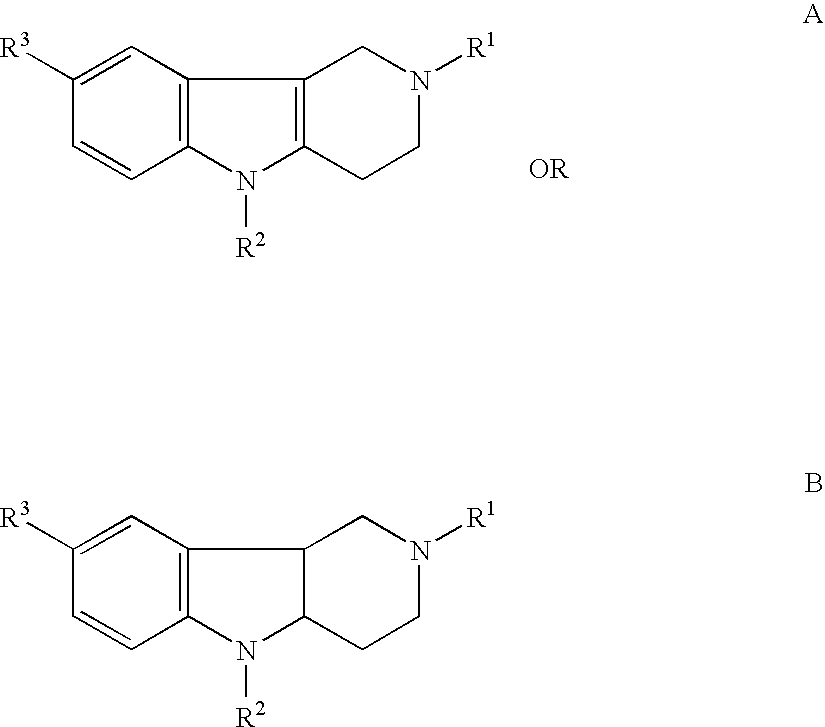
wherein: R1 is selected from a lower alkyl or aralkyl; R2 is selected from a hydrogen, aralkyl or substituted heteroaralkyl and R3 is selected from hydrogen, lower alkyl or halo or any pharmaceutically acceptable salt thereof. Any of the methods described can use a hydrogenated pyrido (4,3-b) indole of the formula A or B, where R1 is selected from a lower alkyl or PhCH2—; R2 is selected from a hydrogen, PhCH2— or 6-CH3-3-Py-(CH2)2— and R3 is selected from hydrogen, lower alkyl or halo, or any pharmaceutically acceptable salt thereof Any of the methods described can use a hydrogenated pyrido (4,3-b) indole of the formula A or B, where R1 is selected from CH3—, CH3CH2—, or PhCH2—; R2 is selected from H—, PhCH2—, or 6-CH3-3-Py-(CH2)2—; and R3 is selected from H—, CH3— or Br—, or any pharmaceutically acceptable salt thereof. Any of the methods described can use a hydrogenated pyrido (4,3-b) indole selected from the group consisting of: cis(+) 2,8-dimethyl-2,3,4,4a,5,9b-hexahydro-1H-pyrido[4,3-b]indole as a racemic mixture or in the substantially pure (+) or substantially pure (−) form; 2-ethyl-2,3,4,5-tetrahydro-1H-pyrido[4,3-b]indole; 2-benzyl-2,3,4,5-tetrahydro-1H-pyrido[4,3-b]indole; 2,8-dimethyl-5-benzyl-2,3,4,5-tetrahydro-1H-pyrido[4,3-b]indole; 2-methyl-5-(2-methyl-3-pyridyl) ethyl-2,3,4,5-tetrahydro-1H-pyrido[4,3-b]indole; 2,8-dimethyl-5-(2-(6-methyl-3-pyridyl)ethyl)-2,3,4,5-tetrahydro-1H-pyrido[4,3-b]indole; 2-methyl-2,3,4,5-tetrahydro-1H-pyrido[4,3-b]indole; 2,8-dimethyl-2,3,4,5-tetrahydro-1H-pyrido[4,3-b]indole; or 2-methyl-8-bromo-2,3,4,5-tetrahydro-1H-pyrido[4,3-b]indole or any pharmaceutically acceptable salt of any of the foregoing. Any of the methods described can use 2,8-dimethyl-5-(2-(6-methyl-3-pyridyl)ethyl-2,3,4;5-tetrahydro-1H-pyrido [4,3-b]indole (dimebon) or any pharmaceutically acceptable salt thereof, such as an acid salt, a hydrochloride salt or a dihydrochloride salt thereof. Any of the methods described can use a pharmaceutically acceptable acid salt of any of the hydrogenated pyrido (4,3-b) indoles described herein. Any of the methods described can use a hydrogenated pyrido (4,3-b) indole of the Formula A or B where R1 is CH3—, R2 is H and R3 is CH3— or any pharmaceutically acceptable salt thereof Any of the methods described can use a hydrogenated pyrido (4,3-b) indole of the Formula A or B where R1 CH3CH2— or PhCH2—, R2 is H—, and R3 is CH3— or any pharmaceutically acceptable salt thereof Any of the methods described can use a hydrogenated pyrido (4,3-b) indole of the formula A or B where R1 is CH3—, R1 is PhCH2—, and R3 is CH3— or any pharmaceutically acceptable salt thereof. Any of the methods described can use a hydrogenated pyrido (4,3-b) indole of the formula A or B where R1 is CH3—, R2 is 6-CH3-3-Py-(CH2)2—, and R3 is H— or any pharmaceutically acceptable salt thereof. Any of the methods described can use a hydrogenated pyrido (4,3-b) indole of the formula A or B where R2 is 6-CH3-3-Py-(CH2)2— or any pharmaceutically acceptable salt thereof. Any of the methods described can use a hydrogenated pyrido (4,3-b) indole of the formula A or B where R1 is CH3—, R2 is H—, and R3 is H— or CH3— or any pharmaceutically acceptable salt thereof Any of the methods described can use a hydrogenated pyrido (4,3-b) indole of the formula A or B where R1 is CH3—, R2 is H—, and R3 is Br— or any pharmaceutically acceptable salt thereof. - The hydrogenated pyrido (4,3-b) indole compounds can be tetrahydro pyrido (4,3-b) indole compounds or hexahydro pyrido (4,3-b) indole compounds. The hydrogenated pyrido (4,3-b) indole compounds can be substituted with 1 to 3 substituents, although unsubstituted hydrogenated pyrido (4,3-b) indole compounds or hydrogenated pyrido (4,3-b) indole compounds with more than 3 substituents are also contemplated. The hydrogenated pyrido (4,3-b) indole compounds can be of the formula:
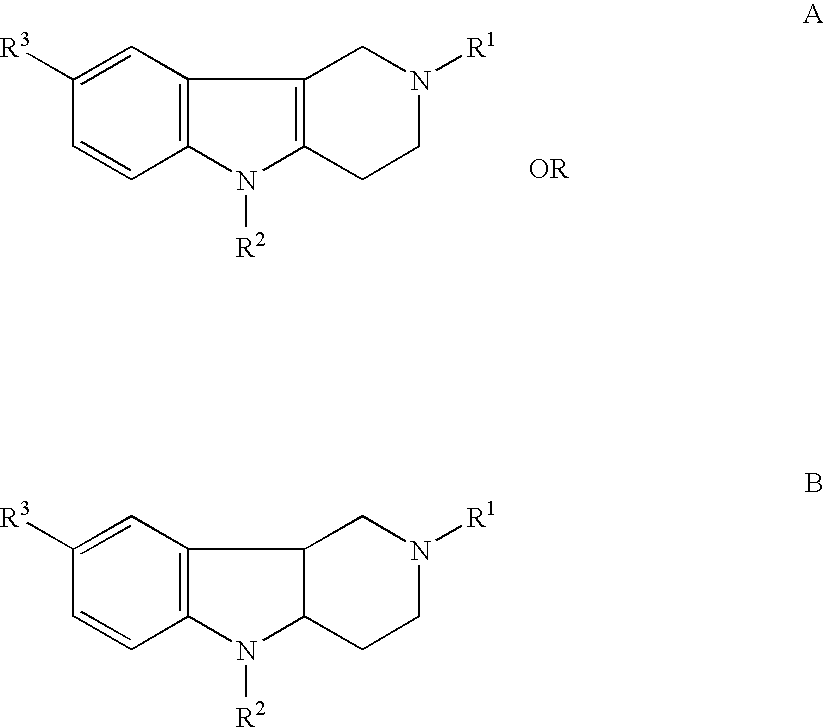
- where R1 is selected from a lower alkyl or aralkyl, R2 is selected from a hydrogen, aralkyl or substituted heteroaralkyl and R3 is selected from hydrogen, lower alkyl or halo. Any combination of the substituents is contemplated. Particular compounds for use in the methods disclosed herein include: cis(±) 2,8-dimethyl-2,3,4,4a,5,9b-hexahydro-1H-pyrido[4,3-b]indole as a racemic mixture or the individual compounds in the (+) or (−) forms; 2-ethyl-2,3,4,5-tetrahydro-1H-pyrido [4,3-b] indole; 2-benzyl-2,3,4,5-tetrahydro-1H-pyrido[4,3-b]indole; 2,8-dimethyl-5-benzyl-2,3,4,5-tetrahydro-1H-pyrido[4,3-b]indole; 2-methyl-5-(2-methyl-3-pyridyl) ethyl-2,3,4,5-tetrahydro-1H-pyrido[4,3-b]indole; 2,8-dimethyl-5-(2-(6-methyl-3-pyridyl)ethyl)-2,3,4,5-tetrahydro-1H-pyrido[4,3-b]indole; 2-methyl-2,3,4,5-tetrahydro-1H-pyrido[4,3-b]indole; 2,8-dimethyl-2,3,4,5-tetrahydro-1H-pyrido[4,3-b]indole; 2-methyl-8-bromo-2,3,4,5-tetrahydro-1H-pyrido[4,3-b]indole and any pharmaceutically acceptable salts or forms thereof, including pharmaceutically acceptable acid salts, such as hydrochloric acid salts or dihydrochloric acid salts.
- Any of the compounds of Formula B or 1 described herein can be either in the cis or trans form. Any of the compounds of Formula B or 1 described herein can also be present as a racemic mixture (±), as substantially pure compounds (+) or (−), or as any non-racemic mixture. The cis (±) variation, the cis (+) variation and the cis (−) are considered, as well as the trans (±) variation, the trans (+) variation and the trans (−) variation or any combination thereof.
- In some embodiments, the compound is administered to an individual who manifests one or more signs of aging, including, but not limited to, hair loss (including baldness), wrinkles, grey hair, and weight loss (including weight loss due to the death of muscular and fatty cells). Age-associated pathologies and conditions are more likely to be present in an older mammal, such as when a mammal is from about middle-age into old age, and the methods and uses can be used for such mammals. In some embodiments, the compound is administered to an individual who is elderly. In some embodiments, the compound is administered to a human who is at least about 35 years old and/or less than about 60 years old. In some embodiments, the compound is administered to a human who is at least about 40, about 45, about 50, about 55, about 60, about 65, about 70, about 75, about 80, about 85, about 90, about 95, about 100, about 105, about 110, about 115 and about 120 years old. In some embodiments, the compound is administered to a human who has not been diagnosed with a neurological disease (such as Alzheimer's disease). In some embodiments, the compound is administered to an individual (such as a human) who has not been diagnosed with cognition impairment associated with aging. In some embodiments, the compound is administered to an individual (such as a human) who does not display a symptom of cognitive impairment. In some embodiments, the compound is administered to an individual which may be any of: bovine, primate, equine, canine, feline, porcine, and ovine animals.
- The compound can be administered to an individual continuously (for example, at least once daily) over a sustained period. In some embodiments, the compound is administered to an individual for at least about three months. In some embodiments, the compound is administered to an individual for at least about six months. In some embodiments, the compound is administered to an individual for at least about twelve months.
- Use of the hydrogenated pyrido (4,3-b) indoles of formula (1) as medications for the prophylactics of untimely ageing - geroprotectors (anti-ageing medication) for mammals is considered
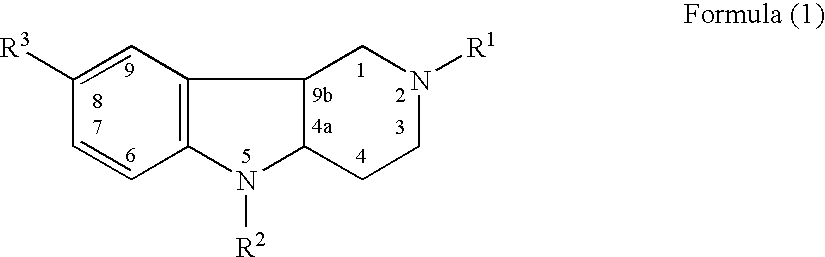
where -
- R1 is CH3—, CH3CH2—, or PhCH2—;
- R2 is H—, PhCH2—, or 6-CH3-3-Py-(CH2)2—;
- R3 is H—, CH3—, or Br—;
- Also included is the use of compounds of Formula (1), where R1 is CH3—, R2 is H—, and R3 is CH3—, where the substance is in either cis or trans isomer form. Also included is the use of compounds of Formula (1) where the compounds are in the form of salts with any pharmaceutically applicable acids or in a form of quatemized derivatives. In one use, the mammal is a human. In one use, any of the described compounds or compositions is used for the prevention of cataract. In one use, any of the described compounds or compositions is used for the prevention of alopecia.
- Use of the hydrogenated pyrido (4,3-b) indoles of Formula (2) as medications for the prophylactics of untimely ageing—geroprotectors (anti-ageing medication) for the mammals is considered
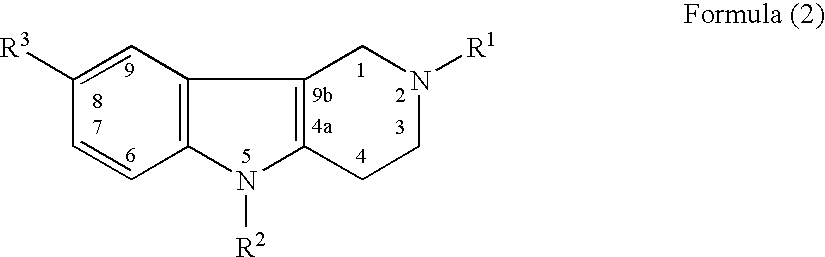
where -
- R1 is CH3—, CH3CH2—, or PhCH2—;
- R2 is H—, PhCH2—, or 6-CH3-3-Py-(CH2)2—;
- R3 is H—, CH3—, or Br—;
- Also included is the use of compounds of Formula (2), where R1 is CH3CH2— or PhCH2—, R2 is H—, and R3 is CH3—. Also included is the use of compounds of Formula (2), where R1 is CH3—, R2 is PhCH2—, and R3 is CH3—. Also included is the use of compounds of Formula (2), where R1 is CH3—, R2 is 6-CH3-3-Py-(CH2)2—, and R3 is H—. Also included is the use of compounds of formula (2), where R1 is CH3—, R2 is 6-CH3-3-Py-(CH2)2—, and R3 is CH3—. Also included is the use of compounds of Formula (2), where R1 is CH3—, R2 is H—, and R3 is H— or CH3—. Also included is the use of compounds of Formula (2), where R1 is CH3—, R2 is H—, and R3 is Br—. Also included is the use of compounds of Formula (2), where the compounds are in the form of salts with any pharmaceutically applicable acids or in a form of quatemized derivatives. In one use, the mammal is a human. In one use, any of the described compounds or compositions is used for the prevention of cataract. In one use, any of the described compounds or compositions is used for the prevention of alopecia.
- Any pharmacological medication possessing the anti-aging (geroprotective) activity can be produced that contains an active ingredient and pharmaceutically suitable carrier, which has contains an active ingredient, any substance described by the
Formula 1 or Formula 2 or any noted variation thereof. - Use of the compounds can be, but is not limited to, use for the prophylactics of untimely ageing, that can be described by giving to a patient of a pharmacological medication, which contains an effective amount of a substance described by either
Formula 1 or by Formula 2 in a dose 0.1 to 10 mg/kg of the body weight, at least once a day during the period of time, which is required to reach a therapeutic effect. -
FIG. 1 illustrates an age-dependent decline in the number of survived animals (C57/B female mice) that were receiving Dimebon in the daily dose of 3 mg/kg (experimental animals) and that were receiving pure water (control animals). The x-axis represents age in months. The y-axis represents the amount of survived animals. Diamonds represent control animals. Squares represent experimental animals. -
FIG. 2 provides the body weight changes of animals (C57/B female mice) that were receiving Dimebon in the daily dose of 3 mg/kg (experimental animals) and that were receiving pure water (control animals). The x-axis represents age in months. The y-axis represents average weight in grams. Diamonds represent control animals. Squares represent experimental animals. -
FIG. 3 provides data on the vision disturbances (development of the age-related cataract) in animals (C57/B female mice) that were receiving Dimebon in the daily dose of 3 mg/kg (experimental animals) and that were receiving pure water (control animals). The x-axis represents age in months. The y-axis represents the percentage of mice developing age-related cataract. Diamonds represent control animals. Squares represent experimental animals. -
FIG. 4 compares the disturbances in skin-hair integument in animals (C57/B female mice) that were receiving Dimebon in the daily dose of 3 mg/kg (experimental animals) and that were receiving pure water (control animals). The x-axis represents age in months. The y-axis represents the percentage of mice developing alopecia. Diamonds represent control animals. Squares represent experimental animals. -
FIGS. 5A and 5B are pictures illustrating the appearance of alopecia in mice in the control group (6A) and mice in the group that received Dimebon in a daily dose of 3 mg/kg daily in 18 months after the beginning of the experiment. - Compounds for use in any of the methods, kits, medicaments and the like described herein are hydrogenated pyrido (4,3-b) indoles or pharmaceutically acceptable salt thereof. A hydrogenated pyrido (4,3-b) indole can be a tetrahydro pyrido (4,3-b) indole. The hydrogenated pyrido (4,3-b) indole can also be a hexahydro pyrido (4,3-b) indole. The hydrogenated pyrido (4,3-b) indole compounds can be substituted with 1 to 3 substituents, although unsubstituted hydrogenated pyrido (4,3-b) indole compounds or hydrogenated pyrido (4,3-b) indole compounds with more than 3 substituents are also contemplated. Suitable substituents include but are not limited to alkyl, lower alkyl, aralkyl, heteroaralkyl, substituted heteroaralkyl, and halo.
- Particular hydrogenated pyrido-([4,3-b]) indoles are exemplified by the Formula A and B:

where R1 is selected from a lower alkyl or aralkyl, R2 is selected from a hydrogen, aralkyl or substituted heteroaralkyl and R3 is selected from hydrogen, lower alkyl (C1-C6alkyl) or halo. - In one variation, R1 is an alkyl group. In one variation, R1 is an aralkyl group. In one variation, R1 is an alkyl group or an aralkyl group.
- In one variation, R1 is a C1-C15 alkyl. In one variation, R1 is a C10-C15 alkyl. In one variation, R1 is a C1-C10alkyl. In one variation, R1 is a C1-C8 alkyl. In one variation, R1 is a C1-C alkyl. In one variation, R1 is a C1-C4 alkyl. In one variation, R1 is a C1-C3 alkyl. In one variation, R1 is a C2-C15 alkyl. In one variation, R1 is a C2-C10 alkyl. In one variation, R1 is a C2-C5alkyl. In one variation, R1 is C6-C15alkyl. In one variation, R1 is an alkyl group having more than 15 carbon atoms. In one variation, R1 is methyl. In one variation, R1 is ethyl. In one variation, R1 is selected from methyl or ethyl. In one variation, R1 is selected from methyl and an aralkyl group such as PhCH2—. In one variation, R1 is selected from ethyl or an aralkyl group such as PhCH2—. In one variation, R1 is a straight chain alkyl group of any alkyl size indicated for R1 alkyl groups (e.g., a straight chain C1-C15 alkyl such as n-nonyl and the like). In one variation, R1 is a branched alkyl group of any alkyl size indicated above (e.g., a branched chain C1-C6 alkyl such as t-butyl).
- In one variation, R1 is an aralkyl group. In one variation, R1 is an aralkyl group where any one of the alkyl or lower alkyl substitutes listed in the immediately preceding paragraph are further substituted with an aryl group (e.g., Ar—C1-C6Alkyl or Ar—C1-C3Alkyl, Ar-C1-C15alkyl). In one variation, R1 is an aralkyl groups where any one of the alkyl or lower alkyl substitutes listed in the immediately preceding paragraph are substituted with an aromatic carbocyclic group of from 5 to 15 carbon atoms having a single ring (e.g., phenyl) or multiple condensed rings (e.g., napthyl) which condensed rings may or may not be aromatic. In one variation, R1 is an aralkyl group where any one of the alkyl or lower alkyl substitutes listed in the immediately preceding paragraph are further substituted with a phenyl group (e.g., Ph—C1-C6Alkyl or Ph—C1-C3Alkyl, Ph—C1-C15alkyl). In one variation, R1 is PhCH2—.
- In one variation, R1 is selected from an alkyl or aralkyl group, wherein the alkyl group or alkyl portion of the aralkyl moiety is a C1-C8 alkyl. In one variation, R1 is selected from an alkyl or aralkyl group, wherein the alkyl group or alkyl portion of the aralkyl moiety is a C1-C6 alkyl. In one variation, R1 is selected from an alkyl or aralkyl group, wherein the alkyl group or alkyl portion of the aralkyl moiety, is a C1-C4 alkyl. In one variation, R1 is selected from an alkyl or aralkyl group, wherein the alkyl group or alkyl portion of the aralkyl moiety is a C1-C3 alkyl. In one variation, R1 is selected from an alkyl or aralkyl group, wherein the alkyl group or alkyl portion of the arakyl moiety is a C1-C2 alkyl. In one variation, R1 is selected from an akyl or aralkyl group, wherein the alkyl group or alkyl portion of the aralkyl moiety is a C2-C8 alkyl. In one variation, R1 is selected from an alkyl or aralkyl group, wherein the alkyl group or alkyl portion of the aralkyl moiety is a C4-C8 alkyl. In one variation, R1 is selected from an alkyl or aralkyl group, wherein the alkyl group or alkyl portion of the aralkyl moiety is a C6-C8 alkyl.
- In one variation, R2 is H. In one variation, R2 is selected from hydrogen and an aralkyl group. In one variation, R2 is an aralkyl group. In one variation, R2 is a substituted heteroaralkyl group. In one variation, R2 is selected from hydrogen and a substituted heteroaralkyl group. In one variation, R2 is selected from hydrogen, an aralkyl group and a substituted heteroaralkyl group. In one variation, R2 is selected from an aralkyl group and a substituted heteroaralkyl group.
- In one variation, R2 is an aralkyl group where R2 can be any one of the aralkyl groups noted for R1 above, the same as if each and every aralkyl variation listed for R1 is separately and individually listed for R2.
- In one variation, R2 is a substituted heteroaralkyl group wherein an alkyl or lower alkyl group is substituted with a heteroaryl group substituted with 1 to 3 lower alkyl (C1-C6) substituents. In one variation, R2 is a substituted heteroaralkyl group wherein an alkyl or lower alkyl group is substituted with a heteroaryl group substituted with 1 to 3 lower alkyl (C1-C3) substituents. In one variation, R2 is a substituted heteroaralkyl group wherein an alkyl or lower alkyl group is substituted with a heteroaryl group substituted with 1 to 3 methyl groups. In one variation, R2 is a substituted heteroaralkyl group wherein an alkyl or lower alkyl group is substituted with a heteroaryl group substituted with 1 lower alkyl (C1-C6) substituents. In one variation, R2 is a substituted heteroaralkyl group wherein an alkyl or lower alkyl group is substituted with a heteroaryl group substituted with 1 lower alkyl (C1-C3) substituent. In one variation, R2 is a substituted heteroaralkyl group wherein an alkyl or lower alkyl group is substituted with a heteroaryl group substituted with 1 to 2 methyl groups. In one variation, R2 is a substituted heteroaralkyl group wherein an alkyl or lower alkyl group is substituted with a heteroaryl group substituted with 1 methyl group. R2 can be any one of the substituted heteroaralkyl groups listed, where the alkyl or lower alkyl group that is substituted with a heteroaryl group is a C1-C15alkyl or a C1-C10alkyl or a C1-C8 alkyl or a C1-C16alkyl or a C1-C4alkyl or a C2-C4 alkyl or a C4-C10alkyl or a C2-C3alkyl.
- In other variations, R2 is any one of the substituted heteroaralkyl groups in the immediately preceding paragraph where the heteroaralkyl moiety comprises from 2 to 10 ring carbon atoms and 1 to 4 ring heteroatoms selected from oxygen, nitrogen and sulfur. In other variations, R2 is any one of the substituted heteroaralkyl groups in the immediately preceding paragraph where the heteroaralkyl moiety comprises from 2 to 6 ring carbon atoms and 1 to 4 ring heteroatoms selected from oxygen, nitrogen and sulfur. In other variations, R2 is any one of the substituted heteroaralkyl groups in the immediately preceding paragraph where the heteroaralkyl moiety comprises from 4 to 8 ring carbon atoms and 1 to 4 ring heteroatoms selected from oxygen, nitrogen and sulfur. In other variations, R2 is any one of the substituted heteroaralkyl groups in the immediately preceding paragraph where the heteroaralkyl moiety comprises pyridyl (Py).
- In one variation, R2 is 6-CH3-3-Py-(CH2)2—.
- In one variation, R3 is hydrogen. In other variations, R3 is any one of the alkyl groups noted for R1 above, the same as if each and every alkyl variation listed for R1 is separately and individually listed for R2. In another variation, R3 is a halo group. In one variation, R3 is selected from hydrogen and an alkyl group. In one variation, R3 is selected from hydrogen and a halo group. In one variation, R3 is selected from a hydrogen, alkyl or halo group. In one variation, R3 is selected from a halo and alkyl group.
- In one variation, R3 is Br. In one variation, R3 is I. In one variation, R3 is F. In one variation, R3 is Cl.
- In a particular variation, the hydrogenated pyrido (4,3-b) indole is 2,8-dimethyl-5-(2-(6-methyl-3-pyridyl)ethyl)-2,3,4,5-tetrahydro-1 H-pyrido[4,3-b]indole (dimebon) or any pharmaceutically acceptable salt thereof.
- The hydrogenated pyrido (4,3-b) indoles can be any pharmaceutically acceptable salt thereof, which are readily known to those of skill in the art. The pharmaceutically acceptable salts include pharmaceutically acceptable acid salts. Examples of particular pharmaceutically acceptable salts include hydrochloride salts or dihydrochloride salts. In a particular variation, the hydrogenated pyrido (4,3-b) indole is a pharmaceutically acceptable salt of 2,8-dimethyl-5-(2-(6-methyl-3-pyridyl)ethyl)-2,3,4,5-tetrahydro-1H-pyrido[4,3-b]indole, such as 2,8-dimethyl-5-(2-(6-methyl-3-pyridyl)ethyl)-2,3,4,5-tetrahydro-1H-pyrido[4,3-b]indole dihydrochloride.
- Particular hydrogenated pyrido-([4,3-b]) indoles can also be described by the Formula (1) or by the Formula (2) as medications for the prophylactics of premature ageing, geroprotectors for mammals:
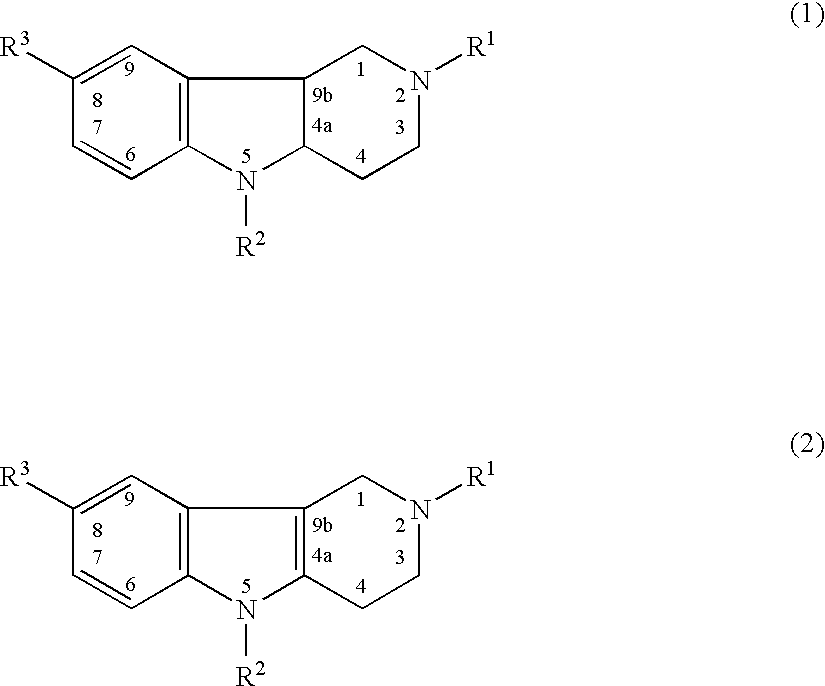
- For compounds of a general Formula (1),
- R1 represents CH3, CH3CH2, or PhCH2;
- R2 is H, PhCH2, or 6CH3-3-Py-(CH2)2—;
- R3 is H, CH3, or Br in any combination of the above substituents. All possible combinations of the substituents of Formula (1) and (2) are contemplated as specific and individual compounds the same as if each single and individual compound were listed by chemical name. Also contemplated are the compounds of formula (1) or (2), with any deletion of one or more possible moieties from the substituent groups listed above: e.g., where R1 represents CH3; R2 is H, PhCH2, or 6CH3-3-Py-(CH2)2-; and R3 is H, CH3, or Br, or where R1 represents CH3; R2 is 6CH3-3-Py-(CH2)2—; and R3 represents H, CH3, or Br.
- The above compounds may be in a form of salt with pharmaceutically acceptable acids and in a form of quatemized derivatives.
- One of the compounds, which may be used as a geroprotector, may be a compound described by a general Formula (1), where R1 is CH3, R2 is H, and R3 is CH3.
- This compound may be in a form of (±) cis-isomer.
- For the compounds of a general Formula (2),
- R1 is represented by CH3, CH3CH2, or PhCH2;
- R2 is H, PhCH2, or 6CH3-3-Py-(CH2)2—;
- R3 is H, CH3, or Br;
- The above compounds may be in a form of salt with pharmaceutically acceptable acids and in a form of quaternized derivatives.
- One of compounds, which may be used as a geroprotector, may be a compound described by a general Formula (2), where R1 is CH3CH2 or PhCH2, R2 is H, and R3 is H;
- Or a compound, where R1 is CH3, R2 is PhCH2, R3 is CH;
- Or a compound, where R1 is CH3, R2 is 6-CH3-3-Py-(CH2)2, and R3 is CH3;
- Or a compound, where R1 is CH3, R2 is H, R3 is H or CH3;
- Or a compound, where R1 is CH3, R2 is H, R3 is Br.
- Any of the above compounds may be used as a geroprotector in humans, in particular, for the prevention of cataract, as well as, also, in particular, for the prevention of alopecia. Other uses are described herein.
- Compounds described by a general Formula (1) are known compounds, which are widely used in pharmacological practice. Broad studies were conducted with a number of known compounds, which are derivatives of tetrahydro- and hexahydro-1H-pyrido[4,3-b]indole, and which express a broad spectrum of biological activity. The following types of activity were found in a series of 2,3,4,5-tetrahydro-1H-pyrido [4,3-b] indoles: antihistamine activity (OS-DE N 1813229 from Dec. 6, 1968, N 1952800 from Oct. 20 1969); central anti-depressant activity; anti-inflammatory activity (U.S. Pat. No. 3,718,657 from Dec. 13, 1970); neuroleptic activity (Herbert, C. A., Plattner, S. S., Welch, W. N., Mol. Pharm., 1980, v. 17, N. 1, p. 38-42) and other types of activity. Derivatives of 2,3,4,4a,5,9b-hexahydro-1H-pyrido[4,3-b]indole express psychotropic activity {Welch, W. H., Herbert, C. A., Weissman, A., Koe, K. B., J. Med. Chem., 1986, vol. 29,
N 10, p. 2093-2099), anti-aggressive activity, antiarrhythmic activity, and other types of activity. - The following therapeutic drugs, which are derivatives of tetrahydro- and hexahydro-1H-pyrido[4,3-b]indole, are manufactured: “diazoline” (mebhydroline), dimebon, “dorastine”, “carbidine” (“dicarbine”), “stobadine”, “gevotroline”. Diazoline (2-methyl-5-benzyl-2,3,4,5-tetrahydro-1H-pyrido[4,3-b]indole dihydrochloride) (Klyuev, M. A. Therapeutic drugs, which are approved in the medicinal practice in the USSR.—Moscow, Medicina, 1991, p. 512) and dimebon (2,8-dimethyl-5-(2-(6-methylpyridyl-3)ethyl)-2,3,4,5-tetrahydro-1 H-pyrido[4,3-b]indole dihydrochloride) (Mashkovsky, M.D. Medicinal drugs.
Part 1, 12th edition, Moscow, Medicine, 1993, p. 383), and its close analogue dorastine (2-methyl-8-chloro-5-(2-(6-methyl-3-pyridyl)ethyl)-2,3,4,5-etrahydro-1H-pyrido[4,3-b]indole dihydrochloride) (USAN and USP dictionary of drug names (United States Adopted Names 1961-1988, current US Pharmacopoeia and National Formulae for Drugs, and other nonproprietary drug names) 1989, 26th edition, p. 196) are known as antihistamine medications. Carbidine (dicarbine) (cis(±)2,8-dimethyl-2,3,4,4a,5,9b-hexahydro-1H-pyrido[4,3-b]indole dihydrochloride) is a Russian neuroleptic drug, which also has an antidepressive effect (Yakhontov, L. N., Glushkov, R. G. Synthetic therapeutic drugs. A. G. Natradze, editor, Moscow Medicina, 1983, p. 234-237). Stobadine, a (−) isomer of carbidine, is known as an anti-arrhythmic medication (Kitlova, M., Gibela, P., Drimal, J. Bratisi. Lek.Listy, 1985, vol. 84,N 5, p. 542-546). Gevotroline (8-fluoro-2-(3-3-pyridyl)propyl-2,3,4,5-tetrahydro-1H-pyrido[4,3-b]indole dihydrochloride) is an anti-psychotic and an anxyolytic medication (Abou-Gharbi, M., Patel, U.R., Webb, M. B., Moyer, J. A., Ardnee, T. H., J. Med. Chem., 1987, v.30, p. 1818-1823). Regarding dimebon and other compounds, see also Galenki-Iaroshevskii, P. A., Melkumove, E. R.; Bartahevich, V. V., Uvarov, A. V., Turovaia, A,; Khankoeva, A. T., Galygo, D. S. (1996) Biull Eksp Biol Med. (Russ), 122(12):642-644; and Shevtova, E., Kireeva, E., Lernontova, N., Bachurin, S, Abstract, 2nd Colloquium on Mitochondria and Myopathies in Halle/Saale, March 31-Apr. 2, 2000, “Beta-Amyloid Peptide (25-35) as the Trigger of Mitochondrial Permeability Transition”. - More recently, it was found that derivatives of hydrogenated pyrido[4,3-b]indoles described by the Formula (1) and Formula (2), e.g., dimebon, also possess properties of antagonists of NMDA receptors, that makes these compounds useful for the therapy of neurodegenerative diseases, and especially, Alzheimer's disease (patent Russian Federation No. 2106864 C1 6 A 61 K 31/475, Mar. 20, 1998, bull. 8; U.S. Pat. No. 6,187,785).
- All compounds mentioned above are known from literature and include the following specific compounds:
- 1. cis(±) 2,8-dimethyl-2,3,4,4a,5,9b-hexahydro-1H-pyrido[4,3-b]indole and its dihydrochloride;
- 2. 2-ethyl-2,3,4,5-tetrahydro-1H-pyrido[4,3-b]indole;
- 3. 2-benzyl-2,3,4,5-tetrahydro-1H-pyrido[4,3-b]indole;
- 4. 2,8-dimethyl-5-benzyl-2,3,4,5-tetrahydro-1H-pyrido[4,3-b]indole and its dihydrochloride;
- 5. 2-methyl-5-(2-methyl-3-pyridyl)ethyl-2,3,4,5-tetrahydro-1H-pyrido[4,3-b]indole and its sesquisulfate;
- 6. 2,8-dimethyl-5-(2-(6-methyl-3-pyridyl)ethyl)-2,3,4,5-tetrahydro-1H-pyrido[4,3-b]indole and its dihydrochloride (dimebon);
- 7. 2-methyl-2,3,4,5-tetrahydro-1H-pyrido[4,3-b]indole;
- 8. 2,8-dimethyl-2,3,4,5-tetrahydro-1H-pyrido[4,3-b]indole and its methyl iodide;
- 9. 2-methyl-8-bromo-2,3,4,5-tetrahydro-1H-pyrido[4,3-b]indole and its hydrochloride.
- Synthesis and studies on neuroleptic properties for the
compound 1 are reported, for instance, in the following publication: Yakhontov, L. N., Glushkov, R. G., Synthetic therapeutic drugs. A. G. Natradze, the editor, Moscow Medicina, 1983, p. 234-237. Synthesis ofcompounds 2, 8, and 9, and data on their properties as serotonin antagonists are reported in, for instance, in C. J. Cattanach, A. Cohen & B. H. Brown in J. Chem. Soc. (Ser.C) 1968, p. 1235-1243. Synthesis of the compound 3 is reported, for instance, in the article N. P. Buu-Hoi, O. Roussel, P. Jacquignon, J. Chem. Soc., 1964, N 2, p. 708-711. N. F. Kucherova and N. K. Kochetkov (General chemistry (russ.), 1956, v. 26, p. 3149-3154) describe the synthesis of the compound 4. Synthesis ofcompounds 5 and 6 is described in the article by A. N. Kost, M. A. Yurovskaya, T. V. Mel'nikova, in Chemistry of heterocyclic compounds, 1973, N 2, p. 207-212. The synthesis of the compound 7 is described by U, Horlein in Chem. Ber., 1954, Bd. 87, hft 4, 463-p. 472. M. Yurovskaya and I. L. Rodionov in Chemistry of heterocyclic compounds (1981,N 8, p. 1072-1078) describe the synthesis of methyl iodide of thecompound 8. - Unexpectedly, as discussed in Example 1, it was found that compounds described by the Formula (1) and Formula (2) have an anti-calcium activity, in particular it was found that these compounds are capable of inhibiting the entry of calcium ions into the nerve cells, which was induced by the activation of glutamate receptors. On the other hand, it is known that hyperaccumulation of calcium ions in cells induces a cascade of degenerative processes, which accompany the process of ageing and a development of corresponding degenerative diseases. A disturbance in calcium homeostasis is the basis for a so-called calcium theory of ageing and dementia (Calcium Hypothesis of Ageing and Dementia. Ann. N.Y. Acad. Sci., 1994, v. 747).
- As described in the Examples, it was also discovered that a compound, dimebon, slowed aging, prolonged life, reduced occurrence of hair loss, and reduced cataracts in aging mice. Thus, because of the new unexpected properties which do not follow from the structure of compounds described by Formula (1) and Formula (2) as well as other compounds described herein, such as compounds described by Formula (A) and (B), these compounds may be used as geroprotectors.
- According to this invention, a pharmacological tool, which has a geroprotective activity, and which contains an active ingredient and a pharmaceutically acceptable carrier, has an effective amount of hydrogenated pyrido[4,3-b]indole described by the Formula (1) or by Formula (2) as an active ingredient. In other embodiments is a pharmacological tool, which has a geroprotective activity, and which contains an active ingredient and a pharmaceutically acceptable carrier, has an effective amount of hydrogenated pyrido[4,3-b]indole described by the Formula (A) or by Formula (B) as an active ingredient.
- The definition “geroprotective activity”, which is used in the present application, means a biological activity that slows down ageing and/or prolongs life and/or increases or improves the quality of life via a decrease in the amount and/or the level of intensity of pathologies or conditions that are not life-threatening but are associated with the aging process and which are typical for elderly people. Pathologies or conditions that are not life-threatening but are associated with the aging process include such pathologies or conditions as loss of sight (cataract), deterioration of the dermatohairy integument (alopecia), and an age-associated decrease in weight due to the death of muscular and/or fatty cells.
- The definition “pharmacological tool” means the use of any therapeutic form that contains a compound described by the Formula (1) or by Formula (2), which may be useful for the prophylactic or for the therapeutic application in medicine as a tool with a geroprotective activity for the prophylactics of ageing. In order to make a pharmacological tool, one or several compounds described by a Formula (1) or by Formula (2) as an active ingredient is mixed with a pharmacologically acceptable carrier, which is known in medicine, according to the acceptable pharmaceutical method. Depending on the therapeutic form of the medication, the carrier may be in various forms. This disclosure also provides additional pharmacological tools related to compound of Formula (I) or (2), for example, pharmacological tools related to compounds of Formula (A) or (B).
- The definition “effective amount”, which is used in the present application means the use of such amount of a compound described by the Formula (1) or by Formula (2) or any compound described herein, such as any compound described by the Formula (A) or. (B), which in combination with its parameters of efficacy and toxicity, as well as based on the knowledge of the practicing specialist should be effective in a given therapeutic form. As is understood in the art, an effective amount may be in one or more doses.
- The present invention provides a variety of methods, such as those described in the “Brief Summary of the Inbention” and elsewhere in this disclosure. The methods of the invention employ the compounds described herein. For example, in one embodiment, the present invention provides a method of prolonging the lifespan of an individual comprising administering to an individual an effective amount of a hydrogenated pyrido (4,3-b) indole or pharmaceutically acceptable salt thereof. The present invention also provides a method of prolonging the lifespan of cells in an individual comprising administering to an individual an effective amount of a hydrogenated pyrido (4,3-b) indole or pharmaceutically acceptable salt thereof. The pharmacological tool (or compounds) described herein can also be used to slow aging in an individual. For example, the pharmacological tools (or compounds) can be used for delaying the onset and/or slowing the progression of an aging-associated manifestation and/or pathology or condition, including, but not limited to, any one or more of: disturbance in skin-hair integument (such as baldness or alopecia), visual disturbance (such as development of cataracts), and weight loss (including weight loss due to the death of muscular and fatty cells). The compounds can also be used to improve the quality of life of an individual, such as an individual developing these age-associated manifestations and/or pathologies. The compounds can also be used to decrease the risk of developing an age-related condition, such as a non life-threatening age-related pathology or condition.
- For use herein, unless clearly indicated otherwise, use of the terms “a”, “an” and the like refers to one or more.
- Mammals (interchangeably referred to as “individuals” herein) include, but are not limited to, human, bovine, primate, equine, canine, feline, porcine, and ovine animals. Thus, the invention finds use, for example, in the veterinary context, such as for use in agriculture and domestic pets. The individual may manifest one or more signs of aging, such as hair loss (including baldness), wrinkles, grey hair, and weight loss (including weight loss due to the death of muscular and/or fatty cells). In some embodiments, the individual is a mammal for which slowing aging is desired. In some embodiments, the individual is a human who desires to slow aging. In some embodiments, the individual is an individual in need of any of the methods described herein. The individual may be a human who is at least 35 years old and/or less than about 60 years old. In some embodiments, the compound is administered to a human who is at least about 40, about 45, about 50, about 55, about 60, about 65, about 70, about 75, about 80, about 85 years old. In some embodiments, the compound is administered to a human who is between about 40 and about 100 years old, in another embodiment, the human is from about 40 and about 80 years old. In another embodiment, the human is from about 40 to about 60 years old. In another embodiment, the human is between about 60 to 100 years old. In another embodiment, the human is between about 60 to 80 years old. In another embodiment, the human is between about 50 and 70 years old. In another embodiment, the human is between about 70 to 90 years old. The individual may be a human who has not been diagnosed with neurological diseases (such as Alzheimer's disease) or a cognition impairment associated with aging. The individual may be a human who does not display a symptom of cognitive impairment. In some embodiments, the individual is in need of any one or more of the methods for ameliorating one or more manifestations of aging (also referred to as aging-associated manifestations) described herein. In some embodiments, the individual is other than a human.
- According to the present invention, methods of the present invention (such as a method slowing aging may comprise the administration to an individual (such as a human patient) of the pharmacological tool that contains the effective amount of hydrogenated pyrido[4,3-b]indoles described by the Formula (1) or by Formula (2) or any other hydrogenated pyrido[4,3-b]indoles described herein, such as those described in Formula (A) and (B), in dose of between 0.1 and 10 mg/kg of the body weight, at least once a day and during the period of time, which is required to achieve the therapeutic effect. In other variations, the daily dose (or other dosage frequency) of a hydrogenated pyrido[4,3-b]indole as described herein is between about 0.1 and about 8 mg/kg; or between about 0.1 to about 6 mg/kg; or between about 0.1 and about 4 mg/kg; or between about 0.1 and about 2 mg/kg; or between about 0.1 and about 1 mg/kg; or between about 0.5 and about 10 mg/kg; or between about 1 and about 10 mg/kg; or between about 2 and about 10 mg/kg; or between about 4 to about 10 mg/kg; or between about 6 to about 10 mg/kg; or between about 8 to about 10 mg/kg; or between about 0.1 and about 5 mg/kg; or between about 0.1 and about 4 mg/kg; or between about 0.5 and about 5 mg/kg; or between about 1 and about 5 mg/kg; or between about 1 and about 4 mg/kg; or between about 2 and about 4 mg/kg; or between about 1 and about 3 mg/kg; or between about 1.5 and about 3 mg/kg; or between about 2 and about 3 mg/kg; or between about 0.01 and about 10 mg/kg; or between about 0.01 and 4 mg/kg; or between about 0.01 mg/kg and 2 mg/kg; or between about 0.05 and 10 mg/kg; or between about 0.05 and 8 mg/kg; or between about 0.05 and 4 mg/kg; or between about 0.05 and 4 mg/kg; or between about 0.05 and about 3 mg/kg; or between about 10 kg to about 50 kg; or between about 10 to about 100 mg/kg or between about 10 to about 250 mg/kg; or between about 50 to about 100 mg/kg or between about 50 and 200 mg/kg; or between about 100 and about 200 mg/kg or between about 200 and about 500 mg/kg; or a dosage over about 100 mg/kg; or a dosage over about 500 mg/kg. In some embodiments, a daily dosage of Dimebon is administered. The daily dosage for Dimebon can be a 10 mg/kg dosage.
- The compound may be administered for a sustained period, such as at least about one month, at least about 2 months, at least about 3 months, at least about 6 months, or at least about 12 months or longer.
- Other dosing schedules may also be followed. For example, the frequency of the administration may vary. The dosing frequency can be a once weekly dosing. The dosing frequency can be a once daily dosing. The dosing frequency can be more than once weekly dosing. The dosing frequency can be more than once daily dosing, such as any one of 2, 3, 4, 5, or more than 5 daily doses. The dosing frequency can be 3 times a day. The dosing frequency can be three times a week dosing. The dosing frequency can be a four times a week dosing. The dosing frequency can be a two times a week dosing. The dosing frequency can be more than once weekly dosing but less than daily dosing. The dosing frequency can be a once monthly dosing. The dosing frequency can be a twice weekly dosing. The dosing frequency can be more than once monthly dosing but less than one weekly dosing. The dosing frequency can intermittent (e.g., one daily dosing for 7 days followed by no doses for 7 days, repeated for any 14 day time period, such as 2 months, 4 months, 6 months or more). The dosing frequency can be continuous (e.g., one weekly dosing for continuous weeks). Any of the dosing frequencies can be used with any dosage amount, for example, any of the of dosing frequencies can employ a 10 mg/kg dosage amount. Any of the dosing frequencies can employ any of the compounds described herein together with any of the dosages described herein, for example, the dosing frequency can be a three times daily 10 mg/kg dose of dimebon.
- Compounds described by Formula (1) or by Formula (2) or compounds described by Formula (A) or (B) may be administered to mammals in a form of generally accepted oral compositions, such as tablets, coated tablets, gel capsules in a hard or in soft shell, emulsions or suspensions. Examples of carriers, which may be used for the preparation of such compositions, are lactose, corn starch or its derivatives, talc, stearate or its salts, etc. Acceptable carriers for gel capsules with soft shell are, for instance, plant oils, wax, fats, semisolid and liquid poly-ols, and so on. In addition, pharmaceutical preparations may contain preservatives, solubilizers, stabilizers, re-wetting agents, emulgators, sweeteners, dyes, adjusters, salts for the adjustment of osmotic pressure, buffers, coating agents or antioxidants. Preparations may also contain other substances, which have valuable therapeutic properties. Therapeutic forms may be represented by a usual standard dose and may be prepared by a known pharmaceutical method. Suitable formulations can be found, e.g., in Remington 's Pharmaceutical Sciences, Mace Publishing Company, Philadelphia, Pa., 20th ed. (2000), which is incorporated herein by reference. Any of the compounds described herein can be formulated in a tablet in any dosage form described, for example, dimebon or a pharmaceutically acceptable salt thereof can be formulated as a 10 mg tablet. Any of the compounds described herein can be formulated in any dosage as a sustained release formulation. The invention also provides for a sustained release devise, for example a transdermal patch or an implantable devise comprising as the active ingredient any one of the compounds described herein in any total amount such that the individual receives an effective amount of compound during the sustained release period. The technical result, that may be achieved after the application of the present invention, may be a slowing of aging, and/or a significant prolongation of life, and/or an improvement of the quality of life via a decrease in the amount and/or the level of intensity of pathologies or conditions that are not life-threatening but are associated with the aging process, such as loss of sight (cataract), deterioration of the dermatohairy integument (alopecia), an age-associated decrease in weight due to the death of muscular and/or fatty cells.
- The invention further provides kits for carrying out the methods of the invention, which comprises one or more compounds described herein. The kits may employ any of the compounds disclosed herein. In one variation, the kit employs dimebon or a pharmaceutically acceptable salt thereof, such as the dihydrochloride salt. The kits may be used for any one or more of the uses described herein, and, accordingly, may contain instructions for any one or more of the following uses: slowing aging (such as delaying the onset or slowing the progression of an age-associated or age-related manifestation and/or pathology or condition), prolonging lifespan of an individual, prolonging lifespan of cells in an individual, improving quality of life of an individual, and decreasing risk of developing an age-related condition, such as a non-life-threatening age-related pathology or condition.
- Kits generally comprise suitable packaging. The kits may comprise one or more containers comprising any compound described herein. Each component (if there is more than one component) can be packaged in separate containers or some components can be combined in one container where cross-reactivity and shelf life permit.
- The kits may optionally include a set of instructions, generally written instructions, although electronic storage media (e.g., magnetic diskette or optical disk) containing instructions are also acceptable, relating to the use of component(s) of the methods of the present invention. The instructions included with the kit generally include information as to the components and their administration to an individual.
- The invention also provides compositions (including pharmaceutical compositions) as described herein for the use of any of slowing aging, prolonging lifespan, and other methods described herein.
- A possibility of realization of the present invention with the achievement of the claimed goal and the achievement of the technical result is supported by not restricted by the following data.
- Determination of Calcium Blocking Properties of Hydrogenated Pyrido (4,3-b) Indoles of Formula (1) and Formula (2)
- Evaluation of the calcium-blocking properties of the compounds was conducted with P2-fraction of synaptosomes, which were isolated from the brain of newborn (8-11 days) rats according to the protocol described in [Bachurin et al. Neuroprotective and cognition enhancing properties of MK-801 flexible analogs. Structure-activity relationships. // Ann. N.Y. Acad. Sci., 2001, v. 939, pp. 219-235]. In this test, the ability of the compounds to inhibit a specific uptake of calcium ions via ion channels associated with glutamate receptors was determined.
- Synaptosomes were placed into the incubation buffer A (132 mM NaCl, 5 mM KCl, 5 mM HEPES) and were kept at 0° C. during the entire experiment. Aliquots of synaptosomes (50 μl) were placed in the media A, containing investigated compounds and a preparation of the radiolabeled calcium, 45Ca. The calcium uptake was stimulated by the introduction into the media of the 20 μl of the 10 mM solution of glutamate. After a 5 min incubation at 30° C. the reaction was interrupted by a filtration through GF/B filters, which were then triple washed with the cold buffer B (145 mM KCl, 10 mM tris, 5 mM trilon B). Then, filters were subjects for the detection of the radiolabeled calcium. The measurement was conducted using a scintillation counter ‘SL-4000 Intertechnic’. The initial screening was conducted with a concentration of each compound of 5 μM. A specific calcium uptake was calculated using the following equation
K(43/21)=[(Ca4-Ca3)/(Ca2-Ca1)]*100%
where:
Ca1 is a calcium uptake in a control experiment (no glutamate or test compound added);
Ca2 is a calcium uptake in the presence of glutamate only (Glutamate Induced Calcium Uptake—GICU);
Ca3 is a calcium uptake in the presence of a test compound only (no glutamate added);
Ca4 is a calcium uptake in the presence of both glutamate and a test compound. - Results of these experiments are presented in Table 1.
TABLE 1 Effect of investigated compounds on the glutamate-induced uptake of 45Ca into the rat brain synaptosomes. % Ca to # Compound control 1 cis-(±)-2,8-dimethyl-2,3,4,4a,5,9b-hexahydro- 40.5 ± 1.0 1H-pyrido(4,3-b)indol dihydrochloride 2 2-ethyl-2,3,4,5-tetrahydro-1H-pyrido(4,3-b)indol 36.5 ± 0.5 3 2-benzyl-2,3,4,5-tetrahydro-1H-pyrido(4,3-b)indol 28.5 ± 2.5 4 2,8-dimethyl-5-benzyl-2,3,4,5-tetrahydro-1H- 22.5 ± 3.5 pyrido(4,3-b)indoldihydrochloride 5 2-methyl-5-(2-(6-methyl-3-pyridyl)-ethyl)-2,3,4,5- 33.5 ± 1.5 tetrahydro-1H-pyrido(4,3-b)indol sesquisulfate monohydrate 6 2,8-dimethyl-5-(2-(6-methyl-3-pyridyl)-ethyl)-2,3,4,5- 48.5 ± 2.5 tetrahydro-1H-pyrido(4,3-b)indol dihydrochloride (Dimebon) 7 2-methyl-2,3,4,5-tetrahydro-1H-pyrido(4,3-b)indol 35.5 ± 2.5 8 2-dimethyl-2,3,4,5-tetrahydro-1H-pyrido(4,3-b)indol 18.0 ± 2.5 methyl iodide 9 2-methyl-8-bromo-2,3,4,5-tetrahydro-1H- 30.0 ± 3.5 pyrido(4,3-b)indol hydrochloride - Table 1 illustrates that all investigated compounds possess pronounced calcium-blocking properties. This suggests that according to the described above ageing and dementia hypothesis, Calcium hypothesis of Ageing and Dementia. Ann. N.Y. Acad. Sci., 1994, v. 747, all these compound may have a potential as geroprotectors.
- Data on the Activity of Dimebon as a Geroprotector
- Dimebon, 2,8-dimethyl-5-(2-(6-methyl-3-yridyl)-ethyl)-2,3,4, 5-tetrahydro-1H-pyrido(4,3-b)indol dihydrochloride, was used as a representative for the compounds of a general Formula (2)
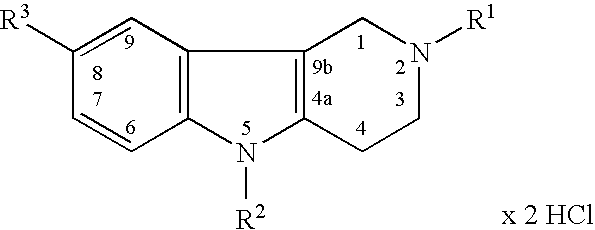
where R1 and R3 are methyls, and -
- R2 is 2-(6-methyl-3-pyridyl)-ethyl
Dimebon was evaluated as an agent that prolongs life and improves the quality of life (characterized by changes in the amount of pathologies that accompany ageing) in the laboratory animals.
- R2 is 2-(6-methyl-3-pyridyl)-ethyl
- Experiments were conducted with C57/B female mice, starting from their age of 12 months. Mice were kept on cells, 10 animals per a cell. Both control and experimental group included 50 animals in each group. Animals had a free access to food and water. The day-night cycle was 12 hours.
- Prior to the experiment, daily and weekly water consumption by the animals in one cell. was measured. Dimebon was added in water in such amount that each animal would consume 3 mg/kg of Dimebon per day in average. Bottles with water containing Dimebon were replaced every 7 days. Animals in the control group were receiving pure water.
- Prior to the experiment, all the animals were weighed, and an average weight was determined in every group, every cell, as well as the weight of all animals in every cell. The condition of skin, hair, and eyes were also determined by visual inspection. All animals appeared healthy and did not have any visible lesions prior to the experiment. Evaluation of all these parameters was conducted on a monthly basis.
- Statistics was calculated using Student T-test and ‘Chi-squared’ criteria.
- Lifespan
- Evaluation of the parameter of the length of life was conducted employing methods used in demography. This parameter was a probability of death in every age group. Results of this study are presented in Table 2.
TABLE 2 Amount of alive animals (C57/B female mice), which receive either Dimebon in a daily dose of 3 mg/kg (experimental group) or pure water (control group) depending on the age of the animals. Age, months 12 13 14 15 16 17 18 19 20 21 22 23 24 25 Experimental group, 50 50 49 48 47 47 42 39 35 32 28 25 18 11 amount Control group, 50 50 50 46 42 41 37 36 22 22 19 15 11 6 amount - The top row is the age of animals in months. The middle and the bottom rows are numbers of alive animals.
- Table 2 illustrates that death of animals started from the 14th month, i.e. 2 months after the beginning of the experiment. During the entire experiment (except for the 14th month) the number of animals in the experimental group was greater than in the control group. In other words, the probability of death was lower in all age groups in animals that were receiving Dimebon. In age groups of 20-23 months this difference was statistically significant (P<0.05).
- A decrease in the animal weight was observed during the entire experiment in the control group. This is a natural process, which is known as an age-related weight depletion. No weight depletion was observed in the group of animals that were treated with Dimebon (table 3). The depletion in weight in the experimental group was observed only in the 23 month old animals, however, even then, their weight was higher compared to the animals in the control group. It should be noted, though, that the observed variation in weight was not statistically significant (P>0.05).
TABLE 3 Dynamics in weight (g) in mice depending on age and on a Dimebon consumption. Age, months 12 13 14 15 16 17 18 19 20 21 22 23 24 25 Exp. 24.7 24.7 24.7 26 25.5 24.7 25.5 26 26 25.6 25.1 24.7 24 23.7 group Control 25.3 24.7 24.3 24.6 24.5 23.5 24.2 23.5 23.8 23.2 23.7 23 22.8 22.2 group - The top row is the age of animals in months, The middle and the bottom rows are the average weight of animals in grams.
- Vision disturbances, appearing as a development of cataract on one or both eyes, was observed in the control group of animals on the second month of the experiment (photo 1). The amount of animals with cataract in this group was rapidly growing every month. The amount of animals that had cataract in the group receiving Dimebon (table 4) was significantly less (P<0.05, for 13 to 20 months old mice).
TABLE 4 Vision disturbances (development of age-related cataract) in mice depending on age and on a Dimebon consumption. Age, months 12 13 14 15 16 17 18 19 20 21 Exp. 0 0 0 4 6 6 10 13 17 25 group Control 0 4 4 11 19 30 I.D. I.D. I.D. I.D. group - The top row is the age of animals in months. The middle and the bottom rows are the amount of animals that have cataract, in %, I.D.—insufficient data.
- Starting with the
month 18, the amount of animals having cataract also increased in the experimental group. The comparative analysis between the control and experimental groups betweenmonths 18 through 21 was complicated, because many of the animals that had cataract in the control group died, while animals in the experimental group were still alive. - Starting from the first month of the experiment, animals with the disturbances in their skin-hair integument, in the form of bald spots or so-called alopecia, were observed (photo). The size of bald spots in these animals was varied from 1 to 25% of the body surface. The difference in the amount of animals that had alopecia in the control and in the experiment groups was observed starting from the 13th through 21st month (table 5). The difference was statistically significant (P<0.05).
TABLE 5 Disturbances in skin-hair integument in mice depending on age and on a Dimebon consumption. Age, months 12 13 14 15 16 17 18 19 20 21 Exp. 0 0 2 6 10 20 12 14 34 35 group Control 0 2 2 13 21 24 32 37 55 60 group - The top row is the age of animals in months. The middle and the bottom rows are the % of animals that have alopecia.
- By the end of the experiment, same as in case with cataract, the amount of animals that had alopecia in the control group declined because of the death of animals, while animals in the experimental group were still alive.
- Data presented in Tables 2-5 are also presented as plots on
FIGS. 1-5 for the visualization.FIG. 1 illustrates an age dependent decline in the amount of animals (CS7/B female mice) that were receiving Dimebon in the daily dose of 3 mg/kg (experimental animals) and that were receiving pure water (control animals).FIG. 2 presents data on the weight dynamics in mice depending on age and a Dimebon consumption.FIG. 3 presents data on the vision disturbances (development of the age-related cataract) in mice depending on age and a Dimebon consumption.FIG. 4 illustrates the disturbances in skin-hair integument in mice depending on age and a Dimebon consumption.FIGS. 5A and 5B illustrate the appearance of alopecia of mice in the control group (A) and mice in the group that received Dimebon in a daily dose of 3 mg/kg in 18 months after the beginning of the experiment. - The presented results suggest that Dimebon statistically reliably decreases the probability of death in old animals. In addition, there is a statistically reliable evidence that there is a strong correlation between feeding old animals with Dimebon and slowing of the development of non-fatal pathologies, such as loss of vision and alopecia. A decrease in weight, which is a valid characteristic of ageing, is significantly slower in a group receiving Dimebon compared to the control group. Thus, Dimebon prolongs life and decreases the probability of non-fatal age-related pathologies. In other words, it improves the quality of life of old animals. All of the above suggests that Dimebon, in addition to its ability to have a potential in a therapy of Alzheimer's disease is an effective geroprotector.
- Although the foregoing invention has been described in some detail by way of illustration and example for purposes of clarity of understanding, it is apparent to those skilled in the art that certain minor changes and modifications will be practiced. Therefore, the description and examples should not be construed as limiting the scope of the invention.
Claims (24)
1: A method selected from the group consisting of: (1) slowing aging in a mammal, the method comprising administering to a mammal an amount of a hydrogenated pyrido (4,3-b) indole or pharmaceutically acceptable salt thereof effective to slow aging; (2) slowing the progression of age associated hair loss in a mammal, the method comprising administering to a mammal an amount of a hydrogenated pyrido (4,3-b) indole or pharmaceutically acceptable salt thereof effective to slow the progression of age associated hair loss; (3) slowing the progression of age associated weight loss in a mammal, the method comprising administering to a mammal an amount of a hydrogenated pyrido (4,3-b) indole or pharmaceutically acceptable salt thereof effective to slow the progression of age associated weight loss; (4) slowing the onset of an age associated vision disturbance in a mammal, the method comprising administering to a mammal an amount of a hydrogenated pyrido (4,3-b) indole or pharmaceutically acceptable salt thereof effective to slow the onset of an age associated vision disturbance; (5) prolonging the lifespan of a mammal, the method comprising administering to a mammal an amount of a hydrogenated pyrido (4,3-b) indole or pharmaceutically acceptable salt thereof effective to prolong the lifespan of the mammal; and (6) improving the quality of life of a mammal, the method comprising administering to a mammal an amount of a hydrogenated pyrido (4,3-b) indole or pharmaceutically acceptable salt thereof effective to improve the quality of life of the mammal.
2: The method of claim 1 , wherein the hydrogenated pyrido (4,3-b) indole is a tetrahydro pyrido (4,3-b) indole.
3: The method of claim 1 , wherein the hydrogenated pyrido (4,3-b) indole is a hexahydro pyrido (4,3-b) indole.
4: The method of claim 1 , wherein the hydrogenated pyrido (4,3-b) indole is of the formula:
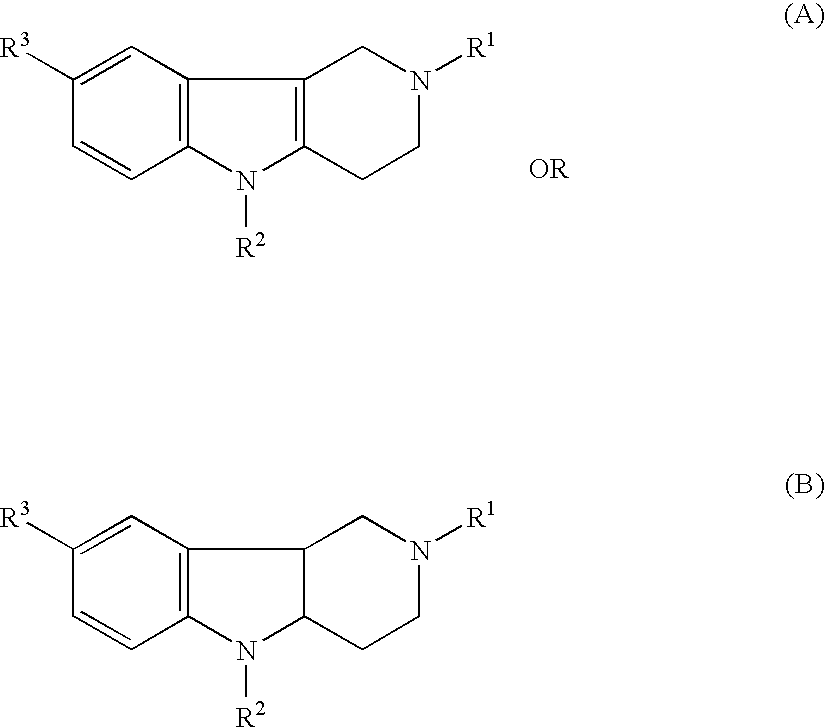
wherein:
R1 is selected from a lower alkyl or aralkyl
R2 is selected from a hydrogen, aralkyl or substituted heteroaralkyl
R3 is selected from hydrogen, lower alkyl or halo.
5: The method of claim 2 , wherein aralkyl is PhCH2— and substituted heteroaralkyl is 6-CH3-3-Py-(CH2)2—.
6: The method of claim 2 , wherein
R1 is selected from CH3—, CH3CH2—, or PhCH2—
R2 is selected from H—, PhCH2—, or 6-CH3-3-Py-(CH2)2—
R3is selected from H—, CH3— or Br—.
7: The method of claim 1 , wherein the hydrogenated pyrido (4,3-b) indole is selected from the group consisting of:
cis(±) 2,8-dimethyl-2,3,4,4a,5,9b-hexahydro- 1 H-pyrido[4,3-b]indole;
2-ethyl-2,3,4,5-tetrahydro-1H-pyrido [4,3-b]indole;
2-benzyl-2,3,4,5-tetrahydro-1H-pyrido[4,3-b]indole;
2,8-dimethyl-5-benzyl-2,3,4,5-tetrahydro-1H-pyrido[4,3-b]indole;
2-methyl-5-(2-methyl-3-pyridyl)ethyl-2,3,4,5-tetrahydro-1H-pyrido[4,3-b]indole;
2,8-dimethyl-5-(2-(6-methyl-3-pyridyl)ethyl)-2,3,4,5-tetrahydro-1H-pyrido [4,3-b]indole;
2-methyl-2,3,4,5-tetrahydro-1H-pyrido[4,3-b]indole;
2,8-dimethyl-2,3,4,5-tetrahydro-1H-pyrido[4,3-b]indole;
2-methyl-8-bromo-2,3,4,5-tetrahydro-1H-pyrido[4,3-b]indole.
8: The method of claim 7 , wherein the hydrogenated pyrido (4,3-b) indole is 2,8-dimethyl-5-(2-(6-methyl-3-pyridyl)ethyl)-2,3,4,5-etrahydro-1H-pyrido[4,3-b]indole.
9: The method of claim 1 or 8 , wherein the pharmaceutically acceptable salt is a pharmaceutically acceptable acid salt.
10: The method of claim 9 , wherein the pharmaceutically acceptable salt is a hydrochloride acid salt.
11: The method of claim 1 , wherein the hydrogenated pyrido (4,3-b) indole is 2,8-dimethyl-5-(2-(6-methyl-3-pyridyl)ethyl)-2,3,4,5-tetrahydro-1H-pyrido[4,3-b]indole dihydrochloride.
12: The method of claim 6 , wherein R1 is CH3—, R2 is H and R3 is CH3—.
13: The method of claim 6 , wherein R1 CH3CH2— or PhCH2—, R2 is H—, and R3 is CH3—.
14: The method of claim 6 , wherein R1 is CH3—, R2is PhCH2—, and R3is CH3—.
15: The method of claim 6 , wherein R1 is CH3—, R2is 6-CH3-3-Py-(CH2)2—, and R3 is H—.
16: The method of claim 6 , where R2 is 6-CH3-3-Py-CH2)2—.
17: The method of claim 6 , wherein R1 is CH3—, R2is H—, and R3is H— or CH3—.
18: The method of claim 6 , where R1 is CH3—, R2 is H—, and R3is Br—.
19-132. (canceled)
133: A sustained release formulation comprising a compound of the formula:
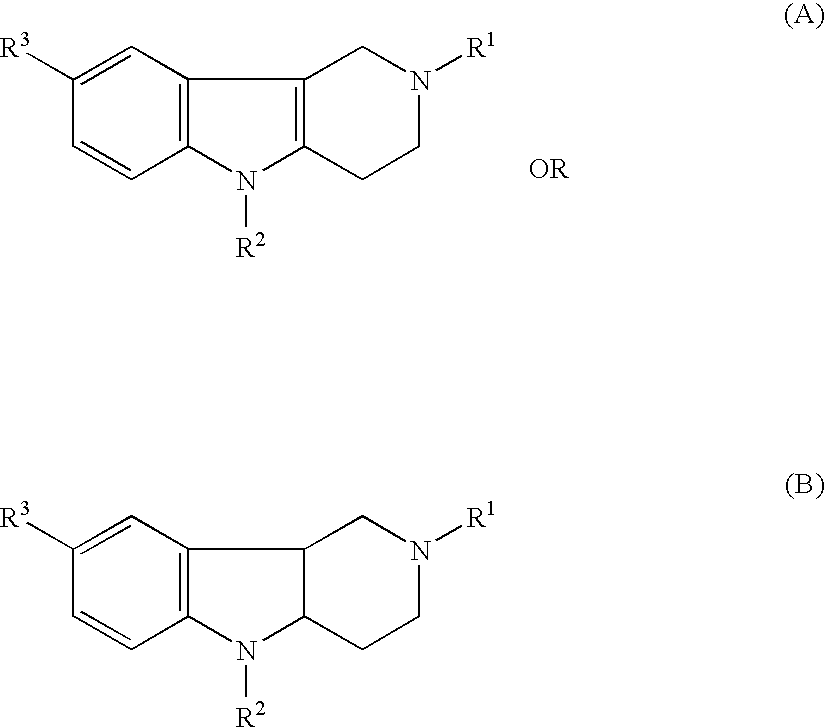
wherein:
R1 is selected from CH3—, CH3CH2—, or PhCH2—
R2 is selected from H—, PhCH2—, or 6-CH3-3-Py-(CH2)2—
R3 is selected from H—, CH3— or Br—,
or a pharmaceutically acceptable salt thereof.
134: A sustained release device comprising a compound of the formula:
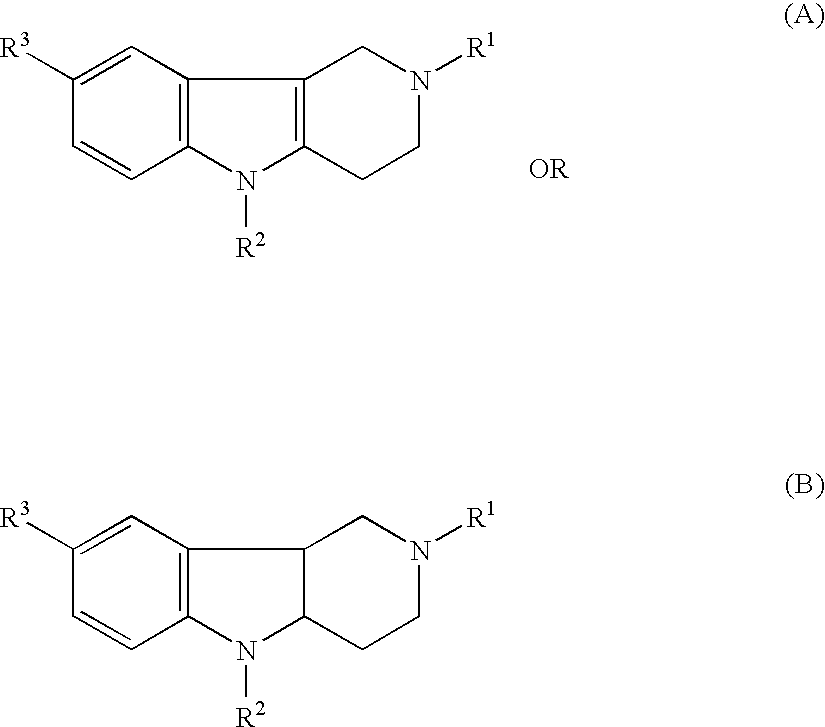
wherein:
R1 is selected from CH3—, CH3CH2—, or PhCH2—
R2 is selected from H—, PhCH2—, or 6-CH3-3-Py-(CH2)2—
R3 is selected from H—, CH3— or Br—,
or a pharmaceutically acceptable salt thereof.
135: The sustained release formulation of claim 133 , wherein the compound is 2,8-dimethyl-5-(2-(6-methyl-3-pyridyl)ethyl)-2,3,4,5-tetrahydro-1H-pyrido[4,3-b]indole or a pharmaceutically acceptable salt thereof.
136: The sustained release device of claim 134 , wherein the compound is 2,8-dimethyl-5-(2-(6-methyl-3-pyridyl)ethyl)-2,3,4,5-tetrahydro-1H-pyrido[4,3-b]indole or a pharmaceutically acceptable salt thereof.
137: A kit comprising 2,8-dimethyl-5-(2-(6-methyl-3pyridyl)ethyl)-2,3,4,5-tetrahydro-1H-pyrido[4,3-b]indole or a pharmaceutically acceptable salt thereof and instructions for use.
Priority Applications (1)
| Application Number | Priority Date | Filing Date | Title |
|---|---|---|---|
| US11/644,698 US20070179174A1 (en) | 2003-12-08 | 2006-12-22 | Methods and compositions for slowing aging |
Applications Claiming Priority (4)
| Application Number | Priority Date | Filing Date | Title |
|---|---|---|---|
| RU2003135482/15A RU2283108C2 (en) | 2003-12-08 | 2003-12-08 | GEROPROTECTING AGENT BASED ON HYDROGENATED PYRIDO[4,3-b]INDOLES (VARIANTS), PHARMACOLOGICAL AGENT BASED ON THEREOF AND METHOD FOR ITS USING |
| RU2003135482 | 2003-12-08 | ||
| PCT/US2004/041081 WO2005055951A2 (en) | 2003-12-08 | 2004-12-08 | Methods and compositions for slowing aging |
| US11/644,698 US20070179174A1 (en) | 2003-12-08 | 2006-12-22 | Methods and compositions for slowing aging |
Related Parent Applications (2)
| Application Number | Title | Priority Date | Filing Date |
|---|---|---|---|
| US10/582,312 Continuation US20080234310A1 (en) | 2003-12-08 | 2004-12-08 | Methods and Compositions for Slowing Aging |
| PCT/US2004/041081 Continuation WO2005055951A2 (en) | 2003-12-08 | 2004-12-08 | Methods and compositions for slowing aging |
Publications (1)
| Publication Number | Publication Date |
|---|---|
| US20070179174A1 true US20070179174A1 (en) | 2007-08-02 |
Family
ID=38322889
Family Applications (1)
| Application Number | Title | Priority Date | Filing Date |
|---|---|---|---|
| US11/644,698 Abandoned US20070179174A1 (en) | 2003-12-08 | 2006-12-22 | Methods and compositions for slowing aging |
Country Status (1)
| Country | Link |
|---|---|
| US (1) | US20070179174A1 (en) |
Cited By (26)
| Publication number | Priority date | Publication date | Assignee | Title |
|---|---|---|---|---|
| US20070117834A1 (en) * | 2005-10-04 | 2007-05-24 | David Hung | Methods and compositions for treating Huntington's disease |
| US20070225316A1 (en) * | 2006-01-25 | 2007-09-27 | Bachurin Sergei O | Methods and compositions for treating schizophrenia |
| US20080234310A1 (en) * | 2003-12-08 | 2008-09-25 | Bachurin Sergei O | Methods and Compositions for Slowing Aging |
| WO2009038764A1 (en) * | 2007-09-20 | 2009-03-26 | D2E, Llc | Fluoro-containing derivatives of hydrogented pyrido[4,3-b]indoles with neuroprotective and cognition enhancing properties, process for preparing, and use |
| US20100022580A1 (en) * | 2008-01-25 | 2010-01-28 | Hung David T | New 2,3,4,5-tetrahydro-1h-pyrido[4,3-b]indole compounds and methods of use thereof |
| US20100099700A1 (en) * | 2006-09-20 | 2010-04-22 | David Hung | Hydrogenated pyrido (4,3-b) indoles for treating amyotrophic lateral sclerosis (als) |
| US20100173024A1 (en) * | 2008-12-01 | 2010-07-08 | LifeSpan Extension, LLC | Methods and compositions for altering health, wellbeing, and lifespan |
| US20100216814A1 (en) * | 2008-10-31 | 2010-08-26 | Hung David T | Pyrido[4,3-b]indoles containing rigid moieties |
| US20110021908A1 (en) * | 2009-05-27 | 2011-01-27 | Lumicell Diagnostics, Inc. | Methods and systems for spatially identifying abnormal cells |
| US20110104071A1 (en) * | 2009-05-27 | 2011-05-05 | Lumicell Diagnostics, Inc. | Methods and systems for spatially identifying abnormal cells |
| US20110237582A1 (en) * | 2009-09-23 | 2011-09-29 | Rajendra Parasmal Jain | Pyrido[3,4-b]indoles and methods of use |
| US8791132B2 (en) | 2011-02-18 | 2014-07-29 | Medivation Technologies, Inc. | Compounds and methods for treatment of hypertension |
| US8859561B2 (en) | 2009-09-23 | 2014-10-14 | Medivation Technologies, Inc. | Pyrido[4,3-b]indoles and methods of use |
| US8999977B2 (en) | 2008-03-24 | 2015-04-07 | Medivation Technologies, Inc. | Bridged heterocyclic compounds and methods of use |
| US9006234B2 (en) | 2009-09-23 | 2015-04-14 | Medivation Technologies, Inc. | Bridged heterocyclic compounds and methods of use |
| US9034865B2 (en) | 2010-02-18 | 2015-05-19 | Medivation Technologies, Inc. | Pyrido [4,3-B] indole and pyrido [3,4-B] indole derivatives and methods of use |
| US9035056B2 (en) | 2011-02-18 | 2015-05-19 | Medivation Technologies, Inc. | Pyrido[4,3-b]indole and pyrido[3,4-b]indole derivatives and methods of use |
| US9032965B2 (en) | 2010-12-08 | 2015-05-19 | Lumicell, Inc. | Methods and system for image guided cell ablation with microscopic resolution |
| US9040519B2 (en) | 2010-02-18 | 2015-05-26 | Medivation Technologies, Inc. | Fused tetracyclic pyrido [4,3-B] indole and pyrido [3,4-B] indole derivatives and methods of use |
| US9187471B2 (en) | 2010-02-19 | 2015-11-17 | Medivation Technologies, Inc. | Pyrido [4,3-b] indole and pyrido [3,4-b] indole derivatives and methods of use |
| US9193728B2 (en) | 2010-02-18 | 2015-11-24 | Medivation Technologies, Inc. | Fused tetracyclic pyrido [4,3-B] indole and pyrido [3,4-B] indole derivatives and methods of use |
| US9199985B2 (en) | 2011-02-18 | 2015-12-01 | Medivation Technologies, Inc. | Compounds and methods for treatment of hypertension |
| US9260429B2 (en) | 2008-03-24 | 2016-02-16 | Medivation Technologies, Inc. | Pyrido[3,4-B]indoles and methods of use |
| US9409910B2 (en) | 2008-10-31 | 2016-08-09 | Medivation Technologies, Inc. | Azepino[4,5-B]indoles and methods of use |
| US9434747B2 (en) | 2011-02-18 | 2016-09-06 | Medivation Technologies, Inc. | Methods of treating diabetes |
| US9763577B2 (en) | 2013-03-14 | 2017-09-19 | Lumicell, Inc. | Imaging agent for detection of diseased cells |
Citations (20)
| Publication number | Priority date | Publication date | Assignee | Title |
|---|---|---|---|---|
| US3718657A (en) * | 1970-12-03 | 1973-02-27 | Abbott Lab | Certain-2-substituted-1,2,3,4-tetrahydro-beta or gamma carbolines |
| US3743740A (en) * | 1968-10-31 | 1973-07-03 | I Zhukova | 3,6-dimethyl - 1,2,3,4,4a,9a - hexahydro-ypsilon-carboline dihydrochloride for treating mental diseases |
| US3991199A (en) * | 1973-12-06 | 1976-11-09 | Endo Laboratories, Inc. | Pyridoindoles |
| US4174453A (en) * | 1973-12-06 | 1979-11-13 | Endo Laboratories, Inc. | Trans-hexahydro-pyrido-indoles |
| US4636563A (en) * | 1985-09-16 | 1987-01-13 | American Home Products Corporation | Antipsychotic γ-carbolines |
| US4985256A (en) * | 1988-04-27 | 1991-01-15 | Bionix Corporation | Methods for diagnosing, monitoring and controlling the onset and progression of certain dementias and impeding memory loss or improving impairment of memory |
| US5319096A (en) * | 1992-04-03 | 1994-06-07 | Hoechst-Roussel Pharmaceuticals Inc. | (1H-indol-1-yl)-2-(amino) acetamides and related (1H-indol-1-yl)-(aminoalkyl)amides, pharmaceutical composition and use |
| US5563147A (en) * | 1994-09-12 | 1996-10-08 | Eli Lilly And Company | Serotonerbic tetrahydropyridoindoles |
| US5958919A (en) * | 1996-09-20 | 1999-09-28 | Washington University | Treatment of presymptomatic alzheimer's disease to prevent neuronal degeneration |
| USRE36397E (en) * | 1994-02-04 | 1999-11-16 | The John Hopkins University | Inhibitors of poly(ADP-ribose) synthetase and use thereof to treat NMDA neurotoxicity |
| US6017957A (en) * | 1989-08-08 | 2000-01-25 | The United States Of America As Represented By The Department Of Health And Human Services | Partial agonists of the strychnine insensitive glycine modulatory site of the N-methyl-D-aspartate receptor complex as neuropsychopharmacological agents |
| US6187785B1 (en) * | 1995-10-23 | 2001-02-13 | Selena Pharmaceuticals, Inc. | Agent for treating neurodegenerative disorders |
| US6362160B1 (en) * | 1993-06-30 | 2002-03-26 | The Johns Hopkins University School Of Medicine | Immunophilin-binding agents prevent glutamate neurotoxicity associated with vascular stroke and neurodegenerative diseases |
| US6391871B1 (en) * | 1996-09-20 | 2002-05-21 | John W. Olney | Preventing neuronal degeneration in Alzheimer's disease |
| US20020102597A1 (en) * | 1998-09-14 | 2002-08-01 | Bitler Catherine M. | Methods for selecting compounds for treating ischemia-related cellular damage |
| US20020197233A1 (en) * | 1999-12-16 | 2002-12-26 | Jane Relton | Methods of treating central nervous system ischemic or hemorrhagic injury using anti alpha4 integrin antagonists |
| US20040140866A1 (en) * | 2003-01-16 | 2004-07-22 | Murata Manufacturing Co., Ltd. | Ladder filter, branching filter, and communication apparatus |
| US6930112B2 (en) * | 1997-03-12 | 2005-08-16 | Queen's University At Kingston | Anti-epileptogenic agents |
| US20070117835A1 (en) * | 2005-10-04 | 2007-05-24 | David Hung | Methods and compositions for treating Huntington's disease |
| US20080234310A1 (en) * | 2003-12-08 | 2008-09-25 | Bachurin Sergei O | Methods and Compositions for Slowing Aging |
-
2006
- 2006-12-22 US US11/644,698 patent/US20070179174A1/en not_active Abandoned
Patent Citations (25)
| Publication number | Priority date | Publication date | Assignee | Title |
|---|---|---|---|---|
| US3743740A (en) * | 1968-10-31 | 1973-07-03 | I Zhukova | 3,6-dimethyl - 1,2,3,4,4a,9a - hexahydro-ypsilon-carboline dihydrochloride for treating mental diseases |
| US3718657A (en) * | 1970-12-03 | 1973-02-27 | Abbott Lab | Certain-2-substituted-1,2,3,4-tetrahydro-beta or gamma carbolines |
| US3991199A (en) * | 1973-12-06 | 1976-11-09 | Endo Laboratories, Inc. | Pyridoindoles |
| US4174453A (en) * | 1973-12-06 | 1979-11-13 | Endo Laboratories, Inc. | Trans-hexahydro-pyrido-indoles |
| US4636563A (en) * | 1985-09-16 | 1987-01-13 | American Home Products Corporation | Antipsychotic γ-carbolines |
| US4985256A (en) * | 1988-04-27 | 1991-01-15 | Bionix Corporation | Methods for diagnosing, monitoring and controlling the onset and progression of certain dementias and impeding memory loss or improving impairment of memory |
| US6017957A (en) * | 1989-08-08 | 2000-01-25 | The United States Of America As Represented By The Department Of Health And Human Services | Partial agonists of the strychnine insensitive glycine modulatory site of the N-methyl-D-aspartate receptor complex as neuropsychopharmacological agents |
| US5319096A (en) * | 1992-04-03 | 1994-06-07 | Hoechst-Roussel Pharmaceuticals Inc. | (1H-indol-1-yl)-2-(amino) acetamides and related (1H-indol-1-yl)-(aminoalkyl)amides, pharmaceutical composition and use |
| US6362160B1 (en) * | 1993-06-30 | 2002-03-26 | The Johns Hopkins University School Of Medicine | Immunophilin-binding agents prevent glutamate neurotoxicity associated with vascular stroke and neurodegenerative diseases |
| USRE36397E (en) * | 1994-02-04 | 1999-11-16 | The John Hopkins University | Inhibitors of poly(ADP-ribose) synthetase and use thereof to treat NMDA neurotoxicity |
| US5563147A (en) * | 1994-09-12 | 1996-10-08 | Eli Lilly And Company | Serotonerbic tetrahydropyridoindoles |
| US20010020028A1 (en) * | 1995-10-23 | 2001-09-06 | Zefirov Nikolai S. | Agents for treating neurodegenerative disorders |
| US7071206B2 (en) * | 1995-10-23 | 2006-07-04 | Medivation, Inc. | Agents for treating neurodegenerative disorders |
| US6187785B1 (en) * | 1995-10-23 | 2001-02-13 | Selena Pharmaceuticals, Inc. | Agent for treating neurodegenerative disorders |
| US20040044022A1 (en) * | 1995-10-23 | 2004-03-04 | Zefirov Nikolai S. | Agent for treating neurodegenerative disorders |
| US20020115682A1 (en) * | 1995-10-23 | 2002-08-22 | Zefirov Nikolai S. | Agents for treating neurodegenerative disorders |
| US6391871B1 (en) * | 1996-09-20 | 2002-05-21 | John W. Olney | Preventing neuronal degeneration in Alzheimer's disease |
| US5958919A (en) * | 1996-09-20 | 1999-09-28 | Washington University | Treatment of presymptomatic alzheimer's disease to prevent neuronal degeneration |
| US6930112B2 (en) * | 1997-03-12 | 2005-08-16 | Queen's University At Kingston | Anti-epileptogenic agents |
| US20020102597A1 (en) * | 1998-09-14 | 2002-08-01 | Bitler Catherine M. | Methods for selecting compounds for treating ischemia-related cellular damage |
| US20020197233A1 (en) * | 1999-12-16 | 2002-12-26 | Jane Relton | Methods of treating central nervous system ischemic or hemorrhagic injury using anti alpha4 integrin antagonists |
| US20040140866A1 (en) * | 2003-01-16 | 2004-07-22 | Murata Manufacturing Co., Ltd. | Ladder filter, branching filter, and communication apparatus |
| US20080234310A1 (en) * | 2003-12-08 | 2008-09-25 | Bachurin Sergei O | Methods and Compositions for Slowing Aging |
| US20070117835A1 (en) * | 2005-10-04 | 2007-05-24 | David Hung | Methods and compositions for treating Huntington's disease |
| US20070117834A1 (en) * | 2005-10-04 | 2007-05-24 | David Hung | Methods and compositions for treating Huntington's disease |
Cited By (60)
| Publication number | Priority date | Publication date | Assignee | Title |
|---|---|---|---|---|
| US20080234310A1 (en) * | 2003-12-08 | 2008-09-25 | Bachurin Sergei O | Methods and Compositions for Slowing Aging |
| US20070117835A1 (en) * | 2005-10-04 | 2007-05-24 | David Hung | Methods and compositions for treating Huntington's disease |
| US20070117834A1 (en) * | 2005-10-04 | 2007-05-24 | David Hung | Methods and compositions for treating Huntington's disease |
| US20070225316A1 (en) * | 2006-01-25 | 2007-09-27 | Bachurin Sergei O | Methods and compositions for treating schizophrenia |
| US20100099700A1 (en) * | 2006-09-20 | 2010-04-22 | David Hung | Hydrogenated pyrido (4,3-b) indoles for treating amyotrophic lateral sclerosis (als) |
| US20100056790A1 (en) * | 2007-09-20 | 2010-03-04 | D2E, Llc | Fluoro-containing derivatives of hydrogenated pyrido[4,3-b]indoles with neuroprotective and cognition enhancing properties, process for preparing, and use |
| WO2009038764A1 (en) * | 2007-09-20 | 2009-03-26 | D2E, Llc | Fluoro-containing derivatives of hydrogented pyrido[4,3-b]indoles with neuroprotective and cognition enhancing properties, process for preparing, and use |
| US7935823B2 (en) | 2007-09-20 | 2011-05-03 | D2E, Llc | Fluoro-containing derivatives of hydrogenated pyrido[4,3-b]indoles with neuroprotective and cognition enhancing properties, process for preparing, and use |
| US20100022580A1 (en) * | 2008-01-25 | 2010-01-28 | Hung David T | New 2,3,4,5-tetrahydro-1h-pyrido[4,3-b]indole compounds and methods of use thereof |
| US9115137B2 (en) | 2008-01-25 | 2015-08-25 | Medivation Technologies, Inc. | 2,3,4,5-tetrahydro-1H-pyrido[4,3-B]indole compounds and methods of use thereof |
| US9469641B2 (en) | 2008-03-24 | 2016-10-18 | Medivation Technologies, Inc. | Pyrido[3,4-B]indoles and methods of use |
| US9034869B2 (en) | 2008-03-24 | 2015-05-19 | Medivation Technologies, Inc. | Bridged heterocyclic compounds and methods of use |
| US9260429B2 (en) | 2008-03-24 | 2016-02-16 | Medivation Technologies, Inc. | Pyrido[3,4-B]indoles and methods of use |
| US8999977B2 (en) | 2008-03-24 | 2015-04-07 | Medivation Technologies, Inc. | Bridged heterocyclic compounds and methods of use |
| US9051314B2 (en) | 2008-03-24 | 2015-06-09 | Medivation Technologies, Inc. | Bridged heterocyclic compounds and methods of use |
| US8906925B2 (en) | 2008-10-31 | 2014-12-09 | Medivation Technologies, Inc. | Pyrido[4,3-B]indoles containing rigid moieties |
| US9481676B2 (en) | 2008-10-31 | 2016-11-01 | Medivation Technologies, Inc. | Azepino[4,5-B]indoles and methods of use |
| US8907097B2 (en) | 2008-10-31 | 2014-12-09 | Medivation Technologies, Inc. | Pyrido[4,3-b]indoles containing rigid moieties |
| US9458155B2 (en) | 2008-10-31 | 2016-10-04 | Medivation Technologies, Inc | Pyrido[4,3-b]indoles containing rigid moieties |
| US9409910B2 (en) | 2008-10-31 | 2016-08-09 | Medivation Technologies, Inc. | Azepino[4,5-B]indoles and methods of use |
| US20100216814A1 (en) * | 2008-10-31 | 2010-08-26 | Hung David T | Pyrido[4,3-b]indoles containing rigid moieties |
| US20100173024A1 (en) * | 2008-12-01 | 2010-07-08 | LifeSpan Extension, LLC | Methods and compositions for altering health, wellbeing, and lifespan |
| US11592396B2 (en) | 2009-05-27 | 2023-02-28 | Lumicell, Inc. | Methods and systems for spatially identifying abnormal cells |
| US12163887B2 (en) | 2009-05-27 | 2024-12-10 | Lumicell, Inc. | Methods and systems for spatially identifying abnormal cells |
| US20110104071A1 (en) * | 2009-05-27 | 2011-05-05 | Lumicell Diagnostics, Inc. | Methods and systems for spatially identifying abnormal cells |
| US9155471B2 (en) | 2009-05-27 | 2015-10-13 | Lumicell, Inc'. | Methods and systems for spatially identifying abnormal cells |
| US20110021908A1 (en) * | 2009-05-27 | 2011-01-27 | Lumicell Diagnostics, Inc. | Methods and systems for spatially identifying abnormal cells |
| US9079904B2 (en) | 2009-09-23 | 2015-07-14 | Medivation Technologies, Inc. | Pyrido[3,4-B]indoles and methods of use |
| US9006234B2 (en) | 2009-09-23 | 2015-04-14 | Medivation Technologies, Inc. | Bridged heterocyclic compounds and methods of use |
| US20110237582A1 (en) * | 2009-09-23 | 2011-09-29 | Rajendra Parasmal Jain | Pyrido[3,4-b]indoles and methods of use |
| US9085580B2 (en) | 2009-09-23 | 2015-07-21 | Medivation Technologies, Inc. | Pyrido[3,4-B]indoles and methods of use |
| US9580425B2 (en) | 2009-09-23 | 2017-02-28 | Medivation Technologies, Inc. | Pyrido[3,4-b] indoles and methods of use |
| US8859561B2 (en) | 2009-09-23 | 2014-10-14 | Medivation Technologies, Inc. | Pyrido[4,3-b]indoles and methods of use |
| US9045482B2 (en) | 2009-09-23 | 2015-06-02 | Medivation Technologies, Inc. | Pyrido[4,3-B]indoles and methods of use |
| US9271971B2 (en) | 2009-09-23 | 2016-03-01 | Medivation Technologies, Inc. | Pyrido[3,4-B]indoles and methods of use |
| US9199996B2 (en) | 2009-09-23 | 2015-12-01 | Medivation Technologies, Inc. | Pyrido[4,3-B]indoles and methods of use |
| US9433626B2 (en) | 2010-02-18 | 2016-09-06 | Medivation Technologies, Inc. | Pyrido[4,3-B]indole and pyrido[3,4-B]indole derivatives and methods of use |
| US9040519B2 (en) | 2010-02-18 | 2015-05-26 | Medivation Technologies, Inc. | Fused tetracyclic pyrido [4,3-B] indole and pyrido [3,4-B] indole derivatives and methods of use |
| US9034865B2 (en) | 2010-02-18 | 2015-05-19 | Medivation Technologies, Inc. | Pyrido [4,3-B] indole and pyrido [3,4-B] indole derivatives and methods of use |
| US9193728B2 (en) | 2010-02-18 | 2015-11-24 | Medivation Technologies, Inc. | Fused tetracyclic pyrido [4,3-B] indole and pyrido [3,4-B] indole derivatives and methods of use |
| US9187471B2 (en) | 2010-02-19 | 2015-11-17 | Medivation Technologies, Inc. | Pyrido [4,3-b] indole and pyrido [3,4-b] indole derivatives and methods of use |
| US9532835B2 (en) | 2010-12-08 | 2017-01-03 | Lumicell, Inc. | Methods and system for image guided cell ablation with microscopic resolution |
| US9032965B2 (en) | 2010-12-08 | 2015-05-19 | Lumicell, Inc. | Methods and system for image guided cell ablation with microscopic resolution |
| US12318139B2 (en) | 2010-12-08 | 2025-06-03 | Lumicell, Inc. | Methods and system for image guided cell ablation |
| US9314304B2 (en) | 2010-12-08 | 2016-04-19 | Lumicell, Inc. | Methods and system for image guided cell ablation with microscopic resolution |
| US10285759B2 (en) | 2010-12-08 | 2019-05-14 | Lumicell, Inc. | Methods and system for image guided cell ablation with microscopic resolution |
| US10039603B2 (en) | 2010-12-08 | 2018-08-07 | Lumicell, Inc. | Methods and system for image guided cell ablation |
| US8815843B2 (en) | 2011-02-18 | 2014-08-26 | Medivation Technologies, Inc. | Compounds and methods of treating diabetes |
| US9199985B2 (en) | 2011-02-18 | 2015-12-01 | Medivation Technologies, Inc. | Compounds and methods for treatment of hypertension |
| US9550782B2 (en) | 2011-02-18 | 2017-01-24 | Medivation Technologies, Inc. | Compounds and methods for treating diabetes |
| US9527854B2 (en) | 2011-02-18 | 2016-12-27 | Medivation Technologies, Inc. | Compounds and methods for treatment of hypertension |
| US9006263B2 (en) | 2011-02-18 | 2015-04-14 | Medivation Technologies, Inc. | Compounds and methods for treatment of hypertension |
| US9035056B2 (en) | 2011-02-18 | 2015-05-19 | Medivation Technologies, Inc. | Pyrido[4,3-b]indole and pyrido[3,4-b]indole derivatives and methods of use |
| US8791132B2 (en) | 2011-02-18 | 2014-07-29 | Medivation Technologies, Inc. | Compounds and methods for treatment of hypertension |
| US9211287B2 (en) | 2011-02-18 | 2015-12-15 | Medivation Technologies, Inc. | Pyrido[4,3-b]indole and pyrido[3,4-b]indole derivatives and methods of use |
| US9434747B2 (en) | 2011-02-18 | 2016-09-06 | Medivation Technologies, Inc. | Methods of treating diabetes |
| US9763577B2 (en) | 2013-03-14 | 2017-09-19 | Lumicell, Inc. | Imaging agent for detection of diseased cells |
| US10791937B2 (en) | 2013-03-14 | 2020-10-06 | Lumicell, Inc. | Medical imaging device and methods of use |
| US10813554B2 (en) | 2013-03-14 | 2020-10-27 | Lumicell, Inc. | Medical imaging device and methods of use |
| US11471056B2 (en) | 2013-03-14 | 2022-10-18 | Lumicell, Inc. | Medical imaging device and methods of use |
Similar Documents
| Publication | Publication Date | Title |
|---|---|---|
| US20080234310A1 (en) | Methods and Compositions for Slowing Aging | |
| US20070179174A1 (en) | Methods and compositions for slowing aging | |
| US20070117835A1 (en) | Methods and compositions for treating Huntington's disease | |
| RU2106864C1 (en) | New approach to treatment of alzheimer's disease | |
| US20100286188A1 (en) | Means for improving cognitive functions and memory based on hydrogenated pyrido(4,3-b)indoles (variants), pharmacological means based thereon and method for the use thereof | |
| US20100152225A1 (en) | Hydrogenated pyrido [4,3-b] indoles such as dimebon for treating canine cognitive dysfunction syndrome | |
| US20100152108A1 (en) | Methods and combination therapies for treating alzheimer's disease | |
| US20100099700A1 (en) | Hydrogenated pyrido (4,3-b) indoles for treating amyotrophic lateral sclerosis (als) | |
| JP2010531879A (en) | Drug showing anxiolytic action based on hydrogenated pyrido [4,3-b] indole, pharmacological compound thereof and method of application | |
| KR20100024951A (en) | Methods and compositions for stimulating cells | |
| JP7429942B2 (en) | Enantiomers of tetrahydro-N,N-dimethyl-2,2-diphenyl-3-furanmethanamine (ANAVEX2-73) and their use in the treatment of Alzheimer type and other disorders regulated by sigma 1 receptors | |
| JP2002541105A (en) | Method for treating a neurological or neuropsychiatric disorder | |
| JP4672257B2 (en) | Compositions containing epothilone and their use for the treatment of carcinoid syndrome | |
| KR20220119032A (en) | Compounds for the treatment of Alzheimer's disease | |
| US20160213667A1 (en) | Compositions and methods for treating mitochondrial diseases | |
| JP2023526517A (en) | Combination of acetylleucine and 4-aminopyridine or acetazolamide for treating ataxia | |
| US8481500B2 (en) | Compounds having neuroprotective properties | |
| EP3478279A1 (en) | Combinations of beta-glycolipides and 4-[(2-amino-3,5-dibromophenyl)methylamino]cyclohexan-1-ol, compositions and uses thereof in the treatment of disorders associated with protein misfolding and protein aggregations | |
| WO2025046207A1 (en) | New use of a pde 5 inhibitor combination in promoting neurite outgrowth | |
| US20090087497A1 (en) | Compositions and methods for treating symptoms of aging | |
| JP2008545616A (en) | Inhibition or treatment of dyskinesia |
Legal Events
| Date | Code | Title | Description |
|---|---|---|---|
| AS | Assignment |
Owner name: MEDIVATION NEUROLOGY, INC., CALIFORNIA Free format text: ASSIGNMENT OF ASSIGNORS INTEREST;ASSIGNOR:MEDIVATION, INC.;REEL/FRAME:020749/0984 Effective date: 20080328 |
|
| AS | Assignment |
Owner name: MEDIVATION, INC., CALIFORNIA Free format text: ASSIGNMENT OF ASSIGNORS INTEREST;ASSIGNORS:BACHURIN, SERGEY O.;GRIGORIEV, VLADIMIR V.;REEL/FRAME:021444/0925 Effective date: 20040321 |
|
| STCB | Information on status: application discontinuation |
Free format text: ABANDONED -- FAILURE TO RESPOND TO AN OFFICE ACTION |