US20070141388A1 - Electroluminescent device containing a butadiene derivative - Google Patents
Electroluminescent device containing a butadiene derivative Download PDFInfo
- Publication number
- US20070141388A1 US20070141388A1 US11/305,424 US30542405A US2007141388A1 US 20070141388 A1 US20070141388 A1 US 20070141388A1 US 30542405 A US30542405 A US 30542405A US 2007141388 A1 US2007141388 A1 US 2007141388A1
- Authority
- US
- United States
- Prior art keywords
- groups
- light
- group
- independently selected
- pat
- Prior art date
- Legal status (The legal status is an assumption and is not a legal conclusion. Google has not performed a legal analysis and makes no representation as to the accuracy of the status listed.)
- Abandoned
Links
- KAKZBPTYRLMSJV-UHFFFAOYSA-N butadiene group Chemical class C=CC=C KAKZBPTYRLMSJV-UHFFFAOYSA-N 0.000 title claims abstract description 16
- 239000000463 material Substances 0.000 claims abstract description 119
- 125000003118 aryl group Chemical group 0.000 claims abstract description 55
- 125000003277 amino group Chemical group 0.000 claims abstract description 15
- 125000001072 heteroaryl group Chemical group 0.000 claims abstract description 12
- 150000001454 anthracenes Chemical class 0.000 claims abstract description 11
- 125000001424 substituent group Chemical group 0.000 claims description 31
- 229910052739 hydrogen Inorganic materials 0.000 claims description 21
- 239000001257 hydrogen Substances 0.000 claims description 21
- 125000001624 naphthyl group Chemical group 0.000 claims description 17
- UFHFLCQGNIYNRP-UHFFFAOYSA-N Hydrogen Chemical compound [H][H] UFHFLCQGNIYNRP-UHFFFAOYSA-N 0.000 claims description 14
- 125000005577 anthracene group Chemical group 0.000 claims description 6
- 125000006267 biphenyl group Chemical group 0.000 claims description 6
- 125000004435 hydrogen atom Chemical group [H]* 0.000 claims description 6
- 125000002529 biphenylenyl group Chemical group C1(=CC=CC=2C3=CC=CC=C3C12)* 0.000 claims description 3
- 239000010410 layer Substances 0.000 description 114
- -1 quinoline-5,8-diyl group Chemical group 0.000 description 99
- MWPLVEDNUUSJAV-UHFFFAOYSA-N anthracene Chemical compound C1=CC=CC2=CC3=CC=CC=C3C=C21 MWPLVEDNUUSJAV-UHFFFAOYSA-N 0.000 description 22
- 125000004432 carbon atom Chemical group C* 0.000 description 21
- 150000001875 compounds Chemical class 0.000 description 21
- 229910052751 metal Inorganic materials 0.000 description 18
- 239000002184 metal Substances 0.000 description 18
- 239000000758 substrate Substances 0.000 description 18
- 125000001997 phenyl group Chemical group [H]C1=C([H])C([H])=C(*)C([H])=C1[H] 0.000 description 17
- 239000012044 organic layer Substances 0.000 description 12
- 0 *C1=C([4*])C2=C([5*])C3=C([6*])C4=C(C([10*])=C([9*])C([8*])=C4[7*])C([11*])=C3C([12*])=C2C([1*])=C1[2*] Chemical compound *C1=C([4*])C2=C([5*])C3=C([6*])C4=C(C([10*])=C([9*])C([8*])=C4[7*])C([11*])=C3C([12*])=C2C([1*])=C1[2*] 0.000 description 11
- 238000000151 deposition Methods 0.000 description 11
- 125000000217 alkyl group Chemical group 0.000 description 10
- 230000008021 deposition Effects 0.000 description 10
- PQXKHYXIUOZZFA-UHFFFAOYSA-M lithium fluoride Chemical compound [Li+].[F-] PQXKHYXIUOZZFA-UHFFFAOYSA-M 0.000 description 10
- 238000000034 method Methods 0.000 description 10
- YXFVVABEGXRONW-UHFFFAOYSA-N Toluene Chemical compound CC1=CC=CC=C1 YXFVVABEGXRONW-UHFFFAOYSA-N 0.000 description 9
- 125000000623 heterocyclic group Chemical group 0.000 description 9
- 125000004076 pyridyl group Chemical group 0.000 description 9
- 125000005259 triarylamine group Chemical group 0.000 description 9
- 229910052782 aluminium Inorganic materials 0.000 description 7
- XAGFODPZIPBFFR-UHFFFAOYSA-N aluminium Chemical compound [Al] XAGFODPZIPBFFR-UHFFFAOYSA-N 0.000 description 7
- 125000004429 atom Chemical group 0.000 description 7
- 230000000052 comparative effect Effects 0.000 description 7
- 239000002019 doping agent Substances 0.000 description 7
- 229910052760 oxygen Inorganic materials 0.000 description 7
- MCJGNVYPOGVAJF-UHFFFAOYSA-N quinolin-8-ol Chemical compound C1=CN=C2C(O)=CC=CC2=C1 MCJGNVYPOGVAJF-UHFFFAOYSA-N 0.000 description 7
- IJGRMHOSHXDMSA-UHFFFAOYSA-N Atomic nitrogen Chemical compound N#N IJGRMHOSHXDMSA-UHFFFAOYSA-N 0.000 description 6
- UFWIBTONFRDIAS-UHFFFAOYSA-N Naphthalene Chemical compound C1=CC=CC2=CC=CC=C21 UFWIBTONFRDIAS-UHFFFAOYSA-N 0.000 description 6
- QVGXLLKOCUKJST-UHFFFAOYSA-N atomic oxygen Chemical compound [O] QVGXLLKOCUKJST-UHFFFAOYSA-N 0.000 description 6
- 238000005401 electroluminescence Methods 0.000 description 6
- NBVXSUQYWXRMNV-UHFFFAOYSA-N fluoromethane Chemical compound FC NBVXSUQYWXRMNV-UHFFFAOYSA-N 0.000 description 6
- 238000002347 injection Methods 0.000 description 6
- 239000007924 injection Substances 0.000 description 6
- 239000001301 oxygen Substances 0.000 description 6
- SIKJAQJRHWYJAI-UHFFFAOYSA-N Indole Chemical class C1=CC=C2NC=CC2=C1 SIKJAQJRHWYJAI-UHFFFAOYSA-N 0.000 description 5
- 239000007983 Tris buffer Substances 0.000 description 5
- 125000000732 arylene group Chemical group 0.000 description 5
- 239000010406 cathode material Substances 0.000 description 5
- 239000004020 conductor Substances 0.000 description 5
- 125000004093 cyano group Chemical group *C#N 0.000 description 5
- 125000002541 furyl group Chemical group 0.000 description 5
- 239000011521 glass Substances 0.000 description 5
- 125000002496 methyl group Chemical group [H]C([H])([H])* 0.000 description 5
- 239000000203 mixture Substances 0.000 description 5
- 229910052757 nitrogen Inorganic materials 0.000 description 5
- 125000002080 perylenyl group Chemical group C1(=CC=C2C=CC=C3C4=CC=CC5=CC=CC(C1=C23)=C45)* 0.000 description 5
- YYMBJDOZVAITBP-UHFFFAOYSA-N rubrene Chemical compound C1=CC=CC=C1C(C1=C(C=2C=CC=CC=2)C2=CC=CC=C2C(C=2C=CC=CC=2)=C11)=C(C=CC=C2)C2=C1C1=CC=CC=C1 YYMBJDOZVAITBP-UHFFFAOYSA-N 0.000 description 5
- 125000001544 thienyl group Chemical group 0.000 description 5
- VIZUPBYFLORCRA-UHFFFAOYSA-N 9,10-dinaphthalen-2-ylanthracene Chemical compound C12=CC=CC=C2C(C2=CC3=CC=CC=C3C=C2)=C(C=CC=C2)C2=C1C1=CC=C(C=CC=C2)C2=C1 VIZUPBYFLORCRA-UHFFFAOYSA-N 0.000 description 4
- WYURNTSHIVDZCO-UHFFFAOYSA-N Tetrahydrofuran Chemical compound C1CCOC1 WYURNTSHIVDZCO-UHFFFAOYSA-N 0.000 description 4
- 229910052799 carbon Inorganic materials 0.000 description 4
- ZUOUZKKEUPVFJK-UHFFFAOYSA-N diphenyl Chemical compound C1=CC=CC=C1C1=CC=CC=C1 ZUOUZKKEUPVFJK-UHFFFAOYSA-N 0.000 description 4
- 230000008020 evaporation Effects 0.000 description 4
- 238000001704 evaporation Methods 0.000 description 4
- AMGQUBHHOARCQH-UHFFFAOYSA-N indium;oxotin Chemical compound [In].[Sn]=O AMGQUBHHOARCQH-UHFFFAOYSA-N 0.000 description 4
- 239000011777 magnesium Substances 0.000 description 4
- IBHBKWKFFTZAHE-UHFFFAOYSA-N n-[4-[4-(n-naphthalen-1-ylanilino)phenyl]phenyl]-n-phenylnaphthalen-1-amine Chemical group C1=CC=CC=C1N(C=1C2=CC=CC=C2C=CC=1)C1=CC=C(C=2C=CC(=CC=2)N(C=2C=CC=CC=2)C=2C3=CC=CC=C3C=CC=2)C=C1 IBHBKWKFFTZAHE-UHFFFAOYSA-N 0.000 description 4
- 238000002360 preparation method Methods 0.000 description 4
- 125000002943 quinolinyl group Chemical group N1=C(C=CC2=CC=CC=C12)* 0.000 description 4
- 230000006798 recombination Effects 0.000 description 4
- 238000005215 recombination Methods 0.000 description 4
- 150000003384 small molecules Chemical class 0.000 description 4
- 239000010409 thin film Substances 0.000 description 4
- TVIVIEFSHFOWTE-UHFFFAOYSA-K tri(quinolin-8-yloxy)alumane Chemical compound [Al+3].C1=CN=C2C([O-])=CC=CC2=C1.C1=CN=C2C([O-])=CC=CC2=C1.C1=CN=C2C([O-])=CC=CC2=C1 TVIVIEFSHFOWTE-UHFFFAOYSA-K 0.000 description 4
- 125000002023 trifluoromethyl group Chemical group FC(F)(F)* 0.000 description 4
- XLYOFNOQVPJJNP-UHFFFAOYSA-N water Substances O XLYOFNOQVPJJNP-UHFFFAOYSA-N 0.000 description 4
- OKTJSMMVPCPJKN-UHFFFAOYSA-N Carbon Chemical compound [C] OKTJSMMVPCPJKN-UHFFFAOYSA-N 0.000 description 3
- XEKOWRVHYACXOJ-UHFFFAOYSA-N Ethyl acetate Chemical compound CCOC(C)=O XEKOWRVHYACXOJ-UHFFFAOYSA-N 0.000 description 3
- XPDWGBQVDMORPB-UHFFFAOYSA-N Fluoroform Chemical group FC(F)F XPDWGBQVDMORPB-UHFFFAOYSA-N 0.000 description 3
- GYHNNYVSQQEPJS-UHFFFAOYSA-N Gallium Chemical compound [Ga] GYHNNYVSQQEPJS-UHFFFAOYSA-N 0.000 description 3
- VYPSYNLAJGMNEJ-UHFFFAOYSA-N Silicium dioxide Chemical compound O=[Si]=O VYPSYNLAJGMNEJ-UHFFFAOYSA-N 0.000 description 3
- QCWXUUIWCKQGHC-UHFFFAOYSA-N Zirconium Chemical compound [Zr] QCWXUUIWCKQGHC-UHFFFAOYSA-N 0.000 description 3
- 125000002947 alkylene group Chemical group 0.000 description 3
- 239000010405 anode material Substances 0.000 description 3
- 125000005427 anthranyl group Chemical group 0.000 description 3
- 150000004982 aromatic amines Chemical class 0.000 description 3
- 230000015572 biosynthetic process Effects 0.000 description 3
- 125000000609 carbazolyl group Chemical group C1(=CC=CC=2C3=CC=CC=C3NC12)* 0.000 description 3
- 238000005229 chemical vapour deposition Methods 0.000 description 3
- 239000008367 deionised water Substances 0.000 description 3
- 229910021641 deionized water Inorganic materials 0.000 description 3
- 239000003599 detergent Substances 0.000 description 3
- 238000005538 encapsulation Methods 0.000 description 3
- 125000001495 ethyl group Chemical group [H]C([H])([H])C([H])([H])* 0.000 description 3
- 238000011156 evaluation Methods 0.000 description 3
- 125000001153 fluoro group Chemical group F* 0.000 description 3
- 229910052733 gallium Inorganic materials 0.000 description 3
- 229910052736 halogen Inorganic materials 0.000 description 3
- 150000002367 halogens Chemical class 0.000 description 3
- 229910052749 magnesium Inorganic materials 0.000 description 3
- 239000011159 matrix material Substances 0.000 description 3
- 150000002739 metals Chemical class 0.000 description 3
- 230000003287 optical effect Effects 0.000 description 3
- 239000011368 organic material Substances 0.000 description 3
- 229960003540 oxyquinoline Drugs 0.000 description 3
- 125000005561 phenanthryl group Chemical group 0.000 description 3
- 125000000843 phenylene group Chemical group C1(=C(C=CC=C1)*)* 0.000 description 3
- 125000003367 polycyclic group Chemical group 0.000 description 3
- 229920000642 polymer Polymers 0.000 description 3
- 125000003107 substituted aryl group Chemical group 0.000 description 3
- 238000012546 transfer Methods 0.000 description 3
- 229910052726 zirconium Inorganic materials 0.000 description 3
- LQRAULANJCQXAM-UHFFFAOYSA-N 1-n,5-n-dinaphthalen-1-yl-1-n,5-n-diphenylnaphthalene-1,5-diamine Chemical compound C1=CC=CC=C1N(C=1C2=CC=CC(=C2C=CC=1)N(C=1C=CC=CC=1)C=1C2=CC=CC=C2C=CC=1)C1=CC=CC2=CC=CC=C12 LQRAULANJCQXAM-UHFFFAOYSA-N 0.000 description 2
- OBAJPWYDYFEBTF-UHFFFAOYSA-N 2-tert-butyl-9,10-dinaphthalen-2-ylanthracene Chemical compound C1=CC=CC2=CC(C3=C4C=CC=CC4=C(C=4C=C5C=CC=CC5=CC=4)C4=CC=C(C=C43)C(C)(C)C)=CC=C21 OBAJPWYDYFEBTF-UHFFFAOYSA-N 0.000 description 2
- CINYXYWQPZSTOT-UHFFFAOYSA-N 3-[3-[3,5-bis(3-pyridin-3-ylphenyl)phenyl]phenyl]pyridine Chemical compound C1=CN=CC(C=2C=C(C=CC=2)C=2C=C(C=C(C=2)C=2C=C(C=CC=2)C=2C=NC=CC=2)C=2C=C(C=CC=2)C=2C=NC=CC=2)=C1 CINYXYWQPZSTOT-UHFFFAOYSA-N 0.000 description 2
- ZOKIJILZFXPFTO-UHFFFAOYSA-N 4-methyl-n-[4-[1-[4-(4-methyl-n-(4-methylphenyl)anilino)phenyl]cyclohexyl]phenyl]-n-(4-methylphenyl)aniline Chemical compound C1=CC(C)=CC=C1N(C=1C=CC(=CC=1)C1(CCCCC1)C=1C=CC(=CC=1)N(C=1C=CC(C)=CC=1)C=1C=CC(C)=CC=1)C1=CC=C(C)C=C1 ZOKIJILZFXPFTO-UHFFFAOYSA-N 0.000 description 2
- LQYYDWJDEVKDGB-UHFFFAOYSA-N 4-methyl-n-[4-[2-[4-[2-[4-(4-methyl-n-(4-methylphenyl)anilino)phenyl]ethenyl]phenyl]ethenyl]phenyl]-n-(4-methylphenyl)aniline Chemical compound C1=CC(C)=CC=C1N(C=1C=CC(C=CC=2C=CC(C=CC=3C=CC(=CC=3)N(C=3C=CC(C)=CC=3)C=3C=CC(C)=CC=3)=CC=2)=CC=1)C1=CC=C(C)C=C1 LQYYDWJDEVKDGB-UHFFFAOYSA-N 0.000 description 2
- 239000005725 8-Hydroxyquinoline Substances 0.000 description 2
- XKRFYHLGVUSROY-UHFFFAOYSA-N Argon Chemical compound [Ar] XKRFYHLGVUSROY-UHFFFAOYSA-N 0.000 description 2
- BFTIPCRZWILUIY-UHFFFAOYSA-N CC(C)(C)C1=CC2=C3C(=C1)C1=C4\C(=CC(C(C)(C)C)=C\C4=C\C(C(C)(C)C)=C/1)/C3=C/C(C(C)(C)C)=C\2 Chemical compound CC(C)(C)C1=CC2=C3C(=C1)C1=C4\C(=CC(C(C)(C)C)=C\C4=C\C(C(C)(C)C)=C/1)/C3=C/C(C(C)(C)C)=C\2 BFTIPCRZWILUIY-UHFFFAOYSA-N 0.000 description 2
- CENULIGPXJURPE-UHFFFAOYSA-N CC(C)(C)C1=CC=C(C2=C3C=CC(C(C)(C)C)=CC3=C(C3=CC=C(C4=CC=CC=C4)C=C3)C3=C(C4=CC=C(C(C)(C)C)C=C4)C4=C(C=C(C(C)(C)C)C=C4)C(C4=CC=C(C5=CC=CC=C5)C=C4)=C23)C=C1 Chemical compound CC(C)(C)C1=CC=C(C2=C3C=CC(C(C)(C)C)=CC3=C(C3=CC=C(C4=CC=CC=C4)C=C3)C3=C(C4=CC=C(C(C)(C)C)C=C4)C4=C(C=C(C(C)(C)C)C=C4)C(C4=CC=C(C5=CC=CC=C5)C=C4)=C23)C=C1 CENULIGPXJURPE-UHFFFAOYSA-N 0.000 description 2
- QMUVWFNZBFQURF-ZRDIBKRKSA-N CC(C)=C(C)/C(C)=C(\C)CN(C)C Chemical compound CC(C)=C(C)/C(C)=C(\C)CN(C)C QMUVWFNZBFQURF-ZRDIBKRKSA-N 0.000 description 2
- KMCYZUMDHKRBMZ-UHFFFAOYSA-N CC.CC.CN(C)C1=CC=C(C=CC=CC2=CC=C(N(C)C)C=C2)C=C1 Chemical compound CC.CC.CN(C)C1=CC=C(C=CC=CC2=CC=C(N(C)C)C=C2)C=C1 KMCYZUMDHKRBMZ-UHFFFAOYSA-N 0.000 description 2
- HCNILUOXFZPTDX-UHFFFAOYSA-N CC1=C(C)C([W][W][W][W])=C2C([W][W][W][W][W][W][W][W][W][W])=C3C([W][W][W][W][W])=C([W][W][W][W][W][W])C([W][W][W][W][W][W][W])=C([W][W][W][W][W][W][W][W])C3=C([W][W][W][W][W][W][W][W][W])C2=C1[W] Chemical compound CC1=C(C)C([W][W][W][W])=C2C([W][W][W][W][W][W][W][W][W][W])=C3C([W][W][W][W][W])=C([W][W][W][W][W][W])C([W][W][W][W][W][W][W])=C([W][W][W][W][W][W][W][W])C3=C([W][W][W][W][W][W][W][W][W])C2=C1[W] HCNILUOXFZPTDX-UHFFFAOYSA-N 0.000 description 2
- PXGOKWXKJXAPGV-UHFFFAOYSA-N Fluorine Chemical compound FF PXGOKWXKJXAPGV-UHFFFAOYSA-N 0.000 description 2
- WHXSMMKQMYFTQS-UHFFFAOYSA-N Lithium Chemical compound [Li] WHXSMMKQMYFTQS-UHFFFAOYSA-N 0.000 description 2
- FYYHWMGAXLPEAU-UHFFFAOYSA-N Magnesium Chemical compound [Mg] FYYHWMGAXLPEAU-UHFFFAOYSA-N 0.000 description 2
- IMNFDUFMRHMDMM-UHFFFAOYSA-N N-Heptane Chemical compound CCCCCCC IMNFDUFMRHMDMM-UHFFFAOYSA-N 0.000 description 2
- KDLHZDBZIXYQEI-UHFFFAOYSA-N Palladium Chemical compound [Pd] KDLHZDBZIXYQEI-UHFFFAOYSA-N 0.000 description 2
- 229920001609 Poly(3,4-ethylenedioxythiophene) Polymers 0.000 description 2
- KAESVJOAVNADME-UHFFFAOYSA-N Pyrrole Chemical compound C=1C=CNC=1 KAESVJOAVNADME-UHFFFAOYSA-N 0.000 description 2
- NRCMAYZCPIVABH-UHFFFAOYSA-N Quinacridone Chemical compound N1C2=CC=CC=C2C(=O)C2=C1C=C1C(=O)C3=CC=CC=C3NC1=C2 NRCMAYZCPIVABH-UHFFFAOYSA-N 0.000 description 2
- NINIDFKCEFEMDL-UHFFFAOYSA-N Sulfur Chemical compound [S] NINIDFKCEFEMDL-UHFFFAOYSA-N 0.000 description 2
- XLOMVQKBTHCTTD-UHFFFAOYSA-N Zinc monoxide Chemical compound [Zn]=O XLOMVQKBTHCTTD-UHFFFAOYSA-N 0.000 description 2
- 229910052784 alkaline earth metal Inorganic materials 0.000 description 2
- 150000001342 alkaline earth metals Chemical class 0.000 description 2
- 125000003545 alkoxy group Chemical group 0.000 description 2
- 125000003282 alkyl amino group Chemical group 0.000 description 2
- REDXJYDRNCIFBQ-UHFFFAOYSA-N aluminium(3+) Chemical compound [Al+3] REDXJYDRNCIFBQ-UHFFFAOYSA-N 0.000 description 2
- 125000002178 anthracenyl group Chemical group C1(=CC=CC2=CC3=CC=CC=C3C=C12)* 0.000 description 2
- 125000001769 aryl amino group Chemical group 0.000 description 2
- 125000004104 aryloxy group Chemical group 0.000 description 2
- 230000004888 barrier function Effects 0.000 description 2
- 235000010290 biphenyl Nutrition 0.000 description 2
- IAQRGUVFOMOMEM-UHFFFAOYSA-N but-2-ene Chemical compound CC=CC IAQRGUVFOMOMEM-UHFFFAOYSA-N 0.000 description 2
- 229910052791 calcium Inorganic materials 0.000 description 2
- 239000011575 calcium Substances 0.000 description 2
- OSGAYBCDTDRGGQ-UHFFFAOYSA-L calcium sulfate Chemical compound [Ca+2].[O-]S([O-])(=O)=O OSGAYBCDTDRGGQ-UHFFFAOYSA-L 0.000 description 2
- 125000001309 chloro group Chemical group Cl* 0.000 description 2
- 238000000576 coating method Methods 0.000 description 2
- 125000000753 cycloalkyl group Chemical group 0.000 description 2
- 239000010408 film Substances 0.000 description 2
- NIHNNTQXNPWCJQ-UHFFFAOYSA-N fluorene Chemical compound C1=CC=C2CC3=CC=CC=C3C2=C1 NIHNNTQXNPWCJQ-UHFFFAOYSA-N 0.000 description 2
- 229910052731 fluorine Inorganic materials 0.000 description 2
- 239000011737 fluorine Substances 0.000 description 2
- 230000004907 flux Effects 0.000 description 2
- BHEPBYXIRTUNPN-UHFFFAOYSA-N hydridophosphorus(.) (triplet) Chemical compound [PH] BHEPBYXIRTUNPN-UHFFFAOYSA-N 0.000 description 2
- 150000002431 hydrogen Chemical class 0.000 description 2
- 229910052738 indium Inorganic materials 0.000 description 2
- APFVFJFRJDLVQX-UHFFFAOYSA-N indium atom Chemical compound [In] APFVFJFRJDLVQX-UHFFFAOYSA-N 0.000 description 2
- 229910052744 lithium Inorganic materials 0.000 description 2
- 238000004519 manufacturing process Methods 0.000 description 2
- 229910044991 metal oxide Inorganic materials 0.000 description 2
- 150000004706 metal oxides Chemical class 0.000 description 2
- UHVLDCDWBKWDDN-UHFFFAOYSA-N n-phenyl-n-[4-[4-(n-pyren-2-ylanilino)phenyl]phenyl]pyren-2-amine Chemical group C1=CC=CC=C1N(C=1C=C2C=CC3=CC=CC4=CC=C(C2=C43)C=1)C1=CC=C(C=2C=CC(=CC=2)N(C=2C=CC=CC=2)C=2C=C3C=CC4=CC=CC5=CC=C(C3=C54)C=2)C=C1 UHVLDCDWBKWDDN-UHFFFAOYSA-N 0.000 description 2
- CSHWQDPOILHKBI-UHFFFAOYSA-N peryrene Natural products C1=CC(C2=CC=CC=3C2=C2C=CC=3)=C3C2=CC=CC3=C1 CSHWQDPOILHKBI-UHFFFAOYSA-N 0.000 description 2
- 229920003023 plastic Polymers 0.000 description 2
- 239000004033 plastic Substances 0.000 description 2
- BASFCYQUMIYNBI-UHFFFAOYSA-N platinum Chemical compound [Pt] BASFCYQUMIYNBI-UHFFFAOYSA-N 0.000 description 2
- 229920003227 poly(N-vinyl carbazole) Polymers 0.000 description 2
- 229920000553 poly(phenylenevinylene) Polymers 0.000 description 2
- 238000012545 processing Methods 0.000 description 2
- 125000001725 pyrenyl group Chemical group 0.000 description 2
- 125000005493 quinolyl group Chemical group 0.000 description 2
- 229910002027 silica gel Inorganic materials 0.000 description 2
- 239000000741 silica gel Substances 0.000 description 2
- 229910052710 silicon Inorganic materials 0.000 description 2
- 239000010703 silicon Substances 0.000 description 2
- 239000002904 solvent Substances 0.000 description 2
- 238000001228 spectrum Methods 0.000 description 2
- 238000004544 sputter deposition Methods 0.000 description 2
- PJANXHGTPQOBST-UHFFFAOYSA-N stilbene Chemical group C=1C=CC=CC=1C=CC1=CC=CC=C1 PJANXHGTPQOBST-UHFFFAOYSA-N 0.000 description 2
- 238000000859 sublimation Methods 0.000 description 2
- 230000008022 sublimation Effects 0.000 description 2
- 125000000472 sulfonyl group Chemical group *S(*)(=O)=O 0.000 description 2
- 229910052717 sulfur Inorganic materials 0.000 description 2
- 239000011593 sulfur Substances 0.000 description 2
- 125000000999 tert-butyl group Chemical group [H]C([H])([H])C(*)(C([H])([H])[H])C([H])([H])[H] 0.000 description 2
- YLQBMQCUIZJEEH-UHFFFAOYSA-N tetrahydrofuran Natural products C=1C=COC=1 YLQBMQCUIZJEEH-UHFFFAOYSA-N 0.000 description 2
- 125000004149 thio group Chemical group *S* 0.000 description 2
- 229910052723 transition metal Inorganic materials 0.000 description 2
- 150000003624 transition metals Chemical class 0.000 description 2
- PFNQVRZLDWYSCW-UHFFFAOYSA-N (fluoren-9-ylideneamino) n-naphthalen-1-ylcarbamate Chemical compound C12=CC=CC=C2C2=CC=CC=C2C1=NOC(=O)NC1=CC=CC2=CC=CC=C12 PFNQVRZLDWYSCW-UHFFFAOYSA-N 0.000 description 1
- 150000005045 1,10-phenanthrolines Chemical class 0.000 description 1
- YJTKZCDBKVTVBY-UHFFFAOYSA-N 1,3-Diphenylbenzene Chemical group C1=CC=CC=C1C1=CC=CC(C=2C=CC=CC=2)=C1 YJTKZCDBKVTVBY-UHFFFAOYSA-N 0.000 description 1
- 125000001989 1,3-phenylene group Chemical group [H]C1=C([H])C([*:1])=C([H])C([*:2])=C1[H] 0.000 description 1
- 125000004958 1,4-naphthylene group Chemical group 0.000 description 1
- 125000001140 1,4-phenylene group Chemical group [H]C1=C([H])C([*:2])=C([H])C([H])=C1[*:1] 0.000 description 1
- 125000001637 1-naphthyl group Chemical group [H]C1=C([H])C([H])=C2C(*)=C([H])C([H])=C([H])C2=C1[H] 0.000 description 1
- XNCMQRWVMWLODV-UHFFFAOYSA-N 1-phenylbenzimidazole Chemical compound C1=NC2=CC=CC=C2N1C1=CC=CC=C1 XNCMQRWVMWLODV-UHFFFAOYSA-N 0.000 description 1
- 125000004959 2,6-naphthylene group Chemical group [H]C1=C([H])C2=C([H])C([*:1])=C([H])C([H])=C2C([H])=C1[*:2] 0.000 description 1
- CZBAIXSNXBGZRP-UHFFFAOYSA-N 2-(4-methylphenyl)-9,10-dinaphthalen-2-ylanthracene Chemical compound C1=CC(C)=CC=C1C1=CC=C(C(C=2C=C3C=CC=CC3=CC=2)=C2C(C=CC=C2)=C2C=3C=C4C=CC=CC4=CC=3)C2=C1 CZBAIXSNXBGZRP-UHFFFAOYSA-N 0.000 description 1
- 125000002941 2-furyl group Chemical group O1C([*])=C([H])C([H])=C1[H] 0.000 description 1
- MVLOINQUZSPUJS-UHFFFAOYSA-N 2-n,2-n,6-n,6-n-tetrakis(4-methylphenyl)naphthalene-2,6-diamine Chemical compound C1=CC(C)=CC=C1N(C=1C=C2C=CC(=CC2=CC=1)N(C=1C=CC(C)=CC=1)C=1C=CC(C)=CC=1)C1=CC=C(C)C=C1 MVLOINQUZSPUJS-UHFFFAOYSA-N 0.000 description 1
- MATLFWDVOBGZFG-UHFFFAOYSA-N 2-n,2-n,6-n,6-n-tetranaphthalen-1-ylnaphthalene-2,6-diamine Chemical compound C1=CC=C2C(N(C=3C=C4C=CC(=CC4=CC=3)N(C=3C4=CC=CC=C4C=CC=3)C=3C4=CC=CC=C4C=CC=3)C=3C4=CC=CC=C4C=CC=3)=CC=CC2=C1 MATLFWDVOBGZFG-UHFFFAOYSA-N 0.000 description 1
- VXJRNCUNIBHMKV-UHFFFAOYSA-N 2-n,6-n-dinaphthalen-1-yl-2-n,6-n-dinaphthalen-2-ylnaphthalene-2,6-diamine Chemical compound C1=CC=C2C(N(C=3C=C4C=CC(=CC4=CC=3)N(C=3C=C4C=CC=CC4=CC=3)C=3C4=CC=CC=C4C=CC=3)C3=CC4=CC=CC=C4C=C3)=CC=CC2=C1 VXJRNCUNIBHMKV-UHFFFAOYSA-N 0.000 description 1
- 125000001622 2-naphthyl group Chemical group [H]C1=C([H])C([H])=C2C([H])=C(*)C([H])=C([H])C2=C1[H] 0.000 description 1
- KYGSXEYUWRFVNY-UHFFFAOYSA-N 2-pyran-2-ylidenepropanedinitrile Chemical class N#CC(C#N)=C1OC=CC=C1 KYGSXEYUWRFVNY-UHFFFAOYSA-N 0.000 description 1
- 125000000175 2-thienyl group Chemical group S1C([*])=C([H])C([H])=C1[H] 0.000 description 1
- GOLORTLGFDVFDW-UHFFFAOYSA-N 3-(1h-benzimidazol-2-yl)-7-(diethylamino)chromen-2-one Chemical compound C1=CC=C2NC(C3=CC4=CC=C(C=C4OC3=O)N(CC)CC)=NC2=C1 GOLORTLGFDVFDW-UHFFFAOYSA-N 0.000 description 1
- AHDTYXOIJHCGKH-UHFFFAOYSA-N 4-[[4-(dimethylamino)-2-methylphenyl]-phenylmethyl]-n,n,3-trimethylaniline Chemical compound CC1=CC(N(C)C)=CC=C1C(C=1C(=CC(=CC=1)N(C)C)C)C1=CC=CC=C1 AHDTYXOIJHCGKH-UHFFFAOYSA-N 0.000 description 1
- YXYUIABODWXVIK-UHFFFAOYSA-N 4-methyl-n,n-bis(4-methylphenyl)aniline Chemical compound C1=CC(C)=CC=C1N(C=1C=CC(C)=CC=1)C1=CC=C(C)C=C1 YXYUIABODWXVIK-UHFFFAOYSA-N 0.000 description 1
- MEIBOBDKQKIBJH-UHFFFAOYSA-N 4-methyl-n-[4-[1-[4-(4-methyl-n-(4-methylphenyl)anilino)phenyl]-4-phenylcyclohexyl]phenyl]-n-(4-methylphenyl)aniline Chemical compound C1=CC(C)=CC=C1N(C=1C=CC(=CC=1)C1(CCC(CC1)C=1C=CC=CC=1)C=1C=CC(=CC=1)N(C=1C=CC(C)=CC=1)C=1C=CC(C)=CC=1)C1=CC=C(C)C=C1 MEIBOBDKQKIBJH-UHFFFAOYSA-N 0.000 description 1
- DIVZFUBWFAOMCW-UHFFFAOYSA-N 4-n-(3-methylphenyl)-1-n,1-n-bis[4-(n-(3-methylphenyl)anilino)phenyl]-4-n-phenylbenzene-1,4-diamine Chemical compound CC1=CC=CC(N(C=2C=CC=CC=2)C=2C=CC(=CC=2)N(C=2C=CC(=CC=2)N(C=2C=CC=CC=2)C=2C=C(C)C=CC=2)C=2C=CC(=CC=2)N(C=2C=CC=CC=2)C=2C=C(C)C=CC=2)=C1 DIVZFUBWFAOMCW-UHFFFAOYSA-N 0.000 description 1
- SPRZGHFAUVFFCW-UHFFFAOYSA-N 5,6,11,12-tetranaphthalen-2-yltetracene Chemical compound C1=CC=CC2=CC(C=3C4=CC=CC=C4C(C=4C=C5C=CC=CC5=CC=4)=C4C(C=5C=C6C=CC=CC6=CC=5)=C5C=CC=CC5=C(C=34)C3=CC4=CC=CC=C4C=C3)=CC=C21 SPRZGHFAUVFFCW-UHFFFAOYSA-N 0.000 description 1
- ZAMASFSDWVSMSY-UHFFFAOYSA-N 5-[[4-[3-chloro-5-(trifluoromethyl)pyridin-2-yl]oxy-2-methylphenyl]methyl]-1,3-thiazolidine-2,4-dione Chemical compound C=1C=C(CC2C(NC(=O)S2)=O)C(C)=CC=1OC1=NC=C(C(F)(F)F)C=C1Cl ZAMASFSDWVSMSY-UHFFFAOYSA-N 0.000 description 1
- QCRMNYVCABKJCM-UHFFFAOYSA-N 5-methyl-2h-pyran Chemical compound CC1=COCC=C1 QCRMNYVCABKJCM-UHFFFAOYSA-N 0.000 description 1
- WTCSROCYPKJPDZ-UHFFFAOYSA-N 6-methyl-2-[4-[12-[4-(6-methyl-1,3-benzothiazol-2-yl)phenyl]-6,11-diphenyltetracen-5-yl]phenyl]-1,3-benzothiazole Chemical compound S1C2=CC(C)=CC=C2N=C1C(C=C1)=CC=C1C(C1=C(C=2C=CC=CC=2)C2=CC=CC=C22)=C3C=CC=CC3=C(C=3C=CC(=CC=3)C=3SC4=CC(C)=CC=C4N=3)C1=C2C1=CC=CC=C1 WTCSROCYPKJPDZ-UHFFFAOYSA-N 0.000 description 1
- 125000003341 7 membered heterocyclic group Chemical group 0.000 description 1
- BITWULPDIGXQDL-UHFFFAOYSA-N 9,10-bis[4-(2,2-diphenylethenyl)phenyl]anthracene Chemical compound C=1C=C(C=2C3=CC=CC=C3C(C=3C=CC(C=C(C=4C=CC=CC=4)C=4C=CC=CC=4)=CC=3)=C3C=CC=CC3=2)C=CC=1C=C(C=1C=CC=CC=1)C1=CC=CC=C1 BITWULPDIGXQDL-UHFFFAOYSA-N 0.000 description 1
- RFVBBELSDAVRHM-UHFFFAOYSA-N 9,10-dinaphthalen-2-yl-2-phenylanthracene Chemical compound C1=CC=CC=C1C1=CC=C(C(C=2C=C3C=CC=CC3=CC=2)=C2C(C=CC=C2)=C2C=3C=C4C=CC=CC4=CC=3)C2=C1 RFVBBELSDAVRHM-UHFFFAOYSA-N 0.000 description 1
- VIJYEGDOKCKUOL-UHFFFAOYSA-N 9-phenylcarbazole Chemical compound C1=CC=CC=C1N1C2=CC=CC=C2C2=CC=CC=C21 VIJYEGDOKCKUOL-UHFFFAOYSA-N 0.000 description 1
- GJCOSYZMQJWQCA-UHFFFAOYSA-N 9H-xanthene Chemical compound C1=CC=C2CC3=CC=CC=C3OC2=C1 GJCOSYZMQJWQCA-UHFFFAOYSA-N 0.000 description 1
- 229910001316 Ag alloy Inorganic materials 0.000 description 1
- ZOXJGFHDIHLPTG-UHFFFAOYSA-N Boron Chemical compound [B] ZOXJGFHDIHLPTG-UHFFFAOYSA-N 0.000 description 1
- CPELXLSAUQHCOX-UHFFFAOYSA-M Bromide Chemical compound [Br-] CPELXLSAUQHCOX-UHFFFAOYSA-M 0.000 description 1
- CQZAFTXSQXUULO-UHFFFAOYSA-N C1=CC2=C(C=C1)C1=C3C(=CC=C1)C1=C4/C(=CC=C/C4=C4\C=CC=C/C4=C/1)/C3=C/2 Chemical compound C1=CC2=C(C=C1)C1=C3C(=CC=C1)C1=C4/C(=CC=C/C4=C4\C=CC=C/C4=C/1)/C3=C/2 CQZAFTXSQXUULO-UHFFFAOYSA-N 0.000 description 1
- VFHPPDWSLJQHJT-UHFFFAOYSA-N C1=CC2=C(N=C1)C1=NC(C3=CC=C(C4=CC=C(C5=NC6=C(C=C5)C=CC5=C6N=CC=C5)C=C4)C=C3)=CC=C1C=C2.C1=CC=C2C(=C1)C1=C(C=CC=C1)C21C2=CC(C3=NC4=C(C=C3)C=CC3=C4N=CC=C3)=CC=C2C2=C1C=C(C1=CC=C3C=CC4=C(N=CC=C4)C3=N1)C=C2 Chemical compound C1=CC2=C(N=C1)C1=NC(C3=CC=C(C4=CC=C(C5=NC6=C(C=C5)C=CC5=C6N=CC=C5)C=C4)C=C3)=CC=C1C=C2.C1=CC=C2C(=C1)C1=C(C=CC=C1)C21C2=CC(C3=NC4=C(C=C3)C=CC3=C4N=CC=C3)=CC=C2C2=C1C=C(C1=CC=C3C=CC4=C(N=CC=C4)C3=N1)C=C2 VFHPPDWSLJQHJT-UHFFFAOYSA-N 0.000 description 1
- XTVQVEVANPVOIQ-UHFFFAOYSA-N C1=CC2=CC(C3=C4C=CC=CC4=C(C4=CC5=C(/C=C\C=C/5)C5=C4C=CC=C5)C4=C3C=CC=C4)=C3C=CC=CC3=C2C=C1.C1=CC2=CC=C(C3=C4C=CC=CC4=C(C4=CC=C5C=CC=CC5=C4)C4=C3C=CC=C4)C=C2C=C1.C1=CC2=CC=C(C3=C4C=CC=CC4=C(C4=CC=C5C=CC=CC5=C4)C4=C3C=CC=C4)C=C2C=C1.C1=CC=C(N(C2=CC=CC=C2)C2=CC3=CC=C(C4=C5C=CC=CC5=C(C5=CC6=C(C=C5)C=C(N(C5=CC=CC=C5)C5=CC=CC=C5)C=C6)C5=C4C=CC=C5)C=C3C=C2)C=C1.C1=CC=C(N(C2=CC=CC=C2)C2=CC=C(C3=C4C=CC=CC4=C(C4=C5C=CC=CC5=C(N(C5=CC=CC=C5)C5=CC=CC=C5)C=C4)C4=C3C=CC=C4)C3=C2C=CC=C3)C=C1.CC(C)(C)C1=CC2=C(C3=CC=C4C=CC=CC4=C3)C3=C(C=CC=C3)C(C3=CC=C4C=CC=CC4=C3)=C2C=C1 Chemical compound C1=CC2=CC(C3=C4C=CC=CC4=C(C4=CC5=C(/C=C\C=C/5)C5=C4C=CC=C5)C4=C3C=CC=C4)=C3C=CC=CC3=C2C=C1.C1=CC2=CC=C(C3=C4C=CC=CC4=C(C4=CC=C5C=CC=CC5=C4)C4=C3C=CC=C4)C=C2C=C1.C1=CC2=CC=C(C3=C4C=CC=CC4=C(C4=CC=C5C=CC=CC5=C4)C4=C3C=CC=C4)C=C2C=C1.C1=CC=C(N(C2=CC=CC=C2)C2=CC3=CC=C(C4=C5C=CC=CC5=C(C5=CC6=C(C=C5)C=C(N(C5=CC=CC=C5)C5=CC=CC=C5)C=C6)C5=C4C=CC=C5)C=C3C=C2)C=C1.C1=CC=C(N(C2=CC=CC=C2)C2=CC=C(C3=C4C=CC=CC4=C(C4=C5C=CC=CC5=C(N(C5=CC=CC=C5)C5=CC=CC=C5)C=C4)C4=C3C=CC=C4)C3=C2C=CC=C3)C=C1.CC(C)(C)C1=CC2=C(C3=CC=C4C=CC=CC4=C3)C3=C(C=CC=C3)C(C3=CC=C4C=CC=CC4=C3)=C2C=C1 XTVQVEVANPVOIQ-UHFFFAOYSA-N 0.000 description 1
- QJCMBUKHHGOSFR-UHFFFAOYSA-N C1=CC2=CC(C3=C4C=CC=CC4=C(C4=CC5=C(C=CC=C5)C5=C4C=CC=C5)C4=C3C=CC=C4)=C3C=CC=CC3=C2C=C1.C1=CC2=CC=C(C3=C4C=CC=CC4=C(C4=C5C=CC=CC5=C(C5=CC6=C(C=CC=C6)C=C5)C5=C4C=CC=C5)C4=C3C=CC=C4)C=C2C=C1.C1=CC2=CC=C(C3=C4C=CC=CC4=C(C4=CC=C5C=CC=CC5=C4)C4=C3C=CC=C4)C=C2C=C1.C1=CC=C(C2=CC=C(C3=C4C=CC=CC4=C(C4=C5C=CC=CC5=C(C5=CC=C(C6=CC=CC=C6)C=C5)C5=C4C=CC=C5)C4=C3C=CC=C4)C=C2)C=C1.C1=CC=C(C2=CC=C(C3=C4C=CC=CC4=C(C4=CC=C5C=CC=CC5=C4)C4=C3C=CC=C4)C=C2)C=C1.CC(C)(C)C1=CC2=C(C3=CC=C4C=CC=CC4=C3)C3=C(C=CC=C3)C(C3=CC=C4C=CC=CC4=C3)=C2C=C1 Chemical compound C1=CC2=CC(C3=C4C=CC=CC4=C(C4=CC5=C(C=CC=C5)C5=C4C=CC=C5)C4=C3C=CC=C4)=C3C=CC=CC3=C2C=C1.C1=CC2=CC=C(C3=C4C=CC=CC4=C(C4=C5C=CC=CC5=C(C5=CC6=C(C=CC=C6)C=C5)C5=C4C=CC=C5)C4=C3C=CC=C4)C=C2C=C1.C1=CC2=CC=C(C3=C4C=CC=CC4=C(C4=CC=C5C=CC=CC5=C4)C4=C3C=CC=C4)C=C2C=C1.C1=CC=C(C2=CC=C(C3=C4C=CC=CC4=C(C4=C5C=CC=CC5=C(C5=CC=C(C6=CC=CC=C6)C=C5)C5=C4C=CC=C5)C4=C3C=CC=C4)C=C2)C=C1.C1=CC=C(C2=CC=C(C3=C4C=CC=CC4=C(C4=CC=C5C=CC=CC5=C4)C4=C3C=CC=C4)C=C2)C=C1.CC(C)(C)C1=CC2=C(C3=CC=C4C=CC=CC4=C3)C3=C(C=CC=C3)C(C3=CC=C4C=CC=CC4=C3)=C2C=C1 QJCMBUKHHGOSFR-UHFFFAOYSA-N 0.000 description 1
- QRUNZEQRJNSJBE-UHFFFAOYSA-N C1=CC2=CC=C(C3=C4C=CC=CC4=C(C4=C5C=CC=CC5=C(C5=CC6=C(C=CC=C6)C=C5)C5=C4C=CC=C5)C4=C3C=CC=C4)C=C2C=C1.C1=CC=C(C2=CC=C(C3=C4C=CC=CC4=C(C4=C5C=CC=CC5=C(C5=CC=C(C6=CC=CC=C6)C=C5)C5=C4C=CC=C5)C4=C3C=CC=C4)C=C2)C=C1.C1=CC=C(N2C3=CC=CC=C3C3=CC=C(C4=C5C=CC=CC5=C(C5=CC6=C(C=C5)C5=C(C=CC=C5)N6C5=CC=CC=C5)C5=C4C=CC=C5)C=C32)C=C1 Chemical compound C1=CC2=CC=C(C3=C4C=CC=CC4=C(C4=C5C=CC=CC5=C(C5=CC6=C(C=CC=C6)C=C5)C5=C4C=CC=C5)C4=C3C=CC=C4)C=C2C=C1.C1=CC=C(C2=CC=C(C3=C4C=CC=CC4=C(C4=C5C=CC=CC5=C(C5=CC=C(C6=CC=CC=C6)C=C5)C5=C4C=CC=C5)C4=C3C=CC=C4)C=C2)C=C1.C1=CC=C(N2C3=CC=CC=C3C3=CC=C(C4=C5C=CC=CC5=C(C5=CC6=C(C=C5)C5=C(C=CC=C5)N6C5=CC=CC=C5)C5=C4C=CC=C5)C=C32)C=C1 QRUNZEQRJNSJBE-UHFFFAOYSA-N 0.000 description 1
- ZYRVBNTWHVWJCN-UHFFFAOYSA-N C1=CC2=CC=C(C3=CC4=C(C5=CC=C6C=CC=CC6=C5)C5=C(C=CC=C5)C(C5=CC6=C(C=CC=C6)C=C5)=C4C=C3)C=C2C=C1.C1=CC=C(C2=CC(C3=CC=CC=C3)=CC(C3=C4C=CC=CC4=C(C4=C5C=CC=CC5=C(C5=CC(C6=CC=CC=C6)=CC(C6=CC=CC=C6)=C5)C5=C4C=CC=C5)C4=C3C=CC=C4)=C2)C=C1.C1=CC=C(C2=CC(C3=CC=CC=C3)=CC(C3=C4C=CC=CC4=C(C4=CC=C5C=CC=CC5=C4)C4=CC=CC=C43)=C2)C=C1.C1=CC=C(C2=CC3=C(C=C2)C(C2=C4C=CC=CC4=C(C4=CC5=C(C=CC=C5)C=C4)C4=C2C=CC(C2=CC=CC=C2)=C4)=C2C=CC=CC2=C3C2=CC3=C(C=CC=C3)C=C2)C=C1.C1=CC=C(C2=CC=C(C3=CC4=C(C5=CC=C6C=CC=CC6=C5)C5=C(C=CC=C5)C(C5=CC6=C(C=CC=C6)C=C5)=C4C=C3)C=C2)C=C1.C1=CC=C2C(=C1)C(C1=CC=C(C3=C4C=CC=CC4=CC=C3)C=C1)=C1C=CC=CC1=C2C1=CC=C2C=CC=CC2=C1.C1=CC=C2C(=C1)C(C1=CC=C(C3=CC=C4C=CC=CC4=C3)C=C1)=C1C=CC=CC1=C2C1=CC=C2C=CC=CC2=C1.CC1=CC=C(C2=CC3=C(C4=CC=C5C=CC=CC5=C4)C4=C(C=CC=C4)C(C4=CC5=C(C=CC=C5)C=C4)=C3C=C2)C=C1 Chemical compound C1=CC2=CC=C(C3=CC4=C(C5=CC=C6C=CC=CC6=C5)C5=C(C=CC=C5)C(C5=CC6=C(C=CC=C6)C=C5)=C4C=C3)C=C2C=C1.C1=CC=C(C2=CC(C3=CC=CC=C3)=CC(C3=C4C=CC=CC4=C(C4=C5C=CC=CC5=C(C5=CC(C6=CC=CC=C6)=CC(C6=CC=CC=C6)=C5)C5=C4C=CC=C5)C4=C3C=CC=C4)=C2)C=C1.C1=CC=C(C2=CC(C3=CC=CC=C3)=CC(C3=C4C=CC=CC4=C(C4=CC=C5C=CC=CC5=C4)C4=CC=CC=C43)=C2)C=C1.C1=CC=C(C2=CC3=C(C=C2)C(C2=C4C=CC=CC4=C(C4=CC5=C(C=CC=C5)C=C4)C4=C2C=CC(C2=CC=CC=C2)=C4)=C2C=CC=CC2=C3C2=CC3=C(C=CC=C3)C=C2)C=C1.C1=CC=C(C2=CC=C(C3=CC4=C(C5=CC=C6C=CC=CC6=C5)C5=C(C=CC=C5)C(C5=CC6=C(C=CC=C6)C=C5)=C4C=C3)C=C2)C=C1.C1=CC=C2C(=C1)C(C1=CC=C(C3=C4C=CC=CC4=CC=C3)C=C1)=C1C=CC=CC1=C2C1=CC=C2C=CC=CC2=C1.C1=CC=C2C(=C1)C(C1=CC=C(C3=CC=C4C=CC=CC4=C3)C=C1)=C1C=CC=CC1=C2C1=CC=C2C=CC=CC2=C1.CC1=CC=C(C2=CC3=C(C4=CC=C5C=CC=CC5=C4)C4=C(C=CC=C4)C(C4=CC5=C(C=CC=C5)C=C4)=C3C=C2)C=C1 ZYRVBNTWHVWJCN-UHFFFAOYSA-N 0.000 description 1
- ZVWGMEDAEBTUIW-UHFFFAOYSA-N C1=CC=C(C2=C3C4=CC=C5C6=C4/C(=C\C=C/6C4=CC=CC6=C4/C5=C\C=C/6)C3=C(C3=CC=CC=C3)C3=C2C=CC=C3)C=C1 Chemical compound C1=CC=C(C2=C3C4=CC=C5C6=C4/C(=C\C=C/6C4=CC=CC6=C4/C5=C\C=C/6)C3=C(C3=CC=CC=C3)C3=C2C=CC=C3)C=C1 ZVWGMEDAEBTUIW-UHFFFAOYSA-N 0.000 description 1
- WEOGZHFSEZVIII-UHFFFAOYSA-N C1=CC=C(C2=CC(C3=CC=CC=C3)=CC(C3=C4C=CC=CC4=C(C4=CC=C5C=CC=CC5=C4)C4=CC=CC=C43)=C2)C=C1.C1=CC=C2C(=C1)C(C1=CC=C(C3=C4C=CC=CC4=CC=C3)C=C1)=C1C=CC=CC1=C2C1=CC=C2C=CC=CC2=C1 Chemical compound C1=CC=C(C2=CC(C3=CC=CC=C3)=CC(C3=C4C=CC=CC4=C(C4=CC=C5C=CC=CC5=C4)C4=CC=CC=C43)=C2)C=C1.C1=CC=C2C(=C1)C(C1=CC=C(C3=C4C=CC=CC4=CC=C3)C=C1)=C1C=CC=CC1=C2C1=CC=C2C=CC=CC2=C1 WEOGZHFSEZVIII-UHFFFAOYSA-N 0.000 description 1
- AKSYRXYPMICKPX-UHFFFAOYSA-N C1=CC=C(C2=CC3=C(C4=CC=C5C=CC=CC5=C4)C4=C(C=CC=C4)C(C4=CC=C5C=CC=CC5=C4)=C3C=C2)C=C1.C1=CC=C(C2=CC=CC=C2C2=C3C=CC=CC3=C(C3=CC=C(C4=C5C=CC=CC5=C(C5=C(C6=CC=CC=C6)C=CC=C5)C5=CC=CC=C54)C=C3)C3=C2C=CC=C3)C=C1 Chemical compound C1=CC=C(C2=CC3=C(C4=CC=C5C=CC=CC5=C4)C4=C(C=CC=C4)C(C4=CC=C5C=CC=CC5=C4)=C3C=C2)C=C1.C1=CC=C(C2=CC=CC=C2C2=C3C=CC=CC3=C(C3=CC=C(C4=C5C=CC=CC5=C(C5=C(C6=CC=CC=C6)C=CC=C5)C5=CC=CC=C54)C=C3)C3=C2C=CC=C3)C=C1 AKSYRXYPMICKPX-UHFFFAOYSA-N 0.000 description 1
- RFPOREXOWPSHJY-UHFFFAOYSA-N C1=CC=C(C2=CC=C(C=CC3=CC=C(C4=CC=C(N(C5=CC=CC=C5)C5=CC=CC=C5)C=C4)C=C3)C=C2)C=C1.C1=CC=C(N(C2=CC=CC=C2)C2=CC=C(C3=CC=C(C=CC4=CC=C(C5=CC=C(N(C6=CC=CC=C6)C6=CC=CC=C6)C=C5)C=C4)C=C3)C=C2)C=C1.CC1=CC=C(N(C2=CC=C(C)C=C2)C2=CC=C(C3=CC=C(C=CC4=CC=CC=C4)C=C3)C=C2)C=C1.CC1=CC=C(N(C2=CC=C(C)C=C2)C2=CC=C(C=CC=CC3=CC=C(C4=CC=C(N(C5=CC=CC=C5)C5=CC=CC=C5)C=C4)C=C3)C=C2)C=C1 Chemical compound C1=CC=C(C2=CC=C(C=CC3=CC=C(C4=CC=C(N(C5=CC=CC=C5)C5=CC=CC=C5)C=C4)C=C3)C=C2)C=C1.C1=CC=C(N(C2=CC=CC=C2)C2=CC=C(C3=CC=C(C=CC4=CC=C(C5=CC=C(N(C6=CC=CC=C6)C6=CC=CC=C6)C=C5)C=C4)C=C3)C=C2)C=C1.CC1=CC=C(N(C2=CC=C(C)C=C2)C2=CC=C(C3=CC=C(C=CC4=CC=CC=C4)C=C3)C=C2)C=C1.CC1=CC=C(N(C2=CC=C(C)C=C2)C2=CC=C(C=CC=CC3=CC=C(C4=CC=C(N(C5=CC=CC=C5)C5=CC=CC=C5)C=C4)C=C3)C=C2)C=C1 RFPOREXOWPSHJY-UHFFFAOYSA-N 0.000 description 1
- NGZUEHQHAMEIJZ-UHFFFAOYSA-N C1=CC=C(N(C2=CC=C3C=CC=CC3=C2)C2=CC=C(C=CC=CC3=CC=C(N(C4=CC=CC=C4)C4=CC5=C(C=CC=C5)C=C4)C4=C3C=CC=C4)C3=C2C=CC=C3)C=C1.C1=CC=C(N(C2=CC=CC=C2)C2=CC=C(C=CC=CC3=CC=C(N(C4=CC=CC=C4)C4=CC=CC=C4)C4=C3C=CS4)C=C2)C=C1.C1=CC=C(N(C2=CC=CC=C2)C2=CC=C(C=CC=CC3=CC=C(N(C4=CC=CC=C4)C4=CC=CC=C4)N=C3)C=C2)C=C1.C1=CC=C(N(C2=CC=CC=C2)C2=CC=CC3=C2C=CC=C3C=CC=CC2=CC=CC3=C2C=CC=C3N(C2=CC=CC=C2)C2=CC=CC=C2)C=C1.CC1=CC=C(N(C2=CC=C(C)C=C2)C2=CC=C(C=CC=C(C)C3=CC=C(N(C4=CC=C(C)C=C4)C4=CC=C(C)C=C4)C=C3)C=C2)C=C1.CC1=CC=C(N(C2=CC=C(C)C=C2)C2=CC=C(C=CC=CC3=CC=C(N(C4=CC=C(C)C=C4)C4=CC=C(C)C=C4)C4=C3C=CC=N4)C3=C2N=CC=C3)C=C1 Chemical compound C1=CC=C(N(C2=CC=C3C=CC=CC3=C2)C2=CC=C(C=CC=CC3=CC=C(N(C4=CC=CC=C4)C4=CC5=C(C=CC=C5)C=C4)C4=C3C=CC=C4)C3=C2C=CC=C3)C=C1.C1=CC=C(N(C2=CC=CC=C2)C2=CC=C(C=CC=CC3=CC=C(N(C4=CC=CC=C4)C4=CC=CC=C4)C4=C3C=CS4)C=C2)C=C1.C1=CC=C(N(C2=CC=CC=C2)C2=CC=C(C=CC=CC3=CC=C(N(C4=CC=CC=C4)C4=CC=CC=C4)N=C3)C=C2)C=C1.C1=CC=C(N(C2=CC=CC=C2)C2=CC=CC3=C2C=CC=C3C=CC=CC2=CC=CC3=C2C=CC=C3N(C2=CC=CC=C2)C2=CC=CC=C2)C=C1.CC1=CC=C(N(C2=CC=C(C)C=C2)C2=CC=C(C=CC=C(C)C3=CC=C(N(C4=CC=C(C)C=C4)C4=CC=C(C)C=C4)C=C3)C=C2)C=C1.CC1=CC=C(N(C2=CC=C(C)C=C2)C2=CC=C(C=CC=CC3=CC=C(N(C4=CC=C(C)C=C4)C4=CC=C(C)C=C4)C4=C3C=CC=N4)C3=C2N=CC=C3)C=C1 NGZUEHQHAMEIJZ-UHFFFAOYSA-N 0.000 description 1
- MRXXYLLNOXOWMA-UHFFFAOYSA-N C1=CC=C(N(C2=CC=CC=C2)C2=C3C=CC=CC3=C(C=CC=CC3=C4C=CC=CC4=C(N(C4=CC=CC=C4)C4=CC=CC=C4)C=C3)C=C2)C=C1.C1=CC=C(N(C2=CC=CC=C2)C2=CC=C(C=CC=CC3=CC=C(N(C4=CC=CC=C4)C4=CC=CC=C4)C=C3)C=C2)C=C1.C1=CC=C(N(C2=CC=CC=C2)C2=CC=C(C=CC=CC3=CC=CC4=C3C=CC=C4N(C3=CC=CC=C3)C3=CC=CC=C3)C=C2)C=C1.C1=CC=C2C(=C1)C1=CC=CC=C1N2C1=CC=C(C=CC=CC2=CC=C(N3C4=CC=CC=C4C4=C3C=CC=C4)C=C2)C=C1.CC1=CC=C(N(C2=CC=C(C)C=C2)C2=CC=C(C=CC=CC3=CC=C(N(C4=CC=C(C)C=C4)C4=CC=C(C)C=C4)C=C3)C=C2)C=C1.CC1=CC=C(N(C2=CC=C(C)C=C2)C2=CC=C(C=CC=CC3=CC=C4C=C(N(C5=CC=C(C)C=C5)C5=CC=C(C)C=C5)C=CC4=C3)C=C2)C=C1 Chemical compound C1=CC=C(N(C2=CC=CC=C2)C2=C3C=CC=CC3=C(C=CC=CC3=C4C=CC=CC4=C(N(C4=CC=CC=C4)C4=CC=CC=C4)C=C3)C=C2)C=C1.C1=CC=C(N(C2=CC=CC=C2)C2=CC=C(C=CC=CC3=CC=C(N(C4=CC=CC=C4)C4=CC=CC=C4)C=C3)C=C2)C=C1.C1=CC=C(N(C2=CC=CC=C2)C2=CC=C(C=CC=CC3=CC=CC4=C3C=CC=C4N(C3=CC=CC=C3)C3=CC=CC=C3)C=C2)C=C1.C1=CC=C2C(=C1)C1=CC=CC=C1N2C1=CC=C(C=CC=CC2=CC=C(N3C4=CC=CC=C4C4=C3C=CC=C4)C=C2)C=C1.CC1=CC=C(N(C2=CC=C(C)C=C2)C2=CC=C(C=CC=CC3=CC=C(N(C4=CC=C(C)C=C4)C4=CC=C(C)C=C4)C=C3)C=C2)C=C1.CC1=CC=C(N(C2=CC=C(C)C=C2)C2=CC=C(C=CC=CC3=CC=C4C=C(N(C5=CC=C(C)C=C5)C5=CC=C(C)C=C5)C=CC4=C3)C=C2)C=C1 MRXXYLLNOXOWMA-UHFFFAOYSA-N 0.000 description 1
- ZIBMOMRUIPOUQK-UHFFFAOYSA-N C1=CC=C2C(=C1)[Ir]N1=C2C=CC=C1 Chemical compound C1=CC=C2C(=C1)[Ir]N1=C2C=CC=C1 ZIBMOMRUIPOUQK-UHFFFAOYSA-N 0.000 description 1
- AJDKZWLPPHJPOJ-UHFFFAOYSA-N C=1C=CC=C(Cl)C=1NN(CC)CC(C=1C=CC=CC=1)NC1=CC=CC=C1 Chemical compound C=1C=CC=C(Cl)C=1NN(CC)CC(C=1C=CC=CC=1)NC1=CC=CC=C1 AJDKZWLPPHJPOJ-UHFFFAOYSA-N 0.000 description 1
- HZZWORIUUGCNHV-PZBFQKNOSA-N CC(=CCN(C)C)C(C)=CCN(C)C.CC(C(C)[PH](O)(C1=CC=CC=C1)C1=CC=CC=C1)P(=O)(C1=CC=CC=C1)C1=CC=CC=C1.CC(C)=C(C)C=CCN(C)C.CC=C/C(C)=C(\C)CN(C)C.CCO(CC)[PH](=O)CC.CCOO(CC)[PH](=O)CCN(C)C.CN(C)CC=O.[H]C(=O)/C(C)=C(\C)CN(C)C.[H]C(=O)C(C)=C(C)C Chemical compound CC(=CCN(C)C)C(C)=CCN(C)C.CC(C(C)[PH](O)(C1=CC=CC=C1)C1=CC=CC=C1)P(=O)(C1=CC=CC=C1)C1=CC=CC=C1.CC(C)=C(C)C=CCN(C)C.CC=C/C(C)=C(\C)CN(C)C.CCO(CC)[PH](=O)CC.CCOO(CC)[PH](=O)CCN(C)C.CN(C)CC=O.[H]C(=O)/C(C)=C(\C)CN(C)C.[H]C(=O)C(C)=C(C)C HZZWORIUUGCNHV-PZBFQKNOSA-N 0.000 description 1
- OEOAFDOYMOXWHL-UHFFFAOYSA-N CC(C)(C)C1=C/C2=C3C(=CC=C2)C2=C4\C(=CC=C\C4=C\C(C(C)(C)C)=C/2)\C3=C\1 Chemical compound CC(C)(C)C1=C/C2=C3C(=CC=C2)C2=C4\C(=CC=C\C4=C\C(C(C)(C)C)=C/2)\C3=C\1 OEOAFDOYMOXWHL-UHFFFAOYSA-N 0.000 description 1
- ZVFQEOPUXVPSLB-UHFFFAOYSA-N CC(C)(C)C1=CC=C(C2=NN=C(C3=CC=C(C4=CC=CC=C4)C=C3)N2C2=CC=CC=C2)C=C1 Chemical compound CC(C)(C)C1=CC=C(C2=NN=C(C3=CC=C(C4=CC=CC=C4)C=C3)N2C2=CC=CC=C2)C=C1 ZVFQEOPUXVPSLB-UHFFFAOYSA-N 0.000 description 1
- SRTGJNNBNSYHIF-GIGPKAICSA-N CC(C)(C)O[K].CC1=CC=C(N(C2=CC=C(C)C=C2)C2=CC=C(/C=C/C=C/C3=CC=C(N(C4=CC=C(C)C=C4)C4=CC=C(C)C=C4)C=C3)C=C2)C=C1.CC1=CC=C(N(C2=CC=C(C)C=C2)C2=CC=C(/C=C/C=O)C=C2)C=C1.CCOP(=O)(CC1=CC=C(N(C2=CC=C(C)C=C2)C2=CC=C(C)C=C2)C=C1)OCC Chemical compound CC(C)(C)O[K].CC1=CC=C(N(C2=CC=C(C)C=C2)C2=CC=C(/C=C/C=C/C3=CC=C(N(C4=CC=C(C)C=C4)C4=CC=C(C)C=C4)C=C3)C=C2)C=C1.CC1=CC=C(N(C2=CC=C(C)C=C2)C2=CC=C(/C=C/C=O)C=C2)C=C1.CCOP(=O)(CC1=CC=C(N(C2=CC=C(C)C=C2)C2=CC=C(C)C=C2)C=C1)OCC SRTGJNNBNSYHIF-GIGPKAICSA-N 0.000 description 1
- PVWDPGSZQSMBHT-UHFFFAOYSA-N CC1=C2OC3=CC=CC=C3C2=C(C)C=C1.CC1=CC(F)=C(C)C=C1F.CC1=CC2=C(C=CC=C2)C(C)=C1.CC1=CC=C(C)C(C(F)(F)F)=C1.CC1=CC=C(C)C2=C1/C=C\S2.CC1=CC=C(C)C2=C1C=CC=C2.CC1=CC=C(C)C2=C1C=CN=C2.CC1=CC=C(C)C=C1.CC1=CC=C(C2=CC=C(C)C=C2)C=C1.CC1=CC=C2C(=C1)C(C)(C)C1=C2C=C(C)C=C1.CC1=CC=C2C(=C1)C(C)(C)C1=C2C=CC(C)=C1.CC1=CC=CC(C)=C1 Chemical compound CC1=C2OC3=CC=CC=C3C2=C(C)C=C1.CC1=CC(F)=C(C)C=C1F.CC1=CC2=C(C=CC=C2)C(C)=C1.CC1=CC=C(C)C(C(F)(F)F)=C1.CC1=CC=C(C)C2=C1/C=C\S2.CC1=CC=C(C)C2=C1C=CC=C2.CC1=CC=C(C)C2=C1C=CN=C2.CC1=CC=C(C)C=C1.CC1=CC=C(C2=CC=C(C)C=C2)C=C1.CC1=CC=C2C(=C1)C(C)(C)C1=C2C=C(C)C=C1.CC1=CC=C2C(=C1)C(C)(C)C1=C2C=CC(C)=C1.CC1=CC=CC(C)=C1 PVWDPGSZQSMBHT-UHFFFAOYSA-N 0.000 description 1
- ODTREXHOUWSDBK-UHFFFAOYSA-N CC1=CC(C)=C(C2=CC3=C(C=C2)N2C(=NC4=N(C5=C(C=C4)C=C(C4=C(C)C=C(C)C=C4C)C=C5)B2(F)F)C=C3)C(C)=C1 Chemical compound CC1=CC(C)=C(C2=CC3=C(C=C2)N2C(=NC4=N(C5=C(C=C4)C=C(C4=C(C)C=C(C)C=C4C)C=C5)B2(F)F)C=C3)C(C)=C1 ODTREXHOUWSDBK-UHFFFAOYSA-N 0.000 description 1
- ZXXUISQWQZHQEA-UHFFFAOYSA-N CC1=CC=C(C2=CC=CC=C2)C=C1.CC1=CC=C(N(C2=CC=C(C)C=C2)C2=CC(C)=CC=C2)C=C1.CC1=CC=C(N(C2=CC=C(C)C=C2)C2=CC=C(C)C=C2)C=C1.CC1=CC=C(N(C2=CC=CC=C2)C2=CC=CC=C2)C=C1.CC1=CC=C(N2C3=CC=CC=C3C3=C2C=CC=C3)C=C1.CC1=CC=CC2=C1C=CC=C2.CC1=CC=CC2=C1C=NC=C2.CC1=CC=CC=C1.CC1=CC=CC=N1 Chemical compound CC1=CC=C(C2=CC=CC=C2)C=C1.CC1=CC=C(N(C2=CC=C(C)C=C2)C2=CC(C)=CC=C2)C=C1.CC1=CC=C(N(C2=CC=C(C)C=C2)C2=CC=C(C)C=C2)C=C1.CC1=CC=C(N(C2=CC=CC=C2)C2=CC=CC=C2)C=C1.CC1=CC=C(N2C3=CC=CC=C3C3=C2C=CC=C3)C=C1.CC1=CC=CC2=C1C=CC=C2.CC1=CC=CC2=C1C=NC=C2.CC1=CC=CC=C1.CC1=CC=CC=N1 ZXXUISQWQZHQEA-UHFFFAOYSA-N 0.000 description 1
- LQYYDWJDEVKDGB-XPWSMXQVSA-N CC1=CC=C(N(C2=CC=C(C)C=C2)C2=CC=C(/C=C/C3=CC=C(/C=C/C4=CC=C(N(C5=CC=C(C)C=C5)C5=CC=C(C)C=C5)C=C4)C=C3)C=C2)C=C1 Chemical compound CC1=CC=C(N(C2=CC=C(C)C=C2)C2=CC=C(/C=C/C3=CC=C(/C=C/C4=CC=C(N(C5=CC=C(C)C=C5)C5=CC=C(C)C=C5)C=C4)C=C3)C=C2)C=C1 LQYYDWJDEVKDGB-XPWSMXQVSA-N 0.000 description 1
- QCLXJVRSPISCQB-BUHFOSPRSA-N CC1=CC=C(N(C2=CC=C(C)C=C2)C2=CC=C(/C=C/C3=CC=C(C4=CC=C(N(C5=CC=C(C)C=C5)C5=CC=C(C)C=C5)C=C4)C=C3)C=C2)C=C1 Chemical compound CC1=CC=C(N(C2=CC=C(C)C=C2)C2=CC=C(/C=C/C3=CC=C(C4=CC=C(N(C5=CC=C(C)C=C5)C5=CC=C(C)C=C5)C=C4)C=C3)C=C2)C=C1 QCLXJVRSPISCQB-BUHFOSPRSA-N 0.000 description 1
- LQIGPTMWQSGOIF-BUHFOSPRSA-N CC1=CC=C(N(C2=CC=C(C)C=C2)C2=CC=C(/C=C/C3=CC=C(C4=NC5=CC=C(N(C6=CC=C(C)C=C6)C6=CC=C(C)C=C6)C=C5C=C4)C=C3)C=C2)C=C1 Chemical compound CC1=CC=C(N(C2=CC=C(C)C=C2)C2=CC=C(/C=C/C3=CC=C(C4=NC5=CC=C(N(C6=CC=C(C)C=C6)C6=CC=C(C)C=C6)C=C5C=C4)C=C3)C=C2)C=C1 LQIGPTMWQSGOIF-BUHFOSPRSA-N 0.000 description 1
- WQWFSZRHWLTTAR-GDNGEXCGSA-M CC1=CO[Mn+]N1.CC1=N[Mn+][O-]C1 Chemical compound CC1=CO[Mn+]N1.CC1=N[Mn+][O-]C1 WQWFSZRHWLTTAR-GDNGEXCGSA-M 0.000 description 1
- ATUOYWHBWRKTHZ-UHFFFAOYSA-N CCC Chemical compound CCC ATUOYWHBWRKTHZ-UHFFFAOYSA-N 0.000 description 1
- WAODGUVBNLMTSF-XTPDIVBZSA-N CCC1=C(CC)/C2=C/C3=N4/C(=C\C5=C(CC)C(CC)=C6/C=C7/C(CC)=C(CC)C8=N7[Pt]4(N65)N2C1=C8)C(CC)=C3CC Chemical compound CCC1=C(CC)/C2=C/C3=N4/C(=C\C5=C(CC)C(CC)=C6/C=C7/C(CC)=C(CC)C8=N7[Pt]4(N65)N2C1=C8)C(CC)=C3CC WAODGUVBNLMTSF-XTPDIVBZSA-N 0.000 description 1
- TVSXRWNJJYLPGI-UHFFFAOYSA-N CN1C2=CC3=C(C=C2C(=O)C2=C1C=C(F)C=C2)N(C)C1=C(C=CC(F)=C1)C3=O Chemical compound CN1C2=CC3=C(C=C2C(=O)C2=C1C=C(F)C=C2)N(C)C1=C(C=CC(F)=C1)C3=O TVSXRWNJJYLPGI-UHFFFAOYSA-N 0.000 description 1
- SCZWJXTUYYSKGF-UHFFFAOYSA-N CN1C2=CC3=C(C=C2C(=O)C2=C1C=CC=C2)N(C)C1=C(C=CC=C1)C3=O Chemical compound CN1C2=CC3=C(C=C2C(=O)C2=C1C=CC=C2)N(C)C1=C(C=CC=C1)C3=O SCZWJXTUYYSKGF-UHFFFAOYSA-N 0.000 description 1
- OYPRJOBELJOOCE-UHFFFAOYSA-N Calcium Chemical compound [Ca] OYPRJOBELJOOCE-UHFFFAOYSA-N 0.000 description 1
- 239000004215 Carbon black (E152) Substances 0.000 description 1
- VEXZGXHMUGYJMC-UHFFFAOYSA-M Chloride anion Chemical compound [Cl-] VEXZGXHMUGYJMC-UHFFFAOYSA-M 0.000 description 1
- KKUKTXOBAWVSHC-UHFFFAOYSA-N Dimethylphosphate Chemical compound COP(O)(=O)OC KKUKTXOBAWVSHC-UHFFFAOYSA-N 0.000 description 1
- VGGSQFUCUMXWEO-UHFFFAOYSA-N Ethene Chemical compound C=C VGGSQFUCUMXWEO-UHFFFAOYSA-N 0.000 description 1
- 239000005977 Ethylene Substances 0.000 description 1
- QDEGDEVWWPKPMD-UHFFFAOYSA-N FB1(F)N2C(=CC3=N1C1=C(C=CC=C1)C=C3)C=CC1=C2C=CC=C1 Chemical compound FB1(F)N2C(=CC3=N1C1=C(C=CC=C1)C=C3)C=CC1=C2C=CC=C1 QDEGDEVWWPKPMD-UHFFFAOYSA-N 0.000 description 1
- FRDPGANGXOHLKN-UHFFFAOYSA-N FB1(F)N2C(=NC3=N1C1=C(C=CC=C1)C=C3)C=CC1=C2C=CC=C1 Chemical compound FB1(F)N2C(=NC3=N1C1=C(C=CC=C1)C=C3)C=CC1=C2C=CC=C1 FRDPGANGXOHLKN-UHFFFAOYSA-N 0.000 description 1
- VWSDGMMYGRENGX-UHFFFAOYSA-N FB1(F)N2C3=CC=CC=C3SC2=C(C2=CC=CC=C2)C2=N1C1=CC=CC=C1S2 Chemical compound FB1(F)N2C3=CC=CC=C3SC2=C(C2=CC=CC=C2)C2=N1C1=CC=CC=C1S2 VWSDGMMYGRENGX-UHFFFAOYSA-N 0.000 description 1
- GBQGZZXPUMKZFR-UHFFFAOYSA-N FB1(F)N2C=CC3=C(C=CC=C3)C2=NC2=N1C=CC1=C2C=CC=C1 Chemical compound FB1(F)N2C=CC3=C(C=CC=C3)C2=NC2=N1C=CC1=C2C=CC=C1 GBQGZZXPUMKZFR-UHFFFAOYSA-N 0.000 description 1
- KRHYYFGTRYWZRS-UHFFFAOYSA-M Fluoride anion Chemical compound [F-] KRHYYFGTRYWZRS-UHFFFAOYSA-M 0.000 description 1
- 229910002601 GaN Inorganic materials 0.000 description 1
- JMASRVWKEDWRBT-UHFFFAOYSA-N Gallium nitride Chemical compound [Ga]#N JMASRVWKEDWRBT-UHFFFAOYSA-N 0.000 description 1
- 238000006546 Horner-Wadsworth-Emmons reaction Methods 0.000 description 1
- DGAQECJNVWCQMB-PUAWFVPOSA-M Ilexoside XXIX Chemical compound C[C@@H]1CC[C@@]2(CC[C@@]3(C(=CC[C@H]4[C@]3(CC[C@@H]5[C@@]4(CC[C@@H](C5(C)C)OS(=O)(=O)[O-])C)C)[C@@H]2[C@]1(C)O)C)C(=O)O[C@H]6[C@@H]([C@H]([C@@H]([C@H](O6)CO)O)O)O.[Na+] DGAQECJNVWCQMB-PUAWFVPOSA-M 0.000 description 1
- JLVVSXFLKOJNIY-UHFFFAOYSA-N Magnesium ion Chemical compound [Mg+2] JLVVSXFLKOJNIY-UHFFFAOYSA-N 0.000 description 1
- ZOKXTWBITQBERF-UHFFFAOYSA-N Molybdenum Chemical compound [Mo] ZOKXTWBITQBERF-UHFFFAOYSA-N 0.000 description 1
- KWYHDKDOAIKMQN-UHFFFAOYSA-N N,N,N',N'-tetramethylethylenediamine Chemical compound CN(C)CCN(C)C KWYHDKDOAIKMQN-UHFFFAOYSA-N 0.000 description 1
- ZMXDDKWLCZADIW-UHFFFAOYSA-N N,N-Dimethylformamide Chemical compound CN(C)C=O ZMXDDKWLCZADIW-UHFFFAOYSA-N 0.000 description 1
- DWHUCVHMSFNQFI-UHFFFAOYSA-N N-[4-[4-(N-coronen-1-ylanilino)phenyl]phenyl]-N-phenylcoronen-1-amine Chemical group C1=CC=CC=C1N(C=1C2=CC=C3C=CC4=CC=C5C=CC6=CC=C(C7=C6C5=C4C3=C72)C=1)C1=CC=C(C=2C=CC(=CC=2)N(C=2C=CC=CC=2)C=2C3=CC=C4C=CC5=CC=C6C=CC7=CC=C(C8=C7C6=C5C4=C83)C=2)C=C1 DWHUCVHMSFNQFI-UHFFFAOYSA-N 0.000 description 1
- 229910019142 PO4 Inorganic materials 0.000 description 1
- ABLZXFCXXLZCGV-UHFFFAOYSA-N Phosphorous acid Chemical compound OP(O)=O ABLZXFCXXLZCGV-UHFFFAOYSA-N 0.000 description 1
- ZLMJMSJWJFRBEC-UHFFFAOYSA-N Potassium Chemical compound [K] ZLMJMSJWJFRBEC-UHFFFAOYSA-N 0.000 description 1
- JUJWROOIHBZHMG-UHFFFAOYSA-N Pyridine Chemical group C1=CC=NC=C1 JUJWROOIHBZHMG-UHFFFAOYSA-N 0.000 description 1
- BUGBHKTXTAQXES-UHFFFAOYSA-N Selenium Chemical compound [Se] BUGBHKTXTAQXES-UHFFFAOYSA-N 0.000 description 1
- XUIMIQQOPSSXEZ-UHFFFAOYSA-N Silicon Chemical compound [Si] XUIMIQQOPSSXEZ-UHFFFAOYSA-N 0.000 description 1
- 239000004809 Teflon Substances 0.000 description 1
- 229920006362 Teflon® Polymers 0.000 description 1
- XBDYBAVJXHJMNQ-UHFFFAOYSA-N Tetrahydroanthracene Natural products C1=CC=C2C=C(CCCC3)C3=CC2=C1 XBDYBAVJXHJMNQ-UHFFFAOYSA-N 0.000 description 1
- HCHKCACWOHOZIP-UHFFFAOYSA-N Zinc Chemical compound [Zn] HCHKCACWOHOZIP-UHFFFAOYSA-N 0.000 description 1
- PTFCDOFLOPIGGS-UHFFFAOYSA-N Zinc dication Chemical compound [Zn+2] PTFCDOFLOPIGGS-UHFFFAOYSA-N 0.000 description 1
- 239000005083 Zinc sulfide Substances 0.000 description 1
- UZBKNZXJEZLMHY-UHFFFAOYSA-N [C-]#[N+]C1=C([N+]#[C-])N=C2C3=NC(N=C)=C(C#N)N=C3C3=NC(C#N)=C(C#N)N=C3C2=N1 Chemical compound [C-]#[N+]C1=C([N+]#[C-])N=C2C3=NC(N=C)=C(C#N)N=C3C3=NC(C#N)=C(C#N)N=C3C2=N1 UZBKNZXJEZLMHY-UHFFFAOYSA-N 0.000 description 1
- NQKYZJNBEHSZKP-UHFFFAOYSA-N [Eu].[H]BN1N=C(C)C=C1C Chemical compound [Eu].[H]BN1N=C(C)C=C1C NQKYZJNBEHSZKP-UHFFFAOYSA-N 0.000 description 1
- GENZLHCFIPDZNJ-UHFFFAOYSA-N [In+3].[O-2].[Mg+2] Chemical compound [In+3].[O-2].[Mg+2] GENZLHCFIPDZNJ-UHFFFAOYSA-N 0.000 description 1
- ZVQOOHYFBIDMTQ-UHFFFAOYSA-N [methyl(oxido){1-[6-(trifluoromethyl)pyridin-3-yl]ethyl}-lambda(6)-sulfanylidene]cyanamide Chemical compound N#CN=S(C)(=O)C(C)C1=CC=C(C(F)(F)F)N=C1 ZVQOOHYFBIDMTQ-UHFFFAOYSA-N 0.000 description 1
- 125000002777 acetyl group Chemical group [H]C([H])([H])C(*)=O 0.000 description 1
- 125000002252 acyl group Chemical group 0.000 description 1
- 125000004423 acyloxy group Chemical group 0.000 description 1
- 125000001931 aliphatic group Chemical group 0.000 description 1
- 229910052783 alkali metal Inorganic materials 0.000 description 1
- 150000001340 alkali metals Chemical class 0.000 description 1
- 229910000287 alkaline earth metal oxide Inorganic materials 0.000 description 1
- 125000003342 alkenyl group Chemical group 0.000 description 1
- PNEYBMLMFCGWSK-UHFFFAOYSA-N aluminium oxide Inorganic materials [O-2].[O-2].[O-2].[Al+3].[Al+3] PNEYBMLMFCGWSK-UHFFFAOYSA-N 0.000 description 1
- 125000003368 amide group Chemical group 0.000 description 1
- 150000001412 amines Chemical class 0.000 description 1
- 125000004397 aminosulfonyl group Chemical group NS(=O)(=O)* 0.000 description 1
- 229910052786 argon Inorganic materials 0.000 description 1
- 238000003491 array Methods 0.000 description 1
- 125000003943 azolyl group Chemical group 0.000 description 1
- 229910001570 bauxite Inorganic materials 0.000 description 1
- 125000005605 benzo group Chemical group 0.000 description 1
- 125000001584 benzyloxycarbonyl group Chemical group C(=O)(OCC1=CC=CC=C1)* 0.000 description 1
- 239000011230 binding agent Substances 0.000 description 1
- 230000005540 biological transmission Effects 0.000 description 1
- 239000004305 biphenyl Substances 0.000 description 1
- 125000006268 biphenyl-3-yl group Chemical group [H]C1=C([H])C([H])=C(C([H])=C1[H])C1=C([H])C(*)=C([H])C([H])=C1[H] 0.000 description 1
- 125000000319 biphenyl-4-yl group Chemical group [H]C1=C([H])C([H])=C([H])C([H])=C1C1=C([H])C([H])=C([*])C([H])=C1[H] 0.000 description 1
- 229910052796 boron Inorganic materials 0.000 description 1
- 125000001246 bromo group Chemical group Br* 0.000 description 1
- 125000004744 butyloxycarbonyl group Chemical group 0.000 description 1
- 125000003917 carbamoyl group Chemical group [H]N([H])C(*)=O 0.000 description 1
- 150000001716 carbazoles Chemical class 0.000 description 1
- 125000006297 carbonyl amino group Chemical group [H]N([*:2])C([*:1])=O 0.000 description 1
- 125000002915 carbonyl group Chemical group [*:2]C([*:1])=O 0.000 description 1
- 125000005708 carbonyloxy group Chemical group [*:2]OC([*:1])=O 0.000 description 1
- 125000005606 carbostyryl group Chemical group 0.000 description 1
- 125000003178 carboxy group Chemical group [H]OC(*)=O 0.000 description 1
- 239000000919 ceramic Substances 0.000 description 1
- 238000006243 chemical reaction Methods 0.000 description 1
- 239000003086 colorant Substances 0.000 description 1
- 238000004440 column chromatography Methods 0.000 description 1
- 239000000470 constituent Substances 0.000 description 1
- 229920001577 copolymer Polymers 0.000 description 1
- 239000012043 crude product Substances 0.000 description 1
- 125000002993 cycloalkylene group Chemical group 0.000 description 1
- 125000000582 cycloheptyl group Chemical group [H]C1([H])C([H])([H])C([H])([H])C([H])([H])C([H])(*)C([H])([H])C1([H])[H] 0.000 description 1
- 125000000113 cyclohexyl group Chemical group [H]C1([H])C([H])([H])C([H])([H])C([H])(*)C([H])([H])C1([H])[H] 0.000 description 1
- 125000001511 cyclopentyl group Chemical group [H]C1([H])C([H])([H])C([H])([H])C([H])(*)C1([H])[H] 0.000 description 1
- 230000002950 deficient Effects 0.000 description 1
- 239000002274 desiccant Substances 0.000 description 1
- 238000011161 development Methods 0.000 description 1
- 230000018109 developmental process Effects 0.000 description 1
- 125000005266 diarylamine group Chemical group 0.000 description 1
- 125000004986 diarylamino group Chemical group 0.000 description 1
- 125000004177 diethyl group Chemical group [H]C([H])([H])C([H])([H])* 0.000 description 1
- BKMIWBZIQAAZBD-UHFFFAOYSA-N diindenoperylene Chemical class C12=C3C4=CC=C2C2=CC=CC=C2C1=CC=C3C1=CC=C2C3=CC=CC=C3C3=CC=C4C1=C32 BKMIWBZIQAAZBD-UHFFFAOYSA-N 0.000 description 1
- XNMQEEKYCVKGBD-UHFFFAOYSA-N dimethylacetylene Natural products CC#CC XNMQEEKYCVKGBD-UHFFFAOYSA-N 0.000 description 1
- JRBPAEWTRLWTQC-UHFFFAOYSA-N dodecylamine Chemical compound CCCCCCCCCCCCN JRBPAEWTRLWTQC-UHFFFAOYSA-N 0.000 description 1
- 239000000975 dye Substances 0.000 description 1
- 125000006575 electron-withdrawing group Chemical group 0.000 description 1
- 239000003480 eluent Substances 0.000 description 1
- 125000003754 ethoxycarbonyl group Chemical group C(=O)(OCC)* 0.000 description 1
- 238000001914 filtration Methods 0.000 description 1
- 125000003983 fluorenyl group Chemical class C1(=CC=CC=2C3=CC=CC=C3CC12)* 0.000 description 1
- 239000007850 fluorescent dye Substances 0.000 description 1
- 229920002313 fluoropolymer Polymers 0.000 description 1
- 125000002485 formyl group Chemical class [H]C(*)=O 0.000 description 1
- 230000004313 glare Effects 0.000 description 1
- PCHJSUWPFVWCPO-UHFFFAOYSA-N gold Chemical compound [Au] PCHJSUWPFVWCPO-UHFFFAOYSA-N 0.000 description 1
- 229910052737 gold Inorganic materials 0.000 description 1
- 239000010931 gold Substances 0.000 description 1
- 125000005843 halogen group Chemical group 0.000 description 1
- WIAWDMBHXUZQGV-UHFFFAOYSA-N heptacyclo[13.10.1.12,6.011,26.017,25.018,23.010,27]heptacosa-1(25),2,4,6(27),7,9,11,13,15(26),17,19,21,23-tridecaene Chemical group C=12C3=CC=CC2=CC=CC=1C1=CC=CC2=C1C3=C1C=C3C=CC=CC3=C1C2 WIAWDMBHXUZQGV-UHFFFAOYSA-N 0.000 description 1
- 125000003187 heptyl group Chemical group [H]C([*])([H])C([H])([H])C([H])([H])C([H])([H])C([H])([H])C([H])([H])C([H])([H])[H] 0.000 description 1
- 125000005842 heteroatom Chemical group 0.000 description 1
- 238000004770 highest occupied molecular orbital Methods 0.000 description 1
- 229930195733 hydrocarbon Natural products 0.000 description 1
- 150000002430 hydrocarbons Chemical group 0.000 description 1
- 125000002887 hydroxy group Chemical group [H]O* 0.000 description 1
- 125000002883 imidazolyl group Chemical group 0.000 description 1
- 125000001841 imino group Chemical group [H]N=* 0.000 description 1
- 229910052741 iridium Inorganic materials 0.000 description 1
- GKOZUEZYRPOHIO-UHFFFAOYSA-N iridium atom Chemical compound [Ir] GKOZUEZYRPOHIO-UHFFFAOYSA-N 0.000 description 1
- 125000002183 isoquinolinyl group Chemical group C1(=NC=CC2=CC=CC=C12)* 0.000 description 1
- 125000005956 isoquinolyl group Chemical group 0.000 description 1
- 238000000608 laser ablation Methods 0.000 description 1
- QDLAGTHXVHQKRE-UHFFFAOYSA-N lichenxanthone Natural products COC1=CC(O)=C2C(=O)C3=C(C)C=C(OC)C=C3OC2=C1 QDLAGTHXVHQKRE-UHFFFAOYSA-N 0.000 description 1
- 125000005647 linker group Chemical group 0.000 description 1
- FQHFBFXXYOQXMN-UHFFFAOYSA-M lithium;quinolin-8-olate Chemical compound [Li+].C1=CN=C2C([O-])=CC=CC2=C1 FQHFBFXXYOQXMN-UHFFFAOYSA-M 0.000 description 1
- 230000007774 longterm Effects 0.000 description 1
- 238000004768 lowest unoccupied molecular orbital Methods 0.000 description 1
- 230000000873 masking effect Effects 0.000 description 1
- 229910001092 metal group alloy Inorganic materials 0.000 description 1
- 229910001507 metal halide Inorganic materials 0.000 description 1
- 150000005309 metal halides Chemical class 0.000 description 1
- 229910052976 metal sulfide Inorganic materials 0.000 description 1
- VNWKTOKETHGBQD-UHFFFAOYSA-N methane Chemical class C VNWKTOKETHGBQD-UHFFFAOYSA-N 0.000 description 1
- 125000006216 methylsulfinyl group Chemical group [H]C([H])([H])S(*)=O 0.000 description 1
- 125000004170 methylsulfonyl group Chemical group [H]C([H])([H])S(*)(=O)=O 0.000 description 1
- 238000012986 modification Methods 0.000 description 1
- 230000004048 modification Effects 0.000 description 1
- 229910052750 molybdenum Inorganic materials 0.000 description 1
- 239000011733 molybdenum Substances 0.000 description 1
- 125000001421 myristyl group Chemical group [H]C([*])([H])C([H])([H])C([H])([H])C([H])([H])C([H])([H])C([H])([H])C([H])([H])C([H])([H])C([H])([H])C([H])([H])C([H])([H])C([H])([H])C([H])([H])C([H])([H])[H] 0.000 description 1
- DCZNSJVFOQPSRV-UHFFFAOYSA-N n,n-diphenyl-4-[4-(n-phenylanilino)phenyl]aniline Chemical group C1=CC=CC=C1N(C=1C=CC(=CC=1)C=1C=CC(=CC=1)N(C=1C=CC=CC=1)C=1C=CC=CC=1)C1=CC=CC=C1 DCZNSJVFOQPSRV-UHFFFAOYSA-N 0.000 description 1
- PNDZMQXAYSNTMT-UHFFFAOYSA-N n-(4-naphthalen-1-ylphenyl)-4-[4-(n-(4-naphthalen-1-ylphenyl)anilino)phenyl]-n-phenylaniline Chemical group C1=CC=CC=C1N(C=1C=CC(=CC=1)C=1C2=CC=CC=C2C=CC=1)C1=CC=C(C=2C=CC(=CC=2)N(C=2C=CC=CC=2)C=2C=CC(=CC=2)C=2C3=CC=CC=C3C=CC=2)C=C1 PNDZMQXAYSNTMT-UHFFFAOYSA-N 0.000 description 1
- CLTPAQDLCMKBIS-UHFFFAOYSA-N n-[4-[4-(dinaphthalen-1-ylamino)phenyl]phenyl]-n-naphthalen-1-ylnaphthalen-1-amine Chemical group C1=CC=C2C(N(C=3C=CC(=CC=3)C=3C=CC(=CC=3)N(C=3C4=CC=CC=C4C=CC=3)C=3C4=CC=CC=C4C=CC=3)C=3C4=CC=CC=C4C=CC=3)=CC=CC2=C1 CLTPAQDLCMKBIS-UHFFFAOYSA-N 0.000 description 1
- QKCGXXHCELUCKW-UHFFFAOYSA-N n-[4-[4-(dinaphthalen-2-ylamino)phenyl]phenyl]-n-naphthalen-2-ylnaphthalen-2-amine Chemical group C1=CC=CC2=CC(N(C=3C=CC(=CC=3)C=3C=CC(=CC=3)N(C=3C=C4C=CC=CC4=CC=3)C=3C=C4C=CC=CC4=CC=3)C3=CC4=CC=CC=C4C=C3)=CC=C21 QKCGXXHCELUCKW-UHFFFAOYSA-N 0.000 description 1
- TXDKXSVLBIJODL-UHFFFAOYSA-N n-[4-[4-(n-anthracen-9-ylanilino)phenyl]phenyl]-n-phenylanthracen-9-amine Chemical group C1=CC=CC=C1N(C=1C2=CC=CC=C2C=C2C=CC=CC2=1)C1=CC=C(C=2C=CC(=CC=2)N(C=2C=CC=CC=2)C=2C3=CC=CC=C3C=C3C=CC=CC3=2)C=C1 TXDKXSVLBIJODL-UHFFFAOYSA-N 0.000 description 1
- OMQCLPPEEURTMR-UHFFFAOYSA-N n-[4-[4-(n-fluoranthen-8-ylanilino)phenyl]phenyl]-n-phenylfluoranthen-8-amine Chemical group C1=CC=CC=C1N(C=1C=C2C(C=3C=CC=C4C=CC=C2C=34)=CC=1)C1=CC=C(C=2C=CC(=CC=2)N(C=2C=CC=CC=2)C=2C=C3C(C=4C=CC=C5C=CC=C3C=45)=CC=2)C=C1 OMQCLPPEEURTMR-UHFFFAOYSA-N 0.000 description 1
- BLFVVZKSHYCRDR-UHFFFAOYSA-N n-[4-[4-(n-naphthalen-2-ylanilino)phenyl]phenyl]-n-phenylnaphthalen-2-amine Chemical group C1=CC=CC=C1N(C=1C=C2C=CC=CC2=CC=1)C1=CC=C(C=2C=CC(=CC=2)N(C=2C=CC=CC=2)C=2C=C3C=CC=CC3=CC=2)C=C1 BLFVVZKSHYCRDR-UHFFFAOYSA-N 0.000 description 1
- LUBWJINDFCNHLI-UHFFFAOYSA-N n-[4-[4-(n-perylen-2-ylanilino)phenyl]phenyl]-n-phenylperylen-2-amine Chemical group C1=CC=CC=C1N(C=1C=C2C=3C=CC=C4C=CC=C(C=34)C=3C=CC=C(C2=3)C=1)C1=CC=C(C=2C=CC(=CC=2)N(C=2C=CC=CC=2)C=2C=C3C=4C=CC=C5C=CC=C(C=45)C=4C=CC=C(C3=4)C=2)C=C1 LUBWJINDFCNHLI-UHFFFAOYSA-N 0.000 description 1
- TUPXWIUQIGEYST-UHFFFAOYSA-N n-[4-[4-(n-phenanthren-2-ylanilino)phenyl]phenyl]-n-phenylphenanthren-2-amine Chemical group C1=CC=CC=C1N(C=1C=C2C(C3=CC=CC=C3C=C2)=CC=1)C1=CC=C(C=2C=CC(=CC=2)N(C=2C=CC=CC=2)C=2C=C3C(C4=CC=CC=C4C=C3)=CC=2)C=C1 TUPXWIUQIGEYST-UHFFFAOYSA-N 0.000 description 1
- GNLSNQQRNOQFBK-UHFFFAOYSA-N n-[4-[4-[4-(dinaphthalen-2-ylamino)phenyl]phenyl]phenyl]-n-naphthalen-2-ylnaphthalen-2-amine Chemical group C1=CC=CC2=CC(N(C=3C=CC(=CC=3)C=3C=CC(=CC=3)C=3C=CC(=CC=3)N(C=3C=C4C=CC=CC4=CC=3)C=3C=C4C=CC=CC4=CC=3)C3=CC4=CC=CC=C4C=C3)=CC=C21 GNLSNQQRNOQFBK-UHFFFAOYSA-N 0.000 description 1
- QCILFNGBMCSVTF-UHFFFAOYSA-N n-[4-[4-[4-(n-anthracen-1-ylanilino)phenyl]phenyl]phenyl]-n-phenylanthracen-1-amine Chemical group C1=CC=CC=C1N(C=1C2=CC3=CC=CC=C3C=C2C=CC=1)C1=CC=C(C=2C=CC(=CC=2)C=2C=CC(=CC=2)N(C=2C=CC=CC=2)C=2C3=CC4=CC=CC=C4C=C3C=CC=2)C=C1 QCILFNGBMCSVTF-UHFFFAOYSA-N 0.000 description 1
- NBHXGUASDDSHGV-UHFFFAOYSA-N n-[4-[4-[4-(n-naphthalen-1-ylanilino)phenyl]phenyl]phenyl]-n-phenylnaphthalen-1-amine Chemical group C1=CC=CC=C1N(C=1C2=CC=CC=C2C=CC=1)C1=CC=C(C=2C=CC(=CC=2)C=2C=CC(=CC=2)N(C=2C=CC=CC=2)C=2C3=CC=CC=C3C=CC=2)C=C1 NBHXGUASDDSHGV-UHFFFAOYSA-N 0.000 description 1
- RJSTZCQRFUSBJV-UHFFFAOYSA-N n-[4-[4-[n-(1,2-dihydroacenaphthylen-3-yl)anilino]phenyl]phenyl]-n-phenyl-1,2-dihydroacenaphthylen-3-amine Chemical group C1=CC(C2=3)=CC=CC=3CCC2=C1N(C=1C=CC(=CC=1)C=1C=CC(=CC=1)N(C=1C=CC=CC=1)C=1C=2CCC3=CC=CC(C=23)=CC=1)C1=CC=CC=C1 RJSTZCQRFUSBJV-UHFFFAOYSA-N 0.000 description 1
- RYZPDEZIQWOVPJ-UHFFFAOYSA-N n-naphthalen-1-yl-n-[4-[4-[naphthalen-1-yl(naphthalen-2-yl)amino]phenyl]phenyl]naphthalen-2-amine Chemical group C1=CC=C2C(N(C=3C=CC(=CC=3)C=3C=CC(=CC=3)N(C=3C=C4C=CC=CC4=CC=3)C=3C4=CC=CC=C4C=CC=3)C3=CC4=CC=CC=C4C=C3)=CC=CC2=C1 RYZPDEZIQWOVPJ-UHFFFAOYSA-N 0.000 description 1
- SBMXAWJSNIAHFR-UHFFFAOYSA-N n-naphthalen-2-ylnaphthalen-2-amine Chemical compound C1=CC=CC2=CC(NC=3C=C4C=CC=CC4=CC=3)=CC=C21 SBMXAWJSNIAHFR-UHFFFAOYSA-N 0.000 description 1
- FWRJQLUJZULBFM-UHFFFAOYSA-N n-phenyl-n-[4-[4-(n-tetracen-2-ylanilino)phenyl]phenyl]tetracen-2-amine Chemical group C1=CC=CC=C1N(C=1C=C2C=C3C=C4C=CC=CC4=CC3=CC2=CC=1)C1=CC=C(C=2C=CC(=CC=2)N(C=2C=CC=CC=2)C=2C=C3C=C4C=C5C=CC=CC5=CC4=CC3=CC=2)C=C1 FWRJQLUJZULBFM-UHFFFAOYSA-N 0.000 description 1
- 230000007935 neutral effect Effects 0.000 description 1
- USPVIMZDBBWXGM-UHFFFAOYSA-N nickel;oxotungsten Chemical compound [Ni].[W]=O USPVIMZDBBWXGM-UHFFFAOYSA-N 0.000 description 1
- YCWSUKQGVSGXJO-NTUHNPAUSA-N nifuroxazide Chemical group C1=CC(O)=CC=C1C(=O)N\N=C\C1=CC=C([N+]([O-])=O)O1 YCWSUKQGVSGXJO-NTUHNPAUSA-N 0.000 description 1
- 150000004767 nitrides Chemical class 0.000 description 1
- 125000000449 nitro group Chemical group [O-][N+](*)=O 0.000 description 1
- 125000004433 nitrogen atom Chemical group N* 0.000 description 1
- 238000005457 optimization Methods 0.000 description 1
- 125000002971 oxazolyl group Chemical group 0.000 description 1
- 125000001820 oxy group Chemical group [*:1]O[*:2] 0.000 description 1
- GPRIERYVMZVKTC-UHFFFAOYSA-N p-quaterphenyl Chemical group C1=CC=CC=C1C1=CC=C(C=2C=CC(=CC=2)C=2C=CC=CC=2)C=C1 GPRIERYVMZVKTC-UHFFFAOYSA-N 0.000 description 1
- 229910052763 palladium Inorganic materials 0.000 description 1
- 238000000059 patterning Methods 0.000 description 1
- VLTRZXGMWDSKGL-UHFFFAOYSA-N perchloric acid Chemical class OCl(=O)(=O)=O VLTRZXGMWDSKGL-UHFFFAOYSA-N 0.000 description 1
- 150000002979 perylenes Chemical class 0.000 description 1
- 125000006678 phenoxycarbonyl group Chemical group 0.000 description 1
- UYWQUFXKFGHYNT-UHFFFAOYSA-N phenylmethyl ester of formic acid Natural products O=COCC1=CC=CC=C1 UYWQUFXKFGHYNT-UHFFFAOYSA-N 0.000 description 1
- 125000003170 phenylsulfonyl group Chemical group C1(=CC=CC=C1)S(=O)(=O)* 0.000 description 1
- NBIIXXVUZAFLBC-UHFFFAOYSA-K phosphate Chemical compound [O-]P([O-])([O-])=O NBIIXXVUZAFLBC-UHFFFAOYSA-K 0.000 description 1
- 239000010452 phosphate Substances 0.000 description 1
- 125000005496 phosphonium group Chemical group 0.000 description 1
- 229910052697 platinum Inorganic materials 0.000 description 1
- 229920000767 polyaniline Polymers 0.000 description 1
- 125000005575 polycyclic aromatic hydrocarbon group Chemical group 0.000 description 1
- 229920002098 polyfluorene Polymers 0.000 description 1
- 229920000128 polypyrrole Polymers 0.000 description 1
- 229920000123 polythiophene Polymers 0.000 description 1
- 229910052700 potassium Inorganic materials 0.000 description 1
- 239000011591 potassium Substances 0.000 description 1
- LPNYRYFBWFDTMA-UHFFFAOYSA-N potassium tert-butoxide Chemical compound [K+].CC(C)(C)[O-] LPNYRYFBWFDTMA-UHFFFAOYSA-N 0.000 description 1
- 230000008569 process Effects 0.000 description 1
- 239000000047 product Substances 0.000 description 1
- 125000001436 propyl group Chemical group [H]C([*])([H])C([H])([H])C([H])([H])[H] 0.000 description 1
- 125000003373 pyrazinyl group Chemical group 0.000 description 1
- 125000003226 pyrazolyl group Chemical group 0.000 description 1
- 150000003222 pyridines Chemical class 0.000 description 1
- 125000000714 pyrimidinyl group Chemical group 0.000 description 1
- 125000001453 quaternary ammonium group Chemical group 0.000 description 1
- 238000002310 reflectometry Methods 0.000 description 1
- 238000012552 review Methods 0.000 description 1
- PYWVYCXTNDRMGF-UHFFFAOYSA-N rhodamine B Chemical compound [Cl-].C=12C=CC(=[N+](CC)CC)C=C2OC2=CC(N(CC)CC)=CC=C2C=1C1=CC=CC=C1C(O)=O PYWVYCXTNDRMGF-UHFFFAOYSA-N 0.000 description 1
- 125000006413 ring segment Chemical group 0.000 description 1
- 150000003839 salts Chemical class 0.000 description 1
- 229910052711 selenium Inorganic materials 0.000 description 1
- 239000011669 selenium Substances 0.000 description 1
- 150000003346 selenoethers Chemical class 0.000 description 1
- 239000004065 semiconductor Substances 0.000 description 1
- 229910052814 silicon oxide Inorganic materials 0.000 description 1
- 150000003967 siloles Chemical class 0.000 description 1
- 125000004469 siloxy group Chemical group [SiH3]O* 0.000 description 1
- 229910052709 silver Inorganic materials 0.000 description 1
- 239000004332 silver Substances 0.000 description 1
- 239000002356 single layer Substances 0.000 description 1
- 229910052708 sodium Inorganic materials 0.000 description 1
- 239000011734 sodium Substances 0.000 description 1
- 239000007787 solid Substances 0.000 description 1
- 239000011343 solid material Substances 0.000 description 1
- 230000003595 spectral effect Effects 0.000 description 1
- 238000003756 stirring Methods 0.000 description 1
- 239000000126 substance Substances 0.000 description 1
- 125000000547 substituted alkyl group Chemical group 0.000 description 1
- 238000006467 substitution reaction Methods 0.000 description 1
- 125000000475 sulfinyl group Chemical group [*:2]S([*:1])=O 0.000 description 1
- 125000005420 sulfonamido group Chemical group S(=O)(=O)(N*)* 0.000 description 1
- 150000003467 sulfuric acid derivatives Chemical class 0.000 description 1
- 230000003746 surface roughness Effects 0.000 description 1
- 238000003786 synthesis reaction Methods 0.000 description 1
- 229910052715 tantalum Inorganic materials 0.000 description 1
- GUVRBAGPIYLISA-UHFFFAOYSA-N tantalum atom Chemical compound [Ta] GUVRBAGPIYLISA-UHFFFAOYSA-N 0.000 description 1
- 150000003513 tertiary aromatic amines Chemical class 0.000 description 1
- IFLREYGFSNHWGE-UHFFFAOYSA-N tetracene Chemical compound C1=CC=CC2=CC3=CC4=CC=CC=C4C=C3C=C21 IFLREYGFSNHWGE-UHFFFAOYSA-N 0.000 description 1
- 125000000335 thiazolyl group Chemical group 0.000 description 1
- 150000004882 thiopyrans Chemical class 0.000 description 1
- XOLBLPGZBRYERU-UHFFFAOYSA-N tin dioxide Chemical compound O=[Sn]=O XOLBLPGZBRYERU-UHFFFAOYSA-N 0.000 description 1
- 229910001887 tin oxide Inorganic materials 0.000 description 1
- 125000002088 tosyl group Chemical group [H]C1=C([H])C(=C([H])C([H])=C1C([H])([H])[H])S(*)(=O)=O 0.000 description 1
- 239000012780 transparent material Substances 0.000 description 1
- 150000003918 triazines Chemical class 0.000 description 1
- ZMANZCXQSJIPKH-UHFFFAOYSA-O triethylammonium ion Chemical compound CC[NH+](CC)CC ZMANZCXQSJIPKH-UHFFFAOYSA-O 0.000 description 1
- 125000000876 trifluoromethoxy group Chemical group FC(F)(F)O* 0.000 description 1
- ODHXBMXNKOYIBV-UHFFFAOYSA-N triphenylamine Chemical class C1=CC=CC=C1N(C=1C=CC=CC=1)C1=CC=CC=C1 ODHXBMXNKOYIBV-UHFFFAOYSA-N 0.000 description 1
- RIOQSEWOXXDEQQ-UHFFFAOYSA-O triphenylphosphanium Chemical compound C1=CC=CC=C1[PH+](C=1C=CC=CC=1)C1=CC=CC=C1 RIOQSEWOXXDEQQ-UHFFFAOYSA-O 0.000 description 1
- 229920002554 vinyl polymer Polymers 0.000 description 1
- 239000010457 zeolite Substances 0.000 description 1
- 229910052725 zinc Inorganic materials 0.000 description 1
- 239000011701 zinc Substances 0.000 description 1
- YVTHLONGBIQYBO-UHFFFAOYSA-N zinc indium(3+) oxygen(2-) Chemical compound [O--].[Zn++].[In+3] YVTHLONGBIQYBO-UHFFFAOYSA-N 0.000 description 1
- 239000011787 zinc oxide Substances 0.000 description 1
- 229910052984 zinc sulfide Inorganic materials 0.000 description 1
- DRDVZXDWVBGGMH-UHFFFAOYSA-N zinc;sulfide Chemical compound [S-2].[Zn+2] DRDVZXDWVBGGMH-UHFFFAOYSA-N 0.000 description 1
Images

Classifications
-
- H—ELECTRICITY
- H05—ELECTRIC TECHNIQUES NOT OTHERWISE PROVIDED FOR
- H05B—ELECTRIC HEATING; ELECTRIC LIGHT SOURCES NOT OTHERWISE PROVIDED FOR; CIRCUIT ARRANGEMENTS FOR ELECTRIC LIGHT SOURCES, IN GENERAL
- H05B33/00—Electroluminescent light sources
- H05B33/12—Light sources with substantially two-dimensional radiating surfaces
- H05B33/14—Light sources with substantially two-dimensional radiating surfaces characterised by the chemical or physical composition or the arrangement of the electroluminescent material, or by the simultaneous addition of the electroluminescent material in or onto the light source
-
- C—CHEMISTRY; METALLURGY
- C09—DYES; PAINTS; POLISHES; NATURAL RESINS; ADHESIVES; COMPOSITIONS NOT OTHERWISE PROVIDED FOR; APPLICATIONS OF MATERIALS NOT OTHERWISE PROVIDED FOR
- C09K—MATERIALS FOR MISCELLANEOUS APPLICATIONS, NOT PROVIDED FOR ELSEWHERE
- C09K11/00—Luminescent, e.g. electroluminescent, chemiluminescent materials
- C09K11/06—Luminescent, e.g. electroluminescent, chemiluminescent materials containing organic luminescent materials
-
- C—CHEMISTRY; METALLURGY
- C09—DYES; PAINTS; POLISHES; NATURAL RESINS; ADHESIVES; COMPOSITIONS NOT OTHERWISE PROVIDED FOR; APPLICATIONS OF MATERIALS NOT OTHERWISE PROVIDED FOR
- C09K—MATERIALS FOR MISCELLANEOUS APPLICATIONS, NOT PROVIDED FOR ELSEWHERE
- C09K2211/00—Chemical nature of organic luminescent or tenebrescent compounds
- C09K2211/10—Non-macromolecular compounds
- C09K2211/1003—Carbocyclic compounds
- C09K2211/1007—Non-condensed systems
-
- C—CHEMISTRY; METALLURGY
- C09—DYES; PAINTS; POLISHES; NATURAL RESINS; ADHESIVES; COMPOSITIONS NOT OTHERWISE PROVIDED FOR; APPLICATIONS OF MATERIALS NOT OTHERWISE PROVIDED FOR
- C09K—MATERIALS FOR MISCELLANEOUS APPLICATIONS, NOT PROVIDED FOR ELSEWHERE
- C09K2211/00—Chemical nature of organic luminescent or tenebrescent compounds
- C09K2211/10—Non-macromolecular compounds
- C09K2211/1003—Carbocyclic compounds
- C09K2211/1011—Condensed systems
-
- C—CHEMISTRY; METALLURGY
- C09—DYES; PAINTS; POLISHES; NATURAL RESINS; ADHESIVES; COMPOSITIONS NOT OTHERWISE PROVIDED FOR; APPLICATIONS OF MATERIALS NOT OTHERWISE PROVIDED FOR
- C09K—MATERIALS FOR MISCELLANEOUS APPLICATIONS, NOT PROVIDED FOR ELSEWHERE
- C09K2211/00—Chemical nature of organic luminescent or tenebrescent compounds
- C09K2211/10—Non-macromolecular compounds
- C09K2211/1003—Carbocyclic compounds
- C09K2211/1014—Carbocyclic compounds bridged by heteroatoms, e.g. N, P, Si or B
-
- C—CHEMISTRY; METALLURGY
- C09—DYES; PAINTS; POLISHES; NATURAL RESINS; ADHESIVES; COMPOSITIONS NOT OTHERWISE PROVIDED FOR; APPLICATIONS OF MATERIALS NOT OTHERWISE PROVIDED FOR
- C09K—MATERIALS FOR MISCELLANEOUS APPLICATIONS, NOT PROVIDED FOR ELSEWHERE
- C09K2211/00—Chemical nature of organic luminescent or tenebrescent compounds
- C09K2211/10—Non-macromolecular compounds
- C09K2211/1018—Heterocyclic compounds
- C09K2211/1022—Heterocyclic compounds bridged by heteroatoms, e.g. N, P, Si or B
-
- C—CHEMISTRY; METALLURGY
- C09—DYES; PAINTS; POLISHES; NATURAL RESINS; ADHESIVES; COMPOSITIONS NOT OTHERWISE PROVIDED FOR; APPLICATIONS OF MATERIALS NOT OTHERWISE PROVIDED FOR
- C09K—MATERIALS FOR MISCELLANEOUS APPLICATIONS, NOT PROVIDED FOR ELSEWHERE
- C09K2211/00—Chemical nature of organic luminescent or tenebrescent compounds
- C09K2211/10—Non-macromolecular compounds
- C09K2211/1018—Heterocyclic compounds
- C09K2211/1025—Heterocyclic compounds characterised by ligands
- C09K2211/1029—Heterocyclic compounds characterised by ligands containing one nitrogen atom as the heteroatom
-
- C—CHEMISTRY; METALLURGY
- C09—DYES; PAINTS; POLISHES; NATURAL RESINS; ADHESIVES; COMPOSITIONS NOT OTHERWISE PROVIDED FOR; APPLICATIONS OF MATERIALS NOT OTHERWISE PROVIDED FOR
- C09K—MATERIALS FOR MISCELLANEOUS APPLICATIONS, NOT PROVIDED FOR ELSEWHERE
- C09K2211/00—Chemical nature of organic luminescent or tenebrescent compounds
- C09K2211/10—Non-macromolecular compounds
- C09K2211/1018—Heterocyclic compounds
- C09K2211/1025—Heterocyclic compounds characterised by ligands
- C09K2211/1092—Heterocyclic compounds characterised by ligands containing sulfur as the only heteroatom
Definitions
- This invention relates to an electroluminescent (EL) device comprising a light-emitting layer comprising a butadiene derivative and a host containing an anthracene nucleus that can provide desirable electroluminescent properties.
- EL electroluminescent
- an organic EL device is comprised of an anode for hole injection, a cathode for electron injection, and an organic medium sandwiched between these electrodes to support charge recombination that yields emission of light. These devices are also commonly referred to as organic light-emitting diodes, or OLEDs.
- organic EL devices are Gurnee et al. U.S. Pat. No. 3,172,862, issued Mar. 9, 1965; Gurnee U.S. Pat. No. 3,173,050, issued Mar.
- organic EL devices include an organic EL element consisting of extremely thin layers (e.g. ⁇ 1.0 ⁇ m) between the anode and the cathode.
- organic EL element encompasses the layers between the anode and cathode. Reducing the thickness lowered the resistance of the organic layers and has enabled devices that operate at much lower voltage.
- one organic layer of the EL element adjacent to the anode is specifically chosen to transport holes, and therefore is referred to as the hole-transporting layer, and the other organic layer is specifically chosen to transport electrons and is referred to as the electron-transporting layer. Recombination of the injected holes and electrons within the organic EL element results in efficient electroluminescence.
- organic EL device components such as light-emitting materials, sometimes referred to as dopants, that will provide high luminance efficiencies combined with high color purity and long lifetimes.
- organic EL device components such as light-emitting materials, sometimes referred to as dopants
- blue-green, yellow and orange light-emitting materials in order to formulate white-light emitting electroluminescent devices.
- a device can emit white light by emitting a combination of colors, such as blue-green light and red light or a combination of blue light and yellow light.
- the preferred spectrum and precise color of a white EL device will depend on the application for which it is intended. For example, if a particular application requires light that is to be perceived as white without subsequent processing that alters the color perceived by a viewer, it is desirable that the light emitted by the EL device have 1931 Commission International d'Eclairage (CIE) chromaticity coordinates, (CIEx, CIEy), of about (0.33, 0.33). For other applications, particularly applications in which the light emitted by the EL device is subjected to further processing that alters its perceived color, it can be satisfactory or even desirable for the light that is emitted by the EL device to be off-white, for example bluish white, greenish white, yellowish white, or reddish white.
- CIE Commission International d'Eclairage
- White EL devices can be used with color filters in full-color display devices. They can also be used with color filters in other multicolor or functional-color display devices. White EL devices for use in such display devices are easy to manufacture, and they produce reliable white light in each pixel of the displays. Although the OLEDs are referred to as white, they can appear white or off-white, for this application, the CIE coordinates of the light emitted by the OLED are less important than the requirement that the spectral components passed by each of the color filters be present with sufficient intensity in that light. Thus there is a need for new materials that provide high luminance intensity for use in white OLED devices. The devices must also have good stability in long-term operation. That is, as the devices are operated for extended periods of time, the luminance of the devices should decrease as little as possible.
- Emissive blue dopants containing the perylene nucleus S. A. Van Slyke, U.S. Pat. No. 5,151,629 have been employed commercially for a number of years.
- a perylene derivative, (2,5,8,11)-tetra-tert-butylperylene (TBP) has been used commercially in part because of its desirable CIE color coordinates (JP 09-241629).
- emissive blue dopants containing one or more stilbene structures have been described (U.S. Pat. No. 5,121,029, EP 373,582, U.S. Pat. No. 2,651,237, U.S. Pat. No. 2,670,121, U.S. Pat. No. 2,774,654, U.S. Pat. No. 2,777,179, U.S. Pat. No. 2,809,473).
- JP 2004/196716 describes stilbene compounds that have a trisubstituted double bond.
- the invention provides an OLED device comprising a cathode, an anode and a light-emitting layer therebetween, wherein the light-emitting layer comprises a host containing an anthracene nucleus and a light-emitting material comprising a 1,3-butadiene nucleus, wherein the butadiene nucleus is substituted in the 1 and 4 positions with independently selected aromatic groups, and wherein at least one of said aromatic groups is further substituted with an amino group, and wherein said amino group is further substituted with two independently selected aryl or heteroaryl groups.
- the device exhibits good luminous yield with desirable color coordinates, particularly in the blue or blue-green region.
- the Figure shows a schematic cross-sectional view of one embodiment of the present invention including a light-emitting layer.
- the invention is generally described above.
- the invention provides for an OLED device having a light-emitting layer (LEL) between a cathode and an anode.
- the light-emitting layer includes a host material that has at least one anthracene nucleus.
- the anthracene is substituted in the 9- and 10-positions with two independently selected aromatic groups. Examples of aromatic groups include phenyl groups, naphthyl groups, biphenyl groups, and pyridyl groups.
- the LEL also includes a light-emitting material that has a 1,3-butadiene nucleus.
- the butadiene nucleus is substituted in the 1 and 4 positions with independently selected aromatic groups.
- aromatic groups include phenyl groups, naphthyl groups, anthranyl groups, phenanthryl groups, and quinolyl groups.
- At least one of the aromatic groups is further substituted with an amino group.
- the amino group is further substituted with two independently selected aryl or heteroaryl groups, such as phenyl groups, naphthyl groups, or pyridyl groups.
- the butadiene is substituted in both the 1 and 4 positions with independently selected aromatic groups and in one embodiment each aromatic group is further substituted with an amino group.
- Each of these amino groups is further substituted with two independently selected aryl or heteroaryl groups, such as a phenyl group, a naphthyl group, or a pyridyl group. Desirably, the two amino groups are conjugated to one another.
- suitable substituents on the butadiene nucleus are chosen so that the butadiene nucleus is in the trans form. This may lead to higher fluorescence quantum efficiency relative to the cis form and thus provide a more efficient light-emitting material for the OLED device.
- the light-emitting material is represented by Formula (1).
- Ar 1 represents a divalent aromatic group, such as, for example a 1,4-phenylene group, 1,3-phenylene group, 1,4-naphthylene group, 2,6-naphthylene group, quinoline-5,8-diyl group, or a 4,4′-biphenylene group, which may be further substituted.
- Ar 2 represents an aromatic group such as a phenyl group, a naphthyl group, or a pyridyl group. Illustrative examples are also listed below.
- Each Ar 3 may be the same or different and each represents an independently selected aromatic group.
- the two Ar 3 groups may combine to form a ring group, such as a carbazole ring group.
- Examples of Ar 3 groups include naphthyl groups, anthranyl groups, phenanthryl groups, biphenyl groups, pyridyl groups, furyl groups, quinolyl groups, isoquinolyl groups and thienyl groups.
- Ar 1 , Ar 2 and each Ar 3 represent carbocyclic aromatic groups. In another embodiment, Ar 1 represents a biphenylene group.
- Ar 2 is further substituted with a N(Ar 4 )(Ar 4 ) group, wherein each Ar 4 may be the same or different and each represents an independently selected aromatic group, for example a phenyl group or a naphthyl group.
- the two Ar 4 groups may combine to form a ring group, such as a carbazole ring group.
- each r 1 may be the same or different and each r 2 may be the same or different and each represents hydrogen or a substituent, such as a methyl group, a trifluoromethyl group, or a phenyl group.
- at least one r 1 represents hydrogen and at least one r 2 represents hydrogen.
- each r 1 and each r 2 represents hydrogen.
- the light-emitting material is represented by Formula (2).
- each Ar 5 may be the same or different and each represents an independently selected aromatic group, such as a phenyl group, a naphthyl group, an anthranyl group or a phenanthryl group. Two adjacent Ar 5 groups may combine to form a ring group, such as a carbazole ring group.
- each d represents an independently selected substituent, such as a methyl group, a trifluoromethyl group, or a fluoro substituent.
- Two adjacent d groups may combine to form a ring group, for example, a fused benzene ring group.
- s is 0-4 and t is 0-4. In one desirable embodiment s and t are 0.
- Compounds of Formula (1) can be prepared by literature procedures including those described by S. Pfeiffer and co-workers (SPIE, 3476, 258 (1998)). For example, three illustrative routes to compounds of Formula (1) are shown in equations A, B, and C, which employ the Wittig-Horner reaction. Reacting a suitable phosphonate ester and aldehyde yields a compound such as Cpd-A, Cpd-B, or Cpd-C as shown below.
- the light-emitting layer includes a host material that has at least one anthracene nucleus.
- the host is an anthracene of Formula (3).
- W 1 -W 10 independently represent hydrogen or an independently selected substituent, provided that two adjacent substituents can combine to form a ring.
- W 9 and W 10 represent independently selected naphthyl groups or biphenyl groups.
- W 9 and W 10 may represent such groups as 1-naphthyl, 2-naphthyl, 4-biphenyl, and 3-biphenyl.
- at least one of W 9 and W 10 represents an anthracene group.
- W 9 and W 10 represent independently selected naphthyl groups or biphenyl groups and W 7 represents an aromatic group, such as a phenyl group or a naphthyl group.
- the anthracene compound is selected from the group consisting of 9,10-di-(2-naphthyl)anthracene, 2-t-butyl-9,10-di-(2-naphthyl)anthracene, 9-(2-naphthyl)- 10 -(4-biphenyl)anthracene, and 9,10-di-(2-naphthyl)-2-phenylanthracene.
- the anthracene host can be present as the only host or it can be mixed with other host materials.
- the anthracene host may also be mixed with other nonanthracene host materials, such as Alq.
- the device includes a second light-emitting layer, including at least one host material and at least one light-emitting material.
- the host in the second layer may be an anthracene type host or a non-anthracene host, such as Alq.
- the light-emitting material of Formula (1) emits blue or blue-green light and at least one light-emitting material, in the second light-emitting layer, emits yellow light.
- Blue light is generally defined as having a wavelength range in the visible region of the electromagnetic spectrum of 450-480 nm, blue-green 480-510 nm, green 510-550, green-yellow 550-570 nm, yellow 570-590 nm, orange 590-630 nm and red 630-700 nm, as defined by Dr. R. W. G. Hunt in The Reproduction of Colour in Photography, Printing & Television, 4th Edition 1987 , Fountain Press, page 4.
- the inventive device emits white light or light that can be corrected by means of filtration to give white light.
- Examples of useful yellow dopants include 5,6,11,12-tetraphenylnaphthacene (rubrene); 6,11-diphenyl-5,12-bis(4-(6-methyl-benzothiazol-2-yl)phenyl)naphthacene; 5,6,11,12-tetra(2-naphthyl)naphthacene; and
- yellow light-emitting materials also include compounds represented by the following formula:
- R 1 , R 2 , R 3 , R 4 , R 5 , R 6 , R 7 , R 8 , R 9 , R 10 , R 11 , and R 12 are independently selected as hydrogen or substituent groups. Such substituent groups may join to form further fused rings.
- R 1 , R 3 , R 4 , R 7 , R 9 , R 10 represent hydrogen;
- R 2 and R 8 represent hydrogen or independently selected alkyl groups;
- R 5 , R 6 , R 11 , and R 12 represent independently selected aryl groups.
- substituted or “substituent” means any group or atom other than hydrogen.
- group when a compound with a substitutable hydrogen is identified or the term “group” is used, it is intended to encompass not only the substituent's unsubstituted form, but also its form further substituted with any substituent group or groups as herein mentioned, so long as the substituent does not destroy properties necessary for device utility.
- a substituent group may be halogen or may be bonded to the remainder of the molecule by an atom of carbon, silicon, oxygen, nitrogen, phosphorous, sulfur, selenium, or boron.
- the substituent may be, for example, halogen, such as chloro, bromo or fluoro; nitro; hydroxyl; cyano; carboxyl; or groups which may be further substituted, such as alkyl, including straight or branched chain or cyclic alkyl, such as methyl, trifluoromethyl, ethyl, t-butyl, 3-(2,4-di-t-pentylphenoxy) propyl, and tetradecyl; alkenyl, such as ethylene, 2-butene; alkoxy, such as methoxy, ethoxy, propoxy, butoxy, 2-methoxyethoxy, sec-butoxy, hexyloxy, 2-ethylhexyloxy, tetradecyloxy, 2-(2,4-di-t-pentylphenoxy)ethoxy, and 2-dodecyloxyethoxy; aryl such as phenyl, 4-t-butylphenyl
- the substituents may themselves be further substituted one or more times with the described substituent groups.
- the particular substituents used may be selected by those skilled in the art to attain desirable properties for a specific application and can include, for example, electron-withdrawing groups, electron-donating groups, and steric groups.
- the substituents may be joined together to form a ring such as a fused ring unless otherwise provided.
- the above groups and substituents thereof may include those having up to 48 carbon atoms, typically 1 to 36 carbon atoms and usually less than 24 carbon atoms, but greater numbers are possible depending on the particular substituents selected.
- a coordinate bond is formed when electron rich atoms such as O or N, donate a pair of electrons to electron deficient atoms such as A1 or B.
- Suitable electron donating groups may be selected from —R′, —OR′, and —NR′(R′′) where R′ is a hydrocarbon containing up to 6 carbon atoms and R′′ is hydrogen or R′.
- Specific examples of electron donating groups include methyl, ethyl, phenyl, methoxy, ethoxy, phenoxy, —N(CH 3 ) 2 , —N(CH 2 CH 3 ) 2 , —NHCH 3 , —N(C 6 H 5 ) 2 , —N(CH 3 )(C 6 H 5 ), and —NHC 6 H 5 .
- Suitable electron accepting groups may be selected from the group consisting of cyano, ⁇ -haloalkyl, ⁇ -haloalkoxy, amido, sulfonyl, carbonyl, carbonyloxy and oxycarbonyl substituents containing up to 10 carbon atoms. Specific examples include —CN, —F, —CF 3 , —OCF 3 , —CONHC 6 H 5 , —SO 2 C 6 H 5 , —COC 6 H 5 , —CO 2 C 6 H 5 , and —OCOC 6 H 5 .
- the present invention can be employed in many OLED device configurations using small molecule materials, oligomeric materials, polymeric materials, or combinations thereof. These include very simple structures comprising a single anode and cathode to more complex devices, such as passive matrix displays comprised of orthogonal arrays of anodes and cathodes to form pixels, and active-matrix displays where each pixel is controlled independently, for example, with thin film transistors (TFTs).
- TFTs thin film transistors
- OLED organic light-emitting diode
- cathode an organic light-emitting layer located between the anode and cathode. Additional layers may be employed as more fully described hereafter.
- a typical structure, especially useful for of a small molecule device is shown in the Figure and is comprised of a substrate 101 , an anode 103 , a hole-injecting layer 105 , a hole-transporting layer 107 , a light-emitting layer 109 , an electron-transporting layer 111 , an electron-injecting layer 112 , and a cathode 113 .
- These layers are described in detail below.
- the substrate may alternatively be located adjacent to the cathode, or the substrate may actually constitute the anode or cathode.
- the organic layers between the anode and cathode are conveniently referred to as the organic EL element.
- the total combined thickness of the organic layers is desirably less than 500 nm.
- the anode and cathode of the OLED are connected to a voltage/current source 150 through electrical conductors 160 .
- the OLED is operated by applying a potential between the anode and cathode such that the anode is at a more positive potential than the cathode. Holes are injected into the organic EL element from the anode and electrons are injected into the organic EL element at the cathode.
- Enhanced device stability can sometimes be achieved when the OLED is operated in an AC mode where, for some time period in the cycle, the potential bias is reversed and no current flows.
- An example of an AC driven OLED is described in U.S. Pat. No. 5,552,678.
- the OLED device of this invention is typically provided over a supporting substrate 101 where either the cathode or anode can be in contact with the substrate.
- the substrate can be a complex structure comprising multiple layers of materials. This is typically the case for active matrix substrates wherein TFTs are provided below the OLED layers. It is still necessary that the substrate, at least in the emissive pixilated areas, be comprised of largely transparent materials.
- the electrode in contact with the substrate is conveniently referred to as the bottom electrode. Conventionally, the bottom electrode is the anode, but this invention is not limited to that configuration.
- the substrate can either be light transmissive or opaque, depending on the intended direction of light emission. The light transmissive property is desirable for viewing the EL emission through the substrate.
- Transparent glass or plastic is commonly employed in such cases.
- the transmissive characteristic of the bottom support can be light transmissive, light absorbing or light reflective.
- Substrates for use in this case include, but are not limited to, glass, plastic, semiconductor materials, silicon, ceramics, and circuit board materials. It is necessary to provide in these device configurations a light-transparent top electrode.
- the anode When the desired electroluminescent light emission (EL) is viewed through anode, the anode should be transparent or substantially transparent to the emission of interest.
- Common transparent anode materials used in this invention are indium-tin oxide (ITO), indium-zinc oxide (IZO) and tin oxide, but other metal oxides can work including, but not limited to, aluminum- or indium-doped zinc oxide, magnesium-indium oxide, and nickel-tungsten oxide.
- metal nitrides such as gallium nitride
- metal selenides such as zinc selenide
- metal sulfides such as zinc sulfide
- the transmissive characteristics of the anode are immaterial and any conductive material can be used, transparent, opaque or reflective.
- Example conductors for this application include, but are not limited to, gold, iridium, molybdenum, palladium, and platinum.
- Typical anode materials, transmissive or otherwise, have a work function of 4.1 eV or greater. Desired anode materials are commonly deposited by any suitable means such as evaporation, sputtering, chemical vapor deposition, or electrochemical means.
- Anodes can be patterned using well-known photolithographic processes. Optionally, anodes may be polished prior to application of other layers to reduce surface roughness so as to minimize shorts or enhance reflectivity.
- HIL Hole-Injecting Layer
- a hole-injecting layer 105 be provided between anode 103 and hole-transporting layer 107 .
- the hole-injecting material can serve to improve the film formation property of subsequent organic layers and to facilitate injection of holes into the hole-transporting layer.
- Suitable materials for use in the hole-injecting layer include, but are not limited to, porphyrinic compounds as described in U.S. Pat. No. 4,720,432, plasma-deposited fluorocarbon polymers as described in U.S. Pat. No. 6,208,075, and some aromatic amines, for example, m-MTDATA (4,4′,4′′-tris[(3-methylphenyl)phenylamino]triphenylamine).
- Alternative hole-injecting materials reportedly useful in organic EL devices are described in EP0891121 and EP1029909.
- HTL Hole-Transporting Layer
- the hole-transporting layer 107 of the organic EL device contains at least one hole-transporting compound, such as an aromatic tertiary amine, where the latter is understood to be a compound containing at least one trivalent nitrogen atom that is bonded only to carbon atoms, at least one of which is a member of an aromatic ring.
- the aromatic tertiary amine can be an arylamine, such as a monoarylamine, diarylamine, triarylamine, or a polymeric arylamine. Exemplary monomeric triarylamines are illustrated by Klupfel et al. U.S. Pat. No. 3,180,730.
- a more preferred class of aromatic tertiary amines are those which include at least two aromatic tertiary amine moieties as described in U.S. Pat. No. 4,720,432 and U.S. Pat. No. 5,061,569. Such compounds include those represented by structural formula (A).
- Q 1 and Q 2 are independently selected aromatic tertiary amine moieties and G is a linking group such as an arylene, cycloalkylene, or alkylene group of a carbon to carbon bond.
- G is a linking group such as an arylene, cycloalkylene, or alkylene group of a carbon to carbon bond.
- at least one of Q 1 or Q 2 contains a polycyclic fused ring structure, e.g., a naphthalene.
- G is an aryl group, it is conveniently a phenylene, biphenylene, or naphthalene moiety.
- a useful class of triarylamines satisfying structural formula (A) and containing two triarylamine moieties is represented by structural formula (B):
- R 1 and R 2 each independently represents a hydrogen atom, an aryl group, or an alkyl group or R 1 and R 2 together represent the atoms completing a cycloalkyl group;
- R 3 and R 4 each independently represents an aryl group, which is in turn substituted with a diaryl substituted amino group, as indicated by structural formula (C):
- R 5 and R 6 are independently selected aryl groups.
- at least one of R 5 or R 6 contains a polycyclic fused ring structure, e.g., a naphthalene.
- tetraaryldiamines Another class of aromatic tertiary amines are the tetraaryldiamines. Desirable tetraaryldiamines include two diarylamino groups, such as indicated by formula (C), linked through an arylene group. Useful tetraaryldiamines include those represented by formula (D).
- each Are is an independently selected arylene group, such as a phenylene or anthracene moiety,
- n is an integer of from 1 to 4, and
- Ar, R 7 , R 8 , and R 9 are independently selected aryl groups.
- At least one of Ar, R 7 , R 8 , and R 9 is a polycyclic fused ring structure, e.g., a naphthalene
- the various alkyl, alkylene, aryl, and arylene moieties of the foregoing structural formulae (A), (B), (C), (D), can each in turn be substituted.
- Typical substituents include alkyl groups, alkoxy groups, aryl groups, aryloxy groups, and halogen such as fluoride, chloride, and bromide.
- the various alkyl and alkylene moieties typically contain from about 1 to 6 carbon atoms.
- the cycloalkyl moieties can contain from 3 to about 10 carbon atoms, but typically contain five, six, or seven ring carbon atoms—e.g., cyclopentyl, cyclohexyl, and cycloheptyl ring structures.
- the aryl and arylene moieties are usually phenyl and phenylene moieties.
- the hole-transporting layer can be formed of a single or a mixture of aromatic tertiary amine compounds.
- a triarylamine such as a triarylamine satisfying the formula (B)
- a tetraaryldiamine such as indicated by formula (D).
- a triarylamine is employed in combination with a tetraaryldiamine, the latter is positioned as a layer interposed between the triarylamine and the electron injecting and transporting layer.
- useful aromatic tertiary amines are the following:
- Another class of useful hole-transporting materials includes polycyclic aromatic compounds as described in EP 1 009 041. Tertiary aromatic amines with more than two amine groups may be used including oligomeric materials.
- polymeric hole-transporting materials can be used such as poly(N-vinylcarbazole) (PVK), polythiophenes, polypyrrole, polyaniline, and copolymers such as poly(3,4-ethylenedioxythiophene)/poly(4-styrenesulfonate) also called PEDOT/PSS.
- the light-emitting layer has been described previously.
- the device may have more than one light-emitting layer.
- the additional light-emitting layer (LEL) of the organic EL element may include a luminescent fluorescent or phosphorescent material where electroluminescence is produced as a result of electron-hole pair recombination in this region.
- the light-emitting layer can be comprised of a single material, but more commonly consists of a host material doped with a guest emitting material or materials where light emission comes primarily from the emitting materials and can be of any color.
- the host materials in the light-emitting layer can be an electron-transporting material, as defined below, a hole-transporting material, as defined above, or another material or combination of materials that support hole-electron recombination.
- the emitting material is usually chosen from highly fluorescent dyes and phosphorescent compounds, e.g., transition metal complexes as described in WO 98/55561, WO 00/18851, WO 00/57676, and WO 00/70655.
- Emitting materials are typically incorporated at 0.01 to 10% by weight of the host material.
- the host and emitting materials can be small non-polymeric molecules or polymeric materials such as polyfluorenes and polyvinylarylenes (e.g., poly(p-phenylenevinylene), PPV).
- polymers small molecule emitting materials can be molecularly dispersed into a polymeric host, or the emitting materials can be added by copolymerizing a minor constituent into a host polymer.
- An important relationship for choosing an emitting material is a comparison of the bandgap potential which is defined as the energy difference between the highest occupied molecular orbital and the lowest unoccupied molecular orbital of the molecule.
- the band gap of the dopant is smaller than that of the host material.
- the host triplet energy level of the host be high enough to enable energy transfer from host to emitting material.
- Host and emitting materials known to be of use include, but are not limited to, those disclosed in U.S. Pat. No. 4,768,292, U.S. Pat. No. 5,141,671, U.S. Pat. No. 5,150,006, U.S. Pat. No. 5,151,629, U.S. Pat. No. 5,405,709, U.S. Pat. No. 5,484,922, U.S. Pat. No. 5,593,788, U.S. Pat. No. 5,645,948, U.S. Pat. No. 5,683,823, U.S. Pat. No. 5,755,999, U.S. Pat. No. 5,928,802, U.S. Pat. No. 5,935,720, U.S. Pat. No. 5,935,721, and U.S. Pat. No. 6,020,078.
- Form E Metal complexes of 8-hydroxyquinoline and similar derivatives constitute one class of useful host compounds capable of supporting electroluminescence, and are particularly suitable for light emission of wavelengths longer than 500 nm, e.g., green, yellow, orange, and red.
- M represents a metal
- n is an integer of from 1 to 4.
- Z independently in each occurrence represents the atoms completing a nucleus having at least two fused aromatic rings.
- the metal can be monovalent, divalent, trivalent, or tetravalent metal.
- the metal can, for example, be an alkali metal, such as lithium, sodium, or potassium; an alkaline earth metal, such as magnesium or calcium; an earth metal, such aluminum or gallium, or a transition metal such as zinc or zirconium.
- alkali metal such as lithium, sodium, or potassium
- alkaline earth metal such as magnesium or calcium
- earth metal such aluminum or gallium, or a transition metal such as zinc or zirconium.
- any monovalent, divalent, trivalent, or tetravalent metal known to be a useful chelating metal can be employed.
- Z completes a heterocyclic nucleus containing at least two fused aromatic rings, at least one of which is an azole or azine ring. Additional rings, including both aliphatic and aromatic rings, can be fused with the two required rings, if required. To avoid adding molecular bulk without improving on function the number of ring atoms is usually maintained at 18 or less.
- Illustrative of useful chelated oxinoid compounds are the following:
- derivatives of anthracene constitute one class of useful host materials capable of supporting electroluminescence, and are particularly suitable for light emission of wavelengths longer than 400 nm, e.g., blue, green, yellow, orange or red.
- Asymmetric anthracene derivatives as disclosed in U.S. Pat. No. 6,465,115 and WO 2004/018587 are also useful hosts.
- R 1 and R 2 represent independently selected aryl groups, such as naphthyl, phenyl, biphenyl, triphenyl, anthracene.
- R 3 and R 4 represent one or more substituents on each ring where each substituent is individually selected from the following groups:
- Group 1 hydrogen, or alkyl of from 1 to 24 carbon atoms
- Group 2 aryl or substituted aryl of from 5 to 20 carbon atoms;
- Group 3 carbon atoms from 4 to 24 necessary to complete a fused aromatic ring of anthracenyl; pyrenyl, or perylenyl;
- Group 4 heteroaryl or substituted heteroaryl of from 5 to 24 carbon atoms as necessary to complete a fused heteroaromatic ring of furyl, thienyl, pyridyl, quinolinyl or other heterocyclic systems;
- Group 5 alkoxylamino, alkylamino, or arylamino of from 1 to 24 carbon atoms;
- Group 6 fluorine, or cyano.
- a useful class of anthracenes are derivatives of 9,10-di-(2-naphthyl)anthracene (Formula G).
- R 1 , R 2 , R 3 , R 4 , R 5 , and R 6 represent one or more substituents on each ring where each substituent is individually selected from the following groups: Group 1: hydrogen, or alkyl of from 1 to 24 carbon atoms; Group 2: aryl or substituted aryl of from 5 to 20 carbon atoms; Group 3: carbon atoms from 4 to 24 necessary to complete a fused aromatic ring of anthracenyl; pyrenyl, or perylenyl; Group 4: heteroaryl or substituted heteroaryl of from 5 to 24 carbon atoms as necessary to complete a fused heteroaromatic ring of furyl, thienyl, pyridyl, quinolinyl or other heterocyclic systems; Group 5: alkoxylamino, alkylamino, or aryla
- anthracene materials for use in a light-emitting layer include: 2-(4-methylphenyl)-9,10-di-(2-naphthyl)-anthracene; 9-(2-naphthyl)-10-(1,1′-biphenyl)-anthracene; 9,10-bis[4-(2,2-diphenylethenyl)phenyl]-anthracene, as well as the following listed compounds.
- Benzazole derivatives constitute another class of useful host materials capable of supporting electroluminescence, and are particularly suitable for light emission of wavelengths longer than 400 nm, e.g., blue, green, yellow, orange or red.
- n is an integer of 3 to 8;
- Z is O, NR or S
- R and R′ are individually hydrogen; alkyl of from 1 to 24 carbon atoms, for example, propyl, t-butyl, heptyl, and the like; aryl or hetero-atom substituted aryl of from 5 to 20 carbon atoms for example phenyl and naphthyl, furyl, thienyl, pyridyl, quinolinyl and other heterocyclic systems; or halo such as chloro, fluoro; or atoms necessary to complete a fused aromatic ring;
- L is a linkage unit consisting of alkyl, aryl, substituted alkyl, or substituted aryl, which conjugately or unconjugately connects the multiple benzazoles together.
- An example of a useful benzazole is 2,2′, 2 ′′-(1,3,5-phenylene)tris[1-phenyl-1H-benzimidazole].
- Distyrylarylene derivatives are also useful hosts, as described in U.S. Pat. No. 5,121,029.
- Carbazole derivatives are particularly useful hosts for phosphorescent emitters.
- Useful fluorescent emitting materials include, but are not limited to, derivatives of anthracene, tetracene, xanthene, perylene, rubrene, coumarin, rhodamine, and quinacridone, dicyanomethylenepyran compounds, thiopyran compounds, polymethine compounds, pyrilium and thiapyrilium compounds, fluorene derivatives, periflanthene derivatives, indenoperylene derivatives, bis(azinyl)amine boron compounds, bis(azinyl)methane compounds, and carbostyryl compounds.
- Illustrative examples of useful materials include, but are not limited to, the following: Electron-Transporting Layer (ETL)
- Preferred thin film-forming materials for use in forming the electron-transporting layer of the organic EL devices of this invention are metal chelated oxinoid compounds, including chelates of oxine itself (also commonly referred to as 8-quinolinol or 8-hydroxyquinoline). Such compounds help to inject and transport electrons and exhibit both high levels of performance and are readily fabricated in the form of thin films.
- Exemplary of contemplated oxinoid compounds are those satisfying structural formula (E), previously described.
- Other electron-transporting materials include various butadiene derivatives as disclosed in U.S. Pat. No. 4,356,429 and various heterocyclic optical brighteners as described in U.S. Pat. No. 4,539,507.
- Benzazoles satisfying structural formula (H) are also useful electron transporting materials.
- Triazines are also known to be useful as electron transporting materials.
- Further useful materials are silacyclopentadiene derivatives described in EP 1,480,280; EP 1,478,032; and EP 1,469,533.
- Substituted 1,10-phenanthroline compounds such as are disclosed in JP2003-115387; JP2004-311184; JP2001-267080; and WO2002-043449.
- Pyridine derivatives are described in JP2004-200162 as useful electron transporting materials.
- Electron-Injecting Layer (EIL) Electron-Injecting Layer
- Electron-injecting layers when present, include those described in U.S. Pat. Nos. 5,608,287; 5,776,622; 5,776,623; 6,137,223; and 6,140,763, U.S. Pat. No. 6,914,269 the disclosures of which are incorporated herein by reference.
- An electron-injecting layer generally consists of a material having a work function less than 4.0 eV.
- a thin-film containing low work-function alkaline metals or alkaline earth metals, such as Li, Cs, Ca, Mg can be employed.
- an organic material doped with these low work-function metals can also be used effectively as the electron-injecting layer. Examples are Li- or Cs-doped Alq.
- the electron-injecting layer includes LiF.
- the electron-injecting layer is often a thin layer deposited to a suitable thickness in a range of 0.1-3.0 nm.
- the cathode used in this invention can be comprised of nearly any conductive material. Desirable materials have good film-forming properties to ensure good contact with the underlying organic layer, promote electron injection at low voltage, and have good stability. Useful cathode materials often contain a low work function metal ( ⁇ 4.0 eV) or metal alloy. One useful cathode material is comprised of a Mg:Ag alloy wherein the percentage of silver is in the range of 1 to 20%, as described in U.S. Pat. No. 4,885,221.
- cathode materials include bilayers comprising the cathode and a thin electron-injection layer (EIL) in contact with an organic layer (e.g., an electron transporting layer (ETL)) which is capped with a thicker layer of a conductive metal.
- EIL electron transporting layer
- the EIL preferably includes a low work function metal or metal salt, and if so, the thicker capping layer does not need to have a low work function.
- One such cathode is comprised of a thin layer of LiF followed by a thicker layer of A1 as described in U.S. Pat. No. 5,677,572.
- Other useful cathode material sets include, but are not limited to, those disclosed in U.S. Pat. Nos. 5,059,861; 5,059,862, and 6,140,763.
- the cathode When light emission is viewed through the cathode, the cathode must be transparent or nearly transparent. For such applications, metals must be thin or one must use transparent conductive oxides, or a combination of these materials.
- Optically transparent cathodes have been described in more detail in U.S. Pat. No. 4,885,211, U.S. Pat. No. 5,247,190, JP 3,234,963, U.S. Pat. No. 5,703,436, U.S. Pat. No. 5,608,287, U.S. Pat. No. 5,837,391, U.S. Pat. No. 5,677,572, U.S. Pat. No. 5,776,622, U.S. Pat. No. 5,776,623, U.S. Pat. No.
- Cathode materials are typically deposited by any suitable method such as evaporation, sputtering, or chemical vapor deposition. When needed, patterning can be achieved through many well known methods including, but not limited to, through-mask deposition, integral shadow masking as described in U.S. Pat. No. 5,276,380 and EP 0 732 868, laser ablation, and selective chemical vapor deposition.
- layers 109 and 111 can optionally be collapsed into a single layer that serves the function of supporting both light emission and electron transportation.
- emitting materials may be included in the hole-transporting layer, which may serve as a host. Multiple materials may be added to one or more layers in order to create a white-emitting OLED, for example, by combining blue- and yellow-emitting materials, cyan- and red-emitting materials, or red-, green-, and blue-emitting materials.
- White-emitting devices are described, for example, in EP 1 187 235, US 2002/0025419, EP 1 182 244, U.S. Pat. No. 5,683,823, U.S. Pat. No. 5,503,910, U.S. Pat. No. 5,405,709, and U.S. Pat. No. 5,283,182 and may be equipped with a suitable filter arrangement to produce a color emission.
- Additional layers such as electron or hole-blocking layers as taught in the art may be employed in devices of this invention.
- Hole-blocking layers may be used between the light emitting layer and the electron transporting layer.
- Electron-blocking layers may be used between the hole-transporting layer and the light emitting layer. These layers are commonly used to improve the efficiency of emission, for example, as in US 2002/0015859.
- This invention may be used in so-called stacked device architecture, for example, as taught in U.S. Pat. No. 5,703,436 and U.S. Pat. No. 6,337,492.
- the organic materials mentioned above are suitably deposited by any means suitable for the form of the organic materials. In the case of small molecules, they are conveniently deposited through sublimation, but can be deposited by other means such as from a solvent with an optional binder to improve film formation. If the material is a polymer, solvent deposition is usually preferred.
- the material to be deposited by sublimation can be vaporized from a sublimator “boat” often comprised of a tantalum material, e.g., as described in U.S. Pat. No. 6,237,529, or can be first coated onto a donor sheet and then sublimed in closer proximity to the substrate.
- Layers with a mixture of materials can utilize separate sublimator boats or the materials can be pre-mixed and coated from a single boat or donor sheet.
- Patterned deposition can be achieved using shadow masks, integral shadow masks (U.S. Pat. No. 5,294,870), spatially-defined thermal dye transfer from a donor sheet (U.S. Pat. No. 5,688,551, U.S. Pat. No. 5,851,709 and U.S. Pat. No. 6,066,357) and inkjet method (U.S. Pat. No. 6,066,357).
- OLED devices are sensitive to moisture or oxygen, or both, so they are commonly sealed in an inert atmosphere such as nitrogen or argon, along with a desiccant such as alumina, bauxite, calcium sulfate, clays, silica gel, zeolites, alkaline metal oxides, alkaline earth metal oxides, sulfates, or metal halides and perchlorates.
- a desiccant such as alumina, bauxite, calcium sulfate, clays, silica gel, zeolites, alkaline metal oxides, alkaline earth metal oxides, sulfates, or metal halides and perchlorates.
- Methods for encapsulation and desiccation include, but are not limited to, those described in U.S. Pat. No. 6,226,890.
- barrier layers such as SiOx, Teflon, and alternating inorganic/polymeric layers are known in the art for encapsulation.
- OLED devices of this invention can employ various well-known optical effects in order to enhance its properties if desired. This includes optimizing layer thicknesses to yield maximum light transmission, providing dielectric mirror structures, replacing reflective electrodes with light-absorbing electrodes, providing anti glare or anti-reflection coatings over the display, providing a polarizing medium over the display, or providing colored, neutral density, or color conversion filters over the display. Filters, polarizers, and anti-glare or anti-reflection coatings may be specifically provided over the cover or as part of the cover.
- Embodiments of the invention may provide advantageous features such as higher luminous yield, lower drive voltage, and higher power efficiency, longer operating lifetimes or ease of manufacture.
- Embodiments of devices useful in the invention can provide a wide range of hues including those useful in the emission of white light (directly or through filters to provide multicolor displays).
- Embodiments of the invention can also provide an area lighting device.
- the term “percentage” or “percent” and the symbol “%” indicate the volume percent (or a thickness ratio as measured on a thin film thickness monitor) of a particular first or second compound of the total material in the layer of the invention and other components of the devices. If more than one second compound is present, the total volume of the second compounds can also be expressed as a percentage of the total material in the layer of the invention.
- Inv-1 was prepared according to equation 1; the preparation of a similar material is described in US 2003/105070.
- a mixture of Int-A (1.27 g, 3 mmol) and Int-B (0.987 g, 3 mmol) in 10 mL of a mixture of tetrahydrofuran and dimethylforamide (1:1) was added to potassium t-butoxide (0.320 g, 3.3 mmol) in 5 mL of tetrahydrofuran which had been cooled to 0° C. After addition, the temperature was allowed to increase to room temperature while stirring the mixture for 1 h. Water was added and the product was extracted, dried, and evaporated to a solid. The crude product was purified by column chromatography (silica gel, heptane/ethyl acetate eluent) to afford 0.3 g of Inv-1, which sublimed at 240° C.
- a series of EL devices (1-1 through 1-6) were constructed in the following manner.
- the above sequence completes the deposition of the EL device.
- the device is then hermetically packaged in a dry glove box for protection against ambient environment.
- the devices were tested for luminous efficiency and color at an operating current of 20 mA/cm 2 and the results are reported in Table 1 in the form of luminous yield (cd/A) and efficiency (w/A), where device efficiency is the radiant flux (in watts) produced by the device per amp of input current, where radiant flux is the light energy produced by the device per unit time. Light intensity is measured perpendicular to the device surface, and it is assumed that the angular profile is Lambertian. The color of light produced by the devices is reported in 1931 CIE (Commission Internationale de L'Eclairage) coordinates. TABLE 1 Evaluation results for Devices 1-1 through 1-6.
- Luminous Emitter Level Voltage Yield Efficiency Example Emitter (%) CIEx CIEy (V) (cd/A) (W/A) 1-1 Comparative — 0 0.174 0.143 6.87 1.51 0.032 1-2 Inventive Inv-1 2 0.161 0.297 6.59 6.71 0.085 1-3 Inventive Inv-1 4 0.167 0.333 6.92 8.11 0.095 1-4 Inventive Inv-1 6 0.174 0.360 6.43 8.36 0.093 1-5 Inventive Inv-1 8 0.182 0.380 6.39 8.39 0.089 1-6 Comparative L-2 1.5 0.147 0.192 6.37 3.32 0.059
- inventive material affords a blue-green emission.
- inventive material also offers higher luminance yield and efficiency relative to the comparison material L-2, which emits blue light.
- a series of EL devices (1-1 through 1-6) were constructed in the following manner.
- the above sequence completes the deposition of the EL device.
- the device is then hermetically packaged in a dry glove box for protection against ambient environment.
- the devices were tested for luminous efficiency and color at an operating current of 20 mA/cm 2 and the results are reported in Table 2 in the form of luminous yield (cd/A) and efficiency (w/A). The color of light produced by the devices is reported in 1931 CIE coordinates. TABLE 2 Evaluation results for Devices 2-1 through 2-6.
- Luminous Emitter Level Voltage Yield Efficiency Example Emitter (%) CIEx CIEy (V) (cd/A) (W/A) 2-1 Comparative — 0 0.169 0.126 6.86 1.44 0.035 2-2 Inventive Inv-1 2 0.160 0.235 6.79 4.05 0.061 2-3 Inventive Inv-1 4 0.159 0.291 6.96 7.22 0.094 2-4 Inventive Inv-1 6 0.163 0.326 7.15 8.68 0.104 2-5 Inventive Inv-1 8 0.168 0.343 6.94 8.88 0.103 2-6 Comparative L-47 3 0.160 0.340 6.97 8.65 0.103
- inventive material affords a blue-green emission.
- inventive material also offers similar or higher luminance yield and efficiency relative to the comparison material L-47.
- a series of EL devices (3-1 through 3-6) were constructed in the following manner.
- the above sequence completes the deposition of the EL device.
- the device is then hermetically packaged in a dry glove box for protection against ambient environment.
- the devices were tested for luminous efficiency and color at an operating current of 20 mA/cm 2 and the results are reported in Table 3 in the form of luminous yield (cd/A) and efficiency (w/A). The color of light produced by the devices is reported in 1931 CIE coordinates. TABLE 3 Evaluation results for Devices 3-1 through 3-6.
Landscapes
- Chemical & Material Sciences (AREA)
- Engineering & Computer Science (AREA)
- Materials Engineering (AREA)
- Organic Chemistry (AREA)
- Electroluminescent Light Sources (AREA)
- Organic Low-Molecular-Weight Compounds And Preparation Thereof (AREA)
Abstract
An OLED device comprises a cathode, an anode and a light-emitting layer therebetween, wherein the light-emitting layer comprises a host containing an anthracene nucleus and a light-emitting material comprising a 1,3-butadiene nucleus, wherein the butadiene nucleus is substituted in the 1 and 4 positions with independently selected aromatic groups, and wherein at least one of said aromatic groups is further substituted with an amino group, and wherein said amino group is further substituted with two independently selected aryl or heteroaryl groups.
Description
- This invention relates to an electroluminescent (EL) device comprising a light-emitting layer comprising a butadiene derivative and a host containing an anthracene nucleus that can provide desirable electroluminescent properties.
- While organic electroluminescent (EL) devices have been known for over two decades, their performance limitations have represented a barrier to many desirable applications. In simplest form, an organic EL device is comprised of an anode for hole injection, a cathode for electron injection, and an organic medium sandwiched between these electrodes to support charge recombination that yields emission of light. These devices are also commonly referred to as organic light-emitting diodes, or OLEDs. Representative of earlier organic EL devices are Gurnee et al. U.S. Pat. No. 3,172,862, issued Mar. 9, 1965; Gurnee U.S. Pat. No. 3,173,050, issued Mar. 9, 1965; Dresner, “Double Injection Electroluminescence in Anthracene”, RCA Review, 30, 322, (1969); and Dresner U.S. Pat. No. 3,710,167, issued Jan. 9, 1973. The organic layers in these devices, usually composed of a polycyclic aromatic hydrocarbon, were very thick (much greater than 1 μm). Consequently, operating voltages were very high, often greater than 100V.
- More recent organic EL devices include an organic EL element consisting of extremely thin layers (e.g. <1.0 μm) between the anode and the cathode. Herein, the term “organic EL element” encompasses the layers between the anode and cathode. Reducing the thickness lowered the resistance of the organic layers and has enabled devices that operate at much lower voltage. In a basic two-layer EL device structure, described first in U.S. Pat. No. 4,356,429, one organic layer of the EL element adjacent to the anode is specifically chosen to transport holes, and therefore is referred to as the hole-transporting layer, and the other organic layer is specifically chosen to transport electrons and is referred to as the electron-transporting layer. Recombination of the injected holes and electrons within the organic EL element results in efficient electroluminescence.
- There have also been proposed three-layer organic EL devices that contain an organic light-emitting layer (LEL) between the hole-transporting layer and electron-transporting layer, such as that disclosed by C. Tang et al. (J. Applied Physics, Vol. 65, 3610 (1989)). The light-emitting layer commonly consists of a host material doped with a guest material, otherwise known as a dopant. Still further, there has been proposed in U.S. Pat. No. 4,769,292 a four-layer EL element comprising a hole injecting layer (HIL), a hole-transporting layer (HTL), a light-emitting layer (LEL) and an electron-transporting/injecting layer (ETL). These structures have resulted in improved device efficiency.
- Since these early inventions, further improvements in device materials have resulted in improved performance in attributes such as color, stability, luminance efficiency and manufacturability, e.g., as disclosed in U.S. Pat. No. 5,061,569, U.S. Pat. No. 5,409,783, U.S. Pat. No. 5,554,450, U.S. Pat. No. 5,593,788, U.S. Pat. No. 5,683,823, U.S. Pat. No. 5,908,581, U.S. Pat. No. 5,928,802, U.S. Pat. No. 6,020,078, and U.S. Pat. No. 6,208,077, amongst others.
- Notwithstanding these developments, there are continuing needs for organic EL device components, such as light-emitting materials, sometimes referred to as dopants, that will provide high luminance efficiencies combined with high color purity and long lifetimes. In particular, there is a need to be able to adjust the emission wavelength of the light-emitting material for various applications. For example, in addition to the need for blue, green, and red light-emitting materials there is a need for blue-green, yellow and orange light-emitting materials in order to formulate white-light emitting electroluminescent devices. For example, a device can emit white light by emitting a combination of colors, such as blue-green light and red light or a combination of blue light and yellow light.
- The preferred spectrum and precise color of a white EL device will depend on the application for which it is intended. For example, if a particular application requires light that is to be perceived as white without subsequent processing that alters the color perceived by a viewer, it is desirable that the light emitted by the EL device have 1931 Commission International d'Eclairage (CIE) chromaticity coordinates, (CIEx, CIEy), of about (0.33, 0.33). For other applications, particularly applications in which the light emitted by the EL device is subjected to further processing that alters its perceived color, it can be satisfactory or even desirable for the light that is emitted by the EL device to be off-white, for example bluish white, greenish white, yellowish white, or reddish white.
- White EL devices can be used with color filters in full-color display devices. They can also be used with color filters in other multicolor or functional-color display devices. White EL devices for use in such display devices are easy to manufacture, and they produce reliable white light in each pixel of the displays. Although the OLEDs are referred to as white, they can appear white or off-white, for this application, the CIE coordinates of the light emitted by the OLED are less important than the requirement that the spectral components passed by each of the color filters be present with sufficient intensity in that light. Thus there is a need for new materials that provide high luminance intensity for use in white OLED devices. The devices must also have good stability in long-term operation. That is, as the devices are operated for extended periods of time, the luminance of the devices should decrease as little as possible.
- In particular, there is a need to be able to adjust the emission wavelength of the light-emitting material for various applications. For example, efficient emissive blue and blue-green dopants continue to be of significant interest. Emissive blue dopants containing the perylene nucleus (S. A. Van Slyke, U.S. Pat. No. 5,151,629) have been employed commercially for a number of years. For example, a perylene derivative, (2,5,8,11)-tetra-tert-butylperylene (TBP), has been used commercially in part because of its desirable CIE color coordinates (JP 09-241629). In addition to perylenes, emissive blue dopants containing one or more stilbene structures have been described (U.S. Pat. No. 5,121,029, EP 373,582, U.S. Pat. No. 2,651,237, U.S. Pat. No. 2,670,121, U.S. Pat. No. 2,774,654, U.S. Pat. No. 2,777,179, U.S. Pat. No. 2,809,473). JP 2004/196716 describes stilbene compounds that have a trisubstituted double bond.
- Commonly assigned Ser. No. 10/977,839, filed Oct. 29, 2004 entitled Organic Element for Electroluminescent Devices by Margaret J. Helber, et al., which is incorporated herein by reference, describes additional useful blue and blue-green light-emitting materials.
- S. Pfeiffer and co-workers (SPIE, 3476, 258 (1998)) report vinylene-bridged triphenylamine dimers as emitting materials, used in combination with the host material TAZ (3-(4-biphenyl)-4-phenyl-5-(4-t-butylphenyl)-1,2,4-triazole), in OLED devices. However, this combination of materials is not as efficient as desired.
- It is a problem to be solved to provide light-emitting components for an EL device that exhibits good luminous yield with desirable color coordinates, particularly in the blue or blue-green region.
- The invention provides an OLED device comprising a cathode, an anode and a light-emitting layer therebetween, wherein the light-emitting layer comprises a host containing an anthracene nucleus and a light-emitting material comprising a 1,3-butadiene nucleus, wherein the butadiene nucleus is substituted in the 1 and 4 positions with independently selected aromatic groups, and wherein at least one of said aromatic groups is further substituted with an amino group, and wherein said amino group is further substituted with two independently selected aryl or heteroaryl groups. The device exhibits good luminous yield with desirable color coordinates, particularly in the blue or blue-green region.
- The Figure shows a schematic cross-sectional view of one embodiment of the present invention including a light-emitting layer.
- The invention is generally described above. The invention provides for an OLED device having a light-emitting layer (LEL) between a cathode and an anode. The light-emitting layer includes a host material that has at least one anthracene nucleus. Desirably, the anthracene is substituted in the 9- and 10-positions with two independently selected aromatic groups. Examples of aromatic groups include phenyl groups, naphthyl groups, biphenyl groups, and pyridyl groups.
- The LEL also includes a light-emitting material that has a 1,3-butadiene nucleus. The butadiene nucleus is substituted in the 1 and 4 positions with independently selected aromatic groups. Examples of aromatic groups include phenyl groups, naphthyl groups, anthranyl groups, phenanthryl groups, and quinolyl groups. At least one of the aromatic groups is further substituted with an amino group. The amino group is further substituted with two independently selected aryl or heteroaryl groups, such as phenyl groups, naphthyl groups, or pyridyl groups.
- The butadiene is substituted in both the 1 and 4 positions with independently selected aromatic groups and in one embodiment each aromatic group is further substituted with an amino group. Each of these amino groups is further substituted with two independently selected aryl or heteroaryl groups, such as a phenyl group, a naphthyl group, or a pyridyl group. Desirably, the two amino groups are conjugated to one another.
- In one embodiment, suitable substituents on the butadiene nucleus are chosen so that the butadiene nucleus is in the trans form. This may lead to higher fluorescence quantum efficiency relative to the cis form and thus provide a more efficient light-emitting material for the OLED device.
- In one embodiment, the light-emitting material is represented by Formula (1).
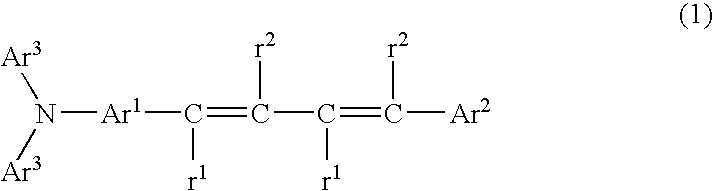
- In Formula (1), Ar1 represents a divalent aromatic group, such as, for example a 1,4-phenylene group, 1,3-phenylene group, 1,4-naphthylene group, 2,6-naphthylene group, quinoline-5,8-diyl group, or a 4,4′-biphenylene group, which may be further substituted.
- Illustrative examples of Ar1 are also shown below.
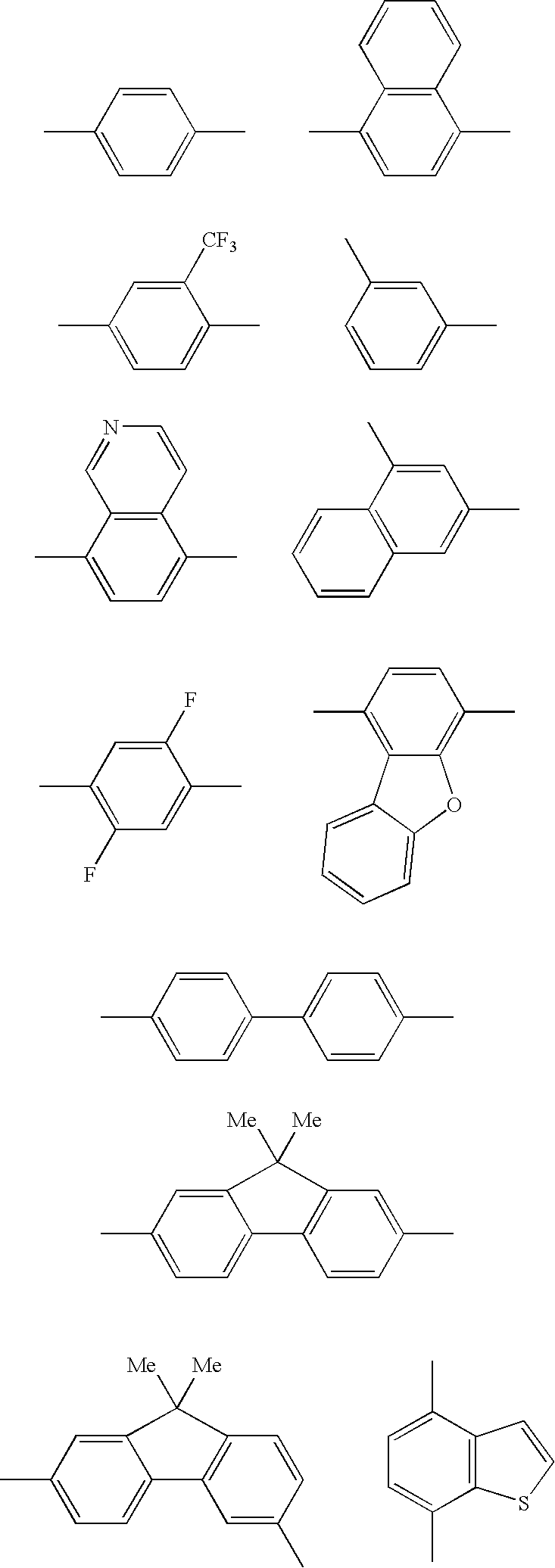
- Ar2 represents an aromatic group such as a phenyl group, a naphthyl group, or a pyridyl group. Illustrative examples are also listed below.
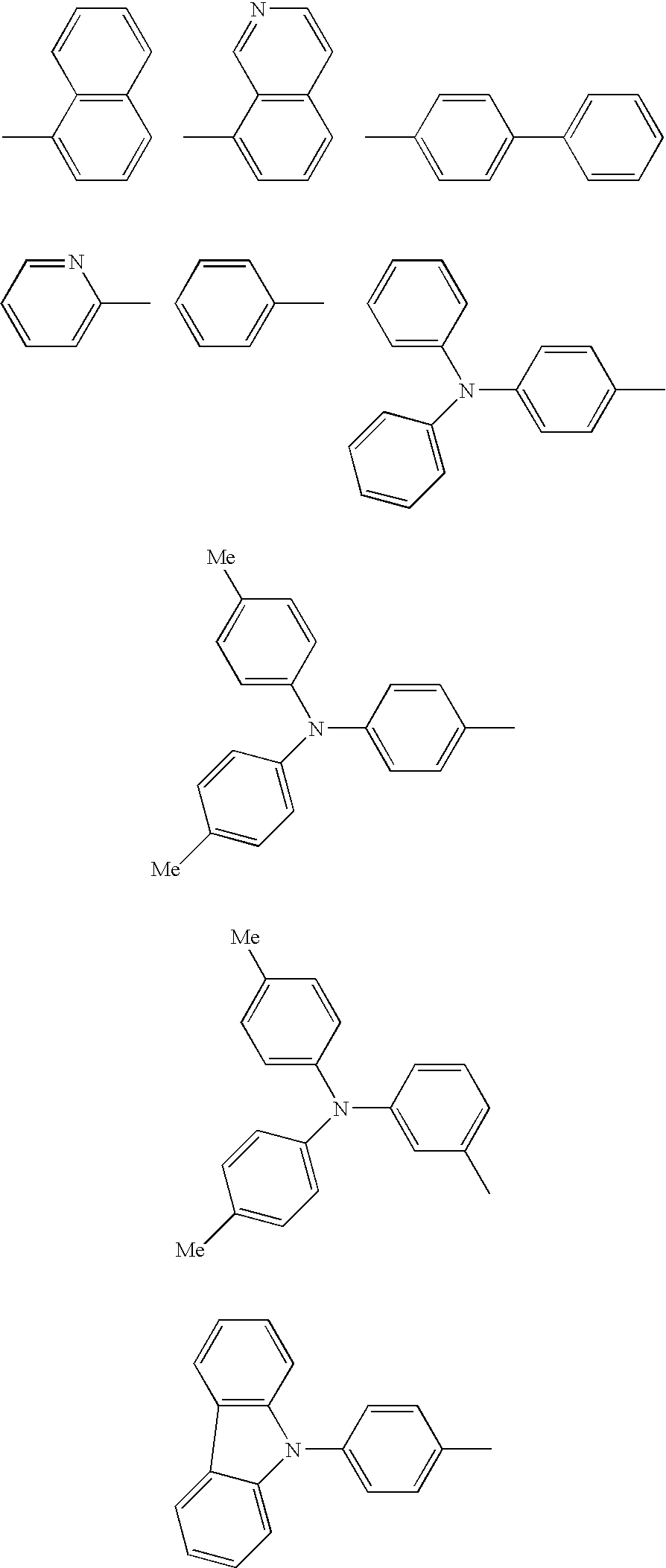
- Each Ar3 may be the same or different and each represents an independently selected aromatic group. The two Ar3 groups may combine to form a ring group, such as a carbazole ring group. Examples of Ar3 groups include naphthyl groups, anthranyl groups, phenanthryl groups, biphenyl groups, pyridyl groups, furyl groups, quinolyl groups, isoquinolyl groups and thienyl groups.
- In one embodiment, Ar1, Ar2 and each Ar3 represent carbocyclic aromatic groups. In another embodiment, Ar1 represents a biphenylene group.
- In an additional embodiment, Ar2 is further substituted with a N(Ar4)(Ar4) group, wherein each Ar4 may be the same or different and each represents an independently selected aromatic group, for example a phenyl group or a naphthyl group. The two Ar4 groups may combine to form a ring group, such as a carbazole ring group.
- In Formula (1), each r1 may be the same or different and each r2 may be the same or different and each represents hydrogen or a substituent, such as a methyl group, a trifluoromethyl group, or a phenyl group. In one suitable embodiment, at least one r1 represents hydrogen and at least one r2 represents hydrogen. In one desirable embodiment, each r1 and each r2 represents hydrogen.
- In another aspect of the invention, the light-emitting material is represented by Formula (2).

- In Formula (2), each Ar5 may be the same or different and each represents an independently selected aromatic group, such as a phenyl group, a naphthyl group, an anthranyl group or a phenanthryl group. Two adjacent Ar5 groups may combine to form a ring group, such as a carbazole ring group.
- In Formula (2), each d represents an independently selected substituent, such as a methyl group, a trifluoromethyl group, or a fluoro substituent. Two adjacent d groups may combine to form a ring group, for example, a fused benzene ring group.
- In the Formula, s is 0-4 and t is 0-4. In one desirable embodiment s and t are 0.
- Compounds of Formula (1) can be prepared by literature procedures including those described by S. Pfeiffer and co-workers (SPIE, 3476, 258 (1998)). For example, three illustrative routes to compounds of Formula (1) are shown in equations A, B, and C, which employ the Wittig-Horner reaction. Reacting a suitable phosphonate ester and aldehyde yields a compound such as Cpd-A, Cpd-B, or Cpd-C as shown below.
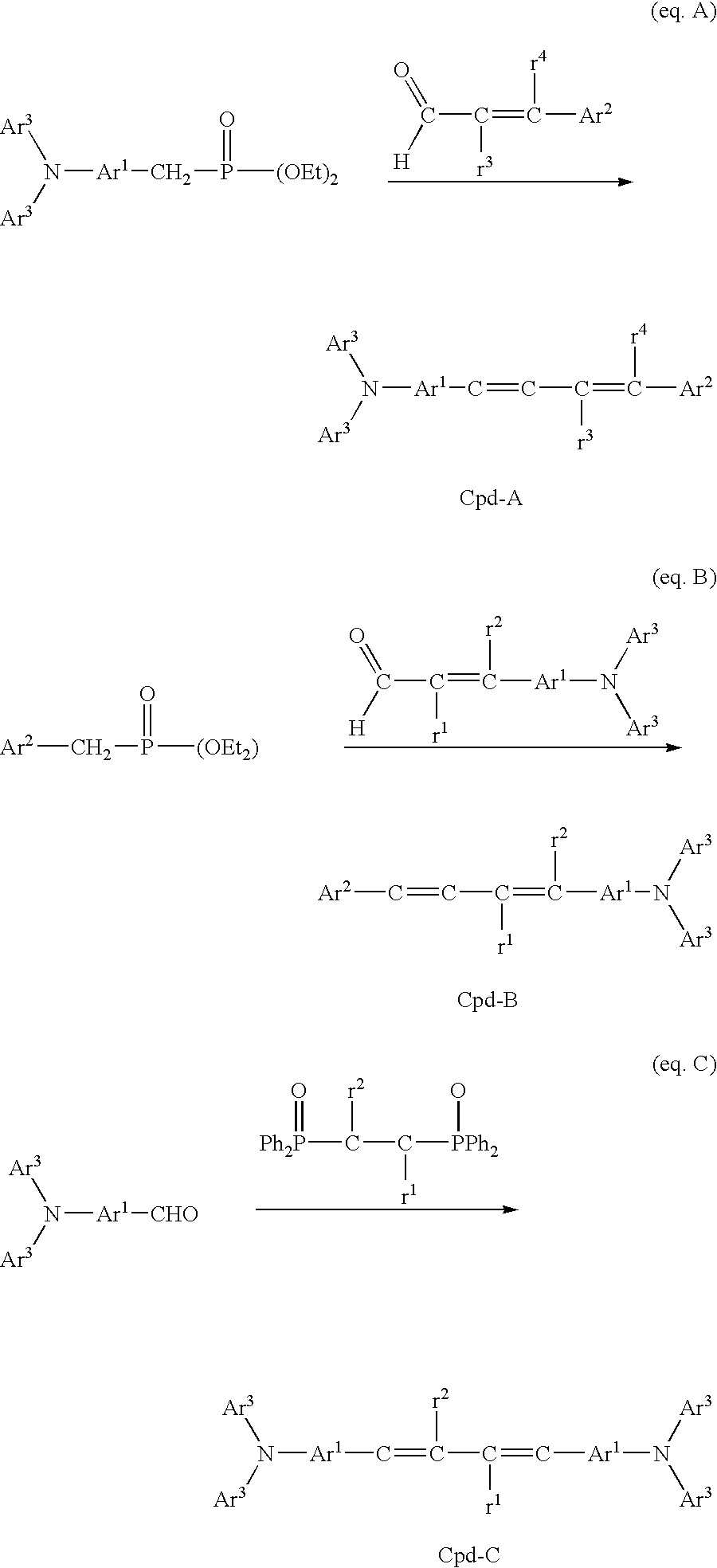
- Illustrative examples of materials of Formula (1) are listed below.
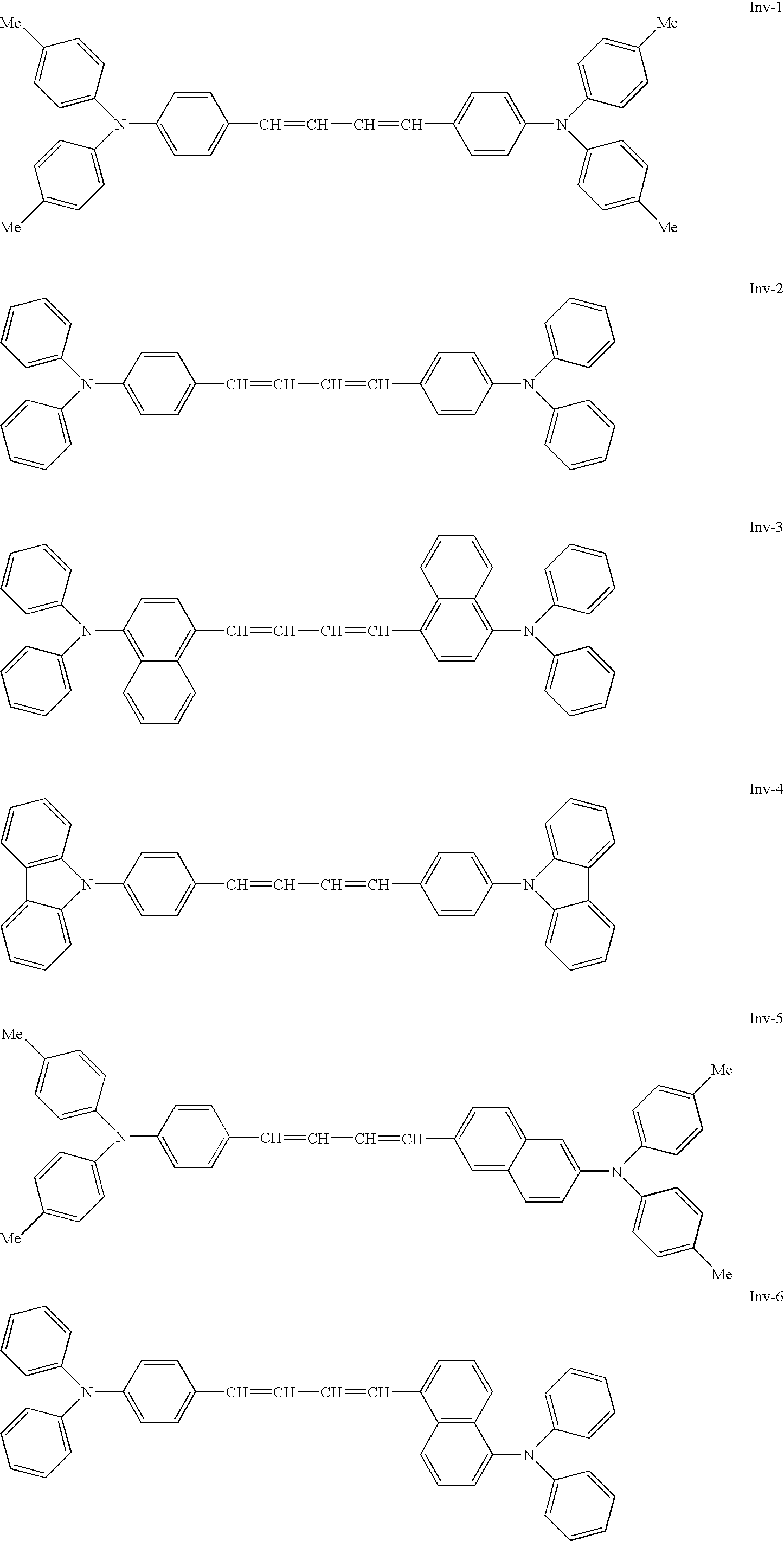
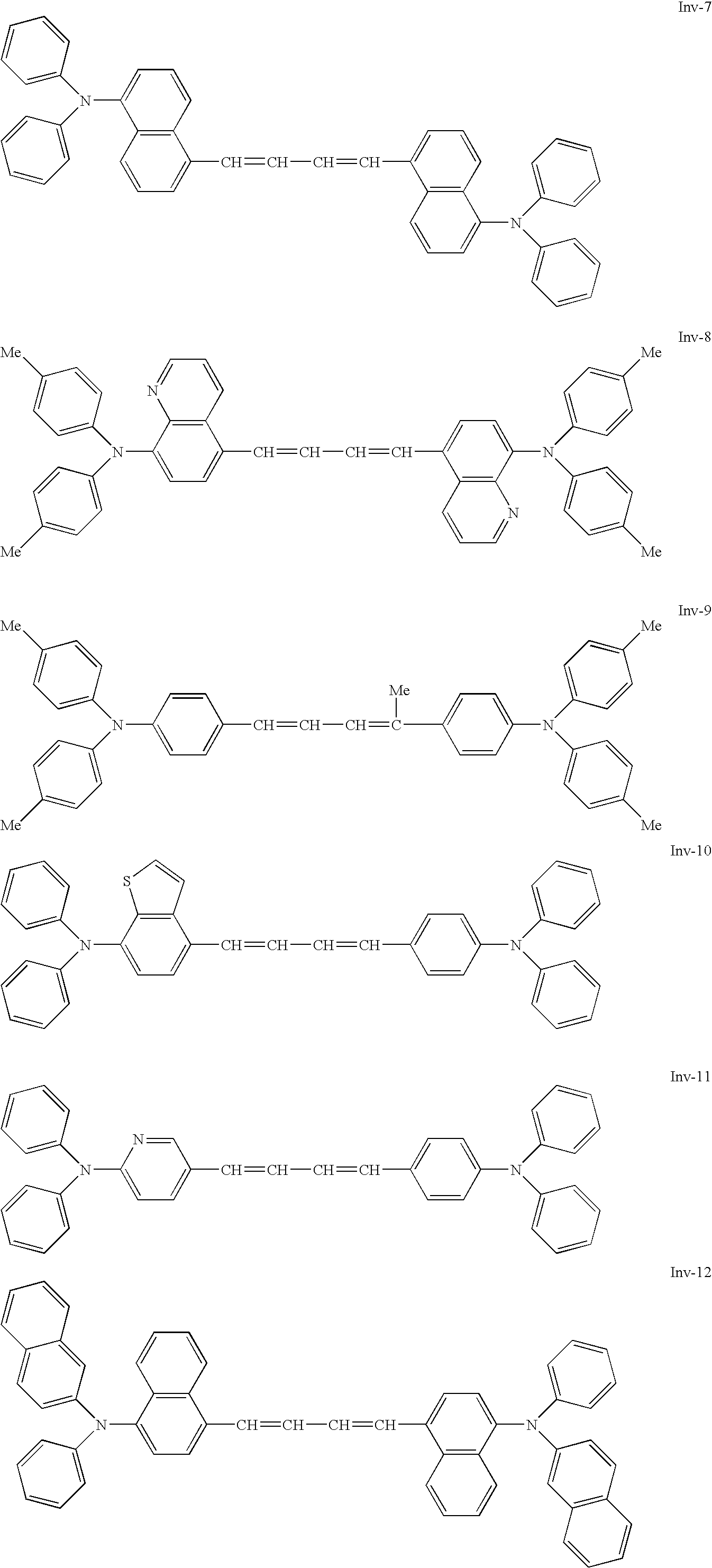

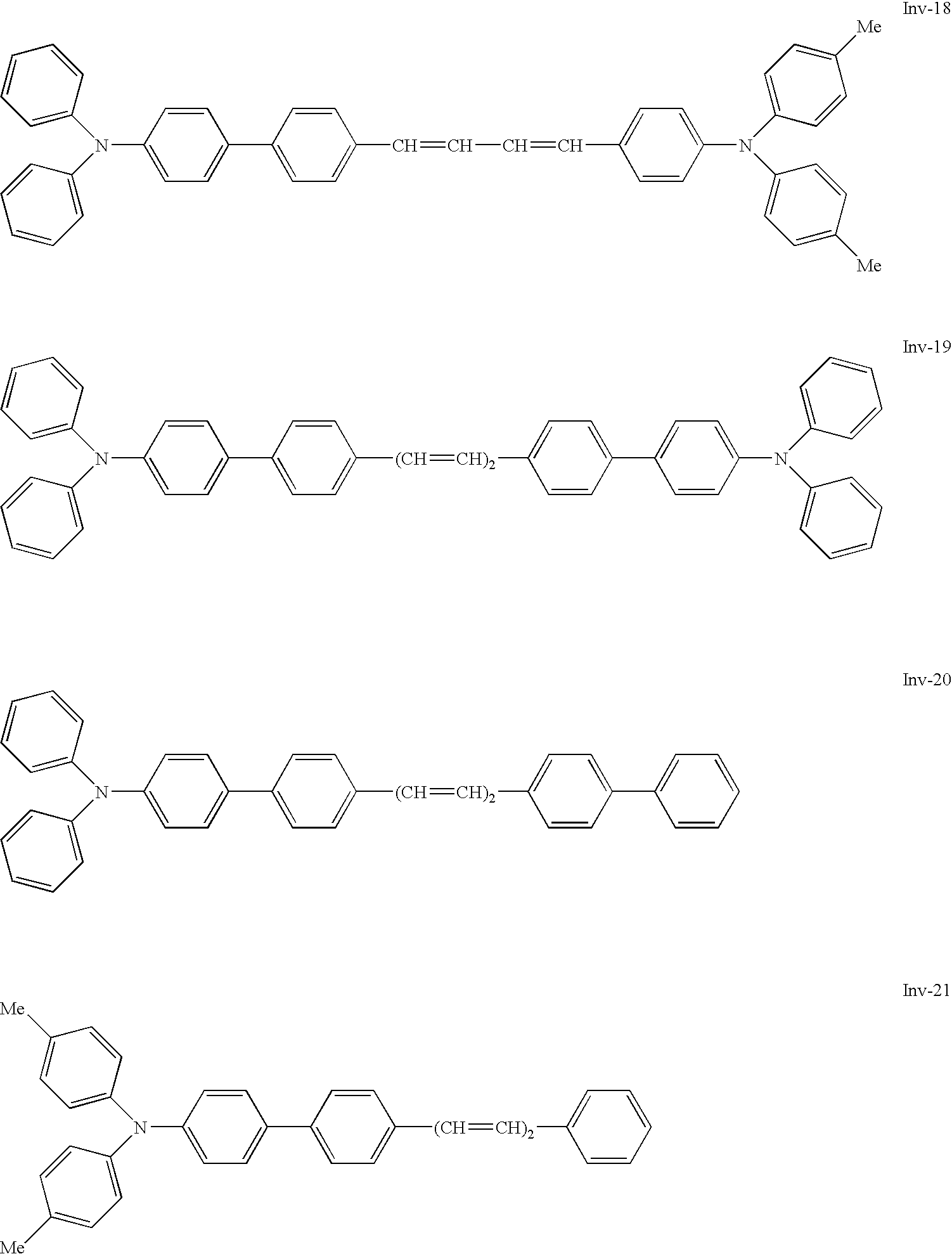
- The light-emitting layer includes a host material that has at least one anthracene nucleus. In one embodiment the host is an anthracene of Formula (3).

- In Formula (3), W1-W10 independently represent hydrogen or an independently selected substituent, provided that two adjacent substituents can combine to form a ring. In one aspect of the invention, W9 and W10 represent independently selected naphthyl groups or biphenyl groups. For example, W9 and W10 may represent such groups as 1-naphthyl, 2-naphthyl, 4-biphenyl, and 3-biphenyl. In another desirable embodiment, at least one of W9 and W10 represents an anthracene group. In a further aspect of the invention, W9 and W10 represent independently selected naphthyl groups or biphenyl groups and W7 represents an aromatic group, such as a phenyl group or a naphthyl group. In one embodiment the anthracene compound is selected from the group consisting of 9,10-di-(2-naphthyl)anthracene, 2-t-butyl-9,10-di-(2-naphthyl)anthracene, 9-(2-naphthyl)-10-(4-biphenyl)anthracene, and 9,10-di-(2-naphthyl)-2-phenylanthracene.
- The anthracene host can be present as the only host or it can be mixed with other host materials. The anthracene host may also be mixed with other nonanthracene host materials, such as Alq.
- Illustrative examples of useful anthracene hosts are shown below.
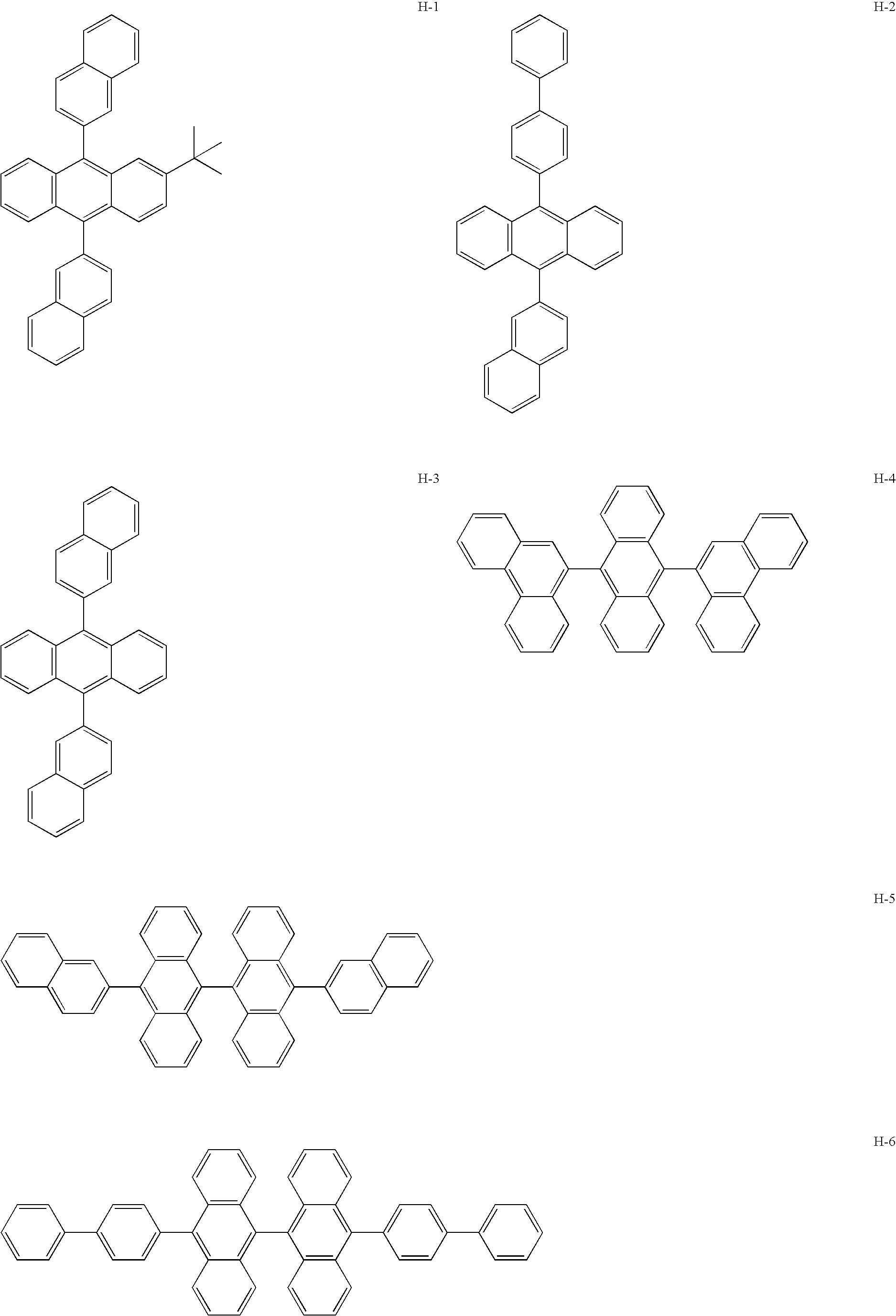
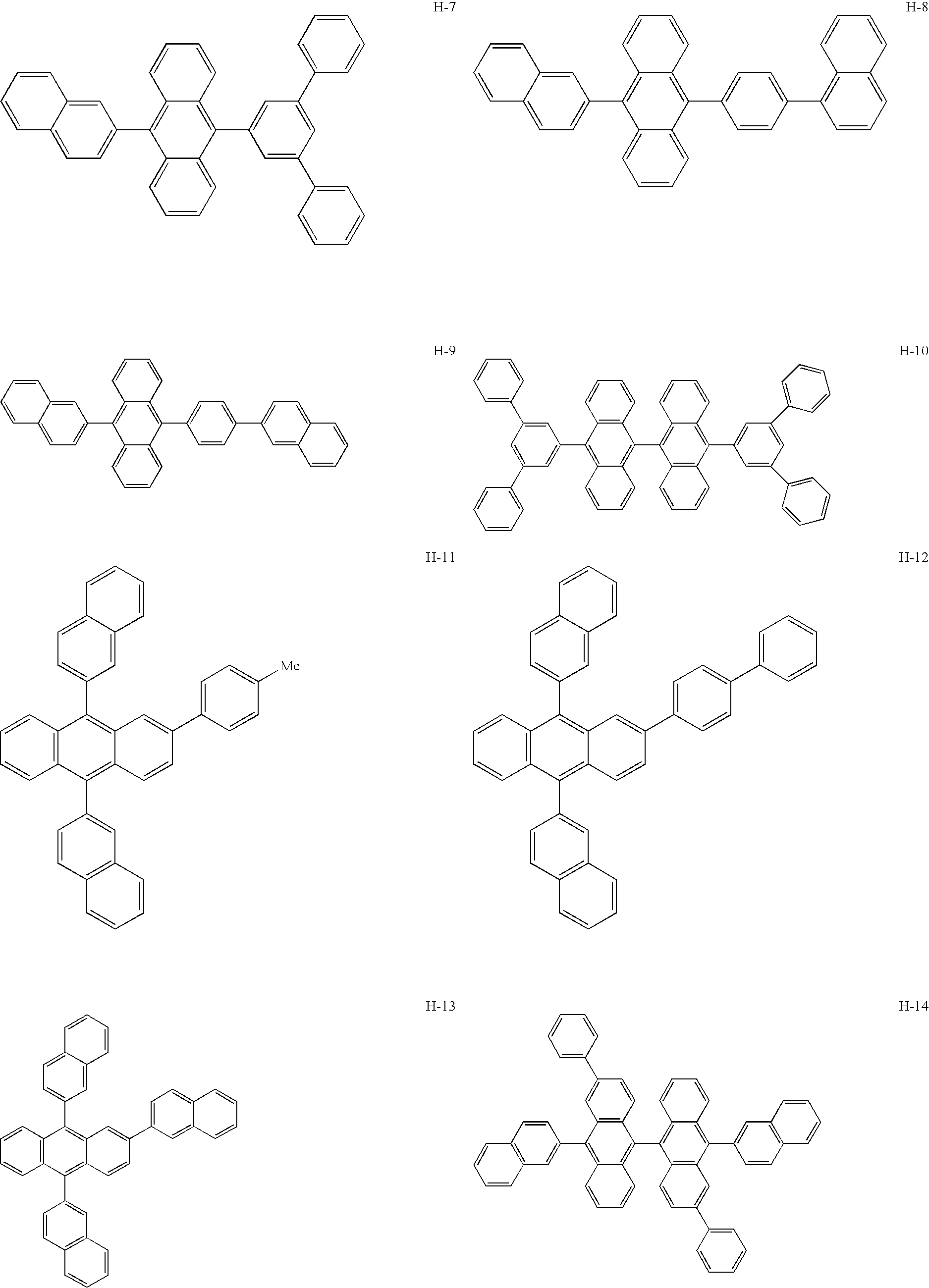
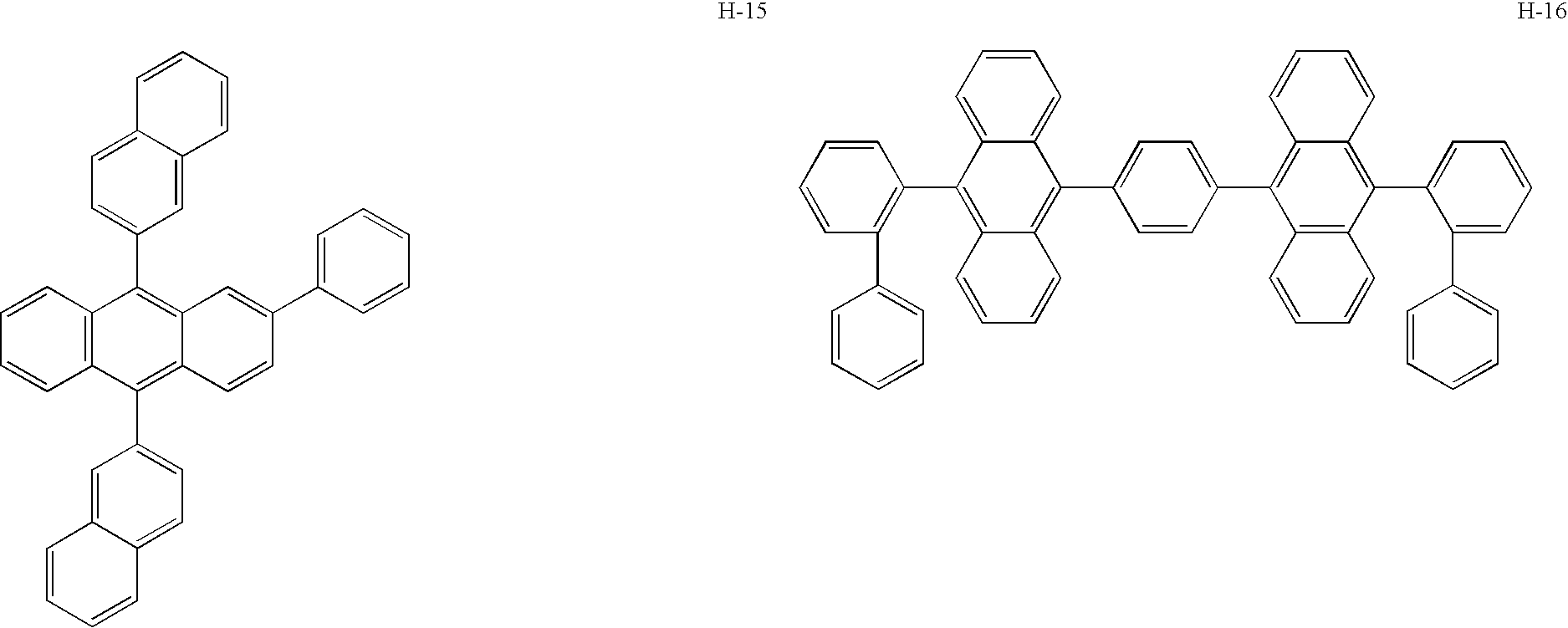
- In one embodiment of the invention, the device includes a second light-emitting layer, including at least one host material and at least one light-emitting material. Suitably, the host in the second layer may be an anthracene type host or a non-anthracene host, such as Alq.
- In a further aspect of the invention, the light-emitting material of Formula (1) emits blue or blue-green light and at least one light-emitting material, in the second light-emitting layer, emits yellow light. Blue light is generally defined as having a wavelength range in the visible region of the electromagnetic spectrum of 450-480 nm, blue-green 480-510 nm, green 510-550, green-yellow 550-570 nm, yellow 570-590 nm, orange 590-630 nm and red 630-700 nm, as defined by Dr. R. W. G. Hunt in The Reproduction of Colour in Photography, Printing & Television, 4th Edition 1987, Fountain Press, page 4. Suitably, in this aspect, the inventive device emits white light or light that can be corrected by means of filtration to give white light.
- Examples of useful yellow dopants include 5,6,11,12-tetraphenylnaphthacene (rubrene); 6,11-diphenyl-5,12-bis(4-(6-methyl-benzothiazol-2-yl)phenyl)naphthacene; 5,6,11,12-tetra(2-naphthyl)naphthacene; and
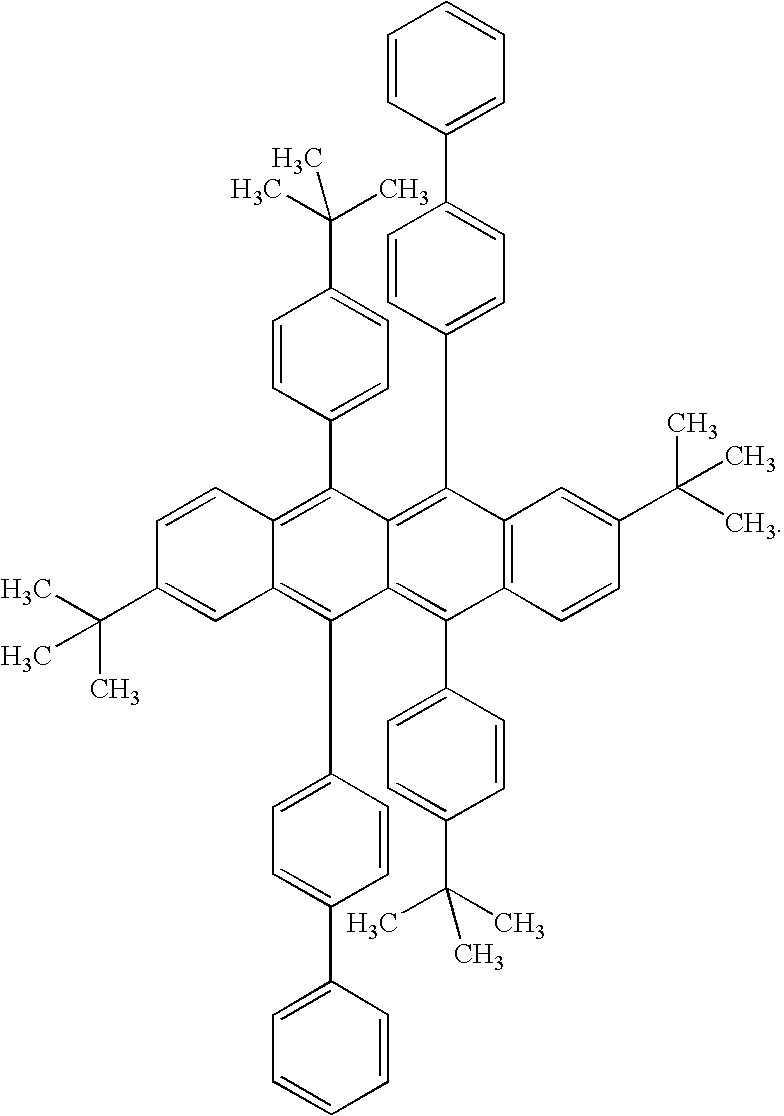
- Examples of yellow light-emitting materials also include compounds represented by the following formula:
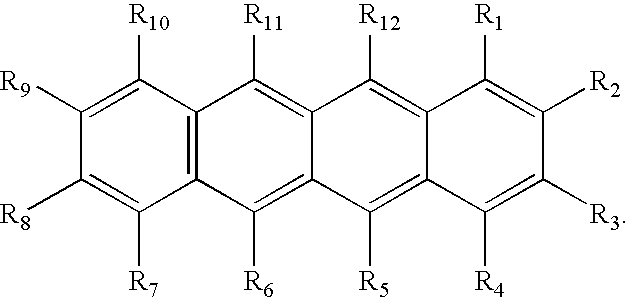
- R1, R2, R3, R4, R5, R6, R7, R8, R9, R10, R11, and R12 are independently selected as hydrogen or substituent groups. Such substituent groups may join to form further fused rings. In one suitable embodiment, R1, R3, R4, R7, R9, R10, represent hydrogen; R2 and R8 represent hydrogen or independently selected alkyl groups; R5, R6, R11, and R12 represent independently selected aryl groups.
- Unless otherwise specifically stated, use of the term “substituted” or “substituent” means any group or atom other than hydrogen. Additionally, unless otherwise specifically stated, when a compound with a substitutable hydrogen is identified or the term “group” is used, it is intended to encompass not only the substituent's unsubstituted form, but also its form further substituted with any substituent group or groups as herein mentioned, so long as the substituent does not destroy properties necessary for device utility. Suitably, a substituent group may be halogen or may be bonded to the remainder of the molecule by an atom of carbon, silicon, oxygen, nitrogen, phosphorous, sulfur, selenium, or boron. The substituent may be, for example, halogen, such as chloro, bromo or fluoro; nitro; hydroxyl; cyano; carboxyl; or groups which may be further substituted, such as alkyl, including straight or branched chain or cyclic alkyl, such as methyl, trifluoromethyl, ethyl, t-butyl, 3-(2,4-di-t-pentylphenoxy) propyl, and tetradecyl; alkenyl, such as ethylene, 2-butene; alkoxy, such as methoxy, ethoxy, propoxy, butoxy, 2-methoxyethoxy, sec-butoxy, hexyloxy, 2-ethylhexyloxy, tetradecyloxy, 2-(2,4-di-t-pentylphenoxy)ethoxy, and 2-dodecyloxyethoxy; aryl such as phenyl, 4-t-butylphenyl, 2,4,6-trimethylphenyl, naphthyl; aryloxy, such as phenoxy, 2-methylphenoxy, alpha- or beta-naphthyloxy, and 4-tolyloxy; carbonamido, such as acetamido, benzamido, butyramido, tetradecanamido, alpha-(2,4-di-t-pentyl-phenoxy)acetamido, alpha-(2,4-di-t-pentylphenoxy)butyramido, alpha-(3-pentadecylphenoxy)-hexanamido, alpha-(4-hydroxy-3-t-butylphenoxy)-tetradecanamido, 2-oxo-pyrrolidin-1-yl, 2-oxo-5-tetradecylpyrrolin-1-yl, N-methyltetradecanamido, N-succinimido, N-phthalimido, 2,5-dioxo-1-oxazolidinyl, 3-dodecyl-2,5-dioxo-1-imidazolyl, and N-acetyl-N-dodecylamino, ethoxycarbonylamino, phenoxycarbonylamino, benzyloxycarbonylamino, hexadecyloxycarbonylamino, 2,4-di-t-butylphenoxycarbonylamino, phenylcarbonylamino, 2,5-(di-t-pentylphenyl)carbonylamino, p-dodecyl-phenylcarbonyl amino, p-tolylcarbonylamino, N-methylureido, N,N-dimethylureido, N-methyl-N-dodecylureido, N-hexadecylureido, N,N-dioctadecylureido, N,N-dioctyl-N′-ethylureido, N-phenylureido, N,N-diphenylureido, N-phenyl-N-p-tolylureido, N-(m-hexadecylphenyl)ureido, N,N-(2,5-di-t-pentylphenyl)-N′-ethylureido, and t-butylcarbonamido; sulfonamido, such as methylsulfonamido, benzenesulfonamido, p-tolylsulfonamido, p-dodecylbenzenesulfonamido, N-methyltetradecylsulfonamido, N,N-dipropyl-sulfamoylamino, and hexadecylsulfonamido; sulfamoyl, such as N-methylsulfamoyl, N-ethylsulfamoyl, N,N-dipropylsulfamoyl, N-hexadecylsulfamoyl, N,N-dimethylsulfamoyl, N-[3-(dodecyloxy)propyl]sulfamoyl, N-[4-(2,4-di-t-pentylphenoxy)butyl]sulfamoyl, N-methyl-N-tetradecylsulfamoyl, and N-dodecylsulfamoyl; carbamoyl, such as N-methylcarbamoyl, N,N-dibutylcarbamoyl, N-octadecylcarbamoyl, N-[4-(2,4-di-t-pentylphenoxy)butyl]carbamoyl, N-methyl-N-tetradecylcarbamoyl, and N,N-dioctylcarbamoyl; acyl, such as acetyl, (2,4-di-t-amylphenoxy)acetyl, phenoxycarbonyl, p-dodecyloxyphenoxycarbonyl methoxycarbonyl, butoxycarbonyl, tetradecyloxycarbonyl, ethoxycarbonyl, benzyloxycarbonyl, 3-pentadecyloxycarbonyl, and dodecyloxycarbonyl; sulfonyl, such as methoxysulfonyl, octyloxysulfonyl, tetradecyloxysulfonyl, 2-ethylhexyloxysulfonyl, phenoxysulfonyl, 2,4-di-t-pentylphenoxysulfonyl, methylsulfonyl, octylsulfonyl, 2-ethylhexylsulfonyl, dodecylsulfonyl, hexadecylsulfonyl, phenylsulfonyl, 4-nonylphenylsulfonyl, and p-tolylsulfonyl; sulfonyloxy, such as dodecylsulfonyloxy, and hexadecylsulfonyloxy; sulfinyl, such as methylsulfinyl, octylsulfinyl, 2-ethylhexylsulfinyl, dodecylsulfinyl, hexadecylsulfinyl, phenylsulfinyl, 4-nonylphenylsulfinyl, and p-tolylsulfinyl; thio, such as ethylthio, octylthio, benzylthio, tetradecylthio, 2-(2,4-di-t-pentylphenoxy)ethylthio, phenylthio, 2-butoxy-5-t-octylphenylthio, and p-tolylthio; acyloxy, such as acetyloxy, benzoyloxy, octadecanoyloxy, p-dodecylamidobenzoyloxy, N-phenylcarbamoyloxy, N-ethylcarbamoyloxy, and cyclohexylcarbonyloxy; amine, such as phenylanilino, 2-chloroanilino, diethylamine, dodecylamine; imino, such as 1 (N-phenylimido)ethyl, N-succinimido or 3-benzylhydantoinyl; phosphate, such as dimethylphosphate and ethylbutylphosphate; phosphite, such as diethyl and dihexylphosphite; a heterocyclic group, a heterocyclic oxy group or a heterocyclic thio group, each of which may be substituted and which contain a 3 to 7 membered heterocyclic ring composed of carbon atoms and at least one hetero atom selected from the group consisting of oxygen, nitrogen, sulfur or phosphorous, such as pyridyl, thienyl, furyl, azolyl, thiazolyl, oxazolyl, imidazolyl, pyrazolyl, pyrazinyl, pyrimidinyl, pyrolidinonyl, quinolinyl, isoquinolinyl, 2-furyl, 2-thienyl, 2-benzimidazolyloxy or 2-benzothiazolyl; quaternary ammonium, such as triethylammonium; quaternary phosphonium, such as triphenylphosphonium; and silyloxy, such as trimethylsilyloxy.
- If desired, the substituents may themselves be further substituted one or more times with the described substituent groups. The particular substituents used may be selected by those skilled in the art to attain desirable properties for a specific application and can include, for example, electron-withdrawing groups, electron-donating groups, and steric groups. When a molecule may have two or more substituents, the substituents may be joined together to form a ring such as a fused ring unless otherwise provided. Generally, the above groups and substituents thereof may include those having up to 48 carbon atoms, typically 1 to 36 carbon atoms and usually less than 24 carbon atoms, but greater numbers are possible depending on the particular substituents selected.
- For the purpose of this invention, also included in the definition of a heterocyclic ring are those rings that include coordinate or dative bonds. The definition of a coordinate bond can be found in Grant & Hackh 's Chemical Dictionary, page 91. In essence, a coordinate bond is formed when electron rich atoms such as O or N, donate a pair of electrons to electron deficient atoms such as A1 or B.
- It is well within the skill of the art to determine whether a particular group is electron donating or electron accepting. The most common measure of electron donating and accepting properties is in terms of Hammett σ values. Hydrogen has a Hammett σ value of zero, while electron donating groups have negative Hammett σ values and electron accepting groups have positive Hammett σ values. Lange's handbook of Chemistry, 12th Ed., McGraw Hill, 1979, Table 3-12, pp. 3-134 to 3-138, here incorporated by reference, lists Hammett σ values for a large number of commonly encountered groups. Hammett σ values are assigned based on phenyl ring substitution, but they provide a practical guide for qualitatively selecting electron donating and accepting groups.
- Suitable electron donating groups may be selected from —R′, —OR′, and —NR′(R″) where R′ is a hydrocarbon containing up to 6 carbon atoms and R″ is hydrogen or R′. Specific examples of electron donating groups include methyl, ethyl, phenyl, methoxy, ethoxy, phenoxy, —N(CH3)2, —N(CH2CH3)2, —NHCH3, —N(C6H5)2, —N(CH3)(C6H5), and —NHC6H5.
- Suitable electron accepting groups may be selected from the group consisting of cyano, α-haloalkyl, α-haloalkoxy, amido, sulfonyl, carbonyl, carbonyloxy and oxycarbonyl substituents containing up to 10 carbon atoms. Specific examples include —CN, —F, —CF3, —OCF3, —CONHC6H5, —SO2C6H5, —COC6H5, —CO2C6H5, and —OCOC6H5.
- General Device Architecture
- The present invention can be employed in many OLED device configurations using small molecule materials, oligomeric materials, polymeric materials, or combinations thereof. These include very simple structures comprising a single anode and cathode to more complex devices, such as passive matrix displays comprised of orthogonal arrays of anodes and cathodes to form pixels, and active-matrix displays where each pixel is controlled independently, for example, with thin film transistors (TFTs).
- There are numerous configurations of the organic layers wherein the present invention can be successfully practiced. The essential requirements of an OLED are an anode, a cathode, and an organic light-emitting layer located between the anode and cathode. Additional layers may be employed as more fully described hereafter.
- A typical structure, especially useful for of a small molecule device, is shown in the Figure and is comprised of a
substrate 101, ananode 103, a hole-injectinglayer 105, a hole-transportinglayer 107, a light-emittinglayer 109, an electron-transportinglayer 111, an electron-injectinglayer 112, and acathode 113. These layers are described in detail below. Note that the substrate may alternatively be located adjacent to the cathode, or the substrate may actually constitute the anode or cathode. The organic layers between the anode and cathode are conveniently referred to as the organic EL element. Also, the total combined thickness of the organic layers is desirably less than 500 nm. - The anode and cathode of the OLED are connected to a voltage/
current source 150 throughelectrical conductors 160. The OLED is operated by applying a potential between the anode and cathode such that the anode is at a more positive potential than the cathode. Holes are injected into the organic EL element from the anode and electrons are injected into the organic EL element at the cathode. Enhanced device stability can sometimes be achieved when the OLED is operated in an AC mode where, for some time period in the cycle, the potential bias is reversed and no current flows. An example of an AC driven OLED is described in U.S. Pat. No. 5,552,678. - Substrate
- The OLED device of this invention is typically provided over a supporting
substrate 101 where either the cathode or anode can be in contact with the substrate. The substrate can be a complex structure comprising multiple layers of materials. This is typically the case for active matrix substrates wherein TFTs are provided below the OLED layers. It is still necessary that the substrate, at least in the emissive pixilated areas, be comprised of largely transparent materials. The electrode in contact with the substrate is conveniently referred to as the bottom electrode. Conventionally, the bottom electrode is the anode, but this invention is not limited to that configuration. The substrate can either be light transmissive or opaque, depending on the intended direction of light emission. The light transmissive property is desirable for viewing the EL emission through the substrate. Transparent glass or plastic is commonly employed in such cases. For applications where the EL emission is viewed through the top electrode, the transmissive characteristic of the bottom support can be light transmissive, light absorbing or light reflective. Substrates for use in this case include, but are not limited to, glass, plastic, semiconductor materials, silicon, ceramics, and circuit board materials. It is necessary to provide in these device configurations a light-transparent top electrode. - Anode
- When the desired electroluminescent light emission (EL) is viewed through anode, the anode should be transparent or substantially transparent to the emission of interest. Common transparent anode materials used in this invention are indium-tin oxide (ITO), indium-zinc oxide (IZO) and tin oxide, but other metal oxides can work including, but not limited to, aluminum- or indium-doped zinc oxide, magnesium-indium oxide, and nickel-tungsten oxide. In addition to these oxides, metal nitrides, such as gallium nitride, and metal selenides, such as zinc selenide, and metal sulfides, such as zinc sulfide, can be used as the anode. For applications where EL emission is viewed only through the cathode, the transmissive characteristics of the anode are immaterial and any conductive material can be used, transparent, opaque or reflective. Example conductors for this application include, but are not limited to, gold, iridium, molybdenum, palladium, and platinum. Typical anode materials, transmissive or otherwise, have a work function of 4.1 eV or greater. Desired anode materials are commonly deposited by any suitable means such as evaporation, sputtering, chemical vapor deposition, or electrochemical means. Anodes can be patterned using well-known photolithographic processes. Optionally, anodes may be polished prior to application of other layers to reduce surface roughness so as to minimize shorts or enhance reflectivity.
- Hole-Injecting Layer (HIL)
- While not always necessary, it is often useful that a hole-injecting
layer 105 be provided betweenanode 103 and hole-transportinglayer 107. The hole-injecting material can serve to improve the film formation property of subsequent organic layers and to facilitate injection of holes into the hole-transporting layer. Suitable materials for use in the hole-injecting layer include, but are not limited to, porphyrinic compounds as described in U.S. Pat. No. 4,720,432, plasma-deposited fluorocarbon polymers as described in U.S. Pat. No. 6,208,075, and some aromatic amines, for example, m-MTDATA (4,4′,4″-tris[(3-methylphenyl)phenylamino]triphenylamine). Alternative hole-injecting materials reportedly useful in organic EL devices are described in EP0891121 and EP1029909. - Additional useful hole-injecting materials are described in U.S. Pat. No. 6,720,573. For example, the material below may be useful for such purposes.
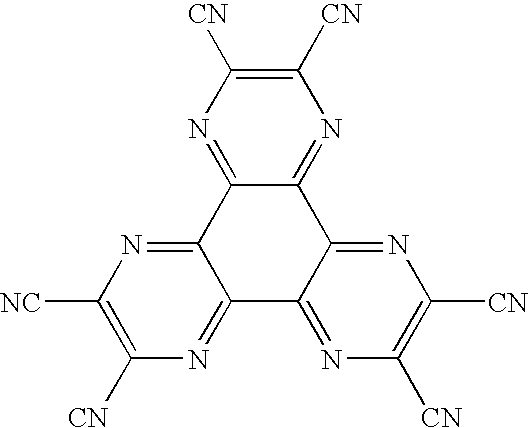
Hole-Transporting Layer (HTL) - The hole-transporting
layer 107 of the organic EL device contains at least one hole-transporting compound, such as an aromatic tertiary amine, where the latter is understood to be a compound containing at least one trivalent nitrogen atom that is bonded only to carbon atoms, at least one of which is a member of an aromatic ring. In one form the aromatic tertiary amine can be an arylamine, such as a monoarylamine, diarylamine, triarylamine, or a polymeric arylamine. Exemplary monomeric triarylamines are illustrated by Klupfel et al. U.S. Pat. No. 3,180,730. Other suitable triarylamines substituted with one or more vinyl radicals and/or comprising at least one active hydrogen containing group are disclosed by Brantley et al U.S. Pat. No. 3,567,450 and U.S. Pat. No. 3,658,520. - A more preferred class of aromatic tertiary amines are those which include at least two aromatic tertiary amine moieties as described in U.S. Pat. No. 4,720,432 and U.S. Pat. No. 5,061,569. Such compounds include those represented by structural formula (A).

- wherein Q1 and Q2 are independently selected aromatic tertiary amine moieties and G is a linking group such as an arylene, cycloalkylene, or alkylene group of a carbon to carbon bond. In one embodiment, at least one of Q1 or Q2 contains a polycyclic fused ring structure, e.g., a naphthalene. When G is an aryl group, it is conveniently a phenylene, biphenylene, or naphthalene moiety.
- A useful class of triarylamines satisfying structural formula (A) and containing two triarylamine moieties is represented by structural formula (B):

- where
- R1 and R2 each independently represents a hydrogen atom, an aryl group, or an alkyl group or R1 and R2 together represent the atoms completing a cycloalkyl group; and
- R3 and R4 each independently represents an aryl group, which is in turn substituted with a diaryl substituted amino group, as indicated by structural formula (C):
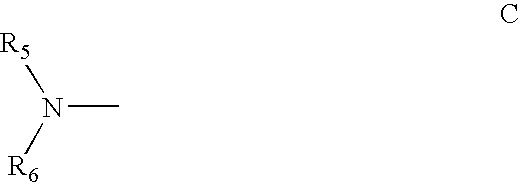
- wherein R5 and R6 are independently selected aryl groups. In one embodiment, at least one of R5 or R6 contains a polycyclic fused ring structure, e.g., a naphthalene.
- Another class of aromatic tertiary amines are the tetraaryldiamines. Desirable tetraaryldiamines include two diarylamino groups, such as indicated by formula (C), linked through an arylene group. Useful tetraaryldiamines include those represented by formula (D).
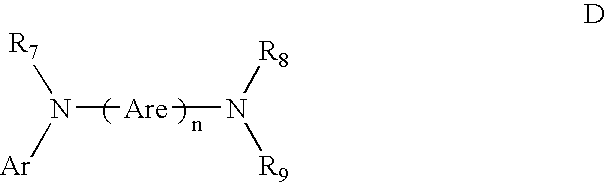
- wherein
- each Are is an independently selected arylene group, such as a phenylene or anthracene moiety,
- n is an integer of from 1 to 4, and
- Ar, R7, R8, and R9 are independently selected aryl groups.
- In a typical embodiment, at least one of Ar, R7, R8, and R9 is a polycyclic fused ring structure, e.g., a naphthalene
- The various alkyl, alkylene, aryl, and arylene moieties of the foregoing structural formulae (A), (B), (C), (D), can each in turn be substituted. Typical substituents include alkyl groups, alkoxy groups, aryl groups, aryloxy groups, and halogen such as fluoride, chloride, and bromide. The various alkyl and alkylene moieties typically contain from about 1 to 6 carbon atoms. The cycloalkyl moieties can contain from 3 to about 10 carbon atoms, but typically contain five, six, or seven ring carbon atoms—e.g., cyclopentyl, cyclohexyl, and cycloheptyl ring structures. The aryl and arylene moieties are usually phenyl and phenylene moieties.
- The hole-transporting layer can be formed of a single or a mixture of aromatic tertiary amine compounds. Specifically, one may employ a triarylamine, such as a triarylamine satisfying the formula (B), in combination with a tetraaryldiamine, such as indicated by formula (D). When a triarylamine is employed in combination with a tetraaryldiamine, the latter is positioned as a layer interposed between the triarylamine and the electron injecting and transporting layer. Illustrative of useful aromatic tertiary amines are the following:
- 1,1-Bis(4-di-p-tolylaminophenyl)cyclohexane (TAPC)
- 1,1-Bis(4-di-p-tolylaminophenyl)-4-phenylcyclohexane
- 4,4′-Bis(diphenylamino)quadriphenyl
- Bis(4-dimethylamino-2-methylphenyl)-phenylmethane
- N,N,N-Tri(p-tolyl)amine
- 4-(di-p-tolylamino)-4′-[4(di-p-tolylamino)-styryl]stilbene
- N,N,N′,N′-Tetra-p-tolyl-4-4′-diaminobiphenyl
- N,N,N′,N′-Tetraphenyl-4,4′-diaminobiphenyl
- N,N,N′,N′-tetra-1-naphthyl-4,4′-diaminobiphenyl
- N,N,N′,N′-tetra-2-naphthyl-4,4′-diaminobiphenyl
- N-Phenylcarbazole
- 4,4′-Bis[N-(1-naphthyl)-N-phenylamino]biphenyl
- 4,4′-Bis[N-(1-naphthyl)-N-(2-naphthyl)amino]biphenyl
- 4,4″-Bis[N-(1-naphthyl)-N-phenylamino]p-terphenyl
- 4,4′-Bis[N-(2-naphthyl)-N-phenylamino]biphenyl
- 4,4′-Bis[N-(3-acenaphthenyl)-N-phenylamino]biphenyl
- 1,5-Bis[N-(1-naphthyl)-N-phenylamino]naphthalene
- 4,4′-Bis[N-(9-anthryl)-N-phenylamino]biphenyl
- 4,4″-Bis[N-(1-anthryl)-N-phenylamino]-p-terphenyl
- 4,4′-Bis[N-(2-phenanthryl)-N-phenylamino]biphenyl
- 4,4′-Bis[N-(8-fluoranthenyl)-N-phenylamino]biphenyl
- 4,4′-Bis[N-(2-pyrenyl)-N-phenylamino]biphenyl
- 4,4′-Bis[N-(2-naphthacenyl)-N-phenylamino]biphenyl
- 4,4′-Bis[N-(2-perylenyl)-N-phenylamino]biphenyl
- 4,4′-Bis[N-(1-coronenyl)-N-phenylamino]biphenyl
- 2,6-Bis(di-p-tolylamino)naphthalene
- 2,6-Bis[di-(1-naphthyl)amino]naphthalene
- 2,6-Bis[N-(1-naphthyl)-N-(2-naphthyl)amino]naphthalene
- N,N,N′,N′-Tetra(2-naphthyl)-4,4″-diamino-p-terphenyl
- 4,4′-Bis {N-phenyl-N-[4-(1-naphthyl)-phenyl]amino}biphenyl
- 4,4′-Bis[N-phenyl-N-(2-pyrenyl)amino]biphenyl
- 2,6-Bis[N,N-di(2-naphthyl)amine]fluorene
- 1,5-Bis[N-(1-naphthyl)-N-phenylamino]naphthalene
- 4,4′,4″-tris[(3-methylphenyl)phenylamino]triphenylamine
- Another class of useful hole-transporting materials includes polycyclic aromatic compounds as described in EP 1 009 041. Tertiary aromatic amines with more than two amine groups may be used including oligomeric materials. In addition, polymeric hole-transporting materials can be used such as poly(N-vinylcarbazole) (PVK), polythiophenes, polypyrrole, polyaniline, and copolymers such as poly(3,4-ethylenedioxythiophene)/poly(4-styrenesulfonate) also called PEDOT/PSS.
- Light-Emitting Layer (LEL)
- The light-emitting layer has been described previously. The device may have more than one light-emitting layer. As more fully described in U.S. Pat. Nos. 4,769,292 and 5,935,721, the additional light-emitting layer (LEL) of the organic EL element may include a luminescent fluorescent or phosphorescent material where electroluminescence is produced as a result of electron-hole pair recombination in this region. The light-emitting layer can be comprised of a single material, but more commonly consists of a host material doped with a guest emitting material or materials where light emission comes primarily from the emitting materials and can be of any color. The host materials in the light-emitting layer can be an electron-transporting material, as defined below, a hole-transporting material, as defined above, or another material or combination of materials that support hole-electron recombination. The emitting material is usually chosen from highly fluorescent dyes and phosphorescent compounds, e.g., transition metal complexes as described in WO 98/55561, WO 00/18851, WO 00/57676, and WO 00/70655. Emitting materials are typically incorporated at 0.01 to 10% by weight of the host material.
- The host and emitting materials can be small non-polymeric molecules or polymeric materials such as polyfluorenes and polyvinylarylenes (e.g., poly(p-phenylenevinylene), PPV). In the case of polymers, small molecule emitting materials can be molecularly dispersed into a polymeric host, or the emitting materials can be added by copolymerizing a minor constituent into a host polymer.
- An important relationship for choosing an emitting material is a comparison of the bandgap potential which is defined as the energy difference between the highest occupied molecular orbital and the lowest unoccupied molecular orbital of the molecule. For efficient energy transfer from the host to the emitting material, a necessary condition is that the band gap of the dopant is smaller than that of the host material. For phosphorescent emitters it is also important that the host triplet energy level of the host be high enough to enable energy transfer from host to emitting material.
- Host and emitting materials known to be of use include, but are not limited to, those disclosed in U.S. Pat. No. 4,768,292, U.S. Pat. No. 5,141,671, U.S. Pat. No. 5,150,006, U.S. Pat. No. 5,151,629, U.S. Pat. No. 5,405,709, U.S. Pat. No. 5,484,922, U.S. Pat. No. 5,593,788, U.S. Pat. No. 5,645,948, U.S. Pat. No. 5,683,823, U.S. Pat. No. 5,755,999, U.S. Pat. No. 5,928,802, U.S. Pat. No. 5,935,720, U.S. Pat. No. 5,935,721, and U.S. Pat. No. 6,020,078.
- Metal complexes of 8-hydroxyquinoline and similar derivatives (Formula E) constitute one class of useful host compounds capable of supporting electroluminescence, and are particularly suitable for light emission of wavelengths longer than 500 nm, e.g., green, yellow, orange, and red.

wherein - M represents a metal;
- n is an integer of from 1 to 4; and
- Z independently in each occurrence represents the atoms completing a nucleus having at least two fused aromatic rings.
- From the foregoing it is apparent that the metal can be monovalent, divalent, trivalent, or tetravalent metal. The metal can, for example, be an alkali metal, such as lithium, sodium, or potassium; an alkaline earth metal, such as magnesium or calcium; an earth metal, such aluminum or gallium, or a transition metal such as zinc or zirconium. Generally any monovalent, divalent, trivalent, or tetravalent metal known to be a useful chelating metal can be employed.
- Z completes a heterocyclic nucleus containing at least two fused aromatic rings, at least one of which is an azole or azine ring. Additional rings, including both aliphatic and aromatic rings, can be fused with the two required rings, if required. To avoid adding molecular bulk without improving on function the number of ring atoms is usually maintained at 18 or less.
- Illustrative of useful chelated oxinoid compounds are the following:
- CO-1: Aluminum trisoxine [alias, tris(8-quinolinolato)aluminum(III); Alq]
- CO-2: Magnesium bisoxine [alias, bis(8-quinolinolato)magnesium(II)]
- CO-3: Bis[benzo {f}-8-quinolinolato]zinc (II)
- CO-4: Bis(2-methyl-8-quinolinolato)aluminum(III)-μ-oxo-bis(2-methyl-8-quinolinolato) aluminum(III)
- CO-5: Indium trisoxine [alias, tris(8-quinolinolato)indium]
- CO-6: Aluminum tris(5-methyloxine) [alias, tris(5-methyl-8-quinolinolato) aluminum(III)]
- CO-7: Lithium oxine [alias, (8-quinolinolato)lithium(I)]
- CO-8: Gallium oxine [alias, tris(8-quinolinolato)gallium(III)]
- CO-9: Zirconium oxine [alias, tetra(8-quinolinolato)zirconium(IV)]
- As described previously, derivatives of anthracene (Formula F) constitute one class of useful host materials capable of supporting electroluminescence, and are particularly suitable for light emission of wavelengths longer than 400 nm, e.g., blue, green, yellow, orange or red. Asymmetric anthracene derivatives as disclosed in U.S. Pat. No. 6,465,115 and WO 2004/018587 are also useful hosts.
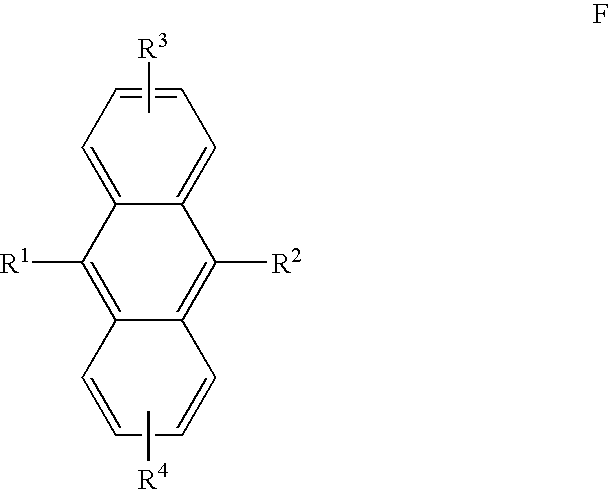
- wherein: R1 and R2 represent independently selected aryl groups, such as naphthyl, phenyl, biphenyl, triphenyl, anthracene.
- R3 and R4 represent one or more substituents on each ring where each substituent is individually selected from the following groups:
- Group 1: hydrogen, or alkyl of from 1 to 24 carbon atoms;
- Group 2: aryl or substituted aryl of from 5 to 20 carbon atoms;
- Group 3: carbon atoms from 4 to 24 necessary to complete a fused aromatic ring of anthracenyl; pyrenyl, or perylenyl;
- Group 4: heteroaryl or substituted heteroaryl of from 5 to 24 carbon atoms as necessary to complete a fused heteroaromatic ring of furyl, thienyl, pyridyl, quinolinyl or other heterocyclic systems;
- Group 5: alkoxylamino, alkylamino, or arylamino of from 1 to 24 carbon atoms; and
- Group 6: fluorine, or cyano.
- A useful class of anthracenes are derivatives of 9,10-di-(2-naphthyl)anthracene (Formula G).
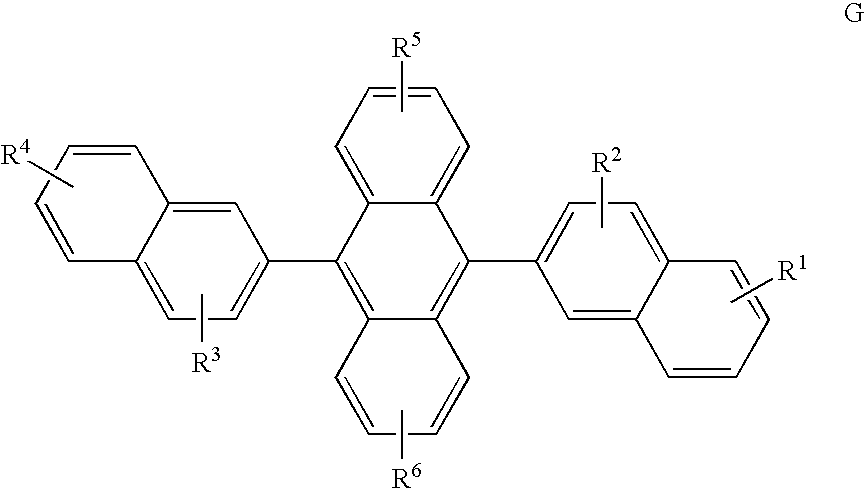
wherein: R1, R2, R3, R4, R5, and R6 represent one or more substituents on each ring where each substituent is individually selected from the following groups:
Group 1: hydrogen, or alkyl of from 1 to 24 carbon atoms;
Group 2: aryl or substituted aryl of from 5 to 20 carbon atoms;
Group 3: carbon atoms from 4 to 24 necessary to complete a fused aromatic ring of anthracenyl; pyrenyl, or perylenyl;
Group 4: heteroaryl or substituted heteroaryl of from 5 to 24 carbon atoms as necessary to complete a fused heteroaromatic ring of furyl, thienyl, pyridyl, quinolinyl or other heterocyclic systems;
Group 5: alkoxylamino, alkylamino, or arylamino of from 1 to 24 carbon atoms; and
Group 6: fluorine or cyano. - Illustrative examples of anthracene materials for use in a light-emitting layer include: 2-(4-methylphenyl)-9,10-di-(2-naphthyl)-anthracene; 9-(2-naphthyl)-10-(1,1′-biphenyl)-anthracene; 9,10-bis[4-(2,2-diphenylethenyl)phenyl]-anthracene, as well as the following listed compounds.
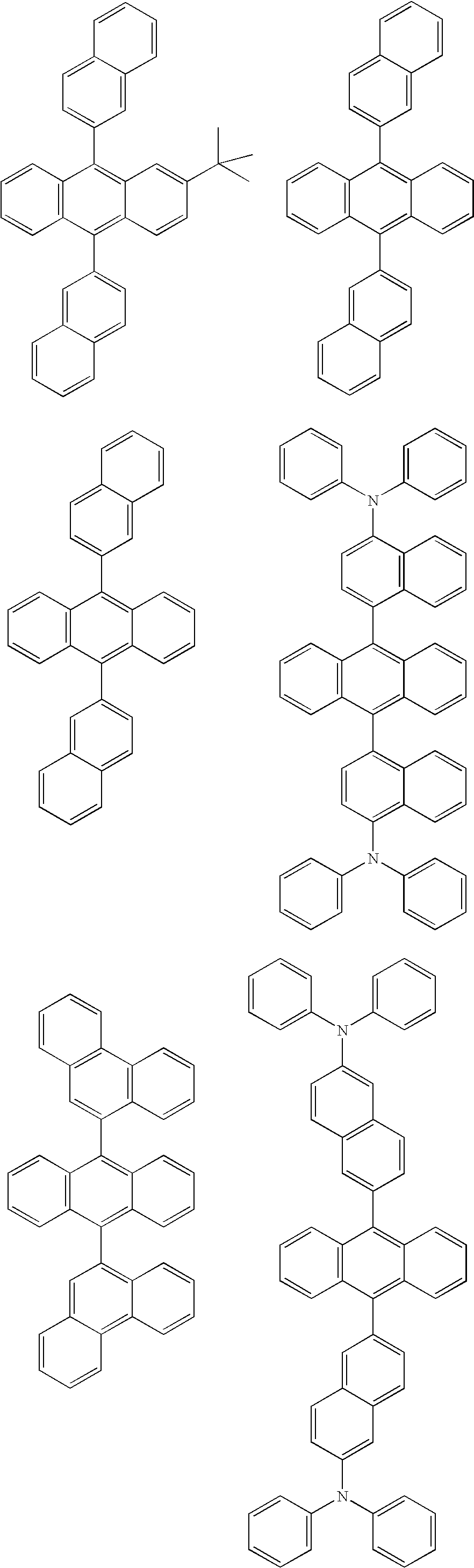
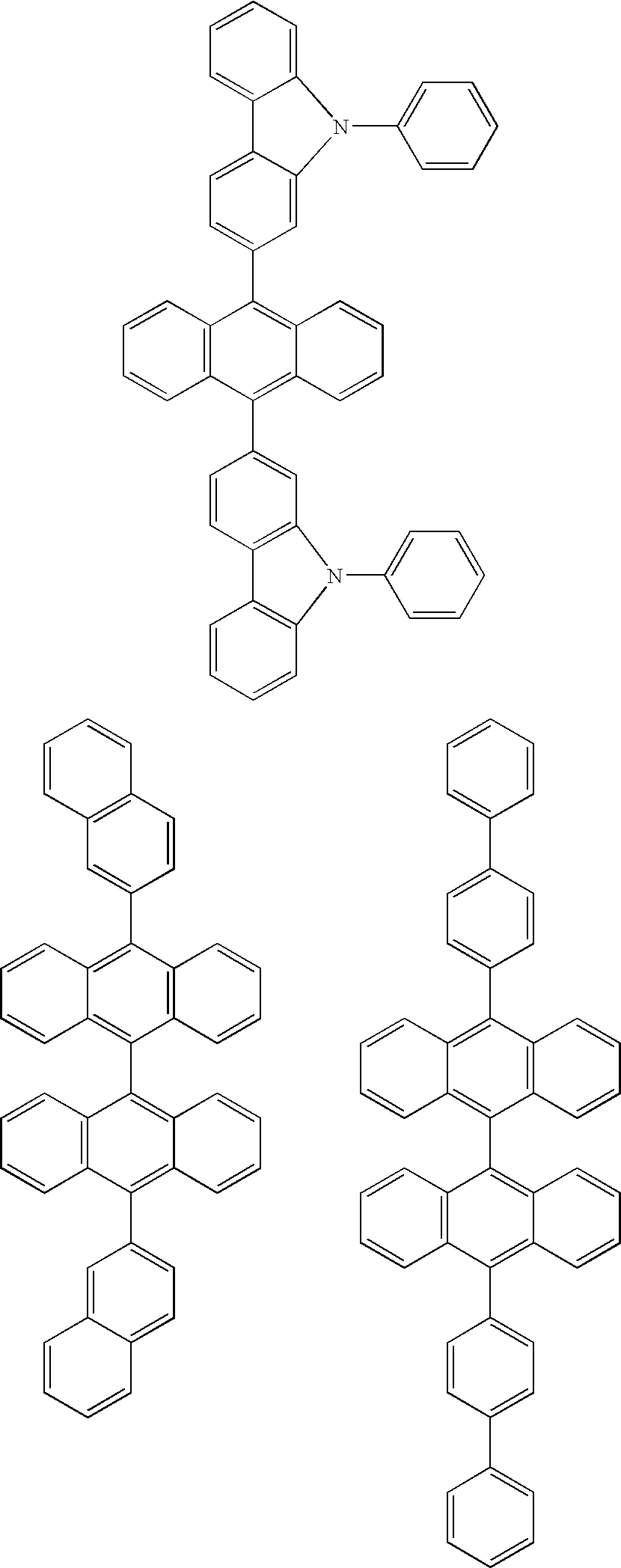
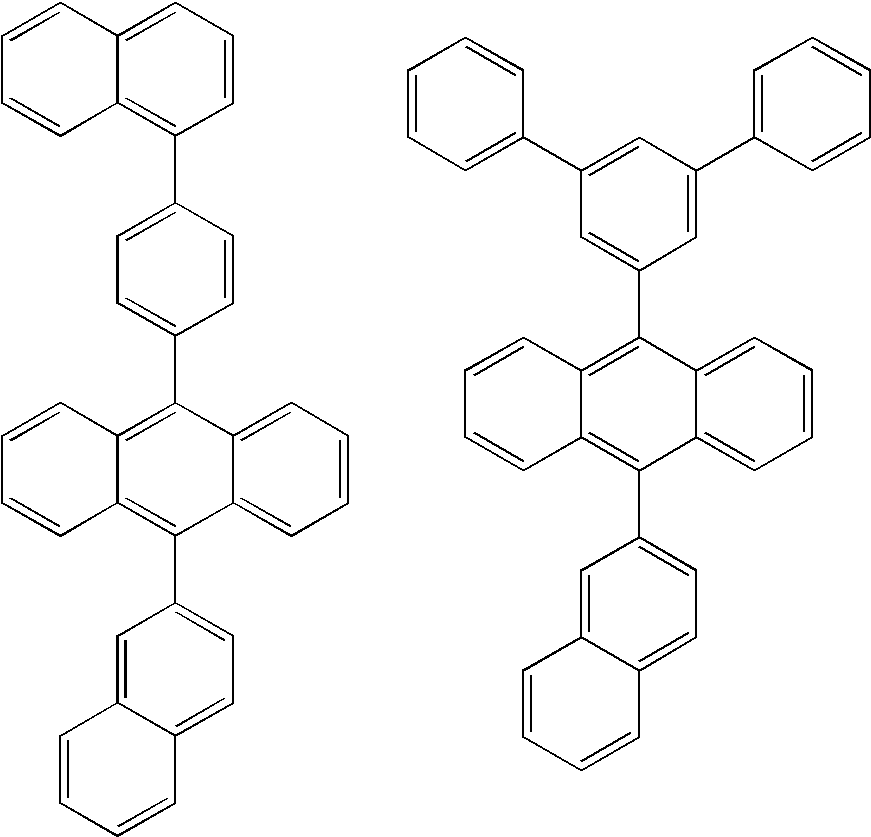
- Benzazole derivatives (Formula H) constitute another class of useful host materials capable of supporting electroluminescence, and are particularly suitable for light emission of wavelengths longer than 400 nm, e.g., blue, green, yellow, orange or red.

Where: - n is an integer of 3 to 8;
- Z is O, NR or S; and
- R and R′ are individually hydrogen; alkyl of from 1 to 24 carbon atoms, for example, propyl, t-butyl, heptyl, and the like; aryl or hetero-atom substituted aryl of from 5 to 20 carbon atoms for example phenyl and naphthyl, furyl, thienyl, pyridyl, quinolinyl and other heterocyclic systems; or halo such as chloro, fluoro; or atoms necessary to complete a fused aromatic ring;
- L is a linkage unit consisting of alkyl, aryl, substituted alkyl, or substituted aryl, which conjugately or unconjugately connects the multiple benzazoles together. An example of a useful benzazole is 2,2′,2″-(1,3,5-phenylene)tris[1-phenyl-1H-benzimidazole].
- Distyrylarylene derivatives are also useful hosts, as described in U.S. Pat. No. 5,121,029. Carbazole derivatives are particularly useful hosts for phosphorescent emitters.
- Useful fluorescent emitting materials include, but are not limited to, derivatives of anthracene, tetracene, xanthene, perylene, rubrene, coumarin, rhodamine, and quinacridone, dicyanomethylenepyran compounds, thiopyran compounds, polymethine compounds, pyrilium and thiapyrilium compounds, fluorene derivatives, periflanthene derivatives, indenoperylene derivatives, bis(azinyl)amine boron compounds, bis(azinyl)methane compounds, and carbostyryl compounds. Illustrative examples of useful materials include, but are not limited to, the following:
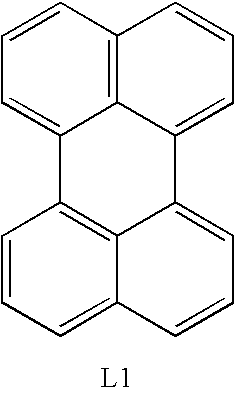
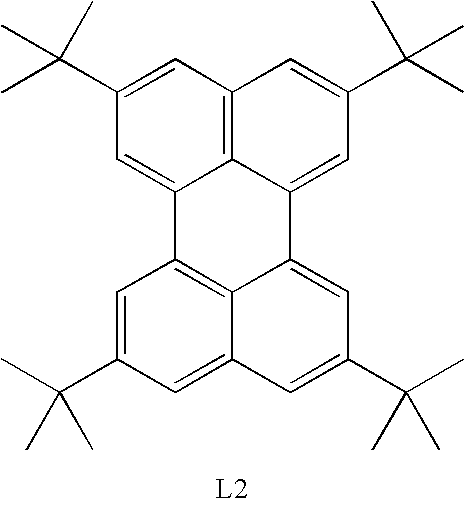
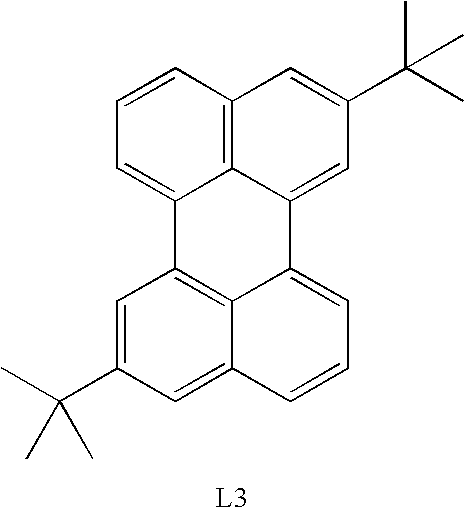
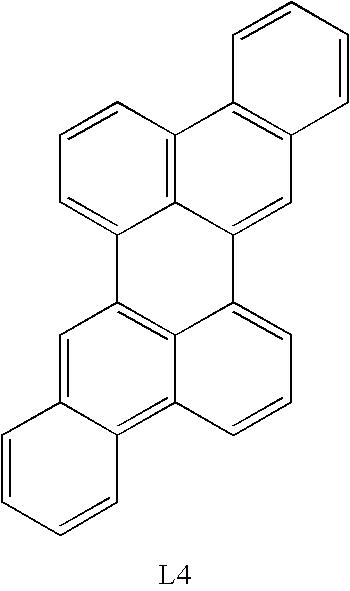
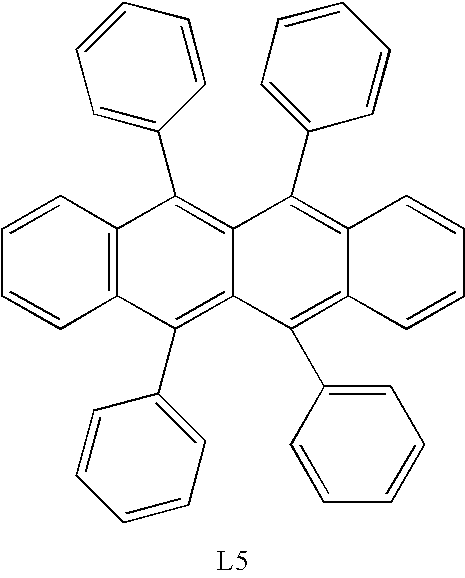


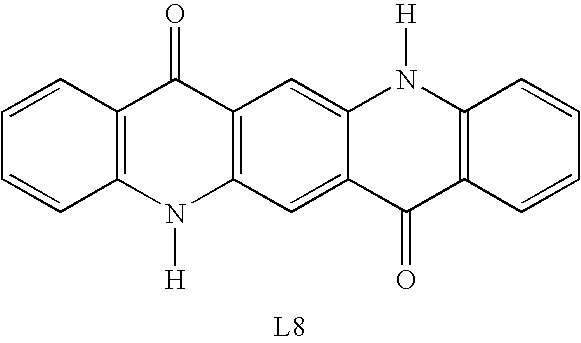
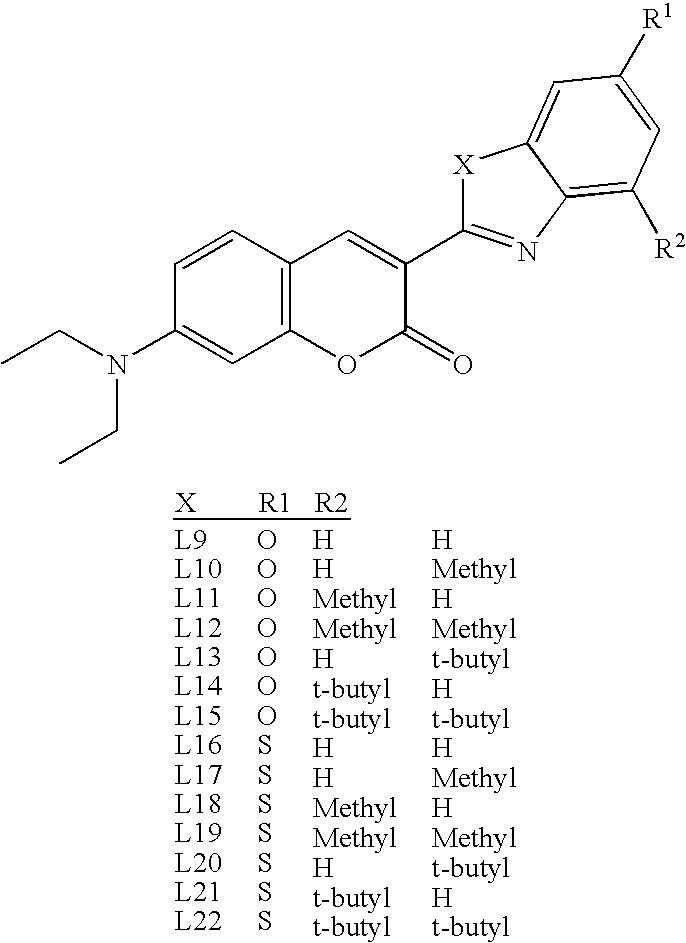
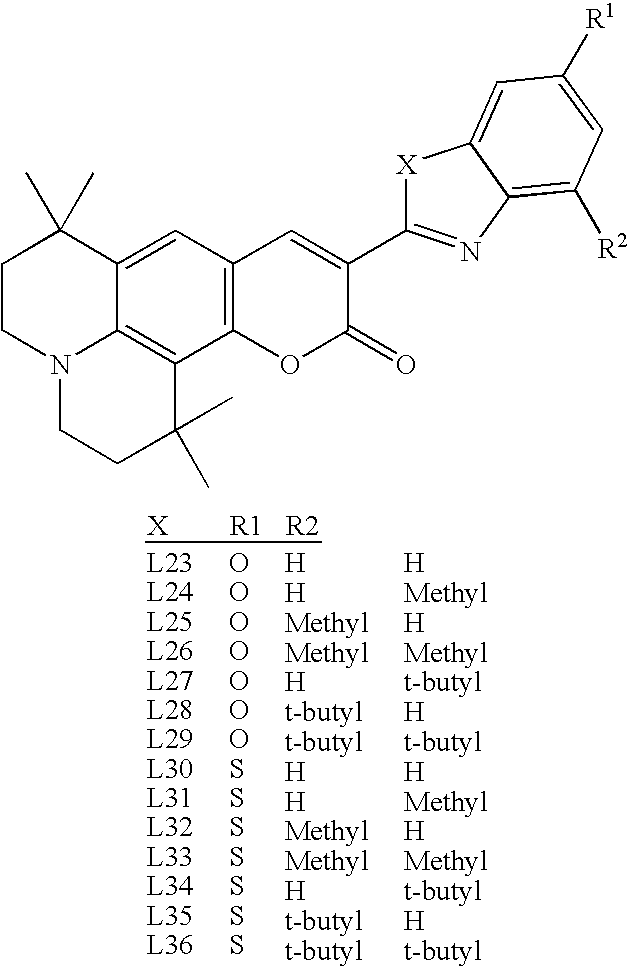
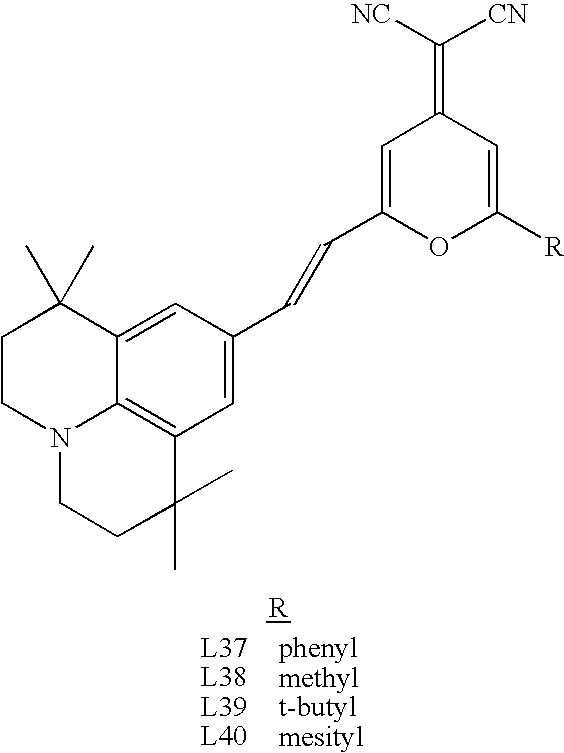
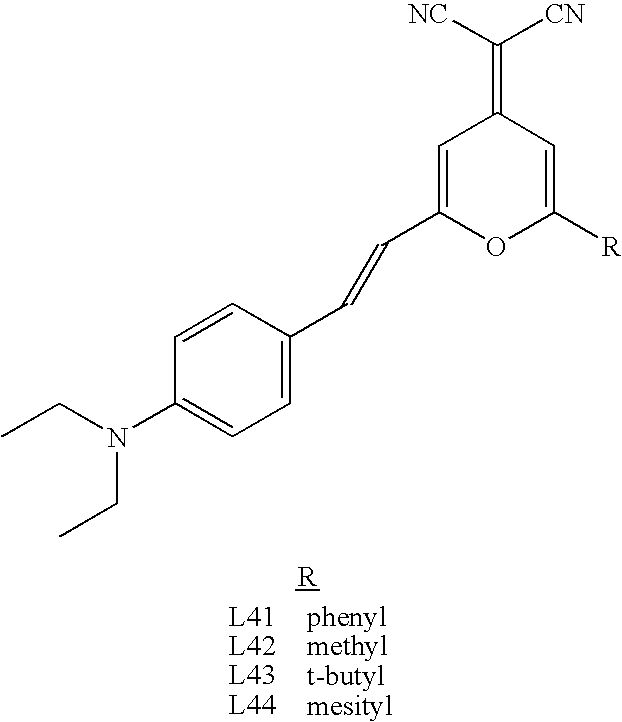
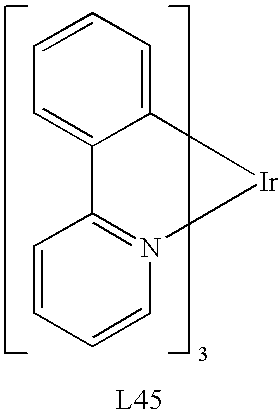

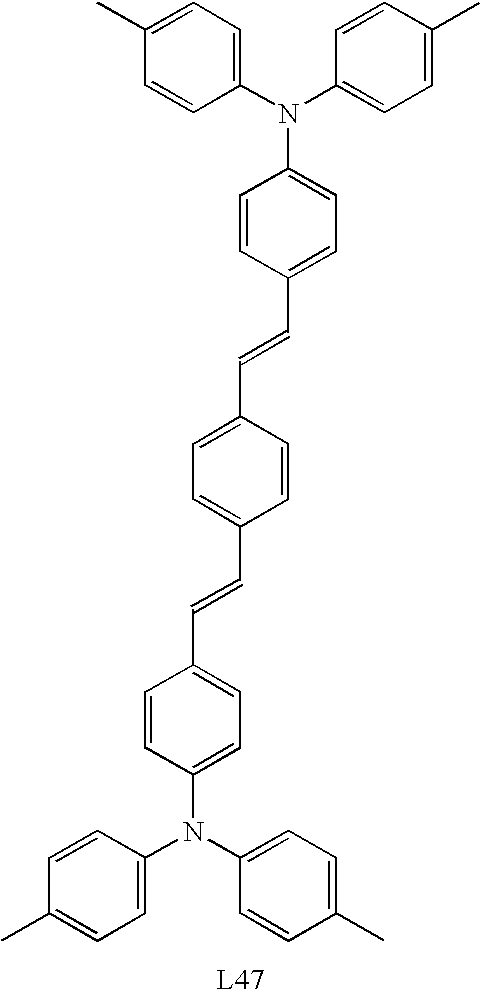
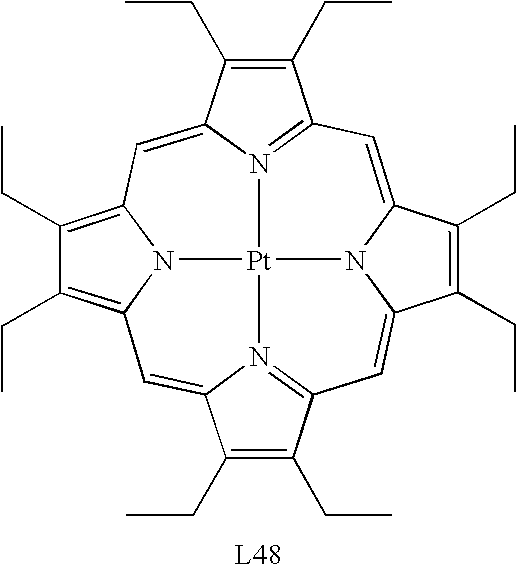
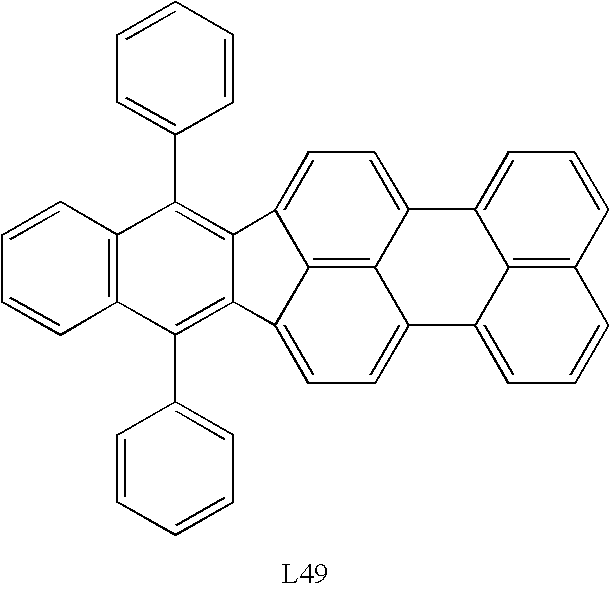

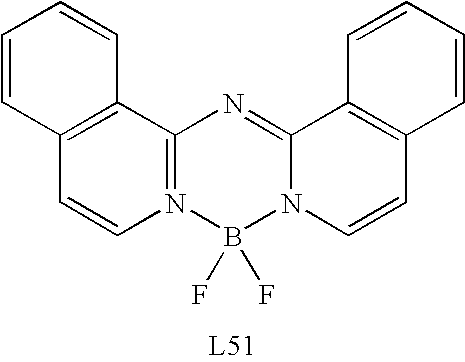

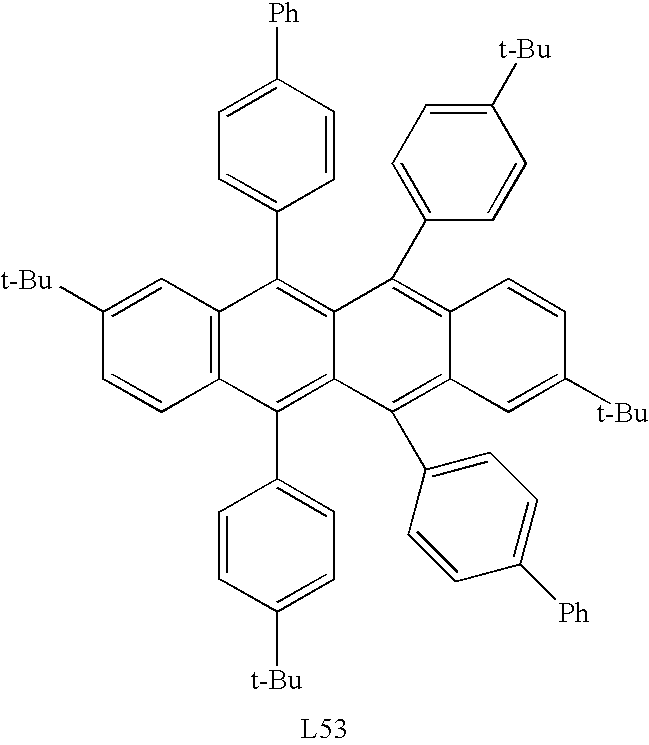


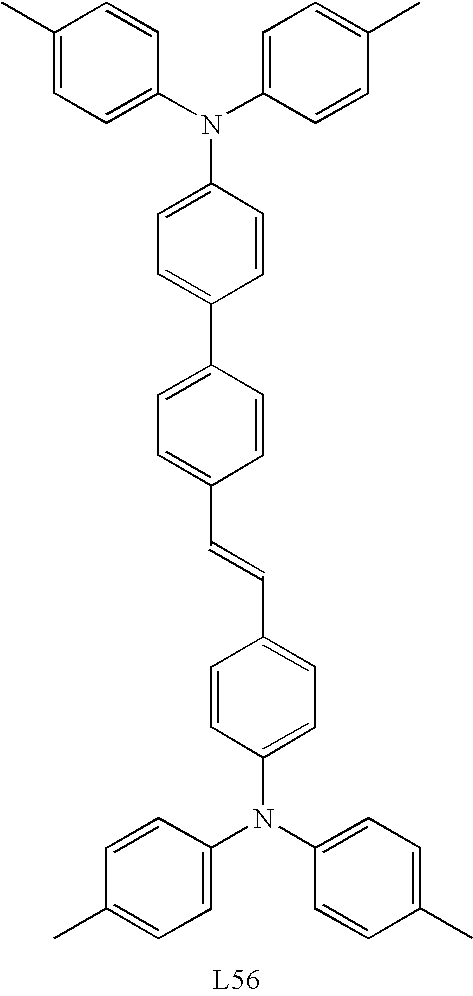

Electron-Transporting Layer (ETL) - Preferred thin film-forming materials for use in forming the electron-transporting layer of the organic EL devices of this invention are metal chelated oxinoid compounds, including chelates of oxine itself (also commonly referred to as 8-quinolinol or 8-hydroxyquinoline). Such compounds help to inject and transport electrons and exhibit both high levels of performance and are readily fabricated in the form of thin films. Exemplary of contemplated oxinoid compounds are those satisfying structural formula (E), previously described. Other electron-transporting materials include various butadiene derivatives as disclosed in U.S. Pat. No. 4,356,429 and various heterocyclic optical brighteners as described in U.S. Pat. No. 4,539,507. Benzazoles satisfying structural formula (H) are also useful electron transporting materials. Triazines are also known to be useful as electron transporting materials. Further useful materials are silacyclopentadiene derivatives described in EP 1,480,280; EP 1,478,032; and EP 1,469,533. Substituted 1,10-phenanthroline compounds (including those listed below) such as are disclosed in JP2003-115387; JP2004-311184; JP2001-267080; and WO2002-043449. Pyridine derivatives are described in JP2004-200162 as useful electron transporting materials.

Electron-Injecting Layer (EIL) - Electron-injecting layers, when present, include those described in U.S. Pat. Nos. 5,608,287; 5,776,622; 5,776,623; 6,137,223; and 6,140,763, U.S. Pat. No. 6,914,269 the disclosures of which are incorporated herein by reference. An electron-injecting layer generally consists of a material having a work function less than 4.0 eV. A thin-film containing low work-function alkaline metals or alkaline earth metals, such as Li, Cs, Ca, Mg can be employed. In addition, an organic material doped with these low work-function metals can also be used effectively as the electron-injecting layer. Examples are Li- or Cs-doped Alq. In one suitable embodiment the electron-injecting layer includes LiF. In practice, the electron-injecting layer is often a thin layer deposited to a suitable thickness in a range of 0.1-3.0 nm.
- Cathode
- When light emission is viewed solely through the anode, the cathode used in this invention can be comprised of nearly any conductive material. Desirable materials have good film-forming properties to ensure good contact with the underlying organic layer, promote electron injection at low voltage, and have good stability. Useful cathode materials often contain a low work function metal (<4.0 eV) or metal alloy. One useful cathode material is comprised of a Mg:Ag alloy wherein the percentage of silver is in the range of 1 to 20%, as described in U.S. Pat. No. 4,885,221. Another suitable class of cathode materials includes bilayers comprising the cathode and a thin electron-injection layer (EIL) in contact with an organic layer (e.g., an electron transporting layer (ETL)) which is capped with a thicker layer of a conductive metal. Here, the EIL preferably includes a low work function metal or metal salt, and if so, the thicker capping layer does not need to have a low work function. One such cathode is comprised of a thin layer of LiF followed by a thicker layer of A1 as described in U.S. Pat. No. 5,677,572. Other useful cathode material sets include, but are not limited to, those disclosed in U.S. Pat. Nos. 5,059,861; 5,059,862, and 6,140,763.
- When light emission is viewed through the cathode, the cathode must be transparent or nearly transparent. For such applications, metals must be thin or one must use transparent conductive oxides, or a combination of these materials. Optically transparent cathodes have been described in more detail in U.S. Pat. No. 4,885,211, U.S. Pat. No. 5,247,190, JP 3,234,963, U.S. Pat. No. 5,703,436, U.S. Pat. No. 5,608,287, U.S. Pat. No. 5,837,391, U.S. Pat. No. 5,677,572, U.S. Pat. No. 5,776,622, U.S. Pat. No. 5,776,623, U.S. Pat. No. 5,714,838, U.S. Pat. No. 5,969,474, U.S. Pat. No. 5,739,545, U.S. Pat. No. 5,981,306, U.S. Pat. No. 6,137,223, U.S. Pat. No. 6,140,763, U.S. Pat. No. 6,172,459, EP 1 076 368, U.S. Pat. No. 6,278,236, and U.S. Pat. No. 6,284,3936. Cathode materials are typically deposited by any suitable method such as evaporation, sputtering, or chemical vapor deposition. When needed, patterning can be achieved through many well known methods including, but not limited to, through-mask deposition, integral shadow masking as described in U.S. Pat. No. 5,276,380 and EP 0 732 868, laser ablation, and selective chemical vapor deposition.
- Other Useful Organic Layers and Device Architecture
- In some instances,
layers - Additional layers such as electron or hole-blocking layers as taught in the art may be employed in devices of this invention. Hole-blocking layers may be used between the light emitting layer and the electron transporting layer. Electron-blocking layers may be used between the hole-transporting layer and the light emitting layer. These layers are commonly used to improve the efficiency of emission, for example, as in US 2002/0015859.
- This invention may be used in so-called stacked device architecture, for example, as taught in U.S. Pat. No. 5,703,436 and U.S. Pat. No. 6,337,492.
- Deposition of Organic Layers
- The organic materials mentioned above are suitably deposited by any means suitable for the form of the organic materials. In the case of small molecules, they are conveniently deposited through sublimation, but can be deposited by other means such as from a solvent with an optional binder to improve film formation. If the material is a polymer, solvent deposition is usually preferred. The material to be deposited by sublimation can be vaporized from a sublimator “boat” often comprised of a tantalum material, e.g., as described in U.S. Pat. No. 6,237,529, or can be first coated onto a donor sheet and then sublimed in closer proximity to the substrate. Layers with a mixture of materials can utilize separate sublimator boats or the materials can be pre-mixed and coated from a single boat or donor sheet. Patterned deposition can be achieved using shadow masks, integral shadow masks (U.S. Pat. No. 5,294,870), spatially-defined thermal dye transfer from a donor sheet (U.S. Pat. No. 5,688,551, U.S. Pat. No. 5,851,709 and U.S. Pat. No. 6,066,357) and inkjet method (U.S. Pat. No. 6,066,357).
- One preferred method for depositing the materials of the present invention is described in US 2004/0255857 and U.S. Ser. No. 10/945,941 where different source evaporators are used to evaporate each of the materials of the present invention. A second preferred method involves the use of flash evaporation where materials are metered along a material feed path in which the material feed path is temperature controlled. Such a preferred method is described in the following co-assigned patent applications: U.S. Ser. No. 10/784,585; U.S. Ser. No. 10/805,980; U.S. Ser. No. 10/945,940; U.S. Ser. No. 10/945,941; U.S. Ser. No. 11/050,924; and U.S. Ser. No. 11/050,934. Using this second method, each material may be evaporated using different source evaporators or the solid materials may be mixed prior to evaporation using the same source evaporator.
- Encapsulation
- Most OLED devices are sensitive to moisture or oxygen, or both, so they are commonly sealed in an inert atmosphere such as nitrogen or argon, along with a desiccant such as alumina, bauxite, calcium sulfate, clays, silica gel, zeolites, alkaline metal oxides, alkaline earth metal oxides, sulfates, or metal halides and perchlorates. Methods for encapsulation and desiccation include, but are not limited to, those described in U.S. Pat. No. 6,226,890. In addition, barrier layers such as SiOx, Teflon, and alternating inorganic/polymeric layers are known in the art for encapsulation.
- Optical Optimization
- OLED devices of this invention can employ various well-known optical effects in order to enhance its properties if desired. This includes optimizing layer thicknesses to yield maximum light transmission, providing dielectric mirror structures, replacing reflective electrodes with light-absorbing electrodes, providing anti glare or anti-reflection coatings over the display, providing a polarizing medium over the display, or providing colored, neutral density, or color conversion filters over the display. Filters, polarizers, and anti-glare or anti-reflection coatings may be specifically provided over the cover or as part of the cover.
- Embodiments of the invention may provide advantageous features such as higher luminous yield, lower drive voltage, and higher power efficiency, longer operating lifetimes or ease of manufacture. Embodiments of devices useful in the invention can provide a wide range of hues including those useful in the emission of white light (directly or through filters to provide multicolor displays). Embodiments of the invention can also provide an area lighting device.
- The invention and its advantages are further illustrated by the specific examples that follow. The term “percentage” or “percent” and the symbol “%” indicate the volume percent (or a thickness ratio as measured on a thin film thickness monitor) of a particular first or second compound of the total material in the layer of the invention and other components of the devices. If more than one second compound is present, the total volume of the second compounds can also be expressed as a percentage of the total material in the layer of the invention.
-

- Inv-1 was prepared according to equation 1; the preparation of a similar material is described in US 2003/105070. A mixture of Int-A (1.27 g, 3 mmol) and Int-B (0.987 g, 3 mmol) in 10 mL of a mixture of tetrahydrofuran and dimethylforamide (1:1) was added to potassium t-butoxide (0.320 g, 3.3 mmol) in 5 mL of tetrahydrofuran which had been cooled to 0° C. After addition, the temperature was allowed to increase to room temperature while stirring the mixture for 1 h. Water was added and the product was extracted, dried, and evaporated to a solid. The crude product was purified by column chromatography (silica gel, heptane/ethyl acetate eluent) to afford 0.3 g of Inv-1, which sublimed at 240° C.
- A series of EL devices (1-1 through 1-6) were constructed in the following manner.
-
- 1. A glass substrate coated with a 25 nm layer of indium-tin oxide (ITO), as the anode, was sequentially ultrasonicated in a commercial detergent, rinsed in deionized water, degreased in toluene vapor and exposed to oxygen plasma for about 1 min.
- 2. Over the ITO was deposited a 1 nm fluorocarbon (CFx) hole-injecting layer (HIL) by plasma-assisted deposition of CHF3 as described in U.S. Pat. No. 6,208,075.
- 3. Next a layer of hole-transporting material 4,4′-Bis[N-(1-naphthyl)-N-phenylamino]biphenyl (NPB) was deposited to a thickness of 75 nm.
- 4. A 20 nm light-emitting layer (LEL) corresponding to 10-(4-biphenyl)-9-(2-naphthyl)anthracene (H-2) and light-emitting material, Inv-1 or L-2 at the level shown in Table 1 was then deposited.
- 5. A 35 nm electron-transporting layer (ETL) of tris(8-quinolinolato)aluminum (III) (Alq) was vacuum-deposited over the LEL.
- 6. 0.5 nm layer of lithium fluoride was vacuum deposited onto the ETL, followed by a 150 nm layer of aluminum, to form a cathode layer.
- The above sequence completes the deposition of the EL device. The device is then hermetically packaged in a dry glove box for protection against ambient environment.

- The devices were tested for luminous efficiency and color at an operating current of 20 mA/cm2 and the results are reported in Table 1 in the form of luminous yield (cd/A) and efficiency (w/A), where device efficiency is the radiant flux (in watts) produced by the device per amp of input current, where radiant flux is the light energy produced by the device per unit time. Light intensity is measured perpendicular to the device surface, and it is assumed that the angular profile is Lambertian. The color of light produced by the devices is reported in 1931 CIE (Commission Internationale de L'Eclairage) coordinates.
TABLE 1 Evaluation results for Devices 1-1 through 1-6. Luminous Emitter Level Voltage Yield Efficiency Example Emitter (%) CIEx CIEy (V) (cd/A) (W/A) 1-1 Comparative — 0 0.174 0.143 6.87 1.51 0.032 1-2 Inventive Inv-1 2 0.161 0.297 6.59 6.71 0.085 1-3 Inventive Inv-1 4 0.167 0.333 6.92 8.11 0.095 1-4 Inventive Inv-1 6 0.174 0.360 6.43 8.36 0.093 1-5 Inventive Inv-1 8 0.182 0.380 6.39 8.39 0.089 1-6 Comparative L-2 1.5 0.147 0.192 6.37 3.32 0.059 - It can be seen from Table 1 that the inventive material affords a blue-green emission. The inventive material also offers higher luminance yield and efficiency relative to the comparison material L-2, which emits blue light.
- A series of EL devices (1-1 through 1-6) were constructed in the following manner.
-
- 1. A glass substrate coated with an 25 nm layer of indium-tin oxide (ITO), as the anode, was sequentially ultrasonicated in a commercial detergent, rinsed in deionized water, degreased in toluene vapor and exposed to oxygen plasma for about 1 min.
- 2. Over the ITO was deposited a 1 nm fluorocarbon (CFx) hole-injecting layer (HIL) by plasma-assisted deposition of CHF3 as described in U.S. Pat. No. 6,208,075.
- 7. Next a layer of hole-transporting material 4,4′-Bis[N-(1-naphthyl)-N-phenylamino]biphenyl (NPB) was deposited to a thickness of 75 nm.
- 8. A 20 nm light-emitting layer (LEL) corresponding to 10-(4-biphenyl)-9-(2-naphthyl)anthracene (H-2) and light-emitting material Inv-1 or L-47 at the level shown in Table 2 was then deposited.
- 9. A 35 nm electron-transporting layer (ETL) of tris(8-quinolinolato)aluminum (III) (Alq) was vacuum-deposited over the LEL.
- 10. 0.5 nm layer of lithium fluoride was vacuum deposited onto the ETL, followed by a 150 nm layer of aluminum, to form a cathode layer.
- The above sequence completes the deposition of the EL device. The device is then hermetically packaged in a dry glove box for protection against ambient environment.

- The devices were tested for luminous efficiency and color at an operating current of 20 mA/cm2 and the results are reported in Table 2 in the form of luminous yield (cd/A) and efficiency (w/A). The color of light produced by the devices is reported in 1931 CIE coordinates.
TABLE 2 Evaluation results for Devices 2-1 through 2-6. Luminous Emitter Level Voltage Yield Efficiency Example Emitter (%) CIEx CIEy (V) (cd/A) (W/A) 2-1 Comparative — 0 0.169 0.126 6.86 1.44 0.035 2-2 Inventive Inv-1 2 0.160 0.235 6.79 4.05 0.061 2-3 Inventive Inv-1 4 0.159 0.291 6.96 7.22 0.094 2-4 Inventive Inv-1 6 0.163 0.326 7.15 8.68 0.104 2-5 Inventive Inv-1 8 0.168 0.343 6.94 8.88 0.103 2-6 Comparative L-47 3 0.160 0.340 6.97 8.65 0.103 - It can be seen from Table 2 that the inventive material affords a blue-green emission. The inventive material also offers similar or higher luminance yield and efficiency relative to the comparison material L-47.
- A series of EL devices (3-1 through 3-6) were constructed in the following manner.
-
- 1. A glass substrate coated with a 25 nm layer of indium-tin oxide (ITO), as the anode, was sequentially ultrasonicated in a commercial detergent, rinsed in deionized water, degreased in toluene vapor and exposed to oxygen plasma for about 1 min.
- 2. Over the ITO was deposited a 1 nm fluorocarbon (CFx) hole-injecting layer (HIL) by plasma-assisted deposition of CHF3 as described in U.S. Pat. No. 6,208,075.
- 3. Next a layer of hole-transporting material 4,4′-Bis[N-(1-naphthyl)-N-phenylamino]biphenyl (NPB) was deposited to a thickness of 75 nm.
- 4. A 40 nm light-emitting layer (LEL) was then deposited corresponding to 10-(4-biphenyl)-9-(2-naphthyl)anthracene (H-2) or TAZ (C-1), see Table 3, and including light-emitting material Inv-1 at the level shown in Table 3.
- 5. A 35 nm electron-transporting layer (ETL) of tris(8-quinolinolato)aluminum (III) (Alq) was vacuum-deposited over the LEL.
- 6. 0.5 nm layer of lithium fluoride was vacuum deposited onto the ETL, followed by a 150 nm layer of aluminum, to form a cathode layer.
- The above sequence completes the deposition of the EL device. The device is then hermetically packaged in a dry glove box for protection against ambient environment.

- The devices were tested for luminous efficiency and color at an operating current of 20 mA/cm2 and the results are reported in Table 3 in the form of luminous yield (cd/A) and efficiency (w/A). The color of light produced by the devices is reported in 1931 CIE coordinates.
TABLE 3 Evaluation results for Devices 3-1 through 3-6. Inv-1 Luminous Level Voltage Yield Efficiency Device Example Host (%) CIEx CIEy (V) (cd/A) (W/A) 3-1 Inventive H-2 4 0.169 0.359 9.2 9.0 0.101 3-2 Inventive H-2 6 0.173 0.373 8.8 9.7 0.105 3-3 Inventive H-2 8 0.177 0.379 8.4 10.1 0.108 3-4 Comparative C-1 4 0.151 0.226 8.9 2.1 0.032 3-5 Comparative C-1 6 0.154 0.280 10.1 2.7 0.036 3-6 Comparative C-1 8 0.156 0.295 8.5 2.4 0.031 - It is clear from Table 3 that the combination of Inv-1 and H-2 affords very high luminance relative to the Inv-1/C-1 combination. In addition, the devices that contain Inv-1/H-2 emit blue-green light whereas the Inv-1/C-1 devices produce a more blue emission. Thus the material H-2, which contains an anthracene moiety, is a superior host for Inv-1 compared to TAZ (C-1), which does not include an anthracene nucleus.
- The entire contents of the patents and other publications referred to in this specification are incorporated herein by reference. The invention has been described in detail with particular reference to certain preferred embodiments thereof, but it will be understood that variations and modifications can be effected within the spirit and scope of the invention.
-
- 101 Substrate
- 103 Anode
- 105 Hole-Injecting layer (HIL)
- 107 Hole-Transporting Layer (HTL)
- 109 Light-Emitting layer (LEL)
- 111 Electron-Transporting layer (ETL)
- 112 Electron-Injecting Layer (EIL)
- 113 Cathode
- 150 Power Source
- 160 Conductor
Claims (20)
1. An OLED device comprising a cathode, an anode and a light-emitting layer therebetween, wherein the light-emitting layer comprises a host containing an anthracene nucleus and a light-emitting material comprising a 1,3-butadiene nucleus, wherein the butadiene nucleus is substituted in the 1 and 4 positions with independently selected aromatic groups, and wherein at least one of said aromatic groups is further substituted with an amino group, and wherein said amino group is further substituted with two independently selected aryl or heteroaryl groups.
2. The device of claim 1 wherein the butadiene nucleus is substituted in the 1 and 4 positions with independently selected aromatic groups, and wherein each of said aromatic groups is further substituted with an amino group, and wherein each of said amino groups is further substituted with two independently selected aryl or heteroaryl groups.
3. The device of claim 1 wherein the host material is an anthracene group substituted in the 9- and 10-positions with two independently selected aromatic groups.
4. The device of claim 1 wherein the light-emitting material is present at a level of 2% to 8% of the layer by volume.
5. The device of claim 1 wherein light-emitting material is represented by Formula (1):
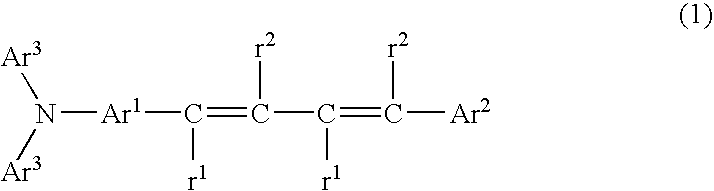
wherein:
Ar1 and Ar2 represent independently selected aromatic groups;
each Ar3 may be the same or different and each represents an independently selected aromatic group, provided the two Ar3 groups may combine to form a ring group;
each r1 may be the same or different and each represents hydrogen or an independently selected substituent; and
each r2 may be the same or different and each represents hydrogen or an independently selected substituent;
6. The device of claim 5 wherein at least one r1 and at least one r2 represents hydrogen.
7. The device of claim 5 wherein each r1 and each r2 represents hydrogen.
8. The device of claim 5 wherein Ar2 is further substituted with a —N(Ar4)(Ar4) group, wherein each Ar4 may be the same or different and each represents an independently selected aromatic group, provided the two Ar4 groups may combine to form a ring group.
9. The device of claim 5 wherein each Ar1, Ar2, and Ar3 represents an independently selected carbocyclic aromatic group.
10. The device of claim 5 wherein Ar1 represents a biphenylene group.
11. The device of claim 1 wherein light-emitting material is represented by Formula (2):

wherein:
each Ar5 may be the same or different and each represents an independently selected aromatic group, provided two adjacent Ar5 groups may combine to form a ring group;
each d represents an independently selected substituent, provided two adjacent d groups may combine to form a ring group; and
s and t are independently 0-4.
12. The device of claim 11 wherein s and t are 0.
13. The device of claim 1 wherein the host material is represented by Formula (3):

wherein:
W1-W10 independently represent hydrogen or an independently selected substituent, provided that two adjacent substituents can combine to form rings.
14. The device of claim 13 wherein W9 and W10 represent independently selected naphthyl groups or biphenyl groups.
15. The device of claim 13 wherein at least one of W9 and W10 represents an anthracene group.
16. The device of claim 13 wherein W9 and W10 represent independently selected naphthyl groups or biphenyl groups and W7 represents an aromatic group.
17. The device of claim 1 wherein the light-emitting material emits blue or blue-green light.
18. The device of claim 1 wherein a second light emitting layer is present.
19. The device of claim 18 wherein the second light emitting layer emits yellow light.
20. The device of claim 1 wherein white light is produced either directly or by using filters.
Priority Applications (6)
| Application Number | Priority Date | Filing Date | Title |
|---|---|---|---|
| US11/305,424 US20070141388A1 (en) | 2005-12-16 | 2005-12-16 | Electroluminescent device containing a butadiene derivative |
| KR1020087014340A KR20080085140A (en) | 2005-12-16 | 2006-12-04 | Electroluminescent Device Containing Butadiene Derivative |
| PCT/US2006/046312 WO2007075268A1 (en) | 2005-12-16 | 2006-12-04 | Electroluminescent device containing a butadiene derivative |
| JP2008545639A JP2009520355A (en) | 2005-12-16 | 2006-12-04 | Electroluminescent devices containing butadiene derivatives |
| EP06838969A EP1981949A1 (en) | 2005-12-16 | 2006-12-04 | Electroluminescent device containing a butadiene derivative |
| TW095146991A TW200729581A (en) | 2005-12-16 | 2006-12-15 | Electroluminescent device containing a butadiene derivative |
Applications Claiming Priority (1)
| Application Number | Priority Date | Filing Date | Title |
|---|---|---|---|
| US11/305,424 US20070141388A1 (en) | 2005-12-16 | 2005-12-16 | Electroluminescent device containing a butadiene derivative |
Publications (1)
| Publication Number | Publication Date |
|---|---|
| US20070141388A1 true US20070141388A1 (en) | 2007-06-21 |
Family
ID=37873083
Family Applications (1)
| Application Number | Title | Priority Date | Filing Date |
|---|---|---|---|
| US11/305,424 Abandoned US20070141388A1 (en) | 2005-12-16 | 2005-12-16 | Electroluminescent device containing a butadiene derivative |
Country Status (6)
| Country | Link |
|---|---|
| US (1) | US20070141388A1 (en) |
| EP (1) | EP1981949A1 (en) |
| JP (1) | JP2009520355A (en) |
| KR (1) | KR20080085140A (en) |
| TW (1) | TW200729581A (en) |
| WO (1) | WO2007075268A1 (en) |
Cited By (3)
| Publication number | Priority date | Publication date | Assignee | Title |
|---|---|---|---|---|
| EP2100941A3 (en) * | 2008-03-14 | 2010-10-06 | Gracel Display Inc. | Novel organic electroluminescent compounds and organic electroluminescent device using the same |
| US20110127517A1 (en) * | 2008-07-29 | 2011-06-02 | Sumitomo Chemical Company, Limited | Compound containing 1,3-diene structure and method for producing same |
| US20130235552A1 (en) * | 2008-12-08 | 2013-09-12 | Konica Minolta Opto, Inc. | Anisotropic dye layer, coordination polymer for anisotropic dye layer and polarization element, and polarization control film, polarization control element, multi-layer polarization control element, ellipse polarization plate, light emission element, and method for controlling polarization properties employing the anisotropic dye layer |
Citations (6)
| Publication number | Priority date | Publication date | Assignee | Title |
|---|---|---|---|---|
| US5093210A (en) * | 1989-06-30 | 1992-03-03 | Ricoh Company, Ltd. | Electroluminescent device |
| US5413887A (en) * | 1991-10-17 | 1995-05-09 | Minolta Camera Kabushiki Kaisha | Distyryl compound and photosensitive member comprising the same |
| US6180217B1 (en) * | 1997-03-19 | 2001-01-30 | Minolta Co., Ltd. | Organic electroluminescent element |
| US6682832B2 (en) * | 1999-12-20 | 2004-01-27 | Matsushita Electric Industrial Co., Ltd. | Thin film el device |
| US20040018383A1 (en) * | 2002-07-26 | 2004-01-29 | Xerox Corporation | Display device with anthracene and triazine derivatives |
| US20050233166A1 (en) * | 2004-04-14 | 2005-10-20 | Eastman Kodak Company | OLED device using reduced drive voltage |
Family Cites Families (3)
| Publication number | Priority date | Publication date | Assignee | Title |
|---|---|---|---|---|
| JP2714695B2 (en) * | 1989-06-30 | 1998-02-16 | 株式会社リコー | EL device |
| JP2997021B2 (en) * | 1990-08-10 | 2000-01-11 | パイオニア株式会社 | Organic electroluminescence device |
| JP3564859B2 (en) * | 1996-04-01 | 2004-09-15 | 東洋インキ製造株式会社 | Organic electroluminescent device material and organic electroluminescent device using the same |
-
2005
- 2005-12-16 US US11/305,424 patent/US20070141388A1/en not_active Abandoned
-
2006
- 2006-12-04 WO PCT/US2006/046312 patent/WO2007075268A1/en not_active Ceased
- 2006-12-04 EP EP06838969A patent/EP1981949A1/en not_active Withdrawn
- 2006-12-04 KR KR1020087014340A patent/KR20080085140A/en not_active Withdrawn
- 2006-12-04 JP JP2008545639A patent/JP2009520355A/en not_active Withdrawn
- 2006-12-15 TW TW095146991A patent/TW200729581A/en unknown
Patent Citations (6)
| Publication number | Priority date | Publication date | Assignee | Title |
|---|---|---|---|---|
| US5093210A (en) * | 1989-06-30 | 1992-03-03 | Ricoh Company, Ltd. | Electroluminescent device |
| US5413887A (en) * | 1991-10-17 | 1995-05-09 | Minolta Camera Kabushiki Kaisha | Distyryl compound and photosensitive member comprising the same |
| US6180217B1 (en) * | 1997-03-19 | 2001-01-30 | Minolta Co., Ltd. | Organic electroluminescent element |
| US6682832B2 (en) * | 1999-12-20 | 2004-01-27 | Matsushita Electric Industrial Co., Ltd. | Thin film el device |
| US20040018383A1 (en) * | 2002-07-26 | 2004-01-29 | Xerox Corporation | Display device with anthracene and triazine derivatives |
| US20050233166A1 (en) * | 2004-04-14 | 2005-10-20 | Eastman Kodak Company | OLED device using reduced drive voltage |
Cited By (5)
| Publication number | Priority date | Publication date | Assignee | Title |
|---|---|---|---|---|
| EP2100941A3 (en) * | 2008-03-14 | 2010-10-06 | Gracel Display Inc. | Novel organic electroluminescent compounds and organic electroluminescent device using the same |
| US20110127517A1 (en) * | 2008-07-29 | 2011-06-02 | Sumitomo Chemical Company, Limited | Compound containing 1,3-diene structure and method for producing same |
| US8999523B2 (en) * | 2008-07-29 | 2015-04-07 | Sumitomo Chemical Company, Limited | Compound containing 1,3-diene structure and method for producing same |
| US20130235552A1 (en) * | 2008-12-08 | 2013-09-12 | Konica Minolta Opto, Inc. | Anisotropic dye layer, coordination polymer for anisotropic dye layer and polarization element, and polarization control film, polarization control element, multi-layer polarization control element, ellipse polarization plate, light emission element, and method for controlling polarization properties employing the anisotropic dye layer |
| US8824048B2 (en) * | 2008-12-08 | 2014-09-02 | Konica Minolta Opto, Inc. | Anisotropic dye layer, coordination polymer for anisotropic dye layer and polarization element, and polarization control film, polarization control element, multi-layer polarization control element, ellipse polarization plate, light emission element, and method for controlling polarization properties employing the anisotropic dye layer |
Also Published As
| Publication number | Publication date |
|---|---|
| WO2007075268A1 (en) | 2007-07-05 |
| JP2009520355A (en) | 2009-05-21 |
| TW200729581A (en) | 2007-08-01 |
| EP1981949A1 (en) | 2008-10-22 |
| KR20080085140A (en) | 2008-09-23 |
Similar Documents
| Publication | Publication Date | Title |
|---|---|---|
| US7553558B2 (en) | Electroluminescent device containing an anthracene derivative | |
| US7733009B2 (en) | Electroluminescent device including an anthracene derivative | |
| US7326371B2 (en) | Electroluminescent device with anthracene derivative host | |
| US20070252517A1 (en) | Electroluminescent device including an anthracene derivative | |
| US20060019116A1 (en) | White electroluminescent device with anthracene derivative host | |
| US20090162644A1 (en) | Organic element for low voltage electroluminescent devices | |
| US9666826B2 (en) | Electroluminescent device including an anthracene derivative | |
| US7544425B2 (en) | Organic element for electroluminescent devices | |
| US20070122657A1 (en) | Electroluminescent device containing a phenanthroline derivative | |
| US20060204783A1 (en) | Organic electroluminescent device | |
| US20060204784A1 (en) | Organic light-emitting devices with mixed electron transport materials | |
| US20060088729A1 (en) | White organic light-emitting devices with improved performance | |
| US7147938B2 (en) | Organic element for electroluminescent devices | |
| US20090162612A1 (en) | Oled device having two electron-transport layers | |
| EP1973984A1 (en) | Electroluminescent device including a gallium complex | |
| US20070141393A1 (en) | Amino anthracene compounds in OLED devices | |
| US20050208329A1 (en) | Organic element for electroluminescent devices | |
| WO2007127078A1 (en) | Electroluminescent device including an anthracene derivative | |
| US20060088730A1 (en) | Organic light-emitting devices with improved performance | |
| US20070207345A1 (en) | Electroluminescent device including gallium complexes | |
| US7368180B2 (en) | Electroluminescent device containing borondiketonate emitter | |
| US20070141388A1 (en) | Electroluminescent device containing a butadiene derivative | |
| US7569288B2 (en) | Electroluminescent device including gallium complexes | |
| US7208233B2 (en) | Organic element for electroluminescent devices |
Legal Events
| Date | Code | Title | Description |
|---|---|---|---|
| AS | Assignment |
Owner name: EASTMAN KODAK COMPANY, NEW YORK Free format text: ASSIGNMENT OF ASSIGNORS INTEREST;ASSIGNORS:HELBER, MARGARET J.;OWCZARCZYK, ZBYSLAW R.;REEL/FRAME:017403/0092 Effective date: 20051215 |
|
| STCB | Information on status: application discontinuation |
Free format text: ABANDONED -- FAILURE TO RESPOND TO AN OFFICE ACTION |