US20070027067A1 - Transition-state Inhibitors of Pin1, alpha-Ketoamide-containing peptidomimetics, and synthesis thereof - Google Patents
Transition-state Inhibitors of Pin1, alpha-Ketoamide-containing peptidomimetics, and synthesis thereof Download PDFInfo
- Publication number
- US20070027067A1 US20070027067A1 US11/383,085 US38308506A US2007027067A1 US 20070027067 A1 US20070027067 A1 US 20070027067A1 US 38308506 A US38308506 A US 38308506A US 2007027067 A1 US2007027067 A1 US 2007027067A1
- Authority
- US
- United States
- Prior art keywords
- ketoamide
- compound
- pro
- pin1
- ser
- Prior art date
- Legal status (The legal status is an assumption and is not a legal conclusion. Google has not performed a legal analysis and makes no representation as to the accuracy of the status listed.)
- Abandoned
Links
- 0 *OC(=O)N[C@@H](CCP(=O)(O)OC)C(=O)C(=O)N1CCC[C@H]1C(C)=O.*OC(=O)N[C@@H](CC[PH](=O)OCOC(=O)C(C)(C)C)C(=O)C(=O)N1CCC[C@H]1C(C)=O Chemical compound *OC(=O)N[C@@H](CCP(=O)(O)OC)C(=O)C(=O)N1CCC[C@H]1C(C)=O.*OC(=O)N[C@@H](CC[PH](=O)OCOC(=O)C(C)(C)C)C(=O)C(=O)N1CCC[C@H]1C(C)=O 0.000 description 8
- DTAUORBHMKUTPW-NEOZRAJZSA-S C1=CN=C([NH+]2CCNCC2)N=C1.C1CCNC1.C1CC[NH+](C2CCNCC2)CC1.CC(C)(C)OC(=O)NCCCCCCN.CC(C)CN.CC(N)C1=C/C2=C(C=CC=C2)/C=C\1.CC1=CC=C(CCN)C=C1.CCCCCCCN.CCCN.CC[NH+](CC)CCCCCNC.CNCC(O)C1=CC=CC=C1.CNCCC1=CC=CC=N1.COC(=O)/C=C(\C)N.COC(=O)CCCCCCN.N=[C+](N)NCCCCN.NC1=CC2=C(C=C1)NN=C2.NC1CC[NH+](CC2=CC=CC=C2)CC1.NCCC1=CNC2=C1C=CC=C2.NCCC1=CNC=N1.NCCCCCCN.NCCCN1C=CN=C1.NCCO.NNC(=O)C1=COC=C1.[H][N+]1(CCCN)CCOCC1 Chemical compound C1=CN=C([NH+]2CCNCC2)N=C1.C1CCNC1.C1CC[NH+](C2CCNCC2)CC1.CC(C)(C)OC(=O)NCCCCCCN.CC(C)CN.CC(N)C1=C/C2=C(C=CC=C2)/C=C\1.CC1=CC=C(CCN)C=C1.CCCCCCCN.CCCN.CC[NH+](CC)CCCCCNC.CNCC(O)C1=CC=CC=C1.CNCCC1=CC=CC=N1.COC(=O)/C=C(\C)N.COC(=O)CCCCCCN.N=[C+](N)NCCCCN.NC1=CC2=C(C=C1)NN=C2.NC1CC[NH+](CC2=CC=CC=C2)CC1.NCCC1=CNC2=C1C=CC=C2.NCCC1=CNC=N1.NCCCCCCN.NCCCN1C=CN=C1.NCCO.NNC(=O)C1=COC=C1.[H][N+]1(CCCN)CCOCC1 DTAUORBHMKUTPW-NEOZRAJZSA-S 0.000 description 2
- CRYAGAQVODKRPS-YWDXUVGASA-O C=C.CC(=O)O.CC(C)(C)OC(=O)NCCCCC(=O)O.CC(C)(OC1=CC=C(Cl)C=C1)C(=O)O.CCCCC/C=C\C/C=C\CCCCCCCC(=O)O.CCCCCCCCCCCCCCCCCC(=O)O.CN(CC(=O)O)C(=N)[NH3+].COC1=C/C2=C(\C=C/1)NC=C2CC(=O)O.NCCCCC(=O)O.O=C(O)/C=C\SC1=CC=CC=C1.O=C(O)CCCCC(=O)O Chemical compound C=C.CC(=O)O.CC(C)(C)OC(=O)NCCCCC(=O)O.CC(C)(OC1=CC=C(Cl)C=C1)C(=O)O.CCCCC/C=C\C/C=C\CCCCCCCC(=O)O.CCCCCCCCCCCCCCCCCC(=O)O.CN(CC(=O)O)C(=N)[NH3+].COC1=C/C2=C(\C=C/1)NC=C2CC(=O)O.NCCCCC(=O)O.O=C(O)/C=C\SC1=CC=CC=C1.O=C(O)CCCCC(=O)O CRYAGAQVODKRPS-YWDXUVGASA-O 0.000 description 2
- ZXPUSSXLJLIVJX-LGNSSHGESA-O CC(=O)NC(CCCNC(N)=[NH2+])C(=O)O.CC(C)(C)OC(=O)Cl.CCC(C)CC(=O)O.CCCCC1=CN=C(C(=O)O)C=C1.COC(=O)CCCCC(=O)O.COC1=CC=C2C(=O)CC(CC(=O)O)C2=C1.O=C(Cl)OCC1=CC=CC=C1.O=C(Cl)OCC1C2=CC=CC=C2C2=C1/C=C\C=C/2.O=C(O)/C=C/C1=CN/C2=C/C=C/C=C\12.O=C(O)/C=C/C1=CNC=N1.O=C(O)C1=CC(C2=CC=CC=C2)=NC2=CC=CC=C21.O=C(O)CC(C1=CC=CC=C1)C1=CC=CC=C1.O=C(O)CC1CC2CCC1C2.O=C(O)CCCC1=CC2=C(C=C1)C1=C(C=CC=C1)CC2.O=C(O)CCCCC1=CC=CC=C1 Chemical compound CC(=O)NC(CCCNC(N)=[NH2+])C(=O)O.CC(C)(C)OC(=O)Cl.CCC(C)CC(=O)O.CCCCC1=CN=C(C(=O)O)C=C1.COC(=O)CCCCC(=O)O.COC1=CC=C2C(=O)CC(CC(=O)O)C2=C1.O=C(Cl)OCC1=CC=CC=C1.O=C(Cl)OCC1C2=CC=CC=C2C2=C1/C=C\C=C/2.O=C(O)/C=C/C1=CN/C2=C/C=C/C=C\12.O=C(O)/C=C/C1=CNC=N1.O=C(O)C1=CC(C2=CC=CC=C2)=NC2=CC=CC=C21.O=C(O)CC(C1=CC=CC=C1)C1=CC=CC=C1.O=C(O)CC1CC2CCC1C2.O=C(O)CCCC1=CC2=C(C=C1)C1=C(C=CC=C1)CC2.O=C(O)CCCCC1=CC=CC=C1 ZXPUSSXLJLIVJX-LGNSSHGESA-O 0.000 description 2
- QODHCCJTGBOLHJ-GMXKUDHVSA-O C/C(N)=C\C(=O)O.NCC1COCCOCCOCCOCCOCCO1.NCCC1=CC=C(O)C=C1.NCCCCCCC(=O)O.NCCCCCCO.[H][N+]1(CCCN)CCCCC1C.[K+] Chemical compound C/C(N)=C\C(=O)O.NCC1COCCOCCOCCOCCOCCO1.NCCC1=CC=C(O)C=C1.NCCCCCCC(=O)O.NCCCCCCO.[H][N+]1(CCCN)CCCCC1C.[K+] QODHCCJTGBOLHJ-GMXKUDHVSA-O 0.000 description 1
- DCRXEDSDCGRSJM-UHZAFGCTSA-N CC(=O)[C@@H]1CCCN1C(=O)C(=O)[C@H](COC(C)(C)C)NC(=O)OCC1C2=C(C=CC=C2)C2=C1C=CC=C2.CC(C)(C)OC[C@H](NC(=O)OCC1C2=C(C=CC=C2)C2=C1C=CC=C2)C(=O)C(C#N)=P(C1=CC=CC=C1)(C1=CC=CC=C1)C1=CC=CC=C1.CC(C)(C)OC[C@H](NC(=O)OCC1C2=C(C=CC=C2)C2=C1C=CC=C2)C(=O)O.N#CC=P(C1=CC=CC=C1)(C1=CC=CC=C1)C1=CC=CC=C1 Chemical compound CC(=O)[C@@H]1CCCN1C(=O)C(=O)[C@H](COC(C)(C)C)NC(=O)OCC1C2=C(C=CC=C2)C2=C1C=CC=C2.CC(C)(C)OC[C@H](NC(=O)OCC1C2=C(C=CC=C2)C2=C1C=CC=C2)C(=O)C(C#N)=P(C1=CC=CC=C1)(C1=CC=CC=C1)C1=CC=CC=C1.CC(C)(C)OC[C@H](NC(=O)OCC1C2=C(C=CC=C2)C2=C1C=CC=C2)C(=O)O.N#CC=P(C1=CC=CC=C1)(C1=CC=CC=C1)C1=CC=CC=C1 DCRXEDSDCGRSJM-UHZAFGCTSA-N 0.000 description 1
- PAPIWVZMDOAZHD-PXIBYIROSA-N CC(=O)[C@@H]1CCCN1C(=O)C(=O)[C@H](COC(C)(C)C)NC(=O)OCC1C2=C(C=CC=C2)C2=C1C=CC=C2.O=C(N[C@@H](CO)C(=O)C(=O)N1CCC[C@H]1C(=O)O)OCC1C2=C(C=CC=C2)C2=C1C=CC=C2 Chemical compound CC(=O)[C@@H]1CCCN1C(=O)C(=O)[C@H](COC(C)(C)C)NC(=O)OCC1C2=C(C=CC=C2)C2=C1C=CC=C2.O=C(N[C@@H](CO)C(=O)C(=O)N1CCC[C@H]1C(=O)O)OCC1C2=C(C=CC=C2)C2=C1C=CC=C2 PAPIWVZMDOAZHD-PXIBYIROSA-N 0.000 description 1
- VYUZFSQDAXUNCX-QXMNXHSDSA-N CC(C)(C)OC(=O)N[C@@H](COCC1=CC=CC=C1)C(=O)C(=O)N1CCC[C@H]1C(=O)OCC1=CC=CC=C1.CC(C)(C)OC(=O)N[C@@H](COCC1=CC=CC=C1)C(=O)C(C#N)=P(C1=CC=CC=C1)(C1=CC=CC=C1)C1=CC=CC=C1.CC(C)(C)OC(=O)N[C@@H](COCC1=CC=CC=C1)C(=O)O.N#CC=P(C1=CC=CC=C1)(C1=CC=CC=C1)C1=CC=CC=C1 Chemical compound CC(C)(C)OC(=O)N[C@@H](COCC1=CC=CC=C1)C(=O)C(=O)N1CCC[C@H]1C(=O)OCC1=CC=CC=C1.CC(C)(C)OC(=O)N[C@@H](COCC1=CC=CC=C1)C(=O)C(C#N)=P(C1=CC=CC=C1)(C1=CC=CC=C1)C1=CC=CC=C1.CC(C)(C)OC(=O)N[C@@H](COCC1=CC=CC=C1)C(=O)O.N#CC=P(C1=CC=CC=C1)(C1=CC=CC=C1)C1=CC=CC=C1 VYUZFSQDAXUNCX-QXMNXHSDSA-N 0.000 description 1
- RWWAHQDLYUPONM-JCGQRFRZSA-N C[C@H](NC(=O)OC(C)(C)C)C(=O)C(=O)N1CCC[C@H]1C(=O)OCC1=CC=CC=C1.C[C@H](NC(=O)OC(C)(C)C)C(=O)C(C#N)=P(C1=CC=CC=C1)(C1=CC=CC=C1)C1=CC=CC=C1.C[C@H](NC(=O)OC(C)(C)C)C(=O)O.N#CC=P(C1=CC=CC=C1)(C1=CC=CC=C1)C1=CC=CC=C1 Chemical compound C[C@H](NC(=O)OC(C)(C)C)C(=O)C(=O)N1CCC[C@H]1C(=O)OCC1=CC=CC=C1.C[C@H](NC(=O)OC(C)(C)C)C(=O)C(C#N)=P(C1=CC=CC=C1)(C1=CC=CC=C1)C1=CC=CC=C1.C[C@H](NC(=O)OC(C)(C)C)C(=O)O.N#CC=P(C1=CC=CC=C1)(C1=CC=CC=C1)C1=CC=CC=C1 RWWAHQDLYUPONM-JCGQRFRZSA-N 0.000 description 1
Classifications
-
- C—CHEMISTRY; METALLURGY
- C07—ORGANIC CHEMISTRY
- C07D—HETEROCYCLIC COMPOUNDS
- C07D207/00—Heterocyclic compounds containing five-membered rings not condensed with other rings, with one nitrogen atom as the only ring hetero atom
- C07D207/02—Heterocyclic compounds containing five-membered rings not condensed with other rings, with one nitrogen atom as the only ring hetero atom with only hydrogen or carbon atoms directly attached to the ring nitrogen atom
- C07D207/04—Heterocyclic compounds containing five-membered rings not condensed with other rings, with one nitrogen atom as the only ring hetero atom with only hydrogen or carbon atoms directly attached to the ring nitrogen atom having no double bonds between ring members or between ring members and non-ring members
- C07D207/10—Heterocyclic compounds containing five-membered rings not condensed with other rings, with one nitrogen atom as the only ring hetero atom with only hydrogen or carbon atoms directly attached to the ring nitrogen atom having no double bonds between ring members or between ring members and non-ring members with hetero atoms or with carbon atoms having three bonds to hetero atoms with at the most one bond to halogen, e.g. ester or nitrile radicals, directly attached to ring carbon atoms
- C07D207/16—Carbon atoms having three bonds to hetero atoms with at the most one bond to halogen, e.g. ester or nitrile radicals
-
- C—CHEMISTRY; METALLURGY
- C07—ORGANIC CHEMISTRY
- C07D—HETEROCYCLIC COMPOUNDS
- C07D403/00—Heterocyclic compounds containing two or more hetero rings, having nitrogen atoms as the only ring hetero atoms, not provided for by group C07D401/00
- C07D403/02—Heterocyclic compounds containing two or more hetero rings, having nitrogen atoms as the only ring hetero atoms, not provided for by group C07D401/00 containing two hetero rings
- C07D403/12—Heterocyclic compounds containing two or more hetero rings, having nitrogen atoms as the only ring hetero atoms, not provided for by group C07D401/00 containing two hetero rings linked by a chain containing hetero atoms as chain links
-
- C—CHEMISTRY; METALLURGY
- C07—ORGANIC CHEMISTRY
- C07F—ACYCLIC, CARBOCYCLIC OR HETEROCYCLIC COMPOUNDS CONTAINING ELEMENTS OTHER THAN CARBON, HYDROGEN, HALOGEN, OXYGEN, NITROGEN, SULFUR, SELENIUM OR TELLURIUM
- C07F9/00—Compounds containing elements of Groups 5 or 15 of the Periodic Table
- C07F9/02—Phosphorus compounds
- C07F9/547—Heterocyclic compounds, e.g. containing phosphorus as a ring hetero atom
- C07F9/553—Heterocyclic compounds, e.g. containing phosphorus as a ring hetero atom having one nitrogen atom as the only ring hetero atom
- C07F9/572—Five-membered rings
-
- A—HUMAN NECESSITIES
- A61—MEDICAL OR VETERINARY SCIENCE; HYGIENE
- A61K—PREPARATIONS FOR MEDICAL, DENTAL OR TOILETRY PURPOSES
- A61K38/00—Medicinal preparations containing peptides
Definitions
- This invention relates to the design and synthesis of compounds that are Pin1 inhibitors.
- the single known inhibitor of Pin1 was a natural product, juglone, that is not specific for PinI and is a poor inhibitor.
- juglone a natural product, juglone, that is not specific for PinI and is a poor inhibitor.
- Pin1 is a phosphorylation-dependent peptidyl-prolyl isomerase (PPIase) enzyme thought to regulate mitosis via cis-trans isomerization of phosphoSer-Pro amide bonds in a variety of cell cycle proteins.
- PPIase phosphorylation-dependent peptidyl-prolyl isomerase
- Pin1 has been shown to bind phosphoSer-Pro epitopes in Cdc25 phosphatase, a key regulator of the Cdc2/cyclinB complex. (King, R. W., Jackson, P. K., and Kirschner, M.
- Pin1 The central role Pin1 plays in the cell cycle makes Pin1 an interesting target for inhibition, both for potential anti-cancer activity and for elucidation of the mechanism of mitosis regulation. It has been proposed (Shen, M., Stukenberg, P. T., Kirschner, M. W., and Lu, K. P., Genes Dev. 12 (1998) 706) that Pin1 recognition of the phosphoSer-Pro amide bond acts as a conformational switch in the cell cycle.
- Pin1 is unique among PPIases. (Lu, K. P., Hanes, S. D., Hunter, T., Nature 1996, 380, 544-547.) Pin1 regulates the entry into mitosis by catalyzing the conformational change on Cdc25 which regulates Cdc2, the central mitotic kinase. (Stukenberg, P. T., Kirschner, M. W., Pin1 Acts Catalytically to Promote a Conformational Change in Cdc26, Mol. Cell 2001, 7, 1071-1083.) Pin1 also regulates the activity of Cyclin D1, another cell-cycle protein that is active in G1. (Wulf, G. M., Liou, Y. C., Ryo, A.
- Pin1 has two domains: WW domain and PPIase domain. Both of these domains recognize the phosphoserine-proline or phsophothreonine-proline bonds present in mitotic phosphoproteins. (Yaffe et al., supra.)
- Pin1 inhibitors with greater inhibitory activity would be desirable for medical applications.
- bis-pivaloyloxymethyl (bisPOM) strategy is especially useful since such compounds are quite stable in buffer and plasma and they are readily transformed to free phosphate inside various cell types.
- the mechanism for degradation of bis(POM) phosphate inside cells has been studied. During the process, two different degradation enzymes are involved: esterase and phosphodiesterase. Thus, after the cell entry, the mask for the phosphate group is removed and the compounds converted to a biologically active form. Methods have been described to introduce the bispivaloyloxymethyl(POM) phosphate triesters. (Hwang, Y.; Cole, P.
- cc-ketoamides and synthesis thereof include, e.g., U.S. Pat. No. 7,022,738 issued Apr. 4, 2006 to Nakamura et al. (Senju Pharmaceutical Co.) for “ ⁇ -ketoamide derivatibves and use thereof”; U.S. Pat. No. 6,452,050 issued Sep. 17, 2002 and U.S. Pat. No. 6,143,931 issued Nov. 7, 2000 both to Baldino et al. (ArQule, Inc.) for “Synthesis and use of ⁇ -ketoamide derivatives and arrays”; U.S. Pat. No. 6,187,905 issued Feb. 13, 2001 to Hurst et al.
- ⁇ -keto amides can function as Pin1 inhibitors.
- families of new Pin1 inhibitors which are ⁇ -keto amides (such as, e.g., ⁇ -keto amide Ser-Pro analogues) have been synthesized.
- ⁇ -keto amides are shown to have an activity as transition state mimetics. This functionality permits stable inhibition of catalytic activity.
- the exemplary compounds described mimic a transition-state “twisted amide”.
- Exemplary ⁇ -ketoamide compounds within the practice of this invention include: wherein R is a carbonyl group attached to the amine as an amide, and R′ is an amine attached to the carbonyl as an amide.
- R and R′ moieties which can be used within the practice of the invention.
- the ( ⁇ -ketoamides are incorporated into peptide structures to serve as mimics.
- an ⁇ -ketoamide Ser-Pro dipeptide analogue into the pentapeptide analogue Ac-Phe-Tyr-pSer-Pro-Arg-NH 2 which is an inhibitor of Pin1 i.e., the “pSer-Pro” constitutes the ⁇ -ketoamide Ser-Pro dipeptide analogue of this invention.
- the peptide mimics of this invention will have one or more ⁇ -ketoamide dipeptides incorporated into peptides of 1-20 amino acids in length.
- ⁇ -ketoamides have an electron-deficient carbonyl group due to the effect of the neighboring electron-withdrawing amide group
- the ⁇ -ketoamides can serve as transition state mimetics and allow inhibition of catalytic activity. It is now recognized that such an activity for ⁇ -ketoamides may be applied in the context of Pin1. This activity has previously been known in a non-Pin1 context; namely, this activity occurs for serine or cysteine proteases through the formation of a tetrahedral intermediate (gem-diol or hemiketal) with the enzyme upon binding. (Maryanoff, B. E., Qiu, X., Padmanabhan, K.
- An example of making a peptidomimetic according to the invention is, e.g., to incorporate an ⁇ -ketoamide into another molecule (preferably a molecule which is a peptide inhibitor of Pin1), such as, e.g., incorporating an ⁇ -ketoamide Ser-Pro dipeptide analogue (such as presented in structure 11 below) into a pentapeptide analogue Ac-Phe-Tyr-pSer-Pro-Arg-NH 2 where “pSer-Pro” is the structure presented in structure 11 of Scheme 8 or, for example, the phosphate triesters set forth in Scheme 9 below.
- an ⁇ -ketoamide into another molecule (preferably a molecule which is a peptide inhibitor of Pin1), such as, e.g., incorporating an ⁇ -ketoamide Ser-Pro dipeptide analogue (such as presented in structure 11 below) into a pentapeptide analogue Ac-Phe-Tyr-pSer-Pro-Arg-NH
- the pentapeptide analogue Ac-Phe-Tyr-pSer-Pro-Arg-NH 2 is considered an optimal peptide inhibitor of Pin1.
- This peptidomimetic constructed by incorporating an ⁇ -ketoamide Ser-Pro dipeptide analogue into a pentapeptide analogue Ac-Phe-Tyr-pSer-Pro-Arg-NH 2 is designed as a potential transition-state analogue inhibitor of Pin1, because the ⁇ -ketoamide may react with Cys113 in the active site of Pin1 to form the tetrahedral intermediate hemithioketal, or it may act as a surrogate of the “twisted” amide transition state of peptides bound to Pin1.
- ⁇ -ketoamide Ser-Pro dipeptide could be incorporated into any peptide moiety for some applications of the invention and that there could be, for example, one to ten amino acids on either side of the ⁇ -ketoamide Ser-Pro dipeptide.
- the invention contemplates the incorporation of other ⁇ -ketoamide dipeptides into peptides of 1-20 amino acids in length.
- ⁇ -ketoamides used in this invention may be synthesized according to known methods, such as, e.g., cyano ylide coupling methodology, synthesis from carbamoylsilane and acid chlorides, transition-metal-catalyzed double carbonylation, amidation of ⁇ -keto acids with amines, oxidation from a-hydroxyl amides, and Grignard reagent nucleophilic addition.
- the carboxylic acid is coupled with (cyanomethylene)triphenylphosphorane in the presence of EDCI and DMAP, then the ylide formed is treated with ozone to generate an ⁇ , ⁇ -diketo nitrile, which is not stable at room temperature, treated in situ with amines to form ⁇ -keto amides.
- This method has wide application and has been used in synthesis of natural products such us eurystatin A and B, poststatin and verongamine. (Wasserman, supra; Kim, H.-O.; Nakanishi, H.; Lee, M. S.; Kahn, M., Design and Synthesis of Novel Conformationally Restricted Peptide Secondary Structure Mimetics. Org. Lett.
- This cyano ylide method has been applied to various carboxylic acids, especially amino acids in excellent yields for the first step and in moderate yields for the second step.
- the advantage of this method is that the synthesis route is short and starting materials are commercially available.
- Oxidation of ⁇ -hydroxy amides is widely used in the synthesis of ⁇ -keto amide inhibitors of enzymes. (Zhang, Y.; Fussel, S., Reimer, U., Schutkowski, M., Fischer, G., Substrate-Based Design of Reversible Pin1 Inhibitors, Biochemistry, 2002, 41, 11868-11877).
- oxidants include, e.g., Dess-Martin, TEMPO or PDC oxidation.
- the cyano ylide methodology is preferred for synthesis in the present invention because only two steps are required for the key dipeptide ⁇ -ketoamide syhthesis.
- Pin1 inhibitors such as the inventive Pin1 inhibitors which are peptidomimetics, may be used as anti-cancer agents alone or in conjunction with apoptosis inducers. Pin1 inhibitors (such as the inventive Pin1 inhibitors) may also be useful in the treatment of cocaine addiction. Inhibition of Pin1 may be important in other disease processes because Pin1 is an essential regulator of the G2 to M transition in the cell cycle.
- the inventive compounds which are Pin1 inhibitors or which are peptidomimetics should bind more specifically than juglone which is currently used as a Pin1 inhibitor.
- the inventive peptidomimetic Pin1 inhibitors operate by an entirely different mechanism and therefore make possible the specific targeting of cancer cells.
- reaction scheme for the synthesis of the ⁇ -ketoamide Ala-Pro dipeptide analogue is shown in Scheme 4, which is a model reaction for synthesis of the ⁇ -ketoamide Ser-Pro dipeptide analogue.
- the ⁇ -ketoamide Ala-Pro dipeptide analogue may be a potential inhibitor of cyclophilin.
- the ylide 1 was synthesized from a coupling reaction between commercially available (cyanomethylene)triphenylphosphorane and Boc-L-AlaOH with EDC in the presence of 4-dimethylaminopyridine. Under these conditions, a good yield of 80% was obtained.
- the ylide 1 was oxidized to an ⁇ , ⁇ -diketonitrile. This labile electrophile then was reacted in situ with HProOBn to form the ⁇ -keto amide 2 . From NMR and MS spectra, this ⁇ -ketoamide 2 appeared to be obtained as a mixture of isomers in 45% yield.
- the ylide 3 was synthesized in an excellent yield of 90% by the same method as ylide 1.
- the Ser-Pro ⁇ -ketoamide 4 was obtained as a mixture of isomers in 35% yield. During purification of compound 4 on column, some decomposition happened, making purification of the crude product mixture difficult. For compound 4, at least four steps (hydrogenolysis, deprotection of Boc, protection with Fmoc and phosphorylation) were needed to prepare the phosphorylated FmocSer-Pro ⁇ -ketoamide 7 ready for solid phase synthesis of peptides.
- FmocSer(Ot-Butyl)OH is selected as the starting material.
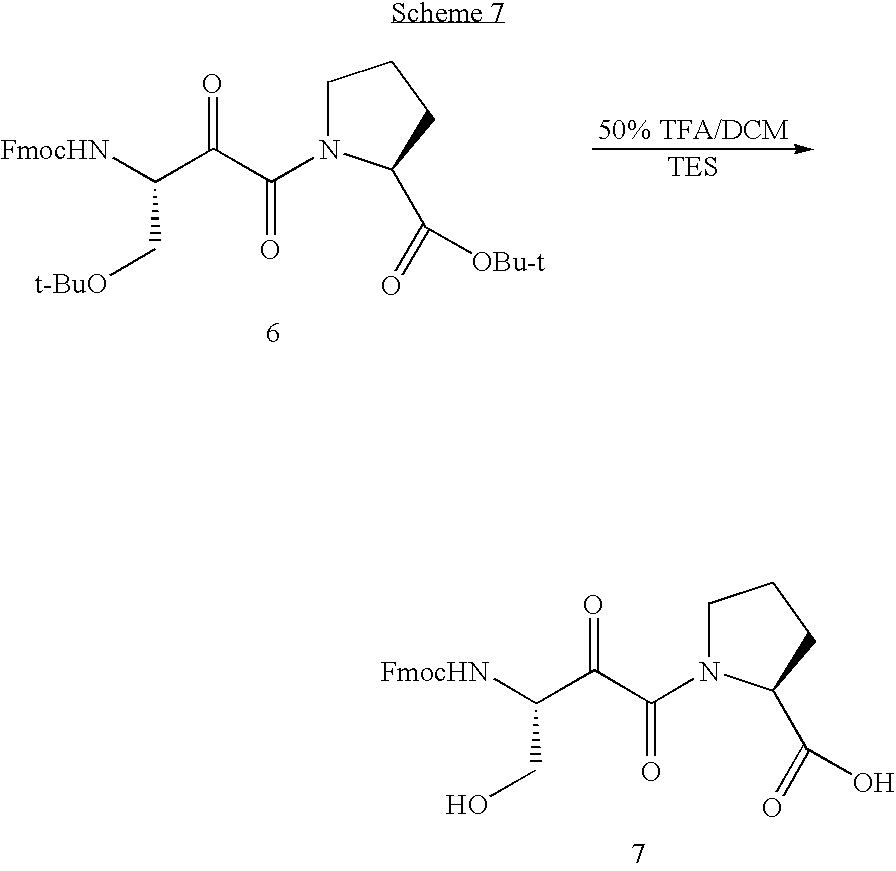
- the ylide 5 thus formed gives the ⁇ -ketoamide after ozonolysis and treatment with HProOt-Bu. Two steps are therefore saved in the synthesis of ⁇ -ketoamide 7.
- the ylide 5 has been prepared in 85% yield and ⁇ -ketoamide 6 has been prepared in 35% yield (Scheme 6). From the NMR, the compound 6 seemed to be obtained as isomers. It is difficult to isolate them, and they seem to isomerize or decompose on column or in solution. Then the mixture was directly used in the next deprotection step.
- the compound 7 characterized by MS was obtained in 30% yield.
- the product was found to be unstable in solution, and it totally decomposed in CDCl 3 solution after 2 days.
- the decomposition product appears to be a cyclic dimer (bis-lactone) of 7.
- Pin1 enzyme For assaying the inhibitory activities of the ⁇ -ketoamide inhibitor, Pin1 enzyme is used according to Scheme 8.
- a series of different amines (see FIG. 1) and carboxylic acids (see FIG. 2) are coupled to the C-terminus and N-terminus to produce compounds of the type 10.
- cell permeable derivatives 11 are prepared to improve bioavailability.
- Phosphate monoesters such as those used in the previous schemes are suitable for in vitro enzyme inhibition studies.
- problems with membrane permeability for phosphate esters are well known and reflected in the need for DMSO in cell-based assays conducted with Pin1 inhibitors.
- Wang, X. J.; Xu, B.; Mullins, A. B.; Neiler, F. K.; Etzkom, F. A. (2004) Conformationally Locked Isostere of PhosphoSer-cis-Pro Inhibits Pin1 23-Fold Better than PhosphoSer-trans-Pro Isostere, J. Am. Chem.
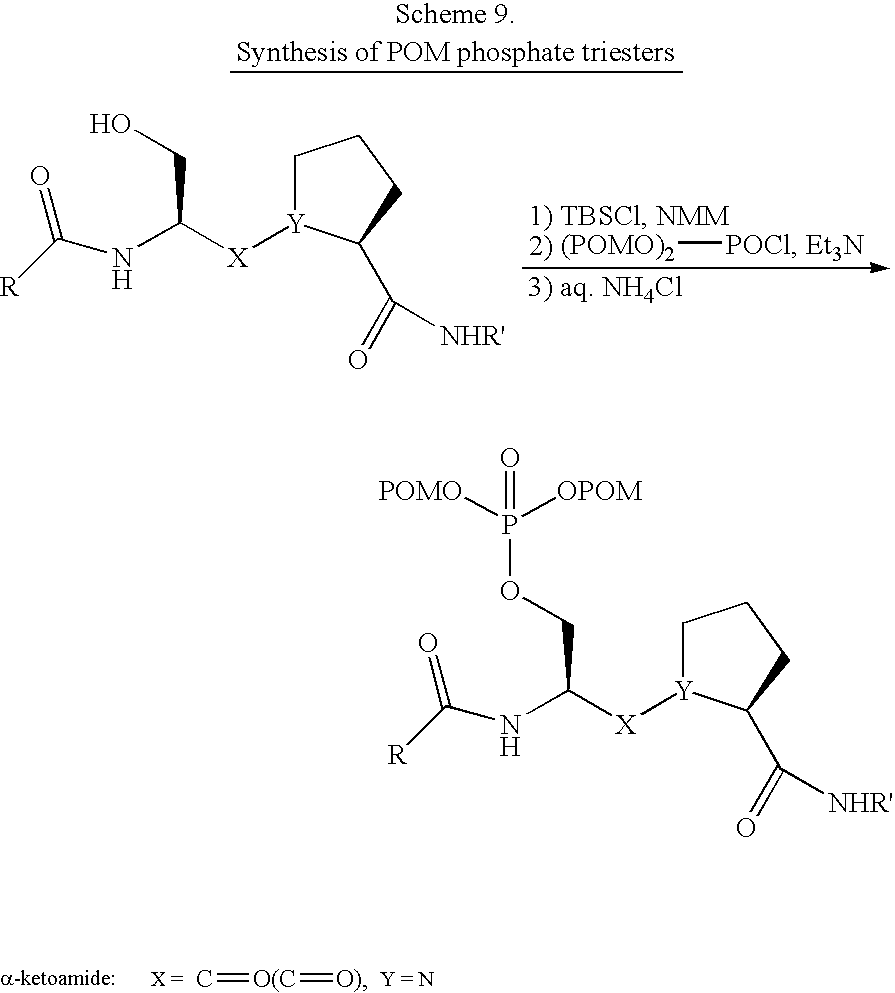
- the membrane permeability problem has been solved by masking the phosphate with hydrophobic esters that are removed by cellular enzymes, a prodrug strategy.
- Borch has developed indolequinone ester prodrugs of phosphoramidates that are membrane permeable.
- Hemick, M.; Borch, R. F. (2003) Studies on the Mechanisms of Activation of Indolequinone Phosphoramidate Prodrugs, J. Med. Chem., 46, 148-154. Hemick, M.; Flader, C.; Borch, R.
- a phosphate mimic modified compound comprising an ⁇ -ketoamide compound (such as, e.g., any of the above-mentioned ⁇ -ketoamide compounds) modified with at least one phosphate mimic (such as, e.g., phosphonate, difluorophosphonate, and bis(pivaloylmethoxy) mimics), such as, e.g., the following phosphate mimic modified compounds: wherein R is a carbonyl group attached to the amine as an amide, and R′ is an amine attached to the carbonyl as an amide.
- phosphate mimic modified compounds wherein R is a carbonyl group attached to the amine as an amide, and R′ is an amine attached to the carbonyl as an amide.
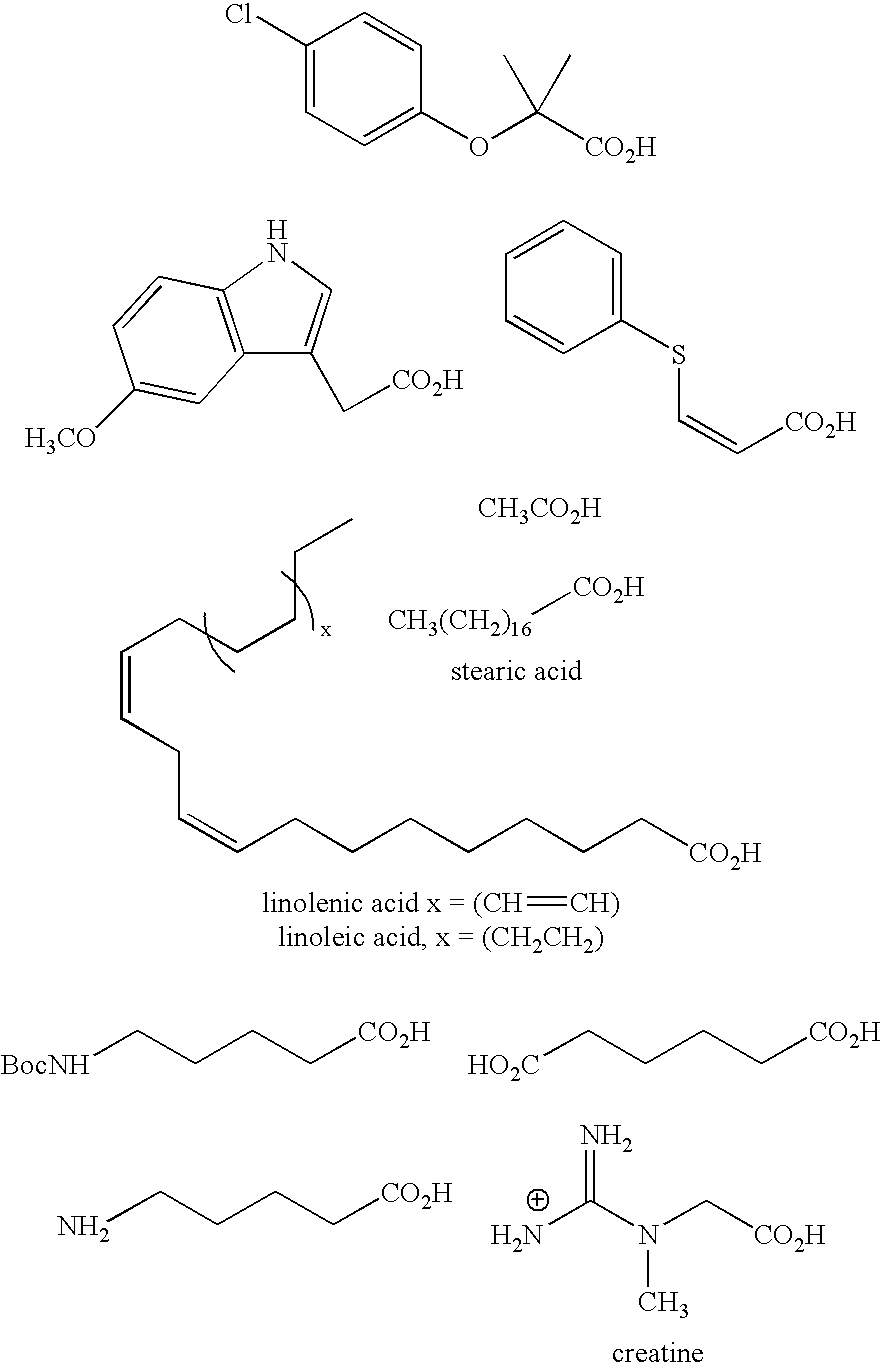
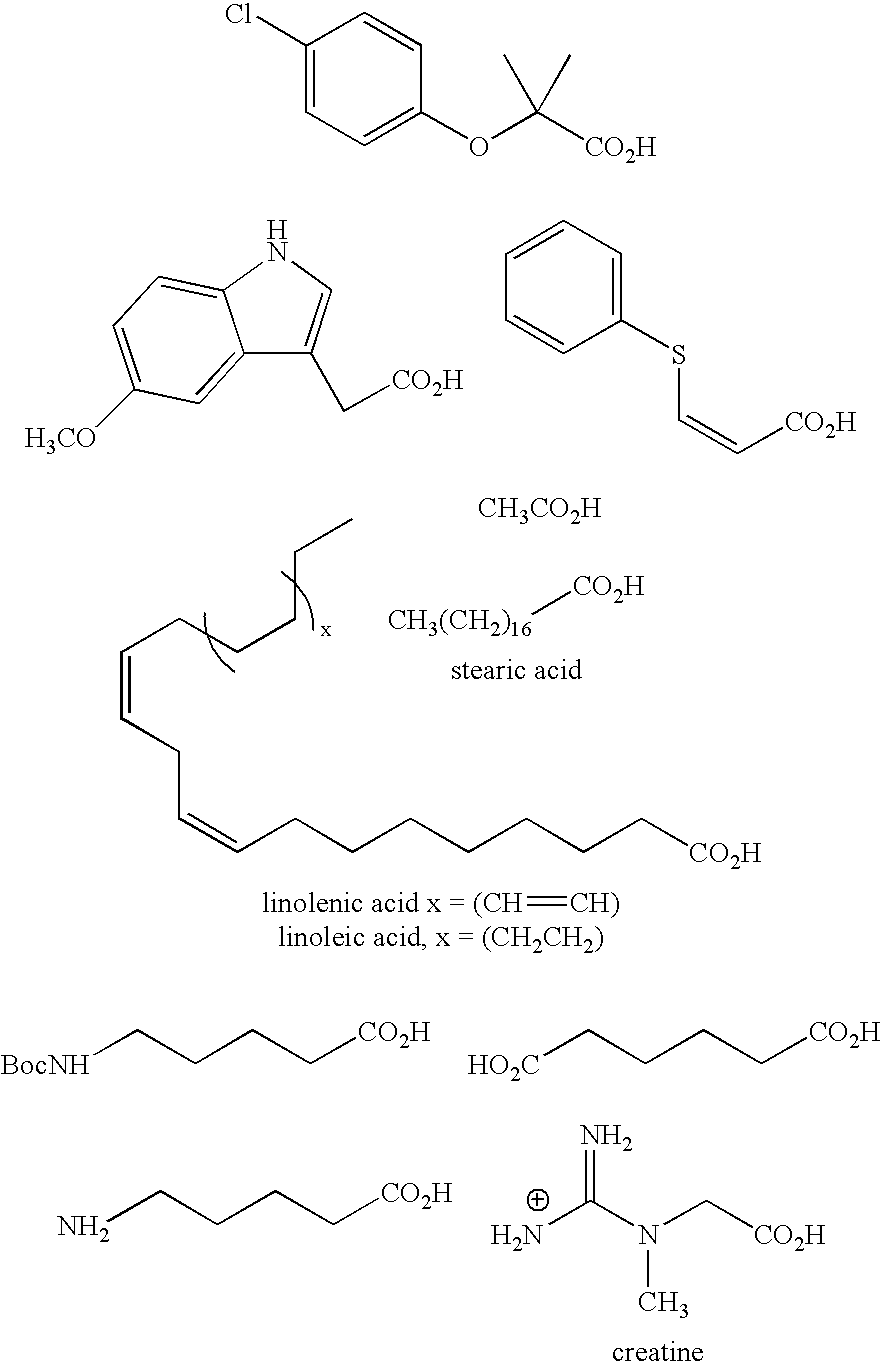
- R is, e.g., the following 26 acid and acid chloride synthons, where the connection to the c-ketoamide molecule is made through the carboxylic acid moiety.
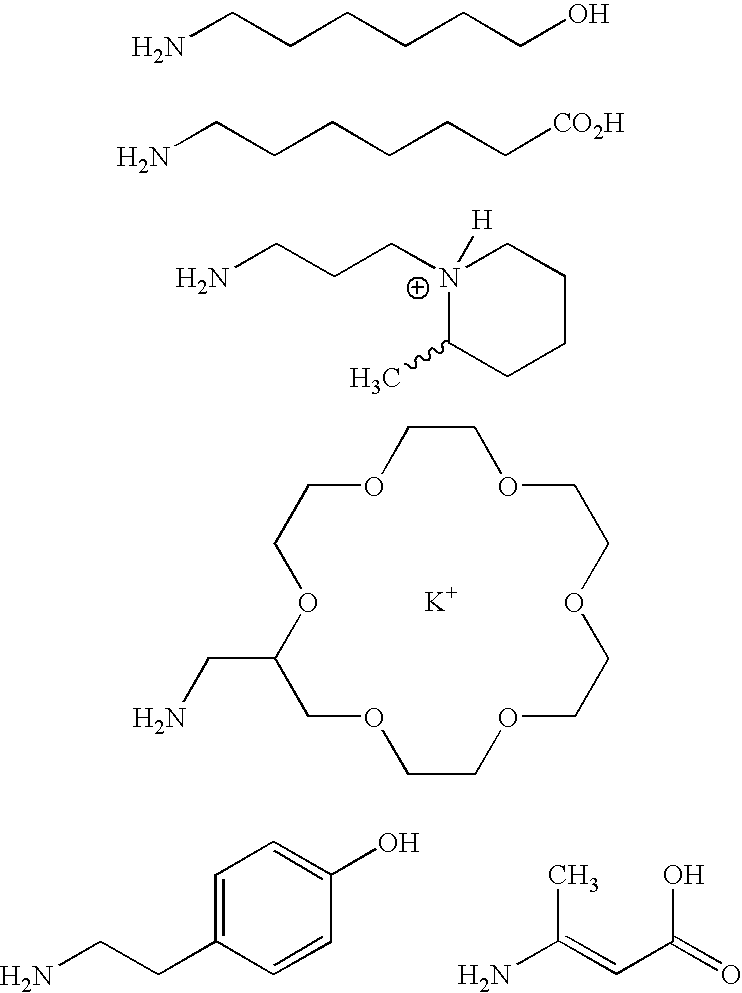
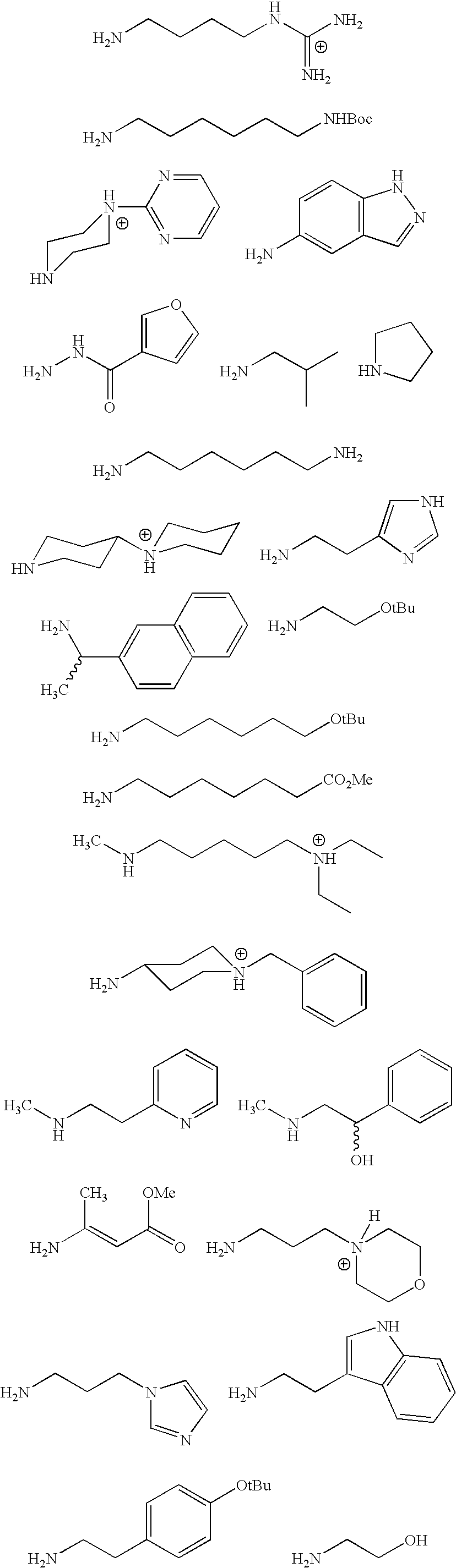
- R′ is, e.g., the following 30 amine synthons, where the connection to the ⁇ -ketoamide molecule is made through the amine moiety:
- the R and R′ moiety can be the same or different, and can each be 1-20 amino acids in length. That is, a generalized formula for a peptide, which can function as a mimic or for other purposes, according to the invention would be R- ⁇ -ketoamide-R′, where R is connected at the carbonyl end of the amino acid sequence and R′ is connected at the amino end of the amino acid sequence.
- the “ ⁇ -ketoamide” will have a phosphorous moiety (e.g., see schemes 8 and 9 above).
Landscapes
- Chemical & Material Sciences (AREA)
- Organic Chemistry (AREA)
- Health & Medical Sciences (AREA)
- Life Sciences & Earth Sciences (AREA)
- Biochemistry (AREA)
- General Health & Medical Sciences (AREA)
- Molecular Biology (AREA)
- Peptides Or Proteins (AREA)
- Medicines That Contain Protein Lipid Enzymes And Other Medicines (AREA)
Abstract
Description
- This application claims benefit of U.S. provisional application Ser. No. 60/680,518 filed May 13, 2005 titled “Synthesis of Transition-State Inhibitors of Pin1.”
- The invention was made using support from the National Institutes of Health under Grant R01 GM63271, and the U.S. Government may have certain rights in the invention.
- This invention relates to the design and synthesis of compounds that are Pin1 inhibitors.
- Conventionally, most cell cycle inhibitors have targeted kinases or phosphatases, of which there are very many. Because of the existence of so many similar targets, attaining specificity (namely, enzyme specificity) by targeting kinases or phosphatases is difficult.
- More recently, certain small molecules have begun to be designed to mimic peptides in order to determine which amide form is critical to the biological function of peptidyl-prolyl isomerases (PPIases), such as cyclophilin, with particular attention to (Z)-alkene mimics. Hart and Etzkom (2000); Hart, Trindle and Etzkom (2001). In about April 2002, drug design to stop the cancer cell cycle was under consideration, and the cell-cycle-regulating enzyme, Pin1, was targeted, with an eye towards anticancer activity. (Virginia Tech Press release dated Apr. 10, 2002, “Chemists Explore the Shape of the Key that Signals Cell Division in Cancer Cells). At that time, the single known inhibitor of Pin1 was a natural product, juglone, that is not specific for PinI and is a poor inhibitor. (Hennig, L., Christner, C., Kipping, M., Schelbert, B., Rucknagel, K. P., Grabley, S., Kullertz, G., and Fischer, G. (1998), Selective inactivation of parvulin-like peptidyl-prolyl cis/trans isomerases by juglone, Biochemistry 37, 5953-5960.)
- Regulation of the cell cycle is of fundamental significance in developmental biology and gives rise to cancer when it goes awry. The enzyme Pin1 is a phosphorylation-dependent peptidyl-prolyl isomerase (PPIase) enzyme thought to regulate mitosis via cis-trans isomerization of phosphoSer-Pro amide bonds in a variety of cell cycle proteins. (Lu, K. P., Hanes, S. D., and Hunter, T. (1996), A human peptidyl-prolyl isomerase essential for regulation of mitosis, Nature 380, 544-547; Yaffe, M. B., Schutkowski, M., Shen, M., Zhou, X. Z., Stukenberg, P. T., Rahfeld, J.-U., Xu, J., Kuang, J., Kirshcner, M. W., Fischer, G., Cantley, L. C., and Lu, K. P., Science 278 (1997) 1957.) In particular, Pin1 has been shown to bind phosphoSer-Pro epitopes in Cdc25 phosphatase, a key regulator of the Cdc2/cyclinB complex. (King, R. W., Jackson, P. K., and Kirschner, M. W., Cell 79 (1994) 563.) The central role Pin1 plays in the cell cycle makes Pin1 an interesting target for inhibition, both for potential anti-cancer activity and for elucidation of the mechanism of mitosis regulation. It has been proposed (Shen, M., Stukenberg, P. T., Kirschner, M. W., and Lu, K. P., Genes Dev. 12 (1998) 706) that Pin1 recognition of the phosphoSer-Pro amide bond acts as a conformational switch in the cell cycle.
- Pin1 is unique among PPIases. (Lu, K. P., Hanes, S. D., Hunter, T., Nature 1996, 380, 544-547.) Pin1 regulates the entry into mitosis by catalyzing the conformational change on Cdc25 which regulates Cdc2, the central mitotic kinase. (Stukenberg, P. T., Kirschner, M. W., Pin1 Acts Catalytically to Promote a Conformational Change in Cdc26, Mol. Cell 2001, 7, 1071-1083.) Pin1 also regulates the activity of Cyclin D1, another cell-cycle protein that is active in G1. (Wulf, G. M., Liou, Y. C., Ryo, A. L., et al., Role of Pin1 in the Regulation of p53 Stability and p21 Transactivation, and Cell Cycle Checkpoints in Response to DNA Damage, J Biol. Chem., 2002, 277, 47976-47979.) Pin1 has two domains: WW domain and PPIase domain. Both of these domains recognize the phosphoserine-proline or phsophothreonine-proline bonds present in mitotic phosphoproteins. (Yaffe et al., supra.)
- For additional background regarding Pin1, see also U.S. Pat. No. 6,596,848 issued Jul. 22, 2003 to Hunter et al. (Salk Institute) for “Antibodies to NIMA interacting proteins”, which is herein incorporated by reference.
- Preference for phosphorylated substrates by Pin1 has been clearly demonstrated (Yaffe, supra), with the central dipeptide phosphoSer-Pro as the primary recognition element. Successful laboratory work has been accomplished using a (Z)-alkene amide bond isostere to mimic the Ala-cis-Pro amide bond for the inhibition of the PPIase cyclophilin, which then led to design of an analogous inhibitor based on a substrate for Pin1. Hart, S. A., Sabat, M., and Etzkom, F. A., J. Org. Chem. 63 (1998) 7580; Hart, S. A., and Etzkom, F. A., J. Org. Chem. 64 (1999) 2298. Synthesis of the Boc-Ser-Ψ[(Z)CH=C]-Pro mimic proceeded with regio- and enantio-selectivity through a [2,3]-sigmatropic rearrangement. Wang, X. J., Hart, S. A., Xu, B., Mason, M. D., Goodell, J. R., and Etzkom, F. A. (2003), Serine-cis-proline and Serine-trans-proline Isosteres: Stereoselective Synthesis of (Z)- and (E)-Alkene Mimics by Still-Wittig and Ireland-Claisen Rearrangements, J. Org. Chem. 68, 2343-2349.
- The possibility of Pin1 activity led to interest and work on certain alkene mimics. (Wang, supra); Wang, X. J., Xu, B., Mullins, A. B., Neiler, F. K., and Etzkom, F. A. (2004), Conformationally Locked Isostere of PhosphoSer-cis-Pro Inhibits Pin1 23-Fold Better than PhosphoSer-trans-Pro Isostere, J. Am. Chem. Soc. 126, 15533-15542.
- However, relatively few inhibitors of Pin1 are known, and Pin1 inhibitors with greater inhibitory activity would be desirable for medical applications. (Hennig, supra); Uchida, T., Takamiya, M., Takahashi, M., Miyashita, H., Ikeda, H., Terada, T., Matsuo, Y., Shirouzu, M., Yokoyama, S., Fujimori, F., and Hunter, T. (2003), Pin1 and Par14 peptidyl prolyl isomerase inhibitors block cell proliferation, Chem. Biol. 10, 15-24.1.) Nanomolar peptide inhibitors of Pin1 have been discovered recently from combinatorial libraries. (Wildemann, D.; Erdmann, F.; Alvarez, B. H.; Stoller, G.; Zhou, X. Z.; Fanghanel, J.; Schutkowski, M.; Lu, K. P.; Fischer, G., (2006) Nanomolar inhibitors of the peptidyl prolyl cis/trans isomerase Pin1 from combinatorial peptide libraries, J Med Chem, 49, 2147-50.)
- The reversible phosphorylation of proteins is the most important post-translational modification that occurs in the cell. It is also the most efficient and versatile signal of intermolecular communication. As a result, many drug targets show high-affinity interactions with phosphorylated molecules, while their unphosphorylated counterparts do not bind well to the targets. However, there is a problem for these phosphorylated molecules: unprotected phosphorylated compounds are not effective at penetrating cell membranes, thus are not bioactive because of the negative charges on phosphate groups. One general approach to this problem involves masking the phosphate in a form that neutralizes their negative charges. Among the reversibly masking phosphate compounds, a bis-pivaloyloxymethyl (bisPOM) strategy is especially useful since such compounds are quite stable in buffer and plasma and they are readily transformed to free phosphate inside various cell types. The mechanism for degradation of bis(POM) phosphate inside cells has been studied. During the process, two different degradation enzymes are involved: esterase and phosphodiesterase. Thus, after the cell entry, the mask for the phosphate group is removed and the compounds converted to a biologically active form. Methods have been described to introduce the bispivaloyloxymethyl(POM) phosphate triesters. (Hwang, Y.; Cole, P. A., (2004) Efficient synthesis of phosphorylated prodrugs with bis(POM)-phosphoryl chloride, Org Lett, 6, 1555-6. Farquhar, D.; Chen, R.; Khan, S., (1995) 5′-[4-(Pivaloyloxy)-1,3,2-dioxaphosphorinan-2-yl]-2′-deoxy-5-fluorouridine: a membrane-permeating prodrug of 5-fluoro-2′-deoxyuridylic acid (FdUMP), J Med Chem, 38, 488-95. Farquhar, D.; Khan, S.; Srivastva, D. N.; Saunders, P. P., (1994) Synthesis and antitumor evaluation of bis[(pivaloyloxy)methyl] 2′-deoxy-5-fluorouridine 5′-monophosphate (FdUMP): a strategy to introduce nucleotides into cells, J Med Chem, 37, 3902-9.)
- However, there remain unstudied areas relating to Pin I, such as possible synthesis of potent inhibitors of Pin1 that may serve as anti-cancer drug lead compounds.
- As background, there is also mentioned what previously has been a separate field involving a-keto amides which inhibit several proteases, such as serine proteases and cysteine proteases. See, e.g., U.S. Pat. No. 7,001,907 issued Feb. 21, 2006, U.S. Pat. No. 6,703,368 issued Mar. 9, 2004 and U.S. Pat. No. 6,288,231 issued Sep. 11, 2001 all to Chatterjee et al. (Cephalon, Inc.) for “Peptide-containing α-ketoamide cysteine and serine protease inhibitors”; U.S. Pat. No. 6,150,378 issued Nov. 21, 2000 to Chatterjee et al. (Cephalon) for “Peptidyl-containing α-ketoamide cysteine and serine protease inhibitors.” The α-keto amide functional group has been used in a wide range of enzyme inhibitors to elucidate the inhibition mechanisms of enzymes including PPIases. (Wang, X. J.; Etzkom, F. A., (2006) Peptidyl-Prolyl Isomerase Inhibitors, Biopolymers: Peptide Science, 84, 125-146.) See U.S. Pat. No. 6,781,000 issued Aug. 24, 2004 and U.S. Pat. No. 6,075,150 issued Jun. 13, 2000 both to Wang, et al. (CV Therapeutics) for “α-ketoamide inhibitors of 20S proteasome”; U.S. Pat. No. 6,774,212 issued Aug. 10, 2004 to Han et al. (Bristol-Meyers Squibb Pharm) for “α-ketoamide inhibitors of hepatitis C virus NS3 protease”; U.S. Pat. No. 6,310,057 issued Oct.30, 2001 and U.S. Pat. No. 6,096,778 issued Aug. 1, 2000 both to Chatterjee et al. (Cephalon) for “α-ketoamide multicatalytic protease inhibitors”; U.S. Pat. No. 6,083,944 issued Jul. 4, 2000 to Chatterjee et al. for “Quinoline-containing α-ketoamide cysteine and serine protease inhibitors”; U.S. Pat. No. 5,670,479 issued Sep. 23, 1997 and U.S. Pat. No. 5,656,600 issued Aug. 12, 1997 to Abelman et al. (Corvas), for “α-ketoamide derivatives as inhibitors of thrombosis”.
- Other examples of cc-ketoamides and synthesis thereof include, e.g., U.S. Pat. No. 7,022,738 issued Apr. 4, 2006 to Nakamura et al. (Senju Pharmaceutical Co.) for “α-ketoamide derivatibves and use thereof”; U.S. Pat. No. 6,452,050 issued Sep. 17, 2002 and U.S. Pat. No. 6,143,931 issued Nov. 7, 2000 both to Baldino et al. (ArQule, Inc.) for “Synthesis and use of α-ketoamide derivatives and arrays”; U.S. Pat. No. 6,187,905 issued Feb. 13, 2001 to Hurst et al. for “α-ketoamide derivatives”; U.S. Pat. No. 5,414,122 issued May 9, 1995 to Murabayashi et al. (Shionogi & Co.) for “Process for producing α-ketoamide derivative.”
- It has now been recognized that α-keto amides can function as Pin1 inhibitors. In addition, families of new Pin1 inhibitors which are α-keto amides (such as, e.g., α-keto amide Ser-Pro analogues) have been synthesized. In particular, α-keto amides are shown to have an activity as transition state mimetics. This functionality permits stable inhibition of catalytic activity. The exemplary compounds described mimic a transition-state “twisted amide”.
- Exemplary α-ketoamide compounds within the practice of this invention include:
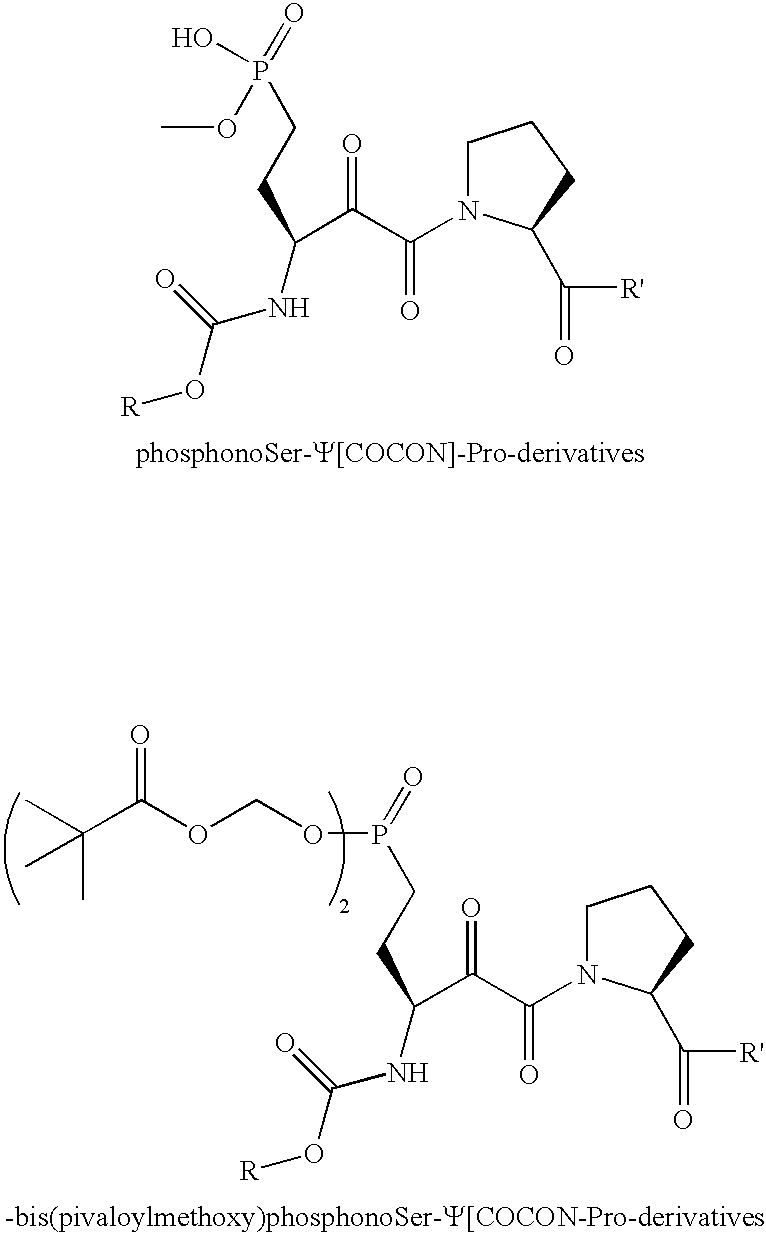

wherein R is a carbonyl group attached to the amine as an amide, and R′ is an amine attached to the carbonyl as an amide. There are a wide variety of R and R′ moieties which can be used within the practice of the invention. In an exemplary embodiment of the invention, the (α-ketoamides are incorporated into peptide structures to serve as mimics. In a particular application, an α-ketoamide Ser-Pro dipeptide analogue into the pentapeptide analogue Ac-Phe-Tyr-pSer-Pro-Arg-NH2 which is an inhibitor of Pin1 (i.e., the “pSer-Pro” constitutes the α-ketoamide Ser-Pro dipeptide analogue of this invention). Preferably, the peptide mimics of this invention will have one or more α-ketoamide dipeptides incorporated into peptides of 1-20 amino acids in length. - Because α-ketoamides have an electron-deficient carbonyl group due to the effect of the neighboring electron-withdrawing amide group, the α-ketoamides can serve as transition state mimetics and allow inhibition of catalytic activity. It is now recognized that such an activity for α-ketoamides may be applied in the context of Pin1. This activity has previously been known in a non-Pin1 context; namely, this activity occurs for serine or cysteine proteases through the formation of a tetrahedral intermediate (gem-diol or hemiketal) with the enzyme upon binding. (Maryanoff, B. E., Qiu, X., Padmanabhan, K. P., Tulinsky, A., Almond, H. R., Jr., Patricia, A. G., Greco, M. N., Kaufftnan, J. A., Nicolaou, K. C., Liu, A., Brungs, P. H., Fusetani, N., Molecular basis for the inhibition of human α-thrombin by the macrocyclic peptide cyclotheonamide A, Proc. Natl. Acad. Sci. USA 1993, 90, 8048-8052.)
- The property of α-ketoamides mimicking a “twisted amide” transition-state structure with a dihedral angle of 95 to 100 degrees between carbonyl groups, may be exploited in a Pin1 context. A “twisted amide” transition-state structure has previously been observed in a non-Pin1 context. (Rosen, M. K.; Standaert, R. F.; Galat, A.; Nakatsuka, M.; Schreiber, S. L., Inhibition of FKBP rotamase activity by immunosuppressant FK506: twisted amide surrogate. Science 1990, 248, (4957), 863-866.)
- An example of making a peptidomimetic according to the invention is, e.g., to incorporate an α-ketoamide into another molecule (preferably a molecule which is a peptide inhibitor of Pin1), such as, e.g., incorporating an α-ketoamide Ser-Pro dipeptide analogue (such as presented in structure 11 below) into a pentapeptide analogue Ac-Phe-Tyr-pSer-Pro-Arg-NH2 where “pSer-Pro” is the structure presented in structure 11 of Scheme 8 or, for example, the phosphate triesters set forth in Scheme 9 below. The pentapeptide analogue Ac-Phe-Tyr-pSer-Pro-Arg-NH2 is considered an optimal peptide inhibitor of Pin1. (Zhang, Y.; Fussel, S.; Reimer, U.; Schutkowski, M.; Fischer, G., Substrate-Based Design of Reversible Pin1 Inhibitors. Biochemistry 2002, 41, 11868-11977.) This peptidomimetic constructed by incorporating an α-ketoamide Ser-Pro dipeptide analogue into a pentapeptide analogue Ac-Phe-Tyr-pSer-Pro-Arg-NH2 is designed as a potential transition-state analogue inhibitor of Pin1, because the α-ketoamide may react with Cys113 in the active site of Pin1 to form the tetrahedral intermediate hemithioketal, or it may act as a surrogate of the “twisted” amide transition state of peptides bound to Pin1. However, it should be understood that the α-ketoamide Ser-Pro dipeptide could be incorporated into any peptide moiety for some applications of the invention and that there could be, for example, one to ten amino acids on either side of the α-ketoamide Ser-Pro dipeptide. Likewise, the invention contemplates the incorporation of other α-ketoamide dipeptides into peptides of 1-20 amino acids in length.
- α-ketoamides used in this invention may be synthesized according to known methods, such as, e.g., cyano ylide coupling methodology, synthesis from carbamoylsilane and acid chlorides, transition-metal-catalyzed double carbonylation, amidation of α-keto acids with amines, oxidation from a-hydroxyl amides, and Grignard reagent nucleophilic addition.
- For synthesis of dipeptide α-keto amides for use in the present invention, two preferred methods are set forth as follows with reference to Schemes 1-3.
- 1. Cyano Ylide Coupling Methodology
- Wasserman et al. developed versatile strategies for the formation of α-keto amides through the use of the (cyanomethylene)triphenylphosphorane. (Wasserman, H. H.; Ho, W. B., (Cyanomethylene)phosphoranes as Novel Carbonyl 1, 1-Dipole synthons: An Efficient Synthesis of alpha-Keto Acids, Esters, and Amides. J Org. Chem. 1994, 59, 4364-4366.) The reaction is shown in Scheme 1.
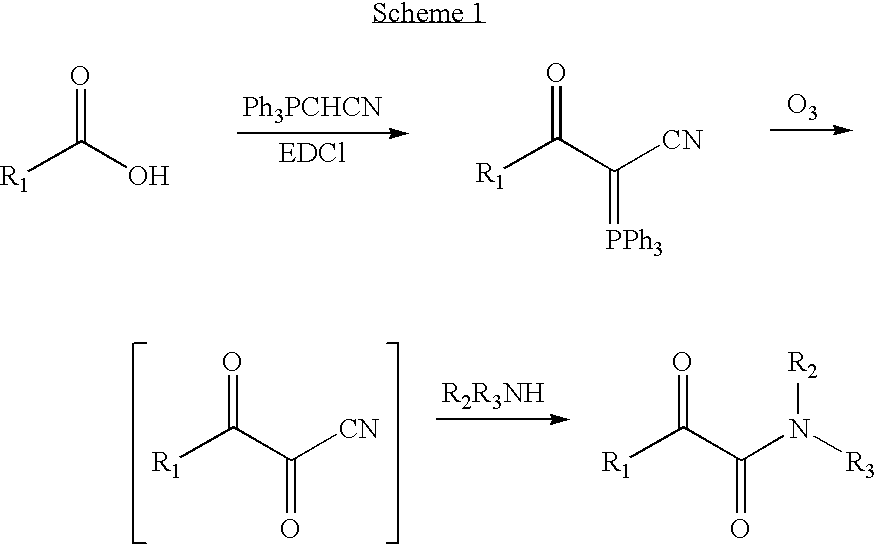
First the carboxylic acid is coupled with (cyanomethylene)triphenylphosphorane in the presence of EDCI and DMAP, then the ylide formed is treated with ozone to generate an α,β-diketo nitrile, which is not stable at room temperature, treated in situ with amines to form α-keto amides. This method has wide application and has been used in synthesis of natural products such us eurystatin A and B, poststatin and verongamine. (Wasserman, supra; Kim, H.-O.; Nakanishi, H.; Lee, M. S.; Kahn, M., Design and Synthesis of Novel Conformationally Restricted Peptide Secondary Structure Mimetics. Org. Lett. 2000, 2, (3), 301-302; Wasserman, H. H.; Wang, J., Synthesis of the Marine Metabolites Verongamine, Hemibastadin-2, and Aerothionin Using the Cyano Ylide Coupling Methodology. J Org. Chem. 1998, 63, 5581-5586.) - This cyano ylide method has been applied to various carboxylic acids, especially amino acids in excellent yields for the first step and in moderate yields for the second step. The advantage of this method is that the synthesis route is short and starting materials are commercially available.
- 2. From α-Hydroxy Acids
- 2.1. The Synthesis of α-Hydroxy Acids
- Numerous methods to synthesize α-hydroxy amides are known to those in the art. The most common method is through the coupling of α-hydroxy acids with amines. The following Scheme 2 shows a common method used in many dipeptide α-ketoamides syntheses:
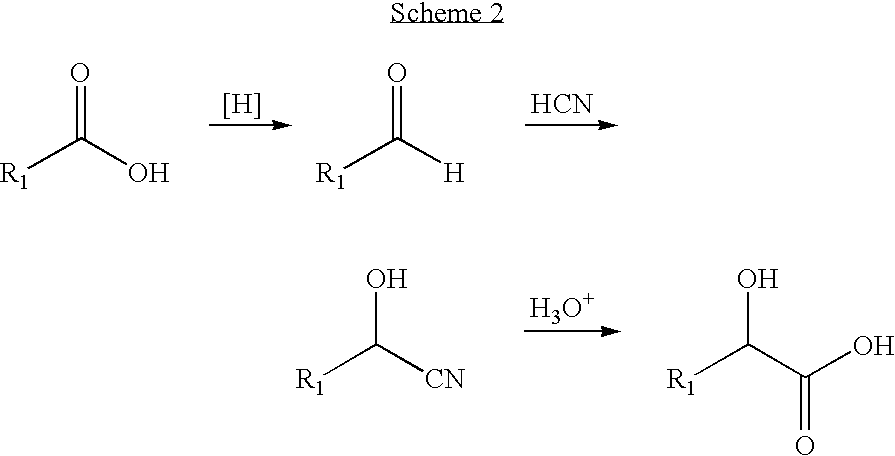
- 2.2. The Oxidation of α-Hydroxy Amides
- Oxidation of α-hydroxy amides is widely used in the synthesis of α-keto amide inhibitors of enzymes. (Zhang, Y.; Fussel, S., Reimer, U., Schutkowski, M., Fischer, G., Substrate-Based Design of Reversible Pin1 Inhibitors, Biochemistry, 2002, 41, 11868-11877). Examples of oxidants include, e.g., Dess-Martin, TEMPO or PDC oxidation.
- The oxidation of α-hydroxy amides is a common method used in peptide α-keto amide synthesis; however the synthetic route to the α-hydroxy acids is long. The drawback of this method in the oxidation step is the epimerization of the chiral center adjacent to the ketone group which causes the formation of a mixture of diastereomers. Harbeson et al. reported an oxidation by TEMPO/hypochlorite without epimerization. (Harbeson, S. L.; Abelleira, S. M.; Akiyama, A.; Barrett, R.; Carroll, R. M.; Straub, J. A.; Tkacz, J. N.; Wu, C.; Musso, G. F., Stereospecific Synthesis of Peptidyl α-Keto Amides as Inhibitors of Calpain. J Med. Chem. 1994, 37, 2918-2929.) The general equation of this reaction is shown in Scheme 3.
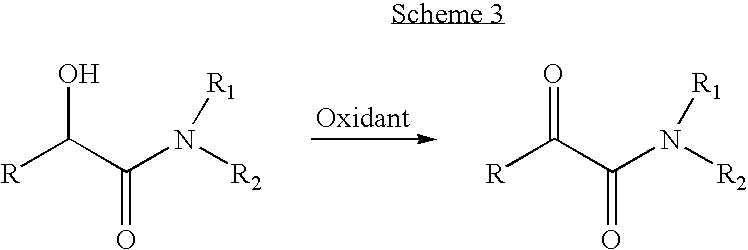
- As between the two above-described synthetic methods of α-ketoamides, the cyano ylide methodology is preferred for synthesis in the present invention because only two steps are required for the key dipeptide α-ketoamide syhthesis.
- Pin1 inhibitors, such as the inventive Pin1 inhibitors which are peptidomimetics, may be used as anti-cancer agents alone or in conjunction with apoptosis inducers. Pin1 inhibitors (such as the inventive Pin1 inhibitors) may also be useful in the treatment of cocaine addiction. Inhibition of Pin1 may be important in other disease processes because Pin1 is an essential regulator of the G2 to M transition in the cell cycle.
- Advantageously, the inventive compounds which are Pin1 inhibitors or which are peptidomimetics should bind more specifically than juglone which is currently used as a Pin1 inhibitor.
- Unlike conventional cell cycle inhibitors, which target kinases or phosphatases (of which there are many therefore making specificity difficult to attain), the inventive peptidomimetic Pin1 inhibitors operate by an entirely different mechanism and therefore make possible the specific targeting of cancer cells.
- The invention may be further appreciated with reference to the following examples, without the invention being limited to the Examples.
- The reaction scheme for the synthesis of the α-ketoamide Ala-Pro dipeptide analogue is shown in Scheme 4, which is a model reaction for synthesis of the α-ketoamide Ser-Pro dipeptide analogue. Additionally, the α-ketoamide Ala-Pro dipeptide analogue may be a potential inhibitor of cyclophilin.
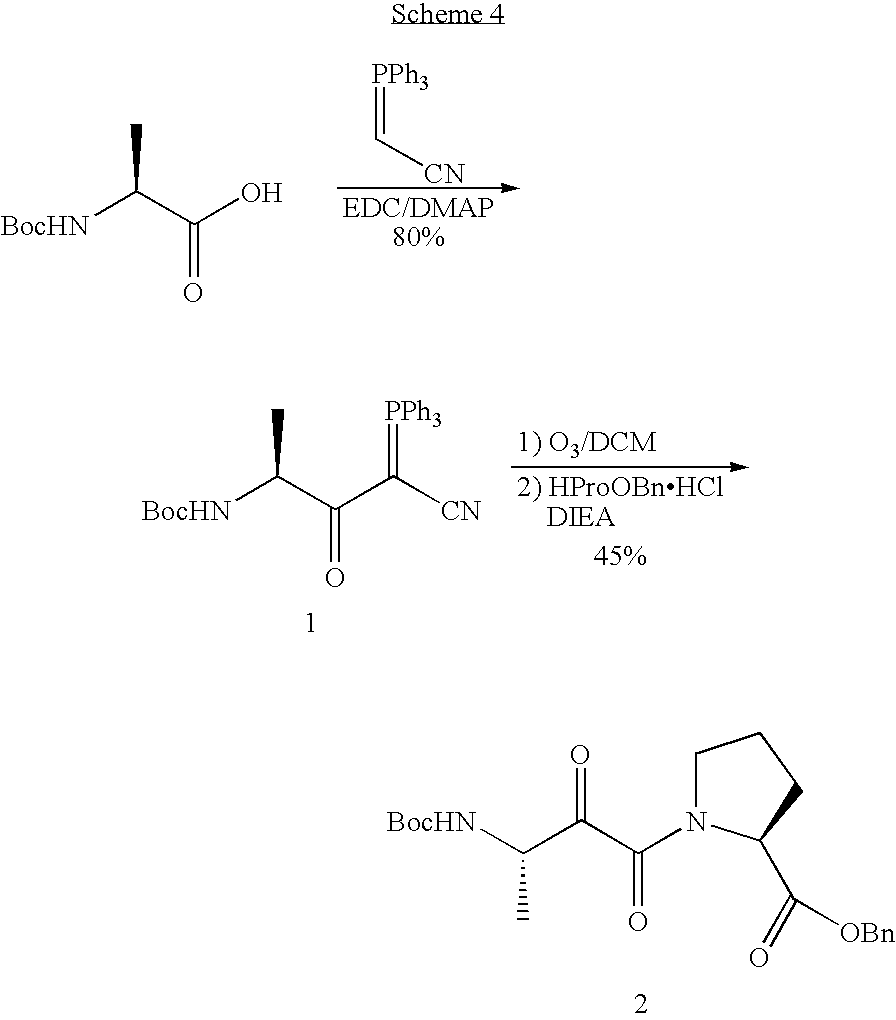
- In the first step, the ylide 1 was synthesized from a coupling reaction between commercially available (cyanomethylene)triphenylphosphorane and Boc-L-AlaOH with EDC in the presence of 4-dimethylaminopyridine. Under these conditions, a good yield of 80% was obtained.
- In the second step, the ylide 1 was oxidized to an α,β-diketonitrile. This labile electrophile then was reacted in situ with HProOBn to form the α-keto amide 2. From NMR and MS spectra, this α-ketoamide 2 appeared to be obtained as a mixture of isomers in 45% yield.
- The ozonolysis method of Example 1 was used in the synthesis of α-keto amide Ser-Pro dipeptide analogue (Scheme 5).
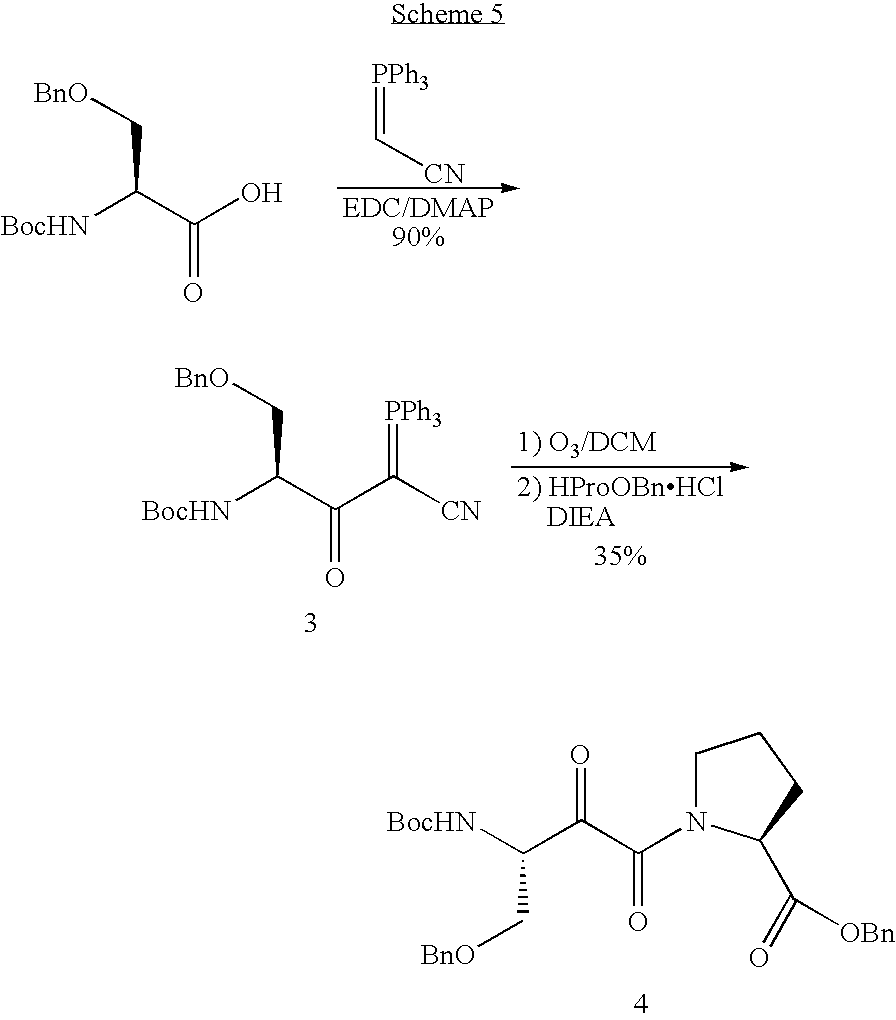
- The ylide 3 was synthesized in an excellent yield of 90% by the same method as ylide 1. The Ser-Pro α-ketoamide 4 was obtained as a mixture of isomers in 35% yield. During purification of compound 4 on column, some decomposition happened, making purification of the crude product mixture difficult. For compound 4, at least four steps (hydrogenolysis, deprotection of Boc, protection with Fmoc and phosphorylation) were needed to prepare the phosphorylated FmocSer-Pro α-ketoamide 7 ready for solid phase synthesis of peptides.
- Because the Fmoc protecting group is tolerant of ozonolysis according to the literature, FmocSer(Ot-Butyl)OH is selected as the starting material. The ylide 5 thus formed gives the α-ketoamide after ozonolysis and treatment with HProOt-Bu. Two steps are therefore saved in the synthesis of α-ketoamide 7. The ylide 5 has been prepared in 85% yield and α-ketoamide 6 has been prepared in 35% yield (Scheme 6). From the NMR, the compound 6 seemed to be obtained as isomers. It is difficult to isolate them, and they seem to isomerize or decompose on column or in solution. Then the mixture was directly used in the next deprotection step.
- The compound 7 characterized by MS was obtained in 30% yield. The product was found to be unstable in solution, and it totally decomposed in CDCl3 solution after 2 days. The decomposition product appears to be a cyclic dimer (bis-lactone) of 7.

- For assaying the inhibitory activities of the α-ketoamide inhibitor, Pin1 enzyme is used according to Scheme 8.
- A series of different amines (see FIG. 1) and carboxylic acids (see FIG. 2) are coupled to the C-terminus and N-terminus to produce compounds of the type 10. In addition, cell permeable derivatives 11 are prepared to improve bioavailability.

- Phosphate monoesters such as those used in the previous schemes are suitable for in vitro enzyme inhibition studies. However, problems with membrane permeability for phosphate esters are well known and reflected in the need for DMSO in cell-based assays conducted with Pin1 inhibitors. (Wang, X. J.; Xu, B.; Mullins, A. B.; Neiler, F. K.; Etzkom, F. A., (2004) Conformationally Locked Isostere of PhosphoSer-cis-Pro Inhibits Pin1 23-Fold Better than PhosphoSer-trans-Pro Isostere, J. Am. Chem. Soc., 126, 15533-15542.) Towards this end, to solve the problems of bioavailability conferred by the specificity of Pin1 for phosphoSer/Thr preceding Pro, using bis-pivaloylmethoxy (POM) phosphate triesters as prodrugs of Pin1 inhibitors is preferred.
- The membrane permeability problem has been solved by masking the phosphate with hydrophobic esters that are removed by cellular enzymes, a prodrug strategy. (Wagner, C. R.; Iyer, V. V.; Mclntee, E. J., (2000) J. Med. Res. Rev., 20, 417-451.) Borch has developed indolequinone ester prodrugs of phosphoramidates that are membrane permeable. (Hemick, M.; Borch, R. F., (2003) Studies on the Mechanisms of Activation of Indolequinone Phosphoramidate Prodrugs, J. Med. Chem., 46, 148-154. Hemick, M.; Flader, C.; Borch, R. F., (2002) Design, synthesis and biological evaluation of indolequinone phosphoramidate prodrugs targeted to DT-diaphorase, J. Med. Chem., 45, 3540-3548.) The indene moiety was found to be activated by reduction by NAD(P)H: quinone oxidoreductase (NQO1). (Segnitz, B.; Gehring, U., (1997) The function of steroid hormone receptors is inhibited by the hsp90-specific compound geldanamycin, J Biol Chem, 272, 18694-701. Ross, D.; Siegel, D.; Beall, H.; Prakash, A. S.; Mulcahy, R. T.; Gibson, N. W., (1993) DT-diaphorase in activation and detoxification of quinones. Biorductive activation of Mitomycin C. (Review). Cancer Metastasis Rev., 12, 83-101. Gutierrez, P. L., (2000) The role of NAD(P)H oxidoreductase (DT-diaphorase) in the bioactivation of quinone-containing antitumor agents: A review, Free Radical Biol. Med., 29, 263-275.) pivaloylmethoxymethyl (POM) ester group has been shown to be stable under aqueous conditions in the pH range from 1-8, but it is hydrolyzed by general carboxylate esterases in cells. Two POM groups on a phosphate generally confer membrane permeability and biological activity on a number of different types of phosphates. (Hwang, Y.; Cole, P. A., (2004) Efficient synthesis of phosphorylated prodrugs with bis(POM)-phosphoryl chloride, Org Lett, 6, 1555-6.) The second strategy is preferred to improve the bioavailability of Pin1 ligands, using the reagent synthesized by Hwang et al. to phosphorylate lead compounds (Scheme 9).
- Experimentation was conducted as follows.
- General. Flash chromatography was performed on 230-400 mesh, ASTM silica gel with reagent grade solvents. NMR spectra were obtained at ambient temperature in CDC13 unless otherwise noted. Proton and carbon-13 NMR spectra were obtained at 500 and 125 MHz, respectively.
- Compound 4: Ozone was added to the solution containing ylide 3 (240 mg, 0.41 mmol) until the pale green color stayed unchanged under −78 C. Extra Ozone was purged by Nitrogen. HProOBn.HCl (110 mg, 0.46 mmol) in 1 ml DCM containing 63.9 mg DIEA (0.49 mmol) was cooled and added to the reaction mixture slowly. The resulting mixture was stirred at −78 C. for 2 hours then at room temperature for 1 h. The reaction mixture was diluted with 20 mL DCM and then washed with Brine twice. The organic layer was dried over Na2SO4. After filtration and evaporation, the residue was purified on chromatography (eluent: 30% EA in Hexane) to give the ketoamide 4 as the mixture of isomers (73 mg, crude yield: 33%). HNMR: δ 1.40 (m, 9H), δ 1.83-2.15 (4H), 3.50-3.75 (m, 2H), δ 4.05 (m, 1H), δ 4.38-4.55 (m, 4H), δ 5.15 (3H), 5.40 (d, 1H), δ 7.35 (10H). CNMR: 196.8, 171.8, 169.5, 155.4, 138.0, 135.8, 128.6-128.4, 80.0, 73.3, 71.0, 66.9, 59.2, 52.1, 47.2, 32.0, 29.0, 24.7. LRMS: calcd for C28H34N207 (MH+) m/z=511.2 found m/z=511.4.
- Compound 5: A solution of Fmoc-L-SerOH (648 mg, 1.69 mmol), (cyanomethylene)phosphorane (509 mg, 1.69 mmol), DMAP (62 mg, 0.51 mmol) and EDC (387 mg, 2.03 mmol) in CH2Cl2 (10 mL) was stirred at rt for 3 h. The reaction mixture was then diluted with CH2Cl2 (20 mL), washed with water (30 mL×2) and Brine (30 mL). The organic layer was dried over Na2SO4, filtered and evaporated under reduced pressure. The crude product was purified by chromatography on silica (gradient: 50 to 60% EtOAc in hexane) to yield the ylide 5 (960 mg, 85.2%) as an oil. H NMR: δ 1.21 (s, 9H), 3.80 (q, 1H), 4.18 (t, 2H), 4.27 (t, 1H), 4.36 (t, 1H), 5.00 (d, 1H), 5.98(d, 2H), 7.25-7.75 (m, 23H).
- Compound 6: Ozone was added to the solution containing ylide 5 (172 mg, 0.26 mmol) until the pale green color stayed unchanged under −78 C. Extra Ozone was purged by Nitrogen. HProOt-Bu (44 mg, 0.26 mmol) in 1 ml DCM was cooled and added to the reaction mixture slowly. The resulting mixture was stirred at −78 C. for 2 hours then at room temperature for 1 h. The reaction mixture was diluted with 20 mL DCM and then washed with Brine twice. The organic layer was dried over Na2SO4. After filtration and evaporation, the residue was purified on chromatography (eluent: 30% EA in Hexane) to give the ketoamide 6 as the mixture of isomers (50 mg, crude yield: 33%). HNMR: δ 1.12 (d, 9H), 1.45 (m, 9H), δ 1.85-2.25 (m, 4H), 3.68 (m, 2H), δ 4.15 (m, 1H), δ4.25 (m, 1H), 4.38 (m, 2H), δ 5.22 (1H), 5.70 (m, 1H), δ 7.28-7.75 (8H). CNMR: 195.7, 170.2, 161.7, 155.9, 144.1, 141.4, 127.8, 127.1, 125.2, 120.0, 82.0, 67.2, 60.0, 58.4, 47.7, 47.2, 29.0, 28.0, 21.8. LRMS: calcd for C21H28N206 (MH+) m/z =565.67 found m/z=565 (EI+).
- Compound 8: Compound 6 (140 mg, 0.248 mmol) was dissolved in 6 mL DCM, and then 3 mL TFA and 0.01 mL TES were added. The resulting reaction mixture was stirred at room temperature for 3 hours. After evaporation, the residue was purified by column (eluent: CHCl3:CH3OH=20:1 or MeOH:CH2Cl2=1:8). LRMS: calcd for C24H24N207 (MH+) m/z=453.46 found m/z=453.17.
- Another preferred embodiment of the invention provides a phosphate mimic modified compound comprising an α-ketoamide compound (such as, e.g., any of the above-mentioned α-ketoamide compounds) modified with at least one phosphate mimic (such as, e.g., phosphonate, difluorophosphonate, and bis(pivaloylmethoxy) mimics), such as, e.g., the following phosphate mimic modified compounds:

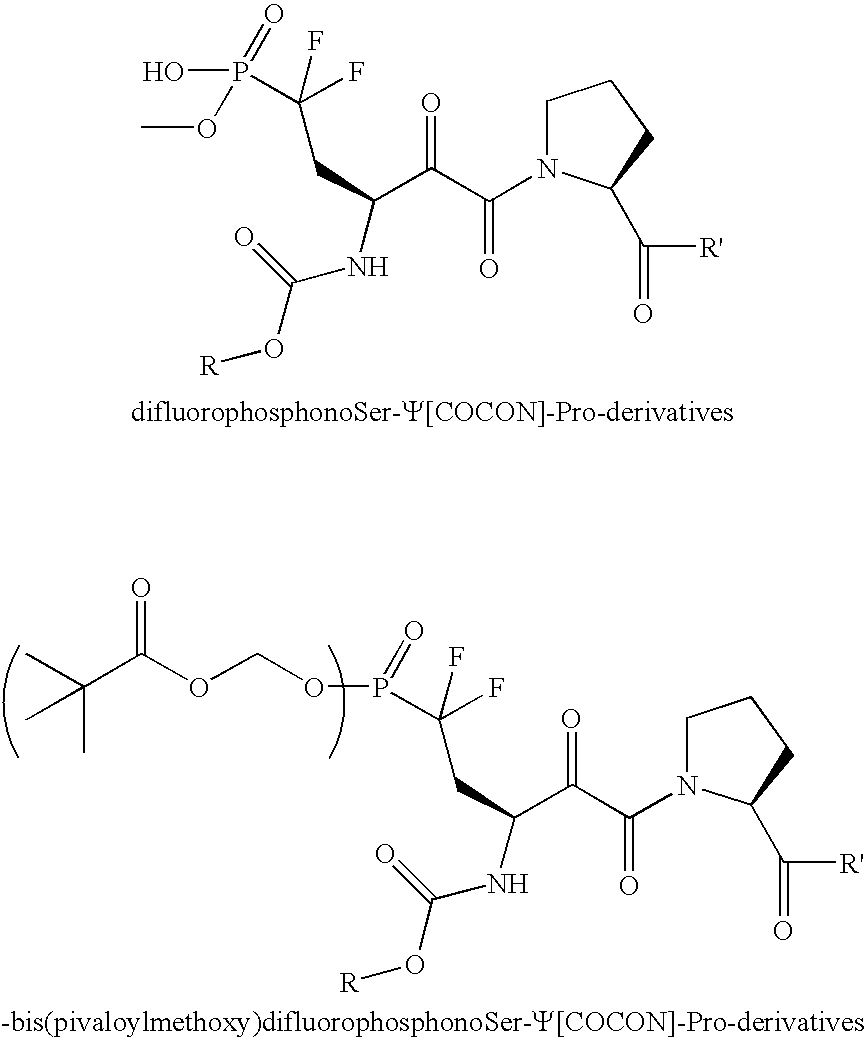
wherein R is a carbonyl group attached to the amine as an amide, and R′ is an amine attached to the carbonyl as an amide. - In all the above formulae where R has been mentioned, preferred examples of R are, e.g., the following 26 acid and acid chloride synthons, where the connection to the c-ketoamide molecule is made through the carboxylic acid moiety.

- In all the above formulae where R′ has been mentioned, preferred examples of R′ are, e.g., the following 30 amine synthons, where the connection to the α-ketoamide molecule is made through the amine moiety:

- As discussed in more detail above, the R and R′ moiety can be the same or different, and can each be 1-20 amino acids in length. That is, a generalized formula for a peptide, which can function as a mimic or for other purposes, according to the invention would be R-α-ketoamide-R′, where R is connected at the carbonyl end of the amino acid sequence and R′ is connected at the amino end of the amino acid sequence. In a number of embodiments, the “α-ketoamide” will have a phosphorous moiety (e.g., see schemes 8 and 9 above).
- While the invention has been described in terms of its preferred embodiments, those skilled in the art will recognize that the invention can be practiced with modification within the spirit and scope of the appended claims.
Claims (16)


Priority Applications (1)
| Application Number | Priority Date | Filing Date | Title |
|---|---|---|---|
| US11/383,085 US20070027067A1 (en) | 2005-05-13 | 2006-05-12 | Transition-state Inhibitors of Pin1, alpha-Ketoamide-containing peptidomimetics, and synthesis thereof |
Applications Claiming Priority (2)
| Application Number | Priority Date | Filing Date | Title |
|---|---|---|---|
| US68051805P | 2005-05-13 | 2005-05-13 | |
| US11/383,085 US20070027067A1 (en) | 2005-05-13 | 2006-05-12 | Transition-state Inhibitors of Pin1, alpha-Ketoamide-containing peptidomimetics, and synthesis thereof |
Publications (1)
| Publication Number | Publication Date |
|---|---|
| US20070027067A1 true US20070027067A1 (en) | 2007-02-01 |
Family
ID=37431553
Family Applications (1)
| Application Number | Title | Priority Date | Filing Date |
|---|---|---|---|
| US11/383,085 Abandoned US20070027067A1 (en) | 2005-05-13 | 2006-05-12 | Transition-state Inhibitors of Pin1, alpha-Ketoamide-containing peptidomimetics, and synthesis thereof |
Country Status (2)
| Country | Link |
|---|---|
| US (1) | US20070027067A1 (en) |
| WO (1) | WO2006124494A1 (en) |
Cited By (6)
| Publication number | Priority date | Publication date | Assignee | Title |
|---|---|---|---|---|
| US20110066062A1 (en) * | 2009-09-14 | 2011-03-17 | Matt Banet | Body-worn monitor for measuring respiration rate |
| US20110076445A1 (en) * | 2009-02-17 | 2011-03-31 | Mcalister Technologies, Llc | Internally reinforced structural composites and associated methods of manufacturing |
| WO2017181437A1 (en) * | 2016-04-21 | 2017-10-26 | 陈铭 | Non-amino acid method for chemical total synthesis of polypeptides |
| US10278957B2 (en) | 2017-09-11 | 2019-05-07 | Protagonist Therapeutics, Inc. | Opioid agonist peptides and uses thereof |
| WO2022032179A1 (en) * | 2020-08-07 | 2022-02-10 | The Regents Of The University Of California | Pin1 inhibitors and uses thereof |
| CN114990590A (en) * | 2022-07-15 | 2022-09-02 | 江西师范大学 | Novel method for electrocatalysis metal-free transamidation reaction |
Families Citing this family (3)
| Publication number | Priority date | Publication date | Assignee | Title |
|---|---|---|---|---|
| WO2017063757A1 (en) | 2015-10-12 | 2017-04-20 | Polyphor Ag | Conformationally constrained macrocyclic compounds |
| WO2017063754A1 (en) | 2015-10-12 | 2017-04-20 | Polyphor Ag | Conformationally constrained macrocyclic compounds as pin1 modulators |
| WO2017063755A1 (en) | 2015-10-12 | 2017-04-20 | Polyphor Ag | Conformationally constrained macrocyclic compounds |
Citations (11)
| Publication number | Priority date | Publication date | Assignee | Title |
|---|---|---|---|---|
| US5414122A (en) * | 1991-12-18 | 1995-05-09 | Shionogi & Co., Ltd. | Process for producing alpha-ketoamide derivative |
| US5656600A (en) * | 1993-03-25 | 1997-08-12 | Corvas International, Inc. | α-ketoamide derivatives as inhibitors of thrombosis |
| US6075150A (en) * | 1998-01-26 | 2000-06-13 | Cv Therapeutics, Inc. | α-ketoamide inhibitors of 20S proteasome |
| US6083944A (en) * | 1997-10-07 | 2000-07-04 | Cephalon, Inc. | Quinoline-containing α-ketoamide cysteine and serine protease inhibitors |
| US6096778A (en) * | 1997-10-07 | 2000-08-01 | Cephalon, Inc. | α-ketoamide multicatalytic protease inhibitors |
| US6143931A (en) * | 1997-04-16 | 2000-11-07 | Arqule, Inc. | Synthesis and use of α-ketoamide derivatives and arrays |
| US6150378A (en) * | 1997-10-07 | 2000-11-21 | Cephalon, Inc. | Peptidyl-containing α-ketoamide cysteine and serine protease inhibitors |
| US6187905B1 (en) * | 1998-05-06 | 2001-02-13 | Hoffmann-La Roche Inc. | Alpha-ketoamide derivatives |
| US6596848B1 (en) * | 1995-11-13 | 2003-07-22 | Salk Institute For Biological Studies | Antibodies to NIMA interacting proteins |
| US6774212B2 (en) * | 1999-12-03 | 2004-08-10 | Bristol-Myers Squibb Pharma Company | Alpha-ketoamide inhibitors of hepatitis C virus NS3 protease |
| US7022738B2 (en) * | 2002-07-22 | 2006-04-04 | Senju Pharmaceutical Co., Ltd. | α-ketoamide derivative and use thereof |
-
2006
- 2006-05-12 US US11/383,085 patent/US20070027067A1/en not_active Abandoned
- 2006-05-12 WO PCT/US2006/018196 patent/WO2006124494A1/en not_active Ceased
Patent Citations (18)
| Publication number | Priority date | Publication date | Assignee | Title |
|---|---|---|---|---|
| US5414122A (en) * | 1991-12-18 | 1995-05-09 | Shionogi & Co., Ltd. | Process for producing alpha-ketoamide derivative |
| US5656600A (en) * | 1993-03-25 | 1997-08-12 | Corvas International, Inc. | α-ketoamide derivatives as inhibitors of thrombosis |
| US5670479A (en) * | 1993-03-25 | 1997-09-23 | Corvas International, Inc. | α-ketoamide derivatives as inhibitors of thrombosis |
| US6596848B1 (en) * | 1995-11-13 | 2003-07-22 | Salk Institute For Biological Studies | Antibodies to NIMA interacting proteins |
| US6143931A (en) * | 1997-04-16 | 2000-11-07 | Arqule, Inc. | Synthesis and use of α-ketoamide derivatives and arrays |
| US6452050B1 (en) * | 1997-04-16 | 2002-09-17 | Arqule, Inc. | Synthesis and use of α-ketoamide derivatives and arrays |
| US6083944A (en) * | 1997-10-07 | 2000-07-04 | Cephalon, Inc. | Quinoline-containing α-ketoamide cysteine and serine protease inhibitors |
| US6150378A (en) * | 1997-10-07 | 2000-11-21 | Cephalon, Inc. | Peptidyl-containing α-ketoamide cysteine and serine protease inhibitors |
| US6288231B1 (en) * | 1997-10-07 | 2001-09-11 | Cephalon, Inc. | Peptide-containing α-ketoamide cysteine and serine protease inhibitors |
| US6310057B1 (en) * | 1997-10-07 | 2001-10-30 | Cephalon, Inc. | α-ketoamide multicatalytic protease inhibitors |
| US6096778A (en) * | 1997-10-07 | 2000-08-01 | Cephalon, Inc. | α-ketoamide multicatalytic protease inhibitors |
| US6703368B2 (en) * | 1997-10-07 | 2004-03-09 | Cephalon, Inc. | Peptide-containing α-ketoamide cysteine and serine protease inhibitors |
| US7001907B2 (en) * | 1997-10-07 | 2006-02-21 | Cephaon, Inc. | Peptide-containing α-ketoamide cysteine and serine protease inhibitors |
| US6075150A (en) * | 1998-01-26 | 2000-06-13 | Cv Therapeutics, Inc. | α-ketoamide inhibitors of 20S proteasome |
| US6781000B1 (en) * | 1998-01-26 | 2004-08-24 | Cv Theurapeutics, Inc. | Alpha-ketoamide inhibitors of 20S proteasome |
| US6187905B1 (en) * | 1998-05-06 | 2001-02-13 | Hoffmann-La Roche Inc. | Alpha-ketoamide derivatives |
| US6774212B2 (en) * | 1999-12-03 | 2004-08-10 | Bristol-Myers Squibb Pharma Company | Alpha-ketoamide inhibitors of hepatitis C virus NS3 protease |
| US7022738B2 (en) * | 2002-07-22 | 2006-04-04 | Senju Pharmaceutical Co., Ltd. | α-ketoamide derivative and use thereof |
Cited By (8)
| Publication number | Priority date | Publication date | Assignee | Title |
|---|---|---|---|---|
| US20110076445A1 (en) * | 2009-02-17 | 2011-03-31 | Mcalister Technologies, Llc | Internally reinforced structural composites and associated methods of manufacturing |
| US9683299B2 (en) | 2009-02-17 | 2017-06-20 | Mcalister Technologies, Llc | Internally reinforced structural composites and associated methods of manufacturing |
| US20110066062A1 (en) * | 2009-09-14 | 2011-03-17 | Matt Banet | Body-worn monitor for measuring respiration rate |
| WO2017181437A1 (en) * | 2016-04-21 | 2017-10-26 | 陈铭 | Non-amino acid method for chemical total synthesis of polypeptides |
| US10278957B2 (en) | 2017-09-11 | 2019-05-07 | Protagonist Therapeutics, Inc. | Opioid agonist peptides and uses thereof |
| US10729676B2 (en) | 2017-09-11 | 2020-08-04 | Protagonist Theraputics, Inc. | Opioid agonist peptides and uses thereof |
| WO2022032179A1 (en) * | 2020-08-07 | 2022-02-10 | The Regents Of The University Of California | Pin1 inhibitors and uses thereof |
| CN114990590A (en) * | 2022-07-15 | 2022-09-02 | 江西师范大学 | Novel method for electrocatalysis metal-free transamidation reaction |
Also Published As
| Publication number | Publication date |
|---|---|
| WO2006124494A1 (en) | 2006-11-23 |
Similar Documents
| Publication | Publication Date | Title |
|---|---|---|
| Ikeuchi et al. | A sulfoximine-based inhibitor of human asparagine synthetase kills L-asparaginase-resistant leukemia cells | |
| JPWO2020122182A1 (en) | Amino acids having intramolecular hydrogen-bondable functional groups, peptide compounds containing those amino acids, and methods for producing them. | |
| EP2627662B1 (en) | Methods for preparing macrocycles and macrocycle stabilized peptides | |
| US20070027067A1 (en) | Transition-state Inhibitors of Pin1, alpha-Ketoamide-containing peptidomimetics, and synthesis thereof | |
| Zhao et al. | A phosphorylated prodrug for the inhibition of Pin1 | |
| US12084476B2 (en) | Tailored cyclodepsipeptides as potent non-covalent serine protease inhibitors | |
| Moriguchi et al. | Synthesis and properties of aminoacylamido-AMP: chemical optimization for the construction of an N-acyl phosphoramidate linkage | |
| JP2004538240A (en) | Phosphoramidate and method therefor | |
| Liu et al. | Preparation of orthogonally protected (2S, 3R)-2-amino-3-methyl-4-phosphonobutyric acid (Pmab) as a phosphatase-stable phosphothreonine mimetic and its use in the synthesis of polo-box domain-binding peptides | |
| Mucha et al. | Synthesis and activity of phosphinic tripeptide inhibitors of cathepsin C | |
| Huang et al. | Development of activity-based probes with tunable specificity for protein tyrosine phosphatase subfamilies | |
| Lai et al. | The design, synthesis and activity of pentapeptide pp60c‐src inhibitors containing L‐phosphotyrosine mimics | |
| US20090131330A1 (en) | Par-2 agonist | |
| Wiemann et al. | Synthesis of suitably protected hydroxymethylene phosphonate-and ‘phosphate phosphonate’-analogues of phosphoserine and their incorporation into synthetic peptides | |
| CZ54194A3 (en) | Derivatives of acylhexanoic acid, process of their preparation, pharmaceutical preparations in which they are comprised and their pharmaceutical use | |
| CA1235120A (en) | Proline derivatives and process for producing the same | |
| KR100236473B1 (en) | Inhibitors of azapeptide farnesyl transferase | |
| US20080261923A1 (en) | Alkene Mimics | |
| Sebastian et al. | Selective enzymatic removal of protecting groups from phosphopeptides: Chemoenzymatic synthesis of a characteristic phosphopeptide fragment of the Raf-1 kinase | |
| EP1140980B1 (en) | Pseudopeptide compounds having an inhibiting activity with respect to paths activated by proteins with active tyrosine kinase activity and pharmaceutical compositions containing same | |
| O'Donnell et al. | Serine–threonine protein phosphatase inhibitors derived from nodularin: role of the 2-methyl and 3-diene groups in the Adda residue and the effect of macrocyclic conformational restraint | |
| KR100236472B1 (en) | Tropane derivatives as farnesyl transferase inhibitors | |
| EP1864994B1 (en) | Par-2 agonist | |
| US20030096760A1 (en) | Method of antagonizing the human SRC SH2 domain | |
| Zhao | Part 1 Design, Synthesis and Bioactivity of a Phosphorylated Prodrug for the Inhibition of Pin1; Part 2 Conformational Specificity of Cdc25c Substrate for Cdc2 Kinase using LC-MS/MS |
Legal Events
| Date | Code | Title | Description |
|---|---|---|---|
| AS | Assignment |
Owner name: VIRGINIA TECH INTELLECTUAL PROPERTIES, INC., VIRGI Free format text: ASSIGNMENT OF ASSIGNORS INTEREST;ASSIGNOR:VIRGINIA POLYTECHNIC INSTITUTE & STATE UNIVERSITY;REEL/FRAME:017815/0661 Effective date: 20060614 Owner name: VIRGINIA POLYTECHNIC INSTITUTE & STATE UNIVERSITY, Free format text: ASSIGNMENT OF ASSIGNORS INTEREST;ASSIGNOR:ETZKORN, FELICIA;REEL/FRAME:017815/0607 Effective date: 20060531 |
|
| AS | Assignment |
Owner name: NATIONAL INSTITUTES OF HEALTH (NIH), U.S. DEPT. OF Free format text: EXECUTIVE ORDER 9424, CONFIRMATORY LICENSE;ASSIGNOR:VIRGINIA POLYTECHNIC INST AND ST UNIV;REEL/FRAME:021992/0869 Effective date: 20060524 |
|
| STCB | Information on status: application discontinuation |
Free format text: ABANDONED -- FAILURE TO RESPOND TO AN OFFICE ACTION |