US20070021466A1 - CCR2 inhibitors and methods of use thereof - Google Patents
CCR2 inhibitors and methods of use thereof Download PDFInfo
- Publication number
- US20070021466A1 US20070021466A1 US11/486,395 US48639506A US2007021466A1 US 20070021466 A1 US20070021466 A1 US 20070021466A1 US 48639506 A US48639506 A US 48639506A US 2007021466 A1 US2007021466 A1 US 2007021466A1
- Authority
- US
- United States
- Prior art keywords
- ccr2
- group
- disease
- compounds
- compound
- Prior art date
- Legal status (The legal status is an assumption and is not a legal conclusion. Google has not performed a legal analysis and makes no representation as to the accuracy of the status listed.)
- Abandoned
Links
- 101710149815 C-C chemokine receptor type 2 Proteins 0.000 title claims abstract description 137
- 102100031151 C-C chemokine receptor type 2 Human genes 0.000 title claims abstract description 137
- 238000000034 method Methods 0.000 title claims abstract description 59
- 239000003112 inhibitor Substances 0.000 title description 6
- 150000001875 compounds Chemical class 0.000 claims abstract description 182
- 208000037265 diseases, disorders, signs and symptoms Diseases 0.000 claims abstract description 72
- 201000010099 disease Diseases 0.000 claims abstract description 65
- 230000001404 mediated effect Effects 0.000 claims abstract description 47
- -1 aliphatic ester Chemical class 0.000 claims description 89
- 125000001931 aliphatic group Chemical group 0.000 claims description 40
- 125000003118 aryl group Chemical group 0.000 claims description 39
- 150000003839 salts Chemical class 0.000 claims description 29
- 125000001072 heteroaryl group Chemical group 0.000 claims description 24
- 125000001424 substituent group Chemical group 0.000 claims description 24
- 229910052757 nitrogen Inorganic materials 0.000 claims description 23
- 125000003545 alkoxy group Chemical group 0.000 claims description 20
- 125000005843 halogen group Chemical group 0.000 claims description 20
- 125000001188 haloalkyl group Chemical group 0.000 claims description 19
- 125000004438 haloalkoxy group Chemical group 0.000 claims description 17
- 125000000449 nitro group Chemical group [O-][N+](*)=O 0.000 claims description 16
- 208000008589 Obesity Diseases 0.000 claims description 15
- 235000020824 obesity Nutrition 0.000 claims description 15
- 229910052760 oxygen Inorganic materials 0.000 claims description 15
- 208000022559 Inflammatory bowel disease Diseases 0.000 claims description 13
- 229910052717 sulfur Inorganic materials 0.000 claims description 12
- 239000012453 solvate Substances 0.000 claims description 11
- 125000000623 heterocyclic group Chemical group 0.000 claims description 10
- 150000004677 hydrates Chemical class 0.000 claims description 10
- 229920006395 saturated elastomer Polymers 0.000 claims description 10
- 125000003710 aryl alkyl group Chemical group 0.000 claims description 9
- 125000004429 atom Chemical group 0.000 claims description 8
- 206010012601 diabetes mellitus Diseases 0.000 claims description 8
- 201000009794 Idiopathic Pulmonary Fibrosis Diseases 0.000 claims description 7
- 206010063725 Idiopathic pneumonia syndrome Diseases 0.000 claims description 7
- 206010028980 Neoplasm Diseases 0.000 claims description 7
- 125000004448 alkyl carbonyl group Chemical group 0.000 claims description 7
- 125000005842 heteroatom Chemical group 0.000 claims description 7
- 208000007915 ichthyosis prematurity syndrome Diseases 0.000 claims description 7
- 208000036971 interstitial lung disease 2 Diseases 0.000 claims description 7
- 201000006417 multiple sclerosis Diseases 0.000 claims description 7
- 206010039073 rheumatoid arthritis Diseases 0.000 claims description 7
- 201000001320 Atherosclerosis Diseases 0.000 claims description 6
- 125000002102 aryl alkyloxo group Chemical group 0.000 claims description 6
- 125000004104 aryloxy group Chemical group 0.000 claims description 6
- 201000011510 cancer Diseases 0.000 claims description 6
- 125000000000 cycloalkoxy group Chemical group 0.000 claims description 6
- 125000006575 electron-withdrawing group Chemical group 0.000 claims description 6
- 208000005069 pulmonary fibrosis Diseases 0.000 claims description 6
- 201000002793 renal fibrosis Diseases 0.000 claims description 6
- 208000037803 restenosis Diseases 0.000 claims description 6
- 238000002054 transplantation Methods 0.000 claims description 6
- JCXJVPUVTGWSNB-UHFFFAOYSA-N Nitrogen dioxide Chemical compound O=[N]=O JCXJVPUVTGWSNB-UHFFFAOYSA-N 0.000 claims description 5
- 229910020008 S(O) Inorganic materials 0.000 claims description 5
- 125000004414 alkyl thio group Chemical group 0.000 claims description 5
- 125000002915 carbonyl group Chemical group [*:2]C([*:1])=O 0.000 claims description 5
- 230000000699 topical effect Effects 0.000 claims description 5
- 208000009329 Graft vs Host Disease Diseases 0.000 claims description 4
- 239000000730 antalgic agent Substances 0.000 claims description 4
- 239000002260 anti-inflammatory agent Substances 0.000 claims description 4
- 230000003110 anti-inflammatory effect Effects 0.000 claims description 4
- 208000024908 graft versus host disease Diseases 0.000 claims description 4
- 125000000475 sulfinyl group Chemical group [*:2]S([*:1])=O 0.000 claims description 4
- 208000006545 Chronic Obstructive Pulmonary Disease Diseases 0.000 claims description 3
- 208000004296 neuralgia Diseases 0.000 claims description 3
- 208000021722 neuropathic pain Diseases 0.000 claims description 3
- 125000004385 trihaloalkyl group Chemical group 0.000 claims description 3
- 125000003178 carboxy group Chemical group [H]OC(*)=O 0.000 claims 1
- 238000003556 assay Methods 0.000 abstract description 42
- 239000005557 antagonist Substances 0.000 abstract description 16
- 238000011282 treatment Methods 0.000 abstract description 16
- 206010061218 Inflammation Diseases 0.000 abstract description 14
- 230000004054 inflammatory process Effects 0.000 abstract description 14
- 239000008194 pharmaceutical composition Substances 0.000 abstract description 14
- 102000004497 CCR2 Receptors Human genes 0.000 abstract description 7
- 108010017312 CCR2 Receptors Proteins 0.000 abstract description 7
- 230000003389 potentiating effect Effects 0.000 abstract description 3
- 125000004421 aryl sulphonamide group Chemical group 0.000 abstract 1
- 210000004027 cell Anatomy 0.000 description 66
- 101710155857 C-C motif chemokine 2 Proteins 0.000 description 58
- 102100021943 C-C motif chemokine 2 Human genes 0.000 description 58
- 239000000203 mixture Substances 0.000 description 58
- 239000003446 ligand Substances 0.000 description 30
- 230000027455 binding Effects 0.000 description 25
- 108050000299 Chemokine receptor Proteins 0.000 description 23
- 102000019034 Chemokines Human genes 0.000 description 23
- 102000009410 Chemokine receptor Human genes 0.000 description 22
- 108010012236 Chemokines Proteins 0.000 description 22
- 230000000694 effects Effects 0.000 description 22
- 102000005962 receptors Human genes 0.000 description 21
- 108020003175 receptors Proteins 0.000 description 21
- 210000002540 macrophage Anatomy 0.000 description 18
- 230000005012 migration Effects 0.000 description 17
- 238000013508 migration Methods 0.000 description 17
- IJGRMHOSHXDMSA-UHFFFAOYSA-N Atomic nitrogen Chemical compound N#N IJGRMHOSHXDMSA-UHFFFAOYSA-N 0.000 description 16
- 210000001616 monocyte Anatomy 0.000 description 16
- 230000006870 function Effects 0.000 description 15
- 238000012360 testing method Methods 0.000 description 15
- 230000002757 inflammatory effect Effects 0.000 description 14
- 0 [1*]C1=C([Y]C)C(CS(C)(=O)=O)=CC=C1 Chemical compound [1*]C1=C([Y]C)C(CS(C)(=O)=O)=CC=C1 0.000 description 13
- 239000004480 active ingredient Substances 0.000 description 13
- 239000003795 chemical substances by application Substances 0.000 description 12
- 125000001997 phenyl group Chemical group [H]C1=C([H])C([H])=C(*)C([H])=C1[H] 0.000 description 12
- 210000001744 T-lymphocyte Anatomy 0.000 description 11
- 125000000217 alkyl group Chemical group 0.000 description 11
- 230000015572 biosynthetic process Effects 0.000 description 11
- 239000003814 drug Substances 0.000 description 11
- 230000005764 inhibitory process Effects 0.000 description 11
- 229910002092 carbon dioxide Inorganic materials 0.000 description 10
- 230000035605 chemotaxis Effects 0.000 description 10
- PXBRQCKWGAHEHS-UHFFFAOYSA-N dichlorodifluoromethane Chemical compound FC(F)(Cl)Cl PXBRQCKWGAHEHS-UHFFFAOYSA-N 0.000 description 10
- 238000005755 formation reaction Methods 0.000 description 10
- 239000000546 pharmaceutical excipient Substances 0.000 description 10
- 230000011664 signaling Effects 0.000 description 10
- 239000000243 solution Substances 0.000 description 10
- OYPRJOBELJOOCE-UHFFFAOYSA-N Calcium Chemical compound [Ca] OYPRJOBELJOOCE-UHFFFAOYSA-N 0.000 description 9
- 210000000577 adipose tissue Anatomy 0.000 description 9
- 239000011575 calcium Substances 0.000 description 9
- 229910052791 calcium Inorganic materials 0.000 description 9
- 238000011161 development Methods 0.000 description 9
- 150000002148 esters Chemical class 0.000 description 9
- 210000004072 lung Anatomy 0.000 description 9
- 201000004681 Psoriasis Diseases 0.000 description 8
- 239000004615 ingredient Substances 0.000 description 8
- 239000012528 membrane Substances 0.000 description 8
- 229940124597 therapeutic agent Drugs 0.000 description 8
- 208000001072 type 2 diabetes mellitus Diseases 0.000 description 8
- 102000004127 Cytokines Human genes 0.000 description 7
- 108090000695 Cytokines Proteins 0.000 description 7
- 206010022489 Insulin Resistance Diseases 0.000 description 7
- 241000699670 Mus sp. Species 0.000 description 7
- QVGXLLKOCUKJST-UHFFFAOYSA-N atomic oxygen Chemical compound [O] QVGXLLKOCUKJST-UHFFFAOYSA-N 0.000 description 7
- 230000012292 cell migration Effects 0.000 description 7
- 239000002604 chemokine receptor CCR2 antagonist Substances 0.000 description 7
- 238000009472 formulation Methods 0.000 description 7
- 230000008595 infiltration Effects 0.000 description 7
- 238000001764 infiltration Methods 0.000 description 7
- 230000003993 interaction Effects 0.000 description 7
- 210000004379 membrane Anatomy 0.000 description 7
- 239000003921 oil Substances 0.000 description 7
- 235000019198 oils Nutrition 0.000 description 7
- 239000001301 oxygen Substances 0.000 description 7
- 230000036961 partial effect Effects 0.000 description 7
- 230000009467 reduction Effects 0.000 description 7
- 239000000725 suspension Substances 0.000 description 7
- 210000001519 tissue Anatomy 0.000 description 7
- XLYOFNOQVPJJNP-UHFFFAOYSA-N water Substances O XLYOFNOQVPJJNP-UHFFFAOYSA-N 0.000 description 7
- 241001465754 Metazoa Species 0.000 description 6
- 230000035508 accumulation Effects 0.000 description 6
- 238000009825 accumulation Methods 0.000 description 6
- 230000004913 activation Effects 0.000 description 6
- 230000001580 bacterial effect Effects 0.000 description 6
- 125000000753 cycloalkyl group Chemical group 0.000 description 6
- 230000007812 deficiency Effects 0.000 description 6
- 235000014113 dietary fatty acids Nutrition 0.000 description 6
- 239000003085 diluting agent Substances 0.000 description 6
- 239000000194 fatty acid Substances 0.000 description 6
- 229930195729 fatty acid Natural products 0.000 description 6
- 150000004665 fatty acids Chemical class 0.000 description 6
- 239000000796 flavoring agent Substances 0.000 description 6
- 229910052736 halogen Inorganic materials 0.000 description 6
- 150000002367 halogens Chemical class 0.000 description 6
- 125000004356 hydroxy functional group Chemical group O* 0.000 description 6
- 238000000670 ligand binding assay Methods 0.000 description 6
- 125000005647 linker group Chemical group 0.000 description 6
- 238000010232 migration assay Methods 0.000 description 6
- 238000002360 preparation method Methods 0.000 description 6
- 239000003765 sweetening agent Substances 0.000 description 6
- 239000003826 tablet Substances 0.000 description 6
- 239000003981 vehicle Substances 0.000 description 6
- 238000013459 approach Methods 0.000 description 5
- 206010003246 arthritis Diseases 0.000 description 5
- 239000000872 buffer Substances 0.000 description 5
- 230000003185 calcium uptake Effects 0.000 description 5
- 238000006243 chemical reaction Methods 0.000 description 5
- 239000007859 condensation product Substances 0.000 description 5
- 125000004093 cyano group Chemical group *C#N 0.000 description 5
- 230000006378 damage Effects 0.000 description 5
- 208000035475 disorder Diseases 0.000 description 5
- 235000003599 food sweetener Nutrition 0.000 description 5
- 238000011534 incubation Methods 0.000 description 5
- 210000000265 leukocyte Anatomy 0.000 description 5
- 125000006574 non-aromatic ring group Chemical group 0.000 description 5
- 125000002924 primary amino group Chemical group [H]N([H])* 0.000 description 5
- 108090000623 proteins and genes Proteins 0.000 description 5
- 125000004076 pyridyl group Chemical group 0.000 description 5
- 108091003079 Bovine Serum Albumin Proteins 0.000 description 4
- VTYYLEPIZMXCLO-UHFFFAOYSA-L Calcium carbonate Chemical compound [Ca+2].[O-]C([O-])=O VTYYLEPIZMXCLO-UHFFFAOYSA-L 0.000 description 4
- IAYPIBMASNFSPL-UHFFFAOYSA-N Ethylene oxide Chemical compound C1CO1 IAYPIBMASNFSPL-UHFFFAOYSA-N 0.000 description 4
- 239000012981 Hank's balanced salt solution Substances 0.000 description 4
- NINIDFKCEFEMDL-UHFFFAOYSA-N Sulfur Chemical compound [S] NINIDFKCEFEMDL-UHFFFAOYSA-N 0.000 description 4
- 125000003342 alkenyl group Chemical group 0.000 description 4
- 125000003282 alkyl amino group Chemical group 0.000 description 4
- 239000007900 aqueous suspension Substances 0.000 description 4
- 210000001367 artery Anatomy 0.000 description 4
- 239000002585 base Substances 0.000 description 4
- 210000004369 blood Anatomy 0.000 description 4
- 239000008280 blood Substances 0.000 description 4
- 229910052794 bromium Inorganic materials 0.000 description 4
- 125000004432 carbon atom Chemical group C* 0.000 description 4
- 230000036755 cellular response Effects 0.000 description 4
- 229910052801 chlorine Inorganic materials 0.000 description 4
- 239000003086 colorant Substances 0.000 description 4
- 239000002270 dispersing agent Substances 0.000 description 4
- 239000000839 emulsion Substances 0.000 description 4
- 235000013355 food flavoring agent Nutrition 0.000 description 4
- 230000005714 functional activity Effects 0.000 description 4
- 125000000524 functional group Chemical group 0.000 description 4
- 239000001257 hydrogen Substances 0.000 description 4
- 229910052739 hydrogen Inorganic materials 0.000 description 4
- 230000006698 induction Effects 0.000 description 4
- 210000004969 inflammatory cell Anatomy 0.000 description 4
- 230000004968 inflammatory condition Effects 0.000 description 4
- 208000027866 inflammatory disease Diseases 0.000 description 4
- 238000002347 injection Methods 0.000 description 4
- 239000007924 injection Substances 0.000 description 4
- NOESYZHRGYRDHS-UHFFFAOYSA-N insulin Chemical compound N1C(=O)C(NC(=O)C(CCC(N)=O)NC(=O)C(CCC(O)=O)NC(=O)C(C(C)C)NC(=O)C(NC(=O)CN)C(C)CC)CSSCC(C(NC(CO)C(=O)NC(CC(C)C)C(=O)NC(CC=2C=CC(O)=CC=2)C(=O)NC(CCC(N)=O)C(=O)NC(CC(C)C)C(=O)NC(CCC(O)=O)C(=O)NC(CC(N)=O)C(=O)NC(CC=2C=CC(O)=CC=2)C(=O)NC(CSSCC(NC(=O)C(C(C)C)NC(=O)C(CC(C)C)NC(=O)C(CC=2C=CC(O)=CC=2)NC(=O)C(CC(C)C)NC(=O)C(C)NC(=O)C(CCC(O)=O)NC(=O)C(C(C)C)NC(=O)C(CC(C)C)NC(=O)C(CC=2NC=NC=2)NC(=O)C(CO)NC(=O)CNC2=O)C(=O)NCC(=O)NC(CCC(O)=O)C(=O)NC(CCCNC(N)=N)C(=O)NCC(=O)NC(CC=3C=CC=CC=3)C(=O)NC(CC=3C=CC=CC=3)C(=O)NC(CC=3C=CC(O)=CC=3)C(=O)NC(C(C)O)C(=O)N3C(CCC3)C(=O)NC(CCCCN)C(=O)NC(C)C(O)=O)C(=O)NC(CC(N)=O)C(O)=O)=O)NC(=O)C(C(C)CC)NC(=O)C(CO)NC(=O)C(C(C)O)NC(=O)C1CSSCC2NC(=O)C(CC(C)C)NC(=O)C(NC(=O)C(CCC(N)=O)NC(=O)C(CC(N)=O)NC(=O)C(NC(=O)C(N)CC=1C=CC=CC=1)C(C)C)CC1=CN=CN1 NOESYZHRGYRDHS-UHFFFAOYSA-N 0.000 description 4
- 238000007912 intraperitoneal administration Methods 0.000 description 4
- 125000000896 monocarboxylic acid group Chemical group 0.000 description 4
- 238000010172 mouse model Methods 0.000 description 4
- 229920001223 polyethylene glycol Polymers 0.000 description 4
- 239000000843 powder Substances 0.000 description 4
- 239000003755 preservative agent Substances 0.000 description 4
- 230000000770 proinflammatory effect Effects 0.000 description 4
- 230000007115 recruitment Effects 0.000 description 4
- 230000007781 signaling event Effects 0.000 description 4
- 150000003384 small molecules Chemical class 0.000 description 4
- 239000007787 solid Substances 0.000 description 4
- 239000002904 solvent Substances 0.000 description 4
- 239000011593 sulfur Substances 0.000 description 4
- 239000000375 suspending agent Substances 0.000 description 4
- 125000001544 thienyl group Chemical group 0.000 description 4
- 230000009466 transformation Effects 0.000 description 4
- 238000000844 transformation Methods 0.000 description 4
- 239000000080 wetting agent Substances 0.000 description 4
- 125000004400 (C1-C12) alkyl group Chemical group 0.000 description 3
- QTBSBXVTEAMEQO-UHFFFAOYSA-N Acetic acid Chemical compound CC(O)=O QTBSBXVTEAMEQO-UHFFFAOYSA-N 0.000 description 3
- 208000035143 Bacterial infection Diseases 0.000 description 3
- WVDDGKGOMKODPV-UHFFFAOYSA-N Benzyl alcohol Chemical compound OCC1=CC=CC=C1 WVDDGKGOMKODPV-UHFFFAOYSA-N 0.000 description 3
- CURLTUGMZLYLDI-UHFFFAOYSA-N Carbon dioxide Chemical compound O=C=O CURLTUGMZLYLDI-UHFFFAOYSA-N 0.000 description 3
- 206010009900 Colitis ulcerative Diseases 0.000 description 3
- 208000011231 Crohn disease Diseases 0.000 description 3
- 208000009386 Experimental Arthritis Diseases 0.000 description 3
- 108091006027 G proteins Proteins 0.000 description 3
- 102000003688 G-Protein-Coupled Receptors Human genes 0.000 description 3
- 108090000045 G-Protein-Coupled Receptors Proteins 0.000 description 3
- 102000030782 GTP binding Human genes 0.000 description 3
- 108091000058 GTP-Binding Proteins 0.000 description 3
- WQZGKKKJIJFFOK-GASJEMHNSA-N Glucose Natural products OC[C@H]1OC(O)[C@H](O)[C@@H](O)[C@@H]1O WQZGKKKJIJFFOK-GASJEMHNSA-N 0.000 description 3
- PEDCQBHIVMGVHV-UHFFFAOYSA-N Glycerine Chemical compound OCC(O)CO PEDCQBHIVMGVHV-UHFFFAOYSA-N 0.000 description 3
- 241000282412 Homo Species 0.000 description 3
- CPELXLSAUQHCOX-UHFFFAOYSA-N Hydrogen bromide Chemical compound Br CPELXLSAUQHCOX-UHFFFAOYSA-N 0.000 description 3
- 241000124008 Mammalia Species 0.000 description 3
- MWUXSHHQAYIFBG-UHFFFAOYSA-N Nitric oxide Chemical compound O=[N] MWUXSHHQAYIFBG-UHFFFAOYSA-N 0.000 description 3
- 208000002193 Pain Diseases 0.000 description 3
- DNIAPMSPPWPWGF-UHFFFAOYSA-N Propylene glycol Chemical compound CC(O)CO DNIAPMSPPWPWGF-UHFFFAOYSA-N 0.000 description 3
- FAPWRFPIFSIZLT-UHFFFAOYSA-M Sodium chloride Chemical compound [Na+].[Cl-] FAPWRFPIFSIZLT-UHFFFAOYSA-M 0.000 description 3
- ZMANZCXQSJIPKH-UHFFFAOYSA-N Triethylamine Chemical compound CCN(CC)CC ZMANZCXQSJIPKH-UHFFFAOYSA-N 0.000 description 3
- 201000006704 Ulcerative Colitis Diseases 0.000 description 3
- 230000008484 agonism Effects 0.000 description 3
- 239000000556 agonist Substances 0.000 description 3
- 125000004453 alkoxycarbonyl group Chemical group 0.000 description 3
- 125000004457 alkyl amino carbonyl group Chemical group 0.000 description 3
- 230000008485 antagonism Effects 0.000 description 3
- 208000022362 bacterial infectious disease Diseases 0.000 description 3
- 125000001797 benzyl group Chemical group [H]C1=C([H])C([H])=C(C([H])=C1[H])C([H])([H])* 0.000 description 3
- 230000000903 blocking effect Effects 0.000 description 3
- 230000037396 body weight Effects 0.000 description 3
- 125000003917 carbamoyl group Chemical group [H]N([H])C(*)=O 0.000 description 3
- 125000002837 carbocyclic group Chemical group 0.000 description 3
- 230000004663 cell proliferation Effects 0.000 description 3
- 239000006285 cell suspension Substances 0.000 description 3
- 230000001413 cellular effect Effects 0.000 description 3
- 238000005119 centrifugation Methods 0.000 description 3
- 208000037976 chronic inflammation Diseases 0.000 description 3
- 230000002596 correlated effect Effects 0.000 description 3
- 239000003246 corticosteroid Substances 0.000 description 3
- 238000002425 crystallisation Methods 0.000 description 3
- 230000008025 crystallization Effects 0.000 description 3
- 125000004122 cyclic group Chemical group 0.000 description 3
- 230000003247 decreasing effect Effects 0.000 description 3
- 210000004443 dendritic cell Anatomy 0.000 description 3
- 125000004663 dialkyl amino group Chemical group 0.000 description 3
- 125000005202 dialkylaminocarbonyloxy group Chemical group 0.000 description 3
- 229940079593 drug Drugs 0.000 description 3
- 239000003937 drug carrier Substances 0.000 description 3
- 238000011156 evaluation Methods 0.000 description 3
- 239000012894 fetal calf serum Substances 0.000 description 3
- 239000008103 glucose Substances 0.000 description 3
- 239000008187 granular material Substances 0.000 description 3
- 235000009200 high fat diet Nutrition 0.000 description 3
- 229930195733 hydrocarbon Natural products 0.000 description 3
- 150000002431 hydrogen Chemical group 0.000 description 3
- 230000004957 immunoregulator effect Effects 0.000 description 3
- 238000000338 in vitro Methods 0.000 description 3
- 238000001727 in vivo Methods 0.000 description 3
- 125000001041 indolyl group Chemical group 0.000 description 3
- 208000015181 infectious disease Diseases 0.000 description 3
- 230000002401 inhibitory effect Effects 0.000 description 3
- 210000000936 intestine Anatomy 0.000 description 3
- 230000003834 intracellular effect Effects 0.000 description 3
- 210000002510 keratinocyte Anatomy 0.000 description 3
- 239000007788 liquid Substances 0.000 description 3
- 229940057995 liquid paraffin Drugs 0.000 description 3
- 239000000314 lubricant Substances 0.000 description 3
- 238000004519 manufacturing process Methods 0.000 description 3
- 230000002503 metabolic effect Effects 0.000 description 3
- 231100000252 nontoxic Toxicity 0.000 description 3
- 230000003000 nontoxic effect Effects 0.000 description 3
- 239000004006 olive oil Substances 0.000 description 3
- 235000008390 olive oil Nutrition 0.000 description 3
- 230000008506 pathogenesis Effects 0.000 description 3
- 230000001717 pathogenic effect Effects 0.000 description 3
- 230000001575 pathological effect Effects 0.000 description 3
- VLTRZXGMWDSKGL-UHFFFAOYSA-N perchloric acid Chemical compound OCl(=O)(=O)=O VLTRZXGMWDSKGL-UHFFFAOYSA-N 0.000 description 3
- 239000000047 product Substances 0.000 description 3
- 235000018102 proteins Nutrition 0.000 description 3
- 102000004169 proteins and genes Human genes 0.000 description 3
- 230000001105 regulatory effect Effects 0.000 description 3
- 210000002966 serum Anatomy 0.000 description 3
- 150000003462 sulfoxides Chemical class 0.000 description 3
- 208000024891 symptom Diseases 0.000 description 3
- 125000002023 trifluoromethyl group Chemical group FC(F)(F)* 0.000 description 3
- 210000004881 tumor cell Anatomy 0.000 description 3
- PUPZLCDOIYMWBV-UHFFFAOYSA-N (+/-)-1,3-Butanediol Chemical compound CC(O)CCO PUPZLCDOIYMWBV-UHFFFAOYSA-N 0.000 description 2
- MZOFCQQQCNRIBI-VMXHOPILSA-N (3s)-4-[[(2s)-1-[[(2s)-1-[[(1s)-1-carboxy-2-hydroxyethyl]amino]-4-methyl-1-oxopentan-2-yl]amino]-5-(diaminomethylideneamino)-1-oxopentan-2-yl]amino]-3-[[2-[[(2s)-2,6-diaminohexanoyl]amino]acetyl]amino]-4-oxobutanoic acid Chemical compound OC[C@@H](C(O)=O)NC(=O)[C@H](CC(C)C)NC(=O)[C@H](CCCN=C(N)N)NC(=O)[C@H](CC(O)=O)NC(=O)CNC(=O)[C@@H](N)CCCCN MZOFCQQQCNRIBI-VMXHOPILSA-N 0.000 description 2
- ZORQXIQZAOLNGE-UHFFFAOYSA-N 1,1-difluorocyclohexane Chemical compound FC1(F)CCCCC1 ZORQXIQZAOLNGE-UHFFFAOYSA-N 0.000 description 2
- VBICKXHEKHSIBG-UHFFFAOYSA-N 1-monostearoylglycerol Chemical compound CCCCCCCCCCCCCCCCCC(=O)OCC(O)CO VBICKXHEKHSIBG-UHFFFAOYSA-N 0.000 description 2
- IIZPXYDJLKNOIY-JXPKJXOSSA-N 1-palmitoyl-2-arachidonoyl-sn-glycero-3-phosphocholine Chemical compound CCCCCCCCCCCCCCCC(=O)OC[C@H](COP([O-])(=O)OCC[N+](C)(C)C)OC(=O)CCC\C=C/C\C=C/C\C=C/C\C=C/CCCCC IIZPXYDJLKNOIY-JXPKJXOSSA-N 0.000 description 2
- IZHVBANLECCAGF-UHFFFAOYSA-N 2-hydroxy-3-(octadecanoyloxy)propyl octadecanoate Chemical compound CCCCCCCCCCCCCCCCCC(=O)OCC(O)COC(=O)CCCCCCCCCCCCCCCCC IZHVBANLECCAGF-UHFFFAOYSA-N 0.000 description 2
- 125000001622 2-naphthyl group Chemical group [H]C1=C([H])C([H])=C2C([H])=C(*)C([H])=C([H])C2=C1[H] 0.000 description 2
- 244000215068 Acacia senegal Species 0.000 description 2
- 235000006491 Acacia senegal Nutrition 0.000 description 2
- 235000003911 Arachis Nutrition 0.000 description 2
- 244000105624 Arachis hypogaea Species 0.000 description 2
- CIWBSHSKHKDKBQ-JLAZNSOCSA-N Ascorbic acid Chemical compound OC[C@H](O)[C@H]1OC(=O)C(O)=C1O CIWBSHSKHKDKBQ-JLAZNSOCSA-N 0.000 description 2
- 241000416162 Astragalus gummifer Species 0.000 description 2
- 241000283690 Bos taurus Species 0.000 description 2
- 101710149862 C-C chemokine receptor type 3 Proteins 0.000 description 2
- 102100024167 C-C chemokine receptor type 3 Human genes 0.000 description 2
- 101710149870 C-C chemokine receptor type 5 Proteins 0.000 description 2
- 102100035875 C-C chemokine receptor type 5 Human genes 0.000 description 2
- 101710112540 C-C motif chemokine 25 Proteins 0.000 description 2
- 102100021933 C-C motif chemokine 25 Human genes 0.000 description 2
- 101710155833 C-C motif chemokine 8 Proteins 0.000 description 2
- 102100034871 C-C motif chemokine 8 Human genes 0.000 description 2
- 108700012434 CCL3 Proteins 0.000 description 2
- 102000049320 CD36 Human genes 0.000 description 2
- 108010045374 CD36 Antigens Proteins 0.000 description 2
- BHPQYMZQTOCNFJ-UHFFFAOYSA-N Calcium cation Chemical compound [Ca+2] BHPQYMZQTOCNFJ-UHFFFAOYSA-N 0.000 description 2
- OKTJSMMVPCPJKN-UHFFFAOYSA-N Carbon Chemical compound [C] OKTJSMMVPCPJKN-UHFFFAOYSA-N 0.000 description 2
- 102000000013 Chemokine CCL3 Human genes 0.000 description 2
- 208000015943 Coeliac disease Diseases 0.000 description 2
- FBPFZTCFMRRESA-FSIIMWSLSA-N D-Glucitol Natural products OC[C@H](O)[C@H](O)[C@@H](O)[C@H](O)CO FBPFZTCFMRRESA-FSIIMWSLSA-N 0.000 description 2
- FBPFZTCFMRRESA-JGWLITMVSA-N D-glucitol Chemical compound OC[C@H](O)[C@@H](O)[C@H](O)[C@H](O)CO FBPFZTCFMRRESA-JGWLITMVSA-N 0.000 description 2
- 206010012438 Dermatitis atopic Diseases 0.000 description 2
- 108010010803 Gelatin Proteins 0.000 description 2
- 229920000084 Gum arabic Polymers 0.000 description 2
- 101000934372 Homo sapiens Macrosialin Proteins 0.000 description 2
- DGAQECJNVWCQMB-PUAWFVPOSA-M Ilexoside XXIX Chemical compound C[C@@H]1CC[C@@]2(CC[C@@]3(C(=CC[C@H]4[C@]3(CC[C@@H]5[C@@]4(CC[C@@H](C5(C)C)OS(=O)(=O)[O-])C)C)[C@@H]2[C@]1(C)O)C)C(=O)O[C@H]6[C@@H]([C@H]([C@@H]([C@H](O6)CO)O)O)O.[Na+] DGAQECJNVWCQMB-PUAWFVPOSA-M 0.000 description 2
- 102000004877 Insulin Human genes 0.000 description 2
- 108090001061 Insulin Proteins 0.000 description 2
- 206010023232 Joint swelling Diseases 0.000 description 2
- GUBGYTABKSRVRQ-QKKXKWKRSA-N Lactose Natural products OC[C@H]1O[C@@H](O[C@H]2[C@H](O)[C@@H](O)C(O)O[C@@H]2CO)[C@H](O)[C@@H](O)[C@H]1O GUBGYTABKSRVRQ-QKKXKWKRSA-N 0.000 description 2
- 102100025136 Macrosialin Human genes 0.000 description 2
- TWRXJAOTZQYOKJ-UHFFFAOYSA-L Magnesium chloride Chemical compound [Mg+2].[Cl-].[Cl-] TWRXJAOTZQYOKJ-UHFFFAOYSA-L 0.000 description 2
- YNAVUWVOSKDBBP-UHFFFAOYSA-N Morpholine Chemical compound C1COCCN1 YNAVUWVOSKDBBP-UHFFFAOYSA-N 0.000 description 2
- NQRYJNQNLNOLGT-UHFFFAOYSA-N Piperidine Chemical compound C1CCNCC1 NQRYJNQNLNOLGT-UHFFFAOYSA-N 0.000 description 2
- 229920002873 Polyethylenimine Polymers 0.000 description 2
- ZLMJMSJWJFRBEC-UHFFFAOYSA-N Potassium Chemical compound [K] ZLMJMSJWJFRBEC-UHFFFAOYSA-N 0.000 description 2
- JUJWROOIHBZHMG-UHFFFAOYSA-N Pyridine Chemical compound C1=CC=NC=C1 JUJWROOIHBZHMG-UHFFFAOYSA-N 0.000 description 2
- LOUPRKONTZGTKE-WZBLMQSHSA-N Quinine Chemical compound C([C@H]([C@H](C1)C=C)C2)C[N@@]1[C@@H]2[C@H](O)C1=CC=NC2=CC=C(OC)C=C21 LOUPRKONTZGTKE-WZBLMQSHSA-N 0.000 description 2
- SMWDFEZZVXVKRB-UHFFFAOYSA-N Quinoline Chemical compound N1=CC=CC2=CC=CC=C21 SMWDFEZZVXVKRB-UHFFFAOYSA-N 0.000 description 2
- 241000700159 Rattus Species 0.000 description 2
- 241000219061 Rheum Species 0.000 description 2
- VYPSYNLAJGMNEJ-UHFFFAOYSA-N Silicium dioxide Chemical compound O=[Si]=O VYPSYNLAJGMNEJ-UHFFFAOYSA-N 0.000 description 2
- CDBYLPFSWZWCQE-UHFFFAOYSA-L Sodium Carbonate Chemical compound [Na+].[Na+].[O-]C([O-])=O CDBYLPFSWZWCQE-UHFFFAOYSA-L 0.000 description 2
- 229920002472 Starch Polymers 0.000 description 2
- CZMRCDWAGMRECN-UGDNZRGBSA-N Sucrose Chemical compound O[C@H]1[C@H](O)[C@@H](CO)O[C@@]1(CO)O[C@@H]1[C@H](O)[C@@H](O)[C@H](O)[C@@H](CO)O1 CZMRCDWAGMRECN-UGDNZRGBSA-N 0.000 description 2
- 229930006000 Sucrose Natural products 0.000 description 2
- FEWJPZIEWOKRBE-UHFFFAOYSA-N Tartaric Acid Chemical class [H+].[H+].[O-]C(=O)C(O)C(O)C([O-])=O FEWJPZIEWOKRBE-UHFFFAOYSA-N 0.000 description 2
- 229920001615 Tragacanth Polymers 0.000 description 2
- 108060008682 Tumor Necrosis Factor Proteins 0.000 description 2
- 102000000852 Tumor Necrosis Factor-alpha Human genes 0.000 description 2
- 235000010489 acacia gum Nutrition 0.000 description 2
- QOMNQGZXFYNBNG-UHFFFAOYSA-N acetyloxymethyl 2-[2-[2-[5-[3-(acetyloxymethoxy)-2,7-difluoro-6-oxoxanthen-9-yl]-2-[bis[2-(acetyloxymethoxy)-2-oxoethyl]amino]phenoxy]ethoxy]-n-[2-(acetyloxymethoxy)-2-oxoethyl]-4-methylanilino]acetate Chemical compound CC(=O)OCOC(=O)CN(CC(=O)OCOC(C)=O)C1=CC=C(C)C=C1OCCOC1=CC(C2=C3C=C(F)C(=O)C=C3OC3=CC(OCOC(C)=O)=C(F)C=C32)=CC=C1N(CC(=O)OCOC(C)=O)CC(=O)OCOC(C)=O QOMNQGZXFYNBNG-UHFFFAOYSA-N 0.000 description 2
- 230000002378 acidificating effect Effects 0.000 description 2
- 210000001789 adipocyte Anatomy 0.000 description 2
- 239000002671 adjuvant Substances 0.000 description 2
- 239000000443 aerosol Substances 0.000 description 2
- 125000005195 alkyl amino carbonyloxy group Chemical group 0.000 description 2
- 125000002947 alkylene group Chemical group 0.000 description 2
- 125000000304 alkynyl group Chemical group 0.000 description 2
- 208000026935 allergic disease Diseases 0.000 description 2
- 150000001408 amides Chemical class 0.000 description 2
- 235000001014 amino acid Nutrition 0.000 description 2
- 150000001413 amino acids Chemical class 0.000 description 2
- 238000010171 animal model Methods 0.000 description 2
- 125000005160 aryl oxy alkyl group Chemical group 0.000 description 2
- 239000012131 assay buffer Substances 0.000 description 2
- 208000006673 asthma Diseases 0.000 description 2
- 201000008937 atopic dermatitis Diseases 0.000 description 2
- 125000003785 benzimidazolyl group Chemical group N1=C(NC2=C1C=CC=C2)* 0.000 description 2
- 230000000975 bioactive effect Effects 0.000 description 2
- 210000000988 bone and bone Anatomy 0.000 description 2
- 229910000019 calcium carbonate Inorganic materials 0.000 description 2
- 239000001506 calcium phosphate Substances 0.000 description 2
- 229910000389 calcium phosphate Inorganic materials 0.000 description 2
- 235000011010 calcium phosphates Nutrition 0.000 description 2
- 230000028956 calcium-mediated signaling Effects 0.000 description 2
- 238000004364 calculation method Methods 0.000 description 2
- 229910052799 carbon Inorganic materials 0.000 description 2
- 210000000845 cartilage Anatomy 0.000 description 2
- 239000001913 cellulose Substances 0.000 description 2
- 229920002678 cellulose Polymers 0.000 description 2
- 210000003169 central nervous system Anatomy 0.000 description 2
- 210000001175 cerebrospinal fluid Anatomy 0.000 description 2
- 230000006020 chronic inflammation Effects 0.000 description 2
- 208000037893 chronic inflammatory disorder Diseases 0.000 description 2
- 238000001816 cooling Methods 0.000 description 2
- 230000001086 cytosolic effect Effects 0.000 description 2
- 230000002939 deleterious effect Effects 0.000 description 2
- 238000001514 detection method Methods 0.000 description 2
- 125000004473 dialkylaminocarbonyl group Chemical group 0.000 description 2
- 235000005911 diet Nutrition 0.000 description 2
- 230000037213 diet Effects 0.000 description 2
- 239000012153 distilled water Substances 0.000 description 2
- 239000000975 dye Substances 0.000 description 2
- 239000012039 electrophile Substances 0.000 description 2
- 201000002491 encephalomyelitis Diseases 0.000 description 2
- 210000002889 endothelial cell Anatomy 0.000 description 2
- 210000003979 eosinophil Anatomy 0.000 description 2
- 235000019197 fats Nutrition 0.000 description 2
- 239000012530 fluid Substances 0.000 description 2
- 239000007789 gas Substances 0.000 description 2
- 210000001035 gastrointestinal tract Anatomy 0.000 description 2
- 229920000159 gelatin Polymers 0.000 description 2
- 239000008273 gelatin Substances 0.000 description 2
- 239000007903 gelatin capsule Substances 0.000 description 2
- 235000019322 gelatine Nutrition 0.000 description 2
- 235000011852 gelatine desserts Nutrition 0.000 description 2
- 230000002068 genetic effect Effects 0.000 description 2
- 125000004475 heteroaralkyl group Chemical group 0.000 description 2
- 125000005114 heteroarylalkoxy group Chemical group 0.000 description 2
- BXWNKGSJHAJOGX-UHFFFAOYSA-N hexadecan-1-ol Chemical compound CCCCCCCCCCCCCCCCO BXWNKGSJHAJOGX-UHFFFAOYSA-N 0.000 description 2
- 238000000099 in vitro assay Methods 0.000 description 2
- 230000000977 initiatory effect Effects 0.000 description 2
- 229940125396 insulin Drugs 0.000 description 2
- 229910052740 iodine Inorganic materials 0.000 description 2
- 210000001503 joint Anatomy 0.000 description 2
- 239000008101 lactose Substances 0.000 description 2
- 235000010445 lecithin Nutrition 0.000 description 2
- 239000000787 lecithin Substances 0.000 description 2
- 229940067606 lecithin Drugs 0.000 description 2
- 230000003902 lesion Effects 0.000 description 2
- 238000011694 lewis rat Methods 0.000 description 2
- 210000004698 lymphocyte Anatomy 0.000 description 2
- HQKMJHAJHXVSDF-UHFFFAOYSA-L magnesium stearate Chemical compound [Mg+2].CCCCCCCCCCCCCCCCCC([O-])=O.CCCCCCCCCCCCCCCCCC([O-])=O HQKMJHAJHXVSDF-UHFFFAOYSA-L 0.000 description 2
- 239000000463 material Substances 0.000 description 2
- AEUKDPKXTPNBNY-XEYRWQBLSA-N mcp 2 Chemical compound C([C@@H](C(=O)N[C@@H](CS)C(=O)N[C@@H](CCCNC(N)=N)C(=O)N[C@@H]([C@@H](C)CC)C(=O)N[C@@H](CCCNC(N)=N)C(=O)NCC(=O)N[C@@H](CCCNC(N)=N)C(=O)N[C@@H]([C@@H](C)CC)C(=O)N[C@@H](CC=1NC=NC=1)C(=O)N1[C@@H](CCC1)C(=O)N[C@@H](CC(C)C)C(=O)N[C@@H](CS)C(=O)N[C@@H](CS)C(=O)N[C@@H](CCCNC(N)=N)C(=O)N[C@@H](CCCNC(N)=N)C(O)=O)NC(=O)CNC(=O)[C@H](C)NC(=O)[C@H](CCCNC(N)=N)NC(=O)[C@H](CCCNC(N)=N)NC(=O)[C@H](CCC(O)=O)NC(=O)[C@H](CC(C)C)NC(=O)[C@H]1N(CCC1)C(=O)[C@H](CC(C)C)NC(=O)[C@H](CS)NC(=O)[C@H](CC(C)C)NC(=O)[C@H](C)NC(=O)[C@H](CCCNC(N)=N)NC(=O)[C@H](CCCNC(N)=N)NC(=O)[C@H](CS)NC(=O)[C@H](C)NC(=O)[C@H](CS)NC(=O)[C@@H](NC(=O)[C@@H](N)C(C)C)C(C)C)C1=CC=CC=C1 AEUKDPKXTPNBNY-XEYRWQBLSA-N 0.000 description 2
- 238000005259 measurement Methods 0.000 description 2
- 239000002609 medium Substances 0.000 description 2
- 229910052751 metal Inorganic materials 0.000 description 2
- 239000002184 metal Substances 0.000 description 2
- 239000002480 mineral oil Substances 0.000 description 2
- 235000010446 mineral oil Nutrition 0.000 description 2
- 150000007522 mineralic acids Chemical class 0.000 description 2
- 239000001788 mono and diglycerides of fatty acids Substances 0.000 description 2
- RXZSGXUMIRVOOI-UHFFFAOYSA-N n-(3-benzoyl-5-chloropyridin-2-yl)-4-propan-2-ylbenzenesulfonamide Chemical compound C1=CC(C(C)C)=CC=C1S(=O)(=O)NC1=NC=C(Cl)C=C1C(=O)C1=CC=CC=C1 RXZSGXUMIRVOOI-UHFFFAOYSA-N 0.000 description 2
- ATUMEJXVZKUQIC-UHFFFAOYSA-N n-(3-benzoyl-5-chloropyridin-2-yl)-5-(1,3-oxazol-5-yl)thiophene-2-sulfonamide Chemical compound C=1C=CC=CC=1C(=O)C1=CC(Cl)=CN=C1NS(=O)(=O)C(S1)=CC=C1C1=CN=CO1 ATUMEJXVZKUQIC-UHFFFAOYSA-N 0.000 description 2
- ZRWVBHNUVIAPBN-UHFFFAOYSA-N n-(3-benzoyl-5-chloropyridin-2-yl)-6-propan-2-yloxypyridine-3-sulfonamide Chemical compound C1=NC(OC(C)C)=CC=C1S(=O)(=O)NC1=NC=C(Cl)C=C1C(=O)C1=CC=CC=C1 ZRWVBHNUVIAPBN-UHFFFAOYSA-N 0.000 description 2
- AENRWFSMNYJISA-UHFFFAOYSA-N n-(3-benzoyl-5-nitropyridin-2-yl)-4-propan-2-yloxybenzenesulfonamide Chemical compound C1=CC(OC(C)C)=CC=C1S(=O)(=O)NC1=NC=C([N+]([O-])=O)C=C1C(=O)C1=CC=CC=C1 AENRWFSMNYJISA-UHFFFAOYSA-N 0.000 description 2
- PFEAWLCHCVZGCZ-UHFFFAOYSA-N n-(3-benzoylpyridin-4-yl)-4-propan-2-yloxybenzenesulfonamide Chemical compound C1=CC(OC(C)C)=CC=C1S(=O)(=O)NC1=CC=NC=C1C(=O)C1=CC=CC=C1 PFEAWLCHCVZGCZ-UHFFFAOYSA-N 0.000 description 2
- 125000001624 naphthyl group Chemical group 0.000 description 2
- 239000000041 non-steroidal anti-inflammatory agent Substances 0.000 description 2
- 229940021182 non-steroidal anti-inflammatory drug Drugs 0.000 description 2
- 238000013116 obese mouse model Methods 0.000 description 2
- 239000002674 ointment Substances 0.000 description 2
- 150000007524 organic acids Chemical class 0.000 description 2
- 150000007530 organic bases Chemical class 0.000 description 2
- 230000003647 oxidation Effects 0.000 description 2
- 238000007254 oxidation reaction Methods 0.000 description 2
- 230000007170 pathology Effects 0.000 description 2
- 239000008188 pellet Substances 0.000 description 2
- 125000003367 polycyclic group Chemical group 0.000 description 2
- 235000013855 polyvinylpyrrolidone Nutrition 0.000 description 2
- 230000030503 positive regulation of chemotaxis Effects 0.000 description 2
- 239000011591 potassium Substances 0.000 description 2
- 229910052700 potassium Inorganic materials 0.000 description 2
- 230000002265 prevention Effects 0.000 description 2
- 238000000159 protein binding assay Methods 0.000 description 2
- 125000003373 pyrazinyl group Chemical group 0.000 description 2
- 125000000714 pyrimidinyl group Chemical group 0.000 description 2
- 238000011552 rat model Methods 0.000 description 2
- 239000002464 receptor antagonist Substances 0.000 description 2
- 229940044551 receptor antagonist Drugs 0.000 description 2
- 238000000611 regression analysis Methods 0.000 description 2
- 238000007634 remodeling Methods 0.000 description 2
- 230000004044 response Effects 0.000 description 2
- 239000000523 sample Substances 0.000 description 2
- 238000013207 serial dilution Methods 0.000 description 2
- 210000000813 small intestine Anatomy 0.000 description 2
- 239000011734 sodium Substances 0.000 description 2
- 229910052708 sodium Inorganic materials 0.000 description 2
- 235000015424 sodium Nutrition 0.000 description 2
- 235000011069 sorbitan monooleate Nutrition 0.000 description 2
- 239000001593 sorbitan monooleate Substances 0.000 description 2
- 229940035049 sorbitan monooleate Drugs 0.000 description 2
- 239000000600 sorbitol Substances 0.000 description 2
- 239000007921 spray Substances 0.000 description 2
- 238000010561 standard procedure Methods 0.000 description 2
- 239000008107 starch Substances 0.000 description 2
- 235000019698 starch Nutrition 0.000 description 2
- 238000010254 subcutaneous injection Methods 0.000 description 2
- 239000007929 subcutaneous injection Substances 0.000 description 2
- 238000006467 substitution reaction Methods 0.000 description 2
- 239000005720 sucrose Substances 0.000 description 2
- 229940124530 sulfonamide Drugs 0.000 description 2
- 125000000565 sulfonamide group Chemical group 0.000 description 2
- 150000003456 sulfonamides Chemical class 0.000 description 2
- 150000003457 sulfones Chemical class 0.000 description 2
- AKEJUJNQAAGONA-UHFFFAOYSA-N sulfur trioxide Chemical compound O=S(=O)=O AKEJUJNQAAGONA-UHFFFAOYSA-N 0.000 description 2
- 239000004094 surface-active agent Substances 0.000 description 2
- 239000006188 syrup Substances 0.000 description 2
- 235000020357 syrup Nutrition 0.000 description 2
- 125000000147 tetrahydroquinolinyl group Chemical group N1(CCCC2=CC=CC=C12)* 0.000 description 2
- 230000001225 therapeutic effect Effects 0.000 description 2
- 238000002560 therapeutic procedure Methods 0.000 description 2
- 125000005306 thianaphthenyl group Chemical group 0.000 description 2
- 230000001052 transient effect Effects 0.000 description 2
- 230000032258 transport Effects 0.000 description 2
- QORWJWZARLRLPR-UHFFFAOYSA-H tricalcium bis(phosphate) Chemical compound [Ca+2].[Ca+2].[Ca+2].[O-]P([O-])([O-])=O.[O-]P([O-])([O-])=O QORWJWZARLRLPR-UHFFFAOYSA-H 0.000 description 2
- 125000003866 trichloromethyl group Chemical group ClC(Cl)(Cl)* 0.000 description 2
- GETQZCLCWQTVFV-UHFFFAOYSA-N trimethylamine Chemical compound CN(C)C GETQZCLCWQTVFV-UHFFFAOYSA-N 0.000 description 2
- 230000003827 upregulation Effects 0.000 description 2
- 235000015112 vegetable and seed oil Nutrition 0.000 description 2
- 239000008158 vegetable oil Substances 0.000 description 2
- LNAZSHAWQACDHT-XIYTZBAFSA-N (2r,3r,4s,5r,6s)-4,5-dimethoxy-2-(methoxymethyl)-3-[(2s,3r,4s,5r,6r)-3,4,5-trimethoxy-6-(methoxymethyl)oxan-2-yl]oxy-6-[(2r,3r,4s,5r,6r)-4,5,6-trimethoxy-2-(methoxymethyl)oxan-3-yl]oxyoxane Chemical compound CO[C@@H]1[C@@H](OC)[C@H](OC)[C@@H](COC)O[C@H]1O[C@H]1[C@H](OC)[C@@H](OC)[C@H](O[C@H]2[C@@H]([C@@H](OC)[C@H](OC)O[C@@H]2COC)OC)O[C@@H]1COC LNAZSHAWQACDHT-XIYTZBAFSA-N 0.000 description 1
- 125000003161 (C1-C6) alkylene group Chemical group 0.000 description 1
- WRIDQFICGBMAFQ-UHFFFAOYSA-N (E)-8-Octadecenoic acid Natural products CCCCCCCCCC=CCCCCCCC(O)=O WRIDQFICGBMAFQ-UHFFFAOYSA-N 0.000 description 1
- DDMOUSALMHHKOS-UHFFFAOYSA-N 1,2-dichloro-1,1,2,2-tetrafluoroethane Chemical compound FC(F)(Cl)C(F)(F)Cl DDMOUSALMHHKOS-UHFFFAOYSA-N 0.000 description 1
- AABLSWKITKVSEF-UHFFFAOYSA-N 1-azanylidyne-N-[cyanosulfonyl(nitro)sulfamoyl]-N-nitromethanesulfonamide Chemical compound N#CS(=O)(=O)N([N+](=O)[O-])S(=O)(=O)N([N+]([O-])=O)S(=O)(=O)C#N AABLSWKITKVSEF-UHFFFAOYSA-N 0.000 description 1
- IXPNQXFRVYWDDI-UHFFFAOYSA-N 1-methyl-2,4-dioxo-1,3-diazinane-5-carboximidamide Chemical compound CN1CC(C(N)=N)C(=O)NC1=O IXPNQXFRVYWDDI-UHFFFAOYSA-N 0.000 description 1
- 125000001637 1-naphthyl group Chemical group [H]C1=C([H])C([H])=C2C(*)=C([H])C([H])=C([H])C2=C1[H] 0.000 description 1
- 125000004214 1-pyrrolidinyl group Chemical group [H]C1([H])N(*)C([H])([H])C([H])([H])C1([H])[H] 0.000 description 1
- 125000001462 1-pyrrolyl group Chemical group [*]N1C([H])=C([H])C([H])=C1[H] 0.000 description 1
- HZAXFHJVJLSVMW-UHFFFAOYSA-N 2-Aminoethan-1-ol Chemical compound NCCO HZAXFHJVJLSVMW-UHFFFAOYSA-N 0.000 description 1
- NGNBDVOYPDDBFK-UHFFFAOYSA-N 2-[2,4-di(pentan-2-yl)phenoxy]acetyl chloride Chemical compound CCCC(C)C1=CC=C(OCC(Cl)=O)C(C(C)CCC)=C1 NGNBDVOYPDDBFK-UHFFFAOYSA-N 0.000 description 1
- JKMHFZQWWAIEOD-UHFFFAOYSA-N 2-[4-(2-hydroxyethyl)piperazin-1-yl]ethanesulfonic acid Chemical compound OCC[NH+]1CCN(CCS([O-])(=O)=O)CC1 JKMHFZQWWAIEOD-UHFFFAOYSA-N 0.000 description 1
- 125000002941 2-furyl group Chemical group O1C([*])=C([H])C([H])=C1[H] 0.000 description 1
- BSKHPKMHTQYZBB-UHFFFAOYSA-N 2-methylpyridine Chemical compound CC1=CC=CC=N1 BSKHPKMHTQYZBB-UHFFFAOYSA-N 0.000 description 1
- 125000000094 2-phenylethyl group Chemical group [H]C1=C([H])C([H])=C(C([H])=C1[H])C([H])([H])C([H])([H])* 0.000 description 1
- 125000004105 2-pyridyl group Chemical group N1=C([*])C([H])=C([H])C([H])=C1[H] 0.000 description 1
- 125000004485 2-pyrrolidinyl group Chemical group [H]N1C([H])([H])C([H])([H])C([H])([H])C1([H])* 0.000 description 1
- 125000000389 2-pyrrolyl group Chemical group [H]N1C([*])=C([H])C([H])=C1[H] 0.000 description 1
- 125000000175 2-thienyl group Chemical group S1C([*])=C([H])C([H])=C1[H] 0.000 description 1
- LQJBNNIYVWPHFW-UHFFFAOYSA-N 20:1omega9c fatty acid Natural products CCCCCCCCCCC=CCCCCCCCC(O)=O LQJBNNIYVWPHFW-UHFFFAOYSA-N 0.000 description 1
- 125000003682 3-furyl group Chemical group O1C([H])=C([*])C([H])=C1[H] 0.000 description 1
- 125000003349 3-pyridyl group Chemical group N1=C([H])C([*])=C([H])C([H])=C1[H] 0.000 description 1
- 125000001397 3-pyrrolyl group Chemical group [H]N1C([H])=C([*])C([H])=C1[H] 0.000 description 1
- 125000001541 3-thienyl group Chemical group S1C([H])=C([*])C([H])=C1[H] 0.000 description 1
- IYTJRMRETHPZAC-UHFFFAOYSA-N 4,4-dibenzylpiperidine Chemical compound C1CNCCC1(CC=1C=CC=CC=1)CC1=CC=CC=C1 IYTJRMRETHPZAC-UHFFFAOYSA-N 0.000 description 1
- FJKROLUGYXJWQN-UHFFFAOYSA-M 4-hydroxybenzoate Chemical compound OC1=CC=C(C([O-])=O)C=C1 FJKROLUGYXJWQN-UHFFFAOYSA-M 0.000 description 1
- TZHPGLQGODWDIV-UHFFFAOYSA-N 4-propan-2-yloxy-n-[3-(pyridine-4-carbonyl)pyridin-4-yl]benzenesulfonamide Chemical compound C1=CC(OC(C)C)=CC=C1S(=O)(=O)NC1=CC=NC=C1C(=O)C1=CC=NC=C1 TZHPGLQGODWDIV-UHFFFAOYSA-N 0.000 description 1
- 125000000339 4-pyridyl group Chemical group N1=C([H])C([H])=C([*])C([H])=C1[H] 0.000 description 1
- 125000004487 4-tetrahydropyranyl group Chemical group [H]C1([H])OC([H])([H])C([H])([H])C([H])(*)C1([H])[H] 0.000 description 1
- KDDQRKBRJSGMQE-UHFFFAOYSA-N 4-thiazolyl Chemical group [C]1=CSC=N1 KDDQRKBRJSGMQE-UHFFFAOYSA-N 0.000 description 1
- RRNOZSLPVCCGJY-UHFFFAOYSA-N 5-(1,3-oxazol-5-yl)thiophene-2-sulfonic acid Chemical compound S1C(S(=O)(=O)O)=CC=C1C1=CN=CO1 RRNOZSLPVCCGJY-UHFFFAOYSA-N 0.000 description 1
- CWDWFSXUQODZGW-UHFFFAOYSA-N 5-thiazolyl Chemical group [C]1=CN=CS1 CWDWFSXUQODZGW-UHFFFAOYSA-N 0.000 description 1
- QSBYPNXLFMSGKH-UHFFFAOYSA-N 9-Heptadecensaeure Natural products CCCCCCCC=CCCCCCCCC(O)=O QSBYPNXLFMSGKH-UHFFFAOYSA-N 0.000 description 1
- QTBSBXVTEAMEQO-UHFFFAOYSA-M Acetate Chemical compound CC([O-])=O QTBSBXVTEAMEQO-UHFFFAOYSA-M 0.000 description 1
- 102000011690 Adiponectin Human genes 0.000 description 1
- 108010076365 Adiponectin Proteins 0.000 description 1
- 229920001817 Agar Polymers 0.000 description 1
- GUBGYTABKSRVRQ-XLOQQCSPSA-N Alpha-Lactose Chemical compound O[C@@H]1[C@@H](O)[C@@H](O)[C@@H](CO)O[C@H]1O[C@@H]1[C@@H](CO)O[C@H](O)[C@H](O)[C@H]1O GUBGYTABKSRVRQ-XLOQQCSPSA-N 0.000 description 1
- 239000005995 Aluminium silicate Substances 0.000 description 1
- 239000004475 Arginine Substances 0.000 description 1
- 102100022718 Atypical chemokine receptor 2 Human genes 0.000 description 1
- 208000032116 Autoimmune Experimental Encephalomyelitis Diseases 0.000 description 1
- RHWOAJXLTVZSDQ-UHFFFAOYSA-N B.B.B.B.B.B.B.B.CS(=O)(=O)NC1=C([Y]C2=CC=CC=C2)C=CC=N1.CS(=O)(=O)NC1=C([Y]C2=CC=CC=C2)C=CN=C1.CS(=O)(=O)NC1=C([Y]C2=CC=CC=C2)C=NC=N1.CS(=O)(=O)NC1=C([Y]C2=CC=CC=N2)C=CC=N1.CS(=O)(=O)NC1=C([Y]C2=CC=NC=C2)C=CC=N1.CS(=O)(=O)NC1=C([Y]C2=CC=NC=N2)C=CC=N1.CS(=O)(=O)NC1=C([Y]C2=CN=CC=C2)C=CC=N1.CS(=O)(=O)NC1=C([Y]C2=CN=CC=N2)C=CC=N1 Chemical compound B.B.B.B.B.B.B.B.CS(=O)(=O)NC1=C([Y]C2=CC=CC=C2)C=CC=N1.CS(=O)(=O)NC1=C([Y]C2=CC=CC=C2)C=CN=C1.CS(=O)(=O)NC1=C([Y]C2=CC=CC=C2)C=NC=N1.CS(=O)(=O)NC1=C([Y]C2=CC=CC=N2)C=CC=N1.CS(=O)(=O)NC1=C([Y]C2=CC=NC=C2)C=CC=N1.CS(=O)(=O)NC1=C([Y]C2=CC=NC=N2)C=CC=N1.CS(=O)(=O)NC1=C([Y]C2=CN=CC=C2)C=CC=N1.CS(=O)(=O)NC1=C([Y]C2=CN=CC=N2)C=CC=N1 RHWOAJXLTVZSDQ-UHFFFAOYSA-N 0.000 description 1
- KUQUYPBGSOJXHK-UHFFFAOYSA-N B.B.B.CS(=O)(=O)NC1=C([Y]C2=CC=CC=C2)C=CN=N1.CS(=O)(=O)NC1=C([Y]C2=CN=CN=C2)C=CC=N1.CS(=O)(=O)NC1=C([Y]C2=NC=CC=N2)C=CC=N1 Chemical compound B.B.B.CS(=O)(=O)NC1=C([Y]C2=CC=CC=C2)C=CN=N1.CS(=O)(=O)NC1=C([Y]C2=CN=CN=C2)C=CC=N1.CS(=O)(=O)NC1=C([Y]C2=NC=CC=N2)C=CC=N1 KUQUYPBGSOJXHK-UHFFFAOYSA-N 0.000 description 1
- KDEOSWBCIMCLKW-UHFFFAOYSA-N B.C.O=C(C1=CC=CC=C1)C1=CC=CN=C1NS(=O)(=O)C1=CC=CC=C1 Chemical compound B.C.O=C(C1=CC=CC=C1)C1=CC=CN=C1NS(=O)(=O)C1=CC=CC=C1 KDEOSWBCIMCLKW-UHFFFAOYSA-N 0.000 description 1
- 208000006386 Bone Resorption Diseases 0.000 description 1
- 206010006187 Breast cancer Diseases 0.000 description 1
- 208000026310 Breast neoplasm Diseases 0.000 description 1
- CPELXLSAUQHCOX-UHFFFAOYSA-M Bromide Chemical compound [Br-] CPELXLSAUQHCOX-UHFFFAOYSA-M 0.000 description 1
- 101710149814 C-C chemokine receptor type 1 Proteins 0.000 description 1
- 102100031172 C-C chemokine receptor type 1 Human genes 0.000 description 1
- 101710149863 C-C chemokine receptor type 4 Proteins 0.000 description 1
- 102100037853 C-C chemokine receptor type 4 Human genes 0.000 description 1
- 102100036301 C-C chemokine receptor type 7 Human genes 0.000 description 1
- 102100036305 C-C chemokine receptor type 8 Human genes 0.000 description 1
- 102100025074 C-C chemokine receptor-like 2 Human genes 0.000 description 1
- 101710112613 C-C motif chemokine 13 Proteins 0.000 description 1
- 102100023702 C-C motif chemokine 13 Human genes 0.000 description 1
- 101710155834 C-C motif chemokine 7 Proteins 0.000 description 1
- 102100032366 C-C motif chemokine 7 Human genes 0.000 description 1
- 108010074051 C-Reactive Protein Proteins 0.000 description 1
- 102100028990 C-X-C chemokine receptor type 3 Human genes 0.000 description 1
- 102100031650 C-X-C chemokine receptor type 4 Human genes 0.000 description 1
- 102100031658 C-X-C chemokine receptor type 5 Human genes 0.000 description 1
- KRECOYCVBPXXFK-UHFFFAOYSA-N CC(C)(C)OC1=CC=C(S(=O)(=O)NC2=C(C(=O)C3=CC=CC=C3)C=C(Cl)C=N2)C=C1.CC(C)NC1=CC=C(S(=O)(=O)NC2=C(C(=O)C3=CC=CC=C3)C=C(Cl)C=N2)C=C1.CC(C)SC1=CC=C(S(=O)(=O)NC2=C(C(=O)C3=CC=CC=C3)C=C(Cl)C=N2)C=C1.O=C(C1=CC=CC=C1)C1=C(NS(=O)(=O)C2=CC=C(C3CCC3)C=C2)N=CC(Cl)=C1.O=C(C1=CC=CC=C1)C1=C(NS(=O)(=O)C2=CC=C(C3CCCC3)C=C2)N=CC(Cl)=C1.O=C(C1=CC=CC=C1)C1=C(NS(=O)(=O)C2=CC=C(OC3CC3)C=C2)N=CC(Cl)=C1 Chemical compound CC(C)(C)OC1=CC=C(S(=O)(=O)NC2=C(C(=O)C3=CC=CC=C3)C=C(Cl)C=N2)C=C1.CC(C)NC1=CC=C(S(=O)(=O)NC2=C(C(=O)C3=CC=CC=C3)C=C(Cl)C=N2)C=C1.CC(C)SC1=CC=C(S(=O)(=O)NC2=C(C(=O)C3=CC=CC=C3)C=C(Cl)C=N2)C=C1.O=C(C1=CC=CC=C1)C1=C(NS(=O)(=O)C2=CC=C(C3CCC3)C=C2)N=CC(Cl)=C1.O=C(C1=CC=CC=C1)C1=C(NS(=O)(=O)C2=CC=C(C3CCCC3)C=C2)N=CC(Cl)=C1.O=C(C1=CC=CC=C1)C1=C(NS(=O)(=O)C2=CC=C(OC3CC3)C=C2)N=CC(Cl)=C1 KRECOYCVBPXXFK-UHFFFAOYSA-N 0.000 description 1
- KRBDBKVYPCPGSW-UHFFFAOYSA-N CC(C)C1=CC=C(S(=O)(=O)NC2=C(C(=O)C3=CC=CC=C3)C=C(Cl)C=N2)C=C1.CC(C)OC1=CC=C(S(=O)(=O)NC2=C(C(=O)C3=CC4=C(C=CC=C4)O3)C=C(Cl)C=N2)C=C1.CC(C)OC1=CC=C(S(=O)(=O)NC2=C(C(=O)C3=CC=CC=C3)C=C([N+](=O)[O-])C=N2)C=C1.CC(C)OC1=CC=C(S(=O)(=O)NC2=C(C(=O)C3=CC=CC=C3)C=NC=C2)C=C1.CC(C)OC1=CC=C(S(=O)(=O)NC2=C(C(=O)C3=CC=CS3)C=C(Cl)C=N2)C=C1.O=C(C1=CC=CC(F)=C1)C1=C(NS(=O)(=O)C2=CC=C(C3=CN=CO3)S2)N=CC(Cl)=C1 Chemical compound CC(C)C1=CC=C(S(=O)(=O)NC2=C(C(=O)C3=CC=CC=C3)C=C(Cl)C=N2)C=C1.CC(C)OC1=CC=C(S(=O)(=O)NC2=C(C(=O)C3=CC4=C(C=CC=C4)O3)C=C(Cl)C=N2)C=C1.CC(C)OC1=CC=C(S(=O)(=O)NC2=C(C(=O)C3=CC=CC=C3)C=C([N+](=O)[O-])C=N2)C=C1.CC(C)OC1=CC=C(S(=O)(=O)NC2=C(C(=O)C3=CC=CC=C3)C=NC=C2)C=C1.CC(C)OC1=CC=C(S(=O)(=O)NC2=C(C(=O)C3=CC=CS3)C=C(Cl)C=N2)C=C1.O=C(C1=CC=CC(F)=C1)C1=C(NS(=O)(=O)C2=CC=C(C3=CN=CO3)S2)N=CC(Cl)=C1 KRBDBKVYPCPGSW-UHFFFAOYSA-N 0.000 description 1
- QLYPRHCNMJGMPD-UHFFFAOYSA-N CC(C)C1=CC=C(S(=O)(=O)NC2=C(C(=O)C3=CC=CC=C3)C=CN=C2)C=C1.CC(C)OC1=CC=C(S(=O)(=O)NC2=C(C(=O)C3=CC=CC(F)=C3)C=CC=N2)C=C1.CC(C)OC1=CC=C(S(=O)(=O)NC2=C(C(=O)C3=CC=CC=C3)C=C(Cl)C=N2)C=N1.CC(C)OC1=CC=C(S(=O)(=O)NC2=C(C(=O)C3=CC=CC=C3)C=CN=C2)C=C1.CC(C)OC1=CC=C(S(=O)(=O)NC2=C(C(=O)C3=CC=NC=C3)C=NC=C2)C=C1.O=C(C1=CC=CC=C1)C1=C(NS(=O)(=O)C2=CC=C(C3=CN=CO3)S2)N=CC(Cl)=C1 Chemical compound CC(C)C1=CC=C(S(=O)(=O)NC2=C(C(=O)C3=CC=CC=C3)C=CN=C2)C=C1.CC(C)OC1=CC=C(S(=O)(=O)NC2=C(C(=O)C3=CC=CC(F)=C3)C=CC=N2)C=C1.CC(C)OC1=CC=C(S(=O)(=O)NC2=C(C(=O)C3=CC=CC=C3)C=C(Cl)C=N2)C=N1.CC(C)OC1=CC=C(S(=O)(=O)NC2=C(C(=O)C3=CC=CC=C3)C=CN=C2)C=C1.CC(C)OC1=CC=C(S(=O)(=O)NC2=C(C(=O)C3=CC=NC=C3)C=NC=C2)C=C1.O=C(C1=CC=CC=C1)C1=C(NS(=O)(=O)C2=CC=C(C3=CN=CO3)S2)N=CC(Cl)=C1 QLYPRHCNMJGMPD-UHFFFAOYSA-N 0.000 description 1
- IGQQDHWMROKSGY-UHFFFAOYSA-N CC(C)C1=CC=C(S(=O)(=O)NC2=C(S(=O)(=O)C3=CC=CC(F)=C3)C=C(Cl)C=N2)C=C1.CC(C)OC1=CC=C(S(=O)(=O)NC2=C(C(=O)C3=CC=CC(F)=C3)C=C(Cl)C=N2)C=C1.CC(C)OC1=CC=C(S(=O)(=O)NC2=C(S(=O)(=O)C3=CC=CC=C3)C=C(Cl)C=N2)C=C1.CC(C)OC1=CC=C(S(=O)(=O)NC2=C(S(=O)C3=CC=CC=C3)C=C(Cl)C=N2)C=C1.O=C(C1=CC=CC=C1)C1=C(NS(=O)(=O)C2=CC=C(C3CC3)C=C2)N=CC(Cl)=C1.O=C(C1=CC=CC=C1)C1=C(NS(=O)(=O)C2=CC=C(C3CCCCC3)C=C2)N=CC(Cl)=C1 Chemical compound CC(C)C1=CC=C(S(=O)(=O)NC2=C(S(=O)(=O)C3=CC=CC(F)=C3)C=C(Cl)C=N2)C=C1.CC(C)OC1=CC=C(S(=O)(=O)NC2=C(C(=O)C3=CC=CC(F)=C3)C=C(Cl)C=N2)C=C1.CC(C)OC1=CC=C(S(=O)(=O)NC2=C(S(=O)(=O)C3=CC=CC=C3)C=C(Cl)C=N2)C=C1.CC(C)OC1=CC=C(S(=O)(=O)NC2=C(S(=O)C3=CC=CC=C3)C=C(Cl)C=N2)C=C1.O=C(C1=CC=CC=C1)C1=C(NS(=O)(=O)C2=CC=C(C3CC3)C=C2)N=CC(Cl)=C1.O=C(C1=CC=CC=C1)C1=C(NS(=O)(=O)C2=CC=C(C3CCCCC3)C=C2)N=CC(Cl)=C1 IGQQDHWMROKSGY-UHFFFAOYSA-N 0.000 description 1
- XOSSSNUBGLOXGJ-UHFFFAOYSA-N CC(C)OC1=CC=C(S(=O)(=O)NC2=C(C(=O)C3=CC=CC=C3)C=C(C(=O)O)C=N2)C=C1.CC(C)OC1=CC=C(S(=O)(=O)NC2=C(C(=O)C3=CC=CC=C3)C=C(C(F)(F)F)C=N2)C=C1.CC(C)OC1=CC=C(S(=O)(=O)NC2=C(C(=O)C3=CC=CC=C3)C=C(OC(F)(F)F)C=N2)C=C1.CC(C)OC1=CC=C(S(=O)(=O)NC2=C(C(=O)C3=CC=CC=C3)C=C([N+](=O)[O-])C=N2)C=C1.CC(C)OC1=CC=C(S(=O)(=O)NC2=C(C(=O)C3=CC=CC=C3)C=NC(C(F)(F)F)=N2)C=C1.CC(C)OC1=CC=C(S(=O)(=O)NC2=C(C(=O)C3=CC=CC=C3)C=NC=N2)C=C1 Chemical compound CC(C)OC1=CC=C(S(=O)(=O)NC2=C(C(=O)C3=CC=CC=C3)C=C(C(=O)O)C=N2)C=C1.CC(C)OC1=CC=C(S(=O)(=O)NC2=C(C(=O)C3=CC=CC=C3)C=C(C(F)(F)F)C=N2)C=C1.CC(C)OC1=CC=C(S(=O)(=O)NC2=C(C(=O)C3=CC=CC=C3)C=C(OC(F)(F)F)C=N2)C=C1.CC(C)OC1=CC=C(S(=O)(=O)NC2=C(C(=O)C3=CC=CC=C3)C=C([N+](=O)[O-])C=N2)C=C1.CC(C)OC1=CC=C(S(=O)(=O)NC2=C(C(=O)C3=CC=CC=C3)C=NC(C(F)(F)F)=N2)C=C1.CC(C)OC1=CC=C(S(=O)(=O)NC2=C(C(=O)C3=CC=CC=C3)C=NC=N2)C=C1 XOSSSNUBGLOXGJ-UHFFFAOYSA-N 0.000 description 1
- 108090000835 CX3C Chemokine Receptor 1 Proteins 0.000 description 1
- 102100039196 CX3C chemokine receptor 1 Human genes 0.000 description 1
- UXVMQQNJUSDDNG-UHFFFAOYSA-L Calcium chloride Chemical compound [Cl-].[Cl-].[Ca+2] UXVMQQNJUSDDNG-UHFFFAOYSA-L 0.000 description 1
- 241000282472 Canis lupus familiaris Species 0.000 description 1
- 241000283707 Capra Species 0.000 description 1
- 239000004215 Carbon black (E152) Substances 0.000 description 1
- VEXZGXHMUGYJMC-UHFFFAOYSA-M Chloride anion Chemical compound [Cl-] VEXZGXHMUGYJMC-UHFFFAOYSA-M 0.000 description 1
- 208000017667 Chronic Disease Diseases 0.000 description 1
- 208000000094 Chronic Pain Diseases 0.000 description 1
- 235000001258 Cinchona calisaya Nutrition 0.000 description 1
- 102000008186 Collagen Human genes 0.000 description 1
- 108010035532 Collagen Proteins 0.000 description 1
- 208000035473 Communicable disease Diseases 0.000 description 1
- 229920002261 Corn starch Polymers 0.000 description 1
- 229920000858 Cyclodextrin Polymers 0.000 description 1
- FBPFZTCFMRRESA-KVTDHHQDSA-N D-Mannitol Chemical compound OC[C@@H](O)[C@@H](O)[C@H](O)[C@H](O)CO FBPFZTCFMRRESA-KVTDHHQDSA-N 0.000 description 1
- 208000005156 Dehydration Diseases 0.000 description 1
- 208000016192 Demyelinating disease Diseases 0.000 description 1
- YZCKVEUIGOORGS-OUBTZVSYSA-N Deuterium Chemical compound [2H] YZCKVEUIGOORGS-OUBTZVSYSA-N 0.000 description 1
- 208000002249 Diabetes Complications Diseases 0.000 description 1
- 239000004338 Dichlorodifluoromethane Substances 0.000 description 1
- XBPCUCUWBYBCDP-UHFFFAOYSA-N Dicyclohexylamine Chemical compound C1CCCCC1NC1CCCCC1 XBPCUCUWBYBCDP-UHFFFAOYSA-N 0.000 description 1
- KCXVZYZYPLLWCC-UHFFFAOYSA-N EDTA Chemical compound OC(=O)CN(CC(O)=O)CCN(CC(O)=O)CC(O)=O KCXVZYZYPLLWCC-UHFFFAOYSA-N 0.000 description 1
- 102000004190 Enzymes Human genes 0.000 description 1
- 108090000790 Enzymes Proteins 0.000 description 1
- 241000283086 Equidae Species 0.000 description 1
- 206010015866 Extravasation Diseases 0.000 description 1
- 241000282326 Felis catus Species 0.000 description 1
- 206010016654 Fibrosis Diseases 0.000 description 1
- 208000004262 Food Hypersensitivity Diseases 0.000 description 1
- 238000005727 Friedel-Crafts reaction Methods 0.000 description 1
- 206010017533 Fungal infection Diseases 0.000 description 1
- WHUUTDBJXJRKMK-UHFFFAOYSA-N Glutamic acid Natural products OC(=O)C(N)CCC(O)=O WHUUTDBJXJRKMK-UHFFFAOYSA-N 0.000 description 1
- 244000068988 Glycine max Species 0.000 description 1
- 235000010469 Glycine max Nutrition 0.000 description 1
- 239000007995 HEPES buffer Substances 0.000 description 1
- 238000013218 HFD mouse model Methods 0.000 description 1
- 101000678892 Homo sapiens Atypical chemokine receptor 2 Proteins 0.000 description 1
- 101000777558 Homo sapiens C-C chemokine receptor type 10 Proteins 0.000 description 1
- 101000777599 Homo sapiens C-C chemokine receptor type 2 Proteins 0.000 description 1
- 101000716068 Homo sapiens C-C chemokine receptor type 6 Proteins 0.000 description 1
- 101000716065 Homo sapiens C-C chemokine receptor type 7 Proteins 0.000 description 1
- 101000716063 Homo sapiens C-C chemokine receptor type 8 Proteins 0.000 description 1
- 101000916050 Homo sapiens C-X-C chemokine receptor type 3 Proteins 0.000 description 1
- 101000922348 Homo sapiens C-X-C chemokine receptor type 4 Proteins 0.000 description 1
- 101000922405 Homo sapiens C-X-C chemokine receptor type 5 Proteins 0.000 description 1
- 101001046686 Homo sapiens Integrin alpha-M Proteins 0.000 description 1
- 101001013648 Homo sapiens Methionine synthase Proteins 0.000 description 1
- VEXZGXHMUGYJMC-UHFFFAOYSA-N Hydrochloric acid Chemical compound Cl VEXZGXHMUGYJMC-UHFFFAOYSA-N 0.000 description 1
- UFHFLCQGNIYNRP-UHFFFAOYSA-N Hydrogen Chemical compound [H][H] UFHFLCQGNIYNRP-UHFFFAOYSA-N 0.000 description 1
- 208000035150 Hypercholesterolemia Diseases 0.000 description 1
- 206010060378 Hyperinsulinaemia Diseases 0.000 description 1
- 206010020772 Hypertension Diseases 0.000 description 1
- 206010021143 Hypoxia Diseases 0.000 description 1
- 238000004566 IR spectroscopy Methods 0.000 description 1
- 206010065390 Inflammatory pain Diseases 0.000 description 1
- 102100022338 Integrin alpha-M Human genes 0.000 description 1
- 108090001005 Interleukin-6 Proteins 0.000 description 1
- 102000004889 Interleukin-6 Human genes 0.000 description 1
- 108090001007 Interleukin-8 Proteins 0.000 description 1
- PIWKPBJCKXDKJR-UHFFFAOYSA-N Isoflurane Chemical compound FC(F)OC(Cl)C(F)(F)F PIWKPBJCKXDKJR-UHFFFAOYSA-N 0.000 description 1
- 240000007472 Leucaena leucocephala Species 0.000 description 1
- 235000010643 Leucaena leucocephala Nutrition 0.000 description 1
- 208000004852 Lung Injury Diseases 0.000 description 1
- KDXKERNSBIXSRK-UHFFFAOYSA-N Lysine Natural products NCCCCC(N)C(O)=O KDXKERNSBIXSRK-UHFFFAOYSA-N 0.000 description 1
- 239000004472 Lysine Substances 0.000 description 1
- FYYHWMGAXLPEAU-UHFFFAOYSA-N Magnesium Chemical compound [Mg] FYYHWMGAXLPEAU-UHFFFAOYSA-N 0.000 description 1
- 229930195725 Mannitol Natural products 0.000 description 1
- 108010052285 Membrane Proteins Proteins 0.000 description 1
- 102000018697 Membrane Proteins Human genes 0.000 description 1
- 241000699666 Mus <mouse, genus> Species 0.000 description 1
- 208000031888 Mycoses Diseases 0.000 description 1
- MBBZMMPHUWSWHV-BDVNFPICSA-N N-methylglucamine Chemical compound CNC[C@H](O)[C@@H](O)[C@H](O)[C@H](O)CO MBBZMMPHUWSWHV-BDVNFPICSA-N 0.000 description 1
- 238000005481 NMR spectroscopy Methods 0.000 description 1
- 102100029438 Nitric oxide synthase, inducible Human genes 0.000 description 1
- 101710089543 Nitric oxide synthase, inducible Proteins 0.000 description 1
- 108091028043 Nucleic acid sequence Proteins 0.000 description 1
- 239000005642 Oleic acid Substances 0.000 description 1
- ZQPPMHVWECSIRJ-UHFFFAOYSA-N Oleic acid Natural products CCCCCCCCC=CCCCCCCCC(O)=O ZQPPMHVWECSIRJ-UHFFFAOYSA-N 0.000 description 1
- 241000283973 Oryctolagus cuniculus Species 0.000 description 1
- 241001111421 Pannus Species 0.000 description 1
- 235000019483 Peanut oil Nutrition 0.000 description 1
- 241001494479 Pecora Species 0.000 description 1
- 102000035195 Peptidases Human genes 0.000 description 1
- 108091005804 Peptidases Proteins 0.000 description 1
- 206010035148 Plague Diseases 0.000 description 1
- 229920003171 Poly (ethylene oxide) Polymers 0.000 description 1
- 206010036030 Polyarthritis Diseases 0.000 description 1
- 239000004698 Polyethylene Substances 0.000 description 1
- 241000288906 Primates Species 0.000 description 1
- 239000004365 Protease Substances 0.000 description 1
- 239000006146 Roswell Park Memorial Institute medium Substances 0.000 description 1
- 235000021355 Stearic acid Nutrition 0.000 description 1
- 241000193998 Streptococcus pneumoniae Species 0.000 description 1
- GUGOEEXESWIERI-UHFFFAOYSA-N Terfenadine Chemical group C1=CC(C(C)(C)C)=CC=C1C(O)CCCN1CCC(C(O)(C=2C=CC=CC=2)C=2C=CC=CC=2)CC1 GUGOEEXESWIERI-UHFFFAOYSA-N 0.000 description 1
- 206010069363 Traumatic lung injury Diseases 0.000 description 1
- GSEJCLTVZPLZKY-UHFFFAOYSA-N Triethanolamine Chemical compound OCCN(CCO)CCO GSEJCLTVZPLZKY-UHFFFAOYSA-N 0.000 description 1
- YZCKVEUIGOORGS-NJFSPNSNSA-N Tritium Chemical compound [3H] YZCKVEUIGOORGS-NJFSPNSNSA-N 0.000 description 1
- 208000036142 Viral infection Diseases 0.000 description 1
- 208000027418 Wounds and injury Diseases 0.000 description 1
- 241000607479 Yersinia pestis Species 0.000 description 1
- JVVXZOOGOGPDRZ-SLFFLAALSA-N [(1R,4aS,10aR)-1,4a-dimethyl-7-propan-2-yl-2,3,4,9,10,10a-hexahydrophenanthren-1-yl]methanamine Chemical compound NC[C@]1(C)CCC[C@]2(C)C3=CC=C(C(C)C)C=C3CC[C@H]21 JVVXZOOGOGPDRZ-SLFFLAALSA-N 0.000 description 1
- WERKSKAQRVDLDW-ANOHMWSOSA-N [(2s,3r,4r,5r)-2,3,4,5,6-pentahydroxyhexyl] (z)-octadec-9-enoate Chemical compound CCCCCCCC\C=C/CCCCCCCC(=O)OC[C@H](O)[C@@H](O)[C@H](O)[C@H](O)CO WERKSKAQRVDLDW-ANOHMWSOSA-N 0.000 description 1
- 238000010521 absorption reaction Methods 0.000 description 1
- 150000001242 acetic acid derivatives Chemical class 0.000 description 1
- DPXJVFZANSGRMM-UHFFFAOYSA-N acetic acid;2,3,4,5,6-pentahydroxyhexanal;sodium Chemical compound [Na].CC(O)=O.OCC(O)C(O)C(O)C(O)C=O DPXJVFZANSGRMM-UHFFFAOYSA-N 0.000 description 1
- 125000002777 acetyl group Chemical group [H]C([H])([H])C(*)=O 0.000 description 1
- 125000000641 acridinyl group Chemical group C1(=CC=CC2=NC3=CC=CC=C3C=C12)* 0.000 description 1
- 230000009471 action Effects 0.000 description 1
- 230000003213 activating effect Effects 0.000 description 1
- 239000011149 active material Substances 0.000 description 1
- 230000010933 acylation Effects 0.000 description 1
- 238000005917 acylation reaction Methods 0.000 description 1
- 125000004423 acyloxy group Chemical group 0.000 description 1
- 210000004982 adipose tissue macrophage Anatomy 0.000 description 1
- 210000000593 adipose tissue white Anatomy 0.000 description 1
- 230000002411 adverse Effects 0.000 description 1
- 239000008272 agar Substances 0.000 description 1
- 150000001298 alcohols Chemical group 0.000 description 1
- 150000001299 aldehydes Chemical class 0.000 description 1
- 235000010443 alginic acid Nutrition 0.000 description 1
- 239000000783 alginic acid Substances 0.000 description 1
- 229920000615 alginic acid Polymers 0.000 description 1
- 229960001126 alginic acid Drugs 0.000 description 1
- 150000004781 alginic acids Chemical class 0.000 description 1
- 229910052783 alkali metal Inorganic materials 0.000 description 1
- 229910052784 alkaline earth metal Inorganic materials 0.000 description 1
- 230000029936 alkylation Effects 0.000 description 1
- 238000005804 alkylation reaction Methods 0.000 description 1
- 230000000735 allogeneic effect Effects 0.000 description 1
- AZDRQVAHHNSJOQ-UHFFFAOYSA-N alumane Chemical class [AlH3] AZDRQVAHHNSJOQ-UHFFFAOYSA-N 0.000 description 1
- 235000012211 aluminium silicate Nutrition 0.000 description 1
- 230000009435 amidation Effects 0.000 description 1
- 238000007112 amidation reaction Methods 0.000 description 1
- 150000001412 amines Chemical class 0.000 description 1
- 125000004103 aminoalkyl group Chemical group 0.000 description 1
- 150000003863 ammonium salts Chemical class 0.000 description 1
- 238000004458 analytical method Methods 0.000 description 1
- 230000033115 angiogenesis Effects 0.000 description 1
- 230000002491 angiogenic effect Effects 0.000 description 1
- 238000002399 angioplasty Methods 0.000 description 1
- HOPRXXXSABQWAV-UHFFFAOYSA-N anhydrous collidine Natural products CC1=CC=NC(C)=C1C HOPRXXXSABQWAV-UHFFFAOYSA-N 0.000 description 1
- 230000003042 antagnostic effect Effects 0.000 description 1
- 125000002178 anthracenyl group Chemical group C1(=CC=CC2=CC3=CC=CC=C3C=C12)* 0.000 description 1
- NUZWLKWWNNJHPT-UHFFFAOYSA-N anthralin Chemical compound C1C2=CC=CC(O)=C2C(=O)C2=C1C=CC=C2O NUZWLKWWNNJHPT-UHFFFAOYSA-N 0.000 description 1
- 230000001387 anti-histamine Effects 0.000 description 1
- 229940124346 antiarthritic agent Drugs 0.000 description 1
- 210000000612 antigen-presenting cell Anatomy 0.000 description 1
- 239000000739 antihistaminic agent Substances 0.000 description 1
- 239000003963 antioxidant agent Substances 0.000 description 1
- 230000003078 antioxidant effect Effects 0.000 description 1
- 235000006708 antioxidants Nutrition 0.000 description 1
- 239000003435 antirheumatic agent Substances 0.000 description 1
- ODKSFYDXXFIFQN-UHFFFAOYSA-N arginine Natural products OC(=O)C(N)CCCNC(N)=N ODKSFYDXXFIFQN-UHFFFAOYSA-N 0.000 description 1
- 230000002917 arthritic effect Effects 0.000 description 1
- 210000000544 articulatio talocruralis Anatomy 0.000 description 1
- 229960005070 ascorbic acid Drugs 0.000 description 1
- 235000010323 ascorbic acid Nutrition 0.000 description 1
- 239000011668 ascorbic acid Substances 0.000 description 1
- 230000003143 atherosclerotic effect Effects 0.000 description 1
- 230000002238 attenuated effect Effects 0.000 description 1
- 230000003190 augmentative effect Effects 0.000 description 1
- 230000001363 autoimmune Effects 0.000 description 1
- 210000003719 b-lymphocyte Anatomy 0.000 description 1
- 210000003651 basophil Anatomy 0.000 description 1
- 235000013871 bee wax Nutrition 0.000 description 1
- 239000012166 beeswax Substances 0.000 description 1
- UPABQMWFWCMOFV-UHFFFAOYSA-N benethamine Chemical compound C=1C=CC=CC=1CNCCC1=CC=CC=C1 UPABQMWFWCMOFV-UHFFFAOYSA-N 0.000 description 1
- JUHORIMYRDESRB-UHFFFAOYSA-N benzathine Chemical compound C=1C=CC=CC=1CNCCNCC1=CC=CC=C1 JUHORIMYRDESRB-UHFFFAOYSA-N 0.000 description 1
- 125000000499 benzofuranyl group Chemical group O1C(=CC2=C1C=CC=C2)* 0.000 description 1
- 150000001558 benzoic acid derivatives Chemical class 0.000 description 1
- 125000005872 benzooxazolyl group Chemical group 0.000 description 1
- 125000001164 benzothiazolyl group Chemical group S1C(=NC2=C1C=CC=C2)* 0.000 description 1
- 125000004196 benzothienyl group Chemical group S1C(=CC2=C1C=CC=C2)* 0.000 description 1
- 125000003354 benzotriazolyl group Chemical group N1N=NC2=C1C=CC=C2* 0.000 description 1
- 235000019445 benzyl alcohol Nutrition 0.000 description 1
- 229960004217 benzyl alcohol Drugs 0.000 description 1
- 229940124748 beta 2 agonist Drugs 0.000 description 1
- WQZGKKKJIJFFOK-VFUOTHLCSA-N beta-D-glucose Chemical compound OC[C@H]1O[C@@H](O)[C@H](O)[C@@H](O)[C@@H]1O WQZGKKKJIJFFOK-VFUOTHLCSA-N 0.000 description 1
- 239000011230 binding agent Substances 0.000 description 1
- 230000004071 biological effect Effects 0.000 description 1
- 238000010322 bone marrow transplantation Methods 0.000 description 1
- 230000024279 bone resorption Effects 0.000 description 1
- 229940098773 bovine serum albumin Drugs 0.000 description 1
- 230000008993 bowel inflammation Effects 0.000 description 1
- 235000019437 butane-1,3-diol Nutrition 0.000 description 1
- 235000010216 calcium carbonate Nutrition 0.000 description 1
- 239000001110 calcium chloride Substances 0.000 description 1
- 229910001628 calcium chloride Inorganic materials 0.000 description 1
- 229910001424 calcium ion Inorganic materials 0.000 description 1
- 239000002775 capsule Substances 0.000 description 1
- 125000000609 carbazolyl group Chemical group C1(=CC=CC=2C3=CC=CC=C3NC12)* 0.000 description 1
- 150000001721 carbon Chemical class 0.000 description 1
- 239000001569 carbon dioxide Substances 0.000 description 1
- 229960004424 carbon dioxide Drugs 0.000 description 1
- 239000001768 carboxy methyl cellulose Substances 0.000 description 1
- 150000001732 carboxylic acid derivatives Chemical class 0.000 description 1
- 230000015556 catabolic process Effects 0.000 description 1
- 150000001768 cations Chemical class 0.000 description 1
- 238000000423 cell based assay Methods 0.000 description 1
- 230000010261 cell growth Effects 0.000 description 1
- 230000010307 cell transformation Effects 0.000 description 1
- 230000033077 cellular process Effects 0.000 description 1
- 229960000541 cetyl alcohol Drugs 0.000 description 1
- 239000003153 chemical reaction reagent Substances 0.000 description 1
- 238000006757 chemical reactions by type Methods 0.000 description 1
- 239000002975 chemoattractant Substances 0.000 description 1
- 230000003399 chemotactic effect Effects 0.000 description 1
- 125000001309 chloro group Chemical group Cl* 0.000 description 1
- 238000005957 chlorosulfonylation reaction Methods 0.000 description 1
- 125000003016 chromanyl group Chemical group O1C(CCC2=CC=CC=C12)* 0.000 description 1
- LOUPRKONTZGTKE-UHFFFAOYSA-N cinchonine Natural products C1C(C(C2)C=C)CCN2C1C(O)C1=CC=NC2=CC=C(OC)C=C21 LOUPRKONTZGTKE-UHFFFAOYSA-N 0.000 description 1
- 150000001860 citric acid derivatives Chemical class 0.000 description 1
- 229940110456 cocoa butter Drugs 0.000 description 1
- 235000019868 cocoa butter Nutrition 0.000 description 1
- 239000003240 coconut oil Substances 0.000 description 1
- 235000019864 coconut oil Nutrition 0.000 description 1
- 229920001436 collagen Polymers 0.000 description 1
- UTBIMNXEDGNJFE-UHFFFAOYSA-N collidine Natural products CC1=CC=C(C)C(C)=N1 UTBIMNXEDGNJFE-UHFFFAOYSA-N 0.000 description 1
- 210000001072 colon Anatomy 0.000 description 1
- 238000002648 combination therapy Methods 0.000 description 1
- 238000004891 communication Methods 0.000 description 1
- 230000009137 competitive binding Effects 0.000 description 1
- 230000002860 competitive effect Effects 0.000 description 1
- 230000009918 complex formation Effects 0.000 description 1
- 238000004590 computer program Methods 0.000 description 1
- 238000009833 condensation Methods 0.000 description 1
- 230000005494 condensation Effects 0.000 description 1
- 239000008120 corn starch Substances 0.000 description 1
- 208000029078 coronary artery disease Diseases 0.000 description 1
- 239000006071 cream Substances 0.000 description 1
- 238000006880 cross-coupling reaction Methods 0.000 description 1
- 239000013078 crystal Substances 0.000 description 1
- 125000000392 cycloalkenyl group Chemical group 0.000 description 1
- 125000001352 cyclobutyloxy group Chemical group C1(CCC1)O* 0.000 description 1
- 125000000131 cyclopropyloxy group Chemical group C1(CC1)O* 0.000 description 1
- 230000002950 deficient Effects 0.000 description 1
- 230000006735 deficit Effects 0.000 description 1
- 238000006731 degradation reaction Methods 0.000 description 1
- 230000018044 dehydration Effects 0.000 description 1
- 238000006297 dehydration reaction Methods 0.000 description 1
- 238000012217 deletion Methods 0.000 description 1
- 230000037430 deletion Effects 0.000 description 1
- 229910052805 deuterium Inorganic materials 0.000 description 1
- 239000012954 diazonium Substances 0.000 description 1
- 150000001989 diazonium salts Chemical class 0.000 description 1
- 235000019404 dichlorodifluoromethane Nutrition 0.000 description 1
- 229940042935 dichlorodifluoromethane Drugs 0.000 description 1
- 229940087091 dichlorotetrafluoroethane Drugs 0.000 description 1
- ZBCBWPMODOFKDW-UHFFFAOYSA-N diethanolamine Chemical compound OCCNCCO ZBCBWPMODOFKDW-UHFFFAOYSA-N 0.000 description 1
- 238000000113 differential scanning calorimetry Methods 0.000 description 1
- 230000004069 differentiation Effects 0.000 description 1
- 238000006073 displacement reaction Methods 0.000 description 1
- 229960002311 dithranol Drugs 0.000 description 1
- 239000002552 dosage form Substances 0.000 description 1
- 231100000673 dose–response relationship Toxicity 0.000 description 1
- 239000000890 drug combination Substances 0.000 description 1
- 229940112141 dry powder inhaler Drugs 0.000 description 1
- 230000000491 effect on chemotaxis Effects 0.000 description 1
- 230000002500 effect on skin Effects 0.000 description 1
- 238000007345 electrophilic aromatic substitution reaction Methods 0.000 description 1
- 239000003974 emollient agent Substances 0.000 description 1
- 238000004945 emulsification Methods 0.000 description 1
- 239000003995 emulsifying agent Substances 0.000 description 1
- 230000002124 endocrine Effects 0.000 description 1
- 230000007368 endocrine function Effects 0.000 description 1
- 230000037149 energy metabolism Effects 0.000 description 1
- 210000002919 epithelial cell Anatomy 0.000 description 1
- 125000004185 ester group Chemical group 0.000 description 1
- 230000032050 esterification Effects 0.000 description 1
- 238000005886 esterification reaction Methods 0.000 description 1
- 238000006266 etherification reaction Methods 0.000 description 1
- 125000001495 ethyl group Chemical group [H]C([H])([H])C([H])([H])* 0.000 description 1
- 230000029142 excretion Effects 0.000 description 1
- 230000028023 exocytosis Effects 0.000 description 1
- 208000012997 experimental autoimmune encephalomyelitis Diseases 0.000 description 1
- 230000036251 extravasation Effects 0.000 description 1
- 208000024711 extrinsic asthma Diseases 0.000 description 1
- 230000004761 fibrosis Effects 0.000 description 1
- 238000000684 flow cytometry Methods 0.000 description 1
- 239000007850 fluorescent dye Substances 0.000 description 1
- 229910052731 fluorine Inorganic materials 0.000 description 1
- 210000000497 foam cell Anatomy 0.000 description 1
- 235000020932 food allergy Nutrition 0.000 description 1
- VZCYOOQTPOCHFL-OWOJBTEDSA-L fumarate(2-) Chemical class [O-]C(=O)\C=C\C([O-])=O VZCYOOQTPOCHFL-OWOJBTEDSA-L 0.000 description 1
- 238000002825 functional assay Methods 0.000 description 1
- 125000002541 furyl group Chemical group 0.000 description 1
- 239000011521 glass Substances 0.000 description 1
- 230000004190 glucose uptake Effects 0.000 description 1
- 235000013922 glutamic acid Nutrition 0.000 description 1
- 239000004220 glutamic acid Substances 0.000 description 1
- 229940074045 glyceryl distearate Drugs 0.000 description 1
- 229940075507 glyceryl monostearate Drugs 0.000 description 1
- 210000003714 granulocyte Anatomy 0.000 description 1
- 239000003102 growth factor Substances 0.000 description 1
- 229940093915 gynecological organic acid Drugs 0.000 description 1
- 125000000262 haloalkenyl group Chemical group 0.000 description 1
- 230000026030 halogenation Effects 0.000 description 1
- 238000005658 halogenation reaction Methods 0.000 description 1
- 239000007902 hard capsule Substances 0.000 description 1
- 230000036541 health Effects 0.000 description 1
- 238000010438 heat treatment Methods 0.000 description 1
- FBPFZTCFMRRESA-UHFFFAOYSA-N hexane-1,2,3,4,5,6-hexol Chemical compound OCC(O)C(O)C(O)C(O)CO FBPFZTCFMRRESA-UHFFFAOYSA-N 0.000 description 1
- 229940088597 hormone Drugs 0.000 description 1
- 239000005556 hormone Substances 0.000 description 1
- 102000043994 human CCR2 Human genes 0.000 description 1
- 150000003840 hydrochlorides Chemical class 0.000 description 1
- 229910000042 hydrogen bromide Inorganic materials 0.000 description 1
- IXCSERBJSXMMFS-UHFFFAOYSA-N hydrogen chloride Substances Cl.Cl IXCSERBJSXMMFS-UHFFFAOYSA-N 0.000 description 1
- 229910000041 hydrogen chloride Inorganic materials 0.000 description 1
- XMBWDFGMSWQBCA-UHFFFAOYSA-N hydrogen iodide Chemical compound I XMBWDFGMSWQBCA-UHFFFAOYSA-N 0.000 description 1
- 230000007062 hydrolysis Effects 0.000 description 1
- 238000006460 hydrolysis reaction Methods 0.000 description 1
- 235000010979 hydroxypropyl methyl cellulose Nutrition 0.000 description 1
- 239000001866 hydroxypropyl methyl cellulose Substances 0.000 description 1
- 229920003088 hydroxypropyl methyl cellulose Polymers 0.000 description 1
- UFVKGYZPFZQRLF-UHFFFAOYSA-N hydroxypropyl methyl cellulose Chemical compound OC1C(O)C(OC)OC(CO)C1OC1C(O)C(O)C(OC2C(C(O)C(OC3C(C(O)C(O)C(CO)O3)O)C(CO)O2)O)C(CO)O1 UFVKGYZPFZQRLF-UHFFFAOYSA-N 0.000 description 1
- 230000003451 hyperinsulinaemic effect Effects 0.000 description 1
- 201000008980 hyperinsulinism Diseases 0.000 description 1
- 230000007954 hypoxia Effects 0.000 description 1
- 238000003384 imaging method Methods 0.000 description 1
- 125000002962 imidazol-1-yl group Chemical group [*]N1C([H])=NC([H])=C1[H] 0.000 description 1
- 210000002865 immune cell Anatomy 0.000 description 1
- 210000000987 immune system Anatomy 0.000 description 1
- 208000026278 immune system disease Diseases 0.000 description 1
- 239000007943 implant Substances 0.000 description 1
- 230000001976 improved effect Effects 0.000 description 1
- 230000006872 improvement Effects 0.000 description 1
- 125000003392 indanyl group Chemical group C1(CCC2=CC=CC=C12)* 0.000 description 1
- 125000003387 indolinyl group Chemical group N1(CCC2=CC=CC=C12)* 0.000 description 1
- 239000000411 inducer Substances 0.000 description 1
- 230000006882 induction of apoptosis Effects 0.000 description 1
- 239000003701 inert diluent Substances 0.000 description 1
- 230000028709 inflammatory response Effects 0.000 description 1
- 238000001802 infusion Methods 0.000 description 1
- 229940102223 injectable solution Drugs 0.000 description 1
- 229940102213 injectable suspension Drugs 0.000 description 1
- 208000014674 injury Diseases 0.000 description 1
- 238000011081 inoculation Methods 0.000 description 1
- 150000007529 inorganic bases Chemical class 0.000 description 1
- 102000006495 integrins Human genes 0.000 description 1
- 108010044426 integrins Proteins 0.000 description 1
- 230000002452 interceptive effect Effects 0.000 description 1
- 230000000968 intestinal effect Effects 0.000 description 1
- 238000007918 intramuscular administration Methods 0.000 description 1
- 238000001990 intravenous administration Methods 0.000 description 1
- 229940125425 inverse agonist Drugs 0.000 description 1
- 229960002725 isoflurane Drugs 0.000 description 1
- 125000000904 isoindolyl group Chemical group C=1(NC=C2C=CC=CC12)* 0.000 description 1
- QXJSBBXBKPUZAA-UHFFFAOYSA-N isooleic acid Natural products CCCCCCCC=CCCCCCCCCC(O)=O QXJSBBXBKPUZAA-UHFFFAOYSA-N 0.000 description 1
- 125000002183 isoquinolinyl group Chemical group C1(=NC=CC2=CC=CC=C12)* 0.000 description 1
- 235000015110 jellies Nutrition 0.000 description 1
- 208000018937 joint inflammation Diseases 0.000 description 1
- NLYAJNPCOHFWQQ-UHFFFAOYSA-N kaolin Chemical compound O.O.O=[Al]O[Si](=O)O[Si](=O)O[Al]=O NLYAJNPCOHFWQQ-UHFFFAOYSA-N 0.000 description 1
- 239000003410 keratolytic agent Substances 0.000 description 1
- 210000003734 kidney Anatomy 0.000 description 1
- 238000011813 knockout mouse model Methods 0.000 description 1
- 150000002617 leukotrienes Chemical class 0.000 description 1
- 230000000670 limiting effect Effects 0.000 description 1
- 150000002632 lipids Chemical class 0.000 description 1
- 239000007937 lozenge Substances 0.000 description 1
- 230000004199 lung function Effects 0.000 description 1
- 231100000515 lung injury Toxicity 0.000 description 1
- 239000011777 magnesium Substances 0.000 description 1
- 229910052749 magnesium Inorganic materials 0.000 description 1
- 229910001629 magnesium chloride Inorganic materials 0.000 description 1
- 235000019359 magnesium stearate Nutrition 0.000 description 1
- 150000002688 maleic acid derivatives Chemical class 0.000 description 1
- 239000000594 mannitol Substances 0.000 description 1
- 235000010355 mannitol Nutrition 0.000 description 1
- 230000007246 mechanism Effects 0.000 description 1
- 238000002844 melting Methods 0.000 description 1
- 230000008018 melting Effects 0.000 description 1
- 108020004999 messenger RNA Proteins 0.000 description 1
- 230000007102 metabolic function Effects 0.000 description 1
- 238000006263 metalation reaction Methods 0.000 description 1
- AFVFQIVMOAPDHO-UHFFFAOYSA-M methanesulfonate group Chemical class CS(=O)(=O)[O-] AFVFQIVMOAPDHO-UHFFFAOYSA-M 0.000 description 1
- 229920000609 methyl cellulose Polymers 0.000 description 1
- 125000002496 methyl group Chemical group [H]C([H])([H])* 0.000 description 1
- 235000010981 methylcellulose Nutrition 0.000 description 1
- 239000001923 methylcellulose Substances 0.000 description 1
- 210000000274 microglia Anatomy 0.000 description 1
- 238000002156 mixing Methods 0.000 description 1
- 239000003068 molecular probe Substances 0.000 description 1
- 125000004312 morpholin-2-yl group Chemical group [H]N1C([H])([H])C([H])([H])OC([H])(*)C1([H])[H] 0.000 description 1
- 125000004572 morpholin-3-yl group Chemical group N1C(COCC1)* 0.000 description 1
- 125000004573 morpholin-4-yl group Chemical group N1(CCOCC1)* 0.000 description 1
- 239000002324 mouth wash Substances 0.000 description 1
- 210000004400 mucous membrane Anatomy 0.000 description 1
- ZLMOFEDLGXRRNN-UHFFFAOYSA-N n-(3-benzoyl-5-chloropyridin-2-yl)-4-cyclobutylbenzenesulfonamide Chemical compound C=1C=CC=CC=1C(=O)C1=CC(Cl)=CN=C1NS(=O)(=O)C(C=C1)=CC=C1C1CCC1 ZLMOFEDLGXRRNN-UHFFFAOYSA-N 0.000 description 1
- GAYDQOPGSKDODM-UHFFFAOYSA-N n-(3-benzoyl-5-chloropyridin-2-yl)-4-cyclohexylbenzenesulfonamide Chemical compound C=1C=CC=CC=1C(=O)C1=CC(Cl)=CN=C1NS(=O)(=O)C(C=C1)=CC=C1C1CCCCC1 GAYDQOPGSKDODM-UHFFFAOYSA-N 0.000 description 1
- VCHBJVKNGYVMOM-UHFFFAOYSA-N n-(3-benzoyl-5-chloropyridin-2-yl)-4-cyclopentylbenzenesulfonamide Chemical compound C=1C=CC=CC=1C(=O)C1=CC(Cl)=CN=C1NS(=O)(=O)C(C=C1)=CC=C1C1CCCC1 VCHBJVKNGYVMOM-UHFFFAOYSA-N 0.000 description 1
- QIMOYMRZAYVIBK-UHFFFAOYSA-N n-(3-benzoyl-5-chloropyridin-2-yl)-4-cyclopropylbenzenesulfonamide Chemical compound C=1C=CC=CC=1C(=O)C1=CC(Cl)=CN=C1NS(=O)(=O)C(C=C1)=CC=C1C1CC1 QIMOYMRZAYVIBK-UHFFFAOYSA-N 0.000 description 1
- NJIRYJWIOUGPKE-UHFFFAOYSA-N n-(3-benzoyl-5-chloropyridin-2-yl)-4-propan-2-yloxybenzenesulfonamide Chemical compound C1=CC(OC(C)C)=CC=C1S(=O)(=O)NC1=NC=C(Cl)C=C1C(=O)C1=CC=CC=C1 NJIRYJWIOUGPKE-UHFFFAOYSA-N 0.000 description 1
- HJHFHKLHMWJZAW-UHFFFAOYSA-N n-(4-benzoylpyridin-3-yl)-4-propan-2-ylbenzenesulfonamide Chemical compound C1=CC(C(C)C)=CC=C1S(=O)(=O)NC1=CN=CC=C1C(=O)C1=CC=CC=C1 HJHFHKLHMWJZAW-UHFFFAOYSA-N 0.000 description 1
- SVFDLTIXMPSAST-UHFFFAOYSA-N n-(4-benzoylpyridin-3-yl)-4-propan-2-yloxybenzenesulfonamide Chemical compound C1=CC(OC(C)C)=CC=C1S(=O)(=O)NC1=CN=CC=C1C(=O)C1=CC=CC=C1 SVFDLTIXMPSAST-UHFFFAOYSA-N 0.000 description 1
- YKYJCDUFSCNTMT-UHFFFAOYSA-N n-[3-(3-fluorobenzoyl)pyridin-2-yl]-4-propan-2-yloxybenzenesulfonamide Chemical compound C1=CC(OC(C)C)=CC=C1S(=O)(=O)NC1=NC=CC=C1C(=O)C1=CC=CC(F)=C1 YKYJCDUFSCNTMT-UHFFFAOYSA-N 0.000 description 1
- QIONBHFVPSLVPA-UHFFFAOYSA-N n-[4-chloro-2-(pyridine-4-carbonyl)phenyl]-4-ethoxybenzenesulfonamide Chemical compound C1=CC(OCC)=CC=C1S(=O)(=O)NC1=CC=C(Cl)C=C1C(=O)C1=CC=NC=C1 QIONBHFVPSLVPA-UHFFFAOYSA-N 0.000 description 1
- LPJHJISVSUEDIN-UHFFFAOYSA-N n-[5-chloro-3-(3-fluorobenzoyl)pyridin-2-yl]-4-propan-2-yloxybenzenesulfonamide Chemical compound C1=CC(OC(C)C)=CC=C1S(=O)(=O)NC1=NC=C(Cl)C=C1C(=O)C1=CC=CC(F)=C1 LPJHJISVSUEDIN-UHFFFAOYSA-N 0.000 description 1
- FPXYJBZSVPVVEK-UHFFFAOYSA-N n-[5-chloro-3-(pyridine-4-carbonyl)pyridin-2-yl]-4-ethoxybenzenesulfonamide Chemical compound C1=CC(OCC)=CC=C1S(=O)(=O)NC1=NC=C(Cl)C=C1C(=O)C1=CC=NC=C1 FPXYJBZSVPVVEK-UHFFFAOYSA-N 0.000 description 1
- 125000004123 n-propyl group Chemical group [H]C([H])([H])C([H])([H])C([H])([H])* 0.000 description 1
- 230000010807 negative regulation of binding Effects 0.000 description 1
- 230000001537 neural effect Effects 0.000 description 1
- 238000006386 neutralization reaction Methods 0.000 description 1
- 210000000440 neutrophil Anatomy 0.000 description 1
- 229960003512 nicotinic acid Drugs 0.000 description 1
- 239000011664 nicotinic acid Substances 0.000 description 1
- 150000002823 nitrates Chemical class 0.000 description 1
- 150000002825 nitriles Chemical class 0.000 description 1
- 150000002829 nitrogen Chemical class 0.000 description 1
- 231100000344 non-irritating Toxicity 0.000 description 1
- 230000009871 nonspecific binding Effects 0.000 description 1
- 239000000346 nonvolatile oil Substances 0.000 description 1
- 150000007523 nucleic acids Chemical group 0.000 description 1
- QIQXTHQIDYTFRH-UHFFFAOYSA-N octadecanoic acid Chemical compound CCCCCCCCCCCCCCCCCC(O)=O QIQXTHQIDYTFRH-UHFFFAOYSA-N 0.000 description 1
- OQCDKBAXFALNLD-UHFFFAOYSA-N octadecanoic acid Natural products CCCCCCCC(C)CCCCCCCCC(O)=O OQCDKBAXFALNLD-UHFFFAOYSA-N 0.000 description 1
- ZQPPMHVWECSIRJ-KTKRTIGZSA-N oleic acid Chemical compound CCCCCCCC\C=C/CCCCCCCC(O)=O ZQPPMHVWECSIRJ-KTKRTIGZSA-N 0.000 description 1
- 210000000056 organ Anatomy 0.000 description 1
- 235000005985 organic acids Nutrition 0.000 description 1
- 230000003204 osmotic effect Effects 0.000 description 1
- 108010071584 oxidized low density lipoprotein Proteins 0.000 description 1
- TWNQGVIAIRXVLR-UHFFFAOYSA-N oxo(oxoalumanyloxy)alumane Chemical compound O=[Al]O[Al]=O TWNQGVIAIRXVLR-UHFFFAOYSA-N 0.000 description 1
- 125000004430 oxygen atom Chemical group O* 0.000 description 1
- 239000012188 paraffin wax Substances 0.000 description 1
- 239000000312 peanut oil Substances 0.000 description 1
- VLTRZXGMWDSKGL-UHFFFAOYSA-M perchlorate Inorganic materials [O-]Cl(=O)(=O)=O VLTRZXGMWDSKGL-UHFFFAOYSA-M 0.000 description 1
- 210000005259 peripheral blood Anatomy 0.000 description 1
- 239000011886 peripheral blood Substances 0.000 description 1
- 206010034674 peritonitis Diseases 0.000 description 1
- 239000002831 pharmacologic agent Substances 0.000 description 1
- 230000000144 pharmacologic effect Effects 0.000 description 1
- 125000000951 phenoxy group Chemical group [H]C1=C([H])C([H])=C(O*)C([H])=C1[H] 0.000 description 1
- 230000035790 physiological processes and functions Effects 0.000 description 1
- 125000000587 piperidin-1-yl group Chemical group [H]C1([H])N(*)C([H])([H])C([H])([H])C([H])([H])C1([H])[H] 0.000 description 1
- 125000004483 piperidin-3-yl group Chemical group N1CC(CCC1)* 0.000 description 1
- 125000004482 piperidin-4-yl group Chemical group N1CCC(CC1)* 0.000 description 1
- 230000036470 plasma concentration Effects 0.000 description 1
- 238000007747 plating Methods 0.000 description 1
- 208000030428 polyarticular arthritis Diseases 0.000 description 1
- 239000004417 polycarbonate Substances 0.000 description 1
- 229920000515 polycarbonate Polymers 0.000 description 1
- 229920000573 polyethylene Polymers 0.000 description 1
- 235000010482 polyoxyethylene sorbitan monooleate Nutrition 0.000 description 1
- 239000000244 polyoxyethylene sorbitan monooleate Substances 0.000 description 1
- 229920000053 polysorbate 80 Polymers 0.000 description 1
- 239000001267 polyvinylpyrrolidone Substances 0.000 description 1
- 229920000036 polyvinylpyrrolidone Polymers 0.000 description 1
- 230000025726 positive regulation of exocytosis Effects 0.000 description 1
- 238000000634 powder X-ray diffraction Methods 0.000 description 1
- 230000002335 preservative effect Effects 0.000 description 1
- MFDFERRIHVXMIY-UHFFFAOYSA-N procaine Chemical compound CCN(CC)CCOC(=O)C1=CC=C(N)C=C1 MFDFERRIHVXMIY-UHFFFAOYSA-N 0.000 description 1
- 229960004919 procaine Drugs 0.000 description 1
- 230000008569 process Effects 0.000 description 1
- 230000002062 proliferating effect Effects 0.000 description 1
- 230000035755 proliferation Effects 0.000 description 1
- 239000003380 propellant Substances 0.000 description 1
- 125000006239 protecting group Chemical group 0.000 description 1
- 230000004952 protein activity Effects 0.000 description 1
- 230000002685 pulmonary effect Effects 0.000 description 1
- 125000002206 pyridazin-3-yl group Chemical group [H]C1=C([H])C([H])=C(*)N=N1 0.000 description 1
- 125000002098 pyridazinyl group Chemical group 0.000 description 1
- UMJSCPRVCHMLSP-UHFFFAOYSA-N pyridine Natural products COC1=CC=CN=C1 UMJSCPRVCHMLSP-UHFFFAOYSA-N 0.000 description 1
- ILVXOBCQQYKLDS-UHFFFAOYSA-N pyridine N-oxide Chemical compound [O-][N+]1=CC=CC=C1 ILVXOBCQQYKLDS-UHFFFAOYSA-N 0.000 description 1
- 150000003222 pyridines Chemical group 0.000 description 1
- 125000000719 pyrrolidinyl group Chemical group 0.000 description 1
- 125000000168 pyrrolyl group Chemical group 0.000 description 1
- 125000001453 quaternary ammonium group Chemical group 0.000 description 1
- 229960000948 quinine Drugs 0.000 description 1
- 125000002943 quinolinyl group Chemical group N1=C(C=CC2=CC=CC=C12)* 0.000 description 1
- 238000001953 recrystallisation Methods 0.000 description 1
- 210000000664 rectum Anatomy 0.000 description 1
- 235000018770 reduced food intake Nutrition 0.000 description 1
- 238000006722 reduction reaction Methods 0.000 description 1
- 230000002829 reductive effect Effects 0.000 description 1
- 238000011160 research Methods 0.000 description 1
- 230000019254 respiratory burst Effects 0.000 description 1
- 238000005316 response function Methods 0.000 description 1
- CVHZOJJKTDOEJC-UHFFFAOYSA-N saccharin Chemical compound C1=CC=C2C(=O)NS(=O)(=O)C2=C1 CVHZOJJKTDOEJC-UHFFFAOYSA-N 0.000 description 1
- 229940081974 saccharin Drugs 0.000 description 1
- 235000019204 saccharin Nutrition 0.000 description 1
- 239000000901 saccharin and its Na,K and Ca salt Substances 0.000 description 1
- 230000037390 scarring Effects 0.000 description 1
- HFHDHCJBZVLPGP-UHFFFAOYSA-N schardinger α-dextrin Chemical compound O1C(C(C2O)O)C(CO)OC2OC(C(C2O)O)C(CO)OC2OC(C(C2O)O)C(CO)OC2OC(C(O)C2O)C(CO)OC2OC(C(C2O)O)C(CO)OC2OC2C(O)C(O)C1OC2CO HFHDHCJBZVLPGP-UHFFFAOYSA-N 0.000 description 1
- 238000012216 screening Methods 0.000 description 1
- 238000002805 secondary assay Methods 0.000 description 1
- 230000003248 secreting effect Effects 0.000 description 1
- 230000018448 secretion by cell Effects 0.000 description 1
- 238000000926 separation method Methods 0.000 description 1
- 239000008159 sesame oil Substances 0.000 description 1
- 235000011803 sesame oil Nutrition 0.000 description 1
- 238000007493 shaping process Methods 0.000 description 1
- 230000009131 signaling function Effects 0.000 description 1
- 239000000377 silicon dioxide Substances 0.000 description 1
- 235000012239 silicon dioxide Nutrition 0.000 description 1
- 210000002027 skeletal muscle Anatomy 0.000 description 1
- 210000002363 skeletal muscle cell Anatomy 0.000 description 1
- 210000003491 skin Anatomy 0.000 description 1
- 238000010583 slow cooling Methods 0.000 description 1
- 210000000329 smooth muscle myocyte Anatomy 0.000 description 1
- 235000010413 sodium alginate Nutrition 0.000 description 1
- 239000000661 sodium alginate Substances 0.000 description 1
- 229940005550 sodium alginate Drugs 0.000 description 1
- 229910001467 sodium calcium phosphate Inorganic materials 0.000 description 1
- 229910000029 sodium carbonate Inorganic materials 0.000 description 1
- 235000019812 sodium carboxymethyl cellulose Nutrition 0.000 description 1
- 229920001027 sodium carboxymethylcellulose Polymers 0.000 description 1
- 239000011780 sodium chloride Substances 0.000 description 1
- 239000001488 sodium phosphate Substances 0.000 description 1
- 239000007901 soft capsule Substances 0.000 description 1
- 239000011877 solvent mixture Substances 0.000 description 1
- 241000894007 species Species 0.000 description 1
- 230000009870 specific binding Effects 0.000 description 1
- 239000008117 stearic acid Substances 0.000 description 1
- 230000004936 stimulating effect Effects 0.000 description 1
- 230000000638 stimulation Effects 0.000 description 1
- 239000011550 stock solution Substances 0.000 description 1
- 238000003860 storage Methods 0.000 description 1
- 229940031000 streptococcus pneumoniae Drugs 0.000 description 1
- 208000023516 stroke disease Diseases 0.000 description 1
- 125000005415 substituted alkoxy group Chemical group 0.000 description 1
- 150000003890 succinate salts Chemical class 0.000 description 1
- 125000004434 sulfur atom Chemical group 0.000 description 1
- 150000003467 sulfuric acid derivatives Chemical class 0.000 description 1
- 239000000829 suppository Substances 0.000 description 1
- 230000002459 sustained effect Effects 0.000 description 1
- GFYHSKONPJXCDE-UHFFFAOYSA-N sym-collidine Natural products CC1=CN=C(C)C(C)=C1 GFYHSKONPJXCDE-UHFFFAOYSA-N 0.000 description 1
- 230000008409 synovial inflammation Effects 0.000 description 1
- 210000001258 synovial membrane Anatomy 0.000 description 1
- 238000003786 synthesis reaction Methods 0.000 description 1
- 239000000454 talc Substances 0.000 description 1
- 235000012222 talc Nutrition 0.000 description 1
- 229910052623 talc Inorganic materials 0.000 description 1
- 150000003892 tartrate salts Chemical class 0.000 description 1
- 125000003039 tetrahydroisoquinolinyl group Chemical group C1(NCCC2=CC=CC=C12)* 0.000 description 1
- 125000001712 tetrahydronaphthyl group Chemical group C1(CCCC2=CC=CC=C12)* 0.000 description 1
- 239000002562 thickening agent Substances 0.000 description 1
- 125000004001 thioalkyl group Chemical group 0.000 description 1
- CWERGRDVMFNCDR-UHFFFAOYSA-M thioglycolate(1-) Chemical compound [O-]C(=O)CS CWERGRDVMFNCDR-UHFFFAOYSA-M 0.000 description 1
- 239000003104 tissue culture media Substances 0.000 description 1
- 230000002110 toxicologic effect Effects 0.000 description 1
- 231100000027 toxicology Toxicity 0.000 description 1
- 230000037317 transdermal delivery Effects 0.000 description 1
- 238000006478 transmetalation reaction Methods 0.000 description 1
- 150000003626 triacylglycerols Chemical class 0.000 description 1
- CYRMSUTZVYGINF-UHFFFAOYSA-N trichlorofluoromethane Chemical compound FC(Cl)(Cl)Cl CYRMSUTZVYGINF-UHFFFAOYSA-N 0.000 description 1
- 229940029284 trichlorofluoromethane Drugs 0.000 description 1
- 125000000876 trifluoromethoxy group Chemical group FC(F)(F)O* 0.000 description 1
- 230000001960 triggered effect Effects 0.000 description 1
- 125000004953 trihalomethyl group Chemical group 0.000 description 1
- RYFMWSXOAZQYPI-UHFFFAOYSA-K trisodium phosphate Chemical compound [Na+].[Na+].[Na+].[O-]P([O-])([O-])=O RYFMWSXOAZQYPI-UHFFFAOYSA-K 0.000 description 1
- 229910052722 tritium Inorganic materials 0.000 description 1
- 230000005740 tumor formation Effects 0.000 description 1
- 230000004614 tumor growth Effects 0.000 description 1
- 210000004981 tumor-associated macrophage Anatomy 0.000 description 1
- 230000003612 virological effect Effects 0.000 description 1
- 150000003704 vitamin D3 derivatives Chemical class 0.000 description 1
- 230000029663 wound healing Effects 0.000 description 1
Classifications
-
- C—CHEMISTRY; METALLURGY
- C07—ORGANIC CHEMISTRY
- C07D—HETEROCYCLIC COMPOUNDS
- C07D213/00—Heterocyclic compounds containing six-membered rings, not condensed with other rings, with one nitrogen atom as the only ring hetero atom and three or more double bonds between ring members or between ring members and non-ring members
- C07D213/02—Heterocyclic compounds containing six-membered rings, not condensed with other rings, with one nitrogen atom as the only ring hetero atom and three or more double bonds between ring members or between ring members and non-ring members having three double bonds between ring members or between ring members and non-ring members
- C07D213/04—Heterocyclic compounds containing six-membered rings, not condensed with other rings, with one nitrogen atom as the only ring hetero atom and three or more double bonds between ring members or between ring members and non-ring members having three double bonds between ring members or between ring members and non-ring members having no bond between the ring nitrogen atom and a non-ring member or having only hydrogen or carbon atoms directly attached to the ring nitrogen atom
- C07D213/24—Heterocyclic compounds containing six-membered rings, not condensed with other rings, with one nitrogen atom as the only ring hetero atom and three or more double bonds between ring members or between ring members and non-ring members having three double bonds between ring members or between ring members and non-ring members having no bond between the ring nitrogen atom and a non-ring member or having only hydrogen or carbon atoms directly attached to the ring nitrogen atom with substituted hydrocarbon radicals attached to ring carbon atoms
- C07D213/44—Radicals substituted by doubly-bound oxygen, sulfur, or nitrogen atoms, or by two such atoms singly-bound to the same carbon atom
- C07D213/46—Oxygen atoms
- C07D213/50—Ketonic radicals
Definitions
- the present invention provides compounds, pharmaceutical compositions containing one or more of those compounds or their pharmaceutically acceptable salts, which are effective in inhibiting the binding or function of various chemokines to chemokine receptors.
- the compounds and compositions have utility in treating various immune disorder conditions and diseases.
- Chemokines also known as chemotactic cytokines, are a group of small molecular-weight proteins that are released by a wide variety of cells and have a variety of biological activities. Chemokines attract various types of cells of the immune system, such as macrophages, T cells, eosinophils, basophils and neutrophils, and cause them to migrate from the blood to various lymphoid and none-lymphoid tissues. They mediate infiltration of inflammatory cells to sites of inflammation, and are responsible for the initiation and perpetuation of many inflammation diseases (reviewed in Schall, Cytokine, 3:165-183 (1991), Schall et al., Curr. Opin. Immunol., 6:865 873 (1994)).
- chemokines can induce other changes in responsive cells, including changes in cell shape, granule exocytosis, integrin up-regulation, formation of bioactive lipids (e.g., leukotrienes), respiratory burst associated with leukocyte activation, cell proliferation, resistance to induction of apoptosis and angiogenesis.
- bioactive lipids e.g., leukotrienes
- respiratory burst associated with leukocyte activation e.g., leukotrienes
- cell proliferation e.g., cell proliferation, resistance to induction of apoptosis and angiogenesis.
- chemokines are early triggers of the inflammatory response, causing inflammatory mediator release, chemotaxis and extravasation to sites of infection or inflammation. They are also stimulators of a multitude of cellular processes that bear important physiological functions as well as pathological consequences.
- Chemokines exert their effects by activating chemokine receptors expressed by responsive cells.
- Chemokine receptors are a class of G-protein coupled receptors, also known as seven-transmembrane receptors, found on the surface of a wide variety of cell types such as leukocytes, endothelial cells, smooth muscle cells and tumor cells.
- Chemokine receptor CCR2 is found on the surface of monocytes, macrophages, B cells, activated T cells, dendritic cells, endothelial cells and tumor cells. It is a receptor for a number of chemokine ligands, including MCP-1, MCP-2, MCP-3 and MCP-4. Among them, MCP-1 appears to interact only with CCR2, and not any other chemokine receptors identified so far.
- CCR2 mediates migration of monocytes, antigen-presenting cells (also called dendritic cells) and lymphocytes to various tissues under inflammatory conditions.
- CCR2 has been implicated in the pathogenesis of a number of diseases, including atherosclerosis, restenosis, multiple sclerosis, pulmonary fibrosis, inflammatory bowel disease, rheumatoid arthritis, renal fibrosis, psoriasis, transplantation rejection, graft-versus-host disease, obesity, diabetes and cancer.
- CCR2-mediated monocyte recruitment is one of the earliest steps that lead to the development of atherosclerosis.
- CCR2 is expressed by monocytes and is essential to migration of these cells to the artery well, where its ligand MCP-1 is highly expressed.
- arterial plague formation depends on the integrity of CCR2 and MCP-1, since deletion of either genes results in decreased atherosclerotic lesion formation in mice that otherwise develop severe disease (Gu et al., Mol. Cell 2:275-81 (1998); Boring et al., Nature 394:894-7 (1998); Boring et al., J. Clin. Invest. 100:2552-61 (1997)).
- neuropathic pain is a condition in which CCR2 signaling may play a pathogenic role. It has been shown that the absence of CCR2 reduces inflammatory and neuropathic pain in mouse pain models, suggesting that recruitment and activation of macrophage and microglia to neural tissues play an important role in the pain states (Abbadie et al., Proc. Natl. Acad. Sci. USA. 100:13 (2003)). Small molecule antagonists of CCR2 described in this patent may useful in the treatment of chronic pain.
- CCR2 has also been implicated in restenosis, the reclosure of the artery after balloon angioplasty.
- restenosis is initiated, at least in part, by infiltration of monocytes to the site of artery injury.
- Deficiency of CCR2 or blockade of MCP-1 activity dramatically inhibits cell proliferation and expansion of the artery wall's inner lining (Furukawa et al., Circ. Res. 84:306-14 (1999); Egashira et al., Circ. Res. 90:1167-72 (2002); (Roque et al., Arterioscler. Thromb. Vasc. Biol. 22:554-9 (2002); Horvath et al., Circ. Res. 90:488-94 (2002); Egashira et al., FASEB J 14:1974-8 (2000)).
- CCR2-mediated migration of monocytes is believed to be pathogenic in human multiple sclerosis (MS), an inflammatory demyelinating disease of the central nervous system (CNS).
- MS multiple sclerosis
- CNS central nervous system
- CCR2 and MCP-1 expression is present in the cerebrospinal fluid (CSF) in MS patients.
- EAE experimental autoimmune encephalomyelitis
- CCR2 or MCP-1 prevents the development of EAE (Izikson et al., Clin. Immunol. 103:125-31 (2002); Huang et al., J. Exp. Med. 193:713-26 (2001); Fife et al., J Exp Med 192:899-905 (2000); Karpus et al., J Leukoc. Biol. 62:681-7 (1997)).
- CCR2 is required for infiltration of monocytes and macrophages to the lung.
- COPD chronic obstructive pulmonary disease
- an increased number of CD8+ lymphocytes, macrophages, eosinophils, granulocytes are present.
- Accumulation of inflammatory cells is associated with a remodeling response that leads to lung airway destruction.
- deficiency of CCR2 results in a marked reduction in inflammation and tissue fibrosis (Zhu et al., Immunol. 168:2953-62 (2002)).
- IPF idiopathic pulmonary fibrosis
- CCR2 CCR2 also appears to play a key role in idiopathic pulmonary fibrosis (IPF), another manifestation of severe lung inflammatory disorders.
- IPF is the scarring of the lung, characterized by the loss of lung elasticity and loss of alveolar surface area, leading to impairment of gas exchange and severe degradation in lung function. Inflammatory cell accumulation is one of the key features of IPF.
- CCR2 deficiency results in significant protection of lung fibrosis (Moore et al., J Immunol 167:4368-77 (2001); Gharaee-Kermani et al., Cytokine 24:266-76 (2003)).
- CCR2 may be a mediator of idiopathic pneumonia syndrome (IPS) as well, a major complication after allogeneic bone marrow transplantation.
- Patients with IPS have elevated levels of MCP-1 in the bronchoalveolar lavage (BAL) fluid.
- BAL bronchoalveolar lavage
- expression of MCP-1 and CCR2 mRNA increases significantly in the lung, and transplantation of CCR2-deficient donor cells results in a significant reduction in IPS severity compared with transplantation of wild-type cells.
- neutralization of MCP-1 is efficacious in reducing lung injury (Hildebrandt, Duffner et al., Blood 103:2417-26 (2004)).
- CCR2 appears to play a role in migration of T cells to the intestine, and may have a pathogenic role in Inflammatory bowel disease (IBD).
- IBD Inflammatory bowel disease
- Inflammatory bowel disease consisting of ulcerative colitis and Crohn's disease, is associated with accumulation of inflammatory cells and destruction of the intestinal mucosal tissues.
- MCP-1 and CCR2 are among the chemokines and chemokine receptors to be significantly up-regulated as the disease progresses (Scheerens et al., Eur. J. Immunol. 31:1465-74 (2001)).
- the level of MCP-1 significantly increase in gut tissues (van Deventer, Aliment. Pharmacol. Ther. 11 Suppl 3:116-20; discussion 120-1 (1997); Mazzucchelli et al., J. Pathol. 178:201-6 (1996); Banks et al., J. Pathol. 199:28-35 (2003)).
- Chemokines and chemokine receptors are expressed by intrinsic renal cells and infiltrating cells during renal inflammation (Segerer et al., J. Am. Soc. Nephrol. 11:152-76 (2000); Morii et al., J. Diabetes Complications 17:11-5 (2003); Lloyd et al. J. Exp. Med. 185:1371-80 (1997); Gonzalez-Cuadrado et al. Clin. Exp. Immunol. 106:518-22 (1996); Eddy & Giachelli, Kidney Int. 47:1546-57 (1995); Diamond et al., Am. J. Physiol. 266:F926-33 (1994)).
- CCR2 and ligand MCP-1 are among the proteins expressed in renal fibrosis, and are correlated with the extent of macrophage infiltration into the interstitium (Yang et al., Zhonghua YiXue Za Zhi 81:73-7 (2001); Stephan et al., J. Urol. 167:1497-502 (2002); Amann et al., Diabetes Care 26:2421-5. (2003); Dai et al., Chin. Med. J . ( Engl ) 114:864-8 (2001)).
- blockade of CCR2 or MCP-1 leads to a marked reduction in severity of renal inflammation (Kitagawa et al., Am.
- Rheumatoid arthritis is a chronic disease of the joints characterized by synovial inflammation that leads to the destruction of cartilage and bone. Although the underlying causes of the disease are unknown, it is believed that macrophages and Th-1 type T cells play a key role in the initiation and perpetuation of the chronic inflammatory process (Vervoordeldonk et al., Curr. Rheumatol. Rep. 4:208-17-(2002)).
- MCP-1 is among the several chemokines, including MIP-1 ⁇ and IL-8, identified in rheumatoid synovium (Villiger et al., J. Immunol. 149:722-7 (1992); Scaife et al., Rheumatology (Oxford) 43:1346-52 (2004); Shadidi et al., Scand. J. Immunol. 57:192-8 (2003); Taylor et al., Arthritis Rheum. 43:38-47 (2000); Tucci et al., Biomed. Sci. Instrum. 34:169-74 (1997)).
- Chemokine receptors CCR1, CCR2, CCR3 and CCR5 are upregulated in the joints from arthritic mice (Plater-Zyberk et al., Immunol. Lett. 57:117-20 (1997). Blockade of MCP-1 activity using a CCR2 antagonist or an antibody against MCP-1 have been shown efficacious in reducing joint inflammation in experimental models of rheumatoid arthritis (Gong et al., J. Exp. Med. 186:131-7 (1997); Ogata et al., J. Pathol. 182:106-14 (1997)).
- CCR2-mediated infiltration of macrophages in the fat tissues may also contribute to the complications arising from obesity, a condition resulting from excessive storage of fat in the body.
- Obesity predisposes the affected individuals to many disorders, such as noninsulin-dependent diabetes, hypertension, stroke, and coronary artery disease.
- adipose tissues have altered metabolic and endocrine functions that lead to an increased release of fatty acids, hormones, and proinflammatory molecules.
- Adipose tissue macrophages are believed to be a key source of proinflammatory cytokines including TNF-alpha, iNOS and IL-6 (Weisberg et al., J. Clin. Invest. 112:1796-808 (2003)).
- Elevated MCP-1 may induce adipocyte differentiation and insulin resistance, and contribute to pathologies associated with hyperinsulinemia and obesity.
- MCP-1 is overexpressed in plasma in obese mice compared to lean controls and white adipose is a major source.
- MCP-1 has also been shown to accelerate wound healing, and has a direct angiogenic effect on epithelial cells, and may play a direct role in the remodeling of adipose tissue in obesity. ( PNAS, 2003, 100, 7265).
- MCP-1 plasma levels are substantially increased in Diet Induce Obesity (DIO) mice, and a strong correlation between plasma MCP-1 levels and body weight has been identified. Furthermore, elevation of MCP-1 induced by high fat diet causes changes in the CD11b positive monocyte population in DIO mice. ( J Biol Chem, 2003, 46654).
- obesity related insulin resistance is, at least in part, a chronic inflammatory disease initiated in adipose tissue.
- Many inflammation and macrophage specific genes are dramatically upregulated in white adipose tissue in mouse models of genetic and high fat diet-induced obesity (DIO), and this upregulation precedes a dramatic increase in circulating insulin.
- MCP-1 is a potential player in negative cross talk between adipose tissue and skeletal muscle ( Endocrinology 2006, 2458). MCP-1 can significantly reduce insulin-stimulated glucose uptake, and is a prominent inducer of insulin resistance in human skeletal muscle cell. Adipose tissue is a major secretory and endocrine active organ producing bioactive proteins regulating energy metabolism and insulin sensitivity.
- CCR2 modulates inflammatory and metabolic effects of high-fat feeding ( J Clin Invest., 2006, 115). Genetic deficiency in CCR2 reduced food intake and attenuated the development of obesity in mice fed a high fat diet. In obese mice matched for adiposity, CCR2 deficiency reduced macrophage content and inflammatory profile of adipose tissue, increased adiponectin expression, and improved glucose homeostatis and insulin sensitivity. In lean animals, no effect of CCR2 genotype on metabolic trait was found. In high-fat diet mice, CCR2 genotype modulated feeding, the development of obesity and adipose tissue inflammation. Once established, short term antagonism was shown to attenuate macrophage accumulation in adipose tissue and insulin resistance.
- MCP-1 is a potent chemoattractant of monocytes and T cells; its expression is induced under inflammatory conditions including proinflammatory cytokine stimulations and hypoxia.
- the interaction between MCP-1 and CCR2 mediates migration of monocytes, macrophage as well as activated T cells and play a key role in the pathogenesis of many inflammatory diseases.
- Inhibition of CCR2 functions using small molecule antagonists described in this invention represents a new approach for the treatments of inflammatory disorders.
- Psoriasis is a chronic inflammatory disease characterized by hyperproliferation of keratinocytes and pronounced leukocyte infiltration. It is known that keratinocytes from psoriasis lesion express abundant CCR2 ligand MCP-1, particularly when stimulated by proinflammatory cytokines such as TNF- ⁇ (Vestergaard et al., Acta. Derm. Venereol. 84(5):353-8 (2004); Gillitzer et al., J. Invest. Dermatol. 101(2): 127-31 (1993); Deleuran et al., J. Dermatol. Sci. 13(3):228-36 (1996)).
- proinflammatory cytokines such as TNF- ⁇
- MCP-1 can attract migration of both macrophages and dendritic cells expressing CCR2 to the skin, this receptor and ligand pair is believed to be important in regulating the interaction between proliferating keratinocytes and dermal macrophage during the development of psoriasis.
- a small molecule antagonist may thus be useful in the treatment of psoriasis.
- CCR2 has also been implicated in cancers (Broek et al., Br J Cancer. 88(6):855-62 (2003)). Tumor cells stimulate the formation of stroma that secretes various mediators pivotal for tumor growth, including growth factors, cytokines, and proteases. It is known that the level of MCP-1 is associated significantly with tumor-associated macrophage accumulation, and prognostic analysis reveals that high expression of MCP-1 is a significant indicator of early relapse in breast cancer (Ueno et al., Clin. Cancer Res. 6(8):3282-9 (2001)). A small molecule antagonist of CCR2 may thus be able to reduce the release of growth-stimulating cytokines by blocking accumulation of macrophages at sites of tumor formation.
- T lymphocyte (T cell) infiltration into the small intestine and colon has been linked to the pathogenesis of Coeliac diseases, food allergies, rheumatoid arthritis, human inflammatory bowel diseases (IBD) which include Crohn's disease and ulcerative colitis. Blocking trafficking of relevant T cell populations to the intestine can lead to an effective approach to treat human IBD. More recently, chemokine receptor 9 (CCR9) has been noted to be expressed on gut-homing T cells in peripheral blood, elevated in patients with small bowel inflammation such as Crohn's disease and celiac disease.
- CCR9 chemokine receptor 9
- TECK thymus-expressed chemokine
- the present invention is directed to compounds and pharmaceutically acceptable salts thereof, compositions, and methods useful in modulating chemokine activity.
- the compounds and salts thereof, compositions, and methods described herein are useful in treating or preventing chemokine-mediated conditions or diseases, including certain inflammatory and immunoregulatory disorders and diseases.
- the compounds of the present invention modulate one or more of CCR2, CCR3, CCR4, CCR5, CCR6, CCR7, CCR8, CCR9, CCR10, CXCR3, CXCR4, CXCR5, and CX3CR1.
- various compounds of the present invention modulate CCR2.
- the present invention provides compositions useful in modulating CCR2 chemokine activity.
- a composition according to the present invention comprises a compound according to the invention and a pharmaceutically acceptable carrier or excipient.
- the present invention provides a method of modulating CCR2 function in a cell, comprising contacting the cell with a therapeutically effective amount of a compound or composition according to the invention.
- the present invention provides a method for modulating CCR2 function, comprising contacting a CCR2 protein with a therapeutically effective amount of a compound or composition according to the invention.
- the present invention provides a method for treating a CCR2-mediated condition or disease, comprising administering to a subject a safe and effective amount of a compound or composition according to the invention.
- the compounds are represented by Structural Formula I, and pharmaceutically acceptable salts, solvates, and hydrates of such compounds: where Ar 2 , R 6 , X 1 , X 2 , X 3 , R 1 , Y and Ar 1 are as defined below.
- the present invention provides methods for the use of these compounds in therapeutic methods, primarily to treat diseases associated with CCR2 signaling activity.
- the present invention is directed to compounds and salts thereof, compositions and methods useful in the modulation of chemokine receptor function, particularly CCR2 function.
- Modulation of chemokine receptor activity is intended to encompass antagonism, agonism, partial antagonism, inverse agonism and/or partial agonism of the activity associated with a particular chemokine receptor, preferably the CCR2 receptor.
- the compounds of the present invention are compounds which modulate at least one function or characteristic of mammalian CCR2, for example, a human CCR2 protein.
- a binding assay e.g., ligand binding or agonist binding
- a migration assay e.g., a signaling assay (e.g., activation of a mammalian G protein, induction of rapid and transient increase in the concentration of cytosolic free calcium), and/or cellular response assay (e.g., stimulation of chemotaxis, exocytosis or inflammatory mediator release by leukocytes).
- a signaling assay e.g., activation of a mammalian G protein, induction of rapid and transient increase in the concentration of cytosolic free calcium
- cellular response assay e.g., stimulation of chemotaxis, exocytosis or inflammatory mediator release by leukocytes.
- aliphatic as used herein means straight-chain, branched or cyclic C 1 -C 12 hydrocarbons which are completely saturated or which contain one or more units of unsaturation but which are not aromatic.
- suitable aliphatic groups include substituted or unsubstituted linear, branched or cyclic alkyl, alkenyl, alkynyl groups and hybrids thereof such as (cycloalkyl)alkyl, (cycloalkenyl)alkyl or (cycloalkyl)alkenyl.
- alkyl alkoxy
- alkylthio used alone or as part of a larger moiety includes both straight and branched chains containing one to twelve carbon atoms.
- alkenyl and alkynyl used alone or as part of a larger moiety shall include both straight and branched chains containing two to twelve carbon atoms.
- cycloalkyl used alone or as part of a larger moiety shall include cyclic C 3 -C 12 hydrocarbons which are completely saturated or which contain one or more units of unsaturation, but which are not aromatic.
- aryl groups are carbocyclic aromatic ring systems (e.g. phenyl), fused polycyclic aromatic ring systems (e.g. naphthyl and anthracenyl) and aromatic ring systems fused to carbocyclic non-aromatic ring systems (e.g., 1,2,3,4-tetrahydronaphthyl) having six to about fourteen carbon atoms.
- carbocyclic aromatic ring systems e.g. phenyl
- fused polycyclic aromatic ring systems e.g. naphthyl and anthracenyl
- aromatic ring systems fused to carbocyclic non-aromatic ring systems e.g., 1,2,3,4-tetrahydronaphthyl having six to about fourteen carbon atoms.
- haloalkyl means alkyl, alkenyl or alkoxy, as the case may be, substituted with one or more halogen atoms.
- halogen means F, Cl, Br or I.
- aryl used alone or as part of a larger moiety as in “aralkyl”, “aralkoxy”, or “aryloxyalkyl”, refers to aromatic ring groups having five to fourteen members, such as phenyl, benzyl, phenethyl, 1-napthyl, 2-naphthyl, 1-anthracyl and 2-anthracyl.
- aryl also refers to rings that are optionally substituted.
- aryl may be used interchangeably with the term “aryl ring”.
- Aryl also includes fused polycyclic aromatic ring systems in which an aromatic ring is fused to one or more rings.
- aryl is a group in which an aromatic ring is fused to one or more non-aromatic rings, such as in an indanyl, phenantriidinyl, or tetrahydronaphthyl, where the radical or point of attachment is on the aromatic ring.
- heteroatom means nitrogen, oxygen, or sulfur and includes any oxidized form of nitrogen and sulfur, and the quaternized form of any basic nitrogen.
- nitrogen includes a substitutable nitrogen of a heterocyclic ring.
- the nitrogen in a saturated or partially unsaturated ring having 0-3 heteroatoms selected from oxygen, sulfur or nitrogen, the nitrogen may be N (as in 3,4-dihydro-2H-pyrrolyl), NH (as in pyrrolidinyl) or NR 18 (as in N-substituted pyrrolidinyl).
- heterocycle includes non-aromatic ring systems having five to fourteen members, preferably five to ten, in which one or more ring carbons, preferably one to four, are each replaced by a heteroatom such as N, O, or S.
- heterocyclic rings examples include 3-1H-benzimidazol-2-one, 3-tetrahydrofuranyl, 2-tetrahydropyranyl, 3-tetrahydropyranyl, 4-tetrahydropyranyl, [1,3]-dioxalanyl, [1,3]-dithiolanyl, [1,3]-dioxanyl, 2-tetrahydrothiophenyl, 3-tetrahydrothiophenyl, 2-morpholinyl, 3-morpholinyl, 4-morpholinyl, 2-thiomorpholinyl, 3-thiomorpholinyl, 4-thiomorpholinyl, 1-pyrrolidinyl, 2-pyrrolidinyl, 3-pyrorolidinyl, 1-piperazinyl, 2-piperazinyl, 1-piperidinyl, 2-piperidinyl, 3-piperidinyl, 4-piperidinyl, 4-thiazolidinyl, diazolonyl, N-substituted diazol
- heterocycle is a group in which a non-aromatic heteroatom-containing ring is fused to one or more aromatic or non-aromatic rings, such as in an indolinyl, chromanyl, phenantrhidinyl, or tetrahydroquinolinyl, where the radical or point of attachment is on the non-aromatic heteroatom-containing ring.
- heterocycle whether saturated or partially unsaturated, also refers to rings that are optionally substituted.
- heteroaryl used alone or as part of a larger moiety as in “heteroaralkyl” or “heteroarylalkoxy”, refers to heteroaromatic ring groups having five to fourteen members.
- heteroaryl rings include 2-furanyl, 3-furanyl, N-imidazolyl, 2-imidazolyl, 4-imidazolyl, 5-imidazolyl, 3-isoxazolyl, 4-isoxazolyl, 5-isoxazolyl, 2-oxadiazolyl, 5-oxadiazolyl, 2-oxazolyl, 4-oxazolyl, 5-oxazolyl, 1-pyrrolyl, 2-pyrrolyl, 3-pyrrolyl, 2-pyridyl, 3-pyridyl, 4-pyridyl, 2-pyrimidyl, 4-pyrimidyl, 5-pyrimidyl, 3-pyridazinyl, 2-thiazolyl, 4-thiazolyl, 5-thiazolyl, 2-triazoly
- heteroaryl is a group in which a heteroatomic ring is fused to one or more aromatic or nonaromatic rings where the radical or point of attachment is on the heteroaromatic ring. Examples include tetrahydroquinolinyl, tetrahydroisoquinolinyl, and pyrido [3,4-d]pyrimidinyl.
- heteroaryl also refers to rings that are optionally substituted.
- Preferred heteroaryl groups are thienyl, benzo(b)thienyl, pyrrolyl, indolyl, pyridyl, pyridazinyl, pyrimidinyl, pyrazinyl, furanyl, and benzo(b)furanyl. More preferred heteroaryl groups are pyridyl and thienyl.
- arylalkyl group is an aryl substituent that is linked to a compound by an alkyl group having from one to twelve carbon atoms.
- alkoxy group is a C 1 -C 12 alkyl group that is connected to a compound via an oxygen atom.
- alkoxy groups include but are not limited to methoxy, ethoxy, propoxy, isopropoxy, and t-butoxy.
- a cycloalkoxy group is a a cyclic C 3 -C 12 hydrocarbon which is attached to a compound via an oxygen.
- Cycloalkoxy groups include but are not limited to cyclopropoxy and cyclobutoxy.
- a haloalkoxy is a haloalkyl group that is attached to a compound via an oxygen.
- a preferred haloalkoxy is trifluoromethoxy.
- aryloxy as used herein, is an aryl group that is attached to a compound via an oxygen.
- a preferred aryloxy is phenoxy.
- arylalkoxy group is a arylalkyl group that is attached to a compound via an oxygen on the C 1 -C 12 alkyl portion of the arylalkyl.
- a preferred arylalkoxy is phenylmethoxy.
- alklythio group is a C 1 -C 12 alkyl group that is connected to a compound via a sulfur atom.
- a aliphatic carbonyl group is an aliphatic group that is connected to a compound via a carbonyl group.
- a preferred aliphatic carbonyl is acetyl.
- a aliphatic ester group as used herein, an aliphatic group that is connected to a compound via an ester linkage (i.e., —C(O)O-aliphatic group).
- An electron withdrawing group is a group which causes a dipole moment in the direction of the group.
- Suitable electron withdrawing groups include but are not limited to halo (preferably chloro), haloalkyl (preferably trifluoromethyl), nitro, cyano, sulfonamido, sulfone, and sulfoxide.
- An aryl including aralkyl, aralkoxy, aryloxyalkyl and the like
- heteroaryl including heteroaralkyl and heteroarylalkoxy and the like
- substituents include aliphatic groups, aryl groups, haloalkoxy groups, heteroaryl groups, halo, hydroxy, OR 14 , COR 14 , COOR 14 , NHCOR 14 , OCOR 14 , benzyl, haloalkyl (e.g., trifluoromethyl and trichloromethyl), cyano, nitro, S(O), S(O) 2 , SO 3 ⁇ , SH, SR 14 , NH 2 , NHR 14 , NR 14 R 15 , NR 6 S(O) 2 —R 7 , and COOH, wherein R 14 and R 15 are each, independently, an aliphatic group, a cycloalkyl, an aryl group, or
- substituents for an aryl or heteroaryl group include —R 16 , —OR 16 , —SR 16 , 1,2-methylene-dioxy, 1,2-ethylenedioxy, protected OH (such as acyloxy), phenyl (Ph), substituted Ph, —O(Ph), substituted —O(Ph), —CH 2 (Ph), substituted —CH 2 (Ph), —CH 2 CH 2 (Ph), substituted —CH 2 CH 2 (Ph), —N(R 16 ) 2 , —NR 16 CO 2 R 16 , —NR 16 C(O)R 16 , —NR 16 R 16 C(O)N(R 16 ) 2 , —NR 16 NR 16 CO 2 R 16 , —C(O)C(O)R 16 , —C(O)CH 2 C(O)R 16 , —CO 2 R 16 , —C(O)R 16 , —C(O)N(R 16 ) 2
- Preferred substituents on the aryl or heteroaryl group include halo, haloalkyl, sulfone, sulfoxide, nitro, cyano, alkyl group, alkoxy group, and alkylamino group.
- substituents on the aliphatic group or the phenyl ring include amino, alkylamino, dialkylamino, aminocarbonyl, halogen, alkyl, alkylaminocarbonyl, dialkylaminocarbonyl, alkylaminocarbonyloxy, dialkylaminocarbonyloxy, alkoxy, nitro, cyano, carboxy, alkoxycarbonyl, alkylcarbonyl, hydroxy, haloalkoxy, or haloalkyl.
- Substituents for an aryl or a heteroaryl group include aryl groups (including a carbocyclic aryl group or a heteroaryl group), aliphatic groups, cycloalkyl groups, haloalkoxy groups, heteroaryl groups, hydroxy, OR 14 , aldehyde, CR 14 , COOR 14 , NHCOR 4 , OCOR 14 , benzyl, haloalkyl (e.g., trifluoromethyl and trichloromethyl), halo, cyano, nitro, SO 3 ⁇ , SH, SR 14 , NH 2 , NHR 14 , NR 14 R 15 , NR 6 S(O) 2 —R 7 , or COOH, wherein R 14 and R 15 are each, independently, an aliphatic group, a cycloalkyl, an aryl group, or an arylalky group.
- An aliphatic group or a heterocycle may contain one or more substituents.
- suitable substituents on the saturated carbon of an aliphatic group of a heterocycle include those listed above for an aryl or heteroaryl group and the following: ⁇ O, ⁇ S, ⁇ NNHR 17 , ⁇ NN(R 17 ) 2 , ⁇ NNHC(O)R 17 , ⁇ NNHCO 2 (alkyl), ⁇ NNHSO 2 (alkyl), or ⁇ NR 17 , where each R 17 is independently selected from hydrogen, an unsubstituted aliphatic group or a substituted aliphatic group.
- substituents on the aliphatic group include amino, alkylamino, dialkylamino, aminocarbonyl, halogen, alkyl, alkylaminocarbonyl, dialkylaminocarbonyl, alkylaminocarbonyloxy, dialkylaminocarbonyloxy, alkoxy, thioalkyl, nitro, cyano, carboxy, alkoxycarbonyl, alkylcarbonyl, hydroxy, haloalkoxy, or haloalkyl.
- Suitable substitutents on the nitrogen of a non-aromatic heterocycle or on an unsaturated nitrogen of a heteroaryl include —R 18 , N(R 18 ) 2 , —C(O)R 1 , —CO 2 R 1 , —C(O)C(O)R 18 , —C(O)CH 2 C(O)R 17 , —SO 2 R 18 SO 2 N(R 18 ) 2 , —C( ⁇ S)N(R 18 ) 2 , —C( ⁇ NH)—N(R 18 ) 2 , and —NR 18 SO 2 R 18 ; wherein R 18 is hydrogen, an aliphatic group, a substituted aliphatic group, phenyl (Ph), substituted Ph, —O(Ph), substituted —O(Ph), —CH 2 (Ph), or an unsubstituted heteroaryl or heterocyclic ring.
- substituents on the aliphatic group or the phenyl ring include amino, alkylamino, dialkylamino, aminocarbonyl, halogen, alkyl, alkylaminocarbonyl, dialkylaminocarbonyloxy, alkoxy, nitro, cyano, carboxy, alkoxycarbonyl, alkylcarbonyl, hydroxy, haloalkoxy, or haloalkyl.
- linker group or “linker” means an organic moiety that connects two parts of a compound.
- Linkers are typically comprised of an atom, such as oxygen or sulfur, a unit, such as —NH—, —CH 2 —, —C(O)—, or —C(O)NH—, or a chain of atoms, such as an alkylene chain.
- the molecular mass of a linker is typically in the range of about 14 to 200, preferably in the range of 14 to 96 with a length of up to about six atoms.
- linkers include a saturated or unsaturated C 1 -C 6 alkylene chain which is substituted or unsubstituted, and wherein one or two saturated carbons of the chain are optionally replaced by —C(O)—, —C(O)C(O)—, —CONH—, —CONHNH—, —CO 2 —, —OC(O)—, —NHCO 2 —, —O—, —NHCONH—, —OC(O)NH—, —NHNH—, —NHCO—, —S—, —SO—, —SO 2 —, —NH—, —SO 2 NH—, or —NHSO 2 —.
- an “effective amount” or “pharmaceutically effective amount” is intended to include an amount which is sufficient to ameliorate a disease or condition and prevent its further progression or ameliorate the symptoms associated with the disease or condition. Such an amount can be administered prophylactically to a patient thought to be susceptible to development of a disease or condition. Such amount when administered prophylactically to a patient can also be effective to prevent or lessen the severity of the mediated condition. Such an amount is intended to include an amount which is sufficient to modulate a CCR2 receptor-mediated disease or condition. Conditions mediated by CCR2 receptors include all of the diseases or conditions described herein.
- an “effective amount” typically ranges between about 0.01 mg/kg/day to about 100 mg/kg/day, preferably between about 0.5 mg/kg/day to about 50 mg/kg/day.
- the compounds of the present invention have IC5Os of less than 1 ⁇ m; less than 750 nm; preferably less than 500 nm; more preferably less than 250 nm; even more preferably less than 100 nm, most preferably less than 50 nm; and the most preferable less than 10 nm, e.g., less than 5 nm.
- pharmaceutically acceptable means that the carrier, diluent, excipients and salt must be compatible with the other ingredients of the formulation, and not deleterious to the recipient thereof.
- Pharmaceutical formulations of the present invention are prepared by procedures known in the art using well known and readily available ingredients.
- salts refers to a salt which is acceptable for administration to a patient, such as a mammal (e.g., salts having acceptable mammalian safety for a given dosage regime).
- Such salts can be derived from pharmaceutically-acceptable inorganic or organic bases and from pharmaceutically-acceptable inorganic or organic acids, depending on the particular substituents found on the compounds described herein. Salts of compounds containing an amine or other basic group can be obtained, for example, by contacting the compound with a suitable organic or inorganic acid, such as hydrogen chloride, hydrogen bromide, acetic acid, perchloric acid and the like.
- Compounds with a quaternary ammonium group also contain a counteranion such as chloride, bromide, iodide, acetate, perchlorate and the like.
- a counteranion such as chloride, bromide, iodide, acetate, perchlorate and the like.
- Other examples of such salts include hydrochlorides, hydrobromides, sulfates, methanesulfonates, nitrates, maleates, acetates, citrates, fumarates, tartrates [e.g. (+)-tartrates, ( ⁇ )-tartrates or mixtures thereof including racemic mixtures], succinates, benzoates and salts with amino acids such as glutamic acid.
- Salts of compounds containing a carboxylic acid or other acidic functional group can be prepared by reacting with a suitable base.
- a suitable base which affords a pharmaceutically acceptable cation, which includes alkali metal salts (especially sodium and potassium), alkaline earth metal salts (especially calcium and magnesium), aluminum salts and ammonium salts, as well as salts made from physiologically acceptable organic bases such as trimethylamine, triethylamine, morpholine, pyridine, piperidine, picoline, dicyclohexylamine, N,N′-dibenzylethylenediamine, 2-hydroxyethylamine, bis-(2-hydroxyethyl)amine, tri-(2-hydroxyethyl)amine, procaine, dibenzylpiperidine, N-benzyl- ⁇ -phenethylamine, dehydroabietylamine, N,N′-bisdehydroabietylamine, glucamine, N-methylglucamine, coll
- Salts of acidic functional groups contain a countercation such as sodium, potassium and the like.
- Preventing refers to reducing the likelihood that the recipient will incur or develop any of the pathological conditions described herein, for example inhibiting the onset of these symptoms.
- Treating” or “Treatment” as used herein refers to the treating or treatment of a disease or medical condition (such as a viral, bacterial or fungal infection or other infectious diseases, as well as autoimmune or inflammatory conditions) in a patient, such as a mammal (particularly a human or a companion animal) which includes:
- ameliorating the disease or medical condition i.e., eliminating or causing regression of the disease or medical condition in a patient
- suppressing the disease or medical condition i.e., slowing or arresting the development of the disease or medical condition in a patient;
- Certain compounds described herein and their salts may also exist in the form of solvates, for example hydrates, and the present invention includes each solvate and mixtures thereof.
- Certain compounds described herein may exist in different stable conformational forms which may be separable. Torsional asymmetry due to restricted rotation about an asymmetric single bond, for example because of steric hindrance or ring strain, may permit separation of different conformers.
- the present invention includes each conformational isomer of these compounds and mixtures thereof.
- Certain compounds described herein may exist in zwitterionic form.
- the present invention includes each zwitterionic form of these compounds and mixtures thereof.
- Certain compounds described herein and their salts may exist in more than one crystal form.
- Polymorphs of these compounds form part of this invention and may be prepared by crystallization of the compound under different conditions, for example, by using different solvents or different solvent mixtures for recrystallization; by crystallization at different temperatures; or by various modes of cooling, ranging from very fast to very slow cooling during crystallization. Polymorphs may also be obtained by heating or melting the compound followed by gradual or fast cooling. The presence of polymorphs may be determined by solid probe nmr spectroscopy, ir spectroscopy, differential scanning calorimetry, powder X-ray diffraction or such other techniques.
- Chemokine receptors are integral membrane proteins which interact with an extracellular ligand, such as a chemokine, and mediate a cellular response to the ligand, e.g., chemotaxis, increased intracellular calcium ion concentration, etc. Therefore, modulation of a chemokine receptor function, e.g., interference with a chemokine receptor ligand interaction, will modulate a chemokine receptor mediated response, and treat or prevent a chemokine receptor mediated condition or disease. Modulation of a chemokine receptor function includes both inducement and inhibition of the function. The type of modulation accomplished will depend on the characteristics of the compound, i.e., antagonist or full, partial or inverse agonist.
- the compounds provided herein interfere with the interaction between a chemokine receptor and one or more cognate ligands.
- the compounds interfere with the interaction between CCR2 and a CCR2 ligand, such as MCP-1.
- Compounds contemplated by the invention include, but are not limited to, the exemplary compounds provided herein and salts thereof.
- compounds of this invention act as potent CCR2 antagonists, and this antagonistic activity has been further confirmed in animal testing for inflammation, one of the hallmark disease states for CCR2. Accordingly, the compounds provided herein are useful in pharmaceutical compositions, methods for the treatment of CCR2-mediated diseases, and as controls in assays for the identification of competitive CCR2 antagonists.
- the compounds are represented by Structural Formula I, and pharmaceutically acceptable salts, solvates, and hydrates of such compounds:
- Y is C(O), O, S, S(O) or S(O) 2 ;
- X 1 , X 2 , and X 3 are each, independently, N or CR, provided that at least one of X 1 , X 2 , or X 3 is N;
- R for each occurrence, and R 1 are each, independently, H or a substituent.
- the substituents at positions R and R 1 are each, independently, an aliphatic group, haloalkyl, aryl, arylalkyl, alkoxy, cycloalkoxy, haloalkoxy, aryloxy, arylalkoxy, alkylthio, halo, nitro, cyano, sulonamido, sulfone, sulfoxide, hydroxy, NR 11 CO 2 R 12 , C(O)N(R 11 ) 2 , C(O)R 12 , CO 2 R 12 , OC(O)N(R 11 ) 2 , OC(O)R 12 , N(R 11 ) 2 , or NR 11 C(O)R 12 .
- R 11 and R 12 are defined further herein;
- Ar 1 and Ar 2 are each, independently, a substituted or unsubstituted aryl group or a substituted or unsubstituted heteroaryl group.
- Ar 1 is a substituted or unsubstituted phenyl, a substituted or unsubstituted pyridyl, a substituted or unsubstituted pyrimidinyl, or a substituted or unsubstituted pyrazinyl.
- Ar 2 is a substituted or unsubstituted phenyl, or a substituted or unsubstituted pyridyl. More preferably, Ar 1 is a substituted phenyl and Ar 2 is substituted pyridyl. Ring A is substituted or unsubstituted.
- X 4 is N, N + —O ⁇ , or CR; and ring A, ring B, and ring C are each, independently, substituted or unsubstituted.
- R is H or a substituent. Examples of substituents for R are defined as in Structural Formula I.
- X 4 is N, N + —O ⁇ or CR; ring A, ring B, and ring C are each, independently, substituted or unsubstituted, and R is H or a substituent.
- substituents for R are defined as in Structural Formula I; and R 8 is H or an electron withdrawing group.
- R 8 is a halo, nitro, alkylcarbonyl or trihaloalkyl. More preferably, R 8 is Cl, Br or NO 2 .
- Ar 1 , Ar 2 , R 1 and R 6 are defined as in Structural Formula I; and R 19 and R 20 are each, independently, H or a substituent.
- substituents in the R 19 and R 20 positions include an aliphatic group, a haloalkyl group, an ester, an amide, alkylcarbonyl, a halogen, COOH, NO 2 , alkoxy, haloalkoxy, CN, amino, and aminoalkyl.
- X 4 is CR, N or N + —O ⁇ ;
- X 1 , X 2 , X 3 , R, and Ar 2 are defined as in Structural Formula I;
- R 1 , R 2 , R 3 , R 4 , R 5 are, independently, H, an aliphatic group, a haloalkyl group, a halo, COOH, NO 2 , or an alkoxy, a haloalkoxy.
- X 1 is N;
- X 4 is defined as in Structural Formula V;
- R 8 is H or an electron withdrawing group;
- m and n are each, independently, 0 or an integer from 1 to 3;
- each R 9 is, independently, aliphatic group, haloalkyl, aryl, arylalkyl, alkoxy, cycloalkoxy, haloalkoxy, aryloxy, arylalkoxy, alkylthio, halo, nitro, cyano, hydroxy, NR 11 CO 2 R 2 , C(O)N(R 11 ) 2 , C(O)R 12 , CO 2 R 12 , OC(O)N(R 11 ) 2 , OC(O)R 12 , N(R 11 ) 2 , or NR 11 C(O)R 12 ; or two adjacent R 9 groups taken together with the atoms to which they are attached form a fused, saturated, unsaturated or partially unsatur
- ring B is substituted or unsubstituted;
- X 1 is N;
- R 8 is defined as in Structural Formula VI;
- p is 0 or an integer from 1-3; and each R 13 is, independently, a halo or a substituted or unsubstituted heteroaryl.
- ring A, Ar 1 , Ar 2 , R 1 , R 6 are defined as in Structural Formula I;
- X 1 is NR 19 and R 20 are defined as in Structural Formula IV; and
- Y 1 is S, O, S(O), or S(O) 2 .
- the compounds of the invention are represented by any one of Structural Formulas IX-XXV:
- Structural Formulas IX-XXV, Ar 2 and Y are defined as in Structural Formula I; and rings A and B are substituted or unsubstituted.
- Y in Structural Formula I, or IX-XXIV is C ⁇ O.
- ring C in Structural Formula II or III or Ar 2 in Structural Formula I, IV, V or in any one of Structural Formulas IX-XXV is unsubstituted or substituted with one or more substituents selected from aliphatic group (including substituted aliphatic groups such as haloalkyl) aryl, arylalkyl, alkoxy (including cycloalkoxy and substituted alkoxy groups such as haloalkoxy), aryloxy, arylalkoxy, alkylthio, halo, nitro, cyano, S(O)-(aliphatic), S(O) 2 -(aliphatic), NR 11 S(O) 2 -(aliphatic), C(O)N(R 11 ) 2 , C(O) 2 R 12 , N(R 11 ) 2 , NR 11 C(O) 2 R 12 and NR 11 C(O)R 2 , wherein R 11 for each
- ring A in Structural Formula I or IV, or one or both rings A and B in Structural Formula II or III or in any one of Structural Formulas IX-XXIV are, independently, substituted with a substituent selected from halo, aliphatic group, alkoxy, and haloalkyl.
- ring A in Structural Formula I, II, III, IV, V, VI, VII, VII, or in any one of Structural Formulas IX-XXIV is substituted with an electron withdrawing substituent para to the sulfonamide group.
- X 3 in Structural Formula V is CR 21 , wherein R 21 is an electron withdrawing group. More preferably, R 21 is halo, nitro, aliphatic carbonyl, or trihalomethyl. Most preferably, R 21 is Cl, Br, or nitro.
- Ar 2 in Structural Formula I, IV, V, VIII or in any one of Structural Formulas IX-XXIV is a substituted or unsubstituted phenyl, a substituted or unsubstituted naphthyl, a substituted or unsubstituted thienyl, or a substituted or unsubstituted thianaphthenyl. More preferably, Ar 2 is a substituted or unsubstituted phenyl or a substituted or unsubstituted thienyl.
- R 9 for each occurrence in Structural Formula VI is, independently, an aliphatic group, an alkoxy, or a haloalkoxy.
- R 8 in Structural Formula I, VI, VII, VIII, XXV and XXVI is a halo, nitro, alkylcarbonyl or trihaloalkyl. More preferably, R 8 is Cl, Br or NO 2 .
- Y and Ar 2 in Structural Formula I and VIII or in any one of Structural Formulas IX-XXIV are defined as in the first and the sixth preferred embodiments, respectively.
- Ar 2 Structural Formula V is defined as in the sixth preferred embodiments, and X 3 is defined as in the fifth preferred embodiment.
- X 4 in Structural Formulas V ir VI is an nitrogen oxide (N + —O ⁇ ).
- n is one in Structural Formula VI and R 9 is para to the sulfonamide substituent. More preferably, R 9 is as defined in seventh preferred embodiment.
- m is one in Structural Formula VI and and R 10 is meta to the carbonyl substituent.
- R 6 in Structural Formula I, IV, or VIII is H.
- Specific examples of compounds for use in the method of the invention and in pharmaceutical compositions of the invention include but are not limited to the compounds listed in Table 1.
- Pharmaceutically acceptable salts, solvates and hydrates of the compounds listed in Table 1 are also useful in the method of the invention and in pharmaceutical compositions of the invention.
- compositions that modulate CCR2 activity in humans and animals will comprise a pharmaceutically acceptable excipient or diluent and a compound having the formula provided above as formula (I).
- composition as used herein is intended to encompass a product comprising the specified ingredients in the specified amounts, as well as any product which results, directly or indirectly, from combination of the specified ingredients in the specified amounts.
- pharmaceutically acceptable it is meant the carrier, diluent or excipient must be compatible with the other ingredients of the formulation and not deleterious to the recipient thereof.
- compositions for the administration of the compounds of this invention may conveniently be presented in unit dosage form and may be prepared by any of the methods well known in the art of pharmacy. All methods include the step of bringing the active ingredient into association with the carrier which constitutes one or more accessory ingredients.
- the pharmaceutical compositions are prepared by uniformly and intimately bringing the active ingredient into association with a liquid carrier or a finely divided solid carrier or both, and then, if necessary, shaping the product into the desired formulation.
- the active object compound is included in an amount sufficient to produce the desired effect upon the process or condition of diseases.
- compositions containing the active ingredient may be in a form suitable for oral use, for example, as tablets, troches, lozenges, aqueous or oily suspensions, dispersible powders or granules, emulsions and self emulsifications as described in U.S. Patent Application 20020012680, hard or soft capsules, or syrups or elixirs.
- Compositions intended for oral use may be prepared according to any method known to the art for the manufacture of pharmaceutical compositions. Such compositions may contain one or more agents selected from sweetening agents, flavoring agents, coloring agents and preserving agents in order to provide pharmaceutically elegant and palatable preparations.
- Tablets contain the active ingredient in admixture with other non-toxic pharmaceutically acceptable excipients which are suitable for the manufacture of tablets.
- excipients may be, for example, inert diluents such as cellulose, silicon dioxide, aluminum oxide, calcium carbonate, sodium carbonate, glucose, mannitol, sorbitol, lactose, calcium phosphate or sodium phosphate; granulating and disintegrating agents, for example, corn starch, or alginic acid; binding agents, for example PVP, cellulose, PEG, starch, gelatin or acacia, and lubricating agents, for example magnesium stearate, stearic acid or talc.
- inert diluents such as cellulose, silicon dioxide, aluminum oxide, calcium carbonate, sodium carbonate, glucose, mannitol, sorbitol, lactose, calcium phosphate or sodium phosphate
- granulating and disintegrating agents for example, corn starch, or alginic
- the tablets may be uncoated or they may be coated enterically or otherwise by known techniques to delay disintegration and absorption in the gastrointestinal tract and thereby provide a sustained action over a longer period.
- a time delay material such as glyceryl monostearate or glyceryl distearate may be employed. They may also be coated by the techniques described in the U.S. Pat. Nos. 4,256,108; 4,166,452; and 4,265,874 to form osmotic therapeutic tablets for control release.
- Formulations for oral use may also be presented as hard gelatin capsules wherein the active ingredient is mixed with an inert solid diluent, for example, calcium carbonate, calcium phosphate or kaolin, or as soft gelatin capsules wherein the active ingredient is mixed with water or an oil medium, for example peanut oil, liquid paraffin, or olive oil.
- emulsions can be prepared with a non-water miscible ingredient such as oils and stabilized with surfactants such as mono-diglycerides, PEG esters and the like.
- Aqueous suspensions contain the active materials in admixture with excipients suitable for the manufacture of aqueous suspensions.
- excipients are suspending agents, for example sodium carboxymethylcellulose, methylcellulose, hydroxypropylmethylcellulose, sodium alginate, polyvinyl-pyrrolidone, gum tragacanth and gum acacia; dispersing or wetting agents may be a naturally-occurring phosphatide, for example lecithin, or condensation products of an alkylene oxide with fatty acids, for example polyoxyethylene stearate, or condensation products of ethylene oxide with long chain aliphatic alcohols, for example heptadecaethyleneoxycetanol, or condensation products of ethylene oxide with partial esters derived from fatty acids and a hexitol such as polyoxyethylene sorbitol monooleate, or condensation products of ethylene oxide with partial esters derived from fatty acids and hexitol anhydrides, for example polyethylene sorbitan monoole
- the aqueous suspensions may also contain one or more preservatives, for example ethyl, or n-propyl, p-hydroxybenzoate, one or more coloring agents, one or more flavoring agents, and one or more sweetening agents, such as sucrose or saccharin.
- preservatives for example ethyl, or n-propyl, p-hydroxybenzoate
- coloring agents for example ethyl, or n-propyl, p-hydroxybenzoate
- coloring agents for example ethyl, or n-propyl, p-hydroxybenzoate
- flavoring agents for example ethyl, or n-propyl, p-hydroxybenzoate
- sweetening agents such as sucrose or saccharin.
- Oily suspensions may be formulated by suspending the active ingredient in a vegetable oil, for example arachis oil, olive oil, sesame oil or coconut oil, or in a mineral oil such as liquid paraffin.
- the oily suspensions may contain a thickening agent, for example beeswax, hard paraffin or cetyl alcohol. Sweetening agents such as those set forth above, and flavoring agents may be added to provide a palatable oral preparation. These compositions may be preserved by the addition of an anti oxidant such as ascorbic acid.
- Dispersible powders and granules suitable for preparation of an aqueous suspension by the addition of water provide the active ingredient in admixture with a dispersing or wetting agent, suspending agent and one or more preservatives.
- a dispersing or wetting agent e.g., glycerol, glycerol, glycerol, glycerol, glycerol, glycerol, glycerin, glycerin, glycerin, glycerin, glycerin, sorbitol, sorbitol, sorbitol, sorbitol, sorbitol, sorbitol, sorbitol, sorbitol, sorbitol, sorbitol, glycerol, glycerol, glycerol, glycerol, glycerol, glycerol, glycerol, glycerol, glycerol
- the pharmaceutical compositions of the invention may also be in the form of oil in water emulsions.
- the oily phase may be a vegetable oil, for example olive oil or arachis oil, or a mineral oil, for example liquid paraffin or mixtures of these.
- Suitable emulsifying agents may be naturally-occurring gums, for example gum acacia or gum tragacanth, naturally-occurring phosphatides, for example soy bean, lecithin, and esters or partial esters derived from fatty acids and hexitol anhydrides, for example sorbitan monooleate, and condensation products of the said partial esters with ethylene oxide, for example polyoxyethylene sorbitan monooleate.
- the emulsions may also contain sweetening and flavoring agents.
- Syrups and elixirs may be formulated with sweetening agents, for example glycerol, propylene glycol, sorbitol or sucrose. Such formulations may also contain a demulcent, a preservative. and flavoring and coloring agents.
- Oral solutions can be prepared in combination with, for example, cyclodextrin, PEG and surfactants.
- the pharmaceutical compositions may be in the form of a sterile injectable aqueous or oleaginous suspension.
- This suspension may be formulated according to the known art using those suitable dispersing or wetting agents and suspending agents which have been mentioned above.
- the sterile injectable preparation may also be a sterile injectable solution or suspension in a non toxic parenterally acceptable diluent or solvent, for example as a solution in 1,3-butane diol.
- the acceptable vehicles and solvents that may be employed are water, Ringer's solution and isotonic sodium chloride solution.
- sterile, axed oils are conventionally employed as a solvent or suspending medium.
- any bland fixed oil may be employed including synthetic mono- or diglycerides.
- fatty acids such as oleic acid find use in the preparation of injectables.
- the active compounds can also be administered intranasally as, for example, liquid drops or spray.
- the compounds for use according to the present invention are conveniently delivered in the form of a dry powder inhaler, or an aerosol spray presentation from pressurized packs or a nebuliser, with the use of a suitable propellant, e.g., dichlorodifluoromethane, trichlorofluoromethane, dichlorotetrafluoroethane, carbon dioxide or other suitable gas.
- a suitable propellant e.g., dichlorodifluoromethane, trichlorofluoromethane, dichlorotetrafluoroethane, carbon dioxide or other suitable gas.
- the dosage unit may be determined by providing a valve to deliver a metered amount.
- Capsules and cartridges of gelatin for use in an inhaler or insufflator may be formulated containing a powder mix of the compound and a suitable powder base such as lactose or
- the compounds of the present invention may also be administered in the form of suppositories for rectal administration of the drug.
- These compositions can be prepared by mixing the drug with a suitable non-irritating excipient which is solid at ordinary temperatures but liquid at the rectal temperature and will therefore melt in the rectum to release the drug.
- a suitable non-irritating excipient which is solid at ordinary temperatures but liquid at the rectal temperature and will therefore melt in the rectum to release the drug.
- Such materials are cocoa butter and polyethylene glycols.
- the compounds can be administered viaocular delivery by means of solutions or ointments.
- transdermal delivery of the subject compounds can be accomplished by means of iontophoretic patches and the like.
- topical application For topical use, creams, ointments, jellies, solutions or suspensions containing the compounds of the present invention are employed. As used herein, topical application is also meant to include the use of mouth washes and gargles.
- compositions and methods of the present invention may further comprise other therapeutically active compounds as noted herein, such as those applied in the treatment of the above mentioned pathological conditions.
- the present invention provides methods of treating or preventing a CCR2-mediated condition or disease by administering to a subject having such a condition or disease a therapeutically effective amount of any compound of formula (I) above.
- Compounds for use in the present methods include those compounds according to formula (I), those provided above as embodiments, those specifically exemplified in the Examples below, and those provided with specific structures herein.
- the “subject” is defined herein to include animals such as mammals, including, but not limited to, primates (e.g., humans), cows, sheep, goats, horses, dogs, cats, rabbits, rats, mice and the like. In preferred embodiments, the subject is a human.
- CCR2-mediated condition or disease refers to a condition or disease characterized by inappropriate, i.e., less than or greater than normal, CCR2 functional activity.
- Inappropriate CCR2 functional activity might arise as the result of CCR2 expression in cells which normally do not express CCR2, increased CCR2 expression (leading to, e.g., inflammatory and immunoregulatory disorders and diseases) or decreased CCR2 expression.
- Inappropriate CCR2 functional activity might also arise as the result of MCP-1 secretion by cells which normally do not secrete MCP-1, increased MCP-1 expression (leading to, e.g., inflammatory and immunoregulatory disorders and diseases) or decreased MCP-1 expression.
- a CCR2-mediated condition or disease may be completely or partially mediated by inappropriate CCR2 functional activity.
- a CCR2-mediated condition or disease is one in which modulation of CCR2 results in some effect on the underlying condition or disease (e.g., a CCR2 antagonist results in some improvement in patient well being in at least some patients).
- MCP-2, 3 and 4 are also CCR2 ligands.
- the compounds and compositions of the present invention may be administered by oral, parenteral (e.g., intramuscular, intraperitoneal, intravenous, ICV, intracisternal injection or infusion, subcutaneous injection, or implant), inhalation, nasal, vaginal, rectal, sublingual, or topical routes of administration and may be formulated, alone or together, in suitable dosage unit formulations containing conventional non toxic pharmaceutically acceptable carriers, adjuvants and vehicles appropriate for each rouse of administration.
- the present invention also contemplates administration of the compounds and compositions of the present invention in a depot formulation.
- an appropriate dosage level will generally be about 0.001 to 100 mg per kg patient body weight per day which can be administered in single or multiple doses.
- the dosage level will be about 0.01 to about 25 mg/kg per day; more preferably about 0.05 to about 10 mg/kg per day.
- a suitable dosage level may be about 0.01 to 25 mg/kg per day, about 0.05 to 10 mg/kg per day, or about 0.1 to 5 mg/kg per day. Within this range the dosage may be 0.005 to 0.05, 0.05 to 0.5, 0.5 to 5.0, or 5.0 to 50 mg/kg per day.
- compositions are preferably provided in the form of tablets containing 1.0 to 1000 milligrams of the active ingredient, particularly 1.0, 5.0, 10.0, 15.0, 20.0, 25.0, 50.0, 75.0, 100.0, 150.0, 200.0, 250.0, 300.0, 400.0, 500.0, 600.0, 750.0, 800.0, 900.0, and 1000.0 milligrams of the active ingredient for the symptomatic adjustment of the dosage to the patient to be treated.
- the compounds may be administered on a regimen of 1 to 4 times per day, preferably once or twice per day.
- the specific dose level and frequency of dosage for any particular patient may be varied and will depend upon a variety of factors including the activity of the specific compound employed, the metabolic stability and length of action of that compound, the age, body weight, hereditary characteristics, general health, sex, diet, mode and time of administration, rate of excretion, drug combination, the severity of the particular condition, and the host undergoing therapy.
- the present methods are directed to the treatment of allergic diseases, wherein a compound or composition of the invention is administered either alone or in combination with a second therapeutic agent, wherein said second therapeutic agent is an antihistamine.
- a compound or composition of the invention is administered either alone or in combination with a second therapeutic agent, wherein said second therapeutic agent is an antihistamine.
- the practitioner can administer a combination of the compound or composition of the present invention and a second therapeutic agent.
- the compound or composition and the second therapeutic agent can be administered sequentially, in any order.
- the present invention provides a composition consisting of a pharmaceutically acceptable carrier and a compound of the invention.
- the present invention provides a method of treating a CCR2-mediated condition or disease involving administering to a subject a safe and effective amount of the compound or composition of the invention.
- the present invention provides a method of treating a CCR2-mediated condition or disease involving administering to a subject a safe and effective amount of the compound or composition of the invention, where the CCR2-mediated condition or disease is atherosclerosis.
- the present invention provides a method of treating a CCR2-mediated condition or disease involving administering to a subject a safe and effective amount of the compound or composition of the invention, where the CCR2-mediated condition or disease is restenosis.
- the present invention provides a method of treating a CCR2-mediated condition or disease involving administering to a subject a safe and effective amount of the compound or composition of the invention, where the CCR2-mediated condition or disease is multiple sclerosis.
- the present invention provides a method of treating a CCR2-mediated condition or disease involving administering to a subject a safe and effective amount of the compound or composition of the invention, where the CCR2-mediated condition or disease is selected from the group consisting of inflammatory bowel disease, renal fibrosis, rheumatoid arthritis, obesity and noninsulin-dependent diabetes.
- the present invention provides a method of treating a CCR2-mediated condition or disease involving administering to a subject a safe and effective amount of the compound or composition of the invention, where the CCR2-mediated condition or disease is type 2 diabetes.
- the present invention provides a method of treating a CCR2-mediated condition or disease involving administering to a subject a safe and effective amount of the compound or composition of the invention, where the CCR2-mediated condition or disease is selected from the group consisting of chronic obstructive pulmonary disease, idiopathic pulmonary fibrosis and idiopathic pneumonia syndrome.
- the present invention provides a method of treating a CCR2-mediated condition or disease involving administering to a subject a safe and effective amount of the compound or composition of the invention, where the administering is oral, parenteral, rectal, transdermal, sublingual, nasal or topical.
- the present invention provides a method of treating a CCR2-mediated condition or disease involving administering to a subject a safe and effective amount of the compound or composition of the invention, where the compound is administered in combination with an anti-inflammatory or analgesic agent.
- the present invention provides a method of treating a CCR2-mediated condition or disease involving administering to a subject a safe and effective amount of the compound or composition of the invention, where an anti-inflammatory or analgesic agent is also administered.
- the present invention provides a method of modulating CCR2 function in a cell, where the CCR2 function in the cell is modulated by contacting the cell with a CCR2 modulating amount of the compound of the present invention.
- the present invention provides a method of treating a CCR2-mediated condition or disease involving administering to a subject a safe and effective amount of the compound or composition of the invention, where the disease is selected from the group consisting of pulmonary fibrosis, transplantation rejection, graft-versus-host disease and cancer.
- the present methods are directed to the treatment of psoriasis wherein a compound or composition of the invention is used alone or in combination with a second therapeutic agent such as a corticosteroid, a lubricant, a keratolytic agent, a vitamin D 3 derivative, PUVA and anthralin.
- a second therapeutic agent such as a corticosteroid, a lubricant, a keratolytic agent, a vitamin D 3 derivative, PUVA and anthralin.
- the present methods are directed to the treatment of atopic dermatitis using a compound or composition of the invention either alone or in combination with a second therapeutic agent such as a lubricant and a corticosteroid.
- the present methods are directed to the treatment of asthma using a compound or composition of the invention either alone or in combination with a second therapeutic agent such as a ⁇ 2-agonist and a corticosteroid.
- the compounds and compositions of the present invention can be combined with other compounds and compositions having related utilities to prevent and treat the condition or disease of interest, such as inflammatory conditions and diseases, including inflammatory bowel disease, allergic diseases, psoriasis, atopic dermatitis and asthma, and those pathologies noted above.
- Selection of the appropriate agents for use in combination therapies can be made one of ordinary skill in the art.
- the combination of therapeutic agents may act synergistically to effect the treatment or prevention of the various disorders. Using this approach, one may be able to achieve therapeutic efficacy with lower dosages of each agent, thus reducing the potential for adverse side effects.
- the weight ratio of the compound of the present invention to the second active ingredient may be varied and will depend upon the effective dose of each ingredient. Generally, an effective dose of each will be used. Thus, for example, when a compound of the present invention is combined with an NSAID the weight ratio of the compound of the present invention to the NSAID will generally range from about 1000:1 to about 1:1000, preferably about 200:1 to about 1:200. Combinations of a compound of the present invention and other active ingredients will generally also be within the aforementioned range, but in each case, an effective dose of each active ingredient should be used.
- transformations include; standard functional group manipulations; reductions such as nitro to amino; oxidations of functional groups including alcohols and pyridines; aryl substitutions via IPSO or other mechanisms for the introduction of a variety of groups including nitrile, methyl and halogen; protecting group introductions and removals; Grignard formation and reaction with an electrophile; metal-mediated cross couplings including but not limited to Buckwald, Suzuki and Sonigashira reactions; halogenations and other electrophilic aromatic substitution reactions; diazonium salt formations and reactions of these species; etherifications; cyclative condensations, dehydrations, oxidations and reductions leading to heteroaryl groups; aryl metallations and transmetallations and reaction of the ensuing aryl-metal species with an electrophile such as an acid chloride or Weinreb amide; amidations; esterifications; nuclephilic substitution reactions; alkylations; acylations; sulfonamide formation; chlorosulfonylations; ester and
- CCR2 receptor signaling assays can be used to measure the ability of a compound, such as a potential CCR2 antagonist, to block CCR2 ligand-(e.g. MCP-1)-induced signaling.
- a migration assay can be used to measure the ability of a compound of interest, such as a possible CCR2 antagonist, to block CCR2-mediated cell migration in vitro. The latter is believed to resemble chemokine-induced cell migration in vivo.
- a ligand binding assay can be used to measure the ability of a compound, such as a potential CCR2 antagonist, to block the interaction of MCP-1 with its receptor.
- a CCR2 protein (whether isolated or recombinant) which has at least one property, activity, or functional characteristic of a mammalian CCR2 protein.
- the property can be a binding property (to, for example, a ligand or inhibitor), a signaling activity (e.g., activation of a mammalian G protein, induction of rapid and transient increase in the concentration of cytosolic free calcium), cellular response function (e.g., stimulation of chemotaxis or inflammatory mediator release by leukocytes), and the like.
- the assay can be a cell-based assay that utilizes cells stably or transiently transfected with a vector or expression cassette having a nucleic acid sequence that encodes the CCR2 receptor.
- Cell lines naturally expressing CCR2 can also be used.
- the cells are maintained under conditions appropriate for expression of the receptor and are contacted with a putative agent under conditions appropriate for binding to occur. Binding can be detected using standard techniques. For example, the extent of binding can be determined relative to a suitable control (for example, relative to background in the absence of a putative agent, or relative to a known ligand).
- a cellular fraction, such as a membrane fraction, containing the receptor can be used in lieu of whole cells.
- the putative agent can be labeled with a suitable label (e.g., fluorescent label, chemiluminescent label, isotope label, enzyme label, and the like) and binding can be determined by detection of the label.
- a suitable label e.g., fluorescent label, chemiluminescent label, isotope label, enzyme label, and the like
- binding can be determined by detection of the label.
- Specific and/or competitive binding can be assessed by competition or displacement studies, using unlabeled agent or a ligand (e.g., MCP-1) as a competitor.
- Binding inhibition assays can be used to evaluate the present compounds.
- the compounds are evaluated as inhibitors of ligand binding using, for example, MCP-1.
- the CCR2 receptor is contacted with a ligand such as MCP-1 and a measure of ligand binding is made.
- the receptor is then contacted with a test agent in the presence of a ligand (e.g., MCP-1) and a second measurement of binding is made.
- a reduction in the extent of ligand binding is indicative of inhibition of binding by the test agent.
- the binding inhibition assays can be carried out using whole cells which express CCR2, or a membrane fraction from cells which express CCR2.
- G protein activity such as hydrolysis of GTP to GDP
- later signaling events triggered by receptor binding can be assayed by known methods (see, for example, PCT/US97/15915; Neote et al., Cell, 72:415425 (1993); Van Riper et al., J. Exp. Med., 177:851-856 (1993) and Dahinden et al., J. Exp. Med., 179:751-756 (1994)).
- Chemotaxis assays can also be used to assess receptor function and evaluate the compounds provided herein. These assays are based on the functional migration of cells in vitro or in vivo induced by an agent, and can be used to assess the binding and/or effect on chemotaxis of ligands, inhibitors, or agonists. A variety of chemotaxis assays are known in the art, and any suitable assay can be used to evaluate the compounds of the present invention. Examples of suitable assays include those described in PCT/US97/15915; Springer et al., WO 94/20142; Berman et al., Immunol. Invest., 17:625-677 (1988); and Kavanaugh et al., J. Immunol., 146:4149-4156 (1991)).
- Calcium signaling assays measure calcium concentration over time, preferably before and after receptor binding. These assays can be used to quantify the generation of a receptor-signaling mediator, Ca ++ , following receptor binding (or absence thereof). These assays are useful in determining the ability of a compound, such as those of the present invention, to generate the receptor signaling mediator by binding to a receptor of interest. Also, these assays are useful in determining the ability of a compound, such as those of the present invention, to inhibit generation of the receptor signaling mediator by interfering with binding between a receptor of interest and a ligand.
- CCR2-expressing cells such as THP-1 cells
- a compound of interest such as a potential CCR2 antagonist
- the concentration of the compound being tested may range from 0 to 100 ⁇ M.
- FLIPR® Fluorometric Imaging Plate Reader
- the FLIPR® system is well known to those skilled in the art as a standard method of performing assays.
- the cells are then stimulated with an appropriate amount of the CCR2 ligand MCP-1 (e.g. 5-100 nM final concentration) and the signal of intracellular calcium increase (also called calcium flux) is recorded.
- the efficacy of a compound as an inhibitor of binding between CCR2 and the ligand can be calculated as an IC 50 (the concentration needed to cause 50% inhibition in signaling) or IC 90 (at 90% inhibition).
- CCR2-expressing cells such as THP-1
- a compound of interest such as a possible CCR2 antagonist
- CCR2 ligand MCP-1 typically at 0.1 nM (but can range from 5-100 nM)
- IC 50 the concentration needed to reduce cell migration by 50%
- IC 90 for 90% inhibition
- THP-1 cells were obtained from the American Type Culture Collection (Manassas, Va.) and cultured in RPMI tissue culture medium supplemented with 10% fetal calf serum (FCS) in a humidified 5% CO 2 incubator at 37° C.
- Recombinant human chemokine protein MCP-1 was obtained from R&D Systems (Minneapolis, Minn.).
- 125 I-labeled MCP-1 protein was obtained from Amersham (Piscataway, N.J.).
- ChemoTXTM chemotaxis microchambers were purchased from Neuro Probe (Gaithersburg, Md.).
- CyQUANTTM cell proliferation kits were purchased from Molecular Probes (Eugene, Oreg.).
- Calcium indicator dye Fluo-4 AM was purchased from Molecular Devices (Mountain View, Calif.).
- the primary screen to identify CCR2 antagonists was carried out using BiRAM assay (WO 02101350, US2004023286), which detects potential hits by their ability to activate cell migration under inhibitory chemokine concentration.
- BiRAM assay WO 02101350, US20040232866
- THP-1 cells were harvested by centrifugation of cell suspension at 1000 RPM on a GS-6R Beckman centrifuge. The cell pellet was resuspended in chemotaxis buffer (HBSS/0.1% BSA) at 10 ⁇ 10 6 cells/mL. Twenty-five microliters of cells was mixed with an equal volume of a test compound diluted to 20 ⁇ M in the same buffer.
- the level of migration activation was calculated as a RAM index-the ratio between the signal of a particular well and the median signal of the whole plate.
- Compounds with a RAM index of greater than 1.5 were regarded as RAM positive, and were selected for IC 50 determinations in conventional functional assays.
- Calcium flux assay measures an increase in intracellular calcium following ligand-induced receptor activation. In the screen of CCR2 antagonists, it was used as a secondary assay carried out on a FLIPR® machine (Molecular Devices, Mountain View, Calif.). To begin an assay, THP-1 cells were harvested by centrifugation of cell suspension, and resuspended to 1.5 ⁇ 10 6 cells/mL in HBSS (with 1% fetal calf serum). Cells were then labeled with a calcium indicator dye Fluo-4 AM for 45 minutes at 37° C. with gentle shaking. Following incubation, cells were pelletted, washed once with HBSS and resuspended in the same buffer at a density of 1.6 ⁇ 10 6 cells/mL.
- Chemokine protein MCP-1 was added at a final concentration of 0.1 nM to activate the receptor. The degree of inhibition was determined by comparing calcium signals betweeen compound-treated and untreated cells. IC 50 calculations were further performed by non-linear squares regression analysis using Graphpad Prism (Graphpad Software, San Diego, Calif.).
- Ligand binding assay was used to determine the ability of potential CCR2 antagonists to block the interaction between CCR2 and its ligand MCP-1.
- CCR2 expressing THP-1 cells were centrifuged and resuspended in assay buffer (20 mM HEPES pH 7.1, 140 mM NaCl, 1 mM CaCl 2 , 5 mM MgCl 2 , and with 0.2% bovine serum albumin) to a concentration of 2.2 ⁇ 10 5 cells/mL. Binding assays were set up as follows.
- BiRAM assay was used to screen a compound library in a high-throughput manner.
- the assay detected compounds by their ability to cause a positive migration signal under RAM condition.
- BiRAM positive compounds were tested to determine their IC 50 values using the conventional migration, calcium flux assays and ligand binding assays.
- BiRAM positive signal indicates only the presence of a receptor antagonist and not how strongly it blocks receptor functions
- the BiRAM positive compounds were further tested for potency in conventional migration, calcium flux and ligand binding assays. IC 50 determinations on this subset discovered several compounds with an IC 50 less than 1 ⁇ M and that did not inhibit other chemokine receptors examined at significant levels.
- Rat collagen-induced arthritis is an experimental model of polyarthritis that has been widely used for preclinical testing of numerous anti-arthritic agents (see Trentham et al., J. Exp. Med. 146(3):857-868 (1977), Bendele et al., Toxicologic Pathol. 27:134-142 (1999), Bendele et al., Arthritis Rheum. 42:498-506 (1999)).
- the hallmarks of this model are reliable onset and progression of robust, easily measurable polyarticular inflammation, marked cartilage destruction in association with pannus formation and mild to moderate bone resorption and periosteal bone proliferation.
- Female Lewis rats (approximately 0.2 kilograms) are anesthetized with isoflurane and injected with Freund's Incomplete Adjuvant containing 2 mg/mL bovine type 11 collagen at the base of the tail and two sites on the back on days 0 and 6 of this 17-day study.
- the “compound of interest” is dosed daily by sub-cutaneous injection from day 9 to day 17 at a dose of 100 mg/kg and a volume of 1 mL/kg in the following vehicle (24.5% Cremaphore EL, 24.5% common oil, 1% Benzylalcohol and 50% Distilled water). Caliper measurements of the ankle joint diameter are taken daily, and reducing joint swelling is taken as a measure of efficacy.
- a 2-day study of thioglycollate-induced inflammation is conducted to evaluate the effects of the test compound.
- the hallmarks of this model are reliable onset and progression of robust, easily measurable inflammatory cellular infiltrate.
- Brewer-Thioglycollate 1.0 mL, 4% solution in distilled water
- the treatment group receives test compound or vehicle and the control group received the same volume of PBS as i.p. injection.
- a peritoneal lavage is performed with ice-cold PBS containing 1 mM EDTA.
- the recovered cells are counted with a cell counter (Coulter Counter; Coulter Pharmaceutical, Palo Alto, Calif.) and monocytes/macrophages are identified by flow cytometry using light-scatter properties.
- a 1-day study of streptococcus pneumoniae infection is conducted to evaluate the effects of the test compound.
- the model measures bacterial infection and spread in an animal following pulmonary infection with live bacterial cultures, measured by inflammatory cellular infiltrate, and assessment of bacterial burden.
- C57/B6 mice are inoculated intra nasally with LD50 400 CFU at day 0. Groups are either compound or vehicle control treated 1 day prior to bacterial inoculation and twice daily throughout the study.
- Bacterial burden is measured at 24 hours by plating serial dilutions of homogenized lung tissue on agar plates and counting colonies.
- the reduction bacterial burden in the lung after 24 hours by the test compound is compared to that by the vehicle control.
- Pharmacological agents that can be used in conjunction with the CCR2 antagonists of the current invention include those used for the treatments of atherosclerosis, restenosis, multiple sclerosis, pulmonary fibrosis, inflammatory bowel disease, rheumatoid arthritis, graft-versus-host disease, renal fibrosis, psoriasis, transplantation rejection, obesity, diabetes, hypercholesterolemia and cancer.
Landscapes
- Chemical & Material Sciences (AREA)
- Organic Chemistry (AREA)
- Pharmaceuticals Containing Other Organic And Inorganic Compounds (AREA)
Abstract
Compounds are provided that act as potent antagonists of the CCR2 receptor. These compounds are useful for treating inflammation, a hallmark disease for CCR2. The compounds are generally aryl sulfonamide derivatives and are useful in pharmaceutical compositions, methods for the treatment of CCR2-mediated diseases, and as controls in assays for the identification of CCR2 antagonists.
Description
- This application is a continuation-in-part of U.S. nonprovisional application Ser. No. 10/846,241 filed May 13, 2004, which is a continuation of U.S. nonprovisional application Ser. No. 10/716,170 which claims priority to U.S. provisional application Ser. No. 60/427,670 filed Nov. 18, 2002. The disclosure of these priority applications are incorporated herein in their entirety.
- The present invention provides compounds, pharmaceutical compositions containing one or more of those compounds or their pharmaceutically acceptable salts, which are effective in inhibiting the binding or function of various chemokines to chemokine receptors. As antagonists or modulators of chemokine receptors, the compounds and compositions have utility in treating various immune disorder conditions and diseases.
- Chemokines, also known as chemotactic cytokines, are a group of small molecular-weight proteins that are released by a wide variety of cells and have a variety of biological activities. Chemokines attract various types of cells of the immune system, such as macrophages, T cells, eosinophils, basophils and neutrophils, and cause them to migrate from the blood to various lymphoid and none-lymphoid tissues. They mediate infiltration of inflammatory cells to sites of inflammation, and are responsible for the initiation and perpetuation of many inflammation diseases (reviewed in Schall, Cytokine, 3:165-183 (1991), Schall et al., Curr. Opin. Immunol., 6:865 873 (1994)).
- In addition to stimulating chemotaxis, chemokines can induce other changes in responsive cells, including changes in cell shape, granule exocytosis, integrin up-regulation, formation of bioactive lipids (e.g., leukotrienes), respiratory burst associated with leukocyte activation, cell proliferation, resistance to induction of apoptosis and angiogenesis. Thus, chemokines are early triggers of the inflammatory response, causing inflammatory mediator release, chemotaxis and extravasation to sites of infection or inflammation. They are also stimulators of a multitude of cellular processes that bear important physiological functions as well as pathological consequences.
- Chemokines exert their effects by activating chemokine receptors expressed by responsive cells. Chemokine receptors are a class of G-protein coupled receptors, also known as seven-transmembrane receptors, found on the surface of a wide variety of cell types such as leukocytes, endothelial cells, smooth muscle cells and tumor cells.
- Chemokine receptor CCR2 is found on the surface of monocytes, macrophages, B cells, activated T cells, dendritic cells, endothelial cells and tumor cells. It is a receptor for a number of chemokine ligands, including MCP-1, MCP-2, MCP-3 and MCP-4. Among them, MCP-1 appears to interact only with CCR2, and not any other chemokine receptors identified so far.
- CCR2 mediates migration of monocytes, antigen-presenting cells (also called dendritic cells) and lymphocytes to various tissues under inflammatory conditions. CCR2 has been implicated in the pathogenesis of a number of diseases, including atherosclerosis, restenosis, multiple sclerosis, pulmonary fibrosis, inflammatory bowel disease, rheumatoid arthritis, renal fibrosis, psoriasis, transplantation rejection, graft-versus-host disease, obesity, diabetes and cancer.
- CCR2-mediated monocyte recruitment is one of the earliest steps that lead to the development of atherosclerosis. CCR2 is expressed by monocytes and is essential to migration of these cells to the artery well, where its ligand MCP-1 is highly expressed. In experimental models of atherosclerosis, arterial plague formation depends on the integrity of CCR2 and MCP-1, since deletion of either genes results in decreased atherosclerotic lesion formation in mice that otherwise develop severe disease (Gu et al., Mol. Cell 2:275-81 (1998); Boring et al., Nature 394:894-7 (1998); Boring et al., J. Clin. Invest. 100:2552-61 (1997)).
- In addition to many inflammation diseases, neuropathic pain is a condition in which CCR2 signaling may play a pathogenic role. It has been shown that the absence of CCR2 reduces inflammatory and neuropathic pain in mouse pain models, suggesting that recruitment and activation of macrophage and microglia to neural tissues play an important role in the pain states (Abbadie et al., Proc. Natl. Acad. Sci. USA. 100:13 (2003)). Small molecule antagonists of CCR2 described in this patent may useful in the treatment of chronic pain.
- CCR2 has also been implicated in restenosis, the reclosure of the artery after balloon angioplasty. Studies in animal models have shown that restenosis is initiated, at least in part, by infiltration of monocytes to the site of artery injury. Deficiency of CCR2 or blockade of MCP-1 activity dramatically inhibits cell proliferation and expansion of the artery wall's inner lining (Furukawa et al., Circ. Res. 84:306-14 (1999); Egashira et al., Circ. Res. 90:1167-72 (2002); (Roque et al., Arterioscler. Thromb. Vasc. Biol. 22:554-9 (2002); Horvath et al., Circ. Res. 90:488-94 (2002); Egashira et al., FASEB J 14:1974-8 (2000)).
- CCR2-mediated migration of monocytes is believed to be pathogenic in human multiple sclerosis (MS), an inflammatory demyelinating disease of the central nervous system (CNS). CCR2 and MCP-1 expression is present in the cerebrospinal fluid (CSF) in MS patients. In a mouse model of human MS, namely the experimental autoimmune encephalomyelitis (EAE), deficiency in CCR2 or MCP-1 prevents the development of EAE (Izikson et al., Clin. Immunol. 103:125-31 (2002); Huang et al., J. Exp. Med. 193:713-26 (2001); Fife et al., J Exp Med 192:899-905 (2000); Karpus et al., J Leukoc. Biol. 62:681-7 (1997)).
- CCR2 is required for infiltration of monocytes and macrophages to the lung. In the lung of chronic obstructive pulmonary disease (COPD) patients, an increased number of CD8+ lymphocytes, macrophages, eosinophils, granulocytes are present. Accumulation of inflammatory cells is associated with a remodeling response that leads to lung airway destruction. In a mouse model of pulmonary fibrosis, deficiency of CCR2 results in a marked reduction in inflammation and tissue fibrosis (Zhu et al., Immunol. 168:2953-62 (2002)).
- CCR2 also appears to play a key role in idiopathic pulmonary fibrosis (IPF), another manifestation of severe lung inflammatory disorders. IPF is the scarring of the lung, characterized by the loss of lung elasticity and loss of alveolar surface area, leading to impairment of gas exchange and severe degradation in lung function. Inflammatory cell accumulation is one of the key features of IPF. In experimental models of IPF, CCR2 deficiency results in significant protection of lung fibrosis (Moore et al., J Immunol 167:4368-77 (2001); Gharaee-Kermani et al., Cytokine 24:266-76 (2003)).
- CCR2 may be a mediator of idiopathic pneumonia syndrome (IPS) as well, a major complication after allogeneic bone marrow transplantation. Patients with IPS have elevated levels of MCP-1 in the bronchoalveolar lavage (BAL) fluid. In an experimental model of IPS, expression of MCP-1 and CCR2 mRNA increases significantly in the lung, and transplantation of CCR2-deficient donor cells results in a significant reduction in IPS severity compared with transplantation of wild-type cells. Moreover, neutralization of MCP-1 is efficacious in reducing lung injury (Hildebrandt, Duffner et al., Blood 103:2417-26 (2004)).
- CCR2 appears to play a role in migration of T cells to the intestine, and may have a pathogenic role in Inflammatory bowel disease (IBD). Inflammatory bowel disease, consisting of ulcerative colitis and Crohn's disease, is associated with accumulation of inflammatory cells and destruction of the intestinal mucosal tissues. In the IL-10 knockout mice, which spontaneously develop ulcerative colitis, MCP-1 and CCR2 are among the chemokines and chemokine receptors to be significantly up-regulated as the disease progresses (Scheerens et al., Eur. J. Immunol. 31:1465-74 (2001)). In human IBD patients, the level of MCP-1 significantly increase in gut tissues (van Deventer, Aliment. Pharmacol. Ther. 11 Suppl 3:116-20; discussion 120-1 (1997); Mazzucchelli et al., J. Pathol. 178:201-6 (1996); Banks et al., J. Pathol. 199:28-35 (2003)).
- Chemokines and chemokine receptors are expressed by intrinsic renal cells and infiltrating cells during renal inflammation (Segerer et al., J. Am. Soc. Nephrol. 11:152-76 (2000); Morii et al., J. Diabetes Complications 17:11-5 (2003); Lloyd et al. J. Exp. Med. 185:1371-80 (1997); Gonzalez-Cuadrado et al. Clin. Exp. Immunol. 106:518-22 (1996); Eddy & Giachelli, Kidney Int. 47:1546-57 (1995); Diamond et al., Am. J. Physiol. 266:F926-33 (1994)). In humans, CCR2 and ligand MCP-1 are among the proteins expressed in renal fibrosis, and are correlated with the extent of macrophage infiltration into the interstitium (Yang et al., Zhonghua YiXue Za Zhi 81:73-7 (2001); Stephan et al., J. Urol. 167:1497-502 (2002); Amann et al., Diabetes Care 26:2421-5. (2003); Dai et al., Chin. Med. J. (Engl) 114:864-8 (2001)). In animal models of renal fibrosis, blockade of CCR2 or MCP-1 leads to a marked reduction in severity of renal inflammation (Kitagawa et al., Am. J. Pathol. 165:237-46 (2004); Wada et al., Am. J. Pathol. 165:237-46 (2004); Shimizu et al., J. Am. Soc. Nephrol. 14:1496-505 (2003)).
- Rheumatoid arthritis is a chronic disease of the joints characterized by synovial inflammation that leads to the destruction of cartilage and bone. Although the underlying causes of the disease are unknown, it is believed that macrophages and Th-1 type T cells play a key role in the initiation and perpetuation of the chronic inflammatory process (Vervoordeldonk et al., Curr. Rheumatol. Rep. 4:208-17-(2002)).
- MCP-1 is among the several chemokines, including MIP-1α and IL-8, identified in rheumatoid synovium (Villiger et al., J. Immunol. 149:722-7 (1992); Scaife et al., Rheumatology (Oxford) 43:1346-52 (2004); Shadidi et al., Scand. J. Immunol. 57:192-8 (2003); Taylor et al., Arthritis Rheum. 43:38-47 (2000); Tucci et al., Biomed. Sci. Instrum. 34:169-74 (1997)). Chemokine receptors CCR1, CCR2, CCR3 and CCR5 are upregulated in the joints from arthritic mice (Plater-Zyberk et al., Immunol. Lett. 57:117-20 (1997). Blockade of MCP-1 activity using a CCR2 antagonist or an antibody against MCP-1 have been shown efficacious in reducing joint inflammation in experimental models of rheumatoid arthritis (Gong et al., J. Exp. Med. 186:131-7 (1997); Ogata et al., J. Pathol. 182:106-14 (1997)).
- CCR2-mediated infiltration of macrophages in the fat tissues may also contribute to the complications arising from obesity, a condition resulting from excessive storage of fat in the body. Obesity predisposes the affected individuals to many disorders, such as noninsulin-dependent diabetes, hypertension, stroke, and coronary artery disease. In obesity, adipose tissues have altered metabolic and endocrine functions that lead to an increased release of fatty acids, hormones, and proinflammatory molecules. Adipose tissue macrophages are believed to be a key source of proinflammatory cytokines including TNF-alpha, iNOS and IL-6 (Weisberg et al., J. Clin. Invest. 112:1796-808 (2003)). Recruitment of macrophages to the adipose tissue is likely mediated by MCP-1 produced by adipocytes (Christiansen et al., Int. J. Obes. Relat. Metab. Disord. (2004); Sartipy et al., Proc. Natl. Acad. Sci. U.S.A. 100:7265-70 (2003)).
- Elevated MCP-1 may induce adipocyte differentiation and insulin resistance, and contribute to pathologies associated with hyperinsulinemia and obesity. MCP-1 is overexpressed in plasma in obese mice compared to lean controls and white adipose is a major source. MCP-1 has also been shown to accelerate wound healing, and has a direct angiogenic effect on epithelial cells, and may play a direct role in the remodeling of adipose tissue in obesity. (PNAS, 2003, 100, 7265).
- MCP-1 plasma levels are substantially increased in Diet Induce Obesity (DIO) mice, and a strong correlation between plasma MCP-1 levels and body weight has been identified. Furthermore, elevation of MCP-1 induced by high fat diet causes changes in the CD11b positive monocyte population in DIO mice. (J Biol Chem, 2003, 46654).
- Furthermore, chronic inflammation in fat is thought to play a crucial role in the development of obesity-related insulin resistance (J Clin Invest., 2003, 1821). It has been proposed that obesity related insulin resistance is, at least in part, a chronic inflammatory disease initiated in adipose tissue. Many inflammation and macrophage specific genes are dramatically upregulated in white adipose tissue in mouse models of genetic and high fat diet-induced obesity (DIO), and this upregulation precedes a dramatic increase in circulating insulin.
- Increased expression levels of monocyte CCR2 and monocyte chemoattractant protein-1 in patients with diabetes mellitus (Biochemical and Biophysical Research Communications 2006, 344(3), 780-5) were found in a study involving diabetic patients. Serum MCP-1 concentrations and surface expression of CCR2 on monocytes in diabetic patients were significantly higher than in non-diabetics, and the serum MCP-1 levels correlated with HbA1c, triglycerides, BMI, hs-CRP. Surface expression levels of CD36 and CD68 on monocytes were significantly increased in diabetic patients and more unregulated by MCP-1 in diabetics, augmenting uptake of ox-LDL, and hence potentially foam cell transformation. Elevated serum MCP-1 and increased monocyte CCR2, CD36, CD68 expression correlated with poor blood glucose control and potentially correlate with increased vessel wall monocyte recruitment.
- MCP-1 is a potential player in negative cross talk between adipose tissue and skeletal muscle (Endocrinology 2006, 2458). MCP-1 can significantly reduce insulin-stimulated glucose uptake, and is a prominent inducer of insulin resistance in human skeletal muscle cell. Adipose tissue is a major secretory and endocrine active organ producing bioactive proteins regulating energy metabolism and insulin sensitivity.
- CCR2 modulates inflammatory and metabolic effects of high-fat feeding (J Clin Invest., 2006, 115). Genetic deficiency in CCR2 reduced food intake and attenuated the development of obesity in mice fed a high fat diet. In obese mice matched for adiposity, CCR2 deficiency reduced macrophage content and inflammatory profile of adipose tissue, increased adiponectin expression, and improved glucose homeostatis and insulin sensitivity. In lean animals, no effect of CCR2 genotype on metabolic trait was found. In high-fat diet mice, CCR2 genotype modulated feeding, the development of obesity and adipose tissue inflammation. Once established, short term antagonism was shown to attenuate macrophage accumulation in adipose tissue and insulin resistance.
- Chemokine and chemokine receptors are the key regulators of immune cell trafficking. MCP-1 is a potent chemoattractant of monocytes and T cells; its expression is induced under inflammatory conditions including proinflammatory cytokine stimulations and hypoxia. The interaction between MCP-1 and CCR2 mediates migration of monocytes, macrophage as well as activated T cells and play a key role in the pathogenesis of many inflammatory diseases. Inhibition of CCR2 functions using small molecule antagonists described in this invention represents a new approach for the treatments of inflammatory disorders.
- Psoriasis is a chronic inflammatory disease characterized by hyperproliferation of keratinocytes and pronounced leukocyte infiltration. It is known that keratinocytes from psoriasis lesion express abundant CCR2 ligand MCP-1, particularly when stimulated by proinflammatory cytokines such as TNF-α (Vestergaard et al., Acta. Derm. Venereol. 84(5):353-8 (2004); Gillitzer et al., J. Invest. Dermatol. 101(2): 127-31 (1993); Deleuran et al., J. Dermatol. Sci. 13(3):228-36 (1996)). Since MCP-1 can attract migration of both macrophages and dendritic cells expressing CCR2 to the skin, this receptor and ligand pair is believed to be important in regulating the interaction between proliferating keratinocytes and dermal macrophage during the development of psoriasis. A small molecule antagonist may thus be useful in the treatment of psoriasis.
- In addition to inflammatory diseases, CCR2 has also been implicated in cancers (Broek et al., Br J Cancer. 88(6):855-62 (2003)). Tumor cells stimulate the formation of stroma that secretes various mediators pivotal for tumor growth, including growth factors, cytokines, and proteases. It is known that the level of MCP-1 is associated significantly with tumor-associated macrophage accumulation, and prognostic analysis reveals that high expression of MCP-1 is a significant indicator of early relapse in breast cancer (Ueno et al., Clin. Cancer Res. 6(8):3282-9 (2001)). A small molecule antagonist of CCR2 may thus be able to reduce the release of growth-stimulating cytokines by blocking accumulation of macrophages at sites of tumor formation.
- T lymphocyte (T cell) infiltration into the small intestine and colon has been linked to the pathogenesis of Coeliac diseases, food allergies, rheumatoid arthritis, human inflammatory bowel diseases (IBD) which include Crohn's disease and ulcerative colitis. Blocking trafficking of relevant T cell populations to the intestine can lead to an effective approach to treat human IBD. More recently, chemokine receptor 9 (CCR9) has been noted to be expressed on gut-homing T cells in peripheral blood, elevated in patients with small bowel inflammation such as Crohn's disease and celiac disease. The only CCR9 ligand identified to date, TECK (thymus-expressed chemokine) is expressed in the small intestine and the ligand receptor pair is now thought to play a pivotal role in the development of IBD. In particular, this pair mediates the migration of disease causing T cells to the intestine. See for example, Zaballos, et al., J. Immunol., 162(10):5671 5675 (1999); Kunkel, et al., J. Exp. Med. 192(5):761-768 (2000); Papadakis, et al., J. Immunol., 165(9):5069 5076 (2000); Papadakis, et al., Gastroenterology, 121 (2):246 254 (2001); Campbell, et al., J. Exp. Med., 195(1):135 141 (2002); Wurbel, et al., Blood, 98(9):2626-2632 (2001); and Uehara, et al., J. Immunol, 168(6):2811-2819 (2002).
- The present invention is directed to compounds and pharmaceutically acceptable salts thereof, compositions, and methods useful in modulating chemokine activity. The compounds and salts thereof, compositions, and methods described herein are useful in treating or preventing chemokine-mediated conditions or diseases, including certain inflammatory and immunoregulatory disorders and diseases.
- The compounds of the present invention modulate one or more of CCR2, CCR3, CCR4, CCR5, CCR6, CCR7, CCR8, CCR9, CCR10, CXCR3, CXCR4, CXCR5, and CX3CR1. In particular, various compounds of the present invention modulate CCR2.
- In one aspect, the present invention provides compositions useful in modulating CCR2 chemokine activity. In one embodiment, a composition according to the present invention comprises a compound according to the invention and a pharmaceutically acceptable carrier or excipient.
- In another aspect, the present invention provides a method of modulating CCR2 function in a cell, comprising contacting the cell with a therapeutically effective amount of a compound or composition according to the invention.
- In still another aspect, the present invention provides a method for modulating CCR2 function, comprising contacting a CCR2 protein with a therapeutically effective amount of a compound or composition according to the invention.
- In still another aspect, the present invention provides a method for treating a CCR2-mediated condition or disease, comprising administering to a subject a safe and effective amount of a compound or composition according to the invention.
- In one aspect, the compounds are represented by Structural Formula I, and pharmaceutically acceptable salts, solvates, and hydrates of such compounds:

where Ar2, R6, X1, X2, X3, R1, Y and Ar1 are as defined below. - The present invention provides methods for the use of these compounds in therapeutic methods, primarily to treat diseases associated with CCR2 signaling activity.
- General
- The present invention is directed to compounds and salts thereof, compositions and methods useful in the modulation of chemokine receptor function, particularly CCR2 function. Modulation of chemokine receptor activity, as used herein in its various forms, is intended to encompass antagonism, agonism, partial antagonism, inverse agonism and/or partial agonism of the activity associated with a particular chemokine receptor, preferably the CCR2 receptor. Accordingly, the compounds of the present invention are compounds which modulate at least one function or characteristic of mammalian CCR2, for example, a human CCR2 protein. The ability of a compound to modulate the function of CCR2, can be demonstrated in a binding assay (e.g., ligand binding or agonist binding), a migration assay, a signaling assay (e.g., activation of a mammalian G protein, induction of rapid and transient increase in the concentration of cytosolic free calcium), and/or cellular response assay (e.g., stimulation of chemotaxis, exocytosis or inflammatory mediator release by leukocytes).
- Abbreviations and Definitions
- When describing the compounds, compositions, methods and processes of this invention, the following terms have the following meanings, unless otherwise indicated.
- The term “aliphatic” as used herein means straight-chain, branched or cyclic C1-C12 hydrocarbons which are completely saturated or which contain one or more units of unsaturation but which are not aromatic. For example, suitable aliphatic groups include substituted or unsubstituted linear, branched or cyclic alkyl, alkenyl, alkynyl groups and hybrids thereof such as (cycloalkyl)alkyl, (cycloalkenyl)alkyl or (cycloalkyl)alkenyl. The terms “alkyl”, “alkoxy”, and “alkylthio”, used alone or as part of a larger moiety includes both straight and branched chains containing one to twelve carbon atoms. The terms “alkenyl” and alkynyl” used alone or as part of a larger moiety shall include both straight and branched chains containing two to twelve carbon atoms. The term “cycloalkyl” used alone or as part of a larger moiety shall include cyclic C3-C12 hydrocarbons which are completely saturated or which contain one or more units of unsaturation, but which are not aromatic.
- As used herein, aryl groups are carbocyclic aromatic ring systems (e.g. phenyl), fused polycyclic aromatic ring systems (e.g. naphthyl and anthracenyl) and aromatic ring systems fused to carbocyclic non-aromatic ring systems (e.g., 1,2,3,4-tetrahydronaphthyl) having six to about fourteen carbon atoms.
- The terms “haloalkyl”, “haloalkenyl” and “haloalkoxy” means alkyl, alkenyl or alkoxy, as the case may be, substituted with one or more halogen atoms. The term “halogen” means F, Cl, Br or I.
- The term “aryl” used alone or as part of a larger moiety as in “aralkyl”, “aralkoxy”, or “aryloxyalkyl”, refers to aromatic ring groups having five to fourteen members, such as phenyl, benzyl, phenethyl, 1-napthyl, 2-naphthyl, 1-anthracyl and 2-anthracyl. The term “aryl” also refers to rings that are optionally substituted. The term “aryl” may be used interchangeably with the term “aryl ring”. “Aryl”, also includes fused polycyclic aromatic ring systems in which an aromatic ring is fused to one or more rings. Examples include 1-naphthyl, 2-naphthyl, 1-anthracyl and 2-anthracyl. Also included within the scope of the term “aryl”, as it is used herein, is a group in which an aromatic ring is fused to one or more non-aromatic rings, such as in an indanyl, phenantriidinyl, or tetrahydronaphthyl, where the radical or point of attachment is on the aromatic ring.
- The term “heteroatom” means nitrogen, oxygen, or sulfur and includes any oxidized form of nitrogen and sulfur, and the quaternized form of any basic nitrogen. Also the term “nitrogen” includes a substitutable nitrogen of a heterocyclic ring. As an example, in a saturated or partially unsaturated ring having 0-3 heteroatoms selected from oxygen, sulfur or nitrogen, the nitrogen may be N (as in 3,4-dihydro-2H-pyrrolyl), NH (as in pyrrolidinyl) or NR18 (as in N-substituted pyrrolidinyl).
- The term “heterocycle”, as used herein includes non-aromatic ring systems having five to fourteen members, preferably five to ten, in which one or more ring carbons, preferably one to four, are each replaced by a heteroatom such as N, O, or S. Examples of heterocyclic rings include 3-1H-benzimidazol-2-one, 3-tetrahydrofuranyl, 2-tetrahydropyranyl, 3-tetrahydropyranyl, 4-tetrahydropyranyl, [1,3]-dioxalanyl, [1,3]-dithiolanyl, [1,3]-dioxanyl, 2-tetrahydrothiophenyl, 3-tetrahydrothiophenyl, 2-morpholinyl, 3-morpholinyl, 4-morpholinyl, 2-thiomorpholinyl, 3-thiomorpholinyl, 4-thiomorpholinyl, 1-pyrrolidinyl, 2-pyrrolidinyl, 3-pyrorolidinyl, 1-piperazinyl, 2-piperazinyl, 1-piperidinyl, 2-piperidinyl, 3-piperidinyl, 4-piperidinyl, 4-thiazolidinyl, diazolonyl, N-substituted diazolonyl, 1-pthalimidmyl, benzoxanyl, benzopyrrolidinyl, benzopiperidinyl, benzoxolanyl, benzothiolanyl, and benzothianyl. Also included within the scope of the term “heterocycle”, as it is used herein, is a group in which a non-aromatic heteroatom-containing ring is fused to one or more aromatic or non-aromatic rings, such as in an indolinyl, chromanyl, phenantrhidinyl, or tetrahydroquinolinyl, where the radical or point of attachment is on the non-aromatic heteroatom-containing ring. The term “heterocycle”, whether saturated or partially unsaturated, also refers to rings that are optionally substituted.
- The term “heteroaryl”, used alone or as part of a larger moiety as in “heteroaralkyl” or “heteroarylalkoxy”, refers to heteroaromatic ring groups having five to fourteen members. Examples of heteroaryl rings include 2-furanyl, 3-furanyl, N-imidazolyl, 2-imidazolyl, 4-imidazolyl, 5-imidazolyl, 3-isoxazolyl, 4-isoxazolyl, 5-isoxazolyl, 2-oxadiazolyl, 5-oxadiazolyl, 2-oxazolyl, 4-oxazolyl, 5-oxazolyl, 1-pyrrolyl, 2-pyrrolyl, 3-pyrrolyl, 2-pyridyl, 3-pyridyl, 4-pyridyl, 2-pyrimidyl, 4-pyrimidyl, 5-pyrimidyl, 3-pyridazinyl, 2-thiazolyl, 4-thiazolyl, 5-thiazolyl, 2-triazolyl, 5-triazolyl, 2-thienyl, 3-thienyl, thianaphthenyl, carbazolyl, benzimidazolyl, benzothienyl, benzofuranyl, indolyl, quinolinyl, benzotriazolyl, benzothiazolyl, benzooxazolyl, benzimidazolyl, isoquinolinyl, indolyl, isoindolyl, acridinyl, or benzoisazolyl. Also included within the scope of the term “heteroaryl”, as it is used herein, is a group in which a heteroatomic ring is fused to one or more aromatic or nonaromatic rings where the radical or point of attachment is on the heteroaromatic ring. Examples include tetrahydroquinolinyl, tetrahydroisoquinolinyl, and pyrido [3,4-d]pyrimidinyl. The term “heteroaryl” also refers to rings that are optionally substituted. Preferred heteroaryl groups are thienyl, benzo(b)thienyl, pyrrolyl, indolyl, pyridyl, pyridazinyl, pyrimidinyl, pyrazinyl, furanyl, and benzo(b)furanyl. More preferred heteroaryl groups are pyridyl and thienyl.
- An arylalkyl group, as used herein, is an aryl substituent that is linked to a compound by an alkyl group having from one to twelve carbon atoms.
- An alkoxy group, as used herein, is a C1-C12 alkyl group that is connected to a compound via an oxygen atom. Examples of alkoxy groups include but are not limited to methoxy, ethoxy, propoxy, isopropoxy, and t-butoxy.
- A cycloalkoxy group, as used herein, is a a cyclic C3-C12 hydrocarbon which is attached to a compound via an oxygen. Cycloalkoxy groups include but are not limited to cyclopropoxy and cyclobutoxy.
- A haloalkoxy, as used herein, is a haloalkyl group that is attached to a compound via an oxygen. A preferred haloalkoxy is trifluoromethoxy.
- An aryloxy, as used herein, is an aryl group that is attached to a compound via an oxygen. A preferred aryloxy is phenoxy.
- An arylalkoxy group, as used herein, is a arylalkyl group that is attached to a compound via an oxygen on the C1-C12 alkyl portion of the arylalkyl. A preferred arylalkoxy is phenylmethoxy.
- An alklythio group, as used herein, is a C1-C12 alkyl group that is connected to a compound via a sulfur atom.
- A aliphatic carbonyl group, as used herein, is an aliphatic group that is connected to a compound via a carbonyl group. A preferred aliphatic carbonyl is acetyl.
- A aliphatic ester group, as used herein, an aliphatic group that is connected to a compound via an ester linkage (i.e., —C(O)O-aliphatic group).
- An electron withdrawing group is a group which causes a dipole moment in the direction of the group. Suitable electron withdrawing groups include but are not limited to halo (preferably chloro), haloalkyl (preferably trifluoromethyl), nitro, cyano, sulfonamido, sulfone, and sulfoxide.
- An aryl (including aralkyl, aralkoxy, aryloxyalkyl and the like) or heteroaryl (including heteroaralkyl and heteroarylalkoxy and the like) may contain one or more substituents. Examples of suitable substituents include aliphatic groups, aryl groups, haloalkoxy groups, heteroaryl groups, halo, hydroxy, OR14, COR14, COOR14, NHCOR14, OCOR14, benzyl, haloalkyl (e.g., trifluoromethyl and trichloromethyl), cyano, nitro, S(O), S(O)2, SO3 −, SH, SR14, NH2, NHR14, NR14R15, NR6S(O)2—R7, and COOH, wherein R14 and R15 are each, independently, an aliphatic group, a cycloalkyl, an aryl group, or an arylalky group. Other substituents for an aryl or heteroaryl group include —R16, —OR16, —SR16, 1,2-methylene-dioxy, 1,2-ethylenedioxy, protected OH (such as acyloxy), phenyl (Ph), substituted Ph, —O(Ph), substituted —O(Ph), —CH2(Ph), substituted —CH2(Ph), —CH2CH2(Ph), substituted —CH2CH2(Ph), —N(R16)2, —NR16CO2R16, —NR16C(O)R16, —NR16R16C(O)N(R16)2, —NR16NR16CO2R16, —C(O)C(O)R16, —C(O)CH2C(O)R16, —CO2R16, —C(O)R16, —C(O)N(R16)2, OC(O)N(R16)2, —S(O)2R16, —SO2N(R16)2, —S(O)R16, —NR16SO2N(R16)2, —NR16SO2R16, —C(═S)N(R16)2, —C(═NH)—N(R16)2, —(CH2)yNHC(O)R16, —(CH2)yNHC(O)CH(V—R16)(R16); wherein R16 is hydrogen, a substituted or unsubstituted heteroaryl or heterocyclic ring, phenyl (Ph), substituted Ph, —O(Ph), substituted —O(Ph), —CH2(Ph), or substituted —CH2(Ph); y is 0-6; and V is a linker group. Preferred substituents on the aryl or heteroaryl group include halo, haloalkyl, sulfone, sulfoxide, nitro, cyano, alkyl group, alkoxy group, and alkylamino group. Examples of substituents on the aliphatic group or the phenyl ring include amino, alkylamino, dialkylamino, aminocarbonyl, halogen, alkyl, alkylaminocarbonyl, dialkylaminocarbonyl, alkylaminocarbonyloxy, dialkylaminocarbonyloxy, alkoxy, nitro, cyano, carboxy, alkoxycarbonyl, alkylcarbonyl, hydroxy, haloalkoxy, or haloalkyl. Substituents for an aryl or a heteroaryl group include aryl groups (including a carbocyclic aryl group or a heteroaryl group), aliphatic groups, cycloalkyl groups, haloalkoxy groups, heteroaryl groups, hydroxy, OR14, aldehyde, CR14, COOR14, NHCOR4, OCOR14, benzyl, haloalkyl (e.g., trifluoromethyl and trichloromethyl), halo, cyano, nitro, SO3 −, SH, SR14, NH2, NHR14, NR14R15, NR6S(O)2—R7, or COOH, wherein R14 and R15 are each, independently, an aliphatic group, a cycloalkyl, an aryl group, or an arylalky group.
- An aliphatic group or a heterocycle may contain one or more substituents. Examples of suitable substituents on the saturated carbon of an aliphatic group of a heterocycle include those listed above for an aryl or heteroaryl group and the following: ═O, ═S, ═NNHR17, ═NN(R17)2, ═NNHC(O)R17, ═NNHCO2(alkyl), ═NNHSO2(alkyl), or ═NR17, where each R17 is independently selected from hydrogen, an unsubstituted aliphatic group or a substituted aliphatic group. Examples of substituents on the aliphatic group include amino, alkylamino, dialkylamino, aminocarbonyl, halogen, alkyl, alkylaminocarbonyl, dialkylaminocarbonyl, alkylaminocarbonyloxy, dialkylaminocarbonyloxy, alkoxy, thioalkyl, nitro, cyano, carboxy, alkoxycarbonyl, alkylcarbonyl, hydroxy, haloalkoxy, or haloalkyl.
- Suitable substitutents on the nitrogen of a non-aromatic heterocycle or on an unsaturated nitrogen of a heteroaryl include —R18, N(R18)2, —C(O)R1, —CO2R1, —C(O)C(O)R18, —C(O)CH2C(O)R17, —SO2R18 SO2N(R18)2, —C(═S)N(R18)2, —C(═NH)—N(R18)2, and —NR18SO2R18; wherein R18 is hydrogen, an aliphatic group, a substituted aliphatic group, phenyl (Ph), substituted Ph, —O(Ph), substituted —O(Ph), —CH2(Ph), or an unsubstituted heteroaryl or heterocyclic ring. Examples of substituents on the aliphatic group or the phenyl ring include amino, alkylamino, dialkylamino, aminocarbonyl, halogen, alkyl, alkylaminocarbonyl, dialkylaminocarbonyloxy, alkoxy, nitro, cyano, carboxy, alkoxycarbonyl, alkylcarbonyl, hydroxy, haloalkoxy, or haloalkyl.
- The term “linker group or “linker” means an organic moiety that connects two parts of a compound. Linkers are typically comprised of an atom, such as oxygen or sulfur, a unit, such as —NH—, —CH2—, —C(O)—, or —C(O)NH—, or a chain of atoms, such as an alkylene chain. The molecular mass of a linker is typically in the range of about 14 to 200, preferably in the range of 14 to 96 with a length of up to about six atoms. Examples of linkers include a saturated or unsaturated C1-C6 alkylene chain which is substituted or unsubstituted, and wherein one or two saturated carbons of the chain are optionally replaced by —C(O)—, —C(O)C(O)—, —CONH—, —CONHNH—, —CO2—, —OC(O)—, —NHCO2—, —O—, —NHCONH—, —OC(O)NH—, —NHNH—, —NHCO—, —S—, —SO—, —SO2—, —NH—, —SO2NH—, or —NHSO2—.
- The language an “effective amount” or “pharmaceutically effective amount” is intended to include an amount which is sufficient to ameliorate a disease or condition and prevent its further progression or ameliorate the symptoms associated with the disease or condition. Such an amount can be administered prophylactically to a patient thought to be susceptible to development of a disease or condition. Such amount when administered prophylactically to a patient can also be effective to prevent or lessen the severity of the mediated condition. Such an amount is intended to include an amount which is sufficient to modulate a CCR2 receptor-mediated disease or condition. Conditions mediated by CCR2 receptors include all of the diseases or conditions described herein. Although the amount to be administered to a subject will, of course, be determined by a physician, in the light of all the relevant circumstances, an “effective amount” typically ranges between about 0.01 mg/kg/day to about 100 mg/kg/day, preferably between about 0.5 mg/kg/day to about 50 mg/kg/day.
- It will be apparent to one skilled in the art that certain compounds of this invention may exist in tautomeric forms, all such tautomeric forms of the compounds being within the scope of the invention. Unless otherwise stated, structures depicted herein are also meant to include all stereochemical forms of the structure; i.e., the R and S configurations for each asymmetric center. Therefore, single stereochemical isomers as well as enantiomeric and diastereomeric mixtures of the present compounds are within the scope of the invention. Unless otherwise stated, structures depicted herein are also meant to include compounds which differ only in the presence of one or more isotopically enriched atoms. For example, compounds having the present structure except for the replacement of a hydrogen by a deuterium or tritium, or the replacement of a carbon by a 13C- or 14C-enriched carbon are within the scope of this invention.
- The compounds of the present invention have IC5Os of less than 1 μm; less than 750 nm; preferably less than 500 nm; more preferably less than 250 nm; even more preferably less than 100 nm, most preferably less than 50 nm; and the most preferable less than 10 nm, e.g., less than 5 nm.
- The term “pharmaceutically acceptable” means that the carrier, diluent, excipients and salt must be compatible with the other ingredients of the formulation, and not deleterious to the recipient thereof. Pharmaceutical formulations of the present invention are prepared by procedures known in the art using well known and readily available ingredients.
- The term “pharmaceutically-acceptable salt” refers to a salt which is acceptable for administration to a patient, such as a mammal (e.g., salts having acceptable mammalian safety for a given dosage regime). Such salts can be derived from pharmaceutically-acceptable inorganic or organic bases and from pharmaceutically-acceptable inorganic or organic acids, depending on the particular substituents found on the compounds described herein. Salts of compounds containing an amine or other basic group can be obtained, for example, by contacting the compound with a suitable organic or inorganic acid, such as hydrogen chloride, hydrogen bromide, acetic acid, perchloric acid and the like. Compounds with a quaternary ammonium group also contain a counteranion such as chloride, bromide, iodide, acetate, perchlorate and the like. Other examples of such salts include hydrochlorides, hydrobromides, sulfates, methanesulfonates, nitrates, maleates, acetates, citrates, fumarates, tartrates [e.g. (+)-tartrates, (−)-tartrates or mixtures thereof including racemic mixtures], succinates, benzoates and salts with amino acids such as glutamic acid.
- Salts of compounds containing a carboxylic acid or other acidic functional group can be prepared by reacting with a suitable base. Such a pharmaceutically acceptable salt may be made with a base which affords a pharmaceutically acceptable cation, which includes alkali metal salts (especially sodium and potassium), alkaline earth metal salts (especially calcium and magnesium), aluminum salts and ammonium salts, as well as salts made from physiologically acceptable organic bases such as trimethylamine, triethylamine, morpholine, pyridine, piperidine, picoline, dicyclohexylamine, N,N′-dibenzylethylenediamine, 2-hydroxyethylamine, bis-(2-hydroxyethyl)amine, tri-(2-hydroxyethyl)amine, procaine, dibenzylpiperidine, N-benzyl-β-phenethylamine, dehydroabietylamine, N,N′-bisdehydroabietylamine, glucamine, N-methylglucamine, collidine, quinine, quinoline, and basic amino acid such as lysine and arginine. These salts may be prepared by methods known to those skilled in the art.
- Salts of acidic functional groups contain a countercation such as sodium, potassium and the like.
- “Preventing” refers to reducing the likelihood that the recipient will incur or develop any of the pathological conditions described herein, for example inhibiting the onset of these symptoms.
- Treating” or “Treatment” as used herein refers to the treating or treatment of a disease or medical condition (such as a viral, bacterial or fungal infection or other infectious diseases, as well as autoimmune or inflammatory conditions) in a patient, such as a mammal (particularly a human or a companion animal) which includes:
- ameliorating the disease or medical condition, i.e., eliminating or causing regression of the disease or medical condition in a patient;
- suppressing the disease or medical condition, i.e., slowing or arresting the development of the disease or medical condition in a patient; or
- alleviating the symptoms of the disease or medical condition in a patient.
- Certain compounds described herein and their salts may also exist in the form of solvates, for example hydrates, and the present invention includes each solvate and mixtures thereof.
- Certain compounds described herein may exist in different stable conformational forms which may be separable. Torsional asymmetry due to restricted rotation about an asymmetric single bond, for example because of steric hindrance or ring strain, may permit separation of different conformers. The present invention includes each conformational isomer of these compounds and mixtures thereof.
- Certain compounds described herein may exist in zwitterionic form. The present invention includes each zwitterionic form of these compounds and mixtures thereof.
- Certain compounds described herein and their salts may exist in more than one crystal form. Polymorphs of these compounds form part of this invention and may be prepared by crystallization of the compound under different conditions, for example, by using different solvents or different solvent mixtures for recrystallization; by crystallization at different temperatures; or by various modes of cooling, ranging from very fast to very slow cooling during crystallization. Polymorphs may also be obtained by heating or melting the compound followed by gradual or fast cooling. The presence of polymorphs may be determined by solid probe nmr spectroscopy, ir spectroscopy, differential scanning calorimetry, powder X-ray diffraction or such other techniques.
- Compounds that Modulate CCR2 Activity
- The present invention provides compounds that modulate CCR2 activity. Chemokine receptors are integral membrane proteins which interact with an extracellular ligand, such as a chemokine, and mediate a cellular response to the ligand, e.g., chemotaxis, increased intracellular calcium ion concentration, etc. Therefore, modulation of a chemokine receptor function, e.g., interference with a chemokine receptor ligand interaction, will modulate a chemokine receptor mediated response, and treat or prevent a chemokine receptor mediated condition or disease. Modulation of a chemokine receptor function includes both inducement and inhibition of the function. The type of modulation accomplished will depend on the characteristics of the compound, i.e., antagonist or full, partial or inverse agonist.
- Without intending to be bound by any particular theory, it is believed that the compounds provided herein interfere with the interaction between a chemokine receptor and one or more cognate ligands. In particular, it is believed that the compounds interfere with the interaction between CCR2 and a CCR2 ligand, such as MCP-1. Compounds contemplated by the invention include, but are not limited to, the exemplary compounds provided herein and salts thereof.
- For example, compounds of this invention act as potent CCR2 antagonists, and this antagonistic activity has been further confirmed in animal testing for inflammation, one of the hallmark disease states for CCR2. Accordingly, the compounds provided herein are useful in pharmaceutical compositions, methods for the treatment of CCR2-mediated diseases, and as controls in assays for the identification of competitive CCR2 antagonists.
- Compounds
- In one aspect, the compounds are represented by Structural Formula I, and pharmaceutically acceptable salts, solvates, and hydrates of such compounds:

- In Structural Formula I, Y is C(O), O, S, S(O) or S(O)2;
- X1, X2, and X3 are each, independently, N or CR, provided that at least one of X1, X2, or X3 is N;
- R, for each occurrence, and R1 are each, independently, H or a substituent. In preferred embodiments, the substituents at positions R and R1 are each, independently, an aliphatic group, haloalkyl, aryl, arylalkyl, alkoxy, cycloalkoxy, haloalkoxy, aryloxy, arylalkoxy, alkylthio, halo, nitro, cyano, sulonamido, sulfone, sulfoxide, hydroxy, NR11CO2R12, C(O)N(R11)2, C(O)R12, CO2R12, OC(O)N(R11)2, OC(O)R12, N(R11)2, or NR11C(O)R12. R11 and R12 are defined further herein;
- R6 is H, an aliphatic carbonyl group, or an aliphatic ester; and
- Ar1 and Ar2 are each, independently, a substituted or unsubstituted aryl group or a substituted or unsubstituted heteroaryl group. Preferably, Ar1 is a substituted or unsubstituted phenyl, a substituted or unsubstituted pyridyl, a substituted or unsubstituted pyrimidinyl, or a substituted or unsubstituted pyrazinyl. Preferably, Ar2 is a substituted or unsubstituted phenyl, or a substituted or unsubstituted pyridyl. More preferably, Ar1 is a substituted phenyl and Ar2 is substituted pyridyl. Ring A is substituted or unsubstituted.
- In another aspect, compounds are represented by Structural Formula II:

- In Structural Formula II, X4 is N, N+—O−, or CR; and ring A, ring B, and ring C are each, independently, substituted or unsubstituted. R is H or a substituent. Examples of substituents for R are defined as in Structural Formula I.
- In another aspect, compounds are represented by Structural Formula III:

- In Structural Formula III, X4 is N, N+—O− or CR; ring A, ring B, and ring C are each, independently, substituted or unsubstituted, and R is H or a substituent. Examples of substituents for R are defined as in Structural Formula I; and R8 is H or an electron withdrawing group. Preferably, R8 is a halo, nitro, alkylcarbonyl or trihaloalkyl. More preferably, R8 is Cl, Br or NO2.
- In another aspect, compounds are represented by Structural Formula IV.

- In Structural Formula IV, Ar1, Ar2, R1 and R6 are defined as in Structural Formula I; and R19 and R20 are each, independently, H or a substituent. Examples of substituents in the R19 and R20 positions include an aliphatic group, a haloalkyl group, an ester, an amide, alkylcarbonyl, a halogen, COOH, NO2, alkoxy, haloalkoxy, CN, amino, and aminoalkyl.
- In another aspect, compounds are represented by Structural Formula V.

- In Structural Formula V, X4 is CR, N or N+—O−; X1, X2, X3, R, and Ar2 are defined as in Structural Formula I; R1, R2, R3, R4, R5, are, independently, H, an aliphatic group, a haloalkyl group, a halo, COOH, NO2, or an alkoxy, a haloalkoxy.
- In another aspect, compounds are represented by Structural Formula VI.

- In Structural Formula V1, X1 is N; X4 is defined as in Structural Formula V; R8 is H or an electron withdrawing group; m and n are each, independently, 0 or an integer from 1 to 3; each R9 is, independently, aliphatic group, haloalkyl, aryl, arylalkyl, alkoxy, cycloalkoxy, haloalkoxy, aryloxy, arylalkoxy, alkylthio, halo, nitro, cyano, hydroxy, NR11CO2R2, C(O)N(R11)2, C(O)R12, CO2R12, OC(O)N(R11)2, OC(O)R12, N(R11)2, or NR11C(O)R12; or two adjacent R9 groups taken together with the atoms to which they are attached form a fused, saturated, unsaturated or partially unsaturated 5 to 7 membered ring having 0, 1, or 2 heteroatoms selected from N, O, and S; each R10 is, independently, halo, aliphatic group, alkoxy, or haloalkyl; or two adjacent R10 groups taken together with the atoms to which they are attached form a fused, saturated, unsaturated or partially unsaturated 5 to 7 membered ring having 0, 1 or 2 heteroatoms selected from N, O, and S; each R11 is, independently, selected from H or an aliphatic group; and R12 is an aliphatic group.
- In another aspect, compounds are represented by Structural Formula VII.

- In Structural Formula VII, ring B is substituted or unsubstituted; X1 is N; R8 is defined as in Structural Formula VI; p is 0 or an integer from 1-3; and each R13 is, independently, a halo or a substituted or unsubstituted heteroaryl.
- In another aspect, compounds are represented by Structural Formula VIII.

- In Structural Formula VIII, ring A, Ar1, Ar2, R1, R6 are defined as in Structural Formula I; X1 is NR19 and R20 are defined as in Structural Formula IV; and Y1 is S, O, S(O), or S(O)2.
- Preferred Compounds
- In one embodiment, the compounds of the invention are represented by any one of Structural Formulas IX-XXV:


- In Structural Formulas IX-XXV, Ar2 and Y are defined as in Structural Formula I; and rings A and B are substituted or unsubstituted.
- In a first preferred embodiment of the invention, Y in Structural Formula I, or IX-XXIV is C═O.
- In a second preferred embodiment, ring C in Structural Formula II or III or Ar2 in Structural Formula I, IV, V or in any one of Structural Formulas IX-XXV is unsubstituted or substituted with one or more substituents selected from aliphatic group (including substituted aliphatic groups such as haloalkyl) aryl, arylalkyl, alkoxy (including cycloalkoxy and substituted alkoxy groups such as haloalkoxy), aryloxy, arylalkoxy, alkylthio, halo, nitro, cyano, S(O)-(aliphatic), S(O)2-(aliphatic), NR11S(O)2-(aliphatic), C(O)N(R11)2, C(O)2R12, N(R11)2, NR11C(O)2R12 and NR11C(O)R2, wherein R11 for each occurrence is, independently, H or an aliphatic group, and R12 is an aliphatic group. More preferred substitutents for ring C or R7 are selected from an aliphatic group, an alkoxy, and a haloalkoxy.
- In a third preferred embodiment, ring A in Structural Formula I or IV, or one or both rings A and B in Structural Formula II or III or in any one of Structural Formulas IX-XXIV are, independently, substituted with a substituent selected from halo, aliphatic group, alkoxy, and haloalkyl.
- In a fourth preferred embodiment, ring A in Structural Formula I, II, III, IV, V, VI, VII, VII, or in any one of Structural Formulas IX-XXIV is substituted with an electron withdrawing substituent para to the sulfonamide group.
- In a fifth preferred embodiment of the invention, X3 in Structural Formula V is CR21, wherein R21 is an electron withdrawing group. More preferably, R21 is halo, nitro, aliphatic carbonyl, or trihalomethyl. Most preferably, R21 is Cl, Br, or nitro.
- In a sixth preferred embodiment of the invention, Ar2 in Structural Formula I, IV, V, VIII or in any one of Structural Formulas IX-XXIV is a substituted or unsubstituted phenyl, a substituted or unsubstituted naphthyl, a substituted or unsubstituted thienyl, or a substituted or unsubstituted thianaphthenyl. More preferably, Ar2 is a substituted or unsubstituted phenyl or a substituted or unsubstituted thienyl.
- In a seventh preferred embodiment of the invention, R9 for each occurrence in Structural Formula VI is, independently, an aliphatic group, an alkoxy, or a haloalkoxy.
- In an eighth preferred embodiment of the invention, R8 in Structural Formula I, VI, VII, VIII, XXV and XXVI is a halo, nitro, alkylcarbonyl or trihaloalkyl. More preferably, R8 is Cl, Br or NO2.
- In an ninth preferred embodiment of the invention, Y and Ar2 in Structural Formula I and VIII or in any one of Structural Formulas IX-XXIV are defined as in the first and the sixth preferred embodiments, respectively.
- In a tenth preferred embodiment of the invention, Ar2 Structural Formula V is defined as in the sixth preferred embodiments, and X3 is defined as in the fifth preferred embodiment.
- In an eleventh preferred embodiment, X4 in Structural Formulas V ir VI is an nitrogen oxide (N+—O−).
- In a twelfth preferred embodiment, n is one in Structural Formula VI and R9 is para to the sulfonamide substituent. More preferably, R9 is as defined in seventh preferred embodiment.
- In a thirteenth preferred embodiment, m is one in Structural Formula VI and and R10 is meta to the carbonyl substituent.
- In a fourteenth preferred embodiment, R6 in Structural Formula I, IV, or VIII is H.
- Specific examples of compounds for use in the method of the invention and in pharmaceutical compositions of the invention include but are not limited to the compounds listed in Table 1. Pharmaceutically acceptable salts, solvates and hydrates of the compounds listed in Table 1 are also useful in the method of the invention and in pharmaceutical compositions of the invention.
TABLE 1 Specific compounds of the invention Example Compound Name 1 N-(3-Benzoyl-5-chloro-pyridin-2-yl)-4-isopropoxy-benzenesulfonamide 2 N-[4-Chloro-2-(pyridine-4-carbonyl)-phenyl]-4-ethoxy-benzenesulfonamide 3 N-[4-Chloro-2-(pyridine-4-carbonyl)-phenyl]-4-isopropyl- benzenesulfonamide 4 N-[4-Chloro-2-(pyridine-4-carbonyl)-phenyl]-4-isobutyl- benzenesulfonamide 5 N-[5-Chloro-3-(pyridine-4-carbonyl)-pyridin-2-yl]-4-ethoxy- benzenesulfonamide 6 N-[5-Chloro-3-(pyridine-4-carbonyl)-pyridin-2-yl]-4-isopropoxy- benzenesulfonamide 7 N-(3-Benzoyl-5-trifluoromethyl-pyridin-2-yl)-4-isopropoxy- benzenesulfonamide 8 5-Benzoyl-6-(4-isopropoxy-benzenesulfonylamino)-nicotinic acid 9 N-(3-Benzoyl-5-nitro-pyridin-2-yl)-4-isopropoxy-benzenesulfonamide 10 N-(5-Benzoyl-pyrimidin-4-yl)-4-isopropoxy-benzenesulfonamide 11 N-(3-Benzoyl-5-trifluoromethoxy-pyridin-2-yl)-4-isopropoxy- enzenesulfonamide 12 N-(5-Benzoyl-2-trifluoromethyl-pyrimidin-4-yl)-4-isopropoxy- benzenesulfonamide 13 N-(3- Benzoyl-5-chloro-pyridin-2-yl)-4-cyclopropoxy-benzenesulfonamide 14 N-(3-Benzoyl-5-chloro-pyridin-2-yl)-4-cyclobutyl-benzenesulfonamide 15 N-(3-Benzoyl-5-chloro-pyridin-2-yl)-4-tert-butoxy-benzenesulfonamide 16 N-(3-Benzoyl-5-chloro-pyridin-2-yl)-4-cyclopentyl-benzenesulfonamide 17 N-(3-Benzoyl-5-chloro-pyridin-2-yl)-4-isopropylsulfanyl- benzenesulfonamide 18 N-(3-Benzoyl-5-chloro-pyridin-2-yl)-4-isopropylamino-benzenesulfonamide 19 N-(3-Benzoyl-5-chloro-pyridin-2-yl)-4-cyclopropyl-benzenesulfonamide 20 N- (3-Benzoyl-5-chloro-pyridin-2-yl)-4-cyclohexyl-benzenesulfonamide 21 N-(3-Benzenesulfinyl-5-chloro-pyridin-2-yl)-4-isopropoxy- benzenesulfonamide 22 N-(3-Benzenesulfonyl-5-chloro-pyridin-2-yl)-4-isopropoxy- benzenesulfonamide 23 N-[5-Chloro-3-(3-fluoro-benzoyl)-pyridin-2-yl]-4-isopropyl- benzenesulfonamide 24 N-[5-Chloro-3-(3-fluoro-benzoyl)-pyridin-2-yl]-4-isopropoxy- benzenesulfonamide 25 N-[5-Chloro-3-(thiophene-2-carbonyl)-pyridin-2-yl]-4-isopropoxy- benzenesulfonamide 26 5-Oxazol-5-yl-thiophene-2-sulfonic acid [5-chloro-3-(3-fluoro-benzoyl)-pyridin-2-yl]-amide 27 N-[3-Benzofuran-2-carbonyl)-5-chloro-pyridin-2-yl]-4-isopropoxy- benzenesulfonamide 28 N-(3-Benzoyl-pyridin-4-yl)-4-isopropoxy-benzenesulfonamide 29 N-(3-Benzoyl-5-chloro-pyridin-2-yl)-4-isopropyl-benzenesulfonamide 30 N-(3-Benzoyl-5-nitro-pyridin-2-yl)-4-isopropoxy-benzenesulfonamide 31 5-Oxazol-5-yl-thiophene-2-sulfonic acid (3-benzoyl-5-chloro-pyridin-2-yl)-amide 32 N-(4-Benzoyl-pyridin-3-yl)-4-isopropyl-benzenesulfonamide 33 N-(4-Benzoyl-pyridin-3-yl)-4-isopropoxy-benzenesulfonamide 34 N-[3-(3-Fluoro-benzoyl)-pyridin-2-yl]-4-isopropoxy-benzenesulfonamide 35 4-Isopropoxy-N-[3-(pyridine-4-carbonyl)-pyridin-4-yl]-benzenesulfonamide 36 6-Isopropoxy-pyridine-3-sulfonic acid (3-benzoyl-5-chloro-pyridin-2-yl)-amide - Examples 1-36 of Table 1 have the following structural formulas:

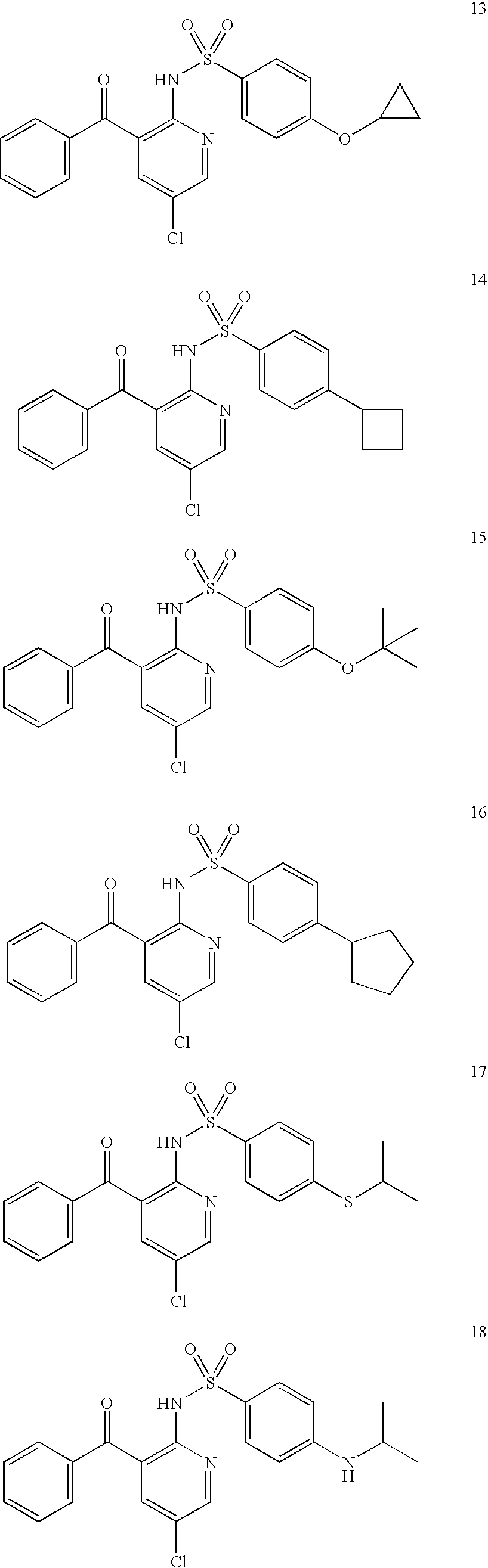


- The following compounds are preferred compounds for use in the method of the invention:
- N-(3-Benzoyl-5-chloro-pyridin-2-yl)-4-isopropoxy-benzenesulfonamide;
- N-(3-Benzoyl-5-nitro-pyridin-2-yl)-4-isopropoxy-benzenesulfonamide;
- N-[5-Chloro-3-(3-fluoro-benzoyl)-pyridin-2-yl]-4-isopropoxy-benzenesulfonamide;
- N-(3-Benzoyl-pyridin-4-yl)-4-isopropoxy-benzenesulfonamide;
- N-(3-Benzoyl-5-chloro-pyridin-2-yl)-4-isopropyl-benzenesulfonamide;
- 5-Oxazol-5-yl-thiophene-2-sulfonic acid (3-benzoyl-5-chloro-pyridin-2-yl)-amide;
- 6-Isopropoxy-pyridine-3-sulfonic acid (3-benzoyl-5-chloro-pyridin-2-yl)-amide; and pharmaceutically acceptable salts, solvates, or hydrates thereof.
Compositions that Modulate CCR2 - In another aspect, the present invention provides compositions that modulate CCR2 activity. Generally, the compositions for modulating chemokine receptor activity in humans and animals will comprise a pharmaceutically acceptable excipient or diluent and a compound having the formula provided above as formula (I).
- The term “composition” as used herein is intended to encompass a product comprising the specified ingredients in the specified amounts, as well as any product which results, directly or indirectly, from combination of the specified ingredients in the specified amounts. By “pharmaceutically acceptable” it is meant the carrier, diluent or excipient must be compatible with the other ingredients of the formulation and not deleterious to the recipient thereof.
- The pharmaceutical compositions for the administration of the compounds of this invention may conveniently be presented in unit dosage form and may be prepared by any of the methods well known in the art of pharmacy. All methods include the step of bringing the active ingredient into association with the carrier which constitutes one or more accessory ingredients. In general, the pharmaceutical compositions are prepared by uniformly and intimately bringing the active ingredient into association with a liquid carrier or a finely divided solid carrier or both, and then, if necessary, shaping the product into the desired formulation. In the pharmaceutical composition the active object compound is included in an amount sufficient to produce the desired effect upon the process or condition of diseases.
- The pharmaceutical compositions containing the active ingredient may be in a form suitable for oral use, for example, as tablets, troches, lozenges, aqueous or oily suspensions, dispersible powders or granules, emulsions and self emulsifications as described in U.S. Patent Application 20020012680, hard or soft capsules, or syrups or elixirs. Compositions intended for oral use may be prepared according to any method known to the art for the manufacture of pharmaceutical compositions. Such compositions may contain one or more agents selected from sweetening agents, flavoring agents, coloring agents and preserving agents in order to provide pharmaceutically elegant and palatable preparations. Tablets contain the active ingredient in admixture with other non-toxic pharmaceutically acceptable excipients which are suitable for the manufacture of tablets. These excipients may be, for example, inert diluents such as cellulose, silicon dioxide, aluminum oxide, calcium carbonate, sodium carbonate, glucose, mannitol, sorbitol, lactose, calcium phosphate or sodium phosphate; granulating and disintegrating agents, for example, corn starch, or alginic acid; binding agents, for example PVP, cellulose, PEG, starch, gelatin or acacia, and lubricating agents, for example magnesium stearate, stearic acid or talc. The tablets may be uncoated or they may be coated enterically or otherwise by known techniques to delay disintegration and absorption in the gastrointestinal tract and thereby provide a sustained action over a longer period. For example, a time delay material such as glyceryl monostearate or glyceryl distearate may be employed. They may also be coated by the techniques described in the U.S. Pat. Nos. 4,256,108; 4,166,452; and 4,265,874 to form osmotic therapeutic tablets for control release.
- Formulations for oral use may also be presented as hard gelatin capsules wherein the active ingredient is mixed with an inert solid diluent, for example, calcium carbonate, calcium phosphate or kaolin, or as soft gelatin capsules wherein the active ingredient is mixed with water or an oil medium, for example peanut oil, liquid paraffin, or olive oil. Additionally, emulsions can be prepared with a non-water miscible ingredient such as oils and stabilized with surfactants such as mono-diglycerides, PEG esters and the like.
- Aqueous suspensions contain the active materials in admixture with excipients suitable for the manufacture of aqueous suspensions. Such excipients are suspending agents, for example sodium carboxymethylcellulose, methylcellulose, hydroxypropylmethylcellulose, sodium alginate, polyvinyl-pyrrolidone, gum tragacanth and gum acacia; dispersing or wetting agents may be a naturally-occurring phosphatide, for example lecithin, or condensation products of an alkylene oxide with fatty acids, for example polyoxyethylene stearate, or condensation products of ethylene oxide with long chain aliphatic alcohols, for example heptadecaethyleneoxycetanol, or condensation products of ethylene oxide with partial esters derived from fatty acids and a hexitol such as polyoxyethylene sorbitol monooleate, or condensation products of ethylene oxide with partial esters derived from fatty acids and hexitol anhydrides, for example polyethylene sorbitan monooleate. The aqueous suspensions may also contain one or more preservatives, for example ethyl, or n-propyl, p-hydroxybenzoate, one or more coloring agents, one or more flavoring agents, and one or more sweetening agents, such as sucrose or saccharin.
- Oily suspensions may be formulated by suspending the active ingredient in a vegetable oil, for example arachis oil, olive oil, sesame oil or coconut oil, or in a mineral oil such as liquid paraffin. The oily suspensions may contain a thickening agent, for example beeswax, hard paraffin or cetyl alcohol. Sweetening agents such as those set forth above, and flavoring agents may be added to provide a palatable oral preparation. These compositions may be preserved by the addition of an anti oxidant such as ascorbic acid.
- Dispersible powders and granules suitable for preparation of an aqueous suspension by the addition of water provide the active ingredient in admixture with a dispersing or wetting agent, suspending agent and one or more preservatives. Suitable dispersing or wetting agents and suspending agents are exemplified by those already mentioned above. Additional excipients, for example sweetening, flavoring and coloring agents, may also be present.
- The pharmaceutical compositions of the invention may also be in the form of oil in water emulsions. The oily phase may be a vegetable oil, for example olive oil or arachis oil, or a mineral oil, for example liquid paraffin or mixtures of these. Suitable emulsifying agents may be naturally-occurring gums, for example gum acacia or gum tragacanth, naturally-occurring phosphatides, for example soy bean, lecithin, and esters or partial esters derived from fatty acids and hexitol anhydrides, for example sorbitan monooleate, and condensation products of the said partial esters with ethylene oxide, for example polyoxyethylene sorbitan monooleate. The emulsions may also contain sweetening and flavoring agents.
- Syrups and elixirs may be formulated with sweetening agents, for example glycerol, propylene glycol, sorbitol or sucrose. Such formulations may also contain a demulcent, a preservative. and flavoring and coloring agents. Oral solutions can be prepared in combination with, for example, cyclodextrin, PEG and surfactants.
- The pharmaceutical compositions may be in the form of a sterile injectable aqueous or oleaginous suspension. This suspension may be formulated according to the known art using those suitable dispersing or wetting agents and suspending agents which have been mentioned above. The sterile injectable preparation may also be a sterile injectable solution or suspension in a non toxic parenterally acceptable diluent or solvent, for example as a solution in 1,3-butane diol. Among the acceptable vehicles and solvents that may be employed are water, Ringer's solution and isotonic sodium chloride solution. In addition, sterile, axed oils are conventionally employed as a solvent or suspending medium. For this purpose any bland fixed oil may be employed including synthetic mono- or diglycerides. In addition, fatty acids such as oleic acid find use in the preparation of injectables.
- The active compounds can also be administered intranasally as, for example, liquid drops or spray. For oral or nasal inhalation, the compounds for use according to the present invention are conveniently delivered in the form of a dry powder inhaler, or an aerosol spray presentation from pressurized packs or a nebuliser, with the use of a suitable propellant, e.g., dichlorodifluoromethane, trichlorofluoromethane, dichlorotetrafluoroethane, carbon dioxide or other suitable gas. In the case of pressurized aerosol the dosage unit may be determined by providing a valve to deliver a metered amount. Capsules and cartridges of gelatin for use in an inhaler or insufflator may be formulated containing a powder mix of the compound and a suitable powder base such as lactose or starch.
- The compounds of the present invention may also be administered in the form of suppositories for rectal administration of the drug. These compositions can be prepared by mixing the drug with a suitable non-irritating excipient which is solid at ordinary temperatures but liquid at the rectal temperature and will therefore melt in the rectum to release the drug. Such materials are cocoa butter and polyethylene glycols. Additionally, the compounds can be administered viaocular delivery by means of solutions or ointments. Still further, transdermal delivery of the subject compounds can be accomplished by means of iontophoretic patches and the like.
- For topical use, creams, ointments, jellies, solutions or suspensions containing the compounds of the present invention are employed. As used herein, topical application is also meant to include the use of mouth washes and gargles.
- The pharmaceutical compositions and methods of the present invention may further comprise other therapeutically active compounds as noted herein, such as those applied in the treatment of the above mentioned pathological conditions.
- In yet another aspect, the present invention provides methods of treating or preventing a CCR2-mediated condition or disease by administering to a subject having such a condition or disease a therapeutically effective amount of any compound of formula (I) above. Compounds for use in the present methods include those compounds according to formula (I), those provided above as embodiments, those specifically exemplified in the Examples below, and those provided with specific structures herein. The “subject” is defined herein to include animals such as mammals, including, but not limited to, primates (e.g., humans), cows, sheep, goats, horses, dogs, cats, rabbits, rats, mice and the like. In preferred embodiments, the subject is a human.
- As used herein, the phrase “CCR2-mediated condition or disease” and related phrases and terms refer to a condition or disease characterized by inappropriate, i.e., less than or greater than normal, CCR2 functional activity. Inappropriate CCR2 functional activity might arise as the result of CCR2 expression in cells which normally do not express CCR2, increased CCR2 expression (leading to, e.g., inflammatory and immunoregulatory disorders and diseases) or decreased CCR2 expression. Inappropriate CCR2 functional activity might also arise as the result of MCP-1 secretion by cells which normally do not secrete MCP-1, increased MCP-1 expression (leading to, e.g., inflammatory and immunoregulatory disorders and diseases) or decreased MCP-1 expression. A CCR2-mediated condition or disease may be completely or partially mediated by inappropriate CCR2 functional activity. However, a CCR2-mediated condition or disease is one in which modulation of CCR2 results in some effect on the underlying condition or disease (e.g., a CCR2 antagonist results in some improvement in patient well being in at least some patients). Furthermore, MCP-2, 3 and 4 are also CCR2 ligands.
- Depending on the disease to be treated and the subject's condition, the compounds and compositions of the present invention may be administered by oral, parenteral (e.g., intramuscular, intraperitoneal, intravenous, ICV, intracisternal injection or infusion, subcutaneous injection, or implant), inhalation, nasal, vaginal, rectal, sublingual, or topical routes of administration and may be formulated, alone or together, in suitable dosage unit formulations containing conventional non toxic pharmaceutically acceptable carriers, adjuvants and vehicles appropriate for each rouse of administration. The present invention also contemplates administration of the compounds and compositions of the present invention in a depot formulation.
- In the treatment or prevention of conditions which require chemokine receptor modulation an appropriate dosage level will generally be about 0.001 to 100 mg per kg patient body weight per day which can be administered in single or multiple doses. Preferably, the dosage level will be about 0.01 to about 25 mg/kg per day; more preferably about 0.05 to about 10 mg/kg per day. A suitable dosage level may be about 0.01 to 25 mg/kg per day, about 0.05 to 10 mg/kg per day, or about 0.1 to 5 mg/kg per day. Within this range the dosage may be 0.005 to 0.05, 0.05 to 0.5, 0.5 to 5.0, or 5.0 to 50 mg/kg per day. For oral administration, the compositions are preferably provided in the form of tablets containing 1.0 to 1000 milligrams of the active ingredient, particularly 1.0, 5.0, 10.0, 15.0, 20.0, 25.0, 50.0, 75.0, 100.0, 150.0, 200.0, 250.0, 300.0, 400.0, 500.0, 600.0, 750.0, 800.0, 900.0, and 1000.0 milligrams of the active ingredient for the symptomatic adjustment of the dosage to the patient to be treated. The compounds may be administered on a regimen of 1 to 4 times per day, preferably once or twice per day.
- It will be understood, however, that the specific dose level and frequency of dosage for any particular patient may be varied and will depend upon a variety of factors including the activity of the specific compound employed, the metabolic stability and length of action of that compound, the age, body weight, hereditary characteristics, general health, sex, diet, mode and time of administration, rate of excretion, drug combination, the severity of the particular condition, and the host undergoing therapy.
- In still other embodiments, the present methods are directed to the treatment of allergic diseases, wherein a compound or composition of the invention is administered either alone or in combination with a second therapeutic agent, wherein said second therapeutic agent is an antihistamine. When used in combination, the practitioner can administer a combination of the compound or composition of the present invention and a second therapeutic agent. Also, the compound or composition and the second therapeutic agent can be administered sequentially, in any order.
- In one embodiment, the present invention provides a composition consisting of a pharmaceutically acceptable carrier and a compound of the invention.
- In one embodiment, the present invention provides a method of treating a CCR2-mediated condition or disease involving administering to a subject a safe and effective amount of the compound or composition of the invention.
- In one embodiment, the present invention provides a method of treating a CCR2-mediated condition or disease involving administering to a subject a safe and effective amount of the compound or composition of the invention, where the CCR2-mediated condition or disease is atherosclerosis.
- In one embodiment, the present invention provides a method of treating a CCR2-mediated condition or disease involving administering to a subject a safe and effective amount of the compound or composition of the invention, where the CCR2-mediated condition or disease is restenosis.
- In one embodiment, the present invention provides a method of treating a CCR2-mediated condition or disease involving administering to a subject a safe and effective amount of the compound or composition of the invention, where the CCR2-mediated condition or disease is multiple sclerosis.
- In one embodiment, the present invention provides a method of treating a CCR2-mediated condition or disease involving administering to a subject a safe and effective amount of the compound or composition of the invention, where the CCR2-mediated condition or disease is selected from the group consisting of inflammatory bowel disease, renal fibrosis, rheumatoid arthritis, obesity and noninsulin-dependent diabetes.
- In one embodiment, the present invention provides a method of treating a CCR2-mediated condition or disease involving administering to a subject a safe and effective amount of the compound or composition of the invention, where the CCR2-mediated condition or disease is type 2 diabetes.
- In one embodiment, the present invention provides a method of treating a CCR2-mediated condition or disease involving administering to a subject a safe and effective amount of the compound or composition of the invention, where the CCR2-mediated condition or disease is selected from the group consisting of chronic obstructive pulmonary disease, idiopathic pulmonary fibrosis and idiopathic pneumonia syndrome.
- In one embodiment, the present invention provides a method of treating a CCR2-mediated condition or disease involving administering to a subject a safe and effective amount of the compound or composition of the invention, where the administering is oral, parenteral, rectal, transdermal, sublingual, nasal or topical.
- In one embodiment, the present invention provides a method of treating a CCR2-mediated condition or disease involving administering to a subject a safe and effective amount of the compound or composition of the invention, where the compound is administered in combination with an anti-inflammatory or analgesic agent.
- In one embodiment, the present invention provides a method of treating a CCR2-mediated condition or disease involving administering to a subject a safe and effective amount of the compound or composition of the invention, where an anti-inflammatory or analgesic agent is also administered.
- In one embodiment, the present invention provides a method of modulating CCR2 function in a cell, where the CCR2 function in the cell is modulated by contacting the cell with a CCR2 modulating amount of the compound of the present invention.
- In one embodiment, the present invention provides a method of treating a CCR2-mediated condition or disease involving administering to a subject a safe and effective amount of the compound or composition of the invention, where the disease is selected from the group consisting of pulmonary fibrosis, transplantation rejection, graft-versus-host disease and cancer.
- In yet other embodiments, the present methods are directed to the treatment of psoriasis wherein a compound or composition of the invention is used alone or in combination with a second therapeutic agent such as a corticosteroid, a lubricant, a keratolytic agent, a vitamin D3 derivative, PUVA and anthralin.
- In other embodiments, the present methods are directed to the treatment of atopic dermatitis using a compound or composition of the invention either alone or in combination with a second therapeutic agent such as a lubricant and a corticosteroid.
- In further embodiments, the present methods are directed to the treatment of asthma using a compound or composition of the invention either alone or in combination with a second therapeutic agent such as a β2-agonist and a corticosteroid.
- The compounds and compositions of the present invention can be combined with other compounds and compositions having related utilities to prevent and treat the condition or disease of interest, such as inflammatory conditions and diseases, including inflammatory bowel disease, allergic diseases, psoriasis, atopic dermatitis and asthma, and those pathologies noted above. Selection of the appropriate agents for use in combination therapies can be made one of ordinary skill in the art. The combination of therapeutic agents may act synergistically to effect the treatment or prevention of the various disorders. Using this approach, one may be able to achieve therapeutic efficacy with lower dosages of each agent, thus reducing the potential for adverse side effects.
- The weight ratio of the compound of the present invention to the second active ingredient may be varied and will depend upon the effective dose of each ingredient. Generally, an effective dose of each will be used. Thus, for example, when a compound of the present invention is combined with an NSAID the weight ratio of the compound of the present invention to the NSAID will generally range from about 1000:1 to about 1:1000, preferably about 200:1 to about 1:200. Combinations of a compound of the present invention and other active ingredients will generally also be within the aforementioned range, but in each case, an effective dose of each active ingredient should be used.
- Preparation of CCR 9 Modulators
- The following examples are offered to illustrate, but not to limit, the claimed invention.
- Additionally, those skilled in the art will recognize that the molecules claimed in this patent may be synthesized using a variety of standard organic chemistry transformations.
- Certain general reaction types employed widely to synthesize target compounds in this invention are summarized in the examples. Specifically, generic procedures for sulfonamide formation, pyridine N-oxide formation and 2-aminophenyl-arylmethanone synthesis via Friedel-Crafts type approaches are given, but numerous other standard chemistries are described within and were employed routinely.
- While not intended to be exhaustive, representative synthetic organic transformations which can be used to prepare compounds of the invention are included below.
- These representative transformations include; standard functional group manipulations; reductions such as nitro to amino; oxidations of functional groups including alcohols and pyridines; aryl substitutions via IPSO or other mechanisms for the introduction of a variety of groups including nitrile, methyl and halogen; protecting group introductions and removals; Grignard formation and reaction with an electrophile; metal-mediated cross couplings including but not limited to Buckwald, Suzuki and Sonigashira reactions; halogenations and other electrophilic aromatic substitution reactions; diazonium salt formations and reactions of these species; etherifications; cyclative condensations, dehydrations, oxidations and reductions leading to heteroaryl groups; aryl metallations and transmetallations and reaction of the ensuing aryl-metal species with an electrophile such as an acid chloride or Weinreb amide; amidations; esterifications; nuclephilic substitution reactions; alkylations; acylations; sulfonamide formation; chlorosulfonylations; ester and related hydrolyses, and the like.
- Certain molecules claimed in this patent can exist in different enantiomeric and diastereomeric forms and all such variants of these compounds are within the scope of the invention.
- Compounds of the invention, including those listed in the table of activities, can be made by the methods and approaches disclosed in International Publication No. WO 03/099773, and by the use of standard organic chemistry transformations that are well known to those skilled in the art.
- Measuring Efficacy of CCR2 Modulators
- In Vitro Assays
- A variety of assays can be used to evaluate the compounds provided herein, including signaling assays, migration assays, ligand binding assays, and other assays of cellular response. CCR2 receptor signaling assays can be used to measure the ability of a compound, such as a potential CCR2 antagonist, to block CCR2 ligand-(e.g. MCP-1)-induced signaling. A migration assay can be used to measure the ability of a compound of interest, such as a possible CCR2 antagonist, to block CCR2-mediated cell migration in vitro. The latter is believed to resemble chemokine-induced cell migration in vivo. A ligand binding assay can be used to measure the ability of a compound, such as a potential CCR2 antagonist, to block the interaction of MCP-1 with its receptor.
- In a suitable assay, a CCR2 protein (whether isolated or recombinant) is used which has at least one property, activity, or functional characteristic of a mammalian CCR2 protein. The property can be a binding property (to, for example, a ligand or inhibitor), a signaling activity (e.g., activation of a mammalian G protein, induction of rapid and transient increase in the concentration of cytosolic free calcium), cellular response function (e.g., stimulation of chemotaxis or inflammatory mediator release by leukocytes), and the like.
- The assay can be a cell-based assay that utilizes cells stably or transiently transfected with a vector or expression cassette having a nucleic acid sequence that encodes the CCR2 receptor. Cell lines naturally expressing CCR2 can also be used. The cells are maintained under conditions appropriate for expression of the receptor and are contacted with a putative agent under conditions appropriate for binding to occur. Binding can be detected using standard techniques. For example, the extent of binding can be determined relative to a suitable control (for example, relative to background in the absence of a putative agent, or relative to a known ligand). Optionally, a cellular fraction, such as a membrane fraction, containing the receptor can be used in lieu of whole cells.
- Detection of binding or complex formation can be detected directly or indirectly. For example, the putative agent can be labeled with a suitable label (e.g., fluorescent label, chemiluminescent label, isotope label, enzyme label, and the like) and binding can be determined by detection of the label. Specific and/or competitive binding can be assessed by competition or displacement studies, using unlabeled agent or a ligand (e.g., MCP-1) as a competitor.
- Binding inhibition assays can be used to evaluate the present compounds. In these assays, the compounds are evaluated as inhibitors of ligand binding using, for example, MCP-1. In this embodiment, the CCR2 receptor is contacted with a ligand such as MCP-1 and a measure of ligand binding is made. The receptor is then contacted with a test agent in the presence of a ligand (e.g., MCP-1) and a second measurement of binding is made. A reduction in the extent of ligand binding is indicative of inhibition of binding by the test agent. The binding inhibition assays can be carried out using whole cells which express CCR2, or a membrane fraction from cells which express CCR2.
- The binding of a G protein coupled receptor by, for example, an agonist, can result in a signaling event by the receptor. Accordingly, signaling assays can also be used to evaluate the compounds of the present invention and induction of signaling function by an agent can be monitored using any suitable method. For example, G protein activity, such as hydrolysis of GTP to GDP, or later signaling events triggered by receptor binding can be assayed by known methods (see, for example, PCT/US97/15915; Neote et al., Cell, 72:415425 (1993); Van Riper et al., J. Exp. Med., 177:851-856 (1993) and Dahinden et al., J. Exp. Med., 179:751-756 (1994)).
- Chemotaxis assays can also be used to assess receptor function and evaluate the compounds provided herein. These assays are based on the functional migration of cells in vitro or in vivo induced by an agent, and can be used to assess the binding and/or effect on chemotaxis of ligands, inhibitors, or agonists. A variety of chemotaxis assays are known in the art, and any suitable assay can be used to evaluate the compounds of the present invention. Examples of suitable assays include those described in PCT/US97/15915; Springer et al., WO 94/20142; Berman et al., Immunol. Invest., 17:625-677 (1988); and Kavanaugh et al., J. Immunol., 146:4149-4156 (1991)).
- Calcium signaling assays measure calcium concentration over time, preferably before and after receptor binding. These assays can be used to quantify the generation of a receptor-signaling mediator, Ca++, following receptor binding (or absence thereof). These assays are useful in determining the ability of a compound, such as those of the present invention, to generate the receptor signaling mediator by binding to a receptor of interest. Also, these assays are useful in determining the ability of a compound, such as those of the present invention, to inhibit generation of the receptor signaling mediator by interfering with binding between a receptor of interest and a ligand.
- In calcium signaling assays used to determine the ability of a compound to interfere with binding between CCR2 and a known CCR2 ligand, CCR2-expressing cells (such as THP-1 cells) are first incubated with a compound of interest, such as a potential CCR2 antagonist, at increasing concentrations. The cell number can be from 105 to 5×10⁵ cells per well in a 96-well microtiter plate. The concentration of the compound being tested may range from 0 to 100 μM. After a period of incubation (which can range from 5 to 60 minutes), the treated cells are placed in a Fluorometric Imaging Plate Reader (FLIPR®) (available from Molecular Devices Corp., Sunnyvale, Calif.) according to the manufacturer's instruction. The FLIPR® system is well known to those skilled in the art as a standard method of performing assays. The cells are then stimulated with an appropriate amount of the CCR2 ligand MCP-1 (e.g. 5-100 nM final concentration) and the signal of intracellular calcium increase (also called calcium flux) is recorded. The efficacy of a compound as an inhibitor of binding between CCR2 and the ligand can be calculated as an IC50 (the concentration needed to cause 50% inhibition in signaling) or IC90 (at 90% inhibition).
- In vitro cell migration assays can be performed (but are not limited to this format) using the 96-well microchamber (called ChemoTX™). The ChemoTX™ system is well known to those skilled in the art as a type of chemotactic/cell migration instrument. In this assay, CCR2-expressing cells (such as THP-1) are first incubated with a compound of interest, such as a possible CCR2 antagonist, at increasing concentrations. Typically, fifty thousand cells per well are used, but the amount can range from 103-106 cells per well. CCR2 ligand MCP-1, typically at 0.1 nM (but can range from 5-100 nM), is placed at the lower chamber and the migration apparatus is assembled. Twenty microliters of test compound-treated cells are then placed onto the membrane. Migration is allowed to take place at 37° C. for a period of time, typically 1.5 hours. At the end of the incubation, the number of cells that migrated across the membrane into the lower chamber is then quantified. The efficacy of a compound as an inhibitor of CCR2-mediated cell migration is calculated as an IC50 (the concentration needed to reduce cell migration by 50%) or IC90 (for 90% inhibition).
- Examples of In Vitro Assays
- Reagents
- THP-1 cells were obtained from the American Type Culture Collection (Manassas, Va.) and cultured in RPMI tissue culture medium supplemented with 10% fetal calf serum (FCS) in a humidified 5% CO2 incubator at 37° C. Recombinant human chemokine protein MCP-1 was obtained from R&D Systems (Minneapolis, Minn.). 125I-labeled MCP-1 protein was obtained from Amersham (Piscataway, N.J.). ChemoTX™ chemotaxis microchambers were purchased from Neuro Probe (Gaithersburg, Md.). CyQUANT™ cell proliferation kits were purchased from Molecular Probes (Eugene, Oreg.). Calcium indicator dye Fluo-4 AM was purchased from Molecular Devices (Mountain View, Calif.).
- Conventional Migration Assay
- Conventional migration assay was used to determine the efficacy of potential receptor antagonists in blocking migration mediated through CCR2. This assay was routinely performed using the ChemoTX® microchamber system with a 5-μm pore-sized polycarbonate membrane. To begin such an assay, THP-1 cells were harvested by centrifugation of cell suspension at 1000 PRM on a GS-6R Beckman centrifuge. The cell pellet was resuspended in chemotaxis buffer (HBSS with 0.1% BSA) at 10×106 cells/mL. Test compounds at desired concentrations were prepared from 10 mM stock solutions by serial dilutions in chemotaxis buffer. An equal volume of cells and compounds were mixed and incubated at room temperature for 15 minutes. Afterwards, 20 μL of the mixture was transferred onto the porous membrane of a migration microchamber, with 29 μL of 0.1 nM chemokine MCP-1 protein placed at the lower chamber. Following a 90-minute incubation at 37° C., during which cells migrated against the chemokine gradient, the assay was terminated by removing the cell drops from atop the filter. To quantify cells migrated across the membrane, 5 μL of 7× CyQUANT® solution was added to each well in the lower chamber, and the fluorescence signal measured on a Spectrafluor Plus fluorescence plate reader (TECAN, Durham, N.C.). The degree of inhibition was determined by comparing migration signals between compound-treated and untreated cells. IC50 calculation was further performed by non-linear squares regression analysis using Graphpad Prism (Graphpad Software, San Diego, Calif.).
- BiRAM Assay
- The primary screen to identify CCR2 antagonists was carried out using BiRAM assay (WO 02101350, US2004023286), which detects potential hits by their ability to activate cell migration under inhibitory chemokine concentration. To begin such an assay, THP-1 cells were harvested by centrifugation of cell suspension at 1000 RPM on a GS-6R Beckman centrifuge. The cell pellet was resuspended in chemotaxis buffer (HBSS/0.1% BSA) at 10×106 cells/mL. Twenty-five microliters of cells was mixed with an equal volume of a test compound diluted to 20 μM in the same buffer. Twenty microliters of the mixture was transferred onto the filter in the upper chemotaxis chamber, with 29 μL of chemokine solution containing 100 nM of MCP-1 and MIP-1α was placed in the lower chamber. Following a 90-minute incubation at 37° C., the assay was terminated by removing the cell drops from atop the filter. To quantify cells migrated across the membrane, 5 μL of 7× CyQUANT® solution was added to each well in the lower chamber, and the fluorescence signal measured on a Spectrafluor Plus fluorescence plate reader (TECAN, Durham, N.C.).
- For selection of potential hits, the level of migration activation was calculated as a RAM index-the ratio between the signal of a particular well and the median signal of the whole plate. Compounds with a RAM index of greater than 1.5 were regarded as RAM positive, and were selected for IC50 determinations in conventional functional assays.
- Calcium Flux Assay
- Calcium flux assay measures an increase in intracellular calcium following ligand-induced receptor activation. In the screen of CCR2 antagonists, it was used as a secondary assay carried out on a FLIPR® machine (Molecular Devices, Mountain View, Calif.). To begin an assay, THP-1 cells were harvested by centrifugation of cell suspension, and resuspended to 1.5×10⁶ cells/mL in HBSS (with 1% fetal calf serum). Cells were then labeled with a calcium indicator dye Fluo-4 AM for 45 minutes at 37° C. with gentle shaking. Following incubation, cells were pelletted, washed once with HBSS and resuspended in the same buffer at a density of 1.6×10⁶ cells/mL. One hundred microliters of labeled cells were mixed with 10 μL of test compound at the appropriate concentrations on an assay plate. Chemokine protein MCP-1 was added at a final concentration of 0.1 nM to activate the receptor. The degree of inhibition was determined by comparing calcium signals betweeen compound-treated and untreated cells. IC50 calculations were further performed by non-linear squares regression analysis using Graphpad Prism (Graphpad Software, San Diego, Calif.).
- Ligand Binding Assay
- Ligand binding assay was used to determine the ability of potential CCR2 antagonists to block the interaction between CCR2 and its ligand MCP-1. CCR2 expressing THP-1 cells were centrifuged and resuspended in assay buffer (20 mM HEPES pH 7.1, 140 mM NaCl, 1 mM CaCl2, 5 mM MgCl2, and with 0.2% bovine serum albumin) to a concentration of 2.2×10⁵ cells/mL. Binding assays were set up as follows. First, 0.09 mL of cells (1×10⁵ THP-1 cells/well) was added to the assay plates containing the compounds, giving a final concentration of ˜2-10 μM each compound for screening (or part of a dose response for compound IC50 determinations). Then 0.09 mL of 125I labeled MCP-1 (obtained from Amersham; Piscataway, N.J.) diluted in assay buffer to a final concentration of ˜50 μM, yielding ˜30,000 cpm per well, was added, the plates sealed and incubated for approximately 3 hours at 4° C. on a shaker platform. Reactions were aspirated onto GF/B glass filters pre-soaked in 0.3% polyethyleneimine (PEI) solution, on a vacuum cell harvester (Packard Instruments; Meriden, Conn.). Scintillation fluid (50 μL; Microscint 20, Packard Instruments) was added to each well, the plates were sealed and radioactivity measured in a Top Count scintillation counter (Packard Instruments). Control wells containing either diluent only (for total counts) or excess MCP-1 (1 μg/mL, for non-specific binding) were used to calculate the percent of total inhibition for compound. The computer program Prism from GraphPad, Inc. (San Diego, Calif.) was used to calculate IC50 values. IC50 values are those concentrations required to reduce the binding of labeled MCP-1 to the receptor by 50%.
- Discovery of CCR2 Antagonists
- The discovery of CCR2 antagonists was carried out in two steps: First, BiRAM assay was used to screen a compound library in a high-throughput manner. The assay detected compounds by their ability to cause a positive migration signal under RAM condition. Secondly, BiRAM positive compounds were tested to determine their IC50 values using the conventional migration, calcium flux assays and ligand binding assays.
- For instance, in a screen of approximately 100,000 compounds, 2000 individual wells representing approximately 2% of total compounds showed a RAM index greater than 1.5. These compounds were cheery-picked and retested in duplicate wells by RAM assay. A total of 156 compounds were confirmed BiRAM positives.
- Since a BiRAM positive signal indicates only the presence of a receptor antagonist and not how strongly it blocks receptor functions, the BiRAM positive compounds were further tested for potency in conventional migration, calcium flux and ligand binding assays. IC50 determinations on this subset discovered several compounds with an IC50 less than 1 μM and that did not inhibit other chemokine receptors examined at significant levels.
- In Vivo Efficacy
- Evaluation of the Test Compound in a Rat Model of Collagen-Induced Arthritis
- A 17-day study of type 11 collagen-induced arthritis is conducted to evaluate the effects of a compound of interest on arthritis-induced clinical ankle swelling. Rat collagen-induced arthritis is an experimental model of polyarthritis that has been widely used for preclinical testing of numerous anti-arthritic agents (see Trentham et al., J. Exp. Med. 146(3):857-868 (1977), Bendele et al., Toxicologic Pathol. 27:134-142 (1999), Bendele et al., Arthritis Rheum. 42:498-506 (1999)). The hallmarks of this model are reliable onset and progression of robust, easily measurable polyarticular inflammation, marked cartilage destruction in association with pannus formation and mild to moderate bone resorption and periosteal bone proliferation.
- Female Lewis rats (approximately 0.2 kilograms) are anesthetized with isoflurane and injected with Freund's Incomplete Adjuvant containing 2 mg/mL bovine type 11 collagen at the base of the tail and two sites on the back on days 0 and 6 of this 17-day study. The “compound of interest” is dosed daily by sub-cutaneous injection from day 9 to day 17 at a dose of 100 mg/kg and a volume of 1 mL/kg in the following vehicle (24.5% Cremaphore EL, 24.5% common oil, 1% Benzylalcohol and 50% Distilled water). Caliper measurements of the ankle joint diameter are taken daily, and reducing joint swelling is taken as a measure of efficacy.
- Evaluation of the Test Compound in a Rat Model of Thioglycollate-Induced Peritoneal Inflammation
- A 2-day study of thioglycollate-induced inflammation is conducted to evaluate the effects of the test compound. The hallmarks of this model are reliable onset and progression of robust, easily measurable inflammatory cellular infiltrate. For the induction of inflammatory peritonitis in Lewis rats, Brewer-Thioglycollate (1.0 mL, 4% solution in distilled water) is injected intra peritoneal (i.p.). Before this injection, the treatment group receives test compound or vehicle and the control group received the same volume of PBS as i.p. injection. After 2 days, a peritoneal lavage is performed with ice-cold PBS containing 1 mM EDTA. The recovered cells are counted with a cell counter (Coulter Counter; Coulter Pharmaceutical, Palo Alto, Calif.) and monocytes/macrophages are identified by flow cytometry using light-scatter properties.
- The inhibition of the number of inflammatory macrophages elicited following tioglycollate injection is evaluated.
- Evaluation of the Test Compound in a Mouse Model of Bacterial Infection
- A 1-day study of streptococcus pneumoniae infection is conducted to evaluate the effects of the test compound. The model measures bacterial infection and spread in an animal following pulmonary infection with live bacterial cultures, measured by inflammatory cellular infiltrate, and assessment of bacterial burden. C57/B6 mice are inoculated intra nasally with LD50 400 CFU at day 0. Groups are either compound or vehicle control treated 1 day prior to bacterial inoculation and twice daily throughout the study. Bacterial burden is measured at 24 hours by plating serial dilutions of homogenized lung tissue on agar plates and counting colonies.
- The reduction bacterial burden in the lung after 24 hours by the test compound is compared to that by the vehicle control.
- Pharmacologics to be Used in Conjunction with CCR2 Compounds
- Pharmacological agents that can be used in conjunction with the CCR2 antagonists of the current invention include those used for the treatments of atherosclerosis, restenosis, multiple sclerosis, pulmonary fibrosis, inflammatory bowel disease, rheumatoid arthritis, graft-versus-host disease, renal fibrosis, psoriasis, transplantation rejection, obesity, diabetes, hypercholesterolemia and cancer.
- It is therefore intended that the foregoing detailed description be regarded as illustrative rather than limiting, and that it be understood that it is the following claims, including all equivalents, that are intended to define the spirit and scope of this invention.
Claims (13)
1. A method for treating a CCR2-mediated condition or disease, comprising administering to the subject an effective amount of a compound represented by the following structural formula:
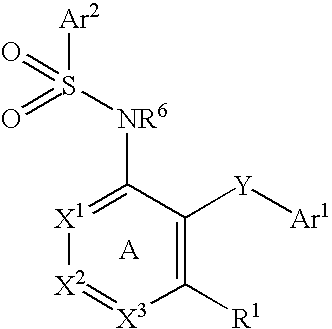
or pharmaceutically acceptable salts, solvates or hydrates thereof,
wherein:
Y is C(O), S, O, S(O) or S(O)2;
X1, X2, and X3 are each, independently, N or CR, provided that at least one of X1, X2, or X3 is N;
R, for each occurrence, and R1 are each, independently, H or a substituent;
R6 is H, an aliphatic carbonyl group, or an aliphatic ester; and
ring A is substituted or unsubstituted;
Ar1 and Ar2 are each, independently, a substituted or unsubstituted aryl group or a substituted or unsubstituted heteroaryl group.
2. The method of claim 1 , wherein the compound is represented by a structural formula selected from the group consisting of A, B, C, and D:


A.
or pharmaceutically acceptable salts, solvates or hydrates thereof,
wherein: R19 and R20 are each, independently, H or a substituent;
B.
or pharmaceutically acceptable salts, solvates or hydrates thereof,
wherein: R1, R2, R3, R4, R5, and each R are, independently, H, an aliphatic group, haloalkyl, a halo, COOH, NO2, alkoxy, or haloalkoxy; and
X4 is CR, N or N+—O−;
C.
or pharmaceutically acceptable salts, solvates or hydrates thereof, wherein:
X4 is CR, N or N+—O−;
R8 is H or an electron withdrawing group; m and n are each, independently, 0 or an integer from 1 to 3; each R9 is, independently, an aliphatic group, haloalkyl, aryl, arylalkyl, alkoxy, cycloalkoxy, haloalkoxy, aryloxy, arylalkoxy, alkylthio, halo, nitro, cyano, hydroxy, NR11CO2R12, C(O)N(R11)2, C(O)R12, CO2R12, OC(O)N(R11)2, OC(O)R12, N(R11)2, or NR11C(O)R12; or two adjacent R9 groups taken together with the atoms to which they are attached form a fused, saturated, unsaturated or partially unsaturated 5 to 7 membered ring having 0, 1 or 2 heteroatoms selected from the group consisting of N, O, and S;
each R10 is, independently, halo, aliphatic group, alkoxy, or haloalkyl; or two adjacent R10 groups taken together with the atoms to which they are attached form a fused, saturated, unsaturated or partially unsaturated 5 to 7 membered ring having 0, 1 or 2 heteroatoms selected from the group consisting of N, O, and S;
each R11 is, independently, H or an aliphatic group; and R12 is an aliphatic group; and
D.
or pharmaceutically acceptable salts, solvates or hydrates thereof, wherein:
R9 is halo, nitro, alkylcarbonyl or trihaloalkyl;
p is 0 or an integer from 1 to 3; and
each R13 is, independently, a halo, a substituted or unsubstituted heterocycle, or a substituted or unsubstituted heteroaryl.
3. The method of claim 1 , where the CCR2-mediated disease or condition is atherosclerosis.
4. The method of claim 1 , where the CCR2-mediated disease or condition is restenosis.
5. The method of claim 1 , where the CCR2-mediated condition or disease is multiple sclerosis.
6. The method of claim 1 , where the CCR2-mediated condition or disease is selected from the group consisting of inflammatory bowel disease, renal fibrosis, rheumatoid arthritis, obesity and diabetes.
7. The method of claim 1 , where the CCR2-mediated condition or disease is selected from the group consisting of chronic obstructive pulmonary disease, idiopathic pulmonary fibrosis and idiopathic pneumonia syndrome.
8. The method of claim 1 , where the CCR2-mediated condition or disease is selected from the group consisting of pulmonary fibrosis, transplantation rejection, graft-versus-host disease and cancer.
9. The method of claim 1 , where the CCR2-mediated condition or disease is neuropathic pain.
10. The method of claim 1 , where the administering is oral, parenteral, rectal, transdermal, sublingual, nasal or topical.
11. The method of claim 1 , where the compound is administered in combination with an anti-inflammatory or analgesic agent.
12. The method of claim 1 , further comprising administering an anti-inflammatory or analgesic agent.
13. A method of modulating CCR2 function in a cell, comprising contacting the cell with a CCR2 modulating amount of the compound of claim 1.
Priority Applications (1)
| Application Number | Priority Date | Filing Date | Title |
|---|---|---|---|
| US11/486,395 US20070021466A1 (en) | 2002-11-18 | 2006-07-13 | CCR2 inhibitors and methods of use thereof |
Applications Claiming Priority (4)
| Application Number | Priority Date | Filing Date | Title |
|---|---|---|---|
| US42767002P | 2002-11-18 | 2002-11-18 | |
| US10/716,170 US6939885B2 (en) | 2002-11-18 | 2003-11-17 | Aryl sulfonamides |
| US10/846,241 US7420055B2 (en) | 2002-11-18 | 2004-05-13 | Aryl sulfonamides |
| US11/486,395 US20070021466A1 (en) | 2002-11-18 | 2006-07-13 | CCR2 inhibitors and methods of use thereof |
Related Parent Applications (1)
| Application Number | Title | Priority Date | Filing Date |
|---|---|---|---|
| US10/846,241 Continuation-In-Part US7420055B2 (en) | 2002-11-18 | 2004-05-13 | Aryl sulfonamides |
Publications (1)
| Publication Number | Publication Date |
|---|---|
| US20070021466A1 true US20070021466A1 (en) | 2007-01-25 |
Family
ID=36461713
Family Applications (1)
| Application Number | Title | Priority Date | Filing Date |
|---|---|---|---|
| US11/486,395 Abandoned US20070021466A1 (en) | 2002-11-18 | 2006-07-13 | CCR2 inhibitors and methods of use thereof |
Country Status (1)
| Country | Link |
|---|---|
| US (1) | US20070021466A1 (en) |
Cited By (18)
| Publication number | Priority date | Publication date | Assignee | Title |
|---|---|---|---|---|
| US20060173019A1 (en) * | 2005-01-14 | 2006-08-03 | Solomon Ungashe | Heteroaryl sulfonamides and CCR2 |
| US20080039465A1 (en) * | 2006-07-14 | 2008-02-14 | Charvat Trevor T | Triazolyl phenyl benzenesulfonamides |
| US20080039504A1 (en) * | 2006-07-14 | 2008-02-14 | Charvat Trevor T | Triazolyl pyridyl benzenesulfonamides |
| US20080161345A1 (en) * | 2004-05-12 | 2008-07-03 | Solomon Ungashe | Aryl Sulfonamides |
| US20090005410A1 (en) * | 2007-06-22 | 2009-01-01 | Chemocentryx, Inc. | N-(2-(hetaryl)aryl) arylsulfonamides and n-(2-(hetaryl) hetaryl arylsulfonamides |
| US20090118307A1 (en) * | 2002-11-18 | 2009-05-07 | Chemocentryx, Inc. | Aryl Sulfonamides |
| US20090233946A1 (en) * | 2007-07-12 | 2009-09-17 | Antoni Krasinski | Fused heteroaryl pyridyl and phenyl benzenesuflonamides as ccr2 modulators for the treatment of inflammation |
| US20100056509A1 (en) * | 2005-01-14 | 2010-03-04 | Chemocentryx, Inc. | Heteroaryl sulfonamides and ccr2 |
| WO2011116299A3 (en) * | 2010-03-18 | 2012-02-23 | Colorado State University Research Foundation | Myeloid derived suppressor cell inhibiting agents |
| US20130231339A1 (en) * | 2012-03-01 | 2013-09-05 | Allergan, Inc. | Benzofuran-2-sulfonamides pyridine derivatives as chemokine receptor modulators |
| US8975290B2 (en) | 2013-03-01 | 2015-03-10 | Colorado State University Research Foundation | Methods and compositions for enhancing an immune response, blocking monocyte migration, amplifying vaccine immunity and inhibiting tumor growth and metastasis |
| US9315579B2 (en) | 2012-06-22 | 2016-04-19 | Sorrento Therapeutics, Inc. | Antigen binding proteins that bind CCR2 |
| WO2018112264A1 (en) | 2016-12-14 | 2018-06-21 | Progenity Inc. | Treatment of a disease of the gastrointestinal tract with a chemokine/chemokine receptor inhibitor |
| WO2020106757A1 (en) | 2018-11-19 | 2020-05-28 | Progenity, Inc. | Ingestible device for delivery of therapeutic agent to the gastrointestinal tract |
| US10758540B2 (en) | 2017-10-11 | 2020-09-01 | Chemocentryx, Inc. | Treatment of focal segmental glomerulosclerosis with CCR2 antagonists |
| US10973809B2 (en) | 2016-11-23 | 2021-04-13 | Chemocentryx, Inc. | Method of treating focal segmental glomerulosclerosis |
| WO2021119482A1 (en) | 2019-12-13 | 2021-06-17 | Progenity, Inc. | Ingestible device for delivery of therapeutic agent to the gastrointestinal tract |
| EP4252629A2 (en) | 2016-12-07 | 2023-10-04 | Biora Therapeutics, Inc. | Gastrointestinal tract detection methods, devices and systems |
Citations (42)
| Publication number | Priority date | Publication date | Assignee | Title |
|---|---|---|---|---|
| US2997368A (en) * | 1956-12-20 | 1961-08-22 | Barent Mark | Production of manganese hydroxide |
| US3121103A (en) * | 1961-10-20 | 1964-02-11 | Hoffmann La Roche | Aminobenzophenones |
| US3344183A (en) * | 1960-12-02 | 1967-09-26 | Hoffmann La Roche | 2 n-substituted amino benzophenones |
| US3442946A (en) * | 1960-04-26 | 1969-05-06 | Hoffmann La Roche | 2-aminomercapto- and 2-aminoalkylcaptobenzophenone oximes |
| US3534062A (en) * | 1967-05-16 | 1970-10-13 | Upjohn Co | Dibenzothiadiazocines |
| US4166452A (en) * | 1976-05-03 | 1979-09-04 | Generales Constantine D J Jr | Apparatus for testing human responses to stimuli |
| US4256108A (en) * | 1977-04-07 | 1981-03-17 | Alza Corporation | Microporous-semipermeable laminated osmotic system |
| US4265874A (en) * | 1980-04-25 | 1981-05-05 | Alza Corporation | Method of delivering drug with aid of effervescent activity generated in environment of use |
| US4372975A (en) * | 1977-06-16 | 1983-02-08 | Pierre Fabre Sa | Substituted 2-benzoyl-4-chloroglycinanilide derivatives, a process for their production, and their use as medicaments |
| US4954518A (en) * | 1987-10-08 | 1990-09-04 | Toyama Chemical Company, Ltd. | 4H-1-benzopyran-4-one derivative or its salt, process for producing the same and pharmaceutical composition comprising the same as active ingredient |
| US4992091A (en) * | 1986-07-11 | 1991-02-12 | The Dow Chemical Company | Substituted pyrazolo[1,5-a]pyrimidine-2-sulfonamides and compositions and methods of controlling undesired vegetation |
| US4997940A (en) * | 1986-07-11 | 1991-03-05 | The Dow Chemical Company | Pyrazolo[1,5-a]pyrimidine-2-sulfonyl chloride and -2-sulfide compounds |
| US5021591A (en) * | 1986-07-11 | 1991-06-04 | The Dow Chemical Company | Pyrazolo[1,5-a]pyrimidine-2-sulfide compounds |
| US5071468A (en) * | 1988-12-23 | 1991-12-10 | Shell Internationale Research Maatschappij B.V. | Triazolopyrimidine herbicides |
| US5093364A (en) * | 1988-08-24 | 1992-03-03 | Schering Agrochemicals Limited | 5-fluoroanthranilic fungicides |
| US5155121A (en) * | 1990-08-16 | 1992-10-13 | Bayer Aktiengesellschaft | Phenylsulphonamide substituted pyridinealkene- and aminooxyalkanecarboxylic acid derivatives |
| US5163995A (en) * | 1988-05-25 | 1992-11-17 | Dowelanco | Herbicidal alkoxy-1,2,4-triazolo[1,5-c]pyrimidine-2-sulfonamides |
| US5185348A (en) * | 1990-08-16 | 1993-02-09 | Bayer Aktiengesellschaft | Phenylsulphonamide substituted pyridinealkene- and -aminooxyalkanecarboxylic acid derivatives |
| US5217521A (en) * | 1989-12-22 | 1993-06-08 | Ciba-Geigy Corporation | Triazolylsulfonamides |
| US5338755A (en) * | 1990-07-31 | 1994-08-16 | Elf Sanofi | N-sulfonylindoline derivatives, their preparation and the pharmaceutical compositions in which they are present |
| US5481186A (en) * | 1994-10-03 | 1996-01-02 | At&T Corp. | Method and apparatus for integrated testing of a system containing digital and radio frequency circuits |
| US5571775A (en) * | 1994-07-11 | 1996-11-05 | Dowelanco | N-aryl[1,2,4]triazolo[1,5-a]pyridine-2-sulfonamide herbicides |
| US5589478A (en) * | 1993-12-17 | 1996-12-31 | Tanabe Seiyaku Co., Ltd. | Benzenesulfonamide derivative and process for preparing thereof |
| US5780488A (en) * | 1996-04-03 | 1998-07-14 | Merck & Co., Inc. | Inhibitors of farnesyl-protein transferase |
| US5973148A (en) * | 1996-11-13 | 1999-10-26 | Dow Agrosciences Llc | N-arylsulfilimine compounds and their use as catalysts in the preparation of N-arylarylsulfonamide compounds |
| US6136971A (en) * | 1998-07-17 | 2000-10-24 | Roche Colorado Corporation | Preparation of sulfonamides |
| US6200995B1 (en) * | 1998-01-29 | 2001-03-13 | Tularik Inc. | PPAR-γ modulators |
| US6297239B1 (en) * | 1997-10-08 | 2001-10-02 | Merck & Co., Inc. | Inhibitors of prenyl-protein transferase |
| US6297195B1 (en) * | 1996-07-19 | 2001-10-02 | Bayer Aktiengesellschaft | Substituted triazoloazine sulphonamides |
| US6316450B1 (en) * | 1997-07-11 | 2001-11-13 | Smithkline Beecham P.L.C. | Compounds |
| US20020009116A1 (en) * | 2000-03-17 | 2002-01-24 | Fujitsu Limited | Complex coupling MQW semiconductor laser |
| US20020012680A1 (en) * | 1999-02-26 | 2002-01-31 | Patel Mahesh V. | Compositions and methods for improved delivery of lipid regulating agents |
| US20020013314A1 (en) * | 2000-02-01 | 2002-01-31 | Bing-Yan Zhu | 3,4-dihydro-2H-benzo[1,4]oxazine inhibitors of factor Xa |
| US20020037928A1 (en) * | 2000-05-03 | 2002-03-28 | Jaen Juan C. | Combination therapeutic compositions and method of use |
| US20020037905A1 (en) * | 1997-04-22 | 2002-03-28 | Dahl Bjarne H. | Substituted phenyl derivatives, their preparation and use |
| US20020065303A1 (en) * | 2000-02-01 | 2002-05-30 | Bing-Yan Zhu | Bivalent phenylene inhibitors of factor Xa |
| US6403607B1 (en) * | 1998-03-30 | 2002-06-11 | Hiroyoshi Hidaka | Sulfonamide derivatives and drugs containing the same as the active ingredient |
| US20020072530A1 (en) * | 2000-02-01 | 2002-06-13 | Bing-Yan Zhu | Indole and benzimidazole inhibitors of factor Xa |
| US20020103202A1 (en) * | 2000-06-23 | 2002-08-01 | Pinto Donald J.P. | Heteroaryl-phenyl substituted factor Xa inhibitors |
| US6432624B1 (en) * | 2000-05-08 | 2002-08-13 | Fuji Photo Film Co., Ltd. | Method of processing silver halide color photographic lightsensitive material |
| US20030060460A1 (en) * | 1996-12-18 | 2003-03-27 | Shuichi Ohuchida | Sulfonamide and carboxamide derivatives and drugs containing the same as the active ingredient |
| US20030139390A1 (en) * | 1999-06-30 | 2003-07-24 | Tularik Inc. | Compounds for the modulation of PPARgamma activity |
-
2006
- 2006-07-13 US US11/486,395 patent/US20070021466A1/en not_active Abandoned
Patent Citations (43)
| Publication number | Priority date | Publication date | Assignee | Title |
|---|---|---|---|---|
| US2997368A (en) * | 1956-12-20 | 1961-08-22 | Barent Mark | Production of manganese hydroxide |
| US3442946A (en) * | 1960-04-26 | 1969-05-06 | Hoffmann La Roche | 2-aminomercapto- and 2-aminoalkylcaptobenzophenone oximes |
| US3344183A (en) * | 1960-12-02 | 1967-09-26 | Hoffmann La Roche | 2 n-substituted amino benzophenones |
| US3121103A (en) * | 1961-10-20 | 1964-02-11 | Hoffmann La Roche | Aminobenzophenones |
| US3534062A (en) * | 1967-05-16 | 1970-10-13 | Upjohn Co | Dibenzothiadiazocines |
| US4166452A (en) * | 1976-05-03 | 1979-09-04 | Generales Constantine D J Jr | Apparatus for testing human responses to stimuli |
| US4256108A (en) * | 1977-04-07 | 1981-03-17 | Alza Corporation | Microporous-semipermeable laminated osmotic system |
| US4372975A (en) * | 1977-06-16 | 1983-02-08 | Pierre Fabre Sa | Substituted 2-benzoyl-4-chloroglycinanilide derivatives, a process for their production, and their use as medicaments |
| US4265874A (en) * | 1980-04-25 | 1981-05-05 | Alza Corporation | Method of delivering drug with aid of effervescent activity generated in environment of use |
| US4992091A (en) * | 1986-07-11 | 1991-02-12 | The Dow Chemical Company | Substituted pyrazolo[1,5-a]pyrimidine-2-sulfonamides and compositions and methods of controlling undesired vegetation |
| US4997940A (en) * | 1986-07-11 | 1991-03-05 | The Dow Chemical Company | Pyrazolo[1,5-a]pyrimidine-2-sulfonyl chloride and -2-sulfide compounds |
| US5021591A (en) * | 1986-07-11 | 1991-06-04 | The Dow Chemical Company | Pyrazolo[1,5-a]pyrimidine-2-sulfide compounds |
| US4954518A (en) * | 1987-10-08 | 1990-09-04 | Toyama Chemical Company, Ltd. | 4H-1-benzopyran-4-one derivative or its salt, process for producing the same and pharmaceutical composition comprising the same as active ingredient |
| US5163995A (en) * | 1988-05-25 | 1992-11-17 | Dowelanco | Herbicidal alkoxy-1,2,4-triazolo[1,5-c]pyrimidine-2-sulfonamides |
| US5093364A (en) * | 1988-08-24 | 1992-03-03 | Schering Agrochemicals Limited | 5-fluoroanthranilic fungicides |
| US5071468A (en) * | 1988-12-23 | 1991-12-10 | Shell Internationale Research Maatschappij B.V. | Triazolopyrimidine herbicides |
| US5217521A (en) * | 1989-12-22 | 1993-06-08 | Ciba-Geigy Corporation | Triazolylsulfonamides |
| US5338755A (en) * | 1990-07-31 | 1994-08-16 | Elf Sanofi | N-sulfonylindoline derivatives, their preparation and the pharmaceutical compositions in which they are present |
| US5155121A (en) * | 1990-08-16 | 1992-10-13 | Bayer Aktiengesellschaft | Phenylsulphonamide substituted pyridinealkene- and aminooxyalkanecarboxylic acid derivatives |
| US5185348A (en) * | 1990-08-16 | 1993-02-09 | Bayer Aktiengesellschaft | Phenylsulphonamide substituted pyridinealkene- and -aminooxyalkanecarboxylic acid derivatives |
| US5589478A (en) * | 1993-12-17 | 1996-12-31 | Tanabe Seiyaku Co., Ltd. | Benzenesulfonamide derivative and process for preparing thereof |
| US5571775A (en) * | 1994-07-11 | 1996-11-05 | Dowelanco | N-aryl[1,2,4]triazolo[1,5-a]pyridine-2-sulfonamide herbicides |
| US5481186A (en) * | 1994-10-03 | 1996-01-02 | At&T Corp. | Method and apparatus for integrated testing of a system containing digital and radio frequency circuits |
| US5780488A (en) * | 1996-04-03 | 1998-07-14 | Merck & Co., Inc. | Inhibitors of farnesyl-protein transferase |
| US6297195B1 (en) * | 1996-07-19 | 2001-10-02 | Bayer Aktiengesellschaft | Substituted triazoloazine sulphonamides |
| US5973148A (en) * | 1996-11-13 | 1999-10-26 | Dow Agrosciences Llc | N-arylsulfilimine compounds and their use as catalysts in the preparation of N-arylarylsulfonamide compounds |
| US20030060460A1 (en) * | 1996-12-18 | 2003-03-27 | Shuichi Ohuchida | Sulfonamide and carboxamide derivatives and drugs containing the same as the active ingredient |
| US20020037905A1 (en) * | 1997-04-22 | 2002-03-28 | Dahl Bjarne H. | Substituted phenyl derivatives, their preparation and use |
| US6316450B1 (en) * | 1997-07-11 | 2001-11-13 | Smithkline Beecham P.L.C. | Compounds |
| US6297239B1 (en) * | 1997-10-08 | 2001-10-02 | Merck & Co., Inc. | Inhibitors of prenyl-protein transferase |
| US6200995B1 (en) * | 1998-01-29 | 2001-03-13 | Tularik Inc. | PPAR-γ modulators |
| US6403607B1 (en) * | 1998-03-30 | 2002-06-11 | Hiroyoshi Hidaka | Sulfonamide derivatives and drugs containing the same as the active ingredient |
| US6136971A (en) * | 1998-07-17 | 2000-10-24 | Roche Colorado Corporation | Preparation of sulfonamides |
| US20020012680A1 (en) * | 1999-02-26 | 2002-01-31 | Patel Mahesh V. | Compositions and methods for improved delivery of lipid regulating agents |
| US20030139390A1 (en) * | 1999-06-30 | 2003-07-24 | Tularik Inc. | Compounds for the modulation of PPARgamma activity |
| US20020013314A1 (en) * | 2000-02-01 | 2002-01-31 | Bing-Yan Zhu | 3,4-dihydro-2H-benzo[1,4]oxazine inhibitors of factor Xa |
| US20020065303A1 (en) * | 2000-02-01 | 2002-05-30 | Bing-Yan Zhu | Bivalent phenylene inhibitors of factor Xa |
| US20020072530A1 (en) * | 2000-02-01 | 2002-06-13 | Bing-Yan Zhu | Indole and benzimidazole inhibitors of factor Xa |
| US20020009116A1 (en) * | 2000-03-17 | 2002-01-24 | Fujitsu Limited | Complex coupling MQW semiconductor laser |
| US20020037928A1 (en) * | 2000-05-03 | 2002-03-28 | Jaen Juan C. | Combination therapeutic compositions and method of use |
| US6653332B2 (en) * | 2000-05-03 | 2003-11-25 | Tularik Inc. | Combination therapeutic compositions and method of use |
| US6432624B1 (en) * | 2000-05-08 | 2002-08-13 | Fuji Photo Film Co., Ltd. | Method of processing silver halide color photographic lightsensitive material |
| US20020103202A1 (en) * | 2000-06-23 | 2002-08-01 | Pinto Donald J.P. | Heteroaryl-phenyl substituted factor Xa inhibitors |
Cited By (59)
| Publication number | Priority date | Publication date | Assignee | Title |
|---|---|---|---|---|
| US20110021523A1 (en) * | 2002-11-18 | 2011-01-27 | Chemocentryx, Inc. | Aryl sulfonamides |
| US8211896B2 (en) | 2002-11-18 | 2012-07-03 | Chemocentryx, Inc. | Aryl sulfonamides |
| US20090118307A1 (en) * | 2002-11-18 | 2009-05-07 | Chemocentryx, Inc. | Aryl Sulfonamides |
| US20090270616A1 (en) * | 2002-11-18 | 2009-10-29 | Chemocentryx, Inc | Aryl sulfonamides |
| US20080161345A1 (en) * | 2004-05-12 | 2008-07-03 | Solomon Ungashe | Aryl Sulfonamides |
| US20110201610A1 (en) * | 2004-05-12 | 2011-08-18 | Solomon Ungashe | Aryl sulfonamides |
| US7932252B2 (en) | 2004-05-12 | 2011-04-26 | Chemocentryx, Inc. | Aryl sulfonamides |
| US20060173019A1 (en) * | 2005-01-14 | 2006-08-03 | Solomon Ungashe | Heteroaryl sulfonamides and CCR2 |
| US8093247B2 (en) | 2005-01-14 | 2012-01-10 | Chemocentryx, Inc. | Heteroaryl sulfonamides and CCR2 |
| US20100056509A1 (en) * | 2005-01-14 | 2010-03-04 | Chemocentryx, Inc. | Heteroaryl sulfonamides and ccr2 |
| US8153818B2 (en) | 2006-07-14 | 2012-04-10 | Chemocentryx, Inc. | Triazolyl phenyl benzenesulfonamides |
| US20080039504A1 (en) * | 2006-07-14 | 2008-02-14 | Charvat Trevor T | Triazolyl pyridyl benzenesulfonamides |
| US20100190762A1 (en) * | 2006-07-14 | 2010-07-29 | Chemocentryx, Inc. | Triazolyl phenyl benzenesulfonamides |
| US20080039465A1 (en) * | 2006-07-14 | 2008-02-14 | Charvat Trevor T | Triazolyl phenyl benzenesulfonamides |
| US8481579B2 (en) | 2006-07-14 | 2013-07-09 | Chemocentryx, Inc. | Triazolyl phenyl benzenesulfonamides |
| US7718683B2 (en) | 2006-07-14 | 2010-05-18 | Chemocentryx, Inc. | Triazolyl phenyl benzenesulfonamides |
| US10532044B2 (en) | 2006-07-14 | 2020-01-14 | Chemocentryx, Inc. | Heteroaryl sulfonamides and CCR2/CCR9 |
| US7683176B2 (en) | 2006-07-14 | 2010-03-23 | Chemocentryx, Inc. | Triazolyl pyridyl benzenesulfonamides |
| US11433061B2 (en) | 2006-07-14 | 2022-09-06 | Chemocentryx, Inc. | Heteroaryl sulfonamides and CCR2/CCR9 |
| US8445518B2 (en) | 2006-07-14 | 2013-05-21 | Chemocentryx, Inc. | Triazolyl pyridyl benzenesulfonamides |
| US10206912B2 (en) | 2006-07-14 | 2019-02-19 | Chemocentryx, Inc. | Heteroaryl sulfonamides and CCR2/CCR9 |
| US20100152186A1 (en) * | 2006-07-14 | 2010-06-17 | Chemocentryx, Inc. | Triazolyl pyridyl benzenesulfonamides |
| US8198309B2 (en) | 2007-06-22 | 2012-06-12 | Chemocentryx, Inc. | N-(2-(hetaryl)aryl) arylsulfonamides and N-(2-(hetaryl)hetaryl arylsulfonamides |
| US8835468B2 (en) | 2007-06-22 | 2014-09-16 | Chemocentryx, Inc. | N-(2-(hetaryl)aryl)arylsulfonamides and n-(2-(hetaryl)hetaryl) arylsulfonamides |
| US20090005410A1 (en) * | 2007-06-22 | 2009-01-01 | Chemocentryx, Inc. | N-(2-(hetaryl)aryl) arylsulfonamides and n-(2-(hetaryl) hetaryl arylsulfonamides |
| US20100331302A1 (en) * | 2007-06-22 | 2010-12-30 | Chemocentryx, Inc. | N-(2-(hetaryl)aryl) arylsulfonamides and n-(2-(hetaryl)hetaryl arylsulfonamides |
| US9409909B2 (en) | 2007-06-22 | 2016-08-09 | Chemocentryx, Inc. | N-(2-(hetaryl)aryl)arylsulfonamides and N-(2-(hetaryl)hetaryl)arylsulfonamides |
| US7776877B2 (en) | 2007-06-22 | 2010-08-17 | Chemocentryx, Inc. | N-(2-(hetaryl)aryl) arylsulfonamides and N-(2-(hetaryl) hetaryl arylsulfonamides |
| US8546408B2 (en) | 2007-07-12 | 2013-10-01 | Chemocentryx, Inc. | Fused heteroaryl pyridyl and phenyl benzenesuflonamides as CCR2 modulators for the treatment of inflammation |
| US10899765B2 (en) | 2007-07-12 | 2021-01-26 | Chemocentryx, Inc. | Fused heteroaryl pyridyl and phenyl benzenesuflonamides as CCR2 modulators for the treatment of inflammation |
| US20090233946A1 (en) * | 2007-07-12 | 2009-09-17 | Antoni Krasinski | Fused heteroaryl pyridyl and phenyl benzenesuflonamides as ccr2 modulators for the treatment of inflammation |
| US10208050B2 (en) | 2007-07-12 | 2019-02-19 | Chemocentryx, Inc. | Fused heteroaryl pyridyl and phenyl benzenesuflonamides as CCR2 modulators for the treatment of inflammation |
| US9394307B2 (en) | 2007-07-12 | 2016-07-19 | Chemocentryx, Inc. | Fused heteroaryl pyridyl and phenyl benzenesuflonamides as CCR2 modulators for the treatment of inflammation |
| US7884110B2 (en) | 2007-07-12 | 2011-02-08 | Chemocentryx, Inc. | Fused heteroaryl pyridyl and phenyl benzenesuflonamides as CCR2 modulators for the treatment of inflammation |
| US9745312B2 (en) | 2007-07-12 | 2017-08-29 | Chemocentryx, Inc. | Fused heteroaryl pyridyl and phenyl benzenesuflonamides as CCR2 modulators for the treatment of inflammation |
| US9320735B2 (en) | 2008-02-26 | 2016-04-26 | Colorado State University Research Foundation | Myeloid derived suppressor cell inhibiting agents |
| WO2011116299A3 (en) * | 2010-03-18 | 2012-02-23 | Colorado State University Research Foundation | Myeloid derived suppressor cell inhibiting agents |
| US20130231339A1 (en) * | 2012-03-01 | 2013-09-05 | Allergan, Inc. | Benzofuran-2-sulfonamides pyridine derivatives as chemokine receptor modulators |
| US9416120B2 (en) * | 2012-03-01 | 2016-08-16 | Allergan, Inc. | Benzofuran-2-sulfonamides pyridine derivatives as chemokine receptor modulators |
| US20140329813A1 (en) * | 2012-03-01 | 2014-11-06 | Allergan, Inc. | Benzofuran-2-sulfonamides pyridine derivatives as chemokine receptor modulators |
| US8815915B2 (en) * | 2012-03-01 | 2014-08-26 | Allergan, Inc. | Benzofuran-2-sulfonamides pyridine derivatives as chemokine receptor modulators |
| US9951138B2 (en) | 2012-06-22 | 2018-04-24 | Sorrento Therapeutics, Inc. | Antigen binding proteins that bind CCR2 |
| US10696746B2 (en) | 2012-06-22 | 2020-06-30 | Sorrento Therapeutics, Inc. | Antigen binding proteins that bind CCR2 |
| US9315579B2 (en) | 2012-06-22 | 2016-04-19 | Sorrento Therapeutics, Inc. | Antigen binding proteins that bind CCR2 |
| US10206983B2 (en) | 2013-03-01 | 2019-02-19 | Colorado State University Research Foundation | Methods and compositions for enhancing an immune response, blocking monocyte migration, amplifying vaccine immunity and inhibiting tumor growth and metastasis |
| US8975290B2 (en) | 2013-03-01 | 2015-03-10 | Colorado State University Research Foundation | Methods and compositions for enhancing an immune response, blocking monocyte migration, amplifying vaccine immunity and inhibiting tumor growth and metastasis |
| US9539314B2 (en) | 2013-03-01 | 2017-01-10 | Colorado State University Research Foundation | Methods and compositions for enhancing an immune response, blocking monocyte migration, amplifying vaccine immunity and inhibiting tumor growth and metastasis |
| US12194032B2 (en) | 2016-11-23 | 2025-01-14 | Chemocentryx, Inc. | Method of treating focal segmental glomerulosclerosis |
| US10973809B2 (en) | 2016-11-23 | 2021-04-13 | Chemocentryx, Inc. | Method of treating focal segmental glomerulosclerosis |
| EP4252629A2 (en) | 2016-12-07 | 2023-10-04 | Biora Therapeutics, Inc. | Gastrointestinal tract detection methods, devices and systems |
| US10980739B2 (en) | 2016-12-14 | 2021-04-20 | Progenity, Inc. | Treatment of a disease of the gastrointestinal tract with a chemokine/chemokine receptor inhibitor |
| WO2018112264A1 (en) | 2016-12-14 | 2018-06-21 | Progenity Inc. | Treatment of a disease of the gastrointestinal tract with a chemokine/chemokine receptor inhibitor |
| US10758540B2 (en) | 2017-10-11 | 2020-09-01 | Chemocentryx, Inc. | Treatment of focal segmental glomerulosclerosis with CCR2 antagonists |
| WO2020106754A1 (en) | 2018-11-19 | 2020-05-28 | Progenity, Inc. | Methods and devices for treating a disease with biotherapeutics |
| WO2020106757A1 (en) | 2018-11-19 | 2020-05-28 | Progenity, Inc. | Ingestible device for delivery of therapeutic agent to the gastrointestinal tract |
| WO2020106704A2 (en) | 2018-11-19 | 2020-05-28 | Progenity, Inc. | Ingestible device for delivery of therapeutic agent to the gastrointestinal tract |
| WO2020106750A1 (en) | 2018-11-19 | 2020-05-28 | Progenity, Inc. | Methods and devices for treating a disease with biotherapeutics |
| WO2021119482A1 (en) | 2019-12-13 | 2021-06-17 | Progenity, Inc. | Ingestible device for delivery of therapeutic agent to the gastrointestinal tract |
| EP4309722A2 (en) | 2019-12-13 | 2024-01-24 | Biora Therapeutics, Inc. | Ingestible device for delivery of therapeutic agent to the gastrointestinal tract |
Similar Documents
| Publication | Publication Date | Title |
|---|---|---|
| US20070021466A1 (en) | CCR2 inhibitors and methods of use thereof | |
| US10899765B2 (en) | Fused heteroaryl pyridyl and phenyl benzenesuflonamides as CCR2 modulators for the treatment of inflammation | |
| JP5253815B2 (en) | Heteroaryl sulfonamides and CCR2 | |
| US8445518B2 (en) | Triazolyl pyridyl benzenesulfonamides | |
| US20100234364A1 (en) | Ccr2 inhibitors and methods of use thereof | |
| US8093247B2 (en) | Heteroaryl sulfonamides and CCR2 | |
| US7718683B2 (en) | Triazolyl phenyl benzenesulfonamides | |
| EP2046762B1 (en) | Triazolyl phenyl benzenesulfonamides | |
| JP6322325B2 (en) | Pyrazol-1-ylbenzenesulfonamide as a CC9 antagonist | |
| US7022717B2 (en) | Chemokine receptor binding heterocyclic compounds | |
| HK1131134B (en) | Triazolyl pyridyl benzenesulfonamides as ccr2 or ccr9 modulators for the treatment of atherosclerosis | |
| HK1109404B (en) | Heteroaryl sulfonamides and ccr2 |
Legal Events
| Date | Code | Title | Description |
|---|---|---|---|
| AS | Assignment |
Owner name: CHEMOCENTRYX, INC., CALIFORNIA Free format text: ASSIGNMENT OF ASSIGNORS INTEREST;ASSIGNORS:UNGASHE, SOLOMON;WRIGHT, JOHN J.;PENNELL, ANDREW M.K.;AND OTHERS;REEL/FRAME:018199/0694 Effective date: 20060816 |
|
| STCB | Information on status: application discontinuation |
Free format text: ABANDONED -- FAILURE TO RESPOND TO AN OFFICE ACTION |