US20070009435A1 - Compositions and methods for enhanced delivery to target sites - Google Patents
Compositions and methods for enhanced delivery to target sites Download PDFInfo
- Publication number
- US20070009435A1 US20070009435A1 US11/175,596 US17559605A US2007009435A1 US 20070009435 A1 US20070009435 A1 US 20070009435A1 US 17559605 A US17559605 A US 17559605A US 2007009435 A1 US2007009435 A1 US 2007009435A1
- Authority
- US
- United States
- Prior art keywords
- mimic
- group
- occurrence
- independently
- oligomeric
- Prior art date
- Legal status (The legal status is an assumption and is not a legal conclusion. Google has not performed a legal analysis and makes no representation as to the accuracy of the status listed.)
- Abandoned
Links
- 238000000034 method Methods 0.000 title claims abstract description 53
- 239000000203 mixture Substances 0.000 title description 14
- 239000002773 nucleotide Substances 0.000 claims abstract description 129
- 125000003729 nucleotide group Chemical group 0.000 claims abstract description 129
- 230000003278 mimic effect Effects 0.000 claims abstract description 116
- 239000013543 active substance Substances 0.000 claims abstract description 105
- 230000008685 targeting Effects 0.000 claims abstract description 67
- 208000037265 diseases, disorders, signs and symptoms Diseases 0.000 claims abstract description 55
- 201000010099 disease Diseases 0.000 claims abstract description 54
- 150000001875 compounds Chemical class 0.000 claims abstract description 43
- 230000027455 binding Effects 0.000 claims abstract description 29
- 230000000295 complement effect Effects 0.000 claims abstract description 16
- 239000003550 marker Substances 0.000 claims abstract description 10
- 241000894007 species Species 0.000 claims description 108
- 108010021625 Immunoglobulin Fragments Proteins 0.000 claims description 31
- 102000008394 Immunoglobulin Fragments Human genes 0.000 claims description 31
- ISAKRJDGNUQOIC-UHFFFAOYSA-N Uracil Chemical compound O=C1C=CNC(=O)N1 ISAKRJDGNUQOIC-UHFFFAOYSA-N 0.000 claims description 30
- OPTASPLRGRRNAP-UHFFFAOYSA-N cytosine Chemical compound NC=1C=CNC(=O)N=1 OPTASPLRGRRNAP-UHFFFAOYSA-N 0.000 claims description 30
- UYTPUPDQBNUYGX-UHFFFAOYSA-N guanine Chemical compound O=C1NC(N)=NC2=C1N=CN2 UYTPUPDQBNUYGX-UHFFFAOYSA-N 0.000 claims description 30
- RWQNBRDOKXIBIV-UHFFFAOYSA-N thymine Chemical compound CC1=CNC(=O)NC1=O RWQNBRDOKXIBIV-UHFFFAOYSA-N 0.000 claims description 30
- 239000012634 fragment Substances 0.000 claims description 22
- 125000000623 heterocyclic group Chemical group 0.000 claims description 22
- 239000000126 substance Substances 0.000 claims description 22
- 125000004169 (C1-C6) alkyl group Chemical group 0.000 claims description 19
- 239000000090 biomarker Substances 0.000 claims description 19
- 229910052760 oxygen Inorganic materials 0.000 claims description 17
- 229910052717 sulfur Inorganic materials 0.000 claims description 17
- 235000018102 proteins Nutrition 0.000 claims description 16
- 102000004169 proteins and genes Human genes 0.000 claims description 16
- 108090000623 proteins and genes Proteins 0.000 claims description 16
- 229930024421 Adenine Natural products 0.000 claims description 15
- GFFGJBXGBJISGV-UHFFFAOYSA-N Adenine Chemical compound NC1=NC=NC2=C1N=CN2 GFFGJBXGBJISGV-UHFFFAOYSA-N 0.000 claims description 15
- -1 I-124 Chemical compound 0.000 claims description 15
- 229960000643 adenine Drugs 0.000 claims description 15
- 229940104302 cytosine Drugs 0.000 claims description 15
- 125000004573 morpholin-4-yl group Chemical group N1(CCOCC1)* 0.000 claims description 15
- 229940113082 thymine Drugs 0.000 claims description 15
- 229940035893 uracil Drugs 0.000 claims description 15
- 238000001727 in vivo Methods 0.000 claims description 13
- 108090000765 processed proteins & peptides Proteins 0.000 claims description 13
- 230000008901 benefit Effects 0.000 claims description 12
- 235000000346 sugar Nutrition 0.000 claims description 12
- VILCJCGEZXAXTO-UHFFFAOYSA-N 2,2,2-tetramine Chemical compound NCCNCCNCCN VILCJCGEZXAXTO-UHFFFAOYSA-N 0.000 claims description 11
- 125000002015 acyclic group Chemical group 0.000 claims description 11
- 125000002837 carbocyclic group Chemical group 0.000 claims description 11
- 239000003795 chemical substances by application Substances 0.000 claims description 11
- 238000002595 magnetic resonance imaging Methods 0.000 claims description 11
- 229910052757 nitrogen Inorganic materials 0.000 claims description 11
- QPCDCPDFJACHGM-UHFFFAOYSA-N N,N-bis{2-[bis(carboxymethyl)amino]ethyl}glycine Chemical compound OC(=O)CN(CC(O)=O)CCN(CC(=O)O)CCN(CC(O)=O)CC(O)=O QPCDCPDFJACHGM-UHFFFAOYSA-N 0.000 claims description 10
- 102000004196 processed proteins & peptides Human genes 0.000 claims description 10
- LRSASMSXMSNRBT-UHFFFAOYSA-N 5-methylcytosine Chemical compound CC1=CNC(=O)N=C1N LRSASMSXMSNRBT-UHFFFAOYSA-N 0.000 claims description 9
- 206010028980 Neoplasm Diseases 0.000 claims description 9
- 108091034117 Oligonucleotide Proteins 0.000 claims description 9
- 125000005842 heteroatom Chemical group 0.000 claims description 9
- 229910052739 hydrogen Inorganic materials 0.000 claims description 9
- 230000003902 lesion Effects 0.000 claims description 9
- 208000015181 infectious disease Diseases 0.000 claims description 8
- ZCYVEMRRCGMTRW-AHCXROLUSA-N Iodine-123 Chemical compound [123I] ZCYVEMRRCGMTRW-AHCXROLUSA-N 0.000 claims description 7
- RAEOEMDZDMCHJA-UHFFFAOYSA-N 2-[2-[bis(carboxymethyl)amino]ethyl-[2-[2-[bis(carboxymethyl)amino]ethyl-(carboxymethyl)amino]ethyl]amino]acetic acid Chemical compound OC(=O)CN(CC(O)=O)CCN(CC(=O)O)CCN(CCN(CC(O)=O)CC(O)=O)CC(O)=O RAEOEMDZDMCHJA-UHFFFAOYSA-N 0.000 claims description 6
- UDOPJKHABYSVIX-UHFFFAOYSA-N 2-[4,7,10-tris(carboxymethyl)-6-[(4-isothiocyanatophenyl)methyl]-1,4,7,10-tetrazacyclododec-1-yl]acetic acid Chemical compound C1N(CC(O)=O)CCN(CC(=O)O)CCN(CC(O)=O)CCN(CC(O)=O)C1CC1=CC=C(N=C=S)C=C1 UDOPJKHABYSVIX-UHFFFAOYSA-N 0.000 claims description 6
- JHALWMSZGCVVEM-UHFFFAOYSA-N 2-[4,7-bis(carboxymethyl)-1,4,7-triazonan-1-yl]acetic acid Chemical compound OC(=O)CN1CCN(CC(O)=O)CCN(CC(O)=O)CC1 JHALWMSZGCVVEM-UHFFFAOYSA-N 0.000 claims description 6
- 102000003886 Glycoproteins Human genes 0.000 claims description 6
- 108090000288 Glycoproteins Proteins 0.000 claims description 6
- 108010039918 Polylysine Proteins 0.000 claims description 6
- WDLRUFUQRNWCPK-UHFFFAOYSA-N Tetraxetan Chemical compound OC(=O)CN1CCN(CC(O)=O)CCN(CC(O)=O)CCN(CC(O)=O)CC1 WDLRUFUQRNWCPK-UHFFFAOYSA-N 0.000 claims description 6
- RYYWUUFWQRZTIU-UHFFFAOYSA-N Thiophosphoric acid Chemical class OP(O)(S)=O RYYWUUFWQRZTIU-UHFFFAOYSA-N 0.000 claims description 6
- PNDPGZBMCMUPRI-XXSWNUTMSA-N [125I][125I] Chemical compound [125I][125I] PNDPGZBMCMUPRI-XXSWNUTMSA-N 0.000 claims description 6
- JLCPHMBAVCMARE-UHFFFAOYSA-N [3-[[3-[[3-[[3-[[3-[[3-[[3-[[3-[[3-[[3-[[3-[[5-(2-amino-6-oxo-1H-purin-9-yl)-3-[[3-[[3-[[3-[[3-[[3-[[5-(2-amino-6-oxo-1H-purin-9-yl)-3-[[5-(2-amino-6-oxo-1H-purin-9-yl)-3-hydroxyoxolan-2-yl]methoxy-hydroxyphosphoryl]oxyoxolan-2-yl]methoxy-hydroxyphosphoryl]oxy-5-(5-methyl-2,4-dioxopyrimidin-1-yl)oxolan-2-yl]methoxy-hydroxyphosphoryl]oxy-5-(6-aminopurin-9-yl)oxolan-2-yl]methoxy-hydroxyphosphoryl]oxy-5-(6-aminopurin-9-yl)oxolan-2-yl]methoxy-hydroxyphosphoryl]oxy-5-(6-aminopurin-9-yl)oxolan-2-yl]methoxy-hydroxyphosphoryl]oxy-5-(6-aminopurin-9-yl)oxolan-2-yl]methoxy-hydroxyphosphoryl]oxyoxolan-2-yl]methoxy-hydroxyphosphoryl]oxy-5-(5-methyl-2,4-dioxopyrimidin-1-yl)oxolan-2-yl]methoxy-hydroxyphosphoryl]oxy-5-(4-amino-2-oxopyrimidin-1-yl)oxolan-2-yl]methoxy-hydroxyphosphoryl]oxy-5-(5-methyl-2,4-dioxopyrimidin-1-yl)oxolan-2-yl]methoxy-hydroxyphosphoryl]oxy-5-(5-methyl-2,4-dioxopyrimidin-1-yl)oxolan-2-yl]methoxy-hydroxyphosphoryl]oxy-5-(6-aminopurin-9-yl)oxolan-2-yl]methoxy-hydroxyphosphoryl]oxy-5-(6-aminopurin-9-yl)oxolan-2-yl]methoxy-hydroxyphosphoryl]oxy-5-(4-amino-2-oxopyrimidin-1-yl)oxolan-2-yl]methoxy-hydroxyphosphoryl]oxy-5-(4-amino-2-oxopyrimidin-1-yl)oxolan-2-yl]methoxy-hydroxyphosphoryl]oxy-5-(4-amino-2-oxopyrimidin-1-yl)oxolan-2-yl]methoxy-hydroxyphosphoryl]oxy-5-(6-aminopurin-9-yl)oxolan-2-yl]methoxy-hydroxyphosphoryl]oxy-5-(4-amino-2-oxopyrimidin-1-yl)oxolan-2-yl]methyl [5-(6-aminopurin-9-yl)-2-(hydroxymethyl)oxolan-3-yl] hydrogen phosphate Polymers Cc1cn(C2CC(OP(O)(=O)OCC3OC(CC3OP(O)(=O)OCC3OC(CC3O)n3cnc4c3nc(N)[nH]c4=O)n3cnc4c3nc(N)[nH]c4=O)C(COP(O)(=O)OC3CC(OC3COP(O)(=O)OC3CC(OC3COP(O)(=O)OC3CC(OC3COP(O)(=O)OC3CC(OC3COP(O)(=O)OC3CC(OC3COP(O)(=O)OC3CC(OC3COP(O)(=O)OC3CC(OC3COP(O)(=O)OC3CC(OC3COP(O)(=O)OC3CC(OC3COP(O)(=O)OC3CC(OC3COP(O)(=O)OC3CC(OC3COP(O)(=O)OC3CC(OC3COP(O)(=O)OC3CC(OC3COP(O)(=O)OC3CC(OC3COP(O)(=O)OC3CC(OC3COP(O)(=O)OC3CC(OC3COP(O)(=O)OC3CC(OC3CO)n3cnc4c(N)ncnc34)n3ccc(N)nc3=O)n3cnc4c(N)ncnc34)n3ccc(N)nc3=O)n3ccc(N)nc3=O)n3ccc(N)nc3=O)n3cnc4c(N)ncnc34)n3cnc4c(N)ncnc34)n3cc(C)c(=O)[nH]c3=O)n3cc(C)c(=O)[nH]c3=O)n3ccc(N)nc3=O)n3cc(C)c(=O)[nH]c3=O)n3cnc4c3nc(N)[nH]c4=O)n3cnc4c(N)ncnc34)n3cnc4c(N)ncnc34)n3cnc4c(N)ncnc34)n3cnc4c(N)ncnc34)O2)c(=O)[nH]c1=O JLCPHMBAVCMARE-UHFFFAOYSA-N 0.000 claims description 6
- 125000002877 alkyl aryl group Chemical group 0.000 claims description 6
- 125000003710 aryl alkyl group Chemical group 0.000 claims description 6
- 125000003118 aryl group Chemical group 0.000 claims description 6
- 125000003588 lysine group Chemical group [H]N([H])C([H])([H])C([H])([H])C([H])([H])C([H])([H])C([H])(N([H])[H])C(*)=O 0.000 claims description 6
- 125000000956 methoxy group Chemical group [H]C([H])([H])O* 0.000 claims description 6
- 125000002496 methyl group Chemical group [H]C([H])([H])* 0.000 claims description 6
- 108020004707 nucleic acids Proteins 0.000 claims description 6
- 102000039446 nucleic acids Human genes 0.000 claims description 6
- 150000007523 nucleic acids Chemical class 0.000 claims description 6
- 229960003330 pentetic acid Drugs 0.000 claims description 6
- 229920000656 polylysine Polymers 0.000 claims description 6
- 108090000695 Cytokines Proteins 0.000 claims description 5
- 102000004127 Cytokines Human genes 0.000 claims description 5
- 102000004190 Enzymes Human genes 0.000 claims description 5
- 108090000790 Enzymes Proteins 0.000 claims description 5
- UQSXHKLRYXJYBZ-UHFFFAOYSA-N Iron oxide Chemical compound [Fe]=O UQSXHKLRYXJYBZ-UHFFFAOYSA-N 0.000 claims description 5
- JVHROZDXPAUZFK-UHFFFAOYSA-N TETA Chemical compound OC(=O)CN1CCCN(CC(O)=O)CCN(CC(O)=O)CCCN(CC(O)=O)CC1 JVHROZDXPAUZFK-UHFFFAOYSA-N 0.000 claims description 5
- KRHYYFGTRYWZRS-BJUDXGSMSA-N ac1l2y5h Chemical compound [18FH] KRHYYFGTRYWZRS-BJUDXGSMSA-N 0.000 claims description 5
- 239000002253 acid Substances 0.000 claims description 5
- 239000005556 hormone Substances 0.000 claims description 5
- 229940088597 hormone Drugs 0.000 claims description 5
- 238000003384 imaging method Methods 0.000 claims description 5
- 230000002458 infectious effect Effects 0.000 claims description 5
- 230000005298 paramagnetic effect Effects 0.000 claims description 5
- 229910052698 phosphorus Inorganic materials 0.000 claims description 5
- 229920001184 polypeptide Polymers 0.000 claims description 5
- 238000002203 pretreatment Methods 0.000 claims description 5
- 238000002603 single-photon emission computed tomography Methods 0.000 claims description 5
- ASJSAQIRZKANQN-CRCLSJGQSA-N 2-deoxy-D-ribose Chemical group OC[C@@H](O)[C@@H](O)CC=O ASJSAQIRZKANQN-CRCLSJGQSA-N 0.000 claims description 4
- HMFHBZSHGGEWLO-SOOFDHNKSA-N D-ribofuranose Chemical group OC[C@H]1OC(O)[C@H](O)[C@@H]1O HMFHBZSHGGEWLO-SOOFDHNKSA-N 0.000 claims description 4
- 108091093037 Peptide nucleic acid Proteins 0.000 claims description 4
- PYMYPHUHKUWMLA-LMVFSUKVSA-N Ribose Chemical group OC[C@@H](O)[C@@H](O)[C@@H](O)C=O PYMYPHUHKUWMLA-LMVFSUKVSA-N 0.000 claims description 4
- HMFHBZSHGGEWLO-UHFFFAOYSA-N alpha-D-Furanose-Ribose Chemical group OCC1OC(O)C(O)C1O HMFHBZSHGGEWLO-UHFFFAOYSA-N 0.000 claims description 4
- 230000008859 change Effects 0.000 claims description 4
- 239000000178 monomer Substances 0.000 claims description 4
- LDGWQMRUWMSZIU-LQDDAWAPSA-M 2,3-bis[(z)-octadec-9-enoxy]propyl-trimethylazanium;chloride Chemical compound [Cl-].CCCCCCCC\C=C/CCCCCCCCOCC(C[N+](C)(C)C)OCCCCCCCC\C=C/CCCCCCCC LDGWQMRUWMSZIU-LQDDAWAPSA-M 0.000 claims description 3
- HHLZCENAOIROSL-UHFFFAOYSA-N 2-[4,7-bis(carboxymethyl)-1,4,7,10-tetrazacyclododec-1-yl]acetic acid Chemical compound OC(=O)CN1CCNCCN(CC(O)=O)CCN(CC(O)=O)CC1 HHLZCENAOIROSL-UHFFFAOYSA-N 0.000 claims description 3
- 108010088751 Albumins Proteins 0.000 claims description 3
- 102000009027 Albumins Human genes 0.000 claims description 3
- 208000037260 Atherosclerotic Plaque Diseases 0.000 claims description 3
- FCKYPQBAHLOOJQ-UHFFFAOYSA-N Cyclohexane-1,2-diaminetetraacetic acid Chemical compound OC(=O)CN(CC(O)=O)C1CCCCC1N(CC(O)=O)CC(O)=O FCKYPQBAHLOOJQ-UHFFFAOYSA-N 0.000 claims description 3
- IQUHNCOJRJBMSU-UHFFFAOYSA-N H3HP-DO3A Chemical compound CC(O)CN1CCN(CC(O)=O)CCN(CC(O)=O)CCN(CC(O)=O)CC1 IQUHNCOJRJBMSU-UHFFFAOYSA-N 0.000 claims description 3
- 108090001030 Lipoproteins Proteins 0.000 claims description 3
- 102000004895 Lipoproteins Human genes 0.000 claims description 3
- 108010074338 Lymphokines Proteins 0.000 claims description 3
- 102000008072 Lymphokines Human genes 0.000 claims description 3
- OHLUUHNLEMFGTQ-UHFFFAOYSA-N N-methylacetamide Chemical compound CNC(C)=O OHLUUHNLEMFGTQ-UHFFFAOYSA-N 0.000 claims description 3
- XBDQKXXYIPTUBI-UHFFFAOYSA-N Propionic acid Substances CCC(O)=O XBDQKXXYIPTUBI-UHFFFAOYSA-N 0.000 claims description 3
- RCXMQNIDOFXYDO-UHFFFAOYSA-N [4,7,10-tris(phosphonomethyl)-1,4,7,10-tetrazacyclododec-1-yl]methylphosphonic acid Chemical compound OP(O)(=O)CN1CCN(CP(O)(O)=O)CCN(CP(O)(O)=O)CCN(CP(O)(O)=O)CC1 RCXMQNIDOFXYDO-UHFFFAOYSA-N 0.000 claims description 3
- 125000003342 alkenyl group Chemical group 0.000 claims description 3
- 125000000217 alkyl group Chemical group 0.000 claims description 3
- 125000000304 alkynyl group Chemical group 0.000 claims description 3
- 235000008206 alpha-amino acids Nutrition 0.000 claims description 3
- 150000001371 alpha-amino acids Chemical class 0.000 claims description 3
- 231100001011 cardiovascular lesion Toxicity 0.000 claims description 3
- ANCLJVISBRWUTR-UHFFFAOYSA-N diaminophosphinic acid Chemical compound NP(N)(O)=O ANCLJVISBRWUTR-UHFFFAOYSA-N 0.000 claims description 3
- NAGJZTKCGNOGPW-UHFFFAOYSA-N dithiophosphoric acid Chemical class OP(O)(S)=S NAGJZTKCGNOGPW-UHFFFAOYSA-N 0.000 claims description 3
- 239000003102 growth factor Substances 0.000 claims description 3
- 229910052736 halogen Inorganic materials 0.000 claims description 3
- 150000002367 halogens Chemical class 0.000 claims description 3
- OHSVLFRHMCKCQY-NJFSPNSNSA-N lutetium-177 Chemical compound [177Lu] OHSVLFRHMCKCQY-NJFSPNSNSA-N 0.000 claims description 3
- 238000012261 overproduction Methods 0.000 claims description 3
- PTMHPRAIXMAOOB-UHFFFAOYSA-L phosphoramidate Chemical compound NP([O-])([O-])=O PTMHPRAIXMAOOB-UHFFFAOYSA-L 0.000 claims description 3
- 108020003175 receptors Proteins 0.000 claims description 3
- 102000005962 receptors Human genes 0.000 claims description 3
- 108091027075 5S-rRNA precursor Proteins 0.000 claims description 2
- 230000002757 inflammatory effect Effects 0.000 claims description 2
- 208000010125 myocardial infarction Diseases 0.000 claims description 2
- 238000012634 optical imaging Methods 0.000 claims description 2
- 230000003071 parasitic effect Effects 0.000 claims description 2
- 150000003904 phospholipids Chemical class 0.000 claims description 2
- 238000012636 positron electron tomography Methods 0.000 claims description 2
- 150000003431 steroids Chemical class 0.000 claims description 2
- 238000012285 ultrasound imaging Methods 0.000 claims description 2
- 230000002792 vascular Effects 0.000 claims description 2
- 238000002600 positron emission tomography Methods 0.000 claims 1
- 238000003325 tomography Methods 0.000 claims 1
- 239000000427 antigen Substances 0.000 description 29
- 108091007433 antigens Proteins 0.000 description 29
- 102000036639 antigens Human genes 0.000 description 29
- 0 *C1C(C)CC(CO)C1* Chemical compound *C1C(C)CC(CO)C1* 0.000 description 19
- 125000005647 linker group Chemical group 0.000 description 18
- 239000003814 drug Substances 0.000 description 12
- ZLCNZMPVIPWCRY-UHFFFAOYSA-N B[W](C)[PH](C)(C)[Y].C.C Chemical compound B[W](C)[PH](C)(C)[Y].C.C ZLCNZMPVIPWCRY-UHFFFAOYSA-N 0.000 description 9
- 108060003951 Immunoglobulin Proteins 0.000 description 8
- 210000004027 cell Anatomy 0.000 description 8
- 238000006243 chemical reaction Methods 0.000 description 8
- 102000018358 immunoglobulin Human genes 0.000 description 8
- 210000001519 tissue Anatomy 0.000 description 8
- BWGVNKXGVNDBDI-UHFFFAOYSA-N Fibrin monomer Chemical compound CNC(=O)CNC(=O)CN BWGVNKXGVNDBDI-UHFFFAOYSA-N 0.000 description 7
- 239000000872 buffer Substances 0.000 description 7
- 239000002738 chelating agent Substances 0.000 description 7
- 244000045947 parasite Species 0.000 description 7
- 108010073385 Fibrin Proteins 0.000 description 6
- 102000009123 Fibrin Human genes 0.000 description 6
- HEMHJVSKTPXQMS-UHFFFAOYSA-M Sodium hydroxide Chemical compound [OH-].[Na+] HEMHJVSKTPXQMS-UHFFFAOYSA-M 0.000 description 6
- 229950003499 fibrin Drugs 0.000 description 6
- 229940124597 therapeutic agent Drugs 0.000 description 6
- 108010022366 Carcinoembryonic Antigen Proteins 0.000 description 5
- 102100025475 Carcinoembryonic antigen-related cell adhesion molecule 5 Human genes 0.000 description 5
- KCXVZYZYPLLWCC-UHFFFAOYSA-N EDTA Chemical compound OC(=O)CN(CC(O)=O)CCN(CC(O)=O)CC(O)=O KCXVZYZYPLLWCC-UHFFFAOYSA-N 0.000 description 5
- 238000004128 high performance liquid chromatography Methods 0.000 description 5
- AYDNDEJFWZSAFL-UHFFFAOYSA-N BC1CN(P(=O)(OC)N(C)C)CC(COC)O1 Chemical compound BC1CN(P(=O)(OC)N(C)C)CC(COC)O1 AYDNDEJFWZSAFL-UHFFFAOYSA-N 0.000 description 4
- 201000009030 Carcinoma Diseases 0.000 description 4
- PEEHTFAAVSWFBL-UHFFFAOYSA-N Maleimide Chemical compound O=C1NC(=O)C=C1 PEEHTFAAVSWFBL-UHFFFAOYSA-N 0.000 description 4
- 241001529936 Murinae Species 0.000 description 4
- 125000003277 amino group Chemical group 0.000 description 4
- 230000021615 conjugation Effects 0.000 description 4
- 238000005859 coupling reaction Methods 0.000 description 4
- 238000001514 detection method Methods 0.000 description 4
- 239000000032 diagnostic agent Substances 0.000 description 4
- 229940039227 diagnostic agent Drugs 0.000 description 4
- 230000029087 digestion Effects 0.000 description 4
- 229940088598 enzyme Drugs 0.000 description 4
- 230000003993 interaction Effects 0.000 description 4
- 150000002500 ions Chemical class 0.000 description 4
- 239000000463 material Substances 0.000 description 4
- 229910044991 metal oxide Inorganic materials 0.000 description 4
- 150000004706 metal oxides Chemical class 0.000 description 4
- 244000052769 pathogen Species 0.000 description 4
- 229920001308 poly(aminoacid) Polymers 0.000 description 4
- 125000002924 primary amino group Chemical group [H]N([H])* 0.000 description 4
- 238000011160 research Methods 0.000 description 4
- JQWHASGSAFIOCM-UHFFFAOYSA-M sodium periodate Chemical compound [Na+].[O-]I(=O)(=O)=O JQWHASGSAFIOCM-UHFFFAOYSA-M 0.000 description 4
- 239000002904 solvent Substances 0.000 description 4
- 241000894006 Bacteria Species 0.000 description 3
- VYZAMTAEIAYCRO-BJUDXGSMSA-N Chromium-51 Chemical compound [51Cr] VYZAMTAEIAYCRO-BJUDXGSMSA-N 0.000 description 3
- 208000035473 Communicable disease Diseases 0.000 description 3
- 102100031940 Epithelial cell adhesion molecule Human genes 0.000 description 3
- LYCAIKOWRPUZTN-UHFFFAOYSA-N Ethylene glycol Chemical compound OCCO LYCAIKOWRPUZTN-UHFFFAOYSA-N 0.000 description 3
- GYHNNYVSQQEPJS-OIOBTWANSA-N Gallium-67 Chemical compound [67Ga] GYHNNYVSQQEPJS-OIOBTWANSA-N 0.000 description 3
- 102100030595 HLA class II histocompatibility antigen gamma chain Human genes 0.000 description 3
- 101001082627 Homo sapiens HLA class II histocompatibility antigen gamma chain Proteins 0.000 description 3
- XEEYBQQBJWHFJM-UHFFFAOYSA-N Iron Chemical compound [Fe] XEEYBQQBJWHFJM-UHFFFAOYSA-N 0.000 description 3
- XEEYBQQBJWHFJM-AKLPVKDBSA-N Iron-59 Chemical compound [59Fe] XEEYBQQBJWHFJM-AKLPVKDBSA-N 0.000 description 3
- 239000004365 Protease Substances 0.000 description 3
- GKLVYJBZJHMRIY-OUBTZVSYSA-N Technetium-99 Chemical compound [99Tc] GKLVYJBZJHMRIY-OUBTZVSYSA-N 0.000 description 3
- 241000700605 Viruses Species 0.000 description 3
- 239000003242 anti bacterial agent Substances 0.000 description 3
- GUTLYIVDDKVIGB-YPZZEJLDSA-N cobalt-57 Chemical compound [57Co] GUTLYIVDDKVIGB-YPZZEJLDSA-N 0.000 description 3
- GUTLYIVDDKVIGB-BJUDXGSMSA-N cobalt-58 Chemical compound [58Co] GUTLYIVDDKVIGB-BJUDXGSMSA-N 0.000 description 3
- 239000010949 copper Substances 0.000 description 3
- RYGMFSIKBFXOCR-IGMARMGPSA-N copper-64 Chemical compound [64Cu] RYGMFSIKBFXOCR-IGMARMGPSA-N 0.000 description 3
- 230000008878 coupling Effects 0.000 description 3
- 238000010168 coupling process Methods 0.000 description 3
- 239000003937 drug carrier Substances 0.000 description 3
- 229940006110 gallium-67 Drugs 0.000 description 3
- 229940055742 indium-111 Drugs 0.000 description 3
- APFVFJFRJDLVQX-AHCXROLUSA-N indium-111 Chemical compound [111In] APFVFJFRJDLVQX-AHCXROLUSA-N 0.000 description 3
- 238000004519 manufacturing process Methods 0.000 description 3
- 238000001840 matrix-assisted laser desorption--ionisation time-of-flight mass spectrometry Methods 0.000 description 3
- 244000005700 microbiome Species 0.000 description 3
- 239000008194 pharmaceutical composition Substances 0.000 description 3
- KJTLSVCANCCWHF-AHCXROLUSA-N ruthenium-97 Chemical compound [97Ru] KJTLSVCANCCWHF-AHCXROLUSA-N 0.000 description 3
- 238000001542 size-exclusion chromatography Methods 0.000 description 3
- 239000000243 solution Substances 0.000 description 3
- JJAHTWIKCUJRDK-UHFFFAOYSA-N succinimidyl 4-(N-maleimidomethyl)cyclohexane-1-carboxylate Chemical compound C1CC(CN2C(C=CC2=O)=O)CCC1C(=O)ON1C(=O)CCC1=O JJAHTWIKCUJRDK-UHFFFAOYSA-N 0.000 description 3
- 229940056501 technetium 99m Drugs 0.000 description 3
- BKVIYDNLLOSFOA-OIOBTWANSA-N thallium-201 Chemical compound [201Tl] BKVIYDNLLOSFOA-OIOBTWANSA-N 0.000 description 3
- 239000013598 vector Substances 0.000 description 3
- 230000003612 virological effect Effects 0.000 description 3
- NAWDYIZEMPQZHO-AHCXROLUSA-N ytterbium-169 Chemical compound [169Yb] NAWDYIZEMPQZHO-AHCXROLUSA-N 0.000 description 3
- PNDPGZBMCMUPRI-HVTJNCQCSA-N 10043-66-0 Chemical compound [131I][131I] PNDPGZBMCMUPRI-HVTJNCQCSA-N 0.000 description 2
- HZAXFHJVJLSVMW-UHFFFAOYSA-N 2-Aminoethan-1-ol Chemical compound NCCO HZAXFHJVJLSVMW-UHFFFAOYSA-N 0.000 description 2
- NSTREUWFTAOOKS-UHFFFAOYSA-N 2-fluorobenzoic acid Chemical compound OC(=O)C1=CC=CC=C1F NSTREUWFTAOOKS-UHFFFAOYSA-N 0.000 description 2
- CJNZAXGUTKBIHP-UHFFFAOYSA-N 2-iodobenzoic acid Chemical compound OC(=O)C1=CC=CC=C1I CJNZAXGUTKBIHP-UHFFFAOYSA-N 0.000 description 2
- FPQQSJJWHUJYPU-UHFFFAOYSA-N 3-(dimethylamino)propyliminomethylidene-ethylazanium;chloride Chemical compound Cl.CCN=C=NCCCN(C)C FPQQSJJWHUJYPU-UHFFFAOYSA-N 0.000 description 2
- 125000004042 4-aminobutyl group Chemical group [H]C([*])([H])C([H])([H])C([H])([H])C([H])([H])N([H])[H] 0.000 description 2
- PEHVGBZKEYRQSX-UHFFFAOYSA-N 7-deaza-adenine Chemical compound NC1=NC=NC2=C1C=CN2 PEHVGBZKEYRQSX-UHFFFAOYSA-N 0.000 description 2
- USFZMSVCRYTOJT-UHFFFAOYSA-N Ammonium acetate Chemical compound N.CC(O)=O USFZMSVCRYTOJT-UHFFFAOYSA-N 0.000 description 2
- 206010006187 Breast cancer Diseases 0.000 description 2
- 208000026310 Breast neoplasm Diseases 0.000 description 2
- OKTJSMMVPCPJKN-UHFFFAOYSA-N Carbon Chemical compound [C] OKTJSMMVPCPJKN-UHFFFAOYSA-N 0.000 description 2
- AOJJSUZBOXZQNB-TZSSRYMLSA-N Doxorubicin Chemical compound O([C@H]1C[C@@](O)(CC=2C(O)=C3C(=O)C=4C=CC=C(C=4C(=O)C3=C(O)C=21)OC)C(=O)CO)[C@H]1C[C@H](N)[C@H](O)[C@H](C)O1 AOJJSUZBOXZQNB-TZSSRYMLSA-N 0.000 description 2
- 108010049003 Fibrinogen Proteins 0.000 description 2
- 102000008946 Fibrinogen Human genes 0.000 description 2
- GYHNNYVSQQEPJS-YPZZEJLDSA-N Gallium-68 Chemical compound [68Ga] GYHNNYVSQQEPJS-YPZZEJLDSA-N 0.000 description 2
- 241000282412 Homo Species 0.000 description 2
- 101000920667 Homo sapiens Epithelial cell adhesion molecule Proteins 0.000 description 2
- 241000713772 Human immunodeficiency virus 1 Species 0.000 description 2
- PXHVJJICTQNCMI-UHFFFAOYSA-N Nickel Chemical compound [Ni] PXHVJJICTQNCMI-UHFFFAOYSA-N 0.000 description 2
- 108090000526 Papain Proteins 0.000 description 2
- XYFCBTPGUUZFHI-UHFFFAOYSA-N Phosphine Chemical compound P XYFCBTPGUUZFHI-UHFFFAOYSA-N 0.000 description 2
- 206010035226 Plasma cell myeloma Diseases 0.000 description 2
- 206010039491 Sarcoma Diseases 0.000 description 2
- BUGBHKTXTAQXES-AHCXROLUSA-N Selenium-75 Chemical compound [75Se] BUGBHKTXTAQXES-AHCXROLUSA-N 0.000 description 2
- FAPWRFPIFSIZLT-UHFFFAOYSA-M Sodium chloride Chemical compound [Na+].[Cl-] FAPWRFPIFSIZLT-UHFFFAOYSA-M 0.000 description 2
- PZBFGYYEXUXCOF-UHFFFAOYSA-N TCEP Chemical compound OC(=O)CCP(CCC(O)=O)CCC(O)=O PZBFGYYEXUXCOF-UHFFFAOYSA-N 0.000 description 2
- DTQVDTLACAAQTR-UHFFFAOYSA-N Trifluoroacetic acid Chemical compound OC(=O)C(F)(F)F DTQVDTLACAAQTR-UHFFFAOYSA-N 0.000 description 2
- 150000007513 acids Chemical class 0.000 description 2
- 238000007792 addition Methods 0.000 description 2
- 150000001412 amines Chemical class 0.000 description 2
- AFYNADDZULBEJA-UHFFFAOYSA-N bicinchoninic acid Chemical compound C1=CC=CC2=NC(C=3C=C(C4=CC=CC=C4N=3)C(=O)O)=CC(C(O)=O)=C21 AFYNADDZULBEJA-UHFFFAOYSA-N 0.000 description 2
- 210000000481 breast Anatomy 0.000 description 2
- 201000011510 cancer Diseases 0.000 description 2
- 150000001720 carbohydrates Chemical class 0.000 description 2
- 229910052799 carbon Inorganic materials 0.000 description 2
- 125000002843 carboxylic acid group Chemical group 0.000 description 2
- 150000001735 carboxylic acids Chemical class 0.000 description 2
- 238000002648 combination therapy Methods 0.000 description 2
- 238000007796 conventional method Methods 0.000 description 2
- 150000004696 coordination complex Chemical class 0.000 description 2
- 239000003431 cross linking reagent Substances 0.000 description 2
- 125000000151 cysteine group Chemical group N[C@@H](CS)C(=O)* 0.000 description 2
- 230000003247 decreasing effect Effects 0.000 description 2
- 229940079593 drug Drugs 0.000 description 2
- 230000009977 dual effect Effects 0.000 description 2
- 230000000694 effects Effects 0.000 description 2
- 150000002148 esters Chemical class 0.000 description 2
- 238000002474 experimental method Methods 0.000 description 2
- 229940012952 fibrinogen Drugs 0.000 description 2
- 238000001914 filtration Methods 0.000 description 2
- 230000006870 function Effects 0.000 description 2
- 230000004927 fusion Effects 0.000 description 2
- 238000010353 genetic engineering Methods 0.000 description 2
- 125000005843 halogen group Chemical group 0.000 description 2
- 210000004408 hybridoma Anatomy 0.000 description 2
- FDGQSTZJBFJUBT-UHFFFAOYSA-N hypoxanthine Chemical compound O=C1NC=NC2=C1NC=N2 FDGQSTZJBFJUBT-UHFFFAOYSA-N 0.000 description 2
- 230000002163 immunogen Effects 0.000 description 2
- 230000005847 immunogenicity Effects 0.000 description 2
- 238000000338 in vitro Methods 0.000 description 2
- 238000002347 injection Methods 0.000 description 2
- 239000007924 injection Substances 0.000 description 2
- 229940044173 iodine-125 Drugs 0.000 description 2
- 239000007788 liquid Substances 0.000 description 2
- 238000005259 measurement Methods 0.000 description 2
- 201000001441 melanoma Diseases 0.000 description 2
- 201000000050 myeloid neoplasm Diseases 0.000 description 2
- 210000000056 organ Anatomy 0.000 description 2
- 230000002611 ovarian Effects 0.000 description 2
- 229940055729 papain Drugs 0.000 description 2
- 235000019834 papain Nutrition 0.000 description 2
- 239000002245 particle Substances 0.000 description 2
- 230000001717 pathogenic effect Effects 0.000 description 2
- 230000001575 pathological effect Effects 0.000 description 2
- 229940012957 plasmin Drugs 0.000 description 2
- 230000008569 process Effects 0.000 description 2
- 239000000047 product Substances 0.000 description 2
- 230000005855 radiation Effects 0.000 description 2
- 239000011541 reaction mixture Substances 0.000 description 2
- 208000000587 small cell lung carcinoma Diseases 0.000 description 2
- 239000001488 sodium phosphate Substances 0.000 description 2
- 229910000162 sodium phosphate Inorganic materials 0.000 description 2
- 238000001228 spectrum Methods 0.000 description 2
- 125000001424 substituent group Chemical group 0.000 description 2
- 238000006467 substitution reaction Methods 0.000 description 2
- 238000002198 surface plasmon resonance spectroscopy Methods 0.000 description 2
- 238000012360 testing method Methods 0.000 description 2
- 230000001225 therapeutic effect Effects 0.000 description 2
- 238000002560 therapeutic procedure Methods 0.000 description 2
- 150000003573 thiols Chemical class 0.000 description 2
- RYFMWSXOAZQYPI-UHFFFAOYSA-K trisodium phosphate Chemical compound [Na+].[Na+].[Na+].[O-]P([O-])([O-])=O RYFMWSXOAZQYPI-UHFFFAOYSA-K 0.000 description 2
- XLYOFNOQVPJJNP-UHFFFAOYSA-N water Substances O XLYOFNOQVPJJNP-UHFFFAOYSA-N 0.000 description 2
- PCHJSUWPFVWCPO-NJFSPNSNSA-N (199au)gold Chemical compound [199Au] PCHJSUWPFVWCPO-NJFSPNSNSA-N 0.000 description 1
- FBMZEITWVNHWJW-UHFFFAOYSA-N 1,7-dihydropyrrolo[2,3-d]pyrimidin-4-one Chemical compound OC1=NC=NC2=C1C=CN2 FBMZEITWVNHWJW-UHFFFAOYSA-N 0.000 description 1
- WUAPFZMCVAUBPE-NJFSPNSNSA-N 188Re Chemical compound [188Re] WUAPFZMCVAUBPE-NJFSPNSNSA-N 0.000 description 1
- PIINGYXNCHTJTF-UHFFFAOYSA-N 2-(2-azaniumylethylamino)acetate Chemical group NCCNCC(O)=O PIINGYXNCHTJTF-UHFFFAOYSA-N 0.000 description 1
- NGNBDVOYPDDBFK-UHFFFAOYSA-N 2-[2,4-di(pentan-2-yl)phenoxy]acetyl chloride Chemical compound CCCC(C)C1=CC=C(OCC(Cl)=O)C(C(C)CCC)=C1 NGNBDVOYPDDBFK-UHFFFAOYSA-N 0.000 description 1
- VNDHYTGVCGVETQ-UHFFFAOYSA-N 4-fluorobenzamide Chemical compound NC(=O)C1=CC=C(F)C=C1 VNDHYTGVCGVETQ-UHFFFAOYSA-N 0.000 description 1
- XRNBLQCAFWFFPM-UHFFFAOYSA-N 4-iodobenzamide Chemical compound NC(=O)C1=CC=C(I)C=C1 XRNBLQCAFWFFPM-UHFFFAOYSA-N 0.000 description 1
- LOSIULRWFAEMFL-UHFFFAOYSA-N 7-deazaguanine Chemical compound O=C1NC(N)=NC2=C1CC=N2 LOSIULRWFAEMFL-UHFFFAOYSA-N 0.000 description 1
- ZCYVEMRRCGMTRW-UHFFFAOYSA-N 7553-56-2 Chemical compound [I] ZCYVEMRRCGMTRW-UHFFFAOYSA-N 0.000 description 1
- MSSXOMSJDRHRMC-UHFFFAOYSA-N 9H-purine-2,6-diamine Chemical compound NC1=NC(N)=C2NC=NC2=N1 MSSXOMSJDRHRMC-UHFFFAOYSA-N 0.000 description 1
- WEVYAHXRMPXWCK-UHFFFAOYSA-N Acetonitrile Chemical compound CC#N WEVYAHXRMPXWCK-UHFFFAOYSA-N 0.000 description 1
- 208000010507 Adenocarcinoma of Lung Diseases 0.000 description 1
- 101710117290 Aldo-keto reductase family 1 member C4 Proteins 0.000 description 1
- 239000005695 Ammonium acetate Substances 0.000 description 1
- 108091023037 Aptamer Proteins 0.000 description 1
- 102100038080 B-cell receptor CD22 Human genes 0.000 description 1
- 102100024222 B-lymphocyte antigen CD19 Human genes 0.000 description 1
- 102100022005 B-lymphocyte antigen CD20 Human genes 0.000 description 1
- 208000035143 Bacterial infection Diseases 0.000 description 1
- 102000004506 Blood Proteins Human genes 0.000 description 1
- 108010017384 Blood Proteins Proteins 0.000 description 1
- 241000283690 Bos taurus Species 0.000 description 1
- WKBOTKDWSSQWDR-OIOBTWANSA-N Bromine-77 Chemical compound [77Br] WKBOTKDWSSQWDR-OIOBTWANSA-N 0.000 description 1
- QZVUXYXJJGGNCU-GIXBRNFPSA-N CC(=O)N[C@H](C)CCCCNC(=O)C1=CC=C([18F])C=C1.CCNC(=O)C1=CC=C([18F])C=C1 Chemical compound CC(=O)N[C@H](C)CCCCNC(=O)C1=CC=C([18F])C=C1.CCNC(=O)C1=CC=C([18F])C=C1 QZVUXYXJJGGNCU-GIXBRNFPSA-N 0.000 description 1
- KCWHWIWCDIEOCC-UHFFFAOYSA-N CC(C)C(=O)COCCOCNC(=O)CN1CCCN(CC(=O)O)CCN(CC(=O)O)CCCN(CC(=O)O)CC1.[H]N(C(=O)CN(CC)C(=O)CN1/C=N\C2=C1N=CN=C2N)C(CCCCN)C(N)=O.[H]N(CC)C(=O)CN(CCN([H])C(=O)CN(CCN([H])C(C)C)C(=O)CN1C=C(C)C(=O)NC1=O)C(=O)CN1C=CC(=O)NC1=O Chemical compound CC(C)C(=O)COCCOCNC(=O)CN1CCCN(CC(=O)O)CCN(CC(=O)O)CCCN(CC(=O)O)CC1.[H]N(C(=O)CN(CC)C(=O)CN1/C=N\C2=C1N=CN=C2N)C(CCCCN)C(N)=O.[H]N(CC)C(=O)CN(CCN([H])C(=O)CN(CCN([H])C(C)C)C(=O)CN1C=C(C)C(=O)NC1=O)C(=O)CN1C=CC(=O)NC1=O KCWHWIWCDIEOCC-UHFFFAOYSA-N 0.000 description 1
- 241000283707 Capra Species 0.000 description 1
- VYZAMTAEIAYCRO-UHFFFAOYSA-N Chromium Chemical compound [Cr] VYZAMTAEIAYCRO-UHFFFAOYSA-N 0.000 description 1
- 206010009944 Colon cancer Diseases 0.000 description 1
- 102100032768 Complement receptor type 2 Human genes 0.000 description 1
- 108010047041 Complementarity Determining Regions Proteins 0.000 description 1
- 101150029707 ERBB2 gene Proteins 0.000 description 1
- 102000010911 Enzyme Precursors Human genes 0.000 description 1
- 108010062466 Enzyme Precursors Proteins 0.000 description 1
- 108010066687 Epithelial Cell Adhesion Molecule Proteins 0.000 description 1
- LFQSCWFLJHTTHZ-UHFFFAOYSA-N Ethanol Chemical compound CCO LFQSCWFLJHTTHZ-UHFFFAOYSA-N 0.000 description 1
- 102000016359 Fibronectins Human genes 0.000 description 1
- 108010067306 Fibronectins Proteins 0.000 description 1
- 206010017533 Fungal infection Diseases 0.000 description 1
- 241000233866 Fungi Species 0.000 description 1
- 229910052688 Gadolinium Inorganic materials 0.000 description 1
- 206010018338 Glioma Diseases 0.000 description 1
- 102100041003 Glutamate carboxypeptidase 2 Human genes 0.000 description 1
- WHUUTDBJXJRKMK-UHFFFAOYSA-N Glutamic acid Natural products OC(=O)C(N)CCC(O)=O WHUUTDBJXJRKMK-UHFFFAOYSA-N 0.000 description 1
- 102000006354 HLA-DR Antigens Human genes 0.000 description 1
- 108010058597 HLA-DR Antigens Proteins 0.000 description 1
- 102100031573 Hematopoietic progenitor cell antigen CD34 Human genes 0.000 description 1
- HTTJABKRGRZYRN-UHFFFAOYSA-N Heparin Chemical compound OC1C(NC(=O)C)C(O)OC(COS(O)(=O)=O)C1OC1C(OS(O)(=O)=O)C(O)C(OC2C(C(OS(O)(=O)=O)C(OC3C(C(O)C(O)C(O3)C(O)=O)OS(O)(=O)=O)C(CO)O2)NS(O)(=O)=O)C(C(O)=O)O1 HTTJABKRGRZYRN-UHFFFAOYSA-N 0.000 description 1
- 101000690301 Homo sapiens Aldo-keto reductase family 1 member C4 Proteins 0.000 description 1
- 101000884305 Homo sapiens B-cell receptor CD22 Proteins 0.000 description 1
- 101000980825 Homo sapiens B-lymphocyte antigen CD19 Proteins 0.000 description 1
- 101000897405 Homo sapiens B-lymphocyte antigen CD20 Proteins 0.000 description 1
- 101000941929 Homo sapiens Complement receptor type 2 Proteins 0.000 description 1
- 101000892862 Homo sapiens Glutamate carboxypeptidase 2 Proteins 0.000 description 1
- 101000777663 Homo sapiens Hematopoietic progenitor cell antigen CD34 Proteins 0.000 description 1
- 101000878605 Homo sapiens Low affinity immunoglobulin epsilon Fc receptor Proteins 0.000 description 1
- 101001116548 Homo sapiens Protein CBFA2T1 Proteins 0.000 description 1
- 101000914484 Homo sapiens T-lymphocyte activation antigen CD80 Proteins 0.000 description 1
- 101000851376 Homo sapiens Tumor necrosis factor receptor superfamily member 8 Proteins 0.000 description 1
- UGQMRVRMYYASKQ-UHFFFAOYSA-N Hypoxanthine nucleoside Natural products OC1C(O)C(CO)OC1N1C(NC=NC2=O)=C2N=C1 UGQMRVRMYYASKQ-UHFFFAOYSA-N 0.000 description 1
- 206010061216 Infarction Diseases 0.000 description 1
- 108010002350 Interleukin-2 Proteins 0.000 description 1
- WHUUTDBJXJRKMK-VKHMYHEASA-N L-glutamic acid Chemical compound OC(=O)[C@@H](N)CCC(O)=O WHUUTDBJXJRKMK-VKHMYHEASA-N 0.000 description 1
- 102100038007 Low affinity immunoglobulin epsilon Fc receptor Human genes 0.000 description 1
- 206010025323 Lymphomas Diseases 0.000 description 1
- 241000124008 Mammalia Species 0.000 description 1
- 241001465754 Metazoa Species 0.000 description 1
- 241000699666 Mus <mouse, genus> Species 0.000 description 1
- 101100346932 Mus musculus Muc1 gene Proteins 0.000 description 1
- 241000204031 Mycoplasma Species 0.000 description 1
- 208000031888 Mycoses Diseases 0.000 description 1
- NQTADLQHYWFPDB-UHFFFAOYSA-N N-Hydroxysuccinimide Chemical compound ON1C(=O)CCC1=O NQTADLQHYWFPDB-UHFFFAOYSA-N 0.000 description 1
- 206010028851 Necrosis Diseases 0.000 description 1
- 206010029260 Neuroblastoma Diseases 0.000 description 1
- 108700020796 Oncogene Proteins 0.000 description 1
- 241000283973 Oryctolagus cuniculus Species 0.000 description 1
- 102000016979 Other receptors Human genes 0.000 description 1
- 206010033128 Ovarian cancer Diseases 0.000 description 1
- 229910019142 PO4 Inorganic materials 0.000 description 1
- 229930012538 Paclitaxel Natural products 0.000 description 1
- 208000030852 Parasitic disease Diseases 0.000 description 1
- 102000057297 Pepsin A Human genes 0.000 description 1
- 108090000284 Pepsin A Proteins 0.000 description 1
- 108091005804 Peptidases Proteins 0.000 description 1
- 102000035195 Peptidases Human genes 0.000 description 1
- OAICVXFJPJFONN-OUBTZVSYSA-N Phosphorus-32 Chemical compound [32P] OAICVXFJPJFONN-OUBTZVSYSA-N 0.000 description 1
- OAICVXFJPJFONN-NJFSPNSNSA-N Phosphorus-33 Chemical compound [33P] OAICVXFJPJFONN-NJFSPNSNSA-N 0.000 description 1
- 102100021768 Phosphoserine aminotransferase Human genes 0.000 description 1
- 108010001014 Plasminogen Activators Proteins 0.000 description 1
- 102000001938 Plasminogen Activators Human genes 0.000 description 1
- 239000002202 Polyethylene glycol Substances 0.000 description 1
- 241000288906 Primates Species 0.000 description 1
- 108010072866 Prostate-Specific Antigen Proteins 0.000 description 1
- 102000007056 Recombinant Fusion Proteins Human genes 0.000 description 1
- 108010008281 Recombinant Fusion Proteins Proteins 0.000 description 1
- 206010038389 Renal cancer Diseases 0.000 description 1
- 208000006265 Renal cell carcinoma Diseases 0.000 description 1
- 241000606701 Rickettsia Species 0.000 description 1
- 229930189077 Rifamycin Natural products 0.000 description 1
- 206010041067 Small cell lung cancer Diseases 0.000 description 1
- VMHLLURERBWHNL-UHFFFAOYSA-M Sodium acetate Chemical compound [Na+].CC([O-])=O VMHLLURERBWHNL-UHFFFAOYSA-M 0.000 description 1
- 241000589970 Spirochaetales Species 0.000 description 1
- 108010023197 Streptokinase Proteins 0.000 description 1
- 102100027222 T-lymphocyte activation antigen CD80 Human genes 0.000 description 1
- 102000007000 Tenascin Human genes 0.000 description 1
- 108010008125 Tenascin Proteins 0.000 description 1
- 239000004098 Tetracycline Substances 0.000 description 1
- 108090000190 Thrombin Proteins 0.000 description 1
- 208000007536 Thrombosis Diseases 0.000 description 1
- 108090000373 Tissue Plasminogen Activator Proteins 0.000 description 1
- 102000003978 Tissue Plasminogen Activator Human genes 0.000 description 1
- 102100036857 Tumor necrosis factor receptor superfamily member 8 Human genes 0.000 description 1
- 102100027212 Tumor-associated calcium signal transducer 2 Human genes 0.000 description 1
- 108090000435 Urokinase-type plasminogen activator Proteins 0.000 description 1
- 102000003990 Urokinase-type plasminogen activator Human genes 0.000 description 1
- 108091008605 VEGF receptors Proteins 0.000 description 1
- 102100033177 Vascular endothelial growth factor receptor 2 Human genes 0.000 description 1
- 208000036142 Viral infection Diseases 0.000 description 1
- VWQVUPCCIRVNHF-OIOBTWANSA-N Yttrium-86 Chemical compound [86Y] VWQVUPCCIRVNHF-OIOBTWANSA-N 0.000 description 1
- VWQVUPCCIRVNHF-OUBTZVSYSA-N Yttrium-90 Chemical compound [90Y] VWQVUPCCIRVNHF-OUBTZVSYSA-N 0.000 description 1
- 239000003070 absorption delaying agent Substances 0.000 description 1
- CPELXLSAUQHCOX-AHCXROLUSA-N ac1l4zwb Chemical compound [76BrH] CPELXLSAUQHCOX-AHCXROLUSA-N 0.000 description 1
- 239000008351 acetate buffer Substances 0.000 description 1
- QQINRWTZWGJFDB-YPZZEJLDSA-N actinium-225 Chemical compound [225Ac] QQINRWTZWGJFDB-YPZZEJLDSA-N 0.000 description 1
- 229940125666 actinium-225 Drugs 0.000 description 1
- 230000009471 action Effects 0.000 description 1
- 239000000853 adhesive Substances 0.000 description 1
- 230000001070 adhesive effect Effects 0.000 description 1
- 229940009456 adriamycin Drugs 0.000 description 1
- 239000011543 agarose gel Substances 0.000 description 1
- 150000001299 aldehydes Chemical class 0.000 description 1
- 229930013930 alkaloid Natural products 0.000 description 1
- 150000001350 alkyl halides Chemical class 0.000 description 1
- 125000003275 alpha amino acid group Chemical group 0.000 description 1
- 230000004075 alteration Effects 0.000 description 1
- 125000000539 amino acid group Chemical group 0.000 description 1
- 150000001413 amino acids Chemical class 0.000 description 1
- 229940043376 ammonium acetate Drugs 0.000 description 1
- 235000019257 ammonium acetate Nutrition 0.000 description 1
- 239000012491 analyte Substances 0.000 description 1
- 230000033115 angiogenesis Effects 0.000 description 1
- 230000000844 anti-bacterial effect Effects 0.000 description 1
- 230000001093 anti-cancer Effects 0.000 description 1
- 230000000702 anti-platelet effect Effects 0.000 description 1
- 230000000259 anti-tumor effect Effects 0.000 description 1
- 229940088710 antibiotic agent Drugs 0.000 description 1
- 239000003146 anticoagulant agent Substances 0.000 description 1
- 239000003429 antifungal agent Substances 0.000 description 1
- 229940121375 antifungal agent Drugs 0.000 description 1
- 230000000890 antigenic effect Effects 0.000 description 1
- 239000002246 antineoplastic agent Substances 0.000 description 1
- 238000013459 approach Methods 0.000 description 1
- RQNWIZPPADIBDY-OIOBTWANSA-N arsenic-72 Chemical compound [72As] RQNWIZPPADIBDY-OIOBTWANSA-N 0.000 description 1
- CKLJMWTZIZZHCS-REOHCLBHSA-N aspartic acid group Chemical group N[C@@H](CC(=O)O)C(=O)O CKLJMWTZIZZHCS-REOHCLBHSA-N 0.000 description 1
- RYXHOMYVWAEKHL-OUBTZVSYSA-N astatine-211 Chemical compound [211At] RYXHOMYVWAEKHL-OUBTZVSYSA-N 0.000 description 1
- 230000003305 autocrine Effects 0.000 description 1
- 230000001580 bacterial effect Effects 0.000 description 1
- 208000022362 bacterial infectious disease Diseases 0.000 description 1
- 230000003115 biocidal effect Effects 0.000 description 1
- JCXGWMGPZLAOME-AKLPVKDBSA-N bismuth-212 Chemical compound [212Bi] JCXGWMGPZLAOME-AKLPVKDBSA-N 0.000 description 1
- 239000008280 blood Substances 0.000 description 1
- 210000004369 blood Anatomy 0.000 description 1
- 230000037396 body weight Effects 0.000 description 1
- 210000002798 bone marrow cell Anatomy 0.000 description 1
- 210000004556 brain Anatomy 0.000 description 1
- 101150061829 bre-3 gene Proteins 0.000 description 1
- 201000008275 breast carcinoma Diseases 0.000 description 1
- CPELXLSAUQHCOX-FTXFMUIASA-N bromine-75 Chemical compound [75BrH] CPELXLSAUQHCOX-FTXFMUIASA-N 0.000 description 1
- 125000004432 carbon atom Chemical group C* 0.000 description 1
- 125000003178 carboxy group Chemical group [H]OC(*)=O 0.000 description 1
- 150000001732 carboxylic acid derivatives Chemical class 0.000 description 1
- 230000003915 cell function Effects 0.000 description 1
- 238000012512 characterization method Methods 0.000 description 1
- 239000013522 chelant Substances 0.000 description 1
- 239000003153 chemical reaction reagent Substances 0.000 description 1
- 239000011651 chromium Substances 0.000 description 1
- 229910000423 chromium oxide Inorganic materials 0.000 description 1
- DQLATGHUWYMOKM-UHFFFAOYSA-L cisplatin Chemical compound N[Pt](N)(Cl)Cl DQLATGHUWYMOKM-UHFFFAOYSA-L 0.000 description 1
- 229960004316 cisplatin Drugs 0.000 description 1
- 238000003776 cleavage reaction Methods 0.000 description 1
- 238000000576 coating method Methods 0.000 description 1
- 239000010941 cobalt Substances 0.000 description 1
- GUTLYIVDDKVIGB-UHFFFAOYSA-N cobalt atom Chemical compound [Co] GUTLYIVDDKVIGB-UHFFFAOYSA-N 0.000 description 1
- 229910000428 cobalt oxide Inorganic materials 0.000 description 1
- 210000001072 colon Anatomy 0.000 description 1
- 230000001268 conjugating effect Effects 0.000 description 1
- 239000000470 constituent Substances 0.000 description 1
- RYGMFSIKBFXOCR-YPZZEJLDSA-N copper-62 Chemical compound [62Cu] RYGMFSIKBFXOCR-YPZZEJLDSA-N 0.000 description 1
- RYGMFSIKBFXOCR-AKLPVKDBSA-N copper-67 Chemical compound [67Cu] RYGMFSIKBFXOCR-AKLPVKDBSA-N 0.000 description 1
- 230000009260 cross reactivity Effects 0.000 description 1
- 235000018417 cysteine Nutrition 0.000 description 1
- XUJNEKJLAYXESH-UHFFFAOYSA-N cysteine Natural products SCC(N)C(O)=O XUJNEKJLAYXESH-UHFFFAOYSA-N 0.000 description 1
- 230000006378 damage Effects 0.000 description 1
- 238000002059 diagnostic imaging Methods 0.000 description 1
- 238000002405 diagnostic procedure Methods 0.000 description 1
- 238000000502 dialysis Methods 0.000 description 1
- 230000003292 diminished effect Effects 0.000 description 1
- 208000035475 disorder Diseases 0.000 description 1
- 239000002612 dispersion medium Substances 0.000 description 1
- 238000010494 dissociation reaction Methods 0.000 description 1
- 230000005593 dissociations Effects 0.000 description 1
- 238000004090 dissolution Methods 0.000 description 1
- 238000009826 distribution Methods 0.000 description 1
- 238000013399 early diagnosis Methods 0.000 description 1
- 108700015053 epidermal growth factor receptor activity proteins Proteins 0.000 description 1
- 102000052116 epidermal growth factor receptor activity proteins Human genes 0.000 description 1
- 208000021045 exocrine pancreatic carcinoma Diseases 0.000 description 1
- 108010073651 fibrinmonomer Proteins 0.000 description 1
- 239000012467 final product Substances 0.000 description 1
- 239000007850 fluorescent dye Substances 0.000 description 1
- 102000006815 folate receptor Human genes 0.000 description 1
- 108020005243 folate receptor Proteins 0.000 description 1
- 125000000524 functional group Chemical group 0.000 description 1
- 230000002538 fungal effect Effects 0.000 description 1
- RJOJUSXNYCILHH-UHFFFAOYSA-N gadolinium(3+) Chemical compound [Gd+3] RJOJUSXNYCILHH-UHFFFAOYSA-N 0.000 description 1
- 210000000973 gametocyte Anatomy 0.000 description 1
- 108010074605 gamma-Globulins Proteins 0.000 description 1
- 230000002496 gastric effect Effects 0.000 description 1
- 239000000499 gel Substances 0.000 description 1
- 235000013922 glutamic acid Nutrition 0.000 description 1
- 239000004220 glutamic acid Substances 0.000 description 1
- 150000004676 glycans Chemical class 0.000 description 1
- 244000000013 helminth Species 0.000 description 1
- 229920000669 heparin Polymers 0.000 description 1
- 229960002897 heparin Drugs 0.000 description 1
- 229940022353 herceptin Drugs 0.000 description 1
- KJZYNXUDTRRSPN-OUBTZVSYSA-N holmium-166 Chemical compound [166Ho] KJZYNXUDTRRSPN-OUBTZVSYSA-N 0.000 description 1
- 239000003667 hormone antagonist Substances 0.000 description 1
- 102000054751 human RUNX1T1 Human genes 0.000 description 1
- 238000009396 hybridization Methods 0.000 description 1
- 239000001257 hydrogen Substances 0.000 description 1
- 230000003053 immunization Effects 0.000 description 1
- 238000002649 immunization Methods 0.000 description 1
- 229940072221 immunoglobulins Drugs 0.000 description 1
- 230000002480 immunoprotective effect Effects 0.000 description 1
- APFVFJFRJDLVQX-FTXFMUIASA-N indium-110 Chemical compound [110In] APFVFJFRJDLVQX-FTXFMUIASA-N 0.000 description 1
- 230000007574 infarction Effects 0.000 description 1
- 239000012678 infectious agent Substances 0.000 description 1
- 239000003978 infusion fluid Substances 0.000 description 1
- 230000003834 intracellular effect Effects 0.000 description 1
- 238000007918 intramuscular administration Methods 0.000 description 1
- 238000001990 intravenous administration Methods 0.000 description 1
- XMBWDFGMSWQBCA-BJUDXGSMSA-N iodane Chemical compound [126IH] XMBWDFGMSWQBCA-BJUDXGSMSA-N 0.000 description 1
- XMBWDFGMSWQBCA-LZFNBGRKSA-N iodane Chemical compound [133IH] XMBWDFGMSWQBCA-LZFNBGRKSA-N 0.000 description 1
- XMBWDFGMSWQBCA-NOHWODKXSA-N iodane Chemical compound [120IH] XMBWDFGMSWQBCA-NOHWODKXSA-N 0.000 description 1
- XMBWDFGMSWQBCA-OIOBTWANSA-N iodane Chemical compound [124IH] XMBWDFGMSWQBCA-OIOBTWANSA-N 0.000 description 1
- 229910052740 iodine Inorganic materials 0.000 description 1
- 239000011630 iodine Substances 0.000 description 1
- 239000012948 isocyanate Substances 0.000 description 1
- 150000002513 isocyanates Chemical class 0.000 description 1
- 238000002955 isolation Methods 0.000 description 1
- 229960003350 isoniazid Drugs 0.000 description 1
- QRXWMOHMRWLFEY-UHFFFAOYSA-N isoniazide Chemical compound NNC(=O)C1=CC=NC=C1 QRXWMOHMRWLFEY-UHFFFAOYSA-N 0.000 description 1
- 150000002540 isothiocyanates Chemical class 0.000 description 1
- 239000007951 isotonicity adjuster Substances 0.000 description 1
- 230000000366 juvenile effect Effects 0.000 description 1
- 238000002372 labelling Methods 0.000 description 1
- 208000032839 leukemia Diseases 0.000 description 1
- 230000004807 localization Effects 0.000 description 1
- 210000004072 lung Anatomy 0.000 description 1
- 201000005249 lung adenocarcinoma Diseases 0.000 description 1
- 210000002751 lymph Anatomy 0.000 description 1
- 230000001926 lymphatic effect Effects 0.000 description 1
- 230000002101 lytic effect Effects 0.000 description 1
- 210000002540 macrophage Anatomy 0.000 description 1
- 230000005291 magnetic effect Effects 0.000 description 1
- 230000014759 maintenance of location Effects 0.000 description 1
- 201000004792 malaria Diseases 0.000 description 1
- 230000003211 malignant effect Effects 0.000 description 1
- WPBNNNQJVZRUHP-UHFFFAOYSA-L manganese(2+);methyl n-[[2-(methoxycarbonylcarbamothioylamino)phenyl]carbamothioyl]carbamate;n-[2-(sulfidocarbothioylamino)ethyl]carbamodithioate Chemical compound [Mn+2].[S-]C(=S)NCCNC([S-])=S.COC(=O)NC(=S)NC1=CC=CC=C1NC(=S)NC(=O)OC WPBNNNQJVZRUHP-UHFFFAOYSA-L 0.000 description 1
- QSHDDOUJBYECFT-NJFSPNSNSA-N mercury-203 Chemical compound [203Hg] QSHDDOUJBYECFT-NJFSPNSNSA-N 0.000 description 1
- 210000003936 merozoite Anatomy 0.000 description 1
- 229910021645 metal ion Inorganic materials 0.000 description 1
- 238000012737 microarray-based gene expression Methods 0.000 description 1
- 244000000010 microbial pathogen Species 0.000 description 1
- 229940126619 mouse monoclonal antibody Drugs 0.000 description 1
- 238000012243 multiplex automated genomic engineering Methods 0.000 description 1
- YOHYSYJDKVYCJI-UHFFFAOYSA-N n-[3-[[6-[3-(trifluoromethyl)anilino]pyrimidin-4-yl]amino]phenyl]cyclopropanecarboxamide Chemical compound FC(F)(F)C1=CC=CC(NC=2N=CN=C(NC=3C=C(NC(=O)C4CC4)C=CC=3)C=2)=C1 YOHYSYJDKVYCJI-UHFFFAOYSA-N 0.000 description 1
- 230000017074 necrotic cell death Effects 0.000 description 1
- 201000011682 nervous system cancer Diseases 0.000 description 1
- 229910000480 nickel oxide Inorganic materials 0.000 description 1
- 208000002154 non-small cell lung carcinoma Diseases 0.000 description 1
- QGLKJKCYBOYXKC-UHFFFAOYSA-N nonaoxidotritungsten Chemical compound O=[W]1(=O)O[W](=O)(=O)O[W](=O)(=O)O1 QGLKJKCYBOYXKC-UHFFFAOYSA-N 0.000 description 1
- 229910052755 nonmetal Inorganic materials 0.000 description 1
- 150000002843 nonmetals Chemical class 0.000 description 1
- 239000002405 nuclear magnetic resonance imaging agent Substances 0.000 description 1
- 239000002777 nucleoside Substances 0.000 description 1
- 150000003833 nucleoside derivatives Chemical class 0.000 description 1
- 239000011368 organic material Substances 0.000 description 1
- 150000001282 organosilanes Chemical class 0.000 description 1
- 229960001592 paclitaxel Drugs 0.000 description 1
- 230000000242 pagocytic effect Effects 0.000 description 1
- KDLHZDBZIXYQEI-AKLPVKDBSA-N palladium-109 Chemical compound [109Pd] KDLHZDBZIXYQEI-AKLPVKDBSA-N 0.000 description 1
- 208000008443 pancreatic carcinoma Diseases 0.000 description 1
- 238000007911 parenteral administration Methods 0.000 description 1
- 230000008807 pathological lesion Effects 0.000 description 1
- 229940111202 pepsin Drugs 0.000 description 1
- 238000012831 peritoneal equilibrium test Methods 0.000 description 1
- NMHMNPHRMNGLLB-UHFFFAOYSA-N phloretic acid Chemical compound OC(=O)CCC1=CC=C(O)C=C1 NMHMNPHRMNGLLB-UHFFFAOYSA-N 0.000 description 1
- NBIIXXVUZAFLBC-UHFFFAOYSA-K phosphate Chemical compound [O-]P([O-])([O-])=O NBIIXXVUZAFLBC-UHFFFAOYSA-K 0.000 description 1
- 239000010452 phosphate Substances 0.000 description 1
- 150000008300 phosphoramidites Chemical class 0.000 description 1
- 229940097886 phosphorus 32 Drugs 0.000 description 1
- 229910000073 phosphorus hydride Inorganic materials 0.000 description 1
- 230000035790 physiological processes and functions Effects 0.000 description 1
- 229940127126 plasminogen activator Drugs 0.000 description 1
- BASFCYQUMIYNBI-NJFSPNSNSA-N platinum-197 Chemical compound [197Pt] BASFCYQUMIYNBI-NJFSPNSNSA-N 0.000 description 1
- 229920001481 poly(stearyl methacrylate) Polymers 0.000 description 1
- 229920001223 polyethylene glycol Polymers 0.000 description 1
- 229920000642 polymer Polymers 0.000 description 1
- 229920001282 polysaccharide Polymers 0.000 description 1
- 239000005017 polysaccharide Substances 0.000 description 1
- 238000012877 positron emission topography Methods 0.000 description 1
- PUDIUYLPXJFUGB-OUBTZVSYSA-N praseodymium-142 Chemical compound [142Pr] PUDIUYLPXJFUGB-OUBTZVSYSA-N 0.000 description 1
- PUDIUYLPXJFUGB-NJFSPNSNSA-N praseodymium-143 Chemical compound [143Pr] PUDIUYLPXJFUGB-NJFSPNSNSA-N 0.000 description 1
- 238000002360 preparation method Methods 0.000 description 1
- 230000002035 prolonged effect Effects 0.000 description 1
- 210000002307 prostate Anatomy 0.000 description 1
- 238000002731 protein assay Methods 0.000 description 1
- 230000002285 radioactive effect Effects 0.000 description 1
- 229940051022 radioimmunoconjugate Drugs 0.000 description 1
- 238000011363 radioimmunotherapy Methods 0.000 description 1
- 229940044551 receptor antagonist Drugs 0.000 description 1
- 239000002464 receptor antagonist Substances 0.000 description 1
- 230000009467 reduction Effects 0.000 description 1
- 238000006894 reductive elimination reaction Methods 0.000 description 1
- 230000008929 regeneration Effects 0.000 description 1
- 238000011069 regeneration method Methods 0.000 description 1
- 201000010174 renal carcinoma Diseases 0.000 description 1
- 230000004044 response Effects 0.000 description 1
- 238000012552 review Methods 0.000 description 1
- WUAPFZMCVAUBPE-IGMARMGPSA-N rhenium-186 Chemical compound [186Re] WUAPFZMCVAUBPE-IGMARMGPSA-N 0.000 description 1
- MHOVAHRLVXNVSD-NJFSPNSNSA-N rhodium-105 Chemical compound [105Rh] MHOVAHRLVXNVSD-NJFSPNSNSA-N 0.000 description 1
- 229960003292 rifamycin Drugs 0.000 description 1
- HJYYPODYNSCCOU-ODRIEIDWSA-N rifamycin SV Chemical compound OC1=C(C(O)=C2C)C3=C(O)C=C1NC(=O)\C(C)=C/C=C/[C@H](C)[C@H](O)[C@@H](C)[C@@H](O)[C@@H](C)[C@H](OC(C)=O)[C@H](C)[C@@H](OC)\C=C\O[C@@]1(C)OC2=C3C1=O HJYYPODYNSCCOU-ODRIEIDWSA-N 0.000 description 1
- KJTLSVCANCCWHF-NJFSPNSNSA-N ruthenium-103 Chemical compound [103Ru] KJTLSVCANCCWHF-NJFSPNSNSA-N 0.000 description 1
- KJTLSVCANCCWHF-RNFDNDRNSA-N ruthenium-105 Chemical compound [105Ru] KJTLSVCANCCWHF-RNFDNDRNSA-N 0.000 description 1
- KZUNJOHGWZRPMI-AKLPVKDBSA-N samarium-153 Chemical compound [153Sm] KZUNJOHGWZRPMI-AKLPVKDBSA-N 0.000 description 1
- SIXSYDAISGFNSX-NJFSPNSNSA-N scandium-47 Chemical compound [47Sc] SIXSYDAISGFNSX-NJFSPNSNSA-N 0.000 description 1
- 210000001563 schizont Anatomy 0.000 description 1
- 230000007017 scission Effects 0.000 description 1
- 238000012216 screening Methods 0.000 description 1
- 230000011664 signaling Effects 0.000 description 1
- BQCADISMDOOEFD-AKLPVKDBSA-N silver-111 Chemical compound [111Ag] BQCADISMDOOEFD-AKLPVKDBSA-N 0.000 description 1
- 238000003998 size exclusion chromatography high performance liquid chromatography Methods 0.000 description 1
- 239000001632 sodium acetate Substances 0.000 description 1
- 235000017281 sodium acetate Nutrition 0.000 description 1
- 239000011780 sodium chloride Substances 0.000 description 1
- 230000009870 specific binding Effects 0.000 description 1
- 210000004989 spleen cell Anatomy 0.000 description 1
- 210000003046 sporozoite Anatomy 0.000 description 1
- 229960005202 streptokinase Drugs 0.000 description 1
- CIOAGBVUUVVLOB-FTXFMUIASA-N strontium-83 Chemical compound [83Sr] CIOAGBVUUVVLOB-FTXFMUIASA-N 0.000 description 1
- 238000007920 subcutaneous administration Methods 0.000 description 1
- 150000008163 sugars Chemical class 0.000 description 1
- YBBRCQOCSYXUOC-UHFFFAOYSA-N sulfuryl dichloride Chemical compound ClS(Cl)(=O)=O YBBRCQOCSYXUOC-UHFFFAOYSA-N 0.000 description 1
- 238000001356 surgical procedure Methods 0.000 description 1
- 101150047061 tag-72 gene Proteins 0.000 description 1
- RCINICONZNJXQF-MZXODVADSA-N taxol Chemical compound O([C@@H]1[C@@]2(C[C@@H](C(C)=C(C2(C)C)[C@H](C([C@]2(C)[C@@H](O)C[C@H]3OC[C@]3([C@H]21)OC(C)=O)=O)OC(=O)C)OC(=O)[C@H](O)[C@@H](NC(=O)C=1C=CC=CC=1)C=1C=CC=CC=1)O)C(=O)C1=CC=CC=C1 RCINICONZNJXQF-MZXODVADSA-N 0.000 description 1
- GZCRRIHWUXGPOV-NJFSPNSNSA-N terbium-161 Chemical compound [161Tb] GZCRRIHWUXGPOV-NJFSPNSNSA-N 0.000 description 1
- 230000002381 testicular Effects 0.000 description 1
- 229960002180 tetracycline Drugs 0.000 description 1
- 229930101283 tetracycline Natural products 0.000 description 1
- 235000019364 tetracycline Nutrition 0.000 description 1
- 150000003522 tetracyclines Chemical class 0.000 description 1
- WROMPOXWARCANT-UHFFFAOYSA-N tfa trifluoroacetic acid Chemical compound OC(=O)C(F)(F)F.OC(=O)C(F)(F)F WROMPOXWARCANT-UHFFFAOYSA-N 0.000 description 1
- 229940126585 therapeutic drug Drugs 0.000 description 1
- 125000003396 thiol group Chemical group [H]S* 0.000 description 1
- 229960004072 thrombin Drugs 0.000 description 1
- FRNOGLGSGLTDKL-YPZZEJLDSA-N thulium-167 Chemical compound [167Tm] FRNOGLGSGLTDKL-YPZZEJLDSA-N 0.000 description 1
- 229960000187 tissue plasminogen activator Drugs 0.000 description 1
- 238000004448 titration Methods 0.000 description 1
- 230000001988 toxicity Effects 0.000 description 1
- 231100000419 toxicity Toxicity 0.000 description 1
- 239000003053 toxin Substances 0.000 description 1
- 231100000765 toxin Toxicity 0.000 description 1
- 239000000439 tumor marker Substances 0.000 description 1
- 229910001930 tungsten oxide Inorganic materials 0.000 description 1
- 238000000870 ultraviolet spectroscopy Methods 0.000 description 1
- 229960005356 urokinase Drugs 0.000 description 1
- 230000000007 visual effect Effects 0.000 description 1
- 238000005406 washing Methods 0.000 description 1
- QCWXUUIWCKQGHC-YPZZEJLDSA-N zirconium-89 Chemical compound [89Zr] QCWXUUIWCKQGHC-YPZZEJLDSA-N 0.000 description 1
Images


Classifications
-
- C—CHEMISTRY; METALLURGY
- C07—ORGANIC CHEMISTRY
- C07F—ACYCLIC, CARBOCYCLIC OR HETEROCYCLIC COMPOUNDS CONTAINING ELEMENTS OTHER THAN CARBON, HYDROGEN, HALOGEN, OXYGEN, NITROGEN, SULFUR, SELENIUM OR TELLURIUM
- C07F9/00—Compounds containing elements of Groups 5 or 15 of the Periodic Table
- C07F9/02—Phosphorus compounds
- C07F9/547—Heterocyclic compounds, e.g. containing phosphorus as a ring hetero atom
- C07F9/6558—Heterocyclic compounds, e.g. containing phosphorus as a ring hetero atom containing at least two different or differently substituted hetero rings neither condensed among themselves nor condensed with a common carbocyclic ring or ring system
- C07F9/65586—Heterocyclic compounds, e.g. containing phosphorus as a ring hetero atom containing at least two different or differently substituted hetero rings neither condensed among themselves nor condensed with a common carbocyclic ring or ring system at least one of the hetero rings does not contain nitrogen as ring hetero atom
-
- A—HUMAN NECESSITIES
- A61—MEDICAL OR VETERINARY SCIENCE; HYGIENE
- A61K—PREPARATIONS FOR MEDICAL, DENTAL OR TOILETRY PURPOSES
- A61K49/00—Preparations for testing in vivo
- A61K49/0002—General or multifunctional contrast agents, e.g. chelated agents
-
- A—HUMAN NECESSITIES
- A61—MEDICAL OR VETERINARY SCIENCE; HYGIENE
- A61K—PREPARATIONS FOR MEDICAL, DENTAL OR TOILETRY PURPOSES
- A61K51/00—Preparations containing radioactive substances for use in therapy or testing in vivo
- A61K51/02—Preparations containing radioactive substances for use in therapy or testing in vivo characterised by the carrier, i.e. characterised by the agent or material covalently linked or complexing the radioactive nucleus
- A61K51/04—Organic compounds
- A61K51/0491—Sugars, nucleosides, nucleotides, oligonucleotides, nucleic acids, e.g. DNA, RNA, nucleic acid aptamers
-
- A—HUMAN NECESSITIES
- A61—MEDICAL OR VETERINARY SCIENCE; HYGIENE
- A61K—PREPARATIONS FOR MEDICAL, DENTAL OR TOILETRY PURPOSES
- A61K51/00—Preparations containing radioactive substances for use in therapy or testing in vivo
- A61K51/02—Preparations containing radioactive substances for use in therapy or testing in vivo characterised by the carrier, i.e. characterised by the agent or material covalently linked or complexing the radioactive nucleus
- A61K51/04—Organic compounds
- A61K51/0495—Pretargeting
-
- C—CHEMISTRY; METALLURGY
- C07—ORGANIC CHEMISTRY
- C07F—ACYCLIC, CARBOCYCLIC OR HETEROCYCLIC COMPOUNDS CONTAINING ELEMENTS OTHER THAN CARBON, HYDROGEN, HALOGEN, OXYGEN, NITROGEN, SULFUR, SELENIUM OR TELLURIUM
- C07F9/00—Compounds containing elements of Groups 5 or 15 of the Periodic Table
- C07F9/02—Phosphorus compounds
- C07F9/547—Heterocyclic compounds, e.g. containing phosphorus as a ring hetero atom
- C07F9/6561—Heterocyclic compounds, e.g. containing phosphorus as a ring hetero atom containing systems of two or more relevant hetero rings condensed among themselves or condensed with a common carbocyclic ring or ring system, with or without other non-condensed hetero rings
- C07F9/65616—Heterocyclic compounds, e.g. containing phosphorus as a ring hetero atom containing systems of two or more relevant hetero rings condensed among themselves or condensed with a common carbocyclic ring or ring system, with or without other non-condensed hetero rings containing the ring system having three or more than three double bonds between ring members or between ring members and non-ring members, e.g. purine or analogs
Definitions
- the invention relates to compositions for enhanced delivery to target sites.
- the invention relates to such compositions for enhanced delivery of diagnostic agents to disease sites based on a pretargeting strategy.
- compositions that preferentially accumulate at the disease sites.
- these compositions can elucidate the state of the disease through its distinctive molecular biology expressed as disease markers that are not present, or are present in diminished levels, in healthy tissues.
- these compositions can deliver an enhanced dose of therapeutic agents to the disease sites through specific interactions with the disease markers.
- a signal-generating moiety is a key element of these diagnostic compositions, which produce differentiated signals at the disease sites.
- the diagnostic detection of a target site benefits from a high signal-to-background ratio of detection agent. Therapy benefits from as high an absolute accretion of therapeutic agent at the target site as possible, as well as a reasonably long duration of binding.
- targeting vectors comprising diagnostic or therapeutic agents conjugated to a targeting moiety for preferential localization has long been known.
- targeting vectors include diagnostic or therapeutic agent conjugates of targeting moieties such as antibody or antibody fragments, cell- or tissue-specific peptides, and hormones and other receptor-binding molecules.
- targeting moieties such as antibody or antibody fragments, cell- or tissue-specific peptides, and hormones and other receptor-binding molecules.
- antibodies against different determinants associated with pathological and normal cells, as well as associated with pathogenic microorganisms, have been used for the detection and treatment of a wide variety of pathological conditions or lesions.
- the targeting antibody is directly conjugated to an appropriate detecting or therapeutic agent.
- One problem encountered in direct targeting methods i.e., in methods wherein the active agent, such as a diagnostic active agent, is conjugated directly to the targeting moiety and administered simultaneously, is that a relatively small fraction of the conjugate actually binds to the target site, while the majority of conjugate remains in circulation and compromises in one way or another the function of the targeted conjugate (i.e., the conjugate accumulated or bound at the target).
- a diagnostic conjugate e.g., a radioimmunoscintigraphic or magnetic resonance imaging conjugate
- the non-targeted conjugate which remains in circulation, can increase background and decrease resolution.
- Pretargeting methods have been developed to increase the target-to-background ratios and improve resolution.
- a primary targeting species (which is not bound to an active agent) is targeted to an in vivo target site.
- the primary targeting species comprises a first targeting moiety, which binds to the target site, and a second moiety, which presents a binding site available for binding by a subsequently administered second targeting species.
- the second targeting species comprising an active agent and a second targeting moiety, which recognizes the available binding site of the primary targeting species, is administered.
- Pretargeting strategy offers certain advantages over the use of direct targeting methods. For example, use of the pretargeting strategy for the in vivo delivery of radionuclides to a target for therapy, e.g., radioimmunotherapy, reduces the marrow toxicity caused by prolonged circulation of a radioimmunoconjugate. This is because the radioisotope is delivered as a rapidly clearing, low molecular weight chelate rather than directly conjugated to a primary targeting molecule, which is often a long-circulating species.
- One disadvantage is the very low amount of active agent delivered to the target site compared to when the active agent is directly attached to an antibody, for a variety of reasons.
- Another disadvantage is that the active agent-carrying vectors, which are often peptides, are often degraded by endogenous proteases in the body.
- the active agent can generate antibodies in a patient.
- Diagnostic compounds designed for use in a pretargeting strategy comprising an oligomeric nucleotide or mimic thereof that is conjugated to a linker coupled with a diagnostic active agent are disclosed.
- one aspect of the invention includes a set of compounds comprising an active agent-labeled species and a pretargeting conjugate.
- the active agent-labeled species includes a first oligomeric nucleotide or mimic thereof that is conjugated to a linker having a first moiety coupled with a diagnostic active agent.
- the pretargeting conjugate includes a second oligomeric nucleotide or mimic thereof that is conjugated to a targeting species having a targeting moiety capable of binding to an in-vivo target or a bio-marker produced by or associated with the in-vivo-target.
- the second oligomeric nucleotide or mimic thereof includes a sequence complementary to at least a portion of the sequence of the first oligomeric nucleotide or mimic thereof; and with the proviso that at least one of the first or second oligomeric nucleotides or mimics thereof is not a morpholino.
- a second aspect of the invention includes a compound comprising an active agent-labeled species.
- the active agent-labeled species include a first oligomeric nucleotide or mimic thereof that is conjugated to a linker having a first moiety coupled with a diagnostic active agent.
- the first oligomeric nucleotide or mimic thereof includes a sequence at least partially complementary to a second oligomeric nucleotide or mimic thereof.
- a third aspect of the invention includes a method for diagnosing a disease condition.
- the method includes (i) administering a pretargeting conjugate to a subject; (ii) allowing the pretargeting conjugate to localize at the target; and (iii) administering an active agent-labeled species to the subject.
- the pretargeting conjugate includes a second oligomeric nucleotide or mimic thereof conjugated to a targeting species having a targeting moiety that binds to an in-vivo target or a marker substance produced by or associated with the target; and wherein the second oligomeric nucleotide or mimic thereof comprises a sequence that is at least partially complementary to a first oligomeric nucleotide or mimic thereof.
- the active agent-labeled species includes a diagnostic active agent conjugated to the first oligomeric nucleotide or mimic thereof sequence.
- the diagnostic active agent is capable of elucidating the disease condition; and with the proviso that at least one of the first or second oligomeric nucleotides or mimics thereof is not a morpholino.
- a fourth aspect of the invention includes a method for diagnosing a disease condition.
- the method includes (i) obtaining a base-line image of a portion of a subject suspected of having the disease condition; (ii) administering a pretargeting conjugate to the subject; (iii) allowing the pretargeting conjugate to localize at the target; (iv) administering an active agent-labeled species to the subject; (v) obtaining an additional image of the same portion of the subject; and (vi) comparing the base-line image with the additional image to evaluate the disease condition.
- the pretargeting conjugate includes a second oligomeric nucleotide or mimic thereof conjugated to a targeting species having a targeting moiety that binds to an in-vivo target or a biomarker substance produced by or associated with the target.
- the second oligomeric nucleotide or mimic thereof comprises a sequence that is at least partially complementary to a first oligomeric nucleotide or mimic thereof.
- the active agent-labeled species includes a diagnostic active agent conjugated to the first oligomeric nucleotide or mimic thereof sequence.
- the diagnostic active agent is capable of elucidating the disease condition; and with the proviso that at least one of the first or second oligomeric nucleotides or mimics thereof is not a morpholino
- a fifth aspect of the invention includes a method for assessing an effectiveness of a prescribed regimen for treating a disease condition that is characterized by an overproduction or underproduction of a disease-specific substance or biomarker.
- the method includes (i) obtaining a base-line image of a portion of a subject suspected of having the disease condition; (ii) administering a pretargeting conjugate to the subject; (iii) allowing the pretargeting conjugate to localize at the target; (iv) administering an active agent-labeled species to the subject; (v) obtaining a pre-treatment image coming from the same portion of the subject; (vi) treating the disease condition in the subject with a prescribed regimen; (vii) repeating steps (ii), (iii), and (iv); and (viii) obtaining a post-treatment image coming from the same portion of the subject as in step (v).
- the pretargeting conjugate includes a second oligomeric nucleotide or mimic thereof conjugated to a targeting species having a targeting moiety that binds to an in-vivo target or a biomarker substance produced by or associated with the target.
- the second oligomeric nucleotide or mimic thereof comprises a sequence that is complementary to a first oligomeric nucleotide or mimic thereof.
- the active agent-labeled species includes a diagnostic active agent conjugated to the first oligomeric nucleotide or mimic thereof sequence.
- the diagnostic active agent is capable of elucidating the disease condition; and with the. proviso that at least one of the first or second oligomeric nucleotides or mimics thereof is not a morpholino.
- FIG. 1A is a schematic representation of a pair of active agent-labeled species and pretargeting conjugate in accordance with an embodiment of the invention
- FIG. 1B is another schematic representation of a pair of active agent-labeled species and pretargeting conjugate in accordance with an embodiment of the invention
- FIG. 2 is a schematic representation of a pair of active agent-labeled species and pretargeting conjugate attached to a target in accordance with an embodiment of the invention
- FIG. 3 is a flow chart of a method for diagnosing a disease condition in accordance with an embodiment of the invention
- FIG. 4 is another flow chart of a method for diagnosing a disease condition in accordance with an embodiment of the invention.
- FIG. 5 is a schematic representation of a pretargeting conjugate comprising an antibody-peptide nucleic acid (Ab-PNA) in accordance with an embodiment of the invention
- FIG. 6 is a Maldi-time of flight (TOF) MS spectrum of the Ab-PNA pretargeting conjugate shown in FIG. 5 in accordance with an embodiment of the invention
- FIG. 7 is kinetic study demonstrating the binding of the Ab-PNA pretargeting conjugate to a target in accordance with an embodiment of the invention.
- FIG. 8 is a kinetic study demonstrating the coupling of an active agent labeled species and the pretargeting conjugate in accordance with an embodiment of the invention.
- FIG. 9 is a radio-high performance liquid chromatogram (HPLC) of a Cu-64 labeled 1,4,8,11-tetraazacyclotetradecane-N,N′,N′′,N′′′-tetraacetic acid -cPNA active agent labeled species.
- the invention provides diagnostic compounds or pharmaceuticals designed for use in a pretargeting strategy.
- the active agent-labeled species 100 includes a first oligomeric nucleotide or mimic thereof 110 that is conjugated to a linker 120 having a first moiety coupled with a diagnostic active agent 130 .
- the active agent-labeled species 100 may include more than one oligomeric nucleotide or mimics thereof that is conjugated to the linker 120 .
- the pretargeting conjugate 200 includes a second oligomeric nucleotide or mimic thereof 210 that is conjugated to a targeting species 220 having a targeting moiety 222 capable of binding to an in-vivo target or a bio-marker produced by or associated with the in-vivo-target.
- the second oligomeric nucleotide or mimic thereof 210 includes a sequence complementary to at least a portion of the sequence of the first oligomeric nucleotide or mimic thereof 110 and with the proviso that at least one of the first or second oligomeric nucleotides or mimics thereof is not a morpholino.
- the active agent-labeled species 100 can include one or more oligomeric nucleotides or mimics thereof 110 , one or more linkers 120 , and one or more diagnostic active agents 130 , as shown in FIG. 1B .
- the pretargeting conjugate 200 can include one or more oligomeric nucleotides or mimic thereof 210 , one or more targeting species 220 , wherein a targeting species 220 has one or more targeting moieties 222 , as shown in FIG. 1B .
- the oligomeric nucleotides or mimics thereof at each occurrence are independent of the oligomeric nucleotides or mimics thereof at every other occurrence, unless otherwise noted.
- the first and second oligomeric nucleotides or mimics can be the same type or different such as wherein both are oligomeric nucleotides, both are mimics, or one is a mimic and another is an oligomeric nucleotide.
- the oligonucleotides or mimics may be of the same or different kind.
- an active label agent species or pretargeting conjugate includes more than one oligomeric nucleotide or mimic thereof
- the oligomeric nucleotide or mimic thereof at each occurrence is independent of the oligomeric nucleotides or mimics thereof at every other occurrence.
- combinations of substituents and/or variables are permissible only if such combinations result in stable compounds.
- the first oligomeric nucleotide or mimic thereof is a sequence having the formula of: and the second oligomeric nucleotide or mimic thereof is a second oligomeric nucleotide sequence having the formula of: wherein X and Y independently at each occurrence is selected from a group consisting of O, S, OR, BH 3 and NR 1 R 2 . R independently at each occurrence is selected from a group consisting of a C 1 -C 6 alkyl. R 1 and R 2 independently at each occurrence include a H or C 1 -C 6 alkyl, either individually or in combinations thereof. R 1 and R 2 may optionally form a ring, and the ring may optionally comprise at least one heteroatom.
- the B (base) independently at each occurrence comprises a natural or synthetic nitrogen-comprising heterocyclic base.
- the base includes a natural or synthetic base.
- nitrogen-comprising heterocyclic bases include, but are not limited to natural nucleoside bases and analogs thereof.
- bases include, but are not limited, uracil, thymine, cytosine, 5-methylcytosine, guanine, 7-deazaguanine, hypoxanthine, 7-deazahypoxanthine, adenine, 7-deazaadenine, 2,6-diaminopurine or analogs or derivatives thereof.
- Analogs include a substitution or replacement of part of a base.
- Derivatives include additions to the base.
- n is an integer in a range from about 4 to about 100.
- W independently at each occurrence is selected from a group consisting of an acyclic moiety, a carbocyclic moiety, and a natural or a synthetic sugar moiety.
- acyclic moiety a carbocyclic moiety, and natural or a synthetic sugar moiety for W
- useful carbocyclic moieties have been described by Ferraro, M. and Gotor, V. in Chem Rev. 2000, volume 100, 4319-48.
- Suitable sugar moieties are described by Joeng, L. S. et al., in J Med. Chem. 1993, vol. 356, 2627-38; by Kim H. O. et al., in J Med. Chem. 193, vol. 36, 30-7; and by Eschenmosser A., in Science 1999, vol. 284, 2118-2124.
- Useful acyclic moieties have been described by Martinez, C.
- Non-limiting examples of a carbocyclic moiety, a natural or a synthetic sugar moiety, and acyclic moiety for W are shown below.
- Carbocyclic moiety include the following: R independently at each occurrence includes H, OH, NHR, F, N 3 , SH, SR, or a C 1 -C 6 alkyl, aryl, alkyl aryl, and aryl alkyl.
- Sugar or synthetic sugars include the following: R independently at each occurrence includes H, OH, NHR, F, N 3 , SH, SR, or a C 1 -C 6 alkyl, aryl, alkyl aryl, and aryl alkyl.
- X and Y independently at each occurrence includes O, S, or NH.
- Acyclic moieties include the following: R independently at each occurrence includes H, OH, NHR, F, N 3 , SH, SR, or a C 1 -C 6 alkyl, aryl, alkyl aryl, and aryl alkyl.
- X includes O, S, NH, or NR.
- the first oligomeric nucleotide or mimic thereof includes a mimic thereof with a sequence having a formula of: and wherein the second oligomeric nucleotide or mimic thereof also includes a mimic with a sequence having a formula of: wherein X and Y independently at each occurrence is selected from a group consisting of O, S, OR, BH 3 and NR 1 R 2 .
- R independently at each occurrence is selected from a group consisting of a C 1 -C 6 alkyl.
- R 1 and R 2 independently at each occurrence include a H or C 1 -C 6 alkyl, either individually or in combinations thereof.
- R 1 and R 2 may optionally form a ring, and the ring may optionally comprise at least one heteroatom.
- W independently at each occurrence is selected from a group having an acyclic moiety, a carbocyclic moiety, and a natural or a synthetic sugar moiety.
- B independently at each occurrence comprises a natural or synthetic nitrogen-comprising heterocyclic base; n is an integer in a range from about 4 to about 100; and with the proviso that X and Y in a terminal unit are not simultaneously O when W is deoxyribose or ribose.
- mimics of the first or second oligomeric nucleotide include, but are not limited to, morpholinos, peptide nucleic acids (“PNAs”), phosphorothioates, 2′-O methyl oligoribonucleotides, oligoboranophosphates, phosphorodithioates, phosphoramidate, phosphorodiamidate, locked nucleic acids, and chimeras, either individually or in combinations thereof. It should be appreciated that the mimics of the first and second oligomeric nucleotides at each occurrence is independent of the mimic at every other occurrence, unless otherwise noted.
- the mimic of the first or second oligomeric nucleotides include a peptide nucleic acid (“PNA”) sequence having a formula of: wherein B independently at each occurrence includes a heterocyclic base selected from a group consisting of adenine, guanine, cytosine, thymine, and uracil.
- PNA peptide nucleic acid
- R independently at each occurrence is selected from a group consisting of side groups covalently bonded to ⁇ -carbons of twenty known ⁇ -amino acids and a C 1 -C 100 linear or branched, substituted or unsubstituted alkynyl, alkenyl, alkyl, alkylaryl, aryl, or arylalkyl optionally comprising at least one heteroatom selected from a group consisting of N, O, S, P, and halogens.
- n is an integer in a range from about 4 to about 30. Particularly, n is an integer in a range from about 10 to about 20.
- the first and second oligomeric nucleotides or mimic thereof are both PNA mimic sequences, the backbone chain of which comprises repeating units of substituted N-(2-amino-ethyl)-glycine residues, as described above.
- the second oligomeric nucleotide or mimic thereof comprises a second PNA sequence that is complementary to the first PNA sequence.
- the second PNA sequence binds to the first PNA sequence by base pairing; i.e., A forms hydrogen bonding with T (or U), and G with C.
- the mimic of the first or second oligomeric nucleotides include a morpholino sequence having a formula of: wherein B independently at each occurrence is a heterocyclic base selected from a group consisting of adenine, guanine, cytosine, thymine, and uracil; and n is an integer in a range from about 4 to about 100.
- the mimic of the first or second oligomeric nucleotide includes a phosphorothioate sequence having a formula of: wherein B independently at each occurrence is a heterocyclic base selected from a group consisting of adenine, thymine, uracil, guanine, cytosine, and 5-methyl cytosine; n is an integer in a range from about 6 to about 100; and wherein R independently at each occurrence is selected from a group consisting of H, OH and OCH 3 . In a particular embodiment, n in a range from about 15 to about 35 and R is H.
- the mimic of the first or second oligomeric nucleotides comprises a 2′-O methyl oligoribonucleotide sequence having a formula of: wherein B independently at each occurrence is a heterocyclic base selected from a group consisting of adenine, thymine, uracil, guanine, cytosine, and 5-methyl cytosine; n is an integer in a range from about 6 to about 100 and particularly in a range from about 15 to about 35; and R independently at each occurrence comprises OR′, wherein R 1 comprises C 1 -C 6 alkyl chain with 0 to about 2 heteroatoms. Particularly, R 1 comprises CH 3 .
- the mimic of the first or second oligomeric nucleotides comprises a chimeric oligonucleotide sequence having a formula of: wherein B independently at each occurrence is a heterocyclic base selected from a group consisting of adenine, thymine, uracil, guanine, cytosine, and 5-methyl cytosine; X and Y are independently at each occurrence selected from a group consisting of O, S, OR, and BH 3 ; R independently at each occurrence is H, OH, or OCH 3 ; l is an integer in a range from about 2 to about 20; k is an integer in a range from about 2 to about 20; and n is an integer in a range from about 1 to about 20.
- B independently at each occurrence is a heterocyclic base selected from a group consisting of adenine, thymine, uracil, guanine, cytosine, and 5-methyl cytosine
- X and Y are
- Embodiments of the active agent labeled species are shown in FIG. 1 and FIG. 2 and represented by the schema below: ⁇ Oligomeric ⁇ ⁇ Nucleotide or ⁇ ⁇ ⁇ mimic ⁇ ⁇ thereof 110 ⁇ ⁇ ⁇ Linker 120 ⁇ ⁇ ⁇ First ⁇ ⁇ ⁇ moiety 100 ⁇ ⁇ ⁇ Active ⁇ ⁇ ⁇ Agent 130
- the linker includes any linking moiety that attaches the oligomeric nucleotide or mimic thereof to the diagnostic active agent through a first moiety.
- the linker may attach to the oligomeric nucleotide or mimic thereof at any location, such as but not limited to, the N terminus, C terminus or any other location.
- the linker can be as short as one carbon or a long polymeric species such as polyethylene glycol, polylysine or other polymeric species normally used in the pharmaceutical industry for modulating pharmacokinetic and biodistribution characteristics of active agents.
- Other linkers of varying length include C 1 -C 250 length with one or more heteroatoms selected from O, S, N, P, and optionally substituted with halogen atoms.
- the first moiety may simply be an extension of the linker, formed by the reaction of a reactive species on the linker with a reactive group on the active agent, or a chelator that complexes the active agent.
- reactive species and the reactive group include, but are not limited to, activated esters (such as N-hydroxysuccinimide ester, pentafluorophenyl ester), a phosphoramidite, an isocyanate, an isothiocyanate, an aldehyde, an acid chloride, a sulfonyl chloride, a maleimide an alkyl halide, an amine, a phosphine, a phosphate, an alcohol or a thiol with the proviso that the reactive species and reactive group are matched to undergo a reaction yielding covalently linked conjugates.
- the linker comprises at least one of an oligomeric or polymeric species made of natural or synthetic monomers, oligomeric or polymeric moiety selected from a pharmacologically acceptable oligomer or polymer composition, an oligo- or poly-amino acid, peptide, saccharide, a nucleotide, and an organic moiety with 1-250 carbon atoms, either individually or in combination thereof.
- the organic moiety with 1-250 carbon may contain one or more heteroatoms such as O, S, N or P and optionally substituted with halogen atoms at one or more places.
- the first moiety comprises a chelating moiety that is conjugated to the oligomeric or polymeric linker species, and the diagnostic active agent is capable of generating a signal that is detectable.
- Diagnostic active agents include a procedure, composition of matter or device (or combination of them) that conveys information about a disease, condition or disorder affecting an organism.
- diagnostic active agents include radioisotopes. Suitable radioisotopes for coupling with the first oligomeric nucleotide or mimic thereof to produce diagnostic active agents and use in diagnostic methods include, but are not limited to, actinium-225, astatine-211, iodine-120, iodine-123, iodine-124, iodine-125, iodine-126, iodine-131, iodine-133, bismuth-212, arsenic-72, bromine-75, bromine-76, bromine-77, indium-110, indium-111, indium-113m, gallium-67, gallium-68, strontium-83, zirconium-89, ruthenium-95, ruthenium-97, ruthenium-103, ruthenium-105
- diagnostic active agent include, but are not limited to, the following isotopes: F-18, I-123, I-124, I-125, Cu-64, Cu-67, At-211, I -120, I-123, I-124, I-125, As-72, Br-75, Br-76, Br-77, In-110, In-111, In-113m, Ga-67, Ga-68, Lu-177, Ti-201, Yb-169, Rb-82, Co-55, Cu-61, As-70, As-71, As-74, Y -88, C -11, N-13, Cu-60, O-15, Zr-89 and Ga-66.
- isotopes F-18, I-123, I-124, I-125, Cu-64, Cu-67, At-211, I -120, I-123, I-124, I-125, As-72, Br-75, Br-76, Br-77, In-110, In-111, In-113m, Ga-67, Ga-68
- Isotopes for imaging applications include: iodine-123, iodine-125, iodine-131, indium-111, gallium-67, ruthenium-97, technetium-99m, cobalt-57, cobalt-58, chromium-51, iron-59, selenium-75, thallium-201, ytterbium-169, copper -64, and fluorine-18.
- the diagnostic active agent is a magnetic resonance imaging contrast agent, which enhances the contrast of images obtained in magnetic resonance imaging procedure.
- Suitable paramagnetic ions that are useful for magnetic resonance imaging (“MRI”) are those of elements having atomic numbers of 21-29, 42, 44, and 58-70. Particularly useful are gadolinium ion and iron metal, ion, or oxides. Particularly, gadolinium ions are bound by chelators, such as polycarboxylic acids (carboxylic acids having a plurality of —COOH groups), which are conjugated directly or indirectly to the first oligomeric nucleotide or mimic thereof through one of the —CO(O)— groups.
- Non-limiting examples of such chelators are diethylenetriamine-pentaacetic acid (“DTPA”); 1,4,7,10-tetraazacyclododecane-N,N′,N′′,N′′′-tetraacetic acid (“DOTA”); p-isothiocyanatobenzyl-1,4,7,10-tetraazacyclododecane-1,4,7,10-tetraacetic acid (“p-SCN-Bz-DOTA”); 1,4,7,10-tetraazacyclododecane-N,N′,N′′-triacetic acid (“DO3A”); 1,4,7,10-tetraazacyclododecane-1,4,7,10-tetrakis(2-propionic acid) (“DOTMA”); 3,6,9-triaza -12-oxa-3,6,9-tricarboxymethylene-10-carboxy-13-phenyl-tridecanoic acid (“B -19036”); 1,4,7-tri
- Superparamagnetic metal oxides such as iron, chromium, cobalt, manganese, nickel, and tungsten oxide, are also suitable for generating magnetic resonance signal useful for diagnostic purposes, as disclosed, for example, in U.S. Pat. Nos. 5,492,814 and 5,314,679.
- Such metal oxides are particularly present in nanometer-sized aggregates (e.g. from about 10 nm to about 500 nm), either uncoated or particularly coated with a shell comprising a biologically compatible material, such as polysaccharide, poly(amino acid), or organosilane.
- the coated or uncoated metal oxide aggregates are then covalently attached directly or indirectly (through a linker) to the first oligomeric nucleotide or mimic thereof to produce an MRI signal generating species.
- the first oligomeric nucleotide or mimic thereof is a PNA, and the attachment is effected at the terminal amino or carboxylic group of the PNA sequence.
- Methods for attachment of metal oxide (such as iron oxide) particles to organic materials, such as proteins, are known and disclosed, for example, in U.S. Pat. Nos. 5,492,814 and 4,628,037.
- the linker includes an oligomeric or polymeric species comprising polylysine having from about 100 to about 600 lysine residues, and wherein at least ninety percent of the lysine residues are conjugated to a chelating moiety.
- a plurality of amino acid residues of the poly(amino acid) is conjugated to chelators that form coordination complexes with paramagnetic ions.
- Suitable chelators include but are not limited to, diethylenetriamine-pentaacetic acid (“DTPA”), 1,4,7,10-tetraazacyclododecane-N,N′,N′′,N′′′-tetraacetic acid (“DOTA”), p-isothiocyanatobenzyl-1,4,7,10-tetraazacyclododecane-1,4,7,10-tetraacetic acid (“p-SCN-Bz-DOTA”), 1,4,7,10-tetraazacyclododecane-N,N′,N′′-triacetic acid (“DO3A”), 1,4,7,10-tetraazacyclododecane-1,4,7,10-tetrakis(2-propionic acid) (“DOTMA”), 3,6,9-triaza-12-oxa-3,6,9-tricarboxymethylene-10-carboxy-13-phenyl-tridecanoic acid (“B-19036”), 1,4,7-tri
- the active agent-labeled species comprises a poly(amino acid) chain (e.g., polylysine), wherein at least ninety percent of the free amino side groups are conjugated to a carboxylic acid having a plurality of carboxylic groups, and wherein one or more of the remaining free amino side groups are conjugated to a PET or SPECT signal-generating moiety; e.g., 4-iodobenzamide, 4-fluorobenzamide, or a chelating moiety that forms a coordination complex with a PET or SPECT signal-generating metal ion.
- the chelating moiety can be TETA or one of the carboxylic acids having a plurality of carboxylic groups, as disclosed above.
- the targeting species 220 that is conjugated to the second oligomeric nucleotide or mimic thereof to form the pretargeting conjugate can be a compound or a fragment of a compound.
- the targeting species 220 has one or more targeting moieties 222 that binds to a target site 300 or to a substance produced by or associated with the target site via a primary binding site.
- the targeting species may bind to one or more in-vivo targets 300 or a biomarker produced by or associated with the in-vivo-target.
- the target site is a specific site to which the diagnostic agent is to be delivered, such as a cell or group of cells, tissue, organ, tumor, or lesion.
- the targeting moiety binds to the target site or to a substance produced by or associated with the target site via a primary binding site.
- targeting moieties include, but are not limited to, proteins, peptides, polypeptides, glycoproteins, lipoproteins, phospholipids, oligonucleotides, steroids, alkaloids or the like, e.g., hormones, lymphokines, growth factors, albumin, cytokines, enzymes, immune modulators, receptor proteins, oligonucleotides or mimics thereof, and antibodies and antibody fragments, either individually or in any combination thereof as well as derivatives thereof.
- targeting species include aptamers and thioaptemers.
- the targeting moieties preferentially bind marker substances that are produced by or associated with the target site.
- the targeting species also has a separate functional group that is capable of forming a bond with the second oligomeric nucleotide or mimic thereof.
- a bond may be an amide bond formed by the reaction of a carboxylic acid group in the targeting species and the terminal amino group in the second oligomeric nucleotide or mimic thereof (or the reaction of an amino group in the targeting species and the terminal carboxylic acid group in the second oligomeric nucleotide or mimic thereof).
- the second oligomeric nucleotide or mimic thereof is a PNA that is at least partially complementary to a PNA in the active agent-labeled species.
- Proteins are known that preferentially bind marker substances that are produced by or associated with lesions.
- antibodies can be used against cancer-associated substances, as well as against any pathological lesion that shows an increased or unique antigenic marker, such as against substances associated with cardiovascular lesions, for example, vascular clots including thrombi and emboli, myocardial infarctions and other organ infarcts, and atherosclerotic plaques; inflammatory lesions; and infectious and parasitic agents.
- Cancer states include carcinomas, melanomas, sarcomas, neuroblastomas, leukemias, lymphomas, gliomas, myelomas, and neural tumors.
- Infectious diseases include those caused by invading microbes or parasites.
- microbe denotes virus, bacteria, rickettsia, mycoplasma, protozoa, fungi and like microorganisms
- parasite denotes infectious, generally microscopic or very small multicellular invertebrates, or ova or juvenile forms thereof, which are susceptible to antibody-induced clearance or lytic or phagocytic destruction, e.g., malarial parasites, spirochetes and the like, including helminths
- infectious agent or “pathogen” denotes both microbes and parasites.
- the protein substances useful as targeting species include, but are not limited to, protein, peptide, polypeptide, glycoprotein, lipoprotein, hormones, lymphokines, growth factors, albumin, cytokines, enzymes, immune modulators, receptor proteins, antibodies and antibody fragments, soluble and serum proteins, proteins expressed on a surface of a cell, segment of proteins that are or can be made water-soluble, non-immunoglobulin proteins, intracellular proteins, and derivatives thereof.
- the protein substances of particular interest in the invention are antibodies and antibody fragments.
- the terms “antibodies” and “antibody fragments” mean generally immunoglobulins or fragments thereof that specifically bind to antigens to form immune complexes.
- the antibody may be a whole immunoglobulin of any class; e.g., IgG, IgM, IgA, IgD, IgE, chimeric or hybrid antibodies with dual or multiple antigen or epitope specificities. It can be a polyclonal antibody, particularly a humanized or an affinity-purified antibody from a human. It can be an antibody from an appropriate animal; e.g., a primate, goat, rabbit, mouse, or the like. If the target site-binding region is obtained from a non-human species, it is preferred that the target species is humanized to reduce immunogenicity of the non-human antibodies, for use in human diagnostic or therapeutic applications.
- a humanized antibody or fragment thereof is also termed “chimeric.”
- a chimeric antibody comprises non-human (such as murine) variable regions and human constant regions.
- a chimeric antibody fragment can comprise a variable binding sequence or complementarity-determining regions (“CDR”) derived from a non-human antibody within a human variable region framework domain.
- CDR complementarity-determining regions
- Monoclonal antibodies are also suitable because of their high specificities. Monoclonal antibodies are readily prepared by what are now considered conventional procedures of immunization of mammals with an immunogenic antigen preparation, fusion of immune lymph or spleen cells with an immortal myeloma cell line, and isolation of specific hybridoma clones.
- MAb monoclonal antibodies
- interspecies fusions and genetic engineering manipulations of hypervariable regions since it is primarily the antigen specificity of the antibodies that affects their utility.
- newer techniques for production of monoclonal antibodies can also be used; e.g., human MAbs, interspecies MAbs, chimeric (e.g., human/mouse) MAbs, genetically engineered antibodies, and the like.
- Useful antibody fragments include F(ab′) 2 , F(ab) 2 , Fab′, Fab, Fv, and the like including hybrid fragments. Particular fragments are Fab′, F(ab′) 2 , Fab, and F(ab) 2 . Also useful are any subfragments retaining the hypervariable, antigen-binding region of an immunoglobulin and having a size similar to or smaller than a Fab′ fragment.
- An antibody fragment can include genetically engineered and/or recombinant proteins, whether single-chain or multiple-chain, which incorporate an antigen-binding site and otherwise function in vivo as targeting species in substantially the same way as natural immunoglobulin fragments. Such single-chain binding molecules are disclosed in U.S. Pat. No.
- Fab′ antibody fragments may be conveniently made by reductive cleavage of F(ab′) 2 fragments, which themselves may be made by pepsin digestion of intact immunoglobulin.
- Fab antibody fragments may be made by papain digestion of intact immunoglobulin, under reducing conditions, or by cleavage of F(ab) 2 fragments which result from careful papain digestion of whole immunoglobulin. The fragments may also be produced by genetic engineering.
- Multispecific antibodies and antibody fragments are sometimes desirable for detecting and treating lesions and comprise at least two different substantially monospecific antibodies or antibody fragments, wherein at least two of the antibodies or antibody fragments specifically bind to at least two different antigens produced or associated with the targeted lesion or at least two different epitopes or molecules of a marker substance produced or associated with the targeted lesion.
- Multispecific antibodies and antibody fragments with dual specificities can be prepared analogously to the anti-tumor marker hybrids disclosed in U.S. Pat. No. 4,361,544.
- Other techniques for preparing hybrid antibodies are disclosed in; e.g., U.S. Pat. Nos. 4,474,893 and 4,479,895, and in Milstein et al., Immunology Today, Vol. 5, 299 (1984).
- proteins that may be used are proteins having a specific immunoreactivity to a biomarker substance of at least 60% and a cross-reactivity to other antigens or non-targeted substances of less than 35%.
- antibodies against tumor antigens and against pathogens are known.
- antibodies and antibody fragments which specifically bind biomarkers produced by or associated with tumors or infectious lesions, including viral, bacterial, fungal and parasitic infections, and antigens and products associated with such microorganisms have been disclosed in Hansen et al. (U.S. Pat. No. 3,927,193) and Goldenberg (U.S. Pat. Nos. 4,331,647, 4,348,376, 4,361,544, 4,468,457, 4,444,744, 4,818,709 and 4,624,846).
- an antigen e.g., a gastrointestinal, lung, breast, prostate, ovarian, testicular, brain or lymphatic tumor, a sarcoma, or a melanoma, are advantageously used.
- MAbs against the gp 120 glycoprotein antigen of human immunodeficiency virus 1 are known, and certain of such antibodies can have an immunoprotective role in humans. See, e.g., Rossi et al., Proc. Natl. Acad. Sci. USA, Vol. 86, pp. 8055-58 (1990).
- Other MAbs against viral antigens and viral-induced antigens are also known.
- MAbs against malaria parasites can be directed against the sporozoite, merozoite, schizont and gametocyte stages.
- Suitable MAbs have been developed against most of the microorganisms (bacteria, viruses, protozoa, other parasites) responsible for the majority of infections in humans, and many have been used previously for in vitro diagnostic purposes. These antibodies, and newer MAbs that can be generated by conventional methods, are also appropriate for use.
- Proteins useful for detecting and/or treating cardiovascular lesions include fibrin-specific proteins; for example, fibrinogen, soluble fibrin, antifibrin antibodies and fragments, fragment E 1 (a 60 kDa fragment of human fibrin made by controlled plasmin digestion of crosslinked fibrin), plasmin (an enzyme in the blood responsible for the dissolution of fresh thrombi), plasminogen activators (e.g., urokinase, streptokinase and tissue plasminogen activator), heparin, and fibronectin (an adhesive plasma glycoprotein of 450 kDa) and platelet-directed proteins; for example, platelets, antiplatelet antibodies, and antibody fragments, anti-activated platelet antibodies, and anti-activated platelet factors, which have been reviewed by Koblik et al., Semin. Nucl. Med., Vol. 19, 221-237 (1989).
- fibrinogen activators e.g., urokinase, streptokinase and tissue
- the targeting species is an MAb or a fragment thereof that recognizes and binds to a heptapeptide of the amino terminus of the ⁇ -chain of fibrin monomer.
- Fibrin monomers are produced when thrombin cleaves two pairs of small peptides from fibrinogen. Fibrin monomers spontaneously aggregate into an insoluble gel, which is further stabilized to produce blood clots.
- the second oligomeric nucleotide or mimic thereof of the pretargeting conjugate is attached to the MAb or fragment thereof.
- the second oligomeric nucleotide or mimic thereof is at least partially complementary to a PNA in the active agent-labeled species.
- the targeting species is a chimeric antibody derived from an antibody designated as NR-LU-10.
- This chimeric antibody has been designated as NR-LU-13 and disclosed in U.S. Pat. No. 6,358,710.
- NR-LU-13 contains the murine Fv region of NR-LU-10 and therefore comprises the same binding specificity as NR-LU-10. It also comprises human constant regions.
- this chimeric antibody binds the NR-LU-10 antigen and is less immunogenic because it is made more human-like.
- NR-LU-10 is a nominal 150 kilodalton (or kDa) murine IgG 2b pan carcinoma monoclonal antibody that recognizes an approximately 40 kDa glycoprotein antigen expressed on most carcinomas, such as small cell lung, non-small cell lung, colon, breast, renal, ovarian, pancreatic, and other carcinoma tissues.
- the NR-LU-10 antigen has been further described by Varki et al., “Antigens Associated With a Human Lung Adenocarcinoma Defined by Monoclonal Antibodies,” Cancer Research, Vol.
- the targeting species is a humanized antibody or humanized antibody fragment that binds specifically to the antigen bound by antibody NR-LU-13.
- a humanization method comprises grafting only non-human CDRs onto human framework and constant regions (see; e.g., Jones et al., Nature, Volume 321, 522-35 (1986)).
- Another humanization method comprises transplanting the entire non-human variable domains, but cloaking (or veneering) these domains by replacement of exposed residues reduce immunogenicity (see; e.g., Padlan, Molec. Immun., Vol. 28, 489-98 (1991)).
- Exemplary humanized light and heavy sequences derived from the light and heavy sequences of the NR-LU-13 antibody are disclosed in U.S. Pat. No. 6,358,710, and are denoted therein as NRX451.
- the phrase “binds specifically” with respect to antibody or antibody fragment means such antibody or antibody fragment has a binding affinity of at least about 10 4 M ⁇ 1 .
- the binding affinity is at least about 10 6 M ⁇ 1 , and more particularly, at least about 10 8 M ⁇ .
- the targeting species is a humanized anti-p185 HER2 antibody that specifically recognizes the p185 HER2 protein expressed on breast cancer cells.
- a humanized anti-p185 HER2 antibody known as Herceptin is widely available.
- An anti-HER2 murine MAb known as ID5 is available from Applied BioTechnology/Oncogene Science (Cambridge, Mass.), which can be humanized according to conventional methods. See, e.g., X. F. Lee et al., “Differential Signaling by an Anti-p185 HER2 Antibody and Hergulin,” Cancer Research, Vol. 60, 3522-31 (2000).
- the targeting species is an antibody or a fragment thereof, particularly a human or humanized antibody or fragment thereof, that is raised against one of anti-carcinogembryonic antigen (“CEA”), anti-colon-specific antigen-p (“CSAp”), and other well known tumor-associated antigens, such as CD19, CD20, CD21, CD22, CD23, CD30, CD74, CD80, HLA-DR, I, MUC 1, MUC 2, MUC 3, MUC 4, EGFR, HER2/neu, PAM-4, Bre3, TAG-72 (C72.3, CC49), EGP-1 (e.g., RS7), EGP-2 (e.g., 17-1A and other Ep-CAM targets), Le(y (e.g., B3), A3, KS-1, S100, IL-2, T101, necrosis antigens, folate receptors, angiogenesis markers (e.g., VEGFR), tenascin, PSMA, PSA, tumor-associated cytokines
- CEA
- Tissue-specific antibodies e.g., against bone marrow cells, such as CD34, CD74, etc., parathyroglobulin antibodies, etc.
- antibodies against non-malignant diseased biomarkers such as macrophage antigens of atherosclerotic plaques (e.g., CD74 antibodies), and also specific pathogen antibodies (e.g., against bacteria, viruses, and parasites) are well known in the art.
- Targeting species are conjugated or otherwise attached to the second oligomeric nucleotide or mimic thereof to produce the pretargeting conjugate.
- the conjugation or attachment can be effected via an amide bond or a disulfide bond.
- Targeting species that are polypeptides, such as an antibody or an antibody fragment are conjugated to the second oligomeric nucleotide or mimic thereof via amide bonds between free amino groups of lysine residues present in the antibody or the antibody fragment and the terminal carboxylic group of the second oligomeric nucleotide or mimic thereof.
- amide bonds can be formed between free carboxylic groups of glutamic acid or aspartic acid residues present in the antibody or the antibody fragment and the terminal amino group of the second oligomeric nucleotide or mimic thereof.
- the conjugation process can be carried out by contacting the antibody or antibody fragment and the second oligomeric nucleotide or mimic thereof at pH in the range from about 7 to about 9.5 in a buffer, at or near room temperature. At the end of the reaction period, the conjugate is separated from the unreacted low molecular-weight materials by, for example, size exclusion chromatography and/or dialysis.
- the second oligomeric nucleotide or mimic thereof can also be conjugated to the antibody or antibody fragment via disulfide bonds formed with cysteine residues present in the antibody or antibody fragment.
- a cysteine residue is first attached to an end of the second oligomeric nucleotide or mimic thereof to provide a mercapto group thereto.
- the second oligomeric nucleotide or mimic thereof, as modified, is then reacted with the antibody or antibody fragment to produce the pretargeting conjugate as above.
- carbohydrate moieties present in the antibody or antibody fragment may be oxidized mildly, such as with sodium metaperiodate at or near room temperature. Unreacted sodium metaperiodate may be decomposed with ethylene glycol. The oxidized antibody or antibody fragment is then separated from low molecular-weight materials, for example, by size exclusion chromatography, and subsequently reacted with the second oligomeric nucleotide or mimic thereof to produce the pretargeting conjugate.
- FIG. 3 is a flow chart of the method.
- the method includes, at Step 305 administering a pretargeting conjugate to a subject.
- the pretargeting conjugate is allowed to localize at the target.
- Step 325 includes administering an active agent-labeled species to the subject, wherein the active agent-labeled species comprises a diagnostic active agent conjugated to the first oligomeric nucleotide or mimic thereof sequence.
- the targeting species is an antibody or a fragment thereof that binds to an antigen present at the target, which can be a diseased cell or tissue, or a marker substance produced by the diseased cell or tissue.
- the diagnostic active agent is a moiety that generate a unique signal that is recognizable by diagnostic medical imaging techniques, such as MRI, PET, SPECT, X-ray imaging, CT, ultrasound imaging, or optical imaging.
- the diagnostic active agent is any of the diagnostic active agents described herein above, either individually or in combination thereof.
- the diagnostic active agent is a radioisotope, drug, toxin, fluorescent dye activated by nonionizing radiation, hormone, hormone antagonist, receptor antagonist, enzyme or proenzyme activated by another agent, autocrine, or cytokine.
- the active agent-labeled species comprises a poly(amino acid) (e.g., as polylysine), wherein at least 90 percent of the lysine residues are conjugated to chelating moieties, (e.g., DTPA), which form coordination complex with paramagnetic ions, (e.g., Gd 3+ ) for MRI application.
- the active agent-labeled species may be administered into the patient at a dose from about 0.01 to about 0.05 moles Gd/kg of body weight of the patient.
- An MRI system that can be used for practicing a method of the invention is disclosed in U.S. Pat. No. 6,235,264.
- the pair of pharmaceuticals of the invention is formulated with a physiologically acceptable carrier, such as an intravenous fluid, for intravenously administering into the patient. These pharmaceuticals may also be administered orally under appropriate circumstances.
- the method includes, at Step 405 , obtaining one or more base-line image of a portion of a subject suspected of having the disease condition.
- Image as used herein includes signals as well as any other visual representation of the spatial distribution (or location) of an object.
- an image consists of an array (of more than one dimension), where the values of the array typically represent an intensity associated with a spatial coordinate in two or three dimensions.
- Step 415 includes administering a pretargeting conjugate to the subject.
- Step 425 includes allowing the pretargeting conjugate to localize at the target.
- Step 435 includes administering an active agent-labeled species to the subject.
- Step 445 includes obtaining one or more additional image of the same portion of the subject.
- Step 455 includes comparing the base-line image with the additional image to evaluate the disease condition. The step of obtaining additional images to evaluate the disease condition may be repeated at different time intervals as desired.
- one or more base line images may be compared with one or more additional images or the additional images may be compared with each other.
- Another aspect of the invention provides a method for assessing an effectiveness of a prescribed regimen for treating a disease condition that is characterized by an overproduction or underproduction of a disease-specific substance or biomarker.
- the method includes (i) obtaining a base-line image of a portion of a subject suspected of having the disease condition; (ii) administering a pretargeting conjugate to the subject; (iii) allowing the pretargeting conjugate to localize at the target; (iv) administering an active agent-labeled species to the subject; (v) obtaining a pre-treatment image coming from the same portion of the subject; (vi) treating the disease condition in the subject with a prescribed regimen; (vii) repeating steps (ii), (iii), and (iv); and (viii) obtaining a post-treatment image coming from the same portion of the subject as in step (v).
- the method may further comprise comparing the post-treatment image to the pre-treatment image to assess the effectiveness of the prescribed regimen, wherein a change in image contrast during a course of the prescribed regimen indicates that the treatment has provided benefit.
- the method may also further comprise comparing the post-treatment image to the baseline image to assess the effectiveness of the prescribed regimen, wherein a change in image contrast or signals during a course of the prescribed regimen indicates that the treatment has provided benefit.
- the method may also further comprising repeating steps (vii) and (viii) at predetermined time intervals during the course of treating the disease condition.
- any one of the pretargeting conjugates and active agent-labeled species that are described above can be chosen to suit the particular circumstances and disease.
- a decreased signal obtained from the imaging technique compared to a base-line signal obtained before the treatment
- a decreased signal obtained from the imaging technique compared to a base-line signal obtained before the treatment
- a decreased signal obtained from the imaging technique compared to a base-line signal obtained before the treatment
- the prescribed regimen for treating the disease can be, for example, treatment with drugs, radiation, or surgery.
- the invention provides a kit that comprises the active agent-labeled species and the pretargeting conjugate kept separately before use for purposes of diagnosing or treating diseases.
- compositions suitable for administration into a subject which pharmaceutical compositions comprise a pharmaceutically acceptable carrier.
- pharmaceutically acceptable carrier includes any and all solvents, dispersion media, coatings, antibacterial and antifungal agents, isotonic and absorption delaying agents, and the like that are physiologically compatible with the subject.
- the carrier is suitable for intravenous, intramuscular, subcutaneous, or parenteral administration (e.g., by injection).
- the active agent-labeled species, the pretargeting conjugate, or both may be coated in a material to protect the compound or compounds from the action of acids and other natural conditions that may inactivate the compound or compounds.
- the pharmaceutical composition comprising the active agent-labeled species, the pretargeting conjugate, or both, and a pharmaceutically acceptable carrier can be administered by combination therapy, i.e., combined with other agents.
- the combination therapy can include a composition of the invention with at least a therapeutic agent or drug, such as an anti-cancer or an antibiotic.
- a therapeutic agent or drug such as an anti-cancer or an antibiotic.
- anti-cancer agents include cis-platin, adriamycin, and taxol.
- antibiotics include isoniazid, rifamycin, and tetracycline.
- FIG. 5 is a schematic representation of a pretargeting conjugate comprising an antibody-peptide nucleic acid (Ab-PNA) as described below.
- the targeting species an anti-carcinoembryonic antigen (CEA) mouse monoclonal antibody T84.66 (0.8 mg/ml) was incubated with succinimidyl 4-[N-maleimido-methyl]cyclohexane-1-carboxylate (SMCC) cross-linking reagent (Pierce, Rockford, Ill.) in PBS buffer (pH 7.5) at a molar antibody to SMCC ratio of 1:50. After 90 min.
- CEA anti-carcinoembryonic antigen
- T84.66 0.8 mg/ml
- succinimidyl 4-[N-maleimido-methyl]cyclohexane-1-carboxylate (SMCC) cross-linking reagent (Pierce, Rockford, Ill.) in PBS buffer (pH 7.5) at a
- Antibody concentration was determined using the Bicinchoninic acid (BCA) protein assay (Pierce) and bovine gamma globulin (Pierce) as the calibration standard.
- BCA Bicinchoninic acid
- Pierce bovine gamma globulin
- MALDI-TOF MS matrix assisted laser desorption ionization time of flight mass spectrometry
- the thiol-derivatized PNA intended for conjugation was incubated with immobilized tris[2-carboxyethyl] phosphine (TCEP) agarose gel following the manufacturer's protocol (Pierce). Immediately following reduction, the free thiol-containing PNA was mixed with the maleimide derivatized mAb (0.4-0.8 mg/ml) at a molar Ab to oligomer ratio of 1:10 and incubated overnight at 4° C. Excess PNA was subsequently removed by sequential spin filtration of the reaction mixture with 0.1 M sodium phosphate, pH 7.5 buffer using an Amicon Ultra 30K MWCO spin filter (3 ⁇ , 14,000 ⁇ g). The pretargeting conjugate ( FIG.
- Binding interactions between 1) the Ab-PNA conjugate (i.e. pretargeting conjugate) and the biomarker, and 2) the Ab-PNA conjugate (i.e. pretargeting conjugate) and the TETA-cPNA molecule (i.e. species to be labeled with the active agent) were conducted using surface plasmon resonance detection (BiacoreTM).
- BiacoreTM is a surface plasmon resonance instrument for conducting kinetic binding studies.
- the pretargeting conjugate was covalently attached to a CM-5 (BiacoreTM) dextran-functionalized sensor chip pre-equilibrated with HBS-EP buffer (10 ul/min) and activated with 1-ethyl-3-[3-dimethylaminopropyl]carbodiimide hydrochloride (EDC) and N-hydroxysuccinimide (NHS).
- EDC 1-ethyl-3-[3-dimethylaminopropyl]carbodiimide hydrochloride
- NHS N-hydroxysuccinimide
- the pretargeting conjugate in 10 mM sodium acetate (pH 5) was injected onto the activated sensor chip until the desired immobilization level was achieved ( ⁇ 50 RU). Residual activated groups on the sensor chip were blocked by injection of ethanolamine (1 M, pH 8.5).
- Non-covalently bound pretargeting conjugate were removed by repeated (5 ⁇ ) washing with 50 mM NaOH.
- binding of the biomarker, carcinoembryonic antigen (CEA) was tested and a surface stability experiment was performed to ensure adequate removal of the bound biomarker and regeneration of the sensor chip following treatment with 50 mM NaOH.
- Kinetic measurements were conducted over a range of 8 analyte concentrations (0-200 nM) with a 5-15 min association period, and a 15-45 min. dissociation period.
- FIG. 7 is a BiacoreTM kinetic study demonstrating the binding of the Ab-PNA pretargeting conjugate to a target (CEA).
- FIG. 8 is a BiacoreTM kinetic study demonstrating the coupling of an active agent labeled species with the ab-PNA pretargeting conjugate.
- FIG. 9 is a radio-high performance liquid chromatogram (HPLC) of a Cu-64 labeled 1,4,8,11-tetraazacyclotetradecane-N,N′,N′′,N′′′-tetraacetic acid -cPNA active agent labeled species.
- the active agent labeled species eluted with a retention time of 18.9 minutes in a 90% radiochemical yield ( FIG. 9 ).
- a sample of purified oligomeric nucleotide mimic conjugated to an appropriate chelator is labeled with an appropriate radioisotope (e.g. 64 Cu) in the following manner.
- TETA chelator
- an appropriate radioisotope e.g. 64 Cu
- a small amount (10-100 ⁇ g) is dissolved, preferably in water or pH 5.5 acetate buffer, and incubated at RT or elevated temperature for 1 hour with an appropriate amount of radioactivity (from about 10 ⁇ Ci to about 4 mCi).
- the reaction is quenched by addition of a volume 10 mM EDTA to give a solution of a 1 mM EDTA final concentration.
- the product is evaluated for its radiochemical purity by iTLC and/or HPLC and is purified, if necessary, by size exclusion chromatography or HPLC, to yield the pure radiolabeled oligomeric nucleotide mimic.
- An example with TETA and 64 Cu is shown below with the macrocyclic chelator, TETA, conjugated to the biomolecule of interest via the N-terminus or, alternatively, at the ⁇ -amine of a lysine side chain.
- the oligomeric nucleotide mimic may be a labeled with diagnostic radionuclides such as indium-111, gallium-67, gallium-68, ruthenium-97, technetium-99m, cobalt-57, cobalt-58, chromium-51, iron-59, thallium-201, ytterbium-169, and copper-64.
- diagnostic radionuclides such as indium-111, gallium-67, gallium-68, ruthenium-97, technetium-99m, cobalt-57, cobalt-58, chromium-51, iron-59, thallium-201, ytterbium-169, and copper-64.
- the oligomeric nucleotide mimic may be labeled with radioactive non-metals such as radioisotopes of iodine (such as I-123, I-124, I-125) or F-18 using a prosthetic group approach.
- radioactive non-metals such as radioisotopes of iodine (such as I-123, I-124, I-125) or F-18 using a prosthetic group approach.
- iodobenzoic acid or fluorobenzoic acid may be chemically linked to the mimic.
- a sample of preformed iodo- or fluorobenzoic acid activated ester is incubated with a small amount (10-100 ⁇ g) of oligomeric nucleotide mimic in an appropriate solvent (likely organic), with a final activity ranging from about 10 ⁇ Ci to about 4 mCi.
- the radiolabeled species is purified using HPLC to give the final product as a radiochemically pure species.
- a particular embodiment, with 18 F as the diagnostic active agent, is shown below.
Landscapes
- Health & Medical Sciences (AREA)
- Chemical & Material Sciences (AREA)
- Life Sciences & Earth Sciences (AREA)
- General Health & Medical Sciences (AREA)
- Organic Chemistry (AREA)
- Biochemistry (AREA)
- Molecular Biology (AREA)
- Veterinary Medicine (AREA)
- Public Health (AREA)
- Animal Behavior & Ethology (AREA)
- Epidemiology (AREA)
- Optics & Photonics (AREA)
- Medicinal Chemistry (AREA)
- Pharmacology & Pharmacy (AREA)
- Physics & Mathematics (AREA)
- Proteomics, Peptides & Aminoacids (AREA)
- Biotechnology (AREA)
- Engineering & Computer Science (AREA)
- Pharmaceuticals Containing Other Organic And Inorganic Compounds (AREA)
Abstract
A set of compounds that includes an active agent-labeled species and a pretargeting conjugate is disclosed. The active agent-labeled species includes a first oligomeric nucleotide or mimic thereof conjugated to a linker having a first moiety coupled with a diagnostic active agent. The pretargeting conjugate includes a second oligomeric nucleotide or mimic thereof conjugated to a targeting species having a targeting moiety capable of binding to a target or a marker produced by or associated with the target. The second oligomeric nucleotide or mimic thereof has a sequence that is at least partially complementary to a sequence of the first oligomeric nucleotide or mimic thereof. Also disclosed are methods of administering the pretargeting conjugate and active agent-labeled species to a subject for diagnosing a disease condition or assessing the effectiveness of a treatment of the disease condition.
Description
- The invention relates to compositions for enhanced delivery to target sites. In particular, the invention relates to such compositions for enhanced delivery of diagnostic agents to disease sites based on a pretargeting strategy.
- The growing need for the early diagnosis and assessment and/or treatment of disease can potentially be addressed by compositions that preferentially accumulate at the disease sites. In diagnostic applications, these compositions can elucidate the state of the disease through its distinctive molecular biology expressed as disease markers that are not present, or are present in diminished levels, in healthy tissues. In therapeutic applications, these compositions can deliver an enhanced dose of therapeutic agents to the disease sites through specific interactions with the disease markers. By specifically targeting physiological or cellular functions that are present only in disease states, these compositions can report exclusively on the scope and progress of that disease or exclusively target the diseased tissue. A signal-generating moiety is a key element of these diagnostic compositions, which produce differentiated signals at the disease sites.
- The diagnostic detection of a target site benefits from a high signal-to-background ratio of detection agent. Therapy benefits from as high an absolute accretion of therapeutic agent at the target site as possible, as well as a reasonably long duration of binding. In order to improve the targeting ratio and amount of agent delivered to a target site, the use of targeting vectors comprising diagnostic or therapeutic agents conjugated to a targeting moiety for preferential localization has long been known.
- Examples of targeting vectors include diagnostic or therapeutic agent conjugates of targeting moieties such as antibody or antibody fragments, cell- or tissue-specific peptides, and hormones and other receptor-binding molecules. For example, antibodies against different determinants associated with pathological and normal cells, as well as associated with pathogenic microorganisms, have been used for the detection and treatment of a wide variety of pathological conditions or lesions. In these methods, the targeting antibody is directly conjugated to an appropriate detecting or therapeutic agent.
- One problem encountered in direct targeting methods, i.e., in methods wherein the active agent, such as a diagnostic active agent, is conjugated directly to the targeting moiety and administered simultaneously, is that a relatively small fraction of the conjugate actually binds to the target site, while the majority of conjugate remains in circulation and compromises in one way or another the function of the targeted conjugate (i.e., the conjugate accumulated or bound at the target). In the case of a diagnostic conjugate (e.g., a radioimmunoscintigraphic or magnetic resonance imaging conjugate), the non-targeted conjugate, which remains in circulation, can increase background and decrease resolution.
- Pretargeting methods have been developed to increase the target-to-background ratios and improve resolution. In pretargeting methods, a primary targeting species (which is not bound to an active agent) is targeted to an in vivo target site. The primary targeting species comprises a first targeting moiety, which binds to the target site, and a second moiety, which presents a binding site available for binding by a subsequently administered second targeting species. Once sufficient accretion of the primary targeting species is achieved, the second targeting species comprising an active agent and a second targeting moiety, which recognizes the available binding site of the primary targeting species, is administered.
- Pretargeting strategy offers certain advantages over the use of direct targeting methods. For example, use of the pretargeting strategy for the in vivo delivery of radionuclides to a target for therapy, e.g., radioimmunotherapy, reduces the marrow toxicity caused by prolonged circulation of a radioimmunoconjugate. This is because the radioisotope is delivered as a rapidly clearing, low molecular weight chelate rather than directly conjugated to a primary targeting molecule, which is often a long-circulating species.
- Despite these advantages, known pretargeting strategies still suffer from certain drawbacks. One disadvantage is the very low amount of active agent delivered to the target site compared to when the active agent is directly attached to an antibody, for a variety of reasons. Another disadvantage is that the active agent-carrying vectors, which are often peptides, are often degraded by endogenous proteases in the body. Furthermore, when conjugated to antibodies, the active agent can generate antibodies in a patient.
- Consequently, a need still exists for improved diagnostic compositions for use with the pretargeting strategy. It is very desirable to provide such compositions that have fewer side effects to a patient than those exhibited in the prior-art in this area.
- The purpose and advantages of embodiments of the invention will be set forth and apparent from the description that follows, as well as will be learned by practice of the embodiments of the invention. Additional advantages will be realized and attained by the methods and systems particularly pointed out in the written description and claims hereof, as well as from the appended drawings.
- Diagnostic compounds designed for use in a pretargeting strategy comprising an oligomeric nucleotide or mimic thereof that is conjugated to a linker coupled with a diagnostic active agent are disclosed.
- Accordingly, one aspect of the invention includes a set of compounds comprising an active agent-labeled species and a pretargeting conjugate. The active agent-labeled species includes a first oligomeric nucleotide or mimic thereof that is conjugated to a linker having a first moiety coupled with a diagnostic active agent. The pretargeting conjugate includes a second oligomeric nucleotide or mimic thereof that is conjugated to a targeting species having a targeting moiety capable of binding to an in-vivo target or a bio-marker produced by or associated with the in-vivo-target. The second oligomeric nucleotide or mimic thereof includes a sequence complementary to at least a portion of the sequence of the first oligomeric nucleotide or mimic thereof; and with the proviso that at least one of the first or second oligomeric nucleotides or mimics thereof is not a morpholino.
- A second aspect of the invention includes a compound comprising an active agent-labeled species. The active agent-labeled species include a first oligomeric nucleotide or mimic thereof that is conjugated to a linker having a first moiety coupled with a diagnostic active agent. The first oligomeric nucleotide or mimic thereof includes a sequence at least partially complementary to a second oligomeric nucleotide or mimic thereof.
- A third aspect of the invention includes a method for diagnosing a disease condition. The method includes (i) administering a pretargeting conjugate to a subject; (ii) allowing the pretargeting conjugate to localize at the target; and (iii) administering an active agent-labeled species to the subject. The pretargeting conjugate includes a second oligomeric nucleotide or mimic thereof conjugated to a targeting species having a targeting moiety that binds to an in-vivo target or a marker substance produced by or associated with the target; and wherein the second oligomeric nucleotide or mimic thereof comprises a sequence that is at least partially complementary to a first oligomeric nucleotide or mimic thereof. The active agent-labeled species includes a diagnostic active agent conjugated to the first oligomeric nucleotide or mimic thereof sequence. The diagnostic active agent is capable of elucidating the disease condition; and with the proviso that at least one of the first or second oligomeric nucleotides or mimics thereof is not a morpholino.
- A fourth aspect of the invention includes a method for diagnosing a disease condition. The method includes (i) obtaining a base-line image of a portion of a subject suspected of having the disease condition; (ii) administering a pretargeting conjugate to the subject; (iii) allowing the pretargeting conjugate to localize at the target; (iv) administering an active agent-labeled species to the subject; (v) obtaining an additional image of the same portion of the subject; and (vi) comparing the base-line image with the additional image to evaluate the disease condition. The pretargeting conjugate includes a second oligomeric nucleotide or mimic thereof conjugated to a targeting species having a targeting moiety that binds to an in-vivo target or a biomarker substance produced by or associated with the target. The second oligomeric nucleotide or mimic thereof comprises a sequence that is at least partially complementary to a first oligomeric nucleotide or mimic thereof. The active agent-labeled species includes a diagnostic active agent conjugated to the first oligomeric nucleotide or mimic thereof sequence. The diagnostic active agent is capable of elucidating the disease condition; and with the proviso that at least one of the first or second oligomeric nucleotides or mimics thereof is not a morpholino
- A fifth aspect of the invention includes a method for assessing an effectiveness of a prescribed regimen for treating a disease condition that is characterized by an overproduction or underproduction of a disease-specific substance or biomarker. The method includes (i) obtaining a base-line image of a portion of a subject suspected of having the disease condition; (ii) administering a pretargeting conjugate to the subject; (iii) allowing the pretargeting conjugate to localize at the target; (iv) administering an active agent-labeled species to the subject; (v) obtaining a pre-treatment image coming from the same portion of the subject; (vi) treating the disease condition in the subject with a prescribed regimen; (vii) repeating steps (ii), (iii), and (iv); and (viii) obtaining a post-treatment image coming from the same portion of the subject as in step (v). The pretargeting conjugate includes a second oligomeric nucleotide or mimic thereof conjugated to a targeting species having a targeting moiety that binds to an in-vivo target or a biomarker substance produced by or associated with the target. The second oligomeric nucleotide or mimic thereof comprises a sequence that is complementary to a first oligomeric nucleotide or mimic thereof. The active agent-labeled species includes a diagnostic active agent conjugated to the first oligomeric nucleotide or mimic thereof sequence. The diagnostic active agent is capable of elucidating the disease condition; and with the. proviso that at least one of the first or second oligomeric nucleotides or mimics thereof is not a morpholino.
- The accompanying figures, which are incorporated in and constitute part of this specification, are included to illustrate and provide a further understanding of the method and system of the invention. Together with the description, the figures serve to explain the principles of the invention.
-
FIG. 1A is a schematic representation of a pair of active agent-labeled species and pretargeting conjugate in accordance with an embodiment of the invention; -
FIG. 1B is another schematic representation of a pair of active agent-labeled species and pretargeting conjugate in accordance with an embodiment of the invention; -
FIG. 2 is a schematic representation of a pair of active agent-labeled species and pretargeting conjugate attached to a target in accordance with an embodiment of the invention; -
FIG. 3 is a flow chart of a method for diagnosing a disease condition in accordance with an embodiment of the invention; -
FIG. 4 is another flow chart of a method for diagnosing a disease condition in accordance with an embodiment of the invention; -
FIG. 5 is a schematic representation of a pretargeting conjugate comprising an antibody-peptide nucleic acid (Ab-PNA) in accordance with an embodiment of the invention; -
FIG. 6 is a Maldi-time of flight (TOF) MS spectrum of the Ab-PNA pretargeting conjugate shown inFIG. 5 in accordance with an embodiment of the invention; -
FIG. 7 is kinetic study demonstrating the binding of the Ab-PNA pretargeting conjugate to a target in accordance with an embodiment of the invention; and -
FIG. 8 is a kinetic study demonstrating the coupling of an active agent labeled species and the pretargeting conjugate in accordance with an embodiment of the invention; and -
FIG. 9 is a radio-high performance liquid chromatogram (HPLC) of a Cu-64 labeled 1,4,8,11-tetraazacyclotetradecane-N,N′,N″,N′″-tetraacetic acid -cPNA active agent labeled species. - Reference will now be made in detail to exemplary embodiments of the invention, which are illustrated in the accompanying figures and examples. Referring to the drawings in general, it will be understood that the illustrations are for the purpose of describing a particular embodiment of the invention and are not intended to limit the invention thereto.
- Whenever a particular embodiment of the invention is said to comprise or consist of at least one element of a group and combinations thereof, it is understood that the embodiment may comprise or consist of any of the elements of the group, either individually or in combination with any of the other elements of that group. Furthermore, when any variable occurs more than one time in any constituent or in formula, its definition on each occurrence is independent of its definition at every other occurrence. Also, combinations of substituents and/or variables are permissible only if such combinations result in stable compounds.
- The invention provides diagnostic compounds or pharmaceuticals designed for use in a pretargeting strategy.
- With reference to
FIG. 1A , there is shown one embodiment of a set of compounds comprising an active agent-labeledspecies 100 and apretargeting conjugate 200. The active agent-labeledspecies 100 includes a first oligomeric nucleotide or mimic thereof 110 that is conjugated to alinker 120 having a first moiety coupled with a diagnosticactive agent 130. The active agent-labeledspecies 100 may include more than one oligomeric nucleotide or mimics thereof that is conjugated to thelinker 120. Thepretargeting conjugate 200 includes a second oligomeric nucleotide or mimic thereof 210 that is conjugated to a targetingspecies 220 having a targetingmoiety 222 capable of binding to an in-vivo target or a bio-marker produced by or associated with the in-vivo-target. The second oligomeric nucleotide ormimic thereof 210 includes a sequence complementary to at least a portion of the sequence of the first oligomeric nucleotide or mimic thereof 110 and with the proviso that at least one of the first or second oligomeric nucleotides or mimics thereof is not a morpholino. It should be appreciated that the active agent-labeledspecies 100 can include one or more oligomeric nucleotides or mimics thereof 110, one ormore linkers 120, and one or more diagnosticactive agents 130, as shown inFIG. 1B . It should also be appreciated that thepretargeting conjugate 200 can include one or more oligomeric nucleotides or mimic thereof 210, one or more targetingspecies 220, wherein a targetingspecies 220 has one or more targetingmoieties 222, as shown inFIG. 1B . - Oligomeric Nucleotides or Mimics thereof
- The oligomeric nucleotides or mimics thereof at each occurrence are independent of the oligomeric nucleotides or mimics thereof at every other occurrence, unless otherwise noted. For example, the first and second oligomeric nucleotides or mimics can be the same type or different such as wherein both are oligomeric nucleotides, both are mimics, or one is a mimic and another is an oligomeric nucleotide. Furthermore, when the first and second oligomeric nucleotide or mimics thereof are both oligonucleotides or both mimics thereof, the oligonucleotides or mimics may be of the same or different kind. Yet further, when an active label agent species or pretargeting conjugate includes more than one oligomeric nucleotide or mimic thereof, the oligomeric nucleotide or mimic thereof at each occurrence is independent of the oligomeric nucleotides or mimics thereof at every other occurrence. Also, combinations of substituents and/or variables are permissible only if such combinations result in stable compounds.
- In one embodiment, the first oligomeric nucleotide or mimic thereof is a sequence having the formula of:
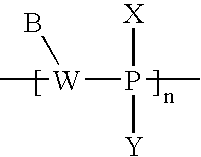
and the second oligomeric nucleotide or mimic thereof is a second oligomeric nucleotide sequence having the formula of: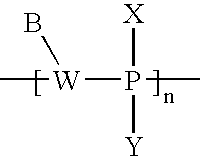
wherein X and Y independently at each occurrence is selected from a group consisting of O, S, OR, BH3 and NR1R2. R independently at each occurrence is selected from a group consisting of a C1-C6 alkyl. R1 and R2 independently at each occurrence include a H or C1-C6 alkyl, either individually or in combinations thereof. R1 and R2 may optionally form a ring, and the ring may optionally comprise at least one heteroatom. The B (base) independently at each occurrence comprises a natural or synthetic nitrogen-comprising heterocyclic base. Unless otherwise noted, whenever a base is mentioned, the base includes a natural or synthetic base. Examples of nitrogen-comprising heterocyclic bases include, but are not limited to natural nucleoside bases and analogs thereof. Particular example of bases include, but are not limited, uracil, thymine, cytosine, 5-methylcytosine, guanine, 7-deazaguanine, hypoxanthine, 7-deazahypoxanthine, adenine, 7-deazaadenine, 2,6-diaminopurine or analogs or derivatives thereof. Analogs include a substitution or replacement of part of a base. Derivatives include additions to the base. n is an integer in a range from about 4 to about 100. W independently at each occurrence is selected from a group consisting of an acyclic moiety, a carbocyclic moiety, and a natural or a synthetic sugar moiety. - Regarding the acyclic moiety, a carbocyclic moiety, and natural or a synthetic sugar moiety for W, useful carbocyclic moieties have been described by Ferraro, M. and Gotor, V. in Chem Rev. 2000,
volume 100, 4319-48. Suitable sugar moieties are described by Joeng, L. S. et al., in J Med. Chem. 1993, vol. 356, 2627-38; by Kim H. O. et al., in J Med. Chem. 193, vol. 36, 30-7; and by Eschenmosser A., in Science 1999, vol. 284, 2118-2124. Useful acyclic moieties have been described by Martinez, C. I., et al., in Nucleic Acids Research 1999, vol. 27, 1271-1274 and by Martinez, C. I., et al., in Bioorganic & Medicinal Chemistry Letters 1997, vol. 7, 3013-3016. Non-limiting examples of a carbocyclic moiety, a natural or a synthetic sugar moiety, and acyclic moiety for W are shown below. - Carbocyclic moiety include the following:

R independently at each occurrence includes H, OH, NHR, F, N3, SH, SR, or a C1-C6 alkyl, aryl, alkyl aryl, and aryl alkyl. - Sugar or synthetic sugars include the following:
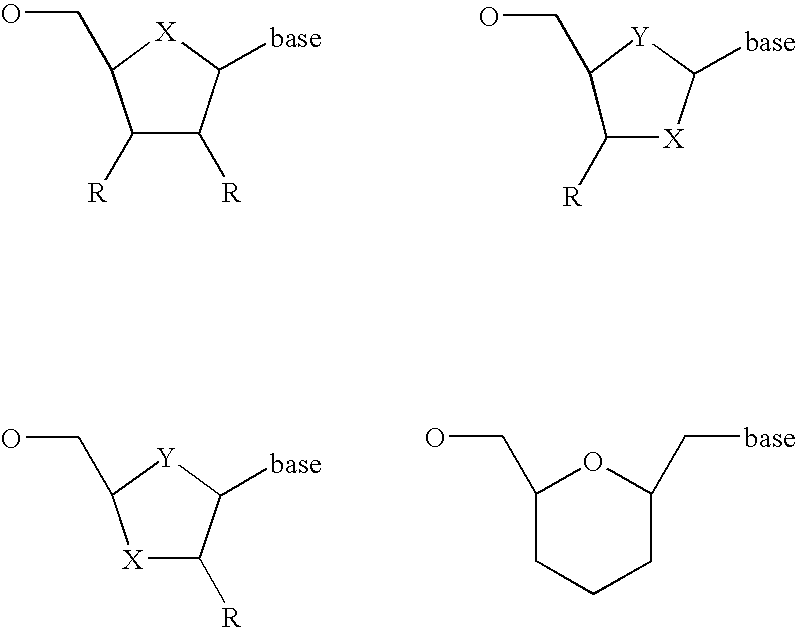
R independently at each occurrence includes H, OH, NHR, F, N3, SH, SR, or a C1-C6 alkyl, aryl, alkyl aryl, and aryl alkyl. X and Y independently at each occurrence includes O, S, or NH. - Acyclic moieties include the following:

R independently at each occurrence includes H, OH, NHR, F, N3, SH, SR, or a C1-C6 alkyl, aryl, alkyl aryl, and aryl alkyl. X includes O, S, NH, or NR. - In another embodiment, the first oligomeric nucleotide or mimic thereof includes a mimic thereof with a sequence having a formula of:

and wherein the second oligomeric nucleotide or mimic thereof also includes a mimic with a sequence having a formula of: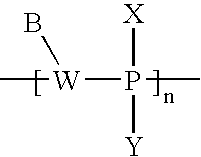
wherein X and Y independently at each occurrence is selected from a group consisting of O, S, OR, BH3 and NR1R2. R independently at each occurrence is selected from a group consisting of a C1-C6 alkyl. R1 and R2 independently at each occurrence include a H or C1-C6 alkyl, either individually or in combinations thereof. R1 and R2 may optionally form a ring, and the ring may optionally comprise at least one heteroatom. W independently at each occurrence is selected from a group having an acyclic moiety, a carbocyclic moiety, and a natural or a synthetic sugar moiety. B independently at each occurrence comprises a natural or synthetic nitrogen-comprising heterocyclic base; n is an integer in a range from about 4 to about 100; and with the proviso that X and Y in a terminal unit are not simultaneously O when W is deoxyribose or ribose. - Examples of mimics of the first or second oligomeric nucleotide include, but are not limited to, morpholinos, peptide nucleic acids (“PNAs”), phosphorothioates, 2′-O methyl oligoribonucleotides, oligoboranophosphates, phosphorodithioates, phosphoramidate, phosphorodiamidate, locked nucleic acids, and chimeras, either individually or in combinations thereof. It should be appreciated that the mimics of the first and second oligomeric nucleotides at each occurrence is independent of the mimic at every other occurrence, unless otherwise noted.
- In a particular embodiment, the mimic of the first or second oligomeric nucleotides include a peptide nucleic acid (“PNA”) sequence having a formula of:
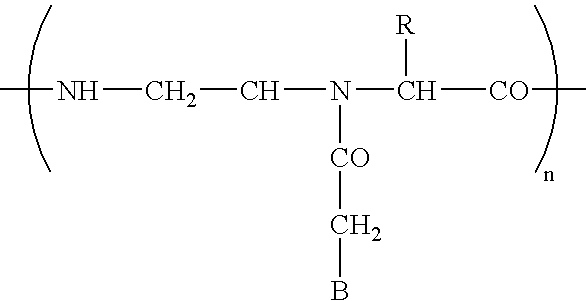
wherein B independently at each occurrence includes a heterocyclic base selected from a group consisting of adenine, guanine, cytosine, thymine, and uracil. It should be appreciated that, as previously mentioned, whenever B is a variable, B includes other natural or synthetic bases as well. R independently at each occurrence is selected from a group consisting of side groups covalently bonded to α-carbons of twenty known α-amino acids and a C1-C100 linear or branched, substituted or unsubstituted alkynyl, alkenyl, alkyl, alkylaryl, aryl, or arylalkyl optionally comprising at least one heteroatom selected from a group consisting of N, O, S, P, and halogens. n is an integer in a range from about 4 to about 30. Particularly, n is an integer in a range from about 10 to about 20. In a particular embodiment, the first and second oligomeric nucleotides or mimic thereof are both PNA mimic sequences, the backbone chain of which comprises repeating units of substituted N-(2-amino-ethyl)-glycine residues, as described above. The second oligomeric nucleotide or mimic thereof comprises a second PNA sequence that is complementary to the first PNA sequence. The second PNA sequence binds to the first PNA sequence by base pairing; i.e., A forms hydrogen bonding with T (or U), and G with C. - In another embodiment of the mimic, the mimic of the first or second oligomeric nucleotides include a morpholino sequence having a formula of:
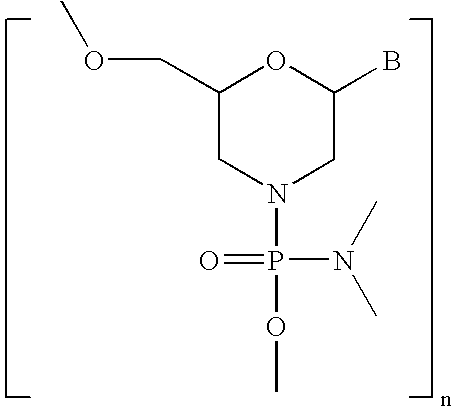
wherein B independently at each occurrence is a heterocyclic base selected from a group consisting of adenine, guanine, cytosine, thymine, and uracil; and n is an integer in a range from about 4 to about 100. - In one embodiment, the mimic of the first or second oligomeric nucleotide includes a phosphorothioate sequence having a formula of:
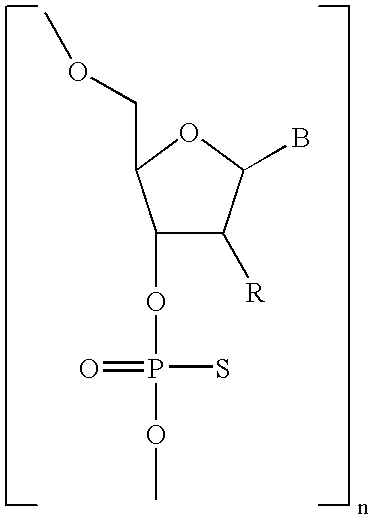
wherein B independently at each occurrence is a heterocyclic base selected from a group consisting of adenine, thymine, uracil, guanine, cytosine, and 5-methyl cytosine; n is an integer in a range from about 6 to about 100; and wherein R independently at each occurrence is selected from a group consisting of H, OH and OCH3. In a particular embodiment, n in a range from about 15 to about 35 and R is H. - In another embodiment, the mimic of the first or second oligomeric nucleotides comprises a 2′-O methyl oligoribonucleotide sequence having a formula of:
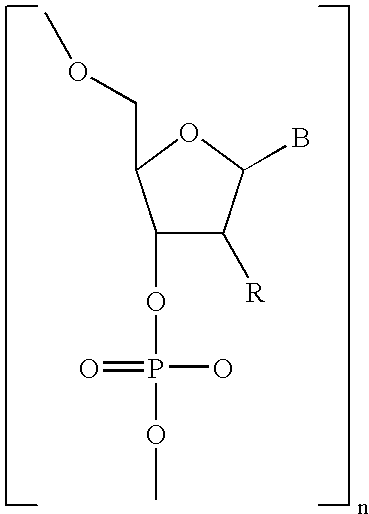
wherein B independently at each occurrence is a heterocyclic base selected from a group consisting of adenine, thymine, uracil, guanine, cytosine, and 5-methyl cytosine; n is an integer in a range from about 6 to about 100 and particularly in a range from about 15 to about 35; and R independently at each occurrence comprises OR′, wherein R1 comprises C1-C6 alkyl chain with 0 to about 2 heteroatoms. Particularly, R1 comprises CH3. - In yet another embodiment, the mimic of the first or second oligomeric nucleotides comprises a chimeric oligonucleotide sequence having a formula of:
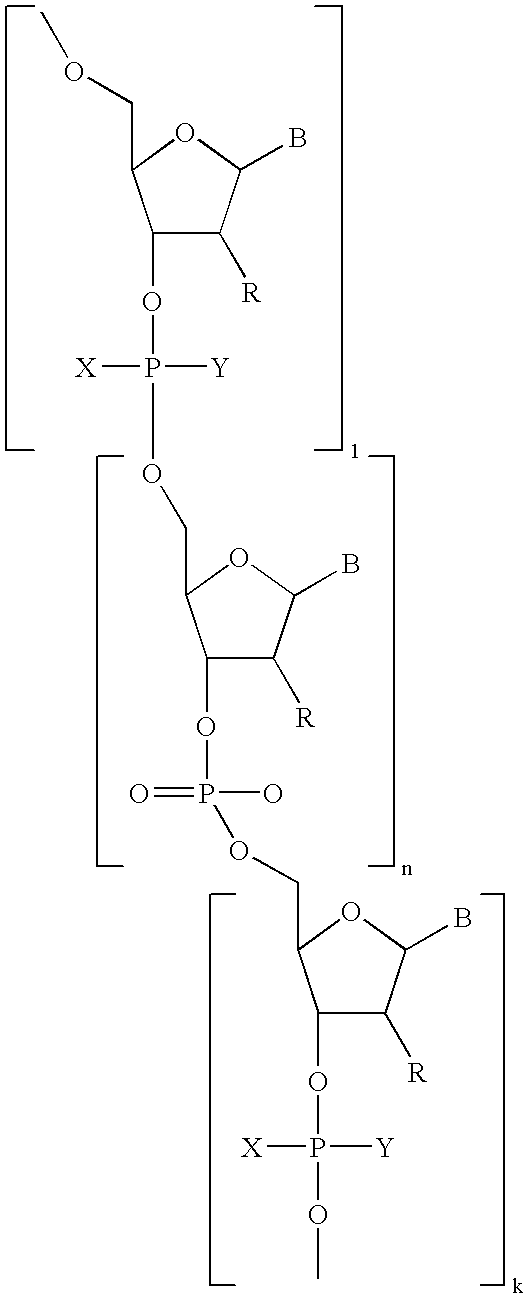
wherein B independently at each occurrence is a heterocyclic base selected from a group consisting of adenine, thymine, uracil, guanine, cytosine, and 5-methyl cytosine; X and Y are independently at each occurrence selected from a group consisting of O, S, OR, and BH3; R independently at each occurrence is H, OH, or OCH3; l is an integer in a range from about 2 to about 20; k is an integer in a range from about 2 to about 20; and n is an integer in a range from about 1 to about 20.
Active Agent Label Species - Embodiments of the active agent labeled species are shown in
FIG. 1 andFIG. 2 and represented by the schema below: - The linker includes any linking moiety that attaches the oligomeric nucleotide or mimic thereof to the diagnostic active agent through a first moiety. The linker may attach to the oligomeric nucleotide or mimic thereof at any location, such as but not limited to, the N terminus, C terminus or any other location. The linker can be as short as one carbon or a long polymeric species such as polyethylene glycol, polylysine or other polymeric species normally used in the pharmaceutical industry for modulating pharmacokinetic and biodistribution characteristics of active agents. Other linkers of varying length include C1-C250 length with one or more heteroatoms selected from O, S, N, P, and optionally substituted with halogen atoms.
- The first moiety may simply be an extension of the linker, formed by the reaction of a reactive species on the linker with a reactive group on the active agent, or a chelator that complexes the active agent. Examples of reactive species and the reactive group include, but are not limited to, activated esters (such as N-hydroxysuccinimide ester, pentafluorophenyl ester), a phosphoramidite, an isocyanate, an isothiocyanate, an aldehyde, an acid chloride, a sulfonyl chloride, a maleimide an alkyl halide, an amine, a phosphine, a phosphate, an alcohol or a thiol with the proviso that the reactive species and reactive group are matched to undergo a reaction yielding covalently linked conjugates.
- In a particular embodiment, the linker comprises at least one of an oligomeric or polymeric species made of natural or synthetic monomers, oligomeric or polymeric moiety selected from a pharmacologically acceptable oligomer or polymer composition, an oligo- or poly-amino acid, peptide, saccharide, a nucleotide, and an organic moiety with 1-250 carbon atoms, either individually or in combination thereof. The organic moiety with 1-250 carbon may contain one or more heteroatoms such as O, S, N or P and optionally substituted with halogen atoms at one or more places.
- The first moiety comprises a chelating moiety that is conjugated to the oligomeric or polymeric linker species, and the diagnostic active agent is capable of generating a signal that is detectable.
- Diagnostic Active Agents
- Diagnostic active agents include a procedure, composition of matter or device (or combination of them) that conveys information about a disease, condition or disorder affecting an organism. Examples of diagnostic active agents include radioisotopes. Suitable radioisotopes for coupling with the first oligomeric nucleotide or mimic thereof to produce diagnostic active agents and use in diagnostic methods include, but are not limited to, actinium-225, astatine-211, iodine-120, iodine-123, iodine-124, iodine-125, iodine-126, iodine-131, iodine-133, bismuth-212, arsenic-72, bromine-75, bromine-76, bromine-77, indium-110, indium-111, indium-113m, gallium-67, gallium-68, strontium-83, zirconium-89, ruthenium-95, ruthenium-97, ruthenium-103, ruthenium-105, mercury-107, mercury-203, rhenium-186, rhenium-188, tellurium-121m, tellurium-122m, tellurium-125m, thulium-165, thulium-167, thulium-168, technetium-94m, technetium-99m, fluorine-18, silver-111, platinum-197, palladium-109, copper-62, copper-64, copper-67, phosphorus-32, phosphorus-33, yttrium-86, yttrium-90, scandium-47, samarium-153, lutetium-177, rhodium-105, praseodymium-142, praseodymium-143, terbium-161, holmium-166, gold-199, cobalt-57, cobalt-58, chromium-51, iron-59, selenium-75, thallium-201, and ytterbium-169. Particularly, the radioisotope will emit a particle or ray in the 10-7,000 keV range, more particularly 50-1,500 keV.
- Particular examples of diagnostic active agent include, but are not limited to, the following isotopes: F-18, I-123, I-124, I-125, Cu-64, Cu-67, At-211, I -120, I-123, I-124, I-125, As-72, Br-75, Br-76, Br-77, In-110, In-111, In-113m, Ga-67, Ga-68, Lu-177, Ti-201, Yb-169, Rb-82, Co-55, Cu-61, As-70, As-71, As-74, Y -88, C -11, N-13, Cu-60, O-15, Zr-89 and Ga-66.
- Isotopes for imaging applications include: iodine-123, iodine-125, iodine-131, indium-111, gallium-67, ruthenium-97, technetium-99m, cobalt-57, cobalt-58, chromium-51, iron-59, selenium-75, thallium-201, ytterbium-169, copper -64, and fluorine-18.
- In one aspect, the diagnostic active agent is a magnetic resonance imaging contrast agent, which enhances the contrast of images obtained in magnetic resonance imaging procedure. Suitable paramagnetic ions that are useful for magnetic resonance imaging (“MRI”) are those of elements having atomic numbers of 21-29, 42, 44, and 58-70. Particularly useful are gadolinium ion and iron metal, ion, or oxides. Particularly, gadolinium ions are bound by chelators, such as polycarboxylic acids (carboxylic acids having a plurality of —COOH groups), which are conjugated directly or indirectly to the first oligomeric nucleotide or mimic thereof through one of the —CO(O)— groups. Non-limiting examples of such chelators are diethylenetriamine-pentaacetic acid (“DTPA”); 1,4,7,10-tetraazacyclododecane-N,N′,N″,N′″-tetraacetic acid (“DOTA”); p-isothiocyanatobenzyl-1,4,7,10-tetraazacyclododecane-1,4,7,10-tetraacetic acid (“p-SCN-Bz-DOTA”); 1,4,7,10-tetraazacyclododecane-N,N′,N″-triacetic acid (“DO3A”); 1,4,7,10-tetraazacyclododecane-1,4,7,10-tetrakis(2-propionic acid) (“DOTMA”); 3,6,9-triaza -12-oxa-3,6,9-tricarboxymethylene-10-carboxy-13-phenyl-tridecanoic acid (“B -19036”); 1,4,7-triazacyclononane-N,N′,N″-triacetic acid (“NOTA”); 1,4,8,11 -tetraazacyclotetradecane-N,N′,N″,N′″-tetraacetic acid (“TETA”); triethylene tetraamine hexaacetic acid (“TTHA”); trans-1,2-diaminohexane tetraacetic acid (“CYDTA”); 1,4,7,10-tetraazacyclododecane-1-(2-hydroxypropyl)4,7,10-triacetic acid (“HP-DO3A”); trans-cyclohexane-diamine tetraacetic acid (“CDTA”); trans(1,2)-cyclohexane diethylene triamine pentaacetic acid (“CDTPA”); 1-oxa-4,7,10-triazacyclododecane-N,N′,N″-triacetic acid (“OTTA”); 1,4,7,10-tetraazacyclododecane-1,4,7,10-tetrakis {3-(4-carboxyl)-butanoic acid}; 1,4,7,10-tetraazacyclododecane-1,4,7,10-tetrakis(acetic acid-methyl amide); 1,4,7,10-tetraazacyclododecane-1,4,7,10-tetrakis(methylene phosphonic acid); and derivatives thereof.
- Superparamagnetic metal oxides, such as iron, chromium, cobalt, manganese, nickel, and tungsten oxide, are also suitable for generating magnetic resonance signal useful for diagnostic purposes, as disclosed, for example, in U.S. Pat. Nos. 5,492,814 and 5,314,679. Such metal oxides are particularly present in nanometer-sized aggregates (e.g. from about 10 nm to about 500 nm), either uncoated or particularly coated with a shell comprising a biologically compatible material, such as polysaccharide, poly(amino acid), or organosilane. The coated or uncoated metal oxide aggregates are then covalently attached directly or indirectly (through a linker) to the first oligomeric nucleotide or mimic thereof to produce an MRI signal generating species. Particularly, the first oligomeric nucleotide or mimic thereof is a PNA, and the attachment is effected at the terminal amino or carboxylic group of the PNA sequence. Methods for attachment of metal oxide (such as iron oxide) particles to organic materials, such as proteins, are known and disclosed, for example, in U.S. Pat. Nos. 5,492,814 and 4,628,037.
- An MRI Active Agent-Labeled Species
- In a particular embodiment, the linker includes an oligomeric or polymeric species comprising polylysine having from about 100 to about 600 lysine residues, and wherein at least ninety percent of the lysine residues are conjugated to a chelating moiety. A plurality of amino acid residues of the poly(amino acid) is conjugated to chelators that form coordination complexes with paramagnetic ions. Suitable chelators include but are not limited to, diethylenetriamine-pentaacetic acid (“DTPA”), 1,4,7,10-tetraazacyclododecane-N,N′,N″,N′″-tetraacetic acid (“DOTA”), p-isothiocyanatobenzyl-1,4,7,10-tetraazacyclododecane-1,4,7,10-tetraacetic acid (“p-SCN-Bz-DOTA”), 1,4,7,10-tetraazacyclododecane-N,N′,N″-triacetic acid (“DO3A”), 1,4,7,10-tetraazacyclododecane-1,4,7,10-tetrakis(2-propionic acid) (“DOTMA”), 3,6,9-triaza-12-oxa-3,6,9-tricarboxymethylene-10-carboxy-13-phenyl-tridecanoic acid (“B-19036”), 1,4,7-triazacyclononane-N,N′,N″-triacetic acid (“NOTA”), 1,4,8,11 -tetraazacyclotetradecane-N,N′,N″,N′″-tetraacetic acid (“TETA”), triethylene tetraamine hexaacetic acid (“TTHA”), trans-1,2-diaminohexane tetraacetic acid (“CYDTA”), 1,4,7,10-tetraazacyclododecane-1-(2-hydroxypropyl)4,7,10-triacetic acid (“HP-DO3A”), trans-cyclohexane-diamine tetraacetic acid (“CDTA”), trans(1,2)-cyclohexane diethylene triamine pentaacetic acid (“CDTPA”), 1-oxa-4,7,10-triazacyclododecane-N,N′,N″-triacetic acid (“OTTA”), 1,4,7,10-tetraazacyclododecane-1,4,7,10-tetrakis{3-(4-carboxyl)-butanoic acid}, 1,4,7,10-tetraazacyclododecane-1,4,7,10-tetrakis(acetic acid-methyl amide), 1,4,7,10-tetraazacyclododecane-1,4,7,10-tetrakis(methylene phosphonic acid), and derivatives thereof, either individually or in combinations thereof.
- As yet another alternative, the active agent-labeled species comprises a poly(amino acid) chain (e.g., polylysine), wherein at least ninety percent of the free amino side groups are conjugated to a carboxylic acid having a plurality of carboxylic groups, and wherein one or more of the remaining free amino side groups are conjugated to a PET or SPECT signal-generating moiety; e.g., 4-iodobenzamide, 4-fluorobenzamide, or a chelating moiety that forms a coordination complex with a PET or SPECT signal-generating metal ion. The chelating moiety can be TETA or one of the carboxylic acids having a plurality of carboxylic groups, as disclosed above.
- Pretargeting Conjugate
- The targeting
species 220 that is conjugated to the second oligomeric nucleotide or mimic thereof to form the pretargeting conjugate can be a compound or a fragment of a compound. As shown inFIG. 2 , the targetingspecies 220 has one or more targetingmoieties 222 that binds to atarget site 300 or to a substance produced by or associated with the target site via a primary binding site. Furthermore, as shown inFIG. 2 , the targeting species may bind to one or more in-vivo targets 300 or a biomarker produced by or associated with the in-vivo-target. The target site is a specific site to which the diagnostic agent is to be delivered, such as a cell or group of cells, tissue, organ, tumor, or lesion. The targeting moiety binds to the target site or to a substance produced by or associated with the target site via a primary binding site. Non-limiting examples of targeting moieties include, but are not limited to, proteins, peptides, polypeptides, glycoproteins, lipoproteins, phospholipids, oligonucleotides, steroids, alkaloids or the like, e.g., hormones, lymphokines, growth factors, albumin, cytokines, enzymes, immune modulators, receptor proteins, oligonucleotides or mimics thereof, and antibodies and antibody fragments, either individually or in any combination thereof as well as derivatives thereof. Examples of particular targeting species include aptamers and thioaptemers. The targeting moieties preferentially bind marker substances that are produced by or associated with the target site. - The targeting species also has a separate functional group that is capable of forming a bond with the second oligomeric nucleotide or mimic thereof. In one embodiment, such a bond may be an amide bond formed by the reaction of a carboxylic acid group in the targeting species and the terminal amino group in the second oligomeric nucleotide or mimic thereof (or the reaction of an amino group in the targeting species and the terminal carboxylic acid group in the second oligomeric nucleotide or mimic thereof). In a particular embodiment, the second oligomeric nucleotide or mimic thereof is a PNA that is at least partially complementary to a PNA in the active agent-labeled species.
- Proteins are known that preferentially bind marker substances that are produced by or associated with lesions. For example, antibodies can be used against cancer-associated substances, as well as against any pathological lesion that shows an increased or unique antigenic marker, such as against substances associated with cardiovascular lesions, for example, vascular clots including thrombi and emboli, myocardial infarctions and other organ infarcts, and atherosclerotic plaques; inflammatory lesions; and infectious and parasitic agents.
- Cancer states include carcinomas, melanomas, sarcomas, neuroblastomas, leukemias, lymphomas, gliomas, myelomas, and neural tumors.
- Infectious diseases include those caused by invading microbes or parasites. As used herein, “microbe” denotes virus, bacteria, rickettsia, mycoplasma, protozoa, fungi and like microorganisms, “parasite” denotes infectious, generally microscopic or very small multicellular invertebrates, or ova or juvenile forms thereof, which are susceptible to antibody-induced clearance or lytic or phagocytic destruction, e.g., malarial parasites, spirochetes and the like, including helminths, while “infectious agent” or “pathogen” denotes both microbes and parasites.
- The protein substances useful as targeting species include, but are not limited to, protein, peptide, polypeptide, glycoprotein, lipoprotein, hormones, lymphokines, growth factors, albumin, cytokines, enzymes, immune modulators, receptor proteins, antibodies and antibody fragments, soluble and serum proteins, proteins expressed on a surface of a cell, segment of proteins that are or can be made water-soluble, non-immunoglobulin proteins, intracellular proteins, and derivatives thereof.
- The protein substances of particular interest in the invention are antibodies and antibody fragments. The terms “antibodies” and “antibody fragments” mean generally immunoglobulins or fragments thereof that specifically bind to antigens to form immune complexes.
- The antibody may be a whole immunoglobulin of any class; e.g., IgG, IgM, IgA, IgD, IgE, chimeric or hybrid antibodies with dual or multiple antigen or epitope specificities. It can be a polyclonal antibody, particularly a humanized or an affinity-purified antibody from a human. It can be an antibody from an appropriate animal; e.g., a primate, goat, rabbit, mouse, or the like. If the target site-binding region is obtained from a non-human species, it is preferred that the target species is humanized to reduce immunogenicity of the non-human antibodies, for use in human diagnostic or therapeutic applications. Such a humanized antibody or fragment thereof is also termed “chimeric.” For example, a chimeric antibody comprises non-human (such as murine) variable regions and human constant regions. A chimeric antibody fragment can comprise a variable binding sequence or complementarity-determining regions (“CDR”) derived from a non-human antibody within a human variable region framework domain. Monoclonal antibodies are also suitable because of their high specificities. Monoclonal antibodies are readily prepared by what are now considered conventional procedures of immunization of mammals with an immunogenic antigen preparation, fusion of immune lymph or spleen cells with an immortal myeloma cell line, and isolation of specific hybridoma clones. More unconventional methods of preparing monoclonal antibodies are also included, such as interspecies fusions and genetic engineering manipulations of hypervariable regions, since it is primarily the antigen specificity of the antibodies that affects their utility. It will be appreciated that newer techniques for production of monoclonal antibodies (“MAb”) can also be used; e.g., human MAbs, interspecies MAbs, chimeric (e.g., human/mouse) MAbs, genetically engineered antibodies, and the like.
- Useful antibody fragments include F(ab′)2, F(ab)2, Fab′, Fab, Fv, and the like including hybrid fragments. Particular fragments are Fab′, F(ab′)2, Fab, and F(ab)2. Also useful are any subfragments retaining the hypervariable, antigen-binding region of an immunoglobulin and having a size similar to or smaller than a Fab′ fragment. An antibody fragment can include genetically engineered and/or recombinant proteins, whether single-chain or multiple-chain, which incorporate an antigen-binding site and otherwise function in vivo as targeting species in substantially the same way as natural immunoglobulin fragments. Such single-chain binding molecules are disclosed in U.S. Pat. No. 4,946,778. Fab′ antibody fragments may be conveniently made by reductive cleavage of F(ab′)2 fragments, which themselves may be made by pepsin digestion of intact immunoglobulin. Fab antibody fragments may be made by papain digestion of intact immunoglobulin, under reducing conditions, or by cleavage of F(ab)2 fragments which result from careful papain digestion of whole immunoglobulin. The fragments may also be produced by genetic engineering.
- It should be noted that mixtures of antibodies and immunoglobulin classes can be used, as can hybrid antibodies. Multispecific, including bispecific and hybrid, antibodies and antibody fragments are sometimes desirable for detecting and treating lesions and comprise at least two different substantially monospecific antibodies or antibody fragments, wherein at least two of the antibodies or antibody fragments specifically bind to at least two different antigens produced or associated with the targeted lesion or at least two different epitopes or molecules of a marker substance produced or associated with the targeted lesion. Multispecific antibodies and antibody fragments with dual specificities can be prepared analogously to the anti-tumor marker hybrids disclosed in U.S. Pat. No. 4,361,544. Other techniques for preparing hybrid antibodies are disclosed in; e.g., U.S. Pat. Nos. 4,474,893 and 4,479,895, and in Milstein et al., Immunology Today, Vol. 5, 299 (1984).
- Particular proteins that may be used are proteins having a specific immunoreactivity to a biomarker substance of at least 60% and a cross-reactivity to other antigens or non-targeted substances of less than 35%.
- As disclosed above, antibodies against tumor antigens and against pathogens are known. For example, antibodies and antibody fragments which specifically bind biomarkers produced by or associated with tumors or infectious lesions, including viral, bacterial, fungal and parasitic infections, and antigens and products associated with such microorganisms have been disclosed in Hansen et al. (U.S. Pat. No. 3,927,193) and Goldenberg (U.S. Pat. Nos. 4,331,647, 4,348,376, 4,361,544, 4,468,457, 4,444,744, 4,818,709 and 4,624,846). In particular, antibodies against an antigen, e.g., a gastrointestinal, lung, breast, prostate, ovarian, testicular, brain or lymphatic tumor, a sarcoma, or a melanoma, are advantageously used.
- A wide variety of monoclonal antibodies against infectious disease agents have been developed, and are summarized in a review by Polin, in Eur. J. Clin. Microbiol., 3(5):387-398, 1984, showing ready availability. These include MAbs against pathogens and their antigens. Exemplary infectious disease agents are disclosed in U.S. Pat. No. 5,482,698.
- Additional examples of MAbs generated against infectious organisms that have been described in the literature are noted below.
- MAbs against the
gp 120 glycoprotein antigen of human immunodeficiency virus 1 (HIV-1) are known, and certain of such antibodies can have an immunoprotective role in humans. See, e.g., Rossi et al., Proc. Natl. Acad. Sci. USA, Vol. 86, pp. 8055-58 (1990). Other MAbs against viral antigens and viral-induced antigens are also known. MAbs against malaria parasites can be directed against the sporozoite, merozoite, schizont and gametocyte stages. - Suitable MAbs have been developed against most of the microorganisms (bacteria, viruses, protozoa, other parasites) responsible for the majority of infections in humans, and many have been used previously for in vitro diagnostic purposes. These antibodies, and newer MAbs that can be generated by conventional methods, are also appropriate for use.
- Proteins useful for detecting and/or treating cardiovascular lesions include fibrin-specific proteins; for example, fibrinogen, soluble fibrin, antifibrin antibodies and fragments, fragment E1 (a 60 kDa fragment of human fibrin made by controlled plasmin digestion of crosslinked fibrin), plasmin (an enzyme in the blood responsible for the dissolution of fresh thrombi), plasminogen activators (e.g., urokinase, streptokinase and tissue plasminogen activator), heparin, and fibronectin (an adhesive plasma glycoprotein of 450 kDa) and platelet-directed proteins; for example, platelets, antiplatelet antibodies, and antibody fragments, anti-activated platelet antibodies, and anti-activated platelet factors, which have been reviewed by Koblik et al., Semin. Nucl. Med., Vol. 19, 221-237 (1989).
- In one embodiment, the targeting species is an MAb or a fragment thereof that recognizes and binds to a heptapeptide of the amino terminus of the β-chain of fibrin monomer. Fibrin monomers are produced when thrombin cleaves two pairs of small peptides from fibrinogen. Fibrin monomers spontaneously aggregate into an insoluble gel, which is further stabilized to produce blood clots. The second oligomeric nucleotide or mimic thereof of the pretargeting conjugate is attached to the MAb or fragment thereof. In a particular embodiment, the second oligomeric nucleotide or mimic thereof is at least partially complementary to a PNA in the active agent-labeled species.
- In another embodiment, the targeting species is a chimeric antibody derived from an antibody designated as NR-LU-10. This chimeric antibody has been designated as NR-LU-13 and disclosed in U.S. Pat. No. 6,358,710. NR-LU-13 contains the murine Fv region of NR-LU-10 and therefore comprises the same binding specificity as NR-LU-10. It also comprises human constant regions. Thus, this chimeric antibody binds the NR-LU-10 antigen and is less immunogenic because it is made more human-like. NR-LU-10 is a nominal 150 kilodalton (or kDa) murine IgG2b pan carcinoma monoclonal antibody that recognizes an approximately 40 kDa glycoprotein antigen expressed on most carcinomas, such as small cell lung, non-small cell lung, colon, breast, renal, ovarian, pancreatic, and other carcinoma tissues. The NR-LU-10 antigen has been further described by Varki et al., “Antigens Associated With a Human Lung Adenocarcinoma Defined by Monoclonal Antibodies,” Cancer Research, Vol. 44, 681-87 (1984), and Okabe et al., “Monoclonal Antibodies to Surface Antigens of Small Cell carcinoma of the Lungs,” Cancer Research Vol. 44, 5273-78 (1984). Methods for preparing antibodies that binds to epitopes of the NR-LU-10 antigen are known and are disclosed in U.S. Pat. No. 5,084,396. One suitable method for producing monoclonal antibodies is the standard hybridoma production and screening process, which is well known in the art. In a particular embodiment, the targeting species is a humanized antibody or humanized antibody fragment that binds specifically to the antigen bound by antibody NR-LU-13. A humanization method comprises grafting only non-human CDRs onto human framework and constant regions (see; e.g., Jones et al., Nature, Volume 321, 522-35 (1986)). Another humanization method comprises transplanting the entire non-human variable domains, but cloaking (or veneering) these domains by replacement of exposed residues reduce immunogenicity (see; e.g., Padlan, Molec. Immun., Vol. 28, 489-98 (1991)). Exemplary humanized light and heavy sequences derived from the light and heavy sequences of the NR-LU-13 antibody are disclosed in U.S. Pat. No. 6,358,710, and are denoted therein as NRX451. The phrase “binds specifically” with respect to antibody or antibody fragment means such antibody or antibody fragment has a binding affinity of at least about 104M−1. Particularly, the binding affinity is at least about 106M−1, and more particularly, at least about 108M−.
- According to still another embodiment, the targeting species is a humanized anti-p185HER2 antibody that specifically recognizes the p185HER2 protein expressed on breast cancer cells. A humanized anti-p185HER2 antibody known as Herceptin is widely available. An anti-HER2 murine MAb known as ID5 is available from Applied BioTechnology/Oncogene Science (Cambridge, Mass.), which can be humanized according to conventional methods. See, e.g., X. F. Lee et al., “Differential Signaling by an Anti-p185HER2 Antibody and Hergulin,” Cancer Research, Vol. 60, 3522-31 (2000).
- In other embodiments, the targeting species is an antibody or a fragment thereof, particularly a human or humanized antibody or fragment thereof, that is raised against one of anti-carcinogembryonic antigen (“CEA”), anti-colon-specific antigen-p (“CSAp”), and other well known tumor-associated antigens, such as CD19, CD20, CD21, CD22, CD23, CD30, CD74, CD80, HLA-DR, I,
MUC 1, MUC 2, MUC 3, MUC 4, EGFR, HER2/neu, PAM-4, Bre3, TAG-72 (C72.3, CC49), EGP-1 (e.g., RS7), EGP-2 (e.g., 17-1A and other Ep-CAM targets), Le(y (e.g., B3), A3, KS-1, S100, IL-2, T101, necrosis antigens, folate receptors, angiogenesis markers (e.g., VEGFR), tenascin, PSMA, PSA, tumor-associated cytokines, MAGE and/or fragments thereof. Tissue-specific antibodies (e.g., against bone marrow cells, such as CD34, CD74, etc., parathyroglobulin antibodies, etc.) as well as antibodies against non-malignant diseased biomarkers, such as macrophage antigens of atherosclerotic plaques (e.g., CD74 antibodies), and also specific pathogen antibodies (e.g., against bacteria, viruses, and parasites) are well known in the art. - It should be understood that the foregoing disclosure of various antigens or biomarkers that can be used to raise specific antibodies against them (and from which antibodies fragments may be prepared) serves only as examples, and is not to be construed in any way as a limitation of the invention.
- Conjugating or Attaching Targeting Species to an Oligomeric Nucleotide or Mimic thereof
- Targeting species are conjugated or otherwise attached to the second oligomeric nucleotide or mimic thereof to produce the pretargeting conjugate. For example, the conjugation or attachment can be effected via an amide bond or a disulfide bond. Targeting species that are polypeptides, such as an antibody or an antibody fragment, are conjugated to the second oligomeric nucleotide or mimic thereof via amide bonds between free amino groups of lysine residues present in the antibody or the antibody fragment and the terminal carboxylic group of the second oligomeric nucleotide or mimic thereof. Alternatively, amide bonds can be formed between free carboxylic groups of glutamic acid or aspartic acid residues present in the antibody or the antibody fragment and the terminal amino group of the second oligomeric nucleotide or mimic thereof. The conjugation process can be carried out by contacting the antibody or antibody fragment and the second oligomeric nucleotide or mimic thereof at pH in the range from about 7 to about 9.5 in a buffer, at or near room temperature. At the end of the reaction period, the conjugate is separated from the unreacted low molecular-weight materials by, for example, size exclusion chromatography and/or dialysis.
- The second oligomeric nucleotide or mimic thereof can also be conjugated to the antibody or antibody fragment via disulfide bonds formed with cysteine residues present in the antibody or antibody fragment. In this case, a cysteine residue is first attached to an end of the second oligomeric nucleotide or mimic thereof to provide a mercapto group thereto. The second oligomeric nucleotide or mimic thereof, as modified, is then reacted with the antibody or antibody fragment to produce the pretargeting conjugate as above.
- Alternatively, carbohydrate moieties present in the antibody or antibody fragment may be oxidized mildly, such as with sodium metaperiodate at or near room temperature. Unreacted sodium metaperiodate may be decomposed with ethylene glycol. The oxidized antibody or antibody fragment is then separated from low molecular-weight materials, for example, by size exclusion chromatography, and subsequently reacted with the second oligomeric nucleotide or mimic thereof to produce the pretargeting conjugate.
- Methods for Diagnosing of Treating Diseases Using Pretargeting Strategy
- With reference to
FIG. 3 , next will be described a method for diagnosing a disease condition by preferentially delivering a diagnostic active agent to the site of the disease.FIG. 3 is a flow chart of the method. The method includes, atStep 305 administering a pretargeting conjugate to a subject. AtStep 315, the pretargeting conjugate is allowed to localize at the target. Step 325 includes administering an active agent-labeled species to the subject, wherein the active agent-labeled species comprises a diagnostic active agent conjugated to the first oligomeric nucleotide or mimic thereof sequence. - In one embodiment, the targeting species is an antibody or a fragment thereof that binds to an antigen present at the target, which can be a diseased cell or tissue, or a marker substance produced by the diseased cell or tissue. The diagnostic active agent is a moiety that generate a unique signal that is recognizable by diagnostic medical imaging techniques, such as MRI, PET, SPECT, X-ray imaging, CT, ultrasound imaging, or optical imaging.
- In another embodiment, the diagnostic active agent is any of the diagnostic active agents described herein above, either individually or in combination thereof. In a particular embodiment, the diagnostic active agent is a radioisotope, drug, toxin, fluorescent dye activated by nonionizing radiation, hormone, hormone antagonist, receptor antagonist, enzyme or proenzyme activated by another agent, autocrine, or cytokine.
- In one aspect, the active agent-labeled species comprises a poly(amino acid) (e.g., as polylysine), wherein at least 90 percent of the lysine residues are conjugated to chelating moieties, (e.g., DTPA), which form coordination complex with paramagnetic ions, (e.g., Gd3+) for MRI application. The active agent-labeled species may be administered into the patient at a dose from about 0.01 to about 0.05 moles Gd/kg of body weight of the patient. An MRI system that can be used for practicing a method of the invention is disclosed in U.S. Pat. No. 6,235,264. The pair of pharmaceuticals of the invention is formulated with a physiologically acceptable carrier, such as an intravenous fluid, for intravenously administering into the patient. These pharmaceuticals may also be administered orally under appropriate circumstances.
- With reference to
FIG. 4 , next will be described another method for diagnosing a disease condition. The method includes, atStep 405, obtaining one or more base-line image of a portion of a subject suspected of having the disease condition. Image as used herein includes signals as well as any other visual representation of the spatial distribution (or location) of an object. In one embodiment, an image consists of an array (of more than one dimension), where the values of the array typically represent an intensity associated with a spatial coordinate in two or three dimensions. - Step 415 includes administering a pretargeting conjugate to the subject. Step 425 includes allowing the pretargeting conjugate to localize at the target. Step 435 includes administering an active agent-labeled species to the subject. Step 445 includes obtaining one or more additional image of the same portion of the subject. Step 455 includes comparing the base-line image with the additional image to evaluate the disease condition. The step of obtaining additional images to evaluate the disease condition may be repeated at different time intervals as desired. Thus, it should be appreciated that one or more base line images may be compared with one or more additional images or the additional images may be compared with each other.
- Another aspect of the invention provides a method for assessing an effectiveness of a prescribed regimen for treating a disease condition that is characterized by an overproduction or underproduction of a disease-specific substance or biomarker. The method includes (i) obtaining a base-line image of a portion of a subject suspected of having the disease condition; (ii) administering a pretargeting conjugate to the subject; (iii) allowing the pretargeting conjugate to localize at the target; (iv) administering an active agent-labeled species to the subject; (v) obtaining a pre-treatment image coming from the same portion of the subject; (vi) treating the disease condition in the subject with a prescribed regimen; (vii) repeating steps (ii), (iii), and (iv); and (viii) obtaining a post-treatment image coming from the same portion of the subject as in step (v).
- The method may further comprise comparing the post-treatment image to the pre-treatment image to assess the effectiveness of the prescribed regimen, wherein a change in image contrast during a course of the prescribed regimen indicates that the treatment has provided benefit. The method may also further comprise comparing the post-treatment image to the baseline image to assess the effectiveness of the prescribed regimen, wherein a change in image contrast or signals during a course of the prescribed regimen indicates that the treatment has provided benefit. The method may also further comprising repeating steps (vii) and (viii) at predetermined time intervals during the course of treating the disease condition.
- In various aspects of the methods, any one of the pretargeting conjugates and active agent-labeled species that are described above can be chosen to suit the particular circumstances and disease.
- During the course of the treatment of the disease, a decreased signal obtained from the imaging technique (compared to a base-line signal obtained before the treatment) of, for example, 10 percent or more can signify that the treatment has conferred some benefit. In another embodiment, a decreased signal obtained from the imaging technique (compared to a base-line signal obtained before the treatment) of, for example, 20 percent or more can signify that the treatment has conferred some benefit. The prescribed regimen for treating the disease can be, for example, treatment with drugs, radiation, or surgery.
- In one aspect, the invention provides a kit that comprises the active agent-labeled species and the pretargeting conjugate kept separately before use for purposes of diagnosing or treating diseases.
- The compounds, for example, the active agent-labeled species, the pretargeting conjugate, or both, can be incorporated into pharmaceutical compositions suitable for administration into a subject, which pharmaceutical compositions comprise a pharmaceutically acceptable carrier. As used herein, “pharmaceutically acceptable carrier” includes any and all solvents, dispersion media, coatings, antibacterial and antifungal agents, isotonic and absorption delaying agents, and the like that are physiologically compatible with the subject. Particularly, the carrier is suitable for intravenous, intramuscular, subcutaneous, or parenteral administration (e.g., by injection). Depending on the route of administration, the active agent-labeled species, the pretargeting conjugate, or both, may be coated in a material to protect the compound or compounds from the action of acids and other natural conditions that may inactivate the compound or compounds.
- In yet another embodiment of the invention, the pharmaceutical composition comprising the active agent-labeled species, the pretargeting conjugate, or both, and a pharmaceutically acceptable carrier can be administered by combination therapy, i.e., combined with other agents. For example, the combination therapy can include a composition of the invention with at least a therapeutic agent or drug, such as an anti-cancer or an antibiotic. Exemplary anti-cancer agents include cis-platin, adriamycin, and taxol. Exemplary antibiotics include isoniazid, rifamycin, and tetracycline.
- Pretargting Conjugate of Ab-Oligomer Bioconjugation
-
FIG. 5 is a schematic representation of a pretargeting conjugate comprising an antibody-peptide nucleic acid (Ab-PNA) as described below. The targeting species, an anti-carcinoembryonic antigen (CEA) mouse monoclonal antibody T84.66 (0.8 mg/ml) was incubated with succinimidyl 4-[N-maleimido-methyl]cyclohexane-1-carboxylate (SMCC) cross-linking reagent (Pierce, Rockford, Ill.) in PBS buffer (pH 7.5) at a molar antibody to SMCC ratio of 1:50. After 90 min. at room temperature, the amine coupling reaction was quenched with 10 mM Tris-HCI (pH 7.5) for 15 min. Excess cross-linking reagent was removed by sequential spin filtration of the reaction mixture with 0.1 M sodium phosphate, 0.1 M NaCl, 5 mM EDTA, pH 6.5 buffer using an Amicon Ultra 30K MWCO spin filter (3×, 14,000×g). The antibody-containing fraction was collected and the maleimide content was measured by back titration with cysteine and Eliman's reagent (Pierce) as previously described. Antibody concentration was determined using the Bicinchoninic acid (BCA) protein assay (Pierce) and bovine gamma globulin (Pierce) as the calibration standard. The ratio of maleimide/Ab was further validated by matrix assisted laser desorption ionization time of flight mass spectrometry (MALDI-TOF MS) of the intact IgG. - The thiol-derivatized PNA intended for conjugation was incubated with immobilized tris[2-carboxyethyl] phosphine (TCEP) agarose gel following the manufacturer's protocol (Pierce). Immediately following reduction, the free thiol-containing PNA was mixed with the maleimide derivatized mAb (0.4-0.8 mg/ml) at a molar Ab to oligomer ratio of 1:10 and incubated overnight at 4° C. Excess PNA was subsequently removed by sequential spin filtration of the reaction mixture with 0.1 M sodium phosphate, pH 7.5 buffer using an Amicon Ultra 30K MWCO spin filter (3×, 14,000×g). The pretargeting conjugate (
FIG. 5 ) was characterized by Maldi-TOF MS and UV-Vis spectroscopy to determine the average number of oligomers per antibody and subsequently stored at 4° C. for further use.FIG. 6 is a Maldi-time of flight (TOF) MS spectrum of the Ab-PNA pretargeting conjugate showing the average number of oligomers per antibody (n=1-5) for a PNA oligomer with a given molecular weight (MW=4423 Da.). Int. Std. means internal standard. - In-Vitro Affinity Characterization
- Binding interactions between 1) the Ab-PNA conjugate (i.e. pretargeting conjugate) and the biomarker, and 2) the Ab-PNA conjugate (i.e. pretargeting conjugate) and the TETA-cPNA molecule (i.e. species to be labeled with the active agent) were conducted using surface plasmon resonance detection (Biacore™). Biacore™ is a surface plasmon resonance instrument for conducting kinetic binding studies. The pretargeting conjugate was covalently attached to a CM-5 (Biacore™) dextran-functionalized sensor chip pre-equilibrated with HBS-EP buffer (10 ul/min) and activated with 1-ethyl-3-[3-dimethylaminopropyl]carbodiimide hydrochloride (EDC) and N-hydroxysuccinimide (NHS). The pretargeting conjugate in 10 mM sodium acetate (pH 5) was injected onto the activated sensor chip until the desired immobilization level was achieved (˜50 RU). Residual activated groups on the sensor chip were blocked by injection of ethanolamine (1 M, pH 8.5). Non-covalently bound pretargeting conjugate were removed by repeated (5×) washing with 50 mM NaOH. Prior to the kinetic study, binding of the biomarker, carcinoembryonic antigen (CEA) was tested and a surface stability experiment was performed to ensure adequate removal of the bound biomarker and regeneration of the sensor chip following treatment with 50 mM NaOH. Kinetic measurements were conducted over a range of 8 analyte concentrations (0-200 nM) with a 5-15 min association period, and a 15-45 min. dissociation period.
FIG. 7 is a Biacore™ kinetic study demonstrating the binding of the Ab-PNA pretargeting conjugate to a target (CEA). Raw data was analyzed using the BiaEval Biacore™ software, which handles numerical curve fitting of a response curve to generate the reaction rate constants. The raw data was fitted to 1:1 Langmuir binding model, yielding a KD˜10−10 M for the pretargeting conjugate-biomarker interaction, demonstrating a high binding affinity of the antibody for the biomarker despite the chemical conjugation to the antibody as shown inFIG. 7 and described in Table 1 below.TABLE 1 PNA-Ab kon = 60.5 (1/mMs) KA = 1.4e9 (1/M) Koff = 4.4e−5 (1/s) KD = 7.3e−10 (M) T84.66 KD˜3.8 × 10⁻¹¹ M (Shively, 1990) - To test cPNA hybridization to the Ab-PNA pretargeting conjugate (i.e. binding of the active-labeled species to the pretargeting agent), binding & kinetic studies similar to the experiments described above were also conducted. A specific binding interaction was observed between the Ab-PNA (i.e. pretargeting conjugate) and the cPNA oligomer (i.e. species to be labeled with active agent) that was not observed with a non-complementary PNA oligomer of the same length.
FIG. 8 is a Biacore™ kinetic study demonstrating the coupling of an active agent labeled species with the ab-PNA pretargeting conjugate. Kinetic measurements on the immobilized pretargeting conjugated (Ab-PNA) with free TETA labeled cPNA, yielded a KD˜10−9 M, indicating a high binding affinity between the TETA-cPNA and the PNA-Ab as shown inFIG. 8 and described in Table 2 below. These results were consistent with literature reported KD values for unmodified PNA-cPNA using similar length oligomers.TABLE 2 kon = 3.3 (1/mMs) KA = 3.43e8 (1/M) Koff = 9.62e−6 (1/s) KD = 2.92e−9 (M) T84.66 KD˜3.8 × 10⁻¹¹ M (Shively, 1990)
Active Agent Labeled Species - Described below is the Cu-oligomer bioconjugation (i.e. labeling) of the following active agent-linker:

- To a test tube containing 25 μg of TETA-cPNA in 25 μL 0.1 M ammonium acetate buffer, pH 5.5, was added 25 μCi64Cu(OAc)2 in 25 μL 0.1 M NH4OAc buffer, pH 5.5. The tube was heated in a lead-shielded water bath for 1 h at 50° C. The reaction was cooled to room temperature, at which time 5.6 μL 10 mM EDTA was added, giving a
solution 1 mM in EDTA. This solution was left to stand at room temperature for 15 minutes, at which time a 1 μCi aliquot was chromatographed on RP-18 HPLC. Solvent A was 0.1% aqueous trifluoroacetic acid (TFA) and Solvent B was 0.1% TFA in MeCN. The gradient was as follows (t(min)/% B): 0/5, 15/15, 50/60, 51/100, 65/100, 66/5, 75/5.FIG. 9 is a radio-high performance liquid chromatogram (HPLC) of a Cu-64 labeled 1,4,8,11-tetraazacyclotetradecane-N,N′,N″,N′″-tetraacetic acid -cPNA active agent labeled species. The active agent labeled species eluted with a retention time of 18.9 minutes in a 90% radiochemical yield (FIG. 9 ). - In another example, a sample of purified oligomeric nucleotide mimic conjugated to an appropriate chelator (TETA, for example) is labeled with an appropriate radioisotope (e.g. 64Cu) in the following manner. A small amount (10-100 μg) is dissolved, preferably in water or pH 5.5 acetate buffer, and incubated at RT or elevated temperature for 1 hour with an appropriate amount of radioactivity (from about 10 μCi to about 4 mCi). The reaction is quenched by addition of a
volume 10 mM EDTA to give a solution of a 1 mM EDTA final concentration. The product is evaluated for its radiochemical purity by iTLC and/or HPLC and is purified, if necessary, by size exclusion chromatography or HPLC, to yield the pure radiolabeled oligomeric nucleotide mimic. An example with TETA and 64Cu is shown below with the macrocyclic chelator, TETA, conjugated to the biomolecule of interest via the N-terminus or, alternatively, at the ε-amine of a lysine side chain.
- In this manner, the oligomeric nucleotide mimic may be a labeled with diagnostic radionuclides such as indium-111, gallium-67, gallium-68, ruthenium-97, technetium-99m, cobalt-57, cobalt-58, chromium-51, iron-59, thallium-201, ytterbium-169, and copper-64.
- Alternatively, the oligomeric nucleotide mimic may be labeled with radioactive non-metals such as radioisotopes of iodine (such as I-123, I-124, I-125) or F-18 using a prosthetic group approach. Through the N-terminus or through the ε-amine of a lysine side chain, iodobenzoic acid or fluorobenzoic acid may be chemically linked to the mimic. A sample of preformed iodo- or fluorobenzoic acid activated ester is incubated with a small amount (10-100 μg) of oligomeric nucleotide mimic in an appropriate solvent (likely organic), with a final activity ranging from about 10 μCi to about 4 mCi. The radiolabeled species is purified using HPLC to give the final product as a radiochemically pure species. A particular embodiment, with 18F as the diagnostic active agent, is shown below.
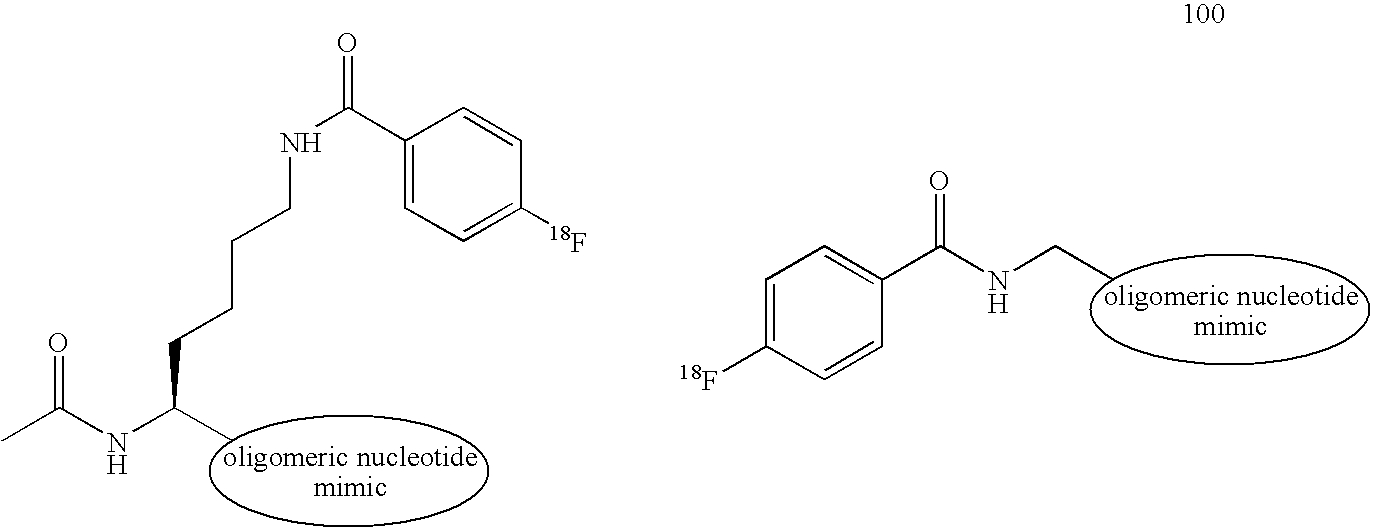
- While the invention has been described in detail in connection with only a limited number of aspects, it should be readily understood that the invention is not limited to such disclosed aspects. Rather, the invention can be modified to incorporate any number of variations, alterations, substitutions or equivalent arrangements not heretofore described, but which are commensurate with the spirit and scope of the invention. Additionally, while various embodiments of the invention have been described, it is to be understood that aspects of the invention may include. only some of the described embodiments. Accordingly, the invention is not to be seen as limited by the foregoing description, but is only limited by the scope of the appended claims.
Claims (35)
1. A set of compounds comprising an active agent-labeled species and a pretargeting conjugate:
wherein the active agent-labeled species comprises a first oligomeric nucleotide or mimic thereof that is conjugated to a linker having a first moiety coupled with a diagnostic active agent;
wherein the pretargeting conjugate comprises a second oligomeric nucleotide or mimic thereof that is conjugated to a targeting species having a targeting moiety capable of binding to an in-vivo target or a biomarker produced by or associated with the in-vivo-target;
wherein the second oligomeric nucleotide or mimic thereof comprises a sequence complementary to at least a portion of the sequence of the first oligomeric nucleotide or mimic thereof; and
with the proviso that at least one of the first or second oligomeric nucleotides or mimics thereof is not a morpholino.
2. The set of compounds of claim 1 , wherein the mimic of the first or second oligomeric nucleotides comprises a peptide nucleic acid (“PNA”) sequence having a formula of:
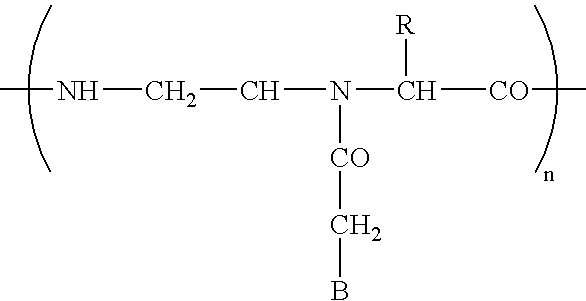
wherein B independently at each occurrence comprises a heterocyclic base selected from a group consisting of adenine, guanine, cytosine, thymine, and uracil;
wherein R independently at each occurrence is selected from a group consisting of:
side groups covalently bonded to α-carbons of twenty known α-amino acids and
a C1-C100 linear or branched, substituted or unsubstituted alkynyl, alkenyl, alkyl, alkylaryl, aryl, or arylalkyl optionally comprising at least one heteroatom selected from a group consisting of N, O, S, P, and halogens; and
wherein n is an integer in a range from about 4 to about 30.
3. The set of compounds of claim 2 , wherein n is an integer in a range from about 10 to about 20.
4. The set of compounds of claim 1 , wherein the first oligomeric nucleotide or mimic thereof is a sequence having a formula of:

wherein X and Y independently at each occurrence is selected from a group consisting of O, S, OR, BH3, and NR1R2;
wherein R independently at each occurrence is selected from a group consisting of a C1-C6 alkyl;
wherein R1 and R2 independently at each occurrence is selected from a group consisting of H and C1-C6 alkyl;
wherein W independently at each occurrence is selected from a group consisting of an acyclic moiety, a carbocyclic moiety, and a natural or a synthetic sugar moiety;
wherein B independently at each occurrence comprises a natural or synthetic nitrogen-comprising heterocyclic base; and
wherein n is an integer in a range from about 4 to about 100;
wherein the second oligomeric nucleotide or mimic thereof is a nucleotide sequence having a formula of:

wherein X and Y independently at each occurrence is selected from a group consisting of O, S, OR, BH3, and NR1R2;
wherein R independently at each occurrence is selected from a group consisting of a C1-C6 alkyl;
wherein R1 and R2 independently at each occurrence is selected from a group consisting of H and C1-C6 alkyl;
wherein W independently at each occurrence is selected from a group consisting of an acyclic moiety, a carbocyclic moiety, and a natural or a synthetic sugar moiety;
wherein B independently at each occurrence comprises a natural or synthetic nitrogen-comprising heterocyclic base; and
wherein n is an integer in a range from about 4 to about 100.
5. The set of compounds of claim 1 , wherein the first oligomeric nucleotide or mimic thereof comprises a mimic thereof with a sequence having a formula of:

wherein X and Y independently at each occurrence is selected from a group consisting of O, S, OR, BH3, and NR1R2;
wherein R independently at each occurrence is selected from a group consisting of a C1-C6 alkyl;
wherein R1 and R2 independently at each occurrence is selected from a group consisting of H and C1-C6 alkyl;
wherein W independently at each occurrence is selected from a group consisting of an acyclic moiety, a carbocyclic moiety, and a natural or a synthetic sugar moiety;
wherein B independently at each occurrence comprises a natural or synthetic nitrogen-comprising heterocyclic base;
wherein n is an integer in a range from about 4 to about 100; and
with the proviso that X and Y in a terminal unit are not simultaneously O when W is deoxyribose or ribose.
wherein the second oligomeric nucleotide or mimic thereof comprises a mimic with a sequence having a formula of:
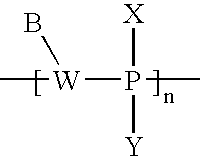
wherein X and Y independently at each occurrence is selected from a group consisting of O, S, OR, BH3, and NR1R2;
wherein R independently at each occurrence is selected from a group consisting of a C1-C6 alkyl;
wherein R1 and R2 independently at each occurrence is selected from a group consisting of H and C1-C6 alkyl;
wherein W independently at each occurrence is selected from a group consisting of an acyclic moiety, a carbocyclic moiety, and a natural or a synthetic sugar moiety;
wherein B independently at each occurrence comprises a natural or synthetic nitrogen-comprising heterocyclic base; and
wherein n is an integer in a range from about 4 to about 100; and
with the proviso that X and Y in the terminal units are not simultaneously O when W is deoxyribose or ribose.
6. The set of compounds of claim 5 , wherein the mimic of the first or second oligomeric nucleotides comprises at least one member selected from a group consisting of morpholinos, phosphorothioates, 2′-O methyl oligoribonucleotides, oligoboranophosphates, phosphorodithioates, phosphoramidate, phosphorodiamidate, locked nucleic acids, and chimeras.
7. The set of compounds of claim 6 , wherein the mimic of the first or second oligomeric nucleotides comprises a morpholino sequence having a formula of:
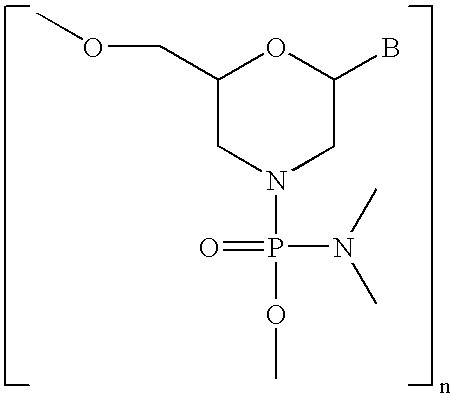
wherein B independently at each occurrence is a heterocyclic base selected from a group consisting of adenine, guanine, cytosine, thymine, and uracil; and
wherein n is an integer in a range from about 4 to about 100.
8. The set of compounds of claim 6 , wherein the mimic of the first or second oligomeric nucleotides comprises a phosphorothioate sequence having a formula of:
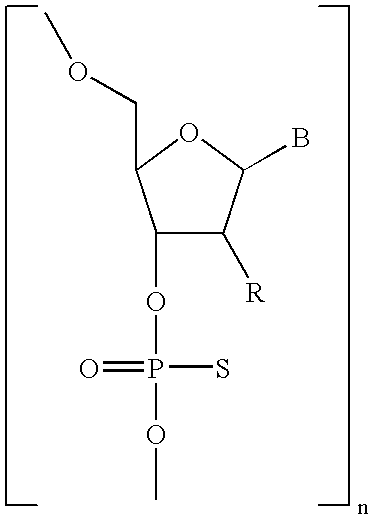
wherein B independently at each occurrence is a heterocyclic base selected from a group consisting of adenine, thymine, uracil, guanine, cytosine, and 5-methyl cytosine;
wherein n is an integer in a range from about 6 to about 100;
wherein R independently at each occurrence is selected from a group consisting of H, OH and OCH3.
9. The set of compounds of claim 6 , wherein the mimic of the first or second oligomeric nucleotides comprises a 2′-O methyl oligoribonucleotide sequence having a formula of:
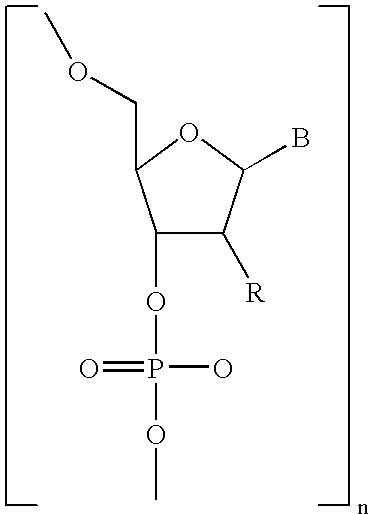
wherein B independently at each occurrence is a heterocyclic base selected from a group consisting of adenine, thymine, uracil, guanine, cytosine, and 5-methyl cytosine;
wherein n is an integer in a range from about 6 to about 100; and
wherein R independently at each occurrence comprises OR1, wherein R1 comprises C1-C6 alkyl chain with 0 to about 2 heteroatoms.
10. The set of compounds of claim 6 , wherein the mimic of the first or second oligomeric nucleotides comprises a chimeric oligonucleotide sequence having a formula of:
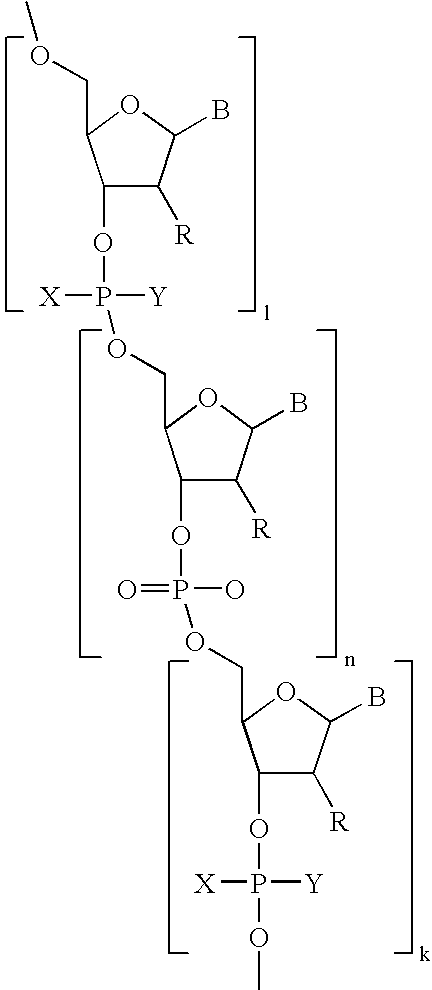
wherein B independently at each occurrence is a heterocyclic base selected from a group consisting of adenine, thymine, uracil, guanine, cytosine, and 5-methyl cytosine;
wherein X and Y are independently at each occurrence selected from a group consisting of O, S, OR, BH3;
R independently at each occurrence is H, OH, or OCH3;
wherein l is an integer in a range from about 2 to about 20;
wherein k is an integer in a range from about 2 to about 20; and
wherein n is an integer in a range from about 1 to about 20.
11. The set of compounds of claim 1 , wherein the linker comprises an oligomeric or polymeric species made of natural or synthetic monomers, the first moiety comprises a chelating moiety that is conjugated to the oligomeric or polymeric linker species, and the diagnostic active agent is capable of generating a signal that is detectable.
12. The set of compounds of claim 11 , wherein the oligomeric or polymeric species comprise a peptide or polypeptide.
13. The set of compounds of claim 11 , wherein the oligomeric or polymeric species comprises the polymeric species polylysine.
14. The set of compounds of claim 13 , wherein the oligomeric or polymeric species comprising polylysine has from about 100 to about 600 lysine residues, and wherein at least ninety percent of the lysine residues are conjugated to the chelating moiety.
15. The set of compounds of claim 11 , wherein the chelating moiety is selected from a group consisting of diethylenetriamine-pentaacetic acid (“DTPA”), 1,4,7,10-tetraazacyclododecane-N,N′,N″,N′″-tetraacetic acid (“DOTA”), p-isothiocyanatobenzyl-1,4,7,10-tetraazacyclododecane-1,4,7,10-tetraacetic acid (“p-SCN-Bz-DOTA”), 1,4,7,10-tetraazacyclododecane-N,N′,N″-triacetic acid (“DO3A”), 1,4,7,10-tetraazacyclododecane-1,4,7,10-tetrakis(2-propionic acid) (“DOTMA”), 3,6,9-triaza-12-oxa-3,6,9-tricarboxymethylene-10-carboxy-13-phenyl-tridecanoic acid (“B-19036”), 1,4,7-triazacyclononane-N,N′,N″-triacetic acid (“NOTA”), 1,4,8,11-tetraazacyclotetradecane-N,N′,N″,N′″-tetraacetic acid (“TETA”), triethylene tetraamine hexaacetic acid (“TTHA”), trans-1,2-diaminohexane tetraacetic acid (“CYDTA”), 1,4,7,10-tetraazacyclododecane-1-(2-hydroxypropyl)4,7,10-triacetic acid (“HP-DO3A”), trans-cyclohexane-diamine tetraacetic acid (“CDTA”), trans(1,2)-cyclohexane diethylene triamine pentaacetic acid (“CDTPA”), 1-oxa-4,7,10-triazacyclododecane-N,N′,N″-triacetic acid (“OTTA”), 1,4,7,10-tetraazacyclododecane-1,4,7,10-tetrakis{3-(4-carboxyl)-butanoic acid}, 1,4,7,10-tetraazacyclododecane-1,4,7,10-tetrakis(acetic acid-methyl amide), 1,4,7,10-tetraazacyclododecane-1,4,7,10-tetrakis(methylene phosphonic acid), and derivatives thereof.
16. The set of compounds of claim 11 , wherein the diagnostic active agent comprises paramagnetic Gd3+.
17. The set of compounds of claim 1 , wherein the diagnostic active agent comprises paramagnetic iron oxide that is coupled to the linker.
18. The set of compounds of claim 1 , wherein the linker is coupled to a diagnostic active agent that generates a signal detectable by a technique selected from a group consisting of magnetic resonance imaging (“MRI”), positron emission tomography (“PET”), single photon emission computed tomography (“SPECT”), compute tomography, X-ray imaging, ultrasound, and optical imaging.
19. The set of compounds of claim 1 , wherein the diagnostic active agent comprises an isotope selected from a group consisting of F-18, I-123, I-124, I -125, Cu-64, Cu-67, At-211, I-120, I-123, I-124, I-125, As-72, Br-75, Br-76, Br-77, In -110, In-111, In-113m, Ga-67, Ga-68, Tc-94, Tc-99m, Cu-62, Lu-177, Ti-201, Rb-82, Co-55, Cu-61, As-70, As-71, As-74, Y-88, C-11, N-13, Cu-60, O-15, Zr-89, and Ga -66.
20. The set of compounds of claim 1 , wherein the targeting species is selected from a group consisting of proteins, peptides, polypeptides, glycoproteins, lipoproteins, phospholipids, oligonucleotides, steroids, hormones, lymphokines, growth factors, albumin, cytokines, enzymes, immune modulators, receptor proteins, oligonucleotides or mimics thereof, antibodies, antibody fragments, and combinations thereof.
21. The set of compounds of claim 20 , wherein the targeting species is selected from a group consisting of antibodies and fragments thereof.
22. The set of compounds of claim 21 , wherein the antibodies and fragments thereof is selected from a group consisting of human or humanized antibodies, human or humanized antibody fragments, and combinations thereof.
23. The set of compounds of claim 1 , wherein the biomarker is associated with a target selected from a group consisting of tumors, cardiovascular lesions, vascular clots, thrombi, emboli, myocardial infarctions, atherosclerotic plaques, inflammatory lesions, infectious and parasitic agents fragments, and combinations thereof.
24. A compound comprising an active agent-labeled species:
wherein the active agent-labeled species comprises a first oligomeric nucleotide or mimic thereof that is conjugated to a linker having a first moiety coupled with a diagnostic active agent; and
wherein the first oligomeric nucleotide or mimic thereof is capable of hybridizing with a second oligomeric nucleotide or mimic thereof that has a sequence at least partially complementary to the first oligomeric nucleotide or mimic thereof.
25. The compound of claim 24 , wherein the first oligomeric nucleotide or mimic thereof comprises a mimic thereof with a sequence having the formula
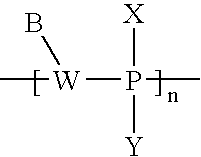
wherein X and Y independently at each occurrence is selected from a group consisting of O, S, OR, and BH3 and NR1R2,
wherein R independently at each occurrence is selected from a group consisting of a C1-C6 alkyl;
wherein R1 and R2 independently at each occurrence is selected from a group consisting of H, C1-C6 alkyl;
wherein W independently at each occurrence is selected from a group consisting of an acyclic moiety, a carbocyclic moiety, and a natural or a synthetic sugar moiety;
wherein B independently at each occurrence comprises a natural or synthetic nitrogen-comprising heterocyclic base;
wherein n is an integer in a range from about 4 to about 100; and
with the proviso that X and Y in a terminal unit are not simultaneously o when W is deoxyribose or ribose.
26. The compound of claim 25 , wherein the mimic of the first oligomeric nucleotide comprises at least one member selected from a group consisting of morpholinos, phosphorothioates, 2′-O methyl oligoribonucleotides, oligoboranophosphates, phosphorodithioates, phosphoramidate, phosphorodiamidate, locked nucleic acids, and chimera.
27. The compound of claim 25 , wherein n is an integer in a range from about 10 to about 35.
28. The compound of claim 24 , wherein the mimic of the first oligomeric nucleotide comprises at least one mimic selected from a group consisting of

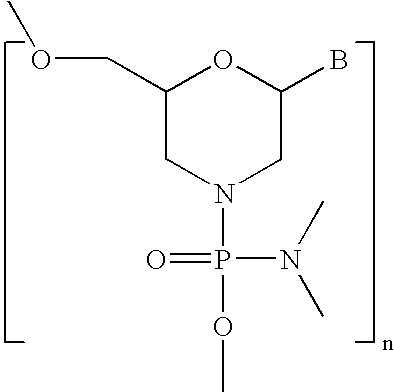
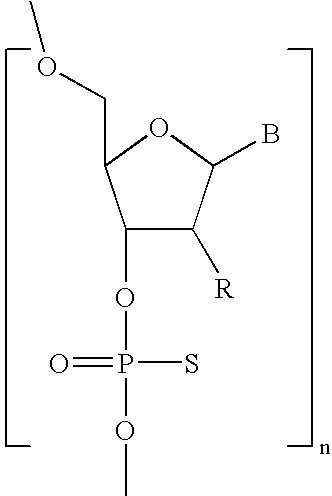
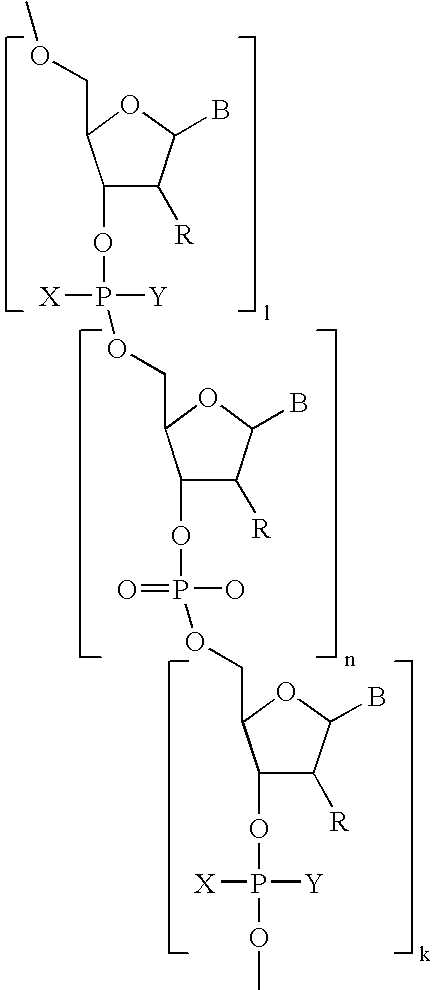
a) a peptide nucleic acid (“PNA”) sequence having a formula of:
wherein B independently at each occurrence comprises a heterocyclic base selected from a group consisting of adenine, guanine, cytosine, thymine, and uracil;
wherein R independently at each occurrence is selected from a group consisting of:
side groups covalently bonded to α-carbons of twenty known α-amino acids and
a C1-C100 linear or branched, substituted or unsubstituted alkynyl, alkenyl, alkyl, alkylaryl, aryl, or arylalkyl optionally comprising at least one heteroatom selected from a group consisting of N, O, S, P, and halogens; and
wherein n is an integer in a range from about 4 to about 30.
b) a morpholino sequence having a formula of:
wherein B independently at each occurrence is a heterocyclic base selected from a group consisting of adenine, guanine, cytosine, thymine, and uracil; and
wherein n is an integer in a range from about 4 to about 100;
c) a phosphorothioate sequence having a formula of:
wherein B independently at each occurrence is a heterocyclic base selected from a group consisting of adenine, thymine, uracil, guanine, cytosine, and 5-methyl cytosine;
wherein n is an integer in a range from about 6 to about 100;
wherein R independently at each occurrence is selected from a group consisting of H, OH and OCH3;
d) a chimeric oligonucleotide having a formula of:
wherein B independently at each occurrence is a heterocyclic base selected from a group consisting of adenine, thymine, uracil, guanine, cytosine, and 5-methyl cytosine;
wherein X and Y are independently at each occurrence selected from a group consisting of O, S, OR, and BH3;
R independently at each occurrence is H, OH, or OCH3;
wherein l is an integer in a range from about 2 to about 20;
wherein k is an integer in a range from about 2 to about 20; and
wherein n is an integer in a range from about 1 to about 20.
29. A method for diagnosing a disease condition comprising:
(i) administering a pretargeting conjugate to a subject, wherein the pretargeting conjugate comprises a second oligomeric nucleotide or mimic thereof conjugated to a targeting species having a targeting moiety that binds to an in-vivo target or a marker substance produced by or associated with the target; and wherein the second oligomeric nucleotide or mimic thereof comprises a sequence that is at least partially complementary to a first oligomeric nucleotide or mimic thereof; and
(ii) allowing the pretargeting conjugate to localize at the target; and
(iii) administering an active agent-labeled species to the subject, wherein the active agent-labeled species comprises a diagnostic active agent conjugated to the first oligomeric nucleotide or mimic thereof sequence,
wherein the diagnostic active agent is capable of elucidating the disease condition; and
with the proviso that at least one of the first or second oligomeric nucleotides or mimics thereof is not a morpholino.
30. The method of claim 29 , wherein the diagnostic active agent is capable of generating a signal that is detectable.
31. A method for diagnosing a disease condition comprising:
(i) obtaining a base-line image of a portion of a subject suspected of having the disease condition;
(ii) administering a pretargeting conjugate to the subject,
wherein the pretargeting conjugate comprises a second oligomeric nucleotide or mimic thereof conjugated to a targeting species having a targeting moiety that binds to an in-vivo target or a marker substance produced by or associated with the target; and wherein the second oligomeric nucleotide or mimic thereof comprises a sequence that is at least partially complementary to a first oligomeric nucleotide or mimic thereof; and
(iii) allowing the pretargeting conjugate to localize at the target;
(iv) administering an active agent-labeled species to the subject,
wherein the active agent-labeled species comprises a diagnostic active agent conjugated to the first oligomeric nucleotide or mimic thereof sequence,
wherein the diagnostic active agent is capable of elucidating the disease condition; and
with the proviso that at least one of the first or second oligomeric nucleotides or mimics thereof is not a morpholino.
(v) obtaining an additional image of the same portion of the subject; and
(vi) comparing the base-line image with the additional image to evaluate the disease condition.
32. A method for assessing an effectiveness of a prescribed regimen for treating a disease condition that is characterized by an overproduction or underproduction of a disease-specific substance or biomarker, the method comprising:
(i) obtaining a base-line image of a portion of a subject suspected of having the disease condition;
(ii) administering a pretargeting conjugate to the subject, wherein the pretargeting conjugate comprises a second oligomeric nucleotide or mimic thereof conjugated to a targeting species having a targeting moiety that binds to an in-vivo target or a marker substance produced by or associated with the target; and wherein the second oligomeric nucleotide or mimic thereof comprises a sequence that is complementary to a first oligomeric nucleotide or mimic thereof;
(iii) allowing the pretargeting conjugate to localize at the target;
(iv) administering an active agent-labeled species to the subject,
wherein the active agent-labeled species comprises a diagnostic active agent conjugated to the first oligomeric nucleotide or mimic thereof, wherein the diagnostic active agent is capable of elucidating the disease condition; and
with the proviso that at least one of the first or second oligomeric nucleotides or mimics thereof is not a morpholino;
(v) obtaining a pre-treatment image coming from the same portion of the subject;
(vi) treating the disease condition in the subject with a prescribed regimen;
(vii) repeating steps (ii), (iii), and (iv); and
(viii) obtaining a post-treatment image coming from the same portion of the subject as in step (v).
33. The method of claim 32 , further comprising comparing the post-treatment image to the pre-treatment image to assess the effectiveness of the prescribed regimen, wherein a change in image contrast during a course of the prescribed regimen indicates that the treatment has provided benefit.
34. The method of claim 32 , further comprising comparing the post-treatment image to the baseline image to assess the effectiveness of the prescribed regimen, wherein a change in image contrast or signals during a course of the prescribed regimen indicates that the treatment has provided benefit.
35. The method of claim 32 , further comprising repeating steps (vii) and (viii) at predetermined time intervals during the course of treating the disease condition.
Priority Applications (1)
| Application Number | Priority Date | Filing Date | Title |
|---|---|---|---|
| US11/175,596 US20070009435A1 (en) | 2005-07-06 | 2005-07-06 | Compositions and methods for enhanced delivery to target sites |
Applications Claiming Priority (1)
| Application Number | Priority Date | Filing Date | Title |
|---|---|---|---|
| US11/175,596 US20070009435A1 (en) | 2005-07-06 | 2005-07-06 | Compositions and methods for enhanced delivery to target sites |
Publications (1)
| Publication Number | Publication Date |
|---|---|
| US20070009435A1 true US20070009435A1 (en) | 2007-01-11 |
Family
ID=37618489
Family Applications (1)
| Application Number | Title | Priority Date | Filing Date |
|---|---|---|---|
| US11/175,596 Abandoned US20070009435A1 (en) | 2005-07-06 | 2005-07-06 | Compositions and methods for enhanced delivery to target sites |
Country Status (1)
| Country | Link |
|---|---|
| US (1) | US20070009435A1 (en) |
Cited By (1)
| Publication number | Priority date | Publication date | Assignee | Title |
|---|---|---|---|---|
| US9669118B2 (en) | 2011-06-17 | 2017-06-06 | University Court Of The University Of St. Andrews | Method of labelling a biologically active molecule with 5-fluoro-5-deoxypentose or a 3-fluoro-3-deoxypentose |
Citations (7)
| Publication number | Priority date | Publication date | Assignee | Title |
|---|---|---|---|---|
| US5573523A (en) * | 1995-02-09 | 1996-11-12 | Whalen; Johanna B. | Flushable sanitary mini-pad |
| US5578287A (en) * | 1992-06-09 | 1996-11-26 | Neorx Corporation | Three-step pretargeting methods using improved biotin-active agent |
| US5958408A (en) * | 1995-06-07 | 1999-09-28 | Immunomedics, Inc. | Delivery of diagnostic and therapeutic agents to a target site |
| US20020006379A1 (en) * | 1998-06-22 | 2002-01-17 | Hansen Hans J. | Production and use of novel peptide-based agents for use with bi-specific antibodies |
| US6358710B1 (en) * | 1996-06-07 | 2002-03-19 | Neorx Corporation | Humanized antibodies that bind to the antigen bound by antibody NR-LU-13 |
| US20020164648A1 (en) * | 1999-07-14 | 2002-11-07 | Board Of Regents, The University Of Texas System | Methods and compositions for delivery and retention of active agents to lymph nodes |
| US20030003102A1 (en) * | 2001-03-30 | 2003-01-02 | University Of Massachusetts | Morpholino imaging and therapy |
-
2005
- 2005-07-06 US US11/175,596 patent/US20070009435A1/en not_active Abandoned
Patent Citations (7)
| Publication number | Priority date | Publication date | Assignee | Title |
|---|---|---|---|---|
| US5578287A (en) * | 1992-06-09 | 1996-11-26 | Neorx Corporation | Three-step pretargeting methods using improved biotin-active agent |
| US5573523A (en) * | 1995-02-09 | 1996-11-12 | Whalen; Johanna B. | Flushable sanitary mini-pad |
| US5958408A (en) * | 1995-06-07 | 1999-09-28 | Immunomedics, Inc. | Delivery of diagnostic and therapeutic agents to a target site |
| US6358710B1 (en) * | 1996-06-07 | 2002-03-19 | Neorx Corporation | Humanized antibodies that bind to the antigen bound by antibody NR-LU-13 |
| US20020006379A1 (en) * | 1998-06-22 | 2002-01-17 | Hansen Hans J. | Production and use of novel peptide-based agents for use with bi-specific antibodies |
| US20020164648A1 (en) * | 1999-07-14 | 2002-11-07 | Board Of Regents, The University Of Texas System | Methods and compositions for delivery and retention of active agents to lymph nodes |
| US20030003102A1 (en) * | 2001-03-30 | 2003-01-02 | University Of Massachusetts | Morpholino imaging and therapy |
Cited By (1)
| Publication number | Priority date | Publication date | Assignee | Title |
|---|---|---|---|---|
| US9669118B2 (en) | 2011-06-17 | 2017-06-06 | University Court Of The University Of St. Andrews | Method of labelling a biologically active molecule with 5-fluoro-5-deoxypentose or a 3-fluoro-3-deoxypentose |
Similar Documents
| Publication | Publication Date | Title |
|---|---|---|
| US11180570B2 (en) | J591 minibodies and cys-diabodies for targeting human prostate specific membrane antigen (PSMA) and methods for their use | |
| US6120768A (en) | Dota-biotin derivatives | |
| EP1372741B1 (en) | Morpholino imaging and therapy | |
| JP2025143317A (en) | Radiolabeling of Polypeptides | |
| JP5435432B2 (en) | Improved methods and compositions for F-18 labeling of proteins, peptides, and other molecules | |
| CN102395380B (en) | Pretargeting kit, method and agents used therein | |
| JPH08509226A (en) | Improving lesion detection and treatment with biotin and avidin polymer conjugates | |
| CN104334178B (en) | Targeting self assembly of the functionalized carbon nano-tube in tumour | |
| CN102438656B (en) | Pretargeting kit, method and agents used therein | |
| US20080181847A1 (en) | Targeted Imaging and/or Therapy Using the Staudinger Ligation | |
| JPH05502236A (en) | Chimeric antibodies for the detection and treatment of infectious and inflammatory lesions | |
| US5607659A (en) | Directed biodistribution of radiolabelled biotin using carbohydrate polymers | |
| US20070010014A1 (en) | Compositions and methods for enhanced delivery to target sites | |
| EP0787138B1 (en) | Radioactive phosphorous labeling of proteins for targeted radiotherapy | |
| CA3222172A1 (en) | Methods and materials for combining biologics with multiple chelators | |
| Farzin et al. | Clinical aspects of radiolabeled aptamers in diagnostic nuclear medicine: A new class of targeted radiopharmaceuticals | |
| US20050260131A1 (en) | Pharmaceuticals for enhanced delivery to disease targets | |
| Yoo et al. | N-acetylgalactosamino dendrons as clearing agents to enhance liver targeting of model antibody-fusion protein | |
| Lee et al. | Synthesis and application of a novel cysteine-based DTPA-NCS for targeted radioimmunotherapy | |
| US20070009435A1 (en) | Compositions and methods for enhanced delivery to target sites | |
| US7306785B2 (en) | Multifunctional cross-bridged tetraaza macrocyclic compounds and methods of making and using | |
| US20070009428A1 (en) | Compounds and methods for enhanced delivery to disease targets | |
| RU2006122952A (en) | THERAPY DIRECTED AGAINST ANTIGENS Erb | |
| AU740563B2 (en) | Positron emission tomography using gallium-68 chelates | |
| US20070009427A1 (en) | Compounds and methods for enhanced delivery to disease targets |
Legal Events
| Date | Code | Title | Description |
|---|---|---|---|
| AS | Assignment |
Owner name: GENERAL ELECTRIC COMPANY, NEW YORK Free format text: ASSIGNMENT OF ASSIGNORS INTEREST;ASSIGNORS:SYUD, FAISAL A.;WOOD, NICHOLE L.;KRAMER, DANIEL J.;AND OTHERS;REEL/FRAME:016885/0797;SIGNING DATES FROM 20050628 TO 20050805 |
|
| STCB | Information on status: application discontinuation |
Free format text: ABANDONED -- FAILURE TO RESPOND TO AN OFFICE ACTION |