US20070008603A1 - Electrochromic devices utilizing very low band gap conjugated counter electrodes: preparation and use - Google Patents
Electrochromic devices utilizing very low band gap conjugated counter electrodes: preparation and use Download PDFInfo
- Publication number
- US20070008603A1 US20070008603A1 US11/456,603 US45660306A US2007008603A1 US 20070008603 A1 US20070008603 A1 US 20070008603A1 US 45660306 A US45660306 A US 45660306A US 2007008603 A1 US2007008603 A1 US 2007008603A1
- Authority
- US
- United States
- Prior art keywords
- occurrence
- previously defined
- different
- same
- conjugated polymer
- Prior art date
- Legal status (The legal status is an assumption and is not a legal conclusion. Google has not performed a legal analysis and makes no representation as to the accuracy of the status listed.)
- Granted
Links
- 238000002360 preparation method Methods 0.000 title description 2
- 229920000547 conjugated polymer Polymers 0.000 claims abstract description 83
- 238000001228 spectrum Methods 0.000 claims abstract description 13
- 239000000178 monomer Substances 0.000 claims description 88
- -1 C1-C12 alkylthio Chemical group 0.000 claims description 69
- 239000010410 layer Substances 0.000 claims description 68
- 229920000642 polymer Polymers 0.000 claims description 43
- YTPLMLYBLZKORZ-UHFFFAOYSA-N Thiophene Chemical group C=1C=CSC=1 YTPLMLYBLZKORZ-UHFFFAOYSA-N 0.000 claims description 22
- 229910052760 oxygen Inorganic materials 0.000 claims description 19
- KAESVJOAVNADME-UHFFFAOYSA-N Pyrrole Chemical class C=1C=CNC=1 KAESVJOAVNADME-UHFFFAOYSA-N 0.000 claims description 17
- ZUOUZKKEUPVFJK-UHFFFAOYSA-N diphenyl Chemical compound C1=CC=CC=C1C1=CC=CC=C1 ZUOUZKKEUPVFJK-UHFFFAOYSA-N 0.000 claims description 17
- 239000000463 material Substances 0.000 claims description 17
- 229930192474 thiophene Natural products 0.000 claims description 17
- 239000003792 electrolyte Substances 0.000 claims description 16
- 230000007935 neutral effect Effects 0.000 claims description 16
- 229910052717 sulfur Inorganic materials 0.000 claims description 16
- 125000000753 cycloalkyl group Chemical group 0.000 claims description 15
- 229910052739 hydrogen Inorganic materials 0.000 claims description 15
- 239000001257 hydrogen Substances 0.000 claims description 15
- 238000010521 absorption reaction Methods 0.000 claims description 13
- 239000002019 doping agent Substances 0.000 claims description 13
- 125000004400 (C1-C12) alkyl group Chemical group 0.000 claims description 12
- 238000004891 communication Methods 0.000 claims description 12
- 229920001577 copolymer Polymers 0.000 claims description 11
- 229910052736 halogen Inorganic materials 0.000 claims description 10
- 150000002367 halogens Chemical class 0.000 claims description 10
- 125000004642 (C1-C12) alkoxy group Chemical group 0.000 claims description 9
- 125000004641 (C1-C12) haloalkyl group Chemical group 0.000 claims description 9
- 235000010290 biphenyl Nutrition 0.000 claims description 9
- 125000002887 hydroxy group Chemical group [H]O* 0.000 claims description 9
- 239000004305 biphenyl Substances 0.000 claims description 8
- 239000011245 gel electrolyte Substances 0.000 claims description 8
- 125000004435 hydrogen atom Chemical group [H]* 0.000 claims description 8
- 150000003577 thiophenes Chemical class 0.000 claims description 8
- 125000004169 (C1-C6) alkyl group Chemical group 0.000 claims description 7
- YLQBMQCUIZJEEH-UHFFFAOYSA-N Furan Chemical group C=1C=COC=1 YLQBMQCUIZJEEH-UHFFFAOYSA-N 0.000 claims description 7
- 125000002947 alkylene group Chemical group 0.000 claims description 7
- 125000001997 phenyl group Chemical group [H]C1=C([H])C([H])=C(*)C([H])=C1[H] 0.000 claims description 7
- 125000004643 (C1-C12) haloalkoxy group Chemical group 0.000 claims description 6
- 125000002252 acyl group Chemical group 0.000 claims description 6
- 125000003368 amide group Chemical group 0.000 claims description 6
- 125000003917 carbamoyl group Chemical group [H]N([H])C(*)=O 0.000 claims description 6
- 229910052799 carbon Inorganic materials 0.000 claims description 6
- NIHNNTQXNPWCJQ-UHFFFAOYSA-N fluorene Chemical compound C1=CC=C2CC3=CC=CC=C3C2=C1 NIHNNTQXNPWCJQ-UHFFFAOYSA-N 0.000 claims description 6
- 230000006870 function Effects 0.000 claims description 6
- 150000002500 ions Chemical class 0.000 claims description 6
- UEZVMMHDMIWARA-UHFFFAOYSA-M phosphonate Chemical compound [O-]P(=O)=O UEZVMMHDMIWARA-UHFFFAOYSA-M 0.000 claims description 6
- 125000004076 pyridyl group Chemical group 0.000 claims description 6
- 150000003233 pyrroles Chemical class 0.000 claims description 6
- 125000001424 substituent group Chemical group 0.000 claims description 6
- BDHFUVZGWQCTTF-UHFFFAOYSA-M sulfonate Chemical compound [O-]S(=O)=O BDHFUVZGWQCTTF-UHFFFAOYSA-M 0.000 claims description 6
- 125000000472 sulfonyl group Chemical group *S(*)(=O)=O 0.000 claims description 6
- 125000004962 sulfoxyl group Chemical group 0.000 claims description 6
- YJTKZCDBKVTVBY-UHFFFAOYSA-N 1,3-Diphenylbenzene Chemical class C1=CC=CC=C1C1=CC=CC(C=2C=CC=CC=2)=C1 YJTKZCDBKVTVBY-UHFFFAOYSA-N 0.000 claims description 5
- 229920001519 homopolymer Polymers 0.000 claims description 5
- 238000003860 storage Methods 0.000 claims description 5
- OHZAHWOAMVVGEL-UHFFFAOYSA-N 2,2'-bithiophene Chemical class C1=CSC(C=2SC=CC=2)=C1 OHZAHWOAMVVGEL-UHFFFAOYSA-N 0.000 claims description 4
- 229920000144 PEDOT:PSS Polymers 0.000 claims description 4
- ROZYMPBUMVSVHM-UHFFFAOYSA-N dithieno[3,2-a:3',2'-d]thiophene Chemical class S1C=C2C3=CSC=C3SC2=C1 ROZYMPBUMVSVHM-UHFFFAOYSA-N 0.000 claims description 4
- 229910052744 lithium Inorganic materials 0.000 claims description 4
- UFWIBTONFRDIAS-UHFFFAOYSA-N naphthalene-acid Natural products C1=CC=CC2=CC=CC=C21 UFWIBTONFRDIAS-UHFFFAOYSA-N 0.000 claims description 4
- UFHFLCQGNIYNRP-UHFFFAOYSA-N Hydrogen Chemical compound [H][H] UFHFLCQGNIYNRP-UHFFFAOYSA-N 0.000 claims description 3
- WHXSMMKQMYFTQS-UHFFFAOYSA-N Lithium Chemical compound [Li] WHXSMMKQMYFTQS-UHFFFAOYSA-N 0.000 claims description 3
- 150000001422 N-substituted pyrroles Chemical class 0.000 claims description 3
- 239000002202 Polyethylene glycol Substances 0.000 claims description 3
- 238000002835 absorbance Methods 0.000 claims description 3
- NIXOWILDQLNWCW-UHFFFAOYSA-N acrylic acid group Chemical group C(C=C)(=O)O NIXOWILDQLNWCW-UHFFFAOYSA-N 0.000 claims description 3
- 230000005540 biological transmission Effects 0.000 claims description 3
- 125000004093 cyano group Chemical group *C#N 0.000 claims description 3
- 125000006575 electron-withdrawing group Chemical group 0.000 claims description 3
- 229910052738 indium Inorganic materials 0.000 claims description 3
- QSZMZKBZAYQGRS-UHFFFAOYSA-N lithium;bis(trifluoromethylsulfonyl)azanide Chemical compound [Li+].FC(F)(F)S(=O)(=O)[N-]S(=O)(=O)C(F)(F)F QSZMZKBZAYQGRS-UHFFFAOYSA-N 0.000 claims description 3
- 239000011159 matrix material Substances 0.000 claims description 3
- 150000002790 naphthalenes Chemical class 0.000 claims description 3
- 229920001223 polyethylene glycol Polymers 0.000 claims description 3
- 150000003839 salts Chemical class 0.000 claims description 3
- XOLBLPGZBRYERU-UHFFFAOYSA-N tin dioxide Chemical compound O=[Sn]=O XOLBLPGZBRYERU-UHFFFAOYSA-N 0.000 claims description 3
- 229910001887 tin oxide Inorganic materials 0.000 claims description 3
- 229910000990 Ni alloy Inorganic materials 0.000 claims description 2
- PCHJSUWPFVWCPO-UHFFFAOYSA-N gold Chemical compound [Au] PCHJSUWPFVWCPO-UHFFFAOYSA-N 0.000 claims description 2
- 229910052737 gold Inorganic materials 0.000 claims description 2
- 239000010931 gold Substances 0.000 claims description 2
- 229910001092 metal group alloy Inorganic materials 0.000 claims description 2
- 229910044991 metal oxide Inorganic materials 0.000 claims description 2
- 150000004706 metal oxides Chemical class 0.000 claims description 2
- 229910000480 nickel oxide Inorganic materials 0.000 claims description 2
- GNRSAWUEBMWBQH-UHFFFAOYSA-N oxonickel Chemical compound [Ni]=O GNRSAWUEBMWBQH-UHFFFAOYSA-N 0.000 claims description 2
- BASFCYQUMIYNBI-UHFFFAOYSA-N platinum Chemical compound [Pt] BASFCYQUMIYNBI-UHFFFAOYSA-N 0.000 claims description 2
- 150000002431 hydrogen Chemical class 0.000 claims 6
- 125000004178 (C1-C4) alkyl group Chemical group 0.000 claims 1
- QGLKJKCYBOYXKC-UHFFFAOYSA-N nonaoxidotritungsten Chemical group O=[W]1(=O)O[W](=O)(=O)O[W](=O)(=O)O1 QGLKJKCYBOYXKC-UHFFFAOYSA-N 0.000 claims 1
- 229910001256 stainless steel alloy Inorganic materials 0.000 claims 1
- 229910001930 tungsten oxide Inorganic materials 0.000 claims 1
- 0 [RaH]C1=C2*C=CC2=CS1.[RaH]C1=C2C=C*C2=CS1.[RaH]C1=CC2=CSC=C2*1 Chemical compound [RaH]C1=C2*C=CC2=CS1.[RaH]C1=C2C=C*C2=CS1.[RaH]C1=CC2=CSC=C2*1 0.000 description 63
- 150000001875 compounds Chemical class 0.000 description 13
- 125000000217 alkyl group Chemical group 0.000 description 9
- 125000004432 carbon atom Chemical group C* 0.000 description 9
- FZXOORLHDQZVHN-UHFFFAOYSA-N thieno[3,4-b]furan Chemical class S1C=C2OC=CC2=C1 FZXOORLHDQZVHN-UHFFFAOYSA-N 0.000 description 9
- 125000003118 aryl group Chemical group 0.000 description 8
- 239000013256 coordination polymer Substances 0.000 description 8
- 239000000243 solution Substances 0.000 description 8
- PFZLGKHSYILJTH-UHFFFAOYSA-N thieno[2,3-c]thiophene Chemical class S1C=C2SC=CC2=C1 PFZLGKHSYILJTH-UHFFFAOYSA-N 0.000 description 8
- 230000009977 dual effect Effects 0.000 description 7
- 239000010408 film Substances 0.000 description 7
- WEVYAHXRMPXWCK-UHFFFAOYSA-N Acetonitrile Chemical compound CC#N WEVYAHXRMPXWCK-UHFFFAOYSA-N 0.000 description 6
- OKTJSMMVPCPJKN-UHFFFAOYSA-N Carbon Chemical compound [C] OKTJSMMVPCPJKN-UHFFFAOYSA-N 0.000 description 6
- 230000008901 benefit Effects 0.000 description 6
- 239000006185 dispersion Substances 0.000 description 5
- 238000000034 method Methods 0.000 description 5
- 239000000203 mixture Substances 0.000 description 5
- PXHVJJICTQNCMI-UHFFFAOYSA-N Nickel Chemical compound [Ni] PXHVJJICTQNCMI-UHFFFAOYSA-N 0.000 description 4
- 238000006243 chemical reaction Methods 0.000 description 4
- 239000011521 glass Substances 0.000 description 4
- 230000003287 optical effect Effects 0.000 description 4
- RUOJZAUFBMNUDX-UHFFFAOYSA-N propylene carbonate Chemical compound CC1COC(=O)O1 RUOJZAUFBMNUDX-UHFFFAOYSA-N 0.000 description 4
- ZWEHNKRNPOVVGH-UHFFFAOYSA-N 2-Butanone Chemical compound CCC(C)=O ZWEHNKRNPOVVGH-UHFFFAOYSA-N 0.000 description 3
- ZEOKMWKNSXKEAG-UHFFFAOYSA-N C1=C2OCOC2=CC1 Chemical compound C1=C2OCOC2=CC1 ZEOKMWKNSXKEAG-UHFFFAOYSA-N 0.000 description 3
- QIXNTPQTLLOPAZ-UHFFFAOYSA-N C1=CC2=C(C1)C1=C(C2)C2=C(C1)C1=C(C=CC1)C2 Chemical compound C1=CC2=C(C1)C1=C(C2)C2=C(C1)C1=C(C=CC1)C2 QIXNTPQTLLOPAZ-UHFFFAOYSA-N 0.000 description 3
- PKGMDJKDNXEXIE-UHFFFAOYSA-N C1=CC2=C(C1)C1=C(C=CC1)C2 Chemical compound C1=CC2=C(C1)C1=C(C=CC1)C2 PKGMDJKDNXEXIE-UHFFFAOYSA-N 0.000 description 3
- YBYIRNPNPLQARY-UHFFFAOYSA-N C1=CC=C2CC=CC2=C1 Chemical compound C1=CC=C2CC=CC2=C1 YBYIRNPNPLQARY-UHFFFAOYSA-N 0.000 description 3
- SCRLBORZFRMRNX-UHFFFAOYSA-N C1=CCC2=C(C3=C4CC=CCC4=CC3)CC=C2C1 Chemical compound C1=CCC2=C(C3=C4CC=CCC4=CC3)CC=C2C1 SCRLBORZFRMRNX-UHFFFAOYSA-N 0.000 description 3
- XTLZWPZHCFPIBU-UHFFFAOYSA-N C1=CCC2=CCC=C2C1 Chemical compound C1=CCC2=CCC=C2C1 XTLZWPZHCFPIBU-UHFFFAOYSA-N 0.000 description 3
- VXIKDBJPBRMXBP-UHFFFAOYSA-N C1=CN=CC1 Chemical compound C1=CN=CC1 VXIKDBJPBRMXBP-UHFFFAOYSA-N 0.000 description 3
- FJONDYMBXVERAU-UHFFFAOYSA-N C=C1C2=C(CC=C2)C2=C1C=CC2 Chemical compound C=C1C2=C(CC=C2)C2=C1C=CC2 FJONDYMBXVERAU-UHFFFAOYSA-N 0.000 description 3
- YMWUJEATGCHHMB-UHFFFAOYSA-N Dichloromethane Chemical compound ClCCl YMWUJEATGCHHMB-UHFFFAOYSA-N 0.000 description 3
- XEKOWRVHYACXOJ-UHFFFAOYSA-N Ethyl acetate Chemical compound CCOC(C)=O XEKOWRVHYACXOJ-UHFFFAOYSA-N 0.000 description 3
- LYCAIKOWRPUZTN-UHFFFAOYSA-N Ethylene glycol Chemical compound OCCO LYCAIKOWRPUZTN-UHFFFAOYSA-N 0.000 description 3
- PEDCQBHIVMGVHV-UHFFFAOYSA-N Glycerine Chemical compound OCC(O)CO PEDCQBHIVMGVHV-UHFFFAOYSA-N 0.000 description 3
- OKKJLVBELUTLKV-UHFFFAOYSA-N Methanol Chemical compound OC OKKJLVBELUTLKV-UHFFFAOYSA-N 0.000 description 3
- ZMXDDKWLCZADIW-UHFFFAOYSA-N N,N-Dimethylformamide Chemical compound CN(C)C=O ZMXDDKWLCZADIW-UHFFFAOYSA-N 0.000 description 3
- MUBZPKHOEPUJKR-UHFFFAOYSA-N Oxalic acid Chemical compound OC(=O)C(O)=O MUBZPKHOEPUJKR-UHFFFAOYSA-N 0.000 description 3
- YXFVVABEGXRONW-UHFFFAOYSA-N Toluene Chemical compound CC1=CC=CC=C1 YXFVVABEGXRONW-UHFFFAOYSA-N 0.000 description 3
- 239000002253 acid Substances 0.000 description 3
- MTHSVFCYNBDYFN-UHFFFAOYSA-N diethylene glycol Chemical compound OCCOCCO MTHSVFCYNBDYFN-UHFFFAOYSA-N 0.000 description 3
- 125000005678 ethenylene group Chemical group [H]C([*:1])=C([H])[*:2] 0.000 description 3
- 125000001188 haloalkyl group Chemical group 0.000 description 3
- 125000005843 halogen group Chemical group 0.000 description 3
- 229910052500 inorganic mineral Inorganic materials 0.000 description 3
- 239000007788 liquid Substances 0.000 description 3
- 239000004973 liquid crystal related substance Substances 0.000 description 3
- 239000011707 mineral Substances 0.000 description 3
- VLKZOEOYAKHREP-UHFFFAOYSA-N n-Hexane Chemical compound CCCCCC VLKZOEOYAKHREP-UHFFFAOYSA-N 0.000 description 3
- 239000003960 organic solvent Substances 0.000 description 3
- 230000008569 process Effects 0.000 description 3
- 230000009467 reduction Effects 0.000 description 3
- 239000000758 substrate Substances 0.000 description 3
- 239000010409 thin film Substances 0.000 description 3
- 230000007704 transition Effects 0.000 description 3
- GKWLILHTTGWKLQ-UHFFFAOYSA-N 2,3-dihydrothieno[3,4-b][1,4]dioxine Chemical compound O1CCOC2=CSC=C21 GKWLILHTTGWKLQ-UHFFFAOYSA-N 0.000 description 2
- YEJRWHAVMIAJKC-UHFFFAOYSA-N 4-Butyrolactone Chemical compound O=C1CCCO1 YEJRWHAVMIAJKC-UHFFFAOYSA-N 0.000 description 2
- CSCPPACGZOOCGX-UHFFFAOYSA-N Acetone Chemical compound CC(C)=O CSCPPACGZOOCGX-UHFFFAOYSA-N 0.000 description 2
- IAZDPXIOMUYVGZ-UHFFFAOYSA-N Dimethylsulphoxide Chemical compound CS(C)=O IAZDPXIOMUYVGZ-UHFFFAOYSA-N 0.000 description 2
- LFQSCWFLJHTTHZ-UHFFFAOYSA-N Ethanol Chemical compound CCO LFQSCWFLJHTTHZ-UHFFFAOYSA-N 0.000 description 2
- AFVFQIVMOAPDHO-UHFFFAOYSA-N Methanesulfonic acid Chemical compound CS(O)(=O)=O AFVFQIVMOAPDHO-UHFFFAOYSA-N 0.000 description 2
- 229920001609 Poly(3,4-ethylenedioxythiophene) Polymers 0.000 description 2
- 229920000265 Polyparaphenylene Polymers 0.000 description 2
- VYPSYNLAJGMNEJ-UHFFFAOYSA-N Silicium dioxide Chemical compound O=[Si]=O VYPSYNLAJGMNEJ-UHFFFAOYSA-N 0.000 description 2
- WYURNTSHIVDZCO-UHFFFAOYSA-N Tetrahydrofuran Chemical compound C1CCOC1 WYURNTSHIVDZCO-UHFFFAOYSA-N 0.000 description 2
- 150000007513 acids Chemical class 0.000 description 2
- ORILYTVJVMAKLC-UHFFFAOYSA-N adamantane Chemical group C1C(C2)CC3CC1CC2C3 ORILYTVJVMAKLC-UHFFFAOYSA-N 0.000 description 2
- 239000000654 additive Substances 0.000 description 2
- WNLRTRBMVRJNCN-UHFFFAOYSA-N adipic acid Chemical compound OC(=O)CCCCC(O)=O WNLRTRBMVRJNCN-UHFFFAOYSA-N 0.000 description 2
- 230000002411 adverse Effects 0.000 description 2
- 125000003545 alkoxy group Chemical group 0.000 description 2
- 125000004429 atom Chemical group 0.000 description 2
- 238000005266 casting Methods 0.000 description 2
- 230000008859 change Effects 0.000 description 2
- 238000004040 coloring Methods 0.000 description 2
- 239000011231 conductive filler Substances 0.000 description 2
- 229920001940 conductive polymer Polymers 0.000 description 2
- 238000007334 copolymerization reaction Methods 0.000 description 2
- 238000013461 design Methods 0.000 description 2
- 238000009792 diffusion process Methods 0.000 description 2
- 230000000694 effects Effects 0.000 description 2
- 230000001747 exhibiting effect Effects 0.000 description 2
- 150000002240 furans Chemical class 0.000 description 2
- 125000005842 heteroatom Chemical group 0.000 description 2
- 229910010272 inorganic material Inorganic materials 0.000 description 2
- 239000011147 inorganic material Substances 0.000 description 2
- MCVFFRWZNYZUIJ-UHFFFAOYSA-M lithium;trifluoromethanesulfonate Chemical compound [Li+].[O-]S(=O)(=O)C(F)(F)F MCVFFRWZNYZUIJ-UHFFFAOYSA-M 0.000 description 2
- 125000002950 monocyclic group Chemical group 0.000 description 2
- BDJRBEYXGGNYIS-UHFFFAOYSA-N nonanedioic acid Chemical compound OC(=O)CCCCCCCC(O)=O BDJRBEYXGGNYIS-UHFFFAOYSA-N 0.000 description 2
- 230000005693 optoelectronics Effects 0.000 description 2
- 150000007524 organic acids Chemical class 0.000 description 2
- 239000011368 organic material Substances 0.000 description 2
- 230000003647 oxidation Effects 0.000 description 2
- 238000007254 oxidation reaction Methods 0.000 description 2
- 239000001301 oxygen Substances 0.000 description 2
- 229920000553 poly(phenylenevinylene) Polymers 0.000 description 2
- 229920002451 polyvinyl alcohol Polymers 0.000 description 2
- 238000012545 processing Methods 0.000 description 2
- 238000006479 redox reaction Methods 0.000 description 2
- 230000002441 reversible effect Effects 0.000 description 2
- 229920006395 saturated elastomer Polymers 0.000 description 2
- 239000004065 semiconductor Substances 0.000 description 2
- 229910052710 silicon Inorganic materials 0.000 description 2
- 239000002904 solvent Substances 0.000 description 2
- 241000894007 species Species 0.000 description 2
- 150000003460 sulfonic acids Chemical class 0.000 description 2
- 239000004094 surface-active agent Substances 0.000 description 2
- XLYOFNOQVPJJNP-UHFFFAOYSA-N water Substances O XLYOFNOQVPJJNP-UHFFFAOYSA-N 0.000 description 2
- MIOPJNTWMNEORI-GMSGAONNSA-N (S)-camphorsulfonic acid Chemical compound C1C[C@@]2(CS(O)(=O)=O)C(=O)C[C@@H]1C2(C)C MIOPJNTWMNEORI-GMSGAONNSA-N 0.000 description 1
- LDMOEFOXLIZJOW-UHFFFAOYSA-N 1-dodecanesulfonic acid Chemical compound CCCCCCCCCCCCS(O)(=O)=O LDMOEFOXLIZJOW-UHFFFAOYSA-N 0.000 description 1
- 125000001637 1-naphthyl group Chemical group [H]C1=C([H])C([H])=C2C(*)=C([H])C([H])=C([H])C2=C1[H] 0.000 description 1
- ZLCCXHBJAMKGME-UHFFFAOYSA-N 2,3-dihydrofuro[3,4-b][1,4]dioxine Chemical compound O1CCOC2=COC=C21 ZLCCXHBJAMKGME-UHFFFAOYSA-N 0.000 description 1
- ULUNQYODBKLBOE-UHFFFAOYSA-N 2-(1h-pyrrol-2-yl)-1h-pyrrole Chemical class C1=CNC(C=2NC=CC=2)=C1 ULUNQYODBKLBOE-UHFFFAOYSA-N 0.000 description 1
- SMZOUWXMTYCWNB-UHFFFAOYSA-N 2-(2-methoxy-5-methylphenyl)ethanamine Chemical compound COC1=CC=C(C)C=C1CCN SMZOUWXMTYCWNB-UHFFFAOYSA-N 0.000 description 1
- BYBZIJZNTITRID-UHFFFAOYSA-N 2-(furan-2-yl)-1h-pyrrole Chemical class C1=CNC(C=2OC=CC=2)=C1 BYBZIJZNTITRID-UHFFFAOYSA-N 0.000 description 1
- UDHZFLBMZZVHRA-UHFFFAOYSA-N 2-(furan-2-yl)furan Chemical class C1=COC(C=2OC=CC=2)=C1 UDHZFLBMZZVHRA-UHFFFAOYSA-N 0.000 description 1
- LBLYYCQCTBFVLH-UHFFFAOYSA-N 2-Methylbenzenesulfonic acid Chemical compound CC1=CC=CC=C1S(O)(=O)=O LBLYYCQCTBFVLH-UHFFFAOYSA-N 0.000 description 1
- WBIQQQGBSDOWNP-UHFFFAOYSA-N 2-dodecylbenzenesulfonic acid Chemical compound CCCCCCCCCCCCC1=CC=CC=C1S(O)(=O)=O WBIQQQGBSDOWNP-UHFFFAOYSA-N 0.000 description 1
- ZNQVEEAIQZEUHB-UHFFFAOYSA-N 2-ethoxyethanol Chemical compound CCOCCO ZNQVEEAIQZEUHB-UHFFFAOYSA-N 0.000 description 1
- 125000004777 2-fluoroethyl group Chemical group [H]C([H])(F)C([H])([H])* 0.000 description 1
- 125000001622 2-naphthyl group Chemical group [H]C1=C([H])C([H])=C2C([H])=C(*)C([H])=C([H])C2=C1[H] 0.000 description 1
- AGBXYHCHUYARJY-UHFFFAOYSA-N 2-phenylethenesulfonic acid Chemical class OS(=O)(=O)C=CC1=CC=CC=C1 AGBXYHCHUYARJY-UHFFFAOYSA-N 0.000 description 1
- IJAMAMPVPZBIQX-UHFFFAOYSA-N 3,6-dihydro-2h-[1,4]dioxino[2,3-c]pyrrole Chemical compound O1CCOC2=CNC=C21 IJAMAMPVPZBIQX-UHFFFAOYSA-N 0.000 description 1
- 125000005925 3-methylpentyloxy group Chemical group 0.000 description 1
- XMWRBQBLMFGWIX-UHFFFAOYSA-N C60 fullerene Chemical compound C12=C3C(C4=C56)=C7C8=C5C5=C9C%10=C6C6=C4C1=C1C4=C6C6=C%10C%10=C9C9=C%11C5=C8C5=C8C7=C3C3=C7C2=C1C1=C2C4=C6C4=C%10C6=C9C9=C%11C5=C5C8=C3C3=C7C1=C1C2=C4C6=C2C9=C5C3=C12 XMWRBQBLMFGWIX-UHFFFAOYSA-N 0.000 description 1
- 229910000531 Co alloy Inorganic materials 0.000 description 1
- RYGMFSIKBFXOCR-UHFFFAOYSA-N Copper Chemical compound [Cu] RYGMFSIKBFXOCR-UHFFFAOYSA-N 0.000 description 1
- FBPFZTCFMRRESA-FSIIMWSLSA-N D-Glucitol Natural products OC[C@H](O)[C@H](O)[C@@H](O)[C@H](O)CO FBPFZTCFMRRESA-FSIIMWSLSA-N 0.000 description 1
- FBPFZTCFMRRESA-KVTDHHQDSA-N D-Mannitol Chemical compound OC[C@@H](O)[C@@H](O)[C@H](O)[C@H](O)CO FBPFZTCFMRRESA-KVTDHHQDSA-N 0.000 description 1
- FBPFZTCFMRRESA-JGWLITMVSA-N D-glucitol Chemical compound OC[C@H](O)[C@@H](O)[C@H](O)[C@H](O)CO FBPFZTCFMRRESA-JGWLITMVSA-N 0.000 description 1
- VGGSQFUCUMXWEO-UHFFFAOYSA-N Ethene Chemical compound C=C VGGSQFUCUMXWEO-UHFFFAOYSA-N 0.000 description 1
- 239000005977 Ethylene Substances 0.000 description 1
- VEXZGXHMUGYJMC-UHFFFAOYSA-N Hydrochloric acid Chemical compound Cl VEXZGXHMUGYJMC-UHFFFAOYSA-N 0.000 description 1
- CPELXLSAUQHCOX-UHFFFAOYSA-N Hydrogen bromide Chemical compound Br CPELXLSAUQHCOX-UHFFFAOYSA-N 0.000 description 1
- 229910021578 Iron(III) chloride Inorganic materials 0.000 description 1
- 229930195725 Mannitol Natural products 0.000 description 1
- CERQOIWHTDAKMF-UHFFFAOYSA-M Methacrylate Chemical compound CC(=C)C([O-])=O CERQOIWHTDAKMF-UHFFFAOYSA-M 0.000 description 1
- CERQOIWHTDAKMF-UHFFFAOYSA-N Methacrylic acid Chemical compound CC(=C)C(O)=O CERQOIWHTDAKMF-UHFFFAOYSA-N 0.000 description 1
- FXHOOIRPVKKKFG-UHFFFAOYSA-N N,N-Dimethylacetamide Chemical compound CN(C)C(C)=O FXHOOIRPVKKKFG-UHFFFAOYSA-N 0.000 description 1
- SECXISVLQFMRJM-UHFFFAOYSA-N N-Methylpyrrolidone Chemical compound CN1CCCC1=O SECXISVLQFMRJM-UHFFFAOYSA-N 0.000 description 1
- GRYLNZFGIOXLOG-UHFFFAOYSA-N Nitric acid Chemical compound O[N+]([O-])=O GRYLNZFGIOXLOG-UHFFFAOYSA-N 0.000 description 1
- CTQNGGLPUBDAKN-UHFFFAOYSA-N O-Xylene Chemical compound CC1=CC=CC=C1C CTQNGGLPUBDAKN-UHFFFAOYSA-N 0.000 description 1
- NBIIXXVUZAFLBC-UHFFFAOYSA-N Phosphoric acid Chemical compound OP(O)(O)=O NBIIXXVUZAFLBC-UHFFFAOYSA-N 0.000 description 1
- 229920003171 Poly (ethylene oxide) Polymers 0.000 description 1
- 229920002845 Poly(methacrylic acid) Polymers 0.000 description 1
- 239000004698 Polyethylene Substances 0.000 description 1
- 239000004372 Polyvinyl alcohol Substances 0.000 description 1
- ATUOYWHBWRKTHZ-UHFFFAOYSA-N Propane Chemical compound CCC ATUOYWHBWRKTHZ-UHFFFAOYSA-N 0.000 description 1
- OFOBLEOULBTSOW-UHFFFAOYSA-N Propanedioic acid Natural products OC(=O)CC(O)=O OFOBLEOULBTSOW-UHFFFAOYSA-N 0.000 description 1
- BQCADISMDOOEFD-UHFFFAOYSA-N Silver Chemical compound [Ag] BQCADISMDOOEFD-UHFFFAOYSA-N 0.000 description 1
- 229920002125 Sokalan® Polymers 0.000 description 1
- QAOWNCQODCNURD-UHFFFAOYSA-N Sulfuric acid Chemical compound OS(O)(=O)=O QAOWNCQODCNURD-UHFFFAOYSA-N 0.000 description 1
- 239000012963 UV stabilizer Substances 0.000 description 1
- WAIPAZQMEIHHTJ-UHFFFAOYSA-N [Cr].[Co] Chemical compound [Cr].[Co] WAIPAZQMEIHHTJ-UHFFFAOYSA-N 0.000 description 1
- 239000000980 acid dye Substances 0.000 description 1
- 230000002378 acidificating effect Effects 0.000 description 1
- 235000011037 adipic acid Nutrition 0.000 description 1
- 239000001361 adipic acid Substances 0.000 description 1
- 150000001298 alcohols Chemical class 0.000 description 1
- 125000001931 aliphatic group Chemical group 0.000 description 1
- 150000001338 aliphatic hydrocarbons Chemical class 0.000 description 1
- 229910052782 aluminium Inorganic materials 0.000 description 1
- XAGFODPZIPBFFR-UHFFFAOYSA-N aluminium Chemical compound [Al] XAGFODPZIPBFFR-UHFFFAOYSA-N 0.000 description 1
- 239000003963 antioxidant agent Substances 0.000 description 1
- 239000007864 aqueous solution Substances 0.000 description 1
- 239000003125 aqueous solvent Substances 0.000 description 1
- 150000004945 aromatic hydrocarbons Chemical class 0.000 description 1
- 239000011324 bead Substances 0.000 description 1
- 230000015572 biosynthetic process Effects 0.000 description 1
- 150000004074 biphenyls Chemical class 0.000 description 1
- 238000009835 boiling Methods 0.000 description 1
- 125000001246 bromo group Chemical group Br* 0.000 description 1
- 239000001273 butane Substances 0.000 description 1
- 229930188620 butyrolactone Natural products 0.000 description 1
- 239000003990 capacitor Substances 0.000 description 1
- 125000000609 carbazolyl group Chemical group C1(=CC=CC=2C3=CC=CC=C3NC12)* 0.000 description 1
- 239000006229 carbon black Substances 0.000 description 1
- 239000002041 carbon nanotube Substances 0.000 description 1
- 229910021393 carbon nanotube Inorganic materials 0.000 description 1
- 125000002915 carbonyl group Chemical group [*:2]C([*:1])=O 0.000 description 1
- 150000001735 carboxylic acids Chemical class 0.000 description 1
- 239000000919 ceramic Substances 0.000 description 1
- 150000008280 chlorinated hydrocarbons Chemical class 0.000 description 1
- 125000001309 chloro group Chemical group Cl* 0.000 description 1
- 239000004927 clay Substances 0.000 description 1
- 229910052570 clay Inorganic materials 0.000 description 1
- 239000011248 coating agent Substances 0.000 description 1
- 238000000576 coating method Methods 0.000 description 1
- 230000000295 complement effect Effects 0.000 description 1
- 239000002322 conducting polymer Substances 0.000 description 1
- 238000007796 conventional method Methods 0.000 description 1
- 229910052802 copper Inorganic materials 0.000 description 1
- 239000010949 copper Substances 0.000 description 1
- 150000001907 coumarones Chemical class 0.000 description 1
- 125000004122 cyclic group Chemical group 0.000 description 1
- 125000001995 cyclobutyl group Chemical group [H]C1([H])C([H])([H])C([H])(*)C1([H])[H] 0.000 description 1
- 125000000113 cyclohexyl group Chemical group [H]C1([H])C([H])([H])C([H])([H])C([H])(*)C([H])([H])C1([H])[H] 0.000 description 1
- 125000001511 cyclopentyl group Chemical group [H]C1([H])C([H])([H])C([H])([H])C([H])(*)C1([H])[H] 0.000 description 1
- 125000001559 cyclopropyl group Chemical group [H]C1([H])C([H])([H])C1([H])* 0.000 description 1
- 230000007423 decrease Effects 0.000 description 1
- 238000000151 deposition Methods 0.000 description 1
- 230000008021 deposition Effects 0.000 description 1
- 125000001028 difluoromethyl group Chemical group [H]C(F)(F)* 0.000 description 1
- 150000002009 diols Chemical class 0.000 description 1
- 238000003618 dip coating Methods 0.000 description 1
- 229940060296 dodecylbenzenesulfonic acid Drugs 0.000 description 1
- 239000000975 dye Substances 0.000 description 1
- 230000005684 electric field Effects 0.000 description 1
- 238000009429 electrical wiring Methods 0.000 description 1
- 239000011263 electroactive material Substances 0.000 description 1
- 229920001746 electroactive polymer Polymers 0.000 description 1
- 238000003487 electrochemical reaction Methods 0.000 description 1
- 239000007772 electrode material Substances 0.000 description 1
- 238000005401 electroluminescence Methods 0.000 description 1
- 239000002001 electrolyte material Substances 0.000 description 1
- 125000001495 ethyl group Chemical group [H]C([H])([H])C([H])([H])* 0.000 description 1
- 125000001153 fluoro group Chemical group F* 0.000 description 1
- 229910003472 fullerene Inorganic materials 0.000 description 1
- 230000004927 fusion Effects 0.000 description 1
- 125000004438 haloalkoxy group Chemical group 0.000 description 1
- 238000010438 heat treatment Methods 0.000 description 1
- 125000001072 heteroaryl group Chemical group 0.000 description 1
- 230000005525 hole transport Effects 0.000 description 1
- 150000002430 hydrocarbons Chemical group 0.000 description 1
- 150000002475 indoles Chemical class 0.000 description 1
- 238000007641 inkjet printing Methods 0.000 description 1
- 125000002346 iodo group Chemical group I* 0.000 description 1
- 230000037427 ion transport Effects 0.000 description 1
- RBTARNINKXHZNM-UHFFFAOYSA-K iron trichloride Chemical compound Cl[Fe](Cl)Cl RBTARNINKXHZNM-UHFFFAOYSA-K 0.000 description 1
- 125000001972 isopentyl group Chemical group [H]C([H])([H])C([H])(C([H])([H])[H])C([H])([H])C([H])([H])* 0.000 description 1
- 125000001449 isopropyl group Chemical group [H]C([H])([H])C([H])(*)C([H])([H])[H] 0.000 description 1
- 239000000990 laser dye Substances 0.000 description 1
- 230000007774 longterm Effects 0.000 description 1
- VZCYOOQTPOCHFL-UPHRSURJSA-N maleic acid Chemical compound OC(=O)\C=C/C(O)=O VZCYOOQTPOCHFL-UPHRSURJSA-N 0.000 description 1
- 239000011976 maleic acid Substances 0.000 description 1
- 239000000594 mannitol Substances 0.000 description 1
- 235000010355 mannitol Nutrition 0.000 description 1
- 238000004519 manufacturing process Methods 0.000 description 1
- 230000005499 meniscus Effects 0.000 description 1
- 229910052751 metal Inorganic materials 0.000 description 1
- 239000002184 metal Substances 0.000 description 1
- 229940098779 methanesulfonic acid Drugs 0.000 description 1
- 125000002496 methyl group Chemical group [H]C([H])([H])* 0.000 description 1
- 239000010445 mica Substances 0.000 description 1
- 229910052618 mica group Inorganic materials 0.000 description 1
- 238000012986 modification Methods 0.000 description 1
- 230000004048 modification Effects 0.000 description 1
- IJDNQMDRQITEOD-UHFFFAOYSA-N n-butane Chemical compound CCCC IJDNQMDRQITEOD-UHFFFAOYSA-N 0.000 description 1
- 125000004108 n-butyl group Chemical group [H]C([H])([H])C([H])([H])C([H])([H])C([H])([H])* 0.000 description 1
- OFBQJSOFQDEBGM-UHFFFAOYSA-N n-pentane Natural products CCCCC OFBQJSOFQDEBGM-UHFFFAOYSA-N 0.000 description 1
- 125000000740 n-pentyl group Chemical group [H]C([H])([H])C([H])([H])C([H])([H])C([H])([H])C([H])([H])* 0.000 description 1
- 125000004123 n-propyl group Chemical group [H]C([H])([H])C([H])([H])C([H])([H])* 0.000 description 1
- 125000001624 naphthyl group Chemical group 0.000 description 1
- 229910052759 nickel Inorganic materials 0.000 description 1
- 229910017604 nitric acid Inorganic materials 0.000 description 1
- UMRZSTCPUPJPOJ-KNVOCYPGSA-N norbornane Chemical group C1C[C@H]2CC[C@@H]1C2 UMRZSTCPUPJPOJ-KNVOCYPGSA-N 0.000 description 1
- 239000005486 organic electrolyte Substances 0.000 description 1
- 229920000620 organic polymer Polymers 0.000 description 1
- 150000002902 organometallic compounds Chemical class 0.000 description 1
- 235000006408 oxalic acid Nutrition 0.000 description 1
- 150000002916 oxazoles Chemical class 0.000 description 1
- 239000007800 oxidant agent Substances 0.000 description 1
- 230000001590 oxidative effect Effects 0.000 description 1
- 239000002245 particle Substances 0.000 description 1
- 235000012736 patent blue V Nutrition 0.000 description 1
- 125000006340 pentafluoro ethyl group Chemical group FC(F)(F)C(F)(F)* 0.000 description 1
- 239000000049 pigment Substances 0.000 description 1
- 229920003023 plastic Polymers 0.000 description 1
- 239000004033 plastic Substances 0.000 description 1
- 230000010287 polarization Effects 0.000 description 1
- 229920003229 poly(methyl methacrylate) Polymers 0.000 description 1
- 229920000172 poly(styrenesulfonic acid) Polymers 0.000 description 1
- 229920001088 polycarbazole Polymers 0.000 description 1
- 229920000573 polyethylene Polymers 0.000 description 1
- 229920001444 polymaleic acid Polymers 0.000 description 1
- 239000004926 polymethyl methacrylate Substances 0.000 description 1
- 229920000123 polythiophene Polymers 0.000 description 1
- 238000007639 printing Methods 0.000 description 1
- QQONPFPTGQHPMA-UHFFFAOYSA-N propylene Natural products CC=C QQONPFPTGQHPMA-UHFFFAOYSA-N 0.000 description 1
- 125000004805 propylene group Chemical group [H]C([H])([H])C([H])([*:1])C([H])([H])[*:2] 0.000 description 1
- 230000005855 radiation Effects 0.000 description 1
- 230000004044 response Effects 0.000 description 1
- 125000006413 ring segment Chemical group 0.000 description 1
- 229930195734 saturated hydrocarbon Natural products 0.000 description 1
- 238000007650 screen-printing Methods 0.000 description 1
- 125000003548 sec-pentyl group Chemical group [H]C([H])([H])C([H])([H])C([H])([H])C([H])(*)C([H])([H])[H] 0.000 description 1
- 229910052711 selenium Inorganic materials 0.000 description 1
- 239000010703 silicon Substances 0.000 description 1
- 239000000377 silicon dioxide Substances 0.000 description 1
- 229910052709 silver Inorganic materials 0.000 description 1
- 239000004332 silver Substances 0.000 description 1
- 239000007787 solid Substances 0.000 description 1
- 239000007784 solid electrolyte Substances 0.000 description 1
- 239000011343 solid material Substances 0.000 description 1
- 239000000600 sorbitol Substances 0.000 description 1
- 125000006850 spacer group Chemical group 0.000 description 1
- 238000004528 spin coating Methods 0.000 description 1
- 238000005507 spraying Methods 0.000 description 1
- 239000010935 stainless steel Substances 0.000 description 1
- 229910001220 stainless steel Inorganic materials 0.000 description 1
- 238000006467 substitution reaction Methods 0.000 description 1
- 239000003115 supporting electrolyte Substances 0.000 description 1
- 239000000454 talc Substances 0.000 description 1
- 229910052623 talc Inorganic materials 0.000 description 1
- 150000001911 terphenyls Chemical class 0.000 description 1
- 125000000999 tert-butyl group Chemical group [H]C([H])([H])C(*)(C([H])([H])[H])C([H])([H])[H] 0.000 description 1
- 150000003557 thiazoles Chemical class 0.000 description 1
- DBDCNCCRPKTRSD-UHFFFAOYSA-N thieno[3,2-b]pyridine Chemical compound C1=CC=C2SC=CC2=N1 DBDCNCCRPKTRSD-UHFFFAOYSA-N 0.000 description 1
- VZCYOOQTPOCHFL-UHFFFAOYSA-N trans-butenedioic acid Natural products OC(=O)C=CC(O)=O VZCYOOQTPOCHFL-UHFFFAOYSA-N 0.000 description 1
- 230000032258 transport Effects 0.000 description 1
- 125000002023 trifluoromethyl group Chemical group FC(F)(F)* 0.000 description 1
- ZNOKGRXACCSDPY-UHFFFAOYSA-N tungsten trioxide Chemical compound O=[W](=O)=O ZNOKGRXACCSDPY-UHFFFAOYSA-N 0.000 description 1
- 229930195735 unsaturated hydrocarbon Natural products 0.000 description 1
- 239000004034 viscosity adjusting agent Substances 0.000 description 1
- 238000001429 visible spectrum Methods 0.000 description 1
- 239000010456 wollastonite Substances 0.000 description 1
- 229910052882 wollastonite Inorganic materials 0.000 description 1
- 239000008096 xylene Substances 0.000 description 1
- 239000010457 zeolite Substances 0.000 description 1
Images


Classifications
-
- C—CHEMISTRY; METALLURGY
- C09—DYES; PAINTS; POLISHES; NATURAL RESINS; ADHESIVES; COMPOSITIONS NOT OTHERWISE PROVIDED FOR; APPLICATIONS OF MATERIALS NOT OTHERWISE PROVIDED FOR
- C09K—MATERIALS FOR MISCELLANEOUS APPLICATIONS, NOT PROVIDED FOR ELSEWHERE
- C09K9/00—Tenebrescent materials, i.e. materials for which the range of wavelengths for energy absorption is changed as a result of excitation by some form of energy
- C09K9/02—Organic tenebrescent materials
-
- G—PHYSICS
- G02—OPTICS
- G02F—OPTICAL DEVICES OR ARRANGEMENTS FOR THE CONTROL OF LIGHT BY MODIFICATION OF THE OPTICAL PROPERTIES OF THE MEDIA OF THE ELEMENTS INVOLVED THEREIN; NON-LINEAR OPTICS; FREQUENCY-CHANGING OF LIGHT; OPTICAL LOGIC ELEMENTS; OPTICAL ANALOGUE/DIGITAL CONVERTERS
- G02F1/00—Devices or arrangements for the control of the intensity, colour, phase, polarisation or direction of light arriving from an independent light source, e.g. switching, gating or modulating; Non-linear optics
- G02F1/01—Devices or arrangements for the control of the intensity, colour, phase, polarisation or direction of light arriving from an independent light source, e.g. switching, gating or modulating; Non-linear optics for the control of the intensity, phase, polarisation or colour
- G02F1/15—Devices or arrangements for the control of the intensity, colour, phase, polarisation or direction of light arriving from an independent light source, e.g. switching, gating or modulating; Non-linear optics for the control of the intensity, phase, polarisation or colour based on an electrochromic effect
- G02F1/1503—Devices or arrangements for the control of the intensity, colour, phase, polarisation or direction of light arriving from an independent light source, e.g. switching, gating or modulating; Non-linear optics for the control of the intensity, phase, polarisation or colour based on an electrochromic effect caused by oxidation-reduction reactions in organic liquid solutions, e.g. viologen solutions
-
- C—CHEMISTRY; METALLURGY
- C09—DYES; PAINTS; POLISHES; NATURAL RESINS; ADHESIVES; COMPOSITIONS NOT OTHERWISE PROVIDED FOR; APPLICATIONS OF MATERIALS NOT OTHERWISE PROVIDED FOR
- C09K—MATERIALS FOR MISCELLANEOUS APPLICATIONS, NOT PROVIDED FOR ELSEWHERE
- C09K2211/00—Chemical nature of organic luminescent or tenebrescent compounds
- C09K2211/14—Macromolecular compounds
- C09K2211/1441—Heterocyclic
Definitions
- Electrochromic devices take advantage of materials that are able to change their optical properties in a reversible and repeatable way under the application of an electrical current or potential. These materials include inorganic semiconductors and certain conjugated polymers.
- electrochromic devices have the advantage of being able to tune through various redox states by the application of a small voltage to the devices as opposed to the dependence of external lighting conditions by photochromic materials.
- Known configurations of electrochromic devices include solution phase electrochromics where the diffusion of the electrochromic species from the solution to the electrode is followed by a redox reaction on the electrode surface accompanied by a color transition.
- Liquid crystals take advantage of alignment induced by an electric field, which induces a change in optical density of the material.
- a drawback of liquid crystals is that most require a constant supply of power to generate the effect.
- Another configuration includes Suspended Particle Devices (SPDs) where millions of suspended particulates are sandwiched between two transparent electrodes.
- SPDs Suspended Particle Devices
- Still yet another configuration includes electrochromic films where thin films of organic or inorganic materials, which exhibit reversible electrochromism by undergoing electrochemical reactions, are coated onto an electrode.
- Solution phase electrochromics and liquid crystal configurations are limited by the diffusion speed of the electrochromic materials and supporting electrolytes towards the electrode. Thin film electrochromics, however, need only one species to diffuse towards the electrode resulting in higher switching speeds for thin film electrochromics as compared to the first two described configurations.
- an electrochromic device comprising a first layer comprising a first conjugated polymer, wherein the first conjugated polymer has a band gap of less than or equal to about 1.5 eV and an Lmax absorption peak of greater than or equal to about 750 nm in the neutral, oxidized, and reduced forms, and wherein the first layer functions as an ion-storage layer; a second layer comprising a second conjugated polymer, wherein the second conjugated polymer has a band gap of less than about 2.5 eV and wherein the second layer functions as an electrochromic in the visible region of the electromagnetic spectrum; an electrolyte layer disposed between and in contact with the first layer and the second layer; a first electrode in electrical communication with the first layer; and a second electrode in electrical communication with the second layer.
- an electrochromic device comprises a first layer comprising a first conjugated polymer, wherein the first conjugated polymer has a band gap of less than or equal to about 1.5 eV and a Lmax absorption peak of greater than or equal to about 750 nm in the neutral, oxidized, and reduced forms, and wherein the first layer functions as an ion-storage layer; a second layer comprising an ion-chelating inorganic structure that reversibly binds to counter-ions; an electrolyte layer in contact with the first layer and the second layer; a first electrode in electrical communication with the first layer; and a second electrode in electrical communication with the second layer.
- an electrochromic device comprises a substantially transparent outer layer; a first electrode located behind the transparent outer layer, wherein the first electrode comprises a reflective surface facing the outer layer and a means for allowing ions to pass through the first electrode; a first layer comprising a first conjugated polymer disposed between the reflective surface and the transparent outer layer and in electrical communication with the first electrode, wherein the first conjugated polymer is an electrochromic material; a first electrolyte layer in contact with the first layer and the first electrode; a second electrode located behind the transparent outer layer and behind the first electrode; a second layer comprising a second conjugated polymer, wherein the second conjugated polymer has a band gap of less than or equal to about 1.5 eV and an Lmax absorption peak of greater than or equal to about 750 nm in the neutral, oxidized, and reduced forms, wherein the second layer is disposed on and in electrical communication with the second electrode; and a second electrolyte layer disposed between the second layer and the first electrode.
- FIG. 1 illustrates a five-layer configuration of a dual polymer based transmissive type electrochemical device.
- a very low band-gap polymer having a band gap (Eg) of less than or equal to about 1.5 electron volts (eV), and having little or no electrochromism in the visible region of the electromagnetic spectrum in the different redox states, is used as a charge-compensating layer in the electrochromic device.
- Electrochromism of the conjugated polymer is accompanied with ion-transport from an adjacent electrolyte layer due to the injected positive or negative charges.
- the excess counter-ions now present in the electrolyte are balanced by ion movement into or out of the counter electrode, which optionally has electrochromic functionality.
- the design of the electrochromic device can be used to operate in transmissive or reflective modes.
- the band gap (Eg) means the onset for the valence to conduction band.
- very low band gap conjugated polymer means a conjugated polymer having an Eg of less than or equal to about 1.5 eV and having an absorption peak (Lmax)>750 nm in the neutral, oxidized and reduced forms corresponding to little or no electrochromism in the visible region of the electromagnetic spectrum.
- low band gap conjugated polymer means a conjugated polymer having an Eg of about 1.6 to about 2.5 eV.
- high band gap conjugated polymer means a conjugated polymer having an Eg of greater than 2.5 eV.
- a dual polymer electrochromic cell device wherein the device has two conjugated polymer layers where the conjugated polymers behave in a similar manner with respect to response speed and operating potential range.
- Known dual polymer systems typically have one layer of a low band-gap polymer (e.g., an Eg of about 1.6-1.7 eV) with an absorption peak in the visible region for the cathodically coloring material while the other layer has a high band-gap polymer (e.g., Eg of greater than or equal to about 3.0 eV) with an absorption peak typically in the high energy visible to low energy ultraviolet (UV) region for the anodically coloring material.
- a low band-gap polymer e.g., an Eg of about 1.6-1.7 eV
- high band-gap polymer e.g., Eg of greater than or equal to about 3.0 eV
- UV high energy visible to low energy ultraviolet
- Certain polyaromatic compounds are known to show high absorptivities even with a fewer number of conjugated units. Thus a slight yellow tinge due to an absorption tail from the UV into the visible can be expected in the neutral states of most high band-gap conjugated polymers. The color perceived by the observer through this yellow tinge is known to produce a permanent color distortion that the eye cannot correct for.
- the very low band gap conjugated polymer has an Eg of less than or equal to about 1.5 eV, an absorption peak of >750 nm in the neutral, oxidized and reduced forms, and little or no electrochromism in the visible spectrum.
- the dual polymer electrochromic devices disclosed herein utilize a very low band gap polymer for one of the polymer layers. This layer is used as an ion-storage layer.
- the second layer used as the electrochromic utilizes a low band gap conjugated polymer (Eg of about 1.6 to about 2.5 eV).
- the second layer can be prepared from a very low band gap conjugated polymer. This format offers many advantages over a low band gap/high band gap dual conjugated polymer electrochromic devices.
- Color distortion is avoided when a very low band-gap polymer (Lmax>750 nm), which has a faint blue tinge or no color in either of the redox states, is used in a complementary manner with a second polymer on the opposing electrode that will provide the electrochromic functionality. Due to the low absorbance of this polymer there will be essentially no color mixing, i.e., the color transition due to the electrochromic material on the other electrode is more pure. There is potential use of these devices in electrochromic displays and transmission devices with negligible or no color distortion.
- the oxidized form of the very low band-gap polymer is highly absorbing in the near infrared (NIR) to the infrared (IR) regions of the electromagnetic spectrum upon oxidation and reduction and hence could have potential use as an IR electrochromic.
- Dual polymer electrochromics incorporating a conjugated polymer exhibiting colored transitions within the visible region and one with little or no color in the visible region could exhibit IR absorbing capabilities in either of the states, useful for absorbing heating IR radiations.
- the current electrochromic devices described herein can switch in a few milliseconds and exhibit long open circuit memory in the different optical states, i.e., they can retain the optical states for very long times and can be switched to different states for several thousand times.
- FIG. 1 An exemplary five-layer electrochromic device having a dual polymer configuration is shown in FIG. 1 (electrical connections not shown).
- a transmissive type electrochromic device contains electrodes ( 10 ) separated from an electrolyte layer ( 40 ) by a first conjugated polymer layer ( 20 ) and a second conjugated polymer layer ( 30 ).
- the first conjugated polymer (P 1 ) of the first layer is in the oxidized form
- the second conjugated polymer (P 2 ) of the second layer is in its neutral state.
- P 1 is switched to the neutral state while P 2 is switched to the oxidized state.
- a simple reaction scheme showing this concept is shown below in the form of two half reactions during the redox process and the combined reaction.
- At least one of the conjugated polymer layers is a very low band gap polymer while the other is a low band gap polymer. In another embodiment, both of the conjugated polymer layers are very low band gap conjugated polymers.
- a reflective type electrochromic device contains a layer of very low band gap conjugated polymer as the counter electrode and as an ion source.
- An exemplary schematic of a reflective type electrochromic device is described in U.S. Pat. No. 5,446,577 to Bennett et al. incorporated herein by reference.
- the electrochromic device generally will have a substantially transparent outer layer; a first electrode located behind the transparent outer layer, wherein the first electrode comprises a reflective surface facing the outer layer and a means for allowing ions to pass through the first electrode; a first layer comprising a first conjugated polymer disposed between the reflective surface and the transparent outer layer, wherein the first conjugated polymer is an electrochromic material; an electrolyte in contact with the electrochromic material and the first electrode; and a second electrode located behind the transparent outer layer and behind the first electrode; a second layer comprising a second conjugated polymer, wherein the second conjugated polymer has a band gap of less than or equal to about 1.5 eV and a an Lmax absorption peak of greater than or equal to about 750 nm in the neutral, oxidized, and reduced forms, where the second layer is disposed on the second electrode; and an electrolyte disposed between the second layer and the first electrode.
- the electrochromic material and the ion source on the second electrode is a layer of very low band gap conjugated polymer as described herein.
- single polymer layer devices utilizing a very low band gap conjugated polymer.
- the single polymer device uses a charge compensating layer on the counter-electrode.
- the redox cells can be constructed using organic and inorganic hybrids, wherein the second electrode has been coated with ion-chelating inorganic structures to reversibly bind to the counter-ions moving towards it due to polarization effects of the DC voltage applied.
- Suitable ion-chelating inorganic structures include metal oxide layers, for example tungsten oxide (WO 3 ), nickel oxide, and the like.
- Conjugated polymers as used herein include intrinsically conducting polymers that possess a relatively low band gap (Eg), which refers to the energy difference between two electronic energy levels (the conduction band and the valence band).
- Eg band gap
- the band gap exhibited by a given conjugated polymer depends upon a variety of factors, including the structure of the monomer(s) used to form the polymer.
- conjugated polymers formed from thiophene and substituted thiophene monomers are known.
- Exemplary conjugated polymers include poly(thiophene) having a band gap of 2.1 eV; 3,4-alkylenedioxypyrroles such as poly(3,4-ethylenedioxypyrrole), or “PEDOP”, 2.0 eV, and poly(3,4-propylenedioxypyrrole), or “PProDOP”, 2.2 eV; poly(3,4-alkylenedioxythiophenes), such as poly(3,4-ethylenedioxythiophene), or “PEDOT” and poly(3,4-propylenedioxythiophene), or “PProDOT”, 1.6-1.7 eV; poly(2-decylthieno[3,4-b]thiophene), 0.92 eV; and poly(2-phenylthieno[3,4-b]thiophene), 0.85 eV.
- 3,4-alkylenedioxypyrroles such as poly(3,4-ethylenedioxypyrrole), or “PEDOP”, 2.0
- High band gap (>2.5 eV) conjugated polymers include, for example, N-propane sulfonated poly(3,4-propylenedioxypyrrole), or “PProDOP”; poly(phenylene vinylene), or “PPV”; poly(p-phenylene), or “PPP”; and the like.
- Exemplary low and very low band gap polymers include polymers prepared from electroactive monomers.
- Electroactive monomers include those that exhibit electroactivity, including but not limited to thiophene, substituted thiophenes, thieno[3,4-b]thiophene, substituted thieno[3,4-b]thiophenes, thieno[3,4-b]furan, substituted thieno[3,4-b]furans, dithieno[3,4-b:3′,4′-d]thiophene, bithiophene, substituted bithiophenes, pyrrole, substituted pyrroles, phenylene, substituted phenylenes, naphthalene, substituted naphthalenes, biphenyl, substituted biphenyls, terphenyl, substituted terphenyls, phenylene vinylene, substituted phenylene vinylenes, or a combination comprising at least one of the for
- substituted means replacement of one or more hydrogens with one or more substituents that include hydroxyl, C 6 -C 12 aryl, C 3 -C 10 cycloalkyl, C 1 -C 12 alkyl, halogen, C 1 -C 12 alkoxy, C 1 -C 12 alkylthio, C 1 -C 12 haloalkyl, C 6 -C 12 haloaryl, pyridyl, cyano, thiocyanato, nitro, amino, C 1 -C 12 alkylamino, C 1 -C 12 aminoalkyl, acyl, sulfoxyl, sulfonyl, sulfonate, phosphonate, amido, and/or carbamoyl.
- the choice and amount of the particular monomer will dictate the properties of the resulting polymer including its optoelectronic properties.
- phenyl groups are known to result in high band gap polymers, their use should be controlled if a low or a very low band gap conjugated polymer is desired.
- polybenzenes and polycarbazoles having heterocyclic spacers in between each phenyl and each carbazole repeat unit result in high band gap polymers.
- Choice of the particular monomer can be made by one of ordinary skill in the art without undue experimentation.
- the very low and/or low band gap polymer contains units derived from thieno[3,4-b]thiophene and/or thieno[3,4-b]furan represented by the general formula (I): wherein A is S or O; and R a is hydrogen, hydroxyl, C 6 -C 12 aryl, C 3 -C 10 cycloalkyl, C 1 -C 12 alkyl, halogen, C 1 -C 12 alkoxy, C 1 -C 12 alkylthio, C 1 -C 12 haloalkyl, C 1 -C 12 haloalkoxy, C 6 -C 12 haloaryl, pyridyl, cyano, thiocyanato, nitro, amino, C 1 -C 12 alkylamino, C 1 -C 12 aminoalkyl, acyl, sulfoxyl, sulfonyl, sulfonate, phosphonate, amido, or
- Exemplary thieno[3,4-b]thiophene polymers and methods to prepare the same are described in U.S. Published Applications US2005/0124784 A1; US20040074779 A1; and US2004/0010115 A1 each of which is incorporated herein by reference in their entirety.
- Exemplary thieno[3,4-b]furan polymers are described in U.S. provisional application Ser. No. 60/698,050, and unpublished application filed Jul. 11, 2006, attorney docket No. UCT-0086 entitled “Polymers of Thieno[3,4-b]furan, Method of Making, and Use Thereof”, incorporated by reference herein in their entirety.
- the very low and/or low band gap polymer containing units derived from thieno[3,4-b]thiophene and/or thieno[3,4-b]furan represented by the general formula (I), (II), or (III) can contain one or more additional monomers (“co-monomers”) which provide a tailoring of the conductivity and/or optoelectronic properties of the resulting co-polymer.
- the co-monomers can include electroactive co-monomers and/or non-electroactive co-monomers.
- Electroactive co-monomer as used herein means a monomer or oligomer that is capable of copolymerization with the thieno[3,4-b]furan/thiophene, and that imparts or enhances the electrical/electronic properties of the resulting copolymer, including such properties as electrical conductivity, semiconductivity, electroluminescence, electrochromicity, photovoltaic properties, and/or the like.
- Non-electroactive co-monomer means a monomer that is capable of copolymerization and that either decreases or does not adversely affect the electrical/electronic properties of the resulting copolymer.
- Suitable electroactive co-monomers include those known in the art to exhibit electroactivity, including but not limited to thiophene, substituted thiophenes, thieno[3,4-b]thiophene, substituted thieno[3,4-b]thiophenes, thieno[3,4-b]furan, substituted thieno[3,4-b]furans, dithieno[3,4-b:3′,4′-d]thiophene, bithiophene, pyrrole, substituted pyrrole, phenylene, substituted phenylene, naphthalene, substituted naphthalene, biphenyl, substituted biphenyl, terphenyl, substituted terphenyl, phenylene vinylene, substituted phenylene vinylene, or a combination comprising at least one of the foregoing co-monomers.
- the choice of amount and type of co-monomer can be made to result in a co-polymer having an Eg of less than or equal to about 2.5 eV, specifically less than or equal to about 2.0, more specifically less than or equal to about 1.8 eV, and yet more specifically less than or equal to about 1.5 eV and optionally further having little or no electrochromism in the visible region of the electromagnetic spectrum.
- any position not substituted by any indicated group is understood to have its valency filled by a bond as indicated, or a hydrogen atom.
- a dash (“—”) that is not between two letters or symbols is used to indicate a point of attachment for a substituent. For example, “—CHO” is attached through carbon of the carbonyl group.
- alkyl includes both branched and straight chain saturated aliphatic hydrocarbon groups, having the specified number of carbon atoms, generally from 1 to about 12 carbon atoms.
- alkyl include, but are not limited to, methyl, ethyl, n-propyl, isopropyl, n-butyl, 3-methylbutyl, t-butyl, n-pentyl, and sec-pentyl.
- Alkyl groups described herein typically have from 1 to about 12 carbons atoms.
- Specific alkyl groups include lower alkyl groups, those alkyl groups having from 1 to about 8 carbon atoms, from 1 to about 6 carbon atoms, or from 1 to about 4 carbons atoms.
- haloalkyl indicates both branched and straight-chain alkyl groups having the specified number of carbon atoms, substituted with 1 or more halogen atoms, generally up to the maximum allowable number of halogen atoms (“perhalogenated”).
- haloalkyl include, but are not limited to, trifluoromethyl, difluoromethyl, 2-fluoroethyl, and penta-fluoroethyl.
- alkoxy includes an alkyl group as defined above with the indicated number of carbon atoms attached through an oxygen bridge (—O—).
- alkoxy include, but are not limited to, methoxy, ethoxy, n-propoxy, i-propoxy, n-butoxy, 2-butoxy, t-butoxy, n-pentoxy, 2-pentoxy, 3-pentoxy, isopentoxy, neopentoxy, n-hexoxy, 2-hexoxy, 3-hexoxy, and 3-methylpentoxy.
- “Haloalkoxy” indicates a haloalkyl group as defined above attached through an oxygen bridge.
- cycloalkyl indicates a monocyclic or multicyclic saturated or unsaturated hydrocarbon ring group, having the specified number of carbon atoms, usually from 3 to about 10 ring carbon atoms.
- Monocyclic cycloalkyl groups typically have from 3 to about 8 carbon ring atoms or from 3 to about 7 carbon ring atoms.
- Multicyclic cycloalkyl groups may have 2 or 3 fused cycloalkyl rings or contain bridged or caged cycloalkyl groups.
- cycloalkyl groups include cyclopropyl, cyclobutyl, cyclopentyl, or cyclohexyl as well as bridged or caged saturated ring groups such as norbornane or adamantane.
- aryl indicates aromatic groups containing only carbon in the aromatic ring or rings. Such aromatic groups may be further substituted with carbon or non-carbon atoms or groups. Typical aryl groups contain 1 or 2 separate, fused, or pendant rings and from 6 to about 12 ring atoms, without heteroatoms as ring members. Where indicated aryl groups may be substituted. Such substitution may include fusion to a 5 to 7-membered saturated cyclic group that optionally contains 1 or 2 heteroatoms independently chosen from N, O, S, Se, and Si to form, for example, a 3,4-methylenedioxy-phenyl group.
- Aryl groups include, for example, phenyl, naphthyl, including 1-naphthyl and 2-naphthyl, and bi-phenyl.
- halo or halogen refers to fluoro, chloro, bromo, or iodo.
- exemplary polymers include poly(thieno[3,4-b]thiophene); poly(thieno[3,4-b]furan); poly(thieno[3,4-b]thiophene-co-3,4-alkylenedioxythiophene) or poly(thieno[3,4-b]furan-co-3,4-alkylenedioxythiophene) wherein the alkylene group is ethylene, propylene, and the like; poly(thieno[3,4-b]thiophene-co-thieno[3,4-b]furan); and the like.
- Suitable monomers and co-monomers include substituted thiophenes, furans, pyrroles, and their derivatives having the general structure (IV): wherein X 1 is S, O, or N—R 5 , wherein R 5 is hydrogen or C 1 -C 12 alkyl; X is C 1 -C 4 alkylene or substituted C 1 -C 4 alkylene. In one embodiment, X is C 1 -C 12 alkyl- or C 6 -C 12 phenyl-substituted ethylene, or a 1,2-cyclohexylene.
- the alkyl or phenyl groups can be further substituted as described above.
- An exemplary substituted thiophene includes 3,4-ethylenedioxythiophene.
- Additional suitable monomers and co-monomers include un-substituted and substituted thiophenes, furans, pyrroles, and their derivatives having the structure (V): wherein X 1 is as previously defined; R 3 and R 4 are the same or different and are hydrogen, hydroxyl, C 6 -C 12 aryl, C 3 -C 10 cycloalkyl, C 1 -C 12 alkyl, C 1 -C 12 alkoxy, C 1 -C 12 alkylthio, halogen, C 1 -C 12 haloalkyl, C 1 -C 12 haloalkoxy, C 6 -C 12 haloaryl, —C 1 -C 6 alkyl-O—C 1 -C 6 alkyl, or —C 1 -C 6 alkyl-O—C 6 -C 12 aryl.
- Suitable monomers and co-monomers include oxazoles, thiazoles, and their derivatives having the general structure (VI): wherein Q 1 is S or O.
- electroactive monomers and co-monomers include, for example, isathianaphthene, pyridothiophene, pyrizinothiophene, and derivatives according to the general structure (VII): wherein X 1 , R 3 , and R 4 is are as previously defined; wherein X 2 and X 3 are the same or different and are CH or N.
- More suitable monomers and co-monomers include 3,4-ethylenedioxypyrrole, 3,4-ethylenedioxythiophene, 3,4-ethylenedithiathiophene, 3,4-ethylenedithiapyrrole, 3,4-ethylenedioxyfuran, 3,4-ethylenedithiafuran, and their derivatives having the general structure (VIII): wherein X 1 , Q 1 , R 3 , and R 4 are as previously defined; and wherein each occurrence of Q 1 , R 3 , or R 4 may be the same or different.
- Suitable monomers and co-monomers include thionapthenes, benzofurans, indoles, and their derivatives as shown in the general structure (IX): wherein X 1 is as previously defined.
- Suitable monomers and co-monomers include thienofurans, thienopyrroles, furanylpyrroles, furanylfurans, pyrrolylpyrroles, and derivatives as shown in the structure (X): wherein X 1 , R 3 , and R 4 are as previously defined; and wherein each occurrence of X 1 may be the same or different.
- Suitable monomers and co-monomers include dithienothiophenes, difuranylthiophenes, dipyrrolylthiophenes, dithienofurans, dipyrrolylfurans, dipyrrolylpyrroles, and derivatives as shown in the general structure (XI): wherein X 1 is as previously defined; and wherein each occurrence of X 1 may be the same or different; and X 4 is C(R 3 ) 2 , S, O, or N—R 5 , wherein R 3 and R 5 are as previously defined.
- Suitable monomers and co-monomers include bithiophenes, bifurans, bipyrroles, and their derivatives as shown in the general structure (XII): wherein X 1 and R 3 are as previously defined; and wherein each occurrence of X 1 or R 3 may be the same or different.
- More suitable monomers and co-monomers include terthiophenes, terfurans, terpyrroles, and their derivatives as shown in the general structure (XIII): wherein X 1 and R 3 are as previously defined; and wherein each occurrence of X 1 or R 3 may be the same or different.
- Suitable monomers and co-monomers include dithienylcyclopentenones, difuranylcyclopentenones, dipyrrolylcyclopentenones, and their derivatives as shown in the general structure (XIV): wherein X 1 is as previously defined; and wherein each occurrence of X 1 may be the same or different; and E is O or C(R 7 ) 2 , wherein each occurrence of R 7 is an electron withdrawing group.
- More suitable monomers and co-monomers include heteroaryl monomers having the general structure (XV): wherein X 1 , Q 1 , and R 3 are as previously defined; and wherein each occurrence of X 1 , Q 1 , or R 3 may be the same or different.
- XV general structure
- More suitable monomers and co-monomers include dithienovinylenes, difuranylvinylenes, dipyrrolylvinylenes, and their derivatives having the general structure (XVI): wherein X 1 and R 3 are as previously defined; and wherein each occurrence of X 1 or R 3 may be the same or different; and each occurrence of R 8 is hydrogen, C 1 -C 6 alkyl, or cyano.
- More suitable monomers and co-monomers include 1,2-trans(3,4-ethylenedioxythienyl)vinylenes, 1,2-trans(3,4-ethylenedioxyfuranyl)vinylenes, 1,2-trans(3,4ethylenedioxypyrrolyl)vinylenes, and their derivatives having the general structure (XVII): wherein X 1 , R 3 , and R 8 are as previously defined; and wherein each occurrence of X 1 , R 3 , or R 8 may be the same or different; and each occurrence of Q 3 is independently CH 2 , S, or O.
- suitable monomers and co-monomers include bis-thienylarylenes, bis-furanylarylenes, bis-pyrrolylarylenes, and their derivatives having the general structure (XVIII): wherein X 1 and R 3 are as previously defined; and wherein each occurrence of X 1 or R 3 may be the same or different; and Ar is a furan, pyrrole, N-substituted pyrrole, phenyl, biphenyl, thiophene, fluorene, or 9-alkyl-9H-carbazole.
- Suitable monomers and co-monomers include compounds having the general structure (XIX): wherein X 1 , Q 1 , R 3 , and Ar are as previously defined; and wherein each occurrence of X 1 , Q 1 , or R 3 may be the same or different.
- Suitable monomers and co-monomers include compounds having the general structure (XX): wherein X 1 , X 4 , Q 1 , and R 3 are as previously defined; and wherein each occurrence of X 1 , Q 1 , or R 3 may be the same or different.
- Suitable monomers and co-monomers include compounds having the general structure (XXI): wherein X 1 , X 4 , and R 3 are as previously defined; and wherein each occurrence of X or R 3 may be the same or different.
- Suitable monomers and co-monomers include compounds having the general structure (XXII): wherein X 1 and X 4 are as previously defined; and wherein each occurrence of X 1 or X 4 may be the same or different.
- Suitable monomers and co-monomers include compounds having the general structure (XXIII): wherein X 1 and Q 1 are as previously defined; and wherein each occurrence of Q 1 may be the same or different.
- Suitable monomers and co-monomers include compounds having the general structure (XXIV): wherein X 1 and Q 1 are as previously defined; and wherein each occurrence of X 1 or Q 1 may be the same or different.
- Suitable monomers and co-monomers include compounds having the general structure (XXV): wherein X 1 , R 3 , and Q 1 are as previously defined; and wherein each occurrence of R 3 or Q 1 may be the same or different.
- Suitable monomers and co-monomers include compounds having the general structure (XXVI): wherein X 1 , R 3 , and Q 1 are as previously defined; and wherein each occurrence of X 1 , R 3 , or Q 1 may be the same or different.
- Suitable monomers and co-monomers include compounds having the general structure (XXVII): wherein X 1 , R 3 , Q 1 , and Ar are as previously defined; and wherein each occurrence of X 1 , R 3 , or Q 1 may be the same or different.
- Suitable monomers and co-monomers include compounds having the general structure (XXVIII): wherein X 1 , R 3 , and Q 1 are as previously defined; and wherein each occurrence of X 1 , R 3 , or Q 1 may be the same or different.
- Suitable monomers and co-monomers include compounds having the general structure (XXIX): wherein X 1 , R 3 , and Q 1 are as previously defined; and wherein each occurrence of X 1 , R 3 , or Q 1 may be the same or different.
- the conjugated polymers may be formed into layers by first dissolving or dispersing the polymer in an appropriate solvent.
- the solvent may include organic solvents such as aliphatic alcohols (e.g., methanol and ethanol); aliphatic ketones (e.g., acetone and methyl ethyl ketone); aliphatic carboxylic esters (e.g., ethyl acetate); aromatic hydrocarbons (e.g., toluene and xylene); aliphatic hydrocarbons (e.g., hexane); aliphatic nitriles (e.g., acetonitrile); chlorinated hydrocarbons (e.g., dichloromethane); aliphatic sulfoxides (e.g., dimethyl sulfoxide); and the like, as well as mixtures comprising at least one of the foregoing organic solvents.
- organic solvents such as aliphatic alcohols (e.g.,
- Aqueous solvents can also be used such as water or water combined with one or more water-miscible organic solvents such as lower alcohols, acetonitrile, tetrahydrofuran, dimethylacetamide, dimethyl formamide, and the like.
- Dispersions or solutions containing the conjugated polymers can be formed into films by applying the dispersions or solutions to a substrate via conventional processes including ink jet printing, screen printing, roll to roll printing processes, reel to reel processing, spin coating, meniscus and dip coating, spray coating, brush coating, doctor blade application, curtain casting, drop casting, and the like, to form a layer.
- Suitable substrates are solid materials (flexible or rigid) suitable for deposition of the polymeric compositions, and may be, for example, glass, an organic polymer such as a plastic, silicon, a mineral, a semiconducting material, a ceramic, a metal, and the like, as well as a combination comprising at least one of the foregoing materials.
- the substrate may be inherently conductive.
- the liquid may be removed from the layer of the dispersion or solution by conventional techniques to form a film. Removal of the liquid may be effected at room temperature or other temperature that does not adversely affect the properties of the resulting film. However, to obtain higher processing speeds, the film can be dried at elevated temperatures.
- the electrical conductivity of the conjugated polymer films can be readily modified, if necessary, to meet the requirements of a desired application by doping with conventional acidic dopants (p-dopants) or basic dopants (n-dopants) known in the art.
- p-dopants acidic dopants
- n-dopants basic dopants
- Suitable p-dopants include mineral acids such as HCl, HNO 3 , H 2 SO 4 , H 3 PO 4 , HBr, and HI; organic sulfonic acids such as dodecyl benzene sulfonic acid, lauryl sulfonic acid, camphor sulfonic acid, organic acid dyes, methane sulfonic acid, and toluene sulfonic acid; polymeric sulfonic acids such as poly(styrene sulfonic acid) and copolymers of styrene sulfonic acids; carboxylic acids such as adipic acid, azelaic acid, and oxalic acid; and polycarboxylic acids such as poly(acrylic acid), poly(maleic acid), poly(methacrylic acid), and copolymers formed from acrylic acid, maleic acid, and/or methacrylic acid.
- mineral acids such as HCl, HNO 3 , H 2
- mixed dopants comprising one or more of the foregoing, such as a mixture of a mineral acid and an organic acid, can also be used to impart the desired electroactive character to the films.
- Suitable basic dopants include, but are not limited to Na, K, Li, and Ca.
- Other suitable dopants include I 2 , PF 6 , SbF 6 , and FeCl 3 . In some instances the oxidant and the dopant may be the same.
- Admixtures of the polymer with other electroactive materials such as laser dyes, other electroactive polymers, hole transport or electron transport materials, including electroactive organometallic compounds, are also contemplated herein. Such materials can be added to the polymer before or after formation of the solution or dispersion. Additives such as ethylene glycol, diethylene glycol, mannitol, propylene 1,3-glycol, butane 1,4-glycol, N-methylpyrrolidone, sorbitol, glycerol, propylene carbonate, and other appropriate high boiling organics may be added to dispersions of the polymeric compositions to improve conductivity.
- additives such as ethylene glycol, diethylene glycol, mannitol, propylene 1,3-glycol, butane 1,4-glycol, N-methylpyrrolidone, sorbitol, glycerol, propylene carbonate, and other appropriate high boiling organics may be added to dispersions of the polymeric compositions to improve conduct
- Additional additives may also be used, and include conductive fillers such as particulate copper, silver, nickel, aluminum, carbon black (carbon nanotubes, buckminister fullerene), and the like; non-conductive fillers such as talc, mica, wollastonite, silica, clay, dyes, pigments (zeolites), and the like, to promote specific properties such as increased modulus, surface hardness, surface color and the like; antioxidants; UV stabilizers; viscosity modifiers; and surfactants such as acetylenic diols, surfactants typically being added to control stability, surface tension, and surface wettability.
- conductive fillers such as particulate copper, silver, nickel, aluminum, carbon black (carbon nanotubes, buckminister fullerene), and the like
- non-conductive fillers such as talc, mica, wollastonite, silica, clay, dyes, pigments (zeolites), and the like, to promote specific properties such as increased modulus, surface hardness, surface color and the
- Exemplary electrode materials for use in the electrochromic devices can include inorganic materials such as glass-indium doped tin oxide (glass-ITO), gold, platinum, metal alloys such as stainless steel (“SS”), SS 316, SS316L, nickel and/or cobalt alloys such as Hastelloy-B® (Ni62/Mo28/Fe5/Cr/Mn/Si), Hastelloy-C®, and the like; and organic materials such as conductive polymer poly(3,4-ethylenedioxythiophene)-polystyrene sulfonate (PEDOT-PSS), and the like.
- inorganic materials such as glass-indium doped tin oxide (glass-ITO), gold, platinum, metal alloys such as stainless steel (“SS”), SS 316, SS316L, nickel and/or cobalt alloys such as Hastelloy-B® (Ni62/Mo28/Fe5/Cr/Mn/Si), Hastelloy
- Exemplary electrolyte materials for use in the electrochromic devices can be aqueous or organic based, or solid.
- aqueous electrolytes include aqueous solutions containing dissolved salts and/or polymers, e.g., polyvinyl alcohol.
- organic electrolytes include organic liquids such as polyethylene carbonate and propylene carbonate. Solid electrolytes may comprise poly (ethylene oxide) and poly (vinyl alcohol).
- Suitable gel electrolytes include, for example, lithium trifluomethanesulfonate, lithium trifluoromethanesulfonimide, tetraalkylammonium hexafluorophosphates, tetraalkylammonium tosylates, (but not limited to) dissolved in a polymer matrix such as polyacrylics (for example, polymethylmethacrylate, polyalkylacrylate), polystyrenics, homopolymers and copolymers of polyethyleneglycol in the main chain, side-chain, comb-like or cross-linked.
- these gel electrolytes can also be plasticized, for example, with ethylene or propylene carbonate, butyrolactone, low molecular weight polyethylene glylcols (number average molecular weight of 300-900 g/mol).
- electrochromic devices described herein can be used for a variety of applications including display applications (e.g., billboards and signs, video monitors, flat panel displays, flexible displays, and the like), computers, electrochromic windows, sunroofs, wind-shields, visors, goggles, and more common forms of vision wear such as eyeglasses, electronic books, electrical wiring, photovoltaic devices, capacitors, batteries, and the like.
- display applications e.g., billboards and signs, video monitors, flat panel displays, flexible displays, and the like
- computers electrochromic windows, sunroofs, wind-shields, visors, goggles, and more common forms of vision wear such as eyeglasses, electronic books, electrical wiring, photovoltaic devices, capacitors, batteries, and the like.
- Poly(thieno[3,4-b]thiophene) and poly(dibenzylProDOT) were electrochemically deposited at a potential of 1.3 V (versus non-aqueous Ag/Ag + , calibrated to be 0.45 V versus NHE) onto one-side of ITO coated glass.
- the oxidized poly(thieno[3,4-b]thiophene) coated on the ITO-glass was switched to the neutral form in 0.1 M lithium triflate solution by applying ⁇ 0.8 V (versus non-aqueous Ag/Ag + ).
- the gel-electrolyte composed of 7.0 grams (g) poly(ethyleneglycolethylether methacrylate), 1.0 g lithium trifluoromethanesulfonate, 3.0 g propylene carbonate and 17.5 milligrams (mg) 2,2-dimethoxy-2-acetophenone was sandwiched between the neutral (thieno[3,4-b]thiophene) and the oxidized poly(dibenzylProDOT) and cured for 20 min using a 365 nm UV lamp. 50-100 mm glass beads dispersed in the gel electrolyte composition acted as the spacer to keep the two electrodes apart.
- the sides of the solid-state device was then sealed using a polyurethane-acrylate to prevent moisture from entering the device.
- the device was found to have an operating potential of ⁇ 1.0 to 1.0 V.
- This transmissive electrochromic device was dark blue at ⁇ 1.0 V and upon switching to +1.0 V turned to a transmissive sky blue color (poly(thieno[3,4-b]thiophene) containing electrode was the ground).
Landscapes
- Chemical & Material Sciences (AREA)
- Physics & Mathematics (AREA)
- Nonlinear Science (AREA)
- Engineering & Computer Science (AREA)
- Materials Engineering (AREA)
- Organic Chemistry (AREA)
- Chemical Kinetics & Catalysis (AREA)
- General Physics & Mathematics (AREA)
- Optics & Photonics (AREA)
- Polyoxymethylene Polymers And Polymers With Carbon-To-Carbon Bonds (AREA)
Abstract
Description
- This application claims the benefit of U.S. Patent Application Ser. No. 60/698,049, filed Jul. 11, 2005, which is incorporated by reference herein in its entirety.
- Electrochromic devices take advantage of materials that are able to change their optical properties in a reversible and repeatable way under the application of an electrical current or potential. These materials include inorganic semiconductors and certain conjugated polymers.
- These devices have the advantage of being able to tune through various redox states by the application of a small voltage to the devices as opposed to the dependence of external lighting conditions by photochromic materials. Known configurations of electrochromic devices include solution phase electrochromics where the diffusion of the electrochromic species from the solution to the electrode is followed by a redox reaction on the electrode surface accompanied by a color transition. Liquid crystals take advantage of alignment induced by an electric field, which induces a change in optical density of the material. A drawback of liquid crystals is that most require a constant supply of power to generate the effect. Another configuration includes Suspended Particle Devices (SPDs) where millions of suspended particulates are sandwiched between two transparent electrodes. Application of a potential leads to alignment of the particulates resulting in the transmission of light. The intensity of transmitted light can be controlled by varying the applied potential. Still yet another configuration includes electrochromic films where thin films of organic or inorganic materials, which exhibit reversible electrochromism by undergoing electrochemical reactions, are coated onto an electrode.
- Solution phase electrochromics and liquid crystal configurations are limited by the diffusion speed of the electrochromic materials and supporting electrolytes towards the electrode. Thin film electrochromics, however, need only one species to diffuse towards the electrode resulting in higher switching speeds for thin film electrochromics as compared to the first two described configurations.
- There remains a continuing need in the art, however, for electrochromic devices exhibiting faster switching capabilities, long-term repeatability of switching between states, reduced power consumption, and little or no color distortion.
- Disclosed herein is an electrochromic device comprising a first layer comprising a first conjugated polymer, wherein the first conjugated polymer has a band gap of less than or equal to about 1.5 eV and an Lmax absorption peak of greater than or equal to about 750 nm in the neutral, oxidized, and reduced forms, and wherein the first layer functions as an ion-storage layer; a second layer comprising a second conjugated polymer, wherein the second conjugated polymer has a band gap of less than about 2.5 eV and wherein the second layer functions as an electrochromic in the visible region of the electromagnetic spectrum; an electrolyte layer disposed between and in contact with the first layer and the second layer; a first electrode in electrical communication with the first layer; and a second electrode in electrical communication with the second layer.
- In another embodiment, an electrochromic device comprises a first layer comprising a first conjugated polymer, wherein the first conjugated polymer has a band gap of less than or equal to about 1.5 eV and a Lmax absorption peak of greater than or equal to about 750 nm in the neutral, oxidized, and reduced forms, and wherein the first layer functions as an ion-storage layer; a second layer comprising an ion-chelating inorganic structure that reversibly binds to counter-ions; an electrolyte layer in contact with the first layer and the second layer; a first electrode in electrical communication with the first layer; and a second electrode in electrical communication with the second layer.
- In yet another embodiment, an electrochromic device comprises a substantially transparent outer layer; a first electrode located behind the transparent outer layer, wherein the first electrode comprises a reflective surface facing the outer layer and a means for allowing ions to pass through the first electrode; a first layer comprising a first conjugated polymer disposed between the reflective surface and the transparent outer layer and in electrical communication with the first electrode, wherein the first conjugated polymer is an electrochromic material; a first electrolyte layer in contact with the first layer and the first electrode; a second electrode located behind the transparent outer layer and behind the first electrode; a second layer comprising a second conjugated polymer, wherein the second conjugated polymer has a band gap of less than or equal to about 1.5 eV and an Lmax absorption peak of greater than or equal to about 750 nm in the neutral, oxidized, and reduced forms, wherein the second layer is disposed on and in electrical communication with the second electrode; and a second electrolyte layer disposed between the second layer and the first electrode.
-
FIG. 1 illustrates a five-layer configuration of a dual polymer based transmissive type electrochemical device. - Disclosed herein are electrochromic cell device designs, preparation, and use thereof. Specifically, a very low band-gap polymer having a band gap (Eg) of less than or equal to about 1.5 electron volts (eV), and having little or no electrochromism in the visible region of the electromagnetic spectrum in the different redox states, is used as a charge-compensating layer in the electrochromic device.
- Electrochromism of the conjugated polymer is accompanied with ion-transport from an adjacent electrolyte layer due to the injected positive or negative charges. The excess counter-ions now present in the electrolyte are balanced by ion movement into or out of the counter electrode, which optionally has electrochromic functionality. The design of the electrochromic device can be used to operate in transmissive or reflective modes.
- As used herein, the band gap (Eg) means the onset for the valence to conduction band.
- As used herein a “very low band gap conjugated polymer” means a conjugated polymer having an Eg of less than or equal to about 1.5 eV and having an absorption peak (Lmax)>750 nm in the neutral, oxidized and reduced forms corresponding to little or no electrochromism in the visible region of the electromagnetic spectrum.
- As used herein a “low band gap conjugated polymer” means a conjugated polymer having an Eg of about 1.6 to about 2.5 eV.
- As used herein a “high band gap conjugated polymer” means a conjugated polymer having an Eg of greater than 2.5 eV.
- In one embodiment, a dual polymer electrochromic cell device is contemplated wherein the device has two conjugated polymer layers where the conjugated polymers behave in a similar manner with respect to response speed and operating potential range.
- Known dual polymer systems typically have one layer of a low band-gap polymer (e.g., an Eg of about 1.6-1.7 eV) with an absorption peak in the visible region for the cathodically coloring material while the other layer has a high band-gap polymer (e.g., Eg of greater than or equal to about 3.0 eV) with an absorption peak typically in the high energy visible to low energy ultraviolet (UV) region for the anodically coloring material. These high band-gap materials, however, exhibit a peak in the UV region that has an absorption edge usually tailing into the visible region producing a yellow coloration. This yellow coloration results in a color distortion for the observer of the device.
- Certain polyaromatic compounds are known to show high absorptivities even with a fewer number of conjugated units. Thus a slight yellow tinge due to an absorption tail from the UV into the visible can be expected in the neutral states of most high band-gap conjugated polymers. The color perceived by the observer through this yellow tinge is known to produce a permanent color distortion that the eye cannot correct for.
- It has now been found that the use of a very low band-gap polymer in place of the high band gap polymer, does not produce such a yellow coloration. Specifically, the very low band gap conjugated polymer has an Eg of less than or equal to about 1.5 eV, an absorption peak of >750 nm in the neutral, oxidized and reduced forms, and little or no electrochromism in the visible spectrum.
- The dual polymer electrochromic devices disclosed herein utilize a very low band gap polymer for one of the polymer layers. This layer is used as an ion-storage layer. The second layer used as the electrochromic utilizes a low band gap conjugated polymer (Eg of about 1.6 to about 2.5 eV). Optionally the second layer can be prepared from a very low band gap conjugated polymer. This format offers many advantages over a low band gap/high band gap dual conjugated polymer electrochromic devices. Color distortion is avoided when a very low band-gap polymer (Lmax>750 nm), which has a faint blue tinge or no color in either of the redox states, is used in a complementary manner with a second polymer on the opposing electrode that will provide the electrochromic functionality. Due to the low absorbance of this polymer there will be essentially no color mixing, i.e., the color transition due to the electrochromic material on the other electrode is more pure. There is potential use of these devices in electrochromic displays and transmission devices with negligible or no color distortion.
- The oxidized form of the very low band-gap polymer is highly absorbing in the near infrared (NIR) to the infrared (IR) regions of the electromagnetic spectrum upon oxidation and reduction and hence could have potential use as an IR electrochromic. Dual polymer electrochromics incorporating a conjugated polymer exhibiting colored transitions within the visible region and one with little or no color in the visible region could exhibit IR absorbing capabilities in either of the states, useful for absorbing heating IR radiations.
- Further advantages include the reduction of power consumption due to the narrowing of the potential window for switching and faster switching speeds due to better energy matching between the electrode and the conjugated polymer.
- The current electrochromic devices described herein can switch in a few milliseconds and exhibit long open circuit memory in the different optical states, i.e., they can retain the optical states for very long times and can be switched to different states for several thousand times.
- An exemplary five-layer electrochromic device having a dual polymer configuration is shown in
FIG. 1 (electrical connections not shown). InFIG. 1 , a transmissive type electrochromic device contains electrodes (10) separated from an electrolyte layer (40) by a first conjugated polymer layer (20) and a second conjugated polymer layer (30). When the first conjugated polymer (P1) of the first layer is in the oxidized form, the second conjugated polymer (P2) of the second layer is in its neutral state. Upon applying a potential P1 is switched to the neutral state while P2 is switched to the oxidized state. A simple reaction scheme showing this concept is shown below in the form of two half reactions during the redox process and the combined reaction.
In one embodiment, at least one of the conjugated polymer layers is a very low band gap polymer while the other is a low band gap polymer. In another embodiment, both of the conjugated polymer layers are very low band gap conjugated polymers. - In another embodiment, a reflective type electrochromic device contains a layer of very low band gap conjugated polymer as the counter electrode and as an ion source. An exemplary schematic of a reflective type electrochromic device is described in U.S. Pat. No. 5,446,577 to Bennett et al. incorporated herein by reference. The electrochromic device generally will have a substantially transparent outer layer; a first electrode located behind the transparent outer layer, wherein the first electrode comprises a reflective surface facing the outer layer and a means for allowing ions to pass through the first electrode; a first layer comprising a first conjugated polymer disposed between the reflective surface and the transparent outer layer, wherein the first conjugated polymer is an electrochromic material; an electrolyte in contact with the electrochromic material and the first electrode; and a second electrode located behind the transparent outer layer and behind the first electrode; a second layer comprising a second conjugated polymer, wherein the second conjugated polymer has a band gap of less than or equal to about 1.5 eV and a an Lmax absorption peak of greater than or equal to about 750 nm in the neutral, oxidized, and reduced forms, where the second layer is disposed on the second electrode; and an electrolyte disposed between the second layer and the first electrode.
- In one embodiment, the electrochromic material and the ion source on the second electrode is a layer of very low band gap conjugated polymer as described herein.
- Also contemplated herein are single polymer layer devices utilizing a very low band gap conjugated polymer. To complete the redox reaction the single polymer device uses a charge compensating layer on the counter-electrode. The redox cells can be constructed using organic and inorganic hybrids, wherein the second electrode has been coated with ion-chelating inorganic structures to reversibly bind to the counter-ions moving towards it due to polarization effects of the DC voltage applied.
- Suitable ion-chelating inorganic structures include metal oxide layers, for example tungsten oxide (WO3), nickel oxide, and the like.
- Conjugated polymers as used herein include intrinsically conducting polymers that possess a relatively low band gap (Eg), which refers to the energy difference between two electronic energy levels (the conduction band and the valence band). The band gap exhibited by a given conjugated polymer depends upon a variety of factors, including the structure of the monomer(s) used to form the polymer. For example, conjugated polymers formed from thiophene and substituted thiophene monomers are known. Exemplary conjugated polymers include poly(thiophene) having a band gap of 2.1 eV; 3,4-alkylenedioxypyrroles such as poly(3,4-ethylenedioxypyrrole), or “PEDOP”, 2.0 eV, and poly(3,4-propylenedioxypyrrole), or “PProDOP”, 2.2 eV; poly(3,4-alkylenedioxythiophenes), such as poly(3,4-ethylenedioxythiophene), or “PEDOT” and poly(3,4-propylenedioxythiophene), or “PProDOT”, 1.6-1.7 eV; poly(2-decylthieno[3,4-b]thiophene), 0.92 eV; and poly(2-phenylthieno[3,4-b]thiophene), 0.85 eV. High band gap (>2.5 eV) conjugated polymers include, for example, N-propane sulfonated poly(3,4-propylenedioxypyrrole), or “PProDOP”; poly(phenylene vinylene), or “PPV”; poly(p-phenylene), or “PPP”; and the like.
- Exemplary low and very low band gap polymers include polymers prepared from electroactive monomers. Electroactive monomers include those that exhibit electroactivity, including but not limited to thiophene, substituted thiophenes, thieno[3,4-b]thiophene, substituted thieno[3,4-b]thiophenes, thieno[3,4-b]furan, substituted thieno[3,4-b]furans, dithieno[3,4-b:3′,4′-d]thiophene, bithiophene, substituted bithiophenes, pyrrole, substituted pyrroles, phenylene, substituted phenylenes, naphthalene, substituted naphthalenes, biphenyl, substituted biphenyls, terphenyl, substituted terphenyls, phenylene vinylene, substituted phenylene vinylenes, or a combination comprising at least one of the foregoing monomers. Unless otherwise indicated, the term “substituted” as used herein means replacement of one or more hydrogens with one or more substituents that include hydroxyl, C6-C12 aryl, C3-C10 cycloalkyl, C1-C12 alkyl, halogen, C1-C12 alkoxy, C1-C12 alkylthio, C1-C12 haloalkyl, C6-C12 haloaryl, pyridyl, cyano, thiocyanato, nitro, amino, C1-C12 alkylamino, C1-C12 aminoalkyl, acyl, sulfoxyl, sulfonyl, sulfonate, phosphonate, amido, and/or carbamoyl.
- The choice and amount of the particular monomer will dictate the properties of the resulting polymer including its optoelectronic properties. As the presence of phenyl groups are known to result in high band gap polymers, their use should be controlled if a low or a very low band gap conjugated polymer is desired. For example, polybenzenes and polycarbazoles having heterocyclic spacers in between each phenyl and each carbazole repeat unit result in high band gap polymers. Choice of the particular monomer can be made by one of ordinary skill in the art without undue experimentation.
- In one embodiment, the very low and/or low band gap polymer contains units derived from thieno[3,4-b]thiophene and/or thieno[3,4-b]furan represented by the general formula (I):
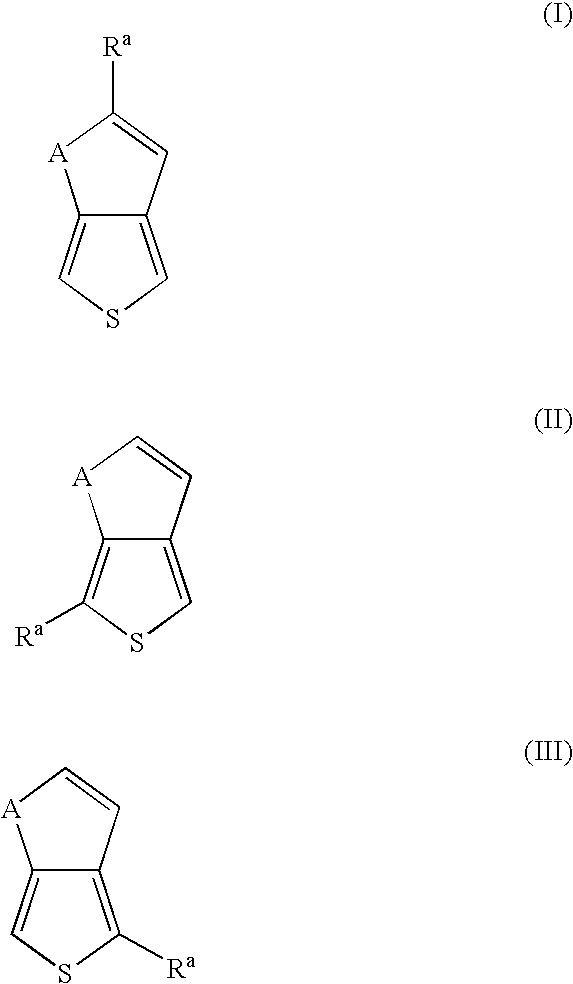
wherein A is S or O; and Ra is hydrogen, hydroxyl, C6-C12 aryl, C3-C10 cycloalkyl, C1-C12 alkyl, halogen, C1-C12 alkoxy, C1-C12 alkylthio, C1-C12 haloalkyl, C1-C12 haloalkoxy, C6-C12 haloaryl, pyridyl, cyano, thiocyanato, nitro, amino, C1-C12 alkylamino, C1-C12 aminoalkyl, acyl, sulfoxyl, sulfonyl, sulfonate, phosphonate, amido, or carbamoyl. Exemplary thieno[3,4-b]thiophene polymers and methods to prepare the same are described in U.S. Published Applications US2005/0124784 A1; US20040074779 A1; and US2004/0010115 A1 each of which is incorporated herein by reference in their entirety. Exemplary thieno[3,4-b]furan polymers are described in U.S. provisional application Ser. No. 60/698,050, and unpublished application filed Jul. 11, 2006, attorney docket No. UCT-0086 entitled “Polymers of Thieno[3,4-b]furan, Method of Making, and Use Thereof”, incorporated by reference herein in their entirety. - The very low and/or low band gap polymer containing units derived from thieno[3,4-b]thiophene and/or thieno[3,4-b]furan represented by the general formula (I), (II), or (III) can contain one or more additional monomers (“co-monomers”) which provide a tailoring of the conductivity and/or optoelectronic properties of the resulting co-polymer. The co-monomers can include electroactive co-monomers and/or non-electroactive co-monomers. “Electroactive co-monomer” as used herein means a monomer or oligomer that is capable of copolymerization with the thieno[3,4-b]furan/thiophene, and that imparts or enhances the electrical/electronic properties of the resulting copolymer, including such properties as electrical conductivity, semiconductivity, electroluminescence, electrochromicity, photovoltaic properties, and/or the like. “Non-electroactive co-monomer” means a monomer that is capable of copolymerization and that either decreases or does not adversely affect the electrical/electronic properties of the resulting copolymer.
- Examples of suitable electroactive co-monomers include those known in the art to exhibit electroactivity, including but not limited to thiophene, substituted thiophenes, thieno[3,4-b]thiophene, substituted thieno[3,4-b]thiophenes, thieno[3,4-b]furan, substituted thieno[3,4-b]furans, dithieno[3,4-b:3′,4′-d]thiophene, bithiophene, pyrrole, substituted pyrrole, phenylene, substituted phenylene, naphthalene, substituted naphthalene, biphenyl, substituted biphenyl, terphenyl, substituted terphenyl, phenylene vinylene, substituted phenylene vinylene, or a combination comprising at least one of the foregoing co-monomers. Again, the choice of amount and type of co-monomer can be made to result in a co-polymer having an Eg of less than or equal to about 2.5 eV, specifically less than or equal to about 2.0, more specifically less than or equal to about 1.8 eV, and yet more specifically less than or equal to about 1.5 eV and optionally further having little or no electrochromism in the visible region of the electromagnetic spectrum.
- Compounds are described using standard nomenclature. For example, any position not substituted by any indicated group is understood to have its valency filled by a bond as indicated, or a hydrogen atom. A dash (“—”) that is not between two letters or symbols is used to indicate a point of attachment for a substituent. For example, “—CHO” is attached through carbon of the carbonyl group.
- As used herein, “alkyl” includes both branched and straight chain saturated aliphatic hydrocarbon groups, having the specified number of carbon atoms, generally from 1 to about 12 carbon atoms. Examples of alkyl include, but are not limited to, methyl, ethyl, n-propyl, isopropyl, n-butyl, 3-methylbutyl, t-butyl, n-pentyl, and sec-pentyl. Alkyl groups described herein typically have from 1 to about 12 carbons atoms. Specific alkyl groups include lower alkyl groups, those alkyl groups having from 1 to about 8 carbon atoms, from 1 to about 6 carbon atoms, or from 1 to about 4 carbons atoms. As used herein “haloalkyl” indicates both branched and straight-chain alkyl groups having the specified number of carbon atoms, substituted with 1 or more halogen atoms, generally up to the maximum allowable number of halogen atoms (“perhalogenated”). Examples of haloalkyl include, but are not limited to, trifluoromethyl, difluoromethyl, 2-fluoroethyl, and penta-fluoroethyl.
- As used herein, “alkoxy” includes an alkyl group as defined above with the indicated number of carbon atoms attached through an oxygen bridge (—O—). Examples of alkoxy include, but are not limited to, methoxy, ethoxy, n-propoxy, i-propoxy, n-butoxy, 2-butoxy, t-butoxy, n-pentoxy, 2-pentoxy, 3-pentoxy, isopentoxy, neopentoxy, n-hexoxy, 2-hexoxy, 3-hexoxy, and 3-methylpentoxy. “Haloalkoxy” indicates a haloalkyl group as defined above attached through an oxygen bridge.
- As used herein, “cycloalkyl” indicates a monocyclic or multicyclic saturated or unsaturated hydrocarbon ring group, having the specified number of carbon atoms, usually from 3 to about 10 ring carbon atoms. Monocyclic cycloalkyl groups typically have from 3 to about 8 carbon ring atoms or from 3 to about 7 carbon ring atoms. Multicyclic cycloalkyl groups may have 2 or 3 fused cycloalkyl rings or contain bridged or caged cycloalkyl groups. Examples of cycloalkyl groups include cyclopropyl, cyclobutyl, cyclopentyl, or cyclohexyl as well as bridged or caged saturated ring groups such as norbornane or adamantane.
- As used herein, the term “aryl” indicates aromatic groups containing only carbon in the aromatic ring or rings. Such aromatic groups may be further substituted with carbon or non-carbon atoms or groups. Typical aryl groups contain 1 or 2 separate, fused, or pendant rings and from 6 to about 12 ring atoms, without heteroatoms as ring members. Where indicated aryl groups may be substituted. Such substitution may include fusion to a 5 to 7-membered saturated cyclic group that optionally contains 1 or 2 heteroatoms independently chosen from N, O, S, Se, and Si to form, for example, a 3,4-methylenedioxy-phenyl group. Aryl groups include, for example, phenyl, naphthyl, including 1-naphthyl and 2-naphthyl, and bi-phenyl.
- As used herein, “halo” or “halogen” refers to fluoro, chloro, bromo, or iodo.
- In one embodiment, a polymer containing units of general formula (I), (II), or (III), wherein Ra is hydrogen and A is S or O. Exemplary polymers include poly(thieno[3,4-b]thiophene); poly(thieno[3,4-b]furan); poly(thieno[3,4-b]thiophene-co-3,4-alkylenedioxythiophene) or poly(thieno[3,4-b]furan-co-3,4-alkylenedioxythiophene) wherein the alkylene group is ethylene, propylene, and the like; poly(thieno[3,4-b]thiophene-co-thieno[3,4-b]furan); and the like.
- Suitable monomers and co-monomers include substituted thiophenes, furans, pyrroles, and their derivatives having the general structure (IV):
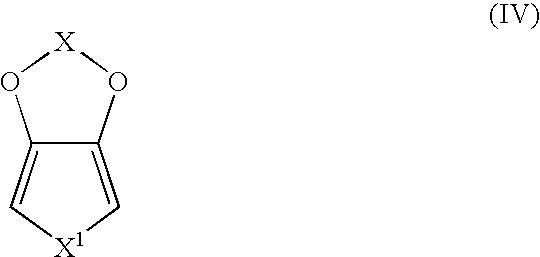
wherein X1 is S, O, or N—R5, wherein R5 is hydrogen or C1-C12 alkyl; X is C1-C4 alkylene or substituted C1-C4 alkylene. In one embodiment, X is C1-C12 alkyl- or C6-C12 phenyl-substituted ethylene, or a 1,2-cyclohexylene. Optionally, the alkyl or phenyl groups can be further substituted as described above. An exemplary substituted thiophene includes 3,4-ethylenedioxythiophene. - Additional suitable monomers and co-monomers include un-substituted and substituted thiophenes, furans, pyrroles, and their derivatives having the structure (V):
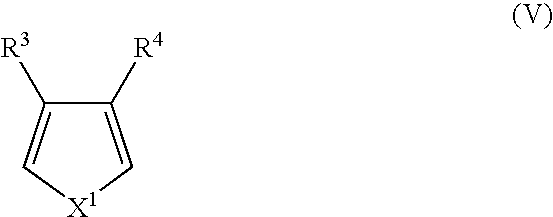
wherein X1 is as previously defined; R3 and R4 are the same or different and are hydrogen, hydroxyl, C6-C12 aryl, C3-C10 cycloalkyl, C1-C12 alkyl, C1-C12 alkoxy, C1-C12 alkylthio, halogen, C1-C12 haloalkyl, C1-C12 haloalkoxy, C6-C12 haloaryl, —C1-C6 alkyl-O—C1-C6 alkyl, or —C1-C6 alkyl-O—C6-C12 aryl. - Other suitable monomers and co-monomers include oxazoles, thiazoles, and their derivatives having the general structure (VI):

wherein Q1 is S or O. - Other electroactive monomers and co-monomers include, for example, isathianaphthene, pyridothiophene, pyrizinothiophene, and derivatives according to the general structure (VII):

wherein X1, R3, and R4 is are as previously defined; wherein X2 and X3 are the same or different and are CH or N. - More suitable monomers and co-monomers include 3,4-ethylenedioxypyrrole, 3,4-ethylenedioxythiophene, 3,4-ethylenedithiathiophene, 3,4-ethylenedithiapyrrole, 3,4-ethylenedioxyfuran, 3,4-ethylenedithiafuran, and their derivatives having the general structure (VIII):
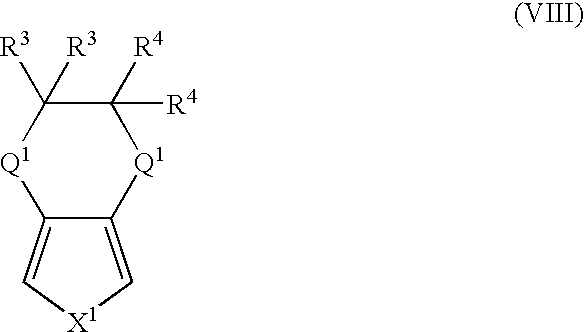
wherein X1, Q1, R3, and R4 are as previously defined; and wherein each occurrence of Q1, R3, or R4 may be the same or different. - Yet other suitable monomers and co-monomers include thionapthenes, benzofurans, indoles, and their derivatives as shown in the general structure (IX):
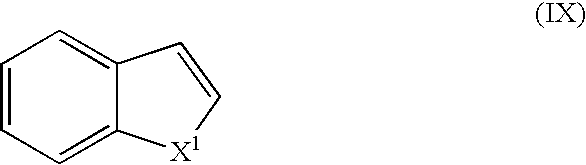
wherein X1 is as previously defined. - Further examples of suitable monomers and co-monomers include thienofurans, thienopyrroles, furanylpyrroles, furanylfurans, pyrrolylpyrroles, and derivatives as shown in the structure (X):

wherein X1, R3, and R4 are as previously defined; and wherein each occurrence of X1 may be the same or different. - Still other suitable monomers and co-monomers include dithienothiophenes, difuranylthiophenes, dipyrrolylthiophenes, dithienofurans, dipyrrolylfurans, dipyrrolylpyrroles, and derivatives as shown in the general structure (XI):

wherein X1 is as previously defined; and wherein each occurrence of X1 may be the same or different; and X4 is C(R3)2, S, O, or N—R5, wherein R3 and R5 are as previously defined. - Other suitable monomers and co-monomers include bithiophenes, bifurans, bipyrroles, and their derivatives as shown in the general structure (XII):
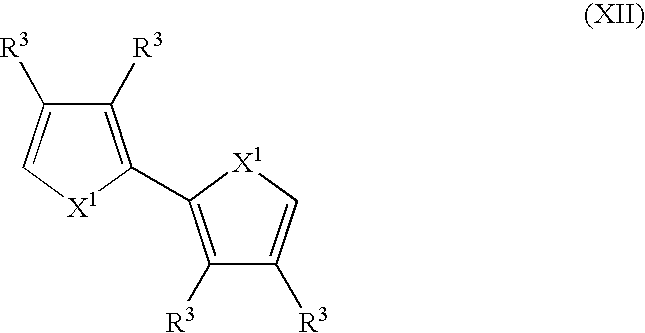
wherein X1 and R3 are as previously defined; and wherein each occurrence of X1 or R3 may be the same or different. - More suitable monomers and co-monomers include terthiophenes, terfurans, terpyrroles, and their derivatives as shown in the general structure (XIII):

wherein X1 and R3 are as previously defined; and wherein each occurrence of X1 or R3 may be the same or different. - Other suitable monomers and co-monomers include dithienylcyclopentenones, difuranylcyclopentenones, dipyrrolylcyclopentenones, and their derivatives as shown in the general structure (XIV):

wherein X1 is as previously defined; and wherein each occurrence of X1 may be the same or different; and E is O or C(R7)2, wherein each occurrence of R7 is an electron withdrawing group. - More suitable monomers and co-monomers include heteroaryl monomers having the general structure (XV):

wherein X1, Q1, and R3 are as previously defined; and wherein each occurrence of X1, Q1, or R3 may be the same or different. - More suitable monomers and co-monomers include dithienovinylenes, difuranylvinylenes, dipyrrolylvinylenes, and their derivatives having the general structure (XVI):

wherein X1 and R3 are as previously defined; and wherein each occurrence of X1 or R3 may be the same or different; and each occurrence of R8 is hydrogen, C1-C6 alkyl, or cyano. - More suitable monomers and co-monomers include 1,2-trans(3,4-ethylenedioxythienyl)vinylenes, 1,2-trans(3,4-ethylenedioxyfuranyl)vinylenes, 1,2-trans(3,4ethylenedioxypyrrolyl)vinylenes, and their derivatives having the general structure (XVII):

wherein X1, R3, and R8 are as previously defined; and wherein each occurrence of X1, R3, or R8 may be the same or different; and each occurrence of Q3 is independently CH2, S, or O. - More examples of suitable monomers and co-monomers include bis-thienylarylenes, bis-furanylarylenes, bis-pyrrolylarylenes, and their derivatives having the general structure (XVIII):
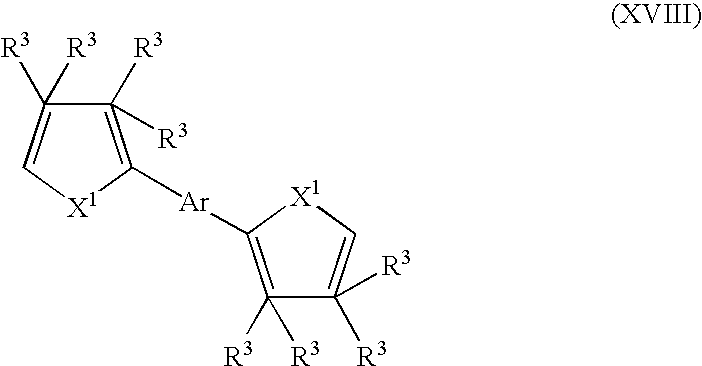
wherein X1 and R3 are as previously defined; and wherein each occurrence of X1 or R3 may be the same or different; and Ar is a furan, pyrrole, N-substituted pyrrole, phenyl, biphenyl, thiophene, fluorene, or 9-alkyl-9H-carbazole. - Other suitable monomers and co-monomers include compounds having the general structure (XIX):

wherein X1, Q1, R3, and Ar are as previously defined; and wherein each occurrence of X1, Q1, or R3 may be the same or different. - Other suitable monomers and co-monomers include compounds having the general structure (XX):

wherein X1, X4, Q1, and R3 are as previously defined; and wherein each occurrence of X1, Q1, or R3 may be the same or different. - Other suitable monomers and co-monomers include compounds having the general structure (XXI):

wherein X1, X4, and R3 are as previously defined; and wherein each occurrence of X or R3 may be the same or different. - Other suitable monomers and co-monomers include compounds having the general structure (XXII):
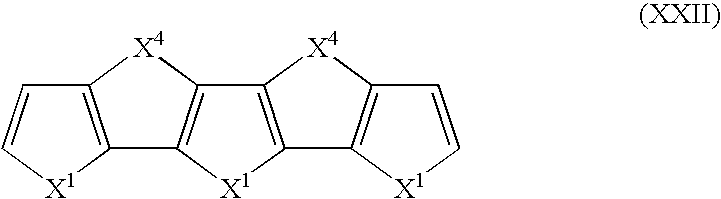
wherein X1 and X4 are as previously defined; and wherein each occurrence of X1 or X4 may be the same or different. - Other suitable monomers and co-monomers include compounds having the general structure (XXIII):

wherein X1 and Q1 are as previously defined; and wherein each occurrence of Q1 may be the same or different. - Other suitable monomers and co-monomers include compounds having the general structure (XXIV):

wherein X1 and Q1 are as previously defined; and wherein each occurrence of X1 or Q1 may be the same or different. - Other suitable monomers and co-monomers include compounds having the general structure (XXV):
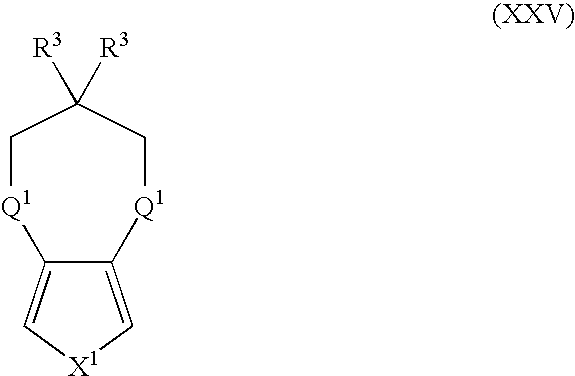
wherein X1, R3, and Q1 are as previously defined; and wherein each occurrence of R3 or Q1 may be the same or different. - Other suitable monomers and co-monomers include compounds having the general structure (XXVI):

wherein X1, R3, and Q1 are as previously defined; and wherein each occurrence of X1, R3, or Q1 may be the same or different. - Other suitable monomers and co-monomers include compounds having the general structure (XXVII):

wherein X1, R3, Q1, and Ar are as previously defined; and wherein each occurrence of X1, R3, or Q1 may be the same or different. - Other suitable monomers and co-monomers include compounds having the general structure (XXVIII):

wherein X1, R3, and Q1 are as previously defined; and wherein each occurrence of X1, R3, or Q1 may be the same or different. - Yet other suitable monomers and co-monomers include compounds having the general structure (XXIX):
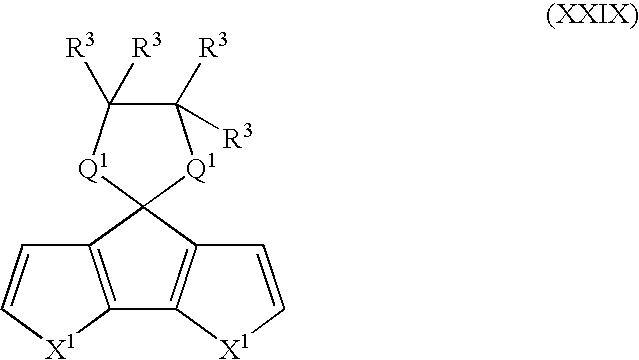
wherein X1, R3, and Q1 are as previously defined; and wherein each occurrence of X1, R3, or Q1 may be the same or different. - The conjugated polymers may be formed into layers by first dissolving or dispersing the polymer in an appropriate solvent. The solvent may include organic solvents such as aliphatic alcohols (e.g., methanol and ethanol); aliphatic ketones (e.g., acetone and methyl ethyl ketone); aliphatic carboxylic esters (e.g., ethyl acetate); aromatic hydrocarbons (e.g., toluene and xylene); aliphatic hydrocarbons (e.g., hexane); aliphatic nitriles (e.g., acetonitrile); chlorinated hydrocarbons (e.g., dichloromethane); aliphatic sulfoxides (e.g., dimethyl sulfoxide); and the like, as well as mixtures comprising at least one of the foregoing organic solvents. Aqueous solvents can also be used such as water or water combined with one or more water-miscible organic solvents such as lower alcohols, acetonitrile, tetrahydrofuran, dimethylacetamide, dimethyl formamide, and the like.
- Dispersions or solutions containing the conjugated polymers can be formed into films by applying the dispersions or solutions to a substrate via conventional processes including ink jet printing, screen printing, roll to roll printing processes, reel to reel processing, spin coating, meniscus and dip coating, spray coating, brush coating, doctor blade application, curtain casting, drop casting, and the like, to form a layer. Suitable substrates are solid materials (flexible or rigid) suitable for deposition of the polymeric compositions, and may be, for example, glass, an organic polymer such as a plastic, silicon, a mineral, a semiconducting material, a ceramic, a metal, and the like, as well as a combination comprising at least one of the foregoing materials. The substrate may be inherently conductive.
- The liquid may be removed from the layer of the dispersion or solution by conventional techniques to form a film. Removal of the liquid may be effected at room temperature or other temperature that does not adversely affect the properties of the resulting film. However, to obtain higher processing speeds, the film can be dried at elevated temperatures.
- The electrical conductivity of the conjugated polymer films can be readily modified, if necessary, to meet the requirements of a desired application by doping with conventional acidic dopants (p-dopants) or basic dopants (n-dopants) known in the art. Suitable p-dopants include mineral acids such as HCl, HNO3, H2SO4, H3PO4, HBr, and HI; organic sulfonic acids such as dodecyl benzene sulfonic acid, lauryl sulfonic acid, camphor sulfonic acid, organic acid dyes, methane sulfonic acid, and toluene sulfonic acid; polymeric sulfonic acids such as poly(styrene sulfonic acid) and copolymers of styrene sulfonic acids; carboxylic acids such as adipic acid, azelaic acid, and oxalic acid; and polycarboxylic acids such as poly(acrylic acid), poly(maleic acid), poly(methacrylic acid), and copolymers formed from acrylic acid, maleic acid, and/or methacrylic acid. Conventional mixed dopants comprising one or more of the foregoing, such as a mixture of a mineral acid and an organic acid, can also be used to impart the desired electroactive character to the films. Suitable basic dopants include, but are not limited to Na, K, Li, and Ca. Other suitable dopants include I2, PF6, SbF6, and FeCl3. In some instances the oxidant and the dopant may be the same.
- Admixtures of the polymer with other electroactive materials such as laser dyes, other electroactive polymers, hole transport or electron transport materials, including electroactive organometallic compounds, are also contemplated herein. Such materials can be added to the polymer before or after formation of the solution or dispersion. Additives such as ethylene glycol, diethylene glycol, mannitol, propylene 1,3-glycol, butane 1,4-glycol, N-methylpyrrolidone, sorbitol, glycerol, propylene carbonate, and other appropriate high boiling organics may be added to dispersions of the polymeric compositions to improve conductivity.
- Additional additives may also be used, and include conductive fillers such as particulate copper, silver, nickel, aluminum, carbon black (carbon nanotubes, buckminister fullerene), and the like; non-conductive fillers such as talc, mica, wollastonite, silica, clay, dyes, pigments (zeolites), and the like, to promote specific properties such as increased modulus, surface hardness, surface color and the like; antioxidants; UV stabilizers; viscosity modifiers; and surfactants such as acetylenic diols, surfactants typically being added to control stability, surface tension, and surface wettability.
- Exemplary electrode materials for use in the electrochromic devices can include inorganic materials such as glass-indium doped tin oxide (glass-ITO), gold, platinum, metal alloys such as stainless steel (“SS”), SS 316, SS316L, nickel and/or cobalt alloys such as Hastelloy-B® (Ni62/Mo28/Fe5/Cr/Mn/Si), Hastelloy-C®, and the like; and organic materials such as conductive polymer poly(3,4-ethylenedioxythiophene)-polystyrene sulfonate (PEDOT-PSS), and the like.
- Exemplary electrolyte materials for use in the electrochromic devices can be aqueous or organic based, or solid. Examples of aqueous electrolytes include aqueous solutions containing dissolved salts and/or polymers, e.g., polyvinyl alcohol. Examples of organic electrolytes include organic liquids such as polyethylene carbonate and propylene carbonate. Solid electrolytes may comprise poly (ethylene oxide) and poly (vinyl alcohol). Suitable gel electrolytes include, for example, lithium trifluomethanesulfonate, lithium trifluoromethanesulfonimide, tetraalkylammonium hexafluorophosphates, tetraalkylammonium tosylates, (but not limited to) dissolved in a polymer matrix such as polyacrylics (for example, polymethylmethacrylate, polyalkylacrylate), polystyrenics, homopolymers and copolymers of polyethyleneglycol in the main chain, side-chain, comb-like or cross-linked. Furthermore, these gel electrolytes can also be plasticized, for example, with ethylene or propylene carbonate, butyrolactone, low molecular weight polyethylene glylcols (number average molecular weight of 300-900 g/mol).
- The electrochromic devices described herein can be used for a variety of applications including display applications (e.g., billboards and signs, video monitors, flat panel displays, flexible displays, and the like), computers, electrochromic windows, sunroofs, wind-shields, visors, goggles, and more common forms of vision wear such as eyeglasses, electronic books, electrical wiring, photovoltaic devices, capacitors, batteries, and the like.
- The following illustrative examples are provided to further describe how to make and use the electrochromic devices and are not intended to limit the scope of the claimed invention.
- Poly(thieno[3,4-b]thiophene) and poly(dibenzylProDOT) were electrochemically deposited at a potential of 1.3 V (versus non-aqueous Ag/Ag+, calibrated to be 0.45 V versus NHE) onto one-side of ITO coated glass. The oxidized poly(thieno[3,4-b]thiophene) coated on the ITO-glass was switched to the neutral form in 0.1 M lithium triflate solution by applying −0.8 V (versus non-aqueous Ag/Ag+). The gel-electrolyte composed of 7.0 grams (g) poly(ethyleneglycolethylether methacrylate), 1.0 g lithium trifluoromethanesulfonate, 3.0 g propylene carbonate and 17.5 milligrams (mg) 2,2-dimethoxy-2-acetophenone was sandwiched between the neutral (thieno[3,4-b]thiophene) and the oxidized poly(dibenzylProDOT) and cured for 20 min using a 365 nm UV lamp. 50-100 mm glass beads dispersed in the gel electrolyte composition acted as the spacer to keep the two electrodes apart. The sides of the solid-state device was then sealed using a polyurethane-acrylate to prevent moisture from entering the device. The device was found to have an operating potential of −1.0 to 1.0 V. This transmissive electrochromic device was dark blue at −1.0 V and upon switching to +1.0 V turned to a transmissive sky blue color (poly(thieno[3,4-b]thiophene) containing electrode was the ground).
- The use of the terms “a” and “an” and “the” and similar referents in the context of describing the invention (especially in the context of the following claims) are to be construed to cover both the singular and the plural, unless otherwise indicated herein or clearly contradicted by context. The terms “comprising”, “having”, “including”, and “containing” are to be construed as open-ended terms (i.e., meaning “including, but not limited to”) unless otherwise noted. Recitation of ranges of values herein are merely intended to serve as a shorthand method of referring individually to each separate value falling within the range, unless otherwise indicated herein, and each separate value is incorporated into the specification as if it were individually recited herein. All ranges disclosed herein are inclusive and combinable.
- The essential characteristics of the present invention are described completely in the foregoing disclosure. One skilled in the art can understand the invention and make various modifications without departing from the basic spirit of the invention, and without deviating from the scope and equivalents of the claims, which follow. Moreover, any combination of the above-described elements in all possible variations thereof is encompassed by the invention unless otherwise indicated herein or otherwise clearly contradicted by context.
Claims (35)

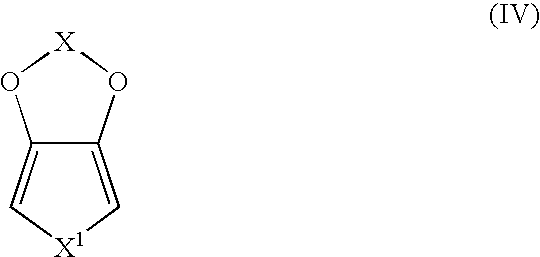
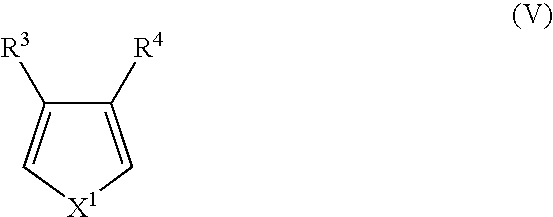
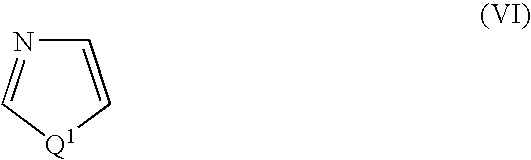


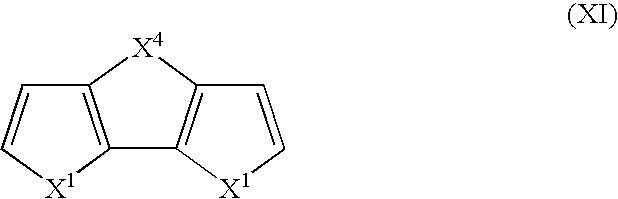


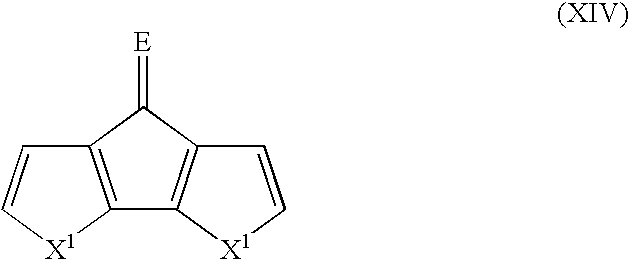
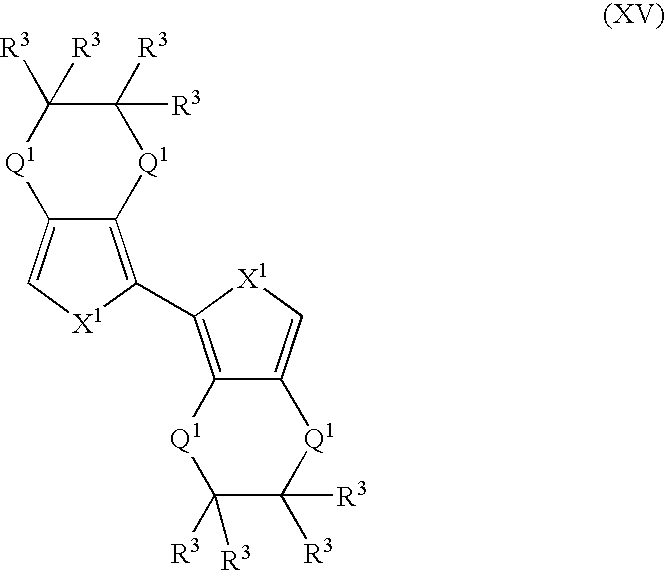

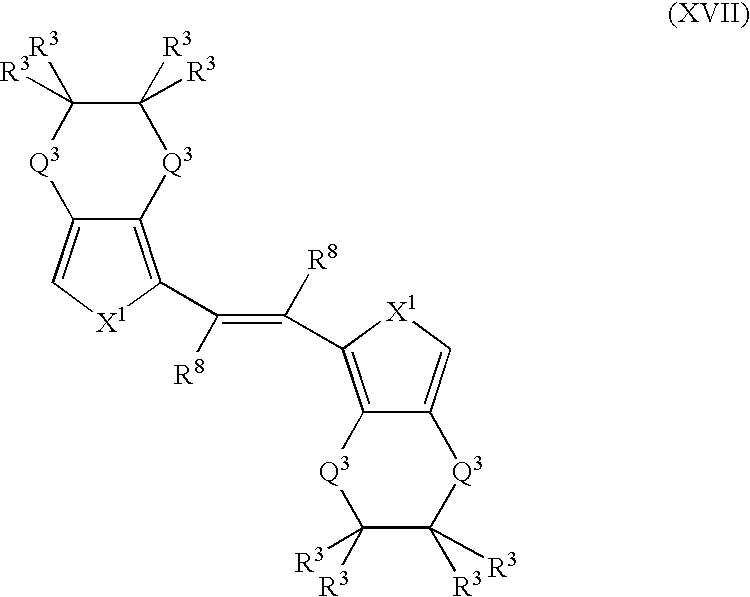

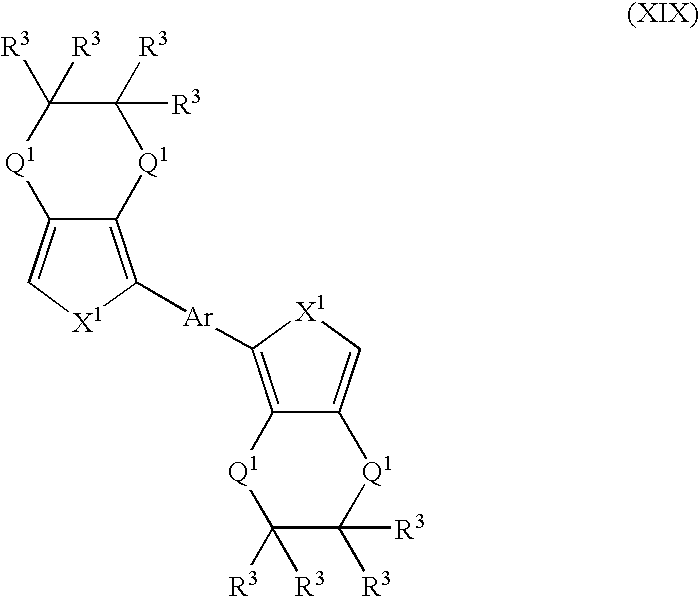

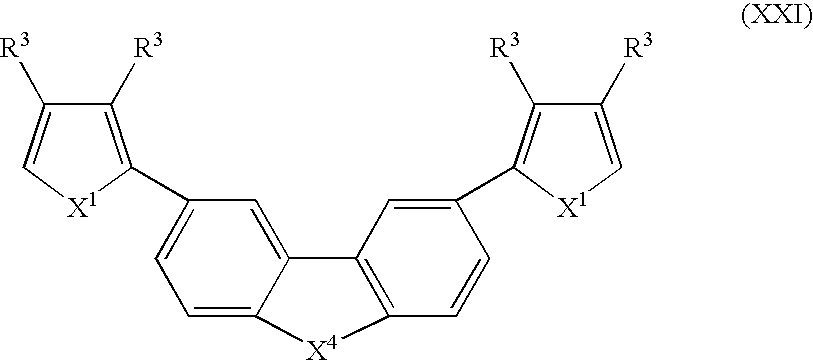

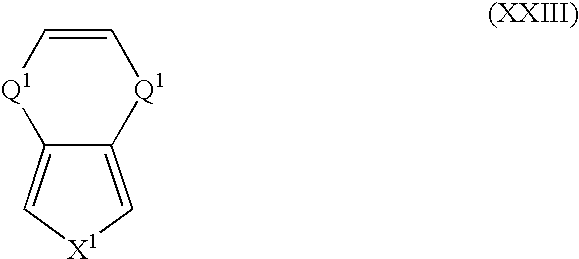
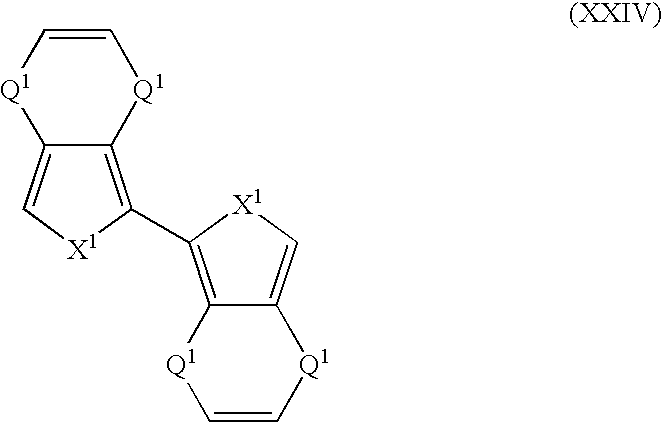


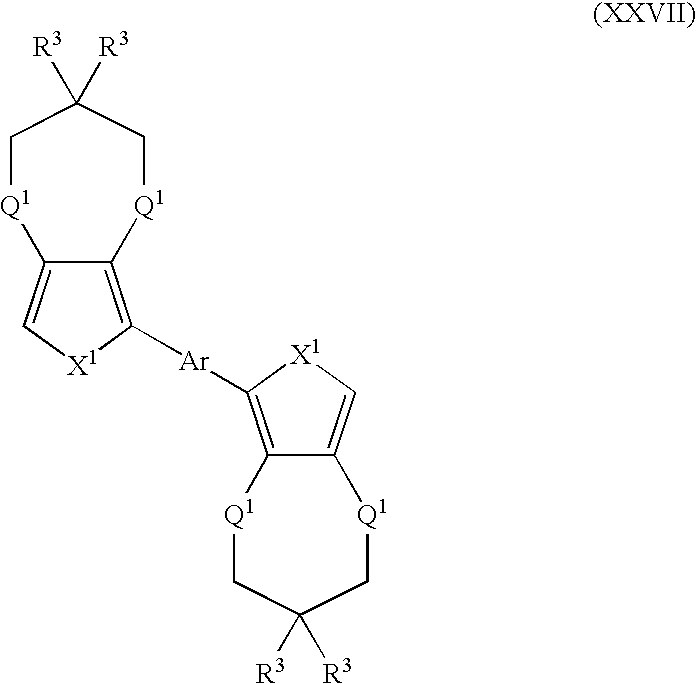


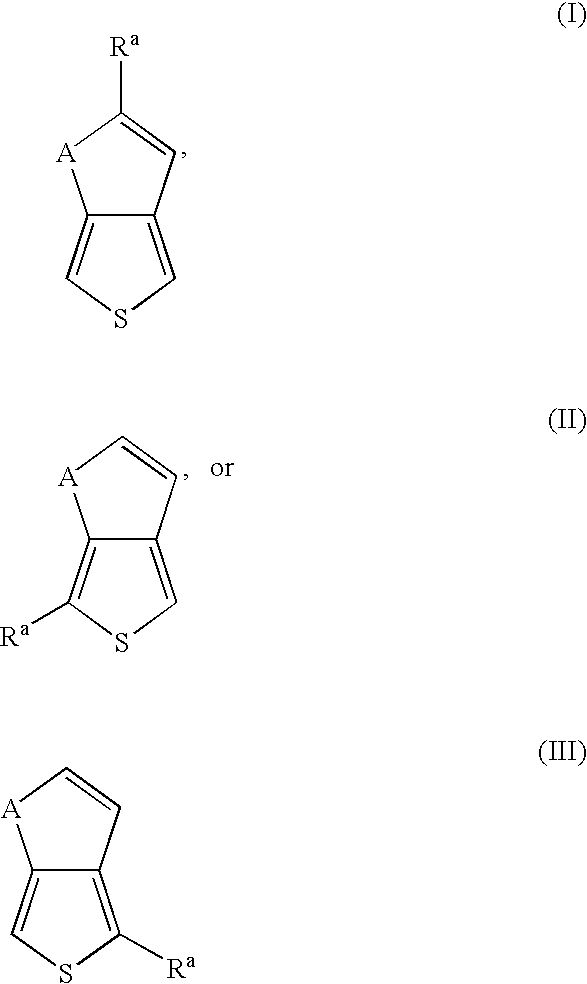
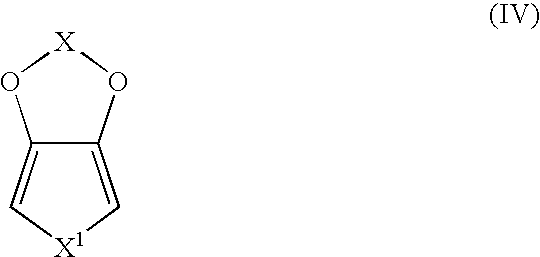

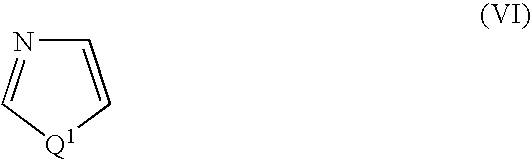
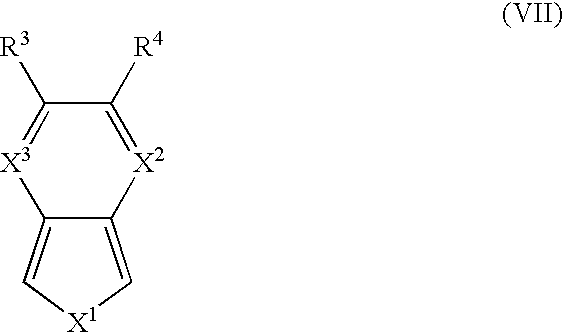
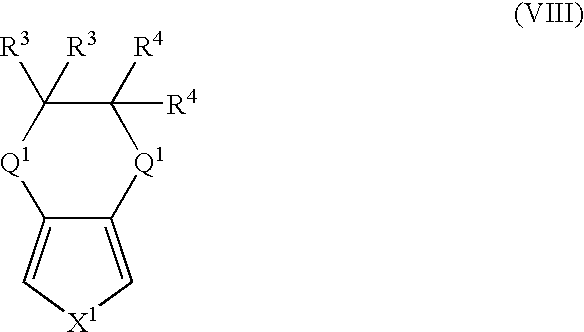


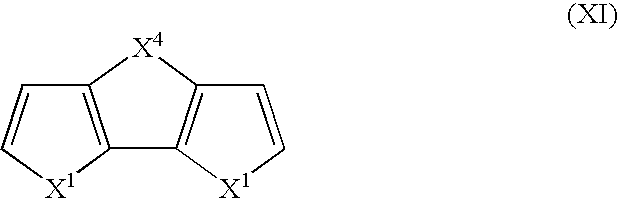
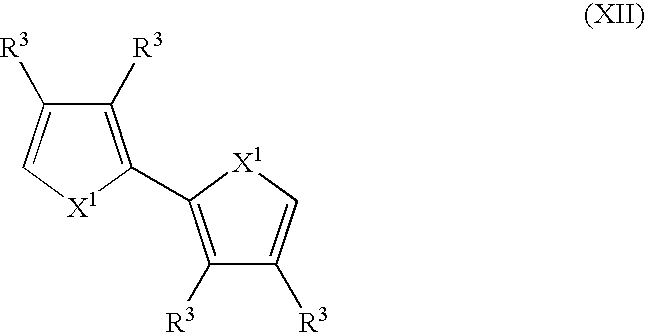

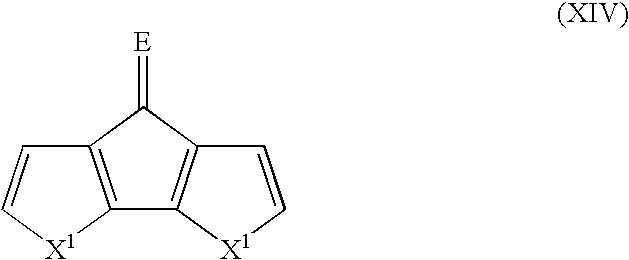


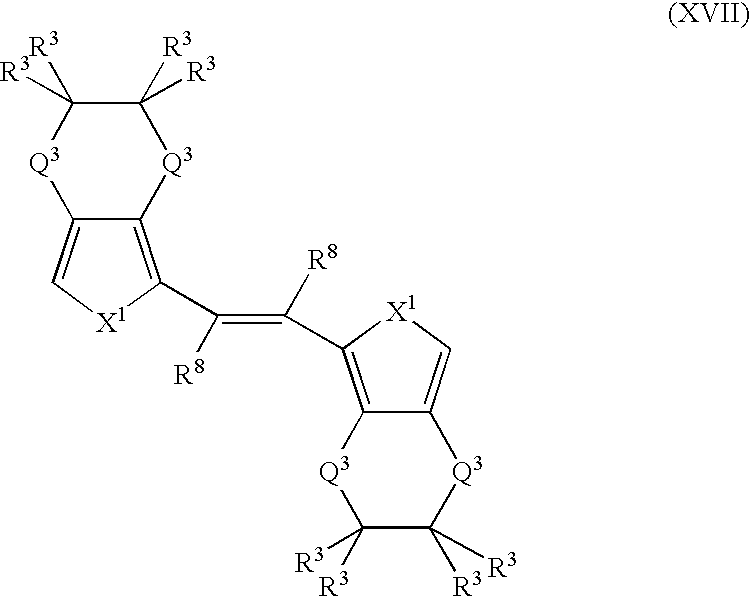


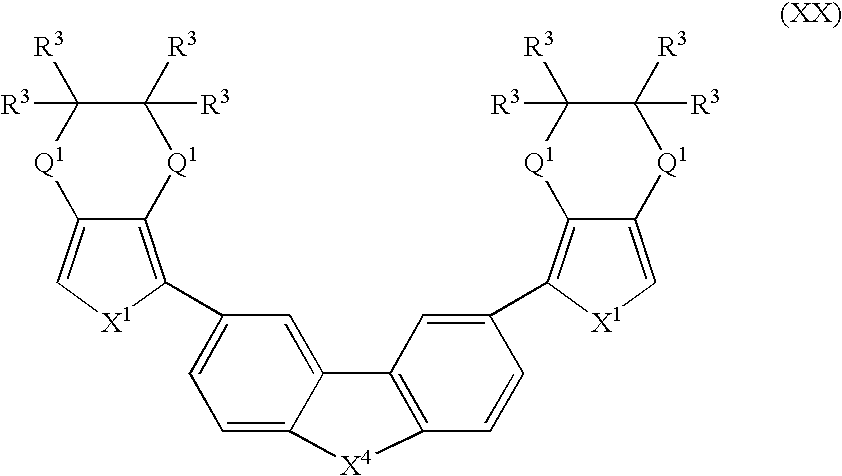

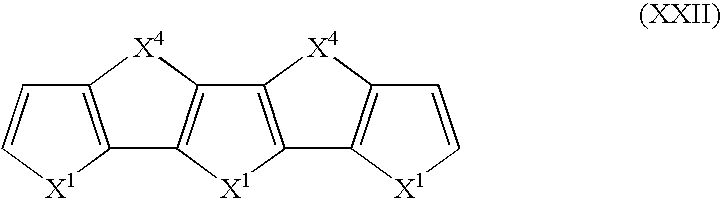

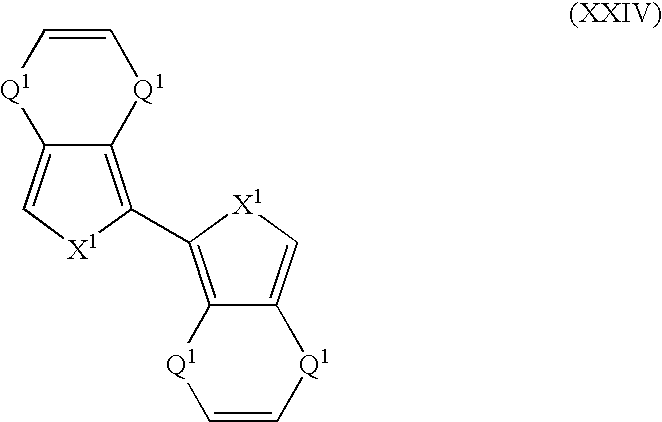
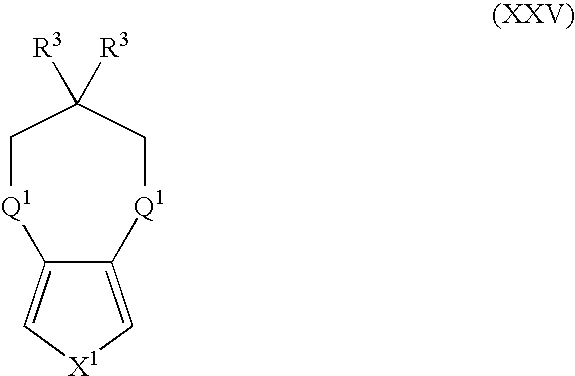

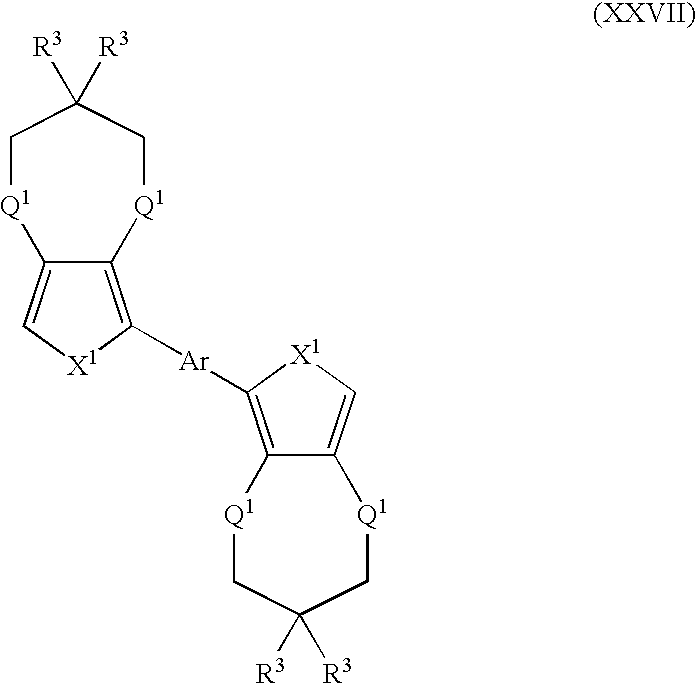

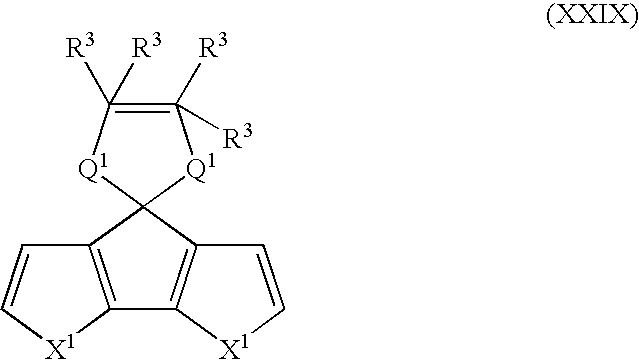
Priority Applications (1)
| Application Number | Priority Date | Filing Date | Title |
|---|---|---|---|
| US11/456,603 US7746533B2 (en) | 2005-07-11 | 2006-07-11 | Electrochromic devices utilizing very low band gap conjugated counter electrodes: preparation and use |
Applications Claiming Priority (2)
| Application Number | Priority Date | Filing Date | Title |
|---|---|---|---|
| US69804905P | 2005-07-11 | 2005-07-11 | |
| US11/456,603 US7746533B2 (en) | 2005-07-11 | 2006-07-11 | Electrochromic devices utilizing very low band gap conjugated counter electrodes: preparation and use |
Publications (2)
| Publication Number | Publication Date |
|---|---|
| US20070008603A1 true US20070008603A1 (en) | 2007-01-11 |
| US7746533B2 US7746533B2 (en) | 2010-06-29 |
Family
ID=37561480
Family Applications (1)
| Application Number | Title | Priority Date | Filing Date |
|---|---|---|---|
| US11/456,603 Active 2029-03-22 US7746533B2 (en) | 2005-07-11 | 2006-07-11 | Electrochromic devices utilizing very low band gap conjugated counter electrodes: preparation and use |
Country Status (2)
| Country | Link |
|---|---|
| US (1) | US7746533B2 (en) |
| WO (1) | WO2007008978A2 (en) |
Cited By (60)
| Publication number | Priority date | Publication date | Assignee | Title |
|---|---|---|---|---|
| US20070190429A1 (en) * | 2003-01-22 | 2007-08-16 | Lg Chem, Ltd. | Composition for inkjet spacer formation and spacer element using the same |
| US20090008031A1 (en) * | 2006-11-20 | 2009-01-08 | Nigel Paul Gould | Ionic liquid |
| US20090229667A1 (en) * | 2008-03-14 | 2009-09-17 | Solarmer Energy, Inc. | Translucent solar cell |
| US20100018581A1 (en) * | 2008-07-24 | 2010-01-28 | Solarmer Energy, Inc. | Large area solar cell |
| US20100273063A1 (en) * | 2008-12-23 | 2010-10-28 | Wallace Gordon G | Polymer electrolytes and devices containing them |
| WO2010114793A3 (en) * | 2009-04-03 | 2011-01-13 | Ciba Corporation | Devices containing compositions comprising cathodically coloring electrochromic polymers and binder polymers |
| US20110164303A1 (en) * | 2010-01-05 | 2011-07-07 | Raytheon Company | Polymer Shutter Compositions and Devices for Infrared Systems |
| WO2011119664A2 (en) | 2010-03-25 | 2011-09-29 | University Of Connecticut | Formation of conjugated polymers for solid-state devices |
| CN102482421A (en) * | 2009-07-24 | 2012-05-30 | 朔荣有机光电科技公司 | Conjugated polymers with carbonyl-substituted thieno[3,4-B]thiophene units for active layer materials in polymer solar cells |
| CN102906153A (en) * | 2010-05-21 | 2013-01-30 | 佛罗里达大学研究基金会有限公司 | Multi-colored conjugated polymers with highly transmissive oxidized state |
| US20130120821A1 (en) * | 2011-11-15 | 2013-05-16 | Ashwin-Ushas Corporation, Inc. | Complimentary polymer electrochromic device |
| CN103328604A (en) * | 2010-10-28 | 2013-09-25 | 佛罗里达大学研究基金会有限公司 | Cathodically colored yellow soluble electrochromic and light-emitting polymers |
| CN103897152A (en) * | 2012-12-27 | 2014-07-02 | 海洋王照明科技股份有限公司 | Polymer containing thienothiophene unit and preparation method thereof, and solar cell device |
| US8769836B2 (en) | 2010-06-22 | 2014-07-08 | Nike, Inc. | Article of footwear with color change portion and method of changing color |
| US8902486B1 (en) | 2013-11-20 | 2014-12-02 | Ashwin-Ushas Corporation, Inc. | Method and apparatus for control of electrochromic devices |
| US9207515B2 (en) | 2013-03-15 | 2015-12-08 | Ashwin-Ushas Corporation, Inc. | Variable-emittance electrochromic devices and methods of preparing the same |
| CN106033166A (en) * | 2016-08-02 | 2016-10-19 | 大昶门控科技(上海)股份有限公司 | Intelligent window |
| US9482880B1 (en) | 2015-09-15 | 2016-11-01 | Ashwin-Ushas Corporation, Inc. | Electrochromic eyewear |
| US9632059B2 (en) | 2015-09-03 | 2017-04-25 | Ashwin-Ushas Corporation, Inc. | Potentiostat/galvanostat with digital interface |
| CN106796378A (en) * | 2014-09-05 | 2017-05-31 | 唯景公司 | Counter electrode for electrochromic devices |
| US9944757B2 (en) | 2012-07-23 | 2018-04-17 | The University Of Connecticut | Electrochromic copolymers from precursors, method of making, and use thereof |
| US10323178B2 (en) | 2014-05-16 | 2019-06-18 | The University Of Connecticut | Color tuning of electrochromic devices using an organic dye |
| US10690987B2 (en) | 2009-03-31 | 2020-06-23 | View, Inc. | Counter electrode for electrochromic devices |
| US10732477B2 (en) | 2018-03-19 | 2020-08-04 | Oktopolymer Llc | Electrochromic device and method of its manufacturing |
| US10852613B2 (en) | 2009-03-31 | 2020-12-01 | View, Inc. | Counter electrode material for electrochromic devices |
| US10996533B2 (en) | 2010-04-30 | 2021-05-04 | View, Inc. | Electrochromic devices |
| WO2021139330A1 (en) * | 2020-01-07 | 2021-07-15 | 国防科技大学 | Flexible electrochromic-based variable-emissivity device and preparation method therefor |
| US11175559B2 (en) * | 2018-04-05 | 2021-11-16 | Ricoh Company, Ltd. | Electrochromic device |
| US11187954B2 (en) | 2009-03-31 | 2021-11-30 | View, Inc. | Electrochromic cathode materials |
| US11319483B2 (en) * | 2016-04-27 | 2022-05-03 | Canon Kabushiki Kaisha | Organic compound, electrochromic element containing the same, optical filter, lens unit, imaging device, and window material |
| US11327382B2 (en) | 2014-11-26 | 2022-05-10 | View, Inc. | Counter electrode for electrochromic devices |
| US11370699B2 (en) | 2009-03-31 | 2022-06-28 | View, Inc. | Counter electrode for electrochromic devices |
| US20220269141A1 (en) * | 2019-07-02 | 2022-08-25 | Gauzy Ltd. | Suspended particle devices with improved adhesion between the active and conducting layers |
| US11440838B2 (en) | 2009-03-31 | 2022-09-13 | View, Inc. | Fabrication of low defectivity electrochromic devices |
| US11525181B2 (en) | 2009-03-31 | 2022-12-13 | View, Inc. | Electrochromic devices |
| US11592722B2 (en) | 2010-04-30 | 2023-02-28 | View, Inc. | Electrochromic devices |
| CN116243528A (en) * | 2022-12-15 | 2023-06-09 | 安徽立光电子材料股份有限公司 | Production method of solid electrochromic device with uniform color and solid electrochromic device |
| US11874578B2 (en) | 2022-02-09 | 2024-01-16 | Ambilight Inc. | High transparency electrochromic polymers |
| US11879098B2 (en) | 2022-02-09 | 2024-01-23 | Ambilight Inc. | High transparency electrochromic polymers |
| US11891327B2 (en) | 2014-05-02 | 2024-02-06 | View, Inc. | Fabrication of low defectivity electrochromic devices |
| US11947232B2 (en) | 2009-03-31 | 2024-04-02 | View, Inc. | Fabrication of low defectivity electrochromic devices |
| US12043890B2 (en) | 2009-03-31 | 2024-07-23 | View, Inc. | Electrochromic devices |
| US12057220B2 (en) | 2020-05-27 | 2024-08-06 | View Operating Corporation | Systems and methods for managing building wellness |
| US12078906B2 (en) | 2011-03-16 | 2024-09-03 | View, Inc. | Onboard controller for multistate windows |
| US12087997B2 (en) | 2019-05-09 | 2024-09-10 | View, Inc. | Antenna systems for controlled coverage in buildings |
| US12130597B2 (en) | 2014-03-05 | 2024-10-29 | View, Inc. | Monitoring sites containing switchable optical devices and controllers |
| US12147142B2 (en) | 2017-04-26 | 2024-11-19 | View, Inc. | Remote management of a facility |
| US12164273B2 (en) | 2014-03-05 | 2024-12-10 | View, Inc. | Site monitoring system |
| US12176596B2 (en) | 2019-05-31 | 2024-12-24 | View, Inc. | Building antenna |
| US12174505B2 (en) | 2022-02-09 | 2024-12-24 | Ambilight Inc | High transparency electrochromic polymers |
| US12206660B2 (en) | 2020-03-26 | 2025-01-21 | View, Inc. | Access and messaging in a multi client network |
| US12231260B2 (en) | 2018-05-02 | 2025-02-18 | View, Inc. | Sensing and communications unit for optically switchable window systems |
| US12260269B2 (en) | 2014-12-08 | 2025-03-25 | View Operating Corporation | Multiple interacting systems at a site |
| US12339557B2 (en) | 2017-04-26 | 2025-06-24 | View, Inc. | Configuration associated with media display of a facility |
| US12353109B2 (en) | 2009-12-22 | 2025-07-08 | View Operating Corporation | Electrochromic cathode materials |
| US12366111B2 (en) | 2015-09-18 | 2025-07-22 | View Operating Corporation | Trunk line window controllers |
| US12372842B2 (en) | 2022-02-09 | 2025-07-29 | Ambilight Inc | High transparency electrochromic polymers |
| US12378814B2 (en) | 2017-04-26 | 2025-08-05 | View Operating Corporation | Displays for tintable windows |
| US12422724B2 (en) | 2017-04-26 | 2025-09-23 | View Operating Corporation | Building network |
| US12529932B2 (en) | 2022-02-09 | 2026-01-20 | Ambilight Inc | High transparency electrochromic polymers |
Families Citing this family (14)
| Publication number | Priority date | Publication date | Assignee | Title |
|---|---|---|---|---|
| JP4972001B2 (en) * | 2008-01-23 | 2012-07-11 | 株式会社東海理化電機製作所 | Electrochromic mirror |
| CN102369478A (en) | 2009-03-31 | 2012-03-07 | 康涅狄格大学 | Flexible electrochromic device, electrodes therefor, and method of manufacture |
| EP2457909A4 (en) * | 2009-07-24 | 2013-01-23 | Tokyo Inst Tech | THIOPHENE DERIVATIVE, METHOD FOR PRODUCING SAME, AND THIOPHENE DERIVATIVE POLYMER |
| EP2545410A1 (en) * | 2010-03-12 | 2013-01-16 | Battelle Memorial Institute | Electrochromic device capable of controlling visible and infrared radiations |
| JP5721491B2 (en) | 2010-06-30 | 2015-05-20 | キヤノン株式会社 | Novel organic compound and electrochromic device having the same |
| EP2681621A4 (en) | 2011-03-02 | 2015-01-21 | Univ Connecticut | EXTENSIBLE DEVICES AND METHODS FOR MAKING AND USING THE SAME |
| CN103619851B (en) * | 2011-06-07 | 2016-08-17 | 佳能株式会社 | Electrochromic devices |
| EP2726936A4 (en) * | 2011-06-30 | 2015-02-25 | Univ Florida | MULTI-CONTROLLED ELECTROCHROMIC DEVICES FOR VISIBLE AND IR MODULATION |
| EP3017107B1 (en) | 2013-07-02 | 2023-11-29 | The University of Connecticut | Electrically conductive synthetic fiber and fibrous substrate, method of making, and use thereof |
| WO2015138298A1 (en) | 2014-03-12 | 2015-09-17 | The University Of Connecticut | Method of infusing fibrous substrate with conductive organic particles and conductive polymer; and conductive fibrous substrates prepared therefrom |
| US20150279320A1 (en) | 2014-03-26 | 2015-10-01 | Nike, Inc. | Subtractive Color Change System and Method |
| WO2016172081A1 (en) | 2015-04-23 | 2016-10-27 | The University Of Connecticut | Highly conductive polymer film compositions from nanoparticle induced phase segregation of counterion templates from conducting polymers |
| US10003126B2 (en) | 2015-04-23 | 2018-06-19 | The University Of Connecticut | Stretchable organic metals, composition, and use |
| EP3543780B1 (en) * | 2018-03-19 | 2020-08-12 | Oktopolymer Llc | Electrochromic device and method of its manufacturing |
Citations (13)
| Publication number | Priority date | Publication date | Assignee | Title |
|---|---|---|---|---|
| US4639328A (en) * | 1983-11-25 | 1987-01-27 | Merck Patent Gesellschaft Mit Beschrankter Haftung | Thienothiophene derivatives |
| US4728177A (en) * | 1984-09-04 | 1988-03-01 | National Research Development Corporation | Electrochromic device |
| US4832467A (en) * | 1986-08-11 | 1989-05-23 | Nissan Motor Co., Ltd. | Electrochromic variable color tone nonglaring mirror |
| US5446577A (en) * | 1993-01-05 | 1995-08-29 | Martin Marietta Corporation | Electrode for display devices |
| US5663829A (en) * | 1993-06-11 | 1997-09-02 | Saint-Gobain Vitrage International | Electrochromic pane |
| US5737114A (en) * | 1991-01-31 | 1998-04-07 | Eveready Battery Company, Inc. | Label having an incorporated electrochromic state-of-charge indicator for an electrochemical cell |
| US5859723A (en) * | 1994-05-17 | 1999-01-12 | Flachglas Ag | Electrochromic pane arrangement |
| US6815286B2 (en) * | 2001-08-13 | 2004-11-09 | Advanced Micro Devices, Inc. | Memory device |
| US7060846B2 (en) * | 2004-10-04 | 2006-06-13 | Air Products And Chemicals, Inc. | Pentafluorosulfanyl-substituted thienothiophene monomers and conducting polymers |
| US7094365B2 (en) * | 2004-10-04 | 2006-08-22 | Air Products And Chemicals, Inc. | Pentafluorosulfanyl-substituted thienothiophene monomers and conducting polymers |
| US7270871B2 (en) * | 2004-01-12 | 2007-09-18 | Air Products And Chemicals, Inc. | Dispersions and films comprising conducting polymer for optoelectronic devices |
| US7436754B2 (en) * | 2003-10-07 | 2008-10-14 | Hitachi, Ltd. | Information-recording medium and method |
| US7443566B2 (en) * | 2006-03-10 | 2008-10-28 | Sony Ericsson Mobile Communications Ab | Low power, configurable display for mobile devices |
Family Cites Families (25)
| Publication number | Priority date | Publication date | Assignee | Title |
|---|---|---|---|---|
| BE899925A (en) | 1984-06-15 | 1984-10-01 | B L Facultes Universitaires No | NOVEL HETEROAROMATIC POLYMERS OF BICYCLIC MONOMERS, ELECTRICALLY CONDUCTIVE. |
| DE3843412A1 (en) | 1988-04-22 | 1990-06-28 | Bayer Ag | NEW POLYTHIOPHENES, METHOD FOR THEIR PRODUCTION AND THEIR USE |
| DE3814730A1 (en) | 1988-04-30 | 1989-11-09 | Bayer Ag | SOLID ELECTROLYTE AND ELECTROLYTE CONDENSERS CONTAINING THEM |
| US5164465A (en) | 1988-05-13 | 1992-11-17 | Ohio State University Research Foundation | Sulfonated polyaniline salt compositions, processes for their preparation and uses thereof |
| US5109070A (en) | 1989-10-19 | 1992-04-28 | Ohio State University Research Foundation | Compositions of insulating polymers and sulfonated polyaniline compositions and uses thereof |
| DE59010247D1 (en) | 1990-02-08 | 1996-05-02 | Bayer Ag | New polythiophene dispersions, their preparation and their use |
| US4986886A (en) | 1990-05-30 | 1991-01-22 | Drexel University | Polymerization of thiophene and its derivatives |
| US5561030A (en) | 1991-05-30 | 1996-10-01 | Simon Fraser University | Fabrication of electronically conducting polymeric patterns |
| US5691062A (en) | 1995-02-16 | 1997-11-25 | Clemson University | Molecularly bonded inherently conductive polymers on substrates and shaped articles thereof |
| JP2000506914A (en) | 1996-03-06 | 2000-06-06 | ビーエーエスエフ アクチェンゲゼルシャフト | Substituted polythiophenes, their production and their use |
| DE19841804A1 (en) | 1998-09-12 | 2000-03-16 | Bayer Ag | Preparation of an electrically conducting structure on a substrate for computer-controlled ink jet printing involves using an aqueous dispersion of polyalkylene dioxythiophenes with a polyanion as counter ion |
| TW502046B (en) | 1998-10-22 | 2002-09-11 | Nippon Catalytic Chem Ind | Method for production of water-soluble conducting polyaniline |
| KR100442408B1 (en) | 1998-11-05 | 2004-11-06 | 제일모직주식회사 | Polythiophene Conductive Polymer Solution Composition with High Conductivity and High Transparency |
| US6294245B1 (en) | 1999-09-22 | 2001-09-25 | Agilent Technologies, Inc. | Method for depositing electrically conducting polymer films via electrochemical deposition of precursor polymers |
| US20030077515A1 (en) | 2001-04-02 | 2003-04-24 | Chen George Zheng | Conducting polymer-carbon nanotube composite materials and their uses |
| DE60235679D1 (en) | 2001-08-17 | 2010-04-29 | Merck Patent Gmbh | Conjugated copolymers of dithienothiophene and vinylene or acetylene |
| JP5340518B2 (en) | 2001-11-21 | 2013-11-13 | ユニバーシティ オブ フロリダ リサーチ ファウンデーション インコーポレイテッド | Electrochromic polymers and polymer electrochromic devices |
| US7071289B2 (en) | 2002-07-11 | 2006-07-04 | The University Of Connecticut | Polymers comprising thieno [3,4-b]thiophene and methods of making and using the same |
| US7432340B2 (en) | 2002-07-11 | 2008-10-07 | Air Products And Chemicals, Inc. | Fluorinated alkyl substituted-thieno[3,4-]thiophene monomers and polymers therefrom |
| US7118692B2 (en) | 2004-10-04 | 2006-10-10 | Air Products And Chemicals, Inc. | Substituted thienothiophene monomers and conducting polymers |
| US7125479B2 (en) | 2002-07-11 | 2006-10-24 | The University Of Connecticut | Polymeric compositions comprising thieno[3,4-b]thiophene, method of making, and use thereof |
| US7572879B2 (en) | 2002-07-11 | 2009-08-11 | Air Products And Chemicals, Inc. | Fluorinated alkyl substituted-thieno[3,4-b]thiophene monomers and polymers therefrom |
| ATE413423T1 (en) | 2003-08-28 | 2008-11-15 | Merck Patent Gmbh | MONO-, OLIGO- AND POLYTHIENO(2,3-B)THIOPHENES |
| US7105237B2 (en) | 2003-10-01 | 2006-09-12 | The University Of Connecticut | Substituted thieno[3,4-B]thiophene polymers, method of making, and use thereof |
| US20060147616A1 (en) | 2004-12-20 | 2006-07-06 | Russell Gaudiana | Polymer catalyst for photovoltaic cell |
-
2006
- 2006-07-11 WO PCT/US2006/027040 patent/WO2007008978A2/en not_active Ceased
- 2006-07-11 US US11/456,603 patent/US7746533B2/en active Active
Patent Citations (14)
| Publication number | Priority date | Publication date | Assignee | Title |
|---|---|---|---|---|
| US4639328A (en) * | 1983-11-25 | 1987-01-27 | Merck Patent Gesellschaft Mit Beschrankter Haftung | Thienothiophene derivatives |
| US4728177A (en) * | 1984-09-04 | 1988-03-01 | National Research Development Corporation | Electrochromic device |
| US4832467A (en) * | 1986-08-11 | 1989-05-23 | Nissan Motor Co., Ltd. | Electrochromic variable color tone nonglaring mirror |
| US5737114A (en) * | 1991-01-31 | 1998-04-07 | Eveready Battery Company, Inc. | Label having an incorporated electrochromic state-of-charge indicator for an electrochemical cell |
| US5446577A (en) * | 1993-01-05 | 1995-08-29 | Martin Marietta Corporation | Electrode for display devices |
| US5663829A (en) * | 1993-06-11 | 1997-09-02 | Saint-Gobain Vitrage International | Electrochromic pane |
| US5859723A (en) * | 1994-05-17 | 1999-01-12 | Flachglas Ag | Electrochromic pane arrangement |
| US6815286B2 (en) * | 2001-08-13 | 2004-11-09 | Advanced Micro Devices, Inc. | Memory device |
| US7436754B2 (en) * | 2003-10-07 | 2008-10-14 | Hitachi, Ltd. | Information-recording medium and method |
| US7270871B2 (en) * | 2004-01-12 | 2007-09-18 | Air Products And Chemicals, Inc. | Dispersions and films comprising conducting polymer for optoelectronic devices |
| US7060846B2 (en) * | 2004-10-04 | 2006-06-13 | Air Products And Chemicals, Inc. | Pentafluorosulfanyl-substituted thienothiophene monomers and conducting polymers |
| US7094365B2 (en) * | 2004-10-04 | 2006-08-22 | Air Products And Chemicals, Inc. | Pentafluorosulfanyl-substituted thienothiophene monomers and conducting polymers |
| US7241904B2 (en) * | 2004-10-04 | 2007-07-10 | Air Products And Chemicals, Inc. | Pentafluorosulfanyl-substituted thienothiophene monomers and conducting polymers |
| US7443566B2 (en) * | 2006-03-10 | 2008-10-28 | Sony Ericsson Mobile Communications Ab | Low power, configurable display for mobile devices |
Cited By (90)
| Publication number | Priority date | Publication date | Assignee | Title |
|---|---|---|---|---|
| US20070190429A1 (en) * | 2003-01-22 | 2007-08-16 | Lg Chem, Ltd. | Composition for inkjet spacer formation and spacer element using the same |
| US20090008031A1 (en) * | 2006-11-20 | 2009-01-08 | Nigel Paul Gould | Ionic liquid |
| US8427733B2 (en) * | 2006-11-20 | 2013-04-23 | Acreo Ab | Electrochemical device |
| US20090229667A1 (en) * | 2008-03-14 | 2009-09-17 | Solarmer Energy, Inc. | Translucent solar cell |
| US20100018581A1 (en) * | 2008-07-24 | 2010-01-28 | Solarmer Energy, Inc. | Large area solar cell |
| US20100273063A1 (en) * | 2008-12-23 | 2010-10-28 | Wallace Gordon G | Polymer electrolytes and devices containing them |
| US10690987B2 (en) | 2009-03-31 | 2020-06-23 | View, Inc. | Counter electrode for electrochromic devices |
| US12443085B2 (en) | 2009-03-31 | 2025-10-14 | View Operating Corporation | Counter electrode for electrochromic devices |
| US11187954B2 (en) | 2009-03-31 | 2021-11-30 | View, Inc. | Electrochromic cathode materials |
| US11370699B2 (en) | 2009-03-31 | 2022-06-28 | View, Inc. | Counter electrode for electrochromic devices |
| US11947232B2 (en) | 2009-03-31 | 2024-04-02 | View, Inc. | Fabrication of low defectivity electrochromic devices |
| US11966140B2 (en) | 2009-03-31 | 2024-04-23 | View, Inc. | Counter electrode for electrochromic devices |
| US10852613B2 (en) | 2009-03-31 | 2020-12-01 | View, Inc. | Counter electrode material for electrochromic devices |
| US12209048B2 (en) | 2009-03-31 | 2025-01-28 | View, Inc. | Counter electrode for electrochromic devices |
| US11409177B2 (en) | 2009-03-31 | 2022-08-09 | View, Inc. | Counter electrode for electrochromic devices |
| US11635665B2 (en) | 2009-03-31 | 2023-04-25 | View, Inc. | Counter electrode material for electrochromic devices |
| US11440838B2 (en) | 2009-03-31 | 2022-09-13 | View, Inc. | Fabrication of low defectivity electrochromic devices |
| US12043890B2 (en) | 2009-03-31 | 2024-07-23 | View, Inc. | Electrochromic devices |
| US11898233B2 (en) | 2009-03-31 | 2024-02-13 | View, Inc. | Electrochromic devices |
| US11525181B2 (en) | 2009-03-31 | 2022-12-13 | View, Inc. | Electrochromic devices |
| US12242163B2 (en) | 2009-03-31 | 2025-03-04 | View, Inc. | Fabrication of low defectivity electrochromic devices |
| CN102803434A (en) * | 2009-04-03 | 2012-11-28 | 汽巴公司 | Devices containing compositions comprising cathodically coloring electrochromic polymers and binder polymers |
| WO2010114793A3 (en) * | 2009-04-03 | 2011-01-13 | Ciba Corporation | Devices containing compositions comprising cathodically coloring electrochromic polymers and binder polymers |
| JP2012523017A (en) * | 2009-04-03 | 2012-09-27 | チバ、コーポレーション | Device comprising a composition comprising a cathodic coloring electrochromic polymer and a binder polymer |
| US8697833B2 (en) | 2009-07-24 | 2014-04-15 | Solarmer Energy, Inc. | Conjugated polymers with carbonyl-substituted thieno [3,4-B] thiophene units for polymer solar cell active layer materials |
| EP2456810A4 (en) * | 2009-07-24 | 2013-03-06 | Solarmer Energy Inc | CONJUGATED POLYMERS HAVING CARBONYL-SUBSTITUTED THIENEO [3,4-B] THIOPHENE UNITS FOR POLYMER SOLAR CELL ACTIVE LAYER MATERIALS |
| CN102482421A (en) * | 2009-07-24 | 2012-05-30 | 朔荣有机光电科技公司 | Conjugated polymers with carbonyl-substituted thieno[3,4-B]thiophene units for active layer materials in polymer solar cells |
| US12366784B2 (en) | 2009-12-22 | 2025-07-22 | View Operating Corporation | Electrochromic cathode materials |
| US12353109B2 (en) | 2009-12-22 | 2025-07-08 | View Operating Corporation | Electrochromic cathode materials |
| WO2011084932A3 (en) * | 2010-01-05 | 2013-02-21 | Raytheon Company | Polymer shutter compositions and devices for infrared systems |
| US8094361B2 (en) | 2010-01-05 | 2012-01-10 | Raytheon Company | Polymer shutter compositions and devices for infrared systems |
| US20110164303A1 (en) * | 2010-01-05 | 2011-07-07 | Raytheon Company | Polymer Shutter Compositions and Devices for Infrared Systems |
| US8890130B2 (en) | 2010-03-25 | 2014-11-18 | The University Of Connecticut | Formation of conjugated polymers for solid-state devices |
| US8404515B2 (en) | 2010-03-25 | 2013-03-26 | The University Of Connecticut | Formation of conjugated polymers for solid-state devices |
| US20110233532A1 (en) * | 2010-03-25 | 2011-09-29 | Sotzing Gregory A | Formation of conjugated polymers for solid-state devices |
| US9680102B2 (en) | 2010-03-25 | 2017-06-13 | University Of Connecticut | Formation of conjugated polymers for solid-state devices |
| WO2011119664A2 (en) | 2010-03-25 | 2011-09-29 | University Of Connecticut | Formation of conjugated polymers for solid-state devices |
| US10996533B2 (en) | 2010-04-30 | 2021-05-04 | View, Inc. | Electrochromic devices |
| US11592722B2 (en) | 2010-04-30 | 2023-02-28 | View, Inc. | Electrochromic devices |
| EP2571920A4 (en) * | 2010-05-21 | 2014-01-29 | Univ Florida | MULTICOLOR CONJUGATED POLYMERS WITH HIGH TRANSMISSION OXIDIZED STATE |
| CN102906153A (en) * | 2010-05-21 | 2013-01-30 | 佛罗里达大学研究基金会有限公司 | Multi-colored conjugated polymers with highly transmissive oxidized state |
| US8769836B2 (en) | 2010-06-22 | 2014-07-08 | Nike, Inc. | Article of footwear with color change portion and method of changing color |
| CN103328604B (en) * | 2010-10-28 | 2015-04-08 | 佛罗里达大学研究基金会有限公司 | Cathodically colored yellow soluble electrochromic and light-emitting polymers |
| CN103328604A (en) * | 2010-10-28 | 2013-09-25 | 佛罗里达大学研究基金会有限公司 | Cathodically colored yellow soluble electrochromic and light-emitting polymers |
| US12078906B2 (en) | 2011-03-16 | 2024-09-03 | View, Inc. | Onboard controller for multistate windows |
| US10197881B2 (en) | 2011-11-15 | 2019-02-05 | Ashwin-Ushas Corporation, Inc. | Complimentary polymer electrochromic device |
| US9274395B2 (en) * | 2011-11-15 | 2016-03-01 | Ashwin-Ushas Corporation, Inc. | Complimentary polymer electrochromic device |
| US20130120821A1 (en) * | 2011-11-15 | 2013-05-16 | Ashwin-Ushas Corporation, Inc. | Complimentary polymer electrochromic device |
| US9594284B2 (en) | 2011-11-15 | 2017-03-14 | Ashwin-Ushas Corporation, Inc. | Complimentary polymer electrochromic device |
| US9944757B2 (en) | 2012-07-23 | 2018-04-17 | The University Of Connecticut | Electrochromic copolymers from precursors, method of making, and use thereof |
| CN103897152A (en) * | 2012-12-27 | 2014-07-02 | 海洋王照明科技股份有限公司 | Polymer containing thienothiophene unit and preparation method thereof, and solar cell device |
| US9207515B2 (en) | 2013-03-15 | 2015-12-08 | Ashwin-Ushas Corporation, Inc. | Variable-emittance electrochromic devices and methods of preparing the same |
| US8902486B1 (en) | 2013-11-20 | 2014-12-02 | Ashwin-Ushas Corporation, Inc. | Method and apparatus for control of electrochromic devices |
| US9995949B2 (en) | 2013-11-20 | 2018-06-12 | Ashwin-Ushas Corporation, Inc. | Method and apparatus for control of electrochromic devices |
| US12130597B2 (en) | 2014-03-05 | 2024-10-29 | View, Inc. | Monitoring sites containing switchable optical devices and controllers |
| US12164273B2 (en) | 2014-03-05 | 2024-12-10 | View, Inc. | Site monitoring system |
| US11891327B2 (en) | 2014-05-02 | 2024-02-06 | View, Inc. | Fabrication of low defectivity electrochromic devices |
| US10323178B2 (en) | 2014-05-16 | 2019-06-18 | The University Of Connecticut | Color tuning of electrochromic devices using an organic dye |
| US11422426B2 (en) | 2014-09-05 | 2022-08-23 | View, Inc. | Counter electrode for electrochromic devices |
| US10684523B2 (en) | 2014-09-05 | 2020-06-16 | View, Inc. | Counter electrode for electrochromic devices |
| CN106796378A (en) * | 2014-09-05 | 2017-05-31 | 唯景公司 | Counter electrode for electrochromic devices |
| US11960188B2 (en) | 2014-11-26 | 2024-04-16 | View, Inc. | Counter electrode for electrochromic devices |
| US11327382B2 (en) | 2014-11-26 | 2022-05-10 | View, Inc. | Counter electrode for electrochromic devices |
| US12260269B2 (en) | 2014-12-08 | 2025-03-25 | View Operating Corporation | Multiple interacting systems at a site |
| US9632059B2 (en) | 2015-09-03 | 2017-04-25 | Ashwin-Ushas Corporation, Inc. | Potentiostat/galvanostat with digital interface |
| US10444544B2 (en) | 2015-09-15 | 2019-10-15 | Ashwin-Ushas Corporation | Electrochromic eyewear |
| US9482880B1 (en) | 2015-09-15 | 2016-11-01 | Ashwin-Ushas Corporation, Inc. | Electrochromic eyewear |
| US12366111B2 (en) | 2015-09-18 | 2025-07-22 | View Operating Corporation | Trunk line window controllers |
| US11319483B2 (en) * | 2016-04-27 | 2022-05-03 | Canon Kabushiki Kaisha | Organic compound, electrochromic element containing the same, optical filter, lens unit, imaging device, and window material |
| CN106033166A (en) * | 2016-08-02 | 2016-10-19 | 大昶门控科技(上海)股份有限公司 | Intelligent window |
| US12339557B2 (en) | 2017-04-26 | 2025-06-24 | View, Inc. | Configuration associated with media display of a facility |
| US12422724B2 (en) | 2017-04-26 | 2025-09-23 | View Operating Corporation | Building network |
| US12378814B2 (en) | 2017-04-26 | 2025-08-05 | View Operating Corporation | Displays for tintable windows |
| US12147142B2 (en) | 2017-04-26 | 2024-11-19 | View, Inc. | Remote management of a facility |
| US10732477B2 (en) | 2018-03-19 | 2020-08-04 | Oktopolymer Llc | Electrochromic device and method of its manufacturing |
| US11175559B2 (en) * | 2018-04-05 | 2021-11-16 | Ricoh Company, Ltd. | Electrochromic device |
| US12231260B2 (en) | 2018-05-02 | 2025-02-18 | View, Inc. | Sensing and communications unit for optically switchable window systems |
| US12087997B2 (en) | 2019-05-09 | 2024-09-10 | View, Inc. | Antenna systems for controlled coverage in buildings |
| US12176596B2 (en) | 2019-05-31 | 2024-12-24 | View, Inc. | Building antenna |
| US12130535B2 (en) * | 2019-07-02 | 2024-10-29 | Gauzy Ltd. | Suspended particle devices with improved adhesion between the active and conducting layers |
| US20220269141A1 (en) * | 2019-07-02 | 2022-08-25 | Gauzy Ltd. | Suspended particle devices with improved adhesion between the active and conducting layers |
| WO2021139330A1 (en) * | 2020-01-07 | 2021-07-15 | 国防科技大学 | Flexible electrochromic-based variable-emissivity device and preparation method therefor |
| US12206660B2 (en) | 2020-03-26 | 2025-01-21 | View, Inc. | Access and messaging in a multi client network |
| US12057220B2 (en) | 2020-05-27 | 2024-08-06 | View Operating Corporation | Systems and methods for managing building wellness |
| US11874578B2 (en) | 2022-02-09 | 2024-01-16 | Ambilight Inc. | High transparency electrochromic polymers |
| US12174505B2 (en) | 2022-02-09 | 2024-12-24 | Ambilight Inc | High transparency electrochromic polymers |
| US11879098B2 (en) | 2022-02-09 | 2024-01-23 | Ambilight Inc. | High transparency electrochromic polymers |
| US12372842B2 (en) | 2022-02-09 | 2025-07-29 | Ambilight Inc | High transparency electrochromic polymers |
| US12529932B2 (en) | 2022-02-09 | 2026-01-20 | Ambilight Inc | High transparency electrochromic polymers |
| CN116243528A (en) * | 2022-12-15 | 2023-06-09 | 安徽立光电子材料股份有限公司 | Production method of solid electrochromic device with uniform color and solid electrochromic device |
Also Published As
| Publication number | Publication date |
|---|---|
| US7746533B2 (en) | 2010-06-29 |
| WO2007008978A2 (en) | 2007-01-18 |
| WO2007008978A3 (en) | 2007-04-05 |
Similar Documents
| Publication | Publication Date | Title |
|---|---|---|
| US7746533B2 (en) | Electrochromic devices utilizing very low band gap conjugated counter electrodes: preparation and use | |
| Kim et al. | Electrochromic conjugated polymers for multifunctional smart windows with integrative functionalities | |
| Xu et al. | Switchable window based on electrochromic polymers | |
| EP2196847B1 (en) | Electrochromic display device and method for manufacturing the same | |
| US9680102B2 (en) | Formation of conjugated polymers for solid-state devices | |
| Carpi et al. | Colours from electroactive polymers: Electrochromic, electroluminescent and laser devices based on organic materials | |
| Heuer et al. | Electrochromic window based on conducting poly (3, 4‐ethylenedioxythiophene)–poly (styrene sulfonate) | |
| US7586663B1 (en) | Gel polymer electrolytes | |
| Aubert et al. | Microporous patterned electrodes for color-matched electrochromic polymer displays | |
| US20130235323A1 (en) | Electrochromic devices prepared from the in situ formation of conjugated polymers | |
| US7951902B2 (en) | Conjugated polymers from substituted 3,4-propylenedioxythiophene, compositions, method of making, and use thereof | |
| EP1812821B1 (en) | Dual light emitting and electrochromic device | |
| US10323178B2 (en) | Color tuning of electrochromic devices using an organic dye | |
| WO2010026977A1 (en) | Image input/output device | |
| Meng | Organic electronics for electrochromic materials and devices | |
| US20180136530A1 (en) | Electrochromic element, optical filter using the same, lens unit, imaging device, window material, and method for driving electrochromic element | |
| JPWO2009031422A1 (en) | Method for manufacturing electrochromic display element | |
| Ji et al. | Optimizing thermal annealing temperatures towards improved and stable electrochromic polymeric films and devices | |
| CN118393788A (en) | Ion conducting layer for electrochromic device, preparation method of ion conducting layer, electrochromic device and application of ion conducting layer | |
| KR101599191B1 (en) | Electrochromic material, electrochromic thim film element and display device comprising the same | |
| WO2006094052A2 (en) | Gel polymer electrolytes | |
| Deepa et al. | Trends in Organic Electrochromic Materials and Their Applications | |
| Kour et al. | Polymer Composites for Electrochromic Potential Windows | |
| JP2019191579A (en) | Electrochromic element and method for manufacturing electrochromic element | |
| Aydın et al. | Surfaces and Interfaces |
Legal Events
| Date | Code | Title | Description |
|---|---|---|---|
| AS | Assignment |
Owner name: UNIVERSITY OF CONNECTICUT,CONNECTICUT Free format text: ASSIGNMENT OF ASSIGNORS INTEREST;ASSIGNORS:SOTZING, GREGORY A.;SESHADRI, VENKATARAMANAN;SIGNING DATES FROM 20060905 TO 20060907;REEL/FRAME:018234/0277 Owner name: UNIVERSITY OF CONNECTICUT, CONNECTICUT Free format text: ASSIGNMENT OF ASSIGNORS INTEREST;ASSIGNORS:SOTZING, GREGORY A.;SESHADRI, VENKATARAMANAN;REEL/FRAME:018234/0277;SIGNING DATES FROM 20060905 TO 20060907 |
|
| STCF | Information on status: patent grant |
Free format text: PATENTED CASE |
|
| FPAY | Fee payment |
Year of fee payment: 4 |
|
| MAFP | Maintenance fee payment |
Free format text: PAYMENT OF MAINTENANCE FEE, 8TH YR, SMALL ENTITY (ORIGINAL EVENT CODE: M2552) Year of fee payment: 8 |
|
| FEPP | Fee payment procedure |
Free format text: ENTITY STATUS SET TO UNDISCOUNTED (ORIGINAL EVENT CODE: BIG.) |
|
| MAFP | Maintenance fee payment |
Free format text: PAYMENT OF MAINTENANCE FEE UNDER 1.28(C) (ORIGINAL EVENT CODE: M1559); ENTITY STATUS OF PATENT OWNER: LARGE ENTITY |
|
| FEPP | Fee payment procedure |
Free format text: PETITION RELATED TO MAINTENANCE FEES GRANTED (ORIGINAL EVENT CODE: PTGR); ENTITY STATUS OF PATENT OWNER: LARGE ENTITY |
|
| MAFP | Maintenance fee payment |
Free format text: PAYMENT OF MAINTENANCE FEE, 12TH YEAR, LARGE ENTITY (ORIGINAL EVENT CODE: M1553); ENTITY STATUS OF PATENT OWNER: LARGE ENTITY Year of fee payment: 12 |