US20060251990A1 - Antireflective hardmask composition and methods for using same - Google Patents
Antireflective hardmask composition and methods for using same Download PDFInfo
- Publication number
- US20060251990A1 US20060251990A1 US11/348,203 US34820306A US2006251990A1 US 20060251990 A1 US20060251990 A1 US 20060251990A1 US 34820306 A US34820306 A US 34820306A US 2006251990 A1 US2006251990 A1 US 2006251990A1
- Authority
- US
- United States
- Prior art keywords
- composition
- group
- polymer
- layer
- combination
- Prior art date
- Legal status (The legal status is an assumption and is not a legal conclusion. Google has not performed a legal analysis and makes no representation as to the accuracy of the status listed.)
- Granted
Links
- 239000000203 mixture Substances 0.000 title claims abstract description 51
- 238000000034 method Methods 0.000 title claims abstract description 26
- 230000003667 anti-reflective effect Effects 0.000 title claims abstract description 21
- 229920000642 polymer Polymers 0.000 claims abstract description 55
- 238000004132 cross linking Methods 0.000 claims abstract description 22
- 239000003377 acid catalyst Substances 0.000 claims abstract description 16
- 239000004065 semiconductor Substances 0.000 claims abstract description 5
- 239000000463 material Substances 0.000 claims description 29
- 125000000217 alkyl group Chemical group 0.000 claims description 25
- 125000003118 aryl group Chemical group 0.000 claims description 21
- 125000003903 2-propenyl group Chemical group [H]C([*])([H])C([H])=C([H])[H] 0.000 claims description 18
- 239000001257 hydrogen Substances 0.000 claims description 18
- 229910052739 hydrogen Inorganic materials 0.000 claims description 18
- 125000004435 hydrogen atom Chemical class [H]* 0.000 claims description 18
- 238000003384 imaging method Methods 0.000 claims description 16
- 230000005855 radiation Effects 0.000 claims description 12
- 150000001875 compounds Chemical class 0.000 claims description 11
- 125000002887 hydroxy group Chemical group [H]O* 0.000 claims description 11
- 238000005530 etching Methods 0.000 claims description 8
- 125000002178 anthracenyl group Chemical group C1(=CC=CC2=CC3=CC=CC=C3C=C12)* 0.000 claims description 7
- 125000001997 phenyl group Chemical group [H]C1=C([H])C([H])=C(*)C([H])=C1[H] 0.000 claims description 7
- 125000000524 functional group Chemical group 0.000 claims description 6
- -1 hydroxyphenylmethylene, phenyldimethylene Chemical group 0.000 claims description 6
- KJIFKLIQANRMOU-UHFFFAOYSA-N oxidanium;4-methylbenzenesulfonate Chemical compound O.CC1=CC=C(S(O)(=O)=O)C=C1 KJIFKLIQANRMOU-UHFFFAOYSA-N 0.000 claims description 6
- 239000000758 substrate Substances 0.000 claims description 6
- JOXIMZWYDAKGHI-UHFFFAOYSA-N toluene-4-sulfonic acid Chemical compound CC1=CC=C(S(O)(=O)=O)C=C1 JOXIMZWYDAKGHI-UHFFFAOYSA-N 0.000 claims description 6
- 125000000041 C6-C10 aryl group Chemical group 0.000 claims description 5
- 229920000877 Melamine resin Polymers 0.000 claims description 5
- 125000005907 alkyl ester group Chemical group 0.000 claims description 5
- LSNNMFCWUKXFEE-UHFFFAOYSA-M Bisulfite Chemical compound OS([O-])=O LSNNMFCWUKXFEE-UHFFFAOYSA-M 0.000 claims description 4
- 229920003180 amino resin Polymers 0.000 claims description 4
- 125000001475 halogen functional group Chemical group 0.000 claims description 4
- MCVVDMSWCQUKEV-UHFFFAOYSA-N (2-nitrophenyl)methyl 4-methylbenzenesulfonate Chemical compound C1=CC(C)=CC=C1S(=O)(=O)OCC1=CC=CC=C1[N+]([O-])=O MCVVDMSWCQUKEV-UHFFFAOYSA-N 0.000 claims description 3
- DLDWUFCUUXXYTB-UHFFFAOYSA-N (2-oxo-1,2-diphenylethyl) 4-methylbenzenesulfonate Chemical compound C1=CC(C)=CC=C1S(=O)(=O)OC(C=1C=CC=CC=1)C(=O)C1=CC=CC=C1 DLDWUFCUUXXYTB-UHFFFAOYSA-N 0.000 claims description 3
- 125000000008 (C1-C10) alkyl group Chemical group 0.000 claims description 3
- 125000002676 chrysenyl group Chemical group C1(=CC=CC=2C3=CC=C4C=CC=CC4=C3C=CC12)* 0.000 claims description 3
- 125000001725 pyrenyl group Chemical group 0.000 claims description 3
- NJQJGRGGIUNVAB-UHFFFAOYSA-N 2,4,4,6-tetrabromocyclohexa-2,5-dien-1-one Chemical compound BrC1=CC(Br)(Br)C=C(Br)C1=O NJQJGRGGIUNVAB-UHFFFAOYSA-N 0.000 claims description 2
- 239000004640 Melamine resin Substances 0.000 claims description 2
- 239000003960 organic solvent Substances 0.000 claims description 2
- 239000004094 surface-active agent Substances 0.000 claims description 2
- 230000008569 process Effects 0.000 abstract description 10
- 239000000243 solution Substances 0.000 description 44
- OKKJLVBELUTLKV-UHFFFAOYSA-N Methanol Chemical compound OC OKKJLVBELUTLKV-UHFFFAOYSA-N 0.000 description 36
- YEJRWHAVMIAJKC-UHFFFAOYSA-N 4-Butyrolactone Chemical compound O=C1CCCO1 YEJRWHAVMIAJKC-UHFFFAOYSA-N 0.000 description 20
- 238000006243 chemical reaction Methods 0.000 description 20
- IMNFDUFMRHMDMM-UHFFFAOYSA-N N-Heptane Chemical compound CCCCCCC IMNFDUFMRHMDMM-UHFFFAOYSA-N 0.000 description 18
- IJGRMHOSHXDMSA-UHFFFAOYSA-N Atomic nitrogen Chemical compound N#N IJGRMHOSHXDMSA-UHFFFAOYSA-N 0.000 description 16
- 230000015572 biosynthetic process Effects 0.000 description 14
- 229910001873 dinitrogen Inorganic materials 0.000 description 12
- 239000002253 acid Substances 0.000 description 10
- 239000007789 gas Substances 0.000 description 9
- LLHKCFNBLRBOGN-UHFFFAOYSA-N propylene glycol methyl ether acetate Chemical compound COCC(C)OC(C)=O LLHKCFNBLRBOGN-UHFFFAOYSA-N 0.000 description 8
- 239000000523 sample Substances 0.000 description 8
- 125000004432 carbon atom Chemical group C* 0.000 description 7
- 239000005011 phenolic resin Substances 0.000 description 7
- ZDYVRSLAEXCVBX-UHFFFAOYSA-N pyridinium p-toluenesulfonate Chemical compound C1=CC=[NH+]C=C1.CC1=CC=C(S([O-])(=O)=O)C=C1 ZDYVRSLAEXCVBX-UHFFFAOYSA-N 0.000 description 7
- 239000004593 Epoxy Substances 0.000 description 6
- XPDWGBQVDMORPB-UHFFFAOYSA-N Fluoroform Chemical compound FC(F)F XPDWGBQVDMORPB-UHFFFAOYSA-N 0.000 description 6
- ISWSIDIOOBJBQZ-UHFFFAOYSA-N Phenol Natural products OC1=CC=CC=C1 ISWSIDIOOBJBQZ-UHFFFAOYSA-N 0.000 description 6
- 125000002947 alkylene group Chemical group 0.000 description 6
- 230000000052 comparative effect Effects 0.000 description 6
- 238000001816 cooling Methods 0.000 description 6
- 239000003431 cross linking reagent Substances 0.000 description 6
- 125000005843 halogen group Chemical group 0.000 description 6
- 239000000178 monomer Substances 0.000 description 6
- 239000011541 reaction mixture Substances 0.000 description 6
- 239000012488 sample solution Substances 0.000 description 6
- 238000003786 synthesis reaction Methods 0.000 description 6
- XLYOFNOQVPJJNP-UHFFFAOYSA-N water Substances O XLYOFNOQVPJJNP-UHFFFAOYSA-N 0.000 description 6
- 125000003545 alkoxy group Chemical group 0.000 description 5
- 150000002148 esters Chemical class 0.000 description 5
- XUIMIQQOPSSXEZ-UHFFFAOYSA-N Silicon Chemical compound [Si] XUIMIQQOPSSXEZ-UHFFFAOYSA-N 0.000 description 4
- 238000000445 field-emission scanning electron microscopy Methods 0.000 description 4
- 229920002120 photoresistant polymer Polymers 0.000 description 4
- 229910052710 silicon Inorganic materials 0.000 description 4
- 239000010703 silicon Substances 0.000 description 4
- 239000002904 solvent Substances 0.000 description 4
- 238000004528 spin coating Methods 0.000 description 4
- WGTYBPLFGIVFAS-UHFFFAOYSA-M tetramethylammonium hydroxide Chemical compound [OH-].C[N+](C)(C)C WGTYBPLFGIVFAS-UHFFFAOYSA-M 0.000 description 4
- DAJPMKAQEUGECW-UHFFFAOYSA-N 1,4-bis(methoxymethyl)benzene Chemical compound COCC1=CC=C(COC)C=C1 DAJPMKAQEUGECW-UHFFFAOYSA-N 0.000 description 3
- YWFPGFJLYRKYJZ-UHFFFAOYSA-N 9,9-bis(4-hydroxyphenyl)fluorene Chemical compound C1=CC(O)=CC=C1C1(C=2C=CC(O)=CC=2)C2=CC=CC=C2C2=CC=CC=C21 YWFPGFJLYRKYJZ-UHFFFAOYSA-N 0.000 description 3
- WSFSSNUMVMOOMR-UHFFFAOYSA-N Formaldehyde Chemical compound O=C WSFSSNUMVMOOMR-UHFFFAOYSA-N 0.000 description 3
- 229910052581 Si3N4 Inorganic materials 0.000 description 3
- 230000008033 biological extinction Effects 0.000 description 3
- 229920001577 copolymer Polymers 0.000 description 3
- DENRZWYUOJLTMF-UHFFFAOYSA-N diethyl sulfate Chemical compound CCOS(=O)(=O)OCC DENRZWYUOJLTMF-UHFFFAOYSA-N 0.000 description 3
- 229940008406 diethyl sulfate Drugs 0.000 description 3
- 125000003700 epoxy group Chemical group 0.000 description 3
- 238000004377 microelectronic Methods 0.000 description 3
- 230000003287 optical effect Effects 0.000 description 3
- HQVNEWCFYHHQES-UHFFFAOYSA-N silicon nitride Chemical compound N12[Si]34N5[Si]62N3[Si]51N64 HQVNEWCFYHHQES-UHFFFAOYSA-N 0.000 description 3
- ARXJGSRGQADJSQ-UHFFFAOYSA-N 1-methoxypropan-2-ol Chemical compound COCC(C)O ARXJGSRGQADJSQ-UHFFFAOYSA-N 0.000 description 2
- KJCVRFUGPWSIIH-UHFFFAOYSA-N 1-naphthol Chemical compound C1=CC=C2C(O)=CC=CC2=C1 KJCVRFUGPWSIIH-UHFFFAOYSA-N 0.000 description 2
- YLZOPXRUQYQQID-UHFFFAOYSA-N 3-(2,4,6,7-tetrahydrotriazolo[4,5-c]pyridin-5-yl)-1-[4-[2-[[3-(trifluoromethoxy)phenyl]methylamino]pyrimidin-5-yl]piperazin-1-yl]propan-1-one Chemical compound N1N=NC=2CN(CCC=21)CCC(=O)N1CCN(CC1)C=1C=NC(=NC=1)NCC1=CC(=CC=C1)OC(F)(F)F YLZOPXRUQYQQID-UHFFFAOYSA-N 0.000 description 2
- 229920003270 Cymel® Polymers 0.000 description 2
- 238000001157 Fourier transform infrared spectrum Methods 0.000 description 2
- 229920001807 Urea-formaldehyde Polymers 0.000 description 2
- 238000007792 addition Methods 0.000 description 2
- 229910052782 aluminium Inorganic materials 0.000 description 2
- XAGFODPZIPBFFR-UHFFFAOYSA-N aluminium Chemical compound [Al] XAGFODPZIPBFFR-UHFFFAOYSA-N 0.000 description 2
- VSCWAEJMTAWNJL-UHFFFAOYSA-K aluminium trichloride Chemical compound Cl[Al](Cl)Cl VSCWAEJMTAWNJL-UHFFFAOYSA-K 0.000 description 2
- 239000006117 anti-reflective coating Substances 0.000 description 2
- ZUOUZKKEUPVFJK-UHFFFAOYSA-N diphenyl Chemical compound C1=CC=CC=C1C1=CC=CC=C1 ZUOUZKKEUPVFJK-UHFFFAOYSA-N 0.000 description 2
- 238000004519 manufacturing process Methods 0.000 description 2
- JDSHMPZPIAZGSV-UHFFFAOYSA-N melamine Chemical compound NC1=NC(N)=NC(N)=N1 JDSHMPZPIAZGSV-UHFFFAOYSA-N 0.000 description 2
- 150000007974 melamines Chemical class 0.000 description 2
- 229910052757 nitrogen Inorganic materials 0.000 description 2
- 239000003921 oil Substances 0.000 description 2
- 125000000843 phenylene group Chemical group C1(=C(C=CC=C1)*)* 0.000 description 2
- 125000004805 propylene group Chemical group [H]C([H])([H])C([H])([*:1])C([H])([H])[*:2] 0.000 description 2
- 238000000425 proton nuclear magnetic resonance spectrum Methods 0.000 description 2
- SMQUZDBALVYZAC-UHFFFAOYSA-N salicylaldehyde Chemical compound OC1=CC=CC=C1C=O SMQUZDBALVYZAC-UHFFFAOYSA-N 0.000 description 2
- 238000001228 spectrum Methods 0.000 description 2
- 238000003860 storage Methods 0.000 description 2
- 239000000126 substance Substances 0.000 description 2
- 150000003672 ureas Chemical class 0.000 description 2
- 125000004169 (C1-C6) alkyl group Chemical group 0.000 description 1
- INZDTEICWPZYJM-UHFFFAOYSA-N 1-(chloromethyl)-4-[4-(chloromethyl)phenyl]benzene Chemical group C1=CC(CCl)=CC=C1C1=CC=C(CCl)C=C1 INZDTEICWPZYJM-UHFFFAOYSA-N 0.000 description 1
- VEIIEWOTAHXGKS-UHFFFAOYSA-N 1-phenylethenol Chemical group OC(=C)C1=CC=CC=C1 VEIIEWOTAHXGKS-UHFFFAOYSA-N 0.000 description 1
- MEKOFIRRDATTAG-UHFFFAOYSA-N 2,2,5,8-tetramethyl-3,4-dihydrochromen-6-ol Chemical compound C1CC(C)(C)OC2=C1C(C)=C(O)C=C2C MEKOFIRRDATTAG-UHFFFAOYSA-N 0.000 description 1
- PVQQRMOKIVOMBO-UHFFFAOYSA-N 2,4,4,6-tetrabromocyclohexa-1,5-dien-1-ol Chemical compound OC1=C(Br)CC(Br)(Br)C=C1Br PVQQRMOKIVOMBO-UHFFFAOYSA-N 0.000 description 1
- KUMMBDBTERQYCG-UHFFFAOYSA-N 2,6-bis(hydroxymethyl)-4-methylphenol Chemical compound CC1=CC(CO)=C(O)C(CO)=C1 KUMMBDBTERQYCG-UHFFFAOYSA-N 0.000 description 1
- JQMFQLVAJGZSQS-UHFFFAOYSA-N 2-[4-[2-(2,3-dihydro-1H-inden-2-ylamino)pyrimidin-5-yl]piperazin-1-yl]-N-(2-oxo-3H-1,3-benzoxazol-6-yl)acetamide Chemical compound C1C(CC2=CC=CC=C12)NC1=NC=C(C=N1)N1CCN(CC1)CC(=O)NC1=CC2=C(NC(O2)=O)C=C1 JQMFQLVAJGZSQS-UHFFFAOYSA-N 0.000 description 1
- NXKOSHBFVWYVIH-UHFFFAOYSA-N 2-n-(butoxymethyl)-1,3,5-triazine-2,4,6-triamine Chemical compound CCCCOCNC1=NC(N)=NC(N)=N1 NXKOSHBFVWYVIH-UHFFFAOYSA-N 0.000 description 1
- CONKBQPVFMXDOV-QHCPKHFHSA-N 6-[(5S)-5-[[4-[2-(2,3-dihydro-1H-inden-2-ylamino)pyrimidin-5-yl]piperazin-1-yl]methyl]-2-oxo-1,3-oxazolidin-3-yl]-3H-1,3-benzoxazol-2-one Chemical compound C1C(CC2=CC=CC=C12)NC1=NC=C(C=N1)N1CCN(CC1)C[C@H]1CN(C(O1)=O)C1=CC2=C(NC(O2)=O)C=C1 CONKBQPVFMXDOV-QHCPKHFHSA-N 0.000 description 1
- 229910015844 BCl3 Inorganic materials 0.000 description 1
- VGGSQFUCUMXWEO-UHFFFAOYSA-N Ethene Chemical compound C=C VGGSQFUCUMXWEO-UHFFFAOYSA-N 0.000 description 1
- 239000005977 Ethylene Substances 0.000 description 1
- VQTUBCCKSQIDNK-UHFFFAOYSA-N Isobutene Chemical group CC(C)=C VQTUBCCKSQIDNK-UHFFFAOYSA-N 0.000 description 1
- 238000002835 absorbance Methods 0.000 description 1
- JCJNNHDZTLRSGN-UHFFFAOYSA-N anthracen-9-ylmethanol Chemical compound C1=CC=C2C(CO)=C(C=CC=C3)C3=CC2=C1 JCJNNHDZTLRSGN-UHFFFAOYSA-N 0.000 description 1
- 239000007864 aqueous solution Substances 0.000 description 1
- 125000000732 arylene group Chemical group 0.000 description 1
- CREXVNNSNOKDHW-UHFFFAOYSA-N azaniumylideneazanide Chemical class N[N] CREXVNNSNOKDHW-UHFFFAOYSA-N 0.000 description 1
- 230000008901 benefit Effects 0.000 description 1
- 239000004305 biphenyl Substances 0.000 description 1
- 235000010290 biphenyl Nutrition 0.000 description 1
- 229910052794 bromium Inorganic materials 0.000 description 1
- 125000000484 butyl group Chemical group [H]C([*])([H])C([H])([H])C([H])([H])C([H])([H])[H] 0.000 description 1
- 239000003990 capacitor Substances 0.000 description 1
- 229910052799 carbon Inorganic materials 0.000 description 1
- 238000005229 chemical vapour deposition Methods 0.000 description 1
- 125000004122 cyclic group Chemical group 0.000 description 1
- 125000000753 cycloalkyl group Chemical group 0.000 description 1
- 238000001312 dry etching Methods 0.000 description 1
- 239000003344 environmental pollutant Substances 0.000 description 1
- 125000001495 ethyl group Chemical group [H]C([H])([H])C([H])([H])* 0.000 description 1
- 230000001747 exhibiting effect Effects 0.000 description 1
- VPVSTMAPERLKKM-UHFFFAOYSA-N glycoluril Chemical class N1C(=O)NC2NC(=O)NC21 VPVSTMAPERLKKM-UHFFFAOYSA-N 0.000 description 1
- 229910052736 halogen Inorganic materials 0.000 description 1
- 229930195733 hydrocarbon Natural products 0.000 description 1
- 150000002430 hydrocarbons Chemical class 0.000 description 1
- XLYOFNOQVPJJNP-UHFFFAOYSA-M hydroxide Chemical compound [OH-] XLYOFNOQVPJJNP-UHFFFAOYSA-M 0.000 description 1
- 125000004464 hydroxyphenyl group Chemical group 0.000 description 1
- 230000003993 interaction Effects 0.000 description 1
- 229910052740 iodine Inorganic materials 0.000 description 1
- 125000000959 isobutyl group Chemical group [H]C([H])([H])C([H])(C([H])([H])[H])C([H])([H])* 0.000 description 1
- 238000002955 isolation Methods 0.000 description 1
- 125000001449 isopropyl group Chemical group [H]C([H])([H])C([H])(*)C([H])([H])[H] 0.000 description 1
- 238000001459 lithography Methods 0.000 description 1
- 229910052751 metal Inorganic materials 0.000 description 1
- 239000002184 metal Substances 0.000 description 1
- 125000002496 methyl group Chemical group [H]C([H])([H])* 0.000 description 1
- 125000001570 methylene group Chemical group [H]C([H])([*:1])[*:2] 0.000 description 1
- 238000012986 modification Methods 0.000 description 1
- 230000004048 modification Effects 0.000 description 1
- 150000007524 organic acids Chemical class 0.000 description 1
- 125000004430 oxygen atom Chemical group O* 0.000 description 1
- IWQPFENGXVKSDO-UHFFFAOYSA-N phenol;2h-thiazine Chemical compound N1SC=CC=C1.OC1=CC=CC=C1 IWQPFENGXVKSDO-UHFFFAOYSA-N 0.000 description 1
- 125000001639 phenylmethylene group Chemical group [H]C(=*)C1=C([H])C([H])=C([H])C([H])=C1[H] 0.000 description 1
- 238000005240 physical vapour deposition Methods 0.000 description 1
- 231100000719 pollutant Toxicity 0.000 description 1
- 125000001436 propyl group Chemical group [H]C([*])([H])C([H])([H])C([H])([H])[H] 0.000 description 1
- QQONPFPTGQHPMA-UHFFFAOYSA-N propylene Natural products CC=C QQONPFPTGQHPMA-UHFFFAOYSA-N 0.000 description 1
- 230000009467 reduction Effects 0.000 description 1
- 238000002310 reflectometry Methods 0.000 description 1
- 125000001424 substituent group Chemical group 0.000 description 1
- 238000006467 substitution reaction Methods 0.000 description 1
- 150000003460 sulfonic acids Chemical class 0.000 description 1
- 125000000383 tetramethylene group Chemical group [H]C([H])([*:1])C([H])([H])C([H])([H])C([H])([H])[*:2] 0.000 description 1
- 238000009482 thermal adhesion granulation Methods 0.000 description 1
- 238000007669 thermal treatment Methods 0.000 description 1
- FAQYAMRNWDIXMY-UHFFFAOYSA-N trichloroborane Chemical compound ClB(Cl)Cl FAQYAMRNWDIXMY-UHFFFAOYSA-N 0.000 description 1
Images


Classifications
-
- G—PHYSICS
- G03—PHOTOGRAPHY; CINEMATOGRAPHY; ANALOGOUS TECHNIQUES USING WAVES OTHER THAN OPTICAL WAVES; ELECTROGRAPHY; HOLOGRAPHY
- G03F—PHOTOMECHANICAL PRODUCTION OF TEXTURED OR PATTERNED SURFACES, e.g. FOR PRINTING, FOR PROCESSING OF SEMICONDUCTOR DEVICES; MATERIALS THEREFOR; ORIGINALS THEREFOR; APPARATUS SPECIALLY ADAPTED THEREFOR
- G03F7/00—Photomechanical, e.g. photolithographic, production of textured or patterned surfaces, e.g. printing surfaces; Materials therefor, e.g. comprising photoresists; Apparatus specially adapted therefor
- G03F7/004—Photosensitive materials
- G03F7/09—Photosensitive materials characterised by structural details, e.g. supports, auxiliary layers
- G03F7/091—Photosensitive materials characterised by structural details, e.g. supports, auxiliary layers characterised by antireflection means or light filtering or absorbing means, e.g. anti-halation, contrast enhancement
Definitions
- the present invention relates to hardmask compositions having antireflective properties useful in lithographic processes, and more particularly to hardmask compositions including polymers having strong absorbance in the short wavelength region (e.g., 157, 193 and 248 nm) of the electromagnetic spectrum.
- Typical lithographic processes involve pattern-wise exposure of a photosensitive resist to radiation in order to form a patterned resist layer. Thereafter, the resulting image may be developed by contacting the exposed resist layer with a suitable developing substance (e.g. an aqueous alkaline developing solution) to remove certain portions of the resist pattern. The material underlying the resist may then be etched through the openings in the resist to transfer a pattern to an underlying substrate. After the pattern is transferred, the remaining portions of the resist may then be removed.
- a suitable developing substance e.g. an aqueous alkaline developing solution
- an antireflective coating may be used to minimize the reflectivity between an imaging layer, such as a photosensitive resist, and an underlying layer.
- an imaging layer such as a photosensitive resist
- a so-called hardmask layer may be applied as an intermediate layer between the patterned resist layer and the underlying material to be patterned. The hardmask layer receives the pattern from the patterned resist layer and should be able to withstand the etching processes needed to transfer the pattern to the underlying material.
- hardmask materials Although a number of hardmask materials are known, there is a need for improved hardmask compositions. Since conventional hardmask materials are often difficult to apply to substrates, the use of chemical and physical vapor deposition, special solvents, and/or high-temperature baking may be required. A hardmask composition that may be applied by spin-coating techniques, and which does not require high-temperature baking, would be desirable. A hardmask composition that can be easily etched selective to the overlying photoresist, while being resistant to the etch process needed to pattern the underlying layer, would also be desirable. A hardmask composition that provides superior storage properties and avoids unwanted interactions with an imaging resist layer would further be desirable. A hardmask composition that is particularly resistant to radiation at shorter wavelengths, such as 157, 193, and 247 nm, would also be desirable.
- antireflective hardmask compositions include:
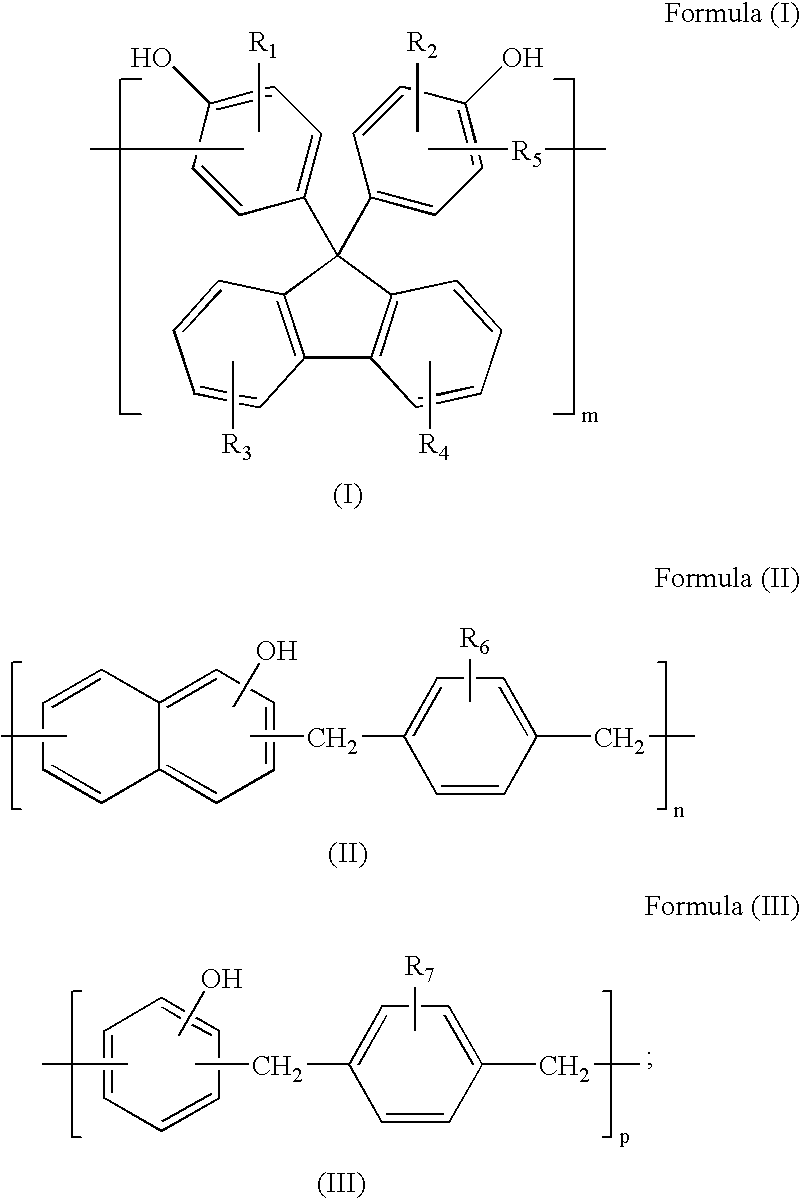
- a polymer component which includes one or more of the monomeric units of Formulas I, II and III:
- R 1 and R 2 may each independently be hydrogen, hydroxyl, alkyl, aryl, allyl, halo or any combination thereof;
- R 3 and R 4 may each independently be hydrogen, a crosslinking functionality, a chromophore or any combination thereof;
- R 5 may be phenylalkylene, phenyldialkylene or biphenyldialkylene, and m is a positive integer;
- R 6 may be hydrogen, alkyl, aryl, allyl or any combination thereof, and n is a positive integer;
- R 7 may be hydrogen, alkyl, aryl, allyl or any combination thereof, and p is a positive integer;
- methods of forming a patterned material layer on a substrate include
- a semiconductor integrated circuit fabricated according to a method of the invention is provided.
- FIG. 1 is an 1H NMR spectrum of the polymer prepared in Example 2.
- FIG. 2 is an FT-IR spectrum of the polymer prepared in Example 2.
- first, second, third etc. may be used herein to describe various elements, components, regions, layers and/or sections, these elements, components, regions, layers and/or sections should not be limited by these terms. These terms are only used to distinguish one element, component, region, layer or section from another region, layer or section. Thus, a first element, component, region, layer or section discussed below could be termed a second element, component, region, layer or section without departing from the teachings of the present invention.
- halo refers to a halogen radical, including —F, —Cl, I and Br.
- allyl refers to a —CH 2 —CH ⁇ CH 2 radical.
- epoxy refers to a functional group wherein an oxygen atom is directly attached to two carbon atoms already forming part of a ring system or to two carbon atoms of a chain.
- esters refers to a —C( ⁇ O)OR radical, wherein R is an alkyl or aryl group, as defined herein.
- alkoxy refers to a —OR radical, wherein R is an alkyl or aryl group, as defined herein.
- alkyl and alkylene refer to a monovalent or bivalent (respectively) straight, branched, or cyclic hydrocarbon radical having from 1 to 12 carbon atoms.
- the alkyl(ene) may be a “lower alkyl(ene),” wherein the alkyl(ene) group has 1 to 4 hydrocarbons.
- lower alkyl may include methyl, ethyl, propyl, isopropyl, butyl, and iso-butyl
- lower alkylene may include methylene (—CH 2 —), ethylene (—CH 2 CH 2 —), propylene (—CH 2 CH 2 CH 2 —), isopropylene (—CH(CH 3 ) 2 —), butylene (—CH 2 CH 2 CH 2 CH 2 —), iso-butylene (—C(CH 3 ) 2 CH 2 —) and the like.
- C x alkyl refers to an alkyl with x carbon atom(s), and thus, the term C 1 -C 6 alkyl refers to any alkyl having from 1 to 6 carbon atoms.
- phenylalkylene refers to a phenyl-substituted alkylene, as defined herein.
- the phenyl ring may unsubstituted or substituted, for example, with one or more (e.g., one, two or three) of a halo, hydroxyl, allyl, aryl, ester, epoxy, alkoxy and/or alkyl group, as defined herein.
- exemplary phenylalkylene include phenylmethylene (—CH(Ph)-) and hydroxyphenylalkylene.
- hydroxyphenylalkylene refers to a hydroxyphenyl-substituted alkylene, as defined herein.
- hydroxyphenylalkylene groups include hydroxyphenylmethylene (—CH(Ph-OH)—), hydroxyphenylethylene (—CH 2 CH(Ph-OH)—) and the like.
- the hydroxyl group of a hydroxyphenylalkylene may be attached at any position of the phenyl ring (i.e., ortho, meta or para positions).
- phenyldialkylene refers to a bivalent radical of the formula —R 1 -Ph-R 2 —, wherein R 1 and R 2 are each independently alkylene groups, as defined herein, and Ph is a bivalent phenylene radical (—C 6 H 4 —).
- the alkylene groups may be attached at any position on the phenylene ring, and the ring may be unsubstituted or substituted, for example, with one or more (e.g., one, two or three) of an halo, ester, alkoxy, epoxy, alkyl, allyl, aryl and/or hydroxyl (—OH) group, as defined herein.
- Exemplary phenyldialkylene groups may include phenyldimethylene (—CH 2 -C 6 H 4 —CH 2 —), phenyldiethylene (—CH 2 CH 2 —C 6 H 4 —CH 2 CH 2 —) and the like.
- biphenyldialkylene refers to a bivalent radical of the formula —R 1 -Ph-Ph-R 2 —, wherein Ph represents a phenylene group (—C 6 H 4 —) and RI and R 2 are alkyl, as defined herein.
- the phenyl rings may unsubstituted or substituted, for example, with one or more (e.g., one, two or three) of a halo, ester, aryl, alkoxy, epoxy, hydroxyl, alkyl, allyl or the like.
- Exemplary biphenyldialklyene include biphenyldimethylene, biphenyldiethylene and the like.
- aryl and arylene refer to a monovalent or bivalent (respectively) aromatic radical, which may optionally include 1 to 3 additional rings (e.g. cycloalkyl) fused thereto.
- An aryl(ene) ring may optionally be unsubstituted or substituted, for example, with one or more (e.g., one, two or three) of an halo, alkyl, aryl, ester, alkoxy, epoxy, allyl and/or hydroxyl group, or a chromophore or crosslinking functionality.
- Exemplary aryl(ene) groups may include phenyl, biphenyl, hydroxyphenyl and the like.
- C x aryl refers to an aryl having x carbon atoms, so that the term C 6 -C 10 aryl refers to any aryl group having from 6 to 10 carbon atoms.
- polymer component refers to a polymer or mixture of polymers that include one or more of the recited monomeric units.
- the polymer component may include only one type of polymer or copolymer, or it may include a mixture of more than one polymer or copolymer.
- the polymer component may include a single polymer that consists or consists essentially of the monomeric units of Formulas I, II or III.
- the polymer component may include copolymers (block or random), that include the monomeric units of Formula I, II and/or III, and optionally may include other monomeric units.
- the polymer component may also include mixtures or blends of polymers, including compositions whereby one or more of the polymers of the polymer component do not include the monomeric units of Formula I, II or III.
- crosslinking component refers to a compound, polymer or the like, that may react with crosslinking functionalities of polymer(s) of the invention, in order to crosslink the polymer(s).
- the crosslinks may be formed between one type of polymer, or they may be formed between different types of polymer chains.
- Exemplary crosslinking components may include etherified amino resins, such as methylated melamine resins and butylated melamine resins (e.g. N-methoxymethyl or N-butoxymethyl melamine resins (available at Cytec Industries, Inc.)); etherified amino resins, such as methylated urea resins and butylated urea resins (e.g.
- Cymel U-65 and UFR 80 methylated/butylated glycoluril compounds (e.g. Powderlink 1174 (Cytec Industries, Inc.)); the compounds described in Canadian Patent No. 1,204,547, which is incorporated herein by reference; 2,6-bis(hydroxymethyl)-p-cresol; the compounds described in Japanese Patent Laid-Open No. 1-293339 and bis-epoxy compounds.
- methylated/butylated glycoluril compounds e.g. Powderlink 1174 (Cytec Industries, Inc.)
- the compounds described in Canadian Patent No. 1,204,547 which is incorporated herein by reference
- 2,6-bis(hydroxymethyl)-p-cresol the compounds described in Japanese Patent Laid-Open No. 1-293339 and bis-epoxy compounds.
- the term “acid catalyst” refers to any known acid catalyst, and may be, in some embodiments, a common organic acid, such as p-toluenesulfonic acid monohydrate.
- the acid catalyst may be an acid generator, whereby an acid is produced by under certain conditions.
- the acid catalyst may be a thermal acid generator (TAG) whereby an acid is generated upon thermal treatment.
- TAGs may include pyridine p-toluenesulfonic acid, 2,4,4,6-tetrabromocyclohexadienol, benzoin tosylate, 2-nitrobenzyl tosylate, and other alkyl esters of organic sulfonic acids.
- a photoacid generator may be used as the acid catalyst, whereby an acid is produced upon irradiation with a particular radiation source.
- PAGs may include those described in U.S. Pat. Nos. 5,886,102 and 5,939,236, which are both incorporated herein by reference.
- crosslinking functionality refers to a functional group of a polymer of an embodiment of the invention that is capable of reacting with the crosslinking component to crosslink the polymer(s).
- exemplary crosslinking functionalities may include hydroxyl and epoxide groups.
- chromophore refers to any suitable chromophore, and preferably a chromophore suitable for radiation at 193 and/or 248 nm.
- exemplary chromophores include phenyl, chrysenyl, pyrenyl, fluoranthrenyl, anthronyl, benzophenonyl, thioxanthonyl, anthracenyl, and anthracenyl derivatives that act as chromophores.
- Exemplary anthracenyl derivatives may include 9-anthracenyl methanol.
- the chromophore contains no nitrogen, and, in other embodiments, the only nitrogen present is in the form of a deactivated amino nitrogen, such as a phenol thiazine.
- any combination thereof refers to an embodiment where two or more of the recited components are present.
- any combination thereof is used in reference to a listing of possible components, e.g., acid catalysts, it is meant that two or more of the recited acid catalysts may be used in combination.
- the phrase is used in describing a listing of functional groups, it is meant to include embodiments where any of the functional groups are independently present, if applicable, and also to include embodiments where the functional groups are used in combination.
- a listing of “phenylalkylene, phenyldialkylene and biphenyldialkylene” refers to any suitable combination of the substituents, including, for example, wherein a group includes both a phenyldialkylene and a phenylalkylene in combination (e.g., —CH(Ph)-CH 2 -Ph-CH 2 —).
- antireflective hardmask compositions include:
- a polymer component which includes one or more of the monomeric units of Formulas I, II and III:
- R 1 and R 2 may each independently be hydrogen, hydroxyl, alkyl, aryl, allyl, halo or any combination thereof;
- R 3 and R 4 may each independently be hydrogen, a crosslinking functionality, a chromophore or any combination thereof;
- R 5 may be phenylalkylene, phenyldialkylene or biphenyldialkylene, and m is a positive integer;
- R 6 may be hydrogen, alkyl, aryl, allyl or any combination thereof, and n is a positive integer;
- R 7 may be hydrogen, alkyl, aryl, allyl, or any combination thereof, and p is a positive integer;
- antireflective hardmask compositions include the monomeric unit of Formula I.
- R 1 and R 2 may each independently be hydrogen, hydroxyl, C 1-10 alkyl, C 6-10 aryl, allyl or halo;
- R 3 and R 4 may each independently be hydrogen, a crosslinking functionality or a chromophore
- R 5 may be hydroxyphenylmethylene, phenyldimethylene or biphenyldimethylene
- R 6 and R 7 may each independently be hydrogen, C 6-10 alkyl, C 6-10 aryl and allyl.
- m, n and p are each independently in a range of from about 1 to 190.
- the antireflective hardmask compositions include about 1 to about 20 weight percent polymer component; about 0.1 to about 5 weight percent crosslinking component; and about 0.001 to about 0.05 weight percent acid catalyst.
- the remaining weight percent of the composition may include a solvent, preferably an organic solvent, and/or a surfactant.
- exemplary solvents may include propylene glycol monomethyl ether acetate (PGMEA) and other solvents commonly used with resists.
- the polymer component includes a polymer that includes the monomeric unit of Formula I, wherein the polymer has a weight average molecular weight in a range of about 1,000 to about 30,000. In some embodiments, the polymer component includes a polymer that includes the monomeric unit of Formula II, wherein the polymer has a weight average molecular weight in a range of about 1,000 to about 30,000. In some embodiments, the polymer component includes a polymer that includes the monomeric unit of Formula III, wherein the polymer has a weight average molecular weight in a range of about 1,000 to about 30,000.
- the chromophore may be phenyl, chrysenyl, pyrenyl, fluoranthrenyl, anthronyl, benzophenonyl, thioxanthonyl, anthracenyl, anthracenyl derivative or any combination thereof.
- the crosslinking component may be a melamine resin, an amino resin, a glycoluril compound, a bisepoxy compound or any combination thereof.
- the acid catalyst may catalyze the crosslinking component with the crosslinking functionality of a polymer of an embodiment of the invention.
- the acid catalyst may be p-toluenesulfonic acid monohydrate, pyrididium p-toluenesulfonate, 2,4,4,6-tetrabromocyclohexadienone, an alkyl ester of an organic sulfonic acid or any combination thereof.
- the alkyl ester of an organic sulfonic acid may include benzoin tosylate, 2-nitrobenzyl tosylate or any combination thereof.
- methods of forming a patterned material layer on a substrate include
- the method can be carried out in accordance with the following procedure.
- a material to be patterned e.g., an aluminum or silicon nitride
- the material to be patterned may be conductive, semi-conductive, magnetic, or insulative.
- a hardmask composition according to an embodiment of the present invention may then be spin-coated onto the material.
- the composition may be spin-coated to a thickness in a range of about 500 to about 4000 ⁇ .
- the hardmask composition may then be baked, for example, at a temperature in the range of about 100 to about 300° C., and in some embodiments, for a time in a range of about 10 seconds to about 10 minutes, to form a hardmask layer.
- a radiation-sensitive imaging layer may then be formed on the hardmask layer.
- the imaging layer may then be developed by exposing portions of the resist to radiation in order to form a pattern on the imaging layer.
- the imaging layer and the antireflective hardmask layer may then be selectively removed to expose portions of the material layer. Etching may then be performed. In some embodiments, dry etching is performed using a gas, for example, a CHF 3 /CF 4 mixture. After the formation of a patterned material layer, the remaining portions of the resist may be removed using a common photoresist stripper.
- hardmask compositions of the present invention and the resulting lithographic structures may be used in the fabrication and design of integrated circuit devices in semiconductor manufacture.
- the compositions and methods of embodiments of the present invention may be used, for example, in the formation of patterned material structures, such as metal wirings, holes for contacts and biases, insulating sections (e.g. damascene trenches and shallow trench isolation) and trenches for capacitor structures.
- patterned material structures such as metal wirings, holes for contacts and biases, insulating sections (e.g. damascene trenches and shallow trench isolation) and trenches for capacitor structures.
- reaction solution When the internal temperature of the reaction solution reached 100° C., a solution of 7.94 g of 2-hydroxybenzaldehyde dissolved in 100 g of 1-methoxy-2-propanol was slowly added in droplets over 30 min through the dropping funnel, and the reaction mixture was allowed to react for 12 hr. After the completion of the reaction, the reactor was cooled to room temperature, and then methylamineketone (MAK) was added to the reaction solution until the concentration was 20 wt %. The solution was washed three times with water using a 3L separatory funnel, and was then concentrated using an evaporator. The resultant solution was diluted using MAK and methanol, to form a 15 wt % solution having MAK and methanol (at a 4:1 weight ratio).
- MAK methylamineketone
- the resultant reaction solution was treated with water to remove the acid therefrom, and then concentrated using an evaporator.
- the concentrated solution was diluted using MAK and methanol, to form a 15 wt % solution having MAK and methanol (at a 4:1 weight ratio).
- 1 H-NMR spectrum and FT-IR spectrum of the synthesized phenol resin were measured. The resulting spectra are provided in FIGS. 1 and 2 , respectively.
- the resultant reaction solution was treated with water to remove the acid therefrom, and then concentrated using an evaporator.
- the concentrated solution was diluted using MAK and methanol, to form a 15 wt % solution having MAK and methanol (at a 4:1 weight ratio).
- the resultant reaction solution was treated with water to remove the acid therefrom, and then concentrated using an evaporator.
- the concentrated solution was diluted using MAK and methanol, to form a 15 wt % solution having MAK and methanol (at a 4:1 weight ratio).
- the resultant reaction solution was treated with water to remove the acid therefrom, and then concentrated using an evaporator.
- the concentrated solution was diluted using MAK and methanol, to form a 15 wt % solution having MAK and methanol (at a 4:1 weight ratio).
- reaction solution When the internal temperature of the reaction solution reached 100° C., 5.27 g (0.065 mol) of an aqueous solution of 37 wt % formaldehyde were slowly added in droplets over 30 min through the dropping funnel, and the reaction mixture was allowed to react for 12 hr. After the completion of the reaction, the reactor was cooled to room temperature, and then MAK was added to the reaction solution until the concentration was 20 wt %. The solution was washed three times with water using a 3 L separatory funnel, and then concentrated using an evaporator. The resultant solution was diluted using MAK and methanol, to form a 15 wt % solution having MAK and methanol (at a 4:1 weight ratio).
- Example 2-1 0.8 g of the polymer prepared in Example 2-1, 0.2 g of a crosslinking agent (Powderlink 1174), and 2 mg of pyridinium P-toluene sulfonate were dissolved in 9 g of PGMEA to obtain a reaction solution, which was then filtered to prepare a sample solution.
- a crosslinking agent Powderlink 1174
- Example 2-2 0.8 g of the polymer prepared in Example 2-2, 0.2 g of a crosslinking agent (Powderlink 1174), and 2 mg of pyridinium P-toluene sulfonate were dissolved in 9 g of PGMEA to obtain a reaction solution, which was then filtered to prepare a sample solution.
- a crosslinking agent Powderlink 1174
- Each of the samples prepared in Examples 4 to 6 and Comparative Example 2 was applied on a silicon wafer coated with aluminum using a spin coating process, and then baked at 200° C. for 60 sec, to form a film 1500 ⁇ thick.
- Example 9 Each of the films prepared in Example 9 was coated with a KrF photoresist, baked at 110° C. for 60 sec, exposed using an exposure instrument (ASML XT:1400, NA 0.93) and then developed using teteramethylammonium hydroxide (TMAH, 2.38 wt % aq. solution). Subsequently, a 90 nm sized line and space pattern was observed using an FE-SEM. The results are given in Table 2 below. The EL (Expose Latitude) margins, varying with the exposure amount, and DoF (Depth of Focus) margins, varying with the distance from a light source, were measured. The results are shown in Table 2 below.
- Example 7 Each of the samples prepared in Example 7 was dry etched using a gas mixture of CHF 3 and CF 4 . The thickness difference before and after the etching process was measured. The results are given in Table 4 below. TABLE 4 Sample for Film Formation CHF 3 /CF 4 Gas Etching Rate (nm/min) Ex. 4 98 Ex. 5 93 Ex. 5-1 100 Ex. 5-2 110 Ex. 6 99 Comp. Ex. 2 170
- Each of the samples prepared in Examples 4 to 6 and Comparative Example 2 was applied on a silicon wafer coated with SiN (silicon nitride) using a spin coating process, and then baked at 200° C. for 60 sec, to form a film 1500 ⁇ thick.
- SiN silicon nitride
- Example 13 Each of the films prepared in Example 13 was coated with an ArF photoresist, baked at 110° C. for 60 sec, exposed using an ArF exposure instrument ASML1250 (FN70 5.0 active, NA 0.82) and then developed using TMAH (2.38 wt % aq. solution). Subsequently, an 80 nm sized line and space pattern was observed using an FE-SEM. The results are given in Table 5 below. The EL margins, varying with the exposure amount, and DoF margins, varying with the distance from a light source, were measured. The results are shown in Table 5 below. TABLE 5 Pattern Property Sample for Film EL Margin Formation ( ⁇ mJ/exposure energy mJ) DoF Margin ( ⁇ m) Ex. 4 0.1 0.2 Ex. 5 0.1 0.2 Ex. 5-1 0.1 0.2 Ex. 5-2 0.1 0.1 Ex. 6 0.1 0.2 Comp. Ex. 2 0 0 0
- the present invention provides a hardmask composition having antireflective properties.
- the composition of the present invention is advantageous because it can be applied using a spin-on application technique while exhibiting excellent optical properties, mechanical properties, and etching selectivity.
- this composition has a long storage lifetime, over which an acid pollutant minimally exists or does not exist.
Landscapes
- Engineering & Computer Science (AREA)
- Architecture (AREA)
- Structural Engineering (AREA)
- Physics & Mathematics (AREA)
- General Physics & Mathematics (AREA)
- Materials For Photolithography (AREA)
- Exposure Of Semiconductors, Excluding Electron Or Ion Beam Exposure (AREA)
Abstract
In some embodiments of the present invention, antireflective hardmask compositions include: a) a polymer component, which includes one or more of the monomeric units of Formulas I, II and III:
Description
- This application claims the benefit of Korean Patent Application Nos. 10-2005-0038406, filed on May 9, 2005, and 10-2005-0068348, filed on Jul. 27, 2005, in the Korean Intellectual Property Office, the disclosure of which is incorporated herein in its entirety by reference.
- The present invention relates to hardmask compositions having antireflective properties useful in lithographic processes, and more particularly to hardmask compositions including polymers having strong absorbance in the short wavelength region (e.g., 157, 193 and 248 nm) of the electromagnetic spectrum.
- Due to the continuous demand for smaller microelectronic devices, there exists a need to reduce the size of structural shapes in microelectronics and other related industries. Toward this end, effective lithographic techniques are essential to achieve a reduction in the size of microelectronic structures.
- Typical lithographic processes involve pattern-wise exposure of a photosensitive resist to radiation in order to form a patterned resist layer. Thereafter, the resulting image may be developed by contacting the exposed resist layer with a suitable developing substance (e.g. an aqueous alkaline developing solution) to remove certain portions of the resist pattern. The material underlying the resist may then be etched through the openings in the resist to transfer a pattern to an underlying substrate. After the pattern is transferred, the remaining portions of the resist may then be removed.
- For better resolution in lithography, an antireflective coating (ARC) may be used to minimize the reflectivity between an imaging layer, such as a photosensitive resist, and an underlying layer. However, in some lithographic imaging processes, the resist does not provide sufficient etch resistance to effectively transfer the desired pattern to a layer underlying the resist. Therefore, a so-called hardmask layer may be applied as an intermediate layer between the patterned resist layer and the underlying material to be patterned. The hardmask layer receives the pattern from the patterned resist layer and should be able to withstand the etching processes needed to transfer the pattern to the underlying material.
- Although a number of hardmask materials are known, there is a need for improved hardmask compositions. Since conventional hardmask materials are often difficult to apply to substrates, the use of chemical and physical vapor deposition, special solvents, and/or high-temperature baking may be required. A hardmask composition that may be applied by spin-coating techniques, and which does not require high-temperature baking, would be desirable. A hardmask composition that can be easily etched selective to the overlying photoresist, while being resistant to the etch process needed to pattern the underlying layer, would also be desirable. A hardmask composition that provides superior storage properties and avoids unwanted interactions with an imaging resist layer would further be desirable. A hardmask composition that is particularly resistant to radiation at shorter wavelengths, such as 157, 193, and 247 nm, would also be desirable.
- In some embodiments of the present invention, antireflective hardmask compositions include:
- a) a polymer component, which includes one or more of the monomeric units of Formulas I, II and III:

- wherein R1 and R2 may each independently be hydrogen, hydroxyl, alkyl, aryl, allyl, halo or any combination thereof; and
- R3 and R4 may each independently be hydrogen, a crosslinking functionality, a chromophore or any combination thereof; and
- R5 may be phenylalkylene, phenyldialkylene or biphenyldialkylene, and m is a positive integer;

- wherein R6 may be hydrogen, alkyl, aryl, allyl or any combination thereof, and n is a positive integer; and

- wherein R7 may be hydrogen, alkyl, aryl, allyl or any combination thereof, and p is a positive integer; and
- b) a crosslinking component; and
- c) an acid catalyst.
- In some embodiments of the present invention, methods of forming a patterned material layer on a substrate include
- (a) forming an antireflective hardmask layer on a material layer, wherein said hardmask layer includes a composition described above;
- (b) forming a radiation-sensitive imaging layer on the antireflective layer;
- (c) exposing the imaging layer to radiation;
- (d) developing the imaging layer and the antireflective layer to expose portions of the material layer; and
- (e) etching the exposed portions of the material layer.
- Further, in some embodiments of the invention, a semiconductor integrated circuit fabricated according to a method of the invention is provided.
-
FIG. 1 is an 1H NMR spectrum of the polymer prepared in Example 2. -
FIG. 2 is an FT-IR spectrum of the polymer prepared in Example 2. - The invention is described more fully hereinafter. This invention may, however, be embodied in many different forms and should not be construed as limited to the embodiments set forth herein. Rather, these embodiments are provided so that this disclosure will be thorough and complete, and will fully convey the scope of the invention to those skilled in the art.
- It will be understood that when an element or layer is referred to as being “on,” another element or layer, it can be directly on, connected to, or coupled to the other element or layer, or intervening elements or layers may be present. In contrast, when an element is referred to as being “directly on,” “directly connected to,” or “directly coupled to” another element or layer, there are no intervening elements or layers present. Like numbers refer to like elements throughout. As used herein, the term “and/or” includes any and all combinations of one or more of the associated listed items.
- It will be understood that, although the terms first, second, third etc. may be used herein to describe various elements, components, regions, layers and/or sections, these elements, components, regions, layers and/or sections should not be limited by these terms. These terms are only used to distinguish one element, component, region, layer or section from another region, layer or section. Thus, a first element, component, region, layer or section discussed below could be termed a second element, component, region, layer or section without departing from the teachings of the present invention.
- The terminology used herein is for the purpose of describing particular embodiments only and is not intended to be limiting of the invention. As used herein, the singular forms “a”, “an,” and “the” are intended to include the plural forms as well, unless the context clearly indicates otherwise. It will be further understood that the terms “comprises” and/or “comprising,” when used in this specification, specify the presence of stated features, integers, steps, operations, elements, and/or components, but do not preclude the presence or addition of one or more other features, integers, steps, operations, elements, components, and/or groups thereof.
- Unless otherwise defined, all terms (including technical and scientific terms) used herein have the same meaning as commonly understood by one of ordinary skill in the art to which this invention belongs. It will be further understood that terms, such as those defined in commonly used dictionaries, should be interpreted as having a meaning that is consistent with their meaning in the context of the relevant art and will not be interpreted in an idealized or overly formal sense unless expressly so defined herein.
- As used herein:
- The term “halo” refers to a halogen radical, including —F, —Cl, I and Br.
- The term “allyl” refers to a —CH2—CH═CH2 radical.
- The term “epoxy” refers to a functional group wherein an oxygen atom is directly attached to two carbon atoms already forming part of a ring system or to two carbon atoms of a chain.
- The term “ester” refers to a —C(═O)OR radical, wherein R is an alkyl or aryl group, as defined herein.
- The term “alkoxy” refers to a —OR radical, wherein R is an alkyl or aryl group, as defined herein.
- The terms “alkyl” and “alkylene” refer to a monovalent or bivalent (respectively) straight, branched, or cyclic hydrocarbon radical having from 1 to 12 carbon atoms. In some embodiments, the alkyl(ene) may be a “lower alkyl(ene),” wherein the alkyl(ene) group has 1 to 4 hydrocarbons. For example, lower alkyl may include methyl, ethyl, propyl, isopropyl, butyl, and iso-butyl, while lower alkylene may include methylene (—CH2—), ethylene (—CH2CH2—), propylene (—CH2CH2CH2—), isopropylene (—CH(CH3)2—), butylene (—CH2CH2CH2CH2—), iso-butylene (—C(CH3)2CH2—) and the like. The term Cx alkyl refers to an alkyl with x carbon atom(s), and thus, the term C1-C6 alkyl refers to any alkyl having from 1 to 6 carbon atoms.
- The term “phenylalkylene” refers to a phenyl-substituted alkylene, as defined herein. The phenyl ring may unsubstituted or substituted, for example, with one or more (e.g., one, two or three) of a halo, hydroxyl, allyl, aryl, ester, epoxy, alkoxy and/or alkyl group, as defined herein. Exemplary phenylalkylene include phenylmethylene (—CH(Ph)-) and hydroxyphenylalkylene. The term “hydroxyphenylalkylene” refers to a hydroxyphenyl-substituted alkylene, as defined herein. Exemplary hydroxyphenylalkylene groups include hydroxyphenylmethylene (—CH(Ph-OH)—), hydroxyphenylethylene (—CH2CH(Ph-OH)—) and the like. The hydroxyl group of a hydroxyphenylalkylene may be attached at any position of the phenyl ring (i.e., ortho, meta or para positions).
- The term “phenyldialkylene” refers to a bivalent radical of the formula —R1-Ph-R2—, wherein R1 and R2 are each independently alkylene groups, as defined herein, and Ph is a bivalent phenylene radical (—C6H4—). The alkylene groups may be attached at any position on the phenylene ring, and the ring may be unsubstituted or substituted, for example, with one or more (e.g., one, two or three) of an halo, ester, alkoxy, epoxy, alkyl, allyl, aryl and/or hydroxyl (—OH) group, as defined herein. Exemplary phenyldialkylene groups may include phenyldimethylene (—CH2-C6H4—CH2—), phenyldiethylene (—CH2CH2—C6H4—CH2CH2—) and the like.
- The term “biphenyldialkylene” refers to a bivalent radical of the formula —R1-Ph-Ph-R2—, wherein Ph represents a phenylene group (—C6H4—) and RI and R2 are alkyl, as defined herein. The phenyl rings may unsubstituted or substituted, for example, with one or more (e.g., one, two or three) of a halo, ester, aryl, alkoxy, epoxy, hydroxyl, alkyl, allyl or the like. Exemplary biphenyldialklyene include biphenyldimethylene, biphenyldiethylene and the like.
- The terms “aryl” and “arylene” refer to a monovalent or bivalent (respectively) aromatic radical, which may optionally include 1 to 3 additional rings (e.g. cycloalkyl) fused thereto. An aryl(ene) ring may optionally be unsubstituted or substituted, for example, with one or more (e.g., one, two or three) of an halo, alkyl, aryl, ester, alkoxy, epoxy, allyl and/or hydroxyl group, or a chromophore or crosslinking functionality. Exemplary aryl(ene) groups may include phenyl, biphenyl, hydroxyphenyl and the like. The term Cx aryl refers to an aryl having x carbon atoms, so that the term C6-C10 aryl refers to any aryl group having from 6 to 10 carbon atoms.
- The term “polymer component” refers to a polymer or mixture of polymers that include one or more of the recited monomeric units. Thus, the polymer component may include only one type of polymer or copolymer, or it may include a mixture of more than one polymer or copolymer. For example, the polymer component may include a single polymer that consists or consists essentially of the monomeric units of Formulas I, II or III. Alternatively, the polymer component may include copolymers (block or random), that include the monomeric units of Formula I, II and/or III, and optionally may include other monomeric units. Further, the polymer component may also include mixtures or blends of polymers, including compositions whereby one or more of the polymers of the polymer component do not include the monomeric units of Formula I, II or III.
- The term “crosslinking component” refers to a compound, polymer or the like, that may react with crosslinking functionalities of polymer(s) of the invention, in order to crosslink the polymer(s). The crosslinks may be formed between one type of polymer, or they may be formed between different types of polymer chains. Exemplary crosslinking components may include etherified amino resins, such as methylated melamine resins and butylated melamine resins (e.g. N-methoxymethyl or N-butoxymethyl melamine resins (available at Cytec Industries, Inc.)); etherified amino resins, such as methylated urea resins and butylated urea resins (e.g. Cymel U-65 and UFR 80); methylated/butylated glycoluril compounds (e.g. Powderlink 1174 (Cytec Industries, Inc.)); the compounds described in Canadian Patent No. 1,204,547, which is incorporated herein by reference; 2,6-bis(hydroxymethyl)-p-cresol; the compounds described in Japanese Patent Laid-Open No. 1-293339 and bis-epoxy compounds.
- The term “acid catalyst” refers to any known acid catalyst, and may be, in some embodiments, a common organic acid, such as p-toluenesulfonic acid monohydrate. In addition, in some embodiments, the acid catalyst may be an acid generator, whereby an acid is produced by under certain conditions. For example, the acid catalyst may be a thermal acid generator (TAG) whereby an acid is generated upon thermal treatment. Exemplary TAGs may include pyridine p-toluenesulfonic acid, 2,4,4,6-tetrabromocyclohexadienol, benzoin tosylate, 2-nitrobenzyl tosylate, and other alkyl esters of organic sulfonic acids. In some embodiments, a photoacid generator (PAG) may be used as the acid catalyst, whereby an acid is produced upon irradiation with a particular radiation source. Exemplary PAGs may include those described in U.S. Pat. Nos. 5,886,102 and 5,939,236, which are both incorporated herein by reference.
- The term “crosslinking functionality” refers to a functional group of a polymer of an embodiment of the invention that is capable of reacting with the crosslinking component to crosslink the polymer(s). Exemplary crosslinking functionalities may include hydroxyl and epoxide groups.
- The term “chromophore” refers to any suitable chromophore, and preferably a chromophore suitable for radiation at 193 and/or 248 nm. Exemplary chromophores include phenyl, chrysenyl, pyrenyl, fluoranthrenyl, anthronyl, benzophenonyl, thioxanthonyl, anthracenyl, and anthracenyl derivatives that act as chromophores. Exemplary anthracenyl derivatives may include 9-anthracenyl methanol. In some embodiments, the chromophore contains no nitrogen, and, in other embodiments, the only nitrogen present is in the form of a deactivated amino nitrogen, such as a phenol thiazine.
- The phrase “any combination thereof” refers to an embodiment where two or more of the recited components are present. When the term “any combination thereof” is used in reference to a listing of possible components, e.g., acid catalysts, it is meant that two or more of the recited acid catalysts may be used in combination. Further, when the phrase is used in describing a listing of functional groups, it is meant to include embodiments where any of the functional groups are independently present, if applicable, and also to include embodiments where the functional groups are used in combination. For example, a listing of “phenylalkylene, phenyldialkylene and biphenyldialkylene” refers to any suitable combination of the substituents, including, for example, wherein a group includes both a phenyldialkylene and a phenylalkylene in combination (e.g., —CH(Ph)-CH2-Ph-CH2—).
- In some embodiments of the present invention, antireflective hardmask compositions include:
- a) a polymer component, which includes one or more of the monomeric units of Formulas I, II and III:

- wherein R1 and R2 may each independently be hydrogen, hydroxyl, alkyl, aryl, allyl, halo or any combination thereof; and
- R3 and R4 may each independently be hydrogen, a crosslinking functionality, a chromophore or any combination thereof; and
- R5 may be phenylalkylene, phenyldialkylene or biphenyldialkylene, and m is a positive integer;

- wherein R6 may be hydrogen, alkyl, aryl, allyl or any combination thereof, and n is a positive integer; and

- wherein R7 may be hydrogen, alkyl, aryl, allyl, or any combination thereof, and p is a positive integer; and
- b) a crosslinking component; and
- c) an acid catalyst.
- In some embodiments of the present invention, antireflective hardmask compositions include the monomeric unit of Formula I.
- In some embodiments of the present invention,
- R1 and R2 may each independently be hydrogen, hydroxyl, C1-10 alkyl, C6-10 aryl, allyl or halo; and
- R3 and R4 may each independently be hydrogen, a crosslinking functionality or a chromophore;
- R5 may be hydroxyphenylmethylene, phenyldimethylene or biphenyldimethylene; and
- R6 and R7 may each independently be hydrogen, C6-10 alkyl, C6-10 aryl and allyl.
- In some embodiments, m, n and p are each independently in a range of from about 1 to 190.
- In some embodiments, the antireflective hardmask compositions include about 1 to about 20 weight percent polymer component; about 0.1 to about 5 weight percent crosslinking component; and about 0.001 to about 0.05 weight percent acid catalyst. The remaining weight percent of the composition may include a solvent, preferably an organic solvent, and/or a surfactant. Exemplary solvents may include propylene glycol monomethyl ether acetate (PGMEA) and other solvents commonly used with resists.
- In some embodiments, the polymer component includes a polymer that includes the monomeric unit of Formula I, wherein the polymer has a weight average molecular weight in a range of about 1,000 to about 30,000. In some embodiments, the polymer component includes a polymer that includes the monomeric unit of Formula II, wherein the polymer has a weight average molecular weight in a range of about 1,000 to about 30,000. In some embodiments, the polymer component includes a polymer that includes the monomeric unit of Formula III, wherein the polymer has a weight average molecular weight in a range of about 1,000 to about 30,000.
- In some embodiments, the chromophore may be phenyl, chrysenyl, pyrenyl, fluoranthrenyl, anthronyl, benzophenonyl, thioxanthonyl, anthracenyl, anthracenyl derivative or any combination thereof.
- In some embodiments, the crosslinking component may be a melamine resin, an amino resin, a glycoluril compound, a bisepoxy compound or any combination thereof.
- The acid catalyst may catalyze the crosslinking component with the crosslinking functionality of a polymer of an embodiment of the invention. In some embodiments, the acid catalyst may be p-toluenesulfonic acid monohydrate, pyrididium p-toluenesulfonate, 2,4,4,6-tetrabromocyclohexadienone, an alkyl ester of an organic sulfonic acid or any combination thereof. The alkyl ester of an organic sulfonic acid may include benzoin tosylate, 2-nitrobenzyl tosylate or any combination thereof.
- In some embodiments of the present invention, methods of forming a patterned material layer on a substrate include
- (a) forming an antireflective hardmask layer on a material layer, wherein said hardmask layer comprises a composition of an embodiment of the invention;
- (b) forming a radiation-sensitive imaging layer on the antireflective layer;
- (c) exposing the imaging layer to radiation;
- (d) developing the imaging layer and the antireflective layer to expose portions of the material layer; and
- (e) etching the exposed portions of the material layer.
- In some embodiments of the invention, the method can be carried out in accordance with the following procedure. First, a material to be patterned (e.g., an aluminum or silicon nitride) may be formed onto a silicon substrate by any technique known in the art. In particular embodiments, the material to be patterned may be conductive, semi-conductive, magnetic, or insulative. A hardmask composition according to an embodiment of the present invention may then be spin-coated onto the material. In some embodiments, the composition may be spin-coated to a thickness in a range of about 500 to about 4000 Å. The hardmask composition may then be baked, for example, at a temperature in the range of about 100 to about 300° C., and in some embodiments, for a time in a range of about 10 seconds to about 10 minutes, to form a hardmask layer. A radiation-sensitive imaging layer may then be formed on the hardmask layer. The imaging layer may then be developed by exposing portions of the resist to radiation in order to form a pattern on the imaging layer. The imaging layer and the antireflective hardmask layer may then be selectively removed to expose portions of the material layer. Etching may then be performed. In some embodiments, dry etching is performed using a gas, for example, a CHF3/CF4 mixture. After the formation of a patterned material layer, the remaining portions of the resist may be removed using a common photoresist stripper.
- Accordingly, hardmask compositions of the present invention and the resulting lithographic structures may be used in the fabrication and design of integrated circuit devices in semiconductor manufacture. The compositions and methods of embodiments of the present invention may be used, for example, in the formation of patterned material structures, such as metal wirings, holes for contacts and biases, insulating sections (e.g. damascene trenches and shallow trench isolation) and trenches for capacitor structures. Thus, in some embodiments of the invention, a semiconductor integrated circuit fabricated according to a method of the invention is provided.
- A better understanding of the present invention may be obtained in light of the following examples which are set forth to illustrate, but are not to be construed to limit the present invention.
-

- Into a 1L four-neck flask equipped with a mechanical stirrer, a cooling pipe, a 300 ml dropping funnel, and a nitrogen gas inlet pipe, a solution of 28.03 g (0.08 mol) of 4,4′-(9-fluorenylidene)diphenol and 0.3 g of p-toluenesulfonic acid dissolved in 200 g of γ-butyrolactone was loaded, and the flask was heated in an oil bath stirred using a magnetic stirrer, while nitrogen gas was supplied. When the internal temperature of the reaction solution reached 100° C., a solution of 7.94 g of 2-hydroxybenzaldehyde dissolved in 100 g of 1-methoxy-2-propanol was slowly added in droplets over 30 min through the dropping funnel, and the reaction mixture was allowed to react for 12 hr. After the completion of the reaction, the reactor was cooled to room temperature, and then methylamineketone (MAK) was added to the reaction solution until the concentration was 20 wt %. The solution was washed three times with water using a 3L separatory funnel, and was then concentrated using an evaporator. The resultant solution was diluted using MAK and methanol, to form a 15 wt % solution having MAK and methanol (at a 4:1 weight ratio). This solution was loaded into a 3 L separatory funnel, after which n-heptane was added to remove a low molecular weight material and/or monomer, thus yielding a desired phenol resin (Mw=12,000, polydispersity=1.9, m=22).
-

- Into a 1 L four-neck flask equipped with a mechanical stirrer, a cooling pipe, a 300 mL dropping funnel, and a nitrogen gas inlet pipe, 8.31 g (0.05 mol) of 1,4-bis(methoxymethyl)benzene, 0.154 g (0.001 mol) of diethylsulfate, and 200 g of γ-butyrolactone were loaded and stirred while nitrogen gas was supplied. After 10 min, a solution of 28.02 g (0.08 mol) of 4,4′-(9-fluorenylidene)diphenol dissolved in 200 g of γ-butyrolactone was slowly added in droplets over 30 min, and the reaction mixture was allowed to react for 12 hr. After the completion of the reaction, the resultant reaction solution was treated with water to remove the acid therefrom, and then concentrated using an evaporator. The concentrated solution was diluted using MAK and methanol, to form a 15 wt % solution having MAK and methanol (at a 4:1 weight ratio). This solution was loaded into a 3L separatory funnel, after which n-heptane was added to remove a low molecular weight material containing monomer, thus yielding a desired phenol resin (Mw=12,000, polydispersity=2.0, m=23). In addition, 1H-NMR spectrum and FT-IR spectrum of the synthesized phenol resin were measured. The resulting spectra are provided in
FIGS. 1 and 2 , respectively. -

- Into a 1 L four-neck flask equipped with a mechanical stirrer, a cooling pipe, a 300 ml dropping funnel, and a nitrogen gas inlet pipe, 8.31 g (0.05 mol) of 1,4-bis(methoxymethyl)benzene, 0.154 g (0.001 mol) of diethylsulfate, and 200 g of γ-butyrolactone were loaded and stirred while nitrogen gas was supplied. After 10 min, a solution of 11.54 g (0.08 mol) of 1-naphthol dissolved in 200 g of γ-butyrolactone was slowly added in droplets over 30 min, and the reaction mixture was allowed to react for 12 hr. After the completion of the reaction, the resultant reaction solution was treated with water to remove the acid therefrom, and then concentrated using an evaporator. The concentrated solution was diluted using MAK and methanol, to form a 15 wt % solution having MAK and methanol (at a 4:1 weight ratio). This solution was loaded into a 3L separatory funnel, after which n-heptane was added to remove a low molecular weight material containing monomer, thus yielding a desired phenol resin (Mw=11,500, polydispersity=2.4, n=44).
-

- Into a 1 L four-neck flask equipped with a mechanical stirrer, a cooling pipe, a 300 mL dropping funnel, and a nitrogen gas inlet pipe, 8.31 g (0.05 mol) of 1,4-bis(methoxymethyl)benzene, 0.154 g (0.001 mol) of diethylsulfate, and 200 g of γ-butyrolactone were loaded and stirred while nitrogen gas was supplied. After 10 min, a solution of 7.53 g (0.08 mol) of phenol dissolved in 200 g of γ-butyrolactone was slowly added in droplets over 30 min, and the reaction mixture was allowed to react for 12 hr. After the completion of the reaction, the resultant reaction solution was treated with water to remove the acid therefrom, and then concentrated using an evaporator. The concentrated solution was diluted using MAK and methanol, to form a 15 wt % solution having MAK and methanol (at a 4:1 weight ratio). This solution was loaded into a 3 L separatory funnel, after which n-heptane was added to remove a low molecular weight material containing monomer, thus yielding a desired phenol resin (Mw=10,300, polydispersity=2.3, p=48).
-
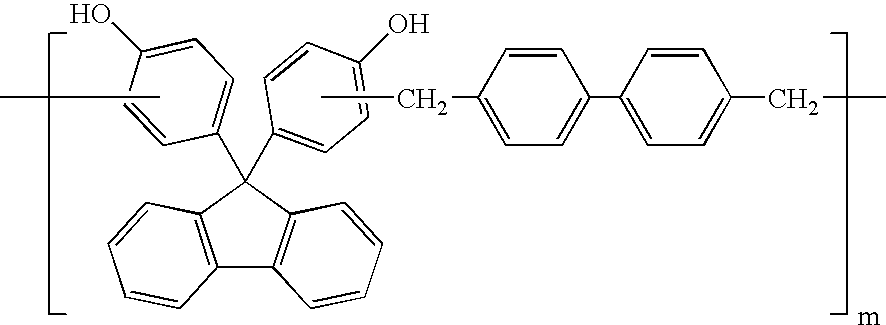
- Into a 1 L four-neck flask equipped with a mechanical stirrer, a cooling pipe, a 300 ml dropping funnel, and a nitrogen gas inlet pipe, 12.56 g (0.05 mol) of 4,4′-bis(chloromethyl)-1,1′-biphenyl, 26.66 g of aluminum chloride, and 200 g of γ-butyrolactone were loaded and stirred while nitrogen gas was supplied. After 10 min, a solution of 35.03 g (0.10 mol) of 4,4′-(9-fluorenylidene)diphenol dissolved in 200 g of γ-butyrolactone was slowly added in droplets over 30 min, and the reaction mixture was allowed to react for 12 hr. After the completion of the reaction, the resultant reaction solution was treated with water to remove the acid therefrom, and then concentrated using an evaporator. The concentrated solution was diluted using MAK and methanol, to form a 15 wt % solution having MAK and methanol (at a 4:1 weight ratio). This solution was loaded into the 3L separatory funnel, after which n-heptane was added to remove a low molecular weight material containing monomer, thus yielding a desired phenol resin (Mw=4100, m=7-8).
-

- Into a 1 L four-neck flask equipped with a mechanical stirrer, a cooling pipe, a 300 ml dropping funnel, and a nitrogen gas inlet pipe, a solution of 7.52 g (0.08 mol) of phenol and 0.3 g of p-toluenesulfonic acid dissolved in 200 g of γ-butyrolactone was loaded, and the flask was heated in an oil bath stirred using a magnetic stirrer, while nitrogen gas was supplied. When the internal temperature of the reaction solution reached 100° C., 5.27 g (0.065 mol) of an aqueous solution of 37 wt % formaldehyde were slowly added in droplets over 30 min through the dropping funnel, and the reaction mixture was allowed to react for 12 hr. After the completion of the reaction, the reactor was cooled to room temperature, and then MAK was added to the reaction solution until the concentration was 20 wt %. The solution was washed three times with water using a 3 L separatory funnel, and then concentrated using an evaporator. The resultant solution was diluted using MAK and methanol, to form a 15 wt % solution having MAK and methanol (at a 4:1 weight ratio). This solution was loaded into a 3L separatory funnel, after which n-heptane was added to remove a low molecular weight material containing monomer, thus yielding a desired phenol resin (Mw=6000, x=55˜56).
- 0.8 g of the polymer prepared in Example 1, 0.2 g of an oligomeric crosslinking agent (Powderlink 1174) represented by the following repeating structural unit, and 2 mg of pyridinium P-toluene sulfonate were dissolved in 9 g of propyleneglycolmonoethylacetate (PGMEA) to obtain a reaction solution, which was then filtered to prepare a sample solution.
- 0.8 g of the polymer prepared in Example 2, 0.2 g of a crosslinking agent (Powderlink 1174), and 2 mg of pyridinium P-toluene sulfonate were dissolved in 9 g of PGMEA to obtain a reaction solution, which was then filtered to prepare a sample solution.
- 0.8 g of the polymer prepared in Example 2-1, 0.2 g of a crosslinking agent (Powderlink 1174), and 2 mg of pyridinium P-toluene sulfonate were dissolved in 9 g of PGMEA to obtain a reaction solution, which was then filtered to prepare a sample solution.
- 0.8 g of the polymer prepared in Example 2-2, 0.2 g of a crosslinking agent (Powderlink 1174), and 2 mg of pyridinium P-toluene sulfonate were dissolved in 9 g of PGMEA to obtain a reaction solution, which was then filtered to prepare a sample solution.
- 0.8 g of the polymer prepared in Example 3, 0.2 g of a crosslinking agent (Powderlink 1174), and 2 mg of pyridinium P-toluene sulfonate were dissolved in 9 g of PGMEA to obtain a reaction solution, which was then filtered to prepare a sample solution.
- 0.8 g of the polymer prepared in Comparative Example 1, 0.2 g of a crosslinking agent (Cymel 303), and 2 mg of pyridinium P-toluene sulfonate were dissolved in 9 g of PGMEA to obtain a reaction solution, which was then filtered to prepare a sample solution.
- Each of the samples prepared in Examples 4 to 6 and Comparative Example 2 was applied on a silicon wafer using a spin coating process, and then baked at 200° C. for 60 sec, to form a
film 1500 Å thick, - The refractive index (n) and extinction coefficient (k) of each of the films prepared in Example 7 were measured. For this, an Ellipsometer (available from J. A. Woollam Co., Inc.) was used. The results are given in Table 1 below.
TABLE 1 Sample for Optical Property (193 nm) Optical Property (248 nm) Film n (Refractive k (Extinction n (Refractive k (Extinction Formation Index) Coefficient) Index) Coefficient) Ex. 4 1.45 0.85 2.00 0.28 Ex. 5 1.44 0.87 2.02 0.27 Ex. 5-1 1.47 0.80 2.01 0.25 Ex. 5-2 1.30 0.75 2.00 0.15 Ex. 6 1.47 0.75 1.81 0.29 Comp. Ex. 2 1.29 0.74 2.01 0.05 - Each of the samples prepared in Examples 4 to 6 and Comparative Example 2 was applied on a silicon wafer coated with aluminum using a spin coating process, and then baked at 200° C. for 60 sec, to form a
film 1500 Å thick. - Each of the films prepared in Example 9 was coated with a KrF photoresist, baked at 110° C. for 60 sec, exposed using an exposure instrument (ASML XT:1400, NA 0.93) and then developed using teteramethylammonium hydroxide (TMAH, 2.38 wt % aq. solution). Subsequently, a 90 nm sized line and space pattern was observed using an FE-SEM. The results are given in Table 2 below. The EL (Expose Latitude) margins, varying with the exposure amount, and DoF (Depth of Focus) margins, varying with the distance from a light source, were measured. The results are shown in Table 2 below.
TABLE 2 Pattern Property Sample for Film EL Margin Formation (ΔmJ/exposure energy mJ) DoF Margin (μm) Ex. 4 0.1 0.1 Ex. 5 0.2 0.2 Ex. 5-1 0.1 0.2 Ex. 5-2 0.1 0.1 Ex. 6 0.1 0.1 Comp. Ex. 2 0 0 - Each of the samples patterned in Example 10 was dry etched using a gas mixture of CHF3 and CF4, and then further dry etched using a gas mixture of BCl3 and Cl2. Finally, the remaining organics were removed using O2 gas, and the section of the sample was observed using an FE-SEM. The results are given in Table 3 below.
TABLE 3 Sample for Film Formation Etched Pattern Feature Ex. 4 Vertical Ex. 5 Vertical Ex. 5-1 Vertical Ex. 5-2 Vertical (Slightly Tapered) Ex. 6 Vertical Comp. Ex. 2 Tapered - Each of the samples prepared in Example 7 was dry etched using a gas mixture of CHF3 and CF4. The thickness difference before and after the etching process was measured. The results are given in Table 4 below.
TABLE 4 Sample for Film Formation CHF3/CF4 Gas Etching Rate (nm/min) Ex. 4 98 Ex. 5 93 Ex. 5-1 100 Ex. 5-2 110 Ex. 6 99 Comp. Ex. 2 170 - Each of the samples prepared in Examples 4 to 6 and Comparative Example 2 was applied on a silicon wafer coated with SiN (silicon nitride) using a spin coating process, and then baked at 200° C. for 60 sec, to form a
film 1500 Å thick. - Each of the films prepared in Example 13 was coated with an ArF photoresist, baked at 110° C. for 60 sec, exposed using an ArF exposure instrument ASML1250 (FN70 5.0 active, NA 0.82) and then developed using TMAH (2.38 wt % aq. solution). Subsequently, an 80 nm sized line and space pattern was observed using an FE-SEM. The results are given in Table 5 below. The EL margins, varying with the exposure amount, and DoF margins, varying with the distance from a light source, were measured. The results are shown in Table 5 below.
TABLE 5 Pattern Property Sample for Film EL Margin Formation (ΔmJ/exposure energy mJ) DoF Margin (μm) Ex. 4 0.1 0.2 Ex. 5 0.1 0.2 Ex. 5-1 0.1 0.2 Ex. 5-2 0.1 0.1 Ex. 6 0.1 0.2 Comp. Ex. 2 0 0 - Each of the samples patterned in Example 14 was dry etched using a gas mixture of CHF3 and CF4, and then further dry etched using a gas mixture of CHF3 and CF4 having a different ratio. Finally, the remaining organics were removed using O2 gas, and the section of the sample was observed using an FE-SEM. The results are given in Table 6 below.
TABLE 6 Sample for Film Formation Etched Pattern Shape Ex. 4 Vertical Ex. 5 Vertical Ex. 5-1 Vertical Ex. 5-2 Slightly Tapered Ex. 6 Vertical Comp. Ex. 2 Tapered - As described hereinbefore, the present invention provides a hardmask composition having antireflective properties. The composition of the present invention is advantageous because it can be applied using a spin-on application technique while exhibiting excellent optical properties, mechanical properties, and etching selectivity. In addition, this composition has a long storage lifetime, over which an acid pollutant minimally exists or does not exist.
- Although the preferred embodiments of the present invention have been disclosed for illustrative purposes, those skilled in the art will appreciate that various modifications, additions and substitutions are possible, without departing from the scope and spirit of the invention as disclosed in the accompanying claims.
Claims (16)


Applications Claiming Priority (6)
| Application Number | Priority Date | Filing Date | Title |
|---|---|---|---|
| KR2005-38406 | 2005-05-09 | ||
| KR20050038406 | 2005-05-09 | ||
| KR10-2005-0038406 | 2005-05-09 | ||
| KR10-2005-0068348 | 2005-07-27 | ||
| KR2005-68348 | 2005-07-27 | ||
| KR1020050068348A KR100671115B1 (en) | 2005-05-09 | 2005-07-27 | Hard mask composition having antireflection |
Publications (2)
| Publication Number | Publication Date |
|---|---|
| US20060251990A1 true US20060251990A1 (en) | 2006-11-09 |
| US7829638B2 US7829638B2 (en) | 2010-11-09 |
Family
ID=37394400
Family Applications (1)
| Application Number | Title | Priority Date | Filing Date |
|---|---|---|---|
| US11/348,203 Active 2027-10-04 US7829638B2 (en) | 2005-05-09 | 2006-02-06 | Antireflective hardmask composition and methods for using same |
Country Status (2)
| Country | Link |
|---|---|
| US (1) | US7829638B2 (en) |
| WO (1) | WO2006121242A1 (en) |
Cited By (24)
| Publication number | Priority date | Publication date | Assignee | Title |
|---|---|---|---|---|
| US20020177291A1 (en) * | 1999-01-08 | 2002-11-28 | Shaffer Edward O. | Low dielectric constant polymers having good adhesion and toughness and articles made with such polymers |
| US20060269867A1 (en) * | 2005-05-27 | 2006-11-30 | Uh Dong S | Antireflective hardmask composition and methods for using same |
| US20070003863A1 (en) * | 2005-06-17 | 2007-01-04 | Uh Dong S | Antireflective hardmask composition and methods for using same |
| US20070059635A1 (en) * | 2005-09-15 | 2007-03-15 | Oh Chang I | Antireflective hardmask composition and methods for using same |
| US20070072111A1 (en) * | 2005-09-26 | 2007-03-29 | Oh Chang I | Antireflective hardmask composition and methods for using same |
| US20070154658A1 (en) * | 2005-12-30 | 2007-07-05 | Cheil Industries, Inc. | Liquid crystal alignment agent |
| US20080153033A1 (en) * | 2006-12-20 | 2008-06-26 | Kyung Hee Hyung | Polymer having antireflective properties, hardmask composition including the same, process for forming a patterned material layer, and associated device |
| US20080160460A1 (en) * | 2006-12-29 | 2008-07-03 | Kyong Ho Yoon | Polymer having antireflective properties, hardmask composition including the same, and process for forming a patterned material layer |
| US20080160461A1 (en) * | 2006-12-30 | 2008-07-03 | Kyong Ho Yoon | Polymer having antireflective properties and high carbon content, hardmask composition including the same, and process for forming a patterned material layer |
| WO2008150058A1 (en) * | 2007-06-05 | 2008-12-11 | Cheil Industries Inc. | Hardmask composition having antireflective properties and method of patterning material on substrate using the same |
| US20090176165A1 (en) * | 2007-12-24 | 2009-07-09 | Cheon Hwan Sung | Polymer composition, hardmask composition having antireflective properties, and associated methods |
| CN102566282A (en) * | 2010-12-17 | 2012-07-11 | 第一毛织株式会社 | Hardmask composition, method of forming a pattern, and semiconductor integrated circuit device including the pattern |
| US8415424B2 (en) | 2009-12-31 | 2013-04-09 | Cheil Industries, Inc. | Aromatic ring-containing polymer for underlayer of resist and resist underlayer composition including the same |
| CN103903962A (en) * | 2012-12-27 | 2014-07-02 | 第一毛织株式会社 | Hardmask Composition And Method Of Forming Patterns And Semiconductor Integrated Circuit Device Including The Patterns |
| US8906590B2 (en) | 2011-03-30 | 2014-12-09 | Az Electronic Materials Usa Corp. | Antireflective coating composition and process thereof |
| US8906592B2 (en) | 2012-08-01 | 2014-12-09 | Az Electronic Materials (Luxembourg) S.A.R.L. | Antireflective coating composition and process thereof |
| US9152051B2 (en) | 2013-06-13 | 2015-10-06 | Az Electronics Materials (Luxembourg) S.A.R.L. | Antireflective coating composition and process thereof |
| JP2016018051A (en) * | 2014-07-08 | 2016-02-01 | 信越化学工業株式会社 | Multilayer film forming method and pattern forming method |
| WO2016072316A1 (en) * | 2014-11-04 | 2016-05-12 | 日産化学工業株式会社 | Resist underlayer film-forming composition including polymer provided with arylene groups |
| CN103959170B (en) * | 2011-12-30 | 2017-05-10 | 第一毛织株式会社 | Monomer for hardmask composition, hardmask composition including monomer, and pattern forming method using hardmask composition |
| KR101789472B1 (en) | 2012-06-18 | 2017-10-23 | 신에쓰 가가꾸 고교 가부시끼가이샤 | Compound for forming organic film, organic film material using the same, method for forming organic film and patterning process |
| US20190317403A1 (en) * | 2016-11-10 | 2019-10-17 | Samsung Sdi Co., Ltd. | Organic layer composition, organic layer, and method of forming patterns |
| US11199775B2 (en) * | 2016-04-18 | 2021-12-14 | Nissan Chemical Corporation | Resist underlayer film-forming composition containing naphthol aralkyl resin |
| KR20240145253A (en) * | 2023-03-27 | 2024-10-07 | 삼성에스디아이 주식회사 | Hardmask composition, hardmask layer and method of forming patterns |
Families Citing this family (3)
| Publication number | Priority date | Publication date | Assignee | Title |
|---|---|---|---|---|
| KR102101873B1 (en) * | 2012-12-17 | 2020-04-17 | 닛테츠 케미컬 앤드 머티리얼 가부시키가이샤 | bis ether compounds having fluorene backbone and resin composition |
| KR101754901B1 (en) * | 2014-05-16 | 2017-07-06 | 제일모직 주식회사 | Hardmask composition and method of forming patterns using the hardmask composition |
| KR102316585B1 (en) | 2015-03-10 | 2021-10-26 | 삼성전자주식회사 | Polymer for hard mask, hard mask composition including the polymer, and method for forming pattern of semiconductor device using the hard mask composition |
Citations (11)
| Publication number | Priority date | Publication date | Assignee | Title |
|---|---|---|---|---|
| US5132349A (en) * | 1990-05-09 | 1992-07-21 | Mitsui Toatsu Chemicals, Inc. | Preparation process of resin composition having phenolic hydroxyl groups |
| US5420233A (en) * | 1992-06-23 | 1995-05-30 | Nissan Chemical Industries Ltd. | Agent for vertical orientation treatment |
| US5886102A (en) * | 1996-06-11 | 1999-03-23 | Shipley Company, L.L.C. | Antireflective coating compositions |
| US5939236A (en) * | 1997-02-07 | 1999-08-17 | Shipley Company, L.L.C. | Antireflective coating compositions comprising photoacid generators |
| US20040110084A1 (en) * | 2000-11-01 | 2004-06-10 | Jsr Corporation | Photosensitive insulating resin composition and cured product thereof |
| US20060269867A1 (en) * | 2005-05-27 | 2006-11-30 | Uh Dong S | Antireflective hardmask composition and methods for using same |
| US20070003863A1 (en) * | 2005-06-17 | 2007-01-04 | Uh Dong S | Antireflective hardmask composition and methods for using same |
| US20070059635A1 (en) * | 2005-09-15 | 2007-03-15 | Oh Chang I | Antireflective hardmask composition and methods for using same |
| US20070072111A1 (en) * | 2005-09-26 | 2007-03-29 | Oh Chang I | Antireflective hardmask composition and methods for using same |
| US20070154658A1 (en) * | 2005-12-30 | 2007-07-05 | Cheil Industries, Inc. | Liquid crystal alignment agent |
| US7514199B2 (en) * | 2005-12-26 | 2009-04-07 | Cheil Industries, Inc. | Hardmask compositions for resist underlayer film and method for producing semiconductor integrated circuit device using the same |
Family Cites Families (10)
| Publication number | Priority date | Publication date | Assignee | Title |
|---|---|---|---|---|
| GB2003896B (en) * | 1977-07-11 | 1982-01-27 | Ciba Geigy Ag | Reinforced composites containing a friedel-crafts resin |
| DE3265701D1 (en) | 1981-02-13 | 1985-10-03 | Ciba Geigy Ag | Curable compositions containing an acid-curable resin, and process for curing them |
| EP0491045A4 (en) * | 1990-07-10 | 1992-11-25 | Mitsui Toatsu Chemicals, Inc. | Novel phenol/aralkyl resin, production thereof, and epoxy resin composition containing the same |
| JP3212162B2 (en) | 1992-10-22 | 2001-09-25 | 日産化学工業株式会社 | Diaminobenzene derivative, polyimide and liquid crystal alignment film |
| JP3206401B2 (en) | 1995-11-20 | 2001-09-10 | ジェイエスアール株式会社 | Liquid crystal alignment agent and liquid crystal display device |
| JPH1184391A (en) | 1997-09-04 | 1999-03-26 | Nissan Chem Ind Ltd | Liquid crystal orientation treating agent |
| JP4117871B2 (en) * | 2000-11-09 | 2008-07-16 | 東京応化工業株式会社 | Anti-reflection film forming composition |
| WO2002086624A1 (en) * | 2001-04-10 | 2002-10-31 | Nissan Chemical Industries, Ltd. | Composition for forming antireflection film for lithography |
| US6762133B1 (en) * | 2001-07-23 | 2004-07-13 | Advanced Micro Devices, Inc. | System and method for control of hardmask etch to prevent pattern collapse of ultra-thin resists |
| JP4244315B2 (en) * | 2002-12-02 | 2009-03-25 | 東京応化工業株式会社 | Resist pattern forming material |
-
2006
- 2006-02-06 US US11/348,203 patent/US7829638B2/en active Active
- 2006-03-14 WO PCT/KR2006/000909 patent/WO2006121242A1/en not_active Ceased
Patent Citations (13)
| Publication number | Priority date | Publication date | Assignee | Title |
|---|---|---|---|---|
| US5132349A (en) * | 1990-05-09 | 1992-07-21 | Mitsui Toatsu Chemicals, Inc. | Preparation process of resin composition having phenolic hydroxyl groups |
| US5420233A (en) * | 1992-06-23 | 1995-05-30 | Nissan Chemical Industries Ltd. | Agent for vertical orientation treatment |
| US5886102A (en) * | 1996-06-11 | 1999-03-23 | Shipley Company, L.L.C. | Antireflective coating compositions |
| US5939236A (en) * | 1997-02-07 | 1999-08-17 | Shipley Company, L.L.C. | Antireflective coating compositions comprising photoacid generators |
| US20040110084A1 (en) * | 2000-11-01 | 2004-06-10 | Jsr Corporation | Photosensitive insulating resin composition and cured product thereof |
| US20060269867A1 (en) * | 2005-05-27 | 2006-11-30 | Uh Dong S | Antireflective hardmask composition and methods for using same |
| US20070003863A1 (en) * | 2005-06-17 | 2007-01-04 | Uh Dong S | Antireflective hardmask composition and methods for using same |
| US20070059635A1 (en) * | 2005-09-15 | 2007-03-15 | Oh Chang I | Antireflective hardmask composition and methods for using same |
| US7378217B2 (en) * | 2005-09-15 | 2008-05-27 | Cheil Industries, Inc. | Antireflective hardmask composition and methods for using same |
| US20070072111A1 (en) * | 2005-09-26 | 2007-03-29 | Oh Chang I | Antireflective hardmask composition and methods for using same |
| US7405029B2 (en) * | 2005-09-26 | 2008-07-29 | Cheil Industrial, Inc. | Antireflective hardmask composition and methods for using same |
| US7514199B2 (en) * | 2005-12-26 | 2009-04-07 | Cheil Industries, Inc. | Hardmask compositions for resist underlayer film and method for producing semiconductor integrated circuit device using the same |
| US20070154658A1 (en) * | 2005-12-30 | 2007-07-05 | Cheil Industries, Inc. | Liquid crystal alignment agent |
Cited By (43)
| Publication number | Priority date | Publication date | Assignee | Title |
|---|---|---|---|---|
| US20020177291A1 (en) * | 1999-01-08 | 2002-11-28 | Shaffer Edward O. | Low dielectric constant polymers having good adhesion and toughness and articles made with such polymers |
| US20060269867A1 (en) * | 2005-05-27 | 2006-11-30 | Uh Dong S | Antireflective hardmask composition and methods for using same |
| US20070003863A1 (en) * | 2005-06-17 | 2007-01-04 | Uh Dong S | Antireflective hardmask composition and methods for using same |
| US7632622B2 (en) | 2005-06-17 | 2009-12-15 | Cheil Industries, Inc. | Antireflective hardmask composition and methods for using same |
| US20070059635A1 (en) * | 2005-09-15 | 2007-03-15 | Oh Chang I | Antireflective hardmask composition and methods for using same |
| US7378217B2 (en) * | 2005-09-15 | 2008-05-27 | Cheil Industries, Inc. | Antireflective hardmask composition and methods for using same |
| US20070072111A1 (en) * | 2005-09-26 | 2007-03-29 | Oh Chang I | Antireflective hardmask composition and methods for using same |
| US7405029B2 (en) | 2005-09-26 | 2008-07-29 | Cheil Industrial, Inc. | Antireflective hardmask composition and methods for using same |
| US20070154658A1 (en) * | 2005-12-30 | 2007-07-05 | Cheil Industries, Inc. | Liquid crystal alignment agent |
| US20080153033A1 (en) * | 2006-12-20 | 2008-06-26 | Kyung Hee Hyung | Polymer having antireflective properties, hardmask composition including the same, process for forming a patterned material layer, and associated device |
| US7655386B2 (en) * | 2006-12-20 | 2010-02-02 | Cheil Industries, Inc. | Polymer having antireflective properties, hardmask composition including the same, process for forming a patterned material layer, and associated device |
| US20080160460A1 (en) * | 2006-12-29 | 2008-07-03 | Kyong Ho Yoon | Polymer having antireflective properties, hardmask composition including the same, and process for forming a patterned material layer |
| US7659051B2 (en) * | 2006-12-29 | 2010-02-09 | Cheil Industries, Inc. | Polymer having antireflective properties, hardmask composition including the same, and process for forming a patterned material layer |
| CN102432841A (en) * | 2006-12-30 | 2012-05-02 | 第一毛织株式会社 | Polymer having antireflective properties and high carbon content, hardmask composition including the same, and process for forming a patterned material layer |
| US7862990B2 (en) * | 2006-12-30 | 2011-01-04 | Cheil Industries, Inc. | Polymer having antireflective properties and high carbon content, hardmask composition including the same, and process for forming a patterned material layer |
| US20110097672A1 (en) * | 2006-12-30 | 2011-04-28 | Cheil Industries, Inc., | Polymer having antireflective properties and high carbon content, hardmask composition including the same, and process for forming a patterned material layer |
| US20080160461A1 (en) * | 2006-12-30 | 2008-07-03 | Kyong Ho Yoon | Polymer having antireflective properties and high carbon content, hardmask composition including the same, and process for forming a patterned material layer |
| US8263321B2 (en) | 2006-12-30 | 2012-09-11 | Cheil Industries, Inc. | Polymer having antireflective properties and high carbon content, hardmask composition including the same, and process for forming a patterned material layer |
| WO2008150058A1 (en) * | 2007-06-05 | 2008-12-11 | Cheil Industries Inc. | Hardmask composition having antireflective properties and method of patterning material on substrate using the same |
| US7981594B2 (en) | 2007-06-05 | 2011-07-19 | Cheil Industries, Inc. | Hardmask composition having antirelective properties and method of patterning material on susbstrate using the same |
| US8445187B2 (en) | 2007-06-05 | 2013-05-21 | Cheil Industries, Inc. | Hardmask composition having antireflective properties and method of patterning material on substrate using the same |
| US20090176165A1 (en) * | 2007-12-24 | 2009-07-09 | Cheon Hwan Sung | Polymer composition, hardmask composition having antireflective properties, and associated methods |
| US8153349B2 (en) | 2007-12-24 | 2012-04-10 | Cheil Industries, Inc. | Polymer composition, hardmask composition having antireflective properties, and associated methods |
| US8415424B2 (en) | 2009-12-31 | 2013-04-09 | Cheil Industries, Inc. | Aromatic ring-containing polymer for underlayer of resist and resist underlayer composition including the same |
| CN102566282A (en) * | 2010-12-17 | 2012-07-11 | 第一毛织株式会社 | Hardmask composition, method of forming a pattern, and semiconductor integrated circuit device including the pattern |
| US8741539B2 (en) | 2010-12-17 | 2014-06-03 | Cheil Industries, Inc. | Hardmask composition, method of forming a pattern using the same, and semiconductor integrated circuit device including the pattern |
| US8906590B2 (en) | 2011-03-30 | 2014-12-09 | Az Electronic Materials Usa Corp. | Antireflective coating composition and process thereof |
| CN103959170B (en) * | 2011-12-30 | 2017-05-10 | 第一毛织株式会社 | Monomer for hardmask composition, hardmask composition including monomer, and pattern forming method using hardmask composition |
| KR101789472B1 (en) | 2012-06-18 | 2017-10-23 | 신에쓰 가가꾸 고교 가부시끼가이샤 | Compound for forming organic film, organic film material using the same, method for forming organic film and patterning process |
| US8906592B2 (en) | 2012-08-01 | 2014-12-09 | Az Electronic Materials (Luxembourg) S.A.R.L. | Antireflective coating composition and process thereof |
| CN103903962A (en) * | 2012-12-27 | 2014-07-02 | 第一毛织株式会社 | Hardmask Composition And Method Of Forming Patterns And Semiconductor Integrated Circuit Device Including The Patterns |
| US8952373B2 (en) * | 2012-12-27 | 2015-02-10 | Cheil Industries, Inc. | Hardmask composition and method of forming patterns and semiconductor integrated circuit device including the patterns |
| US20140183701A1 (en) * | 2012-12-27 | 2014-07-03 | Yoo-Jeong Choi | Hardmask composition and method of forming patterns and semiconductor integrated circuit device including the patterns |
| TWI505036B (en) * | 2012-12-27 | 2015-10-21 | 第一毛織股份有限公司 | Hard mask composition and method of forming a pattern, and semiconductor integrated circuit device including the same |
| US9152051B2 (en) | 2013-06-13 | 2015-10-06 | Az Electronics Materials (Luxembourg) S.A.R.L. | Antireflective coating composition and process thereof |
| JP2016018051A (en) * | 2014-07-08 | 2016-02-01 | 信越化学工業株式会社 | Multilayer film forming method and pattern forming method |
| WO2016072316A1 (en) * | 2014-11-04 | 2016-05-12 | 日産化学工業株式会社 | Resist underlayer film-forming composition including polymer provided with arylene groups |
| JPWO2016072316A1 (en) * | 2014-11-04 | 2017-09-14 | 日産化学工業株式会社 | Resist underlayer film forming composition comprising a polymer having an arylene group |
| US10394124B2 (en) | 2014-11-04 | 2019-08-27 | Nissan Chemical Industries, Ltd. | Resist underlayer film-forming composition containing polymer having arylene group |
| US11199775B2 (en) * | 2016-04-18 | 2021-12-14 | Nissan Chemical Corporation | Resist underlayer film-forming composition containing naphthol aralkyl resin |
| US20190317403A1 (en) * | 2016-11-10 | 2019-10-17 | Samsung Sdi Co., Ltd. | Organic layer composition, organic layer, and method of forming patterns |
| KR20240145253A (en) * | 2023-03-27 | 2024-10-07 | 삼성에스디아이 주식회사 | Hardmask composition, hardmask layer and method of forming patterns |
| KR102817173B1 (en) | 2023-03-27 | 2025-06-04 | 삼성에스디아이 주식회사 | Hardmask composition, hardmask layer and method of forming patterns |
Also Published As
| Publication number | Publication date |
|---|---|
| US7829638B2 (en) | 2010-11-09 |
| WO2006121242A1 (en) | 2006-11-16 |
Similar Documents
| Publication | Publication Date | Title |
|---|---|---|
| US7829638B2 (en) | Antireflective hardmask composition and methods for using same | |
| US20060269867A1 (en) | Antireflective hardmask composition and methods for using same | |
| US7378217B2 (en) | Antireflective hardmask composition and methods for using same | |
| US7632622B2 (en) | Antireflective hardmask composition and methods for using same | |
| US8153349B2 (en) | Polymer composition, hardmask composition having antireflective properties, and associated methods | |
| US8420289B2 (en) | Aromatic ring-containing polymer, polymer mixture, antireflective hardmask composition, and associated methods | |
| US7655386B2 (en) | Polymer having antireflective properties, hardmask composition including the same, process for forming a patterned material layer, and associated device | |
| US8263321B2 (en) | Polymer having antireflective properties and high carbon content, hardmask composition including the same, and process for forming a patterned material layer | |
| US7981594B2 (en) | Hardmask composition having antirelective properties and method of patterning material on susbstrate using the same | |
| KR101414278B1 (en) | Polymer for under-layer of resist, polymer composition, under-layer composition of resist, of patterning device using same | |
| US7659051B2 (en) | Polymer having antireflective properties, hardmask composition including the same, and process for forming a patterned material layer | |
| US7405029B2 (en) | Antireflective hardmask composition and methods for using same | |
| KR20120004192A (en) | Aromatic ring-containing compound for resist underlayer film, resist underlayer film composition comprising same and pattern forming method of device using same | |
| KR101333702B1 (en) | Polymer for under-layer of resist, under-layer composition of resist, method of patterning device using same | |
| WO2007139268A1 (en) | Antireflective hardmask composition |
Legal Events
| Date | Code | Title | Description |
|---|---|---|---|
| AS | Assignment |
Owner name: CHEIL INDUSTRIES, INC., KOREA, REPUBLIC OF Free format text: ASSIGNMENT OF ASSIGNORS INTEREST;ASSIGNORS:UH, DONG SEON;OH, CHANG IL;KIM, DO HYEON;AND OTHERS;REEL/FRAME:017550/0437 Effective date: 20060125 |
|
| STCF | Information on status: patent grant |
Free format text: PATENTED CASE |
|
| FEPP | Fee payment procedure |
Free format text: PAYOR NUMBER ASSIGNED (ORIGINAL EVENT CODE: ASPN); ENTITY STATUS OF PATENT OWNER: LARGE ENTITY |
|
| FPAY | Fee payment |
Year of fee payment: 4 |
|
| MAFP | Maintenance fee payment |
Free format text: PAYMENT OF MAINTENANCE FEE, 8TH YEAR, LARGE ENTITY (ORIGINAL EVENT CODE: M1552) Year of fee payment: 8 |
|
| MAFP | Maintenance fee payment |
Free format text: PAYMENT OF MAINTENANCE FEE, 12TH YEAR, LARGE ENTITY (ORIGINAL EVENT CODE: M1553); ENTITY STATUS OF PATENT OWNER: LARGE ENTITY Year of fee payment: 12 |