US20060030719A1 - Cis-3,5-disubstituted-dihydro-furan-2-ones and the preparation and use thereof - Google Patents
Cis-3,5-disubstituted-dihydro-furan-2-ones and the preparation and use thereof Download PDFInfo
- Publication number
- US20060030719A1 US20060030719A1 US10/910,495 US91049504A US2006030719A1 US 20060030719 A1 US20060030719 A1 US 20060030719A1 US 91049504 A US91049504 A US 91049504A US 2006030719 A1 US2006030719 A1 US 2006030719A1
- Authority
- US
- United States
- Prior art keywords
- compound
- formula
- cis
- product
- furan
- Prior art date
- Legal status (The legal status is an assumption and is not a legal conclusion. Google has not performed a legal analysis and makes no representation as to the accuracy of the status listed.)
- Abandoned
Links
- 238000002360 preparation method Methods 0.000 title description 31
- 239000000203 mixture Substances 0.000 claims abstract description 101
- 238000000034 method Methods 0.000 claims abstract description 80
- 150000001875 compounds Chemical class 0.000 claims description 64
- 125000001183 hydrocarbyl group Chemical group 0.000 claims description 29
- 150000002596 lactones Chemical group 0.000 claims description 23
- 239000007788 liquid Substances 0.000 claims description 23
- 239000002904 solvent Substances 0.000 claims description 20
- 239000003054 catalyst Substances 0.000 claims description 19
- 239000003921 oil Substances 0.000 claims description 19
- -1 oxalic acid diester Chemical class 0.000 claims description 18
- 125000002619 bicyclic group Chemical group 0.000 claims description 15
- 125000004122 cyclic group Chemical group 0.000 claims description 15
- 229920006395 saturated elastomer Polymers 0.000 claims description 15
- MUBZPKHOEPUJKR-UHFFFAOYSA-N Oxalic acid Natural products OC(=O)C(O)=O MUBZPKHOEPUJKR-UHFFFAOYSA-N 0.000 claims description 12
- 239000007789 gas Substances 0.000 claims description 10
- UFHFLCQGNIYNRP-UHFFFAOYSA-N Hydrogen Chemical compound [H][H] UFHFLCQGNIYNRP-UHFFFAOYSA-N 0.000 claims description 9
- 150000001299 aldehydes Chemical class 0.000 claims description 9
- 239000001257 hydrogen Substances 0.000 claims description 9
- 229910052739 hydrogen Inorganic materials 0.000 claims description 9
- 125000002496 methyl group Chemical group [H]C([H])([H])* 0.000 claims description 9
- 239000000796 flavoring agent Substances 0.000 claims description 7
- 235000019634 flavors Nutrition 0.000 claims description 7
- 239000003599 detergent Substances 0.000 claims description 6
- 239000003205 fragrance Substances 0.000 claims description 6
- 150000002576 ketones Chemical class 0.000 claims description 6
- 235000006408 oxalic acid Nutrition 0.000 claims description 6
- 239000004215 Carbon black (E152) Substances 0.000 claims description 5
- 238000004587 chromatography analysis Methods 0.000 claims description 5
- 238000004140 cleaning Methods 0.000 claims description 5
- 239000002537 cosmetic Substances 0.000 claims description 5
- 238000009472 formulation Methods 0.000 claims description 5
- 229930195733 hydrocarbon Natural products 0.000 claims description 5
- 150000002430 hydrocarbons Chemical class 0.000 claims description 5
- 239000003209 petroleum derivative Substances 0.000 claims description 5
- 150000001768 cations Chemical class 0.000 claims description 4
- 238000004519 manufacturing process Methods 0.000 claims description 4
- 239000003208 petroleum Substances 0.000 claims description 4
- 125000001997 phenyl group Chemical group [H]C1=C([H])C([H])=C(*)C([H])=C1[H] 0.000 claims description 4
- 238000000518 rheometry Methods 0.000 claims description 3
- YMWUJEATGCHHMB-DICFDUPASA-N dichloromethane-d2 Chemical compound [2H]C([2H])(Cl)Cl YMWUJEATGCHHMB-DICFDUPASA-N 0.000 description 84
- 239000000047 product Substances 0.000 description 38
- 239000012043 crude product Substances 0.000 description 27
- YMWUJEATGCHHMB-UHFFFAOYSA-N Dichloromethane Chemical compound ClCCl YMWUJEATGCHHMB-UHFFFAOYSA-N 0.000 description 24
- 238000004009 13C{1H}-NMR spectroscopy Methods 0.000 description 21
- 238000005160 1H NMR spectroscopy Methods 0.000 description 21
- OKKJLVBELUTLKV-UHFFFAOYSA-N Methanol Chemical compound OC OKKJLVBELUTLKV-UHFFFAOYSA-N 0.000 description 21
- 0 [1*][C@H]1C[C@@H](C([2*])[3*])C(=O)O1 Chemical compound [1*][C@H]1C[C@@H](C([2*])[3*])C(=O)O1 0.000 description 17
- LFQSCWFLJHTTHZ-UHFFFAOYSA-N Ethanol Chemical compound CCO LFQSCWFLJHTTHZ-UHFFFAOYSA-N 0.000 description 15
- 238000006243 chemical reaction Methods 0.000 description 14
- IJGRMHOSHXDMSA-UHFFFAOYSA-N Atomic nitrogen Chemical compound N#N IJGRMHOSHXDMSA-UHFFFAOYSA-N 0.000 description 10
- KDLHZDBZIXYQEI-UHFFFAOYSA-N Palladium Chemical compound [Pd] KDLHZDBZIXYQEI-UHFFFAOYSA-N 0.000 description 10
- 238000000859 sublimation Methods 0.000 description 10
- 230000008022 sublimation Effects 0.000 description 10
- 238000012546 transfer Methods 0.000 description 10
- 238000009835 boiling Methods 0.000 description 9
- 238000004821 distillation Methods 0.000 description 9
- IKHGUXGNUITLKF-UHFFFAOYSA-N Acetaldehyde Chemical compound CC=O IKHGUXGNUITLKF-UHFFFAOYSA-N 0.000 description 8
- CSNNHWWHGAXBCP-UHFFFAOYSA-L Magnesium sulfate Chemical compound [Mg+2].[O-][S+2]([O-])([O-])[O-] CSNNHWWHGAXBCP-UHFFFAOYSA-L 0.000 description 8
- UIIMBOGNXHQVGW-UHFFFAOYSA-M Sodium bicarbonate Chemical compound [Na+].OC([O-])=O UIIMBOGNXHQVGW-UHFFFAOYSA-M 0.000 description 8
- 238000004458 analytical method Methods 0.000 description 8
- 239000002585 base Substances 0.000 description 8
- 229940075894 denatured ethanol Drugs 0.000 description 8
- GAEKPEKOJKCEMS-UHFFFAOYSA-N gamma-valerolactone Chemical compound CC1CCC(=O)O1 GAEKPEKOJKCEMS-UHFFFAOYSA-N 0.000 description 8
- 150000003839 salts Chemical class 0.000 description 8
- 239000007787 solid Substances 0.000 description 8
- 238000001914 filtration Methods 0.000 description 7
- 238000004817 gas chromatography Methods 0.000 description 7
- 238000005984 hydrogenation reaction Methods 0.000 description 7
- 229910052751 metal Inorganic materials 0.000 description 7
- 239000002184 metal Substances 0.000 description 7
- XLYOFNOQVPJJNP-UHFFFAOYSA-N water Substances O XLYOFNOQVPJJNP-UHFFFAOYSA-N 0.000 description 7
- KWYUFKZDYYNOTN-UHFFFAOYSA-M Potassium hydroxide Chemical compound [OH-].[K+] KWYUFKZDYYNOTN-UHFFFAOYSA-M 0.000 description 6
- VYPSYNLAJGMNEJ-UHFFFAOYSA-N Silicium dioxide Chemical compound O=[Si]=O VYPSYNLAJGMNEJ-UHFFFAOYSA-N 0.000 description 6
- UHOVQNZJYSORNB-MZWXYZOWSA-N benzene-d6 Chemical compound [2H]C1=C([2H])C([2H])=C([2H])C([2H])=C1[2H] UHOVQNZJYSORNB-MZWXYZOWSA-N 0.000 description 6
- 239000011521 glass Substances 0.000 description 6
- 239000000126 substance Substances 0.000 description 6
- 238000005481 NMR spectroscopy Methods 0.000 description 5
- 238000001816 cooling Methods 0.000 description 5
- 125000004435 hydrogen atom Chemical group [H]* 0.000 description 5
- 229910052757 nitrogen Inorganic materials 0.000 description 5
- 239000007858 starting material Substances 0.000 description 5
- OFOBLEOULBTSOW-UHFFFAOYSA-N Malonic acid Chemical compound OC(=O)CC(O)=O OFOBLEOULBTSOW-UHFFFAOYSA-N 0.000 description 4
- WQDUMFSSJAZKTM-UHFFFAOYSA-N Sodium methoxide Chemical compound [Na+].[O-]C WQDUMFSSJAZKTM-UHFFFAOYSA-N 0.000 description 4
- 239000003153 chemical reaction reagent Substances 0.000 description 4
- 229910052943 magnesium sulfate Inorganic materials 0.000 description 4
- 239000000741 silica gel Substances 0.000 description 4
- 229910002027 silica gel Inorganic materials 0.000 description 4
- 229910000030 sodium bicarbonate Inorganic materials 0.000 description 4
- 235000017557 sodium bicarbonate Nutrition 0.000 description 4
- RFFLAFLAYFXFSW-UHFFFAOYSA-N 1,2-dichlorobenzene Chemical compound ClC1=CC=CC=C1Cl RFFLAFLAYFXFSW-UHFFFAOYSA-N 0.000 description 3
- ZWEHNKRNPOVVGH-UHFFFAOYSA-N 2-Butanone Chemical compound CCC(C)=O ZWEHNKRNPOVVGH-UHFFFAOYSA-N 0.000 description 3
- CSCPPACGZOOCGX-UHFFFAOYSA-N Acetone Chemical compound CC(C)=O CSCPPACGZOOCGX-UHFFFAOYSA-N 0.000 description 3
- WEVYAHXRMPXWCK-UHFFFAOYSA-N Acetonitrile Chemical compound CC#N WEVYAHXRMPXWCK-UHFFFAOYSA-N 0.000 description 3
- UHOVQNZJYSORNB-UHFFFAOYSA-N Benzene Chemical compound C1=CC=CC=C1 UHOVQNZJYSORNB-UHFFFAOYSA-N 0.000 description 3
- XEKOWRVHYACXOJ-UHFFFAOYSA-N Ethyl acetate Chemical compound CCOC(C)=O XEKOWRVHYACXOJ-UHFFFAOYSA-N 0.000 description 3
- WMFOQBRAJBCJND-UHFFFAOYSA-M Lithium hydroxide Chemical compound [Li+].[OH-] WMFOQBRAJBCJND-UHFFFAOYSA-M 0.000 description 3
- HEMHJVSKTPXQMS-UHFFFAOYSA-M Sodium hydroxide Chemical compound [OH-].[Na+] HEMHJVSKTPXQMS-UHFFFAOYSA-M 0.000 description 3
- YXFVVABEGXRONW-UHFFFAOYSA-N Toluene Chemical compound CC1=CC=CC=C1 YXFVVABEGXRONW-UHFFFAOYSA-N 0.000 description 3
- 239000012298 atmosphere Substances 0.000 description 3
- 125000004432 carbon atom Chemical group C* 0.000 description 3
- 239000012153 distilled water Substances 0.000 description 3
- 239000000706 filtrate Substances 0.000 description 3
- 238000002955 isolation Methods 0.000 description 3
- 239000012263 liquid product Substances 0.000 description 3
- 239000000463 material Substances 0.000 description 3
- 239000012299 nitrogen atmosphere Substances 0.000 description 3
- 150000002924 oxiranes Chemical class 0.000 description 3
- 239000002002 slurry Substances 0.000 description 3
- 230000003595 spectral effect Effects 0.000 description 3
- GAEKPEKOJKCEMS-SCSAIBSYSA-N (R)-gamma-valerolactone Chemical compound C[C@@H]1CCC(=O)O1 GAEKPEKOJKCEMS-SCSAIBSYSA-N 0.000 description 2
- GAEKPEKOJKCEMS-BYPYZUCNSA-N (S)-gamma-valerolactone Chemical compound C[C@H]1CCC(=O)O1 GAEKPEKOJKCEMS-BYPYZUCNSA-N 0.000 description 2
- CAJHMRZCSCVDAF-UHFFFAOYSA-N 3-hexylidene-5-methyloxolan-2-one Chemical compound CCCCCC=C1CC(C)OC1=O CAJHMRZCSCVDAF-UHFFFAOYSA-N 0.000 description 2
- HEDRZPFGACZZDS-UHFFFAOYSA-N Chloroform Chemical compound ClC(Cl)Cl HEDRZPFGACZZDS-UHFFFAOYSA-N 0.000 description 2
- XEEYBQQBJWHFJM-UHFFFAOYSA-N Iron Chemical compound [Fe] XEEYBQQBJWHFJM-UHFFFAOYSA-N 0.000 description 2
- KFZMGEQAYNKOFK-UHFFFAOYSA-N Isopropanol Chemical compound CC(C)O KFZMGEQAYNKOFK-UHFFFAOYSA-N 0.000 description 2
- PXHVJJICTQNCMI-UHFFFAOYSA-N Nickel Chemical compound [Ni] PXHVJJICTQNCMI-UHFFFAOYSA-N 0.000 description 2
- 229910019142 PO4 Inorganic materials 0.000 description 2
- NBBJYMSMWIIQGU-UHFFFAOYSA-N Propionic aldehyde Chemical compound CCC=O NBBJYMSMWIIQGU-UHFFFAOYSA-N 0.000 description 2
- CDBYLPFSWZWCQE-UHFFFAOYSA-L Sodium Carbonate Chemical compound [Na+].[Na+].[O-]C([O-])=O CDBYLPFSWZWCQE-UHFFFAOYSA-L 0.000 description 2
- 229920006362 Teflon® Polymers 0.000 description 2
- GWEVSGVZZGPLCZ-UHFFFAOYSA-N Titan oxide Chemical compound O=[Ti]=O GWEVSGVZZGPLCZ-UHFFFAOYSA-N 0.000 description 2
- CAJHMRZCSCVDAF-CBFJXKFUSA-N [H]/C(CCCCC)=C1/C(=O)O[C@@]([H])(C)C1([H])[H] Chemical compound [H]/C(CCCCC)=C1/C(=O)O[C@@]([H])(C)C1([H])[H] CAJHMRZCSCVDAF-CBFJXKFUSA-N 0.000 description 2
- 150000004703 alkoxides Chemical class 0.000 description 2
- 230000029936 alkylation Effects 0.000 description 2
- 238000005804 alkylation reaction Methods 0.000 description 2
- 150000001450 anions Chemical class 0.000 description 2
- QVQLCTNNEUAWMS-UHFFFAOYSA-N barium oxide Chemical compound [Ba]=O QVQLCTNNEUAWMS-UHFFFAOYSA-N 0.000 description 2
- 239000006227 byproduct Substances 0.000 description 2
- 238000004364 calculation method Methods 0.000 description 2
- 150000004649 carbonic acid derivatives Chemical class 0.000 description 2
- MVPPADPHJFYWMZ-UHFFFAOYSA-N chlorobenzene Chemical compound ClC1=CC=CC=C1 MVPPADPHJFYWMZ-UHFFFAOYSA-N 0.000 description 2
- 239000013078 crystal Substances 0.000 description 2
- KVFDZFBHBWTVID-UHFFFAOYSA-N cyclohexanecarbaldehyde Chemical compound O=CC1CCCCC1 KVFDZFBHBWTVID-UHFFFAOYSA-N 0.000 description 2
- KSMVZQYAVGTKIV-UHFFFAOYSA-N decanal Chemical compound CCCCCCCCCC=O KSMVZQYAVGTKIV-UHFFFAOYSA-N 0.000 description 2
- 150000002148 esters Chemical class 0.000 description 2
- 239000008187 granular material Substances 0.000 description 2
- FXHGMKSSBGDXIY-UHFFFAOYSA-N heptanal Chemical compound CCCCCCC=O FXHGMKSSBGDXIY-UHFFFAOYSA-N 0.000 description 2
- 125000000623 heterocyclic group Chemical group 0.000 description 2
- 238000005570 heteronuclear single quantum coherence Methods 0.000 description 2
- JARKCYVAAOWBJS-UHFFFAOYSA-N hexanal Chemical compound CCCCCC=O JARKCYVAAOWBJS-UHFFFAOYSA-N 0.000 description 2
- 125000004051 hexyl group Chemical group [H]C([H])([H])C([H])([H])C([H])([H])C([H])([H])C([H])([H])C([H])([H])* 0.000 description 2
- 238000003987 high-resolution gas chromatography Methods 0.000 description 2
- 150000004679 hydroxides Chemical class 0.000 description 2
- MRELNEQAGSRDBK-UHFFFAOYSA-N lanthanum(3+);oxygen(2-) Chemical compound [O-2].[O-2].[O-2].[La+3].[La+3] MRELNEQAGSRDBK-UHFFFAOYSA-N 0.000 description 2
- 238000003760 magnetic stirring Methods 0.000 description 2
- 238000002844 melting Methods 0.000 description 2
- 230000008018 melting Effects 0.000 description 2
- 229910044991 metal oxide Inorganic materials 0.000 description 2
- 150000004706 metal oxides Chemical class 0.000 description 2
- VNWKTOKETHGBQD-UHFFFAOYSA-N methane Chemical compound C VNWKTOKETHGBQD-UHFFFAOYSA-N 0.000 description 2
- VLKZOEOYAKHREP-UHFFFAOYSA-N n-Hexane Chemical class CCCCCC VLKZOEOYAKHREP-UHFFFAOYSA-N 0.000 description 2
- 238000000655 nuclear magnetic resonance spectrum Methods 0.000 description 2
- 230000003287 optical effect Effects 0.000 description 2
- 235000021317 phosphate Nutrition 0.000 description 2
- 150000003013 phosphoric acid derivatives Chemical class 0.000 description 2
- BASFCYQUMIYNBI-UHFFFAOYSA-N platinum Chemical compound [Pt] BASFCYQUMIYNBI-UHFFFAOYSA-N 0.000 description 2
- BWHMMNNQKKPAPP-UHFFFAOYSA-L potassium carbonate Chemical compound [K+].[K+].[O-]C([O-])=O BWHMMNNQKKPAPP-UHFFFAOYSA-L 0.000 description 2
- 239000000843 powder Substances 0.000 description 2
- 238000004611 spectroscopical analysis Methods 0.000 description 2
- 125000001424 substituent group Chemical group 0.000 description 2
- LWIHDJKSTIGBAC-UHFFFAOYSA-K tripotassium phosphate Chemical compound [K+].[K+].[K+].[O-]P([O-])([O-])=O LWIHDJKSTIGBAC-UHFFFAOYSA-K 0.000 description 2
- 238000005292 vacuum distillation Methods 0.000 description 2
- 238000002424 x-ray crystallography Methods 0.000 description 2
- JHGNKGVPSGFWPG-UWVGGRQHSA-N (3s,5s)-3-hexyl-5-methyloxolan-2-one Chemical compound CCCCCC[C@H]1C[C@H](C)OC1=O JHGNKGVPSGFWPG-UWVGGRQHSA-N 0.000 description 1
- ZFUJCNJIGDBFEP-WCBMZHEXSA-N (4s,5s)-4-hydroxy-2-methyl-5-propan-2-ylcyclohex-2-en-1-one Chemical compound CC(C)[C@@H]1CC(=O)C(C)=C[C@H]1O ZFUJCNJIGDBFEP-WCBMZHEXSA-N 0.000 description 1
- 125000001198 (Z)-tetradec-7-enoyl group Chemical group O=C([*])C([H])([H])C([H])([H])C([H])([H])C([H])([H])C([H])([H])/C([H])=C([H])\C([H])([H])C([H])([H])C([H])([H])C([H])([H])C([H])([H])C([H])([H])[H] 0.000 description 1
- VFWCMGCRMGJXDK-UHFFFAOYSA-N 1-chlorobutane Chemical compound CCCCCl VFWCMGCRMGJXDK-UHFFFAOYSA-N 0.000 description 1
- UEHLZRCCIWVHBH-UHFFFAOYSA-N 2-cyclopropyl-2-methylcyclopropane-1-carboxylic acid Chemical compound C1CC1C1(C)CC1C(O)=O UEHLZRCCIWVHBH-UHFFFAOYSA-N 0.000 description 1
- KAKCLWUKLSECEM-UHFFFAOYSA-N 2-ethyl-5-(4,4,5,5-tetramethyl-1,3,2-dioxaborolan-2-yl)pyridine Chemical compound C1=NC(CC)=CC=C1B1OC(C)(C)C(C)(C)O1 KAKCLWUKLSECEM-UHFFFAOYSA-N 0.000 description 1
- GNEQOLFOUYGYKZ-UHFFFAOYSA-N 3,3,5-trimethylhexanal Chemical compound CC(C)CC(C)(C)CC=O GNEQOLFOUYGYKZ-UHFFFAOYSA-N 0.000 description 1
- BEUIZLAUWLZVEB-UHFFFAOYSA-N 5-methyl-3-pentylideneoxolan-2-one Chemical compound CCCCC=C1CC(C)OC1=O BEUIZLAUWLZVEB-UHFFFAOYSA-N 0.000 description 1
- OKTJSMMVPCPJKN-UHFFFAOYSA-N Carbon Chemical compound [C] OKTJSMMVPCPJKN-UHFFFAOYSA-N 0.000 description 1
- FXHOOIRPVKKKFG-UHFFFAOYSA-N N,N-Dimethylacetamide Chemical compound CN(C)C(C)=O FXHOOIRPVKKKFG-UHFFFAOYSA-N 0.000 description 1
- 238000012565 NMR experiment Methods 0.000 description 1
- GOOHAUXETOMSMM-GSVOUGTGSA-N R-propylene oxide Chemical compound C[C@@H]1CO1 GOOHAUXETOMSMM-GSVOUGTGSA-N 0.000 description 1
- KJTLSVCANCCWHF-UHFFFAOYSA-N Ruthenium Chemical compound [Ru] KJTLSVCANCCWHF-UHFFFAOYSA-N 0.000 description 1
- FXRDDHAARFQORE-UHFFFAOYSA-N [2-(2-methylpropyl)cyclohexyl] acetate Chemical compound CC(C)CC1CCCCC1OC(C)=O FXRDDHAARFQORE-UHFFFAOYSA-N 0.000 description 1
- CAJHMRZCSCVDAF-HZAKCSEPSA-N [H]/C(CCCCC)=C1\C(=O)O[C@@]([H])(C)C1([H])[H] Chemical compound [H]/C(CCCCC)=C1\C(=O)O[C@@]([H])(C)C1([H])[H] CAJHMRZCSCVDAF-HZAKCSEPSA-N 0.000 description 1
- 239000002253 acid Substances 0.000 description 1
- 238000005903 acid hydrolysis reaction Methods 0.000 description 1
- 239000003513 alkali Substances 0.000 description 1
- 150000001345 alkine derivatives Chemical class 0.000 description 1
- PNEYBMLMFCGWSK-UHFFFAOYSA-N aluminium oxide Inorganic materials [O-2].[O-2].[O-2].[Al+3].[Al+3] PNEYBMLMFCGWSK-UHFFFAOYSA-N 0.000 description 1
- 238000010533 azeotropic distillation Methods 0.000 description 1
- RQPZNWPYLFFXCP-UHFFFAOYSA-L barium dihydroxide Chemical compound [OH-].[OH-].[Ba+2] RQPZNWPYLFFXCP-UHFFFAOYSA-L 0.000 description 1
- 229910001863 barium hydroxide Inorganic materials 0.000 description 1
- AYJRCSIUFZENHW-DEQYMQKBSA-L barium(2+);oxomethanediolate Chemical compound [Ba+2].[O-][14C]([O-])=O AYJRCSIUFZENHW-DEQYMQKBSA-L 0.000 description 1
- 235000013361 beverage Nutrition 0.000 description 1
- 230000015572 biosynthetic process Effects 0.000 description 1
- ZTQSAGDEMFDKMZ-UHFFFAOYSA-N butyric aldehyde Natural products CCCC=O ZTQSAGDEMFDKMZ-UHFFFAOYSA-N 0.000 description 1
- CXKCTMHTOKXKQT-UHFFFAOYSA-N cadmium oxide Inorganic materials [Cd]=O CXKCTMHTOKXKQT-UHFFFAOYSA-N 0.000 description 1
- CFEAAQFZALKQPA-UHFFFAOYSA-N cadmium(2+);oxygen(2-) Chemical compound [O-2].[Cd+2] CFEAAQFZALKQPA-UHFFFAOYSA-N 0.000 description 1
- FJDQFPXHSGXQBY-UHFFFAOYSA-L caesium carbonate Chemical compound [Cs+].[Cs+].[O-]C([O-])=O FJDQFPXHSGXQBY-UHFFFAOYSA-L 0.000 description 1
- 229910000024 caesium carbonate Inorganic materials 0.000 description 1
- AXCZMVOFGPJBDE-UHFFFAOYSA-L calcium dihydroxide Chemical compound [OH-].[OH-].[Ca+2] AXCZMVOFGPJBDE-UHFFFAOYSA-L 0.000 description 1
- 239000000920 calcium hydroxide Substances 0.000 description 1
- 229910001861 calcium hydroxide Inorganic materials 0.000 description 1
- 229910052799 carbon Inorganic materials 0.000 description 1
- 230000006315 carbonylation Effects 0.000 description 1
- 238000005810 carbonylation reaction Methods 0.000 description 1
- 238000006555 catalytic reaction Methods 0.000 description 1
- 238000000451 chemical ionisation Methods 0.000 description 1
- 235000015218 chewing gum Nutrition 0.000 description 1
- 238000012937 correction Methods 0.000 description 1
- 238000002425 crystallisation Methods 0.000 description 1
- 230000008025 crystallization Effects 0.000 description 1
- 238000013480 data collection Methods 0.000 description 1
- 230000007423 decrease Effects 0.000 description 1
- 230000018044 dehydration Effects 0.000 description 1
- 238000006297 dehydration reaction Methods 0.000 description 1
- 239000002781 deodorant agent Substances 0.000 description 1
- 238000010586 diagram Methods 0.000 description 1
- 150000005690 diesters Chemical class 0.000 description 1
- WYACBZDAHNBPPB-UHFFFAOYSA-N diethyl oxalate Chemical compound CCOC(=O)C(=O)OCC WYACBZDAHNBPPB-UHFFFAOYSA-N 0.000 description 1
- 230000000694 effects Effects 0.000 description 1
- XYIBRDXRRQCHLP-UHFFFAOYSA-N ethyl acetoacetate Chemical compound CCOC(=O)CC(C)=O XYIBRDXRRQCHLP-UHFFFAOYSA-N 0.000 description 1
- 229940093858 ethyl acetoacetate Drugs 0.000 description 1
- 125000001495 ethyl group Chemical group [H]C([H])([H])C([H])([H])* 0.000 description 1
- 239000002979 fabric softener Substances 0.000 description 1
- 230000022244 formylation Effects 0.000 description 1
- 238000006170 formylation reaction Methods 0.000 description 1
- 239000000499 gel Substances 0.000 description 1
- 229910021472 group 8 element Inorganic materials 0.000 description 1
- 238000010438 heat treatment Methods 0.000 description 1
- 125000001072 heteroaryl group Chemical group 0.000 description 1
- 239000002815 homogeneous catalyst Substances 0.000 description 1
- 230000007062 hydrolysis Effects 0.000 description 1
- 238000006460 hydrolysis reaction Methods 0.000 description 1
- 239000004615 ingredient Substances 0.000 description 1
- 230000010354 integration Effects 0.000 description 1
- INQOMBQAUSQDDS-UHFFFAOYSA-N iodomethane Chemical compound IC INQOMBQAUSQDDS-UHFFFAOYSA-N 0.000 description 1
- 150000002500 ions Chemical class 0.000 description 1
- 229910052741 iridium Inorganic materials 0.000 description 1
- GKOZUEZYRPOHIO-UHFFFAOYSA-N iridium atom Chemical compound [Ir] GKOZUEZYRPOHIO-UHFFFAOYSA-N 0.000 description 1
- 229910052742 iron Inorganic materials 0.000 description 1
- 230000001788 irregular Effects 0.000 description 1
- 239000003446 ligand Substances 0.000 description 1
- 239000000395 magnesium oxide Substances 0.000 description 1
- CPLXHLVBOLITMK-UHFFFAOYSA-N magnesium oxide Inorganic materials [Mg]=O CPLXHLVBOLITMK-UHFFFAOYSA-N 0.000 description 1
- 235000019341 magnesium sulphate Nutrition 0.000 description 1
- AXZKOIWUVFPNLO-UHFFFAOYSA-N magnesium;oxygen(2-) Chemical compound [O-2].[Mg+2] AXZKOIWUVFPNLO-UHFFFAOYSA-N 0.000 description 1
- 230000005415 magnetization Effects 0.000 description 1
- 239000011159 matrix material Substances 0.000 description 1
- QSHDDOUJBYECFT-UHFFFAOYSA-N mercury Chemical compound [Hg] QSHDDOUJBYECFT-UHFFFAOYSA-N 0.000 description 1
- 229910052753 mercury Inorganic materials 0.000 description 1
- 229910021645 metal ion Inorganic materials 0.000 description 1
- 150000002739 metals Chemical class 0.000 description 1
- 230000004048 modification Effects 0.000 description 1
- 238000012986 modification Methods 0.000 description 1
- 229910052759 nickel Inorganic materials 0.000 description 1
- GYHFUZHODSMOHU-UHFFFAOYSA-N nonanal Chemical compound CCCCCCCCC=O GYHFUZHODSMOHU-UHFFFAOYSA-N 0.000 description 1
- 238000010899 nucleation Methods 0.000 description 1
- NUJGJRNETVAIRJ-UHFFFAOYSA-N octanal Chemical compound CCCCCCCC=O NUJGJRNETVAIRJ-UHFFFAOYSA-N 0.000 description 1
- 125000002347 octyl group Chemical group [H]C([*])([H])C([H])([H])C([H])([H])C([H])([H])C([H])([H])C([H])([H])C([H])([H])C([H])([H])[H] 0.000 description 1
- 239000003960 organic solvent Substances 0.000 description 1
- 125000002524 organometallic group Chemical group 0.000 description 1
- 230000010355 oscillation Effects 0.000 description 1
- 238000005832 oxidative carbonylation reaction Methods 0.000 description 1
- 229910052763 palladium Inorganic materials 0.000 description 1
- 239000008188 pellet Substances 0.000 description 1
- 239000002304 perfume Substances 0.000 description 1
- 230000000737 periodic effect Effects 0.000 description 1
- 239000000825 pharmaceutical preparation Substances 0.000 description 1
- 239000003444 phase transfer catalyst Substances 0.000 description 1
- 229910052697 platinum Inorganic materials 0.000 description 1
- 229910000028 potassium bicarbonate Inorganic materials 0.000 description 1
- 235000015497 potassium bicarbonate Nutrition 0.000 description 1
- 239000011736 potassium bicarbonate Substances 0.000 description 1
- 229910000027 potassium carbonate Inorganic materials 0.000 description 1
- 235000011181 potassium carbonates Nutrition 0.000 description 1
- TYJJADVDDVDEDZ-UHFFFAOYSA-M potassium hydrogencarbonate Chemical compound [K+].OC([O-])=O TYJJADVDDVDEDZ-UHFFFAOYSA-M 0.000 description 1
- 229910000160 potassium phosphate Inorganic materials 0.000 description 1
- 235000011009 potassium phosphates Nutrition 0.000 description 1
- 239000002244 precipitate Substances 0.000 description 1
- 238000001556 precipitation Methods 0.000 description 1
- 230000005855 radiation Effects 0.000 description 1
- 239000000376 reactant Substances 0.000 description 1
- 238000010992 reflux Methods 0.000 description 1
- 229910052702 rhenium Inorganic materials 0.000 description 1
- WUAPFZMCVAUBPE-UHFFFAOYSA-N rhenium atom Chemical compound [Re] WUAPFZMCVAUBPE-UHFFFAOYSA-N 0.000 description 1
- 229910052703 rhodium Inorganic materials 0.000 description 1
- 239000010948 rhodium Substances 0.000 description 1
- MHOVAHRLVXNVSD-UHFFFAOYSA-N rhodium atom Chemical compound [Rh] MHOVAHRLVXNVSD-UHFFFAOYSA-N 0.000 description 1
- 229910001952 rubidium oxide Inorganic materials 0.000 description 1
- CWBWCLMMHLCMAM-UHFFFAOYSA-M rubidium(1+);hydroxide Chemical compound [OH-].[Rb+].[Rb+] CWBWCLMMHLCMAM-UHFFFAOYSA-M 0.000 description 1
- 229910052707 ruthenium Inorganic materials 0.000 description 1
- 239000002453 shampoo Substances 0.000 description 1
- 239000000377 silicon dioxide Substances 0.000 description 1
- 239000000344 soap Substances 0.000 description 1
- 229910000029 sodium carbonate Inorganic materials 0.000 description 1
- QDRKDTQENPPHOJ-UHFFFAOYSA-N sodium ethoxide Chemical compound [Na+].CC[O-] QDRKDTQENPPHOJ-UHFFFAOYSA-N 0.000 description 1
- SYXYWTXQFUUWLP-UHFFFAOYSA-N sodium;butan-1-olate Chemical compound [Na+].CCCC[O-] SYXYWTXQFUUWLP-UHFFFAOYSA-N 0.000 description 1
- WBQTXTBONIWRGK-UHFFFAOYSA-N sodium;propan-2-olate Chemical compound [Na+].CC(C)[O-] WBQTXTBONIWRGK-UHFFFAOYSA-N 0.000 description 1
- 239000000243 solution Substances 0.000 description 1
- 238000000638 solvent extraction Methods 0.000 description 1
- UNFWWIHTNXNPBV-WXKVUWSESA-N spectinomycin Chemical compound O([C@@H]1[C@@H](NC)[C@@H](O)[C@H]([C@@H]([C@H]1O1)O)NC)[C@]2(O)[C@H]1O[C@H](C)CC2=O UNFWWIHTNXNPBV-WXKVUWSESA-N 0.000 description 1
- 238000001228 spectrum Methods 0.000 description 1
- 238000001256 steam distillation Methods 0.000 description 1
- 238000003756 stirring Methods 0.000 description 1
- UUCCCPNEFXQJEL-UHFFFAOYSA-L strontium dihydroxide Chemical compound [OH-].[OH-].[Sr+2] UUCCCPNEFXQJEL-UHFFFAOYSA-L 0.000 description 1
- 229910001866 strontium hydroxide Inorganic materials 0.000 description 1
- 238000003786 synthesis reaction Methods 0.000 description 1
- CZDYPVPMEAXLPK-UHFFFAOYSA-N tetramethylsilane Chemical compound C[Si](C)(C)C CZDYPVPMEAXLPK-UHFFFAOYSA-N 0.000 description 1
- 239000000606 toothpaste Substances 0.000 description 1
- 229940034610 toothpaste Drugs 0.000 description 1
- 239000008096 xylene Substances 0.000 description 1
- 150000003738 xylenes Chemical class 0.000 description 1
Images

Classifications
-
- C—CHEMISTRY; METALLURGY
- C07—ORGANIC CHEMISTRY
- C07D—HETEROCYCLIC COMPOUNDS
- C07D307/00—Heterocyclic compounds containing five-membered rings having one oxygen atom as the only ring hetero atom
- C07D307/02—Heterocyclic compounds containing five-membered rings having one oxygen atom as the only ring hetero atom not condensed with other rings
- C07D307/26—Heterocyclic compounds containing five-membered rings having one oxygen atom as the only ring hetero atom not condensed with other rings having one double bond between ring members or between a ring member and a non-ring member
- C07D307/30—Heterocyclic compounds containing five-membered rings having one oxygen atom as the only ring hetero atom not condensed with other rings having one double bond between ring members or between a ring member and a non-ring member with hetero atoms or with carbon atoms having three bonds to hetero atoms with at the most one bond to halogen, e.g. ester or nitrile radicals, directly attached to ring carbon atoms
- C07D307/32—Oxygen atoms
- C07D307/33—Oxygen atoms in position 2, the oxygen atom being in its keto or unsubstituted enol form
Definitions
- the present invention relates to the novel preparation of pure cis-3,5-disubstituted-dihydro-furan-2-ones and also relates to novel compositions of matter, those being the chemically pure and enantiomerically pure cis-isomers of 3,5-disubstituted-dihydro-furan-2-ones and the use of said compositions as flavors or fragrances.
- Enantiomerically pure cis-(3R,5S)-3,5-dimethyl-dihydro-furan-2-one has been prepared by reaction of (S)-propylene oxide with the anion of the diester of malonic acid producing (5S)-methyl-butyrolactone, which was followed by formylation of the 3-position, reduction to the (S5)-3-(hydroxymethyl)- 5-methyl-dihydro-furan-2-one, dehydration to the (S5)-3-methylene-5-methyl-dihydro-furan-2-one, and hydrogenation over 10% palladium on carbon to yield pure cis-(3R,5S)-3,5-dimethyl-dihydro-furan-2-one (White, J.
- compositions are the only enantiomerically pure cis-3-(dihydrocarbylmethano)-5-(hydrocarbylydihydro-furan-2-ones described in the art.
- the present invention provides for new enantiomerically pure compositions cis-(3S,5S)-3-(dihydrocarbylmethano)-5-(hydrocarbyl)-dihydro-furan-2-ones, cis-(3R,5R)-3-(dihydrocarbylmethano)-5-(hydrocarbyl)-dihydro-furan-2-ones, cis-(3S,5R)-3-(dihydrocarbylmethano)-5-(hydrocarbyl)-dihydro-furan-2-ones, and cis-(3R, 5S)-3-(dihydrocarbylmethano)-5-(hydrocarbyl)-dihydro-furan
- the present invention relates to a novel process to prepare compounds represented by formula I; wherein R 1 , and the group at position 3 of the lactone ring (containing R 2 and R 3 ) have a cis orientation with respect to each other; R 1 is selected from linear, branched, cyclic, bicyclic, saturated and unsaturated hydrocarbyl or substituted hydrocarbyl radicals; R 2 and R 3 are independently selected from hydrogen or linear, branched, cyclic, bicyclic, saturated and unsaturated hydrocarbyl or substituted hydrocarbyl radicals.
- the novel process is described by the sequence of steps in Scheme 1, and comprises the steps of: (a) contacting a lactone of formula 11 with an oxalic acid diester in the presence of a base and a solvent to form an intermediate mixture comprising a compound of formula III and isolating the compound of formula III from the intermediate mixture; (b) treating the isolated compound of formula III with an aldehyde or a ketone and isolating a compound of formula IV from the product mixture; and (c) hydrogenating the compound of formula IV in the presence of a catalyst and optionally a solvent and isolating a pure compound of formula I; wherein, R is a hydrocarbyl or substituted hydrocarbyl group, X + is a cation, and wherein the pure compound is defined as greater than 95 percent pure by gas chromatographic analysis.
- the product of the process, formula I is a racemic mixture of the optical isomers.
- the present invention relates to novel compositions of matter represented by formula 1 wherein R 1 , and the group at position 3 of the lactone ring (containing R 2 and R 3 ) have a cis orientation with respect to each other;
- R 1 comprises a group selected from the groups consisting of linear, branched, cyclic, bicyclic, saturated and unsaturated hydrocarbyl groups;
- R 2 , and R 3 are independently selected from the groups consisting of hydrogen and linear, branched, cyclic, bicyclic, saturated and unsaturated hydrocarbyl groups excluding compounds wherein R 2 and R 3 are both H, when R 1 is methyl or phenyl; and said composition contains a molar ratio of cis:trans stereoisomers greater than 49:1; and said compositions have greater than 95 percent enantiomeric purity, being the (3S,5S), (3R,5R), (3S,5R), or (3R,5S) optically pure isomers.
- novel compositions of the present invention may be prepared to greater than 95 percent purity by gas chromatographic (GC) analysis.
- GC gas chromatographic
- the present invention relates to an additional process to produce the optically pure, (3S,5S), (3R,5R), (3S,5R), or (3R,5S), cis isomer of compounds of formula I, comprising the same steps as the previously described process, with the exception that the starting compound Formula II is either the pure (R) or (S) stereoisomer.
- the present invention relates to methods to improve, enhance, or modify the flavor or fragrance of a product formulation; methods to improve or modify the rheology of an oil, hydrocarbon, petroleum product; methods of formulating a cosmetic product; and methods of formulating a liquid detergent or cleaning product.
- FIG. 1 Structure of cis-3-octyl-5-methyl-dihydro-furan-2-one as determined by X-ray crystallography analysis.
- the present inventors have discovered a novel process for preparing a compound represented by formula I: wherein R 1 , and the group at position 3 of the lactone ring (containing R 2 and R 3 ) have a cis orientation with respect to each other; R 1 comprises a group selected from the groups consisting of linear, branched, cyclic, bicyclic, saturated and unsaturated hydrocarbyl groups; R 2 , and R 3 are independently selected from the groups consisting of hydrogen and linear, branched, cyclic, bicyclic, saturated and unsaturated hydrocarbyl groups; and said composition contains a molar ratio of cis:trans stereoisomers greater than 49:1.
- the novel process is described by the sequence of steps in Scheme 1, and comprises the steps of:
- compositions of matter comprising compounds represented by formula 1 wherein, R 1 and the group at position 3 of the lactone ring (containing R 2 and R 3 ) have a cis orientation with respect to each other;
- R 1 is selected from linear, branched, cyclic, bicyclic, saturated and unsaturated hydrocarbyl or substituted hydrocarbyl radicals;
- R 2 and R 3 are independently selected from hydrogen or linear, branched, cyclic, bicyclic, saturated and unsaturated hydrocarbyl radicals excluding compounds wherein R 2 and R 3 are both H, when R 1 is methyl or phenyl;
- said composition contains a molar ratio of the cis to trans stereoisomers of greater than 49:1; and said composition is greater than 95 percent enantiomerically pure, being the (3S,5S), (3R,5R), (3S,5R), or (3R,5S) optically pure isomer.
- hydrocarbyl group is a univalent group containing only carbon and hydrogen. If not otherwise stated, it is preferred that hydrocarbyl groups herein contain 1 to about 30 carbon atoms.
- substituted hydrocarbyl herein is meant a hydrocarbyl group, which contains one or more substituent groups, which are inert under the process conditions to which the compound containing these groups is subjected. The substituent groups also do not substantially interfere with the process. If not otherwise stated, it is preferred that substituted hydrocarbyl groups herein contain 1 to about 30 carbon atoms. Included in the meaning of “substituted” are heteroaromatic rings.
- composition of matter comprising the compounds represented by formula I may be prepared to possess an overall purity of greater than 95 percent as determined by gas chromatographic analysis.
- the percent purity is calculated from the chromatogram as an area percent of the main component peak relative to the summed area for all peaks in the chromatogram.
- composition of formula I wherein, R 1 , and the group at position 3 of the lactone ring (containing R 2 and R 3 ) have a cis orientation with respect to each other;
- R 1 is selected from linear, branched, cyclic, bicyclic, saturated and unsaturated hydrocarbyl radicals;
- R 2 and R 3 are independently selected from hydrogen or linear, branched, cyclic, bicyclic, saturated and unsaturated hydrocarbyl radicals excluding compounds wherein R 2 and R 3 are both H, when R 1 is methyl or phenyl; and in addition, wherein said composition of formula I comprises greater than 96 percent optically purity, being the (3S,5S), (3R,5R), (3S,5R), or (3R,5S) optically pure isomers.
- the process is described by the sequence of steps in Scheme 2, wherein the starting gamma-methyl-gamma-butyrolactone (Formula II) is greater than 96% enantiomeric excess the (R) or (S) stereoisomer.
- the novel process yields a single stereoisomer with the cis orientation of R 1 and the group at position 3 of the lactone ring (containing R 2 and R 3 ) rather than a mixture of two possible stereoisomers, and further affords a route to the optically pure isomer, being the (3S,5S), (3R,5R), (3S,5R), or (3R,5S) optically pure isomers that are not known.
- the process for preparing the enantiomerically pure composition of formula I comprises the steps: (a) contacting an optically pure stereoisomer of a lactone of formula II with an oxalic acid diester in the presence of a base and a solvent to form an intermediate mixture comprising an optically pure compound of formula III and isolating the optically pure compound of formula III from the intermediate mixture; (b) treating the isolated optically pure compound of formula III with an aldehyde or ketone, to form a second intermediate mixture and isolating an optically pure compound of formula IV from the second intermediate mixture; and (c) hydrogenating the optically pure compound of formula IV in the presence of a catalyst and optionally a solvent to form a product mixture and isolating an enantiomerically pure compound of formula I from the product mixture.
- Lactones of formula II from Scheme 1 are commercially available from Aldrich, St. Louis, Mo.
- Lactones of formula II from Scheme 2 which are the pure (R) or (S) isomer may be prepared from a malonic acid diester by reaction with a base at elevated temperature to form the malonic acid diester enolate salt; and then reacting the salt with either an (R) or (S) epoxide to form the lactone.
- the details of the preparation are given in Hedenstroem, Erik; Hoegberg, Hans-Erik; Wassgren, Ann-Britt; Bergstroem, Gunnar; Loefqvist, Jan; Tetrahedron; 48; 1992; pp. 3139-3146.
- the two processes of the present invention may be run under the same conditions, the detailed conditions are provided below, while the starting compound is different; one starting compound being a racemic mixture and the other starting compound being a pure (R) or (S) stereoisomer.
- the first step of the processes is conducted at a temperature of at least about 25° C. and a pressure less than or equal to 2000 psi, preferably about 75° C. and about atmospheric pressure.
- the reaction may optionally run at higher temperatures, at about 100° C. to about 120° C. under higher pressures of about 700 psi.
- the reaction may optionally employ an organic solvent and use a phase transfer catalyst.
- the first step of the process can employ any number of solvents or combinations thereof; these include but are not limited to methanol, ethanol and isopropanol.
- the R group of the oxalic acid diester of the first step in the processes may be a hydrocarbyl or substituted hydrocarbyl group, preferably, a methyl or ethyl group.
- the base of the first step of the processes may be selected from the group consisting of metal alkoxides, metal oxides, hydroxides, carbonates and phosphates.
- the metal alkoxides, oxides, hydroxides, carbonates and phosphates employed herein may be used as solutions, powders, granules, or other particulate forms, or may be supported on an essentially inert support as is common in the art of catalysis.
- Representative bases include but are not limited to sodium methoxide, sodium ethoxide, sodium isopropoxide, sodium n-butoxide, potassium carbonate, cesium carbonate, sodium carbonate, barium carbonate, sodium hydrogen carbonate, magnesium oxide, barium oxide, barium hydroxide, lanthanum oxide, potassium hydroxide, cadmium oxide, rubidium oxide, lithium hydroxide, strontium hydroxide, sodium hydroxide, calcium hydroxide, potassium hydroxide, potassium phosphate and mixtures thereof.
- the second step of the processes of the present invention is conducted at a temperature of at least about 0° C. and a pressure less than or equal to 2000 psi, preferably about 10° C. and about atmospheric pressure.
- the second step of the processes can employ any number of solvents or combinations thereof, these include but are not limited to water, toluene, xylenes, hexanes, ethyl acetate, chlorobenzene, 1,2-dichlorobenzene, acetonitrile, methylene chloride, acetone, methyl ethyl ketone, dimethylacetamide, chloroform, chlorobutane, and benzene.
- the aldehyde or ketone of the second step of the novel processes may be represented by the formula R 2 COR 3 , wherein R 2 and R 3 are independently selected from hydrogen and linear, branched, cyclic, bicyclic, saturated and unsaturated hydrocarbyl or substituted hydrocarbyl radicals.
- R 2 and R 3 are independently selected from hydrogen and linear, branched, cyclic, bicyclic, saturated and unsaturated hydrocarbyl or substituted hydrocarbyl radicals.
- the hydrocarbyl or substituted hydrocarbyl groups of R 2 and/or R 3 may contain from one to 30 carbon atoms.
- the third step of the processes, hydrogenation may be conducted at a temperature of at least about 20° C. up to about 200° C. and a pressure less than or equal to 2000 psi, preferably about atmospheric pressure.
- the contact time for the hydrogenation step may be from about 15 minutes to about 12 hours.
- the hydrogenation catalyst of the third step of the processes can include one or more metals selected from Group 8 elements from the Periodic Table of Elements, more preferably, the group consisting of iridium, nickel, palladium, platinum, rhenium, rhodium and ruthenium.
- the metal catalyst can optionally be supported on a catalyst support.
- the metal can be deposited on the support using any method known in the art.
- the catalyst has about 1% to about 10% by weight of metal present on the support.
- the catalyst support can be any solid, inert substance including, but not limited to, metal oxides such as silica, alumina, and titania, and carbons.
- the catalyst support can be in the form of powder, granules, pellets, or the like.
- the metal catalyst can also be a homogenous hydrogenation catalyst that dissolves in a solution or the substance to be hydrogenated.
- the homogeneous catalyst may consist of a combination of ligands and metal ions; in the case of charged species; counter ions may also be present.
- Isolation of the intermediate compounds or products of the present inventive processes may be accomplished by techniques common to the art.
- the isolation techniques include but are not limited to filtration, distillation (including vacuum distillation and steam distillation), melt crystallization, solvent extraction, and sublimation.
- filtration the desired product or intermediate may be the filtrate or the solid.
- Vacuum distillation is the preferred method of distillation, as it decreases the amount of by-products.
- the present invention further relates to methods to improve, enhance, or modify the flavor or fragrance of a product formulation comprising adding an effective amount of the compositions of the present invention to the product formulation.
- compositions of the present invention may be useful in both fine and functional perfumery.
- Articles where the compositions are of use as a perfuming ingredient include but are not limited to perfumes and colognes, soaps, shower and bath gels, shampoos and other hair-care products, body or air deodorants, detergents or fabric softeners or other household products.
- compositions of the present invention may be useful for the flavor industry.
- the compositions can be used to flavor various articles including, but not limited to, foodstuffs, beverages, chewing gums, toothpaste or pharmaceutical preparations.
- the present invention further relates to methods for modifying the rheology of an oil, hydrocarbon, petroleum or petroleum product, comprising adding an effective amount of the lactone compositions of the present invention to the oil, hydrocarbon, petroleum or petroleum product.
- the present invention further relates to methods of formulating a cosmetic product comprising adding an effective amount of the lactone compositions of the present invention to the cosmetic product.
- the present invention further relates to methods of formulating a liquid detergent or cleaning product comprising adding an effective amount of the lactone compositions of the present invention to the liquid detergent or cleaning product.
- NMR nuclear magnetic resonance
- GC Gas chromatography
- a 22-L flask equipped with a mechanical stirrer and nitrogen inlet was charged with diethyl oxalate (2409 g), gamma-methyl-gamma-butyrolactone (1419 g, Aldrich, St. Louis, Mo.), and methanol (3 L) and heated to 65° C.
- diethyl oxalate 2409 g
- gamma-methyl-gamma-butyrolactone 1419 g, Aldrich, St. Louis, Mo.
- methanol 3 L
- a 25 wt % solution of sodium methoxide in methanol (3.771 L) was added over 2 h. After complete addition, the slurry was held at 65° C. for one hour. After cooling to 25° C.
- a 100 mL flask was charged with 2.00 g of 3-hexylidene-5-methyl-dihydro-furan-2-one (mixture of E and Z stereoisomers), 0.210 g of 10% palladium on carbon catalyst (Aldrich Chemical Company), 40 mL of denatured ethanol, and 10 mL of methanol.
- the flask was attached to a high vacuum line via an adapter, and the apparatus was degassed. An atmosphere of dihydrogen gas was admitted to the flask, and gas uptake was monitored using a mercury manometer connected to the vacuum line. After 12 hours, the hydrogen gas and solvents were removed in vacuo.
- the solution containing the product was filtered from the catalyst, and solvents were removed in vacuo yielding crude product that by GC analysis indicated a >99% conversion and >97% yield to the desired product.
- the compound cis-3-heptyl-5-methyl-dihydro-furan-2-one was prepared by the procedure of Example 11 using 1.9 g of (E,Z)-3-heptylidene-5-methyl-dihydro-furan-2-one (prepared by the procedure of Example 6).
- the compound cis-3-octyl-5-methyl-dihydro-furan-2-one was prepared by the procedure of Example 11 using 2.0 g of (E,Z)-3-octylidene-5-methyl-dihydro-furan-2-one (prepared by the procedure of Example 7).
- the crude product was obtained with 99% conversion and in 97% yield.
- FIG. 1 A first figure.
- FIG. 1 describes the structure of cis-3-octyl-5-methyl-dihydro-furan-2-one as determined by X-ray crystallography analysis. Structure demonstrates the cis orientation of the octyl and methyl groups on the lactone ring. The asymmetric unit contains one molecule as shown with thermal ellipsoids drawn to the 50% probability level.
- the compound (5S)-5-methyl-dihydro-furan-2-one is prepared by the procedure reported in the literature: Hedenstroem, Erik; Hoegberg, Hans-Erik; Wassgren, Ann-Britt; Bergstroem, Gunnar; Loefqvist, Jan; Tetrahedron; 48; 1992; pp. 3139-3146.
- the (5S)-3-methyloxalyl-5-methyl-dihydro-2-furanone sodium salt is prepared from this compound according to Procedure 1 using (5S)-5-methyl-dihydro-furan-2-one in place of gamma-methyl-gamma-butyrolactone.
- the (5S)-cis-3-hexylidene-5-methyl-dihydro-furan-2-one is prepared from this salt according to the procedure of Example 5 using this salt in place of methyloxalyl-gamma-methyl-gamma-butyrolactone sodium salt.
- the compound (5R)-5-methyl-dihydro-furan-2-one is prepared by the procedure reported in the literature using (R)-propylene oxide: Hedenstroem, Erik; Hoegberg, Hans-Erik; Wassgren, Ann-Britt; Bergstroem, Gunnar; Loefqvist, Jan; Tetrahedron; 48; 1992; pp. 3139-3146.
- the (5R)-3-methyloxalyl-5methyl-dihydro-2-furanone sodium salt is prepared from this compound according to Procedure 1 using (5R)-5-methyl-dihydro-furan-2-one in place of gamma-methyl-gamma-butyrolactone.
- the (5R)-cis-3-hexylidene-5-methyl-dihydro-furan-2-one is prepared from this salt according to the procedure of Example 5 using this salt in place of methyloxalyl-gamma-methyl-gamma-butyrolactone sodium salt.
Landscapes
- Chemical & Material Sciences (AREA)
- Organic Chemistry (AREA)
- Low-Molecular Organic Synthesis Reactions Using Catalysts (AREA)
Abstract
The present invention relates to an improved process to prepare cis-3-dihydrocarbylmethano-5-hydrocarbyidihydro-furan-2-ones. The present invention also relates to novel compositions of matter comprising enantiomerically pure cis-3-dihydrocarbylmethano-5-hydrocarbyldihydro-furan-2-ones, being the (3S,5S), (3R,5R), (3S,5R), or (3R,5S) optically pure isomers, and a new, more cost efficient process to prepare said optically pure isomers.
Description
- The present invention relates to the novel preparation of pure cis-3,5-disubstituted-dihydro-furan-2-ones and also relates to novel compositions of matter, those being the chemically pure and enantiomerically pure cis-isomers of 3,5-disubstituted-dihydro-furan-2-ones and the use of said compositions as flavors or fragrances.
- There is much interest in the preparation of substituted dihydro-furanones because of their utility in fragrance and flavoring applications. There is a large body of prior art that describes the synthesis of 3,5-disubstituted-dihydro-furan-2-ones. Examples of prior art describing processes to prepare 3,5-disubstituted-dihydro-furan-2-ones include acid catalyzed hydrolysis of alkenyl carboxylic acids and esters (Braun, Chem. Ber. Vol. 70, pp 1252 (1937)), alkylation of a lactone enolate salt (Jelinski, Z., Kowalczuk, M., Kurcok, P., Grzegorzek, M., Ermel, J. J. Org. Chem. Vol. 52, pp 4601-4602 (1987)), alkylation of epoxides by acid or ester enolate salts (Hirai, Y. Yakota, K., Yamazaki, T., Momose, T. Heterocycles, Vol. 30, pp 1101-1119 (1990)), hydrolysis of alkene nitriles (Tiecco, M., Testaferri, L., Bartoli, D., Synth. Commun. Vol. 19, pp 2817-2824, (1989)), oxidative carbonylation of alkenols (Alper, H., Leonard, D., J. Chem. Soc., Chem. Comm. pp 511-512 (1985)), and carbonylation of alkynes in the presence of methyl iodide (Wang, J.-X., Alper, H. J. Org. Chem. Vol. 51, pp 273-275 (1986). These preparations of 3,5-disubstituted-dihydro-furan-2-ones all produce mixtures of cis and trans stereoisomers. A preparation of cis-3,5-disubstituted-dihydro-furan-2-ones has been accomplished by Rebrovic and Harris (U.S. Pat. Nos. 4,980,342; 5,231,192) by reacting-the anion of ethylacetoacetate with epoxides to form 3-acyl-5-alkyl-dihydro-furan-2-one derivatives in 48% yield; the 3-acyl-5-alkyl-dihydro-furan-2-ones were then treated with base in the presence of an aldehyde in a refluxing solvent to azeotrope the water from the reaction forming the 3-alkylidene-5-alkyl-dihydro-furan-2-ones in typically 50% yield after isolation. Thus the overall yield of 3-alkylidene-5-alkyl-dihydro-furan-2-one from these two combined steps was typically in the range of 20-32% yield. For the economy of a process, it would be advantageous to have an overall larger molar yield from the starting materials. It would also be advantageous not to require azeotropic removal of water during the process, nor require strong alkali base and the aldehyde reactant to contact each other which may degrade the aldehyde and thus lower the yield. All of these advantages are realized by the present invention.
- It is well known in the art that enantiomerically pure stereochemical isomers will have different flavor and fragrance characteristics than the racemic mixture of both isomers, or when compared with each other (for example, U.S. Pat. No. 6,495,729 B2). Therefore, it is advantageous to have a method to prepare cis-3-(dihydrocarbylmethano)-5-(hydrocarbyl)-dihydro-furan-2-ones with high enantiomeric excess of the (3S,5S), (3R,5R), (3S,5R), or (3R,5S) stereoisomeric configuration. Enantiomerically pure cis-(3R,5S)-3,5-dimethyl-dihydro-furan-2-one has been prepared by reaction of (S)-propylene oxide with the anion of the diester of malonic acid producing (5S)-methyl-butyrolactone, which was followed by formylation of the 3-position, reduction to the (S5)-3-(hydroxymethyl)- 5-methyl-dihydro-furan-2-one, dehydration to the (S5)-3-methylene-5-methyl-dihydro-furan-2-one, and hydrogenation over 10% palladium on carbon to yield pure cis-(3R,5S)-3,5-dimethyl-dihydro-furan-2-one (White, J. D., Amedio, Jr., J. C., J. Org. Chem., Vol. 54, pp 738-743 (1989)). This process to make pure cis-(3R,5S)-3,5-dimethyl-dihydro-furan-2-one uses expensive reagents. Other processes to prepare enantiomerically pure cis-3,5-dimethyl-dihydro-furan-2-one compositions that require multiple steps and expensive reagents have also been reported (Kang, S. K.; Lee, D. H. Synlett, pp 175-176 (1991); Hirai, Y.; Yokota, K. Sakai, H.; Yamazaki, T.; Momose, T. Heterocycles, Vol. 29 pp1865-1869 (1989); Tiecco, M.; Tingoli, M; Testaferri, L.; Bartoli, D. Synthetic Communications, Vol 19, pp 2817-2824 (1989)). The composition cis-(3S,5S)-3-methyl-5-phenyl-dihydro-furan-2-one has been prepared in enantiomerically pure form from an expensive organometallic iron reagent (Davies, S. G.; Polywka, R.; Warner, P. Tetrahedron, Vol. 46, pp 4847-4856 (1990)). These former compositions are the only enantiomerically pure cis-3-(dihydrocarbylmethano)-5-(hydrocarbylydihydro-furan-2-ones described in the art. The present invention provides for new enantiomerically pure compositions cis-(3S,5S)-3-(dihydrocarbylmethano)-5-(hydrocarbyl)-dihydro-furan-2-ones, cis-(3R,5R)-3-(dihydrocarbylmethano)-5-(hydrocarbyl)-dihydro-furan-2-ones, cis-(3S,5R)-3-(dihydrocarbylmethano)-5-(hydrocarbyl)-dihydro-furan-2-ones, and cis-(3R, 5S)-3-(dihydrocarbylmethano)-5-(hydrocarbyl)-dihydro-furan-2-ones. A novel more economical process to prepare enantiomerically pure cis-3-(dihydrocarbylmethano)-5-(hydrocarbyl)-dihydro-furan-2-ones is realized in the present invention as described in detail to follow.
- The present invention relates to a novel process to prepare compounds represented by formula I;
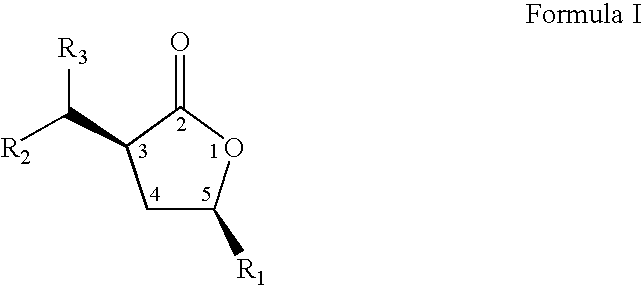
wherein R1, and the group at position 3 of the lactone ring (containing R2 and R3) have a cis orientation with respect to each other; R1 is selected from linear, branched, cyclic, bicyclic, saturated and unsaturated hydrocarbyl or substituted hydrocarbyl radicals; R2 and R3 are independently selected from hydrogen or linear, branched, cyclic, bicyclic, saturated and unsaturated hydrocarbyl or substituted hydrocarbyl radicals. The novel process is described by the sequence of steps in Scheme 1, and comprises the steps of: (a) contacting a lactone of formula 11 with an oxalic acid diester in the presence of a base and a solvent to form an intermediate mixture comprising a compound of formula III and isolating the compound of formula III from the intermediate mixture; (b) treating the isolated compound of formula III with an aldehyde or a ketone and isolating a compound of formula IV from the product mixture; and (c) hydrogenating the compound of formula IV in the presence of a catalyst and optionally a solvent and isolating a pure compound of formula I; wherein, R is a hydrocarbyl or substituted hydrocarbyl group, X+ is a cation, and wherein the pure compound is defined as greater than 95 percent pure by gas chromatographic analysis. The product of the process, formula I, is a racemic mixture of the optical isomers.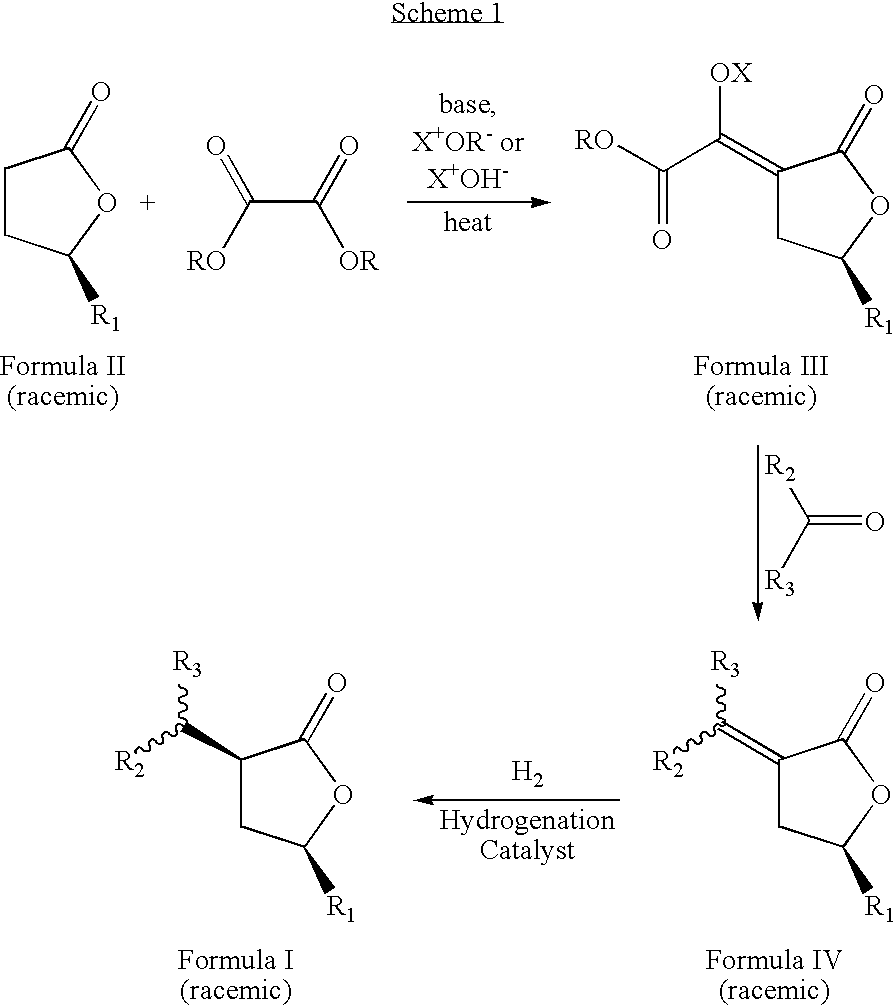
- Further, the present invention relates to novel compositions of matter represented by formula 1 wherein R1, and the group at position 3 of the lactone ring (containing R2 and R3) have a cis orientation with respect to each other; R1 comprises a group selected from the groups consisting of linear, branched, cyclic, bicyclic, saturated and unsaturated hydrocarbyl groups; R2, and R3 are independently selected from the groups consisting of hydrogen and linear, branched, cyclic, bicyclic, saturated and unsaturated hydrocarbyl groups excluding compounds wherein R2 and R3 are both H, when R1 is methyl or phenyl; and said composition contains a molar ratio of cis:trans stereoisomers greater than 49:1; and said compositions have greater than 95 percent enantiomeric purity, being the (3S,5S), (3R,5R), (3S,5R), or (3R,5S) optically pure isomers.
- Further, the novel compositions of the present invention may be prepared to greater than 95 percent purity by gas chromatographic (GC) analysis.
- Further, the present invention relates to an additional process to produce the optically pure, (3S,5S), (3R,5R), (3S,5R), or (3R,5S), cis isomer of compounds of formula I, comprising the same steps as the previously described process, with the exception that the starting compound Formula II is either the pure (R) or (S) stereoisomer.
- Further the present invention relates to methods to improve, enhance, or modify the flavor or fragrance of a product formulation; methods to improve or modify the rheology of an oil, hydrocarbon, petroleum product; methods of formulating a cosmetic product; and methods of formulating a liquid detergent or cleaning product.
-
FIG. 1 : Structure of cis-3-octyl-5-methyl-dihydro-furan-2-one as determined by X-ray crystallography analysis. - The present inventors have discovered a novel process for preparing a compound represented by formula I:
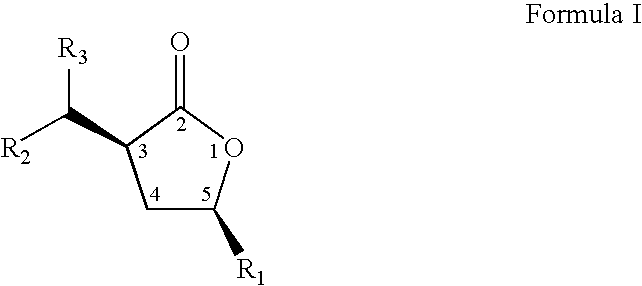
wherein R1, and the group at position 3 of the lactone ring (containing R2 and R3) have a cis orientation with respect to each other; R1 comprises a group selected from the groups consisting of linear, branched, cyclic, bicyclic, saturated and unsaturated hydrocarbyl groups; R2, and R3 are independently selected from the groups consisting of hydrogen and linear, branched, cyclic, bicyclic, saturated and unsaturated hydrocarbyl groups; and said composition contains a molar ratio of cis:trans stereoisomers greater than 49:1. The novel process is described by the sequence of steps in Scheme 1, and comprises the steps of: - (a) contacting a lactone of formula II with an oxalic acid diester in the presence of a base and a solvent to form an intermediate mixture comprising a compound of formula III and isolating the compound of formula III from the intermediate mixture;
- (b) treating the isolated compound of formula III with an aldehyde or ketone, to form a second intermediate mixture comprising a compound of formula IV and isolating the compound of formula IV from the second intermediate mixture; and
- (c) hydrogenating the compound of formula IV in the presence of a catalyst and optionally a solvent to form a product mixture comprising a compound of formula I and isolating a pure compound of formula I from the product mixture;
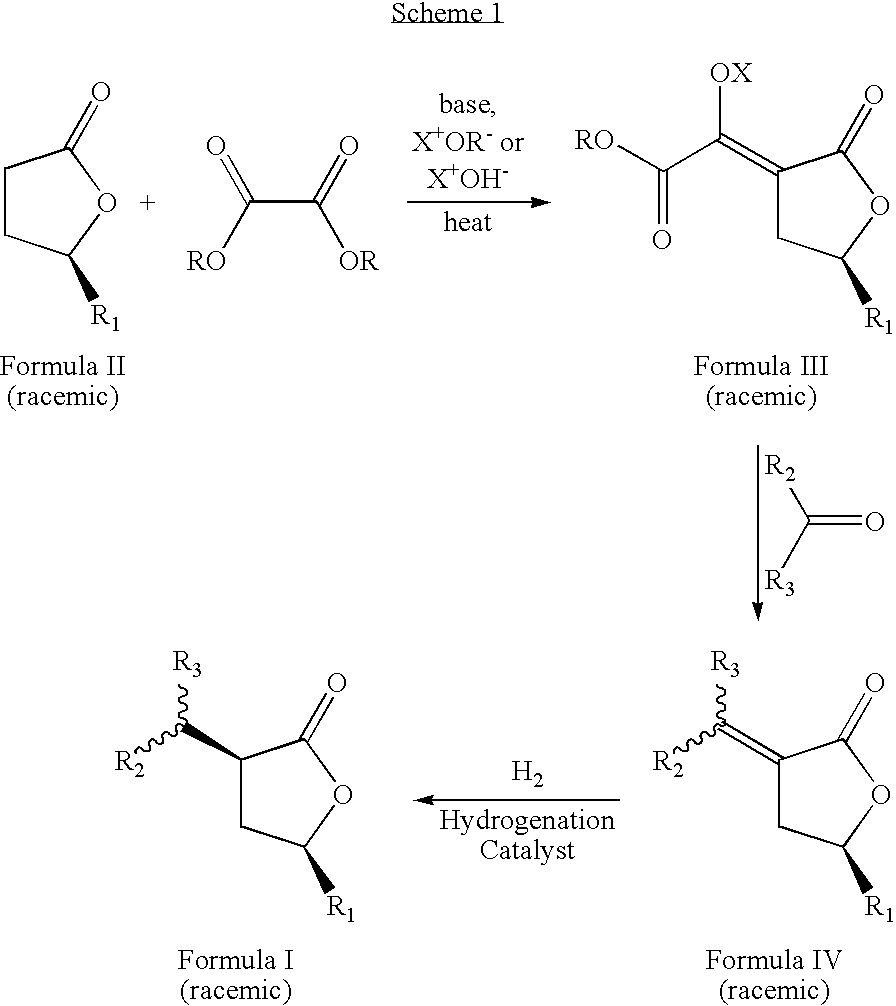
wherein, R is a hydrocarbyl or substituted hydrocarbyl group, and X+ is a cation. The product of the process, formula I, is a racemic mixture of the optical isomers. By pure compound of formula I is meant that the purity of the isolated compound is at least about 95 percent as determined by gas chromatographic analysis. - The present inventors have also discovered new compositions of matter comprising compounds represented by formula 1 wherein, R1 and the group at position 3 of the lactone ring (containing R2 and R3) have a cis orientation with respect to each other; R1 is selected from linear, branched, cyclic, bicyclic, saturated and unsaturated hydrocarbyl or substituted hydrocarbyl radicals; R2 and R3 are independently selected from hydrogen or linear, branched, cyclic, bicyclic, saturated and unsaturated hydrocarbyl radicals excluding compounds wherein R2 and R3 are both H, when R1 is methyl or phenyl; said composition contains a molar ratio of the cis to trans stereoisomers of greater than 49:1; and said composition is greater than 95 percent enantiomerically pure, being the (3S,5S), (3R,5R), (3S,5R), or (3R,5S) optically pure isomer.
- A “hydrocarbyl group” is a univalent group containing only carbon and hydrogen. If not otherwise stated, it is preferred that hydrocarbyl groups herein contain 1 to about 30 carbon atoms.
- By “substituted hydrocarbyl” herein is meant a hydrocarbyl group, which contains one or more substituent groups, which are inert under the process conditions to which the compound containing these groups is subjected. The substituent groups also do not substantially interfere with the process. If not otherwise stated, it is preferred that substituted hydrocarbyl groups herein contain 1 to about 30 carbon atoms. Included in the meaning of “substituted” are heteroaromatic rings.
- Additionally, the composition of matter comprising the compounds represented by formula I may be prepared to possess an overall purity of greater than 95 percent as determined by gas chromatographic analysis. The percent purity is calculated from the chromatogram as an area percent of the main component peak relative to the summed area for all peaks in the chromatogram.
- Additionally, the inventors have discovered a novel process to prepare the composition of formula I wherein, R1, and the group at position 3 of the lactone ring (containing R2 and R3) have a cis orientation with respect to each other; R1 is selected from linear, branched, cyclic, bicyclic, saturated and unsaturated hydrocarbyl radicals; R2 and R3 are independently selected from hydrogen or linear, branched, cyclic, bicyclic, saturated and unsaturated hydrocarbyl radicals excluding compounds wherein R2 and R3 are both H, when R1 is methyl or phenyl; and in addition, wherein said composition of formula I comprises greater than 96 percent optically purity, being the (3S,5S), (3R,5R), (3S,5R), or (3R,5S) optically pure isomers. The process is described by the sequence of steps in Scheme 2, wherein the starting gamma-methyl-gamma-butyrolactone (Formula II) is greater than 96% enantiomeric excess the (R) or (S) stereoisomer. The novel process yields a single stereoisomer with the cis orientation of R1 and the group at position 3 of the lactone ring (containing R2 and R3) rather than a mixture of two possible stereoisomers, and further affords a route to the optically pure isomer, being the (3S,5S), (3R,5R), (3S,5R), or (3R,5S) optically pure isomers that are not known.
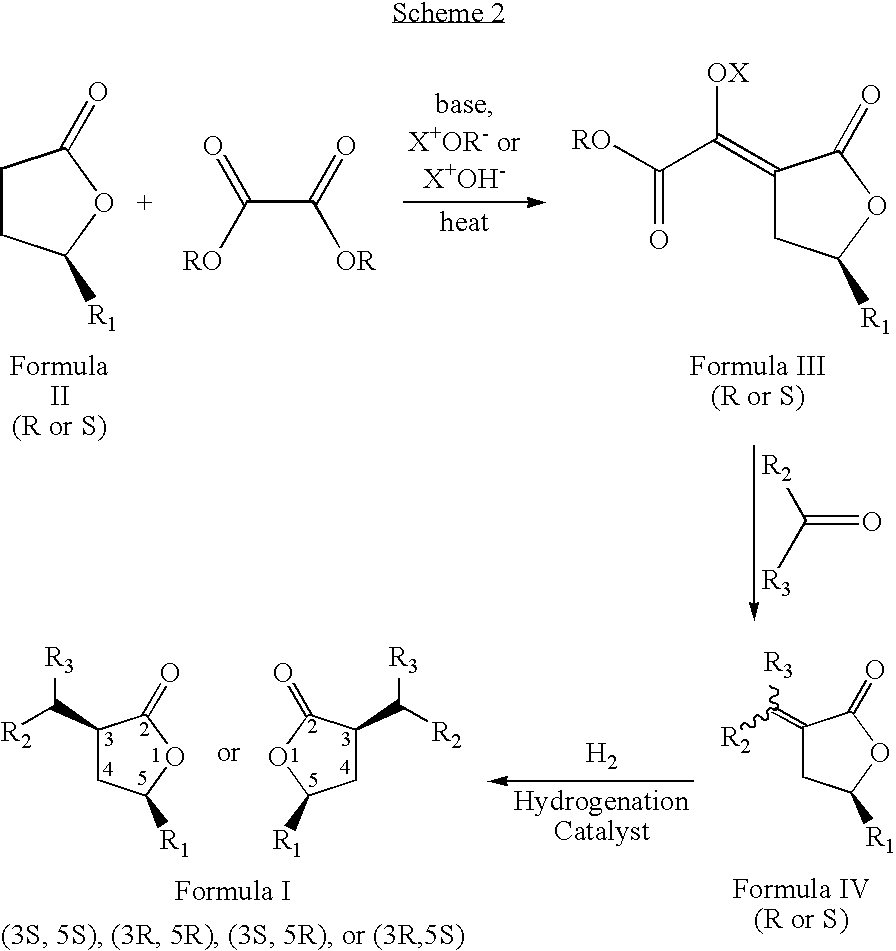
- The process for preparing the enantiomerically pure composition of formula I comprises the steps: (a) contacting an optically pure stereoisomer of a lactone of formula II with an oxalic acid diester in the presence of a base and a solvent to form an intermediate mixture comprising an optically pure compound of formula III and isolating the optically pure compound of formula III from the intermediate mixture; (b) treating the isolated optically pure compound of formula III with an aldehyde or ketone, to form a second intermediate mixture and isolating an optically pure compound of formula IV from the second intermediate mixture; and (c) hydrogenating the optically pure compound of formula IV in the presence of a catalyst and optionally a solvent to form a product mixture and isolating an enantiomerically pure compound of formula I from the product mixture.
- Lactones of formula II from Scheme 1 (racemic mixture) are commercially available from Aldrich, St. Louis, Mo. Lactones of formula II from Scheme 2, which are the pure (R) or (S) isomer may be prepared from a malonic acid diester by reaction with a base at elevated temperature to form the malonic acid diester enolate salt; and then reacting the salt with either an (R) or (S) epoxide to form the lactone. The details of the preparation are given in Hedenstroem, Erik; Hoegberg, Hans-Erik; Wassgren, Ann-Britt; Bergstroem, Gunnar; Loefqvist, Jan; Tetrahedron; 48; 1992; pp. 3139-3146.
- The two processes of the present invention may be run under the same conditions, the detailed conditions are provided below, while the starting compound is different; one starting compound being a racemic mixture and the other starting compound being a pure (R) or (S) stereoisomer.
- The first step of the processes is conducted at a temperature of at least about 25° C. and a pressure less than or equal to 2000 psi, preferably about 75° C. and about atmospheric pressure. The reaction may optionally run at higher temperatures, at about 100° C. to about 120° C. under higher pressures of about 700 psi. The reaction may optionally employ an organic solvent and use a phase transfer catalyst. The first step of the process can employ any number of solvents or combinations thereof; these include but are not limited to methanol, ethanol and isopropanol.
- The R group of the oxalic acid diester of the first step in the processes may be a hydrocarbyl or substituted hydrocarbyl group, preferably, a methyl or ethyl group.
- The base of the first step of the processes may be selected from the group consisting of metal alkoxides, metal oxides, hydroxides, carbonates and phosphates. The metal alkoxides, oxides, hydroxides, carbonates and phosphates employed herein may be used as solutions, powders, granules, or other particulate forms, or may be supported on an essentially inert support as is common in the art of catalysis. Representative bases include but are not limited to sodium methoxide, sodium ethoxide, sodium isopropoxide, sodium n-butoxide, potassium carbonate, cesium carbonate, sodium carbonate, barium carbonate, sodium hydrogen carbonate, magnesium oxide, barium oxide, barium hydroxide, lanthanum oxide, potassium hydroxide, cadmium oxide, rubidium oxide, lithium hydroxide, strontium hydroxide, sodium hydroxide, calcium hydroxide, potassium hydroxide, potassium phosphate and mixtures thereof.
- The second step of the processes of the present invention is conducted at a temperature of at least about 0° C. and a pressure less than or equal to 2000 psi, preferably about 10° C. and about atmospheric pressure. The second step of the processes can employ any number of solvents or combinations thereof, these include but are not limited to water, toluene, xylenes, hexanes, ethyl acetate, chlorobenzene, 1,2-dichlorobenzene, acetonitrile, methylene chloride, acetone, methyl ethyl ketone, dimethylacetamide, chloroform, chlorobutane, and benzene.
- The aldehyde or ketone of the second step of the novel processes may be represented by the formula R2COR3, wherein R2 and R3 are independently selected from hydrogen and linear, branched, cyclic, bicyclic, saturated and unsaturated hydrocarbyl or substituted hydrocarbyl radicals. The hydrocarbyl or substituted hydrocarbyl groups of R2 and/or R3 may contain from one to 30 carbon atoms.
- The first and second steps of the inventive processes have been disclosed previously with respect to a process to produce alpha-methylenelactones and alpha-substituted hydrocarbylidene lactones in U.S. Pat. No. 6,531,616, incorporated herein by reference.
- The third step of the processes, hydrogenation, may be conducted at a temperature of at least about 20° C. up to about 200° C. and a pressure less than or equal to 2000 psi, preferably about atmospheric pressure. The contact time for the hydrogenation step may be from about 15 minutes to about 12 hours.
- The hydrogenation catalyst of the third step of the processes can include one or more metals selected from Group 8 elements from the Periodic Table of Elements, more preferably, the group consisting of iridium, nickel, palladium, platinum, rhenium, rhodium and ruthenium. The metal catalyst can optionally be supported on a catalyst support. The metal can be deposited on the support using any method known in the art. Preferably, the catalyst has about 1% to about 10% by weight of metal present on the support.
- The catalyst support can be any solid, inert substance including, but not limited to, metal oxides such as silica, alumina, and titania, and carbons. The catalyst support can be in the form of powder, granules, pellets, or the like. The metal catalyst can also be a homogenous hydrogenation catalyst that dissolves in a solution or the substance to be hydrogenated. The homogeneous catalyst may consist of a combination of ligands and metal ions; in the case of charged species; counter ions may also be present.
- Isolation of the intermediate compounds or products of the present inventive processes may be accomplished by techniques common to the art. The isolation techniques include but are not limited to filtration, distillation (including vacuum distillation and steam distillation), melt crystallization, solvent extraction, and sublimation. When filtration is used the desired product or intermediate may be the filtrate or the solid. One can optimize the precipitation of the products or by-products with the solvent composition. Vacuum distillation is the preferred method of distillation, as it decreases the amount of by-products.
- The present invention further relates to methods to improve, enhance, or modify the flavor or fragrance of a product formulation comprising adding an effective amount of the compositions of the present invention to the product formulation.
- The compositions of the present invention may be useful in both fine and functional perfumery. Articles where the compositions are of use as a perfuming ingredient include but are not limited to perfumes and colognes, soaps, shower and bath gels, shampoos and other hair-care products, body or air deodorants, detergents or fabric softeners or other household products.
- Further, the compositions of the present invention may be useful for the flavor industry. The compositions can be used to flavor various articles including, but not limited to, foodstuffs, beverages, chewing gums, toothpaste or pharmaceutical preparations.
- The present invention further relates to methods for modifying the rheology of an oil, hydrocarbon, petroleum or petroleum product, comprising adding an effective amount of the lactone compositions of the present invention to the oil, hydrocarbon, petroleum or petroleum product.
- The present invention further relates to methods of formulating a cosmetic product comprising adding an effective amount of the lactone compositions of the present invention to the cosmetic product.
- The present invention further relates to methods of formulating a liquid detergent or cleaning product comprising adding an effective amount of the lactone compositions of the present invention to the liquid detergent or cleaning product.
- The present invention is further defined in the following Examples, in which all parts and percentages are by weight and degrees are Celsius, unless otherwise stated. It should be understood that these Examples, while indicating preferred embodiments of the invention, are given by way of illustration only. From the above discussion and these Examples, one skilled in the art can ascertain the essential characteristics of this invention, and without departing from the spirit and scope thereof, can make various changes and modifications of the invention to adapt it to various usage and conditions.
- Common reagents were purchased from Sigma-Aldrich and solvents from VWR Scientific. Nuclear magnetic resonance (NMR) spectra were recorded on a Varian VXR-500 spectrometer. For reporting NMR data, the following abbreviations are used: s=singlet, d=doublet, t=triplet, q=quartet, m=multiplet, br=broad, dd=doublet of doublets, dt=doublet of triplets, etc.). Gas chromatography (GC) was performed on a Hewlett-Packard 6890 series instrument running HP Chemstation® software and equipped with a DB-5 capillary column from J&W Scientific (Length=10 m, Inner Diameter=0.1 mm, film thickness=0.17 micrometers). High-resolution mass spectral data were obtained on a Micromass Prospec magnetic sector GC mass spectrometer using methane chemical ionization and perfluorokerosene as an internal standard.
- A 22-L flask equipped with a mechanical stirrer and nitrogen inlet was charged with diethyl oxalate (2409 g), gamma-methyl-gamma-butyrolactone (1419 g, Aldrich, St. Louis, Mo.), and methanol (3 L) and heated to 65° C. A 25 wt % solution of sodium methoxide in methanol (3.771 L) was added over 2 h. After complete addition, the slurry was held at 65° C. for one hour. After cooling to 25° C. and allowing to stand overnight, the slurry was filtered and the solid cake was washed with ethanol (Solids should precipitate on cooling slowly, but if not, seeding with approximately 50 g of product is necessary). The slurry was cooled to 10° C. The product was filtered, washed with approximately 2 L of cold methanol, and dried at 60° C. until it reached constant weight to give 2652 g (90% yield) of methyloxalyl-gamma-methyl-gamma-butyrolactone sodium salt as a white to pale yellow solid.
- A 1 L flask was charged with 25.0 g of methyloxalyl-gamma-methyl-gamma-butyrolactone sodium salt, 300 ml of denatured ethanol, and 12.6 g of distilled acetaldehyde. This mixture was stirred under a nitrogen atmosphere using a mechanical stirrer, and heated to 75° C. for 5 h. After cooling the mixture to room temperature, 200 mL of distilled water and 119 g of sodium bicarbonate were added and the mixture was stirred for 20 min. The product was extracted with methylene chloride (3×300 mL), and the extract was dried over anhydrous MgSO4. After filtration through silica gel, the methylene chloride was removed from the filtrate using a rotary evaporator. The crude product was distilled under high vacuum (10−3-10−4 torr) and a fraction boiling at 81° C. yielded 6.1 g (40% yield) of (E,Z)-3-ethylidene-5-methyl-dihydro-furan-2-one as a colorless liquid. GC Purity=99%. 1H NMR (500.9 MHz, CD2Cl2) (mixture of E and Z isomers with E/Z molar ratio=2.39): δ 6.69 (m, E isomer), 6.25 (m, Z isomer), 4.63 (m, E isomer), 4.56 (m, Z isomer), 2.99 (m), 2.66 (m), 2.46 (m, Z isomer), 2.40 (m, E isomer), 2.11 (dt, 7.4, 2.3 Hz, Z isomer), 1.83 (dt, 7.1, 2.0 Hz, E isomer), 1.38 (d, J=6.4 Hz, E isomer), 1.35 (d, J=6.2, Z isomer). 13C{1H} NMR (126.0 MHz, CD2Cl2): δ 170.80, 170.08, 138.23, 135.29, 128.38, 126.32, 74.33, 74.11, 37.19, 33.07, 22.44, 21.95, 15.74, 14.04. High resolution GC mass spectral data: Theoretical (mass+H+) for C7H10O2: 127.0759; Found: Two GC peaks observed owing to E and Z isomers: 127.0755, 127.0759.
- (E,Z)-3-propylidene-5-methyl-dihydro-furan-2-one was prepared according to the procedure in Example 1 using 7.32 g of distilled propionaldehyde in place of acetaldehyde. After distillation under high vacuum (10−3-10−4 torr), 4.76 g (28% yield) of the colorless liquid product boiling at 89° C. was obtained. GC purity=97%. 1H NMR (500.9 MHz, CD2Cl2) (mixture of E and Z isomers with E/Z ratio=1.34): δ 6.63 (tt, J=7.4, 3.0 Hz, E isomer), 6.15 (tt, J=7.9, 2.3 Hz, Z isomer), 4.62 (m, E isomer), 4.56 (m, Z isomer), 2.98 (m), 2.67 (quintuplet of t, J=7.5, 1.6 Hz, E isomer), 2.46 (m, Z isomer), 2.39 (m, E isomer), 2.18 (quintet of t, 7.4, 1.8 Hz), 1.48 (m), 1.38 (d, J=6.2 Hz, E isomer), 1.36 (d, J=6.2 Hz, E isomer), 1.07 (t, J=7.6 Hz, E isomer), 1.02 (t, J=7.6 Hz, Z isomer). 13C{1H} NMR (126.0 MHz, CD2Cl2): δ 171.10, 169.95, 145.21, 141.85, 126.76, 125.04, 74.36, 74.18, 37.21, 33.10, 23.84, 22.43, 21.96, 21.39, 13.74, 12.83. Theoretical (mass+H+) for C8H12O2: 141.0916; Found: Two GC peaks observed owing to E and Z isomers: 141.0910, 141.0911.
- (E,Z)-3-butylidenle-5-methyl-dihydro-furan-2-one was prepared according to the procedure in Example 1 using 9.10 g of distilled 1-butyraldehyde in place of acetaldehyde. After distillation under high vacuum (10−3-10−4 torr), 9.09 g (49% yield) of the colorless liquid product boiling at 84° C. was obtained. GC purity=96%. 1H NMR (500.9 MHz, CD2Cl2) (mixture of E and Z isomers with E/Z ratio=1.28): δ 6.65 (tt, J=7.7, 3.0 Hz, E isomer), 6.17 (tt, J=7.7, 2.2 Hz, Z isomer), 4.62 (m, E isomer), 4.56 (m, Z isomer), 2.99 (m), 2.64 (qt, J=7.5, 1.9 Hz, E isomer), 2.47 (m, Z isomer), 2.39 (m, E isomer), 2.15 (qt, 7.4, 1.8 Hz), 1.48 (m), 1.38 (d, J=6.3 Hz, E isomer), 1.36 (d, J=6.3 Hz, Z isomer), 0.94 (t overlapped with t, 7.5 Hz, E and Z isomers). 13C{1H} NMR (125.8 MHz, CD2Cl2): δ 171.03, 170.01, 143.72, 140.42, 127.45, 125.66, 74.37, 74.14, 37.29, 33.28, 32.51, 29.84, 22.78, 22.42, 21.96 (2C), 14.00, 13.91. Theoretical (mass+H+) for C9H14O2: 155.1072; Found: Two GC peaks observed owing to E and Z isomers: 155.1074, 155.1072.
- A 1 L flask was charged with 25.0 g methyloxalyl-gamma-methyl-gamma-butyrolactone sodium salt, 396 ml of denatured ethanol, and 10.8 g of distilled 1-valeroaldehyde. This mixture was stirred under a nitrogen atmosphere using a mechanical stirrer, and heated to 75° C. for 5 h. After cooling the mixture to room temperature, 500 ml of distilled water and 119 g of sodium bicarbonate were added and the mixture was stirred for 20 min. The product was extracted with methylene chloride (3×300 mL), and the extract was dried over anhydrous MgSO4. After filtration through silica gel, the methylene chloride was removed from the filtrate using a rotary evaporator. The crude product was distilled under high vacuum (10−3-10−4 torr) yielding 5.95 g (29% yield) of 3-pentylidene-5-methyl-dihydro-furan-2-one as a colorless liquid. GC Purity=99%. 1H NMR (500.9 MHz, CD2Cl2) (mixture of E and Z isomers with E/Z ratio=2.28): δ 6.64 (tt, J=7.6, 2.9 Hz, E isomer), 6.17 (tt, J=8.0, 2.2 Hz, Z isomer), 4.62 (m, E isomer), 4.56 (m, Z isomer), 2.99 (m), 2.66 (m), 2.46 (m, Z isomer), 2.39 (m, E isomer), 2.17 (qt, 7.4, 1.8 Hz), 1.49-1.32 (br m overlapped with d from E and Z isomers at δ 1.38 and 6 1.35, J=6.3 Hz), 0.92 (t overlapped with t at δ 0.91, 7.2 Hz, E and Z isomers). 13C{1H} NMR (126.0 MHz, CD2Cl2): δ 170.97, 169.94, 143.90, 140.58, 127.29, 125.47, 74.32, 74.09, 37.26, 33.24, 31.67, 30.73, 30.19, 27.59, 22.79, 22.74, 22.42, 21.95, 14.07, 14.01. Theoretical (mass+H+) for C10H16O2: 169.1229; Found: Two GC peaks observed owing to E and Z isomers: 169.1227, 169.1222.
- A 1 L flask was charged with 25.0 g methyloxalyl-gamma-methyl-gamma-butyrolactone sodium salt, 396 ml of denatured ethanol, and 12.6 g of distilled 1-hexanal. This mixture was stirred under a nitrogen atmosphere using a mechanical stirrer, and heated to 75° C. for 5 h. After cooling the mixture to room temperature, 500 ml of distilled water and 119 g of potassium bicarbonate were added and the mixture was stirred for 20 min. The product was extracted with methylene chloride (3×300 mL), and the extract was dried over anhydrous MgSO4. After filtration through silica gel, the methylene chloride was removed on a rotary evaporator. The crude product was distilled under high vacuum (10−3-10−4 torr). A fraction boiling at 85° C. was collected yielding 13.8 g (63% yield) of 3-hexylidene-5-methyl-dihydro-furan-2-one as a mixture of E and Z stereoisomers. GC purity=98%. 1H NMR (500.07 MHz, CD2Cl2) (mixture of E and Z isomers with E/Z ratio=1.25): E isomer: δ 6.650 (tt, J=7.6 and 3.1 Hz), 4.624(m), 2.984 (m), 2.388 (m), 2.160 (m), 1.478 (m), 1.382 (d, J=6.1 Hz), 1.314 (br m), 1.310 (br m), 0.893 (t, J=6.9 Hz); Z isomer: δ 6.166 (tt, J=7.6 and 2.1 Hz), 4.556 (m), 2.977 (m), 2.652 (m), 2.464 (m), 1.418, 1.352 (d, J=6.4 Hz), 1.310, 1.308, 0.886 (t, J=6.9 Hz). 13C{1H} NMR (125 MHz, CD2Cl2) E isomer δ14.15, 22.41, 22.86, 28.27, 30.47, 31.88, 33.22, 74.37, 127.20, 140.75, 171.09; Z isomer δ 14.18, 21.95, 22.90, 27.84, 29.19, 31.85, 37.23, 74.14, 125.38, 144.05, 170.05. Theoretical (mass+H+) for C11H18O2: 183.1385; Found: Two GC peaks observed owing to E and Z isomers: 183.1384, 183.1386.
TABLE 2 1H and 13C{1H} NMR spectroscopy resonance assignments of E and Z isomers were made by analysis of Heteronuclear Single Quantum Coherence and Heteronuclear Multiple Bond Correlation NMR spectra. Resonances are in ppm downfield from tetramethylsilane internal standard. 
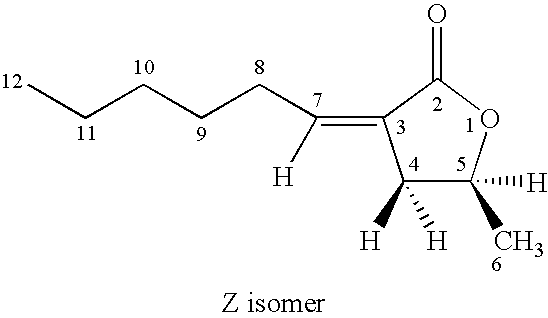
E Isomer Z Isomer Resonance Resonance Resonance Resonance Nucleus in C6D6 in CD2Cl2 in C6D6 in CD2Cl2 H4a 2.214 2.984 2.244 2.977 H4b 1.715 2.388 1.807 2.464 H5 4.002 4.624 3.954 4.556 H6 0.915 1.382 0.885 1.352 H7 6.728 6.650 5.683 6.166 H8 1.168 1.478 2.796 2.652 H9 1.753 2.160 1.325 1.418 H10 1.086 1.310 1.245 1.308 H11 1.176 1.314 1.254 1.310 H12 0.837 0.893 0.860 0.886 C2 169.916 171.094 169.009 170.048 C3 127.491 127.204 125.669 125.384 C4 32.594 33.220 36.654 37.234 C5 73.016 74.369 72.882 74.137 C6 22.014 22.413 21.569 21.951 C7 139.286 140.749 142.702 144.053 C8 28.059 28.267 27.652 27.840 C9 30.076 30.467 29.196 29.186 C10 31.672 31.883 31.719 31.848 C11 22.755 22.864 22.839 22.901 C12 14.128 14.150 14.206 14.182 - (E,Z)-3-Heptylidene-5-methyl-dihydro-furan-2-one was prepared according to the procedure in Example 5 using 14.4 g of distilled 1-heptanal in place of 1-hexanal. After distillation under high vacuum, 3.52 g (15% yield) of the colorless liquid product was obtained. GC purity=99%. 1H NMR (499.9 MHz, CD2Cl2) (mixture of E and Z isomers with E/Z ratio=2.80): δ 6.65 (tt, J=7.7, 2.9 Hz, E isomer), 6.17 (tt, J=7.8, 2.3 Hz, Z isomer), 4.62 (m, E isomer), 4.55 (m, Z isomer), 3.00 (m), 2.97 (m), 2.66 (ddt, J=15.1, 7.4, 1.9 Hz), 2.46 (m, Z isomer), 2.39 (m, E isomer), 2.16 (qt, 7.6, 1.6 Hz), 1.51-1.27 (br m overlapped with d from E and Z isomers at 6 1.38 and δ 1.35, J=6.3 Hz), 0.89 (t overlapped with t, 6.9 Hz, E and Z isomers). 13C{1H} NMR (125.7 MHz, CD2Cl2): δ 170.99, 169.92, 143.95, 140.66, 127.25, 125.44, 74.32, 74.09, 37.28, 33.27, 32.06, 32.04, 30.50, 29.50, 29.40, 29.33, 28.59, 27.92, 22.96 (2C), 22.41, 21.96, 14.23 (2C). Theoretical (mass+H+) for C12H20O2: 197.1542; Found: Two GC peaks observed owing to E and Z isomers: 197.1538, 197.1544.
- (E,Z)-3-octylidene-5-methyl-dihydro-furan-2-one was prepared according to the procedure in Example 1 using 19.4 g of methyloxalyl-gamma-methyl-gamma-butyrolactone sodium salt, 305 ml of denatured ethanol, and 12.0 g of distilled 1-octyl aldehyde in place of acetaldehyde. After distillation under high vacuum, a fraction boiling at 110° C. yielded 9.75 g (50% yield) of the colorless liquid. GC purity=99%. 1H NMR (500.3 MHz, CD2Cl2) (mixture of E and Z isomers with E/Z ratio=1.88): δ 6.64 (tt, J=7.6, 2.8 Hz, E isomer), 6.16 (tt, 0.29 H, J=7.7, 2.3 Hz, Z isomer), 4.62 (m, E isomer), 4.55 (m, Z isomer), 2.98 (m), 2.66 (m, Z isomer), 2.46 (m, Z isomer), 2.39 (m, E isomer), 2.16 (qt, 7.4, 1.8 Hz, E isomer), 1.51-1.25 (br m overlapped with d from E and Z isomers at δ 1.38 and δ 1.35, J=6.3 Hz), 0.88 (t overlapped with t, 7.1 Hz, E and Z isomers). 13C{1H} NMR (125.8 MHz, CD2Cl2): δ 170.95, 169.91, 143.95, 140.63, 127.19, 125.38, 74.27, 74.05, 37.24, 33.22, 32.19, 32.15, 30.47(2), 29.66, 29.61, 29.50, 29.45, 28.58, 27.87, 23.00 (2C), 22.38, 21.92 (2C). Theoretical (mass+H+) for C13H22O2: 211.1698; Found: Two GC peaks observed owing to E and Z isomers: 211.1700, 211.1693.
- (E,Z)-3-nonylidene-5-methyl-dihydro-furan-2-one was prepared according the procedure in Example 4 using 17.0 g of 1-nonyl aldehyde in place of 1-valeroaldehyde. After distillation under high vacuum, a fraction boiling at 115° C. yielded 14.5 g (54% yield) of the colorless liquid. GC purity=98%. 1H NMR (499.9 MHz, CD2Cl2) (mixture of E and Z isomers with E/Z ratio=1.69): δ 6.65 (m, E isomer), 6.16 (m, Z isomer), 4.62 (m, E isomer), 4.55 (m, Z isomer), 2.98 (m), 2.66 (m, Z isomer), 2.46 (m, Z isomer), 2.39 (m, E isomer), 2.16 (qt, 7.4, 1.7 Hz, E isomer), 1.59-1.24 (br m overlapped with d from E and Z isomers at δ 1.38 and δ 1.35, J=6.2 Hz), 0.88 (br triplet, J=7.1 Hz, E and Z isomers). 13C{1H} NMR (125.7 MHz, CD2Cl2): δ 171.0, 170.0, 144.0, 140.7, 127.2, 125.4, 74.3, 74.1, 44.3, 37.3, 33.3, 32.3, 30.5, 29.8, 29.8, 29.7, 29.7, 29.7, 29.6, 29.5, 28.6, 27.9, 23.1, 22.5, 22.4, 21.9, 14.2 (2C). Theoretical (mass+H+) for C14H24O2: 225.1855; Found: Two GC peaks observed owing to E and Z isomers: 225.1859, 225.1845.
- (E,Z)-3-decylidene-5-methyl-dihydro-furan-2-one was prepared according to the procedure in Example 1 using 12.5 g of ethyloxalyl-gamma-methyl-gamma-butyrolactone sodium salt, 200 ml of denatured ethanol, and 9.35 g of distilled 1-decyl aldehyde in place of 1-acetaldehyde. After distillation under high vacuum, a fraction boiling at 118° C. yielded 8.74 g (61% yield) of the colorless liquid. GC purity=98%. 1H NMR (499.9 MHz, CD2Cl2) (mixture of E and Z isomers with E/Z ratio=1.53): δ 6.65 (m, E isomer), 6.16 (m, Z isomer), 4.62 (m, E isomer), 4.55 (m, Z isomer), 2.98 (m), 2.66 (m, Z isomer), 2.46 (m, Z isomer), 2.39 (m, E isomer), 2.16 (qt, 7.3, 1.6 Hz, E isomer), 1.59-1.23 (br m overlapped with d from E and Z isomers at δ 1.38 and δ 1.35, J=6.3 Hz), 0.88 (br triplet, J=7.1 Hz, E and Z isomers). 13C{1H} NMR (125.7 MHz, CD2Cl2): δ 171.03, 169.98, 144.05, 140.74, 127.22, 125.41, 74.33, 74.11, 37.30, 33.29, 32.34, 32.31, 30.53, 29.98, 29.94, 29.90, 29.84, 29.75 (2C), 29.71 (2C), 29.57, 28.62, 27.94, 23.10 (2C), 22.43, 21.97, 14.28 (2C). Theoretical (mass+H+) for C15H26O2: 239.201 1; Found: Two GC peaks observed owing to E and Z isomers: 239.2022, 239.2003.
- (E,Z)-3-(3,5,5-trimethylhexylidene)-5-methyl-dihydrofuran-2-one was prepared according the procedure in Example 4 using 17.0 g of 3,3,5-trimethyl-1-hexanal in place of 1-valeroaldehyde. After distillation under high vacuum, a fraction boiling at 113° C. yielded 11.5 g (43% yield) of the colorless liquid. GC purity=97%. 1H NMR (500.9 MHz, CD2Cl2) (mixture of E and Z isomers with E/Z ratio=1.68): δ 6.67 (tt, J=7.7, 2.9 Hz, E isomer), 6.18 (m, Z isomer), 4.62 (m, E isomer), 4.56 (m, Z isomer), 2.99 (m), 2.60 (m), 2.48 (m, Z isomer), 2.38 (m, E isomer), 2.17 (m), 2.03 (m), 1.76 (m, E isomer), 1.66 (m, Z isomer), 1.38 (dd, J=6.3, 0.8 Hz, E isomer), 1.36 (dd, J=6.3, 1.4 Hz, Z isomer), 1.27 (m), 1.11 (m), 0.96 (br m), 0.90 (br m). 13C{1H} NMR (126.0 MHz, CD2Cl2): δ 170.85 (2C), 169.95 (2C), 142.95 (2C), 139.61 (2C), 128.02 (2C), 126.19, 126.18, 74.27 (2C), 74.03, 74.01, 51.07, 51.04, 50.89, 50.87, 40.07 (2C), 37.37, 37.35, 37.00, 36.98, 33.50 (2C), 31.33 (2C), 30.13 (8C), 30.11(8C), 29.77 (2C), 22.77, 22.75, 22.71, 22.68, 22.42 (2C), 21.97(2C). Theoretical (mass+H+) for C14H24O2: 225.1855; Found: (two GC peaks observed owing to E and Z isomers) 225.1851, 225.1850.
- In a nitrogen-filled glove box, a 100 mL round bottomed flask equipped with a Teflon®-coated magnetic stirring bar was charged with 2.0 g of (E,Z)-3-ethylidene-5-methyl-dihydro-furan-2-one (prepared as in Example 1), 0.210 g of 10% Palladium on Carbon catalyst (Aldrich Chemical Company), 40.0 mL of denatured ethanol, and 10 ml of methanol. This was placed on a high vacuum line and degassed. It was then stirred overnight under one atmosphere of dihydrogen gas. he catalyst was then removed by filtration and the solvent was removed on a rotary evaporator Analysis of the crude product by GC indicated a >99% conversion and >97% yield to the desired product. The crude product was placed in an oil sublimer and was sublimed on a high vacuum line (10−3-10−4 torr) using a heated oil bath to yield 1.12 g of product (55% yield; some loss of crude product was observed owing to incomplete transfer of liquid from vessel to vessel and losses owing to holdup on the condenser and glass wall of the oil sublimer). GC purity=97%. 1H NMR (500.9 MHz, CD2Cl2): δ 4.46 (m, 1 H), 2.54 (m, 1 H), 2.45 (m, 1 H), 1.87 (m, 1 H), 1.52-1.37 (m overlapped with d at δ 1.38, 5 H), 0.97 (t, 3 H, J=7.6 Hz). 13C{1H} NMR (126.0 MHz, CD2Cl2): δ 178.98, 75.38, 43.25, 36.76, 23.78, 21.17, 11.81. Theoretical (mass+H+) for C7H12O2: 129.0916; Found: 129.0915.
- The compound cis-3-propyl-5-methyl-dihydro-furan-2-one was prepared by the procedure of Example 11 using 2.0 g of (E,Z)-3-propylidene-5-methyl-dihydro-furan-2-one (prepared by the procedure of Example 2) yielding crude product that by GC analysis indicated a >99% conversion and >97% yield to the desired product. After oil sublimation, 1.05 g of a colorless liquid was obtained (52% yield; some loss of crude product was observed owing to incomplete transfer of liquid from vessel to vessel and losses owing to holdup on the condenser and glass wall of the oil sublimer). GC purity=99%. 1H NMR (500.9 MHz, CD2Cl2): δ 4.44 (m, 1 H), 2.58 (m, 1 H), 2.46 (m, 1 H), 1.83 (m, 1 H), 1.48-1.33 (m overlapped with d at δ1.38 J=6.0 Hz, 7 H), 0.94 (t, 3 H, J=7.4 Hz). 13C{1H} NMR (126.0 MHz, CD2Cl2): δ 179.21, 75.43, 41.65, 37.40, 32.93, 21.17, 21.00, 14.03. Theoretical (mass+H+) for C8H14O2: 143.1072; Found: 143.1065.
- The compound cis-3-butyl-5-methyl-dihydro-furan-2-one was prepared by the procedure of Example 11 using 2.0 g of (E,Z)-3-butylidene-5-methyl-dihydro-furan-2-one (prepared by the procedure of Example 3) yielding crude product that by GC analysis indicated a >99% conversion and >97% yield to the desired product. After oil sublimation, 1.04 g of a colorless liquid was obtained (51% yield; some loss of crude product was observed owing to incomplete transfer of liquid from vessel to vessel and losses owing to holdup on the condenser and glass wall of the oil sublimer). GC purity=95%. 1H NMR (500.9 MHz, CD2Cl2): δ 4.44 (m, 1 H), 2.56 (m, 1 H), 2.46 (m, 1 H), 1.86 (m, 1 H), 1.48-1.31 (m overlapped with d at δ 1.38 J=6.1 Hz, 9 H), 0.91 (t, 3 H, J=7.3 Hz). 13C{1H} NMR (126.0 MHz, CD2Cl2): δ 179.21, 75.43, 41.87, 37.42, 30.49, 29.98, 22.93, 21.18, 14.11. Theoretical (mass+H+) for C9H16O2: 157.1229; Found: 157.1225.
- The compound cis-3-pentyl-5-methyl-dihydro-furan-2-one was prepared by the procedure of Example 11 using 2.0 g of (E,Z)-3-pentylidene-5-methyl-dihydro-furan-2-one (prepared by the procedure of Example 4) yielding crude product that by GC analysis indicated a >99% conversion and >97% yield to the desired product. After oil sublimation, 1.49 g of a colorless liquid was obtained (74% yield; some loss of crude product was observed owing to incomplete transfer of liquid from vessel to vessel and losses owing to holdup on the condenser and glass wall of the oil sublimer). GC purity=95%. 1H NMR (500.9 MHz, CD2Cl2): δ 4.44 (m, 1 H), 2.57 (m, 1 H), 2.46 (m, 1 H), 1.86 (m, 1 H), 1.48-1.31 (m overlapped with d at δ1.38, 11 H), 0.90 (t, 3 H, J=6.7 Hz). 13C{1H} NMR (126.0 MHz, CD2Cl2): δ 179.19, 75.41, 41.87, 37.39, 31.99, 30.73, 27.44, 22.89, 21.15, 14.16. Theoretical (mass+H+) for C10H18O2: 171.1385; Found: 171.1384.
- In a nitrogen-filled glove box, a 100 mL flask was charged with 2.00 g of 3-hexylidene-5-methyl-dihydro-furan-2-one (mixture of E and Z stereoisomers), 0.210 g of 10% palladium on carbon catalyst (Aldrich Chemical Company), 40 mL of denatured ethanol, and 10 mL of methanol. The flask was attached to a high vacuum line via an adapter, and the apparatus was degassed. An atmosphere of dihydrogen gas was admitted to the flask, and gas uptake was monitored using a mercury manometer connected to the vacuum line. After 12 hours, the hydrogen gas and solvents were removed in vacuo. The solution containing the product was filtered from the catalyst, and solvents were removed in vacuo yielding crude product that by GC analysis indicated a >99% conversion and >97% yield to the desired product. The crude product was purified using an oil sublimation apparatus under high vacuum with heating. The product was obtained as a liquid which solidifies upon standing (melting point=28.5° C.). GC purity=97%. Yield: 1.50 g (74% yield; some loss of crude product was observed owing to incomplete transfer of liquid from vessel to vessel and losses owing to holdup on the condenser and glass wall of the oil sublimer). 1H NMR (500.07 MHz, CD2Cl2): δ 4.40 (m, 1 H), 2.57 (m, 1 H), 2.46 (m 1 H), 1.85 (br m, 1 H), 1.45 (m, 1 H), 1.385 (d, J=6.1 Hz, 3 H), 1.40-1.25 (br m, 9 H), 0.89 (t, J=7.1 Hz, 3 H). 13C{1H} NMR (125.7 MHz, CD2Cl2): δ 179.50, 75.73, 42.20, 37.76, 32.43, 31.15, 29.83, 28.09, 23.35, 21.51, 14.57. Theoretical (mass+H+) for C11H20O2: 185.1542; Found: 185.1546.
TABLE 3 1H and 13C chemical shift assignments for cis-3-hexyl-5-methyl- dihydro-furan-2-one in C6D6 were obtained by analysis of Heteronuclear Single Quantum Coherence and Heteronuclear Multiple Bond Correlation NMR spectra. 
1H Labels 1H Numbers 1H Shifts 13C Numbers 13C Shifts B H3 2.024 C2 177.307 D1 H4a 1.615 C3 41.103 D2 H4b 0.852 C4 36.638 A H5 3.788 C5 73.744 C H6 0.977 C6 20.511 E1 H7a 1.835 C7 30.376 E2 H7b 1.186 C8 27.304 F H8 1.150 C9 29.112 G H9 1.161 C10 31.705 H H10 1.186 C11 22.670 I H11 1.258 C12 13.979 J H12 0.898 - The cis stereochemistry for the methyl and hexyl groups on the lactone ring for the compound prepared in this example was established by NMR Nuclear Overhauser Effects spectroscopy studying cross relaxation rates and signal enhancement owing to magnetization transfer upon selective inversion of single resonances observed by NMR spectroscopy. This allowed calculation of distances between proton sites and comparison to distances expected from ab initio molecular calculations for both the cis and trans isomers. The data shown in Table 3 established that the methyl and hexyl groups were in a cis configuration on the lactone ring for this composition
TABLE 4 Comparison of selected inter-proton distances in cis- and trans-3-hexyl-5-methyl-dihydro-furan-2-one with distances derived from cross-relaxation rates from NOE NMR experiments. Units are in Angstroms (10−8 cm). The NOE distances are based on a calculated D1-D2 distance of 1.79 Å. d(A-B) d(A-C) d(A-D1) d(A-D2) Ab initio trans 3.94 2.71 2.82 2.46 Ab initio cis 2.87 2.71 2.44 3.08 NOE 2.64 2.67 2.30 2.83 - The compound cis-3-heptyl-5-methyl-dihydro-furan-2-one was prepared by the procedure of Example 11 using 1.9 g of (E,Z)-3-heptylidene-5-methyl-dihydro-furan-2-one (prepared by the procedure of Example 6). The crude product was isolated by sublimation yielding crude product that by GC analysis indicated a >99% conversion and >97% yield to the desired product. After sublimation, 0.399 g of a colorless solid was obtained (21% yield; some loss of crude product was observed owing to incomplete transfer of material from vessel to vessel). GC purity=99.7%. 1H NMR (499.9 MHz, CD2Cl2): δ 4.44 (m, 1 H), 2.57 (m, 1 H), 2.45 (m, 1 H), 1.86 (m, 1 H), 1.48-1.29 (m overlapped with d at δ 1.38, 15 H), 0.89 (t, 3 H, J=6.8 Hz). 13C{1H} NMR (125.7 MHz, CD2Cl2): δ 179.20, 75.41, 41.90, 37.43, 32.24, 30.82, 29.79, 29.55, 27.80, 23.06, 21.18, 14.26. Theoretical (mass+H+) for C12H22O2: 199.1698; Found: 199.1691.
- The compound cis-3-octyl-5-methyl-dihydro-furan-2-one was prepared by the procedure of Example 11 using 2.0 g of (E,Z)-3-octylidene-5-methyl-dihydro-furan-2-one (prepared by the procedure of Example 7). The crude product was obtained with 99% conversion and in 97% yield. The product was isolated by sublimation yielding 1.55 g of a colorless solid (77% yield; some loss of crude product was observed owing to incomplete transfer of material from vessel to vessel). GC purity=99%. 1H NMR (500.3 MHz, CD2Cl2): δ 4.43 (m, 1 H), 2.57 (m, 1 H), 2.45 (m, 1 H), 1.85 (m, 1 H), 1.48-1.28 (m overlapped with d at δ 1.38, 17 H), 0.88 (t, 3 H, J=7.0 Hz). 13C{1H} NMR (125.8 MHz, CD2Cl2): δ 179.16, 75.37, 41.85, 37.37, 32.25, 30.77, 29.79 (2 C), 29.63, 27.76, 23.05, 21.13, 14.24. Theoretical (mass+H+) for C13H24O2: 213.1855; Found: 213.1858.
-
- CRYSTAL DATA: C13H24O2, from sublimation, colorless, irregular plate, ˜0.150×0.150×0.020 mm, monoclinic, P21/c, a=28.29(2) Å, b=4.708(4) Å, c=9.812(8) Å, beta=98.948(19)°, Vol=1290.9(18) Å3, Z=4, T=−100° C., Formula weight=212.32, Density=1.092g/cm3, μ(Mo)=0.07mm−1.
- DATA COLLECTION: Bruker SMART 1K CCD system, MoKalpha radiation, standard focus tube, anode power=45 kV×40 mA, crystal to plate distance=4.9 mm, 512×512 pixels/frame, hemisphere data acquisition, total scans=4, total frames=1330, oscillation/frame=−0.30°, exposure/frame=30.0 sec/frame, maximum detector swing angle=−28.0°, beam center=(255.25,253.13), in plane spot width=0.00, omega half width=0.00, SAINT integration, hkl min/max=(−37, 32, −6, 6, −12, 11), data input to shelx=7790, unique data=3041, two-theta range=4.38 to 56.44°, completeness to two-theta 56.44=95.30%, R(int-xl)=0.1685, SADABS correction applied.
- SOLUTION AND REFINEMENT: Structure was solved using XS(Shelxtl), refined using shelxtl software package, refinement by full-matrix least squares on F2, scattering factors from International. Tables, Vol C Tables 4.2.6.8 and 6.1.1.4, number of data=3041, number of restraints=0, number of parameters=139, data/parameter ratio=21.88, goodness-of-fit on F2=1.06, R indices[I>4sigma(I)]R1=0.1107, wR2=0.2483, R indices(all data) R1=0.3035, wR2=0.3184, max difference peak and hole=0.410 and −0.323 e/Å3, All of the hydrogen atoms have been idealized using a riding model. The rotation of the methyl groups are refined. ORTEP diagram is shown in
FIG. 1 . -
FIG. 1 describes the structure of cis-3-octyl-5-methyl-dihydro-furan-2-one as determined by X-ray crystallography analysis. Structure demonstrates the cis orientation of the octyl and methyl groups on the lactone ring. The asymmetric unit contains one molecule as shown with thermal ellipsoids drawn to the 50% probability level. - The compound cis-3-(3,5,5-trimethylhexyl)-5-methyl-dihydro-furan-2-one was prepared by the procedure of Example 11 using 2.0 g of (E,Z)-3-(3,5,5-trimethylhexylidene)-5-methyl-dihydrofuran-2-one (prepared by the procedure of Example 10) yielding crude product that by GC analysis indicated a >99% conversion and >97% yield to the desired product. After oil sublimation,1.12 g of a colorless liquid was obtained (53% yield; some loss of crude product was observed owing to incomplete transfer of liquid from vessel to vessel and losses owing to holdup on the condenser and glass wall of the oil sublimer). GC purity=97%. 1H NMR (499.9 MHz, CD2Cl2): δ 4.43 (m, 1 H), 2.54 (m, 1 H), 2.45 (m, 1 H), 1.88 (m, 1 H), 1.56-1.02 (m overlapped with d at δ1.38, 11H), 0.94-0.87 (m overlapped with overlapping d at δ 0.94 and δ 0.93, 12 H, J=5.5 Hz). 13C{1H} NMR (125.7 MHz, CD2Cl2): δ 179.11, 179.06, 75.39, 75.37, 51.58, 51.36, 42.16, 42.01, 37.53, 37.45 (3C), 31.31 (2C), 30.16 (6C), 29.72, 29.51, 28.48 (2C), 22.80, 22.56, 21.16 (2C). Theoretical (mass+H+) for C14H26O2: 227.201 1; Found: 227.2018.
- A flask was charged with 14.5 g of oxalyl methyloxalyl-gamma-methyl-gamma-butyrolactone sodium salt, 175 ml of ethanol, and 7.82 g of cyclohexylcarboxaldehyde (Aldrich Chemical Co., distilled). This was stirred with a mechanical stirrer, under nitrogen, at 75° C. for 36 h. It was then allowed to cool to room temperature. To this was added 69.0 g of sodium bicarbonate and 100.0 ml of water. After stirring for 20 min, it was then extracted with methylene chloride (3×200 mL) and dried over magnesium sulfate. It was then filtered through silica gel and solvent was removed on a rotary evaporator to yield 9.6 g of crude product. The crude product was distilled under high vacuum (10−3-10−4 torr) and a fraction boiling at 108° C. yielded 1.27 g of (E,Z)-3-cyclohexylmethylidene-5-methyl-dihydrofuran-2-one as a colorless liquid (9% yield). GC Purity=97%. 1H NMR (500 MHz, CD2Cl2) (mixture of E and Z isomers with E/Z ratio=1.0): δ 6.50 (tt, J=9.8, 2.8 Hz, E isomer), 5.97 (tt, J=9.8, 2.3 Hz, Z isomer), 4.61 (m), 4.55 (m), 3.38 (m), 2.98 (m), 2.43 (m), 2.18 (m), 1.79-1.62 (br m), 1.42-1.02 (br m, overlapped with two d at δ1.38, J=6.6 Hz and at δ1.35, J=6.0 Hz. 13C{1H} NMR (126 MHz, CD2Cl2): δ171.40, 169.78, 148.95, 145.25, 125.43, 123.75, 74.33, 74.11, 39.79, 37.27, 36.21, 33.09, 32.95, 32.82, 31.95, 31.86, 26.33, 26.21, 25.91 (4C), 22.39, 21.94. High resolution GC mass spectral data: Theoretical (mass+H+) for C12H18O2: 195.1385; Found: 195.1367.
- In a nitrogen-filled glove box, a 100 mL round bottomed flask equipped with a Teflon®-coated magnetic stirring bar was charged with 1.041 g of (E1Z)-3-cyclohexylmethylidene-5-methyl-dihydro-furan-2-one (prepared as in Example 19), 0.105 g of 10% palladium on carbon catalyst (Aldrich Chemical Company), 20.0 mL of denatured ethanol, and 5 ml of methanol. This was placed on a high vacuum line and degassed. It was then stirred overnight under one atmosphere of dihydrogen gas. The catalyst was then removed by filtration and the solvent was removed on a rotary evaporator. Analysis of the crude product indicated >99% conversion and 97% yield. The crude product was placed in a sublimer and was sublimed on a high vacuum line (10−3-10−4 torr) using a heated oil bath to yield 0.509 g of product as a white solid (47% yield; some loss of crude product was observed owing to incomplete transfer of material from vessel to vessel). Melting point=60-62° C. GC purity=98%. 1H NMR (500.9 MHz, CD2Cl2): δ 4.43 (m, 1 H), 2.65 (m, 1 H), 2.47 (m, 1 H), 1.79-1.58 (m, 6 H), 1.46-1.12 (m overlapped with d at δ1.38 J=6.5 Hz, 9 H), 0.99 (m, 1 H), 0.89 (m, 1 H). 13C{1H} NMR (126.0 MHz, CD2Cl2): δ 171.40, 169.78, 148.95, 145.25, 125.43, 123.75, 74.33, 74.11, 39.79, 37.27, 36.21, 33.09, 32.95, 32.82, 31.95, 31.86, 26.33, 26.21, 25.91 (4C), 22.39, 21.94. Theoretical (mass+H+) for C12H20O2: 197.1542; Found: 197.1545.
- The compound (5S)-5-methyl-dihydro-furan-2-one is prepared by the procedure reported in the literature: Hedenstroem, Erik; Hoegberg, Hans-Erik; Wassgren, Ann-Britt; Bergstroem, Gunnar; Loefqvist, Jan; Tetrahedron; 48; 1992; pp. 3139-3146. The (5S)-3-methyloxalyl-5-methyl-dihydro-2-furanone sodium salt is prepared from this compound according to Procedure 1 using (5S)-5-methyl-dihydro-furan-2-one in place of gamma-methyl-gamma-butyrolactone. The (5S)-cis-3-hexylidene-5-methyl-dihydro-furan-2-one is prepared from this salt according to the procedure of Example 5 using this salt in place of methyloxalyl-gamma-methyl-gamma-butyrolactone sodium salt.
- The compound (3R,5S)-cis-3-hexyl-5-methyl-dihydro-furan-2-one is prepared from (5S)-cis-3-hexylidene-5-methyl-dihydro-furan-2-one (Example 21) by hydrogenation according to the procedure of Example 15.
- The compound (5R)-5-methyl-dihydro-furan-2-one is prepared by the procedure reported in the literature using (R)-propylene oxide: Hedenstroem, Erik; Hoegberg, Hans-Erik; Wassgren, Ann-Britt; Bergstroem, Gunnar; Loefqvist, Jan; Tetrahedron; 48; 1992; pp. 3139-3146. The (5R)-3-methyloxalyl-5methyl-dihydro-2-furanone sodium salt is prepared from this compound according to Procedure 1 using (5R)-5-methyl-dihydro-furan-2-one in place of gamma-methyl-gamma-butyrolactone. The (5R)-cis-3-hexylidene-5-methyl-dihydro-furan-2-one is prepared from this salt according to the procedure of Example 5 using this salt in place of methyloxalyl-gamma-methyl-gamma-butyrolactone sodium salt.
- The compound (3S,5R)-cis-3-hexyl-5-methyl-dihydro-furan-2-one is prepared from (5R)-cis-3-hexylidene-5-methyl-dihydro-furan-2-one (Example 23) by hydrogenation according to the procedure of Example 15.
Claims (9)
1. A process for preparing a compound represented by formula I:

wherein, the group at position 3 of the lactone ring (containing R2 and R3), and R1 have a cis orientation with respect to each other; R1 comprises a group selected from the groups consisting of linear, branched, cyclic, bicyclic, saturated and unsaturated hydrocarbyl groups; R2, and R3 are independently selected from the groups consisting of hydrogen and linear, branched, cyclic, bicyclic, saturated and unsaturated hydrocarbyl groups; and said composition contains a molar ratio of cis:trans stereoisomers greater than 49:1; said process comprising the steps:
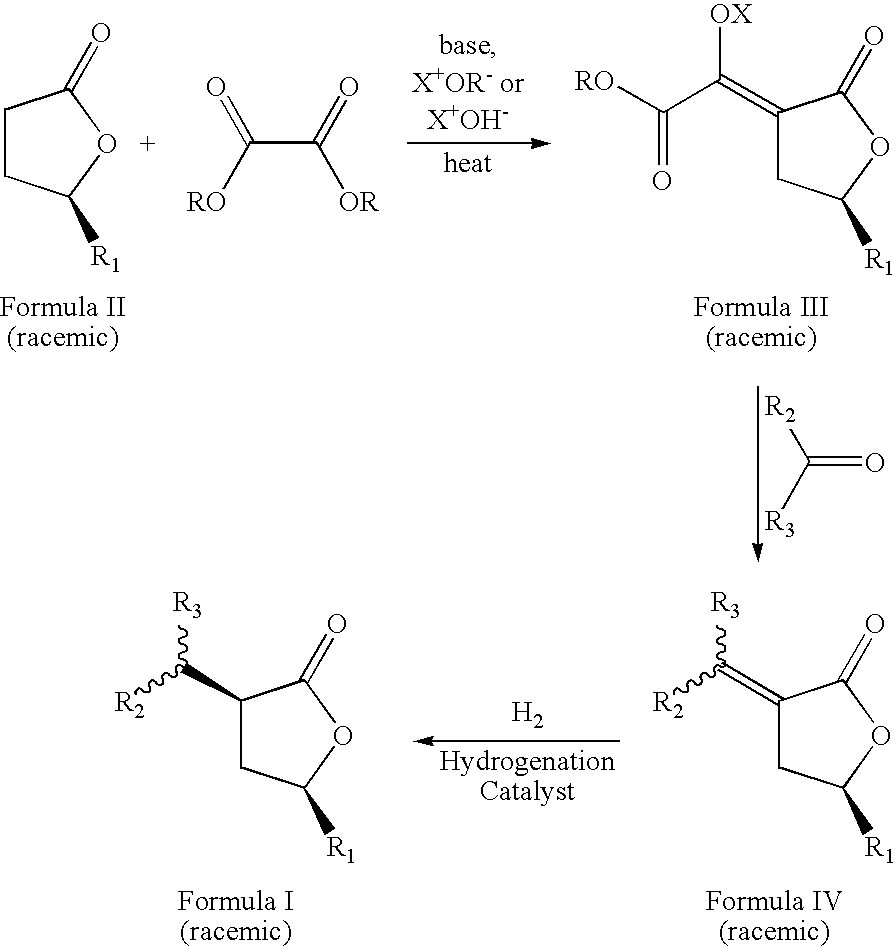
(a) contacting a lactone of formula II with an oxalic acid diester in the presence of a base and a solvent to form an intermediate mixture comprising a compound of formula III and isolating the compound of formula III from the intermediate mixture;
(b) treating the isolated compound of formula III with an aldehyde or ketone, to form a second intermediate mixture comprising a compound of formula IV and isolating the compound of formula IV from the second intermediate mixture; and
(c) hydrogenating the compound of formula IV in the presence of a catalyst and optionally a solvent to form a product mixture comprising a compound of formula I and isolating a pure compound of formula I from the product mixture;
wherein, R is a hydrocarbyl or substituted hydrocarbyl group, and X+ is a cation.
2. The process of claim 1 wherein the purity of the isolated compound of formula I is at least about 95 percent by gas chromatographic analysis.
3. A composition of matter comprising a compound of formula l:
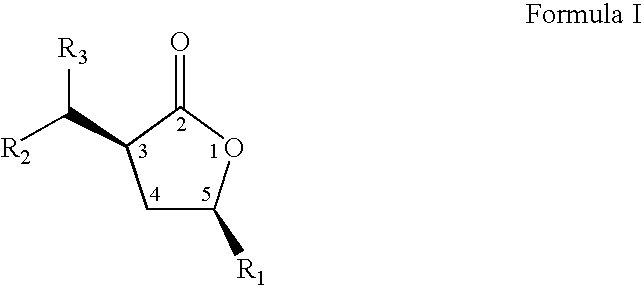
wherein, the group at position 3 of the lactone ring (containing R2 and R3), and R1 have a cis orientation with respect to each other; R1 comprises a group selected from the groups consisting of linear, branched, cyclic, bicyclic, saturated and unsaturated hydrocarbyl groups; R2, and R3 are independently selected from the groups consisting of hydrogen and linear, branched, cyclic, bicyclic, saturated and unsaturated hydrocarbyl groups excluding the compound wherein R2 and R3 are both H, when R1 is methyl or phenyl; said composition contains a molar ratio of cis:trans stereoisomers greater than 49:1; and said composition is greater than 95 percent enantiomerically pure cis, being the (3S,5S), (3R,5R), (3S,5R), or (3R,5S) optically pure isomer.
4. The composition of matter of claim 3 , wherein the overall purity by gas chromatographic analysis is at least about 95 percent.
5. A process for preparing the enantiomerically pure composition of claim 3 or 4 comprising the steps:
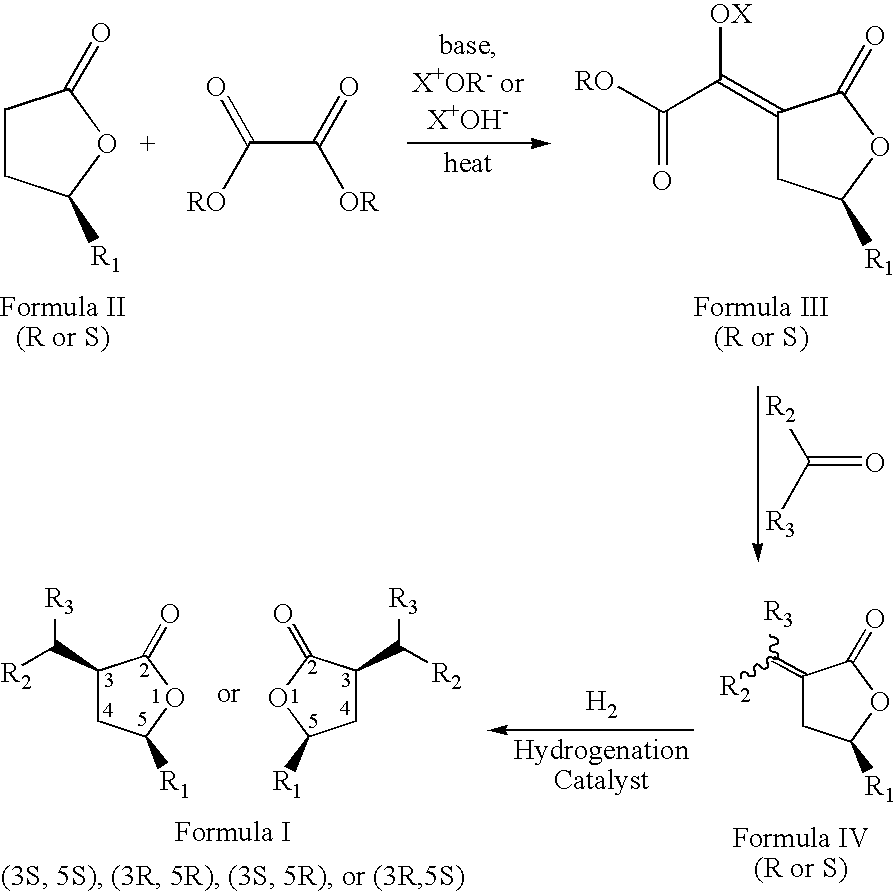
(a) contacting an optically pure stereoisomer of a lactone of formula II with an oxalic acid diester in the presence of a base and a solvent to form an intermediate mixture comprising an optically pure compound of formula III and isolating the optically pure compound of formula III from the intermediate mixture;
(b) treating the isolated optically pure compound of formula III with an aldehyde or ketone, to form a second intermediate mixture and isolating an optically pure compound of formula IV from the second intermediate mixture; and
(c) hydrogenating the optically pure compound of formula IV in the presence of a catalyst and optionally a solvent to form a product mixture and isolating an enantiomerically pure compound of formula I from the product mixture;
wherein, R is a hydrocarbyl or substituted hydrocarbyl group, and X+ is a cation.
6. A method to improve, enhance, or modify the flavor or fragrance of a product formulation comprising adding an effective amount of the composition of claim 3 or 4 to said product formulation.
7. A method to improve or modify the rheology of an oil, hydrocarbon, petroleum or petroleum product comprising adding an effective amount of the composition of claim 3 or 4 to said oil, hydrocarbon, petroleum or petroleum product.
8. A method of formulating a cosmetic product comprising adding an effective amount of the composition of claim 3 or 4 to said cosmetic product.
9. A method of formulating a liquid detergent or cleaning product comprising adding an effective amount of the composition of claim 3 or 4 to said liquid detergent or cleaning product.
Priority Applications (1)
| Application Number | Priority Date | Filing Date | Title |
|---|---|---|---|
| US10/910,495 US20060030719A1 (en) | 2004-08-03 | 2004-08-03 | Cis-3,5-disubstituted-dihydro-furan-2-ones and the preparation and use thereof |
Applications Claiming Priority (1)
| Application Number | Priority Date | Filing Date | Title |
|---|---|---|---|
| US10/910,495 US20060030719A1 (en) | 2004-08-03 | 2004-08-03 | Cis-3,5-disubstituted-dihydro-furan-2-ones and the preparation and use thereof |
Publications (1)
| Publication Number | Publication Date |
|---|---|
| US20060030719A1 true US20060030719A1 (en) | 2006-02-09 |
Family
ID=35758303
Family Applications (1)
| Application Number | Title | Priority Date | Filing Date |
|---|---|---|---|
| US10/910,495 Abandoned US20060030719A1 (en) | 2004-08-03 | 2004-08-03 | Cis-3,5-disubstituted-dihydro-furan-2-ones and the preparation and use thereof |
Country Status (1)
| Country | Link |
|---|---|
| US (1) | US20060030719A1 (en) |
Cited By (5)
| Publication number | Priority date | Publication date | Assignee | Title |
|---|---|---|---|---|
| WO2006094303A2 (en) | 2005-03-04 | 2006-09-08 | E.I. Dupont De Nemours And Company | Compositions comprising a fluoroolefin |
| WO2007053697A2 (en) | 2005-11-01 | 2007-05-10 | E. I. Du Pont De Nemours And Company | Compositions comprising fluoroolefins and uses thereof |
| WO2007126414A2 (en) | 2006-03-30 | 2007-11-08 | E. I. Du Pont De Nemours And Company | Compositions comprising a fluoroolefin |
| EP1985680A2 (en) | 2005-03-04 | 2008-10-29 | E. I. Du Pont de Nemours and Company | Compositions comprising a fluoroolefin |
| US20090314015A1 (en) * | 2006-09-01 | 2009-12-24 | E. I. Du Pont De Nemours And Company | Method for circulating selected heat transfer fluids through a closed loop cycle |
Citations (4)
| Publication number | Priority date | Publication date | Assignee | Title |
|---|---|---|---|---|
| US4980342A (en) * | 1989-02-24 | 1990-12-25 | Henkel Corporation | Process for the preparation of α-alkyl lactones |
| US5231192A (en) * | 1989-02-24 | 1993-07-27 | Henkel Corporation | Process for the preparation of alpha-alkyl lactones |
| US20020143195A1 (en) * | 2000-12-22 | 2002-10-03 | Puts Rutger D. | Process for the preparation of a-methylenelactones and a-substituted hydrocarbylidene lactones |
| US6495729B2 (en) * | 2000-05-12 | 2002-12-17 | Basf Aktiengesellschaft | (+)- and (−)-2-cyclododecylpropanol and (+)- and (−)-2-cyclododecylpropionic acid and the preparation and use thereof |
-
2004
- 2004-08-03 US US10/910,495 patent/US20060030719A1/en not_active Abandoned
Patent Citations (4)
| Publication number | Priority date | Publication date | Assignee | Title |
|---|---|---|---|---|
| US4980342A (en) * | 1989-02-24 | 1990-12-25 | Henkel Corporation | Process for the preparation of α-alkyl lactones |
| US5231192A (en) * | 1989-02-24 | 1993-07-27 | Henkel Corporation | Process for the preparation of alpha-alkyl lactones |
| US6495729B2 (en) * | 2000-05-12 | 2002-12-17 | Basf Aktiengesellschaft | (+)- and (−)-2-cyclododecylpropanol and (+)- and (−)-2-cyclododecylpropionic acid and the preparation and use thereof |
| US20020143195A1 (en) * | 2000-12-22 | 2002-10-03 | Puts Rutger D. | Process for the preparation of a-methylenelactones and a-substituted hydrocarbylidene lactones |
Cited By (6)
| Publication number | Priority date | Publication date | Assignee | Title |
|---|---|---|---|---|
| WO2006094303A2 (en) | 2005-03-04 | 2006-09-08 | E.I. Dupont De Nemours And Company | Compositions comprising a fluoroolefin |
| EP1985680A2 (en) | 2005-03-04 | 2008-10-29 | E. I. Du Pont de Nemours and Company | Compositions comprising a fluoroolefin |
| EP1985681A2 (en) | 2005-03-04 | 2008-10-29 | E. I. Du Pont de Nemours and Company | Compositions comprising a fluoroolefin |
| WO2007053697A2 (en) | 2005-11-01 | 2007-05-10 | E. I. Du Pont De Nemours And Company | Compositions comprising fluoroolefins and uses thereof |
| WO2007126414A2 (en) | 2006-03-30 | 2007-11-08 | E. I. Du Pont De Nemours And Company | Compositions comprising a fluoroolefin |
| US20090314015A1 (en) * | 2006-09-01 | 2009-12-24 | E. I. Du Pont De Nemours And Company | Method for circulating selected heat transfer fluids through a closed loop cycle |
Similar Documents
| Publication | Publication Date | Title |
|---|---|---|
| Reissig et al. | A titanoxycyclopropane as intermediate in a highly stereoselective homoaldol type addition syntheses of cis-substituted tetrahydrofuran derivatives | |
| EP2212306B1 (en) | Process for the preparation of tetranorlabdane derivatives | |
| Annunziata et al. | Synthesis of optically active 3-(1-hydroxyalkyl) phthalides by stereoselective pinacol cross-coupling | |
| JPH09502459A (en) | Method for producing (+)-(1R) -cis-3-oxo-2-pentyl-1-cyclopentaneacetic acid | |
| US20060030719A1 (en) | Cis-3,5-disubstituted-dihydro-furan-2-ones and the preparation and use thereof | |
| EP2215069B1 (en) | Process for the preparation of tetranorlabdane derivatives | |
| WO2005014565A2 (en) | Cis-3,5-disubstituted-dihydro-furan-2-ones and the preparation and use thereof | |
| US8822733B2 (en) | Intermediates for the preparation of beta-santalol | |
| JPH03130276A (en) | Preparation of alpha-alkyl lactone | |
| JP4540197B2 (en) | (E) Process for producing 3-methyl-2-cyclopentadecenone | |
| JPH06503328A (en) | Preparation method of α-alkyl lactone | |
| Wang et al. | Mono-Alkylation of Diols Through Ruthenium-Catalyzed Reaction with Homoallyl Alcohols | |
| JPS643177B2 (en) | ||
| Murray et al. | Novel dienes from α-ylidene and α-alkoxylidene lactones. Useful intermediates for the synthesis of benzofurans | |
| WO2021116099A1 (en) | Process for preparing 1-indanone compounds by intramolecular friedel-crafts reaction of alpha,alpha-dialkylmalonate derivatives | |
| JP2867847B2 (en) | Method for producing 5-methylene-1,3-dioxolan-4-ones | |
| Langer et al. | A new stereoselective synthesis of grandisol | |
| Rinaldi et al. | Synthesis of 1, 2, 3-decanetriol stereoisomers | |
| JP4786267B2 (en) | Method for producing lactone and use of produced lactone as aromatic substance | |
| Coe et al. | Reactions of tetrafluoroethene oligomers. Part XIII. Reactions of a perfluorinated dihydrofuran; perfluoro-4-ethyl-2, 3, 4, 5-tetramethyl-4, 5-dihydrofuran | |
| EP3464235B1 (en) | Process for the preparation of polysantol-type compounds | |
| JP2005170822A (en) | Muscon manufacturing method | |
| JP4064645B2 (en) | New production method of polysubstituted cycloalkenes | |
| JPS6033371B2 (en) | Method for producing trans-p-menthane-2,3-diol | |
| JP4178345B2 (en) | Standard product of 1-phenyl-4- (1-phenylethyl) tetralin for styrene oligomer analysis |
Legal Events
| Date | Code | Title | Description |
|---|---|---|---|
| AS | Assignment |
Owner name: E. I. DU PONT DE NEMOURS AND COMPANY, DELAWARE Free format text: ASSIGNMENT OF ASSIGNORS INTEREST;ASSIGNORS:FAGAN, PAUL JOSEPH;BRANDENBURG, CHARLES J.;REEL/FRAME:015839/0343;SIGNING DATES FROM 20041208 TO 20050209 |
|
| STCB | Information on status: application discontinuation |
Free format text: ABANDONED -- FAILURE TO RESPOND TO AN OFFICE ACTION |