US20050267072A1 - Pharmaceutical compositions containing dually acting inhibitors of neutral endopeptidase for the treatment of sexual dysfunction - Google Patents
Pharmaceutical compositions containing dually acting inhibitors of neutral endopeptidase for the treatment of sexual dysfunction Download PDFInfo
- Publication number
- US20050267072A1 US20050267072A1 US11/127,162 US12716205A US2005267072A1 US 20050267072 A1 US20050267072 A1 US 20050267072A1 US 12716205 A US12716205 A US 12716205A US 2005267072 A1 US2005267072 A1 US 2005267072A1
- Authority
- US
- United States
- Prior art keywords
- receptor agonists
- group
- inhibitors
- agents
- compound
- Prior art date
- Legal status (The legal status is an assumption and is not a legal conclusion. Google has not performed a legal analysis and makes no representation as to the accuracy of the status listed.)
- Abandoned
Links
- 108090000028 Neprilysin Proteins 0.000 title claims abstract description 46
- 102000003729 Neprilysin Human genes 0.000 title claims abstract description 46
- 201000001880 Sexual dysfunction Diseases 0.000 title claims abstract description 25
- 231100000872 sexual dysfunction Toxicity 0.000 title claims abstract description 24
- 239000003112 inhibitor Substances 0.000 title claims description 41
- 239000008194 pharmaceutical composition Substances 0.000 title claims description 26
- 238000011282 treatment Methods 0.000 title abstract description 29
- 150000001875 compounds Chemical class 0.000 claims abstract description 90
- 230000002401 inhibitory effect Effects 0.000 claims abstract description 25
- 102000005593 Endopeptidases Human genes 0.000 claims abstract description 15
- 108010059378 Endopeptidases Proteins 0.000 claims abstract description 15
- 241000282412 Homo Species 0.000 claims abstract description 7
- 241000124008 Mammalia Species 0.000 claims abstract description 7
- MUMGGOZAMZWBJJ-DYKIIFRCSA-N Testostosterone Chemical compound O=C1CC[C@]2(C)[C@H]3CC[C@](C)([C@H](CC4)O)[C@@H]4[C@@H]3CCC2=C1 MUMGGOZAMZWBJJ-DYKIIFRCSA-N 0.000 claims description 41
- 239000003795 chemical substances by application Substances 0.000 claims description 33
- 125000004178 (C1-C4) alkyl group Chemical group 0.000 claims description 29
- 206010057671 Female sexual dysfunction Diseases 0.000 claims description 24
- MWUXSHHQAYIFBG-UHFFFAOYSA-N Nitric oxide Chemical class O=[N] MWUXSHHQAYIFBG-UHFFFAOYSA-N 0.000 claims description 24
- 239000000262 estrogen Substances 0.000 claims description 21
- 229910052739 hydrogen Inorganic materials 0.000 claims description 21
- 239000001257 hydrogen Substances 0.000 claims description 21
- 201000001881 impotence Diseases 0.000 claims description 21
- 229960003604 testosterone Drugs 0.000 claims description 20
- 238000000034 method Methods 0.000 claims description 19
- -1 PDE2 inhibitors Substances 0.000 claims description 18
- 208000010228 Erectile Dysfunction Diseases 0.000 claims description 17
- PSGAAPLEWMOORI-PEINSRQWSA-N medroxyprogesterone acetate Chemical compound C([C@@]12C)CC(=O)C=C1[C@@H](C)C[C@@H]1[C@@H]2CC[C@]2(C)[C@@](OC(C)=O)(C(C)=O)CC[C@H]21 PSGAAPLEWMOORI-PEINSRQWSA-N 0.000 claims description 16
- 239000000203 mixture Substances 0.000 claims description 16
- 229940011871 estrogen Drugs 0.000 claims description 15
- 239000000018 receptor agonist Substances 0.000 claims description 15
- 229940044601 receptor agonist Drugs 0.000 claims description 15
- 125000004435 hydrogen atom Chemical group [H]* 0.000 claims description 14
- 229940123333 Phosphodiesterase 5 inhibitor Drugs 0.000 claims description 13
- 239000002590 phosphodiesterase V inhibitor Substances 0.000 claims description 13
- 229940127315 Potassium Channel Openers Drugs 0.000 claims description 12
- 239000005557 antagonist Substances 0.000 claims description 12
- 125000001997 phenyl group Chemical group [H]C1=C([H])C([H])=C(*)C([H])=C1[H] 0.000 claims description 12
- 150000003839 salts Chemical class 0.000 claims description 12
- VOXZDWNPVJITMN-ZBRFXRBCSA-N 17β-estradiol Chemical compound OC1=CC=C2[C@H]3CC[C@](C)([C@H](CC4)O)[C@@H]4[C@@H]3CCC2=C1 VOXZDWNPVJITMN-ZBRFXRBCSA-N 0.000 claims description 11
- 238000002657 hormone replacement therapy Methods 0.000 claims description 11
- 206010057672 Male sexual dysfunction Diseases 0.000 claims description 10
- 208000037265 diseases, disorders, signs and symptoms Diseases 0.000 claims description 10
- GCKMFJBGXUYNAG-HLXURNFRSA-N Methyltestosterone Chemical compound C1CC2=CC(=O)CC[C@]2(C)[C@@H]2[C@@H]1[C@@H]1CC[C@](C)(O)[C@@]1(C)CC2 GCKMFJBGXUYNAG-HLXURNFRSA-N 0.000 claims description 9
- 239000003136 dopamine receptor stimulating agent Substances 0.000 claims description 9
- 239000000935 antidepressant agent Substances 0.000 claims description 8
- 150000004651 carbonic acid esters Chemical class 0.000 claims description 8
- 239000002792 enkephalinase inhibitor Substances 0.000 claims description 8
- 229960002985 medroxyprogesterone acetate Drugs 0.000 claims description 8
- 239000002464 receptor antagonist Substances 0.000 claims description 8
- 229940044551 receptor antagonist Drugs 0.000 claims description 8
- 230000003319 supportive effect Effects 0.000 claims description 8
- GCKMFJBGXUYNAG-UHFFFAOYSA-N 17alpha-methyltestosterone Natural products C1CC2=CC(=O)CCC2(C)C2C1C1CCC(C)(O)C1(C)CC2 GCKMFJBGXUYNAG-UHFFFAOYSA-N 0.000 claims description 7
- 102000005702 Calcium-Activated Potassium Channels Human genes 0.000 claims description 7
- 108010045489 Calcium-Activated Potassium Channels Proteins 0.000 claims description 7
- 229940118365 Endothelin receptor antagonist Drugs 0.000 claims description 7
- 102400000064 Neuropeptide Y Human genes 0.000 claims description 7
- 229940121828 Phosphodiesterase 2 inhibitor Drugs 0.000 claims description 7
- 239000000556 agonist Substances 0.000 claims description 7
- 239000002308 endothelin receptor antagonist Substances 0.000 claims description 7
- 229930182833 estradiol Natural products 0.000 claims description 7
- 229910052736 halogen Inorganic materials 0.000 claims description 7
- 150000002367 halogens Chemical class 0.000 claims description 7
- 229960004616 medroxyprogesterone Drugs 0.000 claims description 7
- 239000000336 melanocortin receptor agonist Substances 0.000 claims description 7
- 229960001566 methyltestosterone Drugs 0.000 claims description 7
- 150000003008 phosphonic acid esters Chemical class 0.000 claims description 7
- 102000017953 prostanoid receptors Human genes 0.000 claims description 7
- 108050007059 prostanoid receptors Proteins 0.000 claims description 7
- 239000003227 purinergic agonist Substances 0.000 claims description 7
- 239000000952 serotonin receptor agonist Substances 0.000 claims description 7
- 125000000229 (C1-C4)alkoxy group Chemical group 0.000 claims description 6
- 102000012088 Vasoactive Intestinal Peptide Receptors Human genes 0.000 claims description 6
- 108010075974 Vasoactive Intestinal Peptide Receptors Proteins 0.000 claims description 6
- 108020004102 alpha-1 Adrenergic Receptor Proteins 0.000 claims description 6
- 108020004101 alpha-2 Adrenergic Receptor Proteins 0.000 claims description 6
- 102000015009 alpha1-adrenergic receptor activity proteins Human genes 0.000 claims description 6
- 102000015006 alpha2-adrenergic receptor activity proteins Human genes 0.000 claims description 6
- 239000002840 nitric oxide donor Substances 0.000 claims description 6
- LOFDNSDPZTVIIO-UHFFFAOYSA-N 2-[[1-[[1-(carboxymethyl)-2-oxo-4,5-dihydro-3h-1-benzazepin-3-yl]carbamoyl]cyclopentyl]methyl]-4-naphthalen-1-ylbutanoic acid Chemical compound O=C1N(CC(=O)O)C2=CC=CC=C2CCC1NC(=O)C1(CC(CCC=2C3=CC=CC=C3C=CC=2)C(O)=O)CCCC1 LOFDNSDPZTVIIO-UHFFFAOYSA-N 0.000 claims description 4
- ZMUIQGMERCXQQA-UHFFFAOYSA-N 2-[3-[[1-(2-ethoxycarbonyl-4-naphthalen-1-ylbutyl)cyclopentanecarbonyl]amino]-2-oxo-4,5-dihydro-3h-1-benzazepin-1-yl]acetic acid Chemical compound C=1C=CC2=CC=CC=C2C=1CCC(C(=O)OCC)CC1(C(=O)NC2C(N(CC(O)=O)C3=CC=CC=C3CC2)=O)CCCC1 ZMUIQGMERCXQQA-UHFFFAOYSA-N 0.000 claims description 3
- XMQODGUTLZXUGZ-UHFFFAOYSA-N 2-[3-[[1-(2-ethoxycarbonyl-4-phenylbutyl)cyclopentanecarbonyl]amino]-2-oxo-4,5-dihydro-3h-1-benzazepin-1-yl]acetic acid Chemical compound C1CCCC1(C(=O)NC1C(N(CC(O)=O)C2=CC=CC=C2CC1)=O)CC(C(=O)OCC)CCC1=CC=CC=C1 XMQODGUTLZXUGZ-UHFFFAOYSA-N 0.000 claims description 3
- RSRHEOWMSRYTNB-UHFFFAOYSA-N 2-[[1-[[1-(carboxymethyl)-2-oxo-4,5-dihydro-3h-1-benzazepin-3-yl]carbamoyl]cyclopentyl]methyl]-4-phenylbutanoic acid Chemical compound O=C1N(CC(=O)O)C2=CC=CC=C2CCC1NC(=O)C1(CC(CCC=2C=CC=CC=2)C(O)=O)CCCC1 RSRHEOWMSRYTNB-UHFFFAOYSA-N 0.000 claims description 3
- 229940098778 Dopamine receptor agonist Drugs 0.000 claims description 3
- 229960004046 apomorphine Drugs 0.000 claims description 2
- VMWNQDUVQKEIOC-CYBMUJFWSA-N apomorphine Chemical compound C([C@H]1N(C)CC2)C3=CC=C(O)C(O)=C3C3=C1C2=CC=C3 VMWNQDUVQKEIOC-CYBMUJFWSA-N 0.000 claims description 2
- CXWQXGNFZLHLHQ-DPFCLETOSA-N apomorphine hydrochloride Chemical compound [H+].[H+].O.[Cl-].[Cl-].C([C@H]1N(C)CC2)C3=CC=C(O)C(O)=C3C3=C1C2=CC=C3.C([C@H]1N(C)CC2)C3=CC=C(O)C(O)=C3C3=C1C2=CC=C3 CXWQXGNFZLHLHQ-DPFCLETOSA-N 0.000 claims description 2
- 229940121356 serotonin receptor antagonist Drugs 0.000 claims 3
- 229960005309 estradiol Drugs 0.000 claims 1
- 238000011321 prophylaxis Methods 0.000 abstract description 13
- VBUWHHLIZKOSMS-RIWXPGAOSA-N invicorp Chemical compound C([C@@H](C(=O)N[C@@H](CC(C)C)C(=O)N[C@@H](CC(N)=O)C(=O)N[C@@H](CO)C(=O)N[C@@H]([C@@H](C)CC)C(=O)N[C@@H](CC(C)C)C(=O)N[C@@H](CC(N)=O)C(O)=O)NC(=O)[C@H](CCCCN)NC(=O)[C@H](CCCCN)NC(=O)[C@@H](NC(=O)[C@H](C)NC(=O)[C@H](CCSC)NC(=O)[C@H](CCC(N)=O)NC(=O)[C@H](CCCCN)NC(=O)[C@H](CCCNC(N)=N)NC(=O)[C@H](CC(C)C)NC(=O)[C@H](CCCNC(N)=N)NC(=O)[C@@H](NC(=O)[C@H](CC=1C=CC(O)=CC=1)NC(=O)[C@H](CC(N)=O)NC(=O)[C@H](CC(O)=O)NC(=O)[C@@H](NC(=O)[C@H](CC=1C=CC=CC=1)NC(=O)[C@@H](NC(=O)[C@H](C)NC(=O)[C@H](CC(O)=O)NC(=O)[C@H](CO)NC(=O)[C@@H](N)CC=1NC=NC=1)C(C)C)[C@@H](C)O)[C@@H](C)O)C(C)C)C1=CC=C(O)C=C1 VBUWHHLIZKOSMS-RIWXPGAOSA-N 0.000 description 34
- 108010003205 Vasoactive Intestinal Peptide Proteins 0.000 description 27
- 102400000015 Vasoactive intestinal peptide Human genes 0.000 description 26
- 230000001568 sexual effect Effects 0.000 description 23
- 102100031478 C-type natriuretic peptide Human genes 0.000 description 22
- 230000015556 catabolic process Effects 0.000 description 19
- 125000004432 carbon atom Chemical group C* 0.000 description 17
- 210000005226 corpus cavernosum Anatomy 0.000 description 17
- 125000001495 ethyl group Chemical group [H]C([H])([H])C([H])([H])* 0.000 description 16
- 210000004392 genitalia Anatomy 0.000 description 13
- 230000037007 arousal Effects 0.000 description 12
- 239000003814 drug Substances 0.000 description 12
- 230000001965 increasing effect Effects 0.000 description 12
- 230000004044 response Effects 0.000 description 12
- 239000000243 solution Substances 0.000 description 12
- ZOOGRGPOEVQQDX-UUOKFMHZSA-N 3',5'-cyclic GMP Chemical compound C([C@H]1O2)OP(O)(=O)O[C@H]1[C@@H](O)[C@@H]2N1C(N=C(NC2=O)N)=C2N=C1 ZOOGRGPOEVQQDX-UUOKFMHZSA-N 0.000 description 11
- 229940079593 drug Drugs 0.000 description 11
- 230000005764 inhibitory process Effects 0.000 description 11
- 108090000765 processed proteins & peptides Proteins 0.000 description 11
- 208000006262 Psychological Sexual Dysfunctions Diseases 0.000 description 10
- 125000002915 carbonyl group Chemical group [*:2]C([*:1])=O 0.000 description 10
- ZOOGRGPOEVQQDX-UHFFFAOYSA-N cyclic GMP Natural products O1C2COP(O)(=O)OC2C(O)C1N1C=NC2=C1NC(N)=NC2=O ZOOGRGPOEVQQDX-UHFFFAOYSA-N 0.000 description 10
- 102100029112 Endothelin-converting enzyme 1 Human genes 0.000 description 9
- 230000000694 effects Effects 0.000 description 9
- 0 *CC1(C(=O)NC2CCC3=C(C=CC=C3)N(CC)C2=O)CCCC1 Chemical compound *CC1(C(=O)NC2CCC3=C(C=CC=C3)N(CC)C2=O)CCCC1 0.000 description 8
- 230000017531 blood circulation Effects 0.000 description 8
- 150000002148 esters Chemical class 0.000 description 8
- 238000012360 testing method Methods 0.000 description 8
- 125000000217 alkyl group Chemical group 0.000 description 7
- 239000012131 assay buffer Substances 0.000 description 7
- 230000008602 contraction Effects 0.000 description 7
- 210000002460 smooth muscle Anatomy 0.000 description 7
- 239000011550 stock solution Substances 0.000 description 7
- 239000003826 tablet Substances 0.000 description 7
- IAZDPXIOMUYVGZ-UHFFFAOYSA-N Dimethylsulphoxide Chemical compound CS(C)=O IAZDPXIOMUYVGZ-UHFFFAOYSA-N 0.000 description 6
- 102000004190 Enzymes Human genes 0.000 description 6
- 108090000790 Enzymes Proteins 0.000 description 6
- FAPWRFPIFSIZLT-UHFFFAOYSA-M Sodium chloride Chemical compound [Na+].[Cl-] FAPWRFPIFSIZLT-UHFFFAOYSA-M 0.000 description 6
- 125000002947 alkylene group Chemical group 0.000 description 6
- 208000035475 disorder Diseases 0.000 description 6
- 229940088598 enzyme Drugs 0.000 description 6
- 239000000546 pharmaceutical excipient Substances 0.000 description 6
- 238000002360 preparation method Methods 0.000 description 6
- 102400000686 Endothelin-1 Human genes 0.000 description 5
- 101800004490 Endothelin-1 Proteins 0.000 description 5
- 239000007995 HEPES buffer Substances 0.000 description 5
- QTBSBXVTEAMEQO-UHFFFAOYSA-N acetic acid Substances CC(O)=O QTBSBXVTEAMEQO-UHFFFAOYSA-N 0.000 description 5
- 239000002253 acid Substances 0.000 description 5
- 230000015572 biosynthetic process Effects 0.000 description 5
- 229910052799 carbon Inorganic materials 0.000 description 5
- 230000003834 intracellular effect Effects 0.000 description 5
- 238000005461 lubrication Methods 0.000 description 5
- 230000018052 penile erection Effects 0.000 description 5
- 208000012201 sexual and gender identity disease Diseases 0.000 description 5
- 208000015891 sexual disease Diseases 0.000 description 5
- 230000000638 stimulation Effects 0.000 description 5
- 238000002560 therapeutic procedure Methods 0.000 description 5
- XMQODGUTLZXUGZ-RPBOFIJWSA-N 2-[(3s)-3-[[1-[(2r)-2-ethoxycarbonyl-4-phenylbutyl]cyclopentanecarbonyl]amino]-2-oxo-4,5-dihydro-3h-1-benzazepin-1-yl]acetic acid Chemical compound C([C@@H](C(=O)OCC)CC1(CCCC1)C(=O)N[C@@H]1C(N(CC(O)=O)C2=CC=CC=C2CC1)=O)CC1=CC=CC=C1 XMQODGUTLZXUGZ-RPBOFIJWSA-N 0.000 description 4
- 208000002193 Pain Diseases 0.000 description 4
- 208000027520 Somatoform disease Diseases 0.000 description 4
- 108010036928 Thiorphan Proteins 0.000 description 4
- 150000007513 acids Chemical class 0.000 description 4
- 230000009471 action Effects 0.000 description 4
- 239000003420 antiserotonin agent Substances 0.000 description 4
- 206010012601 diabetes mellitus Diseases 0.000 description 4
- 230000009429 distress Effects 0.000 description 4
- QTTMOCOWZLSYSV-QWAPEVOJSA-M equilin sodium sulfate Chemical compound [Na+].[O-]S(=O)(=O)OC1=CC=C2[C@H]3CC[C@](C)(C(CC4)=O)[C@@H]4C3=CCC2=C1 QTTMOCOWZLSYSV-QWAPEVOJSA-M 0.000 description 4
- 230000001856 erectile effect Effects 0.000 description 4
- 230000009986 erectile function Effects 0.000 description 4
- 238000004128 high performance liquid chromatography Methods 0.000 description 4
- 150000002431 hydrogen Chemical group 0.000 description 4
- 238000001990 intravenous administration Methods 0.000 description 4
- 125000001449 isopropyl group Chemical group [H]C([H])([H])C([H])(*)C([H])([H])[H] 0.000 description 4
- 238000004519 manufacturing process Methods 0.000 description 4
- 230000007246 mechanism Effects 0.000 description 4
- 238000002483 medication Methods 0.000 description 4
- 208000027753 pain disease Diseases 0.000 description 4
- 230000007310 pathophysiology Effects 0.000 description 4
- 210000003899 penis Anatomy 0.000 description 4
- 230000003389 potentiating effect Effects 0.000 description 4
- BNRNXUUZRGQAQC-UHFFFAOYSA-N sildenafil Chemical compound CCCC1=NN(C)C(C(N2)=O)=C1N=C2C(C(=CC=1)OCC)=CC=1S(=O)(=O)N1CCN(C)CC1 BNRNXUUZRGQAQC-UHFFFAOYSA-N 0.000 description 4
- LJJKNPQAGWVLDQ-SNVBAGLBSA-N thiorphan Chemical compound OC(=O)CNC(=O)[C@@H](CS)CC1=CC=CC=C1 LJJKNPQAGWVLDQ-SNVBAGLBSA-N 0.000 description 4
- 239000012224 working solution Substances 0.000 description 4
- WEVYAHXRMPXWCK-UHFFFAOYSA-N Acetonitrile Chemical compound CC#N WEVYAHXRMPXWCK-UHFFFAOYSA-N 0.000 description 3
- 208000019901 Anxiety disease Diseases 0.000 description 3
- 102100039341 Atrial natriuretic peptide receptor 2 Human genes 0.000 description 3
- 229920002261 Corn starch Polymers 0.000 description 3
- 102000048186 Endothelin-converting enzyme 1 Human genes 0.000 description 3
- 108030001679 Endothelin-converting enzyme 1 Proteins 0.000 description 3
- PEDCQBHIVMGVHV-UHFFFAOYSA-N Glycerine Chemical compound OCC(O)CO PEDCQBHIVMGVHV-UHFFFAOYSA-N 0.000 description 3
- UFHFLCQGNIYNRP-UHFFFAOYSA-N Hydrogen Chemical compound [H][H] UFHFLCQGNIYNRP-UHFFFAOYSA-N 0.000 description 3
- GUBGYTABKSRVRQ-QKKXKWKRSA-N Lactose Natural products OC[C@H]1O[C@@H](O[C@H]2[C@H](O)[C@@H](O)C(O)O[C@@H]2CO)[C@H](O)[C@@H](O)[C@H]1O GUBGYTABKSRVRQ-QKKXKWKRSA-N 0.000 description 3
- 206010024419 Libido decreased Diseases 0.000 description 3
- 241001465754 Metazoa Species 0.000 description 3
- 230000004913 activation Effects 0.000 description 3
- 239000013543 active substance Substances 0.000 description 3
- 239000002160 alpha blocker Substances 0.000 description 3
- 150000001408 amides Chemical group 0.000 description 3
- 230000036506 anxiety Effects 0.000 description 3
- 238000003556 assay Methods 0.000 description 3
- 230000009989 contractile response Effects 0.000 description 3
- 239000008120 corn starch Substances 0.000 description 3
- 125000002933 cyclohexyloxy group Chemical group C1(CCCCC1)O* 0.000 description 3
- 229950010776 daglutril Drugs 0.000 description 3
- 238000006731 degradation reaction Methods 0.000 description 3
- 238000011161 development Methods 0.000 description 3
- 230000018109 developmental process Effects 0.000 description 3
- 150000001991 dicarboxylic acids Chemical group 0.000 description 3
- 230000002255 enzymatic effect Effects 0.000 description 3
- 208000017020 hypoactive sexual desire disease Diseases 0.000 description 3
- 239000008101 lactose Substances 0.000 description 3
- 239000000314 lubricant Substances 0.000 description 3
- 230000001404 mediated effect Effects 0.000 description 3
- 125000002496 methyl group Chemical group [H]C([H])([H])* 0.000 description 3
- 210000005036 nerve Anatomy 0.000 description 3
- 210000000056 organ Anatomy 0.000 description 3
- ABLZXFCXXLZCGV-UHFFFAOYSA-N phosphonic acid group Chemical group P(O)(O)=O ABLZXFCXXLZCGV-UHFFFAOYSA-N 0.000 description 3
- 230000037452 priming Effects 0.000 description 3
- 230000008569 process Effects 0.000 description 3
- 102000004196 processed proteins & peptides Human genes 0.000 description 3
- 150000003254 radicals Chemical class 0.000 description 3
- 239000011734 sodium Substances 0.000 description 3
- 239000011780 sodium chloride Substances 0.000 description 3
- 210000001519 tissue Anatomy 0.000 description 3
- 210000001215 vagina Anatomy 0.000 description 3
- 230000002792 vascular Effects 0.000 description 3
- XLYOFNOQVPJJNP-UHFFFAOYSA-N water Chemical compound O XLYOFNOQVPJJNP-UHFFFAOYSA-N 0.000 description 3
- WNXJIVFYUVYPPR-UHFFFAOYSA-N 1,3-dioxolane Chemical group C1COCO1 WNXJIVFYUVYPPR-UHFFFAOYSA-N 0.000 description 2
- DQFQCHIDRBIESA-UHFFFAOYSA-N 1-benzazepine Chemical compound N1C=CC=CC2=CC=CC=C12 DQFQCHIDRBIESA-UHFFFAOYSA-N 0.000 description 2
- JKMHFZQWWAIEOD-UHFFFAOYSA-N 2-[4-(2-hydroxyethyl)piperazin-1-yl]ethanesulfonic acid Chemical compound OCC[NH+]1CCN(CCS([O-])(=O)=O)CC1 JKMHFZQWWAIEOD-UHFFFAOYSA-N 0.000 description 2
- OGIYDFVHFQEFKQ-UHFFFAOYSA-N 3-[n-(4,5-dihydro-1h-imidazol-2-ylmethyl)-4-methylanilino]phenol;methanesulfonic acid Chemical compound CS(O)(=O)=O.C1=CC(C)=CC=C1N(C=1C=C(O)C=CC=1)CC1=NCCN1 OGIYDFVHFQEFKQ-UHFFFAOYSA-N 0.000 description 2
- 101710102159 Atrial natriuretic peptide receptor 2 Proteins 0.000 description 2
- 108090000932 Calcitonin Gene-Related Peptide Proteins 0.000 description 2
- 208000024172 Cardiovascular disease Diseases 0.000 description 2
- ZAMOUSCENKQFHK-UHFFFAOYSA-N Chlorine atom Chemical compound [Cl] ZAMOUSCENKQFHK-UHFFFAOYSA-N 0.000 description 2
- 101100189582 Dictyostelium discoideum pdeD gene Proteins 0.000 description 2
- 208000021663 Female sexual arousal disease Diseases 0.000 description 2
- PXGOKWXKJXAPGV-UHFFFAOYSA-N Fluorine Chemical compound FF PXGOKWXKJXAPGV-UHFFFAOYSA-N 0.000 description 2
- 239000001828 Gelatine Substances 0.000 description 2
- 206010020772 Hypertension Diseases 0.000 description 2
- 241001313288 Labia Species 0.000 description 2
- 102000005741 Metalloproteases Human genes 0.000 description 2
- 108010006035 Metalloproteases Proteins 0.000 description 2
- 241000283973 Oryctolagus cuniculus Species 0.000 description 2
- 101150098694 PDE5A gene Proteins 0.000 description 2
- NBIIXXVUZAFLBC-UHFFFAOYSA-N Phosphoric acid Chemical compound OP(O)(O)=O NBIIXXVUZAFLBC-UHFFFAOYSA-N 0.000 description 2
- 101150037481 SMR1 gene Proteins 0.000 description 2
- 102000007637 Soluble Guanylyl Cyclase Human genes 0.000 description 2
- 108010007205 Soluble Guanylyl Cyclase Proteins 0.000 description 2
- LJJKNPQAGWVLDQ-UHFFFAOYSA-N Thiorphan Chemical compound OC(=O)CNC(=O)C(CS)CC1=CC=CC=C1 LJJKNPQAGWVLDQ-UHFFFAOYSA-N 0.000 description 2
- OZPWNCNLFBVVEN-RFYLDXRNSA-N [(6s,8r,9s,10r,13s,14s,17r)-17-acetyl-6,10,13-trimethyl-3-oxo-2,6,7,8,9,11,12,14,15,16-decahydro-1h-cyclopenta[a]phenanthren-17-yl] acetate;[(9s,13s,14s)-13-methyl-17-oxo-9,11,12,14,15,16-hexahydro-6h-cyclopenta[a]phenanthren-3-yl] hydrogen sulfate;[(8r,9 Chemical compound OS(=O)(=O)OC1=CC=C2[C@H]3CC[C@](C)(C(CC4)=O)[C@@H]4[C@@H]3CCC2=C1.OS(=O)(=O)OC1=CC=C2[C@H]3CC[C@](C)(C(CC4)=O)[C@@H]4C3=CCC2=C1.OS(=O)(=O)OC1=CC=C2C(CC[C@]3([C@H]4CCC3=O)C)=C4C=CC2=C1.C([C@@]12C)CC(=O)C=C1[C@@H](C)C[C@@H]1[C@@H]2CC[C@]2(C)[C@@](OC(C)=O)(C(C)=O)CC[C@H]21 OZPWNCNLFBVVEN-RFYLDXRNSA-N 0.000 description 2
- 125000006620 amino-(C1-C6) alkyl group Chemical group 0.000 description 2
- 210000003484 anatomy Anatomy 0.000 description 2
- 108010006060 aviptadil Proteins 0.000 description 2
- 230000008901 benefit Effects 0.000 description 2
- 125000001797 benzyl group Chemical group [H]C1=C([H])C([H])=C(C([H])=C1[H])C([H])([H])* 0.000 description 2
- HZZGDPLAJHVHSP-GKHTVLBPSA-N big endothelin Chemical compound C([C@@H](C(=O)N[C@@H](CC(C)C)C(=O)N[C@@H](CC(O)=O)C(=O)N[C@@H]([C@@H](C)CC)C(=O)N[C@@H]([C@@H](C)CC)C(=O)N[C@@H](CC=1C2=CC=CC=C2NC=1)C(=O)N[C@@H](C(C)C)C(=O)N[C@@H](CC(N)=O)C(=O)N[C@@H]([C@@H](C)O)C(=O)N1[C@@H](CCC1)C(=O)N[C@@H](CCC(O)=O)C(=O)N[C@@H](CC=1NC=NC=1)C(=O)N[C@@H](C(C)C)C(=O)N[C@@H](C(C)C)C(=O)N1[C@@H](CCC1)C(=O)N[C@@H](CC=1C=CC(O)=CC=1)C(=O)NCC(=O)N[C@@H](CC(C)C)C(=O)NCC(=O)N[C@@H](CO)C(=O)N1[C@@H](CCC1)C(=O)N[C@@H](CCCNC(N)=N)C(=O)N[C@@H](CO)C(O)=O)NC(=O)[C@H]1NC(=O)[C@H](CC=2C=CC=CC=2)NC(=O)[C@H](CC=2C=CC(O)=CC=2)NC(=O)[C@H](C(C)C)NC(=O)[C@@H]2CSSC[C@@H](C(N[C@@H](CO)C(=O)N[C@@H](CO)C(=O)N[C@@H](CC(C)C)C(=O)N[C@@H](CCSC)C(=O)N[C@@H](CC(O)=O)C(=O)N[C@@H](CCCCN)C(=O)N[C@@H](CCC(O)=O)C(=O)N2)=O)NC(=O)[C@H](CO)NC(=O)[C@@H](N)CSSC1)C1=CN=CN1 HZZGDPLAJHVHSP-GKHTVLBPSA-N 0.000 description 2
- 239000011230 binding agent Substances 0.000 description 2
- 125000000484 butyl group Chemical group [H]C([*])([H])C([H])([H])C([H])([H])C([H])([H])[H] 0.000 description 2
- 102100029175 cGMP-specific 3',5'-cyclic phosphodiesterase Human genes 0.000 description 2
- 239000002775 capsule Substances 0.000 description 2
- 150000001733 carboxylic acid esters Chemical class 0.000 description 2
- 238000005119 centrifugation Methods 0.000 description 2
- 239000000460 chlorine Substances 0.000 description 2
- 229910052801 chlorine Inorganic materials 0.000 description 2
- 210000003029 clitoris Anatomy 0.000 description 2
- 239000011248 coating agent Substances 0.000 description 2
- 229940125782 compound 2 Drugs 0.000 description 2
- 150000001990 dicarboxylic acid derivatives Chemical class 0.000 description 2
- 239000003085 diluting agent Substances 0.000 description 2
- 201000010099 disease Diseases 0.000 description 2
- 239000003937 drug carrier Substances 0.000 description 2
- 230000002526 effect on cardiovascular system Effects 0.000 description 2
- 210000003038 endothelium Anatomy 0.000 description 2
- 238000006911 enzymatic reaction Methods 0.000 description 2
- 210000005225 erectile tissue Anatomy 0.000 description 2
- 125000001301 ethoxy group Chemical group [H]C([H])([H])C([H])([H])O* 0.000 description 2
- 238000011156 evaluation Methods 0.000 description 2
- 238000002474 experimental method Methods 0.000 description 2
- 230000002349 favourable effect Effects 0.000 description 2
- 210000001752 female genitalia Anatomy 0.000 description 2
- 229910052731 fluorine Inorganic materials 0.000 description 2
- 239000011737 fluorine Substances 0.000 description 2
- 238000009472 formulation Methods 0.000 description 2
- 229920000159 gelatin Polymers 0.000 description 2
- 235000019322 gelatine Nutrition 0.000 description 2
- 239000008187 granular material Substances 0.000 description 2
- 238000010438 heat treatment Methods 0.000 description 2
- 230000007062 hydrolysis Effects 0.000 description 2
- 238000006460 hydrolysis reaction Methods 0.000 description 2
- 230000001976 improved effect Effects 0.000 description 2
- 238000000338 in vitro Methods 0.000 description 2
- 238000001727 in vivo Methods 0.000 description 2
- 125000003392 indanyl group Chemical group C1(CCC2=CC=CC=C12)* 0.000 description 2
- 239000007924 injection Substances 0.000 description 2
- 238000002347 injection Methods 0.000 description 2
- 230000000670 limiting effect Effects 0.000 description 2
- HQKMJHAJHXVSDF-UHFFFAOYSA-L magnesium stearate Chemical compound [Mg+2].CCCCCCCCCCCCCCCCCC([O-])=O.CCCCCCCCCCCCCCCCCC([O-])=O HQKMJHAJHXVSDF-UHFFFAOYSA-L 0.000 description 2
- 230000009245 menopause Effects 0.000 description 2
- 239000002858 neurotransmitter agent Substances 0.000 description 2
- 210000004197 pelvis Anatomy 0.000 description 2
- 239000008024 pharmaceutical diluent Substances 0.000 description 2
- 230000000144 pharmacologic effect Effects 0.000 description 2
- MRBDMNSDAVCSSF-UHFFFAOYSA-N phentolamine Chemical compound C1=CC(C)=CC=C1N(C=1C=C(O)C=CC=1)CC1=NCCN1 MRBDMNSDAVCSSF-UHFFFAOYSA-N 0.000 description 2
- 229960001999 phentolamine Drugs 0.000 description 2
- 125000004437 phosphorous atom Chemical group 0.000 description 2
- 230000004962 physiological condition Effects 0.000 description 2
- 230000036470 plasma concentration Effects 0.000 description 2
- 239000004036 potassium channel stimulating agent Substances 0.000 description 2
- GMVPRGQOIOIIMI-DWKJAMRDSA-N prostaglandin E1 Chemical compound CCCCC[C@H](O)\C=C\[C@H]1[C@H](O)CC(=O)[C@@H]1CCCCCCC(O)=O GMVPRGQOIOIIMI-DWKJAMRDSA-N 0.000 description 2
- 108090000623 proteins and genes Proteins 0.000 description 2
- 208000020016 psychiatric disease Diseases 0.000 description 2
- 230000002829 reductive effect Effects 0.000 description 2
- 230000004648 relaxation of smooth muscle Effects 0.000 description 2
- 230000035807 sensation Effects 0.000 description 2
- 230000035945 sensitivity Effects 0.000 description 2
- 230000035936 sexual power Effects 0.000 description 2
- 230000036332 sexual response Effects 0.000 description 2
- 229960003310 sildenafil Drugs 0.000 description 2
- UCSJYZPVAKXKNQ-HZYVHMACSA-N streptomycin Chemical compound CN[C@H]1[C@H](O)[C@@H](O)[C@H](CO)O[C@H]1O[C@@H]1[C@](C=O)(O)[C@H](C)O[C@H]1O[C@@H]1[C@@H](NC(N)=N)[C@H](O)[C@@H](NC(N)=N)[C@H](O)[C@H]1O UCSJYZPVAKXKNQ-HZYVHMACSA-N 0.000 description 2
- 239000000126 substance Substances 0.000 description 2
- 125000001424 substituent group Chemical group 0.000 description 2
- 239000000758 substrate Substances 0.000 description 2
- 239000006228 supernatant Substances 0.000 description 2
- 238000001356 surgical procedure Methods 0.000 description 2
- 239000000375 suspending agent Substances 0.000 description 2
- 230000008961 swelling Effects 0.000 description 2
- 208000024891 symptom Diseases 0.000 description 2
- LMBFAGIMSUYTBN-MPZNNTNKSA-N teixobactin Chemical compound C([C@H](C(=O)N[C@@H]([C@@H](C)CC)C(=O)N[C@@H](CO)C(=O)N[C@H](CCC(N)=O)C(=O)N[C@H]([C@@H](C)CC)C(=O)N[C@@H]([C@@H](C)CC)C(=O)N[C@@H](CO)C(=O)N[C@H]1C(N[C@@H](C)C(=O)N[C@@H](C[C@@H]2NC(=N)NC2)C(=O)N[C@H](C(=O)O[C@H]1C)[C@@H](C)CC)=O)NC)C1=CC=CC=C1 LMBFAGIMSUYTBN-MPZNNTNKSA-N 0.000 description 2
- QORWJWZARLRLPR-UHFFFAOYSA-H tricalcium bis(phosphate) Chemical compound [Ca+2].[Ca+2].[Ca+2].[O-]P([O-])([O-])=O.[O-]P([O-])([O-])=O QORWJWZARLRLPR-UHFFFAOYSA-H 0.000 description 2
- 239000003981 vehicle Substances 0.000 description 2
- DNXHEGUUPJUMQT-UHFFFAOYSA-N (+)-estrone Natural products OC1=CC=C2C3CCC(C)(C(CC4)=O)C4C3CCC2=C1 DNXHEGUUPJUMQT-UHFFFAOYSA-N 0.000 description 1
- JDKLPDJLXHXHNV-MFVUMRCOSA-N (3s,6s,9r,12s,15s,23s)-15-[[(2s)-2-acetamidohexanoyl]amino]-9-benzyl-6-[3-(diaminomethylideneamino)propyl]-12-(1h-imidazol-5-ylmethyl)-3-(1h-indol-3-ylmethyl)-2,5,8,11,14,17-hexaoxo-1,4,7,10,13,18-hexazacyclotricosane-23-carboxamide Chemical compound C([C@@H]1C(=O)N[C@@H](CCCN=C(N)N)C(=O)N[C@@H](CC=2C3=CC=CC=C3NC=2)C(=O)N[C@@H](CCCCNC(=O)C[C@@H](C(N[C@@H](CC=2NC=NC=2)C(=O)N1)=O)NC(=O)[C@@H](NC(C)=O)CCCC)C(N)=O)C1=CC=CC=C1 JDKLPDJLXHXHNV-MFVUMRCOSA-N 0.000 description 1
- GMVPRGQOIOIIMI-UHFFFAOYSA-N (8R,11R,12R,13E,15S)-11,15-Dihydroxy-9-oxo-13-prostenoic acid Natural products CCCCCC(O)C=CC1C(O)CC(=O)C1CCCCCCC(O)=O GMVPRGQOIOIIMI-UHFFFAOYSA-N 0.000 description 1
- YUSCRGFYKCAQHE-HQFNMCNFSA-N (8r,9s,13s,14s,17s)-13-methyl-6,7,8,9,11,12,14,15,16,17-decahydrocyclopenta[a]phenanthrene-3,17-diol;(8r,9s,13s,14s,16r,17r)-13-methyl-6,7,8,9,11,12,14,15,16,17-decahydrocyclopenta[a]phenanthrene-3,16,17-triol Chemical compound OC1=CC=C2[C@H]3CC[C@](C)([C@H](CC4)O)[C@@H]4[C@@H]3CCC2=C1.OC1=CC=C2[C@H]3CC[C@](C)([C@H]([C@H](O)C4)O)[C@@H]4[C@@H]3CCC2=C1 YUSCRGFYKCAQHE-HQFNMCNFSA-N 0.000 description 1
- 125000006272 (C3-C7) cycloalkyl group Chemical group 0.000 description 1
- ZMUIQGMERCXQQA-PXJZQJOASA-N 2-[(3s)-3-[[1-[(2r)-2-ethoxycarbonyl-4-naphthalen-1-ylbutyl]cyclopentanecarbonyl]amino]-2-oxo-4,5-dihydro-3h-1-benzazepin-1-yl]acetic acid Chemical compound C([C@@H](CCC=1C2=CC=CC=C2C=CC=1)C(=O)OCC)C1(C(=O)N[C@@H]2C(N(CC(O)=O)C3=CC=CC=C3CC2)=O)CCCC1 ZMUIQGMERCXQQA-PXJZQJOASA-N 0.000 description 1
- WERUDWVGBPBQDC-UHFFFAOYSA-N 2-[3-[[1-[bis[1-(2-methylpropanoyloxy)ethoxy]phosphorylmethyl]cyclopentanecarbonyl]amino]-2-oxo-4,5-dihydro-3h-1-benzazepin-1-yl]acetic acid Chemical compound C1CC2=CC=CC=C2N(CC(O)=O)C(=O)C1NC(=O)C1(CP(=O)(OC(C)OC(=O)C(C)C)OC(C)OC(=O)C(C)C)CCCC1 WERUDWVGBPBQDC-UHFFFAOYSA-N 0.000 description 1
- 125000006282 2-chlorobenzyl group Chemical group [H]C1=C([H])C(Cl)=C(C([H])=C1[H])C([H])([H])* 0.000 description 1
- 125000000094 2-phenylethyl group Chemical group [H]C1=C([H])C([H])=C(C([H])=C1[H])C([H])([H])C([H])([H])* 0.000 description 1
- 125000006283 4-chlorobenzyl group Chemical group [H]C1=C([H])C(=C([H])C([H])=C1Cl)C([H])([H])* 0.000 description 1
- 206010003439 Artificial menopause Diseases 0.000 description 1
- 201000001320 Atherosclerosis Diseases 0.000 description 1
- WKBOTKDWSSQWDR-UHFFFAOYSA-N Bromine atom Chemical compound [Br] WKBOTKDWSSQWDR-UHFFFAOYSA-N 0.000 description 1
- 101800000060 C-type natriuretic peptide Proteins 0.000 description 1
- 102100038518 Calcitonin Human genes 0.000 description 1
- 102000004414 Calcitonin Gene-Related Peptide Human genes 0.000 description 1
- OYPRJOBELJOOCE-UHFFFAOYSA-N Calcium Chemical compound [Ca] OYPRJOBELJOOCE-UHFFFAOYSA-N 0.000 description 1
- 208000017667 Chronic Disease Diseases 0.000 description 1
- 206010010356 Congenital anomaly Diseases 0.000 description 1
- 102000004654 Cyclic GMP-Dependent Protein Kinases Human genes 0.000 description 1
- 108010003591 Cyclic GMP-Dependent Protein Kinases Proteins 0.000 description 1
- 208000019505 Deglutition disease Diseases 0.000 description 1
- 208000004483 Dyspareunia Diseases 0.000 description 1
- 239000004150 EU approved colour Substances 0.000 description 1
- 201000009273 Endometriosis Diseases 0.000 description 1
- 108050009340 Endothelin Proteins 0.000 description 1
- 102000002045 Endothelin Human genes 0.000 description 1
- 108010078321 Guanylate Cyclase Proteins 0.000 description 1
- 102000014469 Guanylate cyclase Human genes 0.000 description 1
- 101000961040 Homo sapiens Atrial natriuretic peptide receptor 2 Proteins 0.000 description 1
- DGAQECJNVWCQMB-PUAWFVPOSA-M Ilexoside XXIX Chemical compound C[C@@H]1CC[C@@]2(CC[C@@]3(C(=CC[C@H]4[C@]3(CC[C@@H]5[C@@]4(CC[C@@H](C5(C)C)OS(=O)(=O)[O-])C)C)[C@@H]2[C@]1(C)O)C)C(=O)O[C@H]6[C@@H]([C@H]([C@@H]([C@H](O6)CO)O)O)O.[Na+] DGAQECJNVWCQMB-PUAWFVPOSA-M 0.000 description 1
- 208000022559 Inflammatory bowel disease Diseases 0.000 description 1
- 102000016924 KATP Channels Human genes 0.000 description 1
- 108010053914 KATP Channels Proteins 0.000 description 1
- ODKSFYDXXFIFQN-BYPYZUCNSA-N L-arginine Chemical compound OC(=O)[C@@H](N)CCCN=C(N)N ODKSFYDXXFIFQN-BYPYZUCNSA-N 0.000 description 1
- 229930064664 L-arginine Natural products 0.000 description 1
- 235000014852 L-arginine Nutrition 0.000 description 1
- 229940117029 Melanocortin receptor agonist Drugs 0.000 description 1
- ZFMITUMMTDLWHR-UHFFFAOYSA-N Minoxidil Chemical compound NC1=[N+]([O-])C(N)=CC(N2CCCCC2)=N1 ZFMITUMMTDLWHR-UHFFFAOYSA-N 0.000 description 1
- 101100533725 Mus musculus Smr3a gene Proteins 0.000 description 1
- 102000008299 Nitric Oxide Synthase Human genes 0.000 description 1
- 108010021487 Nitric Oxide Synthase Proteins 0.000 description 1
- XRLMLYLZTZPLHZ-UHFFFAOYSA-N O1N=CC=CC2=CC=CC=C12.S1N(CC(=O)O)CC=CC2=CC=CC=C21 Chemical class O1N=CC=CC2=CC=CC=C12.S1N(CC(=O)O)CC=CC2=CC=CC=C21 XRLMLYLZTZPLHZ-UHFFFAOYSA-N 0.000 description 1
- 102100028045 P2Y purinoceptor 2 Human genes 0.000 description 1
- 101710096700 P2Y purinoceptor 2 Proteins 0.000 description 1
- 102100028070 P2Y purinoceptor 4 Human genes 0.000 description 1
- 108050009478 P2Y purinoceptor 4 Proteins 0.000 description 1
- 208000029082 Pelvic Inflammatory Disease Diseases 0.000 description 1
- 229930182555 Penicillin Natural products 0.000 description 1
- JGSARLDLIJGVTE-MBNYWOFBSA-N Penicillin G Chemical compound N([C@H]1[C@H]2SC([C@@H](N2C1=O)C(O)=O)(C)C)C(=O)CC1=CC=CC=C1 JGSARLDLIJGVTE-MBNYWOFBSA-N 0.000 description 1
- 229920001213 Polysorbate 20 Polymers 0.000 description 1
- 239000012980 RPMI-1640 medium Substances 0.000 description 1
- 101100149716 Rattus norvegicus Vcsa1 gene Proteins 0.000 description 1
- 101100286750 Saccharomyces cerevisiae (strain ATCC 204508 / S288c) ILV2 gene Proteins 0.000 description 1
- 229920002472 Starch Polymers 0.000 description 1
- 239000007983 Tris buffer Substances 0.000 description 1
- 208000025609 Urogenital disease Diseases 0.000 description 1
- SECKRCOLJRRGGV-UHFFFAOYSA-N Vardenafil Chemical compound CCCC1=NC(C)=C(C(N=2)=O)N1NC=2C(C(=CC=1)OCC)=CC=1S(=O)(=O)N1CCN(CC)CC1 SECKRCOLJRRGGV-UHFFFAOYSA-N 0.000 description 1
- 102000055135 Vasoactive Intestinal Peptide Human genes 0.000 description 1
- BLGXFZZNTVWLAY-CCZXDCJGSA-N Yohimbine Natural products C1=CC=C2C(CCN3C[C@@H]4CC[C@@H](O)[C@H]([C@H]4C[C@H]33)C(=O)OC)=C3NC2=C1 BLGXFZZNTVWLAY-CCZXDCJGSA-N 0.000 description 1
- 238000002835 absorbance Methods 0.000 description 1
- 238000010521 absorption reaction Methods 0.000 description 1
- 125000004423 acyloxy group Chemical group 0.000 description 1
- 125000005042 acyloxymethyl group Chemical group 0.000 description 1
- 239000000654 additive Substances 0.000 description 1
- 230000000996 additive effect Effects 0.000 description 1
- 239000002671 adjuvant Substances 0.000 description 1
- 239000000670 adrenergic alpha-2 receptor antagonist Substances 0.000 description 1
- 230000032683 aging Effects 0.000 description 1
- 229910052783 alkali metal Inorganic materials 0.000 description 1
- 150000001340 alkali metals Chemical class 0.000 description 1
- 229910052784 alkaline earth metal Inorganic materials 0.000 description 1
- 150000001342 alkaline earth metals Chemical class 0.000 description 1
- 125000003545 alkoxy group Chemical group 0.000 description 1
- 229960000711 alprostadil Drugs 0.000 description 1
- 150000001412 amines Chemical class 0.000 description 1
- 150000003863 ammonium salts Chemical class 0.000 description 1
- 230000003321 amplification Effects 0.000 description 1
- 239000003098 androgen Substances 0.000 description 1
- 229940030486 androgens Drugs 0.000 description 1
- 239000003242 anti bacterial agent Substances 0.000 description 1
- 229940088710 antibiotic agent Drugs 0.000 description 1
- 229940005513 antidepressants Drugs 0.000 description 1
- 229940125715 antihistaminic agent Drugs 0.000 description 1
- 239000000739 antihistaminic agent Substances 0.000 description 1
- 239000002220 antihypertensive agent Substances 0.000 description 1
- 229940030600 antihypertensive agent Drugs 0.000 description 1
- 239000002249 anxiolytic agent Substances 0.000 description 1
- 238000013459 approach Methods 0.000 description 1
- 239000007864 aqueous solution Substances 0.000 description 1
- 210000001367 artery Anatomy 0.000 description 1
- 229950000586 aviptadil Drugs 0.000 description 1
- 230000009286 beneficial effect Effects 0.000 description 1
- BLGXFZZNTVWLAY-UHFFFAOYSA-N beta-Yohimbin Natural products C1=CC=C2C(CCN3CC4CCC(O)C(C4CC33)C(=O)OC)=C3NC2=C1 BLGXFZZNTVWLAY-UHFFFAOYSA-N 0.000 description 1
- OWMVSZAMULFTJU-UHFFFAOYSA-N bis-tris Chemical compound OCCN(CCO)C(CO)(CO)CO OWMVSZAMULFTJU-UHFFFAOYSA-N 0.000 description 1
- 239000008280 blood Substances 0.000 description 1
- 210000004369 blood Anatomy 0.000 description 1
- 230000036772 blood pressure Effects 0.000 description 1
- 230000037396 body weight Effects 0.000 description 1
- GDTBXPJZTBHREO-UHFFFAOYSA-N bromine Substances BrBr GDTBXPJZTBHREO-UHFFFAOYSA-N 0.000 description 1
- 229910052794 bromium Inorganic materials 0.000 description 1
- 229960001058 bupropion Drugs 0.000 description 1
- SNPPWIUOZRMYNY-UHFFFAOYSA-N bupropion Chemical compound CC(C)(C)NC(C)C(=O)C1=CC=CC(Cl)=C1 SNPPWIUOZRMYNY-UHFFFAOYSA-N 0.000 description 1
- 229960002495 buspirone Drugs 0.000 description 1
- QWCRAEMEVRGPNT-UHFFFAOYSA-N buspirone Chemical compound C1C(=O)N(CCCCN2CCN(CC2)C=2N=CC=CN=2)C(=O)CC21CCCC2 QWCRAEMEVRGPNT-UHFFFAOYSA-N 0.000 description 1
- 239000011575 calcium Substances 0.000 description 1
- 229910052791 calcium Inorganic materials 0.000 description 1
- 159000000007 calcium salts Chemical class 0.000 description 1
- 238000004364 calculation method Methods 0.000 description 1
- 150000004649 carbonic acid derivatives Chemical class 0.000 description 1
- 230000020411 cell activation Effects 0.000 description 1
- 229940062399 cenestin Drugs 0.000 description 1
- 210000003169 central nervous system Anatomy 0.000 description 1
- 230000008859 change Effects 0.000 description 1
- 238000006243 chemical reaction Methods 0.000 description 1
- 230000035606 childbirth Effects 0.000 description 1
- XQNAUQUKWRBODG-UHFFFAOYSA-N chlornitrofen Chemical compound C1=CC([N+](=O)[O-])=CC=C1OC1=C(Cl)C=C(Cl)C=C1Cl XQNAUQUKWRBODG-UHFFFAOYSA-N 0.000 description 1
- 229950006523 cilexetil Drugs 0.000 description 1
- 238000003776 cleavage reaction Methods 0.000 description 1
- 230000000295 complement effect Effects 0.000 description 1
- 239000006071 cream Substances 0.000 description 1
- 125000000113 cyclohexyl group Chemical group [H]C1([H])C([H])([H])C([H])([H])C([H])(*)C([H])([H])C1([H])[H] 0.000 description 1
- VTDCYOLLYVAJSY-UHFFFAOYSA-N cyclohexyl propan-2-yl carbonate Chemical compound CC(C)OC(=O)OC1CCCCC1 VTDCYOLLYVAJSY-UHFFFAOYSA-N 0.000 description 1
- 125000001511 cyclopentyl group Chemical group [H]C1([H])C([H])([H])C([H])([H])C([H])(*)C1([H])[H] 0.000 description 1
- 125000004186 cyclopropylmethyl group Chemical group [H]C([H])(*)C1([H])C([H])([H])C1([H])[H] 0.000 description 1
- 230000006378 damage Effects 0.000 description 1
- 230000006735 deficit Effects 0.000 description 1
- FMGSKLZLMKYGDP-USOAJAOKSA-N dehydroepiandrosterone Chemical compound C1[C@@H](O)CC[C@]2(C)[C@H]3CC[C@](C)(C(CC4)=O)[C@@H]4[C@@H]3CC=C21 FMGSKLZLMKYGDP-USOAJAOKSA-N 0.000 description 1
- 230000001419 dependent effect Effects 0.000 description 1
- 239000007933 dermal patch Substances 0.000 description 1
- HPNMFZURTQLUMO-UHFFFAOYSA-N diethylamine Chemical compound CCNCC HPNMFZURTQLUMO-UHFFFAOYSA-N 0.000 description 1
- 239000002934 diuretic Substances 0.000 description 1
- 229940030606 diuretics Drugs 0.000 description 1
- 238000002651 drug therapy Methods 0.000 description 1
- 238000010410 dusting Methods 0.000 description 1
- 230000004064 dysfunction Effects 0.000 description 1
- 230000003028 elevating effect Effects 0.000 description 1
- 210000000750 endocrine system Anatomy 0.000 description 1
- 210000002889 endothelial cell Anatomy 0.000 description 1
- ZUBDGKVDJUIMQQ-UBFCDGJISA-N endothelin-1 Chemical compound C([C@@H](C(=O)N[C@@H](CC(C)C)C(=O)N[C@@H](CC(O)=O)C(=O)N[C@@H]([C@@H](C)CC)C(=O)N[C@@H]([C@@H](C)CC)C(=O)N[C@@H](CC=1C2=CC=CC=C2NC=1)C(O)=O)NC(=O)[C@H]1NC(=O)[C@H](CC=2C=CC=CC=2)NC(=O)[C@@H](CC=2C=CC(O)=CC=2)NC(=O)[C@H](C(C)C)NC(=O)[C@H]2CSSC[C@@H](C(N[C@H](CO)C(=O)N[C@@H](CO)C(=O)N[C@H](CC(C)C)C(=O)N[C@@H](CCSC)C(=O)N[C@H](CC(O)=O)C(=O)N[C@@H](CCCCN)C(=O)N[C@@H](CCC(O)=O)C(=O)N2)=O)NC(=O)[C@@H](CO)NC(=O)[C@H](N)CSSC1)C1=CNC=N1 ZUBDGKVDJUIMQQ-UBFCDGJISA-N 0.000 description 1
- 230000007071 enzymatic hydrolysis Effects 0.000 description 1
- 238000006047 enzymatic hydrolysis reaction Methods 0.000 description 1
- 238000011067 equilibration Methods 0.000 description 1
- 229940064258 estrace Drugs 0.000 description 1
- 229940098618 estring Drugs 0.000 description 1
- JKKFKPJIXZFSSB-CBZIJGRNSA-N estrone 3-sulfate Chemical compound OS(=O)(=O)OC1=CC=C2[C@H]3CC[C@](C)(C(CC4)=O)[C@@H]4[C@@H]3CCC2=C1 JKKFKPJIXZFSSB-CBZIJGRNSA-N 0.000 description 1
- 239000000796 flavoring agent Substances 0.000 description 1
- 210000004907 gland Anatomy 0.000 description 1
- 230000001435 haemodynamic effect Effects 0.000 description 1
- XLYOFNOQVPJJNP-ZSJDYOACSA-N heavy water Substances [2H]O[2H] XLYOFNOQVPJJNP-ZSJDYOACSA-N 0.000 description 1
- 229940125697 hormonal agent Drugs 0.000 description 1
- 239000007943 implant Substances 0.000 description 1
- 238000002513 implantation Methods 0.000 description 1
- 238000000099 in vitro assay Methods 0.000 description 1
- 230000001939 inductive effect Effects 0.000 description 1
- 238000001802 infusion Methods 0.000 description 1
- 230000030214 innervation Effects 0.000 description 1
- 239000007926 intracavernous injection Substances 0.000 description 1
- 238000011835 investigation Methods 0.000 description 1
- 210000000231 kidney cortex Anatomy 0.000 description 1
- 230000006651 lactation Effects 0.000 description 1
- GXESHMAMLJKROZ-IAPPQJPRSA-N lasofoxifene Chemical compound C1([C@@H]2[C@@H](C3=CC=C(C=C3CC2)O)C=2C=CC(OCCN3CCCC3)=CC=2)=CC=CC=C1 GXESHMAMLJKROZ-IAPPQJPRSA-N 0.000 description 1
- 229960002367 lasofoxifene Drugs 0.000 description 1
- 230000005923 long-lasting effect Effects 0.000 description 1
- 239000006210 lotion Substances 0.000 description 1
- 239000007937 lozenge Substances 0.000 description 1
- 235000019359 magnesium stearate Nutrition 0.000 description 1
- 210000000260 male genitalia Anatomy 0.000 description 1
- 239000011159 matrix material Substances 0.000 description 1
- 239000012528 membrane Substances 0.000 description 1
- 125000000956 methoxy group Chemical group [H]C([H])([H])O* 0.000 description 1
- OJLOPKGSLYJEMD-URPKTTJQSA-N methyl 7-[(1r,2r,3r)-3-hydroxy-2-[(1e)-4-hydroxy-4-methyloct-1-en-1-yl]-5-oxocyclopentyl]heptanoate Chemical compound CCCCC(C)(O)C\C=C\[C@H]1[C@H](O)CC(=O)[C@@H]1CCCCCCC(=O)OC OJLOPKGSLYJEMD-URPKTTJQSA-N 0.000 description 1
- 238000010208 microarray analysis Methods 0.000 description 1
- 229960003632 minoxidil Drugs 0.000 description 1
- 229960001785 mirtazapine Drugs 0.000 description 1
- RONZAEMNMFQXRA-UHFFFAOYSA-N mirtazapine Chemical compound C1C2=CC=CN=C2N2CCN(C)CC2C2=CC=CC=C21 RONZAEMNMFQXRA-UHFFFAOYSA-N 0.000 description 1
- 229960005249 misoprostol Drugs 0.000 description 1
- 238000012986 modification Methods 0.000 description 1
- 230000004048 modification Effects 0.000 description 1
- 150000002772 monosaccharides Chemical class 0.000 description 1
- 229940028444 muse Drugs 0.000 description 1
- 125000004123 n-propyl group Chemical group [H]C([H])([H])C([H])([H])C([H])([H])* 0.000 description 1
- 125000004998 naphthylethyl group Chemical group C1(=CC=CC2=CC=CC=C12)CC* 0.000 description 1
- 229960001800 nefazodone Drugs 0.000 description 1
- VRBKIVRKKCLPHA-UHFFFAOYSA-N nefazodone Chemical compound O=C1N(CCOC=2C=CC=CC=2)C(CC)=NN1CCCN(CC1)CCN1C1=CC=CC(Cl)=C1 VRBKIVRKKCLPHA-UHFFFAOYSA-N 0.000 description 1
- 230000001272 neurogenic effect Effects 0.000 description 1
- 210000002569 neuron Anatomy 0.000 description 1
- 230000007935 neutral effect Effects 0.000 description 1
- LBHIOVVIQHSOQN-UHFFFAOYSA-N nicorandil Chemical compound [O-][N+](=O)OCCNC(=O)C1=CC=CN=C1 LBHIOVVIQHSOQN-UHFFFAOYSA-N 0.000 description 1
- 229960002497 nicorandil Drugs 0.000 description 1
- 230000001129 nonadrenergic effect Effects 0.000 description 1
- 230000002536 noncholinergic effect Effects 0.000 description 1
- 230000002474 noradrenergic effect Effects 0.000 description 1
- 238000003199 nucleic acid amplification method Methods 0.000 description 1
- 239000002674 ointment Substances 0.000 description 1
- 229940006093 opthalmologic coloring agent diagnostic Drugs 0.000 description 1
- 210000001672 ovary Anatomy 0.000 description 1
- 210000003101 oviduct Anatomy 0.000 description 1
- 238000007911 parenteral administration Methods 0.000 description 1
- 230000006995 pathophysiological pathway Effects 0.000 description 1
- 230000037361 pathway Effects 0.000 description 1
- 230000035515 penetration Effects 0.000 description 1
- 229940049954 penicillin Drugs 0.000 description 1
- 230000002093 peripheral effect Effects 0.000 description 1
- 210000001428 peripheral nervous system Anatomy 0.000 description 1
- 230000002085 persistent effect Effects 0.000 description 1
- 125000000286 phenylethyl group Chemical group [H]C1=C([H])C([H])=C(C([H])=C1[H])C([H])([H])C([H])([H])* 0.000 description 1
- 239000008363 phosphate buffer Substances 0.000 description 1
- 229910052698 phosphorus Inorganic materials 0.000 description 1
- 230000035479 physiological effects, processes and functions Effects 0.000 description 1
- 239000000256 polyoxyethylene sorbitan monolaurate Substances 0.000 description 1
- 235000010486 polyoxyethylene sorbitan monolaurate Nutrition 0.000 description 1
- 229920001184 polypeptide Polymers 0.000 description 1
- 230000001242 postsynaptic effect Effects 0.000 description 1
- 239000000843 powder Substances 0.000 description 1
- 229940063238 premarin Drugs 0.000 description 1
- 230000002265 prevention Effects 0.000 description 1
- 125000002924 primary amino group Chemical group [H]N([H])* 0.000 description 1
- 239000000047 product Substances 0.000 description 1
- 235000018102 proteins Nutrition 0.000 description 1
- 102000004169 proteins and genes Human genes 0.000 description 1
- 210000003689 pubic bone Anatomy 0.000 description 1
- 238000000746 purification Methods 0.000 description 1
- 239000008213 purified water Substances 0.000 description 1
- 238000011472 radical prostatectomy Methods 0.000 description 1
- 238000011552 rat model Methods 0.000 description 1
- 239000011541 reaction mixture Substances 0.000 description 1
- 230000000306 recurrent effect Effects 0.000 description 1
- 230000009467 reduction Effects 0.000 description 1
- 230000002040 relaxant effect Effects 0.000 description 1
- 230000000284 resting effect Effects 0.000 description 1
- 238000004007 reversed phase HPLC Methods 0.000 description 1
- 238000012552 review Methods 0.000 description 1
- 230000007017 scission Effects 0.000 description 1
- 229940124834 selective serotonin reuptake inhibitor Drugs 0.000 description 1
- 230000000697 serotonin reuptake Effects 0.000 description 1
- 230000035946 sexual desire Effects 0.000 description 1
- 238000011125 single therapy Methods 0.000 description 1
- 230000016160 smooth muscle contraction Effects 0.000 description 1
- 210000000329 smooth muscle myocyte Anatomy 0.000 description 1
- 229910052708 sodium Inorganic materials 0.000 description 1
- 239000008279 sol Substances 0.000 description 1
- 239000007787 solid Substances 0.000 description 1
- 108010031441 soluble secreted endopeptidase Proteins 0.000 description 1
- 239000002904 solvent Substances 0.000 description 1
- 239000008107 starch Substances 0.000 description 1
- 235000019698 starch Nutrition 0.000 description 1
- 229960005322 streptomycin Drugs 0.000 description 1
- 239000003774 sulfhydryl reagent Substances 0.000 description 1
- 230000008093 supporting effect Effects 0.000 description 1
- 239000000829 suppository Substances 0.000 description 1
- 239000000725 suspension Substances 0.000 description 1
- 238000013268 sustained release Methods 0.000 description 1
- 239000012730 sustained-release form Substances 0.000 description 1
- 230000002889 sympathetic effect Effects 0.000 description 1
- 230000005062 synaptic transmission Effects 0.000 description 1
- 239000000454 talc Substances 0.000 description 1
- 229910052623 talc Inorganic materials 0.000 description 1
- RLLVVCMKEOAOEW-VWQJJXQCSA-N tert-butyl 2-[(3s)-3-[[1-[[ethoxy(phenylmethoxy)phosphoryl]methyl]cyclopentanecarbonyl]amino]-2-oxo-4,5-dihydro-3h-1-benzazepin-1-yl]acetate Chemical compound C=1C=CC=CC=1COP(=O)(OCC)CC1(C(=O)N[C@@H]2C(N(CC(=O)OC(C)(C)C)C3=CC=CC=C3CC2)=O)CCCC1 RLLVVCMKEOAOEW-VWQJJXQCSA-N 0.000 description 1
- RLLVVCMKEOAOEW-UHFFFAOYSA-N tert-butyl 2-[3-[[1-[[ethoxy(phenylmethoxy)phosphoryl]methyl]cyclopentanecarbonyl]amino]-2-oxo-4,5-dihydro-3h-1-benzazepin-1-yl]acetate Chemical compound C=1C=CC=CC=1COP(=O)(OCC)CC1(C(=O)NC2C(N(CC(=O)OC(C)(C)C)C3=CC=CC=C3CC2)=O)CCCC1 RLLVVCMKEOAOEW-UHFFFAOYSA-N 0.000 description 1
- YBRBMKDOPFTVDT-UHFFFAOYSA-N tert-butylamine Chemical compound CC(C)(C)N YBRBMKDOPFTVDT-UHFFFAOYSA-N 0.000 description 1
- 238000010998 test method Methods 0.000 description 1
- WZDGZWOAQTVYBX-XOINTXKNSA-N tibolone Chemical compound C([C@@H]12)C[C@]3(C)[C@@](C#C)(O)CC[C@H]3[C@@H]1[C@H](C)CC1=C2CCC(=O)C1 WZDGZWOAQTVYBX-XOINTXKNSA-N 0.000 description 1
- 229960001023 tibolone Drugs 0.000 description 1
- 210000001585 trabecular meshwork Anatomy 0.000 description 1
- 229960003991 trazodone Drugs 0.000 description 1
- PHLBKPHSAVXXEF-UHFFFAOYSA-N trazodone Chemical compound ClC1=CC=CC(N2CCN(CCCN3C(N4C=CC=CC4=N3)=O)CC2)=C1 PHLBKPHSAVXXEF-UHFFFAOYSA-N 0.000 description 1
- LENZDBCJOHFCAS-UHFFFAOYSA-N tris Chemical compound OCC(N)(CO)CO LENZDBCJOHFCAS-UHFFFAOYSA-N 0.000 description 1
- 238000000870 ultraviolet spectroscopy Methods 0.000 description 1
- 210000001635 urinary tract Anatomy 0.000 description 1
- 210000004291 uterus Anatomy 0.000 description 1
- 206010046947 vaginismus Diseases 0.000 description 1
- 229960002381 vardenafil Drugs 0.000 description 1
- 230000003966 vascular damage Effects 0.000 description 1
- 208000019553 vascular disease Diseases 0.000 description 1
- 210000005166 vasculature Anatomy 0.000 description 1
- 230000000982 vasogenic effect Effects 0.000 description 1
- 230000001196 vasorelaxation Effects 0.000 description 1
- 210000003462 vein Anatomy 0.000 description 1
- 230000001720 vestibular Effects 0.000 description 1
- 210000001835 viscera Anatomy 0.000 description 1
- 229960000317 yohimbine Drugs 0.000 description 1
- BLGXFZZNTVWLAY-SCYLSFHTSA-N yohimbine Chemical compound C1=CC=C2C(CCN3C[C@@H]4CC[C@H](O)[C@@H]([C@H]4C[C@H]33)C(=O)OC)=C3NC2=C1 BLGXFZZNTVWLAY-SCYLSFHTSA-N 0.000 description 1
- AADVZSXPNRLYLV-UHFFFAOYSA-N yohimbine carboxylic acid Natural products C1=CC=C2C(CCN3CC4CCC(C(C4CC33)C(O)=O)O)=C3NC2=C1 AADVZSXPNRLYLV-UHFFFAOYSA-N 0.000 description 1
Classifications
-
- A—HUMAN NECESSITIES
- A61—MEDICAL OR VETERINARY SCIENCE; HYGIENE
- A61K—PREPARATIONS FOR MEDICAL, DENTAL OR TOILETRY PURPOSES
- A61K31/00—Medicinal preparations containing organic active ingredients
- A61K31/33—Heterocyclic compounds
- A61K31/395—Heterocyclic compounds having nitrogen as a ring hetero atom, e.g. guanethidine or rifamycins
- A61K31/55—Heterocyclic compounds having nitrogen as a ring hetero atom, e.g. guanethidine or rifamycins having seven-membered rings, e.g. azelastine, pentylenetetrazole
-
- A—HUMAN NECESSITIES
- A61—MEDICAL OR VETERINARY SCIENCE; HYGIENE
- A61K—PREPARATIONS FOR MEDICAL, DENTAL OR TOILETRY PURPOSES
- A61K31/00—Medicinal preparations containing organic active ingredients
- A61K31/33—Heterocyclic compounds
- A61K31/395—Heterocyclic compounds having nitrogen as a ring hetero atom, e.g. guanethidine or rifamycins
- A61K31/55—Heterocyclic compounds having nitrogen as a ring hetero atom, e.g. guanethidine or rifamycins having seven-membered rings, e.g. azelastine, pentylenetetrazole
- A61K31/551—Heterocyclic compounds having nitrogen as a ring hetero atom, e.g. guanethidine or rifamycins having seven-membered rings, e.g. azelastine, pentylenetetrazole having two nitrogen atoms, e.g. dilazep
- A61K31/5513—1,4-Benzodiazepines, e.g. diazepam or clozapine
-
- A—HUMAN NECESSITIES
- A61—MEDICAL OR VETERINARY SCIENCE; HYGIENE
- A61K—PREPARATIONS FOR MEDICAL, DENTAL OR TOILETRY PURPOSES
- A61K31/00—Medicinal preparations containing organic active ingredients
- A61K31/66—Phosphorus compounds
- A61K31/675—Phosphorus compounds having nitrogen as a ring hetero atom, e.g. pyridoxal phosphate
-
- A—HUMAN NECESSITIES
- A61—MEDICAL OR VETERINARY SCIENCE; HYGIENE
- A61K—PREPARATIONS FOR MEDICAL, DENTAL OR TOILETRY PURPOSES
- A61K45/00—Medicinal preparations containing active ingredients not provided for in groups A61K31/00 - A61K41/00
- A61K45/06—Mixtures of active ingredients without chemical characterisation, e.g. antiphlogistics and cardiaca
Definitions
- the invention relates to a novel pharmaceutical combination composition comprising at least one NEP inhibitor, at least one inhibitor of hSEP and at least one compound supportive to the inventive use as specified in more detail below.
- SD sexual dysfunction
- vascular diseases such as those associated with hypertension or diabetes mellitus
- psychiatric disease such as depression.
- Physiological factors include fear, performance anxiety and interpersonal conflict. SD impairs sexual performance, diminishes self esteem and disrupts personal relationships thereby inducing personal distress.
- WO 02/094176 A2 From document WO 02/094176 A2 it is known that certain compounds, including those disclosed in document EP 0 733 642 A1 and in document EP 0 916 679 A1, may inhibit the metalloprotease enzyme IGS5.
- WO 02/094176 A2 discloses the use of compounds with combined NEP- and hSEP-inhibitory activity for the prophylaxis or treatment of inter alia cardiovascular diseases.
- It is the object of the present invention to provide a novel therapy for the prophylaxis and/or treatment of SD, in particular male sexual dysfunction ( MSD) in mammals and humans.
- MSD male sexual dysfunction
- a dually acting compound capable of inhibiting NEP and hSEP is particularly suitable in the prophylaxis or treatment of SD. It has further been found that a pharmaceutical composition which comprises at least one NEP inhibitor, at least one hSEP inhibitor and at least one further compound supportive to the inventive use provides specific advantages in the prophylaxis ad/or treatment of SD.
- the invention therefore relates in a first aspect to the use of a dually acting compound capable of inhibiting NEP and hSEP for the prophylaxis or treatment of sexual dysfunction. More specifically, a compound of general Formula I, wherein
- substituents in the compounds of Formula I are or contain C 1-4 -alkyl groups, these may be straight-chain or branched and contain preferably 1 to 2 carbon atoms and are preferably methyl or methoxy.
- biolabile ester forming groups in the compounds of Formula I are or contain lower alkyl groups, these may be straight-chain or branched and contain usually 1 to 4 carbon atoms.
- substituents contain halogen, fluorine, chlorine or bromine, preferably fluorine or chlorine, are particularly suitable.
- the compounds of Formula I are optionally esterified dicarboxylic acid derivatives.
- biolabile monoesters particularly compounds in which R 2 is a group forming a biolabile ester and R 1 is hydrogen, or dicarboxylic acids are preferred, the latter being particularly suitable for i.v. administration.
- Suitable physiologically compatible salts of dicarboxylic acids or monoesters of Formula I include their alkali metal, alkaline earth metal or ammonium salts, for example sodium or calcium salts or salts with physiologically compatible, pharmacologically neutral organic amines such as, for example, diethylamine or tert.-butylamine.
- Preferred salts of compounds of Formula Ia are e.g. disclosed in document WO 03/059939 A1.
- the compounds of Formula Ia contain two chiral carbon atoms, namely the carbon atom which is in the 3 position of the ring framework and bears the amide side-chain, and the carbon atom of the amide side-chain which bears the radical R 3 .
- the compounds can therefore exist in several optically active stereoisomeric forms or as a racemate. According to the present invention both the racemic mixtures and the isomerically pure compounds of Formula Ia may be used.
- the compounds of Formula Ia are optionally esterified dicarboxylic acid derivatives.
- biolabile monoesters particularly compounds in which R 2 is a group forming a biolabile ester and R 1 is hydrogen, or dicarboxylic acids are preferred, the latter being particularly suitable for i.v. administration.
- Groups which can be cleaved under physiological conditions in vivo, releasing bioavailable derivatives of the compounds of Formula Ia, are suitable as groups forming biolabile carboxylic acid esters R 1 and R 2 .
- C 1-4 -alkyl groups in particular methyl, ethyl, n-propyl and isopropyl; C 1-4 -alkyloxy-C 1-4 -alkyloxy-C 1-4 -alkyl groups, in particular methoxyethoxymethyl; C 3-7 -cycloalkyl groups, in particular cyclohexyl; C 3-7 -cycloalkyl-C 1-4 -alkyl groups, in particular cyclopropylmethyl; N,N-di-(C 0-4 -alkyl)amino-C 1-6 -alkyl groups; phenyl or phenyl-C 1-4 -alkyl groups optionally substituted in the phenyl ring once or twice by halogen, C 1-4 -alkyl or C 1-4 -alkoxy or by a C 1-4 -alkylene chain bonded to two adjacent carbon atoms; dioxolanylmethyl groups optionally
- biolabile ester represents an optionally substituted phenyl-C 1-4 -alkyl group
- this may contain an alkylene chain with 1 to 3, preferably 1, carbon atoms and preferably stands for optionally substituted benzyl, in particular for 2-chlorobenzyl or 4-chlorobenzyl.
- the group forming a biolabile ester represents an optionally substituted phenyl group
- the phenyl ring of which is substituted by a lower alkylene chain this may contain 3 to 4, preferably 3, carbon atoms and in particular be indanyl.
- the group forming a biolabile ester represents an optionally substituted C 2-6 -alkanoyloxy-C 1-4 -alkyl group
- the C 2-6 -alkanoyl group may be straight-chain or branched.
- R 1 preferably has the meanings hydrogen, C 1-4 -alkyl, p-methoxybenzyl, N,N-di-(C 0-4 -alkyl)amino-C 1-6 -alkyl, (RS)-1-[[(isopropyl)carbonyl]oxy]ethyl, (RS)-1-[[(ethyl)carbonyl]oxy]-2-methylpropyl, (RS)-1-[[(cyclohexyloxy)carbonyl]oxy]ethyl, 5-methyl-2-oxo-1,3-dioxolen-4-yl-methyl, 2-oxo-1,3-dioxolan-4-yl-methyl or (RS)-1-[[(ethoxy)carbonyl]oxy]ethyl.
- R 2 preferably has the meanings hydrogen, ethyl, methoxyethoxymethyl, (RS)-1-[[(isopropyl)carbonyl]oxy]ethyl, (RS)-1-[[(ethyl)carbonyl]oxy]-2-methylpropyl, (RS)-1-[[(cyclohexyloxy)carbonyl]oxy]ethyl, 5-methyl-2-oxo-1,3-dioxolen-4-yl-methyl, 2-oxo-1,3-dioxolan-4-yl-methyl or (RS)-1-[[(ethoxy)carbonyl]oxy]ethyl.
- the lower alkylene chain of the phenyl-C 1-4 -alkyl group may contain preferably 1 to 2 carbon atoms.
- R 3 is an optionally substituted phenethyl group which can optionally be substituted one or two times by halogen, C 1-4 -alkoxy or C 1-4 -alkyl, or is a naphthylethyl group.
- the compounds of Formula Ia most preferred are the compounds which are selected from the group consisting of 2-[1-(1-carboxymethyl-2-oxo-2,3,4,5-tetrahydro-1H-benzo[b]azepin-3-ylcarbamoyl)-cyclopentylmethyl]-4-phenyl-butyric acid ethyl ester [alternative name: 3-[1- ⁇ 2′-(ethoxycarbonyl) ⁇ -4′-phenylbutyl]-cyclopentan-1-carbonylamino]-2,3,4,5-tetrahydro-2-oxo-1H-1-benzazepin-1-acetic acid] of Formula II,
- compounds of general Formula Ib wherein R 1 , R 4 and R 5 have the meanings given above, and physiologically compatible salts of said acids of Formula Ib can be used according to the invention.
- the compounds of Formula Ib are known, for example, from document EP 0 916 679 A1, and can be produced according to the production processes disclosed or referenced in this document or analogously to said production processes.
- Suitable groups R 1 forming biolabile carboxylic acid esters are those as specified for compounds of Formula Ia above.
- Groups R 4 and R 5 suitable as groups forming biolabile phosphonic acid esters are those which can be removed under physiological conditions in vivo with release of the respective phosphonic acid function.
- groups which are suitable for this purpose are lower alkyl groups, C 2 -C 6 -alkanoyloxymethyl groups optionally substituted on the oxymethyl group by lower alkyl, or phenyl or phenyl-lower alkyl groups whose phenyl ring is optionally mono- or polysubstituted by lower alkyl, lower alkoxy or by a lower alkylene chain bonded to two adjacent carbon atoms.
- the compounds of the formula Ib contain a chiral carbon atom, namely the carbon atom carrying the amide side chain in the 3-position of the benzazepine structure.
- the compounds can thus be present in two optically active stereoisomeric forms or as a racemate.
- the present invention includes both the racemic mixtures and the isomerically pure compounds of the formula I. If R 4 and R 5 in compounds of the formula Ib are not hydrogen and in each case have different meanings, the phosphorus atom of the phosphonic acid group can also be chiral.
- the invention also relates to the isomer mixtures and isomerically pure compounds of the formula Ib formed as a result of chiral phosphorus atoms.
- the compounds of the invention are suited for the prophylaxis or treatment of SD.
- SD disorders have been divided into female sexual dysfunction (FSD) disorders and male sexual dysfunction (MSD) disorders (see Melman, A. & Gingell, J. C. (1999). The epidemiology and pathophysiology of erectile dysfunction. J Urology 161 : 5-11), hereinafter cited as “Melman et al. 1999”).
- the dually acting compounds of the invention which are capable of inhibiting NEP and hSEP are particularly beneficial for the prophylaxis and/or treatment of MSD (e.g. male erectile dysfunction-MED).
- a further advantage of compounds of Formula I in this indication is a certain ECE inhibitory share at their profile of action.
- MED is defined as: “ . . . the inability to achieve and/or maintain a penile erection for satisfactory sexual performance (see NIH Consensus Development Panel on Impotence (1993). NIH Consensus Conference Impotence. JA. M. A. 270: 83) . . . ”.
- FSD is best defined as the difficulty or inability of a woman to find satisfaction in sexual expression.
- FSD is a collective term for several diverse female sexual disorders (Leiblum, S. R. (1998). Definition and classification of female sexual disorders. Int. J. Impotence Res., 10, S104-S106; Berman, J. R., Berman, L.& Goldstein, I. (1999).
- Female sexual dysfunction Incidence, pathophysiology, evaluations and treatment options. Urology, 54,385-391.). The woman may have lack of desire, difficulty with arousal or orgasm, pain with intercourse or a combination of these problems.
- Several types of disease, medications, injuries or psychological problems can cause FSD.
- FSD FSD-related disorders
- the categories of FSD are best defined by contrasting them to the phases of normal female sexual response: desire, arousal and orgasm (Leiblum, S. R. (1998). Definition and classification of female sexual disorders. Int. J. Impotence Res., 10, S104-S106).
- Desire or libido is the drive for sexual expression. Its manifestations often include sexual thoughts either when in the company of an interested partner or when exposed to other erotic stimuli.
- Arousal is the genital response to sexual stimulation, an important component of which is genital engorgement and includes increased vaginal blood flow, vaginal lubrication, elongation of the vagina and increased genital sensation/sensitivity.
- Orgasm is the release of sexual tension that has culminated during arousal. hence, FSD occurs when a woman has an inadequate or unsatisfactory response in any of these phases, usually desire, arousal or orgasm.
- FSD categories include hypoactive sexual desire disorder, sexual arousal disorder, orgasmic disorders and sexual pain disorders.
- the compounds of the invention will improve the genital response to sexual stimulation (as in female sexual arousal disorder), in doing so they may also improve the associated pain, distress and discomfort associated with intercourse and so treat other female sexual disorders.
- a compound of the invention in the preparation of a medicament for the treatment or prophylaxis of hypoactive sexual desire disorder, sexual arousal disorder, orgasmic disorder and sexual pain disorder, more preferably for the treatment or prophylaxis of sexual arousal disorder, orgasmic disorder, and sexual pain disorder, and preferably in the treatment or prophylaxis of sexual arousal disorder.
- Hypoactive sexual desire disorder is present if a woman has no or little desire to be sexual, and has no or few sexual thoughts or fantasies.
- This type of FSD can be caused by low testosterone levels, due either to natural menopause or to surgical menopause. Other causes include illness, medications, fatigue, depression and anxiety.
- FSAD is characterised by inadequate genital response to sexual stimulation.
- the genitalia do not undergo the engorgement that characterises normal sexual arousal.
- the vaginal walls are poorly lubricated, so that intercourse is painful. Orgasms may be impeded.
- Arousal disorder can be caused by reduced oestrogen at menopause or after childbirth and during lactation, as well as by illnesses, with vascular components such as diabetes and atherosclerosis.
- SSRIs selective serotonin re-uptake inhibitors
- Sexual pain disorders includes dyspareunia and vaginismus
- the prevalence of FSD is difficult to gauge because the term covers several types of problems, some of which are difficult to measure, and because the interest in treating FSD is relatively recent.
- FSD FSD consists of several subtypes that express symptoms in separate phases of the sexual response cycle, there is not a single therapy.
- FSD FSD pharmacologically
- therapy consists of the following: psychological counseling, over-the-counter sexual lubricants, and investigational candidates, including drugs approved for other conditions.
- These medications consist of hormonal agents, either testosterone or combinations of oestrogen and testosterone and more recently vascular drugs, that have proved effective in MED. None of these agents has yet been demonstrated to be effective in treating FSD.
- the Diagnostic and Statistical Manual (DSM) IV of the American Psychiatric Association defines FSAD as being: “ . . . a persistent or recurrent inability to attain or to maintain until completion of the sexual activity adequate lubrication-swelling response of sexual excitement.
- the disturbance must cause marked distress or interpersonal difficulty . . . . ”.
- the arousal response consists of vasocongestion in the pelvis, vaginal lubrication and expansion and swelling of the external genitalia.
- the disturbance causes marked distress and/or interpersonal difficulty.
- Studies investigating sexual dysfunction in couples reveals that up to 76% of women have complaints of sexual dysfunction and that 30-50% of women in the USA experience FSD (Berman, J. R., Berman, L. A., Werbin, T.
- FSAD hormone replacement therapy
- the present invention therefore in a second aspect provides a method of treating or preventing sexual dysfunction in mammals and humans comprising administering to a subject in need thereof an effective amount of a dually acting compound capable of inhibiting NEP and hSEP according to the invention.
- the physician will determine the actual dosage which will be most suitable for an individual patient and it will vary with the age, weight, sex and response of the particular patient.
- a therapeutically effective daily oral or intravenous dose of the agents of the present invention is likely to range from 0.01 to 50 mg/kg body weight of the subject to be treated, preferably 0.01 to 20 mg/kg, more preferably 0.1 to 20 mg/kg.
- the agents of the present invention may also be administered by intravenous infusion, at a dose which is likely to range from 0.001-10 mg/kg/hr.
- a dose which is likely to range from 0.001-10 mg/kg/hr.
- the above dosages are exemplary of the average case. There can, of course, be individual instances where higher or lower dosage ranges are merited, and such are within the scope of this invention.
- the invention also provides a method of treating or preventing sexual dysfunction in mammals and humans comprising administering to a subject in need thereof therapeutically effective amounts of each of
- the present invention is advantageous as it helps provide a means for restoring a normal sexual arousal response-namely increased genital blood flow leading to vaginal, clitoral and labial engorgement. This will result in increased vaginal lubrication via plasma transudation, increased vaginal compliance and increased genital sensitivity.
- the present invention provides a means to restore, or potentiate, the normal sexual arousal response.
- the genital organs consist of an internal and external group.
- the internal organs are situated within the pelvis and consist of ovaries, the uterine tubes, uterus and the vagina.
- the external organs are superficial to the urogenital diaphragm and below the pelvic arch. They comprise the mons pubis, the labia majora and minora pudendi, the clitoris, the vestibule, the bulb of the vestibule, and the greater vestibular glands” (Gray's Anatomy, C. D. Clemente, 13th American Edition).
- R. J. Levin teaches that, because “ . . .
- penile erection is a haemodynamic event which is dependent upon the balance of contraction and relaxation of the corpus cavernosal smooth muscle and vasculature of the penis (see Lerner, S. E. et al (1993). A review of erectile dysfunction: new insights and more questions. J. Urology 149: 1246-1255).
- Corpus cavernosal smooth muscle is also referred to herein as corporal smooth muscle or in the plural sense corpus cavernosa. Relaxation of the corpus cavernosal smooth muscle leads to an increased blood flow into the trabecular spaces of the corpus cavernosa, causing them to expand against the surrounding tunica and compress the draining veins.
- NANC non-adrenergic, non-cholinergic
- NO nitric oxide
- CGRP calcitonin gene related peptide
- VIP VIP
- NOS nitric oxide synthase
- reducing corporal smooth muscle tone may aid NO to induce relaxation of the corpus cavernosum.
- NO is released from neurones and the endothelium and binds to and activates soluble guanylate cyclase (sGC) located in the smooth muscle cells and endothelium, leading to an elevation in intracellular cyclic guanosine 3′,5′-monophosphate (cGMP) levels.
- sGC soluble guanylate cyclase
- PDE5-inhibitors e.g. sildenafil increase intracellular cGMP in corpus cavernosum tissue by inhibiting its breakdown. PDE5-inhibitors are inactive in the absence of a stimulator of cGMP formation, e.g. in the absence of NO.
- VIP positive nerve fibres have been found in the trabecular meshwork of the corpus cavernosum, suggesting a role of VIP release in penile erection. Effects of VIP are thought to be mediated via increases in cAMP and are thus complementary to those of cGMP-elevating agents. In patients with ED an intracavernosal injection of VIP (combined with the ⁇ -adrenoceptor antagonist phentolamine) was found to be a safe and effective treatment, with a response rate of 67% (erections sufficient for sexual intercourse).
- NEP and hSEP both degrade CNP and VIP and thereby limit the effects of CNP and VIP on cavernosal smooth muscle. Inhibition of CNP and VIP breakdown will lead to increased availability of these vasorelaxing factors thereby increasing blood flow to the corpus cavernosum which finally should result in improved erectile function. Support can be found for this from experimental data in rabbits, showing a significant increase in intracavernosal pressure and female genital blood flow after application of an NEP-inhibitor (see document WO 02/079143). Furthermore, a gene (SMR1) encoding a pro-peptide of the endogenous NEP-inhibitor sialorphine was found (see User H.
- Assay buffer 100 mM Tris pH 7.0, 250 mM NaCl
- test compounds were dissolved in DMSO at 10 mM and further diluted with assay buffer.
- test compounds according to the invention were able to prevent degradation of CNP and VIP by both NEP and SEP.
- the respective IC 50 -values for inhibition of breakdown are given below in table 2.
- the compound thiorphan has also been tested as a reference standard for selective inhibition of NEP. TABLE 2 Prevention of degradation of CNP and VIP by the test compounds breakdown of CNP breakdown of VIP inhibition of hSEP NEP hSEP NEP breakdown by IC 50 (nM) IC 50 (nM) IC 50 (nM) IC 50 (nM) compound of 0.7 7.5 3.5 3.3 Formula II compound 2 2.8 2.3 4.0 1.6 compound of 2.2 6.6 2.9 4.2 Formula III thiorphan >1000 8.4 >1000 6.4 (standard)
- Human erectile tissues were obtained from the corpus cavernosum of 9 patients undergoing surgery for implantation of penile prosthesis as treatment of erectile dysfunction or penile congenital curvature. After surgery, the tissue samples were transported and stored at 4° C. in RPMI-1640 medium containing HEPES (23.8 mM), penicillin (100 IU/ml) and streptomycin (0.1 mg/ml) until use (within 24 hours). Eight sections of 4 ⁇ 2 ⁇ 2 mm were excised from the corpus cavernosum of each donor for each experiment. Cavernosal strips were suspended in 5 ml organ chambers filled with Krebs-HEPES buffer. Organ chambers were maintained at 37° C.
- the cavernosal strips were connected to force transducers for isometric tension recording (Pioden controls Ltd, UK), and an initial tension of 1 g was applied. Following amplification, the tension changes were digitalized via a Mac LabTM/8 using Chart software (AD Instruments Ltd). The tissue preparation were allowed to equilibrate for 90 minutes, while being washed periodically (every 15 minutes) with fresh Krebs-HEPES buffer. When a stable resting tension was attained, the strips were set to at least 500 mg of basal tension. Following the equilibration period, the erectile tissues were primed with KCl 80 mM during 10 min. Once this priming period was achieved, the strips were washed by fresh Krebs-HEPES solution and allowed to re-equilibrate for 30 minutes at 500 mg of tension.
- the strips were incubated with one of the following compounds (all at 10 ⁇ M, unless indicated otherwise) during 20 min: compound of Formula IV, compound of Formula V, SM-19712 (a selective and potent endothelin converting enzyme-1 inhibitor), DL-thiorphan (a selective and potent NEP inhibitor), and the combination of SM-19712, 10 ⁇ M and DL-thiorphan, and the common vehicle (phosphate buffer).
- compound of Formula IV compound of Formula V
- SM-19712 a selective and potent endothelin converting enzyme-1 inhibitor
- DL-thiorphan a selective and potent NEP inhibitor
- the combination of SM-19712, 10 ⁇ M and DL-thiorphan and the common vehicle (phosphate buffer).
- results are from duplicate or triplicate determinations from a single corpus cavernosum sample were averaged and values are expressed as percentage of the contractile responses induced by 80 mM of KCl, as mean ⁇ SEM, for n corpus cavernosum samples.
- ET-1 induces a potent, slowly developing, and long-lasting contraction of penile arteries and the corpus cavernosum and may, thereby, contribute to keeping the penis in a flaccid state (see Andersson, K. -E. (2003) Erectile physiological and pathophysiological pathways involved in erectile dysfuncton. J Urol. 170:S1-S6). Recently, it has been shown that plasma levels of ET-1 are elevated in patients with erectile dysfunction compared to healthy controls. Moreover, ET-1 levels were the best independent predictors of erectile dysfunction in men without cardiovascular risk factors (see Bocchio M. et al.
- the present invention also provides a pharmaceutical composition containing the dually acting inhibitors of NEP and of hSEP for the treatment of sexual dysfunction.
- the present invention provides a pharmaceutical combination composition for the prophylaxis or treatment of SD, said pharmaceutical composition comprising pharmacologically effective quantities of each of
- a dually acting compound capable of inhibiting NEP and hSEP as subcombination of at least one neutral endopeptidase inhibitor (a) and at least one inhibitor of human soluble endopeptidase (b) can be used.
- a compound of Formula I more particular the use of a compound of Formula Ia.
- the pharmaceutical combination compositions of the present invention comprise as component c) one or more other pharmaceutically active agents supportive to the inventive use, such as a NEP inhibitor, one or more of a PDE5 inhibitor (e.g. sildenafil, vardenafil and/or IC351), one or more of NPY receptor antagonist, one or more of a PDE2 inhibitor, one or more of a nitric oxide (NO) donor (e.g. NMI-921), one or more of a dopamine receptor agonist (e.g. apomorphine, Uprima, Ixsene), one or more of a melanocortin receptor agonist (e.g.
- a potassium channel opener e.g. a KATP channel opener (e.g. minoxidil, nicorandil) and/or a calcium activated potassium channel opener (e.g. BMS204352)
- a potassium channel opener e.g. a KATP channel opener (e.g. minoxidil, nicorandil) and/or a calcium activated potassium channel opener (e.g. BMS204352)
- an ⁇ -adrenoceptor antagonist e.g. phentolamine, Vasofem, Vasomax
- a VIP receptor agonist or a VIP analogue e.g. Ro-125-1553
- VIP fragments e.g. Invicorp, Aviptadil
- a ⁇ 2-adrenoceptor antagonist e.g.
- HRT especially Premarin, Cenestin, Oestrofeminal, Equin, Estrace, Estrofem, Elleste Solo, Estring, Eastraderm, Eastraderm TTS, Eastraderm Matrix, Dermestril, Premphase, Prempro, Prempak, Premique, Estratest, Estratest HS, Tibolone), one or more of a testosterone replacement agent (including DHEA (dehydroandrostendione), testosterone (Tostrelle) or a testosterone implant), one or more of a testosterone/oestradiol agent, one or more of an estrogen agonist (e.g.
- Lasofoxifene one or more of a serotonin receptor agonist or antagonist (e.g. 5HT 1A , 5HT 2C , 5HT 2A and 5HT 3 receptor agonists and antagonists; as described in WO 00/28993), one or more of a prostanoid receptor agonist (e.g. Muse, alprostadil, misoprostol), one or more of a purinergic receptor agonist (especially P2Y2 and P2Y4), one or more of an ECE inhibitor, one or more of an endothelin receptor antagonists, or one or more antidepressant agents (e.g. bupropion, mirtazapine, nefazodone).
- Preferred components c) are PDE5 inhibitors.
- the compounds of the present invention can be administered alone, they will frequently be administered in admixture with a pharmaceutical carrier, excipient or diluent selected with regard to the intended route of administration and standard pharmaceutical practice.
- a pharmaceutical carrier excipient or diluent selected with regard to the intended route of administration and standard pharmaceutical practice.
- the components a), b) and c) of the pharmaceutical combination compositions can be administered jointly or consecutively in either order.
- the agents of the present invention may be admixed with any suitable binder(s), lubricant(s), suspending agent(s), coating agent(s), or solubilising agent(s).
- the pharmaceutical compositions or the pharmaceutical combination compositions can be administered by inhalation, in the form of a suppository or pessary, topically in the form of a lotion, solution, cream, ointment or dusting powder, by use of a skin patch, orally in the form of tablets containing excipients such as starch or lactose, or in capsules or ovules either alone or in admixture with excipients, or in the form of elixirs, solutions or suspensions containing flavouring or colouring agents, or they can be injected parenterally, for example intracavernosally, intravenously, intramuscularly or subcutaneously.
- the pharmaceutical compositions or the pharmaceutical combination compositions may be best used in the form of a sterile aqueous solution which may contain other substances, for example enough salts or monosaccharides to make the solution isotonic with blood.
- the pharmaceutical compositions or the pharmaceutical combination compositions may be administered in the form of tablets or lozenges which can be formulated in a conventional manner.
- the daily dosage level of the agents of the present invention may typically be from 10 to 500 mg (in single or divided doses).
- tablets or capsules may contain from 5 to 600 mg of active agent for administration singly, or two or more at a time, as appropriate.
- oral administration of the agents of the present invention is the preferred route, being the most convenient and can in some cases avoid disadvantages associated with other routes of administration-such as those associated with intracavemosal (i. c.) administration.
- the drug may be administered parenterally.
- the agent alone for veterinary treatments.
- the pharmaceutical compositions which may be for human or animal usage will comprise any one or more of a pharmaceutically acceptable diluent, carrier or excipient.
- the agent of the present invention is typically administered as a suitably acceptable formulation in accordance with normal veterinary practice and the veterinary surgeon will determine the dosing regimen and route of administration which will be most appropriate for a particular animal.
- compositions may comprise as, or in addition to the carrier, excipient or diluent any suitable binder(s), lubricant(s), suspending agent(s), coating agent(s) or solubilising agent(s).
- the invention also comprises a kit, comprising in separate containers in a single package pharmaceutical compositions for use in combination which comprises,
- compositions according to the invention are set forth to illustrate the invention without limiting its scope in any aspect:
- Tablets were prepared with the following composition per tablet: Daglutril tricalcium phosphate salt 100 mg Corn starch 60 mg Lactose 55 mg Gelatine (as 10% solution) 6 mg
- the active substance, the corn starch and the lactose were thickened with the 10% gelatine solution.
- the paste was comminuted and the resulting granules were placed on a suitable sheet and dried at 45° C.
- the dried granules were fed through a crushing machine and mixed with the following further adjuvants in a mixer: Talc 5 mg Magnesium stearate 5 mg Corn starch 9 mg and then compressed to form tablets of 240 mg.
- the solids were dissolved in water, the solution was sterilised and was poured into ampoules in portions of 5 ml each.
- compositions of compounds according to the invention are known from e.g. documents WO 03/068266 A1 or WO 03/059939 A1.
Landscapes
- Health & Medical Sciences (AREA)
- Chemical & Material Sciences (AREA)
- Medicinal Chemistry (AREA)
- Pharmacology & Pharmacy (AREA)
- Epidemiology (AREA)
- Life Sciences & Earth Sciences (AREA)
- Animal Behavior & Ethology (AREA)
- General Health & Medical Sciences (AREA)
- Public Health (AREA)
- Veterinary Medicine (AREA)
- Medicines That Contain Protein Lipid Enzymes And Other Medicines (AREA)
- Pharmaceuticals Containing Other Organic And Inorganic Compounds (AREA)
Abstract
The present invention relates to the novel medicinal use of dually acting compounds capable of inhibiting neutral endopeptidase (=NEP) and human soluble endopeptidase (=hSEP) in the prophylaxis and/or treatment of sexual dysfunction in mammals and humans.
Description
- This application claim priority from U.S. provisional patent application No. 60/570,829, filed May 14, 2004, the entire disclosure of which is incorporated herein by reference.
- The present invention relates to the novel medicinal use of dually acting compounds capable of inhibiting neutral endopeptidase (=NEP, E.C. 3.4.24.11) and the newly discovered human soluble endopeptidase (=hSEP) in the prophylaxis and/or treatment of sexual dysfunction in mammals and humans. In a further aspect, the invention relates to a novel pharmaceutical combination composition comprising at least one NEP inhibitor, at least one inhibitor of hSEP and at least one compound supportive to the inventive use as specified in more detail below.
- Sexual dysfunction (SD) is a significant clinical problem which can affect both males and females. The causes of SD may be both organic as well as psychological. Organic aspects of SD are typically caused by underlying vascular diseases, such as those associated with hypertension or diabetes mellitus, by prescription medication and/or by psychiatric disease such as depression. Physiological factors include fear, performance anxiety and interpersonal conflict. SD impairs sexual performance, diminishes self esteem and disrupts personal relationships thereby inducing personal distress.
- From document WO 99/55726 A1 it is known, that certain thiol inhibitors of ECE are useful for treating or inhibiting i.a. erectile dysfunction.
- Document EP 1 097 719 A1 discloses the use of NEP inhibitors for the treatment of FSD.
- In document WO 02/03995 A2, the use of NEP inhibitors or of combinations of NEP inhibitors with PDE5 inhibitors is described.
- Publication WO 02/06492 A1 discloses i.a. antibodies against and inhibitors of a specific polypeptide having soluble secreted endopeptidase (=SEP) activity.
- Benzazepine-, benzoxazepine- and benzothiazepine-N-acetic acid derivatives with i.a. NEP-inhibiting properties and an inhibitory effect on endothelin converting enzyme (=ECE) are known from document EP 0 733 642 A1 (=U.S. Pat. No. 5,677,297). Further favourable pharmacological properties of compounds falling within the structural scope of EP 0 733 642 A1 are known from documents EP 0 830 863 A1 (=U.S. Pat. No. 5,783,53), WO 00/48601 A1 (=U.S. Pat. No. 6,482,820) and WO 01/03699 A1 (=U.S.-2003-0040512-A1).
- Phosphonic acid substituted benzazepinone-N-acidic acid derivatives with a combined inhibitory effect on NEP and ECE are disclosed in document EP 0 916 679 A1 (=U.S. Pat. No. 5,952,327).
- From document WO 02/094176 A2 it is known that certain compounds, including those disclosed in document EP 0 733 642 A1 and in document EP 0 916 679 A1, may inhibit the metalloprotease enzyme IGS5. The metalloprotease IGS5 is also known as human soluble endopeptidase (=hSEP) and is described e.g. in document WO 02/094176 A2. Further, WO 02/094176 A2 discloses the use of compounds with combined NEP- and hSEP-inhibitory activity for the prophylaxis or treatment of inter alia cardiovascular diseases.
- It is the object of the present invention to provide a novel therapy for the prophylaxis and/or treatment of SD, in particular male sexual dysfunction (=MSD) in mammals and humans.
- It has now surprisingly been found that a dually acting compound capable of inhibiting NEP and hSEP is particularly suitable in the prophylaxis or treatment of SD. It has further been found that a pharmaceutical composition which comprises at least one NEP inhibitor, at least one hSEP inhibitor and at least one further compound supportive to the inventive use provides specific advantages in the prophylaxis ad/or treatment of SD.
- The invention therefore relates in a first aspect to the use of a dually acting compound capable of inhibiting NEP and hSEP for the prophylaxis or treatment of sexual dysfunction. More specifically, a compound of general Formula I,

wherein - R1 is hydrogen or a group forming a biolabile carbonic acid ester,
- A represents a group selected from the subgroups a,

- wherein
- R2 is hydrogen or a a group forming a biolabile carbonic acid ester and
- R3 is a phenyl-C1-4-alkyl group which can optionally be substituted in the phenyl ring by C1-4-alkyl, C1-4-alkoxy or halogen; or a naphthyl-C1-4-alkyl group or b,

- wherein
- R4 is hydrogen or a group forming a biolabile phosphonic acid ester and
- R5 is hydrogen or a group forming a biolabile phosphonic acid ester, and/or physiologically compatible salts of acids of Formula I can be used according to the invention.
- Where the substituents in the compounds of Formula I are or contain C1-4-alkyl groups, these may be straight-chain or branched and contain preferably 1 to 2 carbon atoms and are preferably methyl or methoxy. Where biolabile ester forming groups in the compounds of Formula I are or contain lower alkyl groups, these may be straight-chain or branched and contain usually 1 to 4 carbon atoms. Where the substituents contain halogen, fluorine, chlorine or bromine, preferably fluorine or chlorine, are particularly suitable.
- The compounds of Formula I are optionally esterified dicarboxylic acid derivatives. Depending on the form of administration, biolabile monoesters, particularly compounds in which R2 is a group forming a biolabile ester and R1 is hydrogen, or dicarboxylic acids are preferred, the latter being particularly suitable for i.v. administration.
- Suitable physiologically compatible salts of dicarboxylic acids or monoesters of Formula I include their alkali metal, alkaline earth metal or ammonium salts, for example sodium or calcium salts or salts with physiologically compatible, pharmacologically neutral organic amines such as, for example, diethylamine or tert.-butylamine.
- Preferred are the compounds of general Formula Ia,
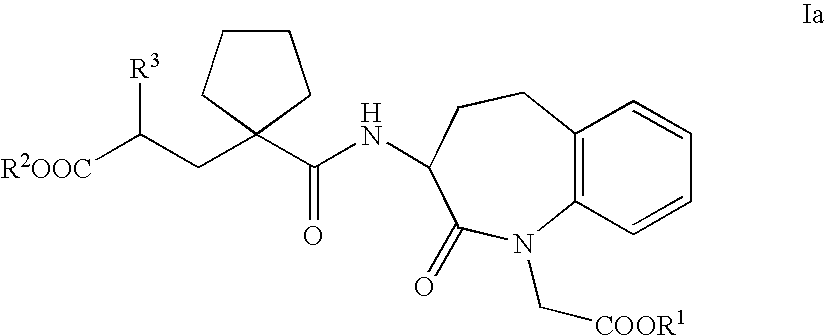
wherein R1, R2 and R3 have the above meanings, and physiologically compatible salts of acids of Formula Ia. Preferred salts of compounds of Formula Ia are e.g. disclosed in document WO 03/059939 A1. The compounds of Formula Ia contain two chiral carbon atoms, namely the carbon atom which is in the 3 position of the ring framework and bears the amide side-chain, and the carbon atom of the amide side-chain which bears the radical R3. The compounds can therefore exist in several optically active stereoisomeric forms or as a racemate. According to the present invention both the racemic mixtures and the isomerically pure compounds of Formula Ia may be used. - The compounds of Formula Ia are optionally esterified dicarboxylic acid derivatives. Depending on the form of administration, biolabile monoesters, particularly compounds in which R2 is a group forming a biolabile ester and R1 is hydrogen, or dicarboxylic acids are preferred, the latter being particularly suitable for i.v. administration. Groups which can be cleaved under physiological conditions in vivo, releasing bioavailable derivatives of the compounds of Formula Ia, are suitable as groups forming biolabile carboxylic acid esters R1 and R2. Suitable examples of this are C1-4-alkyl groups, in particular methyl, ethyl, n-propyl and isopropyl; C1-4-alkyloxy-C1-4-alkyloxy-C1-4-alkyl groups, in particular methoxyethoxymethyl; C3-7-cycloalkyl groups, in particular cyclohexyl; C3-7-cycloalkyl-C1-4-alkyl groups, in particular cyclopropylmethyl; N,N-di-(C0-4-alkyl)amino-C1-6-alkyl groups; phenyl or phenyl-C1-4-alkyl groups optionally substituted in the phenyl ring once or twice by halogen, C1-4-alkyl or C1-4-alkoxy or by a C1-4-alkylene chain bonded to two adjacent carbon atoms; dioxolanylmethyl groups optionally substituted in the dioxolane ring by C1-4-alkyl; C2-6-alkanoyloxy-C1-4-alkyl groups optionally substituted at the oxy-C1-4-alkyl group by C1-4-alkyl; double esters like 1-[[(C1-4-alkyl)carbonyl]oxy]C1-4-alkyl esters, e.g. (RS)-1-[[(isopropyl)-carbonyl]oxy]ethyl or (RS)-1-[[(ethyl)carbonyl]oxy]-2-methylpropyl (for preparation see e.g. F. W. Sum et al., Bioorg. Med. Chem. Lett. 9 (1999) 1921-1926 or Y. Yoshimura et al., The Journal of Antibiotics 39/9 (1986) 1329-1342); carbonate esters like 1-[[(C4-7-cycloalkyloxy)carbonyl]oxy]C1-4-alkyl esters, preferably (RS)-1-[[(cyclohexyloxy)carbonyl]oxy]ethyl (=cilexetil; for preparation see e.g. K. Kubo et al., J. Med. Chem. 36 (1993) 2343-2349, cited as “Kubo et al.” hereinafter)) or 2-oxo-1,3-dioxolan-4-yl-C1-4-alkyl esters which optionally contain a double bond in the dioxolan ring, preferably 5-methyl-2-oxo-1,3-dioxolen-4-yl-methyl (=medoxomil, for preparation see e.g. Kubo et al.) or 2-oxo-1,3-dioxolan-4-yl-methyl (=(methyl)-ethylenecarbonate). Where the group forming a biolabile ester represents an optionally substituted phenyl-C1-4-alkyl group, this may contain an alkylene chain with 1 to 3, preferably 1, carbon atoms and preferably stands for optionally substituted benzyl, in particular for 2-chlorobenzyl or 4-chlorobenzyl. Where the group forming a biolabile ester represents an optionally substituted phenyl group, the phenyl ring of which is substituted by a lower alkylene chain, this may contain 3 to 4, preferably 3, carbon atoms and in particular be indanyl. Where the group forming a biolabile ester represents an optionally substituted C2-6-alkanoyloxy-C1-4-alkyl group, the C2-6-alkanoyl group may be straight-chain or branched.
- R1 preferably has the meanings hydrogen, C1-4-alkyl, p-methoxybenzyl, N,N-di-(C0-4-alkyl)amino-C1-6-alkyl, (RS)-1-[[(isopropyl)carbonyl]oxy]ethyl, (RS)-1-[[(ethyl)carbonyl]oxy]-2-methylpropyl, (RS)-1-[[(cyclohexyloxy)carbonyl]oxy]ethyl, 5-methyl-2-oxo-1,3-dioxolen-4-yl-methyl, 2-oxo-1,3-dioxolan-4-yl-methyl or (RS)-1-[[(ethoxy)carbonyl]oxy]ethyl.
- R2 preferably has the meanings hydrogen, ethyl, methoxyethoxymethyl, (RS)-1-[[(isopropyl)carbonyl]oxy]ethyl, (RS)-1-[[(ethyl)carbonyl]oxy]-2-methylpropyl, (RS)-1-[[(cyclohexyloxy)carbonyl]oxy]ethyl, 5-methyl-2-oxo-1,3-dioxolen-4-yl-methyl, 2-oxo-1,3-dioxolan-4-yl-methyl or (RS)-1-[[(ethoxy)carbonyl]oxy]ethyl.
- In the radical R3 the lower alkylene chain of the phenyl-C1-4-alkyl group may contain preferably 1 to 2 carbon atoms. In particular, R3 is an optionally substituted phenethyl group which can optionally be substituted one or two times by halogen, C1-4-alkoxy or C1-4-alkyl, or is a naphthylethyl group.
- Of the compounds of Formula Ia, most preferred are the compounds which are selected from the group consisting of 2-[1-(1-carboxymethyl-2-oxo-2,3,4,5-tetrahydro-1H-benzo[b]azepin-3-ylcarbamoyl)-cyclopentylmethyl]-4-phenyl-butyric acid ethyl ester [alternative name: 3-[1-{2′-(ethoxycarbonyl)}-4′-phenylbutyl]-cyclopentan-1-carbonylamino]-2,3,4,5-tetrahydro-2-oxo-1H-1-benzazepin-1-acetic acid] of Formula II,

- 2-[1-(1-carboxymethyl-2-oxo-2,3,4,5-tetrahydro-1H-benzo[b]azepin-3-ylcarbamoyl)-cyclopentylmethyl]-4-naphthalen-1-yl-butyric acid ethyl ester [alternative name: 3-[1-{2-(ethoxycarbonyl)-4-(1-naphthyl)butyl]cyclopentyl}carbonyl)amino]-2-oxo-2,3,4,5-tetrahydro-1H-1-benzazepin-1-yl}acetic acid] of Formula III,

- 2-[1-(1-carboxymethyl-2-oxo-2,3,4,5-tetrahydro-1H-benzo[b]azepin-3-ylcarbamoyl)-cyclopentylmethyl]-4-phenyl-butyric acid of Formula IV,
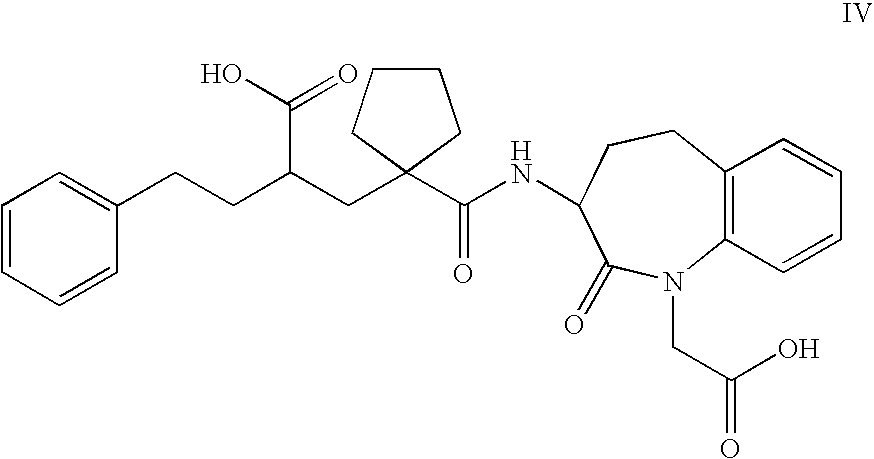
- 2-[1-(1-carboxymethyl-2-oxo-2,3,4,5-tetrahydro-1H-benzo[b]azepin-3-ylcarbamoyl)-cyclopentylmethyl]-4-naphthalen-1-yl-butyric acid of Formula V,
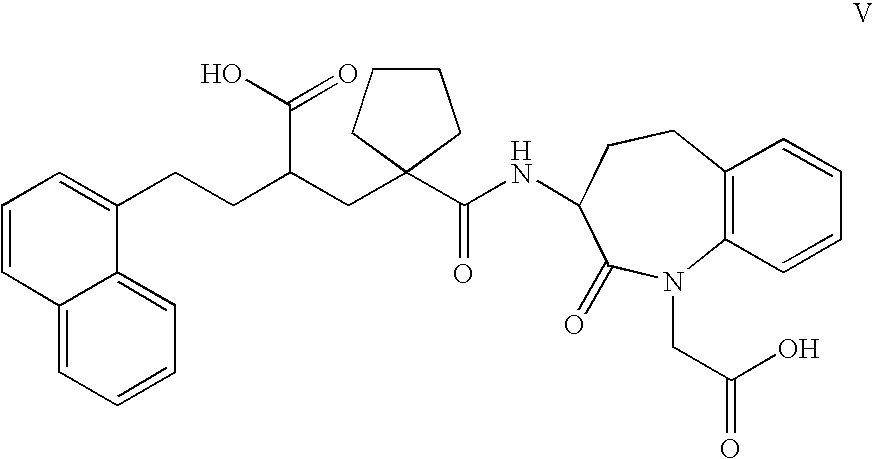
and physiologically compatible salts of the acids of Formulas II, III, IV and/or V. The compounds of Formulas II, III, IV and V are especially suited in their 3S,2′R forms. Most preferred is the compound of Formula II in its 3S,2′R form, also known as “daglutril” or “SLV306”. The compounds of Formula Ia are known, for example, from document EP 0 733 642 A1 which is incorporated herein by reference, and can be produced according to the production processes disclosed or referenced in this document or analogously to said production processes. - Further, compounds of general Formula Ib,
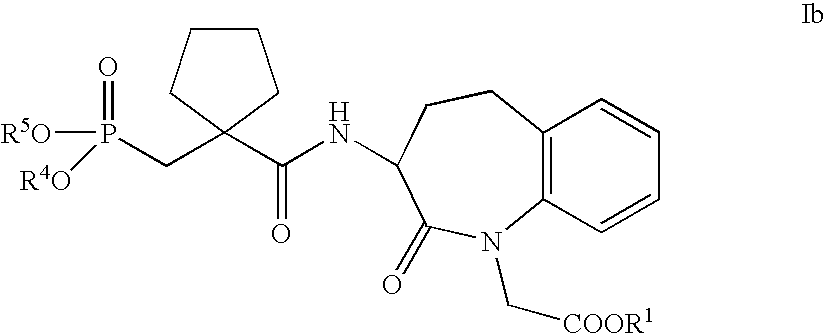
wherein R1, R4 and R5 have the meanings given above, and physiologically compatible salts of said acids of Formula Ib can be used according to the invention. The compounds of Formula Ib are known, for example, from document EP 0 916 679 A1, and can be produced according to the production processes disclosed or referenced in this document or analogously to said production processes. - Suitable groups R1 forming biolabile carboxylic acid esters are those as specified for compounds of Formula Ia above.
- Groups R4 and R5 suitable as groups forming biolabile phosphonic acid esters are those which can be removed under physiological conditions in vivo with release of the respective phosphonic acid function. For example, groups which are suitable for this purpose are lower alkyl groups, C2-C6-alkanoyloxymethyl groups optionally substituted on the oxymethyl group by lower alkyl, or phenyl or phenyl-lower alkyl groups whose phenyl ring is optionally mono- or polysubstituted by lower alkyl, lower alkoxy or by a lower alkylene chain bonded to two adjacent carbon atoms. If the group R4 and/or R5 forming a biolabile ester is or contains lower alkyl, this can be branched or unbranched and can contain 1 to 4 carbon atoms. If R4 and/or R5 are an optionally substituted alkanoyloxymethyl group, it can contain a preferably branched alkanoyloxy group having 2 to 6, preferably 3 to 5, carbon atoms and can, for example, be a pivaloyloxymethyl radical (=tert-butylcarbonyloxymethyl radical). If R4 and/or R5 are an optionally substituted phenyl-lower alkyl group, this can contain an alkylene chain having 1 to 3, preferably 1, carbon atoms. If the phenyl ring is substituted by a lower alkylene chain, this can contain 3 to 4, in particular 3, carbon atoms and the substituted phenyl ring is in particular indanyl.
- The compounds of the formula Ib contain a chiral carbon atom, namely the carbon atom carrying the amide side chain in the 3-position of the benzazepine structure. The compounds can thus be present in two optically active stereoisomeric forms or as a racemate. The present invention includes both the racemic mixtures and the isomerically pure compounds of the formula I. If R4 and R5 in compounds of the formula Ib are not hydrogen and in each case have different meanings, the phosphorus atom of the phosphonic acid group can also be chiral. The invention also relates to the isomer mixtures and isomerically pure compounds of the formula Ib formed as a result of chiral phosphorus atoms.
- When compounds of Formula Ib are used according to the invention, (3-{[1-(benzyloxy-ethoxy-phosphorylmethyl)-cyclopentanecarbonyl]-amino}-2-oxo-2,3,4,5-tetrahydro-benzo[b]azepin-1-yl)-acetic acid tert-butyl ester and isobutyric acid 1-[[1-(-1-carboxymethyl-2-oxo-2,3,4,5-tetrahydro-1H-benzo[b]azepin-3-ylcarbamoyl)-cyclopentylmethyl]-(1-isobutyryloxy-ethoxy)-phosphinoyloxy]-ethyl ester are preferred. Both of said compounds are particularly preferred when the stereochemistry at the chiral carbon atom (see above) is “S”, namely in their “(3S)” configuration.
- The compounds of the invention, in particular the compounds of Formula Ia are suited for the prophylaxis or treatment of SD. In the clinic, SD disorders have been divided into female sexual dysfunction (FSD) disorders and male sexual dysfunction (MSD) disorders (see Melman, A. & Gingell, J. C. (1999). The epidemiology and pathophysiology of erectile dysfunction. J Urology 161 : 5-11), hereinafter cited as “Melman et al. 1999”). The dually acting compounds of the invention which are capable of inhibiting NEP and hSEP are particularly beneficial for the prophylaxis and/or treatment of MSD (e.g. male erectile dysfunction-MED). A further advantage of compounds of Formula I in this indication is a certain ECE inhibitory share at their profile of action.
- MSD is generally associated with erectile dysfunction, also known as male erectile dysfunction (=MED) (see Benet, A. E. et al (1994), Male erectile dysfunction assessment and treatment options. C07Sp. TheY. 20: 669-673) hereinafer cited as “Benet et al. 1994”). MED is defined as: “ . . . the inability to achieve and/or maintain a penile erection for satisfactory sexual performance (see NIH Consensus Development Panel on Impotence (1993). NIH Consensus Conference Impotence. JA. M. A. 270: 83) . . . ”. It has been estimated that the prevalence of erectile dysfunction (=ED) of all degrees (minimal, moderate and complete impotence) is 52% in men 40 to 70 years old, with higher rates in those older than 70 (Melman et al. 1999). The condition has a significant negative impact on the quality of life of the patient and their partner, often resulting in increased anxiety and tension which leads to depression and low self esteem. Whereas two decades ago, MED was primarily considered to be a psychological disorder (Benet et al. 1994), it is now known that for the majority of patients there is an underlying organic cause. As a result, much progress has been made in identifying the mechanism of normal penile erection and the pathophysiology of MED.
- When the dually acting compounds capable of inhibiting NEP and hSEP of the invention are used in the therapy of FSD, therapy of female sexual arousal disorder (=FSAD) is preferred.
- FSD is best defined as the difficulty or inability of a woman to find satisfaction in sexual expression. FSD is a collective term for several diverse female sexual disorders (Leiblum, S. R. (1998). Definition and classification of female sexual disorders. Int. J. Impotence Res., 10, S104-S106; Berman, J. R., Berman, L.& Goldstein, I. (1999). Female sexual dysfunction: Incidence, pathophysiology, evaluations and treatment options. Urology, 54,385-391.). The woman may have lack of desire, difficulty with arousal or orgasm, pain with intercourse or a combination of these problems. Several types of disease, medications, injuries or psychological problems can cause FSD. Treatments in development are targeted to treat specific subtypes of FSD, predominantly desire and arousal disorders. The categories of FSD are best defined by contrasting them to the phases of normal female sexual response: desire, arousal and orgasm (Leiblum, S. R. (1998). Definition and classification of female sexual disorders. Int. J. Impotence Res., 10, S104-S106).
- Desire or libido is the drive for sexual expression. Its manifestations often include sexual thoughts either when in the company of an interested partner or when exposed to other erotic stimuli.
- Arousal is the genital response to sexual stimulation, an important component of which is genital engorgement and includes increased vaginal blood flow, vaginal lubrication, elongation of the vagina and increased genital sensation/sensitivity.
- Orgasm is the release of sexual tension that has culminated during arousal. hence, FSD occurs when a woman has an inadequate or unsatisfactory response in any of these phases, usually desire, arousal or orgasm.
- FSD categories include hypoactive sexual desire disorder, sexual arousal disorder, orgasmic disorders and sexual pain disorders.
- Although the compounds of the invention will improve the genital response to sexual stimulation (as in female sexual arousal disorder), in doing so they may also improve the associated pain, distress and discomfort associated with intercourse and so treat other female sexual disorders. Thus, in accordance with a particular aspect of the invention, there is provided use of a compound of the invention in the preparation of a medicament for the treatment or prophylaxis of hypoactive sexual desire disorder, sexual arousal disorder, orgasmic disorder and sexual pain disorder, more preferably for the treatment or prophylaxis of sexual arousal disorder, orgasmic disorder, and sexual pain disorder, and preferably in the treatment or prophylaxis of sexual arousal disorder. Hypoactive sexual desire disorder is present if a woman has no or little desire to be sexual, and has no or few sexual thoughts or fantasies. This type of FSD can be caused by low testosterone levels, due either to natural menopause or to surgical menopause. Other causes include illness, medications, fatigue, depression and anxiety.
- FSAD is characterised by inadequate genital response to sexual stimulation. The genitalia do not undergo the engorgement that characterises normal sexual arousal. The vaginal walls are poorly lubricated, so that intercourse is painful. Orgasms may be impeded. Arousal disorder can be caused by reduced oestrogen at menopause or after childbirth and during lactation, as well as by illnesses, with vascular components such as diabetes and atherosclerosis. Other causes result from treatment with diuretics, antihistamines, antidepressants e.g. selective serotonin re-uptake inhibitors (=SSRIs) or antihypertensive agents.
- Sexual pain disorders (includes dyspareunia and vaginismus) are characterised by pain resulting from penetration and may be caused by medications which reduce lubrication, endometriosis, pelvic inflammatory disease, inflammatory bowel disease or urinary tract problems. The prevalence of FSD is difficult to gauge because the term covers several types of problems, some of which are difficult to measure, and because the interest in treating FSD is relatively recent.
- Many women's sexual problems are associated either directly with the female ageing process or with chronic illnesses such as diabetes and hypertension. Because FSD consists of several subtypes that express symptoms in separate phases of the sexual response cycle, there is not a single therapy.
- Current treatment of FSD focuses principally on psychological or relationship issues. Treatment of FSD is gradually evolving as more clinical and basic science studies are dedicated to the investigation of this medical problem. Female sexual complaints are not all psychological in pathophysiology, especially for those individuals who may have a component of vasculogenic dysfunction (e.g. FSAD) contributing to the overall female sexual complaint. There are at present no drugs licensed for the treatment of FSD. Empirical drug therapy includes oestrogen administration (topically or as hormone replacement therapy), androgens or mood-altering drugs such as buspirone or trazodone. These treatment options are often unsatisfactory due to low efficacy or unacceptable side effects. Since interest is relatively recent in treating FSD pharmacologically, therapy consists of the following: psychological counselling, over-the-counter sexual lubricants, and investigational candidates, including drugs approved for other conditions. These medications consist of hormonal agents, either testosterone or combinations of oestrogen and testosterone and more recently vascular drugs, that have proved effective in MED. None of these agents has yet been demonstrated to be effective in treating FSD.
- The Diagnostic and Statistical Manual (DSM) IV of the American Psychiatric Association defines FSAD as being: “ . . . a persistent or recurrent inability to attain or to maintain until completion of the sexual activity adequate lubrication-swelling response of sexual excitement. The disturbance must cause marked distress or interpersonal difficulty . . . . ”. The arousal response consists of vasocongestion in the pelvis, vaginal lubrication and expansion and swelling of the external genitalia. The disturbance causes marked distress and/or interpersonal difficulty. Studies investigating sexual dysfunction in couples reveals that up to 76% of women have complaints of sexual dysfunction and that 30-50% of women in the USA experience FSD (Berman, J. R., Berman, L. A., Werbin, T. J. et al., (1999). Female sexual dysfunction: Anatomy, physiology, evaluation and treatment options. Curr Opin Urology, 9,563-568). FSAD is a highly prevalent sexual disorder affecting pre-, peri- and post-menopausal (hormone replacement therapy (HRT)) women. It is associated with concomitant disorders such as depression, cardiovascular diseases, diabetes and urogenital disorders. The primary consequences of FSAD are lack of engorgement/swelling, lack of lubrication and lack of pleasurable genital sensation. The secondary consequences of FSAD are reduced sexual desire, pain during intercourse and difficulty in achieving an orgasm. It has recently been hypothesised that there is a vascular basis for at least a proportion of patients with symptoms of FSAD (Goldstein et al., Int. J. Impot. Res., 10, S84-S90, 1998) with animal data supporting this view (Park et al., Int. J. Impot. Res., 9, 27-37, 1997).
- The present invention therefore in a second aspect provides a method of treating or preventing sexual dysfunction in mammals and humans comprising administering to a subject in need thereof an effective amount of a dually acting compound capable of inhibiting NEP and hSEP according to the invention. Typically, the physician will determine the actual dosage which will be most suitable for an individual patient and it will vary with the age, weight, sex and response of the particular patient. In general, a therapeutically effective daily oral or intravenous dose of the agents of the present invention is likely to range from 0.01 to 50 mg/kg body weight of the subject to be treated, preferably 0.01 to 20 mg/kg, more preferably 0.1 to 20 mg/kg. The agents of the present invention may also be administered by intravenous infusion, at a dose which is likely to range from 0.001-10 mg/kg/hr. The above dosages are exemplary of the average case. There can, of course, be individual instances where higher or lower dosage ranges are merited, and such are within the scope of this invention.
- In a third aspect, the invention also provides a method of treating or preventing sexual dysfunction in mammals and humans comprising administering to a subject in need thereof therapeutically effective amounts of each of
- a) at least one neutral endopeptidase inhibitor,
- b) at least one inhibitor of human soluble endopeptidase and
- c) at least one compound supportive to the inventive use which is selected from the group consisting of the specific compounds or subgroups of PDE5 inhibitors, NPY receptor antagonists, PDE2 inhibitors, nitric oxide donors, dopamine receptor agonists, melanocortin receptor agonists, potassium channel openers, calcium activated potassium channel openers, α1-adrenoceptor antagonists, vasoactive intestinal peptide (=VIP) receptor agonists or VIP analogues, α2-adrenoceptor antagonists, estrogens, medroxyprogesterone, medroxyprogesterone acetate, methyl testosterone hormone replacement therapy agents, testosterone, testostrone replacement agents, testosterone/oestradiol agents, estrogen agonists, serotonin receptor agonists or antagonists, prostanoid receptor agonists, purinergic receptor agonists, ECE inhibitors, endothelin receptor antagonists, NEP inhibitors and antidepressant agents.
- It is known that inhibitors of SEP enhance pelvic nerve-stimulated and VIP-induced increases in vaginal and clitoral blood flow. It is also known that SEP inhibitors enhance VIP and nerve-mediated relaxations of the isolated vagina wall. Thus the present invention is advantageous as it helps provide a means for restoring a normal sexual arousal response-namely increased genital blood flow leading to vaginal, clitoral and labial engorgement. This will result in increased vaginal lubrication via plasma transudation, increased vaginal compliance and increased genital sensitivity. Hence, the present invention provides a means to restore, or potentiate, the normal sexual arousal response. By female genitalia herein it is meant: “The genital organs consist of an internal and external group. The internal organs are situated within the pelvis and consist of ovaries, the uterine tubes, uterus and the vagina. The external organs are superficial to the urogenital diaphragm and below the pelvic arch. They comprise the mons pubis, the labia majora and minora pudendi, the clitoris, the vestibule, the bulb of the vestibule, and the greater vestibular glands” (Gray's Anatomy, C. D. Clemente, 13th American Edition). R. J. Levin teaches that, because “ . . . male and female genitalia develop embryologically from the common tissue anlagen, [that] male and female genital structures are argued to be homologues of one another. Thus the clitoris is the penile homologue and the labia homologues of the scrotal sac . . . . ” (Levin, R. J. (1991), Exp. Clin. Efzdocrinol., 98, 6169).
- With regard to MSD, in particular to MED, penile erection is a haemodynamic event which is dependent upon the balance of contraction and relaxation of the corpus cavernosal smooth muscle and vasculature of the penis (see Lerner, S. E. et al (1993). A review of erectile dysfunction: new insights and more questions. J. Urology 149: 1246-1255). Corpus cavernosal smooth muscle is also referred to herein as corporal smooth muscle or in the plural sense corpus cavernosa. Relaxation of the corpus cavernosal smooth muscle leads to an increased blood flow into the trabecular spaces of the corpus cavernosa, causing them to expand against the surrounding tunica and compress the draining veins. This produces a vast elevation in cavernosal blood pressure which results in an erection (see Naylor, A. M. (1998). Endogenous neurotransmitters mediating penile erection. Br. J. Urology 81: 424-431), hereinafter cited as “Naylor, 1998”). The changes that occur during the erectile process are complex and require a high degree of coordinated control involving the peripheral and central nervous systems, and the endocrine system (Naylor, 1998). Corporal smooth muscle contraction is modulated by sympathetic noradrenergic innervation via activation of postsynaptic α-adrenoceptors. MED may be associated with an increase in the endogenous smooth muscle tone of the corpus cavernosum. However, the process of corporal smooth muscle relaxation is mediated partly by non-adrenergic, non-cholinergic (=NANC) neurotransmission. There are a number of other NANC neurotransmitters found in the penis, other than nitric oxide (=NO), such as calcitonin gene related peptide (=CGRP) and VIP. The main relaxing factor responsible for mediating this relaxation is NO, which is synthesised from L-arginine by nitric oxide synthase (=NOS) (see e.g. Taub, H. C. et al (1993). Relationship between contraction and relaxation in human and rabbit corpus cavernosum. Urology 42: 698-704). It is thought that reducing corporal smooth muscle tone may aid NO to induce relaxation of the corpus cavernosum. During sexual arousal in the male, NO is released from neurones and the endothelium and binds to and activates soluble guanylate cyclase (sGC) located in the smooth muscle cells and endothelium, leading to an elevation in intracellular cyclic guanosine 3′,5′-monophosphate (cGMP) levels. This rise in cGMP leads to a relaxation of the corpus cavernosum due to a reduction in the intracellular calcium concentration ([Ca2+]i), via unknown mechanisms thought to involve protein kinase G activation (possibly due to activation of Ca2+ pumps and Ca2+-activated K+-channels).
- Recently it has been shown that C-type natriuretic peptide (═CNP) may also play a role in MED, acting at the membrane-bound guanylyl cyclase B (=GC-B) which is expressed in human corpus cavernosum tissue. Stimulation of GC-B leads to an increase in intracellular cGMP and, consequently, smooth muscle relaxation. PDE5-inhibitors, e.g. sildenafil increase intracellular cGMP in corpus cavernosum tissue by inhibiting its breakdown. PDE5-inhibitors are inactive in the absence of a stimulator of cGMP formation, e.g. in the absence of NO. This finding suggests that the basal (unstimulated) rate of cGMP formation in the corpus cavernosum is rather low, so that inhibition of cGMP breakdown by PDE5 inhibitors is not sufficient for an erectile response without concomittant stimulation of guanylyl cyclase. Increasing the concentration of CNP leads to elevated intracellular cGMP concentration, by an increase in cGMP formation. Consequently, elevating the CNP concentration in the corpus cavernosum will presumably have similar effects as inhibiting PDE5. Due to their different mechanisms of action, i.e. increasing formation of cGMP vs. inhibition of its breakdown, the approaches of inhibiting PDE5 or the breakdown of CNP, respectively are deemed to be additive thus making it a reasonable assumption that a combination of these two mechanisms of action will be particularly effective in patients who do not respond to the administration of PDE5 inhibitors alone.
- VIP positive nerve fibres have been found in the trabecular meshwork of the corpus cavernosum, suggesting a role of VIP release in penile erection. Effects of VIP are thought to be mediated via increases in cAMP and are thus complementary to those of cGMP-elevating agents. In patients with ED an intracavernosal injection of VIP (combined with the α-adrenoceptor antagonist phentolamine) was found to be a safe and effective treatment, with a response rate of 67% (erections sufficient for sexual intercourse).
- The endopeptidases NEP and hSEP both degrade CNP and VIP and thereby limit the effects of CNP and VIP on cavernosal smooth muscle. Inhibition of CNP and VIP breakdown will lead to increased availability of these vasorelaxing factors thereby increasing blood flow to the corpus cavernosum which finally should result in improved erectile function. Support can be found for this from experimental data in rabbits, showing a significant increase in intracavernosal pressure and female genital blood flow after application of an NEP-inhibitor (see document WO 02/079143). Furthermore, a gene (SMR1) encoding a pro-peptide of the endogenous NEP-inhibitor sialorphine was found (see User H. M., Zelner D. J., McKenna K. E., McVary K. T. (2003). Microarray analysis and description of SMR1 gene in rat penis in a post-radical prostatectomy model of erectile dysfunction. J Urol.; 170(1):298-301) to be markedly downregulated (>80-fold) in a rat model of neurogenic erectile dysfunction suggesting that in this disease NEP activity may be enhanced and contribute to the development of erectile dysfunction.
- Pharmacological Test Methods
- 1. Inhibition of Enzymatic Breakdown of CNP and VIP by the Test Compounds
- The inhibition of the enzymatic breakdown of CNP and VIP by the test compounds of Formula I according to the invention was measured in an enzymatic in vitro assay according to the following protocol:
- Enzymes:
-
-
- a) hSEP (sol hu)(his)6; or: His6-tagged hSEP ectodomain.
- stock solution: 53 μg/ml in 20 mM HEPES pH 7.2, 5% glycerol, 0.005% Tween20, 100 mM NaCl, purity>99%
- working solution: stock solution diluted with assay buffer to 5 μg/ml
- Supplier: Innogenetics, Ghent, Belgium. Preparation and purification of the protein were performed as described in WO 02/094176.
- b) NEP (prepared from pig kidney cortex)
- stock solution: 120 μg/ml in 20 mM bisTris, purity>95%
- working solution: stock solution diluted with assay buffer to 5 μg/ml
- Supplier: Dr. Philippe Crine, Univ. of Montreal, Canada
Substrates:
- a) VIP
- b) CNP (32-53)
- stock solution: 100 μM in assay buffer
- Supplier: Bachem, Weil am Rhein, Germany
- a) hSEP (sol hu)(his)6; or: His6-tagged hSEP ectodomain.
- Assay buffer: 100 mM Tris pH 7.0, 250 mM NaCl
- All test compounds were dissolved in DMSO at 10 mM and further diluted with assay buffer.
- Activity Assay Procedure
- 80 μl of assay buffer, 10 μl of enzyme working solution (NEP or hSEP) and 10 μl of peptide stock solution (VIP or CNP) were mixed in an Eppendorf vial and incubated for 120 min. at 37° C. The enzymatic reaction was subsequently terminated by heating to 95° C. for 5 min. After centrifugation (Heraeus Biofuge B, 3 min) the supernatant was subjected to HPLC.
- Inhibition Assay Procedure
- 70 μl of assay buffer, 10 μl of enzyme working solution (NEP or hSEP) and 10 μl of a test compound solution were mixed in an Eppendorf vial and preincubated at 37° C. for 15 minutes. Then, 10 μl of peptide stock solution (VIP or CNP) was added and the reaction mixture was incubated at 37° C. for 60 min. to allow enzymatic hydrolysis. The enzymatic reaction was subsequently terminated by heating to 95° C. for 5 min. After centrifugation (Heraeus Biofuge B, 3 min) the supernatant was subjected to HPLC.
- HPLC Procedure
- For separating the remaining substrate from the cleavage products, a reversed phase HPLC technique with a CC 125/4 Nucleosil 300/5 C18 RP column and a CC 8/4 Nucleosil 100/5 C18 precolumn (Macherey-Nagel, Duren, Germany) was used. 60 μl of the reaction samples were injected into the HPLC and the column was eluted at a flow rate of 1 ml/min with the following gradient:
Solution A: 100% H2O + 0.5 M H3PO4 pH 2.0 Solution B: 100% acetonitrile + 0.5 M H3PO4 0-2 min: 5% B 2-7 min: 5-50% B 7-8 min: 50-90% B 8-10 min: 90% B 10-12 min: 90-5% B - All peptides were detected by absorbance at 214 nm (UV spectroscopy).
- The percentage (=%) of hydrolysis was calculated on the basis of the peak area of the undegraded peptide for an enzyme containing sample Y in correlation to a sample containing the same concentration of peptide without enzyme (blank) by the following equation:
% hydrolysis=100*(blank−Y) - Basis of the calculation of % inhibition is the peak area of the undegraded peptide (VIP or CNP) for an inhibitor containing sample X in comparison to samples containing only peptide (blank) or peptide and enzyme without inhibitor (control) according to the following equation:
% inhib=100*(X−control)/(blank−control) - All samples were run in duplicate and mean values were used. A solvent control (0.1% DMSO) was added to each assay run.
- CNP and VIP were cleaved by NEP and hSEP in vitro. Breakdown of both peptides was faster with hSEP than with NEP, as is shown in the following Table 1:
TABLE 1 Breakdown rates of VIP and CNP by NEP or hSEP breakdown of CNP breakdown of VIP hSEP NEP hSEP NEP degradation at t = 2 h 46% 39% 36% 28% - The test compounds according to the invention were able to prevent degradation of CNP and VIP by both NEP and SEP. The respective IC50-values for inhibition of breakdown are given below in table 2. Further, the compound thiorphan has also been tested as a reference standard for selective inhibition of NEP.
TABLE 2 Prevention of degradation of CNP and VIP by the test compounds breakdown of CNP breakdown of VIP inhibition of hSEP NEP hSEP NEP breakdown by IC50 (nM) IC50 (nM) IC50 (nM) IC50 (nM) compound of 0.7 7.5 3.5 3.3 Formula II compound 2 2.8 2.3 4.0 1.6 compound of 2.2 6.6 2.9 4.2 Formula III thiorphan >1000 8.4 >1000 6.4 (standard) - compound of Formula II: (3S,2′R)-3-[1-(2′-carboxy-4′-phenyl-butyl]-cyclopentan-1-carbonylamino]-2,3,4,5-tetrahydro-2-oxo-1H-1-benzazepin-1-acetic acid (compound of Formula Ia, R1=hydrogen, R2=ethyl, R3=phenylethyl).
- compound 2: (3S)-(3-{[1-(Benzyloxy-ethoxy-phosphorylmethyl)-cyclopentanecarbonyl]-amino}-2-oxo-2,3,4,5-tetrahydro-benzo[b]azepin-1-yl)-acetic acid tert-butyl ester (compound of Formula Ib, R1=tert. butyl, R4=ethyl, R5=benzyl)
- compound of Formula III: {(3S)-3-[({1-[(2R)-2-(ethoxycarbonyl)-4-(1-naphthyl)butyl]cyclopentyl}carbonyl)amino]-2-oxo-2,3,4,5-tetrahydro-1H-1-benzazepin-1-yl}acetic acid (compound of Formula Ia, R1=hydrogen, R2=ethyl, R3=1-naphthylethyl)
- 2. Influence of Test Compounds on Big-ET-Induced Contraction of Human Cavernosal Strips In Vitro
- Human erectile tissues were obtained from the corpus cavernosum of 9 patients undergoing surgery for implantation of penile prosthesis as treatment of erectile dysfunction or penile congenital curvature. After surgery, the tissue samples were transported and stored at 4° C. in RPMI-1640 medium containing HEPES (23.8 mM), penicillin (100 IU/ml) and streptomycin (0.1 mg/ml) until use (within 24 hours). Eight sections of 4×2×2 mm were excised from the corpus cavernosum of each donor for each experiment. Cavernosal strips were suspended in 5 ml organ chambers filled with Krebs-HEPES buffer. Organ chambers were maintained at 37° C. and continuously bubbled with 95% O2 and 5% CO2 to maintain a pH at 7.4. The cavernosal strips were connected to force transducers for isometric tension recording (Pioden controls Ltd, UK), and an initial tension of 1 g was applied. Following amplification, the tension changes were digitalized via a Mac Lab™/8 using Chart software (AD Instruments Ltd). The tissue preparation were allowed to equilibrate for 90 minutes, while being washed periodically (every 15 minutes) with fresh Krebs-HEPES buffer. When a stable resting tension was attained, the strips were set to at least 500 mg of basal tension. Following the equilibration period, the erectile tissues were primed with KCl 80 mM during 10 min. Once this priming period was achieved, the strips were washed by fresh Krebs-HEPES solution and allowed to re-equilibrate for 30 minutes at 500 mg of tension.
- Once the strips were stabilized after the priming period, they were incubated with one of the following compounds (all at 10 μM, unless indicated otherwise) during 20 min: compound of Formula IV, compound of Formula V, SM-19712 (a selective and potent endothelin converting enzyme-1 inhibitor), DL-thiorphan (a selective and potent NEP inhibitor), and the combination of SM-19712, 10 μM and DL-thiorphan, and the common vehicle (phosphate buffer).
- The strips were then exposed to the half-maximally effective concentration of big-ET-1 (10−8 M) determined in the preliminary experiments until a stable response was obtained.
- Contractile responses were expressed as absolute change in maximal developed tension (in mg). To reduce the potential heterogeneity of responses between strips, the contraction to big-ET-1 was normalized by the contractile responses to KCl 80 mM obtained during the priming period.
TABLE 3 Effects of test compounds on maximal big-ET-induced contraction of human corpus cavernosum Maximal big-ET- Compound induced contraction SEM n Vehicle 149.2 3.96 6 SM-19712 85.10 14.78 6 Thiorphan 91.57 13.61 6 SM-19712 + Thiorphan 21.28 6.26 6 Cpd. of Formula IV 32.80 5.20 5 cpd. of Formula V 49.60 10.92 6 - The results are from duplicate or triplicate determinations from a single corpus cavernosum sample were averaged and values are expressed as percentage of the contractile responses induced by 80 mM of KCl, as mean □SEM, for n corpus cavernosum samples.
- As indicated above, the compounds of Formula I also exert a certain ECE inhibitory share at their action profile. ET-1 induces a potent, slowly developing, and long-lasting contraction of penile arteries and the corpus cavernosum and may, thereby, contribute to keeping the penis in a flaccid state (see Andersson, K. -E. (2003) Erectile physiological and pathophysiological pathways involved in erectile dysfuncton. J Urol. 170:S1-S6). Recently, it has been shown that plasma levels of ET-1 are elevated in patients with erectile dysfunction compared to healthy controls. Moreover, ET-1 levels were the best independent predictors of erectile dysfunction in men without cardiovascular risk factors (see Bocchio M. et al. (2004), Endothelial cell activation in men with erectile dysfunction without cardiovascular risk factors and overt vascular damage. J Urol. 171:1601-1604). Based on these findings it can thus be deduced that inhibition of the endothelin pathway should improve human erectile function. Changes in the balance between contractant factors such as ET-1, and relaxant factors such as NO, VIP and CNP, will result in consecutive changes in penile blood flow and, hence, erectile function. Therefore, a compound that is able to reduce ET-1 formation, e.g. by inhibiting the endothelin-converting enzyme and simultaneously increase plasma concentrations of VIP and CNP, e.g. by inhibiting their breakdown by NEP and hSEP, can be expected to markedly increase blood flow to the corpus cavernosum and lead to improved erectile function.
- In a fourth aspect the present invention also provides a pharmaceutical composition containing the dually acting inhibitors of NEP and of hSEP for the treatment of sexual dysfunction.
- In a fifth aspect the present invention provides a pharmaceutical combination composition for the prophylaxis or treatment of SD, said pharmaceutical composition comprising pharmacologically effective quantities of each of
- a) at least one neutral endopeptidase inhibitor,
- b) at least one inhibitor of human soluble endopeptidase and
- c) at least one compound supportive to the inventive use which is selected from the group consisting of the specific compounds or subgroups of PDE5 inhibitors, NPY receptor antagonists, PDE2 inhibitors, nitric oxide donors, dopamine receptor agonists, melanocortin receptor agonists, potassium channel openers, calcium activated potassium channel openers, α1-adrenoceptor antagonists, VIP receptor agonists or VIP analogues, α2-adrenoceptor antagonists, estrogens, medroxyprogesterone, medroxyprogesterone acetate, oestrogens, methyl testosterone hormone replacement therapy agents, testosterone, testosterone replacement agents, testosterone/oestradiol agents, estrogen agonists, serotonin receptor agonists or antagonists, prostanoid receptor agonists, purinergic receptor agonists, ECE inhibitors, endothelin receptor antagonists, NEP inhibitors and antidepressant agents.
- In a preferred embodiment of said fifth aspect, a dually acting compound capable of inhibiting NEP and hSEP as subcombination of at least one neutral endopeptidase inhibitor (a) and at least one inhibitor of human soluble endopeptidase (b) can be used. Most preferred in this regard is the use of a compound of Formula I, more particular the use of a compound of Formula Ia.
- The pharmaceutical combination compositions of the present invention comprise as component c) one or more other pharmaceutically active agents supportive to the inventive use, such as a NEP inhibitor, one or more of a PDE5 inhibitor (e.g. sildenafil, vardenafil and/or IC351), one or more of NPY receptor antagonist, one or more of a PDE2 inhibitor, one or more of a nitric oxide (NO) donor (e.g. NMI-921), one or more of a dopamine receptor agonist (e.g. apomorphine, Uprima, Ixsene), one or more of a melanocortin receptor agonist (e.g. Melanotan II or PT14), one or more of a potassium channel opener (e.g. a KATP channel opener (e.g. minoxidil, nicorandil) and/or a calcium activated potassium channel opener (e.g. BMS204352), one or more of an α-adrenoceptor antagonist (e.g. phentolamine, Vasofem, Vasomax), one or more of a VIP receptor agonist or a VIP analogue (e.g. Ro-125-1553) or VIP fragments, one or more of a α-adrenoceptor antagonist with VIP combination (e.g. Invicorp, Aviptadil), one or more of a α2-adrenoceptor antagonist (e.g. yohimbine), one or more of an estrogen, estrogen and medroxyprogesterone or medroxyprogesterone acetate (MPA) or oestrogen and methyl testosterone hormone replacement therapy (=HRT) agent (e.g. HRT especially Premarin, Cenestin, Oestrofeminal, Equin, Estrace, Estrofem, Elleste Solo, Estring, Eastraderm, Eastraderm TTS, Eastraderm Matrix, Dermestril, Premphase, Prempro, Prempak, Premique, Estratest, Estratest HS, Tibolone), one or more of a testosterone replacement agent (including DHEA (dehydroandrostendione), testosterone (Tostrelle) or a testosterone implant), one or more of a testosterone/oestradiol agent, one or more of an estrogen agonist (e.g. Lasofoxifene), one or more of a serotonin receptor agonist or antagonist (e.g. 5HT1A, 5HT2C, 5HT2A and 5HT3 receptor agonists and antagonists; as described in WO 00/28993), one or more of a prostanoid receptor agonist (e.g. Muse, alprostadil, misoprostol), one or more of a purinergic receptor agonist (especially P2Y2 and P2Y4), one or more of an ECE inhibitor, one or more of an endothelin receptor antagonists, or one or more antidepressant agents (e.g. bupropion, mirtazapine, nefazodone). Preferred components c) are PDE5 inhibitors.
- In particular for human therapy, even though the compounds of the present invention can be administered alone, they will frequently be administered in admixture with a pharmaceutical carrier, excipient or diluent selected with regard to the intended route of administration and standard pharmaceutical practice. The components a), b) and c) of the pharmaceutical combination compositions can be administered jointly or consecutively in either order. By way of example, in the pharmaceutical compositions or the pharmaceutical combination compositions of the present invention, the agents of the present invention may be admixed with any suitable binder(s), lubricant(s), suspending agent(s), coating agent(s), or solubilising agent(s).
- Where appropriate, the pharmaceutical compositions or the pharmaceutical combination compositions can be administered by inhalation, in the form of a suppository or pessary, topically in the form of a lotion, solution, cream, ointment or dusting powder, by use of a skin patch, orally in the form of tablets containing excipients such as starch or lactose, or in capsules or ovules either alone or in admixture with excipients, or in the form of elixirs, solutions or suspensions containing flavouring or colouring agents, or they can be injected parenterally, for example intracavernosally, intravenously, intramuscularly or subcutaneously. For parenteral administration, the pharmaceutical compositions or the pharmaceutical combination compositions may be best used in the form of a sterile aqueous solution which may contain other substances, for example enough salts or monosaccharides to make the solution isotonic with blood. For buccal or sublingual administration the pharmaceutical compositions or the pharmaceutical combination compositions may be administered in the form of tablets or lozenges which can be formulated in a conventional manner. For oral, parenteral, buccal and sublingual administration to subjects (such as patients), the daily dosage level of the agents of the present invention may typically be from 10 to 500 mg (in single or divided doses).
- Thus, and by way of example, tablets or capsules may contain from 5 to 600 mg of active agent for administration singly, or two or more at a time, as appropriate.
- It is also possible to administer the agents of the present invention in sustained release formulations. In some applications, generally in humans, oral administration of the agents of the present invention is the preferred route, being the most convenient and can in some cases avoid disadvantages associated with other routes of administration-such as those associated with intracavemosal (i. c.) administration.
- In circumstances where the recipient suffers from a swallowing disorder or from impairment of drug absorption after oral administration, the drug may be administered parenterally.
- However, as with human treatments, it may be possible to administer the agent alone for veterinary treatments. Typically, the pharmaceutical compositions—which may be for human or animal usage will comprise any one or more of a pharmaceutically acceptable diluent, carrier or excipient. For veterinary use, the agent of the present invention is typically administered as a suitably acceptable formulation in accordance with normal veterinary practice and the veterinary surgeon will determine the dosing regimen and route of administration which will be most appropriate for a particular animal.
- The choice of pharmaceutical carrier, excipient or diluent can be selected with regard to the intended route of administration and standard pharmaceutical practice.
- As indicated above, the pharmaceutical compositions may comprise as, or in addition to the carrier, excipient or diluent any suitable binder(s), lubricant(s), suspending agent(s), coating agent(s) or solubilising agent(s).
- In a sixth aspect, the invention also comprises a kit, comprising in separate containers in a single package pharmaceutical compositions for use in combination which comprises,
- a) in one separate container a pharmaceutical composition comprising at least one neutral endopeptidase inhibitor and in a second separate container a pharmaceutical composition comprising at least one inhibitor of human soluble endopeptidase, or
- b) in one separate container a pharmaceutical composition comprising a dually acting compound capable of inhibiting neutral endopeptidase and human soluble endopeptidase, and
- c) in another separate container a pharmaceutical composition comprising at least one compound supportive to the inventive use which is selected from the specific compounds or subgroups of PDE5 inhibitors, NPY receptor antagonists, PDE2 inhibitors, nitric oxide donors, dopamine receptor agonists, melanocortin receptor agonists, potassium channel openers, calcium activated potassium channel openers, α1-adrenoceptor antagonists, VIP receptor agonists or VIP analogues, α2-adrenoceptor antagonists, estrogens, medroxyprogesterone, medroxyprogesterone acetate, oestrogens, methyl testosterone hormone replacement therapy agents, testosterone, testostrone replacement agents, testosterone/oestradiol agents, estrogen agonists, serotonin receptor agonists or antagonists, prostanoid receptor agonists, purinergic receptor agonists, ECE inhibitors, endothelin receptor antagonists, NEP inhibitors and antidepressant agents.
- The following examples for pharmaceutical compositions according to the invention are set forth to illustrate the invention without limiting its scope in any aspect:
- Tablets were prepared with the following composition per tablet:
Daglutril tricalcium phosphate salt 100 mg Corn starch 60 mg Lactose 55 mg Gelatine (as 10% solution) 6 mg - The active substance, the corn starch and the lactose were thickened with the 10% gelatine solution. The paste was comminuted and the resulting granules were placed on a suitable sheet and dried at 45° C. The dried granules were fed through a crushing machine and mixed with the following further adjuvants in a mixer:
Talc 5 mg Magnesium stearate 5 mg Corn starch 9 mg and then compressed to form tablets of 240 mg. - An injection solution having the following composition per 5 ml was prepared:
(3S,2′R)-3-[1-(2′-carboxy-4′-phenyl-butyl)- 10.00 mg cyclopentan-1- carbonylamino]-2,3,4,5- tetrahydro-2-oxo-1H-1-benzazepin-1-acetic acid Na2HPO4.7H2O 43.24 mg Na2HPO4.2H2O 7.72 mg NaCl 30.00 mg Purified water 4,948.00 mg - The solids were dissolved in water, the solution was sterilised and was poured into ampoules in portions of 5 ml each.
- Further favourable pharmaceutical compositions of compounds according to the invention, in particular of compounds of Formula Ia, are known from e.g. documents WO 03/068266 A1 or WO 03/059939 A1.
- The foregoing description and examples have been set forth merely to illustrate the invention and are not intended to be limiting. Since modifications of the described embodiments incorporating the spirit and substance of the invention may occur to persons skilled in the art, the invention should be construed broadly to include all variations within the scope of the appended claims and equivalents thereof.
Claims (16)
1. A method of treating or inhibiting sexual dysfunction in a human or other mammal subject in need thereof, said method comprising administering to said subject a therapeutically effective amount of a dually acting compound capable of inhibiting neutral endopeptidase and human soluble endopeptidase.
2. A method according to claim 1 , wherein said compound is a compound corresponding to Formula I
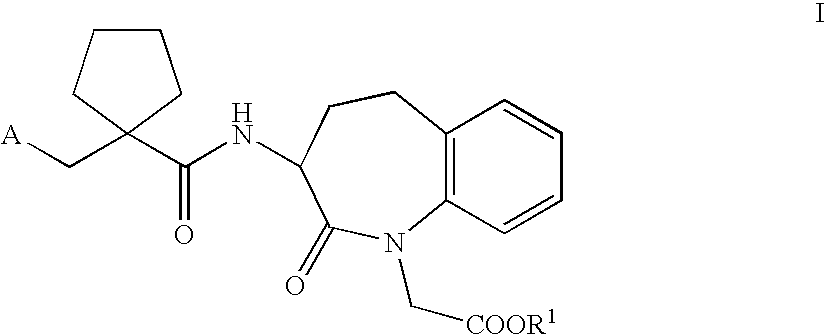
wherein


R1 is hydrogen or a group forming a biolabile carbonic acid ester,
A represents a group selected from the subgroups a,
wherein
R2 is hydrogen or a a group forming a biolabile carbonic acid ester and
R3 is a phenyl-C1-4-alkyl group which can optionally be substituted in the phenyl ring by C1-4-alkyl, C1-4-alkoxy or halogen; or a naphthyl-C1-4-alkyl group, and b,
wherein
R4 is hydrogen or a group forming a biolabile phosphonic acid ester, and
R5 is hydrogen or a group forming a biolabile phosphonic acid ester,
or a physiologically compatible salt thereof.
3. A method according to claim 1 , wherein said compound is a compound corresponding to Formula Ia,

wherein
R1 is hydrogen or a group forming a biolabile carbonic acid ester,
R2 is hydrogen or a group forming a biolabile carbonic acid ester and
R3 is a phenyl-C1-4-alkyl group which can optionally be substituted in the phenyl ring by C1-4-alkyl, C1-4-alkoxy or halogen; or a naphthyl-C1-4-alkyl group,
or a physiologically compatible salt thereof.
4. A method according to claim 1 , wherein said compound is selected from the group consisting of:
2-[1-(1-carboxymethyl-2-oxo-2,3,4,5-tetrahydro-1H-benzo[b]azepin-3-ylcarbamoyl)-cyclopentylmethyl]-4-phenyl-butyric acid ethyl ester;
2-[1-(1-carboxymethyl-2-oxo-2,3,4,5-tetrahydro-1H-benzo[b]azepin-3-ylcarbamoyl)-cyclopentylmethyl]-4-naphthalen-1-yl-butyric acid ethyl ester;
2-[1-(1-carboxymethyl-2-oxo-2,3,4,5-tetrahydro-1H-benzo[b]azepin-3-ylcarbamoyl)-cyclopentylmethyl]-4-phenyl-butyric acid;
2-[1-(1-carboxymethyl-2-oxo-2,3,4,5-tetrahydro-1H-benzo[b]azepin-3-ylcarbamoyl)-cyclopentylmethyl]-4-naphthalen-1-yl-butyric acid;
and physiologically compatible salts thereof.
5. A method according to claim 1 , wherein the sexual dysfunction is female sexual dysfunction.
6. A method according to claim 1 , wherein the sexual dysfunction is male sexual dysfunction.
7. A method according to claim 6 , wherein the male sexual dysfunction is selected from the group consisting of erectile dysfunction, ejaculatory disorders and desire disorders.
8. A method according to claim 7 , wherein the male sexual dysfunction is erectile dysfunction.
9. A pharmaceutical combination composition comprising pharmacologically effective quantities of:
a) at least one neutral endopeptidase inhibitor,
b) at least one inhibitor of human soluble endopeptidase, and
c) at least one compound selected from the group consisting of PDE5 inhibitors, NPY receptor antagonists, PDE2 inhibitors, nitric oxide donors, dopamine receptor agonists, melanocortin receptor agonists, potassium channel openers, calcium activated potassium channel openers, α1-adrenoceptor antagonists, VIP receptor agonists, VIP analogues, α2-adrenoceptor antagonists, estrogens, medroxyprogesterone, medroxyprogesterone acetate, methyl testosterone hormone replacement therapy agents, testosterone, testostrone replacement agents, testosterone/oestradiol agents, estrogen agonists, serotonin receptor agonists, serotonin receptor antagonists, prostanoid receptor agonists, purinergic receptor agonists, ECE inhibitors, endothelin receptor antagonists, NEP inhibitors and antidepressant agents.
10. A pharmaceutical composition according to claim 9 , further comprising at least one pharmaceutically acceptable auxiliary or carrier.
11. A pharmaceutical composition according to claim 9 , wherein said at least one neutral endopeptidase inhibitor (a) and said at least one inhibitor of human soluble endopeptidase (b) are present together in the form of a dually acting compound capable of inhibiting both neutral endopeptidase and human soluble endopeptidase.
12. A pharmaceutical composition according to claim 11 , wherein said dually acting compound is a compound corresponding to Formula I

wherein


R1 is hydrogen or a group forming a biolabile carbonic acid ester,
A represents a group selected from the subgroups a,
wherein
R2 is hydrogen or a a group forming a biolabile carbonic acid ester and
R3 is a phenyl-C1-4-alkyl group which can optionally be substituted in the phenyl ring by C1-4-alkyl, C1-4-alkoxy or halogen; or a naphthyl-C1-4-alkyl group, and b,
wherein
R4 is hydrogen or a group forming a biolabile phosphonic acid ester, and
R5 is hydrogen or a group forming a biolabile phosphonic acid ester,
or a physiologically compatible salt thereof.
13. A pharmaceutical composition according to claim 9 , wherein component c) comprises at least one dopamine receptor agonist.
14. A pharmaceutical composition according to claim 13 , wherein said at least one dopamine receptor agonist is selected from the group consisting of apomorphine, Uprima and Ixsene.
15. A kit comprising a plurality of separate containers in a single package, said containers containing pharmaceutical compositions for use in combination and comprising:
a1) in one separate container a pharmaceutical composition comprising at least one neutral endopeptidase inhibitor and in a second separate container a pharmaceutical composition comprising at least one inhibitor of human soluble endopeptidase, or
a2) in one separate container a pharmaceutical composition comprising a dually acting compound capable of inhibiting neutral endopeptidase and human soluble endopeptidase, and
b) in another separate container a pharmaceutical composition comprising at least one compound supportive to the inventive use which is selected from the group consiting of PDE5 inhibitors, NPY receptor antagonists, PDE2 inhibitors, nitric oxide donors, dopamine receptor agonists, melanocortin receptor agonists, potassium channel openers, calcium activated potassium channel openers, α1-adrenoceptor antagonists, VIP receptor agonists or VIP analogues, α2-adrenoceptor antagonists, estrogens, medroxyprogesterone, medroxyprogesterone acetate, methyl testosterone hormone replacement therapy agents, testosterone, testostrone replacement agents, testosterone/estradiol agents, estrogen agonists, serotonin receptor agonists, serotonin receptor antagonists, prostanoid receptor agonists, purinergic receptor agonists, ECE inhibitors, endothelin receptor antagonists, NEP inhibitors and antidepressant agents.
16. A method of treating or inhibiting sexual dysfunction in mammals and humans comprising administering to a subject in need thereof therapeutically effective amounts of
a) at least one neutral endopeptidase inhibitor,
b) at least one inhibitor of human soluble endopeptidase, and
c) at least one compound supportive to the inventive use which is selected from the group consisting of PDE5 inhibitors, NPY receptor antagonists, PDE2 inhibitors, nitric oxide donors, dopamine receptor agonists, melanocortin receptor agonists, potassium channel openers, calcium activated potassium channel openers, α1-adrenoceptor antagonists, VIP receptor agonists or VIP analogues, α2-adrenoceptor antagonists, estrogens, medroxyprogesterone, medroxyprogesterone acetate, methyl testosterone hormone replacement therapy agents, testosterone, testostrone replacement agents, testosterone/oestradiol agents, estrogen agonists, serotonin receptor agonists, serotonin receptor antagonists, prostanoid receptor agonists, purinergic receptor agonists, ECE inhibitors, endothelin receptor antagonists, NEP inhibitors and antidepressant agents.
Priority Applications (1)
| Application Number | Priority Date | Filing Date | Title |
|---|---|---|---|
| US11/127,162 US20050267072A1 (en) | 2004-05-14 | 2005-05-12 | Pharmaceutical compositions containing dually acting inhibitors of neutral endopeptidase for the treatment of sexual dysfunction |
Applications Claiming Priority (2)
| Application Number | Priority Date | Filing Date | Title |
|---|---|---|---|
| US57082904P | 2004-05-14 | 2004-05-14 | |
| US11/127,162 US20050267072A1 (en) | 2004-05-14 | 2005-05-12 | Pharmaceutical compositions containing dually acting inhibitors of neutral endopeptidase for the treatment of sexual dysfunction |
Publications (1)
| Publication Number | Publication Date |
|---|---|
| US20050267072A1 true US20050267072A1 (en) | 2005-12-01 |
Family
ID=35456851
Family Applications (1)
| Application Number | Title | Priority Date | Filing Date |
|---|---|---|---|
| US11/127,162 Abandoned US20050267072A1 (en) | 2004-05-14 | 2005-05-12 | Pharmaceutical compositions containing dually acting inhibitors of neutral endopeptidase for the treatment of sexual dysfunction |
Country Status (1)
| Country | Link |
|---|---|
| US (1) | US20050267072A1 (en) |
Cited By (3)
| Publication number | Priority date | Publication date | Assignee | Title |
|---|---|---|---|---|
| US20060159748A1 (en) * | 2004-12-23 | 2006-07-20 | Rajesh Jain | Oral immediate release formulation of a poorly water-soluble active substance |
| US20070292503A1 (en) * | 2006-06-16 | 2007-12-20 | Gorissen Henricus R | Oral pharmaceutical composition of poorly water-soluble active substance |
| CN104306974A (en) * | 2010-11-16 | 2015-01-28 | 诺华股份有限公司 | Method of treating contrast-induced nephropathy |
Citations (18)
| Publication number | Priority date | Publication date | Assignee | Title |
|---|---|---|---|---|
| US5677297A (en) * | 1995-03-23 | 1997-10-14 | Solvay Pharmaceuticals Gmbh | Benzazepine-, benzoxazepine- and benzothiazepine-n-acetic acid derivatives, process for their preparation and pharmaceutical compositions containing them |
| US5783573A (en) * | 1996-09-18 | 1998-07-21 | Solvay Pharmaceuticals Gmbh | Pharmaceuticals which promote gastrointestinal blood circulation |
| US5952327A (en) * | 1997-11-12 | 1999-09-14 | Solvay Pharmaceuticals Gmbh | Phosphonic acid-substituted benzazepinone-n-acetic acid derivatives process for their preparation and pharmaceutical compositions comprising them |
| US20020028799A1 (en) * | 2000-07-06 | 2002-03-07 | Naylor Alasdair Mark | Treatment of male sexual dysfunction |
| US20020052370A1 (en) * | 2000-07-06 | 2002-05-02 | Barber Christopher Gordon | Cyclopentyl-substituted glutaramide derivatives as inhibitors of neutral endopeptidase |
| US20020058606A1 (en) * | 1999-05-10 | 2002-05-16 | Gonzalez Maria Isabel | Treatment of sexual dysfunction |
| US20020082218A1 (en) * | 1998-04-23 | 2002-06-27 | Lombaert Stephane De | Certain thiol inhibitors of endothelin-converting enzyme |
| US20020102707A1 (en) * | 2000-07-14 | 2002-08-01 | Harrow Ian Dennis | Compounds for the treatment of sexual dysfunction |
| US20020169101A1 (en) * | 1999-05-10 | 2002-11-14 | Gonzalez Maria Isabel | Treatment of sexual dysfunction |
| US6482820B2 (en) * | 1999-02-16 | 2002-11-19 | Solvay Pharmaceuticals Gmbh | Pharmaceutical compositions and method for the inhibition and treatment of secondary hypertension |
| US20020177689A1 (en) * | 2000-07-14 | 2002-11-28 | Neil Benson | Compounds for the treatment of sexual dysfunction |
| US20030040512A1 (en) * | 1999-07-13 | 2003-02-27 | Zsuzsanna Rozsa | Pharmaceutical composition with protective action against oxidative/toxic substances, especially cardiotoxic substances |
| US20030105132A1 (en) * | 2001-03-28 | 2003-06-05 | Stephen Challenger | N-phenpropylcuclopentyl-substituted glutaramide derivatives as inhibitors of neutral endopeptidase |
| US20040087561A1 (en) * | 2000-11-17 | 2004-05-06 | Gonzalez Maria Isabel | Treatment of sexual dysfunction |
| US6734186B1 (en) * | 1999-11-08 | 2004-05-11 | Pfizer Inc. | Compounds for the treatment of female sexual dysfunction |
| US20040162345A1 (en) * | 2001-05-18 | 2004-08-19 | Solvay Pharmaceuticals Gmbh | Compounds with NEP/MP-inhibitory activity and uses thereof |
| US20040254153A1 (en) * | 1999-11-08 | 2004-12-16 | Pfizer Inc | Compounds for the treatment of female sexual dysfunction |
| US20050267124A1 (en) * | 2004-05-14 | 2005-12-01 | Solvay Pharmaceuticals Gmbh | Pharmaceutical compositions comprising NEP-inhibitors, inhibitors of the endogenous producing system and PDEV inhibiitors |
-
2005
- 2005-05-12 US US11/127,162 patent/US20050267072A1/en not_active Abandoned
Patent Citations (22)
| Publication number | Priority date | Publication date | Assignee | Title |
|---|---|---|---|---|
| US5677297A (en) * | 1995-03-23 | 1997-10-14 | Solvay Pharmaceuticals Gmbh | Benzazepine-, benzoxazepine- and benzothiazepine-n-acetic acid derivatives, process for their preparation and pharmaceutical compositions containing them |
| US5783573A (en) * | 1996-09-18 | 1998-07-21 | Solvay Pharmaceuticals Gmbh | Pharmaceuticals which promote gastrointestinal blood circulation |
| US5952327A (en) * | 1997-11-12 | 1999-09-14 | Solvay Pharmaceuticals Gmbh | Phosphonic acid-substituted benzazepinone-n-acetic acid derivatives process for their preparation and pharmaceutical compositions comprising them |
| US6423727B1 (en) * | 1998-04-23 | 2002-07-23 | Novartis Ag | Certain thiol inhibitors of endothelin-converting enzyme |
| US6613782B2 (en) * | 1998-04-23 | 2003-09-02 | Novartis Ag | Certain thiol inhibitors of endothelin-converting enzyme |
| US20020082218A1 (en) * | 1998-04-23 | 2002-06-27 | Lombaert Stephane De | Certain thiol inhibitors of endothelin-converting enzyme |
| US6482820B2 (en) * | 1999-02-16 | 2002-11-19 | Solvay Pharmaceuticals Gmbh | Pharmaceutical compositions and method for the inhibition and treatment of secondary hypertension |
| US20020058606A1 (en) * | 1999-05-10 | 2002-05-16 | Gonzalez Maria Isabel | Treatment of sexual dysfunction |
| US20020169101A1 (en) * | 1999-05-10 | 2002-11-14 | Gonzalez Maria Isabel | Treatment of sexual dysfunction |
| US20030040512A1 (en) * | 1999-07-13 | 2003-02-27 | Zsuzsanna Rozsa | Pharmaceutical composition with protective action against oxidative/toxic substances, especially cardiotoxic substances |
| US20040254153A1 (en) * | 1999-11-08 | 2004-12-16 | Pfizer Inc | Compounds for the treatment of female sexual dysfunction |
| US6734186B1 (en) * | 1999-11-08 | 2004-05-11 | Pfizer Inc. | Compounds for the treatment of female sexual dysfunction |
| US20020028799A1 (en) * | 2000-07-06 | 2002-03-07 | Naylor Alasdair Mark | Treatment of male sexual dysfunction |
| US20020052370A1 (en) * | 2000-07-06 | 2002-05-02 | Barber Christopher Gordon | Cyclopentyl-substituted glutaramide derivatives as inhibitors of neutral endopeptidase |
| US20020102707A1 (en) * | 2000-07-14 | 2002-08-01 | Harrow Ian Dennis | Compounds for the treatment of sexual dysfunction |
| US20020177689A1 (en) * | 2000-07-14 | 2002-11-28 | Neil Benson | Compounds for the treatment of sexual dysfunction |
| US20040087561A1 (en) * | 2000-11-17 | 2004-05-06 | Gonzalez Maria Isabel | Treatment of sexual dysfunction |
| US20030105132A1 (en) * | 2001-03-28 | 2003-06-05 | Stephen Challenger | N-phenpropylcuclopentyl-substituted glutaramide derivatives as inhibitors of neutral endopeptidase |
| US6660756B2 (en) * | 2001-03-28 | 2003-12-09 | Pfizer Inc. | N-phenpropylcyclopentyl-substituted glutaramide derivatives as inhibitors of neutral endopeptidase |
| US20040106611A1 (en) * | 2001-03-28 | 2004-06-03 | Pfizer Inc | N-phenpropylcyclopentyl-substituted glutaramide derivatives as inhibitors of neutral endopeptidase |
| US20040162345A1 (en) * | 2001-05-18 | 2004-08-19 | Solvay Pharmaceuticals Gmbh | Compounds with NEP/MP-inhibitory activity and uses thereof |
| US20050267124A1 (en) * | 2004-05-14 | 2005-12-01 | Solvay Pharmaceuticals Gmbh | Pharmaceutical compositions comprising NEP-inhibitors, inhibitors of the endogenous producing system and PDEV inhibiitors |
Cited By (3)
| Publication number | Priority date | Publication date | Assignee | Title |
|---|---|---|---|---|
| US20060159748A1 (en) * | 2004-12-23 | 2006-07-20 | Rajesh Jain | Oral immediate release formulation of a poorly water-soluble active substance |
| US20070292503A1 (en) * | 2006-06-16 | 2007-12-20 | Gorissen Henricus R | Oral pharmaceutical composition of poorly water-soluble active substance |
| CN104306974A (en) * | 2010-11-16 | 2015-01-28 | 诺华股份有限公司 | Method of treating contrast-induced nephropathy |
Similar Documents
| Publication | Publication Date | Title |
|---|---|---|
| AU783165B2 (en) | Compositions and methods for treating female sexual dysfunction | |
| US6458797B1 (en) | Methods for remodeling neuronal and cardiovascular pathways | |
| US20040063719A1 (en) | Combination therapy using antihypertensive agents and endothelin antagonists | |
| EP2375900B1 (en) | Methods for treating multiple sclerosis using tetracyclic pyrazinoindoles | |
| US20040132697A1 (en) | Treatment of female sexual dysfunction | |
| JP2003119155A (en) | Treatment for female sexual dysfunction, and method for identifying compound useful for treating female sexual dysfunction | |
| JP2002544158A (en) | Use of selective antagonists of α1b-adrenergic receptors for amelioration of sexual dysfunction | |
| PL195779B1 (en) | Compositions for improving fertility | |
| WO2004041259A1 (en) | Treatment of female sexual dysfunction | |
| JP5697800B2 (en) | Heterocyclic substituted pyrimidine compounds | |
| CN1262622A (en) | Combination therapy for modulating human sexual response | |
| JP2023521167A (en) | Cyclobenzaprine treatment of sexual dysfunction | |
| US20050267072A1 (en) | Pharmaceutical compositions containing dually acting inhibitors of neutral endopeptidase for the treatment of sexual dysfunction | |
| WO2000066161A1 (en) | Preventives / remedies / progression inhibitors for simplex retinopathy or preproliferating retinopathy | |
| EP1753432A1 (en) | Medicaments containing dually acting inhibitors of neutral endopeptidase and of human soluble endopeptidase for the treatment of sexual dysfunction | |
| US8101580B2 (en) | Therapeutic agent for irritable bowel syndrome | |
| US20070265244A1 (en) | Amidomethyl-substituted 1-(carboxyalkyl) cyclopentyl-carbonylamino-benzazepine-n-acetic acid compounds, process and intermediate products for their preparation and pharmaceutical compositions containing them | |
| TWI332947B (en) | Amidomethyl-substituted 1-(carboxyalkyl)-cyclopentylcarbonylamino-benzazepine-n-acetic acid derivatives, process and intermediate products for their preparation and medicaments containing these compounds | |
| US7427611B2 (en) | Amidomethyl-substituted 1-(carboxyalkyl)-cyclopentyl-carbonylamino-benzazepine-N-acetic acid compounds, process and intermediate products for their preparation and pharmaceutical compositions containing them | |
| US6268388B1 (en) | Method for preventing or treating erectile dysfunction by administering an endothelin antagonist | |
| US20040138291A1 (en) | Treatment of sexual dysfunction | |
| US7452875B2 (en) | Amidomethyl-substituted 1-(carboxyalkyl) cyclopentyl-carbonylamino-benzazepine-N-acetic acid compounds, process and intermediate products for their preparation and pharmaceutical compositions containing them | |
| US20030004170A1 (en) | Combination therapy for modulating the human sexual response | |
| HK1017603A (en) | Methods and formulations for modulating the human sexual response | |
| HK1128593A1 (en) | A composition suitable for ophthalmic administration |
Legal Events
| Date | Code | Title | Description |
|---|---|---|---|
| AS | Assignment |
Owner name: SOLVAY PHARMACEUTICALS GMBH, GERMANY Free format text: ASSIGNMENT OF ASSIGNORS INTEREST;ASSIGNORS:ZIEGLER, DIETER;WITTE, KLAUS;STRAUB, MATTHIAS;AND OTHERS;REEL/FRAME:016888/0170;SIGNING DATES FROM 20050701 TO 20050711 |
|
| STCB | Information on status: application discontinuation |
Free format text: ABANDONED -- FAILURE TO RESPOND TO AN OFFICE ACTION |