US20050240011A1 - Method for the prodution of monomers useful in the manufacture of semiconductive polymers - Google Patents
Method for the prodution of monomers useful in the manufacture of semiconductive polymers Download PDFInfo
- Publication number
- US20050240011A1 US20050240011A1 US10/532,835 US53283505A US2005240011A1 US 20050240011 A1 US20050240011 A1 US 20050240011A1 US 53283505 A US53283505 A US 53283505A US 2005240011 A1 US2005240011 A1 US 2005240011A1
- Authority
- US
- United States
- Prior art keywords
- group
- compound
- formula
- alkyl
- aryl
- Prior art date
- Legal status (The legal status is an assumption and is not a legal conclusion. Google has not performed a legal analysis and makes no representation as to the accuracy of the status listed.)
- Granted
Links
- 238000000034 method Methods 0.000 title claims abstract description 60
- 229920000642 polymer Polymers 0.000 title abstract description 37
- 239000000178 monomer Substances 0.000 title abstract description 28
- 238000004519 manufacturing process Methods 0.000 title abstract description 9
- 150000001875 compounds Chemical class 0.000 claims description 61
- 125000004432 carbon atom Chemical group C* 0.000 claims description 27
- 229910052760 oxygen Inorganic materials 0.000 claims description 27
- 125000003118 aryl group Chemical group 0.000 claims description 20
- 125000001997 phenyl group Chemical group [H]C1=C([H])C([H])=C(*)C([H])=C1[H] 0.000 claims description 20
- 125000001072 heteroaryl group Chemical group 0.000 claims description 19
- 125000000547 substituted alkyl group Chemical group 0.000 claims description 14
- 125000000217 alkyl group Chemical group 0.000 claims description 13
- 150000004820 halides Chemical class 0.000 claims description 13
- ZOXJGFHDIHLPTG-UHFFFAOYSA-N Boron Chemical group [B] ZOXJGFHDIHLPTG-UHFFFAOYSA-N 0.000 claims description 12
- 229910052799 carbon Inorganic materials 0.000 claims description 12
- 125000000008 (C1-C10) alkyl group Chemical group 0.000 claims description 10
- 125000003545 alkoxy group Chemical group 0.000 claims description 10
- 125000004429 atom Chemical group 0.000 claims description 10
- 125000002877 alkyl aryl group Chemical group 0.000 claims description 9
- 125000003710 aryl alkyl group Chemical group 0.000 claims description 9
- 125000003107 substituted aryl group Chemical group 0.000 claims description 9
- 229910052717 sulfur Inorganic materials 0.000 claims description 9
- 229910052751 metal Inorganic materials 0.000 claims description 8
- 239000002184 metal Substances 0.000 claims description 8
- 125000000027 (C1-C10) alkoxy group Chemical group 0.000 claims description 7
- 125000005248 alkyl aryloxy group Chemical group 0.000 claims description 7
- 125000002102 aryl alkyloxo group Chemical group 0.000 claims description 7
- 125000004104 aryloxy group Chemical group 0.000 claims description 7
- UORVGPXVDQYIDP-BJUDXGSMSA-N borane Chemical group [10BH3] UORVGPXVDQYIDP-BJUDXGSMSA-N 0.000 claims description 7
- 125000005620 boronic acid group Chemical group 0.000 claims description 7
- 125000004185 ester group Chemical group 0.000 claims description 7
- 125000004414 alkyl thio group Chemical group 0.000 claims description 5
- 125000004659 aryl alkyl thio group Chemical group 0.000 claims description 5
- 125000005110 aryl thio group Chemical group 0.000 claims description 5
- 125000003837 (C1-C20) alkyl group Chemical group 0.000 claims description 4
- 125000005647 linker group Chemical group 0.000 claims description 4
- 230000008569 process Effects 0.000 claims description 4
- 125000006736 (C6-C20) aryl group Chemical group 0.000 claims description 3
- 125000003860 C1-C20 alkoxy group Chemical group 0.000 claims description 3
- WHXSMMKQMYFTQS-UHFFFAOYSA-N Lithium Chemical group [Li] WHXSMMKQMYFTQS-UHFFFAOYSA-N 0.000 claims description 3
- HCHKCACWOHOZIP-UHFFFAOYSA-N Zinc Chemical group [Zn] HCHKCACWOHOZIP-UHFFFAOYSA-N 0.000 claims description 3
- 229910052744 lithium Inorganic materials 0.000 claims description 3
- 229910052725 zinc Inorganic materials 0.000 claims description 3
- 239000011701 zinc Chemical group 0.000 claims description 3
- 238000006068 polycondensation reaction Methods 0.000 claims description 2
- 230000015572 biosynthetic process Effects 0.000 abstract description 9
- 239000000463 material Substances 0.000 abstract description 8
- 125000003983 fluorenyl group Chemical class C1(=CC=CC=2C3=CC=CC=C3CC12)* 0.000 abstract description 7
- 238000003786 synthesis reaction Methods 0.000 abstract description 5
- 239000006227 byproduct Substances 0.000 abstract description 3
- YXFVVABEGXRONW-UHFFFAOYSA-N Toluene Chemical compound CC1=CC=CC=C1 YXFVVABEGXRONW-UHFFFAOYSA-N 0.000 description 93
- 239000000047 product Substances 0.000 description 67
- 239000000243 solution Substances 0.000 description 66
- -1 alkylarylthio Chemical group 0.000 description 53
- IJGRMHOSHXDMSA-UHFFFAOYSA-N Atomic nitrogen Chemical compound N#N IJGRMHOSHXDMSA-UHFFFAOYSA-N 0.000 description 50
- WYURNTSHIVDZCO-UHFFFAOYSA-N Tetrahydrofuran Chemical compound C1CCOC1 WYURNTSHIVDZCO-UHFFFAOYSA-N 0.000 description 44
- VEXZGXHMUGYJMC-UHFFFAOYSA-N Hydrochloric acid Chemical compound Cl VEXZGXHMUGYJMC-UHFFFAOYSA-N 0.000 description 33
- OKKJLVBELUTLKV-UHFFFAOYSA-N Methanol Chemical compound OC OKKJLVBELUTLKV-UHFFFAOYSA-N 0.000 description 33
- 239000007787 solid Substances 0.000 description 28
- VLKZOEOYAKHREP-UHFFFAOYSA-N n-Hexane Chemical class CCCCCC VLKZOEOYAKHREP-UHFFFAOYSA-N 0.000 description 26
- 229910052757 nitrogen Inorganic materials 0.000 description 25
- WEVYAHXRMPXWCK-UHFFFAOYSA-N Acetonitrile Chemical compound CC#N WEVYAHXRMPXWCK-UHFFFAOYSA-N 0.000 description 24
- 238000010992 reflux Methods 0.000 description 23
- YLQBMQCUIZJEEH-UHFFFAOYSA-N tetrahydrofuran Natural products C=1C=COC=1 YLQBMQCUIZJEEH-UHFFFAOYSA-N 0.000 description 22
- 238000002290 gas chromatography-mass spectrometry Methods 0.000 description 20
- 239000000203 mixture Substances 0.000 description 19
- QVGXLLKOCUKJST-UHFFFAOYSA-N atomic oxygen Chemical compound [O] QVGXLLKOCUKJST-UHFFFAOYSA-N 0.000 description 18
- 229910052739 hydrogen Inorganic materials 0.000 description 18
- 239000001257 hydrogen Substances 0.000 description 18
- 239000001301 oxygen Substances 0.000 description 18
- 239000000725 suspension Substances 0.000 description 18
- 208000033962 Fontaine progeroid syndrome Diseases 0.000 description 17
- 238000001914 filtration Methods 0.000 description 17
- 150000002576 ketones Chemical class 0.000 description 17
- UFHFLCQGNIYNRP-UHFFFAOYSA-N Hydrogen Chemical compound [H][H] UFHFLCQGNIYNRP-UHFFFAOYSA-N 0.000 description 16
- XLYOFNOQVPJJNP-UHFFFAOYSA-N water Substances O XLYOFNOQVPJJNP-UHFFFAOYSA-N 0.000 description 16
- NINIDFKCEFEMDL-UHFFFAOYSA-N Sulfur Chemical compound [S] NINIDFKCEFEMDL-UHFFFAOYSA-N 0.000 description 15
- 239000005864 Sulphur Substances 0.000 description 15
- 150000001338 aliphatic hydrocarbons Chemical class 0.000 description 15
- MZRVEZGGRBJDDB-UHFFFAOYSA-N N-Butyllithium Chemical compound [Li]CCCC MZRVEZGGRBJDDB-UHFFFAOYSA-N 0.000 description 14
- 238000006243 chemical reaction Methods 0.000 description 14
- 125000001424 substituent group Chemical group 0.000 description 14
- 239000012074 organic phase Substances 0.000 description 12
- 239000002243 precursor Substances 0.000 description 12
- QTBSBXVTEAMEQO-UHFFFAOYSA-N Acetic acid Chemical compound CC(O)=O QTBSBXVTEAMEQO-UHFFFAOYSA-N 0.000 description 10
- 0 CC1(C)*CC1.I.II.I[IH]I.[H]CC*C(=C)C.[H]CC*C(=C)C.[H]CC*C(C)(C)C.[V]I Chemical compound CC1(C)*CC1.I.II.I[IH]I.[H]CC*C(=C)C.[H]CC*C(=C)C.[H]CC*C(C)(C)C.[V]I 0.000 description 10
- HEDRZPFGACZZDS-MICDWDOJSA-N Trichloro(2H)methane Chemical compound [2H]C(Cl)(Cl)Cl HEDRZPFGACZZDS-MICDWDOJSA-N 0.000 description 10
- YMWUJEATGCHHMB-UHFFFAOYSA-N Dichloromethane Chemical compound ClCCl YMWUJEATGCHHMB-UHFFFAOYSA-N 0.000 description 9
- KFZMGEQAYNKOFK-UHFFFAOYSA-N Isopropanol Chemical compound CC(C)O KFZMGEQAYNKOFK-UHFFFAOYSA-N 0.000 description 9
- 150000001408 amides Chemical class 0.000 description 9
- NIHNNTQXNPWCJQ-UHFFFAOYSA-N fluorene Chemical compound C1=CC=C2CC3=CC=CC=C3C2=C1 NIHNNTQXNPWCJQ-UHFFFAOYSA-N 0.000 description 9
- 239000011541 reaction mixture Substances 0.000 description 9
- KDLHZDBZIXYQEI-UHFFFAOYSA-N Palladium Chemical compound [Pd] KDLHZDBZIXYQEI-UHFFFAOYSA-N 0.000 description 8
- 229940125904 compound 1 Drugs 0.000 description 8
- 239000012043 crude product Substances 0.000 description 8
- 239000000758 substrate Substances 0.000 description 8
- RBHJBMIOOPYDBQ-UHFFFAOYSA-N carbon dioxide;propan-2-one Chemical compound O=C=O.CC(C)=O RBHJBMIOOPYDBQ-UHFFFAOYSA-N 0.000 description 7
- 229920001577 copolymer Polymers 0.000 description 7
- 238000004128 high performance liquid chromatography Methods 0.000 description 7
- 239000012071 phase Substances 0.000 description 7
- 239000013067 intermediate product Substances 0.000 description 6
- 230000003287 optical effect Effects 0.000 description 6
- 125000002524 organometallic group Chemical group 0.000 description 6
- 238000003756 stirring Methods 0.000 description 6
- WKBOTKDWSSQWDR-UHFFFAOYSA-N Bromine atom Chemical compound [Br] WKBOTKDWSSQWDR-UHFFFAOYSA-N 0.000 description 5
- RTZKZFJDLAIYFH-UHFFFAOYSA-N Diethyl ether Chemical compound CCOCC RTZKZFJDLAIYFH-UHFFFAOYSA-N 0.000 description 5
- 229960000583 acetic acid Drugs 0.000 description 5
- GDTBXPJZTBHREO-UHFFFAOYSA-N bromine Substances BrBr GDTBXPJZTBHREO-UHFFFAOYSA-N 0.000 description 5
- 229910052794 bromium Inorganic materials 0.000 description 5
- 229940125898 compound 5 Drugs 0.000 description 5
- 239000012065 filter cake Substances 0.000 description 5
- 239000012362 glacial acetic acid Substances 0.000 description 5
- 238000001556 precipitation Methods 0.000 description 5
- 239000007858 starting material Substances 0.000 description 5
- IVDFJHOHABJVEH-UHFFFAOYSA-N HOCMe2CMe2OH Natural products CC(C)(O)C(C)(C)O IVDFJHOHABJVEH-UHFFFAOYSA-N 0.000 description 4
- PXHVJJICTQNCMI-UHFFFAOYSA-N Nickel Chemical compound [Ni] PXHVJJICTQNCMI-UHFFFAOYSA-N 0.000 description 4
- XYFCBTPGUUZFHI-UHFFFAOYSA-N Phosphine Chemical compound P XYFCBTPGUUZFHI-UHFFFAOYSA-N 0.000 description 4
- CDBYLPFSWZWCQE-UHFFFAOYSA-L Sodium Carbonate Chemical compound [Na+].[Na+].[O-]C([O-])=O CDBYLPFSWZWCQE-UHFFFAOYSA-L 0.000 description 4
- CSCPPACGZOOCGX-WFGJKAKNSA-N acetone d6 Chemical compound [2H]C([2H])([2H])C(=O)C([2H])([2H])[2H] CSCPPACGZOOCGX-WFGJKAKNSA-N 0.000 description 4
- 239000008346 aqueous phase Substances 0.000 description 4
- QARVLSVVCXYDNA-UHFFFAOYSA-N bromobenzene Chemical compound BrC1=CC=CC=C1 QARVLSVVCXYDNA-UHFFFAOYSA-N 0.000 description 4
- 229940126214 compound 3 Drugs 0.000 description 4
- ZUOUZKKEUPVFJK-UHFFFAOYSA-N diphenyl Chemical compound C1=CC=CC=C1C1=CC=CC=C1 ZUOUZKKEUPVFJK-UHFFFAOYSA-N 0.000 description 4
- 150000002148 esters Chemical class 0.000 description 4
- 238000002347 injection Methods 0.000 description 4
- 239000007924 injection Substances 0.000 description 4
- 238000001644 13C nuclear magnetic resonance spectroscopy Methods 0.000 description 3
- 238000005160 1H NMR spectroscopy Methods 0.000 description 3
- MJLTZNFVPJXTDA-UHFFFAOYSA-N 2,7-dibromo-9-octyl-9-phenylfluorene Chemical compound C12=CC(Br)=CC=C2C2=CC=C(Br)C=C2C1(CCCCCCCC)C1=CC=CC=C1 MJLTZNFVPJXTDA-UHFFFAOYSA-N 0.000 description 3
- RICKKZXCGCSLIU-UHFFFAOYSA-N 2-[2-[carboxymethyl-[[3-hydroxy-5-(hydroxymethyl)-2-methylpyridin-4-yl]methyl]amino]ethyl-[[3-hydroxy-5-(hydroxymethyl)-2-methylpyridin-4-yl]methyl]amino]acetic acid Chemical compound CC1=NC=C(CO)C(CN(CCN(CC(O)=O)CC=2C(=C(C)N=CC=2CO)O)CC(O)=O)=C1O RICKKZXCGCSLIU-UHFFFAOYSA-N 0.000 description 3
- KWYUFKZDYYNOTN-UHFFFAOYSA-M Potassium hydroxide Chemical compound [OH-].[K+] KWYUFKZDYYNOTN-UHFFFAOYSA-M 0.000 description 3
- ZMANZCXQSJIPKH-UHFFFAOYSA-N Triethylamine Chemical compound CCN(CC)CC ZMANZCXQSJIPKH-UHFFFAOYSA-N 0.000 description 3
- 230000004888 barrier function Effects 0.000 description 3
- 239000003054 catalyst Substances 0.000 description 3
- 239000003153 chemical reaction reagent Substances 0.000 description 3
- 238000004440 column chromatography Methods 0.000 description 3
- 229940125782 compound 2 Drugs 0.000 description 3
- 125000004093 cyano group Chemical group *C#N 0.000 description 3
- 125000004122 cyclic group Chemical group 0.000 description 3
- 150000002220 fluorenes Chemical class 0.000 description 3
- 239000011521 glass Substances 0.000 description 3
- 239000012212 insulator Substances 0.000 description 3
- 125000000959 isobutyl group Chemical group [H]C([H])([H])C([H])(C([H])([H])[H])C([H])([H])* 0.000 description 3
- 229920003023 plastic Polymers 0.000 description 3
- 229920002098 polyfluorene Polymers 0.000 description 3
- 125000000999 tert-butyl group Chemical group [H]C([H])([H])C(*)(C([H])([H])[H])C([H])([H])[H] 0.000 description 3
- RTKDYAWFIVCDKT-UHFFFAOYSA-N 2,7-dibromo-9-(4-decoxyphenyl)-9-phenylfluorene Chemical compound C1=CC(OCCCCCCCCCC)=CC=C1C1(C=2C=CC=CC=2)C2=CC(Br)=CC=C2C2=CC=C(Br)C=C21 RTKDYAWFIVCDKT-UHFFFAOYSA-N 0.000 description 2
- FYEFHYMUEWRCRF-UHFFFAOYSA-N 2,7-dibromofluoren-1-one Chemical compound BrC1=CC=C2C3=CC=C(Br)C(=O)C3=CC2=C1 FYEFHYMUEWRCRF-UHFFFAOYSA-N 0.000 description 2
- LCEJHMUDERVEIJ-UHFFFAOYSA-N 2-[2,7-dibromo-9-(4-tert-butylphenyl)fluoren-9-yl]thiophene Chemical compound C1=CC(C(C)(C)C)=CC=C1C1(C=2SC=CC=2)C2=CC(Br)=CC=C2C2=CC=C(Br)C=C21 LCEJHMUDERVEIJ-UHFFFAOYSA-N 0.000 description 2
- 125000004105 2-pyridyl group Chemical group N1=C([*])C([H])=C([H])C([H])=C1[H] 0.000 description 2
- 125000003349 3-pyridyl group Chemical group N1=C([H])C([*])=C([H])C([H])=C1[H] 0.000 description 2
- 125000000339 4-pyridyl group Chemical group N1=C([H])C([H])=C([*])C([H])=C1[H] 0.000 description 2
- LDXKTHJLOKRSSO-UHFFFAOYSA-N CC(=O)C1=CC(P)=CC=C1C1=CC=C(P)C=C1 Chemical compound CC(=O)C1=CC(P)=CC=C1C1=CC=C(P)C=C1 LDXKTHJLOKRSSO-UHFFFAOYSA-N 0.000 description 2
- MDJVXTDHEPREJY-UHFFFAOYSA-N CC(C)(C)C1=CC=C(C(O)(C2=CC=CS2)C2=CC(Br)=CC=C2C2=CC=C(Br)C=C2)C=C1 Chemical compound CC(C)(C)C1=CC=C(C(O)(C2=CC=CS2)C2=CC(Br)=CC=C2C2=CC=C(Br)C=C2)C=C1 MDJVXTDHEPREJY-UHFFFAOYSA-N 0.000 description 2
- SGGCVKGGZVBOPQ-UHFFFAOYSA-N CC(C)(C)C1=CC=C(C2(C3=CC=CC=C3)C3=CC(B4OC(C)(C)C(C)(C)O4)=CC=C3C3=C2C=C(B2OC(C)(C)C(C)(C)O2)C=C3)C=C1 Chemical compound CC(C)(C)C1=CC=C(C2(C3=CC=CC=C3)C3=CC(B4OC(C)(C)C(C)(C)O4)=CC=C3C3=C2C=C(B2OC(C)(C)C(C)(C)O2)C=C3)C=C1 SGGCVKGGZVBOPQ-UHFFFAOYSA-N 0.000 description 2
- ZAMOUSCENKQFHK-UHFFFAOYSA-N Chlorine atom Chemical compound [Cl] ZAMOUSCENKQFHK-UHFFFAOYSA-N 0.000 description 2
- LFQSCWFLJHTTHZ-UHFFFAOYSA-N Ethanol Chemical compound CCO LFQSCWFLJHTTHZ-UHFFFAOYSA-N 0.000 description 2
- QAOWNCQODCNURD-UHFFFAOYSA-N Sulfuric acid Chemical compound OS(O)(=O)=O QAOWNCQODCNURD-UHFFFAOYSA-N 0.000 description 2
- 125000000641 acridinyl group Chemical group C1(=CC=CC2=NC3=CC=CC=C3C=C12)* 0.000 description 2
- 125000001931 aliphatic group Chemical group 0.000 description 2
- 239000004411 aluminium Substances 0.000 description 2
- 229910052782 aluminium Inorganic materials 0.000 description 2
- XAGFODPZIPBFFR-UHFFFAOYSA-N aluminium Chemical compound [Al] XAGFODPZIPBFFR-UHFFFAOYSA-N 0.000 description 2
- 125000002178 anthracenyl group Chemical group C1(=CC=CC2=CC3=CC=CC=C3C=C12)* 0.000 description 2
- 125000001797 benzyl group Chemical group [H]C1=C([H])C([H])=C(C([H])=C1[H])C([H])([H])* 0.000 description 2
- ZDZHCHYQNPQSGG-UHFFFAOYSA-N binaphthyl group Chemical group C1(=CC=CC2=CC=CC=C12)C1=CC=CC2=CC=CC=C12 ZDZHCHYQNPQSGG-UHFFFAOYSA-N 0.000 description 2
- 239000004305 biphenyl Substances 0.000 description 2
- 235000010290 biphenyl Nutrition 0.000 description 2
- 229920001400 block copolymer Polymers 0.000 description 2
- 230000003197 catalytic effect Effects 0.000 description 2
- 239000000460 chlorine Substances 0.000 description 2
- 229910052801 chlorine Inorganic materials 0.000 description 2
- 125000000113 cyclohexyl group Chemical group [H]C1([H])C([H])([H])C([H])([H])C([H])(*)C([H])([H])C1([H])[H] 0.000 description 2
- 125000000640 cyclooctyl group Chemical group [H]C1([H])C([H])([H])C([H])([H])C([H])([H])C([H])(*)C([H])([H])C([H])([H])C1([H])[H] 0.000 description 2
- 125000001511 cyclopentyl group Chemical group [H]C1([H])C([H])([H])C([H])([H])C([H])(*)C1([H])[H] 0.000 description 2
- 239000008367 deionised water Substances 0.000 description 2
- 125000005982 diphenylmethyl group Chemical group [H]C1=C([H])C([H])=C(C([H])=C1[H])C([H])(*)C1=C([H])C([H])=C([H])C([H])=C1[H] 0.000 description 2
- 238000006073 displacement reaction Methods 0.000 description 2
- 239000008393 encapsulating agent Substances 0.000 description 2
- 125000001495 ethyl group Chemical group [H]C([H])([H])C([H])([H])* 0.000 description 2
- 230000005669 field effect Effects 0.000 description 2
- YLQWCDOCJODRMT-UHFFFAOYSA-N fluoren-9-one Chemical compound C1=CC=C2C(=O)C3=CC=CC=C3C2=C1 YLQWCDOCJODRMT-UHFFFAOYSA-N 0.000 description 2
- 150000004795 grignard reagents Chemical class 0.000 description 2
- 229910052736 halogen Inorganic materials 0.000 description 2
- 150000002367 halogens Chemical class 0.000 description 2
- 229920001519 homopolymer Polymers 0.000 description 2
- 150000002431 hydrogen Chemical class 0.000 description 2
- PNDPGZBMCMUPRI-UHFFFAOYSA-N iodine Chemical compound II PNDPGZBMCMUPRI-UHFFFAOYSA-N 0.000 description 2
- 125000001449 isopropyl group Chemical group [H]C([H])([H])C([H])(*)C([H])([H])[H] 0.000 description 2
- 239000003446 ligand Substances 0.000 description 2
- PQXKHYXIUOZZFA-UHFFFAOYSA-M lithium fluoride Chemical compound [Li+].[F-] PQXKHYXIUOZZFA-UHFFFAOYSA-M 0.000 description 2
- 125000000040 m-tolyl group Chemical group [H]C1=C([H])C(*)=C([H])C(=C1[H])C([H])([H])[H] 0.000 description 2
- IUYHWZFSGMZEOG-UHFFFAOYSA-M magnesium;propane;chloride Chemical compound [Mg+2].[Cl-].C[CH-]C IUYHWZFSGMZEOG-UHFFFAOYSA-M 0.000 description 2
- 239000011159 matrix material Substances 0.000 description 2
- 125000002496 methyl group Chemical group [H]C([H])([H])* 0.000 description 2
- 125000004108 n-butyl group Chemical group [H]C([H])([H])C([H])([H])C([H])([H])C([H])([H])* 0.000 description 2
- 125000001280 n-hexyl group Chemical group C(CCCCC)* 0.000 description 2
- 125000000740 n-pentyl group Chemical group [H]C([H])([H])C([H])([H])C([H])([H])C([H])([H])C([H])([H])* 0.000 description 2
- 125000004123 n-propyl group Chemical group [H]C([H])([H])C([H])([H])C([H])([H])* 0.000 description 2
- 125000001624 naphthyl group Chemical group 0.000 description 2
- 125000003261 o-tolyl group Chemical group [H]C1=C([H])C(*)=C(C([H])=C1[H])C([H])([H])[H] 0.000 description 2
- 125000001979 organolithium group Chemical group 0.000 description 2
- 125000001037 p-tolyl group Chemical group [H]C1=C([H])C(=C([H])C([H])=C1*)C([H])([H])[H] 0.000 description 2
- 229910052763 palladium Inorganic materials 0.000 description 2
- YJVFFLUZDVXJQI-UHFFFAOYSA-L palladium(ii) acetate Chemical compound [Pd+2].CC([O-])=O.CC([O-])=O YJVFFLUZDVXJQI-UHFFFAOYSA-L 0.000 description 2
- 125000005010 perfluoroalkyl group Chemical group 0.000 description 2
- 229910000073 phosphorus hydride Inorganic materials 0.000 description 2
- 125000003367 polycyclic group Chemical group 0.000 description 2
- BWHMMNNQKKPAPP-UHFFFAOYSA-L potassium carbonate Chemical compound [K+].[K+].[O-]C([O-])=O BWHMMNNQKKPAPP-UHFFFAOYSA-L 0.000 description 2
- 238000002360 preparation method Methods 0.000 description 2
- 125000002943 quinolinyl group Chemical group N1=C(C=CC2=CC=CC=C12)* 0.000 description 2
- 229920005604 random copolymer Polymers 0.000 description 2
- 150000003839 salts Chemical class 0.000 description 2
- 125000002914 sec-butyl group Chemical group [H]C([H])([H])C([H])([H])C([H])(*)C([H])([H])[H] 0.000 description 2
- 229910000029 sodium carbonate Inorganic materials 0.000 description 2
- 125000004001 thioalkyl group Chemical group 0.000 description 2
- JOXIMZWYDAKGHI-UHFFFAOYSA-N toluene-4-sulfonic acid Chemical compound CC1=CC=C(S(O)(=O)=O)C=C1 JOXIMZWYDAKGHI-UHFFFAOYSA-N 0.000 description 2
- 125000005259 triarylamine group Chemical group 0.000 description 2
- CYTQBVOFDCPGCX-UHFFFAOYSA-N trimethyl phosphite Chemical compound COP(OC)OC CYTQBVOFDCPGCX-UHFFFAOYSA-N 0.000 description 2
- 125000003960 triphenylenyl group Chemical group C1(=CC=CC=2C3=CC=CC=C3C3=CC=CC=C3C12)* 0.000 description 2
- LWIHDJKSTIGBAC-UHFFFAOYSA-K tripotassium phosphate Chemical compound [K+].[K+].[K+].[O-]P([O-])([O-])=O LWIHDJKSTIGBAC-UHFFFAOYSA-K 0.000 description 2
- 238000001665 trituration Methods 0.000 description 2
- 125000002221 trityl group Chemical group [H]C1=C([H])C([H])=C([H])C([H])=C1C([*])(C1=C(C(=C(C(=C1[H])[H])[H])[H])[H])C1=C([H])C([H])=C([H])C([H])=C1[H] 0.000 description 2
- KYLUAQBYONVMCP-UHFFFAOYSA-N (2-methylphenyl)phosphane Chemical compound CC1=CC=CC=C1P KYLUAQBYONVMCP-UHFFFAOYSA-N 0.000 description 1
- ICPSWZFVWAPUKF-UHFFFAOYSA-N 1,1'-spirobi[fluorene] Chemical group C1=CC=C2C=C3C4(C=5C(C6=CC=CC=C6C=5)=CC=C4)C=CC=C3C2=C1 ICPSWZFVWAPUKF-UHFFFAOYSA-N 0.000 description 1
- 125000001140 1,4-phenylene group Chemical group [H]C1=C([H])C([*:2])=C([H])C([H])=C1[*:1] 0.000 description 1
- HQJQYILBCQPYBI-UHFFFAOYSA-N 1-bromo-4-(4-bromophenyl)benzene Chemical group C1=CC(Br)=CC=C1C1=CC=C(Br)C=C1 HQJQYILBCQPYBI-UHFFFAOYSA-N 0.000 description 1
- QYNWFBYWVPMMRL-UHFFFAOYSA-N 1-bromo-4-(4-tert-butylphenyl)benzene Chemical group C1=CC(C(C)(C)C)=CC=C1C1=CC=C(Br)C=C1 QYNWFBYWVPMMRL-UHFFFAOYSA-N 0.000 description 1
- PKJBWOWQJHHAHG-UHFFFAOYSA-N 1-bromo-4-phenylbenzene Chemical group C1=CC(Br)=CC=C1C1=CC=CC=C1 PKJBWOWQJHHAHG-UHFFFAOYSA-N 0.000 description 1
- TUCRZHGAIRVWTI-UHFFFAOYSA-N 2-bromothiophene Chemical compound BrC1=CC=CS1 TUCRZHGAIRVWTI-UHFFFAOYSA-N 0.000 description 1
- GTKIGDZXPDCIKR-UHFFFAOYSA-N 2-phenylbenzamide Chemical class NC(=O)C1=CC=CC=C1C1=CC=CC=C1 GTKIGDZXPDCIKR-UHFFFAOYSA-N 0.000 description 1
- ILYSAKHOYBPSPC-UHFFFAOYSA-N 2-phenylbenzoic acid Chemical compound OC(=O)C1=CC=CC=C1C1=CC=CC=C1 ILYSAKHOYBPSPC-UHFFFAOYSA-N 0.000 description 1
- LZPWAYBEOJRFAX-UHFFFAOYSA-N 4,4,5,5-tetramethyl-1,3,2$l^{2}-dioxaborolane Chemical compound CC1(C)O[B]OC1(C)C LZPWAYBEOJRFAX-UHFFFAOYSA-N 0.000 description 1
- JKQXTBFWUZOSIT-UHFFFAOYSA-N BrC1=CC2=C(C=C1)C1=C(/C=C(Br)\C=C/1)C2(C1=CC=CC=C1)C1=CC=CS1.CCCCCCC1(C2=CC=CC=C2)C2=C(C=CC(I)=C2)C2=C1/C=C(I)\C=C/2.CCCCCCC1(C2=CC=CS2)C2=C(C=CC(Br)=C2)C2=C1/C=C(Br)\C=C/2.CCCCCCC1(C2=CC=CS2)C2=C(C=CC(Cl)=C2)C2=C1/C=C(Cl)\C=C/2.CCCCCCCCC1(CCCCCC)C2=C(C=CC(Br)=C2)C2=C1/C=C(Br)\C=C/2.ClC1=CC2=C(C=C1)C1=C(/C=C(Cl)\C=C/1)C2(C1=CC=CC=C1)C1=CC=CS1.IC1=CC2=C(C=C1)C1=C(/C=C(I)\C=C/1)C2(C1=CC=CC=C1)C1=CC=CS1 Chemical compound BrC1=CC2=C(C=C1)C1=C(/C=C(Br)\C=C/1)C2(C1=CC=CC=C1)C1=CC=CS1.CCCCCCC1(C2=CC=CC=C2)C2=C(C=CC(I)=C2)C2=C1/C=C(I)\C=C/2.CCCCCCC1(C2=CC=CS2)C2=C(C=CC(Br)=C2)C2=C1/C=C(Br)\C=C/2.CCCCCCC1(C2=CC=CS2)C2=C(C=CC(Cl)=C2)C2=C1/C=C(Cl)\C=C/2.CCCCCCCCC1(CCCCCC)C2=C(C=CC(Br)=C2)C2=C1/C=C(Br)\C=C/2.ClC1=CC2=C(C=C1)C1=C(/C=C(Cl)\C=C/1)C2(C1=CC=CC=C1)C1=CC=CS1.IC1=CC2=C(C=C1)C1=C(/C=C(I)\C=C/1)C2(C1=CC=CC=C1)C1=CC=CS1 JKQXTBFWUZOSIT-UHFFFAOYSA-N 0.000 description 1
- RPCBBZLCUZIUFC-UHFFFAOYSA-N BrC=1C(C(C(=CC=1)C1=CC=C(C=C1)Br)(C1=CC=CC=C1)CCCCCCCC)CO Chemical group BrC=1C(C(C(=CC=1)C1=CC=C(C=C1)Br)(C1=CC=CC=C1)CCCCCCCC)CO RPCBBZLCUZIUFC-UHFFFAOYSA-N 0.000 description 1
- WHTYNVAGZVGISL-UHFFFAOYSA-N BrC=1CC(SC=1)(C1=CC=C(C=C1)C(C)(C)C)C=1C(=C(C=CC=1)C1=CC=C(C=C1)Br)CO Chemical group BrC=1CC(SC=1)(C1=CC=C(C=C1)C(C)(C)C)C=1C(=C(C=CC=1)C1=CC=C(C=C1)Br)CO WHTYNVAGZVGISL-UHFFFAOYSA-N 0.000 description 1
- TUOYMWFRBJPPHC-WENULFKGSA-N C/N=C1/C(/C(C)=C/C=C(C)C)=C(C)C(C)=C(/C(C)=C/C=C(C)C)/C1=N/C.C/N=C1/C(/C(C)=C/C=C(C)C)=C(C)C(C)=C(/C(C)=C/C=C(C)C)/C1=N/C.C/N=C1/C(/C(C)=C/C=C(C)C)=CC(C)=C(/C(C)=C/C=C(C)C)/C1=N/C.C/N=C1/C(/C(C)=C/C=C(C)C)=CC=C(/C(C)=C/C=C(C)C)/C1=N/C.C/N=C1/C(/C(C)=C/C=C(C)C)=CC=C(/C(C)=C/C=C(C)C)/C1=N/C.C/N=C1/C(C2=CC=C(C)C=C2)=CC(C)=C(C2=CC=C(C)C=C2)/C1=N/C.CCCCCCC(/C=C(\C)C1=CC=C(/C(C)=C/C(CCCCCC)=C(C)C)C(=N/C)/C1=N\C)=C(C)C.O.O.O.O.S.S.S.S.S.S.S.S.S.S.S.S.S.S.S Chemical compound C/N=C1/C(/C(C)=C/C=C(C)C)=C(C)C(C)=C(/C(C)=C/C=C(C)C)/C1=N/C.C/N=C1/C(/C(C)=C/C=C(C)C)=C(C)C(C)=C(/C(C)=C/C=C(C)C)/C1=N/C.C/N=C1/C(/C(C)=C/C=C(C)C)=CC(C)=C(/C(C)=C/C=C(C)C)/C1=N/C.C/N=C1/C(/C(C)=C/C=C(C)C)=CC=C(/C(C)=C/C=C(C)C)/C1=N/C.C/N=C1/C(/C(C)=C/C=C(C)C)=CC=C(/C(C)=C/C=C(C)C)/C1=N/C.C/N=C1/C(C2=CC=C(C)C=C2)=CC(C)=C(C2=CC=C(C)C=C2)/C1=N/C.CCCCCCC(/C=C(\C)C1=CC=C(/C(C)=C/C(CCCCCC)=C(C)C)C(=N/C)/C1=N\C)=C(C)C.O.O.O.O.S.S.S.S.S.S.S.S.S.S.S.S.S.S.S TUOYMWFRBJPPHC-WENULFKGSA-N 0.000 description 1
- OUZSZYVPZKPBMC-UHFFFAOYSA-N CC(=O)C1=C(C2=CC=C(Br)C=C2)C=CC(Br)=C1.CC(C)(O)C1=C(C2=CC=C(Br)C=C2)C=CC(Br)=C1.CC1(C)C2=C(C=CC(Br)=C2)C2=C1C=C(Br)C=C2.CON(C)C(=O)C1=C(C2=CC=C(Br)C=C2)C=CC(Br)=C1.[OH-] Chemical compound CC(=O)C1=C(C2=CC=C(Br)C=C2)C=CC(Br)=C1.CC(C)(O)C1=C(C2=CC=C(Br)C=C2)C=CC(Br)=C1.CC1(C)C2=C(C=CC(Br)=C2)C2=C1C=C(Br)C=C2.CON(C)C(=O)C1=C(C2=CC=C(Br)C=C2)C=CC(Br)=C1.[OH-] OUZSZYVPZKPBMC-UHFFFAOYSA-N 0.000 description 1
- UHEROKPDFUVAAP-UHFFFAOYSA-N CC(C)(C)C1=CC=C(C(=O)C2=CC(Br)=CC=C2C2=CC=C(Br)C=C2)C=C1 Chemical compound CC(C)(C)C1=CC=C(C(=O)C2=CC(Br)=CC=C2C2=CC=C(Br)C=C2)C=C1 UHEROKPDFUVAAP-UHFFFAOYSA-N 0.000 description 1
- FQPOJKNCQQGDGT-UHFFFAOYSA-N CC(C)(C)C1=CC=C(C(O)(C2=CC=C(C3=CC=CC=C3)C=C2)C2=CC(Br)=CC=C2C2=CC=C(Br)C=C2)C=C1 Chemical compound CC(C)(C)C1=CC=C(C(O)(C2=CC=C(C3=CC=CC=C3)C=C2)C2=CC(Br)=CC=C2C2=CC=C(Br)C=C2)C=C1 FQPOJKNCQQGDGT-UHFFFAOYSA-N 0.000 description 1
- HILWSDWTEYKYKQ-UHFFFAOYSA-N CC(C)(C)C1=CC=C(C(O)(C2=CC=CC=C2)C2=CC(Br)=CC=C2C2=CC=C(Br)C=C2)C=C1 Chemical compound CC(C)(C)C1=CC=C(C(O)(C2=CC=CC=C2)C2=CC(Br)=CC=C2C2=CC=C(Br)C=C2)C=C1 HILWSDWTEYKYKQ-UHFFFAOYSA-N 0.000 description 1
- OOXIHOXGZHSTSG-UHFFFAOYSA-N CC(C)(C)C1=CC=C(C2(C3=CC=C(C4=CC=CC=C4)C=C3)C3=CC(Br)=CC=C3C3=C2C=C(Br)C=C3)C=C1 Chemical compound CC(C)(C)C1=CC=C(C2(C3=CC=C(C4=CC=CC=C4)C=C3)C3=CC(Br)=CC=C3C3=C2C=C(Br)C=C3)C=C1 OOXIHOXGZHSTSG-UHFFFAOYSA-N 0.000 description 1
- KOAIJDMGHQSXSQ-UHFFFAOYSA-N CC(C)(C)C1=CC=C(C2(C3=CC=CC=C3)C3=C(C=CC(Br)=C3)C3=C2/C=C(Br)\C=C/3)C=C1.CC(C)(C)C1=CC=C(C2(C3=CC=CC=C3)C3=C(C=CC(Cl)=C3)C3=C2/C=C(Cl)\C=C/3)C=C1.CC(C)(C)C1=CC=C(C2(C3=CC=CC=C3)C3=C(C=CC(I)=C3)C3=C2/C=C(I)\C=C/3)C=C1.CC(C)(C)C1=CC=C(C2(C3=CC=CC=C3)C3=C(C=CC=C3)C3=C2/C=C\C=C/3)C=C1.CCCCCCC1(C2=CC=CC=C2)C2=C(C=CC(Br)=C2)C2=C1/C=C(Br)\C=C/2.CCCCCCC1(C2=CC=CC=C2)C2=C(C=CC(Cl)=C2)C2=C1/C=C(Cl)\C=C/2 Chemical compound CC(C)(C)C1=CC=C(C2(C3=CC=CC=C3)C3=C(C=CC(Br)=C3)C3=C2/C=C(Br)\C=C/3)C=C1.CC(C)(C)C1=CC=C(C2(C3=CC=CC=C3)C3=C(C=CC(Cl)=C3)C3=C2/C=C(Cl)\C=C/3)C=C1.CC(C)(C)C1=CC=C(C2(C3=CC=CC=C3)C3=C(C=CC(I)=C3)C3=C2/C=C(I)\C=C/3)C=C1.CC(C)(C)C1=CC=C(C2(C3=CC=CC=C3)C3=C(C=CC=C3)C3=C2/C=C\C=C/3)C=C1.CCCCCCC1(C2=CC=CC=C2)C2=C(C=CC(Br)=C2)C2=C1/C=C(Br)\C=C/2.CCCCCCC1(C2=CC=CC=C2)C2=C(C=CC(Cl)=C2)C2=C1/C=C(Cl)\C=C/2 KOAIJDMGHQSXSQ-UHFFFAOYSA-N 0.000 description 1
- MNIKNANKJBWVGW-UHFFFAOYSA-N CC(C)(C)C1=CC=C(C2(C3=CC=CC=C3)C3=CC(Br)=CC=C3C3=C2C=C(Br)C=C3)C=C1 Chemical compound CC(C)(C)C1=CC=C(C2(C3=CC=CC=C3)C3=CC(Br)=CC=C3C3=C2C=C(Br)C=C3)C=C1 MNIKNANKJBWVGW-UHFFFAOYSA-N 0.000 description 1
- ZNXAOMUUQHLWCR-UHFFFAOYSA-N CC(C)(C)C1=CC=C(C2=CC=C(C(O)(C3=CC=C(C(C)(C)C)C=C3)C3=CC(Br)=CC=C3C3=CC=C(Br)C=C3)C=C2)C=C1 Chemical compound CC(C)(C)C1=CC=C(C2=CC=C(C(O)(C3=CC=C(C(C)(C)C)C=C3)C3=CC(Br)=CC=C3C3=CC=C(Br)C=C3)C=C2)C=C1 ZNXAOMUUQHLWCR-UHFFFAOYSA-N 0.000 description 1
- VWOPBOYHAXJUNR-UHFFFAOYSA-N CC(C)(C)C1=CC=C(C2=CC=C(C3(C4=CC=C(C(C)(C)C)C=C4)C4=CC(Br)=CC=C4C4=C3C=C(Br)C=C4)C=C2)C=C1 Chemical compound CC(C)(C)C1=CC=C(C2=CC=C(C3(C4=CC=C(C(C)(C)C)C=C4)C4=CC(Br)=CC=C4C4=C3C=C(Br)C=C4)C=C2)C=C1 VWOPBOYHAXJUNR-UHFFFAOYSA-N 0.000 description 1
- QAIVKBPTIPYRFR-UHFFFAOYSA-N CC(C)(C)[Mg]c1ccccc1 Chemical compound CC(C)(C)[Mg]c1ccccc1 QAIVKBPTIPYRFR-UHFFFAOYSA-N 0.000 description 1
- OIVMUPNCANRBSJ-UHFFFAOYSA-N CC1(C)C2=CC(Br)=CC=C2C2=CC3=C(C=C21)C1=CC=C(Br)C=C1C3(C1=CC=CC=C1)C1=CC=CS1.CC1(C)C2=CC(I)=CC=C2C2=CC3=C(C=C21)C1=CC=C(I)C=C1C3(C1=CC=CC=C1)C1=CC=CS1.CCCCCCC1(C2=CC=CC=C2)C2=CC(I)=CC=C2C2=C1C=C1C3=CC=C(I)C=C3C(C)(C)C1=C2.CCCCCCCCC1(CCCCCC)C2=CC(Br)=CC=C2C2=C1C=C1C3=CC=C(Br)C=C3C(C)(C)C1=C2.CCCCCCCCC1(CCCCCC)C2=CC(I)=CC=C2C2=C1C=C1C3=CC=C(I)C=C3C(C)(C)C1=C2 Chemical compound CC1(C)C2=CC(Br)=CC=C2C2=CC3=C(C=C21)C1=CC=C(Br)C=C1C3(C1=CC=CC=C1)C1=CC=CS1.CC1(C)C2=CC(I)=CC=C2C2=CC3=C(C=C21)C1=CC=C(I)C=C1C3(C1=CC=CC=C1)C1=CC=CS1.CCCCCCC1(C2=CC=CC=C2)C2=CC(I)=CC=C2C2=C1C=C1C3=CC=C(I)C=C3C(C)(C)C1=C2.CCCCCCCCC1(CCCCCC)C2=CC(Br)=CC=C2C2=C1C=C1C3=CC=C(Br)C=C3C(C)(C)C1=C2.CCCCCCCCC1(CCCCCC)C2=CC(I)=CC=C2C2=C1C=C1C3=CC=C(I)C=C3C(C)(C)C1=C2 OIVMUPNCANRBSJ-UHFFFAOYSA-N 0.000 description 1
- CEUGEDYYMIBZFO-UHFFFAOYSA-N CCCCCCC1(C2=CC=CC=C2)C2=CC(Br)=CC=C2C2=C1C=C1C3=CC=C(Br)C=C3C(C)(C)C1=C2.CCCCCCC1(C2=CC=CC=C2)C2=CC(Cl)=CC=C2C2=C1C=C1C3=CC=C(Cl)C=C3C(C)(C)C1=C2.CCCCCCC1(C2=CC=CC=C2)C2=CC(Cl)=CC=C2C2=C1C=C1C3=CC=C(Cl)C=C3C(C)(C)C1=C2.CCCCCCC1(C2=CC=CS2)C2=C(C=CC(I)=C2)C2=C1/C=C(I)\C=C/2.CCCCCCCCC1(CCCCCC)C2=C(C=CC(Cl)=C2)C2=C1/C=C(Cl)\C=C/2.CCCCCCCCC1(CCCCCC)C2=C(C=CC(I)=C2)C2=C1/C=C(I)\C=C/2 Chemical compound CCCCCCC1(C2=CC=CC=C2)C2=CC(Br)=CC=C2C2=C1C=C1C3=CC=C(Br)C=C3C(C)(C)C1=C2.CCCCCCC1(C2=CC=CC=C2)C2=CC(Cl)=CC=C2C2=C1C=C1C3=CC=C(Cl)C=C3C(C)(C)C1=C2.CCCCCCC1(C2=CC=CC=C2)C2=CC(Cl)=CC=C2C2=C1C=C1C3=CC=C(Cl)C=C3C(C)(C)C1=C2.CCCCCCC1(C2=CC=CS2)C2=C(C=CC(I)=C2)C2=C1/C=C(I)\C=C/2.CCCCCCCCC1(CCCCCC)C2=C(C=CC(Cl)=C2)C2=C1/C=C(Cl)\C=C/2.CCCCCCCCC1(CCCCCC)C2=C(C=CC(I)=C2)C2=C1/C=C(I)\C=C/2 CEUGEDYYMIBZFO-UHFFFAOYSA-N 0.000 description 1
- RIFSLNNTXLMDAK-UHFFFAOYSA-N CCCCCCCCC(=O)C1=CC(Br)=CC=C1C1=CC=C(Br)C=C1 Chemical compound CCCCCCCCC(=O)C1=CC(Br)=CC=C1C1=CC=C(Br)C=C1 RIFSLNNTXLMDAK-UHFFFAOYSA-N 0.000 description 1
- BAQCNPHNCSKFIN-UHFFFAOYSA-N CCCCCCCCC(O)(C1=CC=CC=C1)C1=CC(Br)=CC=C1C1=CC=C(Br)C=C1 Chemical compound CCCCCCCCC(O)(C1=CC=CC=C1)C1=CC(Br)=CC=C1C1=CC=C(Br)C=C1 BAQCNPHNCSKFIN-UHFFFAOYSA-N 0.000 description 1
- AIGVLLYYZGZOOQ-UHFFFAOYSA-N CCCCCCCCCCOC1=CC=C(C(O)(C2=CC=CC=C2)C2=CC(Br)=CC=C2C2=CC=C(Br)C=C2)C=C1 Chemical compound CCCCCCCCCCOC1=CC=C(C(O)(C2=CC=CC=C2)C2=CC(Br)=CC=C2C2=CC=C(Br)C=C2)C=C1 AIGVLLYYZGZOOQ-UHFFFAOYSA-N 0.000 description 1
- NZXSOYFAJHVVMN-UHFFFAOYSA-N CCOC(=O)C1=C(C2=CC=C(Br)C=C2)C=CC(Br)=C1 Chemical compound CCOC(=O)C1=C(C2=CC=C(Br)C=C2)C=CC(Br)=C1 NZXSOYFAJHVVMN-UHFFFAOYSA-N 0.000 description 1
- VPYGWHBBTRHUSR-UHFFFAOYSA-N COC(=O)C1=C(C2=CC=C(Br)C=C2)C=CC(Br)=C1.CON(C)C(=O)C1=C(C2=CC=C(Br)C=C2)C=CC(Br)=C1.O=C(O)C1=C(C2=CC=C(Br)C=C2)C=CC(Br)=C1.O=C1C2=C(C=CC(Br)=C2)C2=C1C=C(Br)C=C2.O=C1C2=C(C=CC=C2)C2=C1C=CC=C2 Chemical compound COC(=O)C1=C(C2=CC=C(Br)C=C2)C=CC(Br)=C1.CON(C)C(=O)C1=C(C2=CC=C(Br)C=C2)C=CC(Br)=C1.O=C(O)C1=C(C2=CC=C(Br)C=C2)C=CC(Br)=C1.O=C1C2=C(C=CC(Br)=C2)C2=C1C=C(Br)C=C2.O=C1C2=C(C=CC=C2)C2=C1C=CC=C2 VPYGWHBBTRHUSR-UHFFFAOYSA-N 0.000 description 1
- OYPRJOBELJOOCE-UHFFFAOYSA-N Calcium Chemical compound [Ca] OYPRJOBELJOOCE-UHFFFAOYSA-N 0.000 description 1
- VEXZGXHMUGYJMC-UHFFFAOYSA-M Chloride anion Chemical compound [Cl-] VEXZGXHMUGYJMC-UHFFFAOYSA-M 0.000 description 1
- 239000007818 Grignard reagent Substances 0.000 description 1
- AFVFQIVMOAPDHO-UHFFFAOYSA-N Methanesulfonic acid Chemical compound CS(O)(=O)=O AFVFQIVMOAPDHO-UHFFFAOYSA-N 0.000 description 1
- GMPKIPWJBDOURN-UHFFFAOYSA-N Methoxyamine Chemical class CON GMPKIPWJBDOURN-UHFFFAOYSA-N 0.000 description 1
- 238000005481 NMR spectroscopy Methods 0.000 description 1
- LPXXKZZVVQXNAX-UHFFFAOYSA-N O=C(C1=CC=CC=C1)C1=CC(Br)=CC=C1C1=CC=C(Br)C=C1 Chemical compound O=C(C1=CC=CC=C1)C1=CC(Br)=CC=C1C1=CC=C(Br)C=C1 LPXXKZZVVQXNAX-UHFFFAOYSA-N 0.000 description 1
- 229910002666 PdCl2 Inorganic materials 0.000 description 1
- 229920001609 Poly(3,4-ethylenedioxythiophene) Polymers 0.000 description 1
- VYPSYNLAJGMNEJ-UHFFFAOYSA-N Silicium dioxide Chemical compound O=[Si]=O VYPSYNLAJGMNEJ-UHFFFAOYSA-N 0.000 description 1
- 238000006619 Stille reaction Methods 0.000 description 1
- LSSOYKAOOZAZQS-UHFFFAOYSA-N [2-bromo-5-(4-bromophenyl)-3-(4-decoxyphenyl)-6-phenylphenyl]methanol Chemical group C1=CC(OCCCCCCCCCC)=CC=C1C1=CC(C=2C=CC(Br)=CC=2)=C(C=2C=CC=CC=2)C(CO)=C1Br LSSOYKAOOZAZQS-UHFFFAOYSA-N 0.000 description 1
- GISBWYFFHBZEEG-UHFFFAOYSA-N [2-bromo-5-(4-bromophenyl)-3-(4-tert-butylphenyl)-6-phenylphenyl]methanol Chemical group C1=CC(C(C)(C)C)=CC=C1C1=CC(C=2C=CC(Br)=CC=2)=C(C=2C=CC=CC=2)C(CO)=C1Br GISBWYFFHBZEEG-UHFFFAOYSA-N 0.000 description 1
- 230000004075 alteration Effects 0.000 description 1
- 125000000732 arylene group Chemical group 0.000 description 1
- RWCCWEUUXYIKHB-UHFFFAOYSA-N benzophenone Chemical compound C=1C=CC=CC=1C(=O)C1=CC=CC=C1 RWCCWEUUXYIKHB-UHFFFAOYSA-N 0.000 description 1
- 229910052796 boron Inorganic materials 0.000 description 1
- 239000011575 calcium Substances 0.000 description 1
- 229910052791 calcium Inorganic materials 0.000 description 1
- 150000003857 carboxamides Chemical class 0.000 description 1
- 230000000052 comparative effect Effects 0.000 description 1
- 239000004020 conductor Substances 0.000 description 1
- 229920006037 cross link polymer Polymers 0.000 description 1
- 238000002425 crystallisation Methods 0.000 description 1
- 238000010908 decantation Methods 0.000 description 1
- QECQLMGRLZYSEW-UHFFFAOYSA-N decoxybenzene Chemical compound CCCCCCCCCCOC1=CC=CC=C1 QECQLMGRLZYSEW-UHFFFAOYSA-N 0.000 description 1
- 238000007872 degassing Methods 0.000 description 1
- 230000018044 dehydration Effects 0.000 description 1
- 238000006297 dehydration reaction Methods 0.000 description 1
- 238000000151 deposition Methods 0.000 description 1
- 239000003989 dielectric material Substances 0.000 description 1
- YWEUIGNSBFLMFL-UHFFFAOYSA-N diphosphonate Chemical compound O=P(=O)OP(=O)=O YWEUIGNSBFLMFL-UHFFFAOYSA-N 0.000 description 1
- 238000007606 doctor blade method Methods 0.000 description 1
- 229920001746 electroactive polymer Polymers 0.000 description 1
- 125000006575 electron-withdrawing group Chemical group 0.000 description 1
- 238000003379 elimination reaction Methods 0.000 description 1
- 229910052731 fluorine Inorganic materials 0.000 description 1
- 239000011737 fluorine Substances 0.000 description 1
- 125000001153 fluoro group Chemical group F* 0.000 description 1
- 239000013505 freshwater Substances 0.000 description 1
- 239000007789 gas Substances 0.000 description 1
- 230000009477 glass transition Effects 0.000 description 1
- 238000004770 highest occupied molecular orbital Methods 0.000 description 1
- 230000005525 hole transport Effects 0.000 description 1
- 239000005457 ice water Substances 0.000 description 1
- PJULCNAVAGQLAT-UHFFFAOYSA-N indeno[2,1-a]fluorene Chemical class C1=CC=C2C=C3C4=CC5=CC=CC=C5C4=CC=C3C2=C1 PJULCNAVAGQLAT-UHFFFAOYSA-N 0.000 description 1
- AMGQUBHHOARCQH-UHFFFAOYSA-N indium;oxotin Chemical compound [In].[Sn]=O AMGQUBHHOARCQH-UHFFFAOYSA-N 0.000 description 1
- 238000007641 inkjet printing Methods 0.000 description 1
- 238000006713 insertion reaction Methods 0.000 description 1
- 229920002521 macromolecule Polymers 0.000 description 1
- IOOQQIVFCFWSIU-UHFFFAOYSA-M magnesium;octane;bromide Chemical compound [Mg+2].[Br-].CCCCCCC[CH2-] IOOQQIVFCFWSIU-UHFFFAOYSA-M 0.000 description 1
- 238000010907 mechanical stirring Methods 0.000 description 1
- 150000002739 metals Chemical class 0.000 description 1
- 230000004048 modification Effects 0.000 description 1
- 238000012986 modification Methods 0.000 description 1
- 125000002950 monocyclic group Chemical group 0.000 description 1
- HWWVAHCWJLGKLW-UHFFFAOYSA-N n,n-dimethylhydroxylamine;hydron;chloride Chemical compound Cl.CN(C)O HWWVAHCWJLGKLW-UHFFFAOYSA-N 0.000 description 1
- 229910052759 nickel Inorganic materials 0.000 description 1
- 125000000449 nitro group Chemical group [O-][N+](*)=O 0.000 description 1
- 230000005693 optoelectronics Effects 0.000 description 1
- 150000007530 organic bases Chemical class 0.000 description 1
- 239000003960 organic solvent Substances 0.000 description 1
- AICOOMRHRUFYCM-ZRRPKQBOSA-N oxazine, 1 Chemical compound C([C@@H]1[C@H](C(C[C@]2(C)[C@@H]([C@H](C)N(C)C)[C@H](O)C[C@]21C)=O)CC1=CC2)C[C@H]1[C@@]1(C)[C@H]2N=C(C(C)C)OC1 AICOOMRHRUFYCM-ZRRPKQBOSA-N 0.000 description 1
- WXHIJDCHNDBCNY-UHFFFAOYSA-N palladium dihydride Chemical class [PdH2] WXHIJDCHNDBCNY-UHFFFAOYSA-N 0.000 description 1
- PIBWKRNGBLPSSY-UHFFFAOYSA-L palladium(II) chloride Chemical compound Cl[Pd]Cl PIBWKRNGBLPSSY-UHFFFAOYSA-L 0.000 description 1
- NFHFRUOZVGFOOS-UHFFFAOYSA-N palladium;triphenylphosphane Chemical compound [Pd].C1=CC=CC=C1P(C=1C=CC=CC=1)C1=CC=CC=C1.C1=CC=CC=C1P(C=1C=CC=CC=1)C1=CC=CC=C1.C1=CC=CC=C1P(C=1C=CC=CC=1)C1=CC=CC=C1.C1=CC=CC=C1P(C=1C=CC=CC=1)C1=CC=CC=C1 NFHFRUOZVGFOOS-UHFFFAOYSA-N 0.000 description 1
- ANRQGKOBLBYXFM-UHFFFAOYSA-M phenylmagnesium bromide Chemical compound Br[Mg]C1=CC=CC=C1 ANRQGKOBLBYXFM-UHFFFAOYSA-M 0.000 description 1
- DLYUQMMRRRQYAE-UHFFFAOYSA-N phosphorus pentoxide Inorganic materials O1P(O2)(=O)OP3(=O)OP1(=O)OP2(=O)O3 DLYUQMMRRRQYAE-UHFFFAOYSA-N 0.000 description 1
- 229920000767 polyaniline Polymers 0.000 description 1
- 229920000412 polyarylene Polymers 0.000 description 1
- XAEFZNCEHLXOMS-UHFFFAOYSA-M potassium benzoate Chemical compound [K+].[O-]C(=O)C1=CC=CC=C1 XAEFZNCEHLXOMS-UHFFFAOYSA-M 0.000 description 1
- 229910000027 potassium carbonate Inorganic materials 0.000 description 1
- 229910000160 potassium phosphate Inorganic materials 0.000 description 1
- 235000011009 potassium phosphates Nutrition 0.000 description 1
- 230000002265 prevention Effects 0.000 description 1
- 238000007639 printing Methods 0.000 description 1
- 239000012070 reactive reagent Substances 0.000 description 1
- 238000001953 recrystallisation Methods 0.000 description 1
- 238000007650 screen-printing Methods 0.000 description 1
- 239000000741 silica gel Substances 0.000 description 1
- 229910002027 silica gel Inorganic materials 0.000 description 1
- 239000002002 slurry Substances 0.000 description 1
- AKHNMLFCWUSKQB-UHFFFAOYSA-L sodium thiosulfate Chemical compound [Na+].[Na+].[O-]S([O-])(=O)=S AKHNMLFCWUSKQB-UHFFFAOYSA-L 0.000 description 1
- 235000019345 sodium thiosulphate Nutrition 0.000 description 1
- 239000002904 solvent Substances 0.000 description 1
- 238000004528 spin coating Methods 0.000 description 1
- 230000003068 static effect Effects 0.000 description 1
- PJANXHGTPQOBST-UHFFFAOYSA-N stilbene Chemical group C=1C=CC=CC=1C=CC1=CC=CC=C1 PJANXHGTPQOBST-UHFFFAOYSA-N 0.000 description 1
- 238000006467 substitution reaction Methods 0.000 description 1
- APBDREXAUGXCCV-UHFFFAOYSA-L tetraethylazanium;carbonate Chemical compound [O-]C([O-])=O.CC[N+](CC)(CC)CC.CC[N+](CC)(CC)CC APBDREXAUGXCCV-UHFFFAOYSA-L 0.000 description 1
- 239000012485 toluene extract Substances 0.000 description 1
- ITMCEJHCFYSIIV-UHFFFAOYSA-M triflate Chemical compound [O-]S(=O)(=O)C(F)(F)F ITMCEJHCFYSIIV-UHFFFAOYSA-M 0.000 description 1
- 125000002023 trifluoromethyl group Chemical group FC(F)(F)* 0.000 description 1
- NHDIQVFFNDKAQU-UHFFFAOYSA-N tripropan-2-yl borate Chemical compound CC(C)OB(OC(C)C)OC(C)C NHDIQVFFNDKAQU-UHFFFAOYSA-N 0.000 description 1
- COIOYMYWGDAQPM-UHFFFAOYSA-N tris(2-methylphenyl)phosphane Chemical compound CC1=CC=CC=C1P(C=1C(=CC=CC=1)C)C1=CC=CC=C1C COIOYMYWGDAQPM-UHFFFAOYSA-N 0.000 description 1
- 238000010792 warming Methods 0.000 description 1
Classifications
-
- C—CHEMISTRY; METALLURGY
- C07—ORGANIC CHEMISTRY
- C07F—ACYCLIC, CARBOCYCLIC OR HETEROCYCLIC COMPOUNDS CONTAINING ELEMENTS OTHER THAN CARBON, HYDROGEN, HALOGEN, OXYGEN, NITROGEN, SULFUR, SELENIUM OR TELLURIUM
- C07F5/00—Compounds containing elements of Groups 3 or 13 of the Periodic Table
- C07F5/02—Boron compounds
- C07F5/025—Boronic and borinic acid compounds
-
- C—CHEMISTRY; METALLURGY
- C07—ORGANIC CHEMISTRY
- C07C—ACYCLIC OR CARBOCYCLIC COMPOUNDS
- C07C13/00—Cyclic hydrocarbons containing rings other than, or in addition to, six-membered aromatic rings
- C07C13/28—Polycyclic hydrocarbons or acyclic hydrocarbon derivatives thereof
- C07C13/32—Polycyclic hydrocarbons or acyclic hydrocarbon derivatives thereof with condensed rings
- C07C13/54—Polycyclic hydrocarbons or acyclic hydrocarbon derivatives thereof with condensed rings with three condensed rings
- C07C13/547—Polycyclic hydrocarbons or acyclic hydrocarbon derivatives thereof with condensed rings with three condensed rings at least one ring not being six-membered, the other rings being at the most six-membered
- C07C13/567—Polycyclic hydrocarbons or acyclic hydrocarbon derivatives thereof with condensed rings with three condensed rings at least one ring not being six-membered, the other rings being at the most six-membered with a fluorene or hydrogenated fluorene ring system
-
- C—CHEMISTRY; METALLURGY
- C07—ORGANIC CHEMISTRY
- C07C—ACYCLIC OR CARBOCYCLIC COMPOUNDS
- C07C23/00—Compounds containing at least one halogen atom bound to a ring other than a six-membered aromatic ring
- C07C23/18—Polycyclic halogenated hydrocarbons
-
- C—CHEMISTRY; METALLURGY
- C07—ORGANIC CHEMISTRY
- C07C—ACYCLIC OR CARBOCYCLIC COMPOUNDS
- C07C43/00—Ethers; Compounds having groups, groups or groups
- C07C43/02—Ethers
- C07C43/20—Ethers having an ether-oxygen atom bound to a carbon atom of a six-membered aromatic ring
- C07C43/21—Ethers having an ether-oxygen atom bound to a carbon atom of a six-membered aromatic ring containing rings other than six-membered aromatic rings
-
- C—CHEMISTRY; METALLURGY
- C07—ORGANIC CHEMISTRY
- C07C—ACYCLIC OR CARBOCYCLIC COMPOUNDS
- C07C43/00—Ethers; Compounds having groups, groups or groups
- C07C43/02—Ethers
- C07C43/20—Ethers having an ether-oxygen atom bound to a carbon atom of a six-membered aromatic ring
- C07C43/225—Ethers having an ether-oxygen atom bound to a carbon atom of a six-membered aromatic ring containing halogen
Definitions
- This invention relates to a new method for the synthesis of monomers and their use inter alia in the manufacture of semiconductive polymers.
- Electroactive polymers are now frequently used in a number of optical devices such as in polymeric light emitting diodes (“PLEDs”) as disclosed in WO 90/13148, photovoltaic devices as disclosed in WO 96/16449 and photodetectors as disclosed in U.S. Pat. No. 5,523,555.
- PLEDs polymeric light emitting diodes
- One class of electroluminescent polymers are polyfluorenes as disclosed in, for example, Adv. Mater. 2000 12(23) 1737-1750. These polyfluorenes have the advantages of being soluble in conventional organic solvents and have good film forming properties.
- fluorene monomers are amenable to Suzuki or Yamamoto polymerisation which enables a high degree of control over the regioregularity of the resultant polymer and the formation of block copolymers wherein different blocks have different functions as disclosed in WO 00/55927.
- Each fluorene repeat unit of these polyfluorenes is normally provided with two 9-substituents to modifiy the properties of the polymer.
- alkyl groups have been used as 9-substituents for the purpose of increasing the solubility of the polymer.
- the two 9-substituents are often the same for simplicity of manufacture, however this means that the fluorene repeat unit is symmetric which has been found to be problematic in that polymers comprising symmetrical fluorene repeat units have a tendency to aggregate.
- Biphenyl-2-amides are known—see for example WO 00/00374 and U.S. Pat. No. 6,329,534. However, these disclosures do not teach such carboxamides comprising polymerisable groups, asymmetric substitution or a method of forming monomers therefrom.
- asymmetric compounds in particular asymmetric fluorene compounds
- drawbacks When an ester starting material is used, the inventors have found that some of the starting material may not react at all with the first organometallic, and the proportion that does react may go on to react with a second equivalent resulting in a symmetric fluorene. Additional by-products may also form.
- the desired ketone intermediate is not only present in low quantities, it is also difficult to separate from the other products and residual starting material.
- the present inventors have devised a method of forming polycyclic compounds with asymmetric substituents, in particular compounds suitable for use as monomers, via an amide starting material.
- the method of the present invention includes the further steps of reacting the resultant ketone with a further equivalent of a different organometallic reagent and the yet further step of a ring closing elimination reaction.
- the invention provides a method according to scheme 1 of forming a compound of formula (IV): said method comprising the steps of:
- alkyl is C 1 -C 20 -alkyl which can be each straight-chain, branched or cyclic, where one or more non-adjacent CH2 groups may be replaced by oxygen, sulphur, —CO—, —COO—, —O—CO—, NR 10 —, —(NR 11 R 12 ) +-A ⁇ or —CONR 13 —, in particular preferred methyl, ethyl, n-propyl, i-propyl, n-butyl, i-butyl, s-butyl, t-butyl, n-pentyl, s-pentyl, cyclopentyl, n-hexyl, cyclohexyl, n-octyl or cyclooctyl, and R 10 , R 11 , R 12 , R 13 are identical or different and are hydrogen or an aliphatic or aromatic hydrocarbon radical having 1 to 20 carbon
- arylalkyl is C 7 -C 20 -arylalkyl, where one or more non-adjacent CH2 groups may be replaced by oxygen, sulphur, —CO—, —COO—, —O—CO—, NR 10 —, —(NR 11 R 12 ) + -A ⁇ or —CONR 13 —, in particular preferred o-tolyl, m-tolyl, p-tolyl, 2,6-dimethylphenyl, 2,6-diethylphenyl, 2,6-di-i-propylphenyl, 2,6-di-t-butylphenyl, o-t-butylphenyl, m-t-butylphenyl or p-t-butylphenyl, and R 10 , R 11 , R 12 , R 13 are identical or different and are hydrogen or an aliphatic or aromatic hydrocarbon radical having 1 to 20 carbon atoms.
- alkylaryl is C 7 -C 20 -alkylaryl, where one or more non-adjacent CH2 groups may be replaced by oxygen, sulphur, —CO—, —COO—, —O—CO—, NR 10 —, —(NR 11 R 12 ) + -A ⁇ or —CONR 13 —, in particular preferred benzyl, ethylphenyl, propylphenyl, diphenylmethyl, triphenylmethyl or naphthalinylmethyl, and R 10 , R 11 , R 12 , R 13 are identical or different and are hydrogen or an aliphatic or aromatic hydrocarbon radical having 1 to 20 carbon atoms.
- aryl is C 6 -C 20 -aryl, in particular preferred phenyl, biphenyl, naphthyl, anthracenyl, triphenylenyl, [1,1′;3′,1′′]terphenyl-2′-yl, binaphthyl or phenanthreny.l
- heteroaryl is C 5 -C 20 -heteroaryl, in particular preferred 2-pyridyl, 3-pyridyl, 4-pyridyl, chinolinyl, isochinolinyl, acridinyl, benzochinolinyl or benzoisochinolinyl.
- alkoxy is C 1 -C 20 -alkoxy, where one or more non-adjacent CH2 groups may be replaced by oxygen, sulphur, —CO—, —COO—, —O—CO—, NR 10 —, —(NR 11 R 12 ) + -A ⁇ or —CONR 13 —, in particular preferred methoxy, ethoxy, n-propoxy, i-propoxy, n-butoxy, i-butoxy, s-butoxy or t-butoxy, and R 10 , R 11 , R 12 , R 13 are identical or different and are hydrogen or an aliphatic or aromatic hydrocarbon radical having 1 to 20 carbon atoms.
- aryloxy is C 6 -C 20 -Aryloxy, in particular preferred phenoxy, naphthoxy, biphenyloxy, anthracenyloxy or phenanthrenyloxy.
- arylalkyloxy is C 7 -C 20 -arylalkyloxy where one or more non-adjacent CH2 groups may be replaced by oxygen, sulphur, —CO—, —COO—, —O—CO—, NR 10 —, —(NR 11 R 12 ) + -A ⁇ or —CONR 13 —, and R 10 , R 11 , R 12 , R 13 are identical or different and are hydrogen or an aliphatic or aromatic hydrocarbon radical having 1 to 20 carbon atoms.
- alkylaryloxy is C 7 -C 20 -alkylaryloxy, where one or more non-adjacent CH2 groups may be replaced by oxygen, sulphur, —CO—, —COO—, —O—CO—, NR 10 —, —(NR 11 R 12 ) + -A ⁇ or —CONR 13 —, and R 10 , R 11 , R 12 , R 13 are identical or different and are hydrogen or an aliphatic or aromatic hydrocarbon radical having 1 to 20 carbon atoms.
- alkylthio is C 1 -C 20 -alkylthio where one or more non-adjacent CH2 groups may be replaced by oxygen, sulphur, —CO—, —COO—, —O—CO—, NR 10 —, —(NR 11 R 12 ) + -A ⁇ or —CONR 13 — and R 10 , R 11 , R 12 , R 13 are identical or different and are hydrogen or an aliphatic or aromatic hydrocarbon radical having 1 to 20 carbon atoms.
- arylthio is C 6 -C 20 -arylthio.
- alkylarylthio is C 7- C 20 -alkylarylthio where one or more non-adjacent CH2 groups may be replaced by oxygen, sulphur, —CO—, —COO—, —O—CO—, NR 10 —, —(NR 11 R 12 ) + -A ⁇ or —CONR 13 —, and R 10 , R 11 , R 12 , R 13 are identical or different and are hydrogen or an aliphatic or aromatic hydrocarbon radical having 1 to 20 carbon atoms.
- arylalkylthio is C 7 -C 20 -arylalkylthio, where one or more non-adjacent CH2 groups may be replaced by oxygen, sulphur, —CO—, —COO—, —O—CO—, NR 10 —, —(NR 11 R 12 ) + -A ⁇ or —CONR 13 —, and R 10 , R 11 , R 12 , R 13 are identical or different and are hydrogen or an aliphatic or aromatic hydrocarbon radical having 1 to 20 carbon atoms.
- Intermediate products (II) and (III) may or may not be isolated from the reaction mixture prior to the subsequent step according to the method of the first aspect of the invention.
- Each aryl group Ar 1 and Ar 2 may comprise a monocyclic or fused ring system.
- Ar 1 and Ar 2 are each phenyl or substituted phenyl.
- X is O or S.
- L is a bond
- R is C1-10 alkyl
- R 1 is C1-10 alkyl.
- R 2 is C1-10 alkoxy.
- M is lithium, zinc or Mg-Hal wherein Hal is a halide.
- S 1 and S 2 are independently selected from optionally substituted aryl or alkyl, in particular preferred S 1 and S 2 are different from each other.
- Ar 1 and Ar 2 of the compound of formula (I) are each substituted with a polymerisable group P.
- each polymerisable group P is independently a leaving group capable of participating in a polycondensation reaction, more preferably a metal insertion reaction with a nickel or palladium complex catalyst.
- each P is independently selected from a halide, (preferably chlorine, bromine or iodine, most preferably bromine; a boron derivative group selected from a boronic acid group, a boronic ester group and a borane group; or a moiety of formula —O—SO 2 -Z wherein Z is selected from the group consisting of optionally substituted alkyl and aryl.
- the method of the first aspect of the invention preferably comprises the step of polymerising the compound of formula (IV) by reaction of polymerisable group P.
- each polymerisable group P is a halide and the compound of formula (IV) is polymerised in a reaction mixture comprising a catalytic amount of a nickel (0) catalyst suitable for catalysing the polymerisation of the compound of formula (IV).
- At least 1 polymerisable group P is a boron derivative group and the compound of formula (IV) is polymerised in a reaction mixture comprising a catalytic amount of a palladium catalyst suitable for catalysing the polymerisation of the compound of formula (IV), and a base sufficient to convert the boron derivative functional groups into boronate anionic groups.
- the compound of formula (IV) may or may not be isolated from the reaction mixture in which it is formed prior to its polymerisation.
- the invention provides a method for the production of an optical device or a component for an optical device, which comprises providing a substrate, producing a polymer in accordance with the first aspect of the invention and depositing the polymer on the substrate.
- the optical device comprises an electroluminescent device.
- the invention provides an optionally substituted compound of formula (V): wherein Ar 1 , Ar 2 , L, X, R 1 and R 2 are as defined in formula (I) of Scheme 1; P is independently selected from a halide, preferably chlorine, bromine or iodine, most preferably bromine, or a boron derivative group selected from a boronic acid group, a boronic ester group and a borane group, H is bound to a carbon atom C′ of Ar 2 ; and C′ and the carbon atom of C ⁇ X are separated by 3-5 atoms.
- a halide preferably chlorine, bromine or iodine, most preferably bromine, or a boron derivative group selected from a boronic acid group, a boronic ester group and a borane group
- H is bound to a carbon atom C′ of Ar 2
- C′ and the carbon atom of C ⁇ X are separated by 3-5 atoms.
- each Ar 1 and Ar 2 is phenyl or substituted phenyl.
- X is O, S.
- L is a bond
- each P is independently selected from a halide or a boron derivative group selected from a boronic acid group, a boronic ester group and a borane group.
- R 1 is C1-10 alkyl.
- R 2 is C1-10 alkoxy.
- the compound of the third aspect of the invention is a compound of formula (VI): wherein P, R 1 and R 2 are as defined in formula (V) above.
- compounds of formula (IV) may be prepared according to the method of the invention without over-reaction to form symmetric compounds and with the product being obtained in high purity.
- compounds of formula (IV) may be prepared using compounds of formula (VI).
- the present inventors have surprisingly found that the method of the present invention is effective with standard organometallic reagents (such as organolithium or Grignard reagents) whereas the prior art methods may only be effective with the more reactive reagents such as organolithium.
- the present inventors have found that a wider range of substituents S 1 and/or S 2 may be provided by the method of the invention than by the aforementioned prior art methods. As a result, a straightforward route to a wider range of asymmetric monomers is made available which in turn provides greater flexibility in terms of synthesis of polymers and copolymers with improved solubility, morphology, etc.
- the method of the invention may be employed to prepare symmetric or asymmetric compounds, in particular symmetric or asymmetric fluorenes, wherein both substituents are aromatic, in particular phenyl; both substituents are aliphatic, in particular C1-10 branched or linear alkyl; or one substituent is aromatic and the other substituent is aliphatic. Accordingly, a wide range of materials with differing substituents, and therefore different electronic properties, may be prepared.
- asymmetric compounds that may be formed according to this method include asymmetric fluorenes and asymmetric indenofluorenes as illustrated below:
- the materials prepared in accordance with the invention may be useful as monomers, in particular monomers for the preparation of electroactive, more particularly semiconducting, polymers. These polymers may be homopolymers or copolymers.
- the monomers according to the invention preferably comprise only two reactive groups P in order that linear polymers be produced, however monomers with more than two P groups, e.g. for production of cross-linked polymers, are also within the scope of the invention.
- the asymmetric monomers according to the invention may be formed from a range of combinations of groups S 1 and S 2 including, but not limited to the following:
- the compound of formula (IV) according to the invention is preferably a fluorene bearing substituents S 1 and S 2 .
- the polymers prepared using monomers according to the invention may be homopolymers or copolymers.
- a wide range of co-monomers for polymerisation with the monomers of the invention will be apparent to the skilled person.
- Examples of comonomers include triarylamines as disclosed in, for example, WO 99/54385 and heteroaryl units as disclosed in, for example, WO 00/46321 and WO 00/55927.
- co-polymer it may possess the repeat unit of the invention with one or more different co-repeat units.
- co-repeat units is arylene repeat units, in particular: 1,4-phenylene repeat units as disclosed in J. Appl. Phys. 1996, 79, 934; fluorene repeat units as disclosed in EP 0842208, trans-indenofluorene repeat units as disclosed in, for example, Macromolecules 2000, 33(6), 2016-2020; spirobifluorene repeat units as disclosed in, for example EP 0707020; and stilbene repeat units (commonly known as “OPV” repeat units) as disclosed in WO 03/020790. Each of these repeat units is optionally substituted.
- substituents include solubilising groups such as C 1-20 alkyl or alkoxy; electron withdrawing groups such as fluorine, nitro or cyano; and substituents for increasing glass transition temperature (Tg) of the polymer such as bulky groups, e.g. tert-butyl or optionally substituted aryl groups.
- Particularly preferred triarylamine repeat units for such copolymers include units of formulae 1-6: X and Y may be the same or different and are substituent groups. A, B, C and D may be the same or different and are substituent groups. It is preferred that one or more of X, Y, A, B, C and D is independently selected from the group consisting of alkyl, aryl, perfluoroalkyl, thioalkyl, cyano, alkoxy, heteroaryl, alkylaryl and arylalkyl groups. One or more of X, Y, A, B, C and D also may be hydrogen.
- one or more of X, Y, A, B, C and D is independently an unsubstituted, isobutyl group, an n-alkyl, an n-alkoxy or a trifluoromethyl group because they are suitable for helping to select the HOMO level and/or for improving solubility of the polymer.
- heteroaryl repeat units for such copolymers include units of formulae 7-24: wherein R 3 and R 4 are the same or different and are each independently a substituent group.
- R 1 , R 2 , R 3 or R 4 may be selected from hydrogen, alkyl, aryl, perfluoroalkyl, thioalkyl, cyano, alkoxy, heteroaryl, alkylaryl, or arylalkyl.
- R 3 and R 4 are the same. More preferably, the are the same and are each a phenyl group.
- each R 5 is independently selected from hydrogen, optionally substituted alkyl, alkoxy, aryl, heteroaryl, arylalkyl, alkylaryl, aryloxy, arylalkyloxy or alkylaryloxy.
- optionally substituted alkyl is C 1 -C 20 -alkyl, which can be each straight-chain, branched or cyclic, where one or more non-adjacent CH2 groups may be replaced by oxygen, sulphur, —CO—, —COO—, —O—CO—, NR 10 —, —(NR 11 R 12 ) + -A ⁇ or -CONR 13 —, in particular preferred methyl, ethyl, n-propyl, i-propyl, n-butyl, i-butyl, s-butyl, t-butyl, n-pentyl, s-pentyl, cyclopentyl, n-hexyl, cyclohexyl, n-octyl or cyclooctyl, and R 10 , R 11 , R 12 , R 13 are identical or different and are hydrogen or an aliphatic or aromatic hydrocarbon
- arylalkyl is C 7 -C 20 -arylalkyl, where one or more non-adjacent CH2 groups may be replaced by oxygen, sulphur, —CO—, —COO—, —O—CO—, NR 10 —, —(NR 11 R 12 ) + -A ⁇ or —CONR 13 —, in particular preferred o-tolyl, m-tolyl, p-tolyl, 2,6-dimethylphenyl, 2,6-diethylphenyl, 2,6-di-i-propylphenyl, 2,6-di-t-butylphenyl, o-t-butylphenyl, m-t-butylphenyl or p-t-butylphenyl, and R 10 , R 11 , R 12 , R 13 are identical or different and are hydrogen or an aliphatic or aromatic hydrocarbon radical having 1 to 20 carbon atoms.
- alkylaryl is C 7 -C 20 -alkylaryl, where one or more non-adjacent CH2 groups may be replaced by oxygen, sulphur, —CO—, —COO—, —O—CO—, NR 10 —, —(NR 11 R 12 ) + -A ⁇ or —CONR 3 —, in particular preferred benzyl, ethylphenyl, propylphenyl, diphenylmethyl, triphenylmethyl or naphthalinylmethyl, and R 10 , R 11 , R 12 , R 13 are identical or different and are hydrogen or an aliphatic or aromatic hydrocarbon radical having 1 to 20 carbon atoms.
- aryl is C 6 -C 20 -aryl, in particular preferred phenyl, biphenyl, naphthyl, anthracenyl, triphenylenyl, [1,1′;3′,1′′]terphenyl-2′-yl, binaphthyl or phenanthreny.l
- heteroaryl is C 5 -C 20 -heteroaryl, in particular preferred 2-pyridyl, 3-pyridyl, 4-pyridyl, chinolinyl, isochinolinyl, acridinyl, benzochinolinyl or benzoisochinolinyl.
- alkoxy is C 1 -C 20 -alkoxy, where one or more non-adjacent CH2 groups may be replaced by oxygen, sulphur, —CO—, —COO—, —O—CO—, NR 10 —, —(NR 11 R 12 ) + -A ⁇ or —CONR 13 —, in particular preferred methoxy, ethoxy, n-propoxy, i-propoxy, n-butoxy, i-butoxy, s-butoxy or t-butoxy, and R 10 , R 11 , R 12 , R 13 are identical or different and are hydrogen or an aliphatic or aromatic hydrocarbon radical having 1 to 20 carbon atoms.
- aryloxy is C 6 -C 20 -Aryloxy, in particular preferred phenoxy, naphthoxy, biphenyloxy, anthracenyloxy or phenanthrenyloxy.
- arylalkyloxy is C 7 -C 20 -arylalkyloxy where one or more non-adjacent CH2 groups may be replaced by oxygen, sulphur, —CO—, —COO—, —O—CO—, NR 10 —, —(NR 11 R 12 ) + -A ⁇ or —CONR 13 —, and R 10 , R 11 , R 12 , R 13 are identical or different and are hydrogen or an aliphatic or aromatic hydrocarbon radical having 1 to 20 carbon atoms.
- alkylaryloxy is C 7 -C 20 -alkylaryloxy, where one or more non-adjacent CH2 groups may be replaced by oxygen, sulphur, —CO—, —COO—, —O—CO—, NR 10 —, —(NR 11 R 12 ) + -A ⁇ or —CONR 13 —, and R 10 , R 11 , R 12 , R 13 are identical or different and are hydrogen or an aliphatic or aromatic hydrocarbon radical having 1 to 20 carbon atoms.
- the polymer may have hole transporting, electron transporting and/or emissive properties.
- the polymer may have one or more of these properties. Where the polymer has more than one of these properties, different properties may be provided by different segments of the polymer, in particular segments of the polymer backbone as described in WO 00/55927 or pendant groups as described in WO 02/26859. Alternatively, if the polymer of the invention has only one or two of the properties of hole transport, electron transport and emission, it may be blended with one or more further polymers having the remaining required property or properties.
- Preferred methods for polymerisation of these monomers are Suzuki polymerisation as described in, for example, WO 00/53656 and Yamamoto polymerisation as described in, for example, T. Yamamoto,“Electrically Conducting And Thermally Stable ⁇ -Conjugated Poly(arylene) s Prepared by Organometallic Processes”, Progress in Polymer Science 1993, 17, 1153-1205 or Stille coupling.
- Suzuki polymerisation a monomer having two reactive halide groups P is used.
- at least one reactive group P is a boron derivative group.
- leaving groups of formula —O—SO2Z can be used wherein Z is as defined above.
- Particular examples of such leaving groups are tosylate, mesylate and triflate.
- Suzuki polymerisation employs a Pd(0) complex or a Pd(II) salt.
- Preferred Pd(0) complexes are those bearing at least one phosphine ligand such as Pd(Ph3P)4.
- Another preferred phosphine ligand is tris(ortho-tolyl)phosphine, i.e. Pd(o-Tol)3.
- Preferred Pd (II) salts include palladium acetate, i.e. Pd(OAc)2.
- Suzuki polymerisation is performed in the presence of a base, for example sodium carbonate, potassium phosphate or an organic base such as tetraethylammonium carbonate.
- Yamamoto polymerisation employs a Ni(0) complex, for example bis(1,5-cyclooctadienyl)nickel(0).
- Suzuki polymerisation may be used to prepare regioregular, block and random copolymers.
- random copolymers may be prepared when one reactive group P is a halogen and the other reactive group P is a boron derivative group.
- block or regioregular, in particular AB, copolymers may be prepared when both reactive groups of a first monomer are boron and both reactive groups of a second monomer are halide.
- Polymers made in accordance with the invention may be used in any of the aforementioned optical devices.
- the polymer may deposited from solution by any one of a range of techniques including in particular techniques such as spin-coating, inkjet printing as disclosed in EP 0880303, laser transfer as described in EP 0851714, flexographic printing, screen printing and doctor blade coating.
- a PLED comprises an electroluminescent polymer between an anode and a cathode and is supported on a substrate.
- the substrate preferably has good barrier properties for prevention of ingress of moisture and oxygen into the device.
- the substrate is commonly glass, however alternative substrates may be used, in particular where flexibility of the device is desirable.
- the substrate may comprise a plastic as in U.S. Pat. No. 6,268,695 which discloses a substrate of alternating plastic and barrier layers or a laminate of thin glass and plastic as disclosed in EP 0949850.
- organic hole injection material examples include PEDT/PSS as disclosed in EP 0901176 and EP 0947123, or polyaniline as disclosed in U.S. Pat. No. 5,723,873 and U.S. Pat. No. 5,798,170.
- the cathode is selected in order that electrons are efficiently injected into the device and as such may comprise a single conductive material such as a layer of aluminium. Alternatively, it may comprise a plurality of metals, for example a bilayer of calcium and aluminium as disclosed in WO 98/10621, or a thin layer of dielectric material such as lithium fluoride to assist electron injection as disclosed in, for example, WO 00/48258.
- the device is preferably encapsulated with an encapsulant to prevent ingress of moisture and oxygen. Suitable encapsulants include a sheet of glass, films having suitable barrier properties such as alternating stacks of polymer and dielectric as disclosed in, for example, WO 01/81649 or an airtight container as disclosed in, for example, WO 01/19142.
- At least one of the electrodes is semi-transparent in order that light may be absorbed (in the case of a photoresponsive device) or emitted (in the case of a PLED).
- the anode is transparent, it typically comprises indium tin oxide.
- Examples of transparent cathodes are disclosed in, for example, GB 2348316.
- the PLED may be a static image device, i.e. a device that displays only a single image.
- the device comprises an anode, cathode and electroluminescent polymer, each of which are unpatterned.
- a device may be suitable for lighting applications or signs displaying a fixed image.
- the device may be a variable image device, i.e. a device wherein different areas of the electroluminescent layer may be independently addressed.
- Such a device may be a segmented, passive matrix or active matrix device.
- Polymers formed by the method of the invention may also be used in switching devices.
- they may be used in a field effect transistor comprising an insulator having a first side and a second side; a gate electrode located on the first side of the insulator; a polymer made by the method of the invention located on the second side of the insulator; and a drain electrode and a source electrode located on the polymer.
- a transparent electrode is not a requirement for a switching device.
- Such a field effect transistor may be used in an integrated circuit.
- NMR uses a Varian 400 MHz system, using CDCl 3 (unless indicated otherwise) with a TMS standard.
- the resulting product slurry was then filtered and the cake rinsed with fresh water (1000 mL) until the liquors were about pH 3-4.
- the cake was air dried and then dried in vacuo for 18 hours at 65° C.
- the product was afforded as an off-white solid (468 g, 83%).
- the hot solution was then decanted into a 5 L round bottom flask equipped with mechanical stirrer (filtering was found to cause rapid crystallisation of the product) and allowed to crystallise overnight.
- the solid was collected by filtration and washed with cold methanol. The solid was air dried and then dried in vacuo at 45° C.
- the product was isolated as a white solid (354 g, 76%).
- amide 1 This amide, hereinafter referred to as amide 1 was used to prepare a range of asymmetric compounds according to the following scheme, wherein S1, S2 and M are as defined in the claims.
- Ketone 1 4,4′-Dibromo-1,1′-biphenyl-2-yl-4′′-t-butylphenyl methanone
- tert-butylphenylmagnesium chloride (2M in diethyl ether, 380 mL, 0.76 mol, 1.1 eq.) was added at such a rate as to maintain the internal temperature of the vessel between ⁇ 5 and 0° C. The resulting suspension was then allowed to warm to room temperature and stirred for 16 hours.
- reaction mixture was carefully diluted with toluene (1 L) poured into a 5 L beaker containing 2M aqueous hydrochloric acid solution (2 L) and the mixture-stirred by a mechanical stirrer for 30 minutes. The stirrer was stopped and the layers allowed to settle. The organic phase was removed by residual vacuum transfer and the aqueous phase extracted with a further 1 L of toluene. The organic phases were combined and concentrated to dryness in vacuo on a rotary evaporator. The resulting crude product was suspended in methanol (1250 mL) and stirred at room temperature for 16 hours (trituration). The product was then recovered by filtration using Buchner apparatus and the cake washed with fresh methanol (2 ⁇ 350 mL). The cake was air dried and the solid then dried at 45° C. in vacuo for 16 hours.
- the product ketone was afforded as a white solid (266.95 g, 74%).
- the product was analysed by GC-MS and found to display m/z 472 (M+) and a single peak (estimated purity 99.8%).
- Asymmetric Compound 1 Precursor: 4,4′-Dibromo-2-phenyl(4-tert-butylphenyl)hydroxymethyl-1,1′-biphenyl
- the product was afforded as a white solid (18.63 g, 80%).
- the product was analysed by GCMS and displayed an m/z-H 2 O peak at m/z 532. Purity estimated at 99% + .
- Asymmetric Compound 1 9-phenyl-9′-(tert-butylphenyl-2,7-dibromofluorene
- Asymmetric Compound 2 Precursor: 4,4′-Dibromo-2-biphenyl(tert-butylphenyl)hydroxymethyl-1,1′-biphenyl)
- ketone 1 (27.0 g, 57.2 mmol, 1.0 eq.) in anhydrous THF (75 mL) was added, keeping the internal temperature ⁇ 60° C. The solution was allowed to warm to room temperature (RT) over 4 hours, and then quenched into 2M aqueous hydrochloric acid solution (500 mL). The products were extracted into toluene (2 ⁇ 350 mL), and the organic phases combined and washed to neutrality with water (3 ⁇ 500 mL). The organic phases were combined and evaporated to dryness in vacuo on a rotary evaporator. Acetonitrile was added (200 mL) and the product crystallised over 16 hours. The product was recovered by filtration and the cake washed with cold acetonitrile (50 mL). The product was air dried and then dried at 45° C. in vacuo for 16 hours. A second crop was crystallised from the liquors.
- the product was afforded as a white solid (26.5 g, 74%).
- the product was analysed by GCMS and displayed an m/z-H 2 O peak at m/z 611. Purity estimated at 95%+.
- Asymmetric Compound 2 9-biphenyl-9-(4-tert-butylphenyl)-2,7-dibromofluorene
- Asymmetric Compound 3 Precursor: 4,4′-Dibromo-2-(4′-tert-butyl-1,1′-biphenyl)-(tert-butylphenyl)hydroxymethyl-1,1′-biphenyl
- Acetonitrile was added (200 mL) and the product crystallised over 16 hours.
- the product was recovered by filtration and the cake washed with cold IPA (50 mL).
- the product was then air dried and dried at 45° C. in vacuo for 16 hours. A second crop was crystallised from the liquors.
- Asymmetric Compound 3 9-(4′-tert-butyl-1,1′-biphenyl)-9-(4-tert-butylphenyl)-2,7-dibromofluorene
- Asymmetric Compound 4 Precursor: 4,4′-dibromo-2-(4-tert-butylphenyl)-2-thienyl-hydroxymethyl-1,1′-biphenyl
- the product was afforded as a red solid (15 g, 72%).
- the product was analysed by GCMS and displayed an m/z-H 2 O peak at m/z 538. Purity estimated at 96.8%+.
- Ketone 2 [4,4-dibromo-1,1′-biphenyl]-2-yl-n-octyl ketone
- Asymmetric Compound 5 Precursor: 4,4′-Dibromo-2-n-octyl-2-phenylhydroxymethyl-1,1′-biphenyl
- the product was afforded as a colourless oil (12.1 g, 45%).
- the product was analysed by GCMS and displayed an m/z-H ny O peak at m/z 512. Purity estimated at 87%+.
- Ketone 3 [4,4′-Dibromo-1,1′-biphenyl]-2-yl phenyl ketone
- amide 1 150 g, 0.376 mol, 1.0 eq.
- anhydrous THF 500 mL
- the resulting solution was stirred under nitrogen and cooled to ⁇ 5° C. (MeOH-cardice) and then phenylmagnesium bromide (3M in THF, 140 mL, 0.414 mol, 1.1 eq.) was added at such a rate as to maintain the internal temperature of the vessel between ⁇ 5 and 0° C.
- phenylmagnesium bromide 3M in THF, 140 mL, 0.414 mol, 1.1 eq.
- reaction mixture was carefully diluted with toluene (1 L) poured into a 5 L beaker containing 2M aqueous hydrochloric acid solution (2 L) and the mixture stirred by a mechanical stirrer for 30 minutes. The stirrer was stopped and the layers allowed to settle. The organic phase was removed by residual vacuum transfer and the aqueous phase extracted with a further 1 L of toluene. The organic phases were combined and concentrated to dryness in vacuo on a rotary evaporator. The resulting crude product was suspended in methanol (750 mL) and stirred at room temperature for 16 hours (trituration). The product was then recovered by filtration using Buchner apparatus and the cake washed with fresh methanol (2 ⁇ 250 mL). The cake was air dried and the solid then dried at 45° C. in vacuo for 16 hours.
- the product ketone was afforded as a white solid (147.84 g, 94%).
- the product was analysed by GC-MS and found to display m/z 416 (M+) and a single peak (estimated purity 99.8%).
- Asymmetric Compound 6 Precursor: 4,4′-dibromo-2-phenyl(4-decyloxyphenyl)hydroxymethyl-1,1′-biphenyl)
- the product was afforded as a white solid (18.6 g, 90%).
- Asymmetric Compound 6 Precursor: 2,7-dibromo-9-phenyl-9-(4-decyloxyphenyl)fluorene
- Asymmetric compound 6 was prepared by dehydration of asymmetric compound 5 according to the method described above for the preparation of asymmetric compound 1.
- Pinacol diester of Asymmetric Compound 1 (Method 1): 9-phenyl-9-tert-butylphenylfluorene-2,7-pinacolatoboron ester
- Pinacol diester of Asymmetric Compound 1 (Method 2): 9-phenyl-9-tert-butylphenylfluorene-2,7-pinacolatoboron ester
- Pinacolborane (23.80 g, 0.186 mol, 3.0 eq.) was then added and the solution heated to reflux for 4 hours.
- the reaction mixture was allowed to cool to room temperature and then filtered through a short pad of silica gel, eluting with toluene (500 mL).
- the toluene solution was concentrated to dryness in vacuo.
- the crude solid was then purified by recrystallisation from a toluene/acetonitrile mixture to afford the product, which was recovered by filtration.
- the product mixture was found to comprise starting material, ketone 1 and the alcohol resulting from over-reaction of ketone 1 with the Grignard reagent. Difficulty was encountered in attempting to separate these products.
Landscapes
- Chemical & Material Sciences (AREA)
- Organic Chemistry (AREA)
- Organic Low-Molecular-Weight Compounds And Preparation Thereof (AREA)
- Polyoxymethylene Polymers And Polymers With Carbon-To-Carbon Bonds (AREA)
Abstract
Description
- This invention relates to a new method for the synthesis of monomers and their use inter alia in the manufacture of semiconductive polymers.
- Electroactive polymers are now frequently used in a number of optical devices such as in polymeric light emitting diodes (“PLEDs”) as disclosed in WO 90/13148, photovoltaic devices as disclosed in WO 96/16449 and photodetectors as disclosed in U.S. Pat. No. 5,523,555. One class of electroluminescent polymers are polyfluorenes as disclosed in, for example, Adv. Mater. 2000 12(23) 1737-1750. These polyfluorenes have the advantages of being soluble in conventional organic solvents and have good film forming properties. Furthermore, fluorene monomers are amenable to Suzuki or Yamamoto polymerisation which enables a high degree of control over the regioregularity of the resultant polymer and the formation of block copolymers wherein different blocks have different functions as disclosed in WO 00/55927.
- Each fluorene repeat unit of these polyfluorenes is normally provided with two 9-substituents to modifiy the properties of the polymer. For example, alkyl groups have been used as 9-substituents for the purpose of increasing the solubility of the polymer. Other substituents, such as phenyl, have also been used.
- The two 9-substituents are often the same for simplicity of manufacture, however this means that the fluorene repeat unit is symmetric which has been found to be problematic in that polymers comprising symmetrical fluorene repeat units have a tendency to aggregate.
- To overcome this problem, efforts have been directed towards production of asymmetric fluorene monomers, i.e. fluorene monomers wherein the two 9-substituents are different, as disclosed in WO 00/22026 and DE 19846767. Processes disclosed in these documents include reaction of fluorenone or biphenyl-2-carboxylic acid ester with two different organometallics.
- Biphenyl-2-amides are known—see for example WO 00/00374 and U.S. Pat. No. 6,329,534. However, these disclosures do not teach such carboxamides comprising polymerisable groups, asymmetric substitution or a method of forming monomers therefrom. Tetrahedron Letters 22(39), 3815-3818, 1981, describes a process of reacting N-methoxy amides with organometallic reagents to form ketones. The reaction proceeds via a 5-membered intermediate that is resistant to over-reaction to form an alcohol. This disclosure is not concerned with the formation of asymmetric systems, polycyclic systems or monomers.
- The present inventors have found that the prior art methods of forming asymmetric compounds, in particular asymmetric fluorene compounds, have drawbacks. When an ester starting material is used, the inventors have found that some of the starting material may not react at all with the first organometallic, and the proportion that does react may go on to react with a second equivalent resulting in a symmetric fluorene. Additional by-products may also form. Thus, the desired ketone intermediate is not only present in low quantities, it is also difficult to separate from the other products and residual starting material.
- It is therefore a purpose of the present invention to provide a material for production of an asymmetric monomer that is not susceptible to over-reaction to form a symmetric monomer and that does not present difficulties in isolating the desired product. It is a further purpose of the invention to provide a method of forming a monomer via use of said material.
- The present inventors have devised a method of forming polycyclic compounds with asymmetric substituents, in particular compounds suitable for use as monomers, via an amide starting material. In addition to the reaction of the amide, the method of the present invention includes the further steps of reacting the resultant ketone with a further equivalent of a different organometallic reagent and the yet further step of a ring closing elimination reaction.
- Accordingly, in a first aspect the invention provides a method according to scheme 1 of forming a compound of formula (IV):

said method comprising the steps of: -
- a) reacting a compound of formula (I) with a compound of formula S1-M to give a compound of formula (II);
- b) reacting the compound of formula (II) with a compound of formula S2-M to give a compound of formula (III); and
- c) eliminating H2X from the compound of formula (III) to give a compound of formula (IV).
wherein - Ar1 and Ar2 are independently selected from optionally substituted aryl or heteroaryl groups;
- X is selected from O, S, NH and NR;
- L is a bond or a linking group of 1, 2 or 3 atoms,
- R and R1 are independently selected from optionally substituted alkyl, alkylaryl, arylalkyl, aryl and heteroaryl groups;
- R2 is selected from the group consisting of alkoxy, aryloxy, arylalkyloxy, alkylaryloxy, alkylthio, arylthio, alkylarylthio, arylalkylthio;
- H is bound to a carbon atom C′ of Ar2;
- C′ and the carbon atom of C═X are separated by 3-5 atoms;
- S1 and S2 are each selected from optionally substituted alkyl, aryl or heteroaryl groups;
- M comprises a metal; and
- M is linked to S1 and S2 by a carbon-metal bond.
- Preferably, alkyl is C1-C20-alkyl which can be each straight-chain, branched or cyclic, where one or more non-adjacent CH2 groups may be replaced by oxygen, sulphur, —CO—, —COO—, —O—CO—, NR10—, —(NR11R12)+-A − or —CONR13—, in particular preferred methyl, ethyl, n-propyl, i-propyl, n-butyl, i-butyl, s-butyl, t-butyl, n-pentyl, s-pentyl, cyclopentyl, n-hexyl, cyclohexyl, n-octyl or cyclooctyl, and R10, R11, R12, R13 are identical or different and are hydrogen or an aliphatic or aromatic hydrocarbon radical having 1 to 20 carbon atoms.
- Preferably, arylalkyl is C7-C20-arylalkyl, where one or more non-adjacent CH2 groups may be replaced by oxygen, sulphur, —CO—, —COO—, —O—CO—, NR10—, —(NR11R12)+-A− or —CONR13—, in particular preferred o-tolyl, m-tolyl, p-tolyl, 2,6-dimethylphenyl, 2,6-diethylphenyl, 2,6-di-i-propylphenyl, 2,6-di-t-butylphenyl, o-t-butylphenyl, m-t-butylphenyl or p-t-butylphenyl, and R10, R11, R12, R13 are identical or different and are hydrogen or an aliphatic or aromatic hydrocarbon radical having 1 to 20 carbon atoms.
- Preferably, alkylaryl is C7-C20-alkylaryl, where one or more non-adjacent CH2 groups may be replaced by oxygen, sulphur, —CO—, —COO—, —O—CO—, NR10—, —(NR11R12)+-A− or —CONR13—, in particular preferred benzyl, ethylphenyl, propylphenyl, diphenylmethyl, triphenylmethyl or naphthalinylmethyl, and R10, R11, R12, R13 are identical or different and are hydrogen or an aliphatic or aromatic hydrocarbon radical having 1 to 20 carbon atoms.
- Preferably, aryl is C6-C20-aryl, in particular preferred phenyl, biphenyl, naphthyl, anthracenyl, triphenylenyl, [1,1′;3′,1″]terphenyl-2′-yl, binaphthyl or phenanthreny.l
- Preferably, heteroaryl is C5-C20-heteroaryl, in particular preferred 2-pyridyl, 3-pyridyl, 4-pyridyl, chinolinyl, isochinolinyl, acridinyl, benzochinolinyl or benzoisochinolinyl. Preferably, alkoxy is C1-C20-alkoxy, where one or more non-adjacent CH2 groups may be replaced by oxygen, sulphur, —CO—, —COO—, —O—CO—, NR10—, —(NR11R12)+-A− or —CONR13—, in particular preferred methoxy, ethoxy, n-propoxy, i-propoxy, n-butoxy, i-butoxy, s-butoxy or t-butoxy, and R10, R11, R12, R13 are identical or different and are hydrogen or an aliphatic or aromatic hydrocarbon radical having 1 to 20 carbon atoms.
- Preferably, aryloxy is C6-C20-Aryloxy, in particular preferred phenoxy, naphthoxy, biphenyloxy, anthracenyloxy or phenanthrenyloxy.
- Preferably, arylalkyloxy is C7-C20-arylalkyloxy where one or more non-adjacent CH2 groups may be replaced by oxygen, sulphur, —CO—, —COO—, —O—CO—, NR10—, —(NR11R12)+-A− or —CONR13—, and R10, R11, R12, R13 are identical or different and are hydrogen or an aliphatic or aromatic hydrocarbon radical having 1 to 20 carbon atoms.
- Preferably, alkylaryloxy is C7-C20-alkylaryloxy, where one or more non-adjacent CH2 groups may be replaced by oxygen, sulphur, —CO—, —COO—, —O—CO—, NR10—, —(NR11R12)+-A− or —CONR13—, and R10, R11, R12, R13 are identical or different and are hydrogen or an aliphatic or aromatic hydrocarbon radical having 1 to 20 carbon atoms.
- Preferably, alkylthio is C1-C20-alkylthio where one or more non-adjacent CH2 groups may be replaced by oxygen, sulphur, —CO—, —COO—, —O—CO—, NR10—, —(NR11R12)+-A− or —CONR13— and R10, R11, R12, R13 are identical or different and are hydrogen or an aliphatic or aromatic hydrocarbon radical having 1 to 20 carbon atoms.
- Preferably, arylthio is C6-C20-arylthio.
- Preferably, alkylarylthio is C7-C20-alkylarylthio where one or more non-adjacent CH2 groups may be replaced by oxygen, sulphur, —CO—, —COO—, —O—CO—, NR10—, —(NR11R12)+-A− or —CONR13—, and R10, R11, R12, R13 are identical or different and are hydrogen or an aliphatic or aromatic hydrocarbon radical having 1 to 20 carbon atoms.
- Preferably, arylalkylthio is C7-C20-arylalkylthio, where one or more non-adjacent CH2 groups may be replaced by oxygen, sulphur, —CO—, —COO—, —O—CO—, NR10—, —(NR11R12)+-A− or —CONR13—, and R10, R11, R12, R13 are identical or different and are hydrogen or an aliphatic or aromatic hydrocarbon radical having 1 to 20 carbon atoms.
- Intermediate products (II) and (III) may or may not be isolated from the reaction mixture prior to the subsequent step according to the method of the first aspect of the invention.
- Each aryl group Ar1 and Ar2 may comprise a monocyclic or fused ring system.
- Preferably, Ar1 and Ar2 are each phenyl or substituted phenyl.
- Preferably, X is O or S.
- Preferably, L is a bond.
- Preferably, R is C1-10 alkyl
- Preferably, R1 is C1-10 alkyl.
- Preferably, R2 is C1-10 alkoxy.
- Preferably, M is lithium, zinc or Mg-Hal wherein Hal is a halide.
- Preferably, S1 and S2 are independently selected from optionally substituted aryl or alkyl, in particular preferred S1 and S2 are different from each other.
- In one preferred embodiment of the first aspect of the invention, Ar1 and Ar2 of the compound of formula (I) are each substituted with a polymerisable group P.
- In a second preferred embodiment of the first aspect of the invention, there is a further step of providing each of Ar1 and Ar2 of the compound of formula (II), (III) or (IV) with a polymerisable group P.
- Preferably, each polymerisable group P is independently a leaving group capable of participating in a polycondensation reaction, more preferably a metal insertion reaction with a nickel or palladium complex catalyst. Most preferably, each P is independently selected from a halide, (preferably chlorine, bromine or iodine, most preferably bromine; a boron derivative group selected from a boronic acid group, a boronic ester group and a borane group; or a moiety of formula —O—SO2-Z wherein Z is selected from the group consisting of optionally substituted alkyl and aryl.
- The method of the first aspect of the invention preferably comprises the step of polymerising the compound of formula (IV) by reaction of polymerisable group P.
- According to one preferred method of polymerisation, each polymerisable group P is a halide and the compound of formula (IV) is polymerised in a reaction mixture comprising a catalytic amount of a nickel (0) catalyst suitable for catalysing the polymerisation of the compound of formula (IV).
- According to another preferred method of polymerisation, at least 1 polymerisable group P is a boron derivative group and the compound of formula (IV) is polymerised in a reaction mixture comprising a catalytic amount of a palladium catalyst suitable for catalysing the polymerisation of the compound of formula (IV), and a base sufficient to convert the boron derivative functional groups into boronate anionic groups.
- The compound of formula (IV) may or may not be isolated from the reaction mixture in which it is formed prior to its polymerisation.
- In a second aspect, the invention provides a method for the production of an optical device or a component for an optical device, which comprises providing a substrate, producing a polymer in accordance with the first aspect of the invention and depositing the polymer on the substrate. Preferably, the optical device comprises an electroluminescent device.
- In a third aspect, the invention provides an optionally substituted compound of formula (V):
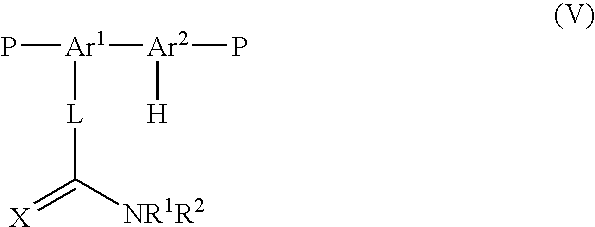
wherein Ar1, Ar2, L, X, R1 and R2 are as defined in formula (I) of Scheme 1; P is independently selected from a halide, preferably chlorine, bromine or iodine, most preferably bromine, or a boron derivative group selected from a boronic acid group, a boronic ester group and a borane group, H is bound to a carbon atom C′ of Ar2; and C′ and the carbon atom of C═X are separated by 3-5 atoms. - Preferably, each Ar1 and Ar2 is phenyl or substituted phenyl.
- Preferably, X is O, S.
- Preferably, L is a bond.
- Preferably, each P is independently selected from a halide or a boron derivative group selected from a boronic acid group, a boronic ester group and a borane group.
- Preferably, R1 is C1-10 alkyl.
- Preferably, R2 is C1-10 alkoxy.
- Preferably, the compound of the third aspect of the invention is a compound of formula (VI):

wherein P, R1 and R2 are as defined in formula (V) above. - The present inventors have surprisingly found that compounds of formula (IV) may be prepared according to the method of the invention without over-reaction to form symmetric compounds and with the product being obtained in high purity. In particular, compounds of formula (IV) may be prepared using compounds of formula (VI).
- Furthermore, the present inventors have surprisingly found that the method of the present invention is effective with standard organometallic reagents (such as organolithium or Grignard reagents) whereas the prior art methods may only be effective with the more reactive reagents such as organolithium. Finally, the present inventors have found that a wider range of substituents S1 and/or S2 may be provided by the method of the invention than by the aforementioned prior art methods. As a result, a straightforward route to a wider range of asymmetric monomers is made available which in turn provides greater flexibility in terms of synthesis of polymers and copolymers with improved solubility, morphology, etc.
- The method of the invention may be employed to prepare symmetric or asymmetric compounds, in particular symmetric or asymmetric fluorenes, wherein both substituents are aromatic, in particular phenyl; both substituents are aliphatic, in particular C1-10 branched or linear alkyl; or one substituent is aromatic and the other substituent is aliphatic. Accordingly, a wide range of materials with differing substituents, and therefore different electronic properties, may be prepared.
- Examples of asymmetric compounds that may be formed according to this method include asymmetric fluorenes and asymmetric indenofluorenes as illustrated below:


- The materials prepared in accordance with the invention may be useful as monomers, in particular monomers for the preparation of electroactive, more particularly semiconducting, polymers. These polymers may be homopolymers or copolymers.
- The monomers according to the invention preferably comprise only two reactive groups P in order that linear polymers be produced, however monomers with more than two P groups, e.g. for production of cross-linked polymers, are also within the scope of the invention.
- The asymmetric monomers according to the invention may be formed from a range of combinations of groups S1 and S2 including, but not limited to the following:
-
- S1=unsubstituted phenyl; S2=phenyl bearing one or more alkyl or alkoxy substituents;
- S1 and S2 are both phenyl, each bearing a different alkyl or alkoxy substituent and/or the same alkyl or alkoxy groups substituted in different positions;
- S1=optionally substituted phenyl or heteroaryl; S2=optionally substituted alkyl;
- S1=optionally substituted phenyl; S2=optionally substituted heteroaryl.
- The compound of formula (IV) according to the invention is preferably a fluorene bearing substituents S1 and S2.
- The polymers prepared using monomers according to the invention may be homopolymers or copolymers. A wide range of co-monomers for polymerisation with the monomers of the invention will be apparent to the skilled person. Examples of comonomers include triarylamines as disclosed in, for example, WO 99/54385 and heteroaryl units as disclosed in, for example, WO 00/46321 and WO 00/55927.
- Where the polymer according to the invention is a co-polymer, it may possess the repeat unit of the invention with one or more different co-repeat units. One class of co-repeat units is arylene repeat units, in particular: 1,4-phenylene repeat units as disclosed in J. Appl. Phys. 1996, 79, 934; fluorene repeat units as disclosed in EP 0842208, trans-indenofluorene repeat units as disclosed in, for example, Macromolecules 2000, 33(6), 2016-2020; spirobifluorene repeat units as disclosed in, for example EP 0707020; and stilbene repeat units (commonly known as “OPV” repeat units) as disclosed in WO 03/020790. Each of these repeat units is optionally substituted. Examples of substituents include solubilising groups such as C1-20alkyl or alkoxy; electron withdrawing groups such as fluorine, nitro or cyano; and substituents for increasing glass transition temperature (Tg) of the polymer such as bulky groups, e.g. tert-butyl or optionally substituted aryl groups.
- Particularly preferred triarylamine repeat units for such copolymers include units of formulae 1-6:

X and Y may be the same or different and are substituent groups. A, B, C and D may be the same or different and are substituent groups. It is preferred that one or more of X, Y, A, B, C and D is independently selected from the group consisting of alkyl, aryl, perfluoroalkyl, thioalkyl, cyano, alkoxy, heteroaryl, alkylaryl and arylalkyl groups. One or more of X, Y, A, B, C and D also may be hydrogen. It is preferred that one or more of X, Y, A, B, C and D is independently an unsubstituted, isobutyl group, an n-alkyl, an n-alkoxy or a trifluoromethyl group because they are suitable for helping to select the HOMO level and/or for improving solubility of the polymer. - Particularly preferred heteroaryl repeat units for such copolymers include units of formulae 7-24:

wherein R3 and R4 are the same or different and are each independently a substituent group. Preferably, one or more of R1, R2, R3 or R4 may be selected from hydrogen, alkyl, aryl, perfluoroalkyl, thioalkyl, cyano, alkoxy, heteroaryl, alkylaryl, or arylalkyl. These groups are preferred for the same reasons as discussed in relation to X, Y, A, B, C and D above. Preferably, for practical reasons, R3 and R4 are the same. More preferably, the are the same and are each a phenyl group.
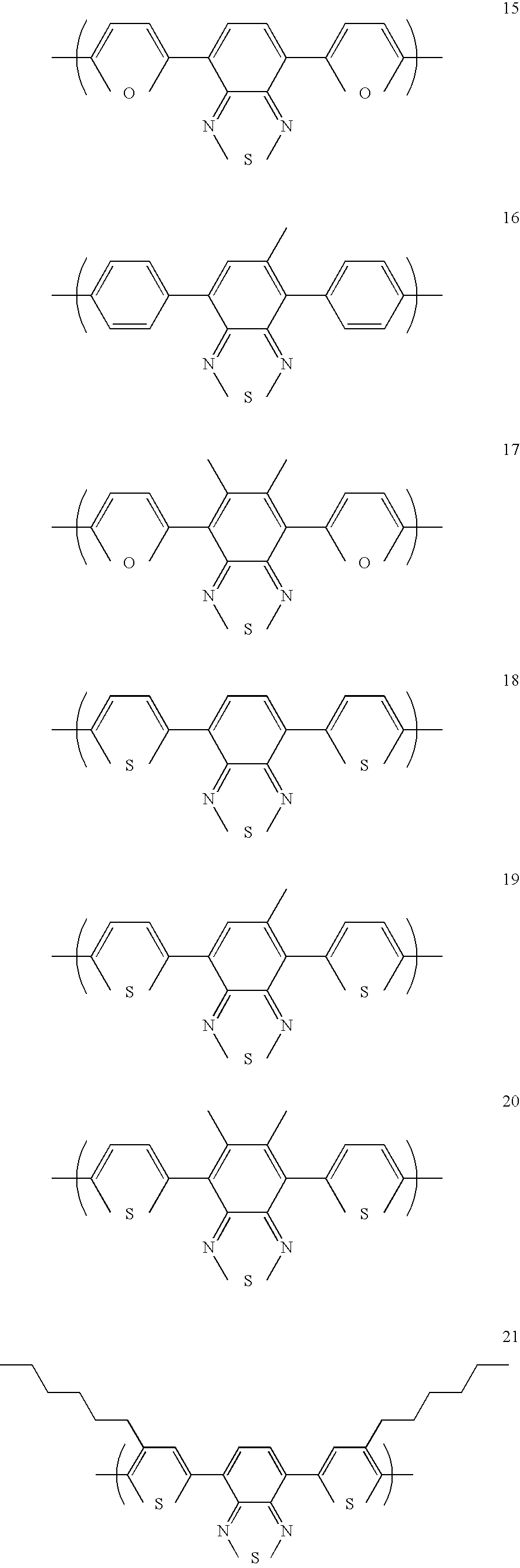
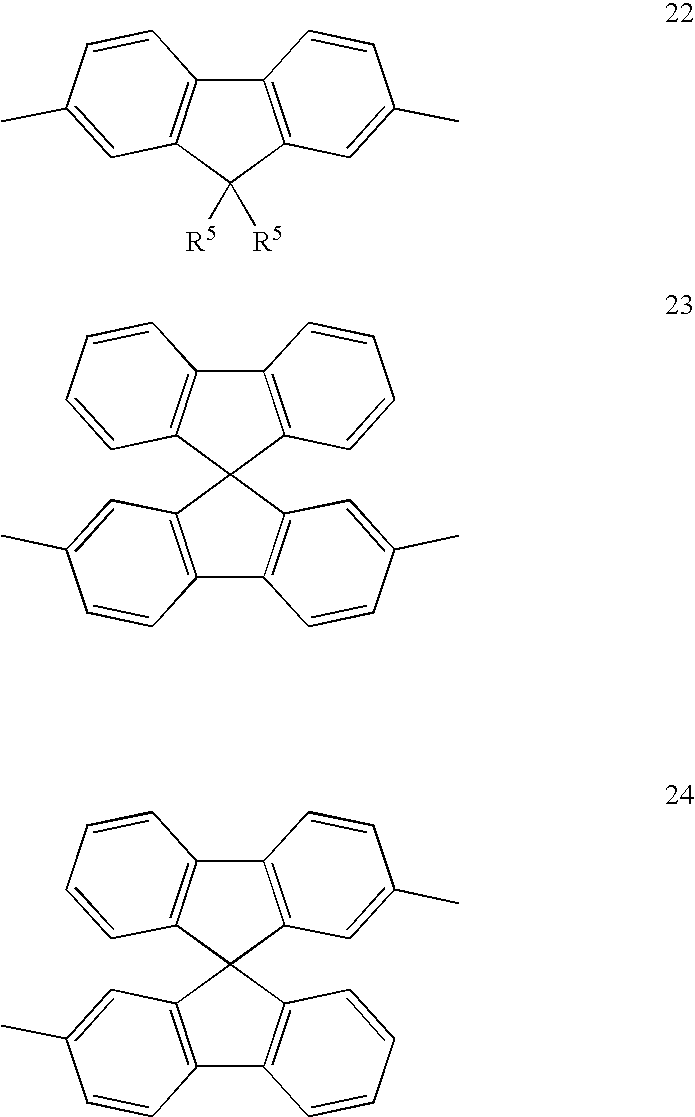
wherein each R5 is independently selected from hydrogen, optionally substituted alkyl, alkoxy, aryl, heteroaryl, arylalkyl, alkylaryl, aryloxy, arylalkyloxy or alkylaryloxy. - Preferably, optionally substituted alkyl is C1-C20-alkyl, which can be each straight-chain, branched or cyclic, where one or more non-adjacent CH2 groups may be replaced by oxygen, sulphur, —CO—, —COO—, —O—CO—, NR10—, —(NR11R12)+-A− or -CONR13—, in particular preferred methyl, ethyl, n-propyl, i-propyl, n-butyl, i-butyl, s-butyl, t-butyl, n-pentyl, s-pentyl, cyclopentyl, n-hexyl, cyclohexyl, n-octyl or cyclooctyl, and R10, R11, R12, R13 are identical or different and are hydrogen or an aliphatic or aromatic hydrocarbon radical having 1 to 20 carbon atoms.
- Preferably, arylalkyl is C7-C20-arylalkyl, where one or more non-adjacent CH2 groups may be replaced by oxygen, sulphur, —CO—, —COO—, —O—CO—, NR10—, —(NR11R12)+-A− or —CONR13—, in particular preferred o-tolyl, m-tolyl, p-tolyl, 2,6-dimethylphenyl, 2,6-diethylphenyl, 2,6-di-i-propylphenyl, 2,6-di-t-butylphenyl, o-t-butylphenyl, m-t-butylphenyl or p-t-butylphenyl, and R10, R11, R12, R13 are identical or different and are hydrogen or an aliphatic or aromatic hydrocarbon radical having 1 to 20 carbon atoms.
- Preferably, alkylaryl is C7-C20-alkylaryl, where one or more non-adjacent CH2 groups may be replaced by oxygen, sulphur, —CO—, —COO—, —O—CO—, NR10—, —(NR11R12)+-A− or —CONR3—, in particular preferred benzyl, ethylphenyl, propylphenyl, diphenylmethyl, triphenylmethyl or naphthalinylmethyl, and R10, R11, R12, R13 are identical or different and are hydrogen or an aliphatic or aromatic hydrocarbon radical having 1 to 20 carbon atoms.
- Preferably, aryl is C6-C20-aryl, in particular preferred phenyl, biphenyl, naphthyl, anthracenyl, triphenylenyl, [1,1′;3′,1″]terphenyl-2′-yl, binaphthyl or phenanthreny.l
- Preferably, heteroaryl is C5-C20-heteroaryl, in particular preferred 2-pyridyl, 3-pyridyl, 4-pyridyl, chinolinyl, isochinolinyl, acridinyl, benzochinolinyl or benzoisochinolinyl.
- Preferably, alkoxy is C1-C20-alkoxy, where one or more non-adjacent CH2 groups may be replaced by oxygen, sulphur, —CO—, —COO—, —O—CO—, NR10—, —(NR11R12)+-A− or —CONR13—, in particular preferred methoxy, ethoxy, n-propoxy, i-propoxy, n-butoxy, i-butoxy, s-butoxy or t-butoxy, and R10, R11, R12, R13 are identical or different and are hydrogen or an aliphatic or aromatic hydrocarbon radical having 1 to 20 carbon atoms.
- Preferably, aryloxy is C6-C20-Aryloxy, in particular preferred phenoxy, naphthoxy, biphenyloxy, anthracenyloxy or phenanthrenyloxy.
- Preferably, arylalkyloxy is C7-C20-arylalkyloxy where one or more non-adjacent CH2 groups may be replaced by oxygen, sulphur, —CO—, —COO—, —O—CO—, NR10—, —(NR11R12)+-A− or —CONR13—, and R10, R11, R12, R13 are identical or different and are hydrogen or an aliphatic or aromatic hydrocarbon radical having 1 to 20 carbon atoms.
- Preferably, alkylaryloxy is C7-C20-alkylaryloxy, where one or more non-adjacent CH2 groups may be replaced by oxygen, sulphur, —CO—, —COO—, —O—CO—, NR10—, —(NR11R12)+-A− or —CONR13—, and R10, R11, R12, R13 are identical or different and are hydrogen or an aliphatic or aromatic hydrocarbon radical having 1 to 20 carbon atoms.
- The polymer may have hole transporting, electron transporting and/or emissive properties. The polymer may have one or more of these properties. Where the polymer has more than one of these properties, different properties may be provided by different segments of the polymer, in particular segments of the polymer backbone as described in WO 00/55927 or pendant groups as described in WO 02/26859. Alternatively, if the polymer of the invention has only one or two of the properties of hole transport, electron transport and emission, it may be blended with one or more further polymers having the remaining required property or properties.
- Preferred methods for polymerisation of these monomers are Suzuki polymerisation as described in, for example, WO 00/53656 and Yamamoto polymerisation as described in, for example, T. Yamamoto,“Electrically Conducting And Thermally Stable π-Conjugated Poly(arylene) s Prepared by Organometallic Processes”, Progress in Polymer Science 1993, 17, 1153-1205 or Stille coupling. For example, in the synthesis of a linear polymer by Yamamoto polymerisation, a monomer having two reactive halide groups P is used. Similarly, according to the method of Suzuki polymerisation, at least one reactive group P is a boron derivative group.
- As alternatives to halogens as described above, leaving groups of formula —O—SO2Z can be used wherein Z is as defined above. Particular examples of such leaving groups are tosylate, mesylate and triflate.
- Suzuki polymerisation employs a Pd(0) complex or a Pd(II) salt. Preferred Pd(0) complexes are those bearing at least one phosphine ligand such as Pd(Ph3P)4.
- Another preferred phosphine ligand is tris(ortho-tolyl)phosphine, i.e. Pd(o-Tol)3.
- Preferred Pd (II) salts include palladium acetate, i.e. Pd(OAc)2. Suzuki polymerisation is performed in the presence of a base, for example sodium carbonate, potassium phosphate or an organic base such as tetraethylammonium carbonate.
- Yamamoto polymerisation employs a Ni(0) complex, for example bis(1,5-cyclooctadienyl)nickel(0).
- Suzuki polymerisation may be used to prepare regioregular, block and random copolymers. In particular, random copolymers may be prepared when one reactive group P is a halogen and the other reactive group P is a boron derivative group.
- Alternatively, block or regioregular, in particular AB, copolymers may be prepared when both reactive groups of a first monomer are boron and both reactive groups of a second monomer are halide.
- Polymers made in accordance with the invention may be used in any of the aforementioned optical devices. In forming these devices, the polymer may deposited from solution by any one of a range of techniques including in particular techniques such as spin-coating, inkjet printing as disclosed in EP 0880303, laser transfer as described in EP 0851714, flexographic printing, screen printing and doctor blade coating.
- A PLED comprises an electroluminescent polymer between an anode and a cathode and is supported on a substrate.
- Optical devices tend to be sensitive to moisture and oxygen. Accordingly, the substrate preferably has good barrier properties for prevention of ingress of moisture and oxygen into the device. The substrate is commonly glass, however alternative substrates may be used, in particular where flexibility of the device is desirable. For example, the substrate may comprise a plastic as in U.S. Pat. No. 6,268,695 which discloses a substrate of alternating plastic and barrier layers or a laminate of thin glass and plastic as disclosed in EP 0949850.
- Although not essential, the presence of a layer of organic hole injection material over the anode is desirable as it assists hole injection from the anode into the layer or layers of semiconducting polymer. Examples of organic hole injection materials include PEDT/PSS as disclosed in EP 0901176 and EP 0947123, or polyaniline as disclosed in U.S. Pat. No. 5,723,873 and U.S. Pat. No. 5,798,170.
- The cathode is selected in order that electrons are efficiently injected into the device and as such may comprise a single conductive material such as a layer of aluminium. Alternatively, it may comprise a plurality of metals, for example a bilayer of calcium and aluminium as disclosed in WO 98/10621, or a thin layer of dielectric material such as lithium fluoride to assist electron injection as disclosed in, for example, WO 00/48258. The device is preferably encapsulated with an encapsulant to prevent ingress of moisture and oxygen. Suitable encapsulants include a sheet of glass, films having suitable barrier properties such as alternating stacks of polymer and dielectric as disclosed in, for example, WO 01/81649 or an airtight container as disclosed in, for example, WO 01/19142.
- In a practical device, at least one of the electrodes is semi-transparent in order that light may be absorbed (in the case of a photoresponsive device) or emitted (in the case of a PLED). Where the anode is transparent, it typically comprises indium tin oxide.
- Examples of transparent cathodes are disclosed in, for example, GB 2348316.
- The PLED may be a static image device, i.e. a device that displays only a single image. in the simplest case, the device comprises an anode, cathode and electroluminescent polymer, each of which are unpatterned. Such a device may be suitable for lighting applications or signs displaying a fixed image. Alternatively, the device may be a variable image device, i.e. a device wherein different areas of the electroluminescent layer may be independently addressed. Such a device may be a segmented, passive matrix or active matrix device.
- Polymers formed by the method of the invention may also be used in switching devices. In particular, they may be used in a field effect transistor comprising an insulator having a first side and a second side; a gate electrode located on the first side of the insulator; a polymer made by the method of the invention located on the second side of the insulator; and a drain electrode and a source electrode located on the polymer. Unlike the aforementioned optoelectronic devices, it will be appreciated that a transparent electrode is not a requirement for a switching device. Such a field effect transistor may be used in an integrated circuit.
-

- NMR uses a Varian 400 MHz system, using CDCl3 (unless indicated otherwise) with a TMS standard.
- To a 3 L round bottom flask, equipped with reflux condenser, off-gas scrubber, mechanical stirrer and nitrogen bubbler was added fluorenone (100.006 g, 0.555 mol), phosphorus pentoxide (110.148 g, 0.776 mol) and trimethylphosphite (1200 mL). Under mechanical stirring, a solution of bromine (63 mL, 1.23 mol) in trimethylphosphite (200 mL) was quickly added. This clear solution was then heated for 22 hours at 120° C. The mixture was allowed to cool to room temperature, then poured into 3 L of water. When sodium thiosulfate was added (50.045 g) the mixture turned yellow. Stirring was maintained for 1 hour, then the yellow solid was filtered. This solid was heated in methanol to remove the mono-brominated compound and gave 176.183 g (98% pure by HPLC, 94% yield).
- 1H NMR (CDCl3) 7.73 (2H, d, J2.0), 7.61 (2H, dd, J7.6, 2.0), 7.36 (2H, d, J8.0); 13C NMR (CDCl3) 142.3, 137.5, 135.3, 127.9, 123.3, 121.8, 109.8.
- To a 5 L 3-necked flask, equipped with reflux condenser, nitrogen bubbler and overhead mechanical stirrer, was added 2,7-dibromofluorenone (533.0 g, 1.582 mol), potassium hydroxide (finely powdered flakes, 300.0 g, 5.357 mol, 3.39 eq.) and toluene (3000 mL). The resulting mixture was heated at 120° C. for six hours then left to cool to room temperature. During this time, the appearance of the solution changed from a bright orange thin suspension into a completely white, thick suspension.
- In a 10 L beaker, equipped with mechanical stirrer was added deionised water and then the cooled suspension was added over 3 minutes. The residual material in the flask was rinsed using extra toluene (2×500 mL). The resulting mixture was stirred at room temperature for 30 mins, allowing the potassium salt to dissolve. The toluene phase was removed and extracted twice with deionised water (1000 mL). The toluene phase was then discarded and the aqueous phases combined and acidified to pH 1-3 using concentrated hydrochloric acid (10M) added dropwise from a dropping funnel. During this time, the product evolved as a white suspension. The mixture was allowed to settle and the excess aqueous removed by decantation. The resulting product slurry was then filtered and the cake rinsed with fresh water (1000 mL) until the liquors were about pH 3-4. The cake was air dried and then dried in vacuo for 18 hours at 65° C. The product was afforded as an off-white solid (468 g, 83%). 1H NMR ((CD3)2CO) 8.00 (1H, d, J2.0), 7.77 (1H, dd, J8.0, 2.4), 7.57 (2H, d, J8.0), 7.34 (1H, d, J8.4), 7.29 (2H, d, J8.8); 13C NMR ((CD3)2CO) 167.1, 140.4, 139.8, 134.2, 133.5, 132.8, 132.7, 131.2, 130.6, 121.4, 121.1.
- To a 5 L 3-neck round-bottom flask, equipped with reflux condenser, nitrogen bubbler and mechanical stirrer was added 4,4-dibromo-2-carboxylic (467.8 g, 1.264 mol) and methanol (3000 mL). Sulfuric acid (50 mL) was then added cautiously and the mixture then heated to 90° C. for 21 hours. The suspended solid had all dissolved after this time to form a transparent solution. The solution was allowed to cool slightly (by about 10° C.) and then solid sodium carbonate (˜75 g) added portionwise, until any sign of effervescence ceased. The hot solution was stirred for 5 minutes then the stirrer stopped and the solids allowed to settle. The hot solution was then decanted into a 5 L round bottom flask equipped with mechanical stirrer (filtering was found to cause rapid crystallisation of the product) and allowed to crystallise overnight. The solid was collected by filtration and washed with cold methanol. The solid was air dried and then dried in vacuo at 45° C. The product was isolated as a white solid (354 g, 76%).
- 1H NMR (CDCl3) 7.99 (1H, d, J2.0), 7.64 (1H, dd, J8.0, 1.6), 7.51 (2H, d, J8.4), 7.19 (1H, d, J8.8), 7.13 (2H, d, J8.8) , 3.67 (3H, s); 13C NMR (CDCl3) 167.1, 140.3, 139.1, 134.4, 132.9, 132.1, 132.0, 131.3, 129.8, 121.9, 121.5, 52.3. GCMS: M+=370, purity 99.5%+.
- Literature ref: J.Am.Chem.Soc., 114, 15 (1992)
- To a 5 L 3-neck round-bottom flask, equipped with reflux condenser, nitrogen bubbler, 500 mL graduated pressure-equalised addition funnel, internal low temperature thermometer (−100 to +30° C.) and mechanical stirrer was added 4,4-dibromo-2-methyl ester-1,1′-biphenyl (716.49 g, 1.936 mol, 1.0 eq.) in anhydrous tetrahydrofuran (THF) (1500 mL). To the stirred solution was added N,N-dimethylhydroxylamine hydrochloride (288 g, 3.0 mol, 1.55 eq.) and the resulting suspension cooled to −20° C. Iso-propylmagnesium chloride (2.0M in THF) was then added over about 1 hour, ensuring the internal temperature of the mixture did not rise about −5° C. The resulting solution was then allowed to warm to ambient temperature over about 16 hours. The reaction mixture was carefully diluted with toluene (2 L) and then quenched into a 10 L beaker containing 5 L of 2M aqueous hydrochloric acid solution. The resulting mixture was stirred at ambient for 30 minutes and the toluene phase separated. The aqueous phase was extracted with toluene (2 L) and the organic phases combined and evaporated to dryness in vacuo. The resulting product was then triturated from Methanol (1500 mL). The product (white solid) was collected by filtration and washed with cold Methanol (500 mL). The product was then dried for 16 hours in vacuo at 45° C. The product was afforded as a white solid (521 g, 67%), purity 99.5%+ by GCMS.
- This amide, hereinafter referred to as amide 1 was used to prepare a range of asymmetric compounds according to the following scheme, wherein S1, S2 and M are as defined in the claims.

-

- To a 3 L, 3-necked round bottom flask, equipped with mechanical stirrer, low temperature thermometer (−100 to +30° C.), nitrogen inlet and bubbler, and 500 mL graduated pressure-equalising dropping funnel, was added amide 1 (275.67 g, 0.691 mol, 1.0 eq.) and anhydrous THF (500 mL). The resulting suspension was stirred under nitrogen and cooled to −5° C. (MeOH-Cardice) and then tert-butylphenylmagnesium chloride (2M in diethyl ether, 380 mL, 0.76 mol, 1.1 eq.) was added at such a rate as to maintain the internal temperature of the vessel between −5 and 0° C. The resulting suspension was then allowed to warm to room temperature and stirred for 16 hours.
- The reaction mixture was carefully diluted with toluene (1 L) poured into a 5 L beaker containing 2M aqueous hydrochloric acid solution (2 L) and the mixture-stirred by a mechanical stirrer for 30 minutes. The stirrer was stopped and the layers allowed to settle. The organic phase was removed by residual vacuum transfer and the aqueous phase extracted with a further 1 L of toluene. The organic phases were combined and concentrated to dryness in vacuo on a rotary evaporator. The resulting crude product was suspended in methanol (1250 mL) and stirred at room temperature for 16 hours (trituration). The product was then recovered by filtration using Buchner apparatus and the cake washed with fresh methanol (2×350 mL). The cake was air dried and the solid then dried at 45° C. in vacuo for 16 hours.
- The product ketone was afforded as a white solid (266.95 g, 74%). The product was analysed by GC-MS and found to display m/z 472 (M+) and a single peak (estimated purity 99.8%).
-

- To a 250 mL round bottomed flask, equipped with low temperature thermometer (−100 to +30° C.), magnetic stirrer bar, 100 mL graduated pressure-equalised dropping addition funnel and nitrogen inlet and bubbler was added bromobenzene (7.98 g, 5.35 mL, 50.82 mmol, 1.2 eq.) and anhydrous THF (50 mL) and the resulting solution cooled to −72° C. (acetone-cardice). N-Butyllithium (2.5M in hexanes) (22.02 mL, 55.06 mmol, 1.3 eq.) was added dropwise, maintaining the internal temperature below −65° C. After complete addition, the solution was maintained at −70° C. and stirred for 1 hour. A solution of ketone 1 (20.0 g, 42.35 mmol, 1.0 eq.) in anhydrous THF (50.0 mL) was added, keeping the internal temperature below −60° C. The solution was allowed to warm to room temperature over 4 hours, then quenched into 2M aqueous hydrochloric acid solution (250 mL). The products were extracted into toluene (2×250 mL), the organic phases combined and evaporated to dryness in vacuo on a rotary evaporator. IPA was added (200 mL) and the product crystallised over 16 hours. The product was recovered by filtration and the cake washed with cold isopropyl alcohol (50 mL). The product was then air dried and dried at 45° C. in vacuo for 16 hours. A second crop was crystallised from the liquors.
- The product was afforded as a white solid (18.63 g, 80%). The product was analysed by GCMS and displayed an m/z-H2O peak at m/z 532. Purity estimated at 99%+.
-
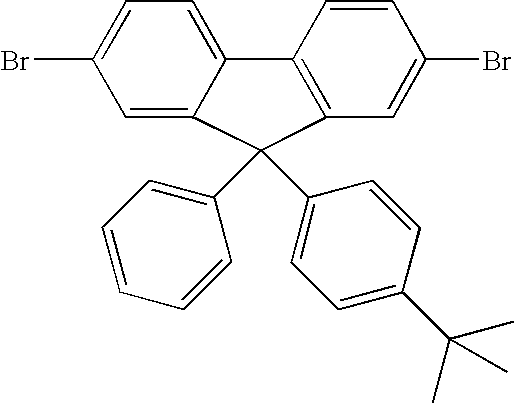
- To a 250 mL round bottomed flask, equipped with magnetic stirrer bar, reflux condenser and nitrogen inlet and bubbler was added asymmetric compound 1 precursor (6.87 g, 12.5 mmol, 1.0 eq.) and glacial acetic acid (100 mL). To the stirred suspension at room temperature was added concentrated hydrochloric acid (2 mL) and the resulting suspension heated to reflux. After 5 hours at reflux, in-process check indicated the reaction to be complete (GCMS). The solution was allowed to cool to room temperature and poured into water (200 mL) with stirring for 10 minutes. This caused precipitation of the product which was recovered by filtration. The filter cake was washed with water (2×100 mL) and then displacement wash with methanol (100 mL). The crude product was recrystallised from a mixture of acetonitrile and toluene to afford asymmetric compound 1 as a white solid (3.2 g, 48%).
- HPLC indicated 99.2% purity. GCMS indicated the correct product (m/z 532).
-

- To a 250 mL round bottomed flask, equipped with low temperature thermometer (−100 to +30° C.), magnetic stirrer bar, 100 mL graduated pressure-equalised dropping addition funnel and nitrogen inlet and bubbler was added 4-bromobiphenyl (15.99 g, 68.6 mmol, 1.2 eq.) and anhydrous THF (100 mL) and the resulting solution cooled to −72° C. (acetone-Cardice). N-Butyllithium (2.5M in hexanes) (29.73 mL, 74.30 mmol, 1.3 eq.) was added dropwise, maintaining the internal temperature below −65° C. After complete addition, the solution was maintained at −70° C. and stirred for 1 hour. A solution of ketone 1 (27.0 g, 57.2 mmol, 1.0 eq.) in anhydrous THF (75 mL) was added, keeping the internal temperature ←60° C. The solution was allowed to warm to room temperature (RT) over 4 hours, and then quenched into 2M aqueous hydrochloric acid solution (500 mL). The products were extracted into toluene (2×350 mL), and the organic phases combined and washed to neutrality with water (3×500 mL). The organic phases were combined and evaporated to dryness in vacuo on a rotary evaporator. Acetonitrile was added (200 mL) and the product crystallised over 16 hours. The product was recovered by filtration and the cake washed with cold acetonitrile (50 mL). The product was air dried and then dried at 45° C. in vacuo for 16 hours. A second crop was crystallised from the liquors.
- The product was afforded as a white solid (26.5 g, 74%). The product was analysed by GCMS and displayed an m/z-H2O peak at m/z 611. Purity estimated at 95%+.
-

- To a 250 mL round bottomed flask, equipped with magnetic stirrer bar, reflux condenser and nitrogen inlet and bubbler was added the asymmetric compound 2 precursor (26 g, 41.5 mmol, 1.0 eq.) and glacial acetic acid (500 mL). To the stirred suspension at room temperature was added concentrated hydrochloric acid (1 mL) and the resulting suspension heated to reflux. After 2 hours at reflux, in-process check indicated the reaction to be complete (GCMS). The solution was allowed to cool to room temperature and poured into water (2 L) with stirring for 10 minutes. This caused precipitation of the product which was recovered by filtration. The filter cake was washed with water (3×1 L) and then displacement wash with methanol (500 mL). The crude product was recrystallised from a mixture of acetonitrile and toluene to afford the product as a white solid (13.7 g, 54%). HPLC indicated 99.42% purity. GCMS indicated the correct product (m/z 609).
-
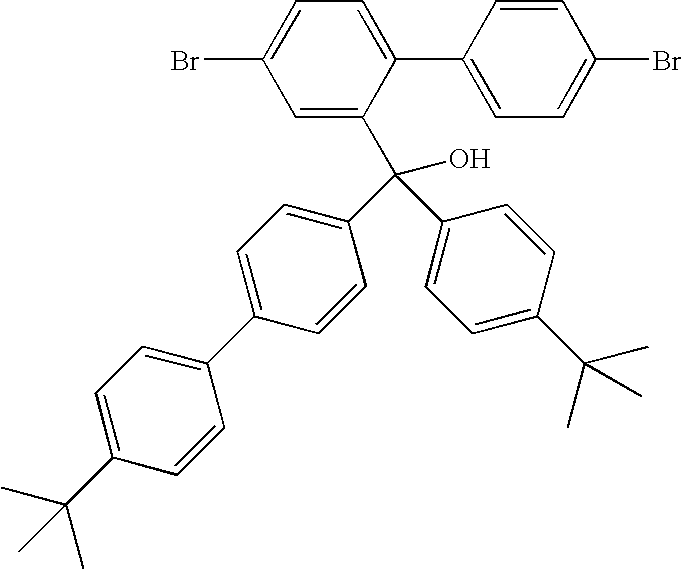
- To a 500 mL round bottomed flask, equipped with low temperature thermometer (−100 to +30° C.), mechanical stirrer, 100 mL graduated pressure-equalised dropping addition funnel and nitrogen inlet and bubbler was added 4-tert-butyl-4′-bromo-1,1′-biphenyl (11.36 g, 39.28 mmol, 1.2 eq.) and anhydrous THF (100 mL) and the resulting solution cooled to −72° C. (acetone-Cardice). N-Butyllithium (2.5M in hexanes) (21.28 mL, 42.55 mmol, 1.3 eq.) was added dropwise, maintaining the internal temperature below −65° C. After complete addition, the solution was maintained at −70° C. and stirred for 1 hour. A solution of ketone 1 (15.45 g, 32.73 mmol, 1.0 eq.) in anhydrous THF (125.0 mL) was added, keeping the internal temperature ←60° C. The solution was allowed to warm to RT over 4 hours, then quenched into 2M aqueous hydrochloric acid solution (500 mL). The products were extracted into toluene (2×500 mL), the organic phases combined and washed with water to neutrality (3×500 mL). The toluene phase was evaporated to dryness in vacuo on a rotary evaporator. Acetonitrile was added (200 mL) and the product crystallised over 16 hours. The product was recovered by filtration and the cake washed with cold IPA (50 mL). The product was then air dried and dried at 45° C. in vacuo for 16 hours. A second crop was crystallised from the liquors.
- The product was afforded as a white solid (14 g, 52%). Purity estimated at 99%+.
-

- To a 1 L round bottomed flask, equipped with magnetic stirrer bar, reflux condenser and nitrogen inlet and bubbler was added asymmetric compound 3 precursor (14 g, 20.5 mmol, 1.0 eq.) and glacial acetic acid (500 mL). To the stirred suspension at room temperature was added concentrated hydrochloric acid (2 mL) and the resulting suspension heated to reflux. After 3 hours at reflux, in-process check indicated the reaction to be complete (GCMS). The solution was allowed to cool to room temperature and poured into water (2 L) with stirring for 10 minutes. This caused precipitation of the product which was recovered by filtration. The filter cake was washed with water (2×1 L). The crude product was recrystallised from a mixture of acetonitrile and toluene to afford asymmetric compound 3 as a white solid (10.63 g, 78%).
- HPLC indicated 99.6% purity. GCMS indicated the correct product (m/z 664).
-

- To a 500 mL round bottomed flask, equipped with low temperature thermometer (−100 to +30° C.), mechanical stirrer, 100 mL graduated pressure-equalised dropping addition funnel and nitrogen inlet and bubbler was added 2-bromothiophene (6.21 g, 38.11 mmol, 1.2 eq.) and anhydrous THF (100 mL) and the resulting solution cooled to −72° C. (acetone-cardice). N-Butyllithium (2.5M in hexanes) (20.64 mL, 41.29 mmol, 1.3 eq.) was added dropwise, maintaining the internal temperature below −65° C. After complete addition, the solution was maintained at −70° C. and stirred for 1 hour. A solution of ketone 1 (15.0 g, 31.76 mmol, 1.0 eq.) in anhydrous THF (125.0 mL) was added, keeping the internal temperature ←60° C. The solution was allowed to warm to RT over 4 hours, then quenched into 2M aqueous hydrochloric acid solution (500 mL). The products were extracted into toluene (2×300 mL), the organic phases combined and washed with water to neutrality (3×500 mL). The toluene phase was evaporated to dryness in vacuo on a rotary evaporator. The product was purified by column chromatography using a mixture of dichloromethane and hexanes (1:1).
- The product was afforded as a red solid (15 g, 72%). The product was analysed by GCMS and displayed an m/z-H2O peak at m/z 538. Purity estimated at 96.8%+.
-
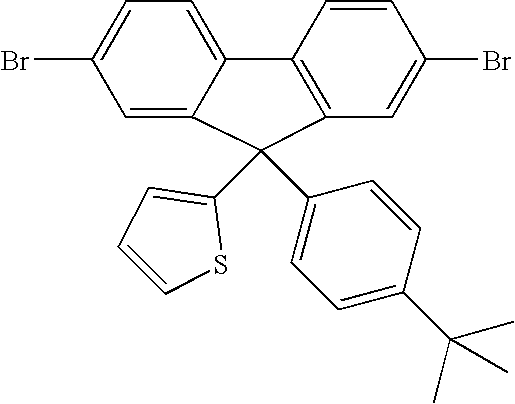
- To a 500 mL round bottomed flask, equipped with magnetic stirrer bar, reflux condenser and nitrogen inlet and bubbler was added the asymmetric compound 4 precursor (15.1 g, 27.15 mmol, 1.0 eq.) and glacial acetic acid (500 mL). To the stirred suspension at room temperature was added concentrated hydrochloric acid (2 mL) and the resulting suspension heated to reflux. After 4 hours at reflux, in-process check indicated the reaction to be complete (GCMS). The solution was allowed to cool to room temperature and poured into water (1000 mL) with stirring for 10 minutes. This caused precipitation of the product which was recovered by filtration. The filter cake was washed with water (2×1 L). The crude product was triturated from hexanes to afford asymmetric compound 4 as a dark solid (14 g, 90%).
- HPLC indicated >80% purity.
-
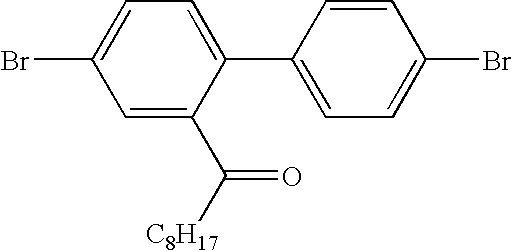
- To a 500 mL round bottomed 3-necked flask, equipped with mechanical stirrer, reflux condenser, 100 mL pressure-equalised dropping addition funnel, nitrogen inlet and bubbler and low temperature thermometer (−100 to +30° C.) was added amide 1 (30.0 g, 75.2 mmol, 1.0 eq.) and anhydrous THF (200 mL). The resulting solution was stirred under nitrogen and cooled to −20° C. (MeOH-cardice). A solution of n-octylmagnesium bromide (2.0M in THF, 48.7 mL, 97.7 mmol, 1.3 eq.) was added dropwise, maintaining the internal solution temperature below −10° C. After complete addition, the solution was allowed to warm to room temperature overnight. The reaction mixture was poured into 2M aqueous hydrochloric acid solution (500 mL) and the products extracted into toluene (2×300 mL). The toluene extracts were washed with water (3×500 mL). The toluene phase was then concentrated to dryness in vacuo using a rotary evaporator.
- The crude product was purified using column chromatography using 100% hexanes to 4:1 dichloromethane:hexanes as eluant. Product was isolated as an oil (22.91 g, 67.4%). GCMS indicated m/z 452, purity almost 100%.
-

- To a 500 mL round bottomed flask, equipped with low temperature thermometer (−100 to +30° C.), mechanical stirrer, 100 mL graduated pressure-equalised dropping addition funnel and nitrogen inlet and bubbler was added bromobenzene (9.55 g, 60.79 mmol, 1.2 eq.) and anhydrous THF (150 mL) and the resulting solution cooled to −72° C. (acetone-cardice). N-Butyllithium (2.5M in hexanes) (26.34 mL, 65.86 mmol, 1.3 eq.) was added dropwise, maintaining the internal temperature below −65° C. After complete addition, the solution was maintained at −70° C. and stirred for 1 hour. A solution of ketone 2 (22.91 g, 50.66 mmol, 1.0 eq.) in anhydrous THF (125.0 mL) was added, keeping the internal temperature ←60° C. The solution was allowed to warm to RT over 4 hours, then quenched into 2M aqueous hydrochloric acid solution (500 mL). The products were extracted into toluene (2×300 mL), the organic phases combined and washed with water to neutrality (3×500 mL). The toluene phase was evaporated to dryness in vacuo on a rotary evaporator. The product was purified by column chromatography using a mixture of dichloromethane and hexanes (1:4).
- The product was afforded as a colourless oil (12.1 g, 45%). The product was analysed by GCMS and displayed an m/z-HnyO peak at m/z 512. Purity estimated at 87%+.
-
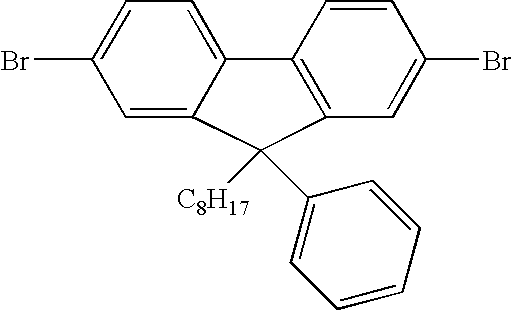
- To a 500 mL round bottomed flask, equipped with magnetic stirrer bar, reflux condenser and nitrogen inlet and bubbler was added the asymmetric compound 5 precursor (12.1 g, 22.83 mmol, 1.0 eq.) and glacial acetic acid (500 mL). To the stirred suspension at room temperature was added concentrated hydrochloric acid (2 mL) and the resulting suspension heated to reflux. After 4 hours at reflux, in-process check by GCMS indicated the reaction to be complete. The solution was allowed to cool to room temperature and poured into water (1 L) with stirring for 10 minutes. This caused precipitation of the product which was recovered by filtration. The filter cake was washed with water (2×1 L). The crude product was triturated from hexanes to afford asymmetric compound 5 as an oil (10 g, 83%).
- GCMS indicated 97.06% purity.
-

- To a 2 L, 3-necked round bottom flask, equipped with mechanical stirrer, low temperature thermometer (−100 to +30° C.), nitrogen inlet and bubbler, and 500 mL graduated pressure-equalising dropping funnel, was added amide 1 (150 g, 0.376 mol, 1.0 eq.) and anhydrous THF (500 mL). The resulting solution was stirred under nitrogen and cooled to −5° C. (MeOH-cardice) and then phenylmagnesium bromide (3M in THF, 140 mL, 0.414 mol, 1.1 eq.) was added at such a rate as to maintain the internal temperature of the vessel between −5 and 0° C. The resulting suspension was then allowed to warm to room temperature and stirred for 16 hours.
- The reaction mixture was carefully diluted with toluene (1 L) poured into a 5 L beaker containing 2M aqueous hydrochloric acid solution (2 L) and the mixture stirred by a mechanical stirrer for 30 minutes. The stirrer was stopped and the layers allowed to settle. The organic phase was removed by residual vacuum transfer and the aqueous phase extracted with a further 1 L of toluene. The organic phases were combined and concentrated to dryness in vacuo on a rotary evaporator. The resulting crude product was suspended in methanol (750 mL) and stirred at room temperature for 16 hours (trituration). The product was then recovered by filtration using Buchner apparatus and the cake washed with fresh methanol (2×250 mL). The cake was air dried and the solid then dried at 45° C. in vacuo for 16 hours.
- The product ketone was afforded as a white solid (147.84 g, 94%). The product was analysed by GC-MS and found to display m/z 416 (M+) and a single peak (estimated purity 99.8%).
-
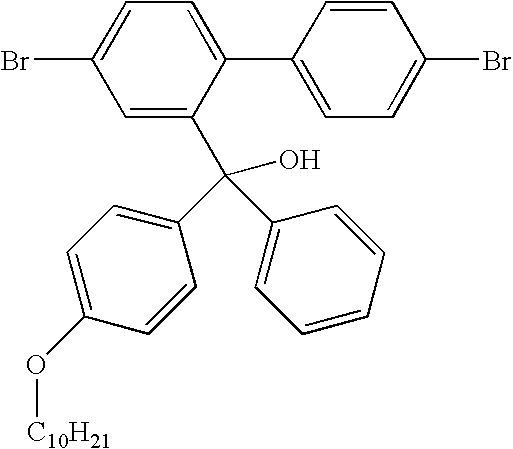
- To a 250 mL round bottomed flask, equipped with low temperature thermometer (−100 to +30° C.), magnetic stirrer bar, 100 mL graduated pressure-equalised dropping addition funnel and nitrogen inlet and bubbler was added 4-decyloxybenzene (16.5 g, 53.0 mmol, 1.1 q.) and anhydrous THF (100 mL) and the resulting solution cooled to −72° C. (acetone-cardice). N-Butyllithium (2.5M in hexanes) (23.0 mL, 58.0 mmol, 1.2 eq.) was added dropwise, maintaining the internal temperature below −65° C. After complete addition, the solution was maintained at −70° C. and stirred for 1 hour. A solution of ketone 3 (20.0 g, 48.0 mmol, 1.0 eq.) in anhydrous THF (50.0 mL) was added, keeping the internal temperature ←60° C. The solution was allowed to warm to RT over 4 hours, then quenched into 2M aqueous hydrochloric acid solution (250 mL). The products were extracted into toluene (2×250 mL), the organic phases combined and evaporated to dryness in vacuo on a rotary evaporator. Isopropyl alcohol was added (200 mL) and the product crystallised over 16 hours. The product was recovered by filtration and the cake washed with cold isopropyl alcohol (50 mL). The product was then air dried and dried at 45° C. in vacuo for 16 hours.
- The product was afforded as a white solid (18.6 g, 90%). The product as analysed by GCMS showed a mixture of products.
-

- Asymmetric compound 6 was prepared by dehydration of asymmetric compound 5 according to the method described above for the preparation of asymmetric compound 1.
-

- To a 3-necked round bottomed 2 L flask, equipped with mechanical stirrer, reflux condenser, nitrogen inlet and bubbler, low temperature thermometer (−100 to +30° C.) and pressure-equalised, 250 mL graduated dropping addition funnel (inerted with nitrogen before use) was added asymmetric compound 1 (54.97 g, 0.103 mol, 1.0 eq.) and anhydrous THF (550 mL). The resulting solution was cooled to −78° C. (acetone-cardice) and n-butyllithium (2.5M in hexanes) (90.64 mL, 0.227 mol, 2.2 eq.) was added dropwise so as to maintain the internal temperature below −65° C. After complete addition, the solution was stirred at −78 warming up to 8° C. for a further 1 hour, before the addition of triisopropylborate (58.12 g, 71 mL, 0.309 mol, 3.0 eq.) dissolved in anhydrous THF (160 mL), again maintaining the internal temperature below −65° C. The resulting solution was then allowed to warm slowly to room temperature.
- The solution was cooled to 0° C. (ice-water) and HCl in ether solution (2M) (134 mL, 0.27 mol, 2.6 eq.) was added and the solution allowed to warm to room temperature before filtering through a No. 3 porosity sinter funnel (to remove precipitated inorganic salts). The solvent was removed in vacuo and the residue re-dissolved in toluene (250 mL). The solution was cooled and filtered (paper) into a 1 L flask. Pinacol (58.12 g, 0.27 mol, 3.0 eq.) was added, followed by para-toluenesulfonic acid (1 g) and the reaction heated under Dean-Stark conditions for 4 hours. The solution was allowed to cool and 2 g of potassium carbonate added. The mixture was stirred for 30 minutes at RT, filtered and the solution concentrated to dryness in vacuo. The solid was recrystallised from a toluene/acetonitrile mixture to afford the product, which was recovered by filtration.
- The product was dried at 45° C. for 16 hours. The title compound was afforded as a white solid (43 g, 66%). HPLC indicated a purity (npa) of 93%.
-

- To a 500 mL 3 neck round bottomed flask, equipped with reflux condenser, mechanical stirrer and septum cap (cooled under nitrogen before use) was added asymmetric compound 1 (33 g, 62 mmol, 1.0 eq.), anhydrous toluene (400 mL), PdCl2[(o-tol)3P]2 (2.44 g, 3.1 mmol, 5 mol %) and ortho-tolylphosphine (1.89 g, 10 mol %). The solution was degassed by sparging with nitrogen for 1 hour, then triethylamine (37.64 g, 0.186 mmol, 6.0 eq.) added, followed by degassing for 15 minutes. Pinacolborane (23.80 g, 0.186 mol, 3.0 eq.) was then added and the solution heated to reflux for 4 hours. The reaction mixture was allowed to cool to room temperature and then filtered through a short pad of silica gel, eluting with toluene (500 mL). The toluene solution was concentrated to dryness in vacuo. The crude solid was then purified by recrystallisation from a toluene/acetonitrile mixture to afford the product, which was recovered by filtration.
- The product was dried at 45° C. for 16 hours. The title compound was afforded as a white solid (15 g, 39%). HPLC indicated a purity (npa) of 99%. GC-MS indicated the correct mass (m/z 626).
- Synthesis of ketone 1 was attempted in accordance with the method described above, except that ester 1, shown below, was used in place of amide 1:
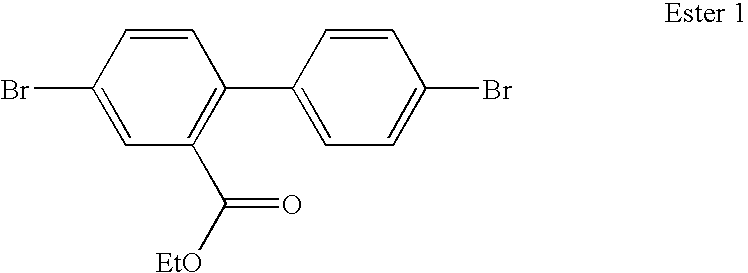
- The product mixture was found to comprise starting material, ketone 1 and the alcohol resulting from over-reaction of ketone 1 with the Grignard reagent. Difficulty was encountered in attempting to separate these products.
- Although the present invention has been described in terms of specific exemplary embodiments, it will be appreciated that various modifications, alterations and/or combinations of features disclosed herein will be apparent to those skilled in the art without departing from the spirit and scope of the invention as set forth in the following claims.
Claims (26)


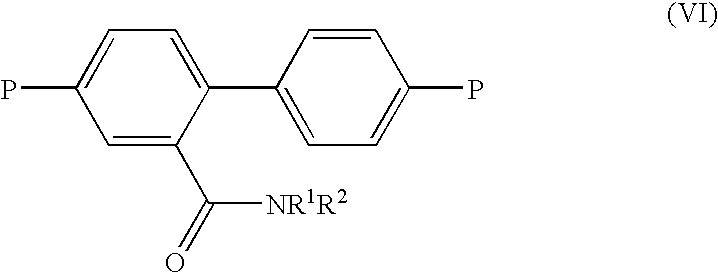
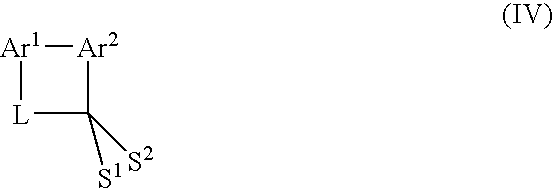

Applications Claiming Priority (3)
| Application Number | Priority Date | Filing Date | Title |
|---|---|---|---|
| EP02024183.2 | 2002-10-30 | ||
| EP20020024183 EP1416028A1 (en) | 2002-10-30 | 2002-10-30 | New method for the production of monomers useful in the manufacture of semiconductive polymers |
| PCT/EP2003/012022 WO2004039912A1 (en) | 2002-10-30 | 2003-10-29 | New method for the production of monomers useful in the manufacture of semiconductive polymers |
Publications (2)
| Publication Number | Publication Date |
|---|---|
| US20050240011A1 true US20050240011A1 (en) | 2005-10-27 |
| US7368616B2 US7368616B2 (en) | 2008-05-06 |
Family
ID=32087968
Family Applications (1)
| Application Number | Title | Priority Date | Filing Date |
|---|---|---|---|
| US10/532,835 Expired - Lifetime US7368616B2 (en) | 2002-10-30 | 2003-10-29 | Method for the production of monomers useful in the manufacture of semiconductive polymers |
Country Status (7)
| Country | Link |
|---|---|
| US (1) | US7368616B2 (en) |
| EP (2) | EP1416028A1 (en) |
| JP (2) | JP4955213B2 (en) |
| KR (1) | KR101086658B1 (en) |
| CN (1) | CN100351341C (en) |
| DE (1) | DE60329410D1 (en) |
| WO (1) | WO2004039912A1 (en) |
Cited By (4)
| Publication number | Priority date | Publication date | Assignee | Title |
|---|---|---|---|---|
| US20090045725A1 (en) * | 2005-06-10 | 2009-02-19 | Sumitomo Chemical Company, Limited | Polyarylene |
| US20130264562A1 (en) * | 2010-12-21 | 2013-10-10 | Sumitomo Chemical Company, Limited | Polymer compound and organic el device using same |
| US20140183414A1 (en) * | 2011-08-22 | 2014-07-03 | Sumitomo Chemical Company, Limited | Polymer compound and light emitting device using same |
| US11069859B2 (en) | 2017-02-28 | 2021-07-20 | Lg Chem, Ltd. | Fluorene-based compound, organic light-emitting device using same and method for preparing same |
Families Citing this family (7)
| Publication number | Priority date | Publication date | Assignee | Title |
|---|---|---|---|---|
| GB0225869D0 (en) * | 2002-11-06 | 2002-12-11 | Cambridge Display Tech Ltd | Polymer |
| DE102010033080A1 (en) * | 2010-08-02 | 2012-02-02 | Merck Patent Gmbh | Polymers with structural units that have electron transport properties |
| EP2428512B1 (en) * | 2010-09-08 | 2014-10-22 | Semiconductor Energy Laboratory Co., Ltd. | Fluorene compound, light-emitting element, light-emitting device, electronic device and lighting device |
| US9676900B2 (en) | 2011-01-31 | 2017-06-13 | Cambridge Display Technology, Ltd. | Fluorene containing copolymer used in light emitting devices |
| GB2494096B (en) * | 2011-01-31 | 2013-12-18 | Cambridge Display Tech Ltd | Polymer |
| GB2501032A (en) * | 2012-01-26 | 2013-10-09 | Cambridge Display Tech Ltd | Polymer |
| CN114685289A (en) * | 2022-04-20 | 2022-07-01 | 吉林奥来德光电材料股份有限公司 | Organic electroluminescent compound and preparation method thereof, and organic electroluminescent device |
Citations (10)
| Publication number | Priority date | Publication date | Assignee | Title |
|---|---|---|---|---|
| US5523555A (en) * | 1994-09-14 | 1996-06-04 | Cambridge Display Technology | Photodetector device having a semiconductive conjugated polymer |
| US5621131A (en) * | 1994-10-14 | 1997-04-15 | Hoechst Aktiengesellschaft | Conjugated polymers having spiro centers and their use as electroluminescence materials |
| US5723873A (en) * | 1994-03-03 | 1998-03-03 | Yang; Yang | Bilayer composite electrodes for diodes |
| US5798170A (en) * | 1996-02-29 | 1998-08-25 | Uniax Corporation | Long operating life for polymer light-emitting diodes |
| US6268695B1 (en) * | 1998-12-16 | 2001-07-31 | Battelle Memorial Institute | Environmental barrier material for organic light emitting device and method of making |
| US20010041802A1 (en) * | 1999-09-01 | 2001-11-15 | Kym Philip R. | Glucocorticoid receptor antagonists for treatment of diabetes |
| US6329534B1 (en) * | 1999-09-01 | 2001-12-11 | Abbott Laboratories | Glucocorticoid receptor antagonists for treatment of diabetes |
| US6423519B1 (en) * | 1998-07-15 | 2002-07-23 | Gpc Biotech Inc. | Compositions and methods for inhibiting fungal growth |
| US6653438B1 (en) * | 1998-10-10 | 2003-11-25 | Covion Organic Semiconductors Gmbh | Conjugated polymers containing special fluorene structural elements with improved properties |
| US20050038223A1 (en) * | 2001-09-04 | 2005-02-17 | Heinrich Becker | Conjugated polymers containing spirobifluorene units and the use thereof |
Family Cites Families (32)
| Publication number | Priority date | Publication date | Assignee | Title |
|---|---|---|---|---|
| GB8419339D0 (en) * | 1984-07-30 | 1984-09-05 | Elliott M | Pesticides |
| JPH0794404B2 (en) * | 1987-12-23 | 1995-10-11 | 財団法人相模中央化学研究所 | Method for producing diketo acid derivative |
| GB8909011D0 (en) | 1989-04-20 | 1989-06-07 | Friend Richard H | Electroluminescent devices |
| EP0430033A3 (en) * | 1989-11-24 | 1991-09-11 | Ciba-Geigy Ag | Microbicidal agents |
| CA2044533A1 (en) * | 1990-06-29 | 1991-12-30 | Philippe Guerry | Substituted aminoalkylbiphenyl derivatives |
| US6756388B1 (en) * | 1993-10-12 | 2004-06-29 | Pfizer Inc. | Benzothiophenes and related compounds as estrogen agonists |
| CA2182950A1 (en) * | 1994-02-10 | 1995-08-17 | David B. Reitz | Substituted spiro compounds for the treatment of inflammation |
| FI963597L (en) * | 1994-03-15 | 1996-11-14 | Eisai Co Ltd | Isoprenyltransferase inhibitors |
| GB9423692D0 (en) | 1994-11-23 | 1995-01-11 | Philips Electronics Uk Ltd | A photoresponsive device |
| WO1997005184A1 (en) | 1995-07-28 | 1997-02-13 | The Dow Chemical Company | 2,7-aryl-9-substituted fluorenes and 9-substituted fluorene oligomers and polymers |
| JP4112007B2 (en) * | 1996-03-04 | 2008-07-02 | デュポン ディスプレイズ, インコーポレイテッド | Polyfluorene as a material for photoluminescence and electroluminescence |
| JP3724589B2 (en) | 1996-07-29 | 2005-12-07 | ケンブリッジ ディスプレイ テクノロジー リミテッド | Electroluminescence element |
| EP0925709B1 (en) | 1996-09-04 | 2003-08-13 | Cambridge Display Technology Limited | Organic light-emitting devices with improved cathode |
| JP3899566B2 (en) | 1996-11-25 | 2007-03-28 | セイコーエプソン株式会社 | Manufacturing method of organic EL display device |
| JPH10175939A (en) * | 1996-12-16 | 1998-06-30 | Yamanouchi Pharmaceut Co Ltd | 3-arylacryloylguanidine derivative |
| KR100195175B1 (en) | 1996-12-23 | 1999-06-15 | 손욱 | Electroluminescence element and its manufacturing method |
| US6309763B1 (en) | 1997-05-21 | 2001-10-30 | The Dow Chemical Company | Fluorene-containing polymers and electroluminescent devices therefrom |
| GB9718393D0 (en) | 1997-08-29 | 1997-11-05 | Cambridge Display Tech Ltd | Electroluminescent Device |
| KR20010082515A (en) * | 1998-02-17 | 2001-08-30 | 우에노 도시오 | Amidino derivatives and drugs containing the same as the active ingredient |
| KR100697861B1 (en) | 1998-03-13 | 2007-03-22 | 캠브리지 디스플레이 테크놀로지 리미티드 | Electric field light emitting devices |
| GB2335884A (en) | 1998-04-02 | 1999-10-06 | Cambridge Display Tech Ltd | Flexible substrates for electronic or optoelectronic devices |
| SE9802187L (en) | 1998-06-18 | 2000-02-03 | Permobil Ab | Electromechanical brake |
| DE19846767A1 (en) * | 1998-10-10 | 2000-04-20 | Aventis Res & Tech Gmbh & Co | Partially conjugated polymer useful as an organic semiconductor or an electroluminescence material, and for display elements in television monitor and illumination technology contains fluorene building units |
| JP4505146B2 (en) | 1999-02-04 | 2010-07-21 | ダウ グローバル テクノロジーズ インコーポレイティド | Fluorene copolymers and devices made therefrom |
| GB9903251D0 (en) | 1999-02-12 | 1999-04-07 | Cambridge Display Tech Ltd | Opto-electric devices |
| CN1165563C (en) | 1999-03-05 | 2004-09-08 | 剑桥显示技术有限公司 | polymer preparation |
| GB2348316A (en) | 1999-03-26 | 2000-09-27 | Cambridge Display Tech Ltd | Organic opto-electronic device |
| WO2000066560A1 (en) | 1999-05-04 | 2000-11-09 | American Home Products Corporation | Quinazolinone and benzoxazine derivatives as progesterone receptor modulators |
| WO2001007031A1 (en) * | 1999-07-26 | 2001-02-01 | Shionogi & Co., Ltd. | Benzene derivatives and immunopotentiating compositions or drug-sensitivity restoring agents containing the same |
| CN1385053A (en) | 1999-09-03 | 2002-12-11 | 优尼爱克斯公司 | Encapsulation of organic electronic devices |
| US6413645B1 (en) | 2000-04-20 | 2002-07-02 | Battelle Memorial Institute | Ultrabarrier substrates |
| JP5069393B2 (en) | 2000-09-26 | 2012-11-07 | ケンブリッジ ディスプレイ テクノロジー リミテッド | Polymer and method of use thereof |
-
2002
- 2002-10-30 EP EP20020024183 patent/EP1416028A1/en not_active Withdrawn
-
2003
- 2003-10-29 US US10/532,835 patent/US7368616B2/en not_active Expired - Lifetime
- 2003-10-29 JP JP2004547609A patent/JP4955213B2/en not_active Expired - Fee Related
- 2003-10-29 KR KR1020057007245A patent/KR101086658B1/en not_active Expired - Lifetime
- 2003-10-29 WO PCT/EP2003/012022 patent/WO2004039912A1/en not_active Ceased
- 2003-10-29 EP EP03779821A patent/EP1558696B1/en not_active Expired - Lifetime
- 2003-10-29 CN CNB2003801025985A patent/CN100351341C/en not_active Expired - Fee Related
- 2003-10-29 DE DE60329410T patent/DE60329410D1/en not_active Expired - Lifetime
-
2011
- 2011-12-09 JP JP2011270721A patent/JP5341973B2/en not_active Expired - Fee Related
Patent Citations (10)
| Publication number | Priority date | Publication date | Assignee | Title |
|---|---|---|---|---|
| US5723873A (en) * | 1994-03-03 | 1998-03-03 | Yang; Yang | Bilayer composite electrodes for diodes |
| US5523555A (en) * | 1994-09-14 | 1996-06-04 | Cambridge Display Technology | Photodetector device having a semiconductive conjugated polymer |
| US5621131A (en) * | 1994-10-14 | 1997-04-15 | Hoechst Aktiengesellschaft | Conjugated polymers having spiro centers and their use as electroluminescence materials |
| US5798170A (en) * | 1996-02-29 | 1998-08-25 | Uniax Corporation | Long operating life for polymer light-emitting diodes |
| US6423519B1 (en) * | 1998-07-15 | 2002-07-23 | Gpc Biotech Inc. | Compositions and methods for inhibiting fungal growth |
| US6653438B1 (en) * | 1998-10-10 | 2003-11-25 | Covion Organic Semiconductors Gmbh | Conjugated polymers containing special fluorene structural elements with improved properties |
| US6268695B1 (en) * | 1998-12-16 | 2001-07-31 | Battelle Memorial Institute | Environmental barrier material for organic light emitting device and method of making |
| US20010041802A1 (en) * | 1999-09-01 | 2001-11-15 | Kym Philip R. | Glucocorticoid receptor antagonists for treatment of diabetes |
| US6329534B1 (en) * | 1999-09-01 | 2001-12-11 | Abbott Laboratories | Glucocorticoid receptor antagonists for treatment of diabetes |
| US20050038223A1 (en) * | 2001-09-04 | 2005-02-17 | Heinrich Becker | Conjugated polymers containing spirobifluorene units and the use thereof |
Cited By (6)
| Publication number | Priority date | Publication date | Assignee | Title |
|---|---|---|---|---|
| US20090045725A1 (en) * | 2005-06-10 | 2009-02-19 | Sumitomo Chemical Company, Limited | Polyarylene |
| US20130264562A1 (en) * | 2010-12-21 | 2013-10-10 | Sumitomo Chemical Company, Limited | Polymer compound and organic el device using same |
| KR101827035B1 (en) * | 2010-12-21 | 2018-02-07 | 스미또모 가가꾸 가부시키가이샤 | Macromolecular compound and organic el element using same |
| US20140183414A1 (en) * | 2011-08-22 | 2014-07-03 | Sumitomo Chemical Company, Limited | Polymer compound and light emitting device using same |
| US11069859B2 (en) | 2017-02-28 | 2021-07-20 | Lg Chem, Ltd. | Fluorene-based compound, organic light-emitting device using same and method for preparing same |
| US11094887B2 (en) | 2017-02-28 | 2021-08-17 | Lg Chem, Ltd. | Fluorene-based compound, organic light-emitting device using same and method for preparing same |
Also Published As
| Publication number | Publication date |
|---|---|
| WO2004039912A1 (en) | 2004-05-13 |
| CN100351341C (en) | 2007-11-28 |
| JP4955213B2 (en) | 2012-06-20 |
| JP2006504764A (en) | 2006-02-09 |
| KR20050055788A (en) | 2005-06-13 |
| US7368616B2 (en) | 2008-05-06 |
| DE60329410D1 (en) | 2009-11-05 |
| EP1416028A1 (en) | 2004-05-06 |
| JP5341973B2 (en) | 2013-11-13 |
| EP1558696B1 (en) | 2009-09-23 |
| KR101086658B1 (en) | 2011-11-24 |
| CN1708570A (en) | 2005-12-14 |
| EP1558696A1 (en) | 2005-08-03 |
| JP2012072178A (en) | 2012-04-12 |
Similar Documents
| Publication | Publication Date | Title |
|---|---|---|
| JP5341973B2 (en) | Novel production of useful monomers for semiconductor polymer products | |
| US6956095B2 (en) | Process for producing aryl—aryl coupled compounds | |
| US7288617B2 (en) | Conjugated polymers containing spirobifluorene units and fluorene units, and the use thereof | |
| US9029539B2 (en) | Metal complexes with bipodal ligands | |
| KR101077712B1 (en) | Aryl-Substituted Polyindenofluorenes for Use in Organic Electroluminiscent Devices | |
| US7220819B2 (en) | Electroluminescent conjugated polymers containing phosphorescent moieties and the application thereof in LED | |
| US20090253883A1 (en) | Polymers for use in organic electroluminescent devices | |
| US9419233B2 (en) | Polymers, their preparation and uses | |
| JP2002527553A (en) | Conjugated polymers containing specific fluorenyl structural units and having improved properties | |
| US5859211A (en) | Conjugated polymers containing heterospiro atoms and their use as electroluminescence materials | |
| KR100596464B1 (en) | Ladder-type and blue light emitting polymer with excellent heat stability | |
| TW201130836A (en) | Compound and organic electroluminescent device using the same | |
| JP3413492B2 (en) | TPD polymer fused with silicon | |
| US7135242B2 (en) | Electroluminescent polymer, bisfluorenylsilane compound and organic electroluminescent element | |
| EP0705857B1 (en) | A process for producing polymers of alpha,omega-unsaturated conjugated compounds | |
| JP2002275249A (en) | Phenazacillin-containing π-conjugated polymer | |
| US7442759B2 (en) | Water-soluble polythiophene polymers | |
| US5763539A (en) | Process for producing polymers of α,ω-unsaturated conjugated compounds | |
| JP3289143B2 (en) | Polydiphenylamine compound fused with silicon, and organic thin film element using the compound | |
| JP2000256445A (en) | Dibenzoazepine compound, polymer containing the dibenzoazepine compound as skeleton, and organic thin layer el element | |
| US20190284334A1 (en) | Poly (spirobifluorene) and organic electroluminescent device | |
| KR20030032306A (en) | Fluorene-vinylene based copolymers, preparing method thereof and electroluminescence element using the same | |
| KR20040034232A (en) | ELECTROLUMINESCENT POLY(FLUORENEVINYLENE-co-p-PHENYLENEVINYLENE)S AND PREPARATION METHOD THEREOF |
Legal Events
| Date | Code | Title | Description |
|---|---|---|---|
| AS | Assignment |
Owner name: COVION ORGANIC SEMICONDUCTORS GMBH, GERMANY Free format text: ASSIGNMENT OF ASSIGNORS INTEREST;ASSIGNORS:WALLACE, PAUL;TOWNS, CARL;POUNDS, THOMAS;REEL/FRAME:016475/0394 Effective date: 20050614 |
|
| AS | Assignment |
Owner name: MERCK OLED MATERIALS GMBH,GERMANY Free format text: CHANGE OF NAME;ASSIGNOR:COVION ORGANIC SEMICONDUCTORS GMBH;REEL/FRAME:018097/0118 Effective date: 20050727 Owner name: MERCK OLED MATERIALS GMBH, GERMANY Free format text: CHANGE OF NAME;ASSIGNOR:COVION ORGANIC SEMICONDUCTORS GMBH;REEL/FRAME:018097/0118 Effective date: 20050727 |
|
| AS | Assignment |
Owner name: MERCK PATENT GMBH,GERMANY Free format text: ASSIGNMENT OF ASSIGNORS INTEREST;ASSIGNOR:MERCK OLED MATERIALS GMBH;REEL/FRAME:018821/0477 Effective date: 20061114 Owner name: MERCK PATENT GMBH, GERMANY Free format text: ASSIGNMENT OF ASSIGNORS INTEREST;ASSIGNOR:MERCK OLED MATERIALS GMBH;REEL/FRAME:018821/0477 Effective date: 20061114 |
|
| STCF | Information on status: patent grant |
Free format text: PATENTED CASE |
|
| FPAY | Fee payment |
Year of fee payment: 4 |
|
| FPAY | Fee payment |
Year of fee payment: 8 |
|
| FEPP | Fee payment procedure |
Free format text: MAINTENANCE FEE REMINDER MAILED (ORIGINAL EVENT CODE: REM.); ENTITY STATUS OF PATENT OWNER: LARGE ENTITY |