US20050239768A1 - Substituted hexahydro-pyridoindole derivatives as serotonin receptor agonists and antagonists - Google Patents
Substituted hexahydro-pyridoindole derivatives as serotonin receptor agonists and antagonists Download PDFInfo
- Publication number
- US20050239768A1 US20050239768A1 US11/104,933 US10493305A US2005239768A1 US 20050239768 A1 US20050239768 A1 US 20050239768A1 US 10493305 A US10493305 A US 10493305A US 2005239768 A1 US2005239768 A1 US 2005239768A1
- Authority
- US
- United States
- Prior art keywords
- alkyl
- substituted
- methyl
- pyrido
- indole
- Prior art date
- Legal status (The legal status is an assumption and is not a legal conclusion. Google has not performed a legal analysis and makes no representation as to the accuracy of the status listed.)
- Granted
Links
- 239000003420 antiserotonin agent Substances 0.000 title description 3
- 239000000952 serotonin receptor agonist Substances 0.000 title description 3
- CCFNZJZCYYFGHV-UHFFFAOYSA-N 2,3,3a,4,5,9b-hexahydro-1h-pyrrolo[2,3-f]quinoline Chemical class C1CC2=NC=CC=C2C2C1CCN2 CCFNZJZCYYFGHV-UHFFFAOYSA-N 0.000 title 1
- 150000001875 compounds Chemical class 0.000 claims abstract description 106
- 238000000034 method Methods 0.000 claims abstract description 36
- 150000003839 salts Chemical group 0.000 claims abstract description 17
- 239000000651 prodrug Substances 0.000 claims abstract description 9
- 229940002612 prodrug Drugs 0.000 claims abstract description 9
- 150000002148 esters Chemical class 0.000 claims abstract description 5
- 239000008194 pharmaceutical composition Substances 0.000 claims abstract description 4
- 239000012453 solvate Substances 0.000 claims abstract description 3
- -1 —OH Chemical group 0.000 claims description 71
- 125000000623 heterocyclic group Chemical group 0.000 claims description 25
- 229910052757 nitrogen Inorganic materials 0.000 claims description 19
- 125000003118 aryl group Chemical group 0.000 claims description 16
- 229910052717 sulfur Inorganic materials 0.000 claims description 13
- 102000006902 5-HT2C Serotonin Receptor Human genes 0.000 claims description 12
- 102000049773 5-HT2A Serotonin Receptor Human genes 0.000 claims description 11
- 208000037265 diseases, disorders, signs and symptoms Diseases 0.000 claims description 11
- 125000005842 heteroatom Chemical group 0.000 claims description 10
- 125000002023 trifluoromethyl group Chemical group FC(F)(F)* 0.000 claims description 9
- 125000005843 halogen group Chemical group 0.000 claims description 8
- 125000002496 methyl group Chemical group [H]C([H])([H])* 0.000 claims description 8
- 229910052760 oxygen Inorganic materials 0.000 claims description 8
- 125000001997 phenyl group Chemical group [H]C1=C([H])C([H])=C(*)C([H])=C1[H] 0.000 claims description 8
- 229910052739 hydrogen Inorganic materials 0.000 claims description 6
- 201000000980 schizophrenia Diseases 0.000 claims description 6
- 125000005913 (C3-C6) cycloalkyl group Chemical group 0.000 claims description 5
- 125000001495 ethyl group Chemical group [H]C([H])([H])C([H])([H])* 0.000 claims description 5
- 241000282414 Homo sapiens Species 0.000 claims description 4
- 229910052799 carbon Inorganic materials 0.000 claims description 4
- 125000001995 cyclobutyl group Chemical group [H]C1([H])C([H])([H])C([H])(*)C1([H])[H] 0.000 claims description 4
- 125000000113 cyclohexyl group Chemical group [H]C1([H])C([H])([H])C([H])([H])C([H])(*)C([H])([H])C1([H])[H] 0.000 claims description 4
- 125000001511 cyclopentyl group Chemical group [H]C1([H])C([H])([H])C([H])([H])C([H])(*)C1([H])[H] 0.000 claims description 4
- 125000001559 cyclopropyl group Chemical group [H]C1([H])C([H])([H])C1([H])* 0.000 claims description 4
- 125000001449 isopropyl group Chemical group [H]C([H])([H])C([H])(*)C([H])([H])[H] 0.000 claims description 4
- 125000004169 (C1-C6) alkyl group Chemical group 0.000 claims description 3
- 125000000882 C2-C6 alkenyl group Chemical group 0.000 claims description 3
- 125000003601 C2-C6 alkynyl group Chemical group 0.000 claims description 3
- 208000008589 Obesity Diseases 0.000 claims description 3
- 125000001797 benzyl group Chemical group [H]C1=C([H])C([H])=C(C([H])=C1[H])C([H])([H])* 0.000 claims description 3
- 239000003937 drug carrier Substances 0.000 claims description 3
- 125000000959 isobutyl group Chemical group [H]C([H])([H])C([H])(C([H])([H])[H])C([H])([H])* 0.000 claims description 3
- 235000020824 obesity Nutrition 0.000 claims description 3
- 239000002400 serotonin 2A antagonist Substances 0.000 claims description 3
- 239000002485 serotonin 2C agonist Substances 0.000 claims description 3
- 108010072564 5-HT2A Serotonin Receptor Proteins 0.000 claims description 2
- 108010072553 5-HT2C Serotonin Receptor Proteins 0.000 claims description 2
- 125000004850 cyclobutylmethyl group Chemical group C1(CCC1)C* 0.000 claims description 2
- 239000003085 diluting agent Substances 0.000 claims description 2
- 125000004108 n-butyl group Chemical group [H]C([H])([H])C([H])([H])C([H])([H])C([H])([H])* 0.000 claims description 2
- 125000004123 n-propyl group Chemical group [H]C([H])([H])C([H])([H])C([H])([H])* 0.000 claims description 2
- 125000000449 nitro group Chemical group [O-][N+](*)=O 0.000 claims description 2
- 125000002914 sec-butyl group Chemical group [H]C([H])([H])C([H])([H])C([H])(*)C([H])([H])[H] 0.000 claims description 2
- 125000004178 (C1-C4) alkyl group Chemical group 0.000 claims 25
- 125000000229 (C1-C4)alkoxy group Chemical group 0.000 claims 7
- 125000004765 (C1-C4) haloalkyl group Chemical group 0.000 claims 6
- 125000006583 (C1-C3) haloalkyl group Chemical group 0.000 claims 4
- 125000006656 (C2-C4) alkenyl group Chemical group 0.000 claims 4
- 125000006650 (C2-C4) alkynyl group Chemical group 0.000 claims 4
- 125000002837 carbocyclic group Chemical group 0.000 claims 4
- 125000006569 (C5-C6) heterocyclic group Chemical group 0.000 claims 2
- 125000004648 C2-C8 alkenyl group Chemical group 0.000 claims 2
- 125000004649 C2-C8 alkynyl group Chemical group 0.000 claims 2
- 125000006272 (C3-C7) cycloalkyl group Chemical group 0.000 claims 1
- JNCMHMUGTWEVOZ-UHFFFAOYSA-N F[CH]F Chemical compound F[CH]F JNCMHMUGTWEVOZ-UHFFFAOYSA-N 0.000 claims 1
- JCXJVPUVTGWSNB-UHFFFAOYSA-N Nitrogen dioxide Chemical compound O=[N]=O JCXJVPUVTGWSNB-UHFFFAOYSA-N 0.000 claims 1
- 125000003178 carboxy group Chemical group [H]OC(*)=O 0.000 claims 1
- VUWZPRWSIVNGKG-UHFFFAOYSA-N fluoromethane Chemical compound F[CH2] VUWZPRWSIVNGKG-UHFFFAOYSA-N 0.000 claims 1
- 125000003548 sec-pentyl group Chemical group [H]C([H])([H])C([H])([H])C([H])([H])C([H])(*)C([H])([H])[H] 0.000 claims 1
- HEDRZPFGACZZDS-MICDWDOJSA-N Trichloro(2H)methane Chemical compound [2H]C(Cl)(Cl)Cl HEDRZPFGACZZDS-MICDWDOJSA-N 0.000 description 64
- 238000005160 1H NMR spectroscopy Methods 0.000 description 52
- HEDRZPFGACZZDS-UHFFFAOYSA-N Chloroform Chemical compound ClC(Cl)Cl HEDRZPFGACZZDS-UHFFFAOYSA-N 0.000 description 38
- OKKJLVBELUTLKV-UHFFFAOYSA-N Methanol Chemical compound OC OKKJLVBELUTLKV-UHFFFAOYSA-N 0.000 description 36
- OKKJLVBELUTLKV-MZCSYVLQSA-N Deuterated methanol Chemical compound [2H]OC([2H])([2H])[2H] OKKJLVBELUTLKV-MZCSYVLQSA-N 0.000 description 34
- 125000003396 thiol group Chemical group [H]S* 0.000 description 33
- 238000006243 chemical reaction Methods 0.000 description 30
- CSNNHWWHGAXBCP-UHFFFAOYSA-L Magnesium sulfate Chemical compound [Mg+2].[O-][S+2]([O-])([O-])[O-] CSNNHWWHGAXBCP-UHFFFAOYSA-L 0.000 description 28
- HEMHJVSKTPXQMS-UHFFFAOYSA-M Sodium hydroxide Chemical compound [OH-].[Na+] HEMHJVSKTPXQMS-UHFFFAOYSA-M 0.000 description 27
- XLYOFNOQVPJJNP-UHFFFAOYSA-N water Substances O XLYOFNOQVPJJNP-UHFFFAOYSA-N 0.000 description 27
- 238000011282 treatment Methods 0.000 description 25
- 238000002360 preparation method Methods 0.000 description 24
- 239000000203 mixture Substances 0.000 description 22
- QZAYGJVTTNCVMB-UHFFFAOYSA-N serotonin Chemical compound C1=C(O)C=C2C(CCN)=CNC2=C1 QZAYGJVTTNCVMB-UHFFFAOYSA-N 0.000 description 22
- 102000005962 receptors Human genes 0.000 description 20
- 108020003175 receptors Proteins 0.000 description 20
- XEKOWRVHYACXOJ-UHFFFAOYSA-N Ethyl acetate Chemical compound CCOC(C)=O XEKOWRVHYACXOJ-UHFFFAOYSA-N 0.000 description 19
- WYURNTSHIVDZCO-UHFFFAOYSA-N Tetrahydrofuran Chemical compound C1CCOC1 WYURNTSHIVDZCO-UHFFFAOYSA-N 0.000 description 19
- 239000007787 solid Substances 0.000 description 17
- 239000000243 solution Substances 0.000 description 17
- IJGRMHOSHXDMSA-UHFFFAOYSA-N Atomic nitrogen Chemical compound N#N IJGRMHOSHXDMSA-UHFFFAOYSA-N 0.000 description 16
- 210000004027 cell Anatomy 0.000 description 16
- 230000000694 effects Effects 0.000 description 16
- YMWUJEATGCHHMB-UHFFFAOYSA-N Dichloromethane Chemical compound ClCCl YMWUJEATGCHHMB-UHFFFAOYSA-N 0.000 description 15
- SIKJAQJRHWYJAI-UHFFFAOYSA-N Indole Chemical compound C1=CC=C2NC=CC2=C1 SIKJAQJRHWYJAI-UHFFFAOYSA-N 0.000 description 15
- 230000009467 reduction Effects 0.000 description 15
- 229910052943 magnesium sulfate Inorganic materials 0.000 description 14
- 125000000590 4-methylphenyl group Chemical group [H]C1=C([H])C(=C([H])C([H])=C1*)C([H])([H])[H] 0.000 description 13
- 102000056834 5-HT2 Serotonin Receptors Human genes 0.000 description 13
- 108091005479 5-HT2 receptors Proteins 0.000 description 13
- 239000003921 oil Substances 0.000 description 13
- 235000019198 oils Nutrition 0.000 description 13
- 230000002829 reductive effect Effects 0.000 description 13
- QTBSBXVTEAMEQO-UHFFFAOYSA-N Acetic acid Chemical compound CC(O)=O QTBSBXVTEAMEQO-UHFFFAOYSA-N 0.000 description 12
- 239000004480 active ingredient Substances 0.000 description 12
- 125000001424 substituent group Chemical group 0.000 description 12
- VEXZGXHMUGYJMC-UHFFFAOYSA-N Hydrochloric acid Chemical compound Cl VEXZGXHMUGYJMC-UHFFFAOYSA-N 0.000 description 11
- 241000700159 Rattus Species 0.000 description 11
- 125000004432 carbon atom Chemical group C* 0.000 description 11
- 0 *C.[1*]N1CCC2C(C1)C1=C([9*])C([8*])=C([7*])C(C[6*])=C1N2[5*] Chemical compound *C.[1*]N1CCC2C(C1)C1=C([9*])C([8*])=C([7*])C(C[6*])=C1N2[5*] 0.000 description 10
- 101150104779 HTR2A gene Proteins 0.000 description 10
- 239000002253 acid Substances 0.000 description 10
- OAKJQQAXSVQMHS-UHFFFAOYSA-N hydrazine Substances NN OAKJQQAXSVQMHS-UHFFFAOYSA-N 0.000 description 10
- 238000001727 in vivo Methods 0.000 description 10
- 102100036321 5-hydroxytryptamine receptor 2A Human genes 0.000 description 9
- RTZKZFJDLAIYFH-UHFFFAOYSA-N Diethyl ether Chemical compound CCOCC RTZKZFJDLAIYFH-UHFFFAOYSA-N 0.000 description 9
- LFQSCWFLJHTTHZ-UHFFFAOYSA-N Ethanol Chemical compound CCO LFQSCWFLJHTTHZ-UHFFFAOYSA-N 0.000 description 9
- 101150013372 Htr2c gene Proteins 0.000 description 9
- 238000003556 assay Methods 0.000 description 9
- 101710138091 5-hydroxytryptamine receptor 2A Proteins 0.000 description 8
- KFZMGEQAYNKOFK-UHFFFAOYSA-N Isopropanol Chemical compound CC(C)O KFZMGEQAYNKOFK-UHFFFAOYSA-N 0.000 description 8
- KDLHZDBZIXYQEI-UHFFFAOYSA-N Palladium Chemical compound [Pd] KDLHZDBZIXYQEI-UHFFFAOYSA-N 0.000 description 8
- 125000004429 atom Chemical group 0.000 description 8
- 230000027455 binding Effects 0.000 description 8
- 230000015572 biosynthetic process Effects 0.000 description 8
- 239000003814 drug Substances 0.000 description 8
- 235000019439 ethyl acetate Nutrition 0.000 description 8
- 150000002475 indoles Chemical class 0.000 description 8
- 229940076279 serotonin Drugs 0.000 description 8
- 238000010898 silica gel chromatography Methods 0.000 description 8
- 238000003786 synthesis reaction Methods 0.000 description 8
- DYHSDKLCOJIUFX-UHFFFAOYSA-N tert-butoxycarbonyl anhydride Chemical compound CC(C)(C)OC(=O)OC(=O)OC(C)(C)C DYHSDKLCOJIUFX-UHFFFAOYSA-N 0.000 description 8
- 102100024959 5-hydroxytryptamine receptor 2C Human genes 0.000 description 7
- FAPWRFPIFSIZLT-UHFFFAOYSA-M Sodium chloride Chemical compound [Na+].[Cl-] FAPWRFPIFSIZLT-UHFFFAOYSA-M 0.000 description 7
- 125000000217 alkyl group Chemical group 0.000 description 7
- 230000029936 alkylation Effects 0.000 description 7
- 238000005804 alkylation reaction Methods 0.000 description 7
- 239000002585 base Substances 0.000 description 7
- 208000035475 disorder Diseases 0.000 description 7
- 238000002474 experimental method Methods 0.000 description 7
- PZOUSPYUWWUPPK-UHFFFAOYSA-N indole Natural products CC1=CC=CC2=C1C=CN2 PZOUSPYUWWUPPK-UHFFFAOYSA-N 0.000 description 7
- RKJUIXBNRJVNHR-UHFFFAOYSA-N indolenine Natural products C1=CC=C2CC=NC2=C1 RKJUIXBNRJVNHR-UHFFFAOYSA-N 0.000 description 7
- 238000010992 reflux Methods 0.000 description 7
- 230000004044 response Effects 0.000 description 7
- 238000003756 stirring Methods 0.000 description 7
- 229940116892 5 Hydroxytryptamine 2B receptor antagonist Drugs 0.000 description 6
- 101710138093 5-hydroxytryptamine receptor 2C Proteins 0.000 description 6
- IAZDPXIOMUYVGZ-UHFFFAOYSA-N Dimethylsulphoxide Chemical compound CS(C)=O IAZDPXIOMUYVGZ-UHFFFAOYSA-N 0.000 description 6
- 239000006144 Dulbecco’s modified Eagle's medium Substances 0.000 description 6
- DNIAPMSPPWPWGF-UHFFFAOYSA-N Propylene glycol Chemical compound CC(O)CO DNIAPMSPPWPWGF-UHFFFAOYSA-N 0.000 description 6
- DTQVDTLACAAQTR-UHFFFAOYSA-N Trifluoroacetic acid Chemical compound OC(=O)C(F)(F)F DTQVDTLACAAQTR-UHFFFAOYSA-N 0.000 description 6
- 230000008485 antagonism Effects 0.000 description 6
- 230000003542 behavioural effect Effects 0.000 description 6
- 239000002775 capsule Substances 0.000 description 6
- 210000003169 central nervous system Anatomy 0.000 description 6
- 239000000284 extract Substances 0.000 description 6
- 239000000706 filtrate Substances 0.000 description 6
- 239000000543 intermediate Substances 0.000 description 6
- 150000002576 ketones Chemical class 0.000 description 6
- 235000019341 magnesium sulphate Nutrition 0.000 description 6
- 238000000746 purification Methods 0.000 description 6
- XRXDAJYKGWNHTQ-UHFFFAOYSA-N quipazine Chemical compound C1CNCCN1C1=CC=C(C=CC=C2)C2=N1 XRXDAJYKGWNHTQ-UHFFFAOYSA-N 0.000 description 6
- 229950002315 quipazine Drugs 0.000 description 6
- 239000002287 radioligand Substances 0.000 description 6
- 239000002904 solvent Substances 0.000 description 6
- 239000003826 tablet Substances 0.000 description 6
- RMVRSNDYEFQCLF-UHFFFAOYSA-N thiophenol Chemical compound SC1=CC=CC=C1 RMVRSNDYEFQCLF-UHFFFAOYSA-N 0.000 description 6
- 125000001255 4-fluorophenyl group Chemical group [H]C1=C([H])C(*)=C([H])C([H])=C1F 0.000 description 5
- WEVYAHXRMPXWCK-UHFFFAOYSA-N Acetonitrile Chemical compound CC#N WEVYAHXRMPXWCK-UHFFFAOYSA-N 0.000 description 5
- 208000019901 Anxiety disease Diseases 0.000 description 5
- VZCYOOQTPOCHFL-OWOJBTEDSA-N Fumaric acid Chemical compound OC(=O)\C=C\C(O)=O VZCYOOQTPOCHFL-OWOJBTEDSA-N 0.000 description 5
- VYPSYNLAJGMNEJ-UHFFFAOYSA-N Silicium dioxide Chemical compound O=[Si]=O VYPSYNLAJGMNEJ-UHFFFAOYSA-N 0.000 description 5
- 230000008484 agonism Effects 0.000 description 5
- 150000001412 amines Chemical class 0.000 description 5
- 230000036506 anxiety Effects 0.000 description 5
- 125000002618 bicyclic heterocycle group Chemical group 0.000 description 5
- 239000012267 brine Substances 0.000 description 5
- 230000036461 convulsion Effects 0.000 description 5
- GUVUOGQBMYCBQP-UHFFFAOYSA-N dmpu Chemical compound CN1CCCN(C)C1=O GUVUOGQBMYCBQP-UHFFFAOYSA-N 0.000 description 5
- 238000004128 high performance liquid chromatography Methods 0.000 description 5
- 230000007062 hydrolysis Effects 0.000 description 5
- 238000006460 hydrolysis reaction Methods 0.000 description 5
- 125000003387 indolinyl group Chemical group N1(CCC2=CC=CC=C12)* 0.000 description 5
- 239000010410 layer Substances 0.000 description 5
- 239000003446 ligand Substances 0.000 description 5
- 150000003906 phosphoinositides Chemical class 0.000 description 5
- NLKNQRATVPKPDG-UHFFFAOYSA-M potassium iodide Substances [K+].[I-] NLKNQRATVPKPDG-UHFFFAOYSA-M 0.000 description 5
- 125000004076 pyridyl group Chemical group 0.000 description 5
- HPALAKNZSZLMCH-UHFFFAOYSA-M sodium;chloride;hydrate Chemical compound O.[Na+].[Cl-] HPALAKNZSZLMCH-UHFFFAOYSA-M 0.000 description 5
- 238000012360 testing method Methods 0.000 description 5
- 230000001225 therapeutic effect Effects 0.000 description 5
- 125000001544 thienyl group Chemical group 0.000 description 5
- 125000005955 1H-indazolyl group Chemical group 0.000 description 4
- 102000006969 5-HT2B Serotonin Receptor Human genes 0.000 description 4
- 102100024956 5-hydroxytryptamine receptor 2B Human genes 0.000 description 4
- 102000040125 5-hydroxytryptamine receptor family Human genes 0.000 description 4
- 108091032151 5-hydroxytryptamine receptor family Proteins 0.000 description 4
- 108091003079 Bovine Serum Albumin Proteins 0.000 description 4
- SQUHHTBVTRBESD-UHFFFAOYSA-N Hexa-Ac-myo-Inositol Natural products CC(=O)OC1C(OC(C)=O)C(OC(C)=O)C(OC(C)=O)C(OC(C)=O)C1OC(C)=O SQUHHTBVTRBESD-UHFFFAOYSA-N 0.000 description 4
- PAYRUJLWNCNPSJ-UHFFFAOYSA-N N-phenyl amine Natural products NC1=CC=CC=C1 PAYRUJLWNCNPSJ-UHFFFAOYSA-N 0.000 description 4
- NINIDFKCEFEMDL-UHFFFAOYSA-N Sulfur Chemical group [S] NINIDFKCEFEMDL-UHFFFAOYSA-N 0.000 description 4
- 150000001408 amides Chemical class 0.000 description 4
- 238000013459 approach Methods 0.000 description 4
- 125000003785 benzimidazolyl group Chemical group N1=C(NC2=C1C=CC=C2)* 0.000 description 4
- 125000002619 bicyclic group Chemical group 0.000 description 4
- 210000004556 brain Anatomy 0.000 description 4
- 239000000872 buffer Substances 0.000 description 4
- 239000003795 chemical substances by application Substances 0.000 description 4
- 239000002552 dosage form Substances 0.000 description 4
- 229940079593 drug Drugs 0.000 description 4
- 230000006870 function Effects 0.000 description 4
- 125000002541 furyl group Chemical group 0.000 description 4
- 239000007903 gelatin capsule Substances 0.000 description 4
- 229910052736 halogen Inorganic materials 0.000 description 4
- 229910052500 inorganic mineral Inorganic materials 0.000 description 4
- CDAISMWEOUEBRE-GPIVLXJGSA-N inositol Chemical compound O[C@H]1[C@H](O)[C@@H](O)[C@H](O)[C@H](O)[C@@H]1O CDAISMWEOUEBRE-GPIVLXJGSA-N 0.000 description 4
- 229960000367 inositol Drugs 0.000 description 4
- HQKMJHAJHXVSDF-UHFFFAOYSA-L magnesium stearate Chemical compound [Mg+2].CCCCCCCCCCCCCCCCCC([O-])=O.CCCCCCCCCCCCCCCCCC([O-])=O HQKMJHAJHXVSDF-UHFFFAOYSA-L 0.000 description 4
- 235000010755 mineral Nutrition 0.000 description 4
- 239000011707 mineral Substances 0.000 description 4
- VLKZOEOYAKHREP-UHFFFAOYSA-N n-Hexane Chemical class CCCCCC VLKZOEOYAKHREP-UHFFFAOYSA-N 0.000 description 4
- 125000004433 nitrogen atom Chemical group N* 0.000 description 4
- 125000004430 oxygen atom Chemical group O* 0.000 description 4
- BWHMMNNQKKPAPP-UHFFFAOYSA-L potassium carbonate Chemical compound [K+].[K+].[O-]C([O-])=O BWHMMNNQKKPAPP-UHFFFAOYSA-L 0.000 description 4
- 238000001556 precipitation Methods 0.000 description 4
- 125000003373 pyrazinyl group Chemical group 0.000 description 4
- 229920006395 saturated elastomer Polymers 0.000 description 4
- CDAISMWEOUEBRE-UHFFFAOYSA-N scyllo-inosotol Natural products OC1C(O)C(O)C(O)C(O)C1O CDAISMWEOUEBRE-UHFFFAOYSA-N 0.000 description 4
- 239000011780 sodium chloride Substances 0.000 description 4
- 229910000104 sodium hydride Inorganic materials 0.000 description 4
- LPXPTNMVRIOKMN-UHFFFAOYSA-M sodium nitrite Chemical compound [Na+].[O-]N=O LPXPTNMVRIOKMN-UHFFFAOYSA-M 0.000 description 4
- 125000004434 sulfur atom Chemical group 0.000 description 4
- 239000000725 suspension Substances 0.000 description 4
- 238000004809 thin layer chromatography Methods 0.000 description 4
- CYPYTURSJDMMMP-WVCUSYJESA-N (1e,4e)-1,5-diphenylpenta-1,4-dien-3-one;palladium Chemical compound [Pd].[Pd].C=1C=CC=CC=1\C=C\C(=O)\C=C\C1=CC=CC=C1.C=1C=CC=CC=1\C=C\C(=O)\C=C\C1=CC=CC=C1.C=1C=CC=CC=1\C=C\C(=O)\C=C\C1=CC=CC=C1 CYPYTURSJDMMMP-WVCUSYJESA-N 0.000 description 3
- ZWEHNKRNPOVVGH-UHFFFAOYSA-N 2-Butanone Chemical compound CCC(C)=O ZWEHNKRNPOVVGH-UHFFFAOYSA-N 0.000 description 3
- QKNYBSVHEMOAJP-UHFFFAOYSA-N 2-amino-2-(hydroxymethyl)propane-1,3-diol;hydron;chloride Chemical compound Cl.OCC(N)(CO)CO QKNYBSVHEMOAJP-UHFFFAOYSA-N 0.000 description 3
- 125000004800 4-bromophenyl group Chemical group [H]C1=C([H])C(*)=C([H])C([H])=C1Br 0.000 description 3
- 108010072584 5-HT2B Serotonin Receptor Proteins 0.000 description 3
- 101710138092 5-hydroxytryptamine receptor 2B Proteins 0.000 description 3
- 208000009132 Catalepsy Diseases 0.000 description 3
- KCXVZYZYPLLWCC-UHFFFAOYSA-N EDTA Chemical compound OC(=O)CN(CC(O)=O)CCN(CC(O)=O)CC(O)=O KCXVZYZYPLLWCC-UHFFFAOYSA-N 0.000 description 3
- WSFSSNUMVMOOMR-UHFFFAOYSA-N Formaldehyde Chemical compound O=C WSFSSNUMVMOOMR-UHFFFAOYSA-N 0.000 description 3
- WQZGKKKJIJFFOK-GASJEMHNSA-N Glucose Natural products OC[C@H]1OC(O)[C@H](O)[C@@H](O)[C@@H]1O WQZGKKKJIJFFOK-GASJEMHNSA-N 0.000 description 3
- 101000783617 Homo sapiens 5-hydroxytryptamine receptor 2A Proteins 0.000 description 3
- 101000761348 Homo sapiens 5-hydroxytryptamine receptor 2C Proteins 0.000 description 3
- GUBGYTABKSRVRQ-QKKXKWKRSA-N Lactose Natural products OC[C@H]1O[C@@H](O[C@H]2[C@H](O)[C@@H](O)C(O)O[C@@H]2CO)[C@H](O)[C@@H](O)[C@H]1O GUBGYTABKSRVRQ-QKKXKWKRSA-N 0.000 description 3
- 241001465754 Metazoa Species 0.000 description 3
- 208000019695 Migraine disease Diseases 0.000 description 3
- KWYUFKZDYYNOTN-UHFFFAOYSA-M Potassium hydroxide Chemical compound [OH-].[K+] KWYUFKZDYYNOTN-UHFFFAOYSA-M 0.000 description 3
- 208000028017 Psychotic disease Diseases 0.000 description 3
- KEAYESYHFKHZAL-UHFFFAOYSA-N Sodium Chemical compound [Na] KEAYESYHFKHZAL-UHFFFAOYSA-N 0.000 description 3
- YXFVVABEGXRONW-UHFFFAOYSA-N Toluene Chemical compound CC1=CC=CC=C1 YXFVVABEGXRONW-UHFFFAOYSA-N 0.000 description 3
- ZMANZCXQSJIPKH-UHFFFAOYSA-N Triethylamine Chemical compound CCN(CC)CC ZMANZCXQSJIPKH-UHFFFAOYSA-N 0.000 description 3
- 206010047853 Waxy flexibility Diseases 0.000 description 3
- HZKCRQQOGNFRDC-CVEARBPZSA-N [H][C@]12CCN(C)C[C@]1([H])C1=CC=CC(SC3=CC=C(Cl)C=C3)=C1N2 Chemical compound [H][C@]12CCN(C)C[C@]1([H])C1=CC=CC(SC3=CC=C(Cl)C=C3)=C1N2 HZKCRQQOGNFRDC-CVEARBPZSA-N 0.000 description 3
- 230000009471 action Effects 0.000 description 3
- 125000003545 alkoxy group Chemical group 0.000 description 3
- 230000000561 anti-psychotic effect Effects 0.000 description 3
- 150000004982 aromatic amines Chemical class 0.000 description 3
- 125000004603 benzisoxazolyl group Chemical group O1N=C(C2=C1C=CC=C2)* 0.000 description 3
- 125000001164 benzothiazolyl group Chemical group S1C(=NC2=C1C=CC=C2)* 0.000 description 3
- 125000004935 benzoxazolinyl group Chemical group O1C(=NC2=C1C=CC=C2)* 0.000 description 3
- 125000004541 benzoxazolyl group Chemical group O1C(=NC2=C1C=CC=C2)* 0.000 description 3
- UWTDFICHZKXYAC-UHFFFAOYSA-N boron;oxolane Chemical compound [B].C1CCOC1 UWTDFICHZKXYAC-UHFFFAOYSA-N 0.000 description 3
- 239000000969 carrier Substances 0.000 description 3
- 239000003054 catalyst Substances 0.000 description 3
- 239000003153 chemical reaction reagent Substances 0.000 description 3
- KRKNYBCHXYNGOX-UHFFFAOYSA-N citric acid Chemical compound OC(=O)CC(O)(C(O)=O)CC(O)=O KRKNYBCHXYNGOX-UHFFFAOYSA-N 0.000 description 3
- GBRBMTNGQBKBQE-UHFFFAOYSA-L copper;diiodide Chemical compound I[Cu]I GBRBMTNGQBKBQE-UHFFFAOYSA-L 0.000 description 3
- 238000006073 displacement reaction Methods 0.000 description 3
- 229940093499 ethyl acetate Drugs 0.000 description 3
- 238000001914 filtration Methods 0.000 description 3
- 238000009472 formulation Methods 0.000 description 3
- 210000001035 gastrointestinal tract Anatomy 0.000 description 3
- 150000002367 halogens Chemical class 0.000 description 3
- XMBWDFGMSWQBCA-UHFFFAOYSA-N hydrogen iodide Chemical compound I XMBWDFGMSWQBCA-UHFFFAOYSA-N 0.000 description 3
- 125000002883 imidazolyl group Chemical group 0.000 description 3
- 238000000338 in vitro Methods 0.000 description 3
- 125000001041 indolyl group Chemical group 0.000 description 3
- 230000000977 initiatory effect Effects 0.000 description 3
- 125000004594 isoindolinyl group Chemical group C1(NCC2=CC=CC=C12)* 0.000 description 3
- 229960004592 isopropanol Drugs 0.000 description 3
- 239000008101 lactose Substances 0.000 description 3
- 239000008297 liquid dosage form Substances 0.000 description 3
- 150000007522 mineralic acids Chemical class 0.000 description 3
- 231100000252 nontoxic Toxicity 0.000 description 3
- 230000003000 nontoxic effect Effects 0.000 description 3
- 150000007524 organic acids Chemical class 0.000 description 3
- 125000000160 oxazolidinyl group Chemical group 0.000 description 3
- 239000008188 pellet Substances 0.000 description 3
- 125000004193 piperazinyl group Chemical group 0.000 description 3
- 239000000047 product Substances 0.000 description 3
- 125000003226 pyrazolyl group Chemical group 0.000 description 3
- 125000000168 pyrrolyl group Chemical group 0.000 description 3
- 239000011541 reaction mixture Substances 0.000 description 3
- 239000011347 resin Substances 0.000 description 3
- 229920005989 resin Polymers 0.000 description 3
- 238000007363 ring formation reaction Methods 0.000 description 3
- 210000002966 serum Anatomy 0.000 description 3
- 230000007958 sleep Effects 0.000 description 3
- 239000012279 sodium borohydride Substances 0.000 description 3
- 229910000033 sodium borohydride Inorganic materials 0.000 description 3
- 239000012312 sodium hydride Substances 0.000 description 3
- 239000000126 substance Substances 0.000 description 3
- 238000006467 substitution reaction Methods 0.000 description 3
- 238000010189 synthetic method Methods 0.000 description 3
- 125000000999 tert-butyl group Chemical group [H]C([H])([H])C(*)(C([H])([H])[H])C([H])([H])[H] 0.000 description 3
- CXWXQJXEFPUFDZ-UHFFFAOYSA-N tetralin Chemical compound C1=CC=C2CCCCC2=C1 CXWXQJXEFPUFDZ-UHFFFAOYSA-N 0.000 description 3
- 229940124597 therapeutic agent Drugs 0.000 description 3
- 210000001519 tissue Anatomy 0.000 description 3
- 125000001399 1,2,3-triazolyl group Chemical group N1N=NC(=C1)* 0.000 description 2
- PGGHKHKGVPXSAK-UHFFFAOYSA-N 1-(4-fluorophenyl)sulfanyl-2-nitrobenzene Chemical compound [O-][N+](=O)C1=CC=CC=C1SC1=CC=C(F)C=C1 PGGHKHKGVPXSAK-UHFFFAOYSA-N 0.000 description 2
- NRXWFTYEJYEOGW-UHFFFAOYSA-N 1-methyl-4-(4-methylphenyl)sulfanylbenzene Chemical compound C1=CC(C)=CC=C1SC1=CC=C(C)C=C1 NRXWFTYEJYEOGW-UHFFFAOYSA-N 0.000 description 2
- SXUYRJBNPFPWTA-UHFFFAOYSA-N 1-methylpiperidin-1-ium-4-one;chloride Chemical compound Cl.CN1CCC(=O)CC1 SXUYRJBNPFPWTA-UHFFFAOYSA-N 0.000 description 2
- 125000001637 1-naphthyl group Chemical group [H]C1=C([H])C([H])=C2C(*)=C([H])C([H])=C([H])C2=C1[H] 0.000 description 2
- YVSYXLKBHYNUGV-UHFFFAOYSA-N 2,5-dimethyl-n-(4-methylphenyl)-3,4-dihydro-1h-pyrido[4,3-b]indol-6-amine Chemical compound C1N(C)CCC(N(C2=3)C)=C1C2=CC=CC=3NC1=CC=C(C)C=C1 YVSYXLKBHYNUGV-UHFFFAOYSA-N 0.000 description 2
- GEIFZGQQVXRXHE-UHFFFAOYSA-N 2-methyl-6-(4-methylphenyl)sulfanyl-1,3,4,5-tetrahydropyrido[4,3-b]indole Chemical compound C1=CC=C2C=3CN(C)CCC=3NC2=C1SC1=CC=C(C)C=C1 GEIFZGQQVXRXHE-UHFFFAOYSA-N 0.000 description 2
- NHQDETIJWKXCTC-UHFFFAOYSA-N 3-chloroperbenzoic acid Chemical compound OOC(=O)C1=CC=CC(Cl)=C1 NHQDETIJWKXCTC-UHFFFAOYSA-N 0.000 description 2
- OKIHXNKYYGUVTE-UHFFFAOYSA-N 4-Fluorothiophenol Chemical compound FC1=CC=C(S)C=C1 OKIHXNKYYGUVTE-UHFFFAOYSA-N 0.000 description 2
- HXAOUYGZEOZTJO-UHFFFAOYSA-N 4-chloro-1-(4-fluorophenyl)butan-1-one Chemical compound FC1=CC=C(C(=O)CCCCl)C=C1 HXAOUYGZEOZTJO-UHFFFAOYSA-N 0.000 description 2
- 125000004172 4-methoxyphenyl group Chemical group [H]C1=C([H])C(OC([H])([H])[H])=C([H])C([H])=C1* 0.000 description 2
- 125000005986 4-piperidonyl group Chemical group 0.000 description 2
- 125000002471 4H-quinolizinyl group Chemical group C=1(C=CCN2C=CC=CC12)* 0.000 description 2
- UOFXIKFSWXWKEL-UHFFFAOYSA-N 6-(4-methylphenyl)sulfanyl-2,3,4,5-tetrahydro-1h-pyrido[4,3-b]indole;hydrochloride Chemical compound Cl.C1=CC(C)=CC=C1SC1=CC=CC2=C1NC1=C2CNCC1 UOFXIKFSWXWKEL-UHFFFAOYSA-N 0.000 description 2
- KZMRSDWTNVHFOY-UHFFFAOYSA-N 6-iodo-2,5-dimethyl-3,4-dihydro-1h-pyrido[4,3-b]indole Chemical compound C12=CC=CC(I)=C2N(C)C2=C1CN(C)CC2 KZMRSDWTNVHFOY-UHFFFAOYSA-N 0.000 description 2
- UTPTWMNQNPBDTD-UHFFFAOYSA-N 6-iodo-5-methyl-1,2,3,4-tetrahydropyrido[4,3-b]indole Chemical compound C12=CC=CC(I)=C2N(C)C2=C1CNCC2 UTPTWMNQNPBDTD-UHFFFAOYSA-N 0.000 description 2
- HBAQYPYDRFILMT-UHFFFAOYSA-N 8-[3-(1-cyclopropylpyrazol-4-yl)-1H-pyrazolo[4,3-d]pyrimidin-5-yl]-3-methyl-3,8-diazabicyclo[3.2.1]octan-2-one Chemical class C1(CC1)N1N=CC(=C1)C1=NNC2=C1N=C(N=C2)N1C2C(N(CC1CC2)C)=O HBAQYPYDRFILMT-UHFFFAOYSA-N 0.000 description 2
- QTBSBXVTEAMEQO-UHFFFAOYSA-M Acetate Chemical compound CC([O-])=O QTBSBXVTEAMEQO-UHFFFAOYSA-M 0.000 description 2
- VHUUQVKOLVNVRT-UHFFFAOYSA-N Ammonium hydroxide Chemical compound [NH4+].[OH-] VHUUQVKOLVNVRT-UHFFFAOYSA-N 0.000 description 2
- CIWBSHSKHKDKBQ-JLAZNSOCSA-N Ascorbic acid Natural products OC[C@H](O)[C@H]1OC(=O)C(O)=C1O CIWBSHSKHKDKBQ-JLAZNSOCSA-N 0.000 description 2
- 208000006096 Attention Deficit Disorder with Hyperactivity Diseases 0.000 description 2
- 208000036864 Attention deficit/hyperactivity disease Diseases 0.000 description 2
- OKTJSMMVPCPJKN-UHFFFAOYSA-N Carbon Chemical compound [C] OKTJSMMVPCPJKN-UHFFFAOYSA-N 0.000 description 2
- 241000701022 Cytomegalovirus Species 0.000 description 2
- 102000004980 Dopamine D2 Receptors Human genes 0.000 description 2
- 108090001111 Dopamine D2 Receptors Proteins 0.000 description 2
- 229930195212 Fischerindole Natural products 0.000 description 2
- 208000018522 Gastrointestinal disease Diseases 0.000 description 2
- NTYJJOPFIAHURM-UHFFFAOYSA-N Histamine Chemical compound NCCC1=CN=CN1 NTYJJOPFIAHURM-UHFFFAOYSA-N 0.000 description 2
- 241000282412 Homo Species 0.000 description 2
- UFHFLCQGNIYNRP-UHFFFAOYSA-N Hydrogen Chemical compound [H][H] UFHFLCQGNIYNRP-UHFFFAOYSA-N 0.000 description 2
- GRRNUXAQVGOGFE-UHFFFAOYSA-N Hygromycin-B Natural products OC1C(NC)CC(N)C(O)C1OC1C2OC3(C(C(O)C(O)C(C(N)CO)O3)O)OC2C(O)C(CO)O1 GRRNUXAQVGOGFE-UHFFFAOYSA-N 0.000 description 2
- 238000005481 NMR spectroscopy Methods 0.000 description 2
- 239000007832 Na2SO4 Substances 0.000 description 2
- 208000002193 Pain Diseases 0.000 description 2
- DPWPWRLQFGFJFI-UHFFFAOYSA-N Pargyline Chemical compound C#CCN(C)CC1=CC=CC=C1 DPWPWRLQFGFJFI-UHFFFAOYSA-N 0.000 description 2
- 206010041250 Social phobia Diseases 0.000 description 2
- CDBYLPFSWZWCQE-UHFFFAOYSA-L Sodium Carbonate Chemical compound [Na+].[Na+].[O-]C([O-])=O CDBYLPFSWZWCQE-UHFFFAOYSA-L 0.000 description 2
- PMZURENOXWZQFD-UHFFFAOYSA-L Sodium Sulfate Chemical compound [Na+].[Na+].[O-]S([O-])(=O)=O PMZURENOXWZQFD-UHFFFAOYSA-L 0.000 description 2
- 229920002472 Starch Polymers 0.000 description 2
- 229910021626 Tin(II) chloride Inorganic materials 0.000 description 2
- HCHKCACWOHOZIP-UHFFFAOYSA-N Zinc Chemical compound [Zn] HCHKCACWOHOZIP-UHFFFAOYSA-N 0.000 description 2
- WJRQKMZQUSSKKC-MOPGFXCFSA-N [H][C@]12CCN(C(C)C)C[C@]1([H])C1=CC=CC(SC3=CC=C(C)C=C3)=C1N2 Chemical compound [H][C@]12CCN(C(C)C)C[C@]1([H])C1=CC=CC(SC3=CC=C(C)C=C3)=C1N2 WJRQKMZQUSSKKC-MOPGFXCFSA-N 0.000 description 2
- OUWXNLNDOIEHKU-RYUDHWBXSA-N [H][C@]12CCN(C)C[C@@]1([H])C1=CC=CC(SC)=C1N2C Chemical compound [H][C@]12CCN(C)C[C@@]1([H])C1=CC=CC(SC)=C1N2C OUWXNLNDOIEHKU-RYUDHWBXSA-N 0.000 description 2
- CCLWUZAJOWWMHQ-CVEARBPZSA-N [H][C@]12CCN(C)C[C@]1([H])C1=CC=CC(SC3=CC=C(F)C=C3)=C1N2 Chemical compound [H][C@]12CCN(C)C[C@]1([H])C1=CC=CC(SC3=CC=C(F)C=C3)=C1N2 CCLWUZAJOWWMHQ-CVEARBPZSA-N 0.000 description 2
- HSWKGQGAALKIHW-YPFKAFGZSA-N [H][C@]12CN(C(C)CCC)CC[C@]1([H])N(C)C1=C(SC3=CC=C(C)C=C3)C=CC=C12 Chemical compound [H][C@]12CN(C(C)CCC)CC[C@]1([H])N(C)C1=C(SC3=CC=C(C)C=C3)C=CC=C12 HSWKGQGAALKIHW-YPFKAFGZSA-N 0.000 description 2
- VWLVZJVPYRHNGN-SJORKVTESA-N [H][C@]12CN(C)CC[C@]1([H])N(C)C1=C(SC3=CC=C(C(F)(F)F)C=C3)C=CC=C12 Chemical compound [H][C@]12CN(C)CC[C@]1([H])N(C)C1=C(SC3=CC=C(C(F)(F)F)C=C3)C=CC=C12 VWLVZJVPYRHNGN-SJORKVTESA-N 0.000 description 2
- 230000002378 acidificating effect Effects 0.000 description 2
- 230000001154 acute effect Effects 0.000 description 2
- 125000005073 adamantyl group Chemical group C12(CC3CC(CC(C1)C3)C2)* 0.000 description 2
- 239000000556 agonist Substances 0.000 description 2
- 125000001931 aliphatic group Chemical group 0.000 description 2
- 125000003342 alkenyl group Chemical group 0.000 description 2
- 239000000935 antidepressant agent Substances 0.000 description 2
- 239000000164 antipsychotic agent Substances 0.000 description 2
- 230000036528 appetite Effects 0.000 description 2
- 235000019789 appetite Nutrition 0.000 description 2
- 238000007080 aromatic substitution reaction Methods 0.000 description 2
- 150000001503 aryl iodides Chemical class 0.000 description 2
- 235000010323 ascorbic acid Nutrition 0.000 description 2
- 239000011668 ascorbic acid Substances 0.000 description 2
- 229960005070 ascorbic acid Drugs 0.000 description 2
- 208000015802 attention deficit-hyperactivity disease Diseases 0.000 description 2
- 230000006399 behavior Effects 0.000 description 2
- 230000008901 benefit Effects 0.000 description 2
- 125000004604 benzisothiazolyl group Chemical group S1N=C(C2=C1C=CC=C2)* 0.000 description 2
- 125000000499 benzofuranyl group Chemical group O1C(=CC2=C1C=CC=C2)* 0.000 description 2
- 125000004196 benzothienyl group Chemical group S1C(=CC2=C1C=CC=C2)* 0.000 description 2
- 125000003354 benzotriazolyl group Chemical group N1N=NC2=C1C=CC=C2* 0.000 description 2
- 230000031018 biological processes and functions Effects 0.000 description 2
- SIPUZPBQZHNSDW-UHFFFAOYSA-N bis(2-methylpropyl)aluminum Chemical compound CC(C)C[Al]CC(C)C SIPUZPBQZHNSDW-UHFFFAOYSA-N 0.000 description 2
- 230000037396 body weight Effects 0.000 description 2
- 125000000484 butyl group Chemical group [H]C([*])([H])C([H])([H])C([H])([H])C([H])([H])[H] 0.000 description 2
- 239000001913 cellulose Substances 0.000 description 2
- 229920002678 cellulose Polymers 0.000 description 2
- 235000010980 cellulose Nutrition 0.000 description 2
- 208000015114 central nervous system disease Diseases 0.000 description 2
- 239000003638 chemical reducing agent Substances 0.000 description 2
- OSASVXMJTNOKOY-UHFFFAOYSA-N chlorobutanol Chemical compound CC(C)(O)C(Cl)(Cl)Cl OSASVXMJTNOKOY-UHFFFAOYSA-N 0.000 description 2
- 239000007891 compressed tablet Substances 0.000 description 2
- 230000001143 conditioned effect Effects 0.000 description 2
- 230000008878 coupling Effects 0.000 description 2
- 238000010168 coupling process Methods 0.000 description 2
- 238000005859 coupling reaction Methods 0.000 description 2
- 238000002425 crystallisation Methods 0.000 description 2
- 230000008025 crystallization Effects 0.000 description 2
- NLUNLVTVUDIHFE-UHFFFAOYSA-N cyclooctylcyclooctane Chemical compound C1CCCCCCC1C1CCCCCCC1 NLUNLVTVUDIHFE-UHFFFAOYSA-N 0.000 description 2
- NNBZCPXTIHJBJL-UHFFFAOYSA-N decalin Chemical compound C1CCCC2CCCCC21 NNBZCPXTIHJBJL-UHFFFAOYSA-N 0.000 description 2
- WGLUMOCWFMKWIL-UHFFFAOYSA-N dichloromethane;methanol Chemical compound OC.ClCCl WGLUMOCWFMKWIL-UHFFFAOYSA-N 0.000 description 2
- LOKCTEFSRHRXRJ-UHFFFAOYSA-I dipotassium trisodium dihydrogen phosphate hydrogen phosphate dichloride Chemical compound P(=O)(O)(O)[O-].[K+].P(=O)(O)([O-])[O-].[Na+].[Na+].[Cl-].[K+].[Cl-].[Na+] LOKCTEFSRHRXRJ-UHFFFAOYSA-I 0.000 description 2
- 201000010099 disease Diseases 0.000 description 2
- VYFYYTLLBUKUHU-UHFFFAOYSA-N dopamine Chemical compound NCCC1=CC=C(O)C(O)=C1 VYFYYTLLBUKUHU-UHFFFAOYSA-N 0.000 description 2
- 231100000673 dose–response relationship Toxicity 0.000 description 2
- 230000004064 dysfunction Effects 0.000 description 2
- LBAQSKZHMLAFHH-UHFFFAOYSA-N ethoxyethane;hydron;chloride Chemical compound Cl.CCOCC LBAQSKZHMLAFHH-UHFFFAOYSA-N 0.000 description 2
- SLBLHMNZFUJOIB-UHFFFAOYSA-N ethyl 5-methyl-6-(4-methylsulfanylphenyl)sulfanyl-3,4-dihydro-1h-pyrido[4,3-b]indole-2-carboxylate Chemical compound C1N(C(=O)OCC)CCC(N(C2=3)C)=C1C2=CC=CC=3SC1=CC=C(SC)C=C1 SLBLHMNZFUJOIB-UHFFFAOYSA-N 0.000 description 2
- 239000012894 fetal calf serum Substances 0.000 description 2
- 239000001530 fumaric acid Substances 0.000 description 2
- 239000008103 glucose Substances 0.000 description 2
- 229940093915 gynecological organic acid Drugs 0.000 description 2
- 125000001188 haloalkyl group Chemical group 0.000 description 2
- 150000002429 hydrazines Chemical class 0.000 description 2
- 150000002430 hydrocarbons Chemical group 0.000 description 2
- 239000001257 hydrogen Substances 0.000 description 2
- 125000004435 hydrogen atom Chemical group [H]* 0.000 description 2
- GRRNUXAQVGOGFE-NZSRVPFOSA-N hygromycin B Chemical compound O[C@@H]1[C@@H](NC)C[C@@H](N)[C@H](O)[C@H]1O[C@H]1[C@H]2O[C@@]3([C@@H]([C@@H](O)[C@@H](O)[C@@H](C(N)CO)O3)O)O[C@H]2[C@@H](O)[C@@H](CO)O1 GRRNUXAQVGOGFE-NZSRVPFOSA-N 0.000 description 2
- 229940097277 hygromycin b Drugs 0.000 description 2
- 125000002636 imidazolinyl group Chemical group 0.000 description 2
- 125000002249 indol-2-yl group Chemical group [H]C1=C([H])C([H])=C2N([H])C([*])=C([H])C2=C1[H] 0.000 description 2
- 230000006698 induction Effects 0.000 description 2
- 239000007924 injection Substances 0.000 description 2
- 238000002347 injection Methods 0.000 description 2
- 125000004936 isatinoyl group Chemical group N1(C(=O)C(=O)C2=CC=CC=C12)C(=O)* 0.000 description 2
- 125000002183 isoquinolinyl group Chemical group C1(=NC=CC2=CC=CC=C12)* 0.000 description 2
- TYQCGQRIZGCHNB-JLAZNSOCSA-N l-ascorbic acid Chemical compound OC[C@H](O)[C@H]1OC(O)=C(O)C1=O TYQCGQRIZGCHNB-JLAZNSOCSA-N 0.000 description 2
- 239000007788 liquid Substances 0.000 description 2
- 239000012280 lithium aluminium hydride Substances 0.000 description 2
- KWGKDLIKAYFUFQ-UHFFFAOYSA-M lithium chloride Chemical compound [Li+].[Cl-] KWGKDLIKAYFUFQ-UHFFFAOYSA-M 0.000 description 2
- 235000019359 magnesium stearate Nutrition 0.000 description 2
- 230000001404 mediated effect Effects 0.000 description 2
- 239000012528 membrane Substances 0.000 description 2
- 229910052751 metal Inorganic materials 0.000 description 2
- 239000002184 metal Substances 0.000 description 2
- 206010027599 migraine Diseases 0.000 description 2
- 125000002950 monocyclic group Chemical group 0.000 description 2
- 230000036651 mood Effects 0.000 description 2
- 230000004899 motility Effects 0.000 description 2
- LGROKZMEHJZWDU-UHFFFAOYSA-N n-amino-n-phenylnitramide Chemical class [O-][N+](=O)N(N)C1=CC=CC=C1 LGROKZMEHJZWDU-UHFFFAOYSA-N 0.000 description 2
- 125000001624 naphthyl group Chemical group 0.000 description 2
- 230000000955 neuroendocrine Effects 0.000 description 2
- 239000002858 neurotransmitter agent Substances 0.000 description 2
- 150000005181 nitrobenzenes Chemical class 0.000 description 2
- 239000012038 nucleophile Substances 0.000 description 2
- 235000005985 organic acids Nutrition 0.000 description 2
- 125000002971 oxazolyl group Chemical group 0.000 description 2
- 125000004095 oxindolyl group Chemical group N1(C(CC2=CC=CC=C12)=O)* 0.000 description 2
- MUMZUERVLWJKNR-UHFFFAOYSA-N oxoplatinum Chemical compound [Pt]=O MUMZUERVLWJKNR-UHFFFAOYSA-N 0.000 description 2
- 125000003854 p-chlorophenyl group Chemical group [H]C1=C([H])C(*)=C([H])C([H])=C1Cl 0.000 description 2
- LXCFILQKKLGQFO-UHFFFAOYSA-N p-hydroxybenzoic acid methyl ester Natural products COC(=O)C1=CC=C(O)C=C1 LXCFILQKKLGQFO-UHFFFAOYSA-N 0.000 description 2
- 229910052763 palladium Inorganic materials 0.000 description 2
- 239000003182 parenteral nutrition solution Substances 0.000 description 2
- 229960001779 pargyline Drugs 0.000 description 2
- 230000000144 pharmacologic effect Effects 0.000 description 2
- 239000002953 phosphate buffered saline Substances 0.000 description 2
- 125000003386 piperidinyl group Chemical group 0.000 description 2
- 239000013612 plasmid Substances 0.000 description 2
- 229910003446 platinum oxide Inorganic materials 0.000 description 2
- 229910000027 potassium carbonate Inorganic materials 0.000 description 2
- 239000000843 powder Substances 0.000 description 2
- 125000001436 propyl group Chemical group [H]C([*])([H])C([H])([H])C([H])([H])[H] 0.000 description 2
- QELSKZZBTMNZEB-UHFFFAOYSA-N propylparaben Chemical compound CCCOC(=O)C1=CC=C(O)C=C1 QELSKZZBTMNZEB-UHFFFAOYSA-N 0.000 description 2
- 125000006239 protecting group Chemical group 0.000 description 2
- 238000000159 protein binding assay Methods 0.000 description 2
- 125000001042 pteridinyl group Chemical group N1=C(N=CC2=NC=CN=C12)* 0.000 description 2
- 125000000714 pyrimidinyl group Chemical group 0.000 description 2
- 125000002943 quinolinyl group Chemical group N1=C(C=CC2=CC=CC=C12)* 0.000 description 2
- 239000011369 resultant mixture Substances 0.000 description 2
- 238000012552 review Methods 0.000 description 2
- 150000003335 secondary amines Chemical class 0.000 description 2
- 238000000926 separation method Methods 0.000 description 2
- 230000000862 serotonergic effect Effects 0.000 description 2
- JQWHASGSAFIOCM-UHFFFAOYSA-M sodium periodate Chemical compound [Na+].[O-]I(=O)(=O)=O JQWHASGSAFIOCM-UHFFFAOYSA-M 0.000 description 2
- 229910052938 sodium sulfate Inorganic materials 0.000 description 2
- GEHJYWRUCIMESM-UHFFFAOYSA-L sodium sulfite Chemical compound [Na+].[Na+].[O-]S([O-])=O GEHJYWRUCIMESM-UHFFFAOYSA-L 0.000 description 2
- 238000004611 spectroscopical analysis Methods 0.000 description 2
- 239000003381 stabilizer Substances 0.000 description 2
- 239000008107 starch Substances 0.000 description 2
- 235000019698 starch Nutrition 0.000 description 2
- 239000011593 sulfur Substances 0.000 description 2
- 238000013268 sustained release Methods 0.000 description 2
- 239000012730 sustained-release form Substances 0.000 description 2
- 239000006188 syrup Substances 0.000 description 2
- 235000020357 syrup Nutrition 0.000 description 2
- VZTSKVLSGZQPSK-UHFFFAOYSA-N tert-butyl 6-iodo-1,3,4,5-tetrahydropyrido[4,3-b]indole-2-carboxylate Chemical compound N1C2=C(I)C=CC=C2C2=C1CCN(C(=O)OC(C)(C)C)C2 VZTSKVLSGZQPSK-UHFFFAOYSA-N 0.000 description 2
- 125000003039 tetrahydroisoquinolinyl group Chemical group C1(NCCC2=CC=CC=C12)* 0.000 description 2
- 125000000147 tetrahydroquinolinyl group Chemical group N1(CCCC2=CC=CC=C12)* 0.000 description 2
- 238000002560 therapeutic procedure Methods 0.000 description 2
- 125000000335 thiazolyl group Chemical group 0.000 description 2
- VZCYOOQTPOCHFL-UHFFFAOYSA-N trans-butenedioic acid Natural products OC(=O)C=CC(O)=O VZCYOOQTPOCHFL-UHFFFAOYSA-N 0.000 description 2
- 229910052725 zinc Inorganic materials 0.000 description 2
- 239000011701 zinc Substances 0.000 description 2
- TXUICONDJPYNPY-UHFFFAOYSA-N (1,10,13-trimethyl-3-oxo-4,5,6,7,8,9,11,12,14,15,16,17-dodecahydrocyclopenta[a]phenanthren-17-yl) heptanoate Chemical compound C1CC2CC(=O)C=C(C)C2(C)C2C1C1CCC(OC(=O)CCCCCC)C1(C)CC2 TXUICONDJPYNPY-UHFFFAOYSA-N 0.000 description 1
- FRBUNLLUASHNDJ-UHFFFAOYSA-N (2-nitrophenyl)hydrazine Chemical compound NNC1=CC=CC=C1[N+]([O-])=O FRBUNLLUASHNDJ-UHFFFAOYSA-N 0.000 description 1
- KEPRULDXLRMUFF-JKSUJKDBSA-N (4ar,9br)-6-(4-methylphenyl)sulfanyl-2,3,4,4a,5,9b-hexahydro-1h-pyrido[4,3-b]indole Chemical compound C1=CC(C)=CC=C1SC1=CC=CC2=C1N[C@@H]1CCNC[C@H]12 KEPRULDXLRMUFF-JKSUJKDBSA-N 0.000 description 1
- HZEDWGKYBNQRHX-ROUUACIJSA-N (4as,9br)-2,5-dimethyl-6-(4-methylphenyl)sulfanyl-3,4,4a,9b-tetrahydro-1h-pyrido[4,3-b]indole Chemical compound C1([C@@H]2CN(C)CC[C@@H]2N(C=21)C)=CC=CC=2SC1=CC=C(C)C=C1 HZEDWGKYBNQRHX-ROUUACIJSA-N 0.000 description 1
- FSWRREVMRVJVIO-JQWIXIFHSA-N (4as,9br)-6-iodo-2,5-dimethyl-3,4,4a,9b-tetrahydro-1h-pyrido[4,3-b]indole Chemical compound C12=CC=CC(I)=C2N(C)[C@@H]2[C@H]1CN(C)CC2 FSWRREVMRVJVIO-JQWIXIFHSA-N 0.000 description 1
- VAYOSLLFUXYJDT-QZGBZKRISA-N (6ar,9r)-n,n-diethyl-7-(tritritiomethyl)-6,6a,8,9-tetrahydro-4h-indolo[4,3-fg]quinoline-9-carboxamide Chemical compound C1=CC(C2=C[C@H](CN([C@@H]2C2)C([3H])([3H])[3H])C(=O)N(CC)CC)=C3C2=CNC3=C1 VAYOSLLFUXYJDT-QZGBZKRISA-N 0.000 description 1
- 125000004502 1,2,3-oxadiazolyl group Chemical group 0.000 description 1
- 125000004511 1,2,3-thiadiazolyl group Chemical group 0.000 description 1
- 125000004504 1,2,4-oxadiazolyl group Chemical group 0.000 description 1
- 125000004514 1,2,4-thiadiazolyl group Chemical group 0.000 description 1
- 125000001376 1,2,4-triazolyl group Chemical group N1N=C(N=C1)* 0.000 description 1
- 125000004506 1,2,5-oxadiazolyl group Chemical group 0.000 description 1
- 125000004517 1,2,5-thiadiazolyl group Chemical group 0.000 description 1
- 125000001781 1,3,4-oxadiazolyl group Chemical group 0.000 description 1
- 125000004520 1,3,4-thiadiazolyl group Chemical group 0.000 description 1
- RYHBNJHYFVUHQT-UHFFFAOYSA-N 1,4-Dioxane Chemical compound C1COCCO1 RYHBNJHYFVUHQT-UHFFFAOYSA-N 0.000 description 1
- MICMHFIQSAMEJG-UHFFFAOYSA-N 1-bromopyrrolidine-2,5-dione Chemical compound BrN1C(=O)CCC1=O.BrN1C(=O)CCC1=O MICMHFIQSAMEJG-UHFFFAOYSA-N 0.000 description 1
- BFCFYVKQTRLZHA-UHFFFAOYSA-N 1-chloro-2-nitrobenzene Chemical compound [O-][N+](=O)C1=CC=CC=C1Cl BFCFYVKQTRLZHA-UHFFFAOYSA-N 0.000 description 1
- 125000006017 1-propenyl group Chemical group 0.000 description 1
- BAXOFTOLAUCFNW-UHFFFAOYSA-N 1H-indazole Chemical compound C1=CC=C2C=NNC2=C1 BAXOFTOLAUCFNW-UHFFFAOYSA-N 0.000 description 1
- MIMYTSWNVBMNRH-UHFFFAOYSA-N 1h-indol-6-amine Chemical compound NC1=CC=C2C=CNC2=C1 MIMYTSWNVBMNRH-UHFFFAOYSA-N 0.000 description 1
- 125000004206 2,2,2-trifluoroethyl group Chemical group [H]C([H])(*)C(F)(F)F 0.000 description 1
- XRTMLKKBFJTIRS-UHFFFAOYSA-N 2,5-dimethyl-6-(4-methylsulfanylphenyl)sulfanyl-3,4-dihydro-1h-pyrido[4,3-b]indole Chemical compound C1=CC(SC)=CC=C1SC1=CC=CC2=C1N(C)C1=C2CN(C)CC1 XRTMLKKBFJTIRS-UHFFFAOYSA-N 0.000 description 1
- BGMZUEKZENQUJY-UHFFFAOYSA-N 2-(4-iodo-2,5-dimethoxyphenyl)-1-methylethylamine Chemical compound COC1=CC(CC(C)N)=C(OC)C=C1I BGMZUEKZENQUJY-UHFFFAOYSA-N 0.000 description 1
- 125000005273 2-acetoxybenzoic acid group Chemical group 0.000 description 1
- NAMYKGVDVNBCFQ-UHFFFAOYSA-N 2-bromopropane Chemical compound CC(C)Br NAMYKGVDVNBCFQ-UHFFFAOYSA-N 0.000 description 1
- 125000004974 2-butenyl group Chemical group C(C=CC)* 0.000 description 1
- SVDDJQGVOFZBNX-UHFFFAOYSA-N 2-chloroethyl carbonochloridate Chemical compound ClCCOC(Cl)=O SVDDJQGVOFZBNX-UHFFFAOYSA-N 0.000 description 1
- 125000006176 2-ethylbutyl group Chemical group [H]C([H])([H])C([H])([H])C([H])(C([H])([H])*)C([H])([H])C([H])([H])[H] 0.000 description 1
- 125000006040 2-hexenyl group Chemical group 0.000 description 1
- ZPIHHIRJUPXETJ-UHFFFAOYSA-N 2-iodo-1h-indole Chemical compound C1=CC=C2NC(I)=CC2=C1 ZPIHHIRJUPXETJ-UHFFFAOYSA-N 0.000 description 1
- 125000006022 2-methyl-2-propenyl group Chemical group 0.000 description 1
- 125000004493 2-methylbut-1-yl group Chemical group CC(C*)CC 0.000 description 1
- 125000005916 2-methylpentyl group Chemical group 0.000 description 1
- 125000001622 2-naphthyl group Chemical group [H]C1=C([H])C([H])=C2C([H])=C(*)C([H])=C([H])C2=C1[H] 0.000 description 1
- 125000006024 2-pentenyl group Chemical group 0.000 description 1
- 125000003903 2-propenyl group Chemical group [H]C([*])([H])C([H])=C([H])[H] 0.000 description 1
- 125000004975 3-butenyl group Chemical group C(CC=C)* 0.000 description 1
- 125000004179 3-chlorophenyl group Chemical group [H]C1=C([H])C(*)=C([H])C(Cl)=C1[H] 0.000 description 1
- 125000006041 3-hexenyl group Chemical group 0.000 description 1
- 125000005917 3-methylpentyl group Chemical group 0.000 description 1
- GAMYYCRTACQSBR-UHFFFAOYSA-N 4-azabenzimidazole Chemical compound C1=CC=C2NC=NC2=N1 GAMYYCRTACQSBR-UHFFFAOYSA-N 0.000 description 1
- 125000004860 4-ethylphenyl group Chemical group [H]C1=C([H])C(=C([H])C([H])=C1*)C([H])([H])C([H])([H])[H] 0.000 description 1
- 125000006042 4-hexenyl group Chemical group 0.000 description 1
- 125000004861 4-isopropyl phenyl group Chemical group [H]C1=C([H])C(=C([H])C([H])=C1*)C([H])(C([H])([H])[H])C([H])([H])[H] 0.000 description 1
- 125000003119 4-methyl-3-pentenyl group Chemical group [H]\C(=C(/C([H])([H])[H])C([H])([H])[H])C([H])([H])C([H])([H])* 0.000 description 1
- WLHCBQAPPJAULW-UHFFFAOYSA-N 4-methylbenzenethiol Chemical compound CC1=CC=C(S)C=C1 WLHCBQAPPJAULW-UHFFFAOYSA-N 0.000 description 1
- CYBHWCLUGRHMCK-UHFFFAOYSA-N 4aH-carbazole Chemical compound C1=CC=C2C3C=CC=CC3=NC2=C1 CYBHWCLUGRHMCK-UHFFFAOYSA-N 0.000 description 1
- 229940127239 5 Hydroxytryptamine receptor antagonist Drugs 0.000 description 1
- 125000006043 5-hexenyl group Chemical group 0.000 description 1
- INIPYEXPAKVFOG-UHFFFAOYSA-N 6-(4-chlorophenyl)sulfanyl-5-methyl-1,2,3,4-tetrahydropyrido[4,3-b]indole Chemical compound C=12N(C)C=3CCNCC=3C2=CC=CC=1SC1=CC=C(Cl)C=C1 INIPYEXPAKVFOG-UHFFFAOYSA-N 0.000 description 1
- VEQQOJWHROJFQC-UHFFFAOYSA-N 6-nitro-2,3,4,5-tetrahydro-1h-pyrido[4,3-b]indole Chemical compound C1NCCC2=C1C(C=CC=C1[N+](=O)[O-])=C1N2 VEQQOJWHROJFQC-UHFFFAOYSA-N 0.000 description 1
- 206010000117 Abnormal behaviour Diseases 0.000 description 1
- 208000024827 Alzheimer disease Diseases 0.000 description 1
- QGZKDVFQNNGYKY-UHFFFAOYSA-N Ammonia Chemical compound N QGZKDVFQNNGYKY-UHFFFAOYSA-N 0.000 description 1
- CPELXLSAUQHCOX-UHFFFAOYSA-M Bromide Chemical compound [Br-] CPELXLSAUQHCOX-UHFFFAOYSA-M 0.000 description 1
- 208000032841 Bulimia Diseases 0.000 description 1
- 206010006550 Bulimia nervosa Diseases 0.000 description 1
- COVZYZSDYWQREU-UHFFFAOYSA-N Busulfan Chemical compound CS(=O)(=O)OCCCCOS(C)(=O)=O COVZYZSDYWQREU-UHFFFAOYSA-N 0.000 description 1
- VEXZGXHMUGYJMC-UHFFFAOYSA-M Chloride anion Chemical compound [Cl-] VEXZGXHMUGYJMC-UHFFFAOYSA-M 0.000 description 1
- 206010010774 Constipation Diseases 0.000 description 1
- RYGMFSIKBFXOCR-UHFFFAOYSA-N Copper Chemical compound [Cu] RYGMFSIKBFXOCR-UHFFFAOYSA-N 0.000 description 1
- FBPFZTCFMRRESA-FSIIMWSLSA-N D-Glucitol Natural products OC[C@H](O)[C@H](O)[C@@H](O)[C@H](O)CO FBPFZTCFMRRESA-FSIIMWSLSA-N 0.000 description 1
- KDXKERNSBIXSRK-RXMQYKEDSA-N D-lysine Chemical compound NCCCC[C@@H](N)C(O)=O KDXKERNSBIXSRK-RXMQYKEDSA-N 0.000 description 1
- 101150049660 DRD2 gene Proteins 0.000 description 1
- 206010011953 Decreased activity Diseases 0.000 description 1
- XTHFKEDIFFGKHM-UHFFFAOYSA-N Dimethoxyethane Chemical compound COCCOC XTHFKEDIFFGKHM-UHFFFAOYSA-N 0.000 description 1
- 241000588724 Escherichia coli Species 0.000 description 1
- OTMSDBZUPAUEDD-UHFFFAOYSA-N Ethane Chemical compound CC OTMSDBZUPAUEDD-UHFFFAOYSA-N 0.000 description 1
- 208000027776 Extrapyramidal disease Diseases 0.000 description 1
- BDAGIHXWWSANSR-UHFFFAOYSA-M Formate Chemical compound [O-]C=O BDAGIHXWWSANSR-UHFFFAOYSA-M 0.000 description 1
- 230000005526 G1 to G0 transition Effects 0.000 description 1
- 108010010803 Gelatin Proteins 0.000 description 1
- 229910004373 HOAc Inorganic materials 0.000 description 1
- 101000761319 Homo sapiens 5-hydroxytryptamine receptor 2B Proteins 0.000 description 1
- DGAQECJNVWCQMB-PUAWFVPOSA-M Ilexoside XXIX Chemical compound C[C@@H]1CC[C@@]2(CC[C@@]3(C(=CC[C@H]4[C@]3(CC[C@@H]5[C@@]4(CC[C@@H](C5(C)C)OS(=O)(=O)[O-])C)C)[C@@H]2[C@]1(C)O)C)C(=O)O[C@H]6[C@@H]([C@H]([C@@H]([C@H](O6)CO)O)O)O.[Na+] DGAQECJNVWCQMB-PUAWFVPOSA-M 0.000 description 1
- 229930194542 Keto Natural products 0.000 description 1
- 239000002841 Lewis acid Substances 0.000 description 1
- FYYHWMGAXLPEAU-UHFFFAOYSA-N Magnesium Chemical compound [Mg] FYYHWMGAXLPEAU-UHFFFAOYSA-N 0.000 description 1
- 241000124008 Mammalia Species 0.000 description 1
- 229920003091 Methocel™ Polymers 0.000 description 1
- 229920000168 Microcrystalline cellulose Polymers 0.000 description 1
- 208000019022 Mood disease Diseases 0.000 description 1
- 241000699670 Mus sp. Species 0.000 description 1
- 229910003227 N2H4 Inorganic materials 0.000 description 1
- 208000021384 Obsessive-Compulsive disease Diseases 0.000 description 1
- 229920002873 Polyethylenimine Polymers 0.000 description 1
- 239000004743 Polypropylene Substances 0.000 description 1
- XBDQKXXYIPTUBI-UHFFFAOYSA-N Propionic acid Chemical compound CCC(O)=O XBDQKXXYIPTUBI-UHFFFAOYSA-N 0.000 description 1
- 102000001708 Protein Isoforms Human genes 0.000 description 1
- 108010029485 Protein Isoforms Proteins 0.000 description 1
- DWAQJAXMDSEUJJ-UHFFFAOYSA-M Sodium bisulfite Chemical compound [Na+].OS([O-])=O DWAQJAXMDSEUJJ-UHFFFAOYSA-M 0.000 description 1
- 235000021355 Stearic acid Nutrition 0.000 description 1
- 208000010513 Stupor Diseases 0.000 description 1
- QAOWNCQODCNURD-UHFFFAOYSA-L Sulfate Chemical compound [O-]S([O-])(=O)=O QAOWNCQODCNURD-UHFFFAOYSA-L 0.000 description 1
- 206010043118 Tardive Dyskinesia Diseases 0.000 description 1
- RHQDFWAXVIIEBN-UHFFFAOYSA-N Trifluoroethanol Chemical compound OCC(F)(F)F RHQDFWAXVIIEBN-UHFFFAOYSA-N 0.000 description 1
- OKJPEAGHQZHRQV-UHFFFAOYSA-N Triiodomethane Natural products IC(I)I OKJPEAGHQZHRQV-UHFFFAOYSA-N 0.000 description 1
- BBAWTPDTGRXPDG-UHFFFAOYSA-N [1,3]thiazolo[4,5-b]pyridine Chemical compound C1=CC=C2SC=NC2=N1 BBAWTPDTGRXPDG-UHFFFAOYSA-N 0.000 description 1
- NFUQXIYKFOXHAL-MOPGFXCFSA-N [H][C@]12CCN(C)C[C@]1([H])C1=CC=CC(SC3=C4C=CC=CC4=CC=C3)=C1N2 Chemical compound [H][C@]12CCN(C)C[C@]1([H])C1=CC=CC(SC3=C4C=CC=CC4=CC=C3)=C1N2 NFUQXIYKFOXHAL-MOPGFXCFSA-N 0.000 description 1
- WYQAOWOPMBONTM-HIFRSBDPSA-N [H][C@]12CCN(C)C[C@]1([H])C1=CC=CC(SC3=CC(Cl)=CC=C3Cl)=C1N2 Chemical compound [H][C@]12CCN(C)C[C@]1([H])C1=CC=CC(SC3=CC(Cl)=CC=C3Cl)=C1N2 WYQAOWOPMBONTM-HIFRSBDPSA-N 0.000 description 1
- QKRSHERFPXONOU-CVEARBPZSA-N [H][C@]12CCN(C)C[C@]1([H])C1=CC=CC(SC3=CC=C(Br)C=C3)=C1N2 Chemical compound [H][C@]12CCN(C)C[C@]1([H])C1=CC=CC(SC3=CC=C(Br)C=C3)=C1N2 QKRSHERFPXONOU-CVEARBPZSA-N 0.000 description 1
- AKFADPGEHOAOAW-SJORKVTESA-N [H][C@]12CCN(C)C[C@]1([H])C1=CC=CC(SC3=CC=C(C)C=C3)=C1N2 Chemical compound [H][C@]12CCN(C)C[C@]1([H])C1=CC=CC(SC3=CC=C(C)C=C3)=C1N2 AKFADPGEHOAOAW-SJORKVTESA-N 0.000 description 1
- SKCQJTFXZOJPCN-CJNGLKHVSA-N [H][C@]12CCN(C)C[C@]1([H])C1=CC=CC(SC3=CC=C(F)C(Cl)=C3)=C1N2 Chemical compound [H][C@]12CCN(C)C[C@]1([H])C1=CC=CC(SC3=CC=C(F)C(Cl)=C3)=C1N2 SKCQJTFXZOJPCN-CJNGLKHVSA-N 0.000 description 1
- RRWJEGZCTCMAJM-SJORKVTESA-N [H][C@]12CCN(C)C[C@]1([H])C1=CC=CC(SC3=CC=C(OC)C=C3)=C1N2 Chemical compound [H][C@]12CCN(C)C[C@]1([H])C1=CC=CC(SC3=CC=C(OC)C=C3)=C1N2 RRWJEGZCTCMAJM-SJORKVTESA-N 0.000 description 1
- PBJOFZFPANHPHE-CVEARBPZSA-N [H][C@]12CCN(C)C[C@]1([H])C1=CC=CC(SC3=CC=CC(Cl)=C3)=C1N2 Chemical compound [H][C@]12CCN(C)C[C@]1([H])C1=CC=CC(SC3=CC=CC(Cl)=C3)=C1N2 PBJOFZFPANHPHE-CVEARBPZSA-N 0.000 description 1
- SDLJNLZPJXTTTF-OALUTQOASA-N [H][C@]12CCN(CCCC(=O)C3=CC=C(F)C=C3)C[C@@]1([H])C1=CC=CC(SC)=C1N2 Chemical compound [H][C@]12CCN(CCCC(=O)C3=CC=C(F)C=C3)C[C@@]1([H])C1=CC=CC(SC)=C1N2 SDLJNLZPJXTTTF-OALUTQOASA-N 0.000 description 1
- GRSQXQAOGRCUPI-RPBOFIJWSA-N [H][C@]12CCN(CCCC(=O)C3=CC=C(F)C=C3)C[C@]1([H])C1=CC=CC(SC3=CC=C(C)C=C3)=C1N2 Chemical compound [H][C@]12CCN(CCCC(=O)C3=CC=C(F)C=C3)C[C@]1([H])C1=CC=CC(SC3=CC=C(C)C=C3)=C1N2 GRSQXQAOGRCUPI-RPBOFIJWSA-N 0.000 description 1
- QOXTWDUCDHQKAK-VLVWQGGMSA-N [H][C@]12CCNC[C@@]1([H])C1=CC=CC(S(C)=O)=C1N2 Chemical compound [H][C@]12CCNC[C@@]1([H])C1=CC=CC(S(C)=O)=C1N2 QOXTWDUCDHQKAK-VLVWQGGMSA-N 0.000 description 1
- YHQXMNMGUVALEK-UWVGGRQHSA-N [H][C@]12CCNC[C@@]1([H])C1=CC=CC(SC)=C1N2 Chemical compound [H][C@]12CCNC[C@@]1([H])C1=CC=CC(SC)=C1N2 YHQXMNMGUVALEK-UWVGGRQHSA-N 0.000 description 1
- KCSDFUSJZMEGAO-GJZGRUSLSA-N [H][C@]12CCNC[C@@]1([H])C1=CC=CC(SC3=CC=C(Br)C=C3)=C1N2 Chemical compound [H][C@]12CCNC[C@@]1([H])C1=CC=CC(SC3=CC=C(Br)C=C3)=C1N2 KCSDFUSJZMEGAO-GJZGRUSLSA-N 0.000 description 1
- KEPRULDXLRMUFF-HOTGVXAUSA-N [H][C@]12CCNC[C@@]1([H])C1=CC=CC(SC3=CC=C(C)C=C3)=C1N2 Chemical compound [H][C@]12CCNC[C@@]1([H])C1=CC=CC(SC3=CC=C(C)C=C3)=C1N2 KEPRULDXLRMUFF-HOTGVXAUSA-N 0.000 description 1
- SRVYWWDHJYAYBZ-HOTGVXAUSA-N [H][C@]12CCNC[C@@]1([H])C1=CC=CC(SC3=CC=C(OC)C=C3)=C1N2 Chemical compound [H][C@]12CCNC[C@@]1([H])C1=CC=CC(SC3=CC=C(OC)C=C3)=C1N2 SRVYWWDHJYAYBZ-HOTGVXAUSA-N 0.000 description 1
- JSEIZVYSYVNGIR-GJZGRUSLSA-N [H][C@]12CCNC[C@@]1([H])C1=CC=CC(SC3=CC=CC=C3C)=C1N2 Chemical compound [H][C@]12CCNC[C@@]1([H])C1=CC=CC(SC3=CC=CC=C3C)=C1N2 JSEIZVYSYVNGIR-GJZGRUSLSA-N 0.000 description 1
- KEPRULDXLRMUFF-CVEARBPZSA-N [H][C@]12CCNC[C@]1([H])C1=CC=CC(SC3=CC=C(C)C=C3)=C1N2 Chemical compound [H][C@]12CCNC[C@]1([H])C1=CC=CC(SC3=CC=C(C)C=C3)=C1N2 KEPRULDXLRMUFF-CVEARBPZSA-N 0.000 description 1
- OSHDGOMCFHROKS-UXHICEINSA-N [H][C@]12CN(C(C)C)CC[C@]1([H])N(C)C1=C(SC3=CC=C(C)C=C3)C=CC=C12 Chemical compound [H][C@]12CN(C(C)C)CC[C@]1([H])N(C)C1=C(SC3=CC=C(C)C=C3)C=CC=C12 OSHDGOMCFHROKS-UXHICEINSA-N 0.000 description 1
- VWEKYTKWJFLZTB-SJRAPUSDSA-N [H][C@]12CN(C(C)CC)CC[C@]1([H])N(C)C1=C(SC3=CC=C(C)C=C3)C=CC=C12 Chemical compound [H][C@]12CN(C(C)CC)CC[C@]1([H])N(C)C1=C(SC3=CC=C(C)C=C3)C=CC=C12 VWEKYTKWJFLZTB-SJRAPUSDSA-N 0.000 description 1
- SRDCLNPUFYNMPI-MJGOQNOKSA-N [H][C@]12CN(C)CC[C@]1([H])N(C)C1=C(NC3=CC=C(C)C=C3)C=CC=C12 Chemical compound [H][C@]12CN(C)CC[C@]1([H])N(C)C1=C(NC3=CC=C(C)C=C3)C=CC=C12 SRDCLNPUFYNMPI-MJGOQNOKSA-N 0.000 description 1
- QLGHMWGKXARIFP-UXHICEINSA-N [H][C@]12CN(C)CC[C@]1([H])N(C)C1=C(SC3=C4C=CC=CC4=CC=C3)C=CC=C12 Chemical compound [H][C@]12CN(C)CC[C@]1([H])N(C)C1=C(SC3=C4C=CC=CC4=CC=C3)C=CC=C12 QLGHMWGKXARIFP-UXHICEINSA-N 0.000 description 1
- QEOAJMITEMRGOS-RTWAWAEBSA-N [H][C@]12CN(C)CC[C@]1([H])N(C)C1=C(SC3=CC4=C(C=CC=C4)C=C3)C=CC=C12 Chemical compound [H][C@]12CN(C)CC[C@]1([H])N(C)C1=C(SC3=CC4=C(C=CC=C4)C=C3)C=CC=C12 QEOAJMITEMRGOS-RTWAWAEBSA-N 0.000 description 1
- LHKHIXKDBYZHCL-SJORKVTESA-N [H][C@]12CN(C)CC[C@]1([H])N(C)C1=C(SC3=CC=C(Br)C=C3)C=CC=C12 Chemical compound [H][C@]12CN(C)CC[C@]1([H])N(C)C1=C(SC3=CC=C(Br)C=C3)C=CC=C12 LHKHIXKDBYZHCL-SJORKVTESA-N 0.000 description 1
- AEQUXYPINWJYIM-UXHICEINSA-N [H][C@]12CN(C)CC[C@]1([H])N(C)C1=C(SC3=CC=C(C(C)C)C=C3)C=CC=C12 Chemical compound [H][C@]12CN(C)CC[C@]1([H])N(C)C1=C(SC3=CC=C(C(C)C)C=C3)C=CC=C12 AEQUXYPINWJYIM-UXHICEINSA-N 0.000 description 1
- HZEDWGKYBNQRHX-MSOLQXFVSA-N [H][C@]12CN(C)CC[C@]1([H])N(C)C1=C(SC3=CC=C(C)C=C3)C=CC=C12 Chemical compound [H][C@]12CN(C)CC[C@]1([H])N(C)C1=C(SC3=CC=C(C)C=C3)C=CC=C12 HZEDWGKYBNQRHX-MSOLQXFVSA-N 0.000 description 1
- ORAXBTHJNGQYCY-MOPGFXCFSA-N [H][C@]12CN(C)CC[C@]1([H])N(C)C1=C(SC3=CC=C(CC)C=C3)C=CC=C12 Chemical compound [H][C@]12CN(C)CC[C@]1([H])N(C)C1=C(SC3=CC=C(CC)C=C3)C=CC=C12 ORAXBTHJNGQYCY-MOPGFXCFSA-N 0.000 description 1
- PVWPOPRIMNSBDG-SJORKVTESA-N [H][C@]12CN(C)CC[C@]1([H])N(C)C1=C(SC3=CC=C(F)C=C3)C=CC=C12 Chemical compound [H][C@]12CN(C)CC[C@]1([H])N(C)C1=C(SC3=CC=C(F)C=C3)C=CC=C12 PVWPOPRIMNSBDG-SJORKVTESA-N 0.000 description 1
- YQWVHSSVDYZGFA-MSOLQXFVSA-N [H][C@]12CN(C)CC[C@]1([H])N(C)C1=C(SC3=CC=C(SC)C=C3)C=CC=C12 Chemical compound [H][C@]12CN(C)CC[C@]1([H])N(C)C1=C(SC3=CC=C(SC)C=C3)C=CC=C12 YQWVHSSVDYZGFA-MSOLQXFVSA-N 0.000 description 1
- NUVCQDKUFPFJQN-SJORKVTESA-N [H][C@]12CN(C)CC[C@]1([H])N(C)C1=C(SC3=CC=CC=C3)C=CC=C12 Chemical compound [H][C@]12CN(C)CC[C@]1([H])N(C)C1=C(SC3=CC=CC=C3)C=CC=C12 NUVCQDKUFPFJQN-SJORKVTESA-N 0.000 description 1
- DBABACCRFFSWSA-ZBFHGGJFSA-N [H][C@]12CN(C)CC[C@]1([H])N(C)C1=C(SC3=CC=CC=C3N)C=CC=C12 Chemical compound [H][C@]12CN(C)CC[C@]1([H])N(C)C1=C(SC3=CC=CC=C3N)C=CC=C12 DBABACCRFFSWSA-ZBFHGGJFSA-N 0.000 description 1
- BXAJSVYRMFYMNL-RTWAWAEBSA-N [H][C@]12CN(CC(C)C)CC[C@]1([H])N(C)C1=C(SC3=CC=C(C)C=C3)C=CC=C12 Chemical compound [H][C@]12CN(CC(C)C)CC[C@]1([H])N(C)C1=C(SC3=CC=C(C)C=C3)C=CC=C12 BXAJSVYRMFYMNL-RTWAWAEBSA-N 0.000 description 1
- WAJUIERGMWHYHD-RPWUZVMVSA-N [H][C@]12CN(CC3=CC=CC=C3)CC[C@]1([H])N(C)C1=C(SC3=CC=C(C)C=C3)C=CC=C12 Chemical compound [H][C@]12CN(CC3=CC=CC=C3)CC[C@]1([H])N(C)C1=C(SC3=CC=C(C)C=C3)C=CC=C12 WAJUIERGMWHYHD-RPWUZVMVSA-N 0.000 description 1
- JQBIUWANASKOFY-YADHBBJMSA-N [H][C@]12CN(CC3CCC3)CC[C@]1([H])N(C)C1=C(SC3=CC=C(C)C=C3)C=CC=C12 Chemical compound [H][C@]12CN(CC3CCC3)CC[C@]1([H])N(C)C1=C(SC3=CC=C(C)C=C3)C=CC=C12 JQBIUWANASKOFY-YADHBBJMSA-N 0.000 description 1
- WFERXFKJFSSUBM-UXHICEINSA-N [H][C@]12CN(CCC)CC[C@]1([H])N(C)C1=C(SC3=CC=C(C)C=C3)C=CC=C12 Chemical compound [H][C@]12CN(CCC)CC[C@]1([H])N(C)C1=C(SC3=CC=C(C)C=C3)C=CC=C12 WFERXFKJFSSUBM-UXHICEINSA-N 0.000 description 1
- WCJBLHPSBYNUDD-RTWAWAEBSA-N [H][C@]12CN(CCCC)CC[C@]1([H])N(C)C1=C(SC3=CC=C(C)C=C3)C=CC=C12 Chemical compound [H][C@]12CN(CCCC)CC[C@]1([H])N(C)C1=C(SC3=CC=C(C)C=C3)C=CC=C12 WCJBLHPSBYNUDD-RTWAWAEBSA-N 0.000 description 1
- ZLJIHZWPVFOWFM-YADHBBJMSA-N [H][C@]12CN(CCCC=C)CC[C@]1([H])N(C)C1=C(SC3=CC=C(C)C=C3)C=CC=C12 Chemical compound [H][C@]12CN(CCCC=C)CC[C@]1([H])N(C)C1=C(SC3=CC=C(C)C=C3)C=CC=C12 ZLJIHZWPVFOWFM-YADHBBJMSA-N 0.000 description 1
- NOAZDKXPWFRBLF-SJORKVTESA-N [H][C@]12CNCC[C@]1([H])N(C)C1=C(SC3=CC=C(C)C=C3)C=CC=C12 Chemical compound [H][C@]12CNCC[C@]1([H])N(C)C1=C(SC3=CC=C(C)C=C3)C=CC=C12 NOAZDKXPWFRBLF-SJORKVTESA-N 0.000 description 1
- JEDZLBFUGJTJGQ-UHFFFAOYSA-N [Na].COCCO[AlH]OCCOC Chemical compound [Na].COCCO[AlH]OCCOC JEDZLBFUGJTJGQ-UHFFFAOYSA-N 0.000 description 1
- 238000010521 absorption reaction Methods 0.000 description 1
- DPXJVFZANSGRMM-UHFFFAOYSA-N acetic acid;2,3,4,5,6-pentahydroxyhexanal;sodium Chemical compound [Na].CC(O)=O.OCC(O)C(O)C(O)C(O)C=O DPXJVFZANSGRMM-UHFFFAOYSA-N 0.000 description 1
- 125000000641 acridinyl group Chemical group C1(=CC=CC2=NC3=CC=CC=C3C=C12)* 0.000 description 1
- 239000013543 active substance Substances 0.000 description 1
- 230000010933 acylation Effects 0.000 description 1
- 238000005917 acylation reaction Methods 0.000 description 1
- 238000004115 adherent culture Methods 0.000 description 1
- 230000001476 alcoholic effect Effects 0.000 description 1
- 239000003513 alkali Substances 0.000 description 1
- 150000001336 alkenes Chemical class 0.000 description 1
- 125000004450 alkenylene group Chemical group 0.000 description 1
- 150000001347 alkyl bromides Chemical class 0.000 description 1
- 150000001350 alkyl halides Chemical class 0.000 description 1
- 125000004414 alkyl thio group Chemical group 0.000 description 1
- 125000002947 alkylene group Chemical group 0.000 description 1
- 125000000304 alkynyl group Chemical group 0.000 description 1
- 125000004419 alkynylene group Chemical group 0.000 description 1
- 208000026935 allergic disease Diseases 0.000 description 1
- HSFWRNGVRCDJHI-UHFFFAOYSA-N alpha-acetylene Natural products C#C HSFWRNGVRCDJHI-UHFFFAOYSA-N 0.000 description 1
- AZDRQVAHHNSJOQ-UHFFFAOYSA-N alumane Chemical class [AlH3] AZDRQVAHHNSJOQ-UHFFFAOYSA-N 0.000 description 1
- 230000009435 amidation Effects 0.000 description 1
- 238000007112 amidation reaction Methods 0.000 description 1
- 238000005576 amination reaction Methods 0.000 description 1
- 125000003277 amino group Chemical group 0.000 description 1
- 238000004458 analytical method Methods 0.000 description 1
- 150000001448 anilines Chemical class 0.000 description 1
- 238000005571 anion exchange chromatography Methods 0.000 description 1
- 208000022531 anorexia Diseases 0.000 description 1
- 239000005557 antagonist Substances 0.000 description 1
- 230000003064 anti-oxidating effect Effects 0.000 description 1
- 230000000794 anti-serotonin Effects 0.000 description 1
- 229940005513 antidepressants Drugs 0.000 description 1
- 239000007900 aqueous suspension Substances 0.000 description 1
- 101150024767 arnT gene Proteins 0.000 description 1
- 150000001543 aryl boronic acids Chemical class 0.000 description 1
- 239000012131 assay buffer Substances 0.000 description 1
- 239000012298 atmosphere Substances 0.000 description 1
- QVGXLLKOCUKJST-UHFFFAOYSA-N atomic oxygen Chemical group [O] QVGXLLKOCUKJST-UHFFFAOYSA-N 0.000 description 1
- DCBDOYDVQJVXOH-UHFFFAOYSA-N azane;1h-indole Chemical compound N.C1=CC=C2NC=CC2=C1 DCBDOYDVQJVXOH-UHFFFAOYSA-N 0.000 description 1
- CBHOOMGKXCMKIR-UHFFFAOYSA-N azane;methanol Chemical compound N.OC CBHOOMGKXCMKIR-UHFFFAOYSA-N 0.000 description 1
- 125000004931 azocinyl group Chemical group N1=C(C=CC=CC=C1)* 0.000 description 1
- 230000009286 beneficial effect Effects 0.000 description 1
- 229960000686 benzalkonium chloride Drugs 0.000 description 1
- 150000001558 benzoic acid derivatives Chemical class 0.000 description 1
- WPYMKLBDIGXBTP-UHFFFAOYSA-N benzoic acid group Chemical group C(C1=CC=CC=C1)(=O)O WPYMKLBDIGXBTP-UHFFFAOYSA-N 0.000 description 1
- 125000005512 benztetrazolyl group Chemical group 0.000 description 1
- CADWTSSKOVRVJC-UHFFFAOYSA-N benzyl(dimethyl)azanium;chloride Chemical compound [Cl-].C[NH+](C)CC1=CC=CC=C1 CADWTSSKOVRVJC-UHFFFAOYSA-N 0.000 description 1
- 150000005347 biaryls Chemical group 0.000 description 1
- VEWFZHAHZPVQES-UHFFFAOYSA-N boron;n,n-diethylethanamine Chemical compound [B].CCN(CC)CC VEWFZHAHZPVQES-UHFFFAOYSA-N 0.000 description 1
- 229940098773 bovine serum albumin Drugs 0.000 description 1
- 125000001246 bromo group Chemical group Br* 0.000 description 1
- 244000309464 bull Species 0.000 description 1
- 125000000480 butynyl group Chemical group [*]C#CC([H])([H])C([H])([H])[H] 0.000 description 1
- 239000001506 calcium phosphate Substances 0.000 description 1
- 229910000389 calcium phosphate Inorganic materials 0.000 description 1
- 235000011010 calcium phosphates Nutrition 0.000 description 1
- 125000000609 carbazolyl group Chemical group C1(=CC=CC=2C3=CC=CC=C3NC12)* 0.000 description 1
- 125000004623 carbolinyl group Chemical group 0.000 description 1
- 150000001721 carbon Chemical group 0.000 description 1
- 239000011203 carbon fibre reinforced carbon Substances 0.000 description 1
- 239000001768 carboxy methyl cellulose Substances 0.000 description 1
- 150000001735 carboxylic acids Chemical class 0.000 description 1
- 230000003197 catalytic effect Effects 0.000 description 1
- 206010007776 catatonia Diseases 0.000 description 1
- 238000005119 centrifugation Methods 0.000 description 1
- 210000001638 cerebellum Anatomy 0.000 description 1
- 210000003710 cerebral cortex Anatomy 0.000 description 1
- 150000005829 chemical entities Chemical class 0.000 description 1
- 125000001309 chloro group Chemical group Cl* 0.000 description 1
- 229960004926 chlorobutanol Drugs 0.000 description 1
- QOPVNWQGBQYBBP-UHFFFAOYSA-N chloroethyl chloroformate Chemical compound CC(Cl)OC(Cl)=O QOPVNWQGBQYBBP-UHFFFAOYSA-N 0.000 description 1
- 125000003016 chromanyl group Chemical group O1C(CCC2=CC=CC=C12)* 0.000 description 1
- 238000004587 chromatography analysis Methods 0.000 description 1
- 125000004230 chromenyl group Chemical group O1C(C=CC2=CC=CC=C12)* 0.000 description 1
- 230000001684 chronic effect Effects 0.000 description 1
- 125000000259 cinnolinyl group Chemical group N1=NC(=CC2=CC=CC=C12)* 0.000 description 1
- 230000009194 climbing Effects 0.000 description 1
- 238000000576 coating method Methods 0.000 description 1
- 229940075614 colloidal silicon dioxide Drugs 0.000 description 1
- 238000004040 coloring Methods 0.000 description 1
- 239000002299 complementary DNA Substances 0.000 description 1
- 230000004891 conditioned taste aversion Effects 0.000 description 1
- 239000000470 constituent Substances 0.000 description 1
- 229910052802 copper Inorganic materials 0.000 description 1
- 239000010949 copper Substances 0.000 description 1
- 235000012343 cottonseed oil Nutrition 0.000 description 1
- 239000002385 cottonseed oil Substances 0.000 description 1
- 230000009260 cross reactivity Effects 0.000 description 1
- 125000004122 cyclic group Chemical group 0.000 description 1
- 125000000753 cycloalkyl group Chemical group 0.000 description 1
- XSYZCZPCBXYQTE-UHFFFAOYSA-N cyclodecylcyclodecane Chemical compound C1CCCCCCCCC1C1CCCCCCCCC1 XSYZCZPCBXYQTE-UHFFFAOYSA-N 0.000 description 1
- 125000000582 cycloheptyl group Chemical group [H]C1([H])C([H])([H])C([H])([H])C([H])([H])C([H])(*)C([H])([H])C1([H])[H] 0.000 description 1
- 125000000640 cyclooctyl group Chemical group [H]C1([H])C([H])([H])C([H])([H])C([H])([H])C([H])(*)C([H])([H])C([H])([H])C1([H])[H] 0.000 description 1
- 238000007405 data analysis Methods 0.000 description 1
- 125000004856 decahydroquinolinyl group Chemical group N1(CCCC2CCCCC12)* 0.000 description 1
- 206010061428 decreased appetite Diseases 0.000 description 1
- 230000003111 delayed effect Effects 0.000 description 1
- 238000010511 deprotection reaction Methods 0.000 description 1
- 238000001212 derivatisation Methods 0.000 description 1
- 238000011161 development Methods 0.000 description 1
- 239000008121 dextrose Substances 0.000 description 1
- NTBIYBAYFBNTCD-UHFFFAOYSA-N dibenzoyl 2,3-dihydroxybutanedioate Chemical compound C=1C=CC=CC=1C(=O)OC(=O)C(O)C(O)C(=O)OC(=O)C1=CC=CC=C1 NTBIYBAYFBNTCD-UHFFFAOYSA-N 0.000 description 1
- UXGNZZKBCMGWAZ-UHFFFAOYSA-N dimethylformamide dmf Chemical compound CN(C)C=O.CN(C)C=O UXGNZZKBCMGWAZ-UHFFFAOYSA-N 0.000 description 1
- 239000006185 dispersion Substances 0.000 description 1
- 238000010494 dissociation reaction Methods 0.000 description 1
- 230000005593 dissociations Effects 0.000 description 1
- 238000004821 distillation Methods 0.000 description 1
- UZZWBUYVTBPQIV-UHFFFAOYSA-N dme dimethoxyethane Chemical compound COCCOC.COCCOC UZZWBUYVTBPQIV-UHFFFAOYSA-N 0.000 description 1
- CETRZFQIITUQQL-UHFFFAOYSA-N dmso dimethylsulfoxide Chemical compound CS(C)=O.CS(C)=O CETRZFQIITUQQL-UHFFFAOYSA-N 0.000 description 1
- 229960003638 dopamine Drugs 0.000 description 1
- 229940000406 drug candidate Drugs 0.000 description 1
- 201000006549 dyspepsia Diseases 0.000 description 1
- 238000002330 electrospray ionisation mass spectrometry Methods 0.000 description 1
- 239000000839 emulsion Substances 0.000 description 1
- OLAMWIPURJGSKE-UHFFFAOYSA-N et2o diethylether Chemical compound CCOCC.CCOCC OLAMWIPURJGSKE-UHFFFAOYSA-N 0.000 description 1
- LHWWETDBWVTKJO-UHFFFAOYSA-N et3n triethylamine Chemical compound CCN(CC)CC.CCN(CC)CC LHWWETDBWVTKJO-UHFFFAOYSA-N 0.000 description 1
- 229960004756 ethanol Drugs 0.000 description 1
- OCLXJTCGWSSVOE-UHFFFAOYSA-N ethanol etoh Chemical compound CCO.CCO OCLXJTCGWSSVOE-UHFFFAOYSA-N 0.000 description 1
- SRCZQMGIVIYBBJ-UHFFFAOYSA-N ethoxyethane;ethyl acetate Chemical compound CCOCC.CCOC(C)=O SRCZQMGIVIYBBJ-UHFFFAOYSA-N 0.000 description 1
- JDUXLNGYIHLRFM-UHFFFAOYSA-N ethyl 6-iodo-1,3,4,5-tetrahydropyrido[4,3-b]indole-2-carboxylate Chemical compound N1C2=C(I)C=CC=C2C2=C1CCN(C(=O)OCC)C2 JDUXLNGYIHLRFM-UHFFFAOYSA-N 0.000 description 1
- BDAMPZOUIVVQFZ-UHFFFAOYSA-N ethyl 6-iodo-5-methyl-3,4-dihydro-1h-pyrido[4,3-b]indole-2-carboxylate Chemical compound C12=CC=CC(I)=C2N(C)C2=C1CN(C(=O)OCC)CC2 BDAMPZOUIVVQFZ-UHFFFAOYSA-N 0.000 description 1
- 125000002534 ethynyl group Chemical group [H]C#C* 0.000 description 1
- OJCSPXHYDFONPU-UHFFFAOYSA-N etoac etoac Chemical compound CCOC(C)=O.CCOC(C)=O OJCSPXHYDFONPU-UHFFFAOYSA-N 0.000 description 1
- 230000001747 exhibiting effect Effects 0.000 description 1
- 230000002349 favourable effect Effects 0.000 description 1
- 239000012091 fetal bovine serum Substances 0.000 description 1
- 238000011049 filling Methods 0.000 description 1
- 125000003983 fluorenyl group Chemical group C1(=CC=CC=2C3=CC=CC=C3CC12)* 0.000 description 1
- 125000001153 fluoro group Chemical group F* 0.000 description 1
- 239000006260 foam Substances 0.000 description 1
- 230000037406 food intake Effects 0.000 description 1
- 235000012631 food intake Nutrition 0.000 description 1
- 239000012458 free base Substances 0.000 description 1
- 210000005153 frontal cortex Anatomy 0.000 description 1
- 125000000524 functional group Chemical group 0.000 description 1
- 238000007306 functionalization reaction Methods 0.000 description 1
- 125000003838 furazanyl group Chemical group 0.000 description 1
- 239000008273 gelatin Substances 0.000 description 1
- 229920000159 gelatin Polymers 0.000 description 1
- 235000019322 gelatine Nutrition 0.000 description 1
- 235000011852 gelatine desserts Nutrition 0.000 description 1
- 230000014509 gene expression Effects 0.000 description 1
- 239000003365 glass fiber Substances 0.000 description 1
- ZDXPYRJPNDTMRX-UHFFFAOYSA-N glutamine Natural products OC(=O)C(N)CCC(N)=O ZDXPYRJPNDTMRX-UHFFFAOYSA-N 0.000 description 1
- 150000002334 glycols Chemical class 0.000 description 1
- 239000008187 granular material Substances 0.000 description 1
- 150000004795 grignard reagents Chemical class 0.000 description 1
- 239000001963 growth medium Substances 0.000 description 1
- 238000003306 harvesting Methods 0.000 description 1
- 230000036541 health Effects 0.000 description 1
- 238000010438 heat treatment Methods 0.000 description 1
- 125000006343 heptafluoro propyl group Chemical group 0.000 description 1
- 125000005980 hexynyl group Chemical group 0.000 description 1
- 229960001340 histamine Drugs 0.000 description 1
- 238000000265 homogenisation Methods 0.000 description 1
- 101150029559 hph gene Proteins 0.000 description 1
- 101150075901 htr2 gene Proteins 0.000 description 1
- USZLCYNVCCDPLQ-UHFFFAOYSA-N hydron;n-methoxymethanamine;chloride Chemical compound Cl.CNOC USZLCYNVCCDPLQ-UHFFFAOYSA-N 0.000 description 1
- SXWRTZOXMUOJER-UHFFFAOYSA-N hydron;piperidin-4-one;chloride;hydrate Chemical compound O.Cl.O=C1CCNCC1 SXWRTZOXMUOJER-UHFFFAOYSA-N 0.000 description 1
- XLYOFNOQVPJJNP-UHFFFAOYSA-M hydroxide Chemical compound [OH-] XLYOFNOQVPJJNP-UHFFFAOYSA-M 0.000 description 1
- 125000002887 hydroxy group Chemical group [H]O* 0.000 description 1
- UWYVPFMHMJIBHE-OWOJBTEDSA-N hydroxymaleic acid group Chemical group O/C(/C(=O)O)=C/C(=O)O UWYVPFMHMJIBHE-OWOJBTEDSA-N 0.000 description 1
- 230000035873 hypermotility Effects 0.000 description 1
- 210000003016 hypothalamus Anatomy 0.000 description 1
- 125000002632 imidazolidinyl group Chemical group 0.000 description 1
- 230000006872 improvement Effects 0.000 description 1
- 238000005462 in vivo assay Methods 0.000 description 1
- 208000035231 inattentive type attention deficit hyperactivity disease Diseases 0.000 description 1
- 238000011534 incubation Methods 0.000 description 1
- 125000003392 indanyl group Chemical group C1(CCC2=CC=CC=C12)* 0.000 description 1
- 125000004926 indolenyl group Chemical group 0.000 description 1
- 125000003406 indolizinyl group Chemical group C=1(C=CN2C=CC=CC12)* 0.000 description 1
- 238000001802 infusion Methods 0.000 description 1
- 239000003112 inhibitor Substances 0.000 description 1
- 230000005764 inhibitory process Effects 0.000 description 1
- 208000014674 injury Diseases 0.000 description 1
- 230000003993 interaction Effects 0.000 description 1
- 238000007918 intramuscular administration Methods 0.000 description 1
- 238000007912 intraperitoneal administration Methods 0.000 description 1
- 238000001990 intravenous administration Methods 0.000 description 1
- 125000002346 iodo group Chemical group I* 0.000 description 1
- INQOMBQAUSQDDS-UHFFFAOYSA-N iodomethane Chemical compound IC INQOMBQAUSQDDS-UHFFFAOYSA-N 0.000 description 1
- SYJRVVFAAIUVDH-UHFFFAOYSA-N ipa isopropanol Chemical compound CC(C)O.CC(C)O SYJRVVFAAIUVDH-UHFFFAOYSA-N 0.000 description 1
- 208000002551 irritable bowel syndrome Diseases 0.000 description 1
- 230000007794 irritation Effects 0.000 description 1
- 125000001977 isobenzofuranyl group Chemical group C=1(OC=C2C=CC=CC12)* 0.000 description 1
- 125000003384 isochromanyl group Chemical group C1(OCCC2=CC=CC=C12)* 0.000 description 1
- 125000004491 isohexyl group Chemical group C(CCC(C)C)* 0.000 description 1
- 125000005438 isoindazolyl group Chemical group 0.000 description 1
- 125000000904 isoindolyl group Chemical group C=1(NC=C2C=CC=CC12)* 0.000 description 1
- 238000002955 isolation Methods 0.000 description 1
- 125000001786 isothiazolyl group Chemical group 0.000 description 1
- 125000000842 isoxazolyl group Chemical group 0.000 description 1
- 125000000468 ketone group Chemical group 0.000 description 1
- 150000007517 lewis acids Chemical class 0.000 description 1
- 210000003715 limbic system Anatomy 0.000 description 1
- 229910052744 lithium Inorganic materials 0.000 description 1
- 230000002934 lysing effect Effects 0.000 description 1
- 239000011777 magnesium Substances 0.000 description 1
- 229910052749 magnesium Inorganic materials 0.000 description 1
- 238000012423 maintenance Methods 0.000 description 1
- 239000000463 material Substances 0.000 description 1
- 230000010534 mechanism of action Effects 0.000 description 1
- COTNUBDHGSIOTA-UHFFFAOYSA-N meoh methanol Chemical compound OC.OC COTNUBDHGSIOTA-UHFFFAOYSA-N 0.000 description 1
- 230000004060 metabolic process Effects 0.000 description 1
- 239000004292 methyl p-hydroxybenzoate Substances 0.000 description 1
- 235000010270 methyl p-hydroxybenzoate Nutrition 0.000 description 1
- 229960002216 methylparaben Drugs 0.000 description 1
- 229940016286 microcrystalline cellulose Drugs 0.000 description 1
- 235000019813 microcrystalline cellulose Nutrition 0.000 description 1
- 239000008108 microcrystalline cellulose Substances 0.000 description 1
- 230000004048 modification Effects 0.000 description 1
- 238000012986 modification Methods 0.000 description 1
- 125000002757 morpholinyl group Chemical group 0.000 description 1
- 230000037023 motor activity Effects 0.000 description 1
- 230000003551 muscarinic effect Effects 0.000 description 1
- SYSQUGFVNFXIIT-UHFFFAOYSA-N n-[4-(1,3-benzoxazol-2-yl)phenyl]-4-nitrobenzenesulfonamide Chemical class C1=CC([N+](=O)[O-])=CC=C1S(=O)(=O)NC1=CC=C(C=2OC3=CC=CC=C3N=2)C=C1 SYSQUGFVNFXIIT-UHFFFAOYSA-N 0.000 description 1
- 125000001280 n-hexyl group Chemical group C(CCCCC)* 0.000 description 1
- 125000000740 n-pentyl group Chemical group [H]C([H])([H])C([H])([H])C([H])([H])C([H])([H])C([H])([H])* 0.000 description 1
- 125000004593 naphthyridinyl group Chemical group N1=C(C=CC2=CC=CN=C12)* 0.000 description 1
- 210000001577 neostriatum Anatomy 0.000 description 1
- 210000005036 nerve Anatomy 0.000 description 1
- 230000004770 neurodegeneration Effects 0.000 description 1
- 208000015122 neurodegenerative disease Diseases 0.000 description 1
- 239000003176 neuroleptic agent Substances 0.000 description 1
- 230000000701 neuroleptic effect Effects 0.000 description 1
- 239000012299 nitrogen atmosphere Substances 0.000 description 1
- 239000012454 non-polar solvent Substances 0.000 description 1
- 239000012457 nonaqueous media Substances 0.000 description 1
- 230000009871 nonspecific binding Effects 0.000 description 1
- 238000004305 normal phase HPLC Methods 0.000 description 1
- 125000003261 o-tolyl group Chemical group [H]C1=C([H])C(*)=C(C([H])=C1[H])C([H])([H])[H] 0.000 description 1
- QIQXTHQIDYTFRH-UHFFFAOYSA-N octadecanoic acid Chemical compound CCCCCCCCCCCCCCCCCC(O)=O QIQXTHQIDYTFRH-UHFFFAOYSA-N 0.000 description 1
- OQCDKBAXFALNLD-UHFFFAOYSA-N octadecanoic acid Natural products CCCCCCCC(C)CCCCCCCCC(O)=O OQCDKBAXFALNLD-UHFFFAOYSA-N 0.000 description 1
- 125000004930 octahydroisoquinolinyl group Chemical group C1(NCCC2CCCC=C12)* 0.000 description 1
- 239000004533 oil dispersion Substances 0.000 description 1
- 239000004006 olive oil Substances 0.000 description 1
- 235000008390 olive oil Nutrition 0.000 description 1
- 239000006186 oral dosage form Substances 0.000 description 1
- 239000012044 organic layer Substances 0.000 description 1
- 239000003960 organic solvent Substances 0.000 description 1
- 125000002524 organometallic group Chemical group 0.000 description 1
- 125000001715 oxadiazolyl group Chemical group 0.000 description 1
- QNNHQVPFZIFNFK-UHFFFAOYSA-N oxazolo[4,5-b]pyridine Chemical compound C1=CC=C2OC=NC2=N1 QNNHQVPFZIFNFK-UHFFFAOYSA-N 0.000 description 1
- 239000001301 oxygen Substances 0.000 description 1
- 235000019629 palatability Nutrition 0.000 description 1
- NXJCBFBQEVOTOW-UHFFFAOYSA-L palladium(2+);dihydroxide Chemical compound O[Pd]O NXJCBFBQEVOTOW-UHFFFAOYSA-L 0.000 description 1
- 238000007911 parenteral administration Methods 0.000 description 1
- 230000035515 penetration Effects 0.000 description 1
- 230000018052 penile erection Effects 0.000 description 1
- 125000006340 pentafluoro ethyl group Chemical group FC(F)(F)C(F)(F)* 0.000 description 1
- 125000002255 pentenyl group Chemical group C(=CCCC)* 0.000 description 1
- 125000005981 pentynyl group Chemical group 0.000 description 1
- 230000003285 pharmacodynamic effect Effects 0.000 description 1
- 238000004634 pharmacological analysis method Methods 0.000 description 1
- 125000004934 phenanthridinyl group Chemical group C1(=CC=CC2=NC=C3C=CC=CC3=C12)* 0.000 description 1
- 125000004625 phenanthrolinyl group Chemical group N1=C(C=CC2=CC=C3C=CC=NC3=C12)* 0.000 description 1
- 125000004624 phenarsazinyl group Chemical group C1(=CC=CC2=NC3=CC=CC=C3[As]=C12)* 0.000 description 1
- 125000001791 phenazinyl group Chemical group C1(=CC=CC2=NC3=CC=CC=C3N=C12)* 0.000 description 1
- 125000001484 phenothiazinyl group Chemical group C1(=CC=CC=2SC3=CC=CC=C3NC12)* 0.000 description 1
- 125000005954 phenoxathiinyl group Chemical group 0.000 description 1
- 125000001644 phenoxazinyl group Chemical group C1(=CC=CC=2OC3=CC=CC=C3NC12)* 0.000 description 1
- WLJVXDMOQOGPHL-UHFFFAOYSA-N phenylacetic acid Chemical compound OC(=O)CC1=CC=CC=C1 WLJVXDMOQOGPHL-UHFFFAOYSA-N 0.000 description 1
- UYWQUFXKFGHYNT-UHFFFAOYSA-N phenylmethyl ester of formic acid Natural products O=COCC1=CC=CC=C1 UYWQUFXKFGHYNT-UHFFFAOYSA-N 0.000 description 1
- 125000004592 phthalazinyl group Chemical group C1(=NN=CC2=CC=CC=C12)* 0.000 description 1
- 230000001766 physiological effect Effects 0.000 description 1
- 239000006187 pill Substances 0.000 description 1
- 125000004928 piperidonyl group Chemical group 0.000 description 1
- 229920001223 polyethylene glycol Polymers 0.000 description 1
- 229920001155 polypropylene Polymers 0.000 description 1
- 230000003389 potentiating effect Effects 0.000 description 1
- 239000003755 preservative agent Substances 0.000 description 1
- 230000002265 prevention Effects 0.000 description 1
- 125000002924 primary amino group Chemical group [H]N([H])* 0.000 description 1
- 238000012545 processing Methods 0.000 description 1
- 239000004405 propyl p-hydroxybenzoate Substances 0.000 description 1
- 235000010232 propyl p-hydroxybenzoate Nutrition 0.000 description 1
- 229960003415 propylparaben Drugs 0.000 description 1
- 125000002568 propynyl group Chemical group [*]C#CC([H])([H])[H] 0.000 description 1
- 102000004169 proteins and genes Human genes 0.000 description 1
- 108090000623 proteins and genes Proteins 0.000 description 1
- 125000000561 purinyl group Chemical group N1=C(N=C2N=CNC2=C1)* 0.000 description 1
- 125000004309 pyranyl group Chemical group O1C(C=CC=C1)* 0.000 description 1
- 125000003072 pyrazolidinyl group Chemical group 0.000 description 1
- 125000002755 pyrazolinyl group Chemical group 0.000 description 1
- 125000002098 pyridazinyl group Chemical group 0.000 description 1
- 125000000719 pyrrolidinyl group Chemical group 0.000 description 1
- 125000001422 pyrrolinyl group Chemical group 0.000 description 1
- 150000003242 quaternary ammonium salts Chemical class 0.000 description 1
- 125000002294 quinazolinyl group Chemical group N1=C(N=CC2=CC=CC=C12)* 0.000 description 1
- 125000001567 quinoxalinyl group Chemical group N1=C(C=NC2=CC=CC=C12)* 0.000 description 1
- 125000004621 quinuclidinyl group Chemical group N12C(CC(CC1)CC2)* 0.000 description 1
- 238000003653 radioligand binding assay Methods 0.000 description 1
- 230000009257 reactivity Effects 0.000 description 1
- 238000004366 reverse phase liquid chromatography Methods 0.000 description 1
- 238000004007 reversed phase HPLC Methods 0.000 description 1
- 230000036186 satiety Effects 0.000 description 1
- 235000019627 satiety Nutrition 0.000 description 1
- 229940124834 selective serotonin reuptake inhibitor Drugs 0.000 description 1
- 208000012201 sexual and gender identity disease Diseases 0.000 description 1
- 230000009329 sexual behaviour Effects 0.000 description 1
- 208000015891 sexual disease Diseases 0.000 description 1
- 230000001568 sexual effect Effects 0.000 description 1
- 230000035939 shock Effects 0.000 description 1
- 239000000741 silica gel Substances 0.000 description 1
- 229910002027 silica gel Inorganic materials 0.000 description 1
- 239000000377 silicon dioxide Substances 0.000 description 1
- 208000019116 sleep disease Diseases 0.000 description 1
- 239000002002 slurry Substances 0.000 description 1
- 239000011734 sodium Substances 0.000 description 1
- 229910052708 sodium Inorganic materials 0.000 description 1
- WXMKPNITSTVMEF-UHFFFAOYSA-M sodium benzoate Chemical compound [Na+].[O-]C(=O)C1=CC=CC=C1 WXMKPNITSTVMEF-UHFFFAOYSA-M 0.000 description 1
- 239000004299 sodium benzoate Substances 0.000 description 1
- 235000010234 sodium benzoate Nutrition 0.000 description 1
- 239000012419 sodium bis(2-methoxyethoxy)aluminum hydride Substances 0.000 description 1
- 229910000029 sodium carbonate Inorganic materials 0.000 description 1
- 235000019812 sodium carboxymethyl cellulose Nutrition 0.000 description 1
- 229920001027 sodium carboxymethylcellulose Polymers 0.000 description 1
- 235000010267 sodium hydrogen sulphite Nutrition 0.000 description 1
- 235000010265 sodium sulphite Nutrition 0.000 description 1
- 239000007909 solid dosage form Substances 0.000 description 1
- 239000000600 sorbitol Substances 0.000 description 1
- 239000003549 soybean oil Substances 0.000 description 1
- 235000012424 soybean oil Nutrition 0.000 description 1
- 210000000278 spinal cord Anatomy 0.000 description 1
- 150000003413 spiro compounds Chemical class 0.000 description 1
- 230000010473 stable expression Effects 0.000 description 1
- 239000001119 stannous chloride Substances 0.000 description 1
- 235000011150 stannous chloride Nutrition 0.000 description 1
- 239000007858 starting material Substances 0.000 description 1
- 239000008117 stearic acid Substances 0.000 description 1
- 230000000638 stimulation Effects 0.000 description 1
- 238000007920 subcutaneous administration Methods 0.000 description 1
- 125000000547 substituted alkyl group Chemical group 0.000 description 1
- 208000024891 symptom Diseases 0.000 description 1
- 210000000225 synapse Anatomy 0.000 description 1
- 208000011580 syndromic disease Diseases 0.000 description 1
- 230000036263 tachygastria Effects 0.000 description 1
- 230000028016 temperature homeostasis Effects 0.000 description 1
- YLQBMQCUIZJEEH-UHFFFAOYSA-N tetrahydrofuran Natural products C=1C=COC=1 YLQBMQCUIZJEEH-UHFFFAOYSA-N 0.000 description 1
- WHRNULOCNSKMGB-UHFFFAOYSA-N tetrahydrofuran thf Chemical compound C1CCOC1.C1CCOC1 WHRNULOCNSKMGB-UHFFFAOYSA-N 0.000 description 1
- 125000003718 tetrahydrofuranyl group Chemical group 0.000 description 1
- 125000001712 tetrahydronaphthyl group Chemical group C1(CCCC2=CC=CC=C12)* 0.000 description 1
- UEUXEKPTXMALOB-UHFFFAOYSA-J tetrasodium;2-[2-[bis(carboxylatomethyl)amino]ethyl-(carboxylatomethyl)amino]acetate Chemical compound [Na+].[Na+].[Na+].[Na+].[O-]C(=O)CN(CC([O-])=O)CCN(CC([O-])=O)CC([O-])=O UEUXEKPTXMALOB-UHFFFAOYSA-J 0.000 description 1
- WROMPOXWARCANT-UHFFFAOYSA-N tfa trifluoroacetic acid Chemical compound OC(=O)C(F)(F)F.OC(=O)C(F)(F)F WROMPOXWARCANT-UHFFFAOYSA-N 0.000 description 1
- 125000004627 thianthrenyl group Chemical group C1(=CC=CC=2SC3=CC=CC=C3SC12)* 0.000 description 1
- AXZWODMDQAVCJE-UHFFFAOYSA-L tin(II) chloride (anhydrous) Chemical compound [Cl-].[Cl-].[Sn+2] AXZWODMDQAVCJE-UHFFFAOYSA-L 0.000 description 1
- 230000001988 toxicity Effects 0.000 description 1
- 231100000419 toxicity Toxicity 0.000 description 1
- 230000009466 transformation Effects 0.000 description 1
- 238000000844 transformation Methods 0.000 description 1
- 230000008733 trauma Effects 0.000 description 1
- 230000000472 traumatic effect Effects 0.000 description 1
- 125000004306 triazinyl group Chemical group 0.000 description 1
- QORWJWZARLRLPR-UHFFFAOYSA-H tricalcium bis(phosphate) Chemical compound [Ca+2].[Ca+2].[Ca+2].[O-]P([O-])([O-])=O.[O-]P([O-])([O-])=O QORWJWZARLRLPR-UHFFFAOYSA-H 0.000 description 1
- 125000003866 trichloromethyl group Chemical group ClC(Cl)(Cl)* 0.000 description 1
- VOITXYVAKOUIBA-UHFFFAOYSA-N triethylaluminium Chemical compound CC[Al](CC)CC VOITXYVAKOUIBA-UHFFFAOYSA-N 0.000 description 1
- JLTRXTDYQLMHGR-UHFFFAOYSA-N trimethylaluminium Chemical compound C[Al](C)C JLTRXTDYQLMHGR-UHFFFAOYSA-N 0.000 description 1
- 238000003828 vacuum filtration Methods 0.000 description 1
- MWOOGOJBHIARFG-UHFFFAOYSA-N vanillin Chemical compound COC1=CC(C=O)=CC=C1O MWOOGOJBHIARFG-UHFFFAOYSA-N 0.000 description 1
- 235000012141 vanillin Nutrition 0.000 description 1
- FGQOOHJZONJGDT-UHFFFAOYSA-N vanillin Natural products COC1=CC(O)=CC(C=O)=C1 FGQOOHJZONJGDT-UHFFFAOYSA-N 0.000 description 1
- 210000003462 vein Anatomy 0.000 description 1
- PXXNTAGJWPJAGM-UHFFFAOYSA-N vertaline Natural products C1C2C=3C=C(OC)C(OC)=CC=3OC(C=C3)=CC=C3CCC(=O)OC1CC1N2CCCC1 PXXNTAGJWPJAGM-UHFFFAOYSA-N 0.000 description 1
- 125000000391 vinyl group Chemical group [H]C([*])=C([H])[H] 0.000 description 1
- 238000005406 washing Methods 0.000 description 1
- 125000001834 xanthenyl group Chemical group C1=CC=CC=2OC3=CC=CC=C3C(C12)* 0.000 description 1
Classifications
-
- C—CHEMISTRY; METALLURGY
- C07—ORGANIC CHEMISTRY
- C07D—HETEROCYCLIC COMPOUNDS
- C07D471/00—Heterocyclic compounds containing nitrogen atoms as the only ring hetero atoms in the condensed system, at least one ring being a six-membered ring with one nitrogen atom, not provided for by groups C07D451/00 - C07D463/00
- C07D471/02—Heterocyclic compounds containing nitrogen atoms as the only ring hetero atoms in the condensed system, at least one ring being a six-membered ring with one nitrogen atom, not provided for by groups C07D451/00 - C07D463/00 in which the condensed system contains two hetero rings
- C07D471/04—Ortho-condensed systems
-
- A—HUMAN NECESSITIES
- A61—MEDICAL OR VETERINARY SCIENCE; HYGIENE
- A61P—SPECIFIC THERAPEUTIC ACTIVITY OF CHEMICAL COMPOUNDS OR MEDICINAL PREPARATIONS
- A61P25/00—Drugs for disorders of the nervous system
-
- A—HUMAN NECESSITIES
- A61—MEDICAL OR VETERINARY SCIENCE; HYGIENE
- A61P—SPECIFIC THERAPEUTIC ACTIVITY OF CHEMICAL COMPOUNDS OR MEDICINAL PREPARATIONS
- A61P3/00—Drugs for disorders of the metabolism
- A61P3/04—Anorexiants; Antiobesity agents
Definitions
- 5-HT2A 5-HT2A
- 5-HT2B 5-HT2C
- 5-HT1C 5-HT1C
- 5-HT2C 5-HT1C
- the agonism or antagonism of 5-HT2 receptors has been associated with the treatment of various central nervous system (CNS) disorders.
- Ligands possessing affinity for the 5-HT2 receptors have been shown to have numerous physiological and behavioral effects (Trends in Pharmacological Sciences, 11, 181, 1990).
- the serotonin selective reuptake inhibitors function by increasing the amount of serotonin present in the nerve synapse.
- 5-HT2 receptor modulation in the hypothalamus can influence appetite, thermoregulation, sleep, sexual behavior, motor activity, and neuroendocrine function (Hartig, P., et.al., Annals New York Academy of Science, 149, 159).
- 5-HT2 receptors mediate hypoactivity, effect feeding in rats, and mediate penile erections (Psychopharmacology, 101, 57, 1990).
- Compounds exhibiting selectivity for the 5-HT2B receptor are useful in treating conditions such as tachygastria, hypermotility associated with irritable bowel disorder, constipation, dyspepsia, and other peripherally mediated conditions.
- 5-HT2A antagonists have been shown to be effective in the treatment of schizophrenia, anxiety, depression, and migraines (Koek, W., Neuroscience and Behavioral reviews, 16, 95, 1996).
- classical neuroleptic are frequently responsible for eliciting acute extrapyramidal side effects and neuroendocrine disturbances.
- These compounds generally possess significant dopamine D2 receptor affinity (as well as other nuisance receptor affinity) which frequently is associated with extra pyramidal symptoms and tardive dyskinesia, thus detracting from their efficacy as front line treatments in schizophrenia and related disorders.
- Compounds possessing a more favorable selectivity profile would represent a possible improvement for the treatment of CNS disorders.
- the present application provides novel compounds according to Formula (I): including all stereoisomers, solvates, prodrug esters and pharmaceutically acceptable salt forms thereof, wherein m, R 1 , R 4a , R 5 , R 6 , R 7 , R 8 , R 9 and X are defined herein. Additionally, the present application provides novel pharmaceutical compositions comprising at least one compound according to Formula (I). Further, the present application provides methods of treating a patient in need comprising administering a therapeutically effective amount of at least one compound according to Formula (I).
- the compounds herein described may have asymmetric centers.
- substituted means that any one or more hydrogens on the designated atom is replaced with a selection from the indicated group, provided that the designated atom's normal valency is not exceeded, and that the substitution results in a stable compound.
- a substituent is keto (i.e., ⁇ O)
- 2 hydrogens on the atom are replaced.
- any variable e.g. R 2 , R 11 , R 33 , R 41 , R 42 etc.
- its definition at each occurrence is independent of its definition at every other occurrence.
- R 2 e.g. R 2 , R 11 , R 33 , R 41 , R 42 etc.
- R 2 at each occurrence is selected independently from the definition of R 2 .
- combinations of substituents and/or variables are permissible only if such combinations result in stable compounds.
- alkyl or “alkylene” is intended to include both branched and straight-chain saturated aliphatic hydrocarbon groups having the specified number of carbon atoms; for example, “C 1 -C 6 alkyl” or “C 1-6 alkyl” denotes alkyl having 1 to 6 carbon atoms.
- alkyl examples include, but are not limited to, methyl, ethyl, n-propyl, i-propyl, n-butyl, i-butyl, sec-butyl, t-butyl, n-pentyl, n-hexyl, 2-methylbutyl, 2-methylpentyl, 2-ethylbutyl, 3-methylpentyl, and 4-methylpentyl.
- alkenyl or “alkenylene” is intended to include hydrocarbon chains of either a straight or branched configuration having the specified number of carbon atoms, for example “C 2-6 alkenyl”, and one or more unsaturated carbon-carbon bonds which may occur in any stable point along the chain.
- alkenyl include, but are not limited to, ethenyl, 1-propenyl, 2-propenyl, 2-butenyl, 3-butenyl, 2-pentenyl, 3, pentenyl, 4-pentenyl, 2-hexenyl, 3-hexenyl, 4-hexenyl, 5-hexenyl, 2-methyl-2-propenyl, 4-methyl-3-pentenyl, and the like.
- Alkynyl or “alkynylene” is intended to include hydrocarbon chains of either a straight or branched configuration, having the specified number of carbon atoms, for example “C 2-6 alkynyl”, and one or more carbon-carbon triple bonds which may occur in any stable point along the chain, such as ethynyl, propynyl, butynyl, pentynyl, hexynyl and the like.
- Cycloalkyl is intended to include saturated ring groups, having the specified number of carbon atoms.
- C 3 -C 6 cycloalkyl denotes such as cyclopropyl, cyclobutyl, cyclopentyl, or cyclohexyl.
- Alkoxy or “alkyloxy” represents an alkyl group as defined above with the indicated number of carbon atoms attached through an oxygen bridge. Examples of alkoxy include, but are not limited to, methoxy, ethoxy, n-propoxy, i-propoxy, n-butoxy, s-butoxy, t-butoxy, n-pentoxy, and s-pentoxy. Similarly, “alkylthio” is represents an alkyl group as defined above with the indicated number of carbon atoms attached through a sulpher bridge.
- Halo or “halogen” as used herein refers to fluoro, chloro, bromo, and iodo; and “counterion” is used to represent a small, negatively charged species such as chloride, bromide, hydroxide, acetate, sulfate, and the like.
- haloalkyl include, but are not limited to, trifluoromethyl, trichloromethyl, pentafluoroethyl, pentachloroethyl, 2,2,2-trifluoroethyl, heptafluoropropyl, and heptachloropropyl.
- carbocycle is intended to mean any stable 3- to 7-membered monocyclic or bicyclic or 7- to 13-membered bicyclic or tricyclic, any of which may be saturated, partially unsaturated, or aromatic.
- carbocycles include, but are not limited to, cyclopropyl, cyclobutyl, cyclopentyl, cyclohexyl, cycloheptyl, adamantyl, cyclooctyl, [3.3.0]bicyclooctane, [4.3.0]bicyclononane, [4.4.0]bicyclodecane (decalin), [2.2.2]bicyclooctane, fluorenyl, phenyl, naphthyl, indanyl, adamantyl, or tetrahydronaphthyl (tetralin).
- heterocycle or “heterocyclic ring” or “heterocyclic ring system” is intended to mean a stable 5- to 7-membered monocyclic or bicyclic or 7- to 14-membered bicyclic heterocyclic ring which is saturated partially unsaturated or unsaturated (aromatic), and which consists of carbon atoms and 1, 2, 3 or 4 heteroatoms independently selected from the group consisting of N, O and S and including any bicyclic group in which any of the above-defined heterocyclic rings is fused to a benzene ring.
- the nitrogen and sulfur heteroatoms may optionally be oxidized.
- the heterocyclic ring may be attached to its pendant group at any heteroatom or carbon atom which results in a stable structure.
- the heterocyclic rings described herein may be substituted on carbon or on a nitrogen atom if the resulting compound is stable. If specifically noted, a nitrogen in the heterocycle may optionally be quaternized. It is preferred that when the total number of S and O atoms in the heterocycle exceeds 1, then these heteroatoms are not adjacent to one another. It is preferred that the total number of S and O atoms in the heterocycle is not more than 1.
- heterocycles include, but are not limited to, 1H-indazole, 2-pyrrolidonyl, 2H,6H-1,5,2-dithiazinyl, 2H-pyrrolyl, 3H-indolyl, 4-piperidonyl, 4aH-carbazole, 4H-quinolizinyl, 6H-1,2,5-thiadiazinyl, acridinyl, azocinyl, benzimidazolyl, benzofuranyl, benzothiofuranyl, benzothiophenyl, benzoxazolyl, benzoxazolinyl, benzthiazolyl, benztriazolyl, benztetrazolyl, benzisoxazolyl, benzisothiazolyl, benzimidazalonyl, carbazolyl, 4aH-carbazolyl, b-carbolinyl, chromanyl, chromenyl, cinnolinyl,
- Preferred heterocycles include, but are not limited to, pyridinyl, furanyl, thienyl, pyrrolyl, pyrazolyl, pyrazinyl, piperazinyl, imidazolyl, indolyl, benzimidazolyl, 1H-indazolyl, oxazolidinyl, benzotriazolyl, benzisoxazolyl, benzoxazolyl, oxindolyl, benzoxazolinyl, benzthiazolyl, benzisothiazolyl, isatinoyl, isoxazolopyridinyl, isothiazolopyridinyl, thiazolopyridinyl, oxazolopyridinyl, imidazolopyridinyl, and pyrazolopyridinyl.
- Preferred 5 to 6 membered heterocycles include, but are not limited to, pyridinyl, furanyl, thienyl, pyrrolyl, pyrazolyl, pyrazinyl, piperazinyl, imidazolyl, and oxazolidinyl. Also included are fused ring and spiro compounds containing, for example, the above heterocycles.
- bicyclic heterocyclic ring system is intended to mean a stable 9- to 10-membered bicyclic heterocyclic ring formed from the substituent NR 12 R 13 , which is partially unsaturated or unsaturated (aromatic), and which consists of carbon atoms, a nitrogen atom, and 1 or 2 additional heteroatoms independently selected from the group consisting of N, O and S.
- the additional nitrogen or sulfur heteroatoms may optionally be oxidized.
- the heterocyclic ring is attached to its pendant group by the nitrogen atom of the group NR 12 R 13 and for which results in a stable structure.
- the heterocyclic rings described herein may be substituted on carbon or on a nitrogen atom if the resulting compound is stable.
- a nitrogen in the heterocycle may optionally be quaternized. It is preferred that when the total number of S and O atoms in the heterocycle exceeds 1, then these heteroatoms are not adjacent to one another. It is preferred that the total number of S and O atoms in the heterocycle is not more than 1.
- the term “bicyclic heterocyclic ring system” is intended to be a subset of the term “heterocyclic ring system”.
- Preferred examples of a 9- to 10-membered bicyclic heterocyclic ring system are benzimidazolyl, benzimidazolinyl, benzoxazolinyl, dihydrobenzthiazolyl, dihydrodioxobenzthiazolyl, benzisoxazolinyl, 1H-indazolyl, indolyl, indolinyl, isoindolinyl, tetrahydro-isoquinolinyl, tetrahydro-quinolinyl, and benzotriazolyl.
- heterocycles which function as an isostere of a cyclic but non-heterocyclic substituent such as —CH 2 —C( ⁇ O)-phenyl.
- Preferred examples of such heterocycles include, but are not limited to, benzimidazolyl, benzofuranyl, benzothiophenyl, benzoxazolyl, benzthiazolyl, benzisoxazolyl, furanyl, imidazolinyl, 1H-indazolyl, indolinyl, isoindolinyl, isoquinolinyl, oxazolyl, piperidinyl, pyrazinyl, pyridinyl, pyrimidinyl, quinolinyl, thiazolyl, thiophenyl, and 1,2,3-triazolyl.
- aryl or aromatic residue, is intended to mean an aromatic moiety containing six to ten carbon atoms, such as phenyl and naphthyl.
- phrases “pharmaceutically acceptable” is employed herein to refer to those compounds, materials, compositions, and/or dosage forms which are, within the scope of sound medical judgment, suitable for use in contact with the tissues of human beings and animals without excessive toxicity, irritation, allergic response, or other problem or complication, commensurate with a reasonable benefit/risk ratio.
- pharmaceutically acceptable salts refer to derivatives of the disclosed compounds wherein the parent compound is modified by making acid or base salts thereof.
- examples of pharmaceutically acceptable salts include, but are not limited to, mineral or organic acid salts of basic residues such as amines; alkali or organic salts of acidic residues such as carboxylic acids; and the like.
- the pharmaceutically acceptable salts include the conventional non-toxic salts or the quaternary ammonium salts of the parent compound formed, for example, from non-toxic inorganic or organic acids.
- such conventional non-toxic salts include those derived from inorganic acids such as hydrochloric, hydrobromic, sulfuric, sulfamic, phosphoric, nitric and the like; and the salts prepared from organic acids such as acetic, propionic, succinic, glycolic, stearic, lactic, malic, tartaric, citric, ascorbic, pamoic, maleic, hydroxymaleic, phenylacetic, glutamic, benzoic, salicylic, sulfanilic, 2-acetoxybenzoic, fumaric, toluenesulfonic, methanesulfonic, ethane disulfonic, oxalic, isethionic, and the like.
- inorganic acids such as hydrochloric, hydrobromic, sulfuric, sulfamic, phosphoric, nitric and the like
- organic acids such as acetic, propionic, succinic, glycolic, stearic, lactic,
- the pharmaceutically acceptable salts of the present invention can be synthesized from the parent compound which contains a basic or acidic moiety by conventional chemical methods.
- such salts can be prepared by reacting the free acid or base forms of these compounds with a stoichiometric amount of the appropriate base or acid in water or in an organic solvent, or in a mixture of the two; generally, nonaqueous media like ether, ethyl acetate, ethanol, isopropanol, or acetonitrile are preferred.
- Lists of suitable salts are found in Remington's Pharmaceutical Sciences, 17th ed., Mack Publishing Company, Easton, Pa., 1985, p. 1418, the disclosure of which is hereby incorporated by reference.
- Prodrugs are intended to include any covalently bonded carriers which release the active parent drug according to Formula (I) in vivo when such prodrug is administered to a mammalian subject.
- Prodrugs of a compound of Formula (I) are prepared by modifying functional groups present in the compound in such a way that the modifications are cleaved, either in routine manipulation or in vivo, to the parent compound.
- Prodrugs include compounds of Formula (I) wherein a hydroxy, amino, or sulfhydryl group is bonded to any group that, when the prodrug or compound of Formula (I) is administered to a mammalian subject, cleaves to form a free hydroxyl, free amino, or free sulfhydryl group, respectively.
- Examples of prodrugs include, but are not limited to, acetate, formate and benzoate derivatives of alcohol and amine functional groups in the compounds of Formula (I), and the like.
- Solid compound and “stable structure” are meant to indicate a compound that is sufficiently robust to survive isolation to a useful degree of purity from a reaction mixture, and formulation into an efficacious therapeutic agent.
- the preparation of compounds of Formula (I) of the present invention may be carried out in a convergent or sequential synthetic manner. Detailed synthetic preparations of the compounds of Formula (I) are shown in the following reaction schemes. The skills required in preparation and purification of the compounds of Formula (I) and the intermediates leading to these compounds are known to those in the art. Purification procedures include, but are not limited to, normal or reverse phase chromatography, crystallization, and distillation.
- aryl hydrazine (II) is accomplished, for example, by treatment of a corresponding substituted aniline with NaNO 2 followed by reduction of the N-nitroso intermediate with a reducing agent such as LAH or zinc and an organic acid, such as acetic acid or trifluoroacetic acid at low temperature.
- Assembly of the core indole intermediate (IV) is accomplished by Fischer indole cyclization of the aryl hydrazine and a suitably substituted ketone (i.e. (III)) by methods described by, but not limited to, R. J.
- Reduction of the indoles to the corresponding cis or trans substituted dihydroindoles is accomplished by, for example, treatment with hydrogen in the presence of a catalyst such as platinum oxide or palladium on carbon, or with a metal such as zinc and a mineral acid such as hydrochloric acid, or with sodium and liquid ammonia, or with borane-amine complex such as borane-triethylamine in tetrahydofuran, or preferably by treatment with NaCNBH 3 in an acid such as acetic or trifluoroacetic acid or by treatment with a trialkylsilane in nonpolar solvent.
- a catalyst such as platinum oxide or palladium on carbon
- a metal such as zinc and a mineral acid such as hydrochloric acid, or with sodium and liquid ammonia
- borane-amine complex such as borane-triethylamine in tetrahydofuran
- the corresponding enantiomers can be isolated by separation of the racemic mixture of (I) on a chiral stationary phase column utilizing normal or reverse phase HPLC techniques, the details of which are described in the examples.
- the diastereomers would then be separated by traditional techniques (i.e. silica chromatography, crystallization, HPLC, etc) followed by removal of the chiral auxiliary to afford enantiomerically pure (I).
- aryl amine (VII) may be accomplished by reduction of the corresponding aryl nitro compound (VI). The reduction may be accomplished with a variety of reducing agents, for example, LAH, SnCl 2 , NaBH 4 , N 2 H 4 , etc. or with hydrogen in the presence of a suitable catalyst, such as palladium on carbon, or platinum oxide, etc., (see Hudlicky, M., “Reductions in Organic Chemistry”, Ellis Horwood, Ltd., Chichester, UK, 1984). Formation of the aryl hydrazine (II) may then be performed as previously described in Scheme 1 or more directly by treatment of the aniline (VII) with aq.
- reducing agents for example, LAH, SnCl 2 , NaBH 4 , N 2 H 4 , etc.
- a suitable catalyst such as palladium on carbon, or platinum oxide, etc.
- the resultant amine derivatives (XIII) can now be functionalized further, for example, by treatment with an aryl boronic acid under metal catalyzed conditions (see Chan, D. M. T., et.al. Tetrahedron, 1998, 39, 2933).
- the alkylated amine derivatives can be prepared by standard conditions as described by Larock et al. Reduction of the indoles to the cis or trans indolines followed by deprotection, and if desired alkylation of the carboline nitrogen, can be carried out as previously described to afford the desired compounds of type (XV).
- derivatives of type (I) can be alkylated with any number of functionalized alkyl sidechains.
- sidechains are described in the experimental section. Typical procedures utilizing standard alkylation of a secondary amine with an alkylhalide under base catalyzed conditions are well known by those skilled in the art.
- the compounds of the present invention can be prepared in a number of ways well known to one skilled in the art of organic synthesis.
- the compounds of the present invention can be synthesized using the methods described herein, together with synthetic methods known in the art of synthetic organic chemistry, or variations thereon as appreciated by those skilled in the art. Additional methods include, but are not limited to, those described in U.S. Pat. Nos. 6,548,493; 6,552,017; and 6,713,471 wherein all three references are hereby incorporated in their entirety by reference.
- Step A 2-Tolylsulfanylaniline (2.15 g, 10 mmol) was suspended in conc. HCl (1-3 mL). This mixture was cooled in an ice bath. An aqueous solution (6.5 mL) of NaNO 2 (0.7 g, 10 mmol) was added dropwise over 6 min (internal temp ⁇ 7° C.). The resultant viscous solution was maintained at 0° C. or 2 h at which time it was transferred via cannula to a stirred solution of SnCl 2 (3.8 g, 20 mmol) in conc. HCl (4.5 mL) over 10 min. The cooling bath was removed and the reaction mixture was maintained at 0° C.
- Step B 1- ⁇ 2-[(4-Methylphenyl)sulfanyl]phenyl ⁇ hydrazine hydrochloride (1.67 g, 6.27 mmol) and 4-piperidone monohydrate hydrochloride (963 mg, 6.27 mmol) were suspended in 2,2,2-trifluoroethanol (15 mL) at rt. This mixture was heated at 70° C. for 1.5 h, and then allowed to cool to rt.
- Step C 4-Methylphenyl 2,3,4,5-tetrahydro-1H-pyrido[4,3-b]indol-6-yl sulfide (200 mg, 0.68 mmol) was brought to reflux with formaldehyde (37% aq., 0.68 mL) in MeOH (1.8 mL) for 30 minutes. The reaction was then cooled to 0° C. and sodium borohydride (89 mg, 1.3 mmol) was added slowly. The solution was allowed to stir at room temperature for 2 hours. Ice chips were then added and the reaction partitioned between CHCl 3 and water. The aqueous layer was extracted with CHCl 3 (3 ⁇ 10 mL). The combined extracts were washed with sat.
- Step A To a solution of 4-fluorothiophenol (1.0 g, 7.8 mmol) and 2-chloronitrobenzene (1.2 g, 7.8 mmol) in THF (10 mL) at 0° C. was added NaH (60% dispersion in oil, 390 mg, 9.4 mmol). The reaction was brought to room temperature and allowed to stir for 18 h. Ice was added and the layers separated. The aqueous layer was extracted three times with EtOAc (3 ⁇ 50 mL). The combined extracts were washed with water (50 mL) and dried (Na 2 SO 4 ) and evaporated affording 4-fluorophenyl 2-nitrophenyl sulfide (1.6 g, 82%) as a yellow solid.
- Step B 4-Fluorophenyl-2-nitrophenyl sulfide (1.6 g, 6.4 mmol) was combined with palladium hydroxide (200 mg) in EtOH (100 mL) and stirred for 18 hours under H 2 (55 psi). The mixture was filtered through Celite and the filtrate concentrated to give a dark solid. The residue was taken up in a minimal amount of EtOAc (15 mL) and 1N HCl/Ether was added until precipitation was no longer seen to occur. The solid was filtered, washed with EtOAc (30 mL) and dried affording 2-[(4fluorophenyl)sulfanyl]aniline hydrochloride in 40% yield (0.65 g). 1 H NMR (CD 3 OD, 300 MHz) ⁇ 7.22-7.41 (m, 6H), 7.02-7.12 (m, 2H) ppm.
- Step C 2-[(4-Fluorophenyl)sulfanyl]aniline (400 mg, 1.6 mmol) was stirred at 0° C. in conc. HCl (4.0 mL) and NaNO 2 (130 mg, 1.8 mmol) was added slowly, maintaining 0° C. reaction temperature. After stirring for 1 hour at 0° C., a solution of SnCl 2 (610 mg, 3.2 mmol) in 1.5 mL conc. HCl was added. The reaction was brought to rt and stirred for one h. Upon completion, the reaction was basified with 1N aqueous NaOH to pH 12.
- Step D 1- ⁇ 2-[(4-Fluorophenyl)sulfanyl]phenyl ⁇ hydrazine (110 mg, 0.40 mmol) and monohydrate piperidone hydrochloride (160 mg, 0.41 mmol) were dissolved in trifluoroethanol (1 mL) and brought to 80° C. for two hours. The solid, which had precipitated, was filtered, rinsed with isopropanol (10 mL) and dried to give 4-fluorophenyl-2,3,4,5-tetrahydro-1H-pyrido[4,3-b]indol-6-yl sulfide hydrochloride in 94 mg (77%).
- Example 1 Step C and D The Title compound was prepared using the procedure of Example 1 Step C and D.
- the compound was purified by preparative TLC (6% MeOH/CH 2 Cl 2 ). The collected compound was then dissolved in a minimal amount of ether and 1N HCl-Ether was added until no further precipitation was seen. The solid was filtered affording the title compound as a light tan solid (83%).
- Step A The following compound was prepared in 89% yield by substituting the required thiophenol for 4-chlorothiophenol by the procedure in Example 2, Step A.
- Step B The following compound was prepared in 80% yield by the procedure of Example 2, Step B.
- Step C The following compound was prepared in 94% yield according to the procedure for Example 2, Step C.
- Step D The title compound was prepared by the method of Example 2, step D in 78% yield.
- Step E 2-Methyl-6-[(4-chlorophenyl)sulfanyl]-2,3,4,5-tetrahydro-1H-pyrido[4,3-b]indole (24 mg, 0.08 mmol) in THF (0.5 mL) was stirred at room temperature under N 2 .
- BH 3 -THF (0.40 mmol, 1M) was added dropwise and the reaction was brought to reflux for 90 minutes.
- the reaction was cooled to room temperature, 6 N HCl (0.5 mL) was added and the reaction was brought to reflux for an additional 90 minutes.
- the mixture was cooled to 0° C. and basified to a pH of 12 with 50% NaOH.
- Step A 2-Nitrophenylhydrazine (3.7 g, 24.2 mmol) and 4-piperidone monohydrate hydrochloride (3.7 g, 24.2 mmol) were suspended in 2,2,2-trifluoroethanol (25 mL). The resultant mixture was heated at reflux for 2 h and then concentrated. Conc. HCl (35 mL) was added in one portion. The resultant mixture was then heated at 105° C. for 15 h, and allowed to cool to rt, after which it was poured onto ice. While vigorously stirring, a 50% NaOH solution was added portionwise over 10 min until pH 12, maintaining the internal temperature at ⁇ 20° C.
- Step B 6-Nitro-2,3,4,5-tetrahydro-1H-pyrido[4,3-b]indole (250 mg, 0.99 mmol) was dissolved in CH 2 Cl 2 (2.5 mL) with sat. aq. K 2 CO 3 . Ethylchloroformate (130 mg, 1.2 mmol) was added at 0° C. The reaction was brought to room temperature and stirred for 15 h. The layers were separated and the aqueous layer was extracted with CHCl 3 (3 ⁇ 5 mL).
- Step C Ethyl 6-nitro-1,3,4,5-tetrahydro-2H-pyrido[4,3-b]indole-2-carboxylate (0.33 g, 1.12 mmol) was combined with KOH (0.31 g, 5.6 mmol) and iodomethane (1.3 g, 8.96 mmol) in ethylene glycol dimethyl ether (5.6 mL) and stirred at 90° C. for 16 h.
- Step D Ethyl 5-methyl-6-nitro-1,3,4,5-tetrahydro-2H-pyrido[4,3-b]indole-2-carboxylate (340 mg, 1.12 mmol) and palladium hydroxide (60 mg) were dissolved in EtOH (50 mL) and stirred for 18 h under H 2 (55 psi). The mixture was filtered through Celite and the filtrate was evaporated to give ethyl 6-amino-5-methyl-1,3,4,5-tetrahydro-2H-pyrido[4,3-b]indole-2-carboxylate as a light tan solid (202 mg, 66%).
- Step E Ethyl 6-amino-5-methyl-1,3,4,5-tetrahydro-2H-pyrido[4,3-b]indole-2-carboxylate (103 mg, 0.37 mmol) was combined with p-tolylboronic acid (100 mg, 0.74 mmol), triethylamine (75 mg, 0.74 mmol), and copper (II) acetate (68 mg, 0.37 mmol) in CH 2 Cl 2 (2 mL) and allowed to stir for 36 h.
- Step F Ethyl-5-methyl-6-(4-toluidino)-1,3,4,5-tetrahydro-2H-pyrido[4,3-b]indole-2-carboxylate (73 mg, 0.214 mmol) was dissolved in anhydrous THF (1 mL) under N 2 and LAH (1M in THF, 0.42 mmol) was added slowly. The reaction was brought to reflux for 2 hours. The reaction was quenched by the addition of water (16 ⁇ L), 15% aq. NaOH (16 ⁇ L) and then water (49 ⁇ L). The reaction was allowed to stir for 10 minutes between each addition. The aluminum salts were removed by filtration.
- Step G 2,5-Dimethyl-N-(4-methylphenyl)-2,3,4,5-tetrahydro-1H-pyrido[4,3-b]indol-6-amine (0.047 g, 0.162 mmol) was dissolved in THF (1 mL) and BH 3 -THF (1 M, 0.810 mL) and brought to reflux under N 2 for 15 hours. The solvent was evaporated and 6N HCl (2 mL) and the reaction brought to 80° C. for an additional 2 hours. The reaction was then basified to a pH of 12 with 50% aq. NaOH. The aqueous mixture was then extracted with CHCl 3 (3 ⁇ 20 mL).
- Step A 2-Iodoaniline (16 g, 73 mmol) was suspended in concentrated hydrochloric acid (100 mL), and then cooled to 0° C. in an ice bath. Sodium nitrite (6 g, 87.6 mmol) in water (25 mL) was added slowly to reaction mixture and then reaction allowed to stir at 0° C. for 1.5 hours. In a separate flask, tin (II) chloride (84.7 g, 182.5 mmol) was dissolved in concentrated hydrochloric acid (12 mL) and added slowly over 30 minutes to reaction mixture. The resulting suspension was allowed to warm to room temperature and stirred for 14 h.
- Step B 1-(2-iodophenyl)hydrazine hydrochloride (1.67 g, 6.2 mmol) and 4-piperidone monohydrate hydrochloride (0.952 g, 6.2 mmol) were dissolved in trifluoroethanol (15 mL) and concentrated hydrochloric acid (5 mL) and heated at 87° C. and stirred for 3 h. The solid was filtered, washed with cold isopropyl alcohol (50 mL), and dried to give 6-iodo-2,3,4,5-tetrahydro-1H-pyrido[4,3-b]indole hydrochloride (1.76 g, 85%) as a tan solid.
- Step C 6-Iodo-2,3,4,5-tetrahydro-1H-pyrido[4,3-b]indole hydrochloride (7 g, 21 mmol) was suspended in CH 2 Cl 2 (150 mL) and to this suspension was added 4-(dimethyl amino) pyridine (0.1 g, 0.82 mmol) and saturated potassium carbonate solution (150 mL) with stirring. Then di-tertbutyl dicarbonate (5.5 g, 25.2 mmol) in dichloromethane (20 mL) was added in 5 portions over 5 minutes. The resulting two-phase mixture was stirred vigorously at room temperature for 1.5 h. Layers were separated and aqueous layer was back extracted with CH 2 Cl 2 (2 ⁇ 100 mL).
- Step D Tert-butyl 6-iodo-1,3,4,5-tetrahydro-2H-pyrido[4,3-b]indole-2-carboxylate (6.8 g, 17 mmol) was dissolved in DME (50 mL), and potassium hydroxide (4.8 g, 85.4 mmol) and iodomethane (15.7 g, 110.5 mmol) were added and heated at 80° C. in a pressure vessel for 3 h. The reaction was cooled to room temperature and diluted with ethyl acetate (50 mL). The solids were removed by vacuum filtration. The filtrate was concentrated under reduced pressure to give a brown oil (5.5 g, 79% crude yield).
- Step E 6-Iodo-5-methyl-2,3,4,5-tetrahydro-1H-pyrido[4,3-b]indole (3.85 g, 12.3 mmol) was suspended in methanol (40 mL). Formaldehyde (14 mL of 37%) was added and heated at reflux for 2 h. The reaction was cooled to 0° C. in an ice bath and sodium borohydride (1.7 g, 46 mmol) was added slowly over 15 minutes and stirred for two h at 0-10° C. The reaction was diluted with water (200 mL) and extracted with CH 2 Cl 2 (3 ⁇ 150 mL).
- Step F 6-Iodo-2,5-dimethyl-2,3,4,5-tetrahydro-1H-pyrido[4,3-b]indole (1 g, 3 mmol) was dissolved in BH 3 -THF complex (15 mL) and heated at 75° C. for 18 h in a pressure vessel. The reaction was cooled to room temperature and concentrated under reduced pressure to a residue. The residue was heated at reflux in 6N hydrochloric acid (15 mL) for 3.5 h. The reaction was basified with 50% sodium hydroxide to pH 10. The mixture was extracted with CH 2 Cl 2 (3 ⁇ 100 mL). The organics were collected, dried over magnesium sulfate, filtered and concentrated under reduced pressure.
- Step G (4aS,9bR)-6-Iodo-2,5-dimethyl-2,3,4,4a,5,9b-hexahydro-1H-pyrido[4,3-b]indole (910 mg, 2.7 mmol) was combined with p-tolylthiophenol (426 mg, 3.3 mmol), sodium hydride (132 mg, 3.3 mmol, 60% in oil dispersion), copper iodide (515 mg, 2.7 mmol) and 1,3-dimethyl-3,4,5,6-tetrahydro-2(1H)-pyrimidinone (5 mL) and stirred at 100° C. for 16 hours. The reaction mixture was partitioned between water and CHCl 3 .
- the aqueous layer was extracted with CHCl 3 (3 ⁇ 20 mL). The combined organics were washed with sat. NaCl (10 mL), water (10 mL), dried (MgSO 4 ) and evaporated. The residue was loaded onto a SCX resin. The resin was washed with 150 mL of MeOH followed by washing with 2.0 M methanolic ammonia. The collected residue was dissolved in CH 3 CN and 1 N HCl/Ether was added until no further precipitation was observed. The solid was filtered and washed with CH 3 CN affording the title compound (315 mg, 36%) as a white solid.
- Step A 4-Thiomethylphenylthiol (0.049 g, 0.31 mmol), copper iodide (0.059 g, 0.31 mmol) and sodium hydride (0.062 g, 0.26 mmol) were dissolved in 1,3-dimethyl-3,4,5,6-tetrahydro-2(1H)-pyrimidinone (1 mL), and heated to 40° C.
- Step B To a dry THF solution (2 mL) of ethyl-5-methyl-6- ⁇ [4-(methylsulfanyl)phenyl] sulfanyl ⁇ -1,3,4,5-tetrahydro-2H-pyrido[4,3-b]indole-2-carboxylate (0.17 g, 0.41 mmol) was added dropwise over 15 min a THF solution of lithium aluminum hydride (1 mL, 1M in THF) at 0° C. The reaction was stirred at room temperature for 1 h. The reaction was quenched with water (0.04 mL) and stirred for 110 minutes.
- Step C 2,5-Dimethyl-6- ⁇ [4-(methylsulfanyl)phenyl]sulfanyl ⁇ -2,3,4,5-tetrahydro-1H-pyrido[4,3-b]indole (0.078 g, 0.22 mmol) was dissolved in borane-tetrahydrofuran complex (3 mL) at room temperature and refluxed for 12 h. The reaction was cooled to rt and concentrated under reduced pressure to a slurry. To the slurry was added 6N HCl (3 mL), which was then heated at 90° C. for 12 h. The reaction mixture was cooled to room temperature and basified to pH 10 with concentrated ammonium hydroxide.
- Step A Ethyl-5-methyl-6-(2-naphthylsulfanyl)-1,3,4,5-tetrahydro-2H-pyrido[4,3-b]indole-2-carboxylate was obtained by following the procedure of Example 9 step A, using the 2-naphthalenethiol.
- Step B 2,5-dimethyl-6-(2-naphthylsulfanyl)-2,3,4,5-tetrahydro-1H-pyrido[4,3-b]indole (53 mg, 25%) was obtained by following the procedure of Example 9 step B.
- Step C The title compound (24 mg, 41%) was prepared from 2,5-Dimethyl-6-(2-naphthylsulfanyl)-2,3,4,5-tetrahydro-1H-pyrido[4,3-b]indole by following the procedure of Example 9 Step C.
- Step A 2-(Methylmercapto)aniline (23.6 g, 169.5 mmol) was suspended in conc. HCl (200 mL) and trifluoroacetic acid (130 mL), and cooled to 0° C. in an ice bath. Sodium nitrite (14.0 g, 203.4 mmol) was dissolved in water (45 mL) and added dropwise to the suspension over 45 minutes. After the addition, the reaction was stirred at 0° C. for 1 h. In a separate flask, tin (II) chloride (76 g, 338.4 mmol) was dissolved in conc. HCl (100 mL) and added slowly over 15 minutes to the reaction mixture.
- tin (II) chloride 76 g, 338.4 mmol
- Step B 1-[2-(methylsulfanyl)phenyl]hydrazine hydrochloride (27 g, 141.9 mmol) and 4-piperidone monohydrate hydrochloride (21.8 g, 141.9 mmol) were dissolved in ethanol (350 mL) and heated at reflux for 45 minutes. Concentrated HCl (30 mL) was added and heated at reflux for 12 h. The reaction was cooled to room temperature, filtered, washed with cold isopropyl alcohol (50 mL), and dried to give an off white solid, 6-(methylsulfanyl)-2,3,4,5-tetrahydro-1H-pyrido[4,3-b]indole hydrochloride (33 g, 92%).
- Step C 6-(Methylsulfanyl)-2,3,4,5-tetrahydro-1H-pyrido[4,3-b]indole hydrochloride (20 g, 78.74 mmol) was suspended in trifluoroacetic acid (562 mL) and cooled to 0° C. in an ice bath. NaCNBH 3 (19.53 g, 314.96 mmol) was added portion wise over 25 minutes and the mixture was stirred at 0° C. for 4 h. The reaction mixture was basified to pH 10 with conc. ammonium hydroxide and extracted with ethyl acetate (4 ⁇ 500 mL) and the organic layer separated.
- Examples 12 to 14 were prepared in good yields by the reaction of 2-chloronitrobenzene and the appropriate thiophenol as exemplified by the procedure of Example 2, followed by cis reduction as shown in Example 4.
- Example 15-20 were prepared in good yields by the Fisher indole reaction of 1-methyl-4-piperidone hydrochloride reaction and the appropriate Thiophenylphenylhdrazin as exemplified by the procedure of Example 2, followed by trans reduction as shown in Example 1.
- Step A To a methylene chloride (300 mL) solution of 6-[(4-methylphenyl)sulfanyl]-2,3,4,5-tetrahydro-1H-pyrido[4,3-b]indole (71 mmol) was triethylamine (142 mmol) in one portion and resulted solution was stirred at rt for 10 minutes. The reaction was cooled to 0° C. in an ice bath then di-tert-butyl dicarbonate (85 mmol) was added, and then reaction was allowed to warm slowly to room temperature and stir for 14 hours. Reaction mixture was poured into water (300 ml) and then layers separated.
- Step B Tert-butyl 6-[(4-methylphenyl)sulfanyl]-1,3,4,5-tetrahydro-2H-pyrido[4,3-b]indole-2-carboxylate (22.6 mmol), potassium hydroxide (113 mmol), and iodomethane (226 mmol) were combined with dry DME (110 mL) and stirred at room temperature for 10 hours. The reaction was then filtered and the residue washed with chloroform.
- Step C tert-Butyl 5-methyl-6-[(4-methylphenyl)sulfanyl]-1,3,4,5,-tetrahydro-2H-pyrido[4,3-b]indole-2-carboxylate was trans-reduced as shown in Example 1 to afford the title compound in good yield.
- Examples 22 to 30 were prepared in good yields by treatment of trans(4a,9b)-5-methyl-2,3,4,4a,5,9b-hexahydro-1H-pyrido[4,3-b]indol-6-yl-4-methylphenyl sulfide with the appropriate alkyl bromide as exemplified by the procedure of Example 6.
- Examples 32 to 38 were prepared in good yields by treatment of trans(4a,9b)-6-iodo-2,5-dimethyl-2,3,4,4a,5,9b-hexahydro-1H-pyrido[4,3-b]indole with the appropriate thiophenol as exemplified by the procedure of Example 8.
- Examples 39 to 40 were prepared in good yields by treatment of ethyl 6-iodo-1,3,4,5-tetrahydro-2H-pyrido[4,3-b]indole-2-carboxylate with the appropriate thiophenol as exemplified by the procedure of Example 14, followed by reduction of the ethylcarboxylate as per example 10 step F, and trans reduction of the indole to the title compound via Example 1.
- the title compound was prepared in good yields by alkylation of cis(4a,9b)-6-(methylsulfanyl)-2,3,4,4a,5,9b-hexahydro-1H-pyrido[4,3-b]indole with 4-chloro-1-(4-fluorophenyl)-1-butanone as per example 6.
- Step A is(4a, 9b)-6-(methylsulfanyl)-2,3,4,4a,5,9b-hexahydro-1H-pyrido[4,3-b]indole (from Example 11, Step C) (8.0 g, 36.2 mmol), triethylamine (5 ml), and di-tert-butyl dicarbonate (8.68 g, 39.8 mmol) were dissolved in chloroform (180 ml) stirred for 6 hours. Reaction was concentrated under reduced pressure. The resulted residue was mixed with (7.9 g, 36.2 mmol) of di-tert-butyl dicarbonate, neat and heated at 120° C. for 12 hours.
- Step B Di(tert-butyl) cis(4a, 9b)-6-(methylsulfanyl)-3,4,4a,9b-tetrahydro-1H-pyrido[4,3-b]indole-2,5-dicarboxylate (0.043 mmol) was dissolved in MeOH/H 2 O (2.5/1 ml) and cooled in an ice bath to 0° C. under a nitrogen atmosphere. Sodium periodate (0.043 mmol) was added in one portion, and reaction was stirred at 0° C. for 4 hours. After 4 hours, reaction was allowed to warm to room temperature and stir for 12 hours.
- the compounds of the present invention have therapeutic utility for illnesses or disorders involving the neurotransmitter serotonin (5-hydroxy tryptamine or 5-HT) and either agonism or antagonism of 5-HT2 receptors, as demonstrated by the assays described below.
- Therapeutic utility for these illnesses or disorders could involve numerous biological processes affected by serotonin including, but not limited to, appetite, mood, sleep, sexual activity, and arterial constriction. These biological processes may also be important to numerous central nervous system (CNS) disorders including those related to the affective disorders of depression, anxiety, psychosis, and schizophrenia, as well as, disorders of food intake such as anorexia, bulimia, and obesity.
- CNS central nervous system
- the compounds of the present invention potentially have therapeutic utility in other conditions in which serotonin has been implicated, such as migraine, attention deficit disorder or attention deficit hyperactivity disorder, addictive behavior, and obsessive-compulsive disorder, as well as, conditions associated with cephalic pain, social phobias, and gastrointestinal disorders such as dysfunction of the gastrointestinal tract motility.
- compounds of the present invention potentially have therapeutic utility in neurodegenerative diseases and traumatic conditions represented by the examples of Alzheimer's disease and brain/spinal cord trauma.
- the pharmacological analysis of each compound for either antogonism or agonism of at 5-HT2A and 5-HT2C receptors consisted of in vitro and in vivo studies. In vitro analyses included K i determinations at 5-HT2A and 5-HT2C receptors and an assessment of functional (i.e., agonism or antagonism) activity at each receptor class by IP3 hydrolysis assays. Additional receptor assays were conducted to evaluate receptor specificity of 5-HT2A and 5-HT2C receptors over monoamine and nuisance receptors (e.g. histamine, dopamine, and muscarinic).
- monoamine and nuisance receptors e.g. histamine, dopamine, and muscarinic
- a compound is considered active as a 5-HT2A antagonist or a 5-HT2C agonist if it has an IC 50 value or a K i value of less than about 50 micromolar; preferably less than about 0.1 micromolar; more preferably less than about 0.01 micromolar.
- compounds of the present invention have been shown to have an IC 50 value of less than about 50 micromolar for 5-HT2A antagonism or 5-HT2C agonism.
- In vivo assays assessed compound activity in a variety of behavioral paradigms including quipazine head twitch, acute and chronic feeding models, anxiety and depression models (learned-helplessness, elevated plus maze, Geller-Siefter, conditioned taste aversion, taste reactivity, satiety sequence).
- these models reflect activity as a 5-HT2A antagonist (quipazine head twitch, depression models) or 5-HT2C agonist (feeding models, anxiety models, depression models) and provide some indication as to bioavailability, metabolism and pharmacokinetics.
- Radioligand binding experiments were conducted on recombinant human 5-HT2A and 5-HT2C receptors expressed in HEK293E cells.
- the affinities of compounds of the present invention to bind at these receptors is determined by their capacity to compete for [ 125 I]-1-(2,5-dimethoxy-4-iodophenyl)-2-amino-propane (DOI) binding at the 5-HT2A or 5-HT2C.
- General references for binding assays include 1) Lucaites V L, Nelson D L, Wainscott D B, Baez M (1996) Receptor subtype and density determine the coupling repertoire of the 5-HT2 receptor subfamily. Life Sci., 59(13):1081-95.
- Stable cell lines were generated by transfecting 293EBNA cells with plasmids containing human 5-HT2A, 5-HT2B, or 5-HT2C (VNV edited isoform) cDNA using calcium phosphate. These plasmids also contained the cytomegalovirus (CMV) immediate early promoter to drive receptor expression and EBV oriP for their maintenance as an extrachromosomal element, and the hph gene from E. Coli to yield hygromycin B resistance (Horlick et al., 1997). Transfected cells were maintained in Dulbecco's Modified Eagle medium (DMEM) containing dialyzed 10% fetal bovine serum at 37° C. in a humid environment (5% CO 2 ) for 10 days.
- DMEM Dulbecco's Modified Eagle medium
- the 5-HT2A cells were adapted to spinner culture for bulk processing whereas it was necessary to maintain the other lines as adherent cultures. On the day of harvest, cells were washed in phosphate-buffered saline (PBS), counted, and stored at ⁇ 80° C.
- PBS phosphate-buffered saline
- pellets of whole cells containing approximately 1 ⁇ 108 cells expressing the 5-HT2A or 5-HT2C receptor were thawed on ice and homogenized in 50 mM Tris HCl (pH 7.7) containing 1.0 mM EDTA using a Brinkman Polytron (PT-10, setting 6 for 10 sec).
- the homogenate was centrifuged at 48,000 ⁇ g for 10 min and the resulting pellet washed twice by repeated homogenization and centrifugation steps.
- the final pellet was resuspended in tissue buffer and protein determinations were made by the bichichoninic acid (BCA) assay (Pierce Co., IL) using bovine serum albumin as the standard.
- BCA bichichoninic acid
- Radioligand binding studies were conducted to determine the binding affinities (KI values) of compounds for the human recombinant 5-HT2A, 5-HT2B, and 5-HT2C receptors (Fitzgerald et al., 1999). Assays were conducted in disposable polypropylene 96-well plates (Costar Corp., Cambridge, Mass.) and were initiated by the addition of 5-HT2A, 5-HT2B, or 5-HT2C membrane homogenate in tissue buffer (10-30 (g/well) to assay buffer (50 mM Tris HCl, 0.5 mM EDTA, 10 mM pargyline, 10 mM MgSO 4 , 0.05% ascorbic acid, pH 7.5) containing [ 125 I]DOI for the 5-HT2A and 5-HT2C receptors (0.3-0.5 nM, final) or [ 3 H]LSD (2-2.5 nM, final) for the 5-HT2B receptor, with or without competing drug (i.e., newly synthesized chemical entity).
- HEK293E cells expressing the human 5-HT2A, 5-HT2B, or 5-HT2C receptor were lifted with 0.5 mM EDTA and plated at a density of 100,000/well onto poly-D-lysine-coated 24-well plates (Biocoat; Becton Dickinson, Bedford, Mass.) in Dulbecco's modified Eagle's serum (DMEM; Gibco BRL) containing high glucose, 2 mM glutamine, 10% dialyzed fetal calf serum, 250 (g/ml hygromycin B, and 250 (g/ml G418.
- DMEM Dulbecco's modified Eagle's serum
- the growth media was removed and replaced with DMEM without fetal calf serum and inositol (Gibco BRL).
- DMEM fetal calf serum and inositol
- the cells were then incubated with DMEM (without serum and inositol) containing a final concentration of 0.5 uCi/well myo-[ 3 H]inositol for 16-18 hr.
- the cells were washed with DMEM (without serum or inositol) containing 10 mM LiCl and 10 (M pargyline and then incubated for 30 min with the same media but now containing one of several test compounds. Reactions were terminated by aspirating the media and lysing the cells by freeze-thaw.
- [ 3 H]phosphoinositides were extracted with chloroform/methanol (1:2 v/v), separated by anion exchange chromatography (Bio-Rad AGI-X8 resin), and counted by liquid scintillation spectroscopy as described previously (Egan et al., 1998).
- CAR Conditioned Avoidance Response
- Rats are trained to consistently avoid (by climbing onto a pole suspended from the ceiling of the test chamber) an electric foot shock (0.75 mA) delivered to the grid floor of the testing chamber. All antipsychotic drugs effectively inhibit this conditioned avoidance response (Arnt, 1982). The ability of a compound to inhibit this response is used to determine the antipsychotic efficacy of potential drug candidates.
- an in vivo receptor binding protocol is used. This procedure uses an appropriate radioligand to label the receptor of interest. For example, to measure both Dopamine D2 and 5-HT2A receptors in vivo, one can use 3 H-N-methyl spiperone ( 3 H-NMSP), (Frost, et. al. 1987) The procedure uses rats (or mice) fasted overnight. To measure the effects of compounds on the receptors of interest, compounds are dosed, usually p.o. for example in 2 microliters/gram body weight in 0.25% Methocel suspension. The radiolabeled compound (in this example, 3 H-NMSP) is administered by i.v.
- 3 H-NMSP 3 H-N-methyl spiperone
- tail vein injection (10 microcuries label/200 gram rat).
- Time course experiments are used to determine the optimal time of binding for both the radiolabeled and unlabeled compound. These optimal time frames are used for all subsequent dose-response experiments.
- the animals are sacrificed and the relevant brain regions dissected (frontal cortex for 5-HT2A and striatum for D2 receptors) and examined for their content of radioactivity. The level of non-specific binding is determined by examining a brain region known not to contain the receptor of interest (in this case the cerebellum) or by administering an excess of compound known pharmacologically to interact with the receptor.
- the serotonin agonist and serotonin antagonist compounds of this invention can be administered as treatment for the control or prevention of central nervous system disorders including obesity, anxiety, depression, psychosis, schizophrenia, sleep and sexual disorders, migraine and other conditions associated with cephalic pain, social phobias, and gastrointestinal disorders such as dysfunction of the gastrointestinal tract motility by any means that produces contact of the active agent with the agent's site of action, i.e., 5-HT2 receptors, in the body of a mammal. It can be administered by any conventional means available for use in conjunction with pharmaceuticals, either as an individual therapeutic agent or in a combination of therapeutic agents. It can be administered alone, but preferably is administered with a pharmaceutical carrier selected on the basis of the chosen route of administration and standard pharmaceutical practice.
- the compounds of the present invention can be administered in such oral dosage forms as tablets, capsules (each of which includes sustained release or timed release formulations), pills, powders, granules, elixirs, tinctures, suspensions, syrups, and emulsions. Likewise, they may also be administered in intravenous (bolus or infusion), intraperitoneal, subcutaneous, or intramuscular form, all using dosage forms well known to those of ordinary skill in the pharmaceutical arts.
- a daily dosage of active ingredient can be expected to be about 0.001 to about 1000 milligrams per kilogram of body weight, with the preferred dose being about 0.01 to about 100 mg/kg; with the more preferred dose being about 0.1 to about 30 mg/kg.
- compounds of the present invention may be administered in a single daily dose, or the total daily dosage may be administered in divided doses of two, three, or four times daily.
- compositions suitable for administration contain from about 1 mg to about 100 mg of active ingredient per unit.
- the active ingredient will ordinarily be present in an amount of about 0.5-95% by weight based on the total weight of the composition.
- the active ingredient can be administered orally in solid dosage forms, such as capsules, tablets and powders, or in liquid dosage forms, such as elixirs, syrups and suspensions. It can also be administered parenterally, in sterile liquid dosage forms.
- Gelatin capsules contain the active ingredient and powdered carriers, such as lactose, starch, cellulose derivatives, magnesium stearate, stearic acid, and the like. Similar diluents can be used to make compressed tablets. Both tablets and capsules can be manufactured as sustained release products to provide for continuous release of medication over a period of hours. Compressed tablets can be sugar coated or film coated to mask any unpleasant taste and protect the tablet from the atmosphere, or enteric coated for selective disintegration in the gastrointestinal tract. Liquid dosage forms for oral administration can contain coloring and flavoring to increase patient acceptance.
- water, a suitable oil, saline, aqueous dextrose (glucose), and related sugar solutions and glycols such as propylene glycol or polyethylene glycols are suitable carriers for parenteral solutions.
- Solutions for parenteral administration preferably contain a water soluble salt of the active ingredient, suitable stabilizing agents, and if necessary, buffer substances.
- Antioxidizing agents such as sodium bisulfite, sodium sulfite, or ascorbic acid, either alone or combined, are suitable stabilizing agents.
- citric acid and its salts, and sodium EDTA are also used.
- parenteral solutions can contain preservatives, such as benzalkonium chloride, methyl- or propyl-paraben and chlorobutanol.
- Suitable pharmaceutical carriers are described in Remington's Pharmaceutical Sciences, supra, a standard reference text in this field.
- Useful pharmaceutical dosage-forms for administration of the compounds of this invention can be illustrated as follows:
- a large number of unit capsules can be prepared by filling standard two-piece hard gelatin capsules each with 100 mg of powdered active ingredient, 150 mg of lactose, 50 mg of cellulose, and 6 mg magnesium stearic.
- a mixture of active ingredient in a digestible oil such as soybean oil, cottonseed oil or olive oil can be prepared and injected by means of a positive displacement pump into gelatin to form soft gelatin capsules containing 100 mg of the active ingredient. The capsules should then be washed and dried.
- a digestible oil such as soybean oil, cottonseed oil or olive oil
- a large number of tablets can be prepared by conventional procedures so that the dosage unit is 100 mg of active ingredient, 0.2 mg of colloidal silicon dioxide, 5 milligrams of magnesium stearate, 275 mg of microcrystalline cellulose, 11 mg of starch and 98.8 mg of lactose.
- Appropriate coatings may be applied to increase palatability or delay absorption.
- An aqueous suspension can be prepared for oral administration so that each 5 mL contain 25 mg of finely divided active ingredient, 200 mg of sodium carboxymethyl cellulose, 5 mg of sodium benzoate, 1.0 g of sorbitol solution, U.S.P., and 0.025 mg of vanillin.
- a parenteral composition suitable for administration by injection can be prepared by stirring 1.5% by weight of active ingredient in 10% by volume propylene glycol and water. The solution is sterilized by commonly used techniques.
Landscapes
- Chemical & Material Sciences (AREA)
- Organic Chemistry (AREA)
- Health & Medical Sciences (AREA)
- Animal Behavior & Ethology (AREA)
- Engineering & Computer Science (AREA)
- Veterinary Medicine (AREA)
- Public Health (AREA)
- Bioinformatics & Cheminformatics (AREA)
- Chemical Kinetics & Catalysis (AREA)
- General Chemical & Material Sciences (AREA)
- Medicinal Chemistry (AREA)
- Nuclear Medicine, Radiotherapy & Molecular Imaging (AREA)
- General Health & Medical Sciences (AREA)
- Pharmacology & Pharmacy (AREA)
- Life Sciences & Earth Sciences (AREA)
- Child & Adolescent Psychology (AREA)
- Diabetes (AREA)
- Obesity (AREA)
- Hematology (AREA)
- Biomedical Technology (AREA)
- Neurology (AREA)
- Neurosurgery (AREA)
- Pharmaceuticals Containing Other Organic And Inorganic Compounds (AREA)
Abstract
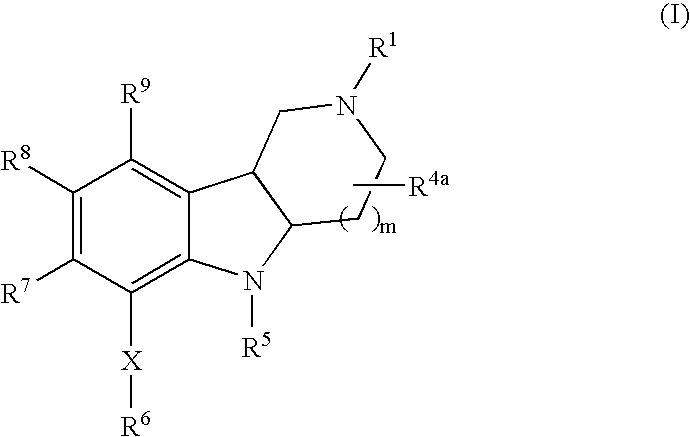
including all stereoisomers, solvates, prodrug esters and pharmaceutically acceptable salt forms thereof, wherein R1, R4a, R5, R6, R7, R8, R9, m, and X are described herein. Additionally, the present application provides novel pharmaceutical compositions comprising at least one compound according to Formula (I). Further, the present application provides methods of treating a patient in need comprising administering a therapeutically effective amount of at least one compound according to Formula (I).
Description
- This application claims priority benefit under Title 35 § 119(e) of U.S. provisional Application No. 60/562,186, filed Apr. 14, 2004, the contents of which are herein incorporated by reference.
- There exists a substantial correlation for the relationship between 5-HT2 receptor modulation and a variety of diseases and therapies. To date, three subtypes of the 5-HT2 receptor class have been identified, 5-HT2A, 5-HT2B, and 5-HT2C. Prior to the early 1990's the 5-HT2C and 5-HT2A receptors were referred to as 5-HT1C and 5-HT2, respectively.
- The agonism or antagonism of 5-HT2 receptors, either selectively or nonselectively, has been associated with the treatment of various central nervous system (CNS) disorders. Ligands possessing affinity for the 5-HT2 receptors have been shown to have numerous physiological and behavioral effects (Trends in Pharmacological Sciences, 11, 181, 1990). In the recent past the contribution of serotonergic activity to the mode of action of antidepressant drugs has been well documented. Compounds that increase the overall basal tone of serotonin in the CNS have been successfully developed as antidepressants. The serotonin selective reuptake inhibitors (SSRI) function by increasing the amount of serotonin present in the nerve synapse. These breakthrough treatments, however, are not without side effects and suffer from delayed onset of action (Leonard, J. Clin. Psychiatry, 54 (suppl.), 3, 1993). Due to the mechanism of action of the SSRIs, they effect the activity of a number of serotonin receptor subtypes. This non-specific modulation of the serotonin family of receptors most likely plays a significant role in the side effect profile. In addition, these compounds often have a high affinity for a number of the serotonin receptors as well as a multitude of other monoamine neurotransmitters and nuisance receptors. Removing some of the receptor cross reactivity would allow for the examination and possible development of potent therapeutic ligands with an improved side effect profile.
- There is ample evidence to support the role of selective 5-HT2 receptor ligands in a number of disease therapies. Modulation of 5-HT2 receptors has been associated with the treatment of schizophrenia and psychoses (Ugedo, L., et al., Psychopharmacology, 98, 45, 1989). Mood, behavior and hallucinogenesis can be affected by 5-HT2 receptors in the limbic system and cerebral cortex. 5-HT2 receptor modulation in the hypothalamus can influence appetite, thermoregulation, sleep, sexual behavior, motor activity, and neuroendocrine function (Hartig, P., et.al., Annals New York Academy of Science, 149, 159). There is also evidence indicating that 5-HT2 receptors mediate hypoactivity, effect feeding in rats, and mediate penile erections (Psychopharmacology, 101, 57, 1990).
- Compounds exhibiting selectivity for the 5-HT2B receptor are useful in treating conditions such as tachygastria, hypermotility associated with irritable bowel disorder, constipation, dyspepsia, and other peripherally mediated conditions.
- 5-HT2A antagonists have been shown to be effective in the treatment of schizophrenia, anxiety, depression, and migraines (Koek, W., Neuroscience and Behavioral reviews, 16, 95, 1996). Aside from the beneficial antipsychotic effects, classical neuroleptic are frequently responsible for eliciting acute extrapyramidal side effects and neuroendocrine disturbances. These compounds generally possess significant dopamine D2 receptor affinity (as well as other nuisance receptor affinity) which frequently is associated with extra pyramidal symptoms and tardive dyskinesia, thus detracting from their efficacy as front line treatments in schizophrenia and related disorders. Compounds possessing a more favorable selectivity profile would represent a possible improvement for the treatment of CNS disorders.
- The present application provides novel compounds according to Formula (I):
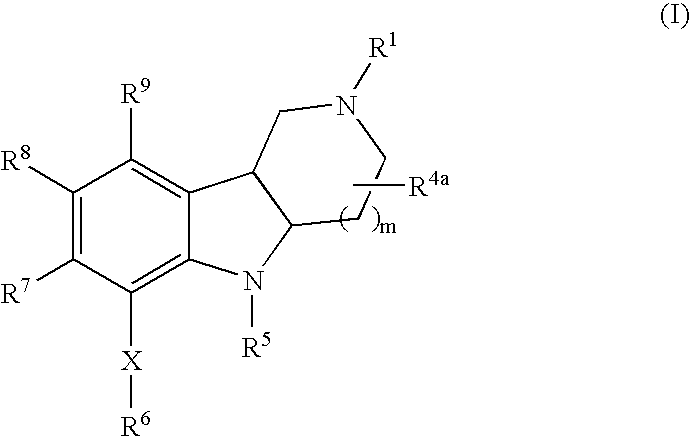
including all stereoisomers, solvates, prodrug esters and pharmaceutically acceptable salt forms thereof, wherein m, R1, R4a, R5, R6, R7, R8, R9 and X are defined herein. Additionally, the present application provides novel pharmaceutical compositions comprising at least one compound according to Formula (I). Further, the present application provides methods of treating a patient in need comprising administering a therapeutically effective amount of at least one compound according to Formula (I). - The compounds herein described may have asymmetric centers. Compounds of the present invention containing an asymmetrically substituted atom may be isolated in optically active or racemic forms. It is well known in the art how to prepare optically active forms, such as by resolution of racemic forms or by synthesis from optically active starting materials. Many geometric isomers of olefins, C═N double bonds, and the like can also be present in the compounds described herein, and all such stable isomers are contemplated in the present invention. Cis and trans geometric isomers of the compounds of the present invention are described and may be isolated as a mixture of isomers or as separated isomeric forms. All chiral, diastereomeric, racemic forms and all geometric isomeric forms of a structure are intended, unless the specific stereochemistry or isomeric form is specifically indicated.
- The term “substituted,” as used herein, means that any one or more hydrogens on the designated atom is replaced with a selection from the indicated group, provided that the designated atom's normal valency is not exceeded, and that the substitution results in a stable compound. When a substituent is keto (i.e., ═O), then 2 hydrogens on the atom are replaced.
- When any variable (e.g. R2, R11, R33, R41, R42 etc.) occurs more than one time in any constituent or formula for a compound, its definition at each occurrence is independent of its definition at every other occurrence. Thus, for example, if a group is shown to be substituted with 0-2 R2, then said group may optionally be substituted with up to two R2 groups and R2 at each occurrence is selected independently from the definition of R2. Also, combinations of substituents and/or variables are permissible only if such combinations result in stable compounds.
- When a bond to a substituent is shown to cross a bond connecting two atoms in a ring, then such substituent may be bonded to any atom on the ring. When a substituent is listed without indicating the atom via which such substituent is bonded to the rest of the compound of a given formula, then such substituent may be bonded via any atom in such substituent. Combinations of substituents and/or variables are permissible only if such combinations result in stable compounds.
- As used herein, “alkyl” or “alkylene” is intended to include both branched and straight-chain saturated aliphatic hydrocarbon groups having the specified number of carbon atoms; for example, “C1-C6 alkyl” or “C1-6 alkyl” denotes alkyl having 1 to 6 carbon atoms. Examples of alkyl include, but are not limited to, methyl, ethyl, n-propyl, i-propyl, n-butyl, i-butyl, sec-butyl, t-butyl, n-pentyl, n-hexyl, 2-methylbutyl, 2-methylpentyl, 2-ethylbutyl, 3-methylpentyl, and 4-methylpentyl.
- “Alkenyl” or “alkenylene” is intended to include hydrocarbon chains of either a straight or branched configuration having the specified number of carbon atoms, for example “C2-6 alkenyl”, and one or more unsaturated carbon-carbon bonds which may occur in any stable point along the chain. Examples of alkenyl include, but are not limited to, ethenyl, 1-propenyl, 2-propenyl, 2-butenyl, 3-butenyl, 2-pentenyl, 3, pentenyl, 4-pentenyl, 2-hexenyl, 3-hexenyl, 4-hexenyl, 5-hexenyl, 2-methyl-2-propenyl, 4-methyl-3-pentenyl, and the like.
- “Alkynyl” or “alkynylene” is intended to include hydrocarbon chains of either a straight or branched configuration, having the specified number of carbon atoms, for example “C2-6 alkynyl”, and one or more carbon-carbon triple bonds which may occur in any stable point along the chain, such as ethynyl, propynyl, butynyl, pentynyl, hexynyl and the like.
- “Cycloalkyl” is intended to include saturated ring groups, having the specified number of carbon atoms. For example, “C3-C6 cycloalkyl” denotes such as cyclopropyl, cyclobutyl, cyclopentyl, or cyclohexyl.
- “Alkoxy” or “alkyloxy” represents an alkyl group as defined above with the indicated number of carbon atoms attached through an oxygen bridge. Examples of alkoxy include, but are not limited to, methoxy, ethoxy, n-propoxy, i-propoxy, n-butoxy, s-butoxy, t-butoxy, n-pentoxy, and s-pentoxy. Similarly, “alkylthio” is represents an alkyl group as defined above with the indicated number of carbon atoms attached through a sulpher bridge.
- “Halo” or “halogen” as used herein refers to fluoro, chloro, bromo, and iodo; and “counterion” is used to represent a small, negatively charged species such as chloride, bromide, hydroxide, acetate, sulfate, and the like.
- “Haloalkyl” is intended to include both branched and straight-chain saturated aliphatic hydrocarbon groups having the specified number of carbon atoms, substituted with 1 or more halogen (for example —CvFw where v=1 to 3 and w=1 to (2v+1)). Examples of haloalkyl include, but are not limited to, trifluoromethyl, trichloromethyl, pentafluoroethyl, pentachloroethyl, 2,2,2-trifluoroethyl, heptafluoropropyl, and heptachloropropyl.
- As used herein, “carbocycle” is intended to mean any stable 3- to 7-membered monocyclic or bicyclic or 7- to 13-membered bicyclic or tricyclic, any of which may be saturated, partially unsaturated, or aromatic. Examples of such carbocycles include, but are not limited to, cyclopropyl, cyclobutyl, cyclopentyl, cyclohexyl, cycloheptyl, adamantyl, cyclooctyl, [3.3.0]bicyclooctane, [4.3.0]bicyclononane, [4.4.0]bicyclodecane (decalin), [2.2.2]bicyclooctane, fluorenyl, phenyl, naphthyl, indanyl, adamantyl, or tetrahydronaphthyl (tetralin).
- As used herein, the term “heterocycle” or “heterocyclic ring” or “heterocyclic ring system” is intended to mean a stable 5- to 7-membered monocyclic or bicyclic or 7- to 14-membered bicyclic heterocyclic ring which is saturated partially unsaturated or unsaturated (aromatic), and which consists of carbon atoms and 1, 2, 3 or 4 heteroatoms independently selected from the group consisting of N, O and S and including any bicyclic group in which any of the above-defined heterocyclic rings is fused to a benzene ring. The nitrogen and sulfur heteroatoms may optionally be oxidized. The heterocyclic ring may be attached to its pendant group at any heteroatom or carbon atom which results in a stable structure. The heterocyclic rings described herein may be substituted on carbon or on a nitrogen atom if the resulting compound is stable. If specifically noted, a nitrogen in the heterocycle may optionally be quaternized. It is preferred that when the total number of S and O atoms in the heterocycle exceeds 1, then these heteroatoms are not adjacent to one another. It is preferred that the total number of S and O atoms in the heterocycle is not more than 1.
- Examples of heterocycles include, but are not limited to, 1H-indazole, 2-pyrrolidonyl, 2H,6H-1,5,2-dithiazinyl, 2H-pyrrolyl, 3H-indolyl, 4-piperidonyl, 4aH-carbazole, 4H-quinolizinyl, 6H-1,2,5-thiadiazinyl, acridinyl, azocinyl, benzimidazolyl, benzofuranyl, benzothiofuranyl, benzothiophenyl, benzoxazolyl, benzoxazolinyl, benzthiazolyl, benztriazolyl, benztetrazolyl, benzisoxazolyl, benzisothiazolyl, benzimidazalonyl, carbazolyl, 4aH-carbazolyl, b-carbolinyl, chromanyl, chromenyl, cinnolinyl, decahydroquinolinyl, 2H,6H-1,5,2-dithiazinyl, dihydrofuro[2,3-b]tetrahydrofuran, furanyl, furazanyl, imidazolidinyl, imidazolinyl, imidazolyl, imidazolopyridinyl, 1H-indazolyl, indolenyl, indolinyl, indolizinyl, indolyl, isatinoyl, isobenzofuranyl, isochromanyl, isoindazolyl, isoindolinyl, isoindolyl, isoquinolinyl, isothiazolyl, isothiazolopyridinyl, isoxazolyl, isoxazolopyridinyl, morpholinyl, naphthyridinyl, octahydroisoquinolinyl, oxadiazolyl, 1,2,3-oxadiazolyl, 1,2,4-oxadiazolyl, 1,2,5-oxadiazolyl, 1,3,4-oxadiazolyl, oxazolidinyl, oxazolyl, oxazolopyridinyl, oxazolidinylperimidinyl, oxindolyl, phenanthridinyl, phenanthrolinyl, phenarsazinyl, phenazinyl, phenothiazinyl, phenoxathiinyl, phenoxazinyl, phthalazinyl, piperazinyl, piperidinyl, pteridinyl, piperidonyl, 4-piperidonyl, pteridinyl, purinyl, pyranyl, pyrazinyl, pyrazolidinyl, pyrazolinyl, pyrazolopyridinyl, pyrazolyl, pyridazinyl, pyridooxazole, pyridoimidazole, pyridothiazole, pyridinyl, pyridyl, pyrimidinyl, pyrrolidinyl, pyrrolinyl, pyrrolyl, quinazolinyl, quinolinyl, 4H-quinolizinyl, quinoxalinyl, quinuclidinyl, carbolinyl, tetrahydrofuranyl, tetrahydroisoquinolinyl, tetrahydroquinolinyl, 6H-1,2,5-thiadiazinyl, 1,2,3-thiadiazolyl, 1,2,4-thiadiazolyl, 1,2,5-thiadiazolyl, 1,3,4-thiadiazolyl, thianthrenyl, thiazolyl, thiazolopyridinyl, thienyl, thienothiazolyl, thienooxazolyl, thienoimidazolyl, thiophenyl, triazinyl, 1,2,3-triazolyl, 1,2,4-triazolyl, 1,2,5-triazolyl, 1,3,4-triazolyl, and xanthenyl. Preferred heterocycles include, but are not limited to, pyridinyl, furanyl, thienyl, pyrrolyl, pyrazolyl, pyrazinyl, piperazinyl, imidazolyl, indolyl, benzimidazolyl, 1H-indazolyl, oxazolidinyl, benzotriazolyl, benzisoxazolyl, benzoxazolyl, oxindolyl, benzoxazolinyl, benzthiazolyl, benzisothiazolyl, isatinoyl, isoxazolopyridinyl, isothiazolopyridinyl, thiazolopyridinyl, oxazolopyridinyl, imidazolopyridinyl, and pyrazolopyridinyl. Preferred 5 to 6 membered heterocycles include, but are not limited to, pyridinyl, furanyl, thienyl, pyrrolyl, pyrazolyl, pyrazinyl, piperazinyl, imidazolyl, and oxazolidinyl. Also included are fused ring and spiro compounds containing, for example, the above heterocycles.
- As used herein, the term “bicyclic heterocyclic ring system” is intended to mean a stable 9- to 10-membered bicyclic heterocyclic ring formed from the substituent NR12R13, which is partially unsaturated or unsaturated (aromatic), and which consists of carbon atoms, a nitrogen atom, and 1 or 2 additional heteroatoms independently selected from the group consisting of N, O and S. The additional nitrogen or sulfur heteroatoms may optionally be oxidized. The heterocyclic ring is attached to its pendant group by the nitrogen atom of the group NR12R13 and for which results in a stable structure. The heterocyclic rings described herein may be substituted on carbon or on a nitrogen atom if the resulting compound is stable. If specifically noted, a nitrogen in the heterocycle may optionally be quaternized. It is preferred that when the total number of S and O atoms in the heterocycle exceeds 1, then these heteroatoms are not adjacent to one another. It is preferred that the total number of S and O atoms in the heterocycle is not more than 1. The term “bicyclic heterocyclic ring system” is intended to be a subset of the term “heterocyclic ring system”. Preferred examples of a 9- to 10-membered bicyclic heterocyclic ring system are benzimidazolyl, benzimidazolinyl, benzoxazolinyl, dihydrobenzthiazolyl, dihydrodioxobenzthiazolyl, benzisoxazolinyl, 1H-indazolyl, indolyl, indolinyl, isoindolinyl, tetrahydro-isoquinolinyl, tetrahydro-quinolinyl, and benzotriazolyl.
- Additionally, a subclass of preferred heterocycles are heterocycles which function as an isostere of a cyclic but non-heterocyclic substituent such as —CH2—C(═O)-phenyl. Preferred examples of such heterocycles include, but are not limited to, benzimidazolyl, benzofuranyl, benzothiophenyl, benzoxazolyl, benzthiazolyl, benzisoxazolyl, furanyl, imidazolinyl, 1H-indazolyl, indolinyl, isoindolinyl, isoquinolinyl, oxazolyl, piperidinyl, pyrazinyl, pyridinyl, pyrimidinyl, quinolinyl, thiazolyl, thiophenyl, and 1,2,3-triazolyl.
- As used herein, the term “aryl”, or aromatic residue, is intended to mean an aromatic moiety containing six to ten carbon atoms, such as phenyl and naphthyl.
- The phrase “pharmaceutically acceptable” is employed herein to refer to those compounds, materials, compositions, and/or dosage forms which are, within the scope of sound medical judgment, suitable for use in contact with the tissues of human beings and animals without excessive toxicity, irritation, allergic response, or other problem or complication, commensurate with a reasonable benefit/risk ratio.
- As used herein, “pharmaceutically acceptable salts” refer to derivatives of the disclosed compounds wherein the parent compound is modified by making acid or base salts thereof. Examples of pharmaceutically acceptable salts include, but are not limited to, mineral or organic acid salts of basic residues such as amines; alkali or organic salts of acidic residues such as carboxylic acids; and the like. The pharmaceutically acceptable salts include the conventional non-toxic salts or the quaternary ammonium salts of the parent compound formed, for example, from non-toxic inorganic or organic acids. For example, such conventional non-toxic salts include those derived from inorganic acids such as hydrochloric, hydrobromic, sulfuric, sulfamic, phosphoric, nitric and the like; and the salts prepared from organic acids such as acetic, propionic, succinic, glycolic, stearic, lactic, malic, tartaric, citric, ascorbic, pamoic, maleic, hydroxymaleic, phenylacetic, glutamic, benzoic, salicylic, sulfanilic, 2-acetoxybenzoic, fumaric, toluenesulfonic, methanesulfonic, ethane disulfonic, oxalic, isethionic, and the like.
- The pharmaceutically acceptable salts of the present invention can be synthesized from the parent compound which contains a basic or acidic moiety by conventional chemical methods. Generally, such salts can be prepared by reacting the free acid or base forms of these compounds with a stoichiometric amount of the appropriate base or acid in water or in an organic solvent, or in a mixture of the two; generally, nonaqueous media like ether, ethyl acetate, ethanol, isopropanol, or acetonitrile are preferred. Lists of suitable salts are found in Remington's Pharmaceutical Sciences, 17th ed., Mack Publishing Company, Easton, Pa., 1985, p. 1418, the disclosure of which is hereby incorporated by reference.
- “Prodrugs” are intended to include any covalently bonded carriers which release the active parent drug according to Formula (I) in vivo when such prodrug is administered to a mammalian subject. Prodrugs of a compound of Formula (I) are prepared by modifying functional groups present in the compound in such a way that the modifications are cleaved, either in routine manipulation or in vivo, to the parent compound. Prodrugs include compounds of Formula (I) wherein a hydroxy, amino, or sulfhydryl group is bonded to any group that, when the prodrug or compound of Formula (I) is administered to a mammalian subject, cleaves to form a free hydroxyl, free amino, or free sulfhydryl group, respectively. Examples of prodrugs include, but are not limited to, acetate, formate and benzoate derivatives of alcohol and amine functional groups in the compounds of Formula (I), and the like.
- “Stable compound” and “stable structure” are meant to indicate a compound that is sufficiently robust to survive isolation to a useful degree of purity from a reaction mixture, and formulation into an efficacious therapeutic agent.
- Throughout the details of the invention, the following abbreviations are used with the following meanings:
- Reagents:
-
- MCPBA m-chloroperoxybenzoic acid
- DIBAL diisobutyl aluminum hydride
- Et3N triethylamine
- TFA trifluoroacetic acid
- LAH lithium aluminum hydride
- NBS N-bromo succinimide
- Red-Al Sodium bis(2-methoxyethoxy)aluminum hydride
- Pd2 dba3 Tris(dibenzylideneacetone)dipalladium(0)
- ACE-Cl 2-chloroethylchloroformate
Solvents: - THF tetrahydrofuran
- MeOH methanol
- EtOH ethanol
- EtOAc ethyl acetate
- HOAc acetic acid
- DMF dimethyl formamide
- DMSO dimethyl sulfoxide
- DME dimethoxyethane
- Et2O diethylether
- iPrOH isopropanol
Others: - Ar aryl
- Ph phenyl
- Me methyl
- Et ethyl
- NMR nuclear magnetic resonance
- MHz megahertz
- BOC tert-butoxycarbonyl
- CBZ benzyloxycarbonyl
- Bn benzyl
- Bu butyl
- Pr propyl
- cat. catalytic
- mL milliliter
- nM nanometer
- ppm part per million
- mmol millimole
- mg milligram
- g gram
- kg kilogram
- TLC thin layer chromatography
- HPLC high pressure liquid chromatography
- rt room temperature
- aq. aqueous
- sat. saturated
- The preparation of compounds of Formula (I) of the present invention may be carried out in a convergent or sequential synthetic manner. Detailed synthetic preparations of the compounds of Formula (I) are shown in the following reaction schemes. The skills required in preparation and purification of the compounds of Formula (I) and the intermediates leading to these compounds are known to those in the art. Purification procedures include, but are not limited to, normal or reverse phase chromatography, crystallization, and distillation.
- Several methods for the preparation of the compounds of the present invention are illustrated in the schemes and examples shown below. The substitutions are as described and defined above.
- Compounds of Formula (I) of this invention may be prepared as shown in Scheme 1. Thus, preparation of an aryl hydrazine (II) is accomplished, for example, by treatment of a corresponding substituted aniline with NaNO2 followed by reduction of the N-nitroso intermediate with a reducing agent such as LAH or zinc and an organic acid, such as acetic acid or trifluoroacetic acid at low temperature. Assembly of the core indole intermediate (IV) is accomplished by Fischer indole cyclization of the aryl hydrazine and a suitably substituted ketone (i.e. (III)) by methods described by, but not limited to, R. J. Sundberg, “Indoles, Best Synthetic Methods” 1996, Academic Press, San Diego, Calif. For example, treatment of the aryl hydrazine (II) as the free base or the corresponding mineral acid salt with the ketone (III) (R1=H, Bn, CBZ, CO2Et, etc) in an alcoholic solvent in the presence of mineral acid affords the indoles (IV) as the free bases (after treatment with aq. NaOH). Reduction of the indoles to the corresponding cis or trans substituted dihydroindoles is accomplished by, for example, treatment with hydrogen in the presence of a catalyst such as platinum oxide or palladium on carbon, or with a metal such as zinc and a mineral acid such as hydrochloric acid, or with sodium and liquid ammonia, or with borane-amine complex such as borane-triethylamine in tetrahydofuran, or preferably by treatment with NaCNBH3 in an acid such as acetic or trifluoroacetic acid or by treatment with a trialkylsilane in nonpolar solvent.
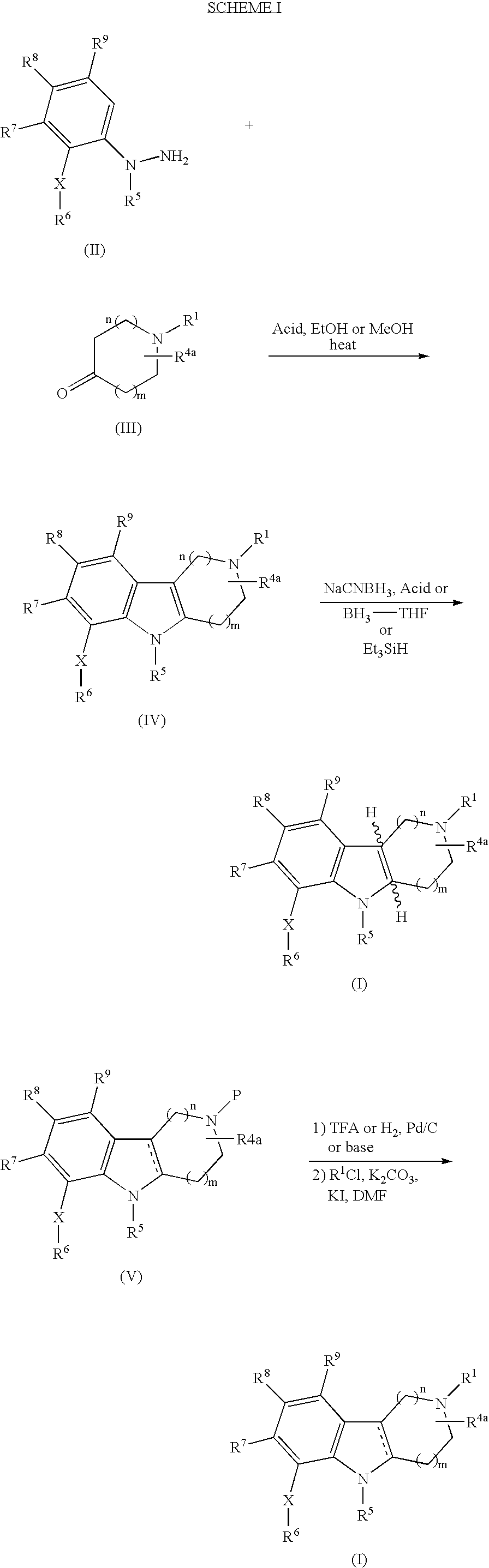
- The corresponding enantiomers can be isolated by separation of the racemic mixture of (I) on a chiral stationary phase column utilizing normal or reverse phase HPLC techniques, the details of which are described in the examples. Alternatively, a diastereomeric mixture of (I) can be prepared by treatment of (I, R2=H) with an appropriate chiral acid (or suitably activated derivative), for example dibenzoyl tartrate or the like (see, for example, Kinbara, K., et. al., J. Chem. Soc., Perkin Trans. 2, 1996, 2615; and Tomori, H., et. al., Bull. Chem. Soc. Jpn., 1996, 3581). The diastereomers would then be separated by traditional techniques (i.e. silica chromatography, crystallization, HPLC, etc) followed by removal of the chiral auxiliary to afford enantiomerically pure (I).
- In the cases where the carboline nitrogen has been protected (V) (i.e. P=Boc, Bn, CBZ, CO2R), it may be removed under a variety of conditions as described in Greene, T. W., Wuts, P. G. W., “Protective Groups in Organic Synthesis, 2nd Edition”, John Wiley and Sons, Inc., New York, pages 309-405, 1991. The free secondary amine could then be alkylated, for example, by treatment with a suitably substituted alkyl halide (R1Cl, or R1I) and a base to afford additional compounds of type (I), as described, for example, by Glennon, R. A., et. al., Med. Chem. Res., 1996, 197.
- Compounds of Formula (II) can be prepared as described in Scheme 2. Formation of the aryl amine (VII) may be accomplished by reduction of the corresponding aryl nitro compound (VI). The reduction may be accomplished with a variety of reducing agents, for example, LAH, SnCl2, NaBH4, N2H4, etc. or with hydrogen in the presence of a suitable catalyst, such as palladium on carbon, or platinum oxide, etc., (see Hudlicky, M., “Reductions in Organic Chemistry”, Ellis Horwood, Ltd., Chichester, UK, 1984). Formation of the aryl hydrazine (II) may then be performed as previously described in Scheme 1 or more directly by treatment of the aniline (VII) with aq. hydrochloric acid, stannous chloride and NaNO2 at room temperature (see, Buck, J. S., Ide, W. S., Org. Syn., Coll. Vol., 2, 1943, 130). This latter procedure is especially important when initiating the synthesis with halogenated arylamines (VII). The necessity for preparation of the hydrazine intermediate without the use of strong reductive conditions is critical in these such examples.
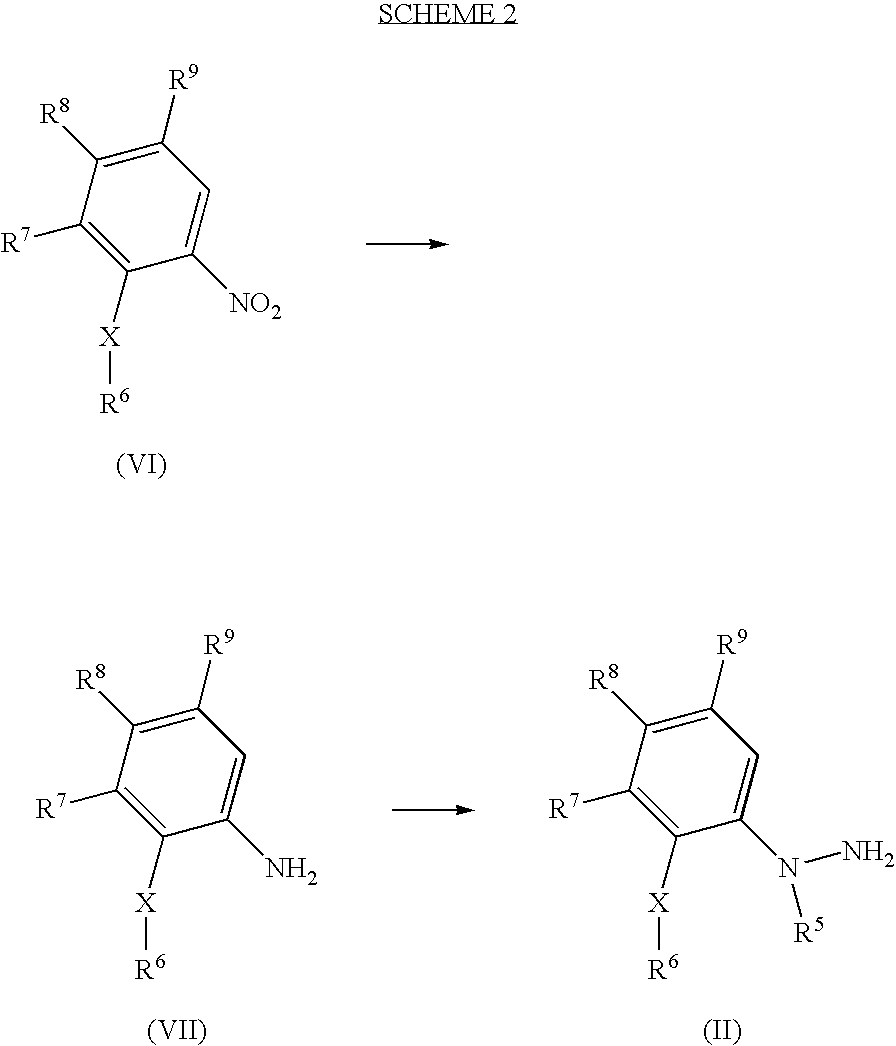
- Another related route to hydrazines of Formula (II) is shown in Scheme 3. When an aromatic substitution pattern containing a sulfur or oxygen moiety is desired the following route may be employed. Displacement of a halogen (Cl, F) of a suitably substituted aryl nitro derivative (VIII) by the prerequisite nucleophile under basic conditions affords intermediates of type (IX). Reduction of the nitro moiety followed by elaboration of the resultant amine to the substituted or unsubstituted hydrazine (X) is as described above.
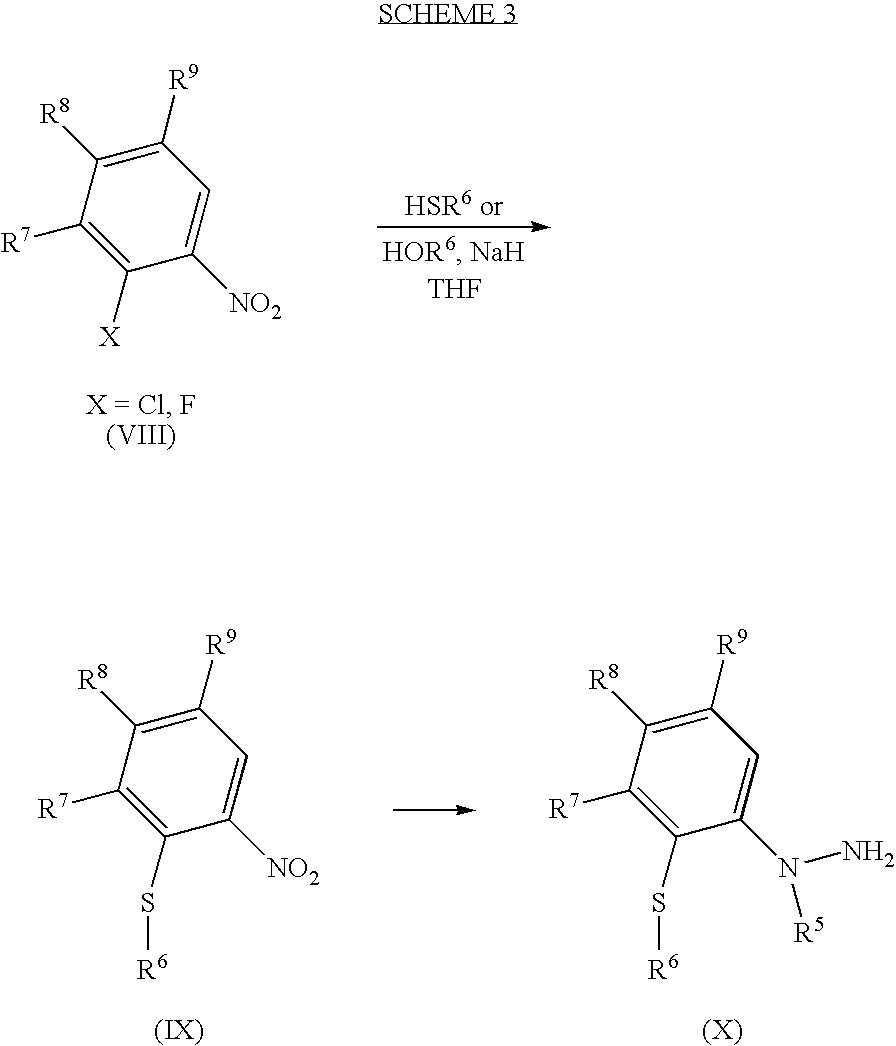
- Initiating the synthesis with a nitrobenzene derivative such as (VIII), this approach allows for a variety of derivatization. More highly substituted nitrobenzenes can be obtained by traditional synthetic manipulation (i.e. aromatic substitution) and are known by those in the art (see Larock, R. C., Comprehensive Organic Transformations, VCH Publishers, New York, 1989).
- Preparation of derivatives of type (I) where X=N is shown in Scheme 4. Fisher indole cyclization of a substituted nitro phenyl hydrazine (XI) with a substituted ketone (III) under previously described conditions affords the tricyclic indoles (XII). Protection of the carboline nitrogen with Boc2O (if ketone was unsubstituted), followed by selective reduction of the aryl nitro moiety (see Hudlicky, M., Reductions in Organic Chemistry, Chapter 8, ACS Monograph 1188, American Chemical Society Pubs., Washington, D.C., 1996). The resultant amine derivatives (XIII) can now be functionalized further, for example, by treatment with an aryl boronic acid under metal catalyzed conditions (see Chan, D. M. T., et.al. Tetrahedron, 1998, 39, 2933). Alternatively, the alkylated amine derivatives can be prepared by standard conditions as described by Larock et al. Reduction of the indoles to the cis or trans indolines followed by deprotection, and if desired alkylation of the carboline nitrogen, can be carried out as previously described to afford the desired compounds of type (XV).
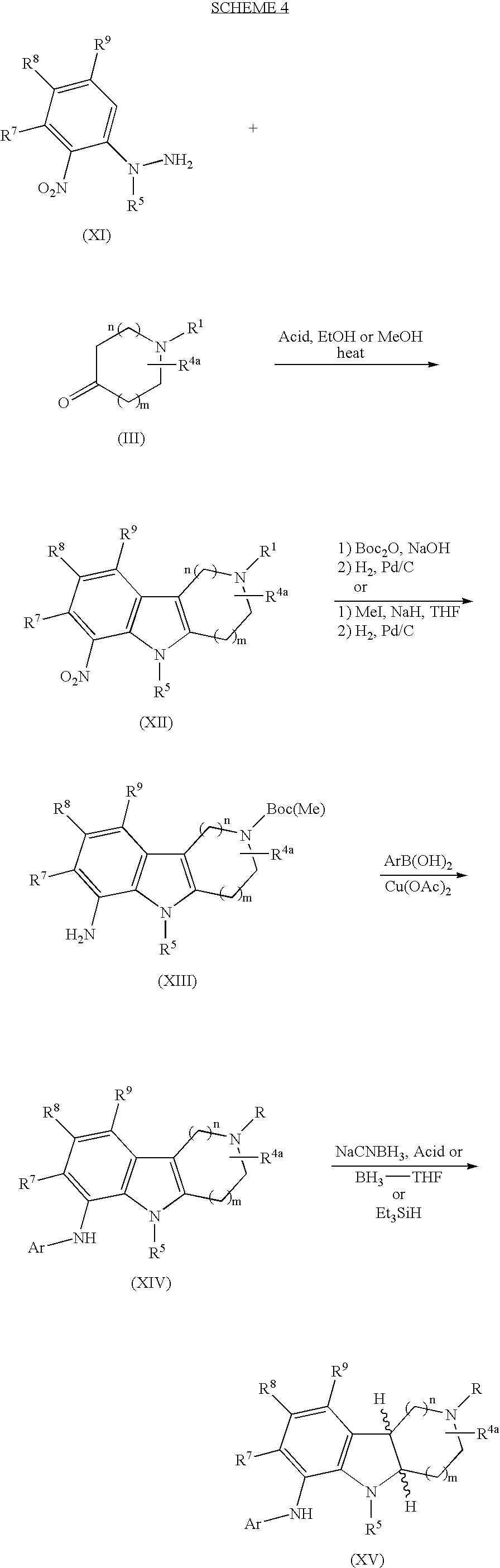
- An alternate, more direct approach to differentially substituted analogs is shown in Scheme 5. Initiating the preparation of compounds of type (I) with an aryl iodide expands the versatility of this approach. The preparation of an intermediate which can be functionalized at a later stage is a more efficient approach to some of the substitution types. Fischer indole cyclization of the iodide (XVI) with the ketone (III) as described previously, followed by protection of the amine with Boc2O, affords the iodo indole (XVII). Alkylation of the indole nitrogen under basic conditions followed by removal of the Boc protecting group and a second alkylation of the carboline nitrogen affords the selective differentially substituted carboline indoles (XVIII). Usual reduction of the indole to indoline is carried out without any loss of the aromatic halogen to afford the common aryliodide (XIX). Facile displacement of the iodide with a variety of sulfur nucleophiles under copper catalyzed conditions affords the diaryl iodides (XX).
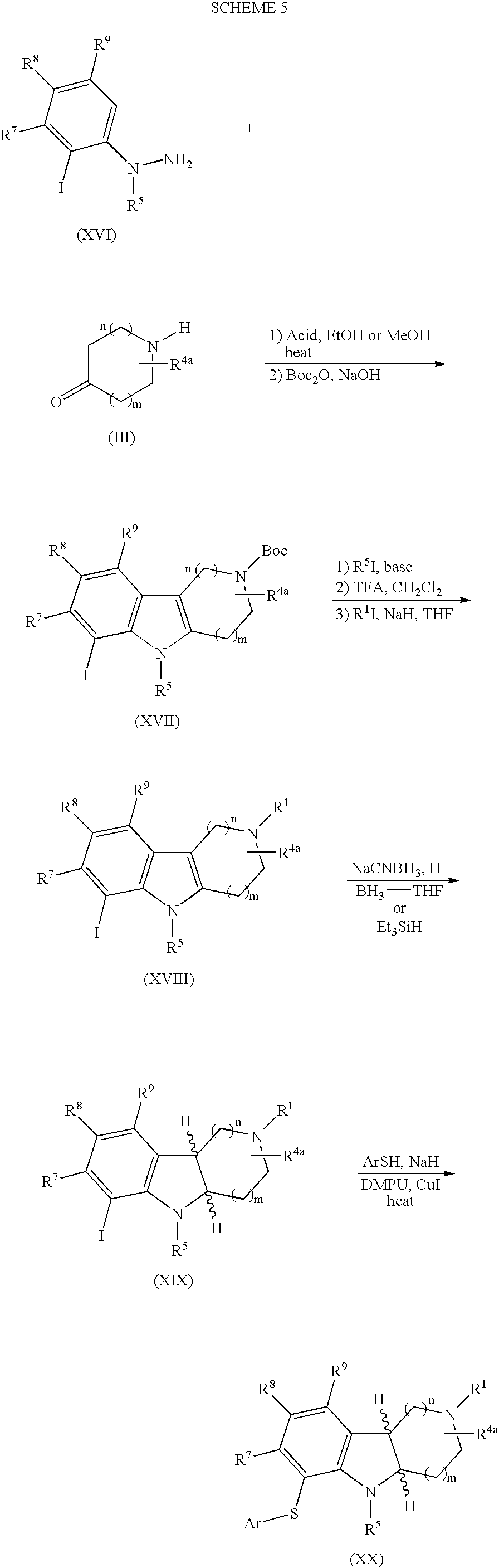
- In addition, there exists a wide range of procedures and protocols for functionalizing haloaromatics, aryldiazonium and aryltriflate compounds. These procedures are well known by those in the art and described, for example, by Stanforth, S. P., Tetrahedron, 1998, 263; Buchwald, S. L., et. al., J. Am. Chem. Soc., 1998, 9722; Stille, J. K., et. al., J. Am. Chem. Soc., 1984, 7500. Among these procedures are biaryl couplings, alkylations, acylations, aminations, and amidations. The power of palladium catalyzed functionalization of aromatic cores has been explored in depth in the last decade. An excellent review of this field can be found in J. Tsuji, “Palladium Reagents and Catalysts, Innovations in Organic Synthesis”, J. Wiley and Sons, New York, 1995.
- One such method to prepare compounds of Formula (I) with substituted R1 sidechains in a more direct manner is shown in Scheme 9. Alkylation of the indole or indoline derivatives (I, R1=H) with a haloalkyl ester, such as ClCH2(CH2)pCO2Me, in the presence of NaI or KI and a base such as K2CO3, Na2CO3 or the like, in dioxane or THF or other such solvent while heating (see Glennon, R. A., et. al., Med. Chem. Res., 1996, 197) affords the R1 alkylated esters. Subsequent formation of the activated amides (XXXI) is accomplished by treatment of the ester with N,O-dimethylhydroxylamine hydrochloride and a Lewis acid such as trimethylaluminum or triethylaluminum in toluene (see, for example, Golec, J. M. C., et. al., Tetrahedron, 1994, 809) at 0° C. Treatment of the amide (XXX) with a variety of organometallic agents, such as Grignard reagents R1aMgBr, alkyl and aryl lithium reagents etc. (see Sibi, M. P., et. al., Tetrahedron Lett., 1992, 1941; and more generally House, H. O., Modern Synthetic Reactions, W. A. Benjamin, Inc., Menlo Park, Calif., 1972), in a suitable solvent such as THF, ether, etc. at low temperatures affords the substituted ketones (XXXI).
- Furthermore, derivatives of type (I) can be alkylated with any number of functionalized alkyl sidechains. Several examples of these sidechains are described in the experimental section. Typical procedures utilizing standard alkylation of a secondary amine with an alkylhalide under base catalyzed conditions are well known by those skilled in the art.
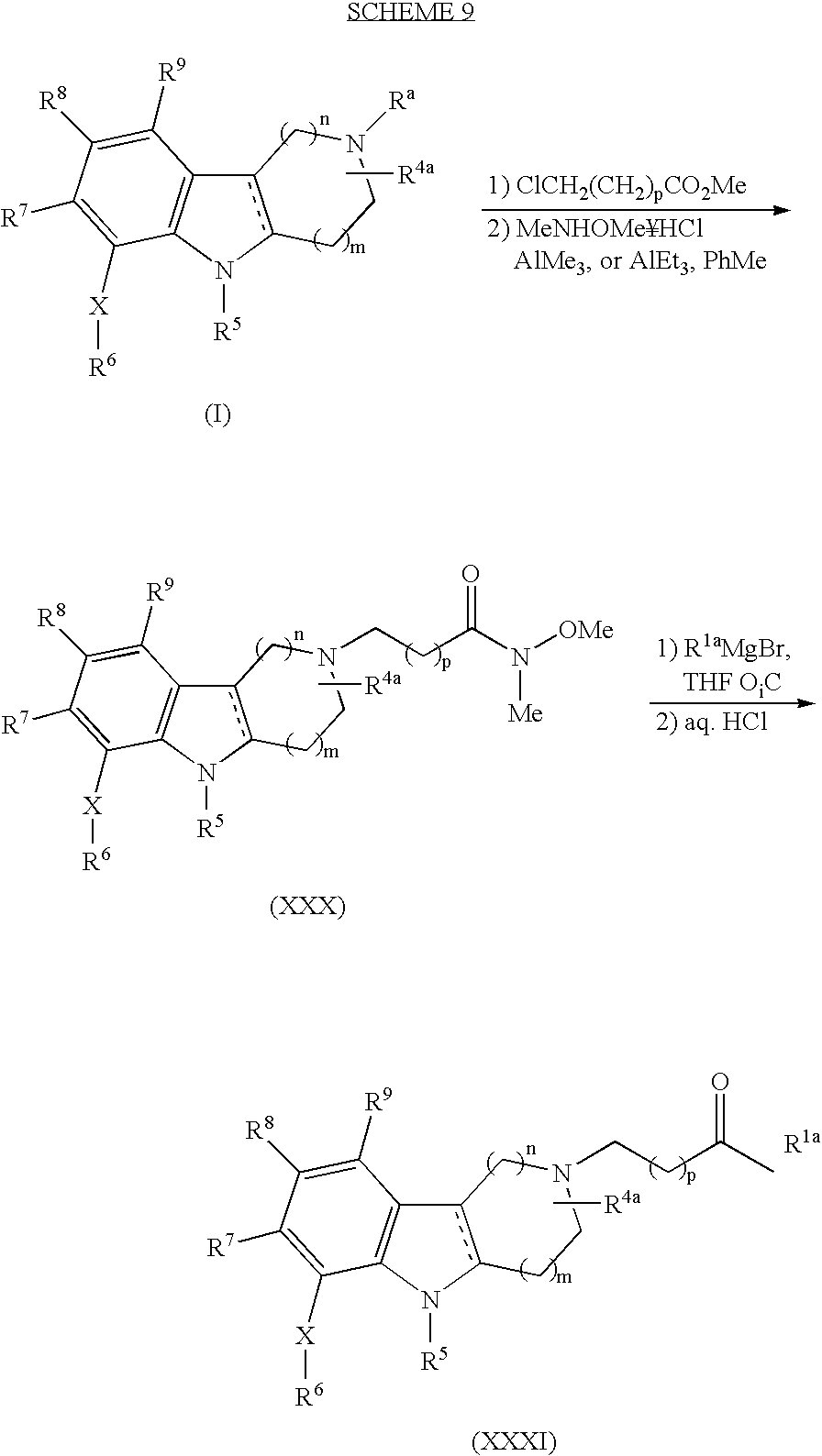
- It is understood that for substituents R7, R8, R9, and R1, the compounds of the present invention can be prepared in a number of ways well known to one skilled in the art of organic synthesis. The compounds of the present invention can be synthesized using the methods described herein, together with synthetic methods known in the art of synthetic organic chemistry, or variations thereon as appreciated by those skilled in the art. Additional methods include, but are not limited to, those described in U.S. Pat. Nos. 6,548,493; 6,552,017; and 6,713,471 wherein all three references are hereby incorporated in their entirety by reference.
- It is also understood that for substituents R1, R4a, R4b, R5, R6, R7, R8, R9, n, and X, the compounds of the present invention can be synthesized using the methods described in U.S. Pat. Nos. 6,669,852 and 6,777,406, hereby incorporated in their entirety by reference, together with synthetic methods known in the art of synthetic organic chemistry, or variations thereon as appreciated by those skilled in the art.
-

- Step A. 2-Tolylsulfanylaniline (2.15 g, 10 mmol) was suspended in conc. HCl (1-3 mL). This mixture was cooled in an ice bath. An aqueous solution (6.5 mL) of NaNO2 (0.7 g, 10 mmol) was added dropwise over 6 min (internal temp <7° C.). The resultant viscous solution was maintained at 0° C. or 2 h at which time it was transferred via cannula to a stirred solution of SnCl2 (3.8 g, 20 mmol) in conc. HCl (4.5 mL) over 10 min. The cooling bath was removed and the reaction mixture was maintained at 0° C. for 20 min and at rt for 1.5 h. Solid product was collected by vacuum filtration, washed with 1N HCl, and dried under vacuum at rt for 18 h to afford 1-{2-[(4-methylphenyl)sulfanyl] phenyl}hydrazine hydrochloride (2.09 g, 78%) as a yellow powder. 1H NMR (300 MHz, CDCl3) δ 7.42 (t, J=8.1 Hz, 2H), 7.10 (s, 4H), 7.03 (t, J=7.3, 2H), 2.26 (s, 3H) ppm.
- Step B. 1-{2-[(4-Methylphenyl)sulfanyl]phenyl}hydrazine hydrochloride (1.67 g, 6.27 mmol) and 4-piperidone monohydrate hydrochloride (963 mg, 6.27 mmol) were suspended in 2,2,2-trifluoroethanol (15 mL) at rt. This mixture was heated at 70° C. for 1.5 h, and then allowed to cool to rt. Solid was collected by filtration under vacuum, rinsed with isopropanol, and dried at rt for 18 h to give 4-methylphenyl-2,3,4,5-tetrahydro-1H-pyrido[4,3-b]indol-6-yl sulfide hydrochloride (1.73 g, 84%) as a tan powder. 1H NMR (300 MHz, CDCl3) δ 6.12 (t, J=7.5 Hz, 1H), 5.88 (d, J=7.3 Hz, 1H), 5.71 (t, J=8.1 Hz, 1H), 5.61 (s, 4H), 3.06 (br s, 2H), 2.21 (t, J=6.9 Hz, 1H), 1.74 (t, J=5.8 Hz, 1H) ppm.
- Step C. 4-Methylphenyl 2,3,4,5-tetrahydro-1H-pyrido[4,3-b]indol-6-yl sulfide (200 mg, 0.68 mmol) was brought to reflux with formaldehyde (37% aq., 0.68 mL) in MeOH (1.8 mL) for 30 minutes. The reaction was then cooled to 0° C. and sodium borohydride (89 mg, 1.3 mmol) was added slowly. The solution was allowed to stir at room temperature for 2 hours. Ice chips were then added and the reaction partitioned between CHCl3 and water. The aqueous layer was extracted with CHCl3 (3×10 mL). The combined extracts were washed with sat. NaCl (10 mL) and dried (MgSO4) and evaporated. The residue was dissolved in 1 mL EtOH and 1N HCl-Ether was added until no further precipitation was seen. The solid was filtered affording 2-methyl-6-[(4-methylphenyl)sulfanyl]-2,3,4,5-tetrahydro-1H-pyrido[4,3-b]indole as a light tan solid (178 mg, 76%). 1H NMR (CD3OD, 300 MHz) δ 7.49 (d, 1H, J=8.1 Hz), 7.26 (d, 1H, J=7.6 Hz), 7.07 (t, 1H, J=7.7 Hz), 6.97-7.02 (m, 4H), 4.42 (s, 2H), 3.58 (t, 2H, J=6.2 Hz), 3.05-3.21 (m, 5H), 2.25 (s, 3H) ppm.
Step D. 2-Methyl-6-[(4-methylphenyl)sulfanyl]-2,3,4,5-tetrahydro-1H-pyrido[4,3-b]indole (77 mg, 0.25 mmol) was dissolved in THF and BH3-THF (1M, 1.25 mL) was added. The reaction was brought to reflux for 90 minutes. The reaction was then cooled and 6 N HCl (2 mL) was added with acetic acid (0.5 mL). The reaction was brought to reflux again for an additional 30 minutes. The reaction was then cooled and basified to pH 12 with sat. aq. NH4OH. The aqueous layer was extracted with CHCl3 (3×10 mL). The combined extracts were washed with sat. NaCl (10 mL), water (10 mL), dried (MgSO4) and evaporated. The resulting residue was purified by preparatory thin layer chromatography (5% MeOH—CH2Cl2). The collected product was dissolved in EtOH (1 mL), and 1N HCl-Ether was added until no further precipitation was seen. The resulting solid was filtered affording the title compound as a light tan solid (45 mg, 52%). 1H NMR (CD3OD, 300 MHz) δ 7.09-7.19 (m, 6H), 6.85-6.90 (m, 1H), 4.20-4.23 (m, 1H), 3.62-3.72 (m, 1H), 3.28-3.48 (m, 2H), 3.02-3.21 (m, 2H), 2.97 (s, 3H), 2.30-2.41 (m, 1H), 2.27 (s, 3H), 2.05-2.20 (m, 1H) ppm.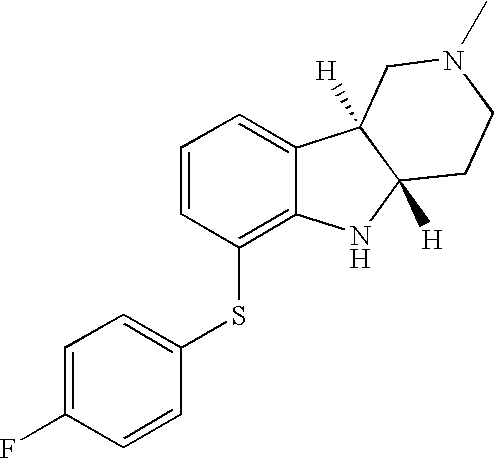
- Step A. To a solution of 4-fluorothiophenol (1.0 g, 7.8 mmol) and 2-chloronitrobenzene (1.2 g, 7.8 mmol) in THF (10 mL) at 0° C. was added NaH (60% dispersion in oil, 390 mg, 9.4 mmol). The reaction was brought to room temperature and allowed to stir for 18 h. Ice was added and the layers separated. The aqueous layer was extracted three times with EtOAc (3×50 mL). The combined extracts were washed with water (50 mL) and dried (Na2SO4) and evaporated affording 4-fluorophenyl 2-nitrophenyl sulfide (1.6 g, 82%) as a yellow solid. 1H NMR (CDCl3, 300 MHz) δ 8.24 (dd, 1H, J=1.5, 8 Hz), 7.58-7.63 (m, 2H), 7.38 (dt, 1H, J=1.5, 7.4 Hz), 7.15-7.25 (m, 3H), 6.82 (dd, 1H, J=1.1, 8.1 Hz) ppm.
- Step B. 4-Fluorophenyl-2-nitrophenyl sulfide (1.6 g, 6.4 mmol) was combined with palladium hydroxide (200 mg) in EtOH (100 mL) and stirred for 18 hours under H2 (55 psi). The mixture was filtered through Celite and the filtrate concentrated to give a dark solid. The residue was taken up in a minimal amount of EtOAc (15 mL) and 1N HCl/Ether was added until precipitation was no longer seen to occur. The solid was filtered, washed with EtOAc (30 mL) and dried affording 2-[(4fluorophenyl)sulfanyl]aniline hydrochloride in 40% yield (0.65 g). 1H NMR (CD3OD, 300 MHz) δ 7.22-7.41 (m, 6H), 7.02-7.12 (m, 2H) ppm.
- Step C. 2-[(4-Fluorophenyl)sulfanyl]aniline (400 mg, 1.6 mmol) was stirred at 0° C. in conc. HCl (4.0 mL) and NaNO2 (130 mg, 1.8 mmol) was added slowly, maintaining 0° C. reaction temperature. After stirring for 1 hour at 0° C., a solution of SnCl2 (610 mg, 3.2 mmol) in 1.5 mL conc. HCl was added. The reaction was brought to rt and stirred for one h. Upon completion, the reaction was basified with 1N aqueous NaOH to pH 12. The reaction mixture was partition between water and CHCl3 and the aqueous layer extracted with CHCl3 (3×20 mL). The combined extracts were washed with brine (20 mL), H2O (20 mL) and dried (Na2SO4) and evaporated to a residue. The residue was taken up in a minimal amount of CHCl3 (10 mL) and 1N HCl-Ether (10 mL) was added. The solvent was evaporated affording 1-{2-[(4-fluorophenyl)sulfanyl]phenyl}hydrazine hydrochloride as a dark semi-solid (327 mg, 76%). 1H NMR (CD3OD, 300 MHz) δ 7.40-7.51 (m, 2H), 7.16-7.25 (m, 2H), 6.95-7.14 (m, 4H) ppm.
- Step D. 1-{2-[(4-Fluorophenyl)sulfanyl]phenyl}hydrazine (110 mg, 0.40 mmol) and monohydrate piperidone hydrochloride (160 mg, 0.41 mmol) were dissolved in trifluoroethanol (1 mL) and brought to 80° C. for two hours. The solid, which had precipitated, was filtered, rinsed with isopropanol (10 mL) and dried to give 4-fluorophenyl-2,3,4,5-tetrahydro-1H-pyrido[4,3-b]indol-6-yl sulfide hydrochloride in 94 mg (77%). 1H NMR (CD3OD, 300 MHz) δ 7.51 (d, 1H, J=7.7 Hz), 7.29 (d, 1H, J=7.3 Hz), 7.12 (m, 3H), 6.93 (t, 2H, J=8.8 Hz), 4.43 (s, 2H), 3.58 (t, 2H, J=6.3 Hz), 3.11 (t, 2H, 6.3 Hz) ppm. MS (CI, NH3) 299, (M+H).
- The Title compound was prepared using the procedure of Example 1 Step C and D. The compound was purified by preparative TLC (6% MeOH/CH2Cl2). The collected compound was then dissolved in a minimal amount of ether and 1N HCl-Ether was added until no further precipitation was seen. The solid was filtered affording the title compound as a light tan solid (83%). 1H NMR (CD3OD, 300 MHz) δ 7.05-7.20 (m, 4H), 6.97 (t, 2H, J=6.6 Hz), 6.72 (d, 1H, J=7.3 Hz), 3.49 (dd, 1H, J=3.3, 10.6 Hz), 2.95-3.03 (m, 2H), 2.79-2.89 (m, 1H), 2.38 (s, 3H), 2.10-2.25 (m, 2H), 2.01-2.10 (m, 1H), 1.78-1.95 (m, 1H) ppm.
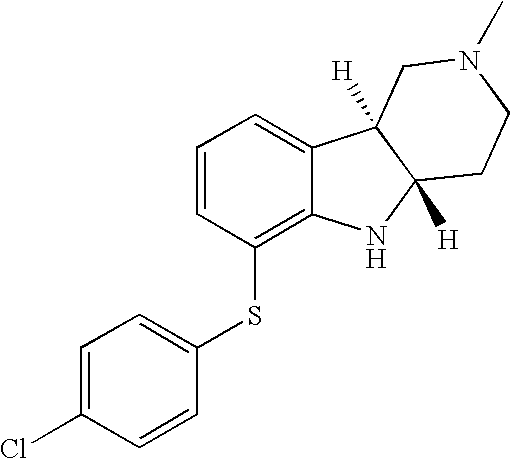
- Step A. The following compound was prepared in 89% yield by substituting the required thiophenol for 4-chlorothiophenol by the procedure in Example 2, Step A. 1H NMR (CDCl3, 300 MHz): δ 8.23 (dd, 1H, J=1.4, 8 Hz), 7.23-7.48 (m, 4H), 7.36 (dt, 1H, J=1.4, 7.3 Hz), 7.20-7.29 (m, 1H), 6.86 (dd, 1H, J=1.1, 8.1 Hz) ppm.
- Step B. The following compound was prepared in 80% yield by the procedure of Example 2, Step B. 1H NMR (CD3OD, 300 MHz) δ 7.41-7.58 (m, 4H), 7.35 (d, 2H, J=8.4 Hz), 7.23 (d, 2H, J=8.7 Hz) ppm.
- Step C. The following compound was prepared in 94% yield according to the procedure for Example 2, Step C. 1H NMR (CD3OD, 300 MHz) δ 7.42-7.55 (m, 2H), 7.25 (d, 2H, J=8.4 Hz), 7.07 (d, 2H, J=8.87 Hz), 7.02-7.10 (m, 2H) ppm.
- Step D. The title compound was prepared by the method of Example 2, step D in 78% yield. 1H NMR (CD3OD, 300 MHz) δ 7.55 (d, 1H, J=8.1 Hz), 7.38 (d, 1H, J=8.0 Hz), 7.12-7.18 (m, 3H), 6.96 (d, 2H, J=8.8 Hz), 4.41 (s, 2H), 3.52-3.59 (m, 2H), 3.03-3.11 (m, 2H) ppm.
- Step E. 2-Methyl-6-[(4-chlorophenyl)sulfanyl]-2,3,4,5-tetrahydro-1H-pyrido[4,3-b]indole (24 mg, 0.08 mmol) in THF (0.5 mL) was stirred at room temperature under N2. BH3-THF (0.40 mmol, 1M) was added dropwise and the reaction was brought to reflux for 90 minutes. The reaction was cooled to room temperature, 6 N HCl (0.5 mL) was added and the reaction was brought to reflux for an additional 90 minutes. The mixture was cooled to 0° C. and basified to a pH of 12 with 50% NaOH. The aqueous mixture was extracted with CHCl3 (3×10 mL). The combined extracts were washed with brine (10 mL), H2O (10 mL), dried (Na2SO4) and evaporated leaving a yellow residue. Purification was accomplished by prep TLC (6% MeOH—CH2Cl2). The collected residue was dissolved in EtOAc (0.5 mL), and fumaric acid (4.6 mg, 0.04 mmol) in MeOH (0.5 mL) was added. The solution was stirred for 10 minutes. The solvent was evaporated and the resulting solid was recrystallized in isopropylalcohol affording the title compound as a light tan solid (20 mg, 83%). 1H NMR (CD3OD, 300 MHz) δ 7.15-7.23 (m, 4H), 7.04 (d, 2H, J=8.8 Hz), 6.79 (t, 1H, J=7.7 Hz), 6.67 (s, 2H), 4.12-4.19 (m, 1H), 3.55-3.63 (m, 2H), 3.31-3.40 (m, 1H), 3.19-3.22 (m, 1H), 2.98-3.10 (m, 2H), 2.91 (s, 3H), 2.20-2.29 (m, 1H), 2.01-2.12 (m, 1H) ppm.
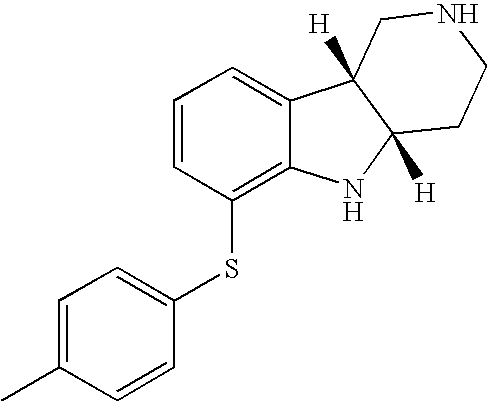
- 4-Methylphenyl 2,3,4,5-tetrahydro-1H-pyrido[4,3-b]indol-6-yl sulfide hydrochloride (prepared in Example 1, 331 mg, 1.0 mmol) was suspended in TFA (17 mL) at rt. This mixture was cooled in an ice bath. A stream of N2 was introduced through the solution while solid NaCNBH3 (202 mg, 3.3 mmol) was added in 4 portions over 10 min. maintaining an internal temperature of <7° C. The resultant solution was maintained at ˜0° C. for 5 h at which time it was poured over ice chips. With vigorous stirring, 50% NaOH was added portionwise to pH 12. This mixture was extracted with CHCl3 (3×100 mL). The organic extracts were combined, dried (MgSO4) and concentrated in vacuo. The residue (265 mg, 90%) was treated with Et2O (5 mL) and filtered. The filtrate was treated with a MeOH solution (1 mL) of fumaric acid (116 mg, 1.0 mmol). The resultant solution was concentrated in vacuo. The solid residue was recrystallized from EtOAc-Et2O to afford the title compound (298 mg, 67%) as a crystalline sample. 1H NMR (300 MHz, CDCl3) δ 7.18 (d, J=7.7 Hz, 1H), 7.09 (d, J=7.0 Hz, 1H), 7.29 (s, 4H), 6.72 (t, J=7.3 Hz, 1H), 4.09 (t, J=8.3 Hz, 1H), 3.83 (q, J=5.5 Hz, 1H), 3.2-2.8 (m, 3H), 2.72-2.60 (m, 1H), 2.28 (s, 3H), 1.78-1.63 (m, 2H), 1.57-1.44 (m, 2H) ppm.
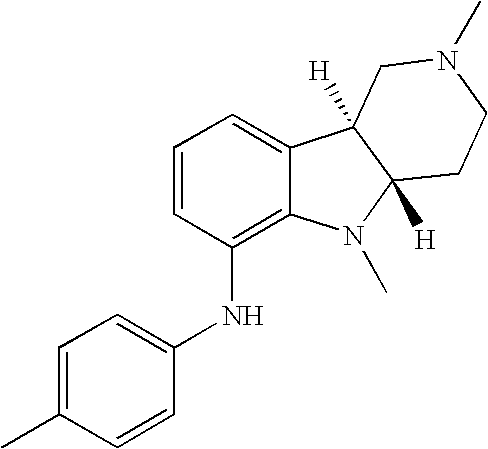
- Preparation of
- Step A. 2-Nitrophenylhydrazine (3.7 g, 24.2 mmol) and 4-piperidone monohydrate hydrochloride (3.7 g, 24.2 mmol) were suspended in 2,2,2-trifluoroethanol (25 mL). The resultant mixture was heated at reflux for 2 h and then concentrated. Conc. HCl (35 mL) was added in one portion. The resultant mixture was then heated at 105° C. for 15 h, and allowed to cool to rt, after which it was poured onto ice. While vigorously stirring, a 50% NaOH solution was added portionwise over 10 min until pH 12, maintaining the internal temperature at <20° C. The solid was collected via filtration and dried at room temperature under vacuum for 18 h to afford 6-nitro-2,3,4,5-tetrahydro-1H-pyrido[4,3-b]indole (2.91 g, 55%). 1H NMR (300 MHz, DMSO) δ 11.65-11.60 (br s, 1H), 7.96 (d, J=8.1 Hz, 1H), 7.80 (d, J=7.0 Hz, 1H), 7.12 (t, J=8.0 Hz, 1H), 3.86 (s, 2H), 2.99 (br s, 2H), 2.72 (br s, 2H) ppm.
- Step B. 6-Nitro-2,3,4,5-tetrahydro-1H-pyrido[4,3-b]indole (250 mg, 0.99 mmol) was dissolved in CH2Cl2 (2.5 mL) with sat. aq. K2CO3. Ethylchloroformate (130 mg, 1.2 mmol) was added at 0° C. The reaction was brought to room temperature and stirred for 15 h. The layers were separated and the aqueous layer was extracted with CHCl3 (3×5 mL). The combined extracts were washed with brine (10 mL), dried (MgSO4) and evaporated affording ethyl-6-nitro-1,3,4,5-tetrhydro-2H-pyrido[4,3-b]indole-2-carboxylate as an orange semi-solid (160 mg, 56%). 1H NMR (CDCl3, 300 MHz) δ 8.17 (d, 1H, J=8.1 Hz), 7.78 (d, 1H, J=7.6 Hz), 3.19 (t, 1H, J=8.1 Hz), 4.73 (s, 2H), 4.18-4.23 (m, 4H), 2.91-2.98 (m, 2H), 1.30-1.39 (t, 3H, J=6.9 Hz) ppm.
- Step C. Ethyl 6-nitro-1,3,4,5-tetrahydro-2H-pyrido[4,3-b]indole-2-carboxylate (0.33 g, 1.12 mmol) was combined with KOH (0.31 g, 5.6 mmol) and iodomethane (1.3 g, 8.96 mmol) in ethylene glycol dimethyl ether (5.6 mL) and stirred at 90° C. for 16 h. The inorganic solid was filtered and the filtrate evaporated to give ethyl-5-methyl-6-nitro-1,3,4,5-tetrahydro-2H-pyrido[4,3-b]indole-2-carboxylate (0.37 g) as an orange oil in near quantitative yield. 1H NMR (CDCl3, 300 MHz) δ 7.74 (d, 1H, J=7.7 Hz), 7.67 (d, 1H, J=7.7 Hz), 7.12 (t, 1H, J=8.0 Hz), 4.70 (s, 2H), 4.22 (q, 2H, J=7.0 Hz), 3.91 (br. s, 2H), 3.62 (s, 3H), 2.84 (t, 2H, J=5.5 Hz), 1.30 (t, 3H, J=7.0 Hz) ppm.
- Step D. Ethyl 5-methyl-6-nitro-1,3,4,5-tetrahydro-2H-pyrido[4,3-b]indole-2-carboxylate (340 mg, 1.12 mmol) and palladium hydroxide (60 mg) were dissolved in EtOH (50 mL) and stirred for 18 h under H2 (55 psi). The mixture was filtered through Celite and the filtrate was evaporated to give ethyl 6-amino-5-methyl-1,3,4,5-tetrahydro-2H-pyrido[4,3-b]indole-2-carboxylate as a light tan solid (202 mg, 66%). 1H NMR (CDCl3, 300 MH) δ 6.85-7.02 (m, 2H), 6.43-6.51 (d, 1H, J=7.0 Hz), 4.80 (br. s, 2H), 4.21 (q, 2H, J=6.6 Hz), 3.90 (s, 3H), 3.80-3.88 (m, 2H), 2.75-2.80 (m, 2H), 1.27 (t, 3H, J=7.3 Hz) ppm.
- Step E. Ethyl 6-amino-5-methyl-1,3,4,5-tetrahydro-2H-pyrido[4,3-b]indole-2-carboxylate (103 mg, 0.37 mmol) was combined with p-tolylboronic acid (100 mg, 0.74 mmol), triethylamine (75 mg, 0.74 mmol), and copper (II) acetate (68 mg, 0.37 mmol) in CH2Cl2 (2 mL) and allowed to stir for 36 h. The solvent was evaporated and the residue purified by silica gel column chromatography (20% EtOAc-Hex) affording ethyl 5-methyl-6-(4-toluidino)-1,3,4,5-tetrahydro-2H-pyrido[4,3-b]indole-2-carboxylate as a green semi-solid (73 mg, 73%) yield. 1H NMR (CDCl3, 300 MHz) δ 7.32 (d, 1H, J=7.7 Hz), 7.03 (t, 1H, J=7.7 Hz), 6.97 (d, 2H, J=8.0 Hz), 6.92 (d, 1H, J=6.9 Hz), 6.54 (d, 2H, J=8.4 Hz), 5.37 (s, 1H), 4.70 (s, 2H), 4.21 (q, 2H, J=7.0 Hz), 3.88 (br. s, 2H), 3.71 (s, 3H), 2.76 (t, 2H, J=5.5 Hz), 2.24 (s, 3H), 1.30 (t, 3H, J=7.3 Hz) ppm.
- Step F. Ethyl-5-methyl-6-(4-toluidino)-1,3,4,5-tetrahydro-2H-pyrido[4,3-b]indole-2-carboxylate (73 mg, 0.214 mmol) was dissolved in anhydrous THF (1 mL) under N2 and LAH (1M in THF, 0.42 mmol) was added slowly. The reaction was brought to reflux for 2 hours. The reaction was quenched by the addition of water (16 μL), 15% aq. NaOH (16 μL) and then water (49 μL). The reaction was allowed to stir for 10 minutes between each addition. The aluminum salts were removed by filtration. The filtrate was evaporated and purified by silica gel column chromatography (10%, then 20% EtOAc-Hex) to give 2,5-dimethyl-N-(4-methylphenyl)-2,3,4,5-tetrahydro-1H-pyrido[4,3-b]indol-6-amine (15 mg, 23%). 1H NMR (CDCl3, 300 MH2) δ 7.23-7.27 (m, 1H), 6.89-7.03 (m, 3H), 6.88 (d, 1H, J=7.3 Hz), 6.54 (d, 2H, J=8.4 Hz), 3.70 (s, 5H), 2.79-2.89 (m, 4H), 2.58 (s, 3H), 2.23 (s, 3H) ppm.
- Step G. 2,5-Dimethyl-N-(4-methylphenyl)-2,3,4,5-tetrahydro-1H-pyrido[4,3-b]indol-6-amine (0.047 g, 0.162 mmol) was dissolved in THF (1 mL) and BH3-THF (1 M, 0.810 mL) and brought to reflux under N2 for 15 hours. The solvent was evaporated and 6N HCl (2 mL) and the reaction brought to 80° C. for an additional 2 hours. The reaction was then basified to a pH of 12 with 50% aq. NaOH. The aqueous mixture was then extracted with CHCl3 (3×20 mL). The combined extracts were washed with brine (10 mL), dried (MgSO4) and evaporated leaving a light tan residue. Purification was accomplished by silica gel column chromatography (2.5% MeOH/CH2Cl2) followed by chiral separation by HPLC (Chiralcel OD, 10% EtOH-Hex, 7 mL/min) affording the title compound. Total yield of both enantiomers was 53%. 1H NMR (CDCl3, 300 MHz) δ 6.92-7.03 (m, 3H), 6.86 (d, 1H, J=7.3 Hz), 6.77 (t, 1H, J=7.7 Hz), 6.65 (d, 2H, J=8.4 Hz), 5.11 (s br, 1H), 3.49 (dd, 1H, J=2.5, 10.2 Hz), 3.10 (d, 1H, J=11.7 Hz), 2.81-2.91 (m, 1H), 2.77 (s, 3H), 2.44 (s, 3H), 2.26 (s, 3H), 2.00-2.23 (m, 3H), 1.81-1.92 (m, 2H) ppm.

- Trans(4a,9b)-6-[(4-methylphenyl)sulfanyl]-2,3,4,4a,5,9b-hexahydro-1H-pyrido[4,3-b]indole (50 mg, 0.17 mmol) was combined with 4-chloro-1-(4-fluorophenyl)-1-butanone (41 mg, 0.20 mmol), potassium carbonate (93 mg, 0.67 mmol) and potassium iodide (28 mg, 0.17 mmol) in methyl ethyl ketone (1 mL) and allowed to reflux for 48 hours. The inorganics were filtered and the filtrate evaporated to afford a residue. Purification of the residue was accomplished by silica gel column chromatography (50% EtOAc/Hex) to afford the title compound as a light yellow oil (43 mg, 56%). 1H NMR (CDCl3, 300 MHz) δ 7.98 (q, 2H, J=5.1 Hz), 7.05-7.19 (m, 2H), 7.02 (s, 4H), 6.69 (t, 1H, J=7.6 Hz), 4.04 (s, 1H), 3.71-3.76 (m, 1H), 3.15-3.22 (m, 1H), 2.97 (t, 2H, J=7.3 Hz), 2.62-2.71 (m, 1H), 2.32-2.43 (m, 4H), 2.28 (s, 3H), 1.95 (t, 2H, J=7.3 Hz), 1.58-1.80 (m, 3H) ppm.
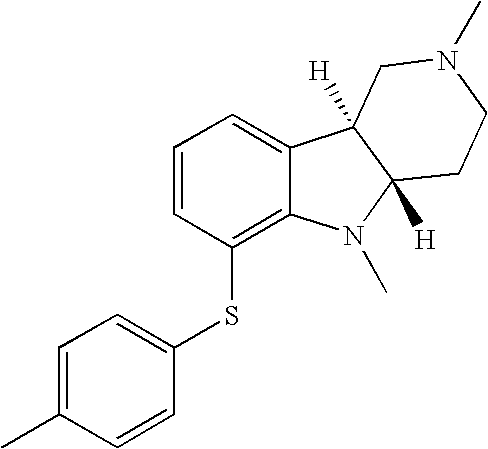
- Step A. 2-Iodoaniline (16 g, 73 mmol) was suspended in concentrated hydrochloric acid (100 mL), and then cooled to 0° C. in an ice bath. Sodium nitrite (6 g, 87.6 mmol) in water (25 mL) was added slowly to reaction mixture and then reaction allowed to stir at 0° C. for 1.5 hours. In a separate flask, tin (II) chloride (84.7 g, 182.5 mmol) was dissolved in concentrated hydrochloric acid (12 mL) and added slowly over 30 minutes to reaction mixture. The resulting suspension was allowed to warm to room temperature and stirred for 14 h. The solid was filtered off, and allowed to dry to afford 1-(2-iodophenyl)hydrazine hydrochloride (19 g, 96%). 1H NMR (CDCl3, 300 MHz) δ 7.82 (dd, 1H, J=1.1, 7.7 Hz), 7.39 (dt, 1H, 1.2, 7.7 Hz), 6.96 (dd, 1H, J=1.1, 8.1 Hz), 6.82 (dt, 1H, J=1.1, 7.5) ppm. MS (ApCI) 275 (M++CH3CN+H).
- Step B. 1-(2-iodophenyl)hydrazine hydrochloride (1.67 g, 6.2 mmol) and 4-piperidone monohydrate hydrochloride (0.952 g, 6.2 mmol) were dissolved in trifluoroethanol (15 mL) and concentrated hydrochloric acid (5 mL) and heated at 87° C. and stirred for 3 h. The solid was filtered, washed with cold isopropyl alcohol (50 mL), and dried to give 6-iodo-2,3,4,5-tetrahydro-1H-pyrido[4,3-b]indole hydrochloride (1.76 g, 85%) as a tan solid. 1H NMR (CD3OD, 300 MHz) δ 7.49 (d, 1H, J=7.7 Hz), 7.43 (d, 1H, J=8 Hz), 6.82 (t, 1H, J=7.7 Hz), 4.40 (s, 2H), 3.60 (t, 2H, J=6.25 Hz), 3.18 (t, 2H, J=5.85 Hz) ppm.
- Step C. 6-Iodo-2,3,4,5-tetrahydro-1H-pyrido[4,3-b]indole hydrochloride (7 g, 21 mmol) was suspended in CH2Cl2 (150 mL) and to this suspension was added 4-(dimethyl amino) pyridine (0.1 g, 0.82 mmol) and saturated potassium carbonate solution (150 mL) with stirring. Then di-tertbutyl dicarbonate (5.5 g, 25.2 mmol) in dichloromethane (20 mL) was added in 5 portions over 5 minutes. The resulting two-phase mixture was stirred vigorously at room temperature for 1.5 h. Layers were separated and aqueous layer was back extracted with CH2Cl2 (2×100 mL). The organics were collected, dried over magnesium sulfate, filtered and then concentrated under reduced pressure to give tert-butyl 6-iodo-1,3,4,5-tetrahydro-2H-pyrido[4,3-b]indole-2-carboxylate (7.06 g, 84%). 1H NMR (CDCl3 300 MHz) δ 7.63 (d, 1H, J=7.7 Hz), 7.38 (d, 1H, J=7.7 Hz), 6.76 (t, 1H, J=7.5 Hz), 4.59 (br s, 2H), 3.82 (br s, 2H), 2.78 (t, 2H, J=5.3 Hz), 1.49 (s, 9H) ppm.
- Step D. Tert-butyl 6-iodo-1,3,4,5-tetrahydro-2H-pyrido[4,3-b]indole-2-carboxylate (6.8 g, 17 mmol) was dissolved in DME (50 mL), and potassium hydroxide (4.8 g, 85.4 mmol) and iodomethane (15.7 g, 110.5 mmol) were added and heated at 80° C. in a pressure vessel for 3 h. The reaction was cooled to room temperature and diluted with ethyl acetate (50 mL). The solids were removed by vacuum filtration. The filtrate was concentrated under reduced pressure to give a brown oil (5.5 g, 79% crude yield). The oil was dissolved in CH2Cl2 (30 mL). Trifluorocacetic acid (30 mL) was added in ten portions over 5 minutes and stirred for 30 minutes. The reaction was basified with 50% sodium hydroxide to pH 10. This mixture was extracted with CH2Cl2 (3×150 mL). The organics were collected, dried over magnesium sulfate, filtered and then concentrated under reduced pressure to give 6-iodo-5-methyl-2,3,4,5-tetrahydro-1H-pyrido[4,3-b]indole (3.85 g, 73%). 1H NMR (CDCl3 300 MHz) δ 7.62 (d, 1H, J=7.6 Hz), 7.33 (d, 1H, J=7.7 Hz), 6.74 (t, 1H, J=7.5 Hz), 4.03 (s, 2H), 3.95 (s, 3H), 3.26 (t, 2H, J=5.6 Hz), 2.71 (t, 2H, J=5.6 Hz) ppm.
- Step E. 6-Iodo-5-methyl-2,3,4,5-tetrahydro-1H-pyrido[4,3-b]indole (3.85 g, 12.3 mmol) was suspended in methanol (40 mL). Formaldehyde (14 mL of 37%) was added and heated at reflux for 2 h. The reaction was cooled to 0° C. in an ice bath and sodium borohydride (1.7 g, 46 mmol) was added slowly over 15 minutes and stirred for two h at 0-10° C. The reaction was diluted with water (200 mL) and extracted with CH2Cl2 (3×150 mL). The organics were collected, washed with brine (250 mL), dried over magnesium sulfate, filtered and concentrated under reduced pressure. The product was purified by silica gel column chromatography (3% MeOH/CH2Cl2) to give 6-iodo-2,5-dimethyl-2,3,4,5-tetrahydro-1H-pyrido[4,3-b]indole (0.6 g, 15%). 1H NMR (CDCl3 300 MHz) δ 7.59 (d, 1H, J=7.4 Hz), 7.33 (d, 1H, J=7.6 Hz), 6.73 (t, 1H, J=7.7 Hz), 3.98 (s, 3H), 3.62 (s, 2H), 2.83 (s, 4H), 2.55 (s, 3H) ppm.
- Step F. 6-Iodo-2,5-dimethyl-2,3,4,5-tetrahydro-1H-pyrido[4,3-b]indole (1 g, 3 mmol) was dissolved in BH3-THF complex (15 mL) and heated at 75° C. for 18 h in a pressure vessel. The reaction was cooled to room temperature and concentrated under reduced pressure to a residue. The residue was heated at reflux in 6N hydrochloric acid (15 mL) for 3.5 h. The reaction was basified with 50% sodium hydroxide to pH 10. The mixture was extracted with CH2Cl2 (3×100 mL). The organics were collected, dried over magnesium sulfate, filtered and concentrated under reduced pressure. The residue was purified by silica gel column chromatography (4% methanol, dichloromethane) to give trans(4a,9b)-6-iodo-2,5-dimethyl-2,3,4,4a,5,9b-hexahydro-1H-pyrido[4,3-b]indole (0.12 g, 12%). 1H NMR (CDCl3 300 MHz) δ 7.56 (dt, 1H, J=2.2, 8.1 Hz), 7.33 (d, 1H, J=7.3 Hz), 6.50 (t, 1H, J=7.5 Hz), 3.48-3.41 (m, 1H), 3.04 (s, 3H), 2.86-2.75 (m, 1H), 2.42 (s, 3H), 2.20-2.13 (m, 3H), 1.93-1.78 (m, 1H) ppm.
- Step G. (4aS,9bR)-6-Iodo-2,5-dimethyl-2,3,4,4a,5,9b-hexahydro-1H-pyrido[4,3-b]indole (910 mg, 2.7 mmol) was combined with p-tolylthiophenol (426 mg, 3.3 mmol), sodium hydride (132 mg, 3.3 mmol, 60% in oil dispersion), copper iodide (515 mg, 2.7 mmol) and 1,3-dimethyl-3,4,5,6-tetrahydro-2(1H)-pyrimidinone (5 mL) and stirred at 100° C. for 16 hours. The reaction mixture was partitioned between water and CHCl3. The aqueous layer was extracted with CHCl3 (3×20 mL). The combined organics were washed with sat. NaCl (10 mL), water (10 mL), dried (MgSO4) and evaporated. The residue was loaded onto a SCX resin. The resin was washed with 150 mL of MeOH followed by washing with 2.0 M methanolic ammonia. The collected residue was dissolved in CH3CN and 1N HCl/Ether was added until no further precipitation was observed. The solid was filtered and washed with CH3CN affording the title compound (315 mg, 36%) as a white solid. 1H NMR (CD3OD, 300 MHz) δ 7.20 (d, 1H, J=7.7 Hz), 7.14 (d, 1H, J=7.3 Hz), 7.06 (d, 2H, J=8.1 Hz), 6.97 (d, 2H, J=8.4 Hz), 6.82-6.87 (m, 1H), 3.99-4.05 (m, 1H), 3.71-3.80 (m, 1H), 3.15-3.25 (m, 4H), 3.08 (s, 3H), 2.99 (s, 3H), 2.38-2.43 (m, 1H), 2.26 (s, 3H), 1.90-2.03 (m, 1H) ppm.
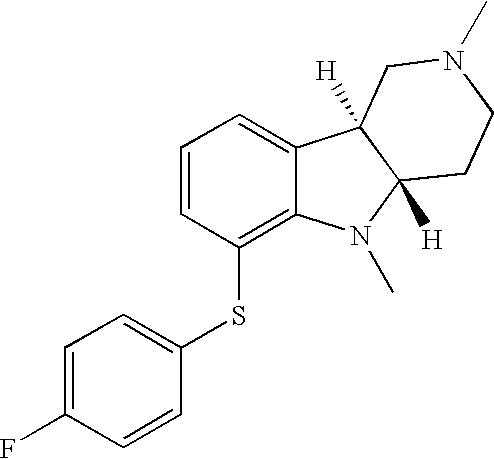
- 4-Fluorobenzenethiol (0.015 g, 0.12 mmol), copper iodide (0.022 g, 0.12 mmol) and sodium hydride (0.005 g, 0.12 mmol) were dissolved in 1,3-dimethyl-3,4,5,6-tetrahydro-2(1H)-pyrimidinone (0.75 mL), and heated to 40° C., and Trans(4a,9b)-6-iodo-2,5-dimethyl-2,3,4,4a,5,9b-hexahydro-1H-pyrido[4,3-b]indole (0.032 g, 0.097 mmol) in 1,3-dimethyl-3,4,5,6-tetrahydro-2(1H)-pyrimidinone (0.50 mL) was added. This mixture was heated to at 100° C. for 48 h. The reaction was cooled to room temperature and diluted with water (5 mL) and chloroform (5 mL). The organics were separated, dried over magnesium sulfate, filtered, and concentrated under reduced pressure to an oil. The oil was purified by silica gel column chromatography, (3% methanol/chloroform), followed by HPLC purification on a ChiralCel OD column (2.5% isopropyl alcohol, hexanes) to afford the title compound as an oil (10 mg, 6.8%). 1H NMR (CDCl3, 300 MHz) δ 7.15-7.1 (m., 3H), 7.09-6.89 (m, 3H), 6.73 (t, 1H, J=7.5), 3.44 (d, 1H, J=10.6), 3.09 (s br, 1H), 3.05 (s, 3H), 2.82 (t, 1H, J=11.9), 2.52-2.46 (m, 1H), 2.42 (s, 3H), 2.22-2.02 (m, 4H), 1.87-1.79 (m, 1H) ppm.
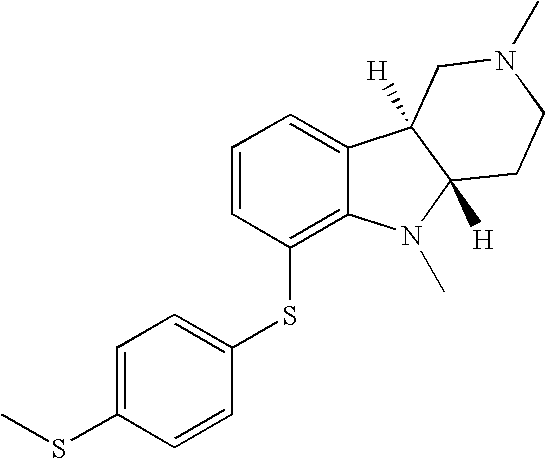
- Step A. 4-Thiomethylphenylthiol (0.049 g, 0.31 mmol), copper iodide (0.059 g, 0.31 mmol) and sodium hydride (0.062 g, 0.26 mmol) were dissolved in 1,3-dimethyl-3,4,5,6-tetrahydro-2(1H)-pyrimidinone (1 mL), and heated to 40° C. Ethyl 6-iodo-5-methyl-1,3,4,5-tetrahydro-2H-pyrido[4,3-b]indole-2-carboxylate (100 mg, 0.26 mmol) in 1,3-dimethyl-3,4,5,6-tetrahydro-2(1H)-pyrimidinone (1 mL) was added. The mixture was heated to at 90° C. for 48 h. The reaction was cooled to room temperature, diluted with water (5 mL) and chloroform (5 mL), and the organics were separated. The organic layer was washed with brine (10 mL), water (10 mL), dried over magnesium sulfate, filtered and concentrated under reduced pressure to give an oil. The oil was purified by silica gel column chromatography, (3% methanol, chloroform) to afford Ethyl 5-methyl-6-{[4-(methylsulfanyl)phenyl]sulfanyl}-1,3,4,5-tetrahydro-2H-pyrido[4,3-b]indole-2-carboxylate as an oil. 1H NMR (CDCl3, 300 MHz) δ 7.51 (d, 1H, J=7.6 Hz), 7.33 (d, 1H, J=7.3 Hz), 7.11-7.05 (m, 3H), 6.93 (d, 2H, J=8.4 Hz), 4.69 (s, 2H), 4.20 (q, 2H, J=7.06 Hz), 3.89 (s, 5H), 2.76 (t, 2H, J=5.2), 2.41 (s, 3H), 1.32-1.25 (m, 3H) ppm.
- Step B. To a dry THF solution (2 mL) of ethyl-5-methyl-6-{[4-(methylsulfanyl)phenyl] sulfanyl}-1,3,4,5-tetrahydro-2H-pyrido[4,3-b]indole-2-carboxylate (0.17 g, 0.41 mmol) was added dropwise over 15 min a THF solution of lithium aluminum hydride (1 mL, 1M in THF) at 0° C. The reaction was stirred at room temperature for 1 h. The reaction was quenched with water (0.04 mL) and stirred for 110 minutes. A 15% sodium hydroxide solution (0.04 mL) was added and stirred for 10 minutes, and water (0.12 mL) was added and stirred for 10 minutes. The resultant solids were filtered and washed with chloroform (10 mL). The filtrate was concentrated under reduced pressure. The resulted residue was purified by silica gel column chromatography, (3% methanol/chloroform) to afford 2,5-dimethyl-6-{[4-(methylsulfanyl)phenyl] sulfanyl}-2,3,4,5-tetrahydro-1H-pyrido [4,3-b]indole (78 mg, 54%) as a pale-yellow colored oil. 1H NMR (CDCl3, 300 MHz) δ 7.30 (d, 1H, J=7.3 Hz), 7.09-7.02 (m, 3H), 6.92-6.88 (m, 2H), 3.87 (s, 3H), 3.66 (s, 2H), 2.86-2.79 (m, 4H), 2.56 (s, 5H), 2.41 (s, 3H) ppm.
- Step C. 2,5-Dimethyl-6-{[4-(methylsulfanyl)phenyl]sulfanyl}-2,3,4,5-tetrahydro-1H-pyrido[4,3-b]indole (0.078 g, 0.22 mmol) was dissolved in borane-tetrahydrofuran complex (3 mL) at room temperature and refluxed for 12 h. The reaction was cooled to rt and concentrated under reduced pressure to a slurry. To the slurry was added 6N HCl (3 mL), which was then heated at 90° C. for 12 h. The reaction mixture was cooled to room temperature and basified to pH 10 with concentrated ammonium hydroxide. This mixture was extracted with chloroform (3×75 mL). The combined organics were dried, filtered, and concentrated under reduced pressure. Purification of the resulted residue by silica gel column chromatography, (3% methanol, chloroform) afforded the title compound as a pale-yellow colored oil. 1H NMR (CDCl3, 300 MHz) δ 7.22-7.14 (m, 4H), 7.03 (d, 2H, J=8.2 Hz), 6.92 (t, 1H, J=7.5 Hz), 4.23-4.20 (m, 1H), 3.80-3.70 (m, 1H), 3.60-3.50 (m, 1H), 3.48-3.31 (m, 1H), 3.22-3.17 (m, 1H), 3.09 (s, 3H), 2.99 (s, 3H), 2.42 (s, 3H) ppm.
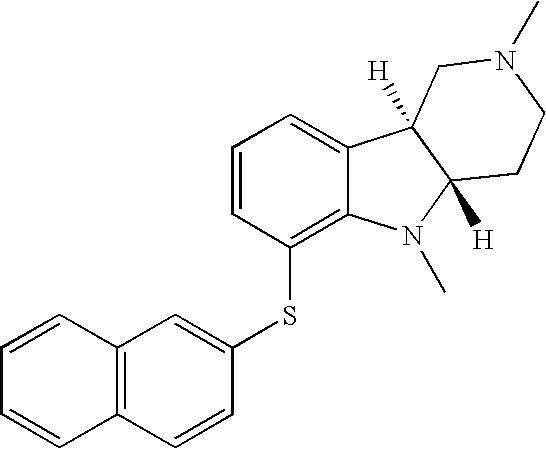
- Step A. Ethyl-5-methyl-6-(2-naphthylsulfanyl)-1,3,4,5-tetrahydro-2H-pyrido[4,3-b]indole-2-carboxylate was obtained by following the procedure of Example 9 step A, using the 2-naphthalenethiol. 1H NMR (CDCl3, 300 MHz) δ 8.37 (d, 1H, J=9.2 Hz), 7.85 (d, 1H, J=9.5 Hz), 7.61-7.49 (m, 4H); 7.34 (d, 1H, J=7.3 Hz), 7.19 (t, 1H, J=7.7 Hz), 7.08 (t, 1H, J=7.7 Hz), 6.78 (d, 1H, J=7.3 Hz), 4.72 (s, 5H), 4.21 (q, 2H, J=7.2 Hz), 3.88 (s, 2H), 3.82 (s, 3H), 2.71 (s, 2H), 1.34-1.10 (m, 3H) ppm.
- Step B. 2,5-dimethyl-6-(2-naphthylsulfanyl)-2,3,4,5-tetrahydro-1H-pyrido[4,3-b]indole (53 mg, 25%) was obtained by following the procedure of Example 9 step B. 1H NMR (CDCl3, 300 MHz) δ 8.37 (d, 1H, J=9 Hz), 7.85 (d, 1H, J=9.5 Hz), 7.61-7.49 (m, 4H), 7.34 (d, 1H, J=7.3 Hz), 7.19 (t, 1H, J=7.7 Hz), 7.08 (t, 1H, J=7.8 Hz), 6.74 (d, 1H, J=7.3 Hz), 3.80 (s, 3H), 3.70 (s, 2H), 2.84-2.77 (m, 4H), 2.58 (s, 3H) ppm.
- Step C. The title compound (24 mg, 41%) was prepared from 2,5-Dimethyl-6-(2-naphthylsulfanyl)-2,3,4,5-tetrahydro-1H-pyrido[4,3-b]indole by following the procedure of Example 9 Step C. 1H NMR (CDCl3, 300 MHz) δ 8.32 (d, 1H, J=8.8 Hz), 7.86-7.83 (m, 1H), 7.66 (d, 1H, J=8.4 Hz), 7.57-7.48 (m, 2H), 7.31 (t, 1H, J=7.9 Hz), 7.11-7.01 (m, 3H), 6.73 (t, 1H, J=7.5 Hz), 3.57 (m, 1H), 3.13-3.07 (m, 1H), 3.04 (s, 3H), 2.88-2.76 (m, 1H), 2.59-2.48 (m, 1H), 2.45 (s, 3H), 2.27-2.02 (m, 3H), 1.87-182 (m, 1H) ppm.
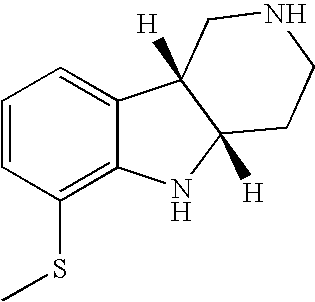
- Step A. 2-(Methylmercapto)aniline (23.6 g, 169.5 mmol) was suspended in conc. HCl (200 mL) and trifluoroacetic acid (130 mL), and cooled to 0° C. in an ice bath. Sodium nitrite (14.0 g, 203.4 mmol) was dissolved in water (45 mL) and added dropwise to the suspension over 45 minutes. After the addition, the reaction was stirred at 0° C. for 1 h. In a separate flask, tin (II) chloride (76 g, 338.4 mmol) was dissolved in conc. HCl (100 mL) and added slowly over 15 minutes to the reaction mixture. The resultant suspension was warmed to room temperature and stirred for 48 hours. The reaction was filtered, washed with isopropyl alcohol (15 mL), and dried to give 1-[2-(methylsulfanyl)phenyl]hydrazine hydrochloride (30 g, 93%). 1H NMR (CD3OD, 300 MHz) δ 7.44 (d, 1H, J=7.7 Hz), 7.32-7.26 (m, 1H), 7.08-7.00 (m, 2H), 2.39 (s, 3H) ppm.
- Step B. 1-[2-(methylsulfanyl)phenyl]hydrazine hydrochloride (27 g, 141.9 mmol) and 4-piperidone monohydrate hydrochloride (21.8 g, 141.9 mmol) were dissolved in ethanol (350 mL) and heated at reflux for 45 minutes. Concentrated HCl (30 mL) was added and heated at reflux for 12 h. The reaction was cooled to room temperature, filtered, washed with cold isopropyl alcohol (50 mL), and dried to give an off white solid, 6-(methylsulfanyl)-2,3,4,5-tetrahydro-1H-pyrido[4,3-b]indole hydrochloride (33 g, 92%). 1H NMR (CD3OD, 300 MHz) δ 7.24 (d, 1H, J=8.7 Hz), 7.08 (dd, 1H, J=0.7, 7.3 Hz), 6.93 (t, 1H, J=7.7 Hz), 3.29-3.27 (m, 2H), 3.17 (t, 2H, J=5.85 Hz), 2.85 (t, 2H, J=5.65 Hz), 2.44 (s, 3H) ppm.
- Step C. 6-(Methylsulfanyl)-2,3,4,5-tetrahydro-1H-pyrido[4,3-b]indole hydrochloride (20 g, 78.74 mmol) was suspended in trifluoroacetic acid (562 mL) and cooled to 0° C. in an ice bath. NaCNBH3 (19.53 g, 314.96 mmol) was added portion wise over 25 minutes and the mixture was stirred at 0° C. for 4 h. The reaction mixture was basified to pH 10 with conc. ammonium hydroxide and extracted with ethyl acetate (4×500 mL) and the organic layer separated. The organics were collected, dried over magnesium sulfate, and filtered to give cis(4a,9b)-6-(methylsulfanyl)-2,3,4,4a,5,9b-hexahydro-1H-pyrido[4,3-b]indole. 1H NMR (CCl3D, 300 MHz) δ 7.11 (d, 1H, J=7.7 Hz), 6.99 (d, 1H, J=7.3 Hz), 6.73 (t, 1H, J=5.7 Hz), 4.11 (s, 1H), 3.95-3.92 (m, 2H), 3.27-3.01 (m, 3H), 2.93-2.83 (m, 2H), 2.41 (s, 3H), 2.02-1.91 (m, 1H), 1.82-1.74 (m, 1H) ppm.
- The following Examples 12 to 14 were prepared in good yields by the reaction of 2-chloronitrobenzene and the appropriate thiophenol as exemplified by the procedure of Example 2, followed by cis reduction as shown in Example 4.

- 1H NMR, δ (CDCl3) 7.20-7.00 (m, 5H), 6.80-6.75 (m, 2H), 4.05 (br s, 1H), 3.86 (q, 1H, J=5.5 Hz), 3.20 (q, 1H, J=6.3 Hz), 3.09 (dd, 1H, J=12.8, 5.5 Hz), 2.99-2.89 (m, 2H), 2.78-2.68 (m, 1H), 2.40 (s, 3H), 1.80-1.69 (m, 1H), 1.62-1.50 (m, 1H) ppm. 297.2 (M+H).
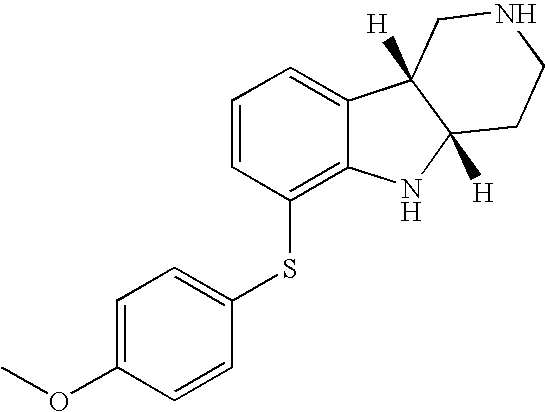
- 1H NMR, δ (CDCl3) 7.14 (t, 3H, J=8.8 Hz), 7.07 (d, 1H, J=7.3 Hz), 6.81 (d, 2H, J=8.8 Hz), 6.71 (t, 1H, J=7.7 Hz), 4.07 (br s, 1H), 3.88 (q, 1H, J=5.5 Hz), 3.77 (s, 3H), 3.22-3.06 (m, 2H), 3.02-2.89 (m, 2H), 2.82-2.68 (m, 1H), 1.82-1.73 (m, 1H), 1.63-1.50(m, 1H) ppm. 313.1 (M+H).
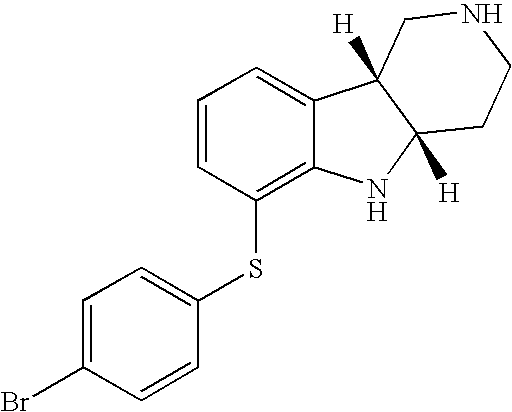
- 1H NMR, 8 (CDCl3) 7.34 (t, 2H, J=8.4 Hz), 7.22 (d, 1H, J=7.7 Hz), 7.15 (d, 2H, J=6.9 Hz), 6.77 (d, 1H, J=7.5 Hz), 4.12 (br s, 1H), 3.94 (q, 1H, J=5.5 Hz), 3.37-3.17 (m, 2H), 3.00-2.89 (m, 2H), 1.92-1.84 (m, 1H), 1.83-1.75 (m, 1H) ppm. 361.0 (M+H).
- The following Examples 15-20 were prepared in good yields by the Fisher indole reaction of 1-methyl-4-piperidone hydrochloride reaction and the appropriate Thiophenylphenylhdrazin as exemplified by the procedure of Example 2, followed by trans reduction as shown in Example 1.
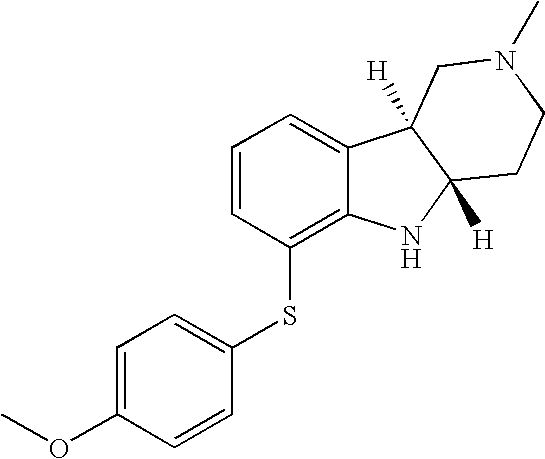
- 1H NMR, δ (CD3OD) 7.40 (d, 1H, J=7.3 Hz), 7.20-7.00 (m; 5H), 6.85-6.75 (m, 1H), 4.40 (br s, 1H), 4.20-4.12 (m, 1H), 3.74 (s, 3H), 3.69-3.54 (m, 2H), 3.18-3.08 (m, 2H), 2.93 (s, 3H), 2.32-2.28 (m, 1H), 2.10-2.01 (m, 1H) ppm.
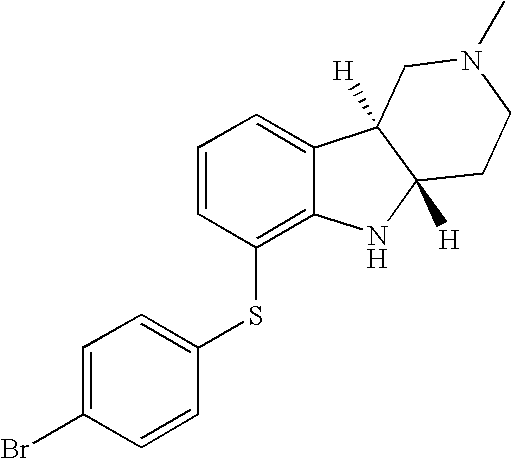
- 1H NMR, δ (CD3OD) 7.58 (d, 1H, J=7.5 Hz), 7.34 (d, 2H, J=8.2 Hz), 6.95 (d, 1H, J=8.5 Hz), 6.91 (d, 1H, J=7.0 Hz), 6.80 (t, 1H, J=7.0 Hz), 4.43 (br s, 1H), 4.18-4.12 (m, 1H), 3.65-3.55 (m, 2H), 3.16-2.97 (m, 2H), 2.93 (s, 3H), 2.33-2.28 (m, 1H), 2.08-2.00 (m, 1H) ppm. 375.1 (M+H).
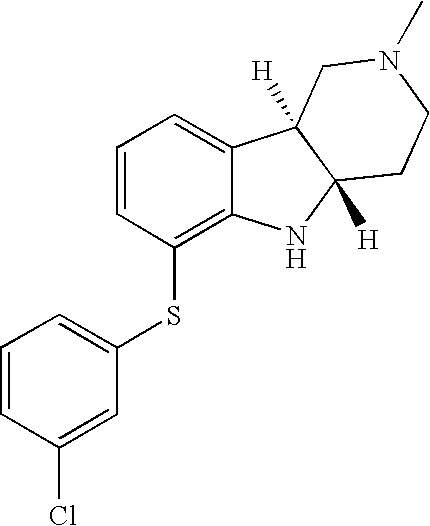
- 1H NMR, δ (CD3OD) 7.30 (d, 2H, J=7.7 Hz), 7.24-7.08 (m, 4H), 7.04 (d, 1H, J=7.7 Hz), 4.25 (d, 1H, J=10.5 Hz), 3.72 (d, 1H, J=11.0 Hz), 3.60-3.50 (m, 2H), 3.40 (t, 1H, J=10.7 Hz), 3.30-3.19 (m, 1H), 2.99 (s, 3H), 2.45-2.37 (m, 1H), 2.30-2.15 (m, 1H) ppm. 361.0 (M+H).
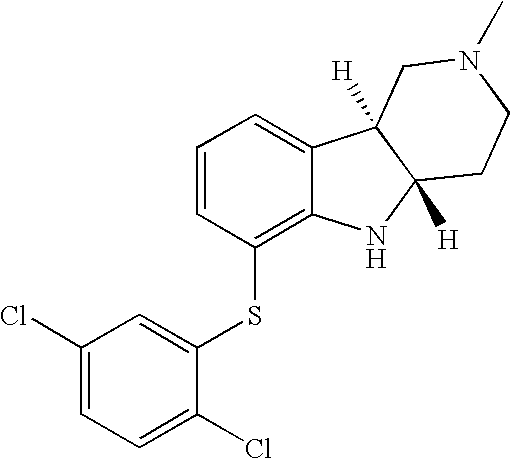
- 1HNMR, δ (CDCl3) 7.37 (d, 2H, J=7.7 Hz), 7.18 (t, 1H, J=7.4 Hz), 6.97 (d, 1H, J=8.0 Hz), 6.91 (d, 1H, J=7.0 Hz), 6.64 (t, 1H, J=7.7 Hz), 3.49 (dd, 1H, J=10.6, 2.5 Hz), 3.12-3.00 (m, 2H), 2.97 (dt, 1H, J=10.6, 2.9 Hz), 2.43 (s, 3H), 2.27 (t, 1H, J=10.6 Hz), 2.23-2.05 (m, 3H) ppm.
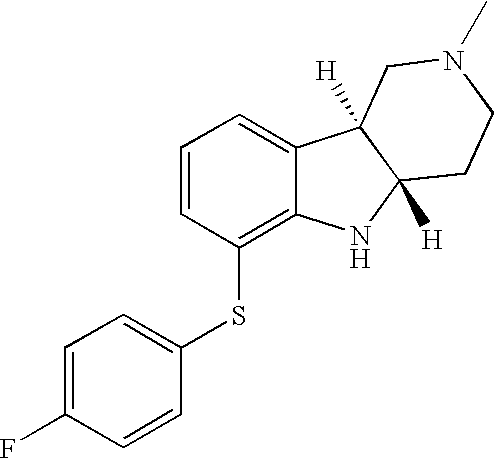
- 1H NMR, 8 (CD3OD) 7.16-6.93 (m, 6H), 6.72 (t, 1H, J=7.5 Hz), 3.51-3.44 (m, 1H), 3.08-2.95 (m, 2H), 2.89-2.79 (m, 1H), 2.38 (s, 3H), 2.28-2.00 (m, 3H), 1.91-1.80 (m, 2H) ppm.
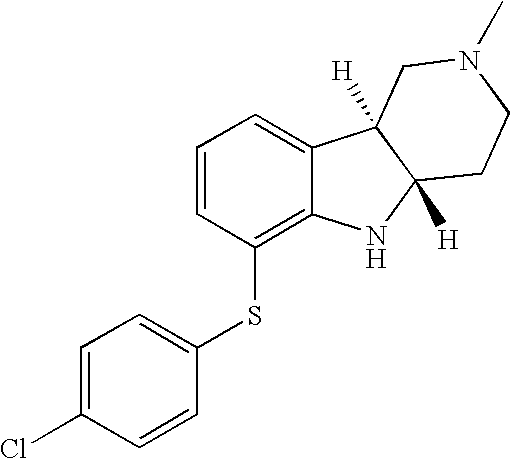
- 1H NMR, δ (CD3OD) 7.20 (d, 4H, J=8.8 Hz), 7.15 (d, 2H, J=7.3 Hz), 7.04 (d, 2H, J=8.8 Hz), 6.80 (t, 1H, J=7.7 Hz), 4.13 (d, 1H, J=12.0 Hz), 3.58 (d, 1H, J=12.8 Hz), 3.32-2.95 (m, 4H), 2.91 (s, 3H), 2.30-2.02 (m, 1H), 2.10-2.00 (m, 1H) ppm. 331.1 (M+H)
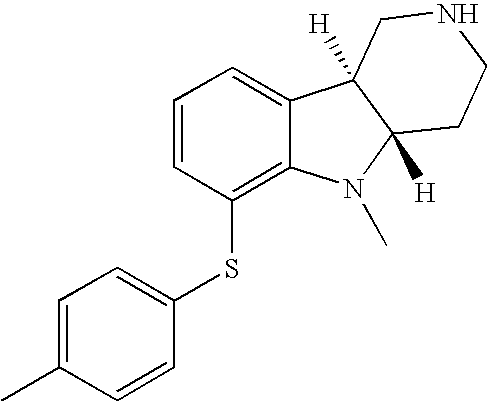
- Step A. To a methylene chloride (300 mL) solution of 6-[(4-methylphenyl)sulfanyl]-2,3,4,5-tetrahydro-1H-pyrido[4,3-b]indole (71 mmol) was triethylamine (142 mmol) in one portion and resulted solution was stirred at rt for 10 minutes. The reaction was cooled to 0° C. in an ice bath then di-tert-butyl dicarbonate (85 mmol) was added, and then reaction was allowed to warm slowly to room temperature and stir for 14 hours. Reaction mixture was poured into water (300 ml) and then layers separated. The aqueous layer was extracted with chloroform (3×100 ml) and the organics collected, washed with brine (150 ml), dried over MgSO4, and concentrated to dryness under reduced pressure to give tert-butyl 6-[(4methylphenyl)sulfanyl]-1,3,4,5-tetrahydro-2H-pyrido[4,3-b]indole-2-carboxylate (90%).
- Step B. Tert-butyl 6-[(4-methylphenyl)sulfanyl]-1,3,4,5-tetrahydro-2H-pyrido[4,3-b]indole-2-carboxylate (22.6 mmol), potassium hydroxide (113 mmol), and iodomethane (226 mmol) were combined with dry DME (110 mL) and stirred at room temperature for 10 hours. The reaction was then filtered and the residue washed with chloroform. The filtrate was concentrated under reduced pressure to give tert-butyl 5-methyl-6-[(4-methylphenyl)sulfanyl]-1,3,4,5,-tetrahydro-2H-pyrido[4,3-b]indole-2-carboxylate (95%).
- Step C. tert-Butyl 5-methyl-6-[(4-methylphenyl)sulfanyl]-1,3,4,5,-tetrahydro-2H-pyrido[4,3-b]indole-2-carboxylate was trans-reduced as shown in Example 1 to afford the title compound in good yield. 1H NMR (300 MHz, CDCl3) δ 7.07 (d, 1H, J=8 Hz), 6.99-6.88 (m, 5H), 6.67 (t, 1H, J=7.6 Hz), 3.54 (d, 1H, J=10.2), 3.14 (d, 1H, J=13.2), 2.95 (s, 3H), 2.67-2.45 (m, 4H), 2.19 (s, 3H), 2.03 (dd, 1H, J=2.2, 11.7 Hz), 1.59-1.50 (m, 1H) ppm.
- The following Examples 22 to 30 were prepared in good yields by treatment of trans(4a,9b)-5-methyl-2,3,4,4a,5,9b-hexahydro-1H-pyrido[4,3-b]indol-6-yl-4-methylphenyl sulfide with the appropriate alkyl bromide as exemplified by the procedure of Example 6.

- 1H NMR, δ (CDCl3) 7.10 (d, 1H, J=8.1 Hz), 7.04-7.00 (m, 3H), 6.91 (d, 2H, J=8.1 Hz), 6.72 (t, 1H, J=7.5 Hz), 3.50 (dd, 1H, J=2.2, 10.6 Hz), 3.10-3.06 (m, 1H), 2.99 (s, 3H), 2.67-2.57 (m, 4H), 2.24 (s, 3H), 2.21-1.67 (m, 10H) ppm.
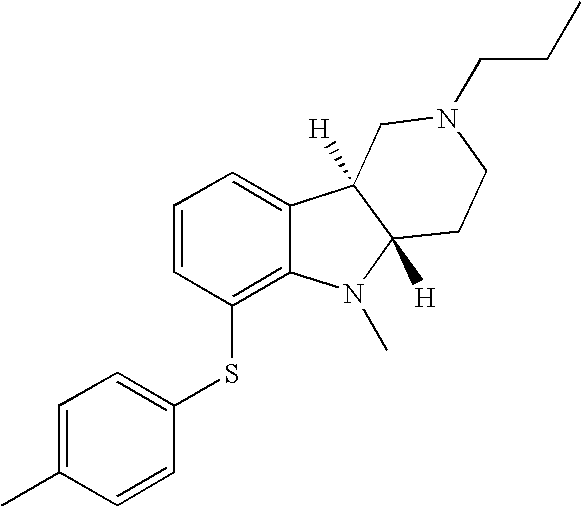
- 1H NMR, δ (CDCl3) 7.13 (d, 1H, J=8.1 Hz), 7.06-6.98 (m, 5H), 6.72 (t, 1H, J=7.4 Hz), 3.50 (dd, 1H, J=2.6, 10.6 Hz), 3.13 (d, 1H, J=11.7 Hz), 3.06 (s, 3H), 2.80 (t, 1H, J=11.9 Hz), 2.53-2.43 (m, 3H), 2.28 (s, 3H), 2.21-2.01 (m, 3H), 1.87-1.72 (m, 1H), 1.66-1.54 (m, 2H), 0.94 (t, 3H, J=7.5 Hz) ppm.
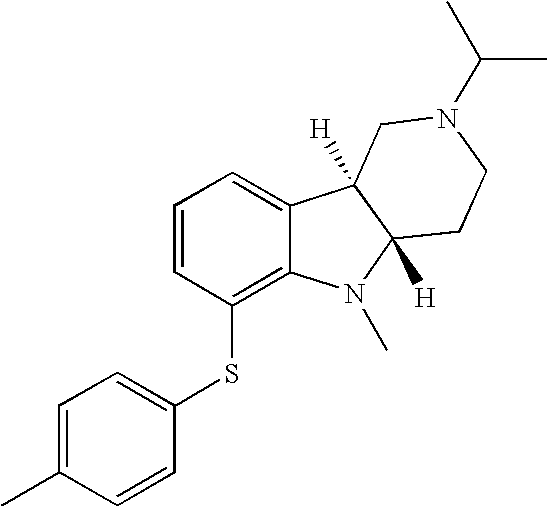
- 1H NMR, δ (CDCl3) 7.13 (d, 1H, J=8 Hz), 7.06-6.98 (m, 5H), 6.72 (t, 1H, J=7.4 Hz), 3.46 (d, 1H, J=7.7 Hz), 3.09-2.77 (m, 6H), 2.50-2.33 (m, 3H), 2.28 (s, 3H), 2.10-2.03 (m, 1H), 1.85-1.70 (m, 1H), 1.12 (t, 6H, J=7.1 Hz) ppm.

- 1H NMR, δ (CDCl3) 7.15 (d, 1H, J=8.1 Hz), 7.06-6.97 (m, 5H), 6.72 (t, 1H, J=7.4 Hz), 3.47 (dd, 1H, J=2.6, 10.2 Hz), 3.11-3.03 (m, 4H), 2.83 (t, 1H, J=11.3 Hz), 2.48 (td, 1H, J=3.4, 12.3 Hz), 2.29 (s, 3H), 2.26-1.87 (m, 5H), 1.84-1.78 (m, 2H), 0.94 (d, 6H, J=6.6 Hz) ppm.
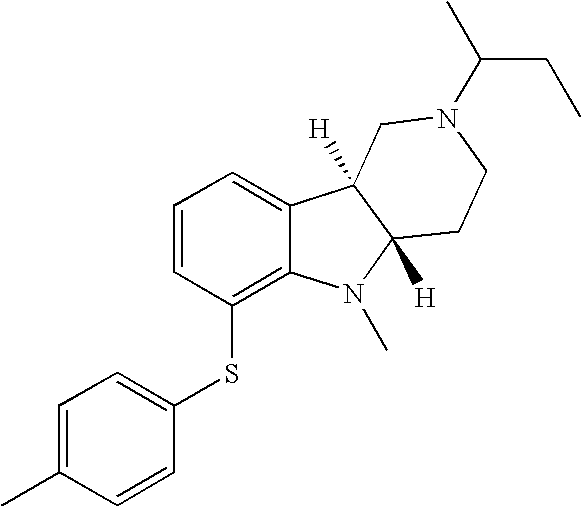
- 1H NMR, δ (CDCl3) 7.14 (d, 1H, J=8 Hz), 7.06-6.98 (m, 5H), 6.72 (t, 1H, J=7.5 Hz), 3.40 (m, 1H), 3.05 (s, 3H), 2.99-2.33 (m, 6H), 2.28 (s, 3H), 2.07-1.23 (m, 5H), 1.04 (t, 2H, J=6.6 Hz), 0.928 (t, 3H, J=7.3 Hz) ppm.

- 1H NMR, δ (CDCl3) 7.14 (d, 1H, J=8.1 Hz), 7.06-6.98 (m, 5H), 6.72 (t, 1H, J=7.5 Hz), 3.33 (d, 1H, J=7.7 Hz), 3.04 (s, 3H), 2.96-2.89 (m, 1H), 2.80-2.67 (m, 1H), 2.58-2.31 (m, 4H), 2.06-2.01 (m, 1H), 1.80-1.50 (m, 2H), 1.48-1.21 (m, 3H), 1.02 (t, 3H, J=6.4 Hz), 0.92 (t, 3H, J=6.1 Hz) ppm.
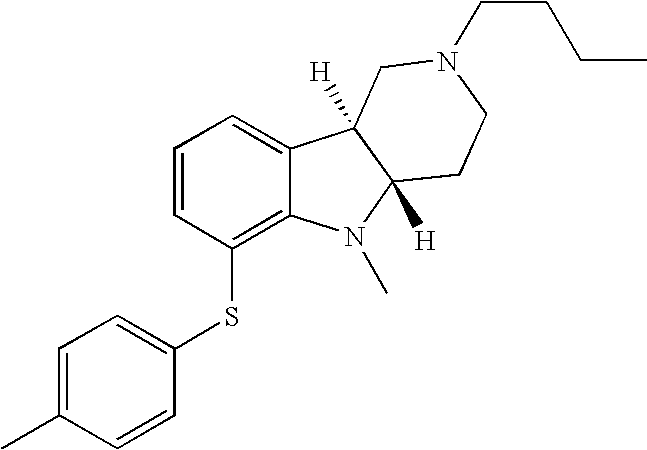
- 1H NMR, δ (CDCl3) 7.15 (d, 1H, J=8.1 Hz), 7.06-6.97 (m, 5H), 6.72 (t, 1H, J=7.6 Hz), 3.62 (d, 1H, J=8.1 Hz), 3.26 (d, 1H, J=10.7 Hz), 3.06 (s, 3H), 2.92-2.82 (m, 1H), 2.71-2.43 (m, 4H), 2.28 (s, 3H), 2.25-2.18 (m, 1H), 2.14-2.03 (m, 1H), 2.01-1.81 (m, 1H), 1.69-1.51 (m, 2H), 1.47-1.28 (m, 2H), 0.96 (t, 3H, J=7.3 Hz) ppm.
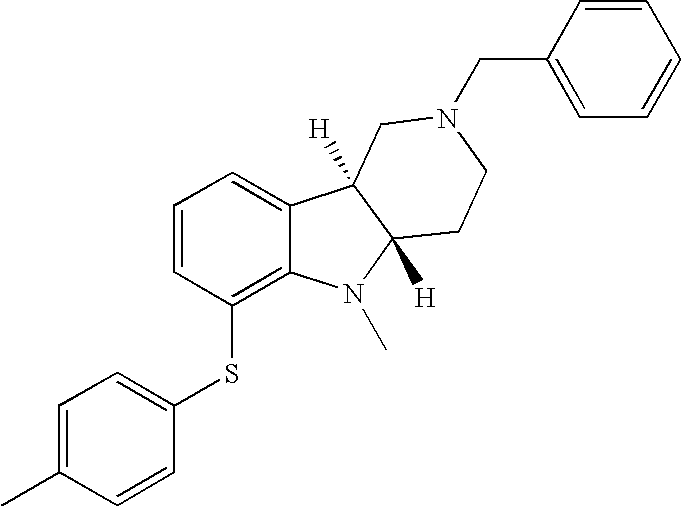
- 1H NMR, δ (CD3OD) 7.67 (br s, 2H), 7.53-7.42 (m, 3H), 7.33-7.71 (m, 7H), 4.51 (br s, 2H), 4.31-4.21 (m, 1H), 3.99-3.85 (m, 1H), 3.80-3.70 (m, 1H), 3.68-3.36 (m, 1H), 3.19 (s, 3H), 2.50 (br s, 2H), 2.31 (s, 3H), 1.43 (dd, 2H. J=6.6, 16.5 Hz) ppm.
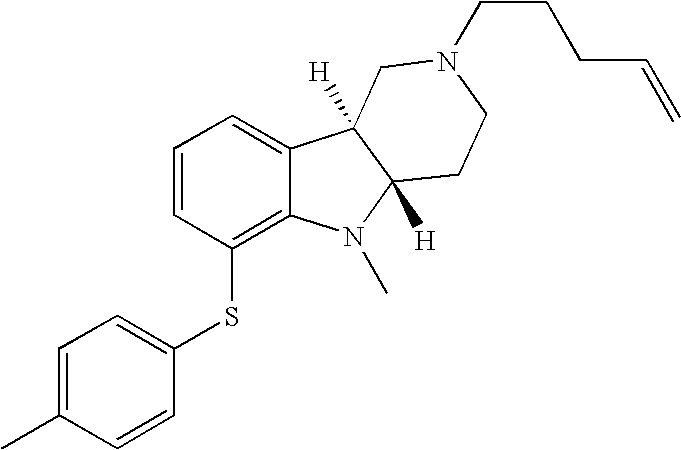
- 1H NMR, δ (CD3OD) 7.36-7.713 (m, 7H), 5.90-5.80 (m, 1H), 5.16-5.03 (m, 2H), 4.90 (s, 3H), 4.45 (d, 1H, J=10 Hz), 3.93-3.80 (m, 3H), 3.45-3.32 (m, 2H), 3.24-3.20 (m, 3H), 2.50 (s, 2H), 2.32 (s, 3H), 2.20 (q, 2H, J=6.7 Hz), 2.02-1.95 (m, 2H) ppm.

- The title compound was prepared in good yields by treatment of trans-6-[(4-methylphenyl)sulfanyl]-2,3,4,4a,5,9b-hexahydro-1H-pyrido[4,3-b]indole with 2-bromopropane as exemplified by the procedure of Example 6. 1H NMR, δ (CDCl3) 7.15 (d, 1H, J=7.7 Hz), 7.05-7.03 (m, 5H), 6.75 (t, 1H, J=7.7 Hz), 4.43 (s, 1H), 3.49-3.40 (m, 1H), 3.01-2.89 (m, 3H), 2.58-2.29 (m, 1H), 2.28 (s, 3H), 2.03-1.98 (m, 1H), 1.23 (t, 6H, J=7.1 Hz) ppm.
- The following Examples 32 to 38 were prepared in good yields by treatment of trans(4a,9b)-6-iodo-2,5-dimethyl-2,3,4,4a,5,9b-hexahydro-1H-pyrido[4,3-b]indole with the appropriate thiophenol as exemplified by the procedure of Example 8.
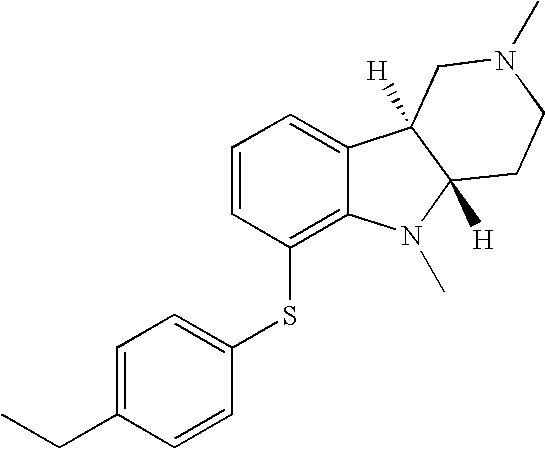
- 1H NMR, δ (CDCl3) 7.16 (d, 1H, J=8.2 Hz), 7.06 (s, 4H), 7.00 (d, 1H, J=8.0 Hz), 6.75 (t, 1H, J=8.0 Hz), 3.46 (dd, 1H, J=10.6, 2.5 Hz), 3.12-3.04 (m, 1H), 3.08 (s, 3H), 2.84 (dt, 1H, J=10.7, 2.5 Hz), 2.58 (q, 2H, J=7.3 Hz), 2.50 (dd, 1H, J=11.4, 3.3 Hz), 2.44 (s, 3H), 2.21 (t, 1H, J=10.6 Hz), 2.14-2.03 (m, 2H), 1.85 (dq, 1H, J=11.4, 3.7 Hz), 1.20 (t, 3H, J=7.7 Hz) ppm. 339.3 (M+H).
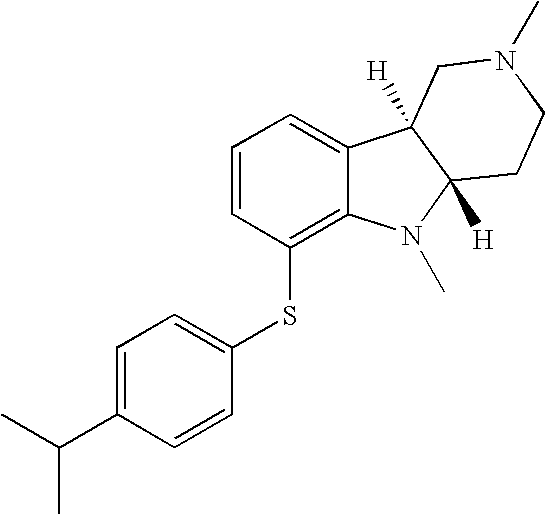
- 1H NMR, δ (CDCl3) 7.43 (d, 1H, J=8.5 Hz), 7.23-6.95 (m, 4H), 6.81-6.70 (m, 2H), 3.51 (dd, 1H, J=11.0, 2.5 Hz), 3.15-3.08 (m, 1H), 3.08 (s, 3H), 2.94-2.80 (m, 2H), 2.52-2.48 (m, 1H), 2.48 (s, 3H), 2.30-2.10 (m, 2H), 2.09-2.00 (m, 1H), 1.95-1.80 (m, 1H), 1.20 (d, 6H, J=7.0 Hz) ppm. 353.3 (M+H).
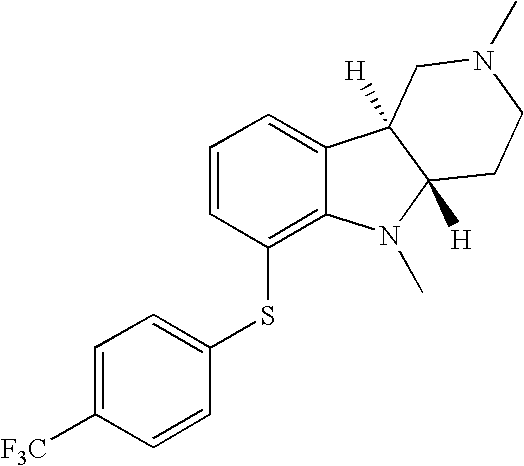
- 1H NMR, δ (CDCl3) 7.44 (d, 1H, J=8.4 Hz), 7.11-7.04 (m, 4H), 6.79 (t, 1H, J=7.3 Hz), 3.47 (dd, 1H, J=10.5, 2.4 Hz), 3.00 (s, 3H), 2.92-2.80 (m, 2H), 2.57-2.48 (m, 2H), 2.45 (s, 3H), 2.23 (t, 1H, J=10.3 Hz), 2.17-2.00 (m, 1H), 1.90-1.80 (m, 1H) ppm.
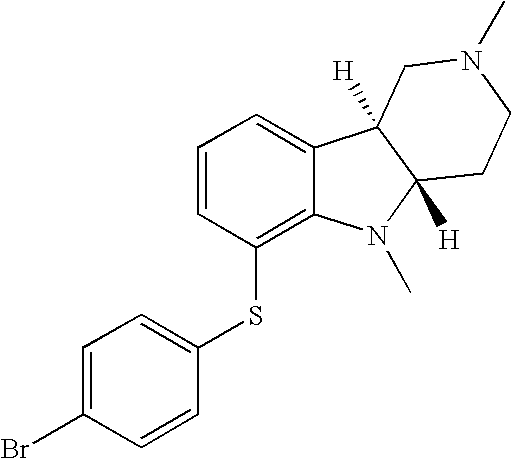
- 1H NMR, δ (CD3OD) 7.39 (d, 2H, J=8.5 Hz), 7.25 (t, 3H, J=8.1 Hz), 6.99 (d, 2H, J=8.4 Hz), 4.25 (d, 1H, J=11.4 Hz), 3.74 (d, 1H, J=9.9 Hz), 3.49-3.31 (m, 2H), 3.21-3.18 (m, 2H), 3.07 (s, 3H), 2.99 (s, 3H), 2.42 (d, 1H, J=13.5 Hz), 2.18-2.00 (m, 1H) ppm.

- 1H NMR, δ (CDCl3) 7.76-7.63 (m, 3H), 7.56-38 (m, 3H), 7.31-7.23 (m, 2H), 7.06 (d, 1H, J=7 Hz), 6.78 (t, 1H, J=7.5 Hz), 3.57-3.40 (m, 1H), 3.06 (s, 3H), 2.94-2.79 (m, 2H), 2.60-2.44 (m, 4H), 2.28-2.00 (m, 3H), 1.92-1.82 (m, 1H) ppm.
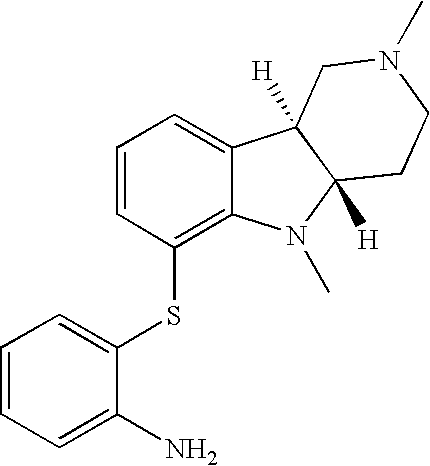
- 1H NMR, δ (CDCl3) 7.13-7.09 (m, 2H), 6.95 (dt, 1H, J=7.7, 11.5 Hz), 6.88 (dt, 1H, J=7.5, 11.2 Hz), 6.69-6.59 (m, 3H), 3.68 (s-broad, 2H), 3.47 (d, 1H, J=11.4 Hz), 3.15-3.06 (m, 4H), 2.85-2.81 (m, 1H), 2.49-2.40 (m, 4H), 2.21-2.05 (m, 3H), 1.89-1.84 (m, 1H) ppm.
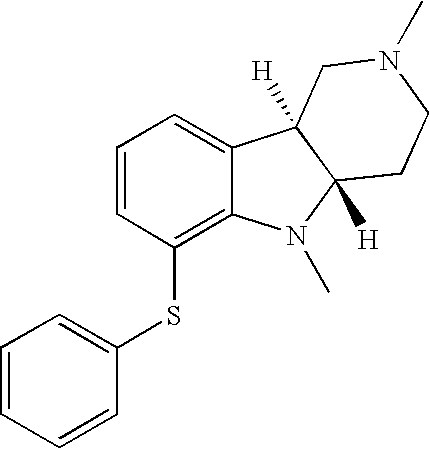
- 1H NMR, δ (CDCl3) 7.21 (t, 3H, J=7.0 Hz), 7.12-7.07 (m, 3H), 7.02 (d, 1H, J=7.3 Hz), 6.75 (t, 1H, J=7.3 Hz), 3.44 (dd, 1H, J=11.5, 2.5 Hz), 3.07 (d, 1H, J=11.5 Hz), 3.05 (s, 3H), 2.83 (dt, 1H, J=10.3, 3.7 Hz), 2.50 (dd, 1H, J=11.4, 3.3 Hz), 2.43 (s, 3H), 2.20 (t, 1H, J=10.6 Hz), 2.14-2.02 (m, 2H), 1.88-1.79 (m, 1H) ppm. 311.2 (M+H)
- The following Examples 39 to 40 were prepared in good yields by treatment of ethyl 6-iodo-1,3,4,5-tetrahydro-2H-pyrido[4,3-b]indole-2-carboxylate with the appropriate thiophenol as exemplified by the procedure of Example 14, followed by reduction of the ethylcarboxylate as per example 10 step F, and trans reduction of the indole to the title compound via Example 1.
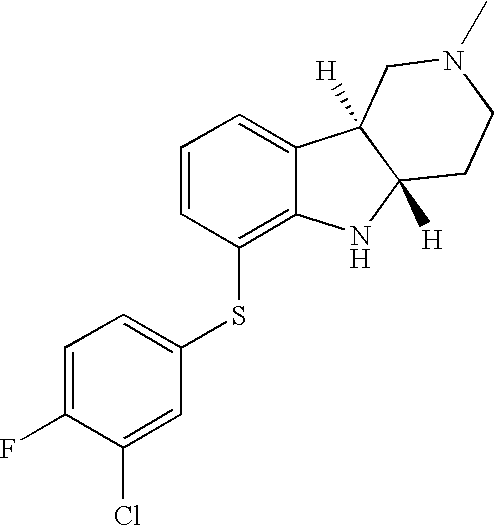
- 1H NMR, δ (CDCl3) 7.80-7.60 (m, 2H), 7.57-7.37 (m, 2H), 7.20-711 (m, 1H), 6.80 (t, 1H, J=7.5 Hz), 3.51-3.44 (m, 1H), 3.08-2.95 (m, 2H), 2.89-2.79 (m, 1H), 2.41 (s, 3H), 2.28-2.00 (m, 3H), 1.91-1.80 (m, 2H) ppm.
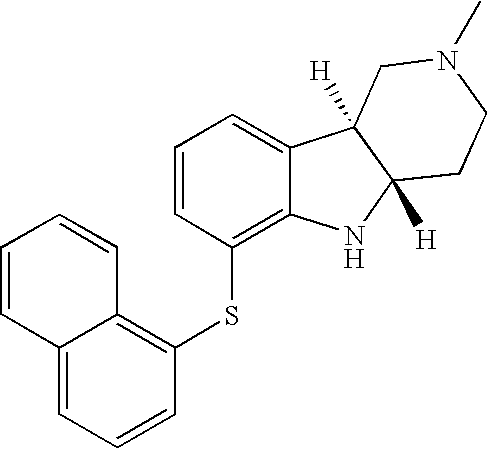
- 1H NMR, δ (CD3OD) 7.16 (d, 1H, J=8.1), 7.06-6.83 (m, 1H), 6.82-6.72 (m, 4H), 4.57 (s-broad, 2H), 3.44-3.40 (m, 1H), 3.03-2.91 (m, 3H), 2.42 (s, 3H), 2.36-2.18 (m, 2H) ppm.

- The title compound was prepared from 4-chlorophenyl 5-methyl-2,3,4,5-tetrahydro-1H-pyrido[4,3-b]indol-6-yl sulfide by the procedure of Example 9. 1H NMR (300 MHz, CD3OD) δ 7.28-7.15 (m, 4H), 6.96 (d, 2H, J=8.8 Hz), 6.87 (t, 1H, J=7.5 Hz), 4.21 (d, 1H, J=12.0 Hz), 3.76-3.70 (m, 1H), 3.56-3.10 (m, 3H), 3.04 (s, 3H), 2.99 (s, 3H), 2.90-2.81 (m, 2H), 2.47-2.37 (m, 1H) ppm. MS (EI) 345.2 (M+H).
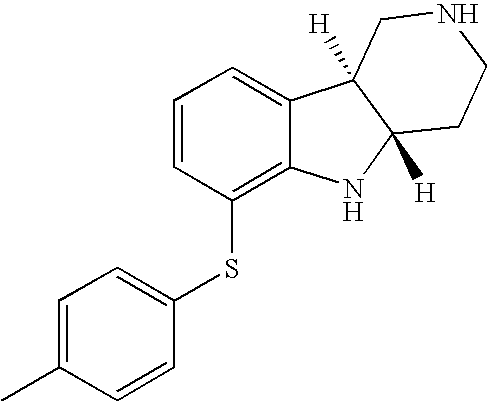
- The title compound was prepared by reduction of 4-methylphenyl-2,3,4,5-tetrahydro-1H-pyrido[4,3-b]indol-6-yl sulfide hydrochloride as per the procedure of Example 1. 1H NMR (300 MHz, CD3OD) δ 7.42 (d, 1H, J=7.8 Hz), 7.19 (d, 1H, J=7.3 Hz), 7.02 (t, 1H, J=7.3 Hz), 6.96 (s, 4H), 4.20 (d, 1H, J=10.8 Hz, 3.75 (d, 1H, J=11.0 Hz), 3.30-3.25 (m, 2H), 3.05-2.78 (m, 3H), 2.22 (s, 3H) ppm.
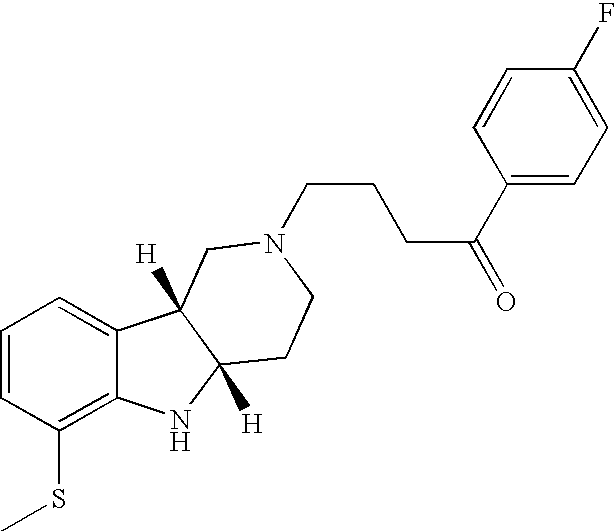
- The title compound was prepared in good yields by alkylation of cis(4a,9b)-6-(methylsulfanyl)-2,3,4,4a,5,9b-hexahydro-1H-pyrido[4,3-b]indole with 4-chloro-1-(4-fluorophenyl)-1-butanone as per example 6. 1H NMR, 8.00-7.95 (m, 2H), 7.14-7.08 (m, 3H), 6.97 (d, 1H, J=7.3 Hz), 6.69 (t, 1H, J=7.3 Hz), 4.05-4.00 (br s, 1H), 3.88-3.79 (m, 1H), 3.17 (q, 1H, J=6.6 Hz), 2.97 (t, 2H, J=7.4 Hz), 2.66 (dd, 1H, J=11.7, 6.9 Hz), 2.50-2.35 (m, 4H), 2.39, (s, 3H), 2.29 (dd, 1H, J=11.7, 8.8 Hz), 2.00-1.75 (m, 4H) ppm. 385.1 (M+H).
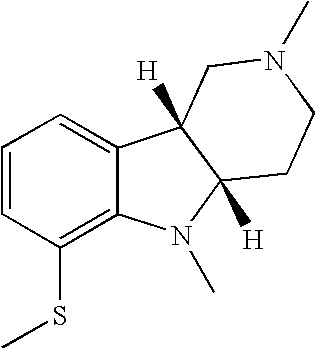
- The title compound was prepared from the 1-methyl-4-piperidone hydrochloride and corresponding hydrazine as exemplified by the procedure of Example 2, followed by cis reduction as shown in Example 4. 1H NMR (300 MHz, CDCl3) δ 7.17 (d, 1H, J=8.0 Hz), 7.06 (d, 1H, J=7.7 Hz), 7.04 (d, 2H, J=8.4 Hz), 6.97 (d, 2H, J=8.4 Hz), 6.69 (t, 1H, J=7.3 Hz), 3.28-3.20 (m, 2H), 3.04 (s, 3H). 2.75-2.65 (m, 1H), 2.50-2.46 (m, 1H), 2.28 (s, 3H), 2.27 (s, 3H), 2.21-1.95 (m, 1H), 1.96-1.91 (m, 3H) ppm.

- Step A. C is(4a, 9b)-6-(methylsulfanyl)-2,3,4,4a,5,9b-hexahydro-1H-pyrido[4,3-b]indole (from Example 11, Step C) (8.0 g, 36.2 mmol), triethylamine (5 ml), and di-tert-butyl dicarbonate (8.68 g, 39.8 mmol) were dissolved in chloroform (180 ml) stirred for 6 hours. Reaction was concentrated under reduced pressure. The resulted residue was mixed with (7.9 g, 36.2 mmol) of di-tert-butyl dicarbonate, neat and heated at 120° C. for 12 hours. The resultant residue was purified by silica gel column eluting with 15% ethylacetate/hexanes to give di(tert-butyl) cis(4a, 9b)-6-(methylsulfanyl)-3,4,4a,9b-tetrahydro-1H-pyrido[4,3-b]indole-2,5-dicarboxylate as a white foam (2.10 g, 14%). 1H NMR (DMSO, 300 MHz) δ 7.21-7.19 (μ, 1H), 7.07-7.02 (m, 2H), 4.63-4.59 (m, 1H), 4.21-4.17 (m, 1H), 3.69-3.62 (m, 1H), 3.50-3.39 (m, 2H), 2.97-2.89 (m, 2H), 2.34 (s, 3H), 2.00-1.94 (m, 1H), 1.49 (s, 9H), 1.34 (s, 9H) ppm.
- Step B. Di(tert-butyl) cis(4a, 9b)-6-(methylsulfanyl)-3,4,4a,9b-tetrahydro-1H-pyrido[4,3-b]indole-2,5-dicarboxylate (0.043 mmol) was dissolved in MeOH/H2O (2.5/1 ml) and cooled in an ice bath to 0° C. under a nitrogen atmosphere. Sodium periodate (0.043 mmol) was added in one portion, and reaction was stirred at 0° C. for 4 hours. After 4 hours, reaction was allowed to warm to room temperature and stir for 12 hours. Reaction solution was filtered and concentrated to an aqueous slurry, which was diluted with brine (5 ml) and then extracted (3×15 ml) with CHCl3. The organics were collected, dried over MgSO4 and concentrated under reduced pressure to give a white solid. It was then dissolved in 20% TFA/CHCl3 and stirred for 1 hour. The reaction solution was cooled to 0° C. in an ice bath, and basified to pH=10 with concentrated NH4OH. This was extracted with CHCl3 (3×15 ml), organics collected, dried over MgSO4 and concentrated under reduced pressure to give the title compound (71%). 1H NMR (CD3OD, 300 MHz) □ 7.19 (d, 1H, J=6.9 Hz), 7.07 (d, 1H, J=7.7 Hz), 6.77 (t, 1H, J=7.7 Hz), 5.56 (s, 1H), 3.94 (q, 1H, J=6.8 Hz), 3.37-3.34 (m,1H), 3.18-3.03 (m, 2H), 2.98-2.82 (m, 5H), 2.65-2.56 (m, 1H), 1.86-1.80 (m, 1H), 1.49-1.38 (m, 1H) ppm.
- The Tables below provide representative Examples, the synthesis of which are described above, of the compounds of Formula (I) of the present invention.
TABLE 1 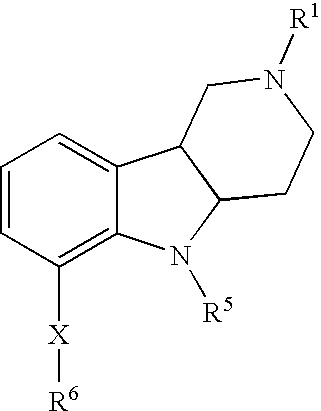
Ex# X R5 R6 Stereo R1 1 S H 4-Me-Ph- trans Me 2 S H 4-F-Ph- trans Me 3 S H 4-Cl-Ph- trans Me 4 S H 4-Me-Ph- cis H 5 NH Me 4-Me-Ph- trans Me 6 S H 4-Me-Ph- trans —(CH2)3C(═O) (4-F-phenyl) 7 S Me 4-Me-Ph- trans Me 8 S Me 4-F-Ph- trans Me 9 S Me 4-MeS-Ph- trans Me 10 S Me 2-naphthyl trans Me 11 S H Me cis H 12 S H 2-Me-Ph- cis H 13 S H 4-MeG-Ph- cis H 14 S H 4-Br-Ph- cis H 15 S H 4-MeG-Ph- trans Me 16 S H 4-Br-Ph- trans Me 17 S H 3-Cl-Ph- trans Me 18 S H 2,5-diCl-Ph- trans Me 19 S H 4-F-Ph- trans Me 20 S H 4-Cl-Ph- trans Me 21 S Me 4-Me-Ph- trans H 22 S Me 4-Me-Ph- trans cyclobutylmethyl 23 S Me 4-Me-Ph- trans propyl 24 S Me 4-Me-Ph- trans i-propyl 25 S Me 4-Me-Ph- trans i-butyl 26 S Me 4-Me-Ph- trans 1-Me-propyl 27 S Me 4-Me-Ph- trans 1-Me-butyl 28 S Me 4-Me-Ph- trans butyl 29 S Me 4-Me-Ph- trans benzyl 30 S Me 4-Me-Ph- trans 4-pentenyl 31 S H 4-Me-Ph- trans i-propyl 32 S Me 4-Et-Ph- trans Me 33 S Me 4-iPr-Ph- trans Me 34 S Me 4-CF3-Ph- trans Me 35 S Me 4-Br-Ph- trans Me 36 S Me 1-naphthyl trans Me 37 S Me 2-NH2-Ph- trans Me 38 S Me Ph trans Me 39 S H 3-Cl-4-F-Ph- trans Me 40 S H 1-naphthyl trans Me 41 S Me 4-Cl-Ph- trans Me 42 S H 4-Me-Ph- trans H 43 S H Me cis —(CH2)3C(═O) (4-F-phenyl) 44 S Me 4-Me-Ph- cis Me 45 S(═O) H Me cis H - The compounds of the present invention have therapeutic utility for illnesses or disorders involving the neurotransmitter serotonin (5-hydroxy tryptamine or 5-HT) and either agonism or antagonism of 5-HT2 receptors, as demonstrated by the assays described below. Therapeutic utility for these illnesses or disorders could involve numerous biological processes affected by serotonin including, but not limited to, appetite, mood, sleep, sexual activity, and arterial constriction. These biological processes may also be important to numerous central nervous system (CNS) disorders including those related to the affective disorders of depression, anxiety, psychosis, and schizophrenia, as well as, disorders of food intake such as anorexia, bulimia, and obesity. The compounds of the present invention potentially have therapeutic utility in other conditions in which serotonin has been implicated, such as migraine, attention deficit disorder or attention deficit hyperactivity disorder, addictive behavior, and obsessive-compulsive disorder, as well as, conditions associated with cephalic pain, social phobias, and gastrointestinal disorders such as dysfunction of the gastrointestinal tract motility. Lastly, compounds of the present invention potentially have therapeutic utility in neurodegenerative diseases and traumatic conditions represented by the examples of Alzheimer's disease and brain/spinal cord trauma.
- The pharmacological analysis of each compound for either antogonism or agonism of at 5-HT2A and 5-HT2C receptors consisted of in vitro and in vivo studies. In vitro analyses included Ki determinations at 5-HT2A and 5-HT2C receptors and an assessment of functional (i.e., agonism or antagonism) activity at each receptor class by IP3 hydrolysis assays. Additional receptor assays were conducted to evaluate receptor specificity of 5-HT2A and 5-HT2C receptors over monoamine and nuisance receptors (e.g. histamine, dopamine, and muscarinic). A compound is considered active as a 5-HT2A antagonist or a 5-HT2C agonist if it has an IC50 value or a Ki value of less than about 50 micromolar; preferably less than about 0.1 micromolar; more preferably less than about 0.01 micromolar. Using the assays disclosed herein, compounds of the present invention have been shown to have an IC50 value of less than about 50 micromolar for 5-HT2A antagonism or 5-HT2C agonism.
- In vivo assays assessed compound activity in a variety of behavioral paradigms including quipazine head twitch, acute and chronic feeding models, anxiety and depression models (learned-helplessness, elevated plus maze, Geller-Siefter, conditioned taste aversion, taste reactivity, satiety sequence). In aggregate, these models reflect activity as a 5-HT2A antagonist (quipazine head twitch, depression models) or 5-HT2C agonist (feeding models, anxiety models, depression models) and provide some indication as to bioavailability, metabolism and pharmacokinetics.
- Radioligand binding experiments were conducted on recombinant human 5-HT2A and 5-HT2C receptors expressed in HEK293E cells. The affinities of compounds of the present invention to bind at these receptors is determined by their capacity to compete for [125I]-1-(2,5-dimethoxy-4-iodophenyl)-2-amino-propane (DOI) binding at the 5-HT2A or 5-HT2C. General references for binding assays include 1) Lucaites V L, Nelson D L, Wainscott D B, Baez M (1996) Receptor subtype and density determine the coupling repertoire of the 5-HT2 receptor subfamily. Life Sci., 59(13):1081-95. J Med Chem 1988 January; 31(1):5-7; 2) Glennon R A, Seggel M R, Soine W H, Herrick-Davis K, Lyon R A, Titeler M (1988) [125I]-1-(2,5-dimethoxy-4-iodophenyl)-2-amino-propane: an iodinated radioligand that specifically labels the agonist high-affinity state of 5-HT2 serotonin receptors. J. Med. Chem. 31(1):5-7 and 3) Leonhardt S, Gorospe E, Hoffman B J, Teitler M (1992) Molecular pharmacological differences in the interaction of serotonin with 5-hydroxytryptamine1C and 5-hydroxytryptamine2 receptors. Mol Pharmacol., 42(2):328-35.
- The functional properties of compounds (efficacy and potency) were determined in whole cells expressing 5-HT2A or 5-HT2C receptors by assessing their ability to stimulate or inhibit receptor-mediated phosphoinositol hydrolysis. The procedures used are described below.
- Stable expression of 5-HT2A and 5-HT2C receptors in HEK293E cells
- Stable cell lines were generated by transfecting 293EBNA cells with plasmids containing human 5-HT2A, 5-HT2B, or 5-HT2C (VNV edited isoform) cDNA using calcium phosphate. These plasmids also contained the cytomegalovirus (CMV) immediate early promoter to drive receptor expression and EBV oriP for their maintenance as an extrachromosomal element, and the hph gene from E. Coli to yield hygromycin B resistance (Horlick et al., 1997). Transfected cells were maintained in Dulbecco's Modified Eagle medium (DMEM) containing dialyzed 10% fetal bovine serum at 37° C. in a humid environment (5% CO2) for 10 days. The 5-HT2A cells were adapted to spinner culture for bulk processing whereas it was necessary to maintain the other lines as adherent cultures. On the day of harvest, cells were washed in phosphate-buffered saline (PBS), counted, and stored at −80° C.
- On the day of assay, pellets of whole cells (containing approximately 1×10⁸ cells) expressing the 5-HT2A or 5-HT2C receptor were thawed on ice and homogenized in 50 mM Tris HCl (pH 7.7) containing 1.0 mM EDTA using a Brinkman Polytron (PT-10, setting 6 for 10 sec). The homogenate was centrifuged at 48,000×g for 10 min and the resulting pellet washed twice by repeated homogenization and centrifugation steps. The final pellet was resuspended in tissue buffer and protein determinations were made by the bichichoninic acid (BCA) assay (Pierce Co., IL) using bovine serum albumin as the standard.
- Radioligand binding studies were conducted to determine the binding affinities (KI values) of compounds for the human recombinant 5-HT2A, 5-HT2B, and 5-HT2C receptors (Fitzgerald et al., 1999). Assays were conducted in disposable polypropylene 96-well plates (Costar Corp., Cambridge, Mass.) and were initiated by the addition of 5-HT2A, 5-HT2B, or 5-HT2C membrane homogenate in tissue buffer (10-30 (g/well) to assay buffer (50 mM Tris HCl, 0.5 mM EDTA, 10 mM pargyline, 10 mM MgSO4, 0.05% ascorbic acid, pH 7.5) containing [125I]DOI for the 5-HT2A and 5-HT2C receptors (0.3-0.5 nM, final) or [3H]LSD (2-2.5 nM, final) for the 5-HT2B receptor, with or without competing drug (i.e., newly synthesized chemical entity). For a typical competition experiment, a fixed concentration of radioligand was competed with duplicate concentrations of ligand (12 concentrations ranging from 10 picomolar to 10 micromolar). The reaction mixtures were incubated to equilibrium for 45 min at 37° C. and terminated by rapid filtration (cell harvestor; Inotech Biosystems Inc., Lansing, Mich.) over GFF glass-fiber filters that had been pre-soaked in 0.3% polyethyleneimine. Filters were washed in ice-cold 50 mM Tris HCl buffer (pH 7.5) and then counted in a gamma counter for the 5-HT2A and 5-HT2C assays, or by liquid scintillation spectroscopy for the 5-HT2B assay.
- The ability of newly synthesized compounds to stimulate phosphoinositide (PI) hydrolysis was monitored in whole cells using a variant (Egan et al., 1998) of a protocol described previously (Berridge et al., 1982). HEK293E cells expressing the human 5-HT2A, 5-HT2B, or 5-HT2C receptor were lifted with 0.5 mM EDTA and plated at a density of 100,000/well onto poly-D-lysine-coated 24-well plates (Biocoat; Becton Dickinson, Bedford, Mass.) in Dulbecco's modified Eagle's serum (DMEM; Gibco BRL) containing high glucose, 2 mM glutamine, 10% dialyzed fetal calf serum, 250 (g/ml hygromycin B, and 250 (g/ml G418. Following a 24-48 hr period, the growth media was removed and replaced with DMEM without fetal calf serum and inositol (Gibco BRL). The cells were then incubated with DMEM (without serum and inositol) containing a final concentration of 0.5 uCi/well myo-[3H]inositol for 16-18 hr. Following this incubation, the cells were washed with DMEM (without serum or inositol) containing 10 mM LiCl and 10 (M pargyline and then incubated for 30 min with the same media but now containing one of several test compounds. Reactions were terminated by aspirating the media and lysing the cells by freeze-thaw. [3H]phosphoinositides were extracted with chloroform/methanol (1:2 v/v), separated by anion exchange chromatography (Bio-Rad AGI-X8 resin), and counted by liquid scintillation spectroscopy as described previously (Egan et al., 1998).
- The equilibrium apparent dissociation constants (Ki's) from the competition experiments were calculated using an iterative nonlinear regression curve-fitting program (GraphPad Prism; San Diego, Calif.). For the PI hydrolysis experiments, EC50's were calculated using a one-site ‘pseudo’ Hill model: y=((Rmax-Rmin)/(1+R/EC50)nH))+Rmax where R=response (DeltaGraph, Monterey, Calif.). Emax (maximal response) was derived from the fitted curve maxima (net IP stimulation) for each compound. Intrinsic activity (IA) was determined by expressing the Emax of a compound as a percentage of the Emax of 5-HT (IA=1.0).
- Preclinical Efficacy, Potency, and Side Effect Liability
- a) Anti-Serotonin Efficacy.
- Antagonism of Quipazine-Induced Head Twitch in Rat. Quipazine, an agonist at 5-HT receptors, produces a characteristic head twitch response in rats. 5-HT receptor antagonists effectively antagonize this 5-HT agonist-induced behavioral effect (Lucki et al., 1984). Accordingly, the quipazine-induced head twitch model in rat can function as an in vivo behavioral correlate to 5-HT receptor binding. Compounds are administered 30 minutes before behavioral testing (and 25 minutes before quipazine), and a dose-related antagonism of the quipazine response is determined.
- b) Antipsychotic Efficacy
- Inhibition of the Conditioned Avoidance Response (CAR) in Rat. Rats are trained to consistently avoid (by climbing onto a pole suspended from the ceiling of the test chamber) an electric foot shock (0.75 mA) delivered to the grid floor of the testing chamber. All antipsychotic drugs effectively inhibit this conditioned avoidance response (Arnt, 1982). The ability of a compound to inhibit this response is used to determine the antipsychotic efficacy of potential drug candidates.
- c) Extrapyramidal Side Effect Liability
- Induction of Catalepsy in Rat. Typical antipsychotic drugs produce extrapyramidal side effects (EPS) at clinically effective doses. The most widely accepted preclinical indicator of EPS liability in humans is a drug-induced catalepsy syndrome in rat (Costall and Naylor, 1975), a condition whereby the animal will remain immobile in an externally imposed posture (analogous to a catatonic stupor in humans). Rats are tested for induction of catalepsy in a dose-response test after oral administration of compounds.
- d) CNS Penetration; In Vivo Brain Receptor Occupancy
- In Vivo Binding. To determine the level of in vivo receptor occupancy, an in vivo receptor binding protocol is used. This procedure uses an appropriate radioligand to label the receptor of interest. For example, to measure both Dopamine D2 and 5-HT2A receptors in vivo, one can use 3H-N-methyl spiperone (3H-NMSP), (Frost, et. al. 1987) The procedure uses rats (or mice) fasted overnight. To measure the effects of compounds on the receptors of interest, compounds are dosed, usually p.o. for example in 2 microliters/gram body weight in 0.25% Methocel suspension. The radiolabeled compound (in this example, 3H-NMSP) is administered by i.v. tail vein injection (10 microcuries label/200 gram rat). Time course experiments are used to determine the optimal time of binding for both the radiolabeled and unlabeled compound. These optimal time frames are used for all subsequent dose-response experiments. After the appropriate time frame of compound/radioligand exposure, the animals are sacrificed and the relevant brain regions dissected (frontal cortex for 5-HT2A and striatum for D2 receptors) and examined for their content of radioactivity. The level of non-specific binding is determined by examining a brain region known not to contain the receptor of interest (in this case the cerebellum) or by administering an excess of compound known pharmacologically to interact with the receptor.
-
- Arnt, J. Acta Pharmacol. et Toxicol. 1982: 51, 321-329.
- Berridge M. J., Downes P. C., Hanley M. R. (1982) Lithium amplifies agonist-dependent phosphotidyinositol response in brain and salivary glands. Biochem. J., 206, 587-595.
- Costall, B and Naylor, R J. Psychopharmacology. 1975: 43, 69-74.
- Egan C. T., Herrick-Davis K., Miller K., Glennon R. A., and Teitler M. (1998) Agonist activity of LSD and lisuride at cloned 5-HT2A and 5-HT2C receptors. Psychopharmacology, 136, 409-414.
- Fitzgerald L W, Conklin D S, Krause C M, Marshall A P, Patterson J P, Tran D P, Iyer G, Kostich W A, Largent B L, Hartig P R (1999) High-affinity agonist binding correlates with efficacy (intrinsic activity) at the human serotonin 5-HT2A and 5-HT2C receptors: evidence favoring the ternary complex and two-state models of agonist action. J. Neurochem., 72, 2127-2134.
- Frost, J. J., Smith, A. C., Kuhar, M. J., Dannals, R. F., Wagner, H. N., 1987, In Vivo Binding of 3H-N-Methylspiperone to Dopamine and Serotonin Receptors. Life Sciences, 40:987-995.
- Horlick, R. A., Sperle, K., Breth, L. A., Reid, C. C., Shen, E. S., Robbinds, A. K., Cooke, G. M., Largent, B. L. (1997) Rapid Generation of stable cell lines expressing corticotrophin-releasing hormone receptor for drug discovery. Protein Expr. Purif. 9, 301-308.
- Lucki, I, Nobler, M. S., Frazer, A., 1984, Differential actions of serotonin antagonists on two behavioral models of serotonin receptor activation in the rat. J. Pharmacol. Exp. Ther. 228(1):133-139.
- The serotonin agonist and serotonin antagonist compounds of this invention can be administered as treatment for the control or prevention of central nervous system disorders including obesity, anxiety, depression, psychosis, schizophrenia, sleep and sexual disorders, migraine and other conditions associated with cephalic pain, social phobias, and gastrointestinal disorders such as dysfunction of the gastrointestinal tract motility by any means that produces contact of the active agent with the agent's site of action, i.e., 5-HT2 receptors, in the body of a mammal. It can be administered by any conventional means available for use in conjunction with pharmaceuticals, either as an individual therapeutic agent or in a combination of therapeutic agents. It can be administered alone, but preferably is administered with a pharmaceutical carrier selected on the basis of the chosen route of administration and standard pharmaceutical practice.
- The compounds of the present invention can be administered in such oral dosage forms as tablets, capsules (each of which includes sustained release or timed release formulations), pills, powders, granules, elixirs, tinctures, suspensions, syrups, and emulsions. Likewise, they may also be administered in intravenous (bolus or infusion), intraperitoneal, subcutaneous, or intramuscular form, all using dosage forms well known to those of ordinary skill in the pharmaceutical arts.
- The dosage administered will, of course, vary depending upon known factors, such as the pharmacodynamic characteristics of the particular agent and its mode and route of administration; the age, health and weight of the recipient; the nature and extent of the symptoms; the kind of concurrent treatment; the frequency of treatment; and the effect desired. By way of general guidance, a daily dosage of active ingredient can be expected to be about 0.001 to about 1000 milligrams per kilogram of body weight, with the preferred dose being about 0.01 to about 100 mg/kg; with the more preferred dose being about 0.1 to about 30 mg/kg. Advantageously, compounds of the present invention may be administered in a single daily dose, or the total daily dosage may be administered in divided doses of two, three, or four times daily.
- Dosage forms of compositions suitable for administration contain from about 1 mg to about 100 mg of active ingredient per unit. In these pharmaceutical compositions the active ingredient will ordinarily be present in an amount of about 0.5-95% by weight based on the total weight of the composition. The active ingredient can be administered orally in solid dosage forms, such as capsules, tablets and powders, or in liquid dosage forms, such as elixirs, syrups and suspensions. It can also be administered parenterally, in sterile liquid dosage forms.
- Gelatin capsules contain the active ingredient and powdered carriers, such as lactose, starch, cellulose derivatives, magnesium stearate, stearic acid, and the like. Similar diluents can be used to make compressed tablets. Both tablets and capsules can be manufactured as sustained release products to provide for continuous release of medication over a period of hours. Compressed tablets can be sugar coated or film coated to mask any unpleasant taste and protect the tablet from the atmosphere, or enteric coated for selective disintegration in the gastrointestinal tract. Liquid dosage forms for oral administration can contain coloring and flavoring to increase patient acceptance.
- In general, water, a suitable oil, saline, aqueous dextrose (glucose), and related sugar solutions and glycols such as propylene glycol or polyethylene glycols are suitable carriers for parenteral solutions. Solutions for parenteral administration preferably contain a water soluble salt of the active ingredient, suitable stabilizing agents, and if necessary, buffer substances. Antioxidizing agents such as sodium bisulfite, sodium sulfite, or ascorbic acid, either alone or combined, are suitable stabilizing agents. Also used are citric acid and its salts, and sodium EDTA. In addition, parenteral solutions can contain preservatives, such as benzalkonium chloride, methyl- or propyl-paraben and chlorobutanol. Suitable pharmaceutical carriers are described in Remington's Pharmaceutical Sciences, supra, a standard reference text in this field.
- Useful pharmaceutical dosage-forms for administration of the compounds of this invention can be illustrated as follows:
- Capsules
- A large number of unit capsules can be prepared by filling standard two-piece hard gelatin capsules each with 100 mg of powdered active ingredient, 150 mg of lactose, 50 mg of cellulose, and 6 mg magnesium stearic.
- Soft Gelatin Capsules
- A mixture of active ingredient in a digestible oil such as soybean oil, cottonseed oil or olive oil can be prepared and injected by means of a positive displacement pump into gelatin to form soft gelatin capsules containing 100 mg of the active ingredient. The capsules should then be washed and dried.
- Tablets
- A large number of tablets can be prepared by conventional procedures so that the dosage unit is 100 mg of active ingredient, 0.2 mg of colloidal silicon dioxide, 5 milligrams of magnesium stearate, 275 mg of microcrystalline cellulose, 11 mg of starch and 98.8 mg of lactose. Appropriate coatings may be applied to increase palatability or delay absorption.
- Suspension
- An aqueous suspension can be prepared for oral administration so that each 5 mL contain 25 mg of finely divided active ingredient, 200 mg of sodium carboxymethyl cellulose, 5 mg of sodium benzoate, 1.0 g of sorbitol solution, U.S.P., and 0.025 mg of vanillin.
- Injectable
- A parenteral composition suitable for administration by injection can be prepared by stirring 1.5% by weight of active ingredient in 10% by volume propylene glycol and water. The solution is sterilized by commonly used techniques.
Claims (13)

Priority Applications (2)
| Application Number | Priority Date | Filing Date | Title |
|---|---|---|---|
| US11/104,933 US7592454B2 (en) | 2004-04-14 | 2005-04-13 | Substituted hexahydro-pyridoindole derivatives as serotonin receptor agonists and antagonists |
| PCT/US2005/012546 WO2005105082A1 (en) | 2004-04-14 | 2005-04-14 | Substituted hexahydro-pyridoindole derivatives as serotonin receptor agonists and antagonists |
Applications Claiming Priority (2)
| Application Number | Priority Date | Filing Date | Title |
|---|---|---|---|
| US56218604P | 2004-04-14 | 2004-04-14 | |
| US11/104,933 US7592454B2 (en) | 2004-04-14 | 2005-04-13 | Substituted hexahydro-pyridoindole derivatives as serotonin receptor agonists and antagonists |
Publications (2)
| Publication Number | Publication Date |
|---|---|
| US20050239768A1 true US20050239768A1 (en) | 2005-10-27 |
| US7592454B2 US7592454B2 (en) | 2009-09-22 |
Family
ID=35137274
Family Applications (1)
| Application Number | Title | Priority Date | Filing Date |
|---|---|---|---|
| US11/104,933 Active 2026-12-25 US7592454B2 (en) | 2004-04-14 | 2005-04-13 | Substituted hexahydro-pyridoindole derivatives as serotonin receptor agonists and antagonists |
Country Status (2)
| Country | Link |
|---|---|
| US (1) | US7592454B2 (en) |
| WO (1) | WO2005105082A1 (en) |
Cited By (14)
| Publication number | Priority date | Publication date | Assignee | Title |
|---|---|---|---|---|
| US20100087471A1 (en) * | 2008-09-29 | 2010-04-08 | Abbott Laboratories | Indole and indoline derivatives and methods of use thereof |
| JP2010521464A (en) * | 2007-03-12 | 2010-06-24 | イントラ−セルラー・セラピーズ・インコーポレイテッド | Synthesis of substituted heterocyclic fused gamma-carbolines |
| US20100249105A1 (en) * | 2008-09-29 | 2010-09-30 | Abbott Laboratories | Indole and indoline derivatives and methods of use thereof |
| US9956227B2 (en) | 2013-12-03 | 2018-05-01 | Intra-Cellular Therapies, Inc. | Method for the treatment of residual symptoms of schizophrenia |
| US10245260B2 (en) | 2016-01-26 | 2019-04-02 | Intra-Cellular Therapies, Inc. | Organic compounds |
| US10906906B2 (en) | 2016-12-29 | 2021-02-02 | Intra-Cellular Therapies, Inc. | Organic compounds |
| US10961245B2 (en) | 2016-12-29 | 2021-03-30 | Intra-Cellular Therapies, Inc. | Substituted heterocycle fused gamma-carbolines for treatment of central nervous system disorders |
| US11014925B2 (en) | 2016-03-28 | 2021-05-25 | Intra-Cellular Therapies, Inc. | Co-crystals of 1-(4-fluoro-phenyl)-4-((6bR,1OaS)-3-methyl-2,3,6b,9,10,10a-hexahydro-1H,7H- pyrido[3′,4′:4,51_pyrrolo [1,2,3-delqcuinoxalin-8-yl)-butan-1-one with nicotinamide or isonicotinamide |
| US11376249B2 (en) | 2017-07-26 | 2022-07-05 | Intra-Cellular Therapies, Inc. | Organic compounds |
| US11427587B2 (en) | 2017-07-26 | 2022-08-30 | Intra-Cellular Therapies, Inc. | Organic compounds |
| US11453670B2 (en) | 2018-06-11 | 2022-09-27 | Intra-Cellular Therapies, Inc. | Substituted heterocycle fused gamma-carbolines synthesis |
| US12023331B2 (en) | 2018-06-08 | 2024-07-02 | Intra-Cellular Therapies, Inc. | Methods |
| US12195464B2 (en) | 2018-06-06 | 2025-01-14 | Intra-Cellular Therapies, Inc. | Lumateperone bis-tosylate salts and crystals and methods for manufacture thereof |
| US12364694B2 (en) | 2018-03-23 | 2025-07-22 | Intra-Cellular Therapies, Inc. | Organic compounds |
Families Citing this family (27)
| Publication number | Priority date | Publication date | Assignee | Title |
|---|---|---|---|---|
| EP1910361A2 (en) * | 2005-07-28 | 2008-04-16 | Brystol-Myers Squibb Company | Substituted tetrahydro-1h-pyrido[4,3,b]indoles as serotonin receptor agonists and antagonists |
| RU2338537C2 (en) * | 2006-01-25 | 2008-11-20 | Сергей Олегович Бачурин | AGENT FOR TREATMENT OF SCHIZOPHRENIA ON BASIS OF HYDROGENATED PYDIDO (4,3-b) INDOLES (VERSIONS), PHARMACOLOGICAL AGENT ON ITS BASIS AND METHOD OF ITS APPLICATION |
| WO2007132841A1 (en) | 2006-05-16 | 2007-11-22 | Takeda Pharmaceutical Company Limited | Fused heterocyclic compound and use thereof |
| WO2009063992A1 (en) | 2007-11-15 | 2009-05-22 | Takeda Pharmaceutical Company Limited | Condensed pyridine derivative and use thereof |
| RU2438669C1 (en) * | 2010-10-29 | 2012-01-10 | Федеральное государственное автономное образовательное учреждение высшего профессионального образования "ЮЖНЫЙ ФЕДЕРАЛЬНЫЙ УНИВЕРСИТЕТ" | Agent showing serotonin 5-ht3-receptor antagonist properties |
| WO2013155505A1 (en) | 2012-04-14 | 2013-10-17 | Intra-Cellular Therapies, Inc | Organic compounds |
| US9708322B2 (en) | 2013-03-15 | 2017-07-18 | Intra-Cellular Therapies, Inc. | Substituted pyrido[3',4':4,5]pyrrolo[1,2,3-de]quinoxalines for inhibiting serotonin reuptake transporter activity |
| WO2015066344A1 (en) | 2013-11-01 | 2015-05-07 | Arena Pharmaceuticals, Inc. | 5-ht2c receptor agonists and compositions and methods of use |
| AU2015240526A1 (en) | 2014-04-04 | 2016-11-24 | Intra-Cellular Therapies, Inc. | Organic compounds |
| JP2017509686A (en) | 2014-04-04 | 2017-04-06 | イントラ−セルラー・セラピーズ・インコーポレイテッドIntra−Cellular Therapies, Inc. | Organic compounds |
| IL297676B2 (en) | 2016-03-25 | 2023-12-01 | Intra Cellular Therapies Inc | A sustained-release or delayed-release pharmaceutical composition comprising a deuterated compound |
| JP2019513143A (en) | 2016-03-28 | 2019-05-23 | イントラ−セルラー・セラピーズ・インコーポレイテッドIntra−Cellular Therapies, Inc. | Novel salts and crystals |
| US10682354B2 (en) | 2016-03-28 | 2020-06-16 | Intra-Cellular Therapies, Inc. | Compositions and methods |
| EP3525763B1 (en) | 2016-10-12 | 2025-03-05 | Intra-Cellular Therapies, Inc. | Amorphous solid dispersions |
| IL304026B2 (en) | 2017-03-24 | 2024-11-01 | Intra Cellular Therapies Inc | A PHARMACEUTICAL FORMULATION COMPRISING 1-(4-FLUORO-PHENYL)-4-((6bR,10aS)-2,2-D2-3-METHYL-2,3,6b,9,10,10a-HEXAHYDRO-1H,7H-PYRIDO[3',4':4,5]PYRROLO[1,2,3-de]QUINOXALIN-8-YL)-BUTAN-1-ONE AND USES THEREOF |
| JPWO2019131902A1 (en) | 2017-12-27 | 2020-12-10 | 武田薬品工業株式会社 | Remedies for stress urinary incontinence and fecal incontinence |
| CN108586457B (en) * | 2018-07-06 | 2020-05-19 | 青岛农业大学 | indole carbocycle dearomatization synthesis method based on nitrogen atom α hydrogen migration strategy |
| WO2020047241A1 (en) | 2018-08-29 | 2020-03-05 | Intra-Cellular Therapies, Inc. | Novel compositions and methods |
| CN118873536A (en) | 2018-08-31 | 2024-11-01 | 细胞内治疗公司 | New approach |
| BR112021003655A2 (en) | 2018-08-31 | 2021-05-18 | Intra-Cellular Therapies, Inc. | new methods |
| WO2020131911A1 (en) | 2018-12-17 | 2020-06-25 | Intra-Cellular Therapies, Inc. | Substituted heterocycle fused gamma-carbolines synthesis |
| WO2020131899A1 (en) | 2018-12-17 | 2020-06-25 | Intra-Cellular Therapies, Inc. | Organic compound |
| WO2020131895A1 (en) | 2018-12-17 | 2020-06-25 | Intra-Cellular Therapies, Inc. | Substituted heterocycle fused gamma-carbolines synthesis |
| WO2020132605A1 (en) | 2018-12-21 | 2020-06-25 | Intra-Cellular Therapies, Inc. | Organic compounds |
| BR112022000231A2 (en) | 2019-07-07 | 2022-02-22 | Intra Cellular Therapies Inc | new methods |
| WO2021119334A1 (en) | 2019-12-11 | 2021-06-17 | Intra-Cellular Therapies, Inc. | Organic compound |
| US12414948B2 (en) | 2022-05-18 | 2025-09-16 | Intra-Cellular Therapies, Inc. | Methods |
Family Cites Families (3)
| Publication number | Priority date | Publication date | Assignee | Title |
|---|---|---|---|---|
| WO2002024700A2 (en) | 2000-09-20 | 2002-03-28 | Pharmacia & Upjohn Company | SUBSTITUTED AZEPINO[4,5b]INDOLINE DERIVATIVES |
| DE60206636T2 (en) | 2001-08-08 | 2006-06-22 | Pharmacia & Upjohn Co. Llc, Kalamazoo | THERAPEUTIC 1H-PYRIDO [4,3-b] INDOLE |
| AU2003303210A1 (en) | 2002-12-19 | 2004-07-14 | Bristol-Myers Squibb Company | Substituted tricyclic gamma-carbolines as serotonin receptor agonists and antagonists |
-
2005
- 2005-04-13 US US11/104,933 patent/US7592454B2/en active Active
- 2005-04-14 WO PCT/US2005/012546 patent/WO2005105082A1/en not_active Ceased
Cited By (39)
| Publication number | Priority date | Publication date | Assignee | Title |
|---|---|---|---|---|
| KR102065319B1 (en) | 2007-03-12 | 2020-01-10 | 인트라-셀룰라 써래피스, 인코퍼레이티드. | Substituted heterocycle fused gamma-carbolines synthesis |
| US11066407B2 (en) | 2007-03-12 | 2021-07-20 | Intra-Cellular Therapies, Inc. | Preparation of certain substituted 1H-pyrido[3',4':4,5]pyrrolo[1,2,3-de]quinoxalines and pharmaceutically acceptable salts thereof |
| US12139490B2 (en) | 2007-03-12 | 2024-11-12 | Intra-Cellular Therapies, Inc. | Process for preparing 1-(4-fluorophenyl)-4-((6bR, 10aS)-3-methyl-2,3,6b,9,10,10a-hexahydro-1H-pyrido[3′,4′:4,5]pyrrolo[1,2,3-de]quinoxalin-8(7H)-yl)butan-1-one |
| US8779139B2 (en) | 2007-03-12 | 2014-07-15 | Intra-Cellular Therapies, Inc. | Substituted 2,3,4,4A,5,9B-hexahydro-1H-pyrido[4,3-B]indole derivatives synthesis and uses thereof |
| JP2014208676A (en) * | 2007-03-12 | 2014-11-06 | イントラ−セルラー・セラピーズ・インコーポレイテッドIntra−Cellular Therapies, Inc. | Substituted heterocycle fused gamma-carboline synthesis |
| US11407751B2 (en) | 2007-03-12 | 2022-08-09 | Intra-Cellular Therapies, Inc. | Hydrochloric acid salt of (6bR,10aS)-3-methyl-2,3,6b,7,8,9,10,10a-octahydro-1H-pyrido[3′,4′:4,5]pyrrolo[1,2,3-de]quinoxaline |
| KR20150140397A (en) * | 2007-03-12 | 2015-12-15 | 인트라-셀룰라 써래피스, 인코퍼레이티드. | Substituted heterocycle fused gamma-carbolines synthesis |
| US9315504B2 (en) | 2007-03-12 | 2016-04-19 | Intra-Cellular Therapies, Inc. | Preparation of 4-((6BR,10AS)-3-methyl-2,3,6B,9,10, 10A-hexahydro-1H-pyrido[3′,4′:4,5]pyrrolo [1,2,3-de]quinoxalin-8-(7H)-yl)-1-(4-fluorophenyl)-1-butanone or a pharmaceutically acceptable salt thereof |
| KR102372149B1 (en) * | 2007-03-12 | 2022-03-07 | 인트라-셀룰라 써래피스, 인코퍼레이티드. | Substituted heterocycle fused gamma-carbolines synthesis |
| US9751883B2 (en) | 2007-03-12 | 2017-09-05 | Intra-Cellular Therapies, Inc. | Preparation of certain [((6BR,10AS)-2,3,6B,7,8,9,10, 10A-octahydro-1H-pyrido[3′,4′:4,5]pyrrolo [1,2,3-de]quinoxalines and pharmaceutically acceptable salts thereof |
| KR102238390B1 (en) * | 2007-03-12 | 2021-04-08 | 인트라-셀룰라 써래피스, 인코퍼레이티드. | Substituted heterocycle fused gamma-carbolines synthesis |
| KR20180074802A (en) * | 2007-03-12 | 2018-07-03 | 인트라-셀룰라 써래피스, 인코퍼레이티드. | Substituted heterocycle fused gamma-carbolines synthesis |
| US10221176B2 (en) | 2007-03-12 | 2019-03-05 | Intra-Cellular Therapies, Inc. | Preparation of certain substituted [((6bR,10aS)-2,3,6b,7,8,9,10,10a-octahydro-1H-pyrido[3′,4′:4,5]pyrrolo[1,2,3-de]quinoxalines and pharmaceutically acceptable salts thereof |
| KR20210038731A (en) * | 2007-03-12 | 2021-04-07 | 인트라-셀룰라 써래피스, 인코퍼레이티드. | Substituted heterocycle fused gamma-carbolines synthesis |
| KR20190053975A (en) * | 2007-03-12 | 2019-05-20 | 인트라-셀룰라 써래피스, 인코퍼레이티드. | Substituted heterocycle fused gamma-carbolines synthesis |
| KR101981840B1 (en) * | 2007-03-12 | 2019-05-23 | 인트라-셀룰라 써래피스, 인코퍼레이티드. | Substituted heterocycle fused gamma-carbolines synthesis |
| US10597395B2 (en) | 2007-03-12 | 2020-03-24 | Intra-Cellular Therapies, Inc. | Preparation of certain substituted 1-(4-fluorophenyl)-4-(2,3,6b,9,10,10a-hexahydro-1H-pyrido[3′,4′:4,5]pyrrolo[1,2,3-de]quinoxalin-8(7H)-YL)butan-1-ones and pharmaceutically acceptable salts thereof |
| US10464938B2 (en) | 2007-03-12 | 2019-11-05 | Intra-Cellular Therapies, Inc. | Pharmaceutical compositions comprising ((6bR,10aS)-1-(4-fluorophenyl)-4-(3-methyl-2,3,6b,9,10,10a-hexahydro-1H-pyrido[3′,4′:4,5]pyrrolo[1,2,3-de]quinoxalin-8(7H)-yl)butan-1-one or pharmaceutically acceptable salts thereof |
| JP2010521464A (en) * | 2007-03-12 | 2010-06-24 | イントラ−セルラー・セラピーズ・インコーポレイテッド | Synthesis of substituted heterocyclic fused gamma-carbolines |
| KR101999300B1 (en) * | 2007-03-12 | 2019-07-12 | 인트라-셀룰라 써래피스, 인코퍼레이티드. | Substituted heterocycle fused gamma-carbolines synthesis |
| KR20200047755A (en) * | 2007-03-12 | 2020-05-07 | 인트라-셀룰라 써래피스, 인코퍼레이티드. | Substituted heterocycle fused gamma-carbolines synthesis |
| KR102107954B1 (en) * | 2007-03-12 | 2020-05-07 | 인트라-셀룰라 써래피스, 인코퍼레이티드. | Substituted heterocycle fused gamma-carbolines synthesis |
| US9625475B2 (en) | 2008-09-29 | 2017-04-18 | Abbvie Inc. | Indole and indoline derivatives and methods of use thereof |
| US20100249105A1 (en) * | 2008-09-29 | 2010-09-30 | Abbott Laboratories | Indole and indoline derivatives and methods of use thereof |
| US9063126B2 (en) | 2008-09-29 | 2015-06-23 | Abbvie Inc. | Indole and indoline derivatives and methods of use thereof |
| US20100087471A1 (en) * | 2008-09-29 | 2010-04-08 | Abbott Laboratories | Indole and indoline derivatives and methods of use thereof |
| US9956227B2 (en) | 2013-12-03 | 2018-05-01 | Intra-Cellular Therapies, Inc. | Method for the treatment of residual symptoms of schizophrenia |
| US10245260B2 (en) | 2016-01-26 | 2019-04-02 | Intra-Cellular Therapies, Inc. | Organic compounds |
| US10799500B2 (en) | 2016-01-26 | 2020-10-13 | Intra-Cellular Therapies, Inc. | Organic compounds |
| US11844757B2 (en) | 2016-01-26 | 2023-12-19 | Intra-Cellular Therapies, Inc. | Organic compounds |
| US11014925B2 (en) | 2016-03-28 | 2021-05-25 | Intra-Cellular Therapies, Inc. | Co-crystals of 1-(4-fluoro-phenyl)-4-((6bR,1OaS)-3-methyl-2,3,6b,9,10,10a-hexahydro-1H,7H- pyrido[3′,4′:4,51_pyrrolo [1,2,3-delqcuinoxalin-8-yl)-butan-1-one with nicotinamide or isonicotinamide |
| US10961245B2 (en) | 2016-12-29 | 2021-03-30 | Intra-Cellular Therapies, Inc. | Substituted heterocycle fused gamma-carbolines for treatment of central nervous system disorders |
| US10906906B2 (en) | 2016-12-29 | 2021-02-02 | Intra-Cellular Therapies, Inc. | Organic compounds |
| US11376249B2 (en) | 2017-07-26 | 2022-07-05 | Intra-Cellular Therapies, Inc. | Organic compounds |
| US11427587B2 (en) | 2017-07-26 | 2022-08-30 | Intra-Cellular Therapies, Inc. | Organic compounds |
| US12364694B2 (en) | 2018-03-23 | 2025-07-22 | Intra-Cellular Therapies, Inc. | Organic compounds |
| US12195464B2 (en) | 2018-06-06 | 2025-01-14 | Intra-Cellular Therapies, Inc. | Lumateperone bis-tosylate salts and crystals and methods for manufacture thereof |
| US12023331B2 (en) | 2018-06-08 | 2024-07-02 | Intra-Cellular Therapies, Inc. | Methods |
| US11453670B2 (en) | 2018-06-11 | 2022-09-27 | Intra-Cellular Therapies, Inc. | Substituted heterocycle fused gamma-carbolines synthesis |
Also Published As
| Publication number | Publication date |
|---|---|
| US7592454B2 (en) | 2009-09-22 |
| WO2005105082A1 (en) | 2005-11-10 |
Similar Documents
| Publication | Publication Date | Title |
|---|---|---|
| US7592454B2 (en) | Substituted hexahydro-pyridoindole derivatives as serotonin receptor agonists and antagonists | |
| US6777406B2 (en) | Substituted pyrroloquinolines and pyridoquinolines as serotinin agonists and antagonists | |
| US6548493B1 (en) | Substituted heterocycle fused gamma-carbolines | |
| USRE39679E1 (en) | Substituted heterocycle fused gamma-carbolines | |
| AU2002246726A1 (en) | Substituted pyrroloquinolines and pyridoquinolines as serotonin agonists and antagonists | |
| SK7042003A3 (en) | Substituted pyridoindoles as serotonin agonists and antagonists | |
| US6552015B2 (en) | Azabicycloalkane derivatives and therapeutic uses thereof | |
| US6780862B2 (en) | Aryl and aminoaryl substituted serotonin receptor agonist and antagonist ligands | |
| JPH09502449A (en) | Fused tricyclic heteroaromatic derivatives as dopamine receptor subtype ligands | |
| EP1345942B1 (en) | Pyrazinoquinoxaline derivatives as serotonin agonists and antagonists | |
| JP2010514826A (en) | Novel aminopyrrolo [1,2-a] indole and aminopyridazino [1,6-a] indole derivatives, processes for their preparation and pharmaceutical compositions containing them | |
| AU2002246725A1 (en) | Aryl and aminoaryl substituted serotonin receptor agonist and antagonist ligands |
Legal Events
| Date | Code | Title | Description |
|---|---|---|---|
| AS | Assignment |
Owner name: BRISTOL-MYERS SQUIBB COMPANY, NEW JERSEY Free format text: ASSIGNMENT OF ASSIGNORS INTEREST;ASSIGNORS:LEE, TAEKYU;DENG, WEI;ROBICHAUD, ALBERT J.;REEL/FRAME:016196/0155;SIGNING DATES FROM 20050614 TO 20050616 |
|
| STCF | Information on status: patent grant |
Free format text: PATENTED CASE |
|
| CC | Certificate of correction | ||
| FPAY | Fee payment |
Year of fee payment: 4 |
|
| FPAY | Fee payment |
Year of fee payment: 8 |
|
| MAFP | Maintenance fee payment |
Free format text: PAYMENT OF MAINTENANCE FEE, 12TH YEAR, LARGE ENTITY (ORIGINAL EVENT CODE: M1553); ENTITY STATUS OF PATENT OWNER: LARGE ENTITY Year of fee payment: 12 |