US20050192340A1 - Simvastatin formulations and methods of making same - Google Patents
Simvastatin formulations and methods of making same Download PDFInfo
- Publication number
- US20050192340A1 US20050192340A1 US10/981,953 US98195304A US2005192340A1 US 20050192340 A1 US20050192340 A1 US 20050192340A1 US 98195304 A US98195304 A US 98195304A US 2005192340 A1 US2005192340 A1 US 2005192340A1
- Authority
- US
- United States
- Prior art keywords
- composition
- simvastatin
- weight
- surface active
- active agent
- Prior art date
- Legal status (The legal status is an assumption and is not a legal conclusion. Google has not performed a legal analysis and makes no representation as to the accuracy of the status listed.)
- Abandoned
Links
- 239000000203 mixture Substances 0.000 title claims abstract description 249
- 238000000034 method Methods 0.000 title claims abstract description 82
- RYMZZMVNJRMUDD-HGQWONQESA-N simvastatin Chemical compound C([C@H]1[C@@H](C)C=CC2=C[C@H](C)C[C@@H]([C@H]12)OC(=O)C(C)(C)CC)C[C@@H]1C[C@@H](O)CC(=O)O1 RYMZZMVNJRMUDD-HGQWONQESA-N 0.000 title claims description 176
- 229960002855 simvastatin Drugs 0.000 title claims description 169
- RYMZZMVNJRMUDD-UHFFFAOYSA-N SJ000286063 Natural products C12C(OC(=O)C(C)(C)CC)CC(C)C=C2C=CC(C)C1CCC1CC(O)CC(=O)O1 RYMZZMVNJRMUDD-UHFFFAOYSA-N 0.000 title claims description 166
- 238000009472 formulation Methods 0.000 title description 32
- 239000004094 surface-active agent Substances 0.000 claims abstract description 125
- 229940121710 HMGCoA reductase inhibitor Drugs 0.000 claims abstract description 115
- 150000001261 hydroxy acids Chemical group 0.000 claims abstract description 55
- 239000002904 solvent Substances 0.000 claims abstract description 29
- 239000003929 acidic solution Substances 0.000 claims abstract description 26
- 201000006417 multiple sclerosis Diseases 0.000 claims abstract description 12
- 208000024827 Alzheimer disease Diseases 0.000 claims abstract description 9
- 150000002596 lactones Chemical group 0.000 claims description 81
- -1 polyoxyethylene Polymers 0.000 claims description 68
- NOOLISFMXDJSKH-UHFFFAOYSA-N DL-menthol Natural products CC(C)C1CCC(C)CC1O NOOLISFMXDJSKH-UHFFFAOYSA-N 0.000 claims description 67
- 229940041616 menthol Drugs 0.000 claims description 67
- NOOLISFMXDJSKH-UTLUCORTSA-N (+)-Neomenthol Chemical compound CC(C)[C@@H]1CC[C@@H](C)C[C@@H]1O NOOLISFMXDJSKH-UTLUCORTSA-N 0.000 claims description 66
- DGAQECJNVWCQMB-PUAWFVPOSA-M Ilexoside XXIX Chemical compound C[C@@H]1CC[C@@]2(CC[C@@]3(C(=CC[C@H]4[C@]3(CC[C@@H]5[C@@]4(CC[C@@H](C5(C)C)OS(=O)(=O)[O-])C)C)[C@@H]2[C@]1(C)O)C)C(=O)O[C@H]6[C@@H]([C@H]([C@@H]([C@H](O6)CO)O)O)O.[Na+] DGAQECJNVWCQMB-PUAWFVPOSA-M 0.000 claims description 50
- 239000011734 sodium Substances 0.000 claims description 50
- 229910052708 sodium Inorganic materials 0.000 claims description 50
- 238000011282 treatment Methods 0.000 claims description 45
- 239000003963 antioxidant agent Substances 0.000 claims description 44
- 235000006708 antioxidants Nutrition 0.000 claims description 44
- 230000003078 antioxidant effect Effects 0.000 claims description 41
- 229920001214 Polysorbate 60 Polymers 0.000 claims description 38
- 235000014113 dietary fatty acids Nutrition 0.000 claims description 37
- 239000000194 fatty acid Substances 0.000 claims description 37
- 229930195729 fatty acid Natural products 0.000 claims description 37
- DBMJMQXJHONAFJ-UHFFFAOYSA-M Sodium laurylsulphate Chemical compound [Na+].CCCCCCCCCCCCOS([O-])(=O)=O DBMJMQXJHONAFJ-UHFFFAOYSA-M 0.000 claims description 36
- 235000019333 sodium laurylsulphate Nutrition 0.000 claims description 36
- 239000000155 melt Substances 0.000 claims description 28
- 229920003171 Poly (ethylene oxide) Polymers 0.000 claims description 25
- LFQSCWFLJHTTHZ-UHFFFAOYSA-N Ethanol Chemical group CCO LFQSCWFLJHTTHZ-UHFFFAOYSA-N 0.000 claims description 24
- 239000002775 capsule Substances 0.000 claims description 24
- 239000007787 solid Substances 0.000 claims description 24
- GVJHHUAWPYXKBD-IEOSBIPESA-N α-tocopherol Chemical compound OC1=C(C)C(C)=C2O[C@@](CCC[C@H](C)CCC[C@H](C)CCCC(C)C)(C)CCC2=C1C GVJHHUAWPYXKBD-IEOSBIPESA-N 0.000 claims description 20
- 229920001451 polypropylene glycol Polymers 0.000 claims description 19
- ZAKOWWREFLAJOT-CEFNRUSXSA-N D-alpha-tocopherylacetate Chemical group CC(=O)OC1=C(C)C(C)=C2O[C@@](CCC[C@H](C)CCC[C@H](C)CCCC(C)C)(C)CCC2=C1C ZAKOWWREFLAJOT-CEFNRUSXSA-N 0.000 claims description 17
- ZAKOWWREFLAJOT-UHFFFAOYSA-N d-alpha-Tocopheryl acetate Natural products CC(=O)OC1=C(C)C(C)=C2OC(CCCC(C)CCCC(C)CCCC(C)C)(C)CCC2=C1C ZAKOWWREFLAJOT-UHFFFAOYSA-N 0.000 claims description 17
- 239000008187 granular material Substances 0.000 claims description 17
- 238000003756 stirring Methods 0.000 claims description 17
- 229940042585 tocopherol acetate Drugs 0.000 claims description 17
- 239000011786 L-ascorbyl-6-palmitate Substances 0.000 claims description 16
- QAQJMLQRFWZOBN-LAUBAEHRSA-N L-ascorbyl-6-palmitate Chemical compound CCCCCCCCCCCCCCCC(=O)OC[C@H](O)[C@H]1OC(=O)C(O)=C1O QAQJMLQRFWZOBN-LAUBAEHRSA-N 0.000 claims description 16
- ZTHYODDOHIVTJV-UHFFFAOYSA-N Propyl gallate Chemical compound CCCOC(=O)C1=CC(O)=C(O)C(O)=C1 ZTHYODDOHIVTJV-UHFFFAOYSA-N 0.000 claims description 16
- 235000010385 ascorbyl palmitate Nutrition 0.000 claims description 16
- 230000000694 effects Effects 0.000 claims description 15
- QAOWNCQODCNURD-UHFFFAOYSA-L sulfate group Chemical group S(=O)(=O)([O-])[O-] QAOWNCQODCNURD-UHFFFAOYSA-L 0.000 claims description 13
- 239000008108 microcrystalline cellulose Substances 0.000 claims description 12
- 235000019813 microcrystalline cellulose Nutrition 0.000 claims description 12
- 229940016286 microcrystalline cellulose Drugs 0.000 claims description 12
- 239000000843 powder Substances 0.000 claims description 12
- FBPFZTCFMRRESA-FSIIMWSLSA-N D-Glucitol Natural products OC[C@H](O)[C@H](O)[C@@H](O)[C@H](O)CO FBPFZTCFMRRESA-FSIIMWSLSA-N 0.000 claims description 11
- 229920000168 Microcrystalline cellulose Polymers 0.000 claims description 11
- 239000000600 sorbitol Substances 0.000 claims description 11
- 239000004322 Butylated hydroxytoluene Substances 0.000 claims description 10
- NLZUEZXRPGMBCV-UHFFFAOYSA-N Butylhydroxytoluene Chemical compound CC1=CC(C(C)(C)C)=C(O)C(C(C)(C)C)=C1 NLZUEZXRPGMBCV-UHFFFAOYSA-N 0.000 claims description 10
- 235000010354 butylated hydroxytoluene Nutrition 0.000 claims description 10
- 229940095259 butylated hydroxytoluene Drugs 0.000 claims description 10
- PEDCQBHIVMGVHV-UHFFFAOYSA-N Glycerine Chemical compound OCC(O)CO PEDCQBHIVMGVHV-UHFFFAOYSA-N 0.000 claims description 9
- DNIAPMSPPWPWGF-UHFFFAOYSA-N Propylene glycol Chemical compound CC(O)CO DNIAPMSPPWPWGF-UHFFFAOYSA-N 0.000 claims description 9
- 238000001816 cooling Methods 0.000 claims description 9
- 208000035150 Hypercholesterolemia Diseases 0.000 claims description 8
- PCZOHLXUXFIOCF-UHFFFAOYSA-N Monacolin X Natural products C12C(OC(=O)C(C)CC)CC(C)C=C2C=CC(C)C1CCC1CC(O)CC(=O)O1 PCZOHLXUXFIOCF-UHFFFAOYSA-N 0.000 claims description 8
- 229940087168 alpha tocopherol Drugs 0.000 claims description 8
- 235000019282 butylated hydroxyanisole Nutrition 0.000 claims description 8
- 229960004844 lovastatin Drugs 0.000 claims description 8
- QLJODMDSTUBWDW-UHFFFAOYSA-N lovastatin hydroxy acid Natural products C1=CC(C)C(CCC(O)CC(O)CC(O)=O)C2C(OC(=O)C(C)CC)CC(C)C=C21 QLJODMDSTUBWDW-UHFFFAOYSA-N 0.000 claims description 8
- 235000010388 propyl gallate Nutrition 0.000 claims description 8
- 239000000473 propyl gallate Substances 0.000 claims description 8
- 229940075579 propyl gallate Drugs 0.000 claims description 8
- 229960000984 tocofersolan Drugs 0.000 claims description 8
- 239000002076 α-tocopherol Substances 0.000 claims description 8
- 235000004835 α-tocopherol Nutrition 0.000 claims description 8
- 206010014476 Elevated cholesterol Diseases 0.000 claims description 7
- 238000004090 dissolution Methods 0.000 claims description 7
- 238000010438 heat treatment Methods 0.000 claims description 7
- PCZOHLXUXFIOCF-BXMDZJJMSA-N lovastatin Chemical compound C([C@H]1[C@@H](C)C=CC2=C[C@H](C)C[C@@H]([C@H]12)OC(=O)[C@@H](C)CC)C[C@@H]1C[C@@H](O)CC(=O)O1 PCZOHLXUXFIOCF-BXMDZJJMSA-N 0.000 claims description 7
- 238000002844 melting Methods 0.000 claims description 7
- 230000008018 melting Effects 0.000 claims description 7
- 239000004255 Butylated hydroxyanisole Substances 0.000 claims description 6
- KFZMGEQAYNKOFK-UHFFFAOYSA-N Isopropanol Chemical compound CC(C)O KFZMGEQAYNKOFK-UHFFFAOYSA-N 0.000 claims description 6
- LRHPLDYGYMQRHN-UHFFFAOYSA-N N-Butanol Chemical compound CCCCO LRHPLDYGYMQRHN-UHFFFAOYSA-N 0.000 claims description 6
- 239000002202 Polyethylene glycol Substances 0.000 claims description 6
- CZBZUDVBLSSABA-UHFFFAOYSA-N butylated hydroxyanisole Chemical compound COC1=CC=C(O)C(C(C)(C)C)=C1.COC1=CC=C(O)C=C1C(C)(C)C CZBZUDVBLSSABA-UHFFFAOYSA-N 0.000 claims description 6
- 229940043253 butylated hydroxyanisole Drugs 0.000 claims description 6
- GVJHHUAWPYXKBD-UHFFFAOYSA-N d-alpha-tocopherol Natural products OC1=C(C)C(C)=C2OC(CCCC(C)CCCC(C)CCCC(C)C)(C)CCC2=C1C GVJHHUAWPYXKBD-UHFFFAOYSA-N 0.000 claims description 6
- 229920001223 polyethylene glycol Polymers 0.000 claims description 6
- KDYFGRWQOYBRFD-UHFFFAOYSA-L succinate(2-) Chemical compound [O-]C(=O)CCC([O-])=O KDYFGRWQOYBRFD-UHFFFAOYSA-L 0.000 claims description 6
- 229930003799 tocopherol Natural products 0.000 claims description 6
- 235000010384 tocopherol Nutrition 0.000 claims description 6
- 239000011732 tocopherol Substances 0.000 claims description 6
- 229960001295 tocopherol Drugs 0.000 claims description 6
- FBPFZTCFMRRESA-JGWLITMVSA-N D-glucitol Chemical compound OC[C@H](O)[C@@H](O)[C@H](O)[C@H](O)CO FBPFZTCFMRRESA-JGWLITMVSA-N 0.000 claims description 5
- GUBGYTABKSRVRQ-QKKXKWKRSA-N Lactose Natural products OC[C@H]1O[C@@H](O[C@H]2[C@H](O)[C@@H](O)C(O)O[C@@H]2CO)[C@H](O)[C@@H](O)[C@H]1O GUBGYTABKSRVRQ-QKKXKWKRSA-N 0.000 claims description 5
- 239000008101 lactose Substances 0.000 claims description 5
- 238000002156 mixing Methods 0.000 claims description 5
- 239000000243 solution Substances 0.000 claims description 5
- 239000002552 dosage form Substances 0.000 claims description 4
- GUBGYTABKSRVRQ-XLOQQCSPSA-N Alpha-Lactose Chemical compound O[C@@H]1[C@@H](O)[C@@H](O)[C@@H](CO)O[C@H]1O[C@@H]1[C@@H](CO)O[C@H](O)[C@H](O)[C@H]1O GUBGYTABKSRVRQ-XLOQQCSPSA-N 0.000 claims description 3
- LYCAIKOWRPUZTN-UHFFFAOYSA-N ethylene glycol Natural products OCCO LYCAIKOWRPUZTN-UHFFFAOYSA-N 0.000 claims description 3
- 125000005908 glyceryl ester group Chemical group 0.000 claims description 3
- WGCNASOHLSPBMP-UHFFFAOYSA-N hydroxyacetaldehyde Natural products OCC=O WGCNASOHLSPBMP-UHFFFAOYSA-N 0.000 claims description 3
- MTHSVFCYNBDYFN-UHFFFAOYSA-N diethylene glycol Chemical compound OCCOCCO MTHSVFCYNBDYFN-UHFFFAOYSA-N 0.000 claims description 2
- 238000001035 drying Methods 0.000 claims description 2
- HVYWMOMLDIMFJA-DPAQBDIFSA-N cholesterol Chemical compound C1C=C2C[C@@H](O)CC[C@]2(C)[C@@H]2[C@@H]1[C@@H]1CC[C@H]([C@H](C)CCCC(C)C)[C@@]1(C)CC2 HVYWMOMLDIMFJA-DPAQBDIFSA-N 0.000 abstract description 28
- 235000012000 cholesterol Nutrition 0.000 abstract description 13
- 125000000686 lactone group Chemical group 0.000 abstract 1
- 238000004519 manufacturing process Methods 0.000 abstract 1
- 239000002253 acid Substances 0.000 description 28
- 125000002887 hydroxy group Chemical group [H]O* 0.000 description 18
- 229940079593 drug Drugs 0.000 description 17
- 239000003814 drug Substances 0.000 description 17
- 239000008280 blood Substances 0.000 description 15
- 210000004369 blood Anatomy 0.000 description 15
- 210000002784 stomach Anatomy 0.000 description 14
- 208000037265 diseases, disorders, signs and symptoms Diseases 0.000 description 11
- 229920000136 polysorbate Polymers 0.000 description 11
- 239000002207 metabolite Substances 0.000 description 10
- 230000002378 acidificating effect Effects 0.000 description 9
- 239000002471 hydroxymethylglutaryl coenzyme A reductase inhibitor Substances 0.000 description 8
- 201000010099 disease Diseases 0.000 description 6
- 235000010482 polyoxyethylene sorbitan monooleate Nutrition 0.000 description 6
- 229920000053 polysorbate 80 Polymers 0.000 description 6
- 238000006243 chemical reaction Methods 0.000 description 5
- 208000035475 disorder Diseases 0.000 description 5
- IDGUHHHQCWSQLU-UHFFFAOYSA-N ethanol;hydrate Chemical compound O.CCO IDGUHHHQCWSQLU-UHFFFAOYSA-N 0.000 description 5
- 230000007062 hydrolysis Effects 0.000 description 5
- 238000006460 hydrolysis reaction Methods 0.000 description 5
- 239000013074 reference sample Substances 0.000 description 5
- 239000003826 tablet Substances 0.000 description 5
- 102100029077 3-hydroxy-3-methylglutaryl-coenzyme A reductase Human genes 0.000 description 4
- 108090000895 Hydroxymethylglutaryl CoA Reductases Proteins 0.000 description 4
- RVGRUAULSDPKGF-UHFFFAOYSA-N Poloxamer Chemical compound C1CO1.CC1CO1 RVGRUAULSDPKGF-UHFFFAOYSA-N 0.000 description 4
- 230000015572 biosynthetic process Effects 0.000 description 4
- 210000004185 liver Anatomy 0.000 description 4
- WEVYAHXRMPXWCK-UHFFFAOYSA-N Acetonitrile Chemical compound CC#N WEVYAHXRMPXWCK-UHFFFAOYSA-N 0.000 description 3
- 102000004190 Enzymes Human genes 0.000 description 3
- 108090000790 Enzymes Proteins 0.000 description 3
- 229920002472 Starch Polymers 0.000 description 3
- CZMRCDWAGMRECN-UGDNZRGBSA-N Sucrose Chemical compound O[C@H]1[C@H](O)[C@@H](CO)O[C@@]1(CO)O[C@@H]1[C@H](O)[C@@H](O)[C@H](O)[C@@H](CO)O1 CZMRCDWAGMRECN-UGDNZRGBSA-N 0.000 description 3
- 229930006000 Sucrose Natural products 0.000 description 3
- 238000010521 absorption reaction Methods 0.000 description 3
- 150000002148 esters Chemical class 0.000 description 3
- 239000004615 ingredient Substances 0.000 description 3
- 150000002632 lipids Chemical class 0.000 description 3
- 239000000463 material Substances 0.000 description 3
- 229920001983 poloxamer Polymers 0.000 description 3
- 210000000813 small intestine Anatomy 0.000 description 3
- 239000008107 starch Substances 0.000 description 3
- 235000019698 starch Nutrition 0.000 description 3
- 239000005720 sucrose Substances 0.000 description 3
- XLYOFNOQVPJJNP-UHFFFAOYSA-N water Substances O XLYOFNOQVPJJNP-UHFFFAOYSA-N 0.000 description 3
- UFHFLCQGNIYNRP-UHFFFAOYSA-N Hydrogen Chemical compound [H][H] UFHFLCQGNIYNRP-UHFFFAOYSA-N 0.000 description 2
- 208000021642 Muscular disease Diseases 0.000 description 2
- 201000009623 Myopathy Diseases 0.000 description 2
- NBIIXXVUZAFLBC-UHFFFAOYSA-N Phosphoric acid Chemical compound OP(O)(O)=O NBIIXXVUZAFLBC-UHFFFAOYSA-N 0.000 description 2
- 238000004458 analytical method Methods 0.000 description 2
- 239000001506 calcium phosphate Substances 0.000 description 2
- 229910000389 calcium phosphate Inorganic materials 0.000 description 2
- 235000011010 calcium phosphates Nutrition 0.000 description 2
- 239000000969 carrier Substances 0.000 description 2
- 150000001875 compounds Chemical class 0.000 description 2
- 239000013583 drug formulation Substances 0.000 description 2
- 239000003995 emulsifying agent Substances 0.000 description 2
- 230000002496 gastric effect Effects 0.000 description 2
- 210000001035 gastrointestinal tract Anatomy 0.000 description 2
- 210000002216 heart Anatomy 0.000 description 2
- 230000003301 hydrolyzing effect Effects 0.000 description 2
- 238000000338 in vitro Methods 0.000 description 2
- 230000002401 inhibitory effect Effects 0.000 description 2
- 230000014759 maintenance of location Effects 0.000 description 2
- 230000004048 modification Effects 0.000 description 2
- 238000012986 modification Methods 0.000 description 2
- 230000003387 muscular Effects 0.000 description 2
- 229960000502 poloxamer Drugs 0.000 description 2
- 229920001992 poloxamer 407 Polymers 0.000 description 2
- 229940044476 poloxamer 407 Drugs 0.000 description 2
- 238000002360 preparation method Methods 0.000 description 2
- 230000002265 prevention Effects 0.000 description 2
- 230000009467 reduction Effects 0.000 description 2
- 150000003839 salts Chemical class 0.000 description 2
- 238000005063 solubilization Methods 0.000 description 2
- 230000007928 solubilization Effects 0.000 description 2
- 230000006641 stabilisation Effects 0.000 description 2
- 238000011105 stabilization Methods 0.000 description 2
- 208000024891 symptom Diseases 0.000 description 2
- 150000003626 triacylglycerols Chemical class 0.000 description 2
- QORWJWZARLRLPR-UHFFFAOYSA-H tricalcium bis(phosphate) Chemical compound [Ca+2].[Ca+2].[Ca+2].[O-]P([O-])([O-])=O.[O-]P([O-])([O-])=O QORWJWZARLRLPR-UHFFFAOYSA-H 0.000 description 2
- 229940072168 zocor Drugs 0.000 description 2
- FJLGEFLZQAZZCD-MCBHFWOFSA-N (3R,5S)-fluvastatin Chemical compound C12=CC=CC=C2N(C(C)C)C(\C=C\[C@@H](O)C[C@@H](O)CC(O)=O)=C1C1=CC=C(F)C=C1 FJLGEFLZQAZZCD-MCBHFWOFSA-N 0.000 description 1
- KJTLQQUUPVSXIM-ZCFIWIBFSA-N (R)-mevalonic acid Chemical compound OCC[C@](O)(C)CC(O)=O KJTLQQUUPVSXIM-ZCFIWIBFSA-N 0.000 description 1
- VUAXHMVRKOTJKP-UHFFFAOYSA-N 2,2-dimethylbutyric acid Chemical compound CCC(C)(C)C(O)=O VUAXHMVRKOTJKP-UHFFFAOYSA-N 0.000 description 1
- 101710158485 3-hydroxy-3-methylglutaryl-coenzyme A reductase Proteins 0.000 description 1
- XUKUURHRXDUEBC-KAYWLYCHSA-N Atorvastatin Chemical compound C=1C=CC=CC=1C1=C(C=2C=CC(F)=CC=2)N(CC[C@@H](O)C[C@@H](O)CC(O)=O)C(C(C)C)=C1C(=O)NC1=CC=CC=C1 XUKUURHRXDUEBC-KAYWLYCHSA-N 0.000 description 1
- XUKUURHRXDUEBC-UHFFFAOYSA-N Atorvastatin Natural products C=1C=CC=CC=1C1=C(C=2C=CC(F)=CC=2)N(CCC(O)CC(O)CC(O)=O)C(C(C)C)=C1C(=O)NC1=CC=CC=C1 XUKUURHRXDUEBC-UHFFFAOYSA-N 0.000 description 1
- 229920003084 Avicel® PH-102 Polymers 0.000 description 1
- TZSMXJOAEAZJJY-ISIUIITJSA-N CC(C)C(O)C[C@@H](O)CC(=O)O.CC(C)C1C[C@@H](O)CC(=O)O1 Chemical compound CC(C)C(O)C[C@@H](O)CC(=O)O.CC(C)C1C[C@@H](O)CC(=O)O1 TZSMXJOAEAZJJY-ISIUIITJSA-N 0.000 description 1
- 208000024172 Cardiovascular disease Diseases 0.000 description 1
- 102000018832 Cytochromes Human genes 0.000 description 1
- 108010052832 Cytochromes Proteins 0.000 description 1
- KJTLQQUUPVSXIM-UHFFFAOYSA-N DL-mevalonic acid Natural products OCCC(O)(C)CC(O)=O KJTLQQUUPVSXIM-UHFFFAOYSA-N 0.000 description 1
- KCXVZYZYPLLWCC-UHFFFAOYSA-N EDTA Chemical compound OC(=O)CN(CC(O)=O)CCN(CC(O)=O)CC(O)=O KCXVZYZYPLLWCC-UHFFFAOYSA-N 0.000 description 1
- 241001061260 Emmelichthys struhsakeri Species 0.000 description 1
- 208000034826 Genetic Predisposition to Disease Diseases 0.000 description 1
- 241000282412 Homo Species 0.000 description 1
- 238000008214 LDL Cholesterol Methods 0.000 description 1
- 241001465754 Metazoa Species 0.000 description 1
- TUZYXOIXSAXUGO-UHFFFAOYSA-N Pravastatin Natural products C1=CC(C)C(CCC(O)CC(O)CC(O)=O)C2C(OC(=O)C(C)CC)CC(O)C=C21 TUZYXOIXSAXUGO-UHFFFAOYSA-N 0.000 description 1
- 229930182558 Sterol Natural products 0.000 description 1
- RYMZZMVNJRMUDD-IIIOEECLSA-N [H][C@@]12C(=C[C@H](C)C[C@@H]1OC(=O)C(C)(C)CC)C=C[C@H](C)[C@@H]2CCC1C[C@@H](O)CC(=O)O1 Chemical compound [H][C@@]12C(=C[C@H](C)C[C@@H]1OC(=O)C(C)(C)CC)C=C[C@H](C)[C@@H]2CCC1C[C@@H](O)CC(=O)O1 RYMZZMVNJRMUDD-IIIOEECLSA-N 0.000 description 1
- 230000001594 aberrant effect Effects 0.000 description 1
- 238000010306 acid treatment Methods 0.000 description 1
- 230000009471 action Effects 0.000 description 1
- 230000010933 acylation Effects 0.000 description 1
- 238000005917 acylation reaction Methods 0.000 description 1
- 229910000147 aluminium phosphate Inorganic materials 0.000 description 1
- 230000003627 anti-cholesterol Effects 0.000 description 1
- 239000003529 anticholesteremic agent Substances 0.000 description 1
- 229960005370 atorvastatin Drugs 0.000 description 1
- 230000008901 benefit Effects 0.000 description 1
- 230000000975 bioactive effect Effects 0.000 description 1
- 230000036765 blood level Effects 0.000 description 1
- 235000010980 cellulose Nutrition 0.000 description 1
- 229920002678 cellulose Polymers 0.000 description 1
- 239000001913 cellulose Substances 0.000 description 1
- 230000000052 comparative effect Effects 0.000 description 1
- 238000009833 condensation Methods 0.000 description 1
- 230000005494 condensation Effects 0.000 description 1
- 230000020176 deacylation Effects 0.000 description 1
- 238000005947 deacylation reaction Methods 0.000 description 1
- 230000007812 deficiency Effects 0.000 description 1
- 230000001419 dependent effect Effects 0.000 description 1
- 239000002662 enteric coated tablet Substances 0.000 description 1
- 125000001495 ethyl group Chemical group [H]C([H])([H])C([H])([H])* 0.000 description 1
- 239000012530 fluid Substances 0.000 description 1
- 229960003765 fluvastatin Drugs 0.000 description 1
- 239000011521 glass Substances 0.000 description 1
- 150000002334 glycols Chemical class 0.000 description 1
- 238000005469 granulation Methods 0.000 description 1
- 230000003179 granulation Effects 0.000 description 1
- 238000004128 high performance liquid chromatography Methods 0.000 description 1
- 238000001727 in vivo Methods 0.000 description 1
- 239000003112 inhibitor Substances 0.000 description 1
- 230000005764 inhibitory process Effects 0.000 description 1
- 238000007273 lactonization reaction Methods 0.000 description 1
- 230000037356 lipid metabolism Effects 0.000 description 1
- 239000007788 liquid Substances 0.000 description 1
- 238000001294 liquid chromatography-tandem mass spectrometry Methods 0.000 description 1
- 210000004072 lung Anatomy 0.000 description 1
- 230000010534 mechanism of action Effects 0.000 description 1
- 230000004060 metabolic process Effects 0.000 description 1
- 238000003801 milling Methods 0.000 description 1
- 230000007935 neutral effect Effects 0.000 description 1
- 239000008188 pellet Substances 0.000 description 1
- 229960002965 pravastatin Drugs 0.000 description 1
- TUZYXOIXSAXUGO-PZAWKZKUSA-N pravastatin Chemical compound C1=C[C@H](C)[C@H](CC[C@@H](O)C[C@@H](O)CC(O)=O)[C@H]2[C@@H](OC(=O)[C@@H](C)CC)C[C@H](O)C=C21 TUZYXOIXSAXUGO-PZAWKZKUSA-N 0.000 description 1
- 230000008569 process Effects 0.000 description 1
- 229940002612 prodrug Drugs 0.000 description 1
- 239000000651 prodrug Substances 0.000 description 1
- 238000009790 rate-determining step (RDS) Methods 0.000 description 1
- 230000001105 regulatory effect Effects 0.000 description 1
- 239000000523 sample Substances 0.000 description 1
- 239000007909 solid dosage form Substances 0.000 description 1
- 150000003432 sterols Chemical class 0.000 description 1
- 235000003702 sterols Nutrition 0.000 description 1
- 238000003786 synthesis reaction Methods 0.000 description 1
- 230000009885 systemic effect Effects 0.000 description 1
- 125000002640 tocopherol group Chemical group 0.000 description 1
- 239000003039 volatile agent Substances 0.000 description 1
- 238000011911 α-alkylation Methods 0.000 description 1
- 125000001020 α-tocopherol group Chemical group 0.000 description 1
Classifications
-
- A—HUMAN NECESSITIES
- A61—MEDICAL OR VETERINARY SCIENCE; HYGIENE
- A61K—PREPARATIONS FOR MEDICAL, DENTAL OR TOILETRY PURPOSES
- A61K9/00—Medicinal preparations characterised by special physical form
- A61K9/48—Preparations in capsules, e.g. of gelatin, of chocolate
- A61K9/4841—Filling excipients; Inactive ingredients
- A61K9/4858—Organic compounds
-
- A—HUMAN NECESSITIES
- A61—MEDICAL OR VETERINARY SCIENCE; HYGIENE
- A61K—PREPARATIONS FOR MEDICAL, DENTAL OR TOILETRY PURPOSES
- A61K31/00—Medicinal preparations containing organic active ingredients
- A61K31/21—Esters, e.g. nitroglycerine, selenocyanates
- A61K31/215—Esters, e.g. nitroglycerine, selenocyanates of carboxylic acids
- A61K31/22—Esters, e.g. nitroglycerine, selenocyanates of carboxylic acids of acyclic acids, e.g. pravastatin
- A61K31/225—Polycarboxylic acids
-
- A—HUMAN NECESSITIES
- A61—MEDICAL OR VETERINARY SCIENCE; HYGIENE
- A61K—PREPARATIONS FOR MEDICAL, DENTAL OR TOILETRY PURPOSES
- A61K31/00—Medicinal preparations containing organic active ingredients
- A61K31/33—Heterocyclic compounds
- A61K31/335—Heterocyclic compounds having oxygen as the only ring hetero atom, e.g. fungichromin
- A61K31/365—Lactones
- A61K31/366—Lactones having six-membered rings, e.g. delta-lactones
-
- A—HUMAN NECESSITIES
- A61—MEDICAL OR VETERINARY SCIENCE; HYGIENE
- A61K—PREPARATIONS FOR MEDICAL, DENTAL OR TOILETRY PURPOSES
- A61K31/00—Medicinal preparations containing organic active ingredients
- A61K31/33—Heterocyclic compounds
- A61K31/395—Heterocyclic compounds having nitrogen as a ring hetero atom, e.g. guanethidine or rifamycins
- A61K31/40—Heterocyclic compounds having nitrogen as a ring hetero atom, e.g. guanethidine or rifamycins having five-membered rings with one nitrogen as the only ring hetero atom, e.g. sulpiride, succinimide, tolmetin, buflomedil
- A61K31/401—Proline; Derivatives thereof, e.g. captopril
-
- A—HUMAN NECESSITIES
- A61—MEDICAL OR VETERINARY SCIENCE; HYGIENE
- A61P—SPECIFIC THERAPEUTIC ACTIVITY OF CHEMICAL COMPOUNDS OR MEDICINAL PREPARATIONS
- A61P21/00—Drugs for disorders of the muscular or neuromuscular system
-
- A—HUMAN NECESSITIES
- A61—MEDICAL OR VETERINARY SCIENCE; HYGIENE
- A61P—SPECIFIC THERAPEUTIC ACTIVITY OF CHEMICAL COMPOUNDS OR MEDICINAL PREPARATIONS
- A61P25/00—Drugs for disorders of the nervous system
- A61P25/28—Drugs for disorders of the nervous system for treating neurodegenerative disorders of the central nervous system, e.g. nootropic agents, cognition enhancers, drugs for treating Alzheimer's disease or other forms of dementia
-
- A—HUMAN NECESSITIES
- A61—MEDICAL OR VETERINARY SCIENCE; HYGIENE
- A61P—SPECIFIC THERAPEUTIC ACTIVITY OF CHEMICAL COMPOUNDS OR MEDICINAL PREPARATIONS
- A61P3/00—Drugs for disorders of the metabolism
- A61P3/06—Antihyperlipidemics
Definitions
- the present invention is directed to statin compositions and to methods of preparing the compositions; preferably, the statin is simvastatin. Also, the present invention is directed to methods of treating high cholesterol, multiple sclerosis, and/or Aizheimer's disease by administering a therapeutically effective amount of statin using the compositions of the invention.
- statin class of drugs that lower cholesterol levels are among the most commercially successful drugs.
- statin drugs In 1987 with the introduction of lovastatin, the statin drugs first became available and since then, there has been a constant effort to introduce new, improved anti-cholesterol compounds.
- Compounds such as pravastatin, fluvastatin, simvastatin, and atorvastatin, to name a few, have since been introduced to compete with lovastatin.
- the desire to design and introduce new better performing “superstatins” has continued unabated.
- statin drugs The statin drugs' mechanism of action has been elucidated in some detail.
- Statins apparently interfere with the synthesis of cholesterol and other sterols in the liver by competitively inhibiting the 3-hydroxy-3-methyl-glutaryl-coenzyme A reductase enzyme (“HMG-CoA reductase”).
- HMG-CoA reductase catalyzes the conversion HMG to mevalonate, which is the rate determining step in the biosynthesis of cholesterol, thus inhibition leads to a reduction in the concentration of cholesterol in the liver.
- statins as a class of drugs, contain a functional moiety that can exist either as a hydroxyl acid in an open non-ring structure with a hydroxyl in the delta position, or as a lactone in a six membered ring closed lactone structure.
- the hydroxyl acid and lactone forms are chemically interchangeable, the open hydroxy acid form is apparently the preferred bioactive form. It is believed that basic conditions will non reversibly hydrolyze the closed lactone form to the salt of the open hydroxy acid form. In contrast, acidic conditions will lead to the lactonization of the open hydroxy acid form.
- statins The closed lactone form of the statins is apparently biologically inactive, as the lactone does not seem to inhibit HMG-CoA reductase enzyme, the target of statin class of compounds.
- the open hydroxy acid form is apparently biologically active.
- statin drugs are delivered to the gastrointestinal (GI) tract as hydroxyl acid salts, while others, such as simvastatin, are delivered as closed lactones which are enzymatically hydrolyzed in the body to the apparently active moiety (active metabolite).
- Simvastatin as a member of the statin family of drugs, is a anti-hypercholesterolemic agent.
- Simvastatin is a synthetic analog of lovastatin, wherein the 8-acyl moiety is 2,2-dimethylbutyryl, and is chemically designated as 2,2-dimethylbutanoic acid (4R,6R)-6-[2[1S,2S,6R,8S,8aR)-1,2,6,7,8,8a-hexahydro-2,6-dimethyl-1-[2-(tetrahydro-4-hydroxy-6-oxo-2H-pyran-2-yl)ethyl]-1-napthalenyl ester (CAS Registry No. 79902-63-9).
- Simvastatin is commercially available as ZOCOR® sold by Merck Co, Inc. (West Point, Pa.). The preparation of simvastatin was apparently originally described in U.S. Pat. No. 4,444,784; the process seemed to involve deacylation of lovastatin followed by subsequent acylation with the 2,2-dimethylbutyryl moiety. Simvastatin may apparently also be prepared by the alpha alkylation of the lovastatin ester moiety as described in U.S. Pat. Nos. 4,582,915 and 4,820,850.
- Simvastatin is apparently an effective drug, however, simvastatin's active metabolite bioavailability is only a few percent by weight. The low bioavailability is believed to be caused by competing metabolism of the simvastatin by cytochrome P enzymes in the gut wall and in the liver, the drug action site. Nevertheless, simvastatin is seen to be an efficacious drug in the treatment of elevated cholesterol levels.
- Simvastatin is administered in the closed lactone form as a “pro-drug” of the active metabolite, the hydrolyzed hydroxyl acid form.
- simvastatin can exist either in a 3-hydroxy closed lactone form or an open hydroxy acid form.
- the closed lactone form is not believed to be an active inhibitor of HMG-CoA reductase, while the open hydroxy acid form is apparently biologically active and preferred.
- the condensation of the open hydroxy acid form to the closed lactone form occurs under acidic conditions (e.g., in the stomach where pH is about pH 4 or under). Consequently, it is desirable to prepare simvastatin in the open hydroxy acid form and limit the in vivo amount of inactive closed lactone form to avoid undesirable side effects.
- An illustration of the closed lactone form portion of a statin and the corresponding open hydroxy acid form is shown below.
- simvastatin One method of improving the efficacy of simvastatin would be to find a way of delivering a preformed hydroxyl acid form of the drug to the body.
- Merck Co. Inc. has noted that delivering simvastatin to the stomach by conventional oral dosing in the lactone form leaves the drug essentially in the lactone form. See, WO 00/53173.
- the simvastatin lactone insolubility in the acidic aqueous environment of the stomach limits any hydrolysis of the lactone.
- the lack of hydrolytic enzymes and the stomach acidity level combine to favor the retention of the closed lactone form as simvastatin enters the small intestine, which is believed to be the main site of simvastatin absorption.
- the PCT Publication WO 00/53173 discusses the delivery of preformed simvastatin hydroxy acid salts with an enteric coated tablet so as to circumvent the acidic environment of the stomach and facilitate the absorption of the open hydroxy acid form in the neutral environment of the small intestine.
- the present invention addresses the prior art deficiencies and achieves higher bioavailability of the active statin form while not increasing the side effects observed with the closed lactone form.
- the invention encompasses compositions comprising a statin, at least one pharmaceutically acceptable solvent, and at least one surface active agent wherein about 9% to about 50% by weight of the statin may be hydrolyzed from a closed lactone form to an open hydroxy acid form when the composition is placed in an aqueous acidic solution.
- the aqueous acidic solution may be 0.1 N HCl.
- the composition may further comprise an effective amount of a pharmaceutically acceptable antioxidant.
- the statin may be lovastatin, simvastatin, or a combination thereof; preferably, the statin is simvastatin.
- the statin may be present in an amount of about 1% to about 50% by weight of the composition.
- the composition at least 90% by weight of the total amount of statin may be present in a closed lactone form statin.
- the pharmaceutically acceptable solvent includes, but is not limited to, ethanol, propylene glycol, glycerol, isopropanol, butanol, or menthol; preferably, the pharmaceutically acceptable solvent is menthol.
- the pharmaceutically acceptable solvent may be present in an amount of about 10% to about 75% by weight of the composition.
- the surface active agent includes, but is not limited to, glyceryl ester, polyoxyethylene glycol ester, polyoxyethylene glycol ether, polyoxyethylene sorbitan fatty acid ester, polyoxyethylene/polyoxypropylene copolymer, sodium lauryl sulfate, or sodium ducosate.
- the surface active agent may be present in an amount of about 5% to about 85% by weight of the composition.
- the composition comprises at least two surface active agents wherein the first surface active agent may be polyoxyethylene sorbitan fatty acid ester or polyoxyethylene/polyoxypropylene copolymer and the second surface active agent may be sodium lauryl sulfate or sodium ducosate.
- the first surface active agent is polyoxyethylene sorbitan fatty acid ester and the second surface active agent is sodium ducosate.
- the composition when the composition is dissolved in an aqueous acidic solution, at least 20% by weight of the dissolved statin may be hydrolyzed from a closed lactone form to an open hydroxy acid form.
- the composition may be in a pharmaceutically acceptable dosage form.
- compositions comprising simvastatin; menthol; and polyoxyethylene sorbitan fatty acid ester, wherein about 9% to about 50% by weight of the simvastatin may be hydrolyzed from a closed lactone form to an open hydroxy acid form when the composition is placed in an aqueous acidic solution.
- the composition may further comprise an effective amount of a pharmaceutically acceptable antioxidant.
- the simvastatin may be present in an amount of about 1% to 50% by weight of the composition and menthol may be present in an amount of about 10% to about 75% by weight of the composition.
- the composition comprises at least two surface active agents wherein the first surface active agent may be polyoxyethylene sorbitan fatty acid ester or polyoxyethylene/polyoxypropylene copolymer and the second surface active agent may be sodium lauryl sulfate or sodium ducosate.
- the polyoxyethylene sorbitan fatty acid ester may be present in an amount of 33% to about 57% by weight and the sodium lauryl sulfate or sodium ducosate may be present in an amount of about 5% to about 70% by weight.
- at least 20% by weight of the dissolved simvastatin may be hydrolyzed from a closed lactone form to an open hydroxy acid form.
- the invention also encompasses methods of preparing simvastatin compositions comprising: heating menthol to a temperature of about 40° C. to about 60° C. to effect melting thereof; adding at least one first surface active agent to the menthol to form a first mixture; adding at least one second surface active agent containing a sulfate moiety and stirring until all components have dissolved to form a second mixture; adjusting the temperature of the second mixture to a temperature of about 50° C. to form a melt; adding simvastatin to the melt to form a simvastatin containing melt; and cooling the simvastatin containing melt to room temperature and dispensing the simvastatin containing melt into capsules.
- the melt may be dispensed into capsules and subsequently cooled to room temperature. Either method obtains capsules comprising a simvastatin melt at room temperature.
- the method may further comprise adding at least one solid carrier to the cooled simvastatin containing melt to form a third mixture prior to dispensing the simvastatin containing melt into capsules.
- the solid carrier may be at least one of microcrystalline cellulose, lactose, or sorbitol.
- One embodiment of the invention may further comprise cooling the third mixture to room temperature to form a powder.
- the invention also encompasses methods of forming a solid simvastatin containing product comprising heating menthol to a temperature of about 40° C. to about 60° C. to effect the melting thereof; adding simvastatin to the melt; stirring the melt until all the simvastatin dissolves; adjusting the temperature of the melt to about 40° C.; and maintaining the temperature under stirring.
- at least one pharmaceutically acceptable antioxidant may be added and dissolved or dispersed in the melt.
- At least one surface active agent is melted and/or dissolved in a pharmaceutically acceptable solvent which is later added to a menthol-simvastatin mixture.
- the method comprises dissolving or dispersing at least one surface active agent into a melt or solution; granulating the melt or solution with a solid carrier and at least one pharmaceutically acceptable solvent to form a solid granulate; drying the solid granulate; mixing the dry granulate and the menthol simvastatin melt; cooling the dry granulate and menthol simvastatin melt to room temperature with stirring; forming a powder of the mix; and using the powder to produce pharmaceutical dosage forms such as capsules, tablets, or sachets.
- the method further comprises milling the dry granulate prior to mixing with the menthol-simvastatin melt.
- at least one antioxidant may be added to the surface active agent.
- One embodiment of the invention encompasses methods for treating a patient for elevated cholesterol levels, multiple sclerosis, or Alzheimer's disease comprising administering to a patient in need of such treatment a statin composition comprising a therapeutically effective amount of a statin, at least one pharmaceutically acceptable solvent, and at least one surface active agent, wherein about 9% to about 50% by weight of the statin may be hydrolyzed from a closed lactone form to an open hydroxy acid form when the composition is placed in an aqueous acidic solution.
- the composition of the method may further comprise an effective amount of a pharmaceutically acceptable antioxidant.
- the statin may be simvastatin present in an amount of about 1% to 50% by weight of the composition and the pharmaceutically acceptable solvent may be menthol present in an amount of about 10% to about 75% by weight of the composition.
- the composition may comprise at least two surface active agents wherein the first surface active agent may be polyoxyethylene sorbitan fatty acid ester or polyoxyethylene/polyoxypropylene copolymer and the second surface active agent may be sodium lauryl sulfate or sodium ducosate.
- the polyoxyethylene sorbitan fatty acid ester may be present in an amount of 33% to about 57% by weight and the sodium lauryl sulfate or sodium ducosate may be present in an amount of about 5% to about 70% by weight.
- at least 30% by weight of the dissolved statin may be hydrolyzed from the closed lactone form to the open hydroxy acid form.
- One embodiment of the invention encompasses methods for treating a patient for elevated cholesterol levels comprising administering to a patient in need of such treatment a statin composition comprising a therapeutically effective amount of a statin, menthol, and at least one surface active agent, wherein about 9% to about 50% by weight of the statin may be hydrolyzed from a closed lactone form to an open hydroxy acid form when the composition is placed in an aqueous acidic solution.
- the composition of the method may further comprise an effective amount of a pharmaceutically acceptable antioxidant.
- the statin may be simvastatin present in an amount of about 1% to 50% by weight of the composition and the menthol may be present in an amount of about 10% to about 75% by weight of the composition.
- the composition may comprise at least two surface active agents wherein the first surface active agent may be polyoxyethylene sorbitan fatty acid ester or polyoxyethylene/polyoxypropylene copolymer and the second surface active agent may be sodium lauryl sulfate or sodium ducosate.
- the polyoxyethylene sorbitan fatty acid ester may be present in an amount of 33% to about 57% by weight and the sodium lauryl sulfate or sodium ducosate may be present in an amount of about 5% to about 70% by weight.
- at least 30% by weight of the dissolved statin may be hydrolyzed from the closed lactone form to the open hydroxy acid form.
- One embodiment of the invention encompasses methods for treating a patient with multiple sclerosis comprising administering to a patient in need of such treatment a composition comprising a therapeutically effective amount of simvastatin dissolved in menthol, and at least one surface active agent, wherein about 9% to about 50% by weight of the simvastatin may be hydrolyzed from a closed lactone form to an open hydroxy acid form when the composition is placed in an aqueous acidic solution.
- the composition of the method may further comprise an effective amount of a pharmaceutically acceptable antioxidant.
- the statin may be simvastatin present in an amount of about 1% to 50% by weight of the composition and the menthol may be present in an amount of about 10% to about 75% by weight of the composition.
- the composition may comprise at least two surface active agents wherein the first surface active agent may be polyoxyethylene sorbitan fatty acid ester or polyoxyethylene/polyoxypropylene copolymer and the second surface active agent may be sodium lauryl sulfate or sodium ducosate.
- first surface active agent may be polyoxyethylene sorbitan fatty acid ester or polyoxyethylene/polyoxypropylene copolymer
- second surface active agent may be sodium lauryl sulfate or sodium ducosate.
- the polyoxyethylene sorbitan fatty acid ester may be present in an amount of 33% to about 57% by weight and the sodium lauryl sulfate or sodium ducosate may be present in an amount of about 5% to about 70% by weight.
- the composition when the composition is dissolved in 0.1N HCl, at least 30% by weight of the dissolved statin may be hydrolyzed from the closed lactone form to the open hydroxy acid form.
- One method of the invention encompasses methods for treating a patient with Alzheimer's disease comprising administering to a patient in need of such treatment a composition comprising a therapeutically effective amount of simvastatin dissolved in menthol, and at least one surface active agent, wherein about 9% to about 50% by weight of the simvastatin may be hydrolyzed from a closed lactone form to an open hydroxy acid form when the composition is placed in an aqueous acidic solution.
- the composition of the method may further comprise an effective amount of a pharmaceutically acceptable antioxidant.
- the surface active agent may be polyoxyethylene sorbitan fatty acid ester, polyoxyethylene/polyoxypropylene copolymer, sodium lauryl sulfate, or sodium ducosate.
- statin formulations which are delivered conventionally to the stomach and have a significantly higher bioavailability of the active metabolite, i.e. the open hydroxy acid form statin.
- statins are unchanged when delivered to the stomach, i.e. the closed lactone form of the statin is insoluble in the acidic environment of the stomach and does not hydrolyze to the biologically active open hydroxy acid form. Accordingly, statin activity may be enhanced by partial hydrolysis of the dissolved closed lactone form statin to the open hydroxy acid form statin.
- the present invention is based in part on the judicial selection of pharmaceutically acceptable solvent(s) and surface active agent(s) to increase solubilization and hydrolysis of the closed lactone form statin, thus, converting the biologically inactive closed lactone form statin to the biologically active open hydroxy acid form statin in the stomach, thereby increasing the amount of available biologically active statin without increasing the overall amount of statin dosed.
- Bioavailability pharmacokinetic studies of the compositions of the invention demonstrated that the bioavailability of the active metabolite, i.e. the open hydroxy acid form, was at least five times available as compared to conventional simvastatin formulations (closed lactone form).
- the discovery effectively places the compositions of the present invention into a “superstatin” category. It was also discovered that the relative concentration of the closed lactone form statin was unchanged indicating that the compositions of the invention will not enhance the side effects commonly associated with the closed lactone form statin.
- the invention also encompasses methods for making the compositions and methods of treating high cholesterol levels, multiple sclerosis, and/or Alzheimer's disease using the compositions of the invention.
- the invention encompasses compositions comprising at least one statin, at least one pharmaceutically acceptable solvent, and at least one surface active agent.
- the composition may include at least one antioxidant.
- the statin of the composition may be in the closed lactone form, and as the statin solubilizes a portion of the dissolved closed lactone form is hydrolyzed to the open hydroxy acid form when the composition is partially or completely dissolved in acid.
- about 9% to about 50% by weight of the simvastatin may be hydrolyzed from a closed lactone form to an open hydroxy acid form when the composition is placed in an aqueous acidic solution.
- about 15% by weight to about 50% by weight of the statin, and preferably, from about 20% to about 40% by weight of the statin may be hydrolyzed from a closed lactone form to an open hydroxy acid form when the composition is placed in an aqueous acidic solution.
- the aqueous acidic solution may be 0.1 N HCl.
- statins used in the invention may be obtained either commercially or from methods commonly known in the art.
- the statin is in a pharmaceutically acceptable form.
- pharmaceutically acceptable means approved by a regulatory agency of the Federal or a state government or listed in the U.S. Pharmacopeia or other generally recognized pharmacopeia for use in animals, and more particularly in humans.
- the statin may be present either in the closed lactone form, in the open hydroxy acid form, or a combination thereof.
- statin When present as a combination of the closed lactone form and the open hydroxy acid form, preferably the statin may be at least 90% by weight in the closed lactone form, more preferably at least 95% by weight, and most preferably the statin is present in the closed lactone form in at least 98% by weight of the total amount of statin prior to hydrolysis.
- Statin drugs include, but are not limited to, lovastatin, simvastatin, esters thereof, or lactone forms thereof.
- the statin is simvastatin.
- the statin may be present from about 1% to about 50% by weight of the composition, and preferably, in about 8% by weight of the composition. Alternatively, the statin may be present in an amount of about 1 mg to about 80 mg per dose unit, more preferably, the statin may be present in an amount of about 5 mg to about 40 mg per dose unit, and most preferably, the statin may be present in an amount of about 20 mg per dose unit.
- the pharmaceutically acceptable solvent includes, but is not limited to, at least one of ethanol, propylene glycol, glycerol, isopropanol, butanol, or menthol.
- the pharmaceutically acceptable solvents include, but are not limited to, at least one of menthol or ethanol. More preferably, the pharmaceutically acceptable solvent is menthol.
- the pharmaceutically acceptable solvent may be present in an amount sufficient to partially dissolve the statin.
- the pharmaceutically acceptable solvent may be present in an amount of about 10% to about 75% by weight of the composition, and preferably, present in an amount of about 41% by weight of the composition.
- the pharmaceutically acceptable solvent may be present in about 10 mg to about 250 mg per dose unit, and more preferably in about 25 mg to about 100 mg per dose unit.
- the surface active agents of the invention include emulsifying agents such as those commonly known to one skilled in that art. See, R EMINGTON THE S CIENCE AND P RACTICE OF P HARMACY (A. Gennaro, ed. 20 th Ed. 2000).
- the surface active agents include emulsifying agents such as non-ionic undissociated surfactants which possess hydrophilic and lipophilic groups within the molecule and/or sulfate containing surfactants.
- Surface active agents include, but are not limited to, glyceryl esters, polyoxyethylene glycol esters, polyoxyethylene glycol ethers, polyoxyethylene sorbitan fatty acid esters, sulfate containing surfactants, or polyoxyethylene/polyoxypropylene copolymers.
- the surface active agents include polyoxyethylene sorbitan fatty. acid esters, polyoxyethylene/polyoxypropylene copolymers known as poloxamers, sodium lauryl sulfate, or sodium ducosate.
- commercially available surface active agents include TWEEN® 80, TWEEN® 20 (e.g. Polysorbitan 80, Polysorbitan 20), or Poloxamer 407.
- the surface active agent is present in an effective amount to hydrolyze from about 15% by weight to about 50% by weight of the statin, and preferably, the surface active agent is present in an effective amount to hydrolyze from about 20% to about 40% by weight of the statin.
- the statin can achieve partial or full solubilization of the closed lactone form in a stimulated gastric environment, e.g. 0.1 N HCl.
- the surface active agent should be present in sufficient amount such that about at least 20% by weight of the total amount of dissolved statin is hydrolyzed to the open hydroxy acid form of the statin.
- the surface active agent is present in a sufficient amount such that about at least 30% by weight of the total amount of dissolved statin is hydrolyzed to the open hydroxy acid form, and more preferably, at least about 40% by weight of the total amount of dissolved statin.
- the surface active agent may be present in an amount of about 5% to about 85% by weight of the composition, preferably from about 40% to about 80% by weight. Alternatively, individual surface active agents may be present in an amount of about 5% by weight of the composition to about 75% by weight, and preferably, from about 9% to about 70% by weight. In one embodiment, when the surface active agent is sodium ducosate, the surface active agent may be present in an amount of about 10% to about 75% by weight of the composition, and preferably in an amount of about 17% to about 35% by weight of the composition. Alternatively, when the surface active agent is sodium ducosate, the surface active agent may be present in an amount of about 20 mg to about 185 mg per dose unit, preferably, in an amount of about 42 mg per dose unit.
- the surface active agent when the surface active agent is a polyoxyethylene sorbitan fatty acid ester, the surface active agent may be present in an amount of about 20% to about 75% by weight of the composition, preferably in an amount of about 34% to about 70% by weight of the composition.
- the surface active agent when the surface active agent is a polyoxyethylene sorbitan fatty acid ester, the surface active agent may be present in an amount of about 40 mg to 185 mg per dose unit, and preferably, in an amount of about 85 mg per dose unit.
- the surface active agent may include both sodium ducosate and polyoxyethylene sorbitan fatty acid esters, wherein the sodium ducosate is present in an amount of about 17% to about 27% by weight of the composition and the polyoxyethylene sorbitan fatty acid esters is present in an amount of about 33% to about 57% by weight of the composition.
- the surface active agent is sodium lauryl sulfate
- the surface active agent may be present in an amount of about 10% to about 60% by weight of the composition.
- the surface active agent may be present in an amount of about 10 mg to 100 mg per dose unit, and preferably, in an amount of about 30 mg per dose unit.
- composition may further comprise at least one pharmaceutically acceptable antioxidant.
- Antioxidants include, but are not limited to, vitamin E acetate, ⁇ -tocopherol, ascorbyl palmitate, butylated hydroxyanisole (BHA), butylated hydroxytoluene (BHT), propyl gallate, or tocopherol polyethyleneglycol succinate (TPGS).
- the antioxidants are used in amounts known in the art to be effective and acceptable for pharmaceutical applications.
- the antioxidant is vitamin E acetate
- the vitamin E acetate is present in about 0.1% to 2% by weight of the formulation.
- vitamin E acetate is present in about of 0.5 to 2 mg per dose and more preferably in about 1.4 mg per dose.
- the antioxidant is ⁇ -tocopherol
- the ⁇ -tocopherol is present in an amount of about 0.2% to 7% by weight of the formulation.
- the ⁇ -tocopherol is present in an amount of about 2 to 7 mg per dose and more preferably in about 5 mg per dose.
- the antioxidant is ascorbyl palmitate
- ascorbyl palmitate is present in an amount of about 0.3% to 15% by weight of the formulation.
- ascorbyl palmitate is present in an amount of about 5 to 15 mg per dose and more preferably in about 12 mg per dose.
- the antioxidant is butylated hydroxyanisole (BHA)
- BHA butylated hydroxyanisole
- the BHA is present in an amount of about 0.2% to 7% by weight of the formulation.
- the BHA is present in an amount of about 2 to 7 mg per dose and more preferably in about 5 mg per dose.
- BHT butylated hydroxytoluene
- the BHT is present in an amount of about 0.02% to 1% by weight of the formulation.
- the BHT is present in an amount of about 0.2 to 1.0 mg per dose and more preferably in about 0.4 mg per dose.
- the propyl gallate is present in an amount of about 0.002% to 0.2% by weight of the formulation. Preferably, the propyl gallate is present in an amount of 0.01 to 0.1 mg per dose and more preferably in about 0.05 mg per dose.
- the antioxidant is tocopherol polyethyleneglycol succinate (TPGS)
- the TPGS is present in an amount of about 0.1% to 3% by weight ofthe formulation.
- the TPGS is present in an amount of about 0.5 to 3.0 mg per dose and more preferably in about 2 mg per dose.
- the antioxidants are vitamin E acetate or ascorbyl palmitate.
- the composition may further comprise a solid carrier.
- Solid carriers include, but are not limited to, at least one of microcrystalline cellulose, lactose, starch, sucrose, calcium phosphate, or sorbitol. Sucrose may be in pellet form, the starch in microcrystalline form, and the cellulose in powdered form. When present, the solid carriers are present in an amount of about 100 mg to about 400 mg per dose.
- the composition comprises a therapeutically effective amount of simvastatin or other statin drug dissolved in menthol and at least one surface active agent containing a sulfate moiety such as sodium lauryl sulfate or sodium ducosate.
- at least one other surface active agent may be present in the composition.
- the composition comprises a therapeutically effective amount of simvastatin in the closed lactone form dissolved in menthol, at least one surface active agent containing the sulfate moiety such as sodium lauryl sulfate or sodium ducosate and at least one second surface active agent, wherein at least 30% by weight of the dissolved simvastatin closed lactone form is hydrolyzed to the simvastatin open hydroxyl acid form when the composition is dissolved in 0.1N HCl.
- the compositions of the invention may be absorbed onto a solid carrier. The therapeutically effective amount should be sufficient to treat high cholesterol, multiple sclerosis, and/or Alzheimer's disease.
- the composition comprises about 1% to 50% by weight simvastatin in the closed lactone form, about 10% to about 75% by weight menthol, about 25% to about 60% by weight polyoxyethylene sorbitan fatty acid esters or polyoxyethylene/polyoxypropylene copolymer, preferably polyoxyethylene sorbitan fatty acid esters, and about 10% to about 30% by weight of the composition sodium lauryl sulfate.
- the composition comprises about 1% to 50% by weight simvastatin in the closed lactone form, about 15% to about 75% by weight menthol, about 25% to about 60% by weight polyoxyethylene sorbitan fatty acid esters or polyoxyethylene/polyoxypropylene copolymer, preferably, polyoxyethylene sorbitan fatty acid esters, and about 10% to about 30% by weight of the composition sodium ducosate.
- the composition comprises about 8% by weight simvastatin in the closed lactone form, about 41% by weight menthol, about 34% by weight polyoxyethylene sorbitan fatty acid esters, or polyoxyethylene/polyoxypropylene copolymer, preferably polyoxyethylene sorbitan fatty acid esters, and about 17% by weight of the composition sodium ducosate.
- the present invention also encompasses methods of preparing statin containing compositions.
- the pharmaceutically acceptable solvent and at least one surface active agent are mixed to form a first mixture. If necessary, the pharmaceutically acceptable solvent can be melted prior to adding other ingredients. Thereafter, the statin is added to the mixture and a solid or gel is formed, wherein the solid or gel is placed in capsules.
- the method may further comprise adding a solid carrier to the solid or gel, which subsequently is formed into a powder and the powder is placed in capsules or formed into tablets.
- the method comprises adding to the melt a pharmaceutically acceptable antioxidant which is dissolved or dispersed in the melt.
- the method comprises: a) heating menthol to a temperature of about 40° C. to about 60° C. to effect melting thereof; b) adding at least one surface active agent to the menthol to form a first mixture; c) adding at least one second surface active agent containing a sulfate moiety to form a second mixture; d) stirring the second mixture until all the components have dissolved; e) adjusting the temperature of the second mixture to a temperature of about 50° C.
- the method may further comprise adding at least one solid carrier such as microcrystalline cellulose, lactose, starch, sucrose, calcium phosphate, or sorbitol to the simvastatin containing melt, mixing the carrier into the simvastatin containing melt to form a third mixture, cooling the third mixture to room temperature to form a powder, and using the powder to produce pharmaceutical dosage forms such as capsules, tablets or sachets.
- the surface active agent containing a sulfate moiety includes, but is not limited to, at least one of sodium ducosate or sodium lauryl sulfate.
- the invention encompasses methods of forming a solid simvastatin containing product comprising melting menthol at a temperature of about 40° C. to about 60° C. and adding simvastatin to the melt; stirring the melt until all the simvastatin dissolves; and adjusting the temperature of the melt to about 40° C.
- the method comprises adding to the melt a pharmaceutically acceptable antioxidant which is dissolved or dispersed in the melt.
- the melt composition comprises 50% to 90% by weight menthol, 8% to 50% by weight simvastatin, and 0% to 25% by weight antioxidant.
- the melt composition comprises about 75% to 85% by weight of menthol, 10% to 25% by weight simvastatin, and 0% to 22% by weight antioxidant.
- the melt composition comprises about 78% menthol and about 22% by weight simvastatin, if no antioxidant is present. If the antioxidant is present, then the composition comprises about 75% menthol, about 22% simvastatin, and about 3% vitamin E acetate.
- the composition comprises about 61% menthol, about 17% simvastatin, and about 21% ascorbyl palmitate by weight.
- a surface active agent granulate may be prepared in a separate vessel. For example, at least one surface active agent is melted and/or dissolved in a pharmaceutically acceptable solvent. Optionally, at least one pharmaceutically acceptable antioxidant may be added and dissolved. Thereafter, the melt or solution of the surface active agent is granulated with a solid carrier with and a pharmaceutically acceptable solvent and the solid granulate is dried and optionally milled.
- Tween 80 is granulated with sorbitol USP powder, microcrystalline cellulose powder, or a combination thereof using ethanol (95%) or ethanol-water mixtures.
- Tween 80 is granulated with about 60% to 85% by weight sorbitol, microcrystalline cellulose, or a combination thereof.
- about 10% to 40% by weight Tween 80, about 1% to 10% by weight of sodium ducosate, about 35% to 45% by weight of sorbitol, and about 30% to 40% by weight of microcrystalline cellulose are granulated using ethanol (95%) or ethanol-water mixtures.
- Tween 80 in a yet more preferred embodiment, about 15% to 30% by weight Tween 80, most preferably about 22% by weight, about 2% to 5% by weight of sodium ducosate, most preferably about 3.5% by weight, and about 35% to 45% by weight of sorbitol, most preferably about 39% by weight, and about 30% to 40% by weight of microcrystalline cellulose, most preferably about 36% by weight are granulated using a 1:1 ethanol-water mixture.
- a preferred method of forming the granulation is by mixing the Tween 80 with about 1 ⁇ 5 volume ethanol (95%), adding the sodium ducosate and stirring with heating at 60° C. until the ducosate has dissolved. Adding the sorbitol and microcrystalline cellulose and granulating the mixture with about 15% w/w of 50% ethanol-water. Thereafter, the granulate is dried, e.g. in a fluid bed drier. The dry surface active agent granulate and the menthol-simvastatin melt are then mixed together and allowed to cool to room temperature with stirring. In a preferred embodiment about 5-10 parts of the granulate are mixed with one part of the simvastatin melt. In a more preferred embodiment about 7 parts of the granulate are mixed with 1 part of the simvastatin melt. The resulting composition may be used to further produce a solid dosage form or used as is.
- the present invention also encompasses methods of treating a patient for elevated cholesterol levels, multiple sclerosis, and/or Alzheimer's disease comprising administering to a patient in need of such treatment a statin composition comprising a therapeutically effective amount of statin, at least one pharmaceutically acceptable solvent, and at least one surface active agent.
- a statin composition comprising a therapeutically effective amount of statin, at least one pharmaceutically acceptable solvent, and at least one surface active agent.
- the composition may remain in the patient's stomach under acidic aqueous conditions for a sufficient amount of time to allow for the formation of the open hydroxy acid form statin. Typically, a sufficient amount of time the composition remains in the stomach is from about 30 minutes to about 2 hours.
- the method of the invention further comprises a second surface active agent, wherein the second surface active agent contains a sulfate moiety such as sodium lauryl sulfate or sodium ducosate.
- the dissolved closed lactone form statin is hydrolyzed to the open hydroxy acid form statin when the composition is dissolved in 0.1N HCl.
- the statin is simvastatin.
- One embodiment of the method of treatment of the present invention encompasses treating a patient for elevated cholesterol levels comprising administering to a patient in need of such treatment a statin composition comprising a therapeutically effective amount of statin in the lactone form, menthol, and at least one surface active agent.
- the composition comprises at least one pharmaceutically acceptable antioxidant.
- the surface active agent contains a sulfate moiety such as sodium lauryl sulfate or sodium ducosate.
- at least 30% the dissolved closed lactone form statin is hydrolyzed to the open hydroxy acid form statin when the composition is dissolved in 0.1N HCl.
- the present invention encompasses methods of treating a patient with multiple sclerosis comprising administering to a patient in need of such treatment a composition comprising a therapeutically effective amount of simvastatin in the lactone form dissolved in menthol, and at least one surface active agent.
- the composition comprises at least one pharmaceutically acceptable antioxidant.
- the surface active agent may contain a sulfate moiety, e.g. sodium lauryl sulfate or sodium ducosate.
- at least 30% the simvastatin lactone is hydrolyzed to the simvastatin open hydroxyl acid form when the composition is dissolved in 0.1N HCl.
- the present invention encompasses methods of treating a patient with Alzheimer's disease comprising administering to a patient in need of such treatment a composition comprising a therapeutically effective amount of simvastatin in the lactone form dissolved in menthol, and at least one surface active agent.
- the composition comprises at least one pharmaceutically acceptable antioxidant.
- the surface active agent may contain a sulfate moiety, e.g. sodium lauryl sulfate or sodium ducosate.
- at least 30% the simvastatin lactone is hydrolyzed to the simvastatin open hydroxyl acid form when the composition is dissolved in 0.1N HCl.
- the statin is present in an amount sufficient for the treatment or prevention of high cholesterol or multiple sclerosis.
- “treatment” or “treating” refers to an amelioration of a disease or disorder, or at least one discernible symptom thereof.
- “treatment” or “treating” refers to an amelioration of at least one measurable physical parameter, not necessarily discernible by the patient.
- “treatment” or “treating” refers to inhibiting the progression of a disease or disorder, either physically, e.g., stabilization of a discernible symptom, physiologically, e.g., stabilization of a physical parameter, or both.
- “treatment” or “treating” refers to delaying the onset of a disease or disorder.
- compositions of the invention are administered to a patient, preferably a human, as a preventative measure against such diseases.
- prevention or “preventing” refers to a reduction of the risk of acquiring a given disease or disorder.
- the compositions of the present invention are administered as a preventative measure to a patient, preferably a human having a genetic predisposition to a cardiovascular disease, high cholesterol, or multiple sclerosis.
- the term “high cholesterol” refers to disorders that lead to or are manifested by aberrant levels of circulating lipids. To the extent that levels of lipids in the blood are too high, the compositions of the invention are administered to a patient to restore normal levels. Normal levels of lipids are reported in medical treatises known to those of skill in the art. For example, recommended blood levels of LDL, HDL, free triglycerides and others parameters relating to lipid metabolism can be found at the web site of the American Heart Association and that of the National Cholesterol Education Program of the National Heart, Lung and Blood Institute (http://www.americanheart.org and http://rover.nhlbi.nih.gov/chd/, respectively).
- the recommended level of IHDL cholesterol in the blood is above 35 mg/dL; the recommended level of LDL cholesterol in the blood is below 130 mg/dL; the recommended LDL:HDL cholesterol ratio in the blood is below 5:1, ideally 3.5:1; and the recommended level of free triglycerides in the blood is less than 200 mg/dL.
- Tables 1 and 2 illustrate the pre-systemic formation of simvastatin open hydroxy acid form from the simvastatin closed lactone form in 0.1N HCl using compositions of the present invention.
- the compositions should reside in the stomach under acidic aqueous conditions for about 30 minutes to about 2 hours.
- the in vitro resident times shown exemplify the amount of time necessary to allow for the preformation of the statin active metabolite, i.e. open hydroxy acid form.
- the pre-formed active metabolite could be absorbed in the small intestine adding to the amount of the active metabolite formed in the liver, thus potentially offering significant improvements to treatment with statins, preferably simvastatin.
- the efficacy of the treatment as determined by the amount of statin open hydroxyl acid form in the system has determined the current treatment to be a superior treatment to that of prior art formulations such that formulations of the invention may be categorized as “superstatins.”
- the most serious, albeit rare, simvastatin side effect is muscular myopathy.
- the side effect is associated with the amount of closed lactone form simvastatin in the blood. Therefore, the compositions of the invention should not have any more side effects than the reference simvastatin.
- the simvastatin formulations were prepared by heating menthol to about 60° C. while stirring and adding a surface active agent (either TWEEN® or Poloxamer) and sodium ducosate or sodium lauryl sulfate. The mixture was stirred until all the components dissolved to form a melt. Thereafter, the melt was cooled to about 50° C., simvastatin was added during stirring until dissolved, the mixture was cooled to room temperature, and dispensed into capsules. After about an hour the liquid in the capsule had gelled. Each capsule was filled with enough formulation to have a dose of 20 mg of simvastatin.
- a surface active agent either TWEEN® or Poloxamer
- simvastatin lactone was tested by dissolution in 50 ml of 0.1N HCl at 37° C. with stirring.
- the amount of dissolved simvastatin lactone and simvastatin hydroxyl acid were determined by HPLC on a column (ODS BDS 150 ⁇ 4.6 mm, 5 micron), mobile phase: 40:60 dilute phosphoric acid:acetonitrile at a flow rate of 2 ml/min and detected with a UV wavelength of 238 nm. It was determined that the retention times for the simvastatin hydroxyl acid was 3.6 minutes and simvastatin lactone was 5.7 minutes.
- b Total amount of dissolved simvastatin (closed lactone form and open hydroxy acid form). c Weight % of the total dissolved simvastatin that is in the open hydroxy acid form. d Weight % of the total amount of hydrolyzed Simvastatin from the initial Simvastatin amount.
- Table 1 illustrates that simvastatin lactone alone does not dissolve well in the water (0% dissolved) and has no conversion under these conditions to the hydroxyl acid (0%).
- the dissolution of simvastatin lactone formulations and menthol ranged from a low value of 11% with almost 20% of this material hydrolyzing to the acid.
- various surfactants such as TWEEN® 80, TWEEN® 20, or Poloxamer 407, allowed for about total dissolution of simvastatin, wherein about 20% to about 30% of the lactone had converted to the hydroxyl acid form.
- SLS sodium lauryl sulfate
- Table 2 illustrates the effect of lowering the amount of menthol in the simvastatin formulation from 40% to 3% by weight while keeping all the other ingredient amounts constant. Menthol is effective at about 8% w/w but at 3% w/w simvastatin solubility diminishes.
- the wet granulate was dried in a Diosna Mini Lab fluidized bed drier to less than 2% volatiles at an inlet temperature of 50° C. and a fan set point of 40%.
- the volatile content was tested at 105° C. using a Sartorious MA 30 LOD tester.
- the yield of dry granulate was 382 grams (85%).
- Example 2 The formulation was tested for dissolution as described in Example 1. After 30 minutes, 69.4% ⁇ 4.6% had dissolved with 42% being in the form of simvastatin hydroxyl acid.
- simvastatin a randomized, 4-way crossover comparative bioavailability study with three simvastatin test formulations (20 mg, A, B, C) as compared to a simvastatin (20 mg, D) reference was performed with healthy male volunteers.
- the pharmacokinetic profiles (C max , T max , and AUC) of simvastastin hydroxy acid and simvastatin lactone- were observed following administration of single doses of several simvastatin/menthol test formulations as compared to the administration of the simvastatin reference (no menthol), in twelve fasting healthy male volunteers.
- test (A, B, and C) and reference (D) drug formulations were administered as a single oral dose, with 240 ml of water following an overnight fast of at least 10 hours. Subjects were monitored to ensure that the tablet and capsules are swallowed whole and not chewed.
- Each of the simvastatin/menthol test formulations was supplied as a 20 mg simvastatin+100 mg menthol capsule, with each test formulation provided as a clearly distinguishable capsule of different color. All subjects received the test and reference drug formulations in a four-way crossover design. Subjects were randomly assigned to the Reference formulation or to one of the three Test formulations (D; A; B; C), and were crossed over the following week to an alternative treatment. The cycle was repeated for 2 more study sessions, so that all subjects had received all 4 study treatments in a unique, subject-specific order, with a 1 week wash-out period between treatments. All subjects, regardless of the order in which they received their treatment assignment, received a total exposure of 80 mg simvastatin and 300 mg menthol over the 4 study sessions. Twelve (12) healthy adult male volunteers, 18-55 years of age participated in the study.
- the subjects provided a “0” hour blood sample within 1-1.5 hours prior to initial dosing. Thereafter, each subject was dosed with the study drug (Reference 1, Test 1, Test 2, or Test 3) in the fasted state, according to the individual randomization scheme for each subject. All subjects, regardless of treatment assignment, were monitored in the clinic for the first 12 hours following initial dosing, with serial blood samples taken periodically over the first 12 hours following dosing. Subjects were discharged from the clinic after 12 hours and be asked to return to the clinic a week later for the next study session. A total of 11 blood samples were collected from each subject at each study session.
- simvastatin efficacy is dependent upon the availability of the hydroxyl acid, treatment B was determined to be vastly superior to the reference sample.
- treatment B the value for the side effect of muscular myopathy is unchanged as compared to the reference sample.
- treatment C the simvastatin/menthol/surfactant formulation was adsorbed onto a solid carrier.
- the AUC for the simvastatin hydroxyl acid for treatment C is 269% compared to reference sample D, thus, for the reasons discussed in treatment B, treatment C is expected to be more efficacious than the reference D.
- the ratio (C/D) for the unchanged lactone is 0.32 indicating that treatment C provides less of the unchanged lactone than the reference sample D. Therefore, treatment C may improve treatment for lowering cholesterol and have considerably less side effects.
- Treatment A wherein simvastatin was dissolved in menthol without surfactants, gave ratio of 1.67 (A/D) and 1.57 for the AUC's of the unchanged lactone and hydroxyl acid forms, respectively. This result illustrates approximately 50% to 60% higher absorption of simvastatin and a similar rise in the presence of the active metabolite.
Landscapes
- Health & Medical Sciences (AREA)
- Pharmacology & Pharmacy (AREA)
- Veterinary Medicine (AREA)
- Public Health (AREA)
- Chemical & Material Sciences (AREA)
- General Health & Medical Sciences (AREA)
- Medicinal Chemistry (AREA)
- Animal Behavior & Ethology (AREA)
- Life Sciences & Earth Sciences (AREA)
- Epidemiology (AREA)
- Engineering & Computer Science (AREA)
- Bioinformatics & Cheminformatics (AREA)
- Chemical Kinetics & Catalysis (AREA)
- Neurology (AREA)
- Nuclear Medicine, Radiotherapy & Molecular Imaging (AREA)
- General Chemical & Material Sciences (AREA)
- Organic Chemistry (AREA)
- Emergency Medicine (AREA)
- Biomedical Technology (AREA)
- Neurosurgery (AREA)
- Hematology (AREA)
- Hospice & Palliative Care (AREA)
- Psychiatry (AREA)
- Obesity (AREA)
- Diabetes (AREA)
- Orthopedic Medicine & Surgery (AREA)
- Physical Education & Sports Medicine (AREA)
- Acyclic And Carbocyclic Compounds In Medicinal Compositions (AREA)
- Pharmaceuticals Containing Other Organic And Inorganic Compounds (AREA)
- Medicinal Preparation (AREA)
Abstract
Description
- This application claims the benefit of U.S. Provisional Application No. 60/517,650, filed on Nov. 5, 2003.
- The present invention is directed to statin compositions and to methods of preparing the compositions; preferably, the statin is simvastatin. Also, the present invention is directed to methods of treating high cholesterol, multiple sclerosis, and/or Aizheimer's disease by administering a therapeutically effective amount of statin using the compositions of the invention.
- The statin class of drugs that lower cholesterol levels are among the most commercially successful drugs. In 1987 with the introduction of lovastatin, the statin drugs first became available and since then, there has been a constant effort to introduce new, improved anti-cholesterol compounds. Compounds such as pravastatin, fluvastatin, simvastatin, and atorvastatin, to name a few, have since been introduced to compete with lovastatin. The desire to design and introduce new better performing “superstatins” has continued unabated.
- The statin drugs' mechanism of action has been elucidated in some detail. Statins apparently interfere with the synthesis of cholesterol and other sterols in the liver by competitively inhibiting the 3-hydroxy-3-methyl-glutaryl-coenzyme A reductase enzyme (“HMG-CoA reductase”). HMG-CoA reductase catalyzes the conversion HMG to mevalonate, which is the rate determining step in the biosynthesis of cholesterol, thus inhibition leads to a reduction in the concentration of cholesterol in the liver.
- The statins, as a class of drugs, contain a functional moiety that can exist either as a hydroxyl acid in an open non-ring structure with a hydroxyl in the delta position, or as a lactone in a six membered ring closed lactone structure. Although, the hydroxyl acid and lactone forms are chemically interchangeable, the open hydroxy acid form is apparently the preferred bioactive form. It is believed that basic conditions will non reversibly hydrolyze the closed lactone form to the salt of the open hydroxy acid form. In contrast, acidic conditions will lead to the lactonization of the open hydroxy acid form. The closed lactone form of the statins is apparently biologically inactive, as the lactone does not seem to inhibit HMG-CoA reductase enzyme, the target of statin class of compounds. In contrast, the open hydroxy acid form is apparently biologically active. Several of the statin drugs are delivered to the gastrointestinal (GI) tract as hydroxyl acid salts, while others, such as simvastatin, are delivered as closed lactones which are enzymatically hydrolyzed in the body to the apparently active moiety (active metabolite).
- Simvastatin, as a member of the statin family of drugs, is a anti-hypercholesterolemic agent. Simvastatin is a synthetic analog of lovastatin, wherein the 8-acyl moiety is 2,2-dimethylbutyryl, and is chemically designated as 2,2-dimethylbutanoic acid (4R,6R)-6-[2[1S,2S,6R,8S,8aR)-1,2,6,7,8,8a-hexahydro-2,6-dimethyl-1-[2-(tetrahydro-4-hydroxy-6-oxo-2H-pyran-2-yl)ethyl]-1-napthalenyl ester (CAS Registry No. 79902-63-9). Simvastatin is commercially available as ZOCOR® sold by Merck Co, Inc. (West Point, Pa.). The preparation of simvastatin was apparently originally described in U.S. Pat. No. 4,444,784; the process seemed to involve deacylation of lovastatin followed by subsequent acylation with the 2,2-dimethylbutyryl moiety. Simvastatin may apparently also be prepared by the alpha alkylation of the lovastatin ester moiety as described in U.S. Pat. Nos. 4,582,915 and 4,820,850.
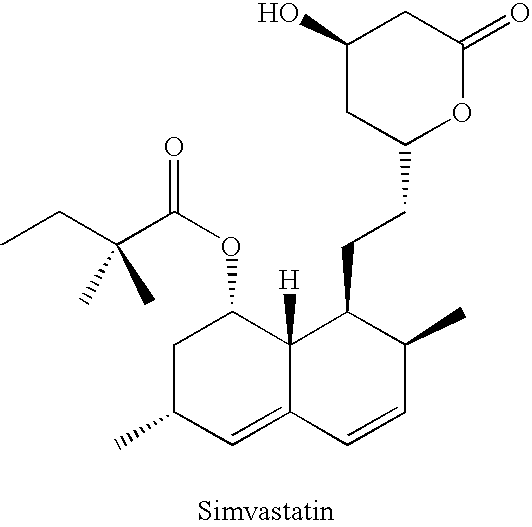
- Simvastatin is apparently an effective drug, however, simvastatin's active metabolite bioavailability is only a few percent by weight. The low bioavailability is believed to be caused by competing metabolism of the simvastatin by cytochrome P enzymes in the gut wall and in the liver, the drug action site. Nevertheless, simvastatin is seen to be an efficacious drug in the treatment of elevated cholesterol levels.
- Simvastatin is administered in the closed lactone form as a “pro-drug” of the active metabolite, the hydrolyzed hydroxyl acid form. As with other statins, simvastatin can exist either in a 3-hydroxy closed lactone form or an open hydroxy acid form. The closed lactone form is not believed to be an active inhibitor of HMG-CoA reductase, while the open hydroxy acid form is apparently biologically active and preferred. The condensation of the open hydroxy acid form to the closed lactone form occurs under acidic conditions (e.g., in the stomach where pH is about pH 4 or under). Consequently, it is desirable to prepare simvastatin in the open hydroxy acid form and limit the in vivo amount of inactive closed lactone form to avoid undesirable side effects. An illustration of the closed lactone form portion of a statin and the corresponding open hydroxy acid form is shown below.

- One method of improving the efficacy of simvastatin would be to find a way of delivering a preformed hydroxyl acid form of the drug to the body. Merck Co. Inc. has noted that delivering simvastatin to the stomach by conventional oral dosing in the lactone form leaves the drug essentially in the lactone form. See, WO 00/53173. As the acidic environment of the stomach favors the closed lactone form, the simvastatin lactone insolubility in the acidic aqueous environment of the stomach limits any hydrolysis of the lactone. Furthermore, the lack of hydrolytic enzymes and the stomach acidity level combine to favor the retention of the closed lactone form as simvastatin enters the small intestine, which is believed to be the main site of simvastatin absorption. Thus, the PCT Publication WO 00/53173 discusses the delivery of preformed simvastatin hydroxy acid salts with an enteric coated tablet so as to circumvent the acidic environment of the stomach and facilitate the absorption of the open hydroxy acid form in the neutral environment of the small intestine.
- Despite improvements in statin delivery, conventional stomach delivery of simvastatin with increased bioavailability has yet to be achieved satisfactorily. Accordingly, the present invention addresses the prior art deficiencies and achieves higher bioavailability of the active statin form while not increasing the side effects observed with the closed lactone form.
- The invention encompasses compositions comprising a statin, at least one pharmaceutically acceptable solvent, and at least one surface active agent wherein about 9% to about 50% by weight of the statin may be hydrolyzed from a closed lactone form to an open hydroxy acid form when the composition is placed in an aqueous acidic solution. In one embodiment, the aqueous acidic solution may be 0.1 N HCl. Optionally, the composition may further comprise an effective amount of a pharmaceutically acceptable antioxidant. In another embodiment, the statin may be lovastatin, simvastatin, or a combination thereof; preferably, the statin is simvastatin. The statin may be present in an amount of about 1% to about 50% by weight of the composition.
- In one embodiment of the composition, at least 90% by weight of the total amount of statin may be present in a closed lactone form statin. In another embodiment, the pharmaceutically acceptable solvent includes, but is not limited to, ethanol, propylene glycol, glycerol, isopropanol, butanol, or menthol; preferably, the pharmaceutically acceptable solvent is menthol. In another embodiment, the pharmaceutically acceptable solvent may be present in an amount of about 10% to about 75% by weight of the composition.
- In one embodiment, the surface active agent includes, but is not limited to, glyceryl ester, polyoxyethylene glycol ester, polyoxyethylene glycol ether, polyoxyethylene sorbitan fatty acid ester, polyoxyethylene/polyoxypropylene copolymer, sodium lauryl sulfate, or sodium ducosate. The surface active agent may be present in an amount of about 5% to about 85% by weight of the composition. In another embodiment, the composition comprises at least two surface active agents wherein the first surface active agent may be polyoxyethylene sorbitan fatty acid ester or polyoxyethylene/polyoxypropylene copolymer and the second surface active agent may be sodium lauryl sulfate or sodium ducosate. Preferably, the first surface active agent is polyoxyethylene sorbitan fatty acid ester and the second surface active agent is sodium ducosate. In another embodiment, when the composition is dissolved in an aqueous acidic solution, at least 20% by weight of the dissolved statin may be hydrolyzed from a closed lactone form to an open hydroxy acid form. In yet another embodiment, the composition may be in a pharmaceutically acceptable dosage form.
- One embodiment of the invention encompasses compositions comprising simvastatin; menthol; and polyoxyethylene sorbitan fatty acid ester, wherein about 9% to about 50% by weight of the simvastatin may be hydrolyzed from a closed lactone form to an open hydroxy acid form when the composition is placed in an aqueous acidic solution. Optionally, the composition may further comprise an effective amount of a pharmaceutically acceptable antioxidant. In one embodiment, the simvastatin may be present in an amount of about 1% to 50% by weight of the composition and menthol may be present in an amount of about 10% to about 75% by weight of the composition. In yet another embodiment, the composition comprises at least two surface active agents wherein the first surface active agent may be polyoxyethylene sorbitan fatty acid ester or polyoxyethylene/polyoxypropylene copolymer and the second surface active agent may be sodium lauryl sulfate or sodium ducosate. In one preferred embodiment, the polyoxyethylene sorbitan fatty acid ester may be present in an amount of 33% to about 57% by weight and the sodium lauryl sulfate or sodium ducosate may be present in an amount of about 5% to about 70% by weight. In one embodiment of the invention, when the composition is dissolved in an aqueous acidic solution, at least 20% by weight of the dissolved simvastatin may be hydrolyzed from a closed lactone form to an open hydroxy acid form.
- The invention also encompasses methods of preparing simvastatin compositions comprising: heating menthol to a temperature of about 40° C. to about 60° C. to effect melting thereof; adding at least one first surface active agent to the menthol to form a first mixture; adding at least one second surface active agent containing a sulfate moiety and stirring until all components have dissolved to form a second mixture; adjusting the temperature of the second mixture to a temperature of about 50° C. to form a melt; adding simvastatin to the melt to form a simvastatin containing melt; and cooling the simvastatin containing melt to room temperature and dispensing the simvastatin containing melt into capsules. Alternatively, the melt may be dispensed into capsules and subsequently cooled to room temperature. Either method obtains capsules comprising a simvastatin melt at room temperature. In one embodiment, the method may further comprise adding at least one solid carrier to the cooled simvastatin containing melt to form a third mixture prior to dispensing the simvastatin containing melt into capsules. In another embodiment, the solid carrier may be at least one of microcrystalline cellulose, lactose, or sorbitol. One embodiment of the invention may further comprise cooling the third mixture to room temperature to form a powder.
- The invention also encompasses methods of forming a solid simvastatin containing product comprising heating menthol to a temperature of about 40° C. to about 60° C. to effect the melting thereof; adding simvastatin to the melt; stirring the melt until all the simvastatin dissolves; adjusting the temperature of the melt to about 40° C.; and maintaining the temperature under stirring. Optionally, at least one pharmaceutically acceptable antioxidant may be added and dissolved or dispersed in the melt.
- In one embodiment, at least one surface active agent is melted and/or dissolved in a pharmaceutically acceptable solvent which is later added to a menthol-simvastatin mixture. The method comprises dissolving or dispersing at least one surface active agent into a melt or solution; granulating the melt or solution with a solid carrier and at least one pharmaceutically acceptable solvent to form a solid granulate; drying the solid granulate; mixing the dry granulate and the menthol simvastatin melt; cooling the dry granulate and menthol simvastatin melt to room temperature with stirring; forming a powder of the mix; and using the powder to produce pharmaceutical dosage forms such as capsules, tablets, or sachets. Optionally, the method further comprises milling the dry granulate prior to mixing with the menthol-simvastatin melt. Optionally, at least one antioxidant may be added to the surface active agent.
- One embodiment of the invention encompasses methods for treating a patient for elevated cholesterol levels, multiple sclerosis, or Alzheimer's disease comprising administering to a patient in need of such treatment a statin composition comprising a therapeutically effective amount of a statin, at least one pharmaceutically acceptable solvent, and at least one surface active agent, wherein about 9% to about 50% by weight of the statin may be hydrolyzed from a closed lactone form to an open hydroxy acid form when the composition is placed in an aqueous acidic solution. Optionally, the composition of the method may further comprise an effective amount of a pharmaceutically acceptable antioxidant. In one embodiment, the statin may be simvastatin present in an amount of about 1% to 50% by weight of the composition and the pharmaceutically acceptable solvent may be menthol present in an amount of about 10% to about 75% by weight of the composition.
- In one embodiment of the method, the composition may comprise at least two surface active agents wherein the first surface active agent may be polyoxyethylene sorbitan fatty acid ester or polyoxyethylene/polyoxypropylene copolymer and the second surface active agent may be sodium lauryl sulfate or sodium ducosate. In a preferred embodiment, the polyoxyethylene sorbitan fatty acid ester may be present in an amount of 33% to about 57% by weight and the sodium lauryl sulfate or sodium ducosate may be present in an amount of about 5% to about 70% by weight. In another embodiment, when the composition is dissolved in 0.1N HCl, at least 30% by weight of the dissolved statin may be hydrolyzed from the closed lactone form to the open hydroxy acid form.
- One embodiment of the invention encompasses methods for treating a patient for elevated cholesterol levels comprising administering to a patient in need of such treatment a statin composition comprising a therapeutically effective amount of a statin, menthol, and at least one surface active agent, wherein about 9% to about 50% by weight of the statin may be hydrolyzed from a closed lactone form to an open hydroxy acid form when the composition is placed in an aqueous acidic solution. Optionally, the composition of the method may further comprise an effective amount of a pharmaceutically acceptable antioxidant. In another embodiment, the statin may be simvastatin present in an amount of about 1% to 50% by weight of the composition and the menthol may be present in an amount of about 10% to about 75% by weight of the composition.
- In one embodiment of the method, the composition may comprise at least two surface active agents wherein the first surface active agent may be polyoxyethylene sorbitan fatty acid ester or polyoxyethylene/polyoxypropylene copolymer and the second surface active agent may be sodium lauryl sulfate or sodium ducosate. In another embodiment of the method, the polyoxyethylene sorbitan fatty acid ester may be present in an amount of 33% to about 57% by weight and the sodium lauryl sulfate or sodium ducosate may be present in an amount of about 5% to about 70% by weight. In yet another embodiment, when the composition is dissolved in 0.1N HCl, at least 30% by weight of the dissolved statin may be hydrolyzed from the closed lactone form to the open hydroxy acid form.
- One embodiment of the invention encompasses methods for treating a patient with multiple sclerosis comprising administering to a patient in need of such treatment a composition comprising a therapeutically effective amount of simvastatin dissolved in menthol, and at least one surface active agent, wherein about 9% to about 50% by weight of the simvastatin may be hydrolyzed from a closed lactone form to an open hydroxy acid form when the composition is placed in an aqueous acidic solution. Optionally, the composition of the method may further comprise an effective amount of a pharmaceutically acceptable antioxidant. In another embodiment, the statin may be simvastatin present in an amount of about 1% to 50% by weight of the composition and the menthol may be present in an amount of about 10% to about 75% by weight of the composition. In one embodiment of the method, the composition may comprise at least two surface active agents wherein the first surface active agent may be polyoxyethylene sorbitan fatty acid ester or polyoxyethylene/polyoxypropylene copolymer and the second surface active agent may be sodium lauryl sulfate or sodium ducosate.
- In another embodiment of the method, the polyoxyethylene sorbitan fatty acid ester may be present in an amount of 33% to about 57% by weight and the sodium lauryl sulfate or sodium ducosate may be present in an amount of about 5% to about 70% by weight. In yet another embodiment, when the composition is dissolved in 0.1N HCl, at least 30% by weight of the dissolved statin may be hydrolyzed from the closed lactone form to the open hydroxy acid form.
- One method of the invention encompasses methods for treating a patient with Alzheimer's disease comprising administering to a patient in need of such treatment a composition comprising a therapeutically effective amount of simvastatin dissolved in menthol, and at least one surface active agent, wherein about 9% to about 50% by weight of the simvastatin may be hydrolyzed from a closed lactone form to an open hydroxy acid form when the composition is placed in an aqueous acidic solution. Optionally, the composition of the method may further comprise an effective amount of a pharmaceutically acceptable antioxidant. In one embodiment, the surface active agent may be polyoxyethylene sorbitan fatty acid ester, polyoxyethylene/polyoxypropylene copolymer, sodium lauryl sulfate, or sodium ducosate.
- The present invention encompasses statin formulations, which are delivered conventionally to the stomach and have a significantly higher bioavailability of the active metabolite, i.e. the open hydroxy acid form statin. Without being limited by theory, it is believed that the main reason for the low bioavailability of statins is that statins are unchanged when delivered to the stomach, i.e. the closed lactone form of the statin is insoluble in the acidic environment of the stomach and does not hydrolyze to the biologically active open hydroxy acid form. Accordingly, statin activity may be enhanced by partial hydrolysis of the dissolved closed lactone form statin to the open hydroxy acid form statin. The present invention is based in part on the judicial selection of pharmaceutically acceptable solvent(s) and surface active agent(s) to increase solubilization and hydrolysis of the closed lactone form statin, thus, converting the biologically inactive closed lactone form statin to the biologically active open hydroxy acid form statin in the stomach, thereby increasing the amount of available biologically active statin without increasing the overall amount of statin dosed.
- Bioavailability pharmacokinetic studies of the compositions of the invention demonstrated that the bioavailability of the active metabolite, i.e. the open hydroxy acid form, was at least five times available as compared to conventional simvastatin formulations (closed lactone form). The discovery effectively places the compositions of the present invention into a “superstatin” category. It was also discovered that the relative concentration of the closed lactone form statin was unchanged indicating that the compositions of the invention will not enhance the side effects commonly associated with the closed lactone form statin. The invention also encompasses methods for making the compositions and methods of treating high cholesterol levels, multiple sclerosis, and/or Alzheimer's disease using the compositions of the invention.
- The invention encompasses compositions comprising at least one statin, at least one pharmaceutically acceptable solvent, and at least one surface active agent. Optionally, the composition may include at least one antioxidant. In one embodiment, the statin of the composition may be in the closed lactone form, and as the statin solubilizes a portion of the dissolved closed lactone form is hydrolyzed to the open hydroxy acid form when the composition is partially or completely dissolved in acid. Typically, about 9% to about 50% by weight of the simvastatin may be hydrolyzed from a closed lactone form to an open hydroxy acid form when the composition is placed in an aqueous acidic solution. In one embodiment, about 15% by weight to about 50% by weight of the statin, and preferably, from about 20% to about 40% by weight of the statin may be hydrolyzed from a closed lactone form to an open hydroxy acid form when the composition is placed in an aqueous acidic solution. The aqueous acidic solution may be 0.1 N HCl.
- The statins used in the invention may be obtained either commercially or from methods commonly known in the art. Preferably, the statin is in a pharmaceutically acceptable form. As used herein, the term “pharmaceutically acceptable” means approved by a regulatory agency of the Federal or a state government or listed in the U.S. Pharmacopeia or other generally recognized pharmacopeia for use in animals, and more particularly in humans. The statin may be present either in the closed lactone form, in the open hydroxy acid form, or a combination thereof. When present as a combination of the closed lactone form and the open hydroxy acid form, preferably the statin may be at least 90% by weight in the closed lactone form, more preferably at least 95% by weight, and most preferably the statin is present in the closed lactone form in at least 98% by weight of the total amount of statin prior to hydrolysis. Statin drugs include, but are not limited to, lovastatin, simvastatin, esters thereof, or lactone forms thereof. Preferably, the statin is simvastatin.
- The statin may be present from about 1% to about 50% by weight of the composition, and preferably, in about 8% by weight of the composition. Alternatively, the statin may be present in an amount of about 1 mg to about 80 mg per dose unit, more preferably, the statin may be present in an amount of about 5 mg to about 40 mg per dose unit, and most preferably, the statin may be present in an amount of about 20 mg per dose unit.
- Typically, the pharmaceutically acceptable solvent includes, but is not limited to, at least one of ethanol, propylene glycol, glycerol, isopropanol, butanol, or menthol. Preferably, the pharmaceutically acceptable solvents include, but are not limited to, at least one of menthol or ethanol. More preferably, the pharmaceutically acceptable solvent is menthol. Typically, the pharmaceutically acceptable solvent may be present in an amount sufficient to partially dissolve the statin. The pharmaceutically acceptable solvent may be present in an amount of about 10% to about 75% by weight of the composition, and preferably, present in an amount of about 41% by weight of the composition. Alternatively, the pharmaceutically acceptable solvent may be present in about 10 mg to about 250 mg per dose unit, and more preferably in about 25 mg to about 100 mg per dose unit.
- The surface active agents of the invention include emulsifying agents such as those commonly known to one skilled in that art. See, R
EMINGTON THE SCIENCE AND PRACTICE OF PHARMACY (A. Gennaro, ed. 20th Ed. 2000). Preferably, the surface active agents include emulsifying agents such as non-ionic undissociated surfactants which possess hydrophilic and lipophilic groups within the molecule and/or sulfate containing surfactants. Surface active agents include, but are not limited to, glyceryl esters, polyoxyethylene glycol esters, polyoxyethylene glycol ethers, polyoxyethylene sorbitan fatty acid esters, sulfate containing surfactants, or polyoxyethylene/polyoxypropylene copolymers. Preferably, the surface active agents include polyoxyethylene sorbitan fatty. acid esters, polyoxyethylene/polyoxypropylene copolymers known as poloxamers, sodium lauryl sulfate, or sodium ducosate. For example, commercially available surface active agents include TWEEN® 80, TWEEN® 20 (e.g. Polysorbitan 80, Polysorbitan 20), or Poloxamer 407. In one embodiment, the surface active agent is present in an effective amount to hydrolyze from about 15% by weight to about 50% by weight of the statin, and preferably, the surface active agent is present in an effective amount to hydrolyze from about 20% to about 40% by weight of the statin. When a surface active agent is present in the composition, the statin can achieve partial or full solubilization of the closed lactone form in a stimulated gastric environment, e.g. 0.1 N HCl. The surface active agent should be present in sufficient amount such that about at least 20% by weight of the total amount of dissolved statin is hydrolyzed to the open hydroxy acid form of the statin. Preferably, the surface active agent is present in a sufficient amount such that about at least 30% by weight of the total amount of dissolved statin is hydrolyzed to the open hydroxy acid form, and more preferably, at least about 40% by weight of the total amount of dissolved statin. - The surface active agent may be present in an amount of about 5% to about 85% by weight of the composition, preferably from about 40% to about 80% by weight. Alternatively, individual surface active agents may be present in an amount of about 5% by weight of the composition to about 75% by weight, and preferably, from about 9% to about 70% by weight. In one embodiment, when the surface active agent is sodium ducosate, the surface active agent may be present in an amount of about 10% to about 75% by weight of the composition, and preferably in an amount of about 17% to about 35% by weight of the composition. Alternatively, when the surface active agent is sodium ducosate, the surface active agent may be present in an amount of about 20 mg to about 185 mg per dose unit, preferably, in an amount of about 42 mg per dose unit. In another embodiment, when the surface active agent is a polyoxyethylene sorbitan fatty acid ester, the surface active agent may be present in an amount of about 20% to about 75% by weight of the composition, preferably in an amount of about 34% to about 70% by weight of the composition. Alternatively, when the surface active agent is a polyoxyethylene sorbitan fatty acid ester, the surface active agent may be present in an amount of about 40 mg to 185 mg per dose unit, and preferably, in an amount of about 85 mg per dose unit. The surface active agent may include both sodium ducosate and polyoxyethylene sorbitan fatty acid esters, wherein the sodium ducosate is present in an amount of about 17% to about 27% by weight of the composition and the polyoxyethylene sorbitan fatty acid esters is present in an amount of about 33% to about 57% by weight of the composition. When the surface active agent is sodium lauryl sulfate, the surface active agent may be present in an amount of about 10% to about 60% by weight of the composition. Alternatively, the surface active agent may be present in an amount of about 10 mg to 100 mg per dose unit, and preferably, in an amount of about 30 mg per dose unit.
- Optionally, the composition may further comprise at least one pharmaceutically acceptable antioxidant. Antioxidants include, but are not limited to, vitamin E acetate, α-tocopherol, ascorbyl palmitate, butylated hydroxyanisole (BHA), butylated hydroxytoluene (BHT), propyl gallate, or tocopherol polyethyleneglycol succinate (TPGS).
- The antioxidants are used in amounts known in the art to be effective and acceptable for pharmaceutical applications. When the antioxidant is vitamin E acetate, the vitamin E acetate is present in about 0.1% to 2% by weight of the formulation. Preferably, vitamin E acetate is present in about of 0.5 to 2 mg per dose and more preferably in about 1.4 mg per dose. When the antioxidant is α-tocopherol, the α-tocopherol is present in an amount of about 0.2% to 7% by weight of the formulation. Preferably, the α-tocopherol is present in an amount of about 2 to 7 mg per dose and more preferably in about 5 mg per dose. When the antioxidant is ascorbyl palmitate, ascorbyl palmitate is present in an amount of about 0.3% to 15% by weight of the formulation. Preferably, ascorbyl palmitate is present in an amount of about 5 to 15 mg per dose and more preferably in about 12 mg per dose. When the antioxidant is butylated hydroxyanisole (BHA), the BHA is present in an amount of about 0.2% to 7% by weight of the formulation. Preferably, the BHA is present in an amount of about 2 to 7 mg per dose and more preferably in about 5 mg per dose. When the antioxidant is butylated hydroxytoluene (BHT), the BHT is present in an amount of about 0.02% to 1% by weight of the formulation. Preferably, the BHT is present in an amount of about 0.2 to 1.0 mg per dose and more preferably in about 0.4 mg per dose. When the antioxidant is propyl gallate, the propyl gallate is present in an amount of about 0.002% to 0.2% by weight of the formulation. Preferably, the propyl gallate is present in an amount of 0.01 to 0.1 mg per dose and more preferably in about 0.05 mg per dose. When the antioxidant is tocopherol polyethyleneglycol succinate (TPGS), the TPGS is present in an amount of about 0.1% to 3% by weight ofthe formulation. Preferably, the TPGS is present in an amount of about 0.5 to 3.0 mg per dose and more preferably in about 2 mg per dose. Preferably, the antioxidants are vitamin E acetate or ascorbyl palmitate.
- Optionally, the composition may further comprise a solid carrier. Solid carriers include, but are not limited to, at least one of microcrystalline cellulose, lactose, starch, sucrose, calcium phosphate, or sorbitol. Sucrose may be in pellet form, the starch in microcrystalline form, and the cellulose in powdered form. When present, the solid carriers are present in an amount of about 100 mg to about 400 mg per dose.
- In one embodiment of the invention, the composition comprises a therapeutically effective amount of simvastatin or other statin drug dissolved in menthol and at least one surface active agent containing a sulfate moiety such as sodium lauryl sulfate or sodium ducosate. Optionally, at least one other surface active agent may be present in the composition. In another embodiment of the invention, the composition comprises a therapeutically effective amount of simvastatin in the closed lactone form dissolved in menthol, at least one surface active agent containing the sulfate moiety such as sodium lauryl sulfate or sodium ducosate and at least one second surface active agent, wherein at least 30% by weight of the dissolved simvastatin closed lactone form is hydrolyzed to the simvastatin open hydroxyl acid form when the composition is dissolved in 0.1N HCl. Optionally, the compositions of the invention may be absorbed onto a solid carrier. The therapeutically effective amount should be sufficient to treat high cholesterol, multiple sclerosis, and/or Alzheimer's disease.
- In another embodiment of the invention, the composition comprises about 1% to 50% by weight simvastatin in the closed lactone form, about 10% to about 75% by weight menthol, about 25% to about 60% by weight polyoxyethylene sorbitan fatty acid esters or polyoxyethylene/polyoxypropylene copolymer, preferably polyoxyethylene sorbitan fatty acid esters, and about 10% to about 30% by weight of the composition sodium lauryl sulfate. In yet another embodiment of the invention, the composition comprises about 1% to 50% by weight simvastatin in the closed lactone form, about 15% to about 75% by weight menthol, about 25% to about 60% by weight polyoxyethylene sorbitan fatty acid esters or polyoxyethylene/polyoxypropylene copolymer, preferably, polyoxyethylene sorbitan fatty acid esters, and about 10% to about 30% by weight of the composition sodium ducosate. In yet another embodiment of the invention, the composition comprises about 8% by weight simvastatin in the closed lactone form, about 41% by weight menthol, about 34% by weight polyoxyethylene sorbitan fatty acid esters, or polyoxyethylene/polyoxypropylene copolymer, preferably polyoxyethylene sorbitan fatty acid esters, and about 17% by weight of the composition sodium ducosate. Although the present invention has been illustrated by the preceding embodiments, it will be apparent to those skilled in the art that many modifications, both to materials and amounts, may be practiced without departing from the scope of the invention.
- The present invention also encompasses methods of preparing statin containing compositions. Generally, the pharmaceutically acceptable solvent and at least one surface active agent are mixed to form a first mixture. If necessary, the pharmaceutically acceptable solvent can be melted prior to adding other ingredients. Thereafter, the statin is added to the mixture and a solid or gel is formed, wherein the solid or gel is placed in capsules. The method may further comprise adding a solid carrier to the solid or gel, which subsequently is formed into a powder and the powder is placed in capsules or formed into tablets. Optionally, the method comprises adding to the melt a pharmaceutically acceptable antioxidant which is dissolved or dispersed in the melt.
- In one embodiment, the method comprises: a) heating menthol to a temperature of about 40° C. to about 60° C. to effect melting thereof; b) adding at least one surface active agent to the menthol to form a first mixture; c) adding at least one second surface active agent containing a sulfate moiety to form a second mixture; d) stirring the second mixture until all the components have dissolved; e) adjusting the temperature of the second mixture to a temperature of about 50° C. to form a melt; f) adding simvastatin and stirring the simvastatin containing melt; and g) cooling the simvastatin containing melt to room temperature and dispensing the simvastatin containing melt into capsules, or alternatively, h) dispensing the simvastatin containing into capsules and cooling the simvastatin containing melt to room temperature. Alternatively, the method may further comprise adding at least one solid carrier such as microcrystalline cellulose, lactose, starch, sucrose, calcium phosphate, or sorbitol to the simvastatin containing melt, mixing the carrier into the simvastatin containing melt to form a third mixture, cooling the third mixture to room temperature to form a powder, and using the powder to produce pharmaceutical dosage forms such as capsules, tablets or sachets. Preferably, the surface active agent containing a sulfate moiety includes, but is not limited to, at least one of sodium ducosate or sodium lauryl sulfate.
- In yet another embodiment, the invention encompasses methods of forming a solid simvastatin containing product comprising melting menthol at a temperature of about 40° C. to about 60° C. and adding simvastatin to the melt; stirring the melt until all the simvastatin dissolves; and adjusting the temperature of the melt to about 40° C. Optionally, the method comprises adding to the melt a pharmaceutically acceptable antioxidant which is dissolved or dispersed in the melt. In one embodiment, the melt composition comprises 50% to 90% by weight menthol, 8% to 50% by weight simvastatin, and 0% to 25% by weight antioxidant. Preferably, the melt composition comprises about 75% to 85% by weight of menthol, 10% to 25% by weight simvastatin, and 0% to 22% by weight antioxidant. In a more preferred embodiment, the melt composition comprises about 78% menthol and about 22% by weight simvastatin, if no antioxidant is present. If the antioxidant is present, then the composition comprises about 75% menthol, about 22% simvastatin, and about 3% vitamin E acetate. Alternatively, the composition comprises about 61% menthol, about 17% simvastatin, and about 21% ascorbyl palmitate by weight.
- Prior to addition, a surface active agent granulate may be prepared in a separate vessel. For example, at least one surface active agent is melted and/or dissolved in a pharmaceutically acceptable solvent. Optionally, at least one pharmaceutically acceptable antioxidant may be added and dissolved. Thereafter, the melt or solution of the surface active agent is granulated with a solid carrier with and a pharmaceutically acceptable solvent and the solid granulate is dried and optionally milled. In one embodiment, Tween 80 is granulated with sorbitol USP powder, microcrystalline cellulose powder, or a combination thereof using ethanol (95%) or ethanol-water mixtures. In a preferred embodiment, about 15% to 40% by weight of Tween 80 is granulated with about 60% to 85% by weight sorbitol, microcrystalline cellulose, or a combination thereof. In a more preferred embodiment, about 10% to 40% by weight Tween 80, about 1% to 10% by weight of sodium ducosate, about 35% to 45% by weight of sorbitol, and about 30% to 40% by weight of microcrystalline cellulose are granulated using ethanol (95%) or ethanol-water mixtures. In a yet more preferred embodiment, about 15% to 30% by weight Tween 80, most preferably about 22% by weight, about 2% to 5% by weight of sodium ducosate, most preferably about 3.5% by weight, and about 35% to 45% by weight of sorbitol, most preferably about 39% by weight, and about 30% to 40% by weight of microcrystalline cellulose, most preferably about 36% by weight are granulated using a 1:1 ethanol-water mixture.
- A preferred method of forming the granulation is by mixing the Tween 80 with about ⅕ volume ethanol (95%), adding the sodium ducosate and stirring with heating at 60° C. until the ducosate has dissolved. Adding the sorbitol and microcrystalline cellulose and granulating the mixture with about 15% w/w of 50% ethanol-water. Thereafter, the granulate is dried, e.g. in a fluid bed drier. The dry surface active agent granulate and the menthol-simvastatin melt are then mixed together and allowed to cool to room temperature with stirring. In a preferred embodiment about 5-10 parts of the granulate are mixed with one part of the simvastatin melt. In a more preferred embodiment about 7 parts of the granulate are mixed with 1 part of the simvastatin melt. The resulting composition may be used to further produce a solid dosage form or used as is.
- The present invention also encompasses methods of treating a patient for elevated cholesterol levels, multiple sclerosis, and/or Alzheimer's disease comprising administering to a patient in need of such treatment a statin composition comprising a therapeutically effective amount of statin, at least one pharmaceutically acceptable solvent, and at least one surface active agent. The composition may remain in the patient's stomach under acidic aqueous conditions for a sufficient amount of time to allow for the formation of the open hydroxy acid form statin. Typically, a sufficient amount of time the composition remains in the stomach is from about 30 minutes to about 2 hours.
- In one embodiment, the method of the invention further comprises a second surface active agent, wherein the second surface active agent contains a sulfate moiety such as sodium lauryl sulfate or sodium ducosate. In another embodiment, at least 30% the dissolved closed lactone form statin is hydrolyzed to the open hydroxy acid form statin when the composition is dissolved in 0.1N HCl. Preferably, the statin is simvastatin.
- One embodiment of the method of treatment of the present invention encompasses treating a patient for elevated cholesterol levels comprising administering to a patient in need of such treatment a statin composition comprising a therapeutically effective amount of statin in the lactone form, menthol, and at least one surface active agent. Optionally, the composition comprises at least one pharmaceutically acceptable antioxidant. In one embodiment, the surface active agent contains a sulfate moiety such as sodium lauryl sulfate or sodium ducosate. In another embodiment, at least 30% the dissolved closed lactone form statin is hydrolyzed to the open hydroxy acid form statin when the composition is dissolved in 0.1N HCl.
- In another embodiment, the present invention encompasses methods of treating a patient with multiple sclerosis comprising administering to a patient in need of such treatment a composition comprising a therapeutically effective amount of simvastatin in the lactone form dissolved in menthol, and at least one surface active agent. Optionally, the composition comprises at least one pharmaceutically acceptable antioxidant. Optionally, the surface active agent may contain a sulfate moiety, e.g. sodium lauryl sulfate or sodium ducosate. In one embodiment, at least 30% the simvastatin lactone is hydrolyzed to the simvastatin open hydroxyl acid form when the composition is dissolved in 0.1N HCl.
- In another embodiment, the present invention encompasses methods of treating a patient with Alzheimer's disease comprising administering to a patient in need of such treatment a composition comprising a therapeutically effective amount of simvastatin in the lactone form dissolved in menthol, and at least one surface active agent. Optionally, the composition comprises at least one pharmaceutically acceptable antioxidant. Optionally, the surface active agent may contain a sulfate moiety, e.g. sodium lauryl sulfate or sodium ducosate. In one embodiment, at least 30% the simvastatin lactone is hydrolyzed to the simvastatin open hydroxyl acid form when the composition is dissolved in 0.1N HCl.
- Typically, the statin is present in an amount sufficient for the treatment or prevention of high cholesterol or multiple sclerosis. In one embodiment, “treatment” or “treating” refers to an amelioration of a disease or disorder, or at least one discernible symptom thereof. In another embodiment, “treatment” or “treating” refers to an amelioration of at least one measurable physical parameter, not necessarily discernible by the patient. In yet another embodiment, “treatment” or “treating” refers to inhibiting the progression of a disease or disorder, either physically, e.g., stabilization of a discernible symptom, physiologically, e.g., stabilization of a physical parameter, or both. In yet another embodiment, “treatment” or “treating” refers to delaying the onset of a disease or disorder.
- In certain embodiments, the compositions of the invention are administered to a patient, preferably a human, as a preventative measure against such diseases. As used herein, “prevention” or “preventing” refers to a reduction of the risk of acquiring a given disease or disorder. In a preferred mode of the embodiment, the compositions of the present invention are administered as a preventative measure to a patient, preferably a human having a genetic predisposition to a cardiovascular disease, high cholesterol, or multiple sclerosis.
- As used herein, the term “high cholesterol” refers to disorders that lead to or are manifested by aberrant levels of circulating lipids. To the extent that levels of lipids in the blood are too high, the compositions of the invention are administered to a patient to restore normal levels. Normal levels of lipids are reported in medical treatises known to those of skill in the art. For example, recommended blood levels of LDL, HDL, free triglycerides and others parameters relating to lipid metabolism can be found at the web site of the American Heart Association and that of the National Cholesterol Education Program of the National Heart, Lung and Blood Institute (http://www.americanheart.org and http://rover.nhlbi.nih.gov/chd/, respectively). At the present time, the recommended level of IHDL cholesterol in the blood is above 35 mg/dL; the recommended level of LDL cholesterol in the blood is below 130 mg/dL; the recommended LDL:HDL cholesterol ratio in the blood is below 5:1, ideally 3.5:1; and the recommended level of free triglycerides in the blood is less than 200 mg/dL.
- Tables 1 and 2 illustrate the pre-systemic formation of simvastatin open hydroxy acid form from the simvastatin closed lactone form in 0.1N HCl using compositions of the present invention. The compositions should reside in the stomach under acidic aqueous conditions for about 30 minutes to about 2 hours. The in vitro resident times shown exemplify the amount of time necessary to allow for the preformation of the statin active metabolite, i.e. open hydroxy acid form. The pre-formed active metabolite could be absorbed in the small intestine adding to the amount of the active metabolite formed in the liver, thus potentially offering significant improvements to treatment with statins, preferably simvastatin.
- The efficacy of the treatment as determined by the amount of statin open hydroxyl acid form in the system has determined the current treatment to be a superior treatment to that of prior art formulations such that formulations of the invention may be categorized as “superstatins.” The most serious, albeit rare, simvastatin side effect is muscular myopathy. The side effect is associated with the amount of closed lactone form simvastatin in the blood. Therefore, the compositions of the invention should not have any more side effects than the reference simvastatin.
- Having described the invention with reference to certain preferred embodiments, other embodiments will become apparent to one skilled in the art from consideration of the specification. The invention is further defined by reference to the following examples describing in detail the compositions, preparation of the compositions, and methods of administration of the invention. It will be apparent to those skilled in the art that many modifications, both to materials and methods, may be practiced without departing from the scope of the invention.
- Generally, the simvastatin formulations were prepared by heating menthol to about 60° C. while stirring and adding a surface active agent (either TWEEN® or Poloxamer) and sodium ducosate or sodium lauryl sulfate. The mixture was stirred until all the components dissolved to form a melt. Thereafter, the melt was cooled to about 50° C., simvastatin was added during stirring until dissolved, the mixture was cooled to room temperature, and dispensed into capsules. After about an hour the liquid in the capsule had gelled. Each capsule was filled with enough formulation to have a dose of 20 mg of simvastatin.
- Each formulation was tested by dissolution in 50 ml of 0.1N HCl at 37° C. with stirring. The amount of dissolved simvastatin lactone and simvastatin hydroxyl acid were determined by HPLC on a column (ODS BDS 150×4.6 mm, 5 micron), mobile phase: 40:60 dilute phosphoric acid:acetonitrile at a flow rate of 2 ml/min and detected with a UV wavelength of 238 nm. It was determined that the retention times for the simvastatin hydroxyl acid was 3.6 minutes and simvastatin lactone was 5.7 minutes.
- The dissolution results for each formulation are summarized in Tables 1 and 2.
TABLE 1 Simvastatin Formulationa TWEEN ® TWEEN ® Poloxamer Sodium % Dissolved 60 % converted to % hydrolyzed Simvastatin Menthol 80 20 407 Ducosate SLS min 0.1 N HClb hydroxyl acidc Simvastatind 100 0 0 0 0 0 0 0 0 0 16 84 0 0 0 0 0 11 19 2 5 27 0 0 68 0 0 97 23 22 5 27 68 0 0 0 0 97 29 28 8 40 52 0 0 0 0 96 25 24 7 50 43 0 0 0 0 100 19 19 7 50 22 0 21 0 0 88 15 13 8 40 0 52 0 0 0 95 16 15 4 40 0 0 0 0 55 98 41 40 5 27 0 0 0 68 0 21 41 9 10 49 21 0 0 21 0 67 42 28 9 44 38 0 0 9 0 88 41 36 8 41 34 0 0 17 0 90 46 41
aAll ingredients amounts are given in % weight of the composition.
bTotal amount of dissolved simvastatin (closed lactone form and open hydroxy acid form).
cWeight % of the total dissolved simvastatin that is in the open hydroxy acid form.
dWeight % of the total amount of hydrolyzed Simvastatin from the initial Simvastatin amount.
- Table 1 illustrates that simvastatin lactone alone does not dissolve well in the water (0% dissolved) and has no conversion under these conditions to the hydroxyl acid (0%). The dissolution of simvastatin lactone formulations and menthol ranged from a low value of 11% with almost 20% of this material hydrolyzing to the acid. The addition of various surfactants, such as TWEEN® 80, TWEEN® 20, or Poloxamer 407, allowed for about total dissolution of simvastatin, wherein about 20% to about 30% of the lactone had converted to the hydroxyl acid form. When sodium lauryl sulfate (SLS) was the surface active agent, the amount of conversion of the lactone form to acid increased to above 40%. Sodium ducosate as the only surface active agent yielded a conversion of over 40%, however, the simvastatin dissolution in the acidic water was low (21%). Mixtures of TWEEN® 80 and sodium ducosate gave formulations that were both highly soluble (90%) within one hour with conversions of the lactone to the hydroxyl acid of over 40%.
TABLE 2 Simvastatin Formulations by weight and percent of components % Dissolved TWEEN ® Sodium 30 min 0.1 N % converted to % hydrolyzed Simvastatin Menthol 80 Ducosate HCla hydroxyl acidb Simvastatinc mg % mg % mg % mg % % % % 20 8.1 100 40.5 85 34.4 42 17.0 83 42 35 20 9.0 75 33.8 85 38.3 42 18.9 68 42 29 20 10.2 50 25.4 85 43.1 42 21.3 77 41 32 20 11.6 25 14.5 85 49.4 42 24.4 72 41 30 20 12.5 12.5 7.8 85 53.3 42 26.3 72 43 31 20 13.2 5 3.3 85 55.9 42 27.6 8 47 4
aTotal amount of dissolved simvastatin (closed lactone form and open hydroxy acid form).
bWeight % of the total dissolved simvastatin that is in the open hydroxy acid form.
cWeight % of the total amount of hydrolyzed Simvastatin from the initial Simvastatin amount.
- Table 2 illustrates the effect of lowering the amount of menthol in the simvastatin formulation from 40% to 3% by weight while keeping all the other ingredient amounts constant. Menthol is effective at about 8% w/w but at 3% w/w simvastatin solubility diminishes.
- Into a jacketed glass reactor were added 100 grams of Tween 80, 11.7 grams of sodium ducosate, and 20 grams of ethanol (95%). The mixture was stirred and heated to 60° C. for about an hour or until all the sodium ducosate had dissolved. Under continuous stirring by a laboratory mechanical stirrer, 176 grams of sorbitol (USP) powder were slowly added followed by 161 grams of microcrystalline cellulose (Avicel PH102™, FMC International) to form a wet mass. The wet mass was transferred to a Diosna P⅙ high shear granulator. About 70 grams of 50% ethanol-water were added to the granulator and the mass was granulated at a speed of 380 rpm for 5 minutes. The wet granulate was dried in a Diosna Mini Lab fluidized bed drier to less than 2% volatiles at an inlet temperature of 50° C. and a fan set point of 40%. The volatile content was tested at 105° C. using a Sartorious MA 30 LOD tester. The yield of dry granulate was 382 grams (85%).
- In a separate jacketed reactor heated to 60° C. were mixed 10 grams of simvastatin (micronized, Biogal Inc.) and 35 grams of menthol (USP). The homogeneous melt was cooled to 40° C. and stirred at about 100 rpm. Vitamin E acetate (BASF) (1.4 grams) was added and dispersed. The dry granulate (382 grams) was added to the melt under constant stirring over a period of 5 minutes. The stirring was continued another 15 minutes after which the formed powder was removed and allowed to cool for three hours. Capsules were filled with 428 mg of the powder for a 10 mg simvastatin dose per capsule.
- The formulation was tested for dissolution as described in Example 1. After 30 minutes, 69.4%±4.6% had dissolved with 42% being in the form of simvastatin hydroxyl acid.
- To determine the bioavailability of simvastatin, a randomized, 4-way crossover comparative bioavailability study with three simvastatin test formulations (20 mg, A, B, C) as compared to a simvastatin (20 mg, D) reference was performed with healthy male volunteers. The pharmacokinetic profiles (Cmax, Tmax, and AUC) of simvastastin hydroxy acid and simvastatin lactone-were observed following administration of single doses of several simvastatin/menthol test formulations as compared to the administration of the simvastatin reference (no menthol), in twelve fasting healthy male volunteers.
- Both the test (A, B, and C) and reference (D) drug formulations were administered as a single oral dose, with 240 ml of water following an overnight fast of at least 10 hours. Subjects were monitored to ensure that the tablet and capsules are swallowed whole and not chewed.
- Each of the simvastatin/menthol test formulations was supplied as a 20 mg simvastatin+100 mg menthol capsule, with each test formulation provided as a clearly distinguishable capsule of different color. All subjects received the test and reference drug formulations in a four-way crossover design. Subjects were randomly assigned to the Reference formulation or to one of the three Test formulations (D; A; B; C), and were crossed over the following week to an alternative treatment. The cycle was repeated for 2 more study sessions, so that all subjects had received all 4 study treatments in a unique, subject-specific order, with a 1 week wash-out period between treatments. All subjects, regardless of the order in which they received their treatment assignment, received a total exposure of 80 mg simvastatin and 300 mg menthol over the 4 study sessions. Twelve (12) healthy adult male volunteers, 18-55 years of age participated in the study.
- The subjects provided a “0” hour blood sample within 1-1.5 hours prior to initial dosing. Thereafter, each subject was dosed with the study drug (Reference 1, Test 1, Test 2, or Test 3) in the fasted state, according to the individual randomization scheme for each subject. All subjects, regardless of treatment assignment, were monitored in the clinic for the first 12 hours following initial dosing, with serial blood samples taken periodically over the first 12 hours following dosing. Subjects were discharged from the clinic after 12 hours and be asked to return to the clinic a week later for the next study session. A total of 11 blood samples were collected from each subject at each study session.
- From each patient blood samples (10 ml) were obtained from all subjects regardless of treatment assignment at the following time points: “0” hour (pre-dosing), 0.5, 1, 1.5, 2, 3, 4, 6, 8, 10 and 12 hours post-initial dosing, for a total of 11 blood samples per study period (110 ml total). The blood was placed in EDTA test tubes, centrifuged at 3000 rpm for 10 minutes at 4° C., with the plasma separated for subsequent analysis of simvastatin lactone and simvastatin hydroxy acid, each was sent to the analytical laboratory for analysis using a validated LC/MS/MS method, with a calibration range of 0.3-28 ng/ml.
- The study was repeated after at least a 7 day wash-out period between dosings, with each subject crossed over to the alternative treatment arm as per their unique randomization code, and followed as described below for a total of 4 study sessions.
TABLE 3 Description of Treatments Treatment Description A 1 Capsule containing 20 mg simvastatin dissolved in 100 mg menthol B 1 Capsule containing 20 mg simvastatin dissolved in 100 mg menthol and 85 mg TWEEN ® 80 and 42 mg sodium ducosate C 2 capsules each containing 10 mg sim- vastatin dissolved in 42 mg menthol and 42 mg TWEEN ® 80 and 21 mg sodium ducosate loaded on 100 mg of micro- crystalline cellulose (AVICEL ® PH102) D (Reference) 1 Tablet containing 20 mg simvastatin previously shown to be bioequivalent to Zocor ® - The four treatment groups are described in Table 3. A summary of the pharmacokinetic results of the AUC (reflecting the amount of the drug in the blood) and Cmax (maximum concentration of drug in the blood) data are shown in Table 4 for the simvastatin lactone and in Table 5 for the simvastatin hydroxyl acid. Treatments B and D (reference) yield similar results in AUC for the simvastatin lactone (ratio B/D=0.97). However, the ratio of active metabolite simvastatin hydroxyl acid is greater than five (ratio B/D=5.1). The Cmax data also illustrates the higher concentration of acid to lactone as compared to the reference sample D, B/D=1.97 for the simvastatin lactone and 5.0 for the hydroxyl acid. As simvastatin efficacy is dependent upon the availability of the hydroxyl acid, treatment B was determined to be vastly superior to the reference sample. For treatment B, the value for the side effect of muscular myopathy is unchanged as compared to the reference sample.
TABLE 4 AUC and Cmax for simvastatin lactone Treatment A B C D A/D B/D C/D Mean AUC ng*h/ml 20.2 ± 16.8 11.7 ± 6.8 3.9 ± 2.3 12.1 ± 7.1 1.67 0.97 0.32 Mean Cmax ng/ml 8.1 ± 5.3 6.3 ± 6.4 2.2 ± 1.2 3.3 ± 2.0 2.45 1.91 0.67 -
TABLE 5 AUC and Cmax for simvastatin hydroxyl acid Treatment A B C D A/D B/D C/D Mean AUC ng*h/ml 11.8 ± 4.8 38.3 ± 20.8 20.2 ± 11.4 7.5 ± 3.7 1.57 5.1 2.69 Mean Cmax ng/ml 1.4 ± 0.6 5.5 ± 3.2 3.1 ± 2.2 1.1 ± 0.6 1.27 5 2.81 - In treatment C the simvastatin/menthol/surfactant formulation was adsorbed onto a solid carrier. The AUC for the simvastatin hydroxyl acid for treatment C is 269% compared to reference sample D, thus, for the reasons discussed in treatment B, treatment C is expected to be more efficacious than the reference D. The ratio (C/D) for the unchanged lactone is 0.32 indicating that treatment C provides less of the unchanged lactone than the reference sample D. Therefore, treatment C may improve treatment for lowering cholesterol and have considerably less side effects.
- Treatment A, wherein simvastatin was dissolved in menthol without surfactants, gave ratio of 1.67 (A/D) and 1.57 for the AUC's of the unchanged lactone and hydroxyl acid forms, respectively. This result illustrates approximately 50% to 60% higher absorption of simvastatin and a similar rise in the presence of the active metabolite.
Claims (68)
Priority Applications (1)
| Application Number | Priority Date | Filing Date | Title |
|---|---|---|---|
| US10/981,953 US20050192340A1 (en) | 2003-11-05 | 2004-11-05 | Simvastatin formulations and methods of making same |
Applications Claiming Priority (2)
| Application Number | Priority Date | Filing Date | Title |
|---|---|---|---|
| US51765003P | 2003-11-05 | 2003-11-05 | |
| US10/981,953 US20050192340A1 (en) | 2003-11-05 | 2004-11-05 | Simvastatin formulations and methods of making same |
Publications (1)
| Publication Number | Publication Date |
|---|---|
| US20050192340A1 true US20050192340A1 (en) | 2005-09-01 |
Family
ID=34572961
Family Applications (1)
| Application Number | Title | Priority Date | Filing Date |
|---|---|---|---|
| US10/981,953 Abandoned US20050192340A1 (en) | 2003-11-05 | 2004-11-05 | Simvastatin formulations and methods of making same |
Country Status (3)
| Country | Link |
|---|---|
| US (1) | US20050192340A1 (en) |
| TW (1) | TW200529821A (en) |
| WO (1) | WO2005044258A1 (en) |
Cited By (8)
| Publication number | Priority date | Publication date | Assignee | Title |
|---|---|---|---|---|
| US20070015833A1 (en) * | 2005-07-18 | 2007-01-18 | Moshe Flashner-Barak | Formulations of fenofibrate containing menthol |
| US20070053930A1 (en) * | 2005-09-07 | 2007-03-08 | Bebaas, Inc. | Combination therapy for treatment of high cholesterol |
| US20090137617A1 (en) * | 2007-11-23 | 2009-05-28 | Andrew Levy | Use of haptoglobin genotyping in diagnosis and treatment of cardiovascular disease |
| WO2010098906A1 (en) * | 2009-02-24 | 2010-09-02 | Madeira Therapeutics | Liquid statin formulations |
| US20150352052A1 (en) * | 2012-07-02 | 2015-12-10 | Xi'an Libang Pharmaceutical Co.,Ltd. | 2,2',6,6'-tetraisopropyl-4,4'-2-biphenol soft capsule and method for preparing same |
| US20180028446A1 (en) * | 2016-06-30 | 2018-02-01 | Northwestern University | Nanostructure Enhanced Targeting (NSET) of Inflammatory Cells |
| CN108627578A (en) * | 2017-03-17 | 2018-10-09 | 武汉宏韧生物医药科技有限公司 | The quantitative analysis method of Simvastatin and Simvastatin hydroxyl acid concentration |
| US20220287355A1 (en) * | 2021-03-12 | 2022-09-15 | Nicoventures Trading Limited | Oral products with self-emulsifying system |
Families Citing this family (3)
| Publication number | Priority date | Publication date | Assignee | Title |
|---|---|---|---|---|
| CN1938012A (en) * | 2004-03-31 | 2007-03-28 | 兴和株式会社 | External preparation |
| EP2018153B1 (en) | 2006-04-26 | 2012-04-11 | Rosemont Pharmaceuticals Ltd | Liquid oral compositions |
| WO2022129003A1 (en) * | 2020-12-15 | 2022-06-23 | Dsm Ip Assets B.V. | Multiparticulate solid oral dosage form comprising statin and vitamin e |
Citations (3)
| Publication number | Priority date | Publication date | Assignee | Title |
|---|---|---|---|---|
| US4444784A (en) * | 1980-08-05 | 1984-04-24 | Merck & Co., Inc. | Antihypercholesterolemic compounds |
| US4582915A (en) * | 1983-10-11 | 1986-04-15 | Merck & Co., Inc. | Process for C-methylation of 2-methylbutyrates |
| US4820850A (en) * | 1987-07-10 | 1989-04-11 | Merck & Co., Inc. | Process for α-C-alkylation of the 8-acyl group on mevinolin and analogs thereof |
Family Cites Families (3)
| Publication number | Priority date | Publication date | Assignee | Title |
|---|---|---|---|---|
| US20020010128A1 (en) * | 2000-04-13 | 2002-01-24 | Parks Thomas P. | Treatment of hyperproliferative, inflammatory and related mucocutaneous disorders using inhibitors of mevalonate synthesis and metabolism |
| KR100426346B1 (en) * | 2000-11-30 | 2004-04-08 | 한국화학연구원 | Pharmaceutical compositions for Hypercholesterolemia treatment using of Self Emulsifying drug delivery system |
| FR2827770B1 (en) * | 2001-07-27 | 2005-08-19 | Gattefosse Ets Sa | ORAL PHARMACEUTICAL COMPOSITION COMPRISING AN ACTIVE INGREDIENT LIKELY TO BE SUBSTANTIALLY EFFECT OF FIRST INTESTINAL PASSAGE |
-
2004
- 2004-11-05 US US10/981,953 patent/US20050192340A1/en not_active Abandoned
- 2004-11-05 WO PCT/US2004/036931 patent/WO2005044258A1/en not_active Ceased
- 2004-11-05 TW TW093133942A patent/TW200529821A/en unknown
Patent Citations (3)
| Publication number | Priority date | Publication date | Assignee | Title |
|---|---|---|---|---|
| US4444784A (en) * | 1980-08-05 | 1984-04-24 | Merck & Co., Inc. | Antihypercholesterolemic compounds |
| US4582915A (en) * | 1983-10-11 | 1986-04-15 | Merck & Co., Inc. | Process for C-methylation of 2-methylbutyrates |
| US4820850A (en) * | 1987-07-10 | 1989-04-11 | Merck & Co., Inc. | Process for α-C-alkylation of the 8-acyl group on mevinolin and analogs thereof |
Cited By (10)
| Publication number | Priority date | Publication date | Assignee | Title |
|---|---|---|---|---|
| US20070015833A1 (en) * | 2005-07-18 | 2007-01-18 | Moshe Flashner-Barak | Formulations of fenofibrate containing menthol |
| US20070053930A1 (en) * | 2005-09-07 | 2007-03-08 | Bebaas, Inc. | Combination therapy for treatment of high cholesterol |
| US20090137617A1 (en) * | 2007-11-23 | 2009-05-28 | Andrew Levy | Use of haptoglobin genotyping in diagnosis and treatment of cardiovascular disease |
| WO2010098906A1 (en) * | 2009-02-24 | 2010-09-02 | Madeira Therapeutics | Liquid statin formulations |
| US20150352052A1 (en) * | 2012-07-02 | 2015-12-10 | Xi'an Libang Pharmaceutical Co.,Ltd. | 2,2',6,6'-tetraisopropyl-4,4'-2-biphenol soft capsule and method for preparing same |
| US9693963B2 (en) * | 2012-07-02 | 2017-07-04 | Xi'an Libang Pharmaceutical Co., Ltd. | 2,2′,6,6′-tetraisopropyl-4,4′-2-biphenol soft capsule and method for preparing same |
| US20180028446A1 (en) * | 2016-06-30 | 2018-02-01 | Northwestern University | Nanostructure Enhanced Targeting (NSET) of Inflammatory Cells |
| US10821078B2 (en) * | 2016-06-30 | 2020-11-03 | Northwestern University | Nanostructure enhanced targeting (NSET) of inflammatory cells |
| CN108627578A (en) * | 2017-03-17 | 2018-10-09 | 武汉宏韧生物医药科技有限公司 | The quantitative analysis method of Simvastatin and Simvastatin hydroxyl acid concentration |
| US20220287355A1 (en) * | 2021-03-12 | 2022-09-15 | Nicoventures Trading Limited | Oral products with self-emulsifying system |
Also Published As
| Publication number | Publication date |
|---|---|
| WO2005044258A1 (en) | 2005-05-19 |
| TW200529821A (en) | 2005-09-16 |
Similar Documents
| Publication | Publication Date | Title |
|---|---|---|
| RU2343905C2 (en) | Solid dosed out forms including fibrat and statin | |
| JP5758812B2 (en) | Steroid composition | |
| HK1259458A1 (en) | Gemcabene combinations for the treatment of cardiovascular disease | |
| EP1140036A2 (en) | Novel formulations comprising lipid-regulating agents | |
| EP2853263B1 (en) | Multilayer coating form of orally administered pharmaceutical composition containing omega-3 fatty acid or alkyl ester thereof and statin based drug | |
| JP2009108076A (en) | Pharmaceutical composition comprising a lipase inhibitor and a sucrose fatty acid ester | |
| US20050192340A1 (en) | Simvastatin formulations and methods of making same | |
| EP2400840A1 (en) | Liquid statin formulations | |
| US6838091B2 (en) | Formulations comprising lipid-regulating agents | |
| MXPA01012225A (en) | Novel formulations comprising lipid-regulating agents. | |
| US20070014846A1 (en) | Pharmaceutical compositions comprising fenofibrate and atorvastatin | |
| US20050096390A1 (en) | Compositions comprising fenofibrate and pravastatin | |
| JP2009534459A (en) | Liquid oral composition | |
| US20040014712A1 (en) | Blood lipid ameliorant composition | |
| US20060223811A1 (en) | Triglycerine depressant composition | |
| US6814977B1 (en) | Formulations comprising lipid-regulating agents | |
| US20150037414A1 (en) | Stable controlled release pharmaceutical compositions containing fenofibrate and pravastatin | |
| CA2534910C (en) | Stable controlled release pharmaceutical compositions containing fenofibrate and pravastatin | |
| JP2008189684A (en) | Blood lipid improving agent composition | |
| CA2534660A1 (en) | Single unit pharmaceutical composition comprising a mixture of a fibrate and an homocysteine reducing agent | |
| US20110217369A1 (en) | Fenofibrate compositions | |
| US6998422B2 (en) | Lipid peroxide-lowering compositions | |
| US7037934B2 (en) | Blood lipid ameliorant composition | |
| WO2006037345A1 (en) | Pharmaceutical composition comprising fenofibrate and simvastatin | |
| US20070160663A1 (en) | Single unit pharmaceutical composition comprising a mixture of fenofibrate and a modified release form of a homocysteine reducing agent |
Legal Events
| Date | Code | Title | Description |
|---|---|---|---|
| AS | Assignment |
Owner name: TEVA PHARMACEUTICALS USA, LTD., PENNSYLVANIA Free format text: ASSIGNMENT OF ASSIGNORS INTEREST;ASSIGNOR:TEVA PHARMACEUTICAL INDUSTRIES, LTD.;REEL/FRAME:016203/0851 Effective date: 20050201 Owner name: TEVA PHARMACEUTICAL INDUSTRIES, LTD., ISRAEL Free format text: ASSIGNMENT OF ASSIGNORS INTEREST;ASSIGNORS:FLASHNER-BARAK, MOSHE;LERNER, E. ITZHAK;ROSENBERGER, VERED;AND OTHERS;REEL/FRAME:016203/0848 Effective date: 20050119 |
|
| STCB | Information on status: application discontinuation |
Free format text: ABANDONED -- FAILURE TO RESPOND TO AN OFFICE ACTION |