US20050187178A1 - Compositions comprising alternating 2'-modified nucleosides for use in gene modulation - Google Patents
Compositions comprising alternating 2'-modified nucleosides for use in gene modulation Download PDFInfo
- Publication number
- US20050187178A1 US20050187178A1 US11/054,848 US5484805A US2005187178A1 US 20050187178 A1 US20050187178 A1 US 20050187178A1 US 5484805 A US5484805 A US 5484805A US 2005187178 A1 US2005187178 A1 US 2005187178A1
- Authority
- US
- United States
- Prior art keywords
- composition
- oligomeric compound
- rna
- target
- oligomeric compounds
- Prior art date
- Legal status (The legal status is an assumption and is not a legal conclusion. Google has not performed a legal analysis and makes no representation as to the accuracy of the status listed.)
- Granted
Links
- 239000000203 mixture Substances 0.000 title claims abstract description 90
- 108090000623 proteins and genes Proteins 0.000 title claims abstract description 90
- 125000003835 nucleoside group Chemical group 0.000 title claims description 71
- 150000001875 compounds Chemical class 0.000 claims abstract description 302
- 150000007523 nucleic acids Chemical class 0.000 claims abstract description 95
- 102000039446 nucleic acids Human genes 0.000 claims abstract description 90
- 108020004707 nucleic acids Proteins 0.000 claims abstract description 90
- 238000000034 method Methods 0.000 claims abstract description 65
- 230000000295 complement effect Effects 0.000 claims abstract description 54
- 230000000692 anti-sense effect Effects 0.000 claims description 143
- 108020004459 Small interfering RNA Proteins 0.000 claims description 92
- 239000002777 nucleoside Substances 0.000 claims description 87
- 150000003833 nucleoside derivatives Chemical class 0.000 claims description 35
- 150000004713 phosphodiesters Chemical class 0.000 claims description 30
- 241001465754 Metazoa Species 0.000 claims description 27
- 125000000956 methoxy group Chemical group [H]C([H])([H])O* 0.000 claims description 27
- 125000005647 linker group Chemical group 0.000 claims description 22
- 102000004169 proteins and genes Human genes 0.000 claims description 22
- 229910052717 sulfur Inorganic materials 0.000 claims description 21
- RYYWUUFWQRZTIU-UHFFFAOYSA-K thiophosphate Chemical compound [O-]P([O-])([O-])=S RYYWUUFWQRZTIU-UHFFFAOYSA-K 0.000 claims description 18
- 125000002467 phosphate group Chemical group [H]OP(=O)(O[H])O[*] 0.000 claims description 14
- 206010028980 Neoplasm Diseases 0.000 claims description 11
- 108010002687 Survivin Proteins 0.000 claims description 10
- 229910052760 oxygen Inorganic materials 0.000 claims description 8
- 125000004178 (C1-C4) alkyl group Chemical group 0.000 claims description 6
- 208000035657 Abasia Diseases 0.000 claims description 6
- 208000005017 glioblastoma Diseases 0.000 claims description 5
- 230000002401 inhibitory effect Effects 0.000 claims description 4
- 238000001990 intravenous administration Methods 0.000 claims description 3
- 230000014509 gene expression Effects 0.000 abstract description 73
- 230000008685 targeting Effects 0.000 abstract description 14
- 210000004027 cell Anatomy 0.000 description 151
- 229920002477 rna polymer Polymers 0.000 description 121
- 108091034117 Oligonucleotide Proteins 0.000 description 99
- 108020004999 messenger RNA Proteins 0.000 description 98
- 238000011282 treatment Methods 0.000 description 96
- 230000000694 effects Effects 0.000 description 83
- 102000040650 (ribonucleotides)n+m Human genes 0.000 description 56
- 108091032973 (ribonucleotides)n+m Proteins 0.000 description 56
- 241000699670 Mus sp. Species 0.000 description 56
- -1 e.g. Proteins 0.000 description 53
- JLCPHMBAVCMARE-UHFFFAOYSA-N [3-[[3-[[3-[[3-[[3-[[3-[[3-[[3-[[3-[[3-[[3-[[5-(2-amino-6-oxo-1H-purin-9-yl)-3-[[3-[[3-[[3-[[3-[[3-[[5-(2-amino-6-oxo-1H-purin-9-yl)-3-[[5-(2-amino-6-oxo-1H-purin-9-yl)-3-hydroxyoxolan-2-yl]methoxy-hydroxyphosphoryl]oxyoxolan-2-yl]methoxy-hydroxyphosphoryl]oxy-5-(5-methyl-2,4-dioxopyrimidin-1-yl)oxolan-2-yl]methoxy-hydroxyphosphoryl]oxy-5-(6-aminopurin-9-yl)oxolan-2-yl]methoxy-hydroxyphosphoryl]oxy-5-(6-aminopurin-9-yl)oxolan-2-yl]methoxy-hydroxyphosphoryl]oxy-5-(6-aminopurin-9-yl)oxolan-2-yl]methoxy-hydroxyphosphoryl]oxy-5-(6-aminopurin-9-yl)oxolan-2-yl]methoxy-hydroxyphosphoryl]oxyoxolan-2-yl]methoxy-hydroxyphosphoryl]oxy-5-(5-methyl-2,4-dioxopyrimidin-1-yl)oxolan-2-yl]methoxy-hydroxyphosphoryl]oxy-5-(4-amino-2-oxopyrimidin-1-yl)oxolan-2-yl]methoxy-hydroxyphosphoryl]oxy-5-(5-methyl-2,4-dioxopyrimidin-1-yl)oxolan-2-yl]methoxy-hydroxyphosphoryl]oxy-5-(5-methyl-2,4-dioxopyrimidin-1-yl)oxolan-2-yl]methoxy-hydroxyphosphoryl]oxy-5-(6-aminopurin-9-yl)oxolan-2-yl]methoxy-hydroxyphosphoryl]oxy-5-(6-aminopurin-9-yl)oxolan-2-yl]methoxy-hydroxyphosphoryl]oxy-5-(4-amino-2-oxopyrimidin-1-yl)oxolan-2-yl]methoxy-hydroxyphosphoryl]oxy-5-(4-amino-2-oxopyrimidin-1-yl)oxolan-2-yl]methoxy-hydroxyphosphoryl]oxy-5-(4-amino-2-oxopyrimidin-1-yl)oxolan-2-yl]methoxy-hydroxyphosphoryl]oxy-5-(6-aminopurin-9-yl)oxolan-2-yl]methoxy-hydroxyphosphoryl]oxy-5-(4-amino-2-oxopyrimidin-1-yl)oxolan-2-yl]methyl [5-(6-aminopurin-9-yl)-2-(hydroxymethyl)oxolan-3-yl] hydrogen phosphate Polymers Cc1cn(C2CC(OP(O)(=O)OCC3OC(CC3OP(O)(=O)OCC3OC(CC3O)n3cnc4c3nc(N)[nH]c4=O)n3cnc4c3nc(N)[nH]c4=O)C(COP(O)(=O)OC3CC(OC3COP(O)(=O)OC3CC(OC3COP(O)(=O)OC3CC(OC3COP(O)(=O)OC3CC(OC3COP(O)(=O)OC3CC(OC3COP(O)(=O)OC3CC(OC3COP(O)(=O)OC3CC(OC3COP(O)(=O)OC3CC(OC3COP(O)(=O)OC3CC(OC3COP(O)(=O)OC3CC(OC3COP(O)(=O)OC3CC(OC3COP(O)(=O)OC3CC(OC3COP(O)(=O)OC3CC(OC3COP(O)(=O)OC3CC(OC3COP(O)(=O)OC3CC(OC3COP(O)(=O)OC3CC(OC3COP(O)(=O)OC3CC(OC3CO)n3cnc4c(N)ncnc34)n3ccc(N)nc3=O)n3cnc4c(N)ncnc34)n3ccc(N)nc3=O)n3ccc(N)nc3=O)n3ccc(N)nc3=O)n3cnc4c(N)ncnc34)n3cnc4c(N)ncnc34)n3cc(C)c(=O)[nH]c3=O)n3cc(C)c(=O)[nH]c3=O)n3ccc(N)nc3=O)n3cc(C)c(=O)[nH]c3=O)n3cnc4c3nc(N)[nH]c4=O)n3cnc4c(N)ncnc34)n3cnc4c(N)ncnc34)n3cnc4c(N)ncnc34)n3cnc4c(N)ncnc34)O2)c(=O)[nH]c1=O JLCPHMBAVCMARE-UHFFFAOYSA-N 0.000 description 43
- 108020004414 DNA Proteins 0.000 description 41
- 102000053602 DNA Human genes 0.000 description 41
- 239000002773 nucleotide Substances 0.000 description 40
- NOESYZHRGYRDHS-UHFFFAOYSA-N insulin Chemical compound N1C(=O)C(NC(=O)C(CCC(N)=O)NC(=O)C(CCC(O)=O)NC(=O)C(C(C)C)NC(=O)C(NC(=O)CN)C(C)CC)CSSCC(C(NC(CO)C(=O)NC(CC(C)C)C(=O)NC(CC=2C=CC(O)=CC=2)C(=O)NC(CCC(N)=O)C(=O)NC(CC(C)C)C(=O)NC(CCC(O)=O)C(=O)NC(CC(N)=O)C(=O)NC(CC=2C=CC(O)=CC=2)C(=O)NC(CSSCC(NC(=O)C(C(C)C)NC(=O)C(CC(C)C)NC(=O)C(CC=2C=CC(O)=CC=2)NC(=O)C(CC(C)C)NC(=O)C(C)NC(=O)C(CCC(O)=O)NC(=O)C(C(C)C)NC(=O)C(CC(C)C)NC(=O)C(CC=2NC=NC=2)NC(=O)C(CO)NC(=O)CNC2=O)C(=O)NCC(=O)NC(CCC(O)=O)C(=O)NC(CCCNC(N)=N)C(=O)NCC(=O)NC(CC=3C=CC=CC=3)C(=O)NC(CC=3C=CC=CC=3)C(=O)NC(CC=3C=CC(O)=CC=3)C(=O)NC(C(C)O)C(=O)N3C(CCC3)C(=O)NC(CCCCN)C(=O)NC(C)C(O)=O)C(=O)NC(CC(N)=O)C(O)=O)=O)NC(=O)C(C(C)CC)NC(=O)C(CO)NC(=O)C(C(C)O)NC(=O)C1CSSCC2NC(=O)C(CC(C)C)NC(=O)C(NC(=O)C(CCC(N)=O)NC(=O)C(CC(N)=O)NC(=O)C(NC(=O)C(N)CC=1C=CC=CC=1)C(C)C)CC1=CN=CN1 NOESYZHRGYRDHS-UHFFFAOYSA-N 0.000 description 36
- ABEXEQSGABRUHS-UHFFFAOYSA-N 16-methylheptadecyl 16-methylheptadecanoate Chemical compound CC(C)CCCCCCCCCCCCCCCOC(=O)CCCCCCCCCCCCCCC(C)C ABEXEQSGABRUHS-UHFFFAOYSA-N 0.000 description 35
- 241000764238 Isis Species 0.000 description 35
- 238000005417 image-selected in vivo spectroscopy Methods 0.000 description 35
- 238000012739 integrated shape imaging system Methods 0.000 description 35
- 230000006870 function Effects 0.000 description 33
- 230000009368 gene silencing by RNA Effects 0.000 description 33
- 239000004793 Polystyrene Substances 0.000 description 32
- 238000012228 RNA interference-mediated gene silencing Methods 0.000 description 32
- 230000005764 inhibitory process Effects 0.000 description 32
- 125000003729 nucleotide group Chemical group 0.000 description 30
- 125000001424 substituent group Chemical group 0.000 description 30
- 210000004185 liver Anatomy 0.000 description 28
- 230000004048 modification Effects 0.000 description 28
- 238000012986 modification Methods 0.000 description 28
- 230000009467 reduction Effects 0.000 description 28
- 208000037265 diseases, disorders, signs and symptoms Diseases 0.000 description 27
- 239000000523 sample Substances 0.000 description 26
- 235000000346 sugar Nutrition 0.000 description 26
- HVYWMOMLDIMFJA-DPAQBDIFSA-N cholesterol Chemical group C1C=C2C[C@@H](O)CC[C@]2(C)[C@@H]2[C@@H]1[C@@H]1CC[C@H]([C@H](C)CCCC(C)C)[C@@]1(C)CC2 HVYWMOMLDIMFJA-DPAQBDIFSA-N 0.000 description 25
- 239000002609 medium Substances 0.000 description 25
- 238000013456 study Methods 0.000 description 25
- WQZGKKKJIJFFOK-GASJEMHNSA-N Glucose Natural products OC[C@H]1OC(O)[C@H](O)[C@@H](O)[C@@H]1O WQZGKKKJIJFFOK-GASJEMHNSA-N 0.000 description 23
- 239000008103 glucose Substances 0.000 description 23
- 102000014160 PTEN Phosphohydrolase Human genes 0.000 description 22
- 108010011536 PTEN Phosphohydrolase Proteins 0.000 description 22
- FAPWRFPIFSIZLT-UHFFFAOYSA-M Sodium chloride Chemical compound [Na+].[Cl-] FAPWRFPIFSIZLT-UHFFFAOYSA-M 0.000 description 22
- 238000004458 analytical method Methods 0.000 description 22
- 230000015572 biosynthetic process Effects 0.000 description 22
- 125000002496 methyl group Chemical group [H]C([H])([H])* 0.000 description 22
- 238000009396 hybridization Methods 0.000 description 21
- 238000003753 real-time PCR Methods 0.000 description 21
- 108091081021 Sense strand Proteins 0.000 description 20
- 108091081024 Start codon Proteins 0.000 description 20
- 125000004432 carbon atom Chemical group C* 0.000 description 20
- 201000010099 disease Diseases 0.000 description 20
- 125000000623 heterocyclic group Chemical group 0.000 description 20
- 238000003786 synthesis reaction Methods 0.000 description 20
- 238000011160 research Methods 0.000 description 19
- 230000014616 translation Effects 0.000 description 19
- 102000004877 Insulin Human genes 0.000 description 18
- 108090001061 Insulin Proteins 0.000 description 18
- 238000003556 assay Methods 0.000 description 18
- 231100000673 dose–response relationship Toxicity 0.000 description 18
- 229940125396 insulin Drugs 0.000 description 18
- 239000000243 solution Substances 0.000 description 18
- 210000001519 tissue Anatomy 0.000 description 18
- 210000000593 adipose tissue white Anatomy 0.000 description 17
- 238000005516 engineering process Methods 0.000 description 17
- 230000007246 mechanism Effects 0.000 description 17
- 239000011780 sodium chloride Substances 0.000 description 17
- 238000013519 translation Methods 0.000 description 17
- UYTPUPDQBNUYGX-UHFFFAOYSA-N guanine Chemical compound O=C1NC(N)=NC2=C1N=CN2 UYTPUPDQBNUYGX-UHFFFAOYSA-N 0.000 description 16
- 238000006243 chemical reaction Methods 0.000 description 15
- 238000003752 polymerase chain reaction Methods 0.000 description 15
- 230000001413 cellular effect Effects 0.000 description 14
- 150000002632 lipids Chemical class 0.000 description 14
- 102000004190 Enzymes Human genes 0.000 description 13
- 108090000790 Enzymes Proteins 0.000 description 13
- 210000003486 adipose tissue brown Anatomy 0.000 description 13
- WQZGKKKJIJFFOK-VFUOTHLCSA-N beta-D-glucose Chemical compound OC[C@H]1O[C@@H](O)[C@H](O)[C@@H](O)[C@@H]1O WQZGKKKJIJFFOK-VFUOTHLCSA-N 0.000 description 13
- OPTASPLRGRRNAP-UHFFFAOYSA-N cytosine Chemical compound NC=1C=CNC(=O)N=1 OPTASPLRGRRNAP-UHFFFAOYSA-N 0.000 description 13
- 239000003814 drug Substances 0.000 description 13
- 238000009472 formulation Methods 0.000 description 13
- 230000014621 translational initiation Effects 0.000 description 13
- 102100034343 Integrase Human genes 0.000 description 12
- 229910019142 PO4 Inorganic materials 0.000 description 12
- 238000003776 cleavage reaction Methods 0.000 description 12
- 229910052739 hydrogen Inorganic materials 0.000 description 12
- 239000001257 hydrogen Substances 0.000 description 12
- 125000002887 hydroxy group Chemical group [H]O* 0.000 description 12
- 238000001727 in vivo Methods 0.000 description 12
- 239000010452 phosphate Substances 0.000 description 12
- 150000003839 salts Chemical class 0.000 description 12
- 230000007017 scission Effects 0.000 description 12
- 101710203526 Integrase Proteins 0.000 description 11
- 241000699666 Mus <mouse, genus> Species 0.000 description 11
- 208000008589 Obesity Diseases 0.000 description 11
- 125000000217 alkyl group Chemical group 0.000 description 11
- 125000003118 aryl group Chemical group 0.000 description 11
- 239000000872 buffer Substances 0.000 description 11
- 235000014113 dietary fatty acids Nutrition 0.000 description 11
- 229930195729 fatty acid Natural products 0.000 description 11
- 239000000194 fatty acid Substances 0.000 description 11
- 230000030279 gene silencing Effects 0.000 description 11
- 108020004445 glyceraldehyde-3-phosphate dehydrogenase Proteins 0.000 description 11
- 235000020824 obesity Nutrition 0.000 description 11
- 108020005544 Antisense RNA Proteins 0.000 description 10
- 108020004705 Codon Proteins 0.000 description 10
- 239000003153 chemical reaction reagent Substances 0.000 description 10
- 230000007423 decrease Effects 0.000 description 10
- 239000000975 dye Substances 0.000 description 10
- 150000004665 fatty acids Chemical class 0.000 description 10
- 102000006602 glyceraldehyde-3-phosphate dehydrogenase Human genes 0.000 description 10
- 239000007924 injection Substances 0.000 description 10
- 238000002347 injection Methods 0.000 description 10
- 238000005259 measurement Methods 0.000 description 10
- 108091027963 non-coding RNA Proteins 0.000 description 10
- 102000042567 non-coding RNA Human genes 0.000 description 10
- LFQSCWFLJHTTHZ-UHFFFAOYSA-N Ethanol Chemical compound CCO LFQSCWFLJHTTHZ-UHFFFAOYSA-N 0.000 description 9
- 101001087045 Homo sapiens Phosphatidylinositol 3,4,5-trisphosphate 3-phosphatase and dual-specificity protein phosphatase PTEN Proteins 0.000 description 9
- 101710163270 Nuclease Proteins 0.000 description 9
- 102000000763 Survivin Human genes 0.000 description 9
- IQFYYKKMVGJFEH-XLPZGREQSA-N Thymidine Chemical class O=C1NC(=O)C(C)=CN1[C@@H]1O[C@H](CO)[C@@H](O)C1 IQFYYKKMVGJFEH-XLPZGREQSA-N 0.000 description 9
- 238000007792 addition Methods 0.000 description 9
- 238000010790 dilution Methods 0.000 description 9
- 239000012895 dilution Substances 0.000 description 9
- 102000045726 human PTEN Human genes 0.000 description 9
- 239000003112 inhibitor Substances 0.000 description 9
- 230000001404 mediated effect Effects 0.000 description 9
- 230000037361 pathway Effects 0.000 description 9
- 239000008194 pharmaceutical composition Substances 0.000 description 9
- 239000002953 phosphate buffered saline Substances 0.000 description 9
- 230000008569 process Effects 0.000 description 9
- 125000006239 protecting group Chemical group 0.000 description 9
- 229930024421 Adenine Natural products 0.000 description 8
- NYHBQMYGNKIUIF-UUOKFMHZSA-N Guanosine Chemical compound C1=NC=2C(=O)NC(N)=NC=2N1[C@@H]1O[C@H](CO)[C@@H](O)[C@H]1O NYHBQMYGNKIUIF-UUOKFMHZSA-N 0.000 description 8
- 238000002123 RNA extraction Methods 0.000 description 8
- 108020005038 Terminator Codon Proteins 0.000 description 8
- 229960000643 adenine Drugs 0.000 description 8
- 125000001931 aliphatic group Chemical group 0.000 description 8
- 125000000304 alkynyl group Chemical group 0.000 description 8
- 239000000074 antisense oligonucleotide Substances 0.000 description 8
- 238000012230 antisense oligonucleotides Methods 0.000 description 8
- 230000015556 catabolic process Effects 0.000 description 8
- 235000012000 cholesterol Nutrition 0.000 description 8
- 230000000875 corresponding effect Effects 0.000 description 8
- 238000006731 degradation reaction Methods 0.000 description 8
- 230000001419 dependent effect Effects 0.000 description 8
- 238000001514 detection method Methods 0.000 description 8
- 238000002474 experimental method Methods 0.000 description 8
- 229910052698 phosphorus Inorganic materials 0.000 description 8
- 238000002360 preparation method Methods 0.000 description 8
- 239000013615 primer Substances 0.000 description 8
- 210000002966 serum Anatomy 0.000 description 8
- UCSJYZPVAKXKNQ-HZYVHMACSA-N streptomycin Chemical compound CN[C@H]1[C@H](O)[C@@H](O)[C@H](CO)O[C@H]1O[C@@H]1[C@](C=O)(O)[C@H](C)O[C@H]1O[C@@H]1[C@@H](NC(N)=N)[C@H](O)[C@@H](NC(N)=N)[C@H](O)[C@H]1O UCSJYZPVAKXKNQ-HZYVHMACSA-N 0.000 description 8
- 238000006467 substitution reaction Methods 0.000 description 8
- RWQNBRDOKXIBIV-UHFFFAOYSA-N thymine Chemical compound CC1=CNC(=O)NC1=O RWQNBRDOKXIBIV-UHFFFAOYSA-N 0.000 description 8
- 238000013518 transcription Methods 0.000 description 8
- 230000035897 transcription Effects 0.000 description 8
- 150000003626 triacylglycerols Chemical class 0.000 description 8
- 108091003079 Bovine Serum Albumin Proteins 0.000 description 7
- 230000006819 RNA synthesis Effects 0.000 description 7
- RYYWUUFWQRZTIU-UHFFFAOYSA-N Thiophosphoric acid Chemical class OP(O)(S)=O RYYWUUFWQRZTIU-UHFFFAOYSA-N 0.000 description 7
- ISAKRJDGNUQOIC-UHFFFAOYSA-N Uracil Chemical compound O=C1C=CNC(=O)N1 ISAKRJDGNUQOIC-UHFFFAOYSA-N 0.000 description 7
- 230000027455 binding Effects 0.000 description 7
- 235000005911 diet Nutrition 0.000 description 7
- 230000037213 diet Effects 0.000 description 7
- 208000035475 disorder Diseases 0.000 description 7
- 229940079593 drug Drugs 0.000 description 7
- 238000012226 gene silencing method Methods 0.000 description 7
- 230000000670 limiting effect Effects 0.000 description 7
- 230000004060 metabolic process Effects 0.000 description 7
- 229920000642 polymer Polymers 0.000 description 7
- 239000002243 precursor Substances 0.000 description 7
- 238000012216 screening Methods 0.000 description 7
- 150000008163 sugars Chemical class 0.000 description 7
- 238000012360 testing method Methods 0.000 description 7
- WEVYAHXRMPXWCK-UHFFFAOYSA-N Acetonitrile Chemical compound CC#N WEVYAHXRMPXWCK-UHFFFAOYSA-N 0.000 description 6
- GFFGJBXGBJISGV-UHFFFAOYSA-N Adenine Chemical compound NC1=NC=NC2=C1N=CN2 GFFGJBXGBJISGV-UHFFFAOYSA-N 0.000 description 6
- 108020000948 Antisense Oligonucleotides Proteins 0.000 description 6
- 108010018763 Biotin carboxylase Proteins 0.000 description 6
- 241000196324 Embryophyta Species 0.000 description 6
- WZUVPPKBWHMQCE-UHFFFAOYSA-N Haematoxylin Chemical compound C12=CC(O)=C(O)C=C2CC2(O)C1C1=CC=C(O)C(O)=C1OC2 WZUVPPKBWHMQCE-UHFFFAOYSA-N 0.000 description 6
- 206010019708 Hepatic steatosis Diseases 0.000 description 6
- 241000282412 Homo Species 0.000 description 6
- 101000896234 Homo sapiens Baculoviral IAP repeat-containing protein 5 Proteins 0.000 description 6
- 108010092277 Leptin Proteins 0.000 description 6
- 108700011259 MicroRNAs Proteins 0.000 description 6
- 241000244206 Nematoda Species 0.000 description 6
- 238000000636 Northern blotting Methods 0.000 description 6
- VYPSYNLAJGMNEJ-UHFFFAOYSA-N Silicium dioxide Chemical compound O=[Si]=O VYPSYNLAJGMNEJ-UHFFFAOYSA-N 0.000 description 6
- 108091060271 Small temporal RNA Proteins 0.000 description 6
- HMNZFMSWFCAGGW-XPWSMXQVSA-N [3-[hydroxy(2-hydroxyethoxy)phosphoryl]oxy-2-[(e)-octadec-9-enoyl]oxypropyl] (e)-octadec-9-enoate Chemical compound CCCCCCCC\C=C\CCCCCCCC(=O)OCC(COP(O)(=O)OCCO)OC(=O)CCCCCCC\C=C\CCCCCCCC HMNZFMSWFCAGGW-XPWSMXQVSA-N 0.000 description 6
- 125000003342 alkenyl group Chemical group 0.000 description 6
- 125000003545 alkoxy group Chemical group 0.000 description 6
- 238000000137 annealing Methods 0.000 description 6
- UHDGCWIWMRVCDJ-ZAKLUEHWSA-N cytidine Chemical compound O=C1N=C(N)C=CN1[C@H]1[C@H](O)[C@@H](O)[C@H](CO)O1 UHDGCWIWMRVCDJ-ZAKLUEHWSA-N 0.000 description 6
- 229940104302 cytosine Drugs 0.000 description 6
- 206010012601 diabetes mellitus Diseases 0.000 description 6
- 239000012737 fresh medium Substances 0.000 description 6
- 239000000499 gel Substances 0.000 description 6
- 125000005842 heteroatom Chemical group 0.000 description 6
- 229940088597 hormone Drugs 0.000 description 6
- 239000005556 hormone Substances 0.000 description 6
- 102000047803 human BIRC5 Human genes 0.000 description 6
- 239000002502 liposome Substances 0.000 description 6
- 210000004940 nucleus Anatomy 0.000 description 6
- 230000003647 oxidation Effects 0.000 description 6
- 238000007254 oxidation reaction Methods 0.000 description 6
- 238000012247 phenotypical assay Methods 0.000 description 6
- 125000004437 phosphorous atom Chemical group 0.000 description 6
- 239000000902 placebo Substances 0.000 description 6
- 229940068196 placebo Drugs 0.000 description 6
- SCVFZCLFOSHCOH-UHFFFAOYSA-M potassium acetate Chemical compound [K+].CC([O-])=O SCVFZCLFOSHCOH-UHFFFAOYSA-M 0.000 description 6
- 108090000765 processed proteins & peptides Proteins 0.000 description 6
- 241000894007 species Species 0.000 description 6
- 230000001225 therapeutic effect Effects 0.000 description 6
- UHDGCWIWMRVCDJ-UHFFFAOYSA-N 1-beta-D-Xylofuranosyl-NH-Cytosine Natural products O=C1N=C(N)C=CN1C1C(O)C(O)C(CO)O1 UHDGCWIWMRVCDJ-UHFFFAOYSA-N 0.000 description 5
- UHDGCWIWMRVCDJ-PSQAKQOGSA-N Cytidine Natural products O=C1N=C(N)C=CN1[C@@H]1[C@@H](O)[C@@H](O)[C@H](CO)O1 UHDGCWIWMRVCDJ-PSQAKQOGSA-N 0.000 description 5
- 108700026244 Open Reading Frames Proteins 0.000 description 5
- 238000011529 RT qPCR Methods 0.000 description 5
- 230000003321 amplification Effects 0.000 description 5
- 230000033228 biological regulation Effects 0.000 description 5
- 238000005251 capillar electrophoresis Methods 0.000 description 5
- 239000005289 controlled pore glass Substances 0.000 description 5
- 210000000805 cytoplasm Anatomy 0.000 description 5
- 238000013461 design Methods 0.000 description 5
- NAGJZTKCGNOGPW-UHFFFAOYSA-K dioxido-sulfanylidene-sulfido-$l^{5}-phosphane Chemical compound [O-]P([O-])([S-])=S NAGJZTKCGNOGPW-UHFFFAOYSA-K 0.000 description 5
- 238000009826 distribution Methods 0.000 description 5
- 239000003623 enhancer Substances 0.000 description 5
- 239000012894 fetal calf serum Substances 0.000 description 5
- 229910052731 fluorine Inorganic materials 0.000 description 5
- 125000001072 heteroaryl group Chemical group 0.000 description 5
- 239000007928 intraperitoneal injection Substances 0.000 description 5
- 210000003734 kidney Anatomy 0.000 description 5
- 239000012528 membrane Substances 0.000 description 5
- YACKEPLHDIMKIO-UHFFFAOYSA-N methylphosphonic acid Chemical compound CP(O)(O)=O YACKEPLHDIMKIO-UHFFFAOYSA-N 0.000 description 5
- 239000003068 molecular probe Substances 0.000 description 5
- 238000003199 nucleic acid amplification method Methods 0.000 description 5
- 230000035515 penetration Effects 0.000 description 5
- 239000013641 positive control Substances 0.000 description 5
- 239000000126 substance Substances 0.000 description 5
- 229940035893 uracil Drugs 0.000 description 5
- 238000010200 validation analysis Methods 0.000 description 5
- XLYOFNOQVPJJNP-UHFFFAOYSA-N water Substances O XLYOFNOQVPJJNP-UHFFFAOYSA-N 0.000 description 5
- KZDCMKVLEYCGQX-UDPGNSCCSA-N 2-(diethylamino)ethyl 4-aminobenzoate;(2s,5r,6r)-3,3-dimethyl-7-oxo-6-[(2-phenylacetyl)amino]-4-thia-1-azabicyclo[3.2.0]heptane-2-carboxylic acid;hydrate Chemical group O.CCN(CC)CCOC(=O)C1=CC=C(N)C=C1.N([C@H]1[C@H]2SC([C@@H](N2C1=O)C(O)=O)(C)C)C(=O)CC1=CC=CC=C1 KZDCMKVLEYCGQX-UDPGNSCCSA-N 0.000 description 4
- QKNYBSVHEMOAJP-UHFFFAOYSA-N 2-amino-2-(hydroxymethyl)propane-1,3-diol;hydron;chloride Chemical compound Cl.OCC(N)(CO)CO QKNYBSVHEMOAJP-UHFFFAOYSA-N 0.000 description 4
- 125000003903 2-propenyl group Chemical group [H]C([*])([H])C([H])=C([H])[H] 0.000 description 4
- KDCGOANMDULRCW-UHFFFAOYSA-N 7H-purine Chemical compound N1=CNC2=NC=NC2=C1 KDCGOANMDULRCW-UHFFFAOYSA-N 0.000 description 4
- IJGRMHOSHXDMSA-UHFFFAOYSA-N Atomic nitrogen Chemical compound N#N IJGRMHOSHXDMSA-UHFFFAOYSA-N 0.000 description 4
- 102000003952 Caspase 3 Human genes 0.000 description 4
- 108090000397 Caspase 3 Proteins 0.000 description 4
- NYHBQMYGNKIUIF-UHFFFAOYSA-N D-guanosine Natural products C1=2NC(N)=NC(=O)C=2N=CN1C1OC(CO)C(O)C1O NYHBQMYGNKIUIF-UHFFFAOYSA-N 0.000 description 4
- 239000006144 Dulbecco’s modified Eagle's medium Substances 0.000 description 4
- KCXVZYZYPLLWCC-UHFFFAOYSA-N EDTA Chemical compound OC(=O)CN(CC(O)=O)CCN(CC(O)=O)CC(O)=O KCXVZYZYPLLWCC-UHFFFAOYSA-N 0.000 description 4
- 108060002636 Eukaryotic Initiation Factor-4E Proteins 0.000 description 4
- 102000005233 Eukaryotic Initiation Factor-4E Human genes 0.000 description 4
- 102000016267 Leptin Human genes 0.000 description 4
- TWRXJAOTZQYOKJ-UHFFFAOYSA-L Magnesium chloride Chemical compound [Mg+2].[Cl-].[Cl-] TWRXJAOTZQYOKJ-UHFFFAOYSA-L 0.000 description 4
- 101001082056 Mus musculus Eukaryotic translation initiation factor 4E Proteins 0.000 description 4
- 108091028043 Nucleic acid sequence Proteins 0.000 description 4
- 108091034057 RNA (poly(A)) Proteins 0.000 description 4
- 241000283984 Rodentia Species 0.000 description 4
- 102000039471 Small Nuclear RNA Human genes 0.000 description 4
- 102000042773 Small Nucleolar RNA Human genes 0.000 description 4
- 108020003224 Small Nucleolar RNA Proteins 0.000 description 4
- 238000010521 absorption reaction Methods 0.000 description 4
- 230000004075 alteration Effects 0.000 description 4
- 238000013459 approach Methods 0.000 description 4
- 239000011203 carbon fibre reinforced carbon Substances 0.000 description 4
- 230000004700 cellular uptake Effects 0.000 description 4
- 238000007385 chemical modification Methods 0.000 description 4
- 230000003247 decreasing effect Effects 0.000 description 4
- 150000002148 esters Chemical class 0.000 description 4
- 230000005284 excitation Effects 0.000 description 4
- 238000010195 expression analysis Methods 0.000 description 4
- 150000002243 furanoses Chemical class 0.000 description 4
- 239000001963 growth medium Substances 0.000 description 4
- 210000003494 hepatocyte Anatomy 0.000 description 4
- 238000002513 implantation Methods 0.000 description 4
- 230000003993 interaction Effects 0.000 description 4
- NRYBAZVQPHGZNS-ZSOCWYAHSA-N leptin Chemical compound O=C([C@H](CO)NC(=O)[C@H](CC(C)C)NC(=O)[C@H](CC(O)=O)NC(=O)[C@H](CC(C)C)NC(=O)[C@H](CCC(N)=O)NC(=O)[C@H](CC=1C2=CC=CC=C2NC=1)NC(=O)[C@H](CC(C)C)NC(=O)[C@@H](NC(=O)[C@H](CC(O)=O)NC(=O)[C@H](CCC(N)=O)NC(=O)[C@H](CC(C)C)NC(=O)[C@H](CO)NC(=O)CNC(=O)[C@H](CCC(N)=O)NC(=O)[C@@H](N)CC(C)C)CCSC)N1CCC[C@H]1C(=O)NCC(=O)N[C@@H](CS)C(O)=O NRYBAZVQPHGZNS-ZSOCWYAHSA-N 0.000 description 4
- 229940039781 leptin Drugs 0.000 description 4
- 108010019813 leptin receptors Proteins 0.000 description 4
- 210000004379 membrane Anatomy 0.000 description 4
- 125000001570 methylene group Chemical group [H]C([H])([*:1])[*:2] 0.000 description 4
- 239000002679 microRNA Substances 0.000 description 4
- 125000002950 monocyclic group Chemical group 0.000 description 4
- 239000000178 monomer Substances 0.000 description 4
- 230000035772 mutation Effects 0.000 description 4
- 150000008300 phosphoramidites Chemical class 0.000 description 4
- 239000011574 phosphorus Substances 0.000 description 4
- 230000001766 physiological effect Effects 0.000 description 4
- BASFCYQUMIYNBI-UHFFFAOYSA-N platinum Chemical compound [Pt] BASFCYQUMIYNBI-UHFFFAOYSA-N 0.000 description 4
- 229920001223 polyethylene glycol Polymers 0.000 description 4
- 230000032361 posttranscriptional gene silencing Effects 0.000 description 4
- 239000000843 powder Substances 0.000 description 4
- 125000002924 primary amino group Chemical group [H]N([H])* 0.000 description 4
- 239000002987 primer (paints) Substances 0.000 description 4
- 238000012545 processing Methods 0.000 description 4
- 230000023276 regulation of development, heterochronic Effects 0.000 description 4
- 230000001105 regulatory effect Effects 0.000 description 4
- 230000010076 replication Effects 0.000 description 4
- 108091029842 small nuclear ribonucleic acid Proteins 0.000 description 4
- 239000007787 solid Substances 0.000 description 4
- 229960005322 streptomycin Drugs 0.000 description 4
- 239000000758 substrate Substances 0.000 description 4
- 239000004094 surface-active agent Substances 0.000 description 4
- 229940113082 thymine Drugs 0.000 description 4
- 238000012546 transfer Methods 0.000 description 4
- 230000005945 translocation Effects 0.000 description 4
- UFTFJSFQGQCHQW-UHFFFAOYSA-N triformin Chemical compound O=COCC(OC=O)COC=O UFTFJSFQGQCHQW-UHFFFAOYSA-N 0.000 description 4
- 238000001262 western blot Methods 0.000 description 4
- ZCYVEMRRCGMTRW-UHFFFAOYSA-N 7553-56-2 Chemical compound [I] ZCYVEMRRCGMTRW-UHFFFAOYSA-N 0.000 description 3
- 101001082110 Acanthamoeba polyphaga mimivirus Eukaryotic translation initiation factor 4E homolog Proteins 0.000 description 3
- 102100039164 Acetyl-CoA carboxylase 1 Human genes 0.000 description 3
- 102100021641 Acetyl-CoA carboxylase 2 Human genes 0.000 description 3
- VHUUQVKOLVNVRT-UHFFFAOYSA-N Ammonium hydroxide Chemical compound [NH4+].[OH-] VHUUQVKOLVNVRT-UHFFFAOYSA-N 0.000 description 3
- RNMKGHONOKJSCM-UHFFFAOYSA-N C=P([Y])(OC)[Y][Y] Chemical compound C=P([Y])(OC)[Y][Y] RNMKGHONOKJSCM-UHFFFAOYSA-N 0.000 description 3
- 241000244203 Caenorhabditis elegans Species 0.000 description 3
- 239000004215 Carbon black (E152) Substances 0.000 description 3
- 102000002666 Carnitine O-palmitoyltransferase Human genes 0.000 description 3
- 108010018424 Carnitine O-palmitoyltransferase Proteins 0.000 description 3
- 108090000994 Catalytic RNA Proteins 0.000 description 3
- 102000053642 Catalytic RNA Human genes 0.000 description 3
- MIKUYHXYGGJMLM-GIMIYPNGSA-N Crotonoside Natural products C1=NC2=C(N)NC(=O)N=C2N1[C@H]1O[C@@H](CO)[C@H](O)[C@@H]1O MIKUYHXYGGJMLM-GIMIYPNGSA-N 0.000 description 3
- 101001082109 Danio rerio Eukaryotic translation initiation factor 4E-1B Proteins 0.000 description 3
- RTZKZFJDLAIYFH-UHFFFAOYSA-N Diethyl ether Chemical compound CCOCC RTZKZFJDLAIYFH-UHFFFAOYSA-N 0.000 description 3
- 241000255581 Drosophila <fruit fly, genus> Species 0.000 description 3
- WSFSSNUMVMOOMR-UHFFFAOYSA-N Formaldehyde Chemical compound O=C WSFSSNUMVMOOMR-UHFFFAOYSA-N 0.000 description 3
- 102000003638 Glucose-6-Phosphatase Human genes 0.000 description 3
- 108010086800 Glucose-6-Phosphatase Proteins 0.000 description 3
- 102000007390 Glycogen Phosphorylase Human genes 0.000 description 3
- 108010046163 Glycogen Phosphorylase Proteins 0.000 description 3
- 101000734572 Homo sapiens Phosphoenolpyruvate carboxykinase, cytosolic [GTP] Proteins 0.000 description 3
- 108090000895 Hydroxymethylglutaryl CoA Reductases Proteins 0.000 description 3
- 102000004286 Hydroxymethylglutaryl CoA Reductases Human genes 0.000 description 3
- 108091092195 Intron Proteins 0.000 description 3
- 108010013563 Lipoprotein Lipase Proteins 0.000 description 3
- 102000043296 Lipoprotein lipases Human genes 0.000 description 3
- 241000124008 Mammalia Species 0.000 description 3
- NPGIHFRTRXVWOY-UHFFFAOYSA-N Oil red O Chemical compound Cc1ccc(C)c(c1)N=Nc1cc(C)c(cc1C)N=Nc1c(O)ccc2ccccc12 NPGIHFRTRXVWOY-UHFFFAOYSA-N 0.000 description 3
- 102100034796 Phosphoenolpyruvate carboxykinase, cytosolic [GTP] Human genes 0.000 description 3
- ABLZXFCXXLZCGV-UHFFFAOYSA-N Phosphorous acid Chemical class OP(O)=O ABLZXFCXXLZCGV-UHFFFAOYSA-N 0.000 description 3
- OAICVXFJPJFONN-UHFFFAOYSA-N Phosphorus Chemical compound [P] OAICVXFJPJFONN-UHFFFAOYSA-N 0.000 description 3
- 108010029869 Proto-Oncogene Proteins c-raf Proteins 0.000 description 3
- CZPWVGJYEJSRLH-UHFFFAOYSA-N Pyrimidine Chemical compound C1=CN=CN=C1 CZPWVGJYEJSRLH-UHFFFAOYSA-N 0.000 description 3
- 102100033479 RAF proto-oncogene serine/threonine-protein kinase Human genes 0.000 description 3
- 238000013381 RNA quantification Methods 0.000 description 3
- 230000007022 RNA scission Effects 0.000 description 3
- 102000000574 RNA-Induced Silencing Complex Human genes 0.000 description 3
- 108010016790 RNA-Induced Silencing Complex Proteins 0.000 description 3
- 102000000019 Sterol Esterase Human genes 0.000 description 3
- 108010055297 Sterol Esterase Proteins 0.000 description 3
- 102000003929 Transaminases Human genes 0.000 description 3
- 108090000340 Transaminases Proteins 0.000 description 3
- 230000001594 aberrant effect Effects 0.000 description 3
- 230000035508 accumulation Effects 0.000 description 3
- 238000009825 accumulation Methods 0.000 description 3
- 239000002253 acid Substances 0.000 description 3
- 125000005600 alkyl phosphonate group Chemical group 0.000 description 3
- 229940024606 amino acid Drugs 0.000 description 3
- 150000001413 amino acids Chemical class 0.000 description 3
- 125000003710 aryl alkyl group Chemical group 0.000 description 3
- 239000011324 bead Substances 0.000 description 3
- 125000002619 bicyclic group Chemical group 0.000 description 3
- 239000003613 bile acid Substances 0.000 description 3
- 239000003833 bile salt Substances 0.000 description 3
- 230000008236 biological pathway Effects 0.000 description 3
- 210000004369 blood Anatomy 0.000 description 3
- 239000008280 blood Substances 0.000 description 3
- 230000037396 body weight Effects 0.000 description 3
- 230000003197 catalytic effect Effects 0.000 description 3
- 108091092328 cellular RNA Proteins 0.000 description 3
- 238000012512 characterization method Methods 0.000 description 3
- 239000003795 chemical substances by application Substances 0.000 description 3
- 239000003184 complementary RNA Substances 0.000 description 3
- 239000005549 deoxyribonucleoside Substances 0.000 description 3
- 238000011161 development Methods 0.000 description 3
- LOKCTEFSRHRXRJ-UHFFFAOYSA-I dipotassium trisodium dihydrogen phosphate hydrogen phosphate dichloride Chemical compound P(=O)(O)(O)[O-].[K+].P(=O)(O)([O-])[O-].[Na+].[Na+].[Cl-].[K+].[Cl-].[Na+] LOKCTEFSRHRXRJ-UHFFFAOYSA-I 0.000 description 3
- 210000002257 embryonic structure Anatomy 0.000 description 3
- YQGOJNYOYNNSMM-UHFFFAOYSA-N eosin Chemical compound [Na+].OC(=O)C1=CC=CC=C1C1=C2C=C(Br)C(=O)C(Br)=C2OC2=C(Br)C(O)=C(Br)C=C21 YQGOJNYOYNNSMM-UHFFFAOYSA-N 0.000 description 3
- 230000029142 excretion Effects 0.000 description 3
- 239000012634 fragment Substances 0.000 description 3
- 235000021588 free fatty acids Nutrition 0.000 description 3
- 230000004110 gluconeogenesis Effects 0.000 description 3
- 230000004153 glucose metabolism Effects 0.000 description 3
- 229940029575 guanosine Drugs 0.000 description 3
- 238000004128 high performance liquid chromatography Methods 0.000 description 3
- 229930195733 hydrocarbon Natural products 0.000 description 3
- 238000000338 in vitro Methods 0.000 description 3
- 238000011835 investigation Methods 0.000 description 3
- 229910052740 iodine Inorganic materials 0.000 description 3
- 239000011630 iodine Substances 0.000 description 3
- 102000005861 leptin receptors Human genes 0.000 description 3
- 230000037356 lipid metabolism Effects 0.000 description 3
- 210000005228 liver tissue Anatomy 0.000 description 3
- UEGPKNKPLBYCNK-UHFFFAOYSA-L magnesium acetate Chemical compound [Mg+2].CC([O-])=O.CC([O-])=O UEGPKNKPLBYCNK-UHFFFAOYSA-L 0.000 description 3
- 235000011285 magnesium acetate Nutrition 0.000 description 3
- 239000011654 magnesium acetate Substances 0.000 description 3
- 229940069446 magnesium acetate Drugs 0.000 description 3
- 210000004962 mammalian cell Anatomy 0.000 description 3
- 238000004949 mass spectrometry Methods 0.000 description 3
- 230000037323 metabolic rate Effects 0.000 description 3
- 210000000056 organ Anatomy 0.000 description 3
- 230000002018 overexpression Effects 0.000 description 3
- 230000036284 oxygen consumption Effects 0.000 description 3
- 230000003285 pharmacodynamic effect Effects 0.000 description 3
- 229920000768 polyamine Polymers 0.000 description 3
- 235000011056 potassium acetate Nutrition 0.000 description 3
- GUUBJKMBDULZTE-UHFFFAOYSA-M potassium;2-[4-(2-hydroxyethyl)piperazin-1-yl]ethanesulfonic acid;hydroxide Chemical compound [OH-].[K+].OCCN1CCN(CCS(O)(=O)=O)CC1 GUUBJKMBDULZTE-UHFFFAOYSA-M 0.000 description 3
- 150000003230 pyrimidines Chemical class 0.000 description 3
- 230000000241 respiratory effect Effects 0.000 description 3
- 230000002441 reversible effect Effects 0.000 description 3
- 108091092562 ribozyme Proteins 0.000 description 3
- 229920006395 saturated elastomer Polymers 0.000 description 3
- 210000000952 spleen Anatomy 0.000 description 3
- 238000003860 storage Methods 0.000 description 3
- 125000001981 tert-butyldimethylsilyl group Chemical group [H]C([H])([H])[Si]([H])(C([H])([H])[H])[*]C(C([H])([H])[H])(C([H])([H])[H])C([H])([H])[H] 0.000 description 3
- 125000003718 tetrahydrofuranyl group Chemical group 0.000 description 3
- 230000000699 topical effect Effects 0.000 description 3
- 125000000025 triisopropylsilyl group Chemical group C(C)(C)[Si](C(C)C)(C(C)C)* 0.000 description 3
- 125000002221 trityl group Chemical group [H]C1=C([H])C([H])=C([H])C([H])=C1C([*])(C1=C(C(=C(C(=C1[H])[H])[H])[H])[H])C1=C([H])C([H])=C([H])C([H])=C1[H] 0.000 description 3
- 210000004881 tumor cell Anatomy 0.000 description 3
- YBJHBAHKTGYVGT-ZKWXMUAHSA-N (+)-Biotin Chemical compound N1C(=O)N[C@@H]2[C@H](CCCCC(=O)O)SC[C@@H]21 YBJHBAHKTGYVGT-ZKWXMUAHSA-N 0.000 description 2
- YIMATHOGWXZHFX-WCTZXXKLSA-N (2r,3r,4r,5r)-5-(hydroxymethyl)-3-(2-methoxyethoxy)oxolane-2,4-diol Chemical compound COCCO[C@H]1[C@H](O)O[C@H](CO)[C@H]1O YIMATHOGWXZHFX-WCTZXXKLSA-N 0.000 description 2
- JUDOLRSMWHVKGX-UHFFFAOYSA-N 1,1-dioxo-1$l^{6},2-benzodithiol-3-one Chemical compound C1=CC=C2C(=O)SS(=O)(=O)C2=C1 JUDOLRSMWHVKGX-UHFFFAOYSA-N 0.000 description 2
- MYRTYDVEIRVNKP-UHFFFAOYSA-N 1,2-Divinylbenzene Chemical compound C=CC1=CC=CC=C1C=C MYRTYDVEIRVNKP-UHFFFAOYSA-N 0.000 description 2
- MPCAJMNYNOGXPB-UHFFFAOYSA-N 1,5-anhydrohexitol Chemical class OCC1OCC(O)C(O)C1O MPCAJMNYNOGXPB-UHFFFAOYSA-N 0.000 description 2
- HZAXFHJVJLSVMW-UHFFFAOYSA-N 2-Aminoethan-1-ol Chemical compound NCCO HZAXFHJVJLSVMW-UHFFFAOYSA-N 0.000 description 2
- ICSNLGPSRYBMBD-UHFFFAOYSA-N 2-aminopyridine Chemical compound NC1=CC=CC=N1 ICSNLGPSRYBMBD-UHFFFAOYSA-N 0.000 description 2
- LZINOQJQXIEBNN-UHFFFAOYSA-N 4-hydroxybutyl dihydrogen phosphate Chemical compound OCCCCOP(O)(O)=O LZINOQJQXIEBNN-UHFFFAOYSA-N 0.000 description 2
- LRSASMSXMSNRBT-UHFFFAOYSA-N 5-methylcytosine Chemical compound CC1=CNC(=O)N=C1N LRSASMSXMSNRBT-UHFFFAOYSA-N 0.000 description 2
- PEHVGBZKEYRQSX-UHFFFAOYSA-N 7-deaza-adenine Chemical compound NC1=NC=NC2=C1C=CN2 PEHVGBZKEYRQSX-UHFFFAOYSA-N 0.000 description 2
- HCGHYQLFMPXSDU-UHFFFAOYSA-N 7-methyladenine Chemical compound C1=NC(N)=C2N(C)C=NC2=N1 HCGHYQLFMPXSDU-UHFFFAOYSA-N 0.000 description 2
- HBAQYPYDRFILMT-UHFFFAOYSA-N 8-[3-(1-cyclopropylpyrazol-4-yl)-1H-pyrazolo[4,3-d]pyrimidin-5-yl]-3-methyl-3,8-diazabicyclo[3.2.1]octan-2-one Chemical class C1(CC1)N1N=CC(=C1)C1=NNC2=C1N=C(N=C2)N1C2C(N(CC1CC2)C)=O HBAQYPYDRFILMT-UHFFFAOYSA-N 0.000 description 2
- UJOBWOGCFQCDNV-UHFFFAOYSA-N 9H-carbazole Chemical compound C1=CC=C2C3=CC=CC=C3NC2=C1 UJOBWOGCFQCDNV-UHFFFAOYSA-N 0.000 description 2
- LRFVTYWOQMYALW-UHFFFAOYSA-N 9H-xanthine Chemical compound O=C1NC(=O)NC2=C1NC=N2 LRFVTYWOQMYALW-UHFFFAOYSA-N 0.000 description 2
- ZKHQWZAMYRWXGA-KQYNXXCUSA-J ATP(4-) Chemical compound C1=NC=2C(N)=NC=NC=2N1[C@@H]1O[C@H](COP([O-])(=O)OP([O-])(=O)OP([O-])([O-])=O)[C@@H](O)[C@H]1O ZKHQWZAMYRWXGA-KQYNXXCUSA-J 0.000 description 2
- ZKHQWZAMYRWXGA-UHFFFAOYSA-N Adenosine triphosphate Natural products C1=NC=2C(N)=NC=NC=2N1C1OC(COP(O)(=O)OP(O)(=O)OP(O)(O)=O)C(O)C1O ZKHQWZAMYRWXGA-UHFFFAOYSA-N 0.000 description 2
- USFZMSVCRYTOJT-UHFFFAOYSA-N Ammonium acetate Chemical compound N.CC(O)=O USFZMSVCRYTOJT-UHFFFAOYSA-N 0.000 description 2
- 241000894006 Bacteria Species 0.000 description 2
- 108091032955 Bacterial small RNA Proteins 0.000 description 2
- DWRXFEITVBNRMK-UHFFFAOYSA-N Beta-D-1-Arabinofuranosylthymine Natural products O=C1NC(=O)C(C)=CN1C1C(O)C(O)C(CO)O1 DWRXFEITVBNRMK-UHFFFAOYSA-N 0.000 description 2
- 206010005003 Bladder cancer Diseases 0.000 description 2
- 206010006187 Breast cancer Diseases 0.000 description 2
- 208000026310 Breast neoplasm Diseases 0.000 description 2
- KAKZBPTYRLMSJV-UHFFFAOYSA-N Butadiene Chemical compound C=CC=C KAKZBPTYRLMSJV-UHFFFAOYSA-N 0.000 description 2
- HMFHBZSHGGEWLO-SOOFDHNKSA-N D-ribofuranose Chemical compound OC[C@H]1OC(O)[C@H](O)[C@@H]1O HMFHBZSHGGEWLO-SOOFDHNKSA-N 0.000 description 2
- 238000002965 ELISA Methods 0.000 description 2
- 108091060211 Expressed sequence tag Proteins 0.000 description 2
- 102100029974 GTPase HRas Human genes 0.000 description 2
- 101710091881 GTPase HRas Proteins 0.000 description 2
- 206010019851 Hepatotoxicity Diseases 0.000 description 2
- 206010061218 Inflammation Diseases 0.000 description 2
- 229930010555 Inosine Natural products 0.000 description 2
- UGQMRVRMYYASKQ-KQYNXXCUSA-N Inosine Chemical compound O[C@@H]1[C@H](O)[C@@H](CO)O[C@H]1N1C2=NC=NC(O)=C2N=C1 UGQMRVRMYYASKQ-KQYNXXCUSA-N 0.000 description 2
- HMFHBZSHGGEWLO-HWQSCIPKSA-N L-arabinofuranose Chemical compound OC[C@@H]1OC(O)[C@H](O)[C@H]1O HMFHBZSHGGEWLO-HWQSCIPKSA-N 0.000 description 2
- 206010058467 Lung neoplasm malignant Diseases 0.000 description 2
- JCXJVPUVTGWSNB-UHFFFAOYSA-N Nitrogen dioxide Chemical compound O=[N]=O JCXJVPUVTGWSNB-UHFFFAOYSA-N 0.000 description 2
- 108700020796 Oncogene Proteins 0.000 description 2
- 239000012124 Opti-MEM Substances 0.000 description 2
- 238000012408 PCR amplification Methods 0.000 description 2
- 239000002202 Polyethylene glycol Substances 0.000 description 2
- 102000006382 Ribonucleases Human genes 0.000 description 2
- 108010083644 Ribonucleases Proteins 0.000 description 2
- NINIDFKCEFEMDL-UHFFFAOYSA-N Sulfur Chemical compound [S] NINIDFKCEFEMDL-UHFFFAOYSA-N 0.000 description 2
- 108010006785 Taq Polymerase Proteins 0.000 description 2
- 125000002777 acetyl group Chemical group [H]C([H])([H])C(*)=O 0.000 description 2
- 150000007513 acids Chemical class 0.000 description 2
- DZBUGLKDJFMEHC-UHFFFAOYSA-N acridine Chemical compound C1=CC=CC2=CC3=CC=CC=C3N=C21 DZBUGLKDJFMEHC-UHFFFAOYSA-N 0.000 description 2
- 230000004913 activation Effects 0.000 description 2
- 239000012190 activator Substances 0.000 description 2
- 125000002015 acyclic group Chemical group 0.000 description 2
- 125000002252 acyl group Chemical group 0.000 description 2
- OIRDTQYFTABQOQ-KQYNXXCUSA-N adenosine Chemical compound C1=NC=2C(N)=NC=NC=2N1[C@@H]1O[C@H](CO)[C@@H](O)[C@H]1O OIRDTQYFTABQOQ-KQYNXXCUSA-N 0.000 description 2
- 125000002723 alicyclic group Chemical group 0.000 description 2
- 125000005466 alkylenyl group Chemical group 0.000 description 2
- 150000001408 amides Chemical class 0.000 description 2
- 125000003277 amino group Chemical group 0.000 description 2
- 239000000908 ammonium hydroxide Substances 0.000 description 2
- 230000036528 appetite Effects 0.000 description 2
- 235000019789 appetite Nutrition 0.000 description 2
- 125000000732 arylene group Chemical group 0.000 description 2
- 125000004429 atom Chemical group 0.000 description 2
- QVGXLLKOCUKJST-UHFFFAOYSA-N atomic oxygen Chemical compound [O] QVGXLLKOCUKJST-UHFFFAOYSA-N 0.000 description 2
- 125000001797 benzyl group Chemical group [H]C1=C([H])C([H])=C(C([H])=C1[H])C([H])([H])* 0.000 description 2
- 125000001584 benzyloxycarbonyl group Chemical group C(=O)(OCC1=CC=CC=C1)* 0.000 description 2
- IQFYYKKMVGJFEH-UHFFFAOYSA-N beta-L-thymidine Natural products O=C1NC(=O)C(C)=CN1C1OC(CO)C(O)C1 IQFYYKKMVGJFEH-UHFFFAOYSA-N 0.000 description 2
- 201000001531 bladder carcinoma Diseases 0.000 description 2
- 230000000903 blocking effect Effects 0.000 description 2
- 210000001124 body fluid Anatomy 0.000 description 2
- 229910052794 bromium Inorganic materials 0.000 description 2
- 238000001818 capillary gel electrophoresis Methods 0.000 description 2
- 239000002775 capsule Substances 0.000 description 2
- 125000002837 carbocyclic group Chemical group 0.000 description 2
- 230000003915 cell function Effects 0.000 description 2
- 230000004663 cell proliferation Effects 0.000 description 2
- 230000003833 cell viability Effects 0.000 description 2
- 230000033077 cellular process Effects 0.000 description 2
- 239000002738 chelating agent Substances 0.000 description 2
- 239000000460 chlorine Substances 0.000 description 2
- 229910052801 chlorine Inorganic materials 0.000 description 2
- 210000000349 chromosome Anatomy 0.000 description 2
- 230000011855 chromosome organization Effects 0.000 description 2
- 239000002299 complementary DNA Substances 0.000 description 2
- 230000009918 complex formation Effects 0.000 description 2
- 229920001577 copolymer Polymers 0.000 description 2
- 230000008878 coupling Effects 0.000 description 2
- 238000010168 coupling process Methods 0.000 description 2
- 238000005859 coupling reaction Methods 0.000 description 2
- 238000012136 culture method Methods 0.000 description 2
- 125000004122 cyclic group Chemical group 0.000 description 2
- 125000002993 cycloalkylene group Chemical group 0.000 description 2
- 230000009089 cytolysis Effects 0.000 description 2
- RGWHQCVHVJXOKC-SHYZEUOFSA-J dCTP(4-) Chemical compound O=C1N=C(N)C=CN1[C@@H]1O[C@H](COP([O-])(=O)OP([O-])(=O)OP([O-])([O-])=O)[C@@H](O)C1 RGWHQCVHVJXOKC-SHYZEUOFSA-J 0.000 description 2
- GHVNFZFCNZKVNT-UHFFFAOYSA-N decanoic acid Chemical compound CCCCCCCCCC(O)=O GHVNFZFCNZKVNT-UHFFFAOYSA-N 0.000 description 2
- 230000007812 deficiency Effects 0.000 description 2
- 230000002950 deficient Effects 0.000 description 2
- 230000002939 deleterious effect Effects 0.000 description 2
- 239000000032 diagnostic agent Substances 0.000 description 2
- 229940039227 diagnostic agent Drugs 0.000 description 2
- 239000003085 diluting agent Substances 0.000 description 2
- POULHZVOKOAJMA-UHFFFAOYSA-N dodecanoic acid Chemical compound CCCCCCCCCCCC(O)=O POULHZVOKOAJMA-UHFFFAOYSA-N 0.000 description 2
- 238000007876 drug discovery Methods 0.000 description 2
- 238000001962 electrophoresis Methods 0.000 description 2
- 238000010828 elution Methods 0.000 description 2
- 230000002255 enzymatic effect Effects 0.000 description 2
- 125000001495 ethyl group Chemical group [H]C([H])([H])C([H])([H])* 0.000 description 2
- 239000012091 fetal bovine serum Substances 0.000 description 2
- 210000002950 fibroblast Anatomy 0.000 description 2
- 238000001943 fluorescence-activated cell sorting Methods 0.000 description 2
- 239000007850 fluorescent dye Substances 0.000 description 2
- 238000002509 fluorescent in situ hybridization Methods 0.000 description 2
- 125000001153 fluoro group Chemical group F* 0.000 description 2
- 235000013305 food Nutrition 0.000 description 2
- 125000000524 functional group Chemical group 0.000 description 2
- 230000004927 fusion Effects 0.000 description 2
- 210000004349 growth plate Anatomy 0.000 description 2
- 229910052736 halogen Inorganic materials 0.000 description 2
- 125000001475 halogen functional group Chemical group 0.000 description 2
- 150000002367 halogens Chemical class 0.000 description 2
- 206010073071 hepatocellular carcinoma Diseases 0.000 description 2
- 231100000304 hepatotoxicity Toxicity 0.000 description 2
- 230000007686 hepatotoxicity Effects 0.000 description 2
- 125000004446 heteroarylalkyl group Chemical group 0.000 description 2
- 125000005549 heteroarylene group Chemical group 0.000 description 2
- 230000002209 hydrophobic effect Effects 0.000 description 2
- 230000003345 hyperglycaemic effect Effects 0.000 description 2
- 201000001421 hyperglycemia Diseases 0.000 description 2
- FDGQSTZJBFJUBT-UHFFFAOYSA-N hypoxanthine Chemical compound O=C1NC=NC2=C1NC=N2 FDGQSTZJBFJUBT-UHFFFAOYSA-N 0.000 description 2
- 238000003119 immunoblot Methods 0.000 description 2
- 238000010348 incorporation Methods 0.000 description 2
- 238000011534 incubation Methods 0.000 description 2
- 230000004054 inflammatory process Effects 0.000 description 2
- 229960003786 inosine Drugs 0.000 description 2
- 125000001449 isopropyl group Chemical group [H]C([H])([H])C([H])(*)C([H])([H])[H] 0.000 description 2
- 210000002510 keratinocyte Anatomy 0.000 description 2
- 201000005296 lung carcinoma Diseases 0.000 description 2
- 239000006166 lysate Substances 0.000 description 2
- 238000010841 mRNA extraction Methods 0.000 description 2
- 229910001629 magnesium chloride Inorganic materials 0.000 description 2
- 239000002207 metabolite Substances 0.000 description 2
- 230000011987 methylation Effects 0.000 description 2
- 238000007069 methylation reaction Methods 0.000 description 2
- 108091070501 miRNA Proteins 0.000 description 2
- 230000003278 mimic effect Effects 0.000 description 2
- 210000003470 mitochondria Anatomy 0.000 description 2
- 238000000329 molecular dynamics simulation Methods 0.000 description 2
- 125000004573 morpholin-4-yl group Chemical group N1(CCOCC1)* 0.000 description 2
- 229910052757 nitrogen Inorganic materials 0.000 description 2
- 239000001301 oxygen Substances 0.000 description 2
- 125000004430 oxygen atom Chemical group O* 0.000 description 2
- 238000004806 packaging method and process Methods 0.000 description 2
- 101150093826 par1 gene Proteins 0.000 description 2
- 239000002245 particle Substances 0.000 description 2
- 230000000144 pharmacologic effect Effects 0.000 description 2
- RDOWQLZANAYVLL-UHFFFAOYSA-N phenanthridine Chemical compound C1=CC=C2C3=CC=CC=C3C=NC2=C1 RDOWQLZANAYVLL-UHFFFAOYSA-N 0.000 description 2
- 125000001997 phenyl group Chemical group [H]C1=C([H])C([H])=C(*)C([H])=C1[H] 0.000 description 2
- UYWQUFXKFGHYNT-UHFFFAOYSA-N phenylmethyl ester of formic acid Natural products O=COCC1=CC=CC=C1 UYWQUFXKFGHYNT-UHFFFAOYSA-N 0.000 description 2
- NBIIXXVUZAFLBC-UHFFFAOYSA-K phosphate Chemical compound [O-]P([O-])([O-])=O NBIIXXVUZAFLBC-UHFFFAOYSA-K 0.000 description 2
- ACVYVLVWPXVTIT-UHFFFAOYSA-M phosphinate Chemical compound [O-][PH2]=O ACVYVLVWPXVTIT-UHFFFAOYSA-M 0.000 description 2
- 150000003904 phospholipids Chemical class 0.000 description 2
- UEZVMMHDMIWARA-UHFFFAOYSA-M phosphonate Chemical compound [O-]P(=O)=O UEZVMMHDMIWARA-UHFFFAOYSA-M 0.000 description 2
- 125000004193 piperazinyl group Chemical group 0.000 description 2
- 125000003386 piperidinyl group Chemical group 0.000 description 2
- 239000013612 plasmid Substances 0.000 description 2
- 229910052697 platinum Inorganic materials 0.000 description 2
- 239000005373 porous glass Substances 0.000 description 2
- 230000003389 potentiating effect Effects 0.000 description 2
- 230000001376 precipitating effect Effects 0.000 description 2
- 102000004196 processed proteins & peptides Human genes 0.000 description 2
- 239000000651 prodrug Substances 0.000 description 2
- 229940002612 prodrug Drugs 0.000 description 2
- 230000009145 protein modification Effects 0.000 description 2
- 239000013014 purified material Substances 0.000 description 2
- 150000003212 purines Chemical class 0.000 description 2
- 125000000719 pyrrolidinyl group Chemical group 0.000 description 2
- 125000001567 quinoxalinyl group Chemical group N1=C(C=NC2=CC=CC=C12)* 0.000 description 2
- 230000007115 recruitment Effects 0.000 description 2
- 230000022532 regulation of transcription, DNA-dependent Effects 0.000 description 2
- 230000004044 response Effects 0.000 description 2
- 239000002342 ribonucleoside Substances 0.000 description 2
- 238000007423 screening assay Methods 0.000 description 2
- 238000003196 serial analysis of gene expression Methods 0.000 description 2
- 230000019491 signal transduction Effects 0.000 description 2
- 239000000377 silicon dioxide Substances 0.000 description 2
- DAEPDZWVDSPTHF-UHFFFAOYSA-M sodium pyruvate Chemical compound [Na+].CC(=O)C([O-])=O DAEPDZWVDSPTHF-UHFFFAOYSA-M 0.000 description 2
- 239000007790 solid phase Substances 0.000 description 2
- 238000010532 solid phase synthesis reaction Methods 0.000 description 2
- 239000002904 solvent Substances 0.000 description 2
- 230000009870 specific binding Effects 0.000 description 2
- 230000000087 stabilizing effect Effects 0.000 description 2
- 238000007920 subcutaneous administration Methods 0.000 description 2
- 239000011593 sulfur Substances 0.000 description 2
- 230000002194 synthesizing effect Effects 0.000 description 2
- 229940124597 therapeutic agent Drugs 0.000 description 2
- 238000002560 therapeutic procedure Methods 0.000 description 2
- 239000002562 thickening agent Substances 0.000 description 2
- 150000003573 thiols Chemical class 0.000 description 2
- 239000005451 thionucleotide Substances 0.000 description 2
- 229940104230 thymidine Drugs 0.000 description 2
- 238000011200 topical administration Methods 0.000 description 2
- 238000001890 transfection Methods 0.000 description 2
- 230000009466 transformation Effects 0.000 description 2
- 238000000844 transformation Methods 0.000 description 2
- 230000032258 transport Effects 0.000 description 2
- LWIHDJKSTIGBAC-UHFFFAOYSA-K tripotassium phosphate Chemical compound [K+].[K+].[K+].[O-]P([O-])([O-])=O LWIHDJKSTIGBAC-UHFFFAOYSA-K 0.000 description 2
- 238000011144 upstream manufacturing Methods 0.000 description 2
- 208000010570 urinary bladder carcinoma Diseases 0.000 description 2
- 239000011534 wash buffer Substances 0.000 description 2
- 239000003643 water by type Substances 0.000 description 2
- 230000003442 weekly effect Effects 0.000 description 2
- MDKGKXOCJGEUJW-VIFPVBQESA-N (2s)-2-[4-(thiophene-2-carbonyl)phenyl]propanoic acid Chemical compound C1=CC([C@@H](C(O)=O)C)=CC=C1C(=O)C1=CC=CS1 MDKGKXOCJGEUJW-VIFPVBQESA-N 0.000 description 1
- BHQCQFFYRZLCQQ-UHFFFAOYSA-N (3alpha,5alpha,7alpha,12alpha)-3,7,12-trihydroxy-cholan-24-oic acid Natural products OC1CC2CC(O)CCC2(C)C2C1C1CCC(C(CCC(O)=O)C)C1(C)C(O)C2 BHQCQFFYRZLCQQ-UHFFFAOYSA-N 0.000 description 1
- RUDATBOHQWOJDD-UHFFFAOYSA-N (3beta,5beta,7alpha)-3,7-Dihydroxycholan-24-oic acid Natural products OC1CC2CC(O)CCC2(C)C2C1C1CCC(C(CCC(O)=O)C)C1(C)CC2 RUDATBOHQWOJDD-UHFFFAOYSA-N 0.000 description 1
- QGVQZRDQPDLHHV-DPAQBDIFSA-N (3s,8s,9s,10r,13r,14s,17r)-10,13-dimethyl-17-[(2r)-6-methylheptan-2-yl]-2,3,4,7,8,9,11,12,14,15,16,17-dodecahydro-1h-cyclopenta[a]phenanthrene-3-thiol Chemical compound C1C=C2C[C@@H](S)CC[C@]2(C)[C@@H]2[C@@H]1[C@@H]1CC[C@H]([C@H](C)CCCC(C)C)[C@@]1(C)CC2 QGVQZRDQPDLHHV-DPAQBDIFSA-N 0.000 description 1
- 125000003088 (fluoren-9-ylmethoxy)carbonyl group Chemical group 0.000 description 1
- 125000006033 1,1-dimethyl-2-propenyl group Chemical group 0.000 description 1
- UFSCXDAOCAIFOG-UHFFFAOYSA-N 1,10-dihydropyrimido[5,4-b][1,4]benzothiazin-2-one Chemical compound S1C2=CC=CC=C2N=C2C1=CNC(=O)N2 UFSCXDAOCAIFOG-UHFFFAOYSA-N 0.000 description 1
- PTFYZDMJTFMPQW-UHFFFAOYSA-N 1,10-dihydropyrimido[5,4-b][1,4]benzoxazin-2-one Chemical compound O1C2=CC=CC=C2N=C2C1=CNC(=O)N2 PTFYZDMJTFMPQW-UHFFFAOYSA-N 0.000 description 1
- CITHEXJVPOWHKC-UUWRZZSWSA-N 1,2-di-O-myristoyl-sn-glycero-3-phosphocholine Chemical compound CCCCCCCCCCCCCC(=O)OC[C@H](COP([O-])(=O)OCC[N+](C)(C)C)OC(=O)CCCCCCCCCCCCC CITHEXJVPOWHKC-UUWRZZSWSA-N 0.000 description 1
- LRANPJDWHYRCER-UHFFFAOYSA-N 1,2-diazepine Chemical compound N1C=CC=CC=N1 LRANPJDWHYRCER-UHFFFAOYSA-N 0.000 description 1
- OQCFWECOQNPQCG-UHFFFAOYSA-N 1,3,4,8-tetrahydropyrimido[4,5-c]oxazin-7-one Chemical compound C1CONC2=C1C=NC(=O)N2 OQCFWECOQNPQCG-UHFFFAOYSA-N 0.000 description 1
- FGODUFHTWYYOOB-UHFFFAOYSA-N 1,3-diaminopropan-2-yl dihydrogen phosphate Chemical compound NCC(CN)OP(O)(O)=O FGODUFHTWYYOOB-UHFFFAOYSA-N 0.000 description 1
- WNXJIVFYUVYPPR-UHFFFAOYSA-N 1,3-dioxolane Chemical compound C1COCO1 WNXJIVFYUVYPPR-UHFFFAOYSA-N 0.000 description 1
- QZSUYNHOBCXDLK-RCYBNZJXSA-N 1-[(2r,3r,4s,5s)-3,4-dihydroxy-5-[hydroxy(iodo)methyl]oxolan-2-yl]pyrimidine-2,4-dione Chemical compound O[C@@H]1[C@H](O)[C@@H](C(I)O)O[C@H]1N1C(=O)NC(=O)C=C1 QZSUYNHOBCXDLK-RCYBNZJXSA-N 0.000 description 1
- 125000004972 1-butynyl group Chemical group [H]C([H])([H])C([H])([H])C#C* 0.000 description 1
- BTQZKHUEUDPRST-UHFFFAOYSA-N 1-fluoro-3-methylbenzene Chemical group CC1=CC=CC(F)=C1 BTQZKHUEUDPRST-UHFFFAOYSA-N 0.000 description 1
- 125000000530 1-propynyl group Chemical group [H]C([H])([H])C#C* 0.000 description 1
- WJFKNYWRSNBZNX-UHFFFAOYSA-N 10H-phenothiazine Chemical compound C1=CC=C2NC3=CC=CC=C3SC2=C1 WJFKNYWRSNBZNX-UHFFFAOYSA-N 0.000 description 1
- TZMSYXZUNZXBOL-UHFFFAOYSA-N 10H-phenoxazine Chemical compound C1=CC=C2NC3=CC=CC=C3OC2=C1 TZMSYXZUNZXBOL-UHFFFAOYSA-N 0.000 description 1
- 238000005160 1H NMR spectroscopy Methods 0.000 description 1
- 125000000453 2,2,2-trichloroethyl group Chemical group [H]C([H])(*)C(Cl)(Cl)Cl 0.000 description 1
- ZMZGFLUUZLELNE-UHFFFAOYSA-N 2,3,5-triiodobenzoic acid Chemical compound OC(=O)C1=CC(I)=CC(I)=C1I ZMZGFLUUZLELNE-UHFFFAOYSA-N 0.000 description 1
- LDGWQMRUWMSZIU-LQDDAWAPSA-M 2,3-bis[(z)-octadec-9-enoxy]propyl-trimethylazanium;chloride Chemical compound [Cl-].CCCCCCCC\C=C/CCCCCCCCOCC(C[N+](C)(C)C)OCCCCCCCC\C=C/CCCCCCCC LDGWQMRUWMSZIU-LQDDAWAPSA-M 0.000 description 1
- KSXTUUUQYQYKCR-LQDDAWAPSA-M 2,3-bis[[(z)-octadec-9-enoyl]oxy]propyl-trimethylazanium;chloride Chemical compound [Cl-].CCCCCCCC\C=C/CCCCCCCC(=O)OCC(C[N+](C)(C)C)OC(=O)CCCCCCC\C=C/CCCCCCCC KSXTUUUQYQYKCR-LQDDAWAPSA-M 0.000 description 1
- VEPOHXYIFQMVHW-XOZOLZJESA-N 2,3-dihydroxybutanedioic acid (2S,3S)-3,4-dimethyl-2-phenylmorpholine Chemical compound OC(C(O)C(O)=O)C(O)=O.C[C@H]1[C@@H](OCCN1C)c1ccccc1 VEPOHXYIFQMVHW-XOZOLZJESA-N 0.000 description 1
- 125000003821 2-(trimethylsilyl)ethoxymethyl group Chemical group [H]C([H])([H])[Si](C([H])([H])[H])(C([H])([H])[H])C([H])([H])C(OC([H])([H])[*])([H])[H] 0.000 description 1
- BRLJKBOXIVONAG-UHFFFAOYSA-N 2-[[5-(dimethylamino)naphthalen-1-yl]sulfonyl-methylamino]acetic acid Chemical compound C1=CC=C2C(N(C)C)=CC=CC2=C1S(=O)(=O)N(C)CC(O)=O BRLJKBOXIVONAG-UHFFFAOYSA-N 0.000 description 1
- GOJUJUVQIVIZAV-UHFFFAOYSA-N 2-amino-4,6-dichloropyrimidine-5-carbaldehyde Chemical group NC1=NC(Cl)=C(C=O)C(Cl)=N1 GOJUJUVQIVIZAV-UHFFFAOYSA-N 0.000 description 1
- WKMPTBDYDNUJLF-UHFFFAOYSA-N 2-fluoroadenine Chemical compound NC1=NC(F)=NC2=C1N=CN2 WKMPTBDYDNUJLF-UHFFFAOYSA-N 0.000 description 1
- 108020005345 3' Untranslated Regions Proteins 0.000 description 1
- OALHHIHQOFIMEF-UHFFFAOYSA-N 3',6'-dihydroxy-2',4',5',7'-tetraiodo-3h-spiro[2-benzofuran-1,9'-xanthene]-3-one Chemical compound O1C(=O)C2=CC=CC=C2C21C1=CC(I)=C(O)C(I)=C1OC1=C(I)C(O)=C(I)C=C21 OALHHIHQOFIMEF-UHFFFAOYSA-N 0.000 description 1
- KUQZVISZELWDNZ-UHFFFAOYSA-N 3-aminopropyl dihydrogen phosphate Chemical compound NCCCOP(O)(O)=O KUQZVISZELWDNZ-UHFFFAOYSA-N 0.000 description 1
- HYCSHFLKPSMPGO-UHFFFAOYSA-N 3-hydroxypropyl dihydrogen phosphate Chemical compound OCCCOP(O)(O)=O HYCSHFLKPSMPGO-UHFFFAOYSA-N 0.000 description 1
- 125000006032 3-methyl-3-butenyl group Chemical group 0.000 description 1
- ASFAFOSQXBRFMV-LJQANCHMSA-N 3-n-(2-benzyl-1,3-dihydroxypropan-2-yl)-1-n-[(1r)-1-(4-fluorophenyl)ethyl]-5-[methyl(methylsulfonyl)amino]benzene-1,3-dicarboxamide Chemical compound N([C@H](C)C=1C=CC(F)=CC=1)C(=O)C(C=1)=CC(N(C)S(C)(=O)=O)=CC=1C(=O)NC(CO)(CO)CC1=CC=CC=C1 ASFAFOSQXBRFMV-LJQANCHMSA-N 0.000 description 1
- 125000002103 4,4'-dimethoxytriphenylmethyl group Chemical group [H]C1=C([H])C([H])=C(C([H])=C1[H])C(*)(C1=C([H])C([H])=C(OC([H])([H])[H])C([H])=C1[H])C1=C([H])C([H])=C(OC([H])([H])[H])C([H])=C1[H] 0.000 description 1
- PHAFOFIVSNSAPQ-UHFFFAOYSA-N 4-fluoro-6-methyl-1h-benzimidazole Chemical group CC1=CC(F)=C2NC=NC2=C1 PHAFOFIVSNSAPQ-UHFFFAOYSA-N 0.000 description 1
- NEJMFSBXFBFELK-UHFFFAOYSA-N 4-nitro-1h-benzimidazole Chemical compound [O-][N+](=O)C1=CC=CC2=C1N=CN2 NEJMFSBXFBFELK-UHFFFAOYSA-N 0.000 description 1
- OVONXEQGWXGFJD-UHFFFAOYSA-N 4-sulfanylidene-1h-pyrimidin-2-one Chemical compound SC=1C=CNC(=O)N=1 OVONXEQGWXGFJD-UHFFFAOYSA-N 0.000 description 1
- 108020003589 5' Untranslated Regions Proteins 0.000 description 1
- OZFPSOBLQZPIAV-UHFFFAOYSA-N 5-nitro-1h-indole Chemical compound [O-][N+](=O)C1=CC=C2NC=CC2=C1 OZFPSOBLQZPIAV-UHFFFAOYSA-N 0.000 description 1
- KXBCLNRMQPRVTP-UHFFFAOYSA-N 6-amino-1,5-dihydroimidazo[4,5-c]pyridin-4-one Chemical compound O=C1NC(N)=CC2=C1N=CN2 KXBCLNRMQPRVTP-UHFFFAOYSA-N 0.000 description 1
- DCPSTSVLRXOYGS-UHFFFAOYSA-N 6-amino-1h-pyrimidine-2-thione Chemical compound NC1=CC=NC(S)=N1 DCPSTSVLRXOYGS-UHFFFAOYSA-N 0.000 description 1
- XYVLZAYJHCECPN-UHFFFAOYSA-N 6-aminohexyl phosphate Chemical compound NCCCCCCOP(O)(O)=O XYVLZAYJHCECPN-UHFFFAOYSA-N 0.000 description 1
- XYVLZAYJHCECPN-UHFFFAOYSA-L 6-aminohexyl phosphate Chemical compound NCCCCCCOP([O-])([O-])=O XYVLZAYJHCECPN-UHFFFAOYSA-L 0.000 description 1
- MRYJKIXVFDNJIZ-UHFFFAOYSA-N 6-methoxypurine-2,6-diamine Chemical compound COC1(N)N=C(N)N=C2N=CN=C12 MRYJKIXVFDNJIZ-UHFFFAOYSA-N 0.000 description 1
- NJBMMMJOXRZENQ-UHFFFAOYSA-N 6H-pyrrolo[2,3-f]quinoline Chemical compound c1cc2ccc3[nH]cccc3c2n1 NJBMMMJOXRZENQ-UHFFFAOYSA-N 0.000 description 1
- VVIAGPKUTFNRDU-UHFFFAOYSA-N 6S-folinic acid Natural products C1NC=2NC(N)=NC(=O)C=2N(C=O)C1CNC1=CC=C(C(=O)NC(CCC(O)=O)C(O)=O)C=C1 VVIAGPKUTFNRDU-UHFFFAOYSA-N 0.000 description 1
- 108091092742 A-DNA Proteins 0.000 description 1
- 102000008682 Argonaute Proteins Human genes 0.000 description 1
- 108010088141 Argonaute Proteins Proteins 0.000 description 1
- BSYNRYMUTXBXSQ-UHFFFAOYSA-N Aspirin Chemical compound CC(=O)OC1=CC=CC=C1C(O)=O BSYNRYMUTXBXSQ-UHFFFAOYSA-N 0.000 description 1
- 101001011741 Bos taurus Insulin Proteins 0.000 description 1
- WKBOTKDWSSQWDR-UHFFFAOYSA-N Bromine atom Chemical compound [Br] WKBOTKDWSSQWDR-UHFFFAOYSA-N 0.000 description 1
- MHLFORNFKNYXNK-LUMRBAJTSA-N C.CC1=CC=CC2=C1C=CN2C.CC1=CC=CC2=C1N=CN2C.CC1=CC=NC2=C1N=CN2C.CC1=NNC2=C1N=CN=C2N.CN1C=NC2=C1N=CN=C2.NC1=NC=NC2=C1N=CN2[C@H]1CC(O)[C@@H](CO)C1.[H]C1C(O)[C@@H](CO)O[C@H]1N1C=NC2=C1N=CN=C2N Chemical compound C.CC1=CC=CC2=C1C=CN2C.CC1=CC=CC2=C1N=CN2C.CC1=CC=NC2=C1N=CN2C.CC1=NNC2=C1N=CN=C2N.CN1C=NC2=C1N=CN=C2.NC1=NC=NC2=C1N=CN2[C@H]1CC(O)[C@@H](CO)C1.[H]C1C(O)[C@@H](CO)O[C@H]1N1C=NC2=C1N=CN=C2N MHLFORNFKNYXNK-LUMRBAJTSA-N 0.000 description 1
- BPNWQVZULJUTQY-FIXKXVDVSA-N C.CN1C=NC2=C1C=C1N=CN=C(N)C1=C2.CN1C=NC2=C1N=CN=C2N.[3HH].[H]N1C(=O)C(C)=CN(C)C1=O.[H]N1C(=O)NC2=C(C=C(C)C=C2C)C1=O Chemical compound C.CN1C=NC2=C1C=C1N=CN=C(N)C1=C2.CN1C=NC2=C1N=CN=C2N.[3HH].[H]N1C(=O)C(C)=CN(C)C1=O.[H]N1C(=O)NC2=C(C=C(C)C=C2C)C1=O BPNWQVZULJUTQY-FIXKXVDVSA-N 0.000 description 1
- IZUHBHQYVKGWJR-UHFFFAOYSA-N CC(CO)C(O)CCN1C=NC(C(N)=O)=C1C(N)=O.CC(CO)C(O)CCN1C=NC([N+](=O)[O-])=C1.CC(CO)C(O)CCN1C=NC2=C1C=CNC2=O.CC(CO)C(O)CCN1N=CC2=C1C=CC([N+](=O)[O-])=C2.CC1=C2/C=C\C3=C4C(=CC=C3)C=CC(=C24)C=C1.CC1=C2C=CC=CC2=C2/C=C\C=C/C2=C1.CC1=C2C=CC=CC2=CC=C1.CC1=CC=CC2=C1C=CN2C.CC1=CC=CC=C1.CC1=CN(C)C(=O)N2C3=CC=CC4=C3C(=CC=C4)/N=C/12.CN1C=CC=C1 Chemical compound CC(CO)C(O)CCN1C=NC(C(N)=O)=C1C(N)=O.CC(CO)C(O)CCN1C=NC([N+](=O)[O-])=C1.CC(CO)C(O)CCN1C=NC2=C1C=CNC2=O.CC(CO)C(O)CCN1N=CC2=C1C=CC([N+](=O)[O-])=C2.CC1=C2/C=C\C3=C4C(=CC=C3)C=CC(=C24)C=C1.CC1=C2C=CC=CC2=C2/C=C\C=C/C2=C1.CC1=C2C=CC=CC2=CC=C1.CC1=CC=CC2=C1C=CN2C.CC1=CC=CC=C1.CC1=CN(C)C(=O)N2C3=CC=CC4=C3C(=CC=C4)/N=C/12.CN1C=CC=C1 IZUHBHQYVKGWJR-UHFFFAOYSA-N 0.000 description 1
- SYFVUSFFZTWLQZ-UHFFFAOYSA-N CC1=C(F)C(F)=C(F)C(F)=C1.CC1=C(F)C(F)=C(F)C(F)=C1F.CC1=C(F)C=C(F)C(F)=C1.CC1=C(F)C=C(F)C=C1.CC1=C(F)C=C(F)C=C1F.CC1=CC=C(F)C=C1.CN1C=CC2=C1C(F)=C(F)C(F)=C2F.CN1C=NC2=C1C=C(F)C=C2F Chemical compound CC1=C(F)C(F)=C(F)C(F)=C1.CC1=C(F)C(F)=C(F)C(F)=C1F.CC1=C(F)C=C(F)C(F)=C1.CC1=C(F)C=C(F)C=C1.CC1=C(F)C=C(F)C=C1F.CC1=CC=C(F)C=C1.CN1C=CC2=C1C(F)=C(F)C(F)=C2F.CN1C=NC2=C1C=C(F)C=C2F SYFVUSFFZTWLQZ-UHFFFAOYSA-N 0.000 description 1
- CQYLGSKQLBWLHF-UHFFFAOYSA-N CC1=CC(C)=C(F)C=C1F Chemical compound CC1=CC(C)=C(F)C=C1F CQYLGSKQLBWLHF-UHFFFAOYSA-N 0.000 description 1
- WJAVYWPXOXAOBS-UHFFFAOYSA-N CC1=CC(F)=C(C)C=C1 Chemical compound CC1=CC(F)=C(C)C=C1 WJAVYWPXOXAOBS-UHFFFAOYSA-N 0.000 description 1
- PFBJFAIGPMMMJG-UHFFFAOYSA-N CC1=CC2=C(N=CN2C)C(F)=C1 Chemical compound CC1=CC2=C(N=CN2C)C(F)=C1 PFBJFAIGPMMMJG-UHFFFAOYSA-N 0.000 description 1
- 125000006519 CCH3 Chemical group 0.000 description 1
- NZFUWYCEROHDRK-UHFFFAOYSA-N CN1C=CC2=C1C=CC([N+](=O)[O-])=C2.CN1C=NC2=C1C=CC=C2[N+](=O)[O-].CN1C=NC2=CNC(=O)NC21 Chemical compound CN1C=CC2=C1C=CC([N+](=O)[O-])=C2.CN1C=NC2=C1C=CC=C2[N+](=O)[O-].CN1C=NC2=CNC(=O)NC21 NZFUWYCEROHDRK-UHFFFAOYSA-N 0.000 description 1
- 101100048437 Caenorhabditis elegans unc-22 gene Proteins 0.000 description 1
- 239000005632 Capric acid (CAS 334-48-5) Substances 0.000 description 1
- 229930186147 Cephalosporin Natural products 0.000 description 1
- ZAMOUSCENKQFHK-UHFFFAOYSA-N Chlorine atom Chemical compound [Cl] ZAMOUSCENKQFHK-UHFFFAOYSA-N 0.000 description 1
- JZUFKLXOESDKRF-UHFFFAOYSA-N Chlorothiazide Chemical compound C1=C(Cl)C(S(=O)(=O)N)=CC2=C1NCNS2(=O)=O JZUFKLXOESDKRF-UHFFFAOYSA-N 0.000 description 1
- 239000004380 Cholic acid Substances 0.000 description 1
- 108020004635 Complementary DNA Proteins 0.000 description 1
- 108020004394 Complementary RNA Proteins 0.000 description 1
- 239000004971 Cross linker Substances 0.000 description 1
- 238000003591 CyQUANT Cell Proliferation Assay Kit Methods 0.000 description 1
- XFXPMWWXUTWYJX-UHFFFAOYSA-N Cyanide Chemical compound N#[C-] XFXPMWWXUTWYJX-UHFFFAOYSA-N 0.000 description 1
- 102000004127 Cytokines Human genes 0.000 description 1
- 108090000695 Cytokines Proteins 0.000 description 1
- HMFHBZSHGGEWLO-AGQMPKSLSA-N D-lyxofuranose Chemical compound OC[C@H]1OC(O)[C@@H](O)[C@H]1O HMFHBZSHGGEWLO-AGQMPKSLSA-N 0.000 description 1
- HMFHBZSHGGEWLO-IOVATXLUSA-N D-xylofuranose Chemical compound OC[C@H]1OC(O)[C@H](O)[C@H]1O HMFHBZSHGGEWLO-IOVATXLUSA-N 0.000 description 1
- 102000007120 DEAD-box RNA Helicases Human genes 0.000 description 1
- 108010033333 DEAD-box RNA Helicases Proteins 0.000 description 1
- 230000004544 DNA amplification Effects 0.000 description 1
- 102000016911 Deoxyribonucleases Human genes 0.000 description 1
- 108010053770 Deoxyribonucleases Proteins 0.000 description 1
- GZDFHIJNHHMENY-UHFFFAOYSA-N Dimethyl dicarbonate Chemical compound COC(=O)OC(=O)OC GZDFHIJNHHMENY-UHFFFAOYSA-N 0.000 description 1
- SNRUBQQJIBEYMU-UHFFFAOYSA-N Dodecane Natural products CCCCCCCCCCCC SNRUBQQJIBEYMU-UHFFFAOYSA-N 0.000 description 1
- 239000012594 Earle’s Balanced Salt Solution Substances 0.000 description 1
- 102100031780 Endonuclease Human genes 0.000 description 1
- 108010042407 Endonucleases Proteins 0.000 description 1
- IAYPIBMASNFSPL-UHFFFAOYSA-N Ethylene oxide Chemical compound C1CO1 IAYPIBMASNFSPL-UHFFFAOYSA-N 0.000 description 1
- 241000206602 Eukaryota Species 0.000 description 1
- 108700024394 Exon Proteins 0.000 description 1
- 108060002716 Exonuclease Proteins 0.000 description 1
- PXGOKWXKJXAPGV-UHFFFAOYSA-N Fluorine Chemical compound FF PXGOKWXKJXAPGV-UHFFFAOYSA-N 0.000 description 1
- MPJKWIXIYCLVCU-UHFFFAOYSA-N Folinic acid Natural products NC1=NC2=C(N(C=O)C(CNc3ccc(cc3)C(=O)NC(CCC(=O)O)CC(=O)O)CN2)C(=O)N1 MPJKWIXIYCLVCU-UHFFFAOYSA-N 0.000 description 1
- 241000233866 Fungi Species 0.000 description 1
- 108010043121 Green Fluorescent Proteins Proteins 0.000 description 1
- HTTJABKRGRZYRN-UHFFFAOYSA-N Heparin Chemical compound OC1C(NC(=O)C)C(O)OC(COS(O)(=O)=O)C1OC1C(OS(O)(=O)=O)C(O)C(OC2C(C(OS(O)(=O)=O)C(OC3C(C(O)C(O)C(O3)C(O)=O)OS(O)(=O)=O)C(CO)O2)NS(O)(=O)=O)C(C(O)=O)O1 HTTJABKRGRZYRN-UHFFFAOYSA-N 0.000 description 1
- 101000958030 Homo sapiens Exonuclease mut-7 homolog Proteins 0.000 description 1
- 101001066129 Homo sapiens Glyceraldehyde-3-phosphate dehydrogenase Proteins 0.000 description 1
- UFHFLCQGNIYNRP-UHFFFAOYSA-N Hydrogen Chemical compound [H][H] UFHFLCQGNIYNRP-UHFFFAOYSA-N 0.000 description 1
- UGQMRVRMYYASKQ-UHFFFAOYSA-N Hypoxanthine nucleoside Natural products OC1C(O)C(CO)OC1N1C(NC=NC2=O)=C2N=C1 UGQMRVRMYYASKQ-UHFFFAOYSA-N 0.000 description 1
- HEFNNWSXXWATRW-UHFFFAOYSA-N Ibuprofen Chemical compound CC(C)CC1=CC=C(C(C)C(O)=O)C=C1 HEFNNWSXXWATRW-UHFFFAOYSA-N 0.000 description 1
- ZDXPYRJPNDTMRX-VKHMYHEASA-N L-glutamine Chemical compound OC(=O)[C@@H](N)CCC(N)=O ZDXPYRJPNDTMRX-VKHMYHEASA-N 0.000 description 1
- 229930182816 L-glutamine Natural products 0.000 description 1
- FFEARJCKVFRZRR-BYPYZUCNSA-N L-methionine Chemical compound CSCC[C@H](N)C(O)=O FFEARJCKVFRZRR-BYPYZUCNSA-N 0.000 description 1
- 239000005639 Lauric acid Substances 0.000 description 1
- 108091026898 Leader sequence (mRNA) Proteins 0.000 description 1
- 239000007993 MOPS buffer Substances 0.000 description 1
- 241000699660 Mus musculus Species 0.000 description 1
- 101100299504 Mus musculus Pten gene Proteins 0.000 description 1
- PYUSHNKNPOHWEZ-YFKPBYRVSA-N N-formyl-L-methionine Chemical compound CSCC[C@@H](C(O)=O)NC=O PYUSHNKNPOHWEZ-YFKPBYRVSA-N 0.000 description 1
- FZWGECJQACGGTI-UHFFFAOYSA-N N7-methylguanine Natural products NC1=NC(O)=C2N(C)C=NC2=N1 FZWGECJQACGGTI-UHFFFAOYSA-N 0.000 description 1
- 229910002651 NO3 Inorganic materials 0.000 description 1
- 241000221961 Neurospora crassa Species 0.000 description 1
- 108091005461 Nucleic proteins Proteins 0.000 description 1
- 239000004677 Nylon Substances 0.000 description 1
- 229910003849 O-Si Inorganic materials 0.000 description 1
- 229910004679 ONO2 Inorganic materials 0.000 description 1
- REYJJPSVUYRZGE-UHFFFAOYSA-N Octadecylamine Chemical compound CCCCCCCCCCCCCCCCCCN REYJJPSVUYRZGE-UHFFFAOYSA-N 0.000 description 1
- 108020005187 Oligonucleotide Probes Proteins 0.000 description 1
- 229910003872 O—Si Inorganic materials 0.000 description 1
- 239000012807 PCR reagent Substances 0.000 description 1
- 240000007377 Petunia x hybrida Species 0.000 description 1
- PCNDJXKNXGMECE-UHFFFAOYSA-N Phenazine Natural products C1=CC=CC2=NC3=CC=CC=C3N=C21 PCNDJXKNXGMECE-UHFFFAOYSA-N 0.000 description 1
- 108010010677 Phosphodiesterase I Proteins 0.000 description 1
- 239000004952 Polyamide Substances 0.000 description 1
- 239000004698 Polyethylene Substances 0.000 description 1
- 239000013616 RNA primer Substances 0.000 description 1
- 108010092799 RNA-directed DNA polymerase Proteins 0.000 description 1
- 238000010240 RT-PCR analysis Methods 0.000 description 1
- 238000012300 Sequence Analysis Methods 0.000 description 1
- UIIMBOGNXHQVGW-DEQYMQKBSA-M Sodium bicarbonate-14C Chemical compound [Na+].O[14C]([O-])=O UIIMBOGNXHQVGW-DEQYMQKBSA-M 0.000 description 1
- 108091036066 Three prime untranslated region Proteins 0.000 description 1
- 108700019146 Transgenes Proteins 0.000 description 1
- 241000251539 Vertebrata <Metazoa> Species 0.000 description 1
- 238000002441 X-ray diffraction Methods 0.000 description 1
- OWNKJJAVEHMKCW-XVFCMESISA-N [(2r,3s,4r,5r)-4-amino-5-(2,4-dioxopyrimidin-1-yl)-3-hydroxyoxolan-2-yl]methyl dihydrogen phosphate Chemical group N[C@@H]1[C@H](O)[C@@H](COP(O)(O)=O)O[C@H]1N1C(=O)NC(=O)C=C1 OWNKJJAVEHMKCW-XVFCMESISA-N 0.000 description 1
- RLXCFCYWFYXTON-JTTSDREOSA-N [(3S,8S,9S,10R,13S,14S,17R)-3-hydroxy-10,13-dimethyl-17-[(2R)-6-methylheptan-2-yl]-2,3,4,7,8,9,11,12,14,15,16,17-dodecahydro-1H-cyclopenta[a]phenanthren-16-yl] N-hexylcarbamate Chemical group C1C=C2C[C@@H](O)CC[C@]2(C)[C@@H]2[C@@H]1[C@@H]1CC(OC(=O)NCCCCCC)[C@H]([C@H](C)CCCC(C)C)[C@@]1(C)CC2 RLXCFCYWFYXTON-JTTSDREOSA-N 0.000 description 1
- FHOXAVCPOTZIOL-WKUZWCRTSA-N [H]N1[H]/O=C2/N(C)/C=C(C)\C3=O\[H]N(OC)/C4=N([H]N32)/C1=N/C1=C4/N=C\N1C.[H]N1[H]/O=C2/N(C)/C=C3CCON4[H]/O=C5/C6=C(/N=C/1N5[H]/N2=C/34)N(C)C=N6.[H]N1[H]/O=C2/N(C)/C=C\C3=N([H])[H]/N(OC)=C4C5=C(\N=C\1N/4[H]/N=32)N(C)\C=N/5.[H]N1[H]N2=C3/C(=C\N(C)C(=O)N3[H]N3=C1C1=C(N=C3)N(C)C=N1)CCO2 Chemical compound [H]N1[H]/O=C2/N(C)/C=C(C)\C3=O\[H]N(OC)/C4=N([H]N32)/C1=N/C1=C4/N=C\N1C.[H]N1[H]/O=C2/N(C)/C=C3CCON4[H]/O=C5/C6=C(/N=C/1N5[H]/N2=C/34)N(C)C=N6.[H]N1[H]/O=C2/N(C)/C=C\C3=N([H])[H]/N(OC)=C4C5=C(\N=C\1N/4[H]/N=32)N(C)\C=N/5.[H]N1[H]N2=C3/C(=C\N(C)C(=O)N3[H]N3=C1C1=C(N=C3)N(C)C=N1)CCO2 FHOXAVCPOTZIOL-WKUZWCRTSA-N 0.000 description 1
- 238000004847 absorption spectroscopy Methods 0.000 description 1
- XVIYCJDWYLJQBG-UHFFFAOYSA-N acetic acid;adamantane Chemical compound CC(O)=O.C1C(C2)CC3CC1CC2C3 XVIYCJDWYLJQBG-UHFFFAOYSA-N 0.000 description 1
- 229960001138 acetylsalicylic acid Drugs 0.000 description 1
- 230000009471 action Effects 0.000 description 1
- 239000004480 active ingredient Substances 0.000 description 1
- 210000001789 adipocyte Anatomy 0.000 description 1
- 239000000443 aerosol Substances 0.000 description 1
- 239000011543 agarose gel Substances 0.000 description 1
- 125000002877 alkyl aryl group Chemical group 0.000 description 1
- 125000002947 alkylene group Chemical group 0.000 description 1
- IYABWNGZIDDRAK-UHFFFAOYSA-N allene Chemical group C=C=C IYABWNGZIDDRAK-UHFFFAOYSA-N 0.000 description 1
- 125000005336 allyloxy group Chemical group 0.000 description 1
- HSFWRNGVRCDJHI-UHFFFAOYSA-N alpha-acetylene Natural products C#C HSFWRNGVRCDJHI-UHFFFAOYSA-N 0.000 description 1
- 125000003368 amide group Chemical group 0.000 description 1
- 230000033115 angiogenesis Effects 0.000 description 1
- 238000010171 animal model Methods 0.000 description 1
- 125000002178 anthracenyl group Chemical group C1(=CC=CC2=CC3=CC=CC=C3C=C12)* 0.000 description 1
- PYKYMHQGRFAEBM-UHFFFAOYSA-N anthraquinone Natural products CCC(=O)c1c(O)c2C(=O)C3C(C=CC=C3O)C(=O)c2cc1CC(=O)OC PYKYMHQGRFAEBM-UHFFFAOYSA-N 0.000 description 1
- 150000004056 anthraquinones Chemical class 0.000 description 1
- 239000003242 anti bacterial agent Substances 0.000 description 1
- 230000000844 anti-bacterial effect Effects 0.000 description 1
- 230000003178 anti-diabetic effect Effects 0.000 description 1
- 230000000259 anti-tumor effect Effects 0.000 description 1
- 239000003472 antidiabetic agent Substances 0.000 description 1
- 238000003782 apoptosis assay Methods 0.000 description 1
- 230000006907 apoptotic process Effects 0.000 description 1
- 238000003491 array Methods 0.000 description 1
- CKLJMWTZIZZHCS-REOHCLBHSA-L aspartate group Chemical group N[C@@H](CC(=O)[O-])C(=O)[O-] CKLJMWTZIZZHCS-REOHCLBHSA-L 0.000 description 1
- 239000012131 assay buffer Substances 0.000 description 1
- 238000013096 assay test Methods 0.000 description 1
- 125000000852 azido group Chemical group *N=[N+]=[N-] 0.000 description 1
- 229940125717 barbiturate Drugs 0.000 description 1
- HNYOPLTXPVRDBG-UHFFFAOYSA-N barbituric acid Chemical compound O=C1CC(=O)NC(=O)N1 HNYOPLTXPVRDBG-UHFFFAOYSA-N 0.000 description 1
- 238000002869 basic local alignment search tool Methods 0.000 description 1
- 230000008901 benefit Effects 0.000 description 1
- ZYGHJZDHTFUPRJ-UHFFFAOYSA-N benzo-alpha-pyrone Natural products C1=CC=C2OC(=O)C=CC2=C1 ZYGHJZDHTFUPRJ-UHFFFAOYSA-N 0.000 description 1
- 125000003236 benzoyl group Chemical group [H]C1=C([H])C([H])=C(C([H])=C1[H])C(*)=O 0.000 description 1
- 239000011230 binding agent Substances 0.000 description 1
- 230000003115 biocidal effect Effects 0.000 description 1
- 230000004071 biological effect Effects 0.000 description 1
- 239000000090 biomarker Substances 0.000 description 1
- 229960002685 biotin Drugs 0.000 description 1
- 235000020958 biotin Nutrition 0.000 description 1
- 239000011616 biotin Substances 0.000 description 1
- 210000001172 blastoderm Anatomy 0.000 description 1
- 230000036772 blood pressure Effects 0.000 description 1
- 239000010839 body fluid Substances 0.000 description 1
- IXIBAKNTJSCKJM-BUBXBXGNSA-N bovine insulin Chemical compound C([C@@H](C(=O)N[C@@H](CC(C)C)C(=O)N[C@H]1CSSC[C@H]2C(=O)N[C@@H](C)C(=O)N[C@@H](CO)C(=O)N[C@H](C(=O)N[C@H](C(N[C@@H](CO)C(=O)N[C@@H](CC(C)C)C(=O)N[C@@H](CC=3C=CC(O)=CC=3)C(=O)N[C@@H](CCC(N)=O)C(=O)N[C@@H](CC(C)C)C(=O)N[C@@H](CCC(O)=O)C(=O)N[C@@H](CC(N)=O)C(=O)N[C@@H](CC=3C=CC(O)=CC=3)C(=O)N[C@@H](CSSC[C@H](NC(=O)[C@H](C(C)C)NC(=O)[C@H](CC(C)C)NC(=O)[C@H](CC=3C=CC(O)=CC=3)NC(=O)[C@H](CC(C)C)NC(=O)[C@H](C)NC(=O)[C@H](CCC(O)=O)NC(=O)[C@H](C(C)C)NC(=O)[C@H](CC(C)C)NC(=O)[C@H](CC=3NC=NC=3)NC(=O)[C@H](CO)NC(=O)CNC1=O)C(=O)NCC(=O)N[C@@H](CCC(O)=O)C(=O)N[C@@H](CCCNC(N)=N)C(=O)NCC(=O)N[C@@H](CC=1C=CC=CC=1)C(=O)N[C@@H](CC=1C=CC=CC=1)C(=O)N[C@@H](CC=1C=CC(O)=CC=1)C(=O)N[C@@H]([C@@H](C)O)C(=O)N1[C@@H](CCC1)C(=O)N[C@@H](CCCCN)C(=O)N[C@@H](C)C(O)=O)C(=O)N[C@@H](CC(N)=O)C(O)=O)=O)CSSC[C@@H](C(N2)=O)NC(=O)[C@H](CCC(N)=O)NC(=O)[C@H](CCC(O)=O)NC(=O)[C@H](C(C)C)NC(=O)[C@@H](NC(=O)CN)[C@@H](C)CC)C(C)C)NC(=O)[C@H](CCC(N)=O)NC(=O)[C@H](CC(N)=O)NC(=O)[C@@H](NC(=O)[C@@H](N)CC=1C=CC=CC=1)C(C)C)C1=CN=CN1 IXIBAKNTJSCKJM-BUBXBXGNSA-N 0.000 description 1
- 201000008275 breast carcinoma Diseases 0.000 description 1
- GDTBXPJZTBHREO-UHFFFAOYSA-N bromine Substances BrBr GDTBXPJZTBHREO-UHFFFAOYSA-N 0.000 description 1
- 239000007853 buffer solution Substances 0.000 description 1
- 125000004369 butenyl group Chemical group C(=CCC)* 0.000 description 1
- 125000000484 butyl group Chemical group [H]C([*])([H])C([H])([H])C([H])([H])C([H])([H])[H] 0.000 description 1
- 238000004364 calculation method Methods 0.000 description 1
- 201000011510 cancer Diseases 0.000 description 1
- 125000001369 canonical nucleoside group Chemical group 0.000 description 1
- 125000001951 carbamoylamino group Chemical group C(N)(=O)N* 0.000 description 1
- 150000001720 carbohydrates Chemical class 0.000 description 1
- 125000003178 carboxy group Chemical group [H]OC(*)=O 0.000 description 1
- IVUMCTKHWDRRMH-UHFFFAOYSA-N carprofen Chemical compound C1=CC(Cl)=C[C]2C3=CC=C(C(C(O)=O)C)C=C3N=C21 IVUMCTKHWDRRMH-UHFFFAOYSA-N 0.000 description 1
- 229960003184 carprofen Drugs 0.000 description 1
- 239000000969 carrier Substances 0.000 description 1
- 238000006555 catalytic reaction Methods 0.000 description 1
- 125000002091 cationic group Chemical group 0.000 description 1
- 238000004113 cell culture Methods 0.000 description 1
- 230000022131 cell cycle Effects 0.000 description 1
- 239000008004 cell lysis buffer Substances 0.000 description 1
- 239000013553 cell monolayer Substances 0.000 description 1
- 238000001516 cell proliferation assay Methods 0.000 description 1
- 230000009134 cell regulation Effects 0.000 description 1
- 210000004671 cell-free system Anatomy 0.000 description 1
- 230000030570 cellular localization Effects 0.000 description 1
- 229940124587 cephalosporin Drugs 0.000 description 1
- 150000001780 cephalosporins Chemical class 0.000 description 1
- 125000002668 chloroacetyl group Chemical group ClCC(=O)* 0.000 description 1
- 229960002155 chlorothiazide Drugs 0.000 description 1
- 150000001841 cholesterols Chemical class 0.000 description 1
- BHQCQFFYRZLCQQ-OELDTZBJSA-N cholic acid Chemical compound C([C@H]1C[C@H]2O)[C@H](O)CC[C@]1(C)[C@@H]1[C@@H]2[C@@H]2CC[C@H]([C@@H](CCC(O)=O)C)[C@@]2(C)[C@@H](O)C1 BHQCQFFYRZLCQQ-OELDTZBJSA-N 0.000 description 1
- 235000019416 cholic acid Nutrition 0.000 description 1
- 229960002471 cholic acid Drugs 0.000 description 1
- 229960001231 choline Drugs 0.000 description 1
- OEYIOHPDSNJKLS-UHFFFAOYSA-N choline Chemical compound C[N+](C)(C)CCO OEYIOHPDSNJKLS-UHFFFAOYSA-N 0.000 description 1
- 238000004587 chromatography analysis Methods 0.000 description 1
- 238000002983 circular dichroism Methods 0.000 description 1
- 238000010367 cloning Methods 0.000 description 1
- 238000004440 column chromatography Methods 0.000 description 1
- 238000002648 combination therapy Methods 0.000 description 1
- 238000003340 combinatorial analysis Methods 0.000 description 1
- 230000000052 comparative effect Effects 0.000 description 1
- 230000002860 competitive effect Effects 0.000 description 1
- 239000008139 complexing agent Substances 0.000 description 1
- 230000021615 conjugation Effects 0.000 description 1
- 230000001276 controlling effect Effects 0.000 description 1
- 239000012059 conventional drug carrier Substances 0.000 description 1
- 230000002596 correlated effect Effects 0.000 description 1
- 235000001671 coumarin Nutrition 0.000 description 1
- 125000000332 coumarinyl group Chemical class O1C(=O)C(=CC2=CC=CC=C12)* 0.000 description 1
- 239000006071 cream Substances 0.000 description 1
- 238000004132 cross linking Methods 0.000 description 1
- 238000002425 crystallisation Methods 0.000 description 1
- 230000008025 crystallization Effects 0.000 description 1
- 125000001651 cyanato group Chemical group [*]OC#N 0.000 description 1
- 125000004093 cyano group Chemical group *C#N 0.000 description 1
- 125000000753 cycloalkyl group Chemical group 0.000 description 1
- 125000004976 cyclobutylene group Chemical group 0.000 description 1
- 125000004980 cyclopropylene group Chemical group 0.000 description 1
- 238000004163 cytometry Methods 0.000 description 1
- 230000006743 cytoplasmic accumulation Effects 0.000 description 1
- 230000003013 cytotoxicity Effects 0.000 description 1
- 231100000135 cytotoxicity Toxicity 0.000 description 1
- SUYVUBYJARFZHO-RRKCRQDMSA-N dATP Chemical compound C1=NC=2C(N)=NC=NC=2N1[C@H]1C[C@H](O)[C@@H](COP(O)(=O)OP(O)(=O)OP(O)(O)=O)O1 SUYVUBYJARFZHO-RRKCRQDMSA-N 0.000 description 1
- SUYVUBYJARFZHO-UHFFFAOYSA-N dATP Natural products C1=NC=2C(N)=NC=NC=2N1C1CC(O)C(COP(O)(=O)OP(O)(=O)OP(O)(O)=O)O1 SUYVUBYJARFZHO-UHFFFAOYSA-N 0.000 description 1
- HAAZLUGHYHWQIW-KVQBGUIXSA-N dGTP Chemical compound C1=NC=2C(=O)NC(N)=NC=2N1[C@H]1C[C@H](O)[C@@H](COP(O)(=O)OP(O)(=O)OP(O)(O)=O)O1 HAAZLUGHYHWQIW-KVQBGUIXSA-N 0.000 description 1
- 108700007153 dansylsarcosine Proteins 0.000 description 1
- 125000002704 decyl group Chemical group [H]C([H])([H])C([H])([H])C([H])([H])C([H])([H])C([H])([H])C([H])([H])C([H])([H])C([H])([H])C([H])([H])C([H])([H])* 0.000 description 1
- 230000007123 defense Effects 0.000 description 1
- 238000012217 deletion Methods 0.000 description 1
- 230000037430 deletion Effects 0.000 description 1
- 229940124447 delivery agent Drugs 0.000 description 1
- 238000004925 denaturation Methods 0.000 description 1
- 230000036425 denaturation Effects 0.000 description 1
- KXGVEGMKQFWNSR-UHFFFAOYSA-N deoxycholic acid Natural products C1CC2CC(O)CCC2(C)C2C1C1CCC(C(CCC(O)=O)C)C1(C)C(O)C2 KXGVEGMKQFWNSR-UHFFFAOYSA-N 0.000 description 1
- 238000010511 deprotection reaction Methods 0.000 description 1
- 230000001687 destabilization Effects 0.000 description 1
- 230000001627 detrimental effect Effects 0.000 description 1
- UREBDLICKHMUKA-CXSFZGCWSA-N dexamethasone Chemical compound C1CC2=CC(=O)C=C[C@]2(C)[C@]2(F)[C@@H]1[C@@H]1C[C@@H](C)[C@@](C(=O)CO)(O)[C@@]1(C)C[C@@H]2O UREBDLICKHMUKA-CXSFZGCWSA-N 0.000 description 1
- 229960003957 dexamethasone Drugs 0.000 description 1
- 150000001993 dienes Chemical class 0.000 description 1
- 125000004177 diethyl group Chemical group [H]C([H])([H])C([H])([H])* 0.000 description 1
- UCQFCFPECQILOL-UHFFFAOYSA-N diethyl hydrogen phosphate Chemical group CCOP(O)(=O)OCC UCQFCFPECQILOL-UHFFFAOYSA-N 0.000 description 1
- 238000007865 diluting Methods 0.000 description 1
- BPHQZTVXXXJVHI-UHFFFAOYSA-N dimyristoyl phosphatidylglycerol Chemical compound CCCCCCCCCCCCCC(=O)OCC(COP(O)(=O)OCC(O)CO)OC(=O)CCCCCCCCCCCCC BPHQZTVXXXJVHI-UHFFFAOYSA-N 0.000 description 1
- 229960003724 dimyristoylphosphatidylcholine Drugs 0.000 description 1
- 229960005160 dimyristoylphosphatidylglycerol Drugs 0.000 description 1
- MWRBNPKJOOWZPW-CLFAGFIQSA-N dioleoyl phosphatidylethanolamine Chemical compound CCCCCCCC\C=C/CCCCCCCC(=O)OCC(COP(O)(=O)OCCN)OC(=O)CCCCCCC\C=C/CCCCCCCC MWRBNPKJOOWZPW-CLFAGFIQSA-N 0.000 description 1
- BPHQZTVXXXJVHI-AJQTZOPKSA-N ditetradecanoyl phosphatidylglycerol Chemical compound CCCCCCCCCCCCCC(=O)OC[C@H](COP(O)(=O)OC[C@@H](O)CO)OC(=O)CCCCCCCCCCCCC BPHQZTVXXXJVHI-AJQTZOPKSA-N 0.000 description 1
- NAGJZTKCGNOGPW-UHFFFAOYSA-N dithiophosphoric acid Chemical class OP(O)(S)=S NAGJZTKCGNOGPW-UHFFFAOYSA-N 0.000 description 1
- 125000003438 dodecyl group Chemical group [H]C([H])([H])C([H])([H])C([H])([H])C([H])([H])C([H])([H])C([H])([H])C([H])([H])C([H])([H])C([H])([H])C([H])([H])C([H])([H])C([H])([H])* 0.000 description 1
- 239000006196 drop Substances 0.000 description 1
- 229940088679 drug related substance Drugs 0.000 description 1
- 101150114135 eIF4E gene Proteins 0.000 description 1
- 230000009982 effect on human Effects 0.000 description 1
- 230000002500 effect on skin Effects 0.000 description 1
- 238000004520 electroporation Methods 0.000 description 1
- 230000008030 elimination Effects 0.000 description 1
- 238000003379 elimination reaction Methods 0.000 description 1
- 239000012149 elution buffer Substances 0.000 description 1
- 239000003995 emulsifying agent Substances 0.000 description 1
- 239000000839 emulsion Substances 0.000 description 1
- 238000007824 enzymatic assay Methods 0.000 description 1
- 230000007515 enzymatic degradation Effects 0.000 description 1
- 125000002534 ethynyl group Chemical group [H]C#C* 0.000 description 1
- 238000011156 evaluation Methods 0.000 description 1
- 102000013165 exonuclease Human genes 0.000 description 1
- 238000000605 extraction Methods 0.000 description 1
- ZPAKPRAICRBAOD-UHFFFAOYSA-N fenbufen Chemical compound C1=CC(C(=O)CCC(=O)O)=CC=C1C1=CC=CC=C1 ZPAKPRAICRBAOD-UHFFFAOYSA-N 0.000 description 1
- 229960001395 fenbufen Drugs 0.000 description 1
- 239000000835 fiber Substances 0.000 description 1
- 239000000796 flavoring agent Substances 0.000 description 1
- LPEPZBJOKDYZAD-UHFFFAOYSA-N flufenamic acid Chemical compound OC(=O)C1=CC=CC=C1NC1=CC=CC(C(F)(F)F)=C1 LPEPZBJOKDYZAD-UHFFFAOYSA-N 0.000 description 1
- 229960004369 flufenamic acid Drugs 0.000 description 1
- 238000001917 fluorescence detection Methods 0.000 description 1
- 239000011737 fluorine Substances 0.000 description 1
- 239000006260 foam Substances 0.000 description 1
- 229940014144 folate Drugs 0.000 description 1
- OVBPIULPVIDEAO-LBPRGKRZSA-N folic acid Chemical compound C=1N=C2NC(N)=NC(=O)C2=NC=1CNC1=CC=C(C(=O)N[C@@H](CCC(O)=O)C(O)=O)C=C1 OVBPIULPVIDEAO-LBPRGKRZSA-N 0.000 description 1
- 235000019152 folic acid Nutrition 0.000 description 1
- 239000011724 folic acid Substances 0.000 description 1
- VVIAGPKUTFNRDU-ABLWVSNPSA-N folinic acid Chemical compound C1NC=2NC(N)=NC(=O)C=2N(C=O)C1CNC1=CC=C(C(=O)N[C@@H](CCC(O)=O)C(O)=O)C=C1 VVIAGPKUTFNRDU-ABLWVSNPSA-N 0.000 description 1
- 235000008191 folinic acid Nutrition 0.000 description 1
- 239000011672 folinic acid Substances 0.000 description 1
- 235000013355 food flavoring agent Nutrition 0.000 description 1
- 230000037406 food intake Effects 0.000 description 1
- 125000002485 formyl group Chemical group [H]C(*)=O 0.000 description 1
- 125000002541 furyl group Chemical group 0.000 description 1
- 230000005021 gait Effects 0.000 description 1
- 239000011521 glass Substances 0.000 description 1
- 125000003827 glycol group Chemical group 0.000 description 1
- 239000008187 granular material Substances 0.000 description 1
- 125000005843 halogen group Chemical group 0.000 description 1
- 230000036541 health Effects 0.000 description 1
- 229960002897 heparin Drugs 0.000 description 1
- 229920000669 heparin Polymers 0.000 description 1
- 231100000844 hepatocellular carcinoma Toxicity 0.000 description 1
- PHNWGDTYCJFUGZ-UHFFFAOYSA-L hexyl phosphate Chemical compound CCCCCCOP([O-])([O-])=O PHNWGDTYCJFUGZ-UHFFFAOYSA-L 0.000 description 1
- 102000047486 human GAPDH Human genes 0.000 description 1
- 210000005260 human cell Anatomy 0.000 description 1
- BHEPBYXIRTUNPN-UHFFFAOYSA-N hydridophosphorus(.) (triplet) Chemical group [PH] BHEPBYXIRTUNPN-UHFFFAOYSA-N 0.000 description 1
- 125000001183 hydrocarbyl group Chemical group 0.000 description 1
- 230000007062 hydrolysis Effects 0.000 description 1
- 238000006460 hydrolysis reaction Methods 0.000 description 1
- 230000003301 hydrolyzing effect Effects 0.000 description 1
- 229960001680 ibuprofen Drugs 0.000 description 1
- 125000002632 imidazolidinyl group Chemical group 0.000 description 1
- 125000002636 imidazolinyl group Chemical group 0.000 description 1
- 125000001841 imino group Chemical group [H]N=* 0.000 description 1
- 238000001114 immunoprecipitation Methods 0.000 description 1
- 238000007901 in situ hybridization Methods 0.000 description 1
- 238000000099 in vitro assay Methods 0.000 description 1
- 238000005462 in vivo assay Methods 0.000 description 1
- 239000005414 inactive ingredient Substances 0.000 description 1
- 125000003392 indanyl group Chemical group C1(CCC2=CC=CC=C12)* 0.000 description 1
- 239000000411 inducer Substances 0.000 description 1
- 239000012678 infectious agent Substances 0.000 description 1
- 208000015181 infectious disease Diseases 0.000 description 1
- 238000001802 infusion Methods 0.000 description 1
- 239000003999 initiator Substances 0.000 description 1
- 230000000977 initiatory effect Effects 0.000 description 1
- 239000000138 intercalating agent Substances 0.000 description 1
- 238000001361 intraarterial administration Methods 0.000 description 1
- 238000007917 intracranial administration Methods 0.000 description 1
- 238000010255 intramuscular injection Methods 0.000 description 1
- 239000007927 intramuscular injection Substances 0.000 description 1
- 238000007912 intraperitoneal administration Methods 0.000 description 1
- 238000007913 intrathecal administration Methods 0.000 description 1
- 238000007914 intraventricular administration Methods 0.000 description 1
- 238000002955 isolation Methods 0.000 description 1
- 125000005928 isopropyloxycarbonyl group Chemical group [H]C([H])([H])C([H])(OC(*)=O)C([H])([H])[H] 0.000 description 1
- 125000002183 isoquinolinyl group Chemical group C1(=NC=CC2=CC=CC=C12)* 0.000 description 1
- 125000004628 isothiazolidinyl group Chemical group S1N(CCC1)* 0.000 description 1
- 125000003965 isoxazolidinyl group Chemical group 0.000 description 1
- DKYWVDODHFEZIM-UHFFFAOYSA-N ketoprofen Chemical compound OC(=O)C(C)C1=CC=CC(C(=O)C=2C=CC=CC=2)=C1 DKYWVDODHFEZIM-UHFFFAOYSA-N 0.000 description 1
- 229960000991 ketoprofen Drugs 0.000 description 1
- 230000002045 lasting effect Effects 0.000 description 1
- 229960001691 leucovorin Drugs 0.000 description 1
- 239000007788 liquid Substances 0.000 description 1
- 238000011068 loading method Methods 0.000 description 1
- 230000004807 localization Effects 0.000 description 1
- 239000006210 lotion Substances 0.000 description 1
- 230000002934 lysing effect Effects 0.000 description 1
- 239000012139 lysis buffer Substances 0.000 description 1
- 238000012423 maintenance Methods 0.000 description 1
- 238000009115 maintenance therapy Methods 0.000 description 1
- 238000004519 manufacturing process Methods 0.000 description 1
- 239000000463 material Substances 0.000 description 1
- 108010082117 matrigel Proteins 0.000 description 1
- 239000011159 matrix material Substances 0.000 description 1
- 230000010534 mechanism of action Effects 0.000 description 1
- 238000002844 melting Methods 0.000 description 1
- 230000008018 melting Effects 0.000 description 1
- 230000002503 metabolic effect Effects 0.000 description 1
- 229910052751 metal Inorganic materials 0.000 description 1
- 239000002184 metal Substances 0.000 description 1
- 150000002739 metals Chemical class 0.000 description 1
- 229930182817 methionine Natural products 0.000 description 1
- 125000001160 methoxycarbonyl group Chemical group [H]C([H])([H])OC(*)=O 0.000 description 1
- 125000004184 methoxymethyl group Chemical group [H]C([H])([H])OC([H])([H])* 0.000 description 1
- 125000006362 methylene amino carbonyl group Chemical group [H]N(C([*:2])=O)C([H])([H])[*:1] 0.000 description 1
- 125000004170 methylsulfonyl group Chemical group [H]C([H])([H])S(*)(=O)=O 0.000 description 1
- 125000004092 methylthiomethyl group Chemical group [H]C([H])([H])SC([H])([H])* 0.000 description 1
- 238000002493 microarray Methods 0.000 description 1
- 239000011859 microparticle Substances 0.000 description 1
- 239000007758 minimum essential medium Substances 0.000 description 1
- 239000008185 minitablet Substances 0.000 description 1
- 150000004712 monophosphates Chemical class 0.000 description 1
- 125000002757 morpholinyl group Chemical group 0.000 description 1
- 230000008450 motivation Effects 0.000 description 1
- 210000004400 mucous membrane Anatomy 0.000 description 1
- 239000003471 mutagenic agent Substances 0.000 description 1
- 230000000869 mutational effect Effects 0.000 description 1
- 125000001280 n-hexyl group Chemical group C(CCCCC)* 0.000 description 1
- 239000002105 nanoparticle Substances 0.000 description 1
- 125000001624 naphthyl group Chemical group 0.000 description 1
- 239000006199 nebulizer Substances 0.000 description 1
- 239000013642 negative control Substances 0.000 description 1
- 230000007935 neutral effect Effects 0.000 description 1
- 125000000449 nitro group Chemical group [O-][N+](*)=O 0.000 description 1
- 125000001893 nitrooxy group Chemical group [O-][N+](=O)O* 0.000 description 1
- 239000012457 nonaqueous media Substances 0.000 description 1
- 230000009871 nonspecific binding Effects 0.000 description 1
- 238000010606 normalization Methods 0.000 description 1
- 238000011580 nude mouse model Methods 0.000 description 1
- 229920001778 nylon Polymers 0.000 description 1
- 125000002347 octyl group Chemical group [H]C([*])([H])C([H])([H])C([H])([H])C([H])([H])C([H])([H])C([H])([H])C([H])([H])C([H])([H])[H] 0.000 description 1
- 239000002674 ointment Substances 0.000 description 1
- 229940124276 oligodeoxyribonucleotide Drugs 0.000 description 1
- 238000006384 oligomerization reaction Methods 0.000 description 1
- 239000002751 oligonucleotide probe Substances 0.000 description 1
- 238000002515 oligonucleotide synthesis Methods 0.000 description 1
- 230000003287 optical effect Effects 0.000 description 1
- 125000001181 organosilyl group Chemical group [SiH3]* 0.000 description 1
- 238000012261 overproduction Methods 0.000 description 1
- 125000003431 oxalo group Chemical group 0.000 description 1
- CWGKROHVCQJSPJ-UHFFFAOYSA-N oxathiasilirane Chemical compound O1[SiH2]S1 CWGKROHVCQJSPJ-UHFFFAOYSA-N 0.000 description 1
- 125000000160 oxazolidinyl group Chemical group 0.000 description 1
- 230000001590 oxidative effect Effects 0.000 description 1
- 108700025694 p53 Genes Proteins 0.000 description 1
- 125000000913 palmityl group Chemical group [H]C([*])([H])C([H])([H])C([H])([H])C([H])([H])C([H])([H])C([H])([H])C([H])([H])C([H])([H])C([H])([H])C([H])([H])C([H])([H])C([H])([H])C([H])([H])C([H])([H])C([H])([H])C([H])([H])[H] 0.000 description 1
- 238000007911 parenteral administration Methods 0.000 description 1
- 230000036961 partial effect Effects 0.000 description 1
- ONTNXMBMXUNDBF-UHFFFAOYSA-N pentatriacontane-17,18,19-triol Chemical compound CCCCCCCCCCCCCCCCC(O)C(O)C(O)CCCCCCCCCCCCCCCC ONTNXMBMXUNDBF-UHFFFAOYSA-N 0.000 description 1
- 239000000546 pharmaceutical excipient Substances 0.000 description 1
- 239000012071 phase Substances 0.000 description 1
- 229950000688 phenothiazine Drugs 0.000 description 1
- 150000002991 phenoxazines Chemical class 0.000 description 1
- 229960002895 phenylbutazone Drugs 0.000 description 1
- VYMDGNCVAMGZFE-UHFFFAOYSA-N phenylbutazonum Chemical compound O=C1C(CCCC)C(=O)N(C=2C=CC=CC=2)N1C1=CC=CC=C1 VYMDGNCVAMGZFE-UHFFFAOYSA-N 0.000 description 1
- PTMHPRAIXMAOOB-UHFFFAOYSA-L phosphoramidate Chemical compound NP([O-])([O-])=O PTMHPRAIXMAOOB-UHFFFAOYSA-L 0.000 description 1
- 150000008298 phosphoramidates Chemical class 0.000 description 1
- 230000000704 physical effect Effects 0.000 description 1
- 230000004962 physiological condition Effects 0.000 description 1
- 239000000049 pigment Substances 0.000 description 1
- 229920001515 polyalkylene glycol Polymers 0.000 description 1
- 229920002647 polyamide Polymers 0.000 description 1
- 125000003367 polycyclic group Polymers 0.000 description 1
- 229920000570 polyether Polymers 0.000 description 1
- 229920001184 polypeptide Polymers 0.000 description 1
- 229920002223 polystyrene Polymers 0.000 description 1
- 230000001124 posttranscriptional effect Effects 0.000 description 1
- 229910000160 potassium phosphate Inorganic materials 0.000 description 1
- 235000011009 potassium phosphates Nutrition 0.000 description 1
- 229960003101 pranoprofen Drugs 0.000 description 1
- 238000011533 pre-incubation Methods 0.000 description 1
- 238000001556 precipitation Methods 0.000 description 1
- 238000002203 pretreatment Methods 0.000 description 1
- 230000002265 prevention Effects 0.000 description 1
- 230000035755 proliferation Effects 0.000 description 1
- 125000004368 propenyl group Chemical group C(=CC)* 0.000 description 1
- 238000011321 prophylaxis Methods 0.000 description 1
- 125000001436 propyl group Chemical group [H]C([*])([H])C([H])([H])C([H])([H])[H] 0.000 description 1
- QQONPFPTGQHPMA-UHFFFAOYSA-N propylene Natural products CC=C QQONPFPTGQHPMA-UHFFFAOYSA-N 0.000 description 1
- 125000004805 propylene group Chemical group [H]C([H])([H])C([H])([*:1])C([H])([H])[*:2] 0.000 description 1
- UIDUKLCLJMXFEO-UHFFFAOYSA-N propylsilane Chemical compound CCC[SiH3] UIDUKLCLJMXFEO-UHFFFAOYSA-N 0.000 description 1
- 238000003498 protein array Methods 0.000 description 1
- 239000012268 protein inhibitor Substances 0.000 description 1
- 229940121649 protein inhibitor Drugs 0.000 description 1
- 230000006916 protein interaction Effects 0.000 description 1
- 230000004800 psychological effect Effects 0.000 description 1
- 230000002685 pulmonary effect Effects 0.000 description 1
- 125000003072 pyrazolidinyl group Chemical group 0.000 description 1
- 125000002755 pyrazolinyl group Chemical group 0.000 description 1
- UBQKCCHYAOITMY-UHFFFAOYSA-N pyridin-2-ol Chemical compound OC1=CC=CC=N1 UBQKCCHYAOITMY-UHFFFAOYSA-N 0.000 description 1
- 125000005551 pyridylene group Chemical group 0.000 description 1
- 125000000714 pyrimidinyl group Chemical group 0.000 description 1
- RXTQGIIIYVEHBN-UHFFFAOYSA-N pyrimido[4,5-b]indol-2-one Chemical compound C1=CC=CC2=NC3=NC(=O)N=CC3=C21 RXTQGIIIYVEHBN-UHFFFAOYSA-N 0.000 description 1
- SRBUGYKMBLUTIS-UHFFFAOYSA-N pyrrolo[2,3-d]pyrimidin-2-one Chemical compound O=C1N=CC2=CC=NC2=N1 SRBUGYKMBLUTIS-UHFFFAOYSA-N 0.000 description 1
- 125000002294 quinazolinyl group Chemical group N1=C(N=CC2=CC=CC=C12)* 0.000 description 1
- 125000002943 quinolinyl group Chemical group N1=C(C=CC2=CC=CC=C12)* 0.000 description 1
- 150000003254 radicals Chemical class 0.000 description 1
- 238000000163 radioactive labelling Methods 0.000 description 1
- 239000011541 reaction mixture Substances 0.000 description 1
- 230000008707 rearrangement Effects 0.000 description 1
- 238000001953 recrystallisation Methods 0.000 description 1
- 230000002829 reductive effect Effects 0.000 description 1
- 230000003252 repetitive effect Effects 0.000 description 1
- 125000006853 reporter group Chemical group 0.000 description 1
- 230000004043 responsiveness Effects 0.000 description 1
- 108091008146 restriction endonucleases Proteins 0.000 description 1
- 239000003161 ribonuclease inhibitor Substances 0.000 description 1
- 125000006413 ring segment Chemical group 0.000 description 1
- 238000011808 rodent model Methods 0.000 description 1
- 238000005185 salting out Methods 0.000 description 1
- JRPHGDYSKGJTKZ-UHFFFAOYSA-N selenophosphoric acid Chemical compound OP(O)([SeH])=O JRPHGDYSKGJTKZ-UHFFFAOYSA-N 0.000 description 1
- 230000035945 sensitivity Effects 0.000 description 1
- 238000000926 separation method Methods 0.000 description 1
- 238000012163 sequencing technique Methods 0.000 description 1
- 238000013207 serial dilution Methods 0.000 description 1
- 239000000741 silica gel Substances 0.000 description 1
- 229910002027 silica gel Inorganic materials 0.000 description 1
- 238000002791 soaking Methods 0.000 description 1
- 238000002415 sodium dodecyl sulfate polyacrylamide gel electrophoresis Methods 0.000 description 1
- 239000001488 sodium phosphate Substances 0.000 description 1
- 229910000162 sodium phosphate Inorganic materials 0.000 description 1
- 229940054269 sodium pyruvate Drugs 0.000 description 1
- 159000000000 sodium salts Chemical class 0.000 description 1
- 238000011895 specific detection Methods 0.000 description 1
- 239000007921 spray Substances 0.000 description 1
- 238000010561 standard procedure Methods 0.000 description 1
- 239000008223 sterile water Substances 0.000 description 1
- 150000003431 steroids Chemical class 0.000 description 1
- 230000000638 stimulation Effects 0.000 description 1
- 239000007929 subcutaneous injection Substances 0.000 description 1
- IIACRCGMVDHOTQ-UHFFFAOYSA-M sulfamate Chemical compound NS([O-])(=O)=O IIACRCGMVDHOTQ-UHFFFAOYSA-M 0.000 description 1
- 125000000475 sulfinyl group Chemical group [*:2]S([*:1])=O 0.000 description 1
- 229940124530 sulfonamide Drugs 0.000 description 1
- 150000003456 sulfonamides Chemical class 0.000 description 1
- 125000005864 sulfonamidyl group Chemical group 0.000 description 1
- 150000003457 sulfones Chemical class 0.000 description 1
- 125000000472 sulfonyl group Chemical group *S(*)(=O)=O 0.000 description 1
- 150000003462 sulfoxides Chemical class 0.000 description 1
- 238000005987 sulfurization reaction Methods 0.000 description 1
- 239000000829 suppository Substances 0.000 description 1
- 230000001629 suppression Effects 0.000 description 1
- 229960004492 suprofen Drugs 0.000 description 1
- 230000004083 survival effect Effects 0.000 description 1
- 239000000725 suspension Substances 0.000 description 1
- 208000024891 symptom Diseases 0.000 description 1
- 230000009885 systemic effect Effects 0.000 description 1
- 239000003826 tablet Substances 0.000 description 1
- 238000011191 terminal modification Methods 0.000 description 1
- 125000000999 tert-butyl group Chemical group [H]C([H])([H])C(*)(C([H])([H])[H])C([H])([H])[H] 0.000 description 1
- 125000005931 tert-butyloxycarbonyl group Chemical group [H]C([H])([H])C(OC(*)=O)(C([H])([H])[H])C([H])([H])[H] 0.000 description 1
- 125000003039 tetrahydroisoquinolinyl group Chemical group C1(NCCC2=CC=CC=C12)* 0.000 description 1
- 125000001712 tetrahydronaphthyl group Chemical group C1(CCCC2=CC=CC=C12)* 0.000 description 1
- 125000000147 tetrahydroquinolinyl group Chemical group N1(CCCC2=CC=CC=C12)* 0.000 description 1
- 125000003507 tetrahydrothiofenyl group Chemical group 0.000 description 1
- 125000000383 tetramethylene group Chemical group [H]C([H])([*:1])C([H])([H])C([H])([H])C([H])([H])[*:2] 0.000 description 1
- 125000001984 thiazolidinyl group Chemical group 0.000 description 1
- 125000001544 thienyl group Chemical group 0.000 description 1
- 150000003568 thioethers Chemical class 0.000 description 1
- 125000003396 thiol group Chemical group [H]S* 0.000 description 1
- YXFVVABEGXRONW-UHFFFAOYSA-N toluene Substances CC1=CC=CC=C1 YXFVVABEGXRONW-UHFFFAOYSA-N 0.000 description 1
- 231100000419 toxicity Toxicity 0.000 description 1
- 230000001988 toxicity Effects 0.000 description 1
- 230000009261 transgenic effect Effects 0.000 description 1
- 238000011269 treatment regimen Methods 0.000 description 1
- ZMANZCXQSJIPKH-UHFFFAOYSA-O triethylammonium ion Chemical compound CC[NH+](CC)CC ZMANZCXQSJIPKH-UHFFFAOYSA-O 0.000 description 1
- 125000004044 trifluoroacetyl group Chemical group FC(C(=O)*)(F)F 0.000 description 1
- 125000000876 trifluoromethoxy group Chemical group FC(F)(F)O* 0.000 description 1
- 125000002023 trifluoromethyl group Chemical group FC(F)(F)* 0.000 description 1
- 125000000026 trimethylsilyl group Chemical group [H]C([H])([H])[Si]([*])(C([H])([H])[H])C([H])([H])[H] 0.000 description 1
- 239000001226 triphosphate Substances 0.000 description 1
- 235000011178 triphosphate Nutrition 0.000 description 1
- UNXRWKVEANCORM-UHFFFAOYSA-N triphosphoric acid Chemical compound OP(O)(=O)OP(O)(=O)OP(O)(O)=O UNXRWKVEANCORM-UHFFFAOYSA-N 0.000 description 1
- RYFMWSXOAZQYPI-UHFFFAOYSA-K trisodium phosphate Chemical compound [Na+].[Na+].[Na+].[O-]P([O-])([O-])=O RYFMWSXOAZQYPI-UHFFFAOYSA-K 0.000 description 1
- 230000005740 tumor formation Effects 0.000 description 1
- 231100000588 tumorigenic Toxicity 0.000 description 1
- 230000000381 tumorigenic effect Effects 0.000 description 1
- 208000001072 type 2 diabetes mellitus Diseases 0.000 description 1
- 101150003485 unc-22 gene Proteins 0.000 description 1
- 125000002948 undecyl group Chemical group [H]C([*])([H])C([H])([H])C([H])([H])C([H])([H])C([H])([H])C([H])([H])C([H])([H])C([H])([H])C([H])([H])C([H])([H])C([H])([H])[H] 0.000 description 1
- RUDATBOHQWOJDD-UZVSRGJWSA-N ursodeoxycholic acid Chemical compound C([C@H]1C[C@@H]2O)[C@H](O)CC[C@]1(C)[C@@H]1[C@@H]2[C@@H]2CC[C@H]([C@@H](CCC(O)=O)C)[C@@]2(C)CC1 RUDATBOHQWOJDD-UZVSRGJWSA-N 0.000 description 1
- 239000003981 vehicle Substances 0.000 description 1
- 231100000747 viability assay Toxicity 0.000 description 1
- 238000003026 viability measurement method Methods 0.000 description 1
- 125000000391 vinyl group Chemical group [H]C([*])=C([H])[H] 0.000 description 1
- 230000003612 virological effect Effects 0.000 description 1
- 238000012800 visualization Methods 0.000 description 1
- PJVWKTKQMONHTI-UHFFFAOYSA-N warfarin Chemical compound OC=1C2=CC=CC=C2OC(=O)C=1C(CC(=O)C)C1=CC=CC=C1 PJVWKTKQMONHTI-UHFFFAOYSA-N 0.000 description 1
- 229960005080 warfarin Drugs 0.000 description 1
- 239000002699 waste material Substances 0.000 description 1
- 125000001834 xanthenyl group Chemical group C1=CC=CC=2OC3=CC=CC=C3C(C12)* 0.000 description 1
- 229940075420 xanthine Drugs 0.000 description 1
Classifications
-
- C—CHEMISTRY; METALLURGY
- C07—ORGANIC CHEMISTRY
- C07H—SUGARS; DERIVATIVES THEREOF; NUCLEOSIDES; NUCLEOTIDES; NUCLEIC ACIDS
- C07H21/00—Compounds containing two or more mononucleotide units having separate phosphate or polyphosphate groups linked by saccharide radicals of nucleoside groups, e.g. nucleic acids
- C07H21/02—Compounds containing two or more mononucleotide units having separate phosphate or polyphosphate groups linked by saccharide radicals of nucleoside groups, e.g. nucleic acids with ribosyl as saccharide radical
Definitions
- the present invention provides modified oligomeric compounds and compositions comprising such modified oligomeric compounds that modulate gene expression.
- modulation is via the RNA interference pathway.
- the modified oligomeric compounds of the invention include alternating motifs that can enhance various physical properties and attributes compared to wild type nucleic acids.
- the modified oligomeric compounds are used alone or in compositions to modulate targeted nucleic acids.
- the compositions are useful for targeting selected nucleic acid molecules and modulating the expression of one or more genes.
- the compositions of the present invention hybridize to a portion of a target RNA resulting in loss of normal function of the target RNA.
- dsRNA double-stranded RNA
- Cosuppression has since been found to occur in many species of plants, fungi, and has been particularly well characterized in Neurospora crassa, where it is known as “quelling” (Cogoni and Macino, Genes Dev. 2000, 10, 638-643; Guru, Nature, 2000, 404, 804-808).
- Timmons and Fire led Timmons and Fire to explore the limits of the dsRNA effects by feeding nematodes bacteria that had been engineered to express dsRNA homologous to the C. elegans unc-22 gene.
- these worms developed an unc-22 null-like phenotype (Timmons and Fire, Nature 1998, 395, 854; Timmons et al., Gene, 2001, 263, 103-112).
- Further work showed that soaking worms in dsRNA was also able to induce silencing (Tabara et al., Science, 1998, 282, 430-431).
- PCT publication WO 01/48183 discloses methods of inhibiting expression of a target gene in a nematode worm involving feeding to the worm a food organism which is capable of producing a double-stranded RNA structure having a nucleotide sequence substantially identical to a portion of the target gene following ingestion of the food organism by the nematode, or by introducing a DNA capable of producing the double-stranded RNA structure (Bogaert et al., 2001).
- RNA interference The posttranscriptional gene silencing defined in Caenorhabditis elegans resulting from exposure to double-stranded RNA (dsRNA) has since been designated as RNA interference (RNAi). This term has come to generalize all forms of gene silencing involving dsRNA leading to the sequence-specific reduction of endogenous targeted mRNA levels; unlike co-suppression, in which transgenic DNA leads to silencing of both the transgene and the endogenous gene.
- dsRNA double-stranded RNA
- dsRNA-mediated interference produced a substantial, although not complete, reduction in accumulation of nascent transcripts in the nucleus, while cytoplasmic accumulation of transcripts was virtually eliminated.
- endogenous mRNA is the primary target for interference and suggest a mechanism that degrades the targeted MRNA before translation can occur. It was also found that this mechanism is not dependent on the SMG system, an mRNA surveillance system in C. elegans responsible for targeting and destroying aberrant messages.
- the authors further suggest a model of how dsRNA might function as a catalytic mechanism to target homologous mRNAs for degradation. (Montgomery et al., Proc. Natl. Acad. Sci. USA, 1998, 95, 15502-15507).
- RNAi short interfering RNAs
- siRNAs short interfering RNAs
- RNA oligomers of antisense polarity can be potent inducers of gene silencing.
- antisense RNAs act independently of the RNAi genes rde-1 and rde4 but require the mutator/RNAi gene mut-7 and a putative DEAD box RNA helicase, mut-14.
- RNA silencing in C. elegans has demonstrated modification of the internucleotide linkage (phosphorothioate) to not interfere with activity (Parrish et al., Molecular Cell, 2000, 6, 1077-1087.) It was also shown by Parrish et al., that chemical modification like 2′-amino or 5′-iodouridine are well tolerated in the sense strand but not the antisense strand of the dsRNA suggesting differing roles for the 2 strands in RNAi. Base modification such as guanine to inosine (where one hydrogen bond is lost) has been demonstrated to decrease RNAi activity independently of the position of the modification (sense or antisense).
- RNA-DNA heteroduplexes did not serve as triggers for RNAi.
- dsRNA containing 2′-F-2′-deoxynucleosides appeared to be efficient in triggering RNAi response independent of the position (sense or antisense) of the 2′-F-2′-deoxynucleosides.
- PCT applications have been published that relate to the RNAi phenomenon. These include: PCT publication WO 00/44895; PCT publication WO 00/49035; PCT publication WO 00/63364; PCT publication WO 01/36641; PCT publication WO 01/36646; PCT publication WO 99/32619; PCT publication WO 00/44914; PCT publication WO 01/29058; and PCT publication WO 01/75164.
- 2′-OCH 3 modified nucleosides in alternating motifs with unmodified nucleosides have been reported (see Published U.S. Application Pub. No.: US 2004/0180351). Also, 2′-OCH 3 modified nucleosides have been used in combination with 2′-F as well as 2′-deoxy nucleosides to fully modify each strand of a duplex. The resulting siRNA duplexes are fully modified with the pyrimidines and purines of each strand uniformly modified with groups such as 2′-F, 2′-H or 2′-OCH 3 (see Published U.S. Applications Pub. Nos.: US 2003/0206887 and US2003/0143732).
- the RNA interference pathway of antisense modulation of gene expression is an effective means for modulating the levels of specific gene products and may therefore prove to be uniquely useful in a number of therapeutic, diagnostic, and research applications involving gene silencing.
- the present invention therefore further provides compositions useful for modulating gene expression pathways, including those relying on an antisense mechanism of action such as RNA interference and dsRNA enzymes as well as non-antisense mechanisms.
- an antisense mechanism of action such as RNA interference and dsRNA enzymes as well as non-antisense mechanisms.
- the present invention provides compositions comprising a first oligomeric compound and a second oligomeric compound wherein at least a portion of the first oligomeric compound is capable of hybridizing with at least a portion of the second oligomeric compound and at least a portion of the first oligomeric compound is complementary to and capable of hybridizing to a selected nucleic acid target.
- Both the first and second oligomeric compounds comprise alternating 2′-OCH 3 and 2′-F modified nucleosides linked by internucleoside linking groups.
- compositions comprising a first oligomeric compound and a second oligomeric compound wherein at least a portion of the first oligomeric compound is capable of hybridizing with at least a portion of the second oligomeric compound and at least a portion of the first oligomeric compound is complementary to and capable of hybridizing to a selected nucleic acid target and the first oligomeric compound has the formula: 5′- X m (- L - X f - L - X m ) n (- L - X f ) nn -3′;
- the second oligomeric compound has the formula: 5′- X f (- L - X m - L - X f ) n (- L - X m ) nn -3′.
- composition optionally further comprises one or more terminal phosphate moieties, terminal cap moieties or conjugate groups.
- the composition comprises two strands that align such that the 2′-OCH 3 modified nucleosides of the first oligomeric compound are complementary with and align with the 2′-F modified nucleosides of the second oligomeric compound in at least part of the hybridized portion of the composition.
- the 5′-terminal hybridizing nucleoside of the first oligomeric compound is a 2′-OCH 3 modified nucleoside and the 3′-terminal hybridizing nucleoside of the second oligomeric compound is a 2′-F modified nucleoside.
- first and second oligomeric compounds further comprises a 5′-terminal phosphate moiety wherein the phosphate moiety has the formula:
- each of the internucleoside linking groups is, independently, a phosphodiester or a phosphorothioate internucleoside linking group.
- composition comprises at least one conjugate group.
- At least one of the first and the second oligomeric compounds further comprises at least one terminal cap moiety attached at the 3′-end, the 5′-end or both the 3′-end and the 5′-end.
- the terminal cap moiety is an inverted deoxy a basic moiety.
- each of the first and second oligomeric compounds independently has from about 12 to about 24 nucleobases. In a more preferred embodiment each of the first and second oligomeric compounds independently has from about 19 to about 23 nucleobases. In another embodiment the first and the second oligomeric compounds form a complementary antisense/sense siRNA duplex.
- a method of inhibiting protein levels in a tumor in an animal comprising contacting the animal with a composition of the invention.
- the method of contacting is via intravenous administration.
- the tumor is a glioblastoma.
- the protein is encoded by the surviving gene.
- each of the 2′-OCH 3 modified nucleosides of the first oligomeric compound align with a 2′-F modified nucleoside of the second oligomeric compound.
- the compositions comprise a 2′-OCH 3 modified nucleoside at the 5′-terminus of the first oligomeric compound and a 2′-F modified nucleoside at the 3′-terminus of the second oligomeric compound.
- the last hybridized nucleoside at the 5′-terminus of the first oligomeric compound is a 2′-OCH 3 modified nucleoside and the last hybridized nucleoside at 3′-terminus of the second oligomeric compound is a 2′-F modified nucleoside.
- first oligomeric compound further comprises a 5′-phosphate group.
- second oligomeric compound further comprises a 5′-phosphate group.
- first and the second oligomeric compounds independently, comprise a 5′-phosphate group.
- the first oligomeric compound comprises a 3′-terminal OH group.
- nucleosides of each of the first and the second oligomeric compounds are linked by phosphodiester internucleoside linking groups. In another embodiment the nucleosides of each of the first and the second oligomeric compounds are linked by phosphorothioate internucleoside linking groups. In a further embodiment the nucleosides of one of the first and the second oligomeric compound are linked by phosphorothioate internucleoside linking groups and the nucleosides of the other of the first and the second oligomeric compound are linked by phosphodiester internucleoside linking groups.
- nucleosides of the first oligomeric compound are linked by phosphorothioate internucleoside linking groups and the nucleosides of the second oligomeric compound are linked by phosphodiester internucleoside linking groups.
- each of the nucleosides of the first and the second oligomeric compound are independently linked by an internucleoside linking group selected from the group consisting of phosphodiester, phosphorothioate, chiral phosphorothioate, phosphorodithioate, phosphotriester, aminoalkylphosphotriester, methyl phosphonate, alkyl phosphonate, 5′-alkylene phosphonate, chiral phosphonate, phosphinate, phosphoramidate, 3′-amino phosphoramidate, aminoalkylphosphoramidate, thionophosphoramidate, thionoalkylphosphonate, thionoalkylphosphotriester, selenophosphate and boranophosphate.
- an internucleoside linking group selected from the group consisting of phosphodiester, phosphorothioate, chiral phosphorothioate, phosphorodithioate, phosphotriester, aminoalkylphosphotries
- At least one of the first and the second oligomeric compounds further comprises at least one conjugate group attached at the 3′-end, the 5′-end or both the 3′-end and the 5′-end.
- At least one of the first and the second oligomeric compounds further comprises at least one terminal cap moiety attached at the 3′-end, the 5′-end or both the 3′-end and the 5′-end.
- the terminal cap moiety is an inverted deoxy a basic moiety.
- one of the first and second oligomeric compounds is a sense strand and wherein the sense strand comprises a terminal cap moiety at one or both of the 3′-terminal and the 5′-terminal ends.
- the terminal cap moiety is an inverted deoxy a basic moiety.
- each of the first and second oligomeric compounds independently has from about 8 to about 80 nucleobases. In another embodiment each of the first and second oligomeric compounds independently has from about 10 to about 50 nucleobases. In a further embodiment each of the first and second oligomeric compounds independently has from about 12 to about 30 nucleobases.
- first and the second oligomeric compounds are a complementary pair of siRNA oligomeric compounds. In another embodiment the first and the second oligomeric compounds are an antisense/sense pair of oligomeric compounds. In a further embodiment the first oligomeric compound is an antisense oligomeric compound. In another embodiment the second oligomeric compound is a sense oligomeric compound.
- the present invention provides double stranded compositions wherein each strand comprises an alternating motif.
- the alternating motif of the present invention comprises 2′-OCH 3 modified nucleosides that alternate with 2′-F modified nucleosides.
- the two strands hybridize such that the alternating 2′-OCH 3 modified nucleosides from one strand align with the 2′-F modified nucleosides of the other strand to give an alternating motif having an offset register.
- a preferred composition comprises an siRNA duplex having an offset register with the alignment such that the 5′-end of the antisense strand has a 5′-OCH 3 modified nucleoside as the terminal hybridizing nucleoside.
- compositions comprising alternating motifs of the present invention mimic RNA by having all of the nucleosides modified with either 2′-OCH 3 or 2′-F which gives 3′-endo conformational geometry and enhances desired properties such as but not limited to modulation of pharmacokinetic properties through modification of protein binding, protein off-rate, absorption and clearance; modulation of nuclease stability as well as chemical stability; modulation of the binding affinity and specificity of the oligomer (affinity and specificity for enzymes as well as for complementary sequences); and increasing efficacy of RNA cleavage.
- compositions comprising a first and a second oligomeric compound that are at least partially hybridized to form a duplex region and further comprising a region that is complementary to and hybridizes to a nucleic acid target.
- the compositions include a first oligomeric compound that is an antisense strand having a complementary region to a nucleic acid target and a second oligomeric compound that is a sense strand having one or more regions of complementarity to and forming at least one duplex region with the first oligomeric compound.
- compositions of the present invention are useful for the modulation of gene expression.
- a targeted cell, group of cells, a tissue or an animal is contacted with a composition of the invention to effect reduction of mRNA that can directly inhibit gene expression.
- the reduction of mRNA indirectly upregulates a non-targeted gene through a pathway that relates the targeted gene to a non-targeted gene.
- compositions of the invention modulate gene expression by hybridizing to a nucleic acid target resulting in loss of its normal function.
- target nucleic acid or “nucleic acid target” is used for convenience to encompass any nucleic acid capable of being targeted including without limitation DNA, RNA (including pre-mRNA and mRNA or portions thereof) transcribed from such DNA, and also cDNA derived from such RNA.
- the target nucleic acid is a messenger RNA.
- the degradation of the targeted messenger RNA is facilitated by an activated RISC complex that is formed with compositions of the invention.
- the degradation of the targeted messenger RNA is facilitated by a nuclease such as RNaseH.
- antisense inhibition The hybridization of a composition of the invention with its target nucleic acid is generally referred to as “antisense”. Consequently, the preferred mechanism in the practice of some preferred embodiments of the invention is referred to herein as “antisense inhibition.” Such antisense inhibition is typically based upon hydrogen bonding-based hybridization of oligonucleotide strands or segments such that at least one strand or segment is cleaved, degraded, or otherwise rendered inoperable. In this regard, it is presently preferred to target specific nucleic acid molecules and their functions for such antisense inhibition.
- the functions of DNA to be interfered with can include replication and transcription.
- Replication and transcription for example, can be from an endogenous cellular template, a vector, a plasmid construct or otherwise.
- the functions of RNA to be interfered with can include functions such as translocation of the RNA to a site of protein translation, translocation of the RNA to sites within the cell which are distant from the site of RNA synthesis, translation of protein from the RNA, splicing of the RNA to yield one or more RNA species, and catalytic activity or complex formation involving the RNA which may be engaged in or facilitated by the RNA.
- modulation and “modulation of expression” mean either an increase (stimulation) or a decrease (inhibition) in the amount or levels of a nucleic acid molecule encoding the gene, e.g., DNA or RNA. Inhibition is often the preferred form of modulation of expression and mRNA is often a preferred target nucleic acid.
- compositions and methods of the present invention are also useful in the study, characterization, validation and modulation of small non-coding RNAs. These include, but are not limited to, microRNAs (miRNA), small nuclear RNAs (snRNA), small nucleolar RNAs (snoRNA), small temporal RNAs (stRNA) and tiny non-coding RNAs (tncRNA) or their precursors or processed transcripts or their association with other cellular components.
- miRNA small nuclear RNAs
- snoRNA small nucleolar RNAs
- stRNA small temporal RNAs
- tncRNA tiny non-coding RNAs
- Small non-coding RNAs have been shown to function in various developmental and regulatory pathways in a wide range of organisms, including plants, nematodes and mammals.
- MicroRNAs are small non-coding RNAs that are processed from larger precursors by enzymatic cleavage and inhibit translation of mRNAs.
- stRNAs while processed from precursors much like miRNAs, have been shown to be involved in developmental timing regulation.
- Other non-coding small RNAs are involved in events as diverse as cellular splicing of transcripts, translation, transport, and chromosome organization.
- compositions of the present invention find utility in the control and manipulation of cellular functions or processes such as regulation of splicing, chromosome packaging or methylation, control of developmental timing events, increase or decrease of target RNA expression levels depending on the timing of delivery into the specific biological pathway and translational or transcriptional control.
- compositions of the present invention can be modified in order to optimize their effects in certain cellular compartments, such as the cytoplasm, nucleus, nucleolus or mitochondria.
- compositions of the present invention can further be used to identify components of regulatory pathways of RNA processing or metabolism as well as in screening assays or devices.
- alkyl refers to a saturated straight or branched hydrocarbon radical containing up to twenty four carbon atoms.
- alkyl groups include, but are not limited to, methyl, ethyl, propyl, butyl, isopropyl, n-hexyl, octyl, decyl, dodecyl and the like.
- Alkyl groups typically include from 1 to about 24 carbon atoms, more typically from 1 to about 12 carbon atoms with from 1 to about 6 carbon atoms being more preferred.
- Alkyl groups as used herein may optionally include one or more further substitutent groups.
- alkenyl refers to a straight or branched hydrocarbon chain radical containing up to twenty four carbon atoms having at least one carbon-carbon double bond.
- alkenyl groups include, but are not limited to, ethenyl, propenyl, butenyl, 1-methyl-2-buten-1-yl, dienes such as 1,3-butadiene and the like.
- Alkenyl groups typically include from 2 to about 24 carbon atoms, more typically from 2 to about 12 carbon atoms with from 2 to about 6 carbon atoms being more preferred.
- Alkenyl groups as used herein may optionally include one or more further substitutent groups.
- alkynyl refers to a straight or branched hydrocarbon radical containing up to twenty four carbon atoms and having at least one carbon-carbon triple bond.
- alkynyl groups include, but are not limited to, ethynyl, 1 -propynyl, 1 -butynyl, and the like.
- Alkynyl groups typically include from 2 to about 24 carbon atoms, more typically from 2 to about 12 carbon atoms with from 2 to about 6 carbon atoms being more preferred.
- Alkynyl groups as used herein may optionally include one or more further substitutent groups.
- aliphatic refers to a straight or branched hydrocarbon radical containing up to twenty four carbon atoms wherein the saturation between any two carbon atoms is a single, double or triple bond.
- An aliphatic group preferably contains from 1 to about 24 carbon atoms, more typically from 1 to about 12 carbon atoms with from 1 to about 6 carbon atoms being more preferred.
- the straight or branched chain of an aliphatic group may be interrupted with one or more heteroatoms that include nitrogen, oxygen, sulfur and phosphorus.
- Such aliphatic groups interrupted by heteroatoms include without limitation polyalkoxys, such as polyalkylene glycols, polyamines, and polyimines, for example.
- Aliphatic groups as used herein may optionally include further substitutent groups.
- alkoxy refers to a radical formed between an alkyl group and an oxygen atom wherein the oxygen atom is used to attach the alkoxy group to a parent molecule.
- alkoxy groups include, but are not limited to, methoxy, ethoxy, propoxy, isopropoxy, n-butoxy, sec-butoxy, tert-butoxy, n-pentoxy, neopentoxy, n-hexoxy and the like.
- Alkoxy groups as used herein may optionally include further substitutent groups.
- halo and “halogen,” as used herein, refer to an atom selected from fluorine, chlorine, bromine and iodine.
- aryl and aromatic refer to a mono- or polycyclic carbocyclic ring system radical having one or more aromatic rings.
- aryl groups include, but not limited to, phenyl, naphthyl, tetrahydronaphthyl, indanyl, idenyl and the like.
- Aryl groups as used herein may optionally include further substitutent groups.
- heterocyclic refers to a radical mono-, or poly-cyclic ring system that includes at least one heteroatom and is unsaturated, partially saturated or fully saturated, thereby including heteroaryl groups. Heterocyclic is also meant to include fused ring systems wherein one or more of the fused rings contain no heteroatoms.
- a heterocyclic group typically includes at least one atom selected from sulfur, nitrogen or oxygen.
- heterocyclic groups include, [1,3]dioxolane, pyrrolidinyl, pyrazolinyl, pyrazolidinyl, imidazolinyl, imidazolidinyl, piperidinyl, piperazinyl, oxazolidinyl, isoxazolidinyl, morpholinyl, thiazolidinyl, isothiazolidinyl, quinoxalinyl, pyridazinonyl, tetrahydrofuryl and the like.
- Heterocyclic groups as used herein may optionally include further substitutent groups.
- substituted and substituent group are meant to include groups that are typically added to other groups or parent compounds to enhance desired properties or give desired effects. Substituent groups can be protected or unprotected and can be added to one available site or to many available sites in a parent compound. Substituent groups may also be further substituted with other substituent groups and may be attached directly or via a linking group such as an alkyl or hydrocarbyl group to the parent compound.
- Such groups include without limitation, halogen, hydroxyl, alkyl, alkenyl, alkynyl, acyl (—C(O)R a ), carboxyl (—C(O)O—R a ), aliphatic, alicyclic, alkoxy, substituted oxo (—O—R a ), aryl, aralkyl, heterocyclic, heteroaryl, heteroarylalkyl, amino (—NR b R c ), imino( ⁇ NR b ), amido (—C(O)NR b R c or —N(R b )C(O)R a ), azido (—N 3 ), nitro (—NO 2 ), cyano (-CN), carbamido (—OC(O)NR b R c or —N(R b )C(O)OR a ), ureido (—N(R b )C(O)NR b R c ), thi
- each R a , R b and R c is a further substituent group with a preferred list including without limitation alkyl, alkenyl, alkynyl, aliphatic, alkoxy, acyl, aryl, aralkyl, heteroaryl, alicyclic, heterocyclic and heteroarylalkyl.
- protecting group refers to a labile chemical moiety which is known in the art to protect reactive groups including without limitation, hydroxyl, amino and thiol groups, against undesired reactions during synthetic procedures.
- Protecting groups are typically used selectively and/or orthogonally to protect sites during reactions at other reactive sites and can then be removed to leave the unprotected group as is or available for further reactions.
- Protecting groups as known in the art are described generally in Greene and Wuts, Protective Groups in Organic Synthesis, 3rd edition, John Wiley & Sons, New York (1999).
- hydroxyl protecting groups include, but are not limited to, benzyloxycarbonyl, 4-nitrobenzyloxycarbonyl, 4-bromobenzyloxycarbonyl, 4-methoxybenzyloxycarbonyl, methoxycarbonyl, tert-butoxycarbonyl (BOC), isopropoxycarbonyl, diphenylmethoxycarbonyl, 2,2,2-trichloroethoxycarbonyl, 2-(trimethylsilyl)ethoxycarbonyl, 2-furfuryloxycarbonyl, allyloxycarbonyl (Alloc), acetyl (Ac), formyl, chloroacetyl, trifluoroacetyl, methoxyacetyl, phenoxyacetyl, benzoyl (Bz), methyl, t-butyl, 2,2,2-trichloroethyl, 2-trimethylsilyl ethyl, 1,1-dimethyl-2-propenyl, 3-methyl-3-butenyl
- amino protecting groups include, but are not limited to, t-butoxycarbonyl (BOC), 9-fluorenylmethoxycarbonyl (Fmoc), benzyloxycarbonyl, and the like.
- thiol protecting groups include, but are not limited to, triphenylmethyl (Trt), benzyl (Bn), and the like.
- the synthesized compounds can be separated from a reaction mixture and further purified by a method such as column chromatography, high pressure liquid chromatography, precipitation, or recrystallization. Further methods of synthesizing the compounds of the formulae herein will be evident to those of ordinary skill in the art. Additionally, the various synthetic steps may be performed in an alternate sequence or order to give the desired compounds. Synthetic chemistry transformations and protecting group methodologies (protection and deprotection) useful in synthesizing the compounds described herein are known in the art and include, for example, those such as described in R. Larock, Comprehensive Organic Transformations, VCH Publishers (1989); T. W. Greene and P. G. M. Wuts, Protective Groups in Organic Synthesis, 2d.
- the compounds described herein contain one or more asymmetric centers and thus give rise to enantiomers, diastereomers, and other stereoisomeric forms that may be defined, in terms of absolute stereochemistry, as (R)— or (S)—, or as (D)— or (L)— for amino acids.
- the present invention is meant to include all such possible isomers, as well as their racemic and optically pure forms.
- Optical isomers may be prepared from their respective optically active precursors by the procedures described above, or by resolving the racemic mixtures. The resolution can be carried out in the presence of a resolving agent, by chromatography or by repeated crystallization or by some combination of these techniques which are known to those skilled in the art.
- any carbon-carbon double bond appearing herein is selected for convenience only and is not intended to designate a particular configuration unless the text so states; thus a carbon-carbon double bond or carbon-heteroatom double bond depicted arbitrarily herein as trans may be cis, trans, or a mixture of the two in any proportion.
- antisense or “antisense inhibition” as used herein refer to the hybridization of an oligomeric compound or a portion thereof with a selected target nucleic acid. Multiple antisense mechanisms exist by which oligomeric compounds can be used to modulate gene expression in mammalian cells. Such antisense inhibition is typically based upon hydrogen bonding-based hybridization of complementary strands or segments such that at least one strand or segment is cleaved, degraded, or otherwise rendered inoperable. In this regard, it is presently suitable to target specific nucleic acid molecules and their functions for such antisense inhibition.
- the functions of DNA to be interfered with can include replication and transcription.
- Replication and transcription for example, can be from an endogenous cellular template, a vector, a plasmid construct or otherwise.
- the functions of RNA to be interfered with can include functions such as translocation of the RNA to a site of protein translation, translocation of the RNA to sites within the cell which are distant from the site of RNA synthesis, translation of protein from the RNA, splicing of the RNA to yield one or more RNA species, and catalytic activity or complex formation involving the RNA which may be engaged in or facilitated by the RNA.
- RNA interference RNA interference
- Optimized siRNA and RNase H-dependent oligomeric compounds behave similarly in terms of potency, maximal effects, specificity and duration of action, and efficiency. Moreover it has been shown that in general, activity of dsRNA constructs correlated with the activity of RNase H-dependent single-stranded antisense oligomeric compounds targeted to the same site. One major exception is that RNase H-dependent antisense oligomeric compounds were generally active against target sites in pre-mRNA whereas siRNAs were not.
- double-stranded antisense oligomeric compounds are suitable. These double-stranded antisense oligomeric compounds may be RNA or RNA-like, and may be modified or unmodified, in that modified oligomeric compounds retain the properties of forming an RNA:RNA hybrid and recruitment and (activation) of a dsRNase. In other embodiments, the single-stranded oligomeric compounds (ssRNAi or asRNA) may be RNA-like.
- oligomeric compounds and methods of the present invention are also useful in the study, characterization, validation and modulation of small non-coding RNAs. These include, but are not limited to, microRNAs (miRNA), small nuclear RNAs (snRNA), small nucleolar RNAs (snoRNA), small temporal RNAs (stRNA) and tiny non-coding RNAs (tncRNA) or their precursors or processed transcripts or their association with other cellular components.
- miRNA microRNAs
- snRNA small nuclear RNAs
- snoRNA small nucleolar RNAs
- stRNA small temporal RNAs
- tncRNA tiny non-coding RNAs
- Small non-coding RNAs have been shown to function in various developmental and regulatory pathways in a wide range of organisms, including plants, nematodes and mammals.
- MicroRNAs are small non-coding RNAs that are processed from larger precursors by enzymatic cleavage and inhibit translation of mRNAs.
- stRNAs while processed from precursors much like miRNAs, have been shown to be involved in developmental timing regulation.
- Other non-coding small RNAs are involved in events as diverse as cellular splicing of transcripts, translation, transport, and chromosome organization.
- the oligomeric compounds of the present invention find utility in the control and manipulation of cellular functions or processes such as regulation of splicing, chromosome packaging or methylation, control of developmental timing events, increase or decrease of target RNA expression levels depending on the timing of delivery into the specific biological pathway and translational or transcriptional control.
- the oligomeric compounds of the present invention can be modified in order to optimize their effects in certain cellular compartments, such as the cytoplasm, nucleus, nucleolus or mitochondria.
- the compounds of the present invention can further be used to identify components of regulatory pathways of RNA processing or metabolism as well as in screening assays or devices.
- nucleoside refers to a base-sugar combination.
- the base portion of the nucleoside is normally a heterocyclic base moiety.
- the two most common classes of such heterocyclic bases are purines and pyrimidines.
- Nucleotides are nucleosides that further include a phosphate group covalently linked to the sugar portion of the nucleoside.
- the phosphate group can be linked to either the 2′, 3′ or 5′ hydroxyl moiety of the sugar.
- the phosphate groups are commonly referred to as forming the intemucleoside linkages of the oligonucleotide, or in conjunction with the sugar ring, the backbone of the oligonucleotide.
- the phosphate groups covalently link adjacent nucleosides to one another to form a linear polymeric compound.
- the normal internucleoside linkage of RNA and DNA is a 3′ to 5′ phosphodiester linkage.
- oligonucleoside refers to a sequence of nucleosides that are joined by internucleoside linkages that do not have phosphorus atoms. Internucleoside linkages of this type are further described in the “modified internucleoside linkage” section below.
- oligonucleotide refers to an oligomer or polymer of ribonucleic acid (RNA) or deoxyribonucleic acid (DNA) composed of naturally occurring nucleobases, sugars and phosphodiester internucleoside linkages.
- oligomer and “oligomeric compound,” as used herein, refer to a plurality of naturally occurring and/or non-naturally occurring nucleosides, joined together in a specific sequence, to form a polymeric structure. It is preferable that oligomeric compounds be capable of hybridizing a region of a target nucleic acid.
- oligomer and “oligomeric compound” are oligonucleotides, oligonucleotide analogs, oligonucleotide mimetics, oligonucleosides and chimeric combinations of these, and are thus intended to be broader than the term “oligonucleotide,” including all oligomers having all manner of modifications including but not limited to those known in the art.
- Oligomeric compounds are typically structurally distinguishable from, yet functionally interchangeable with, naturally-occurring or synthetic wild-type oligonucleo-tides.
- oligomeric compounds include all such structures that function effectively to mimic the structure and/or function of a desired RNA or DNA strand, for example, by hybridizing to a target.
- Such non-naturally occurring oligonucleotides are often desired over the naturally occurring forms because they often have enhanced properties, such as for example, enhanced cellular uptake, enhanced affinity for nucleic acid target and increased stability in the presence of nucleases.
- Oligomeric compounds can include double-stranded constructs such as, for example, two oligomeric compounds forming a double stranded hybridized construct or a single strand with sufficient self complementarity to allow for hybridization and formation of a fully or partially double-stranded compound.
- double-stranded oligomeric compounds encompass short interfering RNAs (siRNAs).
- siRNA short interfering RNAs
- siRNA is defined as a double-stranded construct comprising a first and second strand and having a central complementary portion between the first and second strands and terminal portions that are optionally complementary between the first and second strands or with a target nucleic acid.
- Each strand in the complex may have a length as defined above and may further comprise a central complementary portion having one of these defined lengths. Each strand may further comprise a terminal unhybridized portion having from 1 to about 6 nucleobases in length.
- the siRNAs may also have no terminal portions (overhangs).
- the two strands of an siRNA can be linked internally leaving free 3′ or 5′ termini or can be linked to form a continuous hairpin structure or loop.
- the hairpin structure may contain an overhang on either the 5′ or 3′ terminus producing an extension of single-stranded character.
- double-stranded constructs are canonical siRNAs.
- canonical siRNA is defined as a double-stranded oligomeric compound having a first strand and a second strand each strand being 21 nucleobases in length with the strands being complementary over 19 nucleobases and having on each 3′ termini of each strand a deoxy thymidine dimer (dTdT) which in the double-stranded compound acts as a 3′ overhang.
- dTdT deoxy thymidine dimer
- the double-stranded constructs are blunt-ended siRNAs.
- blunt-ended siRNA is defined as an siRNA having no terminal overhangs. That is, at least one end of the double-stranded constructs is blunt.
- siRNAs whether canonical or blunt act to elicit dsRNAse enzymes and trigger the recruitment or activation of the RNAi antisense mechanism.
- single-stranded RNAi (ssRNAi) compounds that act via the RNAi antisense mechanism are contemplated.
- double-stranded compounds may include conjugate groups attached to one of the termini, selected nucleobase positions, sugar positions or to one of the internucleoside linkages.
- the two strands can be linked via a non-nucleic acid moiety or linker group.
- dsRNA can take the form of a self-complementary hairpin-type molecule that doubles back on itself to form a duplex.
- the dsRNAs can be fully or partially double-stranded.
- the two strands When formed from two strands, or a single strand that takes the form of a self-complementary hairpin-type molecule doubled back on itself to form a duplex, the two strands (or duplex-forming regions of a single strand) are complementary RNA strands that base pair in Watson-Crick fashion.
- the oligomeric compounds in accordance with this invention preferably comprise from about 8 to about 80 nucleobases (i.e. from about 8 to about 80 linked nucleosides/monomeric subunits).
- nucleobases i.e. from about 8 to about 80 linked nucleosides/monomeric subunits.
- the invention embodies oligomeric compounds of 8, 9, 10, 11, 12, 13, 14, 15, 16, 17, 18, 19, 20, 21, 22, 23, 24, 25, 26, 27, 28, 29, 30, 31, 32, 33, 34, 35, 36, 37, 38, 39, 40, 41, 42, 43, 44, 45, 46, 47, 48, 49, 50, 51, 52, 53, 54, 55, 56, 57, 58, 59, 60, 61, 62, 63, 64, 65, 66, 67, 68, 69, 70, 71, 72, 73, 74, 75, 76, 77, 78, 79, or 80 nucleobases in length.
- the oligomeric compounds of the invention are 10 to 50 nucleobases in length.
- the oligomeric compounds of the invention are 12 to 30 nucleobases in length.
- One having ordinary skill in the art will appreciate that this embodies oligomeric compounds of 12, 13, 14, 15, 16, 17, 18, 19, 20, 21, 22, 23, 24, 25, 26, 27, 28, 29, or 30 nucleobases in length.
- the oligomeric compounds of the invention are 12 to 24 nucleobases in length.
- the oligomeric compounds of the invention are 12 to 24 nucleobases in length.
- One having ordinary skill in the art will appreciate that this embodies oligomeric compounds of 12, 13, 14, 15, 16, 17, 18, 19, 20, 21, 22, 23 or 24 nucleobases in length.
- the oligomeric compounds of the invention are 19 to 23 nucleobases in length.
- One having ordinary skill in the art will appreciate that this embodies oligomeric compounds of 19, 20, 21, 22 or 23 nucleobases in length.
- One particularly preferred length for oligomeric compounds is from about 12 to about 30 nucleobases. Another particularly preferred length is from about 12 to about 24 nucleobases. A further particularly preferred length is from about 19 to about 23 nucleobases.
- modified sugar refers to modifications of native ribofuranose and deoxyribofuranose sugars used in the nucleosides and oligomeric compounds of the invention. Modified sugars comprise nucleosides where the heterocyclic base moiety or modified heterocyclic base moiety is typically maintained for hybridization with an appropriate target nucleic acid. Such “modified sugars” are often desired over the naturally occurring forms because of advantageous properties they can impart to an oligomeric compound such as, for example, enhanced cellular uptake, enhanced affinity for nucleic acid target and increased stability to nuclease degredation.
- modified sugar is intended to include all manner of modifications known in the art including without limitation modifications to ring atoms and/or addition of substituent groups.
- RNA and DNA are “A Form” for RNA and “B Form” for DNA, (determined from X-ray diffraction analysis of nucleic acid fibers, (see Arnott et al., Biochem. Biophys. Res. Comm., 1970, 47, 1504).
- RNA:RNA duplexes are more stable and have higher melting temperatures (Tm's) than DNA:DNA duplexes (Sanger, Principles of Nucleic Acid Structure, 1984, Springer-Verlag; New York, N.Y.; Lesnik et al., Biochemistry, 1995, 34, 10807-10815; Conte et al., Nucleic Acids Res., 1997, 25, 2627-2634).
- Tm's melting temperatures
- RNA biases the sugar toward a C3′ endo pucker (also designated a Northern pucker), which causes the duplex to favor the A-form geometry.
- C3′ endo pucker also designated a Northern pucker
- the 2′ hydroxyl groups of RNA also form a network of water mediated hydrogen bonds that help stabilize the RNA duplex (Egli et al., Biochemistry, 1996, 35, 8489-8494).
- Deoxy nucleic acids prefer a C2′ endo sugar pucker, (Southern pucker) imparting a less stable B-form geometry (Sanger, Principles of Nucleic Acid Structure, 1984, Springer-Verlag; New York).
- DNA:RNA hybrid duplexes are usually less stable than RNA:RNA duplexes, and depending on their sequence, may be either more or less stable than DNA:DNA duplexes (Searle et al., Nucleic Acids Res., 1993, 21, 2051-2056).
- the structure of a hybrid duplex is intermediate between A- and B-form geometries, which may result in poor stacking interactions (Lane et al., Eur. J. Biochem., 1993, 215, 297-306; Fedoroff et al., J. Mol. Biol., 1993, 233, 509-523; Gonzalez et al., Biochemistry, 1995, 34, 4969-4982; Horton et al., J. Mol. Biol., 1996, 264, 521-533).
- RNA target RNA strand and a synthetic oligomeric strand are central to antisense therapies mediated by mechanisms such as, but not limited to, RNase H and RNA interference.
- Oligomeric compounds are also useful in antisense therapies by blocking transcription, blocking translation and in modulating splicing events.
- RNase H mediated gene modulation effective mRNA inhibition requires a very high binding affinity between the RNA target and the oligomeric compound and also requires an RNA/DNA region where the enzyme effects degradation of the RNA strand.
- the triggering of RNA interference requires A form duplex geometry (i.e. predominantly 3′-endo) between the RNA target and the oligomeric compound.
- RNA nucleosides having 3′-endo conformational geometry can enhance the overall properties and activity of oligomeric compounds.
- Such enhanced properties include but aren't limited to modulation of pharmacokinetic properties through modification of protein binding, protein off-rate, absorption and clearance; modulation of nuclease stability as well as chemical stability; modulation of the binding affinity and specificity of the oligomer (affinity and specificity for enzymes as well as for complementary sequences); and increasing efficacy of RNA cleavage.
- the relative duplex stability can be enhanced by replacement of 2′-OH groups with 2′-F groups thereby increasing the C3′-endo population. It is assumed that the highly polar nature of the 2′-F bond and the extreme preference for C3′-endo puckering may stabilize the stacked conformation in an A-form duplex. Data from UV hypochromicity, circular dichroism, and 1 H NMR also indicate that the degree of stacking decreases as the electronegativity of the halo substituent decreases. Furthermore, steric bulk at the 2′-position of the sugar moiety is better accommodated in an A-form duplex than a B-form duplex.
- a 2′-substituent on the 3′-terminus of a dinucleoside monophosphate is thought to exert a number of effects on the stacking conformation: steric repulsion, furanose puckering preference, electrostatic repulsion, hydrophobic attraction, and hydrogen bonding capabilities. These substituent effects are thought to be determined by the molecular size, electronegativity, and hydrophobicity of the substituent.
- modified sugars include sugars comprising a substituent group.
- Such sugars can be referred to as a “substituted sugar” or “substituted sugar moiety.
- the substituent group can replace a hydrogen or other group thereby being an added substituent or a substituent that replaces a group such as the 2′-hydroxyl group of native RNA.
- Oligomeric compounds of the invention may contain one or more substituted sugar moieties and the substituent groups may vary from one nucleoside to another or may form regions or alternating motifs. These substituted sugar moieties may contain one, two, three, four or five substituents, at any position(s) on the sugar ring (namely 1′, 2′, 3′, 4′, or 5′).
- Oligomeric compounds are preferably modified at one or more positions including the 5′-position of the 5′-terminus, the 3′-position of the 3′-terminus, at any 2′-position of any nucleoside for 3′-5′-linked regions or at any 3′-position of any nucleoside for a 2′-5′-linked region. A more preferred substitution it the 2′-position of a 3′-5′-linked region.
- the basic furanose ring system can be chemically manipulated in a number of different ways.
- the configuration of attachment of the heterocyclic base to the 1′-position can result in the ⁇ -anomer (down) or the ⁇ -anomer (up).
- the ⁇ -anomer is the anomer found in native DNA and RNA but both forms can be used to prepare oligomeric compounds.
- a further manipulation can be achieved through the substitution the native form of the furanose with the enantiomeric form e.g. replacement of a native D-furanose with its mirror image enantiomer, the L-furanose.
- stereoisomers such as for example substitution at the 2′-position to give either the ribofuranose (down) or the arabinofuranose (up) or substitution at the 3′-position to give the xylofuranose or by altering the 2′, and the 3′-position simultaneously to give a lyxofuranose.
- stereoisomers of the same substituent can give rise to completely different conformational geometry such as for example 2′-F which is 3′-endo in the ribo configuration and 2′-endo in the arabino configuration.
- Suitable sugar substituent groups include, but are not limited to: hydroxyl, F, Cl, Br, SH, CN, OCN, CF 3 , OCF 3 , SOCH 3 , SO 2 CH 3 , nitrate ester (ONO 2 ), NO 2 , N 3 , NH 2 , O—, S—, or N(R k )-alkly; O—, S—, or N(R k )-alkenyl; O—, S— or N(R k )-alkynyl; O-alkylenyl-O-alkyl, alkynyl, alkaryl, aralkyl, O-alkaryl, O-aralkyl, a heterocyclic group linked to the sugar through an alkylenyl group, an aryl group further substituted with a heterocyclic group linked to the aryl group through an alkylenyl group, an amino group further substituted with an aminoalkylenyl group, polyalkyl
- Preferred sugar substituent groups are selected from: hydroxyl, F, O—, S—, or N(R k )-alkyl; O—, S—, or N(R k )-alkenyl; O—, S— or N(R k )-alkynyl; or O-alkylene-O-alkyl, including O[(CH 2 ) n O] m CH 3 , O(CH 2 ) n OCH 3 , O(CH 2 ) n NH 2 , O(CH 2 ) n CH 3 , O(CH 2 ) n ONH 2 , and O(CH 2 ) n ON[(CH 2 ) n H] 2 , where n and m are from 1 to about 10 and wherein the substituent groups are optionally substituted with further substituent groups as previously defined.
- Preferred 2′-sugar substituent groups include F, methoxy (—O—CH 3 ), aminopropoxy (—O(CH 2 ) 3 NH 2 ), allyl (—CH 2 —CH ⁇ CH 2 ), allyloxy (—O—CH 2 —CH ⁇ CH 2 ), methoxyethoxy (—OCH 2 CH 2 OCH 3 , also known as 2′-MOE) (Martin et al., Helv. Chim.
- dimethylaminooxyethoxy (—O(CH 2 ) 2 ON(CH 3 ) 2 or DMAOE), and dimethylaminoethoxyethoxy (—O(CH 2 ) 2 O(CH 2 ) 2 N(CH 3 ) 2 , also known as -O-dimethylaminoethoxyethyl or DMAEOE).
- heterocyclic base moiety refers to nucleobases and modified or substitute nucleobases used to form nucleosides of the invention.
- heterocyclic base moiety includes unmodified nucleobases such as the native purine bases adenine (A) and guanine (G), and the pyrimidine bases thymine (T), cytosine (C) and uracil (U).
- nucleobases including but not limited to synthetic and natural nucleobases such as xanthine, hypoxanthine, 2-aminopyridine and 2-pyridone, 5-methylcytosine (5-me-C), 5-hydroxymethylenyl cytosine, 2-amino and 2-fluoroadenine, 2-propyl and other alkyl derivatives of adenine and guanine, 2-thio cytosine, uracil, thymine, 3-deaza guanine and adenine, 4-thiouracil, 5-uracil (pseudouracil), 5-propynyl (—C ⁇ C—CH 3 ) uracil and cytosine and other alkynyl derivatives of pyrimidine bases, 5-halo particularly 5-bromo, 5-trifluoromethyl and other 5-substituted uracils and cytosines, 6-methyl and other alkyl derivatives of adenine and
- nucleobases include tricyclic pyrimidines such as phenoxazine cytidine(1H-pyrimido[5,4-b][1,4]benzoxazin-2(3H)-one) and phenothiazine cytidine (1H-pyrimido[5,4-b][1,4]benzothiazin-2(3H)-one).
- tricyclic pyrimidines such as phenoxazine cytidine(1H-pyrimido[5,4-b][1,4]benzoxazin-2(3H)-one) and phenothiazine cytidine (1H-pyrimido[5,4-b][1,4]benzothiazin-2(3H)-one).
- nucleobases include those disclosed in U.S. Pat. No. 3,687,808, those disclosed in The Concise Encyclopedia Of Polymer Science And Engineering, pages 858-859, Kroschwitz, J. I., ed. John Wiley & Sons, 1990, those disclosed by Englisch et al., Angewandte Chemie, International Edition, 1991, 30, 613, those disclosed in Limbach et al., Nucleic Acids Research, 1994, 22(12), 2183-2196, and those disclosed by Sanghvi, Y. S., Chapter 15, Antisense Research and Applications, pages 289-302, Crooke, S. T. and Lebleu, B., ed., CRC Press, 1993.
- nucleobases are particularly useful for increasing the binding affinity of the oligomeric compounds of the invention.
- These include 5-substituted pyrimidines, 6-azapyrimidines and N-2, N-6 and O-6 substituted purines, including 2-aminopropyl-adenine, 5-propynyluracil and 5-propynylcytosine.
- 5-methylcytosine substitutions have been shown to increase nucleic acid duplex stability by 0.6-1.2° C. (Sanghvi, Y. S., Crooke, S. T. and Lebleu, B., eds., Antisense Research and Applications, CRC Press, Boca Raton, 1993, pp. 276-278) and are especially useful when combined with 2′-O-methoxyethyl (2′-MOE) sugar modifications.
- universal base refers to a moiety that may be substituted for any base.
- the universal base need not contribute to hybridization, but should not significantly detract from hybridization and typically refers to a monomer in a first sequence that can pair with a naturally occuring base, i.e A, C, G, T or U at a corresponding position in a second sequence of a duplex in which one or more of the following is true: (1) there is essentially no pairing (hybridization) between the two; or (2) the pairing between them occurs non-discriminantly with the universal base hybridizing one or more of the the naturally occurring bases and without significant destabilization of the duplex.
- Exemplary universal bases include, without limitation, inosine, 5-nitroindole and 4-nitrobenzimidazole.
- universal bases include, but are not limited to, those shown below.
- Survey and summary the applications of universal DNA base analogs. Loakes, D. Nucleic Acids Research, 2001, 29, 12, 2437-2447.
- hydrophobic base refers to a heterocyclic base moiety that when used in a nucleoside monomer in a first sequence is able to pair with a naturally occuring base, i.e A, C, G, T or U at a corresponding position in a second sequence of a duplex in which one or more of the following is true: (1) the hydrophobic base acts as a non-polar close size and shape mimic (isostere) of one of the naturally occurring nucleosides; or (2) the hydrophobic base lacks all hydrogen bonding functionality on the Watson-Crick pairing edge.
- adenine isosteres examples include, but are not limited to those shown below.
- adenine isosteres see Probing the requirements for recognition and catalysis in Fpg and MutY with nonpolar adenine isosteres. Francis, A W, Helquist, S A, Kool, E T, David, S S. J. Am. Chem. Soc., 2003, 125, 16235-16242 or Structure and base pairing properties of a replicable nonpolar isostere for deoxyadenosine (Guckian, K M, Morales, J C, Kool, E T. J. Org. Chem., 1998, 63, 9652-96565.)
- cytosine isostere 2-fluoro4-methylbenzene deoxyribonucleoside, shown below.
- Hydrolysis of RNA/DNA hybrids containing nonpolar pyrimidine isosteres defines regions essential for HIV type polypurine tract selection. Rausch, J W, Qu, J, Yi-Brunozzi H Y, Kool, E T, LeGrice, SFJ. Proc. Natl. Acad. Sci., 2003, 100, 11279-11284.
- a non-limiting example of a guanosine isostere is 4-fluoro-6-methylbenzimidazole deoxyribonucleoside, shown below.
- guanosine isosteres see A highly effective nonpolar isostere of doeoxguanosine: synthesis, structure, stacking and base pairing (O'Neil, B M, Ratto, J E, Good, K L, Tahmassebi, D C, Helquist, S A, Morales, J C, Kool, E T. J. Org. Chem., 2002, 67, 5869-5875.)
- thymidine isostere is 2,4-difluoro-5-toluene deoxyribonucleoside, shown below.
- promiscuous base refers to a monomer in a first sequence that can pair with a naturally occuring base, i.e A, C, G, T or U at a corresponding position in a second sequence of a duplex in which the promiscuous base can pair non-discriminantly with more than one of the naturally occurring bases, i.e. A, C, G, T, U.
- promiscuous bases are 6H,8H-3,4-dihydropyrimido[4,5-c][1,2]oxazin-7-one and N 6 -methoxy-2,6-diaminopurine, shown below.
- size expanded base refers to analogs of naturally occurring nucleobases that are larger in size and retain their Watson-Crick pairing ability. Two non-limiting examples of size-expanded bases are shown below. For further discussions of size expanded bases see Liu et al., Science, 2003, 302, 868-871; Liu et al., J. Am. Chem. Soc. 2004, 126, 1102-1109; and Gao et al., J. Am. Chem. Soc. 2004, 126, 11826-11831.
- fluorinated nucleobase refers to a nucleobase or nucleobase analog, wherein one or more of the aromatic ring substituents is a fluorine atom. It may be possible that all of the ring substituents are fluorine atoms. Some non-limiting examples of fluorinated nucleobase are shown below. For further examples of fluorinated nucleobases see Lai et al., Angew. Chem. Int. Ed., 2003, 42, 5973-5977; Lai et al., J. Am. Chem.
- modified nucleobases include polycyclic heterocyclic moieties, which are routinely used in antisense applications to increase the binding properties of the modified strand to a target strand.
- the most studied modifications are targeted to guanosines hence they have been termed G-clamps or cytidine analogs.
- G-clamps examples include substituted phenoxazine cytidine (e.g. 9-(2-aminoethoxy)-H-pyrimido[5,4-b][1,4]benzoxazin-2(3H)-one), carbazole cytidine (2H-pyrimido[4,5-b]indol-2-one) and pyridoindole cytidine (H-pyrido[3′,2′:4,5]pyrrolo[2,3-d]pyrimidin-2-one).
- substituted phenoxazine cytidine e.g. 9-(2-aminoethoxy)-H-pyrimido[5,4-b][1,4]benzoxazin-2(3H)-one
- carbazole cytidine 2H-pyrimido[4,5-b]indol-2-one
- pyridoindole cytidine H-pyrido[3′,
- Representative cytosine analogs that make 3 hydrogen bonds with a guanosine in a second oligonucleotide include 1,3-diazaphenoxazine-2-one (Kurchavov, et al., Nucleosides and Nucleotides, 1997, 16, 1837-1846), 1,3-diazaphenothiazine-2-one (Lin, K.-Y.; Jones, R. J.; Matteucci, M. J. Am. Chem. Soc. 1995, 117, 3873-3874) and 6,7,8,9-tetrafluoro-1,3-diazaphenoxazine-2-one (Wang, J.; Lin, K.-Y., Matteucci, M.
- modified internucleoside linkage and “modified backbone,” or simply “modified linkage” as used herein, refer to modifications or replacement of the naturally occurring phosphodiester internucleoside linkage connecting two adjacent nucleosides within an oligomeric compound. Such modified linkages include those that have a phosphorus atom and those that do not have a phosphorus atom.
- Internucleoside linkages containing a phosphorus atom therein include, for example, phosphorothioates, chiral phosphorothioates, phosphorodithioates, phosphotriesters, aminoalkylphosphotriesters, methyl and other alkyl phosphonates including 3′-alkylene phosphonates, 5′-alkylene phosphonates and chiral phosphonates, phosphinates, phosphoramidates including 3′-amino phosphoramidate and aminoalkylphosphoramidates, thionophosphoramidates, thionoalkylphosphonates, thionoalkylphosphotriesters, selenophosphates and boranophosphates having normal 3′-5′ linkages, 2′-5′ linked analogs of these, and those having inverted polarity wherein one or more internucleotide linkages is a 3′ to 3′, 5′ to 5′ or 2′ to 2′ linkage.
- Oligonucleotides having inverted polarity can comprise a single 3′ to 3′ linkage at the 3′-most internucleotide linkage i.e. a single inverted nucleoside residue which may be a basic (the nucleobase is missing or has a hydroxyl group in place thereof).
- Various salts, mixed salts and free acid forms are also included.
- Representative U.S. patents that teach the preparation of the above phosphorus-containing linkages include, but are not limited to, U.S. Pat.
- modified internucleoside linkages In the C. elegans system, modification of the internucleotide linkage (phosphorothioate in place of phosphodiester) did not significantly interfere with RNAi activity, indicating that oligomeric compounds of the invention can have one or more modified internucleoside linkages, and retain activity. Indeed, such modified internucleoside linkages are often desired over the naturally occurring phosphodiester linkage because of advantageous properties they can impart such as, for example, enhanced cellular uptake, enhanced affinity for nucleic acid target and increased stability in the presence of nucleases.
- Phosphonomonoester nucleic acids have useful physical, biological and pharmacological properties in the areas of inhibiting gene expression (antisense oligonucleotides, ribozymes, sense oligonucleotides and triplex-forming oligonucleotides), as probes for the detection of nucleic acids and as auxiliaries for use in molecular biology.
- an oligonucleoside refers to a sequence of nucleosides that are joined by internucleoside linkages that do not have phosphorus atoms.
- Non-phosphorus containing internucleoside linkages include short chain alkyl, cycloalkyl, mixed heteroatom alkyl, mixed heteroatom cycloalkyl, one or more short chain heteroatomic and one or more short chain heterocyclic.
- internucleoside linkages include but are not limited to siloxane, sulfide, sulfoxide, sulfone, acetyl, formacetyl, thioformacetyl, methylene formacetyl, thioformacetyl, alkeneyl, sulfamate; methyleneimino, methylenehydrazino, sulfonate, sulfonamide, amide and others having mixed N, O, S and CH 2 component parts.
- Representative United States patents that teach the preparation of the above oligonucleosides include, but are not limited to, U.S. Pat.
- modified internucleoside linkages that do not contain a phosphorus atom therein include, —CH 2 —NH—O—CH 2 —, —CH 2 —N(CH 3 )—O—CH 2 — (known as a methylene (methylimino) or MMI backbone), —CH 2 —O—N(CH 3 )—CH 2 —, —CH 2 —N(CH 3 )—N(CH 3 )—CH 2 — and —O—N(CH 3 )—CH 2 —CH 2 — (wherein the native phosphodiester internucleotide linkage is represented as —O—P( ⁇ O)(OH)—O—CH 2 —).
- the MMI type and amide internucleoside linkages are disclosed in the below referenced U.S. Pat. Nos. 5,489,677 and 5,602,240, respectively.
- modified oligomeric compounds are prepared by covalently attaching conjugate groups to functional groups available on an oligomeric compound such as hydroxyl or amino functional groups.
- Conjugate groups of the invention include intercalators, reporter molecules, polyamines, polyamides, polyethylene glycols, polyethers, groups that enhance the pharmacodynamic properties of oligomers, and groups that enhance the pharmacokinetic properties of oligomers.
- Typical conjugate groups include cholesterols, lipids, phospholipids, biotin, phenazine, folate, phenanthridine, anthraquinone, acridine, fluoresceins, rhodamines, coumarins, and dyes.
- Groups that enhance the pharmacodynamic properties include groups that improve properties including but not limited to oligomer uptake, enhance oligomer resistance to degradation, and/or strengthen sequence-specific hybridization with RNA.
- Groups that enhance the pharmacokinetic properties include groups that improve properties including but not limited to oligomer uptake, distribution, metabolism and excretion. Representative conjugate groups are disclosed in International Patent Application PCT/US92/09196.
- Conjugate groups include but are not limited to lipid moieties such as a cholesterol moiety (Letsinger et al., Proc. Natl. Acad. Sci. USA, 1989, 86, 6553-6556), cholic acid (Manoharan et al., Bioorg. Med. Chem. Let., 1994, 4, 1053-1060), a thioether, e.g., hexyl-S-tritylthiol (Manoharan et al., Ann. N.Y. Acad. Sci., 1992, 660, 306-309; Manoharan et al., Bioorg. Med. Chem.
- lipid moieties such as a cholesterol moiety (Letsinger et al., Proc. Natl. Acad. Sci. USA, 1989, 86, 6553-6556), cholic acid (Manoharan et al., Bioorg. Med. Chem. Let., 1994, 4, 1053-1060
- Acids Res., 1990, 18, 3777-3783 a polyamine or a polyethylene glycol chain (Manoharan et al., Nucleosides & Nucleotides, 1995, 14, 969-973), or adamantane acetic acid (Manoharan et al., Tetrahedron Lett., 1995, 36, 3651-3654), a palmityl moiety (Mishra et al., Biochim. Biophys. Acta, 1995, 1264, 229-237), or an octadecylamine or hexylamino-carbonyl-oxycholesterol moiety (Crooke et al., J. Pharmacol. Exp. Ther., 1996, 277, 923-937).
- oligomeric compounds of the invention may also be conjugated to active drug substances, for example, aspirin, warfarin, phenylbutazone, ibuprofen, suprofen, fenbufen, ketoprofen, (S)-(+)-pranoprofen, carprofen, dansylsarcosine, 2,3,5-triiodobenzoic acid, flufenamic acid, folinic acid, a benzothiadiazide, chlorothiazide, a diazepine, indomethicin, a barbiturate, a cephalosporin, a sulfa drug, an antidiabetic, an antibacterial or an antibiotic.
- active drug substances for example, aspirin, warfarin, phenylbutazone, ibuprofen, suprofen, fenbufen, ketoprofen, (S)-(+)-pranoprofen, carprofen, dans
- Oligomeric compounds used in the compositions of the present invention can also be modified to have one or more stabilizing groups that are generally attached to one or both termini of oligomeric compounds to enhance properties such as for example nuclease stability. Included in stabilizing groups are cap structures.
- the terms “cap structure” or “terminal cap moiety,” as used herein, refer to chemical modifications, which can be attached to one or both of the termini of an oligomeric compound. These terminal modifications protect the oligomeric compounds having terminal nucleic acid moieties from exonuclease degradation, and can help in delivery and/or localization within a cell.
- the cap can be present at the 5′-terminus (5′-cap) or at the 3′-terminus (3′-cap) or can be present on both termini.
- the 5′-cap includes inverted abasic residue (moiety), 4′,5′-methylene nucleotide; 1-(beta-D-erythrofuranosyl) nucleotide, 4′-thio nucleotide, carbocyclic nucleotide; 1,5-anhydrohexitol nucleotide; L-nucleotides; alpha-nucleotides; modified base nucleotide; phosphorodithioate linkage; threo-pentofuranosyl nucleotide; acyclic 3′,4′-seco nucleotide; acyclic 3,4-dihydroxybutyl nucleotide; acyclic 3,5-dihydroxypentyl riucleotide, 3′-3′-inverted nucleotide moiety; 3′-3′-inverted abasic moiety; 3′-2′-inverted nucleotide moiety;
- Particularly preferred 3′-cap structures of the present invention include, for example 4′,5′-methylene nucleotide; 1-(beta-D-erythrofuranosyl) nucleotide; 4′-thio nucleotide, carbocyclic nucleotide; 5′-amino-alkyl phosphate; 1,3-diamino-2-propyl phosphate, 3-aminopropyl phosphate; 6-aminohexyl phosphate; 1,2-aminododecyl phosphate; hydroxypropyl phosphate; 1,5-anhydrohexitol nucleotide; L-nucleotide; alpha-nucleotide; modified base nucleotide; phosphorodithioate; threo-pentofuranosyl nucleotide; acyclic 3′,4′-seco nucleotide; 3,4-dihydroxybutyl nucleotide; 3,5
- 3′ and 5′-stabilizing groups that can be used to cap one or both ends of an oligomeric compound to impart nuclease stability include those disclosed in WO 03/004602.
- Oligomerization of modified and unmodified nucleosides is performed according to literature procedures for DNA (Protocols for Oligonucleotides and Analogs, Ed. Agrawal (1993), Humana Press) and/or RNA (Scaringe, Methods (2001), 23, 206-217. Gait et al., Applications of Chemically synthesized RNA in RNA:Protein Interactions, Ed. Smith (1998), 1-36. Gallo et al., Tetrahedron (2001), 57, 5707-5713) synthesis as appropriate. In addition specific protocols for the synthesis of oligomeric compounds of the invention are illustrated in the examples below.
- Oligonucleotides are generally prepared either in solution or on a support medium, e.g. a solid support medium.
- a first synthon e.g. a monomer, such as a nucleoside
- the oligonucleotide is then synthesized by sequentially coupling monomers to the support-bound synthon. This iterative elongation eventually results in a final oligomeric compound or other polymer such as a polypeptide.
- Suitable support medium can be soluble or insoluble, or may possess variable solubility in different solvents to allow the growing support bound polymer to be either in or out of solution as desired.
- support medium is intended to include all forms of support known to one of ordinary skill in the art for the synthesis of oligomeric compounds and related compounds such as peptides.
- Some representative support medium that are amenable to the methods of the present invention include but are not limited to the following: controlled pore glass (CPG); oxalyl-controlled pore glass (see, e.g., Alul, et al., Nucleic Acids Research 1991, 19, 1527); silica-containing particles, such as porous glass beads and silica gel such as that formed by the reaction of trichloro-[3-(4-chloromethyl)phenyl]propylsilane and porous glass beads (see Parr and Grohmann, Angew. Chem. Internal.
- CPG controlled pore glass
- oxalyl-controlled pore glass see, e.g., Alul, et al., Nucleic Acids Research 1991, 19, 1527
- silica-containing particles such as porous glass beads
- Support bound oligonucleotide synthesis relies on sequential addition of nucleotides to one end of a growing chain.
- a first nucleoside having protecting groups on any exocyclic amine functionalities present
- nucleotides bearing the appropriate activated phosphite moiety i.e. an “activated phosphorous group” (typically nucleotide phosphoramidites, also bearing appropriate protecting groups) are added stepwise to elongate the growing oligonucleotide.
- activated phosphorous group typically nucleotide phosphoramidites, also bearing appropriate protecting groups
- Additional methods for solid-phase synthesis may be found in Caruthers U.S. Pat. Nos. 4,415,732; 4,458,066; 4,500,707; 4,668,777; 4,973,679; and 5,132,418; and Koster U.S. Pat. Nos. 4,725,677 and Re. 34,069.
- linking moiety is generally a bi-functional group, covalently binds the ultimate 3′-nucleoside (and thus the nascent oligonucleotide) to the solid support medium during synthesis, but which is cleaved under conditions orthogonal to the conditions under which the 5′-protecting group, and if applicable any 2′-protecting group, are removed.
- Suitable linking moietys include, but are not limited to, a divalent group such as alkylene, cycloalkylene, arylene, heterocyclyl, heteroarylene, and the other variables are as described above.
- Exemplary alkylene linking moietys include, but are not limited to, C 1 -C 12 alkylene (e.g.
- cycloalkylene groups include C 3 -C 12 cycloalkylene groups, such as cyclopropylene, cyclobutylene, cyclopentanyl-1,3-ene, cyclohexyl-1,4-ene, etc.
- Exemplary arylene linking moietys include, but are not limited to, mono- or bicyclic arylene groups having from 6 to about 14 carbon atoms, e.g. phenyl-1,2-ene, naphthyl-1,6-ene, napthyl-2,7-ene, anthracenyl, etc.
- Exemplary heterocyclyl groups within the scope of the invention include mono- or bicyclic aryl groups having from about 4 to about 12 carbon atoms and about 1 to about 4 hetero atoms, such as N, O and S, where the cyclic moieties may be partially dehydrogenated.
- Certain heteroaryl groups that may be mentioned as being within the scope of the invention include: pyrrolidinyl, piperidinyl (e.g.
- heteroarylene groups include mono- or bicyclic aryl groups having from about 4 to about 12 carbon atoms and about 1 to about 4 hetero atoms, such as N, O and S. Certain heteroaryl groups that may be mentioned as being within the scope of the invention include: pyridylene (e.g.
- pyridyl-2,5-ene pyridyl-3,5-ene
- pyrimidinyl thiophenyl
- furanyl quinolinyl
- isoquinolinyl quinazolinyl, quinoxalinyl, etc.
- RNA synthesis strategies that are presently being used commercially include 5′-O-DMT-2′-O-t-butyldimethylsilyl (TBDMS), 5′-O-DMT-2′-O-[1(2-fluorophenyl)4-methoxypiperidin4-yl] (FPMP), 2′-O-[(triisopropylsilyl)oxy]methyl (2′-O-CH 2 -O-Si(iPr) 3 (TOM), and the 5′-O-silyl ether-2′-ACE (5′-O-bis(trimethylsiloxy)cyclododecyloxysilyl ether (DOD)-2′-O-bis(2-acetoxyethoxy)methyl (ACE).
- TDMS 5′-O-DMT-2′-O-t-butyldimethylsilyl
- FPMP 5′-O-DMT-2′-O-[1(2-fluorophenyl)4-methoxypiperid
- RNA synthesis activator advertised to reduce coupling times especially with TOM and TBDMS chemistries. Such an activator would also be amenable to the present invention.
- TBDMS 5′-O-DMT-2′-O-t-butyldimethylsilyl
- TOM 2′-O-[(triisopropylsilyl)oxy]methyl
- DOD/ACE 5′-O-bis(trimethylsiloxy)cyclododecyloxysilylether- 2′-O-bis(2-acetoxyethoxy)methyl
- FPMP 5′-O-DMT-2′-O-[1(2-fluorophenyl)- 4-methoxypiperidin-4-yl].
- RNA synthesis strategies are amenable to the present invention.
- Strategies that would be a hybrid of the above e.g. using a 5′-protecting group from one strategy with a 2′-O-protecting from another strategy is also amenable to the present invention.
- Targeting an oligomeric compound to a particular nucleic acid molecule can be a multistep process.
- the process usually begins with the identification of a target nucleic acid whose function is to be modulated.
- target nucleic acid and “nucleic acid target”, as used herein, refer to any nucleic acid capable of being targeted including without limitation DNA (a cellular gene), RNA (including pre-mRNA and mRNA or portions thereof) transcribed from such DNA, and also cDNA derived from such RNA.
- the modulation of expression of a selected gene is associated with a particular disorder or disease state.
- the target nucleic acid is a nucleic acid molecule from an infectious agent.
- the targeting process usually also includes determination of at least one target region, segment, or site within the target nucleic acid for the antisense interaction to occur such that the desired effect, e.g., modulation of expression, will result.
- region is defined as a portion of the target nucleic acid having at least one identifiable structure, function, or characteristic.
- segments are defined as smaller or sub-portions of regions within a target nucleic acid.
- Sites are defined as positions within a target nucleic acid.
- region, segment, and site can also be used to describe an oligomeric compound of the invention such as for example a gapped oligomeric compound having 3 separate segments.
- the translation initiation codon is typically 5′-AUG (in transcribed mRNA molecules; 5′-ATG in the corresponding DNA molecule), the translation initiation codon is also referred to as the “AUG codon,” the “start codon” or the “AUG start codon”.
- a minority of genes have a translation initiation codon having the RNA sequence 5′-GUG, 5′-UUG or 5′-CUG, and 5′-AUA, 5′-ACG and 5′-CUG have been shown to function in vivo.
- translation initiation codon and “start codon” can encompass many codon sequences, even though the initiator amino acid in each instance is typically methionine (in eukaryotes) or formylmethionine (in prokaryotes). It is also known in the art that eukaryotic and prokaryotic genes may have two or more alternative start codons, any one of which may be preferentially utilized for translation initiation in a particular cell type or tissue, or under a particular set of conditions.
- start codon and “translation initiation codon” refer to the codon or codons that are used in vivo to initiate translation of an mRNA transcribed from a gene encoding a nucleic acid target, regardless of the sequence(s) of such codons. It is also known in the art that a translation termination codon (or “stop codon”) of a gene may have one of three sequences, i.e., 5′-UAA, 5′-UAG and 5′-UGA (the corresponding DNA sequences are 5′-TAA, 5′-TAG and 5′-TGA, respectively).
- start codon region and “translation initiation codon region” refer to a portion of such an mRNA or gene that encompasses from about 25 to about 50 contiguous nucleotides in either direction (i.e., 5′ or 3′) from a translation initiation codon.
- stop codon region and “translation termination codon region” refer to a portion of such an mRNA or gene that encompasses from about 25 to about 50 contiguous nucleotides in either direction (i.e., 5′ or 3′) from a translation termination codon. Consequently, the “start codon region” (or “translation initiation codon region”) and the “stop codon region” (or “translation termination codon region”) are all regions which may be targeted effectively with the antisense oligomeric compounds of the present invention.
- target regions include the 5′ untranslated region (5′UTR), known in the art to refer to the portion of an mRNA in the 5′ direction from the translation initiation codon, and thus including nucleotides between the 5′ cap site and the translation initiation codon of an mRNA (or corresponding nucleotides on the gene), and the 3′ untranslated region (3′UTR), known in the art to refer to the portion of an mRNA in the 3′ direction from the translation termination codon, and thus including nucleotides between the translation termination codon and 3′ end of an MRNA (or corresponding nucleotides on the gene).
- 5′UTR 5′ untranslated region
- 3′UTR 3′ untranslated region
- the 5′ cap site of an mRNA comprises an N7-methylated guanosine residue joined to the 5′-most residue of the mRNA via a 5′-5′ triphosphate linkage.
- the 5′ cap region of an MRNA is considered to include the 5′ cap structure itself as well as the first 50 nucleotides adjacent to the cap site. It is also suitable to target the 5′ cap region.
- introns regions that are excised from a transcript before it is translated.
- exons regions that are excised from a transcript before it is translated.
- targeting splice sites i.e., intron-exon junctions or exon-intron junctions, may also be particularly useful in situations where aberrant splicing is implicated in disease, or where an overproduction of a particular splice product is implicated in disease. Aberrant fusion junctions due to rearrangements or deletions are also suitable target sites.
- fusion transcripts produced via the process of splicing of two (or more) mRNAs from different gene sources are known as “fusion transcripts”. It is also known that introns can be effectively targeted using antisense oligomeric compounds targeted to, for example, DNA or pre-mRNA.
- RNA transcripts can be produced from the same genomic region of DNA. These alternative transcripts are generally known as “variants”. More specifically, “pre-mRNA variants” are transcripts produced from the same genomic DNA that differ from other transcripts produced from the same genomic DNA in either their start or stop position and contain both intronic and exonic sequences.
- pre-mRNA variants Upon excision of one or more exon or intron regions, or portions thereof during splicing, pre-mRNA variants produce smaller “mRNA variants”. Consequently, mRNA variants are processed pre-mRNA variants and each unique pre-mRNA variant must always produce a unique mRNA variant as a result of splicing. These mRNA variants are also known as “alternative splice variants”. If no splicing of the pre-mRNA variant occurs then the pre-mRNA variant is identical to the mRNA variant.
- variants can be produced through the use of alternative signals to start or stop transcription and that pre-mRNAs and mRNAs can possess more that one start codon or stop codon.
- Variants that originate from a pre-mRNA or mRNA that use alternative start codons are known as “alternative start variants” of that pre-mRNA or mRNA.
- Those transcripts that use an alternative stop codon are known as “alternative stop variants” of that pre-mRNA or mRNA.
- One specific type of alternative stop variant is the “polyA variant” in which the multiple transcripts produced result from the alternative selection of one of the “polyA stop signals” by the transcription machinery, thereby producing transcripts that terminate at unique polyA sites.
- the types of variants described herein are also suitable target nucleic acids.
- suitable target segments are defined as at least an 8-nucleobase portion of a target region to which an active antisense oligomeric compound is targeted. While not wishing to be bound by theory, it is presently believed that these target segments represent portions of the target nucleic acid which are accessible for hybridization.
- Exemplary antisense oligomeric compounds include oligomeric compounds that comprise at least the 8 consecutive nucleobases from the 5′-terminus of a targeted nucleic acid e.g. a cellular gene or mRNA transcribed from the gene (the remaining nucleobases being a consecutive stretch of the same oligonucleotide beginning immediately upstream of the 5′-terminus of the antisense oligomeric compound which is specifically hybridizable to the target nucleic acid and continuing until the oligonucleotide contains from about 8 to about 80 nucleobases).
- a targeted nucleic acid e.g. a cellular gene or mRNA transcribed from the gene (the remaining nucleobases being a consecutive stretch of the same oligonucleotide beginning immediately upstream of the 5′-terminus of the antisense oligomeric compound which is specifically hybridizable to the target nucleic acid and continuing until the oligonucleotide contains from about 8 to about 80
- antisense oligomeric compounds are represented by oligonucleotide sequences that comprise at least the 8 consecutive nucleobases from the 3′-terminus of one of the illustrative antisense oligomeric compounds (the remaining nucleobases being a consecutive stretch of the same oligonucleotide beginning immediately downstream of the 3′-terminus of the antisense oligomeric compound which is specifically hybridizable to the target nucleic acid and continuing until the oligonucleotide contains from about 8 to about 80 nucleobases).
- One having skill in the art armed with the antisense oligomeric compounds illustrated herein will be able, without undue experimentation, to identify further antisense oligomeric compounds.
- antisense oligomeric compounds are chosen which are sufficiently complementary to the target, i.e., hybridize sufficiently well and with sufficient specificity, to give the desired effect.
- a series of nucleic acid duplexes comprising the antisense oligomeric compounds of the present invention and their complements can be designed for a specific target or targets.
- the ends of the strands may be modified by the addition of one or more natural or modified nucleobases to form an overhang.
- the sense strand of the duplex is then designed and synthesized as the complement of the antisense strand and may also contain modifications or additions to either terminus.
- both strands of the duplex would be complementary over the central nucleobases, each having overhangs at one or both termini.
- a duplex comprising an antisense oligomeric compound having the sequence CGAGAGGCGGACGGGACCG (SEQ ID NO:1) and having a two-nucleobase overhang of deoxythymidine(dT) would have the following structure: cgagaggcggacgggaccgdTdT Antisense Strand (SEQ ID NO:2)
- RNA strands of the duplex can be synthesized by methods disclosed herein or purchased from various RNA synthesis companies such as for example Dharmacon Research Inc., (Lafayette, Colo.). Once synthesized, the complementary strands are annealed. The single strands are aliquoted and diluted to a concentration of 50 uM. Once diluted, 30 uL of each strand is combined with 15uL of a 5 ⁇ solution of annealing buffer. The final concentration of the buffer is 100 mM potassium acetate, 30 mM HEPES-KOH pH 7.4, and 2 mM magnesium acetate. The final volume is 75 uL. This solution is incubated for 1 minute at 90° C.
- the tube is allowed to sit for 1 hour at 37° C. at which time the dsRNA duplexes are used in experimentation.
- the final concentration of the dsRNA compound is 20 uM. This solution can be stored frozen ( ⁇ 20° C.) and freeze-thawed up to 5 times.
- the desired synthetic duplexs are evaluated for their ability to modulate target expression.
- they are treated with synthetic duplexs comprising at least one oligomeric compound of the invention.
- synthetic duplexs comprising at least one oligomeric compound of the invention.
- For cells grown in 96-well plates, wells are washed once with 200 ⁇ L OPTI-MEM-1 reduced-serum medium (Gibco BRL) and then treated with 130 ⁇ L of OPTI-MEM-1 containing 12 ⁇ g/mL LIPOFECTIN (Gibco BRL) and the desired dsRNA compound at a final concentration of 200 nM. After 5 hours of treatment, the medium is replaced with fresh medium. Cells are harvested 16 hours after treatment, at which time RNA is isolated and target reduction measured by RT-PCR.
- the “suitable target segments” identified herein may be employed in a screen for additional oligomeric compounds that modulate the expression of a target.
- “Modulators” are those oligomeric compounds that decrease or increase the expression of a nucleic acid molecule encoding a target and which comprise at least an 8-nucleobase portion which is complementary to a suitable target segment.
- the screening method comprises the steps of contacting a suitable target segment of a nucleic acid molecule encoding a target with one or more candidate modulators, and selecting for one or more candidate modulators which decrease or increase the expression of a nucleic acid molecule encoding a target. Once it is shown that the candidate modulator or modulators are capable of modulating (e.g.
- the modulator may then be employed in further investigative studies of the function of a target, or for use as a research, diagnostic, or therapeutic agent in accordance with the present invention.
- the suitable target segments of the present invention may also be combined with their respective complementary antisense oligomeric compounds of the present invention to form stabilized double stranded (duplexed) oligonucleotides.
- hybridization means hydrogen bonding, which may be Watson-Crick, Hoogsteen or reversed Hoogsteen hydrogen bonding, between the heterocyclic base moieties of complementary nucleosides.
- adenine and thymine are complementary nucleobases which pair through the formation of hydrogen bonds.
- “Complementary,” as used herein, refers to the capacity for precise pairing between two nucleotides.
- oligonucleotide and the DNA or RNA are considered to be complementary to each other at that position.
- the oligonucleotide and the DNA or RNA are complementary to each other when a sufficient number of corresponding positions in each molecule are occupied by nucleotides which can hydrogen bond with each other.
- “specifically hybridizable” and “complementary” are terms which are used to indicate a sufficient degree of complementarity or precise pairing such that stable and specific binding occurs between the oligonucleotide and the DNA or RNA target.
- an antisense oligomeric compound need not be 100% complementary to that of its target nucleic acid to be specifically hybridizable.
- An antisense oligomeric compound is specifically hybridizable when binding of the compound to the target DNA or RNA molecule interferes with the normal function of the target DNA or RNA to cause a complete or partial loss of function, and there is a sufficient degree of complementarity to avoid non-specific binding of the antisense oligomeric compound to non-target sequences under conditions in which specific binding is desired, i.e., under physiological conditions in the case of therapeutic treatment, or under conditions in which in vitro or in vivo assays are performed.
- an oligonucleotide may hybridize over one or more segments such that intervening or adjacent segments are not involved in the hybridization event (e.g., a loop structure, mismatch or hairpin structure).
- the oligomeric compounds of the present invention comprise at least 70%, at least 75%, at least 80%, at least 85%, at least 90%, at least 95%, at least 99%, or 100% sequence complementarity to a target region within the target nucleic acid sequence to which they are targeted.
- an antisense oligomeric compound in which 18 of 20 nucleobases of the antisense oligomeric compound are complementary to a target region, and would therefore specifically hybridize would represent 90 percent complementarity.
- the remaining noncomplementary nucleobases may be clustered or interspersed with complementary nucleobases and need not be contiguous to each other or to complementary nucleobases.
- an antisense oligomeric compound which is 18 nucleobases in length having 4 (four) noncomplementary nucleobases which are flanked by two regions of complete complementarity with the target nucleic acid would have 77.8% overall complementarity with the target nucleic acid and would thus fall within the scope of the present invention.
- Percent complementarity of an antisense oligomeric compound with a region of a target nucleic acid can be determined routinely using BLAST programs (basic local alignment search tools) and PowerBLAST programs known in the art (Altschul et al., J. Mol. Biol., 1990, 215, 403-410; Zhang and Madden, Genome Res., 1997, 7, 649-656). Percent homology, sequence identity or complementarity, can be determined by, for example, the Gap program (Wisconsin Sequence Analysis Package, Version 8 for Unix, Genetics Computer Group, University Research Park, Madison Wis.), using default settings, which uses the algorithm of Smith and Waterman (Adv. Appl. Math., 1981, 2, 482-489).
- homology, sequence identity or complementarity, between the antisense oligomeric compound and target is between about 50% to about 60%. In some embodiments, homology, sequence identity or complementarity, is between about 60% to about 70%. In some embodiments, homology, sequence identity or complementarity, is between about 70% and about 80%. In some embodiments, homology, sequence identity or complementarity, is between about 80% and about 90%. In some embodiments, homology, sequence identity or complementarity, is about 90%, about 92%, about 94%, about 95%, about 96%, about 97%, about 98%, about 99% or about 100%.
- “suitable target segments” may be employed in a screen for additional oligomeric compounds that modulate the expression of a selected protein.
- “Modulators” are those oligomeric compounds that decrease or increase the expression of a nucleic acid molecule encoding a protein and which comprise at least an 8-nucleobase portion which is complementary to a suitable target segment.
- the screening method comprises the steps of contacting a suitable target segment of a nucleic acid molecule encoding a protein with one or more candidate modulators, and selecting for one or more candidate modulators which decrease or increase the expression of a nucleic acid molecule encoding a protein. Once it is shown that the candidate modulator or modulators are capable of modulating (e.g.
- the modulator may then be employed in further investigative studies of the function of the peptide, or for use as a research, diagnostic, or therapeutic agent in accordance with the present invention.
- the suitable target segments of the present invention may also be combined with their respective complementary antisense oligomeric compounds of the present invention to form stabilized double stranded (duplexed) oligonucleotides.
- Such double stranded oligonucleotide moieties have been shown in the art to modulate target expression and regulate translation as well as RNA processsing via an antisense mechanism.
- double stranded moieties may be subject to chemical modifications (Fire et al., Nature, 1998, 391, 806-811; Timmons and Fire, Nature 1998, 395, 854; Timmons et al., Gene, 2001, 263, 103-112; Tabara et al., Science, 1998, 282, 430-431; Montgomery et al., Proc. Natl. Acad. Sci. USA, 1998, 95, 15502-15507; Tuschl et al., Genes Dev., 1999, 13, 3191-3197; Elbashir et al., Nature, 2001, 411, 494-498; Elbashir et al., Genes Dev. 2001, 15, 188-200).
- double stranded moieties have been shown to inhibit the target by the classical hybridization of antisense strand of the duplex to the target, thereby triggering enzymatic degradation of the target (Tijsterman et al., Science, 2002, 295, 694-697).
- the oligomeric compounds of the present invention can also be applied in the areas of drug discovery and target validation.
- the present invention comprehends the use of the oligomeric compounds and targets identified herein in drug discovery efforts to elucidate relationships that exist between proteins and a disease state, phenotype, or condition.
- These methods include detecting or modulating a target peptide comprising contacting a sample, tissue, cell, or organism with the oligomeric compounds of the present invention, measuring the nucleic acid or protein level of the target and/or a related phenotypic or chemical endpoint at some time after treatment, and optionally comparing the measured value to a non-treated sample or sample treated with a further oligomeric compound of the invention.
- These methods can also be performed in parallel or in combination with other experiments to determine the function of unknown genes for the process of target validation or to determine the validity of a particular gene product as a target for treatment or prevention of a particular disease, condition, or phenotype.
- RNAi activity Effect of nucleoside modifications on RNAi activity can be evaluated according to existing literature (Elbashir et al., Nature (2001), 411, 494-498; Nishikura et al., Cell (2001), 107, 415-416; and Bass et al., Cell (2000), 101, 235-238.)
- oligomeric compounds of the present invention can be utilized for diagnostics, therapeutics, prophylaxis and as research reagents and kits. Furthermore, antisense oligonucleotides, which are able to inhibit gene expression with 17, specificity, are often used by those of ordinary skill to elucidate the function of particular genes or to distinguish between functions of various members of a biological pathway.
- the oligomeric compounds of the present invention can be used as tools in differential and/or combinatorial analyses to elucidate expression patterns of a portion or the entire complement of genes expressed within cells and tissues.
- expression patterns within cells or tissues treated with one or more antisense oligomeric compounds are compared to control cells or tissues not treated with antisense oligomeric compounds and the patterns produced are analyzed for differential levels of gene expression as they pertain, for example, to disease association, signaling pathway, cellular localization, expression level, size, structure or function of the genes examined. These analyses can be performed on stimulated or unstimulated cells and in the presence or absence of other compounds and or oligomeric compounds which affect expression patterns.
- Examples of methods of gene expression analysis known in the art include DNA arrays or microarrays (Brazma and Vilo, FEBS Lett., 2000, 480, 17-24; Celis, et al., FEBS Lett., 2000, 480, 2-16), SAGE (serial analysis of gene expression)(Madden, et al., Drug Discov. Today, 2000, 5, 415-425), READS (restriction enzyme amplification of digested cDNAs) (Prashar and Weissman, Methods Enzymol., 1999, 303, 258-72), TOGA (total gene expression analysis) (Sutcliffe, et al., Proc. Natl. Acad. Sci. U. S.
- oligomeric compounds of the invention are useful for research and diagnostics, in one aspect because they hybridize to nucleic acids encoding proteins.
- oligonucleotides that are shown to hybridize with such efficiency and under such conditions as disclosed herein as to be effective protein inhibitors will also be effective primers or probes under conditions favoring gene amplification or detection, respectively.
- These primers and probes are useful in methods requiring the specific detection of nucleic acid molecules encoding proteins and in the amplification of the nucleic acid molecules for detection or for use in further studies.
- Hybridization of the antisense oligonucleotides, particularly the primers and probes, of the invention with a nucleic acid can be detected by means known in the art.
- Such means may include conjugation of an enzyme to the oligonucleotide, radiolabelling of the oligonucleotide or any other suitable detection means. Kits using such detection means for detecting the level of selected proteins in a sample may also be prepared.
- Antisense oligomeric compounds have been employed as therapeutic moieties in the treatment of disease states in animals, including humans.
- Antisense oligonucleotide drugs, including ribozymes have been safely and effectively administered to humans and numerous clinical trials are presently underway. It is thus established that antisense oligomeric compounds can be useful therapeutic modalities that can be configured to be useful in treatment regimes for the treatment of cells, tissues and animals, especially humans.
- the term “patient” refers to a mammal that is afflicted with one or more disorders associated with expression or overexpression of one or more genes. It will be understood that the most suitable patient is a human. It is also understood that this invention relates specifically to the inhibition of mammalian expression or overexpression of one or more genes.
- treatment and “treating” are intended to refer to all processes wherein there may be a slowing, interrupting, arresting, controlling, or stopping of the progression of the disorders described herein, but does not necessarily indicate a total elimination of all symptoms.
- the term “effective amount” or “therapeutically effective amount” of a compound of the present invention refers to an amount that is effective in treating or preventing the disorders described herein.
- a patient such as a human, suspected of having a disease or disorder which can be treated by modulating the expression of a gene is treated by administering antisense oligomeric compounds in accordance with this invention.
- the compounds of the invention can be utilized in pharmaceutical compositions by adding an effective amount of an antisense oligomeric compound to a suitable pharmaceutically acceptable diluent or carrier.
- Use of the antisense oligomeric compounds and methods of the invention may also be useful prophylactically, e.g., to prevent or delay infection, inflammation or tumor formation, for example.
- the oligomeric compounds of the invention encompass any pharmaceutically acceptable salts, esters, or salts of such esters, or any other compound which, upon administration to an animal including a human, is capable of providing (directly or indirectly) the biologically active metabolite or residue thereof. Accordingly, for example, the disclosure is also drawn to prodrugs and pharmaceutically acceptable salts of the compounds of the invention, pharmaceutically acceptable salts of such prodrugs, and other bioequivalents.
- examples of pharmaceutically acceptable salts and their uses are further described in U.S. Pat. No. 6,287,860, which is incorporated herein in its entirety.
- compositions of the invention may also be admixed, encapsulated, conjugated or otherwise associated with other molecules, molecule structures or mixtures of compounds, as for example, liposomes, receptor-targeted molecules, oral, rectal, topical or other formulations, for assisting in uptake, distribution and/or absorption.
- Representative United States patents that teach the preparation of such uptake, distribution and/or absorption-assisting formulations include, but are not limited to, U.S. Pat.
- the present invention also includes pharmaceutical compositions and formulations which include the compositions of the invention.
- the pharmaceutical compositions of the present invention may be administered in a number of ways depending upon whether local or systemic treatment is desired and upon the area to be treated. Administration may be topical (including ophthalmic and to mucous membranes including vaginal and rectal delivery), pulmonary, e.g., by inhalation or insufflation of powders or aerosols, including by nebulizer; intratracheal, intranasal, epidermal and transdermal), oral or parenteral. Parenteral administration includes intravenous, intraarterial, subcutaneous, intraperitoneal or intramuscular injection or infusion; or intracranial, e.g., intrathecal or intraventricular, administration.
- Oligonucleotides with at least one 2′-O-methoxyethyl modification are believed to be particularly useful for oral administration.
- Pharmaceutical compositions and formulations for topical administration may include transdermal patches, ointments, lotions, creams, gels, drops, suppositories, sprays, liquids and powders.
- Conventional pharmaceutical carriers, aqueous, powder or oily bases, thickeners and the like may be necessary or desirable.
- Coated condoms, gloves and the like may also be useful.
- compositions of the present invention include, but are not limited to, solutions, emulsions, foams and liposome-containing formulations.
- the pharmaceutical compositions and formulations of the present invention may comprise one or more penetration enhancers, carriers, excipients or other active or inactive ingredients.
- formulations are routinely designed according to their intended use, i.e. route of administration.
- Preferred formulations for topical administration include those in which the oligonucleotides of the invention are in admixture with a topical delivery agent such as lipids, liposomes, fatty acids, fatty acid esters, steroids, chelating agents and surfactants.
- a topical delivery agent such as lipids, liposomes, fatty acids, fatty acid esters, steroids, chelating agents and surfactants.
- Preferred lipids and liposomes include neutral (e.g. dioleoylphosphatidyl DOPE ethanolamine, dimyristoylphosphatidyl choline DMPC, distearolyphosphatidyl choline) negative (e.g. dimyristoylphosphatidyl glycerol DMPG) and cationic (e.g.
- compositions and formulations for oral administration include powders or granules, microparticulates, nanoparticulates, suspensions or solutions in water or non-aqueous media, capsules, gel capsules, sachets, tablets or minitablets. Thickeners, flavoring agents, diluents, emulsifiers, dispersing aids or binders may be desirable.
- Preferred oral formulations are those in which oligonucleotides of the invention are administered in conjunction with one or more penetration enhancers surfactants and chelators.
- Preferred surfactants include fatty acids and/or esters or salts thereof, bile acids and/or salts thereof.
- bile acids/salts and fatty acids and their uses are further described in U.S. Pat. No. 6,287,860, which is incorporated herein in its entirety.
- penetration enhancers for example, fatty acids/salts in combination with bile acids/salts.
- a particularly preferred combination is the sodium salt of lauric acid, capric acid and UDCA.
- Further penetration enhancers include polyoxyethylene-9-lauryl ether, polyoxyethylene-20-cetyl ether.
- Oligonucleotides of the invention may be delivered orally, in granular form including sprayed dried particles, or complexed to form micro or nanoparticles. Oligonucleotide complexing agents and their uses are further described in U.S. Pat.
- therapeutically effective combination therapies may comprise the use of two or more compositions of the invention wherein the multiple compositions are targeted to a single or multiple nucleic acid targets.
- Numerous examples of antisense oligomeric compounds are known in the art. Two or more combined compounds may be used together or sequentially.
- compositions and their subsequent administration is believed to be within the skill of those in the art. Dosing is dependent on severity and responsiveness of the disease state to be treated, with the course of treatment lasting from several days to several months, or until a cure is effected or a diminution of the disease state is achieved. Optimal dosing schedules can be calculated from measurements of drug accumulation in the body of the patient. Persons of ordinary skill can easily determine optimum dosages, dosing methodologies and repetition rates. Optimum dosages may vary depending on the relative potency of individual oligonucleotides, and can generally be estimated based on EC 50 s found to be effective in in vitro and in vivo animal models.
- dosage is from 0.01 ⁇ g to 100 g per kg of body weight, and may be given once or more daily, weekly, monthly or yearly. Persons of ordinary skill in the art can easily estimate repetition rates for dosing based on measured residence times and concentrations of the drug in bodily fluids or tissues. Following successful treatment, it may be desirable to have the patient undergo maintenance therapy to prevent the recurrence of the disease state, wherein the oligonucleotide is administered in maintenance doses, ranging from 0.01 ⁇ g to 100 g per kg of body weight, once or more daily, weekly, monthly, or yearly.
- the dose must be calculated to account for the increased nucleic acid load of the second strand (as with compounds comprising two separate strands) or the additional nucleic acid length (as with self complementary single strands having double-stranded regions).
- nucleoside phosphoramidites The preparation of nucleoside phosphoramidites is performed following procedures that are extensively illustrated in the art such as but not limited to U.S. Pat. No. 6,426,220 and published PCT WO 02/36743.
- oligomeric compounds used in accordance with this invention may be conveniently and routinely made through the well-known technique of solid phase synthesis.
- Equipment for such synthesis is sold by several vendors including, for example, Applied Biosystems (Foster City, Calif.). Any other means for such synthesis known in the art may additionally or alternatively be employed. It is well known to use similar techniques to prepare oligonucleotides such as the phosphorothioates and alkylated derivatives.
- Oligonucleotides Unsubstituted and substituted phosphodiester (P ⁇ O) oligonucleotides are synthesized on an automated DNA synthesizer (Applied Biosystems model 394) using standard phosphoramidite chemistry with oxidation by iodine.
- Phosphorothioates are synthesized similar to phosphodiester oligonucleotides with the following exceptions: thiation was effected by utilizing a 10% w/v solution of 3,H-1,2-benzodithiole-3-one 1,1-dioxide in acetonitrile for the oxidation of the phosphite linkages. The thiation reaction step time was increased to 180 sec and preceded by the normal capping step. After cleavage from the CPG column and deblocking in concentrated ammonium hydroxide at 55° C. (12-16 hr), the oligonucleotides were recovered by precipitating with >3 volumes of ethanol from a 1 M NH 4 OAc solution. Phosphinate oligonucleotides are prepared as described in U.S. Pat. No. 5,508,270, herein incorporated by reference.
- Alkyl phosphonate oligonucleotides are prepared as described in U.S. Pat. No. 4,469,863, herein incorporated by reference.
- 3′-Deoxy-3′-methylene phosphonate oligonucleotides are prepared as described in U.S. Pat. Nos. 5,610,289 or 5,625,050, herein incorporated by reference.
- Phosphoramidite oligonucleotides are prepared as described in U.S. Pat. Nos. 5,256,775 or 5,366,878, herein incorporated by reference.
- Alkylphosphonothioate oligonucleotides are prepared as described in published PCT applications PCT/US94/00902 and PCT/US93/06976 (published as WO 94/17093 and WO 94/02499, respectively), herein incorporated by reference.
- 3′-Deoxy-3′-amino phosphoramidate oligonucleotides are prepared as described in U.S. Pat. No. 5,476,925, herein incorporated by reference.
- Phosphotriester oligonucleotides are prepared as described in U.S. Pat. No. 5,023,243, herein incorporated by reference.
- Borano phosphate oligonucleotides are prepared as described in U.S. Pat. Nos. 5,130,302 and 5,177,198, both herein incorporated by reference.
- Oligonucleosides Methylenemethylimino linked oligonucleosides, also identified as MMI linked oligonucleosides, methylenedimethylhydrazo linked oligonucleosides, also identified as MDH linked oligonucleosides, and methylenecarbonylamino linked oligonucleosides, also identified as amide-3 linked oligonucleosides, and methyleneaminocarbonyl linked oligonucleosides, also identified as amide-4 linked oligonucleosides, as well as mixed backbone oligomeric compounds having, for instance, alternating MMI and P ⁇ O or P ⁇ S linkages are prepared as described in U.S. Pat. Nos. 5,378,825, 5,386,023, 5,489,677, 5,602,240 and 5,610,289, all of which are herein incorporated by reference.
- Formacetal and thioformacetal linked oligonucleosides are prepared as described in U.S. Pat. Nos. 5,264,562 and 5,264,564, herein incorporated by reference.
- Ethylene oxide linked oligonucleosides are prepared as described in U.S. Pat. No. 5,223,618, herein incorporated by reference.
- double stranded compositions comprising oligomeric compounds of the present invention can be designed to a particular target.
- the ends of the strands may be modified by the addition of one or more natural or modified nucleobases to form an overhang.
- the sense strand of the dsRNA is then designed and synthesized as the complement of the antisense strand and may also contain modifications or additions to either terminus.
- both strands of the dsRNA duplex would be complementary over the central nucleobases, each having overhangs at one or both termini.
- RNA strands of the duplex can be synthesized by methods disclosed herein or purchased from Dharmacon Research Inc., (Lafayette, Colo.). Once synthesized, the complementary strands are annealed. The single strands are aliquoted and diluted to a concentration of 50 uM. Once diluted, 30 uL of each strand is combined with 15 uL of a 5 ⁇ solution of annealing buffer. The final concentration of the buffer is 100 mM potassium acetate, 30 mM HEPES-KOH pH 7.4, and 2 mM magnesium acetate. The final volume is 75 uL. This solution is incubated for 1 minute at 90° C. and then centrifuged for 15 seconds.
- the tube is allowed to sit for 1 hour at 37° C. at which time the dsRNA duplexes are used in experimentation.
- the final concentration of the dsRNA duplex is 20 uM.
- This solution can be stored frozen ( ⁇ 20° C.) and freeze-thawed up to 5 times.
- duplexed antisense oligomeric compounds are evaluated for their ability to modulate expression of a selected target.
- duplexed antisense oligomeric compounds of the invention When cells reached 80% confluency, they are treated with duplexed antisense oligomeric compounds of the invention.
- OPTI-MEM-1 reduced-serum medium For cells grown in 96-well plates, wells are washed once with 200 ⁇ L OPTI-MEM-1 reduced-serum medium (Gibco BRL) and then treated with 130 ⁇ L of OPTI-MEM-1 containing 12 ⁇ g/mL LIPOFECTIN (Gibco BRL) and the desired duplex antisense oligomeric compound at a final concentration of 200 nM. After 5 hours of treatment, the medium is replaced with fresh medium. Cells are harvested 16 hours after treatment, at which time RNA is isolated and target reduction measured by RT-PCR.
- the oligonucleotides or oligonucleosides are recovered by precipitation out of 1 M NH 4 OAc with>3 volumes of ethanol.
- Synthesized oligonucleotides were analyzed by electrospray mass spectroscopy (molecular weight determination) and by capillary gel electrophoresis and judged to be at least 70% full length material.
- the relative amounts of phosphorothioate and phosphodiester linkages obtained in the synthesis was determined by the ratio of correct molecular weight relative to the—16 amu product (+/ ⁇ 32 +/ ⁇ 48).
- Oligonucleotides can be synthesized via solid phase P(III) phosphoramidite chemistry on an automated synthesizer capable of assembling 96 sequences simultaneously in a 96-well format.
- Phosphodiester internucleotide linkages are afforded by oxidation with aqueous iodine.
- Phosphorothioate internucleotide linkages are generated by sulfurization utilizing 3,H-1,2 benzodithiole-3-one 1,1 dioxide (Beaucage Reagent) in anhydrous acetonitrile.
- Standard base-protected beta-cyanoethyl-diiso-propyl phosphorarnidites are purchased from commercial vendors (e.g.
- Non-standard nucleosides are synthesized as per standard or patented methods. They are utilized as base protected beta-cyanoethyldiisopropyl phosphoramidites.
- Oligonucleotides are cleaved from support and deprotected with concentrated NH 4 OH at elevated temperature (55-60° C.) for 12-16 hours and the released product then dried in vacuo. The dried product is then re-suspended in sterile water to afford a master plate from which all analytical and test plate samples are then diluted utilizing robotic pipettors.
- the concentration of oligonucleotide in each well is assessed by dilution of samples and UV absorption spectroscopy.
- the full-length integrity of the individual products is evaluated by capillary electrophoresis (CE) in either the 96-well format (Beckman P/ACETM MDQ) or, for individually prepared samples, on a commercial CE apparatus (e.g., Beckman P/ACETM 5000, ABI 270).
- Base and backbone composition is confirmed by mass analysis of the oligomeric compounds utilizing electrospray-mass spectroscopy. All assay test plates are diluted from the master plate using single and multi-channel robotic pipettors. Plates are judged to be acceptable if at least 85% of the oligomeric compounds on the plate are at least 85% full length.
- oligomeric compounds on target nucleic acid expression can be tested in any of a variety of cell types provided that the target nucleic acid is present at measurable levels. This can be routinely determined using, for example, PCR or Northern blot analysis. The following cell types are provided for illustrative purposes, but other cell types can be routinely used, provided that the target is expressed in the cell type chosen. This can be readily determined by methods routine in the art, for example Northern blot analysis, ribonuclease protection assays, or RT-PCR.
- T-24 cells are provided for illustrative purposes, but other cell types can be routinely used, provided that the target is expressed in the cell type chosen. This can be readily determined by methods routine in the art, for example Northern blot analysis, ribonuclease protection assays, or RT-PCR.
- the human transitional cell bladder carcinoma cell line T-24 is obtained from the American Type Culture Collection (ATCC) (Manassas, Va.). T-24 cells are routinely cultured in complete McCoy's 5A basal media (Invitrogen Corporation, Carlsbad, Calif.) supplemented with 10% fetal calf serum (Invitrogen Corporation, Carlsbad, Calif.), penicillin 100 units per mL, and streptomycin 100 micrograms per mL (Invitrogen Corporation, Carlsbad, Calif.). Cells are routinely passaged by trypsinization and dilution when they reached 90% confluence. Cells are seeded into 96-well plates (Falcon-Primaria #353872) at a density of 7000 cells/well for use in RT-PCR analysis.
- ATCC American Type Culture Collection
- cells may be seeded onto 100 mm or other standard tissue culture plates and treated similarly, using appropriate volumes of medium and oligonucleotide.
- A549 cells A549 cells:
- the human lung carcinoma cell line A549 is obtained from the American Type Culture Collection (ATCC) (Manassas, Va.). A549 cells are routinely cultured in DMEM basal media (Invitrogen Corporation, Carlsbad, Calif.) supplemented with 10% fetal calf serum (Invitrogen Corporation, Carlsbad, Calif.), penicillin 100 units per mL, and streptomycin 100 micrograms per mL (Invitrogen Corporation, Carlsbad, Calif.). Cells are routinely passaged by trypsinization and dilution when they reached 90% confluence. NHDF cells:
- NHDF Human neonatal dermal fibroblast
- HEK Human embryonic keratinocytes
- Clonetics Corporation Walkersville, Md.
- HEKs are routinely maintained in Keratinocyte Growth Medium (Clonetics Corporation, Walkersville, Md.) formulated as recommended by the supplier.
- Cells are routinely maintained for up to 10 passages as recommended by the supplier.
- oligonucleotide When cells reached 65-75% confluency, they are treated with oligonucleotide. For cells grown in 96-well plates, wells are washed once with 100 ⁇ L OPTI-MEMTM-1 reduced-serum medium (Invitrogen Corporation, Carlsbad, Calif.) and then treated with 130 ⁇ L of OPTI-MEMTTM1 containing 3.75 ⁇ g/mL LIPOFECTINTM (Invitrogen Corporation, Carlsbad, Calif.) and the desired concentration of oligonucleotide. Cells are treated and data are obtained in triplicate. After 4-7 hours of treatment at 37° C., the medium is replaced with fresh medium. Cells are harvested 16-24 hours after oligonucleotide treatment.
- OPTI-MEMTM-1 reduced-serum medium Invitrogen Corporation, Carlsbad, Calif.
- LIPOFECTINTM Invitrogen Corporation, Carlsbad, Calif.
- the concentration of oligonucleotide used varies from cell line to cell line. To determine the optimal oligonucleotide concentration for a particular cell line, the cells are treated with a positive control oligonucleotide at a range of concentrations.
- the positive control oligonucleotide is selected from either ISIS 13920 (TCCGTCATCGCTCCTCAGGG, SEQ ID NO: 4) which is targeted to human H-ras, or ISIS 18078, (GTGCGCGCGAGCCCGAAATC, SEQ ID NO: 5) which is targeted to human Jun-N-terminal kinase-2 (JNK2).
- Both controls are 2′-O-methoxyethyl gapmers (2′-O-methoxyethyls shown in bold) with a phosphorothioate backbone.
- the positive control oligonucleotide is ISIS 15770, ATGCATTCTGCCCCCAAG-GA, SEQ ID NO: 6, a 2′-O-methoxyethyl gapmer (2′-O-methoxyethyls shown in bold) with a phosphorothioate backbone which is targeted to both mouse and rat c-raf.
- the concentration of positive control oligonucleotide that results in 80% inhibition of c-H-ras (for ISIS 13920), JNK2 (for ISIS 18078) or c-raf (for ISIS 15770) mRNA is then utilized as the screening concentration for new oligonucleotides in subsequent experiments for that cell line. If 80% inhibition is not achieved, the lowest concentration of positive control oligonucleotide that results in 60% inhibition of c-H-ras, JNK2 or c-raf mRNA is then utilized as the oligonucleotide screening concentration in subsequent experiments for that cell line. If 60% inhibition is not achieved, that particular cell line is deemed as unsuitable for oligonucleotide transfection experiments.
- concentrations of antisense oligonucleotides used herein are from 50 nM to 300 nM.
- Antisense modulation of a target expression can be assayed in a variety of ways known in the art.
- a target mRNA levels can be quantitated by, e.g., Northern blot analysis, competitive polymerase chain reaction (PCR), or real-time PCR (RT-PCR).
- Real-time quantitative PCR is presently preferred.
- RNA analysis can be performed on total cellular RNA or poly(A)+mRNA.
- the preferred method of RNA analysis of the present invention is the use of total cellular RNA as described in other examples herein. Methods of RNA isolation are well known in the art.
- Northern blot analysis is also routine in the art.
- Real-time quantitative (PCR) can be conveniently accomplished using the commercially available ABI PRISMTM 7600, 7700, or 7900 Sequence Detection System, available from PE-Applied Biosystems, Foster City, Calif. and used according to manufacturer's instructions.
- Protein levels of a target can be quantitated in a variety of ways well known in the art, such as immunoprecipitation, Western blot analysis (immunoblotting), enzyme-linked immunosorbent assay (ELISA) or fluorescence-activated cell sorting (FACS).
- Antibodies directed to a target can be identified and obtained from a variety of sources, such as the MSRS catalog of antibodies (Aerie Corporation, Birmingham, Mich.), or can be prepared via conventional monoclonal or polyclonal antibody generation methods well known in the art.
- the oligomeric compounds are further investigated in one or more phenotypic assays, each having measurable endpoints predictive of efficacy in the treatment of a particular disease state or condition.
- Phenotypic assays, kits and reagents for their use are well known to those skilled in the art and are herein used to investigate the role and/or association of a target in health and disease.
- Representative phenotypic assays which can be purchased from any one of several commercial vendors, include those for determining cell viability, cytotoxicity, proliferation or cell survival (Molecular Probes, Eugene, Oreg.; PerkinElmer, Boston, Mass.), protein-based assays including enzymatic assays (Panvera, LLC, Madison, Wis.; BD Biosciences, Franklin Lakes, N.J.; Oncogene Research Products, San Diego, Calif.), cell regulation, signal transduction, inflammation, oxidative processes and apoptosis (Assay Designs Inc., Ann Arbor, Mich.), triglyceride accumulation (Sigma-Aldrich, St.
- cells determined to be appropriate for a particular phenotypic assay are treated with a target inhibitors identified from the in vitro studies as well as control compounds at optimal concentrations which are determined by the methods described above.
- treated and untreated cells are analyzed by one or more methods specific for the assay to determine phenotypic outcomes and endpoints.
- Phenotypic endpoints include changes in cell morphology over time or treatment dose as well as changes in levels of cellular components such as proteins, lipids, nucleic acids, hormones, saccharides or metals. Measurements of cellular status which include pH, stage of the cell cycle, intake or excretion of biological indicators by the cell, are also endpoints of interest.
- the individual subjects of the in vivo studies described herein are warm-blooded vertebrate animals, which includes humans.
- the clinical trial is subjected to rigorous controls to ensure that individuals are not unnecessarily put at risk and that they are fully informed about their role in the study.
- volunteers are randomly given placebo or a target inhibitor. Furthermore, to prevent the doctors from being biased in treatments, they are not informed as to whether the medication they are administering is a a target inhibitor or a placebo. Using this randomization approach, each volunteer has the same chance of being given either the new treatment or the placebo.
- Volunteers receive either the a target inhibitor or placebo for eight week period with biological parameters associated with the indicated disease state or condition being measured at the beginning (baseline measurements before any treatment), end (after the final treatment), and at regular intervals during the study period.
- Such measurements include the levels of nucleic acid molecules encoding a target or a target protein levels in body fluids, tissues or organs compared to pre-treatment levels.
- Other measurements include, but are not limited to, indices of the disease state or condition being treated, body weight, blood pressure, serum titers of pharmacologic indicators of disease or toxicity as well as ADME (absorption, distribution, metabolism and excretion) measurements.
- Information recorded for each patient includes age (years), gender, height (cm), family history of disease state or condition (yes/no), motivation rating (some/moderate/great) and number and type of previous treatment regimens for the indicated disease or condition.
- Volunteers taking part in this study are healthy adults (age 18 to 65 years) and roughly an equal number of males and females participate in the study. Volunteers with certain characteristics are equally distributed for placebo and a target inhibitor treatment. In general, the volunteers treated with placebo have little or no response to treatment, whereas the volunteers treated with the a target inhibitor show positive trends in their disease state or condition index at the conclusion of the study.
- Poly(A)+mRNA is isolated according to Miura et al., ( Clin. Chem., 1996, 42, 1758-1764). Other methods for poly(A)+mRNA isolation are routine in the art. Briefly, for cells grown on 96-well plates, growth medium was removed from the cells and each well was washed with 200 ⁇ L cold PBS. 60 ⁇ L lysis buffer (10 mM Tris-HCl, pH 7.6, 1 mM EDTA, 0.5 M NaCl, 0.5% NP40, 20 mM vanadyl-ribonucleoside complex) was added to each well, the plate was gently agitated and then incubated at room temperature for five minutes.
- lysis buffer (10 mM Tris-HCl, pH 7.6, 1 mM EDTA, 0.5 M NaCl, 0.5% NP40, 20 mM vanadyl-ribonucleoside complex
- Cells grown on 100 mm or other standard plates may be treated similarly, using appropriate volumes of all solutions.
- Total RNA is isolated using an RNEASY 96TM kit and buffers purchased from Qiagen Inc. (Valencia, Calif.) following the manufacturer's recommended procedures. Briefly, for cells grown on 96-well plates, growth medium is removed from the cells and each well is washed with 200 ⁇ L cold PBS. 150 ⁇ L Buffer RLT is added to each well and the plate vigorously agitated for 20 seconds. 150 ⁇ L of 70% ethanol is then added to each well and the contents mixed by pipetting three times up and down. The samples are then transferred to the RNEASY 96 TM well plate attached to a QIAVACTM manifold fitted with a waste collection tray and attached to a vacuum source. Vacuum is applied for 1 minute.
- Buffer RW1 500 ⁇ L of Buffer RW1 is added to each well of the RNEASY 96TM plate and incubated for 15 minutes and the vacuum is again applied for 1 minute.
- An additional 500 ⁇ L of Buffer RW1 is added to each well of the RNEASY 96TM plate and the vacuum is applied for 2 minutes.
- 1 mL of Buffer RPE is then added to each well of the RNEASY 96 TM plate and the vacuum applied for a period of 90 seconds.
- the Buffer RPE wash is then repeated and the vacuum is applied for an additional 3 minutes.
- the plate is then removed from the QIAVACTM manifold and blotted dry on paper towels.
- RNA is then eluted by pipetting 140 ⁇ L of RNAse free water into each well, incubating 1 minute, and then applying the vacuum for 3 minutes.
- the repetitive pipetting and elution steps may be automated using a QIAGEN Bio-Robot 9604 (Qiagen, Inc., Valencia Calif.). Essentially, after lysing of the cells on the culture plate, the plate is transferred to the robot deck where the pipetting, DNase treatment and elution steps are carried out.
- Quantitation of a target mRNA levels was accomplished by real-time quantitative PCR using the ABI PRISMTM 7600, 7700, or 7900 Sequence Detection System (PE-Applied Biosystems, Foster City, Calif.) according to manufacturer's instructions.
- ABI PRISMTM 7600, 7700, or 7900 Sequence Detection System PE-Applied Biosystems, Foster City, Calif.
- This is a closed-tube, non-gel-based, fluorescence detection system which allows high-throughput quantitation of polymerase chain reaction (PCR) products in real-time.
- PCR polymerase chain reaction
- products in real-time quantitative PCR are quantitated as they accumulate. This is accomplished by including in the PCR reaction an oligonucleotide probe that anneals specifically between the forward and reverse PCR primers, and contains two fluorescent dyes.
- a reporter dye e.g., FAM or JOE, obtained from either PE-Applied Biosystems, Foster City, Calif., Operon Technologies Inc., Alameda, Calif. or Integrated DNA Technologies Inc., Coralville, Iowa.
- a quencher dye e.g., TARRA, obtained from either PE-Applied Biosystems, Foster City, Calif., Operon Technologies Inc., Alameda, Calif. or Integrated DNA Technologies Inc., Coralville, Iowa.
- reporter dye e.g., FAM or JOE, obtained from either PE-Applied Biosystems, Foster City, Calif., Operon Technologies Inc., Alameda, Calif. or Integrated DNA Technologies Inc., Coralville, Iowa.
- annealing of the probe to the target sequence creates a substrate that can be cleaved by the 5′-exonuclease activity of Taq polymerase.
- cleavage of the probe by Taq polymerase releases the reporter dye from the remainder of the probe (and hence from the quencher moiety) and a sequence-specific fluorescent signal is generated.
- additional reporter dye molecules are cleaved from their respective probes, and the fluorescence intensity is monitored at regular intervals by laser optics built into the ABI PRISMTM Sequence Detection System.
- a series of parallel reactions containing serial dilutions of MRNA from untreated control samples generates a standard curve that is used to quantitate the percent inhibition after antisense oligonucleotide treatment of test samples.
- primer-probe sets specific to the target gene being measured are evaluated for their ability to be “multiplexed” with a GAPDH amplification reaction.
- multiplexing both the target gene and the internal standard gene GAPDH are amplified concurrently in a single sample.
- mRNA isolated from untreated cells is serially diluted. Each dilution is amplified in the presence of primer-probe sets specific for GAPDH only, target gene only (“single-plexing”), or both (multiplexing).
- standard curves of GAPDH and target mRNA signal as a function of dilution are generated from both the single-plexed and multiplexed samples.
- the primer-probe set specific for that target is deemed multiplexable.
- Other methods of PCR are also known in the art.
- PCR reagents were obtained from Invitrogen Corporation, (Carlsbad, Calif.). RT-PCR reactions were carried out by adding 20 ⁇ L PCR cocktail (2.5 ⁇ PCR buffer minus MgCl 2 , 6.6 mM MgCl 2 , 375 ⁇ M each of dATP, dCTP, dCTP and dGTP, 375 nM each of forward primer and reverse primer, 125 nM of probe, 4 Units RNAse inhibitor, 1.25 Units PLATINUM® Taq, 5 Units MuLV reverse transcriptase, and 2.5 ⁇ ROX dye) to 96-well plates containing 30 ⁇ L total RNA solution (20-200 ng).
- PCR cocktail 2.5 ⁇ PCR buffer minus MgCl 2 , 6.6 mM MgCl 2 , 375 ⁇ M each of dATP, dCTP, dCTP and dGTP, 375 nM each of forward primer and reverse primer, 125 nM of probe, 4 Units
- the RT reaction was carried out by incubation for 30 minutes at 48° C. Following a 10 minute incubation at 95° C. to activate the PLATINUM® Taq, 40 cycles of a two-step PCR protocol were carried out: 95° C. for 15 seconds (denaturation) followed by 60° C. for 1.5 minutes (annealing/extension).
- Gene target quantities obtained by real time RT-PCR are normalized using either the expression level of GAPDH, a gene whose expression is constant, or by quantifying total RNA using RiboGreenTM (Molecular Probes, Inc. Eugene, Oreg.).
- GAPDH expression is quantified by real time RT-PCR, by being run simultaneously with the target, multiplexing, or separately.
- Total RNA is quantified using RiboGreenTM RNA quantification reagent (Molecular Probes, Inc. Eugene, Oreg.). Methods of RNA quantification by RiboGreenTM are taught in Jones, L. J., et al, (Analytical Biochemistry, 1998, 265, 368-374).
- RiboGreenTM working reagent 170 ⁇ L of RiboGreenTM working reagent (RiboGreenTM reagent diluted 1:350 in 10 mM Tris-HCl, 1 mM EDTA, pH 7.5) is pipetted into a 96-well plate containing 30 ⁇ L purified, cellular RNA. The plate is read in a CytoFluor 4000 (PE Applied Biosystems) with excitation at 485 nm and emission at 530 nm.
- CytoFluor 4000 PE Applied Biosystems
- Probes and are designed to hybridize to a human a target sequence, using published sequence information.
- RNAZOLTM TEL-TEST “B” Inc., Friendswood, Tex.
- Total RNA was prepared following manufacturer's recommended protocols. Twenty micrograms of total RNA was fractionated by electrophoresis through 1.2% agarose gels containing 1.1% formaldehyde using a MOPS buffer system (AMRESCO, Inc. Solon, Ohio.).
- a human a target specific primer probe set is prepared by PCR To normalize for variations in loading and transfer efficiency membranes are stripped and probed for human glyceraldehyde-3-phosphate dehydrogenase (GAPDH) RNA (Clontech, Palo Alto, Calif.).
- GPDH glyceraldehyde-3-phosphate dehydrogenase
- Hybridized membranes were visualized and quantitated using a PHOSPHORIMAGERTM and IMAGEQUANTTM Software V3.3 (Molecular Dynamics, Sunnyvale, Calif.). Data was normalized to GAPDH levels in untreated controls.
- a series of oligomeric compounds are designed to target different regions of the human target RNA.
- the oligomeric compounds are analyzed for their effect on human target mRNA levels by quantitative real-time PCR as described in other examples herein. Data are averages from three experiments.
- the target regions to which these preferred sequences are complementary are herein referred to as “preferred target segments” and are therefore preferred for targeting by oligomeric compounds of the present invention.
- the sequences represent the reverse complement of the preferred oligomeric compounds.
- oligomeric compounds include antisense oligomeric compounds, antisense oligonucleotides, ribozymes, external guide sequence (EGS) oligonucleotides, alternate splicers, primers, probes, and other short oligomeric compounds which hybridize to at least a portion of the target nucleic acid.
- GCS external guide sequence
- Western blot analysis is carried out using standard methods.
- Cells are harvested 16-20 h after oligonucleotide treatment, washed once with PBS, suspended in Laemmli buffer (100 ul/well), boiled for 5 minutes and loaded on a 16% SDS-PAGE gel. Gels are run for 1.5 hours at 150 V, and transferred to membrane for western blotting.
- Appropriate primary antibody directed to a target is used, with a radiolabeled or fluorescently labeled secondary antibody directed against the primary antibody species. Bands are visualized using a PHOSPHORIMAGERTM (Molecular Dynamics, Sunnyvale Calif.).
- the human breast carcinoma cell line MCF-7 is obtained from the American Type Culture Collection (Manassas, Va.). These cells contain a wild-type p53 gene. MCF-7 cells are routinely cultured in DMEM low glucose (Gibco/Life Technologies, Gaithersburg, Md.) supplemented with 10% fetal calf serum (Gibco/Life Technologies, Gaithersburg, Md.). Cells are routinely passaged by trypsinization and dilution when they reach 90% confluence. Cells are seeded into 96-well plates (Falcon-Primaria #3872) at a density of 7000 cells/well for treatment with the oligomeric compounds of the invention.
- HepB3 The human hepatoma cell line HepB3 (Hep3B2.1-7) is obtained from the American Type Culture Collection (ATCC-ATCC Catalog # HB-8064) (Manassas, Va.). This cell line was initially derived from a hepatocellular carcinoma of an 8-yr-old black male. The cells are epithelial in morphology and are tumorigenic in nude mice.
- HepB3 cells are routinely cultured in Minimum Essential Medium (MEM) with Earle's Balanced Salt Solution, 2 mM L-glutamine, 1.5 g/L sodium bicarbonate, 0.1 mM nonessential amino acids, 1.0 mM sodium pyruvate (ATCC #20-2003, Manassas, Va.) and with 10% heat-inactivated fetal bovine serum (Gibco/Life Technologies, Gaithersburg, Md.). Cells are routinely passaged by trypsinization and dilution when they reach 90% confluence.
- the transitional cell bladder carcinoma cell line T-24 is obtained from the American Type Culture Collection (ATCC) (Manassas, Va.). T-24 cells are routinely cultured in complete McCoy's 5A basal media (Gibco/Life Technologies, Gaithersburg, Md.) supplemented with 10% fetal calf serum (Gibco/Life Technologies, Gaithersburg, Md.), penicillin 100 units per mL, and streptomycin 100 ⁇ g/mL (Gibco/Life Technologies, Gaithersburg, Md.). Cells are routinely passaged by trypsinization and dilution when they reach 90% confluence. Cells are seeded into 96-well plates (Falcon-Primaria #3872) at a density of 7000 cells/well for treatment with the compound of the invention.
- the human lung carcinoma cell line A549 is obtained from the American Type Culture Collection (ATCC) (Manassas, Va.). A549 cells are routinely cultured in DMEM basal media (Gibco/Life Technologies, Gaithersburg, Md.) supplemented with 10% fetal calf serum (Gibco/Life Technologies, Gaithersburg, Md.), penicillin 100 units per mL, and streptomycin 100 ⁇ g/mL (Gibco/Life Technologies, Gaithersburg, Md.). Cells are routinely passaged by trysinization and dilution when they reach 90% confluence. Cells are seeded into 96-well plates (Falcon-Primaria #3872) at a density of 7000 cells/well for treatment with the compound of the invention.
- ATCC American Type Culture Collection
- Primary mouse hepatocytes are prepared from CD-1 mice purchased from Charles River Labs. Primary mouse hepatocytes are routinely cultured in Hepatocyte Attachment Media (Invitrogen Life Technologies, Carlsbad, Calif.) supplemented with 10% Fetal Bovine Serum (Invitrogen Life Technologies, Carlsbad, Calif.), 250 mM dexamethasone (Sigma-Aldrich Corporation, St. Louis, Mo.), 10 nM bovine insulin (Sigma-Aldrich Corporation, St. Louis, Mo.). Cells are seeded into 96-well plates (Falcon-Primaria #353872, BD Biosciences, Bedford, Mass.) at a density of 4000-6000 cells/well for treatment with the oligomeric compounds of the invention.
- Hepatocyte Attachment Media Invitrogen Life Technologies, Carlsbad, Calif.
- Fetal Bovine Serum Invitrogen Life Technologies, Carlsbad, Calif.
- 250 mM dexamethasone Sigma-Aldrich Corporation, St.
- the cells When the cells reach the desired confluency, they can be treated with the oligomeric compounds of the invention by electorporation.
- Cells are electroporated in the presence of the desired concentration of an oligomeric compound of the invention in 1 mm cuvettes at a density of 1 ⁇ 10 7 cells/mL, a voltage of 75V and a pulse length of 6 ms. Following the delivery of the electrical pulse, cells are replated for 16 to 24 hours. Cells are then harvested for target MRNA expression analysis by real-time PCR.
- Caspase-3 activity is evaluated with an fluorometric HTS Caspase-3 assay (Oncogene Research Products, San Diego, Calif.) that detects cleavage after aspartate residues in the peptide sequence (DEVD).
- the DEVD substrate is labeled with a fluorescent molecule, which exhibits a blue to green shift in fluorescence upon cleavage.
- Active caspase-3 in treated cells is measured by this assay according to the manufacturer's instructions.
- 50 ⁇ L of assay buffer is added to each well, followed by addition 20 ⁇ L of the caspase-3 fluorescent substrate conjugate. Data are obtained in triplicate.
- Fluorescence in wells is immediately detected (excitation/emission 400/505 nm) using a fluorescent plate reader (SpectraMAX GeminiXS, Molecular Devices, Sunnyvale, Calif.). The plate is covered and incubated at 37° C. for an additional three hours, after which the fluorescence is again measured (excitation/emission 400/505 nm). The value at time zero is subtracted from the measurement obtained at 3 hours. The measurement obtained from the untreated control cells is designated as 100% activity.
- Cell viability and proliferation are measured using the CyQuant Cell Proliferation Assay Kit (Molecular Probes, Eugene, Oreg.) utilizing the CyQuant GR green fluorescent dye which exhibits strong fluorescence enhancement when bound to cellular nucleic acids.
- the assay is performed according to the manufacturer's instructions. After the treatment with one or more oligomeric compounds of the invention, the microplate is gently inverted to remove the medium from the wells, which are each washed once with 200 ⁇ L of phosphate-buffered saline. Plates are frozen at ⁇ 70° C. and then thawed. A volume of 200 ⁇ L of the CyQUANT GR dye/cell-lysis buffer is added to each well.
- the microplate is incubated for 5 minutes at room temperature, protected from light. Data are obtained in triplicate. Fluorescence in wells is immediately detected (excitation/emission 480/520 nm) using a fluorescent plate reader (SpectraMAX GeminiXS, Molecular Devices, Sunnyvale, Calif.). The measurement obtained from the untreated control cells is designated as 100% activity.
- Leptin is a hormone produced by fat that regulates appetite. Deficiencies in this hormone in both humans and non-human animals leads to obesity.
- ob/ob mice have a mutation in the leptin gene which results in obesity and hyperglycemia. As such, these mice are a useful model for the investigation of obesity and diabetes and treatments designed to treat these conditions.
- ob/ob mice have higher circulating levels of insulin and are less hyperglycemic than db/db mice, which harbor a mutation in the leptin receptor.
- the oligomeric compounds of the invention are tested in the ob/ob model of obesity and diabetes.
- mice Seven-week old male C57B1/6J-Lepr ob/ob mice (Jackson Laboratory, Bar Harbor, Me.) are fed a diet with a fat content of 10-15% and are subcutaneously injected with the oligomeric compounds of the invention or a control compound at a dose of 25 mg/kg two times per week for 4 weeks. Saline-injected animals, leptin wildtype littermates (i.e. lean littermates) and ob/ob mice fed a standard rodent diet serve as controls. After the treatment period, mice are sacrificed and target levels are evaluated in liver, brown adipose tissue (BAT) and white adipose tissue (WAT). RNA isolation and target mRNA expression level quantitation are performed as described by other examples herein.
- BAT brown adipose tissue
- WAT white adipose tissue
- the ob/ob mice are further evaluated at the end of the treatment period for serum lipids, serum free fatty acids, serum cholesterol (CHOL), liver triglycerides, fat tissue triglycerides and liver enzyme levels.
- Hepatic steatosis or clearing of lipids from the liver, is assessed by measuring the liver triglyceride content.
- Hepatic steatosis is assessed by routine histological analysis of frozen liver tissue sections stained with oil red O stain, which is commonly used to visualize lipid deposits, and counterstained with hematoxylin and eosin, to visualize nuclei and cytoplasm, respectively.
- Plasma glucose is measured at the start of the treatment and after 2 weeks and 4 weeks of treatment.
- Plasma insulin is similarly measured at the beginning of the treatment, and following at 2 weeks and at 4 weeks of treatment.
- Glucose and insulin tolerance tests are also administered in fed and fasted mice. Mice receive intraperitoneal injections of either glucose or insulin, and the blood glucose and insulin levels are measured before the insulin or glucose challenge and at 15, 20 or 30 minute intervals for up to 3 hours.
- mice treated with the oligomeric compounds of the invention, the respiratory quotient and oxygen consumption of the mice are also measured.
- the ob/ob mice that received treatment are further evaluated at the end of the treatment period for the effects of target inhibition on the expression genes that participate in lipid metabolism, cholesterol biosynthesis, fatty acid oxidation, fatty acid storage, gluconeogenesis and glucose metabolism.
- These genes include, but are not limited to, HMG-CoA reductase, acetyl-CoA carboxylase 1 and acetyl-CoA carboxylase 2, carnitine palmitoyltransferase I and glycogen phosphorylase, glucose-6-phosphatase and phosphoenolpyruvate carboxykinase 1, lipoprotein lipase and hormone sensitive lipase.
- mRNA levels in liver and white and brown adipose tissue are quantitated by real-time PCR as described in other examples herein, employing primer-probe sets that are generated using published sequences of each gene of interest.
- Leptin Receptor-deficient Mice a Model of Obesity and diabetes (db/db Mice)
- Leptin is a hormone produced by fat that regulates appetite. Deficiencies in this hormone in both humans and non-human animals leads to obesity.
- db/db mice have a mutation in the leptin receptor gene which results in obesity and hyperglycemia. As such, these mice are a useful model for the investigation of obesity and diabetes and treatments designed to treat these conditions.
- db/db mice which have lower circulating levels of insulin and are more hyperglycemic than ob/ob mice which harbor a mutation in the leptin gene, are often used as a rodent model of type 2 diabetes.
- oligomeric compounds of the present invention are tested in the db/db model of obesity and diabetes.
- mice Seven-week old male C57B1/6J-Lepr db/db mice (Jackson Laboratory, Bar Harbor, Me.) are fed a diet with a fat content of 15-20% and are subcutaneously injected with one or more of the oligomeric compounds of the invention or a control compound at a dose of 25 mg/kg two times per week for 4 weeks.
- Saline-injected animals, leptin receptor wildtype littermates (i.e. lean littermates) and db/db mice fed a standard rodent diet serve as controls.
- mice are sacrificed and target levels are evaluated in liver, brown adipose tissue (BAT) and white adipose tissue (WAT).
- RNA isolation and target mRNA expression level quantitation are performed as described by other examples herein.
- mice are sacrificed and target levels are evaluated in liver, brown adipose tissue (BAT) and white adipose tissue (WAT).
- BAT brown adipose tissue
- WAT white adipose tissue
- the db/db mice that receive treatment are further evaluated at the end of the treatment period for serum lipids, serum free fatty acids, serum cholesterol (CHOL), liver triglycerides, fat tissue triglycerides and liver enzyme levels.
- Hepatic steatosis or clearing of lipids from the liver, is assessed by measuring the liver triglyceride content.
- Hepatic steatosis is also assessed by routine histological analysis of frozen liver tissue sections stained with oil red O stain, which is commonly used to visualize lipid deposits, and counterstained with hematoxylin and eosin, to visualize nuclei and cytoplasm, respectively.
- the effects of target inhibition on glucose and insulin metabolism are also evaluated in the db/db mice treated with the oligomeric compounds of the invention.
- Plasma glucose is measured at the start of the treatment and after 2 weeks and 4 weeks of treatment.
- Plasma insulin is similarly measured at the beginning of the treatment, and following 2 weeks and 4 weeks of treatment.
- Glucose and insulin tolerance tests are also administered in fed and fasted mice. Mice receive intraperitoneal injections of either glucose or insulin, and the blood glucose levels are measured before the insulin or glucose challenge and 15, 30, 60, 90 and 120 minutes following the injection.
- the respiratory quotient and oxygen consumption of the mice is also measured.
- the db/db mice that receive treatment are further evaluated at the end of the treatment period for the effects of target inhibition on the expression genes that participate in lipid metabolism, cholesterol biosynthesis, fatty acid oxidation, fatty acid storage, gluconeogenesis and glucose metabolism.
- These genes include, but are not limited to, HMG-CoA reductase, acetyl-CoA carboxylase 1 and acetyl-CoA carboxylase 2, carnitine palmitoyltransferase I and glycogen phosphorylase, glucose-6-phosphatase and phosphoenolpyruvate carboxykinase 1, lipoprotein lipase and hormone sensitive lipase.
- mRNA levels in liver and white and brown adipose tissue are quantitated by real-time PCR as described in other examples herein, employing primer-probe sets that are generated using published sequences of each gene of interest.
- C57B1/6 mice are maintained on a standard rodent diet and are used as control (lean) animals.
- the oligomeric compounds of the invention are tested in normal, lean animals. Seven-week old male C57B1/6 mice are fed a diet with a fat content of 4% and are subcutaneously injected with one or more of the oligomeric compounds of the invention or control compounds at a dose of 25 mg/kg two times per week for 4 weeks. Saline-injected animals serve as a control. After the treatment period, mice are sacrificed and target levels are evaluated in liver, brown adipose tissue (BAT) and white adipose tissue (WAT). RNA isolation and target mRNA expression level quantitation are performed as described by other examples herein.
- mice are sacrificed and target levels are evaluated in liver, brown adipose tissue (BAT) and white adipose tissue (WAT).
- BAT brown adipose tissue
- WAT white adipose tissue
- the lean mice that receive treatment are further evaluated at the end of the treatment period for serum lipids, serum free fatty acids, serum cholesterol (CHOL), liver triglycerides, fat tissue triglycerides and liver enzyme levels.
- Hepatic steatosis or clearing of lipids from the liver, is assessed by measuring the liver triglyceride content.
- Hepatic steatosis is also assessed by routine histological analysis of frozen liver tissue sections stained with oil red O stain, which is commonly used to visualize lipid deposits, and counterstained with hematoxylin and eosin, to visualize nuclei and cytoplasm, respectively.
- mice treated with the oligomeric compounds of the invention The effects of target inhibition on glucose and insulin metabolism are also evaluated in the lean mice treated with the oligomeric compounds of the invention.
- Plasma glucose is measured at the start of the treatment and after 2 weeks and 4 weeks of treatment.
- Plasma insulin is similarly measured at the beginning of the treatment, and following 2 weeks and 4 weeks of treatment.
- Glucose and insulin tolerance tests are also administered in fed and fasted mice. Mice receive intraperitoneal injections of either glucose or insulin, and the blood glucose levels are measured before the insulin or glucose challenge and 15, 30, 60, 90 and 120 minutes following the injection.
- the respiratory quotient and oxygen consumption of the mice is also measured.
- the lean mice that received treatment are further evaluated at the end of the treatment period for the effects of target inhibition on the expression genes that participate in lipid metabolism, cholesterol biosynthesis, fatty acid oxidation, fatty acid storage, gluconeogenesis and glucose metabolism.
- These genes include, but are not limited to, HMG-CoA reductase, acetyl-CoA carboxylase 1 and acetyl-CoA carboxylase 2, carnitine palmitoyltransferase I and glycogen phosphorylase, glucose-6-phosphatase and phosphoenolpyruvate carboxykinase 1, lipoprotein lipase and hormone sensitive lipase.
- MRNA levels in liver and white and brown adipose tissue are quantitated by real-time PCR as described in other examples herein, employing primer-probe sets that are generated using published sequences of each gene of interest.
- dsRNA Double Stranded RNA
- oligomeric compounds comprising the antisense compounds of the present invention and their complements thereof, were designed to target survivin mRNA.
- the oligomeric compounds were evaluated in HeLa cells. Culture methods used for HeLa cells are found, for example, at http://www.atcc.org.
- OPTI-MEM-1TM reduced-serum medium Gibco BRL
- OPTI-MEM-1TM LIPOFECTINTM Gibco BRL
- the desired dsRNA at a final concentration of 25 nM. After 5 hours of treatment, the medium was replaced with fresh medium. Cells were harvested 16 hours after dsRNA treatment, at which time RNA was isolated and target reduction measured by RT-PCR.
- the dsRNA oligomers Prior to treatment of the HeLa cells, the dsRNA oligomers were generated by annealing the antisense and sense strands according to the method outlined herein and known to those skilled in the art.
- a series of nucleic acid duplexes comprising the antisense compounds of the present invention and their complements can be designed to target survivin.
- the nucleobase sequence of the antisense strand of the duplex comprises at least a portion of an oligonucleotide to survivin as described herein.
- the ends of the strands may be modified by the addition of one or more natural or modified nucleobases to form an overhang.
- the sense strand of the dsRNA is then designed and synthesized as the complement of the antisense strand and may also contain modifications or additions to either terminus.
- both strands of the dsRNA duplex would be complementary over the central nucleobases, each having overhangs at one or both termini.
- a duplex comprising an antisense strand having the sequence CGAGAGGCGGACGGGACCG (SEQ ID NO: 1) and having a two-nucleobase overhang of deoxythymidine(dT) would have the following structure: SEQ ID NO. cgagaggcggacgggaccgdTdT Antisense Strand 2
- a duplex comprising an antisense strand having the same sequence CGAGAGGCGGACGGGACCG may be prepared with blunt ends (no single stranded overhang) as shown: SEQ ID NO. cgagaggcggacgggaccg Antisense Strand 1
- RNA strands of the duplex can be synthesized by methods disclosed herein or purchased from Dharmacon Research Inc., (Lafayette, Colo.). Once synthesized, the complementary strands are annealed. The single strands are aliquoted and diluted to a concentration of 50 uM. Once diluted, 30 uL of each strand is combined with 15 uL of a 5 ⁇ solution of annealing buffer. The final concentration of said buffer is 100 mM potassium acetate, 30 mM HEPES-KOH pH 7.4, and 2mM magnesium acetate. The final volume is 75 uL. This solution is incubated for 1 minute at 90° C. and then centrifuged for 15 seconds.
- the tube is allowed to sit for 1 hour at 37° C. at which time the dsRNA duplexes are used in experimentation.
- the final concentration of the dsRNA duplex is 20 uM.
- This solution can be stored frozen ( ⁇ 20° C.) and freeze-thawed up to 5 times.
- duplexed antisense compounds are evaluated for their ability to modulate survivin expression according to the protocols described herein.
- siRNA constructs were assayed to determine the effects of the full alternating 2′-O-methyl/2′-F antisense strands (PO or PS) where the 5′-terminus of the antisense strands are 2′-F modified nucleosides with the remaining positions alternating.
- the sense strands were prepared with the positioning of the modified nucleosides in both orientations such that for each siRNA tested with 2′-O-methyl modified nucleosides beginning at the the 3′-terminus of the sense strand another identical siRNA was prepared with 2′-F modified nucleosides beginning at the the 3′-terminus of the sense strand.
- Another way to describe the differences between these two siRNA's is that the register of the sense strand is in both possible orientations with the register of the antisense strand being held constant in one orientation.
- siRNA Activity (% untreated control 150 nM) Construct Sense Antisense 308746/303912 28% PO unmodified RNA PS unmodified RNA 340574/340569 46% PO (2′-F, 3′-0) PO (2′-F, 5′-0) 340574/340570 62% PO (2′-F, 3′-0) PS (2′-F, 5′-0) 340573/340569 84% PO (2′-O-methyl, 3′-0) PO (2′-F, 5′-0) 340573/340570 23% PO (2′-O-methyl, 3′-0) PS (2′-F, 5′-0) 308746/340569 23% PO unmodified RNA PO (2′-F, 5′-0) 308746/340570 38% PO unmodified RNA PS (2′-F, 5′-0)
- the antisense strands were prepared beginning with a 2′-F group at the 5′-terminal nucleoside.
- the sense strands were prepared with the alternating motif beginning at the 3′-terminal nucleoside with either the 2′-F (2′-F, 3′-0) or the 2′-O-methyl (2′-O-methyl, 3′-0).
- the siRNA constructs were prepared with the internucleoside linkages for the sense strand as full phosphodiester and the internucleoside linkages for the antisense strands as either full phosphodiester or phosphorothioate.
- siRNA constructs were assayed to determine the effects of the full alternating 2′-O-methyl/2′-F antisense strands (PO or PS) where the 5′-terminus of the antisense strands are 2′-O-methyl modified nucleosides with the remaining positions alternating.
- the sense strands were prepared with the positioning of the modified nucleosides in both orientations such that for each siRNA tested with 2′-O-methyl modified nucleosides beginning at the the 3′-terminus of the sense strand another identical siRNA was prepared with 2′-F modified nucleosides beginning at the the 3′-terminus of the sense strand.
- Another way to describe the differences between these two siRNA's is that the register of the sense strand is in both possible orientations with the register of the antisense strand being held constant in one orientation.
- the activites are listed below Activity (% untreated siRNA control 150 nM) Construct Sense Antisense 308746/303912 27% PO unmodified PS unmodified RNA RNA 340574/340571 112% PO (2′-F, PO (2′-O-methyl, 3′-end) 5′-end) 340574/340572 81% PO (2′-F, PS (2′-O-methyl, 3′-end) 5′-end) 340573/340571 40% PO (2′-O-methyl, PO (2′-O-methyl, 3′-end) 5′-end) 340573/340572 71% PO (2′-O-methyl, PS (2′-O-methyl, 3′-end) 5′-end) 308746/340571 46% PO unmodified PO (2′-O-methyl, RNA 5′-end) 308746/340572 44% PO unmodified PS (2′-O-methyl, RNA 5′-end)
- the antisense strands were prepared beginning with a 2′-F group at the 5′-terminal nucleoside.
- the sense strands were prepared with the alternating motif beginning at the 3′-terminal nucleoside with either the 2′-F (2′-F, 3′-0) or the 2′-O-methyl (2′-O-methyl, 3′-0).
- the siRNA constructs were prepared with the internucleoside linkages for the sense strand as full phosphodiester and the internucleoside linkages for the antisense strands as either full phosphodiester or phosphorothioate.
- Underlined nucleosides are 2′-OCH 3 modified nucleosides, bold are 2′-F modified nucleosides, PO and PS are phosphodiester and phosphorothioate respectively, 5′-P is 5′-phosphate.
- Double stranded construct Activity Antisense Sense % UTC (dose; nM) IC50 (nM) 303912 308746 24 (100) 2 340569 340573 67 (15) 340569 340574 35 (15) 4 340569 308746 19 (15) 0.2 340570 340573 25 (15) 3 340570 340574 77 (15) 92 340570 308746 52 (15) 23 340571 340573 32 (15) 4 340571 340574 84 (15) 340571 308746 38 (15) 4 340572 340573 64 (15) 340572 340574 71 (15) 340572 308746 51 (15) 0.7.
- nuclosides have a 2′-OH substituent.
- the constructs have phosphodiester linkages unless otherwise listed to the side in brackets.
- Double stranded construct Activity Antisense Sense IC50 Max Red 13/308746 12/303912 1.5 86 13/308746 13/340570 0.18 87 13/308746 11/340569 23.4 66 12/340574 11/340569 3.8 80 12/340574 13/340570 92 59 10/340573 11/340569 192 48 10/340573 13/340570 3.4 84 13/308746 11/340569 3.8 70 13/308746 15/340572 53.2 52 10/340573 14/340571 3.5 82 10/340573 15/340572 13 27 12/340574 11/340569 n.d. 27 12/340574 15/340572 n.d. 32.
- nuclosides have a 2′-OH substituent.
- the constructs have phosphodiester linkages unless underlined.
- Underlined nuclosides have phosphorthioate linkages.
- SEQ ID NO SEQUENCES 5′-3′ 8 5′-AAG UAA GGA CCA GAG ACA AA-3′ (S, PO) 10 5′-P-UU UGU CUC UGG UCC UUA CUU-3′ (AS, PO) 8 5′-AAG UAA GGA CCA GAG ACA AA-3′ (S, PO) 10/340571 5′-P- U U U G U C U C U G G G U C C U U U U U U U U U U U U U U U U U U U U U U U U U U -3′ (AS, PO) 8 5′- A A G U A A G G A C C C U U U U -3′ (AS, PO) 10/340572 5′-P- U U U G U C U C U G G U C C
- nucleosides have 2′-F substituents.
- Nucleosides with a “m” subscript have 2′-OMe substituents. Otherwise the nuclosides have a 2′-OH substituent.
- the constructs have phosphodiester linkages unless otherwise listed to the side in brackets.
- Cell line 20 is HeLa.
- Cell line 160 is U-87 MG.
- Cell line 243 is MH-S.
- Cells are available from commercial sources.
- HeLa cells can be obtained from American Type Culture Collection, Manassas Va. Culture methods used for HeLa cells are available from the ATCC and may be found, for example, at http://www.atcc.org.
- OPTI-MEM-1 reduced-serum medium Gibco BRL
- OPTI-MEM-1 containing 12 ⁇ g/mL LIPOFECTINTM Gibco BRL
- the medium was replaced with fresh medium.
- Cells were harvested 16 hours after dsRNA treatment, at which time RNA was isolated and target reduction measured by RT-PCR as described in previous examples.
- a dose response was performed targeting eif4e in HeLa cells to determine the effects of selected terminal groups on activity. More specifically the reduction of eEF4E mRNA in HeLa cells by 19-basepair siRNA containing alternating 2′-OMe/2′-F modifications is shown in this example.
- HeLa cells (passage 7) were plated at 4000/well and transfected with siRNA in the presence of lipofectin (6 ⁇ L/mL opti-MEM) and treated for 4 hours, re-fed, lysed the following day and analyzed by RT-PCR (RTS96 — 10).
- the maximum % reduction is the amount of mRNA reduction compared to untreated control cells at the highest concentration (100 nM), with IC50 indicating the interpolated concentration at which 50% reduction is achieved.
- Underlined nucleosides are 2′-OCH 3 modified nucleosides, bold nucleosides are 2′-F modified nucleosides, 5′-P is 5′-phosphate, 5′-P(S) is a 5′-thiophosphate group (5′-O—P( ⁇ S)(OH)OH), 5′-P(H) is a 5′-H-phosphonate group (5′-O—P( ⁇ O)(H)OH) and 5′-P(CH 3 ) is a methylphosphonate group (5′-O—P( ⁇ O)(CH 3 )OH). All of the constructs in this assay were full phosphodiester linked as shown in brackets for each construct.
- a dose response was performed targeting PTEN in HeLa cells to determine the effects of selected terminal groups on activity. More specifically the reduction of endogenous PTEN mRNA in HeLa cells by 19-basepair siRNA containing alternating 2′-OMe/2′F modifications was determined.
- HeLa cells (passage 7) were plated at 4000/well and transfected with siRNA in the presence of lipofectin (6 ⁇ L/mL opti-MEM) and treated for 4 hours, re-fed, lysed the following day and analyzed by RT-PCR (RTS96 — 10).
- the maximum % reduction is the amount of MRNA reduction compared to untreated control cells at the highest concentration (100 nM), with IC50 indicating the interpolated concentration at which 50% reduction is achieved.
- Double stranded construct Activity Antisense Sense Max Red (100 nM) IC50 (nM) x/342764 x/342744 106 n/a (neg control) x/341401 x/341391 12.2 1.14 x/359996 x/359995 14.1 4.55 x/359996 x/352820 9.3 1.21 x/359996 x/377728 9.4 0.90 x/359996 x/377729 97.5 n/a x/359996 x/377757 19.2 5.60 x/359996 x/377759 27.4 14.36.
- mice Six-to seven-week old Balb/c mice (Jackson Laboratory, Bar Harbor, Me.) were injected with compounds targeted to PTEN. Each treatment group was comprised of four animals. Animals were dosed via intraperitoneal injection twice per day for 4.5 days, for a total of 9 doses per animal. Saline-injected animals served as negative controls. Animals were sacrificed 6 hours after the last dose of oligonucleotide was administered, and plasma samples and tissues were harvested. Target reduction in liver was also measured at the conclusion of the study.
- siRNAs Two doses of each treatment were tested.
- the siRNA compounds described below were administered at doses of 25 mg/kg twice daily or 6.25 mg/kg twice daily.
- Each siRNA is composed of an antisense and complement strand as described in previous examples, with the antisense strand targeted to mouse PTEN.
- ISIS 116847 and all of the siRNAs of this experiment also have perfect complementarity with human PTEN.
- siRNA duplex targeted to PTEN is comprised of antisense strand ISIS 341391 (5′-WUGUCUCUGGUCCUUACUU-3′, SEQ ID NO: 13) and the sense strand ISIS 341401 (5′-AAGUAAGGACCAGAGACAA-3′, SEQ ID NO: 14). Both strands of the ISIS 341391/341401 duplex are comprised of ribonucleosides with phosphodiester internucleoside linkages.
- siRNA duplex targeted to PTEN is comprised of antisense strand ISIS 359995 (5′-UUGUCUCUGGUCCUUACWU-3′, SEQ ID NO: 13) and the sense strand ISIS 359996 (5′-AAGUAAGGACCAGAGACAA-3′, SEQ ID NO: 14). Both strands of the ISIS 359995/359996 duplex are comprised of alternating 2′-O—CH 3 modified and 2′-F modified nucleosides with a phosphodiester backbone. 2′-F nucleosides are indicated with bold type.
- PTEN mRNA levels in liver were measured at the end of the study using real-time PCR and RiboGreenTM RNA quantification reagent (Molecular Probes, Inc. Eugene, Oreg.) as taught in previous examples above. PTEN mRNA levels were determined relative to total RNA (using Ribogreen) or GAPDH expression, prior to normalization to saline-treated control. Results are presented in Table 4 as the average % inhibition of mRNA expression for each treatment group, normalized to saline-injected control.
- mice were evaluated at the end of the treatment period for plasma triglycerides, plasma cholesterol, and plasma transaminase levels.
- Plasma cholesterol levels from animals treated with either dose of ISIS 116847 were increased about 20% over levels measured for saline-treated animals.
- the cholesterol levels measured for animals treated with either the 25 mg/kg or the 6.25 mg/kg doses of the ISIS 341391/341401 duplex were decreased about 12% as compared to saline-treated controls.
- the ISIS 359996/359995 duplex did not cause significant alterations in cholesterol levels. All of the treatment groups showed decreased plasma triglycerides as compared to saline-treated control, regardless of treatment dose.
- ALT and AST can indicate hepatotoxicity.
- the transaminase levels measured for mice treated with the siRNA duplexes were not elevated to a level indicative of hepatotoxicity with respect to saline treated control.
- Treatment with 12.5 mg/kg doses of ISIS 116847 caused approximately 7-fold and 3-fold increases in ALT and AST levels, respectively.
- Treatment with the lower doses (6.25 mg/kg) of ISIS 116847 caused approximately 4-fold and 2-fold increases in ALT and AST levels, respectively.
- liver, white adipose tissue (WAT), spleen, and kidney were harvested from animals treated with the oligomeric compounds and were weighed to assess gross organ alterations. Approximate average tissue weights for each treatment group are presented in Table 6.
- Intact duplex RNA was analyzed from diluted mouse-plasma using an extraction and capillary electrophoresis method similar to those previously described (Leeds, J. M., et al., 1996, Anal. Biochem., 235, 3643; Geary, R. S., et al., 1999, Anal. Biochem., 274, 241-248.
- Heparin-treated mouse plasma from 3-6 month old female Balb/c mice (Charles River Labs) was thawed from ⁇ 80 ° C. and diluted to 25% (v/v) with phosphate buffered saline (140 mM NaCl, 3 mM KCl, 2 mM potassium phosphate, 10 mM sodium phosphate).
- RNA Approximately 10 nmol of pre-annealed siRNA, at a concentration of 100 ⁇ M, was added to the 25% plasma and incubated at 37 ° C. for 0, 15, 30, 45, 60, 120, 180, 240, 360, and 420 minutes. Aliquots were removed at the indicated time, treated with EDTA to a final concentration of 2 mM, and placed on ice at 0 ° C. until analyzed by capillary gel electrophoresis (Beckman P/ACE MDQ-UV with eCap DNA Capillary tube). The area of the siRNA duplex peak was measured and used to calculate the percent of intact siRNA remaining. Adenosine triphosphate (ATP) was added at a concentration of 2.5 mM to each injection as an internal calibration standard.
- ATP adenosine triphosphate
- the parent (unmodified) construct is approximately 50% degraded after 30 minutes and nearly gone after 4 hours (completely gone at 6 hours).
- the alternating 2′-O-methyl/2′-fluoro construct remains relatively unchanged and 75% remains even after 6 hours.
- the U-87MG human glioblastoma xenograft tumor model (Kiaris H, Schally A V, Varga J L, 2000 May-Jun;2(3):242-50) was used to demonstrate the antitumor activity of selected compositions of the present invention.
- a total of 8 CD1 nu/nu (Charles River) mice were used for each group.
- tumor cells were trypsinized, washed in PBS and resuspended in PBS at 4 ⁇ 10 6 cells/mL in DMEM.
- animals were irradiated (450 TBI) and the cells were mixed in Matrigel (1: 1).
- a total of 4 ⁇ 10 6 tumor cells in a 0.2 mL volume were injected subcutaneously (s.c.) in the left rear flank of each mouse.
- Treatment with the selected double stranded compositions (dissolved in 0.9% NaCl, injection grade), or vehicle (0.9% NaCl) was started 4 days post tumor cell implantation.
- the compositions were administered intravenously (i.v.) in a 0.2 mL volume eight hours apart on day one and four hours apart on day two.
- Tissues tumor, liver, kidney, serum
- Tumors from eight animals from each group were homogenized for western evaluation. Survivin levels were determined and compared to saline controls.
- the alternating 2′-OCH 3 /2′-F composition shown below was evaluated in the human glioblastoma xenograft tumor model to determine in vivo inhibition survivin gene expression.
- a composition comprising two 19 mer oligomeric compounds wherein both oligomeric compounds are fully alternating 2′-OCH 3 /2 40 -F having an offset register with the 5′-end of the antisense having a 2′-OCH 3 modified nucleoside.
- Underlined nucleosides are 2′-OCH 3 modified nucleosides and bold are 2′-F modified nucleosides.
Landscapes
- Chemical & Material Sciences (AREA)
- Health & Medical Sciences (AREA)
- Life Sciences & Earth Sciences (AREA)
- Biochemistry (AREA)
- Molecular Biology (AREA)
- Organic Chemistry (AREA)
- Engineering & Computer Science (AREA)
- Biotechnology (AREA)
- General Health & Medical Sciences (AREA)
- Genetics & Genomics (AREA)
- Pharmaceuticals Containing Other Organic And Inorganic Compounds (AREA)
Abstract
Description
- The present application is a continuation in part of U.S. application Ser. No. 10/860,265, filed Jun. 3, 2004, which is a continuation in part of U.S. application Ser. No. 10/701,007, filed Nov. 4, 2003, which claims benefit to U.S. Provisional Applications Ser. No. 60/423,760 filed Nov. 5, 2002 and Ser. No. 60/555,521, filed Mar. 22, 2004. Each of these applications is incorporated herein in its entirety.
- The present invention provides modified oligomeric compounds and compositions comprising such modified oligomeric compounds that modulate gene expression. In a preferred embodiment such modulation is via the RNA interference pathway. The modified oligomeric compounds of the invention include alternating motifs that can enhance various physical properties and attributes compared to wild type nucleic acids. The modified oligomeric compounds are used alone or in compositions to modulate targeted nucleic acids. The compositions are useful for targeting selected nucleic acid molecules and modulating the expression of one or more genes. In preferred embodiments the compositions of the present invention hybridize to a portion of a target RNA resulting in loss of normal function of the target RNA.
- In many species, introduction of double-stranded RNA (dsRNA) induces potent and specific gene silencing. This phenomenon occurs in both plants and animals and has roles in viral defense and transposon silencing mechanisms. This phenomenon was originally described more than a decade ago by researchers working with the petunia flower. While trying to deepen the purple color of these flowers, Jorgensen et al. introduced a pigment-producing gene under the control of a powerful promoter. Instead of the expected deep purple color, many of the flowers appeared variegated or even white. Jorgensen named the observed phenomenon “cosuppression”, since the expression of both the introduced gene and the homologous endogenous gene was suppressed (Napoli et al., Plant Cell, 1990, 2, 279-289; Jorgensen et al., Plant Mol. Biol., 1996, 31, 957-973).
- Cosuppression has since been found to occur in many species of plants, fungi, and has been particularly well characterized in Neurospora crassa, where it is known as “quelling” (Cogoni and Macino, Genes Dev. 2000, 10, 638-643; Guru, Nature, 2000, 404, 804-808).
- The first evidence that dsRNA could lead to gene silencing in animals came from work in the nematode, Caenorhabditis elegans. In 1995, researchers Guo and Kemphues were attempting to use antisense RNA to shut down expression of the par-1 gene in order to assess its function. As expected, injection of the antisense RNA disrupted expression of par-1, but quizzically, injection of the sense-strand control also disrupted expression (Guo and Kempheus, Cell, 1995, 81, 611-620). This result was a puzzle until Fire et al. injected dsRNA (a mixture of both sense and antisense strands) into C. elegans. This injection resulted in much more efficient silencing than injection of either the sense or the antisense strands alone. Injection of just a few molecules of dsRNA per cell was sufficient to completely silence the homologous gene's expression. Furthermore, injection of dsRNA into the gut of the worm caused gene silencing not only throughout the worm, but also in first generation offspring (Fire et al., Nature, 1998, 391, 806-811).
- The potency of this phenomenon led Timmons and Fire to explore the limits of the dsRNA effects by feeding nematodes bacteria that had been engineered to express dsRNA homologous to the C. elegans unc-22 gene. Surprisingly, these worms developed an unc-22 null-like phenotype (Timmons and Fire, Nature 1998, 395, 854; Timmons et al., Gene, 2001, 263, 103-112). Further work showed that soaking worms in dsRNA was also able to induce silencing (Tabara et al., Science, 1998, 282, 430-431). PCT publication WO 01/48183 discloses methods of inhibiting expression of a target gene in a nematode worm involving feeding to the worm a food organism which is capable of producing a double-stranded RNA structure having a nucleotide sequence substantially identical to a portion of the target gene following ingestion of the food organism by the nematode, or by introducing a DNA capable of producing the double-stranded RNA structure (Bogaert et al., 2001).
- The posttranscriptional gene silencing defined in Caenorhabditis elegans resulting from exposure to double-stranded RNA (dsRNA) has since been designated as RNA interference (RNAi). This term has come to generalize all forms of gene silencing involving dsRNA leading to the sequence-specific reduction of endogenous targeted mRNA levels; unlike co-suppression, in which transgenic DNA leads to silencing of both the transgene and the endogenous gene.
- Introduction of exogenous double-stranded RNA (dsRNA) into Caenorhabditis elegans has been shown to specifically and potently disrupt the activity of genes containing homologous sequences. Montgomery et al. suggests that the primary interference effects of dsRNA are post-transcriptional; this conclusion being derived from examination of the primary DNA sequence after dsRNA-mediated interference a finding of no evidence of alterations followed by studies involving alteration of an upstream operon having no effect on the activity of its downstream gene. These results argue against an effect on initiation or elongation of transcription. Finally they observed by in situ hybridization, that dsRNA-mediated interference produced a substantial, although not complete, reduction in accumulation of nascent transcripts in the nucleus, while cytoplasmic accumulation of transcripts was virtually eliminated. These results indicate that the endogenous mRNA is the primary target for interference and suggest a mechanism that degrades the targeted MRNA before translation can occur. It was also found that this mechanism is not dependent on the SMG system, an mRNA surveillance system in C. elegans responsible for targeting and destroying aberrant messages. The authors further suggest a model of how dsRNA might function as a catalytic mechanism to target homologous mRNAs for degradation. (Montgomery et al., Proc. Natl. Acad. Sci. USA, 1998, 95, 15502-15507).
- The development of a cell-free system from syncytial blastoderm Drosophila embryos that recapitulates many of the features of RNAi has been reported. The interference observed in this reaction is sequence specific, is promoted by dsRNA but not single-stranded RNA, functions by specific mRNA degradation, and requires a minimum length of dsRNA. Furthermore, preincubation of dsRNA potentiates its activity demonstrating that RNAi can be mediated by sequence-specific processes in soluble reactions (Tuschl et al., Genes Dev., 1999, 13, 3191-3197).
- In subsequent experiments, Tuschl et al, using the Drosophila in vitro system, demonstrated that 21- and 22-nt RNA fragments are the sequence-specific mediators of RNAi. These fragments, which they termed short interfering RNAs (siRNAs) were shown to be generated by an RNase III-like processing reaction from long dsRNA. They also showed that chemically synthesized siRNA duplexes with overhanging 3′ ends mediate efficient target RNA cleavage in the Drosophila lysate, and that the cleavage site is located near the center of the region spanned by the guiding siRNA. In addition, they suggest that the direction of dsRNA processing determines whether sense or antisense target RNA can be cleaved by the siRNA-protein complex (Elbashir et al., Genes Dev., 2001, 15, 188-200). Further characterization of the suppression of expression of endogenous and heterologous genes caused by the 21-23 nucleotide siRNAs have been investigated in several mammalian cell lines, including human embryonic kidney (293) and HeLa cells (Elbashir et al., Nature, 2001, 411, 494-498).
- Tijsterman et al. have shown that, in fact, single-stranded RNA oligomers of antisense polarity can be potent inducers of gene silencing. As is the case for co-suppression, they showed that antisense RNAs act independently of the RNAi genes rde-1 and rde4 but require the mutator/RNAi gene mut-7 and a putative DEAD box RNA helicase, mut-14. According to the authors, their data favor the hypothesis that gene silencing is accomplished by RNA primer extension using the mRNA as template, leading to dsRNA that is subsequently degraded suggesting that single-stranded RNA oligomers are ultimately responsible for the RNAi phenomenon (Tijsterman et al., Science, 2002, 295, 694-697).
- Several other publications have described the structural requirements for the dsRNA trigger required for RNAi activity. Recent reports have indicated that ideal dsRNA sequences are 21nt in length containing 2 nt 3′-end overhangs (Elbashir et al, EMBO (2001), 20, 6877-6887, Sabine Brantl, Biochimica et Biophysica Acta, 2002, 1575, 15-25.) In this system, substitution of the 4 nucleosides from the 3′-end with 2′-deoxynucleosides has been demonstrated to not affect activity. On the other hand, substitution with 2′-deoxynucleosides or 2′-OMe-nucleosides throughout the sequence (sense or antisense) was shown to be deleterious to RNAi activity.
- Investigation of the structural requirements for RNA silencing in C. elegans has demonstrated modification of the internucleotide linkage (phosphorothioate) to not interfere with activity (Parrish et al., Molecular Cell, 2000, 6, 1077-1087.) It was also shown by Parrish et al., that chemical modification like 2′-amino or 5′-iodouridine are well tolerated in the sense strand but not the antisense strand of the dsRNA suggesting differing roles for the 2 strands in RNAi. Base modification such as guanine to inosine (where one hydrogen bond is lost) has been demonstrated to decrease RNAi activity independently of the position of the modification (sense or antisense). Same “position independent” loss of activity has been observed following the introduction of mismatches in the dsRNA trigger. Some types of modifications, for example introduction of sterically demanding bases such as 5-iodoU, have been shown to be deleterious to RNAi activity when positioned in the antisense strand, whereas modifications positioned in the sense strand were shown to be less detrimental to RNAi activity. As was the case for the 21 nt dsRNA sequences, RNA-DNA heteroduplexes did not serve as triggers for RNAi. However, dsRNA containing 2′-F-2′-deoxynucleosides appeared to be efficient in triggering RNAi response independent of the position (sense or antisense) of the 2′-F-2′-deoxynucleosides.
- In one experiment the reduction of gene expression was studied using electroporated dsRNA and a 25 mer morpholino in post implantation mouse embryos (Mellitzer et al., Mehanisms of Development, 2002, 118, 57-63). The morpholino oligomer did show activity but was not as effective as the dsRNA.
- A number of PCT applications have been published that relate to the RNAi phenomenon. These include: PCT publication WO 00/44895; PCT publication WO 00/49035; PCT publication WO 00/63364; PCT publication WO 01/36641; PCT publication WO 01/36646; PCT publication WO 99/32619; PCT publication WO 00/44914; PCT publication WO 01/29058; and PCT publication WO 01/75164.
- U.S. Pat. Nos. 5,898,031 and 6,107,094, each of which is commonly owned with this application and each of which is herein incorporated by reference, describe certain oligonucleotide having RNA like properties. When hybridized with RNA, these olibonucleotides serve as substrates for a dsRNase enzyme with resultant cleavage of the RNA by the enzyme.
- In another published paper (Martinez et al., Cell, 2002, 110, 563-574) it was shown that double stranded as well as single stranded siRNA resides in the RNA-induced silencing complex (RISC) together with elF2C1 and elf2C2 (human GERp950 Argonaute proteins. The activity of 5′-phosphorylated single stranded siRNA was comparable to the double stranded siRNA in the system studied. In a related study, the inclusion of a 5′-phosphate moiety was shown to enhance activity of siRNA's in vivo in Drosophilia embryos (Boutla, et al., Curr. Biol., 2001, 11, 1776-1780). In another study, it was reported that the 5′-phosphate was required for siRNA function in human HeLa cells (Schwarz et al., Molecular Cell, 2002, 10, 537-548).
- One group of researchers looked at single strand asRNA and double strand siRNA having 2′-O-methyl groups at select positions (Amarzguioui et al., Nucleic Acids Research, 2003, 31(2), 589-595). They compared single strand asRNA wild type with 2′-O-CH3 containing asRNA and showed that the 2′-O-methyl asRNA's showed good activity dependent on the positioning of the modifications but less than wild type. When they put 2′-O-methyl modified nucleosides into siRNA's they showed that these modifications were tolerated in smaller numbers and that there was a loss of activity with increased numbers in wings. They also showed that siRNA's with 2′-O-methyl modified nucleosides showed an increased duration of activity relative to unmodified siRNA.
- Another group of researchers compared asRNA and siRNA and found almost identical target position effects, appearance of mRNA cleavage fragments and tolerance for mutational and chemical backbone modifications (Holen et al., et al., Nucleic Acids Research, 2003, 31(9), 2401-2407). They found that small numbers of 2′-O-methyl modified nucleosides gave good activity compared to wild type but that the activity lessened as the numbers of 2′-O-methyl modified nucleosides was increased.
- In another recent report researchers looked at the effects of a variety of chemical modifications, including 2′-O-methyl, had on the activity and biological properties of siRNA (Ya-Lin Chiu and Tariq M. Rana, RNA, 2003, (9), 1034-1048). They showed that incorporation of 2′-O-methyl in the sense or antisense strand (fully modified strands) severely reduced their activity in siRNA's relative to unmodified siRNA. Incorporation into both strands uniformly completely abolished activity.
- One group of researchers looked at the effects of 2′-O-methyl groups and other chemically modified siRNA's in mammalian cells (Braasch et al., Biochemistry, 2003, (42), 7967-7975). They showed that fully modified 2′-O-CH3 siRNA did not inhibit gene expression in one or both strands.
- In another study the placement of a 2′-O-methyl group at the 5′-terminus on the antisense strand was reported to severely limit activity whereas the 3′-terminus of the antisense and the 3′ and 5′-termini of the sense strand were tolerated (Czauderna et al., Nucleic Acids Research, 2003, 31(11), 2705-2716). They also reported that internal 2′-O-methyls provide nuclease stability and when placed at particular positions internally they show good activity but less than unmodified siRNA. They also disclose siRNA constructs having alternating 2′-O-methyl nucleosides in both strands.
- More recently 2′-OCH3 modified nucleosides in alternating motifs with unmodified nucleosides have been reported (see Published U.S. Application Pub. No.: US 2004/0180351). Also, 2′-OCH3 modified nucleosides have been used in combination with 2′-F as well as 2′-deoxy nucleosides to fully modify each strand of a duplex. The resulting siRNA duplexes are fully modified with the pyrimidines and purines of each strand uniformly modified with groups such as 2′-F, 2′-H or 2′-OCH3 (see Published U.S. Applications Pub. Nos.: US 2003/0206887 and US2003/0143732).
- Like the RNAse H pathway, the RNA interference pathway of antisense modulation of gene expression is an effective means for modulating the levels of specific gene products and may therefore prove to be uniquely useful in a number of therapeutic, diagnostic, and research applications involving gene silencing. The present invention therefore further provides compositions useful for modulating gene expression pathways, including those relying on an antisense mechanism of action such as RNA interference and dsRNA enzymes as well as non-antisense mechanisms. One having skill in the art, once armed with this disclosure will be able, without undue experimentation, to identify preferred compositions for these uses.
- In one embodiment the present invention provides compositions comprising a first oligomeric compound and a second oligomeric compound wherein at least a portion of the first oligomeric compound is capable of hybridizing with at least a portion of the second oligomeric compound and at least a portion of the first oligomeric compound is complementary to and capable of hybridizing to a selected nucleic acid target. Both the first and second oligomeric compounds comprise alternating 2′-OCH3 and 2′-F modified nucleosides linked by internucleoside linking groups.
- In another embodiment of the present invention compositions are provided comprising a first oligomeric compound and a second oligomeric compound wherein at least a portion of the first oligomeric compound is capable of hybridizing with at least a portion of the second oligomeric compound and at least a portion of the first oligomeric compound is complementary to and capable of hybridizing to a selected nucleic acid target and the first oligomeric compound has the formula:
5′-X m(-L-X f-L-X m)n(-L-X f)nn-3′; - and the second oligomeric compound has the formula:
5′-X f(-L-X m-L-X f)n(-L-X m)nn-3′. - wherein
-
- each L is, independently, an internucleoside linking group;
- each Xm is a 2′-OCH3 modified nucleoside;
- each Xf is a 2′-F modified nucleoside;
- n is 9 or 10;
- nn is 0 or 1; and
- wherein the composition optionally further comprises one or more terminal phosphate moieties, terminal cap moieties or conjugate groups.
- In a preferred embodiment the composition comprises two strands that align such that the 2′-OCH3 modified nucleosides of the first oligomeric compound are complementary with and align with the 2′-F modified nucleosides of the second oligomeric compound in at least part of the hybridized portion of the composition.
- In another preferred embodiment the 5′-terminal hybridizing nucleoside of the first oligomeric compound is a 2′-OCH3 modified nucleoside and the 3′-terminal hybridizing nucleoside of the second oligomeric compound is a 2′-F modified nucleoside.
- In another embodiment one or both of the first and second oligomeric compounds further comprises a 5′-terminal phosphate moiety wherein the phosphate moiety has the formula:
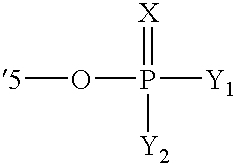
- wherein
-
- X is O or S;
- Y1 is OH or C1-C4 alkyl; and
- Y2 is H, OH or C1-C4 alkyl.
- In another embodiment each of the internucleoside linking groups is, independently, a phosphodiester or a phosphorothioate internucleoside linking group.
- In another embodiment the composition comprises at least one conjugate group.
- In another embodiment at least one of the first and the second oligomeric compounds further comprises at least one terminal cap moiety attached at the 3′-end, the 5′-end or both the 3′-end and the 5′-end. In a preferred embodiment the terminal cap moiety is an inverted deoxy a basic moiety.
- In one embodiment each of the first and second oligomeric compounds independently has from about 12 to about 24 nucleobases. In a more preferred embodiment each of the first and second oligomeric compounds independently has from about 19 to about 23 nucleobases. In another embodiment the first and the second oligomeric compounds form a complementary antisense/sense siRNA duplex.
- In one embodiment a method of inhibiting protein levels in a tumor in an animal is provided comprising contacting the animal with a composition of the invention. In a preferred embodiment the method of contacting is via intravenous administration. In another embodiment the tumor is a glioblastoma. In a further embodiment the protein is encoded by the surviving gene.
- In one embodiment each of the 2′-OCH3 modified nucleosides of the first oligomeric compound align with a 2′-F modified nucleoside of the second oligomeric compound. In a preferred embodiment the compositions comprise a 2′-OCH3 modified nucleoside at the 5′-terminus of the first oligomeric compound and a 2′-F modified nucleoside at the 3′-terminus of the second oligomeric compound. In another preferred the the last hybridized nucleoside at the 5′-terminus of the first oligomeric compound is a 2′-OCH3 modified nucleoside and the last hybridized nucleoside at 3′-terminus of the second oligomeric compound is a 2′-F modified nucleoside.
- In one embodiment the first oligomeric compound further comprises a 5′-phosphate group. In another embodiment the second oligomeric compound further comprises a 5′-phosphate group. In a further embodiment the first and the second oligomeric compounds independently, comprise a 5′-phosphate group.
- In one embodiment the first oligomeric compound comprises a 3′-terminal OH group.
- In one embodiment the nucleosides of each of the first and the second oligomeric compounds are linked by phosphodiester internucleoside linking groups. In another embodiment the nucleosides of each of the first and the second oligomeric compounds are linked by phosphorothioate internucleoside linking groups. In a further embodiment the nucleosides of one of the first and the second oligomeric compound are linked by phosphorothioate internucleoside linking groups and the nucleosides of the other of the first and the second oligomeric compound are linked by phosphodiester internucleoside linking groups. In another embodiment the nucleosides of the first oligomeric compound are linked by phosphorothioate internucleoside linking groups and the nucleosides of the second oligomeric compound are linked by phosphodiester internucleoside linking groups.
- In one embodiment each of the nucleosides of the first and the second oligomeric compound are independently linked by an internucleoside linking group selected from the group consisting of phosphodiester, phosphorothioate, chiral phosphorothioate, phosphorodithioate, phosphotriester, aminoalkylphosphotriester, methyl phosphonate, alkyl phosphonate, 5′-alkylene phosphonate, chiral phosphonate, phosphinate, phosphoramidate, 3′-amino phosphoramidate, aminoalkylphosphoramidate, thionophosphoramidate, thionoalkylphosphonate, thionoalkylphosphotriester, selenophosphate and boranophosphate.
- In one embodiment at least one of the first and the second oligomeric compounds further comprises at least one conjugate group attached at the 3′-end, the 5′-end or both the 3′-end and the 5′-end.
- In one embodiment at least one of the first and the second oligomeric compounds further comprises at least one terminal cap moiety attached at the 3′-end, the 5′-end or both the 3′-end and the 5′-end. In a preferred embodiment the terminal cap moiety is an inverted deoxy a basic moiety. In another embodiment one of the first and second oligomeric compounds is a sense strand and wherein the sense strand comprises a terminal cap moiety at one or both of the 3′-terminal and the 5′-terminal ends. In a preferred embodiment the terminal cap moiety is an inverted deoxy a basic moiety.
- In one embodiment each of the first and second oligomeric compounds independently has from about 8 to about 80 nucleobases. In another embodiment each of the first and second oligomeric compounds independently has from about 10 to about 50 nucleobases. In a further embodiment each of the first and second oligomeric compounds independently has from about 12 to about 30 nucleobases.
- In one embodiment the first and the second oligomeric compounds are a complementary pair of siRNA oligomeric compounds. In another embodiment the first and the second oligomeric compounds are an antisense/sense pair of oligomeric compounds. In a further embodiment the first oligomeric compound is an antisense oligomeric compound. In another embodiment the second oligomeric compound is a sense oligomeric compound.
- The present invention provides double stranded compositions wherein each strand comprises an alternating motif. The alternating motif of the present invention comprises 2′-OCH3 modified nucleosides that alternate with 2′-F modified nucleosides. In a preferred aspect of the present invention the the two strands hybridize such that the alternating 2′-OCH3 modified nucleosides from one strand align with the 2′-F modified nucleosides of the other strand to give an alternating motif having an offset register. A preferred composition comprises an siRNA duplex having an offset register with the alignment such that the 5′-end of the antisense strand has a 5′-OCH3 modified nucleoside as the terminal hybridizing nucleoside.
- In one aspect the compositions comprising alternating motifs of the present invention mimic RNA by having all of the nucleosides modified with either 2′-OCH3 or 2′-F which gives 3′-endo conformational geometry and enhances desired properties such as but not limited to modulation of pharmacokinetic properties through modification of protein binding, protein off-rate, absorption and clearance; modulation of nuclease stability as well as chemical stability; modulation of the binding affinity and specificity of the oligomer (affinity and specificity for enzymes as well as for complementary sequences); and increasing efficacy of RNA cleavage.
- In one aspect of the present invention compositions are provided comprising a first and a second oligomeric compound that are at least partially hybridized to form a duplex region and further comprising a region that is complementary to and hybridizes to a nucleic acid target. In one aspect the compositions include a first oligomeric compound that is an antisense strand having a complementary region to a nucleic acid target and a second oligomeric compound that is a sense strand having one or more regions of complementarity to and forming at least one duplex region with the first oligomeric compound.
- Compositions of the present invention are useful for the modulation of gene expression. In one aspect of the present invention a targeted cell, group of cells, a tissue or an animal is contacted with a composition of the invention to effect reduction of mRNA that can directly inhibit gene expression. In another embodiment the reduction of mRNA indirectly upregulates a non-targeted gene through a pathway that relates the targeted gene to a non-targeted gene. Numerous methods and models for the regulation of genes using compositions of the invention are illustrated in the art and some are illustrated in the examples.
- In one aspect the compositions of the invention modulate gene expression by hybridizing to a nucleic acid target resulting in loss of its normal function. As used herein, the term “target nucleic acid” or “nucleic acid target” is used for convenience to encompass any nucleic acid capable of being targeted including without limitation DNA, RNA (including pre-mRNA and mRNA or portions thereof) transcribed from such DNA, and also cDNA derived from such RNA. In a preferred embodiment of the invention the target nucleic acid is a messenger RNA. In a further preferred embodiment the degradation of the targeted messenger RNA is facilitated by an activated RISC complex that is formed with compositions of the invention. In another embodiment the degradation of the targeted messenger RNA is facilitated by a nuclease such as RNaseH.
- The hybridization of a composition of the invention with its target nucleic acid is generally referred to as “antisense”. Consequently, the preferred mechanism in the practice of some preferred embodiments of the invention is referred to herein as “antisense inhibition.” Such antisense inhibition is typically based upon hydrogen bonding-based hybridization of oligonucleotide strands or segments such that at least one strand or segment is cleaved, degraded, or otherwise rendered inoperable. In this regard, it is presently preferred to target specific nucleic acid molecules and their functions for such antisense inhibition.
- The functions of DNA to be interfered with can include replication and transcription. Replication and transcription, for example, can be from an endogenous cellular template, a vector, a plasmid construct or otherwise. The functions of RNA to be interfered with can include functions such as translocation of the RNA to a site of protein translation, translocation of the RNA to sites within the cell which are distant from the site of RNA synthesis, translation of protein from the RNA, splicing of the RNA to yield one or more RNA species, and catalytic activity or complex formation involving the RNA which may be engaged in or facilitated by the RNA. In the context of the present invention, “modulation” and “modulation of expression” mean either an increase (stimulation) or a decrease (inhibition) in the amount or levels of a nucleic acid molecule encoding the gene, e.g., DNA or RNA. Inhibition is often the preferred form of modulation of expression and mRNA is often a preferred target nucleic acid.
- The compositions and methods of the present invention are also useful in the study, characterization, validation and modulation of small non-coding RNAs. These include, but are not limited to, microRNAs (miRNA), small nuclear RNAs (snRNA), small nucleolar RNAs (snoRNA), small temporal RNAs (stRNA) and tiny non-coding RNAs (tncRNA) or their precursors or processed transcripts or their association with other cellular components.
- Small non-coding RNAs have been shown to function in various developmental and regulatory pathways in a wide range of organisms, including plants, nematodes and mammals. MicroRNAs are small non-coding RNAs that are processed from larger precursors by enzymatic cleavage and inhibit translation of mRNAs. stRNAs, while processed from precursors much like miRNAs, have been shown to be involved in developmental timing regulation. Other non-coding small RNAs are involved in events as diverse as cellular splicing of transcripts, translation, transport, and chromosome organization.
- As modulators of small non-coding RNA function, the compositions of the present invention find utility in the control and manipulation of cellular functions or processes such as regulation of splicing, chromosome packaging or methylation, control of developmental timing events, increase or decrease of target RNA expression levels depending on the timing of delivery into the specific biological pathway and translational or transcriptional control. In addition, the compositions of the present invention can be modified in order to optimize their effects in certain cellular compartments, such as the cytoplasm, nucleus, nucleolus or mitochondria.
- The compositions of the present invention can further be used to identify components of regulatory pathways of RNA processing or metabolism as well as in screening assays or devices.
- General Chemistry
- The term “alkyl,” as used herein, refers to a saturated straight or branched hydrocarbon radical containing up to twenty four carbon atoms. Examples of alkyl groups include, but are not limited to, methyl, ethyl, propyl, butyl, isopropyl, n-hexyl, octyl, decyl, dodecyl and the like. Alkyl groups typically include from 1 to about 24 carbon atoms, more typically from 1 to about 12 carbon atoms with from 1 to about 6 carbon atoms being more preferred. Alkyl groups as used herein may optionally include one or more further substitutent groups.
- The term “alkenyl,” as used herein, refers to a straight or branched hydrocarbon chain radical containing up to twenty four carbon atoms having at least one carbon-carbon double bond. Examples of alkenyl groups include, but are not limited to, ethenyl, propenyl, butenyl, 1-methyl-2-buten-1-yl, dienes such as 1,3-butadiene and the like. Alkenyl groups typically include from 2 to about 24 carbon atoms, more typically from 2 to about 12 carbon atoms with from 2 to about 6 carbon atoms being more preferred. Alkenyl groups as used herein may optionally include one or more further substitutent groups.
- The term “alkynyl,” as used herein, refers to a straight or branched hydrocarbon radical containing up to twenty four carbon atoms and having at least one carbon-carbon triple bond. Examples of alkynyl groups include, but are not limited to, ethynyl, 1 -propynyl, 1 -butynyl, and the like. Alkynyl groups typically include from 2 to about 24 carbon atoms, more typically from 2 to about 12 carbon atoms with from 2 to about 6 carbon atoms being more preferred. Alkynyl groups as used herein may optionally include one or more further substitutent groups.
- The term “aliphatic,” as used herein, refers to a straight or branched hydrocarbon radical containing up to twenty four carbon atoms wherein the saturation between any two carbon atoms is a single, double or triple bond. An aliphatic group preferably contains from 1 to about 24 carbon atoms, more typically from 1 to about 12 carbon atoms with from 1 to about 6 carbon atoms being more preferred. The straight or branched chain of an aliphatic group may be interrupted with one or more heteroatoms that include nitrogen, oxygen, sulfur and phosphorus. Such aliphatic groups interrupted by heteroatoms include without limitation polyalkoxys, such as polyalkylene glycols, polyamines, and polyimines, for example. Aliphatic groups as used herein may optionally include further substitutent groups.
- The term “alkoxy,” as used herein, refers to a radical formed between an alkyl group and an oxygen atom wherein the oxygen atom is used to attach the alkoxy group to a parent molecule. Examples of alkoxy groups include, but are not limited to, methoxy, ethoxy, propoxy, isopropoxy, n-butoxy, sec-butoxy, tert-butoxy, n-pentoxy, neopentoxy, n-hexoxy and the like. Alkoxy groups as used herein may optionally include further substitutent groups.
- The terms “halo” and “halogen,” as used herein, refer to an atom selected from fluorine, chlorine, bromine and iodine.
- The terms “aryl” and “aromatic,” as used herein, refer to a mono- or polycyclic carbocyclic ring system radical having one or more aromatic rings. Examples of aryl groups include, but not limited to, phenyl, naphthyl, tetrahydronaphthyl, indanyl, idenyl and the like. Aryl groups as used herein may optionally include further substitutent groups.
- The term “heterocyclic,” as used herein, refers to a radical mono-, or poly-cyclic ring system that includes at least one heteroatom and is unsaturated, partially saturated or fully saturated, thereby including heteroaryl groups. Heterocyclic is also meant to include fused ring systems wherein one or more of the fused rings contain no heteroatoms. A heterocyclic group typically includes at least one atom selected from sulfur, nitrogen or oxygen. Examples of heterocyclic groups include, [1,3]dioxolane, pyrrolidinyl, pyrazolinyl, pyrazolidinyl, imidazolinyl, imidazolidinyl, piperidinyl, piperazinyl, oxazolidinyl, isoxazolidinyl, morpholinyl, thiazolidinyl, isothiazolidinyl, quinoxalinyl, pyridazinonyl, tetrahydrofuryl and the like. Heterocyclic groups as used herein may optionally include further substitutent groups.
- The terms “substituent and substituent group,” as used herein, are meant to include groups that are typically added to other groups or parent compounds to enhance desired properties or give desired effects. Substituent groups can be protected or unprotected and can be added to one available site or to many available sites in a parent compound. Substituent groups may also be further substituted with other substituent groups and may be attached directly or via a linking group such as an alkyl or hydrocarbyl group to the parent compound. Such groups include without limitation, halogen, hydroxyl, alkyl, alkenyl, alkynyl, acyl (—C(O)Ra), carboxyl (—C(O)O—Ra), aliphatic, alicyclic, alkoxy, substituted oxo (—O—Ra), aryl, aralkyl, heterocyclic, heteroaryl, heteroarylalkyl, amino (—NRbRc), imino(═NRb), amido (—C(O)NRbRc or —N(Rb)C(O)Ra), azido (—N3), nitro (—NO2), cyano (-CN), carbamido (—OC(O)NRbRc or —N(Rb)C(O)ORa), ureido (—N(Rb)C(O)NRbRc), thioureido (—N(Rb)C(S)NRbRc), guanidinyl (—N(Rb)C(═NRb)NRbRc), amidinyl (—C(═NRb)NRbRc or —N(Rb)C(NRb)Ra), thiol (—SRb), sulfinyl (—S(O)Rb), sulfonyl (—S(O)2Rb) and sulfonamidyl (—S(O)2NRbRc or —N(Rb)S(O)2Rb). Wherein each Ra, Rb and Rc is a further substituent group with a preferred list including without limitation alkyl, alkenyl, alkynyl, aliphatic, alkoxy, acyl, aryl, aralkyl, heteroaryl, alicyclic, heterocyclic and heteroarylalkyl.
- The term “protecting group,” as used herein, refers to a labile chemical moiety which is known in the art to protect reactive groups including without limitation, hydroxyl, amino and thiol groups, against undesired reactions during synthetic procedures. Protecting groups are typically used selectively and/or orthogonally to protect sites during reactions at other reactive sites and can then be removed to leave the unprotected group as is or available for further reactions. Protecting groups as known in the art are described generally in Greene and Wuts, Protective Groups in Organic Synthesis, 3rd edition, John Wiley & Sons, New York (1999).
- Examples of hydroxyl protecting groups include, but are not limited to, benzyloxycarbonyl, 4-nitrobenzyloxycarbonyl, 4-bromobenzyloxycarbonyl, 4-methoxybenzyloxycarbonyl, methoxycarbonyl, tert-butoxycarbonyl (BOC), isopropoxycarbonyl, diphenylmethoxycarbonyl, 2,2,2-trichloroethoxycarbonyl, 2-(trimethylsilyl)ethoxycarbonyl, 2-furfuryloxycarbonyl, allyloxycarbonyl (Alloc), acetyl (Ac), formyl, chloroacetyl, trifluoroacetyl, methoxyacetyl, phenoxyacetyl, benzoyl (Bz), methyl, t-butyl, 2,2,2-trichloroethyl, 2-trimethylsilyl ethyl, 1,1-dimethyl-2-propenyl, 3-methyl-3-butenyl, allyl, benzyl (Bn), para-methoxybenzyldiphenylmethyl, triphenylmethyl (trityl), 4,4′-dimethoxytriphenylmethyl (DMT), substituted or unsubstituted 9-(9-phenyl)xanthenyl (pixyl), tetrahydrofuryl, methoxymethyl, methylthiomethyl, benzyloxymethyl, 2,2,2-trichloroethoxymethyl, 2-(trimethylsilyl)ethoxymethyl, methanesulfonyl, para-toluenesulfonyl, trimethylsilyl, triethylsilyl, triisopropylsilyl, and the like. Preferred hydroxyl protecting groups for the present invention are DMT and substituted or unsubstituted pixyl.
- Examples of amino protecting groups include, but are not limited to, t-butoxycarbonyl (BOC), 9-fluorenylmethoxycarbonyl (Fmoc), benzyloxycarbonyl, and the like.
- Examples of thiol protecting groups include, but are not limited to, triphenylmethyl (Trt), benzyl (Bn), and the like.
- The synthesized compounds can be separated from a reaction mixture and further purified by a method such as column chromatography, high pressure liquid chromatography, precipitation, or recrystallization. Further methods of synthesizing the compounds of the formulae herein will be evident to those of ordinary skill in the art. Additionally, the various synthetic steps may be performed in an alternate sequence or order to give the desired compounds. Synthetic chemistry transformations and protecting group methodologies (protection and deprotection) useful in synthesizing the compounds described herein are known in the art and include, for example, those such as described in R. Larock, Comprehensive Organic Transformations, VCH Publishers (1989); T. W. Greene and P. G. M. Wuts, Protective Groups in Organic Synthesis, 2d. Ed., John Wiley and Sons (1991); L. Fieser and M. Fieser, Fieser and Fieser's Reagents for Organic Synthesis, John Wiley and Sons (1994); and L. Paquette, ed., Encyclopedia of Reagents for Organic Synthesis, John Wiley and Sons (1995), and subsequent editions thereof.
- The compounds described herein contain one or more asymmetric centers and thus give rise to enantiomers, diastereomers, and other stereoisomeric forms that may be defined, in terms of absolute stereochemistry, as (R)— or (S)—, or as (D)— or (L)— for amino acids. The present invention is meant to include all such possible isomers, as well as their racemic and optically pure forms. Optical isomers may be prepared from their respective optically active precursors by the procedures described above, or by resolving the racemic mixtures. The resolution can be carried out in the presence of a resolving agent, by chromatography or by repeated crystallization or by some combination of these techniques which are known to those skilled in the art. Further details regarding resolutions can be found in Jacques, et al., Enantiomers, Racemates, and Resolutions (John Wiley & Sons, 1981). When the compounds described herein contain olefinic double bonds, other unsaturation, or other centers of geometric asymmetry, and unless specified otherwise, it is intended that the compounds include both E and Z geometric isomers or cis- and trans-isomers. Likewise, all tautomeric forms are also intended to be included. The configuration of any carbon-carbon double bond appearing herein is selected for convenience only and is not intended to designate a particular configuration unless the text so states; thus a carbon-carbon double bond or carbon-heteroatom double bond depicted arbitrarily herein as trans may be cis, trans, or a mixture of the two in any proportion.
- Mechanisms of Gene Modulation
- The terms “antisense” or “antisense inhibition” as used herein refer to the hybridization of an oligomeric compound or a portion thereof with a selected target nucleic acid. Multiple antisense mechanisms exist by which oligomeric compounds can be used to modulate gene expression in mammalian cells. Such antisense inhibition is typically based upon hydrogen bonding-based hybridization of complementary strands or segments such that at least one strand or segment is cleaved, degraded, or otherwise rendered inoperable. In this regard, it is presently suitable to target specific nucleic acid molecules and their functions for such antisense inhibition.
- The functions of DNA to be interfered with can include replication and transcription. Replication and transcription, for example, can be from an endogenous cellular template, a vector, a plasmid construct or otherwise. The functions of RNA to be interfered with can include functions such as translocation of the RNA to a site of protein translation, translocation of the RNA to sites within the cell which are distant from the site of RNA synthesis, translation of protein from the RNA, splicing of the RNA to yield one or more RNA species, and catalytic activity or complex formation involving the RNA which may be engaged in or facilitated by the RNA.
- A commonly exploited antisense mechanism is RNase H-dependent degradation of a targeted RNA. RNase H is a ubiquitously expressed endonuclease that recognizes antisense DNA-RNA heteroduplexes, hydrolyzing the RNA strand. A further antisense mechanism involves the utilization of enzymes that catalyze the cleavage of RNA-RNA duplexes. These reactions are catalyzed by a class of RNAse enzymes including but not limited to RNAse III and RNAse L. The antisense mechanism known as RNA interference (RNAi) is operative on RNA-RNA hybrids and the like. Both RNase H-based antisense (usually using single-stranded compounds) and RNA interference (usually using double-stranded compounds known as siRNAs) are antisense mechanisms, typically resulting in loss of target RNA function.
- Optimized siRNA and RNase H-dependent oligomeric compounds behave similarly in terms of potency, maximal effects, specificity and duration of action, and efficiency. Moreover it has been shown that in general, activity of dsRNA constructs correlated with the activity of RNase H-dependent single-stranded antisense oligomeric compounds targeted to the same site. One major exception is that RNase H-dependent antisense oligomeric compounds were generally active against target sites in pre-mRNA whereas siRNAs were not.
- These data suggest that, in general, sites on the target RNA that were not active with RNase H-dependent oligonucleotides were similarly not good sites for siRNA. Conversely, a significant degree of correlation between active RNase H oligomeric compounds and siRNA was found, suggesting that if a site is available for hybridization to an RNase H oligomeric compound, then it is also available for hybridization and cleavage by the siRNA complex. Consequently, once suitable target sites have been determined by either antisense approach, these sites can be used to design constructs that operate by the alternative antisense mechanism (Vickers et al., 2003, J. Biol. Chem. 278,7108). Moreover, once a site has been demonstrated as active for either an RNAi or an RNAse H oligomeric compound, a single-stranded RNAi oligomeric compound (ssRNAi or asRNA) can be designed.
- In some embodiments of the present invention, double-stranded antisense oligomeric compounds are suitable. These double-stranded antisense oligomeric compounds may be RNA or RNA-like, and may be modified or unmodified, in that modified oligomeric compounds retain the properties of forming an RNA:RNA hybrid and recruitment and (activation) of a dsRNase. In other embodiments, the single-stranded oligomeric compounds (ssRNAi or asRNA) may be RNA-like.
- The oligomeric compounds and methods of the present invention are also useful in the study, characterization, validation and modulation of small non-coding RNAs. These include, but are not limited to, microRNAs (miRNA), small nuclear RNAs (snRNA), small nucleolar RNAs (snoRNA), small temporal RNAs (stRNA) and tiny non-coding RNAs (tncRNA) or their precursors or processed transcripts or their association with other cellular components.
- Small non-coding RNAs have been shown to function in various developmental and regulatory pathways in a wide range of organisms, including plants, nematodes and mammals. MicroRNAs are small non-coding RNAs that are processed from larger precursors by enzymatic cleavage and inhibit translation of mRNAs. stRNAs, while processed from precursors much like miRNAs, have been shown to be involved in developmental timing regulation. Other non-coding small RNAs are involved in events as diverse as cellular splicing of transcripts, translation, transport, and chromosome organization.
- As modulators of small non-coding RNA function, the oligomeric compounds of the present invention find utility in the control and manipulation of cellular functions or processes such as regulation of splicing, chromosome packaging or methylation, control of developmental timing events, increase or decrease of target RNA expression levels depending on the timing of delivery into the specific biological pathway and translational or transcriptional control. In addition, the oligomeric compounds of the present invention can be modified in order to optimize their effects in certain cellular compartments, such as the cytoplasm, nucleus, nucleolus or mitochondria.
- The compounds of the present invention can further be used to identify components of regulatory pathways of RNA processing or metabolism as well as in screening assays or devices.
- Oligomeric Compounds
- The term “nucleoside,” as used herein, refers to a base-sugar combination. The base portion of the nucleoside is normally a heterocyclic base moiety. The two most common classes of such heterocyclic bases are purines and pyrimidines. Nucleotides are nucleosides that further include a phosphate group covalently linked to the sugar portion of the nucleoside. For those nucleosides that include a pentofuranosyl sugar, the phosphate group can be linked to either the 2′, 3′ or 5′ hydroxyl moiety of the sugar. Within the oligonucleotide structure, the phosphate groups are commonly referred to as forming the intemucleoside linkages of the oligonucleotide, or in conjunction with the sugar ring, the backbone of the oligonucleotide. In forming oligonucleotides, the phosphate groups covalently link adjacent nucleosides to one another to form a linear polymeric compound. The normal internucleoside linkage of RNA and DNA is a 3′ to 5′ phosphodiester linkage.
- In the context of this invention, the term “oligonucleoside” refers to a sequence of nucleosides that are joined by internucleoside linkages that do not have phosphorus atoms. Internucleoside linkages of this type are further described in the “modified internucleoside linkage” section below.
- The term “oligonucleotide,” as used herein, refers to an oligomer or polymer of ribonucleic acid (RNA) or deoxyribonucleic acid (DNA) composed of naturally occurring nucleobases, sugars and phosphodiester internucleoside linkages.
- The terms “oligomer” and “oligomeric compound,” as used herein, refer to a plurality of naturally occurring and/or non-naturally occurring nucleosides, joined together in a specific sequence, to form a polymeric structure. It is preferable that oligomeric compounds be capable of hybridizing a region of a target nucleic acid. Included in the terms “oligomer” and “oligomeric compound” are oligonucleotides, oligonucleotide analogs, oligonucleotide mimetics, oligonucleosides and chimeric combinations of these, and are thus intended to be broader than the term “oligonucleotide,” including all oligomers having all manner of modifications including but not limited to those known in the art. Oligomeric compounds are typically structurally distinguishable from, yet functionally interchangeable with, naturally-occurring or synthetic wild-type oligonucleo-tides. Thus, oligomeric compounds include all such structures that function effectively to mimic the structure and/or function of a desired RNA or DNA strand, for example, by hybridizing to a target. Such non-naturally occurring oligonucleotides are often desired over the naturally occurring forms because they often have enhanced properties, such as for example, enhanced cellular uptake, enhanced affinity for nucleic acid target and increased stability in the presence of nucleases.
- Oligomeric compounds can include double-stranded constructs such as, for example, two oligomeric compounds forming a double stranded hybridized construct or a single strand with sufficient self complementarity to allow for hybridization and formation of a fully or partially double-stranded compound. In one embodiment of the invention, double-stranded oligomeric compounds encompass short interfering RNAs (siRNAs). As used herein, the term “siRNA” is defined as a double-stranded construct comprising a first and second strand and having a central complementary portion between the first and second strands and terminal portions that are optionally complementary between the first and second strands or with a target nucleic acid. Each strand in the complex may have a length as defined above and may further comprise a central complementary portion having one of these defined lengths. Each strand may further comprise a terminal unhybridized portion having from 1 to about 6 nucleobases in length. The siRNAs may also have no terminal portions (overhangs). The two strands of an siRNA can be linked internally leaving free 3′ or 5′ termini or can be linked to form a continuous hairpin structure or loop. The hairpin structure may contain an overhang on either the 5′ or 3′ terminus producing an extension of single-stranded character.
- In one embodiment of the invention, double-stranded constructs are canonical siRNAs. As used herein, the term “canonical siRNA” is defined as a double-stranded oligomeric compound having a first strand and a second strand each strand being 21 nucleobases in length with the strands being complementary over 19 nucleobases and having on each 3′ termini of each strand a deoxy thymidine dimer (dTdT) which in the double-stranded compound acts as a 3′ overhang.
- In another embodiment, the double-stranded constructs are blunt-ended siRNAs. As used herein the term “blunt-ended siRNA” is defined as an siRNA having no terminal overhangs. That is, at least one end of the double-stranded constructs is blunt. siRNAs whether canonical or blunt act to elicit dsRNAse enzymes and trigger the recruitment or activation of the RNAi antisense mechanism. In a further embodiment, single-stranded RNAi (ssRNAi) compounds that act via the RNAi antisense mechanism are contemplated.
- Further modifications can be made to the double-stranded compounds and may include conjugate groups attached to one of the termini, selected nucleobase positions, sugar positions or to one of the internucleoside linkages. Alternatively, the two strands can be linked via a non-nucleic acid moiety or linker group. When formed from only one strand, dsRNA can take the form of a self-complementary hairpin-type molecule that doubles back on itself to form a duplex. Thus, the dsRNAs can be fully or partially double-stranded. When formed from two strands, or a single strand that takes the form of a self-complementary hairpin-type molecule doubled back on itself to form a duplex, the two strands (or duplex-forming regions of a single strand) are complementary RNA strands that base pair in Watson-Crick fashion.
- The oligomeric compounds in accordance with this invention preferably comprise from about 8 to about 80 nucleobases (i.e. from about 8 to about 80 linked nucleosides/monomeric subunits). One of ordinary skill in the art will appreciate that the invention embodies oligomeric compounds of 8, 9, 10, 11, 12, 13, 14, 15, 16, 17, 18, 19, 20, 21, 22, 23, 24, 25, 26, 27, 28, 29, 30, 31, 32, 33, 34, 35, 36, 37, 38, 39, 40, 41, 42, 43, 44, 45, 46, 47, 48, 49, 50, 51, 52, 53, 54, 55, 56, 57, 58, 59, 60, 61, 62, 63, 64, 65, 66, 67, 68, 69, 70, 71, 72, 73, 74, 75, 76, 77, 78, 79, or 80 nucleobases in length.
- In one preferred embodiment, the oligomeric compounds of the invention are 10 to 50 nucleobases in length. One having ordinary skill in the art will appreciate that this embodies oligomeric compounds of 10, 11, 12, 13, 14, 15, 16, 17, 18, 19, 20, 21, 22, 23, 24, 25, 26, 27, 28, 29, 30, 31, 32, 33, 34, 35, 36, 37, 38, 39, 40, 41, 42, 43, 44, 45, 46, 47, 48, 49, or 50 nucleobases in length.
- In another preferred embodiment, the oligomeric compounds of the invention are 12 to 30 nucleobases in length. One having ordinary skill in the art will appreciate that this embodies oligomeric compounds of 12, 13, 14, 15, 16, 17, 18, 19, 20, 21, 22, 23, 24, 25, 26, 27, 28, 29, or 30 nucleobases in length.
- In a further preferred embodiment, the oligomeric compounds of the invention are 12 to 24 nucleobases in length. One having ordinary skill in the art will appreciate that this embodies oligomeric compounds of 12, 13, 14, 15, 16, 17, 18, 19, 20, 21, 22, 23 or 24 nucleobases in length.
- In a further preferred embodiment, the oligomeric compounds of the invention are 19 to 23 nucleobases in length. One having ordinary skill in the art will appreciate that this embodies oligomeric compounds of 19, 20, 21, 22 or 23 nucleobases in length.
- One particularly preferred length for oligomeric compounds is from about 12 to about 30 nucleobases. Another particularly preferred length is from about 12 to about 24 nucleobases. A further particularly preferred length is from about 19 to about 23 nucleobases.
- Modified Sugars
- The term “modified sugar,” as used herein, refers to modifications of native ribofuranose and deoxyribofuranose sugars used in the nucleosides and oligomeric compounds of the invention. Modified sugars comprise nucleosides where the heterocyclic base moiety or modified heterocyclic base moiety is typically maintained for hybridization with an appropriate target nucleic acid. Such “modified sugars” are often desired over the naturally occurring forms because of advantageous properties they can impart to an oligomeric compound such as, for example, enhanced cellular uptake, enhanced affinity for nucleic acid target and increased stability to nuclease degredation. The term “modified sugar” is intended to include all manner of modifications known in the art including without limitation modifications to ring atoms and/or addition of substituent groups.
- The terms used to describe the conformational geometry of homoduplex nucleic acids are “A Form” for RNA and “B Form” for DNA, (determined from X-ray diffraction analysis of nucleic acid fibers, (see Arnott et al., Biochem. Biophys. Res. Comm., 1970, 47, 1504). In general, RNA:RNA duplexes are more stable and have higher melting temperatures (Tm's) than DNA:DNA duplexes (Sanger, Principles of Nucleic Acid Structure, 1984, Springer-Verlag; New York, N.Y.; Lesnik et al., Biochemistry, 1995, 34, 10807-10815; Conte et al., Nucleic Acids Res., 1997, 25, 2627-2634). The increased stability of RNA has been attributed to several structural features, most notably the improved base stacking interactions that result from an A-form geometry (Searle et al., Nucleic Acids Res., 1993, 21, 2051-2056). The presence of the 2 hydroxyl in RNA biases the sugar toward a C3′ endo pucker (also designated a Northern pucker), which causes the duplex to favor the A-form geometry. The 2′ hydroxyl groups of RNA also form a network of water mediated hydrogen bonds that help stabilize the RNA duplex (Egli et al., Biochemistry, 1996, 35, 8489-8494). Deoxy nucleic acids prefer a C2′ endo sugar pucker, (Southern pucker) imparting a less stable B-form geometry (Sanger, Principles of Nucleic Acid Structure, 1984, Springer-Verlag; New York).
- DNA:RNA hybrid duplexes are usually less stable than RNA:RNA duplexes, and depending on their sequence, may be either more or less stable than DNA:DNA duplexes (Searle et al., Nucleic Acids Res., 1993, 21, 2051-2056). The structure of a hybrid duplex is intermediate between A- and B-form geometries, which may result in poor stacking interactions (Lane et al., Eur. J. Biochem., 1993, 215, 297-306; Fedoroff et al., J. Mol. Biol., 1993, 233, 509-523; Gonzalez et al., Biochemistry, 1995, 34, 4969-4982; Horton et al., J. Mol. Biol., 1996, 264, 521-533).
- The stability of the duplex formed between a target RNA strand and a synthetic oligomeric strand is central to antisense therapies mediated by mechanisms such as, but not limited to, RNase H and RNA interference. Oligomeric compounds are also useful in antisense therapies by blocking transcription, blocking translation and in modulating splicing events. In the case of RNase H mediated gene modulation, effective mRNA inhibition requires a very high binding affinity between the RNA target and the oligomeric compound and also requires an RNA/DNA region where the enzyme effects degradation of the RNA strand. The triggering of RNA interference requires A form duplex geometry (i.e. predominantly 3′-endo) between the RNA target and the oligomeric compound. Substitution of modified nucleosides having 3′-endo conformational geometry in place of native RNA nucleosides can enhance the overall properties and activity of oligomeric compounds. Such enhanced properties include but aren't limited to modulation of pharmacokinetic properties through modification of protein binding, protein off-rate, absorption and clearance; modulation of nuclease stability as well as chemical stability; modulation of the binding affinity and specificity of the oligomer (affinity and specificity for enzymes as well as for complementary sequences); and increasing efficacy of RNA cleavage.
- The relative duplex stability can be enhanced by replacement of 2′-OH groups with 2′-F groups thereby increasing the C3′-endo population. It is assumed that the highly polar nature of the 2′-F bond and the extreme preference for C3′-endo puckering may stabilize the stacked conformation in an A-form duplex. Data from UV hypochromicity, circular dichroism, and 1H NMR also indicate that the degree of stacking decreases as the electronegativity of the halo substituent decreases. Furthermore, steric bulk at the 2′-position of the sugar moiety is better accommodated in an A-form duplex than a B-form duplex. Thus, a 2′-substituent on the 3′-terminus of a dinucleoside monophosphate is thought to exert a number of effects on the stacking conformation: steric repulsion, furanose puckering preference, electrostatic repulsion, hydrophobic attraction, and hydrogen bonding capabilities. These substituent effects are thought to be determined by the molecular size, electronegativity, and hydrophobicity of the substituent.
- In one aspect modified sugars include sugars comprising a substituent group. Such sugars can be referred to as a “substituted sugar” or “substituted sugar moiety. The substituent group can replace a hydrogen or other group thereby being an added substituent or a substituent that replaces a group such as the 2′-hydroxyl group of native RNA. Oligomeric compounds of the invention may contain one or more substituted sugar moieties and the substituent groups may vary from one nucleoside to another or may form regions or alternating motifs. These substituted sugar moieties may contain one, two, three, four or five substituents, at any position(s) on the sugar ring (namely 1′, 2′, 3′, 4′, or 5′). Oligomeric compounds are preferably modified at one or more positions including the 5′-position of the 5′-terminus, the 3′-position of the 3′-terminus, at any 2′-position of any nucleoside for 3′-5′-linked regions or at any 3′-position of any nucleoside for a 2′-5′-linked region. A more preferred substitution it the 2′-position of a 3′-5′-linked region.
- The basic furanose ring system can be chemically manipulated in a number of different ways. The configuration of attachment of the heterocyclic base to the 1′-position can result in the α-anomer (down) or the β-anomer (up). The β-anomer is the anomer found in native DNA and RNA but both forms can be used to prepare oligomeric compounds. A further manipulation can be achieved through the substitution the native form of the furanose with the enantiomeric form e.g. replacement of a native D-furanose with its mirror image enantiomer, the L-furanose. Another way to manipulate the furanose ring system is to prepare stereoisomers such as for example substitution at the 2′-position to give either the ribofuranose (down) or the arabinofuranose (up) or substitution at the 3′-position to give the xylofuranose or by altering the 2′, and the 3′-position simultaneously to give a lyxofuranose. The use of stereoisomers of the same substituent can give rise to completely different conformational geometry such as for example 2′-F which is 3′-endo in the ribo configuration and 2′-endo in the arabino configuration.
- Suitable sugar substituent groups include, but are not limited to: hydroxyl, F, Cl, Br, SH, CN, OCN, CF3, OCF3, SOCH3, SO2CH3, nitrate ester (ONO2), NO2, N3, NH2, O—, S—, or N(Rk)-alkly; O—, S—, or N(Rk)-alkenyl; O—, S— or N(Rk)-alkynyl; O-alkylenyl-O-alkyl, alkynyl, alkaryl, aralkyl, O-alkaryl, O-aralkyl, a heterocyclic group linked to the sugar through an alkylenyl group, an aryl group further substituted with a heterocyclic group linked to the aryl group through an alkylenyl group, an amino group further substituted with an aminoalkylenyl group, polyalkylenylamino, substituted silyl, an RNA cleaving group, a reporter group, an intercalator, a group for improving the pharmacokinetic properties of an oligonucleotide, and a group for improving the pharmacodynamic properties of an oligonucleotide, wherein the substituent groups are optionally substituted with further substituent groups as previously defined.
- Preferred sugar substituent groups are selected from: hydroxyl, F, O—, S—, or N(Rk)-alkyl; O—, S—, or N(Rk)-alkenyl; O—, S— or N(Rk)-alkynyl; or O-alkylene-O-alkyl, including O[(CH2)nO]mCH3, O(CH2)nOCH3, O(CH2)nNH2, O(CH2)nCH3, O(CH2)nONH2, and O(CH2)nON[(CH2)nH]2, where n and m are from 1 to about 10 and wherein the substituent groups are optionally substituted with further substituent groups as previously defined.
- Preferred 2′-sugar substituent groups include F, methoxy (—O—CH3), aminopropoxy (—O(CH2)3NH2), allyl (—CH2—CH═CH2), allyloxy (—O—CH2—CH═CH2), methoxyethoxy (—OCH2CH2OCH3, also known as 2′-MOE) (Martin et al., Helv. Chim. Acta, 1995, 78, 486-504), dimethylaminooxyethoxy (—O(CH2)2ON(CH3)2 or DMAOE), and dimethylaminoethoxyethoxy (—O(CH2)2O(CH2)2N(CH3)2, also known as -O-dimethylaminoethoxyethyl or DMAEOE).
- Nucleobases and Modified Nucleobases
- As used herein the term “heterocyclic base moiety” refers to nucleobases and modified or substitute nucleobases used to form nucleosides of the invention. The term “heterocyclic base moiety” includes unmodified nucleobases such as the native purine bases adenine (A) and guanine (G), and the pyrimidine bases thymine (T), cytosine (C) and uracil (U). The term is also intended to include all manner of modified or substitute nucleobases including but not limited to synthetic and natural nucleobases such as xanthine, hypoxanthine, 2-aminopyridine and 2-pyridone, 5-methylcytosine (5-me-C), 5-hydroxymethylenyl cytosine, 2-amino and 2-fluoroadenine, 2-propyl and other alkyl derivatives of adenine and guanine, 2-thio cytosine, uracil, thymine, 3-deaza guanine and adenine, 4-thiouracil, 5-uracil (pseudouracil), 5-propynyl (—C≡C—CH3) uracil and cytosine and other alkynyl derivatives of pyrimidine bases, 5-halo particularly 5-bromo, 5-trifluoromethyl and other 5-substituted uracils and cytosines, 6-methyl and other alkyl derivatives of adenine and guanine, 6-azo uracil, cytosine and thymine, 7-methyl adenine and guanine, 7-deaza adenine and guanine, 8-halo, 8-amino, 8-aza, 8-thio, 8-thioalkyl, 8-hydroxyl and other 8-substituted adenines and guanines, universal bases, hydrophobic bases, promiscuous bases, size-expanded bases, and fluorinated bases as defined herein. Further modified nucleobases include tricyclic pyrimidines such as phenoxazine cytidine(1H-pyrimido[5,4-b][1,4]benzoxazin-2(3H)-one) and phenothiazine cytidine (1H-pyrimido[5,4-b][1,4]benzothiazin-2(3H)-one).
- Further nucleobases (and nucleosides comprising the nucleobases) include those disclosed in U.S. Pat. No. 3,687,808, those disclosed in The Concise Encyclopedia Of Polymer Science And Engineering, pages 858-859, Kroschwitz, J. I., ed. John Wiley & Sons, 1990, those disclosed by Englisch et al., Angewandte Chemie, International Edition, 1991, 30, 613, those disclosed in Limbach et al., Nucleic Acids Research, 1994, 22(12), 2183-2196, and those disclosed by Sanghvi, Y. S., Chapter 15, Antisense Research and Applications, pages 289-302, Crooke, S. T. and Lebleu, B., ed., CRC Press, 1993.
- Certain of these nucleobases are particularly useful for increasing the binding affinity of the oligomeric compounds of the invention. These include 5-substituted pyrimidines, 6-azapyrimidines and N-2, N-6 and O-6 substituted purines, including 2-aminopropyl-adenine, 5-propynyluracil and 5-propynylcytosine. 5-methylcytosine substitutions have been shown to increase nucleic acid duplex stability by 0.6-1.2° C. (Sanghvi, Y. S., Crooke, S. T. and Lebleu, B., eds., Antisense Research and Applications, CRC Press, Boca Raton, 1993, pp. 276-278) and are especially useful when combined with 2′-O-methoxyethyl (2′-MOE) sugar modifications.
- Representative United States patents that teach the preparation of certain of the above noted modified nucleobases as well as other modified nucleobases include, but are not limited to, the above noted U.S. Pat. No. 3,687,808, as well as U.S. Pat. Nos.: 4,845,205; 5,130,302; 5,134,066; 5,175,273; 5,367,066; 5,432,272; 5,457,187; 5,459,255; 5,484,908; 5,502,177; 5,525,711; 5,552,540; 5,587,469; 5,594,121, 5,596,091; 5,614,617; 5,645,985; 5,830,653; 5,763,588; 6,005,096; 5,681,941, and 5,750,692.
- The term “universal base” as used herein, refers to a moiety that may be substituted for any base. The universal base need not contribute to hybridization, but should not significantly detract from hybridization and typically refers to a monomer in a first sequence that can pair with a naturally occuring base, i.e A, C, G, T or U at a corresponding position in a second sequence of a duplex in which one or more of the following is true: (1) there is essentially no pairing (hybridization) between the two; or (2) the pairing between them occurs non-discriminantly with the universal base hybridizing one or more of the the naturally occurring bases and without significant destabilization of the duplex. Exemplary universal bases include, without limitation, inosine, 5-nitroindole and 4-nitrobenzimidazole.

- Additional examples of universal bases include, but are not limited to, those shown below. For further examples and descriptions of universal bases see Survey and summary: the applications of universal DNA base analogs. Loakes, D. Nucleic Acids Research, 2001, 29, 12, 2437-2447.
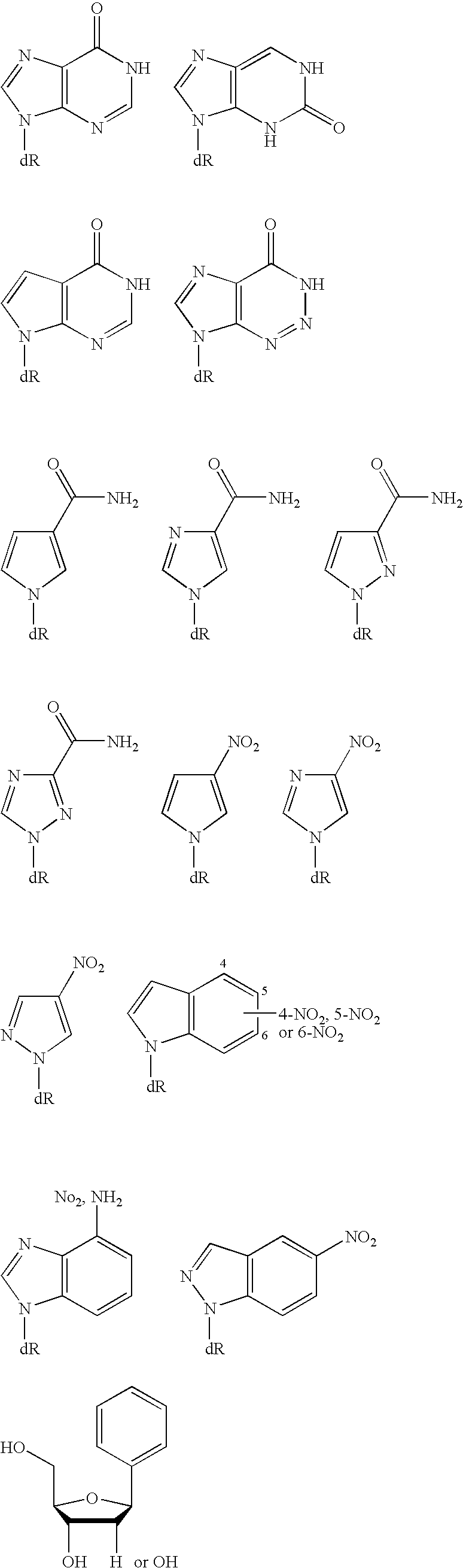
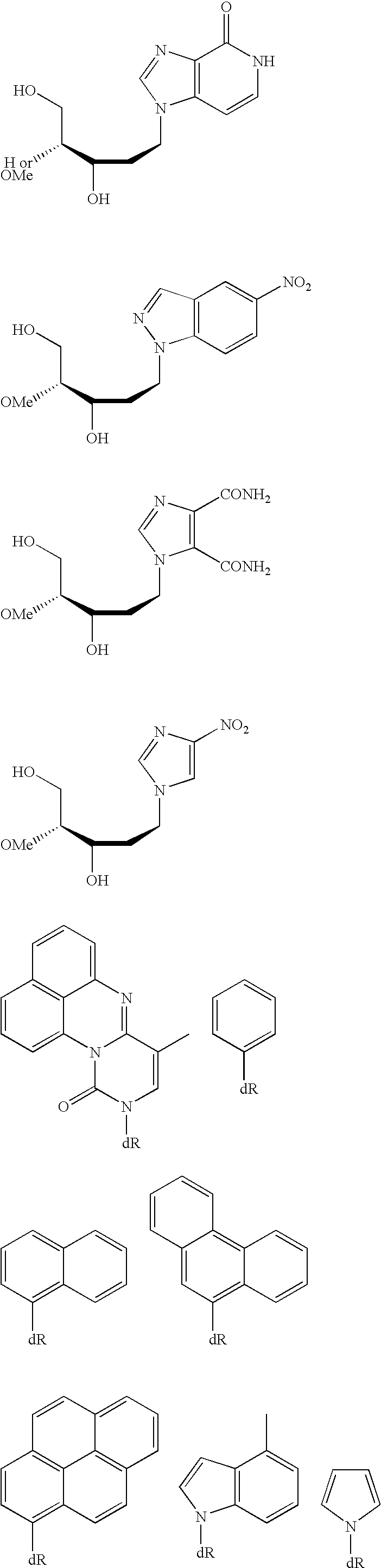
- The term “hydrophobic base” as used herein, refers to a heterocyclic base moiety that when used in a nucleoside monomer in a first sequence is able to pair with a naturally occuring base, i.e A, C, G, T or U at a corresponding position in a second sequence of a duplex in which one or more of the following is true: (1) the hydrophobic base acts as a non-polar close size and shape mimic (isostere) of one of the naturally occurring nucleosides; or (2) the hydrophobic base lacks all hydrogen bonding functionality on the Watson-Crick pairing edge.
- Examples of adenine isosteres include, but are not limited to those shown below. For further examples and definitions of adenine isosteres see Probing the requirements for recognition and catalysis in Fpg and MutY with nonpolar adenine isosteres. Francis, A W, Helquist, S A, Kool, E T, David, S S. J. Am. Chem. Soc., 2003, 125, 16235-16242 or Structure and base pairing properties of a replicable nonpolar isostere for deoxyadenosine (Guckian, K M, Morales, J C, Kool, E T. J. Org. Chem., 1998, 63, 9652-96565.)
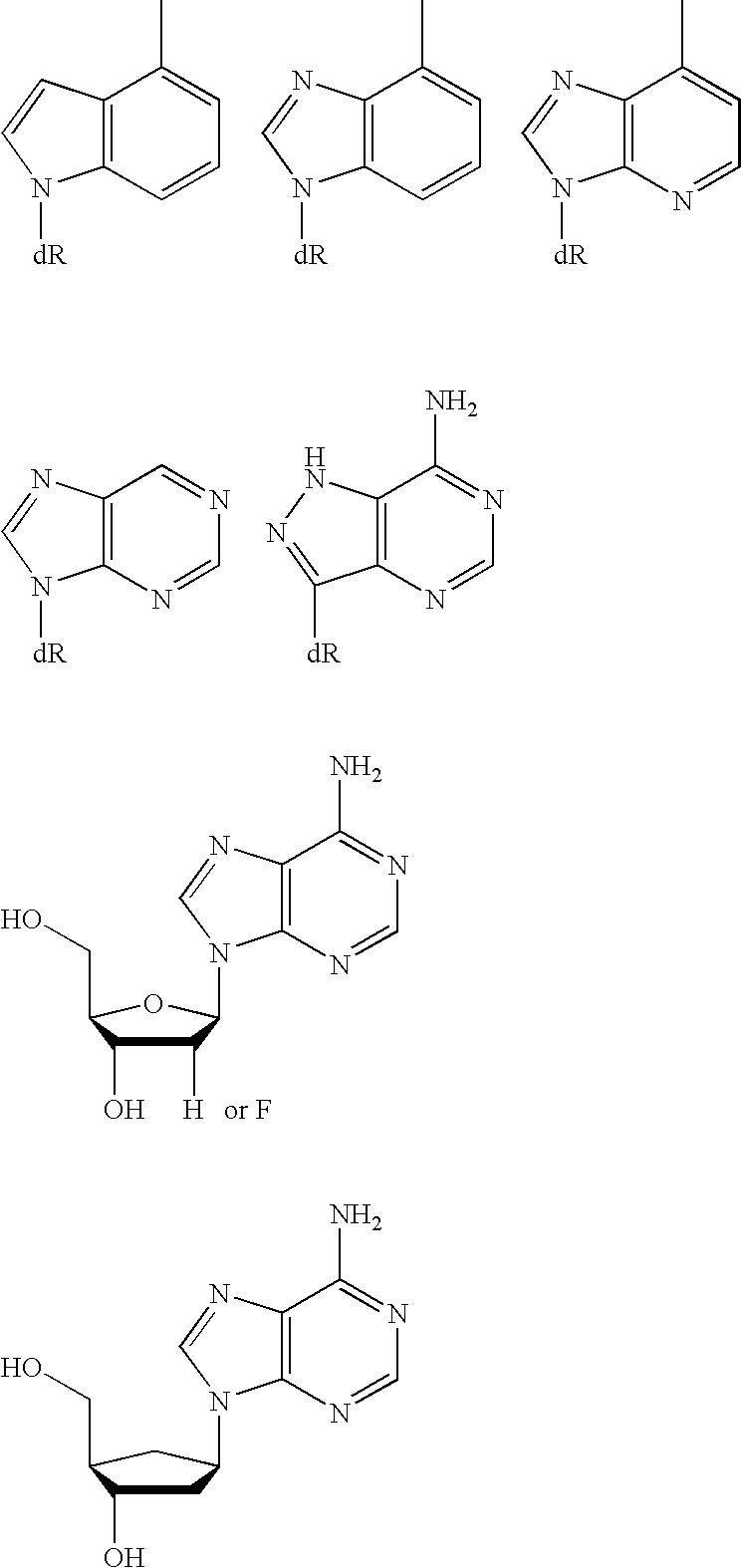
- A non-limiting example of a cytosine isostere is 2-fluoro4-methylbenzene deoxyribonucleoside, shown below. For additional information on cytosine isosteres see Hydrolysis of RNA/DNA hybrids containing nonpolar pyrimidine isosteres defines regions essential for HIV type polypurine tract selection. Rausch, J W, Qu, J, Yi-Brunozzi H Y, Kool, E T, LeGrice, SFJ. Proc. Natl. Acad. Sci., 2003, 100, 11279-11284.
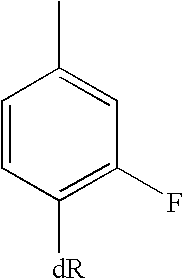
- A non-limiting example of a guanosine isostere is 4-fluoro-6-methylbenzimidazole deoxyribonucleoside, shown below. For additional information on guanosine isosteres, see A highly effective nonpolar isostere of doeoxguanosine: synthesis, structure, stacking and base pairing (O'Neil, B M, Ratto, J E, Good, K L, Tahmassebi, D C, Helquist, S A, Morales, J C, Kool, E T. J. Org. Chem., 2002, 67, 5869-5875.)
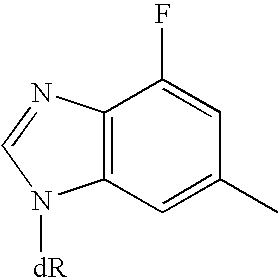
- A non-limiting example of a thymidine isostere is 2,4-difluoro-5-toluene deoxyribonucleoside, shown below. For additional information on thymidine isosteres see: Moran, S, Ren, RX-F, Kool, E T. Proc. Natl. Acad. Sci., 1997, 94, 10506-10511 or J. Am. Chem. Soc. 1997, 119, 2056-2057.

- The term “promiscuous base” as used herein, refers to a monomer in a first sequence that can pair with a naturally occuring base, i.e A, C, G, T or U at a corresponding position in a second sequence of a duplex in which the promiscuous base can pair non-discriminantly with more than one of the naturally occurring bases, i.e. A, C, G, T, U. Non-limiting examples of promiscuous bases are 6H,8H-3,4-dihydropyrimido[4,5-c][1,2]oxazin-7-one and N6-methoxy-2,6-diaminopurine, shown below. For further information, see Polymerase recognition of synthetic oligodeoxyribonucleotides incorporating degenerate pyrimidine and purine bases. Hill, F.; Loakes, D.; Brown, D. M. Proc. Natl. Acad. Sci., 1998, 95, 4258-4263.
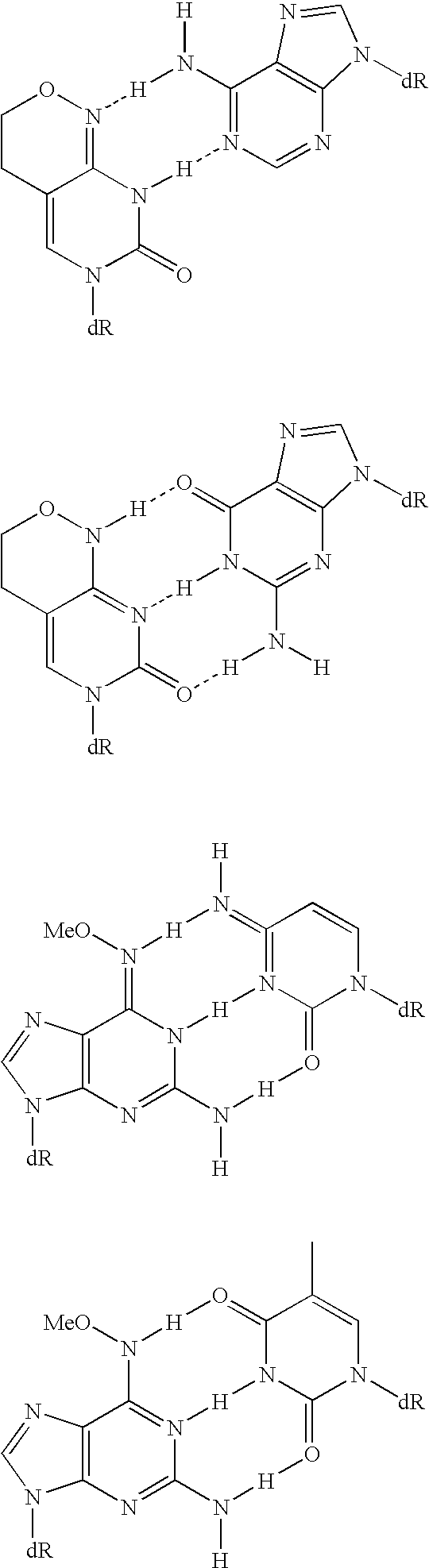
- The term “size expanded base” as used herein, refers to analogs of naturally occurring nucleobases that are larger in size and retain their Watson-Crick pairing ability. Two non-limiting examples of size-expanded bases are shown below. For further discussions of size expanded bases see Liu et al., Science, 2003, 302, 868-871; Liu et al., J. Am. Chem. Soc. 2004, 126, 1102-1109; and Gao et al., J. Am. Chem. Soc. 2004, 126, 11826-11831.
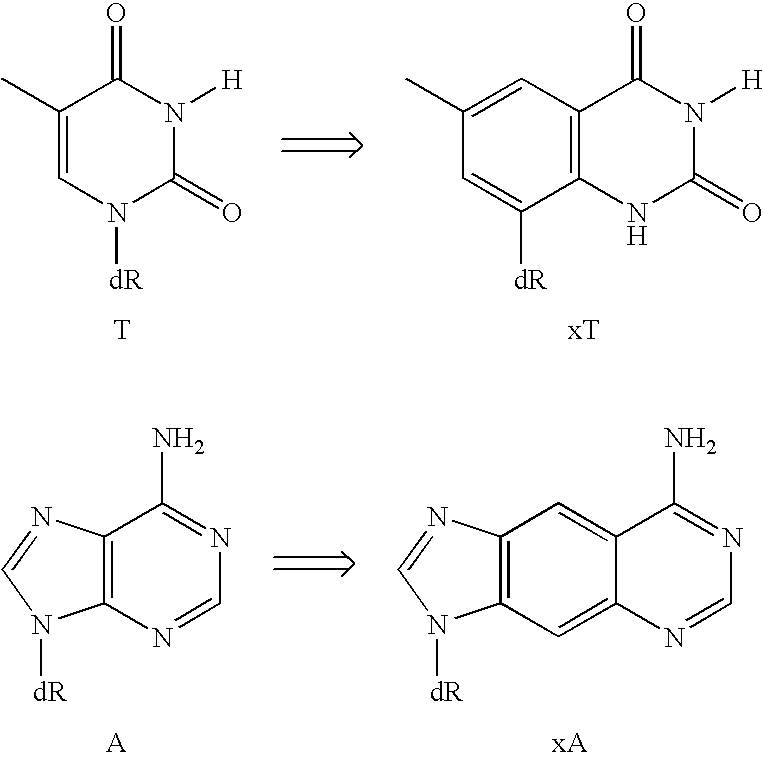
- The term “fluorinated nucleobase” as used herein, refers to a nucleobase or nucleobase analog, wherein one or more of the aromatic ring substituents is a fluorine atom. It may be possible that all of the ring substituents are fluorine atoms. Some non-limiting examples of fluorinated nucleobase are shown below. For further examples of fluorinated nucleobases see Lai et al., Angew. Chem. Int. Ed., 2003, 42, 5973-5977; Lai et al., J. Am. Chem. Soc., 2004, 126, 3040-3041; Kloppfer et al., Nucleosides, Nucleotides & Nucleic Acids, 2003, 22, 1347-1350; and Klopffer et al., ChemBioChem., 2003, 5, 707-716.
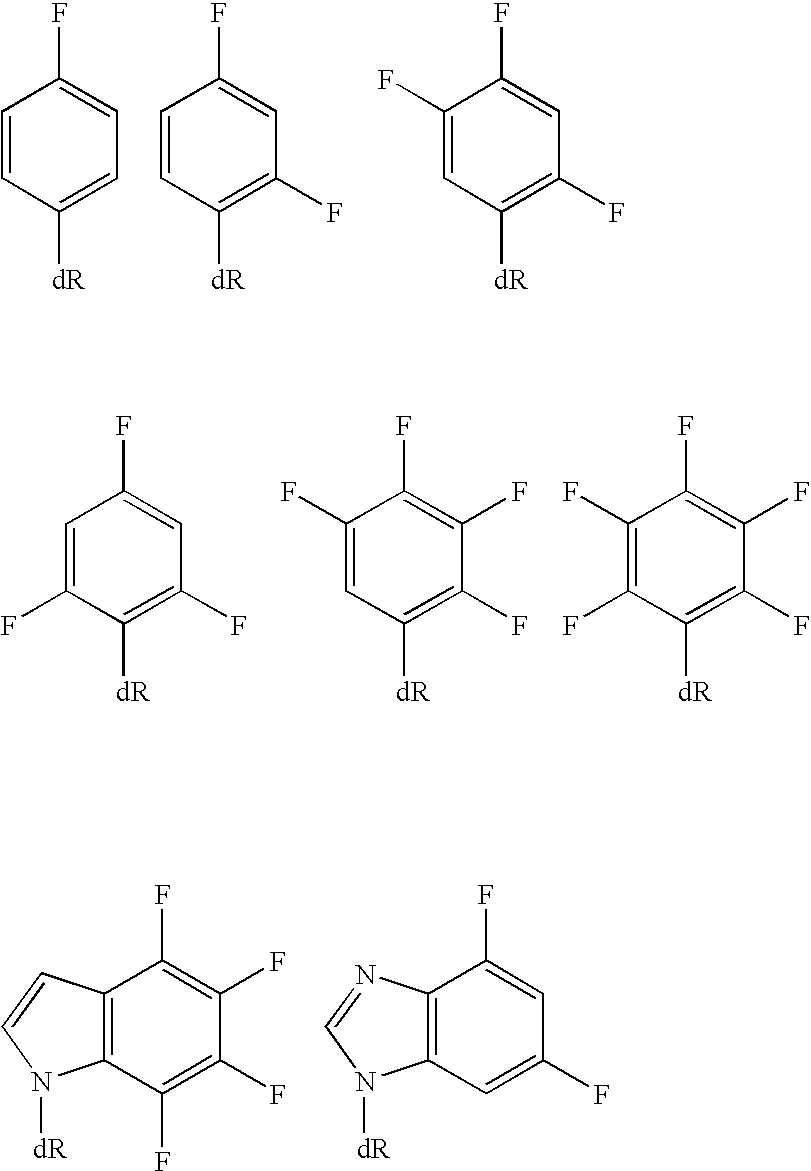
- Other modified nucleobases include polycyclic heterocyclic moieties, which are routinely used in antisense applications to increase the binding properties of the modified strand to a target strand. The most studied modifications are targeted to guanosines hence they have been termed G-clamps or cytidine analogs.
- Examples of G-clamps include substituted phenoxazine cytidine (e.g. 9-(2-aminoethoxy)-H-pyrimido[5,4-b][1,4]benzoxazin-2(3H)-one), carbazole cytidine (2H-pyrimido[4,5-b]indol-2-one) and pyridoindole cytidine (H-pyrido[3′,2′:4,5]pyrrolo[2,3-d]pyrimidin-2-one).
- Representative cytosine analogs that make 3 hydrogen bonds with a guanosine in a second oligonucleotide include 1,3-diazaphenoxazine-2-one (Kurchavov, et al., Nucleosides and Nucleotides, 1997, 16, 1837-1846), 1,3-diazaphenothiazine-2-one (Lin, K.-Y.; Jones, R. J.; Matteucci, M. J. Am. Chem. Soc. 1995, 117, 3873-3874) and 6,7,8,9-tetrafluoro-1,3-diazaphenoxazine-2-one (Wang, J.; Lin, K.-Y., Matteucci, M. Tetrahedron Lett. 1998, 39, 8385-8388). When incorporated into oligonucleotides these base modifications hybridized with complementary guanine (the latter also hybridized with adenine) and enhanced helical thermal stability by extended stacking interactions (see U.S. patent application Ser. No. 10/013,295).
- Modified Internucleoside Linkages
- The terms “modified internucleoside linkage” and “modified backbone,” or simply “modified linkage” as used herein, refer to modifications or replacement of the naturally occurring phosphodiester internucleoside linkage connecting two adjacent nucleosides within an oligomeric compound. Such modified linkages include those that have a phosphorus atom and those that do not have a phosphorus atom.
- Internucleoside linkages containing a phosphorus atom therein include, for example, phosphorothioates, chiral phosphorothioates, phosphorodithioates, phosphotriesters, aminoalkylphosphotriesters, methyl and other alkyl phosphonates including 3′-alkylene phosphonates, 5′-alkylene phosphonates and chiral phosphonates, phosphinates, phosphoramidates including 3′-amino phosphoramidate and aminoalkylphosphoramidates, thionophosphoramidates, thionoalkylphosphonates, thionoalkylphosphotriesters, selenophosphates and boranophosphates having normal 3′-5′ linkages, 2′-5′ linked analogs of these, and those having inverted polarity wherein one or more internucleotide linkages is a 3′ to 3′, 5′ to 5′ or 2′ to 2′ linkage. Oligonucleotides having inverted polarity can comprise a single 3′ to 3′ linkage at the 3′-most internucleotide linkage i.e. a single inverted nucleoside residue which may be a basic (the nucleobase is missing or has a hydroxyl group in place thereof). Various salts, mixed salts and free acid forms are also included. Representative U.S. patents that teach the preparation of the above phosphorus-containing linkages include, but are not limited to, U.S. Pat. Nos.: 3,687,808; 4,469,863; 4,476,301; 5,023,243; 5,177,196; 5,188,897; 5,264,423; 5,276,019; 5,278,302; 5,286,717; 5,321,131; 5,399,676; 5,405,939; 5,453,496; 5,455,233; 5,466,677; 5,476,925; 5,519,126; 5,536,821; 5,541,306; 5,550,111; 5,563,253; 5,571,799; 5,587,361; 5,194,599; 5,565,555; 5,527,899; 5,721,218; 5,672,697 and 5,625,050.
- In the C. elegans system, modification of the internucleotide linkage (phosphorothioate in place of phosphodiester) did not significantly interfere with RNAi activity, indicating that oligomeric compounds of the invention can have one or more modified internucleoside linkages, and retain activity. Indeed, such modified internucleoside linkages are often desired over the naturally occurring phosphodiester linkage because of advantageous properties they can impart such as, for example, enhanced cellular uptake, enhanced affinity for nucleic acid target and increased stability in the presence of nucleases.
- Another phosphorus containing modified internucleoside linkage is the phosphono-monoester (see U.S. Pat. Nos. 5,874,553 and 6,127,346). Phosphonomonoester nucleic acids have useful physical, biological and pharmacological properties in the areas of inhibiting gene expression (antisense oligonucleotides, ribozymes, sense oligonucleotides and triplex-forming oligonucleotides), as probes for the detection of nucleic acids and as auxiliaries for use in molecular biology.
- As previously defined an oligonucleoside refers to a sequence of nucleosides that are joined by internucleoside linkages that do not have phosphorus atoms. Non-phosphorus containing internucleoside linkages include short chain alkyl, cycloalkyl, mixed heteroatom alkyl, mixed heteroatom cycloalkyl, one or more short chain heteroatomic and one or more short chain heterocyclic. These internucleoside linkages include but are not limited to siloxane, sulfide, sulfoxide, sulfone, acetyl, formacetyl, thioformacetyl, methylene formacetyl, thioformacetyl, alkeneyl, sulfamate; methyleneimino, methylenehydrazino, sulfonate, sulfonamide, amide and others having mixed N, O, S and CH2 component parts. Representative United States patents that teach the preparation of the above oligonucleosides include, but are not limited to, U.S. Pat. Nos.: 5,034,506; 5,166,315; 5,185,444; 5,214,134; 5,216,141; 5,235,033; 5,264,562; 5,264,564; 5,405,938; 5,434,257; 5,466,677; 5,470,967; 5,489,677; 5,541,307; 5,561,225; 5,596,086; 5,602,240; 5,610,289; 5,602,240; 5,608,046; 5,610,289; 5,618,704; 5,623,070; 5,663,312; 5,633,360; 5,677,437; 5,792,608; 5,646,269 and 5,677,439.
- Some additional examples of modified internucleoside linkages that do not contain a phosphorus atom therein include, —CH2—NH—O—CH2—, —CH2—N(CH3)—O—CH2— (known as a methylene (methylimino) or MMI backbone), —CH2—O—N(CH3)—CH2—, —CH2—N(CH3)—N(CH3)—CH2— and —O—N(CH3)—CH2—CH2— (wherein the native phosphodiester internucleotide linkage is represented as —O—P(═O)(OH)—O—CH2—). The MMI type and amide internucleoside linkages are disclosed in the below referenced U.S. Pat. Nos. 5,489,677 and 5,602,240, respectively.
- Conjugates
- Another modification that can enhance the properties of an oligomeric compound or can be used to track the oligomeric compound or its metabolites is the attachment of one or more moieties or conjugates. Properties that are typically enhanced include without limitation activity, cellular distribution and cellular uptake. In one embodiment, such modified oligomeric compounds are prepared by covalently attaching conjugate groups to functional groups available on an oligomeric compound such as hydroxyl or amino functional groups. Conjugate groups of the invention include intercalators, reporter molecules, polyamines, polyamides, polyethylene glycols, polyethers, groups that enhance the pharmacodynamic properties of oligomers, and groups that enhance the pharmacokinetic properties of oligomers. Typical conjugate groups include cholesterols, lipids, phospholipids, biotin, phenazine, folate, phenanthridine, anthraquinone, acridine, fluoresceins, rhodamines, coumarins, and dyes. Groups that enhance the pharmacodynamic properties, in the context of this invention, include groups that improve properties including but not limited to oligomer uptake, enhance oligomer resistance to degradation, and/or strengthen sequence-specific hybridization with RNA. Groups that enhance the pharmacokinetic properties, in the context of this invention, include groups that improve properties including but not limited to oligomer uptake, distribution, metabolism and excretion. Representative conjugate groups are disclosed in International Patent Application PCT/US92/09196.
- Conjugate groups include but are not limited to lipid moieties such as a cholesterol moiety (Letsinger et al., Proc. Natl. Acad. Sci. USA, 1989, 86, 6553-6556), cholic acid (Manoharan et al., Bioorg. Med. Chem. Let., 1994, 4, 1053-1060), a thioether, e.g., hexyl-S-tritylthiol (Manoharan et al., Ann. N.Y. Acad. Sci., 1992, 660, 306-309; Manoharan et al., Bioorg. Med. Chem. Let., 1993, 3, 2765-2770), a thiocholesterol (Oberhauser et al., Nucl. Acids Res., 1992, 20, 533-538), an aliphatic chain, e.g., dodecandiol or undecyl residues (Saison-Behmoaras et al., EMBO J., 1991, 10, 1111-1118; Kabanov et al., FEBS Lett., 1990, 259, 327-330; Svinarchuk et al., Biochimie, 1993, 75, 49-54), a phospholipid, e.g., di-hexadecyl-rac-glycerol or triethylammonium 1,2-di-O-hexadecyl-rac-glycero-3-H-phosphonate (Manoharan et al., Tetrahedron Lett., 1995, 36, 3651-3654; Shea et al., Nucl. Acids Res., 1990, 18, 3777-3783), a polyamine or a polyethylene glycol chain (Manoharan et al., Nucleosides & Nucleotides, 1995, 14, 969-973), or adamantane acetic acid (Manoharan et al., Tetrahedron Lett., 1995, 36, 3651-3654), a palmityl moiety (Mishra et al., Biochim. Biophys. Acta, 1995, 1264, 229-237), or an octadecylamine or hexylamino-carbonyl-oxycholesterol moiety (Crooke et al., J. Pharmacol. Exp. Ther., 1996, 277, 923-937).
- The oligomeric compounds of the invention may also be conjugated to active drug substances, for example, aspirin, warfarin, phenylbutazone, ibuprofen, suprofen, fenbufen, ketoprofen, (S)-(+)-pranoprofen, carprofen, dansylsarcosine, 2,3,5-triiodobenzoic acid, flufenamic acid, folinic acid, a benzothiadiazide, chlorothiazide, a diazepine, indomethicin, a barbiturate, a cephalosporin, a sulfa drug, an antidiabetic, an antibacterial or an antibiotic. Oligonucleotide-drug conjugates and their preparation are described in U.S. patent application Ser. No. 09/334,130.
- Representative U.S. patents that teach the preparation of such oligonucleotide conjugates include, but are not limited to, U.S. Pat. Nos.: 4,828,979; 4,948,882; 5,218,105; 5,525,465; 5,541,313; 5,545,730; 5,552,538; 5,578,717, 5,580,731; 5,580,731; 5,591,584; 5,109,124; 5,118,802; 5,138,045; 5,414,077; 5,486,603; 5,512,439; 5,578,718; 5,608,046; 4,587,044; 4,605,735; 4,667,025; 4,762,779; 4,789,737; 4,824,941; 4,835,263; 4,876,335; 4,904,582; 4,958,013; 5,082,830; 5,112,963; 5,214,136; 5,082,830; 5,112,963; 5,214,136; 5,245,022; 5,254,469; 5,258,506; 5,262,536; 5,272,250; 5,292,873; 5,317,098; 5,371,241, 5,391,723; 5,416,203, 5,451,463; 5,510,475; 5,512,667; 5,514,785; 5,565,552; 5,567,810; 5,574,142; 5,585,481; 5,587,371; 5,595,726; 5,597,696; 5,599,923; 5,599,928 and 5,688,941.
- Oligomeric compounds used in the compositions of the present invention can also be modified to have one or more stabilizing groups that are generally attached to one or both termini of oligomeric compounds to enhance properties such as for example nuclease stability. Included in stabilizing groups are cap structures. The terms “cap structure” or “terminal cap moiety,” as used herein, refer to chemical modifications, which can be attached to one or both of the termini of an oligomeric compound. These terminal modifications protect the oligomeric compounds having terminal nucleic acid moieties from exonuclease degradation, and can help in delivery and/or localization within a cell. The cap can be present at the 5′-terminus (5′-cap) or at the 3′-terminus (3′-cap) or can be present on both termini. In non-limiting examples, the 5′-cap includes inverted abasic residue (moiety), 4′,5′-methylene nucleotide; 1-(beta-D-erythrofuranosyl) nucleotide, 4′-thio nucleotide, carbocyclic nucleotide; 1,5-anhydrohexitol nucleotide; L-nucleotides; alpha-nucleotides; modified base nucleotide; phosphorodithioate linkage; threo-pentofuranosyl nucleotide; acyclic 3′,4′-seco nucleotide; acyclic 3,4-dihydroxybutyl nucleotide; acyclic 3,5-dihydroxypentyl riucleotide, 3′-3′-inverted nucleotide moiety; 3′-3′-inverted abasic moiety; 3′-2′-inverted nucleotide moiety; 3′-2′-inverted abasic moiety; 1,4-butanediol phosphate; 3′-phosphoramidate; hexylphosphate; aminohexyl phosphate; 3′-phosphate; 3′-phosphorothioate; phosphorodithioate; or bridging or non-bridging methylphosphonate moiety (for more details see Wincott et al., International PCT publication No. WO 97/26270, incorporated by reference herein).
- Particularly preferred 3′-cap structures of the present invention include, for example 4′,5′-methylene nucleotide; 1-(beta-D-erythrofuranosyl) nucleotide; 4′-thio nucleotide, carbocyclic nucleotide; 5′-amino-alkyl phosphate; 1,3-diamino-2-propyl phosphate, 3-aminopropyl phosphate; 6-aminohexyl phosphate; 1,2-aminododecyl phosphate; hydroxypropyl phosphate; 1,5-anhydrohexitol nucleotide; L-nucleotide; alpha-nucleotide; modified base nucleotide; phosphorodithioate; threo-pentofuranosyl nucleotide; acyclic 3′,4′-seco nucleotide; 3,4-dihydroxybutyl nucleotide; 3,5-dihydroxypentyl nucleotide, 5′-5′-inverted nucleotide moiety; 5′-5′-inverted abasic moiety; 5′-phosphoramidate; 5′-phosphorothioate; 1,4-butanediol phosphate; 5′-amino; bridging and/or non-bridging 5′-phosphoramidate, phosphorothioate and/or phosphorodithioate, bridging or non bridging methylphosphonate and 5′-mercapto moieties (for more details see Beaucage and Tyer, 1993, Tetrahedron 49, 1925 and Published U.S. Patent Application Publication Number US 2005/0020525 published on Jan. 27, 2005).
- Further 3′ and 5′-stabilizing groups that can be used to cap one or both ends of an oligomeric compound to impart nuclease stability include those disclosed in WO 03/004602.
- Oligomer Synthesis
- Oligomerization of modified and unmodified nucleosides is performed according to literature procedures for DNA (Protocols for Oligonucleotides and Analogs, Ed. Agrawal (1993), Humana Press) and/or RNA (Scaringe, Methods (2001), 23, 206-217. Gait et al., Applications of Chemically synthesized RNA in RNA:Protein Interactions, Ed. Smith (1998), 1-36. Gallo et al., Tetrahedron (2001), 57, 5707-5713) synthesis as appropriate. In addition specific protocols for the synthesis of oligomeric compounds of the invention are illustrated in the examples below.
- Oligonucleotides are generally prepared either in solution or on a support medium, e.g. a solid support medium. In general a first synthon (e.g. a monomer, such as a nucleoside) is first attached to a support medium, and the oligonucleotide is then synthesized by sequentially coupling monomers to the support-bound synthon. This iterative elongation eventually results in a final oligomeric compound or other polymer such as a polypeptide. Suitable support medium can be soluble or insoluble, or may possess variable solubility in different solvents to allow the growing support bound polymer to be either in or out of solution as desired. Traditional support medium such as solid support media are for the most part insoluble and are routinely placed in reaction vessels while reagents and solvents react with and/or wash the growing chain until the oligomer has reached the target length, after which it is cleaved from the support and, if necessary further worked up to produce the final polymeric compound. More recent approaches have introduced soluble supports including soluble polymer supports to allow precipitating and dissolving the iteratively synthesized product at desired points in the synthesis (Gravert et al., Chem. Rev., 1997, 97, 489-510).
- The term support medium is intended to include all forms of support known to one of ordinary skill in the art for the synthesis of oligomeric compounds and related compounds such as peptides. Some representative support medium that are amenable to the methods of the present invention include but are not limited to the following: controlled pore glass (CPG); oxalyl-controlled pore glass (see, e.g., Alul, et al., Nucleic Acids Research 1991, 19, 1527); silica-containing particles, such as porous glass beads and silica gel such as that formed by the reaction of trichloro-[3-(4-chloromethyl)phenyl]propylsilane and porous glass beads (see Parr and Grohmann, Angew. Chem. Internal. Ed. 1972, 11, 314, sold under the trademark “PORASIL E” by Waters Associates, Framingham, Mass., USA); the mono ester of 1,4-dihydroxymethylenlybenzene and silica (see Bayer and Jung, Tetrahedron Lett., 1970, 4503, sold under the trademark “BIOPAK” by Waters Associates); TENTAGEL (see, e.g., Wright, et al., Tetrahedron Letters 1993, 34, 3373); cross-linked styrene/divinylbenzene copolymer beaded matrix or POROS, a copolymer of polystyrene/divinylbenzene (available from Perceptive Biosystems); soluble support medium, polyethylene glycol PEG's (see Bonora et al., Organic Process Research & Development, 2000, 4, 225-231).
- Support bound oligonucleotide synthesis relies on sequential addition of nucleotides to one end of a growing chain. Typically, a first nucleoside (having protecting groups on any exocyclic amine functionalities present) is attached to an appropriate glass bead support and nucleotides bearing the appropriate activated phosphite moiety, i.e. an “activated phosphorous group” (typically nucleotide phosphoramidites, also bearing appropriate protecting groups) are added stepwise to elongate the growing oligonucleotide. Additional methods for solid-phase synthesis may be found in Caruthers U.S. Pat. Nos. 4,415,732; 4,458,066; 4,500,707; 4,668,777; 4,973,679; and 5,132,418; and Koster U.S. Pat. Nos. 4,725,677 and Re. 34,069.
- Commercially available equipment routinely used for the support medium based synthesis of oligomeric compounds and related compounds is sold by several vendors including, for example, Applied Biosystems (Foster City, Calif.). Any other means for such synthesis known in the art may additionally or alternatively be employed. Suitable solid phase techniques, including automated synthesis techniques, are described in F. Eckstein (ed.), Oligonucleotides and Analogues, a Practical Approach, Oxford University Press, New York (1991).
- The term “linking moiety,” as used herein is generally a bi-functional group, covalently binds the ultimate 3′-nucleoside (and thus the nascent oligonucleotide) to the solid support medium during synthesis, but which is cleaved under conditions orthogonal to the conditions under which the 5′-protecting group, and if applicable any 2′-protecting group, are removed. Suitable linking moietys include, but are not limited to, a divalent group such as alkylene, cycloalkylene, arylene, heterocyclyl, heteroarylene, and the other variables are as described above. Exemplary alkylene linking moietys include, but are not limited to, C1-C12 alkylene (e.g. preferably methylene, ethylene (e.g. ethyl-1,2-ene), propylene (e.g. propyl-1,2-ene, propyl-1,3-ene), butylene, (e.g. butyl-1,4-ene, 2-methylpropyl-1,3-ene), pentylene, hexylene, heptylene, octylene, decylene, dodecylene), etc. Exemplary cycloalkylene groups include C3-C12 cycloalkylene groups, such as cyclopropylene, cyclobutylene, cyclopentanyl-1,3-ene, cyclohexyl-1,4-ene, etc. Exemplary arylene linking moietys include, but are not limited to, mono- or bicyclic arylene groups having from 6 to about 14 carbon atoms, e.g. phenyl-1,2-ene, naphthyl-1,6-ene, napthyl-2,7-ene, anthracenyl, etc. Exemplary heterocyclyl groups within the scope of the invention include mono- or bicyclic aryl groups having from about 4 to about 12 carbon atoms and about 1 to about 4 hetero atoms, such as N, O and S, where the cyclic moieties may be partially dehydrogenated. Certain heteroaryl groups that may be mentioned as being within the scope of the invention include: pyrrolidinyl, piperidinyl (e.g. 2,5-piperidinyl, 3,5-piperidinyl), piperazinyl, tetrahydrothiophenyl, tetrahydrofuranyl, tetrahydro quinolinyl, tetrahydro isoquinolinyl, tetrahydroquinazolinyl, tetrahydroquinoxalinyl, etc. Exemplary heteroarylene groups include mono- or bicyclic aryl groups having from about 4 to about 12 carbon atoms and about 1 to about 4 hetero atoms, such as N, O and S. Certain heteroaryl groups that may be mentioned as being within the scope of the invention include: pyridylene (e.g. pyridyl-2,5-ene, pyridyl-3,5-ene), pyrimidinyl, thiophenyl, furanyl, quinolinyl, isoquinolinyl, quinazolinyl, quinoxalinyl, etc.
- Although a lot of research has focused on the synthesis of oligoribonucleotides the main RNA synthesis strategies that are presently being used commercially include 5′-O-DMT-2′-O-t-butyldimethylsilyl (TBDMS), 5′-O-DMT-2′-O-[1(2-fluorophenyl)4-methoxypiperidin4-yl] (FPMP), 2′-O-[(triisopropylsilyl)oxy]methyl (2′-O-CH2-O-Si(iPr)3 (TOM), and the 5′-O-silyl ether-2′-ACE (5′-O-bis(trimethylsiloxy)cyclododecyloxysilyl ether (DOD)-2′-O-bis(2-acetoxyethoxy)methyl (ACE). A current list of some of the major companies currently offering RNA products include Pierce Nucleic Acid Technologies, Dharmacon Research Inc., Ameri Biotechnologies Inc., and Integrated DNA Technologies, Inc. One company, Princeton Separations, is marketing an RNA synthesis activator advertised to reduce coupling times especially with TOM and TBDMS chemistries. Such an activator would also be amenable to the present invention. The primary groups being used for commercial RNA synthesis are:
TBDMS = 5′-O-DMT-2′-O-t-butyldimethylsilyl; TOM = 2′-O-[(triisopropylsilyl)oxy]methyl; DOD/ACE = 5′-O-bis(trimethylsiloxy)cyclododecyloxysilylether- 2′-O-bis(2-acetoxyethoxy)methyl; FPMP = 5′-O-DMT-2′-O-[1(2-fluorophenyl)- 4-methoxypiperidin-4-yl]. - All of the aforementioned RNA synthesis strategies are amenable to the present invention. Strategies that would be a hybrid of the above e.g. using a 5′-protecting group from one strategy with a 2′-O-protecting from another strategy is also amenable to the present invention.
- Targets of the invention
- Targeting an oligomeric compound to a particular nucleic acid molecule, in the context of this invention, can be a multistep process. The process usually begins with the identification of a target nucleic acid whose function is to be modulated. The terms “target nucleic acid” and “nucleic acid target”, as used herein, refer to any nucleic acid capable of being targeted including without limitation DNA (a cellular gene), RNA (including pre-mRNA and mRNA or portions thereof) transcribed from such DNA, and also cDNA derived from such RNA. In one embodiment the modulation of expression of a selected gene is associated with a particular disorder or disease state. In another embodiment the target nucleic acid is a nucleic acid molecule from an infectious agent.
- The targeting process usually also includes determination of at least one target region, segment, or site within the target nucleic acid for the antisense interaction to occur such that the desired effect, e.g., modulation of expression, will result. Within the context of the present invention, the term “region” is defined as a portion of the target nucleic acid having at least one identifiable structure, function, or characteristic. Within regions of target nucleic acids are segments. “Segments” are defined as smaller or sub-portions of regions within a target nucleic acid. “Sites,” as used in the present invention, are defined as positions within a target nucleic acid. The terms region, segment, and site can also be used to describe an oligomeric compound of the invention such as for example a gapped oligomeric compound having 3 separate segments.
- Since, as is known in the art, the translation initiation codon is typically 5′-AUG (in transcribed mRNA molecules; 5′-ATG in the corresponding DNA molecule), the translation initiation codon is also referred to as the “AUG codon,” the “start codon” or the “AUG start codon”. A minority of genes have a translation initiation codon having the RNA sequence 5′-GUG, 5′-UUG or 5′-CUG, and 5′-AUA, 5′-ACG and 5′-CUG have been shown to function in vivo. Thus, the terms “translation initiation codon” and “start codon” can encompass many codon sequences, even though the initiator amino acid in each instance is typically methionine (in eukaryotes) or formylmethionine (in prokaryotes). It is also known in the art that eukaryotic and prokaryotic genes may have two or more alternative start codons, any one of which may be preferentially utilized for translation initiation in a particular cell type or tissue, or under a particular set of conditions. In the context of the invention, “start codon” and “translation initiation codon” refer to the codon or codons that are used in vivo to initiate translation of an mRNA transcribed from a gene encoding a nucleic acid target, regardless of the sequence(s) of such codons. It is also known in the art that a translation termination codon (or “stop codon”) of a gene may have one of three sequences, i.e., 5′-UAA, 5′-UAG and 5′-UGA (the corresponding DNA sequences are 5′-TAA, 5′-TAG and 5′-TGA, respectively).
- The terms “start codon region” and “translation initiation codon region” refer to a portion of such an mRNA or gene that encompasses from about 25 to about 50 contiguous nucleotides in either direction (i.e., 5′ or 3′) from a translation initiation codon. Similarly, the terms “stop codon region” and “translation termination codon region” refer to a portion of such an mRNA or gene that encompasses from about 25 to about 50 contiguous nucleotides in either direction (i.e., 5′ or 3′) from a translation termination codon. Consequently, the “start codon region” (or “translation initiation codon region”) and the “stop codon region” (or “translation termination codon region”) are all regions which may be targeted effectively with the antisense oligomeric compounds of the present invention.
- The open reading frame (ORF) or “coding region,” which is known in the art to refer to the region between the translation initiation codon and the translation termination codon, is also a region which may be targeted effectively. Within the context of the present invention, one region is the intragenic region encompassing the translation initiation or termination codon of the open reading frame (ORF) of a gene.
- Other target regions include the 5′ untranslated region (5′UTR), known in the art to refer to the portion of an mRNA in the 5′ direction from the translation initiation codon, and thus including nucleotides between the 5′ cap site and the translation initiation codon of an mRNA (or corresponding nucleotides on the gene), and the 3′ untranslated region (3′UTR), known in the art to refer to the portion of an mRNA in the 3′ direction from the translation termination codon, and thus including nucleotides between the translation termination codon and 3′ end of an MRNA (or corresponding nucleotides on the gene). The 5′ cap site of an mRNA comprises an N7-methylated guanosine residue joined to the 5′-most residue of the mRNA via a 5′-5′ triphosphate linkage. The 5′ cap region of an MRNA is considered to include the 5′ cap structure itself as well as the first 50 nucleotides adjacent to the cap site. It is also suitable to target the 5′ cap region.
- Although some eukaryotic mRNA transcripts are directly translated, many contain one or more regions, known as “introns,” which are excised from a transcript before it is translated. The remaining (and therefore translated) regions are known as “exons” and are spliced together to form a continuous MRNA sequence. Targeting splice sites, i.e., intron-exon junctions or exon-intron junctions, may also be particularly useful in situations where aberrant splicing is implicated in disease, or where an overproduction of a particular splice product is implicated in disease. Aberrant fusion junctions due to rearrangements or deletions are also suitable target sites. mRNA transcripts produced via the process of splicing of two (or more) mRNAs from different gene sources are known as “fusion transcripts”. It is also known that introns can be effectively targeted using antisense oligomeric compounds targeted to, for example, DNA or pre-mRNA.
- It is also known in the art that alternative RNA transcripts can be produced from the same genomic region of DNA. These alternative transcripts are generally known as “variants”. More specifically, “pre-mRNA variants” are transcripts produced from the same genomic DNA that differ from other transcripts produced from the same genomic DNA in either their start or stop position and contain both intronic and exonic sequences.
- Upon excision of one or more exon or intron regions, or portions thereof during splicing, pre-mRNA variants produce smaller “mRNA variants”. Consequently, mRNA variants are processed pre-mRNA variants and each unique pre-mRNA variant must always produce a unique mRNA variant as a result of splicing. These mRNA variants are also known as “alternative splice variants”. If no splicing of the pre-mRNA variant occurs then the pre-mRNA variant is identical to the mRNA variant.
- It is also known in the art that variants can be produced through the use of alternative signals to start or stop transcription and that pre-mRNAs and mRNAs can possess more that one start codon or stop codon. Variants that originate from a pre-mRNA or mRNA that use alternative start codons are known as “alternative start variants” of that pre-mRNA or mRNA. Those transcripts that use an alternative stop codon are known as “alternative stop variants” of that pre-mRNA or mRNA. One specific type of alternative stop variant is the “polyA variant” in which the multiple transcripts produced result from the alternative selection of one of the “polyA stop signals” by the transcription machinery, thereby producing transcripts that terminate at unique polyA sites. Within the context of the invention, the types of variants described herein are also suitable target nucleic acids.
- The locations on the target nucleic acid to which the antisense oligomeric compounds hybridize are hereinbelow referred to as “suitable target segments.” As used herein the term “suitable target segment” is defined as at least an 8-nucleobase portion of a target region to which an active antisense oligomeric compound is targeted. While not wishing to be bound by theory, it is presently believed that these target segments represent portions of the target nucleic acid which are accessible for hybridization.
- Exemplary antisense oligomeric compounds include oligomeric compounds that comprise at least the 8 consecutive nucleobases from the 5′-terminus of a targeted nucleic acid e.g. a cellular gene or mRNA transcribed from the gene (the remaining nucleobases being a consecutive stretch of the same oligonucleotide beginning immediately upstream of the 5′-terminus of the antisense oligomeric compound which is specifically hybridizable to the target nucleic acid and continuing until the oligonucleotide contains from about 8 to about 80 nucleobases). Similarly, antisense oligomeric compounds are represented by oligonucleotide sequences that comprise at least the 8 consecutive nucleobases from the 3′-terminus of one of the illustrative antisense oligomeric compounds (the remaining nucleobases being a consecutive stretch of the same oligonucleotide beginning immediately downstream of the 3′-terminus of the antisense oligomeric compound which is specifically hybridizable to the target nucleic acid and continuing until the oligonucleotide contains from about 8 to about 80 nucleobases). One having skill in the art armed with the antisense oligomeric compounds illustrated herein will be able, without undue experimentation, to identify further antisense oligomeric compounds.
- Once one or more target regions, segments or sites have been identified, antisense oligomeric compounds are chosen which are sufficiently complementary to the target, i.e., hybridize sufficiently well and with sufficient specificity, to give the desired effect.
- In accordance with one embodiment of the present invention, a series of nucleic acid duplexes comprising the antisense oligomeric compounds of the present invention and their complements can be designed for a specific target or targets. The ends of the strands may be modified by the addition of one or more natural or modified nucleobases to form an overhang. The sense strand of the duplex is then designed and synthesized as the complement of the antisense strand and may also contain modifications or additions to either terminus. For example, in one embodiment, both strands of the duplex would be complementary over the central nucleobases, each having overhangs at one or both termini.
- For example, a duplex comprising an antisense oligomeric compound having the sequence CGAGAGGCGGACGGGACCG (SEQ ID NO:1) and having a two-nucleobase overhang of deoxythymidine(dT) would have the following structure:
cgagaggcggacgggaccgdTdT Antisense Strand (SEQ ID NO:2) ||||||||||||||||||| dTdTgctctccgcctgccctggc Complement Strand (SEQ ID NO:3) - RNA strands of the duplex can be synthesized by methods disclosed herein or purchased from various RNA synthesis companies such as for example Dharmacon Research Inc., (Lafayette, Colo.). Once synthesized, the complementary strands are annealed. The single strands are aliquoted and diluted to a concentration of 50 uM. Once diluted, 30 uL of each strand is combined with 15uL of a 5× solution of annealing buffer. The final concentration of the buffer is 100 mM potassium acetate, 30 mM HEPES-KOH pH 7.4, and 2 mM magnesium acetate. The final volume is 75 uL. This solution is incubated for 1 minute at 90° C. and then centrifuged for 15 seconds. The tube is allowed to sit for 1 hour at 37° C. at which time the dsRNA duplexes are used in experimentation. The final concentration of the dsRNA compound is 20 uM. This solution can be stored frozen (−20° C.) and freeze-thawed up to 5 times.
- Once prepared, the desired synthetic duplexs are evaluated for their ability to modulate target expression. When cells reach 80% confluency, they are treated with synthetic duplexs comprising at least one oligomeric compound of the invention. For cells grown in 96-well plates, wells are washed once with 200 μL OPTI-MEM-1 reduced-serum medium (Gibco BRL) and then treated with 130 μL of OPTI-MEM-1 containing 12 μg/mL LIPOFECTIN (Gibco BRL) and the desired dsRNA compound at a final concentration of 200 nM. After 5 hours of treatment, the medium is replaced with fresh medium. Cells are harvested 16 hours after treatment, at which time RNA is isolated and target reduction measured by RT-PCR.
- In a further embodiment, the “suitable target segments” identified herein may be employed in a screen for additional oligomeric compounds that modulate the expression of a target. “Modulators” are those oligomeric compounds that decrease or increase the expression of a nucleic acid molecule encoding a target and which comprise at least an 8-nucleobase portion which is complementary to a suitable target segment. The screening method comprises the steps of contacting a suitable target segment of a nucleic acid molecule encoding a target with one or more candidate modulators, and selecting for one or more candidate modulators which decrease or increase the expression of a nucleic acid molecule encoding a target. Once it is shown that the candidate modulator or modulators are capable of modulating (e.g. either decreasing or increasing) the expression of a nucleic acid molecule encoding a target, the modulator may then be employed in further investigative studies of the function of a target, or for use as a research, diagnostic, or therapeutic agent in accordance with the present invention.
- The suitable target segments of the present invention may also be combined with their respective complementary antisense oligomeric compounds of the present invention to form stabilized double stranded (duplexed) oligonucleotides.
- Hybridization
- In the context of this invention, “hybridization” means hydrogen bonding, which may be Watson-Crick, Hoogsteen or reversed Hoogsteen hydrogen bonding, between the heterocyclic base moieties of complementary nucleosides. For example, adenine and thymine are complementary nucleobases which pair through the formation of hydrogen bonds. “Complementary,” as used herein, refers to the capacity for precise pairing between two nucleotides. For example, if a nucleotide at a certain position of an oligonucleotide is capable of hydrogen bonding with a nucleotide at the same position of a DNA or RNA molecule, then the oligonucleotide and the DNA or RNA are considered to be complementary to each other at that position. The oligonucleotide and the DNA or RNA are complementary to each other when a sufficient number of corresponding positions in each molecule are occupied by nucleotides which can hydrogen bond with each other. Thus, “specifically hybridizable” and “complementary” are terms which are used to indicate a sufficient degree of complementarity or precise pairing such that stable and specific binding occurs between the oligonucleotide and the DNA or RNA target. It is understood in the art that the sequence of an antisense oligomeric compound need not be 100% complementary to that of its target nucleic acid to be specifically hybridizable. An antisense oligomeric compound is specifically hybridizable when binding of the compound to the target DNA or RNA molecule interferes with the normal function of the target DNA or RNA to cause a complete or partial loss of function, and there is a sufficient degree of complementarity to avoid non-specific binding of the antisense oligomeric compound to non-target sequences under conditions in which specific binding is desired, i.e., under physiological conditions in the case of therapeutic treatment, or under conditions in which in vitro or in vivo assays are performed. Moreover, an oligonucleotide may hybridize over one or more segments such that intervening or adjacent segments are not involved in the hybridization event (e.g., a loop structure, mismatch or hairpin structure).
- The oligomeric compounds of the present invention comprise at least 70%, at least 75%, at least 80%, at least 85%, at least 90%, at least 95%, at least 99%, or 100% sequence complementarity to a target region within the target nucleic acid sequence to which they are targeted. For example, an antisense oligomeric compound in which 18 of 20 nucleobases of the antisense oligomeric compound are complementary to a target region, and would therefore specifically hybridize, would represent 90 percent complementarity. In this example, the remaining noncomplementary nucleobases may be clustered or interspersed with complementary nucleobases and need not be contiguous to each other or to complementary nucleobases. As such, an antisense oligomeric compound which is 18 nucleobases in length having 4 (four) noncomplementary nucleobases which are flanked by two regions of complete complementarity with the target nucleic acid would have 77.8% overall complementarity with the target nucleic acid and would thus fall within the scope of the present invention.
- Percent complementarity of an antisense oligomeric compound with a region of a target nucleic acid can be determined routinely using BLAST programs (basic local alignment search tools) and PowerBLAST programs known in the art (Altschul et al., J. Mol. Biol., 1990, 215, 403-410; Zhang and Madden, Genome Res., 1997, 7, 649-656). Percent homology, sequence identity or complementarity, can be determined by, for example, the Gap program (Wisconsin Sequence Analysis Package, Version 8 for Unix, Genetics Computer Group, University Research Park, Madison Wis.), using default settings, which uses the algorithm of Smith and Waterman (Adv. Appl. Math., 1981, 2, 482-489). In some embodiments, homology, sequence identity or complementarity, between the antisense oligomeric compound and target is between about 50% to about 60%. In some embodiments, homology, sequence identity or complementarity, is between about 60% to about 70%. In some embodiments, homology, sequence identity or complementarity, is between about 70% and about 80%. In some embodiments, homology, sequence identity or complementarity, is between about 80% and about 90%. In some embodiments, homology, sequence identity or complementarity, is about 90%, about 92%, about 94%, about 95%, about 96%, about 97%, about 98%, about 99% or about 100%.
- Screening and Target Validation
- In some embodiments, “suitable target segments” may be employed in a screen for additional oligomeric compounds that modulate the expression of a selected protein. “Modulators” are those oligomeric compounds that decrease or increase the expression of a nucleic acid molecule encoding a protein and which comprise at least an 8-nucleobase portion which is complementary to a suitable target segment. The screening method comprises the steps of contacting a suitable target segment of a nucleic acid molecule encoding a protein with one or more candidate modulators, and selecting for one or more candidate modulators which decrease or increase the expression of a nucleic acid molecule encoding a protein. Once it is shown that the candidate modulator or modulators are capable of modulating (e.g. either decreasing or increasing) the expression of a nucleic acid molecule encoding a peptide, the modulator may then be employed in further investigative studies of the function of the peptide, or for use as a research, diagnostic, or therapeutic agent in accordance with the present invention.
- The suitable target segments of the present invention may also be combined with their respective complementary antisense oligomeric compounds of the present invention to form stabilized double stranded (duplexed) oligonucleotides. Such double stranded oligonucleotide moieties have been shown in the art to modulate target expression and regulate translation as well as RNA processsing via an antisense mechanism. Moreover, the double stranded moieties may be subject to chemical modifications (Fire et al., Nature, 1998, 391, 806-811; Timmons and Fire, Nature 1998, 395, 854; Timmons et al., Gene, 2001, 263, 103-112; Tabara et al., Science, 1998, 282, 430-431; Montgomery et al., Proc. Natl. Acad. Sci. USA, 1998, 95, 15502-15507; Tuschl et al., Genes Dev., 1999, 13, 3191-3197; Elbashir et al., Nature, 2001, 411, 494-498; Elbashir et al., Genes Dev. 2001, 15, 188-200). For example, such double stranded moieties have been shown to inhibit the target by the classical hybridization of antisense strand of the duplex to the target, thereby triggering enzymatic degradation of the target (Tijsterman et al., Science, 2002, 295, 694-697).
- The oligomeric compounds of the present invention can also be applied in the areas of drug discovery and target validation. The present invention comprehends the use of the oligomeric compounds and targets identified herein in drug discovery efforts to elucidate relationships that exist between proteins and a disease state, phenotype, or condition. These methods include detecting or modulating a target peptide comprising contacting a sample, tissue, cell, or organism with the oligomeric compounds of the present invention, measuring the nucleic acid or protein level of the target and/or a related phenotypic or chemical endpoint at some time after treatment, and optionally comparing the measured value to a non-treated sample or sample treated with a further oligomeric compound of the invention. These methods can also be performed in parallel or in combination with other experiments to determine the function of unknown genes for the process of target validation or to determine the validity of a particular gene product as a target for treatment or prevention of a particular disease, condition, or phenotype.
- Effect of nucleoside modifications on RNAi activity can be evaluated according to existing literature (Elbashir et al., Nature (2001), 411, 494-498; Nishikura et al., Cell (2001), 107, 415-416; and Bass et al., Cell (2000), 101, 235-238.)
- Kits, Research Reagents, Diagnostics, and Therapeutics
- The oligomeric compounds of the present invention can be utilized for diagnostics, therapeutics, prophylaxis and as research reagents and kits. Furthermore, antisense oligonucleotides, which are able to inhibit gene expression with exquisite specificity, are often used by those of ordinary skill to elucidate the function of particular genes or to distinguish between functions of various members of a biological pathway.
- For use in kits and diagnostics, the oligomeric compounds of the present invention, either alone or in combination with other oligomeric compounds or therapeutics, can be used as tools in differential and/or combinatorial analyses to elucidate expression patterns of a portion or the entire complement of genes expressed within cells and tissues.
- As one nonlimiting example, expression patterns within cells or tissues treated with one or more antisense oligomeric compounds are compared to control cells or tissues not treated with antisense oligomeric compounds and the patterns produced are analyzed for differential levels of gene expression as they pertain, for example, to disease association, signaling pathway, cellular localization, expression level, size, structure or function of the genes examined. These analyses can be performed on stimulated or unstimulated cells and in the presence or absence of other compounds and or oligomeric compounds which affect expression patterns.
- Examples of methods of gene expression analysis known in the art include DNA arrays or microarrays (Brazma and Vilo, FEBS Lett., 2000, 480, 17-24; Celis, et al., FEBS Lett., 2000, 480, 2-16), SAGE (serial analysis of gene expression)(Madden, et al., Drug Discov. Today, 2000, 5, 415-425), READS (restriction enzyme amplification of digested cDNAs) (Prashar and Weissman, Methods Enzymol., 1999, 303, 258-72), TOGA (total gene expression analysis) (Sutcliffe, et al., Proc. Natl. Acad. Sci. U. S. A., 2000, 97, 1976-81), protein arrays and proteomics (Celis, et al., FEBS Lett., 2000, 480, 2-16; Jungblut, et al., Electrophoresis, 1999, 20, 2100-10), expressed sequence tag (EST) sequencing (Celis, et al., FEBS Lett., 2000, 480, 2-16; Larsson, et al., J. Biotechnol., 2000, 80, 143-57), subtractive RNA fingerprinting (SuRF) (Fuchs, et al., Anal. Biochem., 2000, 286, 91-98; Larson, et al., Cytometry, 2000, 41, 203-208), subtractive cloning, differential display (DD) (Jurecic and Belmont, Curr. Opin. Microbiol., 2000, 3, 316-21), comparative genomic hybridization (Carulli, et al., J. Cell Biochem. Suppl., 1998, 31, 286-96), FISH (fluorescent in situ hybridization) techniques (Going and Gusterson, Eur. J. Cancer, 1999, 35, 1895-904) and mass spectrometry methods (To, Comb. Chem. High Throughput Screen, 2000, 3, 235-41).
- The oligomeric compounds of the invention are useful for research and diagnostics, in one aspect because they hybridize to nucleic acids encoding proteins. For example, oligonucleotides that are shown to hybridize with such efficiency and under such conditions as disclosed herein as to be effective protein inhibitors will also be effective primers or probes under conditions favoring gene amplification or detection, respectively. These primers and probes are useful in methods requiring the specific detection of nucleic acid molecules encoding proteins and in the amplification of the nucleic acid molecules for detection or for use in further studies. Hybridization of the antisense oligonucleotides, particularly the primers and probes, of the invention with a nucleic acid can be detected by means known in the art. Such means may include conjugation of an enzyme to the oligonucleotide, radiolabelling of the oligonucleotide or any other suitable detection means. Kits using such detection means for detecting the level of selected proteins in a sample may also be prepared.
- The specificity and sensitivity of antisense is also harnessed by those of skill in the art for therapeutic uses. Antisense oligomeric compounds have been employed as therapeutic moieties in the treatment of disease states in animals, including humans. Antisense oligonucleotide drugs, including ribozymes, have been safely and effectively administered to humans and numerous clinical trials are presently underway. It is thus established that antisense oligomeric compounds can be useful therapeutic modalities that can be configured to be useful in treatment regimes for the treatment of cells, tissues and animals, especially humans.
- Formulations
- As used herein, the term “patient” refers to a mammal that is afflicted with one or more disorders associated with expression or overexpression of one or more genes. It will be understood that the most suitable patient is a human. It is also understood that this invention relates specifically to the inhibition of mammalian expression or overexpression of one or more genes.
- It is recognized that one skilled in the art may affect the disorders associated with expression or overexpression of a gene by treating a patient presently afflicted with the disorders with an effective amount of one or more oligomeric compounds or compositions of the present invention. Thus, the terms “treatment” and “treating” are intended to refer to all processes wherein there may be a slowing, interrupting, arresting, controlling, or stopping of the progression of the disorders described herein, but does not necessarily indicate a total elimination of all symptoms.
- As used herein,. the term “effective amount” or “therapeutically effective amount” of a compound of the present invention refers to an amount that is effective in treating or preventing the disorders described herein.
- For therapeutics, a patient, such as a human, suspected of having a disease or disorder which can be treated by modulating the expression of a gene is treated by administering antisense oligomeric compounds in accordance with this invention. The compounds of the invention can be utilized in pharmaceutical compositions by adding an effective amount of an antisense oligomeric compound to a suitable pharmaceutically acceptable diluent or carrier. Use of the antisense oligomeric compounds and methods of the invention may also be useful prophylactically, e.g., to prevent or delay infection, inflammation or tumor formation, for example.
- The oligomeric compounds of the invention encompass any pharmaceutically acceptable salts, esters, or salts of such esters, or any other compound which, upon administration to an animal including a human, is capable of providing (directly or indirectly) the biologically active metabolite or residue thereof. Accordingly, for example, the disclosure is also drawn to prodrugs and pharmaceutically acceptable salts of the compounds of the invention, pharmaceutically acceptable salts of such prodrugs, and other bioequivalents. For oligonucleotides, examples of pharmaceutically acceptable salts and their uses are further described in U.S. Pat. No. 6,287,860, which is incorporated herein in its entirety.
- The compositions of the invention may also be admixed, encapsulated, conjugated or otherwise associated with other molecules, molecule structures or mixtures of compounds, as for example, liposomes, receptor-targeted molecules, oral, rectal, topical or other formulations, for assisting in uptake, distribution and/or absorption. Representative United States patents that teach the preparation of such uptake, distribution and/or absorption-assisting formulations include, but are not limited to, U.S. Pat. Nos.: 5,108,921; 5,354,844; 5,416,016; 5,459,127; 5,521,291; 5,543,158; 5,547,932; 5,583,020; 5,591,721; 4,426,330; 4,534,899; 5,013,556; 5,108,921; 5,213,804; 5,227,170; 5,264,221; 5,356,633; 5,395,619; 5,416,016; 5,417,978; 5,462,854; 5,469,854; 5,512,295; 5,527,528; 5,534,259; 5,543,152; 5,556,948; 5,580,575; and 5,595,756, each of which is herein incorporated by reference.
- The present invention also includes pharmaceutical compositions and formulations which include the compositions of the invention. The pharmaceutical compositions of the present invention may be administered in a number of ways depending upon whether local or systemic treatment is desired and upon the area to be treated. Administration may be topical (including ophthalmic and to mucous membranes including vaginal and rectal delivery), pulmonary, e.g., by inhalation or insufflation of powders or aerosols, including by nebulizer; intratracheal, intranasal, epidermal and transdermal), oral or parenteral. Parenteral administration includes intravenous, intraarterial, subcutaneous, intraperitoneal or intramuscular injection or infusion; or intracranial, e.g., intrathecal or intraventricular, administration. Oligonucleotides with at least one 2′-O-methoxyethyl modification are believed to be particularly useful for oral administration. Pharmaceutical compositions and formulations for topical administration may include transdermal patches, ointments, lotions, creams, gels, drops, suppositories, sprays, liquids and powders. Conventional pharmaceutical carriers, aqueous, powder or oily bases, thickeners and the like may be necessary or desirable. Coated condoms, gloves and the like may also be useful.
- Pharmaceutical compositions of the present invention include, but are not limited to, solutions, emulsions, foams and liposome-containing formulations. The pharmaceutical compositions and formulations of the present invention may comprise one or more penetration enhancers, carriers, excipients or other active or inactive ingredients.
- One of skill in the art will recognize that formulations are routinely designed according to their intended use, i.e. route of administration.
- Preferred formulations for topical administration include those in which the oligonucleotides of the invention are in admixture with a topical delivery agent such as lipids, liposomes, fatty acids, fatty acid esters, steroids, chelating agents and surfactants. Preferred lipids and liposomes include neutral (e.g. dioleoylphosphatidyl DOPE ethanolamine, dimyristoylphosphatidyl choline DMPC, distearolyphosphatidyl choline) negative (e.g. dimyristoylphosphatidyl glycerol DMPG) and cationic (e.g. dioleoyltetramethylaminopropyl DOTAP and dioleoylphosphatidyl ethanolamine DOTMA). Penetration enhancers and their uses are further described in U.S. Pat. No. 6,287,860, which is incorporated herein in its entirety. Surfactants and their uses are further described in U.S. Pat. No. 6,287,860, which is incorporated herein in its entirety.
- Compositions and formulations for oral administration include powders or granules, microparticulates, nanoparticulates, suspensions or solutions in water or non-aqueous media, capsules, gel capsules, sachets, tablets or minitablets. Thickeners, flavoring agents, diluents, emulsifiers, dispersing aids or binders may be desirable. Preferred oral formulations are those in which oligonucleotides of the invention are administered in conjunction with one or more penetration enhancers surfactants and chelators. Preferred surfactants include fatty acids and/or esters or salts thereof, bile acids and/or salts thereof. Preferred bile acids/salts and fatty acids and their uses are further described in U.S. Pat. No. 6,287,860, which is incorporated herein in its entirety. Also preferred are combinations of penetration enhancers, for example, fatty acids/salts in combination with bile acids/salts. A particularly preferred combination is the sodium salt of lauric acid, capric acid and UDCA. Further penetration enhancers include polyoxyethylene-9-lauryl ether, polyoxyethylene-20-cetyl ether. Oligonucleotides of the invention may be delivered orally, in granular form including sprayed dried particles, or complexed to form micro or nanoparticles. Oligonucleotide complexing agents and their uses are further described in U.S. Pat. No. 6,287,860, which is incorporated herein in its entirety. Oral formulations for oligonucleotides and their preparation are described in detail in U.S. applications Ser. No. 09/108,673 (filed Jul. 1, 1998), Ser. No. 09/315,298 (filed May 20, 1999) and Ser. No. 10/071,822, filed Feb. 8, 2002, each of which is incorporated herein by reference in their entirety.
- In another related embodiment, therapeutically effective combination therapies may comprise the use of two or more compositions of the invention wherein the multiple compositions are targeted to a single or multiple nucleic acid targets. Numerous examples of antisense oligomeric compounds are known in the art. Two or more combined compounds may be used together or sequentially.
- While the embodiments of the invention have been described with specificity in accordance with certain of the embodiments, the following examples serve only to illustrate the invention and are not intended to limit the same.
- Dosing
- The formulation of therapeutic compositions and their subsequent administration is believed to be within the skill of those in the art. Dosing is dependent on severity and responsiveness of the disease state to be treated, with the course of treatment lasting from several days to several months, or until a cure is effected or a diminution of the disease state is achieved. Optimal dosing schedules can be calculated from measurements of drug accumulation in the body of the patient. Persons of ordinary skill can easily determine optimum dosages, dosing methodologies and repetition rates. Optimum dosages may vary depending on the relative potency of individual oligonucleotides, and can generally be estimated based on EC50s found to be effective in in vitro and in vivo animal models. In general, dosage is from 0.01 μg to 100 g per kg of body weight, and may be given once or more daily, weekly, monthly or yearly. Persons of ordinary skill in the art can easily estimate repetition rates for dosing based on measured residence times and concentrations of the drug in bodily fluids or tissues. Following successful treatment, it may be desirable to have the patient undergo maintenance therapy to prevent the recurrence of the disease state, wherein the oligonucleotide is administered in maintenance doses, ranging from 0.01 μg to 100 g per kg of body weight, once or more daily, weekly, monthly, or yearly. For double-stranded compounds, the dose must be calculated to account for the increased nucleic acid load of the second strand (as with compounds comprising two separate strands) or the additional nucleic acid length (as with self complementary single strands having double-stranded regions).
- Synthesis of Nucleoside Phosphoramidites
- The preparation of nucleoside phosphoramidites is performed following procedures that are extensively illustrated in the art such as but not limited to U.S. Pat. No. 6,426,220 and published PCT WO 02/36743.
- Oligonucleotide and Oligonucleoside Synthesis
- The oligomeric compounds used in accordance with this invention may be conveniently and routinely made through the well-known technique of solid phase synthesis. Equipment for such synthesis is sold by several vendors including, for example, Applied Biosystems (Foster City, Calif.). Any other means for such synthesis known in the art may additionally or alternatively be employed. It is well known to use similar techniques to prepare oligonucleotides such as the phosphorothioates and alkylated derivatives.
- Oligonucleotides: Unsubstituted and substituted phosphodiester (P═O) oligonucleotides are synthesized on an automated DNA synthesizer (Applied Biosystems model 394) using standard phosphoramidite chemistry with oxidation by iodine.
- Phosphorothioates (P═S) are synthesized similar to phosphodiester oligonucleotides with the following exceptions: thiation was effected by utilizing a 10% w/v solution of 3,H-1,2-benzodithiole-3-one 1,1-dioxide in acetonitrile for the oxidation of the phosphite linkages. The thiation reaction step time was increased to 180 sec and preceded by the normal capping step. After cleavage from the CPG column and deblocking in concentrated ammonium hydroxide at 55° C. (12-16 hr), the oligonucleotides were recovered by precipitating with >3 volumes of ethanol from a 1 M NH4OAc solution. Phosphinate oligonucleotides are prepared as described in U.S. Pat. No. 5,508,270, herein incorporated by reference.
- Alkyl phosphonate oligonucleotides are prepared as described in U.S. Pat. No. 4,469,863, herein incorporated by reference.
- 3′-Deoxy-3′-methylene phosphonate oligonucleotides are prepared as described in U.S. Pat. Nos. 5,610,289 or 5,625,050, herein incorporated by reference.
- Phosphoramidite oligonucleotides are prepared as described in U.S. Pat. Nos. 5,256,775 or 5,366,878, herein incorporated by reference.
- Alkylphosphonothioate oligonucleotides are prepared as described in published PCT applications PCT/US94/00902 and PCT/US93/06976 (published as WO 94/17093 and WO 94/02499, respectively), herein incorporated by reference.
- 3′-Deoxy-3′-amino phosphoramidate oligonucleotides are prepared as described in U.S. Pat. No. 5,476,925, herein incorporated by reference.
- Phosphotriester oligonucleotides are prepared as described in U.S. Pat. No. 5,023,243, herein incorporated by reference.
- Borano phosphate oligonucleotides are prepared as described in U.S. Pat. Nos. 5,130,302 and 5,177,198, both herein incorporated by reference.
- Oligonucleosides: Methylenemethylimino linked oligonucleosides, also identified as MMI linked oligonucleosides, methylenedimethylhydrazo linked oligonucleosides, also identified as MDH linked oligonucleosides, and methylenecarbonylamino linked oligonucleosides, also identified as amide-3 linked oligonucleosides, and methyleneaminocarbonyl linked oligonucleosides, also identified as amide-4 linked oligonucleosides, as well as mixed backbone oligomeric compounds having, for instance, alternating MMI and P═O or P═S linkages are prepared as described in U.S. Pat. Nos. 5,378,825, 5,386,023, 5,489,677, 5,602,240 and 5,610,289, all of which are herein incorporated by reference.
- Formacetal and thioformacetal linked oligonucleosides are prepared as described in U.S. Pat. Nos. 5,264,562 and 5,264,564, herein incorporated by reference.
- Ethylene oxide linked oligonucleosides are prepared as described in U.S. Pat. No. 5,223,618, herein incorporated by reference.
- Design and Screening of Duplexed Antisense Oligomeric Compounds Directed to a Selected Target
- In accordance with the present invention, double stranded compositions comprising oligomeric compounds of the present invention can be designed to a particular target. The ends of the strands may be modified by the addition of one or more natural or modified nucleobases to form an overhang. The sense strand of the dsRNA is then designed and synthesized as the complement of the antisense strand and may also contain modifications or additions to either terminus. For example, in one embodiment, both strands of the dsRNA duplex would be complementary over the central nucleobases, each having overhangs at one or both termini.
- RNA strands of the duplex can be synthesized by methods disclosed herein or purchased from Dharmacon Research Inc., (Lafayette, Colo.). Once synthesized, the complementary strands are annealed. The single strands are aliquoted and diluted to a concentration of 50 uM. Once diluted, 30 uL of each strand is combined with 15 uL of a 5× solution of annealing buffer. The final concentration of the buffer is 100 mM potassium acetate, 30 mM HEPES-KOH pH 7.4, and 2 mM magnesium acetate. The final volume is 75 uL. This solution is incubated for 1 minute at 90° C. and then centrifuged for 15 seconds. The tube is allowed to sit for 1 hour at 37° C. at which time the dsRNA duplexes are used in experimentation. The final concentration of the dsRNA duplex is 20 uM. This solution can be stored frozen (−20° C.) and freeze-thawed up to 5 times.
- Once prepared, the duplexed antisense oligomeric compounds are evaluated for their ability to modulate expression of a selected target.
- When cells reached 80% confluency, they are treated with duplexed antisense oligomeric compounds of the invention. For cells grown in 96-well plates, wells are washed once with 200 μL OPTI-MEM-1 reduced-serum medium (Gibco BRL) and then treated with 130 μL of OPTI-MEM-1 containing 12 μg/mL LIPOFECTIN (Gibco BRL) and the desired duplex antisense oligomeric compound at a final concentration of 200 nM. After 5 hours of treatment, the medium is replaced with fresh medium. Cells are harvested 16 hours after treatment, at which time RNA is isolated and target reduction measured by RT-PCR.
- Oligonucleotide Isolation
- After cleavage from the controlled pore glass solid support and deblocking in concentrated ammonium hydroxide at 55° C. for 12-16 hours, the oligonucleotides or oligonucleosides are recovered by precipitation out of 1 M NH4OAc with>3 volumes of ethanol. Synthesized oligonucleotides were analyzed by electrospray mass spectroscopy (molecular weight determination) and by capillary gel electrophoresis and judged to be at least 70% full length material. The relative amounts of phosphorothioate and phosphodiester linkages obtained in the synthesis was determined by the ratio of correct molecular weight relative to the—16 amu product (+/−32 +/−48). For some studies oligonucleotides were purified by HPLC, as described by Chiang et al., J. Biol. Chem. 1991, 266, 18162-18171. Results obtained with HPLC-purified material were similar to those obtained with non-HPLC purified material.
- Oligonucleotide Synthesis—96 Well Plate Format
- Oligonucleotides can be synthesized via solid phase P(III) phosphoramidite chemistry on an automated synthesizer capable of assembling 96 sequences simultaneously in a 96-well format. Phosphodiester internucleotide linkages are afforded by oxidation with aqueous iodine. Phosphorothioate internucleotide linkages are generated by sulfurization utilizing 3,H-1,2 benzodithiole-3-one 1,1 dioxide (Beaucage Reagent) in anhydrous acetonitrile. Standard base-protected beta-cyanoethyl-diiso-propyl phosphorarnidites are purchased from commercial vendors (e.g. PE-Applied Biosystems, Foster City, Calif., or Pharmacia, Piscataway, N.J.). Non-standard nucleosides are synthesized as per standard or patented methods. They are utilized as base protected beta-cyanoethyldiisopropyl phosphoramidites.
- Oligonucleotides are cleaved from support and deprotected with concentrated NH4OH at elevated temperature (55-60° C.) for 12-16 hours and the released product then dried in vacuo. The dried product is then re-suspended in sterile water to afford a master plate from which all analytical and test plate samples are then diluted utilizing robotic pipettors.
- Oligonucleotide Analysis Using 96-Well Plate Format
- The concentration of oligonucleotide in each well is assessed by dilution of samples and UV absorption spectroscopy. The full-length integrity of the individual products is evaluated by capillary electrophoresis (CE) in either the 96-well format (Beckman P/ACE™ MDQ) or, for individually prepared samples, on a commercial CE apparatus (e.g., Beckman P/ACE™ 5000, ABI 270). Base and backbone composition is confirmed by mass analysis of the oligomeric compounds utilizing electrospray-mass spectroscopy. All assay test plates are diluted from the master plate using single and multi-channel robotic pipettors. Plates are judged to be acceptable if at least 85% of the oligomeric compounds on the plate are at least 85% full length.
- Cell Culture and Oligonucleotide Treatment
- The effect of oligomeric compounds on target nucleic acid expression can be tested in any of a variety of cell types provided that the target nucleic acid is present at measurable levels. This can be routinely determined using, for example, PCR or Northern blot analysis. The following cell types are provided for illustrative purposes, but other cell types can be routinely used, provided that the target is expressed in the cell type chosen. This can be readily determined by methods routine in the art, for example Northern blot analysis, ribonuclease protection assays, or RT-PCR. T-24 cells:
- The human transitional cell bladder carcinoma cell line T-24 is obtained from the American Type Culture Collection (ATCC) (Manassas, Va.). T-24 cells are routinely cultured in complete McCoy's 5A basal media (Invitrogen Corporation, Carlsbad, Calif.) supplemented with 10% fetal calf serum (Invitrogen Corporation, Carlsbad, Calif.), penicillin 100 units per mL, and streptomycin 100 micrograms per mL (Invitrogen Corporation, Carlsbad, Calif.). Cells are routinely passaged by trypsinization and dilution when they reached 90% confluence. Cells are seeded into 96-well plates (Falcon-Primaria #353872) at a density of 7000 cells/well for use in RT-PCR analysis.
- For Northern blotting or other analysis, cells may be seeded onto 100 mm or other standard tissue culture plates and treated similarly, using appropriate volumes of medium and oligonucleotide. A549 cells:
- The human lung carcinoma cell line A549 is obtained from the American Type Culture Collection (ATCC) (Manassas, Va.). A549 cells are routinely cultured in DMEM basal media (Invitrogen Corporation, Carlsbad, Calif.) supplemented with 10% fetal calf serum (Invitrogen Corporation, Carlsbad, Calif.), penicillin 100 units per mL, and streptomycin 100 micrograms per mL (Invitrogen Corporation, Carlsbad, Calif.). Cells are routinely passaged by trypsinization and dilution when they reached 90% confluence. NHDF cells:
- Human neonatal dermal fibroblast (NHDF) are obtained from the Clonetics Corporation (Walkersville, Md.). NHDFs are routinely maintained in Fibroblast Growth Medium (Clonetics Corporation, Walkersville, Md.) supplemented as recommended by the supplier. Cells are maintained for up to 10 passages as recommended by the supplier. HEK cells:
- Human embryonic keratinocytes (HEK) are obtained from the Clonetics Corporation (Walkersville, Md.). HEKs are routinely maintained in Keratinocyte Growth Medium (Clonetics Corporation, Walkersville, Md.) formulated as recommended by the supplier. Cells are routinely maintained for up to 10 passages as recommended by the supplier. Treatment with oligomeric compounds:
- When cells reached 65-75% confluency, they are treated with oligonucleotide. For cells grown in 96-well plates, wells are washed once with 100 μL OPTI-MEM™-1 reduced-serum medium (Invitrogen Corporation, Carlsbad, Calif.) and then treated with 130 μL of OPTI-MEMT™1 containing 3.75 μg/mL LIPOFECTIN™ (Invitrogen Corporation, Carlsbad, Calif.) and the desired concentration of oligonucleotide. Cells are treated and data are obtained in triplicate. After 4-7 hours of treatment at 37° C., the medium is replaced with fresh medium. Cells are harvested 16-24 hours after oligonucleotide treatment.
- The concentration of oligonucleotide used varies from cell line to cell line. To determine the optimal oligonucleotide concentration for a particular cell line, the cells are treated with a positive control oligonucleotide at a range of concentrations. For human cells the positive control oligonucleotide is selected from either ISIS 13920 (TCCGTCATCGCTCCTCAGGG, SEQ ID NO: 4) which is targeted to human H-ras, or ISIS 18078, (GTGCGCGCGAGCCCGAAATC, SEQ ID NO: 5) which is targeted to human Jun-N-terminal kinase-2 (JNK2). Both controls are 2′-O-methoxyethyl gapmers (2′-O-methoxyethyls shown in bold) with a phosphorothioate backbone. For mouse or rat cells the positive control oligonucleotide is ISIS 15770, ATGCATTCTGCCCCCAAG-GA, SEQ ID NO: 6, a 2′-O-methoxyethyl gapmer (2′-O-methoxyethyls shown in bold) with a phosphorothioate backbone which is targeted to both mouse and rat c-raf. The concentration of positive control oligonucleotide that results in 80% inhibition of c-H-ras (for ISIS 13920), JNK2 (for ISIS 18078) or c-raf (for ISIS 15770) mRNA is then utilized as the screening concentration for new oligonucleotides in subsequent experiments for that cell line. If 80% inhibition is not achieved, the lowest concentration of positive control oligonucleotide that results in 60% inhibition of c-H-ras, JNK2 or c-raf mRNA is then utilized as the oligonucleotide screening concentration in subsequent experiments for that cell line. If 60% inhibition is not achieved, that particular cell line is deemed as unsuitable for oligonucleotide transfection experiments. The concentrations of antisense oligonucleotides used herein are from 50 nM to 300 nM.
- Analysis of Oligonucleotide Inhibition of a Target Expression
- Antisense modulation of a target expression can be assayed in a variety of ways known in the art. For example, a target mRNA levels can be quantitated by, e.g., Northern blot analysis, competitive polymerase chain reaction (PCR), or real-time PCR (RT-PCR). Real-time quantitative PCR is presently preferred. RNA analysis can be performed on total cellular RNA or poly(A)+mRNA. The preferred method of RNA analysis of the present invention is the use of total cellular RNA as described in other examples herein. Methods of RNA isolation are well known in the art. Northern blot analysis is also routine in the art. Real-time quantitative (PCR) can be conveniently accomplished using the commercially available ABI PRISM™ 7600, 7700, or 7900 Sequence Detection System, available from PE-Applied Biosystems, Foster City, Calif. and used according to manufacturer's instructions.
- Protein levels of a target can be quantitated in a variety of ways well known in the art, such as immunoprecipitation, Western blot analysis (immunoblotting), enzyme-linked immunosorbent assay (ELISA) or fluorescence-activated cell sorting (FACS). Antibodies directed to a target can be identified and obtained from a variety of sources, such as the MSRS catalog of antibodies (Aerie Corporation, Birmingham, Mich.), or can be prepared via conventional monoclonal or polyclonal antibody generation methods well known in the art.
- Design of Phenotypic Assays and in vivo Studies For the Use of a Target Inhibitors Phenotypic Assays
- Once a target inhibitors have been identified by the methods disclosed herein, the oligomeric compounds are further investigated in one or more phenotypic assays, each having measurable endpoints predictive of efficacy in the treatment of a particular disease state or condition.
- Phenotypic assays, kits and reagents for their use are well known to those skilled in the art and are herein used to investigate the role and/or association of a target in health and disease. Representative phenotypic assays, which can be purchased from any one of several commercial vendors, include those for determining cell viability, cytotoxicity, proliferation or cell survival (Molecular Probes, Eugene, Oreg.; PerkinElmer, Boston, Mass.), protein-based assays including enzymatic assays (Panvera, LLC, Madison, Wis.; BD Biosciences, Franklin Lakes, N.J.; Oncogene Research Products, San Diego, Calif.), cell regulation, signal transduction, inflammation, oxidative processes and apoptosis (Assay Designs Inc., Ann Arbor, Mich.), triglyceride accumulation (Sigma-Aldrich, St. Louis, Mo.), angiogenesis assays, tube formation assays, cytokine and hormone assays and metabolic assays (Chemicon International Inc., Temecula, Calif.; Amersham Biosciences, Piscataway, N.J.).
- In one non-limiting example, cells determined to be appropriate for a particular phenotypic assay (i.e., MCF-7 cells selected for breast cancer studies; adipocytes for obesity studies) are treated with a target inhibitors identified from the in vitro studies as well as control compounds at optimal concentrations which are determined by the methods described above. At the end of the treatment period, treated and untreated cells are analyzed by one or more methods specific for the assay to determine phenotypic outcomes and endpoints. Phenotypic endpoints include changes in cell morphology over time or treatment dose as well as changes in levels of cellular components such as proteins, lipids, nucleic acids, hormones, saccharides or metals. Measurements of cellular status which include pH, stage of the cell cycle, intake or excretion of biological indicators by the cell, are also endpoints of interest.
- Analysis of the geneotype of the cell (measurement of the expression of one or more of the genes of the cell) after treatment is also used as an indicator of the efficacy or potency of the a target inhibitors. Hallmark genes, or those genes suspected to be associated with a specific disease state, condition, or phenotype, are measured in both treated and untreated cells. In vivo studies
- The individual subjects of the in vivo studies described herein are warm-blooded vertebrate animals, which includes humans. The clinical trial is subjected to rigorous controls to ensure that individuals are not unnecessarily put at risk and that they are fully informed about their role in the study.
- To account for the psychological effects of receiving treatments, volunteers are randomly given placebo or a target inhibitor. Furthermore, to prevent the doctors from being biased in treatments, they are not informed as to whether the medication they are administering is a a target inhibitor or a placebo. Using this randomization approach, each volunteer has the same chance of being given either the new treatment or the placebo.
- Volunteers receive either the a target inhibitor or placebo for eight week period with biological parameters associated with the indicated disease state or condition being measured at the beginning (baseline measurements before any treatment), end (after the final treatment), and at regular intervals during the study period. Such measurements include the levels of nucleic acid molecules encoding a target or a target protein levels in body fluids, tissues or organs compared to pre-treatment levels. Other measurements include, but are not limited to, indices of the disease state or condition being treated, body weight, blood pressure, serum titers of pharmacologic indicators of disease or toxicity as well as ADME (absorption, distribution, metabolism and excretion) measurements.
- Information recorded for each patient includes age (years), gender, height (cm), family history of disease state or condition (yes/no), motivation rating (some/moderate/great) and number and type of previous treatment regimens for the indicated disease or condition.
- Volunteers taking part in this study are healthy adults (age 18 to 65 years) and roughly an equal number of males and females participate in the study. Volunteers with certain characteristics are equally distributed for placebo and a target inhibitor treatment. In general, the volunteers treated with placebo have little or no response to treatment, whereas the volunteers treated with the a target inhibitor show positive trends in their disease state or condition index at the conclusion of the study.
- RNA Isolation
- Poly(A)+mRNA Isolation
- Poly(A)+mRNA is isolated according to Miura et al., (Clin. Chem., 1996, 42, 1758-1764). Other methods for poly(A)+mRNA isolation are routine in the art. Briefly, for cells grown on 96-well plates, growth medium was removed from the cells and each well was washed with 200 μL cold PBS. 60 μL lysis buffer (10 mM Tris-HCl, pH 7.6, 1 mM EDTA, 0.5 M NaCl, 0.5% NP40, 20 mM vanadyl-ribonucleoside complex) was added to each well, the plate was gently agitated and then incubated at room temperature for five minutes. 55 μL of lysate was transferred to Oligo d(T) coated 96-well plates (AGCT Inc., Irvine Calif.). Plates were incubated for 60 minutes at room temperature, washed 3 times with 200 μL of wash buffer (10 mM Tris-HCl pH 7.6, 1 mM EDTA, 0.3 M NaCl). After the final wash, the plate was blotted on paper towels to remove excess wash buffer and then air-dried for 5 minutes. 60 μL of elution buffer (5 mM Tris-HCl pH 7.6), preheated to 70° C., was added to each well, the plate was incubated on a 90° C. hot plate for 5 minutes, and the eluate was then transferred to a fresh 96-well plate.
- Cells grown on 100 mm or other standard plates may be treated similarly, using appropriate volumes of all solutions.
- Total RNA Isolation
- Total RNA is isolated using an RNEASY 96™ kit and buffers purchased from Qiagen Inc. (Valencia, Calif.) following the manufacturer's recommended procedures. Briefly, for cells grown on 96-well plates, growth medium is removed from the cells and each well is washed with 200 μL cold PBS. 150 μL Buffer RLT is added to each well and the plate vigorously agitated for 20 seconds. 150 μL of 70% ethanol is then added to each well and the contents mixed by pipetting three times up and down. The samples are then transferred to the RNEASY 96™ well plate attached to a QIAVAC™ manifold fitted with a waste collection tray and attached to a vacuum source. Vacuum is applied for 1 minute. 500 μL of Buffer RW1 is added to each well of the RNEASY 96™ plate and incubated for 15 minutes and the vacuum is again applied for 1 minute. An additional 500 μL of Buffer RW1 is added to each well of the RNEASY 96™ plate and the vacuum is applied for 2 minutes. 1 mL of Buffer RPE is then added to each well of the RNEASY 96™ plate and the vacuum applied for a period of 90 seconds. The Buffer RPE wash is then repeated and the vacuum is applied for an additional 3 minutes. The plate is then removed from the QIAVAC™ manifold and blotted dry on paper towels. The plate is then re-attached to the QIAVA™ manifold fitted with a collection tube rack containing 1.2 mL collection tubes. RNA is then eluted by pipetting 140 μL of RNAse free water into each well, incubating 1 minute, and then applying the vacuum for 3 minutes.
- The repetitive pipetting and elution steps may be automated using a QIAGEN Bio-Robot 9604 (Qiagen, Inc., Valencia Calif.). Essentially, after lysing of the cells on the culture plate, the plate is transferred to the robot deck where the pipetting, DNase treatment and elution steps are carried out.
- Real-time Quantitative PCR Analysis of a Target mRNA Levels
- Quantitation of a target mRNA levels was accomplished by real-time quantitative PCR using the ABI PRISM™ 7600, 7700, or 7900 Sequence Detection System (PE-Applied Biosystems, Foster City, Calif.) according to manufacturer's instructions. This is a closed-tube, non-gel-based, fluorescence detection system which allows high-throughput quantitation of polymerase chain reaction (PCR) products in real-time. As opposed to standard PCR in which amplification products are quantitated after the PCR is completed, products in real-time quantitative PCR are quantitated as they accumulate. This is accomplished by including in the PCR reaction an oligonucleotide probe that anneals specifically between the forward and reverse PCR primers, and contains two fluorescent dyes. A reporter dye (e.g., FAM or JOE, obtained from either PE-Applied Biosystems, Foster City, Calif., Operon Technologies Inc., Alameda, Calif. or Integrated DNA Technologies Inc., Coralville, Iowa.) is attached to the 5′ end of the probe and a quencher dye (e.g., TARRA, obtained from either PE-Applied Biosystems, Foster City, Calif., Operon Technologies Inc., Alameda, Calif. or Integrated DNA Technologies Inc., Coralville, Iowa.) is attached to the 3′ end of the probe. When the probe and dyes are intact, reporter dye emission is quenched by the proximity of the 3′ quencher dye. During amplification, annealing of the probe to the target sequence creates a substrate that can be cleaved by the 5′-exonuclease activity of Taq polymerase. During the extension phase of the PCR amplification cycle, cleavage of the probe by Taq polymerase releases the reporter dye from the remainder of the probe (and hence from the quencher moiety) and a sequence-specific fluorescent signal is generated. With each cycle, additional reporter dye molecules are cleaved from their respective probes, and the fluorescence intensity is monitored at regular intervals by laser optics built into the ABI PRISM™ Sequence Detection System. In each assay, a series of parallel reactions containing serial dilutions of MRNA from untreated control samples generates a standard curve that is used to quantitate the percent inhibition after antisense oligonucleotide treatment of test samples.
- Prior to quantitative PCR analysis, primer-probe sets specific to the target gene being measured are evaluated for their ability to be “multiplexed” with a GAPDH amplification reaction. In multiplexing, both the target gene and the internal standard gene GAPDH are amplified concurrently in a single sample. In this analysis, mRNA isolated from untreated cells is serially diluted. Each dilution is amplified in the presence of primer-probe sets specific for GAPDH only, target gene only (“single-plexing”), or both (multiplexing). Following PCR amplification, standard curves of GAPDH and target mRNA signal as a function of dilution are generated from both the single-plexed and multiplexed samples. If both the slope and correlation coefficient of the GAPDH and target signals generated from the multiplexed samples fall within 10% of their corresponding values generated from the single-plexed samples, the primer-probe set specific for that target is deemed multiplexable. Other methods of PCR are also known in the art.
- PCR reagents were obtained from Invitrogen Corporation, (Carlsbad, Calif.). RT-PCR reactions were carried out by adding 20 μL PCR cocktail (2.5×PCR buffer minus MgCl2, 6.6 mM MgCl2, 375 μM each of dATP, dCTP, dCTP and dGTP, 375 nM each of forward primer and reverse primer, 125 nM of probe, 4 Units RNAse inhibitor, 1.25 Units PLATINUM® Taq, 5 Units MuLV reverse transcriptase, and 2.5×ROX dye) to 96-well plates containing 30 μL total RNA solution (20-200 ng). The RT reaction was carried out by incubation for 30 minutes at 48° C. Following a 10 minute incubation at 95° C. to activate the PLATINUM® Taq, 40 cycles of a two-step PCR protocol were carried out: 95° C. for 15 seconds (denaturation) followed by 60° C. for 1.5 minutes (annealing/extension).
- Gene target quantities obtained by real time RT-PCR are normalized using either the expression level of GAPDH, a gene whose expression is constant, or by quantifying total RNA using RiboGreen™ (Molecular Probes, Inc. Eugene, Oreg.). GAPDH expression is quantified by real time RT-PCR, by being run simultaneously with the target, multiplexing, or separately. Total RNA is quantified using RiboGreen™ RNA quantification reagent (Molecular Probes, Inc. Eugene, Oreg.). Methods of RNA quantification by RiboGreen™ are taught in Jones, L. J., et al, (Analytical Biochemistry, 1998, 265, 368-374).
- In this assay, 170 μL of RiboGreen™ working reagent (RiboGreen™ reagent diluted 1:350 in 10 mM Tris-HCl, 1 mM EDTA, pH 7.5) is pipetted into a 96-well plate containing 30 μL purified, cellular RNA. The plate is read in a CytoFluor 4000 (PE Applied Biosystems) with excitation at 485 nm and emission at 530 nm.
- Probes and are designed to hybridize to a human a target sequence, using published sequence information.
- Northern Blot Analysis of a Target mRNA Levels
- Eighteen hours after antisense treatment, cell monolayers were washed twice with cold PBS and lysed in 1 mL RNAZOL™ (TEL-TEST “B” Inc., Friendswood, Tex.). Total RNA was prepared following manufacturer's recommended protocols. Twenty micrograms of total RNA was fractionated by electrophoresis through 1.2% agarose gels containing 1.1% formaldehyde using a MOPS buffer system (AMRESCO, Inc. Solon, Ohio.). RNA was transferred from the gel to HYBOND™-N+nylon membranes (Amersham Pharmacia Biotech, Piscataway, N.J.) by overnight capillary transfer using a Northern/Southern Transfer buffer system (TEL-TEST “B” Inc., Friendswood, Tex.). RNA transfer was confirmed by UV visualization. Membranes were fixed by UV cross-linking using a STRATALINKER™ UV Crosslinker 2e400 (Stratagene, Inc, La Jolla, Calif.) and then probed using QUICKHYB™ hybridization solution (Stratagene, La Jolla, Calif.) using manufacturer's recommendations for stringent conditions.
- To detect human a target, a human a target specific primer probe set is prepared by PCR To normalize for variations in loading and transfer efficiency membranes are stripped and probed for human glyceraldehyde-3-phosphate dehydrogenase (GAPDH) RNA (Clontech, Palo Alto, Calif.).
- Hybridized membranes were visualized and quantitated using a PHOSPHORIMAGER™ and IMAGEQUANT™ Software V3.3 (Molecular Dynamics, Sunnyvale, Calif.). Data was normalized to GAPDH levels in untreated controls.
- Inhibition of Human a Target Expression by Oligomeric Compounds
- In accordance with the present invention, a series of oligomeric compounds are designed to target different regions of the human target RNA. The oligomeric compounds are analyzed for their effect on human target mRNA levels by quantitative real-time PCR as described in other examples herein. Data are averages from three experiments. The target regions to which these preferred sequences are complementary are herein referred to as “preferred target segments” and are therefore preferred for targeting by oligomeric compounds of the present invention. The sequences represent the reverse complement of the preferred oligomeric compounds.
- As these “preferred target segments” have been found by experimentation to be open to, and accessible for, hybridization with the oligomeric compounds of the present invention, one of skill in the art will recognize or be able to ascertain, using no more than routine experimentation, further embodiments of the invention that encompass other oligomeric compounds that specifically hybridize to these preferred target segments and consequently inhibit the expression of a target.
- According to the present invention, oligomeric compounds include antisense oligomeric compounds, antisense oligonucleotides, ribozymes, external guide sequence (EGS) oligonucleotides, alternate splicers, primers, probes, and other short oligomeric compounds which hybridize to at least a portion of the target nucleic acid.
- Western Blot Analysis of Target Protein Levels
- Western blot analysis (immunoblot analysis) is carried out using standard methods. Cells are harvested 16-20 h after oligonucleotide treatment, washed once with PBS, suspended in Laemmli buffer (100 ul/well), boiled for 5 minutes and loaded on a 16% SDS-PAGE gel. Gels are run for 1.5 hours at 150 V, and transferred to membrane for western blotting. Appropriate primary antibody directed to a target is used, with a radiolabeled or fluorescently labeled secondary antibody directed against the primary antibody species. Bands are visualized using a PHOSPHORIMAGER™ (Molecular Dynamics, Sunnyvale Calif.).
- Representative Cell Lines
- MCF-7 Cells
- The human breast carcinoma cell line MCF-7 is obtained from the American Type Culture Collection (Manassas, Va.). These cells contain a wild-type p53 gene. MCF-7 cells are routinely cultured in DMEM low glucose (Gibco/Life Technologies, Gaithersburg, Md.) supplemented with 10% fetal calf serum (Gibco/Life Technologies, Gaithersburg, Md.). Cells are routinely passaged by trypsinization and dilution when they reach 90% confluence. Cells are seeded into 96-well plates (Falcon-Primaria #3872) at a density of 7000 cells/well for treatment with the oligomeric compounds of the invention.
- HepB3 Cells
- The human hepatoma cell line HepB3 (Hep3B2.1-7) is obtained from the American Type Culture Collection (ATCC-ATCC Catalog # HB-8064) (Manassas, Va.). This cell line was initially derived from a hepatocellular carcinoma of an 8-yr-old black male. The cells are epithelial in morphology and are tumorigenic in nude mice. HepB3 cells are routinely cultured in Minimum Essential Medium (MEM) with Earle's Balanced Salt Solution, 2 mM L-glutamine, 1.5 g/L sodium bicarbonate, 0.1 mM nonessential amino acids, 1.0 mM sodium pyruvate (ATCC #20-2003, Manassas, Va.) and with 10% heat-inactivated fetal bovine serum (Gibco/Life Technologies, Gaithersburg, Md.). Cells are routinely passaged by trypsinization and dilution when they reach 90% confluence.
- T-24 Cells
- The transitional cell bladder carcinoma cell line T-24 is obtained from the American Type Culture Collection (ATCC) (Manassas, Va.). T-24 cells are routinely cultured in complete McCoy's 5A basal media (Gibco/Life Technologies, Gaithersburg, Md.) supplemented with 10% fetal calf serum (Gibco/Life Technologies, Gaithersburg, Md.), penicillin 100 units per mL, and streptomycin 100 μg/mL (Gibco/Life Technologies, Gaithersburg, Md.). Cells are routinely passaged by trypsinization and dilution when they reach 90% confluence. Cells are seeded into 96-well plates (Falcon-Primaria #3872) at a density of 7000 cells/well for treatment with the compound of the invention.
- A549 Cells
- The human lung carcinoma cell line A549 is obtained from the American Type Culture Collection (ATCC) (Manassas, Va.). A549 cells are routinely cultured in DMEM basal media (Gibco/Life Technologies, Gaithersburg, Md.) supplemented with 10% fetal calf serum (Gibco/Life Technologies, Gaithersburg, Md.), penicillin 100 units per mL, and streptomycin 100 μg/mL (Gibco/Life Technologies, Gaithersburg, Md.). Cells are routinely passaged by trysinization and dilution when they reach 90% confluence. Cells are seeded into 96-well plates (Falcon-Primaria #3872) at a density of 7000 cells/well for treatment with the compound of the invention.
- Primary mouse Hepatocytes
- Primary mouse hepatocytes are prepared from CD-1 mice purchased from Charles River Labs. Primary mouse hepatocytes are routinely cultured in Hepatocyte Attachment Media (Invitrogen Life Technologies, Carlsbad, Calif.) supplemented with 10% Fetal Bovine Serum (Invitrogen Life Technologies, Carlsbad, Calif.), 250 mM dexamethasone (Sigma-Aldrich Corporation, St. Louis, Mo.), 10 nM bovine insulin (Sigma-Aldrich Corporation, St. Louis, Mo.). Cells are seeded into 96-well plates (Falcon-Primaria #353872, BD Biosciences, Bedford, Mass.) at a density of 4000-6000 cells/well for treatment with the oligomeric compounds of the invention.
- Liposome-mediated Treatment with Oligomeric Compounds of the Invention
- When cells reach the desired confluency, they can be treated with the oligomeric compounds of the invention by liposome-mediated transfection. For cells grown in 96-well plates, wells are washed once with 200 μL OPTI-MEM™-1 reduced-serum medium (Gibco BRL) and then treated with 100 μL of OPTI-MEM™-1 containing 2.5 μg/mL LIPOFECTIN™ (Gibco BRL) and the oligomeric compounds of the invention at the desired final concentration. After 4 hours of treatment, the medium is replaced with fresh medium. Cells are harvested 16 hours after treatment with the oligomeric compounds of the invention for target mRNA expression analysis by real-time PCR.
- Electroporation-mediated Treatment with Oligomeric Compounds of the Invention
- When the cells reach the desired confluency, they can be treated with the oligomeric compounds of the invention by electorporation. Cells are electroporated in the presence of the desired concentration of an oligomeric compound of the invention in 1 mm cuvettes at a density of 1×10⁷ cells/mL, a voltage of 75V and a pulse length of 6 ms. Following the delivery of the electrical pulse, cells are replated for 16 to 24 hours. Cells are then harvested for target MRNA expression analysis by real-time PCR.
- Apoptosis Assay
- Caspase-3 activity is evaluated with an fluorometric HTS Caspase-3 assay (Oncogene Research Products, San Diego, Calif.) that detects cleavage after aspartate residues in the peptide sequence (DEVD). The DEVD substrate is labeled with a fluorescent molecule, which exhibits a blue to green shift in fluorescence upon cleavage. Active caspase-3 in treated cells is measured by this assay according to the manufacturer's instructions. Following treatment with the oligomeric compounds of the invention, 50 μL of assay buffer is added to each well, followed by addition 20 μL of the caspase-3 fluorescent substrate conjugate. Data are obtained in triplicate. Fluorescence in wells is immediately detected (excitation/emission 400/505 nm) using a fluorescent plate reader (SpectraMAX GeminiXS, Molecular Devices, Sunnyvale, Calif.). The plate is covered and incubated at 37° C. for an additional three hours, after which the fluorescence is again measured (excitation/emission 400/505 nm). The value at time zero is subtracted from the measurement obtained at 3 hours. The measurement obtained from the untreated control cells is designated as 100% activity.
- Cell Proliferation and Viability Assay
- Cell viability and proliferation are measured using the CyQuant Cell Proliferation Assay Kit (Molecular Probes, Eugene, Oreg.) utilizing the CyQuant GR green fluorescent dye which exhibits strong fluorescence enhancement when bound to cellular nucleic acids. The assay is performed according to the manufacturer's instructions. After the treatment with one or more oligomeric compounds of the invention, the microplate is gently inverted to remove the medium from the wells, which are each washed once with 200 μL of phosphate-buffered saline. Plates are frozen at −70° C. and then thawed. A volume of 200 μL of the CyQUANT GR dye/cell-lysis buffer is added to each well. The microplate is incubated for 5 minutes at room temperature, protected from light. Data are obtained in triplicate. Fluorescence in wells is immediately detected (excitation/emission 480/520 nm) using a fluorescent plate reader (SpectraMAX GeminiXS, Molecular Devices, Sunnyvale, Calif.). The measurement obtained from the untreated control cells is designated as 100% activity.
- Leptin-deficient Mice: a Model of Obesity and Diabetes (ob/ob Mice)
- Leptin is a hormone produced by fat that regulates appetite. Deficiencies in this hormone in both humans and non-human animals leads to obesity. ob/ob mice have a mutation in the leptin gene which results in obesity and hyperglycemia. As such, these mice are a useful model for the investigation of obesity and diabetes and treatments designed to treat these conditions. ob/ob mice have higher circulating levels of insulin and are less hyperglycemic than db/db mice, which harbor a mutation in the leptin receptor. In accordance with the present invention, the oligomeric compounds of the invention are tested in the ob/ob model of obesity and diabetes.
- Seven-week old male C57B1/6J-Lepr ob/ob mice (Jackson Laboratory, Bar Harbor, Me.) are fed a diet with a fat content of 10-15% and are subcutaneously injected with the oligomeric compounds of the invention or a control compound at a dose of 25 mg/kg two times per week for 4 weeks. Saline-injected animals, leptin wildtype littermates (i.e. lean littermates) and ob/ob mice fed a standard rodent diet serve as controls. After the treatment period, mice are sacrificed and target levels are evaluated in liver, brown adipose tissue (BAT) and white adipose tissue (WAT). RNA isolation and target mRNA expression level quantitation are performed as described by other examples herein.
- To assess the physiological effects resulting from inhibition of target MRNA, the ob/ob mice are further evaluated at the end of the treatment period for serum lipids, serum free fatty acids, serum cholesterol (CHOL), liver triglycerides, fat tissue triglycerides and liver enzyme levels. Hepatic steatosis, or clearing of lipids from the liver, is assessed by measuring the liver triglyceride content. Hepatic steatosis is assessed by routine histological analysis of frozen liver tissue sections stained with oil red O stain, which is commonly used to visualize lipid deposits, and counterstained with hematoxylin and eosin, to visualize nuclei and cytoplasm, respectively.
- The effects of target inhibition on glucose and insulin metabolism are evaluated in the ob/ob mice treated with the oligomeric compounds of the invention. Plasma glucose is measured at the start of the treatment and after 2 weeks and 4 weeks of treatment. Plasma insulin is similarly measured at the beginning of the treatment, and following at 2 weeks and at 4 weeks of treatment. Glucose and insulin tolerance tests are also administered in fed and fasted mice. Mice receive intraperitoneal injections of either glucose or insulin, and the blood glucose and insulin levels are measured before the insulin or glucose challenge and at 15, 20 or 30 minute intervals for up to 3 hours.
- To assess the metabolic rate of ob/ob mice treated with the oligomeric compounds of the invention, the respiratory quotient and oxygen consumption of the mice are also measured.
- The ob/ob mice that received treatment are further evaluated at the end of the treatment period for the effects of target inhibition on the expression genes that participate in lipid metabolism, cholesterol biosynthesis, fatty acid oxidation, fatty acid storage, gluconeogenesis and glucose metabolism. These genes include, but are not limited to, HMG-CoA reductase, acetyl-CoA carboxylase 1 and acetyl-CoA carboxylase 2, carnitine palmitoyltransferase I and glycogen phosphorylase, glucose-6-phosphatase and phosphoenolpyruvate carboxykinase 1, lipoprotein lipase and hormone sensitive lipase. mRNA levels in liver and white and brown adipose tissue are quantitated by real-time PCR as described in other examples herein, employing primer-probe sets that are generated using published sequences of each gene of interest.
- Leptin Receptor-deficient Mice: a Model of Obesity and diabetes (db/db Mice)
- Leptin is a hormone produced by fat that regulates appetite. Deficiencies in this hormone in both humans and non-human animals leads to obesity. db/db mice have a mutation in the leptin receptor gene which results in obesity and hyperglycemia. As such, these mice are a useful model for the investigation of obesity and diabetes and treatments designed to treat these conditions. db/db mice, which have lower circulating levels of insulin and are more hyperglycemic than ob/ob mice which harbor a mutation in the leptin gene, are often used as a rodent model of type 2 diabetes. In accordance with the present invention, oligomeric compounds of the present invention are tested in the db/db model of obesity and diabetes.
- Seven-week old male C57B1/6J-Lepr db/db mice (Jackson Laboratory, Bar Harbor, Me.) are fed a diet with a fat content of 15-20% and are subcutaneously injected with one or more of the oligomeric compounds of the invention or a control compound at a dose of 25 mg/kg two times per week for 4 weeks. Saline-injected animals, leptin receptor wildtype littermates (i.e. lean littermates) and db/db mice fed a standard rodent diet serve as controls. After the treatment period, mice are sacrificed and target levels are evaluated in liver, brown adipose tissue (BAT) and white adipose tissue (WAT). RNA isolation and target mRNA expression level quantitation are performed as described by other examples herein.
- After the treatment period, mice are sacrificed and target levels are evaluated in liver, brown adipose tissue (BAT) and white adipose tissue (WAT). RNA isolation and target mRNA expression level quantitation are performed as described by other examples herein.
- To assess the physiological effects resulting from inhibition of target mRNA, the db/db mice that receive treatment are further evaluated at the end of the treatment period for serum lipids, serum free fatty acids, serum cholesterol (CHOL), liver triglycerides, fat tissue triglycerides and liver enzyme levels. Hepatic steatosis, or clearing of lipids from the liver, is assessed by measuring the liver triglyceride content. Hepatic steatosis is also assessed by routine histological analysis of frozen liver tissue sections stained with oil red O stain, which is commonly used to visualize lipid deposits, and counterstained with hematoxylin and eosin, to visualize nuclei and cytoplasm, respectively.
- The effects of target inhibition on glucose and insulin metabolism are also evaluated in the db/db mice treated with the oligomeric compounds of the invention. Plasma glucose is measured at the start of the treatment and after 2 weeks and 4 weeks of treatment. Plasma insulin is similarly measured at the beginning of the treatment, and following 2 weeks and 4 weeks of treatment. Glucose and insulin tolerance tests are also administered in fed and fasted mice. Mice receive intraperitoneal injections of either glucose or insulin, and the blood glucose levels are measured before the insulin or glucose challenge and 15, 30, 60, 90 and 120 minutes following the injection. To assess the metabolic rate of db/db mice treated with the oligomeric compounds of the invention, the respiratory quotient and oxygen consumption of the mice is also measured.
- The db/db mice that receive treatment are further evaluated at the end of the treatment period for the effects of target inhibition on the expression genes that participate in lipid metabolism, cholesterol biosynthesis, fatty acid oxidation, fatty acid storage, gluconeogenesis and glucose metabolism. These genes include, but are not limited to, HMG-CoA reductase, acetyl-CoA carboxylase 1 and acetyl-CoA carboxylase 2, carnitine palmitoyltransferase I and glycogen phosphorylase, glucose-6-phosphatase and phosphoenolpyruvate carboxykinase 1, lipoprotein lipase and hormone sensitive lipase. mRNA levels in liver and white and brown adipose tissue are quantitated by real-time PCR as described in other examples herein, employing primer-probe sets that are generated using published sequences of each gene of interest.
- Lean Mice on a Standard Rodent Diet
- C57B1/6 mice are maintained on a standard rodent diet and are used as control (lean) animals. In a further embodiment of the present invention, the oligomeric compounds of the invention are tested in normal, lean animals. Seven-week old male C57B1/6 mice are fed a diet with a fat content of 4% and are subcutaneously injected with one or more of the oligomeric compounds of the invention or control compounds at a dose of 25 mg/kg two times per week for 4 weeks. Saline-injected animals serve as a control. After the treatment period, mice are sacrificed and target levels are evaluated in liver, brown adipose tissue (BAT) and white adipose tissue (WAT). RNA isolation and target mRNA expression level quantitation are performed as described by other examples herein.
- After the treatment period, mice are sacrificed and target levels are evaluated in liver, brown adipose tissue (BAT) and white adipose tissue (WAT). RNA isolation and target mRNA expression level quantitation are performed as described by other examples herein.
- To assess the physiological effects resulting from inhibition of target mRNA, the lean mice that receive treatment are further evaluated at the end of the treatment period for serum lipids, serum free fatty acids, serum cholesterol (CHOL), liver triglycerides, fat tissue triglycerides and liver enzyme levels. Hepatic steatosis, or clearing of lipids from the liver, is assessed by measuring the liver triglyceride content. Hepatic steatosis is also assessed by routine histological analysis of frozen liver tissue sections stained with oil red O stain, which is commonly used to visualize lipid deposits, and counterstained with hematoxylin and eosin, to visualize nuclei and cytoplasm, respectively.
- The effects of target inhibition on glucose and insulin metabolism are also evaluated in the lean mice treated with the oligomeric compounds of the invention. Plasma glucose is measured at the start of the treatment and after 2 weeks and 4 weeks of treatment. Plasma insulin is similarly measured at the beginning of the treatment, and following 2 weeks and 4 weeks of treatment. Glucose and insulin tolerance tests are also administered in fed and fasted mice. Mice receive intraperitoneal injections of either glucose or insulin, and the blood glucose levels are measured before the insulin or glucose challenge and 15, 30, 60, 90 and 120 minutes following the injection. To assess the metabolic rate of lean mice treated with the oligomeric compounds of the invention, the respiratory quotient and oxygen consumption of the mice is also measured.
- The lean mice that received treatment are further evaluated at the end of the treatment period for the effects of target inhibition on the expression genes that participate in lipid metabolism, cholesterol biosynthesis, fatty acid oxidation, fatty acid storage, gluconeogenesis and glucose metabolism. These genes include, but are not limited to, HMG-CoA reductase, acetyl-CoA carboxylase 1 and acetyl-CoA carboxylase 2, carnitine palmitoyltransferase I and glycogen phosphorylase, glucose-6-phosphatase and phosphoenolpyruvate carboxykinase 1, lipoprotein lipase and hormone sensitive lipase. MRNA levels in liver and white and brown adipose tissue are quantitated by real-time PCR as described in other examples herein, employing primer-probe sets that are generated using published sequences of each gene of interest.
- Modulation of Human Survivin Expression by Double Stranded RNA (dsRNA)
- In accordance with the present invention, a series of double stranded oligomeric compounds comprising the antisense compounds of the present invention and their complements thereof, were designed to target survivin mRNA. The oligomeric compounds were evaluated in HeLa cells. Culture methods used for HeLa cells are found, for example, at http://www.atcc.org.
- For cells grown in 96-well plates, wells were washed once with 200 μL OPTI-MEM-1™ reduced-serum medium (Gibco BRL) and then treated with 130 μL of OPTI-MEM-1™ containing 12 μg/mL LIPOFECTIN™ (Gibco BRL) and the desired dsRNA at a final concentration of 25 nM. After 5 hours of treatment, the medium was replaced with fresh medium. Cells were harvested 16 hours after dsRNA treatment, at which time RNA was isolated and target reduction measured by RT-PCR.
- Prior to treatment of the HeLa cells, the dsRNA oligomers were generated by annealing the antisense and sense strands according to the method outlined herein and known to those skilled in the art.
- Design and Screening of Duplexed Antisense Compounds targeting Survivin
- In accordance with the present invention, a series of nucleic acid duplexes comprising the antisense compounds of the present invention and their complements can be designed to target survivin. The nucleobase sequence of the antisense strand of the duplex comprises at least a portion of an oligonucleotide to survivin as described herein. The ends of the strands may be modified by the addition of one or more natural or modified nucleobases to form an overhang. The sense strand of the dsRNA is then designed and synthesized as the complement of the antisense strand and may also contain modifications or additions to either terminus. For example, in one embodiment, both strands of the dsRNA duplex would be complementary over the central nucleobases, each having overhangs at one or both termini.
- For example, a duplex comprising an antisense strand having the sequence CGAGAGGCGGACGGGACCG (SEQ ID NO: 1) and having a two-nucleobase overhang of deoxythymidine(dT) would have the following structure:
SEQ ID NO. cgagaggcggacgggaccgdTdT Antisense Strand 2 ||||||||||||||||||| dTdTgctctccgcctgccctggc Complement Strand 3 - In another embodiment, a duplex comprising an antisense strand having the same sequence CGAGAGGCGGACGGGACCG (SEQ ID NO: 1) may be prepared with blunt ends (no single stranded overhang) as shown:
SEQ ID NO. cgagaggcggacgggaccg Antisense Strand 1 ||||||||||||||||||| gctctccgcctgccctggc Complement Strand 7 - RNA strands of the duplex can be synthesized by methods disclosed herein or purchased from Dharmacon Research Inc., (Lafayette, Colo.). Once synthesized, the complementary strands are annealed. The single strands are aliquoted and diluted to a concentration of 50 uM. Once diluted, 30 uL of each strand is combined with 15 uL of a 5× solution of annealing buffer. The final concentration of said buffer is 100 mM potassium acetate, 30 mM HEPES-KOH pH 7.4, and 2mM magnesium acetate. The final volume is 75 uL. This solution is incubated for 1 minute at 90° C. and then centrifuged for 15 seconds. The tube is allowed to sit for 1 hour at 37° C. at which time the dsRNA duplexes are used in experimentation. The final concentration of the dsRNA duplex is 20 uM. This solution can be stored frozen (−20° C.) and freeze-thawed up to 5 times.
- Once prepared, the duplexed antisense compounds are evaluated for their ability to modulate survivin expression according to the protocols described herein.
- Alternating 2′-O-Methyl/2′-F siRNA's Targeting PTEN in T-24 Cells
- A dose response was performed in the PTEN system to look at positional effects of alternating 2′-O-Methyl/2′-F siRNA's.
SEQ ID NO/ SEQUENCE (Bold = 2′-F, ISIS NO Underlined = 2′-OCH3) 8/308746 5′-P-AAG UAA GGA CCA GAG AC AAA-3′ (PO, S, RNA) 9/303912 3′-UUC AUU CCU GGU CUC UGU UU-P-5′ (PS, AS, RNA) 8/340573 5′-PO-A A G U A A G G A C C A G A G A+E CA A A-3′ (PO,S) 9/340569 3′-U U C A U U C C U G G U C U C U G U U U-P-5′ (PO, AS) 8/340574 5′-PO-A A G U A A G G A C C A G A G A C A A A-3′ (PO,S) 9/340569 3′-U U C A U U C C U G G U C U C U G U U U-P-5′ (PO, AS) 8/308746 5′-PO-AAG UAA GGA CCA GAG ACA AA-3′ (PO, AS, RNA) 9/340569 3′-U U C A U U C C U G G U C U C U G U U U-P-5′ (PO, AS) 8/340573 5′-PO-A A G U A A G G A C C A G A G A C A A A-3′ (PO, S) 9/340570 3′-U U C A U U C C U G G U C U C U G U U U-P-5′ (PS, AS) 8/340574 5′-PO-A A G U A A G G A C C A G A G A C A A A-3′ (PO,S) 9/340570 3′-U U C A U U C C U G G U C U C U G U U U-P-5′ (PS, AS) 8/308746 5′-PO-AAG UAA GGA CCA GAG ACA AA-3′ (PO, AS, RNA) 9/340570 3′-U U C A U U C C U G G U C U C U G U U U-P-5′ (PS, AS)
Underlined nucleosides are 2′-OCH3 modified nucleosides, bold are 2′-F modified nucleosides, PO and PS are phosphodiester and phosphorothioate respectively, 5′-P is 5′-phosphate, and mC's are 5-methyl cytidines.
- The above siRNA constructs were assayed to determine the effects of the full alternating 2′-O-methyl/2′-F antisense strands (PO or PS) where the 5′-terminus of the antisense strands are 2′-F modified nucleosides with the remaining positions alternating. The sense strands were prepared with the positioning of the modified nucleosides in both orientations such that for each siRNA tested with 2′-O-methyl modified nucleosides beginning at the the 3′-terminus of the sense strand another identical siRNA was prepared with 2′-F modified nucleosides beginning at the the 3′-terminus of the sense strand. Another way to describe the differences between these two siRNA's is that the register of the sense strand is in both possible orientations with the register of the antisense strand being held constant in one orientation.
- The activites are listed below:
siRNA Activity (% untreated control 150 nM) Construct Sense Antisense 308746/303912 28% PO unmodified RNA PS unmodified RNA 340574/340569 46% PO (2′-F, 3′-0) PO (2′-F, 5′-0) 340574/340570 62% PO (2′-F, 3′-0) PS (2′-F, 5′-0) 340573/340569 84% PO (2′-O-methyl, 3′-0) PO (2′-F, 5′-0) 340573/340570 23% PO (2′-O-methyl, 3′-0) PS (2′-F, 5′-0) 308746/340569 23% PO unmodified RNA PO (2′-F, 5′-0) 308746/340570 38% PO unmodified RNA PS (2′-F, 5′-0) - Within the alternating motif for this assay the antisense strands were prepared beginning with a 2′-F group at the 5′-terminal nucleoside. The sense strands were prepared with the alternating motif beginning at the 3′-terminal nucleoside with either the 2′-F (2′-F, 3′-0) or the 2′-O-methyl (2′-O-methyl, 3′-0). The siRNA constructs were prepared with the internucleoside linkages for the sense strand as full phosphodiester and the internucleoside linkages for the antisense strands as either full phosphodiester or phosphorothioate.
- Alternating 2′-O-Methyl/2′-F siRNA's Targeting PTEN in T-24 Cells
- A dose response was performed in the PTEN system to look at positional effects of alternating 2′-O-Methyl/2′-F siRNA's.
SEQ ID NO/ SEQUENCE (Bold = 2′-F, ISIS NO Underlined = 2′-OCH3) 8/308746 5′-P-AAG UAA GGA CCA GAG AC AAA-3′ (PO, S, RNA) 10/303912 5′-P-UU UGU CUC UGG UCC UUA CUU-3′ (AS, PS, RNA) 8/340573 5′-P-A A G U A A G G A C C A G A G A C A A A-3′ (PO, S) 10/340571 5′-P-U U U G U C U C U G G U C C U U A C U U-3′ (AS, PO) 8/340574 5′-P-A A G U A A G G A C C A G A G A C A A A-3′ (S, PO) 10/340571 5′-P-U U U G U C U C U G G U C C U U A C U U-3′ (AS, PO) 8/308746 5′-P-AAG UAA GGA CCA GAG AC AAA-3′ (PO, S, RNA) 10/340571 5′-P-U U U G U C U C U G G U C C U U A C U U-3′ (AS, P0) 8/340573 5′-P-A A G U A A G G A C C A G A G A C A A A-3′ (PO, S) 10/340572 5′-P-U U U G U C U C U G G U C C U U A C U U-3′ (AS, PS) 8/340574 5′-P-A A G U A A G G A C C A G A G A C A A A-3′ (S, PO) 10/340572 5′-P-U U U G U C U C U G G U C C U U A C U U-3′ (AS, PS) 8/308746 5′-P-AAG UAA GGA CCA GAG AC AAA-3′ (PO, S, RNA) 10/340572 5′-P-U U U G U C U C U G G U C C U U A C U U-3′ (AS, PS)
Underlined nucleosides are 2′-OCH3 modified nucleosides, bold are 2′-F modified nucleosides, PO and PS are phosphodiester and phosphorothioate respectively, 5′-P is 5′-phosphate.
- The above siRNA constructs were assayed to determine the effects of the full alternating 2′-O-methyl/2′-F antisense strands (PO or PS) where the 5′-terminus of the antisense strands are 2′-O-methyl modified nucleosides with the remaining positions alternating. The sense strands were prepared with the positioning of the modified nucleosides in both orientations such that for each siRNA tested with 2′-O-methyl modified nucleosides beginning at the the 3′-terminus of the sense strand another identical siRNA was prepared with 2′-F modified nucleosides beginning at the the 3′-terminus of the sense strand. Another way to describe the differences between these two siRNA's is that the register of the sense strand is in both possible orientations with the register of the antisense strand being held constant in one orientation.
- The activites are listed below
Activity (% untreated siRNA control 150 nM) Construct Sense Antisense 308746/303912 27% PO unmodified PS unmodified RNA RNA 340574/340571 112% PO (2′-F, PO (2′-O-methyl, 3′-end) 5′-end) 340574/340572 81% PO (2′-F, PS (2′-O-methyl, 3′-end) 5′-end) 340573/340571 40% PO (2′-O-methyl, PO (2′-O-methyl, 3′-end) 5′-end) 340573/340572 71% PO (2′-O-methyl, PS (2′-O-methyl, 3′-end) 5′-end) 308746/340571 46% PO unmodified PO (2′-O-methyl, RNA 5′-end) 308746/340572 44% PO unmodified PS (2′-O-methyl, RNA 5′-end) - Within the alternating motif for this assay the antisense strands were prepared beginning with a 2′-F group at the 5′-terminal nucleoside. The sense strands were prepared with the alternating motif beginning at the 3′-terminal nucleoside with either the 2′-F (2′-F, 3′-0) or the 2′-O-methyl (2′-O-methyl, 3′-0). The siRNA constructs were prepared with the internucleoside linkages for the sense strand as full phosphodiester and the internucleoside linkages for the antisense strands as either full phosphodiester or phosphorothioate.
- Double Stranded Alternating Constructs Targeted to PTEN
- A number of double stranded constructs were also assayed in HeLa cells. The constructs and activities are shown below:
SEQ ID NO/ ISIS NO SEQUENCES 5′-3′ 10/303912 5′-P-UU UGU CUC UGG UCC UUA CUU-3′ (AS, PS) 8/308746 5′-P-AAG UAA GGA CCA GAG ACA AA-3′ (S, PO) 10/340569 5′-P-U U U G U C U C U G G U C C U U A C U U-3′ (AS PO) 10/340570 5′-P-U U U G U C U C U G G U C C U U A C U U-3′ (AS, PS) 10/340571 5′-P-U U U G U C U C U G G U C C U U A C U U-3′ (AS, PO) 10/340572 5′-P-U U U G U C U C U G G U C C U U A C U U-3′ (AS, PS) 8/340573 5′-P-A A G U A A G G A C C A G A G A C A A A-3′ (S, PO) 8/340574 5′-P-A A G U A A G G A C C A G A G A C A A A-3′ (S, PO) - Underlined nucleosides are 2′-OCH3 modified nucleosides, bold are 2′-F modified nucleosides, PO and PS are phosphodiester and phosphorothioate respectively, 5′-P is 5′-phosphate.
- The particular constructs and their activities are shown below:
Double stranded construct Activity Antisense Sense % UTC (dose; nM) IC50 (nM) 303912 308746 24 (100) 2 340569 340573 67 (15) 340569 340574 35 (15) 4 340569 308746 19 (15) 0.2 340570 340573 25 (15) 3 340570 340574 77 (15) 92 340570 308746 52 (15) 23 340571 340573 32 (15) 4 340571 340574 84 (15) 340571 308746 38 (15) 4 340572 340573 64 (15) 340572 340574 71 (15) 340572 308746 51 (15) 0.7. - Reduction of endogenous PTEN mRNA in HeLa cells by 20-basepair siRNA containing 2′-F and 2′-OMe modifications is shown in this example. HeLa cells were transfected with siRNA in the presence of lipofectin and treated for 16 hours prior to lysis and analysis by RT-PCR. Maximum % reduction is the amount of mRNA reduction compared to untreated control cells at the highest concentration (150 nM), with IC50 indicating the interpolated concentration at which 50% reduction is achieved. The notation “5′—P—” indicates the presence of a 5′-phosphate. Bold nucleosides have 2′-F substituents. Nucleosides with a “m” subscript have 2′-OMe substituents. Otherwise the nuclosides have a 2′-OH substituent. The constructs have phosphodiester linkages unless otherwise listed to the side in brackets.
SEQ ID siRNA 8/308746 5′-P-AAG UAA GGA CCA GAG ACA AA-3′ (S, PO) 10/303912 5′-P-UU UGU CUC UGG UCC UUA CUU-3′ (AS, PS) 8/308746 5′-P-AAG UAA GGA CCA GAG ACA AA-3′ (S, PO) 10/340570 5′-P-U U U G U C U C U G G U C C U U A C U U-3′ (AS, PS) 8/308746 5′-P-AAG UAA GGA CCA GAG ACA AA-3′ (S, PO) 10/340569 5′-P-U U U G U C U C U G G U C C U U A C U U-3′ (AS, PO) 8/340574 5′-P-A A G U A A G G A C C A G A G A C A A A-3′ (S, PO) 10/340569 5′-P-U U U G U C U C U G G U C C U U A C U U-3′ (AS, PO) 8/340574 5′-P-A A G U A A G G A C C A G A G A C A A A-3′ (S, PO) 10/340570 5′-P-U U U G U C U C U G G U C C U U A C U U-3′ (AS, PS) 8/340573 5′-P-A A G U A A G G A C C A G A G A C A A A-3′ (S, PO) 10/340569 5′-P-U U U G U C U C U G G U C C U U A C U U-3′ (AS, PO) 8/340573 5′-P-A A G U A A G G A C C A G A G A C A A A-3′ (S, PO) 10/340570 5′-P-U U U G U C U C U G G U C C U U A C U U-3′ (AS, PS) 8/308746 5′-P-AAG UAA GGA CCA GAG ACA AA-3′ (S, PO) 10/340569 5′-P-U U U G U C U C U G G U C C U U A C U U-3′ (AS, PO) 8/308746 5′-P-AAG UAA GGA CCA GAG ACA AA-3′ (S, PO) 10/340572 5′-P-U U U G U C U C U G G U C C U U A C U U-3′ (AS, PS) 8/340573 5′-P-A A G U A A G G A C C A G A G A C A A A-3′ (S, PO) 10/340571 5′-P-U U U G U C U C U G G U C C U U A C U U-3′ (AS, PO) 8/340573 5′-P-A A G U A A G G A C C A G A G A C A A A-3′ (S, PO) 10/340572 5′-P-U U U G U C U C U G G U C C U U A C U U-3′ (AS, PS) 8/340574 5′-P-A A G U A A G G A C C A G A G A C A A A-3′ (S, PO) 10/340569 5′-P-U U U G U C U C U G G U C C U U A C U U-3′ (AS, PO) 8/340574 5′-P-A A G U A A G G A C C A G A G A C A A A-3′ (S, PO) 10/340572 5′-P-U U U G U C U C U G G U C C U U A C U U-3′ (AS, PS) -
Double stranded construct Activity Antisense Sense IC50 (nM) Max Red 13/308746 12/303912 1.5 86 13/308746 13/340570 0.18 87 13/308746 11/340569 23.4 66 12/340574 11/340569 3.8 80 12/340574 13/340570 92 59 10/340573 11/340569 192 48 10/340573 13/340570 3.4 84 13/308746 11/340569 3.8 70 13/308746 15/340572 53.2 52 10/340573 14/340571 3.5 82 10/340573 15/340572 13 27 12/340574 11/340569 n.d. 27 12/340574 15/340572 n.d. 32. - Reduction of endogenous PTEN mRNA in HeLa cells by 19-basepair siRNAs containing 2′-F and 2′-OMe modifications is shown in this example. HeLa cells were transfected with siRNA in the presence of lipofectin and treated for 16 hours prior to lysis and analysis by RT-PCR. Maximum % reduction is the amount of mRNA reduction compared to untreated control cells at the highest concentration (150 nM), with IC50 indicating the interpolated concentration at which 50% reduction is achieved. The notation “5′—P—” indicates the presence of a 5′-phosphate. Bold nucleosides have 2′-F substituents. Nucleosides with a “m” subscript have 2′-OMe substituents. Otherwise the nuclosides have a 2′-OH substituent. The constructs have phosphodiester linkages unless underlined. Underlined nuclosides have phosphorthioate linkages.
SEQ ID NO SEQUENCES 5′-3′ 8 5′-AAG UAA GGA CCA GAG ACA AA-3′ (S, PO) 10 5′-P-UU UGU CUC UGG UCC UUA CUU-3′ (AS, PO) 8 5′-AAG UAA GGA CCA GAG ACA AA-3′ (S, PO) 10/340571 5′-P-U U U G U C U C U G G U C C U U A C U U-3′ (AS, PO) 8 5′-A A G U A A G G A C C A G A G A C A A A-3′ (S, PO) 10/340572 5′-P-U U U G U C U C U G G U C C U U A C U U-3′ (AS, PO) 11 5′-GGG UAA AUA CAU UCU ACA U-3′ (S, PO) 12 5′-AUG UAG AAU GUA UUU ACC C-3′ (AS, PO) 11 5′-GGG UAA AUA CAU UCU ACA U-3′ (S, PO) 12 5′-A U G U A G A A U G U A U U U A C C C-3′ (AS, PO) 11 5′-G G G U A A A U A C A U U C U A C A U-3′ (S, PO) 12 5′-A U G U A G A A U G U A U U U A C C C-3′ (AS, PO) -
Double stranded construct Activity Antisense Sense IC50 (nM) Max Red 16 17 0.55 74 16 14 0.66 74 18 15 0.38 81 19 20 7.4 58 19 21 0.29 80 22 21 0.03 88. - Additional Alternating Sequences
- The following sequences were prepared and assayed for activity as listed below. The notation “5′—P—” indicates the presence of a 5′-phosphate. Bold nucleosides have 2′-F substituents. Nucleosides with a “m” subscript have 2′-OMe substituents. Otherwise the nuclosides have a 2′-OH substituent. The constructs have phosphodiester linkages unless otherwise listed to the side in brackets.
Alternating 2′-OCH3/2′-F as/s 2′-OCH3/2′-F (5′-3′) 10 (as)/340569 U U U G U C U C U G G U C C U U A C U U 8 (s)/340574 A A G U A A G G A C C A G A G A C A A A 10 (as)/340571 U U U G U C U C U G G U C C U U A C Ue,uns U 8 (s)/340573 A A G U A A G G A C C A G A G A C A A A 13 (as)/352820 U U G U C U C U G G U C C U U+E AC U U 14 (s)/352821 A A+E GU A A G G A C C A G A G A C A A 15 (as)/351827 U G U C A U A U U C C U G G A U C C U 16 (s)/351828 A G G A U C C A G G A A U A U G A C A 17 (as)/351829 U C C U G G A U C C U U C A C C A A U 18 (s)/351830 A U U G G U G A A G G A U C C A G G A 19 (as)/351831 U C U U A U C A C C U U U A G C U C U 20 (s)/351832 A G A G C U A A A G G U G A U A A G A 21 (as)/351833 A U A C U C A G A A G G U G U C U U C 22 (s)/351834 G A A G A C A C C U U C U G A G U A U 23 (as)/355713 U U U G A A AAU G U U G A U C U C C 24 (s)/355714 G G A G A U C A A C A U U U U C A A A Alternating 2′-OCH3/2′-F full P=S as/s 2′- OCH3/2′-F 10 (as)/340570 U U U G U C U C U G G U C C U U A C U U (full P=S) 8 (s)/340573 A A G U A A G G A C C A G A G A C A A A (full P=O) - The alternating 2′-F/2′OCH3 constructs were tested in accordance with the assays described herein. Cell line 20 is HeLa. Cell line 160 is U-87 MG. Cell line 243 is MH-S. Cells are available from commercial sources. For example, HeLa cells can be obtained from American Type Culture Collection, Manassas Va. Culture methods used for HeLa cells are available from the ATCC and may be found, for example, at http://www.atcc.org. For cells grown in 96-well plates, wells were washed once with 200 μL OPTI-MEM-1 reduced-serum medium (Gibco BRL) and then treated with 130 μL of OPTI-MEM-1 containing 12 μg/mL LIPOFECTINTM (Gibco BRL) and the dsRNA at the desired concentration. After 5 hours of treatment, the medium was replaced with fresh medium. Cells were harvested 16 hours after dsRNA treatment, at which time RNA was isolated and target reduction measured by RT-PCR as described in previous examples.
Construct Assay/Species Target Cell Line IC50 (nM) 340569:308746 Dose Response/Human PTEN 20 0.263 340571:308746 Dose Response/Human PTEN 20 3.32 352820:341401 Dose Response/Human PTEN 20 1.0348 340569:340574 Dose Response/Human PTEN 20 0.496 340571:340573 Dose Response/Human PTEN 20 1.36 352820:352821 Dose Response/Human PTEN 20 0.28988 351827:351828 RTPCR EIF4E MH-S/Mouse eIF4E 243 0.054034 351829:351830 RTPCR EIF4E MH-S/Mouse eIF4E 243 0.50058 351831:351832 RTPCR EIF4E MH-S/Mouse eIF4E 243 0.051497 351833:351834 RTPCR EIF4E MH-S/Mouse eIF4E 243 0.092224 355713:355714 Dose Response/Human Survivin 20 0.064756 355713:355714 Dose Response/Human Survivin 20 0.064756 355713:355714 Dose Response/Human Survivin 20 078878 355713:355714 Dose Response/Human Survivin 160 0.107 355713:355714 Dose Response/Human Survivin 20 0.151 340570:340573 Dose Response/Human PTEN 20 1.83 344219:308746 Dose Response/Human PTEN 20 0.886 - Effect of Modified Phosphate Moieties on Alternating 2′-O-methyl2′-F siRNA's Targeting eIF4E
- A dose response was performed targeting eif4e in HeLa cells to determine the effects of selected terminal groups on activity. More specifically the reduction of eEF4E mRNA in HeLa cells by 19-basepair siRNA containing alternating 2′-OMe/2′-F modifications is shown in this example. HeLa cells (passage 7) were plated at 4000/well and transfected with siRNA in the presence of lipofectin (6 μL/mL opti-MEM) and treated for 4 hours, re-fed, lysed the following day and analized by RT-PCR (RTS96—10). The maximum % reduction is the amount of mRNA reduction compared to untreated control cells at the highest concentration (100 nM), with IC50 indicating the interpolated concentration at which 50% reduction is achieved.
SEQ ID NO/ SEQUENCES 5′-3′ targeted to ISIS NO eIF4E 14/341401 5′-AAGUAAGGACCAGAGACAA-3′ (P═O, sense) 13/341391 5′-UUGUCUCUGGUCCUACUU-3′ (P═O, anti- sense) 20/342764 5′-AGAGCUAAAGGUGAUAAGA-3′ (P═O, sense) 19/342744 5′-UCUUAUCACCUUUAGCUCU-3′ (P═O, anti- sense) 20/351832 5′-A G A G C U A A A G G U G A U A A G A-3′ (P═O, sense) 19/351831 5′-U C U U A U C A C C U U U A G C U C U-3′ (P═O, anti- sense) 20/351832 5′-A G A G C U A A A G G U G A U A A G A-3′ (P═O, sense) 19/368681 5′-P-U C U U A U C A C C U U U A G C U C U-3′ (P═O, anti- sense) 20/351832 5′-A G A G C U A A A G G U G A U A A G A-3′ (P═O, sense) 19x/379225 5′-P(S)-U C U U A U C A C C U UUA G C U C U-3′ (P═O, anti- sense) 20/351832 5′-A G A G C U A A A G G U G A U A A G A-3′ (P═O, sense) 19/379712 5′-P(H)-U C U U A U C A C C U U U A G C U C U-3′ (P═O, anti- sense) 20/351832 5′-A G A G C U A A A G G U G A U A A G A-3′ (P═O, sense) 19/379226 5′-P(CH3)-U C U U A U C A C C U U U A G C U C U-3′ (P═O, anti- sense) - Underlined nucleosides are 2′-OCH3 modified nucleosides, bold nucleosides are 2′-F modified nucleosides, 5′-P is 5′-phosphate, 5′-P(S) is a 5′-thiophosphate group (5′-O—P(═S)(OH)OH), 5′-P(H) is a 5′-H-phosphonate group (5′-O—P(═O)(H)OH) and 5′-P(CH3) is a methylphosphonate group (5′-O—P(═O)(CH3)OH). All of the constructs in this assay were full phosphodiester linked as shown in brackets for each construct.
Double stranded construct Activity Antisense Sense Max Red (100 nM) IC50 (nM) x/341401 x/341391 103 n/a (neg control) x/342764 x/342744 11.0 1.26 x/351832 x/351831 3.5 0.66 x/351832 x/368681 3.6 0.14 x/351832 x/379225 2.8 0.20 x/351832 x/379712 8.0 2.01 x/351832 x/379226 18.1 8.24. - Effect of Modified Phosphate Moieties on Alternating 2′-O-methyl/2′-F siRNA's Targeting PTEN
- A dose response was performed targeting PTEN in HeLa cells to determine the effects of selected terminal groups on activity. More specifically the reduction of endogenous PTEN mRNA in HeLa cells by 19-basepair siRNA containing alternating 2′-OMe/2′F modifications was determined. HeLa cells (passage 7) were plated at 4000/well and transfected with siRNA in the presence of lipofectin (6 μL/mL opti-MEM) and treated for 4 hours, re-fed, lysed the following day and analized by RT-PCR (RTS96—10). The maximum % reduction is the amount of MRNA reduction compared to untreated control cells at the highest concentration (100 nM), with IC50 indicating the interpolated concentration at which 50% reduction is achieved.
SEQ ID NO/ SEQUENCES 5′-3′ targeted to ISIS NO eIF4E 20/342764 5′-AGAGCUAAAGGUGAUAAGA-3′ (P═O, sense) 19/342744 5′-UCUUAUCACCUUUAGCUCU-3′ (P═O, anti- sense) 14/341401 5′-AAGUAAGGACCAGAGACAA-3′ (P═O, sense) 13/341391 5′-UUGUCUCUGGUCCUUACUU-3′ (P═O, anti- sense) 14/359996 5′-A A G U A A G G A C C A G A G A C A A-3′ (P═O, sense) 13/359995 5′-U U G U C U C U G G U C C U U A C U U-3′ (P═O, anti- sense) 14/359996 5′-A A G U A A G G A C C A G A G A C A A-3′ (P═O, sense) 13/352820 5′-P-U U G U C U C U G G U C C U U A C U U-3′ (P═O, anti- sense) 14/359996 5′-A A G U A A G G A C C A G A G A C A A-3′ (P═O, sense) 13/377728 5′-P(S)-U U G U C U C U G G U C C U U A C U U-3′ (P═O, anti- sense) 14/359996 5′-A A G U A A G G A C C A G A G A C A A-3′ (P═O, sense) 13/377729 5′-P(diethyl)- (P═O, U U G U C U C U G G U C C U U A C U U-3′ anti- sense) 14/359996 5′-A A G U A A G G A C C A Ge,uns AG A C A A-3′ (P═O, sense) 13/377757 5′-P(H)-U U G U C U C U G G U C C U U A C U U-3′ (P═O, anti- sense) 14/359996 5′-A A G U A A G G A C Ce,uns AG A G A C A A-3′ (P═O, sense) 13/377759 5′-P(CH3)-U U G U C U C U G G U C C U U A C U U-3′ (P═O, anti- sense)
Underlined nucleosides are 2′-OCH3 modified nucleosides, bold nucleosides are 2′-F modified nucleosides, 5′-P is 5′-phosphate, 5′-P(S) is a 5′-thiophosphate group (5′-O-P(═S)(OH)OH), 5′-P(H) is a 5′-H-phosphonate group (5′-O-P(═O)(H)OH), 5′-P(CH3) is a methylphosphonate group (5′-O-P(═O)(CH3)OH) and 5′-P(diethyl) is a diethylphosphate group (5′-O-P(═O)(CH2CH3)2).
-
Double stranded construct Activity Antisense Sense Max Red (100 nM) IC50 (nM) x/342764 x/342744 106 n/a (neg control) x/341401 x/341391 12.2 1.14 x/359996 x/359995 14.1 4.55 x/359996 x/352820 9.3 1.21 x/359996 x/377728 9.4 0.90 x/359996 x/377729 97.5 n/a x/359996 x/377757 19.2 5.60 x/359996 x/377759 27.4 14.36. - Chemically Modified siRNA Targeted to PTEN: in vivo Study
- Six-to seven-week old Balb/c mice (Jackson Laboratory, Bar Harbor, Me.) were injected with compounds targeted to PTEN. Each treatment group was comprised of four animals. Animals were dosed via intraperitoneal injection twice per day for 4.5 days, for a total of 9 doses per animal. Saline-injected animals served as negative controls. Animals were sacrificed 6 hours after the last dose of oligonucleotide was administered, and plasma samples and tissues were harvested. Target reduction in liver was also measured at the conclusion of the study.
- Two doses of each treatment were tested. Treatment with ISIS 116847 (5′-CTGCTAGCCTCTGGATTTGA-3′, SEQ ID NO: 25), a 5-10-5 gapmer was administered at doses of 12.5 mg/kg twice daily or at 6.25 mg/kg twice daily. The siRNA compounds described below were administered at doses of 25 mg/kg twice daily or 6.25 mg/kg twice daily. Each siRNA is composed of an antisense and complement strand as described in previous examples, with the antisense strand targeted to mouse PTEN. ISIS 116847 and all of the siRNAs of this experiment also have perfect complementarity with human PTEN.
- An siRNA duplex targeted to PTEN is comprised of antisense strand ISIS 341391 (5′-WUGUCUCUGGUCCUUACUU-3′, SEQ ID NO: 13) and the sense strand ISIS 341401 (5′-AAGUAAGGACCAGAGACAA-3′, SEQ ID NO: 14). Both strands of the ISIS 341391/341401 duplex are comprised of ribonucleosides with phosphodiester internucleoside linkages.
- Another siRNA duplex targeted to PTEN is comprised of antisense strand ISIS 359995 (5′-UUGUCUCUGGUCCUUACWU-3′, SEQ ID NO: 13) and the sense strand ISIS 359996 (5′-AAGUAAGGACCAGAGACAA-3′, SEQ ID NO: 14). Both strands of the ISIS 359995/359996 duplex are comprised of alternating 2′-O—CH3 modified and 2′-F modified nucleosides with a phosphodiester backbone. 2′-F nucleosides are indicated with bold type.
- PTEN mRNA levels in liver were measured at the end of the study using real-time PCR and RiboGreen™ RNA quantification reagent (Molecular Probes, Inc. Eugene, Oreg.) as taught in previous examples above. PTEN mRNA levels were determined relative to total RNA (using Ribogreen) or GAPDH expression, prior to normalization to saline-treated control. Results are presented in Table 4 as the average % inhibition of mRNA expression for each treatment group, normalized to saline-injected control.
TABLE 4 Target reduction by chemically modified siRNAs targeted to PTEN in mouse liver Dose (mg/kg, administered % Inhibition Treatment 2x/day) Ribogreen GAPDH ISIS 116847 12.5 92 95 6.25 92 95 ISIS 341391/341401 25 12 21 6.25 2 9 ISIS 359995/359996 25 6 13 6.25 5 13 - As shown in Table 4, all oligonucleotides targeted to PTEN caused a reduction in mRNA levels in liver as compared to saline-treated control. The mRNA levels measured for the ISIS 341391/341401 duplex are also suggestive of dose-dependent inhibition.
- The effects of treatment with the RNA duplexes on plasma glucose levels were evaluated in the mice treated as described above. Approximate average plasma glucose is presented in Table 5 for each treatment group.
TABLE 5 Effects of chemically modified siRNAs targeted to PTEN on plasma glucose levels in normal mice Dose (mg/kg, administered Plasma glucose Treatment 2x/day) (mg/dL) Saline N/A 186 ISIS 116847 12.5 169 6.25 166 ISIS 341391/341401 25 159 6.25 182 ISIS 359996/359995 25 182 6.25 169 - To assess the physiological effects resulting from in vivo siRNA targeted to PTEN mRNA, the mice were evaluated at the end of the treatment period for plasma triglycerides, plasma cholesterol, and plasma transaminase levels. Plasma cholesterol levels from animals treated with either dose of ISIS 116847 were increased about 20% over levels measured for saline-treated animals. Conversely, the cholesterol levels measured for animals treated with either the 25 mg/kg or the 6.25 mg/kg doses of the ISIS 341391/341401 duplex were decreased about 12% as compared to saline-treated controls. The ISIS 359996/359995 duplex did not cause significant alterations in cholesterol levels. All of the treatment groups showed decreased plasma triglycerides as compared to saline-treated control, regardless of treatment dose.
- Increases in the transaminases ALT and AST can indicate hepatotoxicity. The transaminase levels measured for mice treated with the siRNA duplexes were not elevated to a level indicative of hepatotoxicity with respect to saline treated control. Treatment with 12.5 mg/kg doses of ISIS 116847 caused approximately 7-fold and 3-fold increases in ALT and AST levels, respectively. Treatment with the lower doses (6.25 mg/kg) of ISIS 116847 caused approximately 4-fold and 2-fold increases in ALT and AST levels, respectively.
- At the end of the study, liver, white adipose tissue (WAT), spleen, and kidney were harvested from animals treated with the oligomeric compounds and were weighed to assess gross organ alterations. Approximate average tissue weights for each treatment group are presented in Table 6.
TABLE 6 Effects of chemically modified siRNAs targeted to PTEN on tissue weight in normal mice Dose (mg/kg, administered Liver WAT Spleen Kidney Treatment 2×/day) Tissue weight (g) Saline N/A 1.0 0.5 0.1 0.3 ISIS 116847 12.5 1.1 0.4 0.1 0.3 6.25 1.1 0.4 0.1 0.3 ISIS 341391/341401 25 1.0 0.3 0.1 0.3 6.25 0.9 0.4 0.1 0.3 ISIS 359996/359995 25 1.1 0.4 0.1 0.3 6.25 1.0 0.3 0.1 0.4 - As shown in Table 6, treatment with antisense oligonucleotides or siRNA duplexes targeted to PTEN did not substantially alter liver, WAT, spleen, or kidney weights in normal mice as compared to the organ weights of mice treated with saline alone.
- Stability of Alternating 2′-O-methyl/2′-fluoro siRNA Constructs in Mouse Plasma
- Intact duplex RNA was analyzed from diluted mouse-plasma using an extraction and capillary electrophoresis method similar to those previously described (Leeds, J. M., et al., 1996, Anal. Biochem., 235, 3643; Geary, R. S., et al., 1999, Anal. Biochem., 274, 241-248. Heparin-treated mouse plasma, from 3-6 month old female Balb/c mice (Charles River Labs) was thawed from −80 ° C. and diluted to 25% (v/v) with phosphate buffered saline (140 mM NaCl, 3 mM KCl, 2 mM potassium phosphate, 10 mM sodium phosphate). Approximately 10 nmol of pre-annealed siRNA, at a concentration of 100 μM, was added to the 25% plasma and incubated at 37 ° C. for 0, 15, 30, 45, 60, 120, 180, 240, 360, and 420 minutes. Aliquots were removed at the indicated time, treated with EDTA to a final concentration of 2 mM, and placed on ice at 0 ° C. until analyzed by capillary gel electrophoresis (Beckman P/ACE MDQ-UV with eCap DNA Capillary tube). The area of the siRNA duplex peak was measured and used to calculate the percent of intact siRNA remaining. Adenosine triphosphate (ATP) was added at a concentration of 2.5 mM to each injection as an internal calibration standard. A zero time point was taken by diluting siRNA in phosphate buffered saline followed by capillary electrophoresis. Percent intact siRNA was plotted against time, allowing the calculation of a pseudo first-order half-life. Results are shown in Table 7.
TABLE 7 Stability of alternating 2′-O-methyl/2′-fluoro siRNA constructs in mouse plasma Time (minutes) Construct 0 15 30 45 60 120 180 240 360 338918_338943 76.98 71.33 49.77 40.85 27.86 22.53 14.86 4.18 0 351831_351832 82.42 81.05 79.56 77.64 75.54 75.55 75.56 75.55 75 - The parent (unmodified) construct is approximately 50% degraded after 30 minutes and nearly gone after 4 hours (completely gone at 6 hours). In contrast, the alternating 2′-O-methyl/2′-fluoro construct remains relatively unchanged and 75% remains even after 6 hours.
- In vivo Inhibition of Survivin Expression in a Human Glioblastoma Xenograft Tumor Model
- The U-87MG human glioblastoma xenograft tumor model (Kiaris H, Schally A V, Varga J L, 2000 May-Jun;2(3):242-50) was used to demonstrate the antitumor activity of selected compositions of the present invention. A total of 8 CD1 nu/nu (Charles River) mice were used for each group. For implantation, tumor cells were trypsinized, washed in PBS and resuspended in PBS at 4×10⁶ cells/mL in DMEM. Just before implantation, animals were irradiated (450 TBI) and the cells were mixed in Matrigel (1: 1). A total of 4×10⁶ tumor cells in a 0.2 mL volume were injected subcutaneously (s.c.) in the left rear flank of each mouse. Treatment with the selected double stranded compositions (dissolved in 0.9% NaCl, injection grade), or vehicle (0.9% NaCl) was started 4 days post tumor cell implantation. The compositions were administered intravenously (i.v.) in a 0.2 mL volume eight hours apart on day one and four hours apart on day two. Tissues (tumor, liver, kidney, serum) were collected two hours after the last dose. Tumors from eight animals from each group were homogenized for western evaluation. Survivin levels were determined and compared to saline controls.
- The alternating 2′-OCH3/2′-F composition shown below was evaluated in the human glioblastoma xenograft tumor model to determine in vivo inhibition survivin gene expression. A composition comprising two 19 mer oligomeric compounds wherein both oligomeric compounds are fully alternating 2′-OCH3/240 -F having an offset register with the 5′-end of the antisense having a 2′-OCH3 modified nucleoside. Underlined nucleosides are 2′-OCH3 modified nucleosides and bold are 2′-F modified nucleosides.
SEQ ID No/ISIS No Sequence 5′-3′ 24/355714 G G A G A U C A A C A U U U U C A A A (S, PO) 23/355713 U U U G A A A A U G U+E UG A U C U C C (AS, PO) - Treatment with this construct resulted in 60% inhibition of Survivin production as compared with tumor bearing animals treated with a saline control. These data demonstrate that siRNA having alternating motifs in both strands are effective at reducing gene expression in vivo.
- While the present invention has been described with specificity in accordance with certain of its preferred embodiments, the following examples serve only to illustrate the invention and are not intended to limit the same.
Claims (28)
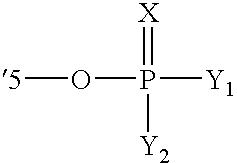
5′-X m(-L-X f-L-X m)n(-L-X f)nn-3′;
5′-X f(-L-X m-L-X f)n(-L-X m)nn-3′;

Priority Applications (1)
| Application Number | Priority Date | Filing Date | Title |
|---|---|---|---|
| US11/054,848 US9150606B2 (en) | 2002-11-05 | 2005-02-09 | Compositions comprising alternating 2'-modified nucleosides for use in gene modulation |
Applications Claiming Priority (5)
| Application Number | Priority Date | Filing Date | Title |
|---|---|---|---|
| US42376002P | 2002-11-05 | 2002-11-05 | |
| US10/701,007 US8604183B2 (en) | 2002-11-05 | 2003-11-04 | Compositions comprising alternating 2′-modified nucleosides for use in gene modulation |
| US55552104P | 2004-03-22 | 2004-03-22 | |
| US10/860,265 US9150605B2 (en) | 2002-11-05 | 2004-06-03 | Compositions comprising alternating 2′-modified nucleosides for use in gene modulation |
| US11/054,848 US9150606B2 (en) | 2002-11-05 | 2005-02-09 | Compositions comprising alternating 2'-modified nucleosides for use in gene modulation |
Related Parent Applications (1)
| Application Number | Title | Priority Date | Filing Date |
|---|---|---|---|
| US10/860,265 Continuation-In-Part US9150605B2 (en) | 2002-11-05 | 2004-06-03 | Compositions comprising alternating 2′-modified nucleosides for use in gene modulation |
Publications (2)
| Publication Number | Publication Date |
|---|---|
| US20050187178A1 true US20050187178A1 (en) | 2005-08-25 |
| US9150606B2 US9150606B2 (en) | 2015-10-06 |
Family
ID=34865389
Family Applications (1)
| Application Number | Title | Priority Date | Filing Date |
|---|---|---|---|
| US11/054,848 Expired - Lifetime US9150606B2 (en) | 2002-11-05 | 2005-02-09 | Compositions comprising alternating 2'-modified nucleosides for use in gene modulation |
Country Status (1)
| Country | Link |
|---|---|
| US (1) | US9150606B2 (en) |
Cited By (4)
| Publication number | Priority date | Publication date | Assignee | Title |
|---|---|---|---|---|
| WO2009114476A1 (en) * | 2008-03-12 | 2009-09-17 | Intradigm Corporation | Compositions comprising survivin sirna and methods of use thereof |
| US20130035369A1 (en) * | 2007-06-22 | 2013-02-07 | Isis Pharmaceuticals, Inc. | Double strand compositions comprising differentially modified strands for use in gene modulation |
| US20150025122A1 (en) * | 2009-10-12 | 2015-01-22 | Larry J. Smith | Methods and Compositions for Modulating Gene Expression Using Oligonucleotide Based Drugs Administered in vivo or in vitro |
| US12378552B2 (en) * | 2021-04-13 | 2025-08-05 | Sirnaomics, Inc. | Oligomeric compound for inhibiting expression of factor XI |
Families Citing this family (7)
| Publication number | Priority date | Publication date | Assignee | Title |
|---|---|---|---|---|
| US10421681B2 (en) | 2010-07-12 | 2019-09-24 | Corning Incorporated | Alumina isopipes for use with tin-containing glasses |
| EP4175965B1 (en) | 2021-01-30 | 2024-03-13 | E-Therapeutics plc | Conjugated oligonucleotide compounds, methods of making and uses thereof |
| JP2024504504A (en) | 2021-01-30 | 2024-01-31 | イー セラピューティクス パブリック リミテッド カンパニー | Conjugate oligonucleotide compounds, methods of production and use thereof |
| WO2022162161A1 (en) | 2021-01-30 | 2022-08-04 | E-Therapeutics Plc | Conjugated oligonucleotide compounds, methods of making and uses thereof |
| WO2022162157A1 (en) | 2021-01-30 | 2022-08-04 | E-Therapeutics Plc | Conjugated oligonucleotide compounds, methods of making and uses thereof |
| EP4176061A1 (en) | 2021-01-30 | 2023-05-10 | E-Therapeutics plc | Nucleic acids containing abasic nucleotides |
| US12258563B2 (en) | 2022-03-28 | 2025-03-25 | Empirico Inc. | Modified oligonucleotides |
Citations (99)
| Publication number | Priority date | Publication date | Assignee | Title |
|---|---|---|---|---|
| US4458066A (en) * | 1980-02-29 | 1984-07-03 | University Patents, Inc. | Process for preparing polynucleotides |
| US4500707A (en) * | 1980-02-29 | 1985-02-19 | University Patents, Inc. | Nucleosides useful in the preparation of polynucleotides |
| US4587044A (en) * | 1983-09-01 | 1986-05-06 | The Johns Hopkins University | Linkage of proteins to nucleic acids |
| US4667025A (en) * | 1982-08-09 | 1987-05-19 | Wakunaga Seiyaku Kabushiki Kaisha | Oligonucleotide derivatives |
| US4668777A (en) * | 1981-03-27 | 1987-05-26 | University Patents, Inc. | Phosphoramidite nucleoside compounds |
| US4725677A (en) * | 1983-08-18 | 1988-02-16 | Biosyntech Gmbh | Process for the preparation of oligonucleotides |
| US4824941A (en) * | 1983-03-10 | 1989-04-25 | Julian Gordon | Specific antibody to the native form of 2'5'-oligonucleotides, the method of preparation and the use as reagents in immunoassays or for binding 2'5'-oligonucleotides in biological systems |
| US4828979A (en) * | 1984-11-08 | 1989-05-09 | Life Technologies, Inc. | Nucleotide analogs for nucleic acid labeling and detection |
| US4835263A (en) * | 1983-01-27 | 1989-05-30 | Centre National De La Recherche Scientifique | Novel compounds containing an oligonucleotide sequence bonded to an intercalating agent, a process for their synthesis and their use |
| US4845205A (en) * | 1985-01-08 | 1989-07-04 | Institut Pasteur | 2,N6 -disubstituted and 2,N6 -trisubstituted adenosine-3'-phosphoramidites |
| US4904582A (en) * | 1987-06-11 | 1990-02-27 | Synthetic Genetics | Novel amphiphilic nucleic acid conjugates |
| US4981957A (en) * | 1984-07-19 | 1991-01-01 | Centre National De La Recherche Scientifique | Oligonucleotides with modified phosphate and modified carbohydrate moieties at the respective chain termini |
| US5013830A (en) * | 1986-09-08 | 1991-05-07 | Ajinomoto Co., Inc. | Compounds for the cleavage at a specific position of RNA, oligomers employed for the formation of said compounds, and starting materials for the synthesis of said oligomers |
| US5023243A (en) * | 1981-10-23 | 1991-06-11 | Molecular Biosystems, Inc. | Oligonucleotide therapeutic agent and method of making same |
| US5034506A (en) * | 1985-03-15 | 1991-07-23 | Anti-Gene Development Group | Uncharged morpholino-based polymers having achiral intersubunit linkages |
| US5082830A (en) * | 1988-02-26 | 1992-01-21 | Enzo Biochem, Inc. | End labeled nucleotide probe |
| US5109124A (en) * | 1988-06-01 | 1992-04-28 | Biogen, Inc. | Nucleic acid probe linked to a label having a terminal cysteine |
| US5112963A (en) * | 1987-11-12 | 1992-05-12 | Max-Planck-Gesellschaft Zur Foerderung Der Wissenschaften E.V. | Modified oligonucleotides |
| US5118800A (en) * | 1983-12-20 | 1992-06-02 | California Institute Of Technology | Oligonucleotides possessing a primary amino group in the terminal nucleotide |
| US5118802A (en) * | 1983-12-20 | 1992-06-02 | California Institute Of Technology | DNA-reporter conjugates linked via the 2' or 5'-primary amino group of the 5'-terminal nucleoside |
| US5130302A (en) * | 1989-12-20 | 1992-07-14 | Boron Bilogicals, Inc. | Boronated nucleoside, nucleotide and oligonucleotide compounds, compositions and methods for using same |
| US5132418A (en) * | 1980-02-29 | 1992-07-21 | University Patents, Inc. | Process for preparing polynucleotides |
| US5177196A (en) * | 1990-08-16 | 1993-01-05 | Microprobe Corporation | Oligo (α-arabinofuranosyl nucleotides) and α-arabinofuranosyl precursors thereof |
| US5185444A (en) * | 1985-03-15 | 1993-02-09 | Anti-Gene Deveopment Group | Uncharged morpolino-based polymers having phosphorous containing chiral intersubunit linkages |
| US5188897A (en) * | 1987-10-22 | 1993-02-23 | Temple University Of The Commonwealth System Of Higher Education | Encapsulated 2',5'-phosphorothioate oligoadenylates |
| US5194599A (en) * | 1988-09-23 | 1993-03-16 | Gilead Sciences, Inc. | Hydrogen phosphonodithioate compositions |
| US5214134A (en) * | 1990-09-12 | 1993-05-25 | Sterling Winthrop Inc. | Process of linking nucleosides with a siloxane bridge |
| US5214136A (en) * | 1990-02-20 | 1993-05-25 | Gilead Sciences, Inc. | Anthraquinone-derivatives oligonucleotides |
| US5216141A (en) * | 1988-06-06 | 1993-06-01 | Benner Steven A | Oligonucleotide analogs containing sulfur linkages |
| US5218105A (en) * | 1990-07-27 | 1993-06-08 | Isis Pharmaceuticals | Polyamine conjugated oligonucleotides |
| US5276019A (en) * | 1987-03-25 | 1994-01-04 | The United States Of America As Represented By The Department Of Health And Human Services | Inhibitors for replication of retroviruses and for the expression of oncogene products |
| US5278302A (en) * | 1988-05-26 | 1994-01-11 | University Patents, Inc. | Polynucleotide phosphorodithioates |
| US5292873A (en) * | 1989-11-29 | 1994-03-08 | The Research Foundation Of State University Of New York | Nucleic acids labeled with naphthoquinone probe |
| US5317098A (en) * | 1986-03-17 | 1994-05-31 | Hiroaki Shizuya | Non-radioisotope tagging of fragments |
| US5319080A (en) * | 1991-10-17 | 1994-06-07 | Ciba-Geigy Corporation | Bicyclic nucleosides, oligonucleotides, process for their preparation and intermediates |
| US5321131A (en) * | 1990-03-08 | 1994-06-14 | Hybridon, Inc. | Site-specific functionalization of oligodeoxynucleotides for non-radioactive labelling |
| US5391723A (en) * | 1989-05-31 | 1995-02-21 | Neorx Corporation | Oligonucleotide conjugates |
| US5399676A (en) * | 1989-10-23 | 1995-03-21 | Gilead Sciences | Oligonucleotides with inverted polarity |
| US5403711A (en) * | 1987-11-30 | 1995-04-04 | University Of Iowa Research Foundation | Nucleic acid hybridization and amplification method for detection of specific sequences in which a complementary labeled nucleic acid probe is cleaved |
| US5405939A (en) * | 1987-10-22 | 1995-04-11 | Temple University Of The Commonwealth System Of Higher Education | 2',5'-phosphorothioate oligoadenylates and their covalent conjugates with polylysine |
| US5405938A (en) * | 1989-12-20 | 1995-04-11 | Anti-Gene Development Group | Sequence-specific binding polymers for duplex nucleic acids |
| US5414077A (en) * | 1990-02-20 | 1995-05-09 | Gilead Sciences | Non-nucleoside linkers for convenient attachment of labels to oligonucleotides using standard synthetic methods |
| US5416203A (en) * | 1989-06-06 | 1995-05-16 | Northwestern University | Steroid modified oligonucleotides |
| US5484908A (en) * | 1991-11-26 | 1996-01-16 | Gilead Sciences, Inc. | Oligonucleotides containing 5-propynyl pyrimidines |
| US5486603A (en) * | 1990-01-08 | 1996-01-23 | Gilead Sciences, Inc. | Oligonucleotide having enhanced binding affinity |
| US5489677A (en) * | 1990-07-27 | 1996-02-06 | Isis Pharmaceuticals, Inc. | Oligonucleoside linkages containing adjacent oxygen and nitrogen atoms |
| US5491133A (en) * | 1987-11-30 | 1996-02-13 | University Of Iowa Research Foundation | Methods for blocking the expression of specifically targeted genes |
| US5502177A (en) * | 1993-09-17 | 1996-03-26 | Gilead Sciences, Inc. | Pyrimidine derivatives for labeled binding partners |
| US5510475A (en) * | 1990-11-08 | 1996-04-23 | Hybridon, Inc. | Oligonucleotide multiple reporter precursors |
| US5512439A (en) * | 1988-11-21 | 1996-04-30 | Dynal As | Oligonucleotide-linked magnetic particles and uses thereof |
| US5512667A (en) * | 1990-08-28 | 1996-04-30 | Reed; Michael W. | Trifunctional intermediates for preparing 3'-tailed oligonucleotides |
| US5514785A (en) * | 1990-05-11 | 1996-05-07 | Becton Dickinson And Company | Solid supports for nucleic acid hybridization assays |
| US5519126A (en) * | 1988-03-25 | 1996-05-21 | University Of Virginia Alumni Patents Foundation | Oligonucleotide N-alkylphosphoramidates |
| US5519134A (en) * | 1994-01-11 | 1996-05-21 | Isis Pharmaceuticals, Inc. | Pyrrolidine-containing monomers and oligomers |
| US5525711A (en) * | 1994-05-18 | 1996-06-11 | The United States Of America As Represented By The Secretary Of The Department Of Health And Human Services | Pteridine nucleotide analogs as fluorescent DNA probes |
| US5525465A (en) * | 1987-10-28 | 1996-06-11 | Howard Florey Institute Of Experimental Physiology And Medicine | Oligonucleotide-polyamide conjugates and methods of production and applications of the same |
| US5591584A (en) * | 1994-08-25 | 1997-01-07 | Chiron Corporation | N-4 modified pyrimidine deoxynucleotides and oligonucleotide probes synthesized therewith |
| US5591722A (en) * | 1989-09-15 | 1997-01-07 | Southern Research Institute | 2'-deoxy-4'-thioribonucleosides and their antiviral activity |
| US5594121A (en) * | 1991-11-07 | 1997-01-14 | Gilead Sciences, Inc. | Enhanced triple-helix and double-helix formation with oligomers containing modified purines |
| US5595726A (en) * | 1992-01-21 | 1997-01-21 | Pharmacyclics, Inc. | Chromophore probe for detection of nucleic acid |
| US5596086A (en) * | 1990-09-20 | 1997-01-21 | Gilead Sciences, Inc. | Modified internucleoside linkages having one nitrogen and two carbon atoms |
| US5596091A (en) * | 1994-03-18 | 1997-01-21 | The Regents Of The University Of California | Antisense oligonucleotides comprising 5-aminoalkyl pyrimidine nucleotides |
| US5597909A (en) * | 1994-08-25 | 1997-01-28 | Chiron Corporation | Polynucleotide reagents containing modified deoxyribose moieties, and associated methods of synthesis and use |
| US5597696A (en) * | 1994-07-18 | 1997-01-28 | Becton Dickinson And Company | Covalent cyanine dye oligonucleotide conjugates |
| US5599923A (en) * | 1989-03-06 | 1997-02-04 | Board Of Regents, University Of Tx | Texaphyrin metal complexes having improved functionalization |
| US5602240A (en) * | 1990-07-27 | 1997-02-11 | Ciba Geigy Ag. | Backbone modified oligonucleotide analogs |
| US5607922A (en) * | 1992-06-18 | 1997-03-04 | Stichting Rega Vzw | 1,5-anhydrohexitol nucleoside analogues |
| US5608046A (en) * | 1990-07-27 | 1997-03-04 | Isis Pharmaceuticals, Inc. | Conjugated 4'-desmethyl nucleoside analog compounds |
| US5610300A (en) * | 1992-07-01 | 1997-03-11 | Ciba-Geigy Corporation | Carbocyclic nucleosides containing bicyclic rings, oligonucleotides therefrom, process for their preparation, their use and intermediates |
| US5610289A (en) * | 1990-07-27 | 1997-03-11 | Isis Pharmaceuticals, Inc. | Backbone modified oligonucleotide analogues |
| US5614617A (en) * | 1990-07-27 | 1997-03-25 | Isis Pharmaceuticals, Inc. | Nuclease resistant, pyrimidine modified oligonucleotides that detect and modulate gene expression |
| US5618704A (en) * | 1990-07-27 | 1997-04-08 | Isis Pharmacueticals, Inc. | Backbone-modified oligonucleotide analogs and preparation thereof through radical coupling |
| US5623065A (en) * | 1990-08-13 | 1997-04-22 | Isis Pharmaceuticals, Inc. | Gapped 2' modified oligonucleotides |
| US5623070A (en) * | 1990-07-27 | 1997-04-22 | Isis Pharmaceuticals, Inc. | Heteroatomic oligonucleoside linkages |
| US5625050A (en) * | 1994-03-31 | 1997-04-29 | Amgen Inc. | Modified oligonucleotides and intermediates useful in nucleic acid therapeutics |
| US5627053A (en) * | 1994-03-29 | 1997-05-06 | Ribozyme Pharmaceuticals, Inc. | 2'deoxy-2'-alkylnucleotide containing nucleic acid |
| US5633360A (en) * | 1992-04-14 | 1997-05-27 | Gilead Sciences, Inc. | Oligonucleotide analogs capable of passive cell membrane permeation |
| US5633312A (en) * | 1994-02-28 | 1997-05-27 | Toshiba Silicone Co., Ltd. | Process for preparing polyorganosilane |
| US5639873A (en) * | 1992-02-05 | 1997-06-17 | Centre National De La Recherche Scientifique (Cnrs) | Oligothionucleotides |
| US5721218A (en) * | 1989-10-23 | 1998-02-24 | Gilead Sciences, Inc. | Oligonucleotides with inverted polarity |
| US5750692A (en) * | 1990-01-11 | 1998-05-12 | Isis Pharmaceuticals, Inc. | Synthesis of 3-deazapurines |
| US5760209A (en) * | 1997-03-03 | 1998-06-02 | Isis Pharmaceuticals, Inc. | Protecting group for synthesizing oligonucleotide analogs |
| US5874553A (en) * | 1995-03-13 | 1999-02-23 | Hoechst Aktiengesellschaft | Phosphonomonoester nucleic acids, process for their preparation, and their use |
| US5898031A (en) * | 1996-06-06 | 1999-04-27 | Isis Pharmaceuticals, Inc. | Oligoribonucleotides for cleaving RNA |
| US6046306A (en) * | 1994-03-14 | 2000-04-04 | Hoechst Aktiengesellschaft | PNA synthesis using an amino protecting group which is labile to weak acids |
| US6133246A (en) * | 1997-08-13 | 2000-10-17 | Isis Pharmaceuticals Inc. | Antisense oligonucleotide compositions and methods for the modulation of JNK proteins |
| US6172209B1 (en) * | 1997-02-14 | 2001-01-09 | Isis Pharmaceuticals Inc. | Aminooxy-modified oligonucleotides and methods for making same |
| US6262036B1 (en) * | 1993-11-16 | 2001-07-17 | Genta Incorporated | Method for inhibiting RNA translation using chimeric oligonucleoside compounds |
| US6380169B1 (en) * | 1994-08-31 | 2002-04-30 | Isis Pharmaceuticals, Inc. | Metal complex containing oligonucleoside cleavage compounds and therapies |
| US6395474B1 (en) * | 1991-05-24 | 2002-05-28 | Ole Buchardt | Peptide nucleic acids |
| US20020068708A1 (en) * | 1997-09-12 | 2002-06-06 | Jesper Wengel | Oligonucleotide analogues |
| US20020081736A1 (en) * | 2000-11-03 | 2002-06-27 | Conroy Susan E. | Nucleic acid delivery |
| US20030143732A1 (en) * | 2001-04-05 | 2003-07-31 | Kathy Fosnaugh | RNA interference mediated inhibition of adenosine A1 receptor (ADORA1) gene expression using short interfering RNA |
| US20030206887A1 (en) * | 1992-05-14 | 2003-11-06 | David Morrissey | RNA interference mediated inhibition of hepatitis B virus (HBV) using short interfering nucleic acid (siNA) |
| US20040018999A1 (en) * | 2000-03-16 | 2004-01-29 | David Beach | Methods and compositions for RNA interference |
| US20040180351A1 (en) * | 2002-08-05 | 2004-09-16 | Atugen Ag | Interfering RNA molecules |
| US20050020525A1 (en) * | 2002-02-20 | 2005-01-27 | Sirna Therapeutics, Inc. | RNA interference mediated inhibition of gene expression using chemically modified short interfering nucleic acid (siNA) |
| US20050142535A1 (en) * | 2002-02-01 | 2005-06-30 | Damha Masad J. | Ogligonucleotides comprising alternating segments and uses thereof |
| US20060127891A1 (en) * | 2002-02-20 | 2006-06-15 | Mcswiggen James | RNA interference mediated inhibition of MAP kinase gene expression or expression of genes involved in MAP kinase pathway using short interfering nucleic acid (siNA) |
Family Cites Families (109)
| Publication number | Priority date | Publication date | Assignee | Title |
|---|---|---|---|---|
| US2220007A (en) | 1938-04-09 | 1940-10-29 | Martin P Winther As Trustee | Dynamometer |
| US3687808A (en) | 1969-08-14 | 1972-08-29 | Univ Leland Stanford Junior | Synthetic polynucleotides |
| US4469863A (en) | 1980-11-12 | 1984-09-04 | Ts O Paul O P | Nonionic nucleic acid alkyl and aryl phosphonates and processes for manufacture and use thereof |
| US4973679A (en) | 1981-03-27 | 1990-11-27 | University Patents, Inc. | Process for oligonucleo tide synthesis using phosphormidite intermediates |
| US4415732A (en) | 1981-03-27 | 1983-11-15 | University Patents, Inc. | Phosphoramidite compounds and processes |
| US4476301A (en) | 1982-04-29 | 1984-10-09 | Centre National De La Recherche Scientifique | Oligonucleotides, a process for preparing the same and their application as mediators of the action of interferon |
| US4605735A (en) | 1983-02-14 | 1986-08-12 | Wakunaga Seiyaku Kabushiki Kaisha | Oligonucleotide derivatives |
| US4948882A (en) | 1983-02-22 | 1990-08-14 | Syngene, Inc. | Single-stranded labelled oligonucleotides, reactive monomers and methods of synthesis |
| USRE34069E (en) | 1983-08-18 | 1992-09-15 | Biosyntech Gmbh | Process for the preparation of oligonucleotides |
| US5550111A (en) | 1984-07-11 | 1996-08-27 | Temple University-Of The Commonwealth System Of Higher Education | Dual action 2',5'-oligoadenylate antiviral derivatives and uses thereof |
| US5430136A (en) | 1984-10-16 | 1995-07-04 | Chiron Corporation | Oligonucleotides having selectably cleavable and/or abasic sites |
| US5258506A (en) | 1984-10-16 | 1993-11-02 | Chiron Corporation | Photolabile reagents for incorporation into oligonucleotide chains |
| US5367066A (en) | 1984-10-16 | 1994-11-22 | Chiron Corporation | Oligonucleotides with selectably cleavable and/or abasic sites |
| US5235033A (en) | 1985-03-15 | 1993-08-10 | Anti-Gene Development Group | Alpha-morpholino ribonucleoside derivatives and polymers thereof |
| DE3687030T2 (en) | 1985-03-15 | 1993-03-11 | Eugene Stirchak | STEREO-REGULAR POLYNUCLEOTID-BINDING POLYMERS. |
| US5166315A (en) | 1989-12-20 | 1992-11-24 | Anti-Gene Development Group | Sequence-specific binding polymers for duplex nucleic acids |
| US4762779A (en) | 1985-06-13 | 1988-08-09 | Amgen Inc. | Compositions and methods for functionalizing nucleic acids |
| JPS638396A (en) | 1986-06-30 | 1988-01-14 | Wakunaga Pharmaceut Co Ltd | Poly-labeled oligonucleotide derivative |
| US5264423A (en) | 1987-03-25 | 1993-11-23 | The United States Of America As Represented By The Department Of Health And Human Services | Inhibitors for replication of retroviruses and for the expression of oncogene products |
| EP0366685B1 (en) | 1987-06-24 | 1994-10-19 | Howard Florey Institute Of Experimental Physiology And Medicine | Nucleoside derivatives |
| US5585481A (en) | 1987-09-21 | 1996-12-17 | Gen-Probe Incorporated | Linking reagents for nucleotide probes |
| US5175273A (en) | 1988-07-01 | 1992-12-29 | Genentech, Inc. | Nucleic acid intercalating agents |
| US5262536A (en) | 1988-09-15 | 1993-11-16 | E. I. Du Pont De Nemours And Company | Reagents for the preparation of 5'-tagged oligonucleotides |
| US5457183A (en) | 1989-03-06 | 1995-10-10 | Board Of Regents, The University Of Texas System | Hydroxylated texaphyrins |
| US5256775A (en) | 1989-06-05 | 1993-10-26 | Gilead Sciences, Inc. | Exonuclease-resistant oligonucleotides |
| US5451463A (en) | 1989-08-28 | 1995-09-19 | Clontech Laboratories, Inc. | Non-nucleoside 1,3-diol reagents for labeling synthetic oligonucleotides |
| US5134066A (en) | 1989-08-29 | 1992-07-28 | Monsanto Company | Improved probes using nucleosides containing 3-dezauracil analogs |
| US5254469A (en) | 1989-09-12 | 1993-10-19 | Eastman Kodak Company | Oligonucleotide-enzyme conjugate that can be used as a probe in hybridization assays and polymerase chain reaction procedures |
| US5264562A (en) | 1989-10-24 | 1993-11-23 | Gilead Sciences, Inc. | Oligonucleotide analogs with novel linkages |
| EP0942000B1 (en) | 1989-10-24 | 2004-06-23 | Isis Pharmaceuticals, Inc. | 2'-Modified oligonucleotides |
| US5264564A (en) | 1989-10-24 | 1993-11-23 | Gilead Sciences | Oligonucleotide analogs with novel linkages |
| US5177198A (en) | 1989-11-30 | 1993-01-05 | University Of N.C. At Chapel Hill | Process for preparing oligoribonucleoside and oligodeoxyribonucleoside boranophosphates |
| US5459255A (en) | 1990-01-11 | 1995-10-17 | Isis Pharmaceuticals, Inc. | N-2 substituted purines |
| US5578718A (en) | 1990-01-11 | 1996-11-26 | Isis Pharmaceuticals, Inc. | Thiol-derivatized nucleosides |
| US5587361A (en) | 1991-10-15 | 1996-12-24 | Isis Pharmaceuticals, Inc. | Oligonucleotides having phosphorothioate linkages of high chiral purity |
| US5670633A (en) | 1990-01-11 | 1997-09-23 | Isis Pharmaceuticals, Inc. | Sugar modified oligonucleotides that detect and modulate gene expression |
| US5681941A (en) | 1990-01-11 | 1997-10-28 | Isis Pharmaceuticals, Inc. | Substituted purines and oligonucleotide cross-linking |
| US5646265A (en) | 1990-01-11 | 1997-07-08 | Isis Pharmceuticals, Inc. | Process for the preparation of 2'-O-alkyl purine phosphoramidites |
| US5149797A (en) | 1990-02-15 | 1992-09-22 | The Worcester Foundation For Experimental Biology | Method of site-specific alteration of rna and production of encoded polypeptides |
| US5470967A (en) | 1990-04-10 | 1995-11-28 | The Dupont Merck Pharmaceutical Company | Oligonucleotide analogs with sulfamate linkages |
| GB9009980D0 (en) | 1990-05-03 | 1990-06-27 | Amersham Int Plc | Phosphoramidite derivatives,their preparation and the use thereof in the incorporation of reporter groups on synthetic oligonucleotides |
| US5688941A (en) | 1990-07-27 | 1997-11-18 | Isis Pharmaceuticals, Inc. | Methods of making conjugated 4' desmethyl nucleoside analog compounds |
| US5138045A (en) | 1990-07-27 | 1992-08-11 | Isis Pharmaceuticals | Polyamine conjugated oligonucleotides |
| US5677437A (en) | 1990-07-27 | 1997-10-14 | Isis Pharmaceuticals, Inc. | Heteroatomic oligonucleoside linkages |
| US5541307A (en) | 1990-07-27 | 1996-07-30 | Isis Pharmaceuticals, Inc. | Backbone modified oligonucleotide analogs and solid phase synthesis thereof |
| DK0541722T3 (en) | 1990-08-03 | 1996-04-22 | Sterling Winthrop Inc | Compounds and Methods for Inhibiting Gene Expression |
| US5245022A (en) | 1990-08-03 | 1993-09-14 | Sterling Drug, Inc. | Exonuclease resistant terminally substituted oligonucleotides |
| US5561225A (en) | 1990-09-19 | 1996-10-01 | Southern Research Institute | Polynucleotide analogs containing sulfonate and sulfonamide internucleoside linkages |
| US5432272A (en) | 1990-10-09 | 1995-07-11 | Benner; Steven A. | Method for incorporating into a DNA or RNA oligonucleotide using nucleotides bearing heterocyclic bases |
| US5672697A (en) | 1991-02-08 | 1997-09-30 | Gilead Sciences, Inc. | Nucleoside 5'-methylene phosphonates |
| US6329346B1 (en) | 1991-05-25 | 2001-12-11 | Roche Diagnostics Gmbh | Oligo-2′-deoxynucleotides and their use as pharmaceutical agents with antiviral activity |
| US5371241A (en) | 1991-07-19 | 1994-12-06 | Pharmacia P-L Biochemicals Inc. | Fluorescein labelled phosphoramidites |
| US5571799A (en) | 1991-08-12 | 1996-11-05 | Basco, Ltd. | (2'-5') oligoadenylate analogues useful as inhibitors of host-v5.-graft response |
| AU2916292A (en) | 1991-10-24 | 1993-05-21 | Isis Pharmaceuticals, Inc. | Derivatized oligonucleotides having improved uptake and other properties |
| AU3222793A (en) | 1991-11-26 | 1993-06-28 | Gilead Sciences, Inc. | Enhanced triple-helix and double-helix formation with oligomers containing modified pyrimidines |
| US5792608A (en) | 1991-12-12 | 1998-08-11 | Gilead Sciences, Inc. | Nuclease stable and binding competent oligomers and methods for their use |
| US5359044A (en) | 1991-12-13 | 1994-10-25 | Isis Pharmaceuticals | Cyclobutyl oligonucleotide surrogates |
| US5700922A (en) | 1991-12-24 | 1997-12-23 | Isis Pharmaceuticals, Inc. | PNA-DNA-PNA chimeric macromolecules |
| US5565552A (en) | 1992-01-21 | 1996-10-15 | Pharmacyclics, Inc. | Method of expanded porphyrin-oligonucleotide conjugate synthesis |
| US5434257A (en) | 1992-06-01 | 1995-07-18 | Gilead Sciences, Inc. | Binding compentent oligomers containing unsaturated 3',5' and 2',5' linkages |
| HUT69981A (en) | 1992-07-02 | 1995-09-28 | Hybridon Inc | Self-stabilized oligonucleotides as therapeutic agents |
| US5272250A (en) | 1992-07-10 | 1993-12-21 | Spielvogel Bernard F | Boronated phosphoramidate compounds |
| US5652355A (en) | 1992-07-23 | 1997-07-29 | Worcester Foundation For Experimental Biology | Hybrid oligonucleotide phosphorothioates |
| US5574142A (en) | 1992-12-15 | 1996-11-12 | Microprobe Corporation | Peptide linkers for improved oligonucleotide delivery |
| US5476925A (en) | 1993-02-01 | 1995-12-19 | Northwestern University | Oligodeoxyribonucleotides including 3'-aminonucleoside-phosphoramidate linkages and terminal 3'-amino groups |
| GB9304618D0 (en) | 1993-03-06 | 1993-04-21 | Ciba Geigy Ag | Chemical compounds |
| FR2703053B1 (en) | 1993-03-26 | 1995-06-16 | Genset Sa | STAPLE AND SEMI-STAPLE OLIGONUCLEOTIDES, PREPARATION METHOD AND APPLICATIONS. |
| CA2159631A1 (en) | 1993-03-30 | 1994-10-13 | Sanofi | Acyclic nucleoside analogs and oligonucleotide sequences containing them |
| CA2159629A1 (en) | 1993-03-31 | 1994-10-13 | Sanofi | Oligonucleotides with amide linkages replacing phosphodiester linkages |
| DE4311944A1 (en) | 1993-04-10 | 1994-10-13 | Degussa | Coated sodium percarbonate particles, process for their preparation and detergent, cleaning and bleaching compositions containing them |
| US5808036A (en) | 1993-09-01 | 1998-09-15 | Research Corporation Technologies Inc. | Stem-loop oligonucleotides containing parallel and antiparallel binding domains |
| EP0743859A4 (en) | 1993-11-16 | 1998-10-21 | Genta Inc | Chimeric oligonucleoside compounds |
| US5457187A (en) | 1993-12-08 | 1995-10-10 | Board Of Regents University Of Nebraska | Oligonucleotides containing 5-fluorouracil |
| JP3585238B2 (en) | 1993-12-09 | 2004-11-04 | トーマス ジェファーソン ユニバーシティー | Compounds and methods for site-directed mutagenesis in eukaryotic cells |
| US5446137B1 (en) | 1993-12-09 | 1998-10-06 | Behringwerke Ag | Oligonucleotides containing 4'-substituted nucleotides |
| US5854410A (en) | 1994-03-31 | 1998-12-29 | Genta Incorporated | Oligonucleoside cleavage compounds and therapies |
| US5646269A (en) | 1994-04-28 | 1997-07-08 | Gilead Sciences, Inc. | Method for oligonucleotide analog synthesis |
| US5681940A (en) | 1994-11-02 | 1997-10-28 | Icn Pharmaceuticals | Sugar modified nucleosides and oligonucleotides |
| US6150510A (en) | 1995-11-06 | 2000-11-21 | Aventis Pharma Deutschland Gmbh | Modified oligonucleotides, their preparation and their use |
| US5792747A (en) | 1995-01-24 | 1998-08-11 | The Administrators Of The Tulane Educational Fund | Highly potent agonists of growth hormone releasing hormone |
| US5830635A (en) | 1995-03-31 | 1998-11-03 | Agnello; Vincent | Method of detecting hepatitis C virus in tissues |
| US5652356A (en) | 1995-08-17 | 1997-07-29 | Hybridon, Inc. | Inverted chimeric and hybrid oligonucleotides |
| WO1997014709A1 (en) | 1995-10-13 | 1997-04-24 | F. Hoffmann-La Roche Ag | Antisense oligomers |
| ATE373672T1 (en) | 1996-01-16 | 2007-10-15 | Sirna Therapeutics Inc | SYNTHESIS OF METHOXYNUCLEOSIDES AND ENZYMATIC NUCLEIC ACID MOLECULES |
| NZ503765A (en) | 1997-09-12 | 2002-04-26 | Exiqon As | Bi-cyclic and tri-cyclic nucleotide analogues |
| US6506559B1 (en) | 1997-12-23 | 2003-01-14 | Carnegie Institute Of Washington | Genetic inhibition by double-stranded RNA |
| US5955443A (en) | 1998-03-19 | 1999-09-21 | Isis Pharmaceuticals Inc. | Antisense modulation of PECAM-1 |
| US6271358B1 (en) | 1998-07-27 | 2001-08-07 | Isis Pharmaceuticals, Inc. | RNA targeted 2′-modified oligonucleotides that are conformationally preorganized |
| US6043352A (en) | 1998-08-07 | 2000-03-28 | Isis Pharmaceuticals, Inc. | 2'-O-Dimethylaminoethyloxyethyl-modified oligonucleotides |
| WO2000044914A1 (en) | 1999-01-28 | 2000-08-03 | Medical College Of Georgia Research Institute, Inc. | Composition and method for in vivo and in vitro attenuation of gene expression using double stranded rna |
| DE19956568A1 (en) | 1999-01-30 | 2000-08-17 | Roland Kreutzer | Method and medicament for inhibiting the expression of a given gene |
| WO2000049035A1 (en) | 1999-02-19 | 2000-08-24 | The General Hospital Corporation | Gene silencing |
| US6436640B1 (en) | 1999-03-18 | 2002-08-20 | Exiqon A/S | Use of LNA in mass spectrometry |
| CN1375004A (en) | 1999-04-21 | 2002-10-16 | 惠氏公司 | Methods and compsotions for inhibiting the function of polynucleotide sequences |
| US6656730B1 (en) | 1999-06-15 | 2003-12-02 | Isis Pharmaceuticals, Inc. | Oligonucleotides conjugated to protein-binding drugs |
| US6033910A (en) | 1999-07-19 | 2000-03-07 | Isis Pharmaceuticals Inc. | Antisense inhibition of MAP kinase kinase 6 expression |
| WO2001029058A1 (en) | 1999-10-15 | 2001-04-26 | University Of Massachusetts | Rna interference pathway genes as tools for targeted genetic interference |
| WO2001036641A2 (en) | 1999-11-02 | 2001-05-25 | Chiron Corporation | DOUBLE-STRANDED RNA RECEPTOR (dsRNA-R) AND METHODS RELATING THERETO |
| GB9927444D0 (en) | 1999-11-19 | 2000-01-19 | Cancer Res Campaign Tech | Inhibiting gene expression |
| US6294522B1 (en) | 1999-12-03 | 2001-09-25 | Cv Therapeutics, Inc. | N6 heterocyclic 8-modified adenosine derivatives |
| GB9930691D0 (en) | 1999-12-24 | 2000-02-16 | Devgen Nv | Improvements relating to double-stranded RNA inhibition |
| NZ522045A (en) | 2000-03-30 | 2007-05-31 | Whitehead Biomedical Inst | RNA sequence-specific mediators of RNA interference |
| US6426220B1 (en) | 2000-10-30 | 2002-07-30 | Isis Pharmaceuticals, Inc. | Antisense modulation of calreticulin expression |
| US20020132788A1 (en) | 2000-11-06 | 2002-09-19 | David Lewis | Inhibition of gene expression by delivery of small interfering RNA to post-embryonic animal cells in vivo |
| IL155991A0 (en) | 2000-12-01 | 2003-12-23 | Max Planck Gesellschaft | Rna interference mediating small rna molecules |
| EP1354038A2 (en) | 2000-12-28 | 2003-10-22 | J & J Research Pty Ltd | Double-stranded rna-mediated gene suppression |
| US20030175906A1 (en) | 2001-07-03 | 2003-09-18 | Muthiah Manoharan | Nuclease resistant chimeric oligonucleotides |
| WO2003004602A2 (en) | 2001-07-03 | 2003-01-16 | Isis Pharmaceuticals, Inc. | Nuclease resistant chimeric oligonucleotides |
| AU2003210895A1 (en) | 2002-02-20 | 2003-09-09 | Ribozyme Pharmaceuticals, Inc. | Rna interference mediated inhibition of cyclin d1 gene expression using short interfering nucleic acid (sina) |
-
2005
- 2005-02-09 US US11/054,848 patent/US9150606B2/en not_active Expired - Lifetime
Patent Citations (104)
| Publication number | Priority date | Publication date | Assignee | Title |
|---|---|---|---|---|
| US4500707A (en) * | 1980-02-29 | 1985-02-19 | University Patents, Inc. | Nucleosides useful in the preparation of polynucleotides |
| US5132418A (en) * | 1980-02-29 | 1992-07-21 | University Patents, Inc. | Process for preparing polynucleotides |
| US4458066A (en) * | 1980-02-29 | 1984-07-03 | University Patents, Inc. | Process for preparing polynucleotides |
| US4668777A (en) * | 1981-03-27 | 1987-05-26 | University Patents, Inc. | Phosphoramidite nucleoside compounds |
| US5023243A (en) * | 1981-10-23 | 1991-06-11 | Molecular Biosystems, Inc. | Oligonucleotide therapeutic agent and method of making same |
| US4667025A (en) * | 1982-08-09 | 1987-05-19 | Wakunaga Seiyaku Kabushiki Kaisha | Oligonucleotide derivatives |
| US4835263A (en) * | 1983-01-27 | 1989-05-30 | Centre National De La Recherche Scientifique | Novel compounds containing an oligonucleotide sequence bonded to an intercalating agent, a process for their synthesis and their use |
| US4824941A (en) * | 1983-03-10 | 1989-04-25 | Julian Gordon | Specific antibody to the native form of 2'5'-oligonucleotides, the method of preparation and the use as reagents in immunoassays or for binding 2'5'-oligonucleotides in biological systems |
| US4725677A (en) * | 1983-08-18 | 1988-02-16 | Biosyntech Gmbh | Process for the preparation of oligonucleotides |
| US4587044A (en) * | 1983-09-01 | 1986-05-06 | The Johns Hopkins University | Linkage of proteins to nucleic acids |
| US5118802A (en) * | 1983-12-20 | 1992-06-02 | California Institute Of Technology | DNA-reporter conjugates linked via the 2' or 5'-primary amino group of the 5'-terminal nucleoside |
| US5118800A (en) * | 1983-12-20 | 1992-06-02 | California Institute Of Technology | Oligonucleotides possessing a primary amino group in the terminal nucleotide |
| US4981957A (en) * | 1984-07-19 | 1991-01-01 | Centre National De La Recherche Scientifique | Oligonucleotides with modified phosphate and modified carbohydrate moieties at the respective chain termini |
| US4828979A (en) * | 1984-11-08 | 1989-05-09 | Life Technologies, Inc. | Nucleotide analogs for nucleic acid labeling and detection |
| US4845205A (en) * | 1985-01-08 | 1989-07-04 | Institut Pasteur | 2,N6 -disubstituted and 2,N6 -trisubstituted adenosine-3'-phosphoramidites |
| US5185444A (en) * | 1985-03-15 | 1993-02-09 | Anti-Gene Deveopment Group | Uncharged morpolino-based polymers having phosphorous containing chiral intersubunit linkages |
| US5034506A (en) * | 1985-03-15 | 1991-07-23 | Anti-Gene Development Group | Uncharged morpholino-based polymers having achiral intersubunit linkages |
| US5317098A (en) * | 1986-03-17 | 1994-05-31 | Hiroaki Shizuya | Non-radioisotope tagging of fragments |
| US5013830A (en) * | 1986-09-08 | 1991-05-07 | Ajinomoto Co., Inc. | Compounds for the cleavage at a specific position of RNA, oligomers employed for the formation of said compounds, and starting materials for the synthesis of said oligomers |
| US5286717A (en) * | 1987-03-25 | 1994-02-15 | The United States Of America As Represented By The Department Of Health And Human Services | Inhibitors for replication of retroviruses and for the expression of oncogene products |
| US5276019A (en) * | 1987-03-25 | 1994-01-04 | The United States Of America As Represented By The Department Of Health And Human Services | Inhibitors for replication of retroviruses and for the expression of oncogene products |
| US4904582A (en) * | 1987-06-11 | 1990-02-27 | Synthetic Genetics | Novel amphiphilic nucleic acid conjugates |
| US5188897A (en) * | 1987-10-22 | 1993-02-23 | Temple University Of The Commonwealth System Of Higher Education | Encapsulated 2',5'-phosphorothioate oligoadenylates |
| US5405939A (en) * | 1987-10-22 | 1995-04-11 | Temple University Of The Commonwealth System Of Higher Education | 2',5'-phosphorothioate oligoadenylates and their covalent conjugates with polylysine |
| US5525465A (en) * | 1987-10-28 | 1996-06-11 | Howard Florey Institute Of Experimental Physiology And Medicine | Oligonucleotide-polyamide conjugates and methods of production and applications of the same |
| US5112963A (en) * | 1987-11-12 | 1992-05-12 | Max-Planck-Gesellschaft Zur Foerderung Der Wissenschaften E.V. | Modified oligonucleotides |
| US5403711A (en) * | 1987-11-30 | 1995-04-04 | University Of Iowa Research Foundation | Nucleic acid hybridization and amplification method for detection of specific sequences in which a complementary labeled nucleic acid probe is cleaved |
| US5491133A (en) * | 1987-11-30 | 1996-02-13 | University Of Iowa Research Foundation | Methods for blocking the expression of specifically targeted genes |
| US5082830A (en) * | 1988-02-26 | 1992-01-21 | Enzo Biochem, Inc. | End labeled nucleotide probe |
| US5519126A (en) * | 1988-03-25 | 1996-05-21 | University Of Virginia Alumni Patents Foundation | Oligonucleotide N-alkylphosphoramidates |
| US5278302A (en) * | 1988-05-26 | 1994-01-11 | University Patents, Inc. | Polynucleotide phosphorodithioates |
| US5109124A (en) * | 1988-06-01 | 1992-04-28 | Biogen, Inc. | Nucleic acid probe linked to a label having a terminal cysteine |
| US5216141A (en) * | 1988-06-06 | 1993-06-01 | Benner Steven A | Oligonucleotide analogs containing sulfur linkages |
| US5194599A (en) * | 1988-09-23 | 1993-03-16 | Gilead Sciences, Inc. | Hydrogen phosphonodithioate compositions |
| US5512439A (en) * | 1988-11-21 | 1996-04-30 | Dynal As | Oligonucleotide-linked magnetic particles and uses thereof |
| US5599923A (en) * | 1989-03-06 | 1997-02-04 | Board Of Regents, University Of Tx | Texaphyrin metal complexes having improved functionalization |
| US5391723A (en) * | 1989-05-31 | 1995-02-21 | Neorx Corporation | Oligonucleotide conjugates |
| US5416203A (en) * | 1989-06-06 | 1995-05-16 | Northwestern University | Steroid modified oligonucleotides |
| US5591722A (en) * | 1989-09-15 | 1997-01-07 | Southern Research Institute | 2'-deoxy-4'-thioribonucleosides and their antiviral activity |
| US5527899A (en) * | 1989-10-23 | 1996-06-18 | Gilead Sciences, Inc. | Oligonucleotides with inverted polarity |
| US5399676A (en) * | 1989-10-23 | 1995-03-21 | Gilead Sciences | Oligonucleotides with inverted polarity |
| US5721218A (en) * | 1989-10-23 | 1998-02-24 | Gilead Sciences, Inc. | Oligonucleotides with inverted polarity |
| US5292873A (en) * | 1989-11-29 | 1994-03-08 | The Research Foundation Of State University Of New York | Nucleic acids labeled with naphthoquinone probe |
| US5405938A (en) * | 1989-12-20 | 1995-04-11 | Anti-Gene Development Group | Sequence-specific binding polymers for duplex nucleic acids |
| US5130302A (en) * | 1989-12-20 | 1992-07-14 | Boron Bilogicals, Inc. | Boronated nucleoside, nucleotide and oligonucleotide compounds, compositions and methods for using same |
| US5486603A (en) * | 1990-01-08 | 1996-01-23 | Gilead Sciences, Inc. | Oligonucleotide having enhanced binding affinity |
| US5750692A (en) * | 1990-01-11 | 1998-05-12 | Isis Pharmaceuticals, Inc. | Synthesis of 3-deazapurines |
| US5414077A (en) * | 1990-02-20 | 1995-05-09 | Gilead Sciences | Non-nucleoside linkers for convenient attachment of labels to oligonucleotides using standard synthetic methods |
| US5214136A (en) * | 1990-02-20 | 1993-05-25 | Gilead Sciences, Inc. | Anthraquinone-derivatives oligonucleotides |
| US5321131A (en) * | 1990-03-08 | 1994-06-14 | Hybridon, Inc. | Site-specific functionalization of oligodeoxynucleotides for non-radioactive labelling |
| US5514785A (en) * | 1990-05-11 | 1996-05-07 | Becton Dickinson And Company | Solid supports for nucleic acid hybridization assays |
| US5618704A (en) * | 1990-07-27 | 1997-04-08 | Isis Pharmacueticals, Inc. | Backbone-modified oligonucleotide analogs and preparation thereof through radical coupling |
| US5610289A (en) * | 1990-07-27 | 1997-03-11 | Isis Pharmaceuticals, Inc. | Backbone modified oligonucleotide analogues |
| US5623070A (en) * | 1990-07-27 | 1997-04-22 | Isis Pharmaceuticals, Inc. | Heteroatomic oligonucleoside linkages |
| US5489677A (en) * | 1990-07-27 | 1996-02-06 | Isis Pharmaceuticals, Inc. | Oligonucleoside linkages containing adjacent oxygen and nitrogen atoms |
| US5614617A (en) * | 1990-07-27 | 1997-03-25 | Isis Pharmaceuticals, Inc. | Nuclease resistant, pyrimidine modified oligonucleotides that detect and modulate gene expression |
| US5608046A (en) * | 1990-07-27 | 1997-03-04 | Isis Pharmaceuticals, Inc. | Conjugated 4'-desmethyl nucleoside analog compounds |
| US5602240A (en) * | 1990-07-27 | 1997-02-11 | Ciba Geigy Ag. | Backbone modified oligonucleotide analogs |
| US5218105A (en) * | 1990-07-27 | 1993-06-08 | Isis Pharmaceuticals | Polyamine conjugated oligonucleotides |
| US5623065A (en) * | 1990-08-13 | 1997-04-22 | Isis Pharmaceuticals, Inc. | Gapped 2' modified oligonucleotides |
| US5177196A (en) * | 1990-08-16 | 1993-01-05 | Microprobe Corporation | Oligo (α-arabinofuranosyl nucleotides) and α-arabinofuranosyl precursors thereof |
| US5512667A (en) * | 1990-08-28 | 1996-04-30 | Reed; Michael W. | Trifunctional intermediates for preparing 3'-tailed oligonucleotides |
| US5214134A (en) * | 1990-09-12 | 1993-05-25 | Sterling Winthrop Inc. | Process of linking nucleosides with a siloxane bridge |
| US5596086A (en) * | 1990-09-20 | 1997-01-21 | Gilead Sciences, Inc. | Modified internucleoside linkages having one nitrogen and two carbon atoms |
| US5510475A (en) * | 1990-11-08 | 1996-04-23 | Hybridon, Inc. | Oligonucleotide multiple reporter precursors |
| US6395474B1 (en) * | 1991-05-24 | 2002-05-28 | Ole Buchardt | Peptide nucleic acids |
| US5319080A (en) * | 1991-10-17 | 1994-06-07 | Ciba-Geigy Corporation | Bicyclic nucleosides, oligonucleotides, process for their preparation and intermediates |
| US5393878A (en) * | 1991-10-17 | 1995-02-28 | Ciba-Geigy Corporation | Bicyclic nucleosides, oligonucleotides, process for their preparation and intermediates |
| US5594121A (en) * | 1991-11-07 | 1997-01-14 | Gilead Sciences, Inc. | Enhanced triple-helix and double-helix formation with oligomers containing modified purines |
| US5484908A (en) * | 1991-11-26 | 1996-01-16 | Gilead Sciences, Inc. | Oligonucleotides containing 5-propynyl pyrimidines |
| US5595726A (en) * | 1992-01-21 | 1997-01-21 | Pharmacyclics, Inc. | Chromophore probe for detection of nucleic acid |
| US5639873A (en) * | 1992-02-05 | 1997-06-17 | Centre National De La Recherche Scientifique (Cnrs) | Oligothionucleotides |
| US5633360A (en) * | 1992-04-14 | 1997-05-27 | Gilead Sciences, Inc. | Oligonucleotide analogs capable of passive cell membrane permeation |
| US20030206887A1 (en) * | 1992-05-14 | 2003-11-06 | David Morrissey | RNA interference mediated inhibition of hepatitis B virus (HBV) using short interfering nucleic acid (siNA) |
| US5607922A (en) * | 1992-06-18 | 1997-03-04 | Stichting Rega Vzw | 1,5-anhydrohexitol nucleoside analogues |
| US5610300A (en) * | 1992-07-01 | 1997-03-11 | Ciba-Geigy Corporation | Carbocyclic nucleosides containing bicyclic rings, oligonucleotides therefrom, process for their preparation, their use and intermediates |
| US5502177A (en) * | 1993-09-17 | 1996-03-26 | Gilead Sciences, Inc. | Pyrimidine derivatives for labeled binding partners |
| US5763588A (en) * | 1993-09-17 | 1998-06-09 | Gilead Sciences, Inc. | Pyrimidine derivatives for labeled binding partners |
| US6262036B1 (en) * | 1993-11-16 | 2001-07-17 | Genta Incorporated | Method for inhibiting RNA translation using chimeric oligonucleoside compounds |
| US5519134A (en) * | 1994-01-11 | 1996-05-21 | Isis Pharmaceuticals, Inc. | Pyrrolidine-containing monomers and oligomers |
| US5599928A (en) * | 1994-02-15 | 1997-02-04 | Pharmacyclics, Inc. | Texaphyrin compounds having improved functionalization |
| US5633312A (en) * | 1994-02-28 | 1997-05-27 | Toshiba Silicone Co., Ltd. | Process for preparing polyorganosilane |
| US6046306A (en) * | 1994-03-14 | 2000-04-04 | Hoechst Aktiengesellschaft | PNA synthesis using an amino protecting group which is labile to weak acids |
| US5596091A (en) * | 1994-03-18 | 1997-01-21 | The Regents Of The University Of California | Antisense oligonucleotides comprising 5-aminoalkyl pyrimidine nucleotides |
| US5627053A (en) * | 1994-03-29 | 1997-05-06 | Ribozyme Pharmaceuticals, Inc. | 2'deoxy-2'-alkylnucleotide containing nucleic acid |
| US5625050A (en) * | 1994-03-31 | 1997-04-29 | Amgen Inc. | Modified oligonucleotides and intermediates useful in nucleic acid therapeutics |
| US5525711A (en) * | 1994-05-18 | 1996-06-11 | The United States Of America As Represented By The Secretary Of The Department Of Health And Human Services | Pteridine nucleotide analogs as fluorescent DNA probes |
| US5597696A (en) * | 1994-07-18 | 1997-01-28 | Becton Dickinson And Company | Covalent cyanine dye oligonucleotide conjugates |
| US5591584A (en) * | 1994-08-25 | 1997-01-07 | Chiron Corporation | N-4 modified pyrimidine deoxynucleotides and oligonucleotide probes synthesized therewith |
| US5597909A (en) * | 1994-08-25 | 1997-01-28 | Chiron Corporation | Polynucleotide reagents containing modified deoxyribose moieties, and associated methods of synthesis and use |
| US6380169B1 (en) * | 1994-08-31 | 2002-04-30 | Isis Pharmaceuticals, Inc. | Metal complex containing oligonucleoside cleavage compounds and therapies |
| US5874553A (en) * | 1995-03-13 | 1999-02-23 | Hoechst Aktiengesellschaft | Phosphonomonoester nucleic acids, process for their preparation, and their use |
| US5898031A (en) * | 1996-06-06 | 1999-04-27 | Isis Pharmaceuticals, Inc. | Oligoribonucleotides for cleaving RNA |
| US6172209B1 (en) * | 1997-02-14 | 2001-01-09 | Isis Pharmaceuticals Inc. | Aminooxy-modified oligonucleotides and methods for making same |
| US5760209A (en) * | 1997-03-03 | 1998-06-02 | Isis Pharmaceuticals, Inc. | Protecting group for synthesizing oligonucleotide analogs |
| US6133246A (en) * | 1997-08-13 | 2000-10-17 | Isis Pharmaceuticals Inc. | Antisense oligonucleotide compositions and methods for the modulation of JNK proteins |
| US20020068708A1 (en) * | 1997-09-12 | 2002-06-06 | Jesper Wengel | Oligonucleotide analogues |
| US20040018999A1 (en) * | 2000-03-16 | 2004-01-29 | David Beach | Methods and compositions for RNA interference |
| US20020081736A1 (en) * | 2000-11-03 | 2002-06-27 | Conroy Susan E. | Nucleic acid delivery |
| US20030143732A1 (en) * | 2001-04-05 | 2003-07-31 | Kathy Fosnaugh | RNA interference mediated inhibition of adenosine A1 receptor (ADORA1) gene expression using short interfering RNA |
| US20050142535A1 (en) * | 2002-02-01 | 2005-06-30 | Damha Masad J. | Ogligonucleotides comprising alternating segments and uses thereof |
| US20050020525A1 (en) * | 2002-02-20 | 2005-01-27 | Sirna Therapeutics, Inc. | RNA interference mediated inhibition of gene expression using chemically modified short interfering nucleic acid (siNA) |
| US20060127891A1 (en) * | 2002-02-20 | 2006-06-15 | Mcswiggen James | RNA interference mediated inhibition of MAP kinase gene expression or expression of genes involved in MAP kinase pathway using short interfering nucleic acid (siNA) |
| US20040180351A1 (en) * | 2002-08-05 | 2004-09-16 | Atugen Ag | Interfering RNA molecules |
Non-Patent Citations (1)
| Title |
|---|
| Elbashir et al., EMBO J.,Vol. 20, No. 23, pages 6877-6888 (2001). * |
Cited By (7)
| Publication number | Priority date | Publication date | Assignee | Title |
|---|---|---|---|---|
| US20130035369A1 (en) * | 2007-06-22 | 2013-02-07 | Isis Pharmaceuticals, Inc. | Double strand compositions comprising differentially modified strands for use in gene modulation |
| WO2009114476A1 (en) * | 2008-03-12 | 2009-09-17 | Intradigm Corporation | Compositions comprising survivin sirna and methods of use thereof |
| US20150025122A1 (en) * | 2009-10-12 | 2015-01-22 | Larry J. Smith | Methods and Compositions for Modulating Gene Expression Using Oligonucleotide Based Drugs Administered in vivo or in vitro |
| US20160186179A1 (en) * | 2009-10-12 | 2016-06-30 | Larry J. Smith | Methods and Compositions for Modulating Gene Expression Using Oligonucleotide Based Drugs Administered in Vivo or in Vitro |
| US10392619B2 (en) | 2009-10-12 | 2019-08-27 | Larry J. Smith | Methods and compositions for modulating gene expression using oligonucleotide based drugs administered in vivo or in vitro |
| US11359201B2 (en) * | 2009-10-12 | 2022-06-14 | Larry J. Smith | Methods and compositions for modulating gene expression using oligonucleotide based drugs administered in vivo or in vitro |
| US12378552B2 (en) * | 2021-04-13 | 2025-08-05 | Sirnaomics, Inc. | Oligomeric compound for inhibiting expression of factor XI |
Also Published As
| Publication number | Publication date |
|---|---|
| US9150606B2 (en) | 2015-10-06 |
Similar Documents
| Publication | Publication Date | Title |
|---|---|---|
| AU2005252662B2 (en) | Double strand compositions comprising differentially modified strands for use in gene modulation | |
| EP2173358B1 (en) | Double strand compositions comprising differentially modified strands for use in gene modulation | |
| US8604183B2 (en) | Compositions comprising alternating 2′-modified nucleosides for use in gene modulation | |
| US9708610B2 (en) | Compositions comprising alternating 2′-modified nucleosides for use in gene modulation | |
| US20090306178A1 (en) | Conjugated double strand compositions for use in gene modulation | |
| US9150606B2 (en) | Compositions comprising alternating 2'-modified nucleosides for use in gene modulation | |
| US20070275921A1 (en) | Oligomeric Compounds That Facilitate Risc Loading | |
| US20090048192A1 (en) | Double Strand Compositions Comprising Differentially Modified Strands for Use in Gene Modulation | |
| AU2011250765A1 (en) | Double strand compositions comprising differentially modified strands for use in gene modulation |
Legal Events
| Date | Code | Title | Description |
|---|---|---|---|
| AS | Assignment |
Owner name: ISIS PHARMACEUTICALS, INC., CALIFORNIA Free format text: ASSIGNMENT OF ASSIGNORS INTEREST;ASSIGNORS:ALLERSON, CHARLES;BHAT, BALKRISHEN;ELDRUP, ANNE B.;AND OTHERS;REEL/FRAME:016215/0226;SIGNING DATES FROM 20050302 TO 20050329 Owner name: ISIS PHARMACEUTICALS, INC., CALIFORNIA Free format text: ASSIGNMENT OF ASSIGNORS INTEREST;ASSIGNORS:ALLERSON, CHARLES;BHAT, BALKRISHEN;ELDRUP, ANNE B.;AND OTHERS;SIGNING DATES FROM 20050302 TO 20050329;REEL/FRAME:016215/0226 |
|
| STCF | Information on status: patent grant |
Free format text: PATENTED CASE |
|
| AS | Assignment |
Owner name: IONIS PHARMACEUTICALS, INC., CALIFORNIA Free format text: CHANGE OF NAME;ASSIGNOR:ISIS PHARMACEUTICALS, INC.;REEL/FRAME:042821/0362 Effective date: 20151218 |
|
| MAFP | Maintenance fee payment |
Free format text: PAYMENT OF MAINTENANCE FEE, 4TH YEAR, LARGE ENTITY (ORIGINAL EVENT CODE: M1551); ENTITY STATUS OF PATENT OWNER: LARGE ENTITY Year of fee payment: 4 |
|
| MAFP | Maintenance fee payment |
Free format text: PAYMENT OF MAINTENANCE FEE, 8TH YEAR, LARGE ENTITY (ORIGINAL EVENT CODE: M1552); ENTITY STATUS OF PATENT OWNER: LARGE ENTITY Year of fee payment: 8 |