US20050124679A1 - Alpha, beta-unsaturated hydroxamic acid derivatives and their use as histone deacetylase inhibitors - Google Patents
Alpha, beta-unsaturated hydroxamic acid derivatives and their use as histone deacetylase inhibitors Download PDFInfo
- Publication number
- US20050124679A1 US20050124679A1 US10/510,630 US51063004A US2005124679A1 US 20050124679 A1 US20050124679 A1 US 20050124679A1 US 51063004 A US51063004 A US 51063004A US 2005124679 A1 US2005124679 A1 US 2005124679A1
- Authority
- US
- United States
- Prior art keywords
- nmr
- mmol
- dmso
- yield
- mixture
- Prior art date
- Legal status (The legal status is an assumption and is not a legal conclusion. Google has not performed a legal analysis and makes no representation as to the accuracy of the status listed.)
- Granted
Links
- 239000002253 acid Substances 0.000 title abstract description 8
- NEAQRZUHTPSBBM-UHFFFAOYSA-N 2-hydroxy-3,3-dimethyl-7-nitro-4h-isoquinolin-1-one Chemical class C1=C([N+]([O-])=O)C=C2C(=O)N(O)C(C)(C)CC2=C1 NEAQRZUHTPSBBM-UHFFFAOYSA-N 0.000 title abstract description 5
- 229940121372 histone deacetylase inhibitor Drugs 0.000 title description 3
- 239000003276 histone deacetylase inhibitor Substances 0.000 title description 3
- 102000003964 Histone deacetylase Human genes 0.000 claims abstract description 11
- 108090000353 Histone deacetylase Proteins 0.000 claims abstract description 11
- 230000002401 inhibitory effect Effects 0.000 claims abstract description 6
- 239000003814 drug Substances 0.000 claims abstract description 4
- 150000003839 salts Chemical class 0.000 claims abstract description 4
- 150000001875 compounds Chemical class 0.000 claims description 80
- JKVNVKOVLBVYHQ-UHFFFAOYSA-N n-[[4-[3-(hydroxyamino)-3-oxoprop-1-enyl]phenyl]methyl]-4-pyrrolidin-1-ylbenzamide Chemical compound C1=CC(C=CC(=O)NO)=CC=C1CNC(=O)C1=CC=C(N2CCCC2)C=C1 JKVNVKOVLBVYHQ-UHFFFAOYSA-N 0.000 claims description 4
- WWMASNYTEATYTC-KPKJPENVSA-N 4-(dimethylamino)-n-[[4-[(e)-3-(hydroxyamino)-3-oxoprop-1-enyl]phenyl]methyl]benzamide Chemical compound C1=CC(N(C)C)=CC=C1C(=O)NCC1=CC=C(\C=C\C(=O)NO)C=C1 WWMASNYTEATYTC-KPKJPENVSA-N 0.000 claims description 3
- 239000000546 pharmaceutical excipient Substances 0.000 claims description 2
- 239000003085 diluting agent Substances 0.000 claims 1
- 239000008194 pharmaceutical composition Substances 0.000 claims 1
- 239000002246 antineoplastic agent Substances 0.000 abstract description 4
- 239000003795 chemical substances by application Substances 0.000 abstract description 4
- 229940124597 therapeutic agent Drugs 0.000 abstract description 2
- IAZDPXIOMUYVGZ-WFGJKAKNSA-N Dimethyl sulfoxide Chemical compound [2H]C([2H])([2H])S(=O)C([2H])([2H])[2H] IAZDPXIOMUYVGZ-WFGJKAKNSA-N 0.000 description 70
- OKKJLVBELUTLKV-UHFFFAOYSA-N Methanol Chemical compound OC OKKJLVBELUTLKV-UHFFFAOYSA-N 0.000 description 60
- 239000007787 solid Substances 0.000 description 51
- 238000005160 1H NMR spectroscopy Methods 0.000 description 49
- YMWUJEATGCHHMB-UHFFFAOYSA-N Dichloromethane Chemical compound ClCCl YMWUJEATGCHHMB-UHFFFAOYSA-N 0.000 description 37
- 238000000034 method Methods 0.000 description 29
- 239000000203 mixture Substances 0.000 description 29
- HEDRZPFGACZZDS-MICDWDOJSA-N Trichloro(2H)methane Chemical compound [2H]C(Cl)(Cl)Cl HEDRZPFGACZZDS-MICDWDOJSA-N 0.000 description 28
- 230000008569 process Effects 0.000 description 28
- WYURNTSHIVDZCO-UHFFFAOYSA-N Tetrahydrofuran Chemical compound C1CCOC1 WYURNTSHIVDZCO-UHFFFAOYSA-N 0.000 description 26
- HEDRZPFGACZZDS-UHFFFAOYSA-N Chloroform Chemical compound ClC(Cl)Cl HEDRZPFGACZZDS-UHFFFAOYSA-N 0.000 description 24
- ZMANZCXQSJIPKH-UHFFFAOYSA-N Triethylamine Chemical compound CCN(CC)CC ZMANZCXQSJIPKH-UHFFFAOYSA-N 0.000 description 24
- 239000000243 solution Substances 0.000 description 23
- ZMXDDKWLCZADIW-UHFFFAOYSA-N N,N-Dimethylformamide Chemical compound CN(C)C=O ZMXDDKWLCZADIW-UHFFFAOYSA-N 0.000 description 19
- YLQBMQCUIZJEEH-UHFFFAOYSA-N Furan Chemical compound C=1C=COC=1 YLQBMQCUIZJEEH-UHFFFAOYSA-N 0.000 description 15
- 239000011541 reaction mixture Substances 0.000 description 15
- CSNNHWWHGAXBCP-UHFFFAOYSA-L Magnesium sulfate Chemical compound [Mg+2].[O-][S+2]([O-])([O-])[O-] CSNNHWWHGAXBCP-UHFFFAOYSA-L 0.000 description 14
- -1 phthaladine Chemical compound 0.000 description 13
- IAZDPXIOMUYVGZ-UHFFFAOYSA-N Dimethylsulphoxide Chemical compound CS(C)=O IAZDPXIOMUYVGZ-UHFFFAOYSA-N 0.000 description 12
- 210000004027 cell Anatomy 0.000 description 12
- 0 *CCCC1=CC=C(/C=C/C(=O)NO)C=C1 Chemical compound *CCCC1=CC=C(/C=C/C(=O)NO)C=C1 0.000 description 10
- VHYFNPMBLIVWCW-UHFFFAOYSA-N 4-Dimethylaminopyridine Chemical compound CN(C)C1=CC=NC=C1 VHYFNPMBLIVWCW-UHFFFAOYSA-N 0.000 description 10
- JUJWROOIHBZHMG-UHFFFAOYSA-N Pyridine Chemical compound C1=CC=NC=C1 JUJWROOIHBZHMG-UHFFFAOYSA-N 0.000 description 10
- VYPSYNLAJGMNEJ-UHFFFAOYSA-N Silicium dioxide Chemical compound O=[Si]=O VYPSYNLAJGMNEJ-UHFFFAOYSA-N 0.000 description 10
- BWHMMNNQKKPAPP-UHFFFAOYSA-L potassium carbonate Chemical compound [K+].[K+].[O-]C([O-])=O BWHMMNNQKKPAPP-UHFFFAOYSA-L 0.000 description 10
- 239000000741 silica gel Substances 0.000 description 10
- 229910002027 silica gel Inorganic materials 0.000 description 10
- XEKOWRVHYACXOJ-UHFFFAOYSA-N Ethyl acetate Chemical compound CCOC(C)=O XEKOWRVHYACXOJ-UHFFFAOYSA-N 0.000 description 9
- 238000003820 Medium-pressure liquid chromatography Methods 0.000 description 9
- 239000012044 organic layer Substances 0.000 description 9
- RMVRSNDYEFQCLF-UHFFFAOYSA-N thiophenol Chemical compound SC1=CC=CC=C1 RMVRSNDYEFQCLF-UHFFFAOYSA-N 0.000 description 9
- GSNUFIFRDBKVIE-UHFFFAOYSA-N DMF Natural products CC1=CC=C(C)O1 GSNUFIFRDBKVIE-UHFFFAOYSA-N 0.000 description 8
- UIIMBOGNXHQVGW-UHFFFAOYSA-M Sodium bicarbonate Chemical compound [Na+].OC([O-])=O UIIMBOGNXHQVGW-UHFFFAOYSA-M 0.000 description 8
- 239000012043 crude product Substances 0.000 description 8
- XLYOFNOQVPJJNP-UHFFFAOYSA-N water Substances O XLYOFNOQVPJJNP-UHFFFAOYSA-N 0.000 description 8
- 206010028980 Neoplasm Diseases 0.000 description 7
- 201000011510 cancer Diseases 0.000 description 7
- 229910052943 magnesium sulfate Inorganic materials 0.000 description 7
- 239000002904 solvent Substances 0.000 description 7
- CSCPPACGZOOCGX-UHFFFAOYSA-N Acetone Chemical compound CC(C)=O CSCPPACGZOOCGX-UHFFFAOYSA-N 0.000 description 6
- RTZKZFJDLAIYFH-UHFFFAOYSA-N Diethyl ether Chemical compound CCOCC RTZKZFJDLAIYFH-UHFFFAOYSA-N 0.000 description 6
- KWYUFKZDYYNOTN-UHFFFAOYSA-M Potassium hydroxide Chemical compound [OH-].[K+] KWYUFKZDYYNOTN-UHFFFAOYSA-M 0.000 description 6
- HEMHJVSKTPXQMS-UHFFFAOYSA-M Sodium hydroxide Chemical compound [OH-].[Na+] HEMHJVSKTPXQMS-UHFFFAOYSA-M 0.000 description 6
- 125000000217 alkyl group Chemical group 0.000 description 6
- 125000000623 heterocyclic group Chemical group 0.000 description 6
- 108090000623 proteins and genes Proteins 0.000 description 6
- 102000004169 proteins and genes Human genes 0.000 description 6
- 238000006243 chemical reaction Methods 0.000 description 5
- 229910000027 potassium carbonate Inorganic materials 0.000 description 5
- UMJSCPRVCHMLSP-UHFFFAOYSA-N pyridine Natural products COC1=CC=CN=C1 UMJSCPRVCHMLSP-UHFFFAOYSA-N 0.000 description 5
- KPCBFFYRSJPCJH-UHFFFAOYSA-N 4-pyrrolidin-1-ylbenzoic acid Chemical compound C1=CC(C(=O)O)=CC=C1N1CCCC1 KPCBFFYRSJPCJH-UHFFFAOYSA-N 0.000 description 4
- WEVYAHXRMPXWCK-UHFFFAOYSA-N Acetonitrile Chemical compound CC#N WEVYAHXRMPXWCK-UHFFFAOYSA-N 0.000 description 4
- 108010033040 Histones Proteins 0.000 description 4
- 102000006947 Histones Human genes 0.000 description 4
- CDBYLPFSWZWCQE-UHFFFAOYSA-L Sodium Carbonate Chemical compound [Na+].[Na+].[O-]C([O-])=O CDBYLPFSWZWCQE-UHFFFAOYSA-L 0.000 description 4
- PMZURENOXWZQFD-UHFFFAOYSA-L Sodium Sulfate Chemical compound [Na+].[Na+].[O-]S([O-])(=O)=O PMZURENOXWZQFD-UHFFFAOYSA-L 0.000 description 4
- 238000005859 coupling reaction Methods 0.000 description 4
- 235000019439 ethyl acetate Nutrition 0.000 description 4
- 125000002485 formyl group Chemical class [H]C(*)=O 0.000 description 4
- 238000000338 in vitro Methods 0.000 description 4
- QPJVMBTYPHYUOC-UHFFFAOYSA-N methyl benzoate Chemical compound COC(=O)C1=CC=CC=C1 QPJVMBTYPHYUOC-UHFFFAOYSA-N 0.000 description 4
- CTSLXHKWHWQRSH-UHFFFAOYSA-N oxalyl chloride Chemical compound ClC(=O)C(Cl)=O CTSLXHKWHWQRSH-UHFFFAOYSA-N 0.000 description 4
- 229910000030 sodium bicarbonate Inorganic materials 0.000 description 4
- 238000003756 stirring Methods 0.000 description 4
- UNGUQQBXDOAOQO-UHFFFAOYSA-N 1-(pyridin-3-ylmethyl)piperazine Chemical compound C=1C=CN=CC=1CN1CCNCC1 UNGUQQBXDOAOQO-UHFFFAOYSA-N 0.000 description 3
- ASOKPJOREAFHNY-UHFFFAOYSA-N 1-Hydroxybenzotriazole Chemical compound C1=CC=C2N(O)N=NC2=C1 ASOKPJOREAFHNY-UHFFFAOYSA-N 0.000 description 3
- OKTJSMMVPCPJKN-UHFFFAOYSA-N Carbon Chemical group [C] OKTJSMMVPCPJKN-UHFFFAOYSA-N 0.000 description 3
- AVXURJPOCDRRFD-UHFFFAOYSA-N Hydroxylamine Chemical class ON AVXURJPOCDRRFD-UHFFFAOYSA-N 0.000 description 3
- DCLJURKSPZMQRY-UHFFFAOYSA-N N-[[4-[3-(hydroxyamino)-3-oxoprop-1-enyl]phenyl]methyl]naphthalene-2-carboxamide Chemical compound C1=CC(C=CC(=O)NO)=CC=C1CNC(=O)C1=CC=C(C=CC=C2)C2=C1 DCLJURKSPZMQRY-UHFFFAOYSA-N 0.000 description 3
- UKEAIAZRSMEVLQ-UHFFFAOYSA-N N-[[4-[3-(hydroxyamino)-3-oxoprop-1-enyl]phenyl]methyl]quinoline-3-carboxamide Chemical compound C1=CC(C=CC(=O)NO)=CC=C1CNC(=O)C1=CN=C(C=CC=C2)C2=C1 UKEAIAZRSMEVLQ-UHFFFAOYSA-N 0.000 description 3
- 239000007832 Na2SO4 Substances 0.000 description 3
- RWRDLPDLKQPQOW-UHFFFAOYSA-N Pyrrolidine Chemical compound C1CCNC1 RWRDLPDLKQPQOW-UHFFFAOYSA-N 0.000 description 3
- YXFVVABEGXRONW-UHFFFAOYSA-N Toluene Chemical compound CC1=CC=CC=C1 YXFVVABEGXRONW-UHFFFAOYSA-N 0.000 description 3
- WMOUKOAUAFESMR-UHFFFAOYSA-N [4-(aminomethyl)phenyl]methanol Chemical compound NCC1=CC=C(CO)C=C1 WMOUKOAUAFESMR-UHFFFAOYSA-N 0.000 description 3
- 239000012190 activator Substances 0.000 description 3
- 239000007864 aqueous solution Substances 0.000 description 3
- 125000006615 aromatic heterocyclic group Chemical group 0.000 description 3
- SIPUZPBQZHNSDW-UHFFFAOYSA-N bis(2-methylpropyl)aluminum Chemical compound CC(C)C[Al]CC(C)C SIPUZPBQZHNSDW-UHFFFAOYSA-N 0.000 description 3
- PFKFTWBEEFSNDU-UHFFFAOYSA-N carbonyldiimidazole Chemical compound C1=CN=CN1C(=O)N1C=CN=C1 PFKFTWBEEFSNDU-UHFFFAOYSA-N 0.000 description 3
- 125000003178 carboxy group Chemical group [H]OC(*)=O 0.000 description 3
- 150000001732 carboxylic acid derivatives Chemical class 0.000 description 3
- 239000003153 chemical reaction reagent Substances 0.000 description 3
- 231100000135 cytotoxicity Toxicity 0.000 description 3
- 230000003013 cytotoxicity Effects 0.000 description 3
- 230000004069 differentiation Effects 0.000 description 3
- RAXXELZNTBOGNW-UHFFFAOYSA-N imidazole Natural products C1=CNC=N1 RAXXELZNTBOGNW-UHFFFAOYSA-N 0.000 description 3
- UDUAOYPQRSHOQL-UHFFFAOYSA-N n-[[4-[3-(hydroxyamino)-3-oxoprop-1-enyl]phenyl]methyl]-4-[4-(pyridin-3-ylmethyl)piperazin-1-yl]benzamide Chemical compound C1=CC(C=CC(=O)NO)=CC=C1CNC(=O)C1=CC=C(N2CCN(CC=3C=NC=CC=3)CC2)C=C1 UDUAOYPQRSHOQL-UHFFFAOYSA-N 0.000 description 3
- GRTFEVNZFFSBGX-UHFFFAOYSA-N n-hydroxy-3-[4-(pyridin-3-ylsulfamoylmethyl)phenyl]prop-2-enamide Chemical compound C1=CC(C=CC(=O)NO)=CC=C1CS(=O)(=O)NC1=CC=CN=C1 GRTFEVNZFFSBGX-UHFFFAOYSA-N 0.000 description 3
- LPNYRYFBWFDTMA-UHFFFAOYSA-N potassium tert-butoxide Chemical compound [K+].CC(C)(C)[O-] LPNYRYFBWFDTMA-UHFFFAOYSA-N 0.000 description 3
- CMAMDXUPONREJD-UHFFFAOYSA-N pyridin-3-ylmethyl n-[[4-[3-(hydroxyamino)-3-oxoprop-1-enyl]phenyl]methyl]carbamate Chemical compound C1=CC(C=CC(=O)NO)=CC=C1CNC(=O)OCC1=CC=CN=C1 CMAMDXUPONREJD-UHFFFAOYSA-N 0.000 description 3
- 229910052938 sodium sulfate Inorganic materials 0.000 description 3
- 125000001424 substituent group Chemical group 0.000 description 3
- 239000000725 suspension Substances 0.000 description 3
- QKNYBSVHEMOAJP-UHFFFAOYSA-N 2-amino-2-(hydroxymethyl)propane-1,3-diol;hydron;chloride Chemical compound Cl.OCC(N)(CO)CO QKNYBSVHEMOAJP-UHFFFAOYSA-N 0.000 description 2
- MAXCXMOWPZOAQN-UHFFFAOYSA-N 3-[4-(benzenesulfonylmethyl)phenyl]-n-hydroxyprop-2-enamide Chemical compound C1=CC(C=CC(=O)NO)=CC=C1CS(=O)(=O)C1=CC=CC=C1 MAXCXMOWPZOAQN-UHFFFAOYSA-N 0.000 description 2
- KLDLRDSRCMJKGM-UHFFFAOYSA-N 3-[chloro-(2-oxo-1,3-oxazolidin-3-yl)phosphoryl]-1,3-oxazolidin-2-one Chemical compound C1COC(=O)N1P(=O)(Cl)N1CCOC1=O KLDLRDSRCMJKGM-UHFFFAOYSA-N 0.000 description 2
- CUYKNJBYIJFRCU-UHFFFAOYSA-N 3-aminopyridine Chemical compound NC1=CC=CN=C1 CUYKNJBYIJFRCU-UHFFFAOYSA-N 0.000 description 2
- YDIYEOMDOWUDTJ-UHFFFAOYSA-N 4-(dimethylamino)benzoic acid Chemical compound CN(C)C1=CC=C(C(O)=O)C=C1 YDIYEOMDOWUDTJ-UHFFFAOYSA-N 0.000 description 2
- UJOBWOGCFQCDNV-UHFFFAOYSA-N 9H-carbazole Chemical compound C1=CC=C2C3=CC=CC=C3NC2=C1 UJOBWOGCFQCDNV-UHFFFAOYSA-N 0.000 description 2
- 108091003079 Bovine Serum Albumin Proteins 0.000 description 2
- QJHBFEVSYBZDDW-UHFFFAOYSA-N C1=CC(C=CC(=O)NO)=CC=C1CS(=O)(=O)C1=CC=CC=N1 Chemical compound C1=CC(C=CC(=O)NO)=CC=C1CS(=O)(=O)C1=CC=CC=N1 QJHBFEVSYBZDDW-UHFFFAOYSA-N 0.000 description 2
- SZGJZRRRWIOSGK-UHFFFAOYSA-N C1=CC(C=CC(=O)NO)=CC=C1CS(=O)(=O)C1=CC=NC=C1 Chemical compound C1=CC(C=CC(=O)NO)=CC=C1CS(=O)(=O)C1=CC=NC=C1 SZGJZRRRWIOSGK-UHFFFAOYSA-N 0.000 description 2
- QOSSAOTZNIDXMA-UHFFFAOYSA-N Dicylcohexylcarbodiimide Chemical compound C1CCCCC1N=C=NC1CCCCC1 QOSSAOTZNIDXMA-UHFFFAOYSA-N 0.000 description 2
- 102000003893 Histone acetyltransferases Human genes 0.000 description 2
- 108090000246 Histone acetyltransferases Proteins 0.000 description 2
- SIKJAQJRHWYJAI-UHFFFAOYSA-N Indole Chemical compound C1=CC=C2NC=CC2=C1 SIKJAQJRHWYJAI-UHFFFAOYSA-N 0.000 description 2
- 229910010084 LiAlH4 Inorganic materials 0.000 description 2
- 231100000002 MTT assay Toxicity 0.000 description 2
- 238000000134 MTT assay Methods 0.000 description 2
- TWRXJAOTZQYOKJ-UHFFFAOYSA-L Magnesium chloride Chemical compound [Mg+2].[Cl-].[Cl-] TWRXJAOTZQYOKJ-UHFFFAOYSA-L 0.000 description 2
- YNAVUWVOSKDBBP-UHFFFAOYSA-N Morpholine Chemical compound C1COCCN1 YNAVUWVOSKDBBP-UHFFFAOYSA-N 0.000 description 2
- CAQOGKBFHGCNEO-UHFFFAOYSA-N N-[[4-[3-(hydroxyamino)-3-oxoprop-1-enyl]phenyl]methyl]quinoline-2-carboxamide Chemical compound C1=CC(C=CC(=O)NO)=CC=C1CNC(=O)C1=CC=C(C=CC=C2)C2=N1 CAQOGKBFHGCNEO-UHFFFAOYSA-N 0.000 description 2
- PVNIIMVLHYAWGP-UHFFFAOYSA-N Niacin Chemical compound OC(=O)C1=CC=CN=C1 PVNIIMVLHYAWGP-UHFFFAOYSA-N 0.000 description 2
- 229920001774 Perfluoroether Polymers 0.000 description 2
- GLUUGHFHXGJENI-UHFFFAOYSA-N Piperazine Chemical compound C1CNCCN1 GLUUGHFHXGJENI-UHFFFAOYSA-N 0.000 description 2
- NQRYJNQNLNOLGT-UHFFFAOYSA-N Piperidine Chemical compound C1CCNCC1 NQRYJNQNLNOLGT-UHFFFAOYSA-N 0.000 description 2
- KYQCOXFCLRTKLS-UHFFFAOYSA-N Pyrazine Chemical compound C1=CN=CC=N1 KYQCOXFCLRTKLS-UHFFFAOYSA-N 0.000 description 2
- KAESVJOAVNADME-UHFFFAOYSA-N Pyrrole Chemical compound C=1C=CNC=1 KAESVJOAVNADME-UHFFFAOYSA-N 0.000 description 2
- SMWDFEZZVXVKRB-UHFFFAOYSA-N Quinoline Chemical compound N1=CC=CC2=CC=CC=C21 SMWDFEZZVXVKRB-UHFFFAOYSA-N 0.000 description 2
- 239000012980 RPMI-1640 medium Substances 0.000 description 2
- NINIDFKCEFEMDL-UHFFFAOYSA-N Sulfur Chemical compound [S] NINIDFKCEFEMDL-UHFFFAOYSA-N 0.000 description 2
- QAOWNCQODCNURD-UHFFFAOYSA-N Sulfuric acid Chemical compound OS(O)(=O)=O QAOWNCQODCNURD-UHFFFAOYSA-N 0.000 description 2
- 230000021736 acetylation Effects 0.000 description 2
- 238000006640 acetylation reaction Methods 0.000 description 2
- DZBUGLKDJFMEHC-UHFFFAOYSA-N acridine Chemical compound C1=CC=CC2=CC3=CC=CC=C3N=C21 DZBUGLKDJFMEHC-UHFFFAOYSA-N 0.000 description 2
- 125000002252 acyl group Chemical group 0.000 description 2
- 125000004442 acylamino group Chemical group 0.000 description 2
- 125000003545 alkoxy group Chemical group 0.000 description 2
- 125000004453 alkoxycarbonyl group Chemical group 0.000 description 2
- 125000003282 alkyl amino group Chemical group 0.000 description 2
- 125000004414 alkyl thio group Chemical group 0.000 description 2
- 229940041181 antineoplastic drug Drugs 0.000 description 2
- 125000004429 atom Chemical group 0.000 description 2
- QVGXLLKOCUKJST-UHFFFAOYSA-N atomic oxygen Chemical compound [O] QVGXLLKOCUKJST-UHFFFAOYSA-N 0.000 description 2
- IOJUPLGTWVMSFF-UHFFFAOYSA-N benzothiazole Chemical compound C1=CC=C2SC=NC2=C1 IOJUPLGTWVMSFF-UHFFFAOYSA-N 0.000 description 2
- 239000012267 brine Substances 0.000 description 2
- 239000003054 catalyst Substances 0.000 description 2
- 229910052801 chlorine Inorganic materials 0.000 description 2
- 201000010099 disease Diseases 0.000 description 2
- 208000037265 diseases, disorders, signs and symptoms Diseases 0.000 description 2
- 125000001495 ethyl group Chemical group [H]C([H])([H])C([H])([H])* 0.000 description 2
- 239000012091 fetal bovine serum Substances 0.000 description 2
- 239000000706 filtrate Substances 0.000 description 2
- 238000009472 formulation Methods 0.000 description 2
- 239000000499 gel Substances 0.000 description 2
- 230000012010 growth Effects 0.000 description 2
- 229910052736 halogen Inorganic materials 0.000 description 2
- 125000005843 halogen group Chemical group 0.000 description 2
- 150000002367 halogens Chemical class 0.000 description 2
- 239000012442 inert solvent Substances 0.000 description 2
- 125000000959 isobutyl group Chemical group [H]C([H])([H])C([H])(C([H])([H])[H])C([H])([H])* 0.000 description 2
- 125000001449 isopropyl group Chemical group [H]C([H])([H])C([H])(*)C([H])([H])[H] 0.000 description 2
- AWJUIBRHMBBTKR-UHFFFAOYSA-N isoquinoline Chemical compound C1=NC=CC2=CC=CC=C21 AWJUIBRHMBBTKR-UHFFFAOYSA-N 0.000 description 2
- 239000012280 lithium aluminium hydride Substances 0.000 description 2
- 239000012139 lysis buffer Substances 0.000 description 2
- NNJFHIBUJKYXFK-UHFFFAOYSA-N methyl 4-(pyridin-3-ylsulfamoylmethyl)benzoate Chemical compound C1=CC(C(=O)OC)=CC=C1CS(=O)(=O)NC1=CC=CN=C1 NNJFHIBUJKYXFK-UHFFFAOYSA-N 0.000 description 2
- 125000002496 methyl group Chemical group [H]C([H])([H])* 0.000 description 2
- VLKZOEOYAKHREP-UHFFFAOYSA-N n-Hexane Chemical class CCCCCC VLKZOEOYAKHREP-UHFFFAOYSA-N 0.000 description 2
- ZMDUGCDGNNMDNS-UHFFFAOYSA-N n-[[4-[3-(hydroxyamino)-3-oxoprop-1-enyl]phenyl]methyl]-4-[4-(pyridin-2-ylmethyl)piperazin-1-yl]benzamide Chemical compound C1=CC(C=CC(=O)NO)=CC=C1CNC(=O)C1=CC=C(N2CCN(CC=3N=CC=CC=3)CC2)C=C1 ZMDUGCDGNNMDNS-UHFFFAOYSA-N 0.000 description 2
- GYPXHBYXWYRUQS-UHFFFAOYSA-N n-[[4-[3-(hydroxyamino)-3-oxoprop-1-enyl]phenyl]methyl]-4-[4-(pyridin-4-ylmethyl)piperazin-1-yl]benzamide Chemical compound C1=CC(C=CC(=O)NO)=CC=C1CNC(=O)C1=CC=C(N2CCN(CC=3C=CN=CC=3)CC2)C=C1 GYPXHBYXWYRUQS-UHFFFAOYSA-N 0.000 description 2
- YRRNJCQYPSWGAZ-UHFFFAOYSA-N n-[[4-[3-(hydroxyamino)-3-oxoprop-1-enyl]phenyl]methyl]pyridine-2-carboxamide Chemical compound C1=CC(C=CC(=O)NO)=CC=C1CNC(=O)C1=CC=CC=N1 YRRNJCQYPSWGAZ-UHFFFAOYSA-N 0.000 description 2
- NOOZJYFJUZJPAV-UHFFFAOYSA-N n-[[4-[3-(hydroxyamino)-3-oxoprop-1-enyl]phenyl]methyl]pyridine-3-carboxamide Chemical compound C1=CC(C=CC(=O)NO)=CC=C1CNC(=O)C1=CC=CN=C1 NOOZJYFJUZJPAV-UHFFFAOYSA-N 0.000 description 2
- 125000004108 n-butyl group Chemical group [H]C([H])([H])C([H])([H])C([H])([H])C([H])([H])* 0.000 description 2
- 125000004123 n-propyl group Chemical group [H]C([H])([H])C([H])([H])C([H])([H])* 0.000 description 2
- 125000004433 nitrogen atom Chemical group N* 0.000 description 2
- 210000004940 nucleus Anatomy 0.000 description 2
- 229910052760 oxygen Inorganic materials 0.000 description 2
- 239000001301 oxygen Substances 0.000 description 2
- 238000007911 parenteral administration Methods 0.000 description 2
- 125000005010 perfluoroalkyl group Chemical group 0.000 description 2
- RDOWQLZANAYVLL-UHFFFAOYSA-N phenanthridine Chemical compound C1=CC=C2C3=CC=CC=C3C=NC2=C1 RDOWQLZANAYVLL-UHFFFAOYSA-N 0.000 description 2
- 125000001997 phenyl group Chemical group [H]C1=C([H])C([H])=C(*)C([H])=C1[H] 0.000 description 2
- SIOXPEMLGUPBBT-UHFFFAOYSA-N picolinic acid Chemical compound OC(=O)C1=CC=CC=N1 SIOXPEMLGUPBBT-UHFFFAOYSA-N 0.000 description 2
- XSCHRSMBECNVNS-UHFFFAOYSA-N quinoxaline Chemical compound N1=CC=NC2=CC=CC=C21 XSCHRSMBECNVNS-UHFFFAOYSA-N 0.000 description 2
- 238000006722 reduction reaction Methods 0.000 description 2
- 238000010992 reflux Methods 0.000 description 2
- 125000002914 sec-butyl group Chemical group [H]C([H])([H])C([H])([H])C([H])(*)C([H])([H])[H] 0.000 description 2
- 229910000029 sodium carbonate Inorganic materials 0.000 description 2
- HPALAKNZSZLMCH-UHFFFAOYSA-M sodium;chloride;hydrate Chemical compound O.[Na+].[Cl-] HPALAKNZSZLMCH-UHFFFAOYSA-M 0.000 description 2
- 125000000547 substituted alkyl group Chemical group 0.000 description 2
- 229910052717 sulfur Inorganic materials 0.000 description 2
- 239000011593 sulfur Substances 0.000 description 2
- 239000006228 supernatant Substances 0.000 description 2
- 125000000999 tert-butyl group Chemical group [H]C([H])([H])C(*)(C([H])([H])[H])C([H])([H])[H] 0.000 description 2
- 150000003512 tertiary amines Chemical class 0.000 description 2
- 230000001225 therapeutic effect Effects 0.000 description 2
- FYSNRJHAOHDILO-UHFFFAOYSA-N thionyl chloride Chemical compound ClS(Cl)=O FYSNRJHAOHDILO-UHFFFAOYSA-N 0.000 description 2
- FIARMZDBEGVMLV-UHFFFAOYSA-N 1,1,2,2,2-pentafluoroethanolate Chemical group [O-]C(F)(F)C(F)(F)F FIARMZDBEGVMLV-UHFFFAOYSA-N 0.000 description 1
- FNQJDLTXOVEEFB-UHFFFAOYSA-N 1,2,3-benzothiadiazole Chemical compound C1=CC=C2SN=NC2=C1 FNQJDLTXOVEEFB-UHFFFAOYSA-N 0.000 description 1
- SLLFVLKNXABYGI-UHFFFAOYSA-N 1,2,3-benzoxadiazole Chemical compound C1=CC=C2ON=NC2=C1 SLLFVLKNXABYGI-UHFFFAOYSA-N 0.000 description 1
- CSNIZNHTOVFARY-UHFFFAOYSA-N 1,2-benzothiazole Chemical compound C1=CC=C2C=NSC2=C1 CSNIZNHTOVFARY-UHFFFAOYSA-N 0.000 description 1
- KTZQTRPPVKQPFO-UHFFFAOYSA-N 1,2-benzoxazole Chemical compound C1=CC=C2C=NOC2=C1 KTZQTRPPVKQPFO-UHFFFAOYSA-N 0.000 description 1
- BCMCBBGGLRIHSE-UHFFFAOYSA-N 1,3-benzoxazole Chemical compound C1=CC=C2OC=NC2=C1 BCMCBBGGLRIHSE-UHFFFAOYSA-N 0.000 description 1
- FLBAYUMRQUHISI-UHFFFAOYSA-N 1,8-naphthyridine Chemical compound N1=CC=CC2=CC=CN=C21 FLBAYUMRQUHISI-UHFFFAOYSA-N 0.000 description 1
- NATRYEXANYVWAW-UHFFFAOYSA-N 1-(pyridin-2-ylmethyl)piperazine Chemical compound C=1C=CC=NC=1CN1CCNCC1 NATRYEXANYVWAW-UHFFFAOYSA-N 0.000 description 1
- XZYLSJPLCLKCMR-UHFFFAOYSA-N 1-(pyridin-4-ylmethyl)piperazine Chemical compound C=1C=NC=CC=1CN1CCNCC1 XZYLSJPLCLKCMR-UHFFFAOYSA-N 0.000 description 1
- FCEHBMOGCRZNNI-UHFFFAOYSA-N 1-benzothiophene Chemical compound C1=CC=C2SC=CC2=C1 FCEHBMOGCRZNNI-UHFFFAOYSA-N 0.000 description 1
- HYZJCKYKOHLVJF-UHFFFAOYSA-N 1H-benzimidazole Chemical compound C1=CC=C2NC=NC2=C1 HYZJCKYKOHLVJF-UHFFFAOYSA-N 0.000 description 1
- FHTDDANQIMVWKZ-UHFFFAOYSA-N 1h-pyridine-4-thione Chemical compound SC1=CC=NC=C1 FHTDDANQIMVWKZ-UHFFFAOYSA-N 0.000 description 1
- XWIYUCRMWCHYJR-UHFFFAOYSA-N 1h-pyrrolo[3,2-b]pyridine Chemical compound C1=CC=C2NC=CC2=N1 XWIYUCRMWCHYJR-UHFFFAOYSA-N 0.000 description 1
- VLEIUWBSEKKKFX-UHFFFAOYSA-N 2-amino-2-(hydroxymethyl)propane-1,3-diol;2-[2-[bis(carboxymethyl)amino]ethyl-(carboxymethyl)amino]acetic acid Chemical compound OCC(N)(CO)CO.OC(=O)CN(CC(O)=O)CCN(CC(O)=O)CC(O)=O VLEIUWBSEKKKFX-UHFFFAOYSA-N 0.000 description 1
- UOBYKYZJUGYBDK-UHFFFAOYSA-N 2-naphthoic acid Chemical compound C1=CC=CC2=CC(C(=O)O)=CC=C21 UOBYKYZJUGYBDK-UHFFFAOYSA-N 0.000 description 1
- FPQQSJJWHUJYPU-UHFFFAOYSA-N 3-(dimethylamino)propyliminomethylidene-ethylazanium;chloride Chemical compound Cl.CCN=C=NCCCN(C)C FPQQSJJWHUJYPU-UHFFFAOYSA-N 0.000 description 1
- MVQVNTPHUGQQHK-UHFFFAOYSA-N 3-pyridinemethanol Chemical compound OCC1=CC=CN=C1 MVQVNTPHUGQQHK-UHFFFAOYSA-N 0.000 description 1
- QKYUKAGDZINTTJ-UHFFFAOYSA-N 4-(dimethylamino)-n-[[4-(hydroxymethyl)phenyl]methyl]benzamide Chemical compound C1=CC(N(C)C)=CC=C1C(=O)NCC1=CC=C(CO)C=C1 QKYUKAGDZINTTJ-UHFFFAOYSA-N 0.000 description 1
- QFVHZQCOUORWEI-UHFFFAOYSA-N 4-[(4-anilino-5-sulfonaphthalen-1-yl)diazenyl]-5-hydroxynaphthalene-2,7-disulfonic acid Chemical compound C=12C(O)=CC(S(O)(=O)=O)=CC2=CC(S(O)(=O)=O)=CC=1N=NC(C1=CC=CC(=C11)S(O)(=O)=O)=CC=C1NC1=CC=CC=C1 QFVHZQCOUORWEI-UHFFFAOYSA-N 0.000 description 1
- FHIUQJRYGLYCFH-UHFFFAOYSA-N 4-[4-(pyridin-2-ylmethyl)piperazin-1-yl]benzonitrile Chemical compound C1=CC(C#N)=CC=C1N1CCN(CC=2N=CC=CC=2)CC1 FHIUQJRYGLYCFH-UHFFFAOYSA-N 0.000 description 1
- XXRQQMLMIYTZIW-UHFFFAOYSA-N 4-[4-(pyridin-3-ylmethyl)piperazin-1-yl]benzonitrile Chemical compound C1=CC(C#N)=CC=C1N1CCN(CC=2C=NC=CC=2)CC1 XXRQQMLMIYTZIW-UHFFFAOYSA-N 0.000 description 1
- BYKHLCXRPFXFFQ-UHFFFAOYSA-N 4-[4-(pyridin-4-ylmethyl)piperazin-1-yl]benzonitrile Chemical compound C1=CC(C#N)=CC=C1N1CCN(CC=2C=CN=CC=2)CC1 BYKHLCXRPFXFFQ-UHFFFAOYSA-N 0.000 description 1
- GAMYYCRTACQSBR-UHFFFAOYSA-N 4-azabenzimidazole Chemical compound C1=CC=C2NC=NC2=N1 GAMYYCRTACQSBR-UHFFFAOYSA-N 0.000 description 1
- AEKVBBNGWBBYLL-UHFFFAOYSA-N 4-fluorobenzonitrile Chemical compound FC1=CC=C(C#N)C=C1 AEKVBBNGWBBYLL-UHFFFAOYSA-N 0.000 description 1
- ZCYVEMRRCGMTRW-UHFFFAOYSA-N 7553-56-2 Chemical compound [I] ZCYVEMRRCGMTRW-UHFFFAOYSA-N 0.000 description 1
- NLXLAEXVIDQMFP-UHFFFAOYSA-N Ammonia chloride Chemical compound [NH4+].[Cl-] NLXLAEXVIDQMFP-UHFFFAOYSA-N 0.000 description 1
- 206010006187 Breast cancer Diseases 0.000 description 1
- 208000026310 Breast neoplasm Diseases 0.000 description 1
- WKBOTKDWSSQWDR-UHFFFAOYSA-N Bromine atom Chemical compound [Br] WKBOTKDWSSQWDR-UHFFFAOYSA-N 0.000 description 1
- ZAMOUSCENKQFHK-UHFFFAOYSA-N Chlorine atom Chemical compound [Cl] ZAMOUSCENKQFHK-UHFFFAOYSA-N 0.000 description 1
- 108010077544 Chromatin Proteins 0.000 description 1
- 230000004543 DNA replication Effects 0.000 description 1
- KCXVZYZYPLLWCC-UHFFFAOYSA-N EDTA Chemical compound OC(=O)CN(CC(O)=O)CCN(CC(O)=O)CC(O)=O KCXVZYZYPLLWCC-UHFFFAOYSA-N 0.000 description 1
- PXGOKWXKJXAPGV-UHFFFAOYSA-N Fluorine Chemical compound FF PXGOKWXKJXAPGV-UHFFFAOYSA-N 0.000 description 1
- CEAZRRDELHUEMR-URQXQFDESA-N Gentamicin Chemical compound O1[C@H](C(C)NC)CC[C@@H](N)[C@H]1O[C@H]1[C@H](O)[C@@H](O[C@@H]2[C@@H]([C@@H](NC)[C@@](C)(O)CO2)O)[C@H](N)C[C@@H]1N CEAZRRDELHUEMR-URQXQFDESA-N 0.000 description 1
- 229930182566 Gentamicin Natural products 0.000 description 1
- WMFOQBRAJBCJND-UHFFFAOYSA-M Lithium hydroxide Chemical class [Li+].[OH-] WMFOQBRAJBCJND-UHFFFAOYSA-M 0.000 description 1
- 206010058467 Lung neoplasm malignant Diseases 0.000 description 1
- 241001465754 Metazoa Species 0.000 description 1
- 229910017912 NH2OH Inorganic materials 0.000 description 1
- 239000000020 Nitrocellulose Substances 0.000 description 1
- ZCQWOFVYLHDMMC-UHFFFAOYSA-N Oxazole Chemical compound C1=COC=N1 ZCQWOFVYLHDMMC-UHFFFAOYSA-N 0.000 description 1
- PCNDJXKNXGMECE-UHFFFAOYSA-N Phenazine Natural products C1=CC=CC2=NC3=CC=CC=C3N=C21 PCNDJXKNXGMECE-UHFFFAOYSA-N 0.000 description 1
- WTKZEGDFNFYCGP-UHFFFAOYSA-N Pyrazole Chemical compound C=1C=NNC=1 WTKZEGDFNFYCGP-UHFFFAOYSA-N 0.000 description 1
- CZPWVGJYEJSRLH-UHFFFAOYSA-N Pyrimidine Chemical compound C1=CN=CN=C1 CZPWVGJYEJSRLH-UHFFFAOYSA-N 0.000 description 1
- DWAQJAXMDSEUJJ-UHFFFAOYSA-M Sodium bisulfite Chemical compound [Na+].OS([O-])=O DWAQJAXMDSEUJJ-UHFFFAOYSA-M 0.000 description 1
- 208000005718 Stomach Neoplasms Diseases 0.000 description 1
- 229930006000 Sucrose Natural products 0.000 description 1
- CZMRCDWAGMRECN-UGDNZRGBSA-N Sucrose Chemical compound O[C@H]1[C@H](O)[C@@H](CO)O[C@@]1(CO)O[C@@H]1[C@H](O)[C@@H](O)[C@H](O)[C@@H](CO)O1 CZMRCDWAGMRECN-UGDNZRGBSA-N 0.000 description 1
- 238000006859 Swern oxidation reaction Methods 0.000 description 1
- FZWLAAWBMGSTSO-UHFFFAOYSA-N Thiazole Chemical compound C1=CSC=N1 FZWLAAWBMGSTSO-UHFFFAOYSA-N 0.000 description 1
- YTPLMLYBLZKORZ-UHFFFAOYSA-N Thiophene Chemical compound C=1C=CSC=1 YTPLMLYBLZKORZ-UHFFFAOYSA-N 0.000 description 1
- 229920004890 Triton X-100 Polymers 0.000 description 1
- 239000013504 Triton X-100 Substances 0.000 description 1
- 238000007239 Wittig reaction Methods 0.000 description 1
- BFPLMTPHDFFMTG-UHFFFAOYSA-N [1,3]oxazolo[5,4-b]pyridine Chemical compound C1=CN=C2OC=NC2=C1 BFPLMTPHDFFMTG-UHFFFAOYSA-N 0.000 description 1
- WFIHKLWVLPBMIQ-UHFFFAOYSA-N [1,3]thiazolo[5,4-b]pyridine Chemical compound C1=CN=C2SC=NC2=C1 WFIHKLWVLPBMIQ-UHFFFAOYSA-N 0.000 description 1
- SJAKCNSMQYKSLY-UHFFFAOYSA-N [4-(benzenesulfonylmethyl)phenyl]methanol Chemical compound C1=CC(CO)=CC=C1CS(=O)(=O)C1=CC=CC=C1 SJAKCNSMQYKSLY-UHFFFAOYSA-N 0.000 description 1
- VYGUSXKXLUWUIM-UHFFFAOYSA-N [4-(pyridin-2-ylsulfonylmethyl)phenyl]methanol Chemical compound C1=CC(CO)=CC=C1CS(=O)(=O)C1=CC=CC=N1 VYGUSXKXLUWUIM-UHFFFAOYSA-N 0.000 description 1
- SKAQUTZMWLYRHL-UHFFFAOYSA-N [4-(pyridin-4-ylsulfonylmethyl)phenyl]methanol Chemical compound C1=CC(CO)=CC=C1CS(=O)(=O)C1=CC=NC=C1 SKAQUTZMWLYRHL-UHFFFAOYSA-N 0.000 description 1
- 230000001594 aberrant effect Effects 0.000 description 1
- 125000002777 acetyl group Chemical group [H]C([H])([H])C(*)=O 0.000 description 1
- 239000000654 additive Substances 0.000 description 1
- 230000032683 aging Effects 0.000 description 1
- 238000005804 alkylation reaction Methods 0.000 description 1
- 125000005336 allyloxy group Chemical group 0.000 description 1
- 125000003277 amino group Chemical group 0.000 description 1
- 125000004103 aminoalkyl group Chemical group 0.000 description 1
- 238000004458 analytical method Methods 0.000 description 1
- 230000000259 anti-tumor effect Effects 0.000 description 1
- 230000006907 apoptotic process Effects 0.000 description 1
- 239000003125 aqueous solvent Substances 0.000 description 1
- 125000003118 aryl group Chemical group 0.000 description 1
- RFRXIWQYSOIBDI-UHFFFAOYSA-N benzarone Chemical compound CCC=1OC2=CC=CC=C2C=1C(=O)C1=CC=C(O)C=C1 RFRXIWQYSOIBDI-UHFFFAOYSA-N 0.000 description 1
- 125000001797 benzyl group Chemical group [H]C1=C([H])C([H])=C(C([H])=C1[H])C([H])([H])* 0.000 description 1
- 239000011230 binding agent Substances 0.000 description 1
- 230000033228 biological regulation Effects 0.000 description 1
- 230000037396 body weight Effects 0.000 description 1
- GDTBXPJZTBHREO-UHFFFAOYSA-N bromine Substances BrBr GDTBXPJZTBHREO-UHFFFAOYSA-N 0.000 description 1
- 229910052794 bromium Inorganic materials 0.000 description 1
- 125000004063 butyryl group Chemical group O=C([*])C([H])([H])C([H])([H])C([H])([H])[H] 0.000 description 1
- 239000006227 byproduct Substances 0.000 description 1
- 238000004364 calculation method Methods 0.000 description 1
- 239000002775 capsule Substances 0.000 description 1
- 229910052799 carbon Inorganic materials 0.000 description 1
- 239000006285 cell suspension Substances 0.000 description 1
- 230000001413 cellular effect Effects 0.000 description 1
- 238000005119 centrifugation Methods 0.000 description 1
- 239000003638 chemical reducing agent Substances 0.000 description 1
- 239000000460 chlorine Substances 0.000 description 1
- 125000001309 chloro group Chemical group Cl* 0.000 description 1
- 210000003483 chromatin Anatomy 0.000 description 1
- WCZVZNOTHYJIEI-UHFFFAOYSA-N cinnoline Chemical compound N1=NC=CC2=CC=CC=C21 WCZVZNOTHYJIEI-UHFFFAOYSA-N 0.000 description 1
- 238000004440 column chromatography Methods 0.000 description 1
- 238000004590 computer program Methods 0.000 description 1
- 239000013078 crystal Substances 0.000 description 1
- 210000000448 cultured tumor cell Anatomy 0.000 description 1
- 125000004093 cyano group Chemical group *C#N 0.000 description 1
- 230000034994 death Effects 0.000 description 1
- 238000001514 detection method Methods 0.000 description 1
- 238000003745 diagnosis Methods 0.000 description 1
- 229940079593 drug Drugs 0.000 description 1
- 238000001378 electrochemiluminescence detection Methods 0.000 description 1
- 238000001962 electrophoresis Methods 0.000 description 1
- 239000003995 emulsifying agent Substances 0.000 description 1
- 230000007613 environmental effect Effects 0.000 description 1
- 125000003754 ethoxycarbonyl group Chemical group C(=O)(OCC)* 0.000 description 1
- BLCIOTNOFLUECJ-UHFFFAOYSA-N ethyl 3-[4-(aminomethyl)phenyl]prop-2-enoate;hydrochloride Chemical compound Cl.CCOC(=O)C=CC1=CC=C(CN)C=C1 BLCIOTNOFLUECJ-UHFFFAOYSA-N 0.000 description 1
- QMNHBPORFUQYPX-UHFFFAOYSA-N ethyl 3-[4-(benzenesulfonylmethyl)phenyl]prop-2-enoate Chemical compound C1=CC(C=CC(=O)OCC)=CC=C1CS(=O)(=O)C1=CC=CC=C1 QMNHBPORFUQYPX-UHFFFAOYSA-N 0.000 description 1
- TVTRFMIMZGCZJR-UHFFFAOYSA-N ethyl 3-[4-(pyridin-3-ylsulfamoylmethyl)phenyl]prop-2-enoate Chemical compound C1=CC(C=CC(=O)OCC)=CC=C1CS(=O)(=O)NC1=CC=CN=C1 TVTRFMIMZGCZJR-UHFFFAOYSA-N 0.000 description 1
- JLNBUDZTGUIMBG-UHFFFAOYSA-N ethyl 3-[4-(pyridin-4-ylsulfonylmethyl)phenyl]prop-2-enoate Chemical compound C1=CC(C=CC(=O)OCC)=CC=C1CS(=O)(=O)C1=CC=NC=C1 JLNBUDZTGUIMBG-UHFFFAOYSA-N 0.000 description 1
- WPIZTBAGGWSRNB-UHFFFAOYSA-N ethyl 3-[4-[(naphthalene-2-carbonylamino)methyl]phenyl]prop-2-enoate Chemical compound C1=CC(C=CC(=O)OCC)=CC=C1CNC(=O)C1=CC=C(C=CC=C2)C2=C1 WPIZTBAGGWSRNB-UHFFFAOYSA-N 0.000 description 1
- CVGLTCQWNGMYPH-UHFFFAOYSA-N ethyl 3-[4-[(pyridine-2-carbonylamino)methyl]phenyl]prop-2-enoate Chemical compound C1=CC(C=CC(=O)OCC)=CC=C1CNC(=O)C1=CC=CC=N1 CVGLTCQWNGMYPH-UHFFFAOYSA-N 0.000 description 1
- DHPFKGKVNYVCIR-UHFFFAOYSA-N ethyl 3-[4-[(pyridine-3-carbonylamino)methyl]phenyl]prop-2-enoate Chemical compound C1=CC(C=CC(=O)OCC)=CC=C1CNC(=O)C1=CC=CN=C1 DHPFKGKVNYVCIR-UHFFFAOYSA-N 0.000 description 1
- MFWDWRSZHPDURI-UHFFFAOYSA-N ethyl 3-[4-[(quinoline-2-carbonylamino)methyl]phenyl]prop-2-enoate Chemical compound C1=CC(C=CC(=O)OCC)=CC=C1CNC(=O)C1=CC=C(C=CC=C2)C2=N1 MFWDWRSZHPDURI-UHFFFAOYSA-N 0.000 description 1
- NQGXAIDJSMDDND-UHFFFAOYSA-N ethyl 3-[4-[(quinoline-3-carbonylamino)methyl]phenyl]prop-2-enoate Chemical compound C1=CC(C=CC(=O)OCC)=CC=C1CNC(=O)C1=CN=C(C=CC=C2)C2=C1 NQGXAIDJSMDDND-UHFFFAOYSA-N 0.000 description 1
- BKBMTCHQIARDAD-UHFFFAOYSA-N ethyl 3-[4-[[(4-pyrrolidin-1-ylbenzoyl)amino]methyl]phenyl]prop-2-enoate Chemical compound C1=CC(C=CC(=O)OCC)=CC=C1CNC(=O)C1=CC=C(N2CCCC2)C=C1 BKBMTCHQIARDAD-UHFFFAOYSA-N 0.000 description 1
- BBDLJKZMXHBHBT-UHFFFAOYSA-N ethyl 3-[4-[[[4-(dimethylamino)benzoyl]amino]methyl]phenyl]prop-2-enoate Chemical compound C1=CC(C=CC(=O)OCC)=CC=C1CNC(=O)C1=CC=C(N(C)C)C=C1 BBDLJKZMXHBHBT-UHFFFAOYSA-N 0.000 description 1
- ZOXFPKJJSWEXBV-UHFFFAOYSA-N ethyl 3-[4-[[[4-[4-(pyridin-2-ylmethyl)piperazin-1-yl]benzoyl]amino]methyl]phenyl]prop-2-enoate Chemical compound C1=CC(C=CC(=O)OCC)=CC=C1CNC(=O)C1=CC=C(N2CCN(CC=3N=CC=CC=3)CC2)C=C1 ZOXFPKJJSWEXBV-UHFFFAOYSA-N 0.000 description 1
- BYLVIUIWWOINAN-UHFFFAOYSA-N ethyl 3-[4-[[[4-[4-(pyridin-3-ylmethyl)piperazin-1-yl]benzoyl]amino]methyl]phenyl]prop-2-enoate Chemical compound C1=CC(C=CC(=O)OCC)=CC=C1CNC(=O)C1=CC=C(N2CCN(CC=3C=NC=CC=3)CC2)C=C1 BYLVIUIWWOINAN-UHFFFAOYSA-N 0.000 description 1
- DAXVGXFTFZZKAP-UHFFFAOYSA-N ethyl 3-[4-[[[4-[4-(pyridin-4-ylmethyl)piperazin-1-yl]benzoyl]amino]methyl]phenyl]prop-2-enoate Chemical compound C1=CC(C=CC(=O)OCC)=CC=C1CNC(=O)C1=CC=C(N2CCN(CC=3C=CN=CC=3)CC2)C=C1 DAXVGXFTFZZKAP-UHFFFAOYSA-N 0.000 description 1
- 238000000605 extraction Methods 0.000 description 1
- 238000001914 filtration Methods 0.000 description 1
- 239000011737 fluorine Substances 0.000 description 1
- 229910052731 fluorine Inorganic materials 0.000 description 1
- 239000012737 fresh medium Substances 0.000 description 1
- YRTCKZIKGWZNCU-UHFFFAOYSA-N furo[3,2-b]pyridine Chemical compound C1=CC=C2OC=CC2=N1 YRTCKZIKGWZNCU-UHFFFAOYSA-N 0.000 description 1
- 201000006585 gastric adenocarcinoma Diseases 0.000 description 1
- 206010017758 gastric cancer Diseases 0.000 description 1
- 102000034356 gene-regulatory proteins Human genes 0.000 description 1
- 108091006104 gene-regulatory proteins Proteins 0.000 description 1
- 239000008187 granular material Substances 0.000 description 1
- 230000006195 histone acetylation Effects 0.000 description 1
- 238000000265 homogenisation Methods 0.000 description 1
- 125000002887 hydroxy group Chemical group [H]O* 0.000 description 1
- PZOUSPYUWWUPPK-UHFFFAOYSA-N indole Natural products CC1=CC=CC2=C1C=CN2 PZOUSPYUWWUPPK-UHFFFAOYSA-N 0.000 description 1
- RKJUIXBNRJVNHR-UHFFFAOYSA-N indolenine Natural products C1=CC=C2CC=NC2=C1 RKJUIXBNRJVNHR-UHFFFAOYSA-N 0.000 description 1
- 230000005764 inhibitory process Effects 0.000 description 1
- 238000002347 injection Methods 0.000 description 1
- 239000007924 injection Substances 0.000 description 1
- 150000007529 inorganic bases Chemical class 0.000 description 1
- 229910052740 iodine Inorganic materials 0.000 description 1
- 239000011630 iodine Substances 0.000 description 1
- ZLTPDFXIESTBQG-UHFFFAOYSA-N isothiazole Chemical compound C=1C=NSC=1 ZLTPDFXIESTBQG-UHFFFAOYSA-N 0.000 description 1
- CTAPFRYPJLPFDF-UHFFFAOYSA-N isoxazole Chemical compound C=1C=NOC=1 CTAPFRYPJLPFDF-UHFFFAOYSA-N 0.000 description 1
- 239000012669 liquid formulation Substances 0.000 description 1
- 239000012160 loading buffer Substances 0.000 description 1
- 238000011068 loading method Methods 0.000 description 1
- 239000000314 lubricant Substances 0.000 description 1
- 201000005202 lung cancer Diseases 0.000 description 1
- 208000020816 lung neoplasm Diseases 0.000 description 1
- 229910001629 magnesium chloride Inorganic materials 0.000 description 1
- 230000003211 malignant effect Effects 0.000 description 1
- 239000002609 medium Substances 0.000 description 1
- 125000001160 methoxycarbonyl group Chemical group [H]C([H])([H])OC(*)=O 0.000 description 1
- AWDWRZLYINHUOX-UHFFFAOYSA-N methyl 3-[4-(pyridin-2-ylsulfonylmethyl)phenyl]prop-2-enoate Chemical compound C1=CC(C=CC(=O)OC)=CC=C1CS(=O)(=O)C1=CC=CC=N1 AWDWRZLYINHUOX-UHFFFAOYSA-N 0.000 description 1
- FCELCLIWVHGTKX-UHFFFAOYSA-N methyl 3-[4-[(pyridin-3-ylmethoxycarbonylamino)methyl]phenyl]prop-2-enoate Chemical compound C1=CC(C=CC(=O)OC)=CC=C1CNC(=O)OCC1=CC=CN=C1 FCELCLIWVHGTKX-UHFFFAOYSA-N 0.000 description 1
- KWNRUGXHMFZYBW-UHFFFAOYSA-N methyl 4-(benzenesulfonylmethyl)benzoate Chemical compound C1=CC(C(=O)OC)=CC=C1CS(=O)(=O)C1=CC=CC=C1 KWNRUGXHMFZYBW-UHFFFAOYSA-N 0.000 description 1
- NLWBJPPMPLPZIE-UHFFFAOYSA-N methyl 4-(bromomethyl)benzoate Chemical compound COC(=O)C1=CC=C(CBr)C=C1 NLWBJPPMPLPZIE-UHFFFAOYSA-N 0.000 description 1
- VTQZPLOSFBIFGF-UHFFFAOYSA-N methyl 4-(chlorosulfonylmethyl)benzoate Chemical compound COC(=O)C1=CC=C(CS(Cl)(=O)=O)C=C1 VTQZPLOSFBIFGF-UHFFFAOYSA-N 0.000 description 1
- RZFYMLIOQNVJHF-UHFFFAOYSA-N methyl 4-(phenylsulfanylmethyl)benzoate Chemical compound C1=CC(C(=O)OC)=CC=C1CSC1=CC=CC=C1 RZFYMLIOQNVJHF-UHFFFAOYSA-N 0.000 description 1
- PFNLNBZPOFNBAJ-UHFFFAOYSA-N methyl 4-(pyridin-2-ylsulfonylmethyl)benzoate Chemical compound C1=CC(C(=O)OC)=CC=C1CS(=O)(=O)C1=CC=CC=N1 PFNLNBZPOFNBAJ-UHFFFAOYSA-N 0.000 description 1
- VVCIEHCNURBZPS-UHFFFAOYSA-N methyl 4-(pyridin-4-ylsulfonylmethyl)benzoate Chemical compound C1=CC(C(=O)OC)=CC=C1CS(=O)(=O)C1=CC=NC=C1 VVCIEHCNURBZPS-UHFFFAOYSA-N 0.000 description 1
- 125000000250 methylamino group Chemical group [H]N(*)C([H])([H])[H] 0.000 description 1
- VMGAPWLDMVPYIA-HIDZBRGKSA-N n'-amino-n-iminomethanimidamide Chemical compound N\N=C\N=N VMGAPWLDMVPYIA-HIDZBRGKSA-N 0.000 description 1
- PRCJHBWEKQSLOK-UHFFFAOYSA-N n-[[4-(hydroxymethyl)phenyl]methyl]-4-pyrrolidin-1-ylbenzamide Chemical compound C1=CC(CO)=CC=C1CNC(=O)C1=CC=C(N2CCCC2)C=C1 PRCJHBWEKQSLOK-UHFFFAOYSA-N 0.000 description 1
- ZVBFFDIRXKGHFD-UHFFFAOYSA-N n-[[4-(hydroxymethyl)phenyl]methyl]pyridine-3-carboxamide Chemical compound C1=CC(CO)=CC=C1CNC(=O)C1=CC=CN=C1 ZVBFFDIRXKGHFD-UHFFFAOYSA-N 0.000 description 1
- WEOPRZBCXNTSHE-UHFFFAOYSA-N n-[[4-(hydroxymethyl)phenyl]methyl]quinoline-2-carboxamide Chemical compound C1=CC(CO)=CC=C1CNC(=O)C1=CC=C(C=CC=C2)C2=N1 WEOPRZBCXNTSHE-UHFFFAOYSA-N 0.000 description 1
- 229960003512 nicotinic acid Drugs 0.000 description 1
- 235000001968 nicotinic acid Nutrition 0.000 description 1
- 239000011664 nicotinic acid Substances 0.000 description 1
- 125000000449 nitro group Chemical group [O-][N+](*)=O 0.000 description 1
- 229920001220 nitrocellulos Polymers 0.000 description 1
- 231100000956 nontoxicity Toxicity 0.000 description 1
- 238000007254 oxidation reaction Methods 0.000 description 1
- 125000006340 pentafluoro ethyl group Chemical group FC(F)(F)C(F)(F)* 0.000 description 1
- 230000000144 pharmacologic effect Effects 0.000 description 1
- UHZYTMXLRWXGPK-UHFFFAOYSA-N phosphorus pentachloride Chemical compound ClP(Cl)(Cl)(Cl)Cl UHZYTMXLRWXGPK-UHFFFAOYSA-N 0.000 description 1
- XHXFXVLFKHQFAL-UHFFFAOYSA-N phosphoryl trichloride Chemical compound ClP(Cl)(Cl)=O XHXFXVLFKHQFAL-UHFFFAOYSA-N 0.000 description 1
- 229940081066 picolinic acid Drugs 0.000 description 1
- 229920002401 polyacrylamide Polymers 0.000 description 1
- 239000000843 powder Substances 0.000 description 1
- 230000002028 premature Effects 0.000 description 1
- 239000003755 preservative agent Substances 0.000 description 1
- 230000035755 proliferation Effects 0.000 description 1
- 125000001325 propanoyl group Chemical group O=C([*])C([H])([H])C([H])([H])[H] 0.000 description 1
- 238000000746 purification Methods 0.000 description 1
- PBMFSQRYOILNGV-UHFFFAOYSA-N pyridazine Chemical compound C1=CC=NN=C1 PBMFSQRYOILNGV-UHFFFAOYSA-N 0.000 description 1
- PPMPYTGDOOMFMH-UHFFFAOYSA-N pyridin-3-ylmethyl n-[[4-(hydroxymethyl)phenyl]methyl]carbamate Chemical compound C1=CC(CO)=CC=C1CNC(=O)OCC1=CC=CN=C1 PPMPYTGDOOMFMH-UHFFFAOYSA-N 0.000 description 1
- WHMDPDGBKYUEMW-UHFFFAOYSA-N pyridine-2-thiol Chemical compound SC1=CC=CC=N1 WHMDPDGBKYUEMW-UHFFFAOYSA-N 0.000 description 1
- 125000005344 pyridylmethyl group Chemical group [H]C1=C([H])C([H])=C([H])C(=N1)C([H])([H])* 0.000 description 1
- LOAUVZALPPNFOQ-UHFFFAOYSA-N quinaldic acid Chemical compound C1=CC=CC2=NC(C(=O)O)=CC=C21 LOAUVZALPPNFOQ-UHFFFAOYSA-N 0.000 description 1
- JWVCLYRUEFBMGU-UHFFFAOYSA-N quinazoline Chemical compound N1=CN=CC2=CC=CC=C21 JWVCLYRUEFBMGU-UHFFFAOYSA-N 0.000 description 1
- DJXNJVFEFSWHLY-UHFFFAOYSA-N quinoline-3-carboxylic acid Chemical compound C1=CC=CC2=CC(C(=O)O)=CN=C21 DJXNJVFEFSWHLY-UHFFFAOYSA-N 0.000 description 1
- 230000008707 rearrangement Effects 0.000 description 1
- 230000007115 recruitment Effects 0.000 description 1
- 238000001953 recrystallisation Methods 0.000 description 1
- 230000009467 reduction Effects 0.000 description 1
- 230000014493 regulation of gene expression Effects 0.000 description 1
- BOLDJAUMGUJJKM-LSDHHAIUSA-N renifolin D Natural products CC(=C)[C@@H]1Cc2c(O)c(O)ccc2[C@H]1CC(=O)c3ccc(O)cc3O BOLDJAUMGUJJKM-LSDHHAIUSA-N 0.000 description 1
- 230000008439 repair process Effects 0.000 description 1
- 230000000630 rising effect Effects 0.000 description 1
- 238000000926 separation method Methods 0.000 description 1
- 235000010267 sodium hydrogen sulphite Nutrition 0.000 description 1
- 239000003381 stabilizer Substances 0.000 description 1
- 239000011550 stock solution Substances 0.000 description 1
- 201000011549 stomach cancer Diseases 0.000 description 1
- 229960005322 streptomycin Drugs 0.000 description 1
- 238000006467 substitution reaction Methods 0.000 description 1
- 239000005720 sucrose Substances 0.000 description 1
- 230000004083 survival effect Effects 0.000 description 1
- 239000000375 suspending agent Substances 0.000 description 1
- 235000020357 syrup Nutrition 0.000 description 1
- 239000006188 syrup Substances 0.000 description 1
- 239000003826 tablet Substances 0.000 description 1
- DBDCNCCRPKTRSD-UHFFFAOYSA-N thieno[3,2-b]pyridine Chemical compound C1=CC=C2SC=CC2=N1 DBDCNCCRPKTRSD-UHFFFAOYSA-N 0.000 description 1
- 229940125670 thienopyridine Drugs 0.000 description 1
- 239000002175 thienopyridine Substances 0.000 description 1
- BRNULMACUQOKMR-UHFFFAOYSA-N thiomorpholine Chemical compound C1CSCCN1 BRNULMACUQOKMR-UHFFFAOYSA-N 0.000 description 1
- 231100000419 toxicity Toxicity 0.000 description 1
- 230000001988 toxicity Effects 0.000 description 1
- 230000035897 transcription Effects 0.000 description 1
- 238000013518 transcription Methods 0.000 description 1
- 125000000876 trifluoromethoxy group Chemical group FC(F)(F)O* 0.000 description 1
- 125000002023 trifluoromethyl group Chemical group FC(F)(F)* 0.000 description 1
- RIOQSEWOXXDEQQ-UHFFFAOYSA-N triphenylphosphine Chemical compound C1=CC=CC=C1P(C=1C=CC=CC=1)C1=CC=CC=C1 RIOQSEWOXXDEQQ-UHFFFAOYSA-N 0.000 description 1
- UCPYLLCMEDAXFR-UHFFFAOYSA-N triphosgene Chemical compound ClC(Cl)(Cl)OC(=O)OC(Cl)(Cl)Cl UCPYLLCMEDAXFR-UHFFFAOYSA-N 0.000 description 1
- 230000004614 tumor growth Effects 0.000 description 1
- 238000005406 washing Methods 0.000 description 1
Classifications
-
- C—CHEMISTRY; METALLURGY
- C07—ORGANIC CHEMISTRY
- C07D—HETEROCYCLIC COMPOUNDS
- C07D401/00—Heterocyclic compounds containing two or more hetero rings, having nitrogen atoms as the only ring hetero atoms, at least one ring being a six-membered ring with only one nitrogen atom
- C07D401/02—Heterocyclic compounds containing two or more hetero rings, having nitrogen atoms as the only ring hetero atoms, at least one ring being a six-membered ring with only one nitrogen atom containing two hetero rings
- C07D401/04—Heterocyclic compounds containing two or more hetero rings, having nitrogen atoms as the only ring hetero atoms, at least one ring being a six-membered ring with only one nitrogen atom containing two hetero rings directly linked by a ring-member-to-ring-member bond
-
- C—CHEMISTRY; METALLURGY
- C07—ORGANIC CHEMISTRY
- C07D—HETEROCYCLIC COMPOUNDS
- C07D213/00—Heterocyclic compounds containing six-membered rings, not condensed with other rings, with one nitrogen atom as the only ring hetero atom and three or more double bonds between ring members or between ring members and non-ring members
- C07D213/02—Heterocyclic compounds containing six-membered rings, not condensed with other rings, with one nitrogen atom as the only ring hetero atom and three or more double bonds between ring members or between ring members and non-ring members having three double bonds between ring members or between ring members and non-ring members
- C07D213/04—Heterocyclic compounds containing six-membered rings, not condensed with other rings, with one nitrogen atom as the only ring hetero atom and three or more double bonds between ring members or between ring members and non-ring members having three double bonds between ring members or between ring members and non-ring members having no bond between the ring nitrogen atom and a non-ring member or having only hydrogen or carbon atoms directly attached to the ring nitrogen atom
- C07D213/60—Heterocyclic compounds containing six-membered rings, not condensed with other rings, with one nitrogen atom as the only ring hetero atom and three or more double bonds between ring members or between ring members and non-ring members having three double bonds between ring members or between ring members and non-ring members having no bond between the ring nitrogen atom and a non-ring member or having only hydrogen or carbon atoms directly attached to the ring nitrogen atom with hetero atoms or with carbon atoms having three bonds to hetero atoms with at the most one bond to halogen, e.g. ester or nitrile radicals, directly attached to ring carbon atoms
- C07D213/78—Carbon atoms having three bonds to hetero atoms, with at the most one bond to halogen, e.g. ester or nitrile radicals
- C07D213/81—Amides; Imides
- C07D213/82—Amides; Imides in position 3
-
- C—CHEMISTRY; METALLURGY
- C07—ORGANIC CHEMISTRY
- C07C—ACYCLIC OR CARBOCYCLIC COMPOUNDS
- C07C259/00—Compounds containing carboxyl groups, an oxygen atom of a carboxyl group being replaced by a nitrogen atom, this nitrogen atom being further bound to an oxygen atom and not being part of nitro or nitroso groups
- C07C259/04—Compounds containing carboxyl groups, an oxygen atom of a carboxyl group being replaced by a nitrogen atom, this nitrogen atom being further bound to an oxygen atom and not being part of nitro or nitroso groups without replacement of the other oxygen atom of the carboxyl group, e.g. hydroxamic acids
- C07C259/06—Compounds containing carboxyl groups, an oxygen atom of a carboxyl group being replaced by a nitrogen atom, this nitrogen atom being further bound to an oxygen atom and not being part of nitro or nitroso groups without replacement of the other oxygen atom of the carboxyl group, e.g. hydroxamic acids having carbon atoms of hydroxamic groups bound to hydrogen atoms or to acyclic carbon atoms
-
- C—CHEMISTRY; METALLURGY
- C07—ORGANIC CHEMISTRY
- C07C—ACYCLIC OR CARBOCYCLIC COMPOUNDS
- C07C317/00—Sulfones; Sulfoxides
- C07C317/44—Sulfones; Sulfoxides having sulfone or sulfoxide groups and carboxyl groups bound to the same carbon skeleton
-
- C—CHEMISTRY; METALLURGY
- C07—ORGANIC CHEMISTRY
- C07D—HETEROCYCLIC COMPOUNDS
- C07D213/00—Heterocyclic compounds containing six-membered rings, not condensed with other rings, with one nitrogen atom as the only ring hetero atom and three or more double bonds between ring members or between ring members and non-ring members
- C07D213/02—Heterocyclic compounds containing six-membered rings, not condensed with other rings, with one nitrogen atom as the only ring hetero atom and three or more double bonds between ring members or between ring members and non-ring members having three double bonds between ring members or between ring members and non-ring members
- C07D213/04—Heterocyclic compounds containing six-membered rings, not condensed with other rings, with one nitrogen atom as the only ring hetero atom and three or more double bonds between ring members or between ring members and non-ring members having three double bonds between ring members or between ring members and non-ring members having no bond between the ring nitrogen atom and a non-ring member or having only hydrogen or carbon atoms directly attached to the ring nitrogen atom
- C07D213/24—Heterocyclic compounds containing six-membered rings, not condensed with other rings, with one nitrogen atom as the only ring hetero atom and three or more double bonds between ring members or between ring members and non-ring members having three double bonds between ring members or between ring members and non-ring members having no bond between the ring nitrogen atom and a non-ring member or having only hydrogen or carbon atoms directly attached to the ring nitrogen atom with substituted hydrocarbon radicals attached to ring carbon atoms
- C07D213/36—Radicals substituted by singly-bound nitrogen atoms
- C07D213/38—Radicals substituted by singly-bound nitrogen atoms having only hydrogen or hydrocarbon radicals attached to the substituent nitrogen atom
-
- C—CHEMISTRY; METALLURGY
- C07—ORGANIC CHEMISTRY
- C07D—HETEROCYCLIC COMPOUNDS
- C07D213/00—Heterocyclic compounds containing six-membered rings, not condensed with other rings, with one nitrogen atom as the only ring hetero atom and three or more double bonds between ring members or between ring members and non-ring members
- C07D213/02—Heterocyclic compounds containing six-membered rings, not condensed with other rings, with one nitrogen atom as the only ring hetero atom and three or more double bonds between ring members or between ring members and non-ring members having three double bonds between ring members or between ring members and non-ring members
- C07D213/04—Heterocyclic compounds containing six-membered rings, not condensed with other rings, with one nitrogen atom as the only ring hetero atom and three or more double bonds between ring members or between ring members and non-ring members having three double bonds between ring members or between ring members and non-ring members having no bond between the ring nitrogen atom and a non-ring member or having only hydrogen or carbon atoms directly attached to the ring nitrogen atom
- C07D213/60—Heterocyclic compounds containing six-membered rings, not condensed with other rings, with one nitrogen atom as the only ring hetero atom and three or more double bonds between ring members or between ring members and non-ring members having three double bonds between ring members or between ring members and non-ring members having no bond between the ring nitrogen atom and a non-ring member or having only hydrogen or carbon atoms directly attached to the ring nitrogen atom with hetero atoms or with carbon atoms having three bonds to hetero atoms with at the most one bond to halogen, e.g. ester or nitrile radicals, directly attached to ring carbon atoms
- C07D213/62—Oxygen or sulfur atoms
- C07D213/70—Sulfur atoms
- C07D213/71—Sulfur atoms to which a second hetero atom is attached
-
- C—CHEMISTRY; METALLURGY
- C07—ORGANIC CHEMISTRY
- C07D—HETEROCYCLIC COMPOUNDS
- C07D213/00—Heterocyclic compounds containing six-membered rings, not condensed with other rings, with one nitrogen atom as the only ring hetero atom and three or more double bonds between ring members or between ring members and non-ring members
- C07D213/02—Heterocyclic compounds containing six-membered rings, not condensed with other rings, with one nitrogen atom as the only ring hetero atom and three or more double bonds between ring members or between ring members and non-ring members having three double bonds between ring members or between ring members and non-ring members
- C07D213/04—Heterocyclic compounds containing six-membered rings, not condensed with other rings, with one nitrogen atom as the only ring hetero atom and three or more double bonds between ring members or between ring members and non-ring members having three double bonds between ring members or between ring members and non-ring members having no bond between the ring nitrogen atom and a non-ring member or having only hydrogen or carbon atoms directly attached to the ring nitrogen atom
- C07D213/60—Heterocyclic compounds containing six-membered rings, not condensed with other rings, with one nitrogen atom as the only ring hetero atom and three or more double bonds between ring members or between ring members and non-ring members having three double bonds between ring members or between ring members and non-ring members having no bond between the ring nitrogen atom and a non-ring member or having only hydrogen or carbon atoms directly attached to the ring nitrogen atom with hetero atoms or with carbon atoms having three bonds to hetero atoms with at the most one bond to halogen, e.g. ester or nitrile radicals, directly attached to ring carbon atoms
- C07D213/78—Carbon atoms having three bonds to hetero atoms, with at the most one bond to halogen, e.g. ester or nitrile radicals
- C07D213/81—Amides; Imides
-
- C—CHEMISTRY; METALLURGY
- C07—ORGANIC CHEMISTRY
- C07D—HETEROCYCLIC COMPOUNDS
- C07D215/00—Heterocyclic compounds containing quinoline or hydrogenated quinoline ring systems
- C07D215/02—Heterocyclic compounds containing quinoline or hydrogenated quinoline ring systems having no bond between the ring nitrogen atom and a non-ring member or having only hydrogen atoms or carbon atoms directly attached to the ring nitrogen atom
- C07D215/16—Heterocyclic compounds containing quinoline or hydrogenated quinoline ring systems having no bond between the ring nitrogen atom and a non-ring member or having only hydrogen atoms or carbon atoms directly attached to the ring nitrogen atom with hetero atoms or with carbon atoms having three bonds to hetero atoms with at the most one bond to halogen, e.g. ester or nitrile radicals, directly attached to ring carbon atoms
- C07D215/48—Carbon atoms having three bonds to hetero atoms with at the most one bond to halogen
-
- C—CHEMISTRY; METALLURGY
- C07—ORGANIC CHEMISTRY
- C07D—HETEROCYCLIC COMPOUNDS
- C07D215/00—Heterocyclic compounds containing quinoline or hydrogenated quinoline ring systems
- C07D215/02—Heterocyclic compounds containing quinoline or hydrogenated quinoline ring systems having no bond between the ring nitrogen atom and a non-ring member or having only hydrogen atoms or carbon atoms directly attached to the ring nitrogen atom
- C07D215/16—Heterocyclic compounds containing quinoline or hydrogenated quinoline ring systems having no bond between the ring nitrogen atom and a non-ring member or having only hydrogen atoms or carbon atoms directly attached to the ring nitrogen atom with hetero atoms or with carbon atoms having three bonds to hetero atoms with at the most one bond to halogen, e.g. ester or nitrile radicals, directly attached to ring carbon atoms
- C07D215/48—Carbon atoms having three bonds to hetero atoms with at the most one bond to halogen
- C07D215/54—Carbon atoms having three bonds to hetero atoms with at the most one bond to halogen attached in position 3
-
- C—CHEMISTRY; METALLURGY
- C07—ORGANIC CHEMISTRY
- C07D—HETEROCYCLIC COMPOUNDS
- C07D295/00—Heterocyclic compounds containing polymethylene-imine rings with at least five ring members, 3-azabicyclo [3.2.2] nonane, piperazine, morpholine or thiomorpholine rings, having only hydrogen atoms directly attached to the ring carbon atoms
- C07D295/04—Heterocyclic compounds containing polymethylene-imine rings with at least five ring members, 3-azabicyclo [3.2.2] nonane, piperazine, morpholine or thiomorpholine rings, having only hydrogen atoms directly attached to the ring carbon atoms with substituted hydrocarbon radicals attached to ring nitrogen atoms
- C07D295/14—Heterocyclic compounds containing polymethylene-imine rings with at least five ring members, 3-azabicyclo [3.2.2] nonane, piperazine, morpholine or thiomorpholine rings, having only hydrogen atoms directly attached to the ring carbon atoms with substituted hydrocarbon radicals attached to ring nitrogen atoms substituted by carbon atoms having three bonds to hetero atoms with at the most one bond to halogen, e.g. ester or nitrile radicals
- C07D295/155—Heterocyclic compounds containing polymethylene-imine rings with at least five ring members, 3-azabicyclo [3.2.2] nonane, piperazine, morpholine or thiomorpholine rings, having only hydrogen atoms directly attached to the ring carbon atoms with substituted hydrocarbon radicals attached to ring nitrogen atoms substituted by carbon atoms having three bonds to hetero atoms with at the most one bond to halogen, e.g. ester or nitrile radicals with the ring nitrogen atoms and the carbon atoms with three bonds to hetero atoms separated by carbocyclic rings or by carbon chains interrupted by carbocyclic rings
Definitions
- This invention relates to histone deacetylase inhibiting agents.
- the present invention relates to novel hydroxamic acid derivatives or pharmaceutically acceptable salts thereof for anticancer agents or other therapeutic agents based on their histone deacetylase inhibitory activity.
- Cancer is one of the most common cause of death in the developed world. Despite advances in the diagnosis and management of many cancers, only minor improvements in cure and survival rates have been realized. The incidence of cancer is rising as a result of ageing populations and complex environmental and lifestyle factors. Cancer imposes great costs on society and individuals via premature disability, mortality and high treatment costs. To date many anticancer drugs have been investigated, but no satisfactory drugs have been discovered. So an anticancer drug with reduced toxicity and high therapeutic effect has been desired.
- Histone deacetylases and the family of histone acetyltransferases are involved in determining this acetylation of histones, which play a role in regulation of gene expression.
- Histone deacetylases and the family of histone acetyltransferases are involved in determining this acetylation of histones, which play a role in regulation of gene expression.
- Increasing evidence indicates that cellular proteins involved in the regulation of proliferation and differentiation exert their function by recruitment of histone acetyltransferases or deacetylases. In various cases aberrant histone acetylation has been linked to malignant disease.
- histone deacetylase inhibitors A number of histone deacetylase inhibitors have been identified that induce cultured tumor cells to undergo growth arrest, differentiation, and/or apoptotic cell death.
- these agents the hydroxamic acid based histone deacetylase inhibitors in particular, inhibit tumor growth in animals at doses that cause little or no toxicity [Paul A. Marks et al., Current Opinion in Oncology, 2001, 13, 477-483].
- An objective of this invention is to provide a compound which has a histone deacetylase inhibitory activity and is useful as a therapeutic or improving agent for malignant tumors.
- This invention provides compounds represented by formula (1) or pharmaceutically acceptable salts thereof wherein
- aromatic heterocyclic group means a 5-6 membered aromatic ring containing one or more atoms selected from oxygen, sulfur and nitrogen atoms on the ring, said ring being optionally condensed with a carbon ring or other heterocyclic ring.
- Examples include pyrrole, indole, carbazole, imidazole, pyrazole, benzimidazole, pyridine, naphthyridine, furopyridine, thienopyridine, pyrrolopyridine, oxazolopyridine, imidazolopyridine, thiazolopyridine, quinoline, isoquinoline, acridine, phenanthridine, pyridazine, pyrimidine, pyrazine, cinnoline, phthaladine, quinazoline, naphthylidine, quinoxaline, isoxazole, benzisoxazole, oxazole, benzoxazole, benzoxadiazole, isothiazole, benzisothiazole, thiazole, benzthiazole, benzthiadiazole, furan, benzofuran, thiophen, benzothiophen, and the like.
- heterocyclic group means a 5-6 membered ring containing one or more atoms selected from oxygen, sulfur and nitrogen atoms on the ring, said ring being optionally condensed with a carbon ring or other heterocyclic ring.
- Examples include pyrrolidine, piperidine, piperazine, morpholine, thiomorpholine and the like.
- 1 to 4 carbons means a carbon number per a single substituent; for example, for dialkyl substitution it means 2 to 8 carbons.
- a halogen may be fluorine, chlorine, bromine or iodine.
- An alkyl having 1 to 4 carbons includes methyl, ethyl, n-propyl, isopropyl, n-butyl, isobutyl, sec-butyl and tert-butyl.
- An alkoxy having 1 to 4 carbons includes methoxy, ethoxy, n-propoxy, isopropoxy, allyloxy, n-butoxy, isobutoxy, sec-butoxy, tert-butoxy and the like.
- An alkylamino having 1 to 4 carbons includes N-methylamino, N,N-dimethylamino, N,N-diethylamino, N-methyl-N-ethylamino, N,N-diisopropylamino and the like.
- An acyl having 1 to 4 carbons includes acetyl, propanoyl, butanoyl and the like.
- An acylamino having 1 to 4 carbons includes acetylamino, propanoylamino, butanoylamino and the like.
- An alkylthio having 1 to 4 carbons includes methylthio, ethylthio, n-propylthio and the like.
- a perfluoroalkyl having 1 to 4 carbons includes trifluoromethyl, pentafluoroethyl and the like.
- a perfluoroalkoxy having 1 to 4 carbons includes trifluoromethoxy, pentafluoroethoxy and the like.
- An alkoxycarbonyl having 1 to 4 carbons includes methoxycarbonyl, ethoxycarbonyl and the like.
- An optionally substituted alkyl having 1 to 4 carbons includes methyl, ethyl, n-propyl, isopropyl, n-butyl, isobutyl, sec-butyl and tert-butyl and these having 1 to 4 substituents selected from the group consisting of a halogen, hydroxy, amino, nitro, cyano, phenyl and a heterocycle.
- Compounds of the general formula (1) may be prepared from compounds of the general formula (3): wherein A, m, X, and n are as defined above; R 3 is H or an alkyl group having 1 to 4 carbons.
- the reaction (when R 3 is an alkyl group having 1 to 4 carbons) is generally carried out at from 0° C. to room temperature for 1-24 hours in a suitable solvent such as a C 1 -C 3 alkanol, dichloromethane, or N,N-dimethylformamide (DMF), using an excess amount of hydroxyamine salt in the presence of a base such as sodium hydroxide, potassium hydroxide, sodium carbonate, potassium carbonate, or potassium tert-butoxide.
- a suitable solvent such as a C 1 -C 3 alkanol, dichloromethane, or N,N-dimethylformamide (DMF)
- a base such as sodium hydroxide, potassium hydroxide, sodium carbonate, potassium carbonate, or potassium tert-butoxide
- the reaction may be also carried out with a carboxylic acid activator to give a reactive derivative and allowed to react with an excess amount of hydroxyamine salt under anhydrous conditions at from 0° C. to room temperature for 1-24 hours in a suitable solvent such as tetrahydrofuran (THF), acetone, dichloromethane, or DMF, in the presence of a base such as triethylamine, pyridine, sodium hydroxide, potassium hydroxide, sodium carbonate, or potassium carbonate.
- a suitable solvent such as tetrahydrofuran (THF), acetone, dichloromethane, or DMF
- THF tetrahydrofuran
- acetone acetone
- dichloromethane dichloromethane
- DMF tetrahydrofuran
- a base such as triethylamine, pyridine, sodium hydroxide, potassium hydroxide, sodium carbonate, or potassium carbonate.
- the carboxylic acid activators include thiony
- Compounds of the general formula (3) may be prepared from compounds of the general formula (4) and (5): wherein A, m, R 1 , n, and R 3 are as defined above; R 4 is OH or CO 2 H.
- the coupling reaction (when R 4 is OH) is generally effected by using a well-known reagent in the literature, preferably 1,1-carbonyldiimidazole (CDI) or triphosgen, in the presence of an organic tertiary amine such as triethylamine, optionally in the presence of a catalyst such as 4-dimethylaminopyridine (DMAP), in an inert solvent such as THF, acetonitrile, dichloromethane or DMF, at from 0° C.
- CDI 1,1-carbonyldiimidazole
- DMAP 4-dimethylaminopyridine
- the coupling reaction (when R 4 is CO 2 H) is generally effected by using an excess amount of a well-known reagent in the literature, preferably 1,3-dicyclohexylcarbodiimide (DCC), bis(2-oxo-3-oxazolidinyl)phosphinic chloride (BOP-Cl) or 1-(3-dimethylaminopropyl)-3-ethylcarbodiimide hydrochloride (EDC), in the presence of an excess of 1-hydroxybenzotriazole, optionally in the presence of a catalyst such as DMAP, in an inert solvent such as dichloromethane or DMF, at from 0° C. to room temperature for 2-24 hours.
- a catalyst such as DMAP
- pyridine may also be used as a solvent.
- the reaction may be also carried out using a carboxylic acid activator as defined above.
- Compounds of the general formula (3) may be also prepared from compounds of the general formula (6): wherein A, m, X, and n are as defined above.
- the reaction is generally carried out by first converting a compound of the formula (6) to the corresponding aldehyde using well-known methods in the literature, preferably Swern oxidation, and then the aldehyde is subjected to the Wittig reaction.
- Compounds of the general formula (6) may be also prepared from compounds of the general formula (9): wherein A, m, X, and n are as defined above; R 5 is an alkyl group having 1 to 4 carbons.
- the reduction reaction is generally carried out under an anhydrous condition using a well-known reducing agent in the literature, preferably LiAlH 4 or diisobutylaluminum hydride (DIBAL-H), at from 0° C. to reflux temperature for 1-24 hours.
- DIBAL-H diisobutylaluminum hydride
- Compounds of the general formula (9) may be prepared from compounds of the general formulas (10) and (11): wherein A, m, R 2 , n and R 5 are as defined above.
- the coupling reaction is generally carried out at from 0° C. to room temperature for 1-24 hours in a suitable solvent such as a C 1 -C 4 alkanol, dichloromethane, DMF, or water using an excess amount of (10) or in the presence of an organic tertiary amine such as triethylamine or an inorganic base such as potassium carbonate, to scavenge the acid by-product.
- Compounds of the general formula (9) may be also prepared from compounds of the general formula (12): wherein A, m, n and R 5 are as defined above.
- the oxidation reaction is generally effected by using an excess amount of a well-known reagent in the literature, preferably OXONE, in a solvent such as aqueous C 1 -C 4 alkanol, at from 0° C. to room temperature for 2-24 hours.
- Compounds of the general formula (12) may be prepared from compounds of the general formulas (13) and (14): wherein A, m, n and R 5 are as defined above; R 6 represents a halogen atom, preferably a chlorine atom.
- the alkylation reaction is generally carried out under standard conditions in the presence of a base such as potassium carbonate or potassium tert-butoxide, in a suitable solvent such as DMF, at room temperature to 100° C. for 2-24 hours.
- Compounds represented by formula (1) may be purified or isolated by a usual separation method such as extraction, recrystallization, column chromatography and the like.
- compounds of this invention can be orally or parenterally administered.
- compounds of this invention may be formulated into solid formulations such as tablets, powders, granules, capsules and the like; solutions; oily suspensions; or liquid formulations such as syrups, elixirs and the like.
- compounds of this invention may be formulated into aqueous or oily suspension for injection.
- conventional excipients, binders, lubricants, aqueous solvents, oily solvents, emulsifiers, suspending agents or the like may be used, and other additives, such as preservatives, stabilizers or the like may be also included.
- appropriate daily dosages of the compounds of this invention vary depending upon the administration route, age, body weight and conditions of the patient, and the kind of disease to be treated, they can generally be between 0.05-1000 mg, preferably 10-1000 mg on oral administration, and 0.01-300 mg, preferably 0.05-100 mg on parenteral administration, in 1-5 divisions.
- the titled compound was prepared as described in Example 1 by using 1-(pyridin-2-ylmethyl)piperazine in place of 1-(pyridin-3-ylmethyl)piperazine.
- the titled compound was prepared as described in Example 1 by using 1-(pyridin-4-ylmethyl)piperazine in place of 1-(pyridin-3-ylmethyl)piperazine.
- the titled compound was prepared in a similar manner to the process described in Example 1 by using picolinic acid.
- the titled compound was prepared as described in the process (1-3) by using the compound from the process (5-2).
- the titled compound was prepared as described in Example 5 by using 4-(dimethylamino)benzoic acid in place of 4-pyrrolidin-1-ylbenzoic acid.
- the titled compound was prepared as described in Example 5 by using nicotinic acid in place of 4-pyrrolidin-1-ylbenzoic acid.
- the titled compound was prepared as described in the process (5-2) using the compound from the process (8-1).
- the titled compound was prepared as described in the process (1-3) using the compound from the process (8-2).
- the titled compound was prepared as described in the process (5-2) using the compound from the process (9-2).
- the titled compound was prepared as described in the process (1-3) using the compound from the process (9-3).
- the titled compound was prepared as described in the process (5-2) using the compound from the process (10-3).
- the titled compound was prepared as described in the process (1-3) using the compound from the process (10-4).
- the titled compound was prepared as described in Example 10 by using 2-mercaptopyridine in place of benzenethiol.
- the titled compound was prepared as described in Example 10 by using 4-mercaptopyridine in place of benzenethiol.
- the titled compound was prepared as described in the process (1-2) by using 2-naphthoic acid.
- the titled compound was prepared as described in the process (1-2) by using the compound from the process (13-1).
- the titled compound was prepared as described in the process (1-2) by using 3-quinolinecarboxylic acid.
- the titled compound was prepared as described in the process (1-2) by using the compound from the process (14-1).
- the titled compound was prepared as described in Example 5 by using 2-quinolinecarboxylic acid in place of 4-pyrrolidin-1ylbenzoic acid.
- MTT assay Three human cancer cell lines (A-549, lung cancer; SK-BR-3, breast cancer; MKN-45, stomach cancer) were tested in MTT assay. These cell lines were grown in RPMI 1640 medium supplemented with penicillin-streptomycin (100 units/mL) and 10% heat-inactivated fetal bovine serum under standard culture condition (20% O 2 and 5% CO 2 , 37° C.). Single-cell suspensions were prepared by trypsinization and pipette disaggregation. The number of cells for each cell line plated in 96-well microtiter plates was determined from the growth curve obtained in MTT assay. Test compounds were diluted from stock solution in DMSO into fresh medium to a 10 ⁇ concentration.
- the IC 50 was defined as the concentration of compounds that produced a 50% reduction of surviving cells and calculated by quantal probit analysis of pharmacologic calculations with computer program.
- Table 1 In vitro cytotoxicity of test compounds in the human cancer cell lines TABLE 1 In vitro cytotoxicity of test compounds in the human cancer cell lines IC 50 ( ⁇ M) Compound A-549 SK-BR-3 MKN-45 Example 1 11.98 3.19 38.59 Example 2 1.65 0.27 2.94 Example 3 3.02 1.72 56.06 Example 4 2.23 0.87 3.64 Example 5 0.35 0.11 0.80 Example 6 0.48 0.16 0.83 Example 7 2.89 1.28 4.98 Example 8 2.61 1.12 3.34 Example 9 36.96 22.90 61.97 Example 10 11.08 4.57 8.34
- Cells (5 ⁇ 10 6 ) were cultured with and without a test compound (1 FM). Cells were pelleted and resuspended in 1 mL ice-cold lysis buffer (10 mM Tris-HCl, pH 6.5/50 mM sodium bisulfite/1% Triton X-100/10 mM MgCl 2 /8.6% sucrose) before homogenization with two dounce strokes. Nuclei were centrifuged at 700 rpm for 5 minutes and washed 3 times with 1 mL of lysis buffer. The final wash was performed with 1 mL of Tris-EDTA solution (10 mM Tris-HCl, pH 7.4/13 mM EDTA).
- Nuclei were pelleted and resuspended in 100 ⁇ L of ice-cold water. Sulfuric acid was added to the samples to a final concentration of 0.2 M; samples were vortexed and incubated on ice for 1 hour. Samples were centrifuged at 13,000 rpm for 10 minutes at 4° C., and the supernatant was precipitated with 1 mL of acetone overnight at ⁇ 20° C.
- Precipitated protein was collected by centrifugation at 13,000 rpm for 10 minutes at 4-° C, air dried, and resuspended in 50-100 ⁇ L water. Proteins (20 ⁇ g protein) were denatured at 100° C. in loading buffer for 5 minutes and electrophoresed in 15% polyacrylamide gels. After electrophoresis, samples were transferred onto nitrocellulose (0.2 ⁇ m) and probed with antibody to acetylated histone H3 or H4 (Upstate Biotechnology Inc.) as recommended by the manufacturer. Detection was performed using enhanced chemiluminescence system (Amersham). To verify equal protein loading, a parallel protein gel was run and stained with coomassie blue.
Landscapes
- Chemical & Material Sciences (AREA)
- Organic Chemistry (AREA)
- Pharmaceuticals Containing Other Organic And Inorganic Compounds (AREA)
Abstract
Description
- 1. Field of the Invention
- This invention relates to histone deacetylase inhibiting agents. In particular, the present invention relates to novel hydroxamic acid derivatives or pharmaceutically acceptable salts thereof for anticancer agents or other therapeutic agents based on their histone deacetylase inhibitory activity.
- 2. Description of the Art
- Cancer is one of the most common cause of death in the developed world. Despite advances in the diagnosis and management of many cancers, only minor improvements in cure and survival rates have been realized. The incidence of cancer is rising as a result of ageing populations and complex environmental and lifestyle factors. Cancer imposes great costs on society and individuals via premature disability, mortality and high treatment costs. To date many anticancer drugs have been investigated, but no satisfactory drugs have been discovered. So an anticancer drug with reduced toxicity and high therapeutic effect has been desired.
- Key nuclear processes such as DNA replication, transcription, repair, and rearrangements during differentiation are influenced by chromatin structure and the binding of regulatory proteins to DNA. These processes can be modulated by the acetylation level of nucleosomal histones. Histone deacetylases and the family of histone acetyltransferases are involved in determining this acetylation of histones, which play a role in regulation of gene expression. Increasing evidence indicates that cellular proteins involved in the regulation of proliferation and differentiation exert their function by recruitment of histone acetyltransferases or deacetylases. In various cases aberrant histone acetylation has been linked to malignant disease.
- A number of histone deacetylase inhibitors have been identified that induce cultured tumor cells to undergo growth arrest, differentiation, and/or apoptotic cell death. Several of these agents, the hydroxamic acid based histone deacetylase inhibitors in particular, inhibit tumor growth in animals at doses that cause little or no toxicity [Paul A. Marks et al., Current Opinion in Oncology, 2001, 13, 477-483].
- An objective of this invention is to provide a compound which has a histone deacetylase inhibitory activity and is useful as a therapeutic or improving agent for malignant tumors. We have attempted to achieve the above objective and have found that novel α,β-unsaturated hydroxamic acid derivatives having histone deacetylase inhibitory activity show promising antitumor effect.
- This invention provides compounds represented by formula (1) or pharmaceutically acceptable salts thereof

wherein - A is an optionally substituted phenyl or aromatic heterocyclic group which has 1 to 4 substituents selected from the group consisiting of a halogen atom, a hydroxyl group, an amino group, a nitro group, a cyano group, an alkyl group having 1 to 4 carbons, an alkoxy group having 1 to 4 carbons, an aminoalkyl group having 1 to 4 carbons, an alkylamino group having 1 to 4 carbons, an acyl group having 1 to 4 carbons, an acylamino group having 1 to 4 carbons, an alkylthio group having 1 to 4 carbons, a perfluoroalkyl group having 1 to 4 carbons, a perfluoroalkoxy group having 1 to 4 carbons, a carboxyl group, an alkoxycarbonyl group having 1 to 4 carbons, a phenyl group, an aromatic heterocyclic group and a heterocyclic group, said heterocyclic group being optionally substituted with an alkyl group having 1 to 4 carbons, a benzyl group, or a pyridylmethyl group;
- m is an integer of 0 to 4;
- n is an integer of 1 to 4;
- X is a moiety having a structure selected from those illustrated in formula (2)

- R1 and R2 are independently H or an optionally substituted alkyl group having 1 to 4 carbons
- Throughout this specification, the term aromatic heterocyclic group means a 5-6 membered aromatic ring containing one or more atoms selected from oxygen, sulfur and nitrogen atoms on the ring, said ring being optionally condensed with a carbon ring or other heterocyclic ring.
- Examples include pyrrole, indole, carbazole, imidazole, pyrazole, benzimidazole, pyridine, naphthyridine, furopyridine, thienopyridine, pyrrolopyridine, oxazolopyridine, imidazolopyridine, thiazolopyridine, quinoline, isoquinoline, acridine, phenanthridine, pyridazine, pyrimidine, pyrazine, cinnoline, phthaladine, quinazoline, naphthylidine, quinoxaline, isoxazole, benzisoxazole, oxazole, benzoxazole, benzoxadiazole, isothiazole, benzisothiazole, thiazole, benzthiazole, benzthiadiazole, furan, benzofuran, thiophen, benzothiophen, and the like.
- The term heterocyclic group means a 5-6 membered ring containing one or more atoms selected from oxygen, sulfur and nitrogen atoms on the ring, said ring being optionally condensed with a carbon ring or other heterocyclic ring.
- Examples include pyrrolidine, piperidine, piperazine, morpholine, thiomorpholine and the like.
- As used herein, “1 to 4 carbons” means a carbon number per a single substituent; for example, for dialkyl substitution it means 2 to 8 carbons.
- A halogen may be fluorine, chlorine, bromine or iodine.
- An alkyl having 1 to 4 carbons includes methyl, ethyl, n-propyl, isopropyl, n-butyl, isobutyl, sec-butyl and tert-butyl.
- An alkoxy having 1 to 4 carbons includes methoxy, ethoxy, n-propoxy, isopropoxy, allyloxy, n-butoxy, isobutoxy, sec-butoxy, tert-butoxy and the like.
- An alkylamino having 1 to 4 carbons includes N-methylamino, N,N-dimethylamino, N,N-diethylamino, N-methyl-N-ethylamino, N,N-diisopropylamino and the like.
- An acyl having 1 to 4 carbons includes acetyl, propanoyl, butanoyl and the like.
- An acylamino having 1 to 4 carbons includes acetylamino, propanoylamino, butanoylamino and the like.
- An alkylthio having 1 to 4 carbons includes methylthio, ethylthio, n-propylthio and the like.
- A perfluoroalkyl having 1 to 4 carbons includes trifluoromethyl, pentafluoroethyl and the like.
- A perfluoroalkoxy having 1 to 4 carbons includes trifluoromethoxy, pentafluoroethoxy and the like.
- An alkoxycarbonyl having 1 to 4 carbons includes methoxycarbonyl, ethoxycarbonyl and the like.
- An optionally substituted alkyl having 1 to 4 carbons includes methyl, ethyl, n-propyl, isopropyl, n-butyl, isobutyl, sec-butyl and tert-butyl and these having 1 to 4 substituents selected from the group consisting of a halogen, hydroxy, amino, nitro, cyano, phenyl and a heterocycle.
- Compounds of the general formula (1) may be prepared from compounds of the general formula (3):

wherein A, m, X, and n are as defined above; R3 is H or an alkyl group having 1 to 4 carbons. The reaction (when R3 is an alkyl group having 1 to 4 carbons) is generally carried out at from 0° C. to room temperature for 1-24 hours in a suitable solvent such as a C1-C3 alkanol, dichloromethane, or N,N-dimethylformamide (DMF), using an excess amount of hydroxyamine salt in the presence of a base such as sodium hydroxide, potassium hydroxide, sodium carbonate, potassium carbonate, or potassium tert-butoxide. The reaction (when R3 is H) may be also carried out with a carboxylic acid activator to give a reactive derivative and allowed to react with an excess amount of hydroxyamine salt under anhydrous conditions at from 0° C. to room temperature for 1-24 hours in a suitable solvent such as tetrahydrofuran (THF), acetone, dichloromethane, or DMF, in the presence of a base such as triethylamine, pyridine, sodium hydroxide, potassium hydroxide, sodium carbonate, or potassium carbonate. The carboxylic acid activators include thionyl chloride, phosphorous pentachloride, phosphorous oxychloride, oxalyl chloride and the like. - Compounds of the general formula (3) may be prepared from compounds of the general formula (4) and (5):

wherein A, m, R1, n, and R3 are as defined above; R4 is OH or CO2H. The coupling reaction (when R4 is OH) is generally effected by using a well-known reagent in the literature, preferably 1,1-carbonyldiimidazole (CDI) or triphosgen, in the presence of an organic tertiary amine such as triethylamine, optionally in the presence of a catalyst such as 4-dimethylaminopyridine (DMAP), in an inert solvent such as THF, acetonitrile, dichloromethane or DMF, at from 0° C. to room temperature for 2-24 hours. The coupling reaction (when R4 is CO2H) is generally effected by using an excess amount of a well-known reagent in the literature, preferably 1,3-dicyclohexylcarbodiimide (DCC), bis(2-oxo-3-oxazolidinyl)phosphinic chloride (BOP-Cl) or 1-(3-dimethylaminopropyl)-3-ethylcarbodiimide hydrochloride (EDC), in the presence of an excess of 1-hydroxybenzotriazole, optionally in the presence of a catalyst such as DMAP, in an inert solvent such as dichloromethane or DMF, at from 0° C. to room temperature for 2-24 hours. For convenience, pyridine may also be used as a solvent. The reaction may be also carried out using a carboxylic acid activator as defined above. - Compounds of the general formula (3) may be also prepared from compounds of the general formula (6):

wherein A, m, X, and n are as defined above. The reaction is generally carried out by first converting a compound of the formula (6) to the corresponding aldehyde using well-known methods in the literature, preferably Swern oxidation, and then the aldehyde is subjected to the Wittig reaction. - Compounds of the general formula (6) may be prepared from compounds of the general formulas (7) and (8):

wherein A, m, R1, R4, and n are as defined above. The reaction is generally carried out under the same conditions as in the coupling reaction above. - Compounds of the general formula (6) may be also prepared from compounds of the general formula (9):
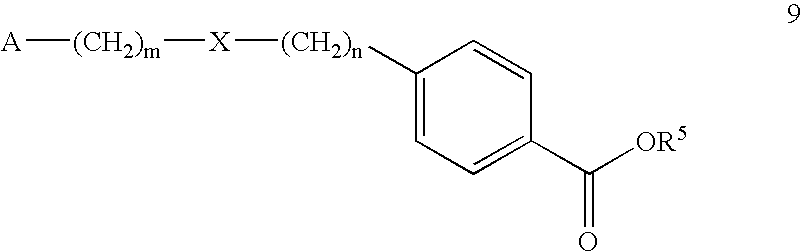
wherein A, m, X, and n are as defined above; R5 is an alkyl group having 1 to 4 carbons. The reduction reaction is generally carried out under an anhydrous condition using a well-known reducing agent in the literature, preferably LiAlH4 or diisobutylaluminum hydride (DIBAL-H), at from 0° C. to reflux temperature for 1-24 hours. - Compounds of the general formula (9) may be prepared from compounds of the general formulas (10) and (11):

wherein A, m, R2, n and R5 are as defined above. The coupling reaction is generally carried out at from 0° C. to room temperature for 1-24 hours in a suitable solvent such as a C1-C4 alkanol, dichloromethane, DMF, or water using an excess amount of (10) or in the presence of an organic tertiary amine such as triethylamine or an inorganic base such as potassium carbonate, to scavenge the acid by-product. - Compounds of the general formula (9) may be also prepared from compounds of

the general formula (12):
wherein A, m, n and R5 are as defined above. The oxidation reaction is generally effected by using an excess amount of a well-known reagent in the literature, preferably OXONE, in a solvent such as aqueous C1-C4 alkanol, at from 0° C. to room temperature for 2-24 hours. - Compounds of the general formula (12) may be prepared from compounds of the general formulas (13) and (14):

wherein A, m, n and R5 are as defined above; R6 represents a halogen atom, preferably a chlorine atom. The alkylation reaction is generally carried out under standard conditions in the presence of a base such as potassium carbonate or potassium tert-butoxide, in a suitable solvent such as DMF, at room temperature to 100° C. for 2-24 hours. - Compounds represented by formula (1) may be purified or isolated by a usual separation method such as extraction, recrystallization, column chromatography and the like.
- Compounds of this invention can be orally or parenterally administered. In case of oral administration, compounds of this invention may be formulated into solid formulations such as tablets, powders, granules, capsules and the like; solutions; oily suspensions; or liquid formulations such as syrups, elixirs and the like. In case of parenteral administration, compounds of this invention may be formulated into aqueous or oily suspension for injection. In preparing the formulations, conventional excipients, binders, lubricants, aqueous solvents, oily solvents, emulsifiers, suspending agents or the like may be used, and other additives, such as preservatives, stabilizers or the like may be also included.
- Although appropriate daily dosages of the compounds of this invention vary depending upon the administration route, age, body weight and conditions of the patient, and the kind of disease to be treated, they can generally be between 0.05-1000 mg, preferably 10-1000 mg on oral administration, and 0.01-300 mg, preferably 0.05-100 mg on parenteral administration, in 1-5 divisions.
- The following Examples are provided to further illustrate this invention and are not to be constructed as limiting thereof.
- A suspension of 1-(pyridin-3-ylmethyl)piperazine (549 mg, 3.10 mmol), 4-fluorobenzonitrile (375 mg, 3.10 mmol), and K2CO3 (643 mg, 4.65 mmol) in DMF (50 mL) was stirred at 80° C. overnight. The reaction mixture was cooled to room temperature and filtered, and the filtrate was washed with ethyl acetate (30 nL). The combined filtrate and washings were evaporated to dryness under reduced pressure. The crude residue was purified by MPLC on silica gel (3% MeOH in CH2Cl2) to afford the titled compound (326 mg, 38%) as a yellow solid.
- 1H NMR (CDCl3/TMS) δ 2.59 (apparent t, 4H, J=5.1 Hz), 3.33 (apparent t, 4H, J=5.1 Hz), 3.57 (s, 2H), 6.85 (m, 2H), 7.27 (m, 1H), 7.48 (m, 2H), 7.69 (m, 1H), 8.53 (m, 1H), 8.57 (m, 1H)
- A solution of the compound (330 mg, 1.19 mmol) from the process (1-1) in conc. HCl (20 mL) was stirred at 80° C. overnight. The reaction mixture was cooled to room temperature and then evaporated to dryness under reduced pressure. The residue was dissolved in saturated LiOH solution (pH 9) and then evaporated to dryness under reduced pressure. The residue was dissolved in 10% aqueous HCl solution (pH 2), evaporated, and dried under vacuum to give the corresponding acid, which was used in the next step without further purification.
- To a mixture of the acid above, 3-(4-aminomethylphenyl)acrylic acid ethyl ester hydrochloride (287 mg, 1.19 mmol), 1-hydroxybenzotriazole (240 mg, 1.78 mmol), and DMAP (29 mg, 0.24 mmol) in pyridine (20 mL) was added EDC (341 mg, 1.78 mmol), and the mixture was stirred at room temperature overnight. The reaction mixture was concentrated under reduced pressure, and to it an aqueous NaHCO3 solution (20 mL) was added. The mixture was extracted with 5% MeOH in CH2Cl2 (30 mL×3), and the organic layer was dried (MgSO4) and evaporated under reduced pressure. The crude product was purified by MPLC on silica gel (4% MeOH in CH2Cl2) to afford the titled compound (482 mg, 84%) as a pale yellow solid.
- 1H NMR (CDCl3/TMS) δ 1.34 (t, 3H, J=7.2 Hz), 2.60 (apparent t, 4H, J=5.1 Hz), 3.30 (apparent t, 4H, J=5.1 Hz), 3.57 (s, 2H), 4.26 (q, 2H, J=7.2 Hz), 4.64 (d, 2H, J=5.7 Hz), 6.32 (br t, 1H, J=5.7 Hz), 6.41 (d, 1H, J=15.9 Hz), 6.88 (m, 2H), 7.27 (m, 1H), 7.36 (d, 2H, J=8.1 Hz), 7.49 (d, 2H, J=8.1 Hz), 7.64-7.72 (m, 4H), 8.53 (m, 1H), 8.57 (m, 1H)
- To a solution of 1.76 M NH2OH in MeOH (1.23 mL) was added the compound (150 mg, 0.31 mmol) from the process (1-2), and the mixture was stirred at room temperature for 24 hours. The reaction mixture was concentrated, and the residue was dissolved in 1 N HCl aqueous solution (pH 5). The solid precipitated was collected by filtration, dried under vacuum, and crystallized from MeOH/CH2Cl2/ether to afford the titled compound (67 mg, 46%) as a pale brown solid.
- 1H NMR (DMSO-d6) δ 2.56 (m, 4H), 3.28 (m, 4H), 3.62 (br s, 2H), 4.45 (d, 2H, J=5.7 Hz), 6.42 (d, 1H, J=15.9 Hz), 6.96 (m, 2H), 7.31 (d, 2H, J=8.1 Hz), 7.37-7.45 (m, 2H), 7.50 (d, 2H, J=8.1 Hz), 7.76-7.79 (m, 3H), 8.50 (m, 1H), 8.54 (m, 1H), 8.78 (br t, 1H, J=5.7 Hz), 9.01 (br s, 1H), 10.73 (br s, 1H)
- The titled compound was prepared as described in Example 1 by using 1-(pyridin-2-ylmethyl)piperazine in place of 1-(pyridin-3-ylmethyl)piperazine.
- yield: 32% (yellow solid)
- 1H NMR (CDCl3/TMS) δ 2.66 (apparent t, 4H, J=5.1 Hz), 3.36 (apparent t, 4H, J=5.1 Hz), 3.72 (s, 2H), 6.84 (m, 2H), 7.19 (m, 1H), 7.42 (m, 1H,), 7.48 (m, 2H), 7.68 (m, 1H), 8.59 (m, 11H)
- yield: 38% (off-white solid)
- 1H NMR (DMSO-d6) δ 1.25 (t, 3H, J=7.2 Hz), 2.57 (m, 4H), 3.28 (m, 4H), 3.66 (s, 2H), 4.18 (q, 2H, J=7.2 Hz), 4.46 (d, 2H, J=5.7 Hz), 6.59 (d, 11H, J=16.2 Hz), 6.96 (m, 2H), 7.26-7.34 (m, 3H), 7.48 (m, 1H), 7.60-7.68 (m, 3H), 7.75-7.81 (m, 3H), 8.51 (m, 11H), 8.80 (br t, 11H, J=5.7 Hz)
- yield: 59% (off-pink solid)
- 1H NMR (DMSO-d6) δ 2.59 (m, 4H), 3.28 (m, 4H), 3.68 (br s, 2H), 4.45 (d, 2H, J=5.7 Hz), 6.42 (d, 1H, J=15.9 Hz), 6.96 (m, 2H), 7.26-7.34 (m, 3H), 7.43 (d, 1H, J=15.9 Hz), 7.47-7.52 (m, 3H), 7.77-7.81 (m, 3H), 8.51 (m, 1H), 8.78 (br t, 1H, J=5.7 Hz), 9.02 (br s, 1H), 10.73 (br s, 1H)
- The titled compound was prepared as described in Example 1 by using 1-(pyridin-4-ylmethyl)piperazine in place of 1-(pyridin-3-ylmethyl)piperazine.
- yield: 59% (yellow solid)
- 1H NMR (CDCl3/TMS) δ 2.59 (apparent t, 4H, J=5.1 Hz), 3.35 (apparent t, 4H, J=5.1 Hz), 3.56 (s, 2H), 6.85 (m, 2H), 7.30 (m, 2H), 7.49 (m, 2H), 8.56 (m, 2H)
- yield: 94% (off-white solid)
- 1H NMR (CDCl3/TMS) δ 1.33 (t, 3H, J=7.2 Hz), 2.60 (apparent t, 4H, J=5.1 Hz), 3.31 (apparent t, 4H, J=5.1 Hz), 3.56 (s, 2H), 4.26 (q, 2H, J=7.2 Hz), 4.65 (d, 2H, J=5.7 Hz), 6.36 (br t, 1H, J=5.7 Hz), 6.41 (d, 1H, J=15.9 Hz), 6.88 (m, 2H), 7.30 (d, 2H, J=6.0 Hz), 7.36 (d, 2H, J=8.1 Hz), 7.49 (d, 2H, J=8.1 Hz), 7.66 (d, 1H, J=15.9 Hz), 7.72 (m, 2H) 8.56 (m, 2H)
- yield: 54% (pale brown solid)
- 1H NMR (DMSO-d6) δ 2.52 (m, 4H), 3.28 (m, 4H), 3.57 (s, 2H), 4.45 (d, 2H, J=5.7 Hz), 6.42 (d, 1H, J=15.9 Hz), 6.96 (m, 2H), 7.32 (d, 2H, J=8.1 Hz), 7.36 (d, 2H, J=6.0 Hz), 7.42 (d, 1H, J=15.9 Hz), 7.51 (d, 2H, J=8.1 Hz), 7.78 (m, 2H), 8.53 (d, 2H, J=6.0 Hz), 8.78 (br t, 1H, J=5.7 Hz), 9.02 (br s, 1H), 10.73 (br s, 1H)
- The titled compound was prepared in a similar manner to the process described in Example 1 by using picolinic acid.
- yield: 58% (pale yellow oil)
- 1H NMR (CDCl3/TMS) δ 1.34 (t, 3H, J=7.2 Hz), 4.26 (q, 2H, J=7.2 Hz), 4.69 (d, 2H, J=6.3 Hz), 6.42 (d, 1H, J=15.9 Hz), 7.38 (d, 2H, J=8.1 Hz), 7.44 (m, 1H), 7.50 (d, 2H, J=8.1 Hz), 7.67 (d, 1H, J=15.9 Hz), 7.87 (m, 1H), 8.24 (m, 1H), 8.42 (m, 1H), 8.54 (m, 1H)
- yield: 29% (off-white solid)
- 1H NMR (DMSO-d6) δ 4.51 (m, 2H), 6.45 (d, 1H, J=15.9 Hz), 7.35 (d, 2H, J=8.1 Hz), 7.42 (d, 1H, J=15.9 Hz), 7.50 (d, 2H, J=8.1 Hz), 7.59-7.64 (m, 1H), 7.97-8.06 (m, 2H), 8.66 (m, 1H), 9.02 (br s, 1H), 9.36 (m, 1H), 10.76 (br s, 1H)
- To a mixture of 4-pyrrolidin-1-ylbenzoic acid (2.0 g, 10.5 mmol), (4-aminomethylphenyl)methanol (4.3 g, 31.4 mmol), 1-hydroxybenzotriazole (1.7 g, 12.6 mmol), and DMAP (256 mg, 2.1 mmol) in pyridine (50 mL) was added EDC (3.0 g, 15.7 mmol), and the mixture was stirred at room temperature overnight. The reaction mixture was concentrated under reduced pressure, and an aqueous NaHCO3 solution (50 mL) was added. The mixture was extracted with 5% MeOH in CHCl3 (150 mL×2), and the organic layer was dried (MgSO4) and evaporated under reduced pressure. The crude product was purified by MPLC on silica gel (3% MeOH in CHCl3) to afford the titled compound (2.56 g, 79%) as a white solid.
- 1H NMR (DMSO-d6) δ 1.96 (m, 4H), 3.28 (m, 4H), 4.41-4.47 (m, 4H), 5.10 (t, 1H, J=5.7 Hz), 6.53 (m, 2H), 7.25 (apparent s, 4H), 7.75 (m, 2H), 8.59 (br t, 1H, J=6.0 Hz)
- To a solution of oxalyl chloride (0.93 mL, 10.6 mmol) in THF (10 mL) at −78° C. was added a solution of DMSO (1.65 mL, 23.2 mmol) in THF (10 mL), and the reaction mixture was stirred for 30 minutes. A solution of the compound (1.5 g, 4.8 mmol) from the process (5-1) in THF (200 mL) was added to it, and then the mixture was stirred for 1 hour and warmed to −35° C. After 10 minutes, the mixture was cooled to −78° C., and triethylamine (3.37 mL, 24.2 mmol) was added. After stirring at 0° C. for 1 hour, the mixture was diluted with water (150 mL), and then THF was evaporated under reduced pressure. The resulting residue was extracted with 5% MeOH in CHCl3 (250 mL×2). The extract was dried (MgSO4) and evaporated to dryness under reduced pressure to give a crude product which was crystallized from MeOH/CHCl3/ether to afford the corresponding aldehyde (925 mg, 62%) as a white solid.
- A solution of the aldehyde (1.35 g, 4.38 mmol) above, (Ph)3P═CHCO2Et (2.29 g, 6.57 mmol) in CH3CN (60 mL) was stirred at 70° C. for 2 hours. The reaction mixture was concentrated under reduced pressure, and the residue was purified by MPLC on silica gel (2% MeOH in CHCl3) to afford the titled compound (1.25 g, 76%) as a pale yellow solid.
- 1H NMR (DMSO-d6) δ 1.25 (t, 3H, J=7.2 Hz), 1.96 (m, 4H), 3.28 (m, 4H), 4.18 (q, 2H, J=7.2 Hz), 4.46 (d, 2H, J=5.7 Hz), 6.54 (m, 2H), 6.58 (d, 1H, J=16.5 Hz), 7.33 (d, 2H, J=8.1 Hz), 7.62 (d, 1H, J-=16.5 Hz), 7.67 (d, 2H, J=8.1 Hz), 7.76 (m, 2H), 8.66 (br t, 1H, J=5.7 Hz)
- The titled compound was prepared as described in the process (1-3) by using the compound from the process (5-2).
- yield: 35% (pale brown solid)
- 1H NMR (DMSO-d6) δ 1.96 (m, 4H), 3.28 (m, 4H), 4.45 (d, 2H, J=5.7 Hz), 6.42 (d, 1H, J=15.9 Hz), 6.54 (m, 2H), 7.32 (d, 2H, J=8.1 Hz), 7.43 (d, 1H, J=15.9 Hz), 7.50 (d, 2H, J=8.1 Hz), 7.76 (m, 2H), 8.64 (br t, 1H, J=5.7 Hz), 9.00 (br s, 1H), 10.70 (br s, 1H)
- The titled compound was prepared as described in Example 5 by using 4-(dimethylamino)benzoic acid in place of 4-pyrrolidin-1-ylbenzoic acid.
- To a mixture of 4-(dimethylamino)benzoic acid (915 mg, 5.54 mmol) and triethylamine (772 μL, 5.54 mmol) in CH2Cl2 (25 mL) at 0° C. was added BOP-CL (1.50 g, 6.09 mmol), and the mixture was stirred at room temperature for 20 minutes. To the reaction mixture was added (4-aminomethylphenyl)methanol (760 mg, 5.54 mmol) and triethylamine (1.54 mL, 11.08 mmol), and the mixture was stirred at room temperature overnight. To the reaction mixture was added a 50% aqueous NaHCO3 solution (50 mL), and the mixture was extracted with 5% MeOH in CHCl3 (100 mL×1, 40 mL×2). The organic layer was dried (MgSO4) and evaporated under reduced pressure. The crude product was purified by MPLC on silica gel (2% MeOH in CHCl3) to afford the titled compound (1.04 g, 66%) as a white solid.
- 1H NMR (DMSO-d6) δ 2.97 (s, 6H), 4.41-4.47 (m, 4H), 5.10 (t, 1H, J=5.7 Hz), 6.70 (m, 2H), 7.25 (apparent s, 4H), 7.76 (m, 2H), 8.63 (br t, 1H, J=6.0 Hz)
- yield: 74% (white solid)
- 1H NMR (DMSO-d6) δ 1.25 (t, 3H, J=7.2 Hz), 2.97 (s, 6H), 4.18 (q, 2H, J=7.2 Hz), 4.46 (d, 2H, J=6.0 Hz), 6.59 (d, 1H, J=15.9 Hz), 6.71 (m, 2H), 7.33 (d, 2H, J=8.1 Hz), 7.63 (d, 1H, J=15.9 Hz), 7.67 (d, 2H, J=8.1 Hz), 7.77 (m, 2H), 8.70 (br t, 1H, J=6.0 Hz)
- yield: 58% (pale pink solid)
- 1H NMR (DMSO-d6) δ 2.97 (s, 6H), 4.45 (d, 2H, J=5.7 Hz), 6.42 (d, 1H, J=15.9 Hz), 6.71 (m, 2H), 7.33 (d, 2H, J=8.1 Hz), 7.43 (d, 1H, J=15.9 Hz), 7.51 (d, 2H, J=8.1 Hz), 7.77 (m, 2H), 8.68 (br t, 1H, J=5.7 Hz), 9.00 (br s, 1H), 10.71 (br s, 1H)
- The titled compound was prepared as described in Example 5 by using nicotinic acid in place of 4-pyrrolidin-1-ylbenzoic acid.
- yield: 86% (white solid)
- 1H NMR (DMSO-d6) δ 4.46-4.49 (m, 4H), 5.13 (br t, 1H, J=5.6 Hz), 7.28 (apparent s, 4H), 7.51 (dd, 1H, J=7.8 Hz, 4.8 Hz), 8.22 (m, 1H), 8.71 (dd, 1H, J=4.8 Hz, 1.5 Hz), 9.04 (d, 1H, J=2.1 Hz), 9.21 (br t, 1H, J=5.7 Hz)
- yield: 39% (pale yellow solid)
- 1H NMR (DMSO-d6) δ 1.26 (t, 3H, J=7.2 Hz), 4.19 (q, 2H, J=7.2 Hz), 4.53 (d, 2H, J=6.0 Hz), 6.60 (d, 1H, J=15.9 Hz), 7.38 (d, 2H, J=8.1 Hz), 7.52 (m, 1H), 7.63 (d, 1H, J=15.9 Hz), 7.69 (d, 2H, J=8.1 Hz), 8.23 (m, 1H), 8.72 (m, 1H), 9.06 (m, 1H), 9.26 (br t, 1H, J=6.0 Hz)
- yield: 74% (pale pink solid)
- 1H NMR (DMSO-d6) δ 4.51 (m, 2H), 6.43 (d, 1H, J=15.9 Hz), 7.37 (d, 2H, J=8.1 Hz), 7.44 (d, 1H, J=15.9 Hz), 7.52 (m, 1H), 7.53 (d, 2H, J=8.1 Hz), 8.23 (m, 1H), 8.72 (m, 1H), 9.05 (m, 1H), 9.25 (m, 1H)
- To a solution of N,N-carbonyldiimidazole (2.1 g, 12.8 mmol) in THF (15 mL) was added a solution of 3-pyridylcarbinol (1.3 g, 11.6 mmol) in THF (15 mL). After stirring for 30 minutes, a solution of (4-aminomethylphenyl)methanol (1.4 g, 10.4 mmol) in THF (15 mL) and triethylamine (3.2 mL, 23.2 mmol) were added, and the mixture was stirred overnight. The reaction mixture was concentrated under reduced pressure, and the residue was diluted with water (30 mL) and extracted with 10% MeOH in CHCl3 (30 mL×2). The organic layer was dried (Na2SO4), evaporated under reduced pressure, and the residue was purified by MPLC on silica gel (5% MeOH in CHCl3) to afford the titled compound (1.31 g, 46%) as a white solid.
- 1H NMR (DMSO-d6) δ 4.18 (m, 2H), 4.45 (s, 2H), 5.08 (s, 2H), 7.19 (d, 2H, J=8.0 Hz), 7.25 (d, 2H, J=8.0 Hz), 7.40 (m, 1H), 7.77 (m, 1H), 7.83 (m, 1H), 8.52 (m, 1H), 8.58 (m, 1H)
- The titled compound was prepared as described in the process (5-2) using the compound from the process (8-1).
- yield: 75% (white solid)
- 1H NMR (DMSO-d6) δ 3.72 (s, 3H), 4.23 (d, 2H, J=6.0 Hz), 5.09 (s, 2H), 6.61 (d, 1H, J=15.9 Hz), 7.29 (d, 2H, J=8.1 Hz), 7.40 (m, 1H), 7.64 (d, 1H, J=15.9 Hz), 7.67 (d, 2H, J=8.1 Hz), 7.78 (m, 1H), 7.90 (br t, 1H, J=6.0 Hz), 8.53 (m, 1H), 8.58 (m, 1H)
- The titled compound was prepared as described in the process (1-3) using the compound from the process (8-2).
- yield: 39% (pale pink solid)
- 1H NMR (DMSO-d6) δ 4.21 (m, 2H), 5.09 (s, 2H), 6.43 (d, 1H, J=15.9 Hz), 7.28 (m, 2H), 7.40 (m, 1H), 7.43 (d, 1H, J=15.9 Hz), 7.51 (m, 2H), 7.78 (m, 1H), 7.89 (m, 1H), 8.53 (m, 11H), 8.59 (m, 11H)
- To a solution of 4-chlorosulfonylmethylbenzoic acid methyl ester (435 mg, 1.75 mmol) and 3-aminopyridine (170 mg, 1.81 mmol) in CH2Cl2 (10 mL) at 0° C. was added triethylamine (488 μL, 3.50 mmol), and the mixture was stirred at room temperature for 2 hours. The reaction mixture was diluted with CHCl3, and the mixture was washed with water and brine. The organic layer was dried (Na2SO4) and evaporated under reduced pressure to give the crude product which was purified by MPLC on silica gel (3% MeOH in EtOAc) to afford the titled compound (434 mg, 81%) as a white solid.
- 1H NMR (DMSO-d6) δ 3.86 (s, 3H), 4.68 (s, 2H), 7.32 (dd, 1H, J=8.4 Hz, 4.8 Hz), 7.45 (d, 2H, J=8.1 Hz), 7.55 (m, 1H), 7.93 (d, 2H, J=8.1 Hz), 8.28 (dd, 1H, J=4.8 Hz, 1.5 Hz), 8.36 (d, 1H, J=1.8 Hz), 10.13 (br s, 1H)
- To a solution of 4-(pyridin-3-ylsulfamoylmethyl)benzoic acid methyl ester (1.91 g, 6.23 mmol) in THF (60 mL) at 0° C. was added a 1 M solution of LiAlH4 in THF (13.7 mL, 13.7 mmol), and the mixture was warmed to room temperature. After stirring for 10 minutes, the mixture was heated to reflux temperature for 3 hours. The reaction mixture was cooled to 0° C. and quenched with saturated Na2SO4 aqueous solution (1.9 mL). The mixture was neutalized with 1 N HCl solution (13.7 mL), and then THF was evaporated under reduced pressure. The residue was diluted with water (70 mL) and extracted with CHCl3 (50 mL×3). The organic layer was washed with brine, dried (Na2SO4) and concentrated under reduced pressure. The residue was purified by MPLC on silica gel (6% MeOH in EtOAc) to afford the titled compound (1.43 g, 83%) as a pale yellow solid.
- 1H NMR (DMSO-d6) δ 4.48 (s, 2H), 4.50 (s, 2H), 7.22 (d, 2H, J=8.1 Hz), 7.29 (d, 2H, J=8.1 Hz), 7.32 (m, 1H), 7.55 (m, 1H), 8.26 (m, 1H), 8.36 (m, 1H)
- The titled compound was prepared as described in the process (5-2) using the compound from the process (9-2).
- yield: 53% (white solid)
- 1H NMR (DMSO-d6) δ 1.27 (t, 3H, J=7.2 Hz), 4.20 (q, 2H, J=7.2 Hz), 4.60 (s, 2H), 6.64 (d, 1H, J=15.9 Hz), 7.31 (m, 1H), 7.33 (d, 2H, J=8.1 Hz), 7.55 (m, 1H), 7.63 (d, 1H, J=15.9 Hz), 7.70 (d, 2H, J=8.1 Hz), 8.27 (m, 1H), 8.36 (m, 1H), 10.20 (br s, 1H)
- The titled compound was prepared as described in the process (1-3) using the compound from the process (9-3).
- yield: 64% (white solid)
- 1H NMR (DMSO-d6) δ 4.59 (s, 2H), 6.46 (d, 1H, J=15.9 Hz), 7.30-7.34 (m, 3H), 7.44 (d, 1H, J=15.9 Hz), 7.52-7.57 (m, 3H), 8.28 (m, 1H), 8.37 (m, 1H), 9.04 (br s, 1H), 10.08 (br s, 1H), 10.75 (br s, 1H)
- To a mixture of benzenethiol (1.3 mL, 13.1 mmol) and potassium tert-butoxide (1.47 g, 13.1 mmol) in DMF (50 mL) at 0° C. was added 4-(bromomethyl)benzoic acid methyl ester (3.0 g, 13.1 mmol), and the mixture was stirred at room temperature for 1 hour. After stirring at 80-90° C. overnight, the reaction mixture was evaporated to dryness under reduced pressure. The residue was dissolved in water (30 mL) and extracted with CH2Cl2 (200 mL). The organic layer was dried (MgSO4) and evaporated under reduced pressure. The crude product was purified by MPLC on silica gel (10% EtOAc in hexanes) to afford the titled compound (2.74 g, 81%) as a white solid.
- 1H NMR (CDCl3/TMS) δ 3.90 (s, 3H), 4.12 (s, 2H), 7.19-7.30 (m, 5H), 7.32 (d, 2H, J=8.1 Hz), 7.94 (d, 2H, J=8.1 Hz)
- To a mixture of the compound (2.5 g, 9.68 mmol) from the process (10-1) in a 50% aqueous solution of methanol (60 mL) at 0° C. was added OXONE (12.5 g, 20.32 mmol), and the mixture was stirred at room temperature overnight. To the reaction mixture was added an aqueous NaHCO3 solution (25 mL), and the mixture was extracted with CH2Cl2 (250 mL). The organic layer was dried (MgSO4) and evaporated under reduced pressure. The crude product was purified by NWLC on silica gel (1% MeOH in CHCl3) to afford the titled compound (2.36 g, 84%) as a white solid.
- 1H NMR (CDCl3/TMS) δ 3.84 (s, 3H), 4.81 (s, 2H), 7.29 (d, 2H, J=8.1 Hz), 7.57-7.62 (m, 2H), 7.69-7.72 (m, 3H), 7.86 (d, 2H, J=8.1 Hz)
- To a solution of the compound (2.3 g, 7.92 mmol) from the process (10-2) in CH2Cl2 (50 mL) at −78° C. was added slowly DIBAL-H (1 M in toluene, 16.6 mL, 16.63 mmol), and the mixture was stirred at room temperature for 2 hours. The reaction mixture was cooled to 0° C., and to it an aqueous NH4Cl solution (250 mL) was added slowly. The mixture was extracted with 10% MeOH in CH2Cl2 (1.5 L), and the organic layer was dried (MgSO4) and evaporated under reduced pressure. The crude product was crystallized from MeOH/CH2Cl2/ether to afford the titled compound (1.66 g, 80%) as white solid.
- 1H NMR (DMSO-d6) δ 4.45 (s, 2H), 4.64 (s, 2H), 7.08 (d, 2H, J=8.1 Hz), 7.21 (d, 2H, J=8.1 Hz), 7.56-7.61 (m, 2H), 7.69-7.73 (m, 3H)
- The titled compound was prepared as described in the process (5-2) using the compound from the process (10-3).
- yield: 82% (white solid)
- 1H NMR (DMSO-d6) δ 3.72 (s, 3H), 4.73 (s, 2H), 6.64 (d, 11H, J=15.9 Hz), 7.18 (d, 2H, J=8.1 Hz), 7.57-7.65 (m, 5H), 7.70-7.74 (m, 3H)
- The titled compound was prepared as described in the process (1-3) using the compound from the process (10-4).
- yield: 52% (pale red solid)
- 1H NMR (DMSO-d6) δ 4.71 (s, 2H), 6.45 (d, 1H, J=15.9 Hz), 7.17 (d, 2H, J=8.1 Hz), 7.41 (d, 1H, J=15.9 Hz), 7.47 (d, 2H, J=8.1 Hz), 7.57-7.62 (m, 2H), 7.71-7.74 (m, 3H), 9.04 (br s, 1H), 10.75 (br s, 1H)
- The titled compound was prepared as described in Example 10 by using 2-mercaptopyridine in place of benzenethiol.
- yield: 76% (white solid)
- 1H NMR (CDCl3/TMS) δ 3.89 (s, 3H), 4.48 (s, 2H), 6.99 (m, 1H), 7.15 (m, 1H), 7.44-7.50 (m, 3H), 7.95 (d, 2H, J=8.1 Hz), 8.45 (m, 1H)
- yield: 98% (white solid)
- 1H NMR (CDCl3/TMS) δ 3.83 (s, 3H), 4.94 (s, 2H), 7.34 (d, 2H, J=8.4 Hz), 7.76 (m, 1H), 7.84 (m, 1H), 7.86 (d, 2H, J=8.4 Hz), 8.07 (m, 1H), 8.85 (m, 1H)
- yield: 79% (white solid)
- 1H NMR (DMSO-d6) δ 4.44 (s, 2H), 4.78 (s, 2H), 7.12 (d, 2H, J=8.1 Hz), 7.21 (d, 2H, J=8.1 Hz), 7.75 (m, 1H), 7.84 (m, 1H), 8.07 (m, 1H), 8.86 (m, 1H)
- yield: 84% (pale yellow solid)
- 1H NMR (DMSO-d6) δ 3.72 (s, 3H), 4.87 (s, 2H), 6.63 (d, 1H, J=15.8 Hz), 7.23 (d, 2H, J=8.1 Hz), 7.61 (d, 1H, J=15.8 Hz), 7.64 (d, 2H, J=8.1 Hz), 7.76 (m, 1H), 7.86 (m, 1H), 8.08 (m, 1H), 8.86 (m, 1H)
- yield: 42% (pale red solid)
- 1H NMR (DMSO-d6) δ 4.85 (s, 2H), 6.43 (d, 1H, J=16.2 Hz), 7.21 (d, 2H, J=8.1 Hz), 7.40 (d, 1H, J=16.2 Hz), 7.47 (d, 2H, J=8.1 Hz), 7.76 (m, 1H), 7.85 (m, 1H), 8.08 (m, 1H), 8.86 (in, 1H), 9.04 (br s, 1H), 10.74 (br s, 1H)
- The titled compound was prepared as described in Example 10 by using 4-mercaptopyridine in place of benzenethiol.
- yield: 77% (pale yellow solid)
- 1H NMR (CDCl3/TMS) δ 3.91 (s, 3H), 4.24 (s, 2H), 7.09 (m, 1H), 7.47 (d, 2H, J=8.1 Hz), 8.01 (d, 2H, J=8.1 Hz), 8.38 (m, 1H)
- yield: 71% (white solid)
- 1H NMR (CDCl3/TMS) δ 3.93 (s, 3H), 4.39 (s, 2H), 7.20 (d, 2H, J=8.1 Hz), 7.48 (m, 1H), 7.97 (d, 2H, J=8.1 Hz), 8.81 (m, 1H)
- yield: 69% (white solid)
- 1H NMR (DMSO-d6) δ 4.46 (s, 2H), 4.74 (s, 2H), 7.13 (d, 2H, J=8.1 Hz), 7.24 (d, 2H, J=8.1 Hz), 7.70 (m, 2H), 8.87 (m, 2H)
- yield: 51% (white solid)
- 1H NMR (DMSO-d6) δ 1.34 (t, 3H, J=7.2 Hz), 4.27 (q, 2H, J=7.2 Hz), 4.36 (s, 2H), 6.44 (d, 1H, J=15.9 Hz), 7.15 (d, 2H, J=8.1 Hz), 7.45 (d, 2H, J=8.1 Hz), 7.50 (m, 2H), 7.64 (d, 1H, J=15.9 Hz), 8.82 (m, 2H)
- yield: 45% (red solid)
- 1H NMR (DMSO-d6) δ 4.88 (s, 2H), 6.46 (d, 1H, J=15.3 Hz), 7.21 (d, 2H, J=8.1 Hz), 7.36 (d, 1H, J=15.3 Hz), 7.49 (d, 2H, J=8.1 Hz), 7.70 (d, 1H, J=5.4 Hz), 8.88 (d, 1H, J=5.4 Hz), 9.07 (br s, 1H), 10.76 (br s, 1H)
- The titled compound was prepared as described in the process (1-2) by using 2-naphthoic acid.
- yield: 82% (white solid)
- 1H NMR (DMSO-d6) δ 1.25 (t, 3H, J=7.2 Hz), 4.18 (q, 2H, J=7.2 Hz), 4.56 (m, 2H), 7.60 (d, 1H, J=15.9 Hz), 7.40 (d, 2H, J=8.1 Hz), 7.57-7.71 (m, 5H), 7.97-8.05 (m, 4H), 8.51 (s, 1H), 9.24 (br t, 1H, J=6.0 Hz)
- The titled compound was prepared as described in the process (1-2) by using the compound from the process (13-1).
- yield: 85% (pale pink solid)
- 1H NMR (DMSO-d6) δ 4.55 (m, 2H), 6.44 (d, 1H, J=15.6 Hz), 7.38-7.65 (m, 7H), 7.97-8.04 (m, 4H), 8.51 (s, 1H), 9.23 (m, 1H)
- The titled compound was prepared as described in the process (1-2) by using 3-quinolinecarboxylic acid.
- yield: 89% (white solid)
- 1H NMR (DMSO-d6) δ 1.25 (t, 3H, J=7.2 Hz), 4.18 (q, 2H, J=7.2 Hz), 4.58 (d, 2H, J=5.7 Hz), 6.61 (d, 1H, J=15.9 Hz), 7.43 (d, 2H, J=8.4 Hz), 7.64 (d, 1H, J=15.9 Hz), 7.68-7.72 (m, 3H), 7.85-7.90 (m, 1H), 8.08-8.12 (m, 2H), 8.88 (m, 1H), 9.33 (m, 1H), 9.42 (br t, 1H, J=5.7 Hz)
- The titled compound was prepared as described in the process (1-2) by using the compound from the process (14-1).
- yield: 89% (pale pink solid)
- 1H NMR (DMSO-d6) δ 4.58 (d, 2H, J=5.1 Hz), 6.45 (d, 1H, J=15.9 Hz), 7.42 (d, 2H, J=8.1 Hz), 7.43-7.56 (m, 3H), 7.70 (m, 1H), 7.88 (m, 1H), 8.10 (d, 2H, J=8.1 Hz), 8.89 (m, 1H), 9.01 (br s, 1H), 9.33 (m, 1H), 9.42 (m, 1H), 10.74 (br s, 1H)
- The titled compound was prepared as described in Example 5 by using 2-quinolinecarboxylic acid in place of 4-pyrrolidin-1ylbenzoic acid.
- yield: 82% (white solid)
- 1H NMR (CDCl3/TMS) δ 1.90 (m, 1H), 4.69 (d, 2H, J=5.1 Hz), 4.72 (d, 2H, J=6.3 Hz), 7.35 (d, 2H, J=8.1 Hz), 7.40 (d, 2H, J=8.1 Hz), 7.61 (m, 1H), 7.74 (m, 1H), 7.88 (m, 1H), 8.06 (m, 1H), 8.32 (m, 2H), 8.61 (m, 1H)
- yield: 91% (white solid)
- 1H NMR (CDCl3/TMS) δ 1.34 (t, 3H, J=7.2 Hz), 4.26 (q, 2H, J=7.2 Hz), 4.76 (d, 2H, J=6.3 Hz), 6.43 (d, 11H, J=15.9 Hz), 7.43 (d, 2H, J=8.1 Hz), 7.52 (d, 2H, J=8.1 Hz), 7.60-7.71 (m, 2H), 7.76 (m, 1H), 7.89 (m, 1H), 8.08 (m, 1H), 8.34 (m, 2H), 8.65 (m, 1H)
- yield: 92% (pale brown solid)
- 1H NMR (DMSO-d6) δ 4.58 (d, 2H, J=6.3 Hz), 6.43 (d, 1H, J=15.9 Hz), 7.39-7.46 (m, 3H), 7.53 (d, 2H, J=8.1 Hz), 7.73 (m, 1H), 7.88 (m, 1), 8.08-8.19 (m, 3), 8.58 (m, 1H), 9.02 (br s, 1H), 9.51 (br t, 1H, J=6.3 Hz), 10.72 (br s, 1H)
- Three human cancer cell lines (A-549, lung cancer; SK-BR-3, breast cancer; MKN-45, stomach cancer) were tested in MTT assay. These cell lines were grown in RPMI 1640 medium supplemented with penicillin-streptomycin (100 units/mL) and 10% heat-inactivated fetal bovine serum under standard culture condition (20% O2 and 5% CO2, 37° C.). Single-cell suspensions were prepared by trypsinization and pipette disaggregation. The number of cells for each cell line plated in 96-well microtiter plates was determined from the growth curve obtained in MTT assay. Test compounds were diluted from stock solution in DMSO into fresh medium to a 10× concentration. Cells were inoculated into each well in 180 μL of medium and eight different concentrations of 20 μL of test compounds were added to each well. The plates were then incubated for 4 days at 37° C., 5% CO2. After 4 days of culture, 0.1 mg (20 μL of 5 mg/mL) of MTT was added to each well. The plates were then incubated at 37° C. for 4 hours. After the plates were centrifuged at 1,000 rpm for 10 minutes, the supernatant was aspirated. 150 FL of DMSO was added to each well to solubilize formazan crystals. The plates were read immediately at 550 nm on Elisa reader (Dynatech, MR 5000). The IC50 was defined as the concentration of compounds that produced a 50% reduction of surviving cells and calculated by quantal probit analysis of pharmacologic calculations with computer program. Table 1. In vitro cytotoxicity of test compounds in the human cancer cell lines
TABLE 1 In vitro cytotoxicity of test compounds in the human cancer cell lines IC50 (μM) Compound A-549 SK-BR-3 MKN-45 Example 1 11.98 3.19 38.59 Example 2 1.65 0.27 2.94 Example 3 3.02 1.72 56.06 Example 4 2.23 0.87 3.64 Example 5 0.35 0.11 0.80 Example 6 0.48 0.16 0.83 Example 7 2.89 1.28 4.98 Example 8 2.61 1.12 3.34 Example 9 36.96 22.90 61.97 Example 10 11.08 4.57 8.34 - Four human gastric adenocarcinoma cells (SNU-16, 601, 620 and 638) were obtained from the Korean Cell Line Bank and grown in RPMI 1640 medium supplemented with 10% heat-inactivated fetal bovine serum and gentamycin (10 μg/mL) under standard culture condition (20% O2 and 5% CO2, 37° C.). Test compounds were dissolved in DMSO and used at a final concentration of 1 μM.
- Cells (5×10⁶) were cultured with and without a test compound (1 FM). Cells were pelleted and resuspended in 1 mL ice-cold lysis buffer (10 mM Tris-HCl, pH 6.5/50 mM sodium bisulfite/1% Triton X-100/10 mM MgCl2/8.6% sucrose) before homogenization with two dounce strokes. Nuclei were centrifuged at 700 rpm for 5 minutes and washed 3 times with 1 mL of lysis buffer. The final wash was performed with 1 mL of Tris-EDTA solution (10 mM Tris-HCl, pH 7.4/13 mM EDTA). Nuclei were pelleted and resuspended in 100 μL of ice-cold water. Sulfuric acid was added to the samples to a final concentration of 0.2 M; samples were vortexed and incubated on ice for 1 hour. Samples were centrifuged at 13,000 rpm for 10 minutes at 4° C., and the supernatant was precipitated with 1 mL of acetone overnight at −20° C.


- Precipitated protein was collected by centrifugation at 13,000 rpm for 10 minutes at 4-° C, air dried, and resuspended in 50-100 μL water. Proteins (20 μg protein) were denatured at 100° C. in loading buffer for 5 minutes and electrophoresed in 15% polyacrylamide gels. After electrophoresis, samples were transferred onto nitrocellulose (0.2 μm) and probed with antibody to acetylated histone H3 or H4 (Upstate Biotechnology Inc.) as recommended by the manufacturer. Detection was performed using enhanced chemiluminescence system (Amersham). To verify equal protein loading, a parallel protein gel was run and stained with coomassie blue.
Claims (3)
Applications Claiming Priority (3)
| Application Number | Priority Date | Filing Date | Title |
|---|---|---|---|
| KR10-2002-0019712 | 2002-04-11 | ||
| KR20020019712 | 2002-04-11 | ||
| PCT/KR2003/000721 WO2003087066A1 (en) | 2002-04-11 | 2003-04-10 | α,β-UNSATURATED HYDROXAMIC ACID DERIVATIVES AND THEIR USE AS HISTONE DEACETYLASE INHIBITORS |
Publications (2)
| Publication Number | Publication Date |
|---|---|
| US20050124679A1 true US20050124679A1 (en) | 2005-06-09 |
| US7495022B2 US7495022B2 (en) | 2009-02-24 |
Family
ID=29244719
Family Applications (1)
| Application Number | Title | Priority Date | Filing Date |
|---|---|---|---|
| US10/510,630 Expired - Fee Related US7495022B2 (en) | 2002-04-11 | 2003-04-10 | α,β-unsaturated hydroxamic acid derivatives and their use as histone deacetylase inhibitors |
Country Status (4)
| Country | Link |
|---|---|
| US (1) | US7495022B2 (en) |
| KR (1) | KR100538359B1 (en) |
| AU (1) | AU2003219595A1 (en) |
| WO (1) | WO2003087066A1 (en) |
Cited By (14)
| Publication number | Priority date | Publication date | Assignee | Title |
|---|---|---|---|---|
| US7154002B1 (en) | 2002-10-08 | 2006-12-26 | Takeda San Diego, Inc. | Histone deacetylase inhibitors |
| US7169801B2 (en) | 2003-03-17 | 2007-01-30 | Takeda San Diego, Inc. | Histone deacetylase inhibitors |
| US7250514B1 (en) | 2002-10-21 | 2007-07-31 | Takeda San Diego, Inc. | Histone deacetylase inhibitors |
| US20080194690A1 (en) * | 2005-05-13 | 2008-08-14 | Topotarget Uk Limited | Pharmaceutical Formulations Of Hdac Inhibitors |
| WO2008101186A1 (en) * | 2007-02-15 | 2008-08-21 | The J. David Gladstone Institutes | Inhibitors for hdac8 |
| US20080274120A1 (en) * | 2005-11-10 | 2008-11-06 | Topotarget Uk Limited | Histone Deacetylase (Hdac) Inhibitors (Pxd101) for the Treatment of Cancer Alone or in Combination With Chemotherapeutic Agent |
| US7642275B2 (en) | 2004-12-16 | 2010-01-05 | Takeda San Diego, Inc. | Histone deacetylase inhibitors |
| US7642253B2 (en) | 2005-05-11 | 2010-01-05 | Takeda San Diego, Inc. | Histone deacetylase inhibitors |
| US7732475B2 (en) | 2005-07-14 | 2010-06-08 | Takeda San Diego, Inc. | Histone deacetylase inhibitors |
| US20100190694A1 (en) * | 2009-01-14 | 2010-07-29 | Jan Fagerberg | Methods for identifying patients who will respond well to cancer treatment |
| US20100286279A1 (en) * | 2007-09-25 | 2010-11-11 | Topotarget Uk Limited | Methods of Synthesis of Certain Hydroxamic Acid Compounds |
| US20100317739A1 (en) * | 2007-12-14 | 2010-12-16 | Brown Milton L | Histone deacetylase inhibitors |
| US20110003777A1 (en) * | 2008-03-07 | 2011-01-06 | Topotarget A/S | Methods of Treatment Employing Prolonged Continuous Infusion of Belinostat |
| US10285959B2 (en) | 2005-02-03 | 2019-05-14 | Topotarget Uk Limited | Combination therapies using HDAC inhibitors |
Families Citing this family (24)
| Publication number | Priority date | Publication date | Assignee | Title |
|---|---|---|---|---|
| TW200418806A (en) * | 2003-01-13 | 2004-10-01 | Fujisawa Pharmaceutical Co | HDAC inhibitor |
| AU2003900587A0 (en) * | 2003-02-11 | 2003-02-27 | Fujisawa Pharmaceutical Co., Ltd. | Hdac inhibitor |
| AR043850A1 (en) * | 2003-04-17 | 2005-08-17 | Bayer Pharmaceuticals Corp | USEFUL HYDROXAMIC ACIDS IN THE TREATMENT OF HYPERPROLIFERATIVE DISORDERS |
| CA2566512A1 (en) | 2004-06-14 | 2005-12-22 | F. Hoffmann-La Roche Ag | Hydroxamates, their manufacture and use as pharmaceutical agents |
| JP2008501665A (en) | 2004-06-14 | 2008-01-24 | エフ.ホフマン−ラ ロシュ アーゲー | Thiophene hydroxamic acid derivatives and their use as HDAC inhibitors |
| US7396944B2 (en) | 2004-06-14 | 2008-07-08 | Hoffmann-La Roche Inc. | Thiophene derivatives, their manufacture and use as pharmaceutical agents |
| CA2574035A1 (en) * | 2004-07-19 | 2006-02-23 | Sandro Belvedere | Histone deacetylase inhibitors |
| ITMI20041869A1 (en) | 2004-10-01 | 2005-01-01 | Dac Srl | NEW INHIBITORS OF DEACETYLASE HISTONS |
| US8242175B2 (en) | 2004-10-01 | 2012-08-14 | Dac S.R.L. | Class of histone deacetylase inhibitors |
| CA2596015A1 (en) | 2005-02-14 | 2006-08-24 | Sampath K. Anandan | Fused heterocyclic compounds useful as inhibitors of histone deacetylase |
| US8569356B2 (en) * | 2005-10-25 | 2013-10-29 | University Of Florida Research Foundation, Inc. | Cyclin dependent kinase inhibitors |
| KR100696139B1 (en) * | 2005-11-01 | 2007-03-20 | 한국화학연구원 | Alkyl carbamoyl naphthalenyloxy octenoyl hydroxyamide derivative having histone deacetylase inhibitory activity and preparation method thereof |
| JP5218057B2 (en) | 2006-02-07 | 2013-06-26 | アステラス製薬株式会社 | N-hydroxyacrylamide compounds |
| CA2666539A1 (en) * | 2006-10-23 | 2008-05-02 | Pfizer Inc. | Substituted phenylmethyl bicyclocarboxyamide compounds |
| US7994357B2 (en) * | 2009-04-03 | 2011-08-09 | Naturewise Biotech & Medicals Corporation | Cinamic compounds and derivatives therefrom for the inhibition of histone deacetylase |
| ES2473792T3 (en) * | 2009-04-03 | 2014-07-07 | Naturewise Biotech & Medicals Corporation | Kinematic compounds and derivatives thereof for histone deacetylase inhibition |
| JP2012532861A (en) * | 2009-07-07 | 2012-12-20 | アンセム バイオサイエンシズ プライベート リミテッド | Histone deacetylase inhibitor |
| WO2015058106A1 (en) | 2013-10-18 | 2015-04-23 | The General Hospital Corporation | Imaging histone deacetylases with a radiotracer using positron emission tomography |
| CN104788391B (en) * | 2015-04-21 | 2017-03-08 | 中国医学科学院医药生物技术研究所 | Cinnamoyl neutral red amide (CA‑PZ) and its preparation and application |
| TWI659949B (en) * | 2016-05-16 | 2019-05-21 | 臺北醫學大學 | Histone deacetylase 6 inhibitors and use thereof |
| CN106946792B (en) * | 2017-03-29 | 2019-07-26 | 深圳市坤健创新药物研究院 | A kind of hydroxamic acid derivs of phthalazone and the preparation method and application thereof |
| CN106977425B (en) * | 2017-04-01 | 2019-07-19 | 清华大学深圳研究生院 | Hydroxamic acid derivs and the preparation method and application thereof with dnmt rna and histon deacetylase (HDAC) inhibitory activity |
| CN107698464A (en) * | 2017-10-12 | 2018-02-16 | 江苏师范大学 | His analogue of Baily department with histon deacetylase (HDAC) inhibitory action and its application |
| CN116813560A (en) * | 2022-03-28 | 2023-09-29 | 上海科技大学 | Triazole amide compound, and preparation method and application thereof |
Family Cites Families (2)
| Publication number | Priority date | Publication date | Assignee | Title |
|---|---|---|---|---|
| EP1233958B1 (en) | 1999-11-23 | 2011-06-29 | MethylGene Inc. | Inhibitors of histone deacetylase |
| PE20020354A1 (en) * | 2000-09-01 | 2002-06-12 | Novartis Ag | HYDROXAMATE COMPOUNDS AS HISTONE-DESACETILASE (HDA) INHIBITORS |
-
2003
- 2003-04-10 AU AU2003219595A patent/AU2003219595A1/en not_active Abandoned
- 2003-04-10 US US10/510,630 patent/US7495022B2/en not_active Expired - Fee Related
- 2003-04-10 WO PCT/KR2003/000721 patent/WO2003087066A1/en not_active Ceased
- 2003-04-11 KR KR10-2003-0022994A patent/KR100538359B1/en not_active Expired - Fee Related
Cited By (26)
| Publication number | Priority date | Publication date | Assignee | Title |
|---|---|---|---|---|
| US7154002B1 (en) | 2002-10-08 | 2006-12-26 | Takeda San Diego, Inc. | Histone deacetylase inhibitors |
| US7399884B2 (en) | 2002-10-08 | 2008-07-15 | Takeda San Diego, Inc. | Histone deacetylase inhibitors |
| US7250514B1 (en) | 2002-10-21 | 2007-07-31 | Takeda San Diego, Inc. | Histone deacetylase inhibitors |
| US7169801B2 (en) | 2003-03-17 | 2007-01-30 | Takeda San Diego, Inc. | Histone deacetylase inhibitors |
| US7375228B2 (en) | 2003-03-17 | 2008-05-20 | Takeda San Diego, Inc. | Histone deacetylase inhibitors |
| US7381825B2 (en) | 2003-03-17 | 2008-06-03 | Takeda San Diego, Inc. | Histone deacetylase inhibitors |
| US7642275B2 (en) | 2004-12-16 | 2010-01-05 | Takeda San Diego, Inc. | Histone deacetylase inhibitors |
| US10799469B2 (en) | 2005-02-03 | 2020-10-13 | Topotarget Uk Limited | Combination therapies using HDAC inhibitors |
| US10285959B2 (en) | 2005-02-03 | 2019-05-14 | Topotarget Uk Limited | Combination therapies using HDAC inhibitors |
| US7642253B2 (en) | 2005-05-11 | 2010-01-05 | Takeda San Diego, Inc. | Histone deacetylase inhibitors |
| US8835501B2 (en) | 2005-05-13 | 2014-09-16 | Topotarget Uk Limited | Pharmaceutical formulations of HDAC inhibitors |
| US9957227B2 (en) | 2005-05-13 | 2018-05-01 | Topotarget Uk Limited | Pharmaceutical formulations of HDAC inhibitors |
| US20080194690A1 (en) * | 2005-05-13 | 2008-08-14 | Topotarget Uk Limited | Pharmaceutical Formulations Of Hdac Inhibitors |
| US9856211B2 (en) | 2005-05-13 | 2018-01-02 | Topotarget Uk Limited | Pharmaceutical formulations of HDAC inhibitors |
| US7741494B2 (en) | 2005-07-14 | 2010-06-22 | Takeda San Diego, Inc. | Histone deacetylase inhibitors |
| US7732475B2 (en) | 2005-07-14 | 2010-06-08 | Takeda San Diego, Inc. | Histone deacetylase inhibitors |
| US8828392B2 (en) | 2005-11-10 | 2014-09-09 | Topotarget Uk Limited | Histone deacetylase (HDAC) inhibitors (PXD101) for the treatment of cancer alone or in combination with chemotherapeutic agent |
| US9603926B2 (en) | 2005-11-10 | 2017-03-28 | Topotarget Uk Limited | Histone deacetylase (HDAC) inhibitors for the treatment of cancer |
| US20080274120A1 (en) * | 2005-11-10 | 2008-11-06 | Topotarget Uk Limited | Histone Deacetylase (Hdac) Inhibitors (Pxd101) for the Treatment of Cancer Alone or in Combination With Chemotherapeutic Agent |
| WO2008101186A1 (en) * | 2007-02-15 | 2008-08-21 | The J. David Gladstone Institutes | Inhibitors for hdac8 |
| US8642809B2 (en) | 2007-09-25 | 2014-02-04 | Topotarget Uk Ltd. | Methods of synthesis of certain hydroxamic acid compounds |
| US20100286279A1 (en) * | 2007-09-25 | 2010-11-11 | Topotarget Uk Limited | Methods of Synthesis of Certain Hydroxamic Acid Compounds |
| US20100317739A1 (en) * | 2007-12-14 | 2010-12-16 | Brown Milton L | Histone deacetylase inhibitors |
| US8293513B2 (en) | 2007-12-14 | 2012-10-23 | Georgetown University | Histone deacetylase inhibitors |
| US20110003777A1 (en) * | 2008-03-07 | 2011-01-06 | Topotarget A/S | Methods of Treatment Employing Prolonged Continuous Infusion of Belinostat |
| US20100190694A1 (en) * | 2009-01-14 | 2010-07-29 | Jan Fagerberg | Methods for identifying patients who will respond well to cancer treatment |
Also Published As
| Publication number | Publication date |
|---|---|
| WO2003087066A1 (en) | 2003-10-23 |
| US7495022B2 (en) | 2009-02-24 |
| KR20030081173A (en) | 2003-10-17 |
| AU2003219595A8 (en) | 2003-10-27 |
| KR100538359B1 (en) | 2005-12-22 |
| AU2003219595A1 (en) | 2003-10-27 |
Similar Documents
| Publication | Publication Date | Title |
|---|---|---|
| US7495022B2 (en) | α,β-unsaturated hydroxamic acid derivatives and their use as histone deacetylase inhibitors | |
| CN107624110B (en) | Lysyl oxidase-like 2 inhibitors and uses thereof | |
| AU2004213616B2 (en) | A process of preparing imatinib | |
| KR100917068B1 (en) | Acetylene derivatives | |
| KR100360633B1 (en) | 6-Phenylpyridyl-2-amine Derivatives Useful as NOS Inhibitors | |
| US6953858B2 (en) | HIV protease inhibitors, compositions containing the same, their pharmaceutical uses and materials for their synthesis | |
| JP4405602B2 (en) | Histone deacetylase inhibitor | |
| JP4831907B2 (en) | FabI inhibitor | |
| US20060122229A1 (en) | 4,5-diarylthiazole derivatives as cb-1 ligands | |
| US20050049274A1 (en) | Quinolinone derivatives as inhibitors of c-fms kinase | |
| US7595323B2 (en) | N-phenyl-2-pyrimidine-amine derivatives and process for the preparation thereof | |
| AU2002345644A1 (en) | HV protease inhibitors, compositions containing the same, their pharmaceutical uses and materials for their synthesis | |
| KR20020005767A (en) | Antibacterial Compounds | |
| CN110386927B (en) | Histone Acetyltransferase (HAT) Inhibitors and Uses Thereof | |
| WO2018157843A1 (en) | 2-(substituted benzene matrix) aromatic formate fto inhibitor, preparation method therefor, and applications thereof | |
| CN108947912B (en) | An antitumor compound targeting the Neddylation pathway | |
| US11548900B2 (en) | Oxazino-quinazoline and oxazino-quinoline type compound, preparation method and uses thereof | |
| WO2010073078A2 (en) | Heterocyclic compounds as hdac inhibitors | |
| US4318858A (en) | Thioethylamide derivatives | |
| JP2002529463A (en) | Compound | |
| KR20190125367A (en) | Azetidine derivatives | |
| WO2016107227A1 (en) | Pyrrole amide compound, preparation method therefor, and use thereof | |
| JPWO2004014873A1 (en) | 4-Substituted quinazoline-8-carboxylic acid amide derivatives and their pharmacologically acceptable addition salts | |
| CN102558144A (en) | Aryl urea derivatives | |
| WO2022166990A1 (en) | Anti-tumor pharmaceutical combination |
Legal Events
| Date | Code | Title | Description |
|---|---|---|---|
| AS | Assignment |
Owner name: IN2GEN CO., LTD., KOREA, REPUBLIC OF Free format text: ASSIGNMENT OF ASSIGNORS INTEREST;ASSIGNORS:KIM, DAE-KEE;LEE, JU YOUNG;LEE, NAM KYU;AND OTHERS;REEL/FRAME:016312/0927;SIGNING DATES FROM 20041005 TO 20041006 |
|
| AS | Assignment |
Owner name: SK CHEMICALS CO., LTD., KOREA, REPUBLIC OF Free format text: MERGER;ASSIGNOR:IN2GEN CO., LTD.;REEL/FRAME:021080/0624 Effective date: 20071226 |
|
| FEPP | Fee payment procedure |
Free format text: PAYOR NUMBER ASSIGNED (ORIGINAL EVENT CODE: ASPN); ENTITY STATUS OF PATENT OWNER: LARGE ENTITY |
|
| STCF | Information on status: patent grant |
Free format text: PATENTED CASE |
|
| FEPP | Fee payment procedure |
Free format text: PAYER NUMBER DE-ASSIGNED (ORIGINAL EVENT CODE: RMPN); ENTITY STATUS OF PATENT OWNER: LARGE ENTITY Free format text: PAYOR NUMBER ASSIGNED (ORIGINAL EVENT CODE: ASPN); ENTITY STATUS OF PATENT OWNER: LARGE ENTITY |
|
| FPAY | Fee payment |
Year of fee payment: 4 |
|
| FPAY | Fee payment |
Year of fee payment: 8 |
|
| FEPP | Fee payment procedure |
Free format text: MAINTENANCE FEE REMINDER MAILED (ORIGINAL EVENT CODE: REM.); ENTITY STATUS OF PATENT OWNER: LARGE ENTITY |
|
| LAPS | Lapse for failure to pay maintenance fees |
Free format text: PATENT EXPIRED FOR FAILURE TO PAY MAINTENANCE FEES (ORIGINAL EVENT CODE: EXP.); ENTITY STATUS OF PATENT OWNER: LARGE ENTITY |
|
| STCH | Information on status: patent discontinuation |
Free format text: PATENT EXPIRED DUE TO NONPAYMENT OF MAINTENANCE FEES UNDER 37 CFR 1.362 |
|
| FP | Lapsed due to failure to pay maintenance fee |
Effective date: 20210224 |