US20050101576A1 - Methods of using vitamin D compounds in the treatment of myelodysplastic syndromes - Google Patents
Methods of using vitamin D compounds in the treatment of myelodysplastic syndromes Download PDFInfo
- Publication number
- US20050101576A1 US20050101576A1 US10/841,820 US84182004A US2005101576A1 US 20050101576 A1 US20050101576 A1 US 20050101576A1 US 84182004 A US84182004 A US 84182004A US 2005101576 A1 US2005101576 A1 US 2005101576A1
- Authority
- US
- United States
- Prior art keywords
- vitamin
- compounds
- compound
- administered
- mds
- Prior art date
- Legal status (The legal status is an assumption and is not a legal conclusion. Google has not performed a legal analysis and makes no representation as to the accuracy of the status listed.)
- Abandoned
Links
- -1 vitamin D compounds Chemical class 0.000 title claims abstract description 494
- QYSXJUFSXHHAJI-XFEUOLMDSA-N Vitamin D3 Natural products C1(/[C@@H]2CC[C@@H]([C@]2(CCC1)C)[C@H](C)CCCC(C)C)=C/C=C1\C[C@@H](O)CCC1=C QYSXJUFSXHHAJI-XFEUOLMDSA-N 0.000 title claims abstract description 465
- 239000011710 vitamin D Substances 0.000 title claims abstract description 456
- 229940046008 vitamin d Drugs 0.000 title claims abstract description 456
- 229930003316 Vitamin D Natural products 0.000 title claims abstract description 455
- 235000019166 vitamin D Nutrition 0.000 title claims abstract description 455
- 238000000034 method Methods 0.000 title claims abstract description 161
- 201000003793 Myelodysplastic syndrome Diseases 0.000 title claims description 207
- 238000011282 treatment Methods 0.000 title description 67
- 239000013543 active substance Substances 0.000 claims abstract description 52
- 235000020964 calcitriol Nutrition 0.000 claims description 129
- 239000011612 calcitriol Substances 0.000 claims description 129
- 239000000203 mixture Substances 0.000 claims description 127
- GMRQFYUYWCNGIN-NKMMMXOESA-N calcitriol Chemical compound C1(/[C@@H]2CC[C@@H]([C@]2(CCC1)C)[C@@H](CCCC(C)(C)O)C)=C\C=C1\C[C@@H](O)C[C@H](O)C1=C GMRQFYUYWCNGIN-NKMMMXOESA-N 0.000 claims description 118
- 229960005084 calcitriol Drugs 0.000 claims description 115
- 239000002552 dosage form Substances 0.000 claims description 67
- 239000003795 chemical substances by application Substances 0.000 claims description 66
- GVJHHUAWPYXKBD-UHFFFAOYSA-N d-alpha-tocopherol Natural products OC1=C(C)C(C)=C2OC(CCCC(C)CCCC(C)CCCC(C)C)(C)CCC2=C1C GVJHHUAWPYXKBD-UHFFFAOYSA-N 0.000 claims description 52
- AOBORMOPSGHCAX-UHFFFAOYSA-N Tocophersolan Chemical compound OCCOC(=O)CCC(=O)OC1=C(C)C(C)=C2OC(CCCC(C)CCCC(C)CCCC(C)C)(C)CCC2=C1C AOBORMOPSGHCAX-UHFFFAOYSA-N 0.000 claims description 42
- 239000003102 growth factor Substances 0.000 claims description 38
- 150000001875 compounds Chemical class 0.000 claims description 36
- 229940127089 cytotoxic agent Drugs 0.000 claims description 34
- 239000002254 cytotoxic agent Substances 0.000 claims description 32
- 231100000599 cytotoxic agent Toxicity 0.000 claims description 32
- 239000002775 capsule Substances 0.000 claims description 28
- 108010029961 Filgrastim Proteins 0.000 claims description 27
- 208000007502 anemia Diseases 0.000 claims description 24
- 235000019165 vitamin E Nutrition 0.000 claims description 24
- 239000011709 vitamin E Substances 0.000 claims description 24
- NLZUEZXRPGMBCV-UHFFFAOYSA-N Butylhydroxytoluene Chemical compound CC1=CC(C(C)(C)C)=C(O)C(C(C)(C)C)=C1 NLZUEZXRPGMBCV-UHFFFAOYSA-N 0.000 claims description 23
- OXCMYAYHXIHQOA-UHFFFAOYSA-N potassium;[2-butyl-5-chloro-3-[[4-[2-(1,2,4-triaza-3-azanidacyclopenta-1,4-dien-5-yl)phenyl]phenyl]methyl]imidazol-4-yl]methanol Chemical compound [K+].CCCCC1=NC(Cl)=C(CO)N1CC1=CC=C(C=2C(=CC=CC=2)C2=N[N-]N=N2)C=C1 OXCMYAYHXIHQOA-UHFFFAOYSA-N 0.000 claims description 23
- 235000019168 vitamin K Nutrition 0.000 claims description 23
- 239000011712 vitamin K Substances 0.000 claims description 23
- 238000013518 transcription Methods 0.000 claims description 21
- 230000035897 transcription Effects 0.000 claims description 21
- 229930003427 Vitamin E Natural products 0.000 claims description 20
- WIGCFUFOHFEKBI-UHFFFAOYSA-N gamma-tocopherol Natural products CC(C)CCCC(C)CCCC(C)CCCC1CCC2C(C)C(O)C(C)C(C)C2O1 WIGCFUFOHFEKBI-UHFFFAOYSA-N 0.000 claims description 20
- 239000002955 immunomodulating agent Substances 0.000 claims description 20
- 229940121354 immunomodulator Drugs 0.000 claims description 20
- 229940046009 vitamin E Drugs 0.000 claims description 20
- 102000004127 Cytokines Human genes 0.000 claims description 19
- 108090000695 Cytokines Proteins 0.000 claims description 19
- 229930003448 Vitamin K Natural products 0.000 claims description 19
- SHUZOJHMOBOZST-UHFFFAOYSA-N phylloquinone Natural products CC(C)CCCCC(C)CCC(C)CCCC(=CCC1=C(C)C(=O)c2ccccc2C1=O)C SHUZOJHMOBOZST-UHFFFAOYSA-N 0.000 claims description 19
- 150000003721 vitamin K derivatives Chemical class 0.000 claims description 19
- 229940046010 vitamin k Drugs 0.000 claims description 19
- 150000002266 vitamin A derivatives Chemical class 0.000 claims description 18
- 239000003112 inhibitor Substances 0.000 claims description 15
- 230000019491 signal transduction Effects 0.000 claims description 15
- NMUSYJAQQFHJEW-UHFFFAOYSA-N 5-Azacytidine Natural products O=C1N=C(N)N=CN1C1C(O)C(O)C(CO)O1 NMUSYJAQQFHJEW-UHFFFAOYSA-N 0.000 claims description 14
- NMUSYJAQQFHJEW-KVTDHHQDSA-N 5-azacytidine Chemical compound O=C1N=C(N)N=CN1[C@H]1[C@H](O)[C@H](O)[C@@H](CO)O1 NMUSYJAQQFHJEW-KVTDHHQDSA-N 0.000 claims description 14
- 229910052785 arsenic Inorganic materials 0.000 claims description 14
- RQNWIZPPADIBDY-UHFFFAOYSA-N arsenic atom Chemical compound [As] RQNWIZPPADIBDY-UHFFFAOYSA-N 0.000 claims description 14
- 229960002756 azacitidine Drugs 0.000 claims description 14
- 239000004615 ingredient Substances 0.000 claims description 13
- 229930003799 tocopherol Natural products 0.000 claims description 13
- 239000011732 tocopherol Substances 0.000 claims description 13
- 108010017080 Granulocyte Colony-Stimulating Factor Proteins 0.000 claims description 12
- 102000004269 Granulocyte Colony-Stimulating Factor Human genes 0.000 claims description 12
- 108010002386 Interleukin-3 Proteins 0.000 claims description 12
- SGDBTWWWUNNDEQ-LBPRGKRZSA-N melphalan Chemical compound OC(=O)[C@@H](N)CC1=CC=C(N(CCCl)CCCl)C=C1 SGDBTWWWUNNDEQ-LBPRGKRZSA-N 0.000 claims description 12
- 229960001924 melphalan Drugs 0.000 claims description 12
- 235000010384 tocopherol Nutrition 0.000 claims description 12
- 229960001295 tocopherol Drugs 0.000 claims description 12
- UEJJHQNACJXSKW-UHFFFAOYSA-N 2-(2,6-dioxopiperidin-3-yl)-1H-isoindole-1,3(2H)-dione Chemical compound O=C1C2=CC=CC=C2C(=O)N1C1CCC(=O)NC1=O UEJJHQNACJXSKW-UHFFFAOYSA-N 0.000 claims description 11
- 239000004322 Butylated hydroxytoluene Substances 0.000 claims description 11
- UHDGCWIWMRVCDJ-CCXZUQQUSA-N Cytarabine Chemical compound O=C1N=C(N)C=CN1[C@H]1[C@@H](O)[C@H](O)[C@@H](CO)O1 UHDGCWIWMRVCDJ-CCXZUQQUSA-N 0.000 claims description 11
- 239000000654 additive Substances 0.000 claims description 11
- SHGAZHPCJJPHSC-YCNIQYBTSA-N all-trans-retinoic acid Chemical compound OC(=O)\C=C(/C)\C=C\C=C(/C)\C=C\C1=C(C)CCCC1(C)C SHGAZHPCJJPHSC-YCNIQYBTSA-N 0.000 claims description 11
- 235000010354 butylated hydroxytoluene Nutrition 0.000 claims description 11
- 229940095259 butylated hydroxytoluene Drugs 0.000 claims description 11
- 229960000684 cytarabine Drugs 0.000 claims description 11
- 230000002584 immunomodulator Effects 0.000 claims description 11
- 229960000303 topotecan Drugs 0.000 claims description 11
- UCFGDBYHRUNTLO-QHCPKHFHSA-N topotecan Chemical compound C1=C(O)C(CN(C)C)=C2C=C(CN3C4=CC5=C(C3=O)COC(=O)[C@]5(O)CC)C4=NC2=C1 UCFGDBYHRUNTLO-QHCPKHFHSA-N 0.000 claims description 11
- GVJHHUAWPYXKBD-IEOSBIPESA-N α-tocopherol Chemical compound OC1=C(C)C(C)=C2O[C@@](CCC[C@H](C)CCC[C@H](C)CCCC(C)C)(C)CCC2=C1C GVJHHUAWPYXKBD-IEOSBIPESA-N 0.000 claims description 11
- XAUDJQYHKZQPEU-KVQBGUIXSA-N 5-aza-2'-deoxycytidine Chemical compound O=C1N=C(N)N=CN1[C@@H]1O[C@H](CO)[C@@H](O)C1 XAUDJQYHKZQPEU-KVQBGUIXSA-N 0.000 claims description 10
- SHGAZHPCJJPHSC-NUEINMDLSA-N Isotretinoin Chemical compound OC(=O)C=C(C)/C=C/C=C(C)C=CC1=C(C)CCCC1(C)C SHGAZHPCJJPHSC-NUEINMDLSA-N 0.000 claims description 10
- 229960001097 amifostine Drugs 0.000 claims description 10
- 235000019282 butylated hydroxyanisole Nutrition 0.000 claims description 10
- 229960003603 decitabine Drugs 0.000 claims description 10
- 229960005280 isotretinoin Drugs 0.000 claims description 10
- DKHGMERMDICWDU-GHDNBGIDSA-N menaquinone-4 Chemical compound C1=CC=C2C(=O)C(C/C=C(C)/CC/C=C(C)/CC/C=C(C)/CCC=C(C)C)=C(C)C(=O)C2=C1 DKHGMERMDICWDU-GHDNBGIDSA-N 0.000 claims description 10
- 235000009491 menaquinone-4 Nutrition 0.000 claims description 10
- 239000011676 menaquinone-4 Substances 0.000 claims description 10
- 229960005481 menatetrenone Drugs 0.000 claims description 10
- 229960003433 thalidomide Drugs 0.000 claims description 10
- 239000002562 thickening agent Substances 0.000 claims description 10
- RSPCKAHMRANGJZ-UHFFFAOYSA-N thiohydroxylamine Chemical compound SN RSPCKAHMRANGJZ-UHFFFAOYSA-N 0.000 claims description 10
- XDXDZDZNSLXDNA-TZNDIEGXSA-N Idarubicin Chemical compound C1[C@H](N)[C@H](O)[C@H](C)O[C@H]1O[C@@H]1C2=C(O)C(C(=O)C3=CC=CC=C3C3=O)=C3C(O)=C2C[C@@](O)(C(C)=O)C1 XDXDZDZNSLXDNA-TZNDIEGXSA-N 0.000 claims description 9
- XDXDZDZNSLXDNA-UHFFFAOYSA-N Idarubicin Natural products C1C(N)C(O)C(C)OC1OC1C2=C(O)C(C(=O)C3=CC=CC=C3C3=O)=C3C(O)=C2CC(O)(C(C)=O)C1 XDXDZDZNSLXDNA-UHFFFAOYSA-N 0.000 claims description 9
- 229960003297 gemtuzumab ozogamicin Drugs 0.000 claims description 9
- 229960000908 idarubicin Drugs 0.000 claims description 9
- STQGQHZAVUOBTE-UHFFFAOYSA-N 7-Cyan-hept-2t-en-4,6-diinsaeure Natural products C1=2C(O)=C3C(=O)C=4C(OC)=CC=CC=4C(=O)C3=C(O)C=2CC(O)(C(C)=O)CC1OC1CC(N)C(O)C(C)O1 STQGQHZAVUOBTE-UHFFFAOYSA-N 0.000 claims description 8
- 102100039620 Granulocyte-macrophage colony-stimulating factor Human genes 0.000 claims description 8
- 229960000975 daunorubicin Drugs 0.000 claims description 8
- STQGQHZAVUOBTE-VGBVRHCVSA-N daunorubicin Chemical compound O([C@H]1C[C@@](O)(CC=2C(O)=C3C(=O)C=4C=CC=C(C=4C(=O)C3=C(O)C=21)OC)C(C)=O)[C@H]1C[C@H](N)[C@H](O)[C@H](C)O1 STQGQHZAVUOBTE-VGBVRHCVSA-N 0.000 claims description 8
- 229960005420 etoposide Drugs 0.000 claims description 8
- VJJPUSNTGOMMGY-MRVIYFEKSA-N etoposide Chemical compound COC1=C(O)C(OC)=CC([C@@H]2C3=CC=4OCOC=4C=C3[C@@H](O[C@H]3[C@@H]([C@@H](O)[C@@H]4O[C@H](C)OC[C@H]4O3)O)[C@@H]3[C@@H]2C(OC3)=O)=C1 VJJPUSNTGOMMGY-MRVIYFEKSA-N 0.000 claims description 8
- 229960000390 fludarabine Drugs 0.000 claims description 8
- GIUYCYHIANZCFB-FJFJXFQQSA-N fludarabine phosphate Chemical compound C1=NC=2C(N)=NC(F)=NC=2N1[C@@H]1O[C@H](COP(O)(O)=O)[C@@H](O)[C@@H]1O GIUYCYHIANZCFB-FJFJXFQQSA-N 0.000 claims description 8
- 108010017213 Granulocyte-Macrophage Colony-Stimulating Factor Proteins 0.000 claims description 7
- 102100039064 Interleukin-3 Human genes 0.000 claims description 7
- 239000003963 antioxidant agent Substances 0.000 claims description 7
- 235000006708 antioxidants Nutrition 0.000 claims description 7
- 239000011230 binding agent Substances 0.000 claims description 7
- CZBZUDVBLSSABA-UHFFFAOYSA-N butylated hydroxyanisole Chemical compound COC1=CC=C(O)C(C(C)(C)C)=C1.COC1=CC=C(O)C=C1C(C)(C)C CZBZUDVBLSSABA-UHFFFAOYSA-N 0.000 claims description 7
- 239000000314 lubricant Substances 0.000 claims description 7
- 229960001156 mitoxantrone Drugs 0.000 claims description 7
- KKZJGLLVHKMTCM-UHFFFAOYSA-N mitoxantrone Chemical compound O=C1C2=C(O)C=CC(O)=C2C(=O)C2=C1C(NCCNCCO)=CC=C2NCCNCCO KKZJGLLVHKMTCM-UHFFFAOYSA-N 0.000 claims description 7
- HJTAZXHBEBIQQX-UHFFFAOYSA-N 1,5-bis(chloromethyl)naphthalene Chemical compound C1=CC=C2C(CCl)=CC=CC2=C1CCl HJTAZXHBEBIQQX-UHFFFAOYSA-N 0.000 claims description 6
- NHFDRBXTEDBWCZ-ZROIWOOFSA-N 3-[2,4-dimethyl-5-[(z)-(2-oxo-1h-indol-3-ylidene)methyl]-1h-pyrrol-3-yl]propanoic acid Chemical compound OC(=O)CCC1=C(C)NC(\C=C/2C3=CC=CC=C3NC\2=O)=C1C NHFDRBXTEDBWCZ-ZROIWOOFSA-N 0.000 claims description 6
- 108010002156 Depsipeptides Proteins 0.000 claims description 6
- LYCAIKOWRPUZTN-UHFFFAOYSA-N Ethylene glycol Chemical compound OCCO LYCAIKOWRPUZTN-UHFFFAOYSA-N 0.000 claims description 6
- 108010047761 Interferon-alpha Proteins 0.000 claims description 6
- 102000006992 Interferon-alpha Human genes 0.000 claims description 6
- 102000000589 Interleukin-1 Human genes 0.000 claims description 6
- 108010002352 Interleukin-1 Proteins 0.000 claims description 6
- 102000003815 Interleukin-11 Human genes 0.000 claims description 6
- 108090000177 Interleukin-11 Proteins 0.000 claims description 6
- 108010065805 Interleukin-12 Proteins 0.000 claims description 6
- 102000013462 Interleukin-12 Human genes 0.000 claims description 6
- 108010002350 Interleukin-2 Proteins 0.000 claims description 6
- 102000000588 Interleukin-2 Human genes 0.000 claims description 6
- 108090001005 Interleukin-6 Proteins 0.000 claims description 6
- 108090001007 Interleukin-8 Proteins 0.000 claims description 6
- BYPFEZZEUUWMEJ-UHFFFAOYSA-N Pentoxifylline Chemical compound O=C1N(CCCCC(=O)C)C(=O)N(C)C2=C1N(C)C=N2 BYPFEZZEUUWMEJ-UHFFFAOYSA-N 0.000 claims description 6
- 108060008683 Tumor Necrosis Factor Receptor Proteins 0.000 claims description 6
- GOLCXWYRSKYTSP-UHFFFAOYSA-N arsenic trioxide Inorganic materials O1[As]2O[As]1O2 GOLCXWYRSKYTSP-UHFFFAOYSA-N 0.000 claims description 6
- UREBDLICKHMUKA-CXSFZGCWSA-N dexamethasone Chemical compound C1CC2=CC(=O)C=C[C@]2(C)[C@]2(F)[C@@H]1[C@@H]1C[C@@H](C)[C@@](C(=O)CO)(O)[C@@]1(C)C[C@@H]2O UREBDLICKHMUKA-CXSFZGCWSA-N 0.000 claims description 6
- 229960003957 dexamethasone Drugs 0.000 claims description 6
- 229960001476 pentoxifylline Drugs 0.000 claims description 6
- XOFYZVNMUHMLCC-ZPOLXVRWSA-N prednisone Chemical compound O=C1C=C[C@]2(C)[C@H]3C(=O)C[C@](C)([C@@](CC4)(O)C(=O)CO)[C@@H]4[C@@H]3CCC2=C1 XOFYZVNMUHMLCC-ZPOLXVRWSA-N 0.000 claims description 6
- 229960004618 prednisone Drugs 0.000 claims description 6
- WUWDLXZGHZSWQZ-WQLSENKSSA-N semaxanib Chemical compound N1C(C)=CC(C)=C1\C=C/1C2=CC=CC=C2NC\1=O WUWDLXZGHZSWQZ-WQLSENKSSA-N 0.000 claims description 6
- 102000003298 tumor necrosis factor receptor Human genes 0.000 claims description 6
- LLDWLPRYLVPDTG-UHFFFAOYSA-N vatalanib succinate Chemical compound OC(=O)CCC(O)=O.C1=CC(Cl)=CC=C1NC(C1=CC=CC=C11)=NN=C1CC1=CC=NC=C1 LLDWLPRYLVPDTG-UHFFFAOYSA-N 0.000 claims description 6
- OBKXEAXTFZPCHS-UHFFFAOYSA-N 4-phenylbutyric acid Chemical compound OC(=O)CCCC1=CC=CC=C1 OBKXEAXTFZPCHS-UHFFFAOYSA-N 0.000 claims description 5
- 101710113649 Thyroid peroxidase Proteins 0.000 claims description 5
- 239000007903 gelatin capsule Substances 0.000 claims description 5
- OHDXDNUPVVYWOV-UHFFFAOYSA-N n-methyl-1-(2-naphthalen-1-ylsulfanylphenyl)methanamine Chemical compound CNCC1=CC=CC=C1SC1=CC=CC2=CC=CC=C12 OHDXDNUPVVYWOV-UHFFFAOYSA-N 0.000 claims description 5
- 229950009215 phenylbutanoic acid Drugs 0.000 claims description 5
- 230000000996 additive effect Effects 0.000 claims description 4
- 239000000945 filler Substances 0.000 claims description 4
- 101000987586 Homo sapiens Eosinophil peroxidase Proteins 0.000 claims description 3
- 101000920686 Homo sapiens Erythropoietin Proteins 0.000 claims description 3
- 239000003086 colorant Substances 0.000 claims description 3
- 239000000796 flavoring agent Substances 0.000 claims description 3
- 102000044890 human EPO Human genes 0.000 claims description 3
- 239000003755 preservative agent Substances 0.000 claims description 3
- 229930002330 retinoic acid Natural products 0.000 claims description 3
- 239000002518 antifoaming agent Substances 0.000 claims description 2
- 239000002738 chelating agent Substances 0.000 claims description 2
- 235000019634 flavors Nutrition 0.000 claims description 2
- 239000003205 fragrance Substances 0.000 claims description 2
- 239000003605 opacifier Substances 0.000 claims description 2
- 239000004014 plasticizer Substances 0.000 claims description 2
- 229920002523 polyethylene Glycol 1000 Polymers 0.000 claims description 2
- KDYFGRWQOYBRFD-UHFFFAOYSA-L succinate(2-) Chemical compound [O-]C(=O)CCC([O-])=O KDYFGRWQOYBRFD-UHFFFAOYSA-L 0.000 claims description 2
- 239000000375 suspending agent Substances 0.000 claims description 2
- 230000003078 antioxidant effect Effects 0.000 claims 3
- 239000004255 Butylated hydroxyanisole Substances 0.000 claims 2
- 229940043253 butylated hydroxyanisole Drugs 0.000 claims 2
- 108010092408 Eosinophil Peroxidase Proteins 0.000 claims 1
- 102100031939 Erythropoietin Human genes 0.000 claims 1
- JKOQGQFVAUAYPM-UHFFFAOYSA-N amifostine Chemical compound NCCCNCCSP(O)(O)=O JKOQGQFVAUAYPM-UHFFFAOYSA-N 0.000 claims 1
- 230000002335 preservative effect Effects 0.000 claims 1
- 208000024891 symptom Diseases 0.000 abstract description 71
- 208000037147 Hypercalcaemia Diseases 0.000 abstract description 42
- 230000000148 hypercalcaemia Effects 0.000 abstract description 42
- 208000030915 hypercalcemia disease Diseases 0.000 abstract description 42
- 150000003839 salts Chemical class 0.000 abstract description 34
- 229940002612 prodrug Drugs 0.000 abstract description 30
- 239000000651 prodrug Substances 0.000 abstract description 30
- 239000012453 solvate Substances 0.000 abstract description 30
- 238000009472 formulation Methods 0.000 description 61
- 239000000839 emulsion Substances 0.000 description 55
- 239000003814 drug Substances 0.000 description 42
- 239000008194 pharmaceutical composition Substances 0.000 description 42
- 239000008177 pharmaceutical agent Substances 0.000 description 40
- 239000012141 concentrate Substances 0.000 description 35
- 235000008504 concentrate Nutrition 0.000 description 34
- 239000004094 surface-active agent Substances 0.000 description 34
- 210000004369 blood Anatomy 0.000 description 32
- 239000008280 blood Substances 0.000 description 32
- 208000037265 diseases, disorders, signs and symptoms Diseases 0.000 description 30
- 229940124597 therapeutic agent Drugs 0.000 description 30
- 239000000047 product Substances 0.000 description 27
- QYSXJUFSXHHAJI-YRZJJWOYSA-N vitamin D3 Chemical compound C1(/[C@@H]2CC[C@@H]([C@]2(CCC1)C)[C@H](C)CCCC(C)C)=C\C=C1\C[C@@H](O)CCC1=C QYSXJUFSXHHAJI-YRZJJWOYSA-N 0.000 description 27
- XLYOFNOQVPJJNP-UHFFFAOYSA-N water Substances O XLYOFNOQVPJJNP-UHFFFAOYSA-N 0.000 description 25
- OYPRJOBELJOOCE-UHFFFAOYSA-N Calcium Chemical compound [Ca] OYPRJOBELJOOCE-UHFFFAOYSA-N 0.000 description 24
- 239000011575 calcium Substances 0.000 description 24
- 229910052791 calcium Inorganic materials 0.000 description 24
- 230000036470 plasma concentration Effects 0.000 description 24
- 102000003951 Erythropoietin Human genes 0.000 description 22
- 108090000394 Erythropoietin Proteins 0.000 description 22
- 229940105423 erythropoietin Drugs 0.000 description 22
- 201000010099 disease Diseases 0.000 description 21
- 239000002243 precursor Substances 0.000 description 21
- 230000003394 haemopoietic effect Effects 0.000 description 20
- 238000004519 manufacturing process Methods 0.000 description 20
- 239000005022 packaging material Substances 0.000 description 20
- 239000000546 pharmaceutical excipient Substances 0.000 description 20
- MECHNRXZTMCUDQ-RKHKHRCZSA-N vitamin D2 Chemical compound C1(/[C@@H]2CC[C@@H]([C@]2(CCC1)C)[C@H](C)/C=C/[C@H](C)C(C)C)=C\C=C1\C[C@@H](O)CCC1=C MECHNRXZTMCUDQ-RKHKHRCZSA-N 0.000 description 20
- 239000000194 fatty acid Substances 0.000 description 19
- 206010028980 Neoplasm Diseases 0.000 description 17
- 235000014113 dietary fatty acids Nutrition 0.000 description 17
- 229930195729 fatty acid Natural products 0.000 description 17
- GMRQFYUYWCNGIN-ZVUFCXRFSA-N 1,25-dihydroxy vitamin D3 Chemical compound C1([C@@H]2CC[C@@H]([C@]2(CCC1)C)[C@@H](CCCC(C)(C)O)C)=CC=C1C[C@@H](O)C[C@H](O)C1=C GMRQFYUYWCNGIN-ZVUFCXRFSA-N 0.000 description 16
- 201000011510 cancer Diseases 0.000 description 16
- 238000001990 intravenous administration Methods 0.000 description 16
- 150000003626 triacylglycerols Chemical class 0.000 description 16
- 239000011653 vitamin D2 Substances 0.000 description 16
- 239000011647 vitamin D3 Substances 0.000 description 16
- 229920003171 Poly (ethylene oxide) Polymers 0.000 description 15
- 230000003285 pharmacodynamic effect Effects 0.000 description 14
- 208000009527 Refractory anemia Diseases 0.000 description 13
- 235000010980 cellulose Nutrition 0.000 description 13
- 229920002678 cellulose Polymers 0.000 description 13
- 230000000694 effects Effects 0.000 description 13
- WEVYAHXRMPXWCK-UHFFFAOYSA-N Acetonitrile Chemical compound CC#N WEVYAHXRMPXWCK-UHFFFAOYSA-N 0.000 description 12
- 206010072684 Refractory cytopenia with unilineage dysplasia Diseases 0.000 description 12
- 230000000125 calcaemic effect Effects 0.000 description 12
- 210000004027 cell Anatomy 0.000 description 12
- 239000002207 metabolite Substances 0.000 description 12
- 239000006186 oral dosage form Substances 0.000 description 12
- PEDCQBHIVMGVHV-UHFFFAOYSA-N Glycerine Chemical compound OCC(O)CO PEDCQBHIVMGVHV-UHFFFAOYSA-N 0.000 description 11
- 238000002835 absorbance Methods 0.000 description 11
- 230000001965 increasing effect Effects 0.000 description 11
- 230000001225 therapeutic effect Effects 0.000 description 11
- 238000002560 therapeutic procedure Methods 0.000 description 11
- 150000003710 vitamin D derivatives Chemical class 0.000 description 11
- 102000009310 vitamin D receptors Human genes 0.000 description 11
- 108050000156 vitamin D receptors Proteins 0.000 description 11
- DNIAPMSPPWPWGF-UHFFFAOYSA-N Propylene glycol Chemical compound CC(O)CO DNIAPMSPPWPWGF-UHFFFAOYSA-N 0.000 description 10
- VYPSYNLAJGMNEJ-UHFFFAOYSA-N Silicium dioxide Chemical compound O=[Si]=O VYPSYNLAJGMNEJ-UHFFFAOYSA-N 0.000 description 10
- JWUBBDSIWDLEOM-DTOXIADCSA-N calcidiol Chemical compound C1(/[C@@H]2CC[C@@H]([C@]2(CCC1)C)[C@@H](CCCC(C)(C)O)C)=C\C=C1\C[C@@H](O)CCC1=C JWUBBDSIWDLEOM-DTOXIADCSA-N 0.000 description 10
- 229940079593 drug Drugs 0.000 description 10
- 239000008172 hydrogenated vegetable oil Substances 0.000 description 10
- 238000012544 monitoring process Methods 0.000 description 10
- BASFCYQUMIYNBI-UHFFFAOYSA-N platinum Chemical compound [Pt] BASFCYQUMIYNBI-UHFFFAOYSA-N 0.000 description 10
- 230000004044 response Effects 0.000 description 10
- 239000000243 solution Substances 0.000 description 10
- 239000003826 tablet Substances 0.000 description 10
- 235000005282 vitamin D3 Nutrition 0.000 description 10
- 229940021056 vitamin d3 Drugs 0.000 description 10
- TXQPXJKRNHJWAX-UHFFFAOYSA-N 2-(3-aminopropylamino)ethylsulfanylphosphonic acid;trihydrate Chemical compound O.O.O.NCCCNCCSP(O)(O)=O TXQPXJKRNHJWAX-UHFFFAOYSA-N 0.000 description 9
- 208000035475 disorder Diseases 0.000 description 9
- 239000006201 parenteral dosage form Substances 0.000 description 9
- 235000015112 vegetable and seed oil Nutrition 0.000 description 9
- 239000008158 vegetable oil Substances 0.000 description 9
- JWUBBDSIWDLEOM-UHFFFAOYSA-N 25-Hydroxycholecalciferol Natural products C1CCC2(C)C(C(CCCC(C)(C)O)C)CCC2C1=CC=C1CC(O)CCC1=C JWUBBDSIWDLEOM-UHFFFAOYSA-N 0.000 description 8
- 235000021318 Calcifediol Nutrition 0.000 description 8
- 108010074604 Epoetin Alfa Proteins 0.000 description 8
- 102000001554 Hemoglobins Human genes 0.000 description 8
- 108010054147 Hemoglobins Proteins 0.000 description 8
- 206010033661 Pancytopenia Diseases 0.000 description 8
- 229920001030 Polyethylene Glycol 4000 Polymers 0.000 description 8
- 230000001668 ameliorated effect Effects 0.000 description 8
- 230000008901 benefit Effects 0.000 description 8
- 239000001913 cellulose Substances 0.000 description 8
- 230000001351 cycling effect Effects 0.000 description 8
- ILYCWAKSDCYMBB-OPCMSESCSA-N dihydrotachysterol Chemical class C1(/[C@@H]2CC[C@@H]([C@]2(CCC1)C)[C@H](C)/C=C/[C@H](C)C(C)C)=C\C=C1/C[C@@H](O)CC[C@@H]1C ILYCWAKSDCYMBB-OPCMSESCSA-N 0.000 description 8
- 239000007924 injection Substances 0.000 description 8
- 238000002347 injection Methods 0.000 description 8
- 239000007788 liquid Substances 0.000 description 8
- 239000000463 material Substances 0.000 description 8
- 229920001223 polyethylene glycol Polymers 0.000 description 8
- CMSMOCZEIVJLDB-UHFFFAOYSA-N Cyclophosphamide Chemical compound ClCCN(CCCl)P1(=O)NCCCO1 CMSMOCZEIVJLDB-UHFFFAOYSA-N 0.000 description 7
- 229930105110 Cyclosporin A Natural products 0.000 description 7
- PMATZTZNYRCHOR-CGLBZJNRSA-N Cyclosporin A Chemical compound CC[C@@H]1NC(=O)[C@H]([C@H](O)[C@H](C)C\C=C\C)N(C)C(=O)[C@H](C(C)C)N(C)C(=O)[C@H](CC(C)C)N(C)C(=O)[C@H](CC(C)C)N(C)C(=O)[C@@H](C)NC(=O)[C@H](C)NC(=O)[C@H](CC(C)C)N(C)C(=O)[C@H](C(C)C)NC(=O)[C@H](CC(C)C)N(C)C(=O)CN(C)C1=O PMATZTZNYRCHOR-CGLBZJNRSA-N 0.000 description 7
- 108010036949 Cyclosporine Proteins 0.000 description 7
- 229930012538 Paclitaxel Natural products 0.000 description 7
- 229920002472 Starch Polymers 0.000 description 7
- 238000010521 absorption reaction Methods 0.000 description 7
- 235000010443 alginic acid Nutrition 0.000 description 7
- 229920000615 alginic acid Polymers 0.000 description 7
- 229960001265 ciclosporin Drugs 0.000 description 7
- DQLATGHUWYMOKM-UHFFFAOYSA-L cisplatin Chemical compound N[Pt](N)(Cl)Cl DQLATGHUWYMOKM-UHFFFAOYSA-L 0.000 description 7
- 229960004316 cisplatin Drugs 0.000 description 7
- 229960004397 cyclophosphamide Drugs 0.000 description 7
- 208000024389 cytopenia Diseases 0.000 description 7
- STORWMDPIHOSMF-UHFFFAOYSA-N decanoic acid;octanoic acid;propane-1,2,3-triol Chemical compound OCC(O)CO.CCCCCCCC(O)=O.CCCCCCCCCC(O)=O STORWMDPIHOSMF-UHFFFAOYSA-N 0.000 description 7
- 239000007884 disintegrant Substances 0.000 description 7
- 125000005456 glyceride group Chemical group 0.000 description 7
- 230000000121 hypercalcemic effect Effects 0.000 description 7
- 208000032839 leukemia Diseases 0.000 description 7
- 229960001592 paclitaxel Drugs 0.000 description 7
- 229940106904 rocaltrol Drugs 0.000 description 7
- 235000019698 starch Nutrition 0.000 description 7
- 230000004083 survival effect Effects 0.000 description 7
- 230000002195 synergetic effect Effects 0.000 description 7
- RCINICONZNJXQF-MZXODVADSA-N taxol Chemical compound O([C@@H]1[C@@]2(C[C@@H](C(C)=C(C2(C)C)[C@H](C([C@]2(C)[C@@H](O)C[C@H]3OC[C@]3([C@H]21)OC(C)=O)=O)OC(=O)C)OC(=O)[C@H](O)[C@@H](NC(=O)C=1C=CC=CC=1)C=1C=CC=CC=1)O)C(=O)C1=CC=CC=C1 RCINICONZNJXQF-MZXODVADSA-N 0.000 description 7
- 235000001892 vitamin D2 Nutrition 0.000 description 7
- 239000002202 Polyethylene glycol Substances 0.000 description 6
- HEMHJVSKTPXQMS-UHFFFAOYSA-M Sodium hydroxide Chemical compound [OH-].[Na+] HEMHJVSKTPXQMS-UHFFFAOYSA-M 0.000 description 6
- MECHNRXZTMCUDQ-UHFFFAOYSA-N Vitamin D2 Natural products C1CCC2(C)C(C(C)C=CC(C)C(C)C)CCC2C1=CC=C1CC(O)CCC1=C MECHNRXZTMCUDQ-UHFFFAOYSA-N 0.000 description 6
- 238000003556 assay Methods 0.000 description 6
- 238000009739 binding Methods 0.000 description 6
- 230000036765 blood level Effects 0.000 description 6
- 210000001185 bone marrow Anatomy 0.000 description 6
- 238000011161 development Methods 0.000 description 6
- 230000018109 developmental process Effects 0.000 description 6
- 229960000465 dihydrotachysterol Drugs 0.000 description 6
- 229960002061 ergocalciferol Drugs 0.000 description 6
- 210000003743 erythrocyte Anatomy 0.000 description 6
- 235000019813 microcrystalline cellulose Nutrition 0.000 description 6
- 239000008108 microcrystalline cellulose Substances 0.000 description 6
- 229940016286 microcrystalline cellulose Drugs 0.000 description 6
- 210000001167 myeloblast Anatomy 0.000 description 6
- 238000002360 preparation method Methods 0.000 description 6
- 238000003860 storage Methods 0.000 description 6
- 239000000126 substance Substances 0.000 description 6
- UFTFJSFQGQCHQW-UHFFFAOYSA-N triformin Chemical compound O=COCC(OC=O)COC=O UFTFJSFQGQCHQW-UHFFFAOYSA-N 0.000 description 6
- 229940121358 tyrosine kinase inhibitor Drugs 0.000 description 6
- 239000005483 tyrosine kinase inhibitor Substances 0.000 description 6
- XQFJZHAVTPYDIQ-LETJEVNCSA-N (1s)-3-[(e)-2-[(1r,3ar,7ar)-1-[(e,2r,5r)-5,6-dimethylhept-3-en-2-yl]-7a-methyl-1,2,3,3a,6,7-hexahydroinden-4-yl]ethenyl]-4-methylcyclohex-3-en-1-ol Chemical compound C=1([C@@H]2CC[C@@H]([C@]2(CCC=1)C)[C@H](C)/C=C/[C@H](C)C(C)C)\C=C\C1=C(C)CC[C@H](O)C1 XQFJZHAVTPYDIQ-LETJEVNCSA-N 0.000 description 5
- 239000003872 25-hydroxy-cholecalciferol Substances 0.000 description 5
- KJKIIUAXZGLUND-ICCVIKJNSA-N 25-hydroxyvitamin D2 Chemical class C1(/[C@@H]2CC[C@@H]([C@]2(CCC1)C)[C@@H](\C=C\[C@H](C)C(C)(C)O)C)=C\C=C1\C[C@@H](O)CCC1=C KJKIIUAXZGLUND-ICCVIKJNSA-N 0.000 description 5
- 206010000830 Acute leukaemia Diseases 0.000 description 5
- UCTLRSWJYQTBFZ-UHFFFAOYSA-N Dehydrocholesterol Natural products C1C(O)CCC2(C)C(CCC3(C(C(C)CCCC(C)C)CCC33)C)C3=CC=C21 UCTLRSWJYQTBFZ-UHFFFAOYSA-N 0.000 description 5
- LFQSCWFLJHTTHZ-UHFFFAOYSA-N Ethanol Chemical compound CCO LFQSCWFLJHTTHZ-UHFFFAOYSA-N 0.000 description 5
- 102000000646 Interleukin-3 Human genes 0.000 description 5
- 102000004889 Interleukin-6 Human genes 0.000 description 5
- 102000004890 Interleukin-8 Human genes 0.000 description 5
- 229920000168 Microcrystalline cellulose Polymers 0.000 description 5
- 235000019483 Peanut oil Nutrition 0.000 description 5
- 229930182558 Sterol Natural products 0.000 description 5
- 239000004480 active ingredient Substances 0.000 description 5
- 239000002168 alkylating agent Substances 0.000 description 5
- 229940100198 alkylating agent Drugs 0.000 description 5
- 229940045799 anthracyclines and related substance Drugs 0.000 description 5
- 230000000340 anti-metabolite Effects 0.000 description 5
- 229940044684 anti-microtubule agent Drugs 0.000 description 5
- 229940100197 antimetabolite Drugs 0.000 description 5
- 239000002256 antimetabolite Substances 0.000 description 5
- 229960002594 arsenic trioxide Drugs 0.000 description 5
- 210000000601 blood cell Anatomy 0.000 description 5
- 210000000988 bone and bone Anatomy 0.000 description 5
- 229940097712 calcijex Drugs 0.000 description 5
- 239000004359 castor oil Substances 0.000 description 5
- 238000010790 dilution Methods 0.000 description 5
- 239000012895 dilution Substances 0.000 description 5
- 239000003534 dna topoisomerase inhibitor Substances 0.000 description 5
- 230000008030 elimination Effects 0.000 description 5
- 238000003379 elimination reaction Methods 0.000 description 5
- 235000019441 ethanol Nutrition 0.000 description 5
- 235000011187 glycerol Nutrition 0.000 description 5
- 230000000670 limiting effect Effects 0.000 description 5
- 239000003921 oil Substances 0.000 description 5
- 238000007911 parenteral administration Methods 0.000 description 5
- 239000000312 peanut oil Substances 0.000 description 5
- 229910052697 platinum Inorganic materials 0.000 description 5
- 239000003528 protein farnesyltransferase inhibitor Substances 0.000 description 5
- 108090000623 proteins and genes Proteins 0.000 description 5
- 239000007787 solid Substances 0.000 description 5
- 150000003432 sterols Chemical class 0.000 description 5
- 235000003702 sterols Nutrition 0.000 description 5
- BUNBVCKYYMRTNS-UHFFFAOYSA-N tachysterol Natural products C=1CCC2(C)C(C(C)CCC(C)C(C)C)CCC2C=1C=CC1=C(C)CCC(O)C1 BUNBVCKYYMRTNS-UHFFFAOYSA-N 0.000 description 5
- 229940044693 topoisomerase inhibitor Drugs 0.000 description 5
- 238000005809 transesterification reaction Methods 0.000 description 5
- VLPFTAMPNXLGLX-UHFFFAOYSA-N trioctanoin Chemical compound CCCCCCCC(=O)OCC(OC(=O)CCCCCCC)COC(=O)CCCCCCC VLPFTAMPNXLGLX-UHFFFAOYSA-N 0.000 description 5
- 235000019155 vitamin A Nutrition 0.000 description 5
- 239000011719 vitamin A Substances 0.000 description 5
- OILXMJHPFNGGTO-UHFFFAOYSA-N (22E)-(24xi)-24-methylcholesta-5,22-dien-3beta-ol Natural products C1C=C2CC(O)CCC2(C)C2C1C1CCC(C(C)C=CC(C)C(C)C)C1(C)CC2 OILXMJHPFNGGTO-UHFFFAOYSA-N 0.000 description 4
- KJKIIUAXZGLUND-UHFFFAOYSA-N 25-Hydroxyergocalciferol Natural products C1CCC2(C)C(C(C=CC(C)C(C)(C)O)C)CCC2C1=CC=C1CC(O)CCC1=C KJKIIUAXZGLUND-UHFFFAOYSA-N 0.000 description 4
- OQMZNAMGEHIHNN-UHFFFAOYSA-N 7-Dehydrostigmasterol Natural products C1C(O)CCC2(C)C(CCC3(C(C(C)C=CC(CC)C(C)C)CCC33)C)C3=CC=C21 OQMZNAMGEHIHNN-UHFFFAOYSA-N 0.000 description 4
- 208000031261 Acute myeloid leukaemia Diseases 0.000 description 4
- VTYYLEPIZMXCLO-UHFFFAOYSA-L Calcium carbonate Chemical compound [Ca+2].[O-]C([O-])=O VTYYLEPIZMXCLO-UHFFFAOYSA-L 0.000 description 4
- AOJJSUZBOXZQNB-TZSSRYMLSA-N Doxorubicin Chemical compound O([C@H]1C[C@@](O)(CC=2C(O)=C3C(=O)C=4C=CC=C(C=4C(=O)C3=C(O)C=21)OC)C(=O)CO)[C@H]1C[C@H](N)[C@H](O)[C@H](C)O1 AOJJSUZBOXZQNB-TZSSRYMLSA-N 0.000 description 4
- 102000006395 Globulins Human genes 0.000 description 4
- 108010044091 Globulins Proteins 0.000 description 4
- 102100039619 Granulocyte colony-stimulating factor Human genes 0.000 description 4
- XEEYBQQBJWHFJM-UHFFFAOYSA-N Iron Chemical compound [Fe] XEEYBQQBJWHFJM-UHFFFAOYSA-N 0.000 description 4
- NWIBSHFKIJFRCO-WUDYKRTCSA-N Mytomycin Chemical compound C1N2C(C(C(C)=C(N)C3=O)=O)=C3[C@@H](COC(N)=O)[C@@]2(OC)[C@@H]2[C@H]1N2 NWIBSHFKIJFRCO-WUDYKRTCSA-N 0.000 description 4
- 229920001213 Polysorbate 20 Polymers 0.000 description 4
- 102100034195 Thrombopoietin Human genes 0.000 description 4
- DPXJVFZANSGRMM-UHFFFAOYSA-N acetic acid;2,3,4,5,6-pentahydroxyhexanal;sodium Chemical compound [Na].CC(O)=O.OCC(O)C(O)C(O)C(O)C=O DPXJVFZANSGRMM-UHFFFAOYSA-N 0.000 description 4
- RJURFGZVJUQBHK-UHFFFAOYSA-N actinomycin D Natural products CC1OC(=O)C(C(C)C)N(C)C(=O)CN(C)C(=O)C2CCCN2C(=O)C(C(C)C)NC(=O)C1NC(=O)C1=C(N)C(=O)C(C)=C2OC(C(C)=CC=C3C(=O)NC4C(=O)NC(C(N5CCCC5C(=O)N(C)CC(=O)N(C)C(C(C)C)C(=O)OC4C)=O)C(C)C)=C3N=C21 RJURFGZVJUQBHK-UHFFFAOYSA-N 0.000 description 4
- OFHCOWSQAMBJIW-AVJTYSNKSA-N alfacalcidol Chemical compound C1(/[C@@H]2CC[C@@H]([C@]2(CCC1)C)[C@H](C)CCCC(C)C)=C\C=C1\C[C@@H](O)C[C@H](O)C1=C OFHCOWSQAMBJIW-AVJTYSNKSA-N 0.000 description 4
- 239000000783 alginic acid Substances 0.000 description 4
- 229960001126 alginic acid Drugs 0.000 description 4
- 150000004781 alginic acids Chemical class 0.000 description 4
- 230000015572 biosynthetic process Effects 0.000 description 4
- 229960004361 calcifediol Drugs 0.000 description 4
- LWQQLNNNIPYSNX-UROSTWAQSA-N calcipotriol Chemical compound C1([C@H](O)/C=C/[C@@H](C)[C@@H]2[C@]3(CCCC(/[C@@H]3CC2)=C\C=C\2C([C@@H](O)C[C@H](O)C/2)=C)C)CC1 LWQQLNNNIPYSNX-UROSTWAQSA-N 0.000 description 4
- 235000019438 castor oil Nutrition 0.000 description 4
- 235000019864 coconut oil Nutrition 0.000 description 4
- 239000003240 coconut oil Substances 0.000 description 4
- 235000005687 corn oil Nutrition 0.000 description 4
- 235000012343 cottonseed oil Nutrition 0.000 description 4
- 239000002385 cottonseed oil Substances 0.000 description 4
- 230000001120 cytoprotective effect Effects 0.000 description 4
- GHVNFZFCNZKVNT-UHFFFAOYSA-M decanoate Chemical compound CCCCCCCCCC([O-])=O GHVNFZFCNZKVNT-UHFFFAOYSA-M 0.000 description 4
- 238000004090 dissolution Methods 0.000 description 4
- HKXBNHCUPKIYDM-CGMHZMFXSA-N doxercalciferol Chemical compound C1(/[C@@H]2CC[C@@H]([C@]2(CCC1)C)[C@H](C)/C=C/[C@H](C)C(C)C)=C\C=C1\C[C@@H](O)C[C@H](O)C1=C HKXBNHCUPKIYDM-CGMHZMFXSA-N 0.000 description 4
- 229940089118 epogen Drugs 0.000 description 4
- 229960004177 filgrastim Drugs 0.000 description 4
- 230000006870 function Effects 0.000 description 4
- ZEMPKEQAKRGZGQ-XOQCFJPHSA-N glycerol triricinoleate Natural products CCCCCC[C@@H](O)CC=CCCCCCCCC(=O)OC[C@@H](COC(=O)CCCCCCCC=CC[C@@H](O)CCCCCC)OC(=O)CCCCCCCC=CC[C@H](O)CCCCCC ZEMPKEQAKRGZGQ-XOQCFJPHSA-N 0.000 description 4
- 210000003958 hematopoietic stem cell Anatomy 0.000 description 4
- 230000033444 hydroxylation Effects 0.000 description 4
- 238000005805 hydroxylation reaction Methods 0.000 description 4
- 230000001939 inductive effect Effects 0.000 description 4
- 238000007918 intramuscular administration Methods 0.000 description 4
- 210000004185 liver Anatomy 0.000 description 4
- 230000010534 mechanism of action Effects 0.000 description 4
- 238000002156 mixing Methods 0.000 description 4
- 229940029345 neupogen Drugs 0.000 description 4
- 208000004235 neutropenia Diseases 0.000 description 4
- 235000019198 oils Nutrition 0.000 description 4
- 235000010486 polyoxyethylene sorbitan monolaurate Nutrition 0.000 description 4
- 230000002265 prevention Effects 0.000 description 4
- 102000004196 processed proteins & peptides Human genes 0.000 description 4
- 108090000765 processed proteins & peptides Proteins 0.000 description 4
- OVFMRFMJVFDSAA-UHFFFAOYSA-N propyl decanoate Chemical compound CCCCCCCCCC(=O)OCCC OVFMRFMJVFDSAA-UHFFFAOYSA-N 0.000 description 4
- 229960004063 propylene glycol Drugs 0.000 description 4
- 235000021251 pulses Nutrition 0.000 description 4
- 230000005855 radiation Effects 0.000 description 4
- 206010043554 thrombocytopenia Diseases 0.000 description 4
- 230000000699 topical effect Effects 0.000 description 4
- 230000001988 toxicity Effects 0.000 description 4
- 231100000419 toxicity Toxicity 0.000 description 4
- RQOCXCFLRBRBCS-UHFFFAOYSA-N (22E)-cholesta-5,7,22-trien-3beta-ol Natural products C1C(O)CCC2(C)C(CCC3(C(C(C)C=CCC(C)C)CCC33)C)C3=CC=C21 RQOCXCFLRBRBCS-UHFFFAOYSA-N 0.000 description 3
- GMRQFYUYWCNGIN-UHFFFAOYSA-N 1,25-Dihydroxy-vitamin D3' Natural products C1CCC2(C)C(C(CCCC(C)(C)O)C)CCC2C1=CC=C1CC(O)CC(O)C1=C GMRQFYUYWCNGIN-UHFFFAOYSA-N 0.000 description 3
- UHOVQNZJYSORNB-UHFFFAOYSA-N Benzene Chemical compound C1=CC=CC=C1 UHOVQNZJYSORNB-UHFFFAOYSA-N 0.000 description 3
- WWZKQHOCKIZLMA-UHFFFAOYSA-N Caprylic acid Natural products CCCCCCCC(O)=O WWZKQHOCKIZLMA-UHFFFAOYSA-N 0.000 description 3
- FBPFZTCFMRRESA-FSIIMWSLSA-N D-Glucitol Natural products OC[C@H](O)[C@H](O)[C@@H](O)[C@H](O)CO FBPFZTCFMRRESA-FSIIMWSLSA-N 0.000 description 3
- FBPFZTCFMRRESA-JGWLITMVSA-N D-glucitol Chemical compound OC[C@H](O)[C@@H](O)[C@H](O)[C@H](O)CO FBPFZTCFMRRESA-JGWLITMVSA-N 0.000 description 3
- DNVPQKQSNYMLRS-NXVQYWJNSA-N Ergosterol Natural products CC(C)[C@@H](C)C=C[C@H](C)[C@H]1CC[C@H]2C3=CC=C4C[C@@H](O)CC[C@]4(C)[C@@H]3CC[C@]12C DNVPQKQSNYMLRS-NXVQYWJNSA-N 0.000 description 3
- 229940124226 Farnesyltransferase inhibitor Drugs 0.000 description 3
- 235000010469 Glycine max Nutrition 0.000 description 3
- 108090000978 Interleukin-4 Proteins 0.000 description 3
- 102000004388 Interleukin-4 Human genes 0.000 description 3
- FBOZXECLQNJBKD-ZDUSSCGKSA-N L-methotrexate Chemical compound C=1N=C2N=C(N)N=C(N)C2=NC=1CN(C)C1=CC=C(C(=O)N[C@@H](CCC(O)=O)C(O)=O)C=C1 FBOZXECLQNJBKD-ZDUSSCGKSA-N 0.000 description 3
- 206010025323 Lymphomas Diseases 0.000 description 3
- OKKJLVBELUTLKV-UHFFFAOYSA-N Methanol Chemical compound OC OKKJLVBELUTLKV-UHFFFAOYSA-N 0.000 description 3
- 229920000881 Modified starch Polymers 0.000 description 3
- 208000033776 Myeloid Acute Leukemia Diseases 0.000 description 3
- 235000019482 Palm oil Nutrition 0.000 description 3
- 229920001214 Polysorbate 60 Polymers 0.000 description 3
- DBMJMQXJHONAFJ-UHFFFAOYSA-M Sodium laurylsulphate Chemical compound [Na+].CCCCCCCCCCCCOS([O-])(=O)=O DBMJMQXJHONAFJ-UHFFFAOYSA-M 0.000 description 3
- 230000009471 action Effects 0.000 description 3
- 230000002411 adverse Effects 0.000 description 3
- 239000000443 aerosol Substances 0.000 description 3
- 239000003242 anti bacterial agent Substances 0.000 description 3
- 229940088710 antibiotic agent Drugs 0.000 description 3
- 230000004071 biological effect Effects 0.000 description 3
- 238000010322 bone marrow transplantation Methods 0.000 description 3
- 230000004094 calcium homeostasis Effects 0.000 description 3
- 239000007894 caplet Substances 0.000 description 3
- LDVVMCZRFWMZSG-UHFFFAOYSA-N captan Chemical compound C1C=CCC2C(=O)N(SC(Cl)(Cl)Cl)C(=O)C21 LDVVMCZRFWMZSG-UHFFFAOYSA-N 0.000 description 3
- 239000001768 carboxy methyl cellulose Substances 0.000 description 3
- 238000006243 chemical reaction Methods 0.000 description 3
- 238000002512 chemotherapy Methods 0.000 description 3
- 230000001684 chronic effect Effects 0.000 description 3
- KRKNYBCHXYNGOX-UHFFFAOYSA-N citric acid Chemical compound OC(=O)CC(O)(C(O)=O)CC(O)=O KRKNYBCHXYNGOX-UHFFFAOYSA-N 0.000 description 3
- 238000002648 combination therapy Methods 0.000 description 3
- 229920001577 copolymer Polymers 0.000 description 3
- 239000002285 corn oil Substances 0.000 description 3
- 230000007423 decrease Effects 0.000 description 3
- 239000003085 diluting agent Substances 0.000 description 3
- 229960000413 doxercalciferol Drugs 0.000 description 3
- 229960003388 epoetin alfa Drugs 0.000 description 3
- DNVPQKQSNYMLRS-APGDWVJJSA-N ergosterol Chemical compound C1[C@@H](O)CC[C@]2(C)[C@@H](CC[C@@]3([C@@H]([C@H](C)/C=C/[C@H](C)C(C)C)CC[C@H]33)C)C3=CC=C21 DNVPQKQSNYMLRS-APGDWVJJSA-N 0.000 description 3
- 230000000925 erythroid effect Effects 0.000 description 3
- 150000002170 ethers Chemical class 0.000 description 3
- 230000029142 excretion Effects 0.000 description 3
- 150000004665 fatty acids Chemical class 0.000 description 3
- 239000000499 gel Substances 0.000 description 3
- 150000004677 hydrates Chemical class 0.000 description 3
- 230000003463 hyperproliferative effect Effects 0.000 description 3
- 230000006872 improvement Effects 0.000 description 3
- 208000015181 infectious disease Diseases 0.000 description 3
- 238000001361 intraarterial administration Methods 0.000 description 3
- 239000006207 intravenous dosage form Substances 0.000 description 3
- 235000020796 iron status Nutrition 0.000 description 3
- 210000003734 kidney Anatomy 0.000 description 3
- 239000003446 ligand Substances 0.000 description 3
- 230000036210 malignancy Effects 0.000 description 3
- 230000007246 mechanism Effects 0.000 description 3
- 229960000485 methotrexate Drugs 0.000 description 3
- 235000008390 olive oil Nutrition 0.000 description 3
- 239000004006 olive oil Substances 0.000 description 3
- 239000002540 palm oil Substances 0.000 description 3
- 239000002245 particle Substances 0.000 description 3
- 239000006072 paste Substances 0.000 description 3
- 230000000737 periodic effect Effects 0.000 description 3
- 210000005259 peripheral blood Anatomy 0.000 description 3
- 239000011886 peripheral blood Substances 0.000 description 3
- 229920005862 polyol Polymers 0.000 description 3
- 150000003077 polyols Chemical class 0.000 description 3
- 239000000256 polyoxyethylene sorbitan monolaurate Substances 0.000 description 3
- 235000010482 polyoxyethylene sorbitan monooleate Nutrition 0.000 description 3
- 229920000136 polysorbate Polymers 0.000 description 3
- 229920000053 polysorbate 80 Polymers 0.000 description 3
- 239000011541 reaction mixture Substances 0.000 description 3
- 235000011803 sesame oil Nutrition 0.000 description 3
- 239000008159 sesame oil Substances 0.000 description 3
- 239000000377 silicon dioxide Substances 0.000 description 3
- 235000012239 silicon dioxide Nutrition 0.000 description 3
- 238000009097 single-agent therapy Methods 0.000 description 3
- 210000000813 small intestine Anatomy 0.000 description 3
- 235000019812 sodium carboxymethyl cellulose Nutrition 0.000 description 3
- 229920001027 sodium carboxymethylcellulose Polymers 0.000 description 3
- 235000019333 sodium laurylsulphate Nutrition 0.000 description 3
- 235000010356 sorbitol Nutrition 0.000 description 3
- 239000000600 sorbitol Substances 0.000 description 3
- 239000008107 starch Substances 0.000 description 3
- 229940032147 starch Drugs 0.000 description 3
- 235000000346 sugar Nutrition 0.000 description 3
- BJYLYJCXYAMOFT-RSFVBTMBSA-N tacalcitol Chemical compound C1(/[C@@H]2CC[C@@H]([C@]2(CCC1)C)[C@H](C)CC[C@@H](O)C(C)C)=C\C=C1\C[C@@H](O)C[C@H](O)C1=C BJYLYJCXYAMOFT-RSFVBTMBSA-N 0.000 description 3
- 239000000454 talc Substances 0.000 description 3
- 229910052623 talc Inorganic materials 0.000 description 3
- 229940033134 talc Drugs 0.000 description 3
- 235000012222 talc Nutrition 0.000 description 3
- 210000001519 tissue Anatomy 0.000 description 3
- 125000002640 tocopherol group Chemical group 0.000 description 3
- 239000003981 vehicle Substances 0.000 description 3
- 150000003703 vitamin D2 derivatives Chemical class 0.000 description 3
- 239000008215 water for injection Substances 0.000 description 3
- WVQFESJNOSYLJI-RGTRFGFKSA-N (1R,3S,5E)-5-[(2E)-2-[(3aS,7aS)-7a-methyl-1-[(2R)-7,7,7-trifluoro-6-hydroxy-6-(trifluoromethyl)hept-4-yn-2-yl]-3a,5,6,7-tetrahydro-3H-inden-4-ylidene]ethylidene]-4-methylidenecyclohexane-1,3-diol Chemical compound C1(/[C@@H]2CC=C([C@]2(CCC1)C)[C@@H](CC#CC(O)(C(F)(F)F)C(F)(F)F)C)=C\C=C1/C[C@@H](O)C[C@H](O)C1=C WVQFESJNOSYLJI-RGTRFGFKSA-N 0.000 description 2
- QHZLMUACJMDIAE-UHFFFAOYSA-N 1-monopalmitoylglycerol Chemical compound CCCCCCCCCCCCCCCC(=O)OCC(O)CO QHZLMUACJMDIAE-UHFFFAOYSA-N 0.000 description 2
- VBICKXHEKHSIBG-UHFFFAOYSA-N 1-monostearoylglycerol Chemical compound CCCCCCCCCCCCCCCCCC(=O)OCC(O)CO VBICKXHEKHSIBG-UHFFFAOYSA-N 0.000 description 2
- 229920001817 Agar Polymers 0.000 description 2
- 235000019489 Almond oil Nutrition 0.000 description 2
- CIWBSHSKHKDKBQ-JLAZNSOCSA-N Ascorbic acid Chemical compound OC[C@H](O)[C@H]1OC(=O)C(O)=C1O CIWBSHSKHKDKBQ-JLAZNSOCSA-N 0.000 description 2
- 229940122361 Bisphosphonate Drugs 0.000 description 2
- FBPFZTCFMRRESA-KVTDHHQDSA-N D-Mannitol Chemical compound OC[C@@H](O)[C@@H](O)[C@H](O)[C@H](O)CO FBPFZTCFMRRESA-KVTDHHQDSA-N 0.000 description 2
- 108010092160 Dactinomycin Proteins 0.000 description 2
- 238000002965 ELISA Methods 0.000 description 2
- LVGKNOAMLMIIKO-UHFFFAOYSA-N Elaidinsaeure-aethylester Natural products CCCCCCCCC=CCCCCCCCC(=O)OCC LVGKNOAMLMIIKO-UHFFFAOYSA-N 0.000 description 2
- IAYPIBMASNFSPL-UHFFFAOYSA-N Ethylene oxide Chemical compound C1CO1 IAYPIBMASNFSPL-UHFFFAOYSA-N 0.000 description 2
- 244000068988 Glycine max Species 0.000 description 2
- 208000032843 Hemorrhage Diseases 0.000 description 2
- 241000282412 Homo Species 0.000 description 2
- UFHFLCQGNIYNRP-UHFFFAOYSA-N Hydrogen Chemical compound [H][H] UFHFLCQGNIYNRP-UHFFFAOYSA-N 0.000 description 2
- 108010078049 Interferon alpha-2 Proteins 0.000 description 2
- KFZMGEQAYNKOFK-UHFFFAOYSA-N Isopropanol Chemical compound CC(C)O KFZMGEQAYNKOFK-UHFFFAOYSA-N 0.000 description 2
- 229930195725 Mannitol Natural products 0.000 description 2
- DTXXSJZBSTYZKE-ZDQKKZTESA-N Maxacalcitol Chemical compound C1(/[C@@H]2CC[C@@H]([C@]2(CCC1)C)[C@@H](OCCC(C)(C)O)C)=C\C=C1\C[C@@H](O)C[C@H](O)C1=C DTXXSJZBSTYZKE-ZDQKKZTESA-N 0.000 description 2
- 241001465754 Metazoa Species 0.000 description 2
- ZDZOTLJHXYCWBA-VCVYQWHSSA-N N-debenzoyl-N-(tert-butoxycarbonyl)-10-deacetyltaxol Chemical compound O([C@H]1[C@H]2[C@@](C([C@H](O)C3=C(C)[C@@H](OC(=O)[C@H](O)[C@@H](NC(=O)OC(C)(C)C)C=4C=CC=CC=4)C[C@]1(O)C3(C)C)=O)(C)[C@@H](O)C[C@H]1OC[C@]12OC(=O)C)C(=O)C1=CC=CC=C1 ZDZOTLJHXYCWBA-VCVYQWHSSA-N 0.000 description 2
- 206010028813 Nausea Diseases 0.000 description 2
- 108091028043 Nucleic acid sequence Proteins 0.000 description 2
- 241000288906 Primates Species 0.000 description 2
- 108020004511 Recombinant DNA Proteins 0.000 description 2
- 239000008156 Ringer's lactate solution Substances 0.000 description 2
- FAPWRFPIFSIZLT-UHFFFAOYSA-M Sodium chloride Chemical compound [Na+].[Cl-] FAPWRFPIFSIZLT-UHFFFAOYSA-M 0.000 description 2
- 235000019486 Sunflower oil Nutrition 0.000 description 2
- NKANXQFJJICGDU-QPLCGJKRSA-N Tamoxifen Chemical compound C=1C=CC=CC=1C(/CC)=C(C=1C=CC(OCCN(C)C)=CC=1)/C1=CC=CC=C1 NKANXQFJJICGDU-QPLCGJKRSA-N 0.000 description 2
- WYURNTSHIVDZCO-UHFFFAOYSA-N Tetrahydrofuran Chemical compound C1CCOC1 WYURNTSHIVDZCO-UHFFFAOYSA-N 0.000 description 2
- 108091023040 Transcription factor Proteins 0.000 description 2
- 102000040945 Transcription factor Human genes 0.000 description 2
- JXLYSJRDGCGARV-WWYNWVTFSA-N Vinblastine Natural products O=C(O[C@H]1[C@](O)(C(=O)OC)[C@@H]2N(C)c3c(cc(c(OC)c3)[C@]3(C(=O)OC)c4[nH]c5c(c4CCN4C[C@](O)(CC)C[C@H](C3)C4)cccc5)[C@@]32[C@H]2[C@@]1(CC)C=CCN2CC3)C JXLYSJRDGCGARV-WWYNWVTFSA-N 0.000 description 2
- 108700042354 Vitamin D Response Element Proteins 0.000 description 2
- 206010047700 Vomiting Diseases 0.000 description 2
- 230000002159 abnormal effect Effects 0.000 description 2
- RJURFGZVJUQBHK-IIXSONLDSA-N actinomycin D Chemical compound C[C@H]1OC(=O)[C@H](C(C)C)N(C)C(=O)CN(C)C(=O)[C@@H]2CCCN2C(=O)[C@@H](C(C)C)NC(=O)[C@H]1NC(=O)C1=C(N)C(=O)C(C)=C2OC(C(C)=CC=C3C(=O)N[C@@H]4C(=O)N[C@@H](C(N5CCC[C@H]5C(=O)N(C)CC(=O)N(C)[C@@H](C(C)C)C(=O)O[C@@H]4C)=O)C(C)C)=C3N=C21 RJURFGZVJUQBHK-IIXSONLDSA-N 0.000 description 2
- 230000004913 activation Effects 0.000 description 2
- 230000001154 acute effect Effects 0.000 description 2
- 239000008272 agar Substances 0.000 description 2
- 235000010419 agar Nutrition 0.000 description 2
- 150000001298 alcohols Chemical class 0.000 description 2
- 229960002535 alfacalcidol Drugs 0.000 description 2
- 150000005215 alkyl ethers Chemical class 0.000 description 2
- 239000008168 almond oil Substances 0.000 description 2
- 125000005365 aminothiol group Chemical group 0.000 description 2
- 230000001093 anti-cancer Effects 0.000 description 2
- 230000000781 anti-lymphocytic effect Effects 0.000 description 2
- 230000001028 anti-proliverative effect Effects 0.000 description 2
- 230000001494 anti-thymocyte effect Effects 0.000 description 2
- 239000002246 antineoplastic agent Substances 0.000 description 2
- VSRXQHXAPYXROS-UHFFFAOYSA-N azanide;cyclobutane-1,1-dicarboxylic acid;platinum(2+) Chemical compound [NH2-].[NH2-].[Pt+2].OC(=O)C1(C(O)=O)CCC1 VSRXQHXAPYXROS-UHFFFAOYSA-N 0.000 description 2
- OGBUMNBNEWYMNJ-UHFFFAOYSA-N batilol Chemical class CCCCCCCCCCCCCCCCCCOCC(O)CO OGBUMNBNEWYMNJ-UHFFFAOYSA-N 0.000 description 2
- 230000009286 beneficial effect Effects 0.000 description 2
- SESFRYSPDFLNCH-UHFFFAOYSA-N benzyl benzoate Chemical compound C=1C=CC=CC=1C(=O)OCC1=CC=CC=C1 SESFRYSPDFLNCH-UHFFFAOYSA-N 0.000 description 2
- LGJMUZUPVCAVPU-UHFFFAOYSA-N beta-Sitostanol Natural products C1CC2CC(O)CCC2(C)C2C1C1CCC(C(C)CCC(CC)C(C)C)C1(C)CC2 LGJMUZUPVCAVPU-UHFFFAOYSA-N 0.000 description 2
- 230000003115 biocidal effect Effects 0.000 description 2
- 238000001574 biopsy Methods 0.000 description 2
- 150000004663 bisphosphonates Chemical class 0.000 description 2
- 208000034158 bleeding Diseases 0.000 description 2
- 230000000740 bleeding effect Effects 0.000 description 2
- 229920001400 block copolymer Polymers 0.000 description 2
- 230000037396 body weight Effects 0.000 description 2
- 230000002308 calcification Effects 0.000 description 2
- 229960002882 calcipotriol Drugs 0.000 description 2
- 229910000019 calcium carbonate Inorganic materials 0.000 description 2
- 235000010216 calcium carbonate Nutrition 0.000 description 2
- 229960004562 carboplatin Drugs 0.000 description 2
- 239000000969 carrier Substances 0.000 description 2
- 230000011712 cell development Effects 0.000 description 2
- 229920002301 cellulose acetate Polymers 0.000 description 2
- 239000007795 chemical reaction product Substances 0.000 description 2
- HVYWMOMLDIMFJA-DPAQBDIFSA-N cholesterol Chemical group C1C=C2C[C@@H](O)CC[C@]2(C)[C@@H]2[C@@H]1[C@@H]1CC[C@H]([C@H](C)CCCC(C)C)[C@@]1(C)CC2 HVYWMOMLDIMFJA-DPAQBDIFSA-N 0.000 description 2
- 235000012000 cholesterol Nutrition 0.000 description 2
- 201000010902 chronic myelomonocytic leukemia Diseases 0.000 description 2
- 238000001246 colloidal dispersion Methods 0.000 description 2
- 239000006071 cream Substances 0.000 description 2
- 229960000640 dactinomycin Drugs 0.000 description 2
- GHVNFZFCNZKVNT-UHFFFAOYSA-N decanoic acid Chemical compound CCCCCCCCCC(O)=O GHVNFZFCNZKVNT-UHFFFAOYSA-N 0.000 description 2
- 230000002950 deficient Effects 0.000 description 2
- 239000008367 deionised water Substances 0.000 description 2
- 229910021641 deionized water Inorganic materials 0.000 description 2
- 230000001419 dependent effect Effects 0.000 description 2
- 238000003745 diagnosis Methods 0.000 description 2
- 235000005911 diet Nutrition 0.000 description 2
- 230000037213 diet Effects 0.000 description 2
- 235000018823 dietary intake Nutrition 0.000 description 2
- 230000004069 differentiation Effects 0.000 description 2
- 239000006185 dispersion Substances 0.000 description 2
- 238000007922 dissolution test Methods 0.000 description 2
- 229960003668 docetaxel Drugs 0.000 description 2
- 229960004679 doxorubicin Drugs 0.000 description 2
- 238000001647 drug administration Methods 0.000 description 2
- 238000005516 engineering process Methods 0.000 description 2
- 239000003623 enhancer Substances 0.000 description 2
- 150000002148 esters Chemical class 0.000 description 2
- 125000001495 ethyl group Chemical group [H]C([H])([H])C([H])([H])* 0.000 description 2
- LVGKNOAMLMIIKO-QXMHVHEDSA-N ethyl oleate Chemical compound CCCCCCCC\C=C/CCCCCCCC(=O)OCC LVGKNOAMLMIIKO-QXMHVHEDSA-N 0.000 description 2
- 229940093471 ethyl oleate Drugs 0.000 description 2
- 239000012530 fluid Substances 0.000 description 2
- 230000002496 gastric effect Effects 0.000 description 2
- 150000002334 glycols Chemical class 0.000 description 2
- 239000008169 grapeseed oil Substances 0.000 description 2
- 230000012010 growth Effects 0.000 description 2
- 230000036541 health Effects 0.000 description 2
- 239000008173 hydrogenated soybean oil Substances 0.000 description 2
- 230000002209 hydrophobic effect Effects 0.000 description 2
- 235000010979 hydroxypropyl methyl cellulose Nutrition 0.000 description 2
- 229920003088 hydroxypropyl methyl cellulose Polymers 0.000 description 2
- 230000001771 impaired effect Effects 0.000 description 2
- 230000001976 improved effect Effects 0.000 description 2
- 238000000338 in vitro Methods 0.000 description 2
- 230000006698 induction Effects 0.000 description 2
- 238000001802 infusion Methods 0.000 description 2
- 229910052742 iron Inorganic materials 0.000 description 2
- 239000000787 lecithin Substances 0.000 description 2
- 235000010445 lecithin Nutrition 0.000 description 2
- 239000008297 liquid dosage form Substances 0.000 description 2
- 239000012669 liquid formulation Substances 0.000 description 2
- HQKMJHAJHXVSDF-UHFFFAOYSA-L magnesium stearate Chemical compound [Mg+2].CCCCCCCCCCCCCCCCCC([O-])=O.CCCCCCCCCCCCCCCCCC([O-])=O HQKMJHAJHXVSDF-UHFFFAOYSA-L 0.000 description 2
- 235000010355 mannitol Nutrition 0.000 description 2
- 239000000594 mannitol Substances 0.000 description 2
- 230000001404 mediated effect Effects 0.000 description 2
- 238000002483 medication Methods 0.000 description 2
- 230000004060 metabolic process Effects 0.000 description 2
- 125000002496 methyl group Chemical group [H]C([H])([H])* 0.000 description 2
- 210000003470 mitochondria Anatomy 0.000 description 2
- 229960004857 mitomycin Drugs 0.000 description 2
- 238000000465 moulding Methods 0.000 description 2
- 230000008693 nausea Effects 0.000 description 2
- 230000007935 neutral effect Effects 0.000 description 2
- 210000000440 neutrophil Anatomy 0.000 description 2
- QIQXTHQIDYTFRH-UHFFFAOYSA-N octadecanoic acid Chemical compound CCCCCCCCCCCCCCCCCC(O)=O QIQXTHQIDYTFRH-UHFFFAOYSA-N 0.000 description 2
- 239000002674 ointment Substances 0.000 description 2
- 229940100688 oral solution Drugs 0.000 description 2
- DWAFYCQODLXJNR-BNTLRKBRSA-L oxaliplatin Chemical compound O1C(=O)C(=O)O[Pt]11N[C@@H]2CCCC[C@H]2N1 DWAFYCQODLXJNR-BNTLRKBRSA-L 0.000 description 2
- 229960001756 oxaliplatin Drugs 0.000 description 2
- 238000010979 pH adjustment Methods 0.000 description 2
- 239000003346 palm kernel oil Substances 0.000 description 2
- WRUUGTRCQOWXEG-UHFFFAOYSA-N pamidronate Chemical compound NCCC(O)(P(O)(O)=O)P(O)(O)=O WRUUGTRCQOWXEG-UHFFFAOYSA-N 0.000 description 2
- 229940046231 pamidronate Drugs 0.000 description 2
- 230000037361 pathway Effects 0.000 description 2
- 239000000825 pharmaceutical preparation Substances 0.000 description 2
- 229940127557 pharmaceutical product Drugs 0.000 description 2
- 229920000058 polyacrylate Polymers 0.000 description 2
- 239000004584 polyacrylic acid Substances 0.000 description 2
- 229920002503 polyoxyethylene-polyoxypropylene Polymers 0.000 description 2
- 229920001184 polypeptide Polymers 0.000 description 2
- 229920001451 polypropylene glycol Polymers 0.000 description 2
- 229940068977 polysorbate 20 Drugs 0.000 description 2
- 229920000036 polyvinylpyrrolidone Polymers 0.000 description 2
- 235000013855 polyvinylpyrrolidone Nutrition 0.000 description 2
- 230000003389 potentiating effect Effects 0.000 description 2
- 239000000843 powder Substances 0.000 description 2
- 230000008569 process Effects 0.000 description 2
- 230000035755 proliferation Effects 0.000 description 2
- 230000000069 prophylactic effect Effects 0.000 description 2
- 102000004169 proteins and genes Human genes 0.000 description 2
- 230000002829 reductive effect Effects 0.000 description 2
- 238000012552 review Methods 0.000 description 2
- 210000002966 serum Anatomy 0.000 description 2
- 150000004760 silicates Chemical class 0.000 description 2
- 235000010413 sodium alginate Nutrition 0.000 description 2
- 235000010378 sodium ascorbate Nutrition 0.000 description 2
- PPASLZSBLFJQEF-RKJRWTFHSA-M sodium ascorbate Substances [Na+].OC[C@@H](O)[C@H]1OC(=O)C(O)=C1[O-] PPASLZSBLFJQEF-RKJRWTFHSA-M 0.000 description 2
- 229960005055 sodium ascorbate Drugs 0.000 description 2
- PPASLZSBLFJQEF-RXSVEWSESA-M sodium-L-ascorbate Chemical compound [Na+].OC[C@H](O)[C@H]1OC(=O)C(O)=C1[O-] PPASLZSBLFJQEF-RXSVEWSESA-M 0.000 description 2
- 235000012424 soybean oil Nutrition 0.000 description 2
- 239000003549 soybean oil Substances 0.000 description 2
- 210000000130 stem cell Anatomy 0.000 description 2
- 230000004936 stimulating effect Effects 0.000 description 2
- 239000002600 sunflower oil Substances 0.000 description 2
- 239000000725 suspension Substances 0.000 description 2
- 230000009885 systemic effect Effects 0.000 description 2
- 230000009466 transformation Effects 0.000 description 2
- URAYPUMNDPQOKB-UHFFFAOYSA-N triacetin Chemical compound CC(=O)OCC(OC(C)=O)COC(C)=O URAYPUMNDPQOKB-UHFFFAOYSA-N 0.000 description 2
- 229960002622 triacetin Drugs 0.000 description 2
- 238000002562 urinalysis Methods 0.000 description 2
- 229960003048 vinblastine Drugs 0.000 description 2
- JXLYSJRDGCGARV-XQKSVPLYSA-N vincaleukoblastine Chemical compound C([C@@H](C[C@]1(C(=O)OC)C=2C(=CC3=C([C@]45[C@H]([C@@]([C@H](OC(C)=O)[C@]6(CC)C=CCN([C@H]56)CC4)(O)C(=O)OC)N3C)C=2)OC)C[C@@](C2)(O)CC)N2CCC2=C1NC1=CC=CC=C21 JXLYSJRDGCGARV-XQKSVPLYSA-N 0.000 description 2
- 229960004528 vincristine Drugs 0.000 description 2
- OGWKCGZFUXNPDA-XQKSVPLYSA-N vincristine Chemical compound C([N@]1C[C@@H](C[C@]2(C(=O)OC)C=3C(=CC4=C([C@]56[C@H]([C@@]([C@H](OC(C)=O)[C@]7(CC)C=CCN([C@H]67)CC5)(O)C(=O)OC)N4C=O)C=3)OC)C[C@@](C1)(O)CC)CC1=C2NC2=CC=CC=C12 OGWKCGZFUXNPDA-XQKSVPLYSA-N 0.000 description 2
- OGWKCGZFUXNPDA-UHFFFAOYSA-N vincristine Natural products C1C(CC)(O)CC(CC2(C(=O)OC)C=3C(=CC4=C(C56C(C(C(OC(C)=O)C7(CC)C=CCN(C67)CC5)(O)C(=O)OC)N4C=O)C=3)OC)CN1CCC1=C2NC2=CC=CC=C12 OGWKCGZFUXNPDA-UHFFFAOYSA-N 0.000 description 2
- 230000003442 weekly effect Effects 0.000 description 2
- 238000010626 work up procedure Methods 0.000 description 2
- XRASPMIURGNCCH-UHFFFAOYSA-N zoledronic acid Chemical compound OP(=O)(O)C(P(O)(O)=O)(O)CN1C=CN=C1 XRASPMIURGNCCH-UHFFFAOYSA-N 0.000 description 2
- BMKDZUISNHGIBY-ZETCQYMHSA-N (+)-dexrazoxane Chemical compound C([C@H](C)N1CC(=O)NC(=O)C1)N1CC(=O)NC(=O)C1 BMKDZUISNHGIBY-ZETCQYMHSA-N 0.000 description 1
- KZJWDPNRJALLNS-VPUBHVLGSA-N (-)-beta-Sitosterol Natural products O[C@@H]1CC=2[C@@](C)([C@@H]3[C@H]([C@H]4[C@@](C)([C@H]([C@H](CC[C@@H](C(C)C)CC)C)CC4)CC3)CC=2)CC1 KZJWDPNRJALLNS-VPUBHVLGSA-N 0.000 description 1
- CZBGBNZNGSRTCH-XIJCJBARSA-N (1r)-5-[(2e)-2-[(3as,7as)-1-[(2r)-6-hydroxy-6-methylheptan-2-yl]-7a-methyl-3a,5,6,7-tetrahydro-3h-inden-4-ylidene]ethyl]-6-methylidenecyclohex-3-ene-1,3-diol Chemical compound C1(/[C@@H]2CC=C([C@]2(CCC1)C)[C@@H](CCCC(C)(C)O)C)=C\CC1C=C(O)C[C@@H](O)C1=C CZBGBNZNGSRTCH-XIJCJBARSA-N 0.000 description 1
- JKFZMIQMKFWJAY-RQJQXFIZSA-N (1r,3s,5z)-5-[(2e)-2-[(3as,7as)-1-[(2r)-6-hydroxy-6-methylhept-4-yn-2-yl]-7a-methyl-3a,5,6,7-tetrahydro-3h-inden-4-ylidene]ethylidene]-4-methylidenecyclohexane-1,3-diol Chemical compound C1(/[C@@H]2CC=C([C@]2(CCC1)C)[C@@H](CC#CC(C)(C)O)C)=C\C=C1\C[C@@H](O)C[C@H](O)C1=C JKFZMIQMKFWJAY-RQJQXFIZSA-N 0.000 description 1
- CSVWWLUMXNHWSU-UHFFFAOYSA-N (22E)-(24xi)-24-ethyl-5alpha-cholest-22-en-3beta-ol Natural products C1CC2CC(O)CCC2(C)C2C1C1CCC(C(C)C=CC(CC)C(C)C)C1(C)CC2 CSVWWLUMXNHWSU-UHFFFAOYSA-N 0.000 description 1
- FPVKHBSQESCIEP-UHFFFAOYSA-N (8S)-3-(2-deoxy-beta-D-erythro-pentofuranosyl)-3,6,7,8-tetrahydroimidazo[4,5-d][1,3]diazepin-8-ol Natural products C1C(O)C(CO)OC1N1C(NC=NCC2O)=C2N=C1 FPVKHBSQESCIEP-UHFFFAOYSA-N 0.000 description 1
- 125000006527 (C1-C5) alkyl group Chemical group 0.000 description 1
- FDKXTQMXEQVLRF-ZHACJKMWSA-N (E)-dacarbazine Chemical compound CN(C)\N=N\c1[nH]cnc1C(N)=O FDKXTQMXEQVLRF-ZHACJKMWSA-N 0.000 description 1
- ZORQXIQZAOLNGE-UHFFFAOYSA-N 1,1-difluorocyclohexane Chemical compound FC1(F)CCCCC1 ZORQXIQZAOLNGE-UHFFFAOYSA-N 0.000 description 1
- UBEIMDKGOYBUKT-FLIQGJDUSA-N 1,2,3-trilinolenoylglycerol Chemical compound CC\C=C/C\C=C/C\C=C/CCCCCCCC(=O)OCC(OC(=O)CCCCCCC\C=C/C\C=C/C\C=C/CC)COC(=O)CCCCCCC\C=C/C\C=C/C\C=C/CC UBEIMDKGOYBUKT-FLIQGJDUSA-N 0.000 description 1
- HBOQXIRUPVQLKX-BBWANDEASA-N 1,2,3-trilinoleoylglycerol Chemical compound CCCCC\C=C/C\C=C/CCCCCCCC(=O)OCC(OC(=O)CCCCCCC\C=C/C\C=C/CCCCC)COC(=O)CCCCCCC\C=C/C\C=C/CCCCC HBOQXIRUPVQLKX-BBWANDEASA-N 0.000 description 1
- AFSHUZFNMVJNKX-LLWMBOQKSA-N 1,2-dioleoyl-sn-glycerol Chemical compound CCCCCCCC\C=C/CCCCCCCC(=O)OC[C@H](CO)OC(=O)CCCCCCC\C=C/CCCCCCCC AFSHUZFNMVJNKX-LLWMBOQKSA-N 0.000 description 1
- UUCZIVACHUFMPO-VMNXYWKNSA-N 1,3-dipalmitoleoylglycerol Chemical compound CCCCCC\C=C/CCCCCCCC(=O)OCC(O)COC(=O)CCCCCCC\C=C/CCCCCC UUCZIVACHUFMPO-VMNXYWKNSA-N 0.000 description 1
- IXPNQXFRVYWDDI-UHFFFAOYSA-N 1-methyl-2,4-dioxo-1,3-diazinane-5-carboximidamide Chemical compound CN1CC(C(N)=N)C(=O)NC1=O IXPNQXFRVYWDDI-UHFFFAOYSA-N 0.000 description 1
- OVYMWJFNQQOJBU-UHFFFAOYSA-N 1-octanoyloxypropan-2-yl octanoate Chemical compound CCCCCCCC(=O)OCC(C)OC(=O)CCCCCCC OVYMWJFNQQOJBU-UHFFFAOYSA-N 0.000 description 1
- RZRNAYUHWVFMIP-KTKRTIGZSA-N 1-oleoylglycerol Chemical compound CCCCCCCC\C=C/CCCCCCCC(=O)OCC(O)CO RZRNAYUHWVFMIP-KTKRTIGZSA-N 0.000 description 1
- VSNHCAURESNICA-NJFSPNSNSA-N 1-oxidanylurea Chemical compound N[14C](=O)NO VSNHCAURESNICA-NJFSPNSNSA-N 0.000 description 1
- OURWLMNRUGYRSC-UHFFFAOYSA-N 12-(1-hydroxypropan-2-yloxy)octadecanoic acid Chemical compound CCCCCCC(OC(C)CO)CCCCCCCCCCC(O)=O OURWLMNRUGYRSC-UHFFFAOYSA-N 0.000 description 1
- FPIPGXGPPPQFEQ-UHFFFAOYSA-N 13-cis retinol Natural products OCC=C(C)C=CC=C(C)C=CC1=C(C)CCCC1(C)C FPIPGXGPPPQFEQ-UHFFFAOYSA-N 0.000 description 1
- BPKAHTKRCLCHEA-FOPGHSPUSA-N 19-Nor-1-α,25-dihydroxyvitamin D2 Chemical compound C1([C@@H]2CC[C@@H]([C@]2(CCC1)C)[C@@H](C=C[C@H](C)C(C)(C)O)C)=CC=C1C[C@@H](O)C[C@H](O)C1 BPKAHTKRCLCHEA-FOPGHSPUSA-N 0.000 description 1
- VBCKYDVWOPZOBA-UHFFFAOYSA-N 2-(oxolan-2-ylmethoxymethyl)oxolane Chemical compound C1CCOC1COCC1CCCO1 VBCKYDVWOPZOBA-UHFFFAOYSA-N 0.000 description 1
- FKOKUHFZNIUSLW-UHFFFAOYSA-N 2-Hydroxypropyl stearate Chemical compound CCCCCCCCCCCCCCCCCC(=O)OCC(C)O FKOKUHFZNIUSLW-UHFFFAOYSA-N 0.000 description 1
- QXLQZLBNPTZMRK-UHFFFAOYSA-N 2-[(dimethylamino)methyl]-1-(2,4-dimethylphenyl)prop-2-en-1-one Chemical compound CN(C)CC(=C)C(=O)C1=CC=C(C)C=C1C QXLQZLBNPTZMRK-UHFFFAOYSA-N 0.000 description 1
- OIQOAYVCKAHSEJ-UHFFFAOYSA-N 2-[2,3-bis(2-hydroxyethoxy)propoxy]ethanol;hexadecanoic acid;octadecanoic acid Chemical compound OCCOCC(OCCO)COCCO.CCCCCCCCCCCCCCCC(O)=O.CCCCCCCCCCCCCCCCCC(O)=O OIQOAYVCKAHSEJ-UHFFFAOYSA-N 0.000 description 1
- RTQWWZBSTRGEAV-PKHIMPSTSA-N 2-[[(2s)-2-[bis(carboxymethyl)amino]-3-[4-(methylcarbamoylamino)phenyl]propyl]-[2-[bis(carboxymethyl)amino]propyl]amino]acetic acid Chemical compound CNC(=O)NC1=CC=C(C[C@@H](CN(CC(C)N(CC(O)=O)CC(O)=O)CC(O)=O)N(CC(O)=O)CC(O)=O)C=C1 RTQWWZBSTRGEAV-PKHIMPSTSA-N 0.000 description 1
- VOXBZHOHGGBLCQ-UHFFFAOYSA-N 2-amino-3,7-dihydropurine-6-thione;hydrate Chemical compound O.N1C(N)=NC(=S)C2=C1N=CN2.N1C(N)=NC(=S)C2=C1N=CN2 VOXBZHOHGGBLCQ-UHFFFAOYSA-N 0.000 description 1
- WITKSCOBOCOGSC-UHFFFAOYSA-N 2-dodecanoyloxypropyl dodecanoate Chemical compound CCCCCCCCCCCC(=O)OCC(C)OC(=O)CCCCCCCCCCC WITKSCOBOCOGSC-UHFFFAOYSA-N 0.000 description 1
- JZSMZIOJUHECHW-GTJZZHROSA-N 2-hydroxypropyl (z,12r)-12-hydroxyoctadec-9-enoate Chemical compound CCCCCC[C@@H](O)C\C=C/CCCCCCCC(=O)OCC(C)O JZSMZIOJUHECHW-GTJZZHROSA-N 0.000 description 1
- BJRXGOFKVBOFCO-UHFFFAOYSA-N 2-hydroxypropyl 16-methylheptadecanoate Chemical compound CC(C)CCCCCCCCCCCCCCC(=O)OCC(C)O BJRXGOFKVBOFCO-UHFFFAOYSA-N 0.000 description 1
- KLEXDBGYSOIREE-UHFFFAOYSA-N 24xi-n-propylcholesterol Natural products C1C=C2CC(O)CCC2(C)C2C1C1CCC(C(C)CCC(CCC)C(C)C)C1(C)CC2 KLEXDBGYSOIREE-UHFFFAOYSA-N 0.000 description 1
- 108010073030 25-Hydroxyvitamin D3 1-alpha-Hydroxylase Proteins 0.000 description 1
- 102000009069 25-Hydroxyvitamin D3 1-alpha-Hydroxylase Human genes 0.000 description 1
- CDOUZKKFHVEKRI-UHFFFAOYSA-N 3-bromo-n-[(prop-2-enoylamino)methyl]propanamide Chemical compound BrCCC(=O)NCNC(=O)C=C CDOUZKKFHVEKRI-UHFFFAOYSA-N 0.000 description 1
- AOJJSUZBOXZQNB-VTZDEGQISA-N 4'-epidoxorubicin Chemical compound O([C@H]1C[C@@](O)(CC=2C(O)=C3C(=O)C=4C=CC=C(C=4C(=O)C3=C(O)C=21)OC)C(=O)CO)[C@H]1C[C@H](N)[C@@H](O)[C@H](C)O1 AOJJSUZBOXZQNB-VTZDEGQISA-N 0.000 description 1
- JVYNJRBSXBYXQB-UHFFFAOYSA-N 4-[3-(4-carboxyphenoxy)propoxy]benzoic acid;decanedioic acid Chemical compound OC(=O)CCCCCCCCC(O)=O.C1=CC(C(=O)O)=CC=C1OCCCOC1=CC=C(C(O)=O)C=C1 JVYNJRBSXBYXQB-UHFFFAOYSA-N 0.000 description 1
- HIQIXEFWDLTDED-UHFFFAOYSA-N 4-hydroxy-1-piperidin-4-ylpyrrolidin-2-one Chemical compound O=C1CC(O)CN1C1CCNCC1 HIQIXEFWDLTDED-UHFFFAOYSA-N 0.000 description 1
- IDPUKCWIGUEADI-UHFFFAOYSA-N 5-[bis(2-chloroethyl)amino]uracil Chemical compound ClCCN(CCCl)C1=CNC(=O)NC1=O IDPUKCWIGUEADI-UHFFFAOYSA-N 0.000 description 1
- WYWHKKSPHMUBEB-UHFFFAOYSA-N 6-Mercaptoguanine Natural products N1C(N)=NC(=S)C2=C1N=CN2 WYWHKKSPHMUBEB-UHFFFAOYSA-N 0.000 description 1
- XZIIFPSPUDAGJM-UHFFFAOYSA-N 6-chloro-2-n,2-n-diethylpyrimidine-2,4-diamine Chemical compound CCN(CC)C1=NC(N)=CC(Cl)=N1 XZIIFPSPUDAGJM-UHFFFAOYSA-N 0.000 description 1
- VVIAGPKUTFNRDU-UHFFFAOYSA-N 6S-folinic acid Natural products C1NC=2NC(N)=NC(=O)C=2N(C=O)C1CNC1=CC=C(C(=O)NC(CCC(O)=O)C(O)=O)C=C1 VVIAGPKUTFNRDU-UHFFFAOYSA-N 0.000 description 1
- VHRSUDSXCMQTMA-PJHHCJLFSA-N 6alpha-methylprednisolone Chemical compound C([C@@]12C)=CC(=O)C=C1[C@@H](C)C[C@@H]1[C@@H]2[C@@H](O)C[C@]2(C)[C@@](O)(C(=O)CO)CC[C@H]21 VHRSUDSXCMQTMA-PJHHCJLFSA-N 0.000 description 1
- OYHQOLUKZRVURQ-HZJYTTRNSA-M 9-cis,12-cis-Octadecadienoate Chemical compound CCCCC\C=C/C\C=C/CCCCCCCC([O-])=O OYHQOLUKZRVURQ-HZJYTTRNSA-M 0.000 description 1
- SHGAZHPCJJPHSC-ZVCIMWCZSA-N 9-cis-retinoic acid Chemical compound OC(=O)/C=C(\C)/C=C/C=C(/C)\C=C\C1=C(C)CCCC1(C)C SHGAZHPCJJPHSC-ZVCIMWCZSA-N 0.000 description 1
- 229910002016 Aerosil® 200 Inorganic materials 0.000 description 1
- 102000009027 Albumins Human genes 0.000 description 1
- 108010088751 Albumins Proteins 0.000 description 1
- 239000005995 Aluminium silicate Substances 0.000 description 1
- BFYIZQONLCFLEV-DAELLWKTSA-N Aromasine Chemical compound O=C1C=C[C@]2(C)[C@H]3CC[C@](C)(C(CC4)=O)[C@@H]4[C@@H]3CC(=C)C2=C1 BFYIZQONLCFLEV-DAELLWKTSA-N 0.000 description 1
- 108010024976 Asparaginase Proteins 0.000 description 1
- 102000015790 Asparaginase Human genes 0.000 description 1
- 241000416162 Astragalus gummifer Species 0.000 description 1
- 208000010839 B-cell chronic lymphocytic leukemia Diseases 0.000 description 1
- 206010058956 Bicytopenia Diseases 0.000 description 1
- 108010006654 Bleomycin Proteins 0.000 description 1
- 208000020084 Bone disease Diseases 0.000 description 1
- 206010006002 Bone pain Diseases 0.000 description 1
- 241000283690 Bos taurus Species 0.000 description 1
- COVZYZSDYWQREU-UHFFFAOYSA-N Busulfan Chemical compound CS(=O)(=O)OCCCCOS(C)(=O)=O COVZYZSDYWQREU-UHFFFAOYSA-N 0.000 description 1
- SGNBVLSWZMBQTH-FGAXOLDCSA-N Campesterol Natural products O[C@@H]1CC=2[C@@](C)([C@@H]3[C@H]([C@H]4[C@@](C)([C@H]([C@H](CC[C@H](C(C)C)C)C)CC4)CC3)CC=2)CC1 SGNBVLSWZMBQTH-FGAXOLDCSA-N 0.000 description 1
- KLWPJMFMVPTNCC-UHFFFAOYSA-N Camptothecin Natural products CCC1(O)C(=O)OCC2=C1C=C3C4Nc5ccccc5C=C4CN3C2=O KLWPJMFMVPTNCC-UHFFFAOYSA-N 0.000 description 1
- GAGWJHPBXLXJQN-UORFTKCHSA-N Capecitabine Chemical compound C1=C(F)C(NC(=O)OCCCCC)=NC(=O)N1[C@H]1[C@H](O)[C@H](O)[C@@H](C)O1 GAGWJHPBXLXJQN-UORFTKCHSA-N 0.000 description 1
- GAGWJHPBXLXJQN-UHFFFAOYSA-N Capecitabine Natural products C1=C(F)C(NC(=O)OCCCCC)=NC(=O)N1C1C(O)C(O)C(C)O1 GAGWJHPBXLXJQN-UHFFFAOYSA-N 0.000 description 1
- 239000005632 Capric acid (CAS 334-48-5) Substances 0.000 description 1
- 239000005635 Caprylic acid (CAS 124-07-2) Substances 0.000 description 1
- 206010007559 Cardiac failure congestive Diseases 0.000 description 1
- DLGOEMSEDOSKAD-UHFFFAOYSA-N Carmustine Chemical compound ClCCNC(=O)N(N=O)CCCl DLGOEMSEDOSKAD-UHFFFAOYSA-N 0.000 description 1
- 229920000623 Cellulose acetate phthalate Polymers 0.000 description 1
- 241000282693 Cercopithecidae Species 0.000 description 1
- JWBOIMRXGHLCPP-UHFFFAOYSA-N Chloditan Chemical compound C=1C=CC=C(Cl)C=1C(C(Cl)Cl)C1=CC=C(Cl)C=C1 JWBOIMRXGHLCPP-UHFFFAOYSA-N 0.000 description 1
- JZUFKLXOESDKRF-UHFFFAOYSA-N Chlorothiazide Chemical compound C1=C(Cl)C(S(=O)(=O)N)=CC2=C1NCNS2(=O)=O JZUFKLXOESDKRF-UHFFFAOYSA-N 0.000 description 1
- 206010008805 Chromosomal abnormalities Diseases 0.000 description 1
- 208000031404 Chromosome Aberrations Diseases 0.000 description 1
- LPZCCMIISIBREI-MTFRKTCUSA-N Citrostadienol Natural products CC=C(CC[C@@H](C)[C@H]1CC[C@H]2C3=CC[C@H]4[C@H](C)[C@@H](O)CC[C@]4(C)[C@H]3CC[C@]12C)C(C)C LPZCCMIISIBREI-MTFRKTCUSA-N 0.000 description 1
- PTOAARAWEBMLNO-KVQBGUIXSA-N Cladribine Chemical compound C1=NC=2C(N)=NC(Cl)=NC=2N1[C@H]1C[C@H](O)[C@@H](CO)O1 PTOAARAWEBMLNO-KVQBGUIXSA-N 0.000 description 1
- 206010009944 Colon cancer Diseases 0.000 description 1
- 206010010071 Coma Diseases 0.000 description 1
- 208000035473 Communicable disease Diseases 0.000 description 1
- 206010010774 Constipation Diseases 0.000 description 1
- 208000034656 Contusions Diseases 0.000 description 1
- 229920002261 Corn starch Polymers 0.000 description 1
- 229920002785 Croscarmellose sodium Polymers 0.000 description 1
- 229920000858 Cyclodextrin Polymers 0.000 description 1
- 108020004414 DNA Proteins 0.000 description 1
- 108010019673 Darbepoetin alfa Proteins 0.000 description 1
- ARVGMISWLZPBCH-UHFFFAOYSA-N Dehydro-beta-sitosterol Natural products C1C(O)CCC2(C)C(CCC3(C(C(C)CCC(CC)C(C)C)CCC33)C)C3=CC=C21 ARVGMISWLZPBCH-UHFFFAOYSA-N 0.000 description 1
- 206010061818 Disease progression Diseases 0.000 description 1
- 201000010374 Down Syndrome Diseases 0.000 description 1
- 241000196324 Embryophyta Species 0.000 description 1
- 102000004190 Enzymes Human genes 0.000 description 1
- 108090000790 Enzymes Proteins 0.000 description 1
- HTIJFSOGRVMCQR-UHFFFAOYSA-N Epirubicin Natural products COc1cccc2C(=O)c3c(O)c4CC(O)(CC(OC5CC(N)C(=O)C(C)O5)c4c(O)c3C(=O)c12)C(=O)CO HTIJFSOGRVMCQR-UHFFFAOYSA-N 0.000 description 1
- 241000588724 Escherichia coli Species 0.000 description 1
- 239000001856 Ethyl cellulose Substances 0.000 description 1
- ZZSNKZQZMQGXPY-UHFFFAOYSA-N Ethyl cellulose Chemical compound CCOCC1OC(OC)C(OCC)C(OCC)C1OC1C(O)C(O)C(OC)C(CO)O1 ZZSNKZQZMQGXPY-UHFFFAOYSA-N 0.000 description 1
- 241000282326 Felis catus Species 0.000 description 1
- GHASVSINZRGABV-UHFFFAOYSA-N Fluorouracil Chemical compound FC1=CNC(=O)NC1=O GHASVSINZRGABV-UHFFFAOYSA-N 0.000 description 1
- VWUXBMIQPBEWFH-WCCTWKNTSA-N Fulvestrant Chemical compound OC1=CC=C2[C@H]3CC[C@](C)([C@H](CC4)O)[C@@H]4[C@@H]3[C@H](CCCCCCCCCS(=O)CCCC(F)(F)C(F)(F)F)CC2=C1 VWUXBMIQPBEWFH-WCCTWKNTSA-N 0.000 description 1
- 108010010803 Gelatin Proteins 0.000 description 1
- 208000034826 Genetic Predisposition to Disease Diseases 0.000 description 1
- MBXVIRZWSHICAV-UHFFFAOYSA-N Glycerol triundecanoate Chemical compound CCCCCCCCCCC(=O)OCC(OC(=O)CCCCCCCCCC)COC(=O)CCCCCCCCCC MBXVIRZWSHICAV-UHFFFAOYSA-N 0.000 description 1
- BLCLNMBMMGCOAS-URPVMXJPSA-N Goserelin Chemical compound C([C@@H](C(=O)N[C@H](COC(C)(C)C)C(=O)N[C@@H](CC(C)C)C(=O)N[C@@H](CCCN=C(N)N)C(=O)N1[C@@H](CCC1)C(=O)NNC(N)=O)NC(=O)[C@H](CO)NC(=O)[C@H](CC=1C2=CC=CC=C2NC=1)NC(=O)[C@H](CC=1NC=NC=1)NC(=O)[C@H]1NC(=O)CC1)C1=CC=C(O)C=C1 BLCLNMBMMGCOAS-URPVMXJPSA-N 0.000 description 1
- 108010069236 Goserelin Proteins 0.000 description 1
- 208000009329 Graft vs Host Disease Diseases 0.000 description 1
- 229920002907 Guar gum Polymers 0.000 description 1
- BTEISVKTSQLKST-UHFFFAOYSA-N Haliclonasterol Natural products CC(C=CC(C)C(C)(C)C)C1CCC2C3=CC=C4CC(O)CCC4(C)C3CCC12C BTEISVKTSQLKST-UHFFFAOYSA-N 0.000 description 1
- 206010019233 Headaches Diseases 0.000 description 1
- 206010019280 Heart failures Diseases 0.000 description 1
- 208000018565 Hemochromatosis Diseases 0.000 description 1
- 101000746367 Homo sapiens Granulocyte colony-stimulating factor Proteins 0.000 description 1
- 229920002153 Hydroxypropyl cellulose Polymers 0.000 description 1
- 206010020586 Hypercalcaemic nephropathy Diseases 0.000 description 1
- 206010020772 Hypertension Diseases 0.000 description 1
- 208000000038 Hypoparathyroidism Diseases 0.000 description 1
- DGAQECJNVWCQMB-PUAWFVPOSA-M Ilexoside XXIX Chemical compound C[C@@H]1CC[C@@]2(CC[C@@]3(C(=CC[C@H]4[C@]3(CC[C@@H]5[C@@]4(CC[C@@H](C5(C)C)OS(=O)(=O)[O-])C)C)[C@@H]2[C@]1(C)O)C)C(=O)O[C@H]6[C@@H]([C@H]([C@@H]([C@H](O6)CO)O)O)O.[Na+] DGAQECJNVWCQMB-PUAWFVPOSA-M 0.000 description 1
- 206010062016 Immunosuppression Diseases 0.000 description 1
- 102100030694 Interleukin-11 Human genes 0.000 description 1
- QAQJMLQRFWZOBN-LAUBAEHRSA-N L-ascorbyl-6-palmitate Chemical compound CCCCCCCCCCCCCCCC(=O)OC[C@H](O)[C@H]1OC(=O)C(O)=C1O QAQJMLQRFWZOBN-LAUBAEHRSA-N 0.000 description 1
- 239000011786 L-ascorbyl-6-palmitate Substances 0.000 description 1
- 239000005517 L01XE01 - Imatinib Substances 0.000 description 1
- 239000005411 L01XE02 - Gefitinib Substances 0.000 description 1
- 239000005551 L01XE03 - Erlotinib Substances 0.000 description 1
- 235000010643 Leucaena leucocephala Nutrition 0.000 description 1
- 240000007472 Leucaena leucocephala Species 0.000 description 1
- HLFSDGLLUJUHTE-SNVBAGLBSA-N Levamisole Chemical compound C1([C@H]2CN3CCSC3=N2)=CC=CC=C1 HLFSDGLLUJUHTE-SNVBAGLBSA-N 0.000 description 1
- GQYIWUVLTXOXAJ-UHFFFAOYSA-N Lomustine Chemical compound ClCCN(N=O)C(=O)NC1CCCCC1 GQYIWUVLTXOXAJ-UHFFFAOYSA-N 0.000 description 1
- 208000019693 Lung disease Diseases 0.000 description 1
- 206010058467 Lung neoplasm malignant Diseases 0.000 description 1
- 208000031422 Lymphocytic Chronic B-Cell Leukemia Diseases 0.000 description 1
- 241000282567 Macaca fascicularis Species 0.000 description 1
- 241000124008 Mammalia Species 0.000 description 1
- 240000003183 Manihot esculenta Species 0.000 description 1
- 235000016735 Manihot esculenta subsp esculenta Nutrition 0.000 description 1
- XOGTZOOQQBDUSI-UHFFFAOYSA-M Mesna Chemical compound [Na+].[O-]S(=O)(=O)CCS XOGTZOOQQBDUSI-UHFFFAOYSA-M 0.000 description 1
- CERQOIWHTDAKMF-UHFFFAOYSA-N Methacrylic acid Chemical compound CC(=C)C(O)=O CERQOIWHTDAKMF-UHFFFAOYSA-N 0.000 description 1
- QXKHYNVANLEOEG-UHFFFAOYSA-N Methoxsalen Chemical compound C1=CC(=O)OC2=C1C=C1C=COC1=C2OC QXKHYNVANLEOEG-UHFFFAOYSA-N 0.000 description 1
- 206010027906 Monocytosis Diseases 0.000 description 1
- 208000000112 Myalgia Diseases 0.000 description 1
- WHNWPMSKXPGLAX-UHFFFAOYSA-N N-Vinyl-2-pyrrolidone Chemical compound C=CN1CCCC1=O WHNWPMSKXPGLAX-UHFFFAOYSA-N 0.000 description 1
- 208000001132 Osteoporosis Diseases 0.000 description 1
- 229910019142 PO4 Inorganic materials 0.000 description 1
- 206010033645 Pancreatitis Diseases 0.000 description 1
- 102000003982 Parathyroid hormone Human genes 0.000 description 1
- 108090000445 Parathyroid hormone Proteins 0.000 description 1
- 206010034960 Photophobia Diseases 0.000 description 1
- 206010073391 Platelet dysfunction Diseases 0.000 description 1
- 229920001219 Polysorbate 40 Polymers 0.000 description 1
- 208000004880 Polyuria Diseases 0.000 description 1
- 206010060862 Prostate cancer Diseases 0.000 description 1
- 208000000236 Prostatic Neoplasms Diseases 0.000 description 1
- 208000003251 Pruritus Diseases 0.000 description 1
- 208000028017 Psychotic disease Diseases 0.000 description 1
- 206010037660 Pyrexia Diseases 0.000 description 1
- KAESVJOAVNADME-UHFFFAOYSA-N Pyrrole Chemical compound C=1C=CNC=1 KAESVJOAVNADME-UHFFFAOYSA-N 0.000 description 1
- 229920000297 Rayon Polymers 0.000 description 1
- 208000033501 Refractory anemia with excess blasts Diseases 0.000 description 1
- 206010062237 Renal impairment Diseases 0.000 description 1
- AUNGANRZJHBGPY-SCRDCRAPSA-N Riboflavin Chemical compound OC[C@@H](O)[C@@H](O)[C@@H](O)CN1C=2C=C(C)C(C)=CC=2N=C2C1=NC(=O)NC2=O AUNGANRZJHBGPY-SCRDCRAPSA-N 0.000 description 1
- 208000000453 Skin Neoplasms Diseases 0.000 description 1
- 208000032140 Sleepiness Diseases 0.000 description 1
- 244000061456 Solanum tuberosum Species 0.000 description 1
- 235000002595 Solanum tuberosum Nutrition 0.000 description 1
- 206010041349 Somnolence Diseases 0.000 description 1
- HVUMOYIDDBPOLL-XWVZOOPGSA-N Sorbitan monostearate Chemical compound CCCCCCCCCCCCCCCCCC(=O)OC[C@@H](O)[C@H]1OC[C@H](O)[C@H]1O HVUMOYIDDBPOLL-XWVZOOPGSA-N 0.000 description 1
- 239000004147 Sorbitan trioleate Substances 0.000 description 1
- PRXRUNOAOLTIEF-ADSICKODSA-N Sorbitan trioleate Chemical compound CCCCCCCC\C=C/CCCCCCCC(=O)OC[C@@H](OC(=O)CCCCCCC\C=C/CCCCCCCC)[C@H]1OC[C@H](O)[C@H]1OC(=O)CCCCCCC\C=C/CCCCCCCC PRXRUNOAOLTIEF-ADSICKODSA-N 0.000 description 1
- 235000021355 Stearic acid Nutrition 0.000 description 1
- 208000010513 Stupor Diseases 0.000 description 1
- NAVMQTYZDKMPEU-UHFFFAOYSA-N Targretin Chemical compound CC1=CC(C(CCC2(C)C)(C)C)=C2C=C1C(=C)C1=CC=C(C(O)=O)C=C1 NAVMQTYZDKMPEU-UHFFFAOYSA-N 0.000 description 1
- 208000025371 Taste disease Diseases 0.000 description 1
- 229940123237 Taxane Drugs 0.000 description 1
- BPEGJWRSRHCHSN-UHFFFAOYSA-N Temozolomide Chemical compound O=C1N(C)N=NC2=C(C(N)=O)N=CN21 BPEGJWRSRHCHSN-UHFFFAOYSA-N 0.000 description 1
- FOCVUCIESVLUNU-UHFFFAOYSA-N Thiotepa Chemical compound C1CN1P(N1CC1)(=S)N1CC1 FOCVUCIESVLUNU-UHFFFAOYSA-N 0.000 description 1
- 108010041111 Thrombopoietin Proteins 0.000 description 1
- 102000036693 Thrombopoietin Human genes 0.000 description 1
- 229920001615 Tragacanth Polymers 0.000 description 1
- 102000003929 Transaminases Human genes 0.000 description 1
- 108090000340 Transaminases Proteins 0.000 description 1
- 208000003441 Transfusion reaction Diseases 0.000 description 1
- 206010052779 Transplant rejections Diseases 0.000 description 1
- PHYFQTYBJUILEZ-UHFFFAOYSA-N Trioleoylglycerol Natural products CCCCCCCCC=CCCCCCCCC(=O)OCC(OC(=O)CCCCCCCC=CCCCCCCCC)COC(=O)CCCCCCCC=CCCCCCCCC PHYFQTYBJUILEZ-UHFFFAOYSA-N 0.000 description 1
- 206010044688 Trisomy 21 Diseases 0.000 description 1
- HZYXFRGVBOPPNZ-UHFFFAOYSA-N UNPD88870 Natural products C1C=C2CC(O)CCC2(C)C2C1C1CCC(C(C)=CCC(CC)C(C)C)C1(C)CC2 HZYXFRGVBOPPNZ-UHFFFAOYSA-N 0.000 description 1
- 241000700605 Viruses Species 0.000 description 1
- FPIPGXGPPPQFEQ-BOOMUCAASA-N Vitamin A Natural products OC/C=C(/C)\C=C\C=C(\C)/C=C/C1=C(C)CCCC1(C)C FPIPGXGPPPQFEQ-BOOMUCAASA-N 0.000 description 1
- 102100026523 Vitamin D 25-hydroxylase Human genes 0.000 description 1
- 108030007274 Vitamin D 25-hydroxylases Proteins 0.000 description 1
- PCWZKQSKUXXDDJ-UHFFFAOYSA-N Xanthotoxin Natural products COCc1c2OC(=O)C=Cc2cc3ccoc13 PCWZKQSKUXXDDJ-UHFFFAOYSA-N 0.000 description 1
- IJCWFDPJFXGQBN-RYNSOKOISA-N [(2R)-2-[(2R,3R,4S)-4-hydroxy-3-octadecanoyloxyoxolan-2-yl]-2-octadecanoyloxyethyl] octadecanoate Chemical compound CCCCCCCCCCCCCCCCCC(=O)OC[C@@H](OC(=O)CCCCCCCCCCCCCCCCC)[C@H]1OC[C@H](O)[C@H]1OC(=O)CCCCCCCCCCCCCCCCC IJCWFDPJFXGQBN-RYNSOKOISA-N 0.000 description 1
- 229960002184 abarelix Drugs 0.000 description 1
- AIWRTTMUVOZGPW-HSPKUQOVSA-N abarelix Chemical compound C([C@@H](C(=O)N[C@H](CC(N)=O)C(=O)N[C@@H](CC(C)C)C(=O)N[C@@H](CCCCNC(C)C)C(=O)N1[C@@H](CCC1)C(=O)N[C@H](C)C(N)=O)N(C)C(=O)[C@H](CO)NC(=O)[C@@H](CC=1C=NC=CC=1)NC(=O)[C@@H](CC=1C=CC(Cl)=CC=1)NC(=O)[C@@H](CC=1C=C2C=CC=CC2=CC=1)NC(C)=O)C1=CC=C(O)C=C1 AIWRTTMUVOZGPW-HSPKUQOVSA-N 0.000 description 1
- 108010023617 abarelix Proteins 0.000 description 1
- 230000005856 abnormality Effects 0.000 description 1
- 239000002250 absorbent Substances 0.000 description 1
- 230000002745 absorbent Effects 0.000 description 1
- 238000009825 accumulation Methods 0.000 description 1
- 208000013685 acquired idiopathic sideroblastic anemia Diseases 0.000 description 1
- 238000011374 additional therapy Methods 0.000 description 1
- 239000003463 adsorbent Substances 0.000 description 1
- 229940023476 agar Drugs 0.000 description 1
- 238000011366 aggressive therapy Methods 0.000 description 1
- 238000011256 aggressive treatment Methods 0.000 description 1
- 238000013019 agitation Methods 0.000 description 1
- 229960005310 aldesleukin Drugs 0.000 description 1
- 108700025316 aldesleukin Proteins 0.000 description 1
- 229960000548 alemtuzumab Drugs 0.000 description 1
- 229960001445 alitretinoin Drugs 0.000 description 1
- 125000003342 alkenyl group Chemical group 0.000 description 1
- 229920013820 alkyl cellulose Polymers 0.000 description 1
- 125000000304 alkynyl group Chemical group 0.000 description 1
- FPIPGXGPPPQFEQ-OVSJKPMPSA-N all-trans-retinol Chemical compound OC\C=C(/C)\C=C\C=C(/C)\C=C\C1=C(C)CCCC1(C)C FPIPGXGPPPQFEQ-OVSJKPMPSA-N 0.000 description 1
- 230000000735 allogeneic effect Effects 0.000 description 1
- 238000011316 allogeneic transplantation Methods 0.000 description 1
- 229960003459 allopurinol Drugs 0.000 description 1
- OFCNXPDARWKPPY-UHFFFAOYSA-N allopurinol Chemical compound OC1=NC=NC2=C1C=NN2 OFCNXPDARWKPPY-UHFFFAOYSA-N 0.000 description 1
- ZOJBYZNEUISWFT-UHFFFAOYSA-N allyl isothiocyanate Chemical compound C=CCN=C=S ZOJBYZNEUISWFT-UHFFFAOYSA-N 0.000 description 1
- 229940087168 alpha tocopherol Drugs 0.000 description 1
- 229960000473 altretamine Drugs 0.000 description 1
- 235000012211 aluminium silicate Nutrition 0.000 description 1
- 150000001413 amino acids Chemical group 0.000 description 1
- 239000002280 amphoteric surfactant Substances 0.000 description 1
- 238000004458 analytical method Methods 0.000 description 1
- 229960002932 anastrozole Drugs 0.000 description 1
- YBBLVLTVTVSKRW-UHFFFAOYSA-N anastrozole Chemical compound N#CC(C)(C)C1=CC(C(C)(C#N)C)=CC(CN2N=CN=C2)=C1 YBBLVLTVTVSKRW-UHFFFAOYSA-N 0.000 description 1
- 238000010171 animal model Methods 0.000 description 1
- 125000000129 anionic group Chemical group 0.000 description 1
- 239000003945 anionic surfactant Substances 0.000 description 1
- 230000000719 anti-leukaemic effect Effects 0.000 description 1
- 230000000692 anti-sense effect Effects 0.000 description 1
- 238000013459 approach Methods 0.000 description 1
- 239000007864 aqueous solution Substances 0.000 description 1
- 239000008135 aqueous vehicle Substances 0.000 description 1
- 206010003119 arrhythmia Diseases 0.000 description 1
- 235000010323 ascorbic acid Nutrition 0.000 description 1
- 239000011668 ascorbic acid Substances 0.000 description 1
- 229960005070 ascorbic acid Drugs 0.000 description 1
- 235000010385 ascorbyl palmitate Nutrition 0.000 description 1
- 229960003272 asparaginase Drugs 0.000 description 1
- DCXYFEDJOCDNAF-UHFFFAOYSA-M asparaginate Chemical compound [O-]C(=O)C(N)CC(N)=O DCXYFEDJOCDNAF-UHFFFAOYSA-M 0.000 description 1
- 239000010480 babassu oil Substances 0.000 description 1
- 239000000440 bentonite Substances 0.000 description 1
- 229910000278 bentonite Inorganic materials 0.000 description 1
- SVPXDRXYRYOSEX-UHFFFAOYSA-N bentoquatam Chemical compound O.O=[Si]=O.O=[Al]O[Al]=O SVPXDRXYRYOSEX-UHFFFAOYSA-N 0.000 description 1
- 229960002903 benzyl benzoate Drugs 0.000 description 1
- MJVXAPPOFPTTCA-UHFFFAOYSA-N beta-Sistosterol Natural products CCC(CCC(C)C1CCC2C3CC=C4C(C)C(O)CCC4(C)C3CCC12C)C(C)C MJVXAPPOFPTTCA-UHFFFAOYSA-N 0.000 description 1
- NJKOMDUNNDKEAI-UHFFFAOYSA-N beta-sitosterol Natural products CCC(CCC(C)C1CCC2(C)C3CC=C4CC(O)CCC4C3CCC12C)C(C)C NJKOMDUNNDKEAI-UHFFFAOYSA-N 0.000 description 1
- 229960002938 bexarotene Drugs 0.000 description 1
- 239000003613 bile acid Substances 0.000 description 1
- 239000003833 bile salt Substances 0.000 description 1
- 229940093761 bile salts Drugs 0.000 description 1
- 230000008512 biological response Effects 0.000 description 1
- 230000005540 biological transmission Effects 0.000 description 1
- 230000036983 biotransformation Effects 0.000 description 1
- WMNULTDOANGXRT-UHFFFAOYSA-N bis(2-ethylhexyl) butanedioate Chemical compound CCCCC(CC)COC(=O)CCC(=O)OCC(CC)CCCC WMNULTDOANGXRT-UHFFFAOYSA-N 0.000 description 1
- 239000010473 blackcurrant seed oil Substances 0.000 description 1
- 229960001561 bleomycin Drugs 0.000 description 1
- OYVAGSVQBOHSSS-UAPAGMARSA-O bleomycin A2 Chemical compound N([C@H](C(=O)N[C@H](C)[C@@H](O)[C@H](C)C(=O)N[C@@H]([C@H](O)C)C(=O)NCCC=1SC=C(N=1)C=1SC=C(N=1)C(=O)NCCC[S+](C)C)[C@@H](O[C@H]1[C@H]([C@@H](O)[C@H](O)[C@H](CO)O1)O[C@@H]1[C@H]([C@@H](OC(N)=O)[C@H](O)[C@@H](CO)O1)O)C=1N=CNC=1)C(=O)C1=NC([C@H](CC(N)=O)NC[C@H](N)C(N)=O)=NC(N)=C1C OYVAGSVQBOHSSS-UAPAGMARSA-O 0.000 description 1
- 238000004820 blood count Methods 0.000 description 1
- 230000037182 bone density Effects 0.000 description 1
- 235000021324 borage oil Nutrition 0.000 description 1
- GXJABQQUPOEUTA-RDJZCZTQSA-N bortezomib Chemical compound C([C@@H](C(=O)N[C@@H](CC(C)C)B(O)O)NC(=O)C=1N=CC=NC=1)C1=CC=CC=C1 GXJABQQUPOEUTA-RDJZCZTQSA-N 0.000 description 1
- 229960001467 bortezomib Drugs 0.000 description 1
- 239000000872 buffer Substances 0.000 description 1
- 239000006172 buffering agent Substances 0.000 description 1
- 244000309464 bull Species 0.000 description 1
- 229960002092 busulfan Drugs 0.000 description 1
- 239000006227 byproduct Substances 0.000 description 1
- WFZKUWGUJVKMHC-UKBUZQLGSA-N calcitetrol Chemical compound C1(/[C@@H]2CC[C@@H]([C@]2(CCC1)C)[C@@H](CC[C@@H](O)C(C)(C)O)C)=C\C=C1\C[C@@H](O)C[C@H](O)C1=C WFZKUWGUJVKMHC-UKBUZQLGSA-N 0.000 description 1
- 229960003563 calcium carbonate Drugs 0.000 description 1
- 230000003913 calcium metabolism Effects 0.000 description 1
- CJZGTCYPCWQAJB-UHFFFAOYSA-L calcium stearate Chemical compound [Ca+2].CCCCCCCCCCCCCCCCCC([O-])=O.CCCCCCCCCCCCCCCCCC([O-])=O CJZGTCYPCWQAJB-UHFFFAOYSA-L 0.000 description 1
- 235000013539 calcium stearate Nutrition 0.000 description 1
- 239000008116 calcium stearate Substances 0.000 description 1
- BPKIGYQJPYCAOW-FFJTTWKXSA-I calcium;potassium;disodium;(2s)-2-hydroxypropanoate;dichloride;dihydroxide;hydrate Chemical compound O.[OH-].[OH-].[Na+].[Na+].[Cl-].[Cl-].[K+].[Ca+2].C[C@H](O)C([O-])=O BPKIGYQJPYCAOW-FFJTTWKXSA-I 0.000 description 1
- BMLSTPRTEKLIPM-UHFFFAOYSA-I calcium;potassium;disodium;hydrogen carbonate;dichloride;dihydroxide;hydrate Chemical compound O.[OH-].[OH-].[Na+].[Na+].[Cl-].[Cl-].[K+].[Ca+2].OC([O-])=O BMLSTPRTEKLIPM-UHFFFAOYSA-I 0.000 description 1
- IVFYLRMMHVYGJH-PVPPCFLZSA-N calusterone Chemical compound C1C[C@]2(C)[C@](O)(C)CC[C@H]2[C@@H]2[C@@H](C)CC3=CC(=O)CC[C@]3(C)[C@H]21 IVFYLRMMHVYGJH-PVPPCFLZSA-N 0.000 description 1
- 229950009823 calusterone Drugs 0.000 description 1
- SGNBVLSWZMBQTH-PODYLUTMSA-N campesterol Chemical compound C1C=C2C[C@@H](O)CC[C@]2(C)[C@@H]2[C@@H]1[C@@H]1CC[C@H]([C@H](C)CC[C@@H](C)C(C)C)[C@@]1(C)CC2 SGNBVLSWZMBQTH-PODYLUTMSA-N 0.000 description 1
- 235000000431 campesterol Nutrition 0.000 description 1
- VSJKWCGYPAHWDS-FQEVSTJZSA-N camptothecin Chemical compound C1=CC=C2C=C(CN3C4=CC5=C(C3=O)COC(=O)[C@]5(O)CC)C4=NC2=C1 VSJKWCGYPAHWDS-FQEVSTJZSA-N 0.000 description 1
- 229940127093 camptothecin Drugs 0.000 description 1
- 235000019519 canola oil Nutrition 0.000 description 1
- 239000000828 canola oil Substances 0.000 description 1
- 229960004117 capecitabine Drugs 0.000 description 1
- 229940084030 carboxymethylcellulose calcium Drugs 0.000 description 1
- 229960005243 carmustine Drugs 0.000 description 1
- 230000015556 catabolic process Effects 0.000 description 1
- 125000002091 cationic group Chemical group 0.000 description 1
- 239000003093 cationic surfactant Substances 0.000 description 1
- 229960000590 celecoxib Drugs 0.000 description 1
- RZEKVGVHFLEQIL-UHFFFAOYSA-N celecoxib Chemical compound C1=CC(C)=CC=C1C1=CC(C(F)(F)F)=NN1C1=CC=C(S(N)(=O)=O)C=C1 RZEKVGVHFLEQIL-UHFFFAOYSA-N 0.000 description 1
- 230000005779 cell damage Effects 0.000 description 1
- 230000024245 cell differentiation Effects 0.000 description 1
- 230000003915 cell function Effects 0.000 description 1
- 208000037887 cell injury Diseases 0.000 description 1
- 230000001413 cellular effect Effects 0.000 description 1
- 229960005395 cetuximab Drugs 0.000 description 1
- 230000008859 change Effects 0.000 description 1
- 239000013522 chelant Substances 0.000 description 1
- 238000002655 chelation therapy Methods 0.000 description 1
- 229940044683 chemotherapy drug Drugs 0.000 description 1
- 239000007910 chewable tablet Substances 0.000 description 1
- JCKYGMPEJWAADB-UHFFFAOYSA-N chlorambucil Chemical compound OC(=O)CCCC1=CC=C(N(CCCl)CCCl)C=C1 JCKYGMPEJWAADB-UHFFFAOYSA-N 0.000 description 1
- 229960004630 chlorambucil Drugs 0.000 description 1
- 150000001841 cholesterols Chemical class 0.000 description 1
- 208000032852 chronic lymphocytic leukemia Diseases 0.000 description 1
- VDHAWDNDOKGFTD-MRXNPFEDSA-N cinacalcet Chemical compound N([C@H](C)C=1C2=CC=CC=C2C=CC=1)CCCC1=CC=CC(C(F)(F)F)=C1 VDHAWDNDOKGFTD-MRXNPFEDSA-N 0.000 description 1
- 229960003315 cinacalcet Drugs 0.000 description 1
- 229960002436 cladribine Drugs 0.000 description 1
- 229940075614 colloidal silicon dioxide Drugs 0.000 description 1
- 208000029742 colonic neoplasm Diseases 0.000 description 1
- 230000000295 complement effect Effects 0.000 description 1
- 238000013329 compounding Methods 0.000 description 1
- 239000007891 compressed tablet Substances 0.000 description 1
- 238000007906 compression Methods 0.000 description 1
- 230000006835 compression Effects 0.000 description 1
- 239000000356 contaminant Substances 0.000 description 1
- 239000008120 corn starch Substances 0.000 description 1
- 208000029078 coronary artery disease Diseases 0.000 description 1
- 230000002596 correlated effect Effects 0.000 description 1
- 238000011262 co‐therapy Methods 0.000 description 1
- 229960001681 croscarmellose sodium Drugs 0.000 description 1
- 229960000913 crospovidone Drugs 0.000 description 1
- 235000010947 crosslinked sodium carboxy methyl cellulose Nutrition 0.000 description 1
- 238000011461 current therapy Methods 0.000 description 1
- 230000002559 cytogenic effect Effects 0.000 description 1
- 238000011393 cytotoxic chemotherapy Methods 0.000 description 1
- 229960003901 dacarbazine Drugs 0.000 description 1
- 229960005029 darbepoetin alfa Drugs 0.000 description 1
- 230000003247 decreasing effect Effects 0.000 description 1
- 230000007812 deficiency Effects 0.000 description 1
- 238000006731 degradation reaction Methods 0.000 description 1
- 229960002923 denileukin diftitox Drugs 0.000 description 1
- 108010017271 denileukin diftitox Proteins 0.000 description 1
- 238000001514 detection method Methods 0.000 description 1
- 229960000605 dexrazoxane Drugs 0.000 description 1
- 229940096516 dextrates Drugs 0.000 description 1
- 239000008356 dextrose and sodium chloride injection Substances 0.000 description 1
- 239000008355 dextrose injection Substances 0.000 description 1
- XXJWXESWEXIICW-UHFFFAOYSA-N diethylene glycol monoethyl ether Chemical compound CCOCCOCCO XXJWXESWEXIICW-UHFFFAOYSA-N 0.000 description 1
- KWABLUYIOFEZOY-UHFFFAOYSA-N dioctyl butanedioate Chemical compound CCCCCCCCOC(=O)CCC(=O)OCCCCCCCC KWABLUYIOFEZOY-UHFFFAOYSA-N 0.000 description 1
- 235000019329 dioctyl sodium sulphosuccinate Nutrition 0.000 description 1
- 230000005750 disease progression Effects 0.000 description 1
- BNIILDVGGAEEIG-UHFFFAOYSA-L disodium hydrogen phosphate Chemical compound [Na+].[Na+].OP([O-])([O-])=O BNIILDVGGAEEIG-UHFFFAOYSA-L 0.000 description 1
- 229910000397 disodium phosphate Inorganic materials 0.000 description 1
- 235000019800 disodium phosphate Nutrition 0.000 description 1
- 238000009826 distribution Methods 0.000 description 1
- 238000011863 diuretic therapy Methods 0.000 description 1
- VSJKWCGYPAHWDS-UHFFFAOYSA-N dl-camptothecin Natural products C1=CC=C2C=C(CN3C4=CC5=C(C3=O)COC(=O)C5(O)CC)C4=NC2=C1 VSJKWCGYPAHWDS-UHFFFAOYSA-N 0.000 description 1
- POULHZVOKOAJMA-UHFFFAOYSA-M dodecanoate Chemical compound CCCCCCCCCCCC([O-])=O POULHZVOKOAJMA-UHFFFAOYSA-M 0.000 description 1
- LLRANSBEYQZKFY-UHFFFAOYSA-N dodecanoic acid;propane-1,2-diol Chemical compound CC(O)CO.CCCCCCCCCCCC(O)=O LLRANSBEYQZKFY-UHFFFAOYSA-N 0.000 description 1
- 231100000371 dose-limiting toxicity Toxicity 0.000 description 1
- 231100000673 dose–response relationship Toxicity 0.000 description 1
- 229940075049 dovonex Drugs 0.000 description 1
- 229940083272 drisdol Drugs 0.000 description 1
- 229940017825 dromostanolone Drugs 0.000 description 1
- NOTIQUSPUUHHEH-UXOVVSIBSA-N dromostanolone propionate Chemical compound C([C@@H]1CC2)C(=O)[C@H](C)C[C@]1(C)[C@@H]1[C@@H]2[C@@H]2CC[C@H](OC(=O)CC)[C@@]2(C)CC1 NOTIQUSPUUHHEH-UXOVVSIBSA-N 0.000 description 1
- 206010013781 dry mouth Diseases 0.000 description 1
- 230000004064 dysfunction Effects 0.000 description 1
- 230000002526 effect on cardiovascular system Effects 0.000 description 1
- 238000010828 elution Methods 0.000 description 1
- 230000002124 endocrine Effects 0.000 description 1
- 229940088598 enzyme Drugs 0.000 description 1
- 229960001904 epirubicin Drugs 0.000 description 1
- 150000002137 ergosterols Chemical class 0.000 description 1
- AAKJLRGGTJKAMG-UHFFFAOYSA-N erlotinib Chemical compound C=12C=C(OCCOC)C(OCCOC)=CC2=NC=NC=1NC1=CC=CC(C#C)=C1 AAKJLRGGTJKAMG-UHFFFAOYSA-N 0.000 description 1
- 210000000267 erythroid cell Anatomy 0.000 description 1
- 230000000913 erythropoietic effect Effects 0.000 description 1
- 230000032050 esterification Effects 0.000 description 1
- 238000005886 esterification reaction Methods 0.000 description 1
- 229960001842 estramustine Drugs 0.000 description 1
- FRPJXPJMRWBBIH-RBRWEJTLSA-N estramustine Chemical compound ClCCN(CCCl)C(=O)OC1=CC=C2[C@H]3CC[C@](C)([C@H](CC4)O)[C@@H]4[C@@H]3CCC2=C1 FRPJXPJMRWBBIH-RBRWEJTLSA-N 0.000 description 1
- 235000019325 ethyl cellulose Nutrition 0.000 description 1
- 229920001249 ethyl cellulose Polymers 0.000 description 1
- 235000008524 evening primrose extract Nutrition 0.000 description 1
- 239000010475 evening primrose oil Substances 0.000 description 1
- 229940089020 evening primrose oil Drugs 0.000 description 1
- 229960000255 exemestane Drugs 0.000 description 1
- 239000003925 fat Substances 0.000 description 1
- 206010016256 fatigue Diseases 0.000 description 1
- 235000019197 fats Nutrition 0.000 description 1
- 229940013317 fish oils Drugs 0.000 description 1
- 235000020375 flavoured syrup Nutrition 0.000 description 1
- 229960000961 floxuridine Drugs 0.000 description 1
- ODKNJVUHOIMIIZ-RRKCRQDMSA-N floxuridine Chemical compound C1[C@H](O)[C@@H](CO)O[C@H]1N1C(=O)NC(=O)C(F)=C1 ODKNJVUHOIMIIZ-RRKCRQDMSA-N 0.000 description 1
- 229960002949 fluorouracil Drugs 0.000 description 1
- 239000011888 foil Substances 0.000 description 1
- VVIAGPKUTFNRDU-ABLWVSNPSA-N folinic acid Chemical compound C1NC=2NC(N)=NC(=O)C=2N(C=O)C1CNC1=CC=C(C(=O)N[C@@H](CCC(O)=O)C(O)=O)C=C1 VVIAGPKUTFNRDU-ABLWVSNPSA-N 0.000 description 1
- 235000008191 folinic acid Nutrition 0.000 description 1
- 239000011672 folinic acid Substances 0.000 description 1
- 235000013355 food flavoring agent Nutrition 0.000 description 1
- 229960002258 fulvestrant Drugs 0.000 description 1
- 239000000417 fungicide Substances 0.000 description 1
- 229960002584 gefitinib Drugs 0.000 description 1
- XGALLCVXEZPNRQ-UHFFFAOYSA-N gefitinib Chemical compound C=12C=C(OCCCN3CCOCC3)C(OC)=CC2=NC=NC=1NC1=CC=C(F)C(Cl)=C1 XGALLCVXEZPNRQ-UHFFFAOYSA-N 0.000 description 1
- 229920000159 gelatin Polymers 0.000 description 1
- 239000008273 gelatin Substances 0.000 description 1
- 235000019322 gelatine Nutrition 0.000 description 1
- 235000011852 gelatine desserts Nutrition 0.000 description 1
- 229960005277 gemcitabine Drugs 0.000 description 1
- SDUQYLNIPVEERB-QPPQHZFASA-N gemcitabine Chemical compound O=C1N=C(N)C=CN1[C@H]1C(F)(F)[C@H](O)[C@@H](CO)O1 SDUQYLNIPVEERB-QPPQHZFASA-N 0.000 description 1
- 230000002068 genetic effect Effects 0.000 description 1
- 231100000024 genotoxic Toxicity 0.000 description 1
- 230000001738 genotoxic effect Effects 0.000 description 1
- 229910000078 germane Inorganic materials 0.000 description 1
- 239000011521 glass Substances 0.000 description 1
- YQEMORVAKMFKLG-UHFFFAOYSA-N glycerine monostearate Natural products CCCCCCCCCCCCCCCCCC(=O)OC(CO)CO YQEMORVAKMFKLG-UHFFFAOYSA-N 0.000 description 1
- RZRNAYUHWVFMIP-HXUWFJFHSA-N glycerol monolinoleate Natural products CCCCCCCCC=CCCCCCCCC(=O)OC[C@H](O)CO RZRNAYUHWVFMIP-HXUWFJFHSA-N 0.000 description 1
- SVUQHVRAGMNPLW-UHFFFAOYSA-N glycerol monostearate Natural products CCCCCCCCCCCCCCCCC(=O)OCC(O)CO SVUQHVRAGMNPLW-UHFFFAOYSA-N 0.000 description 1
- 239000001087 glyceryl triacetate Substances 0.000 description 1
- 235000013773 glyceryl triacetate Nutrition 0.000 description 1
- 229960002913 goserelin Drugs 0.000 description 1
- 208000024908 graft versus host disease Diseases 0.000 description 1
- 239000003979 granulating agent Substances 0.000 description 1
- 239000000665 guar gum Substances 0.000 description 1
- 235000010417 guar gum Nutrition 0.000 description 1
- 229960002154 guar gum Drugs 0.000 description 1
- 238000001631 haemodialysis Methods 0.000 description 1
- 231100000869 headache Toxicity 0.000 description 1
- 210000005003 heart tissue Anatomy 0.000 description 1
- 238000010438 heat treatment Methods 0.000 description 1
- 229940062743 hectorol Drugs 0.000 description 1
- 238000005534 hematocrit Methods 0.000 description 1
- 230000000322 hemodialysis Effects 0.000 description 1
- 230000011132 hemopoiesis Effects 0.000 description 1
- 230000002440 hepatic effect Effects 0.000 description 1
- UUVWYPNAQBNQJQ-UHFFFAOYSA-N hexamethylmelamine Chemical compound CN(C)C1=NC(N(C)C)=NC(N(C)C)=N1 UUVWYPNAQBNQJQ-UHFFFAOYSA-N 0.000 description 1
- 229940088597 hormone Drugs 0.000 description 1
- 239000005556 hormone Substances 0.000 description 1
- 210000005260 human cell Anatomy 0.000 description 1
- 230000036571 hydration Effects 0.000 description 1
- 238000006703 hydration reaction Methods 0.000 description 1
- 239000010514 hydrogenated cottonseed oil Substances 0.000 description 1
- 229920013821 hydroxy alkyl cellulose Polymers 0.000 description 1
- 125000002887 hydroxy group Chemical group [H]O* 0.000 description 1
- WGCNASOHLSPBMP-UHFFFAOYSA-N hydroxyacetaldehyde Natural products OCC=O WGCNASOHLSPBMP-UHFFFAOYSA-N 0.000 description 1
- 235000010977 hydroxypropyl cellulose Nutrition 0.000 description 1
- 239000001866 hydroxypropyl methyl cellulose Substances 0.000 description 1
- UFVKGYZPFZQRLF-UHFFFAOYSA-N hydroxypropyl methyl cellulose Chemical compound OC1C(O)C(OC)OC(CO)C1OC1C(O)C(O)C(OC2C(C(O)C(OC3C(C(O)C(O)C(CO)O3)O)C(CO)O2)O)C(CO)O1 UFVKGYZPFZQRLF-UHFFFAOYSA-N 0.000 description 1
- 229920003132 hydroxypropyl methylcellulose phthalate Polymers 0.000 description 1
- 229960001001 ibritumomab tiuxetan Drugs 0.000 description 1
- HOMGKSMUEGBAAB-UHFFFAOYSA-N ifosfamide Chemical compound ClCCNP1(=O)OCCCN1CCCl HOMGKSMUEGBAAB-UHFFFAOYSA-N 0.000 description 1
- 229960001101 ifosfamide Drugs 0.000 description 1
- 229960002411 imatinib Drugs 0.000 description 1
- KTUFNOKKBVMGRW-UHFFFAOYSA-N imatinib Chemical compound C1CN(C)CCN1CC1=CC=C(C(=O)NC=2C=C(NC=3N=C(C=CN=3)C=3C=NC=CC=3)C(C)=CC=2)C=C1 KTUFNOKKBVMGRW-UHFFFAOYSA-N 0.000 description 1
- 230000028993 immune response Effects 0.000 description 1
- 238000003018 immunoassay Methods 0.000 description 1
- 230000001506 immunosuppresive effect Effects 0.000 description 1
- 238000001727 in vivo Methods 0.000 description 1
- 238000010348 incorporation Methods 0.000 description 1
- 229910052500 inorganic mineral Inorganic materials 0.000 description 1
- 239000002917 insecticide Substances 0.000 description 1
- 230000003914 insulin secretion Effects 0.000 description 1
- 210000002660 insulin-secreting cell Anatomy 0.000 description 1
- 229960003521 interferon alfa-2a Drugs 0.000 description 1
- 229960003507 interferon alfa-2b Drugs 0.000 description 1
- 229940074383 interleukin-11 Drugs 0.000 description 1
- 229940117681 interleukin-12 Drugs 0.000 description 1
- 229940076264 interleukin-3 Drugs 0.000 description 1
- 229940100601 interleukin-6 Drugs 0.000 description 1
- 229940096397 interleukin-8 Drugs 0.000 description 1
- XKTZWUACRZHVAN-VADRZIEHSA-N interleukin-8 Chemical compound C([C@H](NC(=O)[C@H](CC(O)=O)NC(=O)[C@H](CC=1C2=CC=CC=C2NC=1)NC(=O)[C@@H](NC(C)=O)CCSC)C(=O)N[C@@H](CC(O)=O)C(=O)N[C@@H](CC(O)=O)C(=O)N[C@@H](CC(C)C)C(=O)N[C@@H](CC(N)=O)C(=O)N[C@@H](CC=1C=CC=CC=1)C(=O)N[C@@H]([C@@H](C)O)C(=O)NCC(=O)N[C@@H](CCSC)C(=O)N1[C@H](CCC1)C(=O)N1[C@H](CCC1)C(=O)N[C@@H](C)C(=O)N[C@H](CC(O)=O)C(=O)N[C@H](CCC(O)=O)C(=O)N[C@H](CC(O)=O)C(=O)N[C@H](CC=1C=CC(O)=CC=1)C(=O)N[C@H](CO)C(=O)N1[C@H](CCC1)C(N)=O)C1=CC=CC=C1 XKTZWUACRZHVAN-VADRZIEHSA-N 0.000 description 1
- 230000031891 intestinal absorption Effects 0.000 description 1
- 230000000968 intestinal effect Effects 0.000 description 1
- 102000027411 intracellular receptors Human genes 0.000 description 1
- 108091008582 intracellular receptors Proteins 0.000 description 1
- 230000002601 intratumoral effect Effects 0.000 description 1
- 229960004768 irinotecan Drugs 0.000 description 1
- UWKQSNNFCGGAFS-XIFFEERXSA-N irinotecan Chemical compound C1=C2C(CC)=C3CN(C(C4=C([C@@](C(=O)OC4)(O)CC)C=4)=O)C=4C3=NC2=CC=C1OC(=O)N(CC1)CCC1N1CCCCC1 UWKQSNNFCGGAFS-XIFFEERXSA-N 0.000 description 1
- 229940074928 isopropyl myristate Drugs 0.000 description 1
- NLYAJNPCOHFWQQ-UHFFFAOYSA-N kaolin Chemical compound O.O.O=[Al]O[Si](=O)O[Si](=O)O[Al]=O NLYAJNPCOHFWQQ-UHFFFAOYSA-N 0.000 description 1
- 230000003907 kidney function Effects 0.000 description 1
- 150000003903 lactic acid esters Chemical class 0.000 description 1
- 229940070765 laurate Drugs 0.000 description 1
- 231100000518 lethal Toxicity 0.000 description 1
- 230000001665 lethal effect Effects 0.000 description 1
- 229960003881 letrozole Drugs 0.000 description 1
- HPJKCIUCZWXJDR-UHFFFAOYSA-N letrozole Chemical compound C1=CC(C#N)=CC=C1C(N1N=CN=C1)C1=CC=C(C#N)C=C1 HPJKCIUCZWXJDR-UHFFFAOYSA-N 0.000 description 1
- 229960001691 leucovorin Drugs 0.000 description 1
- 229960001614 levamisole Drugs 0.000 description 1
- 229940059904 light mineral oil Drugs 0.000 description 1
- 229940049918 linoleate Drugs 0.000 description 1
- HBOQXIRUPVQLKX-UHFFFAOYSA-N linoleic acid triglyceride Natural products CCCCCC=CCC=CCCCCCCCC(=O)OCC(OC(=O)CCCCCCCC=CCC=CCCCCC)COC(=O)CCCCCCCC=CCC=CCCCCC HBOQXIRUPVQLKX-UHFFFAOYSA-N 0.000 description 1
- 150000002632 lipids Chemical class 0.000 description 1
- 239000004973 liquid crystal related substance Substances 0.000 description 1
- 239000006193 liquid solution Substances 0.000 description 1
- 239000006194 liquid suspension Substances 0.000 description 1
- 230000004807 localization Effects 0.000 description 1
- 229960002247 lomustine Drugs 0.000 description 1
- 239000007937 lozenge Substances 0.000 description 1
- 201000005202 lung cancer Diseases 0.000 description 1
- 208000020816 lung neoplasm Diseases 0.000 description 1
- 239000008176 lyophilized powder Substances 0.000 description 1
- 210000002540 macrophage Anatomy 0.000 description 1
- UEGPKNKPLBYCNK-UHFFFAOYSA-L magnesium acetate Chemical compound [Mg+2].CC([O-])=O.CC([O-])=O UEGPKNKPLBYCNK-UHFFFAOYSA-L 0.000 description 1
- 235000019359 magnesium stearate Nutrition 0.000 description 1
- 230000003211 malignant effect Effects 0.000 description 1
- 238000007726 management method Methods 0.000 description 1
- 230000035800 maturation Effects 0.000 description 1
- 229950006319 maxacalcitol Drugs 0.000 description 1
- 238000005259 measurement Methods 0.000 description 1
- 238000000691 measurement method Methods 0.000 description 1
- 229960001786 megestrol Drugs 0.000 description 1
- RQZAXGRLVPAYTJ-GQFGMJRRSA-N megestrol acetate Chemical compound C1=C(C)C2=CC(=O)CC[C@]2(C)[C@@H]2[C@@H]1[C@@H]1CC[C@@](C(C)=O)(OC(=O)C)[C@@]1(C)CC2 RQZAXGRLVPAYTJ-GQFGMJRRSA-N 0.000 description 1
- 239000012528 membrane Substances 0.000 description 1
- 229960000901 mepacrine Drugs 0.000 description 1
- GLVAUDGFNGKCSF-UHFFFAOYSA-N mercaptopurine Chemical compound S=C1NC=NC2=C1NC=N2 GLVAUDGFNGKCSF-UHFFFAOYSA-N 0.000 description 1
- 229960001428 mercaptopurine Drugs 0.000 description 1
- 229960004635 mesna Drugs 0.000 description 1
- 235000019656 metallic taste Nutrition 0.000 description 1
- 229960004469 methoxsalen Drugs 0.000 description 1
- 229920000609 methyl cellulose Polymers 0.000 description 1
- 235000010981 methylcellulose Nutrition 0.000 description 1
- 239000001923 methylcellulose Substances 0.000 description 1
- 229960004584 methylprednisolone Drugs 0.000 description 1
- 230000005012 migration Effects 0.000 description 1
- 238000013508 migration Methods 0.000 description 1
- 239000011707 mineral Substances 0.000 description 1
- 239000002480 mineral oil Substances 0.000 description 1
- 235000010446 mineral oil Nutrition 0.000 description 1
- CFCUWKMKBJTWLW-BKHRDMLASA-N mithramycin Chemical compound O([C@@H]1C[C@@H](O[C@H](C)[C@H]1O)OC=1C=C2C=C3C[C@H]([C@@H](C(=O)C3=C(O)C2=C(O)C=1C)O[C@@H]1O[C@H](C)[C@@H](O)[C@H](O[C@@H]2O[C@H](C)[C@H](O)[C@H](O[C@@H]3O[C@H](C)[C@@H](O)[C@@](C)(O)C3)C2)C1)[C@H](OC)C(=O)[C@@H](O)[C@@H](C)O)[C@H]1C[C@@H](O)[C@H](O)[C@@H](C)O1 CFCUWKMKBJTWLW-BKHRDMLASA-N 0.000 description 1
- 229960000350 mitotane Drugs 0.000 description 1
- 230000001483 mobilizing effect Effects 0.000 description 1
- 230000004048 modification Effects 0.000 description 1
- 238000012986 modification Methods 0.000 description 1
- 239000007932 molded tablet Substances 0.000 description 1
- 210000001616 monocyte Anatomy 0.000 description 1
- 210000000663 muscle cell Anatomy 0.000 description 1
- 208000013465 muscle pain Diseases 0.000 description 1
- 235000019508 mustard seed Nutrition 0.000 description 1
- 208000016586 myelodysplastic syndrome with excess blasts Diseases 0.000 description 1
- 206010028537 myelofibrosis Diseases 0.000 description 1
- 229960004719 nandrolone Drugs 0.000 description 1
- NPAGDVCDWIYMMC-IZPLOLCNSA-N nandrolone Chemical compound O=C1CC[C@@H]2[C@H]3CC[C@](C)([C@H](CC4)O)[C@@H]4[C@@H]3CCC2=C1 NPAGDVCDWIYMMC-IZPLOLCNSA-N 0.000 description 1
- 239000007922 nasal spray Substances 0.000 description 1
- 230000037125 natural defense Effects 0.000 description 1
- 210000000885 nephron Anatomy 0.000 description 1
- 239000002547 new drug Substances 0.000 description 1
- 239000002687 nonaqueous vehicle Substances 0.000 description 1
- 239000002736 nonionic surfactant Substances 0.000 description 1
- 102000039446 nucleic acids Human genes 0.000 description 1
- 108020004707 nucleic acids Proteins 0.000 description 1
- 150000007523 nucleic acids Chemical class 0.000 description 1
- 239000002773 nucleotide Substances 0.000 description 1
- 125000003729 nucleotide group Chemical group 0.000 description 1
- 229960000435 oblimersen Drugs 0.000 description 1
- MIMNFCVQODTQDP-NDLVEFNKSA-N oblimersen Chemical compound O=C1NC(=O)C(C)=CN1[C@@H]1O[C@H](COP(S)(=O)O[C@@H]2[C@H](O[C@H](C2)N2C3=NC=NC(N)=C3N=C2)COP(O)(=S)O[C@@H]2[C@H](O[C@H](C2)N2C(N=C(N)C=C2)=O)COP(O)(=S)O[C@@H]2[C@H](O[C@H](C2)N2C(N=C(N)C=C2)=O)COP(O)(=S)O[C@@H]2[C@H](O[C@H](C2)N2C3=C(C(NC(N)=N3)=O)N=C2)COP(O)(=S)O[C@@H]2[C@H](O[C@H](C2)N2C(N=C(N)C=C2)=O)COP(O)(=S)O[C@@H]2[C@H](O[C@H](C2)N2C3=C(C(NC(N)=N3)=O)N=C2)COP(O)(=S)O[C@@H]2[C@H](O[C@H](C2)N2C(NC(=O)C(C)=C2)=O)COP(O)(=S)O[C@@H]2[C@H](O[C@H](C2)N2C3=C(C(NC(N)=N3)=O)N=C2)COP(O)(=S)O[C@@H]2[C@H](O[C@H](C2)N2C(N=C(N)C=C2)=O)COP(O)(=S)O[C@@H]2[C@H](O[C@H](C2)N2C3=C(C(NC(N)=N3)=O)N=C2)COP(O)(=S)O[C@@H]2[C@H](O[C@H](C2)N2C3=NC=NC(N)=C3N=C2)COP(O)(=S)O[C@@H]2[C@H](O[C@H](C2)N2C(N=C(N)C=C2)=O)COP(O)(=S)O[C@@H]2[C@H](O[C@H](C2)N2C(N=C(N)C=C2)=O)COP(O)(=S)O[C@@H]2[C@H](O[C@H](C2)N2C(N=C(N)C=C2)=O)COP(O)(=S)O[C@@H]2[C@H](O[C@H](C2)N2C(NC(=O)C(C)=C2)=O)COP(O)(=S)O[C@@H]2[C@H](O[C@H](C2)N2C(N=C(N)C=C2)=O)COP(O)(=S)O[C@@H]2[C@H](O[C@H](C2)N2C(NC(=O)C(C)=C2)=O)CO)[C@@H](O)C1 MIMNFCVQODTQDP-NDLVEFNKSA-N 0.000 description 1
- OQCDKBAXFALNLD-UHFFFAOYSA-N octadecanoic acid Natural products CCCCCCCC(C)CCCCCCCCC(O)=O OQCDKBAXFALNLD-UHFFFAOYSA-N 0.000 description 1
- 125000001117 oleyl group Chemical group [H]C([*])([H])C([H])([H])C([H])([H])C([H])([H])C([H])([H])C([H])([H])C([H])([H])C([H])([H])/C([H])=C([H])\C([H])([H])C([H])([H])C([H])([H])C([H])([H])C([H])([H])C([H])([H])C([H])([H])C([H])([H])[H] 0.000 description 1
- 229960001840 oprelvekin Drugs 0.000 description 1
- 108010046821 oprelvekin Proteins 0.000 description 1
- 210000000056 organ Anatomy 0.000 description 1
- 239000003960 organic solvent Substances 0.000 description 1
- 230000008520 organization Effects 0.000 description 1
- 230000011164 ossification Effects 0.000 description 1
- 210000002997 osteoclast Anatomy 0.000 description 1
- 230000003647 oxidation Effects 0.000 description 1
- 238000007254 oxidation reaction Methods 0.000 description 1
- 239000006174 pH buffer Substances 0.000 description 1
- 238000004806 packaging method and process Methods 0.000 description 1
- 235000019865 palm kernel oil Nutrition 0.000 description 1
- 125000000913 palmityl group Chemical group [H]C([*])([H])C([H])([H])C([H])([H])C([H])([H])C([H])([H])C([H])([H])C([H])([H])C([H])([H])C([H])([H])C([H])([H])C([H])([H])C([H])([H])C([H])([H])C([H])([H])C([H])([H])C([H])([H])[H] 0.000 description 1
- 239000000199 parathyroid hormone Substances 0.000 description 1
- 229960001319 parathyroid hormone Drugs 0.000 description 1
- 239000003182 parenteral nutrition solution Substances 0.000 description 1
- 229960000987 paricalcitol Drugs 0.000 description 1
- BPKAHTKRCLCHEA-UBFJEZKGSA-N paricalcitol Chemical compound C1(/[C@@H]2CC[C@@H]([C@]2(CCC1)C)[C@@H](\C=C\[C@H](C)C(C)(C)O)C)=C\C=C1C[C@@H](O)C[C@H](O)C1 BPKAHTKRCLCHEA-UBFJEZKGSA-N 0.000 description 1
- 230000036961 partial effect Effects 0.000 description 1
- HQQSBEDKMRHYME-UHFFFAOYSA-N pefloxacin mesylate Chemical compound [H+].CS([O-])(=O)=O.C1=C2N(CC)C=C(C(O)=O)C(=O)C2=CC(F)=C1N1CCN(C)CC1 HQQSBEDKMRHYME-UHFFFAOYSA-N 0.000 description 1
- 229960001218 pegademase Drugs 0.000 description 1
- 108010027841 pegademase bovine Proteins 0.000 description 1
- 229960001744 pegaspargase Drugs 0.000 description 1
- 108010001564 pegaspargase Proteins 0.000 description 1
- 229960001373 pegfilgrastim Drugs 0.000 description 1
- 108010044644 pegfilgrastim Proteins 0.000 description 1
- 229960005079 pemetrexed Drugs 0.000 description 1
- QOFFJEBXNKRSPX-ZDUSSCGKSA-N pemetrexed Chemical compound C1=N[C]2NC(N)=NC(=O)C2=C1CCC1=CC=C(C(=O)N[C@@H](CCC(O)=O)C(O)=O)C=C1 QOFFJEBXNKRSPX-ZDUSSCGKSA-N 0.000 description 1
- WXZMFSXDPGVJKK-UHFFFAOYSA-N pentaerythritol Chemical compound OCC(CO)(CO)CO WXZMFSXDPGVJKK-UHFFFAOYSA-N 0.000 description 1
- FPVKHBSQESCIEP-JQCXWYLXSA-N pentostatin Chemical compound C1[C@H](O)[C@@H](CO)O[C@H]1N1C(N=CNC[C@H]2O)=C2N=C1 FPVKHBSQESCIEP-JQCXWYLXSA-N 0.000 description 1
- 229960002340 pentostatin Drugs 0.000 description 1
- 230000008447 perception Effects 0.000 description 1
- 230000000144 pharmacologic effect Effects 0.000 description 1
- 238000001050 pharmacotherapy Methods 0.000 description 1
- 239000010452 phosphate Substances 0.000 description 1
- NBIIXXVUZAFLBC-UHFFFAOYSA-K phosphate Chemical compound [O-]P([O-])([O-])=O NBIIXXVUZAFLBC-UHFFFAOYSA-K 0.000 description 1
- 150000003904 phospholipids Chemical class 0.000 description 1
- 230000007180 physiological regulation Effects 0.000 description 1
- 229940068065 phytosterols Drugs 0.000 description 1
- NJBFOOCLYDNZJN-UHFFFAOYSA-N pipobroman Chemical compound BrCCC(=O)N1CCN(C(=O)CCBr)CC1 NJBFOOCLYDNZJN-UHFFFAOYSA-N 0.000 description 1
- 229960000952 pipobroman Drugs 0.000 description 1
- 239000010773 plant oil Substances 0.000 description 1
- 229920003023 plastic Polymers 0.000 description 1
- 239000004033 plastic Substances 0.000 description 1
- 229960003171 plicamycin Drugs 0.000 description 1
- 229960000540 polacrilin potassium Drugs 0.000 description 1
- 229950004403 polifeprosan Drugs 0.000 description 1
- 229920000191 poly(N-vinyl pyrrolidone) Polymers 0.000 description 1
- 229920001281 polyalkylene Polymers 0.000 description 1
- 229920001521 polyalkylene glycol ether Polymers 0.000 description 1
- 206010036067 polydipsia Diseases 0.000 description 1
- 229920000223 polyglycerol Polymers 0.000 description 1
- 229920000151 polyglycol Polymers 0.000 description 1
- 239000010695 polyglycol Substances 0.000 description 1
- 239000002952 polymeric resin Substances 0.000 description 1
- 229920002689 polyvinyl acetate Polymers 0.000 description 1
- 229920002451 polyvinyl alcohol Polymers 0.000 description 1
- 235000019422 polyvinyl alcohol Nutrition 0.000 description 1
- 229920000915 polyvinyl chloride Polymers 0.000 description 1
- 235000013809 polyvinylpolypyrrolidone Nutrition 0.000 description 1
- 229920000523 polyvinylpolypyrrolidone Polymers 0.000 description 1
- 239000001267 polyvinylpyrrolidone Substances 0.000 description 1
- 238000010837 poor prognosis Methods 0.000 description 1
- 231100000857 poor renal function Toxicity 0.000 description 1
- WVWZXTJUCNEUAE-UHFFFAOYSA-M potassium;1,2-bis(ethenyl)benzene;2-methylprop-2-enoate Chemical compound [K+].CC(=C)C([O-])=O.C=CC1=CC=CC=C1C=C WVWZXTJUCNEUAE-UHFFFAOYSA-M 0.000 description 1
- 229920001592 potato starch Polymers 0.000 description 1
- 229940124606 potential therapeutic agent Drugs 0.000 description 1
- 229920003124 powdered cellulose Polymers 0.000 description 1
- 235000019814 powdered cellulose Nutrition 0.000 description 1
- 229960000624 procarbazine Drugs 0.000 description 1
- CPTBDICYNRMXFX-UHFFFAOYSA-N procarbazine Chemical compound CNNCC1=CC=C(C(=O)NC(C)C)C=C1 CPTBDICYNRMXFX-UHFFFAOYSA-N 0.000 description 1
- 229940029359 procrit Drugs 0.000 description 1
- 238000004393 prognosis Methods 0.000 description 1
- BDERNNFJNOPAEC-UHFFFAOYSA-N propan-1-ol Chemical compound CCCO BDERNNFJNOPAEC-UHFFFAOYSA-N 0.000 description 1
- 125000001436 propyl group Chemical group [H]C([*])([H])C([H])([H])C([H])([H])[H] 0.000 description 1
- 230000001698 pyrogenic effect Effects 0.000 description 1
- GPKJTRJOBQGKQK-UHFFFAOYSA-N quinacrine Chemical compound C1=C(OC)C=C2C(NC(C)CCCN(CC)CC)=C(C=CC(Cl)=C3)C3=NC2=C1 GPKJTRJOBQGKQK-UHFFFAOYSA-N 0.000 description 1
- GHBFNMLVSPCDGN-UHFFFAOYSA-N rac-1-monooctanoylglycerol Chemical compound CCCCCCCC(=O)OCC(O)CO GHBFNMLVSPCDGN-UHFFFAOYSA-N 0.000 description 1
- 238000003127 radioimmunoassay Methods 0.000 description 1
- 238000001959 radiotherapy Methods 0.000 description 1
- 229960000424 rasburicase Drugs 0.000 description 1
- 108010084837 rasburicase Proteins 0.000 description 1
- 102000005962 receptors Human genes 0.000 description 1
- 108020003175 receptors Proteins 0.000 description 1
- 230000009467 reduction Effects 0.000 description 1
- 238000005057 refrigeration Methods 0.000 description 1
- 230000001105 regulatory effect Effects 0.000 description 1
- 230000008085 renal dysfunction Effects 0.000 description 1
- 210000005084 renal tissue Anatomy 0.000 description 1
- QEVHRUUCFGRFIF-MDEJGZGSSA-N reserpine Chemical compound O([C@H]1[C@@H]([C@H]([C@H]2C[C@@H]3C4=C(C5=CC=C(OC)C=C5N4)CCN3C[C@H]2C1)C(=O)OC)OC)C(=O)C1=CC(OC)=C(OC)C(OC)=C1 QEVHRUUCFGRFIF-MDEJGZGSSA-N 0.000 description 1
- 229920005989 resin Polymers 0.000 description 1
- 239000011347 resin Substances 0.000 description 1
- 230000004043 responsiveness Effects 0.000 description 1
- 238000004007 reversed phase HPLC Methods 0.000 description 1
- 208000007442 rickets Diseases 0.000 description 1
- 229960004641 rituximab Drugs 0.000 description 1
- 235000005713 safflower oil Nutrition 0.000 description 1
- 239000003813 safflower oil Substances 0.000 description 1
- 235000015598 salt intake Nutrition 0.000 description 1
- 229960002530 sargramostim Drugs 0.000 description 1
- 108010038379 sargramostim Proteins 0.000 description 1
- 229920006395 saturated elastomer Polymers 0.000 description 1
- HFHDHCJBZVLPGP-UHFFFAOYSA-N schardinger α-dextrin Chemical compound O1C(C(C2O)O)C(CO)OC2OC(C(C2O)O)C(CO)OC2OC(C(C2O)O)C(CO)OC2OC(C(O)C2O)C(CO)OC2OC(C(C2O)O)C(CO)OC2OC2C(O)C(O)C1OC2CO HFHDHCJBZVLPGP-UHFFFAOYSA-N 0.000 description 1
- 150000003338 secosteroids Chemical class 0.000 description 1
- 238000007493 shaping process Methods 0.000 description 1
- 239000010686 shark liver oil Substances 0.000 description 1
- 229940069764 shark liver oil Drugs 0.000 description 1
- RMAQACBXLXPBSY-UHFFFAOYSA-N silicic acid Chemical compound O[Si](O)(O)O RMAQACBXLXPBSY-UHFFFAOYSA-N 0.000 description 1
- 238000011125 single therapy Methods 0.000 description 1
- KZJWDPNRJALLNS-VJSFXXLFSA-N sitosterol Chemical compound C1C=C2C[C@@H](O)CC[C@]2(C)[C@@H]2[C@@H]1[C@@H]1CC[C@H]([C@H](C)CC[C@@H](CC)C(C)C)[C@@]1(C)CC2 KZJWDPNRJALLNS-VJSFXXLFSA-N 0.000 description 1
- 235000015500 sitosterol Nutrition 0.000 description 1
- 229950005143 sitosterol Drugs 0.000 description 1
- NLQLSVXGSXCXFE-UHFFFAOYSA-N sitosterol Natural products CC=C(/CCC(C)C1CC2C3=CCC4C(C)C(O)CCC4(C)C3CCC2(C)C1)C(C)C NLQLSVXGSXCXFE-UHFFFAOYSA-N 0.000 description 1
- 201000000849 skin cancer Diseases 0.000 description 1
- 150000003384 small molecules Chemical class 0.000 description 1
- 239000011734 sodium Substances 0.000 description 1
- 229910052708 sodium Inorganic materials 0.000 description 1
- 239000000661 sodium alginate Substances 0.000 description 1
- 229940005550 sodium alginate Drugs 0.000 description 1
- 239000011780 sodium chloride Substances 0.000 description 1
- 239000008354 sodium chloride injection Substances 0.000 description 1
- 239000001509 sodium citrate Substances 0.000 description 1
- NLJMYIDDQXHKNR-UHFFFAOYSA-K sodium citrate Chemical compound O.O.[Na+].[Na+].[Na+].[O-]C(=O)CC(O)(CC([O-])=O)C([O-])=O NLJMYIDDQXHKNR-UHFFFAOYSA-K 0.000 description 1
- BBMHARZCALWXSL-UHFFFAOYSA-M sodium dihydrogenphosphate monohydrate Chemical compound O.[Na+].OP(O)([O-])=O BBMHARZCALWXSL-UHFFFAOYSA-M 0.000 description 1
- 229920003109 sodium starch glycolate Polymers 0.000 description 1
- 239000008109 sodium starch glycolate Substances 0.000 description 1
- 229940079832 sodium starch glycolate Drugs 0.000 description 1
- JAJWGJBVLPIOOH-IZYKLYLVSA-M sodium taurocholate Chemical compound [Na+].C([C@H]1C[C@H]2O)[C@H](O)CC[C@]1(C)[C@@H]1[C@@H]2[C@@H]2CC[C@H]([C@@H](CCC(=O)NCCS([O-])(=O)=O)C)[C@@]2(C)[C@@H](O)C1 JAJWGJBVLPIOOH-IZYKLYLVSA-M 0.000 description 1
- MIXCUJKCXRNYFM-UHFFFAOYSA-M sodium;diiodomethanesulfonate;n-propyl-n-[2-(2,4,6-trichlorophenoxy)ethyl]imidazole-1-carboxamide Chemical compound [Na+].[O-]S(=O)(=O)C(I)I.C1=CN=CN1C(=O)N(CCC)CCOC1=C(Cl)C=C(Cl)C=C1Cl MIXCUJKCXRNYFM-UHFFFAOYSA-M 0.000 description 1
- 210000004872 soft tissue Anatomy 0.000 description 1
- 239000012439 solid excipient Substances 0.000 description 1
- 230000003381 solubilizing effect Effects 0.000 description 1
- 239000002904 solvent Substances 0.000 description 1
- 229940035044 sorbitan monolaurate Drugs 0.000 description 1
- 235000011069 sorbitan monooleate Nutrition 0.000 description 1
- 239000001593 sorbitan monooleate Substances 0.000 description 1
- 229940035049 sorbitan monooleate Drugs 0.000 description 1
- 235000011076 sorbitan monostearate Nutrition 0.000 description 1
- 239000001587 sorbitan monostearate Substances 0.000 description 1
- 229940035048 sorbitan monostearate Drugs 0.000 description 1
- 235000019337 sorbitan trioleate Nutrition 0.000 description 1
- 229960000391 sorbitan trioleate Drugs 0.000 description 1
- 235000011078 sorbitan tristearate Nutrition 0.000 description 1
- 239000001589 sorbitan tristearate Substances 0.000 description 1
- 229960004129 sorbitan tristearate Drugs 0.000 description 1
- 230000002269 spontaneous effect Effects 0.000 description 1
- 239000003381 stabilizer Substances 0.000 description 1
- 239000008117 stearic acid Substances 0.000 description 1
- 125000004079 stearyl group Chemical group [H]C([*])([H])C([H])([H])C([H])([H])C([H])([H])C([H])([H])C([H])([H])C([H])([H])C([H])([H])C([H])([H])C([H])([H])C([H])([H])C([H])([H])C([H])([H])C([H])([H])C([H])([H])C([H])([H])C([H])([H])C([H])([H])[H] 0.000 description 1
- 229940032091 stigmasterol Drugs 0.000 description 1
- HCXVJBMSMIARIN-PHZDYDNGSA-N stigmasterol Chemical compound C1C=C2C[C@@H](O)CC[C@]2(C)[C@@H]2[C@@H]1[C@@H]1CC[C@H]([C@H](C)/C=C/[C@@H](CC)C(C)C)[C@@]1(C)CC2 HCXVJBMSMIARIN-PHZDYDNGSA-N 0.000 description 1
- 235000016831 stigmasterol Nutrition 0.000 description 1
- BFDNMXAIBMJLBB-UHFFFAOYSA-N stigmasterol Natural products CCC(C=CC(C)C1CCCC2C3CC=C4CC(O)CCC4(C)C3CCC12C)C(C)C BFDNMXAIBMJLBB-UHFFFAOYSA-N 0.000 description 1
- 230000000638 stimulation Effects 0.000 description 1
- 210000002784 stomach Anatomy 0.000 description 1
- 229960001052 streptozocin Drugs 0.000 description 1
- ZSJLQEPLLKMAKR-GKHCUFPYSA-N streptozocin Chemical compound O=NN(C)C(=O)N[C@H]1[C@@H](O)O[C@H](CO)[C@@H](O)[C@@H]1O ZSJLQEPLLKMAKR-GKHCUFPYSA-N 0.000 description 1
- 239000001957 sucroglyceride Substances 0.000 description 1
- 235000010964 sucroglyceride Nutrition 0.000 description 1
- 150000008163 sugars Chemical class 0.000 description 1
- 230000008093 supporting effect Effects 0.000 description 1
- 230000003319 supportive effect Effects 0.000 description 1
- 239000000829 suppository Substances 0.000 description 1
- 238000013268 sustained release Methods 0.000 description 1
- 239000012730 sustained-release form Substances 0.000 description 1
- 238000003786 synthesis reaction Methods 0.000 description 1
- 229960004907 tacalcitol Drugs 0.000 description 1
- 229960001603 tamoxifen Drugs 0.000 description 1
- 229940120982 tarceva Drugs 0.000 description 1
- 229960004964 temozolomide Drugs 0.000 description 1
- 229960001278 teniposide Drugs 0.000 description 1
- NRUKOCRGYNPUPR-QBPJDGROSA-N teniposide Chemical compound COC1=C(O)C(OC)=CC([C@@H]2C3=CC=4OCOC=4C=C3[C@@H](O[C@H]3[C@@H]([C@@H](O)[C@@H]4O[C@@H](OC[C@H]4O3)C=3SC=CC=3)O)[C@@H]3[C@@H]2C(OC3)=O)=C1 NRUKOCRGYNPUPR-QBPJDGROSA-N 0.000 description 1
- 238000012360 testing method Methods 0.000 description 1
- 229960005353 testolactone Drugs 0.000 description 1
- BPEWUONYVDABNZ-DZBHQSCQSA-N testolactone Chemical compound O=C1C=C[C@]2(C)[C@H]3CC[C@](C)(OC(=O)CC4)[C@@H]4[C@@H]3CCC2=C1 BPEWUONYVDABNZ-DZBHQSCQSA-N 0.000 description 1
- YLQBMQCUIZJEEH-UHFFFAOYSA-N tetrahydrofuran Natural products C=1C=COC=1 YLQBMQCUIZJEEH-UHFFFAOYSA-N 0.000 description 1
- 238000011285 therapeutic regimen Methods 0.000 description 1
- 229960001196 thiotepa Drugs 0.000 description 1
- 229960003087 tioguanine Drugs 0.000 description 1
- AOBORMOPSGHCAX-DGHZZKTQSA-N tocofersolan Chemical compound OCCOC(=O)CCC(=O)OC1=C(C)C(C)=C2O[C@](CCC[C@H](C)CCC[C@H](C)CCCC(C)C)(C)CCC2=C1C AOBORMOPSGHCAX-DGHZZKTQSA-N 0.000 description 1
- 229960000984 tocofersolan Drugs 0.000 description 1
- 235000019149 tocopherols Nutrition 0.000 description 1
- 229960005026 toremifene Drugs 0.000 description 1
- XFCLJVABOIYOMF-QPLCGJKRSA-N toremifene Chemical compound C1=CC(OCCN(C)C)=CC=C1C(\C=1C=CC=CC=1)=C(\CCCl)C1=CC=CC=C1 XFCLJVABOIYOMF-QPLCGJKRSA-N 0.000 description 1
- 229960005267 tositumomab Drugs 0.000 description 1
- 231100000331 toxic Toxicity 0.000 description 1
- 230000002588 toxic effect Effects 0.000 description 1
- 235000010487 tragacanth Nutrition 0.000 description 1
- 239000000196 tragacanth Substances 0.000 description 1
- 229940116362 tragacanth Drugs 0.000 description 1
- 230000032258 transport Effects 0.000 description 1
- 229960000575 trastuzumab Drugs 0.000 description 1
- 238000011269 treatment regimen Methods 0.000 description 1
- 229960001727 tretinoin Drugs 0.000 description 1
- LADGBHLMCUINGV-UHFFFAOYSA-N tricaprin Chemical compound CCCCCCCCCC(=O)OCC(OC(=O)CCCCCCCCC)COC(=O)CCCCCCCCC LADGBHLMCUINGV-UHFFFAOYSA-N 0.000 description 1
- MAYCICSNZYXLHB-UHFFFAOYSA-N tricaproin Chemical compound CCCCCC(=O)OCC(OC(=O)CCCCC)COC(=O)CCCCC MAYCICSNZYXLHB-UHFFFAOYSA-N 0.000 description 1
- VMPHSYLJUKZBJJ-UHFFFAOYSA-N trilaurin Chemical compound CCCCCCCCCCCC(=O)OCC(OC(=O)CCCCCCCCCCC)COC(=O)CCCCCCCCCCC VMPHSYLJUKZBJJ-UHFFFAOYSA-N 0.000 description 1
- PHYFQTYBJUILEZ-IUPFWZBJSA-N triolein Chemical compound CCCCCCCC\C=C/CCCCCCCC(=O)OCC(OC(=O)CCCCCCC\C=C/CCCCCCCC)COC(=O)CCCCCCC\C=C/CCCCCCCC PHYFQTYBJUILEZ-IUPFWZBJSA-N 0.000 description 1
- 229940117972 triolein Drugs 0.000 description 1
- 150000004917 tyrosine kinase inhibitor derivatives Chemical class 0.000 description 1
- 229960001055 uracil mustard Drugs 0.000 description 1
- 230000036325 urinary excretion Effects 0.000 description 1
- 229960000653 valrubicin Drugs 0.000 description 1
- ZOCKGBMQLCSHFP-KQRAQHLDSA-N valrubicin Chemical compound O([C@H]1C[C@](CC2=C(O)C=3C(=O)C4=CC=CC(OC)=C4C(=O)C=3C(O)=C21)(O)C(=O)COC(=O)CCCC)[C@H]1C[C@H](NC(=O)C(F)(F)F)[C@H](O)[C@H](C)O1 ZOCKGBMQLCSHFP-KQRAQHLDSA-N 0.000 description 1
- 229960002066 vinorelbine Drugs 0.000 description 1
- GBABOYUKABKIAF-GHYRFKGUSA-N vinorelbine Chemical compound C1N(CC=2C3=CC=CC=C3NC=22)CC(CC)=C[C@H]1C[C@]2(C(=O)OC)C1=CC([C@]23[C@H]([C@]([C@H](OC(C)=O)[C@]4(CC)C=CCN([C@H]34)CC2)(O)C(=O)OC)N2C)=C2C=C1OC GBABOYUKABKIAF-GHYRFKGUSA-N 0.000 description 1
- 150000003704 vitamin D3 derivatives Chemical class 0.000 description 1
- 229940045997 vitamin a Drugs 0.000 description 1
- 150000003722 vitamin derivatives Chemical class 0.000 description 1
- 230000008673 vomiting Effects 0.000 description 1
- 239000008136 water-miscible vehicle Substances 0.000 description 1
- 230000004580 weight loss Effects 0.000 description 1
- 208000016261 weight loss Diseases 0.000 description 1
- 229940052212 zemplar Drugs 0.000 description 1
- XOOUIPVCVHRTMJ-UHFFFAOYSA-L zinc stearate Chemical compound [Zn+2].CCCCCCCCCCCCCCCCCC([O-])=O.CCCCCCCCCCCCCCCCCC([O-])=O XOOUIPVCVHRTMJ-UHFFFAOYSA-L 0.000 description 1
- 229960004276 zoledronic acid Drugs 0.000 description 1
- 229940002005 zometa Drugs 0.000 description 1
- 235000004835 α-tocopherol Nutrition 0.000 description 1
- 239000002076 α-tocopherol Substances 0.000 description 1
Images


Classifications
-
- A—HUMAN NECESSITIES
- A61—MEDICAL OR VETERINARY SCIENCE; HYGIENE
- A61K—PREPARATIONS FOR MEDICAL, DENTAL OR TOILETRY PURPOSES
- A61K45/00—Medicinal preparations containing active ingredients not provided for in groups A61K31/00 - A61K41/00
- A61K45/06—Mixtures of active ingredients without chemical characterisation, e.g. antiphlogistics and cardiaca
-
- A—HUMAN NECESSITIES
- A61—MEDICAL OR VETERINARY SCIENCE; HYGIENE
- A61K—PREPARATIONS FOR MEDICAL, DENTAL OR TOILETRY PURPOSES
- A61K31/00—Medicinal preparations containing organic active ingredients
- A61K31/59—Compounds containing 9, 10- seco- cyclopenta[a]hydrophenanthrene ring systems
Definitions
- This invention relates, in part, to methods of treating myelodysplastic syndromes, or ameliorating one or more symptoms thereof, which comprise the administration of a vitamin D compound, or a pharmaceutically acceptable salt, solvate, hydrate, stereoisomer, clathrate, or prodrug thereof, as monotherapy or in combination with other therapeutic agents.
- the vitamin D compound can be administered in high doses to treat MDS, or ameliorate a symptom thereof, using intermittent administration to avoid side effects such as hypercalcemia.
- MDS Myelodysplastic syndrome
- MDS is primarily a disease of elderly people, with the median onset in the seventh decade of life. The median age of these subjects is 65 years, with ages ranging from the early second decade of life to as old as 80 years or older. However, myelodysplasia may also afflict children, who present with similar clinical manifestations as adults. See Heany et al., 1999 , New Eng. J. Med. 340:1649-60. Genetic abnormalities such as Down's syndrome are present in approximately 30% of children with MDS and are thought to predispose such children to myelodysplastic syndrome. See id.
- MDS may be characterized as either primary or secondary, as subjects who survive malignancy treatment with certain chemotherapeutic agents or radiotherapy have a high incidence of developing secondary MDS or acute leukemia. See Zeidman et al., 1995, Haematologia ( Budap ) 27:23-8. About 60-70% of subjects do not have an obvious exposure or cause for MDS and are classified as primary MDS subjects. However, a nonspecific history of exposure to indeterminable chemicals or radiation 10-15 years prior to onset of disease may be present in some subjects. Exposure to compounds including, but not limited to, benzene, insecticides, weed killers and fungicides is correlated with increased incidence of MDS.
- MDS is associated with severe cytopenias and their attendant clinical complications. Possible manifestations of these cytopenias include increased risk of infection due to neutropenia and neutrophil dysfunction, bleeding due to thrombocytopenia and platelet dysfunction, and fatigue due to anemia. Other complications are development of myelofibrosis, which can accelerate decline in blood counts and increase transfusion requirements. See Heany et al., 1999, New Eng. J. Med. 340:1649-60 and Lambertenghi-Deliliers et al., 1992, Leuk. Lymphoma 8:51-5. Another major clinical issue for patients with MDS is the potential for the disease to evolve to acute myeloid leukemia (AML). Any or all of these manifestations can lead to shortened survival of afflicted subjects.
- AML acute myeloid leukemia
- an initial hematopoietic stem cell injury can be caused by, among other factors, cytotoxic chemotherapy, radiation, virus, chemical exposure and genetic predisposition.
- the early stages of MDS are primarily characterized by cytopenias, including anemia, neutropenia, and thrombocytopenia.
- the disease course varies in each subject, with some cases behaving as an indolent disease and others behaving aggressively with a very short clinical course that quickly converts into an acute leukemia.
- refractory anemia characterized by five percent or less myeloblasts in bone marrow: (1) refractory anemia (RA) and; (2) RA with ringed sideroblasts (RARS), defined morphologically as having 15% erythroid cells with abnormal ringed sideroblasts, reflecting an abnormal iron accumulation in the mitochondria. Besa, 1992 Med. Clin. North Am. 76(3): 599-617.
- RAEB RA with excess blasts
- RAEB-T RAEB in transformation
- CMML chronic myelomonocytic leukemia
- the World Health Organization has proposed a classification system for MDS called the International Prognostic Scoring System (IPSS).
- IVS International Prognostic Scoring System
- This system classifies MDS disorders into four prognostic categories on the basis of percentage of bone marrow blasts, cytogenetic subgroup, and number of cytopenias. See Greenberg et al., 1998, Blood 89:2079-88 and Bennett, 2000, Int. J. Hematol. 72:131-33.
- the IPSS better predicts disease progression to acute myelogenous leukemia (AML) and patient survival.
- AML acute myelogenous leukemia
- the values assigned to each classification variable as shown by table 1, below are added together to determine the prognostic category of the MDS as shown by table 2, below.
- MDS MDS was first considered a distinct disease in 1976 and occurrence was then estimated at 1500 new cases every year. At that time, only subjects with less than five percent myeloblasts were considered to have this disorder.
- Recent (1999) statistics estimate 13,000 new cases per year and about 1000 cases per year in children, surpassing chronic lymphocytic leukemia as the most common form of leukemia in the western hemisphere. The perception that the incidence is increasing may be due to improvements in recognition and criteria for diagnosis. The disease is found worldwide.
- the current therapies of MDS are based on the mechanisms predominating at a particular phase in the disease process. For younger subjects, bone marrow transplantation with a matched donor is the preferred treatment, but older subjects are often not candidates for such aggressive interventions since many are symptomatic from the anemia and are transfusion dependent. Hematopoietic growth factors or cytokines can be used to stimulate blood cell development and are effective in a subset of subjects. Other treatments include supportive care with transfusions of red cells and platelets combined with aggressive treatment of infections. In addition, many other classes of potentially therapeutic agents have also been assessed for efficacy in treating myelodysplastic syndrome, with limited success. Such classes include immunomodulators, cytotoxic agents, agents that affect RNA transcription, derivatives of vitamins A, E, and K, agents that specifically bind biological targets related to MDS, signal transduction inhibitors, cytoprotective agents, and arsenic-containing compounds.
- Bone marrow transplantation has been used in subjects with poor prognosis or late-stage MDS. See Epstein et al., 1985 Surg. Ann. 17:23-29. Unfortunately, bone marrow transplantation is invasive, painful for both the donor and recipient, and can cause severe to fatal complications in the recipient. Standard allogeneic transplant treatments rely on maximally tolerated doses of chemotherapy and total body irradiation to eradicate disease and immunosuppress the recipient to allow engraftment and prevent graft rejection. Post transplant immunosuppression is used to induce tolerance and control graft versus host disease. Thus, allogeneic transplantations have been essentially limited to treatment of young, healthy subjects and must be administered in specialized inpatient units.
- Transplant related mortality is approximately 20-25% under the best conditions, and can be as high as 30-35%. See Deeg et al., 2000, Leuk. Res. 24:653-63. For this reason, very few transplants have been performed for subjects older than fifty years of age and have been limited to subjects with otherwise fatal diseases.
- transfusions in subjects with symptomatic refractory anemia are associated with clinical risks of the transmission of infectious diseases, transfusion reactions and cardiovascular overload.
- multiple transfusions such as about 20-30 transfusions, may cause secondary hemochromatosis, a condition that at least requires close monitoring of serum iron and often requires daily chelation therapy.
- Hematopoietic growth factors or cytokines are an alternative approach to treating MDS and stimulating blood cell development. See Dexter, 1987 Cell Sci. 88:1-6; Moore, 1991 Annu. Rev. Immunol. 9:159-91; and Besa, 1992, Med. Clin. North Am. 76(3): 599-617. Hematopoietic growth factors are hormones involved in the process of blood cell formation. The treatment involves stimulating the proliferation of a small number of self-renewing stem cells that give rise to lineage-specific progenitor cells that subsequently proliferate and differentiate to produce mature circulating blood cells. See Metcalf, 1985, Science 229:16; Dexter, 1987, J. Cell Sci.
- EPO erythropoietin
- GM-CSF granulocyte macrophage colony stimulating factor
- G-CSF granulocyte colony stimulating factor
- cytokines In addition to inducing proliferation and differentiation of hematopoietic progenitor cells, such cytokines also activate a number of functions of mature blood cells, including influencing the migration of mature hematopoietic cells. See Stanley et al., 1976, J. Exp. Med. 143:631-47; Schrader et al., Proc. Natl. Acad. Sci. U.S.A., 1981, 78:323-7; Moore et al., 1980, J. Immunol. 125:1302-5; Kurland et al., Proc. Natl. Acad. Sci. U.S.A., 1979, 76:2326-30; Handman et al., 1979, J. Immunol.
- Recombinantly produced hematopoietic growth factors such as r-HuEPO (recombinant human erythropoietin; epoetin alfa; E POGEN ®, Amgen; P ROCRIT ®, Ortho Biotech) and r-metHuG-CSF (recombinant human granulocyte colony-stimulating factor; filgrastim; N EUPOGEN ®, Amgen) have been effective at supporting red blood cell (RBC) and neutrophil production, respectively, in a subset of subjects.
- RBC red blood cell
- anemia of MDS is often serious and refractory to hematopoietic growth factors or cytokines.
- Anemia may aggravate conditions common to elderly subjects, including but not limited to congestive heart failure, coronary artery disease and chronic lung disease. Only about 20% of subjects respond to EPO alone, and about 40% of subjects respond to EPO administered with G-CSF. See Hellström-Lindberg et al., 1998, Blood 92:68-75 and Hellström-Lindberg et al., 1997, Br. J. Haematol. 99:344-51.
- a serum erythropoietin level of ⁇ 200 mU/mL is often predictive of a response to EPO, but responsiveness depends upon the stage of the disease with rates of 21% in refractory anemia and refractory anemia with ring sideroblasts, but only 8% in refractory anemia with excess blasts. See Hellström-Lindberg et al., 1997, Br. J. Haematol. 99:344-51 and Hellström-Lindberg, 1995, Br. J. Haematol. 89:67-71. Thus, treatment with EPO, G-CSF, or other growth factors is not effective to treat all, or even most, subjects with MDS.
- thrombopoietin Other growth factors that have been administered in the treatment of MDS include thrombopoietin, interferon- ⁇ , interleukin-1, interleukin-2, interleukin-3, interleukin-6, interleukin-8, interleukin-11, and interleukin-12. While many of these factors show promise in vitro and in preclinical studies, clinical trials to date have met with little to no success. See Schipperus et al., 1991 Br. J. Haematol. 77:515-22; Ganser et al., 2000, Ann. Hematol. 79:30-5; Musto et al., 2001, Haematologica 86:44-51; Gordon, Semin. Hematol.
- immunomodulators cytotoxic agents, agents that affect RNA transcription, derivatives of vitamins A, E, and K, agents that specifically bind biological targets related to MDS, signal transduction inhibitors, cytoprotective agents, and arsenic-containing compounds.
- immunomodulators that have been tested as possible therapeutic agents for MDS include anti-thymocyte globulin (ATG), anti-lymphocyte globulin (ALG), thalidomide, prednisone, cyclosporin A (CyA), dexamethasone, and pentoxifylline. See, e.g., Molldrem et al., 2002, Ann. Intern. Med.
- Tested cytotoxic agents include cytarabine, melphalan, topotecan, fludarabine, etoposide, idarubicin, daunorubicin, mitoxantrone, cisplatin, paclitaxel, and cyclophosphamide.
- cytarabine melphalan
- topotecan fludarabine
- etoposide idarubicin
- daunorubicin daunorubicin
- mitoxantrone cisplatin
- paclitaxel paclitaxel
- cyclophosphamide cyclophosphamide.
- agents that affect RNA transcription include decitabine, 5-azacytidine, depsipeptides, and phenylbutyrate. See, e.g., Daskalakis et al., 2002, Blood 100:2957; Gryn et al., 2002, Leuk. Res. 26:893; Ballard et al., 2002, Curr. Med. Chem. 9:471; Imanishi et al., 2002, J. Clin. Endocrinol. Metab. 87:4821; Silverman et al., 2002, J. Clin. Oncol. 20:2429; and Gore et al., 2002, Clin.
- Agents that specifically bind biological targets related to MDS that have been tested as potential therapies include anti-VEGF, gemtuzumab ozogamicin, and TNFR:Fc. See, e.g., Verstovsek et al., 2002, Br. J. Haematol. 118:151; List, 2002, Oncologist 7 Suppl 1:39; and Rosenfeld et al., 2002, Leuk. Res., 26:721.
- Signal transduction inhibitors that have been tried as therapeutic agents for MDS include farnesyl transferase inhibitors such as Z ARNESTRA TM and S ARASAR TM and tyrosine kinase inhibitors such as SU5416, SU6668, and PTK787/ZK222584. See, e.g., Kurzrock, 2002, Semin. Hematol., 39(3 Suppl 2):18; Cortes et al., 2002, Semin. Hematol. 39(3 Suppl 2):26; List, Oncologist 7 Suppl 1:39 (2002); and Cheson et al., 2000, Semin. Oncol. 27:560.
- the cytoprotective agent and arsenic-containing compound that have been assessed as potential therapies for MDS are amifostine and arsenic trioxide, respectively. See, e.g., Arboscello et al., 2002, AntiCancer Res. 22:1819; Invernizzi et al., 2002, Br. J. Hematol. 118:246; and Miller, 2002, Oncologist 7 Suppl 1:14. With one exception, none of these treatments has unambiguously resulted in significant therapeutic effect in subjects with MDS.
- 5-azacytidine The single exception to the otherwise uniformly mediocre to poor results observed in testing the above described compounds as potential therapies for MDS is 5-azacytidine.
- Silverman reported that some 60% of patients who were injected subcutaneously with 75 mg/m 2 /day of 5-azacytidine for 7 days out of 28 experienced at least a partial response, with 7% of the patients enjoying a complete response. See Silverman et al., 2002, J. Clin. Oncol. 20:2429.
- this therapeutic regimen suffers from several drawbacks.
- 5-Azacytidine is exceedingly toxic and can cause severe nausea and emesis in the subjects to whom it is administered. Also, the method of administration of this protocol is inconvenient for patients who must visit the administering clinic daily for the week of treatment.
- 5-azacytidine initially causes the cytopenias of subjects with MDS to worsen before they later improve, which can be dangerous or lethal to some patients. Therefore, there remains a need for safe and effective methods of treating and managing MDS. Particularly, a method that is effective at treating the anemia associated with MDS and reducing the RBC transfusion requirements would be of clinical benefit.
- Vitamin D is a generic term for a family of secosteroids that have affinity for the vitamin D receptor, and are involved in the physiologic regulation of calcium and phosphate metabolism. See Harrison's Principles of Internal Medicine: Part Eleven, “Disorders of Bone and Mineral Metabolism,” E. Braunwald et al., (eds.), 1987, McGraw-Hill, New York at Chapter 335, pp. 1860-1865, Stumpf et al., 1979, Science 206:1188-90, and Holick, 1995 , Bone 17:107S-11S. Vitamin D exhibits a complex set of actions and mechanisms of synthesis.
- Cholecalciferol (vitamin D 3 ) is synthesized in the skin following ultraviolet radiation from 7-dehydrocholesterol.
- Vitamin D 2 an analog of vitamin D 3
- Vitamin D 2 can be ingested from the diet.
- Two sequential hydroxylations of vitamin D 2 are necessary for full biological activity. The first hydroxylation, which takes place in the liver, results in the formation of 25-hydroxycholecalciferol, while the second hydroxylation takes place in the kidney and results in the formation of the most potent biological metabolite of vitamin D: 1 ⁇ ,25-dihydroxycholecalciferol (also known as calcitriol).
- Calcitriol maintains calcium homeostasis by modulating intestinal absorption, urinary excretion, and mobilization from skeletal bone. These effects can be exerted through both genomic and non-genomic pathways.
- the genomic responses are mediated by calcitriol binding the nuclear vitamin D receptor (VDR).
- VDR is a ligand-activated transcription factor that activates transcription of genes regulated by the vitamin D response element within their promoter/enhancer regions. See Mangelsdorf et al., 1995, Cell 83:835-9.
- the non-genomic pathways are mediated by an as-yet uncharacterized membrane-bound receptor.
- VDR has been found in cells from diverse organs not involved in calcium homeostasis. See Miller et al., 1992, Cancer Res. 52:515-520.
- vitamin D compounds have been implicated in osteogenesis, modulation of the immune response, modulation of insulin secretion by pancreatic B cells, muscle cell function, and differentiation and growth of epidermal and hematopoietic tissues.
- vitamin D compounds and analogs possess potent anti-leukemic activity by virtue of their ability to induce differentiation of leukemic cells to non-malignant macrophages (monocytes) and are therefore useful in the treatment of leukemia.
- monocytes non-malignant macrophages
- Antiproliferative and differentiating actions of calcitriol and other vitamin D 3 analogs have also been reported with respect to the treatment of prostate cancer. See Bishop et al., U.S. Pat. No. 5,795,882.
- Vitamin D compounds have also been implicated in the treatment of skin cancer (See Chida et al., 1985, Cancer Res. 45:5426-5430), colon cancer (See Disman et al., 1987, Cancer Res. 47:21-25), and lung cancer (See Sato et al., 1982, J. Exp. Med. 138:445-446). Other reports suggesting important therapeutic uses of vitamin D compounds are summarized in Rodriguez et al., U.S. Pat. No. 6,034,079.
- Vitamin D compounds have also been administered in combination with other pharmaceutical agents, in particular cytotoxic agents, for the treatment of hyperproliferative disease.
- cytotoxic agents for the treatment of hyperproliferative disease.
- pretreatment of hyperproliferative cells with Vitamin D compounds followed by treatment with cytotoxic agents enhances the efficacy of the cytotoxic agents (U.S. Pat. Nos. 6,087,350 and 6,559,139).
- vitamin D compounds Although the administration of vitamin D compounds may result in substantial therapeutic benefits, their use as a treatment for cancer or MDS has been severely limited by the effects that these compounds have on calcium metabolism. At the levels required for effective use in vivo, vitamin D compounds can induce markedly elevated and potentially dangerous blood calcium levels by virtue of their inherent calcemic activity. That is, the clinical use of calcitriol and other vitamin D compounds to treat cancer or MDS has been precluded, or severely limited, by the risk of hypercalcemia.
- the problem of systemic hypercalcemia can be overcome by “high dose pulse administration” (HDPA) of a sufficient dose of an active vitamin D compound such that an anti-proliferative effect is observed while avoiding the development of severe hypercalcemia.
- the active vitamin D compound may be administered no more than every three days, for example, once a week at a dose of at least 0.12 ⁇ g/kg per day (8.4 ⁇ g in a 70 kg person).
- compositions used in the HDPA regimen of 6,521,608 comprise 5-100 ⁇ g of active vitamin D compound and may be administered in the form for oral, intravenous, intramuscular, topical, transdermal, sublingual, intranasal, intratumoral, or other preparations.
- HDPA of calcitriol was shown to produce no dose-limiting toxicity and to produce mean peak calcitriol levels within the therapeutic range. Beer et al., Cancer 91:2431-39 (2001).
- This invention encompasses methods and compositions for the treatment of myelodysplastic syndrome (MDS), or ameliorating a symptom thereof, particularly the anemia of MDS, comprising administering to a subject in need thereof a therapeutically effective dose of vitamin D compounds, or pharmaceutically acceptable salts, solvates, hydrates, stereoisomers, clathrates, or prodrugs thereof, while avoiding or minimizing hypercalcemia.
- MDS myelodysplastic syndrome
- These methods and compositions can be used for the treatment of MDS, or amelioration of a symptom thereof, with few or no associated symptoms of hypercalcemia.
- the methods of the invention comprise administering intermittently a therapeutically effective dose of a vitamin D compound and optionally administering one or more additional active agents.
- the dose of the vitamin D compound can be a high dose, as intermittent administration of the vitamin D compounds according to the methods of the invention allows a high dose to be administered to a subject without causing hypercalcemia.
- the vitamin D compound can be any vitamin D compound without limitation.
- the vitamin D compound is an active vitamin D compound such as calcitriol.
- a therapeutically effective dose of a vitamin D compound can be a dose between about 3 ⁇ g/day to about 300 ⁇ g/day, or any range of doses therein as described below.
- the vitamin D compounds can be administered not more than once every three days.
- the vitamin D compound is administered about once per week.
- a therapeutically effective dose of an active vitamin D compound is preferably between about 3 ⁇ g/day to about 300 ⁇ g/day, more preferably between about 5 ⁇ g/day to about 200 ⁇ g/day, more preferably between about 15 ⁇ g/day to about 105 ⁇ g/day, more preferably between about 15 ⁇ g/day to about 90 ⁇ g/day, more preferably between about 20 ⁇ g/day to about 80 ⁇ g/day, more preferably between about 35 ⁇ g/day to about 75 ⁇ g/day, more preferably between about 30 ⁇ g/day to about 60 ⁇ g/day, and even more preferably about 45 ⁇ g.
- the therapeutically effective dose of a vitamin D compound safely achieves peak plasma concentrations of the vitamin D compound of at least about 0.5 nM, more preferably about 1-7 nM, and even more preferably about 3-5 nM. While any vitamin D compound may be used according to the methods of the invention, preferred vitamin D compounds achieve peak plasma concentrations rapidly and are eliminated quickly.
- the invention provides methods for the treatment of MDS, or amelioration of a symptom thereof, comprising administering a therapeutically effective dose of a vitamin D compound in combination with one or more additional active agents.
- the therapeutically effective dose of the vitamin D compound can be any dose, in combination with the one or more additional active agents, effective to treat MDS or ameliorate a symptom thereof.
- the therapeutically effective dose of the vitamin D compound is a high dose.
- the additional active agents can be one or more growth factors, e.g., hematopoietic growth factors or cytokines; immunomodulators; cytotoxic agents, e.g., antimetabolites, anti-microtubule agents, alkylating agents, platinum agents, anthracyclines, antibiotic agents, or topoisomerase inhibitors; agents that affect RNA transcription; derivatives of vitamins A, E, and K; agents that specifically bind biological targets related to MDS; signal transduction inhibitors; cytoprotective agents; or arsenic-containing compounds.
- growth factors e.g., hematopoietic growth factors or cytokines
- immunomodulators e.g., cytotoxic agents, e.g., antimetabolites, anti-microtubule agents, alkylating agents, platinum agents, anthracyclines, antibiotic agents, or topoisomerase inhibitors
- agents that affect RNA transcription derivatives of vitamins A, E, and K
- hematopoietic growth factors or cytokines examples include, but are not limited to, erythropoietin (EPO) and granulocyte colony stimulating factor (G-CSF), and more particularly recombinant human erythropoietin (r-HuEPO), and recombinant methionyl human granulocyte colony stimulating factor (r-metHuG-CSF).
- EPO erythropoietin
- G-CSF granulocyte colony stimulating factor
- r-HuEPO recombinant human erythropoietin
- r-metHuG-CSF methionyl human granulocyte colony stimulating factor
- the present invention provides pharmaceutical compositions comprising one or more vitamin D compounds and one or more additional active agents.
- a vitamin D compound and optionally one or more additional active agents can be administered in the form of a pharmaceutical composition, a single unit dosage form, or article of manufacture suitable for use in treating MDS, or ameliorating a symptom thereof, which comprises one or more vitamin D compounds, or pharmaceutically acceptable salts, solvates, hydrates, stereoisomers, clathrates, or prodrugs thereof.
- the vitamin D compound(s) and optionally one or more additional active agents can be formulated in any pharmaceutical composition known to those of skill in the art.
- the vitamin D compounds are administered in oral or intravenous formulations.
- Preferred oral formulations include emulsion pre-concentrates which comprise one or more vitamin D compounds, a lipophilic phase component, and a surfactant.
- the compositions for the treatment of MDS, or amelioration of a symptom thereof comprise a therapeutically effective dose of a vitamin D compound, or a pharmaceutically acceptable salt, solvate, hydrate, stereoisomer, clathrate, or prodrug thereof in combination with one or more additional active agents.
- the methods and compositions of the present invention are useful for the treatment of MDS, or amelioration of a symptom thereof, in a subject, preferably a human subject.
- the methods and compositions of the present invention can be used for the treatment of MDS, or amelioration of a symptom thereof, with active vitamin D compounds such as calcitriol, while minimizing or avoiding the effects of hypercalcemia.
- FIG. 1 provides plasma concentrations of calcitriol as a function of time.
- FIGS. 2A-2C provide hemoglobin concentration (in grams per deciliter) and red blood cell transfusion frequency (in units transfused) as a function of time for patient #1 ( FIG. 2A ), patient #2 ( FIG. 2B ), and patient #3 ( FIG. 2C ).
- the present invention provides methods and compositions for treating myelodysplastic syndrome, or ameliorating a symptom thereof, with one or more vitamin D compounds, preferably an active vitamin D compound such as calcitriol, while minimizing or eliminating the risks of hypercalcemia.
- one or more vitamin D compounds are administered in combination with one or more additional active agents.
- Active vitamin D compound refers to a vitamin D compound that is biologically active when administered to a subject or contacted with cells.
- the biological activity of a vitamin D compound can be assessed by assays described herein or well-known to one of skill in the art such as, e.g., immunoassays (e.g., enzyme-linked immunoassays (“ELISAs”)) that measure the expression of a gene.
- ELISAs enzyme-linked immunoassays
- a vitamin D compound may be partially activated by first undergoing hydroxylation in the liver to 25-hydroxycholecalciferol and then may be fully activated in the kidney to 1 ⁇ ,25-dihydroxycholecalciferol, which is also known as, inter alia, “calcitriol.” Calcitriol, however, is the principal biologically active form of vitamin D in humans and does not require further modification in the body for immediate utilization.
- Calcemic index refers to a measure of the relative ability of a drug to generate a calcemic response. Examples of such measurement are demonstrated in Bouillon et al., 1995, Endocrine Reviews 16:200-7. A calcemic index of 1 corresponds to the relative calcemic activity of calcitriol. A calcemic index of about 0.01 corresponds to the calcemic activity of calcipotriol. A calcemic index of 0.5 would correspond to a drug having approximately half the calcemic activity of calcitriol.
- the calcemic index of a drug can vary depending on the assay used, e.g., whether measuring stimulation of intestinal calcium absorption (ICA) or bone calcium mobilizing activity (BCM), as reported in Hurwitz et al., 1967, J. Nutr. 91:319-323 and Yamada et al., 1988, Mol. Cell. Endocrinol. 59:57-66.
- Relative calcemic activity is best expressed in relation to the calcemic activity of calcitriol, which is one of the best characterized vitamin D compounds.
- Chronic hypercalcemia refers to one or more of the signs or symptoms of hypercalcemia.
- Early manifestations of hypercalcemia include weakness, headache, somnolence, nausea, vomiting, dry mouth, constipation, muscle pain, bone pain, or metallic taste. Late manifestations include polydipsia, polyuria, weight loss, pancreatitis, photophobia, pruritus, renal dysfunction, aminotransferase elevation, hypertension, cardiac arrhythmias, psychosis, stupor, coma and ectopic calcification. Hypercalcemia can be life-threatening and is thus typically to be avoided in vitamin D compound administration
- Embodision pre-concentrate refers to a formulation capable of providing an emulsion upon contact with a polar medium such as water.
- emulsion refers to a colloidal dispersion comprising a polar medium such as water and organic components including but not limited to hydrophobic, i.e. lipophilic, organic components and encompasses both conventional emulsions and sub-micron droplet emulsions.
- sub-micron droplet emulsion refers to an emulsion wherein the droplets or particles forming the colloidal dispersion of organic components have an average maximum dimension of less than about 1000 nm.
- “Hypercalcemia” refers to a condition in which the blood calcium concentration is greater than normal (although the normal value can vary slightly depending on the measuring technique used). Although the concentration that is considered “normal” will vary slightly with variation in measurement techniques, a value above 10.5 mg/dL in humans is considered hypercalcemia. Hypercalcemia can be divided into grades 0-4.
- Grade 0 corresponds to a value of blood calcium concentration that is less than 10.6 mg/dL
- Grade 1 corresponds to a value of blood calcium concentration of 10.6-11.5 mg/dL
- Grade 2 corresponds to a value of blood calcium concentration of 11.6-12.5 mg/dL
- Grade 3 corresponds to a value of blood calcium concentration of 12.6-13.5 mg/dL
- Grade 4 corresponds to a value of blood calcium concentration that is greater than 13.5 mg/dL. See, e.g., U.S. Pat. No. 6,521,608.
- “In combination” refers to the use of more than one therapeutic agent. The use of the term “in combination” does not restrict the order in which therapeutic agents are administered to a subject with NDS. A first therapeutic agent can be administered prior to, concurrently with, after, or within any cycling regimen involving the administration of a second therapeutic agent to a subject with MDS.
- the first therapeutic agent can be administered 5 minutes, 15 minutes, 30 minutes, 45 minutes, 1 hour, 2 hours, 4 hours, 6 hours, 12 hours, 24 hours, 48 hours, 72 hours, 96 hours, 1 week, 2 weeks, 3 weeks, 4 weeks, 5 weeks, 6 weeks, 8 weeks, or 12 weeks before a second therapeutic agent; or the first therapeutic agent can be administered 5 minutes, 15 minutes, 30 minutes, 45 minutes, 1 hour, 2 hours, 4 hours, 6 hours, 12 hours, 24 hours, 48 hours, 72 hours, 96 hours, 1 week, 2 weeks, 3 weeks, 4 weeks, 5 weeks, 6 weeks, 8 weeks, or 12 weeks after a second therapeutic agent.
- “Isomer” refers to a chemical compound having the same chemical formula as another but different structure.
- An example of a “constitutional isomer” of propanol is isopropanol, wherein the compounds have the same molecular formula but differ in the placement of the connections between the atoms.
- An example of a “stereoisomer” is an “enantiomer,” which is any compound that is the mirror image of another compound.
- Another example of a stereoisomer is a diastereomer, which is any stereoisomer that contains more than one chiral center but is not an enantiomer.
- Intermittent administration refers to a method of achieving periodically high blood concentrations of vitamin D compounds without the onset of hypercalcemia.
- the method of intermittent administration comprises periodically dosing a subject with a high level of one or more vitamin D compounds.
- Intermittent administration may comprise, for example, but not by way of limitation, administering the one or more vitamin D compounds not more than every three days, about once every four days, about once every five days, about once every six days, about once per week, about once every nine days, about once every two weeks, about once every three weeks, or about once every four weeks.
- the period of intermittent administration may continue for one, two, three, or four weeks, or one, two, three, four, five, or six months, or longer.
- the intermittent dosing schedules can comprise administration of vitamin D compounds that is more or less frequent than those mentioned thus far, or that continues for longer or shorter treatment periods, depending on the pharmacokinetics and pharmacodynamics of the pharmaceutical agent employed.
- One of skill in the art will readily understand the potential need to adjust the periodic dosing regimens, and that any periodic dosing schedule that includes the administration of high doses of vitamin D compounds without the onset of hypercalcemia is within the scope of the invention.
- An example of a dosing schedule that can be used by the methods of the present invention is provided in U.S. Pat. No. 6,521,608, which is incorporated by reference.
- Methodabolite refers to a substance that results after the body has processed, i.e. metabolized, another substance.
- An example of a series of metabolites may begin with 1,25-dihydroxyergocalciferol, the most active form of vitamin D 2 , which is a metabolite of 25-hydroxyergocalciferol, which is a metabolite of ergocalciferol (vitamin D 2 ), which is a metabolite of ergosterol.
- Another example of a series of metabolites may begin with 1,25-dihydroxycholecalciferol (calcitriol), which is a metabolite of 25-hydroxycholecalciferol, which is a metabolite of cholecalciferol (vitamin D3), which is a metabolite of 7-dehydrocholesterol.
- calcitriol 1,25-dihydroxycholecalciferol
- vitamin D3 cholecalciferol
- tachysterol which is a metabolite of dihydrotachysterol, which is a metabolite of 25-hydroxydihydrotachysterol.
- Non-hypercalcemic vitamin D compound refers to a vitamin D compound that has less of a tendency to produce the onset of hypercalcemia than a comparable dosage of calcitriol as assessed by assays well-known to one of skill in the art.
- Examples of such non-hypercalcemic vitamin D compounds include analogs of calcitriol such as Ro23-7553 and Ro24-5531 (1 ⁇ ,25-dihydroxy-16-ene-23-yne-26,27-hexafluorocholecalciferol) available from Hoffmann-LaRoche.
- Other examples of non-hypercalcemic vitamin D compounds can be found in U.S. Pat. No. 4,717,721, which is incorporated by reference herein in its entirety.
- “Pharmaceutical formulation” refers to a composition comprising ingredients that are pharmaceutically acceptable for their intended use.
- “Pharmaceutical agent” refers to one or more vitamin D compounds or one or more vitamin D compounds in combination with one or more active ingredients that are not vitamin D compounds, including but not limited to, bisphosphonates.
- the pharmaceutical agent can be administered in combination with other active ingredients as well, such as, for example, the administration of vitamin D compounds in combination with hematopoietic growth factors or cytokines in the treatment of MDS.
- Precursor refers to a compound that can be transformed into another compound that is biologically active.
- An example of a series of precursors may begin with ergosterol, which is the precursor to ergocalciferol (vitamin D 2 ), which is the precursor to 25-hydroxyergocalciferol, which is the precursor to 1,25-dihydroxyergocalciferol, the most active form of vitamin D 2 .
- Another example of a series of precursors may begin with 7-dehydrocholesterol, which is the precursor to cholecalciferol (vitamin D3), which is the precursor to 25-hydroxycholecalciferol, which is the precursor to 1,25-dihydroxycholecalciferol (calcitriol).
- tachysterol which is the precursor to dihydrotachysterol, which is the precursor to 25-hydroxydihydrotachysterol.
- Refractory and “non-responsive” refer to subjects treated with a currently available therapeutic agent for MDS which is not clinically adequate to relieve one or more symptoms associated with the MDS. Typically, such subjects suffer from severe, persistently active disease and require additional therapy to ameliorate the symptoms associated with their MDS.
- “Synergistic” refers to a combination of therapeutic agents which is more effective than the additive effects of any two or more single agents.
- a synergistic effect of a combination of therapeutic agents permits the use of lower dosages of one or more of the agents and/or less frequent administration of said agents to a subject with MDS.
- the ability to utilize lower dosages of therapeutic agents and/or to administer said agents less frequently reduces the toxicity associated with the administration of said agents without reducing the efficacy of said agents in the treatment of MDS, or amelioration of a symptom thereof.
- a synergistic effect can result in improved efficacy of agents in the treatment of MDS, or amelioration of a symptom thereof.
- the synergistic effect of a combination of therapeutic agents may avoid or reduce adverse or unwanted side effects associated with the use of any single therapy.
- Subject and “patient” are used interchangeably.
- the terms “subject” and “subjects” refer to an animal, preferably a mammal including a non-primate (e.g., a cow, pig, horse, cat, dog, rat, and mouse) and a primate (e.g., a monkey, such as a cynomolgus monkey, and a human), and more preferably a human.
- a non-primate e.g., a cow, pig, horse, cat, dog, rat, and mouse
- a primate e.g., a monkey, such as a cynomolgus monkey, and a human
- “Therapeutic agents” refer to any agent(s) which can be used in the prevention or treatment of MDS, or amelioration of a symptom thereof.
- the term “therapeutic agents” refers to one or more vitamin D compounds.
- the term “therapeutic agents” does not refer to a vitamin D compound.
- a therapeutic agent is known to be useful, or has been or is currently being used, to prevent or impede the development, onset or progression of MDS, or ameliorate the symptoms of MDS.
- a “therapeutically effective dose” refers to a dose of an ingredient that can achieve the desired therapeutic or prophylactic effects, such as, for example, a dose that can achieve a blood level of a vitamin D compound that is above normal for a sufficient period of time to have therapeutic benefit without clinically relevant toxicity.
- a therapeutically effective dose of vitamin D compounds can range from about 3 ⁇ g to about 300 ⁇ g, or any range of amounts therein. Higher peak blood levels of vitamin D compounds are associated with increased efficacy but at some point the benefit may be limited by toxicity. Specific regimens of administration allow higher doses to be administered safely, that is, without the onset of symptoms associated with hypercalcemia.
- a therapeutically effective amount of a vitamin D compound is 5, 10, 15, 20, 25, 30, 35, 40, 45, 50, 55, 60, 65, 70, 75, 80, 85, 90, 95, 100, 105, 110, 115, 120, 125, 130, 135, 140, 145, 150, 155, 160, 165, 170, 175, 180, 185, 190, 195, 200, 205, 210, 215, 220, 225, 230, 235, 240, 245, 250, 255, 260, 265, 270, 275, 280, 285, 290, 295, or 300 ⁇ g or more.
- a therapeutically effective dose of an active vitamin D compound is preferably between about 3 ⁇ g/day to about 300 ⁇ g/day, more preferably between about 5 ⁇ g/day to about 200 ⁇ g/day, more preferably between about 15 ⁇ g/day to about 105 ⁇ g/day, more preferably between about 15 ⁇ g/day to about 90 ⁇ g/day, more preferably between about 20 ⁇ g/day to about 80 ⁇ g/day, more preferably between about 35 ⁇ g/day to about 75 ⁇ g/day, more preferably between about 30 ⁇ g/day to about 60 ⁇ g/day, and even more preferably about 45 ⁇ g.
- the therapeutically effective dose of vitamin D compound safely achieves peak plasma concentrations of the vitamin D compound of at least about 0.5 nM, more preferably about 1-7 nM, and even more preferably about 3-5 nM.
- “Treat,” “treatment” and “treating” refer to administration of one or more prophylactic or therapeutic agents either before or after the onset of symptoms of MDS. “Treat,” “treatment” and “treating” further include “managing” MDS, which includes lengthening the time a subject remains in remission and/or preventing the reoccurrence of MDS in subjects at risk of suffering MDS. “Treat,” “treatment” and “treating” further include preventing the recurrence or onset of one or more symptoms of MDS in a subject.
- the symptoms associated with MDS include but are not limited to anemia, thrombocytopenia, neutropenia, bicytopenia (two deficient cell lines), and pancytopenia (three deficient cell lines).
- vitamin D compound refers to any form of chemical compound with an affinity for the vitamin D receptor (VDR).
- VDR vitamin D receptor
- the vitamin D compounds of the present invention can concentrate in the blood to a therapeutically effective level.
- the VDR is a ligand-activated transcription factor, or intracellular receptor, which initiates transcription by binding to the vitamin D response element within the promoter/enhancer region of target genes.
- vitamin D compounds within the scope of the invention include but are not limited to calcitriol, 1,25-dihydroxyergocalciferol, calcifediol, 25-hydroxyergocalciferol, ergocalciferol, cholecalciferol, doxercalciferol, dihydrotachysterol, paracalcitol, as well as the derivatives, analogs, homologs, precursors and metabolites thereof.
- Preferred vitamin D compounds are active vitamin D compounds and include but are not limited to calcitriol and all of its derivatives, analogs, homologs, precursors and metabolites. The most preferred vitamin D compound is calcitriol.
- the vitamin D compound can be any compound that binds to a vitamin D receptor and thus can be any vitamin D compound known to one of skill in the art.
- vitamin D traditionally refers to ergocalciferol (vitamin D 2 ) and cholecalciferol (vitamin D3), but the present invention encompasses the use of any vitamin D compound or its derivatives, analogs, homologs, precursors and metabolites.
- vitamin D compound not only includes, for example, naturally occurring ergocalciferol and cholecalciferol, but also includes their respective precursors ergosterol and 7-dehydrocholesterol.
- vitamin D compound also includes the activated forms or metabolites of ergocalciferol and cholecalciferol, which include 25-hydroxyergocalciferol and 25-hydroxycholecalciferol (calcifediol) in addition to the most active forms, which are 1,25-dihydroxyergocalciferol and 1,25-dihydroxycholecalciferol (calcitriol).
- activated forms or metabolites of ergocalciferol and cholecalciferol which include 25-hydroxyergocalciferol and 25-hydroxycholecalciferol (calcifediol) in addition to the most active forms, which are 1,25-dihydroxyergocalciferol and 1,25-dihydroxycholecalciferol (calcitriol).
- the chemical structure of calcitriol is as follows:
- the vitamin D compound can be isolated from natural sources or synthesized by methods known to those of skill in the art.
- An example of a synthetic vitamin D analog is dihydrotachysterol.
- Dihydrotachysterol is a synthetic reduction product of tachysterol.
- Tachysterol is a byproduct formed during the irradiation of 7-dehydrocholesterol, the precursor to vitamin D 3 .
- Dihydrotachysterol is ten times more active than its precursor tachysterol and is activated in the liver to the even more active 25-hydroxydihydrotachysterol.
- Other examples of synthetic vitamin D analogs are paricalcitol and doxercalciferol, which can be used to lower parathyroid hormone levels.
- Another example of a synthetic vitamin D analog is alfacalcidol, which is currently in clinical use in Canada for the treatment and prevention of renal bone disease, rickets, hypoparathyroidism and osteoporosis.
- the vitamin D compounds used in the present invention comprise active vitamin D compounds. While not intending to be bound by any particular theory or mechanism of action, vitamin D compounds can become activated, for example, through (1) ultraviolet conversion of 7-dehydrocholesterol in the skin to vitamin D 3 (cholecalciferol) and (2) dietary intake of either vitamin D 2 (ergocalciferol) or vitamin D 3 . Both vitamin D 2 and vitamin D 3 compounds, for example, become fully active on target tissues when metabolically activated in the liver and kidney.
- the next step in activation can be the introduction of a hydroxyl group in the side chain at the C-25 position by a hepatic enzyme known as CYP 27 (a vitamin D-25-hydroxylase).
- CYP 27 a vitamin D-25-hydroxylase
- the partially activated vitamin D 2 and D 3 compounds are known as, inter alia, 25-hydroxyergocalciferol and 25-hydroxycholecalciferol, respectively.
- the active vitamin D compounds of the present invention include but are not limited to the analogs, homologs and derivatives of vitamin D compounds described in the following patents, each of which is incorporated by reference herein in its entirety: U.S. Pat. No. 4,391,802 (1 ⁇ -hydroxy vitamin D derivatives); U.S. Pat. No.
- Other active vitamin D compounds in clinical use include but are not limited to investigational drugs from Leo Pharmaceutical such as EB 1089 (24a,26a,27a-trihomo-22,24-diene-1 ⁇ a,25-(OH) 2 -D 3 ), KH 1060 (20-epi-22-oxa-24a,26a,27a-trihomo-1 ⁇ ,25-(OH) 2 -D 3 ), MC 1288 and MC 903 (calcitriol); Roche Pharmaceutical drugs such as 1,25-(OH)2-16-ene-D3, 1,25-(OH) 2 -16-ene-23-yne-D 3 and 25-(OH) 2 -16-ene-23-yne-D 3 ; Chugai Pharmaceuticals such as 22-oxacalcitriol (22-oxa-1 ⁇ ,25-(OH) 2 -D 3 ); University of Illinois such as 1 ⁇ -(OH)D 5 ; and the Institute of Medical Chemistry-Schering AG such as ZK 161422 (20-methyl-1,
- Vitamin D analogs also include topical preparations of vitamin D compounds, such as calcipotriene (D OVONEX ®) and Tacalcitol (C URATODERM ®).
- calcipotriene D OVONEX ®
- Tacalcitol C URATODERM ®
- examples of particular commercially available active vitamin D compound formulations are R OCALTROL ®, which is available from Roche; and C ALCIJEX ®, which is available from Abbott.
- active vitamin D compounds and their derivatives, analogs, homologs, precursors and metabolites include but are not limited to 1 ⁇ ,25-(OH) 2 -26,27-d 6 -D 3 ; 1 ⁇ ,25-(OH) 2 -22-ene-D 3 ; 1 ⁇ -(OH) 2 -D 3 ; 1 ⁇ ,25-(OH) 2 -D 2 ; 1 ⁇ ,25-(OH) 2 -D 4 ; 1 ⁇ ,24,25-(OH) 3 -D 3 ; 1 ⁇ ,24,25-(OH) 3 -D 2 ; 1 ⁇ ,24,25-(OH) 3 -D 4 ; 1 ⁇ -(OH)-25-FD 3 ; 1 ⁇ -(OH)-25-FD 4 ; 1 ⁇ -(OH)-25-FD 2 ; 1 ⁇ ,24-(OH) 2 -D 4 ; 1 ⁇ ,24-(OH) 2 -D 3 ; 1 ⁇ ,24-(OH) 2 -D 3 ; 1 ⁇ ,24-(OH) 2
- preferred vitamin D compounds have pharmacokinetic properties that make them more suitable for the below-described methods than other vitamin D compounds.
- preferred vitamin D compounds achieve peak plasma concentrations rapidly, e.g., within about four hours, and are eliminated quickly, e.g., with an elimination half-life of about 12 hours or fewer.
- the elimination half-life describes the time for the plasma concentration of the agent to be reduced by 50%, while eliminated in this context is meant to refer to the plasma concentrations below about 0.5 nM.
- endogenous vitamin D plasma concentrations vary from subject to subject, they are typically about 0.16 nM.
- Calcitriol is an example of such a preferred vitamin D compound with desirable pharmacokinetic properties as described above.
- vitamin D compounds with these pharmacokinetic properties can initiate the therapeutic biological response during the brief period of elevated concentration, then quickly fall below the threshold concentration that facilitates calcium release, thereby minimizing hypercalcemia.
- the active vitamin D compound is calcitriol.
- the vitamin D compounds used in the present invention also comprise non-hypercalcemic vitamin D compounds.
- the vitamin D compound is not a non-hypercalcemic vitamin D compound.
- Non-hypercalcemic vitamin D compounds have less of a tendency to produce the onset of hypercalcemia than a comparable dosage of calcitriol as assessed by assays well-known to one of skill in the art.
- non-hypercalcemic vitamin D compounds include analogs of calcitriol such as Ro23-7553 and Ro24-5531 (1 ⁇ ,25-dihydroxy-16-ene-23-yne-26,27-hexafluorocholecalciferol) available from Hoffmann-LaRoche.
- Other examples of non-hypercalcemic vitamin D compounds can be found in U.S. Pat. No. 4,717,721, which is incorporated by reference herein in its entirety.
- vitamin D compounds are not exhaustive and is merely exemplary of all compounds capable of binding to VDRs.
- This invention encompasses all vitamin D compounds, i.e. all compounds capable of binding to VDRs, and the derivatives, analogs, homologs, precursors, metabolites, and pharmaceutically acceptable salts, solvates, hydrates, stereoisomers, clathrates and prodrugs thereof.
- the present invention provides compositions for treatment of MDS, or amelioration of one or more symptoms thereof, by administration of a vitamin D compound in combination with one or more additional active agent(s).
- the additional active agent can be any active agent having a therapeutic effect to treat MDS, or ameliorate a symptom thereof, that is known to one of skill in the art without limitation.
- Active agents include, but are not limited to, small molecules, synthetic drugs, peptides, polypeptides, proteins, nucleic acids (e.g., DNA and RNA nucleotides including, but not limited to, antisense nucleotide sequences, triple helices and nucleotide sequences encoding biologically active proteins, polypeptides or peptides), antibodies, synthetic or natural inorganic molecules, mimetic agents, and synthetic or natural organic molecules. Any agent which is known to be useful, or which has been used or is currently being used for the treatment of MDS, or amelioration of one or more symptoms associated with MDS, can be used in combination with a vitamin D compound in accordance with the invention described herein.
- nucleic acids e.g., DNA and RNA nucleotides including, but not limited to, antisense nucleotide sequences, triple helices and nucleotide sequences encoding biologically active proteins, polypeptides or peptides
- antibodies synthetic or natural inorganic
- compositions of the invention encompass administration of a vitamin D compound of the invention in conjunction with one or more additional active agents that have combinatorial, synergistic, additive, or other therapeutic effects.
- a vitamin D compound of the invention can be administered with a growth factor such as a cytokine or hematopoietic growth factor.
- a vitamin D compound of the invention can be administered with an immunomodulator.
- a vitamin D compound of the invention can be administered with a cytotoxic agent.
- a vitamin D compound of the invention may be administered with an agent that affects RNA transcription.
- a vitamin D compound of the invention can be administered with a derivative of vitamin A, E, or K.
- a vitamin D compound of the invention can be administered with an agent that specifically binds biological targets related to MDS.
- a vitamin D compound of the invention can be administered with a signal transduction inhibitor.
- a vitamin D compound of the invention can be administered with an aminothiol.
- a vitamin D compound of the invention can be administered with an arsenic-containing compound. Further embodiments of the invention encompass administration of vitamin D compound of the invention in conjunction with more than one of the active agents described herein.
- a vitamin D compound of the invention can be administered with a growth factor.
- Any growth factor known by one of skill in the art to be effective to treat MDS, or ameliorate a symptom thereof, may be administered with a vitamin D compound to a subject in need of such administration.
- one or more growth factor(s) known by one of skill in the art to be effective to treat MDS, or ameliorate a symptom thereof may be administered with a vitamin D compound and one or more additional active agent(s) as described herein.
- growth factors examples include, without limitation, cytokines or hematopoietic growth factors such as, e.g., EPO, TPO, GM-CSF, G-CSF, IFN-alpha, IL-1, IL-2, IL-3, IL-6, IL-8, IL-11, and IL-12.
- cytokines or hematopoietic growth factors such as, e.g., EPO, TPO, GM-CSF, G-CSF, IFN-alpha, IL-1, IL-2, IL-3, IL-6, IL-8, IL-11, and IL-12.
- recombinant, modified, mimetic, fragmentary, or analogous forms of the above described cytokines or hematopoietic growth factors may also be used in the various embodiments of the invention. See, e.g., U.S. Pat. Nos.
- cytokines or hematopoietic growth factors include r-HuEPO and r-metHuG-CSF.
- E POGEN ® An example of a commercial form of r-HuEPO is E POGEN ®, which is produced by recombinant DNA technology and has the same biological effects and the same amino acid sequence as endogenous erythropoietin.
- a 1 ml dosage form of E POGEN ® can contain 2000, 3000, 4000, or 10,000 Units of epoetin alfa, 2.5 mg albumin (human), 1.2 mg sodium phosphate monobasic monohydrate, 1.8 mg sodium phosphate dibasic anhydrate, 0.7 mg sodium citrate, 5.8 mg sodium chloride, and 6.8 mg of citric acid, in water for injection, USP (pH 6.9 ⁇ 0.3).
- Multidose forms of E POGEN ® are available, and all dosage forms are in vials for parenteral administration. See Physicians' Desk Reference 582 (56th ed., 2002).
- N EUPOGEN ® An example of a commercial form of r-metHuG-CSF, also known as filgrastim, is N EUPOGEN ®, which is produced by recombinant DNA technology in E. coli and differs from G-CSF isolated from human cells in that it is not glycosylated.
- a 1 ml dosage form of N EUPOGEN ® can contain 300 ⁇ g of filgrastim, 0.59 mg Acetate, 50.0 mg Sorbitol, 0.004% T WEEN ® 80, 0.035 mg Sodium and 1.0 mL Water for Injection, USP. Larger dosage forms of N EUPOGEN ® are available, and all dosage forms are in vials for parenteral administration. See Id. at 588.
- a vitamin D compound of the invention can be administered with an immunomodulator.
- the immunomodulator can be any immunomodulator known by one of skill in the art to be effective to treat MDS, or ameliorate a symptom thereof.
- one or more immunomodulator(s) known by one of skill in the art to be effective to treat MDS, or ameliorate a symptom thereof may be administered to a subject with a vitamin D compound and one or more additional active agent(s) described herein.
- immunomodulators examples include, without limitation, anti-thymocyte globulin (ATG), anti-lymphocyte globulin (ALG), thalidomide, prednisone, cyclosporin A (CyA), dexamethasone, and pentoxifylline.
- ATG anti-thymocyte globulin
- ALG anti-lymphocyte globulin
- thalidomide thalidomide
- prednisone prednisone
- CyA cyclosporin A
- dexamethasone dexamethasone
- pentoxifylline examples include, without limitation, anti-thymocyte globulin (ATG), anti-lymphocyte globulin (ALG), thalidomide, prednisone, cyclosporin A (CyA), dexamethasone, and pentoxifylline.
- a vitamin D compound of the invention can be administered with a cytotoxic agent.
- the cytotoxic agent can be any cytotoxic agent known by one of skill in the art to be effective to treat MDS, or ameliorate a symptom thereof.
- one or more cytotoxic agent(s) known by one of skill in the art to be effective to treat MDS, or ameliorate a symptom thereof may be administered to a subject with a vitamin D compound and one or more additional active agent(s) as described herein.
- cytotoxic agent can be employed according to the methods of the invention; many cytotoxic agents suitable for chemotherapy of MDS or cancer in general are known in the art.
- the cytotoxic agent can be an anti-metabolite (e.g., 5-flourouricil (5-FU), methotrexate (MTX), fludarabine, etc.), an anti-microtubule agent (e.g., vincristine; vinblastine; taxanes such as paclitaxel and docetaxel; etc.), an alkylating agent (e.g., cyclophosphamide, melphalan, bischloroethylnitrosurea, etc.), platinum agents (e.g., cisplatin, carboplatin, oxaliplatin, JM-216, CI-973, etc.), anthracyclines (e.g., doxorubicin, daunorubicin, etc.), antibiotic agents (e.g., mitomycin-C, actino
- cytotoxic agents that can be used in the various embodiments of the invention, including pharmaceutical compositions, dosage forms, and kits of the invention, include, without limitation, cytarabine, melphalan, topotecan, fludarabine, etoposide, idarubicin, daunorubicin, mitoxantrone, cisplatin, paclitaxel, and cyclophosphamide.
- chemotherapeutic agents include abarelix, aldesleukin, alemtuzumab, alitretinoin, allopurinol, altretamine, amifostine, anastrozole, arsenic trioxide, asparaginase, BCG live, bevaceizumab, bexarotene, bleomycin, bortezomib, busulfan, calusterone, camptothecin, capecitabine, carboplatin, carmustine, celecoxib, cetuximab, chlorambucil, cinacalcet, cisplatin, cladribine, cyclophosphamide, cytarabine, dacarbazine, dactinomycin, darbepoetin alfa, daunorubicin, denileukin diftitox, dexrazoxane, docetaxel, doxorubicin, dromostan
- a vitamin D compound of the invention can be administered with an agent that affects RNA transcription.
- the agent that affects RNA transcription can be any agent that affects RNA transcription known by one of skill in the art to be effective to treat MDS, or ameliorate a symptom thereof.
- one or more agent(s) that affect RNA transcription known by one of skill in the art to be effective to treat MDS, or ameliorate a symptom thereof may be administered to a subject with a vitamin D compound and one or more additional active agent(s) as described herein.
- Non-limiting examples of an agent that affects RNA transcription include decitabine, 5-azacytidine, depsipeptides, and phenylbutyrate.
- a vitamin D compound of the invention can be administered with a derivative of vitamin A, E, or K.
- the derivative of vitamin A, E, or K can be any derivative of vitamin A, E, or K known by one of skill in the art to be effective to treat MDS, or ameliorate a symptom thereof.
- one or more derivative(s) of vitamin A, E, or K known by one of skill in the art to be effective to treat MDS, or ameliorate a symptom thereof may be administered to a subject with a vitamin D compound and one or more additional active agent(s) as described herein.
- Non-limiting examples of a derivative of vitamin A, E, or K that can be used in the various embodiments of the invention, including pharmaceutical compositions, dosage forms, and kits of the invention, include all trans retinoic acid, 13-cis-retinoic acid, tocopherol, and menatetrenone.
- a vitamin D compound of the invention can be administered with an agent that specifically binds biological targets related to MDS.
- the agent that specifically binds biological targets related to MDS can be any agent that specifically binds biological targets related to MDS known by one of skill in the art to be effective to treat MDS, or ameliorate a symptom thereof.
- one or more agent(s) that specifically bind biological targets related to MDS known by one of skill in the art to be effective to treat MDS, or ameliorate a symptom thereof may be administered to a subject with a vitamin D compound and one or more additional active agent(s) as described herein.
- Non-limiting examples of an agent that specifically binds biological targets related to MDS that can be used in the various embodiments of the invention, including pharmaceutical compositions, dosage forms, and kits of the invention, include anti-VEGF, gemtuzumab ozogamicin, and TNFR:Fc.
- a vitamin D compound of the invention can be administered with a signal transduction inhibitor.
- the signal transduction inhibitor can be any signal transduction inhibitor known by one of skill in the art to be effective to treat MDS, or ameliorate a symptom thereof.
- one or more signal transduction inhibitor(s) known by one of skill in the art to be effective to treat MDS, or ameliorate a symptom thereof may be administered to a subject with a vitamin D compound and one or more additional active agent(s) as described herein.
- Non-limiting examples of such signal transduction inhibitors that can be used in the various embodiments of the invention, including pharmaceutical compositions, dosage forms, and kits of the invention, include farnesyl transferase inhibitors such as, e.g. Z ARNESTRA TM and S ARASAR TM and tyrosine kinase inhibitors such as, e.g., SU5416, SU6668, and PTK787/ZK222584.
- a vitamin D compound of the invention can be administered with an aminothiol.
- the aminothiol can be any aminothiol known by one of skill in the art to be effective to treat MDS, or ameliorate a symptom thereof.
- one or more aminothiol(s) known by one of skill in the art to be effective to treat MDS, or ameliorate a symptom thereof may be administered to a subject with a vitamin D compound and one or more additional active agent(s) as described herein.
- a non-limiting example of an aminothiol that can be used in the various embodiments of the invention, including pharmaceutical compositions, dosage forms, and kits of the invention, is amifostine.
- a vitamin D compound of the invention can be administered with an arsenic-containing compound.
- the arsenic-containing compound can be any arsenic-containing compound known by one of skill in the art to be effective to treat MDS, or ameliorate a symptom thereof.
- one or more arsenic-containing compound(s) known by one of skill in the art to be effective to treat MDS, or ameliorate a symptom thereof may be administered to a subject with a vitamin D compound and one or more additional active agent(s) as described herein.
- a non-limiting example of an arsenic-containing compound that can be used in the various embodiments of the invention, including pharmaceutical compositions, dosage forms, and kits of the invention, is arsenic trioxide.
- the invention provides methods of treating MDS, or ameliorating a symptom thereof, in a subject in need of such treatment or amelioration. It further encompasses methods of treating subjects who have been previously treated for MDS, as well as those who have not previously been treated for MDS. Because subjects with MDS have heterogeneous clinical manifestations and varying clinical outcome, it has become apparent that staging the subjects according to their prognosis and approaching therapy depending on the severity and stage is necessary.
- the methods of this invention can be used in various stages of treatments for subjects with one or more types of MDS including but not limited to refractory anemia (RA), RA with ringed sideroblasts (RARS), RA with excess blasts (RAEB), RAEB in transformation (RAEB-T), or chronic myelomonocytic leukemia (CMML).
- RA refractory anemia
- RARS ringed sideroblasts
- RAEB RA with excess blasts
- RAEB-T RAEB in transformation
- CMML chronic myelomonocytic leukemia
- the methods of the invention can be used to in various stages of treatments for subjects with one or more types of MDS including but not limited to low risk, intermediate-1 risk, intermediate-2 risk, or high risk MDS.
- the present invention provides methods for administering therapeutically effective doses of vitamin D compounds while minimizing the risk of hypercalcemia for the treatment of myelodysplastic syndromes, or amelioration of a symptom thereof.
- the methods comprise administering a therapeutically effective dose of vitamin D compounds in the treatment of MDS, or amelioration of a symptom thereof.
- the methods incorporate administering the vitamin D compounds intermittently in high doses. Intermittent administration of the vitamin D compounds allows the high doses to be administered to a subject while minimizing or eliminating hypercalcemia.
- the methods incorporate the use of oral vitamin D compound formulations.
- the methods incorporate the use of stable, oral vitamin D compound formulations with improved bioavailability and rapid onset of peak blood levels of vitamin D compounds.
- the methods incorporate the use of oral vitamin D compound formulations in the form of an emulsion pre-concentrate.
- the methods incorporate the use of intravenous (i.v.) vitamin D compound formulations.
- the vitamin D compounds are administered as a monotherapy.
- the vitamin D compounds and formulations are administered in combination with one or more additional active agents.
- the vitamin D compounds and formulations are administered in combination with one or more hematopoietic growth factors or cytokines.
- the methods of the invention encompass administering a therapeutically effective dose of vitamin D compounds while minimizing the risk of hypercalcemia for the treatment of myelodysplastic syndromes, or amelioration of a symptom thereof.
- the methods of the invention encompass administering a therapeutically effective dose of vitamin D compounds for the treatment of anemia associated with MDS.
- the methods of the invention encompass administering a therapeutically effective dose of vitamin D compounds to increase plasma hemoglobin concentrations of a subject with MDS.
- the methods of the invention encompass administering a therapeutically effective dose of vitamin D compounds to reduce transfusion requirements of a subject with MDS.
- the methods of the invention encompass administering a therapeutically effective dose of vitamin D compounds for the treatment of thrombocytopenia associated with MDS. In yet other embodiments, the methods of the invention encompass administering a therapeutically effective dose of vitamin D compounds to reduce the fatigue of a subject with MDS. In still other embodiments, the methods of the invention encompass administering a therapeutically effective dose of vitamin D compounds to decrease the frequency and severity of bruising of a subject with MDS. In yet other embodiments, the methods of the invention encompass administering a therapeutically effective dose of vitamin D compounds to reduce the frequency and severity of bleeding episodes of a subject with MDS.
- the methods of the invention encompass administering a therapeutically effective dose of vitamin D compounds to reduce the frequency and severity of fevers suffered by a subject with MDS. In still other embodiments, the methods of the invention encompass administering a therapeutically effective dose of vitamin D compounds for the treatment of neutropenia associated with MDS. In still other embodiments, the methods of the invention encompass administering a therapeutically effective dose of vitamin D compounds to reduce the frequency and severity of infections in a subject with MDS. In yet other embodiments, the methods of the invention encompass administering a therapeutically effective dose of vitamin D compounds to delay the progression of MDS to leukemia in a subject with MDS. In still other embodiments, the methods of the invention encompass administering a therapeutically effective dose of vitamin D compounds to extend the survival of a subject with MDS.
- one embodiment of the invention encompasses a method of treating MDS, or ameliorating a symptom thereof, which comprises administering to a patient in need of such treatment and/or amelioration a therapeutically effective dose of a vitamin D compound, or a pharmaceutically acceptable salt, solvate, hydrate, stereoisomer, clathrate, or prodrug thereof and a therapeutically effective dose of one or more additional active agent(s) as described herein.
- High systemic levels of vitamin D compounds can be achieved without the onset of hypercalcemia by intermittently administering the vitamin D compounds according to the methods of the invention.
- High doses of vitamin D compounds include doses greater than about 3 ⁇ g as discussed in the sections below. Therefore, in certain embodiments of the invention, the methods for the treatment of MDS, or amelioration of a symptom thereof, encompass intermittently administering high doses of vitamin D compounds.
- High doses of vitamin D compounds can be administered before, concurrently with, after, or in cycles with other therapies, including but not limited to pharmacotherapy.
- the administration of vitamin D compounds can also occur in cycling regimens such that administration of the vitamin D compound can occur before, concurrently with, after, or in any cycling regimen with other treatments within a cycling series of such treatments.
- the frequency of the intermittent administration can be limited by a number of factors including but not limited to the pharmacokinetic parameters of the compound or formulation and the pharmacodynamic effects of the vitamin D compound on the subject.
- subjects with MDS having impaired renal function may require less frequent administration of the vitamin D compounds because of those subjects' decreased ability to excrete calcium.
- the vitamin D compound can be administered not more than once every three days.
- the administration can continue for one, two, three, or four weeks or one, two, three, four, five, or six months, or one year, or longer.
- the vitamin D compound can be administered until the anemia associated with MDS is ameliorated.
- the vitamin D compound can be administered under the same or different schedule. The period of rest can be one, two, three, or four weeks, or longer, according to the pharmacodynamic effects of the vitamin D compound on the subject.
- the vitamin D compound can be administered not more than once every four days.
- the administration can continue for one, two, three, or four weeks or one, two, three, four, five, or six months, or one year, or longer.
- the vitamin D compound can be administered until the anemia associated with MDS is ameliorated.
- the vitamin D compound can be administered under the same or different schedule. The period of rest can be one, two, three, or four weeks, or longer, according to the pharmacodynamic effects of the vitamin D compound on the subject.
- the vitamin D compound can be administered not more than once every five days.
- the administration can continue for one, two, three, or four weeks or one, two, three, four, five, or six months, or one year, or longer.
- the vitamin D compound can be administered until the anemia associated with MDS is ameliorated.
- the vitamin D compound can be administered under the same or different schedule. The period of rest can be one, two, three, or four weeks, or longer, according to the pharmacodynamic effects of the vitamin D compound on the subject.
- the vitamin D compound can be administered not more than once every six days.
- the administration can continue for one, two, three, or four weeks or one, two, three, four, five, or six months, or one year, or longer.
- the vitamin D compound can be administered until the anemia associated with MDS is ameliorated.
- the vitamin D compound can be administered under the same or different schedule. The period of rest can be one, two, three, or four weeks, or longer, according to the pharmacodynamic effects of the vitamin D compound on the subject.
- the vitamin D compound can be administered not more than once every seven days.
- the administration can continue for one, two, three, or four weeks or one, two, three, four, five, or six months, or one year, or longer.
- the vitamin D compound can be administered until the anemia associated with MDS is ameliorated.
- the vitamin D compound can be administered under the same or different schedule. The period of rest can be one, two, three, or four weeks, or longer, according to the pharmacodynamic effects of the vitamin D compound on the subject.
- the vitamin D compound can be administered not more than once every eight days.
- the administration can continue for one, two, three, or four weeks or one, two, three, four, five, or six months, or one year, or longer.
- the vitamin D compound can be administered until the anemia associated with MDS is ameliorated.
- the vitamin D compound can be administered under the same or different schedule. The period of rest can be one, two, three, or four weeks, or longer, according to the pharmacodynamic effects of the vitamin D compound on the subject.
- the vitamin D compound can be administered not more than once every nine days.
- the administration can continue for one, two, three, or four weeks or one, two, three, four, five, or six months, or one year, or longer.
- the vitamin D compound can be administered until the anemia associated with MDS is ameliorated.
- the vitamin D compound can be administered under the same or different schedule. The period of rest can be one, two, three, or four weeks, or longer, according to the pharmacodynamic effects of the vitamin D compound on the subject.
- the vitamin D compound can be administered not more than once every ten days.
- the administration can continue for one, two, three, or four weeks or one, two, three, four, five, or six months, or one year, or longer.
- the vitamin D compound can be administered until the anemia associated with MDS is ameliorated.
- the vitamin D compound can be administered under the same or different schedule. The period of rest can be one, two, three, or four weeks, or longer, according to the pharmacodynamic effects of the vitamin D compound on the subject.
- the vitamin D compound can be administered once per week for three months.
- the vitamin D compound can be administered under the same or different schedule.
- the period of rest can be one, two, three, or four weeks, or longer, according to the pharmacodynamic effects of the vitamin D compound on the subject.
- the vitamin D compound can be administered once every three weeks for a year.
- the vitamin D compound can be administered under the same or different schedule.
- the period of rest can be one, two, three, or four weeks, or longer, according to the pharmacodynamic effects of the vitamin D compound on the subject.
- the vitamin D compound can be administered once per week for 3 weeks out of each 4 week cycle. After a one week period of rest, the vitamin D compound can be administered under the same or different schedule.
- a therapeutically effective dose of a pharmaceutical agent in the acute or chronic management of a disease or disorder may vary depending on factors including, but not limited to, the disease or disorder treated, the specific pharmaceutical agents and the route of administration.
- a therapeutically effective dose of a vitamin D compound is any dose of the vitamin D compound effective to treat MDS or ameliorate a symptom thereof.
- a high dose of a vitamin D compound can be a dose from about 3 ⁇ g to about 300 ⁇ g or any dose within this range as discussed below.
- the dose, dose frequency, duration, or any combination may also vary according to age, body weight, response, and the past medical history of the subject as well as the route of administration, pharmacokinetic and pharmacodynamic effects of the pharmaceutical agent. These factors are routinely considered by one of skill in the art.
- vitamin D compounds are affected by a variety of factors that are well-known to persons of ordinary skill in the art. As discussed above, the pharmacokinetic properties of vitamin D compounds limit the peak concentration of vitamin D compounds that can be obtained in the blood without inducing the onset of hypercalcemia and preferably without inducing the onset of clinical hypercalcemia. The rate and extent of absorption, distribution, binding or localization in tissues, biotransformation and excretion of the vitamin D compound can all affect the frequency at which the pharmaceutical agent can be administered. In certain embodiments, vitamin D compounds are administered intermittently in high doses as a method of treating MDS, or ameliorating a symptom thereof, according to the dosing schedule described above.
- the methods comprise administering a vitamin D compound, or a pharmaceutically acceptable salt, solvate, hydrate, stereoisomer, clathrate, or prodrug thereof in a dose of from about 3, 4, 5, 6, 7, 8, 9, 10, 15, 20, 25, 30, 35, 40, 45, 50, 55, 60, 65, 70, 75, 80, 85, 90, 95, 100, 105, 110, 115, 120, 125, 130, 135, 140, 145, 150, 155, 160, 165, 170, 175, 180, 185, 190, 195, 200, 205, 210, 215, 220, 225, 230, 235, 240, 245, 250, 255, 260, 265, 270, 275, 280, 285, 290, 295, or 300 ⁇ g, or any range of doses therein.
- the methods of the invention comprise administering a dose of a vitamin D compound, or a pharmaceutically acceptable salt, solvate, hydrate, stereoisomer, clathrate, or prodrug thereof in a dose of from about 0.12 ⁇ g/kg to about 3 ⁇ g/kg. In other embodiments, the methods of the invention comprise administering a dose of a vitamin D compound, or a pharmaceutically acceptable salt, solvate, hydrate, stereoisomer, clathrate, or prodrug thereof in a dose of from about 3 ⁇ g to about 300 ⁇ g.
- the methods of the invention comprise administering a dose of a vitamin D compound, or a pharmaceutically acceptable salt, solvate, hydrate, stereoisomer, clathrate, or prodrug thereof in a dose of from about 5 ⁇ g to about 200 ⁇ g. In still other embodiments, the methods of the invention comprise administering a dose of a vitamin D compound, or a pharmaceutically acceptable salt, solvate, hydrate, stereoisomer, clathrate, or prodrug thereof in a dose of from about 5 ⁇ g to about 105 ⁇ g.
- the methods of the invention comprise administering a dose of a vitamin D compound, or a pharmaceutically acceptable salt, solvate, hydrate, stereoisomer, clathrate, or prodrug thereof in a dose of from about 15 ⁇ g to about 105 ⁇ g. In yet other embodiments, the methods of the invention comprise administering a dose of a vitamin D compound, or a pharmaceutically acceptable salt, solvate, hydrate, stereoisomer, clathrate, or prodrug thereof in a dose of from about 15 ⁇ g to about 90 ⁇ g.
- the methods of the invention comprise administering a dose of a vitamin D compound, or a pharmaceutically acceptable salt, solvate, hydrate, stereoisomer, clathrate, or prodrug thereof in a dose of from about 20 ⁇ g to about 80 ⁇ g. In yet other embodiments, the methods of the invention comprise administering a dose of a vitamin D compound, or a pharmaceutically acceptable salt, solvate, hydrate, stereoisomer, clathrate, or prodrug thereof in a dose of from about 30 ⁇ g to about 60 ⁇ g.
- the methods of the invention comprise administering a dose of a vitamin D compound, or a pharmaceutically acceptable salt, solvate, hydrate, stereoisomer, clathrate, or prodrug thereof in a dose of from about 30 ⁇ g to about 75 ⁇ g.
- the methods of the invention comprise administering a dose of a vitamin D compound, or a pharmaceutically acceptable salt, solvate, hydrate, stereoisomer, clathrate, or prodrug thereof in a dose of about 45 ⁇ g.
- these standard doses are for an average sized adult of approximately 70 kg and can be adjusted for the factors routinely considered as stated above.
- the dose of the vitamin D compounds of up to 105 ⁇ g may be administered without substantially increasing the half-life and associated toxicity of the vitamin D compounds. Therefore, in a preferred embodiment, the dose of the vitamin D compound is 105 ⁇ g or less.
- the methods of the invention comprise administering a dose of a vitamin D compound, or a pharmaceutically acceptable salt, solvate, hydrate, stereoisomer, clathrate, or prodrug thereof in a dose that achieves peak plasma concentrations of the vitamin D compound from about 0.1 nM, 0.2 nM, 0.3 nM, 0.4 nM, 0.5 nM, 0.6 nM, 0.7 nM, 0.8 nM.
- the methods of the invention comprise administering a dose of a vitamin D compound or a pharmaceutically acceptable salt, solvate, hydrate, stereoisomer, clathrate, or prodrug thereof in a dose that achieves peak plasma concentrations of the vitamin D compound exceeding about 0.5 nM.
- methods of the invention comprise administering a dose of a vitamin D compound, or a pharmaceutically acceptable salt, solvate, hydrate, stereoisomer, clathrate, or prodrug thereof in a dose that achieves peak plasma concentrations of the vitamin D compound from about 0.5 nM to about 20 nM.
- the methods of the invention comprise administering a dose of a vitamin D compound, or a pharmaceutically acceptable salt, solvate, hydrate, stereoisomer, clathrate, or prodrug thereof in a dose that achieves peak plasma concentrations of the vitamin D compound from about 1 nM to about 10 nM.
- methods of the invention comprise administering a dose of a vitamin D compound, or a pharmaceutically acceptable salt, solvate, hydrate, stereoisomer, clathrate, or prodrug thereof in a dose that achieves peak plasma concentrations of the vitamin D compound from about 1 nM to about 7 nM.
- methods of the invention comprise administering a dose of a vitamin D compound, or a pharmaceutically acceptable salt, solvate, hydrate, stereoisomer, clathrate, or prodrug thereof in a dose that achieves peak plasma concentrations of the vitamin D compound from about 3 nM to about 7 nM.
- methods of the invention comprise administering a dose of a vitamin D compound, or a pharmaceutically acceptable salt, solvate, hydrate, stereoisomer, clathrate, or prodrug thereof in a dose that achieves peak plasma concentrations of the vitamin D compound from about 5 nM to about 7 nM.
- methods of the invention comprise administering a dose of a vitamin D compound, or a pharmaceutically acceptable salt, solvate, hydrate, stereoisomer, clathrate, or prodrug thereof in a dose that achieves peak plasma concentrations of the vitamin D compound from about 3 nM to about 5 nM.
- the methods of the invention further comprise administering a dose of a vitamin D compound, or a pharmaceutically acceptable salt, solvate, hydrate, stereoisomer, clathrate, or prodrug thereof that achieves peak plasma concentrations rapidly, e.g., within four hours.
- the methods of the invention comprise administering a dose of a vitamin D compound, or a pharmaceutically acceptable salt, solvate, hydrate, stereoisomer, clathrate, or prodrug thereof that is eliminated quickly, e.g., with an elimination half-life of less than 12 hours.
- the methods of the invention encompass intermittently administering high doses of vitamin D compounds to a subject with MDS and monitoring the subject for symptoms associated with hypercalcemia. In certain embodiments, the methods of the invention encompass intermittently administering high doses of vitamin D compounds to a subject with MDS and monitoring the renal function of the subject. In other embodiments, the methods of the invention encompass intermittently administering high doses of vitamin D compounds to a subject with MDS and monitoring the subject for calcification of soft tissues, such as, for example, cardiac tissue. In still other embodiments, the methods of the invention encompass intermittently administering high doses of vitamin D compounds to a subject with MDS and monitoring the subject for increased bone density.
- the methods of the invention encompass intermittently administering high doses of vitamin D compounds to a subject with MDS and monitoring the subject for hypercalcemic nephropathy. In still other embodiments, the methods of the invention encompass intermittently administering high doses of vitamin D compounds to a subject with MDS and monitoring the blood calcium concentration of the subject to ensure that the blood calcium concentration is less than about 10.5 mg/dL.
- high blood levels of vitamin D compounds can be safely obtained in conjunction with reducing the transport of calcium into the blood.
- higher 1,25-dihydroxyvitamin D concentrations are safely obtainable without the onset of hypercalcemia when administered in conjunction with a reduced calcium diet.
- the calcium can be trapped by an adsorbent, absorbent, ligand, chelate, or other binding moiety that cannot be transported into the blood through the small intestine.
- the rate of osteoclast activation can be inhibited by administering, for example, a bisphosphonate such as, e.g., pamidronate, or ZOMETA (Novartis Pharmaceuticals Corp., East Hanover, N.J.) in conjunction with the vitamin D compound.
- high blood levels of vitamin D compounds are safely obtained in conjunction with maximizing the rate of clearance of calcium.
- calcium excretion can be increased by ensuring adequate hydration and salt intake.
- diuretic therapy can be used to increase calcium excretion.
- the methods of the present invention also provide combination therapies comprising administering one or more vitamin D compounds in combination with one or more additional active agents that are not vitamin D compounds.
- the additional active agents can be any agents that have a therapeutic effect to treat MDS, or ameliorate a symptom thereof, that are known to one of skill in the art without limitation.
- the combination therapies of the present invention comprise administering one or more additional active agents which improve the therapeutic or ameliorative effects of the vitamin D compounds by producing an additive or synergistic effect.
- the combination therapies are advantageously utilized for the treatment of MDS, or amelioration of a symptom thereof.
- the one or more vitamin D compounds may be administered prior to (e.g., 0.5 hours, 1 hour, 2 hours, 4 hours, 6 hours, 12 hours, 24 hours, 36 hours, 48 hours, 5 days, 1 week, 2 weeks, 1 month or more before), after (e.g., 0.5 hours, 1 hour, 2 hours, 4 hours, 6 hours, 12 hours, 24 hours, 36 hours, 48 hours, 5 days, 1 week, 2 weeks, 1 month or more after), concurrently with, or in any cycling regimen involving the administration of one or more additional active agents.
- the additional active agents are administered less often than the vitamin D compounds
- the one or more vitamin D compounds are preferably administered about one day before the one or more additional active agents.
- the additional active agents that are not vitamin D compounds can be one or more growth factors.
- the growth factors can be administered before, concurrently with, after, or in cycles with a vitamin D compound in the methods of the present invention to benefit from the ability of the vitamin D compound to sensitize cells to the actions of the growth factors.
- less growth factor may be used in the treatment of MDS, or amelioration of a symptom thereof.
- cycling therapy is used to inhibit the development of resistance or reduce the resistance to one or more of the therapies, avoid or reduce the side effects of the therapies, and/or improve the effectiveness of the treatments.
- the one or more growth factors can be cytokines.
- the cytokines can be administered before, concurrently with, after, or in cycles with a vitamin D compound according to the methods of the present invention.
- the one or more growth factors can be hematopoietic growth factors. The hematopoietic growth factors can be administered before, concurrently with, after, or in cycles with a vitamin D compound according to the methods of the present invention.
- the hematopoietic growth factor administered before, concurrently with, after, or in cycles with a vitamin D compound can be EPO, e.g., r-HuEPO, or a pharmacologically active mutant or derivative thereof.
- the hematopoietic growth factor that can be administered before, concurrently with, after, or in cycles with a vitamin D compound can be G-CSF, e.g., r-metHuG-CSF, or a pharmacologically active mutant or derivative thereof.
- the hematopoietic growth factors that can be administered before, concurrently with, after, or in cycles with a vitamin D compound can be a combination of EPO and HuG-CSF, or pharmacologically active mutants or derivatives thereof.
- the vitamin D compound can be administered as an emulsion pre-concentrate in combination with EPO, G-CSF, a pharmacologically active mutant or derivative thereof, or a combination thereof.
- the range of r-HuEPO, or a pharmacologically active mutant or derivative thereof, administered to a subject to treat MDS, or ameliorate a symptom thereof can be from about 1 Unit/kg to about 2000 Units/kg three times per week (TIW), preferably from about 10 Units/kg to about 1000 Units/kg TIW, and more preferably from about 25 Units/kg to about 500 Units/kg TIW.
- TIW three times per week
- the r-HuEPO can be administered to a subject to treat MDS, or ameliorate a symptom thereof, in a dose of about 1, 10, 20, 50, 100, 200, 300, 400, 500, 750, 1000, 1250, 1500, 1750, 2000 Units/kg or any range of doses therein.
- the r-HuEPO can be administered in combination with one or more vitamin D compounds, wherein the one or more vitamin D compounds are administered according to the doses and schedules described herein.
- the range of r-metHuG-CSF, or a pharmacologically active mutant or derivative thereof, administered to a subject to treat MDS, or ameliorate a symptom thereof can be from about 1 ⁇ g/kg/day to about 100 ⁇ g/kg/day, preferably from about 3 ⁇ g/kg/day to about 75 ⁇ g/kg/day, and more preferably from about 5 ⁇ g/kg/day to about 50 ⁇ g/kg/day.
- the r-metHuG-CSF can be administered to a subject to treat MDS, or ameliorate a symptom thereof, in a dose of about 1, 5, 10, 20, 30, 40, 50, 60, 70, 80, 90, 100 ⁇ g/kg or any range of doses therein.
- the r-metHuG-CSF, or a pharmacologically active mutant or derivative thereof can be administered in combination with one or more vitamin D compounds, wherein the one or more vitamin D compounds are administered according to the doses and schedules described herein.
- a vitamin D compound can be administered in combination with r-HuEPO, r-metHuG-CSF, a pharmacologically active mutant or derivative thereof, or a combination thereof, wherein r-HuEPO, r-metHuG-CSF, or their pharmacologically active mutants or derivatives are administered in the above described doses, respectively.
- the hematopoietic growth factor is r-HuEPO and is administered before, concurrently with, after, or in cycles with the administration of a vitamin D compound, wherein the range of administration of r-HuEPO is from about 50 Units/kg to about 100 Units/kg TIW.
- the hematopoietic growth factor is r-metHuG-CSF and is administered before, concurrently with, after, or in cycles with a vitamin D compound, wherein the range of administration of r-metHuG-CSF is from about 5 ⁇ g/kg/day to about 25 ⁇ g/kg/day.
- the hematopoietic growth factors are a combination of r-HuEPO and r-metHuG-CSF and are administered before, concurrently with, after, or in cycles with a vitamin D compound, wherein the range of administration is from about 25 Units/kg to about 500 Units/kg TIW for r-HuEPO and from about 5 ⁇ g/kg/day to about 25 ⁇ g/kg/day for r-metHuG-CSF.
- the growth factor administered before, concurrently with, after, or in cycles with a vitamin D compound can be one of IL-1, IL-2, IL-3, IL-4, IL-6, IL-8, IL-11, IL-12, IFN-alpha, GM-CSF, TPO, or a pharmacologically active mutant or derivative thereof.
- the growth factors administered before, concurrently with, after, or in cycles with a vitamin D compound can be more than one of IL-1, IL-2, IL-3, IL-4, IL-6, IL-8, IL-11, IL-12, IFN-alpha, GM-CSF, TPO, or a pharmacologically active mutant or derivative thereof.
- the vitamin D compound can be administered as an emulsion pre-concentrate in combination with one or more of r-HuEPO, r-metHuG-CSF, IL-1, IL-2, IL-3, IL-4, IL-6, IL-8, IL-11, IL-12, IFN-alpha, GM-CSF, TPO, a pharmacologically active mutant or derivative thereof, or a combination thereof.
- the additional active agents that are not vitamin D compounds can be immunomodulators.
- the immunomodulators can be administered before, concurrently with, after, or in cycles with a vitamin D compound according to the methods of the present invention.
- the immunomodulator can be one of ATG, ALG, thalidomide, prednisone, CyA, dexamethasone, or pentoxifylline.
- the immunomodulators can be more than one of ATG, ALG, thalidomide, prednisone, CyA, dexamethasone, or pentoxifylline.
- the vitamin D compound can be administered as an emulsion pre-concentrate in combination with one or more of ATG, ALG, thalidomide, prednisone, CyA, dexamethasone, or pentoxifylline, or a combination thereof.
- the immunomodulator is ATG, wherein the range of administration of ATG is from about 10 mg/kg/day to about 100 mg/kg/day. In a preferred embodiment, the immunomodulator is ATG, wherein the range of administration of ATG is from about 35 mg/kg/day to about 45 mg/kg/day. In another specific embodiment, the immunomodulator is thalidomide, wherein the range of administration of thalidomide is from about 50 mg/day to about 500 mg/day. In a preferred embodiment, the immunomodulator is thalidomide, wherein the range of administration of thalidomide is from about 100 mg/day to about 400 mg/day.
- the additional active agents that are not vitamin D compounds can be cytotoxic agents.
- the cytotoxic agents can be administered before, concurrently with, after, or in cycles with a vitamin D compound according to the methods of the present invention.
- the cytotoxic agent can be an antimetabolite, an anti-microtubule agent, an alkylating agent, a platinum agent, an anthracycline, an antibiotic agent, or a topoisomerase inhibitor.
- the cytotoxic agents can be more than one of an antimetabolite, an anti-microtubule agent, an alkylating agent, a platinum agent, an anthracycline, an antibiotic agent, or a topoisomerase inhibitor.
- the vitamin D compound can be administered as an emulsion pre-concentrate in combination with one or more than one of an antimetabolite, an anti-microtubule agent, an alkylating agent, a platinum agent, an anthracycline, an antibiotic agent, or a topoisomerase inhibitor, or a combination thereof.
- the cytotoxic agent can be one of cytarabine, melphalan, topotecan, fludarabine, etoposide, idarubicin, daunorubicin, mitoxantrone, cisplatin, paclitaxel, or cyclophosphamide.
- the cytotoxic agents can be more than one of cytarabine, melphalan, topotecan, fludarabine, etoposide, idarubicin, daunorubicin, mitoxantrone, cisplatin, paclitaxel, or cyclophosphamide.
- the vitamin D compound can be administered as an emulsion pre-concentrate in combination with one or more of cytarabine, melphalan, topotecan, fludarabine, etoposide, idarubicin, daunorubicin, mitoxantrone, cisplatin, paclitaxel, or cyclophosphamide, or a combination thereof.
- the cytotoxic agent is cytarabine, wherein the range of administration of cytarabine is from about 10 mg/m 2 /day to about 1 g/m 2 /day. In a preferred embodiment, the cytotoxic agent is cytarabine, wherein the range of administration of cytarabine is from about 5 mg/m 2 /day to about 20 mg/m 2 /day. In another particular embodiment, the cytotoxic agent is idarubicin, wherein the range of administration of idarubicin is from about 9 mg/m 2 /day to about 18 mg/m 2 /day.
- the cytotoxic agent is melphalan, wherein the range of administration of melphalan is from about 1 mg/day to about 100 mg/day. In a preferred embodiment, the cytotoxic agent is melphalan, wherein the range of administration of melphalan is from about 1 mg/day to about 5 mg/day. In still another specific embodiment, the cytotoxic agent is topotecan, wherein the range of administration of topotecan is from about 1 mg/m 2 /day to about 100 mg/m 2 /day. In a preferred embodiment, the cytotoxic agent is topotecan, wherein the range of administration of topotecan is from about 1 mg/m 2 /day to about 5 mg/m 2 /day.
- the additional active agents that are not vitamin D compounds can be one or more agents that affect RNA transcription.
- the agents that affect RNA transcription can be administered before, concurrently with, after, or in cycles with a vitamin D compound in accordance with the methods of the present invention.
- the agent that affects RNA transcription can be one of decitabine, 5-azacytidine, depsipeptides, or phenylbutyrate.
- the agents that affect RNA transcription can be more than one of decitabine, 5-azacytidine, depsipeptides, or phenylbutyrate.
- the vitamin D compound can be administered as an emulsion pre-concentrate in combination with one or more of decitabine, 5-azacytidine, or depsipeptides, or a combination thereof.
- the agent that affects RNA transcription is decitabine, wherein the range of administration of decitabine is from about 10 mg/m 2 /day to about 200 mg/m 2 /day. In a preferred embodiment, the agent that affects RNA transcription is decitabine, wherein the range of administration of decitabine is from about 45 mg/m 2 /day to about 100 mg/m 2 /day. In another specific embodiment, the agent that affects RNA transcription is 5-azacytidine, wherein the range of administration of 5-azacytidine is from about 5 mg/m 2 /day to about 200 mg/m 2 /day. In a preferred embodiment, the agent that affects RNA transcription is 5-azacytidine, wherein the range of administration of 5-azacytidine is from about 10 mg/m 2 day to about 75 mg/m 2 /day.
- the additional active agents that are not vitamin D compounds can be derivatives of vitamin A, E, or K.
- the derivatives of vitamin A, E, or K can be administered before, concurrently with, after, or in cycles with a vitamin D compound in accordance with the methods of the present invention.
- the derivative of vitamin A, E, or K can be one of ATRA, 13-cis-retinoic acid, tocopherol, or menatetrenone.
- the derivatives of vitamin A, E, or K can be more than one of ATRA, 13-cis-retinoic acid, tocopherol, or menatetrenone.
- the vitamin D compound can be administered as an emulsion pre-concentrate in combination with one or more of ATRA, 13-cis-retinoic acid, tocopherol, or menatetrenone, or a combination thereof.
- the derivative of vitamin A, E, or K is ATRA, wherein the range of administration of ATRA is from about 10 mg/m 2 /day to about 200 mg/m 2 /day. In a preferred embodiment, the derivative of vitamin A, E, or K is ATRA, wherein the range of administration of ATRA is from about 25 mg/m 2 /day to about 80 mg/m 2 /day. In another specific embodiment, the derivative of vitamin A, E, or K is 13-cis-retinoic acid, wherein the range of administration of 13-cis-retinoic acid is from about 5 mg/m 2 /day to about 200 mg/m 2 /day.
- the derivative of vitamin A, E, or K is 13-cis-retinoic acid, wherein the range of administration of 13-cis-retinoic acid is from about 10 mg/m 2 /day to about 100 mg/m 2 /day.
- the derivative of vitamin A, E, or K is menatetrenone, wherein the range of administration of menatetrenone is from about 5 mg/day to about 200 mg/day.
- the derivative of vitamin A, E, or K is menatetrenone, wherein the range of administration of menatetrenone is from about 10 mg/day to about 100 mg/day.
- the derivative of vitamin A, E, or K is tocopherol, wherein the range of administration of tocopherol is from about 400 IU/day to about 3000 IU/day. In a preferred embodiment, the derivative of vitamin A, E, or K is tocopherol, wherein the range of administration of tocopherol is from about 800 IU/day to about 2000 IU/day.
- the additional active agents that are not vitamin D compounds can be agents that specifically bind biological targets related to MDS.
- the agents that specifically bind biological targets related to MDS can be administered before, concurrently with, after, or in cycles with a vitamin D compound in accordance with the methods of the present invention.
- the agent that specifically binds biological targets related to MDS can be one of anti-VEGF, gemtuzumab ozogamicin, or TNFR:Fc.
- the agents that specifically bind biological targets related to MDS can be more than one of anti-VEGF, gemtuzumab ozogamicin, or TNFR:Fc.
- the vitamin D compound can be administered as an emulsion pre-concentrate in combination with one or more of anti-VEGF, gemtuzumab ozogamicin, or TNFR:Fc, or a combination thereof.
- the agent that specifically binds biological targets related to MDS is gemtuzumab ozogamicin, wherein the range of administration of gemtuzumab ozogamicin is from about 5 mg/m 2 /week to about 20 mg/m 2 /week.
- the additional active agents that are not vitamin D compounds can be signal transduction inhibitors.
- the signal transduction inhibitors can be administered before, concurrently with, after, or in cycles with a vitamin D compound in accordance with the methods of the present invention.
- the signal transduction inhibitors can be one or more farnesyl transferase inhibitor(s).
- the farnesyl transferase inhibitor can be one of Z ARNESTRA TM and S ARASAR TM.
- the farnesyl transferase inhibitor can be more than one of Z ARNESTRA TM and S ARASAR TM.
- the vitamin D compound can be administered as an emulsion pre-concentrate in combination with one or more of Z ARNESTRA TM and S ARASAR TM, or a combination thereof.
- the signal transduction inhibitors can be tyrosine kinase inhibitors.
- the tyrosine kinase inhibitors can be administered before, concurrently with, after, or in cycles with a vitamin D compound in accordance with the methods of the present invention.
- the tyrosine kinase inhibitor can be one of SU5416, SU6668, or PTK787/ZK222584.
- the tyrosine kinase inhibitors can be more than one of SU5416, SU6668, or PTK787/ZK222584.
- the vitamin D compound can be administered as an emulsion pre-concentrate in combination with one or more of SU5416, SU6668, PTK787/ZK222584, or a combination thereof.
- the additional active agents that are not vitamin D compounds can be aminothiols.
- the aminothiols can be administered before, concurrently with, after, or in cycles with a vitamin D compound in accordance with the methods of the present invention.
- the aminothiol is amifostine.
- the vitamin D compound can be administered as an emulsion pre-concentrate in combination with amifostine.
- the aminothiol is amifostine, wherein the range of administration of amifostine is from about 50 mg/m 2 /day to about 600 mg/m 2 /day when administered over multiple days, or from about 600 mg/m 2 to about 1.2 g/m 2 when administered in a single dose.
- the aminothiol is amifostine, wherein the range of administration of amifostine is from about 100 mg/m 2 /day to about 400 mg/m 2 /day when administered over multiple days, or from about 740 mg/m 2 to about 910 mg/m 2 when administered in a single dose.
- the additional active agents that are not vitamin D compounds can be arsenic-containing compounds.
- the arsenic-containing compounds can be administered before, concurrently with, after, or in cycles with a vitamin D compound in accordance with the methods of the present invention.
- the arsenic-containing compound is arsenic trioxide.
- the vitamin D compound can be administered as an emulsion pre-concentrate in combination with arsenic trioxide.
- doses, dose frequencies, and durations of administration of any combination stated above may also vary according to age, body weight, response, and the past medical history of the subject as well as the route of administration, pharmacokinetic and pharmacodynamic effects of the pharmaceutical agent. These factors are routinely considered by one of skill in the art. Examples of other dosage schedules and the factors considered by one of skill in the art when designing a dosage schedule are discussed above.
- the vitamin D compound can be administered by any method known to those of skill in the art.
- the vitamin D compounds can be administered by any route known to one of skill in the art that can achieve rapid onset of peak plasma concentrations of the vitamin D compounds.
- the vitamin D compounds are administered orally, mucosally, or parenterally.
- mucosal administration of the vitamin D compounds can include nasal, sublingual, vaginal, buccal, or rectal administration
- parenteral administration of the vitamin D compounds can include intravenous, intramuscular, or intraarterial administration.
- the vitamin D compound may be administered as either a bolus injection or as an infusion over several minutes to hours.
- the vitamin D compounds can be administered either orally or intravenously.
- the timing of the administration of the vitamin D compound can also vary.
- the vitamin D compound can be administered, regardless of the dosage form, as co-therapy either before, concurrently with, after, or in cycles with administration one or more additional active agent(s).
- the administration of the vitamin D compounds and formulations can also occur in a cycling treatment regimen such as the administration of the vitamin D between or concurrently with other treatments within a cycling series of these other treatments.
- the vitamin D compounds can be administered intermittently according to continuous or non-continuous periodic schedules.
- the methods of the invention additionally comprise administration of one or more additional active agents
- the additional active agents may be administered by any method known to one of skill in the art.
- the pharmaceutical agent can comprise one or more vitamin D compounds or optionally one or more vitamin D compounds in combination with one or more additional active agents.
- the pharmaceutical agent can be administered in combination with one or more additional active agents as well, such as hematopoietic growth factors or cytokines in the treatment of MDS.
- the pharmaceutical agent can be in the form of any pharmaceutical formulation known to those of skill in the art.
- the pharmaceutical formulations and dosage forms of the present invention comprise at least one vitamin D compound or a pharmaceutically acceptable salt, solvate, hydrate, stereoisomer, clathrate, or prodrug thereof.
- the pharmaceutical formulations and dosage forms of the invention can further comprise one or more excipients, diluents or any other components known to persons of skill in the art and germane to the methods of formulation of the present invention.
- the pharmaceutical formulations and dosage forms of the present invention can further comprise other active ingredients that are not vitamin D compounds.
- the pharmaceutical formulations of the present invention can be used to prepare single unit dosage forms.
- compositions, shape and type of dosage forms may typically vary depending on their use.
- a dosage form used in the acute treatment of a disease may comprise larger amounts of pharmaceutical agents than a dosage form used in the chronic treatment of the same disease.
- a parenteral dosage form may contain smaller amounts of pharmaceutical agents than an oral dosage form used to treat the same disease.
- the dosage forms are suitable for oral; mucosal such as nasal, sublingual, vaginal, buccal, or rectal; or parenteral such as intravenous, intramuscular, or intraarterial administration.
- parenteral such as intravenous, intramuscular, or intraarterial administration.
- the vitamin D compound may be administered as either a bolus injection or as an infusion over several minutes to hours.
- dosage forms include but are not limited to tablets, caplets, capsules such as hard and soft gelatin capsules, cachets, troches, lozenges, dispersions, suppositories, ointments, cataplasms (poultices), pastes, powders, dressings, creams, plasters, solutions, patches, aerosols such as nasal sprays or inhalers, and gels.
- Suitable liquid dosage forms for oral or mucosal administration include but are not limited to aqueous and non-aqueous liquid suspensions, oil-in-water emulsions, water-in-oil emulsions, solutions and elixirs.
- Liquid dosages include but are not limited to the reconstitution of sterile solids, which can be crystalline or amorphous, into liquid dosage forms suitable for parenteral administration.
- Preferred dosage forms of the present invention include oral dosage forms and intravenous dosage forms.
- the vitamin D compounds are administered intermittently orally, the vitamin D compounds are preferably administered in the form of emulsion pre-concentrates.
- the oral dosage form is an emulsion pre-concentrate of a vitamin D compound that comprises about 15 ⁇ g of calcitriol in addition to the following excipients with the amount given in approximate percentage by weight: 65% Miglyol 812N®, 30% Gelucire 44/14®, 5% vitamin-E TPGS and about 0.05% each of butylated hydroxytoluene (BHT) and butylated hydroxyanisole (BHA).
- BHT butylated hydroxytoluene
- BHA butylated hydroxyanisole
- the intravenous dosage form is C ALCIJEX ®, which can contain 1 ⁇ g calcitriol, 4 mg of Polysorbate 20, 2.5 mg of sodium ascorbate and optionally either HCl or NaOH for pH adjustment.
- Typical pharmaceutical formulations and dosage forms comprise one or more excipients.
- Suitable excipients are well-known to those skilled in the art and non-limiting examples of suitable excipients are provided herein. Whether a particular excipient is suitable for incorporation into a pharmaceutical formulation or dosage form depends on a variety of factors well-known in the art including, but not limited to, the route by which the dosage form is administered.
- oral dosage forms such as tablets may contain excipients not suited for use in parenteral dosage forms. The suitability of a particular excipient may also depend on the specific pharmaceutical agent in the dosage form.
- the pharmaceutical formulations and dosage forms can be anhydrous, since water, as well as heat, can facilitate the degradation of some compounds.
- water, as well as heat can facilitate the degradation of some compounds.
- the effect of water as well as heat on a formulation can be of great significance since moisture and/or humidity are commonly encountered during manufacture, handling, packaging, storage, shipment and use of formulations.
- Anhydrous pharmaceutical formulations and dosage forms can be prepared using anhydrous or low moisture containing ingredients and low moisture or low humidity conditions.
- the anhydrous pharmaceutical formulations are prepared, stored and packaged to preserve the anhydrous environment by using materials capable of preventing exposure to water and facilitating the production of suitable formulary kits.
- suitable materials include but are not limited to hermetically sealed foils, plastics, and unit dose containers such as vials, blister packs and strip packs.
- the pharmaceutical formulations and dosage forms comprise one or more stabilizers, which are compounds that reduce the rate at which an active ingredient will decompose and include but are not limited to antioxidants such as ascorbic acid, pH buffers, or salt buffers.
- the pharmaceutical formulations of the present invention can be, for example, in a semisolid formulation or in a liquid formulation.
- Semisolid formulations of the present invention can be any semisolid formulation known by those of ordinary skill in the art, including, for example, gels, pastes, creams and ointments.
- the pharmaceutical formulations can comprise preparations of vitamin D compounds that are currently in clinical use.
- vitamin D compound preparations and analogs include but are not limited to dihydrotachysterol (DHTTM, Roxane; and H YTAKEROL ®), Sanofi Winthrop Pharm); calcitriol (R OCALTROL ®, Roche; and C ALCIJEX ®, Abbott); calcifediol (C ALDEROL ®, Organon); ergocalciferol (C ALCIFEROL ®, Schwarz Pharma; and D RISDOL ®, Sanofi Pharm); cholecalciferol (DELTA-D® and vitamin D 3 , Freeda); paracalcitol (Z EMPLAR ®, Abbott); doxercalciferol (H ECTOROL ®, Bone Care Int'l); and alfacalcidol (A LFA D® and O NE -A LPHA ®).
- R OCALTROL ® is a calcitriol formulation currently in clinical use and available as capsules containing 0.25 and 0.5 ⁇ g calcitriol and as an oral solution containing 1 ⁇ g/mL calcitriol.
- Dosage forms of R OCALTROL ® can contain additional components such as butylated hydroxyanisole (BHA) and butylated hydroxytoluene (BHT) as antioxidants.
- BHA butylated hydroxyanisole
- BHT butylated hydroxytoluene
- the capsules can also contain a fractionated triglyceride of coconut oil and the oral solution contains a fractionated triglyceride of palm seed oil. See Physicians' Desk Reference 2991 (56th ed., 2002).
- the pharmaceutical agents can be administered orally.
- Pharmaceutical formulations that are suitable for oral administration can be presented as discrete dosage forms including, but not limited to, tablets such as chewable tablets, caplets, capsules and liquids such as flavored syrups.
- Such dosage forms contain predetermined amounts of a pharmaceutical agent and may be prepared by methods of pharmacy well-known to those skilled in the art. See generally, Remington's Pharmaceutical Sciences, 18th ed., Mack Publishing, Easton Pa. (1990).
- Typical oral dosage forms are prepared by combining a pharmaceutical agent with at least one excipient according to conventional pharmaceutical compounding techniques.
- Excipients can take a wide variety of forms.
- excipients suitable for use in oral liquid or aerosol dosage forms include, but are not limited to, water, glycols, oils, alcohols, flavoring agents, preservatives and coloring agents.
- excipients suitable for use in solid oral dosage forms such as powders, tablets, capsules, and caplets include, but are not limited to, starches, sugars, micro-crystalline cellulose, diluents, granulating agents, lubricants, binders and disintegrating agents.
- suitable forms of binders include, but are not limited to, corn starch, potato starch, other starches, gelatin, natural and synthetic gums such as acacia, sodium alginate, alginic acid, other alginates, powdered tragacanth, guar gum, cellulose and its derivatives.
- cellulose derivatives include but are not limited to ethyl cellulose, cellulose acetate, carboxymethyl cellulose calcium, sodium carboxymethyl cellulose.
- Other binders include but are not limited to polyvinyl pyrrolidone, methyl cellulose, pre-gelatinized starch, hydroxypropyl methyl cellulose, microcrystalline cellulose and mixtures thereof.
- Suitable forms of microcrystalline cellulose include, but are not limited to, those commercially known as A VICEL ®, A VICEL -PH-101®, A VICEL -PH-103®, A VICEL RC-581®, Avicel-PH-105® (Avicel® products are available from FMC Corporation, American Viscose Division, Avicel Sales, Marcus Hook, Pa.) and mixtures thereof.
- the binder can be a mixture of microcrystalline cellulose and sodium carboxymethyl cellulose sold as Avicel RC-581®.
- Suitable anhydrous or low moisture excipients or additives include A VICEL -PH-103® and S TARCH 1500 LM®.
- suitable fillers include, but are not limited to, talc, calcium carbonate, microcrystalline cellulose, powdered cellulose, dextrates, kaolin, mannitol, silicic acid, sorbitol, starch, pre-gelatinized starch and mixtures thereof.
- the binder or filler is typically present from about 50 to about 99 percent by weight of the pharmaceutical formulation or dosage form.
- disintegrants may be used in the formulations to provide tablets that disintegrate when exposed to an aqueous environment. Tablets that contain too much disintegrant may disintegrate in storage, while those that contain too little may not disintegrate at a desired rate or under the desired conditions. Thus, a sufficient amount of disintegrant that is neither too much nor too little to detrimentally alter the release of the pharmaceutical agent should be used to form solid oral dosage forms. The amount of disintegrant varies based upon the type of formulation and is readily determinable to those of ordinary skill in the art.
- the pharmaceutical formulations comprise from about 0.5 to about 15 percent by weight of disintegrant. In a preferred embodiment, the pharmaceutical formulations comprise from about 1 to about 5 percent by weight of disintegrant.
- suitable disintegrants include but are not limited to agar, alginic acid, calcium carbonate, microcrystalline cellulose, croscarmellose sodium, crospovidone, polacrilin potassium, sodium starch glycolate, potato or tapioca starch, other starches, pre-gelatinized starch, other starches, clays, other algins, other celluloses, gums and mixtures thereof.
- suitable lubricants include but are not limited to calcium stearate, magnesium stearate, mineral oil, light mineral oil, glycerin, sorbitol, mannitol, polyethylene glycol, other glycols, stearic acid, sodium lauryl sulfate, talc, and hydrogenated vegetable oils such as peanut oil, cottonseed oil, sunflower oil, sesame oil, olive oil, corn oil and soybean oil.
- suitable lubricants include but are not limited to zinc stearate, ethyl oleate, ethyl laureate, agar and mixtures thereof.
- suitable lubricants include but are not limited to a syloid silica gel such as Aerosil 200 (manufactured by W.R. Grace Co. of Baltimore, Md.), a coagulated aerosol of synthetic silica (marketed by Degussa Co. of Plano, Tex.), Cab-O-S IL ® (a pyrogenic silicon dioxide product sold by Cabot Co. of Boston, Mass.) and mixtures thereof.
- a syloid silica gel such as Aerosil 200 (manufactured by W.R. Grace Co. of Baltimore, Md.), a coagulated aerosol of synthetic silica (marketed by Degussa Co. of Plano, Tex.), Cab-O-S IL ® (a pyrogenic silicon dioxide product sold by Cabot Co. of Boston, Mass.) and mixtures thereof.
- lubricants When lubricants are used, they are typically present in an amount of less than about 1 weight percent of the pharmaceutical formulations or dosage forms.
- the oral dosage form can be tablets and capsules. Tablets and capsules can comprise solid excipients and represent the most advantageous oral dosage unit forms due to their ease of delivery. Tablets can be coated by standard aqueous or nonaqueous techniques if desired.
- Such dosage forms can be prepared by any pharmaceutical method. In general, pharmaceutical formulations and dosage forms are prepared by uniformly and intimately admixing the pharmaceutical agents with liquid carriers, finely divided solid carriers, or both and then shaping the product into the desired form.
- a tablet can be prepared by compression or molding. Compressed tablets can be prepared by compressing the pharmaceutical agents, and optionally excipients, in a suitable machine. Molded tablets can likewise be made by molding a mixture of the pharmaceutical agents, and optionally excipients, moistened with an inert liquid diluent in a suitable machine.
- the active vitamin D compound When the composition of the present invention is formulated in unit dosage form, the active vitamin D compound will preferably be present in an amount of between 1 and 200 ⁇ g per unit dose. More preferably, the amount of active vitamin D compound per unit dose will be about 1, 2, 3, 4, 5, 6, 7, 8, 9, 10, 15, 20, 25, 30, 35, 40, 45, 50, 55, 60, 65, 70, 75, 80, 85, 90, 95, 100, 105, 110, 115, 120, 125, 130, 135, 140, 145, 150, 155, 160, 165, 170, 175, 180, 185, 190, 195, or 200 ⁇ g or any amount therein.
- the amount of active vitamin D compound per unit dose will be about 5 ⁇ g to about 180 ⁇ g, more preferably about 10 ⁇ g to about 135 ⁇ g, more preferably about 45 ⁇ g.
- the unit dosage form comprises 45, 90, 135, or 180 ⁇ g of calcitriol.
- the total quantity of ingredients present in the capsule is preferably about 10-1000 ⁇ L. More preferably, the total quantity of ingredients present in the capsule is about 100-300 ⁇ L. In another embodiment, the total quantity of ingredients present in the capsule is preferably about 10-1500 mg, preferably about 100-1000 mg. In one embodiment, the total quantity is about 225, 450, 675, or 900 mg. In one embodiment, the unit dosage form is a capsule comprising 45, 90, 135, or 180 ⁇ g of calcitriol.
- the relative proportion of ingredients in the formulations may vary according to the particular type of composition, the particular function of ingredients, the particular ingredients and the desired physical characteristics of the product.
- a composition may be a free flowing liquid or a paste for topical use. Determination of workable proportions in any particular instance are within the capability of a person of ordinary skill in the art. All indicated proportions and relative weight ranges described below are indicative of preferred teachings and not intended to be limiting in any way.
- Calcitriol can be light-sensitive and especially prone to oxidation.
- calcitriol and other active vitamin D compounds are lipophilic, meaning that they are soluble in lipids and some organic solvents but only sparsely soluble in a polar medium such as water.
- a polar medium such as water.
- the dispersion of such compounds in aqueous solutions e.g. the gastric fluids of the stomach, is significantly limited.
- the pharmacokinetic parameters of currently available active vitamin D compound formulations are suboptimal.
- currently available active vitamin D compound formulations tend to exhibit substantial variability of absorption in the small intestine.
- vitamin D compounds can be formulated as emulsion pre-concentrates to improve stability, even at elevated temperatures, to improve pharmacokinetic parameters and to reduce the variability in absorption in the small intestine.
- the method provides dosage forms of active vitamin D compounds, such as calcitriol, in sufficiently high concentrations to permit convenient use.
- the dosage form is stable at a variety of temperatures and rapidly becomes a nanodispersion in polar mediums that include but are not limited to gastric fluids, while performing within required pharmacokinetic parameters.
- the emulsion pre-concentrates exhibit a maximum blood concentration of a vitamin D compound that is at least 1.5-2 times greater than the maximum blood concentration observed with R OCALTROL ®, an elimination half-life that is one half or less than the elimination half-life observed with R OCALTROL ®, and a time to maximum plasma concentration that is shorter than the time to maximum plasma concentration observed with R OCALTROL ®.
- These pharmacokinetic characteristics are beneficial in achieving high blood levels of vitamin D compounds without the onset of hypercalcemia and preferably without the onset of clinical hypercalcemia.
- the emulsion pre-concentrates form an emulsion upon dilution with a polar phase component such as a liquid or solution, i.e. polar medium, that includes but is not limited to water.
- a polar phase component such as a liquid or solution, i.e. polar medium
- the ratio of polar medium to emulsion pre-concentrate is preferably 1:1 or greater.
- the ratio of water to composition can range from about 1:1 to about 5000:1.
- the ratio of water to composition can be about 1:1, 2:1, 3:1, 4:1, 5:1, 10:1, 200:1, 300:1, 500:1, 1000:1, or 5000:1, or any range of ratios therein. The skilled artisan can determine the appropriate ratio for the desired application.
- the emulsion can be a submicron droplet emulsion, wherein the submicron droplet emulsions possess one or more of the following characteristics: (1) spontaneous emulsion formation when the components are brought into contact despite the absence of an energy source such as heat, high shear or other substantial agitation, (2) thermodynamically stability and (3) a monophasic state.
- submicron droplet emulsions may have a variety of shapes including but not limited to spheres and liquid crystals with lamellar, hexagonal or isotropic symmetries.
- Submicron droplet emulsions comprise droplets or particles having an average diameter ranging generally from about 50 nm to about 1000 nm, preferably from about 100 nm to about 750 nm, and more preferably from about 200 nm to about 400 nm.
- the emulsion has an absorbance ranging from about 0.3 to about 15.0 at 400 ⁇ m upon dilution of the emulsion pre-concentrate with a polar medium such as water. In other embodiments, the emulsion has an absorbance ranging from about 0.3 to about 8.0 at 400 nm. In certain embodiments, the absorbance can range from about 0.4, 0.5, 0.6, 1.0, 1.2, 1.6, 2.0, 2.2, 2.4, 2.5, 3.0, or 4.0, or any range of absorbances therein at 400 nm.
- the emulsion is formed with a 100:1 dilution of water with the emulsion pre-concentrate and has an absorbance ranging from about 0.3 to about 4.0 at 400 nm.
- Methods for determining the absorbance of a liquid solution are well-known by those in the art. The skilled artisan will be able to ascertain and adjust the relative proportions of the ingredients of the emulsion pre-concentrates of the invention in order to obtain, upon dilution with a polar medium such as water, an emulsion having any particular absorbance encompassed within the scope of the invention.
- the emulsion pre-concentrates comprise (a) one or more lipophilic phase components, (b) one or more surfactants, and (c) one or more vitamin D compounds; wherein said composition is an emulsion pre-concentrate, which upon dilution with a polar medium such as water in, for example, a water-to-composition ratio of about 1:1 or more forms an emulsion having an absorbance of greater than 0.3 at 400 nm.
- the emulsion pre-concentrates may further comprise either one or more hydrophobic or a hydrophilic phase components.
- the vitamin D compounds of the emulsion pre-concentrates are described above.
- the vitamin D compounds can be active vitamin D compounds or compounds that can be converted to active vitamin D compounds when administered.
- the lipophilic phase components can be any pharmaceutically acceptable solvent which is not miscible with water.
- the lipophilic phase component comprises mono-, di- or triglycerides that include but are not limited to those derived from C 6 , C 8 , C 10 , C 12 , C 14 , C 16 , C 18 , C 20 and C 22 fatty acids.
- Exemplary diglycerides include, in particular, diolein, dipalmitolein and mixed caprylin-caprin diglycerides.
- Preferred triglycerides include but are not limited to vegetable oils, fish oils, animal fats, hydrogenated vegetable oils, partially hydrogenated vegetable oils, synthetic triglycerides, modified triglycerides, fractionated triglycerides, medium and long-chain triglycerides, structured triglycerides and mixtures thereof.
- Preferred triglycerides include but are not limited to almond oil, babassu oil, borage oil, blackcurrant seed oil, canola oil, castor oil, coconut oil, corn oil, cottonseed oil, evening primrose oil, grapeseed oil, groundnut oil, mustard seed oil, olive oil, palm oil, palm kernel oil, peanut oil, grapeseed oil, safflower oil, sesame oil, shark liver oil, soybean oil, sunflower oil, hydrogenated castor oil, hydrogenated coconut oil, hydrogenated palm oil, hydrogenated soybean oil, hydrogenated vegetable oil, hydrogenated cottonseed and castor oil, partially hydrogenated soybean oil, partially hydrogenated soy and cottonseed oil, glyceryl tricaproate, glyceryl tricaprylate, glyceryl tricaprate, glyceryl triundecanoate, glyceryl trilaurate, glyceryl trioleate, glyceryl trilinoleate, glyceryl trilinolenate, glyce
- the preferred triglyceride can be a medium chain triglyceride commercially known as Labrafac CC®.
- Other preferred triglycerides include, for example, neutral oils such as neutral plant oils, and in particular, fractionated coconut oils such as the commercially available M IGLYOL ®, which includes but is not limited to M IGLYOL 810®; M IGLYOL 812®; M IGLYOL 818®; and C APTEX 355®.
- a preferred lipophilic phase component can be the product Miglyol 812®. See U.S. Pat. No. 5,342,625.
- Suitable triglycerides include but are not limited to caprylic-capric acid triglycerides such as commercially known as M YRITOL ®, which includes but is not limited to M YRITOL 813®.
- Other suitable products of this class include but are not limited to C APMUL MCT®, C APTEX 200®, C APTEX 300®, C APTEX 800®, N EOBEE MS® and M AZOL 1400®.
- the emulsion pre-concentrates further comprise one or more surfactants.
- surfactants that can be used include but are not limited to hydrophilic or lipophilic surfactants, which include but are not limited to anionic, cationic, non-ionic and amphoteric surfactants or mixtures thereof.
- surfactants are non-ionic hydrophilic and non-ionic lipophilic surfactants.
- suitable hydrophilic surfactants include but are not limited to reaction products of natural or hydrogenated vegetable oils and ethylene glycol such as polyoxyethylene glycolated natural or hydrogenated vegetable or castor oils.
- the reaction products may be obtained by known methods which include but are not limited to the reaction of a natural or hydrogenated castor oil with ethylene oxide in a molar ratio of from about 1:35 to about 1:60.
- the free polyethylene glycol components can be removed from the product using the methods taught in German Auslegeschrifien 1,182,388 and 1,518,819.
- hydrophilic surfactants include but are not limited to polyoxyethylene-sorbitan-fatty acid esters, which include but are not limited to mono-and trilauryl, palmityl, stearyl and oleyl esters such as the following commercially known T WEEN ® products:
- T WEEN 40® and T WEEN 80® are preferred products of this class for use in the compositions. See Hauer, et al., U.S. Pat. No. 5,342,625.
- suitable hydrophilic surfactants include but are not limited to polyoxyethylene alkylethers, polyoxyethylene glycol fatty acid esters such as polyoxyethylene stearic acid esters, polyglycerol fatty acid esters, polyoxyethylene glycerides, polyoxyethylene vegetable oils and polyoxyethylene hydrogenated vegetable oils.
- hydrophilic surfactants include but are not limited to the products of reaction mixtures of polyols and one or more members of the group consisting of fatty acids, glycerides, vegetable oils, hydrogenated vegetable oils and sterols; polyoxyethylene-polyoxypropylene co-polymers and block co-polymers; dioctylsuccinate, dioctylsodiumsulfosuccinate, di-[2-ethylhexyl]-succinate or sodium lauryl sulfate; phospholipids, and preferably lecithins such as soya bean lecithins; propylene glycol mono- and di-fatty acid esters such as, for example, propylene glycol dicaprylate, propylene glycol dilaurate, propylene glycol hydroxystearate, propylene glycol isostearate, propylene glycol laurate, propylene glycol ricinoleate and propylene glycol stearate.
- suitable lipophilic surfactants include but are not limited to alcohols, polyoxyethylene alkylethers, fatty acids, bile acids, glycerol fatty acid esters, acetylated glycerol fatty acid esters, lower alcohol fatty acids esters, polyethylene glycol fatty acids esters, polyethylene glycol glycerol fatty acid esters, polypropylene glycol fatty acid esters, polyoxyethylene glycerides, lactic acid esters of mono- or di-glycerides, propylene glycol diglycerides, sorbitan fatty acid esters, polyoxyethylene sorbitan fatty acid esters, polyoxyethylene-polyoxypropylene block copolymers, transesterified vegetable oils, sterols, sugar esters, sugar ethers, sucroglycerides, polyoxyethylene vegetable oils, polyoxyethylene hydrogenated vegetable oils.
- suitable lipophilic surfactants include but are not limited to the products of reaction mixtures of polyol
- suitable lipophilic surfactants include but are not limited to trans-esterification products of natural vegetable oil triglycerides and polyalkylene polyols. Such trans-esterification products are known in the art and may be obtained using methods taught in U.S. Pat. No. 3,288,824. These trans-esterification products include but are not limited to reaction mixtures of one or more natural vegetable oils such as maize oil, kernel oil, almond oil, ground nut oil, olive oil, palm oil with one or more polyethylene glycols. The preferred polyethylene glycols have an average molecular weight of from 200 to 800.
- the products are obtained by trans-esterification of a 2:1 molar ratio of a natural vegetable oil triglyceride to polyethylene glycol.
- Various forms of trans-esterification products are commercially known as L ABRAFIL ®.
- suitable lipophilic surfactants include but are not limited to oil-soluble vitamin derivatives such as tocopherol PEG-1000 succinate (“vitamin E TPGS”), monoglycerides, diglycerides and mixtures thereof; esterification products of caprylic or capric acid with glycerol; sorbitan fatty acid esters; pentaerythritol and pentaerythrite fatty acid esters; and polyalkylene glycol ethers such as pentaerythrite-dioleate, -distearate, -monolaurate, -polyglycol ethers; monoglycerides such as glycerol monooleate, glycerol monopalmitate and glycerol monostearate; glycerol triacetate or (1,2,3)-triacetin; sterols and derivatives including but not limited to cholesterols and derivatives thereof, and in particular, phytosterols such as products comprising sitosterol,
- the surfactants that are suitable for use in the present pharmaceutical formulations may include surfactants containing triglycerides.
- examples of commercial surfactant compositions containing triglycerides include but are not limited to G ELUCIRE ®, M AISINE ® and I MWITOR ®.
- these compounds are the saturated polyglycolized glycerides such as G ELUCIRE 44/14®, G ELUCIRE 50/13® and G ELUCIRE 53/10®; semi-synthetic triglycerides such as G ELUCIRE 33/01®, G ELUCIRE 39/01®; and other G ELUCIRE ® surfactant compositions such as 37/06, 43/01, 35/10, 37/02, 46/07, 48/09, 50/02, 62/05, etc.
- suitable commercial surfactant compositions include but are not limited to linoleic glycerides such as M AISINE 35-I® and caprylic/capric glycerides such as I MWITOR 742®. See U.S. Pat. No. 6,267,985. Persons skilled in the art will recognize that there are other commercial surfactant compositions that have significant triglyceride contents, and will appreciate that compositions containing triglycerides as well as surfactants may be suitable to provide all or part of the lipophilic phase components, as well as all or part of the surfactants.
- the emulsion pre-concentrates of the present invention may optionally comprise one or more hydrophilic phase components.
- Suitable hydrophilic phase components include but are not limited to ethers of alkanediols and preferably diethers.
- the one or more hydrophilic phase components may comprise, for example, a pharmaceutically acceptable C 1 -C 5 alkyl or tetrahydrofurfuryl ether of a low molecular weight mono- or poly-oxy-alkanediol.
- the alkanediol can be a C 2 -C 12 oxy-alkanediol and preferably a C 4 oxy-alkanediol.
- the oxy-alkanediol can be straight-chained.
- exemplary hydrophilic phase components for use in relation to the present invention are commercially known as T RANSCUTOL ® and C OLYCOFUROL ®. See U.S. Pat. No. 5,342,625.
- the hydrophilic phase component may include one or more additional ingredients.
- additional ingredients comprise materials in which the vitamin D compound can be sufficiently soluble, such that the performance of the hydrophilic phase component as a carrier of the vitamin D compound is not materially impaired.
- Other possible hydrophilic phase components include but are not limited to lower alkanols such as C 1 -C 5 alkanols and preferably ethanol.
- the hydrophilic phase component comprises 1,2-propyleneglycol.
- any pharmaceutical formulations of the invention may further comprise one or more additives.
- Additives that are well-known in the art include but are not limited to detackifiers, anti-foaming agents, buffering agents, antioxidants such as ascorbyl palmitate, butyl hydroxy anisole (BHA), butyl hydroxy toluene (BHT) and tocopherols such as ⁇ -tocopherol (vitamin E), preservatives, chelating agents, viscomodulators, tonicifiers, flavorants, colorants, odorants, opacifiers, suspending agents, binders, fillers, plasticizers, lubricants and mixtures thereof.
- antioxidants may be present in an amount of from about 0.05% to about 0.35% by weight based upon the total weight of the composition.
- the additives may also comprise thickening agents and salts thereof.
- Thickening agents may be included for a variety of reasons including but not limited to providing a sustained release effect. However, where oral administration is intended, thickening agents will generally not be required and are generally less preferred. Thickening agents are generally indicated for topical application. Suitable thickening agents known in the art include but are not limited to pharmaceutically acceptable polymeric materials and inorganics. In a preferred embodiment, thickening agents include but are not limited to polyacrylate and polyacrylate co-polymer resins, poly-acrylic acid and poly-acrylic acid/methacrylic acid resins, celluloses and cellulose derivatives.
- cellulose derivatives include but are not limited to acylated celluloses such as cellulose-acetates, cellulose-acetatephthalates, cellulose-acetatesuccinates and hydroxypropylmethyl cellulose phthalates. Salts of cellulose and cellulose derivatives include but are not limited to sodiumcarboxymethyl cellulose.
- Preferred cellulose derivatives include but are not limited to alkyl celluloses such as methyl, ethyl and propyl celluloses; hydroxyalkyl celluloses such as hydroxypropyl celluloses and hydroxypropylalkyl celluloses.
- the hydroxypropylalkyl celluloses include but are not limited to hydroxypropylmethyl celluloses.
- other additives can serve as thickening agents and include but are not limited to polyvinylpyrrolidones such as poly-N-vinylpyrrolidones and vinylpyrrolidone co-polymers.
- Vinylpyrrolidone co-polymers include but are not limited to vinylpyrrolidone-vinylacetate co-polymers, polyvinyl resins such as polyvinylacetates and polyvinylalcohols and polymeric materials.
- the polymeric additives include but are not limited to gum traganth, gum arabicum, alginates such as alginic acid and salts of alginic acid such as the sodium alginates.
- inorganic thickening agents are suitable and include but are not limited to atapulgite, bentonite and silicates.
- the silicates include but are not limited to hydrophilic silicon dioxide products such as alkylated silica gels and are preferably methylated.
- the inorganic thickening agents are colloidal silicon dioxide products.
- the lipophilic phase components can suitably be present in an amount of from about 30% to about 90% by weight based upon the total weight of the composition. In a preferred embodiment, the lipophilic phase component can be present in an amount of from about 50% to about 85% by weight based upon the total weight of the composition.
- the one or more surfactants can suitably be present in an amount of from about 1% to about 50% by weight based upon the total weight of the composition. In a preferred embodiment, the one ore more surfactants can be present in an amount of from about 5% to about 40% by weight based upon the total weight of the composition. More preferably, the one or more surfactants can be present in an amount of from about 10% to about 30% by weight based upon the total weight of the composition.
- the amount of vitamin D compound in compositions may vary according to a variety of factors. Examples of factors that can vary the amount of vitamin D compound include but are not limited to the intended route of administration and the extent to which other components are present.
- the vitamin D compound can be present in an amount of from about 0.005% to 20% by weight based upon the total weight of the composition. In other embodiments, the vitamin D compound can be present in an amount of from about 0.01% to 15% by weight based upon the total weight of the composition. In a preferred embodiment, the vitamin D compound can be present in an amount of from about 0.1% to about 10% by weight based upon the total weight of the composition.
- the hydrophilic phase component can be present in an amount of from about 2% to about 20% by weight based upon the total weight of the composition. In other embodiments, the hydrophilic phase component can be present in an amount of from about 5% to 15% by weight based upon the total weight of the composition. In a preferred embodiment, the hydrophilic phase component can be present in an amount of from about 8% to 12% by weight based upon the total weight of the composition.
- the emulsion pre-concentrate may be semisolid.
- Semisolid formulations may comprise, for example, one or more lipophilic phase components present in an amount of from about 60% to about 80% by weight based upon the total weight of the composition, one or more surfactants present in an amount of from about 5% to about 35% by weight based upon the total weight of the composition and one or more vitamin D compounds present in an amount of from about 0.01% to about 15% by weight based upon the total weight of the composition.
- the emulsion pre-concentrate may be liquid.
- Liquid formulations may comprise, for example, one or more lipophilic phase components present in an amount of from about 50% to about 60% by weight based upon the total weight of the composition, one or more surfactants present in an amount of from about 4% to about 25% by weight based upon the total weight of the composition, one or more vitamin D compounds present in an amount of from about 0.01% to about 15% by weight based upon the total weight of the composition and one or more hydrophilic phase components present in an amount of from about 5% to about 10% by weight based upon the total weight of the composition.
- compositions that may be used include the following, wherein the percentage of each component is by weight based upon the total weight of the composition excluding the active vitamin D compound: a. Gelucire 44/14 about 50% Miglyol 812 about 50%; b. Gelucire 44/14 about 50% Vitamin E TPGS about 10% Miglyol 812 about 40%; c. Gelucire 44/14 about 50% Vitamin E TPGS about 20% Miglyol 812 about 30%; d. Gelucire 44/14 about 40% Vitamin E TPGS about 30% Miglyol 812 about 30%; e. Gelucire 44/14 about 40% Vitamin E TPGS about 20% Miglyol 812 about 40%; f.
- Vitamin E TPGS about 10% Miglyol 812 about 90%; ac. Vitamin E TPGS about 5% Miglyol 812 about 85% PEG 4000 about 10%; and ad. Vitamin E TPGS about 10% Miglyol 812 about 80% PEG 4000 about 10%.
- the pharmaceutical compositions comprise an active vitamin D compound, a lipophilic component, and a surfactant.
- the lipophilic component may be present in any percentage from about 1% to about 100%.
- the lipophilic component may be present at about 1, 2, 3, 4, 5, 6, 7, 8, 9, 10, 11, 12, 13, 14, 15, 16, 17, 18, 19, 20, 21, 22, 23, 24, 25, 26, 27, 28, 29, 30, 31, 32, 33, 34, 35, 36, 37, 38, 39, 40, 41, 42, 43, 44, 45, 46, 47, 48, 49, 50, 51, 52, 53, 54, 55, 56, 57, 58, 59, 60, 61, 62, 63, 64, 65, 66, 67, 68, 69, 70, 71, 72, 73, 74, 75, 76, 77, 78, 79, 80, 81, 82, 83, 84, 85, 86, 87, 88, 89, 90, 91, 92, 93, 94, 95, 96, 97,
- the surfactant may be present in any percentage from about 1% to about 100%.
- the surfactant may be present at about 1, 2, 3, 4, 5, 6, 7, 8, 9, 10, 11, 12, 13, 14, 15, 16, 17, 18, 19, 20, 21, 22, 23, 24, 25, 26, 27, 28, 29, 30, 31, 32, 33, 34, 35, 36, 37, 38, 39, 40, 41, 42, 43, 44, 45, 46, 47, 48, 49, 50, 51, 52, 53, 54, 55, 56, 57, 58, 59, 60, 61, 62, 63, 64, 65, 66, 67, 68, 69, 70, 71, 72, 73, 74, 75, 76, 77, 78, 79, 80, 81, 82, 83, 84, 85, 86, 87, 88, 89, 90, 91, 92, 93, 94, 95, 96, 97, 98, 99, or 100%.
- the lipophilic component is MIGLYOL 812 and the surfactant is vitamin E TPGS.
- the pharmaceutical compositions comprise 50% MIGLYOL 812 and 50% vitamin E TPGS, 90% MIGLYOL 812 and 10% vitamin E TPGS, or 95% MIGLYOL 812 and 5% vitamin E TPGS.
- the pharmaceutical compositions comprise an active vitamin D compound and a lipophilic component, e.g., around 100% MIGLYOL 812.
- the pharmaceutical compositions comprise 50% MIGLYOL 812, 50% vitamin E TPGS, and small amounts of BHA and BHT.
- This formulation has been shown to be unexpectedly stable, both chemically and physically (see Example 3).
- the enhanced stability provides the compositions with a longer shelf life.
- the stability also allows the compositions to be stored at room temperature, thereby avoiding the complication and cost of storage under refrigeration.
- this composition is suitable for oral administration and has been shown to be capable of solubilizing high doses of active vitamin D compound, thereby enabling high dose pulse administration of active vitamin D compounds for the treatment of hyperproliferative diseases and other disorders.
- the pharmaceutical agents can be administered parenterally.
- Parenteral dosage forms can be administered by various routes including but not limited to intravenous, including but not limited to bolus and drip injections, intramuscular and intraarterial.
- the parenteral dosage forms are sterile or capable of being sterilized prior to administration to a subject since they typically bypass the subject's natural defenses against contaminants.
- parenteral dosage forms include but are not limited to solutions ready for injection, dry products ready to be dissolved or suspended in a pharmaceutically acceptable vehicle for injection, suspensions ready for injection and emulsions.
- the formulations useful in the present invention include but are not limited to C ALCIJEX ®, which is an example of a currently available intravenous vitamin D compound formulation which can contain 1 ⁇ g calcitriol, 4 mg of Polysorbate 20, 2.5 mg of sodium ascorbate and optionally either HCl or NaOH for pH adjustment.
- suitable vehicles that can be used to provide parenteral dosage forms of the invention are well-known to those skilled in the art.
- suitable vehicles for parenteral dosage forms include but are not limited to Water for Injection USP; aqueous vehicles including but not limited to Sodium Chloride Injection, Ringer's Injection, Dextrose Injection, Dextrose and Sodium Chloride Injection and Lactated Ringer's Injection; water-miscible vehicles including but not limited to ethyl alcohol, polyethylene glycol and polypropylene glycol; and non-aqueous vehicles including but not limited to corn oil, cottonseed oil, peanut oil, sesame oil, ethyl oleate, isopropyl myristate and benzyl benzoate.
- compounds that increase the solubility of the pharmaceutical agents can be incorporated into the parenteral dosage forms.
- cyclodextrin and its derivatives can be used to increase the solubility of a thalidomide analogue and its derivatives. See, e.g., U.S. Pat. No. 5,134,127, which is incorporated herein by reference.
- the present invention also encompasses a finished packaged and labeled pharmaceutical product.
- This article of manufacture includes the appropriate unit dosage form in an appropriate vessel or container such as a glass vial or other container that is hermetically sealed.
- the active ingredient e.g. one or more vitamin D compounds which are preferably active and more preferably calcitriol
- the unit dosage form may be a solid suitable for oral delivery.
- the unit dosage form is suitable for intravenous delivery.
- the invention also encompasses solutions, which are preferably sterile, suitable for intravenous delivery.
- the dosage form is a solution suitable for intravenous administration, comprising at least one unit dosage form of one or more vitamin D compounds, such as, e.g., C ALCIJEX ®.
- the unit dosage form is an oral emulsion pre-concentrate and comprises about 15 ⁇ g of calcitriol in addition to the following excipients with the amount given in approximate percentage by weight: 65% M IGLYOL 812N®, 30% G ELUCIRE 44/14®, 5% vitamin-E TPGS and about 0.05% each of butylated hydroxytoluene (BHT) and butylated hydroxyanisole (BHA).
- BHT butylated hydroxytoluene
- BHA butylated hydroxyanisole
- the packaging material and container are designed to protect the stability of the product during storage and shipment.
- the packaging material and container can be designed to protect the product from light and from high temperatures in order to protect the stability of the product.
- the products of the invention include instructions for use or other informational material that advise the physician, technician or patient on how to appropriately treat the disease or disorder in question.
- the article of manufacture includes instruction means indicating or suggesting a dosing regimen including but not limited to actual doses and monitoring procedures.
- the invention provides an article of manufacture comprising packaging material such as a box, bottle, tube, vial, container, intravenous (i.v.) bag, envelope and the like; and at least one unit dosage form of a pharmaceutical agent contained within said packaging material, wherein said pharmaceutical agent comprises one or more vitamin D compounds, which are preferably active and more preferably calcitriol, and said packaging material includes instruction means which indicate that said vitamin D compound can be used to treat MDS, or ameliorate a symptom thereof, by administering the specific doses and using the specific dosing regimens described herein.
- packaging material such as a box, bottle, tube, vial, container, intravenous (i.v.) bag, envelope and the like
- said packaging material includes instruction means which indicate that said vitamin D compound can be used to treat MDS, or ameliorate a symptom thereof, by administering the specific doses and using the specific dosing regimens described herein.
- the invention provides an article of manufacture comprising packaging material such as a box, bottle, tube, vial, container, intravenous (i.v.) bag, envelope and the like; and at least one unit dosage form of a pharmaceutical agent contained within said packaging material, wherein said pharmaceutical agent comprises one or more vitamin D compounds, which are preferably active and more preferably calcitriol, and wherein said packaging material includes instruction means which indicate that said vitamin D compound can be used to treat MDS by administering specific doses and using specific dosing regimens as described herein.
- packaging material such as a box, bottle, tube, vial, container, intravenous (i.v.) bag, envelope and the like
- said pharmaceutical agent comprises one or more vitamin D compounds, which are preferably active and more preferably calcitriol
- said packaging material includes instruction means which indicate that said vitamin D compound can be used to treat MDS by administering specific doses and using specific dosing regimens as described herein.
- the invention provides an article of manufacture comprising packaging material, such as a box, bottle, tube, vial, container, intravenous (i.v.) bag, envelope and the like; and at least one unit dosage form of each pharmaceutical agent contained within said packaging material, wherein one pharmaceutical agent comprises one or more vitamin D compounds, which are preferably active and more preferably calcitriol, and the other pharmaceutical agent comprises a therapeutic agent other than a vitamin D compound, and wherein said packaging material includes instruction means which indicate that said agents can be used to treat the symptoms of MDS by administering the specific doses and using the specific dosing regimens as described herein.
- packaging material such as a box, bottle, tube, vial, container, intravenous (i.v.) bag, envelope and the like
- i.v. intravenous
- the invention provides an article of manufacture comprising packaging material, such as a box, bottle, tube, vial, container, intravenous (i.v.) bag, envelope and the like; and at least one unit dosage form of each pharmaceutical agent contained within said packaging material, wherein one pharmaceutical agent comprises one or more vitamin D compounds and the other pharmaceutical agent comprises a therapeutic agent other than a vitamin D compound, and wherein said packaging material includes instruction means which indicate that said agents can be used to treat MDS by administering specific doses and using specific dosing regimens as described herein.
- packaging material such as a box, bottle, tube, vial, container, intravenous (i.v.) bag, envelope and the like
- i.v. intravenous
- the invention provides an article of manufacture comprising packaging material, such as a box, bottle, tube, vial, container, intravenous (i.v.) bag, envelope and the like; and at least one unit dosage form of each pharmaceutical agent contained within said packaging material, wherein one pharmaceutical agent comprises one or more vitamin D compounds, which are preferably active and more preferably calcitriol, and the other pharmaceutical agent comprises one or more hematopoietic growth factors or cytokines, which are preferably r-HuEPO, r-metHuG-CSF or any combination thereof, and wherein said packaging material includes instruction means which indicate that said agents can be used to treat the symptoms of MDS by administering specific doses and using specific dosing regimens as described herein.
- packaging material such as a box, bottle, tube, vial, container, intravenous (i.v.) bag, envelope and the like
- i.v. intravenous
- the invention provides an article of manufacture comprising packaging material, such as a box, bottle, tube, vial, container, intravenous (i.v.) bag, envelope and the like; and at least one unit dosage form of each pharmaceutical agent contained within said packaging material, wherein one pharmaceutical agent comprises one or more vitamin D compounds, which are preferably active and more preferably calcitriol, and the other pharmaceutical agent comprises one or more hematopoietic growth factors or cytokines, which are preferably r-HuEPO, r-metHuG-CSF or any combination thereof, and wherein said packaging material includes instruction means which indicate that said agents can be used to treat MDS by administering specific doses and using specific dosing regimens as described herein.
- packaging material such as a box, bottle, tube, vial, container, intravenous (i.v.) bag, envelope and the like
- i.v. intravenous
- the instruction means enclosed in an article of manufacture indicates or suggests that the plasma concentration of calcium be monitored one or more times before and/or after a dose.
- the instruction means enclosed in an article of manufacture can indicate that the blood calcium concentration be taken before the first dose and after one or more subsequent doses.
- the instruction means enclosed in an article of manufacture indicates that the vitamin D compounds are used to treat MDS in a subject, and that the blood calcium concentration in said subject is less than about 10.5 mg/dL.
- the instruction means enclosed in an article of manufacture indicates that the vitamin D compounds are used to treat the anemia of MDS, and that the blood calcium concentration in said subject is less than about 10.5 mg/dL.
- the informational material enclosed in an article of manufacture for use in treating MDS, or ameliorating one or more symptoms thereof also indicates that subjects with hypercalcemia are not administered a pharmaceutical composition comprising a vitamin D compound.
- the informational material enclosed in an article of manufacture for use in treating MDS, or ameliorating one or more symptoms thereof also indicates that subjects with grade 2, grade 3 or grade 4 of hypercalcemia are not administered a pharmaceutical composition comprising a vitamin D compound.
- the preferred oral dosage form (“the preferred formulation”) comprises about 15 ⁇ g of calcitriol in addition to the following excipients with the amount given in approximate percentage by weight: 65% M IGLYOL 812N®, 30% G ELUCIRE 44/14®, 5% vitamin-E TPGS and about 0.05% each of butylated hydroxytoluene (BHT) and butylated hydroxyanisole (BHA).
- BHT butylated hydroxytoluene
- BHA butylated hydroxyanisole
- Non-compartmental pharmacokinetic parameters were calculated for each subject and then averaged and tabulated in Table 1. Baseline calcitriol values were subtracted from the post-dose values to adjust for endogenous calcitriol.
- the pharmacokinetic parameters calculated were maximal concentration in plasma (“C MAX ”), time at maximal concentration (“t MAX ”), half-life (“t 1/2 ”), and trapezoidal area determined from the concentration vs. time data from time 0 to 24 hours (“AUC 0-24 ”), from time 0-72 hours (“AUC 0-72 ”) and from time 0 to infinity (“AUC0- ⁇ ”).
- C MAX maximal concentration in plasma
- t MAX time at maximal concentration
- t 1/2 half-life
- AUC 0-24 trapezoidal area determined from the concentration vs. time data from time 0 to 24 hours
- AUC 0-72 time 0 to infinity
- the pharmacokinetic data show that the preferred formulation responds linearly and predictably to increasing dosages and there was no evidence of saturation of absorption. Further, the pharmacokinetic data show that the administered doses of calcitriol achieve higher peak plasma concentrations than previously had been believed to be possible without inducing hypercalcemia.
- the methods of the invention provide a safe and effective method for achieving high peak plasma concentrations of vitamin D compounds to treat MDS, or ameliorate a symptom thereof, without causing hypercalcemia.
- the following treatment program provides an example of use of the above-described methods to treat MDS, or ameliorate a symptom thereof.
- Subjects self-administer the preferred formulation, which comprises about 15 ⁇ g of calcitriol, in addition to the following excipients with the amounts given in approximate percentage by weight: 65% M IGLYOL 812N®, 30% G ELUCIRE 44/14®, 5% vitamin-E TPGS, and about 0.05% each of butylated hydroxytoluene (BHT) and butylated hydroxyanisole (BHA).
- BHT butylated hydroxytoluene
- BHA butylated hydroxyanisole
- the total dose administered is 45 ⁇ g of calcitriol, or three 15 ⁇ g capsules, once per week, taken all at once. The subjects are monitored every other week, and the frequency of administration or dosage of calcitriol may be modified accordingly during the duration of treatment.
- Monitoring of the subjects comprises physical examination, ECOG performance status, hematology, anemia work-up, hematology, blood chemistry, urinalysis, study drug administration, transfusion record, adverse events, concomitant medications, FACT-An questionnaire, bone marrow aspirate and biopsy, peripheral blood smear, endogenous EPO, and iron status.
- the following treatment program provides another example of use of the above-described methods to treat MDS, or ameliorate a symptom thereof.
- Subjects self-administer the preferred formulation, which comprises about 15 ⁇ g of calcitriol, in addition to the following excipients with the amounts given in approximate percentage by weight: 65% Miglyol 812N®, 30% Gelucire 44/14®, 5% vitamin-E TPGS, and about 0.05% each of butylated hydroxytoluene (BHT) and butylated hydroxyanisole (BHA).
- BHT butylated hydroxytoluene
- BHA butylated hydroxyanisole
- the total dose administered is 45 ⁇ g of calcitriol, or three 15 ⁇ g capsules, once per week, taken all at once. The subjects are monitored every other week, and the frequency of administration or dosage of calcitriol may be modified accordingly during the duration of treatment.
- Monitoring of the subjects comprises physical examination, ECOG performance status, hematology, anemia work-up, hematology, blood chemistry, urinalysis, study drug administration, transfusion record, adverse events, concomitant medications, FACT-An questionnaire, bone marrow aspirate and biopsy, peripheral blood smear, endogenous EPO, and iron status.
- the subjects are further monitored to determine whether they are erythroid responders or non-responders to the vitamin D compound administration.
- a major erythroid responder is a subject with a baseline hemoglobin of less than 11 g/dL who experiences an increase of greater than or equal to 2 g/dL from the baseline.
- a minor erythroid responder is a subject with a baseline hemoglobin of less than 11 g/dL who experiences an increase of 1 to 2 g/dL from baseline. Responders continue to receive calcitriol at the same dose and frequency, while non-responders begin taking EPO in combination with the vitamin D compounds.
- the starting dose of EPO is 10,000 U once per day. If there is no improvement after six weeks, the dose of EPO is increased to 20,000 U once per day. EPO is administered subcutaneously, and the subject's iron status is also monitored.
- Patients having low risk MDS and refractory anemia unresponsive to erythropoietin were entered into a Phase 2 trial to evaluate the effect of high dose pulse administration of calcitriol. These patients are red blood cell transfusion dependent because of severe anemia.
- Patients were administered weekly oral calcitriol at a dose of 45 ⁇ g for 20 consecutive weeks.
- the calcitriol was formulated in a composition containing the following excipients with the amount given in approximate percentage by weight: 65% M IGLYOL 812N®, 30% G ELUCIRE 44/14®, 5% vitamin-E TPGS and about 0.05% each of butylated hydroxytoluene (BHT) and butylated hydroxyanisole (BHA).
- BHT butylated hydroxytoluene
- BHA butylated hydroxyanisole
- Patient #1 exhibited a rise in hemoglobin of more than one gram per deciliter as compared to baseline, constituting a protocol defined “minor response” ( FIG. 2A ).
- Patient #2 demonstrated a 50% decrease in required red blood cell transfusions as compared to baseline ( FIG. 2B ).
- Patient #3 exhibited a rise in hemoglobin of more than two grams per deciliter as compared to baseline, constituting a protocol defined “major response” ( FIG. 2C ).
- the results from all three patients are indicative of a beneficial effect of high dose pulse administration of calcitriol for the treatment of MDS.
- Formulations of calcitriol were prepared to yield the compositions in Table 2.
- the Vitamin E TPGS was warmed to approximately 50° C. and mixed in the appropriate ratio with MIGLYOL 812. BHA and BHT were added to each formulation to achieve 0.35% w/w of each in the final preparations.
- TABLE 2 Calcitriol formulations Formulation MIGLYOL Vitamin E TPGS # (% wt/wt) (% wt/wt) 1 100 0 2 95 5 3 90 10 4 50 50
- Formulations 2-4 were heated to approximately 50° C. and mixed with calcitriol to produce 0.1 ⁇ g calcitriol/mg total formulation.
- the formulations contained calcitriol were then added ( ⁇ 250 ⁇ L) to a 25 mL volumetric flask and deionized water was added to the 25 mL mark.
- the solutions were then vortexed and the absorbance of each formulation was measured at 400 nm immediately after mixing (initial) and up to 10 min after mixing. As shown in Table 3, all three formulations produced an opalescent solution upon mixing with water.
- Formulation 4 appeared to form a stable suspension with no observable change in absorbance at 400 nm after 10 min. TABLE 3 Absorption of formulations suspended in water Formulation Absorbance at 400 nm # Initial 10 min 2 0.7705 0.6010 3 1.2312 1.1560 4 3.1265 3.1265
- calcitriol concentrations from 0.1 to 0.6 ⁇ g calcitriol/mg formulation were prepared by heating the formulations to 50° C. followed by addition of the appropriate mass of calcitriol. The formulations were then allowed to cool to room temperature and the presence of undissolved calcitriol was determined by a light microscope with and without polarizing light. For each formulation, calcitriol was soluble at the highest concentration tested, 0.6 ⁇ g calcitriol/mg formulation.
- a 45 ⁇ g calcitriol dose is currently being used in Phase 2 human clinical trials.
- each formulation was prepared with 0.2 ⁇ g calcitriol/mg formulation and 0.35% w/w of both BHA and BHT.
- the bulk formulation mixtures were filled into Size 3 hard gelatin capsules at a mass of 225 mg (45 ⁇ g calcitriol).
- the capsules were then analyzed for stability at 5° C., 25° C./60% relative humidity (RH), 30° C./65% RH, and 40° C./75% RH. At the appropriate time points, the stability samples were analyzed for content of intact calcitriol and dissolution of the capsules.
- the calcitriol content of the capsules was determined by dissolving three opened capsules in 5 mL of methanol and held at 5° C. prior to analysis. The dissolved samples were then analyzed by reversed phase HPLC. A Phemonex Hypersil BDS C18 column at 30° C. was used with a gradient of acetonitrile from 55% acetonitrile in water to 95% acetonitrile at a flow rate of 1.0 mL/min during elution. Peaks were detected at 265 nm and a 25 ⁇ L sample was injected for each run. The peak area of the sample was compared to a reference standard to calculate the calcitriol content as reported in Table 4.
- the dissolution test was performed by placing one capsule in each of six low volume dissolution containers with 50 mL of deionized water containing 0.5% sodium dodecyl sulfate. Samples were taken at 30, 60 and 90 min after mixing at 75 rpm and 37° C. Calcitriol content of the samples was determined by injection of 100 ⁇ L samples onto a Betasil C18 column operated at 1 mL/min with a mobile phase of 50:40:10 acetonitrile:water:tetrahydrofuran at 30° C. (peak detection at 265 nm). The mean value from the 90 min dissolution test results of the six capsules was reported (Table 5).
Landscapes
- Health & Medical Sciences (AREA)
- Chemical & Material Sciences (AREA)
- Medicinal Chemistry (AREA)
- Pharmacology & Pharmacy (AREA)
- Epidemiology (AREA)
- Life Sciences & Earth Sciences (AREA)
- Animal Behavior & Ethology (AREA)
- General Health & Medical Sciences (AREA)
- Public Health (AREA)
- Veterinary Medicine (AREA)
- Pharmaceuticals Containing Other Organic And Inorganic Compounds (AREA)
- Medicines That Contain Protein Lipid Enzymes And Other Medicines (AREA)
Abstract
Methods of treating MDS, or ameliorating a symptom thereof, are disclosed. Specific methods encompass the administration of one or more vitamin D compounds, or a pharmaceutically acceptable salt, solvate, hydrate, stereoisomer, clathrate, or prodrug thereof, alone or in combination with one or more additional active agents. Other methods include intermittent administration of a high dose of one or more vitamin D compounds, or a pharmaceutically acceptable salt, solvate, hydrate, stereoisomer, clathrate, or prodrug thereof, alone or in combination with one or more additional active agents. Such intermittent administration allows high doses of the vitamin D compounds to be administered while minimizing or eliminating hypercalcemia.
Description
- This invention relates, in part, to methods of treating myelodysplastic syndromes, or ameliorating one or more symptoms thereof, which comprise the administration of a vitamin D compound, or a pharmaceutically acceptable salt, solvate, hydrate, stereoisomer, clathrate, or prodrug thereof, as monotherapy or in combination with other therapeutic agents. The vitamin D compound can be administered in high doses to treat MDS, or ameliorate a symptom thereof, using intermittent administration to avoid side effects such as hypercalcemia.
- Pathobiology of MDS
- Myelodysplastic syndrome (MDS) refers to a diverse group of hematopoietic stem cell disorders. MDS is characterized by a cellular marrow with impaired morphology and maturation (dysmyelopoiesis), peripheral blood cytopenias, and a variable risk of progression to acute leukemia, resulting from ineffective blood cell production. See The Merck Manual 953 (17th ed. 1999) and List et al., 1990, J. Clin. Oncol. 8:1424-1441.
- MDS is primarily a disease of elderly people, with the median onset in the seventh decade of life. The median age of these subjects is 65 years, with ages ranging from the early second decade of life to as old as 80 years or older. However, myelodysplasia may also afflict children, who present with similar clinical manifestations as adults. See Heany et al., 1999, New Eng. J. Med. 340:1649-60. Genetic abnormalities such as Down's syndrome are present in approximately 30% of children with MDS and are thought to predispose such children to myelodysplastic syndrome. See id.
- MDS may be characterized as either primary or secondary, as subjects who survive malignancy treatment with certain chemotherapeutic agents or radiotherapy have a high incidence of developing secondary MDS or acute leukemia. See Zeidman et al., 1995, Haematologia (Budap) 27:23-8. About 60-70% of subjects do not have an obvious exposure or cause for MDS and are classified as primary MDS subjects. However, a nonspecific history of exposure to indeterminable chemicals or radiation 10-15 years prior to onset of disease may be present in some subjects. Exposure to compounds including, but not limited to, benzene, insecticides, weed killers and fungicides is correlated with increased incidence of MDS. See West et al., 2000, Blood 95:2093-7 and Goldberg et al., 1990, Cancer Res. 50:6876-81. Secondary MDS describes development of MDS or acute leukemia after exposure to genotoxic chemotherapy drugs or radiation during treatment for an unrelated malignancy. See Zeidman et al., 1995, Haematologia (Budap) 27:23-8. These drugs are associated with a high incidence of chromosomal abnormalities following exposure and at the time of NDS or acute leukemia diagnosis.
- Further, MDS is associated with severe cytopenias and their attendant clinical complications. Possible manifestations of these cytopenias include increased risk of infection due to neutropenia and neutrophil dysfunction, bleeding due to thrombocytopenia and platelet dysfunction, and fatigue due to anemia. Other complications are development of myelofibrosis, which can accelerate decline in blood counts and increase transfusion requirements. See Heany et al., 1999, New Eng. J. Med. 340:1649-60 and Lambertenghi-Deliliers et al., 1992, Leuk. Lymphoma 8:51-5. Another major clinical issue for patients with MDS is the potential for the disease to evolve to acute myeloid leukemia (AML). Any or all of these manifestations can lead to shortened survival of afflicted subjects.
- In MDS, an initial hematopoietic stem cell injury can be caused by, among other factors, cytotoxic chemotherapy, radiation, virus, chemical exposure and genetic predisposition. The early stages of MDS are primarily characterized by cytopenias, including anemia, neutropenia, and thrombocytopenia. The disease course varies in each subject, with some cases behaving as an indolent disease and others behaving aggressively with a very short clinical course that quickly converts into an acute leukemia.
- An international group of hematologists, the French-American-British (FAB) Cooperative Group, classified MDS disorders into five subgroups, differentiating them from acute myeloid leukemia. See The Merck Manual 954 (17th ed. 1999); Bennett et al., 1985, Ann. Intern. Med. 103: 620-625; and Besa, 1992 Med. Clin. North Am. 76(3): 599-617. According to the FAB classification, there are two subgroups of refractory anemia characterized by five percent or less myeloblasts in bone marrow: (1) refractory anemia (RA) and; (2) RA with ringed sideroblasts (RARS), defined morphologically as having 15% erythroid cells with abnormal ringed sideroblasts, reflecting an abnormal iron accumulation in the mitochondria. Besa, 1992 Med. Clin. North Am. 76(3): 599-617. There are also two subgroups of refractory anemias with greater than five percent myeloblasts: (1) RA with excess blasts (RAEB), defined as 6-20% myeloblasts, and (2) RAEB in transformation (RAEB-T), with 21-30% myeloblasts. Finally, the fifth and most difficult to classify type of MDS is called chronic myelomonocytic leukemia (CMML). This subtype can have any percentage of myeloblasts but presents with a monocytosis of 1000/dL or more. See id.; Harris et al., 1999, J. Clin. Oncol. 17:3835-49.
- More recently, the World Health Organization has proposed a classification system for MDS called the International Prognostic Scoring System (IPSS). This system classifies MDS disorders into four prognostic categories on the basis of percentage of bone marrow blasts, cytogenetic subgroup, and number of cytopenias. See Greenberg et al., 1998, Blood 89:2079-88 and Bennett, 2000, Int. J. Hematol. 72:131-33. While the FAB classification system is still in use, the IPSS better predicts disease progression to acute myelogenous leukemia (AML) and patient survival. According to the IPSS, the values assigned to each classification variable as shown by table 1, below, are added together to determine the prognostic category of the MDS as shown by table 2, below. See Greenberg et al., 1998, Blood 89:2079-88. Median survival time for patients with low risk MDS is 5.7 years, while the median survival time for patients with high risk MDS is only 0.4 years. Median survival time for patients with intermediate-1 and -2 MDS is 3.5 and 1.2 years, respectively. See id.
TABLE 1 Survival and Evolution Score Value Prognostic Variable 0 0.5 1.0 1.5 2.0 Marrow Blasts <5 5-10 — 11-20 21-30 (percentage) Karyotype Good Intermediate Poor Cytopenias (total 0-1 2-3 -
TABLE 2 Risk Category Combined Score Low 0 Intermediate -1 0.5-1.0 Intermediate -2 1.5-2.0 High ≧2.5 - The actual incidence of MDS in the U.S. is unknown. MDS was first considered a distinct disease in 1976 and occurrence was then estimated at 1500 new cases every year. At that time, only subjects with less than five percent myeloblasts were considered to have this disorder. Recent (1999) statistics estimate 13,000 new cases per year and about 1000 cases per year in children, surpassing chronic lymphocytic leukemia as the most common form of leukemia in the western hemisphere. The perception that the incidence is increasing may be due to improvements in recognition and criteria for diagnosis. The disease is found worldwide.
- Existing MDS Treatments
- The current therapies of MDS are based on the mechanisms predominating at a particular phase in the disease process. For younger subjects, bone marrow transplantation with a matched donor is the preferred treatment, but older subjects are often not candidates for such aggressive interventions since many are symptomatic from the anemia and are transfusion dependent. Hematopoietic growth factors or cytokines can be used to stimulate blood cell development and are effective in a subset of subjects. Other treatments include supportive care with transfusions of red cells and platelets combined with aggressive treatment of infections. In addition, many other classes of potentially therapeutic agents have also been assessed for efficacy in treating myelodysplastic syndrome, with limited success. Such classes include immunomodulators, cytotoxic agents, agents that affect RNA transcription, derivatives of vitamins A, E, and K, agents that specifically bind biological targets related to MDS, signal transduction inhibitors, cytoprotective agents, and arsenic-containing compounds.
- Bone marrow transplantation has been used in subjects with poor prognosis or late-stage MDS. See Epstein et al., 1985 Surg. Ann. 17:23-29. Unfortunately, bone marrow transplantation is invasive, painful for both the donor and recipient, and can cause severe to fatal complications in the recipient. Standard allogeneic transplant treatments rely on maximally tolerated doses of chemotherapy and total body irradiation to eradicate disease and immunosuppress the recipient to allow engraftment and prevent graft rejection. Post transplant immunosuppression is used to induce tolerance and control graft versus host disease. Thus, allogeneic transplantations have been essentially limited to treatment of young, healthy subjects and must be administered in specialized inpatient units. Transplant related mortality is approximately 20-25% under the best conditions, and can be as high as 30-35%. See Deeg et al., 2000, Leuk. Res. 24:653-63. For this reason, very few transplants have been performed for subjects older than fifty years of age and have been limited to subjects with otherwise fatal diseases.
- Repeated transfusions in subjects with symptomatic refractory anemia are associated with clinical risks of the transmission of infectious diseases, transfusion reactions and cardiovascular overload. In addition, multiple transfusions, such as about 20-30 transfusions, may cause secondary hemochromatosis, a condition that at least requires close monitoring of serum iron and often requires daily chelation therapy.
- Hematopoietic growth factors or cytokines are an alternative approach to treating MDS and stimulating blood cell development. See Dexter, 1987 Cell Sci. 88:1-6; Moore, 1991 Annu. Rev. Immunol. 9:159-91; and Besa, 1992, Med. Clin. North Am. 76(3): 599-617. Hematopoietic growth factors are hormones involved in the process of blood cell formation. The treatment involves stimulating the proliferation of a small number of self-renewing stem cells that give rise to lineage-specific progenitor cells that subsequently proliferate and differentiate to produce mature circulating blood cells. See Metcalf, 1985, Science 229:16; Dexter, 1987, J. Cell Sci. 88:1-6; Golde et al., 1988, Scientific American: 62-71; Tabbara et al., 1991, Anti-Cancer Res. 11:81-90; Ogawa, 1989, Environ. Health Persp. 80:199-207; and Dexter, 1989, Med. Bull. 45:337-49. The most well-characterized growth factors include erythropoietin (EPO), granulocyte macrophage colony stimulating factor (GM-CSF) and granulocyte colony stimulating factor (G-CSF). In addition to inducing proliferation and differentiation of hematopoietic progenitor cells, such cytokines also activate a number of functions of mature blood cells, including influencing the migration of mature hematopoietic cells. See Stanley et al., 1976, J. Exp. Med. 143:631-47; Schrader et al., Proc. Natl. Acad. Sci. U.S.A., 1981, 78:323-7; Moore et al., 1980, J. Immunol. 125:1302-5; Kurland et al., Proc. Natl. Acad. Sci. U.S.A., 1979, 76:2326-30; Handman et al., 1979, J. Immunol. 122:1134-7; Vadas et al., 1983, Blood 61:1232; Vadas et al., 1983, J. Immunol. 130:795-9; and Weisbart et al., 1986, J. Immunol. 137:3584-87.
- Recombinantly produced hematopoietic growth factors such as r-HuEPO (recombinant human erythropoietin; epoetin alfa; E
POGEN ®, Amgen; PROCRIT ®, Ortho Biotech) and r-metHuG-CSF (recombinant human granulocyte colony-stimulating factor; filgrastim; NEUPOGEN ®, Amgen) have been effective at supporting red blood cell (RBC) and neutrophil production, respectively, in a subset of subjects. See Hellström-Lindberg, et al., 1998, Blood 92:68-75 and Hellström-Lindberg, et al., 1997, Br. J. Haematol. 99:344-51. Concomitantly increased hemoglobin levels have resulted in improvements in the quality of life in several large community-based trials in cancer subjects. See, e.g., Glaspy et al., 1997, J. Clin. Oncol. 15:1218-34 and Detetri et al., 1998, J. Clin. Oncol. 16:3412-25. - However, the anemia of MDS is often serious and refractory to hematopoietic growth factors or cytokines. Anemia may aggravate conditions common to elderly subjects, including but not limited to congestive heart failure, coronary artery disease and chronic lung disease. Only about 20% of subjects respond to EPO alone, and about 40% of subjects respond to EPO administered with G-CSF. See Hellström-Lindberg et al., 1998, Blood 92:68-75 and Hellström-Lindberg et al., 1997, Br. J. Haematol. 99:344-51. A serum erythropoietin level of <200 mU/mL is often predictive of a response to EPO, but responsiveness depends upon the stage of the disease with rates of 21% in refractory anemia and refractory anemia with ring sideroblasts, but only 8% in refractory anemia with excess blasts. See Hellström-Lindberg et al., 1997, Br. J. Haematol. 99:344-51 and Hellström-Lindberg, 1995, Br. J. Haematol. 89:67-71. Thus, treatment with EPO, G-CSF, or other growth factors is not effective to treat all, or even most, subjects with MDS.
- Other growth factors that have been administered in the treatment of MDS include thrombopoietin, interferon-α, interleukin-1, interleukin-2, interleukin-3, interleukin-6, interleukin-8, interleukin-11, and interleukin-12. While many of these factors show promise in vitro and in preclinical studies, clinical trials to date have met with little to no success. See Schipperus et al., 1991 Br. J. Haematol. 77:515-22; Ganser et al., 2000, Ann. Hematol. 79:30-5; Musto et al., 2001, Haematologica 86:44-51; Gordon, Semin. Hematol. 1999, 36(4 Suppl 6):21-4; Zwierzina et al., 1993, Scand. J. Immunol. 37:322-8; Estey et al., 2002, Blood 99:4343-9; Pan et al., 2000, Leukemia 14:1634:41; Hofmann et al., 1999, Eur. J. Haematol. 62:336-40; Hofmann et al., 1999, Ann. Hematol. 78:125-30; Haznedaroglu et al., 2002, Clin. Appl. Thromb. Hemost. 8:193-212; and Ogata et al., 2000, Int. J. Hematol. 72:173-7.
- Attempts have also been made to treat MDS with immunomodulators, cytotoxic agents, agents that affect RNA transcription, derivatives of vitamins A, E, and K, agents that specifically bind biological targets related to MDS, signal transduction inhibitors, cytoprotective agents, and arsenic-containing compounds. For example, immunomodulators that have been tested as possible therapeutic agents for MDS include anti-thymocyte globulin (ATG), anti-lymphocyte globulin (ALG), thalidomide, prednisone, cyclosporin A (CyA), dexamethasone, and pentoxifylline. See, e.g., Molldrem et al., 2002, Ann. Intern. Med. 137:156; Rong et al., 2002, Eur. J. Haematol. 68:210; Tsirigotis et al., 2002, Leuk. Res. 26:965; Hisconmex et al., 2001, Leuk. Lymphoma 42:665; Ohga et al., 2002, Br. J. Haematol. 118:313; Greipp, 2000, Curr. Treat. Options Oncol. 1:119-26; and Raza et al., 2000, Hematol 5:274-84. Tested cytotoxic agents include cytarabine, melphalan, topotecan, fludarabine, etoposide, idarubicin, daunorubicin, mitoxantrone, cisplatin, paclitaxel, and cyclophosphamide. See, e.g., Garcia-Manero et al., 2002, Haematologica 87:804; Beran et al., 2001, Cancer 92:1999; Sackmann-Muriel et al., 1996, Leuk. Res. 20:973; Oosterveld et al., 2002, Leukemia 16:1615; Hisconmex et al., 2001, Leuk. Lymphoma 42:665; Denzlinger et al., 2000, Br. J. Haematol. 108:93; Oosterveld et al., 2002, Leukemia 16:1615; and Lee et al., 2002, Am. J. Hematol. 68:237.
- In addition, agents that affect RNA transcription that have been tested as potential therapies for MDS include decitabine, 5-azacytidine, depsipeptides, and phenylbutyrate. See, e.g., Daskalakis et al., 2002, Blood 100:2957; Gryn et al., 2002, Leuk. Res. 26:893; Ballard et al., 2002, Curr. Med. Chem. 9:471; Imanishi et al., 2002, J. Clin. Endocrinol. Metab. 87:4821; Silverman et al., 2002, J. Clin. Oncol. 20:2429; and Gore et al., 2002, Clin. Cancer Res., 8:963-970. Derivatives of vitamins A, E, and K that have been assessed as therapies for MDS include all trans retinoic acid, 13-cis-retinoic acid, tocopherol, and menatetrenone. See, e.g., Stasi et al., 2002, Blood 99:1578; Hofmann et al., 2000, Leukemia 14:1583; Takami et al., 2002, Ann. Hematol. 81:16; and Besa et al, 1998, Leuk. Res. 22:741. Agents that specifically bind biological targets related to MDS that have been tested as potential therapies include anti-VEGF, gemtuzumab ozogamicin, and TNFR:Fc. See, e.g., Verstovsek et al., 2002, Br. J. Haematol. 118:151; List, 2002, Oncologist 7 Suppl 1:39; and Rosenfeld et al., 2002, Leuk. Res., 26:721. Signal transduction inhibitors that have been tried as therapeutic agents for MDS include farnesyl transferase inhibitors such as Z
ARNESTRA ™ and SARASAR ™ and tyrosine kinase inhibitors such as SU5416, SU6668, and PTK787/ZK222584. See, e.g., Kurzrock, 2002, Semin. Hematol., 39(3 Suppl 2):18; Cortes et al., 2002, Semin. Hematol. 39(3 Suppl 2):26; List, Oncologist 7 Suppl 1:39 (2002); and Cheson et al., 2000, Semin. Oncol. 27:560. Finally, the cytoprotective agent and arsenic-containing compound that have been assessed as potential therapies for MDS are amifostine and arsenic trioxide, respectively. See, e.g., Arboscello et al., 2002, AntiCancer Res. 22:1819; Invernizzi et al., 2002, Br. J. Hematol. 118:246; and Miller, 2002, Oncologist 7 Suppl 1:14. With one exception, none of these treatments has unambiguously resulted in significant therapeutic effect in subjects with MDS. - The single exception to the otherwise uniformly mediocre to poor results observed in testing the above described compounds as potential therapies for MDS is 5-azacytidine. Silverman reported that some 60% of patients who were injected subcutaneously with 75 mg/m2/day of 5-azacytidine for 7 days out of 28 experienced at least a partial response, with 7% of the patients enjoying a complete response. See Silverman et al., 2002, J. Clin. Oncol. 20:2429. However, this therapeutic regimen suffers from several drawbacks. 5-Azacytidine is exceedingly toxic and can cause severe nausea and emesis in the subjects to whom it is administered. Also, the method of administration of this protocol is inconvenient for patients who must visit the administering clinic daily for the week of treatment. Finally, administration of 5-azacytidine initially causes the cytopenias of subjects with MDS to worsen before they later improve, which can be dangerous or lethal to some patients. Therefore, there remains a need for safe and effective methods of treating and managing MDS. Particularly, a method that is effective at treating the anemia associated with MDS and reducing the RBC transfusion requirements would be of clinical benefit.
- Vitamin D Compounds
- Vitamin D is a generic term for a family of secosteroids that have affinity for the vitamin D receptor, and are involved in the physiologic regulation of calcium and phosphate metabolism. See Harrison's Principles of Internal Medicine: Part Eleven, “Disorders of Bone and Mineral Metabolism,” E. Braunwald et al., (eds.), 1987, McGraw-Hill, New York at Chapter 335, pp. 1860-1865, Stumpf et al., 1979, Science 206:1188-90, and Holick, 1995, Bone 17:107S-11S. Vitamin D exhibits a complex set of actions and mechanisms of synthesis. Cholecalciferol (vitamin D3) is synthesized in the skin following ultraviolet radiation from 7-dehydrocholesterol. Vitamin D2, an analog of vitamin D3, can be ingested from the diet. Two sequential hydroxylations of vitamin D2 are necessary for full biological activity. The first hydroxylation, which takes place in the liver, results in the formation of 25-hydroxycholecalciferol, while the second hydroxylation takes place in the kidney and results in the formation of the most potent biological metabolite of vitamin D: 1α,25-dihydroxycholecalciferol (also known as calcitriol).
- Calcitriol maintains calcium homeostasis by modulating intestinal absorption, urinary excretion, and mobilization from skeletal bone. These effects can be exerted through both genomic and non-genomic pathways. The genomic responses are mediated by calcitriol binding the nuclear vitamin D receptor (VDR). The VDR is a ligand-activated transcription factor that activates transcription of genes regulated by the vitamin D response element within their promoter/enhancer regions. See Mangelsdorf et al., 1995, Cell 83:835-9. The non-genomic pathways are mediated by an as-yet uncharacterized membrane-bound receptor.
- In addition, the VDR has been found in cells from diverse organs not involved in calcium homeostasis. See Miller et al., 1992, Cancer Res. 52:515-520. In addition to influencing calcium homeostasis, vitamin D compounds have been implicated in osteogenesis, modulation of the immune response, modulation of insulin secretion by pancreatic B cells, muscle cell function, and differentiation and growth of epidermal and hematopoietic tissues.
- Attempts have been made to use vitamin D compounds in the treatment of cancer. For example, certain vitamin D compounds and analogs possess potent anti-leukemic activity by virtue of their ability to induce differentiation of leukemic cells to non-malignant macrophages (monocytes) and are therefore useful in the treatment of leukemia. See Suda et al., U.S. Pat. No. 4,391,802; Partridge et al., U.S. Pat. No. 4,594,340. Antiproliferative and differentiating actions of calcitriol and other vitamin D3 analogs have also been reported with respect to the treatment of prostate cancer. See Bishop et al., U.S. Pat. No. 5,795,882. Vitamin D compounds have also been implicated in the treatment of skin cancer (See Chida et al., 1985, Cancer Res. 45:5426-5430), colon cancer (See Disman et al., 1987, Cancer Res. 47:21-25), and lung cancer (See Sato et al., 1982, J. Exp. Med. 138:445-446). Other reports suggesting important therapeutic uses of vitamin D compounds are summarized in Rodriguez et al., U.S. Pat. No. 6,034,079.
- Vitamin D compounds have also been administered in combination with other pharmaceutical agents, in particular cytotoxic agents, for the treatment of hyperproliferative disease. For example, it has been shown that pretreatment of hyperproliferative cells with Vitamin D compounds followed by treatment with cytotoxic agents enhances the efficacy of the cytotoxic agents (U.S. Pat. Nos. 6,087,350 and 6,559,139).
- Although the administration of vitamin D compounds may result in substantial therapeutic benefits, their use as a treatment for cancer or MDS has been severely limited by the effects that these compounds have on calcium metabolism. At the levels required for effective use in vivo, vitamin D compounds can induce markedly elevated and potentially dangerous blood calcium levels by virtue of their inherent calcemic activity. That is, the clinical use of calcitriol and other vitamin D compounds to treat cancer or MDS has been precluded, or severely limited, by the risk of hypercalcemia.
- It has been shown that the problem of systemic hypercalcemia can be overcome by “high dose pulse administration” (HDPA) of a sufficient dose of an active vitamin D compound such that an anti-proliferative effect is observed while avoiding the development of severe hypercalcemia. According to U.S. Pat. No. 6,521,608, the active vitamin D compound may be administered no more than every three days, for example, once a week at a dose of at least 0.12 μg/kg per day (8.4 μg in a 70 kg person). Pharmaceutical compositions used in the HDPA regimen of 6,521,608 comprise 5-100 μg of active vitamin D compound and may be administered in the form for oral, intravenous, intramuscular, topical, transdermal, sublingual, intranasal, intratumoral, or other preparations. In a Phase I trial of weekly administration of calcitriol to patients with refractory malignancies, HDPA of calcitriol was shown to produce no dose-limiting toxicity and to produce mean peak calcitriol levels within the therapeutic range. Beer et al., Cancer 91:2431-39 (2001).
- Administration of Vitamin D Compounds in the Treatment of MDS
- Although no pre-clinical animal model for MDS is available, calcitriol has been reported to alter the growth of marrow progenitors in vitro and promote development of monocytic progenitors in a dose-dependent manner. See Swanson et al., 1986, Blood 67:1154-1161. Furthermore, evidence suggests that a local deficiency of calcitriol may exist in the bone marrow microenvironment in some MDS subjects. See Blazsek et al., 1996, Cancer Detect. Prevent. 20:31-42. Calcitriol appears to improve the anemia and reduce the need for erythropoietic agents in subjects on hemodialysis. See Goicoechea et al., 1998, Nephron 78:23-27. While the preclinical data regarding use of calcitriol to treat MDS are consistently positive, results from clinical trials of calcitriol as a therapeutic agent have been limited in scope and mediocre in response. See Morosetti et al., 1996, Semin. Hematol. 33:236-245. One reason for these results has been induction of hypercalcemia with the administration of only 2 μg/day of calcitriol. See Koeffler et al., 1985, Cancer Treat. Rep. 69:1399-1407. A maximum of 0.75 μg/day of calcitriol has been administered to subjects with MDS without hypercalcemia. See Mellibovsky et al., 1998, Brit. J. Haemotol. 100:516-520. These studies report that the administered doses of vitamin D compounds provide some benefit to some subjects with some forms of MDS, but the doses could not be increased to more effective levels without causing hypercalcemia in the subjects.
- As the foregoing review of past and present therapies for MDS demonstrates, a large number of potential therapeutic agents have been and are being tested for their ability to treat MDS. Nonetheless, none of these agents has met with unequivocal success in clinical assessments. Indeed, there is still no Food and Drug Administration-approved agent with an indication for this disease. See List, 2002, Oncologist 7(suppl 1):39-49. Furthermore, many of the more aggressive therapies, such as bone marrow transplant and high-dose chemotherapy, are inappropriate for a large percentage of subjects with MDS because of their advanced age and weakened condition. See id. Accordingly, there remains an unmet need for safe and effective methods of treating MDS, or ameliorating a symptom thereof. Particularly, a method that is effective at treating the anemia associated with MDS and reducing transfusion requirements would be of clinical benefit. Calcitriol and other vitamin D compounds have been shown to exert such a clinical benefit, but their usefulness as a therapeutic agent has been limited by induction of hypercalcemia. Therefore, methods of treating MDS while not causing unwanted and dangerous side effects such as hypercalcemia are required.
- Citation or discussion of a reference herein shall not be construed as an admission that such is prior art to the present invention.
- This invention encompasses methods and compositions for the treatment of myelodysplastic syndrome (MDS), or ameliorating a symptom thereof, particularly the anemia of MDS, comprising administering to a subject in need thereof a therapeutically effective dose of vitamin D compounds, or pharmaceutically acceptable salts, solvates, hydrates, stereoisomers, clathrates, or prodrugs thereof, while avoiding or minimizing hypercalcemia. These methods and compositions can be used for the treatment of MDS, or amelioration of a symptom thereof, with few or no associated symptoms of hypercalcemia.
- In some aspects, the methods of the invention comprise administering intermittently a therapeutically effective dose of a vitamin D compound and optionally administering one or more additional active agents. The dose of the vitamin D compound can be a high dose, as intermittent administration of the vitamin D compounds according to the methods of the invention allows a high dose to be administered to a subject without causing hypercalcemia. The vitamin D compound can be any vitamin D compound without limitation. In preferred embodiments, the vitamin D compound is an active vitamin D compound such as calcitriol. A therapeutically effective dose of a vitamin D compound can be a dose between about 3 μg/day to about 300 μg/day, or any range of doses therein as described below. In certain embodiments, the vitamin D compounds can be administered not more than once every three days. In preferred embodiments, the vitamin D compound is administered about once per week. A therapeutically effective dose of an active vitamin D compound is preferably between about 3 μg/day to about 300 μg/day, more preferably between about 5 μg/day to about 200 μg/day, more preferably between about 15 μg/day to about 105 μg/day, more preferably between about 15 μg/day to about 90 μg/day, more preferably between about 20 μg/day to about 80 μg/day, more preferably between about 35 μg/day to about 75 μg/day, more preferably between about 30 μg/day to about 60 μg/day, and even more preferably about 45 μg. In certain embodiments, the therapeutically effective dose of a vitamin D compound safely achieves peak plasma concentrations of the vitamin D compound of at least about 0.5 nM, more preferably about 1-7 nM, and even more preferably about 3-5 nM. While any vitamin D compound may be used according to the methods of the invention, preferred vitamin D compounds achieve peak plasma concentrations rapidly and are eliminated quickly.
- In further embodiments, the invention provides methods for the treatment of MDS, or amelioration of a symptom thereof, comprising administering a therapeutically effective dose of a vitamin D compound in combination with one or more additional active agents. The therapeutically effective dose of the vitamin D compound can be any dose, in combination with the one or more additional active agents, effective to treat MDS or ameliorate a symptom thereof. In certain embodiments, the therapeutically effective dose of the vitamin D compound is a high dose. The additional active agents can be one or more growth factors, e.g., hematopoietic growth factors or cytokines; immunomodulators; cytotoxic agents, e.g., antimetabolites, anti-microtubule agents, alkylating agents, platinum agents, anthracyclines, antibiotic agents, or topoisomerase inhibitors; agents that affect RNA transcription; derivatives of vitamins A, E, and K; agents that specifically bind biological targets related to MDS; signal transduction inhibitors; cytoprotective agents; or arsenic-containing compounds. Examples of the hematopoietic growth factors or cytokines include, but are not limited to, erythropoietin (EPO) and granulocyte colony stimulating factor (G-CSF), and more particularly recombinant human erythropoietin (r-HuEPO), and recombinant methionyl human granulocyte colony stimulating factor (r-metHuG-CSF). In further embodiments, the present invention provides pharmaceutical compositions comprising one or more vitamin D compounds and one or more additional active agents.
- In the methods of the present invention, a vitamin D compound and optionally one or more additional active agents can be administered in the form of a pharmaceutical composition, a single unit dosage form, or article of manufacture suitable for use in treating MDS, or ameliorating a symptom thereof, which comprises one or more vitamin D compounds, or pharmaceutically acceptable salts, solvates, hydrates, stereoisomers, clathrates, or prodrugs thereof. The vitamin D compound(s) and optionally one or more additional active agents can be formulated in any pharmaceutical composition known to those of skill in the art. In certain embodiments, the vitamin D compounds are administered in oral or intravenous formulations. Preferred oral formulations include emulsion pre-concentrates which comprise one or more vitamin D compounds, a lipophilic phase component, and a surfactant. In certain embodiments of the invention, the compositions for the treatment of MDS, or amelioration of a symptom thereof, comprise a therapeutically effective dose of a vitamin D compound, or a pharmaceutically acceptable salt, solvate, hydrate, stereoisomer, clathrate, or prodrug thereof in combination with one or more additional active agents.
- The methods and compositions of the present invention are useful for the treatment of MDS, or amelioration of a symptom thereof, in a subject, preferably a human subject. Significantly, the methods and compositions of the present invention can be used for the treatment of MDS, or amelioration of a symptom thereof, with active vitamin D compounds such as calcitriol, while minimizing or avoiding the effects of hypercalcemia.
-
FIG. 1 provides plasma concentrations of calcitriol as a function of time. -
FIGS. 2A-2C provide hemoglobin concentration (in grams per deciliter) and red blood cell transfusion frequency (in units transfused) as a function of time for patient #1 (FIG. 2A ), patient #2 (FIG. 2B ), and patient #3 (FIG. 2C ). - The present invention provides methods and compositions for treating myelodysplastic syndrome, or ameliorating a symptom thereof, with one or more vitamin D compounds, preferably an active vitamin D compound such as calcitriol, while minimizing or eliminating the risks of hypercalcemia. In certain aspects of this invention, the one or more vitamin D compounds are administered in combination with one or more additional active agents.
- Definitions
- “Active vitamin D compound” refers to a vitamin D compound that is biologically active when administered to a subject or contacted with cells. The biological activity of a vitamin D compound can be assessed by assays described herein or well-known to one of skill in the art such as, e.g., immunoassays (e.g., enzyme-linked immunoassays (“ELISAs”)) that measure the expression of a gene. Vitamin D compounds exist in several forms with several different levels of activity in the body. For example, a vitamin D compound may be partially activated by first undergoing hydroxylation in the liver to 25-hydroxycholecalciferol and then may be fully activated in the kidney to 1α,25-dihydroxycholecalciferol, which is also known as, inter alia, “calcitriol.” Calcitriol, however, is the principal biologically active form of vitamin D in humans and does not require further modification in the body for immediate utilization.
- “Calcemic index” refers to a measure of the relative ability of a drug to generate a calcemic response. Examples of such measurement are demonstrated in Bouillon et al., 1995, Endocrine Reviews 16:200-7. A calcemic index of 1 corresponds to the relative calcemic activity of calcitriol. A calcemic index of about 0.01 corresponds to the calcemic activity of calcipotriol. A calcemic index of 0.5 would correspond to a drug having approximately half the calcemic activity of calcitriol. The calcemic index of a drug can vary depending on the assay used, e.g., whether measuring stimulation of intestinal calcium absorption (ICA) or bone calcium mobilizing activity (BCM), as reported in Hurwitz et al., 1967, J. Nutr. 91:319-323 and Yamada et al., 1988, Mol. Cell. Endocrinol. 59:57-66. Relative calcemic activity is best expressed in relation to the calcemic activity of calcitriol, which is one of the best characterized vitamin D compounds.
- “Clinical hypercalcemia” refers to one or more of the signs or symptoms of hypercalcemia. Early manifestations of hypercalcemia include weakness, headache, somnolence, nausea, vomiting, dry mouth, constipation, muscle pain, bone pain, or metallic taste. Late manifestations include polydipsia, polyuria, weight loss, pancreatitis, photophobia, pruritus, renal dysfunction, aminotransferase elevation, hypertension, cardiac arrhythmias, psychosis, stupor, coma and ectopic calcification. Hypercalcemia can be life-threatening and is thus typically to be avoided in vitamin D compound administration
- “Emulsion pre-concentrate” refers to a formulation capable of providing an emulsion upon contact with a polar medium such as water. The term “emulsion” refers to a colloidal dispersion comprising a polar medium such as water and organic components including but not limited to hydrophobic, i.e. lipophilic, organic components and encompasses both conventional emulsions and sub-micron droplet emulsions. The term “sub-micron droplet emulsion,” refers to an emulsion wherein the droplets or particles forming the colloidal dispersion of organic components have an average maximum dimension of less than about 1000 nm.
- “Hypercalcemia” refers to a condition in which the blood calcium concentration is greater than normal (although the normal value can vary slightly depending on the measuring technique used). Although the concentration that is considered “normal” will vary slightly with variation in measurement techniques, a value above 10.5 mg/dL in humans is considered hypercalcemia. Hypercalcemia can be divided into grades 0-4.
Grade 0 corresponds to a value of blood calcium concentration that is less than 10.6 mg/dL; Grade 1 corresponds to a value of blood calcium concentration of 10.6-11.5 mg/dL;Grade 2 corresponds to a value of blood calcium concentration of 11.6-12.5 mg/dL;Grade 3 corresponds to a value of blood calcium concentration of 12.6-13.5 mg/dL; andGrade 4 corresponds to a value of blood calcium concentration that is greater than 13.5 mg/dL. See, e.g., U.S. Pat. No. 6,521,608. - “In combination” refers to the use of more than one therapeutic agent. The use of the term “in combination” does not restrict the order in which therapeutic agents are administered to a subject with NDS. A first therapeutic agent can be administered prior to, concurrently with, after, or within any cycling regimen involving the administration of a second therapeutic agent to a subject with MDS. For example, the first therapeutic agent can be administered 5 minutes, 15 minutes, 30 minutes, 45 minutes, 1 hour, 2 hours, 4 hours, 6 hours, 12 hours, 24 hours, 48 hours, 72 hours, 96 hours, 1 week, 2 weeks, 3 weeks, 4 weeks, 5 weeks, 6 weeks, 8 weeks, or 12 weeks before a second therapeutic agent; or the first therapeutic agent can be administered 5 minutes, 15 minutes, 30 minutes, 45 minutes, 1 hour, 2 hours, 4 hours, 6 hours, 12 hours, 24 hours, 48 hours, 72 hours, 96 hours, 1 week, 2 weeks, 3 weeks, 4 weeks, 5 weeks, 6 weeks, 8 weeks, or 12 weeks after a second therapeutic agent.
- “Isomer” refers to a chemical compound having the same chemical formula as another but different structure. An example of a “constitutional isomer” of propanol is isopropanol, wherein the compounds have the same molecular formula but differ in the placement of the connections between the atoms. An example of a “stereoisomer” is an “enantiomer,” which is any compound that is the mirror image of another compound. Another example of a stereoisomer is a diastereomer, which is any stereoisomer that contains more than one chiral center but is not an enantiomer.
- “Intermittent” administration refers to a method of achieving periodically high blood concentrations of vitamin D compounds without the onset of hypercalcemia. The method of intermittent administration comprises periodically dosing a subject with a high level of one or more vitamin D compounds. Intermittent administration may comprise, for example, but not by way of limitation, administering the one or more vitamin D compounds not more than every three days, about once every four days, about once every five days, about once every six days, about once per week, about once every nine days, about once every two weeks, about once every three weeks, or about once every four weeks. The period of intermittent administration may continue for one, two, three, or four weeks, or one, two, three, four, five, or six months, or longer. The intermittent dosing schedules can comprise administration of vitamin D compounds that is more or less frequent than those mentioned thus far, or that continues for longer or shorter treatment periods, depending on the pharmacokinetics and pharmacodynamics of the pharmaceutical agent employed. One of skill in the art will readily understand the potential need to adjust the periodic dosing regimens, and that any periodic dosing schedule that includes the administration of high doses of vitamin D compounds without the onset of hypercalcemia is within the scope of the invention. An example of a dosing schedule that can be used by the methods of the present invention is provided in U.S. Pat. No. 6,521,608, which is incorporated by reference.
- “Metabolite” refers to a substance that results after the body has processed, i.e. metabolized, another substance. An example of a series of metabolites may begin with 1,25-dihydroxyergocalciferol, the most active form of vitamin D2, which is a metabolite of 25-hydroxyergocalciferol, which is a metabolite of ergocalciferol (vitamin D2), which is a metabolite of ergosterol. Another example of a series of metabolites may begin with 1,25-dihydroxycholecalciferol (calcitriol), which is a metabolite of 25-hydroxycholecalciferol, which is a metabolite of cholecalciferol (vitamin D3), which is a metabolite of 7-dehydrocholesterol. Another example of a series of metabolites may begin with tachysterol, which is a metabolite of dihydrotachysterol, which is a metabolite of 25-hydroxydihydrotachysterol.
- “Non-hypercalcemic vitamin D compound” refers to a vitamin D compound that has less of a tendency to produce the onset of hypercalcemia than a comparable dosage of calcitriol as assessed by assays well-known to one of skill in the art. Examples of such non-hypercalcemic vitamin D compounds include analogs of calcitriol such as Ro23-7553 and Ro24-5531 (1α,25-dihydroxy-16-ene-23-yne-26,27-hexafluorocholecalciferol) available from Hoffmann-LaRoche. Other examples of non-hypercalcemic vitamin D compounds can be found in U.S. Pat. No. 4,717,721, which is incorporated by reference herein in its entirety.
- “Pharmaceutical formulation” refers to a composition comprising ingredients that are pharmaceutically acceptable for their intended use.
- “Pharmaceutical agent” refers to one or more vitamin D compounds or one or more vitamin D compounds in combination with one or more active ingredients that are not vitamin D compounds, including but not limited to, bisphosphonates. The pharmaceutical agent can be administered in combination with other active ingredients as well, such as, for example, the administration of vitamin D compounds in combination with hematopoietic growth factors or cytokines in the treatment of MDS.
- “Precursor” refers to a compound that can be transformed into another compound that is biologically active. An example of a series of precursors may begin with ergosterol, which is the precursor to ergocalciferol (vitamin D2), which is the precursor to 25-hydroxyergocalciferol, which is the precursor to 1,25-dihydroxyergocalciferol, the most active form of vitamin D2. Another example of a series of precursors may begin with 7-dehydrocholesterol, which is the precursor to cholecalciferol (vitamin D3), which is the precursor to 25-hydroxycholecalciferol, which is the precursor to 1,25-dihydroxycholecalciferol (calcitriol). Another example of a series of precursors may begin with tachysterol, which is the precursor to dihydrotachysterol, which is the precursor to 25-hydroxydihydrotachysterol.
- “Refractory” and “non-responsive” refer to subjects treated with a currently available therapeutic agent for MDS which is not clinically adequate to relieve one or more symptoms associated with the MDS. Typically, such subjects suffer from severe, persistently active disease and require additional therapy to ameliorate the symptoms associated with their MDS.
- “Synergistic” refers to a combination of therapeutic agents which is more effective than the additive effects of any two or more single agents. A synergistic effect of a combination of therapeutic agents permits the use of lower dosages of one or more of the agents and/or less frequent administration of said agents to a subject with MDS. The ability to utilize lower dosages of therapeutic agents and/or to administer said agents less frequently reduces the toxicity associated with the administration of said agents without reducing the efficacy of said agents in the treatment of MDS, or amelioration of a symptom thereof. In addition, a synergistic effect can result in improved efficacy of agents in the treatment of MDS, or amelioration of a symptom thereof. Finally, the synergistic effect of a combination of therapeutic agents may avoid or reduce adverse or unwanted side effects associated with the use of any single therapy.
- “Subject” and “patient” are used interchangeably. As used herein, the terms “subject” and “subjects” refer to an animal, preferably a mammal including a non-primate (e.g., a cow, pig, horse, cat, dog, rat, and mouse) and a primate (e.g., a monkey, such as a cynomolgus monkey, and a human), and more preferably a human.
- “Therapeutic agents” refer to any agent(s) which can be used in the prevention or treatment of MDS, or amelioration of a symptom thereof. In certain embodiments, the term “therapeutic agents” refers to one or more vitamin D compounds. In other embodiments, the term “therapeutic agents” does not refer to a vitamin D compound. Preferably, a therapeutic agent is known to be useful, or has been or is currently being used, to prevent or impede the development, onset or progression of MDS, or ameliorate the symptoms of MDS.
- A “therapeutically effective dose” refers to a dose of an ingredient that can achieve the desired therapeutic or prophylactic effects, such as, for example, a dose that can achieve a blood level of a vitamin D compound that is above normal for a sufficient period of time to have therapeutic benefit without clinically relevant toxicity. According to the methods of the invention, a therapeutically effective dose of vitamin D compounds can range from about 3 μg to about 300 μg, or any range of amounts therein. Higher peak blood levels of vitamin D compounds are associated with increased efficacy but at some point the benefit may be limited by toxicity. Specific regimens of administration allow higher doses to be administered safely, that is, without the onset of symptoms associated with hypercalcemia. In a specific embodiment, a therapeutically effective amount of a vitamin D compound (preferably an active vitamin D compound or a non-hypercalcemic vitamin D compound) is 5, 10, 15, 20, 25, 30, 35, 40, 45, 50, 55, 60, 65, 70, 75, 80, 85, 90, 95, 100, 105, 110, 115, 120, 125, 130, 135, 140, 145, 150, 155, 160, 165, 170, 175, 180, 185, 190, 195, 200, 205, 210, 215, 220, 225, 230, 235, 240, 245, 250, 255, 260, 265, 270, 275, 280, 285, 290, 295, or 300 μg or more. In certain embodiments, a therapeutically effective dose of an active vitamin D compound is preferably between about 3 μg/day to about 300 μg/day, more preferably between about 5 μg/day to about 200 μg/day, more preferably between about 15 μg/day to about 105 μg/day, more preferably between about 15 μg/day to about 90 μg/day, more preferably between about 20 μg/day to about 80 μg/day, more preferably between about 35 μg/day to about 75 μg/day, more preferably between about 30 μg/day to about 60 μg/day, and even more preferably about 45 μg. In certain embodiments, the therapeutically effective dose of vitamin D compound safely achieves peak plasma concentrations of the vitamin D compound of at least about 0.5 nM, more preferably about 1-7 nM, and even more preferably about 3-5 nM.
- “Treat,” “treatment” and “treating” refer to administration of one or more prophylactic or therapeutic agents either before or after the onset of symptoms of MDS. “Treat,” “treatment” and “treating” further include “managing” MDS, which includes lengthening the time a subject remains in remission and/or preventing the reoccurrence of MDS in subjects at risk of suffering MDS. “Treat,” “treatment” and “treating” further include preventing the recurrence or onset of one or more symptoms of MDS in a subject. The symptoms associated with MDS include but are not limited to anemia, thrombocytopenia, neutropenia, bicytopenia (two deficient cell lines), and pancytopenia (three deficient cell lines).
- A “vitamin D compound” refers to any form of chemical compound with an affinity for the vitamin D receptor (VDR). The vitamin D compounds of the present invention can concentrate in the blood to a therapeutically effective level. The VDR is a ligand-activated transcription factor, or intracellular receptor, which initiates transcription by binding to the vitamin D response element within the promoter/enhancer region of target genes. Examples of vitamin D compounds within the scope of the invention include but are not limited to calcitriol, 1,25-dihydroxyergocalciferol, calcifediol, 25-hydroxyergocalciferol, ergocalciferol, cholecalciferol, doxercalciferol, dihydrotachysterol, paracalcitol, as well as the derivatives, analogs, homologs, precursors and metabolites thereof. Preferred vitamin D compounds are active vitamin D compounds and include but are not limited to calcitriol and all of its derivatives, analogs, homologs, precursors and metabolites. The most preferred vitamin D compound is calcitriol.
- Vitamin D Compounds
- In the methods of the present invention, the vitamin D compound can be any compound that binds to a vitamin D receptor and thus can be any vitamin D compound known to one of skill in the art. For instance, the term “vitamin D” traditionally refers to ergocalciferol (vitamin D2) and cholecalciferol (vitamin D3), but the present invention encompasses the use of any vitamin D compound or its derivatives, analogs, homologs, precursors and metabolites. As such, the term vitamin D compound not only includes, for example, naturally occurring ergocalciferol and cholecalciferol, but also includes their respective precursors ergosterol and 7-dehydrocholesterol. Furthermore, the term vitamin D compound also includes the activated forms or metabolites of ergocalciferol and cholecalciferol, which include 25-hydroxyergocalciferol and 25-hydroxycholecalciferol (calcifediol) in addition to the most active forms, which are 1,25-dihydroxyergocalciferol and 1,25-dihydroxycholecalciferol (calcitriol). The chemical structure of calcitriol is as follows:
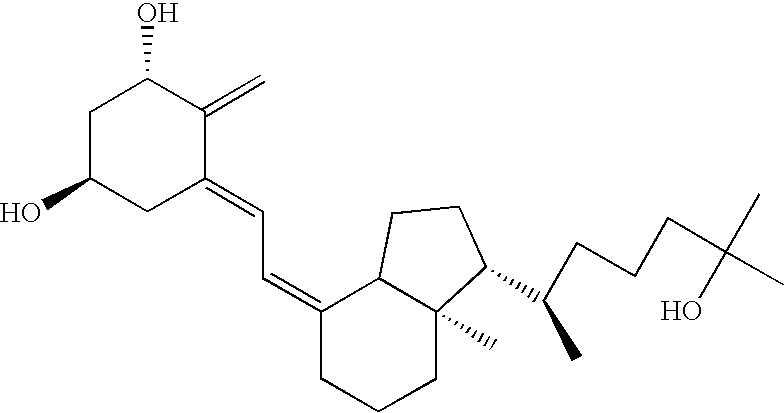
- The vitamin D compound can be isolated from natural sources or synthesized by methods known to those of skill in the art. An example of a synthetic vitamin D analog is dihydrotachysterol. Dihydrotachysterol is a synthetic reduction product of tachysterol. Tachysterol is a byproduct formed during the irradiation of 7-dehydrocholesterol, the precursor to vitamin D3. Dihydrotachysterol is ten times more active than its precursor tachysterol and is activated in the liver to the even more active 25-hydroxydihydrotachysterol. Other examples of synthetic vitamin D analogs are paricalcitol and doxercalciferol, which can be used to lower parathyroid hormone levels. Another example of a synthetic vitamin D analog is alfacalcidol, which is currently in clinical use in Canada for the treatment and prevention of renal bone disease, rickets, hypoparathyroidism and osteoporosis.
- Active Vitamin D Compounds
- The vitamin D compounds used in the present invention comprise active vitamin D compounds. While not intending to be bound by any particular theory or mechanism of action, vitamin D compounds can become activated, for example, through (1) ultraviolet conversion of 7-dehydrocholesterol in the skin to vitamin D3 (cholecalciferol) and (2) dietary intake of either vitamin D2 (ergocalciferol) or vitamin D3. Both vitamin D2 and vitamin D3 compounds, for example, become fully active on target tissues when metabolically activated in the liver and kidney. Regardless of whether the vitamin D compound was a product of ultraviolet conversion in the skin or dietary intake, the next step in activation can be the introduction of a hydroxyl group in the side chain at the C-25 position by a hepatic enzyme known as CYP 27 (a vitamin D-25-hydroxylase). At this point, the partially activated vitamin D2 and D3 compounds are known as, inter alia, 25-hydroxyergocalciferol and 25-hydroxycholecalciferol, respectively. These partially activated compounds become fully activated in the mitochondria of kidney tissue by renal 25-hydroxy vitamin D-1-α-hydroxylase to produce 1α,25-(OH)2D2, the primary biologically active form of vitamin D2, and 1α,25-(OH)2D3 (calcitriol), the most biologically active form of vitamin D3. The active vitamin D compounds of the present invention include but are not limited to the analogs, homologs and derivatives of vitamin D compounds described in the following patents, each of which is incorporated by reference herein in its entirety: U.S. Pat. No. 4,391,802 (1α-hydroxy vitamin D derivatives); U.S. Pat. No. 4,717,721 (1α-hydroxy derivatives with a 17-side chain greater in length than the cholesterol or ergosterol side chains); U.S. Pat. No. 4,851,401 (cyclopentano-vitamin D analogs); U.S. Pat. No. 5,145,846 (vitamin D3 analogs with alkynyl, alkenyl and alkanyl side chains); U.S. Pat. No. 5,120,722 (trihydroxycalciferol); U.S. Pat. No. 5,547,947 (fluorocholecalciferol compounds); U.S. Pat. No. 5,446,035 (methyl substituted vitamin D); U.S. Pat. No. 5,411,949 (23-oxa-derivatives); U.S. Pat. No. 5,237,110 (19-nor-vitamin D compounds); U.S. Pat. No. 4,857,518 (hydroxylated 24-homo-vitamin D derivatives). Additional examples of active vitamin D compounds are listed in the following patents, each of which is incorporated by reference herein in its entirety: U.S. Pat. Nos. 6,503,893, 6,482,812, 6,441,207, 6,410,523, 6,399,797, 6,392,071, 6,376,480, 6,372,926, 6,372,731, 6,359,152, 6,329,357, 6,326,503, 6,310,226, 6,288,249, 6,281,249, 6,277,837, 6,218,430, 6,207,656, 6,197,982, 6,127,559, 6,103,709, 6,080,878, 6,075,015, 6,072,062, 6,043,385, 6,017,908, 6,017,907, 6,013,814, 5,994,332, 5,976,784, 5,972,917, 5,945,410, 5,939,406, 5,936,105, 5,932,565, 5,929,056, 5,919,986, 5,905,074, 5,883,271, 5,880,113, 5,877,168, 5,872,140, 5,847,173, 5,843,927, 5,840,938, 5,830,885, 5,824,811, 5,811,562, 5,786,347, 5,767,111, 5,756,733, 5,716,945, 5,710,142, 5,700,791, 5,665,716, 5,663,157, 5,637,742, 5,612,325, 5,589,471, 5,585,368, 5,583,125, 5,565,589, 5,565,442, 5,554,599, 5,545,633, 5,532,228, 5,508,392, 5,508,274, 5,478,955, 5,457,217, 5,447,924, 5,446,034, 5,414,098, 5,403,940; 5,397,775; 5,395,830; 5,393,749; 5,384,313; 5,374,629; 5,373,004; 5,371,249; 5,321,018; 5,281,731; 5,260,290; 5,254,538; 5,250,523; 5,247,104; 5,246,925; 5,232,836; 5,194,431; 5,185,150 5,086,191; 5,036,061; 5,030,772; 4,973,584; 5,354,744; 4,940,700; 4,927,815; 4,866,048; 4,851,400; 4,847,012; 4,804,502; 4,769,181; 4,755,329; 4,719,205; 4,719,204; 4,619,920; 4,594,192; 4,588,716; 4,588,528; 4,564,474; 4,552,698; 4,689,180; 4,505,906; 4,502,991; 4,481,198; 4,448,726; 4,448,721; 4,428,946; 4,411,833; 4,367,177; 4,360,472; 4,360,471; 4,358,406; 4,336,193; 4,307,231; 4,307,025; 4,305,880; 4,279,826; and, 4,248,791. A more comprehensive list of active vitamin D compounds can be found in published PCT Application No. WO 99/49870, which is incorporated by reference herein in its entirety.
- Other active vitamin D compounds in clinical use include but are not limited to investigational drugs from Leo Pharmaceutical such as EB 1089 (24a,26a,27a-trihomo-22,24-diene-1αa,25-(OH)2-D3), KH 1060 (20-epi-22-oxa-24a,26a,27a-trihomo-1α,25-(OH)2-D3), MC 1288 and MC 903 (calcitriol); Roche Pharmaceutical drugs such as 1,25-(OH)2-16-ene-D3, 1,25-(OH)2-16-ene-23-yne-D3 and 25-(OH)2-16-ene-23-yne-D3; Chugai Pharmaceuticals such as 22-oxacalcitriol (22-oxa-1α,25-(OH)2-D3); University of Illinois such as 1α-(OH)D5; and the Institute of Medical Chemistry-Schering AG such as ZK 161422 (20-methyl-1,25-(OH)2-D3) and ZK 157202 (20-methyl-23-ene-1,25-(OH)2-D3). Vitamin D analogs also include topical preparations of vitamin D compounds, such as calcipotriene (D
OVONEX ®) and Tacalcitol (CURATODERM ®). Examples of particular commercially available active vitamin D compound formulations are ROCALTROL ®, which is available from Roche; and CALCIJEX ®, which is available from Abbott. - Additional examples of active vitamin D compounds and their derivatives, analogs, homologs, precursors and metabolites include but are not limited to 1α,25-(OH)2-26,27-d6-D3; 1α,25-(OH)2-22-ene-D3; 1α-(OH)2-D3; 1α,25-(OH)2-D2; 1α,25-(OH)2-D4; 1α,24,25-(OH)3-D3; 1α,24,25-(OH)3-D2; 1α,24,25-(OH)3-D4; 1α-(OH)-25-FD3; 1α-(OH)-25-FD4; 1α-(OH)-25-FD2; 1α,24-(OH)2-D4; 1α,24-(OH)2-D3; 1α,24-(OH)2-D2; 1α,24-(OH)2-25-FD4; 1α,24-(OH)2-25-FD3 1α,24-(OH)2-25-FD2; 1α,25-(OH)2-26,27-F6-22-ene-D3; 1α,25-(OH)2-26,27-F6-D3; 1α,25S-(OH)2-26-F3-D3; 1α,25-(OH)2-24-F2-D3; 1α,25S,26-(OH)2-22-ene-D3; 1α,25R,26-(OH)2-22-ene-D3; 1α,25-(OH)2-D2; 1α,25-(OH)2-24-epi-D3; 1α,25-(OH)2-23-yne-D3; 1α,25-(OH)2-24R—F-D3; 1α,25S,26-(OH)2-D3; 1α,24R-(OH)2-25F-D3; 1α,25-(OH)2-26,27-F6-23-yne-D3; 1α,25R-(OH)2-26-F3-D3; 1α,25,28-(OH)3-D2; 1α,25-(OH)2-16-ene-23-yne-D3; 1α,24R,25-(OH)3-D3; 1α,25-(OH)2-26,27-F6-23-ene-D3; 1α,25R-(OH)2-22-ene-26-F3-D3; 1α,25S-(OH)2-22-ene-26-F3-D3; 1α,25R-(OH)2-D3-26,26,26-d3; 1α,25S-(OH)2-D3-26,26,26-d3; and 1α,25R-(OH)2-22-ene-D3-26,26,26-d3.
- Further, while any vitamin D compound may be used according to the methods of the invention, preferred vitamin D compounds have pharmacokinetic properties that make them more suitable for the below-described methods than other vitamin D compounds. In general, preferred vitamin D compounds achieve peak plasma concentrations rapidly, e.g., within about four hours, and are eliminated quickly, e.g., with an elimination half-life of about 12 hours or fewer. The elimination half-life describes the time for the plasma concentration of the agent to be reduced by 50%, while eliminated in this context is meant to refer to the plasma concentrations below about 0.5 nM. While endogenous vitamin D plasma concentrations vary from subject to subject, they are typically about 0.16 nM. Calcitriol is an example of such a preferred vitamin D compound with desirable pharmacokinetic properties as described above. While not intending to be bound to any particular theory or mechanism of action, it is believed that vitamin D compounds with these pharmacokinetic properties can initiate the therapeutic biological response during the brief period of elevated concentration, then quickly fall below the threshold concentration that facilitates calcium release, thereby minimizing hypercalcemia.
- In preferred embodiments of the invention, the active vitamin D compound is calcitriol.
- Non-Hypercalcemic Vitamin D Compounds
- The vitamin D compounds used in the present invention also comprise non-hypercalcemic vitamin D compounds. However, in certain embodiments of the invention, the vitamin D compound is not a non-hypercalcemic vitamin D compound. Non-hypercalcemic vitamin D compounds have less of a tendency to produce the onset of hypercalcemia than a comparable dosage of calcitriol as assessed by assays well-known to one of skill in the art.
- Examples of such non-hypercalcemic vitamin D compounds include analogs of calcitriol such as Ro23-7553 and Ro24-5531 (1α,25-dihydroxy-16-ene-23-yne-26,27-hexafluorocholecalciferol) available from Hoffmann-LaRoche. Other examples of non-hypercalcemic vitamin D compounds can be found in U.S. Pat. No. 4,717,721, which is incorporated by reference herein in its entirety.
- The foregoing description of vitamin D compounds is not exhaustive and is merely exemplary of all compounds capable of binding to VDRs. One of skill in the art will appreciate that this invention encompasses all vitamin D compounds, i.e. all compounds capable of binding to VDRs, and the derivatives, analogs, homologs, precursors, metabolites, and pharmaceutically acceptable salts, solvates, hydrates, stereoisomers, clathrates and prodrugs thereof.
- Other Therapeutic Agents
- In certain aspects, the present invention provides compositions for treatment of MDS, or amelioration of one or more symptoms thereof, by administration of a vitamin D compound in combination with one or more additional active agent(s). The additional active agent can be any active agent having a therapeutic effect to treat MDS, or ameliorate a symptom thereof, that is known to one of skill in the art without limitation. Active agents include, but are not limited to, small molecules, synthetic drugs, peptides, polypeptides, proteins, nucleic acids (e.g., DNA and RNA nucleotides including, but not limited to, antisense nucleotide sequences, triple helices and nucleotide sequences encoding biologically active proteins, polypeptides or peptides), antibodies, synthetic or natural inorganic molecules, mimetic agents, and synthetic or natural organic molecules. Any agent which is known to be useful, or which has been used or is currently being used for the treatment of MDS, or amelioration of one or more symptoms associated with MDS, can be used in combination with a vitamin D compound in accordance with the invention described herein.
- In certain embodiments, the compositions of the invention encompass administration of a vitamin D compound of the invention in conjunction with one or more additional active agents that have combinatorial, synergistic, additive, or other therapeutic effects. In one embodiment, a vitamin D compound of the invention can be administered with a growth factor such as a cytokine or hematopoietic growth factor. In another embodiment, a vitamin D compound of the invention can be administered with an immunomodulator. In yet another embodiment, a vitamin D compound of the invention can be administered with a cytotoxic agent. In yet another embodiment, a vitamin D compound of the invention may be administered with an agent that affects RNA transcription. In still another embodiment, a vitamin D compound of the invention can be administered with a derivative of vitamin A, E, or K. In yet another embodiment, a vitamin D compound of the invention can be administered with an agent that specifically binds biological targets related to MDS. In still another embodiment, a vitamin D compound of the invention can be administered with a signal transduction inhibitor. In yet another embodiment, a vitamin D compound of the invention can be administered with an aminothiol. In still another embodiment, a vitamin D compound of the invention can be administered with an arsenic-containing compound. Further embodiments of the invention encompass administration of vitamin D compound of the invention in conjunction with more than one of the active agents described herein.
- Growth Factors or Cytokines
- In one embodiment of the invention, a vitamin D compound of the invention can be administered with a growth factor. Any growth factor known by one of skill in the art to be effective to treat MDS, or ameliorate a symptom thereof, may be administered with a vitamin D compound to a subject in need of such administration. In a further embodiment of the invention, one or more growth factor(s) known by one of skill in the art to be effective to treat MDS, or ameliorate a symptom thereof, may be administered with a vitamin D compound and one or more additional active agent(s) as described herein.
- Examples of growth factors that can be used in the various embodiments of the invention, including pharmaceutical compositions, dosage forms, and kits of the invention, include, without limitation, cytokines or hematopoietic growth factors such as, e.g., EPO, TPO, GM-CSF, G-CSF, IFN-alpha, IL-1, IL-2, IL-3, IL-6, IL-8, IL-11, and IL-12. Furthermore, recombinant, modified, mimetic, fragmentary, or analogous forms of the above described cytokines or hematopoietic growth factors may also be used in the various embodiments of the invention. See, e.g., U.S. Pat. Nos. 6,358,505, 6,346,531, 6,340,742, 6,262,253, 6,261,550, 6,166,183, 6,100,070, 5,986,047, 5,981,551, 5,916,773, 5,902,584, 5,835,382, 5,824,778, 5,773,581, 5,773,569, and 5,756,349, all of which describe recombinant, modified, mimetic, fragmentary, or analogous forms of EPO and G-CSF and each of which is incorporated herein by reference in its entirety. Preferred cytokines or hematopoietic growth factors include r-HuEPO and r-metHuG-CSF.
- An example of a commercial form of r-HuEPO is E
POGEN ®, which is produced by recombinant DNA technology and has the same biological effects and the same amino acid sequence as endogenous erythropoietin. A 1 ml dosage form of EPOGEN ® can contain 2000, 3000, 4000, or 10,000 Units of epoetin alfa, 2.5 mg albumin (human), 1.2 mg sodium phosphate monobasic monohydrate, 1.8 mg sodium phosphate dibasic anhydrate, 0.7 mg sodium citrate, 5.8 mg sodium chloride, and 6.8 mg of citric acid, in water for injection, USP (pH 6.9±0.3). Multidose forms of EPOGEN ® are available, and all dosage forms are in vials for parenteral administration. See Physicians' Desk Reference 582 (56th ed., 2002). - An example of a commercial form of r-metHuG-CSF, also known as filgrastim, is N
EUPOGEN ®, which is produced by recombinant DNA technology in E. coli and differs from G-CSF isolated from human cells in that it is not glycosylated. A 1 ml dosage form of NEUPOGEN ® can contain 300 μg of filgrastim, 0.59 mg Acetate, 50.0 mg Sorbitol, 0.004% TWEEN ® 80, 0.035 mg Sodium and 1.0 mL Water for Injection, USP. Larger dosage forms of NEUPOGEN ® are available, and all dosage forms are in vials for parenteral administration. See Id. at 588. - Immunomodulators
- In another embodiment of the invention, a vitamin D compound of the invention can be administered with an immunomodulator. The immunomodulator can be any immunomodulator known by one of skill in the art to be effective to treat MDS, or ameliorate a symptom thereof. In a further embodiment of the invention, one or more immunomodulator(s) known by one of skill in the art to be effective to treat MDS, or ameliorate a symptom thereof, may be administered to a subject with a vitamin D compound and one or more additional active agent(s) described herein.
- Examples of immunomodulators that can be used in the various embodiments of the invention, including pharmaceutical compositions, dosage forms, and kits of the invention, include, without limitation, anti-thymocyte globulin (ATG), anti-lymphocyte globulin (ALG), thalidomide, prednisone, cyclosporin A (CyA), dexamethasone, and pentoxifylline.
- Cytotoxic Agents
- In yet another embodiment of the invention, a vitamin D compound of the invention can be administered with a cytotoxic agent. The cytotoxic agent can be any cytotoxic agent known by one of skill in the art to be effective to treat MDS, or ameliorate a symptom thereof. In a further embodiment of the invention, one or more cytotoxic agent(s) known by one of skill in the art to be effective to treat MDS, or ameliorate a symptom thereof, may be administered to a subject with a vitamin D compound and one or more additional active agent(s) as described herein.
- Any cytotoxic agent can be employed according to the methods of the invention; many cytotoxic agents suitable for chemotherapy of MDS or cancer in general are known in the art. For example, the cytotoxic agent can be an anti-metabolite (e.g., 5-flourouricil (5-FU), methotrexate (MTX), fludarabine, etc.), an anti-microtubule agent (e.g., vincristine; vinblastine; taxanes such as paclitaxel and docetaxel; etc.), an alkylating agent (e.g., cyclophosphamide, melphalan, bischloroethylnitrosurea, etc.), platinum agents (e.g., cisplatin, carboplatin, oxaliplatin, JM-216, CI-973, etc.), anthracyclines (e.g., doxorubicin, daunorubicin, etc.), antibiotic agents (e.g., mitomycin-C, actinomycin D, etc.), topoisomerase inhibitors (e.g., etoposide, camptothecins, etc.), or other cytotoxic agents.
- Particular examples of cytotoxic agents that can be used in the various embodiments of the invention, including pharmaceutical compositions, dosage forms, and kits of the invention, include, without limitation, cytarabine, melphalan, topotecan, fludarabine, etoposide, idarubicin, daunorubicin, mitoxantrone, cisplatin, paclitaxel, and cyclophosphamide.
- Other chemotherapeutic agents that may be used include abarelix, aldesleukin, alemtuzumab, alitretinoin, allopurinol, altretamine, amifostine, anastrozole, arsenic trioxide, asparaginase, BCG live, bevaceizumab, bexarotene, bleomycin, bortezomib, busulfan, calusterone, camptothecin, capecitabine, carboplatin, carmustine, celecoxib, cetuximab, chlorambucil, cinacalcet, cisplatin, cladribine, cyclophosphamide, cytarabine, dacarbazine, dactinomycin, darbepoetin alfa, daunorubicin, denileukin diftitox, dexrazoxane, docetaxel, doxorubicin, dromostanolone, Elliott's B solution, epirubicin, epoetin alfa, estramustine, etoposide, exemestane, filgrastim, floxuridine, fludarabine, fluorouracil, fulvestrant, gemcitabine, gemtuzumab ozogamicin, gefitinib, goserelin, hydroxyurea, ibritumomab tiuxetan, idarubicin, ifosfamide, imatinib, interferon alfa-2a, interferon alfa-2b, irinotecan, letrozole, leucovorin, levamisole, lomustine, meclorethamine, megestrol, melphalan, mercaptopurine, mesna, methotrexate, methoxsalen, methylprednisolone, mitomycin C, mitotane, mitoxantrone, nandrolone, nofetumomab, oblimersen, oprelvekin, oxaliplatin, paclitaxel, pamidronate, pegademase, pegaspargase, pegfilgrastim, pemetrexed, pentostatin, pipobroman, plicamycin, polifeprosan, porfimer, procarbazine, quinacrine, rasburicase, rituximab, sargramostim, streptozocin, talc, tamoxifen, tarceva, temozolomide, teniposide, testolactone, thioguanine, thiotepa, topotecan, toremifene, tositumomab, trastuzumab, tretinoin, uracil mustard, valrubicin, vinblastine, vincristine, vinorelbine, and zoledronate
- Other Therapeutic Agents for MDS
- In yet another embodiment of the invention, a vitamin D compound of the invention can be administered with an agent that affects RNA transcription. The agent that affects RNA transcription can be any agent that affects RNA transcription known by one of skill in the art to be effective to treat MDS, or ameliorate a symptom thereof. In a further embodiment of the invention, one or more agent(s) that affect RNA transcription known by one of skill in the art to be effective to treat MDS, or ameliorate a symptom thereof, may be administered to a subject with a vitamin D compound and one or more additional active agent(s) as described herein. Non-limiting examples of an agent that affects RNA transcription that can be used in the various embodiments of the invention, including pharmaceutical compositions, dosage forms, and kits of the invention, include decitabine, 5-azacytidine, depsipeptides, and phenylbutyrate.
- In yet another embodiment of the invention, a vitamin D compound of the invention can be administered with a derivative of vitamin A, E, or K. The derivative of vitamin A, E, or K can be any derivative of vitamin A, E, or K known by one of skill in the art to be effective to treat MDS, or ameliorate a symptom thereof. In a further embodiment of the invention, one or more derivative(s) of vitamin A, E, or K known by one of skill in the art to be effective to treat MDS, or ameliorate a symptom thereof, may be administered to a subject with a vitamin D compound and one or more additional active agent(s) as described herein. Non-limiting examples of a derivative of vitamin A, E, or K that can be used in the various embodiments of the invention, including pharmaceutical compositions, dosage forms, and kits of the invention, include all trans retinoic acid, 13-cis-retinoic acid, tocopherol, and menatetrenone.
- In still another embodiment of the invention, a vitamin D compound of the invention can be administered with an agent that specifically binds biological targets related to MDS. The agent that specifically binds biological targets related to MDS can be any agent that specifically binds biological targets related to MDS known by one of skill in the art to be effective to treat MDS, or ameliorate a symptom thereof. In a further embodiment of the invention, one or more agent(s) that specifically bind biological targets related to MDS known by one of skill in the art to be effective to treat MDS, or ameliorate a symptom thereof, may be administered to a subject with a vitamin D compound and one or more additional active agent(s) as described herein. Non-limiting examples of an agent that specifically binds biological targets related to MDS that can be used in the various embodiments of the invention, including pharmaceutical compositions, dosage forms, and kits of the invention, include anti-VEGF, gemtuzumab ozogamicin, and TNFR:Fc.
- In still another embodiment of the invention, a vitamin D compound of the invention can be administered with a signal transduction inhibitor. The signal transduction inhibitor can be any signal transduction inhibitor known by one of skill in the art to be effective to treat MDS, or ameliorate a symptom thereof. In a further embodiment of the invention, one or more signal transduction inhibitor(s) known by one of skill in the art to be effective to treat MDS, or ameliorate a symptom thereof, may be administered to a subject with a vitamin D compound and one or more additional active agent(s) as described herein. Non-limiting examples of such signal transduction inhibitors that can be used in the various embodiments of the invention, including pharmaceutical compositions, dosage forms, and kits of the invention, include farnesyl transferase inhibitors such as, e.g. Z
ARNESTRA ™ and SARASAR ™ and tyrosine kinase inhibitors such as, e.g., SU5416, SU6668, and PTK787/ZK222584. - In still another embodiment of the invention, a vitamin D compound of the invention can be administered with an aminothiol. The aminothiol can be any aminothiol known by one of skill in the art to be effective to treat MDS, or ameliorate a symptom thereof. In a further embodiment of the invention, one or more aminothiol(s) known by one of skill in the art to be effective to treat MDS, or ameliorate a symptom thereof, may be administered to a subject with a vitamin D compound and one or more additional active agent(s) as described herein. A non-limiting example of an aminothiol that can be used in the various embodiments of the invention, including pharmaceutical compositions, dosage forms, and kits of the invention, is amifostine.
- In still another embodiment of the invention, a vitamin D compound of the invention can be administered with an arsenic-containing compound. The arsenic-containing compound can be any arsenic-containing compound known by one of skill in the art to be effective to treat MDS, or ameliorate a symptom thereof. In a further embodiment of the invention, one or more arsenic-containing compound(s) known by one of skill in the art to be effective to treat MDS, or ameliorate a symptom thereof, may be administered to a subject with a vitamin D compound and one or more additional active agent(s) as described herein. A non-limiting example of an arsenic-containing compound that can be used in the various embodiments of the invention, including pharmaceutical compositions, dosage forms, and kits of the invention, is arsenic trioxide.
- Methods of Treating Myelodysplastic Syndromes
- The invention provides methods of treating MDS, or ameliorating a symptom thereof, in a subject in need of such treatment or amelioration. It further encompasses methods of treating subjects who have been previously treated for MDS, as well as those who have not previously been treated for MDS. Because subjects with MDS have heterogeneous clinical manifestations and varying clinical outcome, it has become apparent that staging the subjects according to their prognosis and approaching therapy depending on the severity and stage is necessary. Indeed, the methods of this invention can be used in various stages of treatments for subjects with one or more types of MDS including but not limited to refractory anemia (RA), RA with ringed sideroblasts (RARS), RA with excess blasts (RAEB), RAEB in transformation (RAEB-T), or chronic myelomonocytic leukemia (CMML). In addition, the methods of the invention can be used to in various stages of treatments for subjects with one or more types of MDS including but not limited to low risk, intermediate-1 risk, intermediate-2 risk, or high risk MDS.
- The present invention provides methods for administering therapeutically effective doses of vitamin D compounds while minimizing the risk of hypercalcemia for the treatment of myelodysplastic syndromes, or amelioration of a symptom thereof. In certain embodiments, the methods comprise administering a therapeutically effective dose of vitamin D compounds in the treatment of MDS, or amelioration of a symptom thereof. In further embodiments, the methods incorporate administering the vitamin D compounds intermittently in high doses. Intermittent administration of the vitamin D compounds allows the high doses to be administered to a subject while minimizing or eliminating hypercalcemia. In still further embodiments, the methods incorporate the use of oral vitamin D compound formulations. In yet other embodiments, the methods incorporate the use of stable, oral vitamin D compound formulations with improved bioavailability and rapid onset of peak blood levels of vitamin D compounds. In still other embodiments, the methods incorporate the use of oral vitamin D compound formulations in the form of an emulsion pre-concentrate. In yet other embodiments, the methods incorporate the use of intravenous (i.v.) vitamin D compound formulations. In certain embodiments, the vitamin D compounds are administered as a monotherapy. In other embodiments, the vitamin D compounds and formulations are administered in combination with one or more additional active agents. In yet other embodiments, the vitamin D compounds and formulations are administered in combination with one or more hematopoietic growth factors or cytokines.
- In certain embodiments, the methods of the invention encompass administering a therapeutically effective dose of vitamin D compounds while minimizing the risk of hypercalcemia for the treatment of myelodysplastic syndromes, or amelioration of a symptom thereof. In certain embodiments, the methods of the invention encompass administering a therapeutically effective dose of vitamin D compounds for the treatment of anemia associated with MDS. In other embodiments, the methods of the invention encompass administering a therapeutically effective dose of vitamin D compounds to increase plasma hemoglobin concentrations of a subject with MDS. In yet other embodiments, the methods of the invention encompass administering a therapeutically effective dose of vitamin D compounds to reduce transfusion requirements of a subject with MDS. In still other embodiments, the methods of the invention encompass administering a therapeutically effective dose of vitamin D compounds for the treatment of thrombocytopenia associated with MDS. In yet other embodiments, the methods of the invention encompass administering a therapeutically effective dose of vitamin D compounds to reduce the fatigue of a subject with MDS. In still other embodiments, the methods of the invention encompass administering a therapeutically effective dose of vitamin D compounds to decrease the frequency and severity of bruising of a subject with MDS. In yet other embodiments, the methods of the invention encompass administering a therapeutically effective dose of vitamin D compounds to reduce the frequency and severity of bleeding episodes of a subject with MDS. In yet other embodiments, the methods of the invention encompass administering a therapeutically effective dose of vitamin D compounds to reduce the frequency and severity of fevers suffered by a subject with MDS. In still other embodiments, the methods of the invention encompass administering a therapeutically effective dose of vitamin D compounds for the treatment of neutropenia associated with MDS. In still other embodiments, the methods of the invention encompass administering a therapeutically effective dose of vitamin D compounds to reduce the frequency and severity of infections in a subject with MDS. In yet other embodiments, the methods of the invention encompass administering a therapeutically effective dose of vitamin D compounds to delay the progression of MDS to leukemia in a subject with MDS. In still other embodiments, the methods of the invention encompass administering a therapeutically effective dose of vitamin D compounds to extend the survival of a subject with MDS.
- Without intending to be bound by any particular theory or mechanism of action, it is believed that vitamin D compounds and other therapeutic agents effective to treat MDS can act in complementary or synergistic ways in the treatment of MDS, or amelioration of a symptom thereof. Therefore, one embodiment of the invention encompasses a method of treating MDS, or ameliorating a symptom thereof, which comprises administering to a patient in need of such treatment and/or amelioration a therapeutically effective dose of a vitamin D compound, or a pharmaceutically acceptable salt, solvate, hydrate, stereoisomer, clathrate, or prodrug thereof and a therapeutically effective dose of one or more additional active agent(s) as described herein.
- One of skill in the art will recognize that any of the methods of treatment described herein may further be used for the prevention of the onset or recurrence of MDS in a subject in whom such prevention is desired.
- Administration and Dosage of Vitamin D Compounds in Treatment of Myelodysplastic Syndrome
- High systemic levels of vitamin D compounds can be achieved without the onset of hypercalcemia by intermittently administering the vitamin D compounds according to the methods of the invention. High doses of vitamin D compounds include doses greater than about 3 μg as discussed in the sections below. Therefore, in certain embodiments of the invention, the methods for the treatment of MDS, or amelioration of a symptom thereof, encompass intermittently administering high doses of vitamin D compounds. High doses of vitamin D compounds can be administered before, concurrently with, after, or in cycles with other therapies, including but not limited to pharmacotherapy. The administration of vitamin D compounds can also occur in cycling regimens such that administration of the vitamin D compound can occur before, concurrently with, after, or in any cycling regimen with other treatments within a cycling series of such treatments. The frequency of the intermittent administration can be limited by a number of factors including but not limited to the pharmacokinetic parameters of the compound or formulation and the pharmacodynamic effects of the vitamin D compound on the subject. For example, subjects with MDS having impaired renal function may require less frequent administration of the vitamin D compounds because of those subjects' decreased ability to excrete calcium.
- The following is exemplary only and merely serves to illustrate that the term “intermittent” can encompass any administration regimen designed by a person of ordinary skill in the art.
- In one example, the vitamin D compound can be administered not more than once every three days. The administration can continue for one, two, three, or four weeks or one, two, three, four, five, or six months, or one year, or longer. In certain embodiments, the vitamin D compound can be administered until the anemia associated with MDS is ameliorated. Optionally, after a period of rest, the vitamin D compound can be administered under the same or different schedule. The period of rest can be one, two, three, or four weeks, or longer, according to the pharmacodynamic effects of the vitamin D compound on the subject.
- In another example, the vitamin D compound can be administered not more than once every four days. The administration can continue for one, two, three, or four weeks or one, two, three, four, five, or six months, or one year, or longer. In certain embodiments, the vitamin D compound can be administered until the anemia associated with MDS is ameliorated. Optionally, after a period of rest, the vitamin D compound can be administered under the same or different schedule. The period of rest can be one, two, three, or four weeks, or longer, according to the pharmacodynamic effects of the vitamin D compound on the subject.
- In still another example, the vitamin D compound can be administered not more than once every five days. The administration can continue for one, two, three, or four weeks or one, two, three, four, five, or six months, or one year, or longer. In certain embodiments, the vitamin D compound can be administered until the anemia associated with MDS is ameliorated. Optionally, after a period of rest, the vitamin D compound can be administered under the same or different schedule. The period of rest can be one, two, three, or four weeks, or longer, according to the pharmacodynamic effects of the vitamin D compound on the subject.
- In yet another example, the vitamin D compound can be administered not more than once every six days. The administration can continue for one, two, three, or four weeks or one, two, three, four, five, or six months, or one year, or longer. In certain embodiments, the vitamin D compound can be administered until the anemia associated with MDS is ameliorated. Optionally, after a period of rest, the vitamin D compound can be administered under the same or different schedule. The period of rest can be one, two, three, or four weeks, or longer, according to the pharmacodynamic effects of the vitamin D compound on the subject.
- In still another example, the vitamin D compound can be administered not more than once every seven days. The administration can continue for one, two, three, or four weeks or one, two, three, four, five, or six months, or one year, or longer. In certain embodiments, the vitamin D compound can be administered until the anemia associated with MDS is ameliorated. Optionally, after a period of rest, the vitamin D compound can be administered under the same or different schedule. The period of rest can be one, two, three, or four weeks, or longer, according to the pharmacodynamic effects of the vitamin D compound on the subject.
- In yet another example, the vitamin D compound can be administered not more than once every eight days. The administration can continue for one, two, three, or four weeks or one, two, three, four, five, or six months, or one year, or longer. In certain embodiments, the vitamin D compound can be administered until the anemia associated with MDS is ameliorated. Optionally, after a period of rest, the vitamin D compound can be administered under the same or different schedule. The period of rest can be one, two, three, or four weeks, or longer, according to the pharmacodynamic effects of the vitamin D compound on the subject.
- In still another example, the vitamin D compound can be administered not more than once every nine days. The administration can continue for one, two, three, or four weeks or one, two, three, four, five, or six months, or one year, or longer. In certain embodiments, the vitamin D compound can be administered until the anemia associated with MDS is ameliorated. Optionally, after a period of rest, the vitamin D compound can be administered under the same or different schedule. The period of rest can be one, two, three, or four weeks, or longer, according to the pharmacodynamic effects of the vitamin D compound on the subject.
- In yet another example, the vitamin D compound can be administered not more than once every ten days. The administration can continue for one, two, three, or four weeks or one, two, three, four, five, or six months, or one year, or longer. In certain embodiments, the vitamin D compound can be administered until the anemia associated with MDS is ameliorated. Optionally, after a period of rest, the vitamin D compound can be administered under the same or different schedule. The period of rest can be one, two, three, or four weeks, or longer, according to the pharmacodynamic effects of the vitamin D compound on the subject.
- In yet another example, the vitamin D compound can be administered once per week for three months. Optionally, after a period of rest, the vitamin D compound can be administered under the same or different schedule. The period of rest can be one, two, three, or four weeks, or longer, according to the pharmacodynamic effects of the vitamin D compound on the subject.
- In still another example, the vitamin D compound can be administered once every three weeks for a year. Optionally, after a period of rest, the vitamin D compound can be administered under the same or different schedule. The period of rest can be one, two, three, or four weeks, or longer, according to the pharmacodynamic effects of the vitamin D compound on the subject.
- In a preferred example, the vitamin D compound can be administered once per week for 3 weeks out of each 4 week cycle. After a one week period of rest, the vitamin D compound can be administered under the same or different schedule.
- Further examples of dosing schedules that can be used in the methods of the present invention are provided in U.S. Pat. No. 6,521,608, which is incorporated by reference in its entirety.
- The above-described administration schedules are provided for illustrative purposes only and should not be considered limiting. A person of ordinary skill in the art will readily understand that all vitamin D compounds are within the scope of the invention; that calcitriol and its analogs, homologs, derivatives, precursors and metabolites are preferred; and that the exact dosing and schedule of administration of the vitamin D compounds can vary due to many factors.
- The amount of a therapeutically effective dose of a pharmaceutical agent in the acute or chronic management of a disease or disorder may vary depending on factors including, but not limited to, the disease or disorder treated, the specific pharmaceutical agents and the route of administration. According to the methods of the invention, a therapeutically effective dose of a vitamin D compound is any dose of the vitamin D compound effective to treat MDS or ameliorate a symptom thereof. A high dose of a vitamin D compound can be a dose from about 3 μg to about 300 μg or any dose within this range as discussed below. The dose, dose frequency, duration, or any combination, may also vary according to age, body weight, response, and the past medical history of the subject as well as the route of administration, pharmacokinetic and pharmacodynamic effects of the pharmaceutical agent. These factors are routinely considered by one of skill in the art.
- The rates of absorption and clearance of vitamin D compounds are affected by a variety of factors that are well-known to persons of ordinary skill in the art. As discussed above, the pharmacokinetic properties of vitamin D compounds limit the peak concentration of vitamin D compounds that can be obtained in the blood without inducing the onset of hypercalcemia and preferably without inducing the onset of clinical hypercalcemia. The rate and extent of absorption, distribution, binding or localization in tissues, biotransformation and excretion of the vitamin D compound can all affect the frequency at which the pharmaceutical agent can be administered. In certain embodiments, vitamin D compounds are administered intermittently in high doses as a method of treating MDS, or ameliorating a symptom thereof, according to the dosing schedule described above.
- In certain embodiments of the invention, the methods comprise administering a vitamin D compound, or a pharmaceutically acceptable salt, solvate, hydrate, stereoisomer, clathrate, or prodrug thereof in a dose of from about 3, 4, 5, 6, 7, 8, 9, 10, 15, 20, 25, 30, 35, 40, 45, 50, 55, 60, 65, 70, 75, 80, 85, 90, 95, 100, 105, 110, 115, 120, 125, 130, 135, 140, 145, 150, 155, 160, 165, 170, 175, 180, 185, 190, 195, 200, 205, 210, 215, 220, 225, 230, 235, 240, 245, 250, 255, 260, 265, 270, 275, 280, 285, 290, 295, or 300 μg, or any range of doses therein. In certain embodiments, the methods of the invention comprise administering a dose of a vitamin D compound, or a pharmaceutically acceptable salt, solvate, hydrate, stereoisomer, clathrate, or prodrug thereof in a dose of from about 0.12 μg/kg to about 3 μg/kg. In other embodiments, the methods of the invention comprise administering a dose of a vitamin D compound, or a pharmaceutically acceptable salt, solvate, hydrate, stereoisomer, clathrate, or prodrug thereof in a dose of from about 3 μg to about 300 μg. In yet other embodiments, the methods of the invention comprise administering a dose of a vitamin D compound, or a pharmaceutically acceptable salt, solvate, hydrate, stereoisomer, clathrate, or prodrug thereof in a dose of from about 5 μg to about 200 μg. In still other embodiments, the methods of the invention comprise administering a dose of a vitamin D compound, or a pharmaceutically acceptable salt, solvate, hydrate, stereoisomer, clathrate, or prodrug thereof in a dose of from about 5 μg to about 105 μg. In still other embodiments, the methods of the invention comprise administering a dose of a vitamin D compound, or a pharmaceutically acceptable salt, solvate, hydrate, stereoisomer, clathrate, or prodrug thereof in a dose of from about 15 μg to about 105 μg. In yet other embodiments, the methods of the invention comprise administering a dose of a vitamin D compound, or a pharmaceutically acceptable salt, solvate, hydrate, stereoisomer, clathrate, or prodrug thereof in a dose of from about 15 μg to about 90 μg. In still other embodiments, the methods of the invention comprise administering a dose of a vitamin D compound, or a pharmaceutically acceptable salt, solvate, hydrate, stereoisomer, clathrate, or prodrug thereof in a dose of from about 20 μg to about 80 μg. In yet other embodiments, the methods of the invention comprise administering a dose of a vitamin D compound, or a pharmaceutically acceptable salt, solvate, hydrate, stereoisomer, clathrate, or prodrug thereof in a dose of from about 30 μg to about 60 μg. In still other embodiments, the methods of the invention comprise administering a dose of a vitamin D compound, or a pharmaceutically acceptable salt, solvate, hydrate, stereoisomer, clathrate, or prodrug thereof in a dose of from about 30 μg to about 75 μg. In a preferred embodiment, the methods of the invention comprise administering a dose of a vitamin D compound, or a pharmaceutically acceptable salt, solvate, hydrate, stereoisomer, clathrate, or prodrug thereof in a dose of about 45 μg. One of skill in the art will recognize that these standard doses are for an average sized adult of approximately 70 kg and can be adjusted for the factors routinely considered as stated above. While not intending to be bound by any particular theory or mechanism of action, it is believed that doses of the vitamin D compounds of up to 105 μg may be administered without substantially increasing the half-life and associated toxicity of the vitamin D compounds. Therefore, in a preferred embodiment, the dose of the vitamin D compound is 105 μg or less.
- In certain embodiments, the methods of the invention comprise administering a dose of a vitamin D compound, or a pharmaceutically acceptable salt, solvate, hydrate, stereoisomer, clathrate, or prodrug thereof in a dose that achieves peak plasma concentrations of the vitamin D compound from about 0.1 nM, 0.2 nM, 0.3 nM, 0.4 nM, 0.5 nM, 0.6 nM, 0.7 nM, 0.8 nM. 0.9 nM, 1 nM, 2 nM, 3 nM, 4 nM, 5 nM, 6 nM, 7 nM, 8 nM, 9 nM, 10 nM, 12 nM, 15 nM, 17 nM, or 20 nM, or any range of concentrations therein. In other embodiments, the methods of the invention comprise administering a dose of a vitamin D compound or a pharmaceutically acceptable salt, solvate, hydrate, stereoisomer, clathrate, or prodrug thereof in a dose that achieves peak plasma concentrations of the vitamin D compound exceeding about 0.5 nM. In other embodiments, methods of the invention comprise administering a dose of a vitamin D compound, or a pharmaceutically acceptable salt, solvate, hydrate, stereoisomer, clathrate, or prodrug thereof in a dose that achieves peak plasma concentrations of the vitamin D compound from about 0.5 nM to about 20 nM. In other embodiments, the methods of the invention comprise administering a dose of a vitamin D compound, or a pharmaceutically acceptable salt, solvate, hydrate, stereoisomer, clathrate, or prodrug thereof in a dose that achieves peak plasma concentrations of the vitamin D compound from about 1 nM to about 10 nM. In still other embodiments, methods of the invention comprise administering a dose of a vitamin D compound, or a pharmaceutically acceptable salt, solvate, hydrate, stereoisomer, clathrate, or prodrug thereof in a dose that achieves peak plasma concentrations of the vitamin D compound from about 1 nM to about 7 nM. In yet other embodiments, methods of the invention comprise administering a dose of a vitamin D compound, or a pharmaceutically acceptable salt, solvate, hydrate, stereoisomer, clathrate, or prodrug thereof in a dose that achieves peak plasma concentrations of the vitamin D compound from about 3 nM to about 7 nM. In yet other embodiments, methods of the invention comprise administering a dose of a vitamin D compound, or a pharmaceutically acceptable salt, solvate, hydrate, stereoisomer, clathrate, or prodrug thereof in a dose that achieves peak plasma concentrations of the vitamin D compound from about 5 nM to about 7 nM. In a preferred embodiment, methods of the invention comprise administering a dose of a vitamin D compound, or a pharmaceutically acceptable salt, solvate, hydrate, stereoisomer, clathrate, or prodrug thereof in a dose that achieves peak plasma concentrations of the vitamin D compound from about 3 nM to about 5 nM.
- In certain embodiments, the methods of the invention further comprise administering a dose of a vitamin D compound, or a pharmaceutically acceptable salt, solvate, hydrate, stereoisomer, clathrate, or prodrug thereof that achieves peak plasma concentrations rapidly, e.g., within four hours. In further embodiments, the methods of the invention comprise administering a dose of a vitamin D compound, or a pharmaceutically acceptable salt, solvate, hydrate, stereoisomer, clathrate, or prodrug thereof that is eliminated quickly, e.g., with an elimination half-life of less than 12 hours.
- In other aspects, the methods of the invention encompass intermittently administering high doses of vitamin D compounds to a subject with MDS and monitoring the subject for symptoms associated with hypercalcemia. In certain embodiments, the methods of the invention encompass intermittently administering high doses of vitamin D compounds to a subject with MDS and monitoring the renal function of the subject. In other embodiments, the methods of the invention encompass intermittently administering high doses of vitamin D compounds to a subject with MDS and monitoring the subject for calcification of soft tissues, such as, for example, cardiac tissue. In still other embodiments, the methods of the invention encompass intermittently administering high doses of vitamin D compounds to a subject with MDS and monitoring the subject for increased bone density. In yet other embodiments, the methods of the invention encompass intermittently administering high doses of vitamin D compounds to a subject with MDS and monitoring the subject for hypercalcemic nephropathy. In still other embodiments, the methods of the invention encompass intermittently administering high doses of vitamin D compounds to a subject with MDS and monitoring the blood calcium concentration of the subject to ensure that the blood calcium concentration is less than about 10.5 mg/dL.
- In certain embodiments, high blood levels of vitamin D compounds can be safely obtained in conjunction with reducing the transport of calcium into the blood. In one embodiment, higher 1,25-dihydroxyvitamin D concentrations are safely obtainable without the onset of hypercalcemia when administered in conjunction with a reduced calcium diet. In one example, the calcium can be trapped by an adsorbent, absorbent, ligand, chelate, or other binding moiety that cannot be transported into the blood through the small intestine. In another example, the rate of osteoclast activation can be inhibited by administering, for example, a bisphosphonate such as, e.g., pamidronate, or ZOMETA (Novartis Pharmaceuticals Corp., East Hanover, N.J.) in conjunction with the vitamin D compound.
- In certain embodiments, high blood levels of vitamin D compounds are safely obtained in conjunction with maximizing the rate of clearance of calcium. In one example, calcium excretion can be increased by ensuring adequate hydration and salt intake. In another example, diuretic therapy can be used to increase calcium excretion.
- Administering Vitamin D Compounds in Combination with Other Therapeutic Agents
- The methods of the present invention also provide combination therapies comprising administering one or more vitamin D compounds in combination with one or more additional active agents that are not vitamin D compounds. The additional active agents can be any agents that have a therapeutic effect to treat MDS, or ameliorate a symptom thereof, that are known to one of skill in the art without limitation. Proposed mechanisms for these active agents can be found in the art (see, e.g., Hardman et al., eds., 1996, Goodman & Gilman's The Pharmacological Basis of
Therapeutics 10th Ed, McGraw-Hill, New York at pages 643-754, 1381-1484, 1649-1678, and Physician's Desk Reference (PDR) 55th Ed., 2001, Medical Economics Co., Inc., Montvale, N.J. In certain embodiments, the combination therapies of the present invention comprise administering one or more additional active agents which improve the therapeutic or ameliorative effects of the vitamin D compounds by producing an additive or synergistic effect. - In accordance with the present invention, the combination therapies are advantageously utilized for the treatment of MDS, or amelioration of a symptom thereof. The one or more vitamin D compounds may be administered prior to (e.g., 0.5 hours, 1 hour, 2 hours, 4 hours, 6 hours, 12 hours, 24 hours, 36 hours, 48 hours, 5 days, 1 week, 2 weeks, 1 month or more before), after (e.g., 0.5 hours, 1 hour, 2 hours, 4 hours, 6 hours, 12 hours, 24 hours, 36 hours, 48 hours, 5 days, 1 week, 2 weeks, 1 month or more after), concurrently with, or in any cycling regimen involving the administration of one or more additional active agents. In embodiments where the additional active agents are administered less often than the vitamin D compounds, the one or more vitamin D compounds are preferably administered about one day before the one or more additional active agents.
- In certain embodiments, the additional active agents that are not vitamin D compounds can be one or more growth factors. The growth factors can be administered before, concurrently with, after, or in cycles with a vitamin D compound in the methods of the present invention to benefit from the ability of the vitamin D compound to sensitize cells to the actions of the growth factors. Thus, less growth factor may be used in the treatment of MDS, or amelioration of a symptom thereof. In other embodiments, cycling therapy is used to inhibit the development of resistance or reduce the resistance to one or more of the therapies, avoid or reduce the side effects of the therapies, and/or improve the effectiveness of the treatments.
- In certain embodiments, the one or more growth factors can be cytokines. The cytokines can be administered before, concurrently with, after, or in cycles with a vitamin D compound according to the methods of the present invention. In other embodiments, the one or more growth factors can be hematopoietic growth factors. The hematopoietic growth factors can be administered before, concurrently with, after, or in cycles with a vitamin D compound according to the methods of the present invention.
- In certain embodiments, the hematopoietic growth factor administered before, concurrently with, after, or in cycles with a vitamin D compound can be EPO, e.g., r-HuEPO, or a pharmacologically active mutant or derivative thereof. In other embodiments, the hematopoietic growth factor that can be administered before, concurrently with, after, or in cycles with a vitamin D compound can be G-CSF, e.g., r-metHuG-CSF, or a pharmacologically active mutant or derivative thereof. In still other embodiments, the hematopoietic growth factors that can be administered before, concurrently with, after, or in cycles with a vitamin D compound can be a combination of EPO and HuG-CSF, or pharmacologically active mutants or derivatives thereof. In other embodiments, the vitamin D compound can be administered as an emulsion pre-concentrate in combination with EPO, G-CSF, a pharmacologically active mutant or derivative thereof, or a combination thereof.
- In certain embodiments, the range of r-HuEPO, or a pharmacologically active mutant or derivative thereof, administered to a subject to treat MDS, or ameliorate a symptom thereof, can be from about 1 Unit/kg to about 2000 Units/kg three times per week (TIW), preferably from about 10 Units/kg to about 1000 Units/kg TIW, and more preferably from about 25 Units/kg to about 500 Units/kg TIW. In other embodiments, the r-HuEPO can be administered to a subject to treat MDS, or ameliorate a symptom thereof, in a dose of about 1, 10, 20, 50, 100, 200, 300, 400, 500, 750, 1000, 1250, 1500, 1750, 2000 Units/kg or any range of doses therein. In other embodiments, the r-HuEPO can be administered in combination with one or more vitamin D compounds, wherein the one or more vitamin D compounds are administered according to the doses and schedules described herein.
- In certain embodiments, the range of r-metHuG-CSF, or a pharmacologically active mutant or derivative thereof, administered to a subject to treat MDS, or ameliorate a symptom thereof, can be from about 1 μg/kg/day to about 100 μg/kg/day, preferably from about 3 μg/kg/day to about 75 μg/kg/day, and more preferably from about 5 μg/kg/day to about 50 μg/kg/day. In other embodiments, the r-metHuG-CSF can be administered to a subject to treat MDS, or ameliorate a symptom thereof, in a dose of about 1, 5, 10, 20, 30, 40, 50, 60, 70, 80, 90, 100 μg/kg or any range of doses therein. In other embodiments, the r-metHuG-CSF, or a pharmacologically active mutant or derivative thereof, can be administered in combination with one or more vitamin D compounds, wherein the one or more vitamin D compounds are administered according to the doses and schedules described herein.
- In other embodiments, a vitamin D compound can be administered in combination with r-HuEPO, r-metHuG-CSF, a pharmacologically active mutant or derivative thereof, or a combination thereof, wherein r-HuEPO, r-metHuG-CSF, or their pharmacologically active mutants or derivatives are administered in the above described doses, respectively.
- In certain embodiments, the hematopoietic growth factor is r-HuEPO and is administered before, concurrently with, after, or in cycles with the administration of a vitamin D compound, wherein the range of administration of r-HuEPO is from about 50 Units/kg to about 100 Units/kg TIW. In other embodiments, the hematopoietic growth factor is r-metHuG-CSF and is administered before, concurrently with, after, or in cycles with a vitamin D compound, wherein the range of administration of r-metHuG-CSF is from about 5 μg/kg/day to about 25 μg/kg/day. In yet other embodiments, the hematopoietic growth factors are a combination of r-HuEPO and r-metHuG-CSF and are administered before, concurrently with, after, or in cycles with a vitamin D compound, wherein the range of administration is from about 25 Units/kg to about 500 Units/kg TIW for r-HuEPO and from about 5 μg/kg/day to about 25 μg/kg/day for r-metHuG-CSF.
- In other embodiments, the growth factor administered before, concurrently with, after, or in cycles with a vitamin D compound can be one of IL-1, IL-2, IL-3, IL-4, IL-6, IL-8, IL-11, IL-12, IFN-alpha, GM-CSF, TPO, or a pharmacologically active mutant or derivative thereof. In still other embodiments, the growth factors administered before, concurrently with, after, or in cycles with a vitamin D compound can be more than one of IL-1, IL-2, IL-3, IL-4, IL-6, IL-8, IL-11, IL-12, IFN-alpha, GM-CSF, TPO, or a pharmacologically active mutant or derivative thereof. In yet other embodiments, the vitamin D compound can be administered as an emulsion pre-concentrate in combination with one or more of r-HuEPO, r-metHuG-CSF, IL-1, IL-2, IL-3, IL-4, IL-6, IL-8, IL-11, IL-12, IFN-alpha, GM-CSF, TPO, a pharmacologically active mutant or derivative thereof, or a combination thereof.
- In other embodiments, the additional active agents that are not vitamin D compounds can be immunomodulators. The immunomodulators can be administered before, concurrently with, after, or in cycles with a vitamin D compound according to the methods of the present invention. In certain embodiments, the immunomodulator can be one of ATG, ALG, thalidomide, prednisone, CyA, dexamethasone, or pentoxifylline. In other embodiments, the immunomodulators can be more than one of ATG, ALG, thalidomide, prednisone, CyA, dexamethasone, or pentoxifylline. In still other embodiments, the vitamin D compound can be administered as an emulsion pre-concentrate in combination with one or more of ATG, ALG, thalidomide, prednisone, CyA, dexamethasone, or pentoxifylline, or a combination thereof.
- In a particular embodiment, the immunomodulator is ATG, wherein the range of administration of ATG is from about 10 mg/kg/day to about 100 mg/kg/day. In a preferred embodiment, the immunomodulator is ATG, wherein the range of administration of ATG is from about 35 mg/kg/day to about 45 mg/kg/day. In another specific embodiment, the immunomodulator is thalidomide, wherein the range of administration of thalidomide is from about 50 mg/day to about 500 mg/day. In a preferred embodiment, the immunomodulator is thalidomide, wherein the range of administration of thalidomide is from about 100 mg/day to about 400 mg/day.
- In other embodiments, the additional active agents that are not vitamin D compounds can be cytotoxic agents. The cytotoxic agents can be administered before, concurrently with, after, or in cycles with a vitamin D compound according to the methods of the present invention. In certain embodiments, the cytotoxic agent can be an antimetabolite, an anti-microtubule agent, an alkylating agent, a platinum agent, an anthracycline, an antibiotic agent, or a topoisomerase inhibitor. In other embodiments, the cytotoxic agents can be more than one of an antimetabolite, an anti-microtubule agent, an alkylating agent, a platinum agent, an anthracycline, an antibiotic agent, or a topoisomerase inhibitor. In still other embodiments, the vitamin D compound can be administered as an emulsion pre-concentrate in combination with one or more than one of an antimetabolite, an anti-microtubule agent, an alkylating agent, a platinum agent, an anthracycline, an antibiotic agent, or a topoisomerase inhibitor, or a combination thereof.
- In further embodiments, the cytotoxic agent can be one of cytarabine, melphalan, topotecan, fludarabine, etoposide, idarubicin, daunorubicin, mitoxantrone, cisplatin, paclitaxel, or cyclophosphamide. In other embodiments, the cytotoxic agents can be more than one of cytarabine, melphalan, topotecan, fludarabine, etoposide, idarubicin, daunorubicin, mitoxantrone, cisplatin, paclitaxel, or cyclophosphamide. In still other embodiments, the vitamin D compound can be administered as an emulsion pre-concentrate in combination with one or more of cytarabine, melphalan, topotecan, fludarabine, etoposide, idarubicin, daunorubicin, mitoxantrone, cisplatin, paclitaxel, or cyclophosphamide, or a combination thereof.
- In a particular embodiment, the cytotoxic agent is cytarabine, wherein the range of administration of cytarabine is from about 10 mg/m2/day to about 1 g/m2/day. In a preferred embodiment, the cytotoxic agent is cytarabine, wherein the range of administration of cytarabine is from about 5 mg/m2/day to about 20 mg/m2/day. In another particular embodiment, the cytotoxic agent is idarubicin, wherein the range of administration of idarubicin is from about 9 mg/m2/day to about 18 mg/m2/day. In yet another specific embodiment, the cytotoxic agent is melphalan, wherein the range of administration of melphalan is from about 1 mg/day to about 100 mg/day. In a preferred embodiment, the cytotoxic agent is melphalan, wherein the range of administration of melphalan is from about 1 mg/day to about 5 mg/day. In still another specific embodiment, the cytotoxic agent is topotecan, wherein the range of administration of topotecan is from about 1 mg/m2/day to about 100 mg/m2/day. In a preferred embodiment, the cytotoxic agent is topotecan, wherein the range of administration of topotecan is from about 1 mg/m2/day to about 5 mg/m2/day.
- In yet other embodiments, the additional active agents that are not vitamin D compounds can be one or more agents that affect RNA transcription. The agents that affect RNA transcription can be administered before, concurrently with, after, or in cycles with a vitamin D compound in accordance with the methods of the present invention. In certain embodiments, the agent that affects RNA transcription can be one of decitabine, 5-azacytidine, depsipeptides, or phenylbutyrate. In other embodiments, the agents that affect RNA transcription can be more than one of decitabine, 5-azacytidine, depsipeptides, or phenylbutyrate. In still other embodiments, the vitamin D compound can be administered as an emulsion pre-concentrate in combination with one or more of decitabine, 5-azacytidine, or depsipeptides, or a combination thereof.
- In a particular embodiment, the agent that affects RNA transcription is decitabine, wherein the range of administration of decitabine is from about 10 mg/m2/day to about 200 mg/m2/day. In a preferred embodiment, the agent that affects RNA transcription is decitabine, wherein the range of administration of decitabine is from about 45 mg/m2/day to about 100 mg/m2/day. In another specific embodiment, the agent that affects RNA transcription is 5-azacytidine, wherein the range of administration of 5-azacytidine is from about 5 mg/m2/day to about 200 mg/m2/day. In a preferred embodiment, the agent that affects RNA transcription is 5-azacytidine, wherein the range of administration of 5-azacytidine is from about 10 mg/m2 day to about 75 mg/m2/day.
- In other embodiments, the additional active agents that are not vitamin D compounds can be derivatives of vitamin A, E, or K. The derivatives of vitamin A, E, or K can be administered before, concurrently with, after, or in cycles with a vitamin D compound in accordance with the methods of the present invention. In certain embodiments, the derivative of vitamin A, E, or K can be one of ATRA, 13-cis-retinoic acid, tocopherol, or menatetrenone. In other embodiments, the derivatives of vitamin A, E, or K can be more than one of ATRA, 13-cis-retinoic acid, tocopherol, or menatetrenone. In still other embodiments, the vitamin D compound can be administered as an emulsion pre-concentrate in combination with one or more of ATRA, 13-cis-retinoic acid, tocopherol, or menatetrenone, or a combination thereof.
- In a particular embodiment, the derivative of vitamin A, E, or K is ATRA, wherein the range of administration of ATRA is from about 10 mg/m2/day to about 200 mg/m2/day. In a preferred embodiment, the derivative of vitamin A, E, or K is ATRA, wherein the range of administration of ATRA is from about 25 mg/m2/day to about 80 mg/m2/day. In another specific embodiment, the derivative of vitamin A, E, or K is 13-cis-retinoic acid, wherein the range of administration of 13-cis-retinoic acid is from about 5 mg/m2/day to about 200 mg/m2/day. In a preferred embodiment, the derivative of vitamin A, E, or K is 13-cis-retinoic acid, wherein the range of administration of 13-cis-retinoic acid is from about 10 mg/m2/day to about 100 mg/m2/day. In still another specific embodiment, the derivative of vitamin A, E, or K is menatetrenone, wherein the range of administration of menatetrenone is from about 5 mg/day to about 200 mg/day. In a preferred embodiment, the derivative of vitamin A, E, or K is menatetrenone, wherein the range of administration of menatetrenone is from about 10 mg/day to about 100 mg/day. In yet another particular embodiment, the derivative of vitamin A, E, or K is tocopherol, wherein the range of administration of tocopherol is from about 400 IU/day to about 3000 IU/day. In a preferred embodiment, the derivative of vitamin A, E, or K is tocopherol, wherein the range of administration of tocopherol is from about 800 IU/day to about 2000 IU/day.
- In other embodiments, the additional active agents that are not vitamin D compounds can be agents that specifically bind biological targets related to MDS. The agents that specifically bind biological targets related to MDS can be administered before, concurrently with, after, or in cycles with a vitamin D compound in accordance with the methods of the present invention. In certain embodiments, the agent that specifically binds biological targets related to MDS can be one of anti-VEGF, gemtuzumab ozogamicin, or TNFR:Fc. In other embodiments, the agents that specifically bind biological targets related to MDS can be more than one of anti-VEGF, gemtuzumab ozogamicin, or TNFR:Fc. In still other embodiments, the vitamin D compound can be administered as an emulsion pre-concentrate in combination with one or more of anti-VEGF, gemtuzumab ozogamicin, or TNFR:Fc, or a combination thereof. In a particular embodiment, the agent that specifically binds biological targets related to MDS is gemtuzumab ozogamicin, wherein the range of administration of gemtuzumab ozogamicin is from about 5 mg/m2/week to about 20 mg/m2/week.
- In other embodiments, the additional active agents that are not vitamin D compounds can be signal transduction inhibitors. The signal transduction inhibitors can be administered before, concurrently with, after, or in cycles with a vitamin D compound in accordance with the methods of the present invention. In certain embodiments, the signal transduction inhibitors can be one or more farnesyl transferase inhibitor(s). In other embodiments, the farnesyl transferase inhibitor can be one of Z
ARNESTRA ™ and SARASAR ™. In still other embodiments, the farnesyl transferase inhibitor can be more than one of ZARNESTRA ™ and SARASAR ™. In yet other embodiments, the vitamin D compound can be administered as an emulsion pre-concentrate in combination with one or more of ZARNESTRA ™ and SARASAR ™, or a combination thereof. - In other embodiments, the signal transduction inhibitors can be tyrosine kinase inhibitors. The tyrosine kinase inhibitors can be administered before, concurrently with, after, or in cycles with a vitamin D compound in accordance with the methods of the present invention. In certain embodiments, the tyrosine kinase inhibitor can be one of SU5416, SU6668, or PTK787/ZK222584. In other embodiments, the tyrosine kinase inhibitors can be more than one of SU5416, SU6668, or PTK787/ZK222584. In still other embodiments, the vitamin D compound can be administered as an emulsion pre-concentrate in combination with one or more of SU5416, SU6668, PTK787/ZK222584, or a combination thereof.
- In other embodiments, the additional active agents that are not vitamin D compounds can be aminothiols. The aminothiols can be administered before, concurrently with, after, or in cycles with a vitamin D compound in accordance with the methods of the present invention. In a specific embodiment, the aminothiol is amifostine. In another specific embodiment, the vitamin D compound can be administered as an emulsion pre-concentrate in combination with amifostine. In yet another particular embodiment, the aminothiol is amifostine, wherein the range of administration of amifostine is from about 50 mg/m2/day to about 600 mg/m2/day when administered over multiple days, or from about 600 mg/m2 to about 1.2 g/m2 when administered in a single dose. In a preferred embodiment, the aminothiol is amifostine, wherein the range of administration of amifostine is from about 100 mg/m2/day to about 400 mg/m2/day when administered over multiple days, or from about 740 mg/m2 to about 910 mg/m2 when administered in a single dose.
- In yet other embodiments, the additional active agents that are not vitamin D compounds can be arsenic-containing compounds. The arsenic-containing compounds can be administered before, concurrently with, after, or in cycles with a vitamin D compound in accordance with the methods of the present invention. In a specific embodiment, the arsenic-containing compound is arsenic trioxide. In another specific embodiment, the vitamin D compound can be administered as an emulsion pre-concentrate in combination with arsenic trioxide.
- The doses, dose frequencies, and durations of administration of any combination stated above may also vary according to age, body weight, response, and the past medical history of the subject as well as the route of administration, pharmacokinetic and pharmacodynamic effects of the pharmaceutical agent. These factors are routinely considered by one of skill in the art. Examples of other dosage schedules and the factors considered by one of skill in the art when designing a dosage schedule are discussed above.
- Methods of Administration
- In the methods of the invention, the vitamin D compound can be administered by any method known to those of skill in the art. In certain embodiments, the vitamin D compounds can be administered by any route known to one of skill in the art that can achieve rapid onset of peak plasma concentrations of the vitamin D compounds. In other embodiments, the vitamin D compounds are administered orally, mucosally, or parenterally. For example, mucosal administration of the vitamin D compounds can include nasal, sublingual, vaginal, buccal, or rectal administration, while parenteral administration of the vitamin D compounds can include intravenous, intramuscular, or intraarterial administration. Where the vitamin D compound is administered intravenously or intraarterially, the vitamin D compound may be administered as either a bolus injection or as an infusion over several minutes to hours. In preferred embodiments, the vitamin D compounds can be administered either orally or intravenously.
- The timing of the administration of the vitamin D compound can also vary. The vitamin D compound can be administered, regardless of the dosage form, as co-therapy either before, concurrently with, after, or in cycles with administration one or more additional active agent(s). The administration of the vitamin D compounds and formulations can also occur in a cycling treatment regimen such as the administration of the vitamin D between or concurrently with other treatments within a cycling series of these other treatments. In certain embodiments, the vitamin D compounds can be administered intermittently according to continuous or non-continuous periodic schedules.
- Further, where the methods of the invention additionally comprise administration of one or more additional active agents, the additional active agents may be administered by any method known to one of skill in the art.
- Pharmaceutical Formulations of Vitamin D Compounds
- For use in the instant invention, the pharmaceutical agent can comprise one or more vitamin D compounds or optionally one or more vitamin D compounds in combination with one or more additional active agents. The pharmaceutical agent can be administered in combination with one or more additional active agents as well, such as hematopoietic growth factors or cytokines in the treatment of MDS. The pharmaceutical agent can be in the form of any pharmaceutical formulation known to those of skill in the art. Typically, the pharmaceutical formulations and dosage forms of the present invention comprise at least one vitamin D compound or a pharmaceutically acceptable salt, solvate, hydrate, stereoisomer, clathrate, or prodrug thereof. The pharmaceutical formulations and dosage forms of the invention can further comprise one or more excipients, diluents or any other components known to persons of skill in the art and germane to the methods of formulation of the present invention. The pharmaceutical formulations and dosage forms of the present invention can further comprise other active ingredients that are not vitamin D compounds. In addition, the pharmaceutical formulations of the present invention can be used to prepare single unit dosage forms.
- The composition, shape and type of dosage forms may typically vary depending on their use. For example, a dosage form used in the acute treatment of a disease may comprise larger amounts of pharmaceutical agents than a dosage form used in the chronic treatment of the same disease. Similarly, a parenteral dosage form may contain smaller amounts of pharmaceutical agents than an oral dosage form used to treat the same disease. These and other ways in which specific dosage forms may vary will be readily apparent to those skilled in the art. See, e.g., Remington's Pharmaceutical Sciences, 18th ed., Mack Publishing, Easton Pa. (1990).
- The dosage forms are suitable for oral; mucosal such as nasal, sublingual, vaginal, buccal, or rectal; or parenteral such as intravenous, intramuscular, or intraarterial administration. Where the vitamin D compound is administered intravenously or intraarterially, the vitamin D compound may be administered as either a bolus injection or as an infusion over several minutes to hours. Examples of dosage forms include but are not limited to tablets, caplets, capsules such as hard and soft gelatin capsules, cachets, troches, lozenges, dispersions, suppositories, ointments, cataplasms (poultices), pastes, powders, dressings, creams, plasters, solutions, patches, aerosols such as nasal sprays or inhalers, and gels. Suitable liquid dosage forms for oral or mucosal administration include but are not limited to aqueous and non-aqueous liquid suspensions, oil-in-water emulsions, water-in-oil emulsions, solutions and elixirs. Liquid dosages include but are not limited to the reconstitution of sterile solids, which can be crystalline or amorphous, into liquid dosage forms suitable for parenteral administration.
- Preferred dosage forms of the present invention include oral dosage forms and intravenous dosage forms. Where the vitamin D compounds are administered intermittently orally, the vitamin D compounds are preferably administered in the form of emulsion pre-concentrates. In a preferred embodiment of an oral dosage form of a vitamin D compound, the oral dosage form is an emulsion pre-concentrate of a vitamin D compound that comprises about 15 μg of calcitriol in addition to the following excipients with the amount given in approximate percentage by weight: 65% Miglyol 812N®, 30% Gelucire 44/14®, 5% vitamin-E TPGS and about 0.05% each of butylated hydroxytoluene (BHT) and butylated hydroxyanisole (BHA). In the most preferred embodiment of an intravenous dosage form of a vitamin D compound, the intravenous dosage form is C
ALCIJEX ®, which can contain 1 μg calcitriol, 4 mg of Polysorbate 20, 2.5 mg of sodium ascorbate and optionally either HCl or NaOH for pH adjustment. - Typical pharmaceutical formulations and dosage forms comprise one or more excipients. Suitable excipients are well-known to those skilled in the art and non-limiting examples of suitable excipients are provided herein. Whether a particular excipient is suitable for incorporation into a pharmaceutical formulation or dosage form depends on a variety of factors well-known in the art including, but not limited to, the route by which the dosage form is administered. In one example, oral dosage forms such as tablets may contain excipients not suited for use in parenteral dosage forms. The suitability of a particular excipient may also depend on the specific pharmaceutical agent in the dosage form.
- In certain embodiments, the pharmaceutical formulations and dosage forms can be anhydrous, since water, as well as heat, can facilitate the degradation of some compounds. Thus, the effect of water as well as heat on a formulation can be of great significance since moisture and/or humidity are commonly encountered during manufacture, handling, packaging, storage, shipment and use of formulations.
- Anhydrous pharmaceutical formulations and dosage forms can be prepared using anhydrous or low moisture containing ingredients and low moisture or low humidity conditions. In a preferred embodiment, the anhydrous pharmaceutical formulations are prepared, stored and packaged to preserve the anhydrous environment by using materials capable of preventing exposure to water and facilitating the production of suitable formulary kits. Examples of suitable materials include but are not limited to hermetically sealed foils, plastics, and unit dose containers such as vials, blister packs and strip packs.
- In certain embodiments, the pharmaceutical formulations and dosage forms comprise one or more stabilizers, which are compounds that reduce the rate at which an active ingredient will decompose and include but are not limited to antioxidants such as ascorbic acid, pH buffers, or salt buffers.
- The pharmaceutical formulations of the present invention can be, for example, in a semisolid formulation or in a liquid formulation. Semisolid formulations of the present invention can be any semisolid formulation known by those of ordinary skill in the art, including, for example, gels, pastes, creams and ointments.
- In certain embodiments, the pharmaceutical formulations can comprise preparations of vitamin D compounds that are currently in clinical use. Examples of such vitamin D compound preparations and analogs include but are not limited to dihydrotachysterol (DHT™, Roxane; and H
YTAKEROL ®), Sanofi Winthrop Pharm); calcitriol (ROCALTROL ®, Roche; and CALCIJEX ®, Abbott); calcifediol (CALDEROL ®, Organon); ergocalciferol (CALCIFEROL ®, Schwarz Pharma; and DRISDOL ®, Sanofi Pharm); cholecalciferol (DELTA-D® and vitamin D3, Freeda); paracalcitol (ZEMPLAR ®, Abbott); doxercalciferol (HECTOROL ®, Bone Care Int'l); and alfacalcidol (ALFA D® and ONE -ALPHA ®). - R
OCALTROL ® is a calcitriol formulation currently in clinical use and available as capsules containing 0.25 and 0.5 μg calcitriol and as an oral solution containing 1 μg/mL calcitriol. Dosage forms of ROCALTROL ® can contain additional components such as butylated hydroxyanisole (BHA) and butylated hydroxytoluene (BHT) as antioxidants. The capsules can also contain a fractionated triglyceride of coconut oil and the oral solution contains a fractionated triglyceride of palm seed oil. See Physicians' Desk Reference 2991 (56th ed., 2002). - Oral Dosage Forms
- In certain embodiments, the pharmaceutical agents can be administered orally. Pharmaceutical formulations that are suitable for oral administration can be presented as discrete dosage forms including, but not limited to, tablets such as chewable tablets, caplets, capsules and liquids such as flavored syrups. Such dosage forms contain predetermined amounts of a pharmaceutical agent and may be prepared by methods of pharmacy well-known to those skilled in the art. See generally, Remington's Pharmaceutical Sciences, 18th ed., Mack Publishing, Easton Pa. (1990).
- Typical oral dosage forms are prepared by combining a pharmaceutical agent with at least one excipient according to conventional pharmaceutical compounding techniques. Excipients can take a wide variety of forms. For example, excipients suitable for use in oral liquid or aerosol dosage forms include, but are not limited to, water, glycols, oils, alcohols, flavoring agents, preservatives and coloring agents. Examples of excipients suitable for use in solid oral dosage forms such as powders, tablets, capsules, and caplets include, but are not limited to, starches, sugars, micro-crystalline cellulose, diluents, granulating agents, lubricants, binders and disintegrating agents.
- In certain embodiments, suitable forms of binders include, but are not limited to, corn starch, potato starch, other starches, gelatin, natural and synthetic gums such as acacia, sodium alginate, alginic acid, other alginates, powdered tragacanth, guar gum, cellulose and its derivatives. Examples of cellulose derivatives include but are not limited to ethyl cellulose, cellulose acetate, carboxymethyl cellulose calcium, sodium carboxymethyl cellulose. Other binders include but are not limited to polyvinyl pyrrolidone, methyl cellulose, pre-gelatinized starch, hydroxypropyl methyl cellulose, microcrystalline cellulose and mixtures thereof.
- Suitable forms of microcrystalline cellulose include, but are not limited to, those commercially known as A
VICEL ®, AVICEL -PH-101®, AVICEL -PH-103®, AVICEL RC-581®, Avicel-PH-105® (Avicel® products are available from FMC Corporation, American Viscose Division, Avicel Sales, Marcus Hook, Pa.) and mixtures thereof. In certain embodiments, the binder can be a mixture of microcrystalline cellulose and sodium carboxymethyl cellulose sold as Avicel RC-581®. Suitable anhydrous or low moisture excipients or additives include AVICEL -PH-103® and STARCH 1500 LM®. - In certain embodiments, suitable fillers include, but are not limited to, talc, calcium carbonate, microcrystalline cellulose, powdered cellulose, dextrates, kaolin, mannitol, silicic acid, sorbitol, starch, pre-gelatinized starch and mixtures thereof. The binder or filler is typically present from about 50 to about 99 percent by weight of the pharmaceutical formulation or dosage form.
- In certain embodiments, disintegrants may be used in the formulations to provide tablets that disintegrate when exposed to an aqueous environment. Tablets that contain too much disintegrant may disintegrate in storage, while those that contain too little may not disintegrate at a desired rate or under the desired conditions. Thus, a sufficient amount of disintegrant that is neither too much nor too little to detrimentally alter the release of the pharmaceutical agent should be used to form solid oral dosage forms. The amount of disintegrant varies based upon the type of formulation and is readily determinable to those of ordinary skill in the art. In certain embodiments, the pharmaceutical formulations comprise from about 0.5 to about 15 percent by weight of disintegrant. In a preferred embodiment, the pharmaceutical formulations comprise from about 1 to about 5 percent by weight of disintegrant.
- In other embodiments, suitable disintegrants include but are not limited to agar, alginic acid, calcium carbonate, microcrystalline cellulose, croscarmellose sodium, crospovidone, polacrilin potassium, sodium starch glycolate, potato or tapioca starch, other starches, pre-gelatinized starch, other starches, clays, other algins, other celluloses, gums and mixtures thereof.
- In certain embodiments, suitable lubricants include but are not limited to calcium stearate, magnesium stearate, mineral oil, light mineral oil, glycerin, sorbitol, mannitol, polyethylene glycol, other glycols, stearic acid, sodium lauryl sulfate, talc, and hydrogenated vegetable oils such as peanut oil, cottonseed oil, sunflower oil, sesame oil, olive oil, corn oil and soybean oil. In other embodiments, suitable lubricants include but are not limited to zinc stearate, ethyl oleate, ethyl laureate, agar and mixtures thereof. In other embodiments, suitable lubricants include but are not limited to a syloid silica gel such as Aerosil 200 (manufactured by W.R. Grace Co. of Baltimore, Md.), a coagulated aerosol of synthetic silica (marketed by Degussa Co. of Plano, Tex.), Cab-O-S
IL ® (a pyrogenic silicon dioxide product sold by Cabot Co. of Boston, Mass.) and mixtures thereof. When lubricants are used, they are typically present in an amount of less than about 1 weight percent of the pharmaceutical formulations or dosage forms. - In certain embodiments, the oral dosage form can be tablets and capsules. Tablets and capsules can comprise solid excipients and represent the most advantageous oral dosage unit forms due to their ease of delivery. Tablets can be coated by standard aqueous or nonaqueous techniques if desired. Such dosage forms can be prepared by any pharmaceutical method. In general, pharmaceutical formulations and dosage forms are prepared by uniformly and intimately admixing the pharmaceutical agents with liquid carriers, finely divided solid carriers, or both and then shaping the product into the desired form. For example, a tablet can be prepared by compression or molding. Compressed tablets can be prepared by compressing the pharmaceutical agents, and optionally excipients, in a suitable machine. Molded tablets can likewise be made by molding a mixture of the pharmaceutical agents, and optionally excipients, moistened with an inert liquid diluent in a suitable machine.
- When the composition of the present invention is formulated in unit dosage form, the active vitamin D compound will preferably be present in an amount of between 1 and 200 μg per unit dose. More preferably, the amount of active vitamin D compound per unit dose will be about 1, 2, 3, 4, 5, 6, 7, 8, 9, 10, 15, 20, 25, 30, 35, 40, 45, 50, 55, 60, 65, 70, 75, 80, 85, 90, 95, 100, 105, 110, 115, 120, 125, 130, 135, 140, 145, 150, 155, 160, 165, 170, 175, 180, 185, 190, 195, or 200 μg or any amount therein. In a preferred embodiment, the amount of active vitamin D compound per unit dose will be about 5 μg to about 180 μg, more preferably about 10 μg to about 135 μg, more preferably about 45 μg. In one embodiment, the unit dosage form comprises 45, 90, 135, or 180 μg of calcitriol.
- When the unit dosage form of the composition is a capsule, the total quantity of ingredients present in the capsule is preferably about 10-1000 μL. More preferably, the total quantity of ingredients present in the capsule is about 100-300 μL. In another embodiment, the total quantity of ingredients present in the capsule is preferably about 10-1500 mg, preferably about 100-1000 mg. In one embodiment, the total quantity is about 225, 450, 675, or 900 mg. In one embodiment, the unit dosage form is a capsule comprising 45, 90, 135, or 180 μg of calcitriol.
- The relative proportion of ingredients in the formulations may vary according to the particular type of composition, the particular function of ingredients, the particular ingredients and the desired physical characteristics of the product. For example, a composition may be a free flowing liquid or a paste for topical use. Determination of workable proportions in any particular instance are within the capability of a person of ordinary skill in the art. All indicated proportions and relative weight ranges described below are indicative of preferred teachings and not intended to be limiting in any way.
- Calcitriol can be light-sensitive and especially prone to oxidation. Moreover, calcitriol and other active vitamin D compounds are lipophilic, meaning that they are soluble in lipids and some organic solvents but only sparsely soluble in a polar medium such as water. As a result of the lipophilic nature of active vitamin D compounds, the dispersion of such compounds in aqueous solutions, e.g. the gastric fluids of the stomach, is significantly limited. Accordingly, the pharmacokinetic parameters of currently available active vitamin D compound formulations are suboptimal. As a result, currently available active vitamin D compound formulations tend to exhibit substantial variability of absorption in the small intestine.
- However, in certain preferred embodiments of the present invention, vitamin D compounds can be formulated as emulsion pre-concentrates to improve stability, even at elevated temperatures, to improve pharmacokinetic parameters and to reduce the variability in absorption in the small intestine. Preferably, the method provides dosage forms of active vitamin D compounds, such as calcitriol, in sufficiently high concentrations to permit convenient use. The dosage form is stable at a variety of temperatures and rapidly becomes a nanodispersion in polar mediums that include but are not limited to gastric fluids, while performing within required pharmacokinetic parameters.
- At high doses, the emulsion pre-concentrates exhibit a maximum blood concentration of a vitamin D compound that is at least 1.5-2 times greater than the maximum blood concentration observed with R
OCALTROL ®, an elimination half-life that is one half or less than the elimination half-life observed with ROCALTROL ®, and a time to maximum plasma concentration that is shorter than the time to maximum plasma concentration observed with ROCALTROL ®. These pharmacokinetic characteristics are beneficial in achieving high blood levels of vitamin D compounds without the onset of hypercalcemia and preferably without the onset of clinical hypercalcemia. - In certain embodiments, the emulsion pre-concentrates form an emulsion upon dilution with a polar phase component such as a liquid or solution, i.e. polar medium, that includes but is not limited to water. The ratio of polar medium to emulsion pre-concentrate is preferably 1:1 or greater. In one example, the ratio of water to composition can range from about 1:1 to about 5000:1. In another example, the ratio of water to composition can be about 1:1, 2:1, 3:1, 4:1, 5:1, 10:1, 200:1, 300:1, 500:1, 1000:1, or 5000:1, or any range of ratios therein. The skilled artisan can determine the appropriate ratio for the desired application.
- In other embodiments, the emulsion can be a submicron droplet emulsion, wherein the submicron droplet emulsions possess one or more of the following characteristics: (1) spontaneous emulsion formation when the components are brought into contact despite the absence of an energy source such as heat, high shear or other substantial agitation, (2) thermodynamically stability and (3) a monophasic state.
- The droplets or particles within submicron droplet emulsions may have a variety of shapes including but not limited to spheres and liquid crystals with lamellar, hexagonal or isotropic symmetries. Submicron droplet emulsions comprise droplets or particles having an average diameter ranging generally from about 50 nm to about 1000 nm, preferably from about 100 nm to about 750 nm, and more preferably from about 200 nm to about 400 nm.
- In certain embodiments, the emulsion has an absorbance ranging from about 0.3 to about 15.0 at 400 μm upon dilution of the emulsion pre-concentrate with a polar medium such as water. In other embodiments, the emulsion has an absorbance ranging from about 0.3 to about 8.0 at 400 nm. In certain embodiments, the absorbance can range from about 0.4, 0.5, 0.6, 1.0, 1.2, 1.6, 2.0, 2.2, 2.4, 2.5, 3.0, or 4.0, or any range of absorbances therein at 400 nm. In a preferred embodiment, the emulsion is formed with a 100:1 dilution of water with the emulsion pre-concentrate and has an absorbance ranging from about 0.3 to about 4.0 at 400 nm. Methods for determining the absorbance of a liquid solution are well-known by those in the art. The skilled artisan will be able to ascertain and adjust the relative proportions of the ingredients of the emulsion pre-concentrates of the invention in order to obtain, upon dilution with a polar medium such as water, an emulsion having any particular absorbance encompassed within the scope of the invention.
- In certain embodiments, the emulsion pre-concentrates comprise (a) one or more lipophilic phase components, (b) one or more surfactants, and (c) one or more vitamin D compounds; wherein said composition is an emulsion pre-concentrate, which upon dilution with a polar medium such as water in, for example, a water-to-composition ratio of about 1:1 or more forms an emulsion having an absorbance of greater than 0.3 at 400 nm. In certain embodiments, the emulsion pre-concentrates may further comprise either one or more hydrophobic or a hydrophilic phase components. The vitamin D compounds of the emulsion pre-concentrates are described above. The vitamin D compounds can be active vitamin D compounds or compounds that can be converted to active vitamin D compounds when administered.
- The lipophilic phase components can be any pharmaceutically acceptable solvent which is not miscible with water. Typically, the lipophilic phase component comprises mono-, di- or triglycerides that include but are not limited to those derived from C6, C8, C10, C12, C14, C16, C18, C20 and C22 fatty acids. Exemplary diglycerides include, in particular, diolein, dipalmitolein and mixed caprylin-caprin diglycerides. Preferred triglycerides include but are not limited to vegetable oils, fish oils, animal fats, hydrogenated vegetable oils, partially hydrogenated vegetable oils, synthetic triglycerides, modified triglycerides, fractionated triglycerides, medium and long-chain triglycerides, structured triglycerides and mixtures thereof.
- Preferred triglycerides include but are not limited to almond oil, babassu oil, borage oil, blackcurrant seed oil, canola oil, castor oil, coconut oil, corn oil, cottonseed oil, evening primrose oil, grapeseed oil, groundnut oil, mustard seed oil, olive oil, palm oil, palm kernel oil, peanut oil, grapeseed oil, safflower oil, sesame oil, shark liver oil, soybean oil, sunflower oil, hydrogenated castor oil, hydrogenated coconut oil, hydrogenated palm oil, hydrogenated soybean oil, hydrogenated vegetable oil, hydrogenated cottonseed and castor oil, partially hydrogenated soybean oil, partially hydrogenated soy and cottonseed oil, glyceryl tricaproate, glyceryl tricaprylate, glyceryl tricaprate, glyceryl triundecanoate, glyceryl trilaurate, glyceryl trioleate, glyceryl trilinoleate, glyceryl trilinolenate, glyceryl tricaprylate/caprate, glyceryl tricaprylate/caprate/laurate, glyceryl tricaprylate/caprate/linoleate and glyceryl tricaprylate/caprate/stearate.
- In certain embodiments, the preferred triglyceride can be a medium chain triglyceride commercially known as Labrafac CC®. Other preferred triglycerides include, for example, neutral oils such as neutral plant oils, and in particular, fractionated coconut oils such as the commercially available M
IGLYOL ®, which includes but is not limited to MIGLYOL 810®; MIGLYOL 812®; MIGLYOL 818®; and CAPTEX 355®. A preferred lipophilic phase component can be the product Miglyol 812®. See U.S. Pat. No. 5,342,625. - Other suitable triglycerides include but are not limited to caprylic-capric acid triglycerides such as commercially known as M
YRITOL ®, which includes but is not limited to MYRITOL 813®. Other suitable products of this class include but are not limited to CAPMUL MCT®,C APTEX APTEX 300®, CAPTEX 800®, NEOBEE MS® and MAZOL 1400®. - As discussed above, the emulsion pre-concentrates further comprise one or more surfactants. Surfactants that can be used include but are not limited to hydrophilic or lipophilic surfactants, which include but are not limited to anionic, cationic, non-ionic and amphoteric surfactants or mixtures thereof. In preferred embodiments, surfactants are non-ionic hydrophilic and non-ionic lipophilic surfactants.
- In certain embodiments, suitable hydrophilic surfactants include but are not limited to reaction products of natural or hydrogenated vegetable oils and ethylene glycol such as polyoxyethylene glycolated natural or hydrogenated vegetable or castor oils. The reaction products may be obtained by known methods which include but are not limited to the reaction of a natural or hydrogenated castor oil with ethylene oxide in a molar ratio of from about 1:35 to about 1:60. Optionally, the free polyethylene glycol components can be removed from the product using the methods taught in German Auslegeschrifien 1,182,388 and 1,518,819.
- Other suitable hydrophilic surfactants include but are not limited to polyoxyethylene-sorbitan-fatty acid esters, which include but are not limited to mono-and trilauryl, palmityl, stearyl and oleyl esters such as the following commercially known T
WEEN ® products: -
- T
WEEN 20® (polyoxyethylene(20)sorbitanmonolaurate), - T
WEEN 40® (polyoxyethylene(20)sorbitanmonopalmitate), -
T WEEN - T
WEEN 80® (polyoxyethylene(20)sorbitanmonooleate), - T
WEEN 65® (polyoxyethylene(20)sorbitantristearate), - T
WEEN 85® (polyoxyethylene(20)sorbitantrioleate), - T
WEEN 21® (polyoxyethylene(4)sorbitanmonolaurate), - T
WEEN 61® (polyoxyethylene(4)sorbitanmonostearate) and - T
WEEN 81® (polyoxyethylene(5)sorbitanmonooleate).
- T
- The most preferred products of this class for use in the compositions are T
WEEN 40® and TWEEN 80®. See Hauer, et al., U.S. Pat. No. 5,342,625. - In other embodiments, suitable hydrophilic surfactants include but are not limited to polyoxyethylene alkylethers, polyoxyethylene glycol fatty acid esters such as polyoxyethylene stearic acid esters, polyglycerol fatty acid esters, polyoxyethylene glycerides, polyoxyethylene vegetable oils and polyoxyethylene hydrogenated vegetable oils. Other suitable hydrophilic surfactants include but are not limited to the products of reaction mixtures of polyols and one or more members of the group consisting of fatty acids, glycerides, vegetable oils, hydrogenated vegetable oils and sterols; polyoxyethylene-polyoxypropylene co-polymers and block co-polymers; dioctylsuccinate, dioctylsodiumsulfosuccinate, di-[2-ethylhexyl]-succinate or sodium lauryl sulfate; phospholipids, and preferably lecithins such as soya bean lecithins; propylene glycol mono- and di-fatty acid esters such as, for example, propylene glycol dicaprylate, propylene glycol dilaurate, propylene glycol hydroxystearate, propylene glycol isostearate, propylene glycol laurate, propylene glycol ricinoleate and propylene glycol stearate. Most preferably, the fatty acid ester can be propylene glycol caprylic-capric acid diester. Other suitable hydrophilic surfactants include but are not limited to bile salts such as sodium taurocholate.
- In certain embodiments, suitable lipophilic surfactants include but are not limited to alcohols, polyoxyethylene alkylethers, fatty acids, bile acids, glycerol fatty acid esters, acetylated glycerol fatty acid esters, lower alcohol fatty acids esters, polyethylene glycol fatty acids esters, polyethylene glycol glycerol fatty acid esters, polypropylene glycol fatty acid esters, polyoxyethylene glycerides, lactic acid esters of mono- or di-glycerides, propylene glycol diglycerides, sorbitan fatty acid esters, polyoxyethylene sorbitan fatty acid esters, polyoxyethylene-polyoxypropylene block copolymers, transesterified vegetable oils, sterols, sugar esters, sugar ethers, sucroglycerides, polyoxyethylene vegetable oils, polyoxyethylene hydrogenated vegetable oils. In other embodiments, suitable lipophilic surfactants include but are not limited to the products of reaction mixtures of polyols and one or more members of the group consisting of fatty acids, glycerides, vegetable oils, hydrogenated vegetable oils and sterols.
- In other embodiments, suitable lipophilic surfactants include but are not limited to trans-esterification products of natural vegetable oil triglycerides and polyalkylene polyols. Such trans-esterification products are known in the art and may be obtained using methods taught in U.S. Pat. No. 3,288,824. These trans-esterification products include but are not limited to reaction mixtures of one or more natural vegetable oils such as maize oil, kernel oil, almond oil, ground nut oil, olive oil, palm oil with one or more polyethylene glycols. The preferred polyethylene glycols have an average molecular weight of from 200 to 800. In one preferred embodiment, the products are obtained by trans-esterification of a 2:1 molar ratio of a natural vegetable oil triglyceride to polyethylene glycol. Various forms of trans-esterification products are commercially known as L
ABRAFIL ®. - In certain embodiments, suitable lipophilic surfactants include but are not limited to oil-soluble vitamin derivatives such as tocopherol PEG-1000 succinate (“vitamin E TPGS”), monoglycerides, diglycerides and mixtures thereof; esterification products of caprylic or capric acid with glycerol; sorbitan fatty acid esters; pentaerythritol and pentaerythrite fatty acid esters; and polyalkylene glycol ethers such as pentaerythrite-dioleate, -distearate, -monolaurate, -polyglycol ethers; monoglycerides such as glycerol monooleate, glycerol monopalmitate and glycerol monostearate; glycerol triacetate or (1,2,3)-triacetin; sterols and derivatives including but not limited to cholesterols and derivatives thereof, and in particular, phytosterols such as products comprising sitosterol, campesterol or stigmasterol; and ethylene oxide adducts such as soya sterols and derivatives thereof.
- Those of ordinary skill in the art understand that several commercial surfactant compositions may contain small to moderate amounts of triglycerides. Thus, in certain embodiments, the surfactants that are suitable for use in the present pharmaceutical formulations may include surfactants containing triglycerides. Examples of commercial surfactant compositions containing triglycerides include but are not limited to G
ELUCIRE ®, MAISINE ® and IMWITOR ®. Specific examples of these compounds are the saturated polyglycolized glycerides such as GELUCIRE 44/14®, GELUCIRE 50/13® and GELUCIRE 53/10®; semi-synthetic triglycerides such asG ELUCIRE ELUCIRE 39/01®; and other GELUCIRE ® surfactant compositions such as 37/06, 43/01, 35/10, 37/02, 46/07, 48/09, 50/02, 62/05, etc. - In other embodiments, suitable commercial surfactant compositions include but are not limited to linoleic glycerides such as M
AISINE 35-I® and caprylic/capric glycerides such as IMWITOR 742®. See U.S. Pat. No. 6,267,985. Persons skilled in the art will recognize that there are other commercial surfactant compositions that have significant triglyceride contents, and will appreciate that compositions containing triglycerides as well as surfactants may be suitable to provide all or part of the lipophilic phase components, as well as all or part of the surfactants. - In certain embodiments, the emulsion pre-concentrates of the present invention may optionally comprise one or more hydrophilic phase components. Suitable hydrophilic phase components include but are not limited to ethers of alkanediols and preferably diethers. The one or more hydrophilic phase components may comprise, for example, a pharmaceutically acceptable C1-C5 alkyl or tetrahydrofurfuryl ether of a low molecular weight mono- or poly-oxy-alkanediol. The alkanediol can be a C2-C12 oxy-alkanediol and preferably a C4 oxy-alkanediol. More preferably, the oxy-alkanediol can be straight-chained. Exemplary hydrophilic phase components for use in relation to the present invention are commercially known as T
RANSCUTOL ® and COLYCOFUROL ®. See U.S. Pat. No. 5,342,625. - In other embodiments, the hydrophilic phase component may include one or more additional ingredients. Preferably, however, additional ingredients comprise materials in which the vitamin D compound can be sufficiently soluble, such that the performance of the hydrophilic phase component as a carrier of the vitamin D compound is not materially impaired. Other possible hydrophilic phase components include but are not limited to lower alkanols such as C1-C5 alkanols and preferably ethanol. In a preferred embodiment, the hydrophilic phase component comprises 1,2-propyleneglycol.
- In certain embodiments, any pharmaceutical formulations of the invention, such as an emulsion pre-concentrate, may further comprise one or more additives. Additives that are well-known in the art include but are not limited to detackifiers, anti-foaming agents, buffering agents, antioxidants such as ascorbyl palmitate, butyl hydroxy anisole (BHA), butyl hydroxy toluene (BHT) and tocopherols such as α-tocopherol (vitamin E), preservatives, chelating agents, viscomodulators, tonicifiers, flavorants, colorants, odorants, opacifiers, suspending agents, binders, fillers, plasticizers, lubricants and mixtures thereof. Persons of skill in the art can readily determine the amounts of such additives required to achieve the desired properties. For example, antioxidants may be present in an amount of from about 0.05% to about 0.35% by weight based upon the total weight of the composition.
- In other embodiments, the additives may also comprise thickening agents and salts thereof. Thickening agents may be included for a variety of reasons including but not limited to providing a sustained release effect. However, where oral administration is intended, thickening agents will generally not be required and are generally less preferred. Thickening agents are generally indicated for topical application. Suitable thickening agents known in the art include but are not limited to pharmaceutically acceptable polymeric materials and inorganics. In a preferred embodiment, thickening agents include but are not limited to polyacrylate and polyacrylate co-polymer resins, poly-acrylic acid and poly-acrylic acid/methacrylic acid resins, celluloses and cellulose derivatives. In certain embodiments, cellulose derivatives include but are not limited to acylated celluloses such as cellulose-acetates, cellulose-acetatephthalates, cellulose-acetatesuccinates and hydroxypropylmethyl cellulose phthalates. Salts of cellulose and cellulose derivatives include but are not limited to sodiumcarboxymethyl cellulose. Preferred cellulose derivatives include but are not limited to alkyl celluloses such as methyl, ethyl and propyl celluloses; hydroxyalkyl celluloses such as hydroxypropyl celluloses and hydroxypropylalkyl celluloses. The hydroxypropylalkyl celluloses include but are not limited to hydroxypropylmethyl celluloses.
- In certain embodiments, other additives can serve as thickening agents and include but are not limited to polyvinylpyrrolidones such as poly-N-vinylpyrrolidones and vinylpyrrolidone co-polymers. Vinylpyrrolidone co-polymers include but are not limited to vinylpyrrolidone-vinylacetate co-polymers, polyvinyl resins such as polyvinylacetates and polyvinylalcohols and polymeric materials. In other embodiments, the polymeric additives include but are not limited to gum traganth, gum arabicum, alginates such as alginic acid and salts of alginic acid such as the sodium alginates. In certain embodiments, inorganic thickening agents are suitable and include but are not limited to atapulgite, bentonite and silicates. The silicates include but are not limited to hydrophilic silicon dioxide products such as alkylated silica gels and are preferably methylated. In a preferred embodiment, the inorganic thickening agents are colloidal silicon dioxide products.
- In certain embodiments, the lipophilic phase components can suitably be present in an amount of from about 30% to about 90% by weight based upon the total weight of the composition. In a preferred embodiment, the lipophilic phase component can be present in an amount of from about 50% to about 85% by weight based upon the total weight of the composition.
- In other embodiments, the one or more surfactants can suitably be present in an amount of from about 1% to about 50% by weight based upon the total weight of the composition. In a preferred embodiment, the one ore more surfactants can be present in an amount of from about 5% to about 40% by weight based upon the total weight of the composition. More preferably, the one or more surfactants can be present in an amount of from about 10% to about 30% by weight based upon the total weight of the composition.
- The amount of vitamin D compound in compositions may vary according to a variety of factors. Examples of factors that can vary the amount of vitamin D compound include but are not limited to the intended route of administration and the extent to which other components are present. In certain embodiments, the vitamin D compound can be present in an amount of from about 0.005% to 20% by weight based upon the total weight of the composition. In other embodiments, the vitamin D compound can be present in an amount of from about 0.01% to 15% by weight based upon the total weight of the composition. In a preferred embodiment, the vitamin D compound can be present in an amount of from about 0.1% to about 10% by weight based upon the total weight of the composition.
- In certain embodiments, the hydrophilic phase component can be present in an amount of from about 2% to about 20% by weight based upon the total weight of the composition. In other embodiments, the hydrophilic phase component can be present in an amount of from about 5% to 15% by weight based upon the total weight of the composition. In a preferred embodiment, the hydrophilic phase component can be present in an amount of from about 8% to 12% by weight based upon the total weight of the composition.
- In certain embodiments, the emulsion pre-concentrate may be semisolid. Semisolid formulations may comprise, for example, one or more lipophilic phase components present in an amount of from about 60% to about 80% by weight based upon the total weight of the composition, one or more surfactants present in an amount of from about 5% to about 35% by weight based upon the total weight of the composition and one or more vitamin D compounds present in an amount of from about 0.01% to about 15% by weight based upon the total weight of the composition.
- In certain embodiments, the emulsion pre-concentrate may be liquid. Liquid formulations may comprise, for example, one or more lipophilic phase components present in an amount of from about 50% to about 60% by weight based upon the total weight of the composition, one or more surfactants present in an amount of from about 4% to about 25% by weight based upon the total weight of the composition, one or more vitamin D compounds present in an amount of from about 0.01% to about 15% by weight based upon the total weight of the composition and one or more hydrophilic phase components present in an amount of from about 5% to about 10% by weight based upon the total weight of the composition.
- Additional compositions that may be used include the following, wherein the percentage of each component is by weight based upon the total weight of the composition excluding the active vitamin D compound:
a. Gelucire 44/14 about 50% Miglyol 812 about 50%; b. Gelucire 44/14 about 50% Vitamin E TPGS about 10% Miglyol 812 about 40%; c. Gelucire 44/14 about 50% Vitamin E TPGS about 20% Miglyol 812 about 30%; d. Gelucire 44/14 about 40% Vitamin E TPGS about 30% Miglyol 812 about 30%; e. Gelucire 44/14 about 40% Vitamin E TPGS about 20% Miglyol 812 about 40%; f. Gelucire 44/14 about 30% Vitamin E TPGS about 30% Miglyol 812 about 40%; g. Gelucire 44/14 about 20% Vitamin E TPGS about 30% Miglyol 812 about 50%; h. Vitamin E TPGS about 50% Miglyol 812 about 50%; i. Gelucire 44/14 about 60% Vitamin E TPGS about 25% Miglyol 812 about 15%; j. Gelucire 50/13 about 30% Vitamin E TPGS about 5% Miglyol 812 about 65%; k. Gelucire 50/13 about 50% Miglyol 812 about 50%; l. Gelucire 50/13 about 50% Vitamin E TPGS about 10% Miglyol 812 about 40%; m. Gelucire 50/13 about 50% Vitamin E TPGS about 20% Miglyol 812 about 30%; n. Gelucire 50/13 about 40% Vitamin E TPGS about 30% Miglyol 812 about 30%; o. Gelucire 50/13 about 40% Vitamin E TPGS about 20% Miglyol 812 about 40%; p. Gelucire 50/13 about 30% Vitamin E TPGS about 30% Miglyol 812 about 40%; q. Gelucire 50/13 about 20% Vitamin E TPGS about 30% Miglyol 812 about 50%; r. Gelucire 50/13 about 60% Vitamin E TPGS about 25% Miglyol 812 about 15%; s. Gelucire 44/14 about 50% PEG 4000 about 50%; t. Gelucire 50/13 about 50% PEG 4000 about 50%; u. Vitamin E TPGS about 50% PEG 4000 about 50%; v. Gelucire 44/14 about 33.3% Vitamin E TPGS about 33.3% PEG 4000 about 33.3%; w. Gelucire 50/13 about 33.3% Vitamin E TPGS about 33.3% PEG 4000 about 33.3%; x. Gelucire 44/14 about 50% Vitamin E TPGS about 50%; y. Gelucire 50/13 about 50% Vitamin E TPGS about 50%; z. Vitamin E TPGS about 5% Miglyol 812 about 95%; aa. Vitamin E TPGS about 5% Miglyol 812 about 65% PEG 4000 about 30%; ab. Vitamin E TPGS about 10% Miglyol 812 about 90%; ac. Vitamin E TPGS about 5% Miglyol 812 about 85% PEG 4000 about 10%; and ad. Vitamin E TPGS about 10% Miglyol 812 about 80% PEG 4000 about 10%. - In one embodiment of the invention, the pharmaceutical compositions comprise an active vitamin D compound, a lipophilic component, and a surfactant. The lipophilic component may be present in any percentage from about 1% to about 100%. The lipophilic component may be present at about 1, 2, 3, 4, 5, 6, 7, 8, 9, 10, 11, 12, 13, 14, 15, 16, 17, 18, 19, 20, 21, 22, 23, 24, 25, 26, 27, 28, 29, 30, 31, 32, 33, 34, 35, 36, 37, 38, 39, 40, 41, 42, 43, 44, 45, 46, 47, 48, 49, 50, 51, 52, 53, 54, 55, 56, 57, 58, 59, 60, 61, 62, 63, 64, 65, 66, 67, 68, 69, 70, 71, 72, 73, 74, 75, 76, 77, 78, 79, 80, 81, 82, 83, 84, 85, 86, 87, 88, 89, 90, 91, 92, 93, 94, 95, 96, 97, 98, 99, or 100%. The surfactant may be present in any percentage from about 1% to about 100%. The surfactant may be present at about 1, 2, 3, 4, 5, 6, 7, 8, 9, 10, 11, 12, 13, 14, 15, 16, 17, 18, 19, 20, 21, 22, 23, 24, 25, 26, 27, 28, 29, 30, 31, 32, 33, 34, 35, 36, 37, 38, 39, 40, 41, 42, 43, 44, 45, 46, 47, 48, 49, 50, 51, 52, 53, 54, 55, 56, 57, 58, 59, 60, 61, 62, 63, 64, 65, 66, 67, 68, 69, 70, 71, 72, 73, 74, 75, 76, 77, 78, 79, 80, 81, 82, 83, 84, 85, 86, 87, 88, 89, 90, 91, 92, 93, 94, 95, 96, 97, 98, 99, or 100%. In one embodiment, the lipophilic component is MIGLYOL 812 and the surfactant is vitamin E TPGS. In preferred embodiments, the pharmaceutical compositions comprise 50% MIGLYOL 812 and 50% vitamin E TPGS, 90
% MIGLYOL 812 and 10% vitamin E TPGS, or 95% MIGLYOL 812 and 5% vitamin E TPGS. - In another embodiment of the invention, the pharmaceutical compositions comprise an active vitamin D compound and a lipophilic component, e.g., around 100% MIGLYOL 812.
- In a preferred embodiment, the pharmaceutical compositions comprise 50% MIGLYOL 812, 50% vitamin E TPGS, and small amounts of BHA and BHT. This formulation has been shown to be unexpectedly stable, both chemically and physically (see Example 3). The enhanced stability provides the compositions with a longer shelf life. Importantly, the stability also allows the compositions to be stored at room temperature, thereby avoiding the complication and cost of storage under refrigeration. Additionally, this composition is suitable for oral administration and has been shown to be capable of solubilizing high doses of active vitamin D compound, thereby enabling high dose pulse administration of active vitamin D compounds for the treatment of hyperproliferative diseases and other disorders.
- Parenteral Dosage Forms
- In certain embodiments, the pharmaceutical agents can be administered parenterally. Parenteral dosage forms can be administered by various routes including but not limited to intravenous, including but not limited to bolus and drip injections, intramuscular and intraarterial. In preferred embodiments, the parenteral dosage forms are sterile or capable of being sterilized prior to administration to a subject since they typically bypass the subject's natural defenses against contaminants. Examples of parenteral dosage forms include but are not limited to solutions ready for injection, dry products ready to be dissolved or suspended in a pharmaceutically acceptable vehicle for injection, suspensions ready for injection and emulsions. The formulations useful in the present invention include but are not limited to C
ALCIJEX ®, which is an example of a currently available intravenous vitamin D compound formulation which can contain 1 μg calcitriol, 4 mg of Polysorbate 20, 2.5 mg of sodium ascorbate and optionally either HCl or NaOH for pH adjustment. - Suitable vehicles that can be used to provide parenteral dosage forms of the invention are well-known to those skilled in the art. In certain embodiments, suitable vehicles for parenteral dosage forms include but are not limited to Water for Injection USP; aqueous vehicles including but not limited to Sodium Chloride Injection, Ringer's Injection, Dextrose Injection, Dextrose and Sodium Chloride Injection and Lactated Ringer's Injection; water-miscible vehicles including but not limited to ethyl alcohol, polyethylene glycol and polypropylene glycol; and non-aqueous vehicles including but not limited to corn oil, cottonseed oil, peanut oil, sesame oil, ethyl oleate, isopropyl myristate and benzyl benzoate.
- In other embodiments, compounds that increase the solubility of the pharmaceutical agents can be incorporated into the parenteral dosage forms. For example, cyclodextrin and its derivatives can be used to increase the solubility of a thalidomide analogue and its derivatives. See, e.g., U.S. Pat. No. 5,134,127, which is incorporated herein by reference.
- Articles of Manufacture
- The present invention also encompasses a finished packaged and labeled pharmaceutical product. This article of manufacture includes the appropriate unit dosage form in an appropriate vessel or container such as a glass vial or other container that is hermetically sealed. In the case of dosage forms suitable for parenteral administration, the active ingredient, e.g. one or more vitamin D compounds which are preferably active and more preferably calcitriol, is sterile and suitable for administration as a particulate free solution. In other words, the invention encompasses both parenteral solutions and lyophilized powders, each being sterile, and the latter being suitable for reconstitution prior to injection. Alternatively, the unit dosage form may be a solid suitable for oral delivery.
- In certain embodiments, the unit dosage form is suitable for intravenous delivery. Thus, the invention also encompasses solutions, which are preferably sterile, suitable for intravenous delivery. In an preferred embodiment, the dosage form is a solution suitable for intravenous administration, comprising at least one unit dosage form of one or more vitamin D compounds, such as, e.g., C
ALCIJEX ®. - In an equally preferred embodiment, the unit dosage form is an oral emulsion pre-concentrate and comprises about 15 μg of calcitriol in addition to the following excipients with the amount given in approximate percentage by weight: 65% M
IGLYOL 812N®, 30% GELUCIRE 44/14®, 5% vitamin-E TPGS and about 0.05% each of butylated hydroxytoluene (BHT) and butylated hydroxyanisole (BHA). - As with any pharmaceutical product, the packaging material and container are designed to protect the stability of the product during storage and shipment. For example, the packaging material and container can be designed to protect the product from light and from high temperatures in order to protect the stability of the product. Further, the products of the invention include instructions for use or other informational material that advise the physician, technician or patient on how to appropriately treat the disease or disorder in question. In other words, the article of manufacture includes instruction means indicating or suggesting a dosing regimen including but not limited to actual doses and monitoring procedures.
- Specifically, the invention provides an article of manufacture comprising packaging material such as a box, bottle, tube, vial, container, intravenous (i.v.) bag, envelope and the like; and at least one unit dosage form of a pharmaceutical agent contained within said packaging material, wherein said pharmaceutical agent comprises one or more vitamin D compounds, which are preferably active and more preferably calcitriol, and said packaging material includes instruction means which indicate that said vitamin D compound can be used to treat MDS, or ameliorate a symptom thereof, by administering the specific doses and using the specific dosing regimens described herein. More specifically, the invention provides an article of manufacture comprising packaging material such as a box, bottle, tube, vial, container, intravenous (i.v.) bag, envelope and the like; and at least one unit dosage form of a pharmaceutical agent contained within said packaging material, wherein said pharmaceutical agent comprises one or more vitamin D compounds, which are preferably active and more preferably calcitriol, and wherein said packaging material includes instruction means which indicate that said vitamin D compound can be used to treat MDS by administering specific doses and using specific dosing regimens as described herein.
- The invention provides an article of manufacture comprising packaging material, such as a box, bottle, tube, vial, container, intravenous (i.v.) bag, envelope and the like; and at least one unit dosage form of each pharmaceutical agent contained within said packaging material, wherein one pharmaceutical agent comprises one or more vitamin D compounds, which are preferably active and more preferably calcitriol, and the other pharmaceutical agent comprises a therapeutic agent other than a vitamin D compound, and wherein said packaging material includes instruction means which indicate that said agents can be used to treat the symptoms of MDS by administering the specific doses and using the specific dosing regimens as described herein. More specifically, the invention provides an article of manufacture comprising packaging material, such as a box, bottle, tube, vial, container, intravenous (i.v.) bag, envelope and the like; and at least one unit dosage form of each pharmaceutical agent contained within said packaging material, wherein one pharmaceutical agent comprises one or more vitamin D compounds and the other pharmaceutical agent comprises a therapeutic agent other than a vitamin D compound, and wherein said packaging material includes instruction means which indicate that said agents can be used to treat MDS by administering specific doses and using specific dosing regimens as described herein.
- The invention provides an article of manufacture comprising packaging material, such as a box, bottle, tube, vial, container, intravenous (i.v.) bag, envelope and the like; and at least one unit dosage form of each pharmaceutical agent contained within said packaging material, wherein one pharmaceutical agent comprises one or more vitamin D compounds, which are preferably active and more preferably calcitriol, and the other pharmaceutical agent comprises one or more hematopoietic growth factors or cytokines, which are preferably r-HuEPO, r-metHuG-CSF or any combination thereof, and wherein said packaging material includes instruction means which indicate that said agents can be used to treat the symptoms of MDS by administering specific doses and using specific dosing regimens as described herein. More specifically, the invention provides an article of manufacture comprising packaging material, such as a box, bottle, tube, vial, container, intravenous (i.v.) bag, envelope and the like; and at least one unit dosage form of each pharmaceutical agent contained within said packaging material, wherein one pharmaceutical agent comprises one or more vitamin D compounds, which are preferably active and more preferably calcitriol, and the other pharmaceutical agent comprises one or more hematopoietic growth factors or cytokines, which are preferably r-HuEPO, r-metHuG-CSF or any combination thereof, and wherein said packaging material includes instruction means which indicate that said agents can be used to treat MDS by administering specific doses and using specific dosing regimens as described herein.
- In a preferred embodiment, the instruction means enclosed in an article of manufacture indicates or suggests that the plasma concentration of calcium be monitored one or more times before and/or after a dose. For example, the instruction means enclosed in an article of manufacture can indicate that the blood calcium concentration be taken before the first dose and after one or more subsequent doses. In a specific embodiment, the instruction means enclosed in an article of manufacture indicates that the vitamin D compounds are used to treat MDS in a subject, and that the blood calcium concentration in said subject is less than about 10.5 mg/dL. In another specific embodiment, the instruction means enclosed in an article of manufacture indicates that the vitamin D compounds are used to treat the anemia of MDS, and that the blood calcium concentration in said subject is less than about 10.5 mg/dL.
- The informational material enclosed in an article of manufacture for use in treating MDS, or ameliorating one or more symptoms thereof, also indicates that subjects with hypercalcemia are not administered a pharmaceutical composition comprising a vitamin D compound. In a specific embodiment, the informational material enclosed in an article of manufacture for use in treating MDS, or ameliorating one or more symptoms thereof, also indicates that subjects with
grade 2,grade 3 orgrade 4 of hypercalcemia are not administered a pharmaceutical composition comprising a vitamin D compound. - Twelve human subjects received various amounts of calcitriol in a study designed to determine the pharmacokinetic behavior of the preferred calcitriol oral dosage form. The preferred oral dosage form (“the preferred formulation”) comprises about 15 μg of calcitriol in addition to the following excipients with the amount given in approximate percentage by weight: 65% M
IGLYOL 812N®, 30% GELUCIRE 44/14®, 5% vitamin-E TPGS and about 0.05% each of butylated hydroxytoluene (BHT) and butylated hydroxyanisole (BHA). Three of the subjects received 15 μg, three received 30 μg, and six received 60 μg of the preferred formulation. Blood samples were obtained pre-dose and at 0.5, 1.0, 1.5, 2.0, 3.0, 4.0, 6.0, 8.0, 12.0, 24.0, 48.0 and 72.0 hours after the initial dose (“post-dose”) of the preferred formulation. Calcitriol levels were analyzed using a commercial radioimmunoassay. Mean plasma concentration vs. time curves were plotted for each group and are shown inFIG. 1 . - Non-compartmental pharmacokinetic parameters were calculated for each subject and then averaged and tabulated in Table 1. Baseline calcitriol values were subtracted from the post-dose values to adjust for endogenous calcitriol. The pharmacokinetic parameters calculated were maximal concentration in plasma (“CMAX”), time at maximal concentration (“tMAX”), half-life (“t1/2”), and trapezoidal area determined from the concentration vs. time data from
time 0 to 24 hours (“AUC0-24”), from time 0-72 hours (“AUC0-72”) and fromtime 0 to infinity (“AUC0-∞”).TABLE 1 Pharmacokinetic parameters for the preferred formulation of calcitriol as administered to human subjects in the amounts of 15, 30 and 60 μg. Dose Group Parameter 15 μg 30 μg 60 μg CMAX, pg/mL (±SD) 398.4 (12.9) 898.8 (333.6) 1738.6 (347.2) tMAX, hours (median and 1.00 (1.00-1.00) 1.50 (1.50-2.00) 4.00 (1.50-4.00) range) AUC-0-24 h, pg h/mL (±SD) 3665.7 (NA) 6955.9 (2825.4) 17480.6 (2989.7) AUC-0-48 h, pg h/mL (±SD) 5627.3 (637.1) 9792.9 (2323.9) 20999.4 (4762.5) AUC0-∞, pg h/mL (±SD) 5464.8 (892.8) 11069.7 (1406.4) 21795.0 (5124.8) t1/2, hours, (harmonic mean, 8.9 16.3 7.3 based on jackknife variance) - The pharmacokinetic data show that the preferred formulation responds linearly and predictably to increasing dosages and there was no evidence of saturation of absorption. Further, the pharmacokinetic data show that the administered doses of calcitriol achieve higher peak plasma concentrations than previously had been believed to be possible without inducing hypercalcemia. Thus, the methods of the invention provide a safe and effective method for achieving high peak plasma concentrations of vitamin D compounds to treat MDS, or ameliorate a symptom thereof, without causing hypercalcemia.
- The following treatment program provides an example of use of the above-described methods to treat MDS, or ameliorate a symptom thereof.
- Subjects self-administer the preferred formulation, which comprises about 15 μg of calcitriol, in addition to the following excipients with the amounts given in approximate percentage by weight: 65% M
IGLYOL 812N®, 30% GELUCIRE 44/14®, 5% vitamin-E TPGS, and about 0.05% each of butylated hydroxytoluene (BHT) and butylated hydroxyanisole (BHA). The total dose administered is 45 μg of calcitriol, or three 15 μg capsules, once per week, taken all at once. The subjects are monitored every other week, and the frequency of administration or dosage of calcitriol may be modified accordingly during the duration of treatment. - Monitoring of the subjects comprises physical examination, ECOG performance status, hematology, anemia work-up, hematology, blood chemistry, urinalysis, study drug administration, transfusion record, adverse events, concomitant medications, FACT-An questionnaire, bone marrow aspirate and biopsy, peripheral blood smear, endogenous EPO, and iron status.
- The following treatment program provides another example of use of the above-described methods to treat MDS, or ameliorate a symptom thereof.
- Subjects self-administer the preferred formulation, which comprises about 15 μg of calcitriol, in addition to the following excipients with the amounts given in approximate percentage by weight: 65% Miglyol 812N®, 30% Gelucire 44/14®, 5% vitamin-E TPGS, and about 0.05% each of butylated hydroxytoluene (BHT) and butylated hydroxyanisole (BHA). The total dose administered is 45 μg of calcitriol, or three 15 μg capsules, once per week, taken all at once. The subjects are monitored every other week, and the frequency of administration or dosage of calcitriol may be modified accordingly during the duration of treatment.
- Monitoring of the subjects comprises physical examination, ECOG performance status, hematology, anemia work-up, hematology, blood chemistry, urinalysis, study drug administration, transfusion record, adverse events, concomitant medications, FACT-An questionnaire, bone marrow aspirate and biopsy, peripheral blood smear, endogenous EPO, and iron status. The subjects are further monitored to determine whether they are erythroid responders or non-responders to the vitamin D compound administration. A major erythroid responder is a subject with a baseline hemoglobin of less than 11 g/dL who experiences an increase of greater than or equal to 2 g/dL from the baseline. A minor erythroid responder is a subject with a baseline hemoglobin of less than 11 g/dL who experiences an increase of 1 to 2 g/dL from baseline. Responders continue to receive calcitriol at the same dose and frequency, while non-responders begin taking EPO in combination with the vitamin D compounds. The starting dose of EPO is 10,000 U once per day. If there is no improvement after six weeks, the dose of EPO is increased to 20,000 U once per day. EPO is administered subcutaneously, and the subject's iron status is also monitored.
- Patients having low risk MDS and refractory anemia unresponsive to erythropoietin were entered into a
Phase 2 trial to evaluate the effect of high dose pulse administration of calcitriol. These patients are red blood cell transfusion dependent because of severe anemia. Patients were administered weekly oral calcitriol at a dose of 45 μg for 20 consecutive weeks. The calcitriol was formulated in a composition containing the following excipients with the amount given in approximate percentage by weight: 65% MIGLYOL 812N®, 30% GELUCIRE 44/14®, 5% vitamin-E TPGS and about 0.05% each of butylated hydroxytoluene (BHT) and butylated hydroxyanisole (BHA). Patients were monitored for the activity of the calcitriol by measuring hemoglobin and hematocrit levels and the number of transfusions administered during the treatment period as compared to comparable values obtained during the eight week pretreatment observation period. - Patient #1 exhibited a rise in hemoglobin of more than one gram per deciliter as compared to baseline, constituting a protocol defined “minor response” (
FIG. 2A ).Patient # 2 demonstrated a 50% decrease in required red blood cell transfusions as compared to baseline (FIG. 2B ).Patient # 3 exhibited a rise in hemoglobin of more than two grams per deciliter as compared to baseline, constituting a protocol defined “major response” (FIG. 2C ). The results from all three patients are indicative of a beneficial effect of high dose pulse administration of calcitriol for the treatment of MDS. - Formulations of calcitriol were prepared to yield the compositions in Table 2. The Vitamin E TPGS was warmed to approximately 50° C. and mixed in the appropriate ratio with MIGLYOL 812. BHA and BHT were added to each formulation to achieve 0.35% w/w of each in the final preparations.
TABLE 2 Calcitriol formulations Formulation MIGLYOL Vitamin E TPGS # (% wt/wt) (% wt/wt) 1 100 0 2 95 5 3 90 10 4 50 50 - After formulation preparation, Formulations 2-4 were heated to approximately 50° C. and mixed with calcitriol to produce 0.1 μg calcitriol/mg total formulation. The formulations contained calcitriol were then added (˜250 μL) to a 25 mL volumetric flask and deionized water was added to the 25 mL mark. The solutions were then vortexed and the absorbance of each formulation was measured at 400 nm immediately after mixing (initial) and up to 10 min after mixing. As shown in Table 3, all three formulations produced an opalescent solution upon mixing with water.
Formulation 4 appeared to form a stable suspension with no observable change in absorbance at 400 nm after 10 min.TABLE 3 Absorption of formulations suspended in water Formulation Absorbance at 400 nm # Initial 10 min 2 0.7705 0.6010 3 1.2312 1.1560 4 3.1265 3.1265 - To further assess the formulations of calcitriol, a solubility study was conducted to evaluate the amount of calcitriol soluble in each formulation. Calcitriol concentrations from 0.1 to 0.6 μg calcitriol/mg formulation were prepared by heating the formulations to 50° C. followed by addition of the appropriate mass of calcitriol. The formulations were then allowed to cool to room temperature and the presence of undissolved calcitriol was determined by a light microscope with and without polarizing light. For each formulation, calcitriol was soluble at the highest concentration tested, 0.6 μg calcitriol/mg formulation.
- A 45 μg calcitriol dose is currently being used in
Phase 2 human clinical trials. To develop a capsule with this dosage each formulation was prepared with 0.2 μg calcitriol/mg formulation and 0.35% w/w of both BHA and BHT. The bulk formulation mixtures were filled intoSize 3 hard gelatin capsules at a mass of 225 mg (45 μg calcitriol). The capsules were then analyzed for stability at 5° C., 25° C./60% relative humidity (RH), 30° C./65% RH, and 40° C./75% RH. At the appropriate time points, the stability samples were analyzed for content of intact calcitriol and dissolution of the capsules. The calcitriol content of the capsules was determined by dissolving three opened capsules in 5 mL of methanol and held at 5° C. prior to analysis. The dissolved samples were then analyzed by reversed phase HPLC. A Phemonex Hypersil BDS C18 column at 30° C. was used with a gradient of acetonitrile from 55% acetonitrile in water to 95% acetonitrile at a flow rate of 1.0 mL/min during elution. Peaks were detected at 265 nm and a 25 μL sample was injected for each run. The peak area of the sample was compared to a reference standard to calculate the calcitriol content as reported in Table 4. The dissolution test was performed by placing one capsule in each of six low volume dissolution containers with 50 mL of deionized water containing 0.5% sodium dodecyl sulfate. Samples were taken at 30, 60 and 90 min after mixing at 75 rpm and 37° C. Calcitriol content of the samples was determined by injection of 100 μL samples onto a Betasil C18 column operated at 1 mL/min with a mobile phase of 50:40:10 acetonitrile:water:tetrahydrofuran at 30° C. (peak detection at 265 nm). The mean value from the 90 min dissolution test results of the six capsules was reported (Table 5).TABLE 4 Chemical stability of calcitriol formulation in hard gelatin capsules (225 mg total mass filled per capsule, 45 μg calcitriol) Storage Time Assaya (%) Condition (mos) Form. 1 Form. 2 Form 3Form 4 N/ A 0 100.1 98.8 99.1 100.3 5° C. 1.0 99.4 98.9 98.9 104.3 25° C./60% RH 0.5 99.4 97.7 97.8 102.3 1.0 97.1 95.8 97.8 100.3 3.0 95.2 93.6 96.8 97.9 30° C./65% RH 0.5 98.7 97.7 96.8 100.7 1.0 95.8 96.3 97.3 100.4 3.0 94.2 93.6 95.5 93.4 40° C./75% RH 0.5 96.4 96.7 98.2 97.1 1.0 96.1 98.6 98.5 99.3 3.0 92.3 92.4 93.0 96.4
aAssay results indicate % of calcitriol relative to expected value based upon 45 μg content per capsule. Values include pre-calcitriol which is an active isomer of calcitriol.
-
TABLE 5 Physical Stability of Calcitriol Formulation in Hard Gelatin Capsules (225 mg total mass filled per capsule, 45 μg calcitriol) Storage Time Dissolutiona (%) Condition (mos) Form. 1 Form. 2 Form 3Form 4 N/ A 0 70.5 93.9 92.1 100.1 5° C. 1.0 71.0 92.3 96.0 100.4 25° C./60% RH 0.5 65.0 89.0 90.1 98.3 1.0 66.1 90.8 94.5 96.2 3.0 64.3 85.5 90.0 91.4 30° C./65% RH 0.5 62.1 88.8 91.5 97.9 1.0 65.1 89.4 95.5 98.1 3.0 57.7 86.4 89.5 88.8 40° C./75% RH 0.5 91.9 90.2 92.9 93.1 1.0 63.4 93.8 94.5 95.2 3.0 59.3 83.6 87.4 91.1
aDissolution of capsules was performed as described and the % calcitriol is calculated based upon a standard and the expected content of 45 μg calcitriol per capsule. The active isomer, pre-calcitriol, is not included in the calculation of % calcitriol dissolved. Values reported are from the 90 min sample.
- The chemical stability results indicated that decreasing the MIGLYOL 812 content with a concomitant increase in Vitamin E TPGS content provided enhanced recovery of intact calcitriol as noted in Table 4. Formulation 4 (50:50 MIGLYOL 812/Vitamin E TPGS) was the most chemically stable formulation with only minor decreases in recovery of intact calcitriol after 3 months at 25° C./60% RH, enabling room temperature storage.
- The physical stability of the formulations was assessed by the dissolution behavior of the capsules after storage at each stability condition. As with the chemical stability, decreasing the MIGLYOL 812 content and increasing the Vitamin E TPGS content improved the dissolution properties of the formulation (Table 5). Formulation 4 (50:50 MIGLYOL 812/Vitamin E TPGS) had the best dissolution properties with suitable stability for room temperature storage.
- Various embodiments of the invention have been described. The descriptions and examples are intended to be illustrative of the invention and not limiting. Those skilled in the art will recognize, or be able to ascertain using no more than routine experimentation, many equivalents to the specific embodiments of the invention described herein. Such equivalents are intended to be encompassed by the following claims.
- All publications, patents and patent applications mentioned in this specification are herein incorporated by reference into the specification to the same extent as if each individual publication, patent or patent application was specifically and individually indicated to be incorporated herein by reference.
Claims (36)
1. A method of treating myelodysplastic syndrome (MDS), comprising administering a high dose of one or more vitamin D compounds to a subject in need thereof.
2. The method of claim 1 , wherein the one or more vitamin D compounds is administered no more than once every three days.
3. The method of claim 1 , wherein the one or more vitamin D compounds is administered no more than once per week.
4. The method of claim 1 , wherein the high dose of one or more vitamin D compounds is about 3 μg to about 300 μg.
5. The method of claim 1 , wherein the high dose of one or more vitamin D compounds is about 15 μg to about 105 μg.
6. The method of claim 1 , wherein the high dose of one or more vitamin D compounds is about 45 μg.
7. The method of claim 1 , wherein at least one of the vitamin D compounds is calcitriol.
8. The method of claim 1 , wherein the one or more vitamin D compounds is administered intravenously.
9. A method of treating anemia associated with MDS, comprising administering a high dose of one or more vitamin D compounds to a subject in need thereof.
10. The method of claim 9 , wherein the one or more vitamin D compounds is administered no more than once every three days.
11. The method of claim 9 , wherein the one or more vitamin D compounds is administered no more than once per week.
12. The method of claim 9 , wherein the high dose of one or more vitamin D compounds is about 3 μg to about 300 μg.
13. The method of claim 9 , wherein the high dose of one or more vitamin D compounds is about 15 μg to about 105 μg.
14. The method of claim 9 , wherein the high dose of one or more vitamin D compounds is about 45 μg.
15. The method of claim 9 , wherein at least one of the vitamin D compounds is calcitriol.
16. The method of claim 9 , wherein the one or more vitamin D compounds is administered intravenously.
17. A method of treating MDS, which comprises administering a therapeutically effective dose of one or more vitamin D compounds and a therapeutically effective dose of one or more additional active agents that is not a vitamin D compound.
18. The method of claim 17 , wherein the one or more vitamin D compounds is administered no more than once every three days.
19. The method of claim 17 , wherein the one or more vitamin D compounds is administered no more than once per week.
20. The method of claim 17 , wherein the therapeutically effective dose of one or more vitamin D compounds is about 3 μg to about 300 μg.
21. The method of claim 17 , wherein the therapeutically effective dose of one or more vitamin D compounds is about 15 μg to about 105 μg.
22. The method of claim 17 , wherein the therapeutically effective dose of one or more vitamin D compounds is about 45 μg.
23. The method of claim 17 , wherein at least one of the vitamin D compounds is calcitriol.
24. The method of claim 17 , wherein the one or more vitamin D compounds is administered intravenously.
25. The method of claim 17 , wherein at least one of the additional active agents is a growth factor, a hematopoietic growth factor, a cytokine, an immunomodulator, a cytotoxic agent, an agent that affects RNA transcription, a derivative of vitamin A, E, or K, an agent that specifically binds biological targets related to MDS, a signal transduction inhibitor, an aminothiol, or an arsenic-containing compound.
26. The method of claim 17 , wherein at least one of the additional active agents is one of IL-1, IL-2, IL-3, IL-6, IL-8, IL-11, IL-12, IFN-alpha, G-CSF, GM-CSF, EPO, TPO, recombinant human erythropoietin, recombinant methionyl human granulocyte colony stimulating factor, ATG, ALG, thalidomide, prednisone, CyA, dexamethasone, pentoxifylline, cytarabine, melphalan, topotecan, fludarabine, etoposide, idarubicin, daunorubicin, mitoxantrone, decitabine, 5-azacytidine, depsipeptides, phenylbutyrate, all trans retinoic acid, 13-cis-retinoic acid, tocopherol, menatetrenone, anti-VEGF, gemtuzumab ozogamicin, TNFR:Fc, ZARNESTRA ™, SARASAR ™, SU5416, SU6668, PTK787/ZK222584, amifostine, or arsenic trioxide.
27. The method of any one of claims 1, 9, and 17, wherein said vitamin D compound is administered as a unit dosage form comprising about 10 μg to about 75 μg of calcitriol, about 50% MIGLYOL 812 and about 50% tocopherol PEG-1000 succinate (vitamin E TPGS).
28. The method of claim 27 , wherein said unit dosage form comprises about 45 μg of calcitriol.
29. The method of claim 27 , wherein said unit dosage form further comprises at least one additive selected from the group consisting of an antioxidant, a bufferant, an antifoaming agent, a detackifier, a preservative, a chelating agent, a viscomodulator, a tonicifier, a flavorant, a colorant, an odorant, an opacifier, a suspending agent, a binder, a filler, a plasticizer, a thickening agent, a lubricant, and mixtures thereof.
30. The method of claim 29 , wherein one of said additives is an antioxidant.
31. The method of claim 30 , wherein said antioxidant is selected from the group consisting of butylated hydroxyanisole (BHA) and butylated hydroxytoluene (BHT).
32. The method of claim 31 , wherein said unit dosage form comprises BHA and BHT.
33. The method of claim 27 , wherein said unit dosage form is a capsule.
34. The method of claim 33 , wherein said capsule is a gelatin capsule.
35. The method of claim 33 , wherein the total volume of ingredients in said capsule is 10-1000 μl.
36. The method of claim 27 , wherein said unit dosage form comprises about 45 μg of calcitriol, about 50% MIGLYOL 812, about 50% vitamin E TPGS, BHA, and BHT.
Priority Applications (2)
| Application Number | Priority Date | Filing Date | Title |
|---|---|---|---|
| US10/841,820 US20050101576A1 (en) | 2003-11-06 | 2004-05-10 | Methods of using vitamin D compounds in the treatment of myelodysplastic syndromes |
| US11/516,776 US20070027120A1 (en) | 2002-11-06 | 2006-09-07 | Methods of using vitamin D compounds in the treatment of myelodysplastic syndromes |
Applications Claiming Priority (2)
| Application Number | Priority Date | Filing Date | Title |
|---|---|---|---|
| US70314003A | 2003-11-06 | 2003-11-06 | |
| US10/841,820 US20050101576A1 (en) | 2003-11-06 | 2004-05-10 | Methods of using vitamin D compounds in the treatment of myelodysplastic syndromes |
Related Parent Applications (1)
| Application Number | Title | Priority Date | Filing Date |
|---|---|---|---|
| US70314003A Continuation-In-Part | 2002-11-06 | 2003-11-06 |
Related Child Applications (1)
| Application Number | Title | Priority Date | Filing Date |
|---|---|---|---|
| US11/516,776 Continuation US20070027120A1 (en) | 2002-11-06 | 2006-09-07 | Methods of using vitamin D compounds in the treatment of myelodysplastic syndromes |
Publications (1)
| Publication Number | Publication Date |
|---|---|
| US20050101576A1 true US20050101576A1 (en) | 2005-05-12 |
Family
ID=34551830
Family Applications (2)
| Application Number | Title | Priority Date | Filing Date |
|---|---|---|---|
| US10/841,820 Abandoned US20050101576A1 (en) | 2002-11-06 | 2004-05-10 | Methods of using vitamin D compounds in the treatment of myelodysplastic syndromes |
| US11/516,776 Abandoned US20070027120A1 (en) | 2002-11-06 | 2006-09-07 | Methods of using vitamin D compounds in the treatment of myelodysplastic syndromes |
Family Applications After (1)
| Application Number | Title | Priority Date | Filing Date |
|---|---|---|---|
| US11/516,776 Abandoned US20070027120A1 (en) | 2002-11-06 | 2006-09-07 | Methods of using vitamin D compounds in the treatment of myelodysplastic syndromes |
Country Status (1)
| Country | Link |
|---|---|
| US (2) | US20050101576A1 (en) |
Cited By (33)
| Publication number | Priority date | Publication date | Assignee | Title |
|---|---|---|---|---|
| US20050026877A1 (en) * | 2002-12-03 | 2005-02-03 | Novacea, Inc. | Pharmaceutical compositions comprising active vitamin D compounds |
| US20060178351A1 (en) * | 2003-06-11 | 2006-08-10 | Novacea, Inc. | Treatment of immune-mediated disorders with active vitamin D compounds alone or in combination with other therapeutic agents |
| US20060177374A1 (en) * | 2003-06-11 | 2006-08-10 | Novacea, Inc. | Treatment of cancer with active vitamin D compounds in combination with radiotherapeutic agents and treatments |
| US20070003614A1 (en) * | 2001-12-03 | 2007-01-04 | Chen Andrew X | Pharmaceutical compositions comprising active vitamin D compounds |
| US20070004688A1 (en) * | 2003-06-11 | 2007-01-04 | Laidlaw Barbara F | Pharmaceutical compositions comprising active vitamin D compounds |
| US20070027120A1 (en) * | 2002-11-06 | 2007-02-01 | Whitehouse Martha J | Methods of using vitamin D compounds in the treatment of myelodysplastic syndromes |
| US20070122477A1 (en) * | 2005-10-12 | 2007-05-31 | Cytochroma, Inc. | Methods and articles for treating 25-hydroxyvitamin D insufficiency and deficiency |
| US20070238790A1 (en) * | 2006-03-23 | 2007-10-11 | Amgen Inc. | Methods and compositions for making and using polymorphs of cinacalcet |
| US20070249520A1 (en) * | 2006-04-20 | 2007-10-25 | Amgen Inc. | Stable emulsion formulations |
| US20070275934A1 (en) * | 2004-05-10 | 2007-11-29 | Curd John G | Treatment of pancreatic cancer with active vitamin d compounds in combination with other treatments |
| US20080069814A1 (en) * | 2005-01-05 | 2008-03-20 | Novacea, Inc. | Prevention of Thrombotic Disorders with Active Vitamin D Compounds or Mimics Thereof |
| US20080167364A1 (en) * | 2006-12-01 | 2008-07-10 | Selamine Limited | Ramipril-amine salts |
| US20080171775A1 (en) * | 2006-12-01 | 2008-07-17 | Selamine Limited | Ramipril-amlodipine salt |
| US20080188539A1 (en) * | 2006-12-01 | 2008-08-07 | Selamine Limited | Ramipril-amino acid salts |
| US7473684B2 (en) | 2005-09-16 | 2009-01-06 | Selamine Limited | Bisphosphonate formulation |
| US20090069276A1 (en) * | 2005-04-22 | 2009-03-12 | Novacea, Inc. | Treatment, prevention and amelioration of pulmonary disorders associated with chemotherapy or radiotherapy with active vitamin D compounds or mimics thereof |
| US20090163453A1 (en) * | 2005-09-26 | 2009-06-25 | Novacea Inc. | Prevention and Treatment of Gastrointestinal and Bladder Disorders Associated with Chemotherapy or Radiation Therapy Using Active Vitamin D Compounds |
| US20090176748A1 (en) * | 2007-04-25 | 2009-07-09 | Cytochroma Inc. | Methods and compositions for controlled release oral dosage of a vitamin d compound |
| US20090209501A1 (en) * | 2006-06-21 | 2009-08-20 | Proventiv Therapeutics, Llc. | Method of treating and preventing secondary hyperparathyroidism |
| US20090311316A1 (en) * | 2006-02-03 | 2009-12-17 | Proventiv Thereapeutics, Llc | Treating vitamin d insufficiency and deficiency with 25-hydroxyvitamin d2 and 25-hydroxyvitamin d3 |
| WO2010011906A1 (en) * | 2008-07-24 | 2010-01-28 | Wisconsin Alumni Research Foundation | Once-a-week administration of 25-hydroxy vitamin d3 to sustain elevated steady-state pharmacokinetic blood concentration |
| US20100120728A1 (en) * | 2007-04-25 | 2010-05-13 | Cytochroma Inc. | Method of Treating Vitamin D Insufficiency and Deficiency |
| WO2010088304A1 (en) * | 2009-01-27 | 2010-08-05 | Cytotech Labs, Llc | Vitamin d3 and analogs thereof for alleviating side effects associated with chemotherapy |
| US20100204189A1 (en) * | 2007-04-25 | 2010-08-12 | Petkovich P Martin | Methods and Compounds for Vitamin D Therapy |
| US20110082121A1 (en) * | 2009-10-02 | 2011-04-07 | Wisconsin Alumni Research Foundation | 1-Desoxy-2-Methylene-19-Nor-Vitamin D Analogs and Their Uses |
| WO2017118885A1 (en) * | 2016-01-04 | 2017-07-13 | Gland Pharma Limited | Stable pharmacuetical compositions of calcitriol |
| US9861644B2 (en) | 2013-03-15 | 2018-01-09 | Opko Ireland Global Holdings, Ltd. | Stabilized modified release vitamin D formulation and method of administering same |
| US10220047B2 (en) | 2014-08-07 | 2019-03-05 | Opko Ireland Global Holdings, Ltd. | Adjunctive therapy with 25-hydroxyvitamin D and articles therefor |
| US10302660B2 (en) | 2008-04-02 | 2019-05-28 | Opko Renal, Llc | Methods useful for vitamin D deficiency and related disorders |
| US11173168B2 (en) | 2016-03-28 | 2021-11-16 | Eirgen Pharma Ltd. | Methods of treating vitamin D insufficiency in chronic kidney disease |
| US20230142386A1 (en) * | 2014-12-03 | 2023-05-11 | Celgene Corporation | Activin-actrii antagonists and uses for treating anemia |
| US11672809B2 (en) | 2010-03-29 | 2023-06-13 | Eirgen Pharma Ltd. | Methods and compositions for reducing parathyroid levels |
| US11801253B2 (en) | 2007-04-25 | 2023-10-31 | Opko Renal, Llc | Method of safely and effectively treating and preventing secondary hyperparathyroidism in chronic kidney disease |
Families Citing this family (9)
| Publication number | Priority date | Publication date | Assignee | Title |
|---|---|---|---|---|
| WO2004047673A2 (en) * | 2002-11-21 | 2004-06-10 | Novacea, Inc. | Treatment of liver disease with active vitamin d compounds |
| AU2004265238A1 (en) * | 2003-06-11 | 2005-02-24 | Novacea, Inc. | Treatment of lung cancer with active vitamin D compounds in combination with other treatments |
| US20060189586A1 (en) * | 2003-06-11 | 2006-08-24 | Cleland Jeffrey L | Pharmaceutical compositions comprising active vitamin D compounds |
| CA2566346A1 (en) * | 2004-05-10 | 2005-11-24 | Novacea, Inc. | Prevention of arterial restenosis with active vitamin d compounds |
| US8604042B2 (en) | 2005-11-01 | 2013-12-10 | Targegen, Inc. | Bi-aryl meta-pyrimidine inhibitors of kinases |
| HUE028987T2 (en) * | 2005-11-01 | 2017-01-30 | Targegen Inc | BI-aryl-meta-pyrimidine inhibitors of kinases |
| US8133900B2 (en) * | 2005-11-01 | 2012-03-13 | Targegen, Inc. | Use of bi-aryl meta-pyrimidine inhibitors of kinases |
| WO2012060847A1 (en) * | 2010-11-07 | 2012-05-10 | Targegen, Inc. | Compositions and methods for treating myelofibrosis |
| JP2017518353A (en) * | 2014-06-19 | 2017-07-06 | アンスティチュ ナショナル ドゥ ラ サンテ エ ドゥ ラ ルシェルシュ メディカル | Composition comprising a combination of a DNA methylation inhibitor and a vitamin D receptor agonist for treatment of drug resistant cancer or prevention of tumor relapse |
Citations (37)
| Publication number | Priority date | Publication date | Assignee | Title |
|---|---|---|---|---|
| US5919986A (en) * | 1997-10-17 | 1999-07-06 | Hoffmann-La Roche Inc. | D-homo vitamin D3 derivatives |
| US6028088A (en) * | 1998-10-30 | 2000-02-22 | The University Of Mississippi | Flavonoid derivatives |
| US6087385A (en) * | 1998-10-30 | 2000-07-11 | University Of Mississippi | Flavonoid derivatives |
| US6087350A (en) * | 1997-08-29 | 2000-07-11 | University Of Pittsburgh Of The Commonwealth System Of Higher Education | Use of pretreatment chemicals to enhance efficacy of cytotoxic agents |
| US6096757A (en) * | 1998-12-21 | 2000-08-01 | Schering Corporation | Method for treating proliferative diseases |
| US6267985B1 (en) * | 1999-06-30 | 2001-07-31 | Lipocine Inc. | Clear oil-containing pharmaceutical compositions |
| US6316462B1 (en) * | 1999-04-09 | 2001-11-13 | Schering Corporation | Methods of inducing cancer cell death and tumor regression |
| US20020077291A1 (en) * | 2000-09-22 | 2002-06-20 | Alan Upshall | Method of treatment of tumors using transforming growth factor-alpha |
| US20020107365A1 (en) * | 1993-05-24 | 2002-08-08 | Lyman Stewart D. | Ligands for flt3 receptors |
| US20020114809A1 (en) * | 2001-02-21 | 2002-08-22 | Joseph Rubinfeld | Restore cancer-suppressing functions to neoplastic cells through DNA hypomethylation |
| US20020128280A1 (en) * | 2000-10-05 | 2002-09-12 | Schering Corporation | Methods of inducing cancer cell death and tumor regression |
| US20020128240A1 (en) * | 1996-12-30 | 2002-09-12 | Bone Care International, Inc. | Treatment of hyperproliferative diseases using active vitamin D analogues |
| US20020151508A1 (en) * | 2001-02-09 | 2002-10-17 | Schering Corporation | Methods for treating proliferative diseases |
| US20020165201A1 (en) * | 2000-11-21 | 2002-11-07 | Ernst Binderup | Cyanoguanidine prodrugs |
| US6521608B1 (en) * | 1998-03-27 | 2003-02-18 | Oregon Health & Science University | Vitamin D and its analogs in the treatment of tumors and other hyperproliferative disorders |
| US20030039656A1 (en) * | 2001-08-03 | 2003-02-27 | Jeffrey Tarrand | Modified reoviral therapy |
| US20030045515A1 (en) * | 2001-05-24 | 2003-03-06 | Lise Binderup | Combination medicament for treatment of neoplastic diseases |
| US20030045493A1 (en) * | 2001-04-24 | 2003-03-06 | Filion Mario C. | Oligonucleotide compositions and their use to induce differentiation of cells |
| US6566351B1 (en) * | 1995-12-28 | 2003-05-20 | Chugai Seiyaku Kabushiki Kaisha | Malignant tumor metastasis inhibitors |
| US20030096875A1 (en) * | 1994-08-10 | 2003-05-22 | Graham Burton | Oxidized carotenoid fractions and ketoaldehyde useful as cell-differentiation inducers, cytostatic agents, and anti-tumor agents |
| US20030177374A1 (en) * | 2002-03-16 | 2003-09-18 | Yung Marcel Mordechay | Secure logic interlocking |
| US20030191093A1 (en) * | 2001-12-03 | 2003-10-09 | Novacea, Inc. | Pharmaceutical compositions comprising active vitamin D compounds |
| US6753013B1 (en) * | 1999-04-23 | 2004-06-22 | Leo Pharmaceutical Products, Ltd. A/S | Pharmaceutical composition |
| US20050009793A1 (en) * | 2002-11-21 | 2005-01-13 | Novacea, Inc. | Treatment of liver disease with active vitamin D compounds |
| US20050020546A1 (en) * | 2003-06-11 | 2005-01-27 | Novacea, Inc. | Pharmaceutical compositions comprising active vitamin D compounds |
| US20050026877A1 (en) * | 2002-12-03 | 2005-02-03 | Novacea, Inc. | Pharmaceutical compositions comprising active vitamin D compounds |
| US6869940B2 (en) * | 1995-12-28 | 2005-03-22 | Chugai Seiyaku Kabushiki Kaisha | Malignant tumor metastasis inhibitors |
| US6903083B2 (en) * | 2000-07-18 | 2005-06-07 | Bone Care International, Inc. | Stabilized hydroxyvitamin D |
| US6929797B2 (en) * | 1997-02-13 | 2005-08-16 | Bone Care International, Inc. | Targeted therapeutic delivery of vitamin D compounds |
| US20060172014A1 (en) * | 2003-06-11 | 2006-08-03 | Novacea, Inc. | Treatment of lung cancer with active vitamin D compounds in combination with other treatments |
| US20060178351A1 (en) * | 2003-06-11 | 2006-08-10 | Novacea, Inc. | Treatment of immune-mediated disorders with active vitamin D compounds alone or in combination with other therapeutic agents |
| US7094775B2 (en) * | 2004-06-30 | 2006-08-22 | Bone Care International, Llc | Method of treating breast cancer using a combination of vitamin D analogues and other agents |
| US20060189586A1 (en) * | 2003-06-11 | 2006-08-24 | Cleland Jeffrey L | Pharmaceutical compositions comprising active vitamin D compounds |
| US20070027120A1 (en) * | 2002-11-06 | 2007-02-01 | Whitehouse Martha J | Methods of using vitamin D compounds in the treatment of myelodysplastic syndromes |
| US20070037779A1 (en) * | 2005-01-05 | 2007-02-15 | Curd John G | Prevention of thrombotic disorders with active vitamin D compounds or mimics thereof |
| US20070142339A1 (en) * | 2004-05-10 | 2007-06-21 | Novacea, Inc. | Prevention of arterial restenosis with active vitamin d compounds |
| US20070275934A1 (en) * | 2004-05-10 | 2007-11-29 | Curd John G | Treatment of pancreatic cancer with active vitamin d compounds in combination with other treatments |
Family Cites Families (2)
| Publication number | Priority date | Publication date | Assignee | Title |
|---|---|---|---|---|
| US20040009958A1 (en) * | 1991-01-08 | 2004-01-15 | Bone Care International, Inc. | Methods for preparation and use of 1alpha,24(S)-dihydroxyvitamin D2 |
| JP2007501865A (en) * | 2003-06-11 | 2007-02-01 | ノバセア インコーポレイティッド | Cancer therapy with active vitamin D compounds in combination with radiotherapy drugs and radiotherapy |
-
2004
- 2004-05-10 US US10/841,820 patent/US20050101576A1/en not_active Abandoned
-
2006
- 2006-09-07 US US11/516,776 patent/US20070027120A1/en not_active Abandoned
Patent Citations (46)
| Publication number | Priority date | Publication date | Assignee | Title |
|---|---|---|---|---|
| US20020107365A1 (en) * | 1993-05-24 | 2002-08-08 | Lyman Stewart D. | Ligands for flt3 receptors |
| US20030096875A1 (en) * | 1994-08-10 | 2003-05-22 | Graham Burton | Oxidized carotenoid fractions and ketoaldehyde useful as cell-differentiation inducers, cytostatic agents, and anti-tumor agents |
| US6566351B1 (en) * | 1995-12-28 | 2003-05-20 | Chugai Seiyaku Kabushiki Kaisha | Malignant tumor metastasis inhibitors |
| US6869940B2 (en) * | 1995-12-28 | 2005-03-22 | Chugai Seiyaku Kabushiki Kaisha | Malignant tumor metastasis inhibitors |
| US20020128240A1 (en) * | 1996-12-30 | 2002-09-12 | Bone Care International, Inc. | Treatment of hyperproliferative diseases using active vitamin D analogues |
| US6929797B2 (en) * | 1997-02-13 | 2005-08-16 | Bone Care International, Inc. | Targeted therapeutic delivery of vitamin D compounds |
| US6087350A (en) * | 1997-08-29 | 2000-07-11 | University Of Pittsburgh Of The Commonwealth System Of Higher Education | Use of pretreatment chemicals to enhance efficacy of cytotoxic agents |
| US20030176403A1 (en) * | 1997-08-29 | 2003-09-18 | University Of Pittsburgh Of The Commonwealth System Of Higher Education | Combination chemotherapy |
| US6559139B1 (en) * | 1997-08-29 | 2003-05-06 | University Of Pittsburgh Of The Commonwealth System Of Higher Education | Combination chemotherapy |
| US20030216359A1 (en) * | 1997-08-29 | 2003-11-20 | University Of Pittsburgh Of The Commonwealth System Of Higher Education | Combination chemotherapy |
| US5919986A (en) * | 1997-10-17 | 1999-07-06 | Hoffmann-La Roche Inc. | D-homo vitamin D3 derivatives |
| US6333333B1 (en) * | 1997-12-22 | 2001-12-25 | Schering Corporation | Methods for treating proliferative diseases |
| US6521608B1 (en) * | 1998-03-27 | 2003-02-18 | Oregon Health & Science University | Vitamin D and its analogs in the treatment of tumors and other hyperproliferative disorders |
| US20030119795A1 (en) * | 1998-03-27 | 2003-06-26 | Oregon Health & Science University | Vitamin D and its analogs in the treatment of tumors and other hyperproliferative disorders |
| US6087385A (en) * | 1998-10-30 | 2000-07-11 | University Of Mississippi | Flavonoid derivatives |
| US6028088A (en) * | 1998-10-30 | 2000-02-22 | The University Of Mississippi | Flavonoid derivatives |
| US6096757A (en) * | 1998-12-21 | 2000-08-01 | Schering Corporation | Method for treating proliferative diseases |
| US6316462B1 (en) * | 1999-04-09 | 2001-11-13 | Schering Corporation | Methods of inducing cancer cell death and tumor regression |
| US6753013B1 (en) * | 1999-04-23 | 2004-06-22 | Leo Pharmaceutical Products, Ltd. A/S | Pharmaceutical composition |
| US6267985B1 (en) * | 1999-06-30 | 2001-07-31 | Lipocine Inc. | Clear oil-containing pharmaceutical compositions |
| US6903083B2 (en) * | 2000-07-18 | 2005-06-07 | Bone Care International, Inc. | Stabilized hydroxyvitamin D |
| US20020077291A1 (en) * | 2000-09-22 | 2002-06-20 | Alan Upshall | Method of treatment of tumors using transforming growth factor-alpha |
| US20020128280A1 (en) * | 2000-10-05 | 2002-09-12 | Schering Corporation | Methods of inducing cancer cell death and tumor regression |
| US20020165201A1 (en) * | 2000-11-21 | 2002-11-07 | Ernst Binderup | Cyanoguanidine prodrugs |
| US6525077B2 (en) * | 2000-11-21 | 2003-02-25 | Leo Pharmaceutical Products Ltd. A/S | Cyanoguanidine prodrugs |
| US20020151508A1 (en) * | 2001-02-09 | 2002-10-17 | Schering Corporation | Methods for treating proliferative diseases |
| US20020114809A1 (en) * | 2001-02-21 | 2002-08-22 | Joseph Rubinfeld | Restore cancer-suppressing functions to neoplastic cells through DNA hypomethylation |
| US20030045493A1 (en) * | 2001-04-24 | 2003-03-06 | Filion Mario C. | Oligonucleotide compositions and their use to induce differentiation of cells |
| US20030045515A1 (en) * | 2001-05-24 | 2003-03-06 | Lise Binderup | Combination medicament for treatment of neoplastic diseases |
| US20030039656A1 (en) * | 2001-08-03 | 2003-02-27 | Jeffrey Tarrand | Modified reoviral therapy |
| US20070003614A1 (en) * | 2001-12-03 | 2007-01-04 | Chen Andrew X | Pharmaceutical compositions comprising active vitamin D compounds |
| US20030191093A1 (en) * | 2001-12-03 | 2003-10-09 | Novacea, Inc. | Pharmaceutical compositions comprising active vitamin D compounds |
| US20030177374A1 (en) * | 2002-03-16 | 2003-09-18 | Yung Marcel Mordechay | Secure logic interlocking |
| US20070027120A1 (en) * | 2002-11-06 | 2007-02-01 | Whitehouse Martha J | Methods of using vitamin D compounds in the treatment of myelodysplastic syndromes |
| US20050009793A1 (en) * | 2002-11-21 | 2005-01-13 | Novacea, Inc. | Treatment of liver disease with active vitamin D compounds |
| US20050026877A1 (en) * | 2002-12-03 | 2005-02-03 | Novacea, Inc. | Pharmaceutical compositions comprising active vitamin D compounds |
| US20060178351A1 (en) * | 2003-06-11 | 2006-08-10 | Novacea, Inc. | Treatment of immune-mediated disorders with active vitamin D compounds alone or in combination with other therapeutic agents |
| US20060189586A1 (en) * | 2003-06-11 | 2006-08-24 | Cleland Jeffrey L | Pharmaceutical compositions comprising active vitamin D compounds |
| US20060172014A1 (en) * | 2003-06-11 | 2006-08-03 | Novacea, Inc. | Treatment of lung cancer with active vitamin D compounds in combination with other treatments |
| US20070004688A1 (en) * | 2003-06-11 | 2007-01-04 | Laidlaw Barbara F | Pharmaceutical compositions comprising active vitamin D compounds |
| US20050020546A1 (en) * | 2003-06-11 | 2005-01-27 | Novacea, Inc. | Pharmaceutical compositions comprising active vitamin D compounds |
| US20070142339A1 (en) * | 2004-05-10 | 2007-06-21 | Novacea, Inc. | Prevention of arterial restenosis with active vitamin d compounds |
| US20070148205A1 (en) * | 2004-05-10 | 2007-06-28 | Whitehouse Martha J | Prevention of Arterial Restenosis with Active Vitamin D Compounds |
| US20070275934A1 (en) * | 2004-05-10 | 2007-11-29 | Curd John G | Treatment of pancreatic cancer with active vitamin d compounds in combination with other treatments |
| US7094775B2 (en) * | 2004-06-30 | 2006-08-22 | Bone Care International, Llc | Method of treating breast cancer using a combination of vitamin D analogues and other agents |
| US20070037779A1 (en) * | 2005-01-05 | 2007-02-15 | Curd John G | Prevention of thrombotic disorders with active vitamin D compounds or mimics thereof |
Cited By (79)
| Publication number | Priority date | Publication date | Assignee | Title |
|---|---|---|---|---|
| US20070003614A1 (en) * | 2001-12-03 | 2007-01-04 | Chen Andrew X | Pharmaceutical compositions comprising active vitamin D compounds |
| US20070027120A1 (en) * | 2002-11-06 | 2007-02-01 | Whitehouse Martha J | Methods of using vitamin D compounds in the treatment of myelodysplastic syndromes |
| US20050026877A1 (en) * | 2002-12-03 | 2005-02-03 | Novacea, Inc. | Pharmaceutical compositions comprising active vitamin D compounds |
| US20060178351A1 (en) * | 2003-06-11 | 2006-08-10 | Novacea, Inc. | Treatment of immune-mediated disorders with active vitamin D compounds alone or in combination with other therapeutic agents |
| US20060177374A1 (en) * | 2003-06-11 | 2006-08-10 | Novacea, Inc. | Treatment of cancer with active vitamin D compounds in combination with radiotherapeutic agents and treatments |
| US20070004688A1 (en) * | 2003-06-11 | 2007-01-04 | Laidlaw Barbara F | Pharmaceutical compositions comprising active vitamin D compounds |
| US20070275934A1 (en) * | 2004-05-10 | 2007-11-29 | Curd John G | Treatment of pancreatic cancer with active vitamin d compounds in combination with other treatments |
| US20080069814A1 (en) * | 2005-01-05 | 2008-03-20 | Novacea, Inc. | Prevention of Thrombotic Disorders with Active Vitamin D Compounds or Mimics Thereof |
| US20090069276A1 (en) * | 2005-04-22 | 2009-03-12 | Novacea, Inc. | Treatment, prevention and amelioration of pulmonary disorders associated with chemotherapy or radiotherapy with active vitamin D compounds or mimics thereof |
| US7473684B2 (en) | 2005-09-16 | 2009-01-06 | Selamine Limited | Bisphosphonate formulation |
| US8093228B2 (en) | 2005-09-16 | 2012-01-10 | Selamine Limited | Bisphosphonate formulation |
| US20090053162A1 (en) * | 2005-09-16 | 2009-02-26 | Selamine Limited | Bisphosphonate Formulation |
| US20090163453A1 (en) * | 2005-09-26 | 2009-06-25 | Novacea Inc. | Prevention and Treatment of Gastrointestinal and Bladder Disorders Associated with Chemotherapy or Radiation Therapy Using Active Vitamin D Compounds |
| US20070122477A1 (en) * | 2005-10-12 | 2007-05-31 | Cytochroma, Inc. | Methods and articles for treating 25-hydroxyvitamin D insufficiency and deficiency |
| US11007204B2 (en) | 2006-02-03 | 2021-05-18 | Opko Renal, Llc | Treating vitamin D insufficiency and deficiency with 25-hydroxyvitamin D2 and 25-hydroxyvitamin D3 |
| US10213442B2 (en) | 2006-02-03 | 2019-02-26 | Opko Renal, Llc | Treating vitamin D insufficiency and deficiency with 25-hydroxyvitamin D2 and 25-hydroxyvitamin D3 |
| US11911398B2 (en) | 2006-02-03 | 2024-02-27 | Opko Renal, Llc | Treating Vitamin D insufficiency and deficiency with 25-hydroxyvitamin D2 and 25-hydroxyvitamin D3 |
| US9943530B2 (en) | 2006-02-03 | 2018-04-17 | Opko Renal, Llc | Treating vitamin D insufficiency and deficiency with 25-hydroxyvitamin D2 and 25-hydroxyvitamin D3 |
| US20090311316A1 (en) * | 2006-02-03 | 2009-12-17 | Proventiv Thereapeutics, Llc | Treating vitamin d insufficiency and deficiency with 25-hydroxyvitamin d2 and 25-hydroxyvitamin d3 |
| US8906410B2 (en) | 2006-02-03 | 2014-12-09 | Opko Health, Inc. | Oral dosage form of 25-hydroxyvitamin D |
| US8426391B2 (en) | 2006-02-03 | 2013-04-23 | Proventiv Therapeutics, Llc | Treating vitamin D insufficiency and deficiency with 25-hydroxyvitamin D2 and 25-hydroxyvitamin D3 |
| US20070238790A1 (en) * | 2006-03-23 | 2007-10-11 | Amgen Inc. | Methods and compositions for making and using polymorphs of cinacalcet |
| US8415501B2 (en) | 2006-03-23 | 2013-04-09 | Amgen, Inc. | Methods and compositions for making and using polymorphs of cinacalcet |
| US20070249520A1 (en) * | 2006-04-20 | 2007-10-25 | Amgen Inc. | Stable emulsion formulations |
| US8779004B2 (en) | 2006-04-20 | 2014-07-15 | Amgen, Inc. | Stable emulsion formulations |
| US20090209501A1 (en) * | 2006-06-21 | 2009-08-20 | Proventiv Therapeutics, Llc. | Method of treating and preventing secondary hyperparathyroidism |
| US8329677B2 (en) | 2006-06-21 | 2012-12-11 | Cytochroma, Inc. | Method of treating and preventing secondary hyperparathyroidism |
| US9402855B2 (en) | 2006-06-21 | 2016-08-02 | Opko Renal, Llc | Method of treating and preventing secondary hyperparathyroidism |
| US9913852B2 (en) | 2006-06-21 | 2018-03-13 | Opko Ireland Global Hodlings, Ltd. | Method of treating and preventing secondary hyperparathyroidism |
| US10668089B2 (en) | 2006-06-21 | 2020-06-02 | Opko Ireland Global Holdings, Ltd. | Method of treating and preventing secondary hyperparathyroidism |
| US20080188539A1 (en) * | 2006-12-01 | 2008-08-07 | Selamine Limited | Ramipril-amino acid salts |
| US20080171775A1 (en) * | 2006-12-01 | 2008-07-17 | Selamine Limited | Ramipril-amlodipine salt |
| US20080167364A1 (en) * | 2006-12-01 | 2008-07-10 | Selamine Limited | Ramipril-amine salts |
| US20100120728A1 (en) * | 2007-04-25 | 2010-05-13 | Cytochroma Inc. | Method of Treating Vitamin D Insufficiency and Deficiency |
| US9408858B2 (en) | 2007-04-25 | 2016-08-09 | Opko Renal, Llc | Method for treating secondary hyperparathyroidism in CKD |
| US11154509B2 (en) | 2007-04-25 | 2021-10-26 | Eirgen Pharma Ltd. | Methods for controlled release oral dosage of a vitamin D compound |
| US11801253B2 (en) | 2007-04-25 | 2023-10-31 | Opko Renal, Llc | Method of safely and effectively treating and preventing secondary hyperparathyroidism in chronic kidney disease |
| US8592401B2 (en) | 2007-04-25 | 2013-11-26 | Proventiv Therapeutics, Llc | Methods and compounds for vitamin D therapy |
| US20100204189A1 (en) * | 2007-04-25 | 2010-08-12 | Petkovich P Martin | Methods and Compounds for Vitamin D Therapy |
| US9918940B2 (en) | 2007-04-25 | 2018-03-20 | Opko Renal, Llc | Methods for controlled release oral dosage of a vitamin D compound |
| US8778373B2 (en) | 2007-04-25 | 2014-07-15 | Opko IP Holdings II, Inc. | Methods for controlled release oral dosage of a vitamin D compound |
| US8207149B2 (en) | 2007-04-25 | 2012-06-26 | Cytochroma, Inc. | Method for treating secondary hyperparathyroidism in CKD |
| US9925147B2 (en) | 2007-04-25 | 2018-03-27 | Opko Renal, Llc | Method for treating secondary hyperparathyroidism in CKD |
| US20090176748A1 (en) * | 2007-04-25 | 2009-07-09 | Cytochroma Inc. | Methods and compositions for controlled release oral dosage of a vitamin d compound |
| US11752158B2 (en) | 2007-04-25 | 2023-09-12 | Eirgen Pharma Ltd. | Method of treating vitamin D insufficiency and deficiency |
| US9498486B1 (en) | 2007-04-25 | 2016-11-22 | Opko Renal, Llc | Method for controlled release oral dosage of a vitamin D compound |
| US8361488B2 (en) | 2007-04-25 | 2013-01-29 | Cytochroma Inc. | Methods and compositions for controlled release oral dosage of a vitamin D compound |
| US10302660B2 (en) | 2008-04-02 | 2019-05-28 | Opko Renal, Llc | Methods useful for vitamin D deficiency and related disorders |
| US20110105444A1 (en) * | 2008-07-24 | 2011-05-05 | Deluca Hector F | Once-a-week administration of 25-hydroxy vitamin d3 to sustain elevated steady-state pharmacokinetic blood concentration |
| WO2010011906A1 (en) * | 2008-07-24 | 2010-01-28 | Wisconsin Alumni Research Foundation | Once-a-week administration of 25-hydroxy vitamin d3 to sustain elevated steady-state pharmacokinetic blood concentration |
| US8759328B2 (en) | 2008-07-24 | 2014-06-24 | Wisconsin Alumni Research Foundation | Once-a-week administration of 25-hydroxy vitamin D3 to sustain elevated steady-state pharmacokinetic blood concentration |
| CN107019795A (en) * | 2009-01-27 | 2017-08-08 | 博格有限责任公司 | Vitamine D3 compound for mitigating the side effect relevant with chemotherapy |
| KR20110113639A (en) * | 2009-01-27 | 2011-10-17 | 버그 바이오시스템즈, 엘엘씨 | Vitamin D3 and the like to reduce side effects associated with chemotherapy |
| JP2012516343A (en) * | 2009-01-27 | 2012-07-19 | バーグ バイオシステムズ,エルエルシー | Vitamin D3 and analogs for reducing side effects associated with chemotherapy |
| US20100196308A1 (en) * | 2009-01-27 | 2010-08-05 | Jimenez Joaquin J | Vitamin d3 and analogs thereof for alleviating side effects associated with chemotherapy |
| CN102341110B (en) * | 2009-01-27 | 2017-04-12 | 博格有限责任公司 | Vitamin D3 and its analogs for alleviating side effects associated with chemotherapy |
| EA026334B1 (en) * | 2009-01-27 | 2017-03-31 | БЕРГ ЭлЭлСи | Use of vitamin d compound for preventing or reducing chemotherapy-induced neutropenia |
| AU2010208323B2 (en) * | 2009-01-27 | 2016-03-10 | Berg Llc | Vitamin D3 and analogs thereof for alleviating side effects associated with chemotherapy |
| WO2010088304A1 (en) * | 2009-01-27 | 2010-08-05 | Cytotech Labs, Llc | Vitamin d3 and analogs thereof for alleviating side effects associated with chemotherapy |
| JP2015227335A (en) * | 2009-01-27 | 2015-12-17 | バーグ バイオシステムズ,エルエルシー | Vitamin d3 and analogs thereof for alleviating side effects associated with chemotherapy |
| CN102341110A (en) * | 2009-01-27 | 2012-02-01 | 博格生物系统有限责任公司 | Vitamin D3 and its analogs for alleviating side effects associated with chemotherapy |
| KR101991692B1 (en) * | 2009-01-27 | 2019-06-21 | 베르그 엘엘씨 | Vitamin d3 and analogs thereof for alleviating side effects associated with chemotherapy |
| US8642579B2 (en) * | 2009-10-02 | 2014-02-04 | Wisconsin Alumni Research Foundation | 1-desoxy-2-methylene-19-nor-vitamin D analogs and their uses |
| US20110082121A1 (en) * | 2009-10-02 | 2011-04-07 | Wisconsin Alumni Research Foundation | 1-Desoxy-2-Methylene-19-Nor-Vitamin D Analogs and Their Uses |
| US11672809B2 (en) | 2010-03-29 | 2023-06-13 | Eirgen Pharma Ltd. | Methods and compositions for reducing parathyroid levels |
| US10350224B2 (en) | 2013-03-15 | 2019-07-16 | Opko Ireland Global Holdings, Ltd. | Stabilized modified release vitamin D formulation and method of administering same |
| US10357502B2 (en) | 2013-03-15 | 2019-07-23 | Opko Ireland Global Holdings, Ltd. | Stabilized modified release vitamin D formulation and method of administering same |
| US10300078B2 (en) | 2013-03-15 | 2019-05-28 | Opko Ireland Global Holdings, Ltd. | Stabilized modified release vitamin D formulation and method of administering same |
| US9861644B2 (en) | 2013-03-15 | 2018-01-09 | Opko Ireland Global Holdings, Ltd. | Stabilized modified release vitamin D formulation and method of administering same |
| US12478631B2 (en) | 2013-03-15 | 2025-11-25 | Eirgen Pharma Ltd. | Stabilized modified release vitamin D formulation and method of administering same |
| US11253528B2 (en) | 2013-03-15 | 2022-02-22 | Eirgen Pharma Ltd. | Stabilized modified release Vitamin D formulation and method of administering same |
| US10220047B2 (en) | 2014-08-07 | 2019-03-05 | Opko Ireland Global Holdings, Ltd. | Adjunctive therapy with 25-hydroxyvitamin D and articles therefor |
| US11738033B2 (en) | 2014-08-07 | 2023-08-29 | Eirgen Pharma Ltd. | Adjunctive therapy with 25-hydroxyvitamin D and articles therefor |
| US11007205B2 (en) | 2014-08-07 | 2021-05-18 | Eirgen Pharma Ltd. | Adjunctive therapy with 25-hydroxyvitamin D and articles therefor |
| US10493084B2 (en) | 2014-08-07 | 2019-12-03 | Opko Ireland Global Holdings, Ltd. | Adjunctive therapy with 25-hydroxyvitamin D and articles therefor |
| US20230142386A1 (en) * | 2014-12-03 | 2023-05-11 | Celgene Corporation | Activin-actrii antagonists and uses for treating anemia |
| WO2017118885A1 (en) * | 2016-01-04 | 2017-07-13 | Gland Pharma Limited | Stable pharmacuetical compositions of calcitriol |
| US11173168B2 (en) | 2016-03-28 | 2021-11-16 | Eirgen Pharma Ltd. | Methods of treating vitamin D insufficiency in chronic kidney disease |
| US12208106B2 (en) | 2016-03-28 | 2025-01-28 | Eirgen Pharma Ltd. | Methods of vitamin D treatment |
Also Published As
| Publication number | Publication date |
|---|---|
| US20070027120A1 (en) | 2007-02-01 |
Similar Documents
| Publication | Publication Date | Title |
|---|---|---|
| US20050101576A1 (en) | Methods of using vitamin D compounds in the treatment of myelodysplastic syndromes | |
| ES2211107T3 (en) | 1-ALFA-HIDROXI-25-ENO-VITAMIN D, ANALOGS AND USES OF THE SAME. | |
| US8501717B2 (en) | Methods to treat and/or prevent mucositis | |
| JP2005510536A (en) | Treatment of hyperproliferative diseases using active vitamin D analogues | |
| CN100391464C (en) | Pharmaceutical compositions containing active vitamin D compounds | |
| AU2002322346B2 (en) | Method of treating hyperproliferative diseases using active vitamin D analogues | |
| ES2209518T3 (en) | VITAMIN D 24-HYDROXYL, ITS ANALOGS AND USES OF THE SAME. | |
| US20060172014A1 (en) | Treatment of lung cancer with active vitamin D compounds in combination with other treatments | |
| US20050009793A1 (en) | Treatment of liver disease with active vitamin D compounds | |
| US20060178351A1 (en) | Treatment of immune-mediated disorders with active vitamin D compounds alone or in combination with other therapeutic agents | |
| US20060003950A1 (en) | Method of treating prostatic diseases using a combination of vitamin D analogues and other agents | |
| KR101845320B1 (en) | New therapeutical uses of inecalcitol | |
| EP1562606A2 (en) | Methods of using vitamin d compounds in the treatment of myelodysplastic syndromes | |
| US20090163453A1 (en) | Prevention and Treatment of Gastrointestinal and Bladder Disorders Associated with Chemotherapy or Radiation Therapy Using Active Vitamin D Compounds | |
| US20230001012A1 (en) | Cocrystals of steroid and secosteroid compounds and compositions comprising them | |
| CN101163483A (en) | Treatment, prevention and mitigation of chemotherapy- and radiotherapy-associated pulmonary disorders using active vitamin D compounds or their mimetics | |
| MXPA00011215A (en) | 1&agr;-HYDROXY-25-ENE-VITAMIN D, ANALOGS AND USES THEREOF |
Legal Events
| Date | Code | Title | Description |
|---|---|---|---|
| AS | Assignment |
Owner name: NOVACEA, INC., CALIFORNIA Free format text: ASSIGNMENT OF ASSIGNORS INTEREST;ASSIGNORS:WHITEHOUSE, MARTHA J.;CURD, JOHN G.;REEL/FRAME:015272/0601;SIGNING DATES FROM 20040827 TO 20040913 |
|
| STCB | Information on status: application discontinuation |
Free format text: ABANDONED -- FAILURE TO RESPOND TO AN OFFICE ACTION |