US20050101026A1 - Photoluminescent polymetalloles as chemical sensors - Google Patents
Photoluminescent polymetalloles as chemical sensors Download PDFInfo
- Publication number
- US20050101026A1 US20050101026A1 US10/244,053 US24405302A US2005101026A1 US 20050101026 A1 US20050101026 A1 US 20050101026A1 US 24405302 A US24405302 A US 24405302A US 2005101026 A1 US2005101026 A1 US 2005101026A1
- Authority
- US
- United States
- Prior art keywords
- quenching
- chem
- tnt
- polysilole
- silole
- Prior art date
- Legal status (The legal status is an assumption and is not a legal conclusion. Google has not performed a legal analysis and makes no representation as to the accuracy of the status listed.)
- Granted
Links
- 239000000126 substance Substances 0.000 title description 14
- 229920000642 polymer Polymers 0.000 claims abstract description 70
- 238000010791 quenching Methods 0.000 claims abstract description 65
- 230000000171 quenching effect Effects 0.000 claims abstract description 65
- 239000002360 explosive Substances 0.000 claims abstract description 39
- 238000000034 method Methods 0.000 claims abstract description 35
- 238000005424 photoluminescence Methods 0.000 claims abstract description 31
- 239000013535 sea water Substances 0.000 claims abstract description 13
- XLYOFNOQVPJJNP-UHFFFAOYSA-N water Substances O XLYOFNOQVPJJNP-UHFFFAOYSA-N 0.000 claims abstract description 10
- OXNIZHLAWKMVMX-UHFFFAOYSA-N picric acid Chemical compound OC1=C([N+]([O-])=O)C=C([N+]([O-])=O)C=C1[N+]([O-])=O OXNIZHLAWKMVMX-UHFFFAOYSA-N 0.000 claims description 27
- XUIMIQQOPSSXEZ-UHFFFAOYSA-N Silicon Chemical compound [Si] XUIMIQQOPSSXEZ-UHFFFAOYSA-N 0.000 claims description 15
- 229910052710 silicon Inorganic materials 0.000 claims description 15
- 239000010703 silicon Substances 0.000 claims description 15
- 239000007787 solid Substances 0.000 claims description 12
- 238000004020 luminiscence type Methods 0.000 claims description 10
- 239000000463 material Substances 0.000 claims description 9
- 239000002070 nanowire Substances 0.000 claims description 7
- 230000002950 deficient Effects 0.000 claims description 4
- 239000007788 liquid Substances 0.000 claims description 3
- 239000003595 mist Substances 0.000 claims description 3
- 239000010453 quartz Substances 0.000 claims description 2
- VYPSYNLAJGMNEJ-UHFFFAOYSA-N silicon dioxide Inorganic materials O=[Si]=O VYPSYNLAJGMNEJ-UHFFFAOYSA-N 0.000 claims description 2
- 229920001577 copolymer Polymers 0.000 abstract description 50
- 238000001514 detection method Methods 0.000 abstract description 26
- 239000012491 analyte Substances 0.000 abstract description 24
- 230000035945 sensitivity Effects 0.000 abstract description 13
- 150000001875 compounds Chemical class 0.000 abstract description 9
- 238000005259 measurement Methods 0.000 abstract description 8
- 239000003960 organic solvent Substances 0.000 abstract description 7
- 239000010409 thin film Substances 0.000 abstract description 6
- 229910008045 Si-Si Inorganic materials 0.000 abstract description 4
- 229910006411 Si—Si Inorganic materials 0.000 abstract description 4
- 229910008310 Si—Ge Inorganic materials 0.000 abstract description 3
- 239000002253 acid Substances 0.000 abstract description 2
- 150000007513 acids Chemical class 0.000 abstract description 2
- 239000003570 air Substances 0.000 abstract description 2
- 238000003491 array Methods 0.000 abstract description 2
- 230000003278 mimic effect Effects 0.000 abstract description 2
- HEDRZPFGACZZDS-MICDWDOJSA-N Trichloro(2H)methane Chemical compound [2H]C(Cl)(Cl)Cl HEDRZPFGACZZDS-MICDWDOJSA-N 0.000 description 59
- SPSSULHKWOKEEL-UHFFFAOYSA-N 2,4,6-trinitrotoluene Chemical compound CC1=C([N+]([O-])=O)C=C([N+]([O-])=O)C=C1[N+]([O-])=O SPSSULHKWOKEEL-UHFFFAOYSA-N 0.000 description 51
- 239000000015 trinitrotoluene Substances 0.000 description 49
- YXFVVABEGXRONW-UHFFFAOYSA-N Toluene Chemical compound CC1=CC=CC=C1 YXFVVABEGXRONW-UHFFFAOYSA-N 0.000 description 45
- WYURNTSHIVDZCO-UHFFFAOYSA-N Tetrahydrofuran Chemical compound C1CCOC1 WYURNTSHIVDZCO-UHFFFAOYSA-N 0.000 description 36
- LQNUZADURLCDLV-UHFFFAOYSA-N nitrobenzene Chemical compound [O-][N+](=O)C1=CC=CC=C1 LQNUZADURLCDLV-UHFFFAOYSA-N 0.000 description 36
- 229910000077 silane Inorganic materials 0.000 description 35
- OKKJLVBELUTLKV-UHFFFAOYSA-N Methanol Chemical compound OC OKKJLVBELUTLKV-UHFFFAOYSA-N 0.000 description 27
- RMBFBMJGBANMMK-UHFFFAOYSA-N 2,4-dinitrotoluene Chemical compound CC1=CC=C([N+]([O-])=O)C=C1[N+]([O-])=O RMBFBMJGBANMMK-UHFFFAOYSA-N 0.000 description 25
- 239000000243 solution Substances 0.000 description 21
- PWYVVBKROXXHEB-UHFFFAOYSA-M trimethyl-[3-(1-methyl-2,3,4,5-tetraphenylsilol-1-yl)propyl]azanium;iodide Chemical compound [I-].C[N+](C)(C)CCC[Si]1(C)C(C=2C=CC=CC=2)=C(C=2C=CC=CC=2)C(C=2C=CC=CC=2)=C1C1=CC=CC=C1 PWYVVBKROXXHEB-UHFFFAOYSA-M 0.000 description 16
- GMRJIOFCAMKRNJ-UHFFFAOYSA-N 1$l^{2}-germole Chemical compound [Ge]1C=CC=C1 GMRJIOFCAMKRNJ-UHFFFAOYSA-N 0.000 description 14
- 238000001542 size-exclusion chromatography Methods 0.000 description 14
- 238000005481 NMR spectroscopy Methods 0.000 description 13
- 239000004793 Polystyrene Substances 0.000 description 13
- 229920002223 polystyrene Polymers 0.000 description 13
- 238000005160 1H NMR spectroscopy Methods 0.000 description 12
- 238000005227 gel permeation chromatography Methods 0.000 description 12
- OKTJSMMVPCPJKN-UHFFFAOYSA-N Carbon Chemical compound [C] OKTJSMMVPCPJKN-UHFFFAOYSA-N 0.000 description 11
- 229910052799 carbon Inorganic materials 0.000 description 11
- 239000003795 chemical substances by application Substances 0.000 description 10
- 238000004768 lowest unoccupied molecular orbital Methods 0.000 description 10
- 150000003967 siloles Chemical class 0.000 description 9
- 238000005133 29Si NMR spectroscopy Methods 0.000 description 8
- 238000010521 absorption reaction Methods 0.000 description 8
- 238000002189 fluorescence spectrum Methods 0.000 description 8
- 238000003786 synthesis reaction Methods 0.000 description 8
- 230000015572 biosynthetic process Effects 0.000 description 7
- 230000005284 excitation Effects 0.000 description 7
- 230000008569 process Effects 0.000 description 7
- 230000027756 respiratory electron transport chain Effects 0.000 description 7
- 230000004044 response Effects 0.000 description 7
- LFQSCWFLJHTTHZ-UHFFFAOYSA-N Ethanol Chemical compound CCO LFQSCWFLJHTTHZ-UHFFFAOYSA-N 0.000 description 6
- 230000009102 absorption Effects 0.000 description 6
- 210000005036 nerve Anatomy 0.000 description 6
- 230000003287 optical effect Effects 0.000 description 6
- 230000009467 reduction Effects 0.000 description 6
- 230000003068 static effect Effects 0.000 description 6
- AUHAWTFDARRDCX-UHFFFAOYSA-N 1,1-dichloro-2,3,4,5-tetraphenylgermole Chemical compound Cl[Ge]1(Cl)C(C=2C=CC=CC=2)=C(C=2C=CC=CC=2)C(C=2C=CC=CC=2)=C1C1=CC=CC=C1 AUHAWTFDARRDCX-UHFFFAOYSA-N 0.000 description 5
- RTZKZFJDLAIYFH-UHFFFAOYSA-N Diethyl ether Chemical compound CCOCC RTZKZFJDLAIYFH-UHFFFAOYSA-N 0.000 description 5
- WHXSMMKQMYFTQS-UHFFFAOYSA-N Lithium Chemical compound [Li] WHXSMMKQMYFTQS-UHFFFAOYSA-N 0.000 description 5
- 229920005603 alternating copolymer Polymers 0.000 description 5
- KAKZBPTYRLMSJV-UHFFFAOYSA-N butadiene group Chemical group C=CC=C KAKZBPTYRLMSJV-UHFFFAOYSA-N 0.000 description 5
- 229910052744 lithium Inorganic materials 0.000 description 5
- 239000000203 mixture Substances 0.000 description 5
- 238000000103 photoluminescence spectrum Methods 0.000 description 5
- HBMGBSZUXZVZTH-UHFFFAOYSA-N 1,1-dichloro-2,3,4,5-tetraphenylsilole Chemical compound Cl[Si]1(Cl)C(C=2C=CC=CC=2)=C(C=2C=CC=CC=2)C(C=2C=CC=CC=2)=C1C1=CC=CC=C1 HBMGBSZUXZVZTH-UHFFFAOYSA-N 0.000 description 4
- AZQWKYJCGOJGHM-UHFFFAOYSA-N 1,4-benzoquinone Chemical compound O=C1C=CC(=O)C=C1 AZQWKYJCGOJGHM-UHFFFAOYSA-N 0.000 description 4
- HEDRZPFGACZZDS-UHFFFAOYSA-N Chloroform Chemical compound ClC(Cl)Cl HEDRZPFGACZZDS-UHFFFAOYSA-N 0.000 description 4
- DYAHQFWOVKZOOW-UHFFFAOYSA-N Sarin Chemical compound CC(C)OP(C)(F)=O DYAHQFWOVKZOOW-UHFFFAOYSA-N 0.000 description 4
- 238000005263 ab initio calculation Methods 0.000 description 4
- 238000006243 chemical reaction Methods 0.000 description 4
- 230000000875 corresponding effect Effects 0.000 description 4
- 238000010586 diagram Methods 0.000 description 4
- 230000007613 environmental effect Effects 0.000 description 4
- 229920000592 inorganic polymer Polymers 0.000 description 4
- 230000007246 mechanism Effects 0.000 description 4
- 229910052751 metal Inorganic materials 0.000 description 4
- 239000002184 metal Substances 0.000 description 4
- 125000002524 organometallic group Chemical group 0.000 description 4
- 238000006068 polycondensation reaction Methods 0.000 description 4
- 238000002360 preparation method Methods 0.000 description 4
- 239000002904 solvent Substances 0.000 description 4
- 230000007704 transition Effects 0.000 description 4
- 0 CCNC1*C1 Chemical compound CCNC1*C1 0.000 description 3
- 241000282472 Canis lupus familiaris Species 0.000 description 3
- 241000408659 Darpa Species 0.000 description 3
- -1 Poly(TetraphenylSilole) Polymers 0.000 description 3
- 230000003321 amplification Effects 0.000 description 3
- 238000013459 approach Methods 0.000 description 3
- 230000003197 catalytic effect Effects 0.000 description 3
- 230000008859 change Effects 0.000 description 3
- 239000013043 chemical agent Substances 0.000 description 3
- 230000021615 conjugation Effects 0.000 description 3
- 230000008878 coupling Effects 0.000 description 3
- 238000010168 coupling process Methods 0.000 description 3
- 238000005859 coupling reaction Methods 0.000 description 3
- 238000009826 distribution Methods 0.000 description 3
- 238000005516 engineering process Methods 0.000 description 3
- 230000005281 excited state Effects 0.000 description 3
- 239000010408 film Substances 0.000 description 3
- 238000004108 freeze drying Methods 0.000 description 3
- 229910052732 germanium Inorganic materials 0.000 description 3
- GNPVGFCGXDBREM-UHFFFAOYSA-N germanium atom Chemical compound [Ge] GNPVGFCGXDBREM-UHFFFAOYSA-N 0.000 description 3
- 239000003673 groundwater Substances 0.000 description 3
- 230000003993 interaction Effects 0.000 description 3
- 238000003199 nucleic acid amplification method Methods 0.000 description 3
- 229910021426 porous silicon Inorganic materials 0.000 description 3
- 239000000843 powder Substances 0.000 description 3
- 238000001556 precipitation Methods 0.000 description 3
- 238000005067 remediation Methods 0.000 description 3
- 150000004756 silanes Chemical class 0.000 description 3
- YLQBMQCUIZJEEH-UHFFFAOYSA-N tetrahydrofuran Natural products C=1C=COC=1 YLQBMQCUIZJEEH-UHFFFAOYSA-N 0.000 description 3
- 238000002371 ultraviolet--visible spectrum Methods 0.000 description 3
- 239000003643 water by type Substances 0.000 description 3
- 238000001644 13C nuclear magnetic resonance spectroscopy Methods 0.000 description 2
- VLCOCVRAXTXPPS-UHFFFAOYSA-N 1H-pentasilole Chemical compound [SiH2]1[SiH]=[SiH][SiH]=[SiH]1 VLCOCVRAXTXPPS-UHFFFAOYSA-N 0.000 description 2
- SRPSKMHWJZOLCR-UHFFFAOYSA-N 2,3,4,5-tetraphenyl-1h-silole Chemical compound [SiH2]1C(C=2C=CC=CC=2)=C(C=2C=CC=CC=2)C(C=2C=CC=CC=2)=C1C1=CC=CC=C1 SRPSKMHWJZOLCR-UHFFFAOYSA-N 0.000 description 2
- DOZCKRQXCUVZOC-UHFFFAOYSA-N 2,5-diphenyl-1H-silole Chemical compound [SiH2]1C(C=2C=CC=CC=2)=CC=C1C1=CC=CC=C1 DOZCKRQXCUVZOC-UHFFFAOYSA-N 0.000 description 2
- XKRFYHLGVUSROY-UHFFFAOYSA-N Argon Chemical compound [Ar] XKRFYHLGVUSROY-UHFFFAOYSA-N 0.000 description 2
- 241000196324 Embryophyta Species 0.000 description 2
- 238000003876 NQR spectroscopy Methods 0.000 description 2
- 239000012300 argon atmosphere Substances 0.000 description 2
- 239000012298 atmosphere Substances 0.000 description 2
- 230000008901 benefit Effects 0.000 description 2
- 125000004122 cyclic group Chemical group 0.000 description 2
- 238000011161 development Methods 0.000 description 2
- 238000002474 experimental method Methods 0.000 description 2
- 238000011049 filling Methods 0.000 description 2
- DWYMPOCYEZONEA-UHFFFAOYSA-L fluoridophosphate Chemical compound [O-]P([O-])(F)=O DWYMPOCYEZONEA-UHFFFAOYSA-L 0.000 description 2
- 239000007789 gas Substances 0.000 description 2
- 231100001261 hazardous Toxicity 0.000 description 2
- 239000000383 hazardous chemical Substances 0.000 description 2
- 238000004770 highest occupied molecular orbital Methods 0.000 description 2
- 230000007062 hydrolysis Effects 0.000 description 2
- 238000006460 hydrolysis reaction Methods 0.000 description 2
- 239000012535 impurity Substances 0.000 description 2
- 150000002500 ions Chemical class 0.000 description 2
- 150000007522 mineralic acids Chemical class 0.000 description 2
- VLKZOEOYAKHREP-UHFFFAOYSA-N n-Hexane Chemical class CCCCCC VLKZOEOYAKHREP-UHFFFAOYSA-N 0.000 description 2
- 229920000620 organic polymer Polymers 0.000 description 2
- 239000002245 particle Substances 0.000 description 2
- 125000001997 phenyl group Chemical group [H]C1=C([H])C([H])=C(*)C([H])=C1[H] 0.000 description 2
- 238000006116 polymerization reaction Methods 0.000 description 2
- 239000002901 radioactive waste Substances 0.000 description 2
- 239000011541 reaction mixture Substances 0.000 description 2
- 238000001953 recrystallisation Methods 0.000 description 2
- 238000010992 reflux Methods 0.000 description 2
- 238000005070 sampling Methods 0.000 description 2
- 238000003756 stirring Methods 0.000 description 2
- 238000010897 surface acoustic wave method Methods 0.000 description 2
- CZDYPVPMEAXLPK-UHFFFAOYSA-N tetramethylsilane Chemical compound C[Si](C)(C)C CZDYPVPMEAXLPK-UHFFFAOYSA-N 0.000 description 2
- 238000001161 time-correlated single photon counting Methods 0.000 description 2
- 230000026683 transduction Effects 0.000 description 2
- 238000010361 transduction Methods 0.000 description 2
- RIOQSEWOXXDEQQ-UHFFFAOYSA-N triphenylphosphine Chemical compound C1=CC=CC=C1P(C=1C=CC=CC=1)C1=CC=CC=C1 RIOQSEWOXXDEQQ-UHFFFAOYSA-N 0.000 description 2
- 239000003039 volatile agent Substances 0.000 description 2
- 239000012855 volatile organic compound Substances 0.000 description 2
- DYSXLQBUUOPLBB-UHFFFAOYSA-N 2,3-dinitrotoluene Chemical compound CC1=CC=CC([N+]([O-])=O)=C1[N+]([O-])=O DYSXLQBUUOPLBB-UHFFFAOYSA-N 0.000 description 1
- CQKYQWVLUGAHJR-UHFFFAOYSA-N C(C1C2)C1C1C2=C1 Chemical compound C(C1C2)C1C1C2=C1 CQKYQWVLUGAHJR-UHFFFAOYSA-N 0.000 description 1
- JCOTWVDGFCFDGV-UHFFFAOYSA-N C.C.C.C.CC#CC1C2=C(C(C#CC3=CC(OCC)=C(CC)C=C3OCC)C3=C1C1C4=C(C=CC=C4)C14C1=CC=CC=C1C34)C1C3=C(C=CC=C3)C13C1=CC=CC=C1C23 Chemical compound C.C.C.C.CC#CC1C2=C(C(C#CC3=CC(OCC)=C(CC)C=C3OCC)C3=C1C1C4=C(C=CC=C4)C14C1=CC=CC=C1C34)C1C3=C(C=CC=C3)C13C1=CC=CC=C1C23 JCOTWVDGFCFDGV-UHFFFAOYSA-N 0.000 description 1
- YQUNADBGHGGNFD-UHFFFAOYSA-N ClC=1C(=C(C=CC=1)C=1[SiH2]C(=C(C=1C1=CC=CC=C1)C1=CC=CC=C1)C1=CC=CC=C1)Cl Chemical compound ClC=1C(=C(C=CC=1)C=1[SiH2]C(=C(C=1C1=CC=CC=C1)C1=CC=CC=C1)C1=CC=CC=C1)Cl YQUNADBGHGGNFD-UHFFFAOYSA-N 0.000 description 1
- 229910052779 Neodymium Inorganic materials 0.000 description 1
- CTQNGGLPUBDAKN-UHFFFAOYSA-N O-Xylene Chemical compound CC1=CC=CC=C1C CTQNGGLPUBDAKN-UHFFFAOYSA-N 0.000 description 1
- NFHFRUOZVGFOOS-UHFFFAOYSA-N Pd(PPh3)4 Substances [Pd].C1=CC=CC=C1P(C=1C=CC=CC=1)C1=CC=CC=C1.C1=CC=CC=C1P(C=1C=CC=CC=1)C1=CC=CC=C1.C1=CC=CC=C1P(C=1C=CC=CC=1)C1=CC=CC=C1.C1=CC=CC=C1P(C=1C=CC=CC=1)C1=CC=CC=C1 NFHFRUOZVGFOOS-UHFFFAOYSA-N 0.000 description 1
- 238000004639 Schlenk technique Methods 0.000 description 1
- 229910003818 SiH2Cl2 Inorganic materials 0.000 description 1
- QAOWNCQODCNURD-UHFFFAOYSA-N Sulfuric acid Chemical compound OS(O)(=O)=O QAOWNCQODCNURD-UHFFFAOYSA-N 0.000 description 1
- RTAQQCXQSZGOHL-UHFFFAOYSA-N Titanium Chemical compound [Ti] RTAQQCXQSZGOHL-UHFFFAOYSA-N 0.000 description 1
- 238000002441 X-ray diffraction Methods 0.000 description 1
- VRPCQKCLDIUFCG-UHFFFAOYSA-N [Li][Si]1([Li])C(C=2C=CC=CC=2)=C(C=2C=CC=CC=2)C(C=2C=CC=CC=2)=C1C1=CC=CC=C1 Chemical compound [Li][Si]1([Li])C(C=2C=CC=CC=2)=C(C=2C=CC=CC=2)C(C=2C=CC=CC=2)=C1C1=CC=CC=C1 VRPCQKCLDIUFCG-UHFFFAOYSA-N 0.000 description 1
- XMIJDTGORVPYLW-UHFFFAOYSA-N [SiH2] Chemical compound [SiH2] XMIJDTGORVPYLW-UHFFFAOYSA-N 0.000 description 1
- 238000002835 absorbance Methods 0.000 description 1
- 238000000862 absorption spectrum Methods 0.000 description 1
- HSFWRNGVRCDJHI-UHFFFAOYSA-N alpha-acetylene Natural products C#C HSFWRNGVRCDJHI-UHFFFAOYSA-N 0.000 description 1
- 238000004458 analytical method Methods 0.000 description 1
- 239000012736 aqueous medium Substances 0.000 description 1
- 229910052786 argon Inorganic materials 0.000 description 1
- 230000009286 beneficial effect Effects 0.000 description 1
- RWCCWEUUXYIKHB-UHFFFAOYSA-N benzophenone Chemical compound C=1C=CC=CC=1C(=O)C1=CC=CC=C1 RWCCWEUUXYIKHB-UHFFFAOYSA-N 0.000 description 1
- 239000012965 benzophenone Substances 0.000 description 1
- 244000309464 bull Species 0.000 description 1
- 238000006555 catalytic reaction Methods 0.000 description 1
- 239000003153 chemical reaction reagent Substances 0.000 description 1
- 239000013626 chemical specie Substances 0.000 description 1
- 230000001427 coherent effect Effects 0.000 description 1
- 230000002860 competitive effect Effects 0.000 description 1
- 239000000356 contaminant Substances 0.000 description 1
- 230000002596 correlated effect Effects 0.000 description 1
- 238000002484 cyclic voltammetry Methods 0.000 description 1
- 230000001419 dependent effect Effects 0.000 description 1
- 238000009792 diffusion process Methods 0.000 description 1
- 238000001211 electron capture detection Methods 0.000 description 1
- 230000009881 electrostatic interaction Effects 0.000 description 1
- 239000003480 eluent Substances 0.000 description 1
- 238000000295 emission spectrum Methods 0.000 description 1
- 238000000695 excitation spectrum Methods 0.000 description 1
- 238000001506 fluorescence spectroscopy Methods 0.000 description 1
- 235000013305 food Nutrition 0.000 description 1
- 238000011842 forensic investigation Methods 0.000 description 1
- 238000004817 gas chromatography Methods 0.000 description 1
- 239000011521 glass Substances 0.000 description 1
- 238000006459 hydrosilylation reaction Methods 0.000 description 1
- 238000002347 injection Methods 0.000 description 1
- 239000007924 injection Substances 0.000 description 1
- NZCCHOVZUORFBR-UHFFFAOYSA-N lithium;2,3,4,5-tetraphenyl-1$l^{2}-germole Chemical compound [Li][Ge]1([Li])C(C=2C=CC=CC=2)=C(C=2C=CC=CC=2)C(C=2C=CC=CC=2)=C1C1=CC=CC=C1 NZCCHOVZUORFBR-UHFFFAOYSA-N 0.000 description 1
- 230000005291 magnetic effect Effects 0.000 description 1
- 238000004519 manufacturing process Methods 0.000 description 1
- 238000004377 microelectronic Methods 0.000 description 1
- 238000012986 modification Methods 0.000 description 1
- 230000004048 modification Effects 0.000 description 1
- 239000002808 molecular sieve Substances 0.000 description 1
- 238000012544 monitoring process Methods 0.000 description 1
- 239000000178 monomer Substances 0.000 description 1
- 239000002159 nanocrystal Substances 0.000 description 1
- 239000002086 nanomaterial Substances 0.000 description 1
- QEFYFXOXNSNQGX-UHFFFAOYSA-N neodymium atom Chemical compound [Nd] QEFYFXOXNSNQGX-UHFFFAOYSA-N 0.000 description 1
- 238000003947 neutron activation analysis Methods 0.000 description 1
- 238000006396 nitration reaction Methods 0.000 description 1
- 238000001208 nuclear magnetic resonance pulse sequence Methods 0.000 description 1
- 238000000655 nuclear magnetic resonance spectrum Methods 0.000 description 1
- 239000003921 oil Substances 0.000 description 1
- 230000005693 optoelectronics Effects 0.000 description 1
- 239000007800 oxidant agent Substances 0.000 description 1
- 230000001590 oxidative effect Effects 0.000 description 1
- 230000036961 partial effect Effects 0.000 description 1
- 238000012567 pattern recognition method Methods 0.000 description 1
- 239000004038 photonic crystal Substances 0.000 description 1
- 238000011202 physical detection method Methods 0.000 description 1
- 239000004033 plastic Substances 0.000 description 1
- 229920000548 poly(silane) polymer Polymers 0.000 description 1
- 229920001197 polyacetylene Polymers 0.000 description 1
- 229920006254 polymer film Polymers 0.000 description 1
- 238000012545 processing Methods 0.000 description 1
- 238000006862 quantum yield reaction Methods 0.000 description 1
- 238000002310 reflectometry Methods 0.000 description 1
- 238000005316 response function Methods 0.000 description 1
- 239000004065 semiconductor Substances 0.000 description 1
- 229920005573 silicon-containing polymer Polymers 0.000 description 1
- URGAHOPLAPQHLN-UHFFFAOYSA-N sodium aluminosilicate Chemical compound [Na+].[Al+3].[O-][Si]([O-])=O.[O-][Si]([O-])=O URGAHOPLAPQHLN-UHFFFAOYSA-N 0.000 description 1
- 239000002689 soil Substances 0.000 description 1
- 230000003595 spectral effect Effects 0.000 description 1
- 238000001228 spectrum Methods 0.000 description 1
- 238000003860 storage Methods 0.000 description 1
- 238000006467 substitution reaction Methods 0.000 description 1
- 239000000758 substrate Substances 0.000 description 1
- 238000004416 surface enhanced Raman spectroscopy Methods 0.000 description 1
- 239000000725 suspension Substances 0.000 description 1
- 230000002194 synthesizing effect Effects 0.000 description 1
- 239000010936 titanium Substances 0.000 description 1
- 229910052719 titanium Inorganic materials 0.000 description 1
- 231100000331 toxic Toxicity 0.000 description 1
- 230000002588 toxic effect Effects 0.000 description 1
- 239000010891 toxic waste Substances 0.000 description 1
- 238000012546 transfer Methods 0.000 description 1
- LSGOVYNHVSXFFJ-UHFFFAOYSA-N vanadate(3-) Chemical compound [O-][V]([O-])([O-])=O LSGOVYNHVSXFFJ-UHFFFAOYSA-N 0.000 description 1
- 230000005428 wave function Effects 0.000 description 1
- 239000011995 wilkinson's catalyst Substances 0.000 description 1
- UTODFRQBVUVYOB-UHFFFAOYSA-P wilkinson's catalyst Chemical compound [Cl-].C1=CC=CC=C1P(C=1C=CC=CC=1)(C=1C=CC=CC=1)[Rh+](P(C=1C=CC=CC=1)(C=1C=CC=CC=1)C=1C=CC=CC=1)P(C=1C=CC=CC=1)(C=1C=CC=CC=1)C1=CC=CC=C1 UTODFRQBVUVYOB-UHFFFAOYSA-P 0.000 description 1
- 230000003245 working effect Effects 0.000 description 1
- 238000002424 x-ray crystallography Methods 0.000 description 1
- 239000008096 xylene Substances 0.000 description 1
Images


Classifications
-
- G—PHYSICS
- G01—MEASURING; TESTING
- G01N—INVESTIGATING OR ANALYSING MATERIALS BY DETERMINING THEIR CHEMICAL OR PHYSICAL PROPERTIES
- G01N21/00—Investigating or analysing materials by the use of optical means, i.e. using sub-millimetre waves, infrared, visible or ultraviolet light
- G01N21/62—Systems in which the material investigated is excited whereby it emits light or causes a change in wavelength of the incident light
- G01N21/63—Systems in which the material investigated is excited whereby it emits light or causes a change in wavelength of the incident light optically excited
- G01N21/64—Fluorescence; Phosphorescence
- G01N21/6428—Measuring fluorescence of fluorescent products of reactions or of fluorochrome labelled reactive substances, e.g. measuring quenching effects, using measuring "optrodes"
- G01N21/643—Measuring fluorescence of fluorescent products of reactions or of fluorochrome labelled reactive substances, e.g. measuring quenching effects, using measuring "optrodes" non-biological material
-
- G—PHYSICS
- G01—MEASURING; TESTING
- G01N—INVESTIGATING OR ANALYSING MATERIALS BY DETERMINING THEIR CHEMICAL OR PHYSICAL PROPERTIES
- G01N21/00—Investigating or analysing materials by the use of optical means, i.e. using sub-millimetre waves, infrared, visible or ultraviolet light
- G01N21/62—Systems in which the material investigated is excited whereby it emits light or causes a change in wavelength of the incident light
- G01N21/63—Systems in which the material investigated is excited whereby it emits light or causes a change in wavelength of the incident light optically excited
- G01N21/64—Fluorescence; Phosphorescence
- G01N21/6408—Fluorescence; Phosphorescence with measurement of decay time, time resolved fluorescence
-
- G—PHYSICS
- G01—MEASURING; TESTING
- G01N—INVESTIGATING OR ANALYSING MATERIALS BY DETERMINING THEIR CHEMICAL OR PHYSICAL PROPERTIES
- G01N33/00—Investigating or analysing materials by specific methods not covered by groups G01N1/00 - G01N31/00
- G01N33/0004—Gaseous mixtures, e.g. polluted air
- G01N33/0009—General constructional details of gas analysers, e.g. portable test equipment
- G01N33/0027—General constructional details of gas analysers, e.g. portable test equipment concerning the detector
- G01N33/0036—General constructional details of gas analysers, e.g. portable test equipment concerning the detector specially adapted to detect a particular component
- G01N33/0057—Warfare agents or explosives
-
- G—PHYSICS
- G01—MEASURING; TESTING
- G01N—INVESTIGATING OR ANALYSING MATERIALS BY DETERMINING THEIR CHEMICAL OR PHYSICAL PROPERTIES
- G01N21/00—Investigating or analysing materials by the use of optical means, i.e. using sub-millimetre waves, infrared, visible or ultraviolet light
- G01N21/62—Systems in which the material investigated is excited whereby it emits light or causes a change in wavelength of the incident light
- G01N21/63—Systems in which the material investigated is excited whereby it emits light or causes a change in wavelength of the incident light optically excited
- G01N21/64—Fluorescence; Phosphorescence
- G01N21/6428—Measuring fluorescence of fluorescent products of reactions or of fluorochrome labelled reactive substances, e.g. measuring quenching effects, using measuring "optrodes"
- G01N2021/6432—Quenching
-
- G—PHYSICS
- G01—MEASURING; TESTING
- G01N—INVESTIGATING OR ANALYSING MATERIALS BY DETERMINING THEIR CHEMICAL OR PHYSICAL PROPERTIES
- G01N31/00—Investigating or analysing non-biological materials by the use of the chemical methods specified in the subgroup; Apparatus specially adapted for such methods
- G01N31/22—Investigating or analysing non-biological materials by the use of the chemical methods specified in the subgroup; Apparatus specially adapted for such methods using chemical indicators
-
- Y—GENERAL TAGGING OF NEW TECHNOLOGICAL DEVELOPMENTS; GENERAL TAGGING OF CROSS-SECTIONAL TECHNOLOGIES SPANNING OVER SEVERAL SECTIONS OF THE IPC; TECHNICAL SUBJECTS COVERED BY FORMER USPC CROSS-REFERENCE ART COLLECTIONS [XRACs] AND DIGESTS
- Y10—TECHNICAL SUBJECTS COVERED BY FORMER USPC
- Y10T—TECHNICAL SUBJECTS COVERED BY FORMER US CLASSIFICATION
- Y10T436/00—Chemistry: analytical and immunological testing
- Y10T436/17—Nitrogen containing
Definitions
- the present invention relates, in general, chemical sensing and, more particularly, to improved chemical sensors providing both selectivity and high sensitivity. Most particularly, the present invention relates to polysole
- Detecting hazardous chemicals in our environment is fundamental to economic development, national security and the quality of life.
- the ever-increasing demand for better sensing or detection technologies to address needs in many different areas including but not limited to, such as the detection of concealed explosives in airports, land and water mines, chemical agents that are extremely hazardous at trace levels, or industrial toxic waste produced by chemical plants.
- a chemical sensing technology must provide a high degree of sensitivity selectivity, stability, robustness and portability. Significant advances in the current chemical sensing technology will be immeasurably beneficial to national and global needs.
- optical absorption In particular, is widely used. Although the ultimate sensitivity of an optical absorption measurement is limited by quantum noise arising from the discrete nature of light, this limit is rarely achieved in practice.
- Physical detection methods for explosives include gas chromatography coupled with a mass spectrometer (Hakansson, K; Coorey, R. V.; Zubarev, R. A.; Talrose, V. L.; Hakansson, P. J. Mass Spectrom 2000, 35, 337-346), surface-enhanced Raman spectroscopy (Sylvia, J. M.; Janni, J. A.; Klein, J. D.; Spencer, K. M. Anal. Chem. 2000, 72, 5834-5840), nuclear quadrupole resonance (Anferov, V. P.; Mozjoukhine, G. V.; Fisher, R. Rev. Sci. Instrum.
- the US Homeland Security program must deal with protection of, but not limited to, water and air resources, food supplies, nuclear plants, chemical companies, oil refineries, gas storage areas, prisons, embassies, federal buildings, courts, corporate headquarters, banks, tunnels, Olympic venues, railway and subway terminals, underground parking areas, police stations, post offices, mailboxes, schools, lockers and passport scanners.
- Our waterways must be swept clean of water mines.
- Thermedics (gc/chemiluminescence, 30-170K)
- inorganic polymer sensors that can detect nitroaromatic compounds, such as picric acid, nitrobenzene, 2,4-dinitrotoluene (DNT) and 2,4,6-trinitrotoluene (TNT) in air or seawater.
- nitroaromatic compounds such as picric acid, nitrobenzene, 2,4-dinitrotoluene (DNT) and 2,4,6-trinitrotoluene (TNT) in air or seawater.
- DNT 2,4-dinitrotoluene
- TNT 2,4,6-trinitrotoluene
- the primaary object of this invention is to provide highly efficient inorganic polymer sensors that can detect nitroaromatic conmpounds, such as picric acid, nitrobenzene, 2,4-dinitrotoluene (DNT) and 2,4,6-trinitrotoluene (TNT).
- nitroaromatic conmpounds such as picric acid, nitrobenzene, 2,4-dinitrotoluene (DNT) and 2,4,6-trinitrotoluene (TNT).
- Another object in accordance with the present invention is to provide a sensor that is functional in detecting nitroaroomatic compounds in air.
- Another object of this invention is to provide a sensor capable of detecting hazardous contaminants on solid surfaces.
- a further, most preferred object is to provide a sensor capable of detecting concealed hazardous chemicals or explosives.
- Another preferred object of this invention is to provide the apparatus to conveniently deploy the abovenamed sensor under varying field conditions.
- Another highly preferred object of this invention is to provide methods for making the abovenamed polymer sensors.
- a further object according to this invention is to provide highly efficient, highly selective and highly sensitive polymer sensors that are inexpensive so that their benefits may be more universally realized.
- this invention contemplates a method for detecting electron deficient molecules in air, water or other surfaces by preparing photoluminescent polymetalloles, placing the prepared polymetalloles into a quartz flow cell containing analytes, subjecting the contents of the flow cell to light and measuirng the quenching of photoluminescence of the polymetallole against a standard.
- the flow cell can be filled with air, water, such as seawater or other liquid.
- the contemplated method further involves.
- a more specific and preferred embodiment of this invention is a method for detecting concealed explosives. These explosives may be carried in containers, dispersed into air or water. An example is a water mine, shedding explosives residue into seawater. Most preferably, the molecule to be detected is a member of the group consisting essentially of NB, DNT, TNT and picric acid.
- a most preferred embodiment in accordance with this invention is a method for constructing photoluminescent polysilole polymers that can be efficiently used as highly sensitive and selective sensors.
- An equally preferred embodiment in accordance with this invention is a chemical compound with characteristics suitable for the abovenamed tasks.
- a compound can be selected from a group consisting essentially of polysilole 1, polygermole 2, silole-germole alternating copolymer 3, silole-silane copolymers, (silole-SiR 1 R 2 ), 1 germole-silane copolymers (germole-SiR 1 R 2 ) n .
- FIG. 1 shows a space-filling model structure of polysilole 1 .
- FIG. 2 is a schematic energy-level diagram for polymetalloles and metallole-silane copolymers.
- FIG. 3 shows UV-vis absorption spectra in THF (solid line) and fluorescence spectra in toluene (dotted line) for (A) poly (tetraphenyl) germole 2 , (B) silole-sitane copolymer 4 and (C) germole-silane copolymer 9 .
- FIG. 4 is a model of HOMO (A) and LUMO (B) of 2,5-diphenylsilole, Ph 2 C 4 SiH 2 from the ab initio calculations at the HF/6-31G* level.
- FIG. 5 is a model of LUMO of tersilole (A) and pentasilole (B) from the ab initio calculations at the HF/6-31G* level.
- FIG. 6 demonstrates the fluorescence spectra of polysilole 1 in toluene solution (solid line) and in thin solid film (dotted line).
- FIG. 7 shows quenching of photoluminescence spectra of silole-silane copolymer 5 with (A) nitrobenzene, from top 2.0 ⁇ 10 ⁇ 5 M, 3.9 ⁇ 10 ⁇ 5 M, 7.8 ⁇ 10 ⁇ 5 M, and 11.5 ⁇ 10 ⁇ 5 M, (B) DNT, from top 1.4 ⁇ 10 ⁇ 5 M, 3.9 ⁇ 10 ⁇ 5 M, 7.8 ⁇ 10 ⁇ 5 M, and 12.4 ⁇ 10 ⁇ 5 M, (C) TNT, from top 2.1 ⁇ 10 ⁇ 5 M, 4.2 ⁇ 10 ⁇ 5 M, 8.1 ⁇ 10 ⁇ 5 M, and 12.6 ⁇ 10 ⁇ 5 M, (D) picric acid, from top 2.1 ⁇ 10 ⁇ 5 M, 4.2 ⁇ 10 ⁇ 5 M, 8.0 ⁇ 10 ⁇ 5 M, and 12.6 ⁇ 10 ⁇ 5 M.
- A nitrobenzene
- DNT from top 1.4 ⁇ 10 ⁇ 5 M, 3.9 ⁇ 10 ⁇ 5 M, 7.8 ⁇ 10 ⁇ 5
- FIG. 8 consists of Stern-Volmer plots; from top polysilole 1 , polygermole 2 , and silote-silane copolymer 8 ; (picric acid), (TNT), (DNT), (nitrobenzene); the plots of fluorescence lifetime ( ⁇ O / ⁇ ), shown as inset, are independent of added TNT.
- FIG. 9 demonstrates fluorescence decays of polysilole 1 for different concentrations of TNT: 0 M, 4.24 ⁇ 10 ⁇ 5 M, 9.09 ⁇ 10 ⁇ 5 M, 1.82 ⁇ 10 ⁇ 4 M.
- FIG. 10 Stern-Volmer plots of polymers; (polymer 1 ), (polymer), (polymer 4 ), (polymer 6 ), (polymer 2 ), and—(organic pentiptycene-derived polymer 13 ), for TNT.
- FIG. 11 Highest and lowest photoluminescence quenching efficiency for picric acid, TNT, DNT and nitrobenzene.
- FIG. 12 Array of multi-sensors as a photoluminescence quenching.
- FIG. 13 Plot of log K vs reduction potential of analytes; (polymer 1 ), (polymer 2 ), (polymer 3 ), (polymer 4 ), (polymer), and—(polymer 10 ).
- FIG. 14 Schematic diagram of electron transfer mechanism for quenching the photoluminescence of polymetallole by analyte.
- FIG. 15 Stern-Volmer plots of the oligomeric tersilole ( ) vs. polysilole 1 ( ).
- FIG. 16 Quenching of photoluminescence spectra of polysilole 1 with 4 parts per hundred of THF.
- FIG. 17 shows the microsensor elements of this invention for detection of pollution, chemical agent and explosives.
- FIG. 18 illustrates the chemical Structures of Common High Explosives.
- FIG. 19 is a diagrammatic representation of the Luminescent Silicon Nanowire TNT Sensors of this invention.
- Luminescence Quenching for sensing of Explosives and Nerve Agents.
- the materials operate by electron transfer quenching. Quenching is induced by an IR-emitting chromophore (for fluorophosphate nerve agent detection) or by the strongly electron-accepting class of nitroaromatic explosives (demonstrated with TNT and Picric acid).
- FIG. 20 are examples of results obtained by the Silicon Nanowire (Polysilole) TNT Sensors of this invention.
- a. A TNT-contaminated thumbprint on a transit ticket from the San Francisco BART line. The ticket on the left was not exposed to TNT and serves as a control. After exposure, the paper was coated wvith a fine mist of polysilole. The image was taken under a black light.
- FIG. 21 demonstrates the Synthesis of Poly(TetraphenylSilole).
- the products are highly photoluminescent polymers, soluble in organic solvents, and air and water-stable.
- FIG. 22 shows Stern-Volmer Plots of the sensitivity and selectivity of the sensors of this invention in the detection of explosives in toluene: (TNT, DNT, Picric Acid).
- FIG. 23 demonstrates the nanoengineered silicon sensors methodology.
- FIG. 24 indicates the specificity of the sensors. a. Catalytic Hydrolysis of CW Agents. b. Right half exposed to vapor over aqueous HF at the indicated concentrations.
- FIG. 25 Laser interferometer using nanocrystalline porous si transducers.
- b. Sarin run showing response to Sarin at 10 ppm within 7 min of introduction. The sampling chamber depleted of agent ca. 10 min into the run. (Dr. Kwok Ong, APGEA).
- FIG. 26 Standoff Detection of VOCs with nanostructured Si photonic bandgap particles. a.
- the work described herein represents development of inexpensive inorganic polymeric sensors that can provide a sensitivity and selectivity for explosive nitroaromatic compounds. Selectivity can be provided by the arrays of 12 different reactive fluorescent sensors to mimic the human olfactory system.
- the sensors are based on photoluminescence quenching of polymers containing metalloid-metalloid backbones such as Si-Si, Si-Ge or Ge-Ge.
- the sensor employs a thin film of plhotoluminescent copolymers, which is stable in air, water, acids, common organic solvents and even seawater containing bioorganisms.
- Polysilanes and polygermanes containing a metal-metal backbone emit in the near Uv region, and exhibit high hole mobility, and high nonlinear optical susceptibility, which makes them efficient photoemission candidates for a variety of optoelectronics applications (West, R. In Comprehensive Organometallic Chemistry II; Davies, A. G., Ed.; Pergamon: Oxford, 1995, pp 77-110). These properties arise from ⁇ delocalization along the M-M backbones and confinement of the conjugated electrons along the backbone. Polymetalloles and metallole-silane copolymers are unique in having both a M-M backbone as well as an unsaturated five-membered ring system.
- Characteristic features of polymetalloles and metallole-silane copolymers include a low reduction potential and a low-lying LUMO due to ⁇ conjugation arising from the interaction between the ⁇ orbital of silicon or germanium, and the ⁇ orbital of the butadiene moiety of the five membered ring (Yamaguchi, Y. Synthetic Met. 1996, 82, 149-153; Yamaguchi, S.; Tamao K. Bull.
- This structure features a Si-Si backbone inside a conjugated ring system of side chains closely packed on the outside in a helical arrangement.
- a similar means of amplification is available to quantum-confined semiconductor nanocrystallites, via a three-dimensional silicon network instead of linear silicon wire, where the electron and hole wavefunctions are delocalized throughout the nanocrystal (Content, S.; Trogler, W. C.; Sailor, M. J. Chem. Eur. J. 2000, 6, 2205-2213).
- Syntheses of polymetalloles and metallole copolymers Syntheses of dichloro(tetraphenyl)silole, dichloro(tetraphenyl)germole (West, R.; Sohn, H.; Powell, D.
- polysilole and polygermole can be effected by the catalytic dehydrocoupling polycondensation of dihydro(tetraphenyl)silole or dihydro(tetraphenyl)germole with 1 mol % of Wilkinson's catalyst, Rh(PPh 3 ) 3 Cl, or Pd(PPh 3 ) 4 (Sohn, H.; Trogler, W. C. manuscript submitted 2002).
- the latter reactions yield the respective polysilole and polygermole in high yield (ca. 80-90%) and give molecular weights (M w ) of 4,000 ⁇ 6,000, similar to those of the Wurtz-type polycondensation (ca. ⁇ 30%).
- Silole-germole alternating copolymer 3 in which every other silicon or germanium atom in the polymer chain is also part of a silole or germole ring, was synthesized from the coupling of dichloro(tetraphenyl)germole (West, R.; Sohn, H.; Powell, D. R.; Mueller, T.; Apeloig, Y. Angew. Chem. Int. Ed. Engl. 1996, 35, 1002-1004.) and dilithio(tetraphenyl)silole (West, R.; Sohn, H.; Bankwitz, U.; Calabrese, J.; Apelog, Y.; Mueller, T. J. Am. Chem. Soc.
- Silole-silane alternating copolymers 4 - 8 were also synthesized from coupling of the silole dianion, (Ph 4 C 4 Si)Li 2 (West, R.; Sohn, H.; Bankwitz, U.; Calabrese, J.; Apelog, Y.; Mueller, T. J. Am. Chem. Soc. 1995, 17, 11608-11609.) with corresponding silanes.
- Germole-silane alternating copolymers 9 - 12 were synthesized from the coupling of germole diaion, (Ph 4 C 4 Ge)Li 2 (West, R.; Sohn, H.; Powell, D. R.; Mueller, T.; Apeloig, Y.
- the molecular weights and polydispersity indices (PDI) of polymers 1 - 12 determined by GPC (gel permeation chromatography) are listed in Table 1. These polymers are soluble in organic solvents, such as tetrahydrofuran, diethlyl ether, toluene, and chloroform.
- the UV-vis absorption and fluorescence spectral data for the polymers 1 - 12 are reported in Table 1.
- the poly(tetraphenylmetallole)s 1 - 3 and tetraphenylmetallole-silane copolymers 4 - 12 exhibit three absorption bands which are ascribed to the ⁇ * transition in the butadiene mnoiety and ⁇ 2 *+ ⁇ * and ⁇ 1 * transitions in the M-M backbones (Xu, Y.; Fujino, T.; Naito, H.; Dohmaru, T.; Oka, K.; Sohn, H.; West, R. Jpn. J. Appl. Phys. 1999, 38, 6915-6918.).
- FIG. 2 shows schematic energy-level diagrams for polymetalloles and metallole-silane copolymers.
- UV-vis absorption spectra in THF solid line
- fluorescence spectra in toluene dotted line
- B) silole-silane copolymer 4 silole-silane copolymer 4
- C germole-silane copolymer 9 are shown in FIG. 3 .
- FIG. 4 shows the HOMO (A) and LUMO (B) of 2,5-diphenylsilole, Ph 2 C 4 SiH 2 , from the ab initio calculations at the HF/6-31G* level.
- Phenyl groups at the 2,5 positions involve ⁇ -conjugation with the butadiene moiety and the silicon orbital delocalization involves the LUMO.
- Second absorptions at wavelengths of 304 to 320 nm for the poly(tetraphenylmetallole)s 2 - 3 and tetraphenylmetallole-silane copolymers 4 - 12 are assigned to the ⁇ 2 *+ ⁇ * transition, which parallels to that of the polytetraphenylsilole 1 .
- FIG. 5 shows the LUMO of tersilole (A) and pentasilole (B) from the ab initio calculations at the HF/6-31G* level, indicating the ⁇ 2 *+ ⁇ * conjugations primarily involve the LUMO.
- Polymetallole 1 - 2 and silole-silane copolymers 4 - 7 exhibit one emission band ( ⁇ max 486 to 513 nm) with an excitation wavelength of 340 nm, whereas others exhibit two emission bands with ⁇ max of 480-510 nm and 385-402 nm.
- the ratios of the two emission intensities are not concentration dependent, which indicates that an excimer is not the origin.
- Emission bands for germole-silane copolymers 9 - 12 are only 2 to 33 nm blue-shifted compared to the other polymers.
- FIG. 6 shows fluorescence spectra of the poly(tetraphenyl)silole in toluene solution (solid line) and in the solid state (dotted line). The bandwidth of the emission spectrum in solution is slightly larger than in the solid state. There is no shift in the maximum of the emission wavelength. This suggests that the polysilole exhibits neither ⁇ -stacking of polymer chains nor excimer formation.
- the detection method involves measurement of the quenching of photoluminescence of the polymetalloles 1 - 3 and metallole-silane copolymers 4 - 12 by the analyte (using a Perkin-Elmer LS 50B fluorescence spectrometer, 340 nm excitation wavelength). Fluorescence spectra of a toluene solution of the polymers 1 - 12 were obtained upon successive addition of aliquots of picric acid (purchased from Aldrich and recrystallized from ethanol solution before use), TNT (prepared from DNT (W. H. Dennis, J.; Rosenblatt, D. H.; Blucher, W. G.; Coon, C. L. J. Chem. Eng.
- FIG. 7 displays the quenching photoluminescence spectra of the silole-silane copolymer 5 with (A) nitrobenzene, (B) DNT, (C) TNT, and (D) picric acid.
- Photoluminescence quenching efficiencies of the polymetalloles 1 - 3 and metallole-silane copolymers 4 - 12 are all in order of picric acid>TNT>DNT>nitrobenzene.
- the purity of the TNT sample was found to be important to obtain reproducible results. It was synthesized by nitration of dinitrotoluene and recrystallized twice from methanol. A third recrystallization produces the same results as the twice-recrystallized material. When the quenching experiment was undertaken without recrystallization of TNT, higher (ca. 10 ⁇ ) quenching percentages are obtained. Presumably, impurities with higher quenching efficiencies are present in crude TNT.
- FIG. 8 shows the Stern-Volmer plots of polysilole 1 , polygermole 2 , and silole-silane copolymer 8 for each analyte.
- a linear Stern-Volmer relationship is observed in all cases, but the Stern-Volmer plot for picric acid exhibits an exponential dependence when its concentration is higher than 1.0 ⁇ 10 ⁇ 4 M.
- a linear Stern-Volmer relationship may be observed if either static or dynamic quenching process is dominant.
- two processes are competitive, which exhibit a nonlinear Stern-Volmer relationship.
- Photoluminescence may arise from either a static process, by the quenching of a bound complex, or a dynamic process, by collisionally quenching the excited state (Connors, K. A. Binding Constants: The Measurement of Molecular Complex Stability; Wiley-Interscience: New York, 1987; Lakowicz, J. R. Principles of Fluorescence Spectroscopy; Plenum Press: New York, 1986).
- Ksv is an association constant due to the analyte-preassociated receptor sites.
- the collision rate of the analyte is not involved in static quenching and the fluorescence lifetime is invariant with the concentration of analyte. With dynamic quenchinig, the fluorescence lifetime should diminish as quencher is added.
- a Absorption and fluorescence spectra were taken at the concentration of 2 mg/L in THF and 10 mg/L in toluene, respectively.
- b Repeatability is about 5% but not less than ⁇ 0.04 nanoseconds.
- d 1.17 ns (solid state) lifetime is an average of the three lifetimes determined by the fitting procedure, weighted by their relative amplitudes. This is the appropriate average for comparison with quantum yields, that is, the “amount” of light emitted by different samples under different conditions, such as quenching, as has been treated in the literature (Sillen, A.; Engelboroughs, Y. Photochem. and Photobiol. 1998, 67, 475-486).
- polysilole 1 and silole-silane copolymers 48 have about 3 to 11 times longer fluorescence lifetimes than polygeimole 2 and germole-silane copolymers 9 - 12 .
- Fluorescence lifetimes in the thin films (solid state) for polysilole 1 and polygermole 2 are 2.5 and 4.2 times longer than in toluene solution respectively.
- the fluorescence lifetimes as a function of TNT concentration have been also measured and shown in the inset of FIG. 8 for 1 , 2 and 8 . No change of lifetime has been observed by adding TNT, indicating that the static quenching process is Sunant for polymetalloles and metallole-silane copolymers 1 - 12 ( FIG.
- Each of the 12 polymers exhibit a different ratio of the photoluminescence quenching for picric acid, TNT, DNT, and nitrobenzene and a different response with the same analyte.
- the use of sensor arrays is inspired by the performance of the olfactory system to specify an analyte (Albert, K. J.; Lewis, N. S.; Schauer, C. L.; Sotzing, G. A.; Stitzel, S. E.; Vaid, T. P.; Walt, D. R. Chem. Rev. 2000, 100, 2595-2626.).
- polysilole 1 (4.34 ⁇ 10 3 M ⁇ 1 ) has about a 371% better quenching efficiency with TNT than organic pentiptycene-derived polymer (1.17 ⁇ 10 3 M ⁇ 1 ).
- the trend in Stern-Volmer constants usually reflects an enhanced charge transfer interaction from metallole polymer to analyte.
- the relative efficiency of photoluminescence quenching of polysilole 1 is about 9.2:3.6:2.0:1.0 for picric acid, TNT, DNT, and nitrobenzene, respectively. While polysilole 1 shows best photoluminescence quenching efficiency for picric acid and TNT, polymer 9 and 5 exhibit best quenching efficiency for DNT and nitrobenzene, respectively ( FIG. 11 ).
- Polygermole 2 has the lowest quenching efficiency for all analytes.
- Polysilole 1 (11.02 ⁇ 10 3 M ⁇ 1 and 4.34 ⁇ 10 3 M ⁇ 1 ) exhibits 164 and 212% better quenching efficiency than polygermole 2 (6.71 ⁇ 10 3 M ⁇ 1 and 2.05 ⁇ 10 3 M ⁇ 1 ) with picric acid and TNT, respectively.
- Polymer 9 (2.57 ⁇ 10 3 M ⁇ 1 ) has 253% better quenching efficiency than polymer 2 (1.01 ⁇ 10 3 M ⁇ 1 ) with DNT.
- Polymer 5 (1.23 ⁇ 10 3 M ⁇ 1 ) has 385% better quenching efficiency than metallole polymer 2 (0.32 ⁇ 10 3 M ⁇ 1 ) with nitrobenzene.
- FIG. 12 illustrates how an analyte might be specified using an array of multi-sensors.
- FIG. 13 shows a plot of log Ksv vs reduction potential of analytes. All metallole polymers exhibit a linear relationship, even though they have different ratios of photoluminescence quenching efficiency to analytes. This result indicates that the mechanism of photoluminescence quenching is primarily attributable to electron transfer from the excited metallole polymers to the LUMO of the analyte. Since the reduction potential of TNT ( ⁇ 0.7 V vs.
- NHE NHE
- DNT ⁇ 0.9 V vs. NHE
- nitrobenzene ⁇ 1.15 V vs. NHE
- FIG. 14 A schematic diagram of the electron transfer mechanism for the quenching of photoluminescence of the metallole polymers with analyte is shown in FIG. 14 .
- Optical excitation produces an electron-hole pair, which is delocalized through the metallole copolymers.
- the sensitivity of the photoluminescence quenching technique depends both on the polymer molecular weight and on the diffusion length of excitation (Zhou, Q.; Swager, T. M. J. Am. Chem. Soc. 1995, 117, 7017-7018).
- metallole copolymers An important aspect of the metallole copolymers is their insensitivity to common interferents. Control experiments using both solutions and thin films of metallole copolymers (deposited on glass substrates) with oxygenated air displayed no change in the photoluminescence spectrum. Similarly, exposure of metallole copolymers as a both solution and thin films to organic solvents such as toluene, THF, and methanol or the aqueous inorganic acids H 2 SO 4 and HF produced no significant decrease in photoluminescence intensity. FIG. 16 shows that the photoluminescence spectra of polysilole 1 in toluene solution display no quenching of fluorescence with 4 parts per hundred of THF.
- Fluorescence emission and excitation spectra were recorded on a Perkin-Elmer Luminescence Spectrometer LS 50B. The solvents were determined to be free of emitting impurities prior to use. The concentration of metallole copolymers for the fluorescence quenching measurements was 10 mg/1 L, which is about 2.0 ⁇ 10 ⁇ 6 M. Fluorescence spectra were taken immediately after injection of analyte. There was no change in intensity with time. The UV-vis spectra were obtained from Hewlett-Packard 8452A diode array spectrometer.
- Fluorescence lifetine measurments Fluorescence decay in the range 0.05 to 20 ns was characterized by time-correlated single photon counting (TCSPC).
- TCSPC time-correlated single photon counting
- a neodymium:vanadate laser at 530 nm (Coherent Verdi) pumped a home-built titanium:sapphire laser that generated femtosecond mode-locked pulses by self-phase-locking. Harmonic doubling provided excitation pulses near 400 nm. A portion of the beam was picked off and sent to a photodiode to provide “stop” pulses.
- Emission from solutions in ordinary 1 cm 2 luminescence cells or from solid polymer films was collected and sent through a half-meter monochromator (Spex 1870) to a microchannelplate photomultiplier (Hamamatsu 1564U-01). After amplification (Philips 774), pulses were recognized by a constant-fraction discriminator (Tennelec TC454) to provide “start” signals to the time analyzer (Canberra 2044). The “stop” pulses came from the photodiode through a separate discriminator (EGG-Ortec 934). On this occasion, pulse selection was not used. Electronic gating (Laws, W. R.; Potter; D. W.; Sutherland, J. C. Rev. Sci. Instrum.
- silole-germole alternating copolymer 3 Preparation of silole-germole alternating copolymer 3 : Stirring 1,1-dichloro-2,3,4,5-tetraphenylsilole (3.0 g, 6.6 mmol) with lithium (0.9 g, 129.7 mmol) in THF (120 mL) for 8 h at room temperature gave a dark yellow solution of silole dianion. After removal of excess lithium, 1,1-dichloro-2,3,4,5-tetraphenylgermole (3.3 g, 6.6 mmol) was added to a solution of tetraphenylsilole dianion, and stirred at room temperature for 2 h. The resulting mixture was refluxed for 3 days.
- reaction nmxture was cooled to room temperature and quenched with methanol. Then, the volatiles were removed under reduced pressure. THF (20 mL) was added to the residue and polymer was precipitated by slow addition of the solution into 500 mL of methanol. The third cycle of dissolving-precipitation followed by freeze-drying gave the polymer as yellow powder.
- silole-silane copolymers (silole-SiR 1 R 2 ) n : Stirring of 1,1 -dichloro-2,3,4,5-tetraphenylsilole (5.0 g, 11.0 mmol) with lithium (0.9 g, 129.7 mmol) in THF (120 mL) for 8 h at room temperature gave a dark yellow soltution of silole dianion. After removal of excess lithium, 1 mol equiv of corresponding silanes, R 1 R 2 SiCl 2 (11.0 mmol) was added slowly to a solution of tetraphenylsilole dianion, and stirred at room temperature for 2 h.
- FIG. 17 shows the microsensoor elements of this invention for detection of pollution, chemical agent, and explosives.
- FIG. 18 illustrates the chemical structures of common high explosives.
- FIG. 19 is a diagrammatic representation of the luminescent silicon nanowire TNT sensors of this invention. Shown is luminescence quenching for sensing of explosives and nerve agents. The materials operate by electron transfer quenching. Quenching is induced by an IR-emitting chromophore (for fluorophosphate nerve agent detection) or by the strongly electron-accepting class of nitroaromatic explosives (demonstrated with TNT and Picric acid).
- FIG. 20 shows examples of results obtained by the silicon nanowire (polysilole) TNT sensors of this invention. A TNT-contaminated thumbprint on a transit ticket from the San Francisco BART line is shown at a. The ticket on the left was not exposed to TNT and serves as a control.
- FIG. 21 demonstrates the synthesis of poly(tetraphenylsilole).
- the products are highly photoluminescent polymers, soluble in organic solvents, and air and water-stable.
- Yamaguchi Y. Synthetic Met. 82, 149-153 (1996); Tamao, K., Uchida, M., Izumizawva, T., Furukawa, K. & Yamaguchi, S. J. Am. Chem. Soc. 118, 11974-11975 (1996); Sohn, H., Huddleston, R. R., Powell, D. R. & West, R. J. Am. Chem. Soc. 121, 2935-2936 (1999)).
- FIG. 22 shows Stern-Volmer Plots of the sensitivity and selectivity of the sensors of this invention in the detection of explosives (TNT, DNT, Picric Acid) in toluene.
- FIG. 23 demonstrates the nanoengineered silicon sensors methodology.
- a. Luminescence from silicon nanodots and nanowires displays the Fabry-Perot and/or photoluminescence modes.
- b. Shows the workings of the transducer.
- FIG. 24 indicates the specificity of the sensors.
- a. Shows catalytic hydrolysis of cw agents.
- b. Right half in each frame was exposed to vapor over aqueous HF at the indicated concentrations.
- FIG. 25 shows a. a laser interferometer using nanocrystalline porous Si transducers. The dynamic range is 5 decades.
- the detection limit (ethanol) is 500 ppb.
- the handheld nanosensor device for nerve agent was developed by Inventors for DARPA Micro Unattended Ground Sensors program. b.
- FIG. 26 shows the instrumentation and results for standoff detection of VOCs with nanostructured Si photonic bandgap particles.
- the polymetalloes and metallole copolymers have been synthesized and used for the detection of explosives such as picric acid, TNT, DNT, and nitrobenzene. These polymers have similar molecular weights, which are extended oligomers with a degree of polymerization of about 10 to 16 metallole units, and show great sensitivities to the nitroaromatics.
- the efficiency of photoluminescence quenching is in the order of picric acid>TNT>DNT>nitrobenzene, which is correlated with their reduction potentials.
- quenching photoluminescence properties strongly depend on the electrostatic interactions between electron rich polymers and electron deficient analytes and is primarily attributable to electron transfer from the excited metallole polymers to the LUMO of the analyte.
- Quenching of photoluminescence is purely a static process, since ⁇ O / ⁇ is invariant with quencher concentration.
- Each metallole polymer has a unique ratio of quenching efficiency to the corresponding analyte and each analyte has a variety of different responses to different metallole polymers, which could be utilized to specify the analyte by pattern recognition methods.
- metallole copolymers are robust and insensitive to common interferents, such as organic solvent and inorganic acids. These polymetalloles and metallole copolymers exhibit 2 to 5 times better quenching efficiencies than the organic pentiptycene-derived polymer in solution. To increase the sensitivity, it may help to synthesize more elaborate metallole copolymers by changing polymer structures, or to generate longer polymer chain lengths. Sensitivity as a vapor sensor can even be improved in the solid state depending on the thickness of films (Yang, J.-S.; Swager, T. M. J. Am. Chem. Soc. 1998, 120, 5321-5322;Yang, J.-S.; Swager, T. M. J. Am. Chem. Soc. 1998, 120, 11864-11873.).
Landscapes
- Health & Medical Sciences (AREA)
- Chemical & Material Sciences (AREA)
- Life Sciences & Earth Sciences (AREA)
- Immunology (AREA)
- Physics & Mathematics (AREA)
- General Physics & Mathematics (AREA)
- Biochemistry (AREA)
- General Health & Medical Sciences (AREA)
- Analytical Chemistry (AREA)
- Pathology (AREA)
- Nuclear Medicine, Radiotherapy & Molecular Imaging (AREA)
- Engineering & Computer Science (AREA)
- Combustion & Propulsion (AREA)
- Food Science & Technology (AREA)
- Medicinal Chemistry (AREA)
- Molecular Biology (AREA)
- Chemical Kinetics & Catalysis (AREA)
- Optics & Photonics (AREA)
- Investigating, Analyzing Materials By Fluorescence Or Luminescence (AREA)
Abstract
Description
- This work is supported by the National Science Foundation (Grant CHE-0111376) and DARPA's Tactical Sensors Program via a Space and Naval Warfare Systemns Center Contract (>66001-98-C-8514).
- 1. Field of the Invention
- The present invention relates, in general, chemical sensing and, more particularly, to improved chemical sensors providing both selectivity and high sensitivity. Most particularly, the present invention relates to polysole
- 2. Description of Related Adt
- Detecting hazardous chemicals in our environment is fundamental to economic development, national security and the quality of life. The ever-increasing demand for better sensing or detection technologies to address needs in many different areas, including but not limited to, such as the detection of concealed explosives in airports, land and water mines, chemical agents that are extremely hazardous at trace levels, or industrial toxic waste produced by chemical plants. To be effective, a chemical sensing technology must provide a high degree of sensitivity selectivity, stability, robustness and portability. Significant advances in the current chemical sensing technology will be immeasurably beneficial to national and global needs.
- Of the many transduction mechanisms existing for chemical sensing, optical absorption, in particular, is widely used. Although the ultimate sensitivity of an optical absorption measurement is limited by quantum noise arising from the discrete nature of light, this limit is rarely achieved in practice.
- Chenical sensors for nitroaromatics (NcQuade, D. T.; Pullen, A. E.; Swager, T. M. Chem. Rev. 2000, 100, 2537-2574; Albert, K. J.; Lewis, N. S.; Schauer, C. L.; Sotzing, G. A.; Stitzel, S. E.; Vaid, T. P.; Walt, D. R. Chem. Rev. 2000, 100, 2595-2626), which offer new approaches to the rapid detection of ultra-trace analytes from explosives, have attracted a great deal of attention in recent years, because explosives are important chemical species to detect in mine fields (Rouhi, A. M. Chem. Eng. News 1997, 75, 14-22) mlitary applications, remediation sites, and homeland security applications (Fainberg, A. Science 1992, 255, 1531-1537). It is also important in forensic investigations, such as post-blast residue determinations (Barshick, S. A. J. Forensic Sci. 1998, 43, 284-293; Smith, K. D.; McCord, B. R.; McCrehan, W. A.; Mount, K; Rowe, W. F. J. Forensic Sci 1999, 44, 789-794). Metal detectors, widely used as portable instrumentation for field explosive detection, cannot locate the plastic casing of modern land mines. Trained dogs are expensive, difficult to maintain and are easily tired (Czarnik, A. W. Nature 1998, 394, 417-418). Physical detection methods for explosives include gas chromatography coupled with a mass spectrometer (Hakansson, K; Coorey, R. V.; Zubarev, R. A.; Talrose, V. L.; Hakansson, P. J. Mass Spectrom 2000, 35, 337-346), surface-enhanced Raman spectroscopy (Sylvia, J. M.; Janni, J. A.; Klein, J. D.; Spencer, K. M. Anal. Chem. 2000, 72, 5834-5840), nuclear quadrupole resonance (Anferov, V. P.; Mozjoukhine, G. V.; Fisher, R. Rev. Sci. Instrum. 2000, 71, 1656-1659), energy-dispersive X-ray diffraction (Luggar, R. D.; Farquharson, M. J.; Horrocks, J. A.; Lacey, R. J. J. X-ray Spectrotm. 1998, 27, 87-94), neutron activation analysis, electron capture detection (Rouhi, A. M . Chem. Eng. News 1997, 75, 14-22), and cyclic voltammetry (Krausa, M.; Schorb, K. J. Electroanal. Chem. 1999, 461, 10-13). These techniques are highly selective, but some are expensive and others not easily fielded in a small, low-power package.
- Most detection methods for explosives are only applicable to air samples due to interference problems encountered in complex aqueous media. Sensing TNT and picric acid in groundwater or seawater is important for the detection of buried unexploded ordnance and for locating undenwater mines (Skiver-Lake, L. C.; Donner, B. L.; Ligler, F. S. Environ. Sci. Technol. 1997, 31, 837-841; Lu, J.; Zhang, Z. Analytica Chimica Acta 1996, 318, 175-179). There are also environmental applications for characterizing soil and groundwater contaminated with toxic TNT at military bases and munitions production and distribution facilities (Approaches for the remediation of federal facility sites contaminated with explosive or radioactive wastes.; U. S. Environmental Protection Agency: Washington, D.C., 1993). Organic polymers and optical fibers (Albert, K. J.; Myrick, M. L.; Brown, S. B.; James, D. L.; Milanovich, F. P.; Walt, D. R. Environ. Sci. Technol. 2001, 35, 3193-3200) have been previously studied to detect vapors of explosive analytes (McQuade, D. T.; Pullen, A. E.; Swager, T. M. Chem. Rev. 2000, 100, 2537-2574; Albert, K. J.; Lewvis, N. S.; Schauer, C. L; Sotzing, G. A; Stitzel, S. E.; Vaid, T. P.; Walt, D. R. Chem. Rev. 2000, 100, 2595-2626). The transduction methods used include absorption, fluorescence, conductivity, etc. Such simple techniques are promising because they can be incorporated into inexpensive and portable microelectronic devices. For exanple, a chemically selective silicone polymer layer on a SAW (surface acoustic wave) device has been shown to provide efficient detection for the nitroaromatic compounds (McGill, R. A.; Misna, T. E.; Mowery, R. In IEEE International Frequency Control Symposium, 1998, pp 630-633). Recently, it was reported that the fluorescence of pentiptycene polymers (Yang, J. S.; Swager, T. M. J. Am. Chem. Soc. 1998, 120, 5321-5322:; Yang, J. S.; Swager, T. M. J. Am. Chem. Soc. 1998, 120, 11864-11873) and polyacetylene (Liu, Y.; Mills, R. C.; Boncella, J. M.; Schanze, K. S. Langmuir 2001, 17, 7452-7455) are highly sensitive to nitroaromatic molecules. Previously Inventors communicated that the inorganic polymer, poly (tetraphenyl)
silole 1, is an excellent material for the detection of explosives by fluorescence (Sohn, H.; Calhoun, R. M.; Sailor, M. J.; Trogler, W. C. Angew. Chem. Int. Ed. Engl. 2001, 40, 2104-2105). The work disclosed herein describes a broad class of easily prepared luminescent inorganic polymeric sensors for nitroaromatic compounds. Detection is based on photoluminescence quenching of polymers containing a metallole ring and Si-Si, Si-Ge, and Ge-Ge backbones. - Especially at this juncture of world history, there is a compelling need for highly sensitive and highly selective explosives detectors. There are approximately 5 mil in Europe, 7.5 mil US and 1 mil in Asia who had their baggage checked in the
year 2000. Over $2 billion being spent to currently equip 76 largest US airports with X-ray CAT explosive detection systems. The United States Coast Guard oversees 6 million imported containers. US Customs initiated CSI (container security initiative ) after September 11 th. It screens 489 million passengers/yr, comprised of 67 million air, 11 million ships, 328 million automobiles and 47 million pedestrians at 301 ports of entry. - US Military and NATO combined deploy more than 30,000 metal detectors as landmine sensors. There are about 100 million landmines, 6 million in Bosnia alone, scattered around world resulting in about 2000 casualties/month.
- The US Homeland Security program must deal with protection of, but not limited to, water and air resources, food supplies, nuclear plants, chemical companies, oil refineries, gas storage areas, prisons, embassies, federal buildings, courts, corporate headquarters, banks, tunnels, Olympic venues, railway and subway terminals, underground parking areas, police stations, post offices, mailboxes, schools, lockers and passport scanners. Our waterways must be swept clean of water mines.
- Furthermore, basic enviromnental monitoring is necessary, for example, of ground water at munitions facilities and ranges.
- These efforts require astronomic expenditures of taxpayer money. For example, leading companies producing explosives detectors are:
- Invision (CAT-ray Scan, unit cost 600K-1.5 mil, 268 units sold in 2001)
- Baninger (ion scan, 45-60K),
- Graseby Security (ion scan, 45K)
- Thermedics (gc/chemiluminescence, 30-170K)
- Quantum Magnetics (NQR, 65K)
- AS&E (X-ray backscatter, 150K)
- Explosive Detection Dogs (dogs, 8.5-25 K)
- Moreover, ubiquitous metal detectors such as walk through (4-5K) and wands ($200-400). Dept. of Education advocates purchase 400,000 hand-hleld units.
- In view of the above, it is clear that there is a great need for inexpensive and highly efficient inorganic polymer sensors that can detect nitroaromatic compounds, such as picric acid, nitrobenzene, 2,4-dinitrotoluene (DNT) and 2,4,6-trinitrotoluene (TNT) in air or seawater. An important aspect of the inorganic polymer sensors is their insensitivity to common environmental interferents.
- The primaary object of this invention is to provide highly efficient inorganic polymer sensors that can detect nitroaromatic conmpounds, such as picric acid, nitrobenzene, 2,4-dinitrotoluene (DNT) and 2,4,6-trinitrotoluene (TNT).
- Another object in accordance with the present invention is to provide a sensor that is functional in detecting nitroaroomatic compounds in air.
- Another object of this invention is to provide a sensor capable of detecting hazardous contaminants on solid surfaces.
- A further, most preferred object is to provide a sensor capable of detecting concealed hazardous chemicals or explosives.
- Another preferred object of this invention is to provide the apparatus to conveniently deploy the abovenamed sensor under varying field conditions.
- Another highly preferred object of this invention is to provide methods for making the abovenamed polymer sensors.
- A further object according to this invention is to provide highly efficient, highly selective and highly sensitive polymer sensors that are inexpensive so that their benefits may be more universally realized.
- In accordance with these objects, this invention contemplates a method for detecting electron deficient molecules in air, water or other surfaces by preparing photoluminescent polymetalloles, placing the prepared polymetalloles into a quartz flow cell containing analytes, subjecting the contents of the flow cell to light and measuirng the quenching of photoluminescence of the polymetallole against a standard. The flow cell can be filled with air, water, such as seawater or other liquid.
- The contemplated method further involves.
- A more specific and preferred embodiment of this invention is a method for detecting concealed explosives. These explosives may be carried in containers, dispersed into air or water. An example is a water mine, shedding explosives residue into seawater. Most preferably, the molecule to be detected is a member of the group consisting essentially of NB, DNT, TNT and picric acid.
- A most preferred embodiment in accordance with this invention is a method for constructing photoluminescent polysilole polymers that can be efficiently used as highly sensitive and selective sensors.
- An equally preferred embodiment in accordance with this invention is a chemical compound with characteristics suitable for the abovenamed tasks. Such a compound can be selected from a group consisting essentially of
polysilole 1,polygermole 2, silole-germole alternating copolymer 3, silole-silane copolymers, (silole-SiR1R2),1germole-silane copolymers (germole-SiR1R2)n. - Still further embodiments and advantages of the invention will become apparent to those skilled in the art upon reading the entire disclosure contained herein.
-
FIG. 1 shows a space-filling model structure ofpolysilole 1. -
FIG. 2 is a schematic energy-level diagram for polymetalloles and metallole-silane copolymers. -
FIG. 3 shows UV-vis absorption spectra in THF (solid line) and fluorescence spectra in toluene (dotted line) for (A) poly (tetraphenyl) germole 2, (B) silole-sitane copolymer 4 and (C) germole-silane copolymer 9. -
FIG. 4 is a model of HOMO (A) and LUMO (B) of 2,5-diphenylsilole, Ph2C4SiH2 from the ab initio calculations at the HF/6-31G* level. -
FIG. 5 is a model of LUMO of tersilole (A) and pentasilole (B) from the ab initio calculations at the HF/6-31G* level. -
FIG. 6 demonstrates the fluorescence spectra ofpolysilole 1 in toluene solution (solid line) and in thin solid film (dotted line). -
FIG. 7 shows quenching of photoluminescence spectra of silole-silane copolymer 5 with (A) nitrobenzene, from top 2.0×10⁻⁵ M, 3.9×10⁻⁵ M, 7.8×10⁻⁵ M, and 11.5×10⁻⁵ M, (B) DNT, from top 1.4×10⁻⁵ M, 3.9 ×10⁻⁵ M, 7.8×10⁻⁵ M, and 12.4×10⁻⁵ M, (C) TNT, from top 2.1×10⁻⁵ M, 4.2×10⁻⁵ M, 8.1×10⁻⁵ M, and 12.6×10⁻⁵ M, (D) picric acid, from top 2.1×10⁻⁵ M, 4.2×10⁻⁵ M, 8.0×10⁻⁵ M, and 12.6×10⁻⁵ M. -
FIG. 8 consists of Stern-Volmer plots; fromtop polysilole 1,polygermole 2, and silote-silane copolymer 8; (picric acid), (TNT), (DNT), (nitrobenzene); the plots of fluorescence lifetime (□O/□), shown as inset, are independent of added TNT. -
FIG. 9 demonstrates fluorescence decays ofpolysilole 1 for different concentrations of TNT: 0 M, 4.24×10⁻⁵ M, 9.09×10⁻⁵ M, 1.82×10⁻⁴ M. -
FIG. 10 Stern-Volmer plots of polymers; (polymer 1), (polymer), (polymer 4), (polymer 6), (polymer 2), and—(organic pentiptycene-derived polymer 13), for TNT. -
FIG. 11 . Highest and lowest photoluminescence quenching efficiency for picric acid, TNT, DNT and nitrobenzene. -
FIG. 12 . Array of multi-sensors as a photoluminescence quenching. -
FIG. 13 . Plot of log K vs reduction potential of analytes; (polymer 1), (polymer 2), (polymer 3), (polymer 4), (polymer), and—(polymer 10). -
FIG. 14 . Schematic diagram of electron transfer mechanism for quenching the photoluminescence of polymetallole by analyte. -
FIG. 15 . Stern-Volmer plots of the oligomeric tersilole ( ) vs. polysilole 1 ( ). -
FIG. 16 . Quenching of photoluminescence spectra ofpolysilole 1 with 4 parts per hundred of THF. -
FIG. 17 shows the microsensor elements of this invention for detection of pollution, chemical agent and explosives. -
FIG. 18 illustrates the chemical Structures of Common High Explosives. -
FIG. 19 is a diagrammatic representation of the Luminescent Silicon Nanowire TNT Sensors of this invention. Luminescence Quenching for sensing of Explosives and Nerve Agents. The materials operate by electron transfer quenching. Quenching is induced by an IR-emitting chromophore (for fluorophosphate nerve agent detection) or by the strongly electron-accepting class of nitroaromatic explosives (demonstrated with TNT and Picric acid). -
FIG. 20 are examples of results obtained by the Silicon Nanowire (Polysilole) TNT Sensors of this invention. a. A TNT-contaminated thumbprint on a transit ticket from the San Francisco BART line. The ticket on the left was not exposed to TNT and serves as a control. After exposure, the paper was coated wvith a fine mist of polysilole. The image was taken under a black light. b. Detection of Explosives in Seawater. Two paper tickets coated with polysilole, then soaked for 30 sec in seawater (collected off Scripps Pier, La Jolla, Calif.). The seawater used in the bottom ticket was spiked with 50 ppb of purified TNT. The top ticket is the control. The image was taken under a black light. -
FIG. 21 demonstrates the Synthesis of Poly(TetraphenylSilole). The products are highly photoluminescent polymers, soluble in organic solvents, and air and water-stable. (Yamaguchi, Y. Synthetic Met. 82, 149-153 (1996). Tamao, K., Uchida, M., Izumizawa, T., Furukawa, K. & Yamaguchi, S. J. Am. Chem. Soc. 118, 11974-11975 (1996). Sohn, H., Huddleston, R. R., Powell, D. R. & West, R. J. Am. Chem. Soc. 121, 2935-2936 (1999). -
FIG. 22 shows Stern-Volmer Plots of the sensitivity and selectivity of the sensors of this invention in the detection of explosives in toluene: (TNT, DNT, Picric Acid). -
FIG. 23 demonstrates the nanoengineered silicon sensors methodology. a. Luminescence from silicon nanodots andnanowires 1. Fabry-Perot 2. 1photoluminescence. b. Specificity: transducer: a. reflectivity from porous si films. 1. Catalysis, 2. Electronic properties. c. Sensitivity: 1. Photonic crystal materials, 2. Optical nanostructures. -
FIG. 24 indicates the specificity of the sensors. a. Catalytic Hydrolysis of CW Agents. b. Right half exposed to vapor over aqueous HF at the indicated concentrations. -
FIG. 25 Laser interferometer using nanocrystalline porous si transducers. a. Dynamic range: 5 decades b. Detection limit (ethanol): 500 ppb. Handheld nanosensor device for nerve agent developed for DARPA Micro Unattended Ground Sensors program b. Sarin run showing response to Sarin at 10 ppm within 7 min of introduction. The sampling chamber depleted of agent ca. 10 min into the run. (Dr. Kwok Ong, APGEA). -
FIG. 26 Standoff Detection of VOCs with nanostructured Si photonic bandgap particles. a. -
- INTRODUCTION
- The work described herein represents development of inexpensive inorganic polymeric sensors that can provide a sensitivity and selectivity for explosive nitroaromatic compounds. Selectivity can be provided by the arrays of 12 different reactive fluorescent sensors to mimic the human olfactory system. The sensors are based on photoluminescence quenching of polymers containing metalloid-metalloid backbones such as Si-Si, Si-Ge or Ge-Ge. The sensor employs a thin film of plhotoluminescent copolymers, which is stable in air, water, acids, common organic solvents and even seawater containing bioorganisms.
- Metalloles are silicon or germanium-containing metallacyclopentadienes (Tamao, K.; Kawachi, A. Adv. Organomet. Chem. 1995, 38, 1-58). Since silole and germole dianions (RC)4Si2− and (RC)4Ge2−, R=Ph and Me, have been studied by X-ray crystallography (West, R.; Sohn, H.; Bankwitz, U.; Calabrese, J.; Apelog, Y.; Mueller, T. J. Am. Chem. Soc. 1995, 117, 11608-11609; West, R.; Sohn, H.; Powell, D. R.; Mueller, T.; Apeloig, Y. Angew. Chem. Int. Ed. Engl. 1996, 35, 1002-1004) and found to be extensively delocalized, metalloles (siloles and germoles) are of considerable current interest (Bankwitz, U.; Sohn, H.; Powell, D. R.; West, R. J. Organomet. Chem. 1995, 499, C7-C9; Freeman, W. P.; Tilley, T. D.; Yap, G. P. A.; Rheingold, A. L. Angew. Chem. Int. Ed. Engl. 1996, 35, 882; Hong, J. H.; Boudjhouk, P.; Castellino, S. Organometallics 1994, 13, 27), both because of their unusual electronic and optical properties (Yamaguchi, S.; Tamao, K. J. Chem. Soc., Dalton Trans. 1998, 3693-3702; Yamaguchi, S.; Endo, T.; Uchida, M.; Izumizawa, T.; Furukawa, K.; Tamao, K. Chem. Eur. J. 2000, 6, 1683-1692) and because of their possible application as electron transporting materials in devices (Tamao, K.; Uchida, M.; Izumizawa, T.; Furukawa, K.; Yamaguchi, S. J. Am. Chem. Soc. 1996, 118, 11974-11975). Polysilanes and polygermanes containing a metal-metal backbone emit in the near Uv region, and exhibit high hole mobility, and high nonlinear optical susceptibility, which makes them efficient photoemission candidates for a variety of optoelectronics applications (West, R. In Comprehensive Organometallic Chemistry II; Davies, A. G., Ed.; Pergamon: Oxford, 1995, pp 77-110). These properties arise from σσ delocalization along the M-M backbones and confinement of the conjugated electrons along the backbone. Polymetalloles and metallole-silane copolymers are unique in having both a M-M backbone as well as an unsaturated five-membered ring system. These polymers are highly photoluminescent (Sanji, T.; Sakai, T.; Kabuto, C.; Sakurai, H. J. Am. Chem. Soc. 1998, 120, 4552-4553), and used as light-emitting diodes (LED's) (Sohn, H.; Huddleston, R. R.; Powell, D. R.; West, R. J. Am. Chem. Soc. 1999, 121, 2935-2936; Xu, Y.; Fujino, T.; Naito, H.; Dohmaru, T.; Oka, K.; Sohn, H.; West, R. Jpn. J. Appl. Phys. 1999, 38, 6915-6918) or as chemical sensors (Sohn, H.; Calhoun, R. M.; Sailor, M. J.; Trogler, W. C. Angew. Chem. Int. Ed. Engl. 2001, 40, 2104-2105). Characteristic features of polymetalloles and metallole-silane copolymers include a low reduction potential and a low-lying LUMO due to σπ conjugation arising from the interaction between the σ orbital of silicon or germanium, and the π orbital of the butadiene moiety of the five membered ring (Yamaguchi, Y. Synthetic Met. 1996, 82, 149-153; Yamaguchi, S.; Tamao K. Bull. Chem. Soc. Jpn. 1996, 69, 2327-2334). In addition, the M-M backbones exhibit σσ delocalization, which delocalizes the metallole π electrons along the backbone (West, R. In Comprehensive Organometallic Chemistry II; Davies, A. G., Ed.; Pergamon: Oxford, 1995, pp 77-110.). Electron delocalization in these polymers provides a means of amplification, because interaction of an analyte molecule at any position along the polymer chain quenches an excited state or exciton delocalized along the chain. A space filling model structure of 1 is shown in
FIG. 1 . This structure features a Si-Si backbone inside a conjugated ring system of side chains closely packed on the outside in a helical arrangement. A similar means of amplification is available to quantum-confined semiconductor nanocrystallites, via a three-dimensional silicon network instead of linear silicon wire, where the electron and hole wavefunctions are delocalized throughout the nanocrystal (Content, S.; Trogler, W. C.; Sailor, M. J. Chem. Eur. J. 2000, 6, 2205-2213). Syntheses of polymetalloles and metallole copolymers. Syntheses of dichloro(tetraphenyl)silole, dichloro(tetraphenyl)germole (West, R.; Sohn, H.; Powell, D. R.; Mueller, T.; Apeloig, Y. Angew. Chem. Int. Ed. Engl. 1996, 35, 1002-1004.) and polysilole 1(33) were reported previously. The synthesis ofpolygermole 2, shown inequation 1, was analogous to the synthesis ofpolysilole 1, which is from the Wurtz-type polycondensation. An alternative synthesis of the polysilole and polygermole can be effected by the catalytic dehydrocoupling polycondensation of dihydro(tetraphenyl)silole or dihydro(tetraphenyl)germole with 1 mol % of Wilkinson's catalyst, Rh(PPh3)3Cl, or Pd(PPh3)4 (Sohn, H.; Trogler, W. C. manuscript submitted 2002). The latter reactions yield the respective polysilole and polygermole in high yield (ca. 80-90%) and give molecular weights (Mw) of 4,000˜6,000, similar to those of the Wurtz-type polycondensation (ca. ˜30%).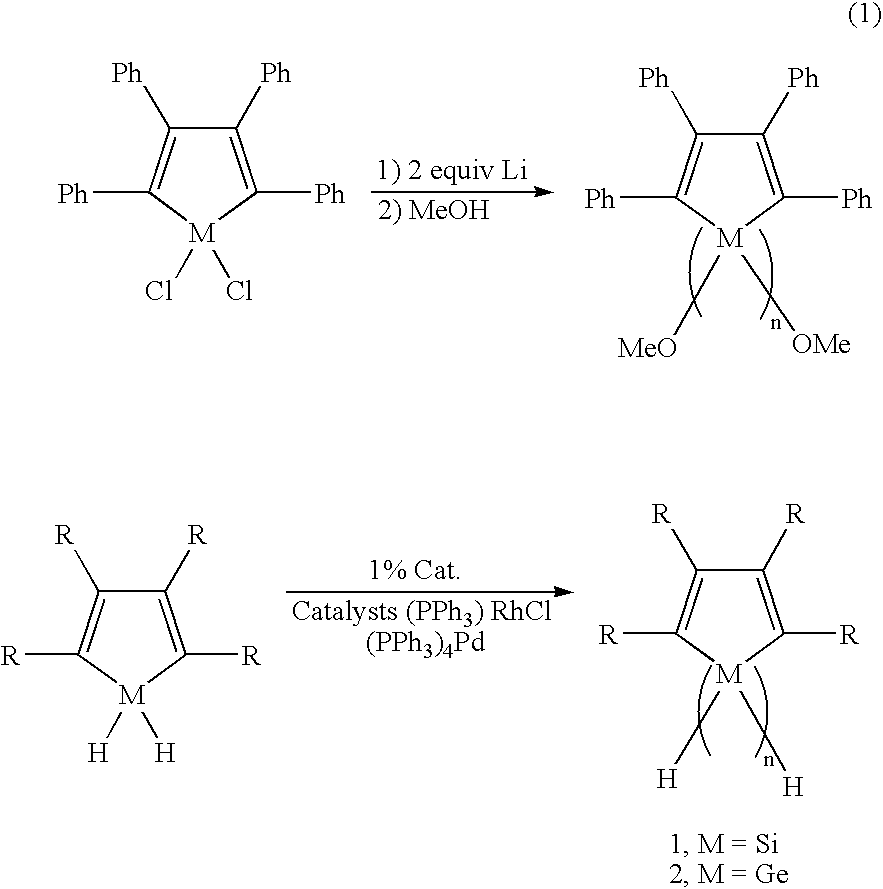
Silole-germole alternating copolymer 3, in which every other silicon or germanium atom in the polymer chain is also part of a silole or germole ring, was synthesized from the coupling of dichloro(tetraphenyl)germole (West, R.; Sohn, H.; Powell, D. R.; Mueller, T.; Apeloig, Y. Angew. Chem. Int. Ed. Engl. 1996, 35, 1002-1004.) and dilithio(tetraphenyl)silole (West, R.; Sohn, H.; Bankwitz, U.; Calabrese, J.; Apelog, Y.; Mueller, T. J. Am. Chem. Soc. 1995, 117, 11608-11609.) which is easily obtained from the dichlorotetraphenylsilole by reduction with lithium in about 39% yield. (equation 2) The molecular weight of silole-germole copolymer 3, Mw˜5.5×10³, Mw/Mn=1.10 determined by SEC (size exclusion chromatography) with polystyrene standards, is similar to that of polysilole or polygermoles. All the polymetalloles are extended oligomers with a degree of polymerization of about 10 to 16, rather than a true high Mw polymer; however, they can be cast into a thin film from solution and show polymer-like properties.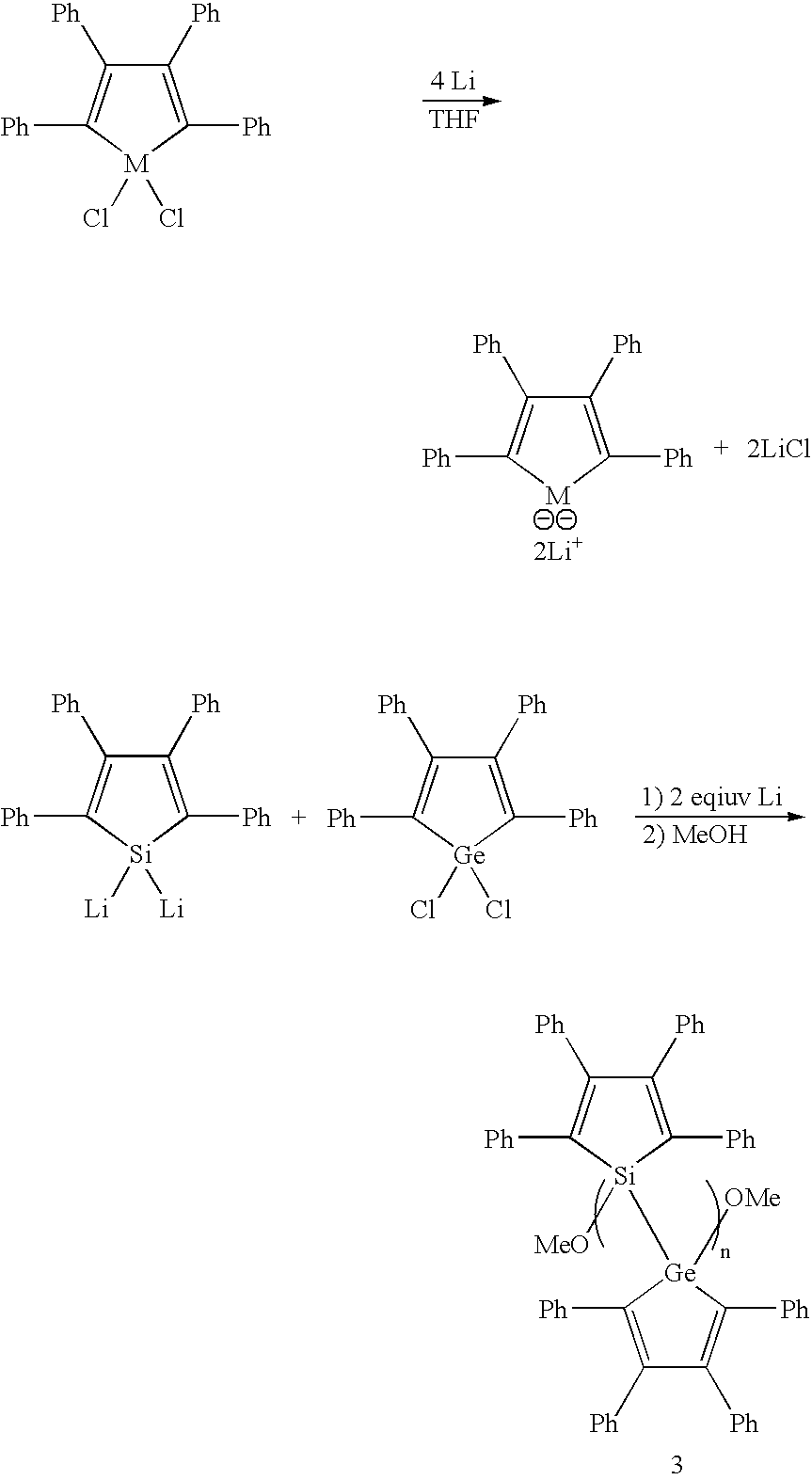
Silole-silane alternating copolymers 4-8 were also synthesized from coupling of the silole dianion, (Ph4C4Si)Li2 (West, R.; Sohn, H.; Bankwitz, U.; Calabrese, J.; Apelog, Y.; Mueller, T. J. Am. Chem. Soc. 1995, 17, 11608-11609.) with corresponding silanes. Germole-silane alternating copolymers 9-12 were synthesized from the coupling of germole diaion, (Ph4C4Ge)Li2 (West, R.; Sohn, H.; Powell, D. R.; Mueller, T.; Apeloig, Y. Angew. Chem. Int. Ed. Engl. 1996, 35, 1002-1004.) with corresponding silanes (equation 3). These reactions generally employ reflux conditions in tetrahydrofuran under an argon atmosphere for 72 h. Some silole-silane copolymers have been previously synthesized by the West and Sakurai groups (Sanji, T.; Sakai, T.; Kabuto, C.; Sakurai, H. J. Am. Chem. Soc. 1998, 120, 4552-4553; Sohn, H.; West, R. unpublished studies) and shown to be electroluminescent. We have developed routes to metallole-silane copolymers, which have a hydrosilane between every silole unit, so these copolymers could be easily fuctionalized along the backbone by hydrosilation. The molecular weight of metallole-silane copolymers, Mn=4.1×10³˜5.4×10³, Mw/Mn=1.04˜1.16 detetimined by SEC, is similar to that of the polymetalloles. The yields of metallole-silane copolymers are also very similar to those of the Wurtz-type polycondensation (ca. 35%).
- The molecular weights and polydispersity indices (PDI) of polymers 1-12 determined by GPC (gel permeation chromatography) are listed in Table 1. These polymers are soluble in organic solvents, such as tetrahydrofuran, diethlyl ether, toluene, and chloroform.
- Absorption and Fluorescence Studies
- The UV-vis absorption and fluorescence spectral data for the polymers 1-12 are reported in Table 1. The poly(tetraphenylmetallole)s 1-3 and tetraphenylmetallole-silane copolymers 4-12 exhibit three absorption bands which are ascribed to the □−□* transition in the butadiene mnoiety and □−□2*+□* and □−□1* transitions in the M-M backbones (Xu, Y.; Fujino, T.; Naito, H.; Dohmaru, T.; Oka, K.; Sohn, H.; West, R. Jpn. J. Appl. Phys. 1999, 38, 6915-6918.).
FIG. 2 shows schematic energy-level diagrams for polymetalloles and metallole-silane copolymers. UV-vis absorption spectra in THF (solid line) and fluorescence spectra in toluene (dotted line) for (A) poly(tetraphenylgermole) 2, (B) silole-silane copolymer 4, and (C) germole-silane copolymer 9 are shown inFIG. 3 . Absorptions at the wavelength of about 370 nm for the poly(tetraphenylmetallole)s 1-3 and tetraphenylmetallole-silane copolymers 4-12 are ascribed to the □−□* transition in the butadiene moiety, which are about 89 to 95 nm red-shifted compare to that of oligo[1,1-(2,3,4,5-tetramethylsilole)] (□max=275 nm) (Kanno, K; Ichinohe, M.; Kabuto, C.; Kira, M. Chem. Lett. 1998, 99) and are about 75 to 81 nm red-shifted compare to that of oligo[1,1-(2,5-dimethyl-3,4-diphenylsilole)] (□max=289 nm) (Yamaguchi, S.; Jin, R.; Tamao,K. Organometallics 1997, 16, 2486). These red shifts are attributed to the increasing main chain length and the partial conjugation of phenyl groups to the silole ring.FIG. 4 shows the HOMO (A) and LUMO (B) of 2,5-diphenylsilole, Ph2C4SiH2, from the ab initio calculations at the HF/6-31G* level. Phenyl groups at the 2,5 positions involve □-conjugation with the butadiene moiety and the silicon orbital delocalization involves the LUMO. Second absorptions at wavelengths of 304 to 320 nm for the poly(tetraphenylmetallole)s 2-3 and tetraphenylmetallole-silane copolymers 4-12 are assigned to the □−□2*+□* transition, which parallels to that of thepolytetraphenylsilole 1.FIG. 5 shows the LUMO of tersilole (A) and pentasilole (B) from the ab initio calculations at the HF/6-31G* level, indicating the □−□2*+□* conjugations primarily involve the LUMO. - Polymetallole 1-2 and silole-silane copolymers 4-7 exhibit one emission band (□max 486 to 513 nm) with an excitation wavelength of 340 nm, whereas others exhibit two emission bands with □max of 480-510 nm and 385-402 nm. The ratios of the two emission intensities are not concentration dependent, which indicates that an excimer is not the origin. Emission bands for germole-silane copolymers 9-12 are only 2 to 33 nm blue-shifted compared to the other polymers.
FIG. 6 shows fluorescence spectra of the poly(tetraphenyl)silole in toluene solution (solid line) and in the solid state (dotted line). The bandwidth of the emission spectrum in solution is slightly larger than in the solid state. There is no shift in the maximum of the emission wavelength. This suggests that the polysilole exhibits neither □-stacking of polymer chains nor excimer formation. - Fluorescence Quenching Studies with Nitroaromatic Analytes
- The detection method involves measurement of the quenching of photoluminescence of the polymetalloles 1-3 and metallole-silane copolymers 4-12 by the analyte (using a Perkin-Elmer LS 50B fluorescence spectrometer, 340 nm excitation wavelength). Fluorescence spectra of a toluene solution of the polymers 1-12 were obtained upon successive addition of aliquots of picric acid (purchased from Aldrich and recrystallized from ethanol solution before use), TNT (prepared from DNT (W. H. Dennis, J.; Rosenblatt, D. H.; Blucher, W. G.; Coon, C. L. J. Chem. Eng.
Data 1975, 120, 202-203) and recrystallized twice from the methanol), DNT, and nitrobenzene. Photoluminescence quenching of the polymers 1-12 in toluene solutions with picric acid. TNT, DNT, and nitrobenzene were measured.FIG. 7 displays the quenching photoluminescence spectra of the silole-silane copolymer 5 with (A) nitrobenzene, (B) DNT, (C) TNT, and (D) picric acid. Photoluminescence quenching efficiencies of the polymetalloles 1-3 and metallole-silane copolymers 4-12 are all in order of picric acid>TNT>DNT>nitrobenzene. - The purity of the TNT sample was found to be important to obtain reproducible results. It was synthesized by nitration of dinitrotoluene and recrystallized twice from methanol. A third recrystallization produces the same results as the twice-recrystallized material. When the quenching experiment was undertaken without recrystallization of TNT, higher (ca. 10×) quenching percentages are obtained. Presumably, impurities with higher quenching efficiencies are present in crude TNT.
- The Stern-Volmer equation was used to quantify the differences of analytes (Turro, N. J. Modern Molecular Photochemistry; University Science Books: Sausalito, Calif., 1991). In this equation, Io is the initial fluorescence intensity without analyte concerned, I is the fluorescence intensity with added analyte, [A] is the concentration of analyte, and Ksv is the Stern-Volmer constant.
(I o /I)−1=Ksv [A] -
FIG. 8 shows the Stern-Volmer plots ofpolysilole 1,polygermole 2, and silole-silane copolymer 8 for each analyte. A linear Stern-Volmer relationship is observed in all cases, but the Stern-Volmer plot for picric acid exhibits an exponential dependence when its concentration is higher than 1.0×10⁻⁴ M. A linear Stern-Volmer relationship may be observed if either static or dynamic quenching process is dominant. Thus, in the case of higher concentrations of picric acid, two processes are competitive, which exhibit a nonlinear Stern-Volmer relationship. - Photoluminescence may arise from either a static process, by the quenching of a bound complex, or a dynamic process, by collisionally quenching the excited state (Connors, K. A. Binding Constants: The Measurement of Molecular Complex Stability; Wiley-Interscience: New York, 1987; Lakowicz, J. R. Principles of Fluorescence Spectroscopy; Plenum Press: New York, 1986). For the foymer case, Ksv is an association constant due to the analyte-preassociated receptor sites. Thus, the collision rate of the analyte is not involved in static quenching and the fluorescence lifetime is invariant with the concentration of analyte. With dynamic quenchinig, the fluorescence lifetime should diminish as quencher is added.
- A single “mean” characteristic lifetime (□) for polymetalloles and metallole-silane copolymers 1-12 has been measured and summarized in Table 1. Luminescence decay was highly heterogeneous in all cases. Three lifetimes were needed to provide an acceptable fit over the first few nanoseconds. Amplitudes of the three components varied but were comparable, none was a negligible feature (and the solvent blank made no contribution). The three lifetimes distributed themselves uniformly (in a geometric sense) over whatever time scale encompassed the total range. These features suggest that the complete description of the fluorescence is actually a continuous distribution of decay rates from a heterogeneous collection of chromophore sites. Since the oligomers span a size distribution, this behavior was not surprising. No special significance should be given to the particular amplitudes and decay times; they simply reproduce the measured curve. Experience suggests that three components are always enough to fit a range of 600 data points for realistic signal-to-noise ratios). The mean
TABLE 1 λabs π − π*, Ksv (M−1) Ksv (M−1) Ksv (M−1) Ksv (M−1) τ polymers Mw PDI σ − σ2* + π* (nm) λfluo (nm) PA TNT DNT NB (×10−9 s) 1 6.2 × 10³ 1.14 368, 314 513 11,000 4,340 2,420 1,200 0.70c 2 4.6 × 10³ 1.05 368, 302 499 6,710 2,050 1,010 320 0.28d 3 5.5 × 10³ 1.10 364, 302 510, 385 8,910 3,050 1,730 753 0.43 4 4.4 × 10³ 1.04 370, 318 491 9,120 3,520 2,060 1,150 2.33 5 4.5 × 10³ 1.09 370, 320 488 10,700 3,940 2,380 1,230 1.34 6 4.8 × 10³ 1.16 368, 320 489 8,420 3,030 2,010 735 2.20 7 5.0 × 10³ 1.05 368, 318 493 10,800 3,430 2,330 965 0.62 8 4.6 × 10³ 1.14 366, 324 505, 385 9,350 3,680 2,340 864 2.70 9 4.9 × 10³ 1.12 364, 304 483, 400 10,300 3,990 2,570 1,140 0.27 10 4.4 × 10³ 1.06 364, 304 486, 400 9,990 3,330 2,000 965 0.35 11 4.1 × 10³ 1.06 364, 304 484, 400 8,740 3,430 2,210 986 0.26 12 5.4 × 10³ 1.09 364, 306 480, 402 9,840 3,340 2,150 936 0.22
Summary of Molecular Weight, Photophysical Data,a Stern-Volmer Quenching Constants with Picric Acid, TNT, DNT, and Nitrobenzene Analytes, and Mean Life Times of Emissionb for Polymers 1-12.
aAbsorption and fluorescence spectra were taken at the concentration of 2 mg/L in THF and 10 mg/L in toluene, respectively.
bRepeatability is about 5% but not less than ±0.04 nanoseconds.
c1.77 ns (solid state).
d1.17 ns (solid state)
lifetime is an average of the three lifetimes determined by the fitting procedure, weighted by their relative amplitudes. This is the appropriate average for comparison with quantum yields, that is, the “amount” of light emitted by different samples under different conditions, such as quenching, as has been treated in the literature (Sillen, A.; Engelboroughs, Y. Photochem. and Photobiol. 1998, 67, 475-486). Given this heterogeneity, we were concerned about possible long-lived luminescence that might be particularly vulnerable to quenching. However, measurements with a separate nanosecond laser system confirmed that there were no longer-lived processes than those captured by the time-correlated photon counting measurement and incorporated into Table 1. - It is notable that
polysilole 1 and silole-silane copolymers 48 have about 3 to 11 times longer fluorescence lifetimes thanpolygeimole 2 and germole-silane copolymers 9-12. Fluorescence lifetimes in the thin films (solid state) forpolysilole 1 andpolygermole 2 are 2.5 and 4.2 times longer than in toluene solution respectively. The fluorescence lifetimes as a function of TNT concentration have been also measured and shown in the inset ofFIG. 8 for 1, 2 and 8. No change of lifetime has been observed by adding TNT, indicating that the static quenching process is domninant for polymetalloles and metallole-silane copolymers 1-12 (FIG. 9 ). Some issues with such analyses have been discussed in the literature (Webber, S. E. Photochem. and Photobiol. 1997. 65, 33-38). This result suggests that the metallole might act as a receptor and a TNT molecule would intercalate between metallole moieties. The chemical equation for static quenching is as follows, where P-Q is assumed to be coupletely quenched, when one molecule of analyte intercalates. This probably is over simplified given the dependence of Ksv on analyte redox potential. For chemosensor applications it is useful to have sensors with varied responses. Each of the 12 polymers exhibit a different ratio of the photoluminescence quenching for picric acid, TNT, DNT, and nitrobenzene and a different response with the same analyte. The use of sensor arrays is inspired by the performance of the olfactory system to specify an analyte (Albert, K. J.; Lewis, N. S.; Schauer, C. L.; Sotzing, G. A.; Stitzel, S. E.; Vaid, T. P.; Walt, D. R. Chem. Rev. 2000, 100, 2595-2626.).FIG. 10 displays the Stern-Volmer plots ofpolymers 
- The trend in Stern-Volmer constants usually reflects an enhanced charge transfer interaction from metallole polymer to analyte. For example, the relative efficiency of photoluminescence quenching of
polysilole 1 is about 9.2:3.6:2.0:1.0 for picric acid, TNT, DNT, and nitrobenzene, respectively. Whilepolysilole 1 shows best photoluminescence quenching efficiency for picric acid and TNT,polymer FIG. 11 ).Polygermole 2 has the lowest quenching efficiency for all analytes. Since the polymers 1-12 have a similar molecular weight, the range of quenching efficiencies with the same analyte would be expected to be small. Polysilole 1 (11.02×10³ M−1 and 4.34×10³ M−1) exhibits 164 and 212% better quenching efficiency than polygermole 2 (6.71×10³ M−1 and 2.05×10³ M−1) with picric acid and TNT, respectively. Polymer 9 (2.57×10³ M−1) has 253% better quenching efficiency than polymer 2 (1.01×10³ M−1) with DNT. Polymer 5 (1.23×10³ M−1) has 385% better quenching efficiency than metallole polymer 2 (0.32×10³ M−1) with nitrobenzene.FIG. 12 illustrates how an analyte might be specified using an array of multi-sensors.FIG. 13 shows a plot of log Ksv vs reduction potential of analytes. All metallole polymers exhibit a linear relationship, even though they have different ratios of photoluminescence quenching efficiency to analytes. This result indicates that the mechanism of photoluminescence quenching is primarily attributable to electron transfer from the excited metallole polymers to the LUMO of the analyte. Since the reduction potential of TNT (−0.7 V vs. NHE) (Yang, J.-S.; Swager, T. M. J. Am. Chem. Soc. 1998, 120, 11864-11873.) is less negative than that of either DNT (−0.9 V vs. NHE) or nitrobenzene (−1.15 V vs. NHE), it is detected with high sensitivity. A schematic diagram of the electron transfer mechanism for the quenching of photoluminescence of the metallole polymers with analyte is shown inFIG. 14 . Optical excitation produces an electron-hole pair, which is delocalized through the metallole copolymers. When an electron deficient molecule, such as TNT is present, an electron transfer quenching occurs from the conduction band of the metallole copolymers to the LUMO of the analyte. To evaluate the efficiency of photoluminescence quenching depending on the chain length of the molecule, we measured the photoluminescence quenching of the oligomeric tersilole, Cl(C4Ph4Si)3Cl, (Sohn, H.; Huddleston, R. R.; Powell, D. R.; West, R. J. Am. Chem. Soc. 1999, 121, 2935-2936.) by TNT.FIG. 15 compares the photoluminescence quenching betwveen tersilole andpolysilole 1, which has about 16 repeat units. The Ksv value of 4.34×10³ M−1 for polysilole, is 38 greater than that for the oligomer tersilole (Ksv=3.14×10³ M−1). (Sohn, H.; Calhoun, R. M.; Sailor, M. J.; Trogler, W. C. Angew. Chem. Int. Ed. Engl. 2001, 40, 2104-2105. ) This result suggests that the polysilole produces an excited state that is delocalized over many repeat units. For organic polymers, the sensitivity of the photoluminescence quenching technique depends both on the polymer molecular weight and on the diffusion length of excitation (Zhou, Q.; Swager, T. M. J. Am. Chem. Soc. 1995, 117, 7017-7018). - An important aspect of the metallole copolymers is their insensitivity to common interferents. Control experiments using both solutions and thin films of metallole copolymers (deposited on glass substrates) with oxygenated air displayed no change in the photoluminescence spectrum. Similarly, exposure of metallole copolymers as a both solution and thin films to organic solvents such as toluene, THF, and methanol or the aqueous inorganic acids H2SO4 and HF produced no significant decrease in photoluminescence intensity.
FIG. 16 shows that the photoluminescence spectra ofpolysilole 1 in toluene solution display no quenching of fluorescence with 4 parts per hundred of THF. While the organic pentiptycene-derived polymer 13 with the organic oxidant benzoquinone (Ksv=998 M−1) exhibits higher quenching efficiency of photoluminescence compared to that of polysilole 1 (Ksv=674 M−1), the ratio of quenching efficiency ofpolysilole 1 with TNT vs. benzoquinone is much greater than that of polymer 13. The Ksv value of 4.34×10³ M−1 ofpolysilole 1 for TNT is 644% greater than that for benzoquinone (Ksv=674 M−1), but the organic polymer 13 exhibits slightly better quenching efficiency for TNT (Ksv=1.17×10³ M−1) (ca. 117%) compared to that for benzoquinone. This result indicates thatpolysilole 1 exhibits less response to interferences and greater response to nitroarotmatic compounds compared to the pentiptycene-derived polymer 13. - Experimental Section
- General. All synthetic manipulations were carried out under an atmosphere of dry argon gas using standard vacuum-line Schlenk techniques. All solvents were degassed and purified before use according to standard literature methods: diethyl ether, hexanes, tetrahydrofuran, and toluene were purchased from Aldrich Chemical Co. Inc. and distilled from sodiunm/benzophenone ketal. Spectroscopic grade toluene from Fisher Scientific was used for the fluorescence measurements. NMR grade deuteriochloroform was stored over 4 Å molecular sieves. All other reagents (Aldrich, Gelest) were used as received or distilled before use. NMR data were collected with
Varian Unity - Fluorescence lifetine measurments: Fluorescence decay in the range 0.05 to 20 ns was characterized by time-correlated single photon counting (TCSPC). A neodymium:vanadate laser at 530 nm (Coherent Verdi) pumped a home-built titanium:sapphire laser that generated femtosecond mode-locked pulses by self-phase-locking. Harmonic doubling provided excitation pulses near 400 nm. A portion of the beam was picked off and sent to a photodiode to provide “stop” pulses. Emission from solutions in ordinary 1 cm2 luminescence cells or from solid polymer films was collected and sent through a half-meter monochromator (Spex 1870) to a microchannelplate photomultiplier (Hamamatsu 1564U-01). After amplification (Philips 774), pulses were recognized by a constant-fraction discriminator (Tennelec TC454) to provide “start” signals to the time analyzer (Canberra 2044). The “stop” pulses came from the photodiode through a separate discriminator (EGG-Ortec 934). On this occasion, pulse selection was not used. Electronic gating (Laws, W. R.; Potter; D. W.; Sutherland, J. C. Rev. Sci. Instrum. 1984, 55, 1564) was employed to avoid pile-up at the time analyzer. The histogram of the delay times between fluorescence and excitation was collected by a multichannel pulse height analyzer (Norland 5300) and transferred to a microcomputer for processing. The instrument response function to instantaneous emission was measured using a colloidal suspension. Deconvolution was carried out using iterative reconvolution within a least-squares routine based on the Marquardt method (Marquardt, D. W. J. Soc. Indust. Appl. Math. 1963, 11, 431-441) The program, developed in-house, incorporates some insights from Grinvald and Steinberg (Grinvald, A.; Steinberg, I. Z. Anal. Biochem. 1974, 59, 583-598). It also accommodates an infinite sequence of excitation pulses producing decays longer than the repetition period; for exponential decays, this involves only summing a simple geometric series for each fitted component. A general introduction to the methodology, along with other details of our apparatus, was provided previously (Magde, D.; Canpbell, B. F. SPEI 1989, 1054, 61-68). However, many specifics have changed, as described above, and the main novelty described in that report, the use of in internal reference, is not currently used with the new laser system.
- Preparation of polymetalloles (1,2): Synthesis of
polygermole 2 is similar to that of polysilole 1 (Sohn, H.; Huddleston, R. R.; Powell, D. R.; West, R. J. Am. Chem. Soc. 1999, 121, 2935-2936.) 1,1-dichloro-2,3,4,5-tetraphenylgermole (3.0 g, 6.0 mmol) in THF (130 mL) was stirred with 2 equiv Li under Ar atmosphere. After the mixture was refluxed for three days, 4 mL of methanol was added to the reaction mixture. After removal of the solvent, the residual solid was dissolved in 5 mL of THF and then poured into 400 mL of methanol.Polygermole 2 was obtained as pale yellow powder after the third cycle of dissolving-precipitation followed by freeze-drying. 2: (1.11 g, 43%, Mw=4600, Mw/Mn=1.05, determined by SEC with polystyrene standards); 1H NMR (300.133 MHz, CDCl3): δ=6.80-7.40 (br, m, Ph), 3.60 (br, OMe); 13C{H} NMR (75.403 MHz, CDCl3 (δ=77.00)): δ=125-132 (br, m, Ph) and 136-151 (br, m, germole ring carbon). - Preparation of silole-germole alternating copolymer 3: Stirring 1,1-dichloro-2,3,4,5-tetraphenylsilole (3.0 g, 6.6 mmol) with lithium (0.9 g, 129.7 mmol) in THF (120 mL) for 8 h at room temperature gave a dark yellow solution of silole dianion. After removal of excess lithium, 1,1-dichloro-2,3,4,5-tetraphenylgermole (3.3 g, 6.6 mmol) was added to a solution of tetraphenylsilole dianion, and stirred at room temperature for 2 h. The resulting mixture was refluxed for 3 days. The reaction nmxture was cooled to room temperature and quenched with methanol. Then, the volatiles were removed under reduced pressure. THF (20 mL) was added to the residue and polymer was precipitated by slow addition of the solution into 500 mL of methanol. The third cycle of dissolving-precipitation followed by freeze-drying gave the polymer as yellow powder. 3: (2.10 g, 39%, Mw=5500, Mw/Mn=1.10, determined by SEC with polystyrene standards); 1H NMR (300.133 MHz, CDCl3): δ=6.30-7.40 (br, m, Ph), 3.56 (br, OMe); 13C{H} NMR (75.403 MHz, CDCl3 (δ=77.00)): δ=125-130 (br, m, Ph) and 138-152 (br, m, silole and germole ring carbon).
- Preparation of silole-silane copolymers, (silole-SiR1R2)n: Stirring of 1,1 -dichloro-2,3,4,5-tetraphenylsilole (5.0 g, 11.0 mmol) with lithium (0.9 g, 129.7 mmol) in THF (120 mL) for 8 h at room temperature gave a dark yellow soltution of silole dianion. After removal of excess lithium, 1 mol equiv of corresponding silanes, R1R2SiCl2(11.0 mmol) was added slowly to a solution of tetraphenylsilole dianion, and stirred at room temperature for 2 h. The resulting mixture was refluxed for 3 days. The reaction mixture was cooled to room temperature and quenched with methanol. Then the volatiles were removed under reduced pressure. THF (20 mL) was added to the residue and polymer was precipitated by slow addition of the solution into 700 mL of methanol. The third cycle of dissolving-precipitation followed by freeze-drying gave the polymer as yellow powder.
- For (silolen(SiMeH)m(SiPhH)o, each 5.5 mmol of SiMeHCl2 and SiPhHCl2 were slowly added into a THF solution of silole dianion. In the case of (silole-SiH2)m, after addition of the xylene solution of SiH2Cl2 (11.0 mmol), the resulting mixture was stirred for 3 days at room temperature instead of refluxing.
- Selected data for (silole-SiMeH)n, 4; Yield=2.10 g (44.5%); 1H NMR (300.134 MHz, CDCl3): □=−0.88-0.60 (br. 3H, Me), 3.06-4.89 (br. 1H, SiH), 6.16-7.45 (br. 20H, Ph); 13C{H} NMR (75.469 MHz, CDCl3): □=0.61-1.69 (br. Me), 123.87-131.75, 137.84-145.42 (br. m, Ph), 153.07-156.73 (br. m, silole ring carbon); 29Si NMR (71.548 MHz, inversed gated decoupling, CDCl3): □=−29.22 (br. silole), −66.61 (br. SiMeH). GPC: Mw=4400, Mw/Mn =1.04, determined by SEC with polystyrene standards.
- Selected data for (silole-SiPhH)n, 5; Yield=2.00 g (37.0%); 1H NMR (300.134 MHz, CDCl3): □=3.00-4.00 (br. 1H, SiH), 6.02-7.97 (br. 20H, Ph); 13C{H} NMR (75.469 MHz, CDCl3): □=123.64-143.98 (br. m, Ph), 152.60-157.59 (br. m, silole ring carbon); 29Si NMR (71.548 MHz, inversed gated decoupling, CDCl3): □=−37.51 (br. silole), −71.61 (br. SiPhH). GPC: Mw=4500, Mw/Mn=1.09, deternmined by SEC with polystyrene standards.
- Selected data for (silole)n(SiMeH)0 5n(SiPhH)0.5n, 6; Yield=2.10 g (41.5%); 1H NMR (300.134 MHz, CDCl3): □=−0.67-0.40 (br. 3H, Me), 3.08-4.98 (br. 2H, SiH), 6.00-7.82 (hr. 55H, Ph); 13C{H} NMR (75.469 MHz, CDCl3): □=−0.85-1.76 (br. Me), 122.06-147.25 (br. m, Ph), 153.11-157.26 (br. m, silole ring carbon); 29Si NMR (71.548 MHz, inversed gated decoupling, CDCl3): □=−28.61 (br. silole), −59.88 (br. SiMeH and SiPhH). GPC: Mw=4800, Mw/Mn=1.16, determined by SEC with polystyrene standards.
- Selected data for (silole-SiPh2)n, 7; Yield=2.93 g (47.0%); 1H NMR (300.134 MHz, CDCl13): □=6.14-7.82 (br. 20H, Ph); 13C{H} NMR (75.469 MHz, CDCl3): □=122.08-146.25 (br. m, Ph), 152.81-160.07 (silole ring carbon); GPC: Mw=5248, Mw/Mn=1.05, determined by SEC with polystyrene standards.
- Selected data for (silole-SiH2)n, 8; Yield=2.05 g (45%); 1H NMR (300.134 MHz, CDCl3): □=3.00-4.96 (br. 2H, SiH 2), 6.12-7.72 (br. 20H, Ph); 13C{H} NMR (75.469 MHz, CDCl3): □=122.08-132.78, 136.92-146.25 (br. m, Ph), 152.81-160.07 (br. m, silole ring carbon); 29Si NMR (71.548 MHz, inversed gated decoupling, CDCl3): □=−30.95 (br. silole), −51.33 (br. SiH2). ratio of n:m=1.00:0.80; GPC: Mw=4600, Mw/Mn=1.14, determined by SEC with polystyrene standards.
- Preparation of germole-silane copolymers, (germole-SiR1R2)n: The procedure for synthesizing all germole-silane copolymers was similar to that for silole-silane copolymers. For (germole)n(SiMeH)0 5n(SiPhH)0 5n, each 5.0 mmol of SiMeHCl2 and SiPhHCl2 were added slowly into a THF solution of germole dianion. The resulting mixture was stirred for 3 days at room temperature.
- Selected data for (germole-SiMeH)n9; Yield=2.03 g (43%); 1H NMR (300.134 MHz, CDCl3): □=−0.21-0.45 (br. 2.4H, Me), 5.14-5.40 (br. 0.8H, SiH), 6.53-7.54 (br. 20H, Ph); 13C{H} NMR (75.469 MHz, CDCl3): □=−9.70 -8.15 (br. Me), 125.29-130.94, 139.08-148.12 (br. m, Ph), 151.29-152.88 (br. m, germole ring carbon); 29Si NMR (71.548 MHz, inversed gated decoupling, CDCl3): □−50.40 (br. SiMeH); GPC: Mw=4900, Mw/Mn=1.12, determined by SEC with polystyrene standards.
- Selected data for (germole-SiPhH)n 10; Yield=2.13 g (40%); 1H NMR (300.134 MHz, CDCl3): □=4.71 (br. 1.0H SiH) 6.30-7.60 (br. 25H, Ph) 13 C{H} NMR (75.469 MHz, CDCl3): □=125.50-144.50 (br. m, Ph), 151.50-153.00 (br. m, germole ring carbon); 29Si NMR (71.548 MHz, inversed gated decoupling, CDCl3): □=−56.81 (br. SiPhH); GPC: Mw=4400, Mw/Mn=1.06, determined by SEC with polystyrene standards.
- Selected data for (germole)n(SiMeH)0.5n(SiPhH)0.5n, 11; Yield=2.01 g (40%); 1H NMR (300.134 MHz, CDCl3): □=−0.04-0.42 (br. 3H, Me), 4.94 (br. 2H, SiM), 6.33-7.66 (br. 25H, Ph); 13C{H} NMR (75.469 MHz CDCl3): □=124.31-130.66 (br. m, Ph), 138.43-152.54 (br. m, germole ring carbon); 29Si NMR (71.548 MHz, inversed gated decoupling, CDCl3): □=−63.01 (br. SiMeH and SiPhH): 0.71; GPC: Mw=4100, Mw/Mn=1.06, determined by SEC with polystyrene standards.
- Selected data for (germole-SiPh2)n, 12; Yield=3.23 g (48%); 1H NMR (300.134 MHz, CDCl3): □=6.21-7.68 (br. 30H, Ph); 13C{H} NMR (75.469 MHz, CDCl3): □=125.15-141.40 (br. m, Ph), 151.12-153.99 (germole ring carbon); GPC: Mw=5377, Mw/Mn=1.09, determined by SEC with polystyrene standards.
FIGS. 17-26 Text - Reflecting now on the instrumentation or apparatus of this invention,
FIG. 17 shows the microsensoor elements of this invention for detection of pollution, chemical agent, and explosives.FIG. 18 illustrates the chemical structures of common high explosives. -
FIG. 19 is a diagrammatic representation of the luminescent silicon nanowire TNT sensors of this invention. Shown is luminescence quenching for sensing of explosives and nerve agents. The materials operate by electron transfer quenching. Quenching is induced by an IR-emitting chromophore (for fluorophosphate nerve agent detection) or by the strongly electron-accepting class of nitroaromatic explosives (demonstrated with TNT and Picric acid).FIG. 20 shows examples of results obtained by the silicon nanowire (polysilole) TNT sensors of this invention. A TNT-contaminated thumbprint on a transit ticket from the San Francisco BART line is shown at a. The ticket on the left was not exposed to TNT and serves as a control. After exposure, the paper was coated with a fine mist of polysilole. The image was taken under a black light. b. shows the detection of explosives in seawater. Two paper tickets coated with polysilole, then soaked for 30 sec in seawater (collected off Scripps Pier, La Jolla, Calif.). The seawater used in the bottom ticket was spiked with 50 ppb of purified TNT. The top ticket is the control. The image was taken under a black light. -
FIG. 21 demonstrates the synthesis of poly(tetraphenylsilole). The products are highly photoluminescent polymers, soluble in organic solvents, and air and water-stable. (Yamaguchi, Y. Synthetic Met. 82, 149-153 (1996); Tamao, K., Uchida, M., Izumizawva, T., Furukawa, K. & Yamaguchi, S. J. Am. Chem. Soc. 118, 11974-11975 (1996); Sohn, H., Huddleston, R. R., Powell, D. R. & West, R. J. Am. Chem. Soc. 121, 2935-2936 (1999)). -
FIG. 22 shows Stern-Volmer Plots of the sensitivity and selectivity of the sensors of this invention in the detection of explosives (TNT, DNT, Picric Acid) in toluene. -
FIG. 23 demonstrates the nanoengineered silicon sensors methodology. a. Luminescence from silicon nanodots and nanowires displays the Fabry-Perot and/or photoluminescence modes. b. Shows the workings of the transducer.FIG. 24 indicates the specificity of the sensors. a. Shows catalytic hydrolysis of cw agents. b. Right half in each frame was exposed to vapor over aqueous HF at the indicated concentrations.FIG. 25 shows a. a laser interferometer using nanocrystalline porous Si transducers. The dynamic range is 5 decades. The detection limit (ethanol) is 500 ppb. The handheld nanosensor device for nerve agent was developed by Inventors for DARPA Micro Unattended Ground Sensors program. b. A sarin run showing response to Sarin at 10 ppm within 7 min of introduction. The sampling chamber depleted of agent ca. 10 min into the run. (Dr. Kwok Ong, APGEA).FIG. 26 shows the instrumentation and results for standoff detection of VOCs with nanostructured Si photonic bandgap particles. - Conclusions and Future Prospects
- The polymetalloes and metallole copolymers have been synthesized and used for the detection of explosives such as picric acid, TNT, DNT, and nitrobenzene. These polymers have similar molecular weights, which are extended oligomers with a degree of polymerization of about 10 to 16 metallole units, and show great sensitivities to the nitroaromatics. The efficiency of photoluminescence quenching is in the order of picric acid>TNT>DNT>nitrobenzene, which is correlated with their reduction potentials. This result indicates that the quenching photoluminescence properties strongly depend on the electrostatic interactions between electron rich polymers and electron deficient analytes and is primarily attributable to electron transfer from the excited metallole polymers to the LUMO of the analyte. Quenching of photoluminescence is purely a static process, since □O/□ is invariant with quencher concentration. Each metallole polymer has a unique ratio of quenching efficiency to the corresponding analyte and each analyte has a variety of different responses to different metallole polymers, which could be utilized to specify the analyte by pattern recognition methods. These metallole copolymers are robust and insensitive to common interferents, such as organic solvent and inorganic acids. These polymetalloles and metallole copolymers exhibit 2 to 5 times better quenching efficiencies than the organic pentiptycene-derived polymer in solution. To increase the sensitivity, it may help to synthesize more elaborate metallole copolymers by changing polymer structures, or to generate longer polymer chain lengths. Sensitivity as a vapor sensor can even be improved in the solid state depending on the thickness of films (Yang, J.-S.; Swager, T. M. J. Am. Chem. Soc. 1998, 120, 5321-5322;Yang, J.-S.; Swager, T. M. J. Am. Chem. Soc. 1998, 120, 11864-11873.).
- While the present invention has now been described in tenms of certain preferred embodiments, and exemplified with respect thereto, one skilled in the art will readily appreciate that various modifications, changes, omssions and substitutions may be made without departing from the spirit thereof. It is intended, therefore, that the present invention be limited solely by the scope of the following claims.
- Albeit, K. J., Myrick, M. L., Brown, S. B., James, D. L., Milaniovich, F. P., Walt, D. R. Envron. Sci. Technol. 2001, 35, 3193-3200.
- Albert, K. J., Lewis, N. S., Schauer, C. L., Sotzing, G. A., Stitzel, S. E., Vaid, T. P., Walt, D. R. Chem. Rev. 2000, 100, 2595-2626.
- Alifrov, V. P., Mozjoukhine, G. V., Fisher, R. Rev. Sci. Instrum. 2000, 71, 1656-1659.
- Approaches for the remediation of federal facility sites contaminated with explosive or radioactive wastes., U.S. Environmental Protection Agency: Washington, D.C., 1993.
- Bamkwitz, U., Sohn, H., Powell, D. R., West, R. J. Organomet. Chem. 1995, 499, C7-C9.
- Barshick, S.-A. J. Forensic Sci. 1998, 43, 284-293.
- Connors, K. A. Binding Constants: The Measurement of Molecular Complex Stability, Wiley-Interscience: New York, 1987.
- Content, S., Trogler, W. C., Sailor, M. J. Chem. Eur. J. 2000, 6, 2205-2213.
- Czarnik, A. W. Nature 1998, 394, 417-418.
- Fainberg, A. Science 1992, 255, 1531-1537.
- Freeman, W. P., Tilley, T. D., Yap, G. P. A., Rheingold, A. L. Angew. Chem. Int. Ed. Engl. 1996, 35, 982.
- Grinvald, A., Steinberg, I. Z. Anal. Biochem. 1974, 59, 583-598.
- Hakansson, K., Coorey, R. V., Zubarev, R. A., Talrose, V. L., Hakansson, P.
J. Mass Spectrom 2000, 35, 337-346. - Hong, J. H., Boudjhouk, P., Castellino, S. Organometallics 1994, 13, 27.
- Kanno, K., Ichinohe, M., Kabuto, C., Kira, M. Chem. Lett. 1998, 99.
- Krausa, M., Schorb, K. J. Electroanal. Chem. 1999, 461, 10-13.
- Lakowicz, J. R. Principles of Fluorescence Spectroscopy, Plenumn Press: New York, 1986.
- Laws, W. R., Potter, D. W., Sutherland, J. C. Rev. Sci. Instrum. 1984, 55, 1564.
- Liu, Y., Mills, R. C., Boncella, J. M., Schanze, K. S.
Langmuir 2001, 1 7, 7452-7455. - Lu, J., Zhang, Z. Analytica Chimica Acta 1996, 318, 175-179.
- Luggar, R. D., Farquharson, M. J., Horrocks, J. A., Lacey, R. J. J. X-ray Spectrom, 1998, 27, 87-94.
- Magde, D., Campbell, B. F. SPEI 1989, 1054, 61-68.
- Marquardt, D. W. J. Soc. Indust. Appl. Math. 1963, 11, 431-441.
- McGill, R. A., Mlsna, T. E., Mowery, R. In IEEE International Frequency Control Symposium, 1998, pp 630-633.
- McQuade, D. T., Pullen, A. E., Swager, T. M. Chem. Rev. 2000, 100, 2537-2574.
- Rouhi, A. M. Chem. Eng. News 1997, 75, 14-22.
- Sanji, T., Sakai, T., Kabuto, C., Sakurai, H. J. Anm. Chem. Soc. 1998, 120, 4552-4553.
- Shriver-Lake, L. C., Donner, B. L., Ligler, F. S. Environ. Sci. Technol. 1997, 31, 837-841.
- Sillen, A., Engelboroughs, Y. Photochem. and Photobiol. 1998, 67, 475-486.
- Smith, K. D., McCord, B. R., McCrehan, W. A., Mount, K., Rowe, W. F. J. Forensic Sci. 1999, 44, 789-794.
- Sohn, H., Calhoun, R. M., Sailor, M. J., Trogler, W. C. Angew. Chem. Int. Ed. Engl. 2001, 40, 2104-2105.
- Sohn, H., Huddleston, R. R., Powell, D. R., West, R. J. Am. Chem. Soc. 1999, 121, 2935-2936.
- Sohn, H., Trogler, W. C. manuscript submitted 2002.
- Sohn, H., West, R. unpublished studies.
- Sohn, H. In New Chemistry of Siloles and Germoles, Ph. D. thesis, University of Wisconsin: Madison, 1997, pp 1-310.
- Sylvia, J. M., Janni, J. A., Klein, J. D., Spencer, K. M. Anal. Chem. 2000, 72, 5834-5840.
- Tamao, K., Kawachi, A. Adv. Organomet. Chem. 1995, 38, 1-58.
- Tamao, K., Uchida, M., Izumizawa, T., Furukawa, K., Yamaguchi, S. J. Am. Chem. Soc. 1996, 118, 11974-11975.
- Turro, N. J. Modern Molecular Photochemistry, University Science Books: Sausalito, Calif., 1991.
- W. H. Dennis, J., Rosenblatt, D. H., Blucher, W. G., Coon, C. L. J. Chem. Eng.
Data 1975, 120, 202-203. - Webber, S. E. Photochem. and Photobiol. 1997, 65, 33-38.
- West, R. In Comprehensive Organometallic Chemistry II, Davies, A. G., Ed., Pergamon: Oxford, 1995, pp 77-110.
- West, R., Sohn, H., Powell, D. R., Mueller, T., Apeloig, Y. Angew. Chem. Int. Ed. Engl. 1996, 35, 1002-1004.
- West, R., Sohn, H., Bankwitz, U., Calabrese, J., Apelog, Y., Mueller, T. J. Am. Chem. Soc. 1995, 117, 11608-11609.
- Xu, Y., Fujino, T., Naito, H., Dohmaru, T., Oka, K., Sohn, H., West, R. Jpn. J. Appl. Phys. 1999, 38, 6915-6918.
- Yamaguchi, Y. Synthetic Met. 1996, 82, 149-153.
- Yamaguchi, S., Endo, T., Uchida, M., Izumizawa, T., Furukawa, K., Tamao, K. Chem. Eur. J. 2000, 6, 1683-1692.
- Yamaguchi, S., Tamao, K. Bull. Chem. Soc. Jpn. 1996, 69, 2327-2334.
- Yamaguchi, S., Jin, R., Tamao,
K. Organomnetallics 1997, 16, 2486. - Yamaguchi, S., Tamao, K. J. Chem. Soc., Dalton Trans. 1998, 3693-3702.
- Yang, J.-S., Swager, T. M. J. Am. Chem. Soc. 1998, 120, 11864-11873.
- Yang, J.-S., Swager, T. M. J. Am. Chem. Soc. 1998, 120, 5321-5322.
Claims (10)
Priority Applications (1)
| Application Number | Priority Date | Filing Date | Title |
|---|---|---|---|
| US10/244,053 US7482168B2 (en) | 2001-09-15 | 2002-09-14 | Photoluminescent polymetalloles as chemical sensors |
Applications Claiming Priority (2)
| Application Number | Priority Date | Filing Date | Title |
|---|---|---|---|
| US32290801P | 2001-09-15 | 2001-09-15 | |
| US10/244,053 US7482168B2 (en) | 2001-09-15 | 2002-09-14 | Photoluminescent polymetalloles as chemical sensors |
Publications (2)
| Publication Number | Publication Date |
|---|---|
| US20050101026A1 true US20050101026A1 (en) | 2005-05-12 |
| US7482168B2 US7482168B2 (en) | 2009-01-27 |
Family
ID=34555261
Family Applications (1)
| Application Number | Title | Priority Date | Filing Date |
|---|---|---|---|
| US10/244,053 Expired - Fee Related US7482168B2 (en) | 2001-09-15 | 2002-09-14 | Photoluminescent polymetalloles as chemical sensors |
Country Status (1)
| Country | Link |
|---|---|
| US (1) | US7482168B2 (en) |
Cited By (39)
| Publication number | Priority date | Publication date | Assignee | Title |
|---|---|---|---|---|
| US20020117659A1 (en) * | 2000-12-11 | 2002-08-29 | Lieber Charles M. | Nanosensors |
| US20020130311A1 (en) * | 2000-08-22 | 2002-09-19 | Lieber Charles M. | Doped elongated semiconductors, growing such semiconductors, devices including such semiconductors and fabricating such devices |
| US20030089899A1 (en) * | 2000-08-22 | 2003-05-15 | Lieber Charles M. | Nanoscale wires and related devices |
| US20060051872A1 (en) * | 2002-10-05 | 2006-03-09 | The Regents Of Califorina | Synthesis and use of inorganic polymer sensor for detecting nitroaromatic compounds |
| WO2006050221A2 (en) | 2004-10-29 | 2006-05-11 | The Regents Of The University Of California | Porous photonic crystals for drug delivery to the eye |
| US20060105043A1 (en) * | 2003-03-05 | 2006-05-18 | Sailor Michael J | Porous nanostructures and methods involving the same |
| US20060175601A1 (en) * | 2000-08-22 | 2006-08-10 | President And Fellows Of Harvard College | Nanoscale wires and related devices |
| WO2007024227A1 (en) * | 2005-08-25 | 2007-03-01 | The Regents Of The University Of California | Inorganic polymers and use of inorganic polymers for detecting nitroaromatic compounds |
| KR100700161B1 (en) * | 2004-09-16 | 2007-03-27 | 손홍래 | Organic optical semiconductor chemical sensor for heavy metal detection containing nanoaggregates or nanoparticles of polymetalls, silol-low mole copolymers or metalol-silene copolymers |
| KR100700487B1 (en) | 2004-09-16 | 2007-03-28 | 조성동 | Method for preparing nanoaggregates or nanoparticulates of polymetalls, silol-low mole copolymers or metalol-silane copolymers, nanoaggregates or nanoparticulates thereof prepared therefrom and uses thereof |
| US7254151B2 (en) | 2002-07-19 | 2007-08-07 | President & Fellows Of Harvard College | Nanoscale coherent optical components |
| US20070264623A1 (en) * | 2004-06-15 | 2007-11-15 | President And Fellows Of Harvard College | Nanosensors |
| US20080191196A1 (en) * | 2005-06-06 | 2008-08-14 | Wei Lu | Nanowire heterostructures |
| US20080212068A1 (en) * | 2004-10-19 | 2008-09-04 | The Regents Of The University Of California | Porous Photonic Crystal with Light Scattering Domains and Methods of Synthesis and Use Thereof |
| KR100856481B1 (en) * | 2006-03-31 | 2008-09-04 | 손홍래 | Chemical sensor sensitive to nitroaromatic compounds using photoluminescent porous silicon |
| US20090004852A1 (en) * | 2004-02-13 | 2009-01-01 | President And Fellows Of Havard College | Nanostructures Containing Metal Semiconductor Compounds |
| US20090095950A1 (en) * | 2004-12-06 | 2009-04-16 | President And Fellows Of Harvard College | Nanoscale Wire-Based Data Storage |
| US20090137059A1 (en) * | 2002-10-05 | 2009-05-28 | Trogler William C | Inorganic Polymers and Use of Inorganic Polymers for Detecting Nitroaromatic Compounds |
| US20100087013A1 (en) * | 2006-06-12 | 2010-04-08 | President And Fellows Of Harvard College | Nanosensors and related technologies |
| US20100152057A1 (en) * | 2006-11-22 | 2010-06-17 | President And Fellows Of Havard College | High-sensitivity nanoscale wire sensors |
| US20100173420A1 (en) * | 2007-01-29 | 2010-07-08 | The Regents Of The University Of California | Fluorescence detection of nitrogen-containing explosives and blue organic led |
| US7759129B2 (en) | 2006-01-11 | 2010-07-20 | The Regents Of The University Of California | Optical sensor for detecting chemical reaction activity |
| US20100196435A1 (en) * | 2007-07-10 | 2010-08-05 | The Regents Of The University Of California | Materials and methods for delivering compositions to selected tissues |
| US20100227382A1 (en) * | 2005-05-25 | 2010-09-09 | President And Fellows Of Harvard College | Nanoscale sensors |
| CN101891642A (en) * | 2010-07-07 | 2010-11-24 | 中国科学院上海微系统与信息技术研究所 | A fluorescent compound and its application in detecting trace nitrobenzene substances |
| US20100321694A1 (en) * | 2008-02-13 | 2010-12-23 | Clark Stephan R | Color detector having area scaled photodetectors |
| US20110057116A1 (en) * | 2007-07-18 | 2011-03-10 | The Regents Of The University Of California | Fluorescence detection of nitrogen-containing explosives and blue organic led |
| US7968474B2 (en) | 2006-11-09 | 2011-06-28 | Nanosys, Inc. | Methods for nanowire alignment and deposition |
| US8058640B2 (en) | 2006-09-11 | 2011-11-15 | President And Fellows Of Harvard College | Branched nanoscale wires |
| US8330955B2 (en) | 2008-02-12 | 2012-12-11 | Hewlett-Packard Development Company, L.P. | Color detector |
| US9012241B2 (en) | 2010-07-27 | 2015-04-21 | Lawrence Livermore National Security, Llc | Rapid detection and identification of energetic materials with surface enhanced raman spectrometry (SERS) |
| US9134239B2 (en) | 2011-03-21 | 2015-09-15 | The Regents Of The University Of California | Thin layer high explosive fluorescent polymer sensing methods, sensors and kits |
| US9297796B2 (en) | 2009-09-24 | 2016-03-29 | President And Fellows Of Harvard College | Bent nanowires and related probing of species |
| US9390951B2 (en) | 2009-05-26 | 2016-07-12 | Sharp Kabushiki Kaisha | Methods and systems for electric field deposition of nanowires and other devices |
| US9394369B2 (en) | 2011-01-03 | 2016-07-19 | The Regents Of The University Of California | Luminescent porous silicon nanoparticles for targeted delivery and immunization |
| US10371688B2 (en) | 2016-02-10 | 2019-08-06 | Rhode Island Board Of Education, State Of Rhode Island And Providence Plantations | Sensing system based on a fluorophore array |
| CN110811053A (en) * | 2019-11-06 | 2020-02-21 | 广州奇点鞋业有限公司 | Flow luminous sole |
| KR20200042190A (en) * | 2018-10-15 | 2020-04-23 | 국방과학연구소 | Method of manufacturing a bragg stack reflection porous silicon film and explosives chemical sensor based on the bragg stack reflection porous silicon film |
| US10702474B2 (en) | 2015-07-09 | 2020-07-07 | The Regents Of The University Of California | Fusogenic liposome-coated porous silicon nanoparticles |
Families Citing this family (1)
| Publication number | Priority date | Publication date | Assignee | Title |
|---|---|---|---|---|
| US10294252B2 (en) | 2012-06-11 | 2019-05-21 | The Curators Of The University Of Missouri | Cyclic germanium compounds and applications thereof |
Citations (1)
| Publication number | Priority date | Publication date | Assignee | Title |
|---|---|---|---|---|
| US6169193B1 (en) * | 1999-01-28 | 2001-01-02 | Wisconsin Alumni Research Foundation | Polysiloles and polygermoles |
Family Cites Families (1)
| Publication number | Priority date | Publication date | Assignee | Title |
|---|---|---|---|---|
| US20060051872A1 (en) * | 2002-10-05 | 2006-03-09 | The Regents Of Califorina | Synthesis and use of inorganic polymer sensor for detecting nitroaromatic compounds |
-
2002
- 2002-09-14 US US10/244,053 patent/US7482168B2/en not_active Expired - Fee Related
Patent Citations (1)
| Publication number | Priority date | Publication date | Assignee | Title |
|---|---|---|---|---|
| US6169193B1 (en) * | 1999-01-28 | 2001-01-02 | Wisconsin Alumni Research Foundation | Polysiloles and polygermoles |
Cited By (91)
| Publication number | Priority date | Publication date | Assignee | Title |
|---|---|---|---|---|
| US7301199B2 (en) | 2000-08-22 | 2007-11-27 | President And Fellows Of Harvard College | Nanoscale wires and related devices |
| US20020130311A1 (en) * | 2000-08-22 | 2002-09-19 | Lieber Charles M. | Doped elongated semiconductors, growing such semiconductors, devices including such semiconductors and fabricating such devices |
| US20030089899A1 (en) * | 2000-08-22 | 2003-05-15 | Lieber Charles M. | Nanoscale wires and related devices |
| US20050164432A1 (en) * | 2000-08-22 | 2005-07-28 | President And Fellows Of Harvard College | Doped elongated semiconductors, growing such semiconductors, devices including such semiconductors and fabricating such devices |
| US8153470B2 (en) | 2000-08-22 | 2012-04-10 | President And Fellows Of Harvard College | Doped elongated semiconductors, growing such semiconductors, devices including such semiconductors, and fabricating such devices |
| US7915151B2 (en) | 2000-08-22 | 2011-03-29 | President And Fellows Of Harvard College | Doped elongated semiconductors, growing such semiconductors, devices including such semiconductors and fabricating such devices |
| US20100155698A1 (en) * | 2000-08-22 | 2010-06-24 | President And Fellows Of Harvard College | Nanoscale wires and related devices |
| US20100093158A1 (en) * | 2000-08-22 | 2010-04-15 | President And Fellows Of Harvard College | Doped elongated semiconductors, growing such semiconductors, devices including such semiconductors and fabricating such devices |
| US20060175601A1 (en) * | 2000-08-22 | 2006-08-10 | President And Fellows Of Harvard College | Nanoscale wires and related devices |
| US7666708B2 (en) | 2000-08-22 | 2010-02-23 | President And Fellows Of Harvard College | Doped elongated semiconductors, growing such semiconductors, devices including such semiconductors, and fabricating such devices |
| US20070026645A1 (en) * | 2000-08-22 | 2007-02-01 | President And Fellows Of Harvard College | Doped elongated semiconductors, growing such semiconductors, devices including such semiconductors, and fabricating such devices |
| US20070032051A1 (en) * | 2000-08-22 | 2007-02-08 | President And Fellows Of Harvard College | Doped elongated semiconductors, growing such semiconductors, devices including such semiconductors, and fabricating such devices |
| US20070032052A1 (en) * | 2000-08-22 | 2007-02-08 | President And Fellows Of Harvard College | Doped elongated semiconductors, growing such semiconductors, devices including such semiconductors, and fabricating such devices |
| US20070032023A1 (en) * | 2000-08-22 | 2007-02-08 | President And Fellows Of Harvard College | Doped elongated semiconductors, growing such semiconductors, devices including such semiconductors, and fabricating such devices |
| US7595260B2 (en) | 2000-08-22 | 2009-09-29 | President And Fellows Of Harvard College | Doped elongated semiconductors, growing such semiconductors, devices including such semiconductors, and fabricating such devices |
| US20090057650A1 (en) * | 2000-08-22 | 2009-03-05 | President And Fellows Of Harvard College | Nanoscale wires and related devices |
| US7476596B2 (en) | 2000-08-22 | 2009-01-13 | President And Fellows Of Harvard College | Doped elongated semiconductors, growing such semiconductors, devices including such semiconductors, and fabricating such devices |
| US7211464B2 (en) | 2000-08-22 | 2007-05-01 | President & Fellows Of Harvard College | Doped elongated semiconductors, growing such semiconductors, devices including such semiconductors and fabricating such devices |
| US20020117659A1 (en) * | 2000-12-11 | 2002-08-29 | Lieber Charles M. | Nanosensors |
| US8399339B2 (en) | 2000-12-11 | 2013-03-19 | President And Fellows Of Harvard College | Nanosensors |
| US7256466B2 (en) | 2000-12-11 | 2007-08-14 | President & Fellows Of Harvard College | Nanosensors |
| US7956427B2 (en) | 2000-12-11 | 2011-06-07 | President And Fellows Of Harvard College | Nanosensors |
| US20070158766A1 (en) * | 2000-12-11 | 2007-07-12 | President And Fellows Of Harvard College | Nanosensors |
| US7385267B2 (en) | 2000-12-11 | 2008-06-10 | President And Fellows Of Harvard College | Nanosensors |
| US20060054936A1 (en) * | 2000-12-11 | 2006-03-16 | President And Fellows Of Harvard College | Nanosensors |
| US7911009B2 (en) | 2000-12-11 | 2011-03-22 | President And Fellows Of Harvard College | Nanosensors |
| US7129554B2 (en) | 2000-12-11 | 2006-10-31 | President & Fellows Of Harvard College | Nanosensors |
| US20100022012A1 (en) * | 2000-12-11 | 2010-01-28 | President And Fellows Of Harvard College | Nanosensors |
| US7619290B2 (en) | 2000-12-11 | 2009-11-17 | President And Fellows Of Harvard College | Nanosensors |
| US7254151B2 (en) | 2002-07-19 | 2007-08-07 | President & Fellows Of Harvard College | Nanoscale coherent optical components |
| US20060051872A1 (en) * | 2002-10-05 | 2006-03-09 | The Regents Of Califorina | Synthesis and use of inorganic polymer sensor for detecting nitroaromatic compounds |
| US20090137059A1 (en) * | 2002-10-05 | 2009-05-28 | Trogler William C | Inorganic Polymers and Use of Inorganic Polymers for Detecting Nitroaromatic Compounds |
| US7927881B2 (en) | 2002-10-05 | 2011-04-19 | The Regents Of The University Of California | Inorganic polymers and use of inorganic polymers for detecting nitroaromatic compounds |
| US9555114B2 (en) | 2003-03-05 | 2017-01-31 | The Regents Of The University Of California | Methods for in vivo drug delivery with porous nanostructures |
| US8274643B2 (en) | 2003-03-05 | 2012-09-25 | The Regents Of The University Of California | Porous nanostructures and methods involving the same |
| US8852447B2 (en) | 2003-03-05 | 2014-10-07 | The Regents Of The University Of California | Porous nanostructures and methods involving the same |
| US20060105043A1 (en) * | 2003-03-05 | 2006-05-18 | Sailor Michael J | Porous nanostructures and methods involving the same |
| US20090227107A9 (en) * | 2004-02-13 | 2009-09-10 | President And Fellows Of Havard College | Nanostructures Containing Metal Semiconductor Compounds |
| US20090004852A1 (en) * | 2004-02-13 | 2009-01-01 | President And Fellows Of Havard College | Nanostructures Containing Metal Semiconductor Compounds |
| US20070264623A1 (en) * | 2004-06-15 | 2007-11-15 | President And Fellows Of Harvard College | Nanosensors |
| KR100700487B1 (en) | 2004-09-16 | 2007-03-28 | 조성동 | Method for preparing nanoaggregates or nanoparticulates of polymetalls, silol-low mole copolymers or metalol-silane copolymers, nanoaggregates or nanoparticulates thereof prepared therefrom and uses thereof |
| KR100700161B1 (en) * | 2004-09-16 | 2007-03-27 | 손홍래 | Organic optical semiconductor chemical sensor for heavy metal detection containing nanoaggregates or nanoparticles of polymetalls, silol-low mole copolymers or metalol-silene copolymers |
| US20080212068A1 (en) * | 2004-10-19 | 2008-09-04 | The Regents Of The University Of California | Porous Photonic Crystal with Light Scattering Domains and Methods of Synthesis and Use Thereof |
| US7903239B2 (en) | 2004-10-19 | 2011-03-08 | The Regents Of The University Of California | Porous photonic crystal with light scattering domains and methods of synthesis and use thereof |
| EP3381446A1 (en) | 2004-10-29 | 2018-10-03 | The Regents of The University of California | Porous photonic crystals for drug delivery to the eye |
| US11241380B2 (en) | 2004-10-29 | 2022-02-08 | The Regents Of The University Of California | Porous photonic crystals for drug delivery to the eye |
| WO2006050221A2 (en) | 2004-10-29 | 2006-05-11 | The Regents Of The University Of California | Porous photonic crystals for drug delivery to the eye |
| US8945602B2 (en) | 2004-10-29 | 2015-02-03 | The Regents Of The University Of California | Porous photonic crystals for drug delivery to the eye |
| US20090208556A1 (en) * | 2004-10-29 | 2009-08-20 | Regents Of The University Of California, The | Porous photonic crystals for drug delivery to the eye |
| US8154002B2 (en) | 2004-12-06 | 2012-04-10 | President And Fellows Of Harvard College | Nanoscale wire-based data storage |
| US20090095950A1 (en) * | 2004-12-06 | 2009-04-16 | President And Fellows Of Harvard College | Nanoscale Wire-Based Data Storage |
| US20100227382A1 (en) * | 2005-05-25 | 2010-09-09 | President And Fellows Of Harvard College | Nanoscale sensors |
| US8232584B2 (en) | 2005-05-25 | 2012-07-31 | President And Fellows Of Harvard College | Nanoscale sensors |
| US7858965B2 (en) | 2005-06-06 | 2010-12-28 | President And Fellows Of Harvard College | Nanowire heterostructures |
| US20080191196A1 (en) * | 2005-06-06 | 2008-08-14 | Wei Lu | Nanowire heterostructures |
| WO2007024227A1 (en) * | 2005-08-25 | 2007-03-01 | The Regents Of The University Of California | Inorganic polymers and use of inorganic polymers for detecting nitroaromatic compounds |
| US7759129B2 (en) | 2006-01-11 | 2010-07-20 | The Regents Of The University Of California | Optical sensor for detecting chemical reaction activity |
| KR100856481B1 (en) * | 2006-03-31 | 2008-09-04 | 손홍래 | Chemical sensor sensitive to nitroaromatic compounds using photoluminescent porous silicon |
| US9102521B2 (en) | 2006-06-12 | 2015-08-11 | President And Fellows Of Harvard College | Nanosensors and related technologies |
| US9903862B2 (en) | 2006-06-12 | 2018-02-27 | President And Fellows Of Harvard College | Nanosensors and related technologies |
| US20100087013A1 (en) * | 2006-06-12 | 2010-04-08 | President And Fellows Of Harvard College | Nanosensors and related technologies |
| US8058640B2 (en) | 2006-09-11 | 2011-11-15 | President And Fellows Of Harvard College | Branched nanoscale wires |
| US8252164B2 (en) | 2006-11-09 | 2012-08-28 | Nanosys, Inc. | Methods for nanowire alignment and deposition |
| US7968474B2 (en) | 2006-11-09 | 2011-06-28 | Nanosys, Inc. | Methods for nanowire alignment and deposition |
| US8575663B2 (en) | 2006-11-22 | 2013-11-05 | President And Fellows Of Harvard College | High-sensitivity nanoscale wire sensors |
| US20100152057A1 (en) * | 2006-11-22 | 2010-06-17 | President And Fellows Of Havard College | High-sensitivity nanoscale wire sensors |
| US9535063B2 (en) | 2006-11-22 | 2017-01-03 | President And Fellows Of Harvard College | High-sensitivity nanoscale wire sensors |
| US8557595B2 (en) | 2007-01-29 | 2013-10-15 | The Regents Of The University Of California | Fluorescence detection of nitrogen-containing explosives and blue organic LED |
| US20100173420A1 (en) * | 2007-01-29 | 2010-07-08 | The Regents Of The University Of California | Fluorescence detection of nitrogen-containing explosives and blue organic led |
| US9937129B2 (en) | 2007-04-16 | 2018-04-10 | The Regents Of The University Of California | Materials and methods for delivering compositions to selected tissues |
| US9241906B2 (en) | 2007-04-16 | 2016-01-26 | The Regents Of The University Of California | Materials and methods for delivering compositions to selected tissues |
| US12171877B2 (en) | 2007-07-10 | 2024-12-24 | The Regents Of The University Of California | Materials and methods for delivering compositions to selected tissues |
| US20100196435A1 (en) * | 2007-07-10 | 2010-08-05 | The Regents Of The University Of California | Materials and methods for delivering compositions to selected tissues |
| US8557596B2 (en) | 2007-07-18 | 2013-10-15 | The Regents Of The University Of California | Fluorescence detection of nitrogen-containing explosives and blue organic LED |
| US20110057116A1 (en) * | 2007-07-18 | 2011-03-10 | The Regents Of The University Of California | Fluorescence detection of nitrogen-containing explosives and blue organic led |
| US8330955B2 (en) | 2008-02-12 | 2012-12-11 | Hewlett-Packard Development Company, L.P. | Color detector |
| US8319969B2 (en) | 2008-02-13 | 2012-11-27 | Hewlett-Packard Development Company, L.P. | Color detector having area scaled photodetectors |
| US20100321694A1 (en) * | 2008-02-13 | 2010-12-23 | Clark Stephan R | Color detector having area scaled photodetectors |
| US9390951B2 (en) | 2009-05-26 | 2016-07-12 | Sharp Kabushiki Kaisha | Methods and systems for electric field deposition of nanowires and other devices |
| US9297796B2 (en) | 2009-09-24 | 2016-03-29 | President And Fellows Of Harvard College | Bent nanowires and related probing of species |
| CN101891642B (en) * | 2010-07-07 | 2014-09-17 | 中国科学院上海微系统与信息技术研究所 | Fluorescent compound and application thereof to detection of trace nitrobenzene substances |
| CN101891642A (en) * | 2010-07-07 | 2010-11-24 | 中国科学院上海微系统与信息技术研究所 | A fluorescent compound and its application in detecting trace nitrobenzene substances |
| US9012241B2 (en) | 2010-07-27 | 2015-04-21 | Lawrence Livermore National Security, Llc | Rapid detection and identification of energetic materials with surface enhanced raman spectrometry (SERS) |
| US9394369B2 (en) | 2011-01-03 | 2016-07-19 | The Regents Of The University Of California | Luminescent porous silicon nanoparticles for targeted delivery and immunization |
| US9134239B2 (en) | 2011-03-21 | 2015-09-15 | The Regents Of The University Of California | Thin layer high explosive fluorescent polymer sensing methods, sensors and kits |
| US10702474B2 (en) | 2015-07-09 | 2020-07-07 | The Regents Of The University Of California | Fusogenic liposome-coated porous silicon nanoparticles |
| US11406597B2 (en) | 2015-07-09 | 2022-08-09 | The Regents Of The University Of California | Fusogenic liposome-coated porous silicon nanoparticles |
| US10371688B2 (en) | 2016-02-10 | 2019-08-06 | Rhode Island Board Of Education, State Of Rhode Island And Providence Plantations | Sensing system based on a fluorophore array |
| KR20200042190A (en) * | 2018-10-15 | 2020-04-23 | 국방과학연구소 | Method of manufacturing a bragg stack reflection porous silicon film and explosives chemical sensor based on the bragg stack reflection porous silicon film |
| KR102170809B1 (en) | 2018-10-15 | 2020-10-27 | 국방과학연구소 | Method of manufacturing a bragg stack reflection porous silicon film and explosives chemical sensor based on the bragg stack reflection porous silicon film |
| CN110811053A (en) * | 2019-11-06 | 2020-02-21 | 广州奇点鞋业有限公司 | Flow luminous sole |
Also Published As
| Publication number | Publication date |
|---|---|
| US7482168B2 (en) | 2009-01-27 |
Similar Documents
| Publication | Publication Date | Title |
|---|---|---|
| US7482168B2 (en) | Photoluminescent polymetalloles as chemical sensors | |
| Sohn et al. | Detection of nitroaromatic explosives based on photoluminescent polymers containing metalloles | |
| Kumar et al. | Fluoranthene based derivatives for detection of trace explosive nitroaromatics | |
| Sohn et al. | Detection of TNT and picric acid on surfaces and in seawater by using photoluminescent polysiloles | |
| He et al. | Pyrene-containing conjugated polymer-based fluorescent films for highly sensitive and selective sensing of TNT in aqueous medium | |
| Zhou et al. | Aggregation-induced emission (AIE)-active polymers for explosive detection | |
| Toal et al. | Polymer sensors for nitroaromatic explosives detection | |
| US8557596B2 (en) | Fluorescence detection of nitrogen-containing explosives and blue organic LED | |
| Ma et al. | Nanomaterials for luminescence detection of nitroaromatic explosives | |
| Chen et al. | Pyrene-functionalized ruthenium nanoparticles as effective chemosensors for nitroaromatic derivatives | |
| US20060051872A1 (en) | Synthesis and use of inorganic polymer sensor for detecting nitroaromatic compounds | |
| Gulino et al. | Photoluminescence of a covalent assembled porphyrin-based monolayer: Optical behavior in the presence of O2 | |
| De Iacovo et al. | Colloidal quantum dots for explosive detection: trends and perspectives | |
| Buryakov et al. | Optical chemical sensors for the detection of explosives and associated substances | |
| Balan et al. | Detection and distinction of DNT and TNT with a fluorescent conjugated polymer using the microwave conductivity technique | |
| Zarei et al. | Design and fabrication of optical chemical sensor for detection of nitroaromatic explosives based on fluorescence quenching of phenol red immobilized poly (vinyl alcohol) membrane | |
| Mitri et al. | Chemiresistive device for the detection of nitroaromatic explosives based on colloidal PbS quantum dots | |
| US20100291698A1 (en) | Detection of nitro- and nitrate-containing compounds | |
| Sun et al. | Self-Assembly of nanoscale induced excimers of 12-Pyren-1-yldodecanoic acid for TNT detection | |
| Warzecha et al. | Detection of nitroaromatic and peroxide-based explosives with amine-and phosphine-functionalized diketopyrrolopyrroles | |
| More et al. | 2 H-Pyran-2-one-Functionalized Diketopyrrolopyrrole Dye: Design, Synthesis, and Explosives Sensor | |
| Shiraishi et al. | Trace detection of explosive particulates with a phosphole oxide | |
| US8557595B2 (en) | Fluorescence detection of nitrogen-containing explosives and blue organic LED | |
| US7927881B2 (en) | Inorganic polymers and use of inorganic polymers for detecting nitroaromatic compounds | |
| Chen et al. | Femtogram level detection of nitrate ester explosives via an 8-pyrenyl-substituted fluorene dimer bridged by a 1, 6-hexanyl unit |
Legal Events
| Date | Code | Title | Description |
|---|---|---|---|
| AS | Assignment |
Owner name: THE REGENTS OF THE UNIVERSITY OF CALIFORNIA, CALIF Free format text: ASSIGNMENT OF ASSIGNORS INTEREST;ASSIGNOR:SAILOR, MICHAEL J;REEL/FRAME:021929/0060 Effective date: 19900411 Owner name: THE REGENTS OF THE UNIVERSITY OF CALIFORNIA, CALIF Free format text: ASSIGNMENT OF ASSIGNORS INTEREST;ASSIGNOR:CALHOUN, REBECCA M;REEL/FRAME:021928/0823 Effective date: 20000612 Owner name: THE REGENTS OF THE UNIVERSITY OF CALIFORNIA, CALIF Free format text: ASSIGNMENT OF ASSIGNORS INTEREST;ASSIGNOR:SOHN, HONGLAE;REEL/FRAME:021928/0847 Effective date: 20000606 Owner name: THE REGENTS OF THE UNIVERSITY OF CALIFORNIA, CALIF Free format text: ASSIGNMENT OF ASSIGNORS INTEREST;ASSIGNOR:TROGLER, WILLIAM C;REEL/FRAME:021928/0927 Effective date: 20000605 |
|
| STCF | Information on status: patent grant |
Free format text: PATENTED CASE |
|
| CC | Certificate of correction | ||
| FPAY | Fee payment |
Year of fee payment: 4 |
|
| FPAY | Fee payment |
Year of fee payment: 8 |
|
| FEPP | Fee payment procedure |
Free format text: MAINTENANCE FEE REMINDER MAILED (ORIGINAL EVENT CODE: REM.); ENTITY STATUS OF PATENT OWNER: SMALL ENTITY |
|
| LAPS | Lapse for failure to pay maintenance fees |
Free format text: PATENT EXPIRED FOR FAILURE TO PAY MAINTENANCE FEES (ORIGINAL EVENT CODE: EXP.); ENTITY STATUS OF PATENT OWNER: SMALL ENTITY |
|
| STCH | Information on status: patent discontinuation |
Free format text: PATENT EXPIRED DUE TO NONPAYMENT OF MAINTENANCE FEES UNDER 37 CFR 1.362 |
|
| FP | Lapsed due to failure to pay maintenance fee |
Effective date: 20210127 |