US20050054877A1 - Enantiomerically selective cyclopropanation - Google Patents
Enantiomerically selective cyclopropanation Download PDFInfo
- Publication number
- US20050054877A1 US20050054877A1 US10/474,149 US47414904A US2005054877A1 US 20050054877 A1 US20050054877 A1 US 20050054877A1 US 47414904 A US47414904 A US 47414904A US 2005054877 A1 US2005054877 A1 US 2005054877A1
- Authority
- US
- United States
- Prior art keywords
- cyclopropane
- forming
- ylide
- enhanced
- catalyst
- Prior art date
- Legal status (The legal status is an assumption and is not a legal conclusion. Google has not performed a legal analysis and makes no representation as to the accuracy of the status listed.)
- Abandoned
Links
- 238000005888 cyclopropanation reaction Methods 0.000 title description 3
- 239000003054 catalyst Substances 0.000 claims abstract description 72
- 238000000034 method Methods 0.000 claims abstract description 42
- LVZWSLJZHVFIQJ-UHFFFAOYSA-N Cyclopropane Chemical compound C1CC1 LVZWSLJZHVFIQJ-UHFFFAOYSA-N 0.000 claims abstract description 38
- 229910052698 phosphorus Inorganic materials 0.000 claims abstract description 31
- 239000011574 phosphorus Substances 0.000 claims abstract description 31
- OAICVXFJPJFONN-UHFFFAOYSA-N Phosphorus Chemical compound [P] OAICVXFJPJFONN-UHFFFAOYSA-N 0.000 claims abstract description 30
- VCZQYTJRWNRPHF-UHFFFAOYSA-N 1,2-dioxin Chemical compound O1OC=CC=C1 VCZQYTJRWNRPHF-UHFFFAOYSA-N 0.000 claims abstract description 24
- GUTLYIVDDKVIGB-UHFFFAOYSA-N cobalt atom Chemical compound [Co] GUTLYIVDDKVIGB-UHFFFAOYSA-N 0.000 claims abstract description 16
- 229910017052 cobalt Inorganic materials 0.000 claims abstract description 15
- 239000010941 cobalt Substances 0.000 claims abstract description 15
- 239000002243 precursor Substances 0.000 claims abstract description 13
- 239000003446 ligand Substances 0.000 claims abstract description 9
- 229910052799 carbon Inorganic materials 0.000 claims abstract description 3
- 125000004432 carbon atom Chemical group C* 0.000 claims abstract description 3
- 125000000597 dioxinyl group Chemical group 0.000 claims abstract description 3
- YMWUJEATGCHHMB-UHFFFAOYSA-N Dichloromethane Chemical compound ClCCl YMWUJEATGCHHMB-UHFFFAOYSA-N 0.000 claims description 149
- WYURNTSHIVDZCO-UHFFFAOYSA-N Tetrahydrofuran Chemical compound C1CCOC1 WYURNTSHIVDZCO-UHFFFAOYSA-N 0.000 claims description 66
- XEKOWRVHYACXOJ-UHFFFAOYSA-N Ethyl acetate Chemical compound CCOC(C)=O XEKOWRVHYACXOJ-UHFFFAOYSA-N 0.000 claims description 51
- VLKZOEOYAKHREP-UHFFFAOYSA-N n-Hexane Chemical compound CCCCCC VLKZOEOYAKHREP-UHFFFAOYSA-N 0.000 claims description 36
- 239000002904 solvent Substances 0.000 claims description 34
- YLQBMQCUIZJEEH-UHFFFAOYSA-N tetrahydrofuran Natural products C=1C=COC=1 YLQBMQCUIZJEEH-UHFFFAOYSA-N 0.000 claims description 33
- 238000006243 chemical reaction Methods 0.000 claims description 27
- -1 benzyl ethyl Chemical group 0.000 claims description 22
- WEVYAHXRMPXWCK-UHFFFAOYSA-N Acetonitrile Chemical compound CC#N WEVYAHXRMPXWCK-UHFFFAOYSA-N 0.000 claims description 15
- CSCPPACGZOOCGX-UHFFFAOYSA-N Acetone Chemical compound CC(C)=O CSCPPACGZOOCGX-UHFFFAOYSA-N 0.000 claims description 14
- 125000000217 alkyl group Chemical group 0.000 claims description 12
- 125000003118 aryl group Chemical group 0.000 claims description 12
- 125000000999 tert-butyl group Chemical group [H]C([H])([H])C(*)(C([H])([H])[H])C([H])([H])[H] 0.000 claims description 12
- RTZKZFJDLAIYFH-UHFFFAOYSA-N Diethyl ether Chemical compound CCOCC RTZKZFJDLAIYFH-UHFFFAOYSA-N 0.000 claims description 9
- YXFVVABEGXRONW-UHFFFAOYSA-N Toluene Chemical compound CC1=CC=CC=C1 YXFVVABEGXRONW-UHFFFAOYSA-N 0.000 claims description 9
- 150000001875 compounds Chemical class 0.000 claims description 9
- 229910052739 hydrogen Inorganic materials 0.000 claims description 9
- 239000001257 hydrogen Substances 0.000 claims description 9
- 239000000203 mixture Substances 0.000 claims description 9
- VZGDMQKNWNREIO-UHFFFAOYSA-N tetrachloromethane Chemical compound ClC(Cl)(Cl)Cl VZGDMQKNWNREIO-UHFFFAOYSA-N 0.000 claims description 8
- 150000002431 hydrogen Chemical class 0.000 claims description 6
- 150000002148 esters Chemical class 0.000 claims description 5
- 125000002496 methyl group Chemical group [H]C([H])([H])* 0.000 claims description 5
- 238000001953 recrystallisation Methods 0.000 claims description 5
- DLFVBJFMPXGRIB-UHFFFAOYSA-N Acetamide Chemical compound CC(N)=O DLFVBJFMPXGRIB-UHFFFAOYSA-N 0.000 claims description 4
- QTBSBXVTEAMEQO-UHFFFAOYSA-M Acetate Chemical compound CC([O-])=O QTBSBXVTEAMEQO-UHFFFAOYSA-M 0.000 claims description 4
- 229930194542 Keto Natural products 0.000 claims description 4
- 238000004440 column chromatography Methods 0.000 claims description 4
- 125000001301 ethoxy group Chemical group [H]C([H])([H])C([H])([H])O* 0.000 claims description 4
- 125000000468 ketone group Chemical group 0.000 claims description 4
- UFHFLCQGNIYNRP-UHFFFAOYSA-N Hydrogen Chemical compound [H][H] UFHFLCQGNIYNRP-UHFFFAOYSA-N 0.000 claims description 3
- 125000000547 substituted alkyl group Chemical group 0.000 claims description 3
- 125000004642 (C1-C12) alkoxy group Chemical group 0.000 claims description 2
- 125000004178 (C1-C4) alkyl group Chemical group 0.000 claims description 2
- 125000003545 alkoxy group Chemical group 0.000 claims description 2
- 125000002102 aryl alkyloxo group Chemical group 0.000 claims description 2
- INKMLGJBBDRIQR-UHFFFAOYSA-N benzyl 2-(triphenyl-$l^{5}-phosphanylidene)acetate Chemical group C=1C=CC=CC=1P(C=1C=CC=CC=1)(C=1C=CC=CC=1)=CC(=O)OCC1=CC=CC=C1 INKMLGJBBDRIQR-UHFFFAOYSA-N 0.000 claims description 2
- 125000001797 benzyl group Chemical group [H]C1=C([H])C([H])=C(C([H])=C1[H])C([H])([H])* 0.000 claims description 2
- SIGOIUCRXKUEIG-UHFFFAOYSA-N methyl 2-dimethoxyphosphorylacetate Chemical compound COC(=O)CP(=O)(OC)OC SIGOIUCRXKUEIG-UHFFFAOYSA-N 0.000 claims description 2
- 125000003107 substituted aryl group Chemical group 0.000 claims description 2
- 150000001942 cyclopropanes Chemical class 0.000 claims 1
- 238000011065 in-situ storage Methods 0.000 claims 1
- 125000001559 cyclopropyl group Chemical group [H]C1([H])C([H])([H])C1([H])* 0.000 description 30
- 238000002360 preparation method Methods 0.000 description 24
- BOVVAVUDVXZHEI-UHFFFAOYSA-N 3,6-diphenyl-3,6-dihydro-1,2-dioxine Chemical compound O1OC(C=2C=CC=CC=2)C=CC1C1=CC=CC=C1 BOVVAVUDVXZHEI-UHFFFAOYSA-N 0.000 description 17
- 239000000047 product Substances 0.000 description 13
- 239000000243 solution Substances 0.000 description 13
- 239000011541 reaction mixture Substances 0.000 description 12
- LFQSCWFLJHTTHZ-UHFFFAOYSA-N Ethanol Chemical compound CCO LFQSCWFLJHTTHZ-UHFFFAOYSA-N 0.000 description 10
- 230000000694 effects Effects 0.000 description 9
- HGUFODBRKLSHSI-UHFFFAOYSA-N 2,3,7,8-tetrachloro-dibenzo-p-dioxin Chemical compound O1C2=CC(Cl)=C(Cl)C=C2OC2=C1C=C(Cl)C(Cl)=C2 HGUFODBRKLSHSI-UHFFFAOYSA-N 0.000 description 7
- XLYOFNOQVPJJNP-ZSJDYOACSA-N Heavy water Chemical compound [2H]O[2H] XLYOFNOQVPJJNP-ZSJDYOACSA-N 0.000 description 6
- VYPSYNLAJGMNEJ-UHFFFAOYSA-N Silicium dioxide Chemical compound O=[Si]=O VYPSYNLAJGMNEJ-UHFFFAOYSA-N 0.000 description 6
- 238000004587 chromatography analysis Methods 0.000 description 6
- 229910052717 sulfur Inorganic materials 0.000 description 6
- 238000005160 1H NMR spectroscopy Methods 0.000 description 5
- VEUMANXWQDHAJV-UHFFFAOYSA-N 2-[2-[(2-hydroxyphenyl)methylideneamino]ethyliminomethyl]phenol Chemical compound OC1=CC=CC=C1C=NCCN=CC1=CC=CC=C1O VEUMANXWQDHAJV-UHFFFAOYSA-N 0.000 description 5
- XLJKHNWPARRRJB-UHFFFAOYSA-N cobalt(2+) Chemical compound [Co+2] XLJKHNWPARRRJB-UHFFFAOYSA-N 0.000 description 5
- 238000003786 synthesis reaction Methods 0.000 description 5
- 238000001644 13C nuclear magnetic resonance spectroscopy Methods 0.000 description 4
- IJGRMHOSHXDMSA-UHFFFAOYSA-N Atomic nitrogen Chemical compound N#N IJGRMHOSHXDMSA-UHFFFAOYSA-N 0.000 description 4
- 0 [1*][C@@H]1[C@@H]([2*])/N2=C/C3=C(O[Co]24OC2=C(C=C([5*])C([4*])=C2[3*])/C=N/14)C([3*])=C([4*])C([5*])=C3.[1*][C@@H]1[C@@H]([2*])N2=CC(C([6*])=O)=C(C)O[Co]23O/C(C)=C(C([6*])=O)\C=N\13 Chemical compound [1*][C@@H]1[C@@H]([2*])/N2=C/C3=C(O[Co]24OC2=C(C=C([5*])C([4*])=C2[3*])/C=N/14)C([3*])=C([4*])C([5*])=C3.[1*][C@@H]1[C@@H]([2*])N2=CC(C([6*])=O)=C(C)O[Co]23O/C(C)=C(C([6*])=O)\C=N\13 0.000 description 4
- COSNEYQMCMCSJN-UHFFFAOYSA-N benzyl 2-(2-benzoyl-3-phenylcyclopropyl)acetate Chemical compound C=1C=CC=CC=1COC(=O)CC1C(C(=O)C=2C=CC=CC=2)C1C1=CC=CC=C1 COSNEYQMCMCSJN-UHFFFAOYSA-N 0.000 description 4
- 230000015572 biosynthetic process Effects 0.000 description 4
- 230000008707 rearrangement Effects 0.000 description 4
- JBMIUFWZIDTXCY-UHFFFAOYSA-N 2-(2-benzoyl-3-phenylcyclopropyl)acetic acid Chemical compound OC(=O)CC1C(C(=O)C=2C=CC=CC=2)C1C1=CC=CC=C1 JBMIUFWZIDTXCY-UHFFFAOYSA-N 0.000 description 3
- OKKJLVBELUTLKV-UHFFFAOYSA-N Methanol Chemical compound OC OKKJLVBELUTLKV-UHFFFAOYSA-N 0.000 description 3
- IMNFDUFMRHMDMM-UHFFFAOYSA-N N-Heptane Chemical compound CCCCCCC IMNFDUFMRHMDMM-UHFFFAOYSA-N 0.000 description 3
- 239000007832 Na2SO4 Substances 0.000 description 3
- PMZURENOXWZQFD-UHFFFAOYSA-L Sodium Sulfate Chemical compound [Na+].[Na+].[O-]S([O-])(=O)=O PMZURENOXWZQFD-UHFFFAOYSA-L 0.000 description 3
- HEMHJVSKTPXQMS-UHFFFAOYSA-M Sodium hydroxide Chemical compound [OH-].[Na+] HEMHJVSKTPXQMS-UHFFFAOYSA-M 0.000 description 3
- MDEFHXLAVXLQJA-OLQVQODUSA-N [H][C@]1(C)C=C[C@@]([H])(C)OO1 Chemical compound [H][C@]1(C)C=C[C@@]([H])(C)OO1 MDEFHXLAVXLQJA-OLQVQODUSA-N 0.000 description 3
- UEZVMMHDMIWARA-UHFFFAOYSA-M phosphonate Chemical compound [O-]P(=O)=O UEZVMMHDMIWARA-UHFFFAOYSA-M 0.000 description 3
- 239000000377 silicon dioxide Substances 0.000 description 3
- 229910052938 sodium sulfate Inorganic materials 0.000 description 3
- 239000007858 starting material Substances 0.000 description 3
- PONXTPCRRASWKW-ZIAGYGMSSA-N (1r,2r)-1,2-diphenylethane-1,2-diamine Chemical compound C1([C@@H](N)[C@H](N)C=2C=CC=CC=2)=CC=CC=C1 PONXTPCRRASWKW-ZIAGYGMSSA-N 0.000 description 2
- RGHAHCRVPZUAPH-UHFFFAOYSA-N (4,7,7-trimethyl-3-bicyclo[2.2.1]heptanyl) 3-oxobutanoate Chemical compound C1CC2(C)C(OC(=O)CC(=O)C)CC1C2(C)C RGHAHCRVPZUAPH-UHFFFAOYSA-N 0.000 description 2
- OJOFMLDBXPDXLQ-VIFPVBQESA-N (4s)-4-benzyl-1,3-oxazolidin-2-one Chemical compound C1OC(=O)N[C@H]1CC1=CC=CC=C1 OJOFMLDBXPDXLQ-VIFPVBQESA-N 0.000 description 2
- VEXZGXHMUGYJMC-UHFFFAOYSA-N Hydrochloric acid Chemical compound Cl VEXZGXHMUGYJMC-UHFFFAOYSA-N 0.000 description 2
- 238000006845 Michael addition reaction Methods 0.000 description 2
- 239000002253 acid Substances 0.000 description 2
- UHOVQNZJYSORNB-MZWXYZOWSA-N benzene-d6 Chemical compound [2H]C1=C([2H])C([2H])=C([2H])C([2H])=C1[2H] UHOVQNZJYSORNB-MZWXYZOWSA-N 0.000 description 2
- 230000000975 bioactive effect Effects 0.000 description 2
- 239000007795 chemical reaction product Substances 0.000 description 2
- 238000007796 conventional method Methods 0.000 description 2
- 238000002474 experimental method Methods 0.000 description 2
- AMXOYNBUYSYVKV-UHFFFAOYSA-M lithium bromide Chemical compound [Li+].[Br-] AMXOYNBUYSYVKV-UHFFFAOYSA-M 0.000 description 2
- 239000000463 material Substances 0.000 description 2
- 238000012986 modification Methods 0.000 description 2
- 230000004048 modification Effects 0.000 description 2
- 229910052757 nitrogen Inorganic materials 0.000 description 2
- 230000003287 optical effect Effects 0.000 description 2
- CTSLXHKWHWQRSH-UHFFFAOYSA-N oxalyl chloride Chemical compound ClC(=O)C(Cl)=O CTSLXHKWHWQRSH-UHFFFAOYSA-N 0.000 description 2
- 238000000746 purification Methods 0.000 description 2
- 238000003756 stirring Methods 0.000 description 2
- 238000006467 substitution reaction Methods 0.000 description 2
- XLYOFNOQVPJJNP-UHFFFAOYSA-N water Substances O XLYOFNOQVPJJNP-UHFFFAOYSA-N 0.000 description 2
- DTGKSKDOIYIVQL-QXFUBDJGSA-N (-)-borneol Chemical compound C1C[C@]2(C)[C@H](O)C[C@H]1C2(C)C DTGKSKDOIYIVQL-QXFUBDJGSA-N 0.000 description 1
- 229930006703 (-)-borneol Natural products 0.000 description 1
- UQDHXBQLCFNMDS-UHFFFAOYSA-N (4,7,7-trimethyl-3-bicyclo[2.2.1]heptanyl) 2-formyl-3-oxobutanoate Chemical compound C1CC2(C)C(OC(=O)C(C=O)C(=O)C)CC1C2(C)C UQDHXBQLCFNMDS-UHFFFAOYSA-N 0.000 description 1
- APWTYDAKIWTDRM-AYEHBTSNSA-N (4s)-3-[2-[(1r,2s,3s)-2-benzoyl-3-phenylcyclopropyl]acetyl]-4-benzyl-1,3-oxazolidin-2-one Chemical compound C1([C@@H]2[C@H]([C@@H]2CC(=O)N2C(OC[C@@H]2CC=2C=CC=CC=2)=O)C(=O)C=2C=CC=CC=2)=CC=CC=C1 APWTYDAKIWTDRM-AYEHBTSNSA-N 0.000 description 1
- NGNBDVOYPDDBFK-UHFFFAOYSA-N 2-[2,4-di(pentan-2-yl)phenoxy]acetyl chloride Chemical compound CCCC(C)C1=CC=C(OCC(Cl)=O)C(C(C)CCC)=C1 NGNBDVOYPDDBFK-UHFFFAOYSA-N 0.000 description 1
- FUFMDLHWHGNSTP-UHFFFAOYSA-N 3,6-dipropyl-3,6-dihydro-1,2-dioxine Chemical compound CCCC1OOC(CCC)C=C1 FUFMDLHWHGNSTP-UHFFFAOYSA-N 0.000 description 1
- HBAQYPYDRFILMT-UHFFFAOYSA-N 8-[3-(1-cyclopropylpyrazol-4-yl)-1H-pyrazolo[4,3-d]pyrimidin-5-yl]-3-methyl-3,8-diazabicyclo[3.2.1]octan-2-one Chemical class C1(CC1)N1N=CC(=C1)C1=NNC2=C1N=C(N=C2)N1C2C(N(CC1CC2)C)=O HBAQYPYDRFILMT-UHFFFAOYSA-N 0.000 description 1
- NXHMDPKWPDYWGM-SEMDLJAJSA-M C.C=P(C1=CC=CC=C1)(C1=CC=CC=C1)C1=CC=CC=C1.C=P(C1=CC=CC=C1)(C1=CC=CC=C1)C1=CC=CC=C1.CC(=O)[C@]1(C)C(C)(C)[C@@]1(C)[Y].[H]C(O)([Y])/C=C\C(C)=O.[H]C1(C)[C@@](C)(/C=C(/C)[O-])[C@@](C)([Y])OP1(C1=CC=CC=C1)(C1=CC=CC=C1)C1=CC=CC=C1.[H][C@@]1(C)[C@@]([H])([Y])[C@]1([H])CC(C)=O.[H][C@]1(C)C=C[C@@]([H])([Y])OO1.[H][C@]1(C)[C@@]([H])([Y])[C@]1(C)CC(C)=O Chemical compound C.C=P(C1=CC=CC=C1)(C1=CC=CC=C1)C1=CC=CC=C1.C=P(C1=CC=CC=C1)(C1=CC=CC=C1)C1=CC=CC=C1.CC(=O)[C@]1(C)C(C)(C)[C@@]1(C)[Y].[H]C(O)([Y])/C=C\C(C)=O.[H]C1(C)[C@@](C)(/C=C(/C)[O-])[C@@](C)([Y])OP1(C1=CC=CC=C1)(C1=CC=CC=C1)C1=CC=CC=C1.[H][C@@]1(C)[C@@]([H])([Y])[C@]1([H])CC(C)=O.[H][C@]1(C)C=C[C@@]([H])([Y])OO1.[H][C@]1(C)[C@@]([H])([Y])[C@]1(C)CC(C)=O NXHMDPKWPDYWGM-SEMDLJAJSA-M 0.000 description 1
- KKSVEOYFYISAGK-NSRJBDPTSA-N C=P(C1=CC=CC=C1)(C1=CC=CC=C1)C1=CC=CC=C1.[H][C@@]1(C2=CC=CC=C2)C=C[C@]([H])(C2=CC=CC=C2)OO1.[H][C@]1(C)[C@@]([H])([Y])[C@]1([H])CC(C)=O Chemical compound C=P(C1=CC=CC=C1)(C1=CC=CC=C1)C1=CC=CC=C1.[H][C@@]1(C2=CC=CC=C2)C=C[C@]([H])(C2=CC=CC=C2)OO1.[H][C@]1(C)[C@@]([H])([Y])[C@]1([H])CC(C)=O KKSVEOYFYISAGK-NSRJBDPTSA-N 0.000 description 1
- NBVLLTVODWGGPD-RYXFJDIQSA-N COC(=O)CP(=O)(OC)OC.[H]C(C#N)=P(C1=CC=CC=C1)(C1=CC=CC=C1)C1=CC=CC=C1.[H]C(C(=O)N(C)OC)=P(C1=CC=CC=C1)(C1=CC=CC=C1)C1=CC=CC=C1.[H][C@@]1(CC(=O)N(C)OC)[C@@]([H])(C(=O)C2=CC=CC=C2)[C@]1([H])C1=CC=CC=C1.[H][C@@]1(CC(=O)OC)[C@@]([H])(C(=O)C2=CC=CC=C2)[C@]1([H])C1=CC=CC=C1.[H][C@@]1(C[N+]#[C-])[C@@]([H])(C(=O)C2=CC=CC=C2)[C@]1([H])C1=CC=CC=C1 Chemical compound COC(=O)CP(=O)(OC)OC.[H]C(C#N)=P(C1=CC=CC=C1)(C1=CC=CC=C1)C1=CC=CC=C1.[H]C(C(=O)N(C)OC)=P(C1=CC=CC=C1)(C1=CC=CC=C1)C1=CC=CC=C1.[H][C@@]1(CC(=O)N(C)OC)[C@@]([H])(C(=O)C2=CC=CC=C2)[C@]1([H])C1=CC=CC=C1.[H][C@@]1(CC(=O)OC)[C@@]([H])(C(=O)C2=CC=CC=C2)[C@]1([H])C1=CC=CC=C1.[H][C@@]1(C[N+]#[C-])[C@@]([H])(C(=O)C2=CC=CC=C2)[C@]1([H])C1=CC=CC=C1 NBVLLTVODWGGPD-RYXFJDIQSA-N 0.000 description 1
- 229910052693 Europium Inorganic materials 0.000 description 1
- ZMXDDKWLCZADIW-UHFFFAOYSA-N N,N-dimethylformamide Substances CN(C)C=O ZMXDDKWLCZADIW-UHFFFAOYSA-N 0.000 description 1
- ZSXGLVDWWRXATF-UHFFFAOYSA-N N,N-dimethylformamide dimethyl acetal Chemical compound COC(OC)N(C)C ZSXGLVDWWRXATF-UHFFFAOYSA-N 0.000 description 1
- UQPLERJZRWJTOS-OWDWZTQLSA-N O=C(C=P(C1=CC=CC=C1)(C1=CC=CC=C1)C1=CC=CC=C1)OCC1=CC=CC=C1.[H][C@@]1(C2=CC=CC=C2)C=C[C@]([H])(C2=CC=CC=C2)OO1.[H][C@]1(C(C)=O)[C@]([H])([Y])[C@]1([H])C([2H])([2H])C(=O)OCC1=CC=CC=C1 Chemical compound O=C(C=P(C1=CC=CC=C1)(C1=CC=CC=C1)C1=CC=CC=C1)OCC1=CC=CC=C1.[H][C@@]1(C2=CC=CC=C2)C=C[C@]([H])(C2=CC=CC=C2)OO1.[H][C@]1(C(C)=O)[C@]([H])([Y])[C@]1([H])C([2H])([2H])C(=O)OCC1=CC=CC=C1 UQPLERJZRWJTOS-OWDWZTQLSA-N 0.000 description 1
- IJFREOLCHMACKD-RDLLUTSASA-N O=C(C=P(C1=CC=CC=C1)(C1=CC=CC=C1)C1=CC=CC=C1)OC[Pt].[H]C([H])(C(=O)OCC1=CC=CC=C1)[C@]1([H])[C@@]([H])(C(C)=O)[C@]1([H])[Y].[H][C@]1(C)C=C[C@@]([H])([Y])OO1 Chemical compound O=C(C=P(C1=CC=CC=C1)(C1=CC=CC=C1)C1=CC=CC=C1)OC[Pt].[H]C([H])(C(=O)OCC1=CC=CC=C1)[C@]1([H])[C@@]([H])(C(C)=O)[C@]1([H])[Y].[H][C@]1(C)C=C[C@@]([H])([Y])OO1 IJFREOLCHMACKD-RDLLUTSASA-N 0.000 description 1
- KEAYESYHFKHZAL-UHFFFAOYSA-N Sodium Chemical compound [Na] KEAYESYHFKHZAL-UHFFFAOYSA-N 0.000 description 1
- NINIDFKCEFEMDL-UHFFFAOYSA-N Sulfur Chemical compound [S] NINIDFKCEFEMDL-UHFFFAOYSA-N 0.000 description 1
- 239000005864 Sulphur Substances 0.000 description 1
- 239000007983 Tris buffer Substances 0.000 description 1
- JEWLLLFGBJOOFQ-IZBNQWPSSA-N [H]C([H])(C(=O)Cl)[C@]1([H])[C@@]([H])(C(=O)C2=CC=CC=C2)[C@]1([H])C1=CC=CC=C1.[H]C([H])(C(=O)O)[C@]1([H])[C@@]([H])(C(=O)C2=CC=CC=C2)[C@]1([H])C1=CC=CC=C1.[H]C([H])(C)[C@]1([H])[C@@]([H])(C(=O)C2=CC=CC=C2)[C@]1([H])C1=CC=CC=C1.[H]C([H])(CON1C(=O)OCC1(=[H])CC1=CC=CC=C1)[C@]1([H])[C@@]([H])(C(=O)C2=CC=CC=C2)[C@]1([H])C1=CC=CC=C1.[H]C([H])(CON1C(=O)OC[C@]1([H])CC1=CC=CC=C1)[C@@]1([H])[C@]([H])(C(=O)C2=CC=CC=C2)[C@@]1([H])C1=CC=CC=C1.[H][C@]1(CC2=CC=CC=C2)COC(=O)N1 Chemical compound [H]C([H])(C(=O)Cl)[C@]1([H])[C@@]([H])(C(=O)C2=CC=CC=C2)[C@]1([H])C1=CC=CC=C1.[H]C([H])(C(=O)O)[C@]1([H])[C@@]([H])(C(=O)C2=CC=CC=C2)[C@]1([H])C1=CC=CC=C1.[H]C([H])(C)[C@]1([H])[C@@]([H])(C(=O)C2=CC=CC=C2)[C@]1([H])C1=CC=CC=C1.[H]C([H])(CON1C(=O)OCC1(=[H])CC1=CC=CC=C1)[C@]1([H])[C@@]([H])(C(=O)C2=CC=CC=C2)[C@]1([H])C1=CC=CC=C1.[H]C([H])(CON1C(=O)OC[C@]1([H])CC1=CC=CC=C1)[C@@]1([H])[C@]([H])(C(=O)C2=CC=CC=C2)[C@@]1([H])C1=CC=CC=C1.[H][C@]1(CC2=CC=CC=C2)COC(=O)N1 JEWLLLFGBJOOFQ-IZBNQWPSSA-N 0.000 description 1
- WETWJCDKMRHUPV-UHFFFAOYSA-N acetyl chloride Chemical compound CC(Cl)=O WETWJCDKMRHUPV-UHFFFAOYSA-N 0.000 description 1
- 239000012346 acetyl chloride Substances 0.000 description 1
- 125000002777 acetyl group Chemical group [H]C([H])([H])C(*)=O 0.000 description 1
- 150000001299 aldehydes Chemical class 0.000 description 1
- 150000001336 alkenes Chemical class 0.000 description 1
- 150000001408 amides Chemical class 0.000 description 1
- 238000012925 biological evaluation Methods 0.000 description 1
- 230000003197 catalytic effect Effects 0.000 description 1
- HHZAIOOQYMFSFC-UHFFFAOYSA-L cobalt(2+);3-oxobutanoate Chemical compound [Co+2].CC(=O)CC([O-])=O.CC(=O)CC([O-])=O HHZAIOOQYMFSFC-UHFFFAOYSA-L 0.000 description 1
- ZBYYWKJVSFHYJL-UHFFFAOYSA-L cobalt(2+);diacetate;tetrahydrate Chemical compound O.O.O.O.[Co+2].CC([O-])=O.CC([O-])=O ZBYYWKJVSFHYJL-UHFFFAOYSA-L 0.000 description 1
- 229910052681 coesite Inorganic materials 0.000 description 1
- 238000010276 construction Methods 0.000 description 1
- 229910052802 copper Inorganic materials 0.000 description 1
- 229910052906 cristobalite Inorganic materials 0.000 description 1
- 125000006317 cyclopropyl amino group Chemical group 0.000 description 1
- 230000007812 deficiency Effects 0.000 description 1
- 125000000664 diazo group Chemical group [N-]=[N+]=[*] 0.000 description 1
- PONXTPCRRASWKW-KBPBESRZSA-N diphenylethylenediamine Chemical compound C1([C@H](N)[C@@H](N)C=2C=CC=CC=2)=CC=CC=C1 PONXTPCRRASWKW-KBPBESRZSA-N 0.000 description 1
- DTGKSKDOIYIVQL-UHFFFAOYSA-N dl-isoborneol Natural products C1CC2(C)C(O)CC1C2(C)C DTGKSKDOIYIVQL-UHFFFAOYSA-N 0.000 description 1
- 239000003814 drug Substances 0.000 description 1
- XYIBRDXRRQCHLP-UHFFFAOYSA-N ethyl acetoacetate Chemical compound CCOC(=O)CC(C)=O XYIBRDXRRQCHLP-UHFFFAOYSA-N 0.000 description 1
- OGPBJKLSAFTDLK-UHFFFAOYSA-N europium atom Chemical compound [Eu] OGPBJKLSAFTDLK-UHFFFAOYSA-N 0.000 description 1
- 239000002360 explosive Substances 0.000 description 1
- 230000007062 hydrolysis Effects 0.000 description 1
- 238000006460 hydrolysis reaction Methods 0.000 description 1
- 125000002887 hydroxy group Chemical group [H]O* 0.000 description 1
- 238000010348 incorporation Methods 0.000 description 1
- 230000001939 inductive effect Effects 0.000 description 1
- 238000003402 intramolecular cyclocondensation reaction Methods 0.000 description 1
- 150000002576 ketones Chemical class 0.000 description 1
- DLEDOFVPSDKWEF-UHFFFAOYSA-N lithium butane Chemical compound [Li+].CCC[CH2-] DLEDOFVPSDKWEF-UHFFFAOYSA-N 0.000 description 1
- 238000005259 measurement Methods 0.000 description 1
- HZVOZRGWRWCICA-UHFFFAOYSA-N methanediyl Chemical compound [CH2] HZVOZRGWRWCICA-UHFFFAOYSA-N 0.000 description 1
- DVSDBMFJEQPWNO-UHFFFAOYSA-N methyllithium Chemical compound C[Li] DVSDBMFJEQPWNO-UHFFFAOYSA-N 0.000 description 1
- 244000005700 microbiome Species 0.000 description 1
- MZRVEZGGRBJDDB-UHFFFAOYSA-N n-Butyllithium Substances [Li]CCCC MZRVEZGGRBJDDB-UHFFFAOYSA-N 0.000 description 1
- 125000004123 n-propyl group Chemical group [H]C([H])([H])C([H])([H])C([H])([H])* 0.000 description 1
- 229930014626 natural product Natural products 0.000 description 1
- 239000012299 nitrogen atmosphere Substances 0.000 description 1
- 239000012038 nucleophile Substances 0.000 description 1
- JRZJOMJEPLMPRA-UHFFFAOYSA-N olefin Natural products CCCCCCCC=C JRZJOMJEPLMPRA-UHFFFAOYSA-N 0.000 description 1
- 239000012074 organic phase Substances 0.000 description 1
- 229910052763 palladium Inorganic materials 0.000 description 1
- 239000000575 pesticide Substances 0.000 description 1
- 230000019525 primary metabolic process Effects 0.000 description 1
- 238000010992 reflux Methods 0.000 description 1
- 229910052703 rhodium Inorganic materials 0.000 description 1
- 238000007363 ring formation reaction Methods 0.000 description 1
- 238000007142 ring opening reaction Methods 0.000 description 1
- 239000000523 sample Substances 0.000 description 1
- 230000024053 secondary metabolic process Effects 0.000 description 1
- 238000000926 separation method Methods 0.000 description 1
- 239000012312 sodium hydride Substances 0.000 description 1
- 229910000104 sodium hydride Inorganic materials 0.000 description 1
- 241000894007 species Species 0.000 description 1
- 229910052682 stishovite Inorganic materials 0.000 description 1
- 239000000126 substance Substances 0.000 description 1
- 239000000758 substrate Substances 0.000 description 1
- 230000002277 temperature effect Effects 0.000 description 1
- 238000012546 transfer Methods 0.000 description 1
- 230000001052 transient effect Effects 0.000 description 1
- 229910052723 transition metal Inorganic materials 0.000 description 1
- 150000003624 transition metals Chemical class 0.000 description 1
- 229910052905 tridymite Inorganic materials 0.000 description 1
- AAAQKTZKLRYKHR-UHFFFAOYSA-N triphenylmethane Chemical compound C1=CC=CC=C1C(C=1C=CC=CC=1)C1=CC=CC=C1 AAAQKTZKLRYKHR-UHFFFAOYSA-N 0.000 description 1
- 239000003039 volatile agent Substances 0.000 description 1
- 229910052725 zinc Inorganic materials 0.000 description 1
Classifications
-
- C—CHEMISTRY; METALLURGY
- C07—ORGANIC CHEMISTRY
- C07B—GENERAL METHODS OF ORGANIC CHEMISTRY; APPARATUS THEREFOR
- C07B53/00—Asymmetric syntheses
-
- C—CHEMISTRY; METALLURGY
- C07—ORGANIC CHEMISTRY
- C07C—ACYCLIC OR CARBOCYCLIC COMPOUNDS
- C07C253/00—Preparation of carboxylic acid nitriles
- C07C253/30—Preparation of carboxylic acid nitriles by reactions not involving the formation of cyano groups
-
- C—CHEMISTRY; METALLURGY
- C07—ORGANIC CHEMISTRY
- C07C—ACYCLIC OR CARBOCYCLIC COMPOUNDS
- C07C67/00—Preparation of carboxylic acid esters
- C07C67/30—Preparation of carboxylic acid esters by modifying the acid moiety of the ester, such modification not being an introduction of an ester group
- C07C67/333—Preparation of carboxylic acid esters by modifying the acid moiety of the ester, such modification not being an introduction of an ester group by isomerisation; by change of size of the carbon skeleton
- C07C67/343—Preparation of carboxylic acid esters by modifying the acid moiety of the ester, such modification not being an introduction of an ester group by isomerisation; by change of size of the carbon skeleton by increase in the number of carbon atoms
-
- C—CHEMISTRY; METALLURGY
- C07—ORGANIC CHEMISTRY
- C07B—GENERAL METHODS OF ORGANIC CHEMISTRY; APPARATUS THEREFOR
- C07B2200/00—Indexing scheme relating to specific properties of organic compounds
- C07B2200/07—Optical isomers
-
- C—CHEMISTRY; METALLURGY
- C07—ORGANIC CHEMISTRY
- C07C—ACYCLIC OR CARBOCYCLIC COMPOUNDS
- C07C2601/00—Systems containing only non-condensed rings
- C07C2601/02—Systems containing only non-condensed rings with a three-membered ring
Definitions
- the present invention relates to a process for introducing an asymmetric cyclopropyl group into a molecule
- Cyclopropanes containing natural and non-natural products are receiving considerable attention as synthetic targets since the incorporation of the rigidified cyclopropyl skeleton into bioactive analogues leads to conformationally constrained molecules. Such modifications often have significant effects on bioactivities with concomitant medical implications. Cyclopropanes are also generated as transient species in primary and secondary metabolisms in man, plants and microorganisms. Thus, the great importance of functionalised cyclopropanes in organic synthesis spurs a continuing search for efficient stereo controlled cyclopropanation methodologies. Of particular importance is the deficiency in methods for the construction of diversely functionalised cyclopropanes that contain greater than di-substitution.
- Chemicals containing the cyclopropyl moiety may be used inter alia: in the preparation of cyclopropyl amino acids; the preparation of cyclopropyl pharmaceuticals; the preparation of cyclopropyl pesticides; the preparation of new cyclopropyl products for furrier biological evaluation by chemistry and biochemistry laboratories as well as the preparation of isotopically labelled cyclopropanes as bioactive probes.
- Cyclopropanes may be synthesised by a number of techniques including (i) the direct carbene transfer (both stoichiometric and catalytic) from a diazo precursor to an olefin utilizing transition metals (Rh, Cu, Zn, and Pd) and (ii) Michael addition of nucleophiles (usually sulphur ylides) to ⁇ , ⁇ -unsaturated ketones and esters followed by intra-molecular cyclization.
- transition metals Rh, Cu, Zn, and Pd
- nucleophiles usually sulphur ylides
- reaction scheme 1 An alternative reaction scheme for the synthesis of cyclopropanes involves the reaction between 1,2-dioxines and stabilised phosphorus ylides, is illustrated in reaction scheme 1.
- the ylide acts as a mild base inducing the ring opening of the 1,2-dioxine (1) to their isomeric cis ⁇ -hydroxy enones (3) followed by Michael addition of the y]ide to the enone and attachment of the electrophilic phosphorus pole of the ylide to the hydroxyl moiety affording the intermediate 1-2 ⁇ -oxaphospholanes (4). Cyclization of the resultant enolate produces th cyclopropanes (5) in excellent yield.
- the cyclopropane products emerging from this reaction scheme have in the past been prepared as racemic mixtures.
- the present invention is directed to a synthetic route for the preparation of optically enriched cyclopropane compounds.
- the cobalt catalyst hils one of the structures shown below wherein R1 and R2 may be hydrogen, alkyl, aryl; R3 may be hydrogen, alkyl, t-alkyl, alkyl or aryl, alkoxy, aryl alkoxy; R3, R4, R5 and R6 may be independently H, alkyl, aryl, keto, or ester
- a chiral cyclopropanation catalyst of the formulae shown below in Table 1 based on Cobalt Salen compounds and on Cobalt Beta-Ketoiminato compounds.
- Catalysts according to the invention in the forms 8a to 8h may be prepared by reaction of Cobalt acetoacetate with the relevant SALEN ligand.
- SALEN ligands may be prepared by reaction of (1S, 2S) or (1R, 2R)-1,2-diphenylethylenediamine and the corresponding salicyaldehydes in ethanol under nitrogen atmosphere.
- the catalysts 9a-9l may be prepared from reaction of (S,S) or (R,R)-1,2-diphenyl-ethylenediamine and the relevant ⁇ -diketone derivative, followed by subsequent reaction with Co acetate.
- Corresponding ligands can be made from the (1S, 2S) and (1R, 2R) cyclohexyl-1,2-diamine. It can be seen that each of the SALEN and the beta-ketoiminato based catalysts has a common structure around the cobalt atom, namely, —(OR′C ⁇ R′CR′C ⁇ NR′CHCHR′N ⁇ CR′CR′ ⁇ COR′)—.
- the catalysts each include at least one chiral grouping. It is possible for more than one chiral grouping to exist in the catalyst and the values of R′ are wide.
- Each of the R′ groups may independently be H, alkyl, aryl, keto, ester and a range of other functionalities.
- a phosphorus ylide or a phosphorus ylide precursor may be taken to mean a stabilized phosphorus ylide or a reactive compound capable of forming a phosphorus ylide in site.
- Phosphorus ylides or a phosphorus ylide precursors of type (i) are exemplified by compound (2); type (ii) by compound (10); type (iii) by compound (11); and type (iv) by compound (12).
- the phosphorus ester ylide is a non-bulky stabilized ylide such as a benzyl 2-(triphenyl- ⁇ -phosphanylidene) acetate (hereinafter referred to as a benzyl ester ylide), or, alternatively, a bulky ylide such as t-butyl 2-(triphenyl- ⁇ -phosphanylidene) acetate (hereinafter referred to as a t-butyl ester ylide).
- a non-bulky stabilized ylide such as a benzyl 2-(triphenyl- ⁇ -phosphanylidene) acetate (hereinafter referred to as a benzyl ester ylide)
- a bulky ylide such as t-butyl 2-(triphenyl- ⁇ -phosphanylidene) acetate
- Alternative phosphorus ylides or ylide precursors include N,N-methoxymethyl-2-(1,1-triphenyl- ⁇ 5 -phosphanylidene)acetamide; 2-(1,1,1-triphenyl- ⁇ 5 -phosphanylidene) acetonitrile or methyl 2-(dimethoxyphosphoryl)acetate.
- Examples of the reaction between the phosphorus ylides and phosphorus ylide precursors with 1,2-dioxines and a chiral cobalt catalyst and the resulting chiral cyclopropanes are shown below:
- the cyclopropanes of the invention are prepared in a solvent such as acetonitrile, ethyl acetate/hexane admixtures, ethyl acetate, tetrahydrofuran, ether, toluene, acetone, carbon tetrachloride, and dichloromethane or mixtures thereof.
- a solvent such as acetonitrile, ethyl acetate/hexane admixtures, ethyl acetate, tetrahydrofuran, ether, toluene, acetone, carbon tetrachloride, and dichloromethane or mixtures thereof.
- the cyclopropanes of the invention are prepared in tetrahydrofuran. It will be appreciated by those skilled in the art that a range of solvents would in fact be suitable for wise in conducting the reaction of the invention. In any specific case an optimum solvent can be identified by trial and experiment using the above solvents and
- the enantiomerically enhanced cyclopropanes of the invention are preferably prepared with catalyst concentration of up to 50 mol % catalyst relative to the 1,2-dioxine, and more preferably still a catalyst concentration of 1-15 mol %.
- optically enriched cyclopropanes prepared in accordance with the invention may be further enriched by conventional techniques. For example, by recrystallization or conversion to diastereoisomers which can be separated by conventional techniques, e.g. recrystallization or column chromatography.
- the present invention will now be described by way of a number of non limiting examples. It should be noted that the invention presents a synthetic route for optically enhanced cyclopropanes and that the range of structures capable of synthesis according to the process of the invention is not to be take as being limited to those structures described herein. An extremely wide range of cyclopropane structures may be manufactured according to the process of the invention.
- Beta Ketoiminato Catalyst Preparation The preparation of a chiral cobalt catalyst (9b)
- Each of the catalysts 9a-9l may be prepared using similar methodology and by substitution of the appropriate bornoxy, ethoxy, methoxy, ethoxy or methyl starting materials.
- the cobalt catalyst 9b (4.8 mg, 6.3 ⁇ 10 ⁇ 6 mol, 5 mol %) was dissolved in dichloromethane (1 mL) and allowed to equilibrate at the temperature of the reaction. 3,6-Diphenyl-3,6-dihydro-1,2-dioxine (20 mg, 8.4 ⁇ 10 ⁇ 5 mol) was added and the reaction left until such time as complete rearrangement of the dioxine had occurred
- Cyclopropane compounds according to the invention were prepared from various 1,2-dioxine starting materials utilising catalysts 9b, 9i and 9l as identified above and the degree of chirality in the cyclopropane products compared by measurement of the enantiomeric excess as described above.
- the 3,6-disubstituted-3,6-dihydro-1,2-dioxines and the benzyl ester ylide were reacted in dichloromethane at 20-22° C. with 7.5-10 mol % catalyst.
- the following symmetrical 1,2-dioxines were used:
- the cobalt catalyst 9b induces varying degrees of enantioselectivity in this reaction for a range of solvents under the conditions mentioned.
- the optimum enantiomeric excess is induced when the THF was employed as solvent.
- the enantiomeric excess was determined to be 72% (an enantiomeric ratio of 86/14).
- the isolated yield of the benzyl 2-[2-benzoyl-3-phenylcyclopropyl]acetate product vias determined to be 78%.
- the enriched optical isomer of the benzyl 2-[2-benzoyl-3-phenylcyclopropyl]acetate prepared in step (a) can be further enriched by conventional processes used to isolate optical isomers. Recrystallization of the product from hexane:dichloromethane (10:1) at ambient temperatures resulted in a Product having an enantiomeric ratio of 88/12.
- Table 6 Enantiomeric excess observed in cyclopropanes of types 5, 13 and 14 depicted above made using symmetrical 1,2-dioxine 1a and ylides of type 10-12 (depicted above) in dichloromethane or tetrahydrofuran (THF) at 20-22° C. with 7.5 mol % of catalyst 9 b. Note: the ylide of the phosphonate 12 is generated first with base, see procedure above. Catalyst Enantiomeric Enantiomeric Dioxine Ylide Number Solvent Ratio Excess 1a 10 9b dichloromethane 71/29 42 1a 11 9b dichloromethane 69/31 38 1a 12 9b THF 83/17 66
- the catalysts and processes of the invention therefore enable the synthesis of a range of isotopically labelled cyclopropane compounds, which are useful in a variety of situations.
- Scheme 6 illustrates an example of how an enantiomerically enhanced cyclopropane produced in the process of the present invention can be used in the synthesis of optically enriched amide products.
Landscapes
- Chemical & Material Sciences (AREA)
- Organic Chemistry (AREA)
- Chemical Kinetics & Catalysis (AREA)
- Organic Low-Molecular-Weight Compounds And Preparation Thereof (AREA)
- Catalysts (AREA)
- Low-Molecular Organic Synthesis Reactions Using Catalysts (AREA)
Abstract
A method of forming a cyclopropane having enhanced chirality said method comprising reacting together:

a symmetrical 1,2-dioxine of the formula (1), wherein X and Y are the same and are groups in which a carbon atom is bonded to the dioxine backbone; and a phosphorus ylide or a phosphorus ylide precursor, in the presence of a cobalt catalyst containing a chiral ligand.
Description
- The present invention relates to a process for introducing an asymmetric cyclopropyl group into a molecule
- Cyclopropanes containing natural and non-natural products are receiving considerable attention as synthetic targets since the incorporation of the rigidified cyclopropyl skeleton into bioactive analogues leads to conformationally constrained molecules. Such modifications often have significant effects on bioactivities with concomitant medical implications. Cyclopropanes are also generated as transient species in primary and secondary metabolisms in man, plants and microorganisms. Thus, the great importance of functionalised cyclopropanes in organic synthesis spurs a continuing search for efficient stereo controlled cyclopropanation methodologies. Of particular importance is the deficiency in methods for the construction of diversely functionalised cyclopropanes that contain greater than di-substitution. Chemicals containing the cyclopropyl moiety may be used inter alia: in the preparation of cyclopropyl amino acids; the preparation of cyclopropyl pharmaceuticals; the preparation of cyclopropyl pesticides; the preparation of new cyclopropyl products for furrier biological evaluation by chemistry and biochemistry laboratories as well as the preparation of isotopically labelled cyclopropanes as bioactive probes.
- Cyclopropanes may be synthesised by a number of techniques including (i) the direct carbene transfer (both stoichiometric and catalytic) from a diazo precursor to an olefin utilizing transition metals (Rh, Cu, Zn, and Pd) and (ii) Michael addition of nucleophiles (usually sulphur ylides) to α, β-unsaturated ketones and esters followed by intra-molecular cyclization.
- Such methods, employing as they do, potentially explosive material or requiring reaction mixtures that are highly sensitive to moisture have certain practical drawbacks.
- An alternative reaction scheme for the synthesis of cyclopropanes involves the reaction between 1,2-dioxines and stabilised phosphorus ylides, is illustrated in reaction scheme 1.
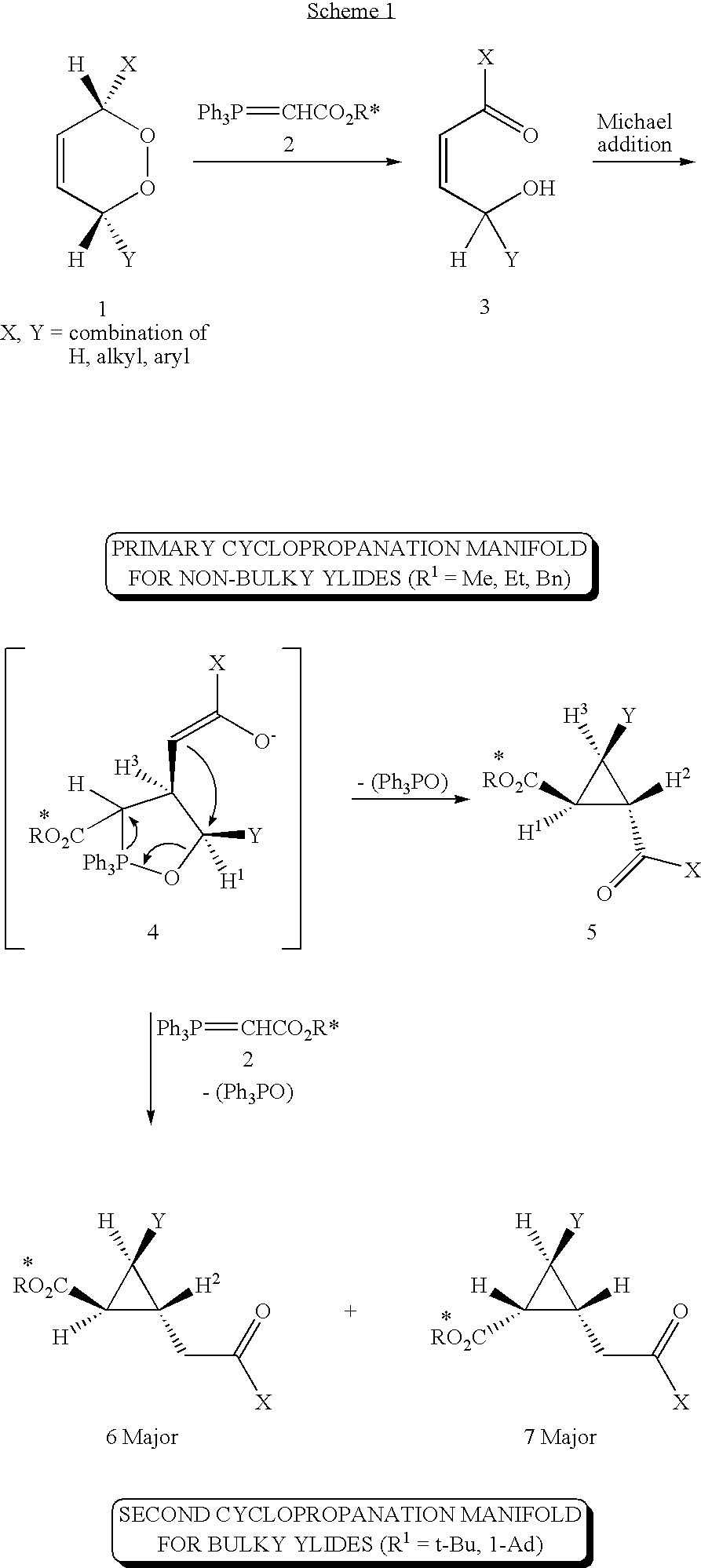
- It is suggested that the ylide acts as a mild base inducing the ring opening of the 1,2-dioxine (1) to their isomeric cis γ-hydroxy enones (3) followed by Michael addition of the y]ide to the enone and attachment of the electrophilic phosphorus pole of the ylide to the hydroxyl moiety affording the intermediate 1-2λ-oxaphospholanes (4). Cyclization of the resultant enolate produces th cyclopropanes (5) in excellent yield. The cyclopropane products emerging from this reaction scheme have in the past been prepared as racemic mixtures.
- The present invention is directed to a synthetic route for the preparation of optically enriched cyclopropane compounds.
- Therefore according to a first aspect of the invention there is provided a method of forming a cyclopropane having enhanced chirality said method comprising reacting together:

-
- (i) a symmetrical 1,2-dioxine of the formula (1), wherein X and Y are the same and are groups in which a carbon atom is bonded to the dioxine backbone; and
- (ii) a phosphorus ylide or a phosphorus ylide precursor; in the presence of
- (iii) a cobalt catalyst containing a chiral ligand.
- Preferably, the cobalt catalyst hils one of the structures shown below
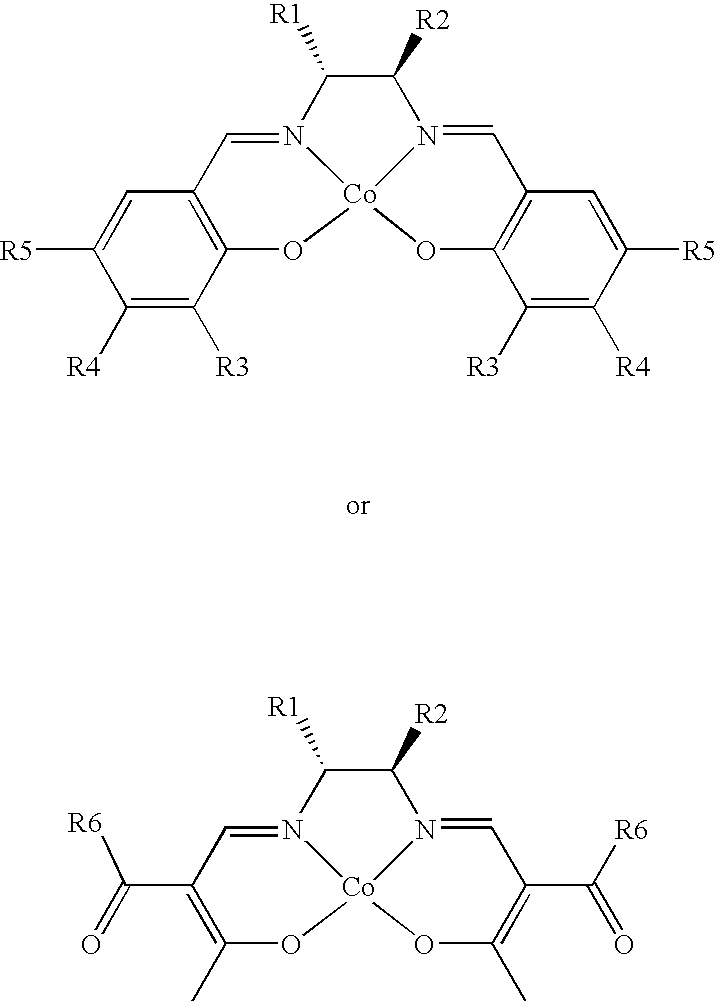
wherein R1 and R2 may be hydrogen, alkyl, aryl; R3 may be hydrogen, alkyl, t-alkyl, alkyl or aryl, alkoxy, aryl alkoxy; R3, R4, R5 and R6 may be independently H, alkyl, aryl, keto, or ester - In accordance with a further aspect of the invention there is provided a chiral cyclopropanation catalyst of the formulae shown below in Table 1 based on Cobalt Salen compounds and on Cobalt Beta-Ketoiminato compounds.
-

- 8a: R1,R2=—(CH2)4—, R3=t-Bu, R4=H, R5=t-Bu (R,R isomer)
- 8b: R1,R2=—(CH2)4—, R3=R4=R5=H (R,R isomer)
- 8c: R1,R2=—(CH2)4—, R3=t-Bu, R4=R5=H (R,R isomer)
- 8d: R1,R2=Ph, R3=R4=R5=H (R,R isomer)
- 8e: R1,R2=Ph, R3=t-Bu, R4=R5=H (R,R isomer)
- 8f: R1,R2=—(CH2)4—, R3=S-PhEtCH—,R4=R5=H (R,R isomer)
- 8g: R1,R2=Ph, R3=S-PhEtCH—, 14=R5=H (R,R isomer)
- 8h: R1,R2=Ph, R3=S-PhEtCH—, 14=R5H (S,S isomer)

-
- 9a: R1=R2=H, R6=(−)-bornoxy
- 9b: R1=R2=Ph, R6=(−)-bornoxy (S,S isomer)
- 9c: R1=R2=Ph, R6=(−)-bornoxy (R,R isomer)
- 9d: R1=R2=—(CH2)4—, R6=(−)-bornoxy(R,R isomer)
- 9e: R1=R2=Ph, R6=(−)-menthoxy (S,S isomer)
- 9f: R1=R2=Ph, R6=(−)-menthoxy (R,R isomer)
- 9g: R1=R2=Ph, R6=(+)-menthoxy (S,S isomer)
- 9h: R1=R2=Ph, R6=(+)-menthoxy (R,R isomer)
- 9i: R1=R2=Ph, R6=ethoxy (S,S isomer)
- 9j: R1=R2=Ph, ethoxy (R,R isomer)
- 9k: R1=R2=—(CH2)4—, R6=ethoxy (R,R isomer)
- 9l: R1=R2=Ph, R6=methyl (S,S isomer)
Table 1 - Catalysts according to the invention in the forms 8a to 8h may be prepared by reaction of Cobalt acetoacetate with the relevant SALEN ligand. SALEN ligands may be prepared by reaction of (1S, 2S) or (1R, 2R)-1,2-diphenylethylenediamine and the corresponding salicyaldehydes in ethanol under nitrogen atmosphere.
- The catalysts 9a-9l may be prepared from reaction of (S,S) or (R,R)-1,2-diphenyl-ethylenediamine and the relevant β-diketone derivative, followed by subsequent reaction with Co acetate. Corresponding ligands can be made from the (1S, 2S) and (1R, 2R) cyclohexyl-1,2-diamine. It can be seen that each of the SALEN and the beta-ketoiminato based catalysts has a common structure around the cobalt atom, namely,
—(OR′C═R′CR′C═NR′CHCHR′N═CR′CR′═COR′)—. - The catalysts each include at least one chiral grouping. It is possible for more than one chiral grouping to exist in the catalyst and the values of R′ are wide. Each of the R′ groups may independently be H, alkyl, aryl, keto, ester and a range of other functionalities.
- In the context of the present invention a phosphorus ylide or a phosphorus ylide precursor may be taken to mean a stabilized phosphorus ylide or a reactive compound capable of forming a phosphorus ylide in site.
- In a still further aspect of the present invention there is provided a method of forming a cyclopropane having enhanced chirality as described above in which the phosphorus ylide or phosphorus ylide precursor is a compound of the formula:
-
- (i) R7R8R9P═CZCO2R10; wherein R7, R8 and R9 may be the same or different and may be alkyl, substituted alkyl, aryl, substituted aryl; R10 represents a non bulky group such as C1-4 alkyl or substituted alkyl, or a bulky group such as 1-adamantyl; and Z represents hydrogen or methyl; or
- (ii) R7R8R9P═CONR10R11; wherein R7, R8, R9 and R10 have the values identified in (i) above and wherein R11 represents a C1-12 alkoxy grouping; or
- (iii) R7R8R9P═CN; or
- (iv) (R7O)2P(O)CH2CO2 R10 wherein R7 and R10 have the values identified in (i) above.
- Phosphorus ylides or a phosphorus ylide precursors of type (i) are exemplified by compound (2); type (ii) by compound (10); type (iii) by compound (11); and type (iv) by compound (12).

- Preferably, the phosphorus ester ylide is a non-bulky stabilized ylide such as a benzyl 2-(triphenyl-λ-phosphanylidene) acetate (hereinafter referred to as a benzyl ester ylide), or, alternatively, a bulky ylide such as t-butyl 2-(triphenyl-λ-phosphanylidene) acetate (hereinafter referred to as a t-butyl ester ylide). Alternative phosphorus ylides or ylide precursors include N,N-methoxymethyl-2-(1,1-triphenyl-λ5-phosphanylidene)acetamide; 2-(1,1,1-triphenyl-λ5-phosphanylidene) acetonitrile or methyl 2-(dimethoxyphosphoryl)acetate. Examples of the reaction between the phosphorus ylides and phosphorus ylide precursors with 1,2-dioxines and a chiral cobalt catalyst and the resulting chiral cyclopropanes are shown below:
- Preferably, the cyclopropanes of the invention are prepared in a solvent such as acetonitrile, ethyl acetate/hexane admixtures, ethyl acetate, tetrahydrofuran, ether, toluene, acetone, carbon tetrachloride, and dichloromethane or mixtures thereof. In a particularly preferred form of the invention the cyclopropanes of the invention are prepared in tetrahydrofuran. It will be appreciated by those skilled in the art that a range of solvents would in fact be suitable for wise in conducting the reaction of the invention. In any specific case an optimum solvent can be identified by trial and experiment using the above solvents and others. However, it should also be noted that alcohol is an unsuitable solvent for the reaction.
- The enantiomerically enhanced cyclopropanes of the invention are preferably prepared with catalyst concentration of up to 50 mol % catalyst relative to the 1,2-dioxine, and more preferably still a catalyst concentration of 1-15 mol %.
- The optically enriched cyclopropanes prepared in accordance with the invention may be further enriched by conventional techniques. For example, by recrystallization or conversion to diastereoisomers which can be separated by conventional techniques, e.g. recrystallization or column chromatography.
- The present invention will now be described by way of a number of non limiting examples. It should be noted that the invention presents a synthetic route for optically enhanced cyclopropanes and that the range of structures capable of synthesis according to the process of the invention is not to be take as being limited to those structures described herein. An extremely wide range of cyclopropane structures may be manufactured according to the process of the invention.
- 1. Catalyst Preparation
- Beta Ketoiminato Catalyst Preparation—The preparation of a chiral cobalt catalyst (9b)
- (a) Preparation of (−)-Bornyl Acetoacetate
- To a solution of ethyl acetoacetate (4.5 g, 0.0346 mol) in n-heptane (70 mL) was added (−)-borneol (5.34 g, 0.0346 mol) and sodium hydride (50 mg) and the reaction mixture refluxed under Deans Stark conditions for 2 days. The solvent was then removed in vacuo and the residue purified by chromatography on silica (1:9 ethyl acetate:hexanes). (6.16 g, 70%) Rf 0.32 (1:9 ethyl acetate:hexanes) 1H NMR δ 0.85 (s, 3H), 0.88 (s, 3H), 0.91 (s, 3H), 0.94-1.43 (m, 4H) 1.64-2.00 (m, 3H) 2.85 (s, 3H), 3.47 (s, 2H), 4.95 (ddd, 1H, J=15, 5.1, 3.3 Hz). 13C NMR δ 13.35, 18.71, 19.57, 26.96, 27.89, 29.99, 36.51, 44.76, 47.77, 48.76, 50.29, 81.07, 90.10, 167.30. MS m/z 238 (42%, M+), 154 (11%), 137 (100%), 121 (10%), 95 (23%).
- (b)(−) Bornyl 2-Formyl-3-Oxobutanoate
- To the (−)-bornyl acetoacetate (2.0 g, 8.4×10⁻³ moles) was added N,N-dimethylformamide dimethyl acetal (2 g, 1.68×10⁻² moles), the mixture stirred at room temperature for 2 hours, then cooled to 0° C. and methanolic sodium hydroxide (1N, 14 mL 1:l methanol:water) added. The reaction mixture was stirred for a further 2 hours then cooled to 0° C. and hydrochloric acid (1N) added till pH 3-4. The mixture was extracted with diethyl ether, dried (Na2SO4) and the solvent removed in vacuo. Rf 0.6 (1:9 ethyl acetate:hexanes) Due to the instability of the aldehyde it was used directly in the next reaction to form the ligand. 1H NMR δ 0.875 (s, 3H), 0.90 (s, 3H), 0.94 (s, 3H), 1.00-1.48 (m, 1H), 1.12-1.48 (m, 4H), 2.32-2.54 (m, 1H), 2.57 (s, 3H), 4.96-5.05 (m, 1H), 9.25 (d, 1H, J-9 Hz).
- The crude (−)-bornyl 2-formyl-3-oxobutanoate (0.25 g, 9.49×10⁻⁴ mol) was combined in ethanol (3 mL) with (1S, 2S)-1,2-diphenylethylenediamine (0.10 g, 4.75×10⁻⁴ mol) and allowed to react for 2 days, the solvent was then removed in vacuo and the residue purified by chromatography (1:9 acetone:dichloromethane) (290 mg, 86%). Rf 0.64 (1:9 acetone:dichloromethane). 1H NMR δ0.79 (s, 6H), 0.86 (s, 6H), 0.90 (s, 6H), 0.96-1.32 (m, 4H), 1.60-1.82 (m, 6H), 2.28-2.49 (m, 2H), 2.51 (s, 6H), 4.67 (d, 2H, J=7.8 Hz), 4.89 (dm, 2H, J=8.2 Hz), 7.10-7.15 (m, 4H), 7.27-7.33 (m, 6H), 7.79 (d, 2H, J=12.8 Hz), 11.93-12.02 (m, 2H). 13C NMR δ 13.63, 18.84, 19.70, 27.64, 28.03, 31.02, 36.92, 44.84, 47.74, 48.74, 69.53, 79.48, 102.05, 135.68, 158.96, 167.09, 199.71. MS m/z 710 (M+, 4%), 555 (22%), 147 (19%), 354 (14%), 200 (31%), 137 (33%), 95 (100%).
- (c) Preparation of Catalyst 9b)
- A mixture of ligand (144 mg, 2.03×10⁻⁴ mol) was combined with cobalt acetate tetrahydrate (50.6 mg, 2.03×10⁻⁴) in deaerated ethanol (4 mL) and heated under reflux for 4 hours. The solvent was then removed in vacuo till dryness of the complex resulted. The complex was used without further purification.
- Each of the catalysts 9a-9l may be prepared using similar methodology and by substitution of the appropriate bornoxy, ethoxy, methoxy, ethoxy or methyl starting materials.
- 2. Cyclopropane Preparation Using Chiral Beta Ketoiminato Based Catalyst (9a-9l)
- (a) Preparation of Benzyl 2-(2-Benzoyl-3Phenylcyclopropyl) Acetate
- 3,6-Diphenyl-3,6dihydro-1,2 dioxine (1a) was reacted with the benzyl 2-(triphenyl-λ5-phosphanylidene)acetate (referred to as benzyl ester ylide) of in the presence of Cobalt (II) catalysts of type 9a-9l with as depicted in scheme 2 to produce the cyclopropane product.
- The cobalt catalyst 9b (4.8 mg, 6.3×10⁻⁶ mol, 5 mol %) was dissolved in dichloromethane (1 mL) and allowed to equilibrate at the temperature of the reaction. 3,6-Diphenyl-3,6-dihydro-1,2-dioxine (20 mg, 8.4×10⁻⁵ mol) was added and the reaction left until such time as complete rearrangement of the dioxine had occurred

- (t.l.c.). Benzyl ester ylide (40 mg, 9.8×10⁻⁵ mol) was then added and the reaction mixture left for 10 hours. The solvent was then removed and the residue purified by column chromatography (SiO2, 3:17 ethyl acetate:hexanes).
- It is to be noted that the scope of the, invention is not limited to the specific 1,2-dioxines listed in scheme 3. A much greater range of substrates may be used to form a wide variety of substituted cyclopropane products. It should however be noted that the 1,2-dioxine must be a symmetrical dioxine.
- (b) Determination of Enantiomeric Excess
- Utilising the cyclopropane synthesised in 2(a) above, (5 mg) was dissolved in 1:4 deuterated-benzene:carbon tetrachloride and enantiomeric excess determined by chiral shift n.m.r. techniques employing a europium tris[3-(heptafluoropropylhydroxy-methylene) -(+)-camphorate] complex. Table 2 illustrates the enantiomeric excess observed in the cyclopropane compound prepared in 2(a). In each case it can be seen that there is a significant enantiomeric excess indicating that the reaction product has enhanced chirality.
TABLE 2 Catalyst Enantiomeric Enantiomeric Catalyst Number Concentration Ratio Excess 9a 10 57/43 14 9b 7.5 72/28 44 9c 7.5 33/67 34 9d 7.5 27/73 46 9e 7.5 64/36 28 9f 7.5 21/79 58 9g 7.5 80/20 60 9h 7.5 35/65 30 9i 10 73/27 46 9j 10 27/73 46 9k 10 29/71 42 9l 10 73/27 46
3 Comparison of Cyclopropane Preparation from Various 1,2-Dioxines - Cyclopropane compounds according to the invention were prepared from various 1,2-dioxine starting materials utilising catalysts 9b, 9i and 9l as identified above and the degree of chirality in the cyclopropane products compared by measurement of the enantiomeric excess as described above. The 3,6-disubstituted-3,6-dihydro-1,2-dioxines and the benzyl ester ylide were reacted in dichloromethane at 20-22° C. with 7.5-10 mol % catalyst. The following symmetrical 1,2-dioxines were used:
- 1a 3,6-Diphenyl-3,6-dihydro-1,2-dioxine (X═Y═Ph)
- 1b 3,6-Dipropyl-3,6-dihydro-1,2-dioxine (X═Y═n-propyl)
- 1c 3,6-Dinapthyl-3,6-dihydro-1,2-dioxine (X═Y═1-napthyl)
- In each case the catalyst used results in a product having enhanced enantioselectivity for range or 1,2-dioxines, as illustrated in Table 3. A diverse range of aryl and alkyl substituents in the 1,2-dioxine would produce a similar effect.
TABLE 3 Catalyst Catalyst Enantiomeric Enantiomeric 1,2-Dioxine Number Conc. Ratio Excess 1a 9b 7.5 72/28 44 9i 10 73/27 46 9l 10 73/27 46 1b 9b 10 67/33 34 9i 10 66/34 32 9l 10 65/35 30 1c 9b 10 72/28 44
4. Cyclopropane Preparation Using Chiral Salen Based Catalyst (8a-8e) - Cobalt (II) Salens of the type depicted in 8a-8e were used as catalyst in the reaction between 3,6-diphenyl-3,6-dihydro-1,2-dioxine (1a) in the presence of a benzyl ester ylide conducted in dichloromethane or tetrahydrofuran (THF) at 20-22° C. with 2-5% mol % catalyst. The enantiomeric excess of the resulting cyclopropane product was measured by the technique described hereinabove. Results are tabulated in table 4 and indicate that the catalysts 8a to 8h induce enantioselectivity into the cyclopropane product for a range of symmetrical 1,2-dioxines. It is also interesting to note that, in the case of catalyst 8h, the enantiomeric excess is increased when THF is used as a solvent compared with dichloromethane.
- In the case of catalysts 8f, 8g and 8h it can be seen that these catalysts contain more than one chiral centre.
TABLE 4 Catalyst Enan- Catalyst 1,2- Concen- Enantiomeric tiomeric Number Solvent dioxine tration Ratio Excess 8a Dichloromethane 1a 2 35/65 30 8b Dichloromethane 1a 2 31/69 38 8c Dichloromethane 1a 2 31/69 38 8d Dichloromethane 1a 2 38/62 24 8e Dichloromethane 1a 2 36/64 28 8a Dichloromethane 1b 2 40/60 20 8b Dichloromethane 1b 2 35/65 30 8c Dichloromethane 1b 2 36/64 28 8d Dichloromethane 1b 2 41/59 18 8e Dichloromethane 1b 2 41/59 18 8b THF 1a 5 28/72 44 8c THF 1a 5 34/65 32 8d THF 1a 5 27/73 46 8e THF 1a 5 36/64 28 8f dichloromethane 1a 5 35/65 30 8g dichloromethane 1a 5 33/67 34 8h dichloromethane 1a 5 75/25 50 8h THF 1a 5 82/18 64
5. Effect of Catalyst Concentration on the Enantiomeric Excess - (a) Effect of a Beta-Ketoiminato Catalyst
- In the reaction between 3,6-diphenyl-3,6-dihydro-1,2-dioxine with benzyl ester ylide at 20° in dichloromethane the effect of various concentrations of the catalyst 9b on the enantiomeric excess was measured. 20 mg 1,2-dioxine was employed for 1 mL of solvent. Table 5a gives details of the measured enantiomeric ratio and enantiomeric excess.
- Attention should be drawn to the fact that in the absence of the catalyst (catalyst mol %=0) the reaction product is a racemic mixture with no enantiomeric excess, thereby indicating the effect of the catalyst on the process. The catalyst is most effective in the range 7.5 mol %.
TABLE 5a CATALYST (MOL %) ENANTIOMERIC Ratio ENANTIOMERIC EXCESS 0 50/50 0 2.5 58/42 16 5 69/31 38 7.5 73/27 46 10 71/29 42 15 70/30 40 20 69/31 38 35 70/30 40 50 60/40 20 - (b) Effect of a Beta-Ketoiminato Catalyst in THF or Dichloromethane Solvents
TABLE 5b CAT- ENANTIOMERIC ENANTIOMERIC Solvent ALYST Ratio EXCESS THF 9b 84/16 68 dichloromethane 9b 72/28 44 THF 9c 82/18 64 dichloromethane 9c 67/33 34 THF 9d 73/27 46 dichloromethane 9d 73/27 46 THF 9h 75/25 50 dichloromethane 9h 65/35 30 THF 9g 86/14 72 dichloromethane 9g 80/20 60 - The reaction between 3,6-diphenyl-3,6-dihydro-1,2-dioxine and benzyl ester ylide at 20° C. in dichloromethane or THF was catalysed with the catalysts identified as 9b, 9c, 9d, 9h and 9g. 20 mg of 1,2-dioxine was employed for each 20 mL of solvent. In each case the catalyst concentration was maintained at 7.5 mol %. Results are shown in table 5b
- (c) Effect of Solvent on Catalyst Performance
- Reaction of Cobalt (II) catalyst 9b with 3,6-diphenyl-3,6-dihydro-1,2-dioxine (1a) in the presence of the benzyl ester ylide at 20° C. in a specific solvent. 20 mg 1,2-dioxine employed for 1 mL of solvent. Employing 5.0 mol % catalyst. Results are shown in table 5c
TABLE 5c ENANTIOMERIC ENANTIOMERIC Solvent Ratio EXCESS acetonitrile 76/24 52 25% ethyl acetate/hexane 78/22 56 Ethyl acetate 77/23 54 THF 84/16 68 ether 67/33 34 toluene 67/33 34 acetone 76/24 52 Carbon tetrachloride 67/33 34 dichloromethane 68/32 36 - It can be seen that that the cobalt catalyst 9b induces varying degrees of enantioselectivity in this reaction for a range of solvents under the conditions mentioned. The optimum enantiomeric excess is induced when the THF was employed as solvent.
- (d) Temperature Effects
- Reaction of Cobalt (II) catalyst with 3,6 diphenyl-3,6-dihydro-1,2-dioxine (1a) in the presence of the benzyl ester ylide at a specific temperate in a specific solvent. 20 mg 1,2-dioxine employed for 1 mL of solvent. Employing 5.0 mol % catalyst. Results are shown in table 5(d).
- The comclusion may be drawn from the results shwn in Table 5d that changing the temperature has a dramatic effect on the degree of enantioselectivity in this reaction in certain solvents. Lowering the temperature increase the observed enantiomeric excess.
TABLE 5d ENANTIO- Temperature MERIC ENANTIOMERIC Solvent (° C.) Ratio EXCESS dichloromethane 20 69/31 38 dichloromethane 0 74/26 48 dichloromethane −10 78/22 56 dichloromethane −15 81/19 62 dichloromethane −20 86/14 72 dichloromethane −40 80/20 60 THF 20 84/16 68 THF 0 87/13 74 THF −15 88/12 76 THF −40 86/14 72 - (a) Preparation Using Benzyl Ester Ylide
- (i) Procedure
- A solution of 3,6-diphenyl-3,6-dihydro-1,2-dioxine (0.5 g) in THF (20 mL) and a solution of catalyst 9b (120 mg) in THF (5 mL) were equilibrated at −15° C. for 30 minutes after which time the two solutions were combined and the temperature maintained at−15° C. The rearrangement to the γ-hydroxyenone was monitored by t.l.c. and when complete the benzyl ester ylide (1.0 g) was added and the reaction mixture stirred overnight. The solvent was then removed in vacuo and the residue purified by chromatography (silica) (3:17 ethyl acetate:hexanes). The enantiomeric excess was determined to be 72% (an enantiomeric ratio of 86/14). The isolated yield of the benzyl 2-[2-benzoyl-3-phenylcyclopropyl]acetate product vias determined to be 78%.
- (ii) Recrystallization
- The enriched optical isomer of the benzyl 2-[2-benzoyl-3-phenylcyclopropyl]acetate prepared in step (a) can be further enriched by conventional processes used to isolate optical isomers. Recrystallization of the product from hexane:dichloromethane (10:1) at ambient temperatures resulted in a Product having an enantiomeric ratio of 88/12.
- (b) Preparation Using a Tert-Butyl Ester Ylide
- Reaction of Cobalt (II) catalyst 9b with 3,6diphenyl-3,6-dihydro-1,2-dioxine (1a) in the presence of the tert-butyl ester ylide (a bulky ylide) at a specific temperature in a specific solvent.
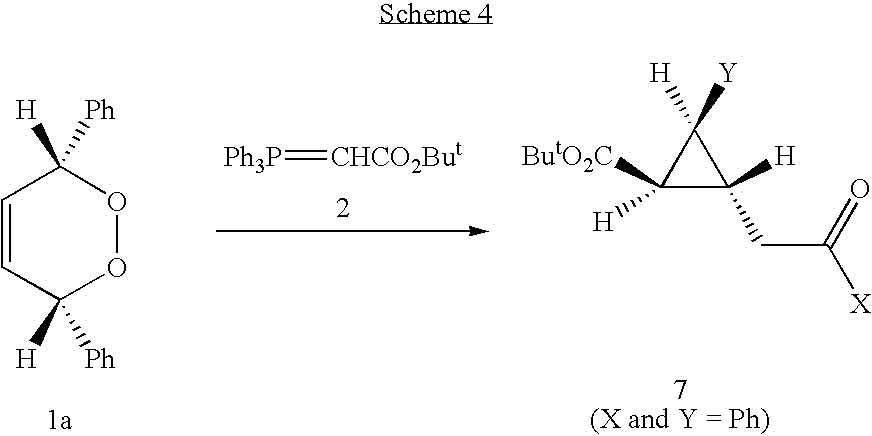
Experimental Procedure for the Above Reaction - A solution of catalyst 9b (12 mg, 0.5 mol %) in dichloromethane (0.1 mL) was added to an equilibrated solution of 3,6-diphenyl-3,6-dihydro-1,2-dioxine 1a (50 mg) in dichloromethane (2.9 mL) at 20° C. After rearrangement of the dioxine was complete lithium bromide (19 mg) was added, and allowed to stir for 5 minutes, followed by t-butyl ester ylide and the reaction mixture stirred vigorously for 5 days. The reaction mixture was filtered and the solvent was then removed in vacuo. Purification by chromatography (3:17 ethyl acetate:hexanes) gave the pure cyclopropane (40.1 mg, 57%) with an introduced enantiomeric excess of 69/31, 38%.
- (b) Preparation of Cyclopropanes in D2O
- Cyclopropanes in accordance with the invention were prepared using catalysts of the invention as shown in scheme 5.
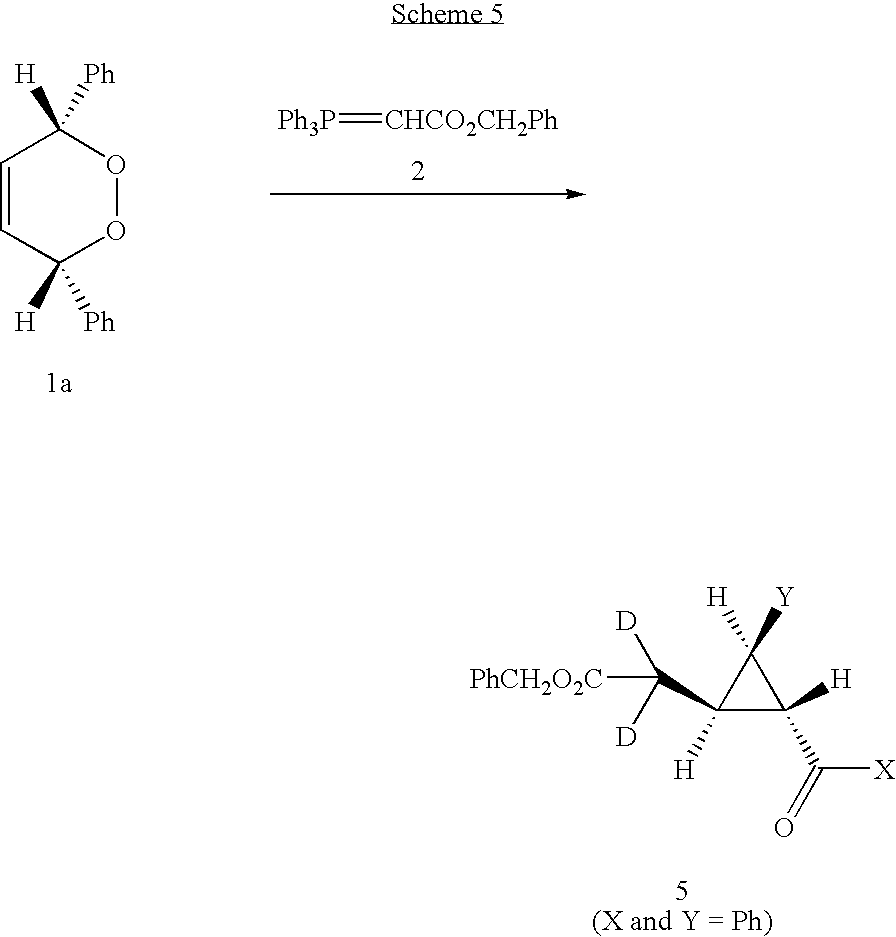
- A solution of catalyst 9b (12 mg, 7.5 mol %) in dichloromethane (0.1 mL) was added to an equilibrated solution of 3,6-diphenyl-3,6-dihydro-1,2-dioxine (50 mg) in dichloromethane (2.9 mL) at 20° C. After rearrangement of the dioxine was complete deuterium oxide (1 mL) was added, and allowed to stir vigorously for 1 hour, followed by benzyl ester ylide and the reaction mixture stirred vigorously for 5 days. The deuterium oxide was removed employing a pipette off and the reaction mixture dried (Na2SO4). The solvent was removed in vacuo and the residue purified by chromatography (3:17 ethyl acetate: hexanes) to give the pure cyclopropane (49.9 mg, 67%) with an introduced enantiomeric excess of 75/25, 50%.
- 6. Comparison of Cyclopropane Preparation from Various Phosphorus Ylides and Precursors
- Typical Procedure for the Preparation of Cyclopropane 5 Derived from the Combination of Phosphonate (12), Symmetrical 1,2-dioxine 1a and Cobalt Catalyst 9b.
- To a solution of phosphonate 12 (45 mg) in THF (230 μl) at−78° C. was added methyl lithium (175 μl, 1.4 M) over 5 minutes and the reaction mixture stirred at−78° C. for 30 minutes and then allowed to attain ambient temperature. Separately the 1,2-dioxine 1a (60 mg) was combined with the cobalt catalyst 9b (12 mg) in THF (3 mL) and the dioxine allowed to rearrange. This, mixture was then cooled to −78° C. and the ylide generated above added drop wise via a syringe and the mixture stirred at −78° C. for 30 minutes before being allowed to attain ambient temperature. After 15 hours the solvent was removed in vacuo and the residue purified by column chromatography (3:17 ethyl acetate/hexanes) to afford the cyclopropane 5 in 79% yield. The ee was measured by chiral shift NM as described herein above.
- The conditions used for the preparation of the cyclopropanes from the use of ylides of type 10 and 11 above are as described for the benzyl ester ylide.
- Table 6: Enantiomeric excess observed in cyclopropanes of types 5, 13 and 14 depicted above made using symmetrical 1,2-dioxine 1a and ylides of type 10-12 (depicted above) in dichloromethane or tetrahydrofuran (THF) at 20-22° C. with 7.5 mol % of catalyst 9b. Note: the ylide of the phosphonate 12 is generated first with base, see procedure above.
Catalyst Enantiomeric Enantiomeric Dioxine Ylide Number Solvent Ratio Excess 1a 10 9b dichloromethane 71/29 42 1a 11 9b dichloromethane 69/31 38 1a 12 9b THF 83/17 66 - The catalysts and processes of the invention therefore enable the synthesis of a range of isotopically labelled cyclopropane compounds, which are useful in a variety of situations.
- 7. Synthetic Schemes Using Optically Enriched Cyclopropanes
- Scheme 6 illustrates an example of how an enantiomerically enhanced cyclopropane produced in the process of the present invention can be used in the synthesis of optically enriched amide products.
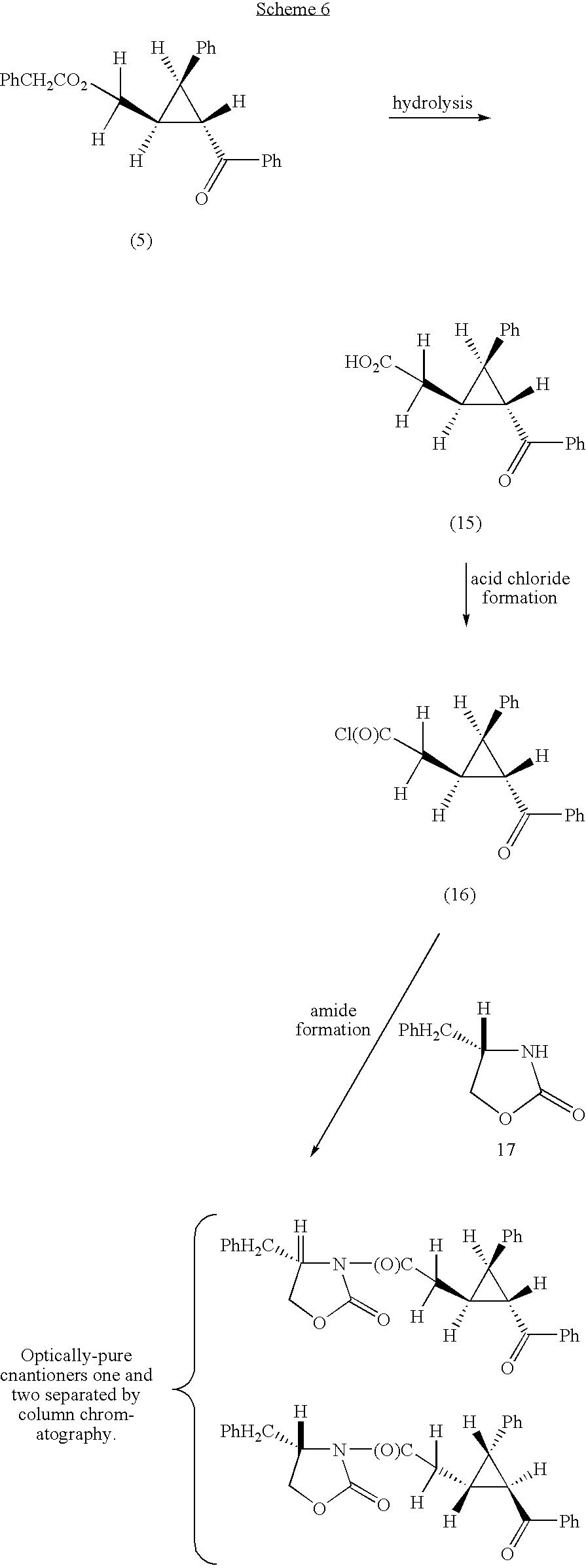
- (a) Preparation of Trans (±) 2-[2-Benzoyl-3-Phenylcyclopropyl]Acetic Acid
- Hydrolysis of cyclopropane 5 (ee ratio 86/14) prepared above afforded the acid (15). The acid product was found to have a similar ee to the cyclopropane starting material, that is, the material is optically enhances.
- (b) Preparation of Trans 2-[2-Benzoyl-3-Phenylcycloproyl]Acetyl Chloride
- To a solution of trans 2-[2-benzoyl-3-phenylcyclopropyl]acetic acid (15) (0.394 g) of ee cited above in dry dichloromethane 8 mL) and DMF (1 drop), at 0° C. under nitrogen, was added oxalyl chloride (0.291 g) in dichloromethane (4 mL) drop wise over 5 minutes. The reaction mixture was then stirred at 0° C. for 2 hours and a further 2 hours at room temperature. The volatiles were then removed to afford crude (16) which was used as is.
- (c) Preparation of Optically Pure
- (4S)3-{2-[1S, 2R, 3R)-2-Benzoyl-3-Phenylcyclopropyl]Acetyl}-4-benzyl-1,3-oxazolan-2-one and
- (4S)3-{2-[(1R, 2S, 3S)-2-Benzoyl-3-Phenylcyclopropyl]Acetyl}-4-benzyl-1,3-oxazolan-2-one.
- To a solution of (S)-4-benzyl-2-oxazolidinone (17) (0.252g) in THF (4 mL) with triphenylmethane (5 mg, indicator), at−78° C. under nitrogen, was added n-BuLi (1.9M in hexanes) until an orange colour persisted. The reaction mixture was then stirred at−78° C. for 1 hour after which time the acid chloride in THF (3 mL) was added via a cannula. The reaction was then stirred at −78° C. for 4 hours then poured into NB4Cl (sat. 10 mL) immediately, diluted with water (10 mL) and extracted with dichloromethane (2×30 mL). The combined organic phases were dried (Na2SO4) and the solvent removed in vacuo. The residue was purified by chromatography (1:3, ethyl acetate:hexanes) with separation of the diastereomers.
- The two enantiomers were characterised as follows:
- First Enantiomer eluted (top spot) Rf 0.20 (1:5 ethyl acetate:hexanes). 1H NMR (600 MHz) δ 2.42-2.46 (m, 1H), 2.67 (dd, 1H, J=13.2, 9.6 Hz), 2.93 (dd, 1H, J=17.4, 7.2 Hz), 2.99 (dd, 1H, J=17.4, 7.8 Hz), 3.16 (dd, 1H, J=9.6, 4.8 Hz), 3.23 (dd, 2H, J=9.6, 4.8 Hz), 4.06 (t, 1H, J=8.4 Hz), 4.08 (dd, 1H, J=9.3 Hz), 4.51-4.55 (m, 1H), 7.15 (d, 2H, J=7.2 Hz), 7.22-7.26 (m, 2H), 7.28-7.34 (m, 6H), 7.52 (t, 2H, J=7.8 Hz), 7.61 (tt, 1H, J=7.2, 1.2 Hz), 8.08-8.10 (m, 2H). 13C NMR δ 27.16, 29.01, 33.60, 33.83, 37.81, 55.08, 66.18, 126.93, 127.36, 128.19, 128.43, 128.69, 128.79, 128.94, 129.35, 133.05, 135.11, 135.88, 137.72, 171.61. IR (dichloromethane solution) 1668, 1703, 1780 cm−1. MS m/z 440.2 (42%, [M+H]+), 422.2 (8%), 263.1 (100%), 221.1 (37% o). C28H25NO4 requires C: 76.51, H: 5.74, found C: 76.63, H: 5.65. Accurate MS C28H25NO4 requires 439.17836, found 440.18753 ([M+F]+); [α]24=−39.24 (c=2.06, CH2Cl2)7
- Second Enantiomer eluted (bottom spot) Rf 0.13 (1:5 ethyl acetate:hexanes). 1H NMR (600 MHz) δ 2.46 (tt, 1H, J=7.8, 6.6 Hz), 2.59 (dd, 1H, J=13.8, 9 Hz), 2.93 (dd, 1H, J=18, 6.6 Hz), 2.99 (ddI, 1H, J=17.4, 7.8 Hz), 3.05 (dd, 1H, J=13.8, 3.6 Hz), 3.21 (d, 2H, J=6H), 4.09 (dd, 1H, J=9, 3 Hz), 4.13 (t, 1H, J=7.8 Hz), 4.60-4.64 (m, 1H), 7.02 (dd, 2H, J=7.8, 1.8 Hz), 7.24-7.28 (m, 4H), 7.33 (d, 4H, J=4.2 Hz), 7.51 (t, 2H, J=7.8 Hz), 7.59 (tt, 1H, J=7.8, 1.8 Hz), 8.09-8.10 (m, 2H). 13C NMR (600M) δ 26.94, 28.81, 33.75, 34.31, 37.47, 54.75, 66.09, 127.02, 127.34, 128.16, 128.48, 128.67, 128.88, 128.92, 129.35, 133.04, 134.87, 135.88, 137.72, 153.30, 171.45, 198.39. IR (dichloromethane solution) 1668, 1703, 1782 cm−1. MS m/z 440.1 (45%, [M+H]+), 422.1 (10%), 263.1 (100%), 221.1 (34%). C28H25NO4 requires C: 76.51, H: 5.74, found C: 76.49, H: 5.68. Accurate MS C28H25NO4 requires 439.17836, found 440.18712 ([M+H]+).
- The invention has been described by way of example. The examples are not, however, to be taken as limiting the scope of the invention in any way. Modifications and variations of the invention such as would be apparent to a skilled addressee are deemed to be within the scope of the invention.
Claims (18)
1. A method of forming a cyclopropane having enhanced chirality said method comprising reacting together:

i) a symmetrical 1,2-dioxine of the formula (1), wherein X and Y are the same and are groups in which a carbon atom is bonded to the dioxine backbone; and
ii) a phosphorus ylide or a phosphorus ylide precursor; in the presence of
iii) a cobalt catalyst containing a chiral ligand.
2. A method of forming a cyclopropane having enhanced chirality according to claim 1 , wherein the chiral ligand in the catalyst has the structure: —(OR′C═R′CR′C═NR′CHCHR′N═CR′CR′═COR′)— around the cobalt atom and wherein each R′ moiety may be independently selected from a wide range of groups including, but not limited to H, alkyl, aryl, keto, ester and a range of other functionalities.
3. A method of forming a cyclopropane having enhanced chirality according to claim 1 , in which the cobalt catalyst has the structure:

Wherein R1 and R2 may be hydrogen, alkyl, aryl; R3 may be hydrogen, alkyl, t-alkyl, alkyl or aryl, alkoxy, aryl alkoxy; R3, R4, R5 and R6 may be independently H, alky, aryl, keto, or ester.
4. A method of forming a cyclopropane having enhanced chirality according to claim 3 , in which R1 and R2 are each the same and are selected from hydrogen, (CH2)4, or benzyl.
5. A method of forming a cyclopropane having enhanced chirality according to claim 3 , in which R3 is hydrogen, t-butyl, or benzyl ethyl, bornoxy, menthoxy, ethoxy or methyl.
6. A method of forming a cyclopropane having enhanced chirality according to claim 3 , in which R4 and R5 may be the same or different and are selected from hydrogen, and t-butyl.
7. A method of forming a cyclopropane having enhanced chirality according to claim 1 in which the phosphorus ylide or phosphorus ylide precursor may be taken to mean a stabilized phosphorus ylide or a reactive compound capable of forming a phosphorus ylide in situ.
8. A method of forming a cyclopropane having enhanced chirality according to claim 1 , in which the phosphorus ylide or phosphorus ylide precursor is a compound of the formula:
i) R7R8R9P=CZCO2R10; wherein R7, R8 and R9 may be the same or different and may be alkyl, substituted alkyl, aryl, substituted aryl; R10 represents a non bulky group such ac C1-4 alkyl or substituted alky, or a bulky group such as 1-adamantyl; and Z represents hydrogen or methyl; or
ii) R7R8R9P═CONR10R11; wherein R7, R8, R9 and R10 have the values identified in (i) above and wherein R11 represents a C1-12 alkoxy grouping;
iii) R7R8R9P═CN; or
iv) (R70)2P(O)CH2CO2 R10 wherein R7 and R10 have the values identified in (i) above.
9. A method of forming a cyclopropane having enhanced chirality according to claim 1 , in which the phosphorus ylide is a non-bulky stabilized ylide.
10. A method of forming a cyclopropane having enhanced chirality according to claim 9 , in which the non-bulky stabilized ylide is benzyl 2-(triphenyl-λ-5 phosphanylidene) acetate.
11. A method of forming a cyclopropane having enhanced chirality according to claim 1 , in which the phosphorus ylide is a bulky ylide.
12. A method of forming a cyclopropane having enhanced chirality according to claim 1 , in which the bulky ylide is t-butyl 2-(triphenyl-λ-phosphanylidene) acetate.
13. A method of forming a cyclopropane having enhanced chirality according to claim 1 , in which the phosphorus ylide or phosphorus ylide precursor is selected from N,N-methoxymethyl-2-(1,1,1-triphenyl-λ5-phosphanylidene)acetamide; 2-(1,1,1-triphenyl-λ5-phosphanylidene) acetonitrile or methyl 2-(dimethoxyphosphoryl) acetate.
14. A method of forming a cyclopropane having enhanced chirality according to claim 1 , in which X and Y are selected from H, alkyl or aryl groups.
15. A method of forming a cyclopropane having enhanced chirality according to claim 1 , wherein the reaction is conducted in a solvent selected from acetonitrile, ethyl acetate/hexane admixtures, ethyl acetate, tetrahydrofuran, ether, toluene, acetone, carbon tetrachloride, and dichloromethane or mixtures thereof.
16. A method of forming a cyclopropane having enhanced chirality according to claim 1 , in which the reaction is conducted with catalyst concentration of up to 50 mol % catalyst relative to the 1,2-dioxine, and more preferably a catalyst concentration of 1-15 mol %.
17. A method of forming a cyclopropane having enhanced chirality according to claim 1 , wherein the optically enriched cyclopropanes are subjected to recrystallization or column chromatography.
18. A method of forming a cyclopropane having enhanced chirality according to claim 1 , in which the enhanced chirality of the product, as determined by chiral shift n.m.r. techniques and expressed as an enantiomeric ratio may be as high as 90/10.
Applications Claiming Priority (3)
| Application Number | Priority Date | Filing Date | Title |
|---|---|---|---|
| AUPR4134A AUPR413401A0 (en) | 2001-04-02 | 2001-04-02 | Cyclopropanation process |
| AUPR4134 | 2001-04-02 | ||
| PCT/AU2002/000417 WO2002079136A1 (en) | 2001-04-02 | 2002-04-02 | Enantiomerically selective cyclopropanation |
Publications (1)
| Publication Number | Publication Date |
|---|---|
| US20050054877A1 true US20050054877A1 (en) | 2005-03-10 |
Family
ID=3828134
Family Applications (1)
| Application Number | Title | Priority Date | Filing Date |
|---|---|---|---|
| US10/474,149 Abandoned US20050054877A1 (en) | 2001-04-02 | 2002-04-02 | Enantiomerically selective cyclopropanation |
Country Status (6)
| Country | Link |
|---|---|
| US (1) | US20050054877A1 (en) |
| EP (1) | EP1385814A4 (en) |
| JP (1) | JP2004526741A (en) |
| AU (1) | AUPR413401A0 (en) |
| CA (1) | CA2442934A1 (en) |
| WO (1) | WO2002079136A1 (en) |
Families Citing this family (4)
| Publication number | Priority date | Publication date | Assignee | Title |
|---|---|---|---|---|
| CN100374449C (en) * | 2006-06-16 | 2008-03-12 | 南京大学 | Asymmetric Synthesis of Chiral Cyclopropane Compounds |
| JP5665734B2 (en) | 2008-05-09 | 2015-02-04 | コーネル ユニバーシティー | Polymer of ethylene oxide and carbon dioxide |
| CN105254786B (en) * | 2015-07-17 | 2017-07-11 | 南昌大学 | A kind of C C bridgings [ONNO] β ketimides metallic catalyst and preparation method |
| CN112264101B (en) * | 2020-10-23 | 2021-12-31 | 大连理工大学 | Preparation method and application of metal organic framework catalyst with torsion structure |
-
2001
- 2001-04-02 AU AUPR4134A patent/AUPR413401A0/en not_active Abandoned
-
2002
- 2002-04-02 EP EP02712638A patent/EP1385814A4/en not_active Withdrawn
- 2002-04-02 JP JP2002577765A patent/JP2004526741A/en active Pending
- 2002-04-02 US US10/474,149 patent/US20050054877A1/en not_active Abandoned
- 2002-04-02 CA CA002442934A patent/CA2442934A1/en not_active Abandoned
- 2002-04-02 WO PCT/AU2002/000417 patent/WO2002079136A1/en not_active Ceased
Also Published As
| Publication number | Publication date |
|---|---|
| EP1385814A1 (en) | 2004-02-04 |
| CA2442934A1 (en) | 2002-10-10 |
| JP2004526741A (en) | 2004-09-02 |
| WO2002079136A1 (en) | 2002-10-10 |
| AUPR413401A0 (en) | 2001-05-03 |
| EP1385814A4 (en) | 2006-01-11 |
Similar Documents
| Publication | Publication Date | Title |
|---|---|---|
| US20240308966A1 (en) | Chiral amine-squaramide compound based on spirobiindane skeleton, preparation method and use thereof | |
| Takeda et al. | Asymmetric total synthesis of enantiopure (−)-methyl jasmonate via catalytic asymmetric intramolecular cyclopropanation of α-diazo-β-keto sulfone | |
| JP5417560B2 (en) | Method for producing optically active carboxylic acid ester | |
| US20050054877A1 (en) | Enantiomerically selective cyclopropanation | |
| CN102432636B (en) | Triphenylphosphine oxide connecting bisoxazoline ligand, preparation method and application thereof | |
| JP5622019B2 (en) | Asymmetric organic molecular catalyst having amino alcohol derivative salt structure and method for producing optically active compound using said asymmetric organic molecular catalyst | |
| CA3169869A1 (en) | Process for preparing s-beflubutamid by resolving 2-bromobutanoic acid | |
| JP5665041B2 (en) | Iodonium compound, production method thereof, functionalized spirocyclic compound and production method thereof | |
| JPS61145174A (en) | Production method of novel optically active epoxypropionate derivative | |
| JP4540197B2 (en) | (E) Process for producing 3-methyl-2-cyclopentadecenone | |
| JP2010229097A (en) | NOVEL OXAZOLIDINE DERIVATIVE, NOVEL OXAZOLIDINE DERIVATIVE SALT, AND PROCESS FOR PRODUCING OPTICALLY ACTIVE COMPOUND USING THE OXAZOLIDINE DERIVATIVE SALT | |
| JP4725757B2 (en) | Binaphthol phosphate derivatives and use thereof | |
| AU2002244524A1 (en) | Enantiomerically selective cyclopropanation | |
| JP4759722B2 (en) | Process for producing aromatic carboxylic acid ester having a substituent | |
| JP4050294B2 (en) | Optically active cobalt (II) complex | |
| CN116171269B (en) | Process for preparing D-alanine alkyl ester | |
| JP2011051968A (en) | Process for purifying bisoxazolinyl alkane compound | |
| JP3066594B2 (en) | Aniline derivative and method for producing the same | |
| US6288268B1 (en) | Catalyst for bisalkoxycarbonylation of olefins, and method for production of succinate derivatives | |
| JP3171919B2 (en) | Method for producing 3- (2,2,6-trimethylcyclohexane-1-yl) -2-propen-1-al and intermediates thereof | |
| JP2001294594A (en) | Phosphine-containing amino compound, method for producing the same, ruthenium complex and method for producing alcohol | |
| US7851647B2 (en) | Three carbon precursor synthons | |
| JP3471067B2 (en) | Method for producing optically active 6- (4-substituted inden-1-yl) -2-methyl-4-hepten-3-ols | |
| US20050009997A1 (en) | Novel chiral auxiliary bearing resins | |
| US7319155B2 (en) | 7,7-disubstituted (5H,9H)-6,8-dioxabenzocycloheptene compounds useful in the synthesis of non-steroidal analogues of vitamin D |
Legal Events
| Date | Code | Title | Description |
|---|---|---|---|
| STCB | Information on status: application discontinuation |
Free format text: ABANDONED -- FAILURE TO RESPOND TO AN OFFICE ACTION |