US20050043490A1 - Polymerizable compounds and compositions - Google Patents
Polymerizable compounds and compositions Download PDFInfo
- Publication number
- US20050043490A1 US20050043490A1 US10/938,459 US93845904A US2005043490A1 US 20050043490 A1 US20050043490 A1 US 20050043490A1 US 93845904 A US93845904 A US 93845904A US 2005043490 A1 US2005043490 A1 US 2005043490A1
- Authority
- US
- United States
- Prior art keywords
- macromonomer
- carbon atoms
- percent
- weight
- acid anhydride
- Prior art date
- Legal status (The legal status is an assumption and is not a legal conclusion. Google has not performed a legal analysis and makes no representation as to the accuracy of the status listed.)
- Abandoned
Links
- 239000000203 mixture Substances 0.000 title claims description 64
- 150000001875 compounds Chemical class 0.000 title description 10
- 125000002887 hydroxy group Chemical group [H]O* 0.000 claims abstract description 65
- 125000004432 carbon atom Chemical group C* 0.000 claims abstract description 52
- 239000000178 monomer Substances 0.000 claims abstract description 24
- 210000004268 dentin Anatomy 0.000 claims abstract description 21
- 239000000853 adhesive Substances 0.000 claims abstract description 16
- 239000002253 acid Substances 0.000 claims abstract description 13
- 230000001070 adhesive effect Effects 0.000 claims abstract description 13
- 230000032050 esterification Effects 0.000 claims abstract description 12
- 238000005886 esterification reaction Methods 0.000 claims abstract description 12
- 229910052739 hydrogen Inorganic materials 0.000 claims abstract description 12
- 239000001257 hydrogen Substances 0.000 claims abstract description 12
- 125000004435 hydrogen atom Chemical group [H]* 0.000 claims abstract description 12
- 125000003118 aryl group Chemical group 0.000 claims abstract description 11
- 150000003839 salts Chemical class 0.000 claims abstract description 10
- 125000003342 alkenyl group Chemical group 0.000 claims abstract description 9
- 125000000217 alkyl group Chemical group 0.000 claims abstract description 9
- 125000003710 aryl alkyl group Chemical group 0.000 claims abstract description 9
- 125000000753 cycloalkyl group Chemical group 0.000 claims abstract description 9
- 150000007522 mineralic acids Chemical class 0.000 claims abstract description 7
- 150000007524 organic acids Chemical class 0.000 claims abstract description 7
- 150000002485 inorganic esters Chemical class 0.000 claims abstract description 6
- 150000002895 organic esters Chemical group 0.000 claims abstract description 6
- 125000003178 carboxy group Chemical group [H]OC(*)=O 0.000 claims abstract description 5
- 125000005429 oxyalkyl group Chemical group 0.000 claims abstract description 5
- 229920000642 polymer Polymers 0.000 claims abstract description 5
- 229910018828 PO3H2 Inorganic materials 0.000 claims abstract description 4
- 229910006069 SO3H Inorganic materials 0.000 claims abstract description 4
- 230000001747 exhibiting effect Effects 0.000 claims abstract description 4
- 230000000379 polymerizing effect Effects 0.000 claims abstract description 4
- WYURNTSHIVDZCO-UHFFFAOYSA-N Tetrahydrofuran Chemical compound C1CCOC1 WYURNTSHIVDZCO-UHFFFAOYSA-N 0.000 claims description 38
- HWSSEYVMGDIFMH-UHFFFAOYSA-N 2-[2-[2-(2-methylprop-2-enoyloxy)ethoxy]ethoxy]ethyl 2-methylprop-2-enoate Chemical compound CC(=C)C(=O)OCCOCCOCCOC(=O)C(C)=C HWSSEYVMGDIFMH-UHFFFAOYSA-N 0.000 claims description 28
- -1 vinyl- Chemical group 0.000 claims description 17
- 239000000945 filler Substances 0.000 claims description 14
- 150000002118 epoxides Chemical class 0.000 claims description 12
- CERQOIWHTDAKMF-UHFFFAOYSA-M methacrylate group Chemical group C(C(=C)C)(=O)[O-] CERQOIWHTDAKMF-UHFFFAOYSA-M 0.000 claims description 12
- XHXFXVLFKHQFAL-UHFFFAOYSA-N phosphoryl trichloride Chemical compound ClP(Cl)(Cl)=O XHXFXVLFKHQFAL-UHFFFAOYSA-N 0.000 claims description 12
- 239000003505 polymerization initiator Substances 0.000 claims description 11
- 229920000193 polymethacrylate Polymers 0.000 claims description 10
- KRHYYFGTRYWZRS-UHFFFAOYSA-M Fluoride anion Chemical compound [F-] KRHYYFGTRYWZRS-UHFFFAOYSA-M 0.000 claims description 9
- 125000004185 ester group Chemical group 0.000 claims description 9
- 239000003960 organic solvent Substances 0.000 claims description 9
- 239000003999 initiator Substances 0.000 claims description 7
- 239000003381 stabilizer Substances 0.000 claims description 7
- 150000008065 acid anhydrides Chemical class 0.000 claims description 6
- 239000002904 solvent Substances 0.000 claims description 6
- 239000012966 redox initiator Substances 0.000 claims description 5
- IPZJQDSFZGZEOY-UHFFFAOYSA-N dimethylmethylene Chemical group C[C]C IPZJQDSFZGZEOY-UHFFFAOYSA-N 0.000 claims description 4
- 239000011256 inorganic filler Substances 0.000 claims description 4
- 229910003475 inorganic filler Inorganic materials 0.000 claims description 4
- LGRFSURHDFAFJT-UHFFFAOYSA-N phthalic anhydride Chemical compound C1=CC=C2C(=O)OC(=O)C2=C1 LGRFSURHDFAFJT-UHFFFAOYSA-N 0.000 claims description 4
- 150000003512 tertiary amines Chemical class 0.000 claims description 4
- FYSNRJHAOHDILO-UHFFFAOYSA-N thionyl chloride Chemical compound ClS(Cl)=O FYSNRJHAOHDILO-UHFFFAOYSA-N 0.000 claims description 4
- IDXHIIQGMDJEAP-UHFFFAOYSA-N 1,3-dioxolane;2-methylprop-2-enoic acid Chemical compound C1COCO1.CC(=C)C(O)=O.CC(=C)C(O)=O IDXHIIQGMDJEAP-UHFFFAOYSA-N 0.000 claims description 3
- XFCMNSHQOZQILR-UHFFFAOYSA-N 2-[2-(2-methylprop-2-enoyloxy)ethoxy]ethyl 2-methylprop-2-enoate Chemical compound CC(=C)C(=O)OCCOCCOC(=O)C(C)=C XFCMNSHQOZQILR-UHFFFAOYSA-N 0.000 claims description 3
- RINCXYDBBGOEEQ-UHFFFAOYSA-N succinic anhydride Chemical compound O=C1CCC(=O)O1 RINCXYDBBGOEEQ-UHFFFAOYSA-N 0.000 claims description 3
- SRPWOOOHEPICQU-UHFFFAOYSA-N trimellitic anhydride Chemical compound OC(=O)C1=CC=C2C(=O)OC(=O)C2=C1 SRPWOOOHEPICQU-UHFFFAOYSA-N 0.000 claims description 3
- NCYNKWQXFADUOZ-UHFFFAOYSA-N 1,1-dioxo-2,1$l^{6}-benzoxathiol-3-one Chemical compound C1=CC=C2C(=O)OS(=O)(=O)C2=C1 NCYNKWQXFADUOZ-UHFFFAOYSA-N 0.000 claims description 2
- MFGALGYVFGDXIX-UHFFFAOYSA-N 2,3-Dimethylmaleic anhydride Chemical compound CC1=C(C)C(=O)OC1=O MFGALGYVFGDXIX-UHFFFAOYSA-N 0.000 claims description 2
- SVSLTKACVXNABI-UHFFFAOYSA-N 2,5-dioxooxolane-3-sulfonic acid Chemical compound OS(=O)(=O)C1CC(=O)OC1=O SVSLTKACVXNABI-UHFFFAOYSA-N 0.000 claims description 2
- JPSKCQCQZUGWNM-UHFFFAOYSA-N 2,7-Oxepanedione Chemical compound O=C1CCCCC(=O)O1 JPSKCQCQZUGWNM-UHFFFAOYSA-N 0.000 claims description 2
- AGULWIQIYWWFBJ-UHFFFAOYSA-N 3,4-dichlorofuran-2,5-dione Chemical compound ClC1=C(Cl)C(=O)OC1=O AGULWIQIYWWFBJ-UHFFFAOYSA-N 0.000 claims description 2
- XWUNIDGEMNBBAQ-UHFFFAOYSA-N Bisphenol A ethoxylate diacrylate Chemical compound C=1C=C(OCCOC(=O)C=C)C=CC=1C(C)(C)C1=CC=C(OCCOC(=O)C=C)C=C1 XWUNIDGEMNBBAQ-UHFFFAOYSA-N 0.000 claims description 2
- MUXOBHXGJLMRAB-UHFFFAOYSA-N Dimethyl succinate Chemical compound COC(=O)CCC(=O)OC MUXOBHXGJLMRAB-UHFFFAOYSA-N 0.000 claims description 2
- JOYRKODLDBILNP-UHFFFAOYSA-N Ethyl urethane Chemical compound CCOC(N)=O JOYRKODLDBILNP-UHFFFAOYSA-N 0.000 claims description 2
- SZASEOAWFCESJL-UHFFFAOYSA-N [P].ClS(Cl)=O Chemical compound [P].ClS(Cl)=O SZASEOAWFCESJL-UHFFFAOYSA-N 0.000 claims description 2
- FYXKZNLBZKRYSS-UHFFFAOYSA-N benzene-1,2-dicarbonyl chloride Chemical compound ClC(=O)C1=CC=CC=C1C(Cl)=O FYXKZNLBZKRYSS-UHFFFAOYSA-N 0.000 claims description 2
- JKWMSGQKBLHBQQ-UHFFFAOYSA-N diboron trioxide Chemical compound O=BOB=O JKWMSGQKBLHBQQ-UHFFFAOYSA-N 0.000 claims description 2
- 150000005690 diesters Chemical class 0.000 claims description 2
- 239000003085 diluting agent Substances 0.000 claims description 2
- VANNPISTIUFMLH-UHFFFAOYSA-N glutaric anhydride Chemical compound O=C1CCCC(=O)O1 VANNPISTIUFMLH-UHFFFAOYSA-N 0.000 claims description 2
- FPYJFEHAWHCUMM-UHFFFAOYSA-N maleic anhydride Chemical compound O=C1OC(=O)C=C1 FPYJFEHAWHCUMM-UHFFFAOYSA-N 0.000 claims description 2
- KKHUSADXXDNRPW-UHFFFAOYSA-N malonic anhydride Chemical compound O=C1CC(=O)O1 KKHUSADXXDNRPW-UHFFFAOYSA-N 0.000 claims description 2
- 239000012766 organic filler Substances 0.000 claims description 2
- UHZYTMXLRWXGPK-UHFFFAOYSA-N phosphorus pentachloride Chemical compound ClP(Cl)(Cl)(Cl)Cl UHZYTMXLRWXGPK-UHFFFAOYSA-N 0.000 claims description 2
- FAIAAWCVCHQXDN-UHFFFAOYSA-N phosphorus trichloride Chemical compound ClP(Cl)Cl FAIAAWCVCHQXDN-UHFFFAOYSA-N 0.000 claims description 2
- YBBRCQOCSYXUOC-UHFFFAOYSA-N sulfuryl dichloride Chemical compound ClS(Cl)(=O)=O YBBRCQOCSYXUOC-UHFFFAOYSA-N 0.000 claims description 2
- FAQYAMRNWDIXMY-UHFFFAOYSA-N trichloroborane Chemical compound ClB(Cl)Cl FAQYAMRNWDIXMY-UHFFFAOYSA-N 0.000 claims description 2
- QGZKDVFQNNGYKY-UHFFFAOYSA-O Ammonium Chemical compound [NH4+] QGZKDVFQNNGYKY-UHFFFAOYSA-O 0.000 claims 1
- OYPRJOBELJOOCE-UHFFFAOYSA-N Calcium Chemical compound [Ca] OYPRJOBELJOOCE-UHFFFAOYSA-N 0.000 claims 1
- DGAQECJNVWCQMB-PUAWFVPOSA-M Ilexoside XXIX Chemical compound C[C@@H]1CC[C@@]2(CC[C@@]3(C(=CC[C@H]4[C@]3(CC[C@@H]5[C@@]4(CC[C@@H](C5(C)C)OS(=O)(=O)[O-])C)C)[C@@H]2[C@]1(C)O)C)C(=O)O[C@H]6[C@@H]([C@H]([C@@H]([C@H](O6)CO)O)O)O.[Na+] DGAQECJNVWCQMB-PUAWFVPOSA-M 0.000 claims 1
- ZLMJMSJWJFRBEC-UHFFFAOYSA-N Potassium Chemical compound [K] ZLMJMSJWJFRBEC-UHFFFAOYSA-N 0.000 claims 1
- 239000011575 calcium Substances 0.000 claims 1
- 229910052791 calcium Inorganic materials 0.000 claims 1
- 150000002222 fluorine compounds Chemical group 0.000 claims 1
- 159000000003 magnesium salts Chemical class 0.000 claims 1
- 238000006116 polymerization reaction Methods 0.000 claims 1
- 239000011591 potassium Substances 0.000 claims 1
- 229910052700 potassium Inorganic materials 0.000 claims 1
- 239000011734 sodium Substances 0.000 claims 1
- 229910052708 sodium Inorganic materials 0.000 claims 1
- 229910052712 strontium Inorganic materials 0.000 claims 1
- CIOAGBVUUVVLOB-UHFFFAOYSA-N strontium atom Chemical compound [Sr] CIOAGBVUUVVLOB-UHFFFAOYSA-N 0.000 claims 1
- RWSOTUBLDIXVET-UHFFFAOYSA-O sulfonium Chemical compound [SH3+] RWSOTUBLDIXVET-UHFFFAOYSA-O 0.000 claims 1
- 150000002148 esters Chemical class 0.000 abstract description 28
- 230000009102 absorption Effects 0.000 description 36
- 238000010521 absorption reaction Methods 0.000 description 36
- 238000002329 infrared spectrum Methods 0.000 description 25
- XLYOFNOQVPJJNP-UHFFFAOYSA-N water Substances O XLYOFNOQVPJJNP-UHFFFAOYSA-N 0.000 description 25
- ZMANZCXQSJIPKH-UHFFFAOYSA-N Triethylamine Chemical compound CCN(CC)CC ZMANZCXQSJIPKH-UHFFFAOYSA-N 0.000 description 21
- NLZUEZXRPGMBCV-UHFFFAOYSA-N Butylhydroxytoluene Chemical compound CC1=CC(C(C)(C)C)=C(O)C(C(C)(C)C)=C1 NLZUEZXRPGMBCV-UHFFFAOYSA-N 0.000 description 20
- 239000005368 silicate glass Substances 0.000 description 20
- HEDRZPFGACZZDS-UHFFFAOYSA-N Chloroform Chemical compound ClC(Cl)Cl HEDRZPFGACZZDS-UHFFFAOYSA-N 0.000 description 18
- ZMXDDKWLCZADIW-UHFFFAOYSA-N N,N-Dimethylformamide Chemical compound CN(C)C=O ZMXDDKWLCZADIW-UHFFFAOYSA-N 0.000 description 18
- 238000000034 method Methods 0.000 description 16
- JUVSRZCUMWZBFK-UHFFFAOYSA-N 2-[n-(2-hydroxyethyl)-4-methylanilino]ethanol Chemical compound CC1=CC=C(N(CCO)CCO)C=C1 JUVSRZCUMWZBFK-UHFFFAOYSA-N 0.000 description 15
- 238000003756 stirring Methods 0.000 description 15
- 0 C.[1*]C(=C)C(=O)CC Chemical compound C.[1*]C(=C)C(=O)CC 0.000 description 13
- FALRKNHUBBKYCC-UHFFFAOYSA-N 2-(chloromethyl)pyridine-3-carbonitrile Chemical compound ClCC1=NC=CC=C1C#N FALRKNHUBBKYCC-UHFFFAOYSA-N 0.000 description 12
- KDYFGRWQOYBRFD-UHFFFAOYSA-N succinic acid group Chemical group C(CCC(=O)O)(=O)O KDYFGRWQOYBRFD-UHFFFAOYSA-N 0.000 description 12
- 229940014800 succinic anhydride Drugs 0.000 description 12
- 239000002131 composite material Substances 0.000 description 11
- 239000003479 dental cement Substances 0.000 description 11
- MCMNRKCIXSYSNV-UHFFFAOYSA-N Zirconium dioxide Chemical compound O=[Zr]=O MCMNRKCIXSYSNV-UHFFFAOYSA-N 0.000 description 10
- VNQXSTWCDUXYEZ-UHFFFAOYSA-N 1,7,7-trimethylbicyclo[2.2.1]heptane-2,3-dione Chemical compound C1CC2(C)C(=O)C(=O)C1C2(C)C VNQXSTWCDUXYEZ-UHFFFAOYSA-N 0.000 description 9
- 229930006711 bornane-2,3-dione Natural products 0.000 description 9
- 239000007788 liquid Substances 0.000 description 9
- 239000000843 powder Substances 0.000 description 9
- ZIBGPFATKBEMQZ-UHFFFAOYSA-N triethylene glycol Chemical compound OCCOCCOCCO ZIBGPFATKBEMQZ-UHFFFAOYSA-N 0.000 description 9
- OMPJBNCRMGITSC-UHFFFAOYSA-N Benzoylperoxide Chemical compound C=1C=CC=CC=1C(=O)OOC(=O)C1=CC=CC=C1 OMPJBNCRMGITSC-UHFFFAOYSA-N 0.000 description 8
- CSNNHWWHGAXBCP-UHFFFAOYSA-L Magnesium sulfate Chemical compound [Mg+2].[O-][S+2]([O-])([O-])[O-] CSNNHWWHGAXBCP-UHFFFAOYSA-L 0.000 description 8
- CDBYLPFSWZWCQE-UHFFFAOYSA-L Sodium Carbonate Chemical compound [Na+].[Na+].[O-]C([O-])=O CDBYLPFSWZWCQE-UHFFFAOYSA-L 0.000 description 8
- 235000019400 benzoyl peroxide Nutrition 0.000 description 8
- 238000002360 preparation method Methods 0.000 description 8
- LCFVJGUPQDGYKZ-UHFFFAOYSA-N Bisphenol A diglycidyl ether Chemical compound C=1C=C(OCC2OC2)C=CC=1C(C)(C)C(C=C1)=CC=C1OCC1CO1 LCFVJGUPQDGYKZ-UHFFFAOYSA-N 0.000 description 7
- 150000001412 amines Chemical class 0.000 description 7
- WNLRTRBMVRJNCN-UHFFFAOYSA-N adipic acid Chemical compound OC(=O)CCCCC(O)=O WNLRTRBMVRJNCN-UHFFFAOYSA-N 0.000 description 6
- HTZCNXWZYVXIMZ-UHFFFAOYSA-M benzyl(triethyl)azanium;chloride Chemical compound [Cl-].CC[N+](CC)(CC)CC1=CC=CC=C1 HTZCNXWZYVXIMZ-UHFFFAOYSA-M 0.000 description 6
- 239000000463 material Substances 0.000 description 6
- 239000000565 sealant Substances 0.000 description 6
- 238000003860 storage Methods 0.000 description 6
- 239000001384 succinic acid Substances 0.000 description 6
- 229910004829 CaWO4 Inorganic materials 0.000 description 5
- CERQOIWHTDAKMF-UHFFFAOYSA-N Methacrylic acid Chemical compound CC(=C)C(O)=O CERQOIWHTDAKMF-UHFFFAOYSA-N 0.000 description 5
- 229910019213 POCl3 Inorganic materials 0.000 description 5
- AMFGWXWBFGVCKG-UHFFFAOYSA-N Panavia opaque Chemical compound C1=CC(OCC(O)COC(=O)C(=C)C)=CC=C1C(C)(C)C1=CC=C(OCC(O)COC(=O)C(C)=C)C=C1 AMFGWXWBFGVCKG-UHFFFAOYSA-N 0.000 description 5
- 150000003863 ammonium salts Chemical class 0.000 description 5
- 238000006243 chemical reaction Methods 0.000 description 5
- 150000004985 diamines Chemical group 0.000 description 5
- 150000001991 dicarboxylic acids Chemical class 0.000 description 5
- 229910021645 metal ion Inorganic materials 0.000 description 5
- 150000002978 peroxides Chemical class 0.000 description 5
- IISBACLAFKSPIT-UHFFFAOYSA-N bisphenol A Chemical compound C=1C=C(O)C=CC=1C(C)(C)C1=CC=C(O)C=C1 IISBACLAFKSPIT-UHFFFAOYSA-N 0.000 description 4
- 238000010438 heat treatment Methods 0.000 description 4
- 229910052943 magnesium sulfate Inorganic materials 0.000 description 4
- 229910000029 sodium carbonate Inorganic materials 0.000 description 4
- ILWRPSCZWQJDMK-UHFFFAOYSA-N triethylazanium;chloride Chemical compound Cl.CCN(CC)CC ILWRPSCZWQJDMK-UHFFFAOYSA-N 0.000 description 4
- RYHBNJHYFVUHQT-UHFFFAOYSA-N 1,4-Dioxane Chemical compound C1COCCO1 RYHBNJHYFVUHQT-UHFFFAOYSA-N 0.000 description 3
- HPILSDOMLLYBQF-UHFFFAOYSA-N 2-[1-(oxiran-2-ylmethoxy)butoxymethyl]oxirane Chemical compound C1OC1COC(CCC)OCC1CO1 HPILSDOMLLYBQF-UHFFFAOYSA-N 0.000 description 3
- VPWNQTHUCYMVMZ-UHFFFAOYSA-N 4,4'-sulfonyldiphenol Chemical class C1=CC(O)=CC=C1S(=O)(=O)C1=CC=C(O)C=C1 VPWNQTHUCYMVMZ-UHFFFAOYSA-N 0.000 description 3
- 239000004342 Benzoyl peroxide Substances 0.000 description 3
- 229930185605 Bisphenol Natural products 0.000 description 3
- PEDCQBHIVMGVHV-UHFFFAOYSA-N Glycerine Chemical compound OCC(O)CO PEDCQBHIVMGVHV-UHFFFAOYSA-N 0.000 description 3
- 239000001361 adipic acid Substances 0.000 description 3
- 235000011037 adipic acid Nutrition 0.000 description 3
- 229960003328 benzoyl peroxide Drugs 0.000 description 3
- 239000004568 cement Substances 0.000 description 3
- 230000000052 comparative effect Effects 0.000 description 3
- VOZRXNHHFUQHIL-UHFFFAOYSA-N glycidyl methacrylate Chemical compound CC(=C)C(=O)OCC1CO1 VOZRXNHHFUQHIL-UHFFFAOYSA-N 0.000 description 3
- 229940093915 gynecological organic acid Drugs 0.000 description 3
- 201000006747 infectious mononucleosis Diseases 0.000 description 3
- 235000005985 organic acids Nutrition 0.000 description 3
- 150000002976 peresters Chemical class 0.000 description 3
- 238000000425 proton nuclear magnetic resonance spectrum Methods 0.000 description 3
- 230000009467 reduction Effects 0.000 description 3
- FVRNDBHWWSPNOM-UHFFFAOYSA-L strontium fluoride Chemical compound [F-].[F-].[Sr+2] FVRNDBHWWSPNOM-UHFFFAOYSA-L 0.000 description 3
- 229910001637 strontium fluoride Inorganic materials 0.000 description 3
- JKNCOURZONDCGV-UHFFFAOYSA-N 2-(dimethylamino)ethyl 2-methylprop-2-enoate Chemical compound CN(C)CCOC(=O)C(C)=C JKNCOURZONDCGV-UHFFFAOYSA-N 0.000 description 2
- VHSHLMUCYSAUQU-UHFFFAOYSA-N 2-hydroxypropyl methacrylate Chemical compound CC(O)COC(=O)C(C)=C VHSHLMUCYSAUQU-UHFFFAOYSA-N 0.000 description 2
- NIXOWILDQLNWCW-UHFFFAOYSA-M Acrylate Chemical compound [O-]C(=O)C=C NIXOWILDQLNWCW-UHFFFAOYSA-M 0.000 description 2
- CIWBSHSKHKDKBQ-JLAZNSOCSA-N Ascorbic acid Chemical compound OC[C@H](O)[C@H]1OC(=O)C(O)=C1O CIWBSHSKHKDKBQ-JLAZNSOCSA-N 0.000 description 2
- GYTRZGLTPZRQPP-UHFFFAOYSA-N CN(C)C1=CC=CC=C1.COC(=O)C1CC=CCC1C(=O)OC.COC1=CC=C(CC2=CC=C(OC)C=C2)C=C1.COCCCCOC Chemical compound CN(C)C1=CC=CC=C1.COC(=O)C1CC=CCC1C(=O)OC.COC1=CC=C(CC2=CC=C(OC)C=C2)C=C1.COCCCCOC GYTRZGLTPZRQPP-UHFFFAOYSA-N 0.000 description 2
- RTZKZFJDLAIYFH-UHFFFAOYSA-N Diethyl ether Chemical compound CCOCC RTZKZFJDLAIYFH-UHFFFAOYSA-N 0.000 description 2
- QAQJMLQRFWZOBN-LAUBAEHRSA-N L-ascorbyl-6-palmitate Chemical compound CCCCCCCCCCCCCCCC(=O)OC[C@H](O)[C@H]1OC(=O)C(O)=C1O QAQJMLQRFWZOBN-LAUBAEHRSA-N 0.000 description 2
- 235000000072 L-ascorbyl-6-palmitate Nutrition 0.000 description 2
- 239000011786 L-ascorbyl-6-palmitate Substances 0.000 description 2
- RSPISYXLHRIGJD-UHFFFAOYSA-N OOOO Chemical class OOOO RSPISYXLHRIGJD-UHFFFAOYSA-N 0.000 description 2
- 230000008901 benefit Effects 0.000 description 2
- WMWLMWRWZQELOS-UHFFFAOYSA-N bismuth(iii) oxide Chemical compound O=[Bi]O[Bi]=O WMWLMWRWZQELOS-UHFFFAOYSA-N 0.000 description 2
- XUCHXOAWJMEFLF-UHFFFAOYSA-N bisphenol F diglycidyl ether Chemical compound C1OC1COC(C=C1)=CC=C1CC(C=C1)=CC=C1OCC1CO1 XUCHXOAWJMEFLF-UHFFFAOYSA-N 0.000 description 2
- 244000309464 bull Species 0.000 description 2
- 239000003054 catalyst Substances 0.000 description 2
- YQHLDYVWEZKEOX-UHFFFAOYSA-N cumene hydroperoxide Chemical compound OOC(C)(C)C1=CC=CC=C1 YQHLDYVWEZKEOX-UHFFFAOYSA-N 0.000 description 2
- 239000011350 dental composite resin Substances 0.000 description 2
- 239000012153 distilled water Substances 0.000 description 2
- 238000009826 distribution Methods 0.000 description 2
- 125000001434 methanylylidene group Chemical group [H]C#[*] 0.000 description 2
- 150000004712 monophosphates Chemical class 0.000 description 2
- 150000003138 primary alcohols Chemical class 0.000 description 2
- RGBXDEHYFWDBKD-UHFFFAOYSA-N propan-2-yl propan-2-yloxy carbonate Chemical compound CC(C)OOC(=O)OC(C)C RGBXDEHYFWDBKD-UHFFFAOYSA-N 0.000 description 2
- 239000011347 resin Substances 0.000 description 2
- 229920005989 resin Polymers 0.000 description 2
- 239000010902 straw Substances 0.000 description 2
- 238000012360 testing method Methods 0.000 description 2
- QEQBMZQFDDDTPN-UHFFFAOYSA-N (2-methylpropan-2-yl)oxy benzenecarboperoxoate Chemical compound CC(C)(C)OOOC(=O)C1=CC=CC=C1 QEQBMZQFDDDTPN-UHFFFAOYSA-N 0.000 description 1
- NEBBLNDVSSWJLL-UHFFFAOYSA-N 2,3-bis(2-methylprop-2-enoyloxy)propyl 2-methylprop-2-enoate Chemical compound CC(=C)C(=O)OCC(OC(=O)C(C)=C)COC(=O)C(C)=C NEBBLNDVSSWJLL-UHFFFAOYSA-N 0.000 description 1
- UEKHZPDUBLCUHN-UHFFFAOYSA-N 2-[[3,5,5-trimethyl-6-[2-(2-methylprop-2-enoyloxy)ethoxycarbonylamino]hexyl]carbamoyloxy]ethyl 2-methylprop-2-enoate Chemical compound CC(=C)C(=O)OCCOC(=O)NCCC(C)CC(C)(C)CNC(=O)OCCOC(=O)C(C)=C UEKHZPDUBLCUHN-UHFFFAOYSA-N 0.000 description 1
- RVBUGGBMJDPOST-UHFFFAOYSA-N 2-thiobarbituric acid Chemical compound O=C1CC(=O)NC(=S)N1 RVBUGGBMJDPOST-UHFFFAOYSA-N 0.000 description 1
- 229910002012 Aerosil® Inorganic materials 0.000 description 1
- 229910015805 BaWO4 Inorganic materials 0.000 description 1
- RCVZRCYJYCIBFL-UHFFFAOYSA-N C=C(C)C(=O)OCC(COC1=CC=C(C(C)(C)C2=CC=C(OCC(COC(=O)C(=C)C)OC(=O)CCC(=O)O)C=C2)C=C1)OC(=O)CCC(=O)O Chemical compound C=C(C)C(=O)OCC(COC1=CC=C(C(C)(C)C2=CC=C(OCC(COC(=O)C(=C)C)OC(=O)CCC(=O)O)C=C2)C=C1)OC(=O)CCC(=O)O RCVZRCYJYCIBFL-UHFFFAOYSA-N 0.000 description 1
- MJGGAWAZRVFSGO-UHFFFAOYSA-N CN(C)C1=CC=CC=C1.COC(=O)C1CC=CCC1C(=O)OC.COCCCCOC Chemical compound CN(C)C1=CC=CC=C1.COC(=O)C1CC=CCC1C(=O)OC.COCCCCOC MJGGAWAZRVFSGO-UHFFFAOYSA-N 0.000 description 1
- DVVAGRMJGUQHLI-UHFFFAOYSA-N COC(C(CC=CC1)C1C(OC)=O)=O Chemical compound COC(C(CC=CC1)C1C(OC)=O)=O DVVAGRMJGUQHLI-UHFFFAOYSA-N 0.000 description 1
- VVQNEPGJFQJSBK-UHFFFAOYSA-N Methyl methacrylate Chemical compound COC(=O)C(C)=C VVQNEPGJFQJSBK-UHFFFAOYSA-N 0.000 description 1
- GKNOPCPPOFUNKA-UHFFFAOYSA-N OP(O)(O)=O.CC(=C)C(O)=O.CC(=C)C(O)=O.CC(=C)C(O)=O.CC(=C)C(O)=O.CC(=C)C(O)=O Chemical compound OP(O)(O)=O.CC(=C)C(O)=O.CC(=C)C(O)=O.CC(=C)C(O)=O.CC(=C)C(O)=O.CC(=C)C(O)=O GKNOPCPPOFUNKA-UHFFFAOYSA-N 0.000 description 1
- NBIIXXVUZAFLBC-UHFFFAOYSA-N Phosphoric acid Chemical group OP(O)(O)=O NBIIXXVUZAFLBC-UHFFFAOYSA-N 0.000 description 1
- VYPSYNLAJGMNEJ-UHFFFAOYSA-N Silicium dioxide Chemical compound O=[Si]=O VYPSYNLAJGMNEJ-UHFFFAOYSA-N 0.000 description 1
- 239000005708 Sodium hypochlorite Substances 0.000 description 1
- KKEYFWRCBNTPAC-UHFFFAOYSA-N Terephthalic acid Chemical compound OC(=O)C1=CC=C(C(O)=O)C=C1 KKEYFWRCBNTPAC-UHFFFAOYSA-N 0.000 description 1
- LCXXNKZQVOXMEH-UHFFFAOYSA-N Tetrahydrofurfuryl methacrylate Chemical compound CC(=C)C(=O)OCC1CCCO1 LCXXNKZQVOXMEH-UHFFFAOYSA-N 0.000 description 1
- 238000005299 abrasion Methods 0.000 description 1
- 150000007513 acids Chemical class 0.000 description 1
- 150000001252 acrylic acid derivatives Chemical class 0.000 description 1
- 125000003647 acryloyl group Chemical group O=C([*])C([H])=C([H])[H] 0.000 description 1
- 239000004411 aluminium Substances 0.000 description 1
- 229910052782 aluminium Inorganic materials 0.000 description 1
- XAGFODPZIPBFFR-UHFFFAOYSA-N aluminium Chemical compound [Al] XAGFODPZIPBFFR-UHFFFAOYSA-N 0.000 description 1
- 125000004103 aminoalkyl group Chemical group 0.000 description 1
- 229960005070 ascorbic acid Drugs 0.000 description 1
- 235000010323 ascorbic acid Nutrition 0.000 description 1
- 239000011668 ascorbic acid Substances 0.000 description 1
- 125000000751 azo group Chemical group [*]N=N[*] 0.000 description 1
- HNYOPLTXPVRDBG-UHFFFAOYSA-N barbituric acid Chemical compound O=C1CC(=O)NC(=O)N1 HNYOPLTXPVRDBG-UHFFFAOYSA-N 0.000 description 1
- RWCCWEUUXYIKHB-UHFFFAOYSA-N benzophenone Chemical compound C=1C=CC=CC=1C(=O)C1=CC=CC=C1 RWCCWEUUXYIKHB-UHFFFAOYSA-N 0.000 description 1
- 239000012965 benzophenone Substances 0.000 description 1
- 230000015572 biosynthetic process Effects 0.000 description 1
- 125000005619 boric acid group Chemical group 0.000 description 1
- 150000001735 carboxylic acids Chemical class 0.000 description 1
- 230000003197 catalytic effect Effects 0.000 description 1
- 230000008859 change Effects 0.000 description 1
- 238000007385 chemical modification Methods 0.000 description 1
- 238000004587 chromatography analysis Methods 0.000 description 1
- QYJPSWYYEKYVEJ-FDGPNNRMSA-L copper;(z)-4-oxopent-2-en-2-olate Chemical compound [Cu+2].C\C([O-])=C\C(C)=O.C\C([O-])=C\C(C)=O QYJPSWYYEKYVEJ-FDGPNNRMSA-L 0.000 description 1
- 238000004132 cross linking Methods 0.000 description 1
- GYZLOYUZLJXAJU-UHFFFAOYSA-N diglycidyl ether Chemical compound C1OC1COCC1CO1 GYZLOYUZLJXAJU-UHFFFAOYSA-N 0.000 description 1
- XXBDWLFCJWSEKW-UHFFFAOYSA-N dimethylbenzylamine Chemical compound CN(C)CC1=CC=CC=C1 XXBDWLFCJWSEKW-UHFFFAOYSA-N 0.000 description 1
- 238000000921 elemental analysis Methods 0.000 description 1
- 230000008020 evaporation Effects 0.000 description 1
- 238000001704 evaporation Methods 0.000 description 1
- DWXAVNJYFLGAEF-UHFFFAOYSA-N furan-2-ylmethyl 2-methylprop-2-enoate Chemical compound CC(=C)C(=O)OCC1=CC=CO1 DWXAVNJYFLGAEF-UHFFFAOYSA-N 0.000 description 1
- 239000011521 glass Substances 0.000 description 1
- 230000009477 glass transition Effects 0.000 description 1
- 125000003055 glycidyl group Chemical group C(C1CO1)* 0.000 description 1
- 239000008187 granular material Substances 0.000 description 1
- 229910052602 gypsum Inorganic materials 0.000 description 1
- 239000010440 gypsum Substances 0.000 description 1
- 108010037896 heparin-binding hemagglutinin Proteins 0.000 description 1
- 238000004128 high performance liquid chromatography Methods 0.000 description 1
- 150000002484 inorganic compounds Chemical class 0.000 description 1
- 229910010272 inorganic material Inorganic materials 0.000 description 1
- 150000002500 ions Chemical class 0.000 description 1
- FPCCSQOGAWCVBH-UHFFFAOYSA-N ketanserin Chemical compound C1=CC(F)=CC=C1C(=O)C1CCN(CCN2C(C3=CC=CC=C3NC2=O)=O)CC1 FPCCSQOGAWCVBH-UHFFFAOYSA-N 0.000 description 1
- MRELNEQAGSRDBK-UHFFFAOYSA-N lanthanum oxide Inorganic materials [O-2].[O-2].[O-2].[La+3].[La+3] MRELNEQAGSRDBK-UHFFFAOYSA-N 0.000 description 1
- 239000011344 liquid material Substances 0.000 description 1
- 238000004519 manufacturing process Methods 0.000 description 1
- 238000005259 measurement Methods 0.000 description 1
- 230000008018 melting Effects 0.000 description 1
- 238000002844 melting Methods 0.000 description 1
- NBFRQCOZERNGEX-UHFFFAOYSA-N n,n,3,5-tetramethylaniline Chemical compound CN(C)C1=CC(C)=CC(C)=C1 NBFRQCOZERNGEX-UHFFFAOYSA-N 0.000 description 1
- JAYXSROKFZAHRQ-UHFFFAOYSA-N n,n-bis(oxiran-2-ylmethyl)aniline Chemical compound C1OC1CN(C=1C=CC=CC=1)CC1CO1 JAYXSROKFZAHRQ-UHFFFAOYSA-N 0.000 description 1
- 238000005580 one pot reaction Methods 0.000 description 1
- 150000002894 organic compounds Chemical class 0.000 description 1
- MMCOUVMKNAHQOY-UHFFFAOYSA-L oxido carbonate Chemical compound [O-]OC([O-])=O MMCOUVMKNAHQOY-UHFFFAOYSA-L 0.000 description 1
- KTUFCUMIWABKDW-UHFFFAOYSA-N oxo(oxolanthaniooxy)lanthanum Chemical compound O=[La]O[La]=O KTUFCUMIWABKDW-UHFFFAOYSA-N 0.000 description 1
- 229940038597 peroxide anti-acne preparations for topical use Drugs 0.000 description 1
- 150000004965 peroxy acids Chemical class 0.000 description 1
- 150000004978 peroxycarbonates Chemical class 0.000 description 1
- JRKICGRDRMAZLK-UHFFFAOYSA-L persulfate group Chemical group S(=O)(=O)([O-])OOS(=O)(=O)[O-] JRKICGRDRMAZLK-UHFFFAOYSA-L 0.000 description 1
- 125000002270 phosphoric acid ester group Chemical group 0.000 description 1
- KLGAMXCNLDAFGI-UHFFFAOYSA-N phosphoric acid prop-2-enoic acid Chemical compound OC(=O)C=C.OC(=O)C=C.OC(=O)C=C.OC(=O)C=C.OC(=O)C=C.OP(O)(O)=O KLGAMXCNLDAFGI-UHFFFAOYSA-N 0.000 description 1
- USHAGKDGDHPEEY-UHFFFAOYSA-L potassium persulfate Chemical compound [K+].[K+].[O-]S(=O)(=O)OOS([O-])(=O)=O USHAGKDGDHPEEY-UHFFFAOYSA-L 0.000 description 1
- 238000001556 precipitation Methods 0.000 description 1
- 238000003385 ring cleavage reaction Methods 0.000 description 1
- 150000003333 secondary alcohols Chemical group 0.000 description 1
- 238000007086 side reaction Methods 0.000 description 1
- 229910010271 silicon carbide Inorganic materials 0.000 description 1
- SUKJFIGYRHOWBL-UHFFFAOYSA-N sodium hypochlorite Chemical compound [Na+].Cl[O-] SUKJFIGYRHOWBL-UHFFFAOYSA-N 0.000 description 1
- 239000007787 solid Substances 0.000 description 1
- 239000000126 substance Substances 0.000 description 1
- 125000000446 sulfanediyl group Chemical group *S* 0.000 description 1
- QAOWNCQODCNURD-UHFFFAOYSA-N sulfuric acid group Chemical group S(O)(O)(=O)=O QAOWNCQODCNURD-UHFFFAOYSA-N 0.000 description 1
- 239000010409 thin film Substances 0.000 description 1
- 150000003573 thiols Chemical class 0.000 description 1
- 230000009466 transformation Effects 0.000 description 1
- 229910052723 transition metal Inorganic materials 0.000 description 1
- IMFACGCPASFAPR-UHFFFAOYSA-N tributylamine Chemical compound CCCCN(CCCC)CCCC IMFACGCPASFAPR-UHFFFAOYSA-N 0.000 description 1
- 238000007039 two-step reaction Methods 0.000 description 1
Classifications
-
- C—CHEMISTRY; METALLURGY
- C08—ORGANIC MACROMOLECULAR COMPOUNDS; THEIR PREPARATION OR CHEMICAL WORKING-UP; COMPOSITIONS BASED THEREON
- C08F—MACROMOLECULAR COMPOUNDS OBTAINED BY REACTIONS ONLY INVOLVING CARBON-TO-CARBON UNSATURATED BONDS
- C08F283/00—Macromolecular compounds obtained by polymerising monomers on to polymers provided for in subclass C08G
- C08F283/02—Macromolecular compounds obtained by polymerising monomers on to polymers provided for in subclass C08G on to polycarbonates or saturated polyesters
-
- A—HUMAN NECESSITIES
- A61—MEDICAL OR VETERINARY SCIENCE; HYGIENE
- A61K—PREPARATIONS FOR MEDICAL, DENTAL OR TOILETRY PURPOSES
- A61K6/00—Preparations for dentistry
- A61K6/20—Protective coatings for natural or artificial teeth, e.g. sealings, dye coatings or varnish
-
- A—HUMAN NECESSITIES
- A61—MEDICAL OR VETERINARY SCIENCE; HYGIENE
- A61K—PREPARATIONS FOR MEDICAL, DENTAL OR TOILETRY PURPOSES
- A61K6/00—Preparations for dentistry
- A61K6/50—Preparations specially adapted for dental root treatment
-
- A—HUMAN NECESSITIES
- A61—MEDICAL OR VETERINARY SCIENCE; HYGIENE
- A61K—PREPARATIONS FOR MEDICAL, DENTAL OR TOILETRY PURPOSES
- A61K6/00—Preparations for dentistry
- A61K6/80—Preparations for artificial teeth, for filling teeth or for capping teeth
- A61K6/884—Preparations for artificial teeth, for filling teeth or for capping teeth comprising natural or synthetic resins
- A61K6/887—Compounds obtained by reactions only involving carbon-to-carbon unsaturated bonds
-
- A—HUMAN NECESSITIES
- A61—MEDICAL OR VETERINARY SCIENCE; HYGIENE
- A61K—PREPARATIONS FOR MEDICAL, DENTAL OR TOILETRY PURPOSES
- A61K6/00—Preparations for dentistry
- A61K6/80—Preparations for artificial teeth, for filling teeth or for capping teeth
- A61K6/884—Preparations for artificial teeth, for filling teeth or for capping teeth comprising natural or synthetic resins
- A61K6/891—Compounds obtained otherwise than by reactions only involving carbon-to-carbon unsaturated bonds
-
- A—HUMAN NECESSITIES
- A61—MEDICAL OR VETERINARY SCIENCE; HYGIENE
- A61K—PREPARATIONS FOR MEDICAL, DENTAL OR TOILETRY PURPOSES
- A61K6/00—Preparations for dentistry
- A61K6/80—Preparations for artificial teeth, for filling teeth or for capping teeth
- A61K6/884—Preparations for artificial teeth, for filling teeth or for capping teeth comprising natural or synthetic resins
- A61K6/891—Compounds obtained otherwise than by reactions only involving carbon-to-carbon unsaturated bonds
- A61K6/893—Polyurethanes
-
- C—CHEMISTRY; METALLURGY
- C08—ORGANIC MACROMOLECULAR COMPOUNDS; THEIR PREPARATION OR CHEMICAL WORKING-UP; COMPOSITIONS BASED THEREON
- C08F—MACROMOLECULAR COMPOUNDS OBTAINED BY REACTIONS ONLY INVOLVING CARBON-TO-CARBON UNSATURATED BONDS
- C08F290/00—Macromolecular compounds obtained by polymerising monomers on to polymers modified by introduction of aliphatic unsaturated end or side groups
- C08F290/02—Macromolecular compounds obtained by polymerising monomers on to polymers modified by introduction of aliphatic unsaturated end or side groups on to polymers modified by introduction of unsaturated end groups
- C08F290/06—Polymers provided for in subclass C08G
-
- C—CHEMISTRY; METALLURGY
- C08—ORGANIC MACROMOLECULAR COMPOUNDS; THEIR PREPARATION OR CHEMICAL WORKING-UP; COMPOSITIONS BASED THEREON
- C08F—MACROMOLECULAR COMPOUNDS OBTAINED BY REACTIONS ONLY INVOLVING CARBON-TO-CARBON UNSATURATED BONDS
- C08F290/00—Macromolecular compounds obtained by polymerising monomers on to polymers modified by introduction of aliphatic unsaturated end or side groups
- C08F290/02—Macromolecular compounds obtained by polymerising monomers on to polymers modified by introduction of aliphatic unsaturated end or side groups on to polymers modified by introduction of unsaturated end groups
- C08F290/06—Polymers provided for in subclass C08G
- C08F290/061—Polyesters; Polycarbonates
-
- C—CHEMISTRY; METALLURGY
- C08—ORGANIC MACROMOLECULAR COMPOUNDS; THEIR PREPARATION OR CHEMICAL WORKING-UP; COMPOSITIONS BASED THEREON
- C08F—MACROMOLECULAR COMPOUNDS OBTAINED BY REACTIONS ONLY INVOLVING CARBON-TO-CARBON UNSATURATED BONDS
- C08F290/00—Macromolecular compounds obtained by polymerising monomers on to polymers modified by introduction of aliphatic unsaturated end or side groups
- C08F290/02—Macromolecular compounds obtained by polymerising monomers on to polymers modified by introduction of aliphatic unsaturated end or side groups on to polymers modified by introduction of unsaturated end groups
- C08F290/06—Polymers provided for in subclass C08G
- C08F290/064—Polymers containing more than one epoxy group per molecule
-
- C—CHEMISTRY; METALLURGY
- C08—ORGANIC MACROMOLECULAR COMPOUNDS; THEIR PREPARATION OR CHEMICAL WORKING-UP; COMPOSITIONS BASED THEREON
- C08G—MACROMOLECULAR COMPOUNDS OBTAINED OTHERWISE THAN BY REACTIONS ONLY INVOLVING UNSATURATED CARBON-TO-CARBON BONDS
- C08G18/00—Polymeric products of isocyanates or isothiocyanates
- C08G18/06—Polymeric products of isocyanates or isothiocyanates with compounds having active hydrogen
- C08G18/83—Chemically modified polymers
- C08G18/834—Chemically modified polymers by compounds containing a thiol group
- C08G18/835—Unsaturated polymers modified by compounds containing a thiol group
-
- C—CHEMISTRY; METALLURGY
- C08—ORGANIC MACROMOLECULAR COMPOUNDS; THEIR PREPARATION OR CHEMICAL WORKING-UP; COMPOSITIONS BASED THEREON
- C08G—MACROMOLECULAR COMPOUNDS OBTAINED OTHERWISE THAN BY REACTIONS ONLY INVOLVING UNSATURATED CARBON-TO-CARBON BONDS
- C08G59/00—Polycondensates containing more than one epoxy group per molecule; Macromolecules obtained by polymerising compounds containing more than one epoxy group per molecule using curing agents or catalysts which react with the epoxy groups
- C08G59/02—Polycondensates containing more than one epoxy group per molecule
- C08G59/10—Polycondensates containing more than one epoxy group per molecule of polyamines with epihalohydrins or precursors thereof
-
- C—CHEMISTRY; METALLURGY
- C08—ORGANIC MACROMOLECULAR COMPOUNDS; THEIR PREPARATION OR CHEMICAL WORKING-UP; COMPOSITIONS BASED THEREON
- C08G—MACROMOLECULAR COMPOUNDS OBTAINED OTHERWISE THAN BY REACTIONS ONLY INVOLVING UNSATURATED CARBON-TO-CARBON BONDS
- C08G59/00—Polycondensates containing more than one epoxy group per molecule; Macromolecules obtained by polymerising compounds containing more than one epoxy group per molecule using curing agents or catalysts which react with the epoxy groups
- C08G59/02—Polycondensates containing more than one epoxy group per molecule
- C08G59/12—Polycondensates containing more than one epoxy group per molecule of polycarboxylic acids with epihalohydrins or precursors thereof
-
- C—CHEMISTRY; METALLURGY
- C08—ORGANIC MACROMOLECULAR COMPOUNDS; THEIR PREPARATION OR CHEMICAL WORKING-UP; COMPOSITIONS BASED THEREON
- C08G—MACROMOLECULAR COMPOUNDS OBTAINED OTHERWISE THAN BY REACTIONS ONLY INVOLVING UNSATURATED CARBON-TO-CARBON BONDS
- C08G59/00—Polycondensates containing more than one epoxy group per molecule; Macromolecules obtained by polymerising compounds containing more than one epoxy group per molecule using curing agents or catalysts which react with the epoxy groups
- C08G59/14—Polycondensates modified by chemical after-treatment
- C08G59/1433—Polycondensates modified by chemical after-treatment with organic low-molecular-weight compounds
- C08G59/1438—Polycondensates modified by chemical after-treatment with organic low-molecular-weight compounds containing oxygen
- C08G59/1455—Monocarboxylic acids, anhydrides, halides, or low-molecular-weight esters thereof
- C08G59/1461—Unsaturated monoacids
- C08G59/1466—Acrylic or methacrylic acids
-
- C—CHEMISTRY; METALLURGY
- C08—ORGANIC MACROMOLECULAR COMPOUNDS; THEIR PREPARATION OR CHEMICAL WORKING-UP; COMPOSITIONS BASED THEREON
- C08G—MACROMOLECULAR COMPOUNDS OBTAINED OTHERWISE THAN BY REACTIONS ONLY INVOLVING UNSATURATED CARBON-TO-CARBON BONDS
- C08G59/00—Polycondensates containing more than one epoxy group per molecule; Macromolecules obtained by polymerising compounds containing more than one epoxy group per molecule using curing agents or catalysts which react with the epoxy groups
- C08G59/14—Polycondensates modified by chemical after-treatment
- C08G59/1494—Polycondensates modified by chemical after-treatment followed by a further chemical treatment thereof
-
- C—CHEMISTRY; METALLURGY
- C08—ORGANIC MACROMOLECULAR COMPOUNDS; THEIR PREPARATION OR CHEMICAL WORKING-UP; COMPOSITIONS BASED THEREON
- C08G—MACROMOLECULAR COMPOUNDS OBTAINED OTHERWISE THAN BY REACTIONS ONLY INVOLVING UNSATURATED CARBON-TO-CARBON BONDS
- C08G59/00—Polycondensates containing more than one epoxy group per molecule; Macromolecules obtained by polymerising compounds containing more than one epoxy group per molecule using curing agents or catalysts which react with the epoxy groups
- C08G59/18—Macromolecules obtained by polymerising compounds containing more than one epoxy group per molecule using curing agents or catalysts which react with the epoxy groups ; e.g. general methods of curing
- C08G59/40—Macromolecules obtained by polymerising compounds containing more than one epoxy group per molecule using curing agents or catalysts which react with the epoxy groups ; e.g. general methods of curing characterised by the curing agents used
- C08G59/42—Polycarboxylic acids; Anhydrides, halides or low molecular weight esters thereof
- C08G59/4292—Polycarboxylic acids; Anhydrides, halides or low molecular weight esters thereof together with monocarboxylic acids
-
- C—CHEMISTRY; METALLURGY
- C08—ORGANIC MACROMOLECULAR COMPOUNDS; THEIR PREPARATION OR CHEMICAL WORKING-UP; COMPOSITIONS BASED THEREON
- C08L—COMPOSITIONS OF MACROMOLECULAR COMPOUNDS
- C08L75/00—Compositions of polyureas or polyurethanes; Compositions of derivatives of such polymers
- C08L75/04—Polyurethanes
- C08L75/14—Polyurethanes having carbon-to-carbon unsaturated bonds
- C08L75/16—Polyurethanes having carbon-to-carbon unsaturated bonds having terminal carbon-to-carbon unsaturated bonds
-
- C—CHEMISTRY; METALLURGY
- C08—ORGANIC MACROMOLECULAR COMPOUNDS; THEIR PREPARATION OR CHEMICAL WORKING-UP; COMPOSITIONS BASED THEREON
- C08G—MACROMOLECULAR COMPOUNDS OBTAINED OTHERWISE THAN BY REACTIONS ONLY INVOLVING UNSATURATED CARBON-TO-CARBON BONDS
- C08G2270/00—Compositions for creating interpenetrating networks
Definitions
- the invention relates to polymerizable macromonomers and dental and medical compositions containing polymerizable macromonomers.
- the invention provides macromonomers for dental compositions and a process for preparing them.
- Dental/medical compositions which include macromonomers of the invention have a high adhesion to hard dental tissue and low volumetric shrinkage.
- the number of the acid moieties is chosen such that a polymer obtained by polymerizing said monomers has an adhesive strength to dentine of at least 2 MPa.
- Prior Art dental/medical compositions such as cements are either water-based ionic cements or resin based materials.
- the water-based cements have the advantage of a modest adhesion to hard tooth tissues and of a high fluoride ion release from inorganic filler material. They have the disadvantage of high water solubility, low abrasion resistance and an excessive opacity.
- the resin-based materials have the advantage of excellent mechanical properties, a suitable opacity and low water solubility. They have the disadvantage of a lack of adhesion, a very poor release of fluoride ions from an inorganic filler and a high volumetric shrinkage.
- the invention provides macromonomers esterfied, with organic acids or inorganic acids or derivatives thereof.
- the esterified macromonomers are useful in composition with or without water, such as water free self-adhesive dental/medical composite.
- the dental/medical composite comprises a modified macromonomer, and/or di-or poly(methacrylates) containing phosphoric acid ester groups or salts thereof, polymerizable monomers, acid-reactive and/or reactive and/or non-reactive fillers, diluents, polymerization initiators and stabilizers.
- Composition in accordance with the invention include polymerization initiators, such as thermal initiators, redox initiators and/or photoinitiators.
- the new adhesive dental composite develops adhesion to dentine of about 4 MPa. Fillers of high X-ray absorbence provide radio-opacity values greater than that of the same thickness of aluminium.
- Macromonomers in accordance with the invention are produced by chemical modification of macromonomers containing hydroxyl groups.
- Macromonomer containing hydroxyl groups useful for making esterified macromonomer in accordance with the invention are described for example in Polym. Bull. 27 (1992) 511-517, Acta Polym. 42 (1991) 17-20 and DE 4217761.8 incorporated herein by reference.
- Preferred polymerizable compounds for use in compositions in accordance with the invention are within the scope of general formulas M1-M12 as follows:
- R is a moiety within the scope of the general formulas:
- R 4 is a moiety within the scope of the general formulas:
- E is a hydroxyl group, an ester moiety, a boric acid moiety, a sulfuric acid moiety or a phosphoric acid moiety.
- Macromonomers within the scope of general formula M-1 are synthesized in two steps. At first an oligomer mixture is obtained by reaction of an ⁇ , ⁇ -unsaturated acids with excessive amounts of a diepoxide, such as bisphenol-A diglycidyl ether (DGEBA), bisphenol-F diglycidyl ether (DGEBF), butanediol diglycidyl ether (BDODGE), tetrahydro terephtalic acid diglycidyl ether or diglycidyl aniline. This mixture contains the bis-ester of the diepoxide along with the mono-ester and unreacted diepoxide as governed by the ratio of the diepoxide and the unsaturated acid. The formation of macromonomers follows in a second reaction of the previous reacted oligomers with dicarboxylic acids to M-1 (DE 4217761.8).
- a diepoxide such as bisphenol-A diglycidyl ether (DGEBA), bis
- macromonomers M-1, M-2, M-3 and M6 wherein each E is hydrogen contain both types of molecules having primary and/or secondary alcohol units.
- the resulting macromonomers are viscous liquids or solids which are soluble in THF, CHCl3 and DMF. Their glass transition temperatures are relatively low (between 0 and 50° C.) depending on the nature of the comonomer and the molecular mass of the macromonomers.
- Macromonomers M-5 wherein each E is hydrogen are prepared by one-step reaction of the diepoxides, disecondary diamines and 2,3-epoxypropyl-(meth)acrylate according to the following equation:
- a second route to obtain macromonomers M-5 wherein each E is hydrogen is a two-step reaction.
- the diepoxide is reacted with the disecondary diamine to an ⁇ , ⁇ -terminated prepolymer.
- the obtained prepolymer is reacted with 2,3-epoxypropyl-(meth) acrylate (DD 277689, J. Klee, H.-H. Hörhold, H. Schütz, Acta Polym. 42 (1991)17-20).
- disecondary diamines in the second step instead of disecondary diamines in the second step also were used primary mono-amines react to macromonomers M-4, bisphenols react to macromonomers M-7 or dicarboxylic acids react to macromonomers M-8.
- Macromonomers M-9 wherein each E is hydrogen are prepared by reaction of diepoxides, dicarboxylic acids and aminoalkyl (meth)acrylates according to the following equation:
- dicarboxylic acids instead of dicarboxylic acids, primary monoamines were used to prepare macromonomers M-10, disecondary diamines were used to prepare macromonomers M-11, bis-phenols were used to prepare macromonomers M-12.
- succinic acid anhydride maleic acid anhydride, dichloromaleic acid anhydride, dimethyl maleic acid anhydride, malonic acid anhydride, aconit acid anhydride, adipic acid anhydride, 3,3-tetramethylen glutaric acid anhydride, cyclohexen-1,2 acid anhydride, nadinic acid anhydride, phthalic acid anhydride, trimellitic acid anhydride, 2-sulfo-benzoic acid anhydride, 2-sulfo succinic acid anhydride, phthalic acid anhydride p-(O-phosphat), phthaloylchloride, succinic acid dimethyl ester.
- derivatives of inorganic acids preferably were used phosphorous penta chloride, phosphorous trichloride, phosphorous oxychloride, sulfuryl chloride, thionyl chloride, phosphor thionyl chloride, boric acid anhydride, boron trichloride.
- the esterification of the macromonomer hydroxyl groups is carried out in pure substance or in diluted solutions.
- solvents such as tetrahydro furane, dioxane, or polymerizable monomers such as triethylenglycol bismethacrylate, diethylenglycol bismethacrylate, dioxolan bismethacrylate, vinyl-, vinylen- or vinyliden-, acrylate- or methacrylate substituted spiroorthoesters and 2,2-Bis[p-(acryloxyethoxy)phenyl]propane are present during esterification of the macromonomers.
- the temperature is in the preferred range of 60° C. to 120° C.
- a dental/medical composite, a dental/medical sealant, a dental/medical adhesive and a dental/medical primer have been developed comprising a modified ⁇ , ⁇ -(meth) acryloyl terminated macromonomer notably a di- or poly(meth)acrylate monomer having phosphorous ester groups or salts thereof, polymerizable monomers, fillers, polymerization initiators and stabilizers.
- di- or poly(meth)acrylate monomer having phosphorous ester groups and salts thereof are employed pentaerythrit triacrylate monophosphate, dipentaerythrit penta-acrylate monophosphate, glycerol di(meth)acrylate monophosphate, triethylenglycol (meth)acrylate monophosphate.
- organic polymerizable monomers mono- and polyfunctional (meth)-acrylates, such as polyalylenoxide di- and poly(meth)acrylates, urethane di- and poly(meth)acrylates, vinyl-, vinylen- or vinyliden-, acrylate- or methacrylate substituted spiroorthoesters, spiroorthocarbonates or bicyloorthoesters.
- mono- and polyfunctional (meth)-acrylates such as polyalylenoxide di- and poly(meth)acrylates, urethane di- and poly(meth)acrylates, vinyl-, vinylen- or vinyliden-, acrylate- or methacrylate substituted spiroorthoesters, spiroorthocarbonates or bicyloorthoesters.
- diethylenglycol dimethacrylate triethylenglycol dimethacrylate, 3,(4),8,(9)-di-methacryloyloxymethyltricyclodecane, dioxolan bismethacrylate, glycerol trimethacrylate, furfuryl methacrylate in a content of 5 to 80 wt-%.
- thermal initiators As polymerization initiators are used thermal initiators, redox initiators and/or photo initiators in a content of 0.001 to 3 wt-%.
- Thermal initiators are initiators such as peroxides, peresters, perketals, peroxy carbonates, hydroxyperoxides, persulfates and azo compounds preferably dibenzoyl peroxide, cumol hydroperoxide, diisopropyl peroxycarbonate, dipotassium persulfate, azobisisobutylonitril.
- Preferred redox initiator systems for use in compositions in accordance with the invention are peroxide/amine systems, such as peracid/amine, perester/amine, perketal/amine, peroxycarbonate/amine and hydroxyperoxide/amine systems; peroxide/metal ion salts, such as ascorbic acid/peroxide/metal ion compounds, (thio)barbituric acid/peroxide/metal ion compounds, metal ion compounds/sulfinates, metal ion compounds/(thio)barbituric acid; transition metal carbonyl compounds and halogenids of organic compounds; boralkyl compounds, peroxysulfates and thiols.
- redox-initiators are benzoylperoxide/N,N-bis-( ⁇ -hydroxyethyl)-p-toluidine, benzoyl peroxide/N, N-bis-( ⁇ -hydroxyethyl)-p-benzoic acid ethylester, benzoylperoxide/tributylamine, cumol hydroperoxide/N,N-bis-( ⁇ -hydroxyethyl)-p-toluidine, diisopropyl peroxycarbonate/dimethylbenzylamine.
- Preferred photoinitiators for use in polymerizable compositions in accordance with the invention which include macromonomers with the scope of general formulas M-1 through M-12 are camphorquinone, benzophenone and 2,2-dimethylbenzylketal.
- Preferred fillers for use in compositions in accordance with the invention include inorganic compounds, such as La 2 O 3 , ZrO 2 , BiPO 4 , CaWO 4 , BaWO 4 , SrF 2 , Bi 2 O 3 , glasses and/or organic fillers, such as polymer granulate.
- Dental/medical composite compositions of the invention preferably include filler in an amount from about 50 to about 85 percent by weight.
- Dental/medical adhesive compositions of the invention preferably include filler in an amount from about 50 to about 65 percent by weight.
- Dental/medical sealant compositions of the invention preferably include filler in an amount from about 10 to about 50 percent by weight.
- Dental/medical composite compositions, adhesives and sealant of the invention include one-component and two-component paste/paste and powder/liquid-material which is to be mixed immediately before use.
- Shrinkage of composite compositions of the invention is preferably less than 4.5 and more preferably less than 1.5 percent by volume.
- Adhesive dental composite compositions of the invention containing radio-opaque fillers preferably provide a radio-opacity of at least 1.5 mm/mm Al, more preferably at least 3 to 7 mm/mm Al, and most preferably at least 7 mm/mmAl.
- the self-adhesive dental/medical composites compositions in accordance with a preferred embodiment of the invention have a fluoride release of at least 1 ⁇ g/cm 2 , more preferably at least 1-3 ⁇ g/cm 2 , and most preferably at least 3-10 ⁇ g/cm 2 .
- Self-adhesive dental/medical composites compositions in accordance with a preferred embodiment of the invention have an opacity of at least 40%, more preferably at least 20-40%, and most preferably at least 5-20%.
- the setting time of the adhesive dental/medical adhesive compositions in accordance with a preferred embodiment of the invention at 37° C. is between 1 minute and 60 minutes, more preferably between 5 and 30 minutes and most preferably between 2 and 5 minutes.
- the setting time of adhesive compositions in accordance with a preferred embodiment of the invention at 23° C. is preferably between 10 minutes and 300 minutes more, preferably between 5 and 100 minutes and most preferably between 5 and 20 minutes.
- bond strength to dentin is measured using extracted human teeth.
- the teeth used for the shear bond strength test are treated in 1% sodium hypochlorite for one hour and then stored in distilled water in a refrigerator at about 4° C. until needed.
- the teeth are washed with water, mechanically sanded with 320 grit carborundum paper until a flat dentin surface is exposed.
- the teeth are then individually blown dry with compressed dry air to ensure the dentin surface is free from noticeable moisture.
- a small plastic straw with 5 mm inner diameter and 2 to 3 mm in length is filled with the polymerizable composition being tested and seated on the dentin so as to form a post without pressure.
- the upper open end of the straw is covered with a thin film and cured.
- the specimens are then stored in distilled water at 37° C. for 24 hours.
- the teeth are then vertically mounted in a 7 cm ring using gypsum to provide a base for testing with the post at right angles thereto.
- the mounted specimens are then loaded in shear in an Zwick device model number 1455 manufactured by Zwick GmbH for measurement of adhesion of the post to dentin at 1 mm/minute crosshead speed.
- the load is applied parallel to the prepared tooth surface and at right angles to the post until fracture occurred.
- the shear bond strength is then calculated.
- Fluoride Release is measured by making three 1 ⁇ 20 mm (diameter) discs of each material. Each disc is placed in 25 ml water stored for a week at 37° C. Using an ion selective electrode, the fluoride concentration in mg F ⁇ /cm 2 is determined for each disc. The average value of the three discs is recorded.
- compressive strength is measured according to ISO 9917, EN 29917; flexural strength is measured according to ISO 4049, EN 24049; elastic modulus is measured according to ISO 4049, EN 24049; opacity is measured according to ISO 9912, EN 29912; IR spectra are measured using a Fourier transformation Infra Red spectrometer at 23° C.
- the macromonomer of formula M-1wherein n is 1, R is —OC 6 H 4 —C(CH 3 ) 2 —C 6 H 4 O—, R 1 is —CH 3 , R 2 is —(CH 2 ) 4 — is referred to hereinafter as macromonomer M-1A and is prepared by reacting 150.000 g (0.441 mol) bisphenol-A diglycidyl ether, 32.200 g (0.220 mol) adipic acid and 2,000 g triethylbenzylammoniumchloride for four hours at 80° C. while stirring.
- the obtained methacrylate terminated macromonomer is soluble in organic solvents such as chloroform, DMF and THF. No absorption of epoxide groups at 915 and 3050 cm ⁇ 1 is observed in the IR-spectrum. Absorption of ester groups were found at 1720 cm ⁇ 1 .
- the obtained methacrylate terminated macromonomer is soluble in organic solvents such as chloroform, DMF and THF.
- organic solvents such as chloroform, DMF and THF.
- the obtained methacrylate terminated macromonomer is soluble in organic solvents such as chloroform, DMF and THF. No absorption of epoxide groups at 915 and 3050 cm ⁇ 1 is observed in the IR-spectrum. Absorption of ester groups is found at 1720 cm ⁇ 1 .
- the hydroxyl groups of macromonomer M-1A made by following the procedure of reference example 1 are esterified by adding 16.023 g (160.13 mmol) succinic anhydride to 56.900 g of a macromonomer-triethylenglycol dimethacrylate mixture containing 40.000 g (40.03 mmol) macromonomer M-1A and 16.9 g of triethylenglycol dimenthacrylate) while stirring for two hours at 90° C.
- the esterified macromonomer containing dicarboxylic half ester units shows no absorption of hydroxyl groups at 3400 cm ⁇ 1 .
- the hydroxyl groups of macromonomer M-1B made by following the procedure of reference example 2 are esterified by adding 197.93 g (1.98 mol) succinic anhydride and 0.56 g triethylamine to 362.71 g macromonomer M-1B while stirring for four hours at 90° C.
- the esterified macromonomer containing dicarboxylic half ester units shows no absorption of hydroxyl groups at 3400 cm ⁇ 1 .
- the hydroxyl groups of macromonomer M-1F made by following the procedure of reference example 3 are esterified by adding 31.58 g (0.32 mol) succinic anhydride, 0.11 g triethylamine and 13.58 g triethyleneglycol dimethacrylate to 107.57 g of a macromonomer-triethylenglycol dimethacrylate mixture (containing 74.40 g, 0.08 mol macromonomer M-1F) while stirring for two hours at 90° C.
- a macromonomer-triethylenglycol dimethacrylate mixture containing 74.40 g, 0.08 mol macromonomer M-1F
- the hydroxyl groups of macromonomer M-3 wherein each E is hydroxyl made by following the procedure of reference example 4 are esterified by adding to 40.000 g of a macromonomer-triethyleneglycol dimethacrylate mixture (containing 27.844 g, 23.32 mmol macromonomer M-3 wherein each E is a hydroxy moiety), 9.338 g (93.32 mmol) succinic anhydride and 12.156 g triethylenglycol dimethacrylate while stirring for two hours at 90° C.
- the IR-spectrum does not show any absorption of hydroxyl groups at 3400 cm ⁇ 1 of the newly modified macromonomer containing dicarboxylic half ester units.
- the hydroxyl groups of macromonomer M-5 wherein each E is hydroxyl made by following the procedure of reference example 5 are esterified by adding 23.516 g (235.00 mmol) succinic anhydride to a macromonomer M-5 wherein each E is hydroxyl for four hours at 90° C.
- the esterified macromonomer containing dicarboxylic half ester units show no absorption of hydroxyl groups at 3400 cm ⁇ 1 .
- the hydroxyl groups of macromonomer M-5 wherein each E is hydroxyl made by following the procedure of reference example 5 are esterified by adding 8.239 g (42.88 mmol) trimellitic anhydride, 0.2 g N,N-bis( ⁇ -hydroxyethyl)-p-toluidin, 140 ml dioxane and 9.247 g triethylenglycol dimethacrylate to 40.008 g of a macromonomer-triethylenglycol dimethacrylate-mixture (containing 28.000 g, 21.44 mmol macromonomer M-5 wherein each E is hydroxyl) and kept for eight hours at 90° C.
- the macromonomer was washed with petrol ether and dried at 40° C. within six hours.
- the newly modified macromonomer containing two dicarboxylic half ester units and two hydroxylic groups per average molecule show absorption of hydroxyl groups at 3400 cm ⁇ 1 and of the ester unit at 1720 cm ⁇ 1 .
- the hydroxyl groups of macromonomer M-5 wherein each E is hydroxyl made by following the procedure of reference example 6 are esterified by adding 29.384 g (293.67 mmol) succinic anhydride to a macromonomer and kept for four hours at 90° C.
- the hydroxyl groups of macromonomer M-6 wherein each E is hydroxyl made by following the procedure of reference example 7 are esterified by adding 12.966 g (0.130 mol) succinic anhydride and 0.2 g N,N-bis( ⁇ -hydroxyethyl)-p-toluidin to 50.000 g of a macromonomer-triethylenglycol dimethacrylate mixture (containing 35.000 g, 0.032 mol macromonomer M-6 wherein each E is hydroxyl) while stirring and were kept for eight hours at 50° C.
- esterified macromonomer containing dicarboxylic half ester units shows no absorption of hydroxyl groups at 3400 cm ⁇ 1 .
- the hydroxyl groups of macromonomer M-7 wherein each E is hydroxyl made by following the procedure of reference example 8 are esterified by adding 12.966 g (0.130 mol) succinic anhydride and 0,2 g N,N-bis( ⁇ -hydroxyethyl)-p-toluidin to 50.000 g of a macromonomer-triethylenglycol dimethacrylate mixture (containing 35.000 g, 0.032 mol macromonomer M-7 wherein each E is hydroxyl) while stirring and kept for two hours at 80° C.
- the IR-spectrum does not show any absorption of hydroxyl groups at 3400 cm ⁇ 1 of the esterified macromonomer containing dicarboxylic half ester units.
- the hydroxyl groups of macromonomer M-6 wherein each E is hydroxyl made by following the procedure of reference example 7 are esterified by adding 29.760 g (0.297 mol) succinic anhydride and 0.2 g N,N-bis( ⁇ -hydroxyethyl)-p-toluidin to a macromonomer M-6 wherein each E is hydroxyl while stirring and were kept for eight hours at 50° C.
- the newly modified macromonomer containing dicarboxylic half ester units shows no absorption of hydroxyl groups at 3400 cm ⁇ 1 .
- the hydroxyl groups of macromonomer M-1A made by following the procedure of reference example 1 are esterified by adding 40.000 g (40.03 mmol) of a macromonomer M-1A dissolved in 100 ml THF 16.204 g triethylamine in 50 ml THF. After adding 24.553 g POCl 3 (153.33 mmol) drops by drops while stirring at 0° to 5° C. the solution is stirred for further two hours at room temperature. Than the triethylamine hydrochloride is filtered off and the mixture is hydrolysed with 20 ml water. The organic solution is extracted three times with Na 2 CO 3 solution and is separated from water. From the solution, dried over MgSO 4 , the solvent is evaporated and the macromonomer is dried.
- the hydroxyl groups of macromonomer with M-3 wherein each E is hydroxyl made by following the procedure of reference example 4 are esterified by adding 60.000 g (50.26 mmol) of a macromonomer M-3 wherein each E is hydroxyl dissolved in 150 ml THF to 20.346 g triethylamine in 50 ml THF. After adding 30.829 g (201.06 mmol) POCl 3 drops by drops while stirring at 0° to 5° C. the solution is stirred for further two hours at room temperature. Than the triethylamine hydrochloride is filtered off and the mixture is hydrolysed with 20 ml water. The organic solution is extracted three times with Na 2 CO 3 solution and is separated from water. From the solution, dried over MgSO 4 , the solvent is evaporated and the macromonomer is dried.
- the hydroxyl groups of macromonomer M-6 wherein each E is hydroxyl made by following the procedure of reference example 7 are esterified by adding 40.000 g (37.83 mmol) of a macromonomer M-6 wherein each E is hydroxyl dissolved in 100 ml THF to 15.312 g triethylamine in 50 ml THF. After adding 23.200 g (151.31 mmol) POCl 3 drops by drops while stirring at 0° to 5° C the solution is stirred for further two hours at room temperature. Than the triethylamine hydrochloride is filtered off and the mixture is hydrolysed with 20 ml water. The organic solution is extracted three times with Na 2 CO 3 solution and is separated from water. From the solution, dried over MgSO 4 , the solvent is evaporated and the macromonomer is dried.
- the teeth are transferred for 24 hours to a chamber at 37 ⁇ 2° C. and 100% relative humidity.
- the adhesion is 0.45 ⁇ 20 Mpa, when measured with a Zwick-apparatus model number 1455, manufactured by Zwick GmbH & Co.
- paste A and paste B were mixed in the wt.-ratio 1:1 homogeneously.
- the gel time at 23° C. is about 96 minutes, and the gel time at 32° C. is 19 min.
- the radioopacity of the obtained material is about about 6.7 mm/mm Al.
- the composite shows the following mechanical properties: compressive strength: 152 ⁇ 15 MPa, and elastic modulus of 1788 ⁇ 81 MPa.
- gel time (gt) at 23° C. is 3:55 minutes
- gel time is 37° C. is 2.10 minutes
- adhesion to dentine 5.12 MPa shrinkage (reduction in volume) is 4.33%.
- adhesion to dentine 7.68 ⁇ 1.5 MPa compressive strength: 261 ⁇ 14 MPa
- Elastic modules 2917 ⁇ 76 MPa shrinkage: 2.30% (percent reduction in volume) expansion: 1.17% (after storage for 14 weeks in water (expansion in length) at 37° C.)
- fluoride release 5.33 ⁇ g/cm 2 (after storage for 9 weeks in water at 37° C.).
- adhesion to dentine 7.7 ⁇ 0.8 MPa compressive strength: 295 ⁇ 9 MPa (ISO 9917, EN 29917) flexural strength: 77.1 ⁇ 7.1 MPa (ISO 4049, EN 24049) Elastic modulus: 4482 ⁇ 147 MPa (ISO 4049, EN 24049) Opacity: 90.6% (ISO 9912, EN 29912) shrinkage ⁇ V: 5.8 ⁇ 0.5% expansion ⁇ L: 1.52% (after storage for 28 weeks in water at 37° C.) fluoride release: 64.01 ⁇ g/cm 2 (after storage for 27 weeks in water at 37° C.).
- adhesion to dentine 5.86 ⁇ 1.53 MPa compressive strength: 301 ⁇ 11 MPa flexural strength: 74.8 ⁇ 4.8 MPa
- Elastic modulus 5320 ⁇ 271 MPa expansion ⁇ L: 1.10% (after storage for 5 weeks in water at 37° C.)
- fluoride release 114.05 ⁇ g/cm 2 (after storage for 28 weeks in water at 37° C.).
- 2.000g macromonomer M-6 of example 8 containing 0.400 g triethylenglycol dimethacrylate, 5.273 g Strontium-alumo-silicate glass, 0.010 g champhorquinon and 0.012 g N,N-bis( ⁇ -hydroxyethyl)-p-toluidin are homogeneously mixed and polymerized photochemical.
- the composite shows the following mechanical properties: flexural strength: 76.6 ⁇ 4.5 MPa flexural modules: 5074.0 ⁇ 321 MPa compressive strength: 215.0 ⁇ 6.0 MPa Elastic modules: 3180.0 ⁇ 88 Mpa
Landscapes
- Health & Medical Sciences (AREA)
- Chemical & Material Sciences (AREA)
- Chemical Kinetics & Catalysis (AREA)
- Medicinal Chemistry (AREA)
- Polymers & Plastics (AREA)
- Organic Chemistry (AREA)
- Oral & Maxillofacial Surgery (AREA)
- Epidemiology (AREA)
- Life Sciences & Earth Sciences (AREA)
- Animal Behavior & Ethology (AREA)
- General Health & Medical Sciences (AREA)
- Public Health (AREA)
- Veterinary Medicine (AREA)
- Plastic & Reconstructive Surgery (AREA)
- General Chemical & Material Sciences (AREA)
- Emergency Medicine (AREA)
- Macromonomer-Based Addition Polymer (AREA)
Abstract
An esterified macromonomer within the scope of the general formula:

-
- wherein Z is an organic moiety, R1 is hydrogen or a substituted or unsubstituted alkyl having from 1 to 12 carbon atoms, oxyalkyl having from 1 to 12 carbon atoms, alkenyl having from 2 to 12 carbon atoms, cycloalkyl having from 5 to 12 carbon atoms, aryl having from 6 to 12 carbon atoms or aralkyl having from 7 to 12 carbon atoms, each E independently is a hydroxyl group, an organic ester moiety or an inorganic ester containing moiety and at least one E is an ester containing moiety, n and m each independently is an integer from 2 to 12. The esterified macromonomer is obtainable by esterification of at least a portion of the —OH groups of a macromonomer having at least one terminal double bond with at least one derivative of an inorganic or organic acid which introduces pendant groups exhibiting at least one acid moiety selected from the group of consisting of —COOH, —PO3H2, —SO3H, —BO2H or salts thereof. The number of the acid moieties is chosen such that a polymer obtained by polymerizing those monomers has an adhesive strength to dentine of at least 2 MPa.
Description
- This is a continuation of U.S. patent application Ser. No. 10/054,360 filed Jan. 22, 2002 (Case 1731-CON) which is a continuation-in-part of U.S. patent application Ser. No. 231,535 filed Apr. 22, 1994 (Case 1723) which is a continuation-in-part of U.S. patent application Ser. No. 217,998 filed Mar. 25, 1994 (Case 1718), which is a continuation-in-part of U.S. patent application Ser. No. 067,774 filed May 26, 1993 (Case 1710).
- The invention relates to polymerizable macromonomers and dental and medical compositions containing polymerizable macromonomers. The invention provides macromonomers for dental compositions and a process for preparing them. Dental/medical compositions which include macromonomers of the invention have a high adhesion to hard dental tissue and low volumetric shrinkage.
- It is an object of the invention to provide an esterified macromonomer within the scope of the general formula:

-
- wherein Z is an organic moiety, R1 is hydrogen or a substituted or unsubstituted alkyl having from 1 to 12 carbon atoms, oxyalkyl having from 1 to 12 carbon atoms, alkenyl having from 2 to 12 carbon atoms, cycloalkyl having from 5 to 12 carbon atoms, aryl having from 6 to 12 carbon atoms or aralkyl having from 7 to 12 carbon atoms. Each E independently is a hydroxyl group, an organic ester moiety or an inorganic ester moiety and at least one E is a ester containing moiety. n and m each independently is an integer from 2 to 12.
- It is the object of the invention to provide an esterified macromonomer obtainable by esterification of at least a portion of the —OH groups of a macromonomer having at least one terminal double bond with at least one derivative of an inorganic or organic acid which introduces pendant groups exhibiting at least one acid moiety selected from the group of consisting of —COOH, —PO3H2, —SO3H, —BO2H and salts thereof. The number of the acid moieties is chosen such that a polymer obtained by polymerizing said monomers has an adhesive strength to dentine of at least 2 MPa.
- Prior Art dental/medical compositions such as cements are either water-based ionic cements or resin based materials. The water-based cements have the advantage of a modest adhesion to hard tooth tissues and of a high fluoride ion release from inorganic filler material. They have the disadvantage of high water solubility, low abrasion resistance and an excessive opacity. The resin-based materials have the advantage of excellent mechanical properties, a suitable opacity and low water solubility. They have the disadvantage of a lack of adhesion, a very poor release of fluoride ions from an inorganic filler and a high volumetric shrinkage.
- Engelbrecht et al in U.S. Pat. No. 4,806,381 discloses Polymerizable Compounds Containing Acid and Acid Derivatives, Mixtures Containing the Same, and Use Thereof. Blackwell et al in U.S. Pat. No. 4.816.495 discloses Biologically Compatible Adhesive Visible Light Curable Compositions.
- These disadvantages of prior art dental compounds and compositions are overcome by the novel and nonobvious compounds and compositions of the invention.
- An esterified macromonomer within the scope of the general formula (I):

-
- wherein Z is an organic moiety. R1 is hydrogen or a substituted or unsubstituted alkyl having from 1 to 12 carbon atoms, oxyalkyl having from 1 to 12 carbon atoms, alkenyl having from 2 to 12 carbon atoms, cycloalkyl having from 5 to 12 carbon atoms, aryl having from 6 to 12 carbon atoms or aralkyl having from 7 to 12 carbon atoms. Each E independently is a hydroxyl group, an organic ester moiety, or an inorganic ester moiety. At least one E is an ester moiety. n and m each independently is an integer from 2 to 12. The esterified macromonomer is obtainable by esterification of at least a portion of the —OH groups of a macromonomer having at least one terminal double bond with at least one derivative of an inorganic or organic acid which introduces pendant groups exhibiting at least one acid moiety selected from the group of consisting of —COOH, —PO3H2, —SO3H, —BO2H or salts thereof. The number of the acid moieties is chosen such that a polymer obtained by polymerizing those monomers has an adhesive strength to dentine of at least 2 MPa.
- The invention provides macromonomers esterfied, with organic acids or inorganic acids or derivatives thereof. The esterified macromonomers are useful in composition with or without water, such as water free self-adhesive dental/medical composite. The dental/medical composite comprises a modified macromonomer, and/or di-or poly(methacrylates) containing phosphoric acid ester groups or salts thereof, polymerizable monomers, acid-reactive and/or reactive and/or non-reactive fillers, diluents, polymerization initiators and stabilizers. Composition in accordance with the invention include polymerization initiators, such as thermal initiators, redox initiators and/or photoinitiators. The new adhesive dental composite develops adhesion to dentine of about 4 MPa. Fillers of high X-ray absorbence provide radio-opacity values greater than that of the same thickness of aluminium.
- Preparation of Epoxide-Macromonomers
- Macromonomers in accordance with the invention are produced by chemical modification of macromonomers containing hydroxyl groups. Macromonomer containing hydroxyl groups useful for making esterified macromonomer in accordance with the invention are described for example in Polym. Bull. 27 (1992) 511-517, Acta Polym. 42 (1991) 17-20 and DE 4217761.8 incorporated herein by reference. Preferred polymerizable compounds for use in compositions in accordance with the invention are within the scope of general formulas M1-M12 as follows:

-
- wherein
- each E independently is a hydroxyl group, an organic ester moiety or an inorganic ester moiety,
- at least one E is an ester moiety,
- R is a diether or a diester containing moiety or tertiary amine,
- R1 is hydrogen or a substituted or unsubstituted alkyl having from 1 to 12 carbon atoms, oxyalkyl having from 1 to 12 carbon atoms, alkenyl having from 2 to 12 carbon atoms, cycloalkyl having from 5 to 12 carbon atoms, aryl having from 6 to 12 carbon atoms or aralkyl having from 7 to 12 carbon atoms,
- R2is a difunctional substituted or unsubstituted alkyl group having from 1 to 12 carbon atoms, alkenyl group having from 2 to 12 carbon atoms, cycloalkyl having from 5 to 12 carbon atoms, aryl having from 6 to 12 carbon atoms or aralkyl having from 7 to 12 carbon atoms,
- R3 is hydrogen or a substituted or unsubstituted alkyl group having from 1 to 12 carbon atoms, alkenyl group having from 2 to 12 carbon atoms, cycloalkyl having from 5 to 12 carbon atoms, aryl having from 6 to 12 carbon atoms or aralkyl having from 7 to 12 carbon atoms,
- R4 is a substituted or unsubstituted aryl having from 6 to 12 carbon atoms,
- and n is an integer of at least 1.
- Preferably R is a moiety within the scope of the general formulas:

-
- (according to R of the foreclosures)
- wherein X is C(CH3)2, —CH2—, —O—, —S—, —CO—, or —SO2—.
- Preferably R4 is a moiety within the scope of the general formulas:

-
- wherein X is C(CH3)2, —CH2—, —O—, —S—, —CO—, —SO2—.
- Preferably E is a hydroxyl group, an ester moiety, a boric acid moiety, a sulfuric acid moiety or a phosphoric acid moiety.
- Macromonomers within the scope of general formula M-1 are synthesized in two steps. At first an oligomer mixture is obtained by reaction of an α,β-unsaturated acids with excessive amounts of a diepoxide, such as bisphenol-A diglycidyl ether (DGEBA), bisphenol-F diglycidyl ether (DGEBF), butanediol diglycidyl ether (BDODGE), tetrahydro terephtalic acid diglycidyl ether or diglycidyl aniline. This mixture contains the bis-ester of the diepoxide along with the mono-ester and unreacted diepoxide as governed by the ratio of the diepoxide and the unsaturated acid. The formation of macromonomers follows in a second reaction of the previous reacted oligomers with dicarboxylic acids to M-1 (DE 4217761.8).
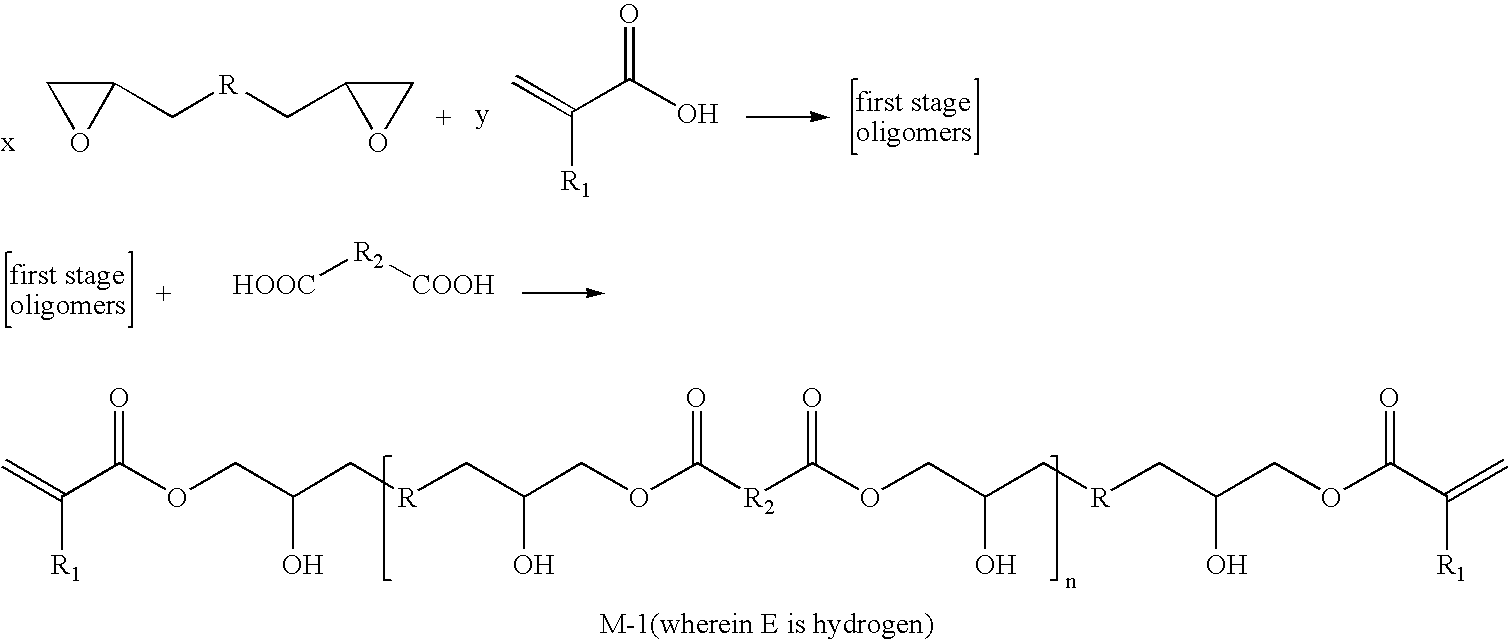
- Instead of dicarboxylic acids in the second step also primary monoamines were used which react to macromonomers M-2, disecondary diamines which react to macromonomers M-3, (J. Klee et. al. Polym. Bull. 27 (1992) 511-517, DD 279667) and bisphenols which react to macromonomers M-6.
- During the epoxide ring cleavage by carboxylic acids an amount equal to approximately 20 percent by weight of the epoxide groups is opened to the corresponding primary alcohols:

- Consequently, macromonomers M-1, M-2, M-3 and M6 wherein each E is hydrogen contain both types of molecules having primary and/or secondary alcohol units.
- The resulting macromonomers are viscous liquids or solids which are soluble in THF, CHCl3 and DMF. Their glass transition temperatures are relatively low (between 0 and 50° C.) depending on the nature of the comonomer and the molecular mass of the macromonomers.
- The degree of polymerisation Pn and the macromonomer value n depends on the mol ratio of the monomers, the diepoxide and the comonomers and were calculated by
-
- respectively using r=z/x. That means each macromonomer M is a definite mixture of a series of homologous oligomers (n=1,2,3,4,5, . . . ) and contains a certain amount of the molecule (n=0).
- Macromonomers M-5 wherein each E is hydrogen are prepared by one-step reaction of the diepoxides, disecondary diamines and 2,3-epoxypropyl-(meth)acrylate according to the following equation:

- A second route to obtain macromonomers M-5 wherein each E is hydrogen is a two-step reaction. In the first step the diepoxide is reacted with the disecondary diamine to an α,ω-terminated prepolymer. In the second step the obtained prepolymer is reacted with 2,3-epoxypropyl-(meth) acrylate (DD 277689, J. Klee, H.-H. Hörhold, H. Schütz, Acta Polym. 42 (1991)17-20).
- Instead of disecondary diamines in the second step also were used primary mono-amines react to macromonomers M-4, bisphenols react to macromonomers M-7 or dicarboxylic acids react to macromonomers M-8.
- Macromonomers M-9 wherein each E is hydrogen are prepared by reaction of diepoxides, dicarboxylic acids and aminoalkyl (meth)acrylates according to the following equation:

- Instead of dicarboxylic acids, primary monoamines were used to prepare macromonomers M-10, disecondary diamines were used to prepare macromonomers M-11, bis-phenols were used to prepare macromonomers M-12.
- Specific macromonomers M-1 to M-12 representing molecules of n=0, n=1 or n=2 may be isolated from the mixture by fractionated precipitation or by chromatography and subjected to esterification as described.
- Esterification of Macromonomers
- The reaction of epoxide macromonomers M-1 to M-12 with organic acids or inorganic acids or derivatives thereof leads to macromonomers having ester moieties.
- As derivatives of organic acids preferably were used succinic acid anhydride, maleic acid anhydride, dichloromaleic acid anhydride, dimethyl maleic acid anhydride, malonic acid anhydride, aconit acid anhydride, adipic acid anhydride, 3,3-tetramethylen glutaric acid anhydride, cyclohexen-1,2 acid anhydride, nadinic acid anhydride, phthalic acid anhydride, trimellitic acid anhydride, 2-sulfo-benzoic acid anhydride, 2-sulfo succinic acid anhydride, phthalic acid anhydride p-(O-phosphat), phthaloylchloride, succinic acid dimethyl ester.
- As derivatives of inorganic acids preferably were used phosphorous penta chloride, phosphorous trichloride, phosphorous oxychloride, sulfuryl chloride, thionyl chloride, phosphor thionyl chloride, boric acid anhydride, boron trichloride.
- It is possible to synthesize the esterified macromonomers without using any catalysts in the cases of M-2 to M-5, M-10, M11 (n>0). These macromonomers contain the catalytic active amine in the backbone of the molecule. The use of catalysts such as tertiary amines or quarterly ammonium salts is possible and in the case of esterifi-cation of M-1, M-6, M-7, M-8, M-9 and M-12 necessary.
- The esterification of the macromonomer hydroxyl groups is carried out in pure substance or in diluted solutions. Preferably, solvents such as tetrahydro furane, dioxane, or polymerizable monomers such as triethylenglycol bismethacrylate, diethylenglycol bismethacrylate, dioxolan bismethacrylate, vinyl-, vinylen- or vinyliden-, acrylate- or methacrylate substituted spiroorthoesters and 2,2-Bis[p-(acryloxyethoxy)phenyl]propane are present during esterification of the macromonomers. The temperature is in the preferred range of 60° C. to 120° C.
- Dental/Medical Application
- A dental/medical composite, a dental/medical sealant, a dental/medical adhesive and a dental/medical primer have been developed comprising a modified α,ω-(meth) acryloyl terminated macromonomer notably a di- or poly(meth)acrylate monomer having phosphorous ester groups or salts thereof, polymerizable monomers, fillers, polymerization initiators and stabilizers.
- As di- or poly(meth)acrylate monomer having phosphorous ester groups and salts thereof are employed pentaerythrit triacrylate monophosphate, dipentaerythrit penta-acrylate monophosphate, glycerol di(meth)acrylate monophosphate, triethylenglycol (meth)acrylate monophosphate.
- As organic polymerizable monomers were used mono- and polyfunctional (meth)-acrylates, such as polyalylenoxide di- and poly(meth)acrylates, urethane di- and poly(meth)acrylates, vinyl-, vinylen- or vinyliden-, acrylate- or methacrylate substituted spiroorthoesters, spiroorthocarbonates or bicyloorthoesters. Preferably were used diethylenglycol dimethacrylate, triethylenglycol dimethacrylate, 3,(4),8,(9)-di-methacryloyloxymethyltricyclodecane, dioxolan bismethacrylate, glycerol trimethacrylate, furfuryl methacrylate in a content of 5 to 80 wt-%.
- As polymerization initiators are used thermal initiators, redox initiators and/or photo initiators in a content of 0.001 to 3 wt-%.
- Thermal initiators are initiators such as peroxides, peresters, perketals, peroxy carbonates, hydroxyperoxides, persulfates and azo compounds preferably dibenzoyl peroxide, cumol hydroperoxide, diisopropyl peroxycarbonate, dipotassium persulfate, azobisisobutylonitril.
- Preferred redox initiator systems for use in compositions in accordance with the invention are peroxide/amine systems, such as peracid/amine, perester/amine, perketal/amine, peroxycarbonate/amine and hydroxyperoxide/amine systems; peroxide/metal ion salts, such as ascorbic acid/peroxide/metal ion compounds, (thio)barbituric acid/peroxide/metal ion compounds, metal ion compounds/sulfinates, metal ion compounds/(thio)barbituric acid; transition metal carbonyl compounds and halogenids of organic compounds; boralkyl compounds, peroxysulfates and thiols. Most preferred redox-initiators are benzoylperoxide/N,N-bis-(β-hydroxyethyl)-p-toluidine, benzoyl peroxide/N, N-bis-(β-hydroxyethyl)-p-benzoic acid ethylester, benzoylperoxide/tributylamine, cumol hydroperoxide/N,N-bis-(β-hydroxyethyl)-p-toluidine, diisopropyl peroxycarbonate/dimethylbenzylamine.
- Preferred photoinitiators for use in polymerizable compositions in accordance with the invention which include macromonomers with the scope of general formulas M-1 through M-12 are camphorquinone, benzophenone and 2,2-dimethylbenzylketal.
- Preferred fillers for use in compositions in accordance with the invention include inorganic compounds, such as La2O3, ZrO2, BiPO4, CaWO4, BaWO4, SrF2, Bi2O3, glasses and/or organic fillers, such as polymer granulate. Dental/medical composite compositions of the invention preferably include filler in an amount from about 50 to about 85 percent by weight. Dental/medical adhesive compositions of the invention preferably include filler in an amount from about 50 to about 65 percent by weight. Dental/medical sealant compositions of the invention preferably include filler in an amount from about 10 to about 50 percent by weight.
- Dental/medical composite compositions, adhesives and sealant of the invention include one-component and two-component paste/paste and powder/liquid-material which is to be mixed immediately before use.
- Shrinkage of composite compositions of the invention is preferably less than 4.5 and more preferably less than 1.5 percent by volume. Adhesive dental composite compositions of the invention containing radio-opaque fillers preferably provide a radio-opacity of at least 1.5 mm/mm Al, more preferably at least 3 to 7 mm/mm Al, and most preferably at least 7 mm/mmAl.
- The self-adhesive dental/medical composites compositions in accordance with a preferred embodiment of the invention have a fluoride release of at least 1 μg/cm2, more preferably at least 1-3 μg/cm2, and most preferably at least 3-10 μg/cm2.
- Self-adhesive dental/medical composites compositions in accordance with a preferred embodiment of the invention have an opacity of at least 40%, more preferably at least 20-40%, and most preferably at least 5-20%.
- The setting time of the adhesive dental/medical adhesive compositions in accordance with a preferred embodiment of the invention at 37° C. is between 1 minute and 60 minutes, more preferably between 5 and 30 minutes and most preferably between 2 and 5 minutes. The setting time of adhesive compositions in accordance with a preferred embodiment of the invention at 23° C. is preferably between 10 minutes and 300 minutes more, preferably between 5 and 100 minutes and most preferably between 5 and 20 minutes.
- Dental/medical composition in accordance with the invention is characterised by having an adhesion to dentine of at least 2 MPa; a fluoride release of at least 1 μg F-per week and per cm2 of the exposed surface of the composition; an opacity of at least Co0,7=40%; and a compressive strength of at least 200 Mpa.
- In the following examples bond strength to dentin is measured using extracted human teeth. The teeth used for the shear bond strength test are treated in 1% sodium hypochlorite for one hour and then stored in distilled water in a refrigerator at about 4° C. until needed. The teeth are washed with water, mechanically sanded with 320 grit carborundum paper until a flat dentin surface is exposed.
- The teeth are then individually blown dry with compressed dry air to ensure the dentin surface is free from noticeable moisture. A small plastic straw with 5 mm inner diameter and 2 to 3 mm in length is filled with the polymerizable composition being tested and seated on the dentin so as to form a post without pressure. The upper open end of the straw is covered with a thin film and cured. The specimens are then stored in distilled water at 37° C. for 24 hours. The teeth are then vertically mounted in a 7 cm ring using gypsum to provide a base for testing with the post at right angles thereto. The mounted specimens are then loaded in shear in an Zwick device model number 1455 manufactured by Zwick GmbH for measurement of adhesion of the post to dentin at 1 mm/minute crosshead speed. The load is applied parallel to the prepared tooth surface and at right angles to the post until fracture occurred. The shear bond strength is then calculated.
- In the examples Fluoride Release is measured by making three 1×20 mm (diameter) discs of each material. Each disc is placed in 25 ml water stored for a week at 37° C. Using an ion selective electrode, the fluoride concentration in mg F−/cm2 is determined for each disc. The average value of the three discs is recorded.
- In the Examples compressive strength is measured according to ISO 9917, EN 29917; flexural strength is measured according to ISO 4049, EN 24049; elastic modulus is measured according to ISO 4049, EN 24049; opacity is measured according to ISO 9912, EN 29912; IR spectra are measured using a Fourier transformation Infra Red spectrometer at 23° C.
- The macromonomer of formula M-1wherein n is 1, R is —OC6H4—C(CH3)2—C6H4O—, R1 is —CH3, R2 is —(CH2)4— is referred to hereinafter as macromonomer M-1A and is prepared by reacting 150.000 g (0.441 mol) bisphenol-A diglycidyl ether, 32.200 g (0.220 mol) adipic acid and 2,000 g triethylbenzylammoniumchloride for four hours at 80° C. while stirring. To the obtained glycidyl terminated prepolymer are added 37.900 g (0.441 mol) methacrylic acid and 0.444 g 2.6-di-tert.-butyl-p-cresol and are reacted for another four hours at 80° C. The methacrylate terminated macromonomer is soluble in organic solvents such as chloroform, DMF and THF. In the IR-spectrum no absorption of epoxide groups at ν=915 and 3050 cm−1 is observed. Absorption of ester groups is seen at ν=1720 cm−1. In the 1 H NMR spectrum are found signals of the olefinic double bond at δ(CH2=)=6,137/6,119/6,115 ppm and at δ(CH2=)=5,587/5,582/5,555/5,548 ppm.
- Preparation of the macromonomer of formula M-1 B wherein E is hydroxyl, n is 1, R is —O(CH2)4—, R1 is —CH3, R2 is —(CH2)4—.
- 200.00 g (0.99 mol) butanediol diglycidyl ether, 72.26 g (0.49 mol) adipic acid, 85.13 g (0.99 mol) methacrylic acid, 4.72 g triethylbenzylammoniumchloride and 0.60 g 2,6-di-tert.-butyl-p-cresol are stirred together and heated for four hours at 90° C. The obtained methacrylate terminated macromonomer is soluble in organic solvents such as chloroform, DMF and THF. In the IR-spectrum no absorption of epoxide groups at 915 and 3050 cm−1 is observed. Absorption of ester groups is seen at 1720cm−1. The viscosity measured with a Bohlin rheometer is ηdyn=3.3 Pas (25° C.).
- Preparation of the macromonomer of formula M-1F wherein E is hydroxyl, n is 1, R is —OC6H4—CH2—C6H4—, R1 is —CH3, R2 is —(CH2)4—.
- 100.00 g (0.32 mol) bisphenol-F diglycidyl ether, 23.39 g (0.16 mol) adipic acid, 27.56 g (0.32 mol) methacrylic acid, 65.47 g triethylenglycol dimethacrylate, 1.53 g triethylbenzylammoniumchloride and 0.30 g 2,6-di-tert.-butyl-p-cresol are stirred together and heated for four hours at 90° C. The obtained methacrylate terminated macromonomer is soluble in organic solvents such as chloroform, DMF and THF. In the IR-spectrum no absorption of epoxide groups at 915 and 3050 cm−1 is observed. Absorption of ester groups is seen at 1720 cm−1. The viscosity measured with a Bohlin rheometer is ηdyn=3.6 Pas (25° C.).
- Preparation of the macromonomer of formula M-3 wherein E is hydroxyl n is 1, R is —OC6H4—C(CH3)2—C6H4—, R1 is —CH3, R2 is —(CH2)4O(CH2)4—, R3 is C6H5CH2—.
- 150.000 g (0.441 mol) bisphenol-A diglycidyl ether, 37.935 g (0.441 mol) methacrylic acid, 2.000 g triethylbenzylammonium chloride, 1.115 g 2,6-di-tert.-butyl-p-cresol (BHT) and 111,695 g triethylenglycol dimethacrylate were homogeneously mixed while heating. The mixture was kept for two hours at 90° C. After this time 75.020 g (0.221 mol) N,N′-dibenzyl-5-oxanonanediamine-1,9 were added to the mixture while stirring and kept for additional two hours at 90° C. The obtained methacrylate terminated macromonomer is soluble in organic solvents such as chloroform, DMF and THF. No absorption of epoxide groups at 915 and 3050 cm−1 is observed in the IR-spectrum. Absorption of ester groups were found at 1720 cm−1.
- Preparation of the macromonomer of formula M-5 wherein E is hydroxyl, n is 1, R is —OC6H4—C(CH3)2—C6H4O—, R1 is —CH3, R2 is —(CH2)4O(CH2)4—, R3 is C6H5CH2—.
- 20.000 g (58.75 mmol) bisphenol-A diglycidyl ether and 40.012 g (117.50 mmol) N,N′-dibenzyl-5-oxanonanediamine-1,9 are homogeneously mixed while heating. The mixture is kept for two hours at 90° C. After this time 16.704 g (117.50 mmol) 2,3-epoxypropyl methacrylate is added to the mixture while stirring and the mixture is for another two hours at 90° C. The obtained methacrylate terminated macromonomer is soluble in organic solvents such as chloroform, DMF and THF. In the IR-spectrum no absorption of epoxide groups at 915 and 3050 cm−1 is observed.
- Preparation of the macromonomer of formula M-5 wherein E is hydroxyl, n is 0, R1 is —CH3, R2 is —(CH2)4O(CH2)4—, R3 is C6H5CH2—.
- 50.000 g (146,83 mmol) N,N′-dibenzyl-5-oxanonanediamine-1.9, 41.750 g (293.67 mmol) 2,3-epoxypropyl methacrylate and 0.213 g BHT are homogeneously mixed while heating. The mixture is kept for two hours at 90° C. The obtained methacrylate terminated macromonomer is soluble in organic solvents such as chloroform, DMF and THF. In the IR-spectrum no absorption of epoxide groups at 915 and 3050 cm−1 are observed.
- Preparation of the macromonomer of formula M-6 wherein E is hydroxyl, n is 1, R is —OC6H4—C(CH3)2—C6H4O—, R1 is —CH3, R4 is —C6H4—C(CH3)2—C6H4—.
- 150.000 g (0.441 mol) bisphenol-A diglycidyl ether, 50.299 g (0.220 mol) 2,2-bis-(4-hydroxy-phenyl)propane, 37.901 g (0.441 mol) methacrylic acid, 102.086 g triethy-lenglycol dimethacrylate, 2.000 g triethylbenzylammoniumchloride and 0.959 g 2,6-di-tert.-butyl-p-cresol are heated for four hours at 80° C.
- The obtained methacrylate terminated macromonomer is soluble in organic solvents such as chloroform, DMF and THF. In the IR-spectrum no absorption of epoxide groups at 915 and 3050 cm−1 is observed. Absorption of ester groups is found at 1720 cm−1.
- Preparation of the macromonomer of formula M-7 wherein E is hydroxyl, n is 1, R is —OC6H4—C(CH3)2—C6H4O—, R1 is —CH3, R4 is —C6H4—C(CH3)2—C6H4—.
- 100.000 g (0.294 mol) bisphenol-A diglycidyl ether, 134.235 g (0.588 mol) 2,2-bis-(4-hydroxy-phenyl)propane, 83.520 g (0.588 mmol) 2,3-epoxypropylmethacrylate, 2.000 g triethylbenzylammonium chloride, 0.794 g 2,6-di-tert.-butyl-p-cresol (BHT) and 79.439 g triethylenglycol dimethacrylate are homogeneously mixed while heating. The mixture is kept for two hours at 80° C. The obtained methacrylate terminated macromonomer is soluble in organic solvents such as chloroform, DMF and THF. No absorption of epoxide groups at 915 and 3050 cm−1 is observed in the IR-spectrum. Absorption of ester groups is found at 1720 cm−1.
- The hydroxyl groups of macromonomer M-1A made by following the procedure of reference example 1 are esterified by adding 16.023 g (160.13 mmol) succinic anhydride to 56.900 g of a macromonomer-triethylenglycol dimethacrylate mixture containing 40.000 g (40.03 mmol) macromonomer M-1A and 16.9 g of triethylenglycol dimenthacrylate) while stirring for two hours at 90° C. In the IR-spectrum the esterified macromonomer containing dicarboxylic half ester units shows no absorption of hydroxyl groups at 3400 cm−1.
- The hydroxyl groups of macromonomer M-1B made by following the procedure of reference example 2 are esterified by adding 197.93 g (1.98 mol) succinic anhydride and 0.56 g triethylamine to 362.71 g macromonomer M-1B while stirring for four hours at 90° C. In the IR-spectrum the esterified macromonomer containing dicarboxylic half ester units shows no absorption of hydroxyl groups at 3400 cm−1. The viscosity measured with a Bohlin rheometer is ηdyn=245 Pas (25° C.).
- The hydroxyl groups of macromonomer M-1F made by following the procedure of reference example 3 are esterified by adding 31.58 g (0.32 mol) succinic anhydride, 0.11 g triethylamine and 13.58 g triethyleneglycol dimethacrylate to 107.57 g of a macromonomer-triethylenglycol dimethacrylate mixture (containing 74.40 g, 0.08 mol macromonomer M-1F) while stirring for two hours at 90° C. In the IR-spectrum the esterified macromonomer containing dicarboxylic half ester units shows no absorption of hydroxyl groups at 3400 cm−1. ηdyn=55.2 Pas (25° C.).
- The hydroxyl groups of macromonomer M-3 wherein each E is hydroxyl made by following the procedure of reference example 4 are esterified by adding to 40.000 g of a macromonomer-triethyleneglycol dimethacrylate mixture (containing 27.844 g, 23.32 mmol macromonomer M-3 wherein each E is a hydroxy moiety), 9.338 g (93.32 mmol) succinic anhydride and 12.156 g triethylenglycol dimethacrylate while stirring for two hours at 90° C. The IR-spectrum does not show any absorption of hydroxyl groups at 3400 cm−1 of the newly modified macromonomer containing dicarboxylic half ester units.
- The hydroxyl groups of macromonomer M-5 wherein each E is hydroxyl made by following the procedure of reference example 5 are esterified by adding 23.516 g (235.00 mmol) succinic anhydride to a macromonomer M-5 wherein each E is hydroxyl for four hours at 90° C. In the IR-spectrum the esterified macromonomer containing dicarboxylic half ester units show no absorption of hydroxyl groups at 3400 cm−1. The macromonomer is characterised by the following analytical data:
Melting point: Fp. = 46.6° C. Elemental analysis: (C93H120N4O24) 1678.01 calc. C 66.57 H 7.24 N 3.34 found C 66.60 H 6.80 N 2.73 - The hydroxyl groups of macromonomer M-5 wherein each E is hydroxyl made by following the procedure of reference example 5 are esterified by adding 8.239 g (42.88 mmol) trimellitic anhydride, 0.2 g N,N-bis(β-hydroxyethyl)-p-toluidin, 140 ml dioxane and 9.247 g triethylenglycol dimethacrylate to 40.008 g of a macromonomer-triethylenglycol dimethacrylate-mixture (containing 28.000 g, 21.44 mmol macromonomer M-5 wherein each E is hydroxyl) and kept for eight hours at 90° C. After evaporation of the dioxane, the macromonomer was washed with petrol ether and dried at 40° C. within six hours. In the IR-spectrum the newly modified macromonomer containing two dicarboxylic half ester units and two hydroxylic groups per average molecule show absorption of hydroxyl groups at 3400 cm−1 and of the ester unit at 1720 cm−1.
- The hydroxyl groups of macromonomer M-5 wherein each E is hydroxyl made by following the procedure of reference example 6 are esterified by adding 29.384 g (293.67 mmol) succinic anhydride to a macromonomer and kept for four hours at 90° C. In the IR-spectrum the esterified macromonomer M-5 wherein each E is hydrogen (n=0) containing dicarboxylic half ester units shows no absorption of hydroxyl groups at 3400 cm−1.
- The hydroxyl groups of macromonomer M-6 wherein each E is hydroxyl made by following the procedure of reference example 7 are esterified by adding 12.966 g (0.130 mol) succinic anhydride and 0.2 g N,N-bis(β-hydroxyethyl)-p-toluidin to 50.000 g of a macromonomer-triethylenglycol dimethacrylate mixture (containing 35.000 g, 0.032 mol macromonomer M-6 wherein each E is hydroxyl) while stirring and were kept for eight hours at 50° C.
- In the IR-spectrum the esterified macromonomer containing dicarboxylic half ester units shows no absorption of hydroxyl groups at 3400 cm−1.
- The hydroxyl groups of macromonomer M-7 wherein each E is hydroxyl made by following the procedure of reference example 8 are esterified by adding 12.966 g (0.130 mol) succinic anhydride and 0,2 g N,N-bis(β-hydroxyethyl)-p-toluidin to 50.000 g of a macromonomer-triethylenglycol dimethacrylate mixture (containing 35.000 g, 0.032 mol macromonomer M-7 wherein each E is hydroxyl) while stirring and kept for two hours at 80° C. The IR-spectrum does not show any absorption of hydroxyl groups at 3400 cm−1 of the esterified macromonomer containing dicarboxylic half ester units.
- The hydroxyl groups of macromonomer M-6 wherein each E is hydroxyl made by following the procedure of reference example 7 are esterified by adding 29.760 g (0.297 mol) succinic anhydride and 0.2 g N,N-bis(β-hydroxyethyl)-p-toluidin to a macromonomer M-6 wherein each E is hydroxyl while stirring and were kept for eight hours at 50° C. In the IR-spectrum the newly modified macromonomer containing dicarboxylic half ester units shows no absorption of hydroxyl groups at 3400 cm−1.
- The hydroxyl groups of macromonomer M-1A made by following the procedure of reference example 1 are esterified by adding 40.000 g (40.03 mmol) of a macromonomer M-1A dissolved in 100 ml THF 16.204 g triethylamine in 50 ml THF. After adding 24.553 g POCl3 (153.33 mmol) drops by drops while stirring at 0° to 5° C. the solution is stirred for further two hours at room temperature. Than the triethylamine hydrochloride is filtered off and the mixture is hydrolysed with 20 ml water. The organic solution is extracted three times with Na2CO3 solution and is separated from water. From the solution, dried over MgSO4, the solvent is evaporated and the macromonomer is dried.
- In the IR-spectrum the esterified macromonomer containing phosphoric ester units shows no absorption of hydroxyl groups at ν=3400 cm−1. New absorptions were found at ν=1007 cm−1, ν=2362 cm−1 and as shoulder at ν=3302 cm'1. In the 1H NMR spectrum signals of the olefinic double bonds at δ(CH2=)=6,06/6,12 ppm and at δ(CH2=)=5,58/5,59 ppm were found. The signals of the methine protons (CH—OP) appears at δ(CH)=5,22 and 5,88 ppm. Those of unreacted macromonomer (CH—OH) appears at δ(CH)=4,34/4,35 ppm.
- The HPLC analysis of the modified macromonomer shows the same distribution of oligomers as those of unreacted M-1. Consequently, only the oligomer analogous reaction takes place which does not change the distribution, and no side reaction or crosslinking was observed.
- The hydroxyl groups of macromonomer with M-3 wherein each E is hydroxyl made by following the procedure of reference example 4 are esterified by adding 60.000 g (50.26 mmol) of a macromonomer M-3 wherein each E is hydroxyl dissolved in 150 ml THF to 20.346 g triethylamine in 50 ml THF. After adding 30.829 g (201.06 mmol) POCl3 drops by drops while stirring at 0° to 5° C. the solution is stirred for further two hours at room temperature. Than the triethylamine hydrochloride is filtered off and the mixture is hydrolysed with 20 ml water. The organic solution is extracted three times with Na2CO3 solution and is separated from water. From the solution, dried over MgSO4, the solvent is evaporated and the macromonomer is dried.
- In the IR-spectrum the esterified macromonomer containing phosphoric ester units shows no absorption of hydroxyl groups at ν=3400 cm−1. New absorptions are found at ν=1007 cm−1, ν=2362 cm−1 and as shoulder at ν=3302 cm−1 and an broad absorption at ν=2600 to 2800 cm−1 of the ammonium salt.
- The hydroxyl groups of macromonomer M-6 wherein each E is hydroxyl made by following the procedure of reference example 7 are esterified by adding 40.000 g (37.83 mmol) of a macromonomer M-6 wherein each E is hydroxyl dissolved in 100 ml THF to 15.312 g triethylamine in 50 ml THF. After adding 23.200 g (151.31 mmol) POCl3 drops by drops while stirring at 0° to 5° C the solution is stirred for further two hours at room temperature. Than the triethylamine hydrochloride is filtered off and the mixture is hydrolysed with 20 ml water. The organic solution is extracted three times with Na2CO3 solution and is separated from water. From the solution, dried over MgSO4, the solvent is evaporated and the macromonomer is dried.
- In the IR-spectrum the esterified macromonomer containing phosphoric ester units shows no absorption of hydroxyl groups at ν=3400 cm−1. New absorptions are found at ν=1007 cm−1, ν=2362 cm−1 and as shoulder at ν=3302 cm−1.
- 1) 75% of hydroxyl groups of the macromonomer M-1A made by following procedure of reference example 1 are esterified with succinic acid anhydride by adding 148.387 g (0.116 mol) of a macromonomer M-1A to 34.890 g (0.349 mol) succinic anhydride and 0.183 g triethylamine and reacted for two hours at 80° C. while stirring. The macromonomer is dissolved in 250 ml THF and stirred for a further hour.
- The esterified macromonomer M-1A containing (n+2)-carboxylic half ester groups show in the IR-spectrum an absorption of νCO=1720 cm−1.
- 2) Esterification of the residual unreacted hydroxyl groups of the macromonomer with POCl3.
- To 183.460 g (0.141 mol) of the obtained macromonomer M-1A dissolved in 250 ml THF were added 14.287 g triethylamine in 50 ml THF. After adding 21.659 g (0.141 mol) POCl3 drops by drops while stirring at 0° to 5° C. the solution is stirred for further two hours at room temperature. Than the triethylamine hydrochloride is filtered off and the mixture is hydrolysed with 50 ml water. The organic solution is extracted three times with Na2CO3 solution and is separated from water. From the solution, dried over MgSO4, the solvent is evaporated and the macromonomer is dried.
- In the IR-spectrum the esterified macromonomer containing phosphoric ester units shows no absorption of hydroxyl groups at ν=3400 cm−1. New absorptions are found at ν=1007 cm−1, ν=2362 cm−1 and as shoulder at ν=3302 cm−1. In the 1H NMR spectrum signals of the olefinic double bonds at δ(CH2=)=6,06/6,12 ppm and at δ(CH2=)=5,58/5,59 ppm were found. The signals of the methine protons (CH—O—P) appear at δ(CH)=5,22 and 5,88 ppm. Those containing succinic half ester units appear at δ(CH)=5,38 ppm. The esterified macromonomer M-1 containing (n+2)-carboxylic half ester groups and n-phosphoric acid groups is described by the following formula (n=1, R=—OC6H4—C(CH3)2—C6H4O—,R2=—(CH2)4—, R5=—CH2CH2—):

- 100.00 g (161.29 mmol) of a monophosphate ester of pentaerythrit pentmethacrylate and 27.29 g (161.29 mmol) dimethylaminoethyl methacylate are dissolved in 84.86 g triethyleneglycol dimethacrylate and reacted for two hours at 50° C. In the IR spectrum at 2600 to 2850 cm−1 an absorption of the ammonium salt is found.
- At 3400 cm−1 no absorption of OH-groups is observed. The pH of the salt is 3.9.
- 1.242 g of the esterified macromonomer M-5 wherein each E is succinic acid half ester made by following the procedure of example 5, 0.411 g triethyleneglycol dimethacrylate, 0.008 g N,N-bis(β-hydroxyethyl)-p-toluidine and 0.006 g camphorquinone were homogeneously mixed. This mixture was applied in a ring (2 mm high, 5 mm i.d.) on the surface of teeth and exposed with visible light (irradiation lamp Prismetics Lite De Trey Dentsply) for 40 seconds. Immediately after fixation, the teeth are transferred for 24 hours to a chamber at 37±2° C. and 100% relative humidity. The adhesion measured with a Zwick-apparatus is 3.74±1.29 MPa.
-

- 2.420 g of 2,2-Bis-[p-(2-hydroxy-3-methacryloyloxypropoxy)-phenyl]-propan (Bis-GMA) which is modified with succinic anhydride at the hydroxyl groups, 0.821 g triethylenglycol dimethacrylate, 0,016 g N,N-bis(β-hydroxyethyl)-p-toluidine and 0.012 g camphorquinone were homogeneously mixed. This mixture is applied in a ring (2 mm high, 5 mm i.d.) on the surface of teeth and exposed with visible light (irradia-tion lamp Prismetics Lite De Trey Dentsply) for 40 seconds. Immediately after fixa-tion, the teeth are transferred for 24 hours to a chamber at 37±2° C. and 100% relative humidity. The adhesion is 0.45±20 Mpa, when measured with a Zwick-apparatus model number 1455, manufactured by Zwick GmbH & Co.
- 1.276 g of the esterified macromonomer M-5 wherein each E is succinic acid half ester made by following the procedure of example 5, 2.126 g triethylenglycol dimethacry-late, 6.5 g Strontium-alumo-silicate glass, 0.036 g camphorquinone and 0.045 g N,N-bis(β-hydroxyethyl)-p-toluidine are homogeneously mixed and polymerized photochemical. The product has the following properties: adhesin to dentine of 3.7±1.1 MPa, compressive strength 177±3.5 MPa, Elastic Modulus of 2383±71 MPa.
- 1.755 g of macromonomer M-5 wherein each E is succinic acid half ester of example 5, 0.752 g methylmethacrylate, 4.652 g Strontium-alumo-silicate glass, 0.010 g camphorquinone and 0.012 g N,N-bis(β-hydroxyethyl)-p-toluidine are homogeneously mixed and polymerized photochemically. The product obtained has the following properties: adhesion to dentine: 3.9±1.2 MPa, compressive strength 134±9.7 MPa, Elastic Modulus 2528±158 MPa.
- Paste A:
- 3.0404 g of macromonomer M-5 wherein each E is succinic acid half ester of example 5, 2.2512 g triethylenglycol dimethacrylate, 6.0 g CaWO4/ZrO2 (80/20) and 0.3135 g Strontium-alumo-silicate glass containing 10% lithium-sulfinate are homogeneously mixed.
- Paste B:
- 3.0404 g of macromonomer M-5 wherein each E is succinic acid half ester of example 5, 2.2512 g triethylenglycol dimethacrylate, 6.0 g CaWO4/ZrO2 (80/20), 0.0057 g octophen and 0.0668 g Strontium-alumo-silicate glass containing 1% Cu-(I)-thiourea complex are homogeneously mixed.
- Immediately before use paste A and paste B were mixed in the wt.-ratio 1:1 homogeneously. The gel time at 23° C. is estimated to be 32 min. and the gel time at 23° C. is 7 minutes. The radio-opacity (RO) of the obtained material is 6.5 mm/mm Al.
- Paste A:
- 8.001 g of macromonomer M-1A of example 1, 5.334 g triethylenglycol dimethacrylate, 14.467 g CaWO4/ZrO2 (80/20), 0.014 g 2.6-di-tert.-butyl-p-cresol and 0.533 g Strontium-alumo-silicate glass containing 10% lithium-sulfinate are homogeneously mixed.
- Paste B:
- 8,001 g of macromonomer M-1A of example 1, 5.334 g triethylenglycol dimethacryla-te, 14.467 g CaWO4/ZrO2 (80/20), 0.014 g 2.6 -di-tert.-butyl-p-cresol, 0.065 g octo-phen and 0.0533 g Strontium-alumo-silicate glass containing 1% Cu-(I)-thiourea complex are homogeneously mixed.
- Immediately before use paste A and paste B were mixed in the wt.-ratio 1:1 homogeneously. The gel time at 23° C. is about 96 minutes, and the gel time at 32° C. is 19 min. The radioopacity of the obtained material is about about 6.7 mm/mm Al.
- Powder:
- 15,000 g silylated Strontium-alumo-silicate glass and 2,000 g silylated Strontium-alumo-silicate glass containing 10% dibenzoylperoxide were mixed homogeneously.
- Liquid:
- 14.000 g of a macromonomer M-5 wherein each E is succinic acid half ester of example 5, 6.000 g tetrahydrofurfuryl-methacrylate, 0.405 g N,N-bis(β-hydroxyethyl)-p-toluidine, 0.0130 g 2,6-di-tert.-butyl-p-cresol are mixed homogeneously.
- Immediately before use powder and liquid were mixed in the wt.-ratio 1,73:1,00 homogeneously. The working time is 3.50 minutes and the setting time is 3.25 minutes. The adhesion to dentine is measured to be 2.2±0.7 MPa. The composite shows the following mechanical properties: compressive strength: 152±15 MPa, and elastic modulus of 1788±81 MPa.
- Paste A:
- 3.000 g of an ammonium salt of dipenta erthrytrol pentamethacrylate monophosphate and 2-(dimetyl)aminoethyl methacrylate (AP-1), 2.000 g macromonomer M-1A of example 1, 5.000 g triethylenglycol dimethacrylate, 15.000 g Strontium-alumo-silicate glass, 0.005 g 2,6-di-tert.-butyl-p-cresol and 0.200 g cumenhydroperoxide are mixed homogeneously.
- Paste B:
- 3.000 g of AP-1, 2,000 g macromonomer M-1A of exapmple 1, 5.000 g triethylen-glycol dimethacrylate, 15.000 g Strontium-alumo-silicate glass, 0.005 g 2,6-di-tert.-butyl-p-cresol, 0.4081 g of a 0.1% solution of cupric acetylacetonate in 2-hydroxy propylmethacrylate and 0.041 g ascorbic acid palmitate are mixed homogeneously.
- The following values are measured: gel time (gt) at 23° C. is 3:55 minutes, gel time is 37° C. is 2.10 minutes, adhesion to dentine 5.12 MPa, shrinkage (reduction in volume) is 4.33%.
- Paste A:
- 3.000 g of AP-1, 2,000 g of macromonomer M-1A of exapmple 1, 5.000 g triethylen-glycol dimethacrylate, 15.000 g Strontium-alumo-silicate glass, 0.005 g 2,6-di-tert.-butyl-p-cresol and 0.200 g tert.-butyl peroxy benzoate are mixed homogeneously.
- Paste B:
- 3.000 g of AP-1, 2.000 g macromonomer M-1A of exapmple 1, 5.000 g triethylen-glycol dimethacrylate, 15.000 g Strontium-alumo-silicate glass, 0.005 g 2,6-di-tert.-butyl-p-cresol, 0.6186 g of a 0.1% solution of cupric acetyacetonate in 2-hydroxypropylmethacrylate and 0.051 g ascorbic acid palmitate are mixed homogeneously.
- The following values were measured: gel time (gt) at 23° C. is 6.10 minutes, (gt) at 37° C. is 3.20 minutes, adhesion to dentine 4.02 MPa, shrinkage (or reduction in volume) is 4.33%.
- Powder:
- 41.842 g silylated Strontium-alumo-silicate glass and 0.423 g dibenzoyl peroxide are mixed homogeneously.
- Liquid:
- 18.000 g of AP-1, 12.000 g triethylenglycoldimethacrylate, 0.180 g N,N-dimethyl-3,5-dimethyl aniline and 0,009 g 2,6-di-tert.-butyl-p-cresol were mixed homogeneously. Immediately before use powder and liquid were mixed in the weight ratio 1.40:1,00 homogeneously. The working time is 1:30 minutes and the setting time is 2:30 minutes.
- The following properties are measured:
adhesion to dentine: 7.68 ± 1.5 MPa compressive strength: 261 ± 14 MPa Elastic modules: 2917 ± 76 MPa shrinkage: 2.30% (percent reduction in volume) expansion: 1.17% (after storage for 14 weeks in water (expansion in length) at 37° C.) fluoride release: 5.33 μg/cm2 (after storage for 9 weeks in water at 37° C.). - Powder:
- 47.0 g silylated Strontium-alumo-silicate glass, 07544 g dibenzoyl peroxide and 2.52 g SrF2 are mixed homogeneously.
- Liquid:
- 28.570 g of an ammonium salt of dipentaerthrytrolpentamethacrylate monophosphate and 2-(dimetyl)aminoethyl methacrylate (AP-1) containing 8.570 g triethylen-glycol dimethacrylate, 7.140 g macromonomer M-1A of example 1 containing 2.140 g triethylenglycol dimethacrylate, 13.990 g triethylenglycol dimethacrylate 0.250 g N,N-bis(β-hydroxyethyl)-p-toluidine and 0.05 g 2,6-di-tert.-butyl-p-cresol are mixed homogeneously.
- Immediately before use powder and liquid are mixed in the weight ratio 1.40:1.00 homogeneously. The working time is 5:50 minutes and the setting time is 4:15 minutes.
- The following properties are measured:
adhesion to dentine: 7.7 ± 0.8 MPa compressive strength: 295 ± 9 MPa (ISO 9917, EN 29917) flexural strength: 77.1 ± 7.1 MPa (ISO 4049, EN 24049) Elastic modulus: 4482 ± 147 MPa (ISO 4049, EN 24049) Opacity: 90.6% (ISO 9912, EN 29912) shrinkage ΔV: 5.8 ± 0.5% expansion ΔL: 1.52% (after storage for 28 weeks in water at 37° C.) fluoride release: 64.01 μg/cm2 (after storage for 27 weeks in water at 37° C.). - Powder:
- 46.2480 g silylated Strontium-alumo-silicate glass, 0.6937 g dibenzoyl peroxide and 2.3124 g SrF2 are mixed homogeneously.
- Liquid:
- 20.0000 g of AP-1 containing 14.0000 g triethylenglycol dimethacrylate, 5.0000 g macromonomer M-1A of example 1 containing 1.5000 g triethylenglycol dimethacrylate, 1.323 g demineralised water, 4.0000 g UDMA, 4.7000 g triethylenglycol dimethacrylate, 0.1485 g N,N-bis(β-hydroxyethyl)-p-toluidine and 0.0098 g 2,6-di-tert.-butyl-p-cresol are mixed homogeneously. The viscosity measured with a Bohlin rheometer is ηdyn=1.086±0.005 Pas (23° C.).
- Immediately before use powder and liquid are mixed in the weight ratio 1.40:1.00 homogeneously. The working time is 4:00 minutes and the setting time is 4:00 minutes.
- The following properties were measured:
adhesion to dentine: 5.86 ± 1.53 MPa compressive strength: 301 ± 11 MPa flexural strength: 74.8 ± 4.8 MPa Elastic modulus: 5320 ± 271 MPa expansion ΔL: 1.10% (after storage for 5 weeks in water at 37° C.) fluoride release: 114.05 μg/cm2 (after storage for 28 weeks in water at 37° C.). - 20.00 g macromonomer M-1A of example 1, 19.63 g triethylenglycol dimethacrylate, 0.18 g N,N-bis(13-hydroxyethyl)-p-toluidine, 0.12 g camphorquinone, 0.07 g 2,6-di-tert.-butyl-p-cresol and 60.00 g Strontium-alumo-silicate glass are mixed homogeneously. Results are given in table 1.
- 20.00 g macromonomer M-1A of example 14, 19.63 g triethylenglycol dimethacrylate, 0.18 g N,N-bis(β-hydroxyethyl)-p-toluidine, 0.12 g camphoro quinone, 0.07 g 2,6-di-tert.-butyl-p-cresol and 60.00 g Strontium-alumo-silicate glass are mixed homogeneously. Results are given in table 1.
- 20.00 g of 2,2-Bis-[p-(2-hydroxy-3-methacryloyloxypropoxy)-phenyl]-propan (Bis-GMA) which is modified with succinic anhydride at the hydroxyl groups, 19.63 g triethylenglycol dimethacrylate, 0.18 g N,N-bis(β-hydroxyethyl)-p-toluidine, 0.12 g camphorquinone, 0.07 g 2,6-di-tert.-butyl-p-cresol and 60.00 g Strontium-alumo-silicate glass are mixed homogeneously. Results are given in table 1.
TABLE 1 Macromonomer Macromonomer Bis-GMA M-1A M-1A according according according comparative example 12 example 13 example 2 Adhesion to 2.35 2.42 1.04 dentin MPa Standard ±0.79 ±1.06 ±0.34 deviation MPa Molecular weight 1399.4 1379.3 712.3 of modified Macromonomer Molecular weight 349.9 344.8 356.2 per ester unit - 10.00 g of AP-1 containing 3.00 g triethylenglycol dimethacrylate, 2.50 g macromo-nomer M-1A of example 1 containing 0.75 g triethylenglycol dimethacrylate, 1.25 g triethylenglycol dimethacrylate, 0.0875 g N,N-bis(β-hydroxyethyl)-p-toluidine, 0.0875 g camphor quinone, 11.49 g Strontium-alumo-silicate glass, 0.30 g Aerosil and 0.0088 g 2,6-di-tert.-butyl-p-cresol are mixed homogeneously. The viscosity measured with a Bohlin rheometer is ηdyn=1.086±0.005 Pas (23° C.).
- 2.000g macromonomer M-6 of example 8 containing 0.400 g triethylenglycol dimethacrylate, 5.273 g Strontium-alumo-silicate glass, 0.010 g champhorquinon and 0.012 g N,N-bis(β-hydroxyethyl)-p-toluidin are homogeneously mixed and polymerized photochemical. The composite shows the following mechanical properties:
flexural strength: 76.6 ± 4.5 MPa flexural modules: 5074.0 ± 321 MPa compressive strength: 215.0 ± 6.0 MPa Elastic modules: 3180.0 ± 88 Mpa - It should be understood that while the present invention has been described in considerable detail with respect to certain specific embodiments thereof, it should not be considered limited to such embodiments but may be used in other ways without departure from the spirit of the invention and the scope of the appended claims.
Claims (22)
1. An esterified macromonomer obtainable by esterification of at least a portion of the —OH groups of an —OH group containing macromonomer having at least one terminal double bond with at least one derivative of an inorganic or organic acid whereby pendant groups are introduced exhibiting at least one acid moiety selected from the group of consisting of —COOH, —PO3H2, —SO3H, —BO2 and salts thereof, whereby the esterified macromonomer is within the scope of the general formula:

wherein Z is an organic moiety,
R1 is hydrogen or a substituted or unsubstituted alkyl having from 1 to 12 carbon atoms, oxyalkyl having from 1 to 12 carbon atoms, alkenyl having from 2 to 12 carbon atoms, cycloalkyl having from 5 to 12 carbon atoms, aryl having from 6 to 12 carbon atoms or aralkyl having from 7 to 12 carbon atoms,
each E independently is a hydroxyl group, an organic or inorganic ester moiety and at least one E is an organic or inorganic ester moiety,
n and m each independently is an integer from 2 to 12.
2. The esterified macromonomer of claim 1 wherein said esterified macromonomer is within the scope at least one of formulas M-1 to M-12:

wherein
R is a diether containing moiety, or diester containing moiety or tertiary amine containing moiety,
R2 is a difunctional substituted or unsubstituted alkyl group having from 1 to 12 carbon atoms, alkenyl group having from 2 to 12 carbon atoms, cycloalkyl having from 5 to 12 carbon atoms, aryl having from 6 to 12 carbon atoms or aralkyl having from 7 to 12 carbon atoms,
R3 is hydrogen or a substituted or unsubstituted alkyl group having from 1 to 12 carbon atoms, alkenyl group having from 2 to 12 carbon atoms, cycloalkyl having from 5 to 12 carbon atoms, aryl having from 6 to 12 carbon atoms or aralkyl having from 7 to 12 carbon atoms,
R4 is a substituted or unsubstituted aryl having from 6 to 12 carbon atoms,
and no is an integer of at least 1.
3. The esterified macromonomer of claim 2 wherein R is within the scope of the general formula:
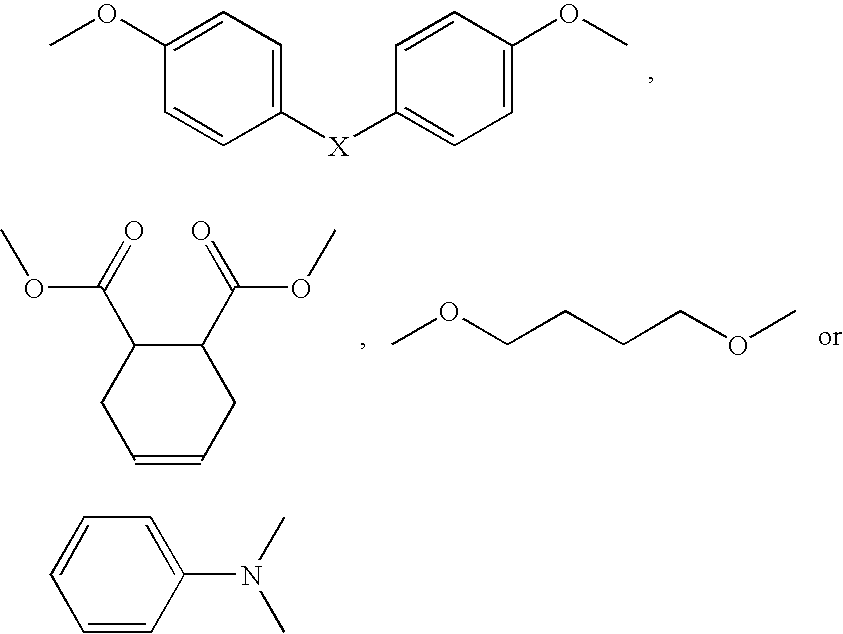
wherein X is C(CH3)2, —CH2—, —O—, —S—, —CO—, or —SO2—.
4. The esterified macromonomer of claim 2 wherein R is

5. The esterified macromonomer of claim 2 wherein R4 is within the scope of at least one of the general formulas:

wherein X is C(CH3)2, —CH2—, —O—, —S—, —CO— or —SO2—.
6. The esterified macromonomer of claim 2 wherein at least one E comprises a carboxyl group.
7. The esterified macromonomer of claim 1 wherein E is derived from succinic acid anhydride, maleic acid anhydride, dichloro maleic acid anhydride, dimethyl maleic acid anhydride, malonic acid anhydride, aconit acid anhydride, adipic acid anhydride, 3,3-tetramethylen glutaric acid anhydride, cyclohexen-1,2 acid anhydride, nadinic acid anhydride, phthalic acid anhydride, trimellitic acid anhydride, 2-sulfo-benzoic acid anhydride, 2-sulfo succinic acid anhydride, phthalic acid anhydride p-(O-phosphate), phthaloylchloride, succinic acid dimethyl ester, phosphorous penta chloride, phosphorous trichloride, phosphorous oxychloride, sulfuryl chloride, thionyl chloride, phosphor thionyl chloride, boric acid anhydride and boron trichloride.
8. The epoxide macromonomer of claim 1 wherein at least one E is a salt selected from the group consisting of ammonium, sulfonium, sodium, potassium, strontium, calcium and magnesium salts.
9. The macromonomer of claim 2 wherein said esterification is carried out in a solvent selected from the group consisting of THF, triethylenglycol bismethacrylate, diethylenglycol bismethacrylate, dioxolan bismethacrylate, vinyl-, vinylen- or vinyliden-, acrylate- or methacrylate substituted spiro-orthoester, spiroorthocarbonate or bicyloorthoester and 2,2-Bis[p-(acryloxyeth-oxy)phenyl]propane.
10. The macromonomer of claim 2 wherein said esterification is carried out in the presence of a tertiary amine.
11. The macromonomer of claim 2 further comprising a filler, a polymerizable monomer having at least one phosphorous ester group, a polymerization initiator and a stabilizer.
12. The composition according to claim 11 further comprising a polymerizable monomer selected from the group consisting of mono- and polyfunctional (meth)-acrylate, a urethane di- and poly(meth) acrylate, a vinyl-, vinylen- or vinyliden-, acrylate- or methacrylate substituted spiro-orthoester, a spiroorthocarbonate or a bicyloorthoester, and said monomer comprises from about 5 to about 80 percent by weight.
13. The composition according to claim 11 wherein said polymerization initiator is a thermal initiator, a redox-initiator or a photoinitiator.
14. The composition according to claim 11 wherein said filler comprises an inorganic filler and/or an organic filler.
15. The composition according to claim 14 wherein said filler is a fluoride releasing inorganic filler.
16. The composition formed by polymerizating the composition of claim 11 to form a polymeric product having an adhesion to dentine of at least 2 MPa, a fluoride release of at least 1 μg F− per week and per cm2 of the exposed surface of the composition, an opacity of at least C0.7=40% and a compressive strength of at least 200 MPa.
17. The composition of claim 11 comprising
from about 5 to about 20 percent by weight of said esterified macromonomer,
from about 10 to about 25 percent by weight of a di- or poly(meth)acrylate monomer having at least one phosphorous acid ester group,
from about 20 to about 35 percent by weight of a polymerizable monomer,
from about 50 to about 65 percent by weight of a filler and polymerization initiator and stabilizers.
18. The composition of claim 11 comprising
from about 3 to about 15 percent by weight of said esterified macromonomer,
from about 5 to about 25 percent by weight of di- or poly(meth)acrylate monomer having at least one phosphorous acid ester group,
from about 7 to about 40 percent by weight of a polymerizable monomer,
from about 50 to about 85 percent by weight of a filler and polymerization initiator and stabilizers.
19. The composition of claim 11 comprising
from about 5 to about 25 percent by weight of said esterified macromonomer,
from about 10 to about 30 percent by weight of di- or poly(meth)acrylate monomer having at least one phosphorous acid ester group,
from about 20 to about 40 percent by weight of a polymerizable monomer,
from about 10 to about 50 percent by weight of a filler and polymerization initiator and stabilizers.
20. The composition of claim 11 comprising
from about 5 to about 25 percent by weight of said esterified macromonomer,
from about 5 to about 30 percent by weight of di- or poly(meth)acrylate monomer having at least one phosphorous acid ester group,
from about 10 to about 40 percent by weight of a polymerizable monomer,
from about 30 to about 90 percent by weight of a diluent and polymerization initiator and stabilizers.
21. The composition of claim 11 comprising from about 1 to about 25 percent by weight of said esterified macromonomer, di- or poly(meth) acrylate monomer having at least one phosphous acid ester group and a polymerizable monomer and polymerization initiator from about 75 to about 99 percent by weight of an organic solvent and polymerization co-initiator.
22. The composition of claim 11 wherein the number of said acid moieties is chosen such that a polymer obtained by polymerizing said monomers has an adhesive strength to dentine of at least 2 MPa.—
Priority Applications (1)
| Application Number | Priority Date | Filing Date | Title |
|---|---|---|---|
| US10/938,459 US20050043490A1 (en) | 1993-05-26 | 2004-09-10 | Polymerizable compounds and compositions |
Applications Claiming Priority (5)
| Application Number | Priority Date | Filing Date | Title |
|---|---|---|---|
| US6777493A | 1993-05-26 | 1993-05-26 | |
| US08/217,998 US5624976A (en) | 1994-03-25 | 1994-03-25 | Dental filling composition and method |
| US23153594A | 1994-04-22 | 1994-04-22 | |
| US10/054,360 US20020143108A1 (en) | 1993-05-26 | 2002-01-22 | Polymerizable compounds and compositions |
| US10/938,459 US20050043490A1 (en) | 1993-05-26 | 2004-09-10 | Polymerizable compounds and compositions |
Related Parent Applications (1)
| Application Number | Title | Priority Date | Filing Date |
|---|---|---|---|
| US10/054,360 Continuation US20020143108A1 (en) | 1993-05-26 | 2002-01-22 | Polymerizable compounds and compositions |
Publications (1)
| Publication Number | Publication Date |
|---|---|
| US20050043490A1 true US20050043490A1 (en) | 2005-02-24 |
Family
ID=34199179
Family Applications (1)
| Application Number | Title | Priority Date | Filing Date |
|---|---|---|---|
| US10/938,459 Abandoned US20050043490A1 (en) | 1993-05-26 | 2004-09-10 | Polymerizable compounds and compositions |
Country Status (1)
| Country | Link |
|---|---|
| US (1) | US20050043490A1 (en) |
Cited By (7)
| Publication number | Priority date | Publication date | Assignee | Title |
|---|---|---|---|---|
| US20060226010A1 (en) * | 2005-04-11 | 2006-10-12 | Mario Curcio | Integrated 2d gel electrophoresis method and system |
| US20070151854A1 (en) * | 2005-12-21 | 2007-07-05 | Roche Diagnostics Operations, Inc. | Comparative multidimensional gel electrophoresis |
| US20080286724A1 (en) * | 2007-05-18 | 2008-11-20 | Ormco Corporation | Orthodontic adhesives |
| CN105792794A (en) * | 2013-12-06 | 2016-07-20 | 登特斯普伊德特雷有限公司 | Dental composition |
| JP2017520591A (en) * | 2014-07-10 | 2017-07-27 | スリーエム イノベイティブ プロパティズ カンパニー | Two-component self-adhesive dental composition, process for its production and use |
| US10874594B2 (en) | 2015-12-08 | 2020-12-29 | 3M Innovative Properties Company | Two-component self-adhesive dental composition, storage stable initiator system, and use thereof |
| US11364320B2 (en) * | 2016-07-11 | 2022-06-21 | Ecole Polytechnique Federale De Lausanne (Epfl) | Curable filler material for tubular structures |
Citations (95)
| Publication number | Priority date | Publication date | Assignee | Title |
|---|---|---|---|---|
| US150262A (en) * | 1874-04-28 | Improvement in caps for glass syringes | ||
| US173850A (en) * | 1876-02-22 | Improvement in syringes | ||
| US212975A (en) * | 1879-03-04 | Improvement in syringes | ||
| US543829A (en) * | 1895-07-30 | Isaac q | ||
| US3200142A (en) * | 1963-02-01 | 1965-08-10 | Rafael L Bowen | Surface-active comonomer and method of preparation |
| US3256226A (en) * | 1965-03-01 | 1966-06-14 | Robertson Co H H | Hydroxy polyether polyesters having terminal ethylenically unsaturated groups |
| US3317469A (en) * | 1963-12-11 | 1967-05-02 | Ruhrchemie Ag | Reaction product of a glycidyl polyether and diaminomethyltricyclodecane |
| US3327016A (en) * | 1964-07-09 | 1967-06-20 | Epoxylite Corp | Epoxide compositions cured with 1, 4-bis (aminomethyl) cyclohexane |
| US3327017A (en) * | 1963-10-03 | 1967-06-20 | Japan Gas Chemical Co | Molding composition comprising a thermosetting aromatic hydrocarbon-aldehyde-phenol resin and a thermoplastic linear polymer |
| US3503128A (en) * | 1966-03-21 | 1970-03-31 | Dentsply Int Inc | Dental filling composition of a coefficient of thermal expansion approximating that of natural tooth enamel |
| US3564074A (en) * | 1966-11-28 | 1971-02-16 | Dow Chemical Co | Thermosetting vinyl resins reacted with dicarboxylic acid anhydrides |
| US3586527A (en) * | 1969-08-04 | 1971-06-22 | Ford Motor Co | Tetravinyl-unsaturated resin paint composition and painting process |
| US3595969A (en) * | 1966-03-09 | 1971-07-27 | Princeton Chemical Res Inc | Anaerobic adhesive composition |
| US3634542A (en) * | 1969-08-04 | 1972-01-11 | Shell Oil Co | Unsaturated polyesters esterified with polycarboxylic acid anhydride and containing polyepoxide |
| US3673558A (en) * | 1970-05-04 | 1972-06-27 | Ciba Ltd | Polyaddition products and process for their manufacture |
| US3709866A (en) * | 1970-06-01 | 1973-01-09 | Dentsply Int Inc | Photopolymerizable dental products |
| US3742949A (en) * | 1972-02-14 | 1973-07-03 | C Hill | Syringe assembly |
| US3754054A (en) * | 1968-12-23 | 1973-08-21 | Mitsubishi Rayon Co | Radiation curable coating compositions and process for the preparation thereof |
| US3815239A (en) * | 1972-01-13 | 1974-06-11 | H Lee | Method of filling and sealing developmental pit and fissures |
| US3882187A (en) * | 1971-02-10 | 1975-05-06 | Showa Highpolymer | Radiation curable epoxy ester-saturated alkyd compositions |
| US3889385A (en) * | 1972-02-11 | 1975-06-17 | Emery W Dougherty | Liquid dental opaquer and method |
| US3971765A (en) * | 1973-12-27 | 1976-07-27 | Ciba-Geigy Corporation | Anaerobically-curing adhesives |
| US3973972A (en) * | 1973-09-21 | 1976-08-10 | Jenaer Glaswerk Schott & Gen. | Glass ceramic as filler in polymerizable dental filling compositions |
| US4002669A (en) * | 1974-02-12 | 1977-01-11 | Kulzer & Co. Gmbh | Hydroxy group containing diesters of acrylic acid |
| US4081492A (en) * | 1975-07-30 | 1978-03-28 | Bayer Aktiengesellschaft | Hardenable coating compositions |
| US4097569A (en) * | 1975-06-23 | 1978-06-27 | Youngstown Sheet And Tube Company | Modified vinyl ester resin and pipe made therefrom |
| US4097994A (en) * | 1975-11-24 | 1978-07-04 | Monsanto Company | Dental restorative composition containing oligomeric BIS-GMA resin and Michler's ketone |
| US4098735A (en) * | 1977-02-14 | 1978-07-04 | Mobil Oil Corporation | Water reducible epoxy ester using monocarboxylic acid to control molecular weight |
| US4100045A (en) * | 1975-12-29 | 1978-07-11 | The Dow Chemical Company | Radiation curable epoxy coating composition of dimer acid modified vinyl ester resin |
| US4135868A (en) * | 1977-04-05 | 1979-01-23 | Herbert Schainholz | Supports for instrument sterilization |
| US4141865A (en) * | 1977-10-06 | 1979-02-27 | The Dow Chemical Company | Catalysts for reaction of carboxylic acids with polyepoxides |
| US4150012A (en) * | 1977-01-21 | 1979-04-17 | Minnesota Mining And Manufacturing Company | Discernible dental sealant |
| US4182833A (en) * | 1977-12-07 | 1980-01-08 | Celanese Polymer Specialties Company | Cationic epoxide-amine reaction products |
| US4182035A (en) * | 1976-08-31 | 1980-01-08 | Kuraray Company Limited | Adhesive compositions for the hard tissues of the human body |
| US4197390A (en) * | 1979-02-22 | 1980-04-08 | Shell Oil Company | Thickenable thermosetting vinyl ester resins |
| US4253830A (en) * | 1979-06-08 | 1981-03-03 | North Pacific Dental, Inc. | Autoclavable dental bur block |
| US4255468A (en) * | 1979-10-12 | 1981-03-10 | H. B. Fuller Company | Method of marking paved surfaces and curable two-part epoxy systems therefor |
| US4256457A (en) * | 1978-09-27 | 1981-03-17 | Horst Behring | Container for dental equipment for root-treatment |
| US4259117A (en) * | 1976-03-17 | 1981-03-31 | Kuraray Co., Ltd. | Dental filling material |
| US4284742A (en) * | 1977-04-28 | 1981-08-18 | The B. F. Goodrich Company | Puncture-sealing tire |
| US4368889A (en) * | 1979-03-05 | 1983-01-18 | Reker Jr Louis M | Game apparatus for simulating school experience |
| US4383052A (en) * | 1980-12-20 | 1983-05-10 | Lion Corporation | 1-Methacryloxyethane-1,1-diphosphonic acid and its salts and dental adhesive composition containing same |
| US4383879A (en) * | 1980-03-24 | 1983-05-17 | Commissariat A L'energie Atomique | Cement for the fixation of osseous prostheses |
| US4383826A (en) * | 1980-07-23 | 1983-05-17 | Blendax-Werke R.Schneider Gmbh & Co. | Adducts of diisocyanates and methacryloyl alkyl ethers, alkoxybenzenes or alkoxycycloalkanes, compositions containing such compounds, and method of use thereof |
| US4384853A (en) * | 1981-04-09 | 1983-05-24 | Dentsply Research & Development Corp. | Ejector holder for capsule-like cartridge |
| US4391590A (en) * | 1981-04-09 | 1983-07-05 | Dentsply Research & Development Corp. | Cartridge for viscous material |
| US4431421A (en) * | 1981-10-28 | 1984-02-14 | Kanebo, Ltd. | Dental restorative composition |
| US4446246A (en) * | 1982-09-09 | 1984-05-01 | Three Bond Co., Ltd. | Catalyst systems for two-pack acrylic adhesive formulations |
| US4467079A (en) * | 1981-11-13 | 1984-08-21 | Lingner & Fischer Gmbh | Curing compositions containing redox indicators |
| US4514342A (en) * | 1982-02-16 | 1985-04-30 | Dentsply Limited | Polyethylenically unsaturated monophosphates |
| US4515634A (en) * | 1983-10-17 | 1985-05-07 | Johnson & Johnson Dental Products Company | Castable glass-ceramic composition useful as dental restorative |
| US4524161A (en) * | 1983-08-24 | 1985-06-18 | Shell Oil Company | Process for preparing aqueous binder compositions |
| US4569662A (en) * | 1981-10-26 | 1986-02-11 | Dragan William B | Bulk cartridge for packaging and dispensing a dental material |
| US4579904A (en) * | 1982-09-24 | 1986-04-01 | Blendax Werke R. Schneider Gmbh & Co. | Diacrylic and dimethacrylic esters and their use |
| US4595734A (en) * | 1980-02-04 | 1986-06-17 | Interplastic Corporation | Molding compositions |
| US4643303A (en) * | 1985-10-15 | 1987-02-17 | Micromedics, Inc. | Modular sterilizing system |
| US4670576A (en) * | 1981-02-13 | 1987-06-02 | Minnesota Mining And Manufacturing Company | Polymerizable phosphorus esters |
| US4669983A (en) * | 1981-02-13 | 1987-06-02 | Minnesota Mining And Manufacturing Company | Dentin and enamel adhesive |
| US4758643A (en) * | 1985-05-24 | 1988-07-19 | G-C Dental Industrial Corp. | Dental adhesive resin compositions |
| US4767326A (en) * | 1986-11-25 | 1988-08-30 | Dentsply Research & Development Corp. | Cartridge container and ejector piston therefor |
| US4806381A (en) * | 1985-10-09 | 1989-02-21 | Ernst Muhlbauer Kg | Polymerizable compounds containing acid and acid derivatives, mixtures containing the same, and use thereof |
| US4816528A (en) * | 1986-06-23 | 1989-03-28 | E. I. Dupont De Nemours And Company | Chip resistant coating compositions containing epoxy-polyester graft copolymers |
| US4816495A (en) * | 1984-11-29 | 1989-03-28 | Dentsply Research & Development Corp. | Biologically compatible adhesive visible light curable compositions |
| US4854475A (en) * | 1985-07-22 | 1989-08-08 | Hu-Friedy Manufacturing Co., Inc. | Instrument cassette |
| US4918136A (en) * | 1988-03-28 | 1990-04-17 | Tokuyama Soda Kabushiki Kaisha | Adhesive composition |
| US4929746A (en) * | 1981-02-13 | 1990-05-29 | Minnesota Mining And Manufacturing Company | Dentin and enamel adhesive |
| US4931096A (en) * | 1988-02-09 | 1990-06-05 | Toyo Chemical Laboratories, Inc. | Sealer for filling a dental root canal |
| US4936775A (en) * | 1981-05-04 | 1990-06-26 | Dentsply Research & Development, Corp. | Dental adhesive system |
| US4950697A (en) * | 1988-09-15 | 1990-08-21 | Block Drug Co., Inc. | Thermoplastic and injectable endodontic filling compositions |
| US4985516A (en) * | 1985-10-30 | 1991-01-15 | Mitsui Petrochemical Industries, Ltd. | Curable composition |
| US4985198A (en) * | 1987-04-28 | 1991-01-15 | G-C Dental Industrial Corp. | Tooth-adhesive compounds |
| USD315956S (en) * | 1989-02-06 | 1991-04-02 | Dragan William B | Dental syringe tip |
| US5006066A (en) * | 1989-02-17 | 1991-04-09 | Rouse Melvin R | Autoclavable dental burr holder |
| US5083921A (en) * | 1989-02-06 | 1992-01-28 | Dragan William B | Dental syringe tip |
| US5100320A (en) * | 1990-01-16 | 1992-03-31 | Minnesota Mining And Manufacturing Company | Dental packaging material and cartridge |
| US5106301A (en) * | 1986-12-26 | 1992-04-21 | G-C Dental Industrial Corp. | Method for inspecting the root canal with a radiopaque impression material |
| US5108287A (en) * | 1991-09-05 | 1992-04-28 | Nancy Yee | Autoclavable drill bit container |
| US5122057A (en) * | 1991-01-07 | 1992-06-16 | Centrix, Inc. | Dosing dental cartridge |
| US5129825A (en) * | 1987-12-21 | 1992-07-14 | Discko John Jr | Dental syringe and capsule for use therewith |
| US5137990A (en) * | 1984-02-28 | 1992-08-11 | Shell Oil Company | Heat-curable polyepoxide-(meth)acrylate ester compositions |
| US5177121A (en) * | 1981-02-13 | 1993-01-05 | Minnesota Mining And Manufacturing Company | Dentin and enamel adhesive |
| US5189077A (en) * | 1989-03-16 | 1993-02-23 | The Ohio State University | Reinforcing glass ionomer dental filling material with titanium stainless steel, or metals thereof |
| US5204398A (en) * | 1992-03-17 | 1993-04-20 | Essential Dental Systems, Inc. | Composite dental cement composition containing a lanthanide series compound |
| US5210157A (en) * | 1989-08-15 | 1993-05-11 | Akzo N.V. | Interpenetrating network of ring-containing allyl polymers and epoxy resin, and a laminate prepared therefrom |
| US5215726A (en) * | 1991-07-17 | 1993-06-01 | Hu-Friedy Mfg. Co., Inc. | Two-tiered sterilization and storage cassette |
| US5217372A (en) * | 1992-09-17 | 1993-06-08 | Truocchio Michael A | Dentistry practice |
| US5235008A (en) * | 1990-08-03 | 1993-08-10 | The Dow Chemical Company | Polymer modified adducts of epoxy resins and active hydrogen containing compounds containing mesogenic moieties |
| US5236362A (en) * | 1991-10-11 | 1993-08-17 | Essential Dental Systems, Inc. | Root canal filling material and adhesive composition |
| US5279800A (en) * | 1992-11-25 | 1994-01-18 | C/T Med-Systems Ltd., Inc. | Dental cassette kit |
| US5294413A (en) * | 1991-07-17 | 1994-03-15 | Hu-Friedy Mfg. Co., Inc. | Sterilization and storage cassette |
| US5304585A (en) * | 1981-02-13 | 1994-04-19 | Minnesota Mining And Manufacturing | Dentin and enamel adhesive |
| US5322440A (en) * | 1992-10-20 | 1994-06-21 | Kerr Manufacturing Company | Dental syringe tip |
| US5324273A (en) * | 1992-09-30 | 1994-06-28 | Centrix, Inc. | Disposable barrel dental impression material syringe |
| US5384103A (en) * | 1992-03-17 | 1995-01-24 | Micromedics, Inc. | Instrument tray |
| US6369164B1 (en) * | 1993-05-26 | 2002-04-09 | Dentsply G.M.B.H. | Polymerizable compounds and compositions |
-
2004
- 2004-09-10 US US10/938,459 patent/US20050043490A1/en not_active Abandoned
Patent Citations (101)
| Publication number | Priority date | Publication date | Assignee | Title |
|---|---|---|---|---|
| US173850A (en) * | 1876-02-22 | Improvement in syringes | ||
| US212975A (en) * | 1879-03-04 | Improvement in syringes | ||
| US543829A (en) * | 1895-07-30 | Isaac q | ||
| US150262A (en) * | 1874-04-28 | Improvement in caps for glass syringes | ||
| US3200142A (en) * | 1963-02-01 | 1965-08-10 | Rafael L Bowen | Surface-active comonomer and method of preparation |
| US3327017A (en) * | 1963-10-03 | 1967-06-20 | Japan Gas Chemical Co | Molding composition comprising a thermosetting aromatic hydrocarbon-aldehyde-phenol resin and a thermoplastic linear polymer |
| US3317469A (en) * | 1963-12-11 | 1967-05-02 | Ruhrchemie Ag | Reaction product of a glycidyl polyether and diaminomethyltricyclodecane |
| US3327016A (en) * | 1964-07-09 | 1967-06-20 | Epoxylite Corp | Epoxide compositions cured with 1, 4-bis (aminomethyl) cyclohexane |
| US3256226A (en) * | 1965-03-01 | 1966-06-14 | Robertson Co H H | Hydroxy polyether polyesters having terminal ethylenically unsaturated groups |
| US3595969A (en) * | 1966-03-09 | 1971-07-27 | Princeton Chemical Res Inc | Anaerobic adhesive composition |
| US3503128A (en) * | 1966-03-21 | 1970-03-31 | Dentsply Int Inc | Dental filling composition of a coefficient of thermal expansion approximating that of natural tooth enamel |
| US3564074A (en) * | 1966-11-28 | 1971-02-16 | Dow Chemical Co | Thermosetting vinyl resins reacted with dicarboxylic acid anhydrides |
| US3754054A (en) * | 1968-12-23 | 1973-08-21 | Mitsubishi Rayon Co | Radiation curable coating compositions and process for the preparation thereof |
| US3586527A (en) * | 1969-08-04 | 1971-06-22 | Ford Motor Co | Tetravinyl-unsaturated resin paint composition and painting process |
| US3634542A (en) * | 1969-08-04 | 1972-01-11 | Shell Oil Co | Unsaturated polyesters esterified with polycarboxylic acid anhydride and containing polyepoxide |
| US3673558A (en) * | 1970-05-04 | 1972-06-27 | Ciba Ltd | Polyaddition products and process for their manufacture |
| US3709866A (en) * | 1970-06-01 | 1973-01-09 | Dentsply Int Inc | Photopolymerizable dental products |
| US3882187A (en) * | 1971-02-10 | 1975-05-06 | Showa Highpolymer | Radiation curable epoxy ester-saturated alkyd compositions |
| US3815239A (en) * | 1972-01-13 | 1974-06-11 | H Lee | Method of filling and sealing developmental pit and fissures |
| US3889385A (en) * | 1972-02-11 | 1975-06-17 | Emery W Dougherty | Liquid dental opaquer and method |
| US3742949A (en) * | 1972-02-14 | 1973-07-03 | C Hill | Syringe assembly |
| US3973972A (en) * | 1973-09-21 | 1976-08-10 | Jenaer Glaswerk Schott & Gen. | Glass ceramic as filler in polymerizable dental filling compositions |
| US3971765A (en) * | 1973-12-27 | 1976-07-27 | Ciba-Geigy Corporation | Anaerobically-curing adhesives |
| US4002669A (en) * | 1974-02-12 | 1977-01-11 | Kulzer & Co. Gmbh | Hydroxy group containing diesters of acrylic acid |
| US4097569A (en) * | 1975-06-23 | 1978-06-27 | Youngstown Sheet And Tube Company | Modified vinyl ester resin and pipe made therefrom |
| US4081492A (en) * | 1975-07-30 | 1978-03-28 | Bayer Aktiengesellschaft | Hardenable coating compositions |
| US4097994A (en) * | 1975-11-24 | 1978-07-04 | Monsanto Company | Dental restorative composition containing oligomeric BIS-GMA resin and Michler's ketone |
| US4100045A (en) * | 1975-12-29 | 1978-07-11 | The Dow Chemical Company | Radiation curable epoxy coating composition of dimer acid modified vinyl ester resin |
| US4368043A (en) * | 1976-03-17 | 1983-01-11 | Kuraray Company, Limited | Adhesive cementing agents for the hard tissues of the human body |
| US4259117A (en) * | 1976-03-17 | 1981-03-31 | Kuraray Co., Ltd. | Dental filling material |
| US4259075A (en) * | 1976-03-17 | 1981-03-31 | Kuraray Co., Ltd. | Method of filling a tooth cavity |
| US4182035A (en) * | 1976-08-31 | 1980-01-08 | Kuraray Company Limited | Adhesive compositions for the hard tissues of the human body |
| US4150012A (en) * | 1977-01-21 | 1979-04-17 | Minnesota Mining And Manufacturing Company | Discernible dental sealant |
| US4098735A (en) * | 1977-02-14 | 1978-07-04 | Mobil Oil Corporation | Water reducible epoxy ester using monocarboxylic acid to control molecular weight |
| US4135868A (en) * | 1977-04-05 | 1979-01-23 | Herbert Schainholz | Supports for instrument sterilization |
| US4284742A (en) * | 1977-04-28 | 1981-08-18 | The B. F. Goodrich Company | Puncture-sealing tire |
| US4141865A (en) * | 1977-10-06 | 1979-02-27 | The Dow Chemical Company | Catalysts for reaction of carboxylic acids with polyepoxides |
| US4182833A (en) * | 1977-12-07 | 1980-01-08 | Celanese Polymer Specialties Company | Cationic epoxide-amine reaction products |
| US4256457A (en) * | 1978-09-27 | 1981-03-17 | Horst Behring | Container for dental equipment for root-treatment |
| US4197390A (en) * | 1979-02-22 | 1980-04-08 | Shell Oil Company | Thickenable thermosetting vinyl ester resins |
| US4368889A (en) * | 1979-03-05 | 1983-01-18 | Reker Jr Louis M | Game apparatus for simulating school experience |
| US4253830A (en) * | 1979-06-08 | 1981-03-03 | North Pacific Dental, Inc. | Autoclavable dental bur block |
| US4255468A (en) * | 1979-10-12 | 1981-03-10 | H. B. Fuller Company | Method of marking paved surfaces and curable two-part epoxy systems therefor |
| US4595734A (en) * | 1980-02-04 | 1986-06-17 | Interplastic Corporation | Molding compositions |
| US4383879A (en) * | 1980-03-24 | 1983-05-17 | Commissariat A L'energie Atomique | Cement for the fixation of osseous prostheses |
| US4383826A (en) * | 1980-07-23 | 1983-05-17 | Blendax-Werke R.Schneider Gmbh & Co. | Adducts of diisocyanates and methacryloyl alkyl ethers, alkoxybenzenes or alkoxycycloalkanes, compositions containing such compounds, and method of use thereof |
| US4383052A (en) * | 1980-12-20 | 1983-05-10 | Lion Corporation | 1-Methacryloxyethane-1,1-diphosphonic acid and its salts and dental adhesive composition containing same |
| US5177121A (en) * | 1981-02-13 | 1993-01-05 | Minnesota Mining And Manufacturing Company | Dentin and enamel adhesive |
| US5304585A (en) * | 1981-02-13 | 1994-04-19 | Minnesota Mining And Manufacturing | Dentin and enamel adhesive |
| US4929746A (en) * | 1981-02-13 | 1990-05-29 | Minnesota Mining And Manufacturing Company | Dentin and enamel adhesive |
| US4670576A (en) * | 1981-02-13 | 1987-06-02 | Minnesota Mining And Manufacturing Company | Polymerizable phosphorus esters |
| US4669983A (en) * | 1981-02-13 | 1987-06-02 | Minnesota Mining And Manufacturing Company | Dentin and enamel adhesive |
| US4384853B1 (en) * | 1981-04-09 | 1993-11-09 | Dentsply Research & Development Corp. | Ejector holder for capsule-like cartridge |
| US4391590A (en) * | 1981-04-09 | 1983-07-05 | Dentsply Research & Development Corp. | Cartridge for viscous material |
| US4391590B1 (en) * | 1981-04-09 | 1992-12-15 | Dentsply Res & Dev | |
| US4384853A (en) * | 1981-04-09 | 1983-05-24 | Dentsply Research & Development Corp. | Ejector holder for capsule-like cartridge |
| US4936775A (en) * | 1981-05-04 | 1990-06-26 | Dentsply Research & Development, Corp. | Dental adhesive system |
| US4569662A (en) * | 1981-10-26 | 1986-02-11 | Dragan William B | Bulk cartridge for packaging and dispensing a dental material |
| US4431421A (en) * | 1981-10-28 | 1984-02-14 | Kanebo, Ltd. | Dental restorative composition |
| US4467079A (en) * | 1981-11-13 | 1984-08-21 | Lingner & Fischer Gmbh | Curing compositions containing redox indicators |
| US4514342A (en) * | 1982-02-16 | 1985-04-30 | Dentsply Limited | Polyethylenically unsaturated monophosphates |
| US4446246A (en) * | 1982-09-09 | 1984-05-01 | Three Bond Co., Ltd. | Catalyst systems for two-pack acrylic adhesive formulations |
| US4579904A (en) * | 1982-09-24 | 1986-04-01 | Blendax Werke R. Schneider Gmbh & Co. | Diacrylic and dimethacrylic esters and their use |
| US4524161A (en) * | 1983-08-24 | 1985-06-18 | Shell Oil Company | Process for preparing aqueous binder compositions |
| US4515634A (en) * | 1983-10-17 | 1985-05-07 | Johnson & Johnson Dental Products Company | Castable glass-ceramic composition useful as dental restorative |
| US5137990A (en) * | 1984-02-28 | 1992-08-11 | Shell Oil Company | Heat-curable polyepoxide-(meth)acrylate ester compositions |
| US4816495A (en) * | 1984-11-29 | 1989-03-28 | Dentsply Research & Development Corp. | Biologically compatible adhesive visible light curable compositions |
| US4758643A (en) * | 1985-05-24 | 1988-07-19 | G-C Dental Industrial Corp. | Dental adhesive resin compositions |
| US4854475A (en) * | 1985-07-22 | 1989-08-08 | Hu-Friedy Manufacturing Co., Inc. | Instrument cassette |
| US4806381A (en) * | 1985-10-09 | 1989-02-21 | Ernst Muhlbauer Kg | Polymerizable compounds containing acid and acid derivatives, mixtures containing the same, and use thereof |
| US4643303A (en) * | 1985-10-15 | 1987-02-17 | Micromedics, Inc. | Modular sterilizing system |
| US4985516A (en) * | 1985-10-30 | 1991-01-15 | Mitsui Petrochemical Industries, Ltd. | Curable composition |
| US4816528A (en) * | 1986-06-23 | 1989-03-28 | E. I. Dupont De Nemours And Company | Chip resistant coating compositions containing epoxy-polyester graft copolymers |
| US4767326A (en) * | 1986-11-25 | 1988-08-30 | Dentsply Research & Development Corp. | Cartridge container and ejector piston therefor |
| US5106301A (en) * | 1986-12-26 | 1992-04-21 | G-C Dental Industrial Corp. | Method for inspecting the root canal with a radiopaque impression material |
| US4985198A (en) * | 1987-04-28 | 1991-01-15 | G-C Dental Industrial Corp. | Tooth-adhesive compounds |
| US5129825A (en) * | 1987-12-21 | 1992-07-14 | Discko John Jr | Dental syringe and capsule for use therewith |
| US4931096A (en) * | 1988-02-09 | 1990-06-05 | Toyo Chemical Laboratories, Inc. | Sealer for filling a dental root canal |
| US4918136A (en) * | 1988-03-28 | 1990-04-17 | Tokuyama Soda Kabushiki Kaisha | Adhesive composition |
| US4950697A (en) * | 1988-09-15 | 1990-08-21 | Block Drug Co., Inc. | Thermoplastic and injectable endodontic filling compositions |
| US5083921A (en) * | 1989-02-06 | 1992-01-28 | Dragan William B | Dental syringe tip |
| USD315956S (en) * | 1989-02-06 | 1991-04-02 | Dragan William B | Dental syringe tip |
| US5006066A (en) * | 1989-02-17 | 1991-04-09 | Rouse Melvin R | Autoclavable dental burr holder |
| US5189077A (en) * | 1989-03-16 | 1993-02-23 | The Ohio State University | Reinforcing glass ionomer dental filling material with titanium stainless steel, or metals thereof |
| US5189077B1 (en) * | 1989-03-16 | 1996-07-23 | British Tech Group Usa | Reinforcing glass ionomer dental filling material with titatium stainless steel or metals thereof |
| US5210157A (en) * | 1989-08-15 | 1993-05-11 | Akzo N.V. | Interpenetrating network of ring-containing allyl polymers and epoxy resin, and a laminate prepared therefrom |
| US5100320A (en) * | 1990-01-16 | 1992-03-31 | Minnesota Mining And Manufacturing Company | Dental packaging material and cartridge |
| US5235008A (en) * | 1990-08-03 | 1993-08-10 | The Dow Chemical Company | Polymer modified adducts of epoxy resins and active hydrogen containing compounds containing mesogenic moieties |
| US5122057A (en) * | 1991-01-07 | 1992-06-16 | Centrix, Inc. | Dosing dental cartridge |
| US5284632A (en) * | 1991-07-17 | 1994-02-08 | Hu-Friedy Mfg. Co., Inc. | Two-tiered sterilization and storage cassette |
| US5294413A (en) * | 1991-07-17 | 1994-03-15 | Hu-Friedy Mfg. Co., Inc. | Sterilization and storage cassette |
| US5215726A (en) * | 1991-07-17 | 1993-06-01 | Hu-Friedy Mfg. Co., Inc. | Two-tiered sterilization and storage cassette |
| US5108287A (en) * | 1991-09-05 | 1992-04-28 | Nancy Yee | Autoclavable drill bit container |
| US5236362A (en) * | 1991-10-11 | 1993-08-17 | Essential Dental Systems, Inc. | Root canal filling material and adhesive composition |
| US5384103A (en) * | 1992-03-17 | 1995-01-24 | Micromedics, Inc. | Instrument tray |
| US5204398A (en) * | 1992-03-17 | 1993-04-20 | Essential Dental Systems, Inc. | Composite dental cement composition containing a lanthanide series compound |
| US5217372A (en) * | 1992-09-17 | 1993-06-08 | Truocchio Michael A | Dentistry practice |
| US5324273A (en) * | 1992-09-30 | 1994-06-28 | Centrix, Inc. | Disposable barrel dental impression material syringe |
| US5322440A (en) * | 1992-10-20 | 1994-06-21 | Kerr Manufacturing Company | Dental syringe tip |
| US5279800A (en) * | 1992-11-25 | 1994-01-18 | C/T Med-Systems Ltd., Inc. | Dental cassette kit |
| US6369164B1 (en) * | 1993-05-26 | 2002-04-09 | Dentsply G.M.B.H. | Polymerizable compounds and compositions |
Cited By (16)
| Publication number | Priority date | Publication date | Assignee | Title |
|---|---|---|---|---|
| US20060226010A1 (en) * | 2005-04-11 | 2006-10-12 | Mario Curcio | Integrated 2d gel electrophoresis method and system |
| US7901558B2 (en) * | 2005-04-11 | 2011-03-08 | Roche Diagnostics Operations, Inc. | Integrated 2D gel electrophoresis method and system |
| US7854827B2 (en) | 2005-12-21 | 2010-12-21 | Roche Diagnostics Operations, Inc. | Comparative multidimensional gel electrophoresis |
| US20070151854A1 (en) * | 2005-12-21 | 2007-07-05 | Roche Diagnostics Operations, Inc. | Comparative multidimensional gel electrophoresis |
| US9408782B2 (en) | 2007-05-18 | 2016-08-09 | Ormco Corporation | Orthodontic adhesives |
| EP1992321A3 (en) * | 2007-05-18 | 2010-10-13 | Ormco Corporation | Orthodontic adhesives |
| US8821157B2 (en) | 2007-05-18 | 2014-09-02 | Ormco Corporation | Orthodontic adhesives |
| US20080286724A1 (en) * | 2007-05-18 | 2008-11-20 | Ormco Corporation | Orthodontic adhesives |
| CN105792794A (en) * | 2013-12-06 | 2016-07-20 | 登特斯普伊德特雷有限公司 | Dental composition |
| US20160256363A1 (en) * | 2013-12-06 | 2016-09-08 | DENTSPLY SIRONA, Inc. | Dental composition |
| US10188587B2 (en) * | 2013-12-06 | 2019-01-29 | Dentsply Sirona Inc. | Dental composition |
| JP2017520591A (en) * | 2014-07-10 | 2017-07-27 | スリーエム イノベイティブ プロパティズ カンパニー | Two-component self-adhesive dental composition, process for its production and use |
| US10932994B2 (en) | 2014-07-10 | 2021-03-02 | 3M Innovative Properties Company | Two-component self-adhesive dental composition, process of production and use thereof |
| EP3166570B1 (en) | 2014-07-10 | 2022-04-20 | 3M Innovative Properties Company | Two-component self-adhesive dental composition, process of production and use thereof |
| US10874594B2 (en) | 2015-12-08 | 2020-12-29 | 3M Innovative Properties Company | Two-component self-adhesive dental composition, storage stable initiator system, and use thereof |
| US11364320B2 (en) * | 2016-07-11 | 2022-06-21 | Ecole Polytechnique Federale De Lausanne (Epfl) | Curable filler material for tubular structures |
Similar Documents
| Publication | Publication Date | Title |
|---|---|---|
| US6369164B1 (en) | Polymerizable compounds and compositions | |
| EP0799016B1 (en) | Polymerizable compounds and compositions | |
| US5876210A (en) | Dental polymer product | |
| EP0323521B1 (en) | Curable composition | |
| EP0861230B1 (en) | Liquid crystalline (meth)acrylate compounds, composition and method | |
| US5171763A (en) | Curable composition | |
| KR950003688B1 (en) | Curable composition | |
| CN105878040B (en) | Dental composition | |
| US5260476A (en) | Diacrylate compounds | |
| US20050043490A1 (en) | Polymerizable compounds and compositions | |
| JP2001509179A (en) | Polymerizable dental material with low shrinkage | |
| US8163815B2 (en) | Dental resin composition, method of manufacture, and method of use thereof | |
| US4243763A (en) | Tertiary aromatic amine accelerators in acrylic resin | |
| EP1879544B1 (en) | Materials and dental composites made therefrom | |
| EP1176937B1 (en) | Self-adhesive polymerizable monomer and dental/medical compositions therefrom | |
| WO2012052163A1 (en) | Dental cement composition | |
| US20050124722A1 (en) | Branched highly-functional monomers exhibiting low polymerization shrinkage | |
| US4439554A (en) | Dioxo-piperidine substituted tertiary aromatic amine accelerators in acrylic resin | |
| US7560500B2 (en) | Materials leading to improved dental composites and dental composites made therefrom | |
| US7495038B2 (en) | Materials leading to improved dental composites and dental composites made therefrom | |
| US4390714A (en) | Tertiary aromatic amine accelerators in acrylic resin | |
| Tiba | The synthesis and characterization of new and improved dental composites: photopolymerization, thermal analysis, water sorption and creep characterization studies of dental restoratives | |
| HK1227738A1 (en) | Dental composition | |
| HK1227738B (en) | Dental composition |
Legal Events
| Date | Code | Title | Description |
|---|---|---|---|
| STCB | Information on status: application discontinuation |
Free format text: ABANDONED -- FAILURE TO RESPOND TO AN OFFICE ACTION |