US20040248932A1 - Use of aryl- and heteroaryl-substituted tetrahydroisoquinolines in the treatment of chronic and neuropathic pain, migraine headaches, and urge, stress and mixed urinary incontinence - Google Patents
Use of aryl- and heteroaryl-substituted tetrahydroisoquinolines in the treatment of chronic and neuropathic pain, migraine headaches, and urge, stress and mixed urinary incontinence Download PDFInfo
- Publication number
- US20040248932A1 US20040248932A1 US10/724,856 US72485603A US2004248932A1 US 20040248932 A1 US20040248932 A1 US 20040248932A1 US 72485603 A US72485603 A US 72485603A US 2004248932 A1 US2004248932 A1 US 2004248932A1
- Authority
- US
- United States
- Prior art keywords
- phenyl
- alkyl
- methyl
- tetrahydroisoquinoline
- pyridyl
- Prior art date
- Legal status (The legal status is an assumption and is not a legal conclusion. Google has not performed a legal analysis and makes no representation as to the accuracy of the status listed.)
- Abandoned
Links
- 208000002193 Pain Diseases 0.000 title claims abstract description 27
- 208000019695 Migraine disease Diseases 0.000 title claims abstract description 15
- 208000000094 Chronic Pain Diseases 0.000 title claims abstract description 12
- 208000004296 neuralgia Diseases 0.000 title claims abstract description 10
- 208000021722 neuropathic pain Diseases 0.000 title claims abstract description 10
- 230000001684 chronic effect Effects 0.000 title claims abstract description 7
- 206010046543 Urinary incontinence Diseases 0.000 title claims abstract description 6
- 206010027603 Migraine headaches Diseases 0.000 title claims 2
- 238000011282 treatment Methods 0.000 title abstract description 24
- 150000003526 tetrahydroisoquinolines Chemical class 0.000 title abstract description 3
- 150000001875 compounds Chemical class 0.000 claims abstract description 103
- 238000000034 method Methods 0.000 claims abstract description 32
- 125000004169 (C1-C6) alkyl group Chemical group 0.000 claims description 53
- 229910052736 halogen Inorganic materials 0.000 claims description 49
- 150000002367 halogens Chemical class 0.000 claims description 49
- -1 —C(O)R13 Chemical group 0.000 claims description 47
- 125000004093 cyano group Chemical group *C#N 0.000 claims description 41
- 125000001997 phenyl group Chemical group [H]C1=C([H])C([H])=C(*)C([H])=C1[H] 0.000 claims description 32
- 125000005913 (C3-C6) cycloalkyl group Chemical group 0.000 claims description 29
- 125000001316 cycloalkyl alkyl group Chemical group 0.000 claims description 29
- 150000003839 salts Chemical class 0.000 claims description 25
- 125000001424 substituent group Chemical group 0.000 claims description 25
- 125000004178 (C1-C4) alkyl group Chemical group 0.000 claims description 20
- 125000004765 (C1-C4) haloalkyl group Chemical group 0.000 claims description 20
- RWRDLPDLKQPQOW-UHFFFAOYSA-N Pyrrolidine Chemical group C1CCNC1 RWRDLPDLKQPQOW-UHFFFAOYSA-N 0.000 claims description 18
- 125000000882 C2-C6 alkenyl group Chemical group 0.000 claims description 16
- 125000003601 C2-C6 alkynyl group Chemical group 0.000 claims description 16
- 125000002496 methyl group Chemical group [H]C([H])([H])* 0.000 claims description 15
- GLUUGHFHXGJENI-UHFFFAOYSA-N Piperazine Chemical group C1CNCCN1 GLUUGHFHXGJENI-UHFFFAOYSA-N 0.000 claims description 14
- 239000000651 prodrug Substances 0.000 claims description 14
- 229940002612 prodrug Drugs 0.000 claims description 14
- 125000006273 (C1-C3) alkyl group Chemical group 0.000 claims description 13
- 125000004432 carbon atom Chemical group C* 0.000 claims description 13
- 229910052739 hydrogen Inorganic materials 0.000 claims description 13
- 125000000229 (C1-C4)alkoxy group Chemical group 0.000 claims description 12
- YNAVUWVOSKDBBP-UHFFFAOYSA-N Morpholine Chemical group C1COCCN1 YNAVUWVOSKDBBP-UHFFFAOYSA-N 0.000 claims description 12
- 125000001797 benzyl group Chemical group [H]C1=C([H])C([H])=C(C([H])=C1[H])C([H])([H])* 0.000 claims description 12
- 125000001072 heteroaryl group Chemical group 0.000 claims description 12
- 125000001164 benzothiazolyl group Chemical group S1C(=NC2=C1C=CC=C2)* 0.000 claims description 11
- 125000000842 isoxazolyl group Chemical group 0.000 claims description 10
- IJGRMHOSHXDMSA-UHFFFAOYSA-N nitrogen Substances N#N IJGRMHOSHXDMSA-UHFFFAOYSA-N 0.000 claims description 10
- 125000003226 pyrazolyl group Chemical group 0.000 claims description 10
- 125000000171 (C1-C6) haloalkyl group Chemical group 0.000 claims description 9
- 125000003118 aryl group Chemical group 0.000 claims description 9
- 229910052799 carbon Inorganic materials 0.000 claims description 9
- 125000002541 furyl group Chemical group 0.000 claims description 9
- 125000002883 imidazolyl group Chemical group 0.000 claims description 9
- 125000001041 indolyl group Chemical group 0.000 claims description 9
- 125000001786 isothiazolyl group Chemical group 0.000 claims description 9
- 229910052757 nitrogen Inorganic materials 0.000 claims description 9
- 125000002971 oxazolyl group Chemical group 0.000 claims description 9
- 125000004076 pyridyl group Chemical group 0.000 claims description 9
- 125000000168 pyrrolyl group Chemical group 0.000 claims description 9
- 125000000335 thiazolyl group Chemical group 0.000 claims description 9
- 125000001544 thienyl group Chemical group 0.000 claims description 9
- 125000001425 triazolyl group Chemical group 0.000 claims description 9
- 125000003453 indazolyl group Chemical group N1N=C(C2=C1C=CC=C2)* 0.000 claims description 8
- 125000004309 pyranyl group Chemical group O1C(C=CC=C1)* 0.000 claims description 8
- 125000000714 pyrimidinyl group Chemical group 0.000 claims description 8
- 125000004306 triazinyl group Chemical group 0.000 claims description 8
- 239000000203 mixture Substances 0.000 claims description 7
- 125000004528 pyrimidin-5-yl group Chemical group N1=CN=CC(=C1)* 0.000 claims description 7
- 239000012453 solvate Substances 0.000 claims description 7
- PVOAHINGSUIXLS-UHFFFAOYSA-N 1-Methylpiperazine Chemical group CN1CCNCC1 PVOAHINGSUIXLS-UHFFFAOYSA-N 0.000 claims description 6
- 125000004105 2-pyridyl group Chemical group N1=C([*])C([H])=C([H])C([H])=C1[H] 0.000 claims description 6
- 125000003349 3-pyridyl group Chemical group N1=C([H])C([*])=C([H])C([H])=C1[H] 0.000 claims description 6
- 125000004183 alkoxy alkyl group Chemical group 0.000 claims description 6
- 125000003785 benzimidazolyl group Chemical group N1=C(NC2=C1C=CC=C2)* 0.000 claims description 6
- 125000004196 benzothienyl group Chemical group S1C(=CC2=C1C=CC=C2)* 0.000 claims description 6
- 125000002183 isoquinolinyl group Chemical group C1(=NC=CC2=CC=CC=C12)* 0.000 claims description 6
- 125000000956 methoxy group Chemical group [H]C([H])([H])O* 0.000 claims description 6
- QJGQUHMNIGDVPM-UHFFFAOYSA-N nitrogen group Chemical group [N] QJGQUHMNIGDVPM-UHFFFAOYSA-N 0.000 claims description 6
- 125000003386 piperidinyl group Chemical group 0.000 claims description 6
- 125000000561 purinyl group Chemical group N1=C(N=C2N=CNC2=C1)* 0.000 claims description 6
- 125000002294 quinazolinyl group Chemical group N1=C(N=CC2=CC=CC=C12)* 0.000 claims description 6
- 125000002943 quinolinyl group Chemical group N1=C(C=CC2=CC=CC=C12)* 0.000 claims description 6
- NQRYJNQNLNOLGT-UHFFFAOYSA-N tetrahydropyridine hydrochloride Natural products C1CCNCC1 NQRYJNQNLNOLGT-UHFFFAOYSA-N 0.000 claims description 6
- BRNULMACUQOKMR-UHFFFAOYSA-N thiomorpholine Chemical group C1CSCCN1 BRNULMACUQOKMR-UHFFFAOYSA-N 0.000 claims description 6
- 125000004182 2-chlorophenyl group Chemical group [H]C1=C([H])C(Cl)=C(*)C([H])=C1[H] 0.000 claims description 5
- 125000004204 2-methoxyphenyl group Chemical group [H]C1=C([H])C(*)=C(OC([H])([H])[H])C([H])=C1[H] 0.000 claims description 5
- 125000000175 2-thienyl group Chemical group S1C([*])=C([H])C([H])=C1[H] 0.000 claims description 5
- 125000004179 3-chlorophenyl group Chemical group [H]C1=C([H])C(*)=C([H])C(Cl)=C1[H] 0.000 claims description 5
- 125000003682 3-furyl group Chemical group O1C([H])=C([*])C([H])=C1[H] 0.000 claims description 5
- 125000004207 3-methoxyphenyl group Chemical group [H]C1=C([H])C(*)=C([H])C(OC([H])([H])[H])=C1[H] 0.000 claims description 5
- 125000001541 3-thienyl group Chemical group S1C([H])=C([*])C([H])=C1[H] 0.000 claims description 5
- 125000004172 4-methoxyphenyl group Chemical group [H]C1=C([H])C(OC([H])([H])[H])=C([H])C([H])=C1* 0.000 claims description 5
- 125000000339 4-pyridyl group Chemical group N1=C([H])C([H])=C([*])C([H])=C1[H] 0.000 claims description 5
- 125000000499 benzofuranyl group Chemical group O1C(=CC2=C1C=CC=C2)* 0.000 claims description 5
- 125000003854 p-chlorophenyl group Chemical group [H]C1=C([H])C(*)=C([H])C([H])=C1Cl 0.000 claims description 5
- 125000004943 pyrimidin-6-yl group Chemical group N1=CN=CC=C1* 0.000 claims description 5
- 125000001715 oxadiazolyl group Chemical group 0.000 claims description 4
- 125000001113 thiadiazolyl group Chemical group 0.000 claims description 4
- 125000001624 naphthyl group Chemical group 0.000 claims description 3
- YBYIRNPNPLQARY-UHFFFAOYSA-N 1H-indene Natural products C1=CC=C2CC=CC2=C1 YBYIRNPNPLQARY-UHFFFAOYSA-N 0.000 claims description 2
- AUAQSERYYXJUIT-UHFFFAOYSA-N 2-methyl-4,7-diphenyl-3,4-dihydro-1h-isoquinoline Chemical compound C12=CC=C(C=3C=CC=CC=3)C=C2CN(C)CC1C1=CC=CC=C1 AUAQSERYYXJUIT-UHFFFAOYSA-N 0.000 claims description 2
- SKKCNNKXVPNBDP-UHFFFAOYSA-N 2-methyl-4-phenyl-7-pyridin-2-yl-3,4-dihydro-1h-isoquinoline Chemical compound C12=CC=C(C=3N=CC=CC=3)C=C2CN(C)CC1C1=CC=CC=C1 SKKCNNKXVPNBDP-UHFFFAOYSA-N 0.000 claims description 2
- OMLFYVHQBRNKEO-UHFFFAOYSA-N 2-methyl-4-phenyl-7-pyridin-3-yl-3,4-dihydro-1h-isoquinoline Chemical compound C12=CC=C(C=3C=NC=CC=3)C=C2CN(C)CC1C1=CC=CC=C1 OMLFYVHQBRNKEO-UHFFFAOYSA-N 0.000 claims description 2
- DCLBXRVOFNBDCD-UHFFFAOYSA-N 2-methyl-4-phenyl-7-pyridin-4-yl-3,4-dihydro-1h-isoquinoline Chemical compound C12=CC=C(C=3C=CN=CC=3)C=C2CN(C)CC1C1=CC=CC=C1 DCLBXRVOFNBDCD-UHFFFAOYSA-N 0.000 claims description 2
- UREBVMZZCPZUJS-UHFFFAOYSA-N 2-methyl-4-phenyl-7-thiophen-2-yl-3,4-dihydro-1h-isoquinoline Chemical compound C12=CC=C(C=3SC=CC=3)C=C2CN(C)CC1C1=CC=CC=C1 UREBVMZZCPZUJS-UHFFFAOYSA-N 0.000 claims description 2
- XXUWZQYYVKXNHD-UHFFFAOYSA-N 2-methyl-4-phenyl-7-thiophen-3-yl-3,4-dihydro-1h-isoquinoline Chemical compound C12=CC=C(C3=CSC=C3)C=C2CN(C)CC1C1=CC=CC=C1 XXUWZQYYVKXNHD-UHFFFAOYSA-N 0.000 claims description 2
- MOYYZGPPKBXLBJ-UHFFFAOYSA-N 7-(furan-3-yl)-2-methyl-4-phenyl-3,4-dihydro-1h-isoquinoline Chemical compound C12=CC=C(C3=COC=C3)C=C2CN(C)CC1C1=CC=CC=C1 MOYYZGPPKBXLBJ-UHFFFAOYSA-N 0.000 claims description 2
- 125000003454 indenyl group Chemical group C1(C=CC2=CC=CC=C12)* 0.000 claims description 2
- IUSSLQADESHFKX-UHFFFAOYSA-N 2-methyl-7-(5-methylfuran-2-yl)-4-phenyl-3,4-dihydro-1h-isoquinoline Chemical compound C12=CC=C(C=3OC(C)=CC=3)C=C2CN(C)CC1C1=CC=CC=C1 IUSSLQADESHFKX-UHFFFAOYSA-N 0.000 claims 1
- YYPYTOFXNPHCJV-UHFFFAOYSA-N 7-(2-methoxypyridin-3-yl)-2-methyl-4-phenyl-3,4-dihydro-1h-isoquinoline Chemical compound COC1=NC=CC=C1C1=CC=C(C(CN(C)C2)C=3C=CC=CC=3)C2=C1 YYPYTOFXNPHCJV-UHFFFAOYSA-N 0.000 claims 1
- MUOIXBHYRFDXSL-UHFFFAOYSA-N 7-(6-methoxypyridin-3-yl)-2-methyl-4-phenyl-3,4-dihydro-1h-isoquinoline Chemical compound C1=NC(OC)=CC=C1C1=CC=C(C(CN(C)C2)C=3C=CC=CC=3)C2=C1 MUOIXBHYRFDXSL-UHFFFAOYSA-N 0.000 claims 1
- 206010027599 migraine Diseases 0.000 abstract description 13
- 230000002265 prevention Effects 0.000 abstract description 2
- 206010066218 Stress Urinary Incontinence Diseases 0.000 description 16
- 208000022170 stress incontinence Diseases 0.000 description 16
- 206010021639 Incontinence Diseases 0.000 description 15
- 230000000694 effects Effects 0.000 description 14
- 241001465754 Metazoa Species 0.000 description 13
- 208000000921 Urge Urinary Incontinence Diseases 0.000 description 13
- 206010046494 urge incontinence Diseases 0.000 description 13
- 230000027455 binding Effects 0.000 description 12
- 108090000623 proteins and genes Proteins 0.000 description 12
- MKJIEFSOBYUXJB-HOCLYGCPSA-N (3S,11bS)-9,10-dimethoxy-3-isobutyl-1,3,4,6,7,11b-hexahydro-2H-pyrido[2,1-a]isoquinolin-2-one Chemical compound C1CN2C[C@H](CC(C)C)C(=O)C[C@H]2C2=C1C=C(OC)C(OC)=C2 MKJIEFSOBYUXJB-HOCLYGCPSA-N 0.000 description 11
- 102000004169 proteins and genes Human genes 0.000 description 11
- 229960005333 tetrabenazine Drugs 0.000 description 11
- 208000008967 Enuresis Diseases 0.000 description 10
- 125000000217 alkyl group Chemical group 0.000 description 10
- 241000699670 Mus sp. Species 0.000 description 9
- 238000002560 therapeutic procedure Methods 0.000 description 9
- 206010015995 Eyelid ptosis Diseases 0.000 description 8
- 125000004429 atom Chemical group 0.000 description 8
- 208000037265 diseases, disorders, signs and symptoms Diseases 0.000 description 8
- 208000035475 disorder Diseases 0.000 description 8
- 201000003004 ptosis Diseases 0.000 description 8
- 210000003708 urethra Anatomy 0.000 description 8
- 108010078791 Carrier Proteins Proteins 0.000 description 7
- 102000008092 Norepinephrine Plasma Membrane Transport Proteins Human genes 0.000 description 7
- 108010049586 Norepinephrine Plasma Membrane Transport Proteins Proteins 0.000 description 7
- 102100033928 Sodium-dependent dopamine transporter Human genes 0.000 description 7
- 239000003795 chemical substances by application Substances 0.000 description 7
- 239000003814 drug Substances 0.000 description 7
- 230000001225 therapeutic effect Effects 0.000 description 7
- 241000282414 Homo sapiens Species 0.000 description 6
- 229940079593 drug Drugs 0.000 description 6
- 238000001727 in vivo Methods 0.000 description 6
- 239000002585 base Substances 0.000 description 5
- 210000004027 cell Anatomy 0.000 description 5
- 125000001495 ethyl group Chemical group [H]C([H])([H])C([H])([H])* 0.000 description 5
- 229960004801 imipramine Drugs 0.000 description 5
- BCGWQEUPMDMJNV-UHFFFAOYSA-N imipramine Chemical compound C1CC2=CC=CC=C2N(CCCN(C)C)C2=CC=CC=C21 BCGWQEUPMDMJNV-UHFFFAOYSA-N 0.000 description 5
- 208000005346 nocturnal enuresis Diseases 0.000 description 5
- 238000012360 testing method Methods 0.000 description 5
- 108010044266 Dopamine Plasma Membrane Transport Proteins Proteins 0.000 description 4
- 206010020853 Hypertonic bladder Diseases 0.000 description 4
- 208000005615 Interstitial Cystitis Diseases 0.000 description 4
- 208000012902 Nervous system disease Diseases 0.000 description 4
- 102000019208 Serotonin Plasma Membrane Transport Proteins Human genes 0.000 description 4
- 108010012996 Serotonin Plasma Membrane Transport Proteins Proteins 0.000 description 4
- FAPWRFPIFSIZLT-UHFFFAOYSA-M Sodium chloride Chemical compound [Na+].[Cl-] FAPWRFPIFSIZLT-UHFFFAOYSA-M 0.000 description 4
- 239000004480 active ingredient Substances 0.000 description 4
- 125000003342 alkenyl group Chemical group 0.000 description 4
- 125000003545 alkoxy group Chemical group 0.000 description 4
- 125000000304 alkynyl group Chemical group 0.000 description 4
- 230000008901 benefit Effects 0.000 description 4
- 239000000969 carrier Substances 0.000 description 4
- 230000008602 contraction Effects 0.000 description 4
- 125000004122 cyclic group Chemical group 0.000 description 4
- 125000004051 hexyl group Chemical group [H]C([H])([H])C([H])([H])C([H])([H])C([H])([H])C([H])([H])C([H])([H])* 0.000 description 4
- 238000007726 management method Methods 0.000 description 4
- 201000006417 multiple sclerosis Diseases 0.000 description 4
- 125000001436 propyl group Chemical group [H]C([*])([H])C([H])([H])C([H])([H])[H] 0.000 description 4
- 125000006413 ring segment Chemical group 0.000 description 4
- 210000002700 urine Anatomy 0.000 description 4
- 208000032131 Diabetic Neuropathies Diseases 0.000 description 3
- 206010019233 Headaches Diseases 0.000 description 3
- 241000282412 Homo Species 0.000 description 3
- WMFOQBRAJBCJND-UHFFFAOYSA-M Lithium hydroxide Chemical compound [Li+].[OH-] WMFOQBRAJBCJND-UHFFFAOYSA-M 0.000 description 3
- KWYUFKZDYYNOTN-UHFFFAOYSA-M Potassium hydroxide Chemical compound [OH-].[K+] KWYUFKZDYYNOTN-UHFFFAOYSA-M 0.000 description 3
- HEMHJVSKTPXQMS-UHFFFAOYSA-M Sodium hydroxide Chemical compound [OH-].[Na+] HEMHJVSKTPXQMS-UHFFFAOYSA-M 0.000 description 3
- 101710114615 Sodium-dependent dopamine transporter Proteins 0.000 description 3
- 229940123445 Tricyclic antidepressant Drugs 0.000 description 3
- ZMANZCXQSJIPKH-UHFFFAOYSA-N Triethylamine Chemical compound CCN(CC)CC ZMANZCXQSJIPKH-UHFFFAOYSA-N 0.000 description 3
- 0 [1*]N1CC([8*])(C2=CC([7*])=C([6*])C([5*])=C2)C2=CC=C([4*])C([3*])=C2C1[2*] Chemical compound [1*]N1CC([8*])(C2=CC([7*])=C([6*])C([5*])=C2)C2=CC=C([4*])C([3*])=C2C1[2*] 0.000 description 3
- 239000002253 acid Substances 0.000 description 3
- 239000013543 active substance Substances 0.000 description 3
- 125000001931 aliphatic group Chemical group 0.000 description 3
- 150000001412 amines Chemical class 0.000 description 3
- 230000008485 antagonism Effects 0.000 description 3
- 230000037396 body weight Effects 0.000 description 3
- 150000001721 carbon Chemical group 0.000 description 3
- KRKNYBCHXYNGOX-UHFFFAOYSA-N citric acid Chemical compound OC(=O)CC(O)(C(O)=O)CC(O)=O KRKNYBCHXYNGOX-UHFFFAOYSA-N 0.000 description 3
- PXBRQCKWGAHEHS-UHFFFAOYSA-N dichlorodifluoromethane Chemical compound FC(F)(Cl)Cl PXBRQCKWGAHEHS-UHFFFAOYSA-N 0.000 description 3
- 239000003937 drug carrier Substances 0.000 description 3
- 125000001188 haloalkyl group Chemical group 0.000 description 3
- 231100000869 headache Toxicity 0.000 description 3
- 238000011534 incubation Methods 0.000 description 3
- 229910052751 metal Inorganic materials 0.000 description 3
- 239000002184 metal Substances 0.000 description 3
- 230000027939 micturition Effects 0.000 description 3
- 229940021182 non-steroidal anti-inflammatory drug Drugs 0.000 description 3
- 208000033808 peripheral neuropathy Diseases 0.000 description 3
- 239000002287 radioligand Substances 0.000 description 3
- 230000004044 response Effects 0.000 description 3
- 230000007958 sleep Effects 0.000 description 3
- 239000000243 solution Substances 0.000 description 3
- 238000001356 surgical procedure Methods 0.000 description 3
- 208000011580 syndromic disease Diseases 0.000 description 3
- 239000003826 tablet Substances 0.000 description 3
- 231100000331 toxic Toxicity 0.000 description 3
- 230000002588 toxic effect Effects 0.000 description 3
- 239000003029 tricyclic antidepressant agent Substances 0.000 description 3
- 239000005526 vasoconstrictor agent Substances 0.000 description 3
- QTBSBXVTEAMEQO-UHFFFAOYSA-M Acetate Chemical compound CC([O-])=O QTBSBXVTEAMEQO-UHFFFAOYSA-M 0.000 description 2
- 208000007848 Alcoholism Diseases 0.000 description 2
- QGZKDVFQNNGYKY-UHFFFAOYSA-N Ammonia Chemical compound N QGZKDVFQNNGYKY-UHFFFAOYSA-N 0.000 description 2
- 239000004475 Arginine Substances 0.000 description 2
- CIWBSHSKHKDKBQ-JLAZNSOCSA-N Ascorbic acid Chemical compound OC[C@H](O)[C@H]1OC(=O)C(O)=C1O CIWBSHSKHKDKBQ-JLAZNSOCSA-N 0.000 description 2
- 108091026890 Coding region Proteins 0.000 description 2
- 108020004635 Complementary DNA Proteins 0.000 description 2
- ROSDSFDQCJNGOL-UHFFFAOYSA-N Dimethylamine Chemical compound CNC ROSDSFDQCJNGOL-UHFFFAOYSA-N 0.000 description 2
- QUSNBJAOOMFDIB-UHFFFAOYSA-N Ethylamine Chemical compound CCN QUSNBJAOOMFDIB-UHFFFAOYSA-N 0.000 description 2
- LYCAIKOWRPUZTN-UHFFFAOYSA-N Ethylene glycol Chemical compound OCCO LYCAIKOWRPUZTN-UHFFFAOYSA-N 0.000 description 2
- 208000004454 Hyperalgesia Diseases 0.000 description 2
- DGAQECJNVWCQMB-PUAWFVPOSA-M Ilexoside XXIX Chemical compound C[C@@H]1CC[C@@]2(CC[C@@]3(C(=CC[C@H]4[C@]3(CC[C@@H]5[C@@]4(CC[C@@H](C5(C)C)OS(=O)(=O)[O-])C)C)[C@@H]2[C@]1(C)O)C)C(=O)O[C@H]6[C@@H]([C@H]([C@@H]([C@H](O6)CO)O)O)O.[Na+] DGAQECJNVWCQMB-PUAWFVPOSA-M 0.000 description 2
- 206010022998 Irritability Diseases 0.000 description 2
- ODKSFYDXXFIFQN-BYPYZUCNSA-P L-argininium(2+) Chemical compound NC(=[NH2+])NCCC[C@H]([NH3+])C(O)=O ODKSFYDXXFIFQN-BYPYZUCNSA-P 0.000 description 2
- AFVFQIVMOAPDHO-UHFFFAOYSA-N Methanesulfonic acid Chemical compound CS(O)(=O)=O AFVFQIVMOAPDHO-UHFFFAOYSA-N 0.000 description 2
- BAVYZALUXZFZLV-UHFFFAOYSA-N Methylamine Chemical compound NC BAVYZALUXZFZLV-UHFFFAOYSA-N 0.000 description 2
- 206010029174 Nerve compression Diseases 0.000 description 2
- 229910019142 PO4 Inorganic materials 0.000 description 2
- 208000018737 Parkinson disease Diseases 0.000 description 2
- 208000004983 Phantom Limb Diseases 0.000 description 2
- 206010036376 Postherpetic Neuralgia Diseases 0.000 description 2
- 239000007983 Tris buffer Substances 0.000 description 2
- 230000002159 abnormal effect Effects 0.000 description 2
- 229960000836 amitriptyline Drugs 0.000 description 2
- KRMDCWKBEZIMAB-UHFFFAOYSA-N amitriptyline Chemical compound C1CC2=CC=CC=C2C(=CCCN(C)C)C2=CC=CC=C21 KRMDCWKBEZIMAB-UHFFFAOYSA-N 0.000 description 2
- 229940035676 analgesics Drugs 0.000 description 2
- 239000000730 antalgic agent Substances 0.000 description 2
- 230000001093 anti-cancer Effects 0.000 description 2
- ODKSFYDXXFIFQN-UHFFFAOYSA-N arginine Natural products OC(=O)C(N)CCCNC(N)=N ODKSFYDXXFIFQN-UHFFFAOYSA-N 0.000 description 2
- 125000003236 benzoyl group Chemical group [H]C1=C([H])C([H])=C(C([H])=C1[H])C(*)=O 0.000 description 2
- WGQKYBSKWIADBV-UHFFFAOYSA-N benzylamine Chemical compound NCC1=CC=CC=C1 WGQKYBSKWIADBV-UHFFFAOYSA-N 0.000 description 2
- 239000000872 buffer Substances 0.000 description 2
- 239000002775 capsule Substances 0.000 description 2
- 239000011203 carbon fibre reinforced carbon Substances 0.000 description 2
- 238000002512 chemotherapy Methods 0.000 description 2
- OSASVXMJTNOKOY-UHFFFAOYSA-N chlorobutanol Chemical compound CC(C)(O)C(Cl)(Cl)Cl OSASVXMJTNOKOY-UHFFFAOYSA-N 0.000 description 2
- 239000007891 compressed tablet Substances 0.000 description 2
- 125000000753 cycloalkyl group Chemical group 0.000 description 2
- 238000013461 design Methods 0.000 description 2
- 238000003745 diagnosis Methods 0.000 description 2
- 238000001647 drug administration Methods 0.000 description 2
- 238000009510 drug design Methods 0.000 description 2
- 230000000502 enuretic effect Effects 0.000 description 2
- OFKDAAIKGIBASY-VFGNJEKYSA-N ergotamine Chemical compound C([C@H]1C(=O)N2CCC[C@H]2[C@]2(O)O[C@@](C(N21)=O)(C)NC(=O)[C@H]1CN([C@H]2C(C3=CC=CC4=NC=C([C]34)C2)=C1)C)C1=CC=CC=C1 OFKDAAIKGIBASY-VFGNJEKYSA-N 0.000 description 2
- 229960004943 ergotamine Drugs 0.000 description 2
- XCGSFFUVFURLIX-UHFFFAOYSA-N ergotaminine Natural products C1=C(C=2C=CC=C3NC=C(C=23)C2)C2N(C)CC1C(=O)NC(C(N12)=O)(C)OC1(O)C1CCCN1C(=O)C2CC1=CC=CC=C1 XCGSFFUVFURLIX-UHFFFAOYSA-N 0.000 description 2
- 210000000744 eyelid Anatomy 0.000 description 2
- 238000009472 formulation Methods 0.000 description 2
- 239000012458 free base Substances 0.000 description 2
- 210000001035 gastrointestinal tract Anatomy 0.000 description 2
- 230000014509 gene expression Effects 0.000 description 2
- 125000005843 halogen group Chemical group 0.000 description 2
- 125000004435 hydrogen atom Chemical group [H]* 0.000 description 2
- 208000003532 hypothyroidism Diseases 0.000 description 2
- 230000002989 hypothyroidism Effects 0.000 description 2
- 239000004615 ingredient Substances 0.000 description 2
- 150000007529 inorganic bases Chemical class 0.000 description 2
- 238000002955 isolation Methods 0.000 description 2
- 125000001449 isopropyl group Chemical group [H]C([H])([H])C([H])(*)C([H])([H])[H] 0.000 description 2
- 239000003446 ligand Substances 0.000 description 2
- 239000007788 liquid Substances 0.000 description 2
- HQKMJHAJHXVSDF-UHFFFAOYSA-L magnesium stearate Chemical class [Mg+2].CCCCCCCCCCCCCCCCCC([O-])=O.CCCCCCCCCCCCCCCCCC([O-])=O HQKMJHAJHXVSDF-UHFFFAOYSA-L 0.000 description 2
- 150000007522 mineralic acids Chemical class 0.000 description 2
- BQJCRHHNABKAKU-KBQPJGBKSA-N morphine Chemical compound O([C@H]1[C@H](C=C[C@H]23)O)C4=C5[C@@]12CCN(C)[C@@H]3CC5=CC=C4O BQJCRHHNABKAKU-KBQPJGBKSA-N 0.000 description 2
- 210000003205 muscle Anatomy 0.000 description 2
- 208000019382 nerve compression syndrome Diseases 0.000 description 2
- 230000001722 neurochemical effect Effects 0.000 description 2
- 230000000926 neurological effect Effects 0.000 description 2
- 230000002232 neuromuscular Effects 0.000 description 2
- 201000001119 neuropathy Diseases 0.000 description 2
- 230000007823 neuropathy Effects 0.000 description 2
- QIQXTHQIDYTFRH-UHFFFAOYSA-N octadecanoic acid Chemical compound CCCCCCCCCCCCCCCCCC(O)=O QIQXTHQIDYTFRH-UHFFFAOYSA-N 0.000 description 2
- 150000007524 organic acids Chemical class 0.000 description 2
- 229910052760 oxygen Inorganic materials 0.000 description 2
- 239000001301 oxygen Substances 0.000 description 2
- LXCFILQKKLGQFO-UHFFFAOYSA-N p-hydroxybenzoic acid methyl ester Natural products COC(=O)C1=CC=C(O)C=C1 LXCFILQKKLGQFO-UHFFFAOYSA-N 0.000 description 2
- 239000008194 pharmaceutical composition Substances 0.000 description 2
- 230000000144 pharmacologic effect Effects 0.000 description 2
- NBIIXXVUZAFLBC-UHFFFAOYSA-K phosphate Chemical compound [O-]P([O-])([O-])=O NBIIXXVUZAFLBC-UHFFFAOYSA-K 0.000 description 2
- 239000010452 phosphate Substances 0.000 description 2
- QELSKZZBTMNZEB-UHFFFAOYSA-N propylparaben Chemical compound CCCOC(=O)C1=CC=C(O)C=C1 QELSKZZBTMNZEB-UHFFFAOYSA-N 0.000 description 2
- 125000003373 pyrazinyl group Chemical group 0.000 description 2
- 230000002285 radioactive effect Effects 0.000 description 2
- 230000001624 sedative effect Effects 0.000 description 2
- 239000011734 sodium Substances 0.000 description 2
- 229910052708 sodium Inorganic materials 0.000 description 2
- 239000011780 sodium chloride Substances 0.000 description 2
- GEHJYWRUCIMESM-UHFFFAOYSA-L sodium sulfite Chemical compound [Na+].[Na+].[O-]S([O-])=O GEHJYWRUCIMESM-UHFFFAOYSA-L 0.000 description 2
- 239000007909 solid dosage form Substances 0.000 description 2
- 239000003381 stabilizer Substances 0.000 description 2
- 229910052717 sulfur Inorganic materials 0.000 description 2
- 208000024891 symptom Diseases 0.000 description 2
- WGTYBPLFGIVFAS-UHFFFAOYSA-M tetramethylammonium hydroxide Chemical compound [OH-].C[N+](C)(C)C WGTYBPLFGIVFAS-UHFFFAOYSA-M 0.000 description 2
- JOXIMZWYDAKGHI-UHFFFAOYSA-N toluene-4-sulfonic acid Chemical compound CC1=CC=C(S(O)(=O)=O)C=C1 JOXIMZWYDAKGHI-UHFFFAOYSA-N 0.000 description 2
- VZCYOOQTPOCHFL-UHFFFAOYSA-N trans-butenedioic acid Natural products OC(=O)C=CC(O)=O VZCYOOQTPOCHFL-UHFFFAOYSA-N 0.000 description 2
- GETQZCLCWQTVFV-UHFFFAOYSA-N trimethylamine Chemical compound CN(C)C GETQZCLCWQTVFV-UHFFFAOYSA-N 0.000 description 2
- LENZDBCJOHFCAS-UHFFFAOYSA-N tris Chemical compound OCC(N)(CO)CO LENZDBCJOHFCAS-UHFFFAOYSA-N 0.000 description 2
- 230000036318 urination frequency Effects 0.000 description 2
- 210000005166 vasculature Anatomy 0.000 description 2
- 239000003981 vehicle Substances 0.000 description 2
- 239000011800 void material Substances 0.000 description 2
- 125000004514 1,2,4-thiadiazolyl group Chemical group 0.000 description 1
- 125000004530 1,2,4-triazinyl group Chemical group N1=NC(=NC=C1)* 0.000 description 1
- NTOIKDYVJIWVSU-UHFFFAOYSA-N 2,3-dihydroxy-2,3-bis(4-methylbenzoyl)butanedioic acid Chemical class C1=CC(C)=CC=C1C(=O)C(O)(C(O)=O)C(O)(C(O)=O)C(=O)C1=CC=C(C)C=C1 NTOIKDYVJIWVSU-UHFFFAOYSA-N 0.000 description 1
- WXTMDXOMEHJXQO-UHFFFAOYSA-N 2,5-dihydroxybenzoic acid Chemical class OC(=O)C1=CC(O)=CC=C1O WXTMDXOMEHJXQO-UHFFFAOYSA-N 0.000 description 1
- BLDFSDCBQJUWFG-UHFFFAOYSA-N 2-(methylamino)-1,2-diphenylethanol Chemical compound C=1C=CC=CC=1C(NC)C(O)C1=CC=CC=C1 BLDFSDCBQJUWFG-UHFFFAOYSA-N 0.000 description 1
- 125000000069 2-butynyl group Chemical group [H]C([H])([H])C#CC([H])([H])* 0.000 description 1
- ITJNARMNRKSWTA-RLXJOQACSA-N 3-(2-methoxyphenoxy)-3-phenyl-n-(tritritiomethyl)propan-1-amine Chemical compound C=1C=CC=CC=1C(CCNC([3H])([3H])[3H])OC1=CC=CC=C1OC ITJNARMNRKSWTA-RLXJOQACSA-N 0.000 description 1
- 125000004080 3-carboxypropanoyl group Chemical group O=C([*])C([H])([H])C([H])([H])C(O[H])=O 0.000 description 1
- 208000030507 AIDS Diseases 0.000 description 1
- 208000024827 Alzheimer disease Diseases 0.000 description 1
- BTBUEUYNUDRHOZ-UHFFFAOYSA-N Borate Chemical compound [O-]B([O-])[O-] BTBUEUYNUDRHOZ-UHFFFAOYSA-N 0.000 description 1
- OYPRJOBELJOOCE-UHFFFAOYSA-N Calcium Chemical compound [Ca] OYPRJOBELJOOCE-UHFFFAOYSA-N 0.000 description 1
- 206010058019 Cancer Pain Diseases 0.000 description 1
- OKTJSMMVPCPJKN-UHFFFAOYSA-N Carbon Chemical compound [C] OKTJSMMVPCPJKN-UHFFFAOYSA-N 0.000 description 1
- 208000001387 Causalgia Diseases 0.000 description 1
- KRKNYBCHXYNGOX-UHFFFAOYSA-K Citrate Chemical compound [O-]C(=O)CC(O)(CC([O-])=O)C([O-])=O KRKNYBCHXYNGOX-UHFFFAOYSA-K 0.000 description 1
- 208000006561 Cluster Headache Diseases 0.000 description 1
- 208000023890 Complex Regional Pain Syndromes Diseases 0.000 description 1
- 206010011224 Cough Diseases 0.000 description 1
- 108010000437 Deamino Arginine Vasopressin Proteins 0.000 description 1
- 206010012289 Dementia Diseases 0.000 description 1
- HCYAFALTSJYZDH-UHFFFAOYSA-N Desimpramine Chemical compound C1CC2=CC=CC=C2N(CCCNC)C2=CC=CC=C21 HCYAFALTSJYZDH-UHFFFAOYSA-N 0.000 description 1
- FEWJPZIEWOKRBE-JCYAYHJZSA-N Dextrotartaric acid Chemical compound OC(=O)[C@H](O)[C@@H](O)C(O)=O FEWJPZIEWOKRBE-JCYAYHJZSA-N 0.000 description 1
- BWLUMTFWVZZZND-UHFFFAOYSA-N Dibenzylamine Chemical compound C=1C=CC=CC=1CNCC1=CC=CC=C1 BWLUMTFWVZZZND-UHFFFAOYSA-N 0.000 description 1
- XBPCUCUWBYBCDP-UHFFFAOYSA-N Dicyclohexylamine Chemical compound C1CCCCC1NC1CCCCC1 XBPCUCUWBYBCDP-UHFFFAOYSA-N 0.000 description 1
- MYMOFIZGZYHOMD-UHFFFAOYSA-N Dioxygen Chemical compound O=O MYMOFIZGZYHOMD-UHFFFAOYSA-N 0.000 description 1
- XIQVNETUBQGFHX-UHFFFAOYSA-N Ditropan Chemical compound C=1C=CC=CC=1C(O)(C(=O)OCC#CCN(CC)CC)C1CCCCC1 XIQVNETUBQGFHX-UHFFFAOYSA-N 0.000 description 1
- 208000001253 Diurnal Enuresis Diseases 0.000 description 1
- KCXVZYZYPLLWCC-UHFFFAOYSA-N EDTA Chemical compound OC(=O)CN(CC(O)=O)CCN(CC(O)=O)CC(O)=O KCXVZYZYPLLWCC-UHFFFAOYSA-N 0.000 description 1
- PIICEJLVQHRZGT-UHFFFAOYSA-N Ethylenediamine Chemical compound NCCN PIICEJLVQHRZGT-UHFFFAOYSA-N 0.000 description 1
- BDAGIHXWWSANSR-UHFFFAOYSA-M Formate Chemical compound [O-]C=O BDAGIHXWWSANSR-UHFFFAOYSA-M 0.000 description 1
- VZCYOOQTPOCHFL-OWOJBTEDSA-N Fumaric acid Chemical compound OC(=O)\C=C\C(O)=O VZCYOOQTPOCHFL-OWOJBTEDSA-N 0.000 description 1
- WQZGKKKJIJFFOK-GASJEMHNSA-N Glucose Natural products OC[C@H]1OC(O)[C@H](O)[C@@H](O)[C@@H]1O WQZGKKKJIJFFOK-GASJEMHNSA-N 0.000 description 1
- 208000031886 HIV Infections Diseases 0.000 description 1
- 208000037357 HIV infectious disease Diseases 0.000 description 1
- 208000007514 Herpes zoster Diseases 0.000 description 1
- 241000701044 Human gammaherpesvirus 4 Species 0.000 description 1
- VEXZGXHMUGYJMC-UHFFFAOYSA-N Hydrochloric acid Chemical compound Cl VEXZGXHMUGYJMC-UHFFFAOYSA-N 0.000 description 1
- UFHFLCQGNIYNRP-UHFFFAOYSA-N Hydrogen Chemical compound [H][H] UFHFLCQGNIYNRP-UHFFFAOYSA-N 0.000 description 1
- CPELXLSAUQHCOX-UHFFFAOYSA-N Hydrogen bromide Chemical compound Br CPELXLSAUQHCOX-UHFFFAOYSA-N 0.000 description 1
- 208000035154 Hyperesthesia Diseases 0.000 description 1
- 108010042653 IgA receptor Proteins 0.000 description 1
- 229930194542 Keto Natural products 0.000 description 1
- AHLPHDHHMVZTML-BYPYZUCNSA-N L-Ornithine Chemical compound NCCC[C@H](N)C(O)=O AHLPHDHHMVZTML-BYPYZUCNSA-N 0.000 description 1
- KDXKERNSBIXSRK-YFKPBYRVSA-N L-lysine Chemical compound NCCCC[C@H](N)C(O)=O KDXKERNSBIXSRK-YFKPBYRVSA-N 0.000 description 1
- JVTAAEKCZFNVCJ-UHFFFAOYSA-M Lactate Chemical compound CC(O)C([O-])=O JVTAAEKCZFNVCJ-UHFFFAOYSA-M 0.000 description 1
- GUBGYTABKSRVRQ-QKKXKWKRSA-N Lactose Natural products OC[C@H]1O[C@@H](O[C@H]2[C@H](O)[C@@H](O)C(O)O[C@@H]2CO)[C@H](O)[C@@H](O)[C@H]1O GUBGYTABKSRVRQ-QKKXKWKRSA-N 0.000 description 1
- 208000008930 Low Back Pain Diseases 0.000 description 1
- KDXKERNSBIXSRK-UHFFFAOYSA-N Lysine Natural products NCCCCC(N)C(O)=O KDXKERNSBIXSRK-UHFFFAOYSA-N 0.000 description 1
- 239000004472 Lysine Substances 0.000 description 1
- FYYHWMGAXLPEAU-UHFFFAOYSA-N Magnesium Chemical compound [Mg] FYYHWMGAXLPEAU-UHFFFAOYSA-N 0.000 description 1
- 241000124008 Mammalia Species 0.000 description 1
- ZPXSCAKFGYXMGA-UHFFFAOYSA-N Mazindol Chemical compound N12CCN=C2C2=CC=CC=C2C1(O)C1=CC=C(Cl)C=C1 ZPXSCAKFGYXMGA-UHFFFAOYSA-N 0.000 description 1
- 206010028391 Musculoskeletal Pain Diseases 0.000 description 1
- HTLZVHNRZJPSMI-UHFFFAOYSA-N N-ethylpiperidine Chemical compound CCN1CCCCC1 HTLZVHNRZJPSMI-UHFFFAOYSA-N 0.000 description 1
- MBBZMMPHUWSWHV-BDVNFPICSA-N N-methylglucamine Chemical compound CNC[C@H](O)[C@@H](O)[C@H](O)[C@H](O)CO MBBZMMPHUWSWHV-BDVNFPICSA-N 0.000 description 1
- 150000001204 N-oxides Chemical class 0.000 description 1
- 229910002651 NO3 Inorganic materials 0.000 description 1
- 206010028980 Neoplasm Diseases 0.000 description 1
- 208000028389 Nerve injury Diseases 0.000 description 1
- 208000001738 Nervous System Trauma Diseases 0.000 description 1
- 208000008457 Neurologic Manifestations Diseases 0.000 description 1
- 208000025966 Neurological disease Diseases 0.000 description 1
- 206010060860 Neurological symptom Diseases 0.000 description 1
- 102000005665 Neurotransmitter Transport Proteins Human genes 0.000 description 1
- 108010084810 Neurotransmitter Transport Proteins Proteins 0.000 description 1
- NHNBFGGVMKEFGY-UHFFFAOYSA-N Nitrate Chemical compound [O-][N+]([O-])=O NHNBFGGVMKEFGY-UHFFFAOYSA-N 0.000 description 1
- PHVGLTMQBUFIQQ-UHFFFAOYSA-N Nortryptiline Chemical compound C1CC2=CC=CC=C2C(=CCCNC)C2=CC=CC=C21 PHVGLTMQBUFIQQ-UHFFFAOYSA-N 0.000 description 1
- AHLPHDHHMVZTML-UHFFFAOYSA-N Orn-delta-NH2 Natural products NCCCC(N)C(O)=O AHLPHDHHMVZTML-UHFFFAOYSA-N 0.000 description 1
- UTJLXEIPEHZYQJ-UHFFFAOYSA-N Ornithine Natural products OC(=O)C(C)CCCN UTJLXEIPEHZYQJ-UHFFFAOYSA-N 0.000 description 1
- MUBZPKHOEPUJKR-UHFFFAOYSA-N Oxalic acid Chemical compound OC(=O)C(O)=O MUBZPKHOEPUJKR-UHFFFAOYSA-N 0.000 description 1
- 208000000450 Pelvic Pain Diseases 0.000 description 1
- 206010036018 Pollakiuria Diseases 0.000 description 1
- ZLMJMSJWJFRBEC-UHFFFAOYSA-N Potassium Chemical compound [K] ZLMJMSJWJFRBEC-UHFFFAOYSA-N 0.000 description 1
- 102100034014 Prolyl 3-hydroxylase 3 Human genes 0.000 description 1
- 208000004756 Respiratory Insufficiency Diseases 0.000 description 1
- 206010038678 Respiratory depression Diseases 0.000 description 1
- KEAYESYHFKHZAL-UHFFFAOYSA-N Sodium Chemical compound [Na] KEAYESYHFKHZAL-UHFFFAOYSA-N 0.000 description 1
- DWAQJAXMDSEUJJ-UHFFFAOYSA-M Sodium bisulfite Chemical compound [Na+].OS([O-])=O DWAQJAXMDSEUJJ-UHFFFAOYSA-M 0.000 description 1
- 102100028874 Sodium-dependent serotonin transporter Human genes 0.000 description 1
- 101710114597 Sodium-dependent serotonin transporter Proteins 0.000 description 1
- 206010072005 Spinal pain Diseases 0.000 description 1
- 229920002472 Starch Chemical class 0.000 description 1
- QAOWNCQODCNURD-UHFFFAOYSA-L Sulfate Chemical compound [O-]S([O-])(=O)=O QAOWNCQODCNURD-UHFFFAOYSA-L 0.000 description 1
- NINIDFKCEFEMDL-UHFFFAOYSA-N Sulfur Chemical compound [S] NINIDFKCEFEMDL-UHFFFAOYSA-N 0.000 description 1
- 206010043269 Tension headache Diseases 0.000 description 1
- 208000008548 Tension-Type Headache Diseases 0.000 description 1
- 241000534944 Thia Species 0.000 description 1
- 206010047095 Vascular pain Diseases 0.000 description 1
- HCHKCACWOHOZIP-UHFFFAOYSA-N Zinc Chemical compound [Zn] HCHKCACWOHOZIP-UHFFFAOYSA-N 0.000 description 1
- JVVXZOOGOGPDRZ-SLFFLAALSA-N [(1R,4aS,10aR)-1,4a-dimethyl-7-propan-2-yl-2,3,4,9,10,10a-hexahydrophenanthren-1-yl]methanamine Chemical compound NC[C@]1(C)CCC[C@]2(C)C3=CC=C(C(C)C)C=C3CC[C@H]21 JVVXZOOGOGPDRZ-SLFFLAALSA-N 0.000 description 1
- 230000003187 abdominal effect Effects 0.000 description 1
- 238000010521 absorption reaction Methods 0.000 description 1
- 229940022663 acetate Drugs 0.000 description 1
- 125000002777 acetyl group Chemical group [H]C([H])([H])C(*)=O 0.000 description 1
- 239000000654 additive Substances 0.000 description 1
- 239000002671 adjuvant Substances 0.000 description 1
- 238000012382 advanced drug delivery Methods 0.000 description 1
- 230000002411 adverse Effects 0.000 description 1
- 206010001584 alcohol abuse Diseases 0.000 description 1
- 201000007930 alcohol dependence Diseases 0.000 description 1
- 208000025746 alcohol use disease Diseases 0.000 description 1
- 125000004453 alkoxycarbonyl group Chemical group 0.000 description 1
- 208000026935 allergic disease Diseases 0.000 description 1
- 206010053552 allodynia Diseases 0.000 description 1
- HSFWRNGVRCDJHI-UHFFFAOYSA-N alpha-acetylene Natural products C#C HSFWRNGVRCDJHI-UHFFFAOYSA-N 0.000 description 1
- AZDRQVAHHNSJOQ-UHFFFAOYSA-N alumane Chemical class [AlH3] AZDRQVAHHNSJOQ-UHFFFAOYSA-N 0.000 description 1
- WNROFYMDJYEPJX-UHFFFAOYSA-K aluminium hydroxide Chemical compound [OH-].[OH-].[OH-].[Al+3] WNROFYMDJYEPJX-UHFFFAOYSA-K 0.000 description 1
- 229910021502 aluminium hydroxide Inorganic materials 0.000 description 1
- 150000001413 amino acids Chemical class 0.000 description 1
- 125000003277 amino group Chemical group 0.000 description 1
- 229910021529 ammonia Inorganic materials 0.000 description 1
- 238000002266 amputation Methods 0.000 description 1
- 230000000202 analgesic effect Effects 0.000 description 1
- 230000001078 anti-cholinergic effect Effects 0.000 description 1
- 230000003474 anti-emetic effect Effects 0.000 description 1
- 230000003064 anti-oxidating effect Effects 0.000 description 1
- 229940035678 anti-parkinson drug Drugs 0.000 description 1
- 229940124538 antidiuretic agent Drugs 0.000 description 1
- 239000003160 antidiuretic agent Substances 0.000 description 1
- 239000002111 antiemetic agent Substances 0.000 description 1
- 239000000939 antiparkinson agent Substances 0.000 description 1
- 239000012736 aqueous medium Substances 0.000 description 1
- 229960003121 arginine Drugs 0.000 description 1
- 125000003435 aroyl group Chemical group 0.000 description 1
- 235000010323 ascorbic acid Nutrition 0.000 description 1
- 239000011668 ascorbic acid Substances 0.000 description 1
- 229960005070 ascorbic acid Drugs 0.000 description 1
- 239000012298 atmosphere Substances 0.000 description 1
- QVGXLLKOCUKJST-UHFFFAOYSA-N atomic oxygen Chemical compound [O] QVGXLLKOCUKJST-UHFFFAOYSA-N 0.000 description 1
- 125000005602 azabenzimidazolyl group Chemical group 0.000 description 1
- 229910052788 barium Inorganic materials 0.000 description 1
- DSAJWYNOEDNPEQ-UHFFFAOYSA-N barium atom Chemical compound [Ba] DSAJWYNOEDNPEQ-UHFFFAOYSA-N 0.000 description 1
- 230000009286 beneficial effect Effects 0.000 description 1
- UPABQMWFWCMOFV-UHFFFAOYSA-N benethamine Chemical compound C=1C=CC=CC=1CNCCC1=CC=CC=C1 UPABQMWFWCMOFV-UHFFFAOYSA-N 0.000 description 1
- 229960000686 benzalkonium chloride Drugs 0.000 description 1
- JUHORIMYRDESRB-UHFFFAOYSA-N benzathine Chemical compound C=1C=CC=CC=1CNCCNCC1=CC=CC=C1 JUHORIMYRDESRB-UHFFFAOYSA-N 0.000 description 1
- SRSXLGNVWSONIS-UHFFFAOYSA-N benzenesulfonic acid Chemical class OS(=O)(=O)C1=CC=CC=C1 SRSXLGNVWSONIS-UHFFFAOYSA-N 0.000 description 1
- 125000005513 benzoazaindolyl group Chemical group 0.000 description 1
- 125000004601 benzofurazanyl group Chemical group N1=C2C(=NO1)C(=CC=C2)* 0.000 description 1
- WPYMKLBDIGXBTP-UHFFFAOYSA-N benzoic acid Chemical compound OC(=O)C1=CC=CC=C1 WPYMKLBDIGXBTP-UHFFFAOYSA-N 0.000 description 1
- 150000001558 benzoic acid derivatives Chemical class 0.000 description 1
- CADWTSSKOVRVJC-UHFFFAOYSA-N benzyl(dimethyl)azanium;chloride Chemical compound [Cl-].C[NH+](C)CC1=CC=CC=C1 CADWTSSKOVRVJC-UHFFFAOYSA-N 0.000 description 1
- WQZGKKKJIJFFOK-VFUOTHLCSA-N beta-D-glucose Chemical compound OC[C@H]1O[C@@H](O)[C@H](O)[C@@H](O)[C@@H]1O WQZGKKKJIJFFOK-VFUOTHLCSA-N 0.000 description 1
- 230000015572 biosynthetic process Effects 0.000 description 1
- 239000008280 blood Substances 0.000 description 1
- 210000004369 blood Anatomy 0.000 description 1
- 210000004204 blood vessel Anatomy 0.000 description 1
- 210000004556 brain Anatomy 0.000 description 1
- 238000009395 breeding Methods 0.000 description 1
- 230000001488 breeding effect Effects 0.000 description 1
- 125000001246 bromo group Chemical group Br* 0.000 description 1
- 244000309464 bull Species 0.000 description 1
- 125000004369 butenyl group Chemical group C(=CCC)* 0.000 description 1
- 125000004063 butyryl group Chemical group O=C([*])C([H])([H])C([H])([H])C([H])([H])[H] 0.000 description 1
- 239000011575 calcium Substances 0.000 description 1
- 229910052791 calcium Inorganic materials 0.000 description 1
- AXCZMVOFGPJBDE-UHFFFAOYSA-L calcium dihydroxide Chemical compound [OH-].[OH-].[Ca+2] AXCZMVOFGPJBDE-UHFFFAOYSA-L 0.000 description 1
- FATUQANACHZLRT-KMRXSBRUSA-L calcium glucoheptonate Chemical compound [Ca+2].OC[C@@H](O)[C@@H](O)[C@H](O)[C@@H](O)C(O)C([O-])=O.OC[C@@H](O)[C@@H](O)[C@H](O)[C@@H](O)C(O)C([O-])=O FATUQANACHZLRT-KMRXSBRUSA-L 0.000 description 1
- 239000000920 calcium hydroxide Substances 0.000 description 1
- 229910001861 calcium hydroxide Inorganic materials 0.000 description 1
- 201000011510 cancer Diseases 0.000 description 1
- 125000001589 carboacyl group Chemical group 0.000 description 1
- 125000003178 carboxy group Chemical group [H]OC(*)=O 0.000 description 1
- 208000003295 carpal tunnel syndrome Diseases 0.000 description 1
- 210000000170 cell membrane Anatomy 0.000 description 1
- 239000001913 cellulose Chemical class 0.000 description 1
- 229920002678 cellulose Chemical class 0.000 description 1
- 210000003169 central nervous system Anatomy 0.000 description 1
- 239000003153 chemical reaction reagent Substances 0.000 description 1
- 230000035606 childbirth Effects 0.000 description 1
- 125000001309 chloro group Chemical group Cl* 0.000 description 1
- 229960004926 chlorobutanol Drugs 0.000 description 1
- VDANGULDQQJODZ-UHFFFAOYSA-N chloroprocaine Chemical compound CCN(CC)CCOC(=O)C1=CC=C(N)C=C1Cl VDANGULDQQJODZ-UHFFFAOYSA-N 0.000 description 1
- 229960002023 chloroprocaine Drugs 0.000 description 1
- OEYIOHPDSNJKLS-UHFFFAOYSA-N choline Chemical compound C[N+](C)(C)CCO OEYIOHPDSNJKLS-UHFFFAOYSA-N 0.000 description 1
- 229960001231 choline Drugs 0.000 description 1
- 208000020832 chronic kidney disease Diseases 0.000 description 1
- 208000022371 chronic pain syndrome Diseases 0.000 description 1
- 238000003776 cleavage reaction Methods 0.000 description 1
- 208000018912 cluster headache syndrome Diseases 0.000 description 1
- 238000002648 combination therapy Methods 0.000 description 1
- 208000014439 complex regional pain syndrome type 2 Diseases 0.000 description 1
- 238000009223 counseling Methods 0.000 description 1
- 125000000582 cycloheptyl group Chemical group [H]C1([H])C([H])([H])C([H])([H])C([H])([H])C([H])(*)C([H])([H])C1([H])[H] 0.000 description 1
- 125000000113 cyclohexyl group Chemical group [H]C1([H])C([H])([H])C([H])([H])C([H])(*)C([H])([H])C1([H])[H] 0.000 description 1
- HCAJEUSONLESMK-UHFFFAOYSA-N cyclohexylsulfamic acid Chemical class OS(=O)(=O)NC1CCCCC1 HCAJEUSONLESMK-UHFFFAOYSA-N 0.000 description 1
- 125000001511 cyclopentyl group Chemical group [H]C1([H])C([H])([H])C([H])([H])C([H])(*)C1([H])[H] 0.000 description 1
- 125000004851 cyclopentylmethyl group Chemical group C1(CCCC1)C* 0.000 description 1
- 125000004186 cyclopropylmethyl group Chemical group [H]C([H])(*)C1([H])C([H])([H])C1([H])[H] 0.000 description 1
- 230000002380 cytological effect Effects 0.000 description 1
- 230000006378 damage Effects 0.000 description 1
- 230000003247 decreasing effect Effects 0.000 description 1
- 229960003914 desipramine Drugs 0.000 description 1
- 229960004281 desmopressin Drugs 0.000 description 1
- NFLWUMRGJYTJIN-NXBWRCJVSA-N desmopressin Chemical compound C([C@H]1C(=O)N[C@H](C(N[C@@H](CC(N)=O)C(=O)N[C@@H](CSSCCC(=O)N[C@@H](CC=2C=CC(O)=CC=2)C(=O)N1)C(=O)N1[C@@H](CCC1)C(=O)N[C@@H](CCCNC(N)=N)C(=O)NCC(N)=O)=O)CCC(=O)N)C1=CC=CC=C1 NFLWUMRGJYTJIN-NXBWRCJVSA-N 0.000 description 1
- 230000006866 deterioration Effects 0.000 description 1
- 239000008121 dextrose Substances 0.000 description 1
- 206010012601 diabetes mellitus Diseases 0.000 description 1
- 150000001991 dicarboxylic acids Chemical class 0.000 description 1
- ZBCBWPMODOFKDW-UHFFFAOYSA-N diethanolamine Chemical compound OCCNCCO ZBCBWPMODOFKDW-UHFFFAOYSA-N 0.000 description 1
- 229940043237 diethanolamine Drugs 0.000 description 1
- HPNMFZURTQLUMO-UHFFFAOYSA-N diethylamine Chemical compound CCNCC HPNMFZURTQLUMO-UHFFFAOYSA-N 0.000 description 1
- 230000010339 dilation Effects 0.000 description 1
- 239000003085 diluting agent Substances 0.000 description 1
- 238000006073 displacement reaction Methods 0.000 description 1
- POULHZVOKOAJMA-UHFFFAOYSA-M dodecanoate Chemical compound CCCCCCCCCCCC([O-])=O POULHZVOKOAJMA-UHFFFAOYSA-M 0.000 description 1
- 238000009509 drug development Methods 0.000 description 1
- 208000028208 end stage renal disease Diseases 0.000 description 1
- 201000000523 end stage renal failure Diseases 0.000 description 1
- 230000007613 environmental effect Effects 0.000 description 1
- 230000001667 episodic effect Effects 0.000 description 1
- 229940011871 estrogen Drugs 0.000 description 1
- 239000000262 estrogen Substances 0.000 description 1
- CCIVGXIOQKPBKL-UHFFFAOYSA-N ethanesulfonic acid Chemical class CCS(O)(=O)=O CCIVGXIOQKPBKL-UHFFFAOYSA-N 0.000 description 1
- 125000003754 ethoxycarbonyl group Chemical group C(=O)(OCC)* 0.000 description 1
- 125000002534 ethynyl group Chemical group [H]C#C* 0.000 description 1
- 230000021824 exploration behavior Effects 0.000 description 1
- 239000013613 expression plasmid Substances 0.000 description 1
- 239000000284 extract Substances 0.000 description 1
- 238000011049 filling Methods 0.000 description 1
- 125000001153 fluoro group Chemical group F* 0.000 description 1
- 125000000524 functional group Chemical group 0.000 description 1
- 125000003838 furazanyl group Chemical group 0.000 description 1
- 239000007903 gelatin capsule Substances 0.000 description 1
- 125000004438 haloalkoxy group Chemical group 0.000 description 1
- IPCSVZSSVZVIGE-UHFFFAOYSA-M hexadecanoate Chemical compound CCCCCCCCCCCCCCCC([O-])=O IPCSVZSSVZVIGE-UHFFFAOYSA-M 0.000 description 1
- 208000033519 human immunodeficiency virus infectious disease Diseases 0.000 description 1
- 150000004677 hydrates Chemical class 0.000 description 1
- 239000001257 hydrogen Substances 0.000 description 1
- QAOWNCQODCNURD-UHFFFAOYSA-M hydrogensulfate Chemical compound OS([O-])(=O)=O QAOWNCQODCNURD-UHFFFAOYSA-M 0.000 description 1
- 230000007062 hydrolysis Effects 0.000 description 1
- 238000006460 hydrolysis reaction Methods 0.000 description 1
- WGCNASOHLSPBMP-UHFFFAOYSA-N hydroxyacetaldehyde Natural products OCC=O WGCNASOHLSPBMP-UHFFFAOYSA-N 0.000 description 1
- 208000013403 hyperactivity Diseases 0.000 description 1
- UTCSSFWDNNEEBH-UHFFFAOYSA-N imidazo[1,2-a]pyridine Chemical compound C1=CC=CC2=NC=CN21 UTCSSFWDNNEEBH-UHFFFAOYSA-N 0.000 description 1
- 125000005945 imidazopyridyl group Chemical group 0.000 description 1
- 238000000338 in vitro Methods 0.000 description 1
- 238000011065 in-situ storage Methods 0.000 description 1
- 208000015181 infectious disease Diseases 0.000 description 1
- 230000005764 inhibitory process Effects 0.000 description 1
- 208000014674 injury Diseases 0.000 description 1
- 239000000543 intermediate Substances 0.000 description 1
- 238000007918 intramuscular administration Methods 0.000 description 1
- 125000002346 iodo group Chemical group I* 0.000 description 1
- 230000007794 irritation Effects 0.000 description 1
- SUMDYPCJJOFFON-UHFFFAOYSA-N isethionic acid Chemical class OCCS(O)(=O)=O SUMDYPCJJOFFON-UHFFFAOYSA-N 0.000 description 1
- 125000000468 ketone group Chemical group 0.000 description 1
- 239000008101 lactose Substances 0.000 description 1
- 229940070765 laurate Drugs 0.000 description 1
- 231100000518 lethal Toxicity 0.000 description 1
- 230000001665 lethal effect Effects 0.000 description 1
- 231100000053 low toxicity Toxicity 0.000 description 1
- 229960003646 lysine Drugs 0.000 description 1
- 239000011777 magnesium Substances 0.000 description 1
- 229910052749 magnesium Inorganic materials 0.000 description 1
- VTHJTEIRLNZDEV-UHFFFAOYSA-L magnesium dihydroxide Chemical compound [OH-].[OH-].[Mg+2] VTHJTEIRLNZDEV-UHFFFAOYSA-L 0.000 description 1
- 239000000347 magnesium hydroxide Substances 0.000 description 1
- 229910001862 magnesium hydroxide Inorganic materials 0.000 description 1
- 235000019359 magnesium stearate Nutrition 0.000 description 1
- VZCYOOQTPOCHFL-UPHRSURJSA-N maleic acid Chemical compound OC(=O)\C=C/C(O)=O VZCYOOQTPOCHFL-UPHRSURJSA-N 0.000 description 1
- 150000002690 malonic acid derivatives Chemical class 0.000 description 1
- 229960000299 mazindol Drugs 0.000 description 1
- 230000007246 mechanism Effects 0.000 description 1
- 230000002503 metabolic effect Effects 0.000 description 1
- 235000010270 methyl p-hydroxybenzoate Nutrition 0.000 description 1
- 239000004292 methyl p-hydroxybenzoate Substances 0.000 description 1
- 229960002216 methylparaben Drugs 0.000 description 1
- 230000000407 monoamine reuptake Effects 0.000 description 1
- 229960005181 morphine Drugs 0.000 description 1
- 125000004370 n-butenyl group Chemical group [H]\C([H])=C(/[H])C([H])([H])C([H])([H])* 0.000 description 1
- 125000004108 n-butyl group Chemical group [H]C([H])([H])C([H])([H])C([H])([H])C([H])([H])* 0.000 description 1
- 125000000740 n-pentyl group Chemical group [H]C([H])([H])C([H])([H])C([H])([H])C([H])([H])C([H])([H])* 0.000 description 1
- 125000004123 n-propyl group Chemical group [H]C([H])([H])C([H])([H])C([H])([H])* 0.000 description 1
- 125000005487 naphthalate group Chemical group 0.000 description 1
- 230000008764 nerve damage Effects 0.000 description 1
- 208000028412 nervous system injury Diseases 0.000 description 1
- 239000002858 neurotransmitter agent Substances 0.000 description 1
- 125000004433 nitrogen atom Chemical group N* 0.000 description 1
- 230000009871 nonspecific binding Effects 0.000 description 1
- 231100000252 nontoxic Toxicity 0.000 description 1
- 230000003000 nontoxic effect Effects 0.000 description 1
- 230000000966 norepinephrine reuptake Effects 0.000 description 1
- 229960001158 nortriptyline Drugs 0.000 description 1
- 230000000474 nursing effect Effects 0.000 description 1
- 229940049964 oleate Drugs 0.000 description 1
- ZQPPMHVWECSIRJ-KTKRTIGZSA-N oleic acid Chemical compound CCCCCCCC\C=C/CCCCCCCC(O)=O ZQPPMHVWECSIRJ-KTKRTIGZSA-N 0.000 description 1
- 229940127240 opiate Drugs 0.000 description 1
- 150000007530 organic bases Chemical class 0.000 description 1
- 229960003104 ornithine Drugs 0.000 description 1
- 208000024449 overflow incontinence Diseases 0.000 description 1
- 229940039748 oxalate Drugs 0.000 description 1
- 229960005434 oxybutynin Drugs 0.000 description 1
- 238000007911 parenteral administration Methods 0.000 description 1
- 239000003182 parenteral nutrition solution Substances 0.000 description 1
- 230000007170 pathology Effects 0.000 description 1
- 210000003903 pelvic floor Anatomy 0.000 description 1
- 125000003538 pentan-3-yl group Chemical group [H]C([H])([H])C([H])([H])C([H])(*)C([H])([H])C([H])([H])[H] 0.000 description 1
- 230000008447 perception Effects 0.000 description 1
- 210000001428 peripheral nervous system Anatomy 0.000 description 1
- 239000002831 pharmacologic agent Substances 0.000 description 1
- 125000004592 phthalazinyl group Chemical group C1(=NN=CC2=CC=CC=C12)* 0.000 description 1
- 230000037081 physical activity Effects 0.000 description 1
- 239000013612 plasmid Substances 0.000 description 1
- 239000011591 potassium Substances 0.000 description 1
- 229910052700 potassium Inorganic materials 0.000 description 1
- 159000000001 potassium salts Chemical class 0.000 description 1
- 239000000843 powder Substances 0.000 description 1
- 239000003755 preservative agent Substances 0.000 description 1
- MFDFERRIHVXMIY-UHFFFAOYSA-N procaine Chemical compound CCN(CC)CCOC(=O)C1=CC=C(N)C=C1 MFDFERRIHVXMIY-UHFFFAOYSA-N 0.000 description 1
- 229960004919 procaine Drugs 0.000 description 1
- 238000012545 processing Methods 0.000 description 1
- 125000004368 propenyl group Chemical group C(=CC)* 0.000 description 1
- 238000011321 prophylaxis Methods 0.000 description 1
- 125000001501 propionyl group Chemical group O=C([*])C([H])([H])C([H])([H])[H] 0.000 description 1
- 235000010232 propyl p-hydroxybenzoate Nutrition 0.000 description 1
- 239000004405 propyl p-hydroxybenzoate Substances 0.000 description 1
- 229960003415 propylparaben Drugs 0.000 description 1
- 125000002568 propynyl group Chemical group [*]C#CC([H])([H])[H] 0.000 description 1
- 208000020016 psychiatric disease Diseases 0.000 description 1
- 238000000746 purification Methods 0.000 description 1
- 125000002098 pyridazinyl group Chemical group 0.000 description 1
- 125000006085 pyrrolopyridyl group Chemical group 0.000 description 1
- 125000001567 quinoxalinyl group Chemical group N1=C(C=NC2=CC=CC=C12)* 0.000 description 1
- 239000011541 reaction mixture Substances 0.000 description 1
- 230000002441 reversible effect Effects 0.000 description 1
- 238000012552 review Methods 0.000 description 1
- 230000007017 scission Effects 0.000 description 1
- 230000028327 secretion Effects 0.000 description 1
- 239000008299 semisolid dosage form Substances 0.000 description 1
- 230000035807 sensation Effects 0.000 description 1
- 230000001953 sensory effect Effects 0.000 description 1
- 238000011125 single therapy Methods 0.000 description 1
- 239000012312 sodium hydride Substances 0.000 description 1
- 229910000104 sodium hydride Inorganic materials 0.000 description 1
- 235000010267 sodium hydrogen sulphite Nutrition 0.000 description 1
- 235000010265 sodium sulphite Nutrition 0.000 description 1
- 210000005070 sphincter Anatomy 0.000 description 1
- 230000002269 spontaneous effect Effects 0.000 description 1
- 230000006641 stabilisation Effects 0.000 description 1
- 238000011105 stabilization Methods 0.000 description 1
- 239000008107 starch Chemical class 0.000 description 1
- 235000019698 starch Nutrition 0.000 description 1
- 239000000126 substance Substances 0.000 description 1
- 201000009032 substance abuse Diseases 0.000 description 1
- 125000003107 substituted aryl group Chemical group 0.000 description 1
- 238000006467 substitution reaction Methods 0.000 description 1
- KDYFGRWQOYBRFD-UHFFFAOYSA-L succinate(2-) Chemical compound [O-]C(=O)CCC([O-])=O KDYFGRWQOYBRFD-UHFFFAOYSA-L 0.000 description 1
- IIACRCGMVDHOTQ-UHFFFAOYSA-N sulfamic acid Chemical class NS(O)(=O)=O IIACRCGMVDHOTQ-UHFFFAOYSA-N 0.000 description 1
- 239000011593 sulfur Substances 0.000 description 1
- 125000004434 sulfur atom Chemical group 0.000 description 1
- 239000000725 suspension Substances 0.000 description 1
- 238000013268 sustained release Methods 0.000 description 1
- 239000012730 sustained-release form Substances 0.000 description 1
- 235000020357 syrup Nutrition 0.000 description 1
- 239000006188 syrup Substances 0.000 description 1
- 229940095064 tartrate Drugs 0.000 description 1
- 125000000999 tert-butyl group Chemical group [H]C([H])([H])C(*)(C([H])([H])[H])C([H])([H])[H] 0.000 description 1
- CBXCPBUEXACCNR-UHFFFAOYSA-N tetraethylammonium Chemical compound CC[N+](CC)(CC)CC CBXCPBUEXACCNR-UHFFFAOYSA-N 0.000 description 1
- QEMXHQIAXOOASZ-UHFFFAOYSA-N tetramethylammonium Chemical compound C[N+](C)(C)C QEMXHQIAXOOASZ-UHFFFAOYSA-N 0.000 description 1
- 229940124597 therapeutic agent Drugs 0.000 description 1
- 231100001274 therapeutic index Toxicity 0.000 description 1
- 125000004588 thienopyridyl group Chemical group S1C(=CC2=C1C=CC=N2)* 0.000 description 1
- 210000001519 tissue Anatomy 0.000 description 1
- 208000037816 tissue injury Diseases 0.000 description 1
- 231100000419 toxicity Toxicity 0.000 description 1
- 230000001988 toxicity Effects 0.000 description 1
- 238000001890 transfection Methods 0.000 description 1
- 230000001052 transient effect Effects 0.000 description 1
- 230000008733 trauma Effects 0.000 description 1
- 230000000472 traumatic effect Effects 0.000 description 1
- 125000004665 trialkylsilyl group Chemical group 0.000 description 1
- 208000022934 urinary frequency Diseases 0.000 description 1
- 229940070710 valerate Drugs 0.000 description 1
- NQPDZGIKBAWPEJ-UHFFFAOYSA-N valeric acid Chemical compound CCCCC(O)=O NQPDZGIKBAWPEJ-UHFFFAOYSA-N 0.000 description 1
- 230000002792 vascular Effects 0.000 description 1
- 239000013598 vector Substances 0.000 description 1
- 125000000391 vinyl group Chemical group [H]C([*])=C([H])[H] 0.000 description 1
- 230000002747 voluntary effect Effects 0.000 description 1
- XLYOFNOQVPJJNP-UHFFFAOYSA-N water Substances O XLYOFNOQVPJJNP-UHFFFAOYSA-N 0.000 description 1
- 238000005303 weighing Methods 0.000 description 1
- QUSLQENMLDRCTO-YJNKXOJESA-N win 35428 Chemical compound C1([C@H]2C[C@@H]3CC[C@@H](N3C)[C@H]2C(=O)OC)=CC=C(F)C=C1 QUSLQENMLDRCTO-YJNKXOJESA-N 0.000 description 1
- 229910052725 zinc Inorganic materials 0.000 description 1
- 239000011701 zinc Substances 0.000 description 1
- UGZADUVQMDAIAO-UHFFFAOYSA-L zinc hydroxide Chemical compound [OH-].[OH-].[Zn+2] UGZADUVQMDAIAO-UHFFFAOYSA-L 0.000 description 1
- 229910021511 zinc hydroxide Inorganic materials 0.000 description 1
- 229940007718 zinc hydroxide Drugs 0.000 description 1
Classifications
-
- C—CHEMISTRY; METALLURGY
- C07—ORGANIC CHEMISTRY
- C07D—HETEROCYCLIC COMPOUNDS
- C07D401/00—Heterocyclic compounds containing two or more hetero rings, having nitrogen atoms as the only ring hetero atoms, at least one ring being a six-membered ring with only one nitrogen atom
- C07D401/02—Heterocyclic compounds containing two or more hetero rings, having nitrogen atoms as the only ring hetero atoms, at least one ring being a six-membered ring with only one nitrogen atom containing two hetero rings
- C07D401/04—Heterocyclic compounds containing two or more hetero rings, having nitrogen atoms as the only ring hetero atoms, at least one ring being a six-membered ring with only one nitrogen atom containing two hetero rings directly linked by a ring-member-to-ring-member bond
-
- A—HUMAN NECESSITIES
- A61—MEDICAL OR VETERINARY SCIENCE; HYGIENE
- A61K—PREPARATIONS FOR MEDICAL, DENTAL OR TOILETRY PURPOSES
- A61K31/00—Medicinal preparations containing organic active ingredients
- A61K31/33—Heterocyclic compounds
- A61K31/395—Heterocyclic compounds having nitrogen as a ring hetero atom, e.g. guanethidine or rifamycins
- A61K31/435—Heterocyclic compounds having nitrogen as a ring hetero atom, e.g. guanethidine or rifamycins having six-membered rings with one nitrogen as the only ring hetero atom
- A61K31/47—Quinolines; Isoquinolines
-
- A—HUMAN NECESSITIES
- A61—MEDICAL OR VETERINARY SCIENCE; HYGIENE
- A61K—PREPARATIONS FOR MEDICAL, DENTAL OR TOILETRY PURPOSES
- A61K31/00—Medicinal preparations containing organic active ingredients
- A61K31/33—Heterocyclic compounds
- A61K31/395—Heterocyclic compounds having nitrogen as a ring hetero atom, e.g. guanethidine or rifamycins
- A61K31/435—Heterocyclic compounds having nitrogen as a ring hetero atom, e.g. guanethidine or rifamycins having six-membered rings with one nitrogen as the only ring hetero atom
- A61K31/47—Quinolines; Isoquinolines
- A61K31/472—Non-condensed isoquinolines, e.g. papaverine
-
- A—HUMAN NECESSITIES
- A61—MEDICAL OR VETERINARY SCIENCE; HYGIENE
- A61P—SPECIFIC THERAPEUTIC ACTIVITY OF CHEMICAL COMPOUNDS OR MEDICINAL PREPARATIONS
- A61P13/00—Drugs for disorders of the urinary system
-
- A—HUMAN NECESSITIES
- A61—MEDICAL OR VETERINARY SCIENCE; HYGIENE
- A61P—SPECIFIC THERAPEUTIC ACTIVITY OF CHEMICAL COMPOUNDS OR MEDICINAL PREPARATIONS
- A61P25/00—Drugs for disorders of the nervous system
- A61P25/02—Drugs for disorders of the nervous system for peripheral neuropathies
-
- A—HUMAN NECESSITIES
- A61—MEDICAL OR VETERINARY SCIENCE; HYGIENE
- A61P—SPECIFIC THERAPEUTIC ACTIVITY OF CHEMICAL COMPOUNDS OR MEDICINAL PREPARATIONS
- A61P25/00—Drugs for disorders of the nervous system
- A61P25/04—Centrally acting analgesics, e.g. opioids
-
- A—HUMAN NECESSITIES
- A61—MEDICAL OR VETERINARY SCIENCE; HYGIENE
- A61P—SPECIFIC THERAPEUTIC ACTIVITY OF CHEMICAL COMPOUNDS OR MEDICINAL PREPARATIONS
- A61P25/00—Drugs for disorders of the nervous system
- A61P25/06—Antimigraine agents
-
- C—CHEMISTRY; METALLURGY
- C07—ORGANIC CHEMISTRY
- C07D—HETEROCYCLIC COMPOUNDS
- C07D217/00—Heterocyclic compounds containing isoquinoline or hydrogenated isoquinoline ring systems
- C07D217/02—Heterocyclic compounds containing isoquinoline or hydrogenated isoquinoline ring systems with only hydrogen atoms or radicals containing only carbon and hydrogen atoms, directly attached to carbon atoms of the nitrogen-containing ring; Alkylene-bis-isoquinolines
- C07D217/04—Heterocyclic compounds containing isoquinoline or hydrogenated isoquinoline ring systems with only hydrogen atoms or radicals containing only carbon and hydrogen atoms, directly attached to carbon atoms of the nitrogen-containing ring; Alkylene-bis-isoquinolines with hydrocarbon or substituted hydrocarbon radicals attached to the ring nitrogen atom
-
- C—CHEMISTRY; METALLURGY
- C07—ORGANIC CHEMISTRY
- C07D—HETEROCYCLIC COMPOUNDS
- C07D217/00—Heterocyclic compounds containing isoquinoline or hydrogenated isoquinoline ring systems
- C07D217/12—Heterocyclic compounds containing isoquinoline or hydrogenated isoquinoline ring systems with radicals, substituted by hetero atoms, attached to carbon atoms of the nitrogen-containing ring
- C07D217/14—Heterocyclic compounds containing isoquinoline or hydrogenated isoquinoline ring systems with radicals, substituted by hetero atoms, attached to carbon atoms of the nitrogen-containing ring other than aralkyl radicals
-
- C—CHEMISTRY; METALLURGY
- C07—ORGANIC CHEMISTRY
- C07D—HETEROCYCLIC COMPOUNDS
- C07D217/00—Heterocyclic compounds containing isoquinoline or hydrogenated isoquinoline ring systems
- C07D217/12—Heterocyclic compounds containing isoquinoline or hydrogenated isoquinoline ring systems with radicals, substituted by hetero atoms, attached to carbon atoms of the nitrogen-containing ring
- C07D217/14—Heterocyclic compounds containing isoquinoline or hydrogenated isoquinoline ring systems with radicals, substituted by hetero atoms, attached to carbon atoms of the nitrogen-containing ring other than aralkyl radicals
- C07D217/16—Heterocyclic compounds containing isoquinoline or hydrogenated isoquinoline ring systems with radicals, substituted by hetero atoms, attached to carbon atoms of the nitrogen-containing ring other than aralkyl radicals substituted by oxygen atoms
-
- C—CHEMISTRY; METALLURGY
- C07—ORGANIC CHEMISTRY
- C07D—HETEROCYCLIC COMPOUNDS
- C07D405/00—Heterocyclic compounds containing both one or more hetero rings having oxygen atoms as the only ring hetero atoms, and one or more rings having nitrogen as the only ring hetero atom
- C07D405/02—Heterocyclic compounds containing both one or more hetero rings having oxygen atoms as the only ring hetero atoms, and one or more rings having nitrogen as the only ring hetero atom containing two hetero rings
- C07D405/04—Heterocyclic compounds containing both one or more hetero rings having oxygen atoms as the only ring hetero atoms, and one or more rings having nitrogen as the only ring hetero atom containing two hetero rings directly linked by a ring-member-to-ring-member bond
-
- C—CHEMISTRY; METALLURGY
- C07—ORGANIC CHEMISTRY
- C07D—HETEROCYCLIC COMPOUNDS
- C07D409/00—Heterocyclic compounds containing two or more hetero rings, at least one ring having sulfur atoms as the only ring hetero atoms
- C07D409/02—Heterocyclic compounds containing two or more hetero rings, at least one ring having sulfur atoms as the only ring hetero atoms containing two hetero rings
- C07D409/04—Heterocyclic compounds containing two or more hetero rings, at least one ring having sulfur atoms as the only ring hetero atoms containing two hetero rings directly linked by a ring-member-to-ring-member bond
-
- C—CHEMISTRY; METALLURGY
- C07—ORGANIC CHEMISTRY
- C07D—HETEROCYCLIC COMPOUNDS
- C07D413/00—Heterocyclic compounds containing two or more hetero rings, at least one ring having nitrogen and oxygen atoms as the only ring hetero atoms
- C07D413/02—Heterocyclic compounds containing two or more hetero rings, at least one ring having nitrogen and oxygen atoms as the only ring hetero atoms containing two hetero rings
- C07D413/04—Heterocyclic compounds containing two or more hetero rings, at least one ring having nitrogen and oxygen atoms as the only ring hetero atoms containing two hetero rings directly linked by a ring-member-to-ring-member bond
Definitions
- the present invention relates to methods for the treatment of various disorders.
- the present invention relates to such methods wherein the compounds are novel 4-phenyl substituted tetrahydroisoquinolines derivatives.
- R 1 is C 1 -C 6 alkyl, C 2 -C 6 alkenyl, C 2 -C 6 alkynyl, C 3 -C 6 cycloalkyl or C 4 -C 7 cycloalkylalkyl, each of which is optionally substituted with from 1 to 3 substituents independently selected at each occurrence thereof from C 1 -C 3 alkyl, halogen, Ar, —CN, —OR 9 and —NR 9 R 10 ;
- R 2 is H, C 1 -C 6 alkyl, C 2 -C 6 alkenyl, C 2 -C 6 alkynyl, C 3 -C 6 cycloalkyl, C 4 -C 7 cycloalkylalkyl or C 1 -C 6 haloalkyl;
- R 3 is H, halogen, —OR 11 , —S(O) n R 12 , —CN, —C(O)R 2 , —C(O)NR 11 R 12 , C 1 -C 6 alkyl, C 2 -C 6 alkenyl, C 2 -C 6 alkynyl, C 3 -C 6 cycloalkyl or C 4 -C 7 cycloalkylalkyl and wherein each of C 1 -C 6 alkyl, C 2 -C 6 alkenyl, C 2 -C 6 alkynyl, C 3 -C 6 cycloalkyl and C 4 -C 7 is optionally substituted with from 1 to 3 substituents independently selected at each occurrence thereof from C 1 -C 3 alkyl, halogen, —CN, —OR 9 , —NR 9 R 10 and phenyl which is optionally substituted 1-3 times with halogen, cyano, C 1 -C 4
- R 4 is aryl selected from phenyl, naphthyl and indenyl, or heteroaryl selected from pyridyl, pyrimidinyl, triazinyl, triazolyl, furanyl, pyranyl, indazolyl, benzimidazolyl, quinolinyl, quinazolinyl, isoquinolinyl, thienyl, imidazolyl, thiazolyl, benzthiazolyl, purinyl, isothiazolyl, indolyl, pyrrolyl, oxazolyl, benzofuranyl, benzothienyl, benzthiazolyl, isoxazolyl, pyrazolyl, oxadiazolyl and thiadiazolyl, wherein the aryl or heteroaryl group is optionally substituted with from 1 to 4 R 14 substituents;
- R 5 and R 6 and R 7 are each independently H or are selected from halogen, —OR 11 , —NR 11 R 12 , —NR 11 C(O)R 12 , —NR 11 C(O) 2 R 12 , —NR 11 C(O)NR 12 R 13 , —S(O) n R 12 , —CN, —C(O)R 12 , —C(O)NR 11 R 12 , C 1 -C 6 alkyl, C 2 -C 6 alkenyl, C 2 -C 6 alkynyl, C 3 -C 6 cycloalkyl or C 4 -C 7 cycloalkylalkyl, and wherein each of C 1 -C 6 alkyl, C 2 -C 6 alkenyl, C 2 -C 6 alkynyl, C 3 -C 6 cycloalkyl and C 4 -C 7 cycloalkylalkyl is optionally substituted with from 1 to 3 substituent
- R 8 is H, halogen or OR 11 ;
- R 9 and R 10 are each independently H, C 1 -C 4 alkyl, C 1 -C 4 haloalkyl, C 1 -C 4 alkoxyalkyl, C 3 -C 6 cycloalkyl, C 4 -C 7 cycloalkylalkyl, —C(O)R 13 , phenyl or benzyl, where phenyl or benzyl is optionally substituted from 1 to 3 times with a substituent selected independently at each occurrence thereof from halogen, cyano, C 1 -C 4 alkyl, C 1 -C 4 haloalkyl and C 1 -C 4 alkoxy;
- R 9 and R 10 are taken together with the nitrogen to which they are attached to form a piperidine, pyrrolidine, piperazine, N-methylpiperazine, morpholine or thiomorpholine ring;
- R 11 is H, C 1 -C 4 alkyl, C 1 -C 4 haloalkyl, C 1 -C 4 alkoxyalkyl, C 3 -C 6 cycloalkyl, C 4- C 7 cycloalkylalkyl, —C(O)R 13 , phenyl or benzyl, where phenyl or benzyl is optionally substituted 1 to 3 times with halogen, cyano, C 1 -C 4 alkyl, C 1 -C 4 haloalkyl, or C 1 -C 4 alkoxy;
- R 12 is H, C 1 -C 4 alkyl, C 1 -C 4 haloalkyl, C 1 -C 4 alkoxyalkyl, C 3 -C 6 cycloalkyl, C 4- C 7 cycloalkylalkyl, phenyl or benzyl, where phenyl or benzyl is optionally substituted 1 to 3 times with halogen, cyano, C 1 -C 4 alkyl, C 1 -C 4 haloalkyl, or C 1 -C 4 alkoxy;
- R 11 and R 12 are taken together with the nitrogen to which they are attached to form a piperidine, pyrrolidine, piperazine, N-methylpiperazine, morpholine or thiomorpholine ring, with the proviso that only one of R 9 and R 10 or R 11 and R 12 are taken together with the nitrogen to which they are attached to form a piperidine, pyrrolidine, piperazine, N-methylpiperazine, morpholine or thiomorpholine ring;
- R 13 is C 1 -C 4 alkyl, C 1 -C 4 haloalkyl or phenyl;
- n 0, 1, or 2;
- R 14 is independently selected at each occurrence from a substituent selected from the group: halogen, —NO 2 , —OR 11 , —NR 11 R 12 , —NR 11 C(O)R 12 , —NR 11 C(O) 2 R 12 , —NR 11 C(O)NR 12 R 13 , —S(O) n R 12 , —CN, —C(O)R 12 , —C(O)NR 11 R 12 , C 1 -C 6 alky, C 2 -C 6 alkenyl, C 2 -C 6 alkynyl, C 3 -C 6 cycloalkyl, and C 4 -C 7 cycloakylalkyl where C 1 -C 6 alkyl, C 2 -C 6 alkenyl, C 2 -C 6 alkynyl, C 3 -C 6 cycloalkyl, C 4 -C 7 cycloalkylalkyl are optionally substituted with 1 to
- Alkyl means an aliphatic hydrocarbon group that may be straight or branched having about 1 to about 6 carbon atoms in the chain. Branched means that one or more lower alkyl groups such as methyl, ethyl or propyl are attached to a linear alkyl chain. Exemplary alkyl groups include methyl, ethyl, n-propyl, i-propyl, n-butyl, t-butyl, n-pentyl, and 3-pentyl.
- alkenyl means an aliphatic hydrocarbon group containing a carbon-carbon double bond and which may be straight or branched having about 2 to about 6 carbon atoms in the chain. Preferred alkenyl groups have 2 to about 4 carbon atoms in the chain. Branched means that one or more lower alkyl groups such as methyl, ethyl or propyl are attached to a linear alkenyl chain. Exemplary alkenyl groups include ethenyl, propenyl, n-butenyl, and butenyl.
- Alkynyl means an aliphatic hydrocarbon group containing a carbon-carbon triple bond and which may be straight or branched having about 2 to about 6 carbon atoms in the chain. Preferred alkynyl groups have 2 to about 4 carbon atoms in the chain. Branched means that one or more lower alkyl groups such as methyl, ethyl or propyl are attached to a linear alkynyl chain. Exemplary alkynyl groups include ethynyl, propynyl, n-butynyl, 2-butynyl, 3-methylbutynyl, and n-pentynyl.
- Aryl means an aromatic monocyclic or multicyclic ring system of 6 to about 14 carbon atoms, preferably of 6 to about 10 carbon atoms.
- Representative aryl groups include phenyl and naphthyl.
- Heteroaryl means an aromatic monocyclic or multicyclic ring system of about 5 to about 14 ring atoms, preferably about 5 to about 10 ring atoms, in which one or more of the atoms in the ring system is/are element(s) other than carbon, for example, nitrogen, oxygen or sulfur.
- Preferred heteroaryls contain about 5 to 6 ring atoms.
- aza, oxa or thia before heteroaryl means that at least a nitrogen, oxygen or sulfur atom, respectively, is present as a ring atom.
- a nitrogen atom of a heteroaryl is optionally oxidized to the corresponding N-oxide.
- heteroaryls include pyrazinyl; furanyl; thienyl; pyridyl; pyrimidinyl; isoxazolyl; isothiazolyl; oxazolyl; thiazolyl; pyrazolyl; furazanyl; pyrrolyl; pyrazolyl; triazolyl; 1,2,4-thiadiazolyl; pyrazinyl; pyridazinyl; quinoxalinyl; phthalazinyl; 1(2H)-phthalazinonyl; imidazo[1,2-a]pyridine; imidazo[2,1-b]thiazolyl; benzofurazanyl; indolyl; azandolyl; benzimidazolyl; benzothienyl; quinolinyl; imidazolyl; thienopyridyl; quinazolinyl; thienopyrimidyl; pyrrolopyrid
- Alkoxy means an alkyl-O— group wherein the alkyl group is as herein described.
- exemplary alkoxy groups include methoxy, ethoxy, n-propoxy, i-propoxy, n-butoxy and heptoxy.
- Cycloalkyl means a non-aromatic mono- or multicyclic ring system of about 3 to about 7 carbon atoms, preferably of about 5 to about 7 carbon atoms.
- Exemplary monocyclic cycloalkyl include cyclopentyl, cyclohexyl, cycloheptyl, and the like.
- Cycloalkylalkyl means an cycloalkyl-alkyl-group in which the cycloalkyl and alkyl are as defined herein.
- Exemplary cycloalkylalkyl groups include cyclopropylmethyl and cyclopentylmethyl.
- Halo or “halogen” means fluoro, chloro, bromo, or iodo.
- Haloalkyl means both branched and straight-chain alkyl substituted with 1 or more halogen, wherein the alkyl group is as herein described.
- Haloalkoxy means a C 1 -C 4 , alkoxy group substituted by at least one halogen atom, wherein the alkoxy group is as herein described.
- Substituted or “substitution” of an atom means that one or more hydrogen on the designated atom is replaced with a selection from the indicated group, provided that the designated atom's normal valency is not exceeded. “Unsubstituted” atoms bear all of the hydrogen atoms dictated by their valency. When a substituent is keto (i.e., ⁇ O), then 2 hydrogens on the atom are replaced. Combinations of substituents and/or variables are permissible only if such combinations result in stable compounds; by “stable compound” or “stable structure” is meant a compound that is sufficiently robust to survive isolation to a useful degree of purity from a reaction mixture, and formulation into an efficacious therapeutic agent.
- “Pharmaceutically acceptable salts” means the relatively non-toxic, inorganic and organic acid addition salts, and base addition salts, of compounds of the present invention. These salts can be prepared in situ during the final isolation and purification of the compounds. In particular, acid addition salts can be prepared by separately reacting the purified compound in its free base form with a suitable organic or inorganic acid and isolating the salt thus formed.
- Exemplary acid addition salts include the hydrobromide, hydrochloride, sulfate, bisulfate, phosphate, nitrate, acetate, oxalate, valerate, oleate, palmitate, stearate, laurate, borate, benzoate, lactate, phosphate, tosylate, citrate, maleate, fumarate, succinate, tartrate, naphthylate, mesylate, glucoheptonate, lactiobionate, sulphamates, malonates, sailcylates, proplonates, methylene-bis-b-hydroxynaphthoates, gentisates, isethionates, di-p-toluoyltartrates, methane-sulphonates, ethanesulphonates, benzenesulphonates, p-toluenesulphonates, cyclohexylsulphamates and quinateslaurylsul
- Base addition salts can also be prepared by separately reacting the purified compound in its acid form with a suitable organic or inorganic base and isolating the salt thus formed.
- Base addition salts include pharmaceutically acceptable metal and amine salts. Suitable metal salts include the sodium, potassium, calcium, barium, zinc, magnesium, and aluminum salts. The sodium and potassium salts are preferred.
- Suitable inorganic base addition salts are prepared from metal bases that include sodium hydride, sodium hydroxide, potassium hydroxide, calcium hydroxide, aluminium hydroxide, lithium hydroxide, magnesium hydroxide, zinc hydroxide.
- Suitable amine base addition salts are prepared from amines which have sufficient basicity to form a stable salt, and preferably include those amines which are frequently used in medicinal chemistry because of their low toxicity and acceptability for medical use.
- ammonia ethylenediamine, N-methyl-glucamine, lysine, arginine, ornithine, choline, N,N′-dibenzylethylenediamine, chloroprocaine, diethanolamine, procaine, N-benzylphenethylamine, diethylamine, piperazine, tris(hydroxymethyl)-aminomethane, tetramethyl ammonium hydroxide, triethylamine, dibenzylamine, ephenamine, dehydroabietylamine, N-ethylpiperidine, benzylamine, tetramethylammonium, tetraethylammonium, methylamine, dimethylamine, trimethylamine, ethylamine, basic amino acids, e.g., iysine and arginine, and dicyclohexylamine, and the like.
- prodrugs as used herein means those prodrugs of the compounds useful according to the present invention which are, within the scope of sound medical judgment, suitable for use in contact with the tissues of humans and lower animals with undue toxicity, irritation, allergic response, and the like, commensurate with a reasonable benefit/risk ratio, and effective for their intended use, as well as the zwitterionic forms, where possible, of the compounds of the invention.
- prodrug means compounds that are rapidly transformed in vivo to yield the parent compound of the above formula, for example, by hydrolysis in blood. Functional groups that may be rapidly transformed, by metabolic cleavage, in vivo form a class of groups reactive with the carboxyl group of the compounds of this invention.
- alkanoyl such as acetyl, propionyl, butyryl and the like
- unsubstituted and substituted aroyl such as benzoyl and substituted benzoyl
- alkoxycarbonyl such as ethoxycarbonyl
- trialkylsilyl such as trimethyl- and triethysilyl
- monoesters formed with dicarboxylic acids such as succinyl
- the compounds bearing the metabolically cleavable groups have the advantage that they may exhibit improved bioavailability as a result of enhanced solubility and/or rate of absorption conferred upon the parent compound by virtue of the presence of the metabolically cleavable group.
- prodrugs A thorough discussion of prodrugs is provided in the following: Design of Prodrugs, H. Bundgaard. ed., Elsevier, 1985; Methods in Enzymology, K. Widder et al, Ed., Academic Press, 421, p.309-396, 1985; A Textbook of Drug Design and Development, Krogsgaard-Larsen and H. Bundgaard. ed., Chapter 5; “Design and Applications of Prodrugs” p.
- prodrugs include, but are not limited to, acetate, formate and benzoate derivatives of alcohol and amine functional groups in the compounds of the invention.
- An embodiment of the invention is the compound of formula (1) wherein:
- R 1 is C 1 -C 6 alkyl
- R 2 is H, C 1 -C 6 alkyl or C 1 -C 6 haloalkyl
- R 3 is H, halogen, —OR 11 , —S(O) n R 12 —CN, —C(O)R 12 , C 1 -C 6 alkyl, C 3 -C 6 cycloalkyl or C 4 -C 7 cycloalkylalkyl and wherein each of C 1 -C 6 alkyl, C 3 -C 6 cycloalkyl and C 4 -C 7 cycloalkylalkyl is optionally substituted with from 1 to 3 substituents independently selected at each occurrence thereof from C 1 -C 3 alkyl, halogen, —CN, —OR 9 , —NR 9 R 10 and phenyl which is optionally substituted 1-3 times with halogen, cyano, C 1 -C 4 alkyl, C 1 -C 4 haloalkyl, or C 1 -C 4 alkoxy, —CN, —OR 9 , or —NR 9 R 10 ;
- R 4 is phenyl, pyridyl, pyrimidinyl, triazinyl, triazolyl, furanyl, pyranyl, indazolyl, benzimidazolyl, quinolinyl, quinazolinyl, isoquinolinyl, thienyl, imidazolyl, thiazolyl, benzthiazolyl, purinyl, isothiazolyl, indolyl, pyrrolyl, oxazolyl, benzofuranyl, benzothienyl, benzthiazolyl, isoxazolyl, and pyrazolyl, each of which is optionally substituted with from 1 to 4 R 14 ;
- R 5 and R 6 and R 7 are each independently selected from the group: H, halogen, —OR 11 , —NR 11 R 12 , —NR 11 C(O)R 2 , —S(O) n R 12 , —CN, —C(O)R 12 , —C(O)NR 11 R 12 , C 1 -C 6 alkyl, C 3 -C 6 cycloalkyl or C 4 -C 7 cycloalkylalkyl, and wherein each of C 1 -C 6 alkyl, C 3 -C 6 cycloalkyl and C 4 -C 7 cycloalkylalkyl is optionally substituted with from 1 to 3 substituents independently selected at each occurrence thereof from C 1 -C 3 alkyl, halogen, —CN, —OR 9 , —NR 9 R 10 and phenyl which is optionally substituted 1-3 times with halogen, cyano, C 1 -C 4 alkyl
- R 14 as being independently selected at each occurrence thereof from the group: halogen, —NO 2 , —OR 11 , —NR 11 R 12 , —S(O) n R 12 , —CN, —C(O)R 12 , C 1 -C 6 alkyl, C 3 -C 6 cycloalkyl, and C4-C7 cycloalkylalk-yl where C 1 -C 6 alkyl, C 3 -C 6 cycloalkyl, C 4 -C 7 cycloalkylalkyl are optionally substituted with 1 to 3 substituents independently selected at each occurrence thereof from C 1 -C 3 alkyl, halogen, Ar, —CN, —OR 9 , or —NR 9 R 10 .
- R 1 is methyl, ethyl, propyl or isopropyl
- R 2 is H, C 1 -C 6 alkyl or C 1 -C 6 haloalkyl
- R 3 is H, halogen, —OR 11 , —S(O) 2 R 12 , C 1 -C 6 alkyl wherein C 1 -C 6 alkyl is optionally substituted with 1 to 3 substituents independently selected at each occurrence thereof from C 1 -C 3 alkyl, halogen, Ar, —CN, —OR 9 , or —NR 9 R 10 ;
- R 4 is pyridyl, pyrimidinyl, triazinyl, triazolyl, furanyl, pyranyl, indazolyl, thienyl, imidazolyl, thiazolyl, puninyl, isothiazolyl, indolyl, pyrrolyl, oxazolyl, isoxazolyl, or pyrazolyl, each of which is optionally substituted with from 1 to 4 R 14 ; and
- R 5 , R 6 and R 7 are each independently selected from the group: H, halogen, —OR 11 , —S(O) 2 R 12 , —NR 11 R 12 , —C(O)R 12 , and C 1 -C 6 wherein C 1 -C 6 alkyl is optionally substituted with 1 to 3 substituents independently selected at each occurrence thereof from C 1 -C 3 alkyl, halogen, Ar, —CN, —OR 9 , or —NR 9 R 0 .
- Another embodiment of the invention is the compound of formula (1) wherein:
- R 1 is CH 3 ;
- R 2 and R 3 are each H;
- R 5 and R 6 are each independently H, F Cl, OH, OCH 3 or CH 3 —;
- R 7 is H or F
- R 8 is H, OH, or F.
- Another embodiment of the invention is the compound of formula (1) wherein:
- R 1 is C 1 -C 6 alkyl, more preferably methyl.
- R 2 is H, C 1 -C 6 alkyl or C 1 -C 6 haloalkyl, and wherein R 2 is H or C 1 -C 6 alkyl.
- Another embodiment of the invention is the compound of formula (1) wherein R 3 is H, halogen, —OR 11 , —S(O) 2 R 12 , C 1 -C 6 alkyl or substituted C 1 -C 6 alkyl.
- Another embodiment of the invention is the compound of formula (1) wherein:
- R 4 is optionally substituted aryl, or heteroaryl.
- R 4 is pyridyl, pyrimidinyl, triazinyl, triazolyl, furanyl, pyranyl, indazolyl, benzimidazolyl, quinolinyl, quinazolinyl, isoquinolinyl, thienyl, imidazolyl, thiazolyl, benzthiazolyl, purinyl, isothiazolyl, indolyl, pyrrolyl, oxazolyl, benzofuranyl, benzothienyl, benzthiazolyl, isoxazolyl, pyrazolyl, oxadiazolyl, thiadiazolyl, phenyl, 2-chlorophenyl, 3-chlorophenyl, 4-chlorophenyl, 2 methoxyphenyl, 3-methoxyphenyl, 4-methoxyphenyl or 4-dimethylaminophenyl, which is optionally substituted 1-4 times with
- R 4 is selected from the group: 4-methyl-2-furanyl, 5-methyl-2-furanyl, 3-furanyl, 2-thienyl, 3-thienyl, 3,5-dimethyl-4-isoxazolyl, 2-pyridyl, 3-pyridyl, 4-pyridyl, 2-methoxy-3pyridyl, 6-methoxy-3-pyridyl, 3,5-pyrimidinyl and 2,6-pyrimidinyl.
- R 5 , R 6 and R 7 are each independently selected from the group: H, halogen, —OR 11 , —NR 11 R 12 , —S(O) 2 R 12 , —C(O)R 12 , and optionally substituted C 1 -C 6 alkyl.
- Another embodiment of the invention is the compound of formula (1) wherein:
- R 7 is H.
- Another embodiment of the invention is the compound of formula (1) wherein:
- R 5 and R 6 are each independently selected from the group: H, F, Cl, OH, OCH 3 and CH 3 —.
- Another embodiment of the invention is the compound of formula (1) wherein R 8 is H, OH, or F.
- R 1 is C 1 -C 6 alkyl
- R 2 is H, C 1 -C 6 alkyl or C 1 -C 6 haloalkyl
- R 3 is H, halogen, —OR 11 , —S(O) 2 R 12 , C 1 -C 6 alkyl or substituted C 1 -C 6 alkyl;
- R 4 is aryl or heteroaryl
- R 5 , R 6 and R 7 are each independently H, halogen, —OR 11 , —NR 11 R 12 , —S(O) 2 R 12 , C(O)R 12 , C 1 -C 6 alkyl or substituted C 1 -C 6 alkyl.
- Another embodiment of the invention is the compound of formula (1) wherein:
- R 1 is methyl
- R 2 is H
- R 3 is H
- R 5 and R 6 are each independently H, F, Cl, OH, OMe, or Me;
- R 7 is H or F
- R 8 is H, OH, or F
- R 4 is phenyl, pyridyl, pyrimidinyl, triazinyl, triazolyl, furanyl, pyranyl, indazolyl, thienyl, imidazolyl, thiazolyl, purinyl, isothiazolyl, indolyl, pyrrolyl, oxazolyl, isoxazolyl, or pyrazolyl, each of which is optionally and independently substituted from 1-4 times with R 14 .
- R 1 is methyl
- R 2 is H
- R 3 is H
- R 5 and R 6 are each H, F or CH 3 ;
- R 7 is H
- R 8 is H
- R 4 is phenyl, 2-chlorophenyl, 3-chlorophenyl, 4-chlorophenyl, 2-methoxyphenyl, 3-methoxyphenyl, 4-methoxyphenyl, 4-dimethylaminophenyl, 4-methyl-2-furanyl, 5-methyl-2-furanyl and 3-furanyl, 2-thienyl and 3-thienyl, isoxazolyl which is 3,5-dimethyl-4-isoxazolyl, 2-pyridyl, 3-pyridyl, 4-pyridyl, 2-methoxy-3-pyridyl and 6-methoxy-3-pyridyl or 3,5-pyrimidinyl or 2,6-pyrimidinyl.
- Another embodiment of the invention is the compound of formula (1) wherein the carbon atom designated * is in the R configuration.
- Another embodiment of the invention is the compound of formula (1) wherein the carbon atom designated * is in the S configuration.
- Another embodiment of the invention is a mixture of stereoisomeric compounds of formula (1) wherein * is in the S or R configuration.
- R 1 is can be C 1 -C 6 alkyl; the selection of R 1 as any one of C 1 , C 2 , C 3 , C 4 , C 5 or C 6 alkyl, does not limit the choice of R 2 in particular to any one of H, C 1 -C 6 alkyl or C 1 -C 6 haloalkyl.
- R 2 is any of C 1 , C 2 , C 3 , C 4 , C 5 or C 6 alkyl or C 1 , C 2 , C 3 , C 4 , C 5 or C 6 haloalkyl.
- R 2 as any of C 1 , C 2 , C 3 , C 4 , C 5 or C 6 alkyl or C 1 , C 2 , C 3 , C 4 , C 5 or C 6 haloalkyl does not limit the selection of R 3 in particular to any one of H, halogen, —OR 11 , —S(O) n R 12 , —CN, —C(O)R 12 , C 1 -C 6 alkyl, C 3 -C 6 cycloalkyl, C 4 -C 7 cycloalkylalkyl or 5 substituted C 4 -C 7 cycloalkylalkyl.
- Another aspect of the invention is a mixture of compounds of formula (1) wherein the compound of formula (1) is radiolabeled, i.e., wherein one or more of the atoms described are replaced by a radioactive isotope of that atom (e.g., C replaced by “C and H 3 replaced by H).
- a radioactive isotope of that atom e.g., C replaced by “C and H 3 replaced by H.
- Such compounds have a variety of potential uses, e.g., as standards and reagents in determining the ability of a potential pharmaceutical to bind to neurotransmitter proteins.
- “Therapeutically effective amounts” are any amounts of the compounds effective to ameliorate, lessen, inhibit or prevent the particular condition for which a subject is being treated. Such amounts generally vary according to a number of factors well within the purview of ordinarily skilled artisans given the description provided herein to determine and account for. These include, without limitation: the particular subject, as well as its age, weight, height, general physical condition and medical history; the particular compound used, as well as the carrier in which it is formulated and the route of administration selected for it; and, the nature and severity of the condition being treated.
- Therapeutically effective amounts include optimal and suboptimal doses, and can be determined in a variety of ways known to ordinarily skilled artisans, e.g., by administering various amounts of a particular agent to an animal afflicted with a particular condition and then determining the relative therapeutic benefit received by the animal.
- the amounts generally range from about 0.001 mg per kg of the body weight of the subject being treated to about 1000 mg per kg, and more typically, from about 0.1 to about 200 mg per kg. These amounts can be administered according to any dosing regimen acceptable to ordinarily skilled artisans supervising the treatment. More specific doses are mentioned below in relationship to the treatment of particular disorders that are the subject of this invention.
- “Pharmaceutically acceptable carriers” are media generally accepted in the art for the administration of therapeutic compounds to humans. Such carriers are generally formulated according to a number of factors well within the purview of those of ordinary skill in the art to determine and account for. These include, without limitation: the type and nature of the active agent being formulated; the subject to which the agent-containing composition is to be administered; the intended route of administration of the composition; and, the therapeutic indication being targeted. Pharmaceutically acceptable carriers include both aqueous and non-aqueous liquid media, as well as a variety of solid and semi-solid dosage forms.
- Such carriers can include a number of different ingredients and additives in addition to the active agent, such additional ingredients being included in the formulation for a variety of reasons, e.g., stabilization of the active agent, well known to those of ordinary skill in the art.
- suitable pharmaceutically acceptable carriers, and factors involved in their selection are found in a variety of readily available sources, e.g., Remington's Pharmaceutical Sciences, 17 th ed., Mack Publishing Company, Easton, Pa., 1985, the contents of which are incorporated herein by reference.
- Compounds of this invention are administered, for example, parenterally in various aqueous media such as aqueous dextrose and saline solutions; glycol solutions are also useful carriers.
- Solutions for parenteral administration preferably contain a water soluble salt of the active ingredient, suitable stabilizing agents, and if necessary, buffer substances.
- Antioxidizing agents such as sodium bisulfite, sodium sulfite, or ascorbic acid, either alone or in combination, are suitable stabilizing agents.
- citric acid and its salts, and EDTA are also used.
- parenteral solutions can contain preservatives such as benzalkonium chloride, methyl- or propylparaben, and chlorobutanol.
- the compounds are administered orally in solid dosage forms, such as capsules, tablets and powders; or in liquid forms such as elixirs, syrups, and/or suspensions.
- Gelatin capsules can be used to contain the active ingredient and a suitable carrier such as but not limited to lactose, starch, magnesium stearate, steric acid, or cellulose derivatives. Similar diluents can be used to make compressed tablets. Both tablets and capsules can be manufactured as sustained release products, to provide for continuous release of medication over a period of time. Compressed tablets can be sugar-coated or film-coated to mask any unpleasant taste, or used to protect the active ingredients from the atmosphere, or to allow selective disintegration of the tablet in the gastrointestinal tract.
- Compounds of this invention provide a particularly beneficial therapeutic index relative to other compounds available for the treatment of similar disorders. Without intending to be limited by theory, it is believed that this is due, at least in part, to the compounds, ability to be selective for the norepinephrine transporter protein (NET) over the other neurotransmitter transporters. Binding affinities are demonstrated by a number of means well known to ordinarily skilled artisans.
- NET norepinephrine transporter protein
- protein-containing extracts from cells e.g., HEK293 cells, expressing the transporter proteins are incubated with radiolabeled ligands for the proteins.
- the binding of the radioligands to the proteins is reversible in the presence of other protein ligands, e.g., the compounds of this invention; said reversibility, as described below, provides a means of measuring the compounds' binding affinities for the proteins (Ki).
- Ki binding affinities for the proteins
- a lower Ki for the protein for which the compound is more selective, and a higher Ki for the protein for which the compound is less selective indicate the difference in compound selectivity for proteins.
- the higher the ratio in Ki values of a compound for protein A over protein B the greater is the compounds' selectivity for the latter over the former (the former having a higher Ki and the latter a lower Ki for that compound).
- Compounds provided herein induce f ewer side effects during therapeutic usage because of their selectivity for the norepinephrine transporter protein, as indicated by the ratios of their Ki's for binding to NET over those for binding to other transporter proteins, e.g., the dopamine transporter (DAT) and the serotonin transporter (SERT).
- the compounds of this invention have a Ki ratio for DAT/NET of about ⁇ 2:1; the compounds generally also have a SERT/NET ratio of about ⁇ 5:1.
- tetrabenazine (TBZ) (see, e.g., G. Stille, Arzn. Forsch. 1964, 14, 534-537; the contents of which are incorporated herein by reference). Randomized and coded doses of test compounds are administered to mice, as is then a dose of tetrabenazine. Animals are then evaluated for antagonism of tetrabenazine-induced exploratory loss and ptosis at specified time intervals after drug administration.
- TTZ tetrabenazine
- Exploratory activity is, for example, evaluated by placing the animal in the center of a circle and then evaluating the amount of time it takes for the animal to intersect the circle's perimeter—generally, the longer it takes for the animal to make this intersection, the greater is its loss of exploratory activity.
- an animal is considered to have ptosis if its eyelids are at least 50% closed. Greater than 95% of the control (vehicle-treated) mice are expected to exhibit exploratory loss and ptosis; compound-related activity is then calculated as the percentage of mice failing to respond to the tetrabenazine challenge dose, with therapeutically more effective compounds expected to be better at reducing loss of exploratory behavior and ptosis.
- the pharmaceutical compositions provided herein are useful in the treatment of subjects afflicted with various neurological and psychiatric disorders by administering to said subjects a dose of a pharmaceutical composition provided herein.
- Said disorders include, without limitation, chronic and neuropathic pain, migraine therapy and prevention, and urge, stress and mixed urinary incontinence.
- the compounds provided herein are particularly useful in the treatment of these and other disorders due, at least in part, to their ability to selectively bind to the transporter proteins for certain neurochemicals with a greater affinity than to the transporter proteins for other neurochemicals.
- the compounds of the present invention can be prepared using the methods described in International Application WO 01/32625, together with methods known in the art of synthetic organic chemistry, or variations thereof as appreciated by those skilled in the art.
- HEK293E cell lines can be developed to express each of the three human transporters.
- cDNAs containing the complete coding regions of each transporter can be amplified by PCR from human brain libraries.
- the cDNAs contained in pCRII vectors can be sequenced to verify their identity and then subcloned into an Epstein Barr virus based expression plasmid (E. Shen, G M Cooke, R A Horlick, Gene 156:235-239, 1995).
- This plasmid containing the coding sequence for one of the human transporters can be transfected into HEK293E cells. Successful transfection can be verified by the ability of known reuptake blockers to inhibit the uptake of tritiated NE, DA or 5HT.
- cells can be homogenized, centrifuged and then resuspended in incubation buffer (50 mM Tris, 120 mM NaCl, 5 mM KCl, pH 7.4). Then the appropriate radioligand can be added.
- incubation buffer 50 mM Tris, 120 mM NaCl, 5 mM KCl, pH 7.4
- the appropriate radioligand can be added.
- Nisoxetine 86.0 Ci/mmol, NEN/DuPont
- DAT binding [ 3 H] WIN 35,428 (84.5 Ci/mmol) at 15 nM was added.
- Citolapram 85.0 Ci/mmol at 1 nM was added.
- mice Male CFI mice (Charles River Breeding Laboratories) weighing 18-25 gm at the time of testing, can be housed a minimum of 6 days under carefully controlled environmental conditions (22.2+1.1 C; 50% average humidity; 12 hr lighting cycle/24 hr). Mice can be fasted overnight (16-22 hr) prior to testing. Mice can be placed into clear polycarbonated “shoe” boxes (17 cm ⁇ 28.5 cm ⁇ 12 cm).
- Randomized and coded doses of test compounds can be administered p.o.
- a 45 mg/kg dose of tetrabenazine can be administered i.p. 30 minutes prior to score time. All compounds can be administered in a volume of 0.1 ml/10 gm body weight.
- Animals can be evaluated for antagonism of tetrabenazine induced exploratory loss and ptosis at specified time intervals after drug administration. At the designated time interval, mice are examined for signs of exploratory activity and ptosis. Exploratory activity can be evaluated by placing the animal in the center of a 5-inch circle. Fifteen seconds can be allowed for the animal to move and intersect the perimeter.
- ED50s Median effective doses
- 95% confidence limits 30 can be determined numerically by the methods of Thompson (1947) and Litchfield and Wilcoxon (1949).
- Chronic painful conditions in various forms, affect a considerable number of people including, according to the WHO, 4 million cancer sufferers who, worldwide, suffer as a result of a lack of suitable care.
- Neurophathic pain a chronic pain condition occurring in the setting of nervous system injury or tissue injury, is characterized by unusual sensory experiences (allodynia, hyperalgesia) and abnormal pain processing in the central and peripheral nervous systems; treatment of neuropathic pain is difficult.
- Painful diabetic neuropathy is one of the most frequent complications of diabetes in humans, post-herpetic neuralgia develops in 10-30% of patients after herpes zoster, phantom limb and stump pain is a common sequela of amputation. Chronic pain may also be caused by a trauma, an entrapment neuropathy (e.g. carpal tunnel syndrome), multiple sclerosis or a polyneurophathy associated with AIDS, alcoholism, hypothyroidism, or anticancer chemotherapy.
- NSAIDs nonsteroidal anti-inflammatory drugs
- morphine and related opiods used to treat moderate to severe pain but whose therapeutic use is limited by undesirable side effects including respiratory depression, tolerance, and abuse potential.
- conventional analgesics whether opiates or NSAIDs, have limited therapeutic value in the management of chronic pain syndromes. This has led to the use of adjuvant analgesics for the management of these conditions.
- tricyclic antidepressant are currently the first choice in the treatment of painful diabetic neuropathy.
- few agents are fully effective in all patients and undesirable side effects are common.
- the compounds of formula IA, IB, IIA, IIB, IIIA, and IIIB may be administered orally or parenterally in an amount sufficient to alleviate the symptoms of chronic pain or neuropathic pain.
- the actual amount of a compound of formula I to be used will vary with the severity and nature of the state of chronic or neuropathic pain, the animal being treated and the level of relief sought.
- an oral dose of from about 2 to about 50 milligrams, administered as needed represents appropriate posology.
- Intramuscular administration of from about 1 to about 25 milligrams provides a dosage comparable to that specified for oral administration.
- chronic pain means pain selected from causalgia, neuropathic pain, diabetic neuropathy, post-surgery or traumatic neuropathy, postherpetic neuralgia, peripheral neuropathy, entrapment neuropathy, phantom limb and stump pain, neuropathy caused by alcohol abuse, HIV infection, multiple sclerosis hypothyroidism, lower back pain, cancer pain and pain from anticancer chemotherapy.
- Applicant particularly prefers the use of the compounds of formula IA, IB, IIA, IIB, IIIA, and IIIB for the treatment of neuropathic pain.
- the “term chronic pain relieving amount” represents an amount of a compound of formula IA, IB, IIA, IIB, IIIA, and IIIB which is capable of relieving or reducing chronic pain in a mammal in need thereof.
- the pain of migraine is associated with excessive dilatation of the cranial vasculature and known treatments for migraine include the administration of compounds having vasoconstrictor properties such as ergotamine.
- ergotamine is a non-selective vasoconstrictor that constricts blood vessels throughout the body and has undesirable and potentially dangerous side effects.
- Migraine may also be treated by administering an analgesic, usually in combination with an antiemetic, but such treatments are of limited value.
- the drug in conditions such as migraine, where the drug will usually be administered by the patient, it is highly desirable that the drug can be taken orally. It should therefore possess good bioavailability and be effectively absorbed from the gastro-intestinal tract so that prompt relief of symptoms can occur.
- the drug should also be safe (i.e., free from toxic effects) when administered by the oral route.
- a proposed dose of the compounds of the invention for oral administration to man (about 70 kg bodyweight) for the treatment of migraine is 0.1 mg to 100 mg, for example 0.5 mg to 50 mg, preferably 2 mg to 40 mg, of the active ingredient per dose which could be administered up to 4 times per day, more usually 1 to 2 times per day. It will be appreciated that it may be necessary to make routine variations to the dosage depending on the age and weight of the patient, as well as the severity of the condition to be treated. It should be understood that unless otherwise indicated, the dosages are referred to in terms of the weight of compound (I) as the free base.
- the invention provides a method of treatment of a human subject suffering from or susceptible to pain resulting from dilatation of the cranial vasculature, such as migraine or cluster headache, by administration of a compound of formula (I) or a physiologically acceptable salt or solvate thereof.
- the method of treatment preferably comprises oral administration of a compound of the invention.
- Urinary incontinence is generally defined as the involuntary loss of urine and is most common in four groups of patients including children, women, elderly, and neurologic disease patients.
- Detrusor instability is characterized by spasmodic bladder contractions or bladder contractions elicited by small volumes, and is often accompanied by incontinence and urinary frequency.
- Interstitial cystitis is an idiopathic pelvic pain syndrome that can also include detrusor instability as a component of its pathology.
- Nocturnal enuresis is classified as an involuntary micturition during sleep after 5 years of age and may exist in either primary or secondary forms.
- the diagnosis of primary nocturnal enuresis is made if the patient has never developed voluntary control of micturition during sleep.
- the diagnosis of secondary nocturnal enuresis is made if the patient has had transient periods of micturition control during sleep.
- Nocturnal enuresis occurs in 30% of all children at 4 years of age, 10% at 6 years, 3% at 10 years and 1% at 18 years. Secondary nocturnal enuresis accounts for approximately 20-25% of the pediatric enurenic cases. Although some enuretic children also have diurnal enuresis, over 80% of the enuretic children have exclusively nocturnal enuresis.
- incontinence is the involuntary loss of urine through an intact urethra produced during times of increased abdominal pressure such as during physical activity and coughing. This implies that the urethra cannot generate sufficient pressure for outlet resistance to compensate for increases in intrabladder pressure. This loss of urine is not accompanied by premonitory sensations of the need to void and is not related to the fullness of the bladder.
- Urge incontinence is the involuntary loss of urine through an intact urethra due to an increased intrabladder pressure.
- urge incontinence is caused by an episodic bladder contraction (detrusor instability) which exceeds the outlet resistance pressure generated by the urethra and is accompanied by a perception of urgency to void.
- Stress incontinence is the most common form of incontinence in young women. In two longitudinal studies, pure stress incontinence was found to occur in 15-22% of women from ages 17-75+. The highest incidence of stress incontinence (25-30%) occurs at 25-45 years of age or during the childbearing years. Following the first childbirth, the overall incidence and incidence of severe stress incontinence doubles. However, 35-50% of nulliparous women have also occasional stress incontinence. In a study of nulliparous nursing students between the ages of 17-24 years, daily stress incontinence was reported in 17% of the women. Urge incontinence occurs in approximately 10% of women from ages 17-75+ years and increases progressively with age.
- Urge incontinence is the most common form of incontinence in the elderly men and women and is caused by abnormal neuromuscular responses of the bladder. Following urge incontinence in incidence are complex, stress, overflow and total incontinence, respectively. Stress incontinence is relatively rare in elderly men but common in women.
- Stress incontinence is caused by pelvic surgery, anatomical changes in the orientation of the bladder and urethra, decreased tone of the pelvic muscles, deterioration of the urethra following the cessation of estrogen secretion, and idiopathic decrease in the neuromuscular response of tile urethra.
- Overflow incontinence is due to an overfilling and distension of an areflexic bladder that exceeds the urethral resistance.
- Total incontinence is associated with dementia and sphincter or nerve damage.
- urge incontinence is also associated with neurologic disorders such as multiple sclerosis, Alzheimer's disease and Parkinson's disease.
- This urge incontinence caused by neurologic disorders result from bladder hyperactivity.
- the incidence of incontinence in multiple sclerosis patients has been estimated to be 60-90%.
- Urinary incontinence is among the early neurologic symptoms of Parkinson's disease patients and is frequently exacerbated by treatment with anti-Parkinson drugs.
- Interstitial cystitis is a syndrome that is characterized by increases in urination frequency, urgency, suprapubic pressure and pain with bladder filling. This syndrome is not associated with infections or cytological damage. The average age at onset of this disorder is 40-50 years. The quality of life is considered to be worse than that of end stage renal disease. According to the NIH report on interstitial cystitis, there are 20,000 to 90,000 diagnosed cases of this disorder in United States and the upper boundary for undiagnosed cases is 4-5 times larger than the range of diagnosed cases. This disorder has increased in awareness in the urologic community due to the formation of the American Interstitial Cystitis Association.
- the treatments for incontinence vary with the particular type. For example, with no therapy, the spontaneous cure rate for nocturnal enuresis is approximately 15% per year. The success rate for nonpharmacologic therapies such as motivational counseling, bladder exercises and enuresis alarms ranges from 25-70%.
- the tricyclic antidepressants have been the most effective pharmacologic agents for treating nocturnal enuresis. Imipramine is the most widely used agent; however other tricyclics such as nortriptyline, amitriptyline, and desipramine are also effective. Enuresis can be cured in over 50% of patients following treatment with imipramine and improvements can be seen in another 15-20%.
- a successful response to this therapy is usually seen in the first week of therapy and often after the first dose. The best results are seen in children with normal sized bladders who are occasionally continent at night. The worst results are seen in children with small bladders and in older adolescents.
- This therapy does have toxic risks.
- the tricyclic anti-depressants in general, and imipramine in particular are not approved for use in children under 5 years of age as these compounds are particularly toxic and potentially lethal in low dosage.
- Other pharmacologic therapies include the use of oxybutynin, antispasmotic agent that reduces uninhibited detrusor muscles contractions, and the antidiuretic agent desmopressin.
- the predominant forms of therapy for incontinent women include a variety of surgical procedures that attempt to resuspend the bladder and/or reinforce the urethra; pelvic floor exercises; and pharmacologic therapies.
- Imipramine is effective as a single therapy in restoring continence to women with stress incontinence.
- the efficacy of imipramine in urge incontinence has varied along clinical studies and appears greater when used as a combination therapy with anticholinergic and antispasmotic agents.
- the amount of compound required to effectively treat incontinence will depend upon the compound employed and its relative potency for effecting monoamine reuptake inhibition. Such doses can be generally extrapolated based upon the in vitro and any in vivo testing such as that mentioned above. For example, for adult patients, a compound of this invention would be expected to be effective when administered in amounts of 20-200 milligrams per day. However, it should be readily understood that the amount of the compound actually administered will be determined by a physician, in light of all the relevant circumstances including the particular condition to be treated, the choice of compound to be administered, and the choice of route of administration.
Landscapes
- Chemical & Material Sciences (AREA)
- Organic Chemistry (AREA)
- Health & Medical Sciences (AREA)
- Animal Behavior & Ethology (AREA)
- Medicinal Chemistry (AREA)
- Veterinary Medicine (AREA)
- Public Health (AREA)
- General Health & Medical Sciences (AREA)
- Life Sciences & Earth Sciences (AREA)
- Pharmacology & Pharmacy (AREA)
- Chemical Kinetics & Catalysis (AREA)
- Nuclear Medicine, Radiotherapy & Molecular Imaging (AREA)
- Engineering & Computer Science (AREA)
- General Chemical & Material Sciences (AREA)
- Bioinformatics & Cheminformatics (AREA)
- Epidemiology (AREA)
- Biomedical Technology (AREA)
- Neurosurgery (AREA)
- Neurology (AREA)
- Pain & Pain Management (AREA)
- Urology & Nephrology (AREA)
- Pharmaceuticals Containing Other Organic And Inorganic Compounds (AREA)
Abstract
Provided herein are methods of using compounds of formula (1) that are aryl- and heteroaryl-substituted tetrahydroisoquinolines, for the treatment of chronic and neuropathic pain, the treatment and prevention of migraine headache, and the treatment of stress, urge and mixed urinary incontinence.
Description
- This application claims the benefit of the following provisional application: U.S. Ser. No. 60/430,285 filed Dec. 2, 2002 under 35 USC 119(e)(i), which is incorporated herein by reference in its entirety
- The present invention relates to methods for the treatment of various disorders. In particular, the present invention relates to such methods wherein the compounds are novel 4-phenyl substituted tetrahydroisoquinolines derivatives.
- This invention is directed to the use of a compound of formula (1):
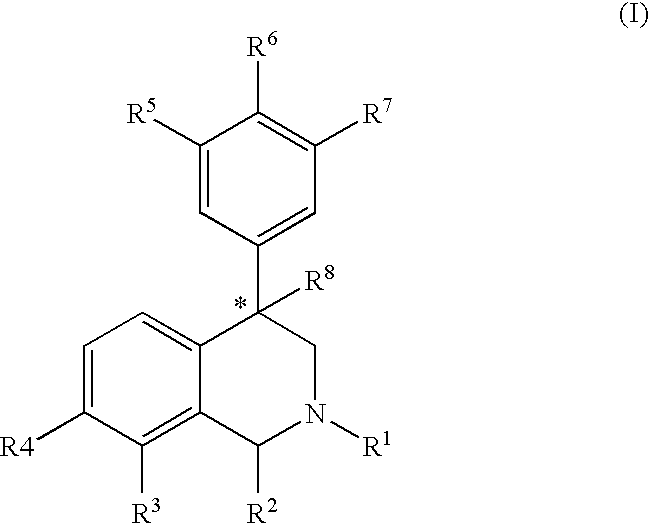
- wherein:
- the carbon atom designated * is in the R or S configuration;
- R 1 is C1-C6 alkyl, C2-C6 alkenyl, C2-C6 alkynyl, C3-C6 cycloalkyl or C4-C7 cycloalkylalkyl, each of which is optionally substituted with from 1 to 3 substituents independently selected at each occurrence thereof from C1-C3 alkyl, halogen, Ar, —CN, —OR9 and —NR9R10;
- R 2 is H, C1-C6 alkyl, C2-C6 alkenyl, C2-C6 alkynyl, C3-C6 cycloalkyl, C4-C7 cycloalkylalkyl or C1-C6 haloalkyl;
- R 3 is H, halogen, —OR11, —S(O)nR12, —CN, —C(O)R2, —C(O)NR11R12, C1-C6 alkyl, C2-C6 alkenyl, C2-C6 alkynyl, C3-C6 cycloalkyl or C4-C7 cycloalkylalkyl and wherein each of C1-C6 alkyl, C2-C6 alkenyl, C2-C6 alkynyl, C3-C6 cycloalkyl and C4-C7 is optionally substituted with from 1 to 3 substituents independently selected at each occurrence thereof from C1-C3 alkyl, halogen, —CN, —OR9, —NR9R10 and phenyl which is optionally substituted 1-3 times with halogen, cyano, C1-C4 alkyl, C1-C4 haloalkyl, or C1-C4 alkoxy, —CN, —OR9, or —NR9R10;
- R 4 is aryl selected from phenyl, naphthyl and indenyl, or heteroaryl selected from pyridyl, pyrimidinyl, triazinyl, triazolyl, furanyl, pyranyl, indazolyl, benzimidazolyl, quinolinyl, quinazolinyl, isoquinolinyl, thienyl, imidazolyl, thiazolyl, benzthiazolyl, purinyl, isothiazolyl, indolyl, pyrrolyl, oxazolyl, benzofuranyl, benzothienyl, benzthiazolyl, isoxazolyl, pyrazolyl, oxadiazolyl and thiadiazolyl, wherein the aryl or heteroaryl group is optionally substituted with from 1 to 4 R14 substituents;
- R 5 and R6 and R7 are each independently H or are selected from halogen, —OR11, —NR11R12, —NR11C(O)R12, —NR11C(O)2R12, —NR11C(O)NR12R13, —S(O)nR12, —CN, —C(O)R12, —C(O)NR11R12, C1-C6 alkyl, C2-C6 alkenyl, C2-C6 alkynyl, C3-C6 cycloalkyl or C4-C7 cycloalkylalkyl, and wherein each of C1-C6 alkyl, C2-C6 alkenyl, C2-C6 alkynyl, C3-C6 cycloalkyl and C4-C7 cycloalkylalkyl is optionally substituted with from 1 to 3 substituents independently selected at each occurrence thereof from C1-C3 alkyl, halogen, —CN, —OR9, —NR9R10 and phenyl which is optionally substituted 1-3 times with halogen, cyano, C1-C4 alkyl, C1-C4 haloalkyl, or C1-C4 alkoxy, —CN, —OR9, or —NR9R10; or R5 and R6 may be —O—C(R12)2—O—;
- R 8 is H, halogen or OR11;
- R 9 and R10 are each independently H, C1-C4 alkyl, C1-C4 haloalkyl, C1-C4 alkoxyalkyl, C3-C6 cycloalkyl, C4-C7 cycloalkylalkyl, —C(O)R13, phenyl or benzyl, where phenyl or benzyl is optionally substituted from 1 to 3 times with a substituent selected independently at each occurrence thereof from halogen, cyano, C1-C4 alkyl, C1-C4 haloalkyl and C1-C4 alkoxy;
- or R 9 and R10 are taken together with the nitrogen to which they are attached to form a piperidine, pyrrolidine, piperazine, N-methylpiperazine, morpholine or thiomorpholine ring;
- R 11 is H, C1-C4 alkyl, C1-C4 haloalkyl, C1-C4 alkoxyalkyl, C3-C6 cycloalkyl, C4-C7 cycloalkylalkyl, —C(O)R13, phenyl or benzyl, where phenyl or benzyl is optionally substituted 1 to 3 times with halogen, cyano, C1-C4 alkyl, C1-C4 haloalkyl, or C1-C4 alkoxy;
- R 12 is H, C1-C4 alkyl, C1-C4 haloalkyl, C1-C4 alkoxyalkyl, C3-C6 cycloalkyl, C4-C7 cycloalkylalkyl, phenyl or benzyl, where phenyl or benzyl is optionally substituted 1 to 3 times with halogen, cyano, C1-C4 alkyl, C1-C4 haloalkyl, or C1-C4 alkoxy;
- or R 11 and R12 are taken together with the nitrogen to which they are attached to form a piperidine, pyrrolidine, piperazine, N-methylpiperazine, morpholine or thiomorpholine ring, with the proviso that only one of R9 and R10 or R11 and R12 are taken together with the nitrogen to which they are attached to form a piperidine, pyrrolidine, piperazine, N-methylpiperazine, morpholine or thiomorpholine ring;
- R 13 is C1-C4 alkyl, C1-C4 haloalkyl or phenyl;
- n is 0, 1, or 2; and,
- R 14 is independently selected at each occurrence from a substituent selected from the group: halogen, —NO2, —OR11, —NR11R12, —NR11C(O)R12, —NR11C(O)2R12, —NR11C(O)NR12R13, —S(O)nR12, —CN, —C(O)R12, —C(O)NR11R12, C1-C6 alky, C2-C6 alkenyl, C2-C6 alkynyl, C3-C6 cycloalkyl, and C4-C7 cycloakylalkyl where C1-C6 alkyl, C2-C6 alkenyl, C2-C6 alkynyl, C3-C6 cycloalkyl, C4-C7 cycloalkylalkyl are optionally substituted with 1 to 3 substituents independently selected at each occurrence from the group consisting of C1-C3 alkyl, halogen, Ar, —CN, —OR9, and —NR9R10, or
- an oxide thereof, a pharmaceutically acceptable salt thereof, a solvate thereof, or prodrug thereof
- As used above, and throughout the description of the invention, the following terms, unless otherwise indicated, shall be understood to have the following meanings:
- The term “Alkyl” means an aliphatic hydrocarbon group that may be straight or branched having about 1 to about 6 carbon atoms in the chain. Branched means that one or more lower alkyl groups such as methyl, ethyl or propyl are attached to a linear alkyl chain. Exemplary alkyl groups include methyl, ethyl, n-propyl, i-propyl, n-butyl, t-butyl, n-pentyl, and 3-pentyl.
- The term “Alkenyl” means an aliphatic hydrocarbon group containing a carbon-carbon double bond and which may be straight or branched having about 2 to about 6 carbon atoms in the chain. Preferred alkenyl groups have 2 to about 4 carbon atoms in the chain. Branched means that one or more lower alkyl groups such as methyl, ethyl or propyl are attached to a linear alkenyl chain. Exemplary alkenyl groups include ethenyl, propenyl, n-butenyl, and butenyl.
- The term “Alkynyl” means an aliphatic hydrocarbon group containing a carbon-carbon triple bond and which may be straight or branched having about 2 to about 6 carbon atoms in the chain. Preferred alkynyl groups have 2 to about 4 carbon atoms in the chain. Branched means that one or more lower alkyl groups such as methyl, ethyl or propyl are attached to a linear alkynyl chain. Exemplary alkynyl groups include ethynyl, propynyl, n-butynyl, 2-butynyl, 3-methylbutynyl, and n-pentynyl.
- The term “Aryl” means an aromatic monocyclic or multicyclic ring system of 6 to about 14 carbon atoms, preferably of 6 to about 10 carbon atoms. Representative aryl groups include phenyl and naphthyl.
- The term “Heteroaryl” means an aromatic monocyclic or multicyclic ring system of about 5 to about 14 ring atoms, preferably about 5 to about 10 ring atoms, in which one or more of the atoms in the ring system is/are element(s) other than carbon, for example, nitrogen, oxygen or sulfur. Preferred heteroaryls contain about 5 to 6 ring atoms. The prefix aza, oxa or thia before heteroaryl means that at least a nitrogen, oxygen or sulfur atom, respectively, is present as a ring atom. A nitrogen atom of a heteroaryl is optionally oxidized to the corresponding N-oxide. Representative heteroaryls include pyrazinyl; furanyl; thienyl; pyridyl; pyrimidinyl; isoxazolyl; isothiazolyl; oxazolyl; thiazolyl; pyrazolyl; furazanyl; pyrrolyl; pyrazolyl; triazolyl; 1,2,4-thiadiazolyl; pyrazinyl; pyridazinyl; quinoxalinyl; phthalazinyl; 1(2H)-phthalazinonyl; imidazo[1,2-a]pyridine; imidazo[2,1-b]thiazolyl; benzofurazanyl; indolyl; azandolyl; benzimidazolyl; benzothienyl; quinolinyl; imidazolyl; thienopyridyl; quinazolinyl; thienopyrimidyl; pyrrolopyridyl; imidazopyridyl; isoquinolinyl; benzoazaindolyl; azabenzimidazolyl; 1,2,4-triazinyl; benzothiazolyl and the like.
- The term “Alkoxy” means an alkyl-O— group wherein the alkyl group is as herein described. Exemplary alkoxy groups include methoxy, ethoxy, n-propoxy, i-propoxy, n-butoxy and heptoxy.
- The term “Compounds of the invention”, and equivalent expressions, are meant to embrace compounds of general formula (1) as hereinbefore described, which expression includes the prodrugs, the pharmaceutically acceptable salts, and the solvates, e.g. hydrates, where the context so permits. Similarly, reference to intermediates, whether or not they themselves are claimed, is meant to embrace their salts, and solvates, where the context so permits. For the sake of clarity, particular instances when the context so permits are sometimes indicated in the text, but these instances are purely illustrative and it is not intended to exclude other instances when the context so permits.
- The term “Cycloalkyl” means a non-aromatic mono- or multicyclic ring system of about 3 to about 7 carbon atoms, preferably of about 5 to about 7 carbon atoms. Exemplary monocyclic cycloalkyl include cyclopentyl, cyclohexyl, cycloheptyl, and the like.
- The term “Cycloalkylalkyl” means an cycloalkyl-alkyl-group in which the cycloalkyl and alkyl are as defined herein. Exemplary cycloalkylalkyl groups include cyclopropylmethyl and cyclopentylmethyl.
- The term “Halo” or “halogen” means fluoro, chloro, bromo, or iodo.
- The term “Haloalkyl” means both branched and straight-chain alkyl substituted with 1 or more halogen, wherein the alkyl group is as herein described.
- The term “Haloalkoxy” means a C 1-C4, alkoxy group substituted by at least one halogen atom, wherein the alkoxy group is as herein described.
- The term “Substituted” or “substitution” of an atom means that one or more hydrogen on the designated atom is replaced with a selection from the indicated group, provided that the designated atom's normal valency is not exceeded. “Unsubstituted” atoms bear all of the hydrogen atoms dictated by their valency. When a substituent is keto (i.e., ═O), then 2 hydrogens on the atom are replaced. Combinations of substituents and/or variables are permissible only if such combinations result in stable compounds; by “stable compound” or “stable structure” is meant a compound that is sufficiently robust to survive isolation to a useful degree of purity from a reaction mixture, and formulation into an efficacious therapeutic agent.
- The term “Pharmaceutically acceptable salts” means the relatively non-toxic, inorganic and organic acid addition salts, and base addition salts, of compounds of the present invention. These salts can be prepared in situ during the final isolation and purification of the compounds. In particular, acid addition salts can be prepared by separately reacting the purified compound in its free base form with a suitable organic or inorganic acid and isolating the salt thus formed. Exemplary acid addition salts include the hydrobromide, hydrochloride, sulfate, bisulfate, phosphate, nitrate, acetate, oxalate, valerate, oleate, palmitate, stearate, laurate, borate, benzoate, lactate, phosphate, tosylate, citrate, maleate, fumarate, succinate, tartrate, naphthylate, mesylate, glucoheptonate, lactiobionate, sulphamates, malonates, sailcylates, proplonates, methylene-bis-b-hydroxynaphthoates, gentisates, isethionates, di-p-toluoyltartrates, methane-sulphonates, ethanesulphonates, benzenesulphonates, p-toluenesulphonates, cyclohexylsulphamates and quinateslaurylsulphonate salts, and the like. (See, for example S. M. Berge, et al., “Pharmaceutical Salts,” J. Pharm. Sci., 66: p. 1-19 (1977) and Remington's Pharmaceutical Sciences, 17 th ed., Mack Publishing Company, Easton, Pa., 1985, p. 1418, which are incorporated herein by reference.) Base addition salts can also be prepared by separately reacting the purified compound in its acid form with a suitable organic or inorganic base and isolating the salt thus formed. Base addition salts include pharmaceutically acceptable metal and amine salts. Suitable metal salts include the sodium, potassium, calcium, barium, zinc, magnesium, and aluminum salts. The sodium and potassium salts are preferred. Suitable inorganic base addition salts are prepared from metal bases that include sodium hydride, sodium hydroxide, potassium hydroxide, calcium hydroxide, aluminium hydroxide, lithium hydroxide, magnesium hydroxide, zinc hydroxide. Suitable amine base addition salts are prepared from amines which have sufficient basicity to form a stable salt, and preferably include those amines which are frequently used in medicinal chemistry because of their low toxicity and acceptability for medical use. ammonia, ethylenediamine, N-methyl-glucamine, lysine, arginine, ornithine, choline, N,N′-dibenzylethylenediamine, chloroprocaine, diethanolamine, procaine, N-benzylphenethylamine, diethylamine, piperazine, tris(hydroxymethyl)-aminomethane, tetramethyl ammonium hydroxide, triethylamine, dibenzylamine, ephenamine, dehydroabietylamine, N-ethylpiperidine, benzylamine, tetramethylammonium, tetraethylammonium, methylamine, dimethylamine, trimethylamine, ethylamine, basic amino acids, e.g., iysine and arginine, and dicyclohexylamine, and the like.
- The term “Pharmaceutically acceptable prodrugs” as used herein means those prodrugs of the compounds useful according to the present invention which are, within the scope of sound medical judgment, suitable for use in contact with the tissues of humans and lower animals with undue toxicity, irritation, allergic response, and the like, commensurate with a reasonable benefit/risk ratio, and effective for their intended use, as well as the zwitterionic forms, where possible, of the compounds of the invention. The term “prodrug” means compounds that are rapidly transformed in vivo to yield the parent compound of the above formula, for example, by hydrolysis in blood. Functional groups that may be rapidly transformed, by metabolic cleavage, in vivo form a class of groups reactive with the carboxyl group of the compounds of this invention. They include, but are not limited to such groups as alkanoyl (such as acetyl, propionyl, butyryl and the like), unsubstituted and substituted aroyl (such as benzoyl and substituted benzoyl), alkoxycarbonyl (such as ethoxycarbonyl). trialkylsilyl (such as trimethyl- and triethysilyl), monoesters formed with dicarboxylic acids (such as succinyl), and the like. Because of the ease with which the metabolically cleavable groups of the compounds useful according to this invention are cleaved in vivo, the compounds bearing such groups act as pro-drugs. The compounds bearing the metabolically cleavable groups have the advantage that they may exhibit improved bioavailability as a result of enhanced solubility and/or rate of absorption conferred upon the parent compound by virtue of the presence of the metabolically cleavable group. A thorough discussion of prodrugs is provided in the following: Design of Prodrugs, H. Bundgaard. ed., Elsevier, 1985; Methods in Enzymology, K. Widder et al, Ed., Academic Press, 421, p.309-396, 1985; A Textbook of Drug Design and Development, Krogsgaard-Larsen and H. Bundgaard. ed., Chapter 5; “Design and Applications of Prodrugs” p. 113-19 1, 1991; Advanced Drug Delivery Reviews, H. Bundgard, 8, p.1-38, 1992; Journal of Pharmaceutical Sciences, 77, p. 285, 1988; Chem. Pharm. Bull., N. Nakeya et al, 32, p. 692, 1984; Pro-drugs as Novel Delivery Systems, T. Higuchi and V. Stella, Vol. 14 of the A.C.S. Symposium Series, and Bioreversible Carriers in Drug Design, Edward B. Roche, ed., American Pharmaceutical Association and Pergamon Press, 1987, which are incorporated herein by reference. Examples of prodrugs include, but are not limited to, acetate, formate and benzoate derivatives of alcohol and amine functional groups in the compounds of the invention.
- An embodiment of the invention is the compound of formula (1) wherein:
- R 1 is C1-C6 alkyl;
- R 2 is H, C1-C6 alkyl or C1-C6 haloalkyl;
- R 3 is H, halogen, —OR11, —S(O)nR12—CN, —C(O)R12, C1-C6 alkyl, C3-C6 cycloalkyl or C4-C7 cycloalkylalkyl and wherein each of C1-C6 alkyl, C3-C6 cycloalkyl and C4-C7 cycloalkylalkyl is optionally substituted with from 1 to 3 substituents independently selected at each occurrence thereof from C1-C3 alkyl, halogen, —CN, —OR9, —NR9R10 and phenyl which is optionally substituted 1-3 times with halogen, cyano, C1-C4 alkyl, C1-C4 haloalkyl, or C1-C4 alkoxy, —CN, —OR9, or —NR9R10;
- R 4 is phenyl, pyridyl, pyrimidinyl, triazinyl, triazolyl, furanyl, pyranyl, indazolyl, benzimidazolyl, quinolinyl, quinazolinyl, isoquinolinyl, thienyl, imidazolyl, thiazolyl, benzthiazolyl, purinyl, isothiazolyl, indolyl, pyrrolyl, oxazolyl, benzofuranyl, benzothienyl, benzthiazolyl, isoxazolyl, and pyrazolyl, each of which is optionally substituted with from 1 to 4 R14;
- R 5 and R6 and R7 are each independently selected from the group: H, halogen, —OR11, —NR11R12, —NR11C(O)R2, —S(O)nR12, —CN, —C(O)R12, —C(O)NR11R12, C1-C6 alkyl, C3-C6 cycloalkyl or C4-C7 cycloalkylalkyl, and wherein each of C1-C6 alkyl, C3-C6 cycloalkyl and C4-C7 cycloalkylalkyl is optionally substituted with from 1 to 3 substituents independently selected at each occurrence thereof from C1-C3 alkyl, halogen, —CN, —OR9, —NR9R10 and phenyl which is optionally substituted 1-3 times with halogen, cyano, C1-C4 alkyl, C1-C4 haloalkyl, or C1-C4 alkoxy, —CN, —OR9, or —NR9R10; or R5 and R6 may be —O—C(R12)2—O—; and
- R 14 as being independently selected at each occurrence thereof from the group: halogen, —NO2, —OR11, —NR11R12, —S(O)nR12, —CN, —C(O)R12, C1-C6 alkyl, C3-C6 cycloalkyl, and C4-C7 cycloalkylalk-yl where C1-C6 alkyl, C3-C6 cycloalkyl, C4-C7 cycloalkylalkyl are optionally substituted with 1 to 3 substituents independently selected at each occurrence thereof from C1-C3 alkyl, halogen, Ar, —CN, —OR9, or —NR9R10.
- Another embodiment of the invention is the compound of formula (1) wherein:
- R 1 is methyl, ethyl, propyl or isopropyl;
- R 2 is H, C1-C6 alkyl or C1-C6 haloalkyl;
- R 3 is H, halogen, —OR11, —S(O)2R12, C1-C6 alkyl wherein C1-C6 alkyl is optionally substituted with 1 to 3 substituents independently selected at each occurrence thereof from C1-C3 alkyl, halogen, Ar, —CN, —OR9, or —NR9R10;
- R 4 is pyridyl, pyrimidinyl, triazinyl, triazolyl, furanyl, pyranyl, indazolyl, thienyl, imidazolyl, thiazolyl, puninyl, isothiazolyl, indolyl, pyrrolyl, oxazolyl, isoxazolyl, or pyrazolyl, each of which is optionally substituted with from 1 to 4 R14; and
- R 5, R6 and R7 are each independently selected from the group: H, halogen, —OR11, —S(O)2R12, —NR11R12, —C(O)R12, and C1-C6 wherein C1-C6 alkyl is optionally substituted with 1 to 3 substituents independently selected at each occurrence thereof from C1-C3 alkyl, halogen, Ar, —CN, —OR9, or —NR9R0.
- Another embodiment of the invention is the compound of formula (1) wherein:
- R 1 is CH3;
- R 2 and R3 are each H;
- R 5 and R6 are each independently H, F Cl, OH, OCH3 or CH3—;
- R 7 is H or F; and
- R 8 is H, OH, or F.
- Another embodiment of the invention is the compound of formula (1) wherein:
- R 1 is C1-C6 alkyl, more preferably methyl.
- Another embodiment of the invention is the compound of formula (1) wherein:
- R 2 is H, C1-C6 alkyl or C1-C6 haloalkyl, and wherein R2 is H or C1-C6 alkyl.
- Another embodiment of the invention is the compound of formula (1) wherein R 3 is H, halogen, —OR11, —S(O)2R12, C1-C6 alkyl or substituted C1-C6 alkyl.
- Another embodiment of the invention is the compound of formula (1) wherein:
- R 4 is optionally substituted aryl, or heteroaryl.
- Yet another embodiment of the invention is the compound of formula (1) wherein:
- R 4 is pyridyl, pyrimidinyl, triazinyl, triazolyl, furanyl, pyranyl, indazolyl, benzimidazolyl, quinolinyl, quinazolinyl, isoquinolinyl, thienyl, imidazolyl, thiazolyl, benzthiazolyl, purinyl, isothiazolyl, indolyl, pyrrolyl, oxazolyl, benzofuranyl, benzothienyl, benzthiazolyl, isoxazolyl, pyrazolyl, oxadiazolyl, thiadiazolyl, phenyl, 2-chlorophenyl, 3-chlorophenyl, 4-chlorophenyl, 2 methoxyphenyl, 3-methoxyphenyl, 4-methoxyphenyl or 4-dimethylaminophenyl, which is optionally substituted 1-4 times with R14.
- Yet another embodiment of the invention is the compound of formula (1) wherein:
- R 4 is selected from the group: 4-methyl-2-furanyl, 5-methyl-2-furanyl, 3-furanyl, 2-thienyl, 3-thienyl, 3,5-dimethyl-4-isoxazolyl, 2-pyridyl, 3-pyridyl, 4-pyridyl, 2-methoxy-3pyridyl, 6-methoxy-3-pyridyl, 3,5-pyrimidinyl and 2,6-pyrimidinyl.
- Another embodiment of the invention is the compound of formula (1) wherein:
- R 5, R6 and R7 are each independently selected from the group: H, halogen, —OR11, —NR11R12, —S(O)2R12, —C(O)R12, and optionally substituted C1-C6 alkyl.
- Another embodiment of the invention is the compound of formula (1) wherein:
- R 7 is H.
- Another embodiment of the invention is the compound of formula (1) wherein:
- R 5 and R6 are each independently selected from the group: H, F, Cl, OH, OCH3 and CH3—.
- Another embodiment of the invention is the compound of formula (1) wherein R 8 is H, OH, or F.
- Another embodiment of the invention is the compound of formula (1) wherein:
- R 1 is C1-C6 alkyl;
- R 2 is H, C1-C6 alkyl or C1-C6 haloalkyl;
- R 3 is H, halogen, —OR11, —S(O)2R12, C1-C6 alkyl or substituted C1-C6 alkyl;
- R 4 is aryl or heteroaryl; and
- R 5, R6 and R7 are each independently H, halogen, —OR11, —NR11R12, —S(O)2R12, C(O)R12, C1-C6 alkyl or substituted C1-C6 alkyl.
- Another embodiment of the invention is the compound of formula (1) wherein:
- R 1 is methyl;
- R 2 is H;
- R 3 is H;
- R 5 and R6 are each independently H, F, Cl, OH, OMe, or Me;
- R 7 is H or F;
- R 8 is H, OH, or F; and
- R 4 is phenyl, pyridyl, pyrimidinyl, triazinyl, triazolyl, furanyl, pyranyl, indazolyl, thienyl, imidazolyl, thiazolyl, purinyl, isothiazolyl, indolyl, pyrrolyl, oxazolyl, isoxazolyl, or pyrazolyl, each of which is optionally and independently substituted from 1-4 times with R14.
- Yet another embodiment of the invention is the compound of formula (1) wherein:
- R 1 is methyl;
- R 2 is H;
- R 3 is H;
- R 5 and R6 are each H, F or CH3;
- R 7 is H;
- R 8 is H; and
- R 4 is phenyl, 2-chlorophenyl, 3-chlorophenyl, 4-chlorophenyl, 2-methoxyphenyl, 3-methoxyphenyl, 4-methoxyphenyl, 4-dimethylaminophenyl, 4-methyl-2-furanyl, 5-methyl-2-furanyl and 3-furanyl, 2-thienyl and 3-thienyl, isoxazolyl which is 3,5-dimethyl-4-isoxazolyl, 2-pyridyl, 3-pyridyl, 4-pyridyl, 2-methoxy-3-pyridyl and 6-methoxy-3-pyridyl or 3,5-pyrimidinyl or 2,6-pyrimidinyl.
- Another embodiment of the invention is the compound of formula (1) wherein the carbon atom designated * is in the R configuration.
- Another embodiment of the invention is the compound of formula (1) wherein the carbon atom designated * is in the S configuration.
- Another embodiment of the invention is a mixture of stereoisomeric compounds of formula (1) wherein * is in the S or R configuration.
- Within these embodiments, the selection of a particular substituent at any one of R 1-R8 does not affect the selection of a substituent at any of the others of R1-R8. That is, compounds provided herein have any of the substituents at any of the positions. For example, as described hereinabove, R1 is can be C1-C6 alkyl; the selection of R1 as any one of C1, C2, C3, C4, C5 or C6 alkyl, does not limit the choice of R2 in particular to any one of H, C1-C6 alkyl or C1-C6 haloalkyl. Rather, for R1 as any of C1, C2, C3, C4, C5 or C6 alkyl, R2 is any of C1, C2, C3, C4, C5 or C6 alkyl or C1, C2, C3, C4, C5 or C6 haloalkyl. Similarly, the selection of R2 as any of C1, C2, C3, C4, C5 or C6 alkyl or C1, C2, C3, C4, C5 or C6 haloalkyl does not limit the selection of R3 in particular to any one of H, halogen, —OR11, —S(O)nR12, —CN, —C(O)R12, C1-C6 alkyl, C3-C6 cycloalkyl, C4-C7 cycloalkylalkyl or 5 substituted C4-C7 cycloalkylalkyl.
- Other compounds of the invention are those with the following substituents:
TABLE A (I) 
R1 R2 R3 R4 R5 R6 R7 R8 Me H H phenyl H H H H Me H H 2-chlorophenyl H H H H Me H H 3-chlorophenyl H H H H Me H H 4-chlorophenyl H H H H Me H H 2-methoxyphenyl H H H H Me H H 3-methoxyphenyl H H H H Me H H 4-methoxyphenyl H H H H Me H H 4-dimethylaminophenyl H H H H Me H H 4-methyl-2-faranyl H H H H Me H H 5-methyl-2-furanyl H H H H Me H H 3-furanyl H H H H Me H H 2-thienyl H H H H Me H H 3-thienyl H H H H Me H H 3,5-dimethyl-4-isoxazole H H H H Me H H 2-pyridyl H H H H Me H H 3-pyridyl H H H H Me H H 4-pyridyl H H H H Me H H 3-pyridyl F F H H Me H H 2-methoxy-3-pyridyl H H H H Me H H 6-methoxy-3-pyridyl H H H H Me H H 3,5-pyrimidinyl H H H H Me H H 3,5-pyrimidinyl F F H H Me H H 3,5-pyrimidinyl H Me H H Me H H 2,6-pyrimidinyl H H H H Me H H 3,5-dimethyl-4-isoxazole H OMe H H Me H H 2-pyridyl H Ome H H - That is, the specific compounds provided herein include:
- 4,7-diphenyl-2-methyl-1,2,3,4-tetrahydroisoquinoline;
- 7-(2-chloro)phenyl-2-methyl-4-phenyl-1,2,3,4-tetrahydroisoquinoline;
- 7-(3-chloro)phenyl-2-methyl-4-phenyl-1,2,3,4-tetrahydroisoquinoline;
- 7-(4-chloro)phenyl-2-methyl-4-phenyl-1,2,3,4-tetrahydroilsoquinoline;
- 7-(2-methoxy)phenyl-2-methyl-4-phenyl-1,2,3,4-tetrahydroisoquinoline;
- 7-(3-methoxy)phenyl-2-methyl-4-phenyl-1,2,3,4-tetrahydroisoquinoline;
- 7-(4-methoxy)phenyl-2-methyl-4-phenyl-1,2,3,4-tetrahydroisoquinoline;
- 7-(4-N,N-dimethylamino)phenyl-2-methyl-4-phenyl-1,2,3,4-tetrahydroisoquinoline;
- 7-[(4-methyl)-2-thienyl-2-methyl-4-phenyl-1,2,3,4-tetrahydroisoquinoline;
- 7-[(5-methyl)-2-furanyl-2-methyl-4-phenyl-1,2,3,4-tetrahydroilsoquinoline;
- 7-(3-furanyl)-2-methyl-4-phenyl-1,2,3,4-tetrahydroisoquinoline;
- 2-methyl-4-phenyl-7-(2-thienyl)-1,2,3,4-tetrahydroisoquinoline;
- 2-methyl-4-phenyl-7-(3-thienyl)-1,2,3,4-tetrahydroisoquinoline;
- 7-[(3,5-dimethyl)-4-isoxazole]-2-methyl-4-phenyl-1,2,3,4-tetrahydroisoquinoline;
- 2-methyl-4-phenyl-7-(2-pyridyl)-1,2,3,4-tetrahydroisoquinoline;
- 2-methyl-4-phenyl-7-(3-pyridyl)-1,2,3,4-tetrahydroisoquinoline;
- 2-methyl-4-phenyl-7-(4-pyridyl)-1,2,3,4-tetrahydroisoquinoline;
- 4-(3,4-difluoro)phenyl-2-methyl-7-(3-pyridyl)-1,2,3,4-tetrahydroisoquinoline;
- 7-[(2-methoxy)-3-pyridyl-2-methyl-4-phenyl-1,2,3,4-tetrahydroisoquinoline;
- 7-[(6-methoxy)-3-pyridyl-2-methyl-4-phenyl-1,2,3,4-tetrahydroisoquinoline;
- 2-methyl-4-phenyl-7-(3,5-pyrimidyl)-1,2,3,4-tetrahydrolsoquinoline;
- 4-(3,4-difluoro)phenyl-2-methyl-7-(3,5-pyrimidyl)-1,2,3,4-tetrahydrolsoquinoline;
- 4-(4-methyl)phenyl-2-methyl-7-(3,5-pyrimidyl)-1,2,3,4-tetrahydroisoquinoline;
- 2-methyl-4-phenyl-7-(2,6-pyrimidyl)-1,2,3,4-tetrahydroisoquinoline;
- 7-(2,5-dimethyl-4-isoxazole)-4-(4-methoxy)phenyl-2-methyl-1,2,3,4-tetrahydroisoquinoline; and
- 4-(4-methoxy)phenyl-2-methyl-7-(2-pyridyl)-1,2,3,4-tetrahydroisoquinoline or an oxide thereof, a pharmaceutically acceptable salt thereof, a solvate thereof, or a prodrug thereof.
- Another aspect of the invention is a mixture of compounds of formula (1) wherein the compound of formula (1) is radiolabeled, i.e., wherein one or more of the atoms described are replaced by a radioactive isotope of that atom (e.g., C replaced by “C and H 3 replaced by H). Such compounds have a variety of potential uses, e.g., as standards and reagents in determining the ability of a potential pharmaceutical to bind to neurotransmitter proteins.
- “Therapeutically effective amounts” are any amounts of the compounds effective to ameliorate, lessen, inhibit or prevent the particular condition for which a subject is being treated. Such amounts generally vary according to a number of factors well within the purview of ordinarily skilled artisans given the description provided herein to determine and account for. These include, without limitation: the particular subject, as well as its age, weight, height, general physical condition and medical history; the particular compound used, as well as the carrier in which it is formulated and the route of administration selected for it; and, the nature and severity of the condition being treated. Therapeutically effective amounts include optimal and suboptimal doses, and can be determined in a variety of ways known to ordinarily skilled artisans, e.g., by administering various amounts of a particular agent to an animal afflicted with a particular condition and then determining the relative therapeutic benefit received by the animal. The amounts generally range from about 0.001 mg per kg of the body weight of the subject being treated to about 1000 mg per kg, and more typically, from about 0.1 to about 200 mg per kg. These amounts can be administered according to any dosing regimen acceptable to ordinarily skilled artisans supervising the treatment. More specific doses are mentioned below in relationship to the treatment of particular disorders that are the subject of this invention.
- “Pharmaceutically acceptable carriers”, are media generally accepted in the art for the administration of therapeutic compounds to humans. Such carriers are generally formulated according to a number of factors well within the purview of those of ordinary skill in the art to determine and account for. These include, without limitation: the type and nature of the active agent being formulated; the subject to which the agent-containing composition is to be administered; the intended route of administration of the composition; and, the therapeutic indication being targeted. Pharmaceutically acceptable carriers include both aqueous and non-aqueous liquid media, as well as a variety of solid and semi-solid dosage forms. Such carriers can include a number of different ingredients and additives in addition to the active agent, such additional ingredients being included in the formulation for a variety of reasons, e.g., stabilization of the active agent, well known to those of ordinary skill in the art. Descriptions of suitable pharmaceutically acceptable carriers, and factors involved in their selection, are found in a variety of readily available sources, e.g., Remington's Pharmaceutical Sciences, 17 th ed., Mack Publishing Company, Easton, Pa., 1985, the contents of which are incorporated herein by reference.
- Compounds of this invention are administered, for example, parenterally in various aqueous media such as aqueous dextrose and saline solutions; glycol solutions are also useful carriers. Solutions for parenteral administration preferably contain a water soluble salt of the active ingredient, suitable stabilizing agents, and if necessary, buffer substances. Antioxidizing agents, such as sodium bisulfite, sodium sulfite, or ascorbic acid, either alone or in combination, are suitable stabilizing agents. Also used are citric acid and its salts, and EDTA. In addition, parenteral solutions can contain preservatives such as benzalkonium chloride, methyl- or propylparaben, and chlorobutanol.
- Alternatively, the compounds are administered orally in solid dosage forms, such as capsules, tablets and powders; or in liquid forms such as elixirs, syrups, and/or suspensions. Gelatin capsules can be used to contain the active ingredient and a suitable carrier such as but not limited to lactose, starch, magnesium stearate, steric acid, or cellulose derivatives. Similar diluents can be used to make compressed tablets. Both tablets and capsules can be manufactured as sustained release products, to provide for continuous release of medication over a period of time. Compressed tablets can be sugar-coated or film-coated to mask any unpleasant taste, or used to protect the active ingredients from the atmosphere, or to allow selective disintegration of the tablet in the gastrointestinal tract.
- Compounds of this invention provide a particularly beneficial therapeutic index relative to other compounds available for the treatment of similar disorders. Without intending to be limited by theory, it is believed that this is due, at least in part, to the compounds, ability to be selective for the norepinephrine transporter protein (NET) over the other neurotransmitter transporters. Binding affinities are demonstrated by a number of means well known to ordinarily skilled artisans.
- Briefly, for example, protein-containing extracts from cells, e.g., HEK293 cells, expressing the transporter proteins are incubated with radiolabeled ligands for the proteins. The binding of the radioligands to the proteins is reversible in the presence of other protein ligands, e.g., the compounds of this invention; said reversibility, as described below, provides a means of measuring the compounds' binding affinities for the proteins (Ki). A higher Ki value f or a compound is indicative that the compound has less binding affinity for a protein than is so for a compound with a lower Ki; conversely, lower Ki values are indicative of greater binding affinities.
- Accordingly, a lower Ki for the protein for which the compound is more selective, and a higher Ki for the protein for which the compound is less selective indicate the difference in compound selectivity for proteins. Thus, the higher the ratio in Ki values of a compound for protein A over protein B, the greater is the compounds' selectivity for the latter over the former (the former having a higher Ki and the latter a lower Ki for that compound). Compounds provided herein induce f ewer side effects during therapeutic usage because of their selectivity for the norepinephrine transporter protein, as indicated by the ratios of their Ki's for binding to NET over those for binding to other transporter proteins, e.g., the dopamine transporter (DAT) and the serotonin transporter (SERT). Generally, the compounds of this invention have a Ki ratio for DAT/NET of about ≧2:1; the compounds generally also have a SERT/NET ratio of about ≧5:1.
- Moreover, in vivo assessment of the activity of compounds at the NE and DA transporters is, for example, by determining their ability to prevent the sedative effects of tetrabenazine (TBZ) (see, e.g., G. Stille, Arzn. Forsch. 1964, 14, 534-537; the contents of which are incorporated herein by reference). Randomized and coded doses of test compounds are administered to mice, as is then a dose of tetrabenazine. Animals are then evaluated for antagonism of tetrabenazine-induced exploratory loss and ptosis at specified time intervals after drug administration. Exploratory activity is, for example, evaluated by placing the animal in the center of a circle and then evaluating the amount of time it takes for the animal to intersect the circle's perimeter—generally, the longer it takes for the animal to make this intersection, the greater is its loss of exploratory activity. Furthermore, an animal is considered to have ptosis if its eyelids are at least 50% closed. Greater than 95% of the control (vehicle-treated) mice are expected to exhibit exploratory loss and ptosis; compound-related activity is then calculated as the percentage of mice failing to respond to the tetrabenazine challenge dose, with therapeutically more effective compounds expected to be better at reducing loss of exploratory behavior and ptosis.
- Accordingly, the pharmaceutical compositions provided herein are useful in the treatment of subjects afflicted with various neurological and psychiatric disorders by administering to said subjects a dose of a pharmaceutical composition provided herein. Said disorders include, without limitation, chronic and neuropathic pain, migraine therapy and prevention, and urge, stress and mixed urinary incontinence. The compounds provided herein, are particularly useful in the treatment of these and other disorders due, at least in part, to their ability to selectively bind to the transporter proteins for certain neurochemicals with a greater affinity than to the transporter proteins for other neurochemicals.
- The compounds of the present invention can be prepared using the methods described in International Application WO 01/32625, together with methods known in the art of synthetic organic chemistry, or variations thereof as appreciated by those skilled in the art.
- In order to evaluate the relative affinity of the various compounds at the NE, DA and 5HT transporters, HEK293E cell lines can be developed to express each of the three human transporters. cDNAs containing the complete coding regions of each transporter can be amplified by PCR from human brain libraries. The cDNAs contained in pCRII vectors can be sequenced to verify their identity and then subcloned into an Epstein Barr virus based expression plasmid (E. Shen, G M Cooke, R A Horlick, Gene 156:235-239, 1995). This plasmid containing the coding sequence for one of the human transporters can be transfected into HEK293E cells. Successful transfection can be verified by the ability of known reuptake blockers to inhibit the uptake of tritiated NE, DA or 5HT.
- For binding, cells can be homogenized, centrifuged and then resuspended in incubation buffer (50 mM Tris, 120 mM NaCl, 5 mM KCl, pH 7.4). Then the appropriate radioligand can be added. For NET binding, [ 3H] Nisoxetine (86.0 Ci/mmol, NEN/DuPont) can be added to a final concentration of approximately 5 nM. For DAT binding, [3H] WIN 35,428 (84.5 Ci/mmol) at 15 nM was added. For 5HTT binding, [3H] Citolapram (85.0 Ci/mmol) at 1 nM was added. Then various concentrations (10---5 to IOA-11 M) of the compound of interest can be added to displace the radioligand. Incubation can be carried out at room temperature for 1 hour in a 96 well plate. Following incubation, the plates can be placed on a harvester and washed quickly 4 times with (50 mM tris, 0.9% NaCl, pH 7.4) where the cell membranes containing the bound radioactive label can be trapped on Whatman GF/B filters. Scintillation cocktail can be added to the filters which were then counted in a Packard TopCount. Binding affinities of the compounds of interest can be determined by non-linear curve regression using GraphPad Prism 2.01 software. Non-specific binding can be determined by displacement with 10 micromolar mazindol.
- In order to assess in vivo activity of the compounds at the NE and DA transporters, their ability to prevent the sedative effects of tetrabenazine (TBZ) can be determined (G. Stille, Arzn. Forsch 14:534-537, 1964). Male CFI mice (Charles River Breeding Laboratories) weighing 18-25 gm at the time of testing, can be housed a minimum of 6 days under carefully controlled environmental conditions (22.2+1.1 C; 50% average humidity; 12 hr lighting cycle/24 hr). Mice can be fasted overnight (16-22 hr) prior to testing. Mice can be placed into clear polycarbonated “shoe” boxes (17 cm×28.5 cm×12 cm).
- Randomized and coded doses of test compounds can be administered p.o. A 45 mg/kg dose of tetrabenazine can be administered i.p. 30 minutes prior to score time. All compounds can be administered in a volume of 0.1 ml/10 gm body weight. Animals can be evaluated for antagonism of tetrabenazine induced exploratory loss and ptosis at specified time intervals after drug administration. At the designated time interval, mice are examined for signs of exploratory activity and ptosis. Exploratory activity can be evaluated by placing the animal in the center of a 5-inch circle. Fifteen seconds can be allowed for the animal to move and intersect the perimeter. This can be considered antagonism of tetrabenazine and given a score of 0. Failure to leave the circle can be regarded as exploratory loss and given a score of 4. An animal can be considered to have ptosis if its eyelids are at least 50% closed and can be given a score of 4 if completely closed; no closure can be given a score of 0. Greater than 95% of the control (vehicle-treated) mice can be expected to exhibit exploratory loss and ptosis. Drug activity can be calculated as the percentage of mice failing to respond to the tetrabenazine challenge dose.
- Median effective doses (ED50s) and 95% confidence limits 30 can be determined numerically by the methods of Thompson (1947) and Litchfield and Wilcoxon (1949).
- Chronic painful conditions, in various forms, affect a considerable number of people including, according to the WHO, 4 million cancer sufferers who, worldwide, suffer as a result of a lack of suitable care. There are a number of other conditions, such as musculoskeletal or vertebral pain, neurological pain, headaches or vascular pain. Neurophathic pain, a chronic pain condition occurring in the setting of nervous system injury or tissue injury, is characterized by unusual sensory experiences (allodynia, hyperalgesia) and abnormal pain processing in the central and peripheral nervous systems; treatment of neuropathic pain is difficult. Painful diabetic neuropathy is one of the most frequent complications of diabetes in humans, post-herpetic neuralgia develops in 10-30% of patients after herpes zoster, phantom limb and stump pain is a common sequela of amputation. Chronic pain may also be caused by a trauma, an entrapment neuropathy (e.g. carpal tunnel syndrome), multiple sclerosis or a polyneurophathy associated with AIDS, alcoholism, hypothyroidism, or anticancer chemotherapy.
- Conventional treatments of pain fall into two categories: 1) nonsteroidal anti-inflammatory drugs (NSAIDs), used to treat mild pain, but whose therapeutic use is limited by GI adverse effects; and 2) morphine and related opiods, used to treat moderate to severe pain but whose therapeutic use is limited by undesirable side effects including respiratory depression, tolerance, and abuse potential. However, conventional analgesics, whether opiates or NSAIDs, have limited therapeutic value in the management of chronic pain syndromes. This has led to the use of adjuvant analgesics for the management of these conditions. For example, tricyclic antidepressant are currently the first choice in the treatment of painful diabetic neuropathy. However, few agents are fully effective in all patients and undesirable side effects are common.
- For use in the treatment of chronic pain or neuropathic pain the compounds of formula IA, IB, IIA, IIB, IIIA, and IIIB may be administered orally or parenterally in an amount sufficient to alleviate the symptoms of chronic pain or neuropathic pain. The actual amount of a compound of formula I to be used will vary with the severity and nature of the state of chronic or neuropathic pain, the animal being treated and the level of relief sought. In the human, an oral dose of from about 2 to about 50 milligrams, administered as needed represents appropriate posology. Intramuscular administration of from about 1 to about 25 milligrams provides a dosage comparable to that specified for oral administration.
- As used herein the term “chronic pain” means pain selected from causalgia, neuropathic pain, diabetic neuropathy, post-surgery or traumatic neuropathy, postherpetic neuralgia, peripheral neuropathy, entrapment neuropathy, phantom limb and stump pain, neuropathy caused by alcohol abuse, HIV infection, multiple sclerosis hypothyroidism, lower back pain, cancer pain and pain from anticancer chemotherapy. Applicant particularly prefers the use of the compounds of formula IA, IB, IIA, IIB, IIIA, and IIIB for the treatment of neuropathic pain.
- The “term chronic pain relieving amount” represents an amount of a compound of formula IA, IB, IIA, IIB, IIIA, and IIIB which is capable of relieving or reducing chronic pain in a mammal in need thereof. The pain of migraine is associated with excessive dilatation of the cranial vasculature and known treatments for migraine include the administration of compounds having vasoconstrictor properties such as ergotamine. However, ergotamine is a non-selective vasoconstrictor that constricts blood vessels throughout the body and has undesirable and potentially dangerous side effects. Migraine may also be treated by administering an analgesic, usually in combination with an antiemetic, but such treatments are of limited value.
- There is thus a need for a safe and effective drug for the treatment of migraine, which can be used either prophylactically or to alleviate an established headache, and a compound having a selective vasoconstrictor activity would fulfill such a role.
- Furthermore, in conditions such as migraine, where the drug will usually be administered by the patient, it is highly desirable that the drug can be taken orally. It should therefore possess good bioavailability and be effectively absorbed from the gastro-intestinal tract so that prompt relief of symptoms can occur. The drug should also be safe (i.e., free from toxic effects) when administered by the oral route.
- It is generally believed that the pain of migraine is of vascular origin and caused by excessive dilation of branches of the common carotid arterial bed. (J. W. Lance, Mechanisms and Management of Migraine, Butterworths, p 113-152 (1973). The role of norepinephrine reuptake in the management of migraine headache pain is discussed in J. R. Couch, et al., Amitriptyline in the prophylaxis of migraine, Neurology 1976:26:121-127 and S. Diamond, et al., Chronic tension headache treated with amitruptyline: a double blind study, Headache 1971; 11:110-116.
- A proposed dose of the compounds of the invention for oral administration to man (about 70 kg bodyweight) for the treatment of migraine is 0.1 mg to 100 mg, for example 0.5 mg to 50 mg, preferably 2 mg to 40 mg, of the active ingredient per dose which could be administered up to 4 times per day, more usually 1 to 2 times per day. It will be appreciated that it may be necessary to make routine variations to the dosage depending on the age and weight of the patient, as well as the severity of the condition to be treated. It should be understood that unless otherwise indicated, the dosages are referred to in terms of the weight of compound (I) as the free base.
- According to a further aspect, the invention provides a method of treatment of a human subject suffering from or susceptible to pain resulting from dilatation of the cranial vasculature, such as migraine or cluster headache, by administration of a compound of formula (I) or a physiologically acceptable salt or solvate thereof. The method of treatment preferably comprises oral administration of a compound of the invention.
- Urinary incontinence is generally defined as the involuntary loss of urine and is most common in four groups of patients including children, women, elderly, and neurologic disease patients. Detrusor instability is characterized by spasmodic bladder contractions or bladder contractions elicited by small volumes, and is often accompanied by incontinence and urinary frequency. Interstitial cystitis is an idiopathic pelvic pain syndrome that can also include detrusor instability as a component of its pathology.
- Nocturnal enuresis is classified as an involuntary micturition during sleep after 5 years of age and may exist in either primary or secondary forms. The diagnosis of primary nocturnal enuresis is made if the patient has never developed voluntary control of micturition during sleep. The diagnosis of secondary nocturnal enuresis is made if the patient has had transient periods of micturition control during sleep. Nocturnal enuresis occurs in 30% of all children at 4 years of age, 10% at 6 years, 3% at 10 years and 1% at 18 years. Secondary nocturnal enuresis accounts for approximately 20-25% of the pediatric enurenic cases. Although some enuretic children also have diurnal enuresis, over 80% of the enuretic children have exclusively nocturnal enuresis.
- The predominant types of incontinence in women are stress and urge incontinence. Stress incontinence is the involuntary loss of urine through an intact urethra produced during times of increased abdominal pressure such as during physical activity and coughing. This implies that the urethra cannot generate sufficient pressure for outlet resistance to compensate for increases in intrabladder pressure. This loss of urine is not accompanied by premonitory sensations of the need to void and is not related to the fullness of the bladder. Urge incontinence is the involuntary loss of urine through an intact urethra due to an increased intrabladder pressure. In contrast to stress incontinence, urge incontinence is caused by an episodic bladder contraction (detrusor instability) which exceeds the outlet resistance pressure generated by the urethra and is accompanied by a perception of urgency to void.
- Stress incontinence is the most common form of incontinence in young women. In two longitudinal studies, pure stress incontinence was found to occur in 15-22% of women from ages 17-75+. The highest incidence of stress incontinence (25-30%) occurs at 25-45 years of age or during the childbearing years. Following the first childbirth, the overall incidence and incidence of severe stress incontinence doubles. However, 35-50% of nulliparous women have also occasional stress incontinence. In a study of nulliparous nursing students between the ages of 17-24 years, daily stress incontinence was reported in 17% of the women. Urge incontinence occurs in approximately 10% of women from ages 17-75+ years and increases progressively with age. In addition to stress or urge incontinence, 7-14% of women from ages 17-75+ years of age have characteristics of both urge and stress incontinence. The incidence of this “complex incontinence” doubles during the childbearing years and ranges from 13-28% from ages 17 to 75+ years of age.
- The types of incontinence seen in the elderly include urge incontinence (detrusor instability), stress incontinence, complex incontinence (urge and stress incontinence) and total incontinence. Urge incontinence is the most common form of incontinence in the elderly men and women and is caused by abnormal neuromuscular responses of the bladder. Following urge incontinence in incidence are complex, stress, overflow and total incontinence, respectively. Stress incontinence is relatively rare in elderly men but common in women. Stress incontinence is caused by pelvic surgery, anatomical changes in the orientation of the bladder and urethra, decreased tone of the pelvic muscles, deterioration of the urethra following the cessation of estrogen secretion, and idiopathic decrease in the neuromuscular response of tile urethra. Overflow incontinence is due to an overfilling and distension of an areflexic bladder that exceeds the urethral resistance. Total incontinence is associated with dementia and sphincter or nerve damage.
- In addition to the types of incontinence described above, urge incontinence is also associated with neurologic disorders such as multiple sclerosis, Alzheimer's disease and Parkinson's disease. This urge incontinence caused by neurologic disorders result from bladder hyperactivity. The incidence of incontinence in multiple sclerosis patients has been estimated to be 60-90%. Urinary incontinence is among the early neurologic symptoms of Parkinson's disease patients and is frequently exacerbated by treatment with anti-Parkinson drugs.
- Interstitial cystitis is a syndrome that is characterized by increases in urination frequency, urgency, suprapubic pressure and pain with bladder filling. This syndrome is not associated with infections or cytological damage. The average age at onset of this disorder is 40-50 years. The quality of life is considered to be worse than that of end stage renal disease. According to the NIH report on interstitial cystitis, there are 20,000 to 90,000 diagnosed cases of this disorder in United States and the upper boundary for undiagnosed cases is 4-5 times larger than the range of diagnosed cases. This disorder has increased in awareness in the urologic community due to the formation of the American Interstitial Cystitis Association.
- The treatments for incontinence vary with the particular type. For example, with no therapy, the spontaneous cure rate for nocturnal enuresis is approximately 15% per year. The success rate for nonpharmacologic therapies such as motivational counseling, bladder exercises and enuresis alarms ranges from 25-70%. The tricyclic antidepressants have been the most effective pharmacologic agents for treating nocturnal enuresis. Imipramine is the most widely used agent; however other tricyclics such as nortriptyline, amitriptyline, and desipramine are also effective. Enuresis can be cured in over 50% of patients following treatment with imipramine and improvements can be seen in another 15-20%. A successful response to this therapy is usually seen in the first week of therapy and often after the first dose. The best results are seen in children with normal sized bladders who are occasionally continent at night. The worst results are seen in children with small bladders and in older adolescents. This therapy, however, does have toxic risks. The tricyclic anti-depressants in general, and imipramine in particular, are not approved for use in children under 5 years of age as these compounds are particularly toxic and potentially lethal in low dosage. Other pharmacologic therapies include the use of oxybutynin, antispasmotic agent that reduces uninhibited detrusor muscles contractions, and the antidiuretic agent desmopressin.
- The predominant forms of therapy for incontinent women include a variety of surgical procedures that attempt to resuspend the bladder and/or reinforce the urethra; pelvic floor exercises; and pharmacologic therapies. Imipramine is effective as a single therapy in restoring continence to women with stress incontinence. The efficacy of imipramine in urge incontinence has varied along clinical studies and appears greater when used as a combination therapy with anticholinergic and antispasmotic agents.
- The amount of compound required to effectively treat incontinence will depend upon the compound employed and its relative potency for effecting monoamine reuptake inhibition. Such doses can be generally extrapolated based upon the in vitro and any in vivo testing such as that mentioned above. For example, for adult patients, a compound of this invention would be expected to be effective when administered in amounts of 20-200 milligrams per day. However, it should be readily understood that the amount of the compound actually administered will be determined by a physician, in light of all the relevant circumstances including the particular condition to be treated, the choice of compound to be administered, and the choice of route of administration.
Claims (25)
1. A method of treating chronic or neuropathic pain, treating or preventing migraine headaches, or treating stress, urge or mixed urinary incontinence comprising administering to a patient in need thereof an effective amount of a compound of the formula (1):
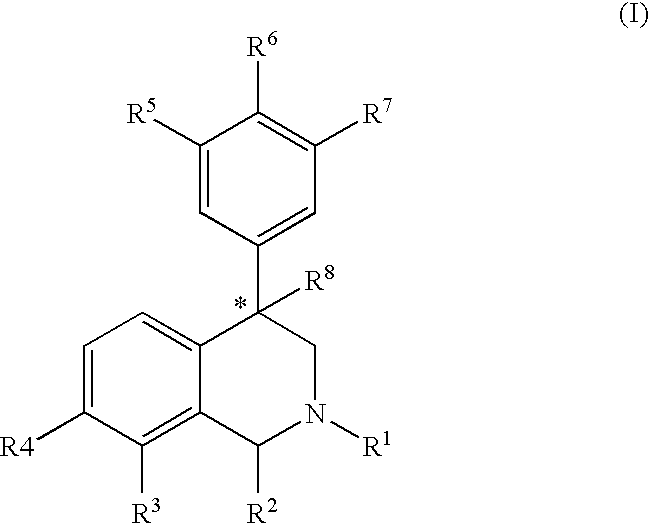
wherein:
the carbon atom designated * is in the R or S configuration;
R1 is C1-C6 alkyl, C2-C6 alkenyl, C2-C6 alkynyl, C3-C6 cycloalkyl or C4-C7 cycloalkylalkyl, each of which is optionally substituted with from 1 to 3 substituents independently selected at each occurrence thereof from C1-C3 alkyl, halogen, Ar, —CN, —OR9 and —NR9R10;
R2 is H, C1-C6 alkyl, C2-C6 alkenyl, C2-C6 alkynyl, C3-C6 cycloalkyl, C4-C7 cycloalkylalkyl or C1-C6 haloalkyl;
R3 is H, halogen, —OR11, —S(O)nR12, —CN, —C(O)R12, —C(O)NR11R12, C1-C6 alkyl, C2-C6 alkenyl, C2-C6 alkynyl, C3-C6 cycloalkyl or C4-C7 cycloalkylalkyl and wherein each of C1-C6 alkyl, C2-C6 alkenyl, C2-C6 alkynyl, C3-C6 cycloalkyl and C4-C7 is optionally substituted with from 1 to 3 substituents independently selected at each occurrence thereof from C1-C3 alkyl, halogen, —CN, —OR9, —NR9R10 and phenyl which is optionally substituted 1-3 times with halogen, cyano, C1-C4 alkyl, C1-C4 haloalkyl, or C1-C4 alkoxy, —CN, —OR9, or —NR9R10;
R4 is aryl selected from phenyl, naphthyl and indenyl, or heteroaryl selected from pyridyl, pyrimidinyl, triazinyl, triazolyl, furanyl, pyranyl, indazolyl, benzimidazolyl, quinolinyl, quinazolinyl, isoquinolinyl, thienyl, imidazolyl, thiazolyl, benzthiazolyl, purinyl, isothiazolyl, indolyl, pyrrolyl, oxazolyl, benzofuranyl, benzothienyl, benzthiazolyl, isoxazolyl, pyrazolyl, oxadiazolyl and thiadiazolyl, wherein the aryl or heteroaryl group is optionally substituted with from 1 to 4 R14 substituents;
R5 and R6 and R7 are each independently H or are selected from halogen, —OR11, —NR11R12, —NR11C(O)R12, —NR11C(O)2R12, —NR11C(O)NR12R13, —S(O)nR12, —CN, —C(O)R12, —C(O)NR11R12, C1-C6 alkyl, C2-C6 alkenyl, C2-C6 alkynyl, C3-C6 cycloalkyl or C4-C7 cycloalkylalkyl, and wherein each of C1-C6 alkyl, C2-C6 alkenyl, C2-C6 alkynyl, C3-C6 cycloalkyl and C4-C7 cycloalkylalkyl is optionally substituted with from 1 to 3 substituents independently selected at each occurrence thereof from C1-C3 alkyl, halogen, —CN, —OR9, —NR9R10 and phenyl which is optionally substituted 1-3 times with halogen, cyano, C1-C4 alkyl, C1-C4 haloalkyl, or C1-C4 alkoxy, —CN, —OR9, or —NR9R10; or R5 and R6 may be —O—C(R12)2—O—;
R8 is H, halogen or OR11;
R9 and R10 are each independently H, C1-C4 alkyl, C1-C4 haloalkyl, C1-C4 alkoxyalkyl, C3-C6 cycloalkyl, C4-C7 cycloalkylalkyl, —C(O)R13, phenyl or benzyl, where phenyl or benzyl is optionally substituted from 1 to 3 times with a substituent selected independently at each occurrence thereof from halogen, cyano, C1-C4 alkyl, C1-C4 haloalkyl and C1-C4 alkoxy;
or R9 and R10 are taken together with the nitrogen to which they are attached to form a piperidine, pyrrolidine, piperazine, N-methylpiperazine, morpholine or thiomorpholine ring;
R11 is H, C1-C4 alkyl, C1-C4 haloalkyl, C1-C4 alkoxyalkyl, C3-C6 cycloalkyl, C4-C7 cycloalkylalkyl, —C(O)R13, phenyl or benzyl, where phenyl or benzyl is optionally substituted 1 to 3 times with halogen, cyano, C1-C4 alkyl, C1-C4 haloalkyl, or C1-C4 alkoxy;
R12 is H, C1-C4 alkyl, C1-C4 haloalkyl, C1-C4 alkoxyalkyl, C3-C6 cycloalkyl, C4-C7 cycloalkylalkyl, phenyl or benzyl, where phenyl or benzyl is optionally substituted 1 to 3 times with halogen, cyano, C1-C4 alkyl, C1-C4 haloalkyl, or C1-C4 alkoxy;
or R11 and R12 are taken together with the nitrogen to which they are attached to form a piperidine, pyrrolidine, piperazine, N-methylpiperazine, morpholine or thiomorpholine ring, with the proviso that only one of R9 and R10 or R11 and R12 are taken together with the nitrogen to which they are attached to form a piperidine, pyrrolidine, piperazine, N-methylpiperazine, morpholine or thiomorpholine ring;
R13 is C1-C4 alkyl, C1-C4 haloalkyl or phenyl;
n is 0, 1, or 2; and,
R14 is independently selected at each occurrence from a substituent selected from the group: halogen, —NO2, —OR11, —NR11R12, —NR11C(O)R12, —NR11C(O)2R12, NR11C(O)NR12R, —S(O)nR12, —CN, —C(O)R12, —C(O)NR1R12, C—C6 alkyl, C2-C6 alkenyl, C2-C6 alkynyl, C3-C6 cycloalkyl, and C4-C7 cycloalkylalkyl where C1-C6 alkyl, C2-C6 alkenyl, C2-C6 alkynyl, C3-C6 cycloalkyl, C4-C7 cycloalkylalkyl are optionally substituted with 1 to 3 substituents independently selected at each occurrence from the group consisting of C1-C3 alkyl, halogen, Ar, —CN, —OR9, and —NR9R10, or
an oxide thereof, a pharmaceutically acceptable salt thereof, a solvate thereof, or prodrug thereof.
2. A method of claim 1 , wherein R1 is C1-C6 alkyl.
3. A method of claim 2 , wherein R1 is methyl.
4. A method of claim 1 , wherein R2 is H, C1-C6 alkyl or C1-C6 haloalkyl.
5. The compound of claim 4 , wherein R2 is H or C1-C6 alkyl.
6. A method of claim 5 , wherein R2 is H.
7. A method of claim 1 , wherein R3 is H, halogen, —OR11, —S(O)2R12, C1-C6 alkyl or substituted C1-C6 alkyl.
8. A method of claim 7 , wherein R3 is H.
9. A method of claim 1 , wherein R4 is phenyl optionally and independently substituted from 1 to 4 times with R14.
10. A method of claim 9 , wherein the R4 is phenyl, 2-chlorophenyl, 3-chlorophenyl, 4 chlorophenyl, 2-methoxyphenyl, 3-methoxyphenyl, 4-methoxyphenyl or 4 dimethylaminophenyl.
11. A method of claim 1 , wherein R4 is pyridyl, pynmidinyl, triazinyl, triazolyl, furanyl, pyranyl, indazolyl, benzimidazolyl, quinolinyl, quinazolinyl, isoquinolinyl, thienyl, imidazolyl, thiazolyl, benzthiazolyl, puninyl, isothiazolyl, indolyl, pyrrolyl, oxazolyl, benzofuranyl, benzothienyl, benzthiazolyl, isoxazolyl, pyrazolyl, oxadiazolyl, or thiadiazolyl, which is optionally substituted 1-4 times with R14.
12. A method of claim 11 , wherein R4 is 4-methyl-2-furanyl, 5-methyl-2-furanyl, 3-furanyl, 2-thienyl, 3-thienyl, 3,5-dimethyl-4-isoxazolyl, 2-pyridyl, 3-pyridyl, 4-pyridyl, 2-methoxy-3-pyridyl, 6-methoxy-3pyridyl, 3,5-pyrimidinyl or 2,6-pyrimidinyl.
13. The compound of claim 1 , wherein R5, R6 and R7 are each independently selected from the group: H, halogen, —OR11, —NR11R12, -, —S(O)2R12, —C(O)R12 and optionally substituted C1-C6 alkyl.
14. A method of claim 13 , wherein R7 is H.
15. A method of claim 14 , wherein of R5 and R6 are each H, F, Cl, OH, OCH3 or CH3—.
16. A method of claim 1 , wherein R8 is H, OH, or F.
17. A method of claim 1 , wherein
R1 is C1-C6 alkyl;
R2 is H, C1-C6 alkyl or C1-C6 haloalkyl;
R3 is H, halogen, —OR11, —S(O)2R12, C1-C6 alkyl or substituted C1-C6 alkyl;
R4 is aryl or heteroaryl; and
R5, R6 and R7 are each independently selected from the group: H, halogen, —OR11, NR11R12, —S(O)2R12, —C(O)R12, C1-C6 alkyl and substituted C1-C6 alkyl.
18. A method of claim 1 , wherein R1 is methyl;
R2 is H;
R3 is H;
R5 and R6 are each independently selected from the group: H, F, Cl, OH, OCH3, and CH3;
R7 is H or F;
R8 is H, OH, or F; and
R4 is phenyl, pyridyl, pyrimidinyl, triazinyl, triazolyl, furanyl, pyranyl, indazolyl, thienyl, imidazolyl, thiazolyl, purinyl, isothiazolyl, indolyl, pyrrolyl, oxazolyl, isoxazolyl, or pyrazolyl, each of which R4 is optionally and independently substituted from 1-4 times with R14.
19. A method of claim 1 , wherein R1 is methyl;
R2 is H;
R3 is H;
R5 and R6 are each H, F or CH3;
R7 is H;
R8 is H; and
R4 is phenyl, 2-chlorophenyl, 3-chlorophenyl, 4-chlorophenyl, 2-methoxyphenyl, 3 methoxyphenyl, 4-methoxyphenyl, 4-dimethylaminophenyl, 4-methyl-2-furanyl, 5 methyl-2-furanyl and 3-furanyl, 2-thienyl and 3-thienyl, 3,5-dimethyl-4-isoxazolyl, 2 pyridyl, 3-pyridyl, 4-pyridyl, 2-methoxy-3-pyridyl and 6-methoxy-3-pyridyl 3,5 pyrimidinyl or 2,6-pyrimidinyl.
20. A method according to claim 1 , wherein the carbon atom designated * is in the R configuration.
21. A method according to claim 1 , wherein the carbon atom designated * is in the S configuration.
22. A method comprising a mixture of stereoisomerisms compounds of claim 1 wherein the carbon atom designated * is in the S or R configuration.
23. A method according to claim 1 , selected from the group:
4,7-diphenyl-2-methyl-1,2,3,4-tetrahydroisoquinoline;
7-(2-chloro)phenyl-2-methyl-4-phenyl-1,2,3,4-tetrahydroisoquinoline;
7-(3-chloro)phenyl-2-methyl-4-phenyl-1,2,3,4-tetrahydroisoquinoline;
7-(4-chloro)phenyl-2-methyl-4-phenyl-1,2,3,4-tetrahydroisoquinoline;
7-(2-methoxy)phenyl-2-methyl-4-phenyl-1,2,3,4-tetrahydroisoquinoline;
7-(3-methoxy)phenyl-2-methyl-4-phenyl-1,2,3,4-tetrahydroisoquinoline;
7-(4-methoxy)phenyl-2-methyl-4-phenyl-1,2,3,4-tetrahydroisoquinoline;
7-(4-N,N-dimethylamino)phenyl-2-methyl-4-phenyl-1,2,3,4-tetrahydroisoquinoline;
7-[(4-methyl)-2-thienyl-2-methyl-4-phenyl-1,2,3,4-tetrahydroisoquinoline;
7-[(5-methyl)-2-furanyl]-2-methyl-4-phenyl-1,2,3,4-tetrahydroisoquinoline;
7-(3-furanyl)-2-methyl-4-phenyl-1,2,3,4-tetrahydroisoquinoline;
2-methyl-4-phenyl-7-(2-thienyl)-1,2,3,4-tetrahydroisoquinoline;
2-methyl-4-phenyl-7-(3-thienyl)-1,2,3,4-tetrahydroisoquinoline;
7-[(3,5-dimethyl)-4-isoxazole]-2-methyl-4-phenyl-1,2,3,4-tetrahydroisoquinoline;
2-methyl-4-phenyl-7-(2-pyridyl)-1,2,3,4-tetrahydroisoquinoline;
2-methyl-4-phenyl-7-(3-pyridyl)-1,2,3,4-tetrahydroisoquinoline;
2-methyl-4-phenyl-7-(4-pyridyl)-1,2,3,4-tetrahydroisoquinoline;
4-(3,4-difluoro)phenyl-2-methyl-7-(3-pyridyl)-1,2,3,4-tetrahydroisoquinoline;
7-[(2-methoxy)-3-pyridyl]-2-methyl-4-phenyl-1,2,3,4-tetrahydroisoquinoline;
7-[(6-methoxy)-3-pyridyl]-2-methyl-4-phenyl-1,2,3,4-tetrahydroisoquinoline;
2-methyl-4-phenyl-7-(3,5-pyrimidyl)-1,2,3,4-tetrahydrolsoquinoline;
4-(3,4-difluoro)phenyl-2-methyl-7-(3,5-pyrimidyl)-1,2,3,4-tetrahydrolsoquinoline;
4-(4-methyl)phenyl-2-methyl-7-(3,5-pyrimidyl)-1,2,3,4-tetrahydroisoquinoline;
2-methyl-4-phenyl-7-(2,6-pyrimidyl)-1,2,3,4-tetrahydroisoquinoline;
7-(2,5-dimethyl-4-isoxazole)-4-(4-methoxy)phenyl-2-methyl-1,2,3,4-tetrahydroisoquinoline; and
4-(4-methoxy)phenyl-2-methyl-7-(2-pyridyl)-1,2,3,4-tetrahydroisoquinoline or an oxide thereof, a pharmaceutically acceptable salt thereof, a solvate thereof, or a prodrug thereof
24. A method according to claim 24 , wherein the compound is the (+) stereoisomer.
25. A method according to claim 24 , wherein the compound is the (−) stereoisomer.
Priority Applications (1)
| Application Number | Priority Date | Filing Date | Title |
|---|---|---|---|
| US10/724,856 US20040248932A1 (en) | 2002-12-02 | 2003-12-01 | Use of aryl- and heteroaryl-substituted tetrahydroisoquinolines in the treatment of chronic and neuropathic pain, migraine headaches, and urge, stress and mixed urinary incontinence |
Applications Claiming Priority (2)
| Application Number | Priority Date | Filing Date | Title |
|---|---|---|---|
| US43028502P | 2002-12-02 | 2002-12-02 | |
| US10/724,856 US20040248932A1 (en) | 2002-12-02 | 2003-12-01 | Use of aryl- and heteroaryl-substituted tetrahydroisoquinolines in the treatment of chronic and neuropathic pain, migraine headaches, and urge, stress and mixed urinary incontinence |
Publications (1)
| Publication Number | Publication Date |
|---|---|
| US20040248932A1 true US20040248932A1 (en) | 2004-12-09 |
Family
ID=32469438
Family Applications (1)
| Application Number | Title | Priority Date | Filing Date |
|---|---|---|---|
| US10/724,856 Abandoned US20040248932A1 (en) | 2002-12-02 | 2003-12-01 | Use of aryl- and heteroaryl-substituted tetrahydroisoquinolines in the treatment of chronic and neuropathic pain, migraine headaches, and urge, stress and mixed urinary incontinence |
Country Status (3)
| Country | Link |
|---|---|
| US (1) | US20040248932A1 (en) |
| AU (1) | AU2003283646A1 (en) |
| WO (1) | WO2004050630A1 (en) |
Cited By (5)
| Publication number | Priority date | Publication date | Assignee | Title |
|---|---|---|---|---|
| US20100292242A1 (en) * | 2009-05-12 | 2010-11-18 | Albany Molecular Research, Inc. | Aryl, heteroaryl, and heterocycle substituted tetrahydroisoquinolines and use thereof |
| US20100292243A1 (en) * | 2009-05-12 | 2010-11-18 | Albany Molecular Research, Inc. | 7-([1,2,4]TRIAZOLO[1,5-a]PYRIDIN-6-YL)-4-(3,4-DICHLOROPHENYL)-1,2,3,4-TETRAHYDROISOQUINOLINE AND USE THEREOF |
| US20100292250A1 (en) * | 2009-05-12 | 2010-11-18 | Albany Molecular Research, Inc. | CRYSTALLINE FORMS OF (S)-7-([1,2,4]TRIAZOLO[1,5-a]PYRIDIN-6-YL)-4-(3,4-DICHLOROPHENYL)-1,2,3,4- TETRAHYDROISOQUINOLINE AND USE THEREOF |
| US8741901B2 (en) | 2004-07-15 | 2014-06-03 | Albany Molecular Research, Inc. | Aryl- and heteroaryl-substituted tetrahydroisoquinolines and use thereof to block reuptake of norepinephrine, dopamine, and serotonin |
| US9498476B2 (en) | 2008-06-04 | 2016-11-22 | Albany Molecular Research, Inc. | Crystalline form of 6-[(4S)-2-methyl-4-(2-naphthyl)-1,2,3,4-tetrahydroisoquinolin-7-yl]pyridazin-3-amine |
Families Citing this family (1)
| Publication number | Priority date | Publication date | Assignee | Title |
|---|---|---|---|---|
| WO2009005459A1 (en) * | 2007-06-29 | 2009-01-08 | Astrazeneca Ab | Phenyl-1,2, 3,4-tetrahydroisoquinolinone derivatives and their use in the treatment of a pain disorder |
Citations (2)
| Publication number | Priority date | Publication date | Assignee | Title |
|---|---|---|---|---|
| US4375471A (en) * | 1981-02-19 | 1983-03-01 | Hoechst-Roussel Pharmaceuticals Inc. | 4-Aryloxy-1,2,3,4-tetrahydroisoquinolines |
| US6579885B2 (en) * | 1999-11-03 | 2003-06-17 | Albany Molecular Research, Inc. | Aryl and heteroaryl substituted tetrahydroisoquinolines and use thereof |
Family Cites Families (3)
| Publication number | Priority date | Publication date | Assignee | Title |
|---|---|---|---|---|
| ES2061972T3 (en) * | 1988-02-19 | 1994-12-16 | Smithkline Beecham Farma | 1,2,3,4-TETRAHYDROISOKINOLEINS, PROCEDURE FOR THEIR PREPARATION AND USE AS KAPA-RECEPTOR AGONISTS. |
| ZA9610738B (en) * | 1995-12-22 | 1997-06-24 | Warner Lambert Co | Subtype selective nmda receptor ligands and the use thereof |
| WO2001032624A1 (en) * | 1999-11-03 | 2001-05-10 | Du Pont Pharmaceuticals Company | 4-phenyl-substituted tetrahydroisoquinolines and use thereof to block reuptake of norepinephrine, dopamine and serotonin |
-
2003
- 2003-11-24 AU AU2003283646A patent/AU2003283646A1/en not_active Abandoned
- 2003-11-24 WO PCT/IB2003/005504 patent/WO2004050630A1/en not_active Ceased
- 2003-12-01 US US10/724,856 patent/US20040248932A1/en not_active Abandoned
Patent Citations (2)
| Publication number | Priority date | Publication date | Assignee | Title |
|---|---|---|---|---|
| US4375471A (en) * | 1981-02-19 | 1983-03-01 | Hoechst-Roussel Pharmaceuticals Inc. | 4-Aryloxy-1,2,3,4-tetrahydroisoquinolines |
| US6579885B2 (en) * | 1999-11-03 | 2003-06-17 | Albany Molecular Research, Inc. | Aryl and heteroaryl substituted tetrahydroisoquinolines and use thereof |
Cited By (12)
| Publication number | Priority date | Publication date | Assignee | Title |
|---|---|---|---|---|
| US8741901B2 (en) | 2004-07-15 | 2014-06-03 | Albany Molecular Research, Inc. | Aryl- and heteroaryl-substituted tetrahydroisoquinolines and use thereof to block reuptake of norepinephrine, dopamine, and serotonin |
| US9085531B2 (en) | 2004-07-15 | 2015-07-21 | Albany Molecular Research, Inc. | Aryl- and heteroaryl-substituted tetrahydroisoquinolines and use thereof to block reuptake of norepinephrine, dopamine, and serotonin |
| US9499531B2 (en) | 2004-07-15 | 2016-11-22 | Albany Molecular Research, Inc. | Aryl- and heteroaryl-substituted tetrahydroisoquinolines and use thereof to block reuptake of norepinephrine, dopamine, and serotonin |
| US9498476B2 (en) | 2008-06-04 | 2016-11-22 | Albany Molecular Research, Inc. | Crystalline form of 6-[(4S)-2-methyl-4-(2-naphthyl)-1,2,3,4-tetrahydroisoquinolin-7-yl]pyridazin-3-amine |
| US20100292242A1 (en) * | 2009-05-12 | 2010-11-18 | Albany Molecular Research, Inc. | Aryl, heteroaryl, and heterocycle substituted tetrahydroisoquinolines and use thereof |
| US20100292243A1 (en) * | 2009-05-12 | 2010-11-18 | Albany Molecular Research, Inc. | 7-([1,2,4]TRIAZOLO[1,5-a]PYRIDIN-6-YL)-4-(3,4-DICHLOROPHENYL)-1,2,3,4-TETRAHYDROISOQUINOLINE AND USE THEREOF |
| US20100292250A1 (en) * | 2009-05-12 | 2010-11-18 | Albany Molecular Research, Inc. | CRYSTALLINE FORMS OF (S)-7-([1,2,4]TRIAZOLO[1,5-a]PYRIDIN-6-YL)-4-(3,4-DICHLOROPHENYL)-1,2,3,4- TETRAHYDROISOQUINOLINE AND USE THEREOF |
| US8802696B2 (en) | 2009-05-12 | 2014-08-12 | Albany Molecular Research, Inc. | 7-([1,2,4]triazolo[1,5-a]pyridin-6-yl)-4-(3,4-dichlorophenyl)-1,2,3,4-tetrahydroisoqu inoli and use thereof |
| US8815894B2 (en) | 2009-05-12 | 2014-08-26 | Bristol-Myers Squibb Company | Crystalline forms of (S)-7-([1,2,4]triazolo[1,5-a]pyridin-6-yl)-4-(3,4-dichlorophenyl)-1,2,3,4-tetrahydroisoquinoline and use thereof |
| US9034899B2 (en) | 2009-05-12 | 2015-05-19 | Albany Molecular Research, Inc. | Aryl, heteroaryl, and heterocycle substituted tetrahydroisoquinolines and use thereof |
| US9173879B2 (en) | 2009-05-12 | 2015-11-03 | Bristol-Myers Squibb Company | Crystalline forms of (S)-7-([1,2,4]triazolo[1,5-a ]pyridin-6-yl)-4-(3,4-dichlorophenyl)-1,2,3,4-tetrahydroisoquinoline and use thereof |
| US9604960B2 (en) | 2009-05-12 | 2017-03-28 | Albany Molecular Research, Inc. | Aryl, heteroaryl, and heterocycle substituted tetrahydroisoquinolines and use thereof |
Also Published As
| Publication number | Publication date |
|---|---|
| AU2003283646A1 (en) | 2004-06-23 |
| WO2004050630A1 (en) | 2004-06-17 |
Similar Documents
| Publication | Publication Date | Title |
|---|---|---|
| CN102395275A (en) | Methods for treating multiple sclerosis using tetracyclic pyrazinoindoles | |
| CA2061665C (en) | Treatment of lower urinary tract disorders | |
| US20060293309A1 (en) | Method of treating disorders and conditions using peripherally-restricted antagonists and inhibitors | |
| ES2263792T3 (en) | DERIVATIVES OF ARIL (OR HETEROARIL) AZOLILCARBINOLES FOR THE TREATMENT OF URINARY INCONTINENCE. | |
| NZ337400A (en) | Use of descarboethoxyloratadine for the manufacture of a medicament for the treatment of urinary incontinence, motion sickness and vertigo | |
| US20040248932A1 (en) | Use of aryl- and heteroaryl-substituted tetrahydroisoquinolines in the treatment of chronic and neuropathic pain, migraine headaches, and urge, stress and mixed urinary incontinence | |
| JP2002511414A (en) | New treatments for neurological disorders | |
| US20040248933A1 (en) | Use of 4-phenyl-substituted tetrahydroisoquinolines in the treatment of pain, migraine headaches and urinary incontinence | |
| KR20150020160A (en) | Combination of muscarinic receptor antagonists and beta―3 adrenoceptor agonists for treating overactive bladder | |
| US20030195186A1 (en) | Methods of treating medication-, substance-, disease-, and other medical condition-related sexual dysfunction | |
| WO2005007191A1 (en) | Medicinal composition | |
| WO2005067925A1 (en) | Derivatives of aryl(or heteroaryl) azolylcarbinols for the treatment of enuresis | |
| US20040248925A1 (en) | Use of 4-phenyl substituted tetrahydroisoquinolines in the treatment of pain, migraine and urinary incontinence | |
| AU2007341274B2 (en) | Use of 10-[(3R)-1-azabicyclo[2.2.2]oct-3-ylmethyl]-10H-phenothiazine for the preparation of a drug having a selective inhibition of muscarinic M1, M2 and M3 receptors | |
| JPWO2005007155A1 (en) | Pharmaceutical composition | |
| WO2007047282A1 (en) | Treatment of benign prostatic hypertrophy and lower urinary tract symptoms | |
| Saygisever-Faikoglu et al. | Efficacy and safety of propiverine in patients with overactive bladder and neurogenic detrusor overactivity | |
| Chun et al. | Comparative effects of intravesical versus extravesical administration of ZD6169 and cromakalim on the response of the in vitro rat whole bladder to field stimulation | |
| Lin | Adjuvant Section 11 Analgesics and Antiemetics | |
| US20060128738A1 (en) | Treatment of interstitial cystitis using cannabinoid analogs | |
| Terranova et al. | Local anesthesia |
Legal Events
| Date | Code | Title | Description |
|---|---|---|---|
| AS | Assignment |
Owner name: PHARMACIA & UPJOHN COMPANY, MICHIGAN Free format text: ASSIGNMENT OF ASSIGNORS INTEREST;ASSIGNORS:ARENERIC, STEPHEN P.;BECK, JAMES P.;FRAIL, DONALD E.;AND OTHERS;REEL/FRAME:015043/0006;SIGNING DATES FROM 20040319 TO 20040730 |
|
| STCB | Information on status: application discontinuation |
Free format text: ABANDONED -- FAILURE TO RESPOND TO AN OFFICE ACTION |