US20040225009A1 - Process for the preparation of C-4 carbonate taxanes - Google Patents
Process for the preparation of C-4 carbonate taxanes Download PDFInfo
- Publication number
- US20040225009A1 US20040225009A1 US10/827,062 US82706204A US2004225009A1 US 20040225009 A1 US20040225009 A1 US 20040225009A1 US 82706204 A US82706204 A US 82706204A US 2004225009 A1 US2004225009 A1 US 2004225009A1
- Authority
- US
- United States
- Prior art keywords
- compound
- protecting group
- formula
- group
- hydroxy protecting
- Prior art date
- Legal status (The legal status is an assumption and is not a legal conclusion. Google has not performed a legal analysis and makes no representation as to the accuracy of the status listed.)
- Granted
Links
- 238000000034 method Methods 0.000 title claims abstract description 60
- 230000008569 process Effects 0.000 title claims abstract description 22
- 238000002360 preparation method Methods 0.000 title claims abstract description 16
- BVKZGUZCCUSVTD-UHFFFAOYSA-L Carbonate Chemical compound [O-]C([O-])=O BVKZGUZCCUSVTD-UHFFFAOYSA-L 0.000 title claims abstract description 6
- 229940123237 Taxane Drugs 0.000 title abstract description 28
- 150000001875 compounds Chemical class 0.000 claims description 109
- -1 cyclobutyl- Chemical group 0.000 claims description 75
- 125000002496 methyl group Chemical group [H]C([H])([H])* 0.000 claims description 43
- 125000002887 hydroxy group Chemical group [H]O* 0.000 claims description 33
- 125000006239 protecting group Chemical group 0.000 claims description 29
- 125000000999 tert-butyl group Chemical group [H]C([H])([H])C(*)(C([H])([H])[H])C([H])([H])[H] 0.000 claims description 16
- RTZKZFJDLAIYFH-UHFFFAOYSA-N Diethyl ether Chemical compound CCOCC RTZKZFJDLAIYFH-UHFFFAOYSA-N 0.000 claims description 13
- 125000001997 phenyl group Chemical group [H]C1=C([H])C([H])=C(*)C([H])=C1[H] 0.000 claims description 11
- 125000005370 alkoxysilyl group Chemical group 0.000 claims description 10
- 125000001797 benzyl group Chemical group [H]C1=C([H])C([H])=C(C([H])=C1[H])C([H])([H])* 0.000 claims description 9
- 125000001449 isopropyl group Chemical group [H]C([H])([H])C([H])(*)C([H])([H])[H] 0.000 claims description 9
- 229910052751 metal Inorganic materials 0.000 claims description 9
- 239000002184 metal Substances 0.000 claims description 9
- 125000004665 trialkylsilyl group Chemical group 0.000 claims description 9
- 125000003903 2-propenyl group Chemical group [H]C([*])([H])C([H])=C([H])[H] 0.000 claims description 8
- ZCSHNCUQKCANBX-UHFFFAOYSA-N lithium diisopropylamide Chemical compound [Li+].CC(C)[N-]C(C)C ZCSHNCUQKCANBX-UHFFFAOYSA-N 0.000 claims description 8
- 125000002941 2-furyl group Chemical group O1C([*])=C([H])C([H])=C1[H] 0.000 claims description 7
- 125000002777 acetyl group Chemical group [H]C([H])([H])C(*)=O 0.000 claims description 7
- ILMRJRBKQSSXGY-UHFFFAOYSA-N tert-butyl(dimethyl)silicon Chemical group C[Si](C)C(C)(C)C ILMRJRBKQSSXGY-UHFFFAOYSA-N 0.000 claims description 7
- 125000003236 benzoyl group Chemical group [H]C1=C([H])C([H])=C(C([H])=C1[H])C(*)=O 0.000 claims description 6
- YNESATAKKCNGOF-UHFFFAOYSA-N lithium bis(trimethylsilyl)amide Chemical compound [Li+].C[Si](C)(C)[N-][Si](C)(C)C YNESATAKKCNGOF-UHFFFAOYSA-N 0.000 claims description 6
- 150000003839 salts Chemical class 0.000 claims description 6
- 150000004703 alkoxides Chemical class 0.000 claims description 5
- 125000002933 cyclohexyloxy group Chemical group C1(CCCCC1)O* 0.000 claims description 5
- 150000002148 esters Chemical class 0.000 claims description 5
- 125000001495 ethyl group Chemical group [H]C([H])([H])C([H])([H])* 0.000 claims description 5
- 125000004184 methoxymethyl group Chemical group [H]C([H])([H])OC([H])([H])* 0.000 claims description 5
- LMBFAGIMSUYTBN-MPZNNTNKSA-N teixobactin Chemical compound C([C@H](C(=O)N[C@@H]([C@@H](C)CC)C(=O)N[C@@H](CO)C(=O)N[C@H](CCC(N)=O)C(=O)N[C@H]([C@@H](C)CC)C(=O)N[C@@H]([C@@H](C)CC)C(=O)N[C@@H](CO)C(=O)N[C@H]1C(N[C@@H](C)C(=O)N[C@@H](C[C@@H]2NC(=N)NC2)C(=O)N[C@H](C(=O)O[C@H]1C)[C@@H](C)CC)=O)NC)C1=CC=CC=C1 LMBFAGIMSUYTBN-MPZNNTNKSA-N 0.000 claims description 5
- 125000001412 tetrahydropyranyl group Chemical group 0.000 claims description 5
- 125000004632 tetrahydrothiopyranyl group Chemical group S1C(CCCC1)* 0.000 claims description 5
- 150000003952 β-lactams Chemical class 0.000 claims description 5
- 125000000453 2,2,2-trichloroethyl group Chemical group [H]C([H])(*)C(Cl)(Cl)Cl 0.000 claims description 4
- KRHYYFGTRYWZRS-UHFFFAOYSA-M Fluoride anion Chemical compound [F-] KRHYYFGTRYWZRS-UHFFFAOYSA-M 0.000 claims description 4
- PIZLBWGMERQCOC-UHFFFAOYSA-N dibenzyl carbonate Chemical compound C=1C=CC=CC=1COC(=O)OCC1=CC=CC=C1 PIZLBWGMERQCOC-UHFFFAOYSA-N 0.000 claims description 4
- 125000005448 ethoxyethyl group Chemical group [H]C([H])([H])C([H])([H])OC([H])([H])C([H])([H])* 0.000 claims description 4
- 125000002485 formyl group Chemical group [H]C(*)=O 0.000 claims description 4
- 238000004519 manufacturing process Methods 0.000 claims description 4
- 125000001181 organosilyl group Chemical group [SiH3]* 0.000 claims description 4
- 125000006503 p-nitrobenzyl group Chemical group [H]C1=C([H])C(=C([H])C([H])=C1[N+]([O-])=O)C([H])([H])* 0.000 claims description 4
- 125000000636 p-nitrophenyl group Chemical group [H]C1=C([H])C(=C([H])C([H])=C1*)[N+]([O-])=O 0.000 claims description 4
- 125000002221 trityl group Chemical group [H]C1=C([H])C([H])=C([H])C([H])=C1C([*])(C1=C(C(=C(C(=C1[H])[H])[H])[H])[H])C1=C([H])C([H])=C([H])C([H])=C1[H] 0.000 claims description 4
- NGNBDVOYPDDBFK-UHFFFAOYSA-N 2-[2,4-di(pentan-2-yl)phenoxy]acetyl chloride Chemical group CCCC(C)C1=CC=C(OCC(Cl)=O)C(C(C)CCC)=C1 NGNBDVOYPDDBFK-UHFFFAOYSA-N 0.000 claims description 2
- KEAYESYHFKHZAL-UHFFFAOYSA-N Sodium Chemical compound [Na] KEAYESYHFKHZAL-UHFFFAOYSA-N 0.000 claims description 2
- 150000008065 acid anhydrides Chemical group 0.000 claims description 2
- FZFAMSAMCHXGEF-UHFFFAOYSA-N chloro formate Chemical group ClOC=O FZFAMSAMCHXGEF-UHFFFAOYSA-N 0.000 claims description 2
- 229910000103 lithium hydride Inorganic materials 0.000 claims description 2
- NHKJPPKXDNZFBJ-UHFFFAOYSA-N phenyllithium Chemical compound [Li]C1=CC=CC=C1 NHKJPPKXDNZFBJ-UHFFFAOYSA-N 0.000 claims description 2
- IUBQJLUDMLPAGT-UHFFFAOYSA-N potassium bis(trimethylsilyl)amide Chemical compound C[Si](C)(C)N([K])[Si](C)(C)C IUBQJLUDMLPAGT-UHFFFAOYSA-N 0.000 claims description 2
- NTTOTNSKUYCDAV-UHFFFAOYSA-N potassium hydride Chemical compound [KH] NTTOTNSKUYCDAV-UHFFFAOYSA-N 0.000 claims description 2
- 229910000105 potassium hydride Inorganic materials 0.000 claims description 2
- 239000012312 sodium hydride Substances 0.000 claims description 2
- 229910000104 sodium hydride Inorganic materials 0.000 claims description 2
- 125000000026 trimethylsilyl group Chemical group [H]C([H])([H])[Si]([*])(C([H])([H])[H])C([H])([H])[H] 0.000 claims 3
- 239000002253 acid Substances 0.000 claims 2
- 125000006242 amine protecting group Chemical group 0.000 claims 2
- 239000003153 chemical reaction reagent Substances 0.000 claims 1
- 150000002500 ions Chemical class 0.000 claims 1
- SIAPCJWMELPYOE-UHFFFAOYSA-N lithium hydride Chemical compound [LiH] SIAPCJWMELPYOE-UHFFFAOYSA-N 0.000 claims 1
- WRIKHQLVHPKCJU-UHFFFAOYSA-N sodium bis(trimethylsilyl)amide Chemical compound C[Si](C)(C)N([Na])[Si](C)(C)C WRIKHQLVHPKCJU-UHFFFAOYSA-N 0.000 claims 1
- 239000002246 antineoplastic agent Substances 0.000 abstract description 6
- 239000000243 solution Substances 0.000 description 55
- XEKOWRVHYACXOJ-UHFFFAOYSA-N Ethyl acetate Chemical compound CCOC(C)=O XEKOWRVHYACXOJ-UHFFFAOYSA-N 0.000 description 52
- VLKZOEOYAKHREP-UHFFFAOYSA-N n-Hexane Chemical compound CCCCCC VLKZOEOYAKHREP-UHFFFAOYSA-N 0.000 description 49
- 229960001592 paclitaxel Drugs 0.000 description 43
- YMWUJEATGCHHMB-UHFFFAOYSA-N Dichloromethane Chemical compound ClCCl YMWUJEATGCHHMB-UHFFFAOYSA-N 0.000 description 37
- 206010028980 Neoplasm Diseases 0.000 description 35
- 229930012538 Paclitaxel Natural products 0.000 description 33
- RCINICONZNJXQF-MZXODVADSA-N taxol Chemical compound O([C@@H]1[C@@]2(C[C@@H](C(C)=C(C2(C)C)[C@H](C([C@]2(C)[C@@H](O)C[C@H]3OC[C@]3([C@H]21)OC(C)=O)=O)OC(=O)C)OC(=O)[C@H](O)[C@@H](NC(=O)C=1C=CC=CC=1)C=1C=CC=CC=1)O)C(=O)C1=CC=CC=C1 RCINICONZNJXQF-MZXODVADSA-N 0.000 description 33
- WYURNTSHIVDZCO-UHFFFAOYSA-N Tetrahydrofuran Chemical compound C1CCOC1 WYURNTSHIVDZCO-UHFFFAOYSA-N 0.000 description 31
- 238000006243 chemical reaction Methods 0.000 description 28
- 0 *[C@H](N[1*])[C@@H](O)C(=O)O[C@H]1C[C@@]2(O)[C@@H](OC(=O)C3=CC=CC=C3)[C@@]3([H])[C@](C)(C(=O)[C@H]([2*])C(=C1C)C2(C)C)[C@@H](O)C[C@H]1OC[C@]13OC(=O)OC Chemical compound *[C@H](N[1*])[C@@H](O)C(=O)O[C@H]1C[C@@]2(O)[C@@H](OC(=O)C3=CC=CC=C3)[C@@]3([H])[C@](C)(C(=O)[C@H]([2*])C(=C1C)C2(C)C)[C@@H](O)C[C@H]1OC[C@]13OC(=O)OC 0.000 description 25
- ZMXDDKWLCZADIW-UHFFFAOYSA-N N,N-Dimethylformamide Chemical compound CN(C)C=O ZMXDDKWLCZADIW-UHFFFAOYSA-N 0.000 description 25
- 238000005160 1H NMR spectroscopy Methods 0.000 description 24
- WEVYAHXRMPXWCK-UHFFFAOYSA-N Acetonitrile Chemical compound CC#N WEVYAHXRMPXWCK-UHFFFAOYSA-N 0.000 description 24
- UIIMBOGNXHQVGW-UHFFFAOYSA-M Sodium bicarbonate Chemical compound [Na+].OC([O-])=O UIIMBOGNXHQVGW-UHFFFAOYSA-M 0.000 description 24
- 235000019439 ethyl acetate Nutrition 0.000 description 24
- 239000000203 mixture Substances 0.000 description 24
- 239000002904 solvent Substances 0.000 description 24
- XLYOFNOQVPJJNP-UHFFFAOYSA-N water Substances O XLYOFNOQVPJJNP-UHFFFAOYSA-N 0.000 description 23
- 239000012267 brine Substances 0.000 description 21
- RAXXELZNTBOGNW-UHFFFAOYSA-N imidazole Natural products C1=CNC=N1 RAXXELZNTBOGNW-UHFFFAOYSA-N 0.000 description 21
- HPALAKNZSZLMCH-UHFFFAOYSA-M sodium;chloride;hydrate Chemical compound O.[Na+].[Cl-] HPALAKNZSZLMCH-UHFFFAOYSA-M 0.000 description 21
- OKKJLVBELUTLKV-UHFFFAOYSA-N Methanol Chemical compound OC OKKJLVBELUTLKV-UHFFFAOYSA-N 0.000 description 18
- 230000000259 anti-tumor effect Effects 0.000 description 18
- 229930190007 Baccatin Natural products 0.000 description 17
- VYPSYNLAJGMNEJ-UHFFFAOYSA-N Silicium dioxide Chemical compound O=[Si]=O VYPSYNLAJGMNEJ-UHFFFAOYSA-N 0.000 description 17
- 238000011282 treatment Methods 0.000 description 16
- 238000003786 synthesis reaction Methods 0.000 description 15
- YLQBMQCUIZJEEH-UHFFFAOYSA-N tetrahydrofuran Natural products C=1C=COC=1 YLQBMQCUIZJEEH-UHFFFAOYSA-N 0.000 description 15
- 230000000694 effects Effects 0.000 description 14
- 238000000132 electrospray ionisation Methods 0.000 description 14
- 238000010828 elution Methods 0.000 description 13
- DKPFODGZWDEEBT-QFIAKTPHSA-N taxane Chemical class C([C@]1(C)CCC[C@@H](C)[C@H]1C1)C[C@H]2[C@H](C)CC[C@@H]1C2(C)C DKPFODGZWDEEBT-QFIAKTPHSA-N 0.000 description 13
- 230000015572 biosynthetic process Effects 0.000 description 12
- 239000000047 product Substances 0.000 description 12
- 229910000030 sodium bicarbonate Inorganic materials 0.000 description 11
- 239000007787 solid Substances 0.000 description 10
- YXFVVABEGXRONW-UHFFFAOYSA-N Toluene Chemical compound CC1=CC=CC=C1 YXFVVABEGXRONW-UHFFFAOYSA-N 0.000 description 9
- ZMANZCXQSJIPKH-UHFFFAOYSA-N Triethylamine Chemical compound CCN(CC)CC ZMANZCXQSJIPKH-UHFFFAOYSA-N 0.000 description 9
- 238000002474 experimental method Methods 0.000 description 9
- 239000011541 reaction mixture Substances 0.000 description 9
- 239000000741 silica gel Substances 0.000 description 9
- 229910002027 silica gel Inorganic materials 0.000 description 9
- RCINICONZNJXQF-XAZOAEDWSA-N taxol® Chemical compound O([C@@H]1[C@@]2(CC(C(C)=C(C2(C)C)[C@H](C([C@]2(C)[C@@H](O)C[C@H]3OC[C@]3(C21)OC(C)=O)=O)OC(=O)C)OC(=O)[C@H](O)[C@@H](NC(=O)C=1C=CC=CC=1)C=1C=CC=CC=1)O)C(=O)C1=CC=CC=C1 RCINICONZNJXQF-XAZOAEDWSA-N 0.000 description 9
- OVMSOCFBDVBLFW-VHLOTGQHSA-N 5beta,20-epoxy-1,7beta,13alpha-trihydroxy-9-oxotax-11-ene-2alpha,4alpha,10beta-triyl 4,10-diacetate 2-benzoate Chemical compound O([C@@H]1[C@@]2(C[C@H](O)C(C)=C(C2(C)C)[C@H](C([C@]2(C)[C@@H](O)C[C@H]3OC[C@]3([C@H]21)OC(C)=O)=O)OC(=O)C)O)C(=O)C1=CC=CC=C1 OVMSOCFBDVBLFW-VHLOTGQHSA-N 0.000 description 8
- LFQSCWFLJHTTHZ-UHFFFAOYSA-N Ethanol Chemical compound CCO LFQSCWFLJHTTHZ-UHFFFAOYSA-N 0.000 description 8
- 241001465754 Metazoa Species 0.000 description 8
- ZDZOTLJHXYCWBA-VCVYQWHSSA-N N-debenzoyl-N-(tert-butoxycarbonyl)-10-deacetyltaxol Chemical compound O([C@H]1[C@H]2[C@@](C([C@H](O)C3=C(C)[C@@H](OC(=O)[C@H](O)[C@@H](NC(=O)OC(C)(C)C)C=4C=CC=CC=4)C[C@]1(O)C3(C)C)=O)(C)[C@@H](O)C[C@H]1OC[C@]12OC(=O)C)C(=O)C1=CC=CC=C1 ZDZOTLJHXYCWBA-VCVYQWHSSA-N 0.000 description 8
- MNFORVFSTILPAW-UHFFFAOYSA-N azetidin-2-one Chemical compound O=C1CCN1 MNFORVFSTILPAW-UHFFFAOYSA-N 0.000 description 8
- FFUAGWLWBBFQJT-UHFFFAOYSA-N hexamethyldisilazane Chemical compound C[Si](C)(C)N[Si](C)(C)C FFUAGWLWBBFQJT-UHFFFAOYSA-N 0.000 description 8
- VHYFNPMBLIVWCW-UHFFFAOYSA-N 4-Dimethylaminopyridine Chemical compound CN(C)C1=CC=NC=C1 VHYFNPMBLIVWCW-UHFFFAOYSA-N 0.000 description 7
- VEXZGXHMUGYJMC-UHFFFAOYSA-N Hydrochloric acid Chemical compound Cl VEXZGXHMUGYJMC-UHFFFAOYSA-N 0.000 description 7
- 241000699670 Mus sp. Species 0.000 description 7
- PMZURENOXWZQFD-UHFFFAOYSA-L Sodium Sulfate Chemical compound [Na+].[Na+].[O-]S([O-])(=O)=O PMZURENOXWZQFD-UHFFFAOYSA-L 0.000 description 7
- 125000003118 aryl group Chemical group 0.000 description 7
- 201000011510 cancer Diseases 0.000 description 7
- 125000000956 methoxy group Chemical group [H]C([H])([H])O* 0.000 description 7
- PJGSXYOJTGTZAV-UHFFFAOYSA-N pinacolone Chemical compound CC(=O)C(C)(C)C PJGSXYOJTGTZAV-UHFFFAOYSA-N 0.000 description 7
- 229920006395 saturated elastomer Polymers 0.000 description 7
- 229910052938 sodium sulfate Inorganic materials 0.000 description 7
- 235000011152 sodium sulphate Nutrition 0.000 description 7
- 238000003756 stirring Methods 0.000 description 7
- XLYOFNOQVPJJNP-ZSJDYOACSA-N Heavy water Chemical compound [2H]O[2H] XLYOFNOQVPJJNP-ZSJDYOACSA-N 0.000 description 6
- KFZMGEQAYNKOFK-UHFFFAOYSA-N Isopropanol Chemical compound CC(C)O KFZMGEQAYNKOFK-UHFFFAOYSA-N 0.000 description 6
- JGFZNNIVVJXRND-UHFFFAOYSA-N N,N-Diisopropylethylamine (DIPEA) Chemical compound CCN(C(C)C)C(C)C JGFZNNIVVJXRND-UHFFFAOYSA-N 0.000 description 6
- 230000002159 abnormal effect Effects 0.000 description 6
- 125000004432 carbon atom Chemical group C* 0.000 description 6
- 239000000284 extract Substances 0.000 description 6
- 239000000463 material Substances 0.000 description 6
- 238000000746 purification Methods 0.000 description 6
- NLXLAEXVIDQMFP-UHFFFAOYSA-N Ammonia chloride Chemical class [NH4+].[Cl-] NLXLAEXVIDQMFP-UHFFFAOYSA-N 0.000 description 5
- 210000004027 cell Anatomy 0.000 description 5
- 208000037265 diseases, disorders, signs and symptoms Diseases 0.000 description 5
- 238000004949 mass spectrometry Methods 0.000 description 5
- 239000012074 organic phase Substances 0.000 description 5
- 238000010898 silica gel chromatography Methods 0.000 description 5
- FPGGTKZVZWFYPV-UHFFFAOYSA-M tetrabutylammonium fluoride Chemical compound [F-].CCCC[N+](CCCC)(CCCC)CCCC FPGGTKZVZWFYPV-UHFFFAOYSA-M 0.000 description 5
- 230000001225 therapeutic effect Effects 0.000 description 5
- IJGRMHOSHXDMSA-UHFFFAOYSA-N Atomic nitrogen Chemical compound N#N IJGRMHOSHXDMSA-UHFFFAOYSA-N 0.000 description 4
- 241001529936 Murinae Species 0.000 description 4
- DTQVDTLACAAQTR-UHFFFAOYSA-N Trifluoroacetic acid Chemical compound OC(=O)C(F)(F)F DTQVDTLACAAQTR-UHFFFAOYSA-N 0.000 description 4
- 238000010171 animal model Methods 0.000 description 4
- 229930014667 baccatin III Natural products 0.000 description 4
- 230000008901 benefit Effects 0.000 description 4
- 125000001584 benzyloxycarbonyl group Chemical group C(=O)(OCC1=CC=CC=C1)* 0.000 description 4
- 230000004663 cell proliferation Effects 0.000 description 4
- XMPZTFVPEKAKFH-UHFFFAOYSA-P ceric ammonium nitrate Chemical compound [NH4+].[NH4+].[Ce+4].[O-][N+]([O-])=O.[O-][N+]([O-])=O.[O-][N+]([O-])=O.[O-][N+]([O-])=O.[O-][N+]([O-])=O.[O-][N+]([O-])=O XMPZTFVPEKAKFH-UHFFFAOYSA-P 0.000 description 4
- DCFKHNIGBAHNSS-UHFFFAOYSA-N chloro(triethyl)silane Chemical compound CC[Si](Cl)(CC)CC DCFKHNIGBAHNSS-UHFFFAOYSA-N 0.000 description 4
- 201000010099 disease Diseases 0.000 description 4
- 229960003668 docetaxel Drugs 0.000 description 4
- 238000010265 fast atom bombardment Methods 0.000 description 4
- 239000000706 filtrate Substances 0.000 description 4
- 229910052736 halogen Inorganic materials 0.000 description 4
- 150000002367 halogens Chemical class 0.000 description 4
- 125000001072 heteroaryl group Chemical group 0.000 description 4
- 238000004896 high resolution mass spectrometry Methods 0.000 description 4
- IKGLACJFEHSFNN-UHFFFAOYSA-N hydron;triethylazanium;trifluoride Chemical compound F.F.F.CCN(CC)CC IKGLACJFEHSFNN-UHFFFAOYSA-N 0.000 description 4
- 239000012044 organic layer Substances 0.000 description 4
- 230000001575 pathological effect Effects 0.000 description 4
- BWHMMNNQKKPAPP-UHFFFAOYSA-L potassium carbonate Chemical compound [K+].[K+].[O-]C([O-])=O BWHMMNNQKKPAPP-UHFFFAOYSA-L 0.000 description 4
- NROKBHXJSPEDAR-UHFFFAOYSA-M potassium fluoride Chemical compound [F-].[K+] NROKBHXJSPEDAR-UHFFFAOYSA-M 0.000 description 4
- 239000000725 suspension Substances 0.000 description 4
- 229940063683 taxotere Drugs 0.000 description 4
- DYHSDKLCOJIUFX-UHFFFAOYSA-N tert-butoxycarbonyl anhydride Chemical compound CC(C)(C)OC(=O)OC(=O)OC(C)(C)C DYHSDKLCOJIUFX-UHFFFAOYSA-N 0.000 description 4
- 230000004614 tumor growth Effects 0.000 description 4
- FZWHCVWKYWKZHE-ZIAGYGMSSA-N (3r,4r)-4-phenyl-3-triethylsilyloxyazetidin-2-one Chemical compound N1C(=O)[C@H](O[Si](CC)(CC)CC)[C@H]1C1=CC=CC=C1 FZWHCVWKYWKZHE-ZIAGYGMSSA-N 0.000 description 3
- 125000004169 (C1-C6) alkyl group Chemical group 0.000 description 3
- XEZNGIUYQVAUSS-UHFFFAOYSA-N 18-crown-6 Chemical compound C1COCCOCCOCCOCCOCCO1 XEZNGIUYQVAUSS-UHFFFAOYSA-N 0.000 description 3
- QTBSBXVTEAMEQO-UHFFFAOYSA-N Acetic acid Chemical compound CC(O)=O QTBSBXVTEAMEQO-UHFFFAOYSA-N 0.000 description 3
- WFDIJRYMOXRFFG-UHFFFAOYSA-N Acetic anhydride Chemical compound CC(=O)OC(C)=O WFDIJRYMOXRFFG-UHFFFAOYSA-N 0.000 description 3
- 125000000882 C2-C6 alkenyl group Chemical group 0.000 description 3
- OKTJSMMVPCPJKN-UHFFFAOYSA-N Carbon Chemical group [C] OKTJSMMVPCPJKN-UHFFFAOYSA-N 0.000 description 3
- 241000699666 Mus <mouse, genus> Species 0.000 description 3
- DNIAPMSPPWPWGF-UHFFFAOYSA-N Propylene glycol Chemical compound CC(O)CO DNIAPMSPPWPWGF-UHFFFAOYSA-N 0.000 description 3
- 241000700159 Rattus Species 0.000 description 3
- HEMHJVSKTPXQMS-UHFFFAOYSA-M Sodium hydroxide Chemical compound [OH-].[Na+] HEMHJVSKTPXQMS-UHFFFAOYSA-M 0.000 description 3
- 150000004200 baccatin III derivatives Chemical class 0.000 description 3
- 230000037396 body weight Effects 0.000 description 3
- 238000004587 chromatography analysis Methods 0.000 description 3
- GSENNYNYEKCQGA-UHFFFAOYSA-N dichloro-di(propan-2-yl)silane Chemical compound CC(C)[Si](Cl)(Cl)C(C)C GSENNYNYEKCQGA-UHFFFAOYSA-N 0.000 description 3
- 229940079593 drug Drugs 0.000 description 3
- 239000003814 drug Substances 0.000 description 3
- 239000003937 drug carrier Substances 0.000 description 3
- 230000002401 inhibitory effect Effects 0.000 description 3
- 239000003921 oil Substances 0.000 description 3
- 235000019198 oils Nutrition 0.000 description 3
- 239000008194 pharmaceutical composition Substances 0.000 description 3
- 239000000546 pharmaceutical excipient Substances 0.000 description 3
- 230000003595 spectral effect Effects 0.000 description 3
- 239000000126 substance Substances 0.000 description 3
- 238000012360 testing method Methods 0.000 description 3
- MLZDIXUBNJKKRH-RTBURBONSA-N (3r,4r)-1-(3,3-dimethylbutanoyl)-4-phenyl-3-triethylsilyloxyazetidin-2-one Chemical compound CC(C)(C)CC(=O)N1C(=O)[C@H](O[Si](CC)(CC)CC)[C@H]1C1=CC=CC=C1 MLZDIXUBNJKKRH-RTBURBONSA-N 0.000 description 2
- INDLTSMFEBQEFR-MNOVXSKESA-N (3s,4r)-4-propan-2-yl-3-triethylsilyloxyazetidin-2-one Chemical compound CC[Si](CC)(CC)O[C@H]1[C@@H](C(C)C)NC1=O INDLTSMFEBQEFR-MNOVXSKESA-N 0.000 description 2
- KWEKXPWNFQBJAY-UHFFFAOYSA-N (dimethyl-$l^{3}-silanyl)oxy-dimethylsilicon Chemical compound C[Si](C)O[Si](C)C KWEKXPWNFQBJAY-UHFFFAOYSA-N 0.000 description 2
- AGBWDHTZUCGTAI-UHFFFAOYSA-N 1-(cycloundecen-1-yl)-3-diazocycloundecene Chemical compound [N-]=[N+]=C1CCCCCCCCC(C=2CCCCCCCCCC=2)=C1 AGBWDHTZUCGTAI-UHFFFAOYSA-N 0.000 description 2
- 238000001644 13C nuclear magnetic resonance spectroscopy Methods 0.000 description 2
- FJJYHTVHBVXEEQ-UHFFFAOYSA-N 2,2-dimethylpropanal Chemical compound CC(C)(C)C=O FJJYHTVHBVXEEQ-UHFFFAOYSA-N 0.000 description 2
- BUTKIHRNYUEGKB-UHFFFAOYSA-N 3,3-dimethylbutanoyl chloride Chemical compound CC(C)(C)CC(Cl)=O BUTKIHRNYUEGKB-UHFFFAOYSA-N 0.000 description 2
- NHQDETIJWKXCTC-UHFFFAOYSA-N 3-chloroperbenzoic acid Chemical compound OOC(=O)C1=CC=CC(Cl)=C1 NHQDETIJWKXCTC-UHFFFAOYSA-N 0.000 description 2
- YUCBLVFHJWOYDN-PPIALRKJSA-N 4-[(r)-[(2r,4s,5r)-5-ethyl-1-azabicyclo[2.2.2]octan-2-yl]-(6-methoxyquinolin-4-yl)methoxy]-1-[(r)-[(2r,4r,5s)-5-ethyl-1-azabicyclo[2.2.2]octan-2-yl]-(6-methoxyquinolin-4-yl)methoxy]phthalazine Chemical compound C1=C(OC)C=C2C([C@@H](OC=3C4=CC=CC=C4C(O[C@@H]([C@@H]4N5CC[C@@H]([C@@H](C5)CC)C4)C=4C5=CC(OC)=CC=C5N=CC=4)=NN=3)[C@H]3C[C@@H]4CCN3C[C@@H]4CC)=CC=NC2=C1 YUCBLVFHJWOYDN-PPIALRKJSA-N 0.000 description 2
- QTBSBXVTEAMEQO-UHFFFAOYSA-M Acetate Chemical compound CC([O-])=O QTBSBXVTEAMEQO-UHFFFAOYSA-M 0.000 description 2
- XKRFYHLGVUSROY-UHFFFAOYSA-N Argon Chemical compound [Ar] XKRFYHLGVUSROY-UHFFFAOYSA-N 0.000 description 2
- VTYYLEPIZMXCLO-UHFFFAOYSA-L Calcium carbonate Chemical compound [Ca+2].[O-]C([O-])=O VTYYLEPIZMXCLO-UHFFFAOYSA-L 0.000 description 2
- XJUZRXYOEPSWMB-UHFFFAOYSA-N Chloromethyl methyl ether Chemical compound COCCl XJUZRXYOEPSWMB-UHFFFAOYSA-N 0.000 description 2
- PMATZTZNYRCHOR-CGLBZJNRSA-N Cyclosporin A Chemical compound CC[C@@H]1NC(=O)[C@H]([C@H](O)[C@H](C)C\C=C\C)N(C)C(=O)[C@H](C(C)C)N(C)C(=O)[C@H](CC(C)C)N(C)C(=O)[C@H](CC(C)C)N(C)C(=O)[C@@H](C)NC(=O)[C@H](C)NC(=O)[C@H](CC(C)C)N(C)C(=O)[C@H](C(C)C)NC(=O)[C@H](CC(C)C)N(C)C(=O)CN(C)C1=O PMATZTZNYRCHOR-CGLBZJNRSA-N 0.000 description 2
- 229930105110 Cyclosporin A Natural products 0.000 description 2
- 108010036949 Cyclosporine Proteins 0.000 description 2
- BMYNFMYTOJXKLE-UHFFFAOYSA-N DL-isoserine Natural products NCC(O)C(O)=O BMYNFMYTOJXKLE-UHFFFAOYSA-N 0.000 description 2
- QOSSAOTZNIDXMA-UHFFFAOYSA-N Dicylcohexylcarbodiimide Chemical compound C1CCCCC1N=C=NC1CCCCC1 QOSSAOTZNIDXMA-UHFFFAOYSA-N 0.000 description 2
- IAZDPXIOMUYVGZ-WFGJKAKNSA-N Dimethyl sulfoxide Chemical compound [2H]C([2H])([2H])S(=O)C([2H])([2H])[2H] IAZDPXIOMUYVGZ-WFGJKAKNSA-N 0.000 description 2
- KRHYYFGTRYWZRS-UHFFFAOYSA-N Fluorane Chemical compound F KRHYYFGTRYWZRS-UHFFFAOYSA-N 0.000 description 2
- AMIMRNSIRUDHCM-UHFFFAOYSA-N Isopropylaldehyde Chemical compound CC(C)C=O AMIMRNSIRUDHCM-UHFFFAOYSA-N 0.000 description 2
- WHXSMMKQMYFTQS-UHFFFAOYSA-N Lithium Chemical compound [Li] WHXSMMKQMYFTQS-UHFFFAOYSA-N 0.000 description 2
- 208000034578 Multiple myelomas Diseases 0.000 description 2
- MZRVEZGGRBJDDB-UHFFFAOYSA-N N-Butyllithium Chemical compound [Li]CCCC MZRVEZGGRBJDDB-UHFFFAOYSA-N 0.000 description 2
- IMNFDUFMRHMDMM-UHFFFAOYSA-N N-Heptane Chemical compound CCCCCCC IMNFDUFMRHMDMM-UHFFFAOYSA-N 0.000 description 2
- 238000005481 NMR spectroscopy Methods 0.000 description 2
- 206010061535 Ovarian neoplasm Diseases 0.000 description 2
- CDBYLPFSWZWCQE-UHFFFAOYSA-L Sodium Carbonate Chemical compound [Na+].[Na+].[O-]C([O-])=O CDBYLPFSWZWCQE-UHFFFAOYSA-L 0.000 description 2
- DWAQJAXMDSEUJJ-UHFFFAOYSA-M Sodium bisulfite Chemical compound [Na+].OS([O-])=O DWAQJAXMDSEUJJ-UHFFFAOYSA-M 0.000 description 2
- NINIDFKCEFEMDL-UHFFFAOYSA-N Sulfur Chemical compound [S] NINIDFKCEFEMDL-UHFFFAOYSA-N 0.000 description 2
- 241000202349 Taxus brevifolia Species 0.000 description 2
- 102000004243 Tubulin Human genes 0.000 description 2
- 108090000704 Tubulin Proteins 0.000 description 2
- XSQUKJJJFZCRTK-UHFFFAOYSA-N Urea Chemical compound NC(N)=O XSQUKJJJFZCRTK-UHFFFAOYSA-N 0.000 description 2
- AHXICHPPXIGCBN-GPWPDEGDSA-N [H][C@]12[C@H](OC(=O)C3=CC=CC=C3)[C@]3(O)C[C@H](OC(=O)[C@H](O)[C@@H](NC(=O)OC(C)(C)C)C(C)(C)C)C(C)=C([C@@H](OC(C)=O)C(=O)[C@]1(C)[C@@H](O)C[C@H]1OC[C@]12OC(=O)OC)C3(C)C Chemical compound [H][C@]12[C@H](OC(=O)C3=CC=CC=C3)[C@]3(O)C[C@H](OC(=O)[C@H](O)[C@@H](NC(=O)OC(C)(C)C)C(C)(C)C)C(C)=C([C@@H](OC(C)=O)C(=O)[C@]1(C)[C@@H](O)C[C@H]1OC[C@]12OC(=O)OC)C3(C)C AHXICHPPXIGCBN-GPWPDEGDSA-N 0.000 description 2
- JEDZLBFUGJTJGQ-UHFFFAOYSA-N [Na].COCCO[AlH]OCCOC Chemical compound [Na].COCCO[AlH]OCCOC JEDZLBFUGJTJGQ-UHFFFAOYSA-N 0.000 description 2
- 230000002378 acidificating effect Effects 0.000 description 2
- 230000009471 action Effects 0.000 description 2
- 239000004480 active ingredient Substances 0.000 description 2
- 239000002671 adjuvant Substances 0.000 description 2
- 125000003342 alkenyl group Chemical group 0.000 description 2
- 125000000304 alkynyl group Chemical group 0.000 description 2
- 150000001412 amines Chemical class 0.000 description 2
- 230000001093 anti-cancer Effects 0.000 description 2
- 229940044684 anti-microtubule agent Drugs 0.000 description 2
- QVGXLLKOCUKJST-UHFFFAOYSA-N atomic oxygen Chemical compound [O] QVGXLLKOCUKJST-UHFFFAOYSA-N 0.000 description 2
- SESFRYSPDFLNCH-UHFFFAOYSA-N benzyl benzoate Chemical compound C=1C=CC=CC=1C(=O)OCC1=CC=CC=C1 SESFRYSPDFLNCH-UHFFFAOYSA-N 0.000 description 2
- 210000004556 brain Anatomy 0.000 description 2
- XJHCXCQVJFPJIK-UHFFFAOYSA-M caesium fluoride Chemical compound [F-].[Cs+] XJHCXCQVJFPJIK-UHFFFAOYSA-M 0.000 description 2
- 239000011203 carbon fibre reinforced carbon Substances 0.000 description 2
- 150000004649 carbonic acid derivatives Chemical class 0.000 description 2
- 239000003183 carcinogenic agent Substances 0.000 description 2
- 239000003054 catalyst Substances 0.000 description 2
- 239000000460 chlorine Substances 0.000 description 2
- 125000002668 chloroacetyl group Chemical group ClCC(=O)* 0.000 description 2
- 229960001265 ciclosporin Drugs 0.000 description 2
- 239000013058 crude material Substances 0.000 description 2
- JFWMYCVMQSLLOO-UHFFFAOYSA-N cyclobutanecarbonyl chloride Chemical compound ClC(=O)C1CCC1 JFWMYCVMQSLLOO-UHFFFAOYSA-N 0.000 description 2
- 229930182912 cyclosporin Natural products 0.000 description 2
- 230000006378 damage Effects 0.000 description 2
- 230000001419 dependent effect Effects 0.000 description 2
- 238000010511 deprotection reaction Methods 0.000 description 2
- FAMRKDQNMBBFBR-BQYQJAHWSA-N diethyl azodicarboxylate Substances CCOC(=O)\N=N\C(=O)OCC FAMRKDQNMBBFBR-BQYQJAHWSA-N 0.000 description 2
- 239000003085 diluting agent Substances 0.000 description 2
- FAMRKDQNMBBFBR-UHFFFAOYSA-N ethyl n-ethoxycarbonyliminocarbamate Chemical compound CCOC(=O)N=NC(=O)OCC FAMRKDQNMBBFBR-UHFFFAOYSA-N 0.000 description 2
- UQEAIHBTYFGYIE-UHFFFAOYSA-N hexamethyldisiloxane Chemical compound C[Si](C)(C)O[Si](C)(C)C UQEAIHBTYFGYIE-UHFFFAOYSA-N 0.000 description 2
- 238000004128 high performance liquid chromatography Methods 0.000 description 2
- 238000001727 in vivo Methods 0.000 description 2
- 239000012442 inert solvent Substances 0.000 description 2
- 238000001990 intravenous administration Methods 0.000 description 2
- 229960004592 isopropanol Drugs 0.000 description 2
- 239000010410 layer Substances 0.000 description 2
- 230000000670 limiting effect Effects 0.000 description 2
- 229910052744 lithium Inorganic materials 0.000 description 2
- 210000004072 lung Anatomy 0.000 description 2
- HQKMJHAJHXVSDF-UHFFFAOYSA-L magnesium stearate Chemical compound [Mg+2].CCCCCCCCCCCCCCCCCC([O-])=O.CCCCCCCCCCCCCCCCCC([O-])=O HQKMJHAJHXVSDF-UHFFFAOYSA-L 0.000 description 2
- 238000012423 maintenance Methods 0.000 description 2
- 230000003211 malignant effect Effects 0.000 description 2
- 201000001441 melanoma Diseases 0.000 description 2
- CXHHBNMLPJOKQD-UHFFFAOYSA-M methyl carbonate Chemical compound COC([O-])=O CXHHBNMLPJOKQD-UHFFFAOYSA-M 0.000 description 2
- OIRDBPQYVWXNSJ-UHFFFAOYSA-N methyl trifluoromethansulfonate Chemical compound COS(=O)(=O)C(F)(F)F OIRDBPQYVWXNSJ-UHFFFAOYSA-N 0.000 description 2
- 230000004048 modification Effects 0.000 description 2
- 238000012986 modification Methods 0.000 description 2
- 201000006417 multiple sclerosis Diseases 0.000 description 2
- 229910052757 nitrogen Inorganic materials 0.000 description 2
- 239000012299 nitrogen atmosphere Substances 0.000 description 2
- 210000000056 organ Anatomy 0.000 description 2
- 239000003960 organic solvent Substances 0.000 description 2
- BWKDAMBGCPRVPI-ZQRPHVBESA-N ortataxel Chemical compound O([C@@H]1[C@]23OC(=O)O[C@H]2[C@@H](C(=C([C@@H](OC(C)=O)C(=O)[C@]2(C)[C@@H](O)C[C@H]4OC[C@]4([C@H]21)OC(C)=O)C3(C)C)C)OC(=O)[C@H](O)[C@@H](NC(=O)OC(C)(C)C)CC(C)C)C(=O)C1=CC=CC=C1 BWKDAMBGCPRVPI-ZQRPHVBESA-N 0.000 description 2
- 230000002611 ovarian Effects 0.000 description 2
- 239000001301 oxygen Substances 0.000 description 2
- 229910052760 oxygen Inorganic materials 0.000 description 2
- BHAAPTBBJKJZER-UHFFFAOYSA-N p-anisidine Chemical compound COC1=CC=C(N)C=C1 BHAAPTBBJKJZER-UHFFFAOYSA-N 0.000 description 2
- 238000007911 parenteral administration Methods 0.000 description 2
- 239000012071 phase Substances 0.000 description 2
- UYWQUFXKFGHYNT-UHFFFAOYSA-N phenylmethyl ester of formic acid Natural products O=COCC1=CC=CC=C1 UYWQUFXKFGHYNT-UHFFFAOYSA-N 0.000 description 2
- 230000000704 physical effect Effects 0.000 description 2
- 208000030761 polycystic kidney disease Diseases 0.000 description 2
- 229910000027 potassium carbonate Inorganic materials 0.000 description 2
- 239000011698 potassium fluoride Substances 0.000 description 2
- 235000003270 potassium fluoride Nutrition 0.000 description 2
- 239000000651 prodrug Substances 0.000 description 2
- 229940002612 prodrug Drugs 0.000 description 2
- 230000002062 proliferating effect Effects 0.000 description 2
- 238000012552 review Methods 0.000 description 2
- 206010039073 rheumatoid arthritis Diseases 0.000 description 2
- 239000000377 silicon dioxide Substances 0.000 description 2
- 239000012419 sodium bis(2-methoxyethoxy)aluminum hydride Substances 0.000 description 2
- 239000008247 solid mixture Substances 0.000 description 2
- 125000001424 substituent group Chemical group 0.000 description 2
- 229910052717 sulfur Inorganic materials 0.000 description 2
- 239000011593 sulfur Substances 0.000 description 2
- XPJWTYCCTBCCOG-KBPBESRZSA-N tert-butyl (2r,3s)-2-tert-butyl-4-oxo-3-triethylsilyloxyazetidine-1-carboxylate Chemical compound CC[Si](CC)(CC)O[C@H]1[C@@H](C(C)(C)C)N(C(=O)OC(C)(C)C)C1=O XPJWTYCCTBCCOG-KBPBESRZSA-N 0.000 description 2
- SPGXAVCXUWKIKN-KGLIPLIRSA-N tert-butyl (3s,4r)-2-oxo-4-propan-2-yl-3-triethylsilyloxyazetidine-1-carboxylate Chemical compound CC[Si](CC)(CC)O[C@H]1[C@@H](C(C)C)N(C(=O)OC(C)(C)C)C1=O SPGXAVCXUWKIKN-KGLIPLIRSA-N 0.000 description 2
- FGTJJHCZWOVVNH-UHFFFAOYSA-N tert-butyl-[tert-butyl(dimethyl)silyl]oxy-dimethylsilane Chemical compound CC(C)(C)[Si](C)(C)O[Si](C)(C)C(C)(C)C FGTJJHCZWOVVNH-UHFFFAOYSA-N 0.000 description 2
- 238000002560 therapeutic procedure Methods 0.000 description 2
- 210000001519 tissue Anatomy 0.000 description 2
- WILBTFWIBAOWLN-UHFFFAOYSA-N triethyl(triethylsilyloxy)silane Chemical compound CC[Si](CC)(CC)O[Si](CC)(CC)CC WILBTFWIBAOWLN-UHFFFAOYSA-N 0.000 description 2
- ITMCEJHCFYSIIV-UHFFFAOYSA-M triflate Chemical compound [O-]S(=O)(=O)C(F)(F)F ITMCEJHCFYSIIV-UHFFFAOYSA-M 0.000 description 2
- PVNIQBQSYATKKL-UHFFFAOYSA-N tripalmitin Chemical compound CCCCCCCCCCCCCCCC(=O)OCC(OC(=O)CCCCCCCCCCCCCCC)COC(=O)CCCCCCCCCCCCCCC PVNIQBQSYATKKL-UHFFFAOYSA-N 0.000 description 2
- 230000003442 weekly effect Effects 0.000 description 2
- HZDNNJABYXNPPV-UHFFFAOYSA-N (2-chloro-2-oxoethyl) acetate Chemical compound CC(=O)OCC(Cl)=O HZDNNJABYXNPPV-UHFFFAOYSA-N 0.000 description 1
- CNGSYFYDKAQQIH-QZTJIDSGSA-N (3r,4r)-1-(cyclobutanecarbonyl)-4-phenyl-3-triethylsilyloxyazetidin-2-one Chemical compound N1([C@@H]([C@H](C1=O)O[Si](CC)(CC)CC)C=1C=CC=CC=1)C(=O)C1CCC1 CNGSYFYDKAQQIH-QZTJIDSGSA-N 0.000 description 1
- GZXVPLHHWKLWSK-QZTJIDSGSA-N (3r,4r)-1-cyclobutyl-4-phenyl-3-triethylsilyloxyazetidin-2-one Chemical compound N1([C@@H]([C@H](C1=O)O[Si](CC)(CC)CC)C=1C=CC=CC=1)C1CCC1 GZXVPLHHWKLWSK-QZTJIDSGSA-N 0.000 description 1
- IPZOLUWHERPCRD-SJORKVTESA-N (3s,4r)-1-benzoyl-4-propan-2-yl-3-triethylsilyloxyazetidin-2-one Chemical compound O=C1[C@@H](O[Si](CC)(CC)CC)[C@@H](C(C)C)N1C(=O)C1=CC=CC=C1 IPZOLUWHERPCRD-SJORKVTESA-N 0.000 description 1
- QARPNAUSFRHRPT-UHNVWZDZSA-N (3s,4r)-3-hydroxy-4-propan-2-ylazetidin-2-one Chemical compound CC(C)[C@H]1NC(=O)[C@H]1O QARPNAUSFRHRPT-UHNVWZDZSA-N 0.000 description 1
- BOMVBTJXLGTCTJ-PMACEKPBSA-N (3s,4r)-4-tert-butyl-1-[(4-methoxyphenyl)methyl]-3-phenylmethoxyazetidin-2-one Chemical compound C1=CC(OC)=CC=C1CN1C(=O)[C@@H](OCC=2C=CC=CC=2)[C@H]1C(C)(C)C BOMVBTJXLGTCTJ-PMACEKPBSA-N 0.000 description 1
- QCVGXRNPTAAALF-WHFBIAKZSA-N (3s,4r)-4-tert-butyl-3-hydroxyazetidin-2-one Chemical compound CC(C)(C)[C@H]1NC(=O)[C@H]1O QCVGXRNPTAAALF-WHFBIAKZSA-N 0.000 description 1
- DOSNCPUYQQPTLT-RYUDHWBXSA-N (3s,4r)-4-tert-butyl-3-phenylmethoxyazetidin-2-one Chemical compound CC(C)(C)[C@H]1NC(=O)[C@H]1OCC1=CC=CC=C1 DOSNCPUYQQPTLT-RYUDHWBXSA-N 0.000 description 1
- SFDILAPFGUPFFL-QWRGUYRKSA-N (3s,4r)-4-tert-butyl-3-triethylsilyloxyazetidin-2-one Chemical compound CC[Si](CC)(CC)O[C@H]1[C@@H](C(C)(C)C)NC1=O SFDILAPFGUPFFL-QWRGUYRKSA-N 0.000 description 1
- 125000004191 (C1-C6) alkoxy group Chemical group 0.000 description 1
- 125000004890 (C1-C6) alkylamino group Chemical group 0.000 description 1
- 125000003161 (C1-C6) alkylene group Chemical group 0.000 description 1
- ICLYJLBTOGPLMC-KVVVOXFISA-N (z)-octadec-9-enoate;tris(2-hydroxyethyl)azanium Chemical compound OCCN(CCO)CCO.CCCCCCCC\C=C/CCCCCCCC(O)=O ICLYJLBTOGPLMC-KVVVOXFISA-N 0.000 description 1
- BHKKSKOHRFHHIN-MRVPVSSYSA-N 1-[[2-[(1R)-1-aminoethyl]-4-chlorophenyl]methyl]-2-sulfanylidene-5H-pyrrolo[3,2-d]pyrimidin-4-one Chemical compound N[C@H](C)C1=C(CN2C(NC(C3=C2C=CN3)=O)=S)C=CC(=C1)Cl BHKKSKOHRFHHIN-MRVPVSSYSA-N 0.000 description 1
- YWLXLRUDGLRYDR-ZHPRIASZSA-N 10-deacetylbaccatin III Natural products O([C@H]1[C@H]2[C@@](C([C@H](O)C3=C(C)[C@@H](O)C[C@]1(O)C3(C)C)=O)(C)[C@@H](O)C[C@H]1OC[C@]12OC(=O)C)C(=O)C1=CC=CC=C1 YWLXLRUDGLRYDR-ZHPRIASZSA-N 0.000 description 1
- 125000003241 10-deacetylbaccatin III group Chemical group 0.000 description 1
- LJCZNYWLQZZIOS-UHFFFAOYSA-N 2,2,2-trichlorethoxycarbonyl chloride Chemical compound ClC(=O)OCC(Cl)(Cl)Cl LJCZNYWLQZZIOS-UHFFFAOYSA-N 0.000 description 1
- UTQNKKSJPHTPBS-UHFFFAOYSA-N 2,2,2-trichloroethanone Chemical group ClC(Cl)(Cl)[C]=O UTQNKKSJPHTPBS-UHFFFAOYSA-N 0.000 description 1
- VUZNLSBZRVZGIK-UHFFFAOYSA-N 2,2,6,6-Tetramethyl-1-piperidinol Chemical compound CC1(C)CCCC(C)(C)N1O VUZNLSBZRVZGIK-UHFFFAOYSA-N 0.000 description 1
- VTAYEFBDKVYMMZ-QZTJIDSGSA-N 2,2-dimethylpropyl (3r,4r)-2-oxo-4-phenyl-3-triethylsilyloxyazetidine-1-carboxylate Chemical compound CC(C)(C)COC(=O)N1C(=O)[C@H](O[Si](CC)(CC)CC)[C@H]1C1=CC=CC=C1 VTAYEFBDKVYMMZ-QZTJIDSGSA-N 0.000 description 1
- JUUBFHLPTCPVBO-UHFFFAOYSA-N 2,2-dimethylpropyl carbonochloridate Chemical compound CC(C)(C)COC(Cl)=O JUUBFHLPTCPVBO-UHFFFAOYSA-N 0.000 description 1
- QISAUDWTBBNJIR-UHFFFAOYSA-N 2-phenylmethoxyacetyl chloride Chemical compound ClC(=O)COCC1=CC=CC=C1 QISAUDWTBBNJIR-UHFFFAOYSA-N 0.000 description 1
- CDOUZKKFHVEKRI-UHFFFAOYSA-N 3-bromo-n-[(prop-2-enoylamino)methyl]propanamide Chemical compound BrCCC(=O)NCNC(=O)C=C CDOUZKKFHVEKRI-UHFFFAOYSA-N 0.000 description 1
- CWNPOQFCIIFQDM-UHFFFAOYSA-N 3-nitrobenzyl alcohol Chemical compound OCC1=CC=CC([N+]([O-])=O)=C1 CWNPOQFCIIFQDM-UHFFFAOYSA-N 0.000 description 1
- 229960000549 4-dimethylaminophenol Drugs 0.000 description 1
- HIQIXEFWDLTDED-UHFFFAOYSA-N 4-hydroxy-1-piperidin-4-ylpyrrolidin-2-one Chemical compound O=C1CC(O)CN1C1CCNCC1 HIQIXEFWDLTDED-UHFFFAOYSA-N 0.000 description 1
- OURXRFYZEOUCRM-UHFFFAOYSA-N 4-hydroxymorpholine Chemical compound ON1CCOCC1 OURXRFYZEOUCRM-UHFFFAOYSA-N 0.000 description 1
- XZIIFPSPUDAGJM-UHFFFAOYSA-N 6-chloro-2-n,2-n-diethylpyrimidine-2,4-diamine Chemical compound CCN(CC)C1=NC(N)=CC(Cl)=N1 XZIIFPSPUDAGJM-UHFFFAOYSA-N 0.000 description 1
- HSUDWURBWSUCOB-NUDIOSPNSA-N 7-(2′,3′′-dihydroxypropyl carbonoxy)paclitaxel Chemical class O([C@@H]1[C@@]2(C[C@@H](C(C)=C(C2(C)C)[C@H](C([C@]2(C)[C@@H](OC(=O)OCC(O)CO)C[C@H]3OC[C@]3(C21)OC(C)=O)=O)OC(=O)C)OC(=O)[C@H](O)[C@@H](NC(=O)C=1C=CC=CC=1)C=1C=CC=CC=1)O)C(=O)C1=CC=CC=C1 HSUDWURBWSUCOB-NUDIOSPNSA-N 0.000 description 1
- ZCYVEMRRCGMTRW-UHFFFAOYSA-N 7553-56-2 Chemical compound [I] ZCYVEMRRCGMTRW-UHFFFAOYSA-N 0.000 description 1
- 208000024827 Alzheimer disease Diseases 0.000 description 1
- 206010006187 Breast cancer Diseases 0.000 description 1
- 208000026310 Breast neoplasm Diseases 0.000 description 1
- WKBOTKDWSSQWDR-UHFFFAOYSA-N Bromine atom Chemical compound [Br] WKBOTKDWSSQWDR-UHFFFAOYSA-N 0.000 description 1
- CZGDKKBZFBHHJI-NAKUIGFUSA-N C.CC(=O)O[C@@]12COC1C[C@H](C)[C@@]1(C)C(=O)[C@H](C)C3=C(C)[C@@H](C)C[C@@](C)([C@@H](OC(=O)C4=CC=CC=C4)C21)C3(C)C.CC(=O)O[C@@]12COC1C[C@H](C)[C@@]1(C)C(=O)[C@H](C)C3=C(C)[C@@H](C)C[C@@](O)([C@@H](OC(=O)C4=CC=CC=C4)C21)C3(C)C.CC1=C2[C@@H](C)C(=O)[C@@]3(C)C([C@H](OC(=O)C4=CC=CC=C4)[C@](C)(C[C@@H]1C)C2(C)C)[C@]1(O)COC1C[C@@H]3C.COC(=O)O[C@@]12COC1C[C@H](C)[C@@]1(C)C(=O)[C@H](C)C3=C(C)[C@@H](C)C[C@@](O)(C(OC(=O)C4=CC=CC=C4)C21)C3(C)C.COC(=O)O[C@@]12COC1C[C@H](C)[C@@]1(C)C(=O)[C@H](C)C3=C(C)[C@@H](C)C[C@@](O)(C(OC(=O)C4=CC=CC=C4)C21)C3(C)C.C[SiH](C)Cl Chemical compound C.CC(=O)O[C@@]12COC1C[C@H](C)[C@@]1(C)C(=O)[C@H](C)C3=C(C)[C@@H](C)C[C@@](C)([C@@H](OC(=O)C4=CC=CC=C4)C21)C3(C)C.CC(=O)O[C@@]12COC1C[C@H](C)[C@@]1(C)C(=O)[C@H](C)C3=C(C)[C@@H](C)C[C@@](O)([C@@H](OC(=O)C4=CC=CC=C4)C21)C3(C)C.CC1=C2[C@@H](C)C(=O)[C@@]3(C)C([C@H](OC(=O)C4=CC=CC=C4)[C@](C)(C[C@@H]1C)C2(C)C)[C@]1(O)COC1C[C@@H]3C.COC(=O)O[C@@]12COC1C[C@H](C)[C@@]1(C)C(=O)[C@H](C)C3=C(C)[C@@H](C)C[C@@](O)(C(OC(=O)C4=CC=CC=C4)C21)C3(C)C.COC(=O)O[C@@]12COC1C[C@H](C)[C@@]1(C)C(=O)[C@H](C)C3=C(C)[C@@H](C)C[C@@](O)(C(OC(=O)C4=CC=CC=C4)C21)C3(C)C.C[SiH](C)Cl CZGDKKBZFBHHJI-NAKUIGFUSA-N 0.000 description 1
- 125000003601 C2-C6 alkynyl group Chemical group 0.000 description 1
- IPZOLUWHERPCRD-DLBZAZTESA-N CC[Si](CC)(CC)O[C@H]1C(=O)N(C(=O)C2=CC=CC=C2)[C@H]1C(C)C Chemical compound CC[Si](CC)(CC)O[C@H]1C(=O)N(C(=O)C2=CC=CC=C2)[C@H]1C(C)C IPZOLUWHERPCRD-DLBZAZTESA-N 0.000 description 1
- CNGSYFYDKAQQIH-ZWKOTPCHSA-N CC[Si](CC)(CC)O[C@H]1C(=O)N(C(=O)C2CCC2)[C@H]1C1=CC=CC=C1 Chemical compound CC[Si](CC)(CC)O[C@H]1C(=O)N(C(=O)C2CCC2)[C@H]1C1=CC=CC=C1 CNGSYFYDKAQQIH-ZWKOTPCHSA-N 0.000 description 1
- MLZDIXUBNJKKRH-RBUKOAKNSA-N CC[Si](CC)(CC)O[C@H]1C(=O)N(C(=O)CC(C)(C)C)[C@H]1C1=CC=CC=C1 Chemical compound CC[Si](CC)(CC)O[C@H]1C(=O)N(C(=O)CC(C)(C)C)[C@H]1C1=CC=CC=C1 MLZDIXUBNJKKRH-RBUKOAKNSA-N 0.000 description 1
- XPJWTYCCTBCCOG-ZIAGYGMSSA-N CC[Si](CC)(CC)O[C@H]1C(=O)N(C(=O)OC(C)(C)C)[C@H]1C(C)(C)C Chemical compound CC[Si](CC)(CC)O[C@H]1C(=O)N(C(=O)OC(C)(C)C)[C@H]1C(C)(C)C XPJWTYCCTBCCOG-ZIAGYGMSSA-N 0.000 description 1
- SPGXAVCXUWKIKN-UONOGXRCSA-N CC[Si](CC)(CC)O[C@H]1C(=O)N(C(=O)OC(C)(C)C)[C@H]1C(C)C Chemical compound CC[Si](CC)(CC)O[C@H]1C(=O)N(C(=O)OC(C)(C)C)[C@H]1C(C)C SPGXAVCXUWKIKN-UONOGXRCSA-N 0.000 description 1
- VTAYEFBDKVYMMZ-ZWKOTPCHSA-N CC[Si](CC)(CC)O[C@H]1C(=O)N(C(=O)OCC(C)(C)C)[C@H]1C1=CC=CC=C1 Chemical compound CC[Si](CC)(CC)O[C@H]1C(=O)N(C(=O)OCC(C)(C)C)[C@H]1C1=CC=CC=C1 VTAYEFBDKVYMMZ-ZWKOTPCHSA-N 0.000 description 1
- WKMXPGPVPXUCNX-NQYBGDAKSA-N COC(=O)O[C@@]12COC1C[C@H](C)[C@@]1(C)C(=O)[C@H](O)C3=C(C)[C@@H](O)C[C@@](O)([C@@H](OC(=O)C4=CC=CC=C4)C21)C3(C)C.COC(=O)O[C@@]12COC1C[C@H](C)[C@@]1(C)C(=O)[C@H](OC(C)=O)C3=C(C)[C@@H](O)C[C@@](O)([C@@H](OC(=O)C4=CC=CC=C4)C21)C3(C)C.COC(=O)O[C@@]12COC1C[C@H](O)[C@@]1(C)C(=O)[C@H](O)C3=C(C)[C@@H](O)C[C@@](O)([C@@H](OC(=O)C4=CC=CC=C4)C21)C3(C)C Chemical compound COC(=O)O[C@@]12COC1C[C@H](C)[C@@]1(C)C(=O)[C@H](O)C3=C(C)[C@@H](O)C[C@@](O)([C@@H](OC(=O)C4=CC=CC=C4)C21)C3(C)C.COC(=O)O[C@@]12COC1C[C@H](C)[C@@]1(C)C(=O)[C@H](OC(C)=O)C3=C(C)[C@@H](O)C[C@@](O)([C@@H](OC(=O)C4=CC=CC=C4)C21)C3(C)C.COC(=O)O[C@@]12COC1C[C@H](O)[C@@]1(C)C(=O)[C@H](O)C3=C(C)[C@@H](O)C[C@@](O)([C@@H](OC(=O)C4=CC=CC=C4)C21)C3(C)C WKMXPGPVPXUCNX-NQYBGDAKSA-N 0.000 description 1
- GVWYCEVOZLWOPA-NPYNWWQXSA-N COC(=O)O[C@@]12COC1C[C@H](O)[C@@]1(C)C(=O)[C@H](O)C3=C(C)[C@@H](O)C[C@@](O)([C@@H](OC(=O)C4=CC=CC=C4)C21)C3(C)C Chemical compound COC(=O)O[C@@]12COC1C[C@H](O)[C@@]1(C)C(=O)[C@H](O)C3=C(C)[C@@H](O)C[C@@](O)([C@@H](OC(=O)C4=CC=CC=C4)C21)C3(C)C GVWYCEVOZLWOPA-NPYNWWQXSA-N 0.000 description 1
- AHXICHPPXIGCBN-BMEGNCOGSA-N COC(=O)O[C@@]12COC1C[C@H](O)[C@@]1(C)C(=O)[C@H](OC(C)=O)C3=C(C)[C@@H](OC(=O)[C@H](O)[C@@H](NC(=O)OC(C)(C)C)C(C)(C)C)C[C@@](O)(C(OC(=O)C4=CC=CC=C4)C21)C3(C)C Chemical compound COC(=O)O[C@@]12COC1C[C@H](O)[C@@]1(C)C(=O)[C@H](OC(C)=O)C3=C(C)[C@@H](OC(=O)[C@H](O)[C@@H](NC(=O)OC(C)(C)C)C(C)(C)C)C[C@@](O)(C(OC(=O)C4=CC=CC=C4)C21)C3(C)C AHXICHPPXIGCBN-BMEGNCOGSA-N 0.000 description 1
- XESLWPRSUYMMIE-UHTXKZMRSA-N COC(=O)O[C@@]12COC1C[C@H](O[Si](OC)(C(C)C)C(C)C)[C@@]1(C)C(=O)[C@@H](O[Si](OC)(C(C)C)C(C)C)C3=C(C)[C@@H](O[Si](OC)(C(C)C)C(C)C)C[C@@](O[SiH](C)C)([C@@H](OC(=O)C4=CC=CC=C4)C21)C3(C)C Chemical compound COC(=O)O[C@@]12COC1C[C@H](O[Si](OC)(C(C)C)C(C)C)[C@@]1(C)C(=O)[C@@H](O[Si](OC)(C(C)C)C(C)C)C3=C(C)[C@@H](O[Si](OC)(C(C)C)C(C)C)C[C@@](O[SiH](C)C)([C@@H](OC(=O)C4=CC=CC=C4)C21)C3(C)C XESLWPRSUYMMIE-UHTXKZMRSA-N 0.000 description 1
- NHGGYZGXKCQQRW-YQNXFQCHSA-N COC(=O)O[C@@]12COC1C[C@H](O[Si](OC)(C(C)C)C(C)C)[C@@]1(C)C(=O)[C@H](O)C3=C(C)[C@@H](O)C[C@@](O)([C@@H](OC(=O)C4=CC=CC=C4)C21)C3(C)C Chemical compound COC(=O)O[C@@]12COC1C[C@H](O[Si](OC)(C(C)C)C(C)C)[C@@]1(C)C(=O)[C@H](O)C3=C(C)[C@@H](O)C[C@@](O)([C@@H](OC(=O)C4=CC=CC=C4)C21)C3(C)C NHGGYZGXKCQQRW-YQNXFQCHSA-N 0.000 description 1
- PRWLPXCYJXIJQS-QHAPIYQOSA-N COC(=O)O[C@@]12COC1C[C@H](O[Si](OC)(C(C)C)C(C)C)[C@@]1(C)C(=O)[C@H](OC(C)=O)C3=C(C)[C@@H](O)C[C@@](O)([C@@H](OC(=O)C4=CC=CC=C4)C21)C3(C)C Chemical compound COC(=O)O[C@@]12COC1C[C@H](O[Si](OC)(C(C)C)C(C)C)[C@@]1(C)C(=O)[C@H](OC(C)=O)C3=C(C)[C@@H](O)C[C@@](O)([C@@H](OC(=O)C4=CC=CC=C4)C21)C3(C)C PRWLPXCYJXIJQS-QHAPIYQOSA-N 0.000 description 1
- ZMUZOEFCLQVVMS-JLCWOPSASA-N CO[Si](O[C@H]1C[C@@]2(O)[C@@H](OC(=O)C3=CC=CC=C3)C3[C@]4(OC(C)=O)COC4C[C@H](O[Si](OC)(C(C)C)C(C)C)[C@@]3(C)C(=O)[C@@H](O[Si](OC)(C(C)C)C(C)C)C(=C1C)C2(C)C)(C(C)C)C(C)C Chemical compound CO[Si](O[C@H]1C[C@@]2(O)[C@@H](OC(=O)C3=CC=CC=C3)C3[C@]4(OC(C)=O)COC4C[C@H](O[Si](OC)(C(C)C)C(C)C)[C@@]3(C)C(=O)[C@@H](O[Si](OC)(C(C)C)C(C)C)C(=C1C)C2(C)C)(C(C)C)C(C)C ZMUZOEFCLQVVMS-JLCWOPSASA-N 0.000 description 1
- XXODSKJJQJKPJZ-JLCWOPSASA-N CO[Si](O[C@H]1C[C@@]2(O[SiH](C)C)[C@@H](OC(=O)C3=CC=CC=C3)C3[C@]4(O)COC4C[C@H](O[Si](OC)(C(C)C)C(C)C)[C@@]3(C)C(=O)[C@@H](O[Si](OC)(C(C)C)C(C)C)C(=C1C)C2(C)C)(C(C)C)C(C)C Chemical compound CO[Si](O[C@H]1C[C@@]2(O[SiH](C)C)[C@@H](OC(=O)C3=CC=CC=C3)C3[C@]4(O)COC4C[C@H](O[Si](OC)(C(C)C)C(C)C)[C@@]3(C)C(=O)[C@@H](O[Si](OC)(C(C)C)C(C)C)C(=C1C)C2(C)C)(C(C)C)C(C)C XXODSKJJQJKPJZ-JLCWOPSASA-N 0.000 description 1
- LQBYSEYCLRXBMY-XZFPNGQOSA-N CO[Si](O[C@H]1C[C@@]2(O[SiH](C)C)[C@@H](OC(=O)C3=CC=CC=C3)C3[C@]4(OC(C)=O)COC4C[C@H](O[Si](OC)(C(C)C)C(C)C)[C@@]3(C)C(=O)[C@@H](O[Si](OC)(C(C)C)C(C)C)C(=C1C)C2(C)C)(C(C)C)C(C)C Chemical compound CO[Si](O[C@H]1C[C@@]2(O[SiH](C)C)[C@@H](OC(=O)C3=CC=CC=C3)C3[C@]4(OC(C)=O)COC4C[C@H](O[Si](OC)(C(C)C)C(C)C)[C@@]3(C)C(=O)[C@@H](O[Si](OC)(C(C)C)C(C)C)C(=C1C)C2(C)C)(C(C)C)C(C)C LQBYSEYCLRXBMY-XZFPNGQOSA-N 0.000 description 1
- WSNMPAVSZJSIMT-UHFFFAOYSA-N COc1c(C)c2COC(=O)c2c(O)c1CC(O)C1(C)CCC(=O)O1 Chemical class COc1c(C)c2COC(=O)c2c(O)c1CC(O)C1(C)CCC(=O)O1 WSNMPAVSZJSIMT-UHFFFAOYSA-N 0.000 description 1
- ZAMOUSCENKQFHK-UHFFFAOYSA-N Chlorine atom Chemical compound [Cl] ZAMOUSCENKQFHK-UHFFFAOYSA-N 0.000 description 1
- 208000006332 Choriocarcinoma Diseases 0.000 description 1
- 229920002261 Corn starch Polymers 0.000 description 1
- FBPFZTCFMRRESA-KVTDHHQDSA-N D-Mannitol Chemical compound OC[C@@H](O)[C@@H](O)[C@H](O)[C@H](O)CO FBPFZTCFMRRESA-KVTDHHQDSA-N 0.000 description 1
- 229920002307 Dextran Polymers 0.000 description 1
- IAZDPXIOMUYVGZ-UHFFFAOYSA-N Dimethylsulphoxide Chemical compound CS(C)=O IAZDPXIOMUYVGZ-UHFFFAOYSA-N 0.000 description 1
- LVGKNOAMLMIIKO-UHFFFAOYSA-N Elaidinsaeure-aethylester Natural products CCCCCCCCC=CCCCCCCCC(=O)OCC LVGKNOAMLMIIKO-UHFFFAOYSA-N 0.000 description 1
- 239000001856 Ethyl cellulose Substances 0.000 description 1
- ZZSNKZQZMQGXPY-UHFFFAOYSA-N Ethyl cellulose Chemical compound CCOCC1OC(OC)C(OCC)C(OCC)C1OC1C(O)C(O)C(OC)C(CO)O1 ZZSNKZQZMQGXPY-UHFFFAOYSA-N 0.000 description 1
- PXGOKWXKJXAPGV-UHFFFAOYSA-N Fluorine Chemical compound FF PXGOKWXKJXAPGV-UHFFFAOYSA-N 0.000 description 1
- 108010010803 Gelatin Proteins 0.000 description 1
- 208000017604 Hodgkin disease Diseases 0.000 description 1
- 208000010747 Hodgkins lymphoma Diseases 0.000 description 1
- UFHFLCQGNIYNRP-UHFFFAOYSA-N Hydrogen Chemical group [H][H] UFHFLCQGNIYNRP-UHFFFAOYSA-N 0.000 description 1
- DGAQECJNVWCQMB-PUAWFVPOSA-M Ilexoside XXIX Chemical compound C[C@@H]1CC[C@@]2(CC[C@@]3(C(=CC[C@H]4[C@]3(CC[C@@H]5[C@@]4(CC[C@@H](C5(C)C)OS(=O)(=O)[O-])C)C)[C@@H]2[C@]1(C)O)C)C(=O)O[C@H]6[C@@H]([C@H]([C@@H]([C@H](O6)CO)O)O)O.[Na+] DGAQECJNVWCQMB-PUAWFVPOSA-M 0.000 description 1
- 229930194542 Keto Natural products 0.000 description 1
- 239000005909 Kieselgur Substances 0.000 description 1
- GUBGYTABKSRVRQ-QKKXKWKRSA-N Lactose Natural products OC[C@H]1O[C@@H](O[C@H]2[C@H](O)[C@@H](O)C(O)O[C@@H]2CO)[C@H](O)[C@@H](O)[C@H]1O GUBGYTABKSRVRQ-QKKXKWKRSA-N 0.000 description 1
- 206010058467 Lung neoplasm malignant Diseases 0.000 description 1
- 208000031422 Lymphocytic Chronic B-Cell Leukemia Diseases 0.000 description 1
- 206010025323 Lymphomas Diseases 0.000 description 1
- 235000019759 Maize starch Nutrition 0.000 description 1
- 241000699660 Mus musculus Species 0.000 description 1
- 206010029260 Neuroblastoma Diseases 0.000 description 1
- 208000015914 Non-Hodgkin lymphomas Diseases 0.000 description 1
- 206010030155 Oesophageal carcinoma Diseases 0.000 description 1
- 206010033128 Ovarian cancer Diseases 0.000 description 1
- KDLHZDBZIXYQEI-UHFFFAOYSA-N Palladium Chemical compound [Pd] KDLHZDBZIXYQEI-UHFFFAOYSA-N 0.000 description 1
- 208000018737 Parkinson disease Diseases 0.000 description 1
- 206010035226 Plasma cell myeloma Diseases 0.000 description 1
- 229920002685 Polyoxyl 35CastorOil Polymers 0.000 description 1
- 201000004681 Psoriasis Diseases 0.000 description 1
- 206010039491 Sarcoma Diseases 0.000 description 1
- 235000002595 Solanum tuberosum Nutrition 0.000 description 1
- 244000061456 Solanum tuberosum Species 0.000 description 1
- 241001116500 Taxus Species 0.000 description 1
- 208000024313 Testicular Neoplasms Diseases 0.000 description 1
- 206010057644 Testis cancer Diseases 0.000 description 1
- HEDRZPFGACZZDS-MICDWDOJSA-N Trichloro(2H)methane Chemical compound [2H]C(Cl)(Cl)Cl HEDRZPFGACZZDS-MICDWDOJSA-N 0.000 description 1
- 208000008383 Wilms tumor Diseases 0.000 description 1
- 208000027418 Wounds and injury Diseases 0.000 description 1
- XTZVUJMMXUTZOS-CABCVRRESA-N [(3s,4r)-1-[(4-methoxyphenyl)methyl]-2-oxo-4-propan-2-ylazetidin-3-yl] acetate Chemical compound C1=CC(OC)=CC=C1CN1C(=O)[C@@H](OC(C)=O)[C@H]1C(C)C XTZVUJMMXUTZOS-CABCVRRESA-N 0.000 description 1
- WSZLMZBKKXSIQB-RQJHMYQMSA-N [(3s,4r)-2-oxo-4-propan-2-ylazetidin-3-yl] acetate Chemical compound CC(C)[C@H]1NC(=O)[C@H]1OC(C)=O WSZLMZBKKXSIQB-RQJHMYQMSA-N 0.000 description 1
- LGPDDPNGZWQHEK-YZIPUOMQSA-N [H][C@]12C(OC(=O)C3=CC=CC=C3)[C@]3(O)C[C@H](OC(=O)[C@H](C)[C@@H](NC(=O)OC(C)(C)C)C(C)(C)C)C(C)=C([C@@H](OC(C)=O)C(=O)[C@]1(C)[C@@H](C)C[C@H]1OC[C@]12OC(=O)OC)C3(C)C Chemical compound [H][C@]12C(OC(=O)C3=CC=CC=C3)[C@]3(O)C[C@H](OC(=O)[C@H](C)[C@@H](NC(=O)OC(C)(C)C)C(C)(C)C)C(C)=C([C@@H](OC(C)=O)C(=O)[C@]1(C)[C@@H](C)C[C@H]1OC[C@]12OC(=O)OC)C3(C)C LGPDDPNGZWQHEK-YZIPUOMQSA-N 0.000 description 1
- FPIDWMNGYDGOJJ-HYGJEFLKSA-N [H][C@]12[C@H](OC(=O)C3=CC=CC=C3)[C@]3(O)C[C@H](O)C(C)=C([C@@H](OC(C)=O)C(=O)[C@]1(C)[C@@H](C)C[C@H]1OC[C@]12OC(=O)OC)C3(C)C Chemical compound [H][C@]12[C@H](OC(=O)C3=CC=CC=C3)[C@]3(O)C[C@H](O)C(C)=C([C@@H](OC(C)=O)C(=O)[C@]1(C)[C@@H](C)C[C@H]1OC[C@]12OC(=O)OC)C3(C)C FPIDWMNGYDGOJJ-HYGJEFLKSA-N 0.000 description 1
- QQIRAVWVGBTHMJ-UHFFFAOYSA-N [dimethyl-(trimethylsilylamino)silyl]methane;lithium Chemical compound [Li].C[Si](C)(C)N[Si](C)(C)C QQIRAVWVGBTHMJ-UHFFFAOYSA-N 0.000 description 1
- 238000010521 absorption reaction Methods 0.000 description 1
- 238000005903 acid hydrolysis reaction Methods 0.000 description 1
- 230000001154 acute effect Effects 0.000 description 1
- 125000004423 acyloxy group Chemical group 0.000 description 1
- 210000004100 adrenal gland Anatomy 0.000 description 1
- 238000007605 air drying Methods 0.000 description 1
- 125000003545 alkoxy group Chemical group 0.000 description 1
- 125000000217 alkyl group Chemical group 0.000 description 1
- HSFWRNGVRCDJHI-UHFFFAOYSA-N alpha-acetylene Natural products C#C HSFWRNGVRCDJHI-UHFFFAOYSA-N 0.000 description 1
- 125000003368 amide group Chemical group 0.000 description 1
- 230000003527 anti-angiogenesis Effects 0.000 description 1
- 230000002927 anti-mitotic effect Effects 0.000 description 1
- 229940041181 antineoplastic drug Drugs 0.000 description 1
- 229910052786 argon Inorganic materials 0.000 description 1
- 239000012300 argon atmosphere Substances 0.000 description 1
- 150000004945 aromatic hydrocarbons Chemical class 0.000 description 1
- 125000000852 azido group Chemical group *N=[N+]=[N-] 0.000 description 1
- PASDCCFISLVPSO-UHFFFAOYSA-N benzoyl chloride Chemical compound ClC(=O)C1=CC=CC=C1 PASDCCFISLVPSO-UHFFFAOYSA-N 0.000 description 1
- 229960002903 benzyl benzoate Drugs 0.000 description 1
- 238000012925 biological evaluation Methods 0.000 description 1
- 239000012455 biphasic mixture Substances 0.000 description 1
- 210000000601 blood cell Anatomy 0.000 description 1
- 210000000988 bone and bone Anatomy 0.000 description 1
- 210000000481 breast Anatomy 0.000 description 1
- 201000008275 breast carcinoma Diseases 0.000 description 1
- GDTBXPJZTBHREO-UHFFFAOYSA-N bromine Substances BrBr GDTBXPJZTBHREO-UHFFFAOYSA-N 0.000 description 1
- 229910052794 bromium Inorganic materials 0.000 description 1
- 244000309464 bull Species 0.000 description 1
- 125000004369 butenyl group Chemical group C(=CCC)* 0.000 description 1
- 125000000480 butynyl group Chemical group [*]C#CC([H])([H])C([H])([H])[H] 0.000 description 1
- 229910000019 calcium carbonate Inorganic materials 0.000 description 1
- 239000002775 capsule Substances 0.000 description 1
- 239000004202 carbamide Substances 0.000 description 1
- 125000001589 carboacyl group Chemical group 0.000 description 1
- 229910052799 carbon Inorganic materials 0.000 description 1
- 230000022131 cell cycle Effects 0.000 description 1
- 229920001429 chelating resin Polymers 0.000 description 1
- 238000000451 chemical ionisation Methods 0.000 description 1
- 239000003795 chemical substances by application Substances 0.000 description 1
- 229910052801 chlorine Inorganic materials 0.000 description 1
- 125000001309 chloro group Chemical group Cl* 0.000 description 1
- QABCGOSYZHCPGN-UHFFFAOYSA-N chloro(dimethyl)silicon Chemical compound C[Si](C)Cl QABCGOSYZHCPGN-UHFFFAOYSA-N 0.000 description 1
- 229940061627 chloromethyl methyl ether Drugs 0.000 description 1
- 208000006990 cholangiocarcinoma Diseases 0.000 description 1
- 230000001684 chronic effect Effects 0.000 description 1
- KMPWYEUPVWOPIM-UHFFFAOYSA-N cinchonidine Natural products C1=CC=C2C(C(C3N4CCC(C(C4)C=C)C3)O)=CC=NC2=C1 KMPWYEUPVWOPIM-UHFFFAOYSA-N 0.000 description 1
- KMPWYEUPVWOPIM-LSOMNZGLSA-N cinchonine Chemical compound C1=CC=C2C([C@@H]([C@H]3N4CC[C@H]([C@H](C4)C=C)C3)O)=CC=NC2=C1 KMPWYEUPVWOPIM-LSOMNZGLSA-N 0.000 description 1
- LOUPRKONTZGTKE-UHFFFAOYSA-N cinchonine Natural products C1C(C(C2)C=C)CCN2C1C(O)C1=CC=NC2=CC=C(OC)C=C21 LOUPRKONTZGTKE-UHFFFAOYSA-N 0.000 description 1
- 210000001072 colon Anatomy 0.000 description 1
- 208000029742 colonic neoplasm Diseases 0.000 description 1
- 238000004440 column chromatography Methods 0.000 description 1
- 239000008139 complexing agent Substances 0.000 description 1
- 229940125890 compound Ia Drugs 0.000 description 1
- 239000000470 constituent Substances 0.000 description 1
- 238000007796 conventional method Methods 0.000 description 1
- 238000001816 cooling Methods 0.000 description 1
- 239000006184 cosolvent Substances 0.000 description 1
- 230000008878 coupling Effects 0.000 description 1
- 238000010168 coupling process Methods 0.000 description 1
- 238000005859 coupling reaction Methods 0.000 description 1
- 239000012043 crude product Substances 0.000 description 1
- 238000002425 crystallisation Methods 0.000 description 1
- 230000008025 crystallization Effects 0.000 description 1
- 125000004093 cyano group Chemical group *C#N 0.000 description 1
- 230000020176 deacylation Effects 0.000 description 1
- 238000005947 deacylation reaction Methods 0.000 description 1
- 230000034994 death Effects 0.000 description 1
- 231100000517 death Toxicity 0.000 description 1
- 230000001934 delay Effects 0.000 description 1
- 238000005828 desilylation reaction Methods 0.000 description 1
- 238000003795 desorption Methods 0.000 description 1
- 235000005911 diet Nutrition 0.000 description 1
- 230000037213 diet Effects 0.000 description 1
- 210000002249 digestive system Anatomy 0.000 description 1
- IJKVHSBPTUYDLN-UHFFFAOYSA-N dihydroxy(oxo)silane Chemical compound O[Si](O)=O IJKVHSBPTUYDLN-UHFFFAOYSA-N 0.000 description 1
- 235000019329 dioctyl sodium sulphosuccinate Nutrition 0.000 description 1
- 208000035475 disorder Diseases 0.000 description 1
- 239000006185 dispersion Substances 0.000 description 1
- 230000001804 emulsifying effect Effects 0.000 description 1
- 239000000839 emulsion Substances 0.000 description 1
- 238000005516 engineering process Methods 0.000 description 1
- 125000005678 ethenylene group Chemical group [H]C([*:1])=C([H])[*:2] 0.000 description 1
- 150000002170 ethers Chemical class 0.000 description 1
- 229920001249 ethyl cellulose Polymers 0.000 description 1
- 235000019325 ethyl cellulose Nutrition 0.000 description 1
- LVGKNOAMLMIIKO-QXMHVHEDSA-N ethyl oleate Chemical compound CCCCCCCC\C=C/CCCCCCCC(=O)OCC LVGKNOAMLMIIKO-QXMHVHEDSA-N 0.000 description 1
- 229940093471 ethyl oleate Drugs 0.000 description 1
- 125000002534 ethynyl group Chemical group [H]C#C* 0.000 description 1
- 238000011156 evaluation Methods 0.000 description 1
- 238000001914 filtration Methods 0.000 description 1
- 239000011737 fluorine Substances 0.000 description 1
- 229910052731 fluorine Inorganic materials 0.000 description 1
- 125000001153 fluoro group Chemical group F* 0.000 description 1
- 235000013305 food Nutrition 0.000 description 1
- 238000009472 formulation Methods 0.000 description 1
- 239000012634 fragment Substances 0.000 description 1
- 125000000524 functional group Chemical group 0.000 description 1
- 125000002541 furyl group Chemical group 0.000 description 1
- 238000003304 gavage Methods 0.000 description 1
- 239000008273 gelatin Substances 0.000 description 1
- 229920000159 gelatin Polymers 0.000 description 1
- 235000019322 gelatine Nutrition 0.000 description 1
- 235000011852 gelatine desserts Nutrition 0.000 description 1
- 238000007429 general method Methods 0.000 description 1
- 230000012010 growth Effects 0.000 description 1
- 125000006038 hexenyl group Chemical group 0.000 description 1
- 125000005980 hexynyl group Chemical group 0.000 description 1
- 239000001257 hydrogen Substances 0.000 description 1
- 229910052739 hydrogen Inorganic materials 0.000 description 1
- 125000004435 hydrogen atom Chemical group [H]* 0.000 description 1
- 238000005984 hydrogenation reaction Methods 0.000 description 1
- 238000007327 hydrogenolysis reaction Methods 0.000 description 1
- 230000003463 hyperproliferative effect Effects 0.000 description 1
- BWKDAMBGCPRVPI-FMWKWGOESA-N idn 5109 Chemical compound O([C@@H]1[C@]23OC(=O)O[C@H]2[C@@H](C(=C([C@@H](OC(C)=O)C(=O)[C@]2(C)[C@@H](O)C[C@H]4OC[C@]4(C21)OC(C)=O)C3(C)C)C)OC(=O)[C@H](O)[C@@H](NC(=O)OC(C)(C)C)CC(C)C)C(=O)C1=CC=CC=C1 BWKDAMBGCPRVPI-FMWKWGOESA-N 0.000 description 1
- 125000002883 imidazolyl group Chemical group 0.000 description 1
- 239000007943 implant Substances 0.000 description 1
- 230000005917 in vivo anti-tumor Effects 0.000 description 1
- 238000001802 infusion Methods 0.000 description 1
- 239000003112 inhibitor Substances 0.000 description 1
- 208000014674 injury Diseases 0.000 description 1
- 238000007918 intramuscular administration Methods 0.000 description 1
- 238000007912 intraperitoneal administration Methods 0.000 description 1
- 239000011630 iodine Substances 0.000 description 1
- 229910052740 iodine Inorganic materials 0.000 description 1
- 125000000959 isobutyl group Chemical group [H]C([H])([H])C([H])(C([H])([H])[H])C([H])([H])* 0.000 description 1
- 125000001972 isopentyl group Chemical group [H]C([H])([H])C([H])(C([H])([H])[H])C([H])([H])C([H])([H])* 0.000 description 1
- 125000000555 isopropenyl group Chemical group [H]\C([H])=C(\*)C([H])([H])[H] 0.000 description 1
- 125000001786 isothiazolyl group Chemical group 0.000 description 1
- 125000000842 isoxazolyl group Chemical group 0.000 description 1
- 125000000468 ketone group Chemical group 0.000 description 1
- 210000003734 kidney Anatomy 0.000 description 1
- 150000003951 lactams Chemical class 0.000 description 1
- 239000008101 lactose Substances 0.000 description 1
- 239000007788 liquid Substances 0.000 description 1
- 210000004185 liver Anatomy 0.000 description 1
- 201000005296 lung carcinoma Diseases 0.000 description 1
- 208000020816 lung neoplasm Diseases 0.000 description 1
- 230000001926 lymphatic effect Effects 0.000 description 1
- 210000004324 lymphatic system Anatomy 0.000 description 1
- 235000019359 magnesium stearate Nutrition 0.000 description 1
- 210000004216 mammary stem cell Anatomy 0.000 description 1
- 230000010534 mechanism of action Effects 0.000 description 1
- OFXSXYCSPVKZPF-UHFFFAOYSA-N methoxyperoxymethane Chemical class COOOC OFXSXYCSPVKZPF-UHFFFAOYSA-N 0.000 description 1
- XMJHPCRAQCTCFT-UHFFFAOYSA-N methyl chloroformate Chemical compound COC(Cl)=O XMJHPCRAQCTCFT-UHFFFAOYSA-N 0.000 description 1
- GDOPTJXRTPNYNR-UHFFFAOYSA-N methyl-cyclopentane Natural products CC1CCCC1 GDOPTJXRTPNYNR-UHFFFAOYSA-N 0.000 description 1
- 230000011278 mitosis Effects 0.000 description 1
- 210000003205 muscle Anatomy 0.000 description 1
- 125000004108 n-butyl group Chemical group [H]C([H])([H])C([H])([H])C([H])([H])C([H])([H])* 0.000 description 1
- 125000001280 n-hexyl group Chemical group C(CCCCC)* 0.000 description 1
- 125000000740 n-pentyl group Chemical group [H]C([H])([H])C([H])([H])C([H])([H])C([H])([H])C([H])([H])* 0.000 description 1
- 125000004123 n-propyl group Chemical group [H]C([H])([H])C([H])([H])C([H])([H])* 0.000 description 1
- 125000001624 naphthyl group Chemical group 0.000 description 1
- 229930014626 natural product Natural products 0.000 description 1
- 238000006386 neutralization reaction Methods 0.000 description 1
- QJGQUHMNIGDVPM-UHFFFAOYSA-N nitrogen group Chemical group [N] QJGQUHMNIGDVPM-UHFFFAOYSA-N 0.000 description 1
- 231100000252 nontoxic Toxicity 0.000 description 1
- 230000003000 nontoxic effect Effects 0.000 description 1
- 238000000655 nuclear magnetic resonance spectrum Methods 0.000 description 1
- 238000011580 nude mouse model Methods 0.000 description 1
- 125000001715 oxadiazolyl group Chemical group 0.000 description 1
- 125000002971 oxazolyl group Chemical group 0.000 description 1
- QUANRIQJNFHVEU-UHFFFAOYSA-N oxirane;propane-1,2,3-triol Chemical compound C1CO1.OCC(O)CO QUANRIQJNFHVEU-UHFFFAOYSA-N 0.000 description 1
- 210000000496 pancreas Anatomy 0.000 description 1
- 239000002245 particle Substances 0.000 description 1
- 125000002255 pentenyl group Chemical group C(=CCCC)* 0.000 description 1
- 239000000825 pharmaceutical preparation Substances 0.000 description 1
- 230000003285 pharmacodynamic effect Effects 0.000 description 1
- 239000002504 physiological saline solution Substances 0.000 description 1
- 239000006187 pill Substances 0.000 description 1
- 229920001515 polyalkylene glycol Polymers 0.000 description 1
- 239000008389 polyethoxylated castor oil Substances 0.000 description 1
- 238000006116 polymerization reaction Methods 0.000 description 1
- 235000011181 potassium carbonates Nutrition 0.000 description 1
- 229920001592 potato starch Polymers 0.000 description 1
- 230000003389 potentiating effect Effects 0.000 description 1
- 239000000843 powder Substances 0.000 description 1
- 238000001556 precipitation Methods 0.000 description 1
- 230000002250 progressing effect Effects 0.000 description 1
- 230000002035 prolonged effect Effects 0.000 description 1
- 125000004368 propenyl group Chemical group C(=CC)* 0.000 description 1
- 238000011321 prophylaxis Methods 0.000 description 1
- 125000002568 propynyl group Chemical group [*]C#CC([H])([H])[H] 0.000 description 1
- 210000002307 prostate Anatomy 0.000 description 1
- 238000000425 proton nuclear magnetic resonance spectrum Methods 0.000 description 1
- 125000003373 pyrazinyl group Chemical group 0.000 description 1
- 125000003226 pyrazolyl group Chemical group 0.000 description 1
- 125000002098 pyridazinyl group Chemical group 0.000 description 1
- GRJJQCWNZGRKAU-UHFFFAOYSA-N pyridin-1-ium;fluoride Chemical compound F.C1=CC=NC=C1 GRJJQCWNZGRKAU-UHFFFAOYSA-N 0.000 description 1
- 125000004076 pyridyl group Chemical group 0.000 description 1
- 125000000714 pyrimidinyl group Chemical group 0.000 description 1
- 125000000168 pyrrolyl group Chemical group 0.000 description 1
- 230000009257 reactivity Effects 0.000 description 1
- 210000005227 renal system Anatomy 0.000 description 1
- 230000003252 repetitive effect Effects 0.000 description 1
- 238000004366 reverse phase liquid chromatography Methods 0.000 description 1
- 125000002914 sec-butyl group Chemical group [H]C([H])([H])C([H])([H])C([H])(*)C([H])([H])[H] 0.000 description 1
- 125000003548 sec-pentyl group Chemical group [H]C([H])([H])C([H])([H])C([H])([H])C([H])(*)C([H])([H])[H] 0.000 description 1
- 238000000926 separation method Methods 0.000 description 1
- 230000001568 sexual effect Effects 0.000 description 1
- RMAQACBXLXPBSY-UHFFFAOYSA-N silicic acid Chemical compound O[Si](O)(O)O RMAQACBXLXPBSY-UHFFFAOYSA-N 0.000 description 1
- 235000012239 silicon dioxide Nutrition 0.000 description 1
- 125000003808 silyl group Chemical group [H][Si]([H])([H])[*] 0.000 description 1
- 210000003491 skin Anatomy 0.000 description 1
- 239000002002 slurry Substances 0.000 description 1
- 239000011734 sodium Substances 0.000 description 1
- 229910052708 sodium Inorganic materials 0.000 description 1
- 235000017557 sodium bicarbonate Nutrition 0.000 description 1
- 229910000029 sodium carbonate Inorganic materials 0.000 description 1
- 235000017550 sodium carbonate Nutrition 0.000 description 1
- 229940035044 sorbitan monolaurate Drugs 0.000 description 1
- 239000008223 sterile water Substances 0.000 description 1
- 210000002784 stomach Anatomy 0.000 description 1
- 238000007920 subcutaneous administration Methods 0.000 description 1
- 125000000547 substituted alkyl group Chemical group 0.000 description 1
- 125000003107 substituted aryl group Chemical group 0.000 description 1
- 238000006467 substitution reaction Methods 0.000 description 1
- 239000000829 suppository Substances 0.000 description 1
- 239000003826 tablet Substances 0.000 description 1
- 239000000454 talc Substances 0.000 description 1
- 229910052623 talc Inorganic materials 0.000 description 1
- 235000012222 talc Nutrition 0.000 description 1
- 150000004579 taxol derivatives Chemical class 0.000 description 1
- LHTDXUKSFSMGCA-IAGOWNOFSA-N tert-butyl (3r,4r)-2-oxo-4-phenyl-3-triethylsilyloxyazetidine-1-carboxylate Chemical compound CC(C)(C)OC(=O)N1C(=O)[C@H](O[Si](CC)(CC)CC)[C@H]1C1=CC=CC=C1 LHTDXUKSFSMGCA-IAGOWNOFSA-N 0.000 description 1
- 125000001981 tert-butyldimethylsilyl group Chemical group [H]C([H])([H])[Si]([H])(C([H])([H])[H])[*]C(C([H])([H])[H])(C([H])([H])[H])C([H])([H])[H] 0.000 description 1
- 201000003120 testicular cancer Diseases 0.000 description 1
- 125000000383 tetramethylene group Chemical group [H]C([H])([*:1])C([H])([H])C([H])([H])C([H])([H])[*:2] 0.000 description 1
- CZDYPVPMEAXLPK-UHFFFAOYSA-N tetramethylsilane Chemical compound C[Si](C)(C)C CZDYPVPMEAXLPK-UHFFFAOYSA-N 0.000 description 1
- OSBSFAARYOCBHB-UHFFFAOYSA-N tetrapropylammonium Chemical compound CCC[N+](CCC)(CCC)CCC OSBSFAARYOCBHB-UHFFFAOYSA-N 0.000 description 1
- 125000005247 tetrazinyl group Chemical group N1=NN=NC(=C1)* 0.000 description 1
- 125000003831 tetrazolyl group Chemical group 0.000 description 1
- 230000004797 therapeutic response Effects 0.000 description 1
- 125000001113 thiadiazolyl group Chemical group 0.000 description 1
- 125000005307 thiatriazolyl group Chemical group S1N=NN=C1* 0.000 description 1
- 125000000335 thiazolyl group Chemical group 0.000 description 1
- 125000001544 thienyl group Chemical group 0.000 description 1
- 238000004809 thin layer chromatography Methods 0.000 description 1
- 210000001685 thyroid gland Anatomy 0.000 description 1
- 231100000816 toxic dose Toxicity 0.000 description 1
- 231100000419 toxicity Toxicity 0.000 description 1
- 230000001988 toxicity Effects 0.000 description 1
- 238000000844 transformation Methods 0.000 description 1
- 230000009466 transformation Effects 0.000 description 1
- 206010044412 transitional cell carcinoma Diseases 0.000 description 1
- 125000004306 triazinyl group Chemical group 0.000 description 1
- 125000001425 triazolyl group Chemical group 0.000 description 1
- 229940117013 triethanolamine oleate Drugs 0.000 description 1
- 125000004044 trifluoroacetyl group Chemical group FC(C(=O)*)(F)F 0.000 description 1
- 125000002023 trifluoromethyl group Chemical group FC(F)(F)* 0.000 description 1
- 125000003258 trimethylene group Chemical group [H]C([H])([*:2])C([H])([H])C([H])([H])[*:1] 0.000 description 1
- 238000013414 tumor xenograft model Methods 0.000 description 1
- 235000015112 vegetable and seed oil Nutrition 0.000 description 1
- 239000008158 vegetable oil Substances 0.000 description 1
- 239000003981 vehicle Substances 0.000 description 1
- 230000007998 vessel formation Effects 0.000 description 1
- 125000000391 vinyl group Chemical group [H]C([*])=C([H])[H] 0.000 description 1
- 239000000080 wetting agent Substances 0.000 description 1
- 238000010626 work up procedure Methods 0.000 description 1
- 230000029663 wound healing Effects 0.000 description 1
Classifications
-
- A—HUMAN NECESSITIES
- A61—MEDICAL OR VETERINARY SCIENCE; HYGIENE
- A61K—PREPARATIONS FOR MEDICAL, DENTAL OR TOILETRY PURPOSES
- A61K31/00—Medicinal preparations containing organic active ingredients
- A61K31/33—Heterocyclic compounds
- A61K31/335—Heterocyclic compounds having oxygen as the only ring hetero atom, e.g. fungichromin
- A61K31/337—Heterocyclic compounds having oxygen as the only ring hetero atom, e.g. fungichromin having four-membered rings, e.g. taxol
-
- C—CHEMISTRY; METALLURGY
- C07—ORGANIC CHEMISTRY
- C07D—HETEROCYCLIC COMPOUNDS
- C07D305/00—Heterocyclic compounds containing four-membered rings having one oxygen atom as the only ring hetero atoms
- C07D305/14—Heterocyclic compounds containing four-membered rings having one oxygen atom as the only ring hetero atoms condensed with carbocyclic rings or ring systems
Definitions
- the present invention concerns antitumor compounds. More particularly, the invention provides novel orally active paclitaxel derivatives, pharmaceutical formulations thereof, and their use as oral antitumor agents.
- Paclitaxel is a natural product extracted from the bark of Pacific yew trees, Taxus brevifolia and the active constituent of the anticancer agent TAXOL®. It has been shown to have excellent antitumor activity in in vivo animal models, and recent studies have elucidated its unique mode of action, which involves abnormal polymerization of tubulin and disruption of mitosis. It is used clinically against a number of human cancers. It is an important cancer agent both therapeutically and commercially. Numerous clinical trials are in progress to expand and increase the utility of this agent for the treatment of human proliferative diseases. The results of TAXOL® clinical studies have been reviewed by numerous authors.
- docetaxel has also been found to have good antitumor activity and is the active ingredient of the commercially available cancer agent TAXOTERE®. See, Biologically Active Taxol Analogues with Deleted A-Ring Side Chain Substitutents and Variable C-2′ Configurations, J. Med. Chem., 34, pp 1176-1184 (1991); Relationships between the Structure of Taxol Analogues and Their Antimitotic Activity, J. Med. Chem., 34, pp 992-998 (1991). A review of the clinical activity of TAXOTERE® by Jorge E.
- IDN-5109 is derived from 14-betahydroxy baccatin III and has an acetate on the hydroxy group at the C-4 position.
- Paclitaxel is a highly schedule dependent drug that benefits traditionally from prolonged tumor exposure times. This relates to paclitaxel's mechanism of action as taxanes only recognize and bind to the polymerized state of tubulin which occurs only during a brief period of the cancer cell cycle.
- the currently used intravenous infusions (1-3 hours) are now readily accepted and efficacious and preclude the routine use of protracted (>24 hours) continuous schedules.
- an oral taxane may provide a compliant and cost effective way of accomplishing such extended duration of exposure.
- clinical utility has also been demonstrated using repetitive once weekly administrations of moderate (i.e., other than maximally tolerated) doses of TAXOL® and an oral taxane would be ideal for such protracted regimens.
- Taxanes use e.g., rheumatoid arthritis, multiple sclerosis
- An orally administered effective taxane would offer both an attractive alternative from the parenteral format of current clinical taxane usage, and a potential therapeutic advantage because of the many avenues of scheduling yet to be investigated.
- This invention relates to novel antitumor compounds represented by formula I, or pharmaceutically acceptable salts thereof:
- R is phenyl, isopropyl, or tert butyl
- R 1 is —C(O)RZ in which RZ is (CH 3 ) 3 CO—, (CH 3 ) 3 CCH 2 —, CH 3 (CH 2 ) 3 O—, cyclobutyl-, cyclohexyloxy, or (2-furyl);
- R 2 is CH 3 C(O)O—.
- Another aspect of the present invention provides a method for inhibiting tumor growth in a mammalian host which comprises administering to said mammalian host an antitumor effective amount of a compound of formula I, or its pharmaceutically acceptable salts.
- the method of administration is oral.
- a pharmaceutical formulation which comprises an antitumor effective amount of a compound of formula I, or its pharmaceutically acceptable salts, in combination with one or more pharmaceutically acceptable carriers, excipients, diluents or adjuvants.
- C 1-6 alkyl means a straight or branched saturated carbon chain having from one to six carbon atoms; examples include methyl, ethyl, n-propyl, isopropyl, n-butyl, sec-butyl, isobutyl, t-butyl, n-pentyl, sec-pentyl, isopentyl, and n-hexyl.
- C 1-6 alkyl can also refer to C 1-6 alkylene which bridges two groups; examples include propane-1,3-diyl, butane-1,4-diyl, 2-methyl-butane-1,4-diyl, etc.
- C 2-6 alkenyl means a straight or branched carbon chain having at least one carbon-carbon double bond, and having from two to six carbon atoms; examples include ethenyl, propenyl, isopropenyl, butenyl, isobutenyl, pentenyl, and hexenyl.
- C 2-6 alkenyl can also refer to C 2-6 alkenediyl which bridges two groups; examples include ethylene-1,2-diyl (vinylene), 2-methyl-2-butene-1,4-diyl, 2-hexene-1,6-diyl, etc.
- C 2-6 alkynyl means a straight or branched carbon chain having at least one carbon-carbon triple bond, and from two to six carbon atoms; examples include ethynyl, propynyl, butynyl, and hexynyl.
- t-butyloxy and t-butoxy are used interchangeably.
- Aryl means aromatic hydrocarbon having from six to ten carbon atoms; examples include phenyl and naphthyl.
- Substituted aryl means aryl independently substituted with one to five (but preferably one to three) groups selected from C 1-6 alkanoyloxy, hydroxy, halogen, C 1-6 alkyl, trifluoromethyl, C 1-6 alkoxy, aryl, C 2-6 alkenyl, C 1-6 alkanoyl, nitro, amino, cyano, azido, C 1-6 alkylamino, di-C 1-6 alkylamino, and amido.
- Halogen means fluorine, chlorine, bromine, and iodine.
- Heteroaryl means a five- or six-membered aromatic ring containing at least one and up to four non-carbon atoms selected from oxygen, sulfur and nitrogen.
- heteroaryl include thienyl, furyl, pyrrolyl, imidazolyl, pyrazolyl, thiazolyl, isothiazolyl, oxazolyl, isoxazolyl, triazolyl, thiadiazolyl, oxadiazolyl, tetrazolyl, thiatriazolyl, oxatriazolyl, pyridyl, pyrimidyl, pyrazinyl, pyridazinyl, triazinyl, tetrazinyl, and like rings.
- “Hydroxy protecting groups” include, but are not limited to, ethers such as methyl, t-butyl, benzyl, p-methoxybenzyl, p-nitrobenzyl, allyl, trityl, methoxymethyl, methoxyethoxymethyl, ethoxyethyl, 1-methyl-1-methoxyethyl, tetrahydropyranyl, tetrahydrothiopyranyl, dialkylsilylethers, such as dimethylsilyl ether, and trialkylsilyl ethers such as trimethylsilyl ether, triethylsilyl ether, and t-butyldimethylsilyl ether, dialkyl alkoxy silyl ethers such as diisopropyl methoxy silyl ethers; esters such as benzoyl, acetyl, phenylacetyl, formyl, mono-, di-, and
- Ph means phenyl
- ipr means isopropyl
- the substituents of the substituted alkyl, alkenyl, alkynyl, aryl, and heteroaryl groups and moieties described herein may be alkyl, alkenyl, alkynyl, aryl, heteroaryl and/or may contain nitrogen, oxygen, sulfur, halogens and include, for example, lower alkoxy such as methoxy, ethoxy, butoxy, halogen such as chloro or fluoro, nitro, amino, and keto.
- a preferred embodiment are compounds I, or pharmaceutically acceptable salts thereof which are depicted in Table I below.
- Table I TABLE I Orally Active C-4 Methyl Carbonate Taxanes
- the new compounds that have the general formula I display a significant inhibitory effect with regard to abnormal cell proliferation, and have therapeutic properties that make it possible to treat patients who have pathological conditions associated with an abnormal cell proliferation.
- these compounds possess significant oral bioavailability and thus can elicit their positive therapeutic effects after being administered orally.
- the pathological conditions include the abnormal cellular proliferation of malignant or non-malignant cells in various tissues and/or organs, including, non-limitatively, muscle, bone and/or conjunctive tissues; the skin, brain, lungs and sexual organs; the lymphatic and/or renal system; mammary cells and/or blood cells; the liver, digestive system, and pancreas; and the thyroid and/or adrenal glands.
- pathological conditions can also include psoriasis; solid tumors; ovarian, breast, brain, prostate, colon, stomach, kidney, and/or testicular cancer, Karposi's sarcoma; cholangiocarcinoma; choriocarcinoma; neuroblastoma; Wilm's tumor, Hodgkin's disease; melanomas; multiple myelomas; chronic lymphocytic leukemias; and acute or chronic granulocytic lymphomas.
- novel compounds in accordance with the invention are particularly useful in the treatment of non-Hodgkin's lymphoma, multiple myeloma, melanoma, and ovarian, urothelial, oesophageal, lung, and breast cancers.
- the compounds can be utilized to prevent or delay the appearance or reappearance, or to treat these pathological conditions.
- the compounds may be used as antiangiogenesis inhibitors for both anticancer activities or for abnormal wound healing or other hyperproliferative diseases dependent on blood vessel formation.
- the compounds of formula I are useful in treating and/or preventing polycystic kidney diseases (PKD) and rheumatoid arthritis.
- PPD polycystic kidney diseases
- the compounds of this invention may also be useful for the treatment of Alzheimer's or Parkinson's disease or multiple sclerosis. While some of the products of general formula I are of interest due to advantages over commercial taxanes following iv administration, their main attribute is due to their unique properties after oral administration.
- a compound of formula I may be produced by the processes as depicted in Schemes 1-3 which follow. The methods can be readily adapted to variations in order to produce compounds within the scope of formula I but not specifically disclosed. Further variations of the methods to produce the same compounds in somewhat different fashion will also be evident to one skilled in the art.
- the numbering on baccatin III derivative of formula II as used in this application is as shown in the initial taxane structure.
- baccatin III derivatives (II) can be attached to a sidechain using any of the methodology which is now already well known in the art.
- the many references cited in this invention disclosure and Tetrahedron, 48, No. 34, pp 6985-7012 (1992) describe processes whereby the class of azetidinones of formula IV are reacted with (C)13-hydroxy group of baccatin III derivatives or metal alkoxide thereof to afford taxane analogues with a variety of (C)13-side chains.
- Step (a) of Scheme 1 it is advantageous to convert the hydroxy group on the (C)13-carbon into a metal alkoxide before the coupling.
- a desired metal alkoxide may be done by reacting a compound of formula II with a strong metal base, such as lithium diisopropylamide, C 1-6 alkyllithium, lithium or sodium or potassium bis(trimethylsilyl)amide, phenyllithium, sodium hydride, potassium hydride, lithium hydride, or the like base.
- a strong metal base such as lithium diisopropylamide, C 1-6 alkyllithium, lithium or sodium or potassium bis(trimethylsilyl)amide, phenyllithium, sodium hydride, potassium hydride, lithium hydride, or the like base.
- a compound of formula II may be reacted with n-butyllithium in an inert solvent such as tetrahydrofuran.
- an inert solvent such as tetrahydrofuran.
- R 3 and R 4 are conventional hydroxy protecting groups.
- Conventional hydroxy protecting groups are moieties which can be employed to block or protect a hydroxy function, and they are well known to those skilled in the art.
- said groups are those which can be removed by methods which result in no appreciable destruction to the remaining portion of the molecule.
- Examples of such readily removable hydroxy protecting groups include chloroacetyl, methoxymethyl, 1-methyl-1-methoxyethyl, tetrahydropyranyl, tetrahydrothiopyranyl, dialkylsilylethers, such as dimethylsilyl ether, and trialkylsilyl ethers such as trimethylsilyl ether, triethylsilyl ether, and t-butyldimethylsilyl ether, dialkyl alkoxy silyl ethers such as diisopropyl methoxy silyl ethers; 2,2,2-trichloroethyoxymethyl, 2,2,2-trichloroethyloxycarbonyl (or simply trichloroethyloxycarbonyl), benyloxycarbonyl and the like.
- R 3 include 1-methyl-1-methoxyethyl (MOP), a trialkyl silyl ether, or a dialkyl alkoxy silyl ether such as a diisopropyl methoxy silyl ether.
- MOP 1-methyl-1-methoxyethyl
- R 3 dialkyl alkoxy silyl ether
- R 4 is a dialkyl alkoxy silyl ether such as a diisopropyl methoxy silyl ether but a trialkyl silyl ether or a carbonate such as a benzyl carbonate might also be preferred.
- the protecting group R 3 or R4 or possibly both are removed. If R 3 or R 4 are silyl based protecting groups, removal is effected by triethylamine trihydrofluoride in THF solvent. Other fluoride sources could also be utilized. For example tetrabutyl ammonium fluoride, pyridinium hydrofluoride, potassium fluoride, or cesium fluoride may find utility.
- the potassium fluoride may be utilized in combination with a complexing agent such as 18-crown-6 or the like to aid in desilylation.
- a solvent such as acetonitrile is typically used under these conditions.
- Other conditions such as mild aqueous hydrochloric acid or trifluoroacetic acid and a cosolvent such as acetonitrile or THF may be useful for deprotection of the silyl groups.
- the same acidic conditions work well to remove the 1-methyl-1-methoxyethyl (MOP) protecting group.
- step b would entail a mild acidic workup using aqueous hydrochloric acid and an organic solvent.
- the resulting 2′ deprotected compound would be exposed to a fluoride source such as triethylamine trihydrofluoride in THF solvent in step c to produce compound I after chromatographic or crystallographic purification.
- Another aspect of the invention involves the synthesis of compounds I with novel substituents R 2 at the C-10 position. These compounds can be prepared by attaching an alternative ester rather than the acetate ester group which is attached in Scheme 3.
- NMR nuclear magnetic resonance
- Celite is a registered trademark of the Johns-Manville Products Corporation for diatomaceous earth.
- Silica gel used in the following experimentals is silica gel 60 with a particle size 230-400 mesh obtained from EM Separations Technology.
- Trimethylacetaldehyde (20.3 mL, 1.25 equiv) was added to a strirred suspension of p-anisidine (18.4 gm, 0.150 mole) and anhydrous Na 2 SO 4 (150 gm) in anhydrous DCM (250 mL) at RT. After 2 hr, this was filtered and the solid was washed with additional anhydrous DCM. The solvent was removed from the filtrate and the crystalline residue was dissolved in anhydrous DCM (750 mL) and placed under a nitrogen atmosphere. Triethylamine (48.0 mL, 2.3 equiv) was added and the reaction was cooled to ⁇ 78° C.
- Benzyloxyacetyl chloride (27.2 mL 1.15 equiv) was added dropwise and then the reaction was allowed to warm to RT. After 24 hr, this was washed with 0.5 M HCl (twice), sat. aqueous NaHCO 3 solution, brine and dried (Na 2 SO 4 ).
- Reaction mixture was extracted with TBME (100 mL). Organic layer was washed with saturated ammonium chloride (200 mL), water (200 mL), brine (200 mL), dried (sodium sulfate), and evaporated to provide 4 as an oil (67 g, >100%). The crude material was used in the next step without further purification.
- the product could be purified by column chromatography on silica gel eluting with 4% methanol/DCM, but was generally used without purification.
- the crude 3′-N-debenzoyl-3′-dephenyl-3′-tert-butyl-4-deacetyl-4-methoxycarbonyl paclitaxel was dissolved in ethyl acetate (15.0 mL) and treated with saturated NaHCO 3 (15.0 mL). Cyclobutane carbonyl chloride (460.0 ⁇ L, 4.08 mmoles, 1.5 equiv.) was added and the biphasic mixture was stirred vigorously at ambient temperature for 20 mins. The mixture was diluted with ethyl acetate, and the phases were separated.
- Another aspect of the instant invention concerns a method for inhibiting human and/or other mammalian tumors which comprises orally administering to a tumor bearing host an antitumor effective amount of a compound of formula I.
- mice Conventional or athymic (“nude”) mice, and nude rats, were implanted subcutaneously (sc) with tumor brei or fragments.
- Murine tumor were implanted in conventional mice, human tumors were implanted into nude mice or rats.
- Tumors The tumors utilized most often included the murine lung carcinoma, M109, the murine mammary carcinoma, MAM 16/C, the human ovarian carcinoma, A2780, the human colon tumors, HCT-116 and HCT-116/pk. Compounds I exhibited antitumor activity after oral administration in one or more of the aforementioned tumor models.
- mice were athymic (“nude”) mice. Typically, treatments were begun when tumors were between 100 and 500 mg in size (typically Day 7 to Day 12 post-tumor implant) for the A2780 human ovarian tumor xenograft model. Group sizes were typically 8 per treatment and control groups in mouse experiments. The compound was administered at the dose indicated in Table III, namely, once daily every other day for five treatments (i.e. q2dx5).
- Antitumor activity was assessed by determining the size of tumors in all treated and control experimental animals over time. Each animal was individually identified and the growth of the tumor implanted into each animal was measured once or twice weekly using a calipers. The difference in median time for tumors in treated (T) and control (C) groups to reach a predetermined size (e.g., 500 or 1,000 milligrams) was calculated, and assessments of absolute and relative antitumor effects (e.g., between compounds) were made on the basis of the delays in time to reach predetermined tumor target sizes. Animals with tumors of 35 mg or less at the termination of an experiment were termed “cures”.
- Activity in a test group was defined as having caused a delay in tumor growth (median time to reach tumor target size) relative to the concomitant control tumor growth (i.e., T-C) of 3.32 times the TVDT.
- Activity was expressed in “log cell kill” which was equal to (T-C)/(TVDT ⁇ 3.32).
- Toxicity was determined by measuring the average body weight of all animals in an experiment prior to, and soon after, any treatments in the experiment.
- animals were considered to have died due to treatment—induced injury if they died prior to any deaths in the control group with tumors smaller than target size. No results of therapy, nor any declaration of activity, was used or made for a particular treatment group if more than one animal in that group died in a manner characterized as treatment-induced.
- the compound of formula I of the present invention may be used in a manner similar to that of paclitaxel, e.g. see Physician's Desk Reference, 49th Edition, Medical Economics, p 682, 1995.
- the dosage, mode and schedule of administration for the compound of this invention are not particularly restricted; an oncologist skilled in the art of cancer treatment will be able to ascertain, without undue experimentation, an appropriate treatment protocol for administering the compound of the present invention.
- the compound of formula I may be administered via any suitable route of administration, parenterally or orally.
- Parenteral administration includes intravenous, intraperitoneal, intramuscular, and subcutaneous administration.
- the doses utilized to implement the methods in accordance with the invention are the ones that make it possible to administer prophylactic treatment or to evoke a maximal therapeutic response.
- the doses vary, depending on the type of administration, the particular product selected, and the personal characteristics of the subject to be treated. In general, the doses are the ones that are therapeutically effective for the treatment of disorders caused by abnormal cell proliferation.
- the products in accordance with the invention can be administered as often as necessary in order to obtain the desired therapeutic effect. Some patients may respond rapidly to relatively high or low doses, and then require mild maintenance or no maintenance dose at all. Via the iv route, the dosage may be, for example, in the range of about 20 to about 500 mg/m2 over 1 to 100 hours.
- the dosage may be in the range of 5-1000 mg/kg/day of body weight.
- the actual dose used will vary according to the particular composition formulated, the route of administration, and the particular site, host and type of tumor being treated. Many factors that modify the action of the drug will be taken into account in determining the dosage including age, weight, sex, diet and the physical condition of the patient.
- compositions containing an antitumor effective amount of compound of formula I in combination with one or more pharmaceutically acceptable carriers, excipients, diluents or adjuvants.
- the compositions can be prepared in accordance with conventional methods. Examples of formulating paclitaxel or derivatives thereof may be found in, for example, U.S. Pat. Nos. 4,960,790 and 4,814,470, and such examples may be followed to formulate the compound of this invention. Additional examples of paclitaxel formulations are found in the general references cited earlier in the background art.
- compound of formula I may be formulated in the form of tablets, pills, powder mixtures, capsules, injectables, solutions, suppositories, emulsions, dispersions, food premix, and in other suitable forms. It may also be manufactured in the form of sterile solid compositions, for example, freeze dried and, if desired, combined with other pharmaceutically acceptable excipients. Such solid compositions can be reconstituted with sterile water, physiological saline, or a mixture of water and an organic solvent, such as propylene glycol, ethanol, and the like, or some other sterile injectable medium immediately before use for parenteral administration.
- sterile solid compositions for example, freeze dried and, if desired, combined with other pharmaceutically acceptable excipients.
- Such solid compositions can be reconstituted with sterile water, physiological saline, or a mixture of water and an organic solvent, such as propylene glycol, ethanol, and the like, or some other sterile injectable medium immediately before use for parenteral
- Typical of pharmaceutically acceptable carriers are, for example, manitol, urea, dextrans, lactose, potato and maize starches, magnesium stearate, talc, vegetable oils, polyalkylene glycols, ethyl cellulose, poly(vinylpyrrolidone), calcium carbonate, ethyl oleate, isopropyl myristate, benzyl benzoate, sodium carbonate, gelatin, potassium carbonate, silicic acid.
- the pharmaceutical preparation may also contain nontoxic auxiliary substances such as emulsifying, preserving, wetting agents, and the like as for example, sorbitan monolaurate, triethanolamine oleate, polyoxyethylene monostearate, glyceryl tripalmitate, dioctyl sodium sulfosuccinate, and the like.
- auxiliary substances such as emulsifying, preserving, wetting agents, and the like as for example, sorbitan monolaurate, triethanolamine oleate, polyoxyethylene monostearate, glyceryl tripalmitate, dioctyl sodium sulfosuccinate, and the like.
Landscapes
- Chemical & Material Sciences (AREA)
- Health & Medical Sciences (AREA)
- Organic Chemistry (AREA)
- Animal Behavior & Ethology (AREA)
- Epidemiology (AREA)
- Life Sciences & Earth Sciences (AREA)
- Pharmacology & Pharmacy (AREA)
- General Health & Medical Sciences (AREA)
- Public Health (AREA)
- Veterinary Medicine (AREA)
- Medicinal Chemistry (AREA)
- Pharmaceuticals Containing Other Organic And Inorganic Compounds (AREA)
- Epoxy Compounds (AREA)
Abstract
A process for the preparation of novel C-4 carbonate taxanes useful as antitumor agents.

Description
- This is division of application Ser. No. 09/712,352, filed on November 14, 2000, which claims the priority of U.S. Provisional application No. 60/179,965, filed on Feb. 3, 2000.
- The present invention concerns antitumor compounds. More particularly, the invention provides novel orally active paclitaxel derivatives, pharmaceutical formulations thereof, and their use as oral antitumor agents.
- Paclitaxel is a natural product extracted from the bark of Pacific yew trees, Taxus brevifolia and the active constituent of the anticancer agent TAXOL®. It has been shown to have excellent antitumor activity in in vivo animal models, and recent studies have elucidated its unique mode of action, which involves abnormal polymerization of tubulin and disruption of mitosis. It is used clinically against a number of human cancers. It is an important cancer agent both therapeutically and commercially. Numerous clinical trials are in progress to expand and increase the utility of this agent for the treatment of human proliferative diseases. The results of TAXOL® clinical studies have been reviewed by numerous authors. A very recent compilation of articles by a number of different authors is contained in the entire issue of Seminars in Oncology 1999, 26 (1, Suppl 2). Other examples are such as by Rowinsky et al. in TAXOL®: A Novel Investigational Antimicrotubule Agent, J. Natl. Cancer Inst., 82: pp 1247-1259, 1990; by Rowinsky and Donehower in “The Clinical Pharmacology and Use of Antimicrotubule Agents in Cancer Chemotherapeutics,” Pharmac. Ther., 52:35-84, 1991; by Spencer and Faulds in “Paclitaxel, A Review of its Pharmacodynamic and Pharmacokinetic Properties and Therapeutic Potential in the Treatment of Cancer,” Drugs, 48 (5) 794-847, 1994; by K. C. Nicolaou et al. in “Chemistry and Biology of TAXOL®,” Angew. Chem., Int. Ed. Engl., 33: 15-44, 1994; by F. A. Holmes, A. P. Kudelka, J. J. Kavanaugh, M. H. Huber, J. A. Ajani, V. Valero in the book “Taxane Anticancer Agents Basic Science and Current Status” edited by Gunda I. Georg, Thomas T. Chen, Iwao Ojima, and Dolotrai M. Vyas, 1995, American Chemical Society, Washington, D.C., 31-57; by Susan G. Arbuck and Barbara Blaylock in the book “TAXOL® Science and Applications” edited by Mathew Suffness, 1995, CRC Press Inc., Boca Raton, Fla., 379-416; and also in the references cited therein.
- A semi-synthetic analog of paclitaxel named docetaxel has also been found to have good antitumor activity and is the active ingredient of the commercially available cancer agent TAXOTERE®. See, Biologically Active Taxol Analogues with Deleted A-Ring Side Chain Substitutents and Variable C-2′ Configurations, J. Med. Chem., 34, pp 1176-1184 (1991); Relationships between the Structure of Taxol Analogues and Their Antimitotic Activity, J. Med. Chem., 34, pp 992-998 (1991). A review of the clinical activity of TAXOTERE® by Jorge E. Cortes and Richard Pazdur has appeared in Journal of Clinical Oncology 1995, 13(10), 2643 to 2655. The structures of paclitaxel and docetaxel are shown below along with the conventional numbering system for molecules belonging to the class; such numbering system is also employed in this application.

- paclitaxel (TAXOL®): R=Ph; R′=acetyl
- docetaxel (TAXOTERE®): R=t-butoxy; R′=hydrogen
- Ample evidence that paclitaxel has no oral activity can be found within the following quote from PCT patent application WO98/53811 by inventors Samuel Broder, Kenneth L. Duchin and Sami Selim and the references cited within the quote, which says: “Paclitaxel is very poorly absorbed when administered orally (less than 1%); see Eiseman et. al., Second NCI Workshop on Taxol and Taxus (September 1992); Suffness et. al. in TAXOL Science and Applications (CRC Press 1995). Eisemann et. al. indicate that paclitaxel has a bioavailability of 0% upon oral administration and Suffness et. al. report that oral dosing with paclitaxel did not seem possible since no evidence of antitumor activity was found on oral administration up to 160 mg mg/kg/day. Moreover, no effective method has been developed to enable the effective administration of oral paclitaxel (ie. a method of increasing the oral bioavailability of paclitaxel) or of other oral taxanes or paclitaxel analogs such as docetaxel which exhibit antitumor activity. For this reason, paclitaxel has not until now been administered orally to human patients, and certainly not in the course of treating paclitaxel-responsive diseases.” Another report by J. Terwogt et. al. from The Lancet, July 25th 1998, vol 352 page 285 also describes the low bioavailability of paclitaxel after oral dosing. In our own work, we have orally dosed paclitaxel to doses as high as 160 mg/kg/inj in murine (mouse) tumor models (sc M109) without signs of any efficacy and have concluded, like Suffness, that further dosing would not provide efficacy even though toxic doses were not reached. Furthermore, our own attempts to demonstrate activity for orally administered paclitaxel against human tumor xenografts implanted in either athymic mice or athymic rats have to date been unsuccessful.
- The intention of this invention is to describe C-4 methyl carbonate taxane analogs which have surprising oral activity and thus would have utility against proliferative diseases after oral administration. Some of the background art pertaining to this invention are shown below.
- Certain taxane derivatives with modifications at the C-4 hydroxy group have been described in the art.
- U.S. Pat. No. 5,808,102 to Poss et al and PCT published patent application WO 94/14787 contain descriptions of taxane analogs with modifications at the C-4 positions.
- Gunda I. Georg et. al describe the synthesis of a C-4 ester analog in Tetrahedron Letters, 1994, 35(48) 8931-8934.
- S. Chen et. al. describe the synthesis of a C-4 cyclopropyl ester analog in Journal of Organic Chemistry 1994, 59(21), 6156-8.
- U.S. Pat. No. 5,840,929 to Chen, Shu-Hui covering the C4 methoxy ether derivatives has issued on Nov. 24, 1998. A publication on the same topic has appeared:
- Chen, Shu-Hui. First syntheses of C-4 methyl ether paclitaxel analogs and the unexpected reactivity of 4-deacetyl-4-methyl ether baccatin III. Tetrahedron Lett. 1996, 37(23), 3935-3938.
- The following reference discusses a number of C-4 ester or carbonate analogs: Chen, Shu-Hui; Wei, Jian-Mei; Long, Byron H.; Fairchild, Craig A.; Carboni, Joan; Mamber, Steven W.; Rose, William C.; Johnston, Kathy; Casazza, Anna M.; et al. Novel C-4 paclitaxel (Taxol) analogs: potent antitumor agents. Bioorg. Med. Chem. Lett. 1995, 5(22), 2741-6.
- The preparation of C-4 aziridinyl carbamate analogs has been described in: Chen, Shu-Hui; Fairchild, Craig; Long, Byron H. Synthesis and Biological Evaluation of Novel C-4 Aziridine-Bearing Paclitaxel (Taxol) Analogs. J. Med. Chem. 1995, 38(12), 2263-7.
- The following papers describe reactions or transformations which are described as of potential for c-4 analog preparation:
- A new method to modify the C-4 position of 10-deacetylbaccatin III. Uoto, Kouichi; Takenoshita, Haruhiro; Ishiyama, Takashi; Terasawa, Hirofumi; Soga, Tsunehiko. Chem. Pharm. Bull. 1997, 45(12), 2093-2095.
- Samaranayake, Garnini; Neidigh, Kurt A.; Kingston, David G. I. Modified taxols, 8. Deacylation and reacylation of baccatin III. J. Nat. Prod 1993, 56(6), 884-98.
- Datta, Apurba; Jayasinghe, Lalith R.; Georg, Gunda I. 4-Deacetyltaxol and 10-Acetyl-4-deacetyltaxotere: Synthesis and Biological Evaluation. J. Med. Chem. 1994, 37(24), 4258-60.
- In spite of the abovementioned examples of C-4 analogs or methodology to prepare them, no evidence of orally active C-4 analogs has been supplied. Both TAXOL® and TAXOTERE® have no oral activity in human or animal models as mentioned in the following prior art described below on taxanes and oral modulators. Thus, the art to date does not suggest that C-4 taxanes should be different than other taxanes and therefore they should not be orally active. To the best of our knowledge, the art in no way specifically identifies any C-4 analogs which may have oral utility. The invention described in this patent application identifies novel C-4 analogs which due to their unique substitution surprisingly have oral activity.
- The following references describe methods or possible methods for orally active taxanes.
- Methods for administering taxanes in the presence of modulators have been been reported to increase the amount of taxanes in the plasma after oral administration: Terwogt, Jetske M. Meerum; Beijnen, Jos H.; Ten Bokkel Huinink, Wim W.; Rosing, Hilde; Schellens, Jan H. M. Coadministration of cyclosporin enables oral therapy with paclitaxel. Lancet (1998), 352(9124), 285.
- Terwogt, Jetske M. Meerum; Malingre, Mirte M.; Beijnen, Jos H.; Huinink, Wim W. ten Bokkel; Rosing, Hilde; Koopman, Franciska J.; Van Tellingen, Olaf; Swart, Martha; Schellens, Jan H. M. Coadministration of oral cyclosporin A enables oral therapy with paclitaxel. Clin. Cancer Res. (1999), 5(11), 3379-3384.
- Hansel, Steven B. A method of making taxanes orally bioavailable by coadministration with cinchonine. PCT Int. Appl. WO 9727855 published Aug. 7, 1997.
- Broder, Samuel; Duchin, Kenneth L.; Selim, Sami. Method and compositions for administering taxanes orally to human patients using a cyclosporin to enhance bioavailability. PCT Int. Appl. WO 9853811 published Dec. 3, 1998. These reports contain no antitumor efficacy data but the presence of taxanes in the plasma is extrapolated to show their potential for anticancer utility.
- At least one report of oral activity of prodrugs in preclinical animal models has appeared in the prior art: Scola, Paul M.; Kadow, John F.; Vyas, Dolatrai M. Preparation of paclitaxel prodrug derivatives. Eur. Pat. Appl. EP 747385 published Dec. 11, 1996. The oral bioavailability of the prodrug which had oral efficacy was not disclosed and no further reports of these compounds progressing to man have appeared.
- Very recently, an abstract describing a taxane analog (IDN-5109) with oral activity against tumors in mice was disclosed at the American Asssociation of Cancer Researchers in Philadelphia in 1999. The reference for the abstract is: Pratesi G, Polizzi D, Totoreto M, Riva A, Bombardelli E, Zunino F: IDN5109 a new taxane active after oral administration. Proc Am Assoc Cancer Res 1999 40 Abs 1905, Istituto Nazionale Tumori, 20133 Milan and Indena SpA, 20139, Milan, Italy. The structure of this compound is quite different than compounds described in the present invention. Unlike the compounds encompassed by the present invention, IDN-5109 is derived from 14-betahydroxy baccatin III and has an acetate on the hydroxy group at the C-4 position.
- Two references on the iv activity of this compound are included for completeness.
- Nicoletti M L, Rossi C, Monardo C, Stura S, Morazzoni P, Bombardelli E, Valoti G, Giavazzi R.: Antitumor efficacy of a paclitaxel analogue, IDN5109, on human ovarian carcinoma xenografts with different sensitivity to paclitaxel. Proc Am Assoc Cancer Res 1999 40 Abs 1910 [Evals+citations].
- Polizzi, Donatella; Pratesi, Graziella; Tortoreto, Monica; Supino, Rosanna; Riva, Antonella; Bombardelli, Ezio; Zunino, Franco. A novel taxane with improved tolerability and therapeutic activity in a panel of human tumor xenografts. Cancer Res. 1999, 59(5), 1036-1040.
- Paclitaxel is a highly schedule dependent drug that benefits traditionally from prolonged tumor exposure times. This relates to paclitaxel's mechanism of action as taxanes only recognize and bind to the polymerized state of tubulin which occurs only during a brief period of the cancer cell cycle. The currently used intravenous infusions (1-3 hours) are now readily accepted and efficacious and preclude the routine use of protracted (>24 hours) continuous schedules. However, an oral taxane may provide a compliant and cost effective way of accomplishing such extended duration of exposure. Recently, clinical utility has also been demonstrated using repetitive once weekly administrations of moderate (i.e., other than maximally tolerated) doses of TAXOL® and an oral taxane would be ideal for such protracted regimens. Other purported clinical indications for taxanes use (e.g., rheumatoid arthritis, multiple sclerosis) would also benefit from the availability of an oral taxane. An orally administered effective taxane would offer both an attractive alternative from the parenteral format of current clinical taxane usage, and a potential therapeutic advantage because of the many avenues of scheduling yet to be investigated.
- Thus it is clear there is a great need to identify taxanes with both good oral bioavailability and good oral efficacy, which are comparable to paclitaxel administered parenterally.
- This invention relates to novel antitumor compounds represented by formula I, or pharmaceutically acceptable salts thereof:

- wherein:
- R is phenyl, isopropyl, or tert butyl;
- R 1 is —C(O)RZ in which RZ is (CH3)3CO—, (CH3)3CCH2—, CH3(CH2)3O—, cyclobutyl-, cyclohexyloxy, or (2-furyl);
- R 2 is CH3C(O)O—.
- Another aspect of the present invention provides a method for inhibiting tumor growth in a mammalian host which comprises administering to said mammalian host an antitumor effective amount of a compound of formula I, or its pharmaceutically acceptable salts. Preferably, the method of administration is oral.
- Yet, another aspect of the present invention provides a pharmaceutical formulation which comprises an antitumor effective amount of a compound of formula I, or its pharmaceutically acceptable salts, in combination with one or more pharmaceutically acceptable carriers, excipients, diluents or adjuvants.
- In this disclosure of the invention, unless otherwise specified explicitly or in context, the following definitions apply. In this application, the symbols once defined retain the same meaning throughout the application, until they are redefined.
- The numbers in the subscript after the symbol “C” define the number of carbon atoms a particular group can contain. For example “C 1-6 alkyl” means a straight or branched saturated carbon chain having from one to six carbon atoms; examples include methyl, ethyl, n-propyl, isopropyl, n-butyl, sec-butyl, isobutyl, t-butyl, n-pentyl, sec-pentyl, isopentyl, and n-hexyl. Depending on the context, “C1-6 alkyl” can also refer to C1-6 alkylene which bridges two groups; examples include propane-1,3-diyl, butane-1,4-diyl, 2-methyl-butane-1,4-diyl, etc. “C2-6 alkenyl” means a straight or branched carbon chain having at least one carbon-carbon double bond, and having from two to six carbon atoms; examples include ethenyl, propenyl, isopropenyl, butenyl, isobutenyl, pentenyl, and hexenyl. Depending on the context, “C2-6 alkenyl” can also refer to C2-6 alkenediyl which bridges two groups; examples include ethylene-1,2-diyl (vinylene), 2-methyl-2-butene-1,4-diyl, 2-hexene-1,6-diyl, etc. “C2-6 alkynyl” means a straight or branched carbon chain having at least one carbon-carbon triple bond, and from two to six carbon atoms; examples include ethynyl, propynyl, butynyl, and hexynyl. As used herein t-butyloxy and t-butoxy are used interchangeably.
- “Aryl” means aromatic hydrocarbon having from six to ten carbon atoms; examples include phenyl and naphthyl. “Substituted aryl” means aryl independently substituted with one to five (but preferably one to three) groups selected from C 1-6 alkanoyloxy, hydroxy, halogen, C1-6 alkyl, trifluoromethyl, C1-6 alkoxy, aryl, C2-6 alkenyl, C1-6 alkanoyl, nitro, amino, cyano, azido, C1-6 alkylamino, di-C1-6 alkylamino, and amido. “Halogen” means fluorine, chlorine, bromine, and iodine.
- “Heteroaryl” means a five- or six-membered aromatic ring containing at least one and up to four non-carbon atoms selected from oxygen, sulfur and nitrogen. Examples of heteroaryl include thienyl, furyl, pyrrolyl, imidazolyl, pyrazolyl, thiazolyl, isothiazolyl, oxazolyl, isoxazolyl, triazolyl, thiadiazolyl, oxadiazolyl, tetrazolyl, thiatriazolyl, oxatriazolyl, pyridyl, pyrimidyl, pyrazinyl, pyridazinyl, triazinyl, tetrazinyl, and like rings.
- “Hydroxy protecting groups” include, but are not limited to, ethers such as methyl, t-butyl, benzyl, p-methoxybenzyl, p-nitrobenzyl, allyl, trityl, methoxymethyl, methoxyethoxymethyl, ethoxyethyl, 1-methyl-1-methoxyethyl, tetrahydropyranyl, tetrahydrothiopyranyl, dialkylsilylethers, such as dimethylsilyl ether, and trialkylsilyl ethers such as trimethylsilyl ether, triethylsilyl ether, and t-butyldimethylsilyl ether, dialkyl alkoxy silyl ethers such as diisopropyl methoxy silyl ethers; esters such as benzoyl, acetyl, phenylacetyl, formyl, mono-, di-, and trihaloacetyl such as chloroacetyl, dichloroacetyl, trichloroacetyl, trifluoroacetyl; and carbonates such as methyl, ethyl, 2,2,2-trichloroethyl, allyl, benzyl, and p-nitrophenyl. Additional examples of hydroxy protecting groups may be found in standard reference works such as Greene and Wuts, Protective Groups in Organic Synthesis, 3rd Ed., 1999, John Wiley & Sons, New York.
- “Ph” means phenyl; “ipr” means isopropyl;
- The substituents of the substituted alkyl, alkenyl, alkynyl, aryl, and heteroaryl groups and moieties described herein, may be alkyl, alkenyl, alkynyl, aryl, heteroaryl and/or may contain nitrogen, oxygen, sulfur, halogens and include, for example, lower alkoxy such as methoxy, ethoxy, butoxy, halogen such as chloro or fluoro, nitro, amino, and keto.
- A preferred embodiment are compounds I, or pharmaceutically acceptable salts thereof which are depicted in Table I below.
TABLE I Orally Active C-4 Methyl Carbonate Taxanes Compound R R1 R2 Ia (CH3)3C— (CH3)3COC(O)— CH3C(O)O— Ib (CH3)2CH— (CH3)3COC(O)— CH3C(O)O— Ic Phenyl- (CH3)3CCH2C(O)— CH3C(O)O— Id Phenyl- CyclobutylC(O)— CH3C(O)O— Ie (CH3)3C— CyclohexylOC(O)— CH3C(O)O— If (CH3)3C— (CH3)3CCH2C(O)— CH3C(O)O— Ig Phenyl- (CH3)3COC(O)— CH3C(O)O— Ih Phenyl- CH3(CH2)3OC(O)— CH3C(O)O— Ij (CH3)3C— CyclobutylC(O)— CH3C(O)O— Ik (CH3)3C— (2-furyl)C(O)— CH3C(O)O— - An even more preferred embodiment are compounds I, or pharmaceutically acceptable salts thereof which are shown in Table II.
TABLE II Compound R R1 R2 Ia (CH3)3C— (CH3)3COC(O)— CH3C(O)O— If (CH3)3C— (CH3)3CCH2C(O)— CH3C(O)O— Ij (CH3)3C— CyclobutylC(O)— CH3C(O)O— Ik (CH3)3C— (2-furyl)C(O)— CH3C(O)O— - The new compounds that have the general formula I display a significant inhibitory effect with regard to abnormal cell proliferation, and have therapeutic properties that make it possible to treat patients who have pathological conditions associated with an abnormal cell proliferation. In addition, these compounds possess significant oral bioavailability and thus can elicit their positive therapeutic effects after being administered orally.
- The pathological conditions include the abnormal cellular proliferation of malignant or non-malignant cells in various tissues and/or organs, including, non-limitatively, muscle, bone and/or conjunctive tissues; the skin, brain, lungs and sexual organs; the lymphatic and/or renal system; mammary cells and/or blood cells; the liver, digestive system, and pancreas; and the thyroid and/or adrenal glands. These pathological conditions can also include psoriasis; solid tumors; ovarian, breast, brain, prostate, colon, stomach, kidney, and/or testicular cancer, Karposi's sarcoma; cholangiocarcinoma; choriocarcinoma; neuroblastoma; Wilm's tumor, Hodgkin's disease; melanomas; multiple myelomas; chronic lymphocytic leukemias; and acute or chronic granulocytic lymphomas.
- The novel compounds in accordance with the invention are particularly useful in the treatment of non-Hodgkin's lymphoma, multiple myeloma, melanoma, and ovarian, urothelial, oesophageal, lung, and breast cancers. The compounds can be utilized to prevent or delay the appearance or reappearance, or to treat these pathological conditions. The compounds may be used as antiangiogenesis inhibitors for both anticancer activities or for abnormal wound healing or other hyperproliferative diseases dependent on blood vessel formation.
- In addition, the compounds of formula I are useful in treating and/or preventing polycystic kidney diseases (PKD) and rheumatoid arthritis. The compounds of this invention may also be useful for the treatment of Alzheimer's or Parkinson's disease or multiple sclerosis. While some of the products of general formula I are of interest due to advantages over commercial taxanes following iv administration, their main attribute is due to their unique properties after oral administration.
- The compounds of this invention can be made by techniques from the conventional organic chemistry repertoire. Schemes 1-3, which depict processes that compounds within the scope of formula I can be made, are only shown for the purpose of illustration and are not to be construed as limiting the processes to make the compounds by any other methods.
- A compound of formula I may be produced by the processes as depicted in Schemes 1-3 which follow. The methods can be readily adapted to variations in order to produce compounds within the scope of formula I but not specifically disclosed. Further variations of the methods to produce the same compounds in somewhat different fashion will also be evident to one skilled in the art. The numbering on baccatin III derivative of formula II as used in this application is as shown in the initial taxane structure.
- One of the ways the compounds of this invention can be made is by the general method which shown is Scheme 1. In Step (a) of the scheme, azetidinone IV is reacted with a compound of formula II (a baccatin III derivative). The general class of azetidinones (β-lactams) of formula IV are well known. Methods for preparing suitably substituted 3-lactams can be found in U.S. Pat. No. 5,175,315, European patent application 0 590 267 A2, the other U.S. patents or literature mentioned above, or references therein by Ojima et al. in Tetrahedron, 48, No. 34, pp 6985-7012 (1992); Journal of Organic Chemistry, 56, pp 1681-1683 (1991); and Tetrahedron Letters, 33, No. 39, pp 5737-5740 (1992); by Brieva et al. in J. Org. Chem., 58, pp 1068-1075; by Palomo et al. in Tetrahedron Letters, 31, No. 44, pp 6429-6432 (1990); and in Rey, Allan W.; Droghini, Robert; Douglas, James L.; Vemishetti, Purushotham; Boettger, Susan D.; Racha, Saibaba; Dillon, John L. Can. J. Chem. 72(10), 2131-6 (1994).
- All disclosures are herein incorporated by reference in their entirety. The methods that can be adapted to variations in order to produce other azetidinones within the scope of formula IV, but not specifically disclosed herein or in the above references or reported elsewhere, will be obvious to anyone skilled in the art.
- The baccatin III derivatives (II) can be attached to a sidechain using any of the methodology which is now already well known in the art. The many references cited in this invention disclosure and Tetrahedron, 48, No. 34, pp 6985-7012 (1992) describe processes whereby the class of azetidinones of formula IV are reacted with (C)13-hydroxy group of baccatin III derivatives or metal alkoxide thereof to afford taxane analogues with a variety of (C)13-side chains. In Step (a) of Scheme 1, it is advantageous to convert the hydroxy group on the (C)13-carbon into a metal alkoxide before the coupling. The formation of a desired metal alkoxide may be done by reacting a compound of formula II with a strong metal base, such as lithium diisopropylamide, C 1-6 alkyllithium, lithium or sodium or potassium bis(trimethylsilyl)amide, phenyllithium, sodium hydride, potassium hydride, lithium hydride, or the like base. For example when lithium alkoxide is desired, a compound of formula II may be reacted with n-butyllithium in an inert solvent such as tetrahydrofuran. For examples of attachment of substituted baccatins with a suitably substituted lactam via the method of Holton see U.S. Pat. No. 5,175,315; U.S. Pat. No. 5,466,834; U.S. Pat. No. 5,229,526; U.S. Pat. No. 5,274,124; U.S. Pat. No. 5,243,045; U.S. Pat. No. 5,227,400; U.S. Pat. No. 5,336,785, and U.S. Pat. No. 5,254,580, U.S. Pat. No. 5,294,637, or EP 0 590 267 A2. Some examples of using β-lactams to prepare other substituted taxane derivatives are in PCT WO94/14787. This patent also describes an alternative method for attaching substituted isoserine sidechains to substituted baccatins which would be applicable for the compounds of this invention. This same alternate method is described in another publication by Kingston et. al. Tetrahedron Lett. (1994), 35(26), 4483-4. Further information on alternative methods to attach sidechains to baccatins are contained in Thottathil, et. al Eur. Pat. Appl. EP 735036 published Oct. 2, 1996.


- As used herein, R 3 and R4 are conventional hydroxy protecting groups. Conventional hydroxy protecting groups are moieties which can be employed to block or protect a hydroxy function, and they are well known to those skilled in the art. Preferably, said groups are those which can be removed by methods which result in no appreciable destruction to the remaining portion of the molecule. Examples of such readily removable hydroxy protecting groups include chloroacetyl, methoxymethyl, 1-methyl-1-methoxyethyl, tetrahydropyranyl, tetrahydrothiopyranyl, dialkylsilylethers, such as dimethylsilyl ether, and trialkylsilyl ethers such as trimethylsilyl ether, triethylsilyl ether, and t-butyldimethylsilyl ether, dialkyl alkoxy silyl ethers such as diisopropyl methoxy silyl ethers; 2,2,2-trichloroethyoxymethyl, 2,2,2-trichloroethyloxycarbonyl (or simply trichloroethyloxycarbonyl), benyloxycarbonyl and the like. Other suitable hydroxy protecting groups which may be used are found in Chapter 2 of “Protecting Groups in Organic Synthesis”, Third Ed., by Theodora W. Greene and Peter G. M. Wuts (1999, John Wiley & Sons, New York). A protecting group for formula IV compounds which has been used frequently in the literature is trialkylsilyl. Most preferred groups for R3 include 1-methyl-1-methoxyethyl (MOP), a trialkyl silyl ether, or a dialkyl alkoxy silyl ether such as a diisopropyl methoxy silyl ether. The most preferred group for R4 is a dialkyl alkoxy silyl ether such as a diisopropyl methoxy silyl ether but a trialkyl silyl ether or a carbonate such as a benzyl carbonate might also be preferred. In Step (b), the protecting group R3 or R4 or possibly both are removed. If R3 or R4 are silyl based protecting groups, removal is effected by triethylamine trihydrofluoride in THF solvent. Other fluoride sources could also be utilized. For example tetrabutyl ammonium fluoride, pyridinium hydrofluoride, potassium fluoride, or cesium fluoride may find utility. The potassium fluoride may be utilized in combination with a complexing agent such as 18-crown-6 or the like to aid in desilylation. A solvent such as acetonitrile is typically used under these conditions. Other conditions such as mild aqueous hydrochloric acid or trifluoroacetic acid and a cosolvent such as acetonitrile or THF may be useful for deprotection of the silyl groups. The same acidic conditions work well to remove the 1-methyl-1-methoxyethyl (MOP) protecting group.
- The conditions actually employed will depend on the protecting groups employed for R 3 and R4. For example one preferred route might employ a MOP group for R3 and a diisopropyl methoxy silyl ether for R4. In this case, step b would entail a mild acidic workup using aqueous hydrochloric acid and an organic solvent. The resulting 2′ deprotected compound would be exposed to a fluoride source such as triethylamine trihydrofluoride in THF solvent in step c to produce compound I after chromatographic or crystallographic purification.


- Another aspect of the invention involves the synthesis of compounds I with novel substituents R 2 at the C-10 position. These compounds can be prepared by attaching an alternative ester rather than the acetate ester group which is attached in Scheme 3.
- An alternative preparation of compounds I is depicted in Scheme 2. It involves the conversion of one compound V in which R′ forms a nitrogen protecting group such as tBuO(CO)— (tBoc) or PhCH 2OC(O)— (CBZ). The groups can be removed by acidic hydrolysis or in the case of CBZ by hydrogenolysis. The preparation of the amine intermediate VI is described in the examples and is carried out by methodology which is well known in the art. The amine intermediate VI is dissolved in an inert solvent such as ethyl acetate and a base such as sodium bicarbonate is added. A stoichiometric or slightly greater amount of most preferably an acid chloride, (i.e., R1—C(O)Cl) chloroformate or, alternatively, acid anhydride is added to provide compound I directly.
- The preparation of the baccatin derivatives of structure II (as shown in Scheme 1 where R 2 is AcO—) is shown in Scheme 3 and illustrated in Preparation 7. The specific examples that follow illustrate the syntheses of the compounds of the instant invention, and are not to be construed as limiting the invention in sphere or scope. The method may be adapted to variations in order to produce the compound embraced by this invention but not specifically disclosed. Further, variations of the methods to produce the same compound in a somewhat different manner will also be evident to one skilled in the art.
- In the following experimental procedures, all temperatures are understood to be in Centigrade (C) when not specified. The nuclear magnetic resonance (NMR) spectral characteristics refer to chemical shifts (δ) expressed in parts per million (ppm) versus tetramethylsilane (TMS) as reference standard. The relative area reported for the various shifts in the proton NMR spectral data corresponds to the number of hydrogen atoms of a particular functional type in the molecule. The nature of the shifts as to multiplicity is reported as broad singlet (bs or br s), broad doublet (bd or br d), broad triplet (bt or br t), broad quartet (bq or br q), singlet (s), multiplet (m), doublet (d), quartet (q), triplet (t), doublet of doublet (dd), doublet of triplet (dt), and doublet of quartet (dq). The solvents employed for taking NMR spectra are acetone-d6 (deuterated acetone). DMSO-d 6 (perdeuterodimethylsulfoxide), D2O (deuterated water), CDCl3 (deuterochloroform) and other conventional deuterated solvents. The infrared (IR) spectral description include only absorption wave numbers (cm-1) having functional group identification value.
- Celite is a registered trademark of the Johns-Manville Products Corporation for diatomaceous earth.
- Silica gel used in the following experimentals is silica gel 60 with a particle size 230-400 mesh obtained from EM Separations Technology.
- The abbreviations used herein are conventional abbreviations widely employed in the art. Some of which are: DAB (deacetylbaccatin III); MS (mass spectrometry); HRMS (high resolution mass spectrometry); Ac (acetyl); Ph (phenyl); v/v (volume/volume); FAB (fast atom bombardment); NOBA (m-nitrobenzyl alcohol); min (minute(s)); h or hr(s) (hour(s)); DCC (1,3-dicyclohexylcarbodiimide); BOC (t-butoxycarbonyl); CBZ or Cbz (benzyloxycarbonyl); Bn (benzyl); Bz (benzoyl); Troc (2,2,2-trichloroethyloxycarbonyl), DMS (dimethylsilyl), TBAF (tetrabutylammonium fluoride), DMAP (4-dimethylaminopyridine); TES (triethylsilyl); DMSO (dimethylsulfoxide); THF (tetrahydrofuran); HMDS (hexamethyldisilazane); MeOTf (methyltriflate); NMO (morpholine-N-oxide); (DHQ) 2PHAL (hydroquinine 1,4-phthalazinediyl diether). Tf=triflate=trifluoromethanesulfonate; LRMS (low resolution mass spectrometry); ESI (electrospray ionization); TEMPO (2,2,6,6-tetramethyl-1-piperidinyloxy, free radical); DBU (diazobicycloundecene); MOMCl (chloromethyl methyl ether); Ac (acetyl); (Ar, aryl); Bz (benzoyl); Cbz (benzyloxycarbonyl); DCI (desorption chemical ionization); DMF (dimethylformamide); FAB (fast atom bombardment); H (hour(s)); HRMS (high resolution mass spectrometry); LiHMDS (lithium hexamethyldisilazane or lithium bis(trimethylsilyl)amide); HMDS (hexamethyldisilazane); i-PrOH (isopropylalcohol); min (minute(s)); MS (mass spectrometry); Ph (phenyl); rt (room temperature); tBu (tertiarybutyl); TES (triethylsilyl), TLC (thin layer chromatography) Y (yield) TPAP (tetrapropyl ammonium peruthenate); MCPBA (meta chloroperoxy benzoic acid); LDA (lithium diisopropyl amide); TBS (tert-butyl-dimethylsilyl); 18-crown-6 (1, 4, 7, 10, 13, 16-hexaoxacyclo-octadecane); DEAD (diethylazodicarboxylate); Red-Al® (Aldrich Catalogue) is 65+ weight % solution of sodium bis(2-methoxyethoxy)aluminum hydride in toluene; DCM means dichloromethane; “sat.” means saturated.
- Preparations:
- Preparation 1
- (±)-cis-4-tert-Butyl-1-tert-butyloxycarbonyl-3-triethylsilyloxy-azetidin-2-one

- Trimethylacetaldehyde (20.3 mL, 1.25 equiv) was added to a strirred suspension of p-anisidine (18.4 gm, 0.150 mole) and anhydrous Na 2SO4 (150 gm) in anhydrous DCM (250 mL) at RT. After 2 hr, this was filtered and the solid was washed with additional anhydrous DCM. The solvent was removed from the filtrate and the crystalline residue was dissolved in anhydrous DCM (750 mL) and placed under a nitrogen atmosphere. Triethylamine (48.0 mL, 2.3 equiv) was added and the reaction was cooled to −78° C. Benzyloxyacetyl chloride (27.2 mL 1.15 equiv) was added dropwise and then the reaction was allowed to warm to RT. After 24 hr, this was washed with 0.5 M HCl (twice), sat. aqueous NaHCO3 solution, brine and dried (Na2SO4). The solvent was removed and the residue was chromatographed on a silica gel column (gradient elution with 20% DCM in hexane containing 0 to 20% EtOAc) to afford (±)-cis-4-tert-butyl-3-benzyloxy-1-p-methoxybenzyl-azetidinone as a crystalline solid (46.9 gm, 92%): 1H NMR (CDCl3) δ 1.09 (s, 9H), 3.81 (s, 3H), 4.15 (d, 1H, J=5.5 Hz), 4.77 (d, 1H, J=11.9 Hz), 4.81 (d, 1H, J=5.5 Hz), 5.03 (d, 1H, J=11.9 Hz) 6.87-7.43 (m, 9 Hz); LRMS (ESI) 340 ([M+H]+). A solution of ceric ammonium nitrate (60.4 gm 3.6 equiv) in 900 mL of water was added to a well stirred solution of the azetidinone (10.38 gm, 30.6 mmole) in acetonitrile (600 mL) in an ice bath over 1 hr. The reaction was then extracted with EtOAc (twice) and the combined organic extracts were washed with sat. aqueous NaHCO3 solution (twice), 20% aqueous NaHSO3 solution, sat. aqueous NaHCO3 solution and brine. After being dried (Na2SO4), the solvents were removed and the residue was chromatographed on a silica gel column (gradient elution with portions of hexane containing 10 to 40% EtOAc) to afford 5.64 gm of slightly impure (±)-cis-3-benzyloxy-4-tert-butyl-azetidin-2-one: 1H NMR (CDCl3) δ 1.04 (s, 9H), 3.51 (d, 1H, J=5.2 Hz), 4.71 (m, 2H), 4.96 (d, 1H, J=11.9 Hz) 6.10 (brs, 1H), 7.35 (m, 5H). A suspension of this material (5.54 gm, 23.8 mmole) and 2.5 gm of 10% Pd on charcoal in absolute EtOH (100 mL) was hydrogenated (34 psi H2, Parr apparatus) for 23 hr. A further 2 gm of the Pd catalyst was added and the hydrogenation was continued for a further 17 hr at 50 psi H2. The catalyst was removed by filtration and the solvent was removed from the filtrate to leave crude (±)-cis-3-hydroxy-4-(tert-butyl)-azetidin-2-one: 1H NMR (CDCl3+1 drop D2O) δ 1.05 (s, 9H), 3.48 (d, 1H, J=5.0 Hz), 4.98 (d, 1H, J=5.0 Hz). This material was dissolved in dry DMF (40 mL) and imidazole (3.24 gm, 2 equiv) and triethylsilyl chloride (4.0 mL, 1 equiv) were added. After 10 min, the reaction was partitioned between water and a mixture of EtOAc and hexane (1:1). The organic phase was washed with water (twice), brine and then dried (Na2SO4). The solvents were removed and the residue was chromatographed on a silica gel column (gradient elution with 20 to 25% EtOAc in hexane) to give (±)-cis-4-tert-butyl-3-triethylsilyloxy-azetidin-2-one (3.86 gm): 1H NMR (CDCl3) δ 0.70 (m, 6H), 0.98 (m, 18H), 3.39 (d, 1H, J=5.0 Hz), 4.88 (dd, 1H, J=2.1, 5.0 Hz), 6.08 (brs, 1H). A solution of this azetidinone (2.04 gm, 7.92 mmole), diisopropylethyl amine (1.66 mL, 1.2 equiv), di-tert-butyl dicarbonate (1.90 gm, 1.1 equiv) and p-dimethylaminopyridine (194 mg, 0.2 equiv) in dry DCM (24 mL) was left stirring at RT for 3 hr. The reaction was diluted with DCM, washed with brine and dried (Na2SO4). Removal of the solvent followed by silica gel column chromatography (gradient elution with 0 to 20% EtOAc in hexane) afforded 2.71 gm (96%) of the title compound as an oil: 1H NMR (CDCl3) δ 0.70 (m, 6H), 1.00 (m, 9H), 1.09 (s, 9H), 1.53 (s, 9H), 3.90 (d, 1H, J=6.5 Hz), 4.93 (d, 1H, J=6.5 Hz).
- Preparation 2
- (±)-cis-1-tert-butyloxycarbonyl-4-iso-propyl-3-triethylsilyloxy-azetidin-2-one

- Isobutyraldehyde (4.62 mL, 1.25 equiv) was added to a strirred suspension of p-anisidine (5.00 gm, 40.7 mmole) and anhydrous Na 2SO4 (25 gm) in anhydrous DCM (80 mL) at RT. After 1 hr, this was filtered and the solid was washed with additional anhydrous DCM. The solvent was removed from the filtrate and the residue was dissolved in anhydrous DCM (200 mL) and placed under a nitrogen atmosphere. Triethylamine (13.1 mL, 2.3 equiv) was added and the reaction was cooled to −78° C. Acetoxyacetyl chloride (5.00 mL 1.15 equiv) was added dropwise and the reaction was allowed to warm to RT. After 20 hr, this was washed with 0.5 M HCl (twice), sat. aqueous NaHCO3 solution, brine and dried (Na2SO4), the solvent was removed and the residue was chromatographed on a silica gel column (gradient elution with 20 to 30% EtOAc in hexane) to afford (±)-cis-3-acetoxy-4-isopropyl-1-p-methoxybenzylazetidin-2-one as a solid (7.15 gm, 63%): 1H NMR (CDCl3) δ 0.99 (d, 3H, J=7.0 Hz), 1.02 (d, 3H, J=7.0 Hz), 2.20 (s, 3H), 3.82 (s, 3H), 4.24 (t, 1H, J=5.6 Hz), 6.06 (d, 1H, J=5.3 Hz), 6.88-7.38 (m, 4H). A solution of ceric ammonium nitrate (51.3 gm 3.6 equiv) in 750 mL of water was added to a well stirred solution of the azetidinone (7.20 gm, 26.0 mmole) in acetonitrile (500 mL) in an ice bath over 1 hr. The reaction was then extracted with EtOAc (twice) and the combined organic extracts were washed with sat. aqueous NaHCO3 solution (twice), 20% aqueous NaHSO3 solution, sat. aqueous NaHCO3 solution and brine. After being dried (Na2SO4) the solvents were removed to leave 4.26 gm of crude (±)-cis-3-acetoxy-4-iso-propyl-azetidin-2-one: 1H NMR (CDCl3) δ 0.86 (d, 3H, J=6.6 Hz), 0.99 (d, 3H, J=6.6 Hz), 1.89 (m, 1H), 2.17 (s, 3H), 3.52 (dd, 1H, J=4.8, 9.0 Hz), 5.96 (dd, 1H, J=2.5, 4.6 Hz), 6.38 (br s, 1H), LRMS (negative ESI) 170 [(M−H)−]. A suspension of this material (4.26 gm, 24.9 mmole) and K2CO3 (102 mg, 0.03 equiv) in MeOH (40 mL) was left stirring at RT for 1.5 hr. Amberlite IR-20 was then added to neutralize the reaction. This was filtered and the solvent was removed from the filtrate to leave crude (±)-cis-3-hydroxy-4-iso-propyl-azetidin-2-one. This material was dissolved in dry DMF (40 mL) and imidazole (3.39 gm, 2 equiv) and triethylsilyl chloride (4.19 mL, 1 equiv) were added. After 10 min, the reaction was partitioned between water and a mixture of EtOAc and hexane (1:1). The organic phase was washed with water (twice), brine and then dried (Na2SO4). The solvents were removed and the residue was chromatographed on a silica gel column (gradient elution with 25 to 35% EtOAc in hexane) to give (±)-cis-4-isopropyl-3-triethylsilyloxy-azetidin-2-one (4.63 gm, 77%): 1H NMR (CDCl3) δ 0.65-1.03 (m, 21H), 1.93 (m, 1H), 3.29 (dd, 1H, J=4.8, 9.1 Hz), 4.87 (dd, 1H, J=2.8, 4.7 Hz), 6.05 (br s, 1H). A solution of this azetidinone (1.05 gm, 4.32 mmole), diisopropylethyl amine (0.90 mL, 1.2 equiv), di-tert-butyl dicarbonate (1.04 gm, 1.1 equiv) and p-dimethylamino pyridine (106 mg, 0.2 equiv) in dry DCM (10 mL) was left stirring at RT for 30 min. The reaction was diluted with DCM, washed with brine and dried (Na2SO4). Removal of the solvent followed by silica gel column chromatography (gradient elution with 10 to 20% EtOAc in hexane) afforded 1.31 gm (88%) of the title compound as an oil: 1H NMR δ (CDCl3) 0.66-1.07 (m, 21H), 1.53 (s, 9H), 2.15 (m, 1H), 3.87 (t, 1H, J=6.4 Hz), 4.88 (d, 1H, J=6.1 Hz); LRMS (ESI) 344 [(M+H)]+
- Preparation 3
- (±)-cis-1-Benzoyl-4-isopropyl-3-triethylsilyloxy-azetidin-2-one

- A solution of (±)-cis-4-isopropyl-3-triethylsilyloxy-azetidin-2-one (486 mg, 2.00 mmole), benzoyl chloride (0.255 mL, 1.1 equiv), diisopropylethyl amine (0.346 mL, 1.2 equiv) and p-dimethylaminopyridine (244 mg, 1 equiv) in dry DCM (6 mL) was left stirring at 0° C. for 6 hr. The bath was removed and the reaction was left stirring overnight. It was then diluted with DCM and washed with water, aq. HCl solution (0.1 N), saturated aq. NaHCO 3 solution, brine and dried (Na2SO4). Removal of the solvent followed by silica gel column chromatography (gradient elution with 0 to 5% EtOAc in hexane) gave the title compound: 1H NMR δ (CDCl3) 0.47-0.94 (m, 21H), 2.09 (m, 1H), 4.07 (m, 1H), 4.75 (m, 1H), 7.24-7.76 (m, 5H).
- Preparation 4
- (3R,4R)-1-Neopentylcarbonyl-4-phenyl-3-triethylsilyloxy-azetidin-2-one

- By following the above procedure and using neopentylcarbonyl chloride, and (3R,4R)-4-phenyl-3-triethylsilyloxy-azetidin-2-one were converted to the title product: 1H NMR (CDCl3) δ 0.19-0.62 (m, 15H), 0.88 (s, 3H), 2.43 (d, 1H, J=13.8 Hz), 2.62 (d, 1H, J=14.1 Hz), 4.90 (d, 1H, J=5.7 Hz), 4.95 (d, 1H, J=6.0 Hz), 7.05-7.17 (m, 5H).
- Preparation 5
- (3R,4R)-1-Cyclobutylcarbonyl-4-phenyl-3-triethylsilyloxy-azetidin-2-one

- By following the above procedure and using cyclobutylcarbonyl chloride, (3R,4R)-4-phenyl-3-triethylsilyloxy-azetidin-2-one was converted to the title product: 1H NMR (CDCl3) δ 0.18-0.61 (m, 15H), 1.66-2.22 (m, 6H), 3.61 (m, 1H), 4.89 (d, 1H, J=5.7 Hz), 4.94 (d, 1H, J=5.7 Hz), 7.03-7.18 (m, 5H).
- Preparation 6
- (3R,4R)-1-Neopentyloxycarbonyl-4-phenyl-3-triethylsilyloxy-azetidin-2-one

- By following the above procedure and using neopentylchloroformate, (3R,4R)-4-phenyl-3-triethylsilyloxy-azetidin-2-one was converted to the title product: 1H NMR (CDCl3) δ 0.39-0.97 (m, 24H), 3.73 (d, 1H, J=10.2 Hz), 3.90 (d, 1H, J=10.2 Hz), 5.10 (m, 2H), 7.31 (m, 5H).
- 1) Synthesis of Baccatin Derivative 1
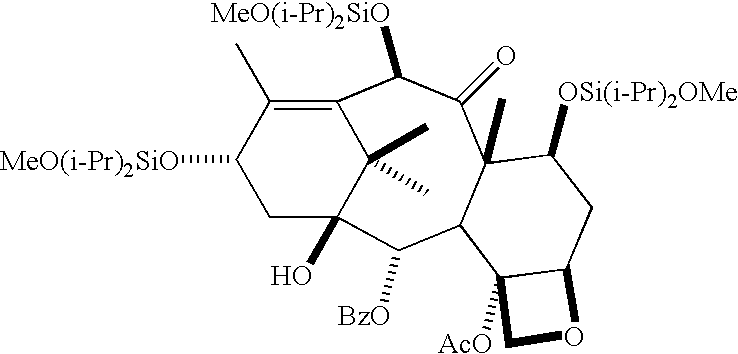
- To a solution of 10-desacetylbaccatin (47.4 g, 87 mmol) in anhydrous N,N-dimethylformamide (DMF) (500 mL) was added imidazole (47 g, 691 mmol) at ambient temperature. Solution was stirred for 10-15 min until a clear solution was observed. Dropwise, diisopropyldichlorosilane (58 mL, 322 mmol) was added to the reaction mixture. Reaction mixture was stirred for 16 h at ambient temperature. Additional amount of diisopropyldichlorosilane (6 mL) was added to the solution and the reaction was stirred for 60 min. HPLC at this point indicated completion of the reaction. Methanol (36 mL) was added to the mixture and the solution was stirred for 60 min. Reaction was stopped and diluted with a mixture of tert-butyl methyl ketone (TBME) (500 mL) and water (200 mL). Layers were separated and organic phase was washed with brine (250 mL), dried (sodium sulfate) and evaporated to afford the trisilylated baccatin derivative 1, (91 g, >100% yield) as a white amorphous compound which was used in the next step without further purification.
- ESILRMS M+ calcd. For C 50H84O13Si3: 977. Found 977
- 2) Synthesis of Baccatin Derivative 2

- To a solution of baccatin derivative 1 (90 g, 92 mmol) in DMF (500 mL) was added imidazole (22 g, 320 mmol) at 0° C. Dimethylchlorosilane (35 mL, 320 mmol) was added dropwise at 0° C. Precipitation of the compound was observed at this point. Reaction mixture (slurry) was stirred for 0.5 h at 0° C. Solid was filtered and washed with cold DMF (3×150 mL). After air drying, solid was redissolved in TBME (700 mL) and the solution was washed with water (3×200 mL), brine (250 mL) and dried (sodium sulfate). The solution was filtered through a short silica pad. Removal of the solvent under vacuum afforded 2 in 77% yield (70 g).
- ESILRMS M+calcd. For C 50H90O13Si4: 1035. Found 1035
- 3) Synthesis of Baccatin Derivative 3

- To a stirred solution of 2 (66.3 g, 64 mmol) in toluene (680 mL) at −34° C. was added Red-Al (50 mL, 160 mmol, 65 wt % solution of sodium bis(2-methoxyethoxy)aluminum hydride in toluene) dropwise over a period of 10 min. Reaction mixture was warmed to −25° C. and stirred for 1.5 h. Methanol (62 mL) was added dropwise to the reaction mixture keeping internal temperature between −20 and −25° C. Solution was diluted with TBME (500 mL) followed by the addition of 1N sodium hydroxide solution (60 mL) and brine (60 mL). Solution was stirred for 30 min. Celite (12 g) was added to the mixture, stirred for 10 min, and filtered through a pad of celite. Layers were separated. Organic layer was washed with water, brine, and dried (sodium sulfate). Next, solution was passed through a short silica pad before removal of the solvent. The compound was obtained in 97% yield (62 g) as a white solid.
- ESILRMS M+calcd. For C 50H88O12Si4: 993. Found 993
- 4) Synthesis of Baccatin Derivative 4
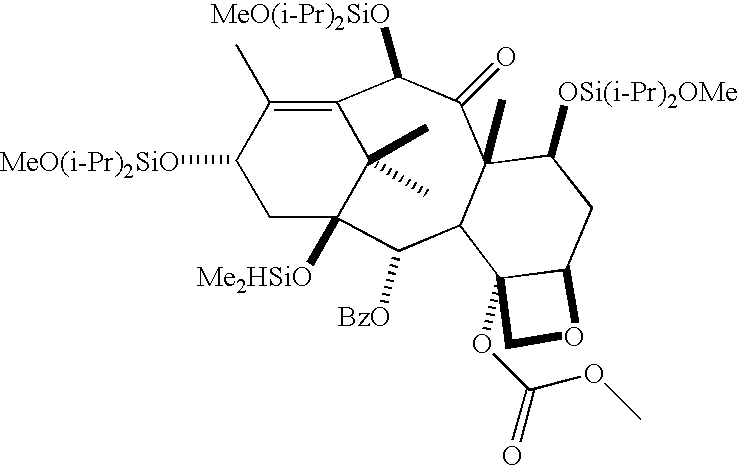
- Under argon atmosphere, to a solution of 3 (62 g, 62 mmol) in anhydrous tetrahydrofuran (THF) (600 mL) at −60° C. was added LHMDS (lithium bis(trimethylsilyl)amide (125 mL, 125 mmol, 1M solution in THF) dropwise. Solution was stirred for 15 min followed by the addition of methyl chloroformate (9 mL, 116 mmol); internal temperature of the solution was maintained at −60° C. Reaction was slowly warmed to 0° C. and mixture was stirred for 3 h. After completion of the reaction, saturated ammonium chloride (300 μL) was added. Reaction mixture was extracted with TBME (100 mL). Organic layer was washed with saturated ammonium chloride (200 mL), water (200 mL), brine (200 mL), dried (sodium sulfate), and evaporated to provide 4 as an oil (67 g, >100%). The crude material was used in the next step without further purification.
- ESILRMS M+calcd. For C 52H90O14Si4: 1051. Found 1051.
- 5) Synthesis of Baccatin Derivative 5

- To a solution of baccatin derivative 4 (62 g, 59 mmol) in dry THF (260 mL) was added triethylamine.hydrofluoric acid complex (56 mL, 344 mmol) at ambient temperature. Reaction was stirred for 3 h. Reaction mixture was diluted with ethyl acetate (350 mL) and washed with water (200 mL), brine (200 mL), dried (sodium sulfate), and evaporated to afford 5 (43 g, >100% crude yield). Resluring of the crude compound in a mixture of hot ethylm acetate (350 mL) and hexanes (50 mL) gave pure 5 in 90% yield.
- ESILRMS M+calcd. For C 29H36O11: 560. Found 560.
- 6) Synthesis of Baccatin Derivative 6

- To a stirred solution of baccatin 5 (32 g, 57 mmol) and imidazole (11.7, 172 mmol in DMF (220 mL) at −65° C. was added diisopropyldichlorosilane (26.8 mL) under argon. Temperature of the reaction mixture was maintained at −60° C. and the mixture was stirred for 2 h. After completion of the reaction (HPLC), a solution of imidazole in methanol (11.7 g imidazole dissolved in 35 mL methanol) was added and the solution was stirred at 0° C. for 30 min. Mixture was extracted with TBME (500 mL). Organic phase was washed with water (4×150 mL), dried (sodium sulfate), and evaporated to afford crude 6 (45 g). The crude material was further dissolved in acetonitrile (150 mL) and the solution was washed with hexanes (3×100 1 mL). Removal of acetonitrile afforded pure 6 as a white solid (34 g, 84% yield).
- ESILRMS M+calcd. For C 36H52O12Si: 704. Found 704.
- 7) Synthesis of baccatin derivative 7
- 4-deacetyl-7-[bisisopropyl(methoxy)]silyloxy-4-methoxycarbonyl-baccatin

- To a solution of baccatin derivative 6 (33.2 g, 47 mmol) in DMF (200 mL) was added LHMDS (61.2 mL, 61.2 mmol) dropwise at −43° C. Reaction was stirred for 15 min followed by the addition of acetic anhydride (5.8 mL, 63 mmol). Reaction was stirred for 30 min. at −40° C. Acetic acid (3.6 mL) was added and the cooling bath was removed. Reaction mixture was extracted with TBME (300 mL). Organic layer was separated and washed with water (3×150 mL), brine (150 mL), dried (sodium sulfate), and evaporated to afford the crude product. Purification of this compound was achieved by crystallization from a mixture of THF:heptane (1:6). Input of 40 g provided 21 g of crystallized baccatin derivative 7 (60% yield).
- ESILRMS M+calcd. For C 38H54O13Si: 746. Found 746.
- 3′-tert-Butyl-3′-N-tert-butyloxycarbonyl-4-deacetyl-3′-dephenyl-3′-N-debenzoyl-4-O-methoxycarbonyl-paclitaxel

- A solution of (±)-cis-4-tert-butyl-1-(tert-butyloxycarbonyl)-3-triethylsilyloxyazetidin-2-one (2.71 gm, 5 equiv) and 4-deacetyl-7-[bisisopropyl(methoxy)]silyloxy-4-methoxycarbonyl-baccatin (1.13 gm, 1.52 mmole) in dry THF (100 mL) under N2 was cooled to −50° C. and a solution of LiHMDSA (1.97 mL, 1.3 equiv, 1.0 M in THF) was added. After 5 min this was transferred to a bath that was maintained at −35 to −30° C. for 20 hr and then −25° C. for 24 hr. The reaction was then quenched with saturated aqueous NH 4Cl solution and extracted with a mixture of EtOAc and hexane (1:1). The organic extracts were washed with brine and dried (Na2SO4). The solvents were removed and the residue was chromatographed (radial chromatography on a 6 mm silica gel plate; gradient elution with 5 to 20% EtOAc in hexane) to afford 1.55 gm of 3′-tert-butyl-3′-N-tert-butyloxycarbonyl-7-[bisisopropyl(methoxy)]silyloxy-4-deacetyl-3′-dephenyl-3′-N-debenzoyl-4-O-methoxycarbonyl-2′-triethylsilyloxy paclitaxel as a mixture of 2′,3′-diastereomers. This mixture was dissolved in dry THF (60 mL) and triethylamine trihydrofluoride (0.92 mL 4 equiv) were added. After 22 hr at RT, the reaction was neutralized with saturated aq. NaHCO3 solution and then extracted with EtOAc. The organic extracts were washed with brine, dried (Na2SO4) and the solvents were removed. The residue was chromatographed (radial chromatography; 2 mm silica gel plate; gradient elution from 10 to 50% EtOAc in hexane) to afford (in order of elution): 210 mg (18%) of 2′S,3′R-3′-tert-butyl-3-′N-tert-butyloxycarbonyl-4-deacetyl-3′-dephenyl-3′-N-debenzoyl-4-O-methoxycarbonyl-paclitaxel {1H NMR (CDCl3) δ 1.04 (s, 9H), 1.13 (s, 3H), 1.20 (s, 3H), 1.37 (s, 9H), 1.65 (s, 1H), 1.66 (s, 3H), 1.84-1.93 (m, 2H), 2.17 (s, 3H), 2.25 (s, 3H), 2.55 (m, 3H), 3.00 (d, 1H, J=6.5 Hz), 3.74 (d, 1H, J=10.8 Hz), 3.79 (d, 1H, J=6.9 Hz), 3.92 (s, 3H), 4.16 (d, 1H, J=8.5 Hz), 4.33 (d, 1H, J=8.5 Hz), 4.42 (m, 1H), 4.54 (d, 1H, J=6.5 Hz) 4.87 (d, 1H, J=10.6 Hz), 5.01 (d, 1H, J=7.7 Hz), 5.68 (d, 1H, J=7.0 Hz), 5.76 (m, 1H), 6.32 (s, 1H), 7.44-8.05 (m, 5H); LRMS (ESI) 846 [(M+H)+]} and 668 mg (56%) of the title compound {1H NMR (CDCl3) δ 1.07 (s, 9H), 1.14 (s, 3H), 1.24 (s, 3H), 1.33 (s, 9H), 1.66 (s, 4H), 2.23 (s, 3H), 2.38-2.59 (m, 4H), 3.11 (d, 1H, J=5.8 Hz), 3.77 (d, 1H, J=11.1 Hz), 3.82 (d, 1H, J=7.0 Hz), 3.96 (s, 3H), 4.20 (d, 1H, J=8.6 Hz), 4.33 (d, 1H, J=8.6 Hz), 4.39 (m, 1H), 4.53 (d, 1H, J=5.4 Hz) 4.88 (d, 1H, J=10.6 Hz), 4.98 (d, 1H, J=7.9 Hz), 5.69 (d, 1H, J=7.1 Hz), 6.03 (m, 1H), 6.28 (s, 1H), 7.40-8.11 (m, 5H); LRMS (ESI) 846 [(M+H)+]}.
- 3′-N-tert-Butyloxycarbonyl-4-deacetyl-3′-dephenyl-3′-N-debenzoyl-3′-isopropyl-4-O-methoxycarbonyl-paclitaxel
- By following the above procedure, (±)-cis-1-tert-butyloxycarbonyl-4-isopropyl-3-triethylsilyloxy-azetidin-2-one was coupled with 4-deacetyl-7-[bisisopropyl(methoxy)]silyloxy-4-O-methoxycarbonyl-baccatin. Deprotection followed by chromatography gave the title compound 1H NMR (CDCl3+D2O) δ 1.03 (d, 3H, J=6.7 Hz), 1.09 (d, 3H, J=6.7 Hz), 1.14 (s, 3H), 1.24 (s, 3H), 1.31 (s, 9H), 1.66 (m, 3H), 1.83-2.02 (m, 5H), 2.24 (s, 3H), 2.25-2.59 (m, 3H), 3.68 (dd, 1H, J=2.0, 9.2 Hz), 3.82 (d, 1H, J=6.9 Hz), 3.98 (s, 3H), 4.19 (d, 1H, J=8.6 Hz), 4.34 (d, 1H, J=8.6 Hz), 4.39 (m, 1H), 4.43 (d, 1H, J=2.0 Hz) 4.82 (br s, 1H), 4.98 (d, 1H, J=7.8 Hz), 5.69 (d, 1H, J=7.0 Hz), 6.11 (m, 1H), 6.28 (s, 1H), 7.45-8.12 (m, 5H); LRMS (ESI) 832 [(M+H)+].
- 3′-N-Neopentylcarbonyl-4-deacetyl-3′-N-debenzoyl-4-O-methoxycarbonylpaclitaxel:
- A solution of (3R,4R)-1-neopentylcarbonyl-4-phenyl-3-triethylsilyloxy-azetidin-2-one (525 mg, 1.4 equiv) and 4-deacetyl-7-[bisisopropyl(methoxy)]silyloxy-4-O-methoxycarbonyl-baccatin (523 mg, 0.700 mmole) in dry THF (15 mL) was cooled to −50° C. and a solution of LiHMDSA (0.84 mL, 1.2 equiv, 1.0 M in THF) was added with stirring. After 40 min, the reaction was allowed to warm to 0° C. After 1.5 hr, this was quenched with a saturated aq. solution of NH 4Cl, the reaction was extracted with EtOAc. The organic extract was washed with a saturated aq. solution of NH4Cl, water, brine and dried (Na2SO4). Removal of the solvents followed by silica gel column chromatography (gradient elution with mixtures of 0% to 20% EtOAc in hexane) afforded 2.78 mg (54%) of 3′-N-neopentyloxycarbonyl-7-[bisisopropyl(methoxy)] silyloxy-4-deacetyl-3′-N-debenzoyl-4-O-methoxycarbonyl-2′-triethylsilyloxy-paclitaxel. This was taken directly and treated with triethylamine trihydrofluoride (0.161 mL, 4 equiv) in dry THF (6 mL) and left stirring at RT overnight. After neutralization with saturated aq. NaHCO3 solution, the reaction was extracted with EtOAc. The organic extracts were washed with brine and dried (Na2SO4). Removal of the solvents followed by silica gel column chromatography (gradient elution with mixtures of 20 to 50% EtOAc in hexane) afforded 151 mg (71%) of the title product: 1H NMR (CDCl3) δ 0.96-2.58 [32H, including 0.96 (s, 9H), 1.14 (s, 3H), 1.24 (s, 3H), 1.66 (s, 3H), 1.84 (s, 3H), 2.23 (s, 3H)], 3.58 (br s, 1H), 3.77 (s, 3H), 3.80 (d, 1H, J=5.5 Hz), 4.19 (d, 1H, J=8.3 Hz), 4.33 (d, 1H, J=8.7 Hz), 4.36 (m, 1H), 4.65 (d, 1H, J=2.0 Hz), 4.95 (d, 1H, J=8.5 Hz), 5.58 (dd, 1H, J=2.3, 8.8 Hz), 5.69 (d, 1H, J=7.0 Hz), 6.11 (d, 1H, J=8.9 Hz), 6.16 (m, 1H), 6.27 (s, 1H), 7.29-8.12 (m, 10H); LRMS (ESI) 864 [(M+H)+].
- 3′-N-Cyclobutyl-4-deacetyl-3′-N-debenzoyl-4-O-methoxycarbonyl-paclitaxel:
- By following the above procedure and using (3R,4R)-1-cyclobutyl-4-phenyl-3-triethylsilyloxy-azetidin-2-one, 4-deacetyl-7-[bisisopropyl(methoxy)]silyloxy-4-O-methoxycarbonyl-baccatin was converted to the title product: 1H NMR (CDCl3) δ 1.14-2.53 [m, 27H including: 1.14 (s, 3H), 1.25 (s, 3H), 1.67 (s, 3H), 1.84 (s, 3H), 2.24 (s, 3H)], 3.01 (m, 1H), 3.56 (br s, 1H), 3.81 (s, 3H), 3.82 (m, 1H), 4.20 (d, 1H, J=8.4 Hz), 4.34 (d, 1H, J=8.5 Hz), 4.37 (m, 1H), 4.68 (d, 1H, J=2.3 Hz), 4.96 (d, 1H, J=8.6 Hz), 5.58 (dd, 1H, J=2.4, 9.0 Hz), 5.70 (d, 1H, J=7.0 Hz), 6.16 (m, 2H), 6.27 (s, 1H), 7.29-8.14 (m, 10H); LRMS (ESI) 848 [(M+H)+].
- 3′-tert-Butyl-3′-N-cyclohexyloxycarbonyl-4-deacetyl-3′-dephenyl-3′-N-debenzoyl-4-O-methoxycarbonyl-paclitaxel
- By following the same procedure with cyclohexyloxychloroformate, 3′-tert-butyl-3-′N-tert-butyloxycarbonyl-4-deacetyl-3′-dephenyl-3′-N-debenzoyl-4-O-methoxycarbonyl-paclitaxel was converted to the title product: 1H NMR (CDCl3+D2O) δ 1.10-2.61 [38H, including 1.10 (s, 9H), 1.16 (s, 3H), 1.26 (s, 3H), 1.69 (s, 3H), 1.95 (s, 3H), 2.26 (s, 3H)], 3.84 (m, 2H), 3.99 (s, 3H), 4.23 (d, 1H, J=8.6 Hz), 4.40 (m, 3H), 4.57 (s, 1H), 5.02 (m, 2H), 5.7 (d, 1H, J=7.08 Hz), 6.06 (m, 1H), 6.30 (s, 1H), 7.46-8.13 (m, 5H); LRMS (ESI) 872 [(M+H)+].
- 3′-tert-Butyl-4-deacetyl-3′-dephenyl-3′-N-debenzoyl-3′-N-neopentylcarbonyl-4-O-methoxycarbonyl-paclitaxel
- By following the above procedure with tert-butylacetyl chloride, 3′-tert-butyl-3-N-tert-butyloxycarbonyl-4-deacetyl-3′-dephenyl-3′-N-debenzoyl-4-O-methoxycarbonyl-paclitaxel was converted to the title product 1H NMR (CDCl3+D2O) δ 1.00-2.56 [39H, including 1.00 (s, 9H), 1.11 (s, 9H), 1.16 (s, 3H), 1.26 (s, 3H), 1.69 (s, 3H), 1.91 (s, 3H), 2.26 (s, 3H)], 3.83 (d, 1H, J=7.1 Hz), 3.98 (s, 3H), 4.17 (d, 1H, J=10.1 Hz), 4.26 (d, 1H, J=8.8 Hz), 4.37 (m, 2H), 4.55 (s, 1H), 5.00 (d, 1H, J=7.5 Hz), 5.73 (m, 2H), 6.02 (m, 1H), 6.29 (s, 1H), 7.45-8.13 (m, 5H); LRMS (ESI) 844 [(M+H)+].
- 4-deacetyl-3′-N-debenzoyl-3′-N-tertbutoxycarbonyl-4-O-methoxycarbonyl-paclitaxel
- By following the above procedures and using (3R,4R)-1-tertbutoxycarbonyl-4-phenyl-3-triethylsilyloxy-azetidin-2-one, compound Ig was prepared.
- 1H NMR (300 MHz, CDCl 3): δ 8.13-8.10 (m, 2H), 7.61-7.26 (m, 8H), 6.27 (s, 1H), 6.19 (m, 1H), 5.68 (d, J=6.9 Hz, 1H), 5.35-5.29 (m, 2H), 4.97 (d, J=7.7 Hz, 1H), 4.63 (d, J=3.9 Hz, 1H), 4.42-4.37 (m, 1H), 4.25 (AB q, J=8.8 Hz, J=47.7 Hz, 2H), 3.85-3.81 (m, 4H), 3.40 (d, J=5.1 Hz, 1H), 2.59-1.03 (m, 30H, include singlets at 2.24, 1.87, 1.71, 1.27, 1.14, 3H each, 1.32, 9H).
- 4-deacetyl-3′-N-debenzoyl-3′-N-nbutoxycarbonyl-4-O-methoxycarbonylpaclitaxel
- Using the procedures described above with (3R,4R)-1-nbutoxycarbonyl-4-phenyl-3-triethylsilyloxy-azetidin-2-one, compound Ih was prepared.
- 1H NMR (300 MHz, CDCl 3): δ 8.11 (d, J=7.4 Hz, 2H), 7.62-7.29 (m, 10H), 6.27 (s, 1H), 6.27 (m, 1H), 5.69 (d, J=7.0 Hz, 1H), 5.41 (abq, J=47.4, 9.4 Hz, 2H), 4.97 (d, J=7.0 Hz, 1H), 4.66 (brs, 1H), 4.38-4.32 (m, 1H), 4.26 (abq, 45.0, 8.6 Hz, 2H), 3.83 (s, 3H), 3.42 (brd, J=4.1 Hz, 1H), 2.59-2.35 (m, 4H), 2.24 (m, 3H), 1.86 (s, 3H), 1.67 (s, 3H), 1.65 (d, J=33.0 Hz, 3H), 1.67 (s, 3H), 1.51-1.47 (m, 2H), 1.24 (s, 3H), 1.14 (s, 3H), 0.83 (m, 3H).
- Anal. calcd. for C 45H55NO16: C, 62.42; H, 6.40; N, 1.62. Found: C, 62.28; H, 6.45; N, 1.55.
- 3′-N-debenzoyl-3′-N-cyclobutylcarbonyl-3′-dephenyl-3′-tert-butyl-4-deacetyl-4-methoxycarbonyl paclitaxel
- A solution of 3′-N-debenzoyl-3′-N-tert-butyl-3′-dephenyl-3′-tert-butyl-4-deacetyl-4-methoxycarbonyl paclitaxel (2.30 g, 2.72 mmoles) in DCM (15.0 mL) was treated with trifluoroacetic acid (15.0 mL) and stirred at stirred at 0° C. for 1.5 hrs. The mixture was diluted with 100 mL DCM and poured into a cold solution (0° C.) made up of 50.0 g NaHCO 3 in 150 mL water. The phases were separated and the organic layer was concentrated in vacuo. The product could be purified by column chromatography on silica gel eluting with 4% methanol/DCM, but was generally used without purification. The crude 3′-N-debenzoyl-3′-dephenyl-3′-tert-butyl-4-deacetyl-4-methoxycarbonyl paclitaxel was dissolved in ethyl acetate (15.0 mL) and treated with saturated NaHCO3 (15.0 mL). Cyclobutane carbonyl chloride (460.0 μL, 4.08 mmoles, 1.5 equiv.) was added and the biphasic mixture was stirred vigorously at ambient temperature for 20 mins. The mixture was diluted with ethyl acetate, and the phases were separated. The organic phase was washed with saturated NaHCO3, then brine. The organic solution was dried over anhydrous Na2SO4, filtered and concentrated in vacuo. Purification by preparative reverse phase chromatography eluting with 20% acetonitrile/water for 5 mins. ramping up to 60% acetonitrile/water over 45 mins, then isocratic for 45 mins. at a flow rate of 250 mL/min. afforded the title compound (1.47 g, 65% yield, 97% pure by HPLC analysis) as a white, amorphous solid which exhibited the following physical properties: 1H NMR (CDCl3, 300 MHz) δ 8.08 (d, J=7.1 Hz, 2H), 7.62-7.55 (m, 1H), 7.48-7.43 (m, 2H), 6.27 (s, 1H), 5.99 (dd, J=7.8 Hz, J=9.0 Hz, 1H), 5.69 (m, 2H), 4.98 (dd, J=2.0 Hz, J=9.5 Hz, 1H), 4.55 (dd, J=1.1 Hz, J=5.2 Hz, 1H), 4.40-4.32 (bm, 2H), 4.22 (d, J=8.4 Hz, 1H), 4.14 (d, J=10.2 Hz, 1H), 3.98 (s, 3H), 3.80 (d, J=7.0 Hz, 1H), 3.30 (d, J=5.1 Hz, 1H), 2.97 (p, J=7.9 Hz, 1H), 2.58-2.36 (bm, 4H), 2.23 (s, 3H), 2.19-2.03 (bm, 4H), 1.92-1.76 (bm, 3H), 1.88 (s, 3H), 1.66 (s, 3H), 1.24 (s, 3H), 1.14 (s, 3H), 1.06 (s, 9H); 13C NMR (CDCl3, 75 MHz) δ 203.70, 174.99, 174.93, 171.46, 166.89, 153.21, 142.54, 133.74, 133.20, 130.22, 129.81, 128.72, 84.13, 83.21, 78.92, 76.09, 75.68, 74.94, 73.39, 72.06, 70.17, 58.36, 57.73, 56.03, 51.07, 45.74, 43.34, 39.91, 35.94, 35.47, 27.37, 26.85, 25.60, 25.44, 22.12, 20.95, 18.29, 14.95, 9.72; LRMS (ESI): 828.51 ((M+1)+, 100%), 886.57 ((M+NH4+ACN)+, 15%); 826.48 ((M-1)-, 100%).
- 3′-N-debenzoyl-3′-N-(2-furoyl)-3′-dephenyl-3′-tert-butyl-4-deacetyl-4-methoxycarbonyl paclitaxel
- Prepared similarly to Example 9 above. The title compound (2.13 g, 73% yield, 98% pure by HPLC analysis) was obtained as a white, amorphous solid which exhibited the following physical properties: 1H NMR (CDCl3, 300 MHz) δ 8.15-8.08 (m, 2H), 7.64-7.56 (m, 1H), 7.52-7.25 (m, 3H), 7.03 (dd, J=0.6 Hz, J=3.4 Hz, 1H), 6.78 (d, J=10.2 Hz, 1H), 6.48 (dd, J=1.8 Hz, J=3.5 Hz, 1H), 6.25 (s, 1H), 6.06 (dd, J=7.6 Hz, J=8.9 Hz, 1H), 5.70 (d, J=7.0 Hz, 1H), 5.00 (dd, J=1.9 Hz, J=9.4 Hz, 1H), 4.40-4.32 (m, 3H), 4.23 (d, J=8.6 Hz, 1H), 4.05 (s, 3H), 3.48 (d, J=4.5 Hz, 1H), 2.60-2.50 (m, 2H), 2.38 (dd, J=3.3 Hz, J=8.8 Hz, 1H), 2.23 (s, 3H), 2.05 (s, 1H), 1.95-1.85 (m, 1H), 1.81 (s, 3H), 1.68 (s, 3H), 1.21 (s, 3H), 1.14 (s, 12H); 13C NMR (CDCl3, 75 MHz) δ 203.71, 174.23, 171.55, 167.06, 158.22, 153.06, 147.65, 144.30, 142.53, 133.93, 133.36, 130.32, 129.42, 128.88, 114.95, 112.51, 84.20, 83.48, 79.06, 77.65, 76.20, 75.81, 75.05, 72.96, 70.55, 58.50, 57.97, 56.40, 46.07, 43.33, 36.09, 35.55, 27.53, 27.05, 22.00, 21.25, 21.06, 14.97, 14.39, 9.83; LRMS (ESI): 840.43 ((M+1)+, 100%); 838.43 ((M−1)-, 100%).
- Biological Data
- Another aspect of the instant invention concerns a method for inhibiting human and/or other mammalian tumors which comprises orally administering to a tumor bearing host an antitumor effective amount of a compound of formula I.
- The materials and methods utilized for the in vivo antitumor testing of our oral taxanes are summarized below:
- Materials
- Animals. Conventional or athymic (“nude”) mice, and nude rats, were implanted subcutaneously (sc) with tumor brei or fragments. Murine tumor were implanted in conventional mice, human tumors were implanted into nude mice or rats.
- Tumors. The tumors utilized most often included the murine lung carcinoma, M109, the murine mammary carcinoma, MAM 16/C, the human ovarian carcinoma, A2780, the human colon tumors, HCT-116 and HCT-116/pk. Compounds I exhibited antitumor activity after oral administration in one or more of the aforementioned tumor models.
- Methods for the Table III Results
- The experiments were carried out using athymic (“nude”) mice. Typically, treatments were begun when tumors were between 100 and 500 mg in size (typically Day 7 to Day 12 post-tumor implant) for the A2780 human ovarian tumor xenograft model. Group sizes were typically 8 per treatment and control groups in mouse experiments. The compound was administered at the dose indicated in Table III, namely, once daily every other day for five treatments (i.e. q2dx5).
- Treatments for taxanes administered orally (po) were done by gavage using a vehicle consisting of 10% ethanol+10% Cremophor EL+80% water. The volume of liquid administered was 0.01 ml per gram of body weight for mice. A typical mouse experiment would involve the evaluation of each test compound at three different dose levels.
- Antitumor activity was assessed by determining the size of tumors in all treated and control experimental animals over time. Each animal was individually identified and the growth of the tumor implanted into each animal was measured once or twice weekly using a calipers. The difference in median time for tumors in treated (T) and control (C) groups to reach a predetermined size (e.g., 500 or 1,000 milligrams) was calculated, and assessments of absolute and relative antitumor effects (e.g., between compounds) were made on the basis of the delays in time to reach predetermined tumor target sizes. Animals with tumors of 35 mg or less at the termination of an experiment were termed “cures”. Experiments were terminated typically after a period of time had elapsed post-treatment that was at least 10 times the tumor volume doubling time (TVDT) of the median tumor growth in control animals as assessed prior to their reaching the predetermined tumor target size in each experiment. Activity in a test group was defined as having caused a delay in tumor growth (median time to reach tumor target size) relative to the concomitant control tumor growth (i.e., T-C) of 3.32 times the TVDT. Activity was expressed in “log cell kill” which was equal to (T-C)/(TVDT×3.32). Toxicity was determined by measuring the average body weight of all animals in an experiment prior to, and soon after, any treatments in the experiment. Additionally, animals were considered to have died due to treatment—induced injury if they died prior to any deaths in the control group with tumors smaller than target size. No results of therapy, nor any declaration of activity, was used or made for a particular treatment group if more than one animal in that group died in a manner characterized as treatment-induced.
- All of the compounds in Table III displayed oral antitumor activity in a ScM109 tumor model implanted in mice which was judged to be equivalent to the antitumor activity of paclitaxel administered intravenously according to its optimum schedule of administration and dose.
TABLE III In Vivo Activity vs Sc A2780 of Orally Active C-4 Methyl Carbonate Taxanes Oral Efficacy vs. Sc A2780 Oral Log Cell Killc Compound Dosea Schedule (Cures/Treated)b Ia 65 q2dx5 4.4 (0/8) Ib 28 q2dx5 3.0 (1/8)** Ic 100 q2dx5 3.8 (0/8) Id 140 q2dx5 4.1 (0/8) Ie 55 q2dx5 1.5 (0/8) If 36 q2dx5 1.8 (0/8) Ig 32 q2dx5 0.9 (0/8) Ih 100 q2dx5 7.0 (1/8)** Ij 120 q2dx5 2.1 (0/8) Ik 130 q2dx5 2.2 (0/8) - As can be seen from the results of Table III, all the compounds Ia-Ik displayed significant oral antitumor activity. Significant antitumor activity is defined as being approximately one log cell kill. This can be contrasted with results that would be observed for compounds which would have no oral activity, such as paclitaxel (i.e. having approximately zero log cell kill). It should be recognized that paclitaxel, which is the active ingredient of the commercially available anticancer drug, TAXOL®, is administered intravenously and is not used in oral administration since it is not effective.
- For treating a variety of tumors, the compound of formula I of the present invention may be used in a manner similar to that of paclitaxel, e.g. see Physician's Desk Reference, 49th Edition, Medical Economics, p 682, 1995. The dosage, mode and schedule of administration for the compound of this invention are not particularly restricted; an oncologist skilled in the art of cancer treatment will be able to ascertain, without undue experimentation, an appropriate treatment protocol for administering the compound of the present invention. Thus the compound of formula I may be administered via any suitable route of administration, parenterally or orally. Parenteral administration includes intravenous, intraperitoneal, intramuscular, and subcutaneous administration.
- The doses utilized to implement the methods in accordance with the invention are the ones that make it possible to administer prophylactic treatment or to evoke a maximal therapeutic response. The doses vary, depending on the type of administration, the particular product selected, and the personal characteristics of the subject to be treated. In general, the doses are the ones that are therapeutically effective for the treatment of disorders caused by abnormal cell proliferation. The products in accordance with the invention can be administered as often as necessary in order to obtain the desired therapeutic effect. Some patients may respond rapidly to relatively high or low doses, and then require mild maintenance or no maintenance dose at all. Via the iv route, the dosage may be, for example, in the range of about 20 to about 500 mg/m2 over 1 to 100 hours. Via the oral route, the dosage may be in the range of 5-1000 mg/kg/day of body weight. The actual dose used will vary according to the particular composition formulated, the route of administration, and the particular site, host and type of tumor being treated. Many factors that modify the action of the drug will be taken into account in determining the dosage including age, weight, sex, diet and the physical condition of the patient.
- The present invention also provides pharmaceutical formulations (compositions) containing an antitumor effective amount of compound of formula I in combination with one or more pharmaceutically acceptable carriers, excipients, diluents or adjuvants. The compositions can be prepared in accordance with conventional methods. Examples of formulating paclitaxel or derivatives thereof may be found in, for example, U.S. Pat. Nos. 4,960,790 and 4,814,470, and such examples may be followed to formulate the compound of this invention. Additional examples of paclitaxel formulations are found in the general references cited earlier in the background art. For example, compound of formula I may be formulated in the form of tablets, pills, powder mixtures, capsules, injectables, solutions, suppositories, emulsions, dispersions, food premix, and in other suitable forms. It may also be manufactured in the form of sterile solid compositions, for example, freeze dried and, if desired, combined with other pharmaceutically acceptable excipients. Such solid compositions can be reconstituted with sterile water, physiological saline, or a mixture of water and an organic solvent, such as propylene glycol, ethanol, and the like, or some other sterile injectable medium immediately before use for parenteral administration.
- Typical of pharmaceutically acceptable carriers are, for example, manitol, urea, dextrans, lactose, potato and maize starches, magnesium stearate, talc, vegetable oils, polyalkylene glycols, ethyl cellulose, poly(vinylpyrrolidone), calcium carbonate, ethyl oleate, isopropyl myristate, benzyl benzoate, sodium carbonate, gelatin, potassium carbonate, silicic acid. The pharmaceutical preparation may also contain nontoxic auxiliary substances such as emulsifying, preserving, wetting agents, and the like as for example, sorbitan monolaurate, triethanolamine oleate, polyoxyethylene monostearate, glyceryl tripalmitate, dioctyl sodium sulfosuccinate, and the like.
Claims (30)
1. A process for preparing a compound of formula I,

wherein:


R is phenyl, isopropyl, or tert butyl;
R1 is —C(O)Rz in which Rz is (CH3)3CO—, (CH3)3CCH2—, CH3(CH2)3O—, cyclobutyl-, cyclohexyloxy, or (2-furyl); and
R2 is CH3C(O)O—,
comprising the steps of:
(a) reacting a compound of formula II,
wherein R2 is as defined hereinabove, and R4 is a hydroxy protecting group, with a beta-lactam of formula IV,
wherein R1 and R are as defined hereinabove, and R3 is a hydroxy protecting group, in presence of a base to produce the compound of formula III,
wherein R, R1, R2, R3 and R4 are as defined hereinabove; and
(b) deprotecting the hydroxy protecting groups R3 and R4 of the compound of formula III to provide the compound of formula I.
2. The process of claim 1 , wherein said hydroxy protecting group is selected from the group consisting of ether, dialkylsilylether, trialkylsilylether, dialkylalkoxysilylether, ester and carbonate.
3. The process of claim 2 , wherein:
said ether hydroxy protecting group is methyl, t-butyl, benzyl, p-methoxybenzyl, p-nitrobenzyl, allyl, trityl, methoxymethyl, methoxyethoxymethyl, ethoxyethyl, 1-methyl-1-methoxyethyl, tetrahydropyranyl, or tetrahydrothiopyranyl;
said dialkylsilylether hydroxy protecting group is dimethylsilyl;
said trialkylsilylether hydroxy protecting group is trimethylsilyl, triethylsilyl, or t-butyldimethylsilyl;
said dialkylalkoxysilylether hydroxy protecting group is diisopropyl methoxy silyl;
said ester hydroxy protecting group is benzoyl, acetyl, phenylacetyl, formyl, mono-, di-, or trihaloacetyl; and
said canbonate hydroxy protecting group is methyl, ethyl, 2,2,2-trichloroethyl, allyl, benzyl or p-nitrophenyl.
4. The process of claim 1 , wherein R3 is selected from the group consisting of 1-methyl-1-methoxyethyl (MOP), trialkyl silyl and dialkyl alkoxy silyl; and R4 is selected from the group consisting of dialkyl alkoxy silyl, trialkyl silyl and benzyl carbonate.
5. The process of claim 1 , wherein R3 is triethyl silyl or t-butyldimethylsilyl; and
R4 is diisopropyl methoxy silyl.
6. The process of claim 1 , wherein said step (b) comprises contacting the compound of formula III with at least one compound selected from the group consisting of a fluoride source and an acid.
7. A process for preparing a compound of formula Ia,

comprising the steps of:


(a) reacting a compound of formula Ia,
wherein R4 is a hydroxy protecting group,
with a beta-lactam of formula IVa,
wherein R3 is a hydroxy protecting group,
in the presence of a base to produce a compound of formula IIa,
wherein R3 and R4 are as defined hereinabove; and
(b) deprotecting the hydroxy protecting groups R3 and R4 of the compound of formula IIa to provide a compound of formula Ia.
8. The process of claim 7 , wherein said hydroxyl protecting group is selected from the group consisting of ether, dialkylsilylether, trialkylsilylether, dialkylalkoxysilylether, ester and carbonate.
9. The process of claim 8 , wherein:
said ether hydroxyl protecting group is methyl, t-butyl, benzyl, p-methoxybenzyl, p-nitrobenzyl, allyl, trityl, methoxymethyl, methoxyethoxymethyl, ethoxyethyl, 1-methyl-1-methoxyethyl, tetrahydropyranyl, or tetrahydrothiopyranyl;
said dialkylsilylether hydroxyl protecting group is dimethylsilyl;
said trialkylsilylether hydroxyl protecting group is trimethylsilyl, triethylsilyl, or t-butyldimethylsilyl;
said dialkylalkoxysilylether hydroxyl protecting group is diisopropyl methoxy silyl;
said ester hydroxyl protecting group is benzoyl, acetyl, phenylacetyl, formyl, mono-, di-, or trihaloacetyl; and
said canbonate hydroxyl protecting group is methyl, ethyl, 2,2,2-trichloroethyl, allyl, benzyl or p-nitrophenyl.
10. The process of claim 7 , wherein R3 is selected from the group consisting of 1-methyl-1-methoxyethyl (MOP), trialkyl silyl and dialkyl alkoxy silyl; and R4 is selected from the group consisting of dialkyl alkoxy silyl, trialkyl silyl and benzyl carbonate.
11. The process of claim 7 , wherein R3 is triethyl silyl or t-butyldimethylsilyl; and
R4 is diisopropyl methoxy silyl.
12. The process of claim 7 , wherein said step (b) comprises contacting the compound of formula III with at least one reagent selected from the group consisting of a fluoride source and an acid.
13. A process for preparing a compound of formula I,

wherein:


R is phenyl, isopropyl, or tert butyl;
R1 is —C(O)Rz in which Rz is (CH3)3CO—, (CH3)3CCH2—, CH3(CH2)3O—, cyclobutyl-, cyclohexyloxy, or (2-furyl); and
R2 is CH3C(O)O—,
comprising the steps of:
(a) deprotecting a compound of formula V,
wherein R and R2 are as defined hereinabove, and R′ is an amine protecting group, to produce a compound of formula VI,
wherein R and R2 are as defined hereinabove; and
(c) attaching R1 to the NH2 group of the compound of VI by reacting the compound of formula VI with a compound containing R1.
14. The process of claim 13 , wherein said compound containing R1 is selected from the group consisting of acid chloride, chloroformate and acid anhydride.
15. The process of claim 14 , wherein R′ is BOC or CBZ.
16. The process of claim 15 , wherein R is tert butyl, and R is —C(O)Rz in which Rz is (CH3)3CO—.
17. A compound of formula III,

wherein:
R is phenyl, isopropyl, or tert butyl;
R1 is —C(O)Rz in which Rz is (CH3)3CO—, (CH3)3CCH2—, CH3(CH2)3O—, cyclobutyl-, cyclohexyloxy, or (2-furyl);
R2 is CH3C(O)O—; and
R3 and R4 are each independently a hydroxy protecting group.
18. The compound of claim 17 , wherein said hydroxy protecting group is selected from the group consisting of ether, dialkylsilylether, trialkylsilylether, dialkylalkoxysilylether, ester and carbonate.
19. The compound of claim 18 , wherein:
said ether hydroxy protecting group is methyl, t-butyl, benzyl, p-methoxybenzyl, p-nitrobenzyl, allyl, trityl, methoxymethyl, methoxyethoxymethyl, ethoxyethyl, 1-methyl-1-methoxyethyl, tetrahydropyranyl, or tetrahydrothiopyranyl;
said dialkylsilylether hydroxy protecting group is dimethylsilyl;
said trialkylsilylether hydroxy protecting group is trimethylsilyl, triethylsilyl, or t-butyldimethylsilyl;
said dialkylalkoxysilylether hydroxy protecting group is diisopropyl methoxy silyl;
said ester hydroxy protecting group is benzoyl, acetyl, phenylacetyl, formyl, mono-, di-, or trihaloacetyl; and
said carbonate hydroxy protecting group is methyl, ethyl, 2,2,2-trichloroethyl, allyl, benzyl or p-nitrophenyl.
20. The compound of claim 17 , wherein R3 is selected from the group consisting of 1-methyl-1-methoxyethyl (MOP), trialkyl silyl and dialkyl alkoxy silyl; and R4 is selected from the group consisting of dialkyl alkoxy silyl, trialkyl silyl and benzyl carbonate.
21. The compound of claim 17 , wherein R3 is triethyl silyl or t-butyldimethylsilyl; and R4 is diisopropyl methoxy silyl.
22. The compound of claim 21 , wherein R is tert butyl; and R1 is —C(O)Rz in which Rz is (CH3)3CO—.
23. A compound of formula V,

wherein:
R is phenyl, isopropyl, or tert butyl;
R′ is an amine protecting group; and
R2 is CH3C(O)O—.
24. The compound of claim 23 , wherein R is tert butyl.
25. The compound of claim 24 , wherein R′ is BOC or CBZ.
26. A compound of formula VI, or a pharmaceutically acceptable salt thereof,

wherein:
R is phenyl, isopropyl, or tert butyl; and
R2 is CH3C(O)O—.
27. The compound of claim 26 , wherein R is tert butyl.
28. A process for the preparation of a metal alkoxide of formula IIm,

wherein R2 is CH3C(O)O—, R4 is a hydroxy protecting group, and M is a metal atom (ion),
comprising reacting a compound of formula II,

wherein R2 and R4 are as defined hereinabove,
with a metal base.
29. The process of claim 28 , wherein said metal base is selected from the group consisting of lithium diisopropylamide, C1-6 alkyllithium, lithium bis(trimethylsilyl)amide, sodium bis(trimethylsilyl)amide, potassium bis(trimethylsilyl)amide, phenyllithium, sodium hydride, potassium hydride and lithium hydride.
30. The process of claim 28 , further comprising reacting said metal alkoxide of formula IIm with a beta-lactam of formula IV,

wherein:

R is phenyl, isopropyl, or tert butyl;
R1 is —C(O)Rz in which Rz is (CH3)3CO—, (CH3)3CCH2—, CH3(CH2)3O—, cyclobutyl-, cyclohexyloxy, or (2-furyl); and
R3 is a hydroxyl protecting group,
to produce a compound of formula III,
wherein R, R1 and R3 are as defined hereinabove; R2 and R4 are as defined in claim 28.
Priority Applications (2)
| Application Number | Priority Date | Filing Date | Title |
|---|---|---|---|
| US10/827,062 US6916942B2 (en) | 2000-02-03 | 2004-04-19 | Process for the preparation of C-4 carbonate taxanes |
| US11/086,130 US20050250844A1 (en) | 2000-02-03 | 2005-03-22 | Methods of treating cancer using C-4 carbonate taxanes |
Applications Claiming Priority (3)
| Application Number | Priority Date | Filing Date | Title |
|---|---|---|---|
| US17996500P | 2000-02-03 | 2000-02-03 | |
| US09/712,352 US6750246B1 (en) | 2000-02-03 | 2000-11-14 | C-4 carbonate taxanes |
| US10/827,062 US6916942B2 (en) | 2000-02-03 | 2004-04-19 | Process for the preparation of C-4 carbonate taxanes |
Related Parent Applications (1)
| Application Number | Title | Priority Date | Filing Date |
|---|---|---|---|
| US09/712,352 Division US6750246B1 (en) | 2000-02-03 | 2000-11-14 | C-4 carbonate taxanes |
Related Child Applications (1)
| Application Number | Title | Priority Date | Filing Date |
|---|---|---|---|
| US11/086,130 Division US20050250844A1 (en) | 2000-02-03 | 2005-03-22 | Methods of treating cancer using C-4 carbonate taxanes |
Publications (2)
| Publication Number | Publication Date |
|---|---|
| US20040225009A1 true US20040225009A1 (en) | 2004-11-11 |
| US6916942B2 US6916942B2 (en) | 2005-07-12 |
Family
ID=32396610
Family Applications (2)
| Application Number | Title | Priority Date | Filing Date |
|---|---|---|---|
| US10/827,062 Expired - Lifetime US6916942B2 (en) | 2000-02-03 | 2004-04-19 | Process for the preparation of C-4 carbonate taxanes |
| US11/086,130 Abandoned US20050250844A1 (en) | 2000-02-03 | 2005-03-22 | Methods of treating cancer using C-4 carbonate taxanes |
Family Applications After (1)
| Application Number | Title | Priority Date | Filing Date |
|---|---|---|---|
| US11/086,130 Abandoned US20050250844A1 (en) | 2000-02-03 | 2005-03-22 | Methods of treating cancer using C-4 carbonate taxanes |
Country Status (1)
| Country | Link |
|---|---|
| US (2) | US6916942B2 (en) |
Cited By (2)
| Publication number | Priority date | Publication date | Assignee | Title |
|---|---|---|---|---|
| US20090062376A1 (en) * | 2005-03-31 | 2009-03-05 | Bioxel Pharma Inc. | Preparation of Taxanes From 9-Dihydro-13-Acetylbaccatin III |
| US20090137796A1 (en) * | 2005-11-04 | 2009-05-28 | Bioxel Pharma Inc. | Methods for the preparation of taxanes using chiral auxiliaries |
Families Citing this family (3)
| Publication number | Priority date | Publication date | Assignee | Title |
|---|---|---|---|---|
| US7063977B2 (en) * | 2001-08-21 | 2006-06-20 | Bristol-Myers Squibb Company | Enzymatic resolution of t-butyl taxane derivatives |
| JP2006501134A (en) * | 2001-12-20 | 2006-01-12 | ブリストル−マイヤーズ スクイブ カンパニー | Pharmaceutical composition of orally active taxane derivative having high bioavailability |
| PL217731B1 (en) | 2006-06-01 | 2014-08-29 | Tomasz Byrski | Detection of lowered response for chemotherapy with the use of cytostatics from a group of toxoids |
Citations (16)
| Publication number | Priority date | Publication date | Assignee | Title |
|---|---|---|---|---|
| US5283253A (en) * | 1991-09-23 | 1994-02-01 | Florida State University | Furyl or thienyl carbonyl substituted taxanes and pharmaceutical compositions containing them |
| US5336785A (en) * | 1989-05-31 | 1994-08-09 | Florida State University | Method for preparation of taxol |
| US5399726A (en) * | 1993-01-29 | 1995-03-21 | Florida State University | Process for the preparation of baccatin III analogs bearing new C2 and C4 functional groups |
| US5466834A (en) * | 1991-09-23 | 1995-11-14 | Florida State University | Preparation of substituted isoserine esters using metal alkoxides and .beta. |
| US5705508A (en) * | 1993-03-26 | 1998-01-06 | The Research Foundation Of State University Of New York | Anti-tumor compounds, pharmaceutical compositions, methods for preparation thereof and for treatment |
| US5739359A (en) * | 1997-01-24 | 1998-04-14 | Virginia Tech Intellectual Properties, Inc. | Methods for preparing 1-deoxy paclitaxels |
| US5767296A (en) * | 1994-06-09 | 1998-06-16 | Daiichi Pharmaceutical Co., Ltd. | Deacetoxytaxol derivatives |
| US5808102A (en) * | 1992-12-23 | 1998-09-15 | Bristol-Myers Squibb Company | Phosphorus bearing taxanes intermediates |
| US5840929A (en) * | 1995-04-14 | 1998-11-24 | Bristol-Myers Squibb Company | C4 methoxy ether derivatives of paclitaxel |
| US5840931A (en) * | 1994-10-26 | 1998-11-24 | Rhone-Poulenc Rorer S.A. | Taxoids, their preparation and pharmaceutical compositions containing them |
| US6100411A (en) * | 1994-10-28 | 2000-08-08 | The Research Foundation Of State University Of New York | Taxoid anti-tumor agents and pharmaceutical compositions thereof |
| US6218553B1 (en) * | 1993-02-01 | 2001-04-17 | The State University Of New York At Stony Brook | Process for the preparation of taxane derivatives and β-lactam intermediates therefor |
| US6248908B1 (en) * | 1999-08-11 | 2001-06-19 | Bristol-Myers Squibb Company | Process for the preparation of a paclitaxel C-4 methyl carbonate analog |
| US6350887B1 (en) * | 1993-03-19 | 2002-02-26 | Bristol-Myers Squibb Company | β-lactams, methods for the preparation of taxanes, and sidechain-bearing taxanes |
| US6458976B1 (en) * | 1994-10-28 | 2002-10-01 | The Research Foundation Of State University Of New York | Taxoid anti-tumor agents, pharmaceutical compositions, and treatment methods |
| US6593482B2 (en) * | 1993-02-01 | 2003-07-15 | Aventis Pharma S.A. | Methods for preparing new taxoids and pharmaceutical compositions containing them |
Family Cites Families (8)
| Publication number | Priority date | Publication date | Assignee | Title |
|---|---|---|---|---|
| US5175315A (en) * | 1989-05-31 | 1992-12-29 | Florida State University | Method for preparation of taxol using β-lactam |
| HU222175B1 (en) | 1992-12-23 | 2003-04-28 | Bristol-Myers Squibb Co. | Side chain taxane derivatives and processes for their preparation |
| ZA94128B (en) | 1993-02-01 | 1994-08-19 | Univ New York State Res Found | Process for the preparation of taxane derivatives and betalactam intermediates therefor |
| TW354293B (en) | 1995-06-06 | 1999-03-11 | Bristol Myers Squibb Co | Prodrugs of paclitaxel derivatives |
| US5912264A (en) * | 1997-03-03 | 1999-06-15 | Bristol-Myers Squibb Company | 6-halo-or nitrate-substituted paclitaxels |
| CA2373819A1 (en) * | 1999-05-17 | 2000-11-23 | Bristol-Myers Squibb Company | Novel reaction conditions for the cleavage of silyl ethers in the preparation of paclitaxel (taxol) and paclitaxel analogues |
| US6750246B1 (en) * | 2000-02-03 | 2004-06-15 | Bristol-Myers Squibb Company | C-4 carbonate taxanes |
| US6362217B2 (en) * | 2000-03-17 | 2002-03-26 | Bristol-Myers Squibb Company | Taxane anticancer agents |
-
2004
- 2004-04-19 US US10/827,062 patent/US6916942B2/en not_active Expired - Lifetime
-
2005
- 2005-03-22 US US11/086,130 patent/US20050250844A1/en not_active Abandoned
Patent Citations (18)
| Publication number | Priority date | Publication date | Assignee | Title |
|---|---|---|---|---|
| US5336785A (en) * | 1989-05-31 | 1994-08-09 | Florida State University | Method for preparation of taxol |
| US5466834A (en) * | 1991-09-23 | 1995-11-14 | Florida State University | Preparation of substituted isoserine esters using metal alkoxides and .beta. |
| US5283253A (en) * | 1991-09-23 | 1994-02-01 | Florida State University | Furyl or thienyl carbonyl substituted taxanes and pharmaceutical compositions containing them |
| US5973160A (en) * | 1992-12-23 | 1999-10-26 | Poss; Michael A. | Methods for the preparation of novel sidechain-bearing taxanes |
| US6515151B1 (en) * | 1992-12-23 | 2003-02-04 | Bristol-Myers Squibb Company | Method for the preparation of novel sidechain-bearing taxanes and intermediates thereof |
| US5808102A (en) * | 1992-12-23 | 1998-09-15 | Bristol-Myers Squibb Company | Phosphorus bearing taxanes intermediates |
| US5399726A (en) * | 1993-01-29 | 1995-03-21 | Florida State University | Process for the preparation of baccatin III analogs bearing new C2 and C4 functional groups |
| US6593482B2 (en) * | 1993-02-01 | 2003-07-15 | Aventis Pharma S.A. | Methods for preparing new taxoids and pharmaceutical compositions containing them |
| US6218553B1 (en) * | 1993-02-01 | 2001-04-17 | The State University Of New York At Stony Brook | Process for the preparation of taxane derivatives and β-lactam intermediates therefor |
| US6350887B1 (en) * | 1993-03-19 | 2002-02-26 | Bristol-Myers Squibb Company | β-lactams, methods for the preparation of taxanes, and sidechain-bearing taxanes |
| US5705508A (en) * | 1993-03-26 | 1998-01-06 | The Research Foundation Of State University Of New York | Anti-tumor compounds, pharmaceutical compositions, methods for preparation thereof and for treatment |
| US5767296A (en) * | 1994-06-09 | 1998-06-16 | Daiichi Pharmaceutical Co., Ltd. | Deacetoxytaxol derivatives |
| US5840931A (en) * | 1994-10-26 | 1998-11-24 | Rhone-Poulenc Rorer S.A. | Taxoids, their preparation and pharmaceutical compositions containing them |
| US6100411A (en) * | 1994-10-28 | 2000-08-08 | The Research Foundation Of State University Of New York | Taxoid anti-tumor agents and pharmaceutical compositions thereof |
| US6458976B1 (en) * | 1994-10-28 | 2002-10-01 | The Research Foundation Of State University Of New York | Taxoid anti-tumor agents, pharmaceutical compositions, and treatment methods |
| US5840929A (en) * | 1995-04-14 | 1998-11-24 | Bristol-Myers Squibb Company | C4 methoxy ether derivatives of paclitaxel |
| US5739359A (en) * | 1997-01-24 | 1998-04-14 | Virginia Tech Intellectual Properties, Inc. | Methods for preparing 1-deoxy paclitaxels |
| US6248908B1 (en) * | 1999-08-11 | 2001-06-19 | Bristol-Myers Squibb Company | Process for the preparation of a paclitaxel C-4 methyl carbonate analog |
Cited By (8)
| Publication number | Priority date | Publication date | Assignee | Title |
|---|---|---|---|---|
| US20090062376A1 (en) * | 2005-03-31 | 2009-03-05 | Bioxel Pharma Inc. | Preparation of Taxanes From 9-Dihydro-13-Acetylbaccatin III |
| US20110144360A1 (en) * | 2005-03-31 | 2011-06-16 | Accord Healthcare Ltd. | Preparation of taxanes from 9-dihydro-13-acetylbaccation iii |
| US8263793B2 (en) | 2005-03-31 | 2012-09-11 | Accord Healthcare Inc. | Preparation of taxanes from 9-dihydro-13-acetylbaccatin III |
| US8697894B2 (en) | 2005-03-31 | 2014-04-15 | Accord Healthcare Ltd. | Preparation of taxanes from 9-dihydro-13-acetylbaccation III |
| US20090137796A1 (en) * | 2005-11-04 | 2009-05-28 | Bioxel Pharma Inc. | Methods for the preparation of taxanes using chiral auxiliaries |
| US20110054191A1 (en) * | 2005-11-04 | 2011-03-03 | Accord Healthcare Ltd. | New methods for the preparation of taxanes using chiral auxiliaries |
| US20110065912A1 (en) * | 2005-11-04 | 2011-03-17 | Accord Healthcare Ltd. | New methods for the preparation of taxanes using chiral auxiliaries |
| US8207358B2 (en) | 2005-11-04 | 2012-06-26 | Accord Healthcare Ltd. | Methods for the preparation of taxanes using chiral auxiliaries |
Also Published As
| Publication number | Publication date |
|---|---|
| US6916942B2 (en) | 2005-07-12 |
| US20050250844A1 (en) | 2005-11-10 |
Similar Documents
| Publication | Publication Date | Title |
|---|---|---|
| US6750246B1 (en) | C-4 carbonate taxanes | |
| RU2137764C1 (en) | Taxane derivatives, method of their synthesis, pharmaceutical composition and method of treatment | |
| JP3360186B2 (en) | Paclitaxel modified at the 6 and 7 positions | |
| WO1998008833A1 (en) | Sulfenamide taxane derivatives | |
| EP0694539B1 (en) | 7-O-Ethers of taxane derivatives | |
| US5773461A (en) | 7-deoxy-6-substituted paclitaxels | |
| US6916942B2 (en) | Process for the preparation of C-4 carbonate taxanes | |
| US6362217B2 (en) | Taxane anticancer agents | |
| AU2100299A (en) | 2-aroyl-4-acyl paclitaxel (taxol) analogs | |
| AU2001245582A1 (en) | Taxane anticancer agents | |
| EP1011329B1 (en) | 7-methylthiooxomethyl and 7-methylthiodioxomethyl paclitaxels |
Legal Events
| Date | Code | Title | Description |
|---|---|---|---|
| AS | Assignment |
Owner name: BRISTOL-MYERS SQUIBB COMPANY, NEW JERSEY Free format text: ASSIGNMENT OF ASSIGNORS INTEREST;ASSIGNORS:KADOW, JOHN F.;MASTALERZ, HAROLD;KANT, JOYDEEP;AND OTHERS;REEL/FRAME:014695/0209;SIGNING DATES FROM 20040507 TO 20040524 |
|
| FEPP | Fee payment procedure |
Free format text: PAYOR NUMBER ASSIGNED (ORIGINAL EVENT CODE: ASPN); ENTITY STATUS OF PATENT OWNER: LARGE ENTITY |
|
| STCF | Information on status: patent grant |
Free format text: PATENTED CASE |
|
| CC | Certificate of correction | ||
| FPAY | Fee payment |
Year of fee payment: 4 |
|
| FPAY | Fee payment |
Year of fee payment: 8 |
|
| FPAY | Fee payment |
Year of fee payment: 12 |