US20040171030A1 - Oligomeric compounds having modified bases for binding to cytosine and uracil or thymine and their use in gene modulation - Google Patents
Oligomeric compounds having modified bases for binding to cytosine and uracil or thymine and their use in gene modulation Download PDFInfo
- Publication number
- US20040171030A1 US20040171030A1 US10/700,920 US70092003A US2004171030A1 US 20040171030 A1 US20040171030 A1 US 20040171030A1 US 70092003 A US70092003 A US 70092003A US 2004171030 A1 US2004171030 A1 US 2004171030A1
- Authority
- US
- United States
- Prior art keywords
- alkyl
- composition
- modified binding
- group
- binding base
- Prior art date
- Legal status (The legal status is an assumption and is not a legal conclusion. Google has not performed a legal analysis and makes no representation as to the accuracy of the status listed.)
- Abandoned
Links
- 230000027455 binding Effects 0.000 title claims abstract description 146
- 108090000623 proteins and genes Proteins 0.000 title claims abstract description 93
- OPTASPLRGRRNAP-UHFFFAOYSA-N cytosine Chemical compound NC=1C=CNC(=O)N=1 OPTASPLRGRRNAP-UHFFFAOYSA-N 0.000 title abstract description 21
- ISAKRJDGNUQOIC-UHFFFAOYSA-N Uracil Chemical compound O=C1C=CNC(=O)N1 ISAKRJDGNUQOIC-UHFFFAOYSA-N 0.000 title abstract description 19
- RWQNBRDOKXIBIV-UHFFFAOYSA-N thymine Chemical compound CC1=CNC(=O)NC1=O RWQNBRDOKXIBIV-UHFFFAOYSA-N 0.000 title abstract description 18
- 229940035893 uracil Drugs 0.000 title abstract description 11
- 229940104302 cytosine Drugs 0.000 title abstract description 10
- 229940113082 thymine Drugs 0.000 title abstract description 9
- 150000001875 compounds Chemical class 0.000 title description 201
- 108091034117 Oligonucleotide Proteins 0.000 claims abstract description 287
- 239000000203 mixture Substances 0.000 claims abstract description 132
- 150000007523 nucleic acids Chemical class 0.000 claims abstract description 108
- 102000039446 nucleic acids Human genes 0.000 claims abstract description 106
- 108020004707 nucleic acids Proteins 0.000 claims abstract description 106
- 230000000295 complement effect Effects 0.000 claims abstract description 52
- 102000004169 proteins and genes Human genes 0.000 claims abstract description 44
- 102000000574 RNA-Induced Silencing Complex Human genes 0.000 claims abstract description 17
- 108010016790 RNA-Induced Silencing Complex Proteins 0.000 claims abstract description 17
- 229910052799 carbon Inorganic materials 0.000 claims description 151
- 229910052770 Uranium Inorganic materials 0.000 claims description 129
- -1 alkyl imidazole Chemical compound 0.000 claims description 116
- 125000000217 alkyl group Chemical group 0.000 claims description 87
- 239000002773 nucleotide Substances 0.000 claims description 61
- 230000000692 anti-sense effect Effects 0.000 claims description 60
- 230000014509 gene expression Effects 0.000 claims description 60
- 125000003729 nucleotide group Chemical group 0.000 claims description 59
- MDFFNEOEWAXZRQ-UHFFFAOYSA-N aminyl Chemical compound [NH2] MDFFNEOEWAXZRQ-UHFFFAOYSA-N 0.000 claims description 58
- 238000000034 method Methods 0.000 claims description 56
- 229910052739 hydrogen Inorganic materials 0.000 claims description 54
- 239000001257 hydrogen Substances 0.000 claims description 51
- 125000002924 primary amino group Chemical group [H]N([H])* 0.000 claims description 50
- 125000004432 carbon atom Chemical group C* 0.000 claims description 44
- 229910052736 halogen Inorganic materials 0.000 claims description 40
- 150000002367 halogens Chemical class 0.000 claims description 36
- 125000001424 substituent group Chemical group 0.000 claims description 35
- 208000037265 diseases, disorders, signs and symptoms Diseases 0.000 claims description 34
- 125000003118 aryl group Chemical group 0.000 claims description 32
- 125000006239 protecting group Chemical group 0.000 claims description 32
- 125000003342 alkenyl group Chemical group 0.000 claims description 30
- RAXXELZNTBOGNW-UHFFFAOYSA-N imidazole Natural products C1=CNC=N1 RAXXELZNTBOGNW-UHFFFAOYSA-N 0.000 claims description 30
- 108020004459 Small interfering RNA Proteins 0.000 claims description 28
- 125000003282 alkyl amino group Chemical group 0.000 claims description 28
- 125000005647 linker group Chemical group 0.000 claims description 28
- 229910052757 nitrogen Inorganic materials 0.000 claims description 28
- 229910052760 oxygen Inorganic materials 0.000 claims description 28
- 201000010099 disease Diseases 0.000 claims description 27
- 125000002887 hydroxy group Chemical group [H]O* 0.000 claims description 26
- 125000004169 (C1-C6) alkyl group Chemical group 0.000 claims description 25
- 125000000623 heterocyclic group Chemical group 0.000 claims description 25
- 125000003545 alkoxy group Chemical group 0.000 claims description 21
- 150000001408 amides Chemical class 0.000 claims description 20
- 125000003710 aryl alkyl group Chemical group 0.000 claims description 20
- 125000004433 nitrogen atom Chemical group N* 0.000 claims description 19
- 229910052717 sulfur Inorganic materials 0.000 claims description 19
- UFHFLCQGNIYNRP-UHFFFAOYSA-N Hydrogen Chemical compound [H][H] UFHFLCQGNIYNRP-UHFFFAOYSA-N 0.000 claims description 18
- RWRDLPDLKQPQOW-UHFFFAOYSA-N Pyrrolidine Chemical compound C1CCNC1 RWRDLPDLKQPQOW-UHFFFAOYSA-N 0.000 claims description 18
- 125000001183 hydrocarbyl group Chemical group 0.000 claims description 18
- 125000002496 methyl group Chemical group [H]C([H])([H])* 0.000 claims description 18
- 125000000008 (C1-C10) alkyl group Chemical group 0.000 claims description 17
- 125000004435 hydrogen atom Chemical group [H]* 0.000 claims description 17
- 125000000304 alkynyl group Chemical group 0.000 claims description 16
- 125000000592 heterocycloalkyl group Chemical group 0.000 claims description 16
- 239000008194 pharmaceutical composition Substances 0.000 claims description 16
- LFQSCWFLJHTTHZ-UHFFFAOYSA-N Ethanol Chemical compound CCO LFQSCWFLJHTTHZ-UHFFFAOYSA-N 0.000 claims description 15
- 239000000126 substance Substances 0.000 claims description 15
- YBJHBAHKTGYVGT-ZKWXMUAHSA-N (+)-Biotin Chemical compound N1C(=O)N[C@@H]2[C@H](CCCCC(=O)O)SC[C@@H]21 YBJHBAHKTGYVGT-ZKWXMUAHSA-N 0.000 claims description 14
- 241001465754 Metazoa Species 0.000 claims description 14
- 239000001301 oxygen Substances 0.000 claims description 14
- 150000003254 radicals Chemical class 0.000 claims description 14
- 125000005122 aminoalkylamino group Chemical group 0.000 claims description 13
- 125000006853 reporter group Chemical group 0.000 claims description 13
- 150000003568 thioethers Chemical class 0.000 claims description 13
- 125000004191 (C1-C6) alkoxy group Chemical group 0.000 claims description 12
- BWGNESOTFCXPMA-UHFFFAOYSA-N Dihydrogen disulfide Chemical compound SS BWGNESOTFCXPMA-UHFFFAOYSA-N 0.000 claims description 12
- 102000004190 Enzymes Human genes 0.000 claims description 12
- 108090000790 Enzymes Proteins 0.000 claims description 12
- OAKJQQAXSVQMHS-UHFFFAOYSA-N Hydrazine Chemical compound NN OAKJQQAXSVQMHS-UHFFFAOYSA-N 0.000 claims description 12
- YNAVUWVOSKDBBP-UHFFFAOYSA-N Morpholine Chemical compound C1COCCN1 YNAVUWVOSKDBBP-UHFFFAOYSA-N 0.000 claims description 12
- GLUUGHFHXGJENI-UHFFFAOYSA-N Piperazine Chemical compound C1CNCCN1 GLUUGHFHXGJENI-UHFFFAOYSA-N 0.000 claims description 12
- NQRYJNQNLNOLGT-UHFFFAOYSA-N Piperidine Chemical compound C1CCNCC1 NQRYJNQNLNOLGT-UHFFFAOYSA-N 0.000 claims description 12
- 125000001691 aryl alkyl amino group Chemical group 0.000 claims description 12
- 125000004104 aryloxy group Chemical group 0.000 claims description 12
- 229910052794 bromium Inorganic materials 0.000 claims description 12
- 125000005843 halogen group Chemical group 0.000 claims description 12
- 125000001997 phenyl group Chemical group [H]C1=C([H])C([H])=C(*)C([H])=C1[H] 0.000 claims description 12
- 125000005017 substituted alkenyl group Chemical group 0.000 claims description 12
- 125000000547 substituted alkyl group Chemical group 0.000 claims description 12
- GIIGHSIIKVOWKZ-UHFFFAOYSA-N 2h-triazolo[4,5-d]pyrimidine Chemical compound N1=CN=CC2=NNN=C21 GIIGHSIIKVOWKZ-UHFFFAOYSA-N 0.000 claims description 11
- 229910052740 iodine Inorganic materials 0.000 claims description 11
- 125000000449 nitro group Chemical group [O-][N+](*)=O 0.000 claims description 11
- 125000004093 cyano group Chemical group *C#N 0.000 claims description 10
- 229910052731 fluorine Inorganic materials 0.000 claims description 10
- 125000002091 cationic group Chemical group 0.000 claims description 9
- JCXJVPUVTGWSNB-UHFFFAOYSA-N Nitrogen dioxide Chemical compound O=[N]=O JCXJVPUVTGWSNB-UHFFFAOYSA-N 0.000 claims description 8
- 125000003277 amino group Chemical group 0.000 claims description 8
- 125000001072 heteroaryl group Chemical group 0.000 claims description 8
- 125000000882 C2-C6 alkenyl group Chemical group 0.000 claims description 7
- 125000003601 C2-C6 alkynyl group Chemical group 0.000 claims description 7
- 239000004971 Cross linker Substances 0.000 claims description 7
- 125000001931 aliphatic group Chemical group 0.000 claims description 7
- 229960002685 biotin Drugs 0.000 claims description 7
- 235000020958 biotin Nutrition 0.000 claims description 7
- 239000011616 biotin Substances 0.000 claims description 7
- 208000035475 disorder Diseases 0.000 claims description 7
- 239000000138 intercalating agent Substances 0.000 claims description 7
- 125000003396 thiol group Chemical class [H]S* 0.000 claims description 7
- NMIZONYLXCOHEF-UHFFFAOYSA-N 1h-imidazole-2-carboxamide Chemical compound NC(=O)C1=NC=CN1 NMIZONYLXCOHEF-UHFFFAOYSA-N 0.000 claims description 6
- BZUZJVLPAKJIBP-UHFFFAOYSA-N 6-amino-1,2-dihydropyrazolo[3,4-d]pyrimidin-4-one Chemical compound O=C1N=C(N)N=C2NNC=C21 BZUZJVLPAKJIBP-UHFFFAOYSA-N 0.000 claims description 6
- LHCPRYRLDOSKHK-UHFFFAOYSA-N 7-deaza-8-aza-adenine Chemical compound NC1=NC=NC2=C1C=NN2 LHCPRYRLDOSKHK-UHFFFAOYSA-N 0.000 claims description 6
- WKBOTKDWSSQWDR-UHFFFAOYSA-N Bromine atom Chemical compound [Br] WKBOTKDWSSQWDR-UHFFFAOYSA-N 0.000 claims description 6
- 125000006374 C2-C10 alkenyl group Chemical group 0.000 claims description 6
- PXGOKWXKJXAPGV-UHFFFAOYSA-N Fluorine Chemical compound FF PXGOKWXKJXAPGV-UHFFFAOYSA-N 0.000 claims description 6
- AVXURJPOCDRRFD-UHFFFAOYSA-N Hydroxylamine Chemical compound ON AVXURJPOCDRRFD-UHFFFAOYSA-N 0.000 claims description 6
- KRWMERLEINMZFT-UHFFFAOYSA-N O6-benzylguanine Chemical compound C=12NC=NC2=NC(N)=NC=1OCC1=CC=CC=C1 KRWMERLEINMZFT-UHFFFAOYSA-N 0.000 claims description 6
- 229910003828 SiH3 Inorganic materials 0.000 claims description 6
- 125000002252 acyl group Chemical group 0.000 claims description 6
- 125000004442 acylamino group Chemical group 0.000 claims description 6
- 125000005041 acyloxyalkyl group Chemical group 0.000 claims description 6
- 125000004183 alkoxy alkyl group Chemical group 0.000 claims description 6
- GDTBXPJZTBHREO-UHFFFAOYSA-N bromine Substances BrBr GDTBXPJZTBHREO-UHFFFAOYSA-N 0.000 claims description 6
- 125000003178 carboxy group Chemical group [H]OC(*)=O 0.000 claims description 6
- 239000002738 chelating agent Substances 0.000 claims description 6
- 229910052801 chlorine Inorganic materials 0.000 claims description 6
- 238000004132 cross linking Methods 0.000 claims description 6
- 239000011737 fluorine Substances 0.000 claims description 6
- BRWIZMBXBAOCCF-UHFFFAOYSA-N hydrazinecarbothioamide Chemical compound NNC(N)=S BRWIZMBXBAOCCF-UHFFFAOYSA-N 0.000 claims description 6
- 150000007857 hydrazones Chemical class 0.000 claims description 6
- 150000002576 ketones Chemical class 0.000 claims description 6
- 125000006413 ring segment Chemical group 0.000 claims description 6
- DUIOPKIIICUYRZ-UHFFFAOYSA-N semicarbazide Chemical compound NNC(N)=O DUIOPKIIICUYRZ-UHFFFAOYSA-N 0.000 claims description 6
- OLRJXMHANKMLTD-UHFFFAOYSA-N silyl Chemical compound [SiH3] OLRJXMHANKMLTD-UHFFFAOYSA-N 0.000 claims description 6
- 150000003536 tetrazoles Chemical class 0.000 claims description 6
- 150000003852 triazoles Chemical class 0.000 claims description 6
- 125000004429 atom Chemical group 0.000 claims description 5
- 239000003937 drug carrier Substances 0.000 claims description 5
- 125000004417 unsaturated alkyl group Chemical group 0.000 claims description 5
- QUKPALAWEPMWOS-UHFFFAOYSA-N 1h-pyrazolo[3,4-d]pyrimidine Chemical class C1=NC=C2C=NNC2=N1 QUKPALAWEPMWOS-UHFFFAOYSA-N 0.000 claims description 4
- 108090001008 Avidin Proteins 0.000 claims description 4
- 108020004518 RNA Probes Proteins 0.000 claims description 4
- 239000003391 RNA probe Substances 0.000 claims description 4
- 125000002837 carbocyclic group Chemical group 0.000 claims description 4
- 230000003834 intracellular effect Effects 0.000 claims description 4
- 238000002372 labelling Methods 0.000 claims description 4
- 229910021645 metal ion Inorganic materials 0.000 claims description 4
- 229920006395 saturated elastomer Polymers 0.000 claims description 4
- 125000006699 (C1-C3) hydroxyalkyl group Chemical group 0.000 claims description 3
- 125000006528 (C2-C6) alkyl group Chemical group 0.000 claims description 3
- 125000006552 (C3-C8) cycloalkyl group Chemical group 0.000 claims description 3
- 125000001054 5 membered carbocyclic group Chemical group 0.000 claims description 3
- 125000002373 5 membered heterocyclic group Chemical group 0.000 claims description 3
- BRLRJZRHRJEWJY-VCOUNFBDSA-N 5-[(3as,4s,6ar)-2-oxo-1,3,3a,4,6,6a-hexahydrothieno[3,4-d]imidazol-4-yl]-n-[3-[3-(4-azido-2-nitroanilino)propyl-methylamino]propyl]pentanamide Chemical compound C([C@H]1[C@H]2NC(=O)N[C@H]2CS1)CCCC(=O)NCCCN(C)CCCNC1=CC=C(N=[N+]=[N-])C=C1[N+]([O-])=O BRLRJZRHRJEWJY-VCOUNFBDSA-N 0.000 claims description 3
- 125000004008 6 membered carbocyclic group Chemical group 0.000 claims description 3
- 125000004070 6 membered heterocyclic group Chemical group 0.000 claims description 3
- ZOXJGFHDIHLPTG-UHFFFAOYSA-N Boron Chemical compound [B] ZOXJGFHDIHLPTG-UHFFFAOYSA-N 0.000 claims description 3
- 125000006577 C1-C6 hydroxyalkyl group Chemical group 0.000 claims description 3
- SHIBSTMRCDJXLN-UHFFFAOYSA-N Digoxigenin Natural products C1CC(C2C(C3(C)CCC(O)CC3CC2)CC2O)(O)C2(C)C1C1=CC(=O)OC1 SHIBSTMRCDJXLN-UHFFFAOYSA-N 0.000 claims description 3
- DZBUGLKDJFMEHC-UHFFFAOYSA-O acridine;hydron Chemical compound C1=CC=CC2=CC3=CC=CC=C3[NH+]=C21 DZBUGLKDJFMEHC-UHFFFAOYSA-O 0.000 claims description 3
- 125000004423 acyloxy group Chemical group 0.000 claims description 3
- 125000006193 alkinyl group Chemical group 0.000 claims description 3
- 125000005157 alkyl carboxy group Chemical group 0.000 claims description 3
- 125000004414 alkyl thio group Chemical group 0.000 claims description 3
- 125000004103 aminoalkyl group Chemical group 0.000 claims description 3
- 125000002102 aryl alkyloxo group Chemical group 0.000 claims description 3
- 229910052796 boron Inorganic materials 0.000 claims description 3
- 125000004181 carboxyalkyl group Chemical group 0.000 claims description 3
- 125000004966 cyanoalkyl group Chemical group 0.000 claims description 3
- 125000004663 dialkyl amino group Chemical group 0.000 claims description 3
- 150000001983 dialkylethers Chemical class 0.000 claims description 3
- QONQRTHLHBTMGP-UHFFFAOYSA-N digitoxigenin Natural products CC12CCC(C3(CCC(O)CC3CC3)C)C3C11OC1CC2C1=CC(=O)OC1 QONQRTHLHBTMGP-UHFFFAOYSA-N 0.000 claims description 3
- SHIBSTMRCDJXLN-KCZCNTNESA-N digoxigenin Chemical compound C1([C@@H]2[C@@]3([C@@](CC2)(O)[C@H]2[C@@H]([C@@]4(C)CC[C@H](O)C[C@H]4CC2)C[C@H]3O)C)=CC(=O)OC1 SHIBSTMRCDJXLN-KCZCNTNESA-N 0.000 claims description 3
- 229920001515 polyalkylene glycol Polymers 0.000 claims description 3
- 229910052710 silicon Inorganic materials 0.000 claims description 3
- 125000000446 sulfanediyl group Chemical group *S* 0.000 claims description 3
- 150000002431 hydrogen Chemical class 0.000 claims 8
- 125000002485 formyl group Chemical class [H]C(*)=O 0.000 claims 4
- HMFHBZSHGGEWLO-SOOFDHNKSA-N D-ribofuranose Chemical group OC[C@H]1OC(O)[C@H](O)[C@@H]1O HMFHBZSHGGEWLO-SOOFDHNKSA-N 0.000 claims 2
- 108020003215 DNA Probes Proteins 0.000 claims 2
- 239000003298 DNA probe Substances 0.000 claims 2
- 150000003212 purines Chemical class 0.000 claims 2
- JLCPHMBAVCMARE-UHFFFAOYSA-N [3-[[3-[[3-[[3-[[3-[[3-[[3-[[3-[[3-[[3-[[3-[[5-(2-amino-6-oxo-1H-purin-9-yl)-3-[[3-[[3-[[3-[[3-[[3-[[5-(2-amino-6-oxo-1H-purin-9-yl)-3-[[5-(2-amino-6-oxo-1H-purin-9-yl)-3-hydroxyoxolan-2-yl]methoxy-hydroxyphosphoryl]oxyoxolan-2-yl]methoxy-hydroxyphosphoryl]oxy-5-(5-methyl-2,4-dioxopyrimidin-1-yl)oxolan-2-yl]methoxy-hydroxyphosphoryl]oxy-5-(6-aminopurin-9-yl)oxolan-2-yl]methoxy-hydroxyphosphoryl]oxy-5-(6-aminopurin-9-yl)oxolan-2-yl]methoxy-hydroxyphosphoryl]oxy-5-(6-aminopurin-9-yl)oxolan-2-yl]methoxy-hydroxyphosphoryl]oxy-5-(6-aminopurin-9-yl)oxolan-2-yl]methoxy-hydroxyphosphoryl]oxyoxolan-2-yl]methoxy-hydroxyphosphoryl]oxy-5-(5-methyl-2,4-dioxopyrimidin-1-yl)oxolan-2-yl]methoxy-hydroxyphosphoryl]oxy-5-(4-amino-2-oxopyrimidin-1-yl)oxolan-2-yl]methoxy-hydroxyphosphoryl]oxy-5-(5-methyl-2,4-dioxopyrimidin-1-yl)oxolan-2-yl]methoxy-hydroxyphosphoryl]oxy-5-(5-methyl-2,4-dioxopyrimidin-1-yl)oxolan-2-yl]methoxy-hydroxyphosphoryl]oxy-5-(6-aminopurin-9-yl)oxolan-2-yl]methoxy-hydroxyphosphoryl]oxy-5-(6-aminopurin-9-yl)oxolan-2-yl]methoxy-hydroxyphosphoryl]oxy-5-(4-amino-2-oxopyrimidin-1-yl)oxolan-2-yl]methoxy-hydroxyphosphoryl]oxy-5-(4-amino-2-oxopyrimidin-1-yl)oxolan-2-yl]methoxy-hydroxyphosphoryl]oxy-5-(4-amino-2-oxopyrimidin-1-yl)oxolan-2-yl]methoxy-hydroxyphosphoryl]oxy-5-(6-aminopurin-9-yl)oxolan-2-yl]methoxy-hydroxyphosphoryl]oxy-5-(4-amino-2-oxopyrimidin-1-yl)oxolan-2-yl]methyl [5-(6-aminopurin-9-yl)-2-(hydroxymethyl)oxolan-3-yl] hydrogen phosphate Polymers Cc1cn(C2CC(OP(O)(=O)OCC3OC(CC3OP(O)(=O)OCC3OC(CC3O)n3cnc4c3nc(N)[nH]c4=O)n3cnc4c3nc(N)[nH]c4=O)C(COP(O)(=O)OC3CC(OC3COP(O)(=O)OC3CC(OC3COP(O)(=O)OC3CC(OC3COP(O)(=O)OC3CC(OC3COP(O)(=O)OC3CC(OC3COP(O)(=O)OC3CC(OC3COP(O)(=O)OC3CC(OC3COP(O)(=O)OC3CC(OC3COP(O)(=O)OC3CC(OC3COP(O)(=O)OC3CC(OC3COP(O)(=O)OC3CC(OC3COP(O)(=O)OC3CC(OC3COP(O)(=O)OC3CC(OC3COP(O)(=O)OC3CC(OC3COP(O)(=O)OC3CC(OC3COP(O)(=O)OC3CC(OC3COP(O)(=O)OC3CC(OC3CO)n3cnc4c(N)ncnc34)n3ccc(N)nc3=O)n3cnc4c(N)ncnc34)n3ccc(N)nc3=O)n3ccc(N)nc3=O)n3ccc(N)nc3=O)n3cnc4c(N)ncnc34)n3cnc4c(N)ncnc34)n3cc(C)c(=O)[nH]c3=O)n3cc(C)c(=O)[nH]c3=O)n3ccc(N)nc3=O)n3cc(C)c(=O)[nH]c3=O)n3cnc4c3nc(N)[nH]c4=O)n3cnc4c(N)ncnc34)n3cnc4c(N)ncnc34)n3cnc4c(N)ncnc34)n3cnc4c(N)ncnc34)O2)c(=O)[nH]c1=O JLCPHMBAVCMARE-UHFFFAOYSA-N 0.000 description 178
- 229920002477 rna polymer Polymers 0.000 description 99
- 210000004027 cell Anatomy 0.000 description 88
- 108020004999 messenger RNA Proteins 0.000 description 69
- 230000015572 biosynthetic process Effects 0.000 description 67
- 238000003786 synthesis reaction Methods 0.000 description 64
- 239000002777 nucleoside Substances 0.000 description 62
- 102000053602 DNA Human genes 0.000 description 53
- 108020004414 DNA Proteins 0.000 description 53
- 108091032973 (ribonucleotides)n+m Proteins 0.000 description 51
- 102000040650 (ribonucleotides)n+m Human genes 0.000 description 51
- KDCGOANMDULRCW-UHFFFAOYSA-N 7H-purine Chemical compound N1=CNC2=NC=NC2=C1 KDCGOANMDULRCW-UHFFFAOYSA-N 0.000 description 50
- 238000012986 modification Methods 0.000 description 47
- 235000000346 sugar Nutrition 0.000 description 47
- 230000004048 modification Effects 0.000 description 46
- 230000000694 effects Effects 0.000 description 42
- 125000003835 nucleoside group Chemical group 0.000 description 38
- 235000018102 proteins Nutrition 0.000 description 38
- 125000000561 purinyl group Chemical class N1=C(N=C2N=CNC2=C1)* 0.000 description 38
- 230000009368 gene silencing by RNA Effects 0.000 description 35
- 238000012228 RNA interference-mediated gene silencing Methods 0.000 description 34
- 238000011282 treatment Methods 0.000 description 34
- 0 [3H][3H]C1CC(C)COC1C*C1CC(C)COC1CC Chemical compound [3H][3H]C1CC(C)COC1C*C1CC(C)COC1CC 0.000 description 33
- 230000006870 function Effects 0.000 description 26
- 150000003833 nucleoside derivatives Chemical class 0.000 description 24
- 239000000523 sample Substances 0.000 description 21
- 108091081024 Start codon Proteins 0.000 description 20
- 239000003814 drug Substances 0.000 description 20
- 239000002502 liposome Substances 0.000 description 20
- 230000014616 translation Effects 0.000 description 19
- 238000009472 formulation Methods 0.000 description 18
- 238000009396 hybridization Methods 0.000 description 18
- 238000013519 translation Methods 0.000 description 18
- 238000003752 polymerase chain reaction Methods 0.000 description 17
- 238000004458 analytical method Methods 0.000 description 16
- 230000001965 increasing effect Effects 0.000 description 16
- 125000002467 phosphate group Chemical group [H]OP(=O)(O[H])O[*] 0.000 description 16
- 150000003839 salts Chemical class 0.000 description 16
- 239000000243 solution Substances 0.000 description 16
- UYTPUPDQBNUYGX-UHFFFAOYSA-N guanine Chemical compound O=C1NC(N)=NC2=C1N=CN2 UYTPUPDQBNUYGX-UHFFFAOYSA-N 0.000 description 15
- RYYWUUFWQRZTIU-UHFFFAOYSA-K thiophosphate Chemical compound [O-]P([O-])([O-])=S RYYWUUFWQRZTIU-UHFFFAOYSA-K 0.000 description 15
- 230000001413 cellular effect Effects 0.000 description 14
- 238000006243 chemical reaction Methods 0.000 description 14
- 230000007246 mechanism Effects 0.000 description 14
- 108091093037 Peptide nucleic acid Proteins 0.000 description 13
- 238000003556 assay Methods 0.000 description 13
- 229940079593 drug Drugs 0.000 description 13
- 230000005764 inhibitory process Effects 0.000 description 13
- 238000002360 preparation method Methods 0.000 description 13
- 230000014621 translational initiation Effects 0.000 description 13
- 230000030279 gene silencing Effects 0.000 description 12
- 108091081021 Sense strand Proteins 0.000 description 11
- 238000003776 cleavage reaction Methods 0.000 description 11
- 150000002632 lipids Chemical class 0.000 description 11
- 150000004713 phosphodiesters Chemical class 0.000 description 11
- 238000011160 research Methods 0.000 description 11
- 230000007017 scission Effects 0.000 description 11
- 238000006467 substitution reaction Methods 0.000 description 11
- 210000001519 tissue Anatomy 0.000 description 11
- 108020004705 Codon Proteins 0.000 description 10
- 239000000872 buffer Substances 0.000 description 10
- 125000004122 cyclic group Chemical group 0.000 description 10
- 239000003112 inhibitor Substances 0.000 description 10
- 125000004573 morpholin-4-yl group Chemical group N1(CCOCC1)* 0.000 description 10
- 239000000074 antisense oligonucleotide Substances 0.000 description 9
- 238000012230 antisense oligonucleotides Methods 0.000 description 9
- 239000000975 dye Substances 0.000 description 9
- 239000003623 enhancer Substances 0.000 description 9
- 125000000524 functional group Chemical group 0.000 description 9
- 108020004445 glyceraldehyde-3-phosphate dehydrogenase Proteins 0.000 description 9
- 125000005842 heteroatom Chemical group 0.000 description 9
- 230000003993 interaction Effects 0.000 description 9
- 239000000543 intermediate Substances 0.000 description 9
- 125000000325 methylidene group Chemical group [H]C([H])=* 0.000 description 9
- 239000000178 monomer Substances 0.000 description 9
- 230000035515 penetration Effects 0.000 description 9
- 238000003753 real-time PCR Methods 0.000 description 9
- 108020005038 Terminator Codon Proteins 0.000 description 8
- 230000007423 decrease Effects 0.000 description 8
- 239000000499 gel Substances 0.000 description 8
- 102000006602 glyceraldehyde-3-phosphate dehydrogenase Human genes 0.000 description 8
- 238000001727 in vivo Methods 0.000 description 8
- 238000005259 measurement Methods 0.000 description 8
- 230000001404 mediated effect Effects 0.000 description 8
- 239000002609 medium Substances 0.000 description 8
- 150000008300 phosphoramidites Chemical class 0.000 description 8
- 239000013615 primer Substances 0.000 description 8
- 230000008569 process Effects 0.000 description 8
- 230000009467 reduction Effects 0.000 description 8
- 238000012216 screening Methods 0.000 description 8
- 150000008163 sugars Chemical class 0.000 description 8
- 239000004094 surface-active agent Substances 0.000 description 8
- 230000003321 amplification Effects 0.000 description 7
- 239000003153 chemical reaction reagent Substances 0.000 description 7
- 230000000875 corresponding effect Effects 0.000 description 7
- 238000001514 detection method Methods 0.000 description 7
- 235000014113 dietary fatty acids Nutrition 0.000 description 7
- 229930195729 fatty acid Natural products 0.000 description 7
- 239000000194 fatty acid Substances 0.000 description 7
- 238000012226 gene silencing method Methods 0.000 description 7
- 239000012528 membrane Substances 0.000 description 7
- 238000003199 nucleic acid amplification method Methods 0.000 description 7
- 150000002905 orthoesters Chemical group 0.000 description 7
- 229910052698 phosphorus Inorganic materials 0.000 description 7
- 108090000765 processed proteins & peptides Proteins 0.000 description 7
- 239000007787 solid Substances 0.000 description 7
- 230000008685 targeting Effects 0.000 description 7
- 230000001225 therapeutic effect Effects 0.000 description 7
- YIMATHOGWXZHFX-WCTZXXKLSA-N (2r,3r,4r,5r)-5-(hydroxymethyl)-3-(2-methoxyethoxy)oxolane-2,4-diol Chemical compound COCCO[C@H]1[C@H](O)O[C@H](CO)[C@H]1O YIMATHOGWXZHFX-WCTZXXKLSA-N 0.000 description 6
- ABEXEQSGABRUHS-UHFFFAOYSA-N 16-methylheptadecyl 16-methylheptadecanoate Chemical compound CC(C)CCCCCCCCCCCCCCCOC(=O)CCCCCCCCCCCCCCC(C)C ABEXEQSGABRUHS-UHFFFAOYSA-N 0.000 description 6
- WEVYAHXRMPXWCK-UHFFFAOYSA-N Acetonitrile Chemical compound CC#N WEVYAHXRMPXWCK-UHFFFAOYSA-N 0.000 description 6
- 229930024421 Adenine Natural products 0.000 description 6
- QGZKDVFQNNGYKY-UHFFFAOYSA-N Ammonia Chemical compound N QGZKDVFQNNGYKY-UHFFFAOYSA-N 0.000 description 6
- GHASVSINZRGABV-UHFFFAOYSA-N Fluorouracil Chemical compound FC1=CNC(=O)NC1=O GHASVSINZRGABV-UHFFFAOYSA-N 0.000 description 6
- 241000764238 Isis Species 0.000 description 6
- 238000000636 Northern blotting Methods 0.000 description 6
- 101710163270 Nuclease Proteins 0.000 description 6
- 229960000643 adenine Drugs 0.000 description 6
- 230000015556 catabolic process Effects 0.000 description 6
- 238000006731 degradation reaction Methods 0.000 description 6
- 238000009826 distribution Methods 0.000 description 6
- 238000002474 experimental method Methods 0.000 description 6
- 150000004665 fatty acids Chemical class 0.000 description 6
- 229960002949 fluorouracil Drugs 0.000 description 6
- 150000002243 furanoses Chemical group 0.000 description 6
- 238000005417 image-selected in vivo spectroscopy Methods 0.000 description 6
- 239000007924 injection Substances 0.000 description 6
- 238000002347 injection Methods 0.000 description 6
- 238000012739 integrated shape imaging system Methods 0.000 description 6
- 239000011630 iodine Substances 0.000 description 6
- 108010026228 mRNA guanylyltransferase Proteins 0.000 description 6
- 210000004379 membrane Anatomy 0.000 description 6
- 238000012247 phenotypical assay Methods 0.000 description 6
- 125000004437 phosphorous atom Chemical group 0.000 description 6
- 239000000902 placebo Substances 0.000 description 6
- 229940068196 placebo Drugs 0.000 description 6
- 230000003389 potentiating effect Effects 0.000 description 6
- 241000894007 species Species 0.000 description 6
- 150000003573 thiols Chemical class 0.000 description 6
- XLYOFNOQVPJJNP-UHFFFAOYSA-N water Substances O XLYOFNOQVPJJNP-UHFFFAOYSA-N 0.000 description 6
- OKTJSMMVPCPJKN-UHFFFAOYSA-N Carbon Chemical compound [C] OKTJSMMVPCPJKN-UHFFFAOYSA-N 0.000 description 5
- 241000196324 Embryophyta Species 0.000 description 5
- 108700026244 Open Reading Frames Proteins 0.000 description 5
- 229910019142 PO4 Inorganic materials 0.000 description 5
- 230000006819 RNA synthesis Effects 0.000 description 5
- 238000011529 RT qPCR Methods 0.000 description 5
- RYYWUUFWQRZTIU-UHFFFAOYSA-N Thiophosphoric acid Chemical class OP(O)(S)=O RYYWUUFWQRZTIU-UHFFFAOYSA-N 0.000 description 5
- IQFYYKKMVGJFEH-XLPZGREQSA-N Thymidine Natural products O=C1NC(=O)C(C)=CN1[C@@H]1O[C@H](CO)[C@@H](O)C1 IQFYYKKMVGJFEH-XLPZGREQSA-N 0.000 description 5
- 239000002253 acid Substances 0.000 description 5
- 239000002246 antineoplastic agent Substances 0.000 description 5
- DZBUGLKDJFMEHC-UHFFFAOYSA-N benzoquinolinylidene Natural products C1=CC=CC2=CC3=CC=CC=C3N=C21 DZBUGLKDJFMEHC-UHFFFAOYSA-N 0.000 description 5
- 150000001721 carbon Chemical group 0.000 description 5
- 239000003184 complementary RNA Substances 0.000 description 5
- 238000010790 dilution Methods 0.000 description 5
- 239000012895 dilution Substances 0.000 description 5
- 239000000839 emulsion Substances 0.000 description 5
- 238000005516 engineering process Methods 0.000 description 5
- 150000002148 esters Chemical class 0.000 description 5
- 229910000069 nitrogen hydride Inorganic materials 0.000 description 5
- 239000013641 positive control Substances 0.000 description 5
- 230000036515 potency Effects 0.000 description 5
- 239000000758 substrate Substances 0.000 description 5
- 238000013518 transcription Methods 0.000 description 5
- 230000035897 transcription Effects 0.000 description 5
- 238000010200 validation analysis Methods 0.000 description 5
- JUDOLRSMWHVKGX-UHFFFAOYSA-N 1,1-dioxo-1$l^{6},2-benzodithiol-3-one Chemical compound C1=CC=C2C(=O)SS(=O)(=O)C2=C1 JUDOLRSMWHVKGX-UHFFFAOYSA-N 0.000 description 4
- QKNYBSVHEMOAJP-UHFFFAOYSA-N 2-amino-2-(hydroxymethyl)propane-1,3-diol;hydron;chloride Chemical compound Cl.OCC(N)(CO)CO QKNYBSVHEMOAJP-UHFFFAOYSA-N 0.000 description 4
- ZCYVEMRRCGMTRW-UHFFFAOYSA-N 7553-56-2 Chemical group [I] ZCYVEMRRCGMTRW-UHFFFAOYSA-N 0.000 description 4
- GFFGJBXGBJISGV-UHFFFAOYSA-N Adenine Chemical compound NC1=NC=NC2=C1N=CN2 GFFGJBXGBJISGV-UHFFFAOYSA-N 0.000 description 4
- VHUUQVKOLVNVRT-UHFFFAOYSA-N Ammonium hydroxide Chemical compound [NH4+].[OH-] VHUUQVKOLVNVRT-UHFFFAOYSA-N 0.000 description 4
- 108020000948 Antisense Oligonucleotides Proteins 0.000 description 4
- 108010088141 Argonaute Proteins Proteins 0.000 description 4
- 102000008682 Argonaute Proteins Human genes 0.000 description 4
- IJGRMHOSHXDMSA-UHFFFAOYSA-N Atomic nitrogen Chemical compound N#N IJGRMHOSHXDMSA-UHFFFAOYSA-N 0.000 description 4
- 241000244203 Caenorhabditis elegans Species 0.000 description 4
- 241000255581 Drosophila <fruit fly, genus> Species 0.000 description 4
- 241000282412 Homo Species 0.000 description 4
- FBOZXECLQNJBKD-ZDUSSCGKSA-N L-methotrexate Chemical compound C=1N=C2N=C(N)N=C(N)C2=NC=1CN(C)C1=CC=C(C(=O)N[C@@H](CCC(O)=O)C(O)=O)C=C1 FBOZXECLQNJBKD-ZDUSSCGKSA-N 0.000 description 4
- TWRXJAOTZQYOKJ-UHFFFAOYSA-L Magnesium chloride Chemical compound [Mg+2].[Cl-].[Cl-] TWRXJAOTZQYOKJ-UHFFFAOYSA-L 0.000 description 4
- BAVYZALUXZFZLV-UHFFFAOYSA-N Methylamine Chemical compound NC BAVYZALUXZFZLV-UHFFFAOYSA-N 0.000 description 4
- 238000005481 NMR spectroscopy Methods 0.000 description 4
- 241000244206 Nematoda Species 0.000 description 4
- 108091028043 Nucleic acid sequence Proteins 0.000 description 4
- 108091034057 RNA (poly(A)) Proteins 0.000 description 4
- 102000006382 Ribonucleases Human genes 0.000 description 4
- 108010083644 Ribonucleases Proteins 0.000 description 4
- FAPWRFPIFSIZLT-UHFFFAOYSA-M Sodium chloride Chemical compound [Na+].[Cl-] FAPWRFPIFSIZLT-UHFFFAOYSA-M 0.000 description 4
- KHAZXEOBCQIOSS-UHFFFAOYSA-N [H]N1C(=O)C2=C(N=C1N)N(C)N=C2 Chemical compound [H]N1C(=O)C2=C(N=C1N)N(C)N=C2 KHAZXEOBCQIOSS-UHFFFAOYSA-N 0.000 description 4
- VYKLSJJNTNVPFG-UHFFFAOYSA-N [H]N1C(=O)NC2=C(C=NN2C)C1=O Chemical compound [H]N1C(=O)NC2=C(C=NN2C)C1=O VYKLSJJNTNVPFG-UHFFFAOYSA-N 0.000 description 4
- RJURFGZVJUQBHK-UHFFFAOYSA-N actinomycin D Natural products CC1OC(=O)C(C(C)C)N(C)C(=O)CN(C)C(=O)C2CCCN2C(=O)C(C(C)C)NC(=O)C1NC(=O)C1=C(N)C(=O)C(C)=C2OC(C(C)=CC=C3C(=O)NC4C(=O)NC(C(N5CCCC5C(=O)N(C)CC(=O)N(C)C(C(C)C)C(=O)OC4C)=O)C(C)C)=C3N=C21 RJURFGZVJUQBHK-UHFFFAOYSA-N 0.000 description 4
- 230000009471 action Effects 0.000 description 4
- 238000007792 addition Methods 0.000 description 4
- OIRDTQYFTABQOQ-KQYNXXCUSA-N adenosine Chemical compound C1=NC=2C(N)=NC=NC=2N1[C@@H]1O[C@H](CO)[C@@H](O)[C@H]1O OIRDTQYFTABQOQ-KQYNXXCUSA-N 0.000 description 4
- 235000001014 amino acid Nutrition 0.000 description 4
- 150000001413 amino acids Chemical class 0.000 description 4
- 238000000137 annealing Methods 0.000 description 4
- 239000003613 bile acid Substances 0.000 description 4
- 239000003833 bile salt Substances 0.000 description 4
- 238000005251 capillar electrophoresis Methods 0.000 description 4
- 239000002775 capsule Substances 0.000 description 4
- 125000000753 cycloalkyl group Chemical group 0.000 description 4
- 229940127089 cytotoxic agent Drugs 0.000 description 4
- 230000001419 dependent effect Effects 0.000 description 4
- 239000001963 growth medium Substances 0.000 description 4
- 230000001976 improved effect Effects 0.000 description 4
- 238000010348 incorporation Methods 0.000 description 4
- 230000000670 limiting effect Effects 0.000 description 4
- 239000007788 liquid Substances 0.000 description 4
- 238000004949 mass spectrometry Methods 0.000 description 4
- 229960000485 methotrexate Drugs 0.000 description 4
- QJGQUHMNIGDVPM-UHFFFAOYSA-N nitrogen group Chemical group [N] QJGQUHMNIGDVPM-UHFFFAOYSA-N 0.000 description 4
- 230000003647 oxidation Effects 0.000 description 4
- 238000007254 oxidation reaction Methods 0.000 description 4
- 230000037361 pathway Effects 0.000 description 4
- 239000012071 phase Substances 0.000 description 4
- 239000010452 phosphate Substances 0.000 description 4
- BASFCYQUMIYNBI-UHFFFAOYSA-N platinum Chemical compound [Pt] BASFCYQUMIYNBI-UHFFFAOYSA-N 0.000 description 4
- 229920001223 polyethylene glycol Polymers 0.000 description 4
- 229920000642 polymer Polymers 0.000 description 4
- 230000032361 posttranscriptional gene silencing Effects 0.000 description 4
- SCVFZCLFOSHCOH-UHFFFAOYSA-M potassium acetate Chemical compound [K+].CC([O-])=O SCVFZCLFOSHCOH-UHFFFAOYSA-M 0.000 description 4
- 239000000843 powder Substances 0.000 description 4
- 229940002612 prodrug Drugs 0.000 description 4
- 239000000651 prodrug Substances 0.000 description 4
- 235000004252 protein component Nutrition 0.000 description 4
- 230000004044 response Effects 0.000 description 4
- 210000002966 serum Anatomy 0.000 description 4
- UCSJYZPVAKXKNQ-HZYVHMACSA-N streptomycin Chemical compound CN[C@H]1[C@H](O)[C@@H](O)[C@H](CO)O[C@H]1O[C@@H]1[C@](C=O)(O)[C@H](C)O[C@H]1O[C@@H]1[C@@H](NC(N)=N)[C@H](O)[C@@H](NC(N)=N)[C@H](O)[C@H]1O UCSJYZPVAKXKNQ-HZYVHMACSA-N 0.000 description 4
- 239000000725 suspension Substances 0.000 description 4
- 238000012360 testing method Methods 0.000 description 4
- 230000000699 topical effect Effects 0.000 description 4
- 238000012546 transfer Methods 0.000 description 4
- 238000001262 western blot Methods 0.000 description 4
- 125000003903 2-propenyl group Chemical group [H]C([*])([H])C([H])=C([H])[H] 0.000 description 3
- WFDIJRYMOXRFFG-UHFFFAOYSA-N Acetic anhydride Chemical compound CC(=O)OC(C)=O WFDIJRYMOXRFFG-UHFFFAOYSA-N 0.000 description 3
- 108020005544 Antisense RNA Proteins 0.000 description 3
- 125000005865 C2-C10alkynyl group Chemical group 0.000 description 3
- LGBDNZSSDRMVPI-UHFFFAOYSA-N CC(C)=C(C)C(C)OC1=NC(N)=NC2=C1N=CN2C Chemical compound CC(C)=C(C)C(C)OC1=NC(N)=NC2=C1N=CN2C LGBDNZSSDRMVPI-UHFFFAOYSA-N 0.000 description 3
- CSCPPACGZOOCGX-UHFFFAOYSA-N CC(C)=O Chemical compound CC(C)=O CSCPPACGZOOCGX-UHFFFAOYSA-N 0.000 description 3
- YEZZIWJLOLRQRN-UHFFFAOYSA-N CC.CN1C=NC2=C1N=C(N)N=C2OCC1=CC=CC=C1 Chemical compound CC.CN1C=NC2=C1N=C(N)N=C2OCC1=CC=CC=C1 YEZZIWJLOLRQRN-UHFFFAOYSA-N 0.000 description 3
- VFGNSMUAQFDQPK-UHFFFAOYSA-N CC1=NC([Y])=NC2=C1C=C([W])N2C Chemical compound CC1=NC([Y])=NC2=C1C=C([W])N2C VFGNSMUAQFDQPK-UHFFFAOYSA-N 0.000 description 3
- VHZHAWLNSMECIW-UHFFFAOYSA-N CC1=NC([Y])=NC2=C1C=CN2C.CN1C=CC2=C1N=C([Y])N=C2 Chemical compound CC1=NC([Y])=NC2=C1C=CN2C.CN1C=CC2=C1N=C([Y])N=C2 VHZHAWLNSMECIW-UHFFFAOYSA-N 0.000 description 3
- IGFBKUZWMUCTQV-UHFFFAOYSA-N CC1=NC2=C(C(I)=CN2C)C(C)=N1 Chemical compound CC1=NC2=C(C(I)=CN2C)C(C)=N1 IGFBKUZWMUCTQV-UHFFFAOYSA-N 0.000 description 3
- PNLMOORNTOUPGV-UHFFFAOYSA-N CC1=NC2=C(N=NN2C)C(C)=N1 Chemical compound CC1=NC2=C(N=NN2C)C(C)=N1 PNLMOORNTOUPGV-UHFFFAOYSA-N 0.000 description 3
- SCWBWHXPPQDCPH-UHFFFAOYSA-N CN1C=C(C[Y][Y])C2=C1N=C(N)NC2=O.CN1C=C(C[Y][Y])C2=C1N=CN=C2N Chemical compound CN1C=C(C[Y][Y])C2=C1N=C(N)NC2=O.CN1C=C(C[Y][Y])C2=C1N=CN=C2N SCWBWHXPPQDCPH-UHFFFAOYSA-N 0.000 description 3
- JBMTUXVKTGBMLE-UHFFFAOYSA-N CN1N=CC2=C1N=CN=C2N Chemical compound CN1N=CC2=C1N=CN=C2N JBMTUXVKTGBMLE-UHFFFAOYSA-N 0.000 description 3
- 108090000994 Catalytic RNA Proteins 0.000 description 3
- 102000053642 Catalytic RNA Human genes 0.000 description 3
- 108020004635 Complementary DNA Proteins 0.000 description 3
- 108020004394 Complementary RNA Proteins 0.000 description 3
- KCXVZYZYPLLWCC-UHFFFAOYSA-N EDTA Chemical compound OC(=O)CN(CC(O)=O)CCN(CC(O)=O)CC(O)=O KCXVZYZYPLLWCC-UHFFFAOYSA-N 0.000 description 3
- 238000002965 ELISA Methods 0.000 description 3
- WSFSSNUMVMOOMR-UHFFFAOYSA-N Formaldehyde Chemical compound O=C WSFSSNUMVMOOMR-UHFFFAOYSA-N 0.000 description 3
- 102100034343 Integrase Human genes 0.000 description 3
- 108091092195 Intron Proteins 0.000 description 3
- 150000007649 L alpha amino acids Chemical class 0.000 description 3
- 150000008575 L-amino acids Chemical class 0.000 description 3
- 239000002202 Polyethylene glycol Substances 0.000 description 3
- 108010029869 Proto-Oncogene Proteins c-raf Proteins 0.000 description 3
- 102100033479 RAF proto-oncogene serine/threonine-protein kinase Human genes 0.000 description 3
- 238000002123 RNA extraction Methods 0.000 description 3
- HMNZFMSWFCAGGW-XPWSMXQVSA-N [3-[hydroxy(2-hydroxyethoxy)phosphoryl]oxy-2-[(e)-octadec-9-enoyl]oxypropyl] (e)-octadec-9-enoate Chemical compound CCCCCCCC\C=C\CCCCCCCC(=O)OCC(COP(O)(=O)OCCO)OC(=O)CCCCCCC\C=C\CCCCCCCC HMNZFMSWFCAGGW-XPWSMXQVSA-N 0.000 description 3
- 230000001594 aberrant effect Effects 0.000 description 3
- 238000010521 absorption reaction Methods 0.000 description 3
- 230000035508 accumulation Effects 0.000 description 3
- 238000009825 accumulation Methods 0.000 description 3
- 125000002777 acetyl group Chemical group [H]C([H])([H])C(*)=O 0.000 description 3
- 239000004480 active ingredient Substances 0.000 description 3
- 210000001124 body fluid Anatomy 0.000 description 3
- 230000037396 body weight Effects 0.000 description 3
- 239000000969 carrier Substances 0.000 description 3
- 230000003197 catalytic effect Effects 0.000 description 3
- 108091092328 cellular RNA Proteins 0.000 description 3
- 230000004700 cellular uptake Effects 0.000 description 3
- HVYWMOMLDIMFJA-DPAQBDIFSA-N cholesterol group Chemical group [C@@H]1(CC[C@H]2[C@@H]3CC=C4C[C@@H](O)CC[C@]4(C)[C@H]3CC[C@]12C)[C@H](C)CCCC(C)C HVYWMOMLDIMFJA-DPAQBDIFSA-N 0.000 description 3
- 238000002983 circular dichroism Methods 0.000 description 3
- 239000002299 complementary DNA Substances 0.000 description 3
- 230000003247 decreasing effect Effects 0.000 description 3
- 238000010511 deprotection reaction Methods 0.000 description 3
- 238000013461 design Methods 0.000 description 3
- 238000011161 development Methods 0.000 description 3
- 239000003085 diluting agent Substances 0.000 description 3
- KPUWHANPEXNPJT-UHFFFAOYSA-N disiloxane Chemical group [SiH3]O[SiH3] KPUWHANPEXNPJT-UHFFFAOYSA-N 0.000 description 3
- 210000002257 embryonic structure Anatomy 0.000 description 3
- 230000002708 enhancing effect Effects 0.000 description 3
- 125000001495 ethyl group Chemical group [H]C([H])([H])C([H])([H])* 0.000 description 3
- 230000029142 excretion Effects 0.000 description 3
- OVBPIULPVIDEAO-LBPRGKRZSA-N folic acid Chemical compound C=1N=C2NC(N)=NC(=O)C2=NC=1CNC1=CC=C(C(=O)N[C@@H](CCC(O)=O)C(O)=O)C=C1 OVBPIULPVIDEAO-LBPRGKRZSA-N 0.000 description 3
- 239000012737 fresh medium Substances 0.000 description 3
- 238000000338 in vitro Methods 0.000 description 3
- 238000005304 joining Methods 0.000 description 3
- 238000002844 melting Methods 0.000 description 3
- 230000008018 melting Effects 0.000 description 3
- 238000000329 molecular dynamics simulation Methods 0.000 description 3
- 239000003068 molecular probe Substances 0.000 description 3
- 230000000269 nucleophilic effect Effects 0.000 description 3
- 238000002515 oligonucleotide synthesis Methods 0.000 description 3
- 210000000056 organ Anatomy 0.000 description 3
- 239000000546 pharmaceutical excipient Substances 0.000 description 3
- 230000003285 pharmacodynamic effect Effects 0.000 description 3
- 235000021317 phosphate Nutrition 0.000 description 3
- 238000012545 processing Methods 0.000 description 3
- 150000003230 pyrimidines Chemical class 0.000 description 3
- 230000002441 reversible effect Effects 0.000 description 3
- 108091092562 ribozyme Proteins 0.000 description 3
- 229940124597 therapeutic agent Drugs 0.000 description 3
- 125000005309 thioalkoxy group Chemical group 0.000 description 3
- IAKHMKGGTNLKSZ-INIZCTEOSA-N (S)-colchicine Chemical compound C1([C@@H](NC(C)=O)CC2)=CC(=O)C(OC)=CC=C1C1=C2C=C(OC)C(OC)=C1OC IAKHMKGGTNLKSZ-INIZCTEOSA-N 0.000 description 2
- GVJHHUAWPYXKBD-UHFFFAOYSA-N (±)-α-Tocopherol Chemical compound OC1=C(C)C(C)=C2OC(CCCC(C)CCCC(C)CCCC(C)C)(C)CCC2=C1C GVJHHUAWPYXKBD-UHFFFAOYSA-N 0.000 description 2
- PIINGYXNCHTJTF-UHFFFAOYSA-N 2-(2-azaniumylethylamino)acetate Chemical group NCCNCC(O)=O PIINGYXNCHTJTF-UHFFFAOYSA-N 0.000 description 2
- KZDCMKVLEYCGQX-UDPGNSCCSA-N 2-(diethylamino)ethyl 4-aminobenzoate;(2s,5r,6r)-3,3-dimethyl-7-oxo-6-[(2-phenylacetyl)amino]-4-thia-1-azabicyclo[3.2.0]heptane-2-carboxylic acid;hydrate Chemical group O.CCN(CC)CCOC(=O)C1=CC=C(N)C=C1.N([C@H]1[C@H]2SC([C@@H](N2C1=O)C(O)=O)(C)C)C(=O)CC1=CC=CC=C1 KZDCMKVLEYCGQX-UDPGNSCCSA-N 0.000 description 2
- HZAXFHJVJLSVMW-UHFFFAOYSA-N 2-Aminoethan-1-ol Chemical compound NCCO HZAXFHJVJLSVMW-UHFFFAOYSA-N 0.000 description 2
- FZWGECJQACGGTI-UHFFFAOYSA-N 2-amino-7-methyl-1,7-dihydro-6H-purin-6-one Chemical compound NC1=NC(O)=C2N(C)C=NC2=N1 FZWGECJQACGGTI-UHFFFAOYSA-N 0.000 description 2
- OVONXEQGWXGFJD-UHFFFAOYSA-N 4-sulfanylidene-1h-pyrimidin-2-one Chemical compound SC=1C=CNC(=O)N=1 OVONXEQGWXGFJD-UHFFFAOYSA-N 0.000 description 2
- RYVNIFSIEDRLSJ-UHFFFAOYSA-N 5-(hydroxymethyl)cytosine Chemical compound NC=1NC(=O)N=CC=1CO RYVNIFSIEDRLSJ-UHFFFAOYSA-N 0.000 description 2
- LRSASMSXMSNRBT-UHFFFAOYSA-N 5-methylcytosine Chemical compound CC1=CNC(=O)N=C1N LRSASMSXMSNRBT-UHFFFAOYSA-N 0.000 description 2
- STQGQHZAVUOBTE-UHFFFAOYSA-N 7-Cyan-hept-2t-en-4,6-diinsaeure Natural products C1=2C(O)=C3C(=O)C=4C(OC)=CC=CC=4C(=O)C3=C(O)C=2CC(O)(C(C)=O)CC1OC1CC(N)C(O)C(C)O1 STQGQHZAVUOBTE-UHFFFAOYSA-N 0.000 description 2
- PEHVGBZKEYRQSX-UHFFFAOYSA-N 7-deaza-adenine Chemical compound NC1=NC=NC2=C1C=CN2 PEHVGBZKEYRQSX-UHFFFAOYSA-N 0.000 description 2
- HCGHYQLFMPXSDU-UHFFFAOYSA-N 7-methyladenine Chemical compound C1=NC(N)=C2N(C)C=NC2=N1 HCGHYQLFMPXSDU-UHFFFAOYSA-N 0.000 description 2
- MSSXOMSJDRHRMC-UHFFFAOYSA-N 9H-purine-2,6-diamine Chemical compound NC1=NC(N)=C2NC=NC2=N1 MSSXOMSJDRHRMC-UHFFFAOYSA-N 0.000 description 2
- LRFVTYWOQMYALW-UHFFFAOYSA-N 9H-xanthine Chemical compound O=C1NC(=O)NC2=C1NC=N2 LRFVTYWOQMYALW-UHFFFAOYSA-N 0.000 description 2
- USFZMSVCRYTOJT-UHFFFAOYSA-N Ammonium acetate Chemical compound N.CC(O)=O USFZMSVCRYTOJT-UHFFFAOYSA-N 0.000 description 2
- SSSSYPRSMYLLDU-GBNDHIKLSA-N B[C@@H]1C[C@H](CO)[C@@H](O)[C@@]1(C)O Chemical compound B[C@@H]1C[C@H](CO)[C@@H](O)[C@@]1(C)O SSSSYPRSMYLLDU-GBNDHIKLSA-N 0.000 description 2
- CKRVOKCTLONLQN-VPENINKCSA-N B[C@@H]1O[C@H](CO)C[C@H]1O Chemical compound B[C@@H]1O[C@H](CO)C[C@H]1O CKRVOKCTLONLQN-VPENINKCSA-N 0.000 description 2
- UAINLKOGZMDKIO-TXICZTDVSA-N B[C@@H]1O[C@H](CO)[C@@H](O)[C@H]1N Chemical compound B[C@@H]1O[C@H](CO)[C@@H](O)[C@H]1N UAINLKOGZMDKIO-TXICZTDVSA-N 0.000 description 2
- 241000894006 Bacteria Species 0.000 description 2
- 108091003079 Bovine Serum Albumin Proteins 0.000 description 2
- 206010006187 Breast cancer Diseases 0.000 description 2
- 208000026310 Breast neoplasm Diseases 0.000 description 2
- HABVKNHKRLFOIW-DZJGRPBSSA-N CC1=CN(C)C2=C1N(C)C(=O)N=C2N.CN1C=CC2=C1N(C)C(=O)N=C2N.CN1C=CN2C(=O)N=C(N)C=C12.CN1C=CN2C(=O)N=C(N)[Y]([Y][Y][Y])=C12.CN1C=CN2C(N)=NC(=O)[Y]([Y][Y][Y])=C12.[H]N1C(=O)C2=C(C(C)=CN2C)N(C)C1=O.[H]N1C(=O)C2=C(N([H])C1=O)N(C)C(C)=N2.[H]N1C(=O)N2C=CN(C)C2=[Y]([Y][Y][Y])C1=O.[H]N1C(=O)N=C2C(=C1N)C=CN2C.[H]N1C(=O)N=C2C(=C1N)N(C)=CN2C.[H]N1C(=O)[Y]([Y][Y][Y])=C2C(=C1N)C=CN2C Chemical compound CC1=CN(C)C2=C1N(C)C(=O)N=C2N.CN1C=CC2=C1N(C)C(=O)N=C2N.CN1C=CN2C(=O)N=C(N)C=C12.CN1C=CN2C(=O)N=C(N)[Y]([Y][Y][Y])=C12.CN1C=CN2C(N)=NC(=O)[Y]([Y][Y][Y])=C12.[H]N1C(=O)C2=C(C(C)=CN2C)N(C)C1=O.[H]N1C(=O)C2=C(N([H])C1=O)N(C)C(C)=N2.[H]N1C(=O)N2C=CN(C)C2=[Y]([Y][Y][Y])C1=O.[H]N1C(=O)N=C2C(=C1N)C=CN2C.[H]N1C(=O)N=C2C(=C1N)N(C)=CN2C.[H]N1C(=O)[Y]([Y][Y][Y])=C2C(=C1N)C=CN2C HABVKNHKRLFOIW-DZJGRPBSSA-N 0.000 description 2
- UHDGCWIWMRVCDJ-CCXZUQQUSA-N Cytarabine Chemical compound O=C1N=C(N)C=CN1[C@H]1[C@@H](O)[C@H](O)[C@@H](CO)O1 UHDGCWIWMRVCDJ-CCXZUQQUSA-N 0.000 description 2
- 108010092160 Dactinomycin Proteins 0.000 description 2
- AOJJSUZBOXZQNB-TZSSRYMLSA-N Doxorubicin Chemical compound O([C@H]1C[C@@](O)(CC=2C(O)=C3C(=O)C=4C=CC=C(C=4C(=O)C3=C(O)C=21)OC)C(=O)CO)[C@H]1C[C@H](N)[C@H](O)[C@H](C)O1 AOJJSUZBOXZQNB-TZSSRYMLSA-N 0.000 description 2
- 108010042407 Endonucleases Proteins 0.000 description 2
- 102400001368 Epidermal growth factor Human genes 0.000 description 2
- 101800003838 Epidermal growth factor Proteins 0.000 description 2
- 241000588724 Escherichia coli Species 0.000 description 2
- 108091060211 Expressed sequence tag Proteins 0.000 description 2
- 102100029974 GTPase HRas Human genes 0.000 description 2
- 101710091881 GTPase HRas Proteins 0.000 description 2
- WHUUTDBJXJRKMK-UHFFFAOYSA-N Glutamic acid Natural products OC(=O)C(N)CCC(O)=O WHUUTDBJXJRKMK-UHFFFAOYSA-N 0.000 description 2
- 101710203526 Integrase Proteins 0.000 description 2
- CKLJMWTZIZZHCS-REOHCLBHSA-N L-aspartic acid Chemical compound OC(=O)[C@@H](N)CC(O)=O CKLJMWTZIZZHCS-REOHCLBHSA-N 0.000 description 2
- WHUUTDBJXJRKMK-VKHMYHEASA-N L-glutamic acid Chemical compound OC(=O)[C@@H](N)CCC(O)=O WHUUTDBJXJRKMK-VKHMYHEASA-N 0.000 description 2
- NWIBSHFKIJFRCO-WUDYKRTCSA-N Mytomycin Chemical compound C1N2C(C(C(C)=C(N)C3=O)=O)=C3[C@@H](COC(N)=O)[C@@]2(OC)[C@@H]2[C@H]1N2 NWIBSHFKIJFRCO-WUDYKRTCSA-N 0.000 description 2
- 206010028980 Neoplasm Diseases 0.000 description 2
- 108020005187 Oligonucleotide Probes Proteins 0.000 description 2
- 238000012408 PCR amplification Methods 0.000 description 2
- ABLZXFCXXLZCGV-UHFFFAOYSA-N Phosphorous acid Chemical class OP(O)=O ABLZXFCXXLZCGV-UHFFFAOYSA-N 0.000 description 2
- OAICVXFJPJFONN-UHFFFAOYSA-N Phosphorus Chemical compound [P] OAICVXFJPJFONN-UHFFFAOYSA-N 0.000 description 2
- 102000010780 Platelet-Derived Growth Factor Human genes 0.000 description 2
- 108010038512 Platelet-Derived Growth Factor Proteins 0.000 description 2
- WDVSHHCDHLJJJR-UHFFFAOYSA-N Proflavine Chemical compound C1=CC(N)=CC2=NC3=CC(N)=CC=C3C=C21 WDVSHHCDHLJJJR-UHFFFAOYSA-N 0.000 description 2
- 238000013381 RNA quantification Methods 0.000 description 2
- 230000007022 RNA scission Effects 0.000 description 2
- NINIDFKCEFEMDL-UHFFFAOYSA-N Sulfur Chemical compound [S] NINIDFKCEFEMDL-UHFFFAOYSA-N 0.000 description 2
- NKANXQFJJICGDU-QPLCGJKRSA-N Tamoxifen Chemical compound C=1C=CC=CC=1C(/CC)=C(C=1C=CC(OCCN(C)C)=CC=1)/C1=CC=CC=C1 NKANXQFJJICGDU-QPLCGJKRSA-N 0.000 description 2
- 108010006785 Taq Polymerase Proteins 0.000 description 2
- MUMGGOZAMZWBJJ-DYKIIFRCSA-N Testostosterone Chemical compound O=C1CC[C@]2(C)[C@H]3CC[C@](C)([C@H](CC4)O)[C@@H]4[C@@H]3CCC2=C1 MUMGGOZAMZWBJJ-DYKIIFRCSA-N 0.000 description 2
- 150000007513 acids Chemical class 0.000 description 2
- RJURFGZVJUQBHK-IIXSONLDSA-N actinomycin D Chemical compound C[C@H]1OC(=O)[C@H](C(C)C)N(C)C(=O)CN(C)C(=O)[C@@H]2CCCN2C(=O)[C@@H](C(C)C)NC(=O)[C@H]1NC(=O)C1=C(N)C(=O)C(C)=C2OC(C(C)=CC=C3C(=O)N[C@@H]4C(=O)N[C@@H](C(N5CCC[C@H]5C(=O)N(C)CC(=O)N(C)[C@@H](C(C)C)C(=O)O[C@@H]4C)=O)C(C)C)=C3N=C21 RJURFGZVJUQBHK-IIXSONLDSA-N 0.000 description 2
- 150000001299 aldehydes Chemical class 0.000 description 2
- 125000005600 alkyl phosphonate group Chemical group 0.000 description 2
- 125000004390 alkyl sulfonyl group Chemical group 0.000 description 2
- 230000004075 alteration Effects 0.000 description 2
- 150000001412 amines Chemical class 0.000 description 2
- 239000000908 ammonium hydroxide Substances 0.000 description 2
- 238000010171 animal model Methods 0.000 description 2
- 238000013459 approach Methods 0.000 description 2
- 125000004391 aryl sulfonyl group Chemical group 0.000 description 2
- 235000003704 aspartic acid Nutrition 0.000 description 2
- QVGXLLKOCUKJST-UHFFFAOYSA-N atomic oxygen Chemical compound [O] QVGXLLKOCUKJST-UHFFFAOYSA-N 0.000 description 2
- 230000008901 benefit Effects 0.000 description 2
- 125000003236 benzoyl group Chemical group [H]C1=C([H])C([H])=C(C([H])=C1[H])C(*)=O 0.000 description 2
- OQFSQFPPLPISGP-UHFFFAOYSA-N beta-carboxyaspartic acid Natural products OC(=O)C(N)C(C(O)=O)C(O)=O OQFSQFPPLPISGP-UHFFFAOYSA-N 0.000 description 2
- 125000002619 bicyclic group Chemical group 0.000 description 2
- 239000010839 body fluid Substances 0.000 description 2
- 238000010804 cDNA synthesis Methods 0.000 description 2
- 201000011510 cancer Diseases 0.000 description 2
- 150000001720 carbohydrates Chemical class 0.000 description 2
- 239000011203 carbon fibre reinforced carbon Substances 0.000 description 2
- 238000004113 cell culture Methods 0.000 description 2
- 230000030570 cellular localization Effects 0.000 description 2
- 238000007385 chemical modification Methods 0.000 description 2
- 239000003795 chemical substances by application Substances 0.000 description 2
- 235000012000 cholesterol Nutrition 0.000 description 2
- 229920001577 copolymer Polymers 0.000 description 2
- 150000004775 coumarins Chemical class 0.000 description 2
- 230000008878 coupling Effects 0.000 description 2
- 238000010168 coupling process Methods 0.000 description 2
- 238000005859 coupling reaction Methods 0.000 description 2
- 125000001995 cyclobutyl group Chemical group [H]C1([H])C([H])([H])C([H])(*)C1([H])[H] 0.000 description 2
- RGWHQCVHVJXOKC-SHYZEUOFSA-J dCTP(4-) Chemical compound O=C1N=C(N)C=CN1[C@@H]1O[C@H](COP([O-])(=O)OP([O-])(=O)OP([O-])([O-])=O)[C@@H](O)C1 RGWHQCVHVJXOKC-SHYZEUOFSA-J 0.000 description 2
- 229960000640 dactinomycin Drugs 0.000 description 2
- STQGQHZAVUOBTE-VGBVRHCVSA-N daunorubicin Chemical compound O([C@H]1C[C@@](O)(CC=2C(O)=C3C(=O)C=4C=CC=C(C=4C(=O)C3=C(O)C=21)OC)C(C)=O)[C@H]1C[C@H](N)[C@H](O)[C@H](C)O1 STQGQHZAVUOBTE-VGBVRHCVSA-N 0.000 description 2
- GHVNFZFCNZKVNT-UHFFFAOYSA-N decanoic acid Chemical compound CCCCCCCCCC(O)=O GHVNFZFCNZKVNT-UHFFFAOYSA-N 0.000 description 2
- 230000007123 defense Effects 0.000 description 2
- 230000002939 deleterious effect Effects 0.000 description 2
- 238000012217 deletion Methods 0.000 description 2
- 230000037430 deletion Effects 0.000 description 2
- 239000000032 diagnostic agent Substances 0.000 description 2
- 229940039227 diagnostic agent Drugs 0.000 description 2
- POULHZVOKOAJMA-UHFFFAOYSA-N dodecanoic acid Chemical compound CCCCCCCCCCCC(O)=O POULHZVOKOAJMA-UHFFFAOYSA-N 0.000 description 2
- 239000002552 dosage form Substances 0.000 description 2
- 238000007876 drug discovery Methods 0.000 description 2
- 125000006575 electron-withdrawing group Chemical group 0.000 description 2
- 238000001962 electrophoresis Methods 0.000 description 2
- 238000010828 elution Methods 0.000 description 2
- 229940116977 epidermal growth factor Drugs 0.000 description 2
- 238000010195 expression analysis Methods 0.000 description 2
- 239000000284 extract Substances 0.000 description 2
- 239000012894 fetal calf serum Substances 0.000 description 2
- 210000002950 fibroblast Anatomy 0.000 description 2
- ODKNJVUHOIMIIZ-RRKCRQDMSA-N floxuridine Chemical compound C1[C@H](O)[C@@H](CO)O[C@H]1N1C(=O)NC(=O)C(F)=C1 ODKNJVUHOIMIIZ-RRKCRQDMSA-N 0.000 description 2
- 229960000961 floxuridine Drugs 0.000 description 2
- 238000001943 fluorescence-activated cell sorting Methods 0.000 description 2
- 238000002509 fluorescent in situ hybridization Methods 0.000 description 2
- 125000001153 fluoro group Chemical group F* 0.000 description 2
- 235000019152 folic acid Nutrition 0.000 description 2
- 239000011724 folic acid Substances 0.000 description 2
- 235000013305 food Nutrition 0.000 description 2
- 239000012634 fragment Substances 0.000 description 2
- 230000004927 fusion Effects 0.000 description 2
- 235000013922 glutamic acid Nutrition 0.000 description 2
- 239000004220 glutamic acid Substances 0.000 description 2
- 210000004349 growth plate Anatomy 0.000 description 2
- 125000002795 guanidino group Chemical group C(N)(=N)N* 0.000 description 2
- 125000001188 haloalkyl group Chemical group 0.000 description 2
- 125000001475 halogen functional group Chemical group 0.000 description 2
- 238000004128 high performance liquid chromatography Methods 0.000 description 2
- 229940088597 hormone Drugs 0.000 description 2
- 239000005556 hormone Substances 0.000 description 2
- FDGQSTZJBFJUBT-UHFFFAOYSA-N hypoxanthine Chemical compound O=C1NC=NC2=C1NC=N2 FDGQSTZJBFJUBT-UHFFFAOYSA-N 0.000 description 2
- 238000003119 immunoblot Methods 0.000 description 2
- 238000011534 incubation Methods 0.000 description 2
- 230000002401 inhibitory effect Effects 0.000 description 2
- 238000007913 intrathecal administration Methods 0.000 description 2
- 238000007914 intraventricular administration Methods 0.000 description 2
- 210000002510 keratinocyte Anatomy 0.000 description 2
- 230000004807 localization Effects 0.000 description 2
- 239000006166 lysate Substances 0.000 description 2
- 238000010841 mRNA extraction Methods 0.000 description 2
- UEGPKNKPLBYCNK-UHFFFAOYSA-L magnesium acetate Chemical compound [Mg+2].CC([O-])=O.CC([O-])=O UEGPKNKPLBYCNK-UHFFFAOYSA-L 0.000 description 2
- 239000011654 magnesium acetate Substances 0.000 description 2
- 235000011285 magnesium acetate Nutrition 0.000 description 2
- 229940069446 magnesium acetate Drugs 0.000 description 2
- 229910001629 magnesium chloride Inorganic materials 0.000 description 2
- GLVAUDGFNGKCSF-UHFFFAOYSA-N mercaptopurine Chemical compound S=C1NC=NC2=C1NC=N2 GLVAUDGFNGKCSF-UHFFFAOYSA-N 0.000 description 2
- 230000004060 metabolic process Effects 0.000 description 2
- 230000003278 mimic effect Effects 0.000 description 2
- 238000006384 oligomerization reaction Methods 0.000 description 2
- 239000002751 oligonucleotide probe Substances 0.000 description 2
- 125000004430 oxygen atom Chemical group O* 0.000 description 2
- 101150093826 par1 gene Proteins 0.000 description 2
- 238000007911 parenteral administration Methods 0.000 description 2
- 230000000144 pharmacologic effect Effects 0.000 description 2
- RDOWQLZANAYVLL-UHFFFAOYSA-N phenanthridine Chemical compound C1=CC=C2C3=CC=CC=C3C=NC2=C1 RDOWQLZANAYVLL-UHFFFAOYSA-N 0.000 description 2
- NBIIXXVUZAFLBC-UHFFFAOYSA-K phosphate Chemical compound [O-]P([O-])([O-])=O NBIIXXVUZAFLBC-UHFFFAOYSA-K 0.000 description 2
- 150000003904 phospholipids Chemical class 0.000 description 2
- 239000011574 phosphorus Substances 0.000 description 2
- 229910052697 platinum Inorganic materials 0.000 description 2
- 229920000768 polyamine Polymers 0.000 description 2
- 210000002729 polyribosome Anatomy 0.000 description 2
- 230000001124 posttranscriptional effect Effects 0.000 description 2
- 235000011056 potassium acetate Nutrition 0.000 description 2
- GUUBJKMBDULZTE-UHFFFAOYSA-M potassium;2-[4-(2-hydroxyethyl)piperazin-1-yl]ethanesulfonic acid;hydroxide Chemical compound [OH-].[K+].OCCN1CCN(CCS(O)(=O)=O)CC1 GUUBJKMBDULZTE-UHFFFAOYSA-M 0.000 description 2
- 238000001556 precipitation Methods 0.000 description 2
- 239000002243 precursor Substances 0.000 description 2
- 239000002987 primer (paints) Substances 0.000 description 2
- 229940121649 protein inhibitor Drugs 0.000 description 2
- 239000012268 protein inhibitor Substances 0.000 description 2
- ZCCUUQDIBDJBTK-UHFFFAOYSA-N psoralen Chemical compound C1=C2OC(=O)C=CC2=CC2=C1OC=C2 ZCCUUQDIBDJBTK-UHFFFAOYSA-N 0.000 description 2
- 239000013014 purified material Substances 0.000 description 2
- 125000004076 pyridyl group Chemical group 0.000 description 2
- 230000010076 replication Effects 0.000 description 2
- 239000002342 ribonucleoside Substances 0.000 description 2
- 238000003196 serial analysis of gene expression Methods 0.000 description 2
- 230000019491 signal transduction Effects 0.000 description 2
- 125000003808 silyl group Chemical group [H][Si]([H])([H])[*] 0.000 description 2
- 239000011780 sodium chloride Substances 0.000 description 2
- 238000010532 solid phase synthesis reaction Methods 0.000 description 2
- 230000009870 specific binding Effects 0.000 description 2
- 229960005322 streptomycin Drugs 0.000 description 2
- 150000003456 sulfonamides Chemical class 0.000 description 2
- 150000003457 sulfones Chemical class 0.000 description 2
- 150000003462 sulfoxides Chemical class 0.000 description 2
- 239000011593 sulfur Substances 0.000 description 2
- 238000005987 sulfurization reaction Methods 0.000 description 2
- 239000000829 suppository Substances 0.000 description 2
- 239000003826 tablet Substances 0.000 description 2
- 239000002562 thickening agent Substances 0.000 description 2
- WYWHKKSPHMUBEB-UHFFFAOYSA-N tioguanine Chemical compound N1C(N)=NC(=S)C2=C1N=CN2 WYWHKKSPHMUBEB-UHFFFAOYSA-N 0.000 description 2
- 238000011200 topical administration Methods 0.000 description 2
- 230000005945 translocation Effects 0.000 description 2
- HOGVTUZUJGHKPL-HTVVRFAVSA-N triciribine Chemical class C=12C3=NC=NC=1N(C)N=C(N)C2=CN3[C@@H]1O[C@H](CO)[C@@H](O)[C@H]1O HOGVTUZUJGHKPL-HTVVRFAVSA-N 0.000 description 2
- 125000002023 trifluoromethyl group Chemical group FC(F)(F)* 0.000 description 2
- VBEQCZHXXJYVRD-GACYYNSASA-N uroanthelone Chemical compound C([C@@H](C(=O)N[C@H](C(=O)N[C@@H](CS)C(=O)N[C@@H](CC(N)=O)C(=O)N[C@@H](CS)C(=O)N[C@H](C(=O)N[C@@H]([C@@H](C)CC)C(=O)NCC(=O)N[C@@H](CC=1C=CC(O)=CC=1)C(=O)N[C@@H](CO)C(=O)NCC(=O)N[C@@H](CC(O)=O)C(=O)N[C@@H](CCCNC(N)=N)C(=O)N[C@@H](CS)C(=O)N[C@@H](CCC(N)=O)C(=O)N[C@@H]([C@@H](C)O)C(=O)N[C@@H](CCCNC(N)=N)C(=O)N[C@@H](CC(O)=O)C(=O)N[C@@H](CC(C)C)C(=O)N[C@@H](CCCNC(N)=N)C(=O)N[C@@H](CC=1C2=CC=CC=C2NC=1)C(=O)N[C@@H](CC=1C2=CC=CC=C2NC=1)C(=O)N[C@@H](CCC(O)=O)C(=O)N[C@@H](CC(C)C)C(=O)N[C@@H](CCCNC(N)=N)C(O)=O)C(C)C)[C@@H](C)O)NC(=O)[C@H](CO)NC(=O)[C@H](CC(O)=O)NC(=O)[C@H](CC(C)C)NC(=O)[C@H](CO)NC(=O)[C@H](CCC(O)=O)NC(=O)[C@@H](NC(=O)[C@H](CC=1NC=NC=1)NC(=O)[C@H](CCSC)NC(=O)[C@H](CS)NC(=O)[C@@H](NC(=O)CNC(=O)CNC(=O)[C@H](CC(N)=O)NC(=O)[C@H](CC(C)C)NC(=O)[C@H](CS)NC(=O)[C@H](CC=1C=CC(O)=CC=1)NC(=O)CNC(=O)[C@H](CC(O)=O)NC(=O)[C@H](CC=1C=CC(O)=CC=1)NC(=O)[C@H](CO)NC(=O)[C@H](CO)NC(=O)[C@H]1N(CCC1)C(=O)[C@H](CS)NC(=O)CNC(=O)[C@H]1N(CCC1)C(=O)[C@H](CC=1C=CC(O)=CC=1)NC(=O)[C@H](CO)NC(=O)[C@@H](N)CC(N)=O)C(C)C)[C@@H](C)CC)C1=CC=C(O)C=C1 VBEQCZHXXJYVRD-GACYYNSASA-N 0.000 description 2
- 230000003612 virological effect Effects 0.000 description 2
- 239000011534 wash buffer Substances 0.000 description 2
- ZGYYPTJWJBEXBC-QYYRPYCUSA-N (2r,3r,4r,5r)-5-(6-aminopurin-9-yl)-4-fluoro-2-(hydroxymethyl)oxolan-3-ol Chemical compound C1=NC=2C(N)=NC=NC=2N1[C@@H]1O[C@H](CO)[C@@H](O)[C@H]1F ZGYYPTJWJBEXBC-QYYRPYCUSA-N 0.000 description 1
- XDMZOZLSTQXNMP-JTEKWWFASA-N (2r,3r,4r,5r)-5-(6-aminopurin-9-yl)-4-fluoro-2-(hydroxymethyl)oxolan-3-ol Chemical compound C1=NC=2C(N)=NC=NC=2N1[C@@H]1O[C@H](CO)[C@@H](O)[C@H]1F.C1=NC=2C(N)=NC=NC=2N1[C@@H]1O[C@H](CO)[C@@H](O)[C@H]1F XDMZOZLSTQXNMP-JTEKWWFASA-N 0.000 description 1
- MDKGKXOCJGEUJW-VIFPVBQESA-N (2s)-2-[4-(thiophene-2-carbonyl)phenyl]propanoic acid Chemical compound C1=CC([C@@H](C(O)=O)C)=CC=C1C(=O)C1=CC=CS1 MDKGKXOCJGEUJW-VIFPVBQESA-N 0.000 description 1
- HSINOMROUCMIEA-FGVHQWLLSA-N (2s,4r)-4-[(3r,5s,6r,7r,8s,9s,10s,13r,14s,17r)-6-ethyl-3,7-dihydroxy-10,13-dimethyl-2,3,4,5,6,7,8,9,11,12,14,15,16,17-tetradecahydro-1h-cyclopenta[a]phenanthren-17-yl]-2-methylpentanoic acid Chemical compound C([C@@]12C)C[C@@H](O)C[C@H]1[C@@H](CC)[C@@H](O)[C@@H]1[C@@H]2CC[C@]2(C)[C@@H]([C@H](C)C[C@H](C)C(O)=O)CC[C@H]21 HSINOMROUCMIEA-FGVHQWLLSA-N 0.000 description 1
- BHQCQFFYRZLCQQ-UHFFFAOYSA-N (3alpha,5alpha,7alpha,12alpha)-3,7,12-trihydroxy-cholan-24-oic acid Natural products OC1CC2CC(O)CCC2(C)C2C1C1CCC(C(CCC(O)=O)C)C1(C)C(O)C2 BHQCQFFYRZLCQQ-UHFFFAOYSA-N 0.000 description 1
- RUDATBOHQWOJDD-UHFFFAOYSA-N (3beta,5beta,7alpha)-3,7-Dihydroxycholan-24-oic acid Natural products OC1CC2CC(O)CCC2(C)C2C1C1CCC(C(CCC(O)=O)C)C1(C)CC2 RUDATBOHQWOJDD-UHFFFAOYSA-N 0.000 description 1
- QGVQZRDQPDLHHV-DPAQBDIFSA-N (3s,8s,9s,10r,13r,14s,17r)-10,13-dimethyl-17-[(2r)-6-methylheptan-2-yl]-2,3,4,7,8,9,11,12,14,15,16,17-dodecahydro-1h-cyclopenta[a]phenanthrene-3-thiol Chemical compound C1C=C2C[C@@H](S)CC[C@]2(C)[C@@H]2[C@@H]1[C@@H]1CC[C@H]([C@H](C)CCCC(C)C)[C@@]1(C)CC2 QGVQZRDQPDLHHV-DPAQBDIFSA-N 0.000 description 1
- 125000004209 (C1-C8) alkyl group Chemical group 0.000 description 1
- FDKXTQMXEQVLRF-ZHACJKMWSA-N (E)-dacarbazine Chemical compound CN(C)\N=N\c1[nH]cnc1C(N)=O FDKXTQMXEQVLRF-ZHACJKMWSA-N 0.000 description 1
- CITHEXJVPOWHKC-UUWRZZSWSA-N 1,2-di-O-myristoyl-sn-glycero-3-phosphocholine Chemical compound CCCCCCCCCCCCCC(=O)OC[C@H](COP([O-])(=O)OCC[N+](C)(C)C)OC(=O)CCCCCCCCCCCCC CITHEXJVPOWHKC-UUWRZZSWSA-N 0.000 description 1
- LRANPJDWHYRCER-UHFFFAOYSA-N 1,2-diazepine Chemical compound N1C=CC=CC=N1 LRANPJDWHYRCER-UHFFFAOYSA-N 0.000 description 1
- GMZNBKCNDPRJTL-PRULPYPASA-N 1-[(2r,3r,4r,5r)-3-[2-(dimethylaminooxy)ethoxy]-4-hydroxy-5-(hydroxymethyl)oxolan-2-yl]-5-methylpyrimidine-2,4-dione Chemical compound CN(C)OCCO[C@@H]1[C@H](O)[C@@H](CO)O[C@H]1N1C(=O)NC(=O)C(C)=C1 GMZNBKCNDPRJTL-PRULPYPASA-N 0.000 description 1
- NEVQCHBUJFYGQO-DNRKLUKYSA-N 1-[(2r,3r,4r,5r)-4-hydroxy-5-(hydroxymethyl)-3-(2-methoxyethoxy)oxolan-2-yl]-5-methylpyrimidine-2,4-dione Chemical compound COCCO[C@@H]1[C@H](O)[C@@H](CO)O[C@H]1N1C(=O)NC(=O)C(C)=C1 NEVQCHBUJFYGQO-DNRKLUKYSA-N 0.000 description 1
- WIPCVBQXKBWNRC-PBAMLIMUSA-N 1-[(2r,3r,4r,5r)-5-[[bis(4-methoxyphenyl)-phenylmethoxy]methyl]-4-hydroxy-3-(2-methoxyethoxy)oxolan-2-yl]-5-methylpyrimidine-2,4-dione Chemical compound C([C@@H]1[C@@H](O)[C@H]([C@@H](O1)N1C(NC(=O)C(C)=C1)=O)OCCOC)OC(C=1C=CC(OC)=CC=1)(C=1C=CC(OC)=CC=1)C1=CC=CC=C1 WIPCVBQXKBWNRC-PBAMLIMUSA-N 0.000 description 1
- OOAMPEWXTQNFAY-IYUNARRTSA-N 1-[(2r,3r,4r,5r)-5-[[tert-butyl(diphenyl)silyl]oxymethyl]-3-[2-(dimethylaminooxy)ethoxy]-4-hydroxyoxolan-2-yl]-5-methylpyrimidine-2,4-dione Chemical compound C([C@@H]1[C@@H](O)[C@H]([C@@H](O1)N1C(NC(=O)C(C)=C1)=O)OCCON(C)C)O[Si](C(C)(C)C)(C=1C=CC=CC=1)C1=CC=CC=C1 OOAMPEWXTQNFAY-IYUNARRTSA-N 0.000 description 1
- OYEJRBXHENMLMA-PMHJDTQVSA-N 1-[(2r,3r,4r,5r)-5-[[tert-butyl(diphenyl)silyl]oxymethyl]-4-hydroxy-3-(2-hydroxyethoxy)oxolan-2-yl]-5-methylpyrimidine-2,4-dione Chemical compound O=C1NC(=O)C(C)=CN1[C@H]1[C@H](OCCO)[C@H](O)[C@@H](CO[Si](C=2C=CC=CC=2)(C=2C=CC=CC=2)C(C)(C)C)O1 OYEJRBXHENMLMA-PMHJDTQVSA-N 0.000 description 1
- RKSLVDIXBGWPIS-UAKXSSHOSA-N 1-[(2r,3r,4s,5r)-3,4-dihydroxy-5-(hydroxymethyl)oxolan-2-yl]-5-iodopyrimidine-2,4-dione Chemical compound O[C@@H]1[C@H](O)[C@@H](CO)O[C@H]1N1C(=O)NC(=O)C(I)=C1 RKSLVDIXBGWPIS-UAKXSSHOSA-N 0.000 description 1
- QPHRQMAYYMYWFW-FJGDRVTGSA-N 1-[(2r,3s,4r,5r)-3-fluoro-3,4-dihydroxy-5-(hydroxymethyl)oxolan-2-yl]pyrimidine-2,4-dione Chemical compound O[C@]1(F)[C@H](O)[C@@H](CO)O[C@H]1N1C(=O)NC(=O)C=C1 QPHRQMAYYMYWFW-FJGDRVTGSA-N 0.000 description 1
- UBTJZUKVKGZHAD-UHFFFAOYSA-N 1-[5-[[bis(4-methoxyphenyl)-phenylmethoxy]methyl]-4-hydroxyoxolan-2-yl]-5-methylpyrimidine-2,4-dione Chemical compound C1=CC(OC)=CC=C1C(C=1C=CC(OC)=CC=1)(C=1C=CC=CC=1)OCC1C(O)CC(N2C(NC(=O)C(C)=C2)=O)O1 UBTJZUKVKGZHAD-UHFFFAOYSA-N 0.000 description 1
- UHDGCWIWMRVCDJ-UHFFFAOYSA-N 1-beta-D-Xylofuranosyl-NH-Cytosine Natural products O=C1N=C(N)C=CN1C1C(O)C(O)C(CO)O1 UHDGCWIWMRVCDJ-UHFFFAOYSA-N 0.000 description 1
- VSNHCAURESNICA-NJFSPNSNSA-N 1-oxidanylurea Chemical compound N[14C](=O)NO VSNHCAURESNICA-NJFSPNSNSA-N 0.000 description 1
- HOPIOIXCTXTMOG-UHFFFAOYSA-N 103769-63-7 Chemical compound C1=CC=C2C3=CC=C(N=C4C(N=CO4)=C4)C4=C3NC2=C1 HOPIOIXCTXTMOG-UHFFFAOYSA-N 0.000 description 1
- FPIPGXGPPPQFEQ-UHFFFAOYSA-N 13-cis retinol Natural products OCC=C(C)C=CC=C(C)C=CC1=C(C)CCCC1(C)C FPIPGXGPPPQFEQ-UHFFFAOYSA-N 0.000 description 1
- DBPWSSGDRRHUNT-CEGNMAFCSA-N 17α-hydroxyprogesterone Chemical compound C1CC2=CC(=O)CC[C@]2(C)[C@@H]2[C@@H]1[C@@H]1CC[C@@](C(=O)C)(O)[C@@]1(C)CC2 DBPWSSGDRRHUNT-CEGNMAFCSA-N 0.000 description 1
- 238000005160 1H NMR spectroscopy Methods 0.000 description 1
- APXRHPDHORGIEB-UHFFFAOYSA-N 1H-pyrazolo[4,3-d]pyrimidine Chemical compound N1=CN=C2C=NNC2=C1 APXRHPDHORGIEB-UHFFFAOYSA-N 0.000 description 1
- UHUHBFMZVCOEOV-UHFFFAOYSA-N 1h-imidazo[4,5-c]pyridin-4-amine Chemical compound NC1=NC=CC2=C1N=CN2 UHUHBFMZVCOEOV-UHFFFAOYSA-N 0.000 description 1
- ZMZGFLUUZLELNE-UHFFFAOYSA-N 2,3,5-triiodobenzoic acid Chemical compound OC(=O)C1=CC(I)=CC(I)=C1I ZMZGFLUUZLELNE-UHFFFAOYSA-N 0.000 description 1
- LDGWQMRUWMSZIU-LQDDAWAPSA-M 2,3-bis[(z)-octadec-9-enoxy]propyl-trimethylazanium;chloride Chemical compound [Cl-].CCCCCCCC\C=C/CCCCCCCCOCC(C[N+](C)(C)C)OCCCCCCCC\C=C/CCCCCCCC LDGWQMRUWMSZIU-LQDDAWAPSA-M 0.000 description 1
- KSXTUUUQYQYKCR-LQDDAWAPSA-M 2,3-bis[[(z)-octadec-9-enoyl]oxy]propyl-trimethylazanium;chloride Chemical compound [Cl-].CCCCCCCC\C=C/CCCCCCCC(=O)OCC(C[N+](C)(C)C)OC(=O)CCCCCCC\C=C/CCCCCCCC KSXTUUUQYQYKCR-LQDDAWAPSA-M 0.000 description 1
- VEPOHXYIFQMVHW-XOZOLZJESA-N 2,3-dihydroxybutanedioic acid (2S,3S)-3,4-dimethyl-2-phenylmorpholine Chemical compound OC(C(O)C(O)=O)C(O)=O.C[C@H]1[C@@H](OCCN1C)c1ccccc1 VEPOHXYIFQMVHW-XOZOLZJESA-N 0.000 description 1
- 102100027962 2-5A-dependent ribonuclease Human genes 0.000 description 1
- 108010000834 2-5A-dependent ribonuclease Proteins 0.000 description 1
- PBUUPFTVAPUWDE-UGZDLDLSSA-N 2-[[(2S,4S)-2-[bis(2-chloroethyl)amino]-2-oxo-1,3,2lambda5-oxazaphosphinan-4-yl]sulfanyl]ethanesulfonic acid Chemical compound OS(=O)(=O)CCS[C@H]1CCO[P@](=O)(N(CCCl)CCCl)N1 PBUUPFTVAPUWDE-UGZDLDLSSA-N 0.000 description 1
- BRLJKBOXIVONAG-UHFFFAOYSA-N 2-[[5-(dimethylamino)naphthalen-1-yl]sulfonyl-methylamino]acetic acid Chemical compound C1=CC=C2C(N(C)C)=CC=CC2=C1S(=O)(=O)N(C)CC(O)=O BRLJKBOXIVONAG-UHFFFAOYSA-N 0.000 description 1
- UXUZARPLRQRNNX-DXTOWSMRSA-N 2-amino-9-[(2r,3r,4r,5r)-3-fluoro-4-hydroxy-5-(hydroxymethyl)oxolan-2-yl]-3h-purin-6-one Chemical compound C1=NC=2C(=O)NC(N)=NC=2N1[C@@H]1O[C@H](CO)[C@@H](O)[C@H]1F UXUZARPLRQRNNX-DXTOWSMRSA-N 0.000 description 1
- VKPPFDPXZWFDFA-UHFFFAOYSA-N 2-chloroethanamine Chemical class NCCCl VKPPFDPXZWFDFA-UHFFFAOYSA-N 0.000 description 1
- 125000001731 2-cyanoethyl group Chemical group [H]C([H])(*)C([H])([H])C#N 0.000 description 1
- WKMPTBDYDNUJLF-UHFFFAOYSA-N 2-fluoroadenine Chemical compound NC1=NC(F)=NC2=C1N=CN2 WKMPTBDYDNUJLF-UHFFFAOYSA-N 0.000 description 1
- 125000004200 2-methoxyethyl group Chemical group [H]C([H])([H])OC([H])([H])C([H])([H])* 0.000 description 1
- XIFVTSIIYVGRHJ-UHFFFAOYSA-N 2-n,2-n,4-n,4-n,6-n-pentamethyl-1,3,5-triazine-2,4,6-triamine Chemical compound CNC1=NC(N(C)C)=NC(N(C)C)=N1 XIFVTSIIYVGRHJ-UHFFFAOYSA-N 0.000 description 1
- 238000005084 2D-nuclear magnetic resonance Methods 0.000 description 1
- 108020005345 3' Untranslated Regions Proteins 0.000 description 1
- OALHHIHQOFIMEF-UHFFFAOYSA-N 3',6'-dihydroxy-2',4',5',7'-tetraiodo-3h-spiro[2-benzofuran-1,9'-xanthene]-3-one Chemical compound O1C(=O)C2=CC=CC=C2C21C1=CC(I)=C(O)C(I)=C1OC1=C(I)C(O)=C(I)C=C21 OALHHIHQOFIMEF-UHFFFAOYSA-N 0.000 description 1
- KKAJSJJFBSOMGS-UHFFFAOYSA-N 3,6-diamino-10-methylacridinium chloride Chemical compound [Cl-].C1=C(N)C=C2[N+](C)=C(C=C(N)C=C3)C3=CC2=C1 KKAJSJJFBSOMGS-UHFFFAOYSA-N 0.000 description 1
- ASFAFOSQXBRFMV-LJQANCHMSA-N 3-n-(2-benzyl-1,3-dihydroxypropan-2-yl)-1-n-[(1r)-1-(4-fluorophenyl)ethyl]-5-[methyl(methylsulfonyl)amino]benzene-1,3-dicarboxamide Chemical compound N([C@H](C)C=1C=CC(F)=CC=1)C(=O)C(C=1)=CC(N(C)S(C)(=O)=O)=CC=1C(=O)NC(CO)(CO)CC1=CC=CC=C1 ASFAFOSQXBRFMV-LJQANCHMSA-N 0.000 description 1
- PBPSRTYPVRAERK-UHFFFAOYSA-N 3-n-(3-bromopentyl)acridine-3,6-diamine Chemical compound C1=CC(N)=CC2=NC3=CC(NCCC(Br)CC)=CC=C3C=C21 PBPSRTYPVRAERK-UHFFFAOYSA-N 0.000 description 1
- ZKLZWYYOUIMSJD-UHFFFAOYSA-N 3h-pyrazolo[3,4-d]pyrimidine Chemical compound C1=NC=C2CN=NC2=N1 ZKLZWYYOUIMSJD-UHFFFAOYSA-N 0.000 description 1
- VXGRJERITKFWPL-UHFFFAOYSA-N 4',5'-Dihydropsoralen Natural products C1=C2OC(=O)C=CC2=CC2=C1OCC2 VXGRJERITKFWPL-UHFFFAOYSA-N 0.000 description 1
- AOJJSUZBOXZQNB-VTZDEGQISA-N 4'-epidoxorubicin Chemical compound O([C@H]1C[C@@](O)(CC=2C(O)=C3C(=O)C=4C=CC=C(C=4C(=O)C3=C(O)C=21)OC)C(=O)CO)[C@H]1C[C@H](N)[C@@H](O)[C@H](C)O1 AOJJSUZBOXZQNB-VTZDEGQISA-N 0.000 description 1
- NVZFZMCNALTPBY-XVFCMESISA-N 4-amino-1-[(2r,3r,4r,5r)-3-fluoro-4-hydroxy-5-(hydroxymethyl)oxolan-2-yl]pyrimidin-2-one Chemical compound O=C1N=C(N)C=CN1[C@H]1[C@H](F)[C@H](O)[C@@H](CO)O1 NVZFZMCNALTPBY-XVFCMESISA-N 0.000 description 1
- 108020003589 5' Untranslated Regions Proteins 0.000 description 1
- NMUSYJAQQFHJEW-UHFFFAOYSA-N 5-Azacytidine Natural products O=C1N=C(N)N=CN1C1C(O)C(O)C(CO)O1 NMUSYJAQQFHJEW-UHFFFAOYSA-N 0.000 description 1
- WFFJNJMQDLAOSF-UHFFFAOYSA-N 5-[(3-chloro-6-methoxyacridin-9-yl)amino]pentan-1-ol Chemical compound C1=CC(Cl)=CC2=NC3=CC(OC)=CC=C3C(NCCCCCO)=C21 WFFJNJMQDLAOSF-UHFFFAOYSA-N 0.000 description 1
- NMUSYJAQQFHJEW-KVTDHHQDSA-N 5-azacytidine Chemical compound O=C1N=C(N)N=CN1[C@H]1[C@H](O)[C@H](O)[C@@H](CO)O1 NMUSYJAQQFHJEW-KVTDHHQDSA-N 0.000 description 1
- LUCHPKXVUGJYGU-XLPZGREQSA-N 5-methyl-2'-deoxycytidine Chemical compound O=C1N=C(N)C(C)=CN1[C@@H]1O[C@H](CO)[C@@H](O)C1 LUCHPKXVUGJYGU-XLPZGREQSA-N 0.000 description 1
- ZLAQATDNGLKIEV-UHFFFAOYSA-N 5-methyl-2-sulfanylidene-1h-pyrimidin-4-one Chemical compound CC1=CNC(=S)NC1=O ZLAQATDNGLKIEV-UHFFFAOYSA-N 0.000 description 1
- XZLIYCQRASOFQM-UHFFFAOYSA-N 5h-imidazo[4,5-d]triazine Chemical class N1=NC=C2NC=NC2=N1 XZLIYCQRASOFQM-UHFFFAOYSA-N 0.000 description 1
- NUTIPMCDNFPBQT-UHFFFAOYSA-N 5h-pyrrolo[2,3-d]pyrimidine Chemical compound C1=NC=C2CC=NC2=N1 NUTIPMCDNFPBQT-UHFFFAOYSA-N 0.000 description 1
- KDOPAZIWBAHVJB-UHFFFAOYSA-N 5h-pyrrolo[3,2-d]pyrimidine Chemical compound C1=NC=C2NC=CC2=N1 KDOPAZIWBAHVJB-UHFFFAOYSA-N 0.000 description 1
- SAHJOSKPGKTZTC-UHFFFAOYSA-N 5h-pyrrolo[3,4-d]pyrimidine Chemical compound C1=NC=C2CN=CC2=N1 SAHJOSKPGKTZTC-UHFFFAOYSA-N 0.000 description 1
- KXBCLNRMQPRVTP-UHFFFAOYSA-N 6-amino-1,5-dihydroimidazo[4,5-c]pyridin-4-one Chemical compound O=C1NC(N)=CC2=C1N=CN2 KXBCLNRMQPRVTP-UHFFFAOYSA-N 0.000 description 1
- DCPSTSVLRXOYGS-UHFFFAOYSA-N 6-amino-1h-pyrimidine-2-thione Chemical compound NC1=CC=NC(S)=N1 DCPSTSVLRXOYGS-UHFFFAOYSA-N 0.000 description 1
- DDBINHFJYIZLNX-UHFFFAOYSA-N 6-azido-n-(3-bromopropyl)acridin-3-amine Chemical compound C1=CC(N=[N+]=[N-])=CC2=NC3=CC(NCCCBr)=CC=C3C=C21 DDBINHFJYIZLNX-UHFFFAOYSA-N 0.000 description 1
- VVIAGPKUTFNRDU-UHFFFAOYSA-N 6S-folinic acid Natural products C1NC=2NC(N)=NC(=O)C=2N(C=O)C1CNC1=CC=C(C(=O)NC(CCC(O)=O)C(O)=O)C=C1 VVIAGPKUTFNRDU-UHFFFAOYSA-N 0.000 description 1
- LOSIULRWFAEMFL-UHFFFAOYSA-N 7-deazaguanine Chemical compound O=C1NC(N)=NC2=C1CC=N2 LOSIULRWFAEMFL-UHFFFAOYSA-N 0.000 description 1
- AIMBMQACKYCWKB-UHFFFAOYSA-N 7h-imidazo[4,5-e][1,2,4]triazine Chemical class C1=NN=C2NC=NC2=N1 AIMBMQACKYCWKB-UHFFFAOYSA-N 0.000 description 1
- HRYKDUPGBWLLHO-UHFFFAOYSA-N 8-azaadenine Chemical compound NC1=NC=NC2=NNN=C12 HRYKDUPGBWLLHO-UHFFFAOYSA-N 0.000 description 1
- LPXQRXLUHJKZIE-UHFFFAOYSA-N 8-azaguanine Chemical compound NC1=NC(O)=C2NN=NC2=N1 LPXQRXLUHJKZIE-UHFFFAOYSA-N 0.000 description 1
- 229960005508 8-azaguanine Drugs 0.000 description 1
- 108091092742 A-DNA Proteins 0.000 description 1
- 208000035657 Abasia Diseases 0.000 description 1
- 108020004491 Antisense DNA Proteins 0.000 description 1
- BSYNRYMUTXBXSQ-UHFFFAOYSA-N Aspirin Chemical compound CC(=O)OC1=CC=CC=C1C(O)=O BSYNRYMUTXBXSQ-UHFFFAOYSA-N 0.000 description 1
- VTJVBQXQWCRQGE-XZBKPIIZSA-N B[C@@H]([C@@H]1OC)O[C@](C)(CO)[C@H]1O Chemical compound B[C@@H]([C@@H]1OC)O[C@](C)(CO)[C@H]1O VTJVBQXQWCRQGE-XZBKPIIZSA-N 0.000 description 1
- UVCABFHOPPRJRA-OSMVPFSASA-N B[C@@H]1C(=C)[C@H](CO)[C@@H](O)[C@@]1(C)O Chemical compound B[C@@H]1C(=C)[C@H](CO)[C@@H](O)[C@@]1(C)O UVCABFHOPPRJRA-OSMVPFSASA-N 0.000 description 1
- XDLHLBYIEHXJJS-XZBKPIIZSA-N B[C@@H]1O[C@@]2(CO)CCO[C@@H]1[C@@H]2O Chemical compound B[C@@H]1O[C@@]2(CO)CCO[C@@H]1[C@@H]2O XDLHLBYIEHXJJS-XZBKPIIZSA-N 0.000 description 1
- YUSUEZUYDZRPEE-MOJAZDJTSA-N B[C@@H]1O[C@@]2(CO)CO[C@@H]1[C@@H]2O Chemical compound B[C@@H]1O[C@@]2(CO)CO[C@@H]1[C@@H]2O YUSUEZUYDZRPEE-MOJAZDJTSA-N 0.000 description 1
- HRJMMKAAUHCKJT-KVTDHHQDSA-N B[C@@H]1O[C@H](CO)[C@@H](O)[C@@]1(C)O Chemical compound B[C@@H]1O[C@H](CO)[C@@H](O)[C@@]1(C)O HRJMMKAAUHCKJT-KVTDHHQDSA-N 0.000 description 1
- HMUJIOIVTXODPI-ARQDHWQXSA-N B[C@@H]1O[C@H](CO)[C@@H](O)[C@H]1C Chemical compound B[C@@H]1O[C@H](CO)[C@@H](O)[C@H]1C HMUJIOIVTXODPI-ARQDHWQXSA-N 0.000 description 1
- LYEIRZUWKDAAGD-TXICZTDVSA-N B[C@@H]1O[C@H](CO)[C@@H](O)[C@H]1Cl Chemical compound B[C@@H]1O[C@H](CO)[C@@H](O)[C@H]1Cl LYEIRZUWKDAAGD-TXICZTDVSA-N 0.000 description 1
- WBFXUCRZYOZSNQ-TXICZTDVSA-N B[C@@H]1O[C@H](CO)[C@@H](O)[C@H]1N=[N+]=[N-] Chemical compound B[C@@H]1O[C@H](CO)[C@@H](O)[C@H]1N=[N+]=[N-] WBFXUCRZYOZSNQ-TXICZTDVSA-N 0.000 description 1
- WHIUPXDSYOEWEI-KVTDHHQDSA-N B[C@@H]1O[C@H](CO)[C@@H](O)[C@H]1OC Chemical compound B[C@@H]1O[C@H](CO)[C@@H](O)[C@H]1OC WHIUPXDSYOEWEI-KVTDHHQDSA-N 0.000 description 1
- WATGYSWGUHZQJC-TXICZTDVSA-N B[C@@H]1O[C@H](CO)[C@@H](O)[C@]1(O)C(F)(F)F Chemical compound B[C@@H]1O[C@H](CO)[C@@H](O)[C@]1(O)C(F)(F)F WATGYSWGUHZQJC-TXICZTDVSA-N 0.000 description 1
- WAQAKFCMKBLEBH-KVTDHHQDSA-N B[C@@H]1O[C@H](CO)[C@@H](O)[C@]1(O)CF Chemical compound B[C@@H]1O[C@H](CO)[C@@H](O)[C@]1(O)CF WAQAKFCMKBLEBH-KVTDHHQDSA-N 0.000 description 1
- KCPWBUVRMVJTSS-KKQCNMDGSA-N B[C@@H]1O[C@H](CO)[C@H](O)[C@H]1O Chemical compound B[C@@H]1O[C@H](CO)[C@H](O)[C@H]1O KCPWBUVRMVJTSS-KKQCNMDGSA-N 0.000 description 1
- AOLFFSUDGDVOQH-MOJAZDJTSA-N B[C@@H]1O[C@H](CO)[C@](C)(O)[C@H]1O Chemical compound B[C@@H]1O[C@H](CO)[C@](C)(O)[C@H]1O AOLFFSUDGDVOQH-MOJAZDJTSA-N 0.000 description 1
- WHGMAYJFHXVFRJ-DBRKOABJSA-N B[C@@H]1O[C@](C)(CO)[C@@H](O)[C@@]1(C)O Chemical compound B[C@@H]1O[C@](C)(CO)[C@@H](O)[C@@]1(C)O WHGMAYJFHXVFRJ-DBRKOABJSA-N 0.000 description 1
- DJRRFVBQOSROJK-KKQCNMDGSA-N B[C@@H]1O[C@](F)(CO)[C@@H](O)[C@H]1O Chemical compound B[C@@H]1O[C@](F)(CO)[C@@H](O)[C@H]1O DJRRFVBQOSROJK-KKQCNMDGSA-N 0.000 description 1
- WWSOPZQUSLFWLK-KVTDHHQDSA-N B[C@@H]1S[C@H](CO)[C@@H](O)[C@@]1(C)O Chemical compound B[C@@H]1S[C@H](CO)[C@@H](O)[C@@]1(C)O WWSOPZQUSLFWLK-KVTDHHQDSA-N 0.000 description 1
- GQLREEQJGAPCMO-ULQPCXBYSA-N B[C@H]1[C@H](O)[C@H](O)[C@@]2(CO)C[C@H]12 Chemical compound B[C@H]1[C@H](O)[C@H](O)[C@@]2(CO)C[C@H]12 GQLREEQJGAPCMO-ULQPCXBYSA-N 0.000 description 1
- DWRXFEITVBNRMK-UHFFFAOYSA-N Beta-D-1-Arabinofuranosylthymine Natural products O=C1NC(=O)C(C)=CN1C1C(O)C(O)C(CO)O1 DWRXFEITVBNRMK-UHFFFAOYSA-N 0.000 description 1
- 206010005003 Bladder cancer Diseases 0.000 description 1
- 108010006654 Bleomycin Proteins 0.000 description 1
- 102400000967 Bradykinin Human genes 0.000 description 1
- 101800004538 Bradykinin Proteins 0.000 description 1
- COVZYZSDYWQREU-UHFFFAOYSA-N Busulfan Chemical compound CS(=O)(=O)OCCCCOS(C)(=O)=O COVZYZSDYWQREU-UHFFFAOYSA-N 0.000 description 1
- PIMATTYILRMGLK-YNTCSIOKSA-N C([C@@H]1[C@@H](OP(O)(CCC#N)N(C(C)C)C(C)C)[C@H]([C@@H](O1)N1C2=NC(NC(=O)C(C)C)=NC(OC(=O)N(C=3C=CC=CC=3)C=3C=CC=CC=3)=C2N=C1)OC(=O)CCC)OC(C=1C=CC(OC)=CC=1)(C=1C=CC(OC)=CC=1)C1=CC=CC=C1 Chemical compound C([C@@H]1[C@@H](OP(O)(CCC#N)N(C(C)C)C(C)C)[C@H]([C@@H](O1)N1C2=NC(NC(=O)C(C)C)=NC(OC(=O)N(C=3C=CC=CC=3)C=3C=CC=CC=3)=C2N=C1)OC(=O)CCC)OC(C=1C=CC(OC)=CC=1)(C=1C=CC(OC)=CC=1)C1=CC=CC=C1 PIMATTYILRMGLK-YNTCSIOKSA-N 0.000 description 1
- LKCPCGCFSBCNOM-UHFFFAOYSA-N C/N=C(/N(C)C)N(C)[Ru] Chemical compound C/N=C(/N(C)C)N(C)[Ru] LKCPCGCFSBCNOM-UHFFFAOYSA-N 0.000 description 1
- 239000002126 C01EB10 - Adenosine Substances 0.000 description 1
- RWWTXDGPUZLWJH-UHFFFAOYSA-N CC.CC[Rf][Rb]C.C[Rb]CON(C)CC[Re].[Rh] Chemical compound CC.CC[Rf][Rb]C.C[Rb]CON(C)CC[Re].[Rh] RWWTXDGPUZLWJH-UHFFFAOYSA-N 0.000 description 1
- DPDJRBXTCYNICB-UHFFFAOYSA-N CC1(C)COCC1(C)C.CC1(C)COCC1(C)C Chemical compound CC1(C)COCC1(C)C.CC1(C)COCC1(C)C DPDJRBXTCYNICB-UHFFFAOYSA-N 0.000 description 1
- GEHSOMGPPDSIEJ-GTZNGDMRSA-N CC1=CN(C)C2=C1N(C)C(=O)N=C2N.CN1C=CC2=C1N(C)C(=O)N=C2N.CN1C=CC2=C1N(C)C(N)=NC2=O.CN1C=CN2C(=O)N=C(N)C=C12.CN1C=CN2C(=O)N=C(N)[Y]([Y][Y][Y])=C12.CN1C=CN2C(N)=NC(=O)[Y]([Y][Y][Y])=C12.[H]N1C(=O)C2=C(C(C)=CN2C)N(C)C1=O.[H]N1C(=O)C2=C(N([H])C1=O)N(C)C(C)=N2.[H]N1C(=O)N2C=CN(C)C2=[Y]([Y][Y][Y])C1=O.[H]N1C(=O)N=C2C(=C1N)C=CN2C.[H]N1C(=O)N=C2C(=C1N)N(C)=CN2C.[H]N1C(=O)[Y]([Y][Y][Y])=C2C(=C1N)C=CN2C Chemical compound CC1=CN(C)C2=C1N(C)C(=O)N=C2N.CN1C=CC2=C1N(C)C(=O)N=C2N.CN1C=CC2=C1N(C)C(N)=NC2=O.CN1C=CN2C(=O)N=C(N)C=C12.CN1C=CN2C(=O)N=C(N)[Y]([Y][Y][Y])=C12.CN1C=CN2C(N)=NC(=O)[Y]([Y][Y][Y])=C12.[H]N1C(=O)C2=C(C(C)=CN2C)N(C)C1=O.[H]N1C(=O)C2=C(N([H])C1=O)N(C)C(C)=N2.[H]N1C(=O)N2C=CN(C)C2=[Y]([Y][Y][Y])C1=O.[H]N1C(=O)N=C2C(=C1N)C=CN2C.[H]N1C(=O)N=C2C(=C1N)N(C)=CN2C.[H]N1C(=O)[Y]([Y][Y][Y])=C2C(=C1N)C=CN2C GEHSOMGPPDSIEJ-GTZNGDMRSA-N 0.000 description 1
- 125000006519 CCH3 Chemical group 0.000 description 1
- NTJHRKCJHIPHBB-UHFFFAOYSA-N C[n]1c2nc(N)nc(OCc3ccccc3)c2nc1 Chemical compound C[n]1c2nc(N)nc(OCc3ccccc3)c2nc1 NTJHRKCJHIPHBB-UHFFFAOYSA-N 0.000 description 1
- 101100048437 Caenorhabditis elegans unc-22 gene Proteins 0.000 description 1
- 239000005632 Capric acid (CAS 334-48-5) Substances 0.000 description 1
- 108010078791 Carrier Proteins Proteins 0.000 description 1
- 229930186147 Cephalosporin Natural products 0.000 description 1
- JZUFKLXOESDKRF-UHFFFAOYSA-N Chlorothiazide Chemical compound C1=C(Cl)C(S(=O)(=O)N)=CC2=C1NCNS2(=O)=O JZUFKLXOESDKRF-UHFFFAOYSA-N 0.000 description 1
- 239000004380 Cholic acid Substances 0.000 description 1
- CMSMOCZEIVJLDB-UHFFFAOYSA-N Cyclophosphamide Chemical compound ClCCN(CCCl)P1(=O)NCCCO1 CMSMOCZEIVJLDB-UHFFFAOYSA-N 0.000 description 1
- UHDGCWIWMRVCDJ-PSQAKQOGSA-N Cytidine Natural products O=C1N=C(N)C=CN1[C@@H]1[C@@H](O)[C@@H](O)[C@H](CO)O1 UHDGCWIWMRVCDJ-PSQAKQOGSA-N 0.000 description 1
- 102000004127 Cytokines Human genes 0.000 description 1
- 108090000695 Cytokines Proteins 0.000 description 1
- 206010048843 Cytomegalovirus chorioretinitis Diseases 0.000 description 1
- 150000007650 D alpha amino acids Chemical class 0.000 description 1
- FBPFZTCFMRRESA-FSIIMWSLSA-N D-Glucitol Natural products OC[C@H](O)[C@H](O)[C@@H](O)[C@H](O)CO FBPFZTCFMRRESA-FSIIMWSLSA-N 0.000 description 1
- FBPFZTCFMRRESA-JGWLITMVSA-N D-glucitol Chemical compound OC[C@H](O)[C@@H](O)[C@H](O)[C@H](O)CO FBPFZTCFMRRESA-JGWLITMVSA-N 0.000 description 1
- WQZGKKKJIJFFOK-QTVWNMPRSA-N D-mannopyranose Chemical compound OC[C@H]1OC(O)[C@@H](O)[C@@H](O)[C@@H]1O WQZGKKKJIJFFOK-QTVWNMPRSA-N 0.000 description 1
- 102000007120 DEAD-box RNA Helicases Human genes 0.000 description 1
- 108010033333 DEAD-box RNA Helicases Proteins 0.000 description 1
- WEAHRLBPCANXCN-UHFFFAOYSA-N Daunomycin Natural products CCC1(O)CC(OC2CC(N)C(O)C(C)O2)c3cc4C(=O)c5c(OC)cccc5C(=O)c4c(O)c3C1 WEAHRLBPCANXCN-UHFFFAOYSA-N 0.000 description 1
- 102000016911 Deoxyribonucleases Human genes 0.000 description 1
- 108010053770 Deoxyribonucleases Proteins 0.000 description 1
- 229920002307 Dextran Polymers 0.000 description 1
- GZDFHIJNHHMENY-UHFFFAOYSA-N Dimethyl dicarbonate Chemical compound COC(=O)OC(=O)OC GZDFHIJNHHMENY-UHFFFAOYSA-N 0.000 description 1
- 239000006144 Dulbecco’s modified Eagle's medium Substances 0.000 description 1
- 102100031780 Endonuclease Human genes 0.000 description 1
- 102000004533 Endonucleases Human genes 0.000 description 1
- 241000792859 Enema Species 0.000 description 1
- HTIJFSOGRVMCQR-UHFFFAOYSA-N Epirubicin Natural products COc1cccc2C(=O)c3c(O)c4CC(O)(CC(OC5CC(N)C(=O)C(C)O5)c4c(O)c3C(=O)c12)C(=O)CO HTIJFSOGRVMCQR-UHFFFAOYSA-N 0.000 description 1
- VGGSQFUCUMXWEO-UHFFFAOYSA-N Ethene Chemical compound C=C VGGSQFUCUMXWEO-UHFFFAOYSA-N 0.000 description 1
- 239000005977 Ethylene Substances 0.000 description 1
- IAYPIBMASNFSPL-UHFFFAOYSA-N Ethylene oxide Chemical compound C1CO1 IAYPIBMASNFSPL-UHFFFAOYSA-N 0.000 description 1
- 241000206602 Eukaryota Species 0.000 description 1
- 108700024394 Exon Proteins 0.000 description 1
- 108060002716 Exonuclease Proteins 0.000 description 1
- KRHYYFGTRYWZRS-UHFFFAOYSA-M Fluoride anion Chemical compound [F-] KRHYYFGTRYWZRS-UHFFFAOYSA-M 0.000 description 1
- MPJKWIXIYCLVCU-UHFFFAOYSA-N Folinic acid Natural products NC1=NC2=C(N(C=O)C(CNc3ccc(cc3)C(=O)NC(CCC(=O)O)CC(=O)O)CN2)C(=O)N1 MPJKWIXIYCLVCU-UHFFFAOYSA-N 0.000 description 1
- 241000233866 Fungi Species 0.000 description 1
- 102000003688 G-Protein-Coupled Receptors Human genes 0.000 description 1
- 108090000045 G-Protein-Coupled Receptors Proteins 0.000 description 1
- 229930186217 Glycolipid Natural products 0.000 description 1
- 108010043121 Green Fluorescent Proteins Proteins 0.000 description 1
- 102000004144 Green Fluorescent Proteins Human genes 0.000 description 1
- NYHBQMYGNKIUIF-UUOKFMHZSA-N Guanosine Chemical group C1=NC=2C(=O)NC(N)=NC=2N1[C@@H]1O[C@H](CO)[C@@H](O)[C@H]1O NYHBQMYGNKIUIF-UUOKFMHZSA-N 0.000 description 1
- QXZGBUJJYSLZLT-UHFFFAOYSA-N H-Arg-Pro-Pro-Gly-Phe-Ser-Pro-Phe-Arg-OH Natural products NC(N)=NCCCC(N)C(=O)N1CCCC1C(=O)N1C(C(=O)NCC(=O)NC(CC=2C=CC=CC=2)C(=O)NC(CO)C(=O)N2C(CCC2)C(=O)NC(CC=2C=CC=CC=2)C(=O)NC(CCCN=C(N)N)C(O)=O)CCC1 QXZGBUJJYSLZLT-UHFFFAOYSA-N 0.000 description 1
- 101000958030 Homo sapiens Exonuclease mut-7 homolog Proteins 0.000 description 1
- 101001066129 Homo sapiens Glyceraldehyde-3-phosphate dehydrogenase Proteins 0.000 description 1
- 101000780643 Homo sapiens Protein argonaute-2 Proteins 0.000 description 1
- UGQMRVRMYYASKQ-UHFFFAOYSA-N Hypoxanthine nucleoside Natural products OC1C(O)C(CO)OC1N1C(NC=NC2=O)=C2N=C1 UGQMRVRMYYASKQ-UHFFFAOYSA-N 0.000 description 1
- HEFNNWSXXWATRW-UHFFFAOYSA-N Ibuprofen Chemical compound CC(C)CC1=CC=C(C(C)C(O)=O)C=C1 HEFNNWSXXWATRW-UHFFFAOYSA-N 0.000 description 1
- XDXDZDZNSLXDNA-TZNDIEGXSA-N Idarubicin Chemical compound C1[C@H](N)[C@H](O)[C@H](C)O[C@H]1O[C@@H]1C2=C(O)C(C(=O)C3=CC=CC=C3C3=O)=C3C(O)=C2C[C@@](O)(C(C)=O)C1 XDXDZDZNSLXDNA-TZNDIEGXSA-N 0.000 description 1
- XDXDZDZNSLXDNA-UHFFFAOYSA-N Idarubicin Natural products C1C(N)C(O)C(C)OC1OC1C2=C(O)C(C(=O)C3=CC=CC=C3C3=O)=C3C(O)=C2CC(O)(C(C)=O)C1 XDXDZDZNSLXDNA-UHFFFAOYSA-N 0.000 description 1
- 206010061218 Inflammation Diseases 0.000 description 1
- 229930010555 Inosine Natural products 0.000 description 1
- UGQMRVRMYYASKQ-KQYNXXCUSA-N Inosine Chemical compound O[C@@H]1[C@H](O)[C@@H](CO)O[C@H]1N1C2=NC=NC(O)=C2N=C1 UGQMRVRMYYASKQ-KQYNXXCUSA-N 0.000 description 1
- FFEARJCKVFRZRR-BYPYZUCNSA-N L-methionine Chemical compound CSCC[C@H](N)C(O)=O FFEARJCKVFRZRR-BYPYZUCNSA-N 0.000 description 1
- 239000005639 Lauric acid Substances 0.000 description 1
- 108091026898 Leader sequence (mRNA) Proteins 0.000 description 1
- 108060001084 Luciferase Proteins 0.000 description 1
- 239000005089 Luciferase Substances 0.000 description 1
- 206010058467 Lung neoplasm malignant Diseases 0.000 description 1
- KDXKERNSBIXSRK-UHFFFAOYSA-N Lysine Natural products NCCCCC(N)C(O)=O KDXKERNSBIXSRK-UHFFFAOYSA-N 0.000 description 1
- 239000004472 Lysine Substances 0.000 description 1
- 239000007993 MOPS buffer Substances 0.000 description 1
- 108060004795 Methyltransferase Proteins 0.000 description 1
- 108010006519 Molecular Chaperones Proteins 0.000 description 1
- 102000005431 Molecular Chaperones Human genes 0.000 description 1
- OVBPIULPVIDEAO-UHFFFAOYSA-N N-Pteroyl-L-glutaminsaeure Natural products C=1N=C2NC(N)=NC(=O)C2=NC=1CNC1=CC=C(C(=O)NC(CCC(O)=O)C(O)=O)C=C1 OVBPIULPVIDEAO-UHFFFAOYSA-N 0.000 description 1
- PYUSHNKNPOHWEZ-YFKPBYRVSA-N N-formyl-L-methionine Chemical compound CSCC[C@@H](C(O)=O)NC=O PYUSHNKNPOHWEZ-YFKPBYRVSA-N 0.000 description 1
- 241000221961 Neurospora crassa Species 0.000 description 1
- 108091005461 Nucleic proteins Proteins 0.000 description 1
- 239000004677 Nylon Substances 0.000 description 1
- 229910004679 ONO2 Inorganic materials 0.000 description 1
- 208000008589 Obesity Diseases 0.000 description 1
- REYJJPSVUYRZGE-UHFFFAOYSA-N Octadecylamine Chemical compound CCCCCCCCCCCCCCCCCCN REYJJPSVUYRZGE-UHFFFAOYSA-N 0.000 description 1
- 108700020796 Oncogene Proteins 0.000 description 1
- 108050004670 PAZ domains Proteins 0.000 description 1
- 102000016187 PAZ domains Human genes 0.000 description 1
- 239000012807 PCR reagent Substances 0.000 description 1
- 229930012538 Paclitaxel Natural products 0.000 description 1
- 240000007377 Petunia x hybrida Species 0.000 description 1
- PCNDJXKNXGMECE-UHFFFAOYSA-N Phenazine Natural products C1=CC=CC2=NC3=CC=CC=C3N=C21 PCNDJXKNXGMECE-UHFFFAOYSA-N 0.000 description 1
- 108010010677 Phosphodiesterase I Proteins 0.000 description 1
- 108700038049 Piwi domains Proteins 0.000 description 1
- 102000052376 Piwi domains Human genes 0.000 description 1
- 239000004952 Polyamide Substances 0.000 description 1
- 239000004698 Polyethylene Substances 0.000 description 1
- CZPWVGJYEJSRLH-UHFFFAOYSA-N Pyrimidine Chemical compound C1=CN=CN=C1 CZPWVGJYEJSRLH-UHFFFAOYSA-N 0.000 description 1
- 230000026279 RNA modification Effects 0.000 description 1
- 239000013616 RNA primer Substances 0.000 description 1
- 108010092799 RNA-directed DNA polymerase Proteins 0.000 description 1
- 238000010240 RT-PCR analysis Methods 0.000 description 1
- 108700008625 Reporter Genes Proteins 0.000 description 1
- 108010057163 Ribonuclease III Proteins 0.000 description 1
- 102000003661 Ribonuclease III Human genes 0.000 description 1
- 102000004389 Ribonucleoproteins Human genes 0.000 description 1
- 108010081734 Ribonucleoproteins Proteins 0.000 description 1
- 101710172711 Structural protein Proteins 0.000 description 1
- UCKMPCXJQFINFW-UHFFFAOYSA-N Sulphide Chemical compound [S-2] UCKMPCXJQFINFW-UHFFFAOYSA-N 0.000 description 1
- 108091036066 Three prime untranslated region Proteins 0.000 description 1
- 108700019146 Transgenes Proteins 0.000 description 1
- 241000251539 Vertebrata <Metazoa> Species 0.000 description 1
- OIRDTQYFTABQOQ-UHTZMRCNSA-N Vidarabine Chemical compound C1=NC=2C(N)=NC=NC=2N1[C@@H]1O[C@H](CO)[C@@H](O)[C@@H]1O OIRDTQYFTABQOQ-UHTZMRCNSA-N 0.000 description 1
- JXLYSJRDGCGARV-WWYNWVTFSA-N Vinblastine Natural products O=C(O[C@H]1[C@](O)(C(=O)OC)[C@@H]2N(C)c3c(cc(c(OC)c3)[C@]3(C(=O)OC)c4[nH]c5c(c4CCN4C[C@](O)(CC)C[C@H](C3)C4)cccc5)[C@@]32[C@H]2[C@@]1(CC)C=CCN2CC3)C JXLYSJRDGCGARV-WWYNWVTFSA-N 0.000 description 1
- FPIPGXGPPPQFEQ-BOOMUCAASA-N Vitamin A Natural products OC/C=C(/C)\C=C\C=C(\C)/C=C/C1=C(C)CCCC1(C)C FPIPGXGPPPQFEQ-BOOMUCAASA-N 0.000 description 1
- 229930003316 Vitamin D Natural products 0.000 description 1
- QYSXJUFSXHHAJI-XFEUOLMDSA-N Vitamin D3 Natural products C1(/[C@@H]2CC[C@@H]([C@]2(CCC1)C)[C@H](C)CCCC(C)C)=C/C=C1\C[C@@H](O)CCC1=C QYSXJUFSXHHAJI-XFEUOLMDSA-N 0.000 description 1
- 229930003427 Vitamin E Natural products 0.000 description 1
- 238000002441 X-ray diffraction Methods 0.000 description 1
- OWNKJJAVEHMKCW-XVFCMESISA-N [(2r,3s,4r,5r)-4-amino-5-(2,4-dioxopyrimidin-1-yl)-3-hydroxyoxolan-2-yl]methyl dihydrogen phosphate Chemical group N[C@@H]1[C@H](O)[C@@H](COP(O)(O)=O)O[C@H]1N1C(=O)NC(=O)C=C1 OWNKJJAVEHMKCW-XVFCMESISA-N 0.000 description 1
- RLXCFCYWFYXTON-JTTSDREOSA-N [(3S,8S,9S,10R,13S,14S,17R)-3-hydroxy-10,13-dimethyl-17-[(2R)-6-methylheptan-2-yl]-2,3,4,7,8,9,11,12,14,15,16,17-dodecahydro-1H-cyclopenta[a]phenanthren-16-yl] N-hexylcarbamate Chemical group C1C=C2C[C@@H](O)CC[C@]2(C)[C@@H]2[C@@H]1[C@@H]1CC(OC(=O)NCCCCCC)[C@H]([C@H](C)CCCC(C)C)[C@@]1(C)CC2 RLXCFCYWFYXTON-JTTSDREOSA-N 0.000 description 1
- PAFFEGQVFMTHTO-UHFFFAOYSA-N [1,2,4]triazolo[1,5-a][1,3,5]triazine Chemical class N1=CN=CN2N=CN=C21 PAFFEGQVFMTHTO-UHFFFAOYSA-N 0.000 description 1
- JCUPGCIZJISIEN-UHFFFAOYSA-N [1,2,4]triazolo[5,1-f][1,2,4]triazine Chemical class C1=NC=NN2N=CN=C21 JCUPGCIZJISIEN-UHFFFAOYSA-N 0.000 description 1
- NXTWARSZIDLICY-UMOKIPAFSA-N [3H]C(=O)CN(CCNC(=O)CN(CCNC)C(=O)CC)C(=O)CC.[3H][3H].[3H][3H] Chemical compound [3H]C(=O)CN(CCNC(=O)CN(CCNC)C(=O)CC)C(=O)CC.[3H][3H].[3H][3H] NXTWARSZIDLICY-UMOKIPAFSA-N 0.000 description 1
- LQISWNWUIKZONF-OLFBIVBRSA-N [3H]N1CC(C)OC(CCN2CC(C)OC(CC)C2)C1.[3H][3H].[3H][3H] Chemical compound [3H]N1CC(C)OC(CCN2CC(C)OC(CC)C2)C1.[3H][3H].[3H][3H] LQISWNWUIKZONF-OLFBIVBRSA-N 0.000 description 1
- XGWMKGQWVVRNLN-ZWWPVMINSA-N [3H][3H]C1CC(C)C=CC1CC1CC(C)C=CC1C Chemical compound [3H][3H]C1CC(C)C=CC1CC1CC(C)C=CC1C XGWMKGQWVVRNLN-ZWWPVMINSA-N 0.000 description 1
- MFUNHKKNMYIPOO-UDAXEZIGSA-N [3H][3H]CC1C2OCC1(CCC1C3OCC1(COC)OC3C)OC2C Chemical compound [3H][3H]CC1C2OCC1(CCC1C3OCC1(COC)OC3C)OC2C MFUNHKKNMYIPOO-UDAXEZIGSA-N 0.000 description 1
- UNELNYXEEIJNBG-BOQPVQDFSA-N [H][C@]12O[C@@H](N3C=C(C)C(=O)NC3=S)C[C@@]1(OP(C)OCC[N+]#[C-])CC[C@H]2C.[H][C@]12O[C@@H](N3C=C(C)C(=O)NC3=S)C[C@@]1(OP(C)OCC[N+]#[C-])C[C@@H]1C[C@@]12C Chemical compound [H][C@]12O[C@@H](N3C=C(C)C(=O)NC3=S)C[C@@]1(OP(C)OCC[N+]#[C-])CC[C@H]2C.[H][C@]12O[C@@H](N3C=C(C)C(=O)NC3=S)C[C@@]1(OP(C)OCC[N+]#[C-])C[C@@H]1C[C@@]12C UNELNYXEEIJNBG-BOQPVQDFSA-N 0.000 description 1
- 238000004847 absorption spectroscopy Methods 0.000 description 1
- DHKHKXVYLBGOIT-UHFFFAOYSA-N acetaldehyde Diethyl Acetal Natural products CCOC(C)OCC DHKHKXVYLBGOIT-UHFFFAOYSA-N 0.000 description 1
- 150000001241 acetals Chemical class 0.000 description 1
- 125000000738 acetamido group Chemical group [H]C([H])([H])C(=O)N([H])[*] 0.000 description 1
- DPXJVFZANSGRMM-UHFFFAOYSA-N acetic acid;2,3,4,5,6-pentahydroxyhexanal;sodium Chemical compound [Na].CC(O)=O.OCC(O)C(O)C(O)C(O)C=O DPXJVFZANSGRMM-UHFFFAOYSA-N 0.000 description 1
- XVIYCJDWYLJQBG-UHFFFAOYSA-N acetic acid;adamantane Chemical compound CC(O)=O.C1C(C2)CC3CC1CC2C3 XVIYCJDWYLJQBG-UHFFFAOYSA-N 0.000 description 1
- 229960001138 acetylsalicylic acid Drugs 0.000 description 1
- 229960004150 aciclovir Drugs 0.000 description 1
- 238000005903 acid hydrolysis reaction Methods 0.000 description 1
- DPKHZNPWBDQZCN-UHFFFAOYSA-N acridine orange free base Chemical compound C1=CC(N(C)C)=CC2=NC3=CC(N(C)C)=CC=C3C=C21 DPKHZNPWBDQZCN-UHFFFAOYSA-N 0.000 description 1
- 150000001251 acridines Chemical class 0.000 description 1
- 229940023020 acriflavine Drugs 0.000 description 1
- 230000004913 activation Effects 0.000 description 1
- 239000012190 activator Substances 0.000 description 1
- 230000009056 active transport Effects 0.000 description 1
- 230000006978 adaptation Effects 0.000 description 1
- 239000000654 additive Substances 0.000 description 1
- 229960005305 adenosine Drugs 0.000 description 1
- 150000003838 adenosines Chemical class 0.000 description 1
- 210000001789 adipocyte Anatomy 0.000 description 1
- 210000000577 adipose tissue Anatomy 0.000 description 1
- 239000000443 aerosol Substances 0.000 description 1
- 239000011543 agarose gel Substances 0.000 description 1
- 150000001336 alkenes Chemical class 0.000 description 1
- 125000004450 alkenylene group Chemical group 0.000 description 1
- 125000005083 alkoxyalkoxy group Chemical group 0.000 description 1
- 125000002877 alkyl aryl group Chemical group 0.000 description 1
- 125000002947 alkylene group Chemical group 0.000 description 1
- 125000004419 alkynylene group Chemical group 0.000 description 1
- FPIPGXGPPPQFEQ-OVSJKPMPSA-N all-trans-retinol Chemical compound OC\C=C(/C)\C=C\C=C(/C)\C=C\C1=C(C)CCCC1(C)C FPIPGXGPPPQFEQ-OVSJKPMPSA-N 0.000 description 1
- 125000005336 allyloxy group Chemical group 0.000 description 1
- 229960000473 altretamine Drugs 0.000 description 1
- 229910021529 ammonia Inorganic materials 0.000 description 1
- XCPGHVQEEXUHNC-UHFFFAOYSA-N amsacrine Chemical compound COC1=CC(NS(C)(=O)=O)=CC=C1NC1=C(C=CC=C2)C2=NC2=CC=CC=C12 XCPGHVQEEXUHNC-UHFFFAOYSA-N 0.000 description 1
- 229960001220 amsacrine Drugs 0.000 description 1
- 230000033115 angiogenesis Effects 0.000 description 1
- 238000005571 anion exchange chromatography Methods 0.000 description 1
- 125000002178 anthracenyl group Chemical group C1(=CC=CC2=CC3=CC=CC=C3C=C12)* 0.000 description 1
- PYKYMHQGRFAEBM-UHFFFAOYSA-N anthraquinone Natural products CCC(=O)c1c(O)c2C(=O)C3C(C=CC=C3O)C(=O)c2cc1CC(=O)OC PYKYMHQGRFAEBM-UHFFFAOYSA-N 0.000 description 1
- 150000004056 anthraquinones Chemical class 0.000 description 1
- 239000003242 anti bacterial agent Substances 0.000 description 1
- 230000000844 anti-bacterial effect Effects 0.000 description 1
- 230000003178 anti-diabetic effect Effects 0.000 description 1
- 229940124599 anti-inflammatory drug Drugs 0.000 description 1
- 229940037157 anticorticosteroids Drugs 0.000 description 1
- 239000003472 antidiabetic agent Substances 0.000 description 1
- 239000003816 antisense DNA Substances 0.000 description 1
- 229940027998 antiseptic and disinfectant acridine derivative Drugs 0.000 description 1
- 239000003443 antiviral agent Substances 0.000 description 1
- 230000006907 apoptotic process Effects 0.000 description 1
- 239000008346 aqueous phase Substances 0.000 description 1
- 239000007864 aqueous solution Substances 0.000 description 1
- 239000007900 aqueous suspension Substances 0.000 description 1
- 150000004982 aromatic amines Chemical class 0.000 description 1
- 238000003491 array Methods 0.000 description 1
- 238000013096 assay test Methods 0.000 description 1
- 230000003190 augmentative effect Effects 0.000 description 1
- 229960002756 azacitidine Drugs 0.000 description 1
- 229940125717 barbiturate Drugs 0.000 description 1
- HNYOPLTXPVRDBG-UHFFFAOYSA-N barbituric acid Chemical compound O=C1CC(=O)NC(=O)N1 HNYOPLTXPVRDBG-UHFFFAOYSA-N 0.000 description 1
- 238000002869 basic local alignment search tool Methods 0.000 description 1
- 125000003785 benzimidazolyl group Chemical group N1=C(NC2=C1C=CC=C2)* 0.000 description 1
- ZYGHJZDHTFUPRJ-UHFFFAOYSA-N benzo-alpha-pyrone Natural products C1=CC=C2OC(=O)C=CC2=C1 ZYGHJZDHTFUPRJ-UHFFFAOYSA-N 0.000 description 1
- 125000004196 benzothienyl group Chemical group S1C(=CC2=C1C=CC=C2)* 0.000 description 1
- 125000001797 benzyl group Chemical group [H]C1=C([H])C([H])=C(C([H])=C1[H])C([H])([H])* 0.000 description 1
- IQFYYKKMVGJFEH-UHFFFAOYSA-N beta-L-thymidine Natural products O=C1NC(=O)C(C)=CN1C1OC(CO)C(O)C1 IQFYYKKMVGJFEH-UHFFFAOYSA-N 0.000 description 1
- 229940093761 bile salts Drugs 0.000 description 1
- 239000011230 binding agent Substances 0.000 description 1
- 230000003115 biocidal effect Effects 0.000 description 1
- 230000004071 biological effect Effects 0.000 description 1
- 230000008236 biological pathway Effects 0.000 description 1
- 230000033228 biological regulation Effects 0.000 description 1
- 239000000090 biomarker Substances 0.000 description 1
- 201000001531 bladder carcinoma Diseases 0.000 description 1
- 210000001172 blastoderm Anatomy 0.000 description 1
- 229960001561 bleomycin Drugs 0.000 description 1
- OYVAGSVQBOHSSS-UAPAGMARSA-O bleomycin A2 Chemical compound N([C@H](C(=O)N[C@H](C)[C@@H](O)[C@H](C)C(=O)N[C@@H]([C@H](O)C)C(=O)NCCC=1SC=C(N=1)C=1SC=C(N=1)C(=O)NCCC[S+](C)C)[C@@H](O[C@H]1[C@H]([C@@H](O)[C@H](O)[C@H](CO)O1)O[C@@H]1[C@H]([C@@H](OC(N)=O)[C@H](O)[C@@H](CO)O1)O)C=1N=CNC=1)C(=O)C1=NC([C@H](CC(N)=O)NC[C@H](N)C(N)=O)=NC(N)=C1C OYVAGSVQBOHSSS-UAPAGMARSA-O 0.000 description 1
- 210000000601 blood cell Anatomy 0.000 description 1
- 230000036772 blood pressure Effects 0.000 description 1
- QXZGBUJJYSLZLT-FDISYFBBSA-N bradykinin Chemical compound NC(=N)NCCC[C@H](N)C(=O)N1CCC[C@H]1C(=O)N1[C@H](C(=O)NCC(=O)N[C@@H](CC=2C=CC=CC=2)C(=O)N[C@@H](CO)C(=O)N2[C@@H](CCC2)C(=O)N[C@@H](CC=2C=CC=CC=2)C(=O)N[C@@H](CCCNC(N)=N)C(O)=O)CCC1 QXZGBUJJYSLZLT-FDISYFBBSA-N 0.000 description 1
- 210000004556 brain Anatomy 0.000 description 1
- 239000007853 buffer solution Substances 0.000 description 1
- 229960002092 busulfan Drugs 0.000 description 1
- 125000004063 butyryl group Chemical group O=C([*])C([H])([H])C([H])([H])C([H])([H])[H] 0.000 description 1
- 238000004364 calculation method Methods 0.000 description 1
- 125000001369 canonical nucleoside group Chemical group 0.000 description 1
- 238000001818 capillary gel electrophoresis Methods 0.000 description 1
- 235000014633 carbohydrates Nutrition 0.000 description 1
- 125000006243 carbonyl protecting group Chemical group 0.000 description 1
- 239000001768 carboxy methyl cellulose Substances 0.000 description 1
- 150000001735 carboxylic acids Chemical class 0.000 description 1
- IVUMCTKHWDRRMH-UHFFFAOYSA-N carprofen Chemical compound C1=CC(Cl)=C[C]2C3=CC=C(C(C(O)=O)C)C=C3N=C21 IVUMCTKHWDRRMH-UHFFFAOYSA-N 0.000 description 1
- 229960003184 carprofen Drugs 0.000 description 1
- 230000022131 cell cycle Effects 0.000 description 1
- 210000000170 cell membrane Anatomy 0.000 description 1
- 239000013553 cell monolayer Substances 0.000 description 1
- 230000009134 cell regulation Effects 0.000 description 1
- 230000003833 cell viability Effects 0.000 description 1
- 210000004671 cell-free system Anatomy 0.000 description 1
- 229940124587 cephalosporin Drugs 0.000 description 1
- 150000001780 cephalosporins Chemical class 0.000 description 1
- 230000008859 change Effects 0.000 description 1
- 238000012512 characterization method Methods 0.000 description 1
- 238000002512 chemotherapy Methods 0.000 description 1
- 229940044683 chemotherapy drug Drugs 0.000 description 1
- JCKYGMPEJWAADB-UHFFFAOYSA-N chlorambucil Chemical compound OC(=O)CCCC1=CC=C(N(CCCl)CCCl)C=C1 JCKYGMPEJWAADB-UHFFFAOYSA-N 0.000 description 1
- 229960004630 chlorambucil Drugs 0.000 description 1
- 229960002155 chlorothiazide Drugs 0.000 description 1
- 150000001841 cholesterols Chemical class 0.000 description 1
- BHQCQFFYRZLCQQ-OELDTZBJSA-N cholic acid Chemical compound C([C@H]1C[C@H]2O)[C@H](O)CC[C@]1(C)[C@@H]1[C@@H]2[C@@H]2CC[C@H]([C@@H](CCC(O)=O)C)[C@@]2(C)[C@@H](O)C1 BHQCQFFYRZLCQQ-OELDTZBJSA-N 0.000 description 1
- 235000019416 cholic acid Nutrition 0.000 description 1
- 229960002471 cholic acid Drugs 0.000 description 1
- 229960001231 choline Drugs 0.000 description 1
- OEYIOHPDSNJKLS-UHFFFAOYSA-N choline Chemical compound C[N+](C)(C)CCO OEYIOHPDSNJKLS-UHFFFAOYSA-N 0.000 description 1
- 238000001142 circular dichroism spectrum Methods 0.000 description 1
- DQLATGHUWYMOKM-UHFFFAOYSA-L cisplatin Chemical compound N[Pt](N)(Cl)Cl DQLATGHUWYMOKM-UHFFFAOYSA-L 0.000 description 1
- 229960004316 cisplatin Drugs 0.000 description 1
- 238000010367 cloning Methods 0.000 description 1
- 229960001338 colchicine Drugs 0.000 description 1
- 238000004440 column chromatography Methods 0.000 description 1
- 238000003340 combinatorial analysis Methods 0.000 description 1
- 230000000052 comparative effect Effects 0.000 description 1
- 230000002860 competitive effect Effects 0.000 description 1
- 230000009918 complex formation Effects 0.000 description 1
- 238000010668 complexation reaction Methods 0.000 description 1
- 239000008139 complexing agent Substances 0.000 description 1
- 239000002131 composite material Substances 0.000 description 1
- 230000021615 conjugation Effects 0.000 description 1
- 239000005289 controlled pore glass Substances 0.000 description 1
- 239000012059 conventional drug carrier Substances 0.000 description 1
- 238000007796 conventional method Methods 0.000 description 1
- 230000002596 correlated effect Effects 0.000 description 1
- 239000003246 corticosteroid Substances 0.000 description 1
- 235000001671 coumarin Nutrition 0.000 description 1
- 239000006071 cream Substances 0.000 description 1
- 239000003431 cross linking reagent Substances 0.000 description 1
- 229960004397 cyclophosphamide Drugs 0.000 description 1
- 229960000684 cytarabine Drugs 0.000 description 1
- 208000001763 cytomegalovirus retinitis Diseases 0.000 description 1
- 238000004163 cytometry Methods 0.000 description 1
- 210000000805 cytoplasm Anatomy 0.000 description 1
- 230000006743 cytoplasmic accumulation Effects 0.000 description 1
- 230000003013 cytotoxicity Effects 0.000 description 1
- 231100000135 cytotoxicity Toxicity 0.000 description 1
- SUYVUBYJARFZHO-RRKCRQDMSA-N dATP Chemical compound C1=NC=2C(N)=NC=NC=2N1[C@H]1C[C@H](O)[C@@H](COP(O)(=O)OP(O)(=O)OP(O)(O)=O)O1 SUYVUBYJARFZHO-RRKCRQDMSA-N 0.000 description 1
- SUYVUBYJARFZHO-UHFFFAOYSA-N dATP Natural products C1=NC=2C(N)=NC=NC=2N1C1CC(O)C(COP(O)(=O)OP(O)(=O)OP(O)(O)=O)O1 SUYVUBYJARFZHO-UHFFFAOYSA-N 0.000 description 1
- HAAZLUGHYHWQIW-KVQBGUIXSA-N dGTP Chemical compound C1=NC=2C(=O)NC(N)=NC=2N1[C@H]1C[C@H](O)[C@@H](COP(O)(=O)OP(O)(=O)OP(O)(O)=O)O1 HAAZLUGHYHWQIW-KVQBGUIXSA-N 0.000 description 1
- 229960003901 dacarbazine Drugs 0.000 description 1
- 230000006378 damage Effects 0.000 description 1
- 125000001295 dansyl group Chemical group [H]C1=C([H])C(N(C([H])([H])[H])C([H])([H])[H])=C2C([H])=C([H])C([H])=C(C2=C1[H])S(*)(=O)=O 0.000 description 1
- 108700007153 dansylsarcosine Proteins 0.000 description 1
- 229960000975 daunorubicin Drugs 0.000 description 1
- 229940124447 delivery agent Drugs 0.000 description 1
- 238000004925 denaturation Methods 0.000 description 1
- 230000036425 denaturation Effects 0.000 description 1
- CFCUWKMKBJTWLW-UHFFFAOYSA-N deoliosyl-3C-alpha-L-digitoxosyl-MTM Natural products CC=1C(O)=C2C(O)=C3C(=O)C(OC4OC(C)C(O)C(OC5OC(C)C(O)C(OC6OC(C)C(O)C(C)(O)C6)C5)C4)C(C(OC)C(=O)C(O)C(C)O)CC3=CC2=CC=1OC(OC(C)C1O)CC1OC1CC(O)C(O)C(C)O1 CFCUWKMKBJTWLW-UHFFFAOYSA-N 0.000 description 1
- KXGVEGMKQFWNSR-UHFFFAOYSA-N deoxycholic acid Natural products C1CC2CC(O)CCC2(C)C2C1C1CCC(C(CCC(O)=O)C)C1(C)C(O)C2 KXGVEGMKQFWNSR-UHFFFAOYSA-N 0.000 description 1
- 230000001627 detrimental effect Effects 0.000 description 1
- RGLYKWWBQGJZGM-ISLYRVAYSA-N diethylstilbestrol Chemical compound C=1C=C(O)C=CC=1C(/CC)=C(\CC)C1=CC=C(O)C=C1 RGLYKWWBQGJZGM-ISLYRVAYSA-N 0.000 description 1
- 238000009792 diffusion process Methods 0.000 description 1
- BPHQZTVXXXJVHI-UHFFFAOYSA-N dimyristoyl phosphatidylglycerol Chemical compound CCCCCCCCCCCCCC(=O)OCC(COP(O)(=O)OCC(O)CO)OC(=O)CCCCCCCCCCCCC BPHQZTVXXXJVHI-UHFFFAOYSA-N 0.000 description 1
- 229960003724 dimyristoylphosphatidylcholine Drugs 0.000 description 1
- 229960005160 dimyristoylphosphatidylglycerol Drugs 0.000 description 1
- MWRBNPKJOOWZPW-CLFAGFIQSA-N dioleoyl phosphatidylethanolamine Chemical compound CCCCCCCC\C=C/CCCCCCCC(=O)OCC(COP(O)(=O)OCCN)OC(=O)CCCCCCC\C=C/CCCCCCCC MWRBNPKJOOWZPW-CLFAGFIQSA-N 0.000 description 1
- 238000006073 displacement reaction Methods 0.000 description 1
- BPHQZTVXXXJVHI-AJQTZOPKSA-N ditetradecanoyl phosphatidylglycerol Chemical compound CCCCCCCCCCCCCC(=O)OC[C@H](COP(O)(=O)OC[C@@H](O)CO)OC(=O)CCCCCCCCCCCCC BPHQZTVXXXJVHI-AJQTZOPKSA-N 0.000 description 1
- NAGJZTKCGNOGPW-UHFFFAOYSA-N dithiophosphoric acid Chemical class OP(O)(S)=S NAGJZTKCGNOGPW-UHFFFAOYSA-N 0.000 description 1
- 229960004679 doxorubicin Drugs 0.000 description 1
- 239000006196 drop Substances 0.000 description 1
- 239000013583 drug formulation Substances 0.000 description 1
- 229940126534 drug product Drugs 0.000 description 1
- 229940088679 drug related substance Drugs 0.000 description 1
- 230000009982 effect on human Effects 0.000 description 1
- 230000002500 effect on skin Effects 0.000 description 1
- 239000012149 elution buffer Substances 0.000 description 1
- 239000003995 emulsifying agent Substances 0.000 description 1
- 239000007920 enema Substances 0.000 description 1
- 229940079360 enema for constipation Drugs 0.000 description 1
- 238000007824 enzymatic assay Methods 0.000 description 1
- 230000007515 enzymatic degradation Effects 0.000 description 1
- 230000002255 enzymatic effect Effects 0.000 description 1
- 230000009088 enzymatic function Effects 0.000 description 1
- 229960001904 epirubicin Drugs 0.000 description 1
- ITSGNOIFAJAQHJ-BMFNZSJVSA-N esorubicin Chemical compound O([C@H]1C[C@@](O)(CC=2C(O)=C3C(=O)C=4C=CC=C(C=4C(=O)C3=C(O)C=21)OC)C(=O)CO)[C@H]1C[C@H](N)C[C@H](C)O1 ITSGNOIFAJAQHJ-BMFNZSJVSA-N 0.000 description 1
- 229950002017 esorubicin Drugs 0.000 description 1
- RTZKZFJDLAIYFH-UHFFFAOYSA-N ether Substances CCOCC RTZKZFJDLAIYFH-UHFFFAOYSA-N 0.000 description 1
- VJJPUSNTGOMMGY-MRVIYFEKSA-N etoposide Chemical compound COC1=C(O)C(OC)=CC([C@@H]2C3=CC=4OCOC=4C=C3[C@@H](O[C@H]3[C@@H]([C@@H](O)[C@@H]4O[C@H](C)OC[C@H]4O3)O)[C@@H]3[C@@H]2C(OC3)=O)=C1 VJJPUSNTGOMMGY-MRVIYFEKSA-N 0.000 description 1
- 230000005284 excitation Effects 0.000 description 1
- 102000013165 exonuclease Human genes 0.000 description 1
- ZPAKPRAICRBAOD-UHFFFAOYSA-N fenbufen Chemical compound C1=CC(C(=O)CCC(=O)O)=CC=C1C1=CC=CC=C1 ZPAKPRAICRBAOD-UHFFFAOYSA-N 0.000 description 1
- 229960001395 fenbufen Drugs 0.000 description 1
- 239000000835 fiber Substances 0.000 description 1
- 239000000796 flavoring agent Substances 0.000 description 1
- LPEPZBJOKDYZAD-UHFFFAOYSA-N flufenamic acid Chemical compound OC(=O)C1=CC=CC=C1NC1=CC=CC(C(F)(F)F)=C1 LPEPZBJOKDYZAD-UHFFFAOYSA-N 0.000 description 1
- 229960004369 flufenamic acid Drugs 0.000 description 1
- 239000012530 fluid Substances 0.000 description 1
- GNBHRKFJIUUOQI-UHFFFAOYSA-N fluorescein Chemical class O1C(=O)C2=CC=CC=C2C21C1=CC=C(O)C=C1OC1=CC(O)=CC=C21 GNBHRKFJIUUOQI-UHFFFAOYSA-N 0.000 description 1
- 238000001917 fluorescence detection Methods 0.000 description 1
- 239000007850 fluorescent dye Substances 0.000 description 1
- 239000006260 foam Substances 0.000 description 1
- 229940014144 folate Drugs 0.000 description 1
- 229960000304 folic acid Drugs 0.000 description 1
- VVIAGPKUTFNRDU-ABLWVSNPSA-N folinic acid Chemical compound C1NC=2NC(N)=NC(=O)C=2N(C=O)C1CNC1=CC=C(C(=O)N[C@@H](CCC(O)=O)C(O)=O)C=C1 VVIAGPKUTFNRDU-ABLWVSNPSA-N 0.000 description 1
- 235000008191 folinic acid Nutrition 0.000 description 1
- 239000011672 folinic acid Substances 0.000 description 1
- 235000013355 food flavoring agent Nutrition 0.000 description 1
- 230000037406 food intake Effects 0.000 description 1
- 231100000221 frame shift mutation induction Toxicity 0.000 description 1
- 230000037433 frameshift Effects 0.000 description 1
- 125000003843 furanosyl group Chemical group 0.000 description 1
- 125000002541 furyl group Chemical group 0.000 description 1
- 230000005021 gait Effects 0.000 description 1
- WIGCFUFOHFEKBI-UHFFFAOYSA-N gamma-tocopherol Natural products CC(C)CCCC(C)CCCC(C)CCCC1CCC2C(C)C(O)C(C)C(C)C2O1 WIGCFUFOHFEKBI-UHFFFAOYSA-N 0.000 description 1
- 229960002963 ganciclovir Drugs 0.000 description 1
- 238000001502 gel electrophoresis Methods 0.000 description 1
- SDUQYLNIPVEERB-QPPQHZFASA-N gemcitabine Chemical compound O=C1N=C(N)C=CN1[C@H]1C(F)(F)[C@H](O)[C@@H](CO)O1 SDUQYLNIPVEERB-QPPQHZFASA-N 0.000 description 1
- 229960005277 gemcitabine Drugs 0.000 description 1
- 230000002068 genetic effect Effects 0.000 description 1
- 125000003827 glycol group Chemical group 0.000 description 1
- 239000008187 granular material Substances 0.000 description 1
- 239000005090 green fluorescent protein Substances 0.000 description 1
- 230000036541 health Effects 0.000 description 1
- 125000004404 heteroalkyl group Chemical group 0.000 description 1
- UUVWYPNAQBNQJQ-UHFFFAOYSA-N hexamethylmelamine Chemical compound CN(C)C1=NC(N(C)C)=NC(N(C)C)=N1 UUVWYPNAQBNQJQ-UHFFFAOYSA-N 0.000 description 1
- 102000048307 human AGO2 Human genes 0.000 description 1
- 102000047486 human GAPDH Human genes 0.000 description 1
- 210000005260 human cell Anatomy 0.000 description 1
- 229920001477 hydrophilic polymer Polymers 0.000 description 1
- 230000002209 hydrophobic effect Effects 0.000 description 1
- 229960002899 hydroxyprogesterone Drugs 0.000 description 1
- 229960001680 ibuprofen Drugs 0.000 description 1
- 229960000908 idarubicin Drugs 0.000 description 1
- HOMGKSMUEGBAAB-UHFFFAOYSA-N ifosfamide Chemical compound ClCCNP1(=O)OCCCN1CCCl HOMGKSMUEGBAAB-UHFFFAOYSA-N 0.000 description 1
- 229960001101 ifosfamide Drugs 0.000 description 1
- 125000002883 imidazolyl group Chemical group 0.000 description 1
- 238000001114 immunoprecipitation Methods 0.000 description 1
- 238000002513 implantation Methods 0.000 description 1
- 230000006872 improvement Effects 0.000 description 1
- 238000007901 in situ hybridization Methods 0.000 description 1
- 238000000099 in vitro assay Methods 0.000 description 1
- 238000005462 in vivo assay Methods 0.000 description 1
- 239000005414 inactive ingredient Substances 0.000 description 1
- 239000000411 inducer Substances 0.000 description 1
- 230000001939 inductive effect Effects 0.000 description 1
- 239000012678 infectious agent Substances 0.000 description 1
- 230000004054 inflammatory process Effects 0.000 description 1
- 238000001802 infusion Methods 0.000 description 1
- 239000003999 initiator Substances 0.000 description 1
- 230000000977 initiatory effect Effects 0.000 description 1
- 229960003786 inosine Drugs 0.000 description 1
- 238000001361 intraarterial administration Methods 0.000 description 1
- 238000007917 intracranial administration Methods 0.000 description 1
- 238000010255 intramuscular injection Methods 0.000 description 1
- 239000007927 intramuscular injection Substances 0.000 description 1
- 238000007912 intraperitoneal administration Methods 0.000 description 1
- 239000007928 intraperitoneal injection Substances 0.000 description 1
- 238000001990 intravenous administration Methods 0.000 description 1
- 230000009545 invasion Effects 0.000 description 1
- 238000011835 investigation Methods 0.000 description 1
- 229960004768 irinotecan Drugs 0.000 description 1
- UWKQSNNFCGGAFS-XIFFEERXSA-N irinotecan Chemical compound C1=C2C(CC)=C3CN(C(C4=C([C@@](C(=O)OC4)(O)CC)C=4)=O)C=4C3=NC2=CC=C1OC(=O)N(CC1)CCC1N1CCCCC1 UWKQSNNFCGGAFS-XIFFEERXSA-N 0.000 description 1
- 230000002427 irreversible effect Effects 0.000 description 1
- 125000001261 isocyanato group Chemical group *N=C=O 0.000 description 1
- 238000002955 isolation Methods 0.000 description 1
- 125000001449 isopropyl group Chemical group [H]C([H])([H])C([H])(*)C([H])([H])[H] 0.000 description 1
- DKYWVDODHFEZIM-UHFFFAOYSA-N ketoprofen Chemical compound OC(=O)C(C)C1=CC=CC(C(=O)C=2C=CC=CC=2)=C1 DKYWVDODHFEZIM-UHFFFAOYSA-N 0.000 description 1
- 229960000991 ketoprofen Drugs 0.000 description 1
- 210000003734 kidney Anatomy 0.000 description 1
- 230000002045 lasting effect Effects 0.000 description 1
- 229960001691 leucovorin Drugs 0.000 description 1
- 239000003446 ligand Substances 0.000 description 1
- 239000008206 lipophilic material Substances 0.000 description 1
- 210000004185 liver Anatomy 0.000 description 1
- 238000011068 loading method Methods 0.000 description 1
- 230000033001 locomotion Effects 0.000 description 1
- 239000006210 lotion Substances 0.000 description 1
- 238000004020 luminiscence type Methods 0.000 description 1
- 201000005296 lung carcinoma Diseases 0.000 description 1
- 230000002934 lysing effect Effects 0.000 description 1
- 239000012139 lysis buffer Substances 0.000 description 1
- 229950000547 mafosfamide Drugs 0.000 description 1
- 238000012423 maintenance Methods 0.000 description 1
- 238000009115 maintenance therapy Methods 0.000 description 1
- 210000004962 mammalian cell Anatomy 0.000 description 1
- 210000001161 mammalian embryo Anatomy 0.000 description 1
- 239000000463 material Substances 0.000 description 1
- SGDBTWWWUNNDEQ-LBPRGKRZSA-N melphalan Chemical compound OC(=O)[C@@H](N)CC1=CC=C(N(CCCl)CCCl)C=C1 SGDBTWWWUNNDEQ-LBPRGKRZSA-N 0.000 description 1
- 229960001924 melphalan Drugs 0.000 description 1
- 229960001428 mercaptopurine Drugs 0.000 description 1
- 230000002503 metabolic effect Effects 0.000 description 1
- 239000002207 metabolite Substances 0.000 description 1
- 229910052751 metal Inorganic materials 0.000 description 1
- 239000002184 metal Substances 0.000 description 1
- 150000002739 metals Chemical class 0.000 description 1
- 229930182817 methionine Natural products 0.000 description 1
- 125000000956 methoxy group Chemical group [H]C([H])([H])O* 0.000 description 1
- 230000011987 methylation Effects 0.000 description 1
- 238000007069 methylation reaction Methods 0.000 description 1
- 125000006362 methylene amino carbonyl group Chemical group [H]N(C([*:2])=O)C([H])([H])[*:1] 0.000 description 1
- 239000004530 micro-emulsion Substances 0.000 description 1
- 238000002493 microarray Methods 0.000 description 1
- 239000011859 microparticle Substances 0.000 description 1
- 239000008185 minitablet Substances 0.000 description 1
- CFCUWKMKBJTWLW-BKHRDMLASA-N mithramycin Chemical compound O([C@@H]1C[C@@H](O[C@H](C)[C@H]1O)OC=1C=C2C=C3C[C@H]([C@@H](C(=O)C3=C(O)C2=C(O)C=1C)O[C@@H]1O[C@H](C)[C@@H](O)[C@H](O[C@@H]2O[C@H](C)[C@H](O)[C@H](O[C@@H]3O[C@H](C)[C@@H](O)[C@@](C)(O)C3)C2)C1)[C@H](OC)C(=O)[C@@H](O)[C@@H](C)O)[C@H]1C[C@@H](O)[C@H](O)[C@@H](C)O1 CFCUWKMKBJTWLW-BKHRDMLASA-N 0.000 description 1
- 210000003470 mitochondria Anatomy 0.000 description 1
- 229960004857 mitomycin Drugs 0.000 description 1
- KKZJGLLVHKMTCM-UHFFFAOYSA-N mitoxantrone Chemical compound O=C1C2=C(O)C=CC(O)=C2C(=O)C2=C1C(NCCNCCO)=CC=C2NCCNCCO KKZJGLLVHKMTCM-UHFFFAOYSA-N 0.000 description 1
- 229960001156 mitoxantrone Drugs 0.000 description 1
- 150000004712 monophosphates Chemical class 0.000 description 1
- 230000008450 motivation Effects 0.000 description 1
- 210000004400 mucous membrane Anatomy 0.000 description 1
- 239000003471 mutagenic agent Substances 0.000 description 1
- 239000002105 nanoparticle Substances 0.000 description 1
- 239000006199 nebulizer Substances 0.000 description 1
- 230000007935 neutral effect Effects 0.000 description 1
- 125000001893 nitrooxy group Chemical group [O-][N+](=O)O* 0.000 description 1
- 229940021182 non-steroidal anti-inflammatory drug Drugs 0.000 description 1
- 239000012457 nonaqueous media Substances 0.000 description 1
- 230000009871 nonspecific binding Effects 0.000 description 1
- 231100000252 nontoxic Toxicity 0.000 description 1
- 230000003000 nontoxic effect Effects 0.000 description 1
- 125000001400 nonyl group Chemical group [H]C([*])([H])C([H])([H])C([H])([H])C([H])([H])C([H])([H])C([H])([H])C([H])([H])C([H])([H])C([H])([H])[H] 0.000 description 1
- 238000007826 nucleic acid assay Methods 0.000 description 1
- 238000007899 nucleic acid hybridization Methods 0.000 description 1
- 230000005257 nucleotidylation Effects 0.000 description 1
- 229920001778 nylon Polymers 0.000 description 1
- 235000020824 obesity Nutrition 0.000 description 1
- 239000002674 ointment Substances 0.000 description 1
- 229940124276 oligodeoxyribonucleotide Drugs 0.000 description 1
- 238000012261 overproduction Methods 0.000 description 1
- CWGKROHVCQJSPJ-UHFFFAOYSA-N oxathiasilirane Chemical compound O1[SiH2]S1 CWGKROHVCQJSPJ-UHFFFAOYSA-N 0.000 description 1
- 230000001590 oxidative effect Effects 0.000 description 1
- 150000002924 oxiranes Chemical class 0.000 description 1
- 229960001592 paclitaxel Drugs 0.000 description 1
- 125000000913 palmityl group Chemical group [H]C([*])([H])C([H])([H])C([H])([H])C([H])([H])C([H])([H])C([H])([H])C([H])([H])C([H])([H])C([H])([H])C([H])([H])C([H])([H])C([H])([H])C([H])([H])C([H])([H])C([H])([H])C([H])([H])[H] 0.000 description 1
- 239000002245 particle Substances 0.000 description 1
- 230000009057 passive transport Effects 0.000 description 1
- ONTNXMBMXUNDBF-UHFFFAOYSA-N pentatriacontane-17,18,19-triol Chemical compound CCCCCCCCCCCCCCCCC(O)C(O)C(O)CCCCCCCCCCCCCCCC ONTNXMBMXUNDBF-UHFFFAOYSA-N 0.000 description 1
- 229960002340 pentostatin Drugs 0.000 description 1
- FPVKHBSQESCIEP-JQCXWYLXSA-N pentostatin Chemical compound C1[C@H](O)[C@@H](CO)O[C@H]1N1C(N=CNC[C@H]2O)=C2N=C1 FPVKHBSQESCIEP-JQCXWYLXSA-N 0.000 description 1
- 230000035699 permeability Effects 0.000 description 1
- 239000000825 pharmaceutical preparation Substances 0.000 description 1
- 125000001792 phenanthrenyl group Chemical group C1(=CC=CC=2C3=CC=CC=C3C=CC12)* 0.000 description 1
- 229960002895 phenylbutazone Drugs 0.000 description 1
- VYMDGNCVAMGZFE-UHFFFAOYSA-N phenylbutazonum Chemical compound O=C1C(CCCC)C(=O)N(C=2C=CC=CC=2)N1C1=CC=CC=C1 VYMDGNCVAMGZFE-UHFFFAOYSA-N 0.000 description 1
- 125000006245 phosphate protecting group Chemical group 0.000 description 1
- ACVYVLVWPXVTIT-UHFFFAOYSA-M phosphinate Chemical compound [O-][PH2]=O ACVYVLVWPXVTIT-UHFFFAOYSA-M 0.000 description 1
- 150000008298 phosphoramidates Chemical class 0.000 description 1
- 125000002743 phosphorus functional group Chemical group 0.000 description 1
- 125000005544 phthalimido group Chemical group 0.000 description 1
- 230000000704 physical effect Effects 0.000 description 1
- 230000004962 physiological condition Effects 0.000 description 1
- 239000000049 pigment Substances 0.000 description 1
- 125000004193 piperazinyl group Chemical group 0.000 description 1
- 239000013612 plasmid Substances 0.000 description 1
- 229960003171 plicamycin Drugs 0.000 description 1
- 229920002647 polyamide Polymers 0.000 description 1
- 125000003367 polycyclic group Chemical group 0.000 description 1
- 229920000570 polyether Polymers 0.000 description 1
- 102000040430 polynucleotide Human genes 0.000 description 1
- 108091033319 polynucleotide Proteins 0.000 description 1
- 239000002157 polynucleotide Substances 0.000 description 1
- 229960003101 pranoprofen Drugs 0.000 description 1
- 238000011533 pre-incubation Methods 0.000 description 1
- 230000001376 precipitating effect Effects 0.000 description 1
- XOFYZVNMUHMLCC-ZPOLXVRWSA-N prednisone Chemical compound O=C1C=C[C@]2(C)[C@H]3C(=O)C[C@](C)([C@@](CC4)(O)C(=O)CO)[C@@H]4[C@@H]3CCC2=C1 XOFYZVNMUHMLCC-ZPOLXVRWSA-N 0.000 description 1
- 229960004618 prednisone Drugs 0.000 description 1
- 238000002203 pretreatment Methods 0.000 description 1
- 230000002265 prevention Effects 0.000 description 1
- CPTBDICYNRMXFX-UHFFFAOYSA-N procarbazine Chemical compound CNNCC1=CC=C(C(=O)NC(C)C)C=C1 CPTBDICYNRMXFX-UHFFFAOYSA-N 0.000 description 1
- 229960000624 procarbazine Drugs 0.000 description 1
- 102000004196 processed proteins & peptides Human genes 0.000 description 1
- 229960000286 proflavine Drugs 0.000 description 1
- 230000035755 proliferation Effects 0.000 description 1
- 238000011321 prophylaxis Methods 0.000 description 1
- 238000003498 protein array Methods 0.000 description 1
- 230000006916 protein interaction Effects 0.000 description 1
- 230000009145 protein modification Effects 0.000 description 1
- 230000004850 protein–protein interaction Effects 0.000 description 1
- 230000004800 psychological effect Effects 0.000 description 1
- 230000002685 pulmonary effect Effects 0.000 description 1
- 125000004309 pyranyl group Chemical group O1C(C=CC=C1)* 0.000 description 1
- 125000003226 pyrazolyl group Chemical group 0.000 description 1
- 125000000714 pyrimidinyl group Chemical group 0.000 description 1
- 125000002294 quinazolinyl group Chemical group N1=C(N=CC2=CC=CC=C12)* 0.000 description 1
- 125000001567 quinoxalinyl group Chemical group N1=C(C=NC2=CC=CC=C12)* 0.000 description 1
- 238000000163 radioactive labelling Methods 0.000 description 1
- 238000001959 radiotherapy Methods 0.000 description 1
- 230000035484 reaction time Effects 0.000 description 1
- 230000008707 rearrangement Effects 0.000 description 1
- 230000010837 receptor-mediated endocytosis Effects 0.000 description 1
- 108020003175 receptors Proteins 0.000 description 1
- 102000005962 receptors Human genes 0.000 description 1
- 230000002829 reductive effect Effects 0.000 description 1
- 230000003252 repetitive effect Effects 0.000 description 1
- 230000004043 responsiveness Effects 0.000 description 1
- 108091008146 restriction endonucleases Proteins 0.000 description 1
- 230000000717 retained effect Effects 0.000 description 1
- 229910052703 rhodium Inorganic materials 0.000 description 1
- 239000003161 ribonuclease inhibitor Substances 0.000 description 1
- 210000003705 ribosome Anatomy 0.000 description 1
- 210000004708 ribosome subunit Anatomy 0.000 description 1
- 125000000548 ribosyl group Chemical group C1([C@H](O)[C@H](O)[C@H](O1)CO)* 0.000 description 1
- 230000035945 sensitivity Effects 0.000 description 1
- 238000012163 sequencing technique Methods 0.000 description 1
- 238000013207 serial dilution Methods 0.000 description 1
- 238000007493 shaping process Methods 0.000 description 1
- 230000011664 signaling Effects 0.000 description 1
- 238000002791 soaking Methods 0.000 description 1
- 239000011734 sodium Substances 0.000 description 1
- 235000019812 sodium carboxymethyl cellulose Nutrition 0.000 description 1
- 229920001027 sodium carboxymethylcellulose Polymers 0.000 description 1
- 238000002415 sodium dodecyl sulfate polyacrylamide gel electrophoresis Methods 0.000 description 1
- 159000000000 sodium salts Chemical class 0.000 description 1
- JJICLMJFIKGAAU-UHFFFAOYSA-M sodium;2-amino-9-(1,3-dihydroxypropan-2-yloxymethyl)purin-6-olate Chemical compound [Na+].NC1=NC([O-])=C2N=CN(COC(CO)CO)C2=N1 JJICLMJFIKGAAU-UHFFFAOYSA-M 0.000 description 1
- RMLUKZWYIKEASN-UHFFFAOYSA-M sodium;2-amino-9-(2-hydroxyethoxymethyl)purin-6-olate Chemical compound [Na+].O=C1[N-]C(N)=NC2=C1N=CN2COCCO RMLUKZWYIKEASN-UHFFFAOYSA-M 0.000 description 1
- 239000007790 solid phase Substances 0.000 description 1
- 239000000600 sorbitol Substances 0.000 description 1
- 239000007921 spray Substances 0.000 description 1
- 230000006641 stabilisation Effects 0.000 description 1
- 238000011105 stabilization Methods 0.000 description 1
- 239000003381 stabilizer Substances 0.000 description 1
- 238000010561 standard procedure Methods 0.000 description 1
- 239000008223 sterile water Substances 0.000 description 1
- 150000003431 steroids Chemical class 0.000 description 1
- 230000000638 stimulation Effects 0.000 description 1
- 238000007920 subcutaneous administration Methods 0.000 description 1
- 239000007929 subcutaneous injection Substances 0.000 description 1
- IIACRCGMVDHOTQ-UHFFFAOYSA-M sulfamate Chemical compound NS([O-])(=O)=O IIACRCGMVDHOTQ-UHFFFAOYSA-M 0.000 description 1
- IIACRCGMVDHOTQ-UHFFFAOYSA-N sulfamic acid Chemical group NS(O)(=O)=O IIACRCGMVDHOTQ-UHFFFAOYSA-N 0.000 description 1
- 229940124530 sulfonamide Drugs 0.000 description 1
- BDHFUVZGWQCTTF-UHFFFAOYSA-M sulfonate Chemical compound [O-]S(=O)=O BDHFUVZGWQCTTF-UHFFFAOYSA-M 0.000 description 1
- 230000001629 suppression Effects 0.000 description 1
- 229960004492 suprofen Drugs 0.000 description 1
- 230000004083 survival effect Effects 0.000 description 1
- 235000020357 syrup Nutrition 0.000 description 1
- 239000006188 syrup Substances 0.000 description 1
- 230000009885 systemic effect Effects 0.000 description 1
- 229960001603 tamoxifen Drugs 0.000 description 1
- RCINICONZNJXQF-MZXODVADSA-N taxol Chemical compound O([C@@H]1[C@@]2(C[C@@H](C(C)=C(C2(C)C)[C@H](C([C@]2(C)[C@@H](O)C[C@H]3OC[C@]3([C@H]21)OC(C)=O)=O)OC(=O)C)OC(=O)[C@H](O)[C@@H](NC(=O)C=1C=CC=CC=1)C=1C=CC=CC=1)O)C(=O)C1=CC=CC=C1 RCINICONZNJXQF-MZXODVADSA-N 0.000 description 1
- NRUKOCRGYNPUPR-QBPJDGROSA-N teniposide Chemical compound COC1=C(O)C(OC)=CC([C@@H]2C3=CC=4OCOC=4C=C3[C@@H](O[C@H]3[C@@H]([C@@H](O)[C@@H]4O[C@@H](OC[C@H]4O3)C=3SC=CC=3)O)[C@@H]3[C@@H]2C(OC3)=O)=C1 NRUKOCRGYNPUPR-QBPJDGROSA-N 0.000 description 1
- 229960001278 teniposide Drugs 0.000 description 1
- 229960003604 testosterone Drugs 0.000 description 1
- ABZLKHKQJHEPAX-UHFFFAOYSA-N tetramethylrhodamine Chemical compound C=12C=CC(N(C)C)=CC2=[O+]C2=CC(N(C)C)=CC=C2C=1C1=CC=CC=C1C([O-])=O ABZLKHKQJHEPAX-UHFFFAOYSA-N 0.000 description 1
- 125000003831 tetrazolyl group Chemical group 0.000 description 1
- 238000002560 therapeutic procedure Methods 0.000 description 1
- 125000001544 thienyl group Chemical group 0.000 description 1
- 229940104230 thymidine Drugs 0.000 description 1
- 229960003087 tioguanine Drugs 0.000 description 1
- 239000012049 topical pharmaceutical composition Substances 0.000 description 1
- 229960000303 topotecan Drugs 0.000 description 1
- UCFGDBYHRUNTLO-QHCPKHFHSA-N topotecan Chemical compound C1=C(O)C(CN(C)C)=C2C=C(CN3C4=CC5=C(C3=O)COC(=O)[C@]5(O)CC)C4=NC2=C1 UCFGDBYHRUNTLO-QHCPKHFHSA-N 0.000 description 1
- 230000001988 toxicity Effects 0.000 description 1
- 231100000419 toxicity Toxicity 0.000 description 1
- 230000002110 toxicologic effect Effects 0.000 description 1
- 231100000759 toxicological effect Toxicity 0.000 description 1
- 238000001890 transfection Methods 0.000 description 1
- 230000009261 transgenic effect Effects 0.000 description 1
- 238000011269 treatment regimen Methods 0.000 description 1
- ZMANZCXQSJIPKH-UHFFFAOYSA-O triethylammonium ion Chemical compound CC[NH+](CC)CC ZMANZCXQSJIPKH-UHFFFAOYSA-O 0.000 description 1
- 125000000876 trifluoromethoxy group Chemical group FC(F)(F)O* 0.000 description 1
- UFTFJSFQGQCHQW-UHFFFAOYSA-N triformin Chemical compound O=COCC(OC=O)COC=O UFTFJSFQGQCHQW-UHFFFAOYSA-N 0.000 description 1
- 229960001099 trimetrexate Drugs 0.000 description 1
- NOYPYLRCIDNJJB-UHFFFAOYSA-N trimetrexate Chemical compound COC1=C(OC)C(OC)=CC(NCC=2C(=C3C(N)=NC(N)=NC3=CC=2)C)=C1 NOYPYLRCIDNJJB-UHFFFAOYSA-N 0.000 description 1
- 239000001226 triphosphate Substances 0.000 description 1
- 235000011178 triphosphate Nutrition 0.000 description 1
- UNXRWKVEANCORM-UHFFFAOYSA-N triphosphoric acid Chemical compound OP(O)(=O)OP(O)(=O)OP(O)(O)=O UNXRWKVEANCORM-UHFFFAOYSA-N 0.000 description 1
- 230000004614 tumor growth Effects 0.000 description 1
- 101150003485 unc-22 gene Proteins 0.000 description 1
- 125000002948 undecyl group Chemical group [H]C([*])([H])C([H])([H])C([H])([H])C([H])([H])C([H])([H])C([H])([H])C([H])([H])C([H])([H])C([H])([H])C([H])([H])C([H])([H])[H] 0.000 description 1
- 238000011144 upstream manufacturing Methods 0.000 description 1
- 208000010570 urinary bladder carcinoma Diseases 0.000 description 1
- RUDATBOHQWOJDD-UZVSRGJWSA-N ursodeoxycholic acid Chemical compound C([C@H]1C[C@@H]2O)[C@H](O)CC[C@]1(C)[C@@H]1[C@@H]2[C@@H]2CC[C@H]([C@@H](CCC(O)=O)C)[C@@]2(C)CC1 RUDATBOHQWOJDD-UZVSRGJWSA-N 0.000 description 1
- 229960003636 vidarabine Drugs 0.000 description 1
- 229960003048 vinblastine Drugs 0.000 description 1
- JXLYSJRDGCGARV-XQKSVPLYSA-N vincaleukoblastine Chemical compound C([C@@H](C[C@]1(C(=O)OC)C=2C(=CC3=C([C@]45[C@H]([C@@]([C@H](OC(C)=O)[C@]6(CC)C=CCN([C@H]56)CC4)(O)C(=O)OC)N3C)C=2)OC)C[C@@](C2)(O)CC)N2CCC2=C1NC1=CC=CC=C21 JXLYSJRDGCGARV-XQKSVPLYSA-N 0.000 description 1
- OGWKCGZFUXNPDA-XQKSVPLYSA-N vincristine Chemical compound C([N@]1C[C@@H](C[C@]2(C(=O)OC)C=3C(=CC4=C([C@]56[C@H]([C@@]([C@H](OC(C)=O)[C@]7(CC)C=CCN([C@H]67)CC5)(O)C(=O)OC)N4C=O)C=3)OC)C[C@@](C1)(O)CC)CC1=C2NC2=CC=CC=C12 OGWKCGZFUXNPDA-XQKSVPLYSA-N 0.000 description 1
- 229960004528 vincristine Drugs 0.000 description 1
- OGWKCGZFUXNPDA-UHFFFAOYSA-N vincristine Natural products C1C(CC)(O)CC(CC2(C(=O)OC)C=3C(=CC4=C(C56C(C(C(OC(C)=O)C7(CC)C=CCN(C67)CC5)(O)C(=O)OC)N4C=O)C=3)OC)CN1CCC1=C2NC2=CC=CC=C12 OGWKCGZFUXNPDA-UHFFFAOYSA-N 0.000 description 1
- 238000012800 visualization Methods 0.000 description 1
- 229940088594 vitamin Drugs 0.000 description 1
- 229930003231 vitamin Natural products 0.000 description 1
- 235000013343 vitamin Nutrition 0.000 description 1
- 239000011782 vitamin Substances 0.000 description 1
- 235000019155 vitamin A Nutrition 0.000 description 1
- 239000011719 vitamin A Substances 0.000 description 1
- 235000019166 vitamin D Nutrition 0.000 description 1
- 239000011710 vitamin D Substances 0.000 description 1
- 150000003710 vitamin D derivatives Chemical class 0.000 description 1
- 235000019165 vitamin E Nutrition 0.000 description 1
- 229940046009 vitamin E Drugs 0.000 description 1
- 239000011709 vitamin E Substances 0.000 description 1
- 229940045997 vitamin a Drugs 0.000 description 1
- 229940046008 vitamin d Drugs 0.000 description 1
- PJVWKTKQMONHTI-UHFFFAOYSA-N warfarin Chemical compound OC=1C2=CC=CC=C2OC(=O)C=1C(CC(=O)C)C1=CC=CC=C1 PJVWKTKQMONHTI-UHFFFAOYSA-N 0.000 description 1
- 229960005080 warfarin Drugs 0.000 description 1
- 239000002699 waste material Substances 0.000 description 1
- 230000003442 weekly effect Effects 0.000 description 1
- 229940075420 xanthine Drugs 0.000 description 1
Classifications
-
- C—CHEMISTRY; METALLURGY
- C12—BIOCHEMISTRY; BEER; SPIRITS; WINE; VINEGAR; MICROBIOLOGY; ENZYMOLOGY; MUTATION OR GENETIC ENGINEERING
- C12N—MICROORGANISMS OR ENZYMES; COMPOSITIONS THEREOF; PROPAGATING, PRESERVING, OR MAINTAINING MICROORGANISMS; MUTATION OR GENETIC ENGINEERING; CULTURE MEDIA
- C12N15/00—Mutation or genetic engineering; DNA or RNA concerning genetic engineering, vectors, e.g. plasmids, or their isolation, preparation or purification; Use of hosts therefor
- C12N15/09—Recombinant DNA-technology
- C12N15/11—DNA or RNA fragments; Modified forms thereof; Non-coding nucleic acids having a biological activity
- C12N15/113—Non-coding nucleic acids modulating the expression of genes, e.g. antisense oligonucleotides; Antisense DNA or RNA; Triplex- forming oligonucleotides; Catalytic nucleic acids, e.g. ribozymes; Nucleic acids used in co-suppression or gene silencing
-
- C—CHEMISTRY; METALLURGY
- C07—ORGANIC CHEMISTRY
- C07H—SUGARS; DERIVATIVES THEREOF; NUCLEOSIDES; NUCLEOTIDES; NUCLEIC ACIDS
- C07H21/00—Compounds containing two or more mononucleotide units having separate phosphate or polyphosphate groups linked by saccharide radicals of nucleoside groups, e.g. nucleic acids
-
- C—CHEMISTRY; METALLURGY
- C12—BIOCHEMISTRY; BEER; SPIRITS; WINE; VINEGAR; MICROBIOLOGY; ENZYMOLOGY; MUTATION OR GENETIC ENGINEERING
- C12N—MICROORGANISMS OR ENZYMES; COMPOSITIONS THEREOF; PROPAGATING, PRESERVING, OR MAINTAINING MICROORGANISMS; MUTATION OR GENETIC ENGINEERING; CULTURE MEDIA
- C12N15/00—Mutation or genetic engineering; DNA or RNA concerning genetic engineering, vectors, e.g. plasmids, or their isolation, preparation or purification; Use of hosts therefor
- C12N15/09—Recombinant DNA-technology
- C12N15/11—DNA or RNA fragments; Modified forms thereof; Non-coding nucleic acids having a biological activity
- C12N15/113—Non-coding nucleic acids modulating the expression of genes, e.g. antisense oligonucleotides; Antisense DNA or RNA; Triplex- forming oligonucleotides; Catalytic nucleic acids, e.g. ribozymes; Nucleic acids used in co-suppression or gene silencing
- C12N15/1135—Non-coding nucleic acids modulating the expression of genes, e.g. antisense oligonucleotides; Antisense DNA or RNA; Triplex- forming oligonucleotides; Catalytic nucleic acids, e.g. ribozymes; Nucleic acids used in co-suppression or gene silencing against oncogenes or tumor suppressor genes
-
- C—CHEMISTRY; METALLURGY
- C12—BIOCHEMISTRY; BEER; SPIRITS; WINE; VINEGAR; MICROBIOLOGY; ENZYMOLOGY; MUTATION OR GENETIC ENGINEERING
- C12N—MICROORGANISMS OR ENZYMES; COMPOSITIONS THEREOF; PROPAGATING, PRESERVING, OR MAINTAINING MICROORGANISMS; MUTATION OR GENETIC ENGINEERING; CULTURE MEDIA
- C12N9/00—Enzymes; Proenzymes; Compositions thereof; Processes for preparing, activating, inhibiting, separating or purifying enzymes
- C12N9/14—Hydrolases (3)
- C12N9/16—Hydrolases (3) acting on ester bonds (3.1)
- C12N9/22—Ribonucleases [RNase]; Deoxyribonucleases [DNase]
-
- A—HUMAN NECESSITIES
- A61—MEDICAL OR VETERINARY SCIENCE; HYGIENE
- A61K—PREPARATIONS FOR MEDICAL, DENTAL OR TOILETRY PURPOSES
- A61K38/00—Medicinal preparations containing peptides
-
- C—CHEMISTRY; METALLURGY
- C12—BIOCHEMISTRY; BEER; SPIRITS; WINE; VINEGAR; MICROBIOLOGY; ENZYMOLOGY; MUTATION OR GENETIC ENGINEERING
- C12N—MICROORGANISMS OR ENZYMES; COMPOSITIONS THEREOF; PROPAGATING, PRESERVING, OR MAINTAINING MICROORGANISMS; MUTATION OR GENETIC ENGINEERING; CULTURE MEDIA
- C12N2310/00—Structure or type of the nucleic acid
- C12N2310/30—Chemical structure
- C12N2310/31—Chemical structure of the backbone
- C12N2310/311—Phosphotriesters
-
- C—CHEMISTRY; METALLURGY
- C12—BIOCHEMISTRY; BEER; SPIRITS; WINE; VINEGAR; MICROBIOLOGY; ENZYMOLOGY; MUTATION OR GENETIC ENGINEERING
- C12N—MICROORGANISMS OR ENZYMES; COMPOSITIONS THEREOF; PROPAGATING, PRESERVING, OR MAINTAINING MICROORGANISMS; MUTATION OR GENETIC ENGINEERING; CULTURE MEDIA
- C12N2310/00—Structure or type of the nucleic acid
- C12N2310/30—Chemical structure
- C12N2310/31—Chemical structure of the backbone
- C12N2310/312—Phosphonates
-
- C—CHEMISTRY; METALLURGY
- C12—BIOCHEMISTRY; BEER; SPIRITS; WINE; VINEGAR; MICROBIOLOGY; ENZYMOLOGY; MUTATION OR GENETIC ENGINEERING
- C12N—MICROORGANISMS OR ENZYMES; COMPOSITIONS THEREOF; PROPAGATING, PRESERVING, OR MAINTAINING MICROORGANISMS; MUTATION OR GENETIC ENGINEERING; CULTURE MEDIA
- C12N2310/00—Structure or type of the nucleic acid
- C12N2310/30—Chemical structure
- C12N2310/31—Chemical structure of the backbone
- C12N2310/314—Phosphoramidates
-
- C—CHEMISTRY; METALLURGY
- C12—BIOCHEMISTRY; BEER; SPIRITS; WINE; VINEGAR; MICROBIOLOGY; ENZYMOLOGY; MUTATION OR GENETIC ENGINEERING
- C12N—MICROORGANISMS OR ENZYMES; COMPOSITIONS THEREOF; PROPAGATING, PRESERVING, OR MAINTAINING MICROORGANISMS; MUTATION OR GENETIC ENGINEERING; CULTURE MEDIA
- C12N2310/00—Structure or type of the nucleic acid
- C12N2310/30—Chemical structure
- C12N2310/31—Chemical structure of the backbone
- C12N2310/315—Phosphorothioates
-
- C—CHEMISTRY; METALLURGY
- C12—BIOCHEMISTRY; BEER; SPIRITS; WINE; VINEGAR; MICROBIOLOGY; ENZYMOLOGY; MUTATION OR GENETIC ENGINEERING
- C12N—MICROORGANISMS OR ENZYMES; COMPOSITIONS THEREOF; PROPAGATING, PRESERVING, OR MAINTAINING MICROORGANISMS; MUTATION OR GENETIC ENGINEERING; CULTURE MEDIA
- C12N2310/00—Structure or type of the nucleic acid
- C12N2310/30—Chemical structure
- C12N2310/31—Chemical structure of the backbone
- C12N2310/316—Phosphonothioates
-
- C—CHEMISTRY; METALLURGY
- C12—BIOCHEMISTRY; BEER; SPIRITS; WINE; VINEGAR; MICROBIOLOGY; ENZYMOLOGY; MUTATION OR GENETIC ENGINEERING
- C12N—MICROORGANISMS OR ENZYMES; COMPOSITIONS THEREOF; PROPAGATING, PRESERVING, OR MAINTAINING MICROORGANISMS; MUTATION OR GENETIC ENGINEERING; CULTURE MEDIA
- C12N2310/00—Structure or type of the nucleic acid
- C12N2310/30—Chemical structure
- C12N2310/31—Chemical structure of the backbone
- C12N2310/318—Chemical structure of the backbone where the PO2 is completely replaced, e.g. MMI or formacetal
-
- C—CHEMISTRY; METALLURGY
- C12—BIOCHEMISTRY; BEER; SPIRITS; WINE; VINEGAR; MICROBIOLOGY; ENZYMOLOGY; MUTATION OR GENETIC ENGINEERING
- C12N—MICROORGANISMS OR ENZYMES; COMPOSITIONS THEREOF; PROPAGATING, PRESERVING, OR MAINTAINING MICROORGANISMS; MUTATION OR GENETIC ENGINEERING; CULTURE MEDIA
- C12N2310/00—Structure or type of the nucleic acid
- C12N2310/30—Chemical structure
- C12N2310/31—Chemical structure of the backbone
- C12N2310/318—Chemical structure of the backbone where the PO2 is completely replaced, e.g. MMI or formacetal
- C12N2310/3181—Peptide nucleic acid, PNA
-
- C—CHEMISTRY; METALLURGY
- C12—BIOCHEMISTRY; BEER; SPIRITS; WINE; VINEGAR; MICROBIOLOGY; ENZYMOLOGY; MUTATION OR GENETIC ENGINEERING
- C12N—MICROORGANISMS OR ENZYMES; COMPOSITIONS THEREOF; PROPAGATING, PRESERVING, OR MAINTAINING MICROORGANISMS; MUTATION OR GENETIC ENGINEERING; CULTURE MEDIA
- C12N2310/00—Structure or type of the nucleic acid
- C12N2310/30—Chemical structure
- C12N2310/32—Chemical structure of the sugar
- C12N2310/321—2'-O-R Modification
-
- C—CHEMISTRY; METALLURGY
- C12—BIOCHEMISTRY; BEER; SPIRITS; WINE; VINEGAR; MICROBIOLOGY; ENZYMOLOGY; MUTATION OR GENETIC ENGINEERING
- C12N—MICROORGANISMS OR ENZYMES; COMPOSITIONS THEREOF; PROPAGATING, PRESERVING, OR MAINTAINING MICROORGANISMS; MUTATION OR GENETIC ENGINEERING; CULTURE MEDIA
- C12N2310/00—Structure or type of the nucleic acid
- C12N2310/30—Chemical structure
- C12N2310/32—Chemical structure of the sugar
- C12N2310/322—2'-R Modification
-
- C—CHEMISTRY; METALLURGY
- C12—BIOCHEMISTRY; BEER; SPIRITS; WINE; VINEGAR; MICROBIOLOGY; ENZYMOLOGY; MUTATION OR GENETIC ENGINEERING
- C12N—MICROORGANISMS OR ENZYMES; COMPOSITIONS THEREOF; PROPAGATING, PRESERVING, OR MAINTAINING MICROORGANISMS; MUTATION OR GENETIC ENGINEERING; CULTURE MEDIA
- C12N2310/00—Structure or type of the nucleic acid
- C12N2310/30—Chemical structure
- C12N2310/33—Chemical structure of the base
- C12N2310/334—Modified C
- C12N2310/3341—5-Methylcytosine
-
- C—CHEMISTRY; METALLURGY
- C12—BIOCHEMISTRY; BEER; SPIRITS; WINE; VINEGAR; MICROBIOLOGY; ENZYMOLOGY; MUTATION OR GENETIC ENGINEERING
- C12N—MICROORGANISMS OR ENZYMES; COMPOSITIONS THEREOF; PROPAGATING, PRESERVING, OR MAINTAINING MICROORGANISMS; MUTATION OR GENETIC ENGINEERING; CULTURE MEDIA
- C12N2310/00—Structure or type of the nucleic acid
- C12N2310/30—Chemical structure
- C12N2310/33—Chemical structure of the base
- C12N2310/335—Modified T or U
-
- C—CHEMISTRY; METALLURGY
- C12—BIOCHEMISTRY; BEER; SPIRITS; WINE; VINEGAR; MICROBIOLOGY; ENZYMOLOGY; MUTATION OR GENETIC ENGINEERING
- C12N—MICROORGANISMS OR ENZYMES; COMPOSITIONS THEREOF; PROPAGATING, PRESERVING, OR MAINTAINING MICROORGANISMS; MUTATION OR GENETIC ENGINEERING; CULTURE MEDIA
- C12N2310/00—Structure or type of the nucleic acid
- C12N2310/30—Chemical structure
- C12N2310/34—Spatial arrangement of the modifications
- C12N2310/341—Gapmers, i.e. of the type ===---===
-
- C—CHEMISTRY; METALLURGY
- C12—BIOCHEMISTRY; BEER; SPIRITS; WINE; VINEGAR; MICROBIOLOGY; ENZYMOLOGY; MUTATION OR GENETIC ENGINEERING
- C12N—MICROORGANISMS OR ENZYMES; COMPOSITIONS THEREOF; PROPAGATING, PRESERVING, OR MAINTAINING MICROORGANISMS; MUTATION OR GENETIC ENGINEERING; CULTURE MEDIA
- C12N2310/00—Structure or type of the nucleic acid
- C12N2310/30—Chemical structure
- C12N2310/34—Spatial arrangement of the modifications
- C12N2310/346—Spatial arrangement of the modifications having a combination of backbone and sugar modifications
Definitions
- the present invention provides modified oligomers that modulate gene expression via a RNA interference pathway.
- the oligomers of the invention include one or more modifications thereon resulting in differences in various physical properties and attributes compared to wild type nucleic acids.
- the modified oligomers are used alone or in compositions to modulate the targeted nucleic acids.
- the modified oligomers contain at least one cytosine (C) and uracil (U) or thymine (T) modified binding base.
- dsRNA double-stranded RNA
- Cosuppression has since been found to occur in many species of plants, fungi, and has been particularly well characterized in Neurospora crassa , where it is known as “quelling” (Cogoni and Macino, Genes Dev. 2000, 10, 638-643; Guru, Nature, 2000, 404, 804-808).
- Timmons and Fire led Timmons and Fire to explore the limits of the dsRNA effects by feeding nematodes bacteria that had been engineered to express dsRNA homologous to the C. elegans unc-22 gene.
- these worms developed an unc-22 null-like phenotype (Timmons and Fire, Nature 1998, 395, 854; Timmons et al., Gene, 2001, 263, 103-112).
- Further work showed that soaking worms in dsRNA was also able to induce silencing (Tabara et al., Science, 1998, 282, 430-431).
- PCT publication WO 01/48183 discloses methods of inhibiting expression of a target gene in a nematode worm involving feeding to the worm a food organism which is capable of producing a double-stranded RNA structure having a nucleotide sequence substantially identical to a portion of the target gene following ingestion of the food organism by the nematode, or by introducing a DNA capable of producing the double-stranded RNA structure (Bogaert et al., 2001).
- RNA interference RNA interference
- dsRNA double-stranded RNA
- Montgomery et al. suggests that the primary interference affects of dsRNA are post-transcriptional. This conclusion being derived from examination of the primary DNA sequence after dsRNA-mediated interference and a finding of no evidence of alterations, followed by studies involving alteration of an upstream operon having no effect on the activity of its downstream gene. These results argue against an effect on initiation or elongation of transcription.
- dsRNA-mediated interference produced a substantial, although not complete, reduction in accumulation of nascent transcripts in the nucleus, while cytoplasmic accumulation of transcripts was virtually eliminated.
- endogenous mRNA is the primary target for interference and suggest a mechanism that degrades the targeted mRNA before translation can occur. It was also found that this mechanism is not dependent on the SMG system, an mRNA surveillance system in C. elegans responsible for targeting and destroying aberrant messages.
- the authors further suggest a model of how dsRNA might function as a catalytic mechanism to target homologous mRNAs for degradation. (Montgomery et al., Proc. Natl. Acad. Sci. USA, 1998, 95, 15502-15507).
- RNAi short interfering RNAs
- siRNAs short interfering RNAs
- the Drosophila embryo extract system has been exploited, using green fluorescent protein and luciferase tagged siRNAs, to demonstrate that siRNAs can serve as primers to transform the target mRNA into dsRNA.
- the nascent dsRNA is degraded to eliminate the incorporated target mRNA while generating new siRNAs in a cycle of dsRNA synthesis and degradation.
- Evidence is also presented that mRNA-dependent siRNA incorporation to form dsRNA is carried out by an RNA-dependent RNA polymerase activity (RdRP) (Lipardi et al., Cell, 2001, 107, 297-307).
- RdRP RNA-dependent RNA polymerase activity
- RNA interference RNA interference
- Sijen et al revealed a substantial fraction of siRNAs that cannot derive directly from input dsRNA. Instead, a population of siRNAs (termed secondary siRNAs) appeared to derive from the action of the previously reported cellular RNA-directed RNA polymerase (RdRP) on mRNAs that are being targeted by the RNAi mechanism.
- RdRP RNA-directed RNA polymerase
- the distribution of secondary siRNAs exhibited a distinct polarity (5′-3′; on the antisense strand), suggesting a cyclic amplification process in which RdRP is primed by existing siRNAs.
- This amplification mechanism substantially augmented the potency of RNAi-based surveillance, while ensuring that the RNAi machinery will focus on expressed mRNAs (Sijen et al., Cell, 2001, 107, 465-476).
- RNA oligomers of antisense polarity can be potent inducers of gene silencing.
- antisense RNAs act independently of the RNAi genes rde-1 and rde-4 but require the mutator/RNAi gene mut-7 and a putative DEAD box RNA helicase, mut-14.
- RNA-DNA heteroduplexes did not serve as triggers for RNAi.
- dsRNA containing 2′-F-2′-deoxynucleosides appeared to be efficient in triggering RNAi response independent of the position (sense or antisense) of the 2′-F-2′-deoxynucleosides.
- PCT applications have recently been published that relate to the RNAi phenomenon. These include: PCT publication WO 00/44895; PCT publication WO 00/49035; PCT publication WO 00/63364; PCT publication WO 01/36641; PCT publication WO 01/36646; PCT publication WO 99/32619; PCT publication WO 00/44914; PCT publication WO 01/29058; and PCT publication WO 01/75164.
- the RNA interference pathway for modulation of gene expression is an effective means for modulating the levels of specific gene products and, thus, would be useful in a number of therapeutic, diagnostic, and research applications involving gene silencing.
- the present invention therefore provides oligomeric compounds useful for modulating gene expression pathways, including those relying on mechanisms of action such as RNA interference and dsRNA enzymes, as well as antisense and non-antisense mechanisms.
- RNA interference and dsRNA enzymes as well as antisense and non-antisense mechanisms.
- the invention relates to oligomer compositions comprising a first oligomer and a second oligomer in which at least a portion of the first oligomer is capable of hybridizing with at least a portion of the second oligomer, and at least a portion of the first oligomer is complementary to and capable of hybridizing to a selected target nucleic acid.
- At least one of the first or second oligomers includes at least one C and U or T modified binding base.
- the invention is directed to oligonucleotide/protein compositions comprising an oligomer complementary to and capable of hybridizing to a selected target nucleic acid, and at least one protein comprising at least a portion of a RNA-induced silencing complex (RISC).
- RISC RNA-induced silencing complex
- the oligomer includes at least one C and U or T modified binding base.
- the invention relates to oligomers having at least a first region and a second region where the first region of the oligomer is complementary to and is capable of hybridizing with the second region of the oligomer, and at least a portion of the oligomer is complementary to and is capable of hybridizing to a selected target nucleic acid.
- the oligomer further includes at least one C and U or T modified binding base.
- compositions comprising any of the above compositions or oligomeric compounds and a pharmaceutically acceptable carrier.
- Methods for modulating the expression of a target nucleic acid in a cell comprise contacting the cell with any of the above compositions or oligomeric compounds.
- Methods of treating or preventing a disease or condition associated with a target nucleic acid comprise administering to a patient having or predisposed to the disease or condition a therapeutically effective amount of any of the above compositions or oligomeric compounds.
- oligomeric compounds of the invention are believed to modulate gene expression by hybridizing to a nucleic acid target resulting in loss of normal function of the target nucleic acid.
- target nucleic acid or “nucleic acid target” is used for convenience to encompass any nucleic acid capable of being targeted including without limitation DNA, RNA (including pre-mRNA and mRNA or portions thereof) transcribed from such DNA, and also cDNA derived from such RNA.
- modulation of gene expression is effected via modulation of a RNA associated with the particular gene RNA.
- the invention provides for modulation of a target nucleic acid that is a messenger RNA.
- the messenger RNA is degraded by the RNA interference mechanism as well as other mechanisms in which double stranded RNA/RNA structures are recognized and degraded, cleaved or otherwise rendered inoperable.
- RNA to be interfered with can include replication and transcription.
- Replication and transcription for example, can be from an endogenous cellular template, a vector, a plasmid construct or otherwise.
- the functions of RNA to be interfered with can include functions such as translocation of the RNA to a site of protein translation, translocation of the RNA to sites within the cell which are distant from the site of RNA synthesis, translation of protein from the RNA, splicing of the RNA to yield one or more RNA species, and catalytic activity or complex formation involving the RNA which may be engaged in or facilitated by the RNA.
- modulation and “modulation of expression” mean either an increase (stimulation) or a decrease (inhibition) in the amount or levels of a nucleic acid molecule encoding the gene, e.g., DNA or RNA. Inhibition is often the preferred form of modulation of expression and mRNA is often a preferred target nucleic acid.
- the invention relates to oligomeric compounds that comprise at least one nucleotide containing a modified base.
- modified bases are bases that will bind or hybridize to either an “C” base, i.e., an cytosine base on an cytidine nucleoside, or a “U or T” base, i.e., a uracil or thymine base on a uracil or thymidine nucleoside.
- C and U or T modified binding bases Binding is meant in a Watson/Crick, Hoogsteen or reversed Hoogsteen like sense wherein one or more hydrogen bonds are formed between two bases forming a pair of complementary bases.
- C and U or T modified binding bases are the two natural puring bases A (adenine) and G (guanine). While the A and G bases bind to the C and U or T bases via hydrogen bonds in Watson/Crick type binding, they are not modified but exist in their natural form. Thus they are not C and U or T modified binding bases.
- C and U or T modified binding base include synthetic or natural modified purine bases, extended purine bases, purine bases that are joined to sugar moieties in nucleotides via a carbon atom, i.e., C-purine base, and nine-membered heterocyclic rings having 3, 4, or 5 nitrogen atoms in the ring.
- Modified purine bases include 1-deazapurines, 3-deazapurines, 7-deazapurines, 9-deazapurines, 2-azapurines, 4-azapurines, 5-azapurines, 6-azapurines, 8-azapurines, and combinations thereof. Modified purine bases further include 2-substituted-purines, 6-substituted-purines, 8-substituted-purines, 1-N-substituted-purines, 3-N-substituted-purines, 7-N-substituted purines, and combinations thereof. These and other modified pyrimidine bases have been described in the art and identified in greater detail below.
- Extended purines include ring systems having three rings in the system that include a purine or a modified purine as one of the rings of the ring system. Extended purines also include multiple ring systems wherein a purine ring is covalently bonded to a further single ring or to multiple rings via a covalent bond between the purine ring and the other ring or multiple rings or via a linker extending from the purine ring to the other ring or multiple rings. These ring systems may also include one or more linear side groups that extend from the ring system much like a tail. These and other extended purine bases have been described in the art and identified in greater detail below.
- C-purines Purine bases that are joined to sugar via a carbon atom in the purine ring (as opposed to the N-9 nitrogen atom) are known in the art as C-purines. Various C-purine bases have been described in the art and are identified in greater detail below.
- Three-membered heterocyclic rings having 3, 4, or 5 nitrogen atoms in the ring include 5H-Pyrrolo[2,3-d]pyrimidine (7-deaza purine), 5H-Pyrrolo[3,2-d]pyrimidine (9-deaza purine), 3H-Pyrazolo[3,4-d]pyrimidine (7-deaza, 8-aza purine), 1H-Pyrazolo[4,3-d]pyrimidine (8-aza, 9-deaza purine), and 5H-Pyrrolo[3,4-d]pyrimidine (7,9-deaza, 8-aza purine).
- Various six-membered heterocyclic rings having 3, 4, or 5 nitrogen atoms have been described in the art and are identified in greater detail below.
- Preferred compounds that comprise C and U or T modified binding bases include, but are not limited to, boronated purine bases; C-2 and C-6 modified purine bases; 3-deazapurines; 7-deazapurines; 7-deaza, 8-azapurines; 8-azapurines; C2 and C6 modified or C5/C6 bismodified purines wherein the modifications include halo, alkyl, amino, cationic moieties, detectable labels or other modifications; 7 and/or 8 modified purines.
- Further preferred compounds that comprise C and U or T modified binding bases include tricyclic modified purine bases and modified purines that include two six-membered rings.
- hybridization means the pairing of complementary strands of oligomeric compounds.
- the preferred mechanism of pairing involves hydrogen bonding, which may be Watson-Crick, Hoogsteen or reversed Hoogsteen hydrogen bonding, between complementary nucleoside or nucleotide bases (nucleobases) of the strands of oligomeric compounds.
- nucleobases complementary nucleoside or nucleotide bases
- adenine and thymine are complementary nucleobases that pair through the formation of hydrogen bonds.
- Hybridization can occur under varying circumstances.
- An oligomeric compound of the invention is believed to specifically hybridize to the target nucleic acid and interfere with its normal function to cause a loss of activity. There is preferably a sufficient degree of complementarity to avoid non-specific binding of the oligomeric compound to non-target nucleic acid sequences under conditions in which specific binding is desired, i.e., under physiological conditions in the case of in vivo assays or therapeutic treatment, and under conditions in which assays are performed in the case of in vitro assays.
- stringent hybridization conditions or “stringent conditions” refers to conditions under which an oligomeric compound of the invention will hybridize to its target sequence, but to a minimal number of other sequences. Stringent conditions are sequence-dependent and will vary with different circumstances and in the context of this invention; “stringent conditions” under which oligomeric compounds hybridize to a target sequence are determined by the nature and composition of the oligomeric compounds and the assays in which they are being investigated.
- “Complementary,” as used herein, refers to the capacity for precise pairing of two nucleobases regardless of where the two are located. For example, if a nucleobase at a certain position of an oligomeric compound is capable of hydrogen bonding with a nucleobase at a certain position of a target nucleic acid, then the position of hydrogen bonding between the oligonucleotide and the target nucleic acid is considered to be a complementary position.
- the oligomeric compound and the target nucleic acid are complementary to each other when a sufficient number of complementary positions in each molecule are occupied by nucleobases that can hydrogen bond with each other.
- “specifically hybridizable” and “complementary” are terms which are used to indicate a sufficient degree of precise pairing or complementarity over a sufficient number of nucleobases such that stable and specific binding occurs between the oligonucleotide and a target nucleic acid.
- the sequence of the oligomeric compound need not be 100% complementary to that of its target nucleic acid to be specifically hybridizable. Moreover, an oligomeric compound may hybridize over one or more segments such that intervening or adjacent segments are not involved in the hybridization event (e.g., a loop structure or hairpin structure). It is preferred that the oligomeric compounds of the present invention comprise at least 70% sequence complementarity to a target region within the target nucleic acid, more preferably that they comprise 90% sequence complementarity and even more preferably comprise 95% sequence complementarity to the target region within the target nucleic acid sequence to which they are targeted.
- an oligomeric compound in which 18 of 20 nucleobases of the oligomeric compound are complementary to a target region, and would therefore specifically hybridize would represent 90 percent complementarity.
- the remaining noncomplementary nucleobases may be clustered or interspersed with complementary nucleobases and need not be contiguous to each other or to complementary nucleobases.
- an oligomeric compound which is 18 nucleobases in length having 4 (four) noncomplementary nucleobases which are flanked by two regions of complete complementarity with the target nucleic acid would have 77.8% overall complementarity with the target nucleic acid and would thus fall within the scope of the present invention.
- Percent complementarity of an oligomeric compound with a region of a target nucleic acid can be determined routinely using BLAST programs (basic local alignment search tools) and PowerBLAST programs known in the art (Altschul et al., J. Mol. Biol., 1990, 215, 403-410; Zhang and Madden, Genome Res., 1997, 7, 649-656).
- Targeting an oligomeric compound to a particular nucleic acid molecule, in the context of this invention, can be a multistep process. The process usually begins with the identification of a target nucleic acid whose function is to be modulated.
- This target nucleic acid may be, for example, a mRNA transcribed from a cellular gene whose expression is associated with a particular disorder or disease state, or a nucleic acid molecule from an infectious agent.
- the targeting process usually also includes determination of at least one target region, segment, or site within the target nucleic acid for the interaction to occur such that the desired effect, e.g., modulation of expression, will result.
- region is defined as a portion of the target nucleic acid having at least one identifiable structure, function, or characteristic.
- segments Within regions of target nucleic acids are segments.
- Segments are defined as smaller or sub-portions of regions within a target nucleic acid.
- Sites as used in the present invention, are defined as positions within a target nucleic acid.
- region, segment, and site can also be used to describe an oligomeric compound of the invention such as for example a gapped oligomeric compound having 3 separate segments.
- the translation initiation codon is typically 5′-AUG (in transcribed mRNA molecules; 5′-ATG in the corresponding DNA molecule), the translation initiation codon is also referred to as the “AUG codon,” the “start codon” or the “AUG start codon”.
- a minority of genes have a translation initiation codon having the RNA sequence 5′-GUG, 5′-UUG or 5′-CUG, and 5′-AUA, 5′-ACG and 5′-CUG have been shown to function in vivo.
- translation initiation codon and “start codon” can encompass many codon sequences, even though the initiator amino acid in each instance is typically methionine (in eukaryotes) or formylmethionine (in prokaryotes). It is also known in the art that eukaryotic and prokaryotic genes may have two or more alternative start codons, any one of which may be preferentially utilized for translation initiation in a particular cell type or tissue, or under a particular set of conditions.
- start codon and “translation initiation codon” refer to the codon or codons that are used in vivo to initiate translation of an mRNA transcribed from a gene encoding a nucleic acid target, regardless of the sequence(s) of such codons. It is also known in the art that a translation termination codon (or “stop codon”) of a gene may have one of three sequences, i.e., 5′-UAA, 5′-UAG and 5′-UGA (the corresponding DNA sequences are 5′-TAA, 5′-TAG and 5′-TGA, respectively).
- start codon region and “translation initiation codon region” refer to a portion of such an mRNA or gene that encompasses from about 25 to about 50 contiguous nucleotides in either direction (i.e., 5′ or 3′) from a translation initiation codon.
- stop codon region and “translation termination codon region” refer to a portion of such an mRNA or gene that encompasses from about 25 to about 50 contiguous nucleotides in either direction (i.e., 5′ or 3′) from a translation termination codon. Consequently, the “start codon region” (or “translation initiation codon region”) and the “stop codon region” (or “translation termination codon region”) are all regions which may be targeted effectively with the antisense oligomeric compounds of the present invention.
- a preferred region is the intragenic region encompassing the translation initiation or termination codon of the open reading frame (ORF) of a gene.
- target regions include the 5′ untranslated region (5′UTR), known in the art to refer to the portion of an mRNA in the 5′ direction from the translation initiation codon, and thus including nucleotides between the 5′ cap site and the translation initiation codon of an mRNA (or corresponding nucleotides on the gene), and the 3′ untranslated region (3′UTR), known in the art to refer to the portion of an mRNA in the 3′ direction from the translation termination codon, and thus including nucleotides between the translation termination codon and 3′ end of an mRNA (or corresponding nucleotides on the gene).
- 5′UTR 5′ untranslated region
- 3′UTR 3′ untranslated region
- the 5′ cap site of an mRNA comprises an N7-methylated guanosine residue joined to the 5′-most residue of the mRNA via a 5′-5′ triphosphate linkage.
- the 5′ cap region of an mRNA is considered to include the 5′ cap structure itself as well as the first 50 nucleotides adjacent to the cap site. It is also preferred to target the 5′ cap region.
- mRNA transcripts Although some eukaryotic mRNA transcripts are directly translated, many contain one or more regions, known as “introns,” which are excised from a transcript before it is translated. The remaining (and therefore translated) regions are known as “exons” and are spliced together to form a continuous mRNA sequence.
- Targeting splice sites i.e., intron-exon junctions or exon-intron junctions, may also be particularly useful in situations where aberrant splicing is implicated in disease, or where an overproduction of a particular splice product is implicated in disease. Aberrant fusion junctions due to rearrangements or deletions are also preferred target sites.
- fusion transcripts produced via the process of splicing of two (or more) mRNAs from different gene sources are known as “fusion transcripts”. It is also known that introns can be effectively targeted using oligomeric compounds targeted to, for example, pre-mRNA.
- RNA transcripts can be produced from the same genomic region of DNA. These alternative transcripts are generally known as “variants”. More specifically, “pre-mRNA variants” are transcripts produced from the same genomic DNA that differ from other transcripts produced from the same genomic DNA in either their start or stop position and contain both intronic and exonic sequences.
- pre-mRNA variants Upon excision of one or more exon or intron regions, or portions thereof during splicing, pre-mRNA variants produce smaller “mRNA variants”. Consequently, mRNA variants are processed pre-mRNA variants and each unique pre-mRNA variant must always produce a unique mRNA variant as a result of splicing. These mRNA variants are also known as “alternative splice variants”. If no splicing of the pre-mRNA variant occurs then the pre-mRNA variant is identical to the mRNA variant.
- variants can be produced through the use of alternative signals to start or stop transcription and that pre-mRNAs and mRNAs can possess more that one start codon or stop codon.
- Variants that originate from a pre-mRNA or mRNA that use alternative start codons are known as “alternative start variants” of that pre-mRNA or mRNA.
- Those transcripts that use an alternative stop codon are known as “alternative stop variants” of that pre-mRNA or mRNA.
- One specific type of alternative stop variant is the “polyA variant” in which the multiple transcripts produced result from the alternative selection of one of the “polyA stop signals” by the transcription machinery, thereby producing transcripts that terminate at unique polyA sites.
- the types of variants described herein are also preferred target nucleic acids.
- preferred target segments are locations on the target nucleic acid to which preferred compounds and compositions of the invention hybridize.
- preferred target segment is defined as at least an 8-nucleobase portion of a target region to which an active antisense oligomeric compound is targeted. While not wishing to be bound by theory, it is presently believed that these target segments represent portions of the target nucleic acid that are accessible for hybridization.
- oligomeric compounds are chosen which are sufficiently complementary to the target, i.e., hybridize sufficiently well and with sufficient specificity, to give the desired effect.
- a series of nucleic acid duplexes comprising the antisense strand oligomeric compounds of the present invention and their respective complement sense strand compounds can be designed for a specific target or targets.
- the ends of the strands may be modified by the addition of one or more natural or modified nucleobases to form an overhang.
- the sense strand of the duplex is designed and synthesized as the complement of the antisense strand and may also contain modifications or additions to either terminus.
- both strands of the duplex would be complementary over the central nucleobases, each having overhangs at one or both termini.
- the combination of an antisense strand and a sense strand each of can be of a specified length, for example from 18 to 29 nucleotides (or nucleosidic bases) long, is identified as a complementary pair of siRNA oligonucleotides.
- This complementary pair of siRNA oligonucleotides can include additional nucleotides on either of their 5′ or 3′ ends. Further they can include other molecules or molecular structures on their 3′ or 5′ ends such as a phosphate group on the 5′ end.
- a preferred group of compounds of the invention include a phosphate group on the 5′ end of the antisense strand compound. Other preferred compounds also include a phosphate group on the 5′ end of the sense strand compound. Even further preferred compounds would include additional nucleotides such as a two base overhang on the 3′ end.
- a preferred siRNA complementary pair of oligonucleotides comprise an antisense strand oligomeric compound having the sequence CGAGAGGCGGACGGGACCG (SEQ ID NO:1) and having a two-nucleobase overhang of deoxythymidine(dT) and its complement sense strand.
- These oligonucleotides would have the following structure: 5′ cgagaggcggacgggaccgTT 3′ Antisense Strand (SEQ ID NO:2)
- a single oligonucleotide having both the antisense portion as a first region in the oligonucleotide and the sense portion as a second region in the oligonucleotide is selected.
- the first and second regions are linked together by either a nucleotide linker (a string of one or more nucleotides that are linked together in a sequence) or by a non-nucleotide linker region or by a combination of both a nucleotide and non-nucleotide structure.
- the oligonucleotide when folded back on itself, would be complementary at least between the first region, the antisense portion, and the second region, the sense portion.
- the oligonucleotide would have a palindrome within it structure wherein the first region, the antisense portion in the 5′ to 3′ direction, is complementary to the second region, the sense portion in the 3′ to 5′ direction.
- the invention includes oligonucleotide/protein compositions.
- Such compositions have both an oligonucleotide component and a protein component.
- the oligonucleotide component comprises at least one oligonucleotide, either the antisense or the sense oligonucleotide but preferably the antisense oligonucleotide (the oligonucleotide that is antisense to the target nucleic acid).
- the oligonucleotide component can also comprise both the antisense and the sense strand oligonucleotides.
- the protein component of the composition comprises at least one protein that forms a portion of the RNA-induced silencing complex, i.e., the RISC complex.
- RISC is a ribonucleoprotein complex that contains an oligonucleotide component and proteins of the Argonaute family of proteins, among others. While we do not wish to be bound by theory, the Argonaute proteins make up a highly conserved family whose members have been implicated in RNA interference and the regulation of related phenomena. Members of this family have been shown to possess the canonical PAZ and Piwi domains, thought to be a region of protein-protein interaction. Other proteins containing these domains have been shown to effect target cleavage, including the RNAse, Dicer.
- the Argonaute family of proteins includes, but depending on species, are not necessary limited to, e1F2C1 and e1F2C2.
- e1F2C2 is also known as human GERp95. While we do not wish to be bound by theory, at least the antisense oligonucleotide strand is bound to the protein component of the RISC complex. Additionally, the complex might also include the sense strand oligonucleotide. Carmell et al, Genes and Development 2002, 16, 2733-2742.
- the RISC complex may interact with one or more of the translation machinery components.
- Translation machinery components include but are not limited to proteins that effect or aid in the translation of an RNA into protein including the ribosomes or polyribosome complex. Therefore, in a further embodiment of the invention, the oligonucleotide component of the invention is associated with a RISC protein component and further associates with the translation machinery of a cell. Such interaction with the translation machinery of the cell would include interaction with structural and enzymatic proteins of the translation machinery including but not limited to the polyribosome and ribosomal subunits.
- the oligonucleotide of the invention is associated with cellular factors such as transporters or chaperones.
- cellular factors can be protein, lipid or carbohydrate based and can have structural or enzymatic functions that may or may not require the complexation of one or more metal ions.
- the oligonucleotide of the invention itself may have one or more moieties which are bound to the oligonucleotide which facilitate the active or passive transport, localization or compartmentalization of the oligonucleotide.
- Cellular localization includes, but is not limited to, localization to within the nucleus, the nucleolus or the cytoplasm.
- Compartmentalization includes, but is not limited to, any directed movement of the oligonucleotides of the invention to a cellular compartment including the nucleus, nucleolus, mitochondrion, or imbedding into a cellular membrane surrounding a compartment or the cell itself.
- the oligonucleotide of the invention is associated with cellular factors that affect gene expression, more specifically those involved in RNA modifications. These modifications include, but are not limited to posttrascriptional modifications such as methylation. Furthermore, the oligonucleotide of the invention itself may have one or more moieties which are bound to the oligonucleotide which facilitate the posttranscriptional modification.
- the oligomeric compounds of the invention may be used in the form of single-stranded, double-stranded, circular or hairpin oligomeric compounds and may contain structural elements such as internal or terminal bulges or loops. Once introduced to a system, the oligomeric compounds of the invention may interact with or elicit the action of one or more enzymes or may interact with one or more structural proteins to effect modification of the target nucleic acid.
- RISC complex One non-limiting example of such an interaction is the RISC complex.
- oligomeric compound of the invention include a single-stranded antisense oligonucleotide that binds in a RISC complex, a double stranded antisense/sense pair of oligonucleotide or a single strand oligonucleotide that includes both an antisense portion and a sense portion.
- dsRNA double-stranded RNA
- the compounds and compositions of the invention are used to modulate the expression of a target nucleic acid.
- “Modulators” are those oligomeric compounds that decrease or increase the expression of a nucleic acid molecule encoding a target and which comprise at least an 8-nucleobase portion that is complementary to a preferred target segment.
- the screening method comprises the steps of contacting a preferred target segment of a nucleic acid molecule encoding a target with one or more candidate modulators, and selecting for one or more candidate modulators which decrease or increase the expression of a nucleic acid molecule encoding a target. Once it is shown that the candidate modulator or modulators are capable of modulating (e.g.
- the modulator may then be employed in further investigative studies of the function of a target, or for use as a research, diagnostic, or therapeutic agent in accordance with the present invention.
- oligomeric compound refers to a polymeric structure capable of hybridizing a region of a nucleic acid molecule. This term includes oligonucleotides, oligonucleosides, oligonucleotide analogs, oligonucleotide mimetics and combinations of these. Oligomeric compounds are routinely prepared linearly but can be joined or otherwise prepared to be circular, and may also include branching. Oligomeric compounds can hybridized to form double stranded compounds that can be blunt ended or may include overhangs.
- an oligomeric compound comprises a backbone of linked momeric subunits where each linked momeric subunit is directly or indirectly attached to a heterocyclic base moiety.
- the linkages joining the monomeric subunits, the sugar moieties or surrogates and the heterocyclic base moieties can be independently modified giving rise to a plurality of motifs for the resulting oligomeric compounds including hemimers, gapmers and chimeras.
- nucleoside is a base-sugar combination.
- the base portion of the nucleoside is normally a heterocyclic base moiety.
- the two most common classes of such heterocyclic bases are purines and pyrimidines.
- Nucleotides are nucleosides that further include a phosphate group covalently linked to the sugar portion of the nucleoside.
- the phosphate group can be linked to either the 2′, 3′ or 5′ hydroxyl moiety of the sugar.
- the phosphate groups covalently link adjacent nucleosides to one another to form a linear polymeric compound.
- this linear polymeric structure can be joined to form a circular structure by hybridization or by formation of a covalent bond, however, open linear structures are generally preferred.
- the phosphate groups are commonly referred to as forming the internucleoside linkages of the oligonucleotide.
- the normal internucleoside linkage of RNA and DNA is a 3′ to 5′ phosphodiester linkage.
- oligonucleotide refers to an oligomer or polymer of ribonucleic acid (RNA) or deoxyribonucleic acid (DNA). This term includes oligonucleotides composed of naturally-occurring nucleobases, sugars and covalent internucleoside linkages.
- oligonucleotide analog refers to oligonucleotides that have one or more non-naturally occurring portions which function in a similar manner to oligonulceotides. Such non-naturally occurring oligonucleotides are often preferred over the naturally occurring forms because of desirable properties such as, for example, enhanced cellular uptake, enhanced affinity for nucleic acid target and increased stability in the presence of nucleases.
- oligonucleoside refers to nucleosides that are joined by internucleoside linkages that do not have phosphorus atoms. Internucleoside linkages of this type include short chain alkyl, cycloalkyl, mixed heteroatom alkyl, mixed heteroatom cycloalkyl, one or more short chain heteroatomic and one or more short chain heterocyclic.
- internucleoside linkages include but are not limited to siloxane, sulfide, sulfoxide, sulfone, acetal, formacetal, thioformacetal, methylene formacetal, thioformacetal, alkeneyl, sulfamate; methyleneimino, methylenehydrazino, sulfonate, sulfonamide, amide and others having mixed N, O, S and CH 2 component parts.
- nucleosides of the oligomeric compounds of the invention can have a variety of other modifications so long as these other modifications either alone or in combination with other nucleosides enhance one or more of the desired properties described above.
- these nucleotides can have sugar portions that correspond to naturally-occurring sugars or modified sugars.
- Representative modified sugars include carbocyclic or acyclic sugars, sugars having substituent groups at one or more of their 2′, 3′ or 4′ positions and sugars having substituents in place of one or more hydrogen atoms of the sugar. Additional nucleosides amenable to the present invention having altered base moieties and or altered sugar moieties are disclosed in U.S. Pat. No. 3,687,808 and PCT application PCT/US89/02323.
- Altered base moieties or altered sugar moieties also include other modifications consistent with the spirit of this invention.
- Such oligonucleotides are best described as being structurally distinguishable from, yet functionally interchangeable with, naturally occurring or synthetic wild type oligonucleotides. All such oligonucleotides are comprehended by this invention so long as they function effectively to mimic the structure of a desired RNA or DNA strand.
- a class of representative base modifications include tricyclic cytosine analog, termed “G clamp” (Lin, et al., J. Am. Chem. Soc. 1998, 120, 8531).
- oligonucleotides of the invention also can include phenoxazine-substituted bases of the type disclosed by Flanagan, et al., Nat. Biotechnol. 1999, 17(1), 48-52.
- the oligomeric compounds in accordance with this invention preferably comprise from about 8 to about 80 nucleobases (i.e. from about 8 to about 80 linked nucleosides).
- nucleobases i.e. from about 8 to about 80 linked nucleosides.
- the invention embodies oligomeric compounds of 8, 9, 10, 11, 12, 13, 14, 15, 16, 17, 18, 19, 20, 21, 22, 23, 24, 25, 26, 27, 28, 29, 30, 31, 32, 33, 34, 35, 36, 37, 38, 39, 40, 41, 42, 43, 44, 45, 46, 47, 48, 49, 50, 51, 52, 53, 54, 55, 56, 57, 58, 59, 60, 61, 62, 63, 64, 65, 66, 67, 68, 69, 70, 71, 72, 73, 74, 75, 76, 77, 78, 79, or 80 nucleobases in length.
- the oligomeric compounds of the invention are 12 to 50 nucleobases in length.
- One having ordinary skill in the art will appreciate that this embodies oligomeric compounds of 12, 13, 14, 15, 16, 17, 18, 19, 20, 21, 22, 23, 24, 25, 26, 27, 28, 29, 30, 31, 32, 33, 34, 35, 36, 37, 38, 39, 40, 41, 42, 43, 44, 45, 46, 47, 48, 49, or 50 nucleobases in length.
- the oligomeric compounds of the invention are 15 to 30 nucleobases in length.
- One having ordinary skill in the art will appreciate that this embodies oligomeric compounds of 15, 16, 17, 18, 19, 20, 21, 22, 23, 24, 25, 26, 27, 28, 29, or 30 nucleobases in length.
- Particularly preferred oligomeric compounds are oligonucleotides from about 15 to about 30 nucleobases, even more preferably those comprising from about 21 to about 24 nucleobases.
- Oligomerization of modified and unmodified nucleosides is performed according to literature procedures for DNA-like compounds (Protocols for Oligonucleotides and Analogs, Ed. Agrawal (1993), Humana Press) and/or RNA like compounds (Scaringe, Methods (2001), 23, 206-217. Gait et al., Applications of Chemically synthesized RNA in RNA:Protein Interactions, Ed. Smith (1998), 1-36. Gallo et al., Tetrahedron (2001), 57, 5707-5713) synthesis as appropriate. In addition specific protocols for the synthesis of oligomeric compounds of the invention are illustrated in the examples below.
- RNA oligomers can be synthesized by methods disclosed herein or purchased from various RNA synthesis companies such as for example Dharmacon Research Inc., (Lafayette, Colo.).
- the oligomeric compounds used in accordance with this invention may be conveniently and routinely made through the well-known technique of solid phase synthesis.
- Equipment for such synthesis is sold by several vendors including, for example, Applied Biosystems (Foster City, Calif.). Any other means for such synthesis known in the art may additionally or alternatively be employed.
- the complementary strands preferably are annealed.
- the single strands are aliquoted and diluted to a concentration of 50 uM.
- 30 uL of each strand is combined with 15uL of a 5 ⁇ solution of annealing buffer.
- the final concentration of the buffer is 100 mM potassium acetate, 30 mM HEPES-KOH pH 7.4, and 2 mM magnesium acetate.
- the final volume is 75 uL.
- This solution is incubated for 1 minute at 90° C. and then centrifuged for 15 seconds. The tube is allowed to sit for 1 hour at 37° C. at which time the dsRNA duplexes are used in experimentation.
- the final concentration of the dsRNA compound is 20 uM.
- This solution can be stored frozen ( ⁇ 20° C.) and freeze-thawed up to 5 times.
- the desired synthetic duplexes are evaluated for their ability to modulate target expression.
- they are treated with synthetic duplexes comprising at least one oligomeric compound of the invention.
- synthetic duplexes comprising at least one oligomeric compound of the invention.
- For cells grown in 96-well plates, wells are washed once with 200 ⁇ L OPTI-MEM-1 reduced-serum medium (Gibco BRL) and then treated with 130 ⁇ L of OPTI-MEM-1 containing 12 ⁇ g/mL LIPOFECTIN (Gibco BRL) and the desired dsRNA compound at a final concentration of 200 nM. After 5 hours of treatment, the medium is replaced with fresh medium. Cells are harvested 16 hours after treatment, at which time RNA is isolated and target reduction measured by RT-PCR.
- nucleoside is a base-sugar combination.
- the base portion of the nucleoside is normally a heterocyclic base.
- the two most common classes of such heterocyclic bases are the purines and the pyrimidines.
- Nucleotides are nucleosides that further include a phosphate group covalently linked to the sugar portion of the nucleoside.
- the phosphate group can be linked to either the 2′, 3′ or 5′ hydroxyl moiety of the sugar.
- the phosphate groups covalently link adjacent nucleosides to one another to form a linear polymeric compound.
- linear compounds are generally preferred.
- linear compounds may have internal nucleobase complementarity and may therefore fold in a manner as to produce a fully or partially double-stranded compound.
- the phosphate groups are commonly referred to as forming the internucleoside linkage or in conjunction with the sugar ring the backbone of the oligonucleotide.
- the normal internucleoside linkage that makes up the backbone of RNA and DNA is a 3′ to 5′ phosphodiester linkage.
- oligonucleotides containing modified e.g. non-naturally occurring internucleoside linkages include internucleoside linkages that retain a phosphorus atom and internucleoside linkages that do not have a phosphorus atom.
- modified oligonucleotides that do not have a phosphorus atom in their internucleoside backbone can also be considered to be oligonucleosides.
- phosphorothioate modification of the internucleotide linkage (phosphorothioate) did not significantly interfere with RNAi activity. Based on this observation, it is suggested that certain preferred oligomeric compounds of the invention can also have one or more modified internucleoside linkages.
- a preferred phosphorus containing modified internucleoside linkage is the phosphorothioate internucleoside linkage.
- Preferred modified oligonucleotide backbones containing a phosphorus atom therein include, for example, phosphorothioates, chiral phosphorothioates, phosphorodithioates, phosphotriesters, aminoalkylphosphotriesters, methyl and other alkyl phosphonates including 3′-alkylene phosphonates, 5′-alkylene phosphonates and chiral phosphonates, phosphinates, phosphoramidates including 3′-amino phosphoramidate and aminoalkylphosphoramidates, thionophosphoramidates, thionoalkylphosphonates, thionoalkylphosphotriesters, selenophosphates and boranophosphates having normal 3′-5′ linkages, 2′-5′ linked analogs of these, and those having inverted polarity wherein one or more internucleotide linkages is a 3′ to 3′, 5′ to 5′ or 2′ to
- Preferred oligonucleotides having inverted polarity comprise a single 3′ to 3′ linkage at the 3′-most internucleotide linkage i.e. a single inverted nucleoside residue which may be abasic (the nucleobase is missing or has a hydroxyl group in place thereof).
- Various salts, mixed salts and free acid forms are also included.
- Representative United States patents that teach the preparation of the above phosphorus-containing linkages include, but are not limited to, U.S. Pat. Nos. 3,687,808; 4,469,863; 4,476,301; 5,023,243; 5,177,196; 5,188,897; 5,264,423; 5,276,019; 5,278,302; 5,286,717; 5,321,131; 5,399,676; 5,405,939; 5,453,496; 5,455,233; 5,466,677; 5,476,925; 5,519,126; 5,536,821; 5,541,306; 5,550,111; 5,563,253; 5,571,799; 5,587,361; 5,194,599; 5,565,555; 5,527,899; 5,721,218; 5,672,697 and 5,625,050, certain of which are commonly owned with this application, and each of which is herein incorporated by reference.
- oligomeric compounds have one or more phosphorothioate and/or heteroatom internucleoside linkages, in particular —CH 2 —NH—O—CH 2 —, —CH 2 —N(CH 3 )—O—CH 2 — [known as a methylene (methylimino) or MMI backbone], —CH 2 —O—N(CH 3 )—CH 2 —, —CH 2 —N(CH 3 )—N(CH 3 )—CH 2 — and —O—N(CH 3 )—CH 2 —CH 2 — [wherein the native phosphodiester internucleotide linkage is represented as —O—P( ⁇ O)(OH)—O—CH 2 —].
- MMI type internucleoside linkages are disclosed in the above referenced U.S. Pat. No. 5,489,677.
- Preferred amide internucleoside linkages are disclosed in the above referenced U.S. Pat. No. 5,602,240.
- Preferred modified oligonucleotide backbones that do not include a phosphorus atom therein have backbones that are formed by short chain alkyl or cycloalkyl internucleoside linkages, mixed heteroatom and alkyl or cycloalkyl internucleoside linkages, or one or more short chain heteroatomic or heterocyclic internucleoside linkages.
- morpholino linkages formed in part from the sugar portion of a nucleoside
- siloxane backbones sulfide, sulfoxide and sulfone backbones
- formacetyl and thioformacetyl backbones methylene formacetyl and thioformacetyl backbones
- riboacetyl backbones alkene containing backbones; sulfamate backbones; methyleneimino and methylenehydrazino backbones; sulfonate and sulfonamide backbones; amide backbones; and others having mixed N, O, S and CH 2 component parts.
- Representative United States patents that teach the preparation of the above oligonucleosides include, but are not limited to, U.S. Pat. Nos. 5,034,506; 5,166,315; 5,185,444; 5,214,134; 5,216,141; 5,235,033; 5,264,562; 5,264,564; 5,405,938; 5,434,257; 5,466,677; 5,470,967; 5,489,677; 5,541,307; 5,561,225; 5,596,086; 5,602,240; 5,610,289; 5,602,240; 5,608,046; 5,610,289; 5,618,704; 5,623,070; 5,663,312; 5,633,360; 5,677,437; 5,792,608; 5,646,269 and 5,677,439, certain of which are commonly owned with this application, and each of which is herein incorporated by reference.
- oligonucleotide mimetics Another preferred group of oligomeric compounds amenable to the present invention includes oligonucleotide mimetics.
- mimetic as it is applied to oligonucleotides is intended to include oligomeric compounds wherein only the furanose ring or both the furanose ring and the internucleotide linkage are replaced with novel groups, replacement of only the furanose ring is also referred to in the art as being a sugar surrogate.
- the heterocyclic base moiety or a modified heterocyclic base moiety is maintained for hybridization with an appropriate target nucleic acid.
- PNA peptide nucleic acid
- the sugar-backbone of an oligonucleotide is replaced with an amide containing backbone, in particular an aminoethylglycine backbone.
- the nucleobases are retained and are bound directly or indirectly to aza nitrogen atoms of the amide portion of the backbone.
- Representative United States patents that teach the preparation of PNA oligomeric compounds include, but are not limited to, U.S. Pat. Nos. 5,539,082; 5,714,331; and 5,719,262, each of which is herein incorporated by reference. Further teaching of PNA oligomeric compounds can be found in Nielsen et al., Science, 1991, 254, 1497-1500.
- PNA peptide nucleic acids
- the backbone in PNA compounds is two or more linked aminoethylglycine units which gives PNA an amide containing backbone.
- the heterocyclic base moieties are bound directly or indirectly to aza nitrogen atoms of the amide portion of the backbone.
- Representative United States patents that teach the preparation of PNA compounds include, but are not limited to, U.S. Pat. Nos. 5,539,082; 5,714,331; and 5,719,262, each of which is herein incorporated by reference. Further teaching of PNA compounds can be found in Nielsen et al., Science, 1991, 254, 1497-1500.
- PNA has been modified to incorporate numerous modifications since the basic PNA structure was first prepared.
- the basic structure is shown below:
- Bx is a heterocyclic base moiety
- T 4 is hydrogen, an amino protecting group, —C(O)R 5 , substituted or unsubstituted C 1 -C 10 alkyl, substituted or unsubstituted C 2 -C 10 alkenyl, substituted or unsubstituted C 2 -C 10 alkynyl, alkylsulfonyl, arylsulfonyl, a chemical functional group, a reporter group, a conjugate group, a D or L ⁇ -amino acid linked via the ⁇ -carboxyl group or optionally through the ⁇ -carboxyl group when the amino acid is aspartic acid or glutamic acid or a peptide derived from D, L or mixed D and L amino acids linked through a carboxyl group, wherein the substituent groups are selected from hydroxyl, amino, alkoxy, carboxy, benzyl, phenyl, nitro, thiol, thioalkoxy, halogen, alkyl,
- T 5 is —OH, —N(Z 1 )Z 2 , R 5 , D or L ⁇ -amino acid linked via the ⁇ -amino group or optionally through the ⁇ -amino group when the amino acid is lysine or omithine or a peptide derived from D, L or mixed D and L amino acids linked through an amino group, a chemical functional group, a reporter group or a conjugate group;
- Z 1 is hydrogen, C 1 -C 6 alkyl, or an amino protecting group
- Z 2 is hydrogen, C 1 -C 6 alkyl, an amino protecting group, —C( ⁇ O)—(CH 2 ) n -J-Z 3 , a D or L ⁇ -amino acid linked via the ⁇ -carboxyl group or optionally through the co-carboxyl group when the amino acid is aspartic acid or glutamic acid or a peptide derived from D, L or mixed D and L amino acids linked through a carboxyl group;
- Z 3 is hydrogen, an amino protecting group, —C 1 -C 6 alkyl, —C( ⁇ O)—CH 3 , benzyl, benzoyl, or —(CH 2 ) n —N(H)Z 1 ;
- each J is O, S or NH
- R 5 is a carbonyl protecting group
- n is from 2 to about 50.
- Another class of oligonucleotide mimetic that has been studied is based on linked morpholino units (morpholino nucleic acid) having heterocyclic bases attached to the morpholino ring.
- a number of linking groups have been reported that link the morpholino monomeric units in a morpholino nucleic acid.
- a preferred class of linking groups have been selected to give a non-ionic oligomeric compound.
- the non-ionic morpholino-based oligomeric compounds are less likely to have undesired interactions with cellular proteins.
- Morpholino-based oligomeric compounds are non-ionic mimics of oligonucleotides which are less likely to form undesired interactions with cellular proteins (Dwaine A.
- Morpholino-based oligomeric compounds are disclosed in U.S. Pat. No. 5,034,506, issued Jul. 23, 1991.
- the morpholino class of oligomeric compounds have been prepared having a variety of different linking groups joining the monomeric subunits.
- Morpholino nucleic acids have been prepared having a variety of different linking groups (L 2 ) joining the monomeric subunits.
- the basic formula is shown below:
- T 1 is hydroxyl or a protected hydroxyl
- T 5 is hydrogen or a phosphate or phosphate derivative
- L 2 is a linking group
- n is from 2 to about 50.
- CeNA cyclohexenyl nucleic acids
- the furanose ring normally present in an DNA/RNA molecule is replaced with a cyclohenyl ring.
- CeNA DMT protected phosphoramidite monomers have been prepared and used for oligomeric compound synthesis following classical phosphoramidite chemistry.
- Fully modified CeNA oligomeric compounds and oligonucleotides having specific positions modified with CeNA have been prepared and studied (see Wang et al., J. Am. Chem. Soc., 2000, 122, 8595-8602). In general the incorporation of CeNA monomers into a DNA chain increases its stability of a DNA/RNA hybrid.
- CeNA oligoadenylates formed complexes with RNA and DNA complements with similar stability to the native complexes.
- the study of incorporating CeNA structures into natural nucleic acid structures was shown by NMR and circular dichroism to proceed with easy conformational adaptation. Furthermore the incorporation of CeNA into a sequence targeting RNA was stable to serum and able to activate E. Coli RNase resulting in cleavage of the target RNA strand.
- each Bx is a heterocyclic base moiety
- T 1 is hydroxyl or a protected hydroxyl
- T2 is hydroxyl or a protected hydroxyl.
- oligonucleotide mimetic anhydrohexitol nucleic acid
- anhydrohexitol nucleic acid can be prepared from one or more anhydrohexitol nucleosides (see, Wouters and Herdewijn, Bioorg. Med. Chem. Lett., 1999, 9, 1563-1566) and would have the general formula:
- a further preferred modification includes Locked Nucleic Acids (LNAs) in which the 2′-hydroxyl group is linked to the 4′ carbon atom of the sugar ring thereby forming a 2′-C,4′-C-oxymethylene linkage thereby forming a bicyclic sugar moiety.
- the linkage is preferably a methylene (—CH 2 —) n group bridging the 2′ oxygen atom and the 4′ carbon atom wherein n is 1 or 2 (Singh et al., Chem. Commun., 1998, 4, 455-456).
- LNA has been shown to form exceedingly stable LNA:LNA duplexes (Koshkin et al., J. Am. Chem. Soc., 1998, 120, 13252-13253).
- LNA:LNA hybridization was shown to be the most thermally stable nucleic acid type duplex system, and the RNA-mimicking character of LNA was established at the duplex level.
- the universality of LNA-mediated hybridization has been stressed by the formation of exceedingly stable LNA:LNA duplexes.
- the RNA-mimicking of LNA was reflected with regard to the N-type conformational restriction of the monomers and to the secondary structure of the LNA:RNA duplex.
- LNAs also form duplexes with complementary DNA, RNA or LNA with high thermal affinities.
- Circular dichroism (CD) spectra show that duplexes involving fully modified LNA (esp. LNA:RNA) structurally resemble an A-form RNA:RNA duplex.
- Nuclear magnetic resonance (NMR) examination of an LNA:DNA duplex confirmed the 3′-endo conformation of an LNA monomer. Recognition of double-stranded DNA has also been demonstrated suggesting strand invasion by LNA.
- Studies of mismatched sequences show that LNAs obey the Watson-Crick base pairing rules with generally improved selectivity compared to the corresponding unmodified reference strands.
- Novel types of LNA-oligomeric compounds, as well as the LNAs, are useful in a wide range of diagnostic and therapeutic applications. Among these are antisense applications, PCR applications, strand-displacement oligomers, substrates for nucleic acid polymerases and generally as nucleotide based drugs.
- LNA/DNA copolymers were not degraded readily in blood serum and cell extracts. LNA/DNA copolymers exhibited potent antisense activity in assay systems as disparate as G-protein-coupled receptor signaling in living rat brain and detection of reporter genes in Escherichia coli . Lipofectin-mediated efficient delivery of LNA into living human breast cancer cells has also been accomplished.
- LNA monomers adenine, cytosine, guanine, 5-methyl-cytosine, thymine and uracil, along with their oligomerization, and nucleic acid recognition properties have been described (Koshkin et al., Tetrahedron, 1998, 54, 3607-3630). LNAs and preparation thereof are also described in WO 98/39352 and WO 99/14226.
- 2′-amino-LNA a novel conformationally restricted high-affinity oligonucleotide analog with a handle has been described in the art (Singh et al., J. Org. Chem., 1998, 63, 10035-10039).
- 2′-Amino- and 2-methylamino-LNA's have been prepared and the thermal stability of their duplexes with complementary RNA and DNA strands has been previously reported.
- oligonucleotide mimetic incorporate a phosphorus group in a backbone the backbone.
- This class of olignucleotide mimetic is reported to have useful physical and biological and pharmacological properties in the areas of inhibiting gene expression (antisense oligonucleotides, ribozymes, sense oligonucleotides and triplex-forming oligonucleotides), as probes for the detection of nucleic acids and as auxiliaries for use in molecular biology.
- Oligomeric compounds of the invention may also contain one or more substituted sugar moieties.
- Preferred oligomeric compounds comprise a sugar substituent group selected from: OH; F; O-, S-, or N-alkyl; O-, S-, or N-alkenyl; O-, S- or N-alkynyl; or O-alkyl-O-alkyl, wherein the alkyl, alkenyl and alkynyl may be substituted or unsubstituted C 1 to C 10 alkyl or C 2 to C 10 alkenyl and alkynyl.
- oligonucleotides comprise a sugar substituent group selected from: C 1 to C 10 lower alkyl, substituted lower alkyl, alkenyl, alkynyl, alkaryl, aralkyl, O-alkaryl or O-aralkyl, SH, SCH 3 , OCN, Cl, Br, CN, CF 3 , OCF 3 , SOCH 3 , SO 2 CH 3 , ONO 2 , NO 2 , N 3 , NH 2 , heterocycloalkyl, heterocycloalkaryl, aminoalkylamino, poly-alkylamino, substituted silyl, an RNA cleaving group, a reporter group, an intercalator, a group for improving the pharmacokinetic properties of an oligonucleotide, or a group for improving the pharmacodynamic properties of an oligonucleotide, and other substituents having similar properties.
- a sugar substituent group selected from: C 1 to C 10 lower alkyl,
- a preferred modification includes 2′-methoxyethoxy (2′—O—CH 2 CH 2 OCH 3 , also known as 2′-O-(2-methoxyethyl) or 2′-MOE) (Martin et al., Helv. Chim. Acta, 1995, 78, 486-504) i.e., an alkoxyalkoxy group.
- a further preferred modification includes 2′-dimethylaminooxyethoxy, i.e., a O(CH 2 ) 2 ON(CH 3 ) 2 group, also known as 2′-DMAOE, as described in examples hereinbelow, and 2′-dimethylaminoethoxyethoxy (also known in the art as 2′-O-dimethyl-amino-ethoxy-ethyl or 2′-DMAEOE), i.e., 2′-O—CH 2 —O—CH 2 —N(CH 3 ) 2 .
- Other preferred sugar substituent groups include methoxy (—O—CH 3 ), aminopropoxy (—OCH 2 CH 2 CH 2 NH 2 ), allyl (—CH 2 —CH ⁇ CH 2 ), —O-allyl (—O—CH 2 —CH ⁇ CH 2 ) and fluoro (F).
- 2′-Sugar substituent groups may be in the arabino (up) position or ribo (down) position.
- a preferred 2′-arabino modification is 2′-F.
- Similar modifications may also be made at other positions on the oligomeric compound, particularly the 3′ position of the sugar on the 3′ terminal nucleoside or in 2′-5′ linked oligonucleotides and the 5′ position of 5′ terminal nucleotide.
- Oligomeric compounds may also have sugar mimetics such as cyclobutyl moieties in place of the pentofuranosyl sugar.
- Representative United States patents that teach the preparation of such modified sugar structures include, but are not limited to, U.S. Pat. Nos.
- R b is O, S or NH
- R d is a single bond, O, S or C( ⁇ O);
- R e is C 1 -C 10 alkyl, N(R k )(R m ), N(R k )(R n ), N ⁇ C(R p )(R q ), N ⁇ C(R p )(R r ) or has formula III a ;
- R p and R q are each independently hydrogen or C 1 -C 10 alkyl
- R r is —R x —R y ;
- each R s , R t , R u and R v is, independently, hydrogen, C(O)R w , substituted or unsubstituted C 1 -C 10 alkyl, substituted or unsubstituted C 2 -C 10 alkenyl, substituted or unsubstituted C 2 -C 10 alkynyl, alkylsulfonyl, arylsulfonyl, a chemical functional group or a conjugate group, wherein the substituent groups are selected from hydroxyl, amino, alkoxy, carboxy, benzyl, phenyl, nitro, thiol, thioalkoxy, halogen, alkyl, aryl, alkenyl and alkynyl;
- R u and R v together form a phthalimido moiety with the nitrogen atom to which they are attached;
- each R w is, independently, substituted or unsubstituted C 1 -C 10 alkyl, trifluoromethyl, cyanoethyloxy, methoxy, ethoxy, t-butoxy, allyloxy, 9-fluorenylmethoxy, 2-(trimethylsilyl)-ethoxy, 2,2,2-trichloroethoxy, benzyloxy, butyryl, iso-butyryl, phenyl or aryl;
- R k is hydrogen, a nitrogen protecting group or —R x -R y ;
- R p is hydrogen, a nitrogen protecting group or —R x -R y ;
- R x is a bond or a linking moiety
- R y is a chemical functional group, a conjugate group or a solid support medium
- each R m and R n is, independently, H, a nitrogen protecting group, substituted or unsubstituted C 1 -C 10 alkyl, substituted or unsubstituted C 2 -C 10 alkenyl, substituted or unsubstituted C 2 -C 10 alkynyl, wherein the substituent groups are selected from hydroxyl, amino, alkoxy, carboxy, benzyl, phenyl, nitro, thiol, thioalkoxy, halogen, alkyl, aryl, alkenyl, alkynyl; NH 3 + , N(R u )(R v ) guanidino and acyl where said acyl is an acid amide or an ester;
- R m and R n are a nitrogen protecting group, are joined in a ring structure that optionally includes an additional heteroatom selected from N and O or are a chemical functional group;
- R i is OR z , SR z , or N(R z ) 2 ;
- each R z is, independently, H, C 1 -C 8 alkyl, C 1 -C 8 haloalkyl, C( ⁇ NH)N(H)R u , C( ⁇ O)N(H)R u or OC( ⁇ O)N(H)R u ;
- R f , R g and R h comprise a ring system having from about 4 to about 7 carbon atoms or having from about 3 to about 6 carbon atoms and 1 or 2 heteroatoms wherein said heteroatoms are selected from oxygen, nitrogen and sulfur and wherein said ring system is aliphatic, unsaturated aliphatic, aromatic, or saturated or unsaturated heterocyclic;
- R j is alkyl or haloalkyl having 1 to about 10 carbon atoms, alkenyl having 2 to about 10 carbon atoms, alkynyl having 2 to about 10 carbon atoms, aryl having 6 to about 14 carbon atoms, N(R k )(R m ) OR k , halo, SR k or CN;
- m a is 1 to about 10;
- each mb is, independently, 0 or 1;
- mc is 0 or an integer from 1 to 10;
- md is an integer from 1 to 10;
- me is from 0, 1 or 2;
- Particularly preferred sugar substituent groups include O[(CH 2 ) n O] m CH 3 , O(CH 2 ) n OCH 3 , O(CH 2 ) n NH 2 , O(CH 2 ) n CH 3 , O(CH 2 ) n ONH 2 , and O(CH 2 ) n ON[(CH 2 ) n CH 3 )] 2 , where n and m are from 1 to about 10.
- Oligomeric compounds may also include nucleobase (often referred to in the art simply as “base” or “heterocyclic base moiety”) modifications or substitutions.
- nucleobases include the purine bases adenine (A) and guanine (G), and the pyrimidine bases thymine (T), cytosine (C) and uracil (U).
- Modified nucleobases also referred herein as heterocyclic base moieties include other synthetic and natural nucleobases such as 5-methylcytosine (5-me-C), 5-hydroxymethyl cytosine, xanthine, hypoxanthine, 2-aminoadenine, 6-methyl and other alkyl derivatives of adenine and guanine, 2-propyl and other alkyl derivatives of adenine and guanine, 2-thiouracil, 2-thiothymine and 2-thiocytosine, 5-halouracil and cytosine, 5-propynyl (—C ⁇ C—CH 3 ) uracil and cytosine and other alkynyl derivatives of pyrimidine bases, 6-azo uracil, cytosine and thymine, 5-uracil (pseudouracil), 4-thiouracil, 8-halo, 8-amino, 8-thiol, 8-thioalkyl, 8-hydroxyl and other 8
- Heterocyclic base moieties may also include those in which the purine base is replaced with a C and U or T modified binding base, such as those described below.
- the invention relates to oligonucleotides comprising at least one nucleotide which is N-boronated on the purine base with a boron-containing substituent selected from the group consisting of —BH 2 CN, —BH 3 , and —BH 2 COOR, wherein R is C1 to C18 alkyl. Preferably, R is C1 to C9 alkyl, and most preferably R is C1 to C4 alkyl.
- boronated purine bases are described, for example, in U.S. Pat. No. 5,130,302, hereby incorporated by reference in its entirety. Synthesis of oligonucleotides containing such modified purine bases is described in Example 1.
- the invention relates to oligonucleotides comprising at least one nucleotide containing a 1H-pyrazolo[3,4-d]pyrimidin-4(5H)-6(7H)-dione base of the following structure as described, for example, in U.S. Pat. No. 6,143,877, hereby incorporated by reference in its entirety:
- C2-modified C and U or T modified binding bases In other embodiments, the invention relates to oligonucleotides comprising at least one C and U or T modified binding base of one of the following structures as described, for example, in U.S. Pat. Nos. 5,459,255, 5,587,469, and 5,808,027, hereby incorporated by reference in their entireties:
- G is C or N; X is NH2 or OH; Y is R 1 Q or NHR 1 Q, wherein R 1 is a hydrocarbyl group having from 2 to about 20 carbon atoms; and Q is at least one reactive or nonreactive functionality.
- Q is H, NH2, a polyalkylamine, a hydrazine, a hydroxylamine, a semicarbazide, a thiosemicarbazide, a hydrazone, a hydrazide, an imidazole, an imidazole amide, an alkyl imidazole, an alkylimidazole, a tetrazole, a triazole, a pyrrolidine, a piperidine, a piperazine, a morpholine, a thiol, an aldehyde, a ketone, an alcohol, an alkoxy group, or a halogen.
- the invention relates to oligonucleotides comprising at least one nucleotide containing a purine base analogue of the following structure, as described, for example, in U.S. Pat. No. 4,845,205, hereby incorporated by reference in its entirety:
- R 2 represents a group —NH(A 1 ) or —N(A 1 ,A 2 );
- R 3 has the meanings of R 2 or represents a group —O(A 1 ) or —S(A 1 );
- a 1 and A 2 are acyl groups, in particular, acetyl and benzoyl, butyryl, isobutyryl and other similar groups capable of being removed without modification of the nucleoside component or of the nucleotide chain formed from these components. Synthesis of oligonucleotides containing such modified purine bases is described in Example 4.
- C2 modified, C6, C8 optionally modified C and U or T modified binding bases.
- the invention relates to oligonucleotides comprising at least one C and U or T modified binding base of the following structure as described, for example, in U.S. Pat. Nos. 5,681,941 and 5,811,534, hereby incorporated by reference in their entireties:
- G 1 is CR 2 or N; R 2 is H or a hydrocarbyl group having from 1 to 6 carbon atoms; X 1 is halogen, NH2, OH, NHR 3 Q 1 , or OR 3 Q 1 ; R 3 is H or a hydrocarbyl group having from 2 to about 20 carbon atoms; Q 2 comprises at least one reactive or non-reactive functionality; Y 1 is halogen, NH 2 , H, R 4 Q 2 , or NHR 4 Q 2 , wherein said R 4 is H or a hydrocarbyl group having from 2 to about 20 carbon atoms, and Q 2 comprises at least one reactive or non-reactive functionality; W is H, R 5 Q 3 , or NH 4 Q 3 ; R 5 is H or a hydrocarbyl group having from 2 to about 20 carbon atoms; and Q 3 comprises at least one reactive or non-reactive functionality.
- the reactive or non-reactive functionality is H, NH 2 , a polyalkylamine, a hydrazine, a hydroxylamine, a semicarbazide, a thiosemicarbazide, a hydrazone, a hydrazide, an imidazole, an imidazole amide, an alkyl imidazole, an alkylimidazole, a tetrazole, a triazole, a pyrrolidine, a piperidine, a piperazine, a morpholine, a thiol, an aldehyde, a ketone, an alcohol, an alkoxy group, or a halogen.
- C2,C6,7,8 optionally modified C and U or T modified binding bases.
- the invention relates to oligonucleotides comprising at least one nucleotide containing a C and U or T modified binding base of one of the following structures as described, for example, in U.S. Pat. No. 6,174,998, hereby incorporated by reference in its entirety:
- R 6 , R 7 , R 8 , and R 9 can be same or different and represent hydrogen, halogen, hydroxy, thio or substituted thio, amino or substituted amino, carboxy, lower alkyl, lower alkenyl, lower alkinyl, aryl, lower alkyloxy, aryloxy, aralkyl, aralkyloxy or a reporter group.
- a reporter group may be any detectable group such, for example, haptens, a fluorophore, a metal-chelating group, a lumiphore, a protein or an intercalator.
- the invention relates to oligonucleotides comprising at least one nucleotide containing a C and U or T modified binding base of one of the following structures as described, for example, in U.S. Pat. Nos. 5,457,191, 5,587,470, and 5,948,903, hereby incorporated by reference in their entireties:
- G 2 is C or N;
- R 10 is NH 2 , alkyl, substituted alkyl, alkenyl, substituted alkenyl, aralkyl, amino, alkylamino, aralkylamino, substituted alkylamino, heterocycloalkyl, heterocycloalkylamino, aminoalkylamino, hetrocycloalkylamino, or polyalkylamino;
- R 11 is alkyl, substituted alkyl, alkenyl, substituted alkenyl, aralkyl, amino, alkylamino, aralkylamino, substituted alkylamino, heterocycloalkyl, heterocycloalkylamino, aminoalkylamino, hetrocycloalkylamino, or polyalkylamino;
- R 12 is H, NH 2 , alkyl, substituted alkyl, alkenyl, substituted alkenyl, aralkyl, amino, alky
- the invention relates to oligonucleotides comprising at least one nucleotide containing a 4-amino-1H-pyrazolo[3,4-d]pyrimidine base of the following structure as described, for example, in U.S. Pat. No. 6,127,121, hereby incorporated by reference in its entirety:
- the invention relates to oligonucleotides comprising at least one nucleotide containing a C and U or T modified binding base of the following structure as described, for example, in U.S. Pat. No. 6,268,132, hereby incorporated by reference in its entirety:
- R 14 is a reactive group derivatizable with a detectable label wherein said reactive group is selected from the group consisting of NH 2 , SH, ⁇ O, a linking moiety selected from the group consisting of an amide, a thioether, a disulfide, a combination of an amide a thioether or a disulfide, R 19 —(CH 2 ) n —R 20 and R 19 —R 20 —(CH 2 ) n —R 21 wherein n is an integer from 1 to 25 inclusive, and R 19 , R 20 , and R 21 are H, OH, alkyl, acyl, amide, thioether, or disulfide, and wherein said detectable label is selected from
- the invention relates to oligonucleotides comprising at least one nucleotide containing a 6-amino-1H-pyrazolo[3,4-d]pyrimidin-4(5H)-one base of the following structure as described, for example, in U.S. Pat. No. 6,127,121, hereby incorporated by reference in its entirety:
- the invention relates to oligonucleotides comprising at least one nucleotide containing a C and U or T modified binding base of one of the following structures as described, for example, in U.S. Pat. No. 5,652,359, hereby incorporated by reference in its entirety:
- R 22 is C 1 -C 6 alkyl, C 2 -C 6 alkenyl or C 2 -C 6 alkynyl.
- the invention relates to oligonucleotides comprising at least one nucleotide containing a C and U or T modified binding base of the following structure as described, for example, in U.S. Pat. No. 5,844,106, hereby incorporated by reference in its entirety:
- R 23 and R 24 are, independently of each other, 1) hydrogen; 2) halogen; 3) (C 1 -C 10 )-alkyl; 4) (C 2 -C 10 )-alkenyl; 5) (C 2 -C 10 )-alkynyl; 6) NO 2 ; 7) NH 2 ; 8) cyano; 9)—S—(C 1 -C 6 )-alkyl; 10) (C 1 -C 6 )-alkoxy; 11) (C 6 -C 20 )-aryloxy; 12) SiH 3 ; 13)
- R(a) is OH, (C 1 -C 6 )-alkoxy, (C 6 -C 20 )-aryloxy, NH 2 or NH-T, where T is an alkylcarboxyl group or alkylamino group which is linked to one or more groups, where appropriate via a further linker, which favor intracellular uptake or serve for labeling a DNA or RNA probe or, when the oligonucleotide analog hybridizes to the target nucleic acid, attack the latter while binding, cross-linking or cleaving,
- R(b) is hydroxyl, (C 1 -C 6 )-alkoxy or —NR(c)R(d),
- R(c) and R(d) are, independently of each other, H or (C 1 -C 6 )-alkyl which is unsubstituted or substituted by —NR(e)R(f) or —NR(e)R(g),
- R(e) and R(f) are, independently of each other, H or (C 1 -C 6 )-alkyl
- R(g) is (C 1 -C 6 )-alkyl-COOH
- R 23 and R 24 cannot each simultaneously be hydrogen, NO 2 , NH2, cyano or SiH 3 ;
- D and E are, independently of each other, H, OH or NH 2 . Synthesis of oligonucleotides containing such C and U or T modified binding bases is described in Example 12.
- Examples of groups which favor intracellular uptake are steroid radicals, such as cholesteryl, or vitamin radicals such as vitamin E, vitamin A or vitamin D, and other conjugates which exploit natural carrier systems, such as bile acid, folic acid, 2-(N-alkyl, N-alkoxy)-aminoanthraquinone and conjugates of mannose and peptides of the corresponding receptors which lead to receptor-mediated endocytosis of the oligonucleotides, such as EGF (epidermal growth factor), bradykinin and PDGF (platelet derived growth factor).
- steroid radicals such as cholesteryl
- vitamin radicals such as vitamin E, vitamin A or vitamin D
- other conjugates which exploit natural carrier systems such as bile acid, folic acid, 2-(N-alkyl, N-alkoxy)-aminoanthraquinone and conjugates of mannose and peptides of the corresponding receptors which lead to receptor-mediated endocyto
- the invention relates to oligonucleotides comprising at least one nucleotide containing a substituted or unsubstituted O 6 -benzylguanine base as described, for example, in U.S. Pat. No. 6,060,458, hereby incorporated by reference in its entirety.
- the invention relates to oligonucleotides comprising at least one nucleotide containing an O 6 -benzylguanine base of the following structure as described, for example, in U.S. Pat. No. 5,691,307, hereby incorporated by reference in its entirety:
- each of X 6 -X 10 is selected from the group consisting of hydrogen, halogen, hydroxy, aryl, a C 1 -C 8 alkyl substituted aryl, nitro, a polycyclic aromatic alkyl containing 2-4 aromatic rings wherein the alkyl is a C 1 -C 6 , a C 3 -C 8 cycloalkyl, a C 2 -C 6 alkenyl, a C 2 -C 6 alkynyl, a C 1 -C 6 hydroxyalkyl, a C 1 -C 8 alkoxy, a C 2 -C 8 alkoxyalkyl, aryloxy, aryloxy, an acyloxyalkyl wherein the alkyl is C 1 -C 6 , amino, a monoalkylamino wherein the alkyl is C 1 -C 6 , a dialkylamino wherein the alkyl is C 1 -C 6 , acylamin
- C6 modified purine bases In certain other aspects, the invention relates to oligonucleotides comprising at least one nucleotide containing a modified purine base of the following structure as described, for example, in U.S. Pat. No. 5,691,307, hereby incorporated by reference in its entirety:
- X 11 -X 14 are each independently selected from the group consisting of C 2 -C 8 alkoxyalkyl, aryloxy, acyloxy, acyloxyalkyl wherein the alkyl is C 1 -C 3 , hydrazino, hydroxyamino, acylamino, nitro at o, m-positions, bromine, m-methyl, C 1 -C 3 hydroxy alkyl, C 2 -C 6 alkyl, C-formyl, and aryl.
- the invention relates to oligonucleotides comprising at least one nucleotide containing a C and U or T modified binding base of one of the following structures as described, for example, in U.S. Pat. No. 5,596,091, hereby incorporated by reference in its entirety:
- X 15 is a linking group which is C 1 -C 10 alkyl, C 1 -C 10 unsaturated alkyl, dialkyl ether or dialkylthioether; and each Y 2 may be the same or different and is a cationic moiety which is —(NH 3 ) + , —(NH 2 R 26 ) + , —(NHR 26 R 27 ) + , —(NR 26 R 27 R 28 ) + , dialkylsulfonium or trialkylphosphonium; and R 26 , R 27 , and R 28 are each independently lower alkyl having from one to ten carbon atoms.
- Preferred linking groups for X 15 are C 1 -C 10 alkyl and C 1 -C 10 unsaturated alkyl. Particularly preferred linking groups for X 15 are C 3 -C 6 alkyl and C 3 -C 6 unsaturated alkyl.
- Preferred groups for Y 2 are —(NH3) + , —(NH 2 R 26 ) + , —(NHR 26 R 27 ) + , —(NR 26 R 27 R 28 ) + , with —(NH 3 ) + being particularly preferred. Synthesis of oligonucleotides containing such C and U or T modified binding bases is described in Example 15.
- the invention relates to oligonucleotides comprising at least one nucleotide containing a C and U or T modified binding base of the following structure as described, for example, in U.S. Pat. No. 6,093,807, hereby incorporated by reference in its entirety:
- X 16 is Cl, OH, SH, SR 30 , OR 29 , CN or N(H)J
- Y 3 is OH, SH, SR 30 , OR 30 , CN or N(H)J
- each J is, independently, hydrogen or an amino protecting group
- each R 29 and R 30 is, independently, C 1 -C 10 alkyl.
- the invention relates to oligonucleotides comprising at least one nucleotide containing a pyrazolo[3,4-d]pyrimidine derivative of the following structure as described, for example, in U.S. Pat. No. 5,824,796, hereby incorporated by reference in its entirety:
- R 31 is hydrogen or the group —W 1 -(X 17 ) n2 -A; each of W 1 and X 17 is independently a chemical linker arm; A is an intercalator, a metal ion chelator, an electrophilic crosslinker, a photoactivatable crosslinker, or a reporter group; each of R 32 and R 33 is independently H, OR 34 , SR 34 , NHOR 34 , NH2, or NH(CH 2 ) t NH 2 ; R 34 is H or C 1-6 alkyl; n2 is zero or one; and t is zero to twelve. Synthesis of oligonucleotides containing such C and U or T modified binding bases is described in Example 17.
- a chemical linker arm (W 1 alone or together with X 17 ) serves to make the functional group (A) more able to readily interact with antibodies, detector proteins, or chemical reagents, for example.
- the linkage holds the functional group away from the base when the base is paired with another within the double-stranded complex.
- Linker arms may include alkylene groups of 1 to 12 carbon atoms, alkenylene groups of 2 to 12 carbon atoms and 1 or 2 olefinic bonds, alkynylene groups of 2 to 12 carbon atoms and 1 or 2 acetylenic bonds, or such groups substituted at a terminal point with nucleophilic groups such as oxy, thio, amino or chemically blocked derivatives thereof (e.g., trifluoroacetamido, phthalimido, CONR′, NR′CO, and SO 2 NR′, where R′ ⁇ H or C 1-6 alkyl).
- Such functionalities including aliphatic or aromatic amines, exhibit nucleophilic properties and are capable of serving as a point of attachment of the functional group (A).
- the linker arm moiety (W 1 alone or together with X 17 ) is preferably of at least three atoms and more preferably of at least five atoms.
- the terminal nucleophilic group is preferably amino or chemically blocked derivatives thereof.
- Intercalators are planar aromatic bi-, tri- or polycyclic molecules which can insert themselves between two adjacent base pairs in a double-stranded helix of nucleic acid. Intercalators have been used to cause frameshift mutations in DNA and RNA. It has also recently been shown that when an intercalator is covalently bound via a linker arm (“tethered”) to the end of a deoxyoligonucleotide, it increases the binding affinity of the oligonucleotide for its target sequence, resulting in strongly enhanced stability of the complementary sequence complex. At least some of the tethered intercalators also protect the oligonucleotide against exonucleases, but not against endonucleases.
- tetherable intercalating agents are oxazolopyridocarbazole, acridine orange, proflavine, acriflavine and derivatives of proflavine and acridine such as 3-azido-6-(3-bromopropylamino)acridine, 3-amino-6-(3-bromopentylamino)-acridine, and 3-methoxy-6-chloro-9-(5-hydroxypentylamino)acridine.
- Oligonucleotides capable of crosslinking to the complementary sequence of target nucleic acids are valuable in chemotherapy because they increase the efficiency of inhibition of mRNA translation or gene expression control by covalent attachment of the oligonucleotide to the target sequence. This can be accomplished by crosslinking agents being covalently attached to the oligonucleotide, which can then be chemically activated to form crosslinkages which can then induce chain breaks in the target complementary sequence, thus inducing irreversible damage in the sequence.
- electrophilic crosslinking moieties include alpha-halocarbonyl compounds, 2-chloroethylamines and epoxides.
- oligonucleotides comprising at least one nucleotide base moiety of the invention are utilized as a probe in nucleic acid assays, a label is attached to detect the presence of hybrid polynucleotides.
- labels act as reporter groups and act as means for detecting duplex formation between the target nucleotides and their complementary oligonucleotide probes.
- a reporter group as used herein is a group which has a physical or chemical characteristic which can be measured or detected. Detectability may be provided by such characteristics as color change, luminescence, fluorescence, or radioactivity; or it may be provided by the ability of the reporter group to serve as a ligand recognition site.
- the invention relates to oligonucleotides comprising at least one nucleotide containing a C and U or T modified binding base of the following structure as described, for example, in U.S. Pat. No. 6,211,158, hereby incorporated by reference in its entirety:
- X 18 is a nitrogen atom or a methine radical
- W 2 is a nitrogen atom or a C—R 38 radical
- R 35 , R 36 , R 37 and R 38 which can be the same or different, are hydrogen or halogen atoms, hydroxyl or mercapto groups, lower alkyl, lower alkylthio, lower alkoxy, aralkyl, aralkoxy or aryloxy radicals or amino groups optionally substituted once or twice.
- the invention relates to oligonucleotides comprising at least one nucleotide containing a C and U or T modified binding base of the following structure as described, for example, in U.S. Pat. No. 6,001,983, hereby incorporated by reference in its entirety:
- X 19 is selected from the group consisting of a nitrogen atom and a carbon atom bearing a substituent Z; Z is a moiety selected from the group consisting of hydrogen and —CH 3 ; Y 4 is selected from the group consisting of N and CH; and the ring structure of the purine analog comprises no more than three nitrogen atoms consecutively bonded.
- the invention relates to oligonucleotides comprising at least one nucleotide containing an 8-azapurine base of the following structure as described, for example, in U.S. Pat. Nos. 5,789,562 and 6,066,720, hereby incorporated by reference in their entireties:
- D 1 and E 1 are, independently, H, OH, or NH2.
- C and U or T modified binding bases having two six-membered rings.
- the invention relates to oligonucleotides comprising at least one C and U or T modified binding base of the following structure as described, for example, in U.S. Pat. No. 5,525,711, hereby incorporated by reference in its entirety:
- R 47 is combined with R 48 to form a single oxo oxygen joined by a double bond to ring vertex 4, or with R 46 to form a double bond between ring vertices 3 and 4;
- R 48 when not combined with R 47 , is either NH2 or NH2 either mono- or disubstituted with a protecting group;
- R 46 when not combined with R47 is a lower alkyl or H
- R 39 is either H, lower alkyl or phenyl
- R 44 is combined with R 45 to form a single oxo oxygen joined by a double bond to ring vertex 2, or with R 17 to form a double bond between ring vertices 1 and 2, such that ring vertices 2 and 4 collectively bear at most one oxo oxygen;
- R 45 when not combined with R 44 is a member selected from the group consisting of H, phenyl, NH 2 , and NH 2 mono- or disubstituted with a protecting group;
- R 44 when R 44 is combined with R 45 , R 41 is combined with R 42 to form a double bond between ring vertices 7 and 8, and R 19 is either H or a lower alkyl;
- R 43 when not combined with R 44 , and R 42 when not combined with R 41 , are a bond.
- protecting group refers to a group which is joined to or substituted for a reactive group (e.g. a hydroxyl or an amine) on a molecule.
- the protecting group is chosen to prevent reaction of the particular radical during one or more steps of a chemical reaction.
- the particular protecting group is chosen so as to permit removal at a later time to restore the reactive group without altering other reactive groups present in the molecule.
- the choice of a protecting group is a function of the particular radical to be protected and the compounds to which it will be exposed.
- the selection of protecting groups is well known to those of skill in the art. See, for example Greene et al., Protective Groups in Organic Synthesis, 2nd ed., John Wiley & Sons, Inc. Somerset, N. J. (1991), which is herein incorporated by reference.
- C and U or T modified binding bases optionally containing three rings.
- the invention relates to oligonucleotides comprising at least one C and U or T modified binding base of one of the following structures as described, for example, in U.S. Pat. No. 5,594,121, hereby incorporated by reference in its entirety:
- Pr is H (hydrogen) or a protecting group
- W 3 is CH or N
- R 49 is H, methyl, or a group containing a C atom connected to the 7-position of the base, wherein the C atom is bonded directly to another atom via a pi bond
- R 50 is OH, SH or NH 2
- R 51 is H, OH, SH or NH2
- each R 52 is independently H, OH, CN, halogen (F, Cl, Br, I), alkyl (C1-12), alkenyl (C2-12), alkynyl (C2-12), aryl (C6-9), heteroaryl (C4-9), or both R 52 , taken together with the carbon atoms to which they are linked at positions 11 and 12, form (a) a 5 or 6 membered carbocyclic ring or, (b) a 5 or 6 membered heterocyclic ring comprising 1-3 N, O or S ring atoms, provided that no 2 adjacent ring
- R 49 is aryl, heteroaryl or l-alkynylheteroaryl. Synthesis of oligonucleotides containing such C and U or T modified binding bases is described in Example 22.
- Protecting group means any group capable of preventing the O-atom or N-atom to which it is attached from participating in a reaction or bonding.
- protecting groups for 0- and N-atoms in nucleomonomers are described and methods for their introduction are conventionally known in the art. Protecting groups also prevent reactions and bonding at carboxylic acids, thiols and the like.
- a further preferred substitution that can be appended to the oligomeric compounds of the invention involves the linkage of one or more moieties or conjugates which enhance the activity, cellular distribution or cellular uptake of the resulting oligomeric compounds.
- such modified oligomeric compounds are prepared by covalently attaching conjugate groups to functional groups such as hydroxyl or amino groups.
- Conjugate groups of the invention include intercalators, reporter molecules, polyamines, polyamides, polyethylene glycols, polyethers, groups that enhance the pharmacodynamic properties of oligomers, and groups that enhance the pharmacokinetic properties of oligomers.
- Typical conjugates groups include cholesterols, lipids, phospholipids, biotin, phenazine, folate, phenanthridine, anthraquinone, acridine, fluoresceins, rhodamines, coumarins, and dyes.
- Groups that enhance the pharmacodynamic properties include groups that improve oligomer uptake, enhance oligomer resistance to degradation, and/or strengthen sequence-specific hybridization with RNA.
- Groups that enhance the pharmacokinetic properties include groups that improve oligomer uptake, distribution, metabolism or excretion. Representative conjugate groups are disclosed in International Patent Application PCT/US92/09196, filed Oct.
- Conjugate moieties include but are not limited to lipid moieties such as a cholesterol moiety (Letsinger et al., Proc. Natl. Acad. Sci. USA, 1989, 86, 6553-6556), cholic acid (Manoharan et al., Bioorg. Med. Chem. Let., 1994, 4, 1053-1060), a thioether, e.g., hexyl-S-tritylthiol (Manoharan et al., Ann. N.Y. Acad. Sci., 1992, 660, 306-309; Manoharan et al., Bioorg. Med. Chem.
- lipid moieties such as a cholesterol moiety (Letsinger et al., Proc. Natl. Acad. Sci. USA, 1989, 86, 6553-6556), cholic acid (Manoharan et al., Bioorg. Med. Chem. Let., 1994, 4, 1053
- Acids Res., 1990, 18, 3777-3783 a polyamine or a polyethylene glycol chain (Manoharan et al., Nucleosides & Nucleotides, 1995, 14, 969-973), or adamantane acetic acid (Manoharan et al., Tetrahedron Lett., 1995, 36, 3651-3654), a palmityl moiety (Mishra et al., Biochim. Biophys. Acta, 1995, 1264, 229-237), or an octadecylamine or hexylamino-carbonyl-oxycholesterol moiety (Crooke et al., J. Pharmacol. Exp. Ther., 1996, 277, 923-937.
- the oligomeric compounds of the invention may also be conjugated to active drug substances, for example, aspirin, warfarin, phenylbutazone, ibuprofen, suprofen, fenbufen, ketoprofen, (S)-(+)-pranoprofen, carprofen, dansylsarcosine, 2,3,5-triiodobenzoic acid, flufenamic acid, folinic acid, a benzothiadiazide, chlorothiazide, a diazepine, indomethicin, a barbiturate, a cephalosporin, a sulfa drug, an antidiabetic, an antibacterial or an antibiotic.
- active drug substances for example, aspirin, warfarin, phenylbutazone, ibuprofen, suprofen, fenbufen, ketoprofen, (S)-(+)-pranoprofen, carprofen,
- oligomeric compounds which are chimeric oligomeric compounds. “Chimeric” oligomeric compounds or “chimeras,” in the context of this invention, are oligomeric compounds that contain two or more chemically distinct regions, each made up of at least one monomer unit, i.e., a nucleotide in the case of a nucleic acid based oligomer.
- Chimeric oligomeric compounds typically contain at least one region modified so as to confer increased resistance to nuclease degradation, increased cellular uptake, and/or increased binding affinity for the target nucleic acid.
- An additional region of the oligomeric compound may serve as a substrate for enzymes capable of cleaving RNA:DNA or RNA:RNA hybrids.
- RNase H is a cellular endonuclease which cleaves the RNA strand of an RNA:DNA duplex. Activation of RNase H, therefore, results in cleavage of the RNA target, thereby greatly enhancing the efficiency of inhibition of gene expression.
- RNA target can be routinely detected by gel electrophoresis and, if necessary, associated nucleic acid hybridization techniques known in the art.
- Chimeric oligomeric compounds of the invention may be formed as composite structures of two or more oligonucleotides, oligonucleotide analogs, oligonucleosides and/or oligonucleotide mimetics as described above. Such oligomeric compounds have also been referred to in the art as hybrids hemimers, gapmers or inverted gapmers. Representative United States patents that teach the preparation of such hybrid structures include, but are not limited to, U.S. Pat. Nos.
- oligomeric compounds include nucleosides synthetically modified to induce a 3′-endo sugar conformation.
- a nucleoside can incorporate synthetic modifications of the heterocyclic base, the sugar moiety or both to induce a desired 3′-endo sugar conformation.
- These modified nucleosides are used to mimic RNA like nucleosides so that particular properties of an oligomeric compound can be enhanced while maintaining the desirable 3′-endo conformational geometry.
- RNA type duplex A form helix, predominantly 3′-endo
- RNA interference which is supported in part by the fact that duplexes composed of 2′-deoxy-2′-F-nucleosides appears efficient in triggering RNAi response in the C. elegans system.
- Properties that are enhanced by using more stable 3′-endo nucleosides include but aren't limited to modulation of pharmacokinetic properties through modification of protein binding, protein off-rate, absorption and clearance; modulation of nuclease stability as well as chemical stability; modulation of the binding affinity and specificity of the oligomer (affinity and specificity for enzymes as well as for complementary sequences); and increasing efficacy of RNA cleavage.
- the present invention provides oligomeric triggers of RNAi having one or more nucleosides modified in such a way as to favor a C3′-endo type conformation.
- Nucleoside conformation is influenced by various factors including substitution at the 2′, 3′ or 4′-positions of the pentofuranosyl sugar. Electronegative substituents generally prefer the axial positions, while sterically demanding substituents generally prefer the equatorial positions (Principles of Nucleic Acid Structure, Wolfgang Sanger, 1984, Springer-Verlag.) Modification of the 2′ position to favor the 3′-endo conformation can be achieved while maintaining the 2′-OH as a recognition element, as illustrated in FIG. 2, below (Gallo et al., Tetrahedron (2001), 57, 5707-5713. Harry-O'kuru et al., J. Org.
- preference for the 3′-endo conformation can be achieved by deletion of the 2′-OH as exemplified by 2′deoxy-2′ F.-nucleosides (Kawasaki et al., J. Med. Chem. (1993), 36, 831-841), which adopts the 3′-endo conformation positioning the electronegative fluorine atom in the axial position.
- oligomeric triggers of RNAi response might be composed of one or more nucleosides modified in such a way that conformation is locked into a C3′-endo type conformation, i.e. Locked Nucleic Acid (LNA, Singh et al, Chem. Commun. (1998), 4, 455-456), and ethylene bridged Nucleic Acids (ENA, Morita et al, Bioorganic & Medicinal Chemistry Letters (2002), 12, 73-76.)
- LNA Locked Nucleic Acid
- ENA ethylene bridged Nucleic Acids
- modified nucleosides and their oligomers can be estimated by various methods such as molecular dynamics calculations, nuclear magnetic resonance spectroscopy and CD measurements. Hence, modifications predicted to induce RNA like conformations, A-form duplex geometry in an oligomeric context, are selected for use in the modified oligoncleotides of the present invention.
- the synthesis of numerous of the modified nucleosides amenable to the present invention are known in the art (see for example, Chemistry of Nucleosides and Nucleotides Vol 1-3, ed. Leroy B. Townsend, 1988, Plenum press., and the examples section below.)
- the present invention is directed to oligonucleotides that are prepared having enhanced properties compared to native RNA against nucleic acid targets.
- a target is identified and an oligonucleotide is selected having an effective length and sequence that is complementary to a portion of the target sequence.
- Each nucleoside of the selected sequence is scrutinized for possible enhancing modifications.
- a preferred modification would be the replacement of one or more RNA nucleosides with nucleosides that have the same 3′-endo conformational geometry.
- Such modifications can enhance chemical and nuclease stability relative to native RNA while at the same time being much cheaper and easier to synthesize and/or incorporate into an oligonulceotide.
- the selected sequence can be further divided into regions and the nucleosides of each region evaluated for enhancing modifications that can be the result of a chimeric configuration. Consideration is also given to the 5′ and 3′-termini as there are often advantageous modifications that can be made to one or more of the terminal nucleosides.
- the oligomeric compounds of the present invention include at least one 5′-modified phosphate group on a single strand or on at least one 5′-position of a double stranded sequence or sequences. Further modifications are also considered such as internucleoside linkages, conjugate groups, substitute sugars or bases, substitution of one or more nucleosides with nucleoside mimetics and any other modification that can enhance the selected sequence for its intended target.
- RNA and DNA duplexes A Form and “B Form” for DNA.
- the respective conformational geometry for RNA and DNA duplexes was determined from X-ray diffraction analysis of nucleic acid fibers (Arnott and Hukins, Biochem. Biophys. Res.
- RNA:RNA duplexes are more stable and have higher melting temperatures (Tm's) than DNA:DNA duplexes (Sanger et al., Principles of Nucleic Acid Structure, 1984, Springer-Verlag; New York, N.Y.; Lesnik et al., Biochemistry, 1995, 34, 10807-10815; Conte et al., Nucleic Acids Res., 1997, 25, 2627-2634).
- Tm's melting temperatures
- RNA biases the sugar toward a C3′ endo pucker, i.e., also designated as Northern pucker, which causes the duplex to favor the A-form geometry.
- a C3′ endo pucker i.e., also designated as Northern pucker
- the 2′ hydroxyl groups of RNA can form a network of water mediated hydrogen bonds that help stabilize the RNA duplex (Egli et al., Biochemistry, 1996, 35, 8489-8494).
- deoxy nucleic acids prefer a C2′ endo sugar pucker, i.e., also known as Southern pucker, which is thought to impart a less stable B-form geometry (Sanger, W. (1984) Principles of Nucleic Acid Structure, Springer-Verlag, New York, N.Y.).
- B-form geometry is inclusive of both C2′-endo pucker and 04′-endo pucker. This is consistent with Berger, et. al., Nucleic Acids Research, 1998, 26, 2473-2480, who pointed out that in considering the furanose conformations which give rise to B-form duplexes consideration should also be given to a O4′-endo pucker contribution.
- DNA:RNA hybrid duplexes are usually less stable than pure RNA:RNA duplexes, and depending on their sequence may be either more or less stable than DNA:DNA duplexes (Searle et al., Nucleic Acids Res., 1993, 21, 2051-2056).
- the structure of a hybrid duplex is intermediate between A- and B-form geometries, which may result in poor stacking interactions (Lane et al., Eur. J. Biochem., 1993, 215, 297-306; Fedoroffet al., J. Mol. Biol., 1993, 233, 509-523; Gonzalez et al., Biochemistry, 1995, 34, 4969-4982; Horton et al., J. Mol.
- the stability of the duplex formed between a target RNA and a synthetic sequence is central to therapies such as but not limited to antisense and RNA interference as these mechanisms require the binding of a synthetic oligonucleotide strand to an RNA target strand.
- therapies such as but not limited to antisense and RNA interference as these mechanisms require the binding of a synthetic oligonucleotide strand to an RNA target strand.
- antisense effective inhibition of the mRNA requires that the antisense DNA have a very high binding affinity with the mRNA. Otherwise the desired interaction between the synthetic oligonucleotide strand and target mRNA strand will occur infrequently, resulting in decreased efficacy.
- One routinely used method of modifying the sugar puckering is the substitution of the sugar at the 2′-position with a substituent group that influences the sugar geometry.
- the influence on ring conformation is dependant on the nature of the substituent at the 2′-position.
- a nurnber of different substituents have been studied to determine their sugar puckering effect.
- 2′-halogens have been studied showing that the 2′-fluoro derivative exhibits the largest population (65%) of the C3′-endo form, and the 2′-iodo exhibits the lowest population (7%).
- the populations of adenosine (2′-OH) versus deoxyadenosine (2′-H) are 36% and 19%, respectively.
- the relative duplex stability can be enhanced by replacement of 2′-OH groups with 2′-F groups thereby increasing the C3′-endo population. It is assumed that the highly polar nature of the 2′-F bond and the extreme preference for C3′-endo puckering may stabilize the stacked conformation in an A-form duplex. Data from UV hypochromicity, circular dichroism, and 1 H NMR also indicate that the degree of stacking decreases as the electronegativity of the halo substituent decreases. Furthermore, steric bulk at the 2′-position of the sugar moiety is better accommodated in an A-form duplex than a B-form duplex.
- a 2′-substituent on the 3′-terminus of a dinucleoside monophosphate is thought to exert a number of effects on the stacking conformation: steric repulsion, furanose puckering preference, electrostatic repulsion, hydrophobic attraction, and hydrogen bonding capabilities. These substituent effects are thought to be determined by the molecular size, electronegativity, and hydrophobicity of the substituent. Melting temperatures of complementary strands is also increased with the 2′-substituted adenosine diphosphates. It is not clear whether the 3′-endo preference of the conformation or the presence of the substituent is responsible for the increased binding. However, greater overlap of adjacent bases (stacking) can be achieved with the 3′-endo conformation.
- Oligonucleotides having the 2′-O-methoxyethyl substituent also have been shown to be antisense inhibitors of gene expression with promising features for in vivo use (Martin, P., Helv. Chim. Acta, 1995, 78, 486-504; Altmann et al., Chimia, 1996, 50, 168-176; Altmann et al., Biochem. Soc. Trans., 1996, 24, 630-637; and Altmann et al., Nucleosides Nucleotides, 1997, 16, 917-926). Relative to DNA, the oligonucleotides having the 2′-MOE modification displayed improved RNA affinity and higher nuclease resistance.
- Chimeric oligonucleotides having 2′-MOE substituents in the wing nucleosides and an internal region of deoxy-phosphorothioate nucleotides have shown effective reduction in the growth of tumors in animal models at low doses.
- 2′-MOE substituted oligonucleotides have also shown outstanding promise as antisense agents in several disease states.
- One such MOE substituted oligonucleotide is presently being investigated in clinical trials for the treatment of CMV retinitis.
- alkyl means C 1 -C 12 , preferably C 1 -C 8 , and more preferably C 1 -C 6 , straight or (where possible) branched chain aliphatic hydrocarbyl.
- heteroalkyl means C 1 -C 12 , preferably C 1 -C 8 , and more preferably C 1 -C 6 , straight or (where possible) branched chain aliphatic hydrocarbyl containing at least one, and preferably about 1 to about 3, hetero atoms in the chain, including the terminal portion of the chain.
- Preferred heteroatoms include N, O and S.
- cycloalkyl means C 3 -C 12 , preferably C 3 -C 8 , and more preferably C 3 -C 6 , aliphatic hydrocarbyl ring.
- alkenyl means C 2 -C 12 , preferably C 2 -C 8 , and more preferably C 2 -C 6 alkenyl, which may be straight or (where possible) branched hydrocarbyl moiety, which contains at least one carbon-carbon double bond.
- alkynyl means C 2 -C 12 , preferably C 2 -C 8 , and more preferably C 2 -C 6 alkynyl, which may be straight or (where possible) branched hydrocarbyl moiety, which contains at least one carbon-carbon triple bond.
- heterocycloalkyl means a ring moiety containing at least three ring members, at least one of which is carbon, and of which 1, 2 or three ring members are other than carbon.
- the number of carbon atoms varies from 1 to about 12, preferably 1 to about 6, and the total number of ring members varies from three to about 15, preferably from about 3 to about 8.
- Preferred ring heteroatoms are N, O and S.
- Preferred heterocycloalkyl groups include morpholino, thiomorpholino, piperidinyl, piperazinyl, homopiperidinyl, homopiperazinyl, homomorpholino, homothiomorpholino, pyrrolodinyl, tetrahydrooxazolyl, tetrahydroimidazolyl, tetrahydrothiazolyl, tetrahydroisoxazolyl, tetrahydropyrrazolyl, furanyl, pyranyl, and tetrahydroisothiazolyl.
- aryl means any hydrocarbon ring structure containing at least one aryl ring.
- Preferred aryl rings have about 6 to about 20 ring carbons.
- Especially preferred aryl rings include phenyl, napthyl, anthracenyl, and phenanthrenyl.
- hetaryl means a ring moiety containing at least one fully unsaturated ring, the ring consisting of carbon and non-carbon atoms.
- the ring system contains about 1 to about 4 rings.
- the number of carbon atoms varies from 1 to about 12, preferably 1 to about 6, and the total number of ring members varies from three to about 15, preferably from about 3 to about 8.
- Preferred ring heteroatoms are N, O and S.
- Preferred hetaryl moieties include pyrazolyl, thiophenyl, pyridyl, imidazolyl, tetrazolyl, pyridyl, pyrimidinyl, purinyl, quinazolinyl, quinoxalinyl, benzimidazolyl, benzothiophenyl, etc.
- a moiety is defined as a compound moiety, such as hetarylalkyl (hetaryl and alkyl), aralkyl (aryl and alkyl), etc.
- each of the sub-moieties is as defined herein.
- an electron withdrawing group is a group, such as the cyano or isocyanato group that draws electronic charge away from the carbon to which it is attached.
- Other electron withdrawing groups of note include those whose electronegativities exceed that of carbon, for example halogen, nitro, or phenyl substituted in the ortho- or para-position with one or more cyano, isothiocyanato, nitro or halo groups.
- halogen and halo have their ordinary meanings.
- Preferred halo (halogen) substituents are Cl, Br, and I.
- the aforementioned optional substituents are, unless otherwise herein defined, suitable substituents depending upon desired properties. Included are halogens (Cl, Br, I), alkyl, alkenyl, and alkynyl moieties, NO 2 , NH3 (substituted and unsubstituted), acid moieties (e.g.—CO 2 H, —OSO 3 H 2 , etc.), heterocycloalkyl moieties, hetaryl moieties, aryl moieties, etc.
- the squiggle ( ⁇ ) indicates a bond to an oxygen or sulfur of the 5′-phosphate.
- Phosphate protecting groups include those described in U.S. Pat. No. U.S. Pat. No. 5,760,209, U.S. Pat. No. 5,614,621, U.S. Pat. No. 6,051,699, U.S. Pat. No. 6,020,475, U.S. Pat. No. 6,326,478, U.S. Pat. No. 6,169,177, U.S. Pat. No. 6,121,437, U.S. Pat. No. 6,465,628 each of which is expressly incorporated herein by reference in its entirety.
- the compounds and compositions of the invention are used to modulate the expression of a selected protein.
- “Modulators” are those oligomeric compounds and compositions that decrease or increase the expression of a nucleic acid molecule encoding a protein and which comprise at least an 8-nucleobase portion which is complementary to a preferred target segment.
- the screening method comprises the steps of contacting a preferred target segment of a nucleic acid molecule encoding a protein with one or more candidate modulators, and selecting for one or more candidate modulators which decrease or increase the expression of a nucleic acid molecule encoding a protein. Once it is shown that the candidate modulator or modulators are capable of modulating (e.g.
- the modulator may then be employed in further investigative studies of the function of the peptide, or for use as a research, diagnostic, or therapeutic agent in accordance with the present invention.
- oligomeric compounds of invention can be used combined with their respective complementary strand oligomeric compound to form stabilized double-stranded (duplexed) oligonucleotides.
- Double stranded oligonucleotide moieties have been shown to modulate target expression and regulate translation as well as RNA processing via an antisense mechanism.
- double-stranded moieties may be subject to chemical modifications (Fire et al., Nature, 1998, 391, 806-811; Timmons and Fire, Nature 1998, 395, 854; Timmons et al., Gene, 2001, 263, 103-112; Tabara et al., Science, 1998, 282, 430-431; Montgomery et al., Proc. Natl. Acad. Sci. USA, 1998, 95, 15502-15507; Tuschl et al., Genes Dev., 1999, 13, 3191-3197; Elbashir et al., Nature, 2001, 411, 494-498; Elbashir et al., Genes Dev.
- oligomeric compounds of the present invention are used to elucidate relationships that exist between proteins and a disease state, phenotype, or condition.
- These methods include detecting or modulating a target peptide comprising contacting a sample, tissue, cell, or organism with the oligomeric compounds and compositions of the present invention, measuring the nucleic acid or protein level of the target and/or a related phenotypic or chemical endpoint at some time after treatment, and optionally comparing the measured value to a non-treated sample or sample treated with a further oligomeric compound of the invention.
- These methods can also be performed in parallel or in combination with other experiments to determine the function of unknown genes for the process of target validation or to determine the validity of a particular gene product as a target for treatment or prevention of a disease or disorder.
- oligomeric compounds and compositions of the present invention can additionally be utilized for diagnostics, therapeutics, prophylaxis and as research reagents and kits. Such uses allows for those of ordinary skill to elucidate the function of particular genes or to distinguish between functions of various members of a biological pathway.
- the oligomeric compounds and compositions of the present invention can be used as tools in differential and/or combinatorial analyses to elucidate expression patterns of a portion or the entire complement of genes expressed within cells and tissues.
- expression patterns within cells or tissues treated with one or more compounds or compositions of the invention are compared to control cells or tissues not treated with the compounds or compositions and the patterns produced are analyzed for differential levels of gene expression as they pertain, for example, to disease association, signaling pathway, cellular localization, expression level, size, structure or function of the genes examined. These analyses can be performed on stimulated or unstimulated cells and in the presence or absence of other compounds that affect expression patterns.
- Examples of methods of gene expression analysis known in the art include DNA arrays or microarrays (Brazma and Vilo, FEBS Lett., 2000, 480, 17-24; Celis, et al., FEBS Lett., 2000, 480, 2-16), SAGE (serial analysis of gene expression)(Madden, et al., Drug Discov. Today, 2000, 5, 415-425), READS (restriction enzyme amplification of digested cDNAs) (Prashar and Weissman, Methods Enzymol., 1999, 303, 258-72), TOGA (total gene expression analysis) (Sutcliffe, et al., Proc. Natl. Acad. Sci.
- the compounds and compositions of the invention are useful for research and diagnostics, because these compounds and compositions hybridize to nucleic acids encoding proteins.
- Hybridization of the compounds and compositions of the invention with a nucleic acid can be detected by means known in the art. Such means may include conjugation of an enzyme to the compound or composition, radiolabelling or any other suitable detection means. Kits using such detection means for detecting the level of selected proteins in a sample may also be prepared.
- Antisense oligomeric compounds have been employed as therapeutic moieties in the treatment of disease states in animals, including humans.
- Antisense oligonucleotide drugs, including ribozymes have been safely and effectively administered to humans and numerous clinical trials are presently underway. It is thus established that oligomeric compounds can be useful therapeutic modalities that can be configured to be useful in treatment regimes for the treatment of cells, tissues and animals, especially humans.
- an animal preferably a human, suspected of having a disease or disorder that can be treated by modulating the expression of a selected protein is treated by administering the compounds and compositions.
- the methods comprise the step of administering to the animal in need of treatment, a therapeutically effective amount of a protein inhibitor.
- the protein inhibitors of the present invention effectively inhibit the activity of the protein or inhibit the expression of the protein.
- the activity or expression of a protein in an animal is inhibited by about 10%.
- the activity or expression of a protein in an animal is inhibited by about 30%. More preferably, the activity or expression of a protein in an animal is inhibited by 50% or more.
- the reduction of the expression of a protein may be measured in serum, adipose tissue, liver or any other body fluid, tissue or organ of the animal.
- the cells contained within the fluids, tissues or organs being analyzed contain a nucleic acid molecule encoding a protein and/or the protein itself.
- compositions of the invention can be utilized in pharmaceutical compositions by adding an effective amount of the compound or composition to a suitable pharmaceutically acceptable diluent or carrier.
- Use of the oligomeric compounds and methods of the invention may also be useful prophylactically.
- compositions of the invention may also be admixed, encapsulated, conjugated or otherwise associated with other molecules, molecule structures or mixtures of compounds, as for example, liposomes, receptor-targeted molecules, oral, rectal, topical or other formulations, for assisting in uptake, distribution and/or absorption.
- Representative United States patents that teach the preparation of such uptake, distribution and/or absorption-assisting formulations include, but are not limited to, U.S. Pat. Nos.
- the compounds and compositions of the invention encompass any pharmaceutically acceptable salts, esters, or salts of such esters, or any other compound which, upon administration to an animal, including a human, is capable of providing (directly or indirectly) the biologically active metabolite or residue thereof. Accordingly, for example, the disclosure is also drawn to prodrugs and pharmaceutically acceptable salts of the oligomeric compounds of the invention, pharmaceutically acceptable salts of such prodrugs, and other bioequivalents.
- prodrug indicates a therapeutic agent that is prepared in an inactive form that is converted to an active form (i.e., drug) within the body or cells thereof by the action of endogenous enzymes or other chemicals and/or conditions.
- prodrug versions of the oligonucleotides of the invention are prepared as SATE [(S-acetyl-2-thioethyl) phosphate] derivatives according to the methods disclosed in WO 93/24510 to Gosselin et al., published Dec. 9, 1993 or in WO 94/26764 and U.S. Pat. No. 5,770,713 to Imbach et al.
- pharmaceutically acceptable salts refers to physiologically and pharmaceutically acceptable salts of the compounds and compositions of the invention: i.e., salts that retain the desired biological activity of the parent compound and do not impart undesired toxicological effects thereto.
- pharmaceutically acceptable salts for oligonucleotides, preferred examples of pharmaceutically acceptable salts and their uses are further described in U.S. Pat. No. 6,287,860, which is incorporated herein in its entirety.
- the present invention also includes pharmaceutical compositions and formulations that include the compounds and compositions of the invention.
- the pharmaceutical compositions of the present invention may be administered in a number of ways depending upon whether local or systemic treatment is desired and upon the area to be treated. Administration may be topical (including ophthalmic and to mucous membranes including vaginal and rectal delivery), pulmonary, e.g., by inhalation or insufflation of powders or aerosols, including by nebulizer; intratracheal, intranasal, epidermal and transdermal), oral or parenteral.
- Parenteral administration includes intravenous, intraarterial, subcutaneous, intraperitoneal or intramuscular injection or infusion; or intracranial, e.g., intrathecal or intraventricular, administration.
- Pharmaceutical compositions and formulations for topical administration may include transdermal patches, ointments, lotions, creams, gels, drops, suppositories, sprays, liquids and powders.
- Conventional pharmaceutical carriers, aqueous, powder or oily bases, thickeners and the like may be necessary or desirable.
- Coated condoms, gloves and the like may also be useful.
- compositions of the present invention may be prepared according to conventional techniques well known in the pharmaceutical industry. Such techniques include the step of bringing into association the active ingredients with the pharmaceutical carrier(s) or excipient(s). In general, the formulations are prepared by uniformly and intimately bringing into association the active ingredients with liquid carriers or finely divided solid carriers or both, and then, if necessary, shaping the product.
- compositions of the present invention may be formulated into any of many possible dosage forms such as, but not limited to, tablets, capsules, gel capsules, liquid syrups, soft gels, suppositories, and enemas.
- the compositions of the present invention may also be formulated as suspensions in aqueous, non-aqueous or mixed media.
- Aqueous suspensions may further contain substances which increase the viscosity of the suspension including, for example, sodium carboxymethylcellulose, sorbitol and/or dextran.
- the suspension may also contain stabilizers.
- compositions of the present invention include, but are not limited to, solutions, emulsions, foams and liposome-containing formulations.
- the pharmaceutical compositions and formulations of the present invention may comprise one or more penetration enhancers, carriers, excipients or other active or inactive ingredients.
- Emulsions are typically heterogenous systems of one liquid dispersed in another in the form of droplets usually exceeding 0.1 ⁇ m in diameter. Emulsions may contain additional components in addition to the dispersed phases, and the active drug that may be present as a solution in either the aqueous phase, oily phase or itself as a separate phase. Microemulsions are included as an embodiment of the present invention. Emulsions and their uses are well known in the art and are further described in U.S. Pat. No. 6,287,860, which is incorporated herein in its entirety.
- Formulations of the present invention include liposomal formulations.
- liposome means a vesicle composed of amphiphilic lipids arranged in a spherical bilayer or bilayers. Liposomes are unilamellar or multilamellar vesicles which have a membrane formed from a lipophilic material and an aqueous interior that contains the composition to be delivered. Cationic liposomes are positively charged liposomes which are believed to interact with negatively charged DNA molecules to form a stable complex. Liposomes that are pH-sensitive or negatively-charged are believed to entrap DNA rather than complex with it. Both cationic and noncationic liposomes have been used to deliver DNA to cells.
- Liposomes also include “sterically stabilized” liposomes, a term which, as used herein, refers to liposomes comprising one or more specialized lipids that, when incorporated into liposomes, result in enhanced circulation lifetimes relative to liposomes lacking such specialized lipids.
- sterically stabilized liposomes are those in which part of the vesicle-forming lipid portion of the liposome comprises one or more glycolipids or is derivatized with one or more hydrophilic polymers, such as a polyethylene glycol (PEG) moiety.
- PEG polyethylene glycol
- compositions of the present invention may also include surfactants.
- surfactants used in drug products, formulations and in emulsions is well known in the art. Surfactants and their uses are further described in U.S. Pat. No. 6,287,860, which is incorporated herein in its entirety.
- the present invention employs various penetration enhancers to effect the efficient delivery of nucleic acids, particularly oligonucleotides.
- penetration enhancers also enhance the permeability of lipophilic drugs.
- Penetration enhancers may be classified as belonging to one of five broad categories, i.e., surfactants, fatty acids, bile salts, chelating agents, and non-chelating non-surfactants. Penetration enhancers and their uses are further described in U.S. Pat. No. 6,287,860, which is incorporated herein in its entirety.
- formulations are routinely designed according to their intended use, i.e. route of administration.
- Preferred formulations for topical administration include those in which the oligonucleotides of the invention are in admixture with a topical delivery agent such as lipids, liposomes, fatty acids, fatty acid esters, steroids, chelating agents and surfactants.
- a topical delivery agent such as lipids, liposomes, fatty acids, fatty acid esters, steroids, chelating agents and surfactants.
- Preferred lipids and liposomes include neutral (e.g. dioleoylphosphatidyl DOPE ethanolamine, dimyristoylphosphatidyl choline DMPC, distearolyphosphatidyl choline) negative (e.g. dimyristoylphosphatidyl glycerol DMPG) and cationic (e.g. dioleoyltetramethylaminopropyl DOTAP and dioleoylphosphatidyl ethanolamine DOTMA).
- neutral e.
- compounds and compositions of the invention may be encapsulated within liposomes or may form complexes thereto, in particular to cationic liposomes. Alternatively, they may be complexed to lipids, in particular to cationic lipids.
- Preferred fatty acids and esters, pharmaceutically acceptable salts thereof, and their uses are further described in U.S. Pat. No. 6,287,860, which is incorporated herein in its entirety.
- Topical formulations are described in detail in U.S. patent application Ser. No. 09/315,298 filed on May 20, 1999, which is incorporated herein by reference in its entirety.
- compositions and formulations for oral administration include powders or granules, microparticulates, nanoparticulates, suspensions or solutions in water or non-aqueous media, capsules, gel capsules, sachets, tablets or minitablets. Thickeners, flavoring agents, diluents, emulsifiers, dispersing aids or binders may be desirable.
- Preferred oral formulations are those in which oligonucleotides of the invention are administered in conjunction with one or more penetration enhancers surfactants and chelators.
- Preferred surfactants include fatty acids and/or esters or salts thereof, bile acids and/or salts thereof.
- bile acids/salts and fatty acids and their uses are further described in U.S. Pat. No. 6,287,860, which is incorporated herein in its entirety.
- penetration enhancers for example, fatty acids/salts in combination with bile acids/salts.
- a particularly preferred combination is the sodium salt of lauric acid, capric acid and UDCA.
- Further penetration enhancers include polyoxyethylene-9-lauryl ether, polyoxyethylene-20-cetyl ether.
- Compounds and compositions of the invention may be delivered orally, in granular form including sprayed dried particles, or complexed to form micro or nanoparticles. Complexing agents and their uses are further described in U.S. Pat. No.
- compositions and formulations for parenteral, intrathecal or intraventricular administration may include sterile aqueous solutions that may also contain buffers, diluents and other suitable additives such as, but not limited to, penetration enhancers, carrier compounds and other pharmaceutically acceptable carriers or excipients.
- Certain embodiments of the invention provide pharmaceutical compositions containing one or more of the compounds and compositions of the invention and one or more other chemotherapeutic agents that function by a non-antisense mechanism.
- chemotherapeutic agents include but are not limited to cancer chemotherapeutic drugs such as daunorubicin, daunomycin, dactinomycin, doxorubicin, epirubicin, idarubicin, esorubicin, bleomycin, mafosfamide, ifosfamide, cytosine arabinoside, bis-chloroethylnitrosurea, busulfan, mitomycin C, actinomycin D, mithramycin, prednisone, hydroxyprogesterone, testosterone, tamoxifen, dacarbazine, procarbazine, hexamethylmelamine, pentamethylmelamine, mitoxantrone, amsacrine, chlorambucil, methylcycl
- chemotherapeutic agents When used with the oligomeric compounds of the invention, such chemotherapeutic agents may be used individually (e.g., 5-FU and oligonucleotide), sequentially (e.g., 5-FU and oligonucleotide for a period of time followed by MTX and oligonucleotide), or in combination with one or more other such chemotherapeutic agents (e.g., 5-FU, MTX and oligonucleotide, or 5-FU, radiotherapy and oligonucleotide).
- chemotherapeutic agents may be used individually (e.g., 5-FU and oligonucleotide), sequentially (e.g., 5-FU and oligonucleotide for a period of time followed by MTX and oligonucleotide), or in combination with one or more other such chemotherapeutic agents (e.g., 5-FU, MTX and oligonucleotide, or 5-FU, radiotherapy
- Anti-inflammatory drugs including but not limited to nonsteroidal anti-inflammatory drugs and corticosteroids, and antiviral drugs, including but not limited to ribivirin, vidarabine, acyclovir and ganciclovir, may also be combined in compositions of the invention. Combinations of compounds and compositions of the invention and other drugs are also within the scope of this invention. Two or more combined compounds such as two oligomeric compounds or one oligomeric compound combined with further compounds may be used together or sequentially.
- compositions of the invention may contain one or more of the compounds and compositions of the invention targeted to a first nucleic acid and one or more additional compounds such as antisense oligomeric compounds targeted to a second nucleic acid target.
- additional compounds such as antisense oligomeric compounds targeted to a second nucleic acid target.
- antisense oligomeric compounds are known in the art.
- compositions of the invention may contain two or more oligomeric compounds and compositions targeted to different regions of the same nucleic acid target. Two or more combined compounds may be used together or sequentially
- compositions of the invention are believed to be within the skill of those in the art. Dosing is dependent on severity and responsiveness of the disease state to be treated, with the course of treatment lasting from several days to several months, or until a cure is effected or a diminution of the disease state is achieved. Optimal dosing schedules can be calculated from measurements of drug accumulation in the body of the patient. Persons of ordinary skill can easily determine optimum dosages, dosing methodologies and repetition rates. Optimum dosages may vary depending on the relative potency of individual oligonucleotides, and can generally be estimated based on EC 50 s found to be effective in in vitro and in vivo animal models.
- dosage is from 0.01 ug to 100 g per kg of body weight, and may be given once or more daily, weekly, monthly or yearly, or even once every 2 to 20 years. Persons of ordinary skill in the art can easily estimate repetition rates for dosing based on measured residence times and concentrations of the drug in bodily fluids or tissues. Following successful treatment, it may be desirable to have the patient undergo maintenance therapy to prevent the recurrence of the disease state, wherein the oligonucleotide is administered in maintenance doses, ranging from 0.01 ug to 100 g per kg of body weight, once or more daily, to once every 20 years.
- Oligonucleotides containing boronated purine bases are synthesized as described in U.S. Pat. No. 5,130,302.
- Oligonucleotides containing 1H-pyrazolo[3,4-d]pyrimidin-4(5H)-6(7H)-dione are synthesized as described in U.S. Pat. No. 6,143,877.
- Oligonucleotides containing C2-modified purine bases are synthesized as described in U.S. Pat. Nos. 5,459,255, 5,587,469, and 5,808,027.
- Oligonucleotides containing C2,C6 modified purine bases are synthesized as described in U.S. Pat. No. 4,845,205.
- Oligonucleotides containing C2 modified, C6, C8 optionally modified purine bases are synthesized as described in U.S. Pat. Nos. 5,681,941 and 5,811,534.
- Oligonucleotides containing C2,C6,7,8 optionally modified purine bases are synthesized as described in U.S. Pat. No. 6,174,998.
- Oligonucleotides containing 3-deaza purine bases are synthesized as described in U.S. Pat. Nos. 5,457,191, 5,587,470, and 5,948,903.
- Oligonucleotides containing 4-amino-1H-pyrazolo[3,4-d]pyrimidine are synthesized as described in U.S. Pat. No. 6,127,121.
- Oligonucleotides containing 5,7,8,9 optionally modified purine bases are synthesized as described in U.S. Pat. No. 6,268,132.
- Oligonucleotides containing 6-amino-1H-pyrazolo[3,4-d]pyrimidin-4(5H)-one are synthesized as described in U.S. Pat. No. 6,127,121.
- Oligonucleotides containing C6-thione modified purine bases are synthesized as described in U.S. Pat. No. 5,652,359.
- Oligonucleotides containing C6-fluoro modified purine bases are synthesized as described in U.S. Pat. No. 5,844,106.
- Oligonucleotides containing 0 6 -benzylguanine are synthesized as described in U.S. Pat. Nos. 5,691,307 and 6,060,458.
- Oligonucleotides containing C6 modified purine bases are synthesized as described in U.S. Pat. No. 5,691,307.
- Oligonucleotides containing 7-deaza, C7 substituted purine bases are synthesized as described in U.S. Pat. No. 5,596,091.
- Oligonucleotides containing 7-deaza, C7 iodine modified purine bases are synthesized as described in U.S. Pat. No. 6,093,807.
- Oligonucleotides containing 7-deaza, 8-aza modified purine bases are synthesized as described in U.S. Pat. No. 5,824,796.
- Oligonucleotides containing 7-deaza, 8 optionally aza modified purine bases are synthesized as described in U.S. Pat. No. 6,211,158.
- Oligonucleotides containing 7,8 optionally modified purine bases are synthesized as described in U.S. Pat. No. 6,001,983.
- Oligonucleotides containing 8-azapurine are synthesized as described in U.S. Pat. Nos. 5,789,562 and 6,066,720.
- Oligonucleotides containing purine bases having two six-membered rings are synthesized as described in U.S. Pat. No. 5,525,711.
- Oligonucleotides containing purine bases optionally containing three rings are synthesized as described in U.S. Pat. No. 5,594,121.
- Oligonucleotides Unsubstituted and substituted phosphodiester (P ⁇ O) oligonucleotides are synthesized on an automated DNA synthesizer (Applied Biosystems model 394) using standard phosphoramidite chemistry with oxidation by iodine.
- Phosphorothioates are synthesized similar to phosphodiester oligonucleotides with the following exceptions: thiation was effected by utilizing a 10% w/v solution of 3,H-1,2-benzodithiole-3-one 1,1-dioxide in acetonitrile for the oxidation of the phosphite linkages. The thiation reaction step time was increased to 180 sec and preceded by the normal capping step. After cleavage from the CPG column and deblocking in concentrated ammonium hydroxide at 55° C.
- the oligonucleotides were recovered by precipitating with >3 volumes of ethanol from a 1 M NH 4 OAc solution.
- Phosphinate oligonucleotides are prepared as described in U.S. Pat. No. 5,508,270, herein incorporated by reference.
- Alkyl phosphonate oligonucleotides are prepared as described in U.S. Pat. No. 4,469,863, herein incorporated by reference.
- 3′-Deoxy-3′-methylene phosphonate oligonucleotides are prepared as described in U.S. Pat. Nos. 5,610,289 or 5,625,050, herein incorporated by reference.
- Phosphoramidite oligonucleotides are prepared as described in U.S. Pat. No. 5,256,775 or U.S. Pat. No. 5,366,878, herein incorporated by reference.
- Alkylphosphonothioate oligonucleotides are prepared as described in published PCT applications PCT/US94/00902 and PCT/US93/06976 (published as WO 94/17093 and WO 94/02499, respectively), herein incorporated by reference.
- 3′-Deoxy-3′-amino phosphoramidate oligonucleotides are prepared as described in U.S. Pat. No. 5,476,925, herein incorporated by reference.
- Phosphotriester oligonucleotides are prepared as described in U.S. Pat. No. 5,023,243, herein incorporated by reference.
- Borano phosphate oligonucleotides are prepared as described in U.S. Pat. Nos. 5,130,302 and 5,177,198, both herein incorporated by reference.
- Oligonucleosides Methylenemethylimino linked oligonucleosides, also identified as MMI linked oligonucleosides, methylenedimethylhydrazo linked oligonucleosides, also identified as MDH linked oligonucleosides, and methylenecarbonylamino linked oligonucleosides, also identified as amide-3 linked oligonucleosides, and methyleneaminocarbonyl linked oligonucleosides, also identified as amide-4 linked oligonucleosides, as well as mixed backbone oligomeric compounds having, for instance, alternating MMI and P ⁇ O or P ⁇ S linkages are prepared as described in U.S. Pat. Nos. 5,378,825, 5,386,023, 5,489,677, 5,602,240 and 5,610,289, all of which are herein incorporated by reference.
- Formacetal and thioformacetal linked oligonucleosides are prepared as described in U.S. Pat. Nos. 5,264,562 and 5,264,564, herein incorporated by reference.
- Ethylene oxide linked oligonucleosides are prepared as described in U.S. Pat. No. 5,223,618, herein incorporated by reference.
- RNA synthesis chemistry is based on the selective incorporation of various protecting groups at strategic intermediary reactions.
- a useful class of protecting groups includes silyl ethers.
- bulky silyl ethers are used to protect the 5′-hydroxyl in combination with an acid-labile orthoester protecting group on the 2′-hydroxyl.
- This set of protecting groups is then used with standard solid-phase synthesis technology. It is important to lastly remove the acid labile orthoester protecting group after all other synthetic steps.
- the early use of the silyl protecting groups during synthesis ensures facile removal when desired, without undesired deprotection of 2′ hydroxyl.
- RNA oligonucleotides were synthesized.
- RNA oligonucleotides are synthesized in a stepwise fashion. Each nucleotide is added sequentially (3′- to 5′-direction) to a solid support-bound oligonucleotide. The first nucleoside at the 3′-end of the chain is covalently attached to a solid support. The nucleotide precursor, a ribonucleoside phosphoramidite, and activator are added, coupling the second base onto the 5′-end of the first nucleoside. The support is washed and any unreacted 5′-hydroxyl groups are capped with acetic anhydride to yield 5′-acetyl moieties.
- the linkage is then oxidized to the more stable and ultimately desired P(V) linkage.
- the 5′-silyl group is cleaved with fluoride. The cycle is repeated for each subsequent nucleotide.
- the methyl protecting groups on the phosphates are cleaved in 30 minutes utilizing 1 M disodium-2-carbamoyl-2-cyanoethylene-1,1-dithiolate trihydrate (S 2 Na 2 ) in DMF.
- the deprotection solution is washed from the solid support-bound oligonucleotide using water.
- the support is then treated with 40% methylamine in water for 10 minutes at 55° C. This releases the RNA oligonucleotides into solution, deprotects the exocyclic amines, and modifies the 2′-groups.
- the oligonucleotides can be analyzed by anion exchange HPLC at this stage.
- the 2′-orthoester groups are the last protecting groups to be removed.
- the ethylene glycol monoacetate orthoester protecting group developed by Dharmacon Research, Inc. (Lafayette, Colo.), is one example of a useful orthoester protecting group which, has the following important properties. It is stable to the conditions of nucleoside phosphoramidite synthesis and oligonucleotide synthesis. However, after oligonucleotide synthesis the oligonucleotide is treated with methylamine which not only cleaves the oligonucleotide from the solid support but also removes the acetyl groups from the orthoesters.
- the resulting 2-ethyl-hydroxyl substituents on the orthoester are less electron withdrawing than the acetylated precursor.
- the modified orthoester becomes more labile to acid-catalyzed hydrolysis. Specifically, the rate of cleavage is approximately 10 times faster after the acetyl groups are removed. Therefore, this orthoester possesses sufficient stability in order to be compatible with oligonucleotide synthesis and yet, when subsequently modified, permits deprotection to be carried out under relatively mild aqueous conditions compatible with the final RNA oligonucleotide product.
- Chimeric oligonucleotides, oligonucleosides or mixed oligonucleotides/oligonucleosides of the invention can be of several different types. These include a first type wherein the “gap” segment of linked nucleosides is positioned between 5′ and 3′ “wing” segments of linked nucleosides and a second “open end” type wherein the “gap” segment is located at either the 3′ or the 5′ terminus of the oligomeric compound. Oligonucleotides of the first type are also known in the art as “gapmers” or gapped oligonucleotides. Oligonucleotides of the second type are also known in the art as “hemimers” or “wingmers”.
- Chimeric oligonucleotides having 2′-O-alkyl phosphorothioate and 2′-deoxy phosphorothioate oligonucleotide segments are synthesized using an Applied Biosystems automated DNA synthesizer Model 394, as above. Oligonucleotides are synthesized using the automated synthesizer and 2′-deoxy-5′-dimethoxytrityl-3′-O-phosphoramidite for the DNA portion and 5′-dimethoxytrityl-2′-O-methyl-3′-O-phosphoramidite for 5′ and 3′ wings.
- the standard synthesis cycle is modified by incorporating coupling steps with increased reaction times for the 5′-dimethoxytrityl-2′-O-methyl-3′-O-phosphoramidite.
- the fully protected oligonucleotide is cleaved from the support and deprotected in concentrated ammonia (NH 4 OH) for 12-16 hr at 55° C.
- the deprotected oligo is then recovered by an appropriate method (precipitation, column chromatography, volume reduced in vacuo and analyzed spetrophotometrically for yield and for purity by capillary electrophoresis and by mass spectrometry.
- [0371] [2′-O-(2-methoxyethyl)]—[2′-deoxy]—[-2′-O-(methoxyethyl)] chimeric phosphorothioate oligonucleotides were prepared as per the procedure above for the 2′-O-methyl chimeric oligonucleotide, with the substitution of 2′-O-(methoxyethyl) amidites for the 2′-O-methyl amidites.
- [0373] [2′-O-(2-methoxyethyl phosphodiester]—[2′-deoxy phosphorothioate]—[2′-O-(methoxyethyl) phosphodiester] chimeric oligonucleotides are prepared as per the above procedure for the 2′-O-methyl chimeric oligonucleotide with the substitution of 2′-O-(methoxyethyl) amidites for the 2′-O-methyl amidites, oxidation with iodine to generate the phosphodiester internucleotide linkages within the wing portions of the chimeric structures and sulfurization utilizing 3,H-1,2 benzodithiole-3-one 1,1 dioxide (Beaucage Reagent) to generate the phosphorothioate internucleotide linkages for the center gap.
- a series of nucleic acid duplexes comprising the antisense oligomeric compounds of the present invention and their complements can be designed to target a target.
- the ends of the strands may be modified by the addition of one or more natural or modified nucleobases to form an overhang.
- the sense strand of the dsRNA is then designed and synthesized as the complement of the antisense strand and may also contain modifications or additions to either terminus.
- both strands of the dsRNA duplex would be complementary over the central nucleobases, each having overhangs at one or both termini.
- a duplex comprising an antisense strand having the sequence CGAGAGGCGGACGGGACCG (SEQ ID NO:1) and having a two-nucleobase overhang of deoxythymidine(dT) would have the following structure: 5′ cgagaggcggacgggaccgTT 3′ Antisense Strand (SEQ ID NO:2)
- RNA strands of the duplex can be synthesized by methods disclosed herein or purchased from Dharmacon Research Inc., (Lafayette, Colo.). Once synthesized, the complementary strands are annealed. The single strands are aliquoted and diluted to a concentration of 50 uM. Once diluted, 30 uL of each strand is combined with 15 uL of a 5 ⁇ solution of annealing buffer. The final concentration of said buffer is 100 mM potassium acetate, 30 mM HEPES-KOH pH 7.4, and 2 mM magnesium acetate. The final volume is 75 uL. This solution is incubated for 1 minute at 90° C. and then centrifuged for 15 seconds.
- the tube is allowed to sit for 1 hour at 37° C. at which time the dsRNA duplexes are used in experimentation.
- the final concentration of the dsRNA duplex is 20 uM.
- This solution can be stored frozen ( ⁇ 20° C.) and freeze-thawed up to 5 times.
- duplexed antisense oligomeric compounds are evaluated for their ability to modulate a target expression.
- oligonucleotides or oligonucleosides are recovered by precipitation out of 1 M NH 4 OAc with >3 volumes of ethanol.
- Synthesized oligonucleotides were analyzed by electrospray mass spectroscopy (molecular weight determination) and by capillary gel electrophoresis and judged to be at least 70% full length material.
- the relative amounts of phosphorothioate and phosphodiester linkages obtained in the synthesis was determined by the ratio of correct molecular weight relative to the ⁇ 16 amu product (+/ ⁇ 32+/ ⁇ 48).
- Oligonucleotides were synthesized via solid phase P(III) phosphoramidite chemistry on an automated synthesizer capable of assembling 96 sequences simultaneously in a 96-well format.
- Phosphodiester internucleotide linkages were afforded by oxidation with aqueous iodine.
- Phosphorothioate internucleotide linkages were generated by sulfurization utilizing 3,H-1,2 benzodithiole-3-one 1,1 dioxide (Beaucage Reagent) in anhydrous acetonitrile.
- Standard base-protected beta-cyanoethyl-diiso-propyl phosphoramidites were purchased from commercial vendors (e.g.
- Non-standard nucleosides are synthesized as per standard or patented methods. They are utilized as base protected beta-cyanoethyldiisopropyl phosphoramidites.
- Oligonucleotides were cleaved from support and deprotected with concentrated NH 4 OH at elevated temperature (55-60° C.) for 12-16 hours and the released product then dried in vacuo. The dried product was then re-suspended in sterile water to afford a master plate from which all analytical and test plate samples are then diluted utilizing robotic pipettors.
- oligonucleotide concentration was assessed by dilution of samples and UV absorption spectroscopy.
- the full-length integrity of the individual products was evaluated by capillary electrophoresis (CE) in either the 96-well format (Beckman P/ACE T MDQ) or, for individually prepared samples, on a commercial CE apparatus (e.g., Beckman P/ACETM 5000, ABI 270). Base and backbone composition was confirmed by mass analysis of the oligomeric compounds utilizing electrospray-mass spectroscopy. All assay test plates were diluted from the master plate using single and multi-channel robotic pipettors. Plates were judged to be acceptable if at least 85% of the oligomeric compounds on the plate were at least 85% full length.
- oligomeric compounds on target nucleic acid expression can be tested in any of a variety of cell types provided that the target nucleic acid is present at measurable levels. This can be routinely determined using, for example, PCR or Northern blot analysis. The following cell types are provided for illustrative purposes, but other cell types can be routinely used, provided that the target is expressed in the cell type chosen. This can be readily determined by methods routine in the art, for example Northern blot analysis, ribonuclease protection assays, or RT-PCR.
- the human transitional cell bladder carcinoma cell line T-24 was obtained from the American Type Culture Collection (ATCC) (Manassas, Va.). T-24 cells were routinely cultured in complete McCoy's 5A basal media (Invitrogen Corporation, Carlsbad, Calif.) supplemented with 10% fetal calf serum (Invitrogen Corporation, Carlsbad, Calif.), penicillin 100 units per mL, and streptomycin 100 micrograms per mL (Invitrogen Corporation, Carlsbad, Calif.). Cells were routinely passaged by trypsinization and dilution when they reached 90% confluence. Cells were seeded into 96-well plates (Falcon-Primaria #353872) at a density of 7000 cells/well for use in RT-PCR analysis.
- ATCC American Type Culture Collection
- cells may be seeded onto 100 mm or other standard tissue culture plates and treated similarly, using appropriate volumes of medium and oligonucleotide.
- the human lung carcinoma cell line A549 was obtained from the American Type Culture Collection (ATCC) (Manassas, Va.). A549 cells were routinely cultured in DMEM basal media (Invitrogen Corporation, Carlsbad, Calif.) supplemented with 10% fetal calf serum (Invitrogen Corporation, Carlsbad, Calif.), penicillin 100 units per mL, and streptomycin 100 micrograms per mL (Invitrogen Corporation, Carlsbad, Calif.). Cells were routinely passaged by trypsinization and dilution when they reached 90% confluence.
- ATCC American Type Culture Collection
- NHDF Human neonatal dermal fibroblast
- HEK Human embryonic keratinocytes
- the concentration of oligonucleotide used varies from cell line to cell line.
- the cells are treated with a positive control oligonucleotide at a range of concentrations.
- the positive control oligonucleotide is selected from either ISIS 13920 (TCCGTCATCGCTCCTCAGGG, SEQ ID NO: 4) which is targeted to human H-ras, or ISIS 18078, (GTGCGCGCGAGCCCGAAATC, SEQ ID NO: 5) which is targeted to human Jun-N-terminal kinase-2 (JNK2).
- Both controls are 2′-O-methoxyethyl gapmers (2′-O-methoxyethyls shown in bold) with a phosphorothioate backbone.
- the positive control oligonucleotide is ISIS 15770, ATGCATTCTGCCCCCAAGGA (SEQ ID NO: 6) a 2′-O-methoxyethyl gapmer (2′-O-methoxyethyls shown in bold) with a phosphorothioate backbone which is targeted to both mouse and rat c-raf.
- the concentration of positive control oligonucleotide that results in 80% inhibition of c-H-ras (for ISIS 13920), JNK2 (for ISIS 18078) or c-raf (for ISIS 15770) mRNA is then utilized as the screening concentration for new oligonucleotides in subsequent experiments for that cell line. If 80% inhibition is not achieved, the lowest concentration of positive control oligonucleotide that results in 60% inhibition of c-H-ras, JNK2 or c-raf mRNA is then utilized as the oligonucleotide screening concentration in subsequent experiments for that cell line. If 60% inhibition is not achieved, that particular cell line is deemed as unsuitable for oligonucleotide transfection experiments.
- concentrations of antisense oligonucleotides used herein are from 50 nM to 300 nM.
- Modulation of a target expression can be assayed in a variety of ways known in the art.
- a target mRNA levels can be quantitated by, e.g., Northern blot analysis, competitive polymerase chain reaction (PCR), or real-time PCR (RT-PCR).
- Real-time quantitative PCR is presently preferred.
- RNA analysis can be performed on total cellular RNA or poly(A)+ mRNA.
- the preferred method of RNA analysis of the present invention is the use of total cellular RNA as described in other examples herein. Methods of RNA isolation are well known in the art.
- Northern blot analysis is also routine in the art.
- Real-time quantitative (PCR) can be conveniently accomplished using the commercially available ABI PRISMTM 7600, 7700, or 7900 Sequence Detection System, available from PE-Applied Biosystems, Foster City, Calif. and used according to manufacturer's instructions.
- Protein levels of a target can be quantitated in a variety of ways well known in the art, such as immunoprecipitation, Western blot analysis (immunoblotting), enzyme-linked immunosorbent assay (ELISA) or fluorescence-activated cell sorting (FACS).
- Antibodies directed to a target can be identified and obtained from a variety of sources, such as the MSRS catalog of antibodies (Aerie Corporation, Birmingham, Mich.), or can be prepared via conventional monoclonal or polyclonal antibody generation methods well known in the art.
- the oligomeric compounds are further investigated in one or more phenotypic assays, each having measurable endpoints predictive of efficacy in the treatment of a particular disease state or condition.
- Phenotypic assays, kits and reagents for their use are well known to those skilled in the art and are herein used to investigate the role and/or association of a target in health and disease.
- Representative phenotypic assays which can be purchased from any one of several commercial vendors, include those for determining cell viability, cytotoxicity, proliferation or cell survival (Molecular Probes, Eugene, Oreg.; PerkinElmer, Boston, Mass.), protein-based assays including enzymatic assays (Panvera, LLC, Madison, Wis.; BD Biosciences, Franklin Lakes, N.J.; Oncogene Research Products, San Diego, Calif.), cell regulation, signal transduction, inflammation, oxidative processes and apoptosis (Assay Designs Inc., Ann Arbor, Mich.), triglyceride accumulation (Sigma-Aldrich, St.
- cells determined to be appropriate for a particular phenotypic assay are treated with a target inhibitors identified from the in vitro studies as well as control compounds at optimal concentrations which are determined by the methods described above.
- treated and untreated cells are analyzed by one or more methods specific for the assay to determine phenotypic outcomes and endpoints.
- Phenotypic endpoints include changes in cell morphology over time or treatment dose as well as changes in levels of cellular components such as proteins, lipids, nucleic acids, hormones, saccharides or metals. Measurements of cellular status which include pH, stage of the cell cycle, intake or excretion of biological indicators by the cell, are also endpoints of interest.
- Analysis of the geneotype of the cell is also used as an indicator of the efficacy or potency of the target inhibitors.
- Hallmark genes or those genes suspected to be associated with a specific disease state, condition, or phenotype, are measured in both treated and untreated cells.
- the individual subjects of the in vivo studies described herein are warm-blooded vertebrate animals, which includes humans.
- Volunteers receive either the a target inhibitor or placebo for eight week period with biological parameters associated with the indicated disease state or condition being measured at the beginning (baseline measurements before any treatment), end (after the final treatment), and at regular intervals during the study period.
- biological parameters associated with the indicated disease state or condition include the levels of nucleic acid molecules encoding a target or a target protein levels in body fluids, tissues or organs compared to pre-treatment levels.
- Other measurements include, but are not limited to, indices of the disease state or condition being treated, body weight, blood pressure, serum titers of pharmacologic indicators of disease or toxicity as well as ADME (absorption, distribution, metabolism and excretion) measurements.
- Information recorded for each patient includes age (years), gender, height (cm), family history of disease state or condition (yes/no), motivation rating (some/moderate/great) and number and type of previous treatment regimens for the indicated disease or condition.
- Volunteers taking part in this study are healthy adults (age 18 to 65 years) and roughly an equal number of males and females participate in the study. Volunteers with certain characteristics are equally distributed for placebo and a target inhibitor treatment. In general, the volunteers treated with placebo have little or no response to treatment, whereas the volunteers treated with the target inhibitor show positive trends in their disease state or condition index at the conclusion of the study.
- Poly(A)+mRNA was isolated according to Miura et al., (Clin. Chem., 1996, 42, 1758-1764). Other methods for poly(A)+ mRNA isolation are routine in the art. Briefly, for cells grown on 96-well plates, growth medium was removed from the cells and each well was washed with 200 ⁇ L cold PBS. 60 ⁇ L lysis buffer (10 mM Tris-HCl, pH 7.6, 1 mM EDTA, 0.5 M NaCl, 0.5% NP-40, 20 mM vanadyl-ribonucleoside complex) was added to each well, the plate was gently agitated and then incubated at room temperature for five minutes.
- lysis buffer (10 mM Tris-HCl, pH 7.6, 1 mM EDTA, 0.5 M NaCl, 0.5% NP-40, 20 mM vanadyl-ribonucleoside complex
- the repetitive pipetting and elution steps may be automated using a QIAGEN Bio-Robot 9604 (Qiagen, Inc., Valencia Calif.). Essentially, after lysing of the cells on the culture plate, the plate is transferred to the robot deck where the pipetting, DNase treatment and elution steps are carried out.
- Quantitation of a target mRNA levels was accomplished by real-time quantitative PCR using the ABI PRISMTM 7600, 7700, or 7900 Sequence Detection System (PE-Applied Biosystems, Foster City, Calif.) according to manufacturer's instructions.
- ABI PRISMTM 7600, 7700, or 7900 Sequence Detection System PE-Applied Biosystems, Foster City, Calif.
- This is a closed-tube, non-gel-based, fluorescence detection system which allows high-throughput quantitation of polymerase chain reaction (PCR) products in real-time.
- PCR polymerase chain reaction
- oligonucleotide probe that anneals specifically between the forward and reverse PCR primers, and contains two fluorescent dyes.
- a reporter dye e.g., FAM or JOE, obtained from either PE-Applied Biosystems, Foster City, Calif., Operon Technologies Inc., Alameda, Calif. or Integrated DNA Technologies Inc., Coralville, Iowa
- a quencher dye e.g., TAMRA, obtained from either PE-Applied Biosystems, Foster City, Calif., Operon Technologies Inc., Alameda, Calif. or Integrated DNA Technologies Inc., Coralville, Iowa
- reporter dye emission is quenched by the proximity of the 3′ quencher dye.
- annealing of the probe to the target sequence creates a substrate that can be cleaved by the 5′-exonuclease activity of Taq polymerase.
- cleavage of the probe by Taq polymerase releases the reporter dye from the remainder of the probe (and hence from the quencher moiety) and a sequence-specific fluorescent signal is generated.
- additional reporter dye molecules are cleaved from their respective probes, and the fluorescence intensity is monitored at regular intervals by laser optics built into the ABI PRISMTM Sequence Detection System.
- a series of parallel reactions containing serial dilutions of mRNA from untreated control samples generates a standard curve that is used to quantitate the percent inhibition after antisense oligonucleotide treatment of test samples.
- primer-probe sets specific to the target gene being measured are evaluated for their ability to be “multiplexed” with a GAPDH amplification reaction.
- multiplexing both the target gene and the internal standard gene GAPDH are amplified concurrently in a single sample.
- mRNA isolated from untreated cells is serially diluted. Each dilution is amplified in the presence of primer-probe sets specific for GAPDH only, target gene only (“single-plexing”), or both (multiplexing).
- standard curves of GAPDH and target mRNA signal as a function of dilution are generated from both the single-plexed and multiplexed samples.
- the primer-probe set specific for that target is deemed multiplexable.
- Other methods of PCR are also known in the art.
- PCR reagents were obtained from Invitrogen Corporation, (Carlsbad, Calif.). RT-PCR reactions were carried out by adding 20 ⁇ L PCR cocktail (2.5 ⁇ PCR buffer minus MgCl 2 , 6.6 mM MgCl 2 , 375 ⁇ M each of dATP, dCTP, dCTP and dGTP, 375 nM each of forward primer and reverse primer, 125 nM of probe, 4 Units RNAse inhibitor, 1.25 Units PLATINUM Taq, 5 Units MuLV reverse transcriptase, and 2.5 ⁇ ROX dye) to 96-well plates containing 30 ⁇ L total RNA solution (20-200 ng).
- PCR cocktail 2.5 ⁇ PCR buffer minus MgCl 2 , 6.6 mM MgCl 2 , 375 ⁇ M each of dATP, dCTP, dCTP and dGTP, 375 nM each of forward primer and reverse primer, 125 nM of probe, 4 Units
- the RT reaction was carried out by incubation for 30 minutes at 48° C. Following a 10 minute incubation at 95° C. to activate the PLATINUM(Taq, 40 cycles of a two-step PCR protocol were carried out: 95° C. for 15 seconds (denaturation) followed by 60° C. for 1.5 minutes (annealing/extension).
- Gene target quantities obtained by real time RT-PCR are normalized using either the expression level of GAPDH, a gene whose expression is constant, or by quantifying total RNA using RiboGreenTM (Molecular Probes, Inc. Eugene, Oreg.).
- GAPDH expression is quantified by real time RT-PCR, by being run simultaneously with the target, multiplexing, or separately.
- Total RNA is quantified using RiboGreenTM RNA quantification reagent (Molecular Probes, Inc. Eugene, Oreg.). Methods of RNA quantification by RiboGreenTM are taught in Jones, L. J., et al, (Analytical Biochemistry, 1998, 265, 368-374).
- RiboGreenTM working reagent 170 ⁇ L of RiboGreenTM working reagent (RiboGreenTM reagent diluted 1:350 in 10 mM Tris-HCl, 1 mM EDTA, pH 7.5) is pipetted into a 96-well plate containing 30 ⁇ L purified, cellular RNA. The plate is read in a CytoFluor 4000 (PE Applied Biosystems) with excitation at 485 nm and emission at 530 nm.
- CytoFluor 4000 PE Applied Biosystems
- Probes and primers are designed to hybridize to a human a target sequence, using published sequence information.
- RNAZOLTM TEL-TEST “B” Inc., Friendswood, Tex.
- Total RNA was prepared following manufacturer's recommended protocols. Twenty micrograms of total RNA was fractionated by electrophoresis through 1.2% agarose gels containing 1.1% formaldehyde using a MOPS buffer system (AMRESCO, Inc. Solon, Ohio).
- a human a target specific primer probe set is prepared by PCR To normalize for variations in loading and transfer efficiency membranes are stripped and probed for human glyceraldehyde-3-phosphate dehydrogenase (GAPDH) RNA (Clontech, Palo Alto, Calif.).
- GPDH glyceraldehyde-3-phosphate dehydrogenase
- Hybridized membranes were visualized and quantitated using a PHOSPHORIMAGERTM and IMAGEQUANTTM Software V3.3 (Molecular Dynamics, Sunnyvale, Calif.). Data was normalized to GAPDH levels in untreated controls.
- oligomeric compounds are designed to target different regions of the human target RNA.
- the oligomeric compounds are analyzed for their effect on human target mRNA levels by quantitative real-time PCR as described in other examples herein. Data are averages from three experiments.
- the target regions to which these preferred sequences are complementary are herein referred to as “preferred target segments” and are therefore preferred for targeting by oligomeric compounds of the present invention.
- the sequences represent the reverse complement of the preferred antisense oligomeric compounds.
- antisense oligomeric compounds include antisense oligomeric compounds, antisense oligonucleotides, ribozymes, external guide sequence (EGS) oligonucleotides, alternate splicers, primers, probes, and other short oligomeric compounds that hybridize to at least a portion of the target nucleic acid.
- GCS external guide sequence
Landscapes
- Health & Medical Sciences (AREA)
- Life Sciences & Earth Sciences (AREA)
- Engineering & Computer Science (AREA)
- Chemical & Material Sciences (AREA)
- Genetics & Genomics (AREA)
- Molecular Biology (AREA)
- Organic Chemistry (AREA)
- Biomedical Technology (AREA)
- Zoology (AREA)
- Biotechnology (AREA)
- Bioinformatics & Cheminformatics (AREA)
- Wood Science & Technology (AREA)
- General Engineering & Computer Science (AREA)
- Biochemistry (AREA)
- General Health & Medical Sciences (AREA)
- Microbiology (AREA)
- Physics & Mathematics (AREA)
- Plant Pathology (AREA)
- Biophysics (AREA)
- Oncology (AREA)
- Medicinal Chemistry (AREA)
- Pharmaceuticals Containing Other Organic And Inorganic Compounds (AREA)
Abstract
Oligomer compositions comprising first and second oligomers are provided wherein at least a portion of the first oligomer is capable of hybridizing with at least a portion of the second oligomer, at least a portion of the first oligomer is complementary to and capble of hybridizing to a selected target nucleic acid, and at least one of the first or second oligomers has a modified base for binding to a cytosine, uracil, or thymine base in the opposite strand.
Oligonucleotide/protein compositions are also provided comprising an oligomer complementary to and capable of hybridizing to a selected target nucleic acid and at least one protein comprising at least a portion of an RNA-induced silencing complex (RISC), wherein the oligomer has a modified base for binding to a cytosine, uracil, or thymine base in the opposite strand.
Description
- This application is a continuation in part of U.S. patent application Ser. No. 10/078,949, filed Feb. 20, 2002, which is a continuation of U.S. patent application Ser. No. 09/479,783, filed Jan. 7, 2000, which is a divisional of U.S. patent application Ser. No. 08/870,608, filed Jun. 6, 1997, now U.S. Pat. No. 6,107,094, which is a continuation in part of U.S. patent application Ser. No. 08/659,440, filed Jun. 6, 1996, now U.S. Pat. No. 5,898,031, each of which is incorporated herein by reference in its entirety. The present application also claims benefit to U.S. Provisional Application Serial No. 60/423,760 filed Sep. 15, 2003, which is incorporated herein by reference in its entirety.
- The present invention provides modified oligomers that modulate gene expression via a RNA interference pathway. The oligomers of the invention include one or more modifications thereon resulting in differences in various physical properties and attributes compared to wild type nucleic acids. The modified oligomers are used alone or in compositions to modulate the targeted nucleic acids. In preferred embodiments of the invention, the modified oligomers contain at least one cytosine (C) and uracil (U) or thymine (T) modified binding base.
- In many species, introduction of double-stranded RNA (dsRNA) induces potent and specific gene silencing. This phenomenon occurs in both plants and animals and has roles in viral defense and transposon silencing mechanisms. This phenomenon was originally described more than a decade ago by researchers working with the petunia flower. While trying to deepen the purple color of these flowers, Jorgensen et al. introduced a pigment-producing gene under the control of a powerful promoter. Instead of the expected deep purple color, many of the flowers appeared variegated or even white. Jorgensen named the observed phenomenon “cosuppression”, since the expression of both the introduced gene and the homologous endogenous gene was suppressed (Napoli et al., Plant Cell, 1990, 2, 279-289; Jorgensen et al., Plant Mol. Biol., 1996, 31, 957-973).
- Cosuppression has since been found to occur in many species of plants, fungi, and has been particularly well characterized in Neurospora crassa, where it is known as “quelling” (Cogoni and Macino, Genes Dev. 2000, 10, 638-643; Guru, Nature, 2000, 404, 804-808).
- The first evidence that dsRNA could lead to gene silencing in animals came from work in the nematode, Caenorhabditis elegans. In 1995, researchers Guo and Kemphues were attempting to use antisense RNA to shut down expression of the par-1 gene in order to assess its function. As expected, injection of the antisense RNA disrupted expression of par-1, but quizzically, injection of the sense-strand control also disrupted expression (Guo and Kempheus, Cell, 1995, 81, 611-620). This result was a puzzle until Fire et al. injected dsRNA (a mixture of both sense and antisense strands) into C. elegans. This injection resulted in much more efficient silencing than injection of either the sense or the antisense strands alone. Injection of just a few molecules of dsRNA per cell was sufficient to completely silence the homologous gene's expression. Furthermore, injection of dsRNA into the gut of the worm caused gene silencing not only throughout the worm, but also in first generation offspring (Fire et al., Nature, 1998, 391, 806-811).
- The potency of this phenomenon led Timmons and Fire to explore the limits of the dsRNA effects by feeding nematodes bacteria that had been engineered to express dsRNA homologous to the C. elegans unc-22 gene. Surprisingly, these worms developed an unc-22 null-like phenotype (Timmons and Fire, Nature 1998, 395, 854; Timmons et al., Gene, 2001, 263, 103-112). Further work showed that soaking worms in dsRNA was also able to induce silencing (Tabara et al., Science, 1998, 282, 430-431). PCT publication WO 01/48183 discloses methods of inhibiting expression of a target gene in a nematode worm involving feeding to the worm a food organism which is capable of producing a double-stranded RNA structure having a nucleotide sequence substantially identical to a portion of the target gene following ingestion of the food organism by the nematode, or by introducing a DNA capable of producing the double-stranded RNA structure (Bogaert et al., 2001).
- The posttranscriptional gene silencing defined in Caenorhabditis elegans resulting from exposure to double-stranded RNA (dsRNA) has since been designated as RNA interference (RNAi). This term has come to generalize all forms of gene silencing involving dsRNA leading to the sequence-specific reduction of endogenous targeted mRNA levels; unlike co-suppression, in which transgenic DNA leads to silencing of both the transgene and the endogenous gene.
- Introduction of exogenous double-stranded RNA (dsRNA) into Caenorhabditis elegans has been shown to specifically and potently disrupt the activity of genes containing homologous sequences. Montgomery et al. suggests that the primary interference affects of dsRNA are post-transcriptional. This conclusion being derived from examination of the primary DNA sequence after dsRNA-mediated interference and a finding of no evidence of alterations, followed by studies involving alteration of an upstream operon having no effect on the activity of its downstream gene. These results argue against an effect on initiation or elongation of transcription. Finally using in situ hybridization they observed that dsRNA-mediated interference produced a substantial, although not complete, reduction in accumulation of nascent transcripts in the nucleus, while cytoplasmic accumulation of transcripts was virtually eliminated. These results indicate that the endogenous mRNA is the primary target for interference and suggest a mechanism that degrades the targeted mRNA before translation can occur. It was also found that this mechanism is not dependent on the SMG system, an mRNA surveillance system in C. elegans responsible for targeting and destroying aberrant messages. The authors further suggest a model of how dsRNA might function as a catalytic mechanism to target homologous mRNAs for degradation. (Montgomery et al., Proc. Natl. Acad. Sci. USA, 1998, 95, 15502-15507).
- Recently, the development of a cell-free system from syncytial blastoderm Drosophila embryos, which recapitulates many of the features of RNAi, has been reported. The interference observed in this reaction is sequence specific, is promoted by dsRNA but not single-stranded RNA, functions by specific mRNA degradation, and requires a minimum length of dsRNA. Furthermore, preincubation of dsRNA potentiates its activity demonstrating that RNAi can be mediated by sequence-specific processes in soluble reactions (Tuschl et al., Genes Dev., 1999, 13, 3191-3197).
- In subsequent experiments, Tuschl et al, using the Drosophila in vitro system, demonstrated that 21- and 22-nt RNA fragments are the sequence-specific mediators of RNAi. These fragments, which they termed short interfering RNAs (siRNAs), were shown to be generated by an RNase III-like processing reaction from long dsRNA. They also showed that chemically synthesized siRNA duplexes with overhanging 3′ ends mediate efficient target RNA cleavage in the Drosophila lysate, and that the cleavage site is located near the center of the region spanned by the guiding siRNA. In addition, they suggest that the direction of dsRNA processing determines whether sense or antisense target RNA can be cleaved by the siRNA-protein complex (Elbashir et al., Genes Dev., 2001, 15, 188-200). Further characterization of the suppression of expression of endogenous and heterologous genes caused by the 21-23 nucleotide siRNAs have been investigated in several mammalian cell lines, including human embryonic kidney (293) and HeLa cells (Elbashir et al., Nature, 2001, 411, 494-498).
- The Drosophila embryo extract system has been exploited, using green fluorescent protein and luciferase tagged siRNAs, to demonstrate that siRNAs can serve as primers to transform the target mRNA into dsRNA. The nascent dsRNA is degraded to eliminate the incorporated target mRNA while generating new siRNAs in a cycle of dsRNA synthesis and degradation. Evidence is also presented that mRNA-dependent siRNA incorporation to form dsRNA is carried out by an RNA-dependent RNA polymerase activity (RdRP) (Lipardi et al., Cell, 2001, 107, 297-307).
- The involvement of an RNA-directed RNA polymerase and siRNA primers as reported by Lipardi et al. (Lipardi et al., Cell, 2001, 107, 297-307) is one of the many intriguing features of gene silencing by RNA interference. This suggests an apparent catalytic nature to the phenomenon. New biochemical and genetic evidence reported by Nishikura et al. also shows that an RNA-directed RNA polymerase chain reaction, primed by siRNA, amplifies the interference caused by a small amount of “trigger” dsRNA (Nishikura, Cell, 2001, 107, 415-418).
- Investigating the role of “trigger” RNA amplification during RNA interference (RNAi) in Caenorhabditis elegans, Sijen et al revealed a substantial fraction of siRNAs that cannot derive directly from input dsRNA. Instead, a population of siRNAs (termed secondary siRNAs) appeared to derive from the action of the previously reported cellular RNA-directed RNA polymerase (RdRP) on mRNAs that are being targeted by the RNAi mechanism. The distribution of secondary siRNAs exhibited a distinct polarity (5′-3′; on the antisense strand), suggesting a cyclic amplification process in which RdRP is primed by existing siRNAs. This amplification mechanism substantially augmented the potency of RNAi-based surveillance, while ensuring that the RNAi machinery will focus on expressed mRNAs (Sijen et al., Cell, 2001, 107, 465-476).
- Most recently, Tijsterman et al. have shown that, in fact, single-stranded RNA oligomers of antisense polarity can be potent inducers of gene silencing. As is the case for co-suppression, they showed that antisense RNAs act independently of the RNAi genes rde-1 and rde-4 but require the mutator/RNAi gene mut-7 and a putative DEAD box RNA helicase, mut-14. According to the authors, their data favor the hypothesis that gene silencing is accomplished by RNA primer extension using the mRNA as template, leading to dsRNA that is subsequently degraded suggesting that single-stranded RNA oligomers are ultimately responsible for the RNAi phenomenon (Tijsterman et al., Science, 2002, 295, 694-697).
- Several recent publications have described the structural requirements for the dsRNA trigger required for RNAi activity. Recent reports have indicated that ideal dsRNA sequences are 21 nt in length containing 2 nt 3′-end overhangs (Elbashir et al, EMBO (2001), 20, 6877-6887, Sabine Brantl, Biochimica et Biophysica Acta, 2002, 1575, 15-25.) In this system, substitution of the 4 nucleosides from the 3′-end with 2′-deoxynucleosides has been demonstrated to not affect activity. On the other hand, substitution with 2′-deoxynucleosides or 2′-OMe-nucleosides throughout the sequence (sense or antisense) was shown to be deleterious to RNAi activity.
- Investigation of the structural requirements for RNA silencing in C. elegans has demonstrated modification of the internucleotide linkage (phosphorothioate) to not interfere with activity (Parrish et al., Molecular Cell, 2000, 6, 1077-1087.) It was also shown by Parrish et al., that chemical modification like 2′-amino or 5-iodouridine are well tolerated in the sense strand but not the antisense strand of the dsRNA suggesting differing roles for the 2 strands in RNAi. Base modification such as guanine to inosine (where one hydrogen bond is lost) has been demonstrated to decrease RNAi activity independently of the position of the modification (sense or antisense). Some “position independent” loss of activity has been observed following the introduction of mismatches in the dsRNA trigger. Some types of modifications, for example introduction of sterically demanding bases such as 5-iodoU, have been shown to be deleterious to RNAi activity when positioned in the antisense strand, whereas modifications positioned in the sense strand were shown to be less detrimental to RNAi activity. As was the case for the 21 nt dsRNA sequences, RNA-DNA heteroduplexes did not serve as triggers for RNAi. However, dsRNA containing 2′-F-2′-deoxynucleosides appeared to be efficient in triggering RNAi response independent of the position (sense or antisense) of the 2′-F-2′-deoxynucleosides.
- In one study the reduction of gene expression was studied using electroporated dsRNA and a 25 mer morpholino oligomer in post implantation mouse embryos (Mellitzer et al., Mehanisms of Development, 2002, 118, 57-63). The morpholino oligomer did show activity but was not as effective as the dsRNA.
- A number of PCT applications have recently been published that relate to the RNAi phenomenon. These include: PCT publication WO 00/44895; PCT publication WO 00/49035; PCT publication WO 00/63364; PCT publication WO 01/36641; PCT publication WO 01/36646; PCT publication WO 99/32619; PCT publication WO 00/44914; PCT publication WO 01/29058; and PCT publication WO 01/75164.
- U.S. Pat. Nos. 5,898,031 and 6,107,094, each of which is commonly owned with this application and each of which is herein incorporated by reference, describe certain oligonucleotide having RNA like properties. When hybridized with RNA, these oligonucleotides serve as substrates for a dsRNase enzyme with resultant cleavage of the RNA by the enzyme.
- In another recently published paper (Martinez et al., Cell, 2002, 110, 563-574) it was shown that single stranded as well as double stranded siRNA resides in the RNA-induced silencing complex (RISC) together with e1F2C1 and e1f2C2 (human GERp950) Argonaute proteins. The activity of 5′-phosphorylated single stranded siRNA was comparable to the double stranded siRNA in the system studied. In a related study, the inclusion of a 5′-phosphate moiety was shown to enhance activity of siRNA's in vivo in Drosophilia embryos (Boutla, et al., Curr. Biol., 2001, 11, 1776-1780). In another study, it was reported that the 5′-phosphate was required for siRNA function in human HeLa cells (Schwarz et al., Molecular Cell, 2002, 10, 537-548).
- In yet another recently published paper (Chiu et al., Molecular Cell, 2002, 10, 549-561) it was shown that the 5′-hydroxyl group of the siRNA is essential as it is phosphorylated for activity while the 3′-hydroxyl group is not essential and tolerates substitute groups such as biotin. It was further shown that bulge structures in one or both of the sense or antisense strands either abolished or severely lowered the activity relative to the unmodified siRNA duplex. Also shown was severe lowering of activity when psoralen was used to cross link an siRNA duplex.
- Like the RNAse H pathway, the RNA interference pathway for modulation of gene expression is an effective means for modulating the levels of specific gene products and, thus, would be useful in a number of therapeutic, diagnostic, and research applications involving gene silencing. The present invention therefore provides oligomeric compounds useful for modulating gene expression pathways, including those relying on mechanisms of action such as RNA interference and dsRNA enzymes, as well as antisense and non-antisense mechanisms. One having skill in the art, once armed with this disclosure will be able, without undue experimentation, to identify preferred oligonucleotide compounds for these uses.
- In certain aspects, the invention relates to oligomer compositions comprising a first oligomer and a second oligomer in which at least a portion of the first oligomer is capable of hybridizing with at least a portion of the second oligomer, and at least a portion of the first oligomer is complementary to and capable of hybridizing to a selected target nucleic acid. At least one of the first or second oligomers includes at least one C and U or T modified binding base.
- In certain other embodiments, the invention is directed to oligonucleotide/protein compositions comprising an oligomer complementary to and capable of hybridizing to a selected target nucleic acid, and at least one protein comprising at least a portion of a RNA-induced silencing complex (RISC). The oligomer includes at least one C and U or T modified binding base.
- In other aspects, the invention relates to oligomers having at least a first region and a second region where the first region of the oligomer is complementary to and is capable of hybridizing with the second region of the oligomer, and at least a portion of the oligomer is complementary to and is capable of hybridizing to a selected target nucleic acid. The oligomer further includes at least one C and U or T modified binding base.
- Also provided by the present invention are pharmaceutical compositions comprising any of the above compositions or oligomeric compounds and a pharmaceutically acceptable carrier.
- Methods for modulating the expression of a target nucleic acid in a cell are also provided, wherein the methods comprise contacting the cell with any of the above compositions or oligomeric compounds.
- Methods of treating or preventing a disease or condition associated with a target nucleic acid are also provided, wherein the methods comprise administering to a patient having or predisposed to the disease or condition a therapeutically effective amount of any of the above compositions or oligomeric compounds.
- The present invention provides oligomeric compounds useful in the modulation of gene expression. Although not intending to be bound by theory, oligomeric compounds of the invention are believed to modulate gene expression by hybridizing to a nucleic acid target resulting in loss of normal function of the target nucleic acid. As used herein, the term “target nucleic acid” or “nucleic acid target” is used for convenience to encompass any nucleic acid capable of being targeted including without limitation DNA, RNA (including pre-mRNA and mRNA or portions thereof) transcribed from such DNA, and also cDNA derived from such RNA. In a preferred embodiment of this invention modulation of gene expression is effected via modulation of a RNA associated with the particular gene RNA.
- The invention provides for modulation of a target nucleic acid that is a messenger RNA. The messenger RNA is degraded by the RNA interference mechanism as well as other mechanisms in which double stranded RNA/RNA structures are recognized and degraded, cleaved or otherwise rendered inoperable.
- The functions of RNA to be interfered with can include replication and transcription. Replication and transcription, for example, can be from an endogenous cellular template, a vector, a plasmid construct or otherwise. The functions of RNA to be interfered with can include functions such as translocation of the RNA to a site of protein translation, translocation of the RNA to sites within the cell which are distant from the site of RNA synthesis, translation of protein from the RNA, splicing of the RNA to yield one or more RNA species, and catalytic activity or complex formation involving the RNA which may be engaged in or facilitated by the RNA. In the context of the present invention, “modulation” and “modulation of expression” mean either an increase (stimulation) or a decrease (inhibition) in the amount or levels of a nucleic acid molecule encoding the gene, e.g., DNA or RNA. Inhibition is often the preferred form of modulation of expression and mRNA is often a preferred target nucleic acid.
- Compounds of the Invention
- In certain aspects, the invention relates to oligomeric compounds that comprise at least one nucleotide containing a modified base. These modified bases are bases that will bind or hybridize to either an “C” base, i.e., an cytosine base on an cytidine nucleoside, or a “U or T” base, i.e., a uracil or thymine base on a uracil or thymidine nucleoside. Since these modified bases will bind to either a C base or a U or T base, for the purposes of this specification and the claims attached hereto the modified bases of the invention are identified as “C and U or T modified binding bases.” Binding is meant in a Watson/Crick, Hoogsteen or reversed Hoogsteen like sense wherein one or more hydrogen bonds are formed between two bases forming a pair of complementary bases.
- Excluded from the definition of C and U or T modified binding bases are the two natural puring bases A (adenine) and G (guanine). While the A and G bases bind to the C and U or T bases via hydrogen bonds in Watson/Crick type binding, they are not modified but exist in their natural form. Thus they are not C and U or T modified binding bases.
- For the purposes of this specification and the claims attached thereto, C and U or T modified binding base include synthetic or natural modified purine bases, extended purine bases, purine bases that are joined to sugar moieties in nucleotides via a carbon atom, i.e., C-purine base, and nine-membered heterocyclic rings having 3, 4, or 5 nitrogen atoms in the ring.
- Modified purine bases include 1-deazapurines, 3-deazapurines, 7-deazapurines, 9-deazapurines, 2-azapurines, 4-azapurines, 5-azapurines, 6-azapurines, 8-azapurines, and combinations thereof. Modified purine bases further include 2-substituted-purines, 6-substituted-purines, 8-substituted-purines, 1-N-substituted-purines, 3-N-substituted-purines, 7-N-substituted purines, and combinations thereof. These and other modified pyrimidine bases have been described in the art and identified in greater detail below.
- Extended purines include ring systems having three rings in the system that include a purine or a modified purine as one of the rings of the ring system. Extended purines also include multiple ring systems wherein a purine ring is covalently bonded to a further single ring or to multiple rings via a covalent bond between the purine ring and the other ring or multiple rings or via a linker extending from the purine ring to the other ring or multiple rings. These ring systems may also include one or more linear side groups that extend from the ring system much like a tail. These and other extended purine bases have been described in the art and identified in greater detail below.
- Purine bases that are joined to sugar via a carbon atom in the purine ring (as opposed to the N-9 nitrogen atom) are known in the art as C-purines. Various C-purine bases have been described in the art and are identified in greater detail below.
- Nine-membered heterocyclic rings having 3, 4, or 5 nitrogen atoms in the ring include 5H-Pyrrolo[2,3-d]pyrimidine (7-deaza purine), 5H-Pyrrolo[3,2-d]pyrimidine (9-deaza purine), 3H-Pyrazolo[3,4-d]pyrimidine (7-deaza, 8-aza purine), 1H-Pyrazolo[4,3-d]pyrimidine (8-aza, 9-deaza purine), and 5H-Pyrrolo[3,4-d]pyrimidine (7,9-deaza, 8-aza purine). Various six-membered heterocyclic rings having 3, 4, or 5 nitrogen atoms have been described in the art and are identified in greater detail below.
- Preferred compounds that comprise C and U or T modified binding bases include, but are not limited to, boronated purine bases; C-2 and C-6 modified purine bases; 3-deazapurines; 7-deazapurines; 7-deaza, 8-azapurines; 8-azapurines; C2 and C6 modified or C5/C6 bismodified purines wherein the modifications include halo, alkyl, amino, cationic moieties, detectable labels or other modifications; 7 and/or 8 modified purines. Further preferred compounds that comprise C and U or T modified binding bases include tricyclic modified purine bases and modified purines that include two six-membered rings.
- Hybridization
- In the context of this invention, “hybridization” means the pairing of complementary strands of oligomeric compounds. In the present invention, the preferred mechanism of pairing involves hydrogen bonding, which may be Watson-Crick, Hoogsteen or reversed Hoogsteen hydrogen bonding, between complementary nucleoside or nucleotide bases (nucleobases) of the strands of oligomeric compounds. For example, adenine and thymine are complementary nucleobases that pair through the formation of hydrogen bonds. Hybridization can occur under varying circumstances.
- An oligomeric compound of the invention is believed to specifically hybridize to the target nucleic acid and interfere with its normal function to cause a loss of activity. There is preferably a sufficient degree of complementarity to avoid non-specific binding of the oligomeric compound to non-target nucleic acid sequences under conditions in which specific binding is desired, i.e., under physiological conditions in the case of in vivo assays or therapeutic treatment, and under conditions in which assays are performed in the case of in vitro assays.
- In the context of the present invention the phrase “stringent hybridization conditions” or “stringent conditions” refers to conditions under which an oligomeric compound of the invention will hybridize to its target sequence, but to a minimal number of other sequences. Stringent conditions are sequence-dependent and will vary with different circumstances and in the context of this invention; “stringent conditions” under which oligomeric compounds hybridize to a target sequence are determined by the nature and composition of the oligomeric compounds and the assays in which they are being investigated.
- “Complementary,” as used herein, refers to the capacity for precise pairing of two nucleobases regardless of where the two are located. For example, if a nucleobase at a certain position of an oligomeric compound is capable of hydrogen bonding with a nucleobase at a certain position of a target nucleic acid, then the position of hydrogen bonding between the oligonucleotide and the target nucleic acid is considered to be a complementary position. The oligomeric compound and the target nucleic acid are complementary to each other when a sufficient number of complementary positions in each molecule are occupied by nucleobases that can hydrogen bond with each other. Thus, “specifically hybridizable” and “complementary” are terms which are used to indicate a sufficient degree of precise pairing or complementarity over a sufficient number of nucleobases such that stable and specific binding occurs between the oligonucleotide and a target nucleic acid.
- It is understood in the art that the sequence of the oligomeric compound need not be 100% complementary to that of its target nucleic acid to be specifically hybridizable. Moreover, an oligomeric compound may hybridize over one or more segments such that intervening or adjacent segments are not involved in the hybridization event (e.g., a loop structure or hairpin structure). It is preferred that the oligomeric compounds of the present invention comprise at least 70% sequence complementarity to a target region within the target nucleic acid, more preferably that they comprise 90% sequence complementarity and even more preferably comprise 95% sequence complementarity to the target region within the target nucleic acid sequence to which they are targeted. For example, an oligomeric compound in which 18 of 20 nucleobases of the oligomeric compound are complementary to a target region, and would therefore specifically hybridize, would represent 90 percent complementarity. In this example, the remaining noncomplementary nucleobases may be clustered or interspersed with complementary nucleobases and need not be contiguous to each other or to complementary nucleobases. As such, an oligomeric compound which is 18 nucleobases in length having 4 (four) noncomplementary nucleobases which are flanked by two regions of complete complementarity with the target nucleic acid would have 77.8% overall complementarity with the target nucleic acid and would thus fall within the scope of the present invention. Percent complementarity of an oligomeric compound with a region of a target nucleic acid can be determined routinely using BLAST programs (basic local alignment search tools) and PowerBLAST programs known in the art (Altschul et al., J. Mol. Biol., 1990, 215, 403-410; Zhang and Madden, Genome Res., 1997, 7, 649-656).
- Targets of the Invention
- “Targeting” an oligomeric compound to a particular nucleic acid molecule, in the context of this invention, can be a multistep process. The process usually begins with the identification of a target nucleic acid whose function is to be modulated. This target nucleic acid may be, for example, a mRNA transcribed from a cellular gene whose expression is associated with a particular disorder or disease state, or a nucleic acid molecule from an infectious agent.
- The targeting process usually also includes determination of at least one target region, segment, or site within the target nucleic acid for the interaction to occur such that the desired effect, e.g., modulation of expression, will result. Within the context of the present invention, the term “region” is defined as a portion of the target nucleic acid having at least one identifiable structure, function, or characteristic. Within regions of target nucleic acids are segments. “Segments” are defined as smaller or sub-portions of regions within a target nucleic acid. “Sites,” as used in the present invention, are defined as positions within a target nucleic acid. The terms region, segment, and site can also be used to describe an oligomeric compound of the invention such as for example a gapped oligomeric compound having 3 separate segments.
- Since, as is known in the art, the translation initiation codon is typically 5′-AUG (in transcribed mRNA molecules; 5′-ATG in the corresponding DNA molecule), the translation initiation codon is also referred to as the “AUG codon,” the “start codon” or the “AUG start codon”. A minority of genes have a translation initiation codon having the RNA sequence 5′-GUG, 5′-UUG or 5′-CUG, and 5′-AUA, 5′-ACG and 5′-CUG have been shown to function in vivo. Thus, the terms “translation initiation codon” and “start codon” can encompass many codon sequences, even though the initiator amino acid in each instance is typically methionine (in eukaryotes) or formylmethionine (in prokaryotes). It is also known in the art that eukaryotic and prokaryotic genes may have two or more alternative start codons, any one of which may be preferentially utilized for translation initiation in a particular cell type or tissue, or under a particular set of conditions. In the context of the invention, “start codon” and “translation initiation codon” refer to the codon or codons that are used in vivo to initiate translation of an mRNA transcribed from a gene encoding a nucleic acid target, regardless of the sequence(s) of such codons. It is also known in the art that a translation termination codon (or “stop codon”) of a gene may have one of three sequences, i.e., 5′-UAA, 5′-UAG and 5′-UGA (the corresponding DNA sequences are 5′-TAA, 5′-TAG and 5′-TGA, respectively).
- The terms “start codon region” and “translation initiation codon region” refer to a portion of such an mRNA or gene that encompasses from about 25 to about 50 contiguous nucleotides in either direction (i.e., 5′ or 3′) from a translation initiation codon. Similarly, the terms “stop codon region” and “translation termination codon region” refer to a portion of such an mRNA or gene that encompasses from about 25 to about 50 contiguous nucleotides in either direction (i.e., 5′ or 3′) from a translation termination codon. Consequently, the “start codon region” (or “translation initiation codon region”) and the “stop codon region” (or “translation termination codon region”) are all regions which may be targeted effectively with the antisense oligomeric compounds of the present invention.
- The open reading frame (ORF) or “coding region,” which is known in the art to refer to the region between the translation initiation codon and the translation termination codon, is also a region which may be targeted effectively. Within the context of the present invention, a preferred region is the intragenic region encompassing the translation initiation or termination codon of the open reading frame (ORF) of a gene.
- Other target regions include the 5′ untranslated region (5′UTR), known in the art to refer to the portion of an mRNA in the 5′ direction from the translation initiation codon, and thus including nucleotides between the 5′ cap site and the translation initiation codon of an mRNA (or corresponding nucleotides on the gene), and the 3′ untranslated region (3′UTR), known in the art to refer to the portion of an mRNA in the 3′ direction from the translation termination codon, and thus including nucleotides between the translation termination codon and 3′ end of an mRNA (or corresponding nucleotides on the gene). The 5′ cap site of an mRNA comprises an N7-methylated guanosine residue joined to the 5′-most residue of the mRNA via a 5′-5′ triphosphate linkage. The 5′ cap region of an mRNA is considered to include the 5′ cap structure itself as well as the first 50 nucleotides adjacent to the cap site. It is also preferred to target the 5′ cap region.
- Although some eukaryotic mRNA transcripts are directly translated, many contain one or more regions, known as “introns,” which are excised from a transcript before it is translated. The remaining (and therefore translated) regions are known as “exons” and are spliced together to form a continuous mRNA sequence. Targeting splice sites, i.e., intron-exon junctions or exon-intron junctions, may also be particularly useful in situations where aberrant splicing is implicated in disease, or where an overproduction of a particular splice product is implicated in disease. Aberrant fusion junctions due to rearrangements or deletions are also preferred target sites. mRNA transcripts produced via the process of splicing of two (or more) mRNAs from different gene sources are known as “fusion transcripts”. It is also known that introns can be effectively targeted using oligomeric compounds targeted to, for example, pre-mRNA.
- It is also known in the art that alternative RNA transcripts can be produced from the same genomic region of DNA. These alternative transcripts are generally known as “variants”. More specifically, “pre-mRNA variants” are transcripts produced from the same genomic DNA that differ from other transcripts produced from the same genomic DNA in either their start or stop position and contain both intronic and exonic sequences.
- Upon excision of one or more exon or intron regions, or portions thereof during splicing, pre-mRNA variants produce smaller “mRNA variants”. Consequently, mRNA variants are processed pre-mRNA variants and each unique pre-mRNA variant must always produce a unique mRNA variant as a result of splicing. These mRNA variants are also known as “alternative splice variants”. If no splicing of the pre-mRNA variant occurs then the pre-mRNA variant is identical to the mRNA variant.
- It is also known in the art that variants can be produced through the use of alternative signals to start or stop transcription and that pre-mRNAs and mRNAs can possess more that one start codon or stop codon. Variants that originate from a pre-mRNA or mRNA that use alternative start codons are known as “alternative start variants” of that pre-mRNA or mRNA. Those transcripts that use an alternative stop codon are known as “alternative stop variants” of that pre-mRNA or mRNA. One specific type of alternative stop variant is the “polyA variant” in which the multiple transcripts produced result from the alternative selection of one of the “polyA stop signals” by the transcription machinery, thereby producing transcripts that terminate at unique polyA sites. Within the context of the invention, the types of variants described herein are also preferred target nucleic acids.
- The locations on the target nucleic acid to which preferred compounds and compositions of the invention hybridize are herein below referred to as “preferred target segments.” As used herein the term “preferred target segment” is defined as at least an 8-nucleobase portion of a target region to which an active antisense oligomeric compound is targeted. While not wishing to be bound by theory, it is presently believed that these target segments represent portions of the target nucleic acid that are accessible for hybridization.
- Once one or more target regions, segments or sites have been identified, oligomeric compounds are chosen which are sufficiently complementary to the target, i.e., hybridize sufficiently well and with sufficient specificity, to give the desired effect.
- In accordance with an embodiment of the this invention, a series of nucleic acid duplexes comprising the antisense strand oligomeric compounds of the present invention and their respective complement sense strand compounds can be designed for a specific target or targets. The ends of the strands may be modified by the addition of one or more natural or modified nucleobases to form an overhang. The sense strand of the duplex is designed and synthesized as the complement of the antisense strand and may also contain modifications or additions to either terminus. For example, in one embodiment, both strands of the duplex would be complementary over the central nucleobases, each having overhangs at one or both termini.
- For the purposes of describing an embodiment of this invention, the combination of an antisense strand and a sense strand, each of can be of a specified length, for example from 18 to 29 nucleotides (or nucleosidic bases) long, is identified as a complementary pair of siRNA oligonucleotides. This complementary pair of siRNA oligonucleotides can include additional nucleotides on either of their 5′ or 3′ ends. Further they can include other molecules or molecular structures on their 3′ or 5′ ends such as a phosphate group on the 5′ end. A preferred group of compounds of the invention include a phosphate group on the 5′ end of the antisense strand compound. Other preferred compounds also include a phosphate group on the 5′ end of the sense strand compound. Even further preferred compounds would include additional nucleotides such as a two base overhang on the 3′ end.
- For example, a preferred siRNA complementary pair of oligonucleotides comprise an antisense strand oligomeric compound having the sequence CGAGAGGCGGACGGGACCG (SEQ ID NO:1) and having a two-nucleobase overhang of deoxythymidine(dT) and its complement sense strand. These oligonucleotides would have the following structure:
5′ cgagaggcggacgggaccgTT 3′ Antisense Strand (SEQ ID NO:2) ||||||||||||||||||| 3′ TTgctctccgcctgccctggc 5′ Complement Strand (SEQ ID NO:3) - In an additional embodiment of the invention, a single oligonucleotide having both the antisense portion as a first region in the oligonucleotide and the sense portion as a second region in the oligonucleotide is selected. The first and second regions are linked together by either a nucleotide linker (a string of one or more nucleotides that are linked together in a sequence) or by a non-nucleotide linker region or by a combination of both a nucleotide and non-nucleotide structure. In each of these structures, the oligonucleotide, when folded back on itself, would be complementary at least between the first region, the antisense portion, and the second region, the sense portion. Thus the oligonucleotide would have a palindrome within it structure wherein the first region, the antisense portion in the 5′ to 3′ direction, is complementary to the second region, the sense portion in the 3′ to 5′ direction.
- In a further embodiment, the invention includes oligonucleotide/protein compositions. Such compositions have both an oligonucleotide component and a protein component. The oligonucleotide component comprises at least one oligonucleotide, either the antisense or the sense oligonucleotide but preferably the antisense oligonucleotide (the oligonucleotide that is antisense to the target nucleic acid). The oligonucleotide component can also comprise both the antisense and the sense strand oligonucleotides. The protein component of the composition comprises at least one protein that forms a portion of the RNA-induced silencing complex, i.e., the RISC complex.
- RISC is a ribonucleoprotein complex that contains an oligonucleotide component and proteins of the Argonaute family of proteins, among others. While we do not wish to be bound by theory, the Argonaute proteins make up a highly conserved family whose members have been implicated in RNA interference and the regulation of related phenomena. Members of this family have been shown to possess the canonical PAZ and Piwi domains, thought to be a region of protein-protein interaction. Other proteins containing these domains have been shown to effect target cleavage, including the RNAse, Dicer. The Argonaute family of proteins includes, but depending on species, are not necessary limited to, e1F2C1 and e1F2C2. e1F2C2 is also known as human GERp95. While we do not wish to be bound by theory, at least the antisense oligonucleotide strand is bound to the protein component of the RISC complex. Additionally, the complex might also include the sense strand oligonucleotide. Carmell et al, Genes and Development 2002, 16, 2733-2742.
- Also, while we do not wish to be bound by theory, it is further believe that the RISC complex may interact with one or more of the translation machinery components. Translation machinery components include but are not limited to proteins that effect or aid in the translation of an RNA into protein including the ribosomes or polyribosome complex. Therefore, in a further embodiment of the invention, the oligonucleotide component of the invention is associated with a RISC protein component and further associates with the translation machinery of a cell. Such interaction with the translation machinery of the cell would include interaction with structural and enzymatic proteins of the translation machinery including but not limited to the polyribosome and ribosomal subunits.
- In a further embodiment of the invention, the oligonucleotide of the invention is associated with cellular factors such as transporters or chaperones. These cellular factors can be protein, lipid or carbohydrate based and can have structural or enzymatic functions that may or may not require the complexation of one or more metal ions.
- Furthermore, the oligonucleotide of the invention itself may have one or more moieties which are bound to the oligonucleotide which facilitate the active or passive transport, localization or compartmentalization of the oligonucleotide. Cellular localization includes, but is not limited to, localization to within the nucleus, the nucleolus or the cytoplasm. Compartmentalization includes, but is not limited to, any directed movement of the oligonucleotides of the invention to a cellular compartment including the nucleus, nucleolus, mitochondrion, or imbedding into a cellular membrane surrounding a compartment or the cell itself.
- In a further embodiment of the invention, the oligonucleotide of the invention is associated with cellular factors that affect gene expression, more specifically those involved in RNA modifications. These modifications include, but are not limited to posttrascriptional modifications such as methylation. Furthermore, the oligonucleotide of the invention itself may have one or more moieties which are bound to the oligonucleotide which facilitate the posttranscriptional modification.
- The oligomeric compounds of the invention may be used in the form of single-stranded, double-stranded, circular or hairpin oligomeric compounds and may contain structural elements such as internal or terminal bulges or loops. Once introduced to a system, the oligomeric compounds of the invention may interact with or elicit the action of one or more enzymes or may interact with one or more structural proteins to effect modification of the target nucleic acid.
- One non-limiting example of such an interaction is the RISC complex. Use of the RISC complex to effect cleavage of RNA targets thereby greatly enhances the efficiency of oligonucleotide-mediated inhibition of gene expression. Similar roles have been postulated for other ribonucleases such as those in the RNase III and ribonuclease L family of enzymes.
- Preferred forms of oligomeric compound of the invention include a single-stranded antisense oligonucleotide that binds in a RISC complex, a double stranded antisense/sense pair of oligonucleotide or a single strand oligonucleotide that includes both an antisense portion and a sense portion. Each of these compounds or compositions is used to induce potent and specific modulation of gene function. Such specific modulation of gene function has been shown in many species by the introduction of double-stranded structures, such as double-stranded RNA (dsRNA) molecules and has been shown to induce potent and specific antisense-mediated reduction of the function of a gene or its associated gene products. This phenomenon occurs in both plants and animals and is believed to have an evolutionary connection to viral defense and transposon silencing.
- The compounds and compositions of the invention are used to modulate the expression of a target nucleic acid. “Modulators” are those oligomeric compounds that decrease or increase the expression of a nucleic acid molecule encoding a target and which comprise at least an 8-nucleobase portion that is complementary to a preferred target segment. The screening method comprises the steps of contacting a preferred target segment of a nucleic acid molecule encoding a target with one or more candidate modulators, and selecting for one or more candidate modulators which decrease or increase the expression of a nucleic acid molecule encoding a target. Once it is shown that the candidate modulator or modulators are capable of modulating (e.g. either decreasing or increasing) the expression of a nucleic acid molecule encoding a target, the modulator may then be employed in further investigative studies of the function of a target, or for use as a research, diagnostic, or therapeutic agent in accordance with the present invention.
- Oligomeric Compounds
- In the context of the present invention, the term “oligomeric compound” or oligomer refers to a polymeric structure capable of hybridizing a region of a nucleic acid molecule. This term includes oligonucleotides, oligonucleosides, oligonucleotide analogs, oligonucleotide mimetics and combinations of these. Oligomeric compounds are routinely prepared linearly but can be joined or otherwise prepared to be circular, and may also include branching. Oligomeric compounds can hybridized to form double stranded compounds that can be blunt ended or may include overhangs. In general an oligomeric compound comprises a backbone of linked momeric subunits where each linked momeric subunit is directly or indirectly attached to a heterocyclic base moiety. The linkages joining the monomeric subunits, the sugar moieties or surrogates and the heterocyclic base moieties can be independently modified giving rise to a plurality of motifs for the resulting oligomeric compounds including hemimers, gapmers and chimeras.
- As is known in the art, a nucleoside is a base-sugar combination. The base portion of the nucleoside is normally a heterocyclic base moiety. The two most common classes of such heterocyclic bases are purines and pyrimidines. Nucleotides are nucleosides that further include a phosphate group covalently linked to the sugar portion of the nucleoside. For those nucleosides that include a pentofuranosyl sugar, the phosphate group can be linked to either the 2′, 3′ or 5′ hydroxyl moiety of the sugar. In forming oligonucleotides, the phosphate groups covalently link adjacent nucleosides to one another to form a linear polymeric compound. The respective ends of this linear polymeric structure can be joined to form a circular structure by hybridization or by formation of a covalent bond, however, open linear structures are generally preferred. Within the oligonucleotide structure, the phosphate groups are commonly referred to as forming the internucleoside linkages of the oligonucleotide. The normal internucleoside linkage of RNA and DNA is a 3′ to 5′ phosphodiester linkage.
- In the context of this invention, the term “oligonucleotide” refers to an oligomer or polymer of ribonucleic acid (RNA) or deoxyribonucleic acid (DNA). This term includes oligonucleotides composed of naturally-occurring nucleobases, sugars and covalent internucleoside linkages. The term “oligonucleotide analog” refers to oligonucleotides that have one or more non-naturally occurring portions which function in a similar manner to oligonulceotides. Such non-naturally occurring oligonucleotides are often preferred over the naturally occurring forms because of desirable properties such as, for example, enhanced cellular uptake, enhanced affinity for nucleic acid target and increased stability in the presence of nucleases.
- In the context of this invention, the term “oligonucleoside” refers to nucleosides that are joined by internucleoside linkages that do not have phosphorus atoms. Internucleoside linkages of this type include short chain alkyl, cycloalkyl, mixed heteroatom alkyl, mixed heteroatom cycloalkyl, one or more short chain heteroatomic and one or more short chain heterocyclic. These internucleoside linkages include but are not limited to siloxane, sulfide, sulfoxide, sulfone, acetal, formacetal, thioformacetal, methylene formacetal, thioformacetal, alkeneyl, sulfamate; methyleneimino, methylenehydrazino, sulfonate, sulfonamide, amide and others having mixed N, O, S and CH 2 component parts.
- In addition to the modifications described above, the nucleosides of the oligomeric compounds of the invention can have a variety of other modifications so long as these other modifications either alone or in combination with other nucleosides enhance one or more of the desired properties described above. Thus, for nucleotides that are incorporated into oligonucleotides of the invention, these nucleotides can have sugar portions that correspond to naturally-occurring sugars or modified sugars. Representative modified sugars include carbocyclic or acyclic sugars, sugars having substituent groups at one or more of their 2′, 3′ or 4′ positions and sugars having substituents in place of one or more hydrogen atoms of the sugar. Additional nucleosides amenable to the present invention having altered base moieties and or altered sugar moieties are disclosed in U.S. Pat. No. 3,687,808 and PCT application PCT/US89/02323.
- Altered base moieties or altered sugar moieties also include other modifications consistent with the spirit of this invention. Such oligonucleotides are best described as being structurally distinguishable from, yet functionally interchangeable with, naturally occurring or synthetic wild type oligonucleotides. All such oligonucleotides are comprehended by this invention so long as they function effectively to mimic the structure of a desired RNA or DNA strand. A class of representative base modifications include tricyclic cytosine analog, termed “G clamp” (Lin, et al., J. Am. Chem. Soc. 1998, 120, 8531). This analog makes four hydrogen bonds to a complementary guanine (G) within a helix by simultaneously recognizing the Watson-Crick and Hoogsteen faces of the targeted G. This G clamp modification when incorporated into phosphorothioate oligonucleotides, dramatically enhances antisense potencies in cell culture. The oligonucleotides of the invention also can include phenoxazine-substituted bases of the type disclosed by Flanagan, et al., Nat. Biotechnol. 1999, 17(1), 48-52.
- The oligomeric compounds in accordance with this invention preferably comprise from about 8 to about 80 nucleobases (i.e. from about 8 to about 80 linked nucleosides). One of ordinary skill in the art will appreciate that the invention embodies oligomeric compounds of 8, 9, 10, 11, 12, 13, 14, 15, 16, 17, 18, 19, 20, 21, 22, 23, 24, 25, 26, 27, 28, 29, 30, 31, 32, 33, 34, 35, 36, 37, 38, 39, 40, 41, 42, 43, 44, 45, 46, 47, 48, 49, 50, 51, 52, 53, 54, 55, 56, 57, 58, 59, 60, 61, 62, 63, 64, 65, 66, 67, 68, 69, 70, 71, 72, 73, 74, 75, 76, 77, 78, 79, or 80 nucleobases in length.
- In one preferred embodiment, the oligomeric compounds of the invention are 12 to 50 nucleobases in length. One having ordinary skill in the art will appreciate that this embodies oligomeric compounds of 12, 13, 14, 15, 16, 17, 18, 19, 20, 21, 22, 23, 24, 25, 26, 27, 28, 29, 30, 31, 32, 33, 34, 35, 36, 37, 38, 39, 40, 41, 42, 43, 44, 45, 46, 47, 48, 49, or 50 nucleobases in length.
- In another preferred embodiment, the oligomeric compounds of the invention are 15 to 30 nucleobases in length. One having ordinary skill in the art will appreciate that this embodies oligomeric compounds of 15, 16, 17, 18, 19, 20, 21, 22, 23, 24, 25, 26, 27, 28, 29, or 30 nucleobases in length.
- Particularly preferred oligomeric compounds are oligonucleotides from about 15 to about 30 nucleobases, even more preferably those comprising from about 21 to about 24 nucleobases.
- General Oligomer Synthesis
- Oligomerization of modified and unmodified nucleosides is performed according to literature procedures for DNA-like compounds (Protocols for Oligonucleotides and Analogs, Ed. Agrawal (1993), Humana Press) and/or RNA like compounds (Scaringe, Methods (2001), 23, 206-217. Gait et al., Applications of Chemically synthesized RNA in RNA:Protein Interactions, Ed. Smith (1998), 1-36. Gallo et al., Tetrahedron (2001), 57, 5707-5713) synthesis as appropriate. In addition specific protocols for the synthesis of oligomeric compounds of the invention are illustrated in the examples below.
- RNA oligomers can be synthesized by methods disclosed herein or purchased from various RNA synthesis companies such as for example Dharmacon Research Inc., (Lafayette, Colo.).
- Irrespective of the particular protocol used, the oligomeric compounds used in accordance with this invention may be conveniently and routinely made through the well-known technique of solid phase synthesis. Equipment for such synthesis is sold by several vendors including, for example, Applied Biosystems (Foster City, Calif.). Any other means for such synthesis known in the art may additionally or alternatively be employed.
- For double stranded structures of the invention, once synthesized, the complementary strands preferably are annealed. The single strands are aliquoted and diluted to a concentration of 50 uM. Once diluted, 30 uL of each strand is combined with 15uL of a 5× solution of annealing buffer. The final concentration of the buffer is 100 mM potassium acetate, 30 mM HEPES-KOH pH 7.4, and 2 mM magnesium acetate. The final volume is 75 uL. This solution is incubated for 1 minute at 90° C. and then centrifuged for 15 seconds. The tube is allowed to sit for 1 hour at 37° C. at which time the dsRNA duplexes are used in experimentation. The final concentration of the dsRNA compound is 20 uM. This solution can be stored frozen (−20° C.) and freeze-thawed up to 5 times.
- Once prepared, the desired synthetic duplexes are evaluated for their ability to modulate target expression. When cells reach 80% confluency, they are treated with synthetic duplexes comprising at least one oligomeric compound of the invention. For cells grown in 96-well plates, wells are washed once with 200 μL OPTI-MEM-1 reduced-serum medium (Gibco BRL) and then treated with 130 μL of OPTI-MEM-1 containing 12 μg/mL LIPOFECTIN (Gibco BRL) and the desired dsRNA compound at a final concentration of 200 nM. After 5 hours of treatment, the medium is replaced with fresh medium. Cells are harvested 16 hours after treatment, at which time RNA is isolated and target reduction measured by RT-PCR.
- Oligomer and Monomer Modifications
- As is known in the art, a nucleoside is a base-sugar combination. The base portion of the nucleoside is normally a heterocyclic base. The two most common classes of such heterocyclic bases are the purines and the pyrimidines. Nucleotides are nucleosides that further include a phosphate group covalently linked to the sugar portion of the nucleoside. For those nucleosides that include a pentofuranosyl sugar, the phosphate group can be linked to either the 2′, 3′ or 5′ hydroxyl moiety of the sugar. In forming oligonucleotides, the phosphate groups covalently link adjacent nucleosides to one another to form a linear polymeric compound. In turn, the respective ends of this linear polymeric compound can be further joined to form a circular compound, however, linear compounds are generally preferred. In addition, linear compounds may have internal nucleobase complementarity and may therefore fold in a manner as to produce a fully or partially double-stranded compound. Within oligonucleotides, the phosphate groups are commonly referred to as forming the internucleoside linkage or in conjunction with the sugar ring the backbone of the oligonucleotide. The normal internucleoside linkage that makes up the backbone of RNA and DNA is a 3′ to 5′ phosphodiester linkage.
- Modified Internucleoside Linkages
- Specific examples of preferred antisense oligomeric compounds useful in this invention include oligonucleotides containing modified e.g. non-naturally occurring internucleoside linkages. As defined in this specification, oligonucleotides having modified internucleoside linkages include internucleoside linkages that retain a phosphorus atom and internucleoside linkages that do not have a phosphorus atom. For the purposes of this specification, and as sometimes referenced in the art, modified oligonucleotides that do not have a phosphorus atom in their internucleoside backbone can also be considered to be oligonucleosides.
- In the C. elegans system, modification of the internucleotide linkage (phosphorothioate) did not significantly interfere with RNAi activity. Based on this observation, it is suggested that certain preferred oligomeric compounds of the invention can also have one or more modified internucleoside linkages. A preferred phosphorus containing modified internucleoside linkage is the phosphorothioate internucleoside linkage.
- Preferred modified oligonucleotide backbones containing a phosphorus atom therein include, for example, phosphorothioates, chiral phosphorothioates, phosphorodithioates, phosphotriesters, aminoalkylphosphotriesters, methyl and other alkyl phosphonates including 3′-alkylene phosphonates, 5′-alkylene phosphonates and chiral phosphonates, phosphinates, phosphoramidates including 3′-amino phosphoramidate and aminoalkylphosphoramidates, thionophosphoramidates, thionoalkylphosphonates, thionoalkylphosphotriesters, selenophosphates and boranophosphates having normal 3′-5′ linkages, 2′-5′ linked analogs of these, and those having inverted polarity wherein one or more internucleotide linkages is a 3′ to 3′, 5′ to 5′ or 2′ to 2′ linkage. Preferred oligonucleotides having inverted polarity comprise a single 3′ to 3′ linkage at the 3′-most internucleotide linkage i.e. a single inverted nucleoside residue which may be abasic (the nucleobase is missing or has a hydroxyl group in place thereof). Various salts, mixed salts and free acid forms are also included.
- Representative United States patents that teach the preparation of the above phosphorus-containing linkages include, but are not limited to, U.S. Pat. Nos. 3,687,808; 4,469,863; 4,476,301; 5,023,243; 5,177,196; 5,188,897; 5,264,423; 5,276,019; 5,278,302; 5,286,717; 5,321,131; 5,399,676; 5,405,939; 5,453,496; 5,455,233; 5,466,677; 5,476,925; 5,519,126; 5,536,821; 5,541,306; 5,550,111; 5,563,253; 5,571,799; 5,587,361; 5,194,599; 5,565,555; 5,527,899; 5,721,218; 5,672,697 and 5,625,050, certain of which are commonly owned with this application, and each of which is herein incorporated by reference.
- In more preferred embodiments of the invention, oligomeric compounds have one or more phosphorothioate and/or heteroatom internucleoside linkages, in particular —CH 2—NH—O—CH2—, —CH2—N(CH3)—O—CH2— [known as a methylene (methylimino) or MMI backbone], —CH2—O—N(CH3)—CH2—, —CH2—N(CH3)—N(CH3)—CH2— and —O—N(CH3)—CH2—CH2— [wherein the native phosphodiester internucleotide linkage is represented as —O—P(═O)(OH)—O—CH2—]. The MMI type internucleoside linkages are disclosed in the above referenced U.S. Pat. No. 5,489,677. Preferred amide internucleoside linkages are disclosed in the above referenced U.S. Pat. No. 5,602,240.
- Preferred modified oligonucleotide backbones that do not include a phosphorus atom therein have backbones that are formed by short chain alkyl or cycloalkyl internucleoside linkages, mixed heteroatom and alkyl or cycloalkyl internucleoside linkages, or one or more short chain heteroatomic or heterocyclic internucleoside linkages. These include those having morpholino linkages (formed in part from the sugar portion of a nucleoside); siloxane backbones; sulfide, sulfoxide and sulfone backbones; formacetyl and thioformacetyl backbones; methylene formacetyl and thioformacetyl backbones; riboacetyl backbones; alkene containing backbones; sulfamate backbones; methyleneimino and methylenehydrazino backbones; sulfonate and sulfonamide backbones; amide backbones; and others having mixed N, O, S and CH 2 component parts.
- Representative United States patents that teach the preparation of the above oligonucleosides include, but are not limited to, U.S. Pat. Nos. 5,034,506; 5,166,315; 5,185,444; 5,214,134; 5,216,141; 5,235,033; 5,264,562; 5,264,564; 5,405,938; 5,434,257; 5,466,677; 5,470,967; 5,489,677; 5,541,307; 5,561,225; 5,596,086; 5,602,240; 5,610,289; 5,602,240; 5,608,046; 5,610,289; 5,618,704; 5,623,070; 5,663,312; 5,633,360; 5,677,437; 5,792,608; 5,646,269 and 5,677,439, certain of which are commonly owned with this application, and each of which is herein incorporated by reference.
- Oligomer Mimetics
- Another preferred group of oligomeric compounds amenable to the present invention includes oligonucleotide mimetics. The term mimetic as it is applied to oligonucleotides is intended to include oligomeric compounds wherein only the furanose ring or both the furanose ring and the internucleotide linkage are replaced with novel groups, replacement of only the furanose ring is also referred to in the art as being a sugar surrogate. The heterocyclic base moiety or a modified heterocyclic base moiety is maintained for hybridization with an appropriate target nucleic acid. One such oligomeric compound, an oligonucleotide mimetic that has been shown to have excellent hybridization properties, is referred to as a peptide nucleic acid (PNA). In PNA oligomeric compounds, the sugar-backbone of an oligonucleotide is replaced with an amide containing backbone, in particular an aminoethylglycine backbone. The nucleobases are retained and are bound directly or indirectly to aza nitrogen atoms of the amide portion of the backbone. Representative United States patents that teach the preparation of PNA oligomeric compounds include, but are not limited to, U.S. Pat. Nos. 5,539,082; 5,714,331; and 5,719,262, each of which is herein incorporated by reference. Further teaching of PNA oligomeric compounds can be found in Nielsen et al., Science, 1991, 254, 1497-1500.
- One oligonucleotide mimetic that has been reported to have excellent hybridization properties is peptide nucleic acids (PNA). The backbone in PNA compounds is two or more linked aminoethylglycine units which gives PNA an amide containing backbone. The heterocyclic base moieties are bound directly or indirectly to aza nitrogen atoms of the amide portion of the backbone. Representative United States patents that teach the preparation of PNA compounds include, but are not limited to, U.S. Pat. Nos. 5,539,082; 5,714,331; and 5,719,262, each of which is herein incorporated by reference. Further teaching of PNA compounds can be found in Nielsen et al., Science, 1991, 254, 1497-1500.
- PNA has been modified to incorporate numerous modifications since the basic PNA structure was first prepared. The basic structure is shown below:
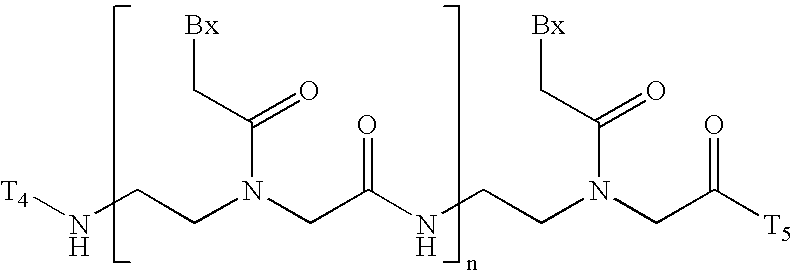
- wherein
- Bx is a heterocyclic base moiety;
- T 4 is hydrogen, an amino protecting group, —C(O)R5, substituted or unsubstituted C1-C10 alkyl, substituted or unsubstituted C2-C10 alkenyl, substituted or unsubstituted C2-C10 alkynyl, alkylsulfonyl, arylsulfonyl, a chemical functional group, a reporter group, a conjugate group, a D or L α-amino acid linked via the α-carboxyl group or optionally through the α-carboxyl group when the amino acid is aspartic acid or glutamic acid or a peptide derived from D, L or mixed D and L amino acids linked through a carboxyl group, wherein the substituent groups are selected from hydroxyl, amino, alkoxy, carboxy, benzyl, phenyl, nitro, thiol, thioalkoxy, halogen, alkyl, aryl, alkenyl and alkynyl;
- T 5 is —OH, —N(Z1)Z2, R5, D or L α-amino acid linked via the α-amino group or optionally through the ω-amino group when the amino acid is lysine or omithine or a peptide derived from D, L or mixed D and L amino acids linked through an amino group, a chemical functional group, a reporter group or a conjugate group;
- Z 1 is hydrogen, C1-C6 alkyl, or an amino protecting group;
- Z 2 is hydrogen, C1-C6 alkyl, an amino protecting group, —C(═O)—(CH2)n-J-Z3, a D or L α-amino acid linked via the α-carboxyl group or optionally through the co-carboxyl group when the amino acid is aspartic acid or glutamic acid or a peptide derived from D, L or mixed D and L amino acids linked through a carboxyl group;
- Z 3 is hydrogen, an amino protecting group, —C1-C6 alkyl, —C(═O)—CH3, benzyl, benzoyl, or —(CH2)n—N(H)Z1;
- each J is O, S or NH;
- R 5 is a carbonyl protecting group; and
- n is from 2 to about 50.
- Another class of oligonucleotide mimetic that has been studied is based on linked morpholino units (morpholino nucleic acid) having heterocyclic bases attached to the morpholino ring. A number of linking groups have been reported that link the morpholino monomeric units in a morpholino nucleic acid. A preferred class of linking groups have been selected to give a non-ionic oligomeric compound. The non-ionic morpholino-based oligomeric compounds are less likely to have undesired interactions with cellular proteins. Morpholino-based oligomeric compounds are non-ionic mimics of oligonucleotides which are less likely to form undesired interactions with cellular proteins (Dwaine A. Braasch and David R. Corey, Biochemistry, 2002, 41(14), 4503-4510). Morpholino-based oligomeric compounds are disclosed in U.S. Pat. No. 5,034,506, issued Jul. 23, 1991. The morpholino class of oligomeric compounds have been prepared having a variety of different linking groups joining the monomeric subunits.
- Morpholino nucleic acids have been prepared having a variety of different linking groups (L 2) joining the monomeric subunits. The basic formula is shown below:
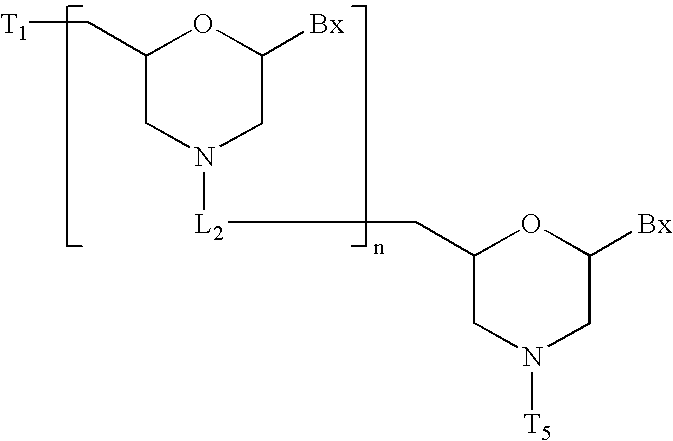
- wherein
- T 1 is hydroxyl or a protected hydroxyl;
- T 5 is hydrogen or a phosphate or phosphate derivative;
- L 2 is a linking group; and
- n is from 2 to about 50.
- A further class of oligonucleotide mimetic is referred to as cyclohexenyl nucleic acids (CeNA). The furanose ring normally present in an DNA/RNA molecule is replaced with a cyclohenyl ring. CeNA DMT protected phosphoramidite monomers have been prepared and used for oligomeric compound synthesis following classical phosphoramidite chemistry. Fully modified CeNA oligomeric compounds and oligonucleotides having specific positions modified with CeNA have been prepared and studied (see Wang et al., J. Am. Chem. Soc., 2000, 122, 8595-8602). In general the incorporation of CeNA monomers into a DNA chain increases its stability of a DNA/RNA hybrid. CeNA oligoadenylates formed complexes with RNA and DNA complements with similar stability to the native complexes. The study of incorporating CeNA structures into natural nucleic acid structures was shown by NMR and circular dichroism to proceed with easy conformational adaptation. Furthermore the incorporation of CeNA into a sequence targeting RNA was stable to serum and able to activate E. Coli RNase resulting in cleavage of the target RNA strand.
- The general formula of CeNA is shown below:
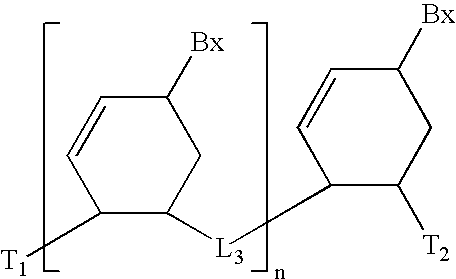
- wherein
- each Bx is a heterocyclic base moiety;
- T 1 is hydroxyl or a protected hydroxyl; and
- T2 is hydroxyl or a protected hydroxyl.
- Another class of oligonucleotide mimetic (anhydrohexitol nucleic acid) can be prepared from one or more anhydrohexitol nucleosides (see, Wouters and Herdewijn, Bioorg. Med. Chem. Lett., 1999, 9, 1563-1566) and would have the general formula:
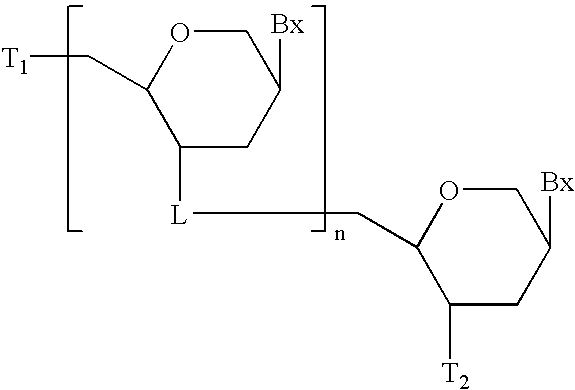
- A further preferred modification includes Locked Nucleic Acids (LNAs) in which the 2′-hydroxyl group is linked to the 4′ carbon atom of the sugar ring thereby forming a 2′-C,4′-C-oxymethylene linkage thereby forming a bicyclic sugar moiety. The linkage is preferably a methylene (—CH 2—)n group bridging the 2′ oxygen atom and the 4′ carbon atom wherein n is 1 or 2 (Singh et al., Chem. Commun., 1998, 4, 455-456). LNA and LNA analogs display very high duplex thermal stabilities with complementary DNA and RNA (Tm=+3 to +10 C), stability towards 3′-exonucleolytic degradation and good solubility properties. The basic structure of LNA showing the bicyclic ring system is shown below:

- The conformations of LNAs determined by 2D NMR spectroscopy have shown that the locked orientation of the LNA nucleotides, both in single-stranded LNA and in duplexes, constrains the phosphate backbone in such a way as to introduce a higher population of the N-type conformation (Petersen et al., J. Mol. Recognit., 2000, 13, 44-53). These conformations are associated with improved stacking of the nucleobases (Wengel et al., Nucleosides Nucleotides, 1999, 18, 1365-1370).
- LNA has been shown to form exceedingly stable LNA:LNA duplexes (Koshkin et al., J. Am. Chem. Soc., 1998, 120, 13252-13253). LNA:LNA hybridization was shown to be the most thermally stable nucleic acid type duplex system, and the RNA-mimicking character of LNA was established at the duplex level. Introduction of 3 LNA monomers (T or A) significantly increased melting points (Tm=+15/+11) toward DNA complements. The universality of LNA-mediated hybridization has been stressed by the formation of exceedingly stable LNA:LNA duplexes. The RNA-mimicking of LNA was reflected with regard to the N-type conformational restriction of the monomers and to the secondary structure of the LNA:RNA duplex.
- LNAs also form duplexes with complementary DNA, RNA or LNA with high thermal affinities. Circular dichroism (CD) spectra show that duplexes involving fully modified LNA (esp. LNA:RNA) structurally resemble an A-form RNA:RNA duplex. Nuclear magnetic resonance (NMR) examination of an LNA:DNA duplex confirmed the 3′-endo conformation of an LNA monomer. Recognition of double-stranded DNA has also been demonstrated suggesting strand invasion by LNA. Studies of mismatched sequences show that LNAs obey the Watson-Crick base pairing rules with generally improved selectivity compared to the corresponding unmodified reference strands.
- Novel types of LNA-oligomeric compounds, as well as the LNAs, are useful in a wide range of diagnostic and therapeutic applications. Among these are antisense applications, PCR applications, strand-displacement oligomers, substrates for nucleic acid polymerases and generally as nucleotide based drugs.
- Potent and nontoxic antisense oligonucleotides containing LNAs have been described (Wahlestedt et al., Proc. Natl. Acad. Sci. U.S.A., 2000, 97, 5633-5638.) The authors have demonstrated that LNAs confer several desired properties to antisense agents. LNA/DNA copolymers were not degraded readily in blood serum and cell extracts. LNA/DNA copolymers exhibited potent antisense activity in assay systems as disparate as G-protein-coupled receptor signaling in living rat brain and detection of reporter genes in Escherichia coli. Lipofectin-mediated efficient delivery of LNA into living human breast cancer cells has also been accomplished.
- The synthesis and preparation of the LNA monomers adenine, cytosine, guanine, 5-methyl-cytosine, thymine and uracil, along with their oligomerization, and nucleic acid recognition properties have been described (Koshkin et al., Tetrahedron, 1998, 54, 3607-3630). LNAs and preparation thereof are also described in WO 98/39352 and WO 99/14226.
- The first analogs of LNA, phosphorothioate-LNA and 2′-thio-LNAs, have also been prepared (Kumar et al., Bioorg. Med. Chem. Lett., 1998, 8, 2219-2222). Preparation of locked nucleoside analogs containing oligodeoxyribonucleotide duplexes as substrates for nucleic acid polymerases has also been described (Wengel et al., PCT International Application WO 98-DK393 19980914). Furthermore, synthesis of 2′-amino-LNA, a novel conformationally restricted high-affinity oligonucleotide analog with a handle has been described in the art (Singh et al., J. Org. Chem., 1998, 63, 10035-10039). In addition, 2′-Amino- and 2-methylamino-LNA's have been prepared and the thermal stability of their duplexes with complementary RNA and DNA strands has been previously reported.
- Further oligonucleotide mimetics have been prepared to incude bicyclic and tricyclic nucleoside analogs having the formulas (amidite monomers shown):
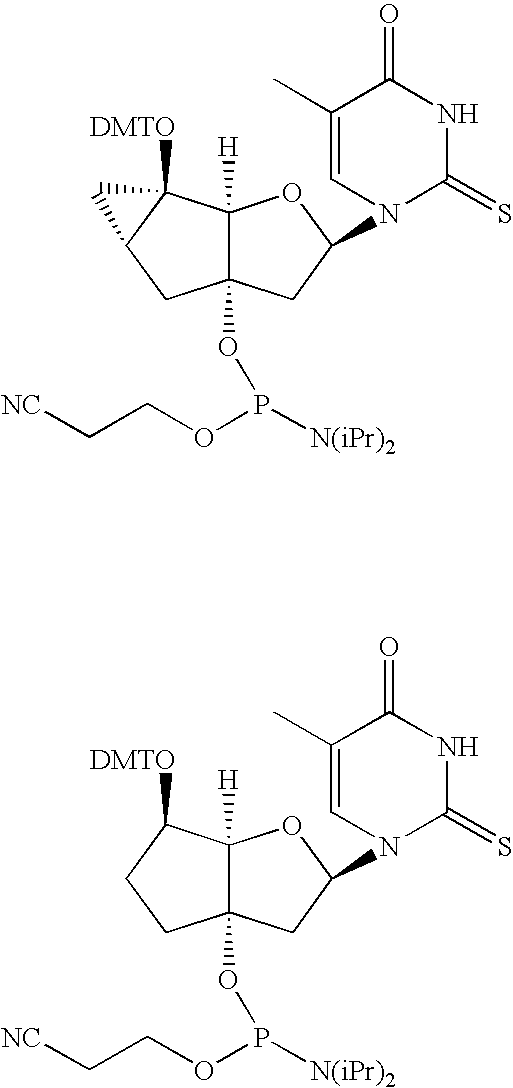
- (see Steffens et al., Helv. Chim. Acta, 1997, 80, 2426-2439; Steffens et al., J. Am. Chem. Soc., 1999, 121, 3249-3255; and Renneberg et al., J. Am. Chem. Soc., 2002, 124, 5993-6002). These modified nucleoside analogs have been oligomerized using the phosphoramidite approach and the resulting oligomeric compounds containing tricyclic nucleoside analogs have shown increased thermal stabilities (Tm's) when hybridized to DNA, RNA and itself. Oligomeric compounds containing bicyclic nucleoside analogs have shown thermal stabilities approaching that of DNA duplexes.
- Another class of oligonucleotide mimetic is referred to as phosphonomonoester nucleic acids incorporate a phosphorus group in a backbone the backbone. This class of olignucleotide mimetic is reported to have useful physical and biological and pharmacological properties in the areas of inhibiting gene expression (antisense oligonucleotides, ribozymes, sense oligonucleotides and triplex-forming oligonucleotides), as probes for the detection of nucleic acids and as auxiliaries for use in molecular biology.
- The general formula (for definitions of variables see: U.S. Pat. Nos. 5,874,553 and 6,127,346 herein incorporated by reference in their entirety) is shown below.
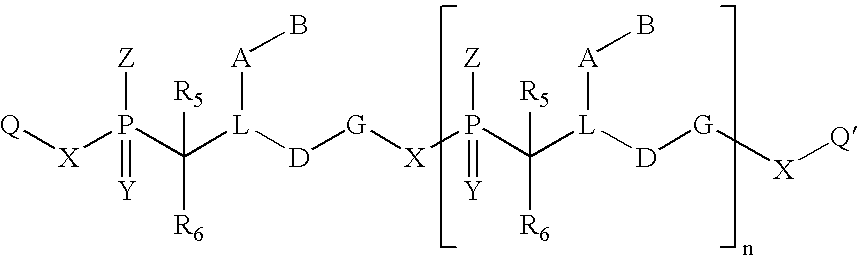
- Another oligonucleotide mimetic has been reported wherein the furanosyl ring has been replaced by a cyclobutyl moiety.
- Modified Sugars
- Oligomeric compounds of the invention may also contain one or more substituted sugar moieties. Preferred oligomeric compounds comprise a sugar substituent group selected from: OH; F; O-, S-, or N-alkyl; O-, S-, or N-alkenyl; O-, S- or N-alkynyl; or O-alkyl-O-alkyl, wherein the alkyl, alkenyl and alkynyl may be substituted or unsubstituted C 1 to C10 alkyl or C2 to C10 alkenyl and alkynyl. Particularly preferred are O[(CH2)nO]mCH3, O(CH2)nOCH3, O(CH2)nNH2, O(CH2)nCH3, O(CH2)nONH2, and O(CH2)nON[(CH2)nCH3]2, where n and m are from 1 to about 10. Other preferred oligonucleotides comprise a sugar substituent group selected from: C1 to C10 lower alkyl, substituted lower alkyl, alkenyl, alkynyl, alkaryl, aralkyl, O-alkaryl or O-aralkyl, SH, SCH3, OCN, Cl, Br, CN, CF3, OCF3, SOCH3, SO2CH3, ONO2, NO2, N3, NH2, heterocycloalkyl, heterocycloalkaryl, aminoalkylamino, poly-alkylamino, substituted silyl, an RNA cleaving group, a reporter group, an intercalator, a group for improving the pharmacokinetic properties of an oligonucleotide, or a group for improving the pharmacodynamic properties of an oligonucleotide, and other substituents having similar properties. A preferred modification includes 2′-methoxyethoxy (2′—O—CH2CH2OCH3, also known as 2′-O-(2-methoxyethyl) or 2′-MOE) (Martin et al., Helv. Chim. Acta, 1995, 78, 486-504) i.e., an alkoxyalkoxy group. A further preferred modification includes 2′-dimethylaminooxyethoxy, i.e., a O(CH2)2ON(CH3)2 group, also known as 2′-DMAOE, as described in examples hereinbelow, and 2′-dimethylaminoethoxyethoxy (also known in the art as 2′-O-dimethyl-amino-ethoxy-ethyl or 2′-DMAEOE), i.e., 2′-O—CH2—O—CH2—N(CH3)2.
- Other preferred sugar substituent groups include methoxy (—O—CH 3), aminopropoxy (—OCH2CH2CH2NH2), allyl (—CH2—CH═CH2), —O-allyl (—O—CH2—CH═CH2) and fluoro (F). 2′-Sugar substituent groups may be in the arabino (up) position or ribo (down) position. A preferred 2′-arabino modification is 2′-F. Similar modifications may also be made at other positions on the oligomeric compound, particularly the 3′ position of the sugar on the 3′ terminal nucleoside or in 2′-5′ linked oligonucleotides and the 5′ position of 5′ terminal nucleotide. Oligomeric compounds may also have sugar mimetics such as cyclobutyl moieties in place of the pentofuranosyl sugar. Representative United States patents that teach the preparation of such modified sugar structures include, but are not limited to, U.S. Pat. Nos. 4,981,957; 5,118,800; 5,319,080; 5,359,044; 5,393,878; 5,446,137; 5,466,786; 5,514,785; 5,519,134; 5,567,811; 5,576,427; 5,591,722; 5,597,909; 5,610,300; 5,627,053; 5,639,873; 5,646,265; 5,658,873; 5,670,633; 5,792,747; and 5,700,920, certain of which are commonly owned with the instant application, and each of which is herein incorporated by reference in its entirety.
- Further representative sugar substituent groups include groups of formula I a or IIa:
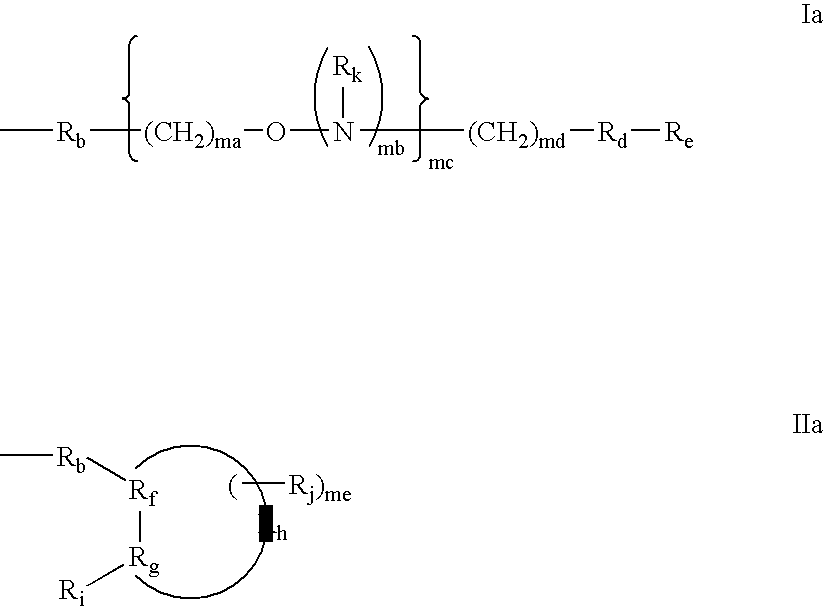
- wherein:
- R b is O, S or NH;
- R d is a single bond, O, S or C(═O);
- R e is C1-C10 alkyl, N(Rk)(Rm), N(Rk)(Rn), N═C(Rp)(Rq), N═C(Rp)(Rr) or has formula IIIa;

- R p and Rq are each independently hydrogen or C1-C10 alkyl;
- R r is —Rx—Ry;
- each R s, Rt, Ru and Rv is, independently, hydrogen, C(O)Rw, substituted or unsubstituted C1-C10 alkyl, substituted or unsubstituted C2-C10 alkenyl, substituted or unsubstituted C2-C10 alkynyl, alkylsulfonyl, arylsulfonyl, a chemical functional group or a conjugate group, wherein the substituent groups are selected from hydroxyl, amino, alkoxy, carboxy, benzyl, phenyl, nitro, thiol, thioalkoxy, halogen, alkyl, aryl, alkenyl and alkynyl;
- or optionally, R u and Rv, together form a phthalimido moiety with the nitrogen atom to which they are attached;
- each R w is, independently, substituted or unsubstituted C1-C10 alkyl, trifluoromethyl, cyanoethyloxy, methoxy, ethoxy, t-butoxy, allyloxy, 9-fluorenylmethoxy, 2-(trimethylsilyl)-ethoxy, 2,2,2-trichloroethoxy, benzyloxy, butyryl, iso-butyryl, phenyl or aryl;
- R k is hydrogen, a nitrogen protecting group or —Rx-Ry;
- R p is hydrogen, a nitrogen protecting group or —Rx-Ry;
- R x is a bond or a linking moiety;
- R y is a chemical functional group, a conjugate group or a solid support medium;
- each R m and Rn is, independently, H, a nitrogen protecting group, substituted or unsubstituted C1-C10 alkyl, substituted or unsubstituted C2-C10 alkenyl, substituted or unsubstituted C2-C10 alkynyl, wherein the substituent groups are selected from hydroxyl, amino, alkoxy, carboxy, benzyl, phenyl, nitro, thiol, thioalkoxy, halogen, alkyl, aryl, alkenyl, alkynyl; NH3 +, N(Ru)(Rv) guanidino and acyl where said acyl is an acid amide or an ester;
- or R m and Rn, together, are a nitrogen protecting group, are joined in a ring structure that optionally includes an additional heteroatom selected from N and O or are a chemical functional group;
- R i is ORz, SRz, or N(Rz)2;
- each R z is, independently, H, C1-C8 alkyl, C1-C8 haloalkyl, C(═NH)N(H)Ru, C(═O)N(H)Ru or OC(═O)N(H)Ru;
- R f, Rg and Rh comprise a ring system having from about 4 to about 7 carbon atoms or having from about 3 to about 6 carbon atoms and 1 or 2 heteroatoms wherein said heteroatoms are selected from oxygen, nitrogen and sulfur and wherein said ring system is aliphatic, unsaturated aliphatic, aromatic, or saturated or unsaturated heterocyclic;
- R j is alkyl or haloalkyl having 1 to about 10 carbon atoms, alkenyl having 2 to about 10 carbon atoms, alkynyl having 2 to about 10 carbon atoms, aryl having 6 to about 14 carbon atoms, N(Rk)(Rm) ORk, halo, SRk or CN;
- m a is 1 to about 10;
- each mb is, independently, 0 or 1;
- mc is 0 or an integer from 1 to 10;
- md is an integer from 1 to 10;
- me is from 0, 1 or 2; and
- provided that when mc is 0, md is greater than 1.
- Representative substituents groups of Formula I are disclosed in U.S. patent application Ser. No. 09/130,973, filed Aug. 7, 1998, entitled “Capped 2′-Oxyethoxy Oligonucleotides,” hereby incorporated by reference in its entirety.
- Representative cyclic substituent groups of Formula II are disclosed in U.S. patent application Ser. No. 09/123,108, filed Jul. 27, 1998, entitled “RNA Targeted 2′-Oligomeric compounds that are Conformationally Preorganized,” hereby incorporated by reference in its entirety.
- Particularly preferred sugar substituent groups include O[(CH 2)nO]mCH3, O(CH2)nOCH3, O(CH2)nNH2, O(CH2)nCH3, O(CH2)nONH2, and O(CH2)nON[(CH2)nCH3)]2, where n and m are from 1 to about 10.
- Representative guanidino substituent groups that are shown in formula III and IV are disclosed in co-owned U.S. patent application Ser. No. 09/349,040, entitled “Functionalized Oligomers”, filed Jul. 7, 1999, hereby incorporated by reference in its entirety.
- Representative acetamido substituent groups are disclosed in U.S. Pat. No. 6,147,200 which is hereby incorporated by reference in its entirety.
- Representative dimethylaminoethyloxyethyl substituent groups are disclosed in International Patent Application PCT/US99/17895, entitled “2′-O-Dimethylaminoethyloxyethyl-Oligomeric compounds”, filed Aug. 6, 1999, hereby incorporated by reference in its entirety.
- Modified Nucleobases/Naturally Occurring Nucleobases
- Oligomeric compounds may also include nucleobase (often referred to in the art simply as “base” or “heterocyclic base moiety”) modifications or substitutions. As used herein, “unmodified” or “natural” nucleobases include the purine bases adenine (A) and guanine (G), and the pyrimidine bases thymine (T), cytosine (C) and uracil (U). Modified nucleobases also referred herein as heterocyclic base moieties include other synthetic and natural nucleobases such as 5-methylcytosine (5-me-C), 5-hydroxymethyl cytosine, xanthine, hypoxanthine, 2-aminoadenine, 6-methyl and other alkyl derivatives of adenine and guanine, 2-propyl and other alkyl derivatives of adenine and guanine, 2-thiouracil, 2-thiothymine and 2-thiocytosine, 5-halouracil and cytosine, 5-propynyl (—C≡C—CH 3) uracil and cytosine and other alkynyl derivatives of pyrimidine bases, 6-azo uracil, cytosine and thymine, 5-uracil (pseudouracil), 4-thiouracil, 8-halo, 8-amino, 8-thiol, 8-thioalkyl, 8-hydroxyl and other 8-substituted adenines and guanines, 5-halo particularly 5-bromo, 5-trifluoromethyl and other 5-substituted uracils and cyto-sines, 7-methylguanine and 7-methyladenine, 2-F-adenine, 2-amino-adenine, 8-azaguanine and 8-azaadenine, 7-deazaguanine and 7-deazaadenine and 3-deazaguanine and 3-deazaadenine.
- Heterocyclic base moieties may also include those in which the purine base is replaced with a C and U or T modified binding base, such as those described below.
- Boronated purine bases. In certain embodiments, the invention relates to oligonucleotides comprising at least one nucleotide which is N-boronated on the purine base with a boron-containing substituent selected from the group consisting of —BH 2CN, —BH3, and —BH2COOR, wherein R is C1 to C18 alkyl. Preferably, R is C1 to C9 alkyl, and most preferably R is C1 to C4 alkyl. Such boronated purine bases are described, for example, in U.S. Pat. No. 5,130,302, hereby incorporated by reference in its entirety. Synthesis of oligonucleotides containing such modified purine bases is described in Example 1.
- 1H-pyrazolo[3,4-d]pyrimidin-4(5H)-6(7H)-dione. In certain other aspects, the invention relates to oligonucleotides comprising at least one nucleotide containing a 1H-pyrazolo[3,4-d]pyrimidin-4(5H)-6(7H)-dione base of the following structure as described, for example, in U.S. Pat. No. 6,143,877, hereby incorporated by reference in its entirety:
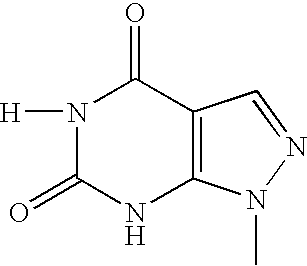
- Synthesis of oligonucleotides containing such C and U or T modified binding bases is described in Example 2.
- C2-modified C and U or T modified binding bases. In other embodiments, the invention relates to oligonucleotides comprising at least one C and U or T modified binding base of one of the following structures as described, for example, in U.S. Pat. Nos. 5,459,255, 5,587,469, and 5,808,027, hereby incorporated by reference in their entireties:
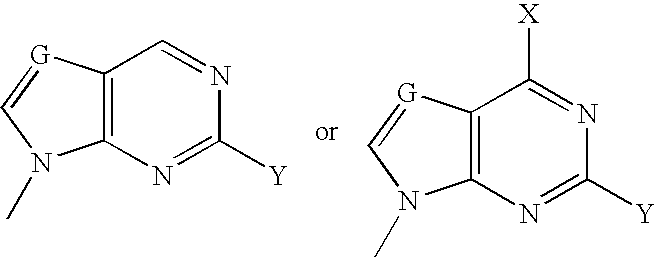
- wherein G is C or N; X is NH2 or OH; Y is R 1Q or NHR1Q, wherein R1 is a hydrocarbyl group having from 2 to about 20 carbon atoms; and Q is at least one reactive or nonreactive functionality. In preferred embodiments, Q is H, NH2, a polyalkylamine, a hydrazine, a hydroxylamine, a semicarbazide, a thiosemicarbazide, a hydrazone, a hydrazide, an imidazole, an imidazole amide, an alkyl imidazole, an alkylimidazole, a tetrazole, a triazole, a pyrrolidine, a piperidine, a piperazine, a morpholine, a thiol, an aldehyde, a ketone, an alcohol, an alkoxy group, or a halogen. Synthesis of oligonucleotides containing such C and U or T modified binding bases is described in Example 3.
- C2, C6 modified purine bases. In certain other aspects, the invention relates to oligonucleotides comprising at least one nucleotide containing a purine base analogue of the following structure, as described, for example, in U.S. Pat. No. 4,845,205, hereby incorporated by reference in its entirety:
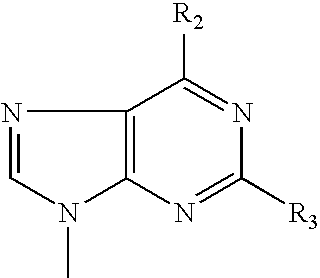
- wherein R 2 represents a group —NH(A1) or —N(A1,A2); R3 has the meanings of R2 or represents a group —O(A1) or —S(A1); A1 and A2, identical or different, are acyl groups, in particular, acetyl and benzoyl, butyryl, isobutyryl and other similar groups capable of being removed without modification of the nucleoside component or of the nucleotide chain formed from these components. Synthesis of oligonucleotides containing such modified purine bases is described in Example 4.
- C2 modified, C6, C8 optionally modified C and U or T modified binding bases. In other embodiments, the invention relates to oligonucleotides comprising at least one C and U or T modified binding base of the following structure as described, for example, in U.S. Pat. Nos. 5,681,941 and 5,811,534, hereby incorporated by reference in their entireties:

- wherein G 1 is CR2 or N; R2 is H or a hydrocarbyl group having from 1 to 6 carbon atoms; X1 is halogen, NH2, OH, NHR3Q1, or OR3Q1; R3 is H or a hydrocarbyl group having from 2 to about 20 carbon atoms; Q2 comprises at least one reactive or non-reactive functionality; Y1 is halogen, NH2, H, R4Q2, or NHR4Q2, wherein said R4 is H or a hydrocarbyl group having from 2 to about 20 carbon atoms, and Q2 comprises at least one reactive or non-reactive functionality; W is H, R5Q3, or NH4Q3; R5 is H or a hydrocarbyl group having from 2 to about 20 carbon atoms; and Q3 comprises at least one reactive or non-reactive functionality. In preferred embodiments, the reactive or non-reactive functionality is H, NH2, a polyalkylamine, a hydrazine, a hydroxylamine, a semicarbazide, a thiosemicarbazide, a hydrazone, a hydrazide, an imidazole, an imidazole amide, an alkyl imidazole, an alkylimidazole, a tetrazole, a triazole, a pyrrolidine, a piperidine, a piperazine, a morpholine, a thiol, an aldehyde, a ketone, an alcohol, an alkoxy group, or a halogen. Synthesis of oligonucleotides containing such C and U or T modified binding bases is described in Example 5.
- C2,C6,7,8 optionally modified C and U or T modified binding bases. In certain other aspects, the invention relates to oligonucleotides comprising at least one nucleotide containing a C and U or T modified binding base of one of the following structures as described, for example, in U.S. Pat. No. 6,174,998, hereby incorporated by reference in its entirety:

- wherein R 6, R7, R8, and R9 can be same or different and represent hydrogen, halogen, hydroxy, thio or substituted thio, amino or substituted amino, carboxy, lower alkyl, lower alkenyl, lower alkinyl, aryl, lower alkyloxy, aryloxy, aralkyl, aralkyloxy or a reporter group. Synthesis of oligonucleotides containing such C and U or T modified binding bases is described in Example 6.
- A reporter group may be any detectable group such, for example, haptens, a fluorophore, a metal-chelating group, a lumiphore, a protein or an intercalator.
- 3-deaza C and U or T modified binding bases. In certain other aspects, the invention relates to oligonucleotides comprising at least one nucleotide containing a C and U or T modified binding base of one of the following structures as described, for example, in U.S. Pat. Nos. 5,457,191, 5,587,470, and 5,948,903, hereby incorporated by reference in their entireties:
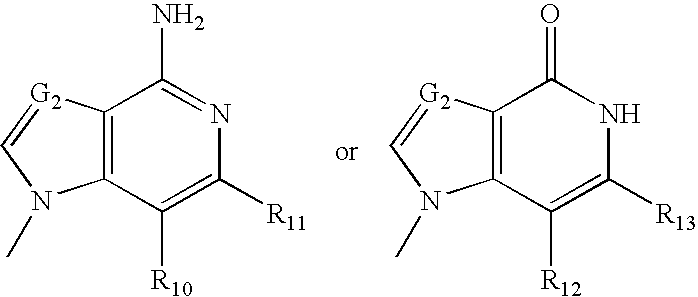
- wherein G 2 is C or N; R10 is NH2, alkyl, substituted alkyl, alkenyl, substituted alkenyl, aralkyl, amino, alkylamino, aralkylamino, substituted alkylamino, heterocycloalkyl, heterocycloalkylamino, aminoalkylamino, hetrocycloalkylamino, or polyalkylamino; R11 is alkyl, substituted alkyl, alkenyl, substituted alkenyl, aralkyl, amino, alkylamino, aralkylamino, substituted alkylamino, heterocycloalkyl, heterocycloalkylamino, aminoalkylamino, hetrocycloalkylamino, or polyalkylamino; R12 is H, NH2, alkyl, substituted alkyl, alkenyl, substituted alkenyl, aralkyl, amino, alkylamino, aralkylamino, substituted alkylamino, heterocycloalkyl, heterocycloalkylamino, aminoalkylamino, hetrocycloalkylamino, or polyalkylamino; R13 is NH2, alkyl, substituted alkyl, alkenyl, substituted alkenyl, aralkyl, amino, alkylamino, aralkylamino, substituted alkylamino, heterocycloalkyl, heterocycloalkylamino, aminoalkylamino, hetrocycloalkylamino, or polyalkylamino; and when R12 is H, R13 is not NH2. Synthesis of oligonucleotides containing such C and U or T modified binding bases is described in Example 7.
- 4-amino-1H-pyrazolo[3,4-d]pyrimidine. In certain other aspects, the invention relates to oligonucleotides comprising at least one nucleotide containing a 4-amino-1H-pyrazolo[3,4-d]pyrimidine base of the following structure as described, for example, in U.S. Pat. No. 6,127,121, hereby incorporated by reference in its entirety:

- Synthesis of oligonucleotides containing such C and U or T modified binding bases is described in Example 8.
- 5, 7,8,9 optionally modified C and U or T modified binding bases. In certain other aspects, the invention relates to oligonucleotides comprising at least one nucleotide containing a C and U or T modified binding base of the following structure as described, for example, in U.S. Pat. No. 6,268,132, hereby incorporated by reference in its entirety:
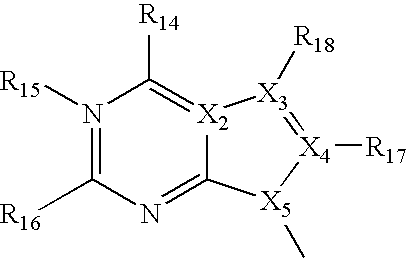
- wherein X 2, X3, X4, and X5 are N, O, C, S, or Si, and at least one of X2, X3, X4, and X5 is N; R14 is a reactive group derivatizable with a detectable label wherein said reactive group is selected from the group consisting of NH2, SH, ═O, a linking moiety selected from the group consisting of an amide, a thioether, a disulfide, a combination of an amide a thioether or a disulfide, R19—(CH2)n—R20 and R19—R20—(CH2)n—R21 wherein n is an integer from 1 to 25 inclusive, and R19, R20, and R21 are H, OH, alkyl, acyl, amide, thioether, or disulfide, and wherein said detectable label is selected from the group consisting of radioisotopes, fluorescent or chemiluminescent reporter molecules, antibodies, haptens, biotin, photobiotin, digoxigenin, fluorescent aliphatic amino groups, avidin, enzymes, and acridinium; R15 is H, absent, or part of an etheno linkage with R14; R16 is H, NH2, SH, or ═O; R17 and R18 are hydrogen, methyl, bromine, fluorine, or iodine, alkyl or aromatic substituents, or a linking moiety selected from the group consisting of an amide, a thioether, a disulfide linkage, and a combination thereof. Synthesis of oligonucleotides containing such C and U or T modified binding bases is described in Example 9.
- 6-amino-1H-pyrazolo[3,4-d]pyrimidin-4(5H)-one. In certain other aspects, the invention relates to oligonucleotides comprising at least one nucleotide containing a 6-amino-1H-pyrazolo[3,4-d]pyrimidin-4(5H)-one base of the following structure as described, for example, in U.S. Pat. No. 6,127,121, hereby incorporated by reference in its entirety:

- Synthesis of oligonucleotides containing such C and U or T modified binding bases is described in Example 10.
- C6-thione substituted C and U or T modified binding bases. In certain other aspects, the invention relates to oligonucleotides comprising at least one nucleotide containing a C and U or T modified binding base of one of the following structures as described, for example, in U.S. Pat. No. 5,652,359, hereby incorporated by reference in its entirety:
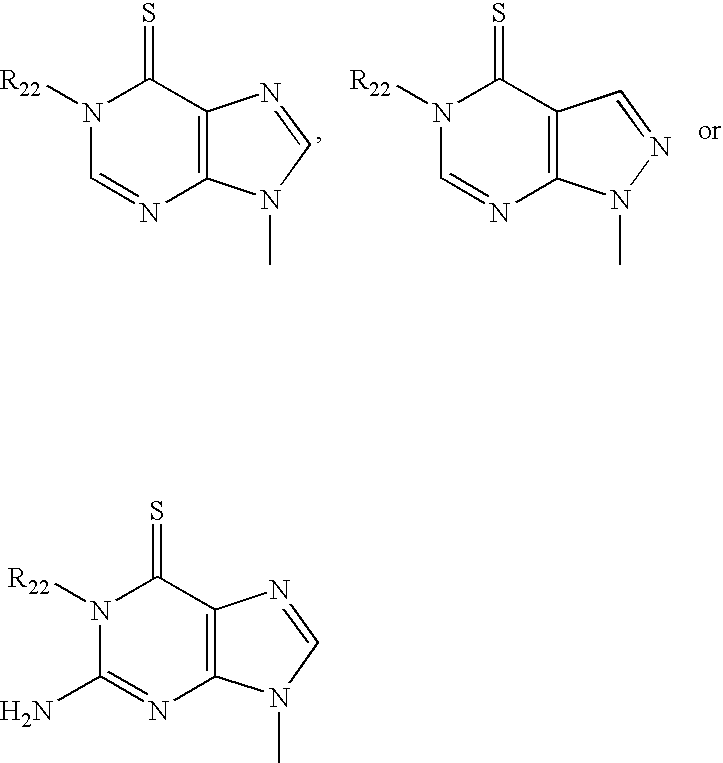
- wherein R 22 is C1-C6 alkyl, C2-C6 alkenyl or C2-C6 alkynyl. Synthesis of oligonucleotides containing such C and U or T modified binding bases is described in Example 11.
- 2,6,7,8 optionally substituted C and U or T modified binding bases. In certain other aspects, the invention relates to oligonucleotides comprising at least one nucleotide containing a C and U or T modified binding base of the following structure as described, for example, in U.S. Pat. No. 5,844,106, hereby incorporated by reference in its entirety:

- wherein
- R 23 and R24 are, independently of each other, 1) hydrogen; 2) halogen; 3) (C1-C10)-alkyl; 4) (C2-C10)-alkenyl; 5) (C2-C10)-alkynyl; 6) NO2; 7) NH2; 8) cyano; 9)—S—(C1-C6)-alkyl; 10) (C1-C6)-alkoxy; 11) (C6-C20)-aryloxy; 12) SiH3; 13)
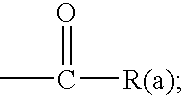
- 14) a radical as described under 3), 4) or 5) which is substituted by one or more radicals from the group SH, S—(C 1-C6)-alkyl, (C1-C6)-alkoxy, OH, —NR(c)R(d), —CO—R(b), —NH—CO—NR(c)R(d), —NR(c)R(g), —NR(e)R(f) or —NR(e)R(g), or by a polyalkyleneglycol radical of the formula —[O—(CH2)r]s—NR(c)R(d), where r and s are, independently of each other, an integer between 1 and 18, preferably between 1 and 6; or 15) a radical as defined under 3), 4) or 5) in which from one to all the H atoms are substituted by halogen, preferably fluorine;
- R(a) is OH, (C 1-C6)-alkoxy, (C6-C20)-aryloxy, NH2 or NH-T, where T is an alkylcarboxyl group or alkylamino group which is linked to one or more groups, where appropriate via a further linker, which favor intracellular uptake or serve for labeling a DNA or RNA probe or, when the oligonucleotide analog hybridizes to the target nucleic acid, attack the latter while binding, cross-linking or cleaving,
- R(b) is hydroxyl, (C 1-C6)-alkoxy or —NR(c)R(d),
- R(c) and R(d) are, independently of each other, H or (C 1-C6)-alkyl which is unsubstituted or substituted by —NR(e)R(f) or —NR(e)R(g),
- R(e) and R(f) are, independently of each other, H or (C 1-C6)-alkyl,
- R(g) is (C 1-C6)-alkyl-COOH;
- R 23 and R24 cannot each simultaneously be hydrogen, NO2, NH2, cyano or SiH3;
- D and E are, independently of each other, H, OH or NH 2. Synthesis of oligonucleotides containing such C and U or T modified binding bases is described in Example 12.
- Labeling groups for a DNA or RNA probe are to be understood to mean fluorescent groups, for example of dansyl (=N-dimethyl-1-aminonaphthyl-5-sulfonyl) derivatives, fluorescein derivatives or coumarin derivatives, or chemiluminescent groups, for example of acridine derivatives, and also the digoxygenin system, which is detectable by means of ELISA, or the biotin group, which is detectable by means of the biotin/avidin system, and also the intercalators and chemically active groups which have already been listed under g) (see, also, Beaucage et al., Tetrah. (1993) Vol. 49, No. 10, 1925-1963, incorporated herein by reference in its entirety).
- Examples of groups which favor intracellular uptake are steroid radicals, such as cholesteryl, or vitamin radicals such as vitamin E, vitamin A or vitamin D, and other conjugates which exploit natural carrier systems, such as bile acid, folic acid, 2-(N-alkyl, N-alkoxy)-aminoanthraquinone and conjugates of mannose and peptides of the corresponding receptors which lead to receptor-mediated endocytosis of the oligonucleotides, such as EGF (epidermal growth factor), bradykinin and PDGF (platelet derived growth factor).
- O 6-benzylguanine. In certain other aspects, the invention relates to oligonucleotides comprising at least one nucleotide containing a substituted or unsubstituted O6-benzylguanine base as described, for example, in U.S. Pat. No. 6,060,458, hereby incorporated by reference in its entirety. In certain embodiments, the invention relates to oligonucleotides comprising at least one nucleotide containing an O6-benzylguanine base of the following structure as described, for example, in U.S. Pat. No. 5,691,307, hereby incorporated by reference in its entirety:

- wherein each of X 6-X10 is selected from the group consisting of hydrogen, halogen, hydroxy, aryl, a C1-C8 alkyl substituted aryl, nitro, a polycyclic aromatic alkyl containing 2-4 aromatic rings wherein the alkyl is a C1-C6, a C3-C8 cycloalkyl, a C2-C6 alkenyl, a C2-C6 alkynyl, a C1-C6 hydroxyalkyl, a C1-C8 alkoxy, a C2-C8 alkoxyalkyl, aryloxy, aryloxy, an acyloxyalkyl wherein the alkyl is C1-C6, amino, a monoalkylamino wherein the alkyl is C1-C6, a dialkylamino wherein the alkyl is C1-C6, acylamino, ureido, thioureido, carboxy, a carboxyalkyl wherein the alkyl is C1-C6, cyano, a cyanoalkyl wherein the alkyl is C1-C6, C-formyl, C-acyl, a dialkoxymethyl wherein the alkoxy is C1-C6, an aminoalkyl wherein the alkyl is C1-C6, and SOn1R25 wherein n1=0, 1, 2 or 3, R25 is H, a C1-C6 alkyl or aryl. Synthesis of oligonucleotides containing O6-benzylguanine is described in Example 13.
- C6 modified purine bases. In certain other aspects, the invention relates to oligonucleotides comprising at least one nucleotide containing a modified purine base of the following structure as described, for example, in U.S. Pat. No. 5,691,307, hereby incorporated by reference in its entirety:
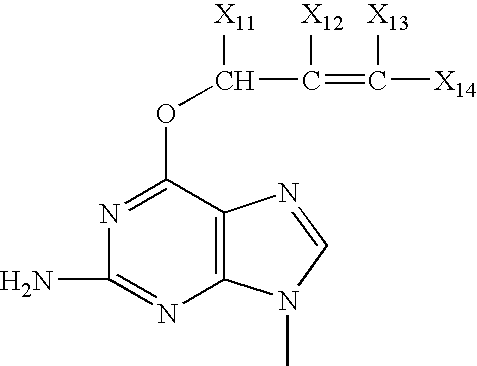
- wherein X 11-X14 are each independently selected from the group consisting of C2-C8 alkoxyalkyl, aryloxy, acyloxy, acyloxyalkyl wherein the alkyl is C1-C3, hydrazino, hydroxyamino, acylamino, nitro at o, m-positions, bromine, m-methyl, C1-C3 hydroxy alkyl, C2-C6 alkyl, C-formyl, and aryl. Synthesis of oligonucleotides containing such modified purine bases is described in Example 14.
- 7-deaza, C7 substituted C and U or T modified binding bases. In certain other aspects, the invention relates to oligonucleotides comprising at least one nucleotide containing a C and U or T modified binding base of one of the following structures as described, for example, in U.S. Pat. No. 5,596,091, hereby incorporated by reference in its entirety:
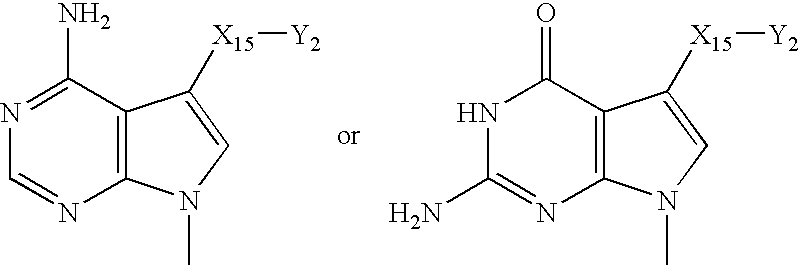
- wherein X 15 is a linking group which is C1-C10 alkyl, C1-C10 unsaturated alkyl, dialkyl ether or dialkylthioether; and each Y2 may be the same or different and is a cationic moiety which is —(NH3)+, —(NH2R26)+, —(NHR26R27)+, —(NR26R27R28)+, dialkylsulfonium or trialkylphosphonium; and R26, R27, and R28 are each independently lower alkyl having from one to ten carbon atoms. Preferred linking groups for X15 are C1-C10 alkyl and C1-C10 unsaturated alkyl. Particularly preferred linking groups for X15 are C3-C6 alkyl and C3-C6 unsaturated alkyl. Preferred groups for Y2 are —(NH3)+, —(NH2R26)+, —(NHR26R27)+, —(NR26R27R28)+, with —(NH3)+ being particularly preferred. Synthesis of oligonucleotides containing such C and U or T modified binding bases is described in Example 15.
- 7-deaza, C7 iodine substituted C and U or T modified binding bases. In certain other aspects, the invention relates to oligonucleotides comprising at least one nucleotide containing a C and U or T modified binding base of the following structure as described, for example, in U.S. Pat. No. 6,093,807, hereby incorporated by reference in its entirety:
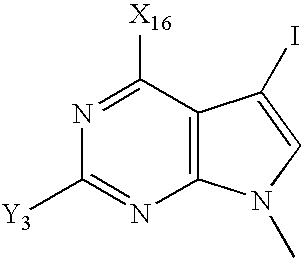
- wherein X 16 is Cl, OH, SH, SR30, OR29, CN or N(H)J; Y3 is OH, SH, SR30, OR30, CN or N(H)J; each J is, independently, hydrogen or an amino protecting group; and each R29 and R30 is, independently, C1-C10 alkyl. Synthesis of oligonucleotides containing such modified purine bases is described in Example 16.
- Pyrazolo[3,4-d]pyrimidine derivatives. In certain other aspects, the invention relates to oligonucleotides comprising at least one nucleotide containing a pyrazolo[3,4-d]pyrimidine derivative of the following structure as described, for example, in U.S. Pat. No. 5,824,796, hereby incorporated by reference in its entirety:

- wherein R 31 is hydrogen or the group —W1-(X17)n2-A; each of W1 and X17 is independently a chemical linker arm; A is an intercalator, a metal ion chelator, an electrophilic crosslinker, a photoactivatable crosslinker, or a reporter group; each of R32 and R33 is independently H, OR34, SR34, NHOR34, NH2, or NH(CH2)tNH2; R34 is H or C1-6alkyl; n2 is zero or one; and t is zero to twelve. Synthesis of oligonucleotides containing such C and U or T modified binding bases is described in Example 17.
- In the above formula, a chemical linker arm (W 1 alone or together with X17) serves to make the functional group (A) more able to readily interact with antibodies, detector proteins, or chemical reagents, for example. The linkage holds the functional group away from the base when the base is paired with another within the double-stranded complex. Linker arms may include alkylene groups of 1 to 12 carbon atoms, alkenylene groups of 2 to 12 carbon atoms and 1 or 2 olefinic bonds, alkynylene groups of 2 to 12 carbon atoms and 1 or 2 acetylenic bonds, or such groups substituted at a terminal point with nucleophilic groups such as oxy, thio, amino or chemically blocked derivatives thereof (e.g., trifluoroacetamido, phthalimido, CONR′, NR′CO, and SO2NR′, where R′═H or C1-6alkyl). Such functionalities, including aliphatic or aromatic amines, exhibit nucleophilic properties and are capable of serving as a point of attachment of the functional group (A).
- The linker arm moiety (W 1 alone or together with X17) is preferably of at least three atoms and more preferably of at least five atoms. The terminal nucleophilic group is preferably amino or chemically blocked derivatives thereof.
- Intercalators are planar aromatic bi-, tri- or polycyclic molecules which can insert themselves between two adjacent base pairs in a double-stranded helix of nucleic acid. Intercalators have been used to cause frameshift mutations in DNA and RNA. It has also recently been shown that when an intercalator is covalently bound via a linker arm (“tethered”) to the end of a deoxyoligonucleotide, it increases the binding affinity of the oligonucleotide for its target sequence, resulting in strongly enhanced stability of the complementary sequence complex. At least some of the tethered intercalators also protect the oligonucleotide against exonucleases, but not against endonucleases. See, Sun et al., Nucleic Acids Res., 15:6149-6158 (1987); Le Doan et al., Nucleic Acids Res., 15:7749-7760 (1987). Examples of tetherable intercalating agents are oxazolopyridocarbazole, acridine orange, proflavine, acriflavine and derivatives of proflavine and acridine such as 3-azido-6-(3-bromopropylamino)acridine, 3-amino-6-(3-bromopentylamino)-acridine, and 3-methoxy-6-chloro-9-(5-hydroxypentylamino)acridine.
- Oligonucleotides capable of crosslinking to the complementary sequence of target nucleic acids are valuable in chemotherapy because they increase the efficiency of inhibition of mRNA translation or gene expression control by covalent attachment of the oligonucleotide to the target sequence. This can be accomplished by crosslinking agents being covalently attached to the oligonucleotide, which can then be chemically activated to form crosslinkages which can then induce chain breaks in the target complementary sequence, thus inducing irreversible damage in the sequence. Examples of electrophilic crosslinking moieties include alpha-halocarbonyl compounds, 2-chloroethylamines and epoxides.
- When oligonucleotides comprising at least one nucleotide base moiety of the invention are utilized as a probe in nucleic acid assays, a label is attached to detect the presence of hybrid polynucleotides. Such labels act as reporter groups and act as means for detecting duplex formation between the target nucleotides and their complementary oligonucleotide probes.
- A reporter group as used herein is a group which has a physical or chemical characteristic which can be measured or detected. Detectability may be provided by such characteristics as color change, luminescence, fluorescence, or radioactivity; or it may be provided by the ability of the reporter group to serve as a ligand recognition site.
- 7-deaza, 8 optionally aza C and U or T modified binding bases. In certain other aspects, the invention relates to oligonucleotides comprising at least one nucleotide containing a C and U or T modified binding base of the following structure as described, for example, in U.S. Pat. No. 6,211,158, hereby incorporated by reference in its entirety:
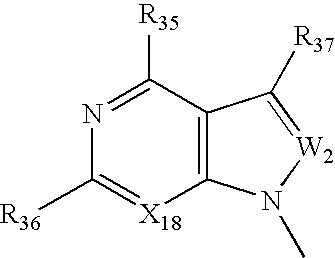
- wherein X 18 is a nitrogen atom or a methine radical; W2 is a nitrogen atom or a C—R38 radical; and R35, R36, R37 and R38, which can be the same or different, are hydrogen or halogen atoms, hydroxyl or mercapto groups, lower alkyl, lower alkylthio, lower alkoxy, aralkyl, aralkoxy or aryloxy radicals or amino groups optionally substituted once or twice. Synthesis of oligonucleotides containing such C and U or T modified binding bases is described in Example 18.
- 7,8optionally modified C and U or T modified binding bases. In certain other aspects, the invention relates to oligonucleotides comprising at least one nucleotide containing a C and U or T modified binding base of the following structure as described, for example, in U.S. Pat. No. 6,001,983, hereby incorporated by reference in its entirety:

- wherein X 19 is selected from the group consisting of a nitrogen atom and a carbon atom bearing a substituent Z; Z is a moiety selected from the group consisting of hydrogen and —CH3; Y4 is selected from the group consisting of N and CH; and the ring structure of the purine analog comprises no more than three nitrogen atoms consecutively bonded. Synthesis of oligonucleotides containing such C and U or T modified binding bases is described in Example 19.
- 8-azapurine. In certain other aspects, the invention relates to oligonucleotides comprising at least one nucleotide containing an 8-azapurine base of the following structure as described, for example, in U.S. Pat. Nos. 5,789,562 and 6,066,720, hereby incorporated by reference in their entireties:
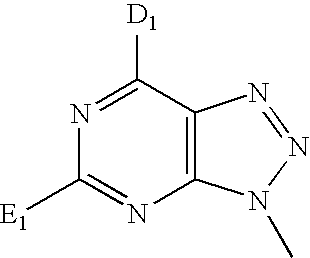
- wherein D 1 and E1 are, independently, H, OH, or NH2. Synthesis of oligonucleotides containing such C and U or T modified binding bases is described in Example 20.
- C and U or T modified binding bases having two six-membered rings. In other aspects, the invention relates to oligonucleotides comprising at least one C and U or T modified binding base of the following structure as described, for example, in U.S. Pat. No. 5,525,711, hereby incorporated by reference in its entirety:

- wherein
- R 47 is combined with R48 to form a single oxo oxygen joined by a double bond to ring vertex 4, or with R46 to form a double bond between ring vertices 3 and 4;
- R 48, when not combined with R47, is either NH2 or NH2 either mono- or disubstituted with a protecting group;
- R 46 when not combined with R47 is a lower alkyl or H;
- R 39 is either H, lower alkyl or phenyl;
- R 44 is combined with R45 to form a single oxo oxygen joined by a double bond to ring vertex 2, or with R17 to form a double bond between ring vertices 1 and 2, such that ring vertices 2 and 4 collectively bear at most one oxo oxygen;
- R 45 when not combined with R44 is a member selected from the group consisting of H, phenyl, NH2, and NH2 mono- or disubstituted with a protecting group;
- when R 44 is not combined with R45, R41 is combined with R40 to form a single oxo oxygen joined by a double bond to ring vertex 7;
- when R 44 is combined with R45, R41 is combined with R42 to form a double bond between ring vertices 7 and 8, and R19 is either H or a lower alkyl; and
- R 43 when not combined with R44, and R42 when not combined with R41, are a bond.
- Synthesis of oligonucleotides containing such C and U or T modified binding bases is described in Example 21.
- As used herein, the term “protecting group” refers to a group which is joined to or substituted for a reactive group (e.g. a hydroxyl or an amine) on a molecule. The protecting group is chosen to prevent reaction of the particular radical during one or more steps of a chemical reaction. Generally the particular protecting group is chosen so as to permit removal at a later time to restore the reactive group without altering other reactive groups present in the molecule. The choice of a protecting group is a function of the particular radical to be protected and the compounds to which it will be exposed. The selection of protecting groups is well known to those of skill in the art. See, for example Greene et al., Protective Groups in Organic Synthesis, 2nd ed., John Wiley & Sons, Inc. Somerset, N. J. (1991), which is herein incorporated by reference.
- C and U or T modified binding bases optionally containing three rings. In other embodiments, the invention relates to oligonucleotides comprising at least one C and U or T modified binding base of one of the following structures as described, for example, in U.S. Pat. No. 5,594,121, hereby incorporated by reference in its entirety:

- wherein Pr is H (hydrogen) or a protecting group; W 3 is CH or N; R49 is H, methyl, or a group containing a C atom connected to the 7-position of the base, wherein the C atom is bonded directly to another atom via a pi bond; R50 is OH, SH or NH2; R51, is H, OH, SH or NH2; each R52 is independently H, OH, CN, halogen (F, Cl, Br, I), alkyl (C1-12), alkenyl (C2-12), alkynyl (C2-12), aryl (C6-9), heteroaryl (C4-9), or both R52, taken together with the carbon atoms to which they are linked at positions 11 and 12, form (a) a 5 or 6 membered carbocyclic ring or, (b) a 5 or 6 membered heterocyclic ring comprising 1-3 N, O or S ring atoms, provided that no 2 adjacent ring atoms are O—O, S—S, O—S or S-O, and wherein any unsaturated C atom of the carbocyclic or heterocyclic ring is substituted by R53 and any saturated carbons contain 2 R53 substituents, wherein R53 is H, alkyl (C1-4), alkenyl (C2-4), alkynyl (C2-4), OR54, SR54, or N(R54)2 or halogen, and there are no more than four halogens per 5 or 6 member ring; and R54 is independently H, or alkyl (C1-4).
- In preferred embodiments, R 49 is aryl, heteroaryl or l-alkynylheteroaryl. Synthesis of oligonucleotides containing such C and U or T modified binding bases is described in Example 22.
- “Protecting group” (designated herein as “Pr”) as used herein means any group capable of preventing the O-atom or N-atom to which it is attached from participating in a reaction or bonding. Such protecting groups for 0- and N-atoms in nucleomonomers are described and methods for their introduction are conventionally known in the art. Protecting groups also prevent reactions and bonding at carboxylic acids, thiols and the like.
- Conjugates
- A further preferred substitution that can be appended to the oligomeric compounds of the invention involves the linkage of one or more moieties or conjugates which enhance the activity, cellular distribution or cellular uptake of the resulting oligomeric compounds. In one embodiment such modified oligomeric compounds are prepared by covalently attaching conjugate groups to functional groups such as hydroxyl or amino groups. Conjugate groups of the invention include intercalators, reporter molecules, polyamines, polyamides, polyethylene glycols, polyethers, groups that enhance the pharmacodynamic properties of oligomers, and groups that enhance the pharmacokinetic properties of oligomers. Typical conjugates groups include cholesterols, lipids, phospholipids, biotin, phenazine, folate, phenanthridine, anthraquinone, acridine, fluoresceins, rhodamines, coumarins, and dyes. Groups that enhance the pharmacodynamic properties, in the context of this invention, include groups that improve oligomer uptake, enhance oligomer resistance to degradation, and/or strengthen sequence-specific hybridization with RNA. Groups that enhance the pharmacokinetic properties, in the context of this invention, include groups that improve oligomer uptake, distribution, metabolism or excretion. Representative conjugate groups are disclosed in International Patent Application PCT/US92/09196, filed Oct. 23, 1992 the entire disclosure of which is incorporated herein by reference. Conjugate moieties include but are not limited to lipid moieties such as a cholesterol moiety (Letsinger et al., Proc. Natl. Acad. Sci. USA, 1989, 86, 6553-6556), cholic acid (Manoharan et al., Bioorg. Med. Chem. Let., 1994, 4, 1053-1060), a thioether, e.g., hexyl-S-tritylthiol (Manoharan et al., Ann. N.Y. Acad. Sci., 1992, 660, 306-309; Manoharan et al., Bioorg. Med. Chem. Let., 1993, 3, 2765-2770), a thiocholesterol (Oberhauser et al., Nucl. Acids Res., 1992, 20, 533-538), an aliphatic chain, e.g., dodecandiol or undecyl residues (Saison-Behmoaras et al., EMBO J, 1991, 10, 1111-1118; Kabanov et al., FEBS Lett., 1990, 259, 327-330; Svinarchuk et al., Biochimie, 1993, 75, 49-54), a phospholipid, e.g., di-hexadecyl-rac-glycerol or triethylammonium 1,2-di-O-hexadecyl-rac-glycero-3-H-phosphonate (Manoharan et al., Tetrahedron Lett., 1995, 36, 3651-3654; Shea et al., Nucl. Acids Res., 1990, 18, 3777-3783), a polyamine or a polyethylene glycol chain (Manoharan et al., Nucleosides & Nucleotides, 1995, 14, 969-973), or adamantane acetic acid (Manoharan et al., Tetrahedron Lett., 1995, 36, 3651-3654), a palmityl moiety (Mishra et al., Biochim. Biophys. Acta, 1995, 1264, 229-237), or an octadecylamine or hexylamino-carbonyl-oxycholesterol moiety (Crooke et al., J. Pharmacol. Exp. Ther., 1996, 277, 923-937.
- The oligomeric compounds of the invention may also be conjugated to active drug substances, for example, aspirin, warfarin, phenylbutazone, ibuprofen, suprofen, fenbufen, ketoprofen, (S)-(+)-pranoprofen, carprofen, dansylsarcosine, 2,3,5-triiodobenzoic acid, flufenamic acid, folinic acid, a benzothiadiazide, chlorothiazide, a diazepine, indomethicin, a barbiturate, a cephalosporin, a sulfa drug, an antidiabetic, an antibacterial or an antibiotic. Oligonucleotide-drug conjugates and their preparation are described in U.S. patent application Ser. No. 09/334,130 (filed Jun. 15, 1999) which is incorporated herein by reference in its entirety.
- Representative United States patents that teach the preparation of such oligonucleotide conjugates include, but are not limited to, U.S. Pat. Nos. 4,828,979; 4,948,882; 5,218,105; 5,525,465; 5,541,313; 5,545,730; 5,552,538; 5,578,717, 5,580,731; 5,580,731; 5,591,584; 5,109,124; 5,118,802; 5,138,045; 5,414,077; 5,486,603; 5,512,439; 5,578,718; 5,608,046; 4,587,044; 4,605,735; 4,667,025; 4,762,779; 4,789,737; 4,824,941; 4,835,263; 4,876,335; 4,904,582; 4,958,013; 5,082,830; 5,112,963; 5,214,136; 5,082,830; 5,112,963; 5,214,136; 5,245,022; 5,254,469; 5,258,506; 5,262,536; 5,272,250; 5,292,873; 5,317,098; 5,371,241, 5,391,723; 5,416,203, 5,451,463; 5,510,475; 5,512,667; 5,514,785; 5,565,552; 5,567,810; 5,574,142; 5,585,481; 5,587,371; 5,595,726; 5,597,696; 5,599,923; 5,599,928 and 5,688,941, certain of which are commonly owned with the instant application, and each of which is herein incorporated by reference.
- Chimeric Oligomeric Compounds
- It is not necessary for all positions in an oligomeric compound to be uniformly modified, and in fact more than one of the aforementioned modifications may be incorporated in a single oligomeric compound or even at a single monomeric subunit such as a nucleoside within a oligomeric compound. The present invention also includes oligomeric compounds which are chimeric oligomeric compounds. “Chimeric” oligomeric compounds or “chimeras,” in the context of this invention, are oligomeric compounds that contain two or more chemically distinct regions, each made up of at least one monomer unit, i.e., a nucleotide in the case of a nucleic acid based oligomer.
- Chimeric oligomeric compounds typically contain at least one region modified so as to confer increased resistance to nuclease degradation, increased cellular uptake, and/or increased binding affinity for the target nucleic acid. An additional region of the oligomeric compound may serve as a substrate for enzymes capable of cleaving RNA:DNA or RNA:RNA hybrids. By way of example, RNase H is a cellular endonuclease which cleaves the RNA strand of an RNA:DNA duplex. Activation of RNase H, therefore, results in cleavage of the RNA target, thereby greatly enhancing the efficiency of inhibition of gene expression. Consequently, comparable results can often be obtained with shorter oligomeric compounds when chimeras are used, compared to for example phosphorothioate deoxyoligonucleotides hybridizing to the same target region. Cleavage of the RNA target can be routinely detected by gel electrophoresis and, if necessary, associated nucleic acid hybridization techniques known in the art.
- Chimeric oligomeric compounds of the invention may be formed as composite structures of two or more oligonucleotides, oligonucleotide analogs, oligonucleosides and/or oligonucleotide mimetics as described above. Such oligomeric compounds have also been referred to in the art as hybrids hemimers, gapmers or inverted gapmers. Representative United States patents that teach the preparation of such hybrid structures include, but are not limited to, U.S. Pat. Nos. 5,013,830; 5,149,797; 5,220,007; 5,256,775; 5,366,878; 5,403,711; 5,491,133; 5,565,350; 5,623,065; 5,652,355; 5,652,356; and 5,700,922, certain of which are commonly owned with the instant application, and each of which is herein incorporated by reference in its entirety.
- 3′-Endo Modifications
- In one aspect of the present invention oligomeric compounds include nucleosides synthetically modified to induce a 3′-endo sugar conformation. A nucleoside can incorporate synthetic modifications of the heterocyclic base, the sugar moiety or both to induce a desired 3′-endo sugar conformation. These modified nucleosides are used to mimic RNA like nucleosides so that particular properties of an oligomeric compound can be enhanced while maintaining the desirable 3′-endo conformational geometry. There is an apparent preference for an RNA type duplex (A form helix, predominantly 3′-endo) as a requirement (e.g. trigger) of RNA interference which is supported in part by the fact that duplexes composed of 2′-deoxy-2′-F-nucleosides appears efficient in triggering RNAi response in the C. elegans system. Properties that are enhanced by using more stable 3′-endo nucleosides include but aren't limited to modulation of pharmacokinetic properties through modification of protein binding, protein off-rate, absorption and clearance; modulation of nuclease stability as well as chemical stability; modulation of the binding affinity and specificity of the oligomer (affinity and specificity for enzymes as well as for complementary sequences); and increasing efficacy of RNA cleavage. The present invention provides oligomeric triggers of RNAi having one or more nucleosides modified in such a way as to favor a C3′-endo type conformation.
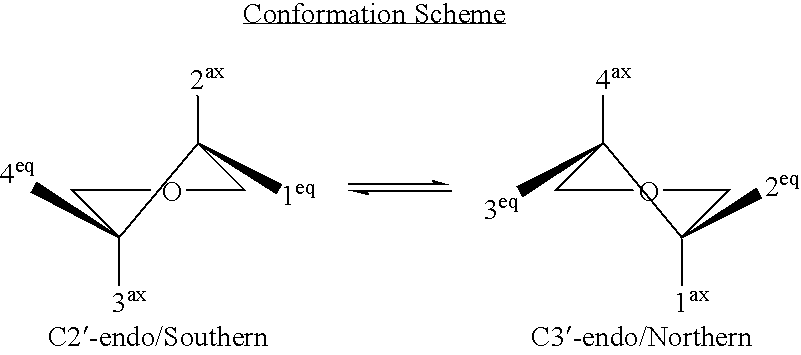
- Nucleoside conformation is influenced by various factors including substitution at the 2′, 3′ or 4′-positions of the pentofuranosyl sugar. Electronegative substituents generally prefer the axial positions, while sterically demanding substituents generally prefer the equatorial positions (Principles of Nucleic Acid Structure, Wolfgang Sanger, 1984, Springer-Verlag.) Modification of the 2′ position to favor the 3′-endo conformation can be achieved while maintaining the 2′-OH as a recognition element, as illustrated in FIG. 2, below (Gallo et al., Tetrahedron (2001), 57, 5707-5713. Harry-O'kuru et al., J. Org. Chem., (1997), 62(6), 1754-1759 and Tang et al., J. Org. Chem. (1999), 64, 747-754.) Alternatively, preference for the 3′-endo conformation can be achieved by deletion of the 2′-OH as exemplified by 2′deoxy-2′ F.-nucleosides (Kawasaki et al., J. Med. Chem. (1993), 36, 831-841), which adopts the 3′-endo conformation positioning the electronegative fluorine atom in the axial position. Other modifications of the ribose ring, for example substitution at the 4′-position to give 4′-F modified nucleosides (Guillerm et al., Bioorganic and Medicinal Chemistry Letters (1995), 5, 1455-1460 and Owen et al., J. Org. Chem. (1976), 41, 3010-3017), or for example modification to yield methanocarba nucleoside analogs (Jacobson et al., J. Med. Chem. Lett. (2000), 43, 2196-2203 and Lee et al., Bioorganic and Medicinal Chemistry Letters (2001), 11, 1333-1337) also induce preference for the 3′-endo conformation. Along similar lines, oligomeric triggers of RNAi response might be composed of one or more nucleosides modified in such a way that conformation is locked into a C3′-endo type conformation, i.e. Locked Nucleic Acid (LNA, Singh et al, Chem. Commun. (1998), 4, 455-456), and ethylene bridged Nucleic Acids (ENA, Morita et al, Bioorganic & Medicinal Chemistry Letters (2002), 12, 73-76.) Examples of modified nucleosides amenable to the present invention are shown below in Table I. These examples are meant to be representative and not exhaustive.
TABLE I 
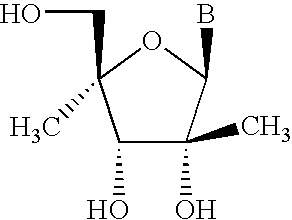
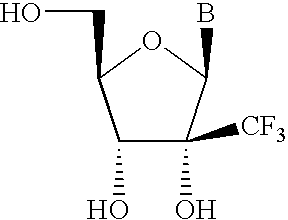
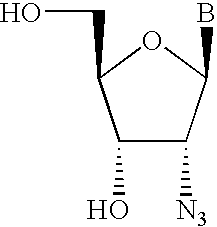

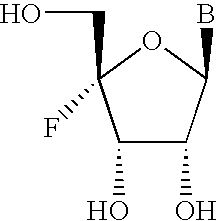
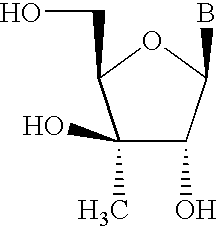
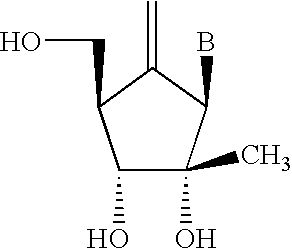

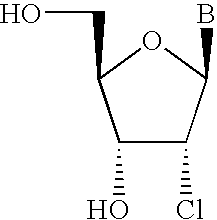
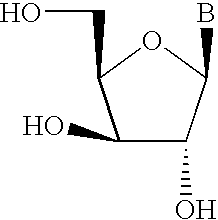

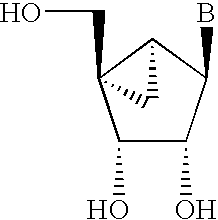
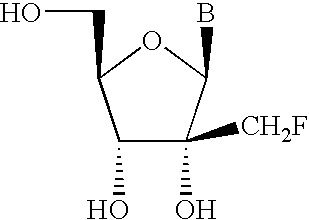


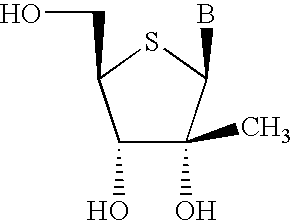

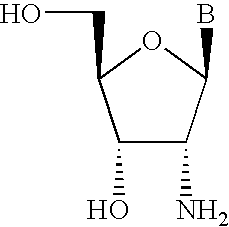
- The preferred conformation of modified nucleosides and their oligomers can be estimated by various methods such as molecular dynamics calculations, nuclear magnetic resonance spectroscopy and CD measurements. Hence, modifications predicted to induce RNA like conformations, A-form duplex geometry in an oligomeric context, are selected for use in the modified oligoncleotides of the present invention. The synthesis of numerous of the modified nucleosides amenable to the present invention are known in the art (see for example, Chemistry of Nucleosides and Nucleotides Vol 1-3, ed. Leroy B. Townsend, 1988, Plenum press., and the examples section below.)
- In one aspect, the present invention is directed to oligonucleotides that are prepared having enhanced properties compared to native RNA against nucleic acid targets. A target is identified and an oligonucleotide is selected having an effective length and sequence that is complementary to a portion of the target sequence. Each nucleoside of the selected sequence is scrutinized for possible enhancing modifications. A preferred modification would be the replacement of one or more RNA nucleosides with nucleosides that have the same 3′-endo conformational geometry. Such modifications can enhance chemical and nuclease stability relative to native RNA while at the same time being much cheaper and easier to synthesize and/or incorporate into an oligonulceotide. The selected sequence can be further divided into regions and the nucleosides of each region evaluated for enhancing modifications that can be the result of a chimeric configuration. Consideration is also given to the 5′ and 3′-termini as there are often advantageous modifications that can be made to one or more of the terminal nucleosides. The oligomeric compounds of the present invention include at least one 5′-modified phosphate group on a single strand or on at least one 5′-position of a double stranded sequence or sequences. Further modifications are also considered such as internucleoside linkages, conjugate groups, substitute sugars or bases, substitution of one or more nucleosides with nucleoside mimetics and any other modification that can enhance the selected sequence for its intended target.
- The terms used to describe the conformational geometry of homoduplex nucleic acids are “A Form” for RNA and “B Form” for DNA. The respective conformational geometry for RNA and DNA duplexes was determined from X-ray diffraction analysis of nucleic acid fibers (Arnott and Hukins, Biochem. Biophys. Res. Comm., 1970, 47, 1504.) In general, RNA:RNA duplexes are more stable and have higher melting temperatures (Tm's) than DNA:DNA duplexes (Sanger et al., Principles of Nucleic Acid Structure, 1984, Springer-Verlag; New York, N.Y.; Lesnik et al., Biochemistry, 1995, 34, 10807-10815; Conte et al., Nucleic Acids Res., 1997, 25, 2627-2634). The increased stability of RNA has been attributed to several structural features, most notably the improved base stacking interactions that result from an A-form geometry (Searle et al., Nucleic Acids Res., 1993, 21, 2051-2056). The presence of the 2′ hydroxyl in RNA biases the sugar toward a C3′ endo pucker, i.e., also designated as Northern pucker, which causes the duplex to favor the A-form geometry. In addition, the 2′ hydroxyl groups of RNA can form a network of water mediated hydrogen bonds that help stabilize the RNA duplex (Egli et al., Biochemistry, 1996, 35, 8489-8494). On the other hand, deoxy nucleic acids prefer a C2′ endo sugar pucker, i.e., also known as Southern pucker, which is thought to impart a less stable B-form geometry (Sanger, W. (1984) Principles of Nucleic Acid Structure, Springer-Verlag, New York, N.Y.). As used herein, B-form geometry is inclusive of both C2′-endo pucker and 04′-endo pucker. This is consistent with Berger, et. al., Nucleic Acids Research, 1998, 26, 2473-2480, who pointed out that in considering the furanose conformations which give rise to B-form duplexes consideration should also be given to a O4′-endo pucker contribution.
- DNA:RNA hybrid duplexes, however, are usually less stable than pure RNA:RNA duplexes, and depending on their sequence may be either more or less stable than DNA:DNA duplexes (Searle et al., Nucleic Acids Res., 1993, 21, 2051-2056). The structure of a hybrid duplex is intermediate between A- and B-form geometries, which may result in poor stacking interactions (Lane et al., Eur. J. Biochem., 1993, 215, 297-306; Fedoroffet al., J. Mol. Biol., 1993, 233, 509-523; Gonzalez et al., Biochemistry, 1995, 34, 4969-4982; Horton et al., J. Mol. Biol., 1996, 264, 521-533). The stability of the duplex formed between a target RNA and a synthetic sequence is central to therapies such as but not limited to antisense and RNA interference as these mechanisms require the binding of a synthetic oligonucleotide strand to an RNA target strand. In the case of antisense, effective inhibition of the mRNA requires that the antisense DNA have a very high binding affinity with the mRNA. Otherwise the desired interaction between the synthetic oligonucleotide strand and target mRNA strand will occur infrequently, resulting in decreased efficacy.
- One routinely used method of modifying the sugar puckering is the substitution of the sugar at the 2′-position with a substituent group that influences the sugar geometry. The influence on ring conformation is dependant on the nature of the substituent at the 2′-position. A nurnber of different substituents have been studied to determine their sugar puckering effect. For example, 2′-halogens have been studied showing that the 2′-fluoro derivative exhibits the largest population (65%) of the C3′-endo form, and the 2′-iodo exhibits the lowest population (7%). The populations of adenosine (2′-OH) versus deoxyadenosine (2′-H) are 36% and 19%, respectively. Furthermore, the effect of the 2′-fluoro group of adenosine dimers (2′-deoxy-2′-fluoroadenosine -2′-deoxy-2′-fluoro-adenosine) is further correlated to the stabilization of the stacked conformation.
- As expected, the relative duplex stability can be enhanced by replacement of 2′-OH groups with 2′-F groups thereby increasing the C3′-endo population. It is assumed that the highly polar nature of the 2′-F bond and the extreme preference for C3′-endo puckering may stabilize the stacked conformation in an A-form duplex. Data from UV hypochromicity, circular dichroism, and 1H NMR also indicate that the degree of stacking decreases as the electronegativity of the halo substituent decreases. Furthermore, steric bulk at the 2′-position of the sugar moiety is better accommodated in an A-form duplex than a B-form duplex. Thus, a 2′-substituent on the 3′-terminus of a dinucleoside monophosphate is thought to exert a number of effects on the stacking conformation: steric repulsion, furanose puckering preference, electrostatic repulsion, hydrophobic attraction, and hydrogen bonding capabilities. These substituent effects are thought to be determined by the molecular size, electronegativity, and hydrophobicity of the substituent. Melting temperatures of complementary strands is also increased with the 2′-substituted adenosine diphosphates. It is not clear whether the 3′-endo preference of the conformation or the presence of the substituent is responsible for the increased binding. However, greater overlap of adjacent bases (stacking) can be achieved with the 3′-endo conformation.
- One synthetic 2′-modification that imparts increased nuclease resistance and a very high binding affinity to nucleotides is the 2-methoxyethoxy (2′-MOE, 2′-OCH 2CH2OCH3) side chain (Baker et al., J. Biol. Chem., 1997, 272, 11944-12000). One of the immediate advantages of the 2′-MOE substitution is the improvement in binding affinity, which is greater than many similar 2′ modifications such as O-methyl, O-propyl, and O-aminopropyl. Oligonucleotides having the 2′-O-methoxyethyl substituent also have been shown to be antisense inhibitors of gene expression with promising features for in vivo use (Martin, P., Helv. Chim. Acta, 1995, 78, 486-504; Altmann et al., Chimia, 1996, 50, 168-176; Altmann et al., Biochem. Soc. Trans., 1996, 24, 630-637; and Altmann et al., Nucleosides Nucleotides, 1997, 16, 917-926). Relative to DNA, the oligonucleotides having the 2′-MOE modification displayed improved RNA affinity and higher nuclease resistance. Chimeric oligonucleotides having 2′-MOE substituents in the wing nucleosides and an internal region of deoxy-phosphorothioate nucleotides (also termed a gapped oligonucleotide or gapmer) have shown effective reduction in the growth of tumors in animal models at low doses. 2′-MOE substituted oligonucleotides have also shown outstanding promise as antisense agents in several disease states. One such MOE substituted oligonucleotide is presently being investigated in clinical trials for the treatment of CMV retinitis.
- Chemistries Defined
- Unless otherwise defined herein, alkyl means C 1-C12, preferably C1-C8, and more preferably C1-C6, straight or (where possible) branched chain aliphatic hydrocarbyl.
- Unless otherwise defined herein, heteroalkyl means C 1-C12, preferably C1-C8, and more preferably C1-C6, straight or (where possible) branched chain aliphatic hydrocarbyl containing at least one, and preferably about 1 to about 3, hetero atoms in the chain, including the terminal portion of the chain. Preferred heteroatoms include N, O and S.
- Unless otherwise defined herein, cycloalkyl means C 3-C12, preferably C3-C8, and more preferably C3-C6, aliphatic hydrocarbyl ring.
- Unless otherwise defined herein, alkenyl means C 2-C12, preferably C2-C8, and more preferably C2-C6 alkenyl, which may be straight or (where possible) branched hydrocarbyl moiety, which contains at least one carbon-carbon double bond.
- Unless otherwise defined herein, alkynyl means C 2-C12, preferably C2-C8, and more preferably C2-C6 alkynyl, which may be straight or (where possible) branched hydrocarbyl moiety, which contains at least one carbon-carbon triple bond.
- Unless otherwise defined herein, heterocycloalkyl means a ring moiety containing at least three ring members, at least one of which is carbon, and of which 1, 2 or three ring members are other than carbon. Preferably the number of carbon atoms varies from 1 to about 12, preferably 1 to about 6, and the total number of ring members varies from three to about 15, preferably from about 3 to about 8. Preferred ring heteroatoms are N, O and S. Preferred heterocycloalkyl groups include morpholino, thiomorpholino, piperidinyl, piperazinyl, homopiperidinyl, homopiperazinyl, homomorpholino, homothiomorpholino, pyrrolodinyl, tetrahydrooxazolyl, tetrahydroimidazolyl, tetrahydrothiazolyl, tetrahydroisoxazolyl, tetrahydropyrrazolyl, furanyl, pyranyl, and tetrahydroisothiazolyl.
- Unless otherwise defined herein, aryl means any hydrocarbon ring structure containing at least one aryl ring. Preferred aryl rings have about 6 to about 20 ring carbons. Especially preferred aryl rings include phenyl, napthyl, anthracenyl, and phenanthrenyl.
- Unless otherwise defined herein, hetaryl means a ring moiety containing at least one fully unsaturated ring, the ring consisting of carbon and non-carbon atoms. Preferably the ring system contains about 1 to about 4 rings. Preferably the number of carbon atoms varies from 1 to about 12, preferably 1 to about 6, and the total number of ring members varies from three to about 15, preferably from about 3 to about 8. Preferred ring heteroatoms are N, O and S. Preferred hetaryl moieties include pyrazolyl, thiophenyl, pyridyl, imidazolyl, tetrazolyl, pyridyl, pyrimidinyl, purinyl, quinazolinyl, quinoxalinyl, benzimidazolyl, benzothiophenyl, etc.
- Unless otherwise defined herein, where a moiety is defined as a compound moiety, such as hetarylalkyl (hetaryl and alkyl), aralkyl (aryl and alkyl), etc., each of the sub-moieties is as defined herein.
- Unless otherwise defined herein, an electron withdrawing group is a group, such as the cyano or isocyanato group that draws electronic charge away from the carbon to which it is attached. Other electron withdrawing groups of note include those whose electronegativities exceed that of carbon, for example halogen, nitro, or phenyl substituted in the ortho- or para-position with one or more cyano, isothiocyanato, nitro or halo groups.
- Unless otherwise defined herein, the terms halogen and halo have their ordinary meanings. Preferred halo (halogen) substituents are Cl, Br, and I.
- The aforementioned optional substituents are, unless otherwise herein defined, suitable substituents depending upon desired properties. Included are halogens (Cl, Br, I), alkyl, alkenyl, and alkynyl moieties, NO 2, NH3 (substituted and unsubstituted), acid moieties (e.g.—CO2H, —OSO3H2, etc.), heterocycloalkyl moieties, hetaryl moieties, aryl moieties, etc.
- In all the preceding formulae, the squiggle (˜) indicates a bond to an oxygen or sulfur of the 5′-phosphate.
- Phosphate protecting groups include those described in U.S. Pat. No. U.S. Pat. No. 5,760,209, U.S. Pat. No. 5,614,621, U.S. Pat. No. 6,051,699, U.S. Pat. No. 6,020,475, U.S. Pat. No. 6,326,478, U.S. Pat. No. 6,169,177, U.S. Pat. No. 6,121,437, U.S. Pat. No. 6,465,628 each of which is expressly incorporated herein by reference in its entirety.
- Screening, Target Validation and Drug Discovery
- For use in screening and target validation, the compounds and compositions of the invention are used to modulate the expression of a selected protein. “Modulators” are those oligomeric compounds and compositions that decrease or increase the expression of a nucleic acid molecule encoding a protein and which comprise at least an 8-nucleobase portion which is complementary to a preferred target segment. The screening method comprises the steps of contacting a preferred target segment of a nucleic acid molecule encoding a protein with one or more candidate modulators, and selecting for one or more candidate modulators which decrease or increase the expression of a nucleic acid molecule encoding a protein. Once it is shown that the candidate modulator or modulators are capable of modulating (e.g. either decreasing or increasing) the expression of a nucleic acid molecule encoding a peptide, the modulator may then be employed in further investigative studies of the function of the peptide, or for use as a research, diagnostic, or therapeutic agent in accordance with the present invention.
- The conduction such screening and target validation studies, oligomeric compounds of invention can be used combined with their respective complementary strand oligomeric compound to form stabilized double-stranded (duplexed) oligonucleotides. Double stranded oligonucleotide moieties have been shown to modulate target expression and regulate translation as well as RNA processing via an antisense mechanism. Moreover, the double-stranded moieties may be subject to chemical modifications (Fire et al., Nature, 1998, 391, 806-811; Timmons and Fire, Nature 1998, 395, 854; Timmons et al., Gene, 2001, 263, 103-112; Tabara et al., Science, 1998, 282, 430-431; Montgomery et al., Proc. Natl. Acad. Sci. USA, 1998, 95, 15502-15507; Tuschl et al., Genes Dev., 1999, 13, 3191-3197; Elbashir et al., Nature, 2001, 411, 494-498; Elbashir et al., Genes Dev. 2001, 15, 188-200; Nishikura et al., Cell (2001), 107, 415-416; and Bass et al., Cell (2000), 101, 235-238.) For example, such double-stranded moieties have been shown to inhibit the target by the classical hybridization of antisense strand of the duplex to the target, thereby triggering enzymatic degradation of the target (Tijsterman et al., Science, 2002, 295, 694-697).
- For use in drug discovery and target validation, oligomeric compounds of the present invention are used to elucidate relationships that exist between proteins and a disease state, phenotype, or condition. These methods include detecting or modulating a target peptide comprising contacting a sample, tissue, cell, or organism with the oligomeric compounds and compositions of the present invention, measuring the nucleic acid or protein level of the target and/or a related phenotypic or chemical endpoint at some time after treatment, and optionally comparing the measured value to a non-treated sample or sample treated with a further oligomeric compound of the invention. These methods can also be performed in parallel or in combination with other experiments to determine the function of unknown genes for the process of target validation or to determine the validity of a particular gene product as a target for treatment or prevention of a disease or disorder.
- Kits, Research Reagents, Diagnostics, and Therapeutics
- The oligomeric compounds and compositions of the present invention can additionally be utilized for diagnostics, therapeutics, prophylaxis and as research reagents and kits. Such uses allows for those of ordinary skill to elucidate the function of particular genes or to distinguish between functions of various members of a biological pathway.
- For use in kits and diagnostics, the oligomeric compounds and compositions of the present invention, either alone or in combination with other compounds or therapeutics, can be used as tools in differential and/or combinatorial analyses to elucidate expression patterns of a portion or the entire complement of genes expressed within cells and tissues.
- As one non-limiting example, expression patterns within cells or tissues treated with one or more compounds or compositions of the invention are compared to control cells or tissues not treated with the compounds or compositions and the patterns produced are analyzed for differential levels of gene expression as they pertain, for example, to disease association, signaling pathway, cellular localization, expression level, size, structure or function of the genes examined. These analyses can be performed on stimulated or unstimulated cells and in the presence or absence of other compounds that affect expression patterns.
- Examples of methods of gene expression analysis known in the art include DNA arrays or microarrays (Brazma and Vilo, FEBS Lett., 2000, 480, 17-24; Celis, et al., FEBS Lett., 2000, 480, 2-16), SAGE (serial analysis of gene expression)(Madden, et al., Drug Discov. Today, 2000, 5, 415-425), READS (restriction enzyme amplification of digested cDNAs) (Prashar and Weissman, Methods Enzymol., 1999, 303, 258-72), TOGA (total gene expression analysis) (Sutcliffe, et al., Proc. Natl. Acad. Sci. U.S.A., 2000, 97, 1976-81), protein arrays and proteomics (Celis, et al., FEBS Lett., 2000, 480, 2-16; Jungblut, et al., Electrophoresis, 1999, 20, 2100-10), expressed sequence tag (EST) sequencing (Celis, et al., FEBS Lett., 2000, 480, 2-16; Larsson, et al., J. Biotechnol., 2000, 80, 143-57), subtractive RNA fingerprinting (SuRF) (Fuchs, et al., Anal. Biochem., 2000, 286, 91-98; Larson, et al., Cytometry, 2000, 41, 203-208), subtractive cloning, differential display (DD) (Jurecic and Belmont, Curr. Opin. Microbiol., 2000, 3, 316-21), comparative genomic hybridization (Carulli, et al., J. Cell Biochem. Suppl., 1998, 31, 286-96), FISH (fluorescent in situ hybridization) techniques (Going and Gusterson, Eur. J. Cancer, 1999, 35, 1895-904) and mass spectrometry methods (To, Comb. Chem. High Throughput Screen, 2000, 3, 235-41).
- The compounds and compositions of the invention are useful for research and diagnostics, because these compounds and compositions hybridize to nucleic acids encoding proteins. Hybridization of the compounds and compositions of the invention with a nucleic acid can be detected by means known in the art. Such means may include conjugation of an enzyme to the compound or composition, radiolabelling or any other suitable detection means. Kits using such detection means for detecting the level of selected proteins in a sample may also be prepared.
- The specificity and sensitivity of compounds and compositions can also be harnessed by those of skill in the art for therapeutic uses. Antisense oligomeric compounds have been employed as therapeutic moieties in the treatment of disease states in animals, including humans. Antisense oligonucleotide drugs, including ribozymes, have been safely and effectively administered to humans and numerous clinical trials are presently underway. It is thus established that oligomeric compounds can be useful therapeutic modalities that can be configured to be useful in treatment regimes for the treatment of cells, tissues and animals, especially humans.
- For therapeutics, an animal, preferably a human, suspected of having a disease or disorder that can be treated by modulating the expression of a selected protein is treated by administering the compounds and compositions. For example, in one non-limiting embodiment, the methods comprise the step of administering to the animal in need of treatment, a therapeutically effective amount of a protein inhibitor. The protein inhibitors of the present invention effectively inhibit the activity of the protein or inhibit the expression of the protein. In one embodiment, the activity or expression of a protein in an animal is inhibited by about 10%. Preferably, the activity or expression of a protein in an animal is inhibited by about 30%. More preferably, the activity or expression of a protein in an animal is inhibited by 50% or more.
- For example, the reduction of the expression of a protein may be measured in serum, adipose tissue, liver or any other body fluid, tissue or organ of the animal. Preferably, the cells contained within the fluids, tissues or organs being analyzed contain a nucleic acid molecule encoding a protein and/or the protein itself.
- The compounds and compositions of the invention can be utilized in pharmaceutical compositions by adding an effective amount of the compound or composition to a suitable pharmaceutically acceptable diluent or carrier. Use of the oligomeric compounds and methods of the invention may also be useful prophylactically.
- Formulations
- The compounds and compositions of the invention may also be admixed, encapsulated, conjugated or otherwise associated with other molecules, molecule structures or mixtures of compounds, as for example, liposomes, receptor-targeted molecules, oral, rectal, topical or other formulations, for assisting in uptake, distribution and/or absorption. Representative United States patents that teach the preparation of such uptake, distribution and/or absorption-assisting formulations include, but are not limited to, U.S. Pat. Nos. 5,108,921; 5,354,844; 5,416,016; 5,459,127; 5,521,291; 5,543,158; 5,547,932; 5,583,020; 5,591,721; 4,426,330; 4,534,899; 5,013,556; 5,108,921; 5,213,804; 5,227,170; 5,264,221; 5,356,633; 5,395,619; 5,416,016; 5,417,978; 5,462,854; 5,469,854; 5,512,295; 5,527,528; 5,534,259; 5,543,152; 5,556,948; 5,580,575; and 5,595,756, each of which is herein incorporated by reference.
- The compounds and compositions of the invention encompass any pharmaceutically acceptable salts, esters, or salts of such esters, or any other compound which, upon administration to an animal, including a human, is capable of providing (directly or indirectly) the biologically active metabolite or residue thereof. Accordingly, for example, the disclosure is also drawn to prodrugs and pharmaceutically acceptable salts of the oligomeric compounds of the invention, pharmaceutically acceptable salts of such prodrugs, and other bioequivalents.
- The term “prodrug” indicates a therapeutic agent that is prepared in an inactive form that is converted to an active form (i.e., drug) within the body or cells thereof by the action of endogenous enzymes or other chemicals and/or conditions. In particular, prodrug versions of the oligonucleotides of the invention are prepared as SATE [(S-acetyl-2-thioethyl) phosphate] derivatives according to the methods disclosed in WO 93/24510 to Gosselin et al., published Dec. 9, 1993 or in WO 94/26764 and U.S. Pat. No. 5,770,713 to Imbach et al.
- The term “pharmaceutically acceptable salts” refers to physiologically and pharmaceutically acceptable salts of the compounds and compositions of the invention: i.e., salts that retain the desired biological activity of the parent compound and do not impart undesired toxicological effects thereto. For oligonucleotides, preferred examples of pharmaceutically acceptable salts and their uses are further described in U.S. Pat. No. 6,287,860, which is incorporated herein in its entirety.
- The present invention also includes pharmaceutical compositions and formulations that include the compounds and compositions of the invention. The pharmaceutical compositions of the present invention may be administered in a number of ways depending upon whether local or systemic treatment is desired and upon the area to be treated. Administration may be topical (including ophthalmic and to mucous membranes including vaginal and rectal delivery), pulmonary, e.g., by inhalation or insufflation of powders or aerosols, including by nebulizer; intratracheal, intranasal, epidermal and transdermal), oral or parenteral. Parenteral administration includes intravenous, intraarterial, subcutaneous, intraperitoneal or intramuscular injection or infusion; or intracranial, e.g., intrathecal or intraventricular, administration. Pharmaceutical compositions and formulations for topical administration may include transdermal patches, ointments, lotions, creams, gels, drops, suppositories, sprays, liquids and powders. Conventional pharmaceutical carriers, aqueous, powder or oily bases, thickeners and the like may be necessary or desirable. Coated condoms, gloves and the like may also be useful.
- The pharmaceutical formulations of the present invention, which may conveniently be presented in unit dosage form, may be prepared according to conventional techniques well known in the pharmaceutical industry. Such techniques include the step of bringing into association the active ingredients with the pharmaceutical carrier(s) or excipient(s). In general, the formulations are prepared by uniformly and intimately bringing into association the active ingredients with liquid carriers or finely divided solid carriers or both, and then, if necessary, shaping the product.
- The compounds and compositions of the present invention may be formulated into any of many possible dosage forms such as, but not limited to, tablets, capsules, gel capsules, liquid syrups, soft gels, suppositories, and enemas. The compositions of the present invention may also be formulated as suspensions in aqueous, non-aqueous or mixed media. Aqueous suspensions may further contain substances which increase the viscosity of the suspension including, for example, sodium carboxymethylcellulose, sorbitol and/or dextran. The suspension may also contain stabilizers.
- Pharmaceutical compositions of the present invention include, but are not limited to, solutions, emulsions, foams and liposome-containing formulations. The pharmaceutical compositions and formulations of the present invention may comprise one or more penetration enhancers, carriers, excipients or other active or inactive ingredients.
- Emulsions are typically heterogenous systems of one liquid dispersed in another in the form of droplets usually exceeding 0.1 μm in diameter. Emulsions may contain additional components in addition to the dispersed phases, and the active drug that may be present as a solution in either the aqueous phase, oily phase or itself as a separate phase. Microemulsions are included as an embodiment of the present invention. Emulsions and their uses are well known in the art and are further described in U.S. Pat. No. 6,287,860, which is incorporated herein in its entirety.
- Formulations of the present invention include liposomal formulations. As used in the present invention, the term “liposome” means a vesicle composed of amphiphilic lipids arranged in a spherical bilayer or bilayers. Liposomes are unilamellar or multilamellar vesicles which have a membrane formed from a lipophilic material and an aqueous interior that contains the composition to be delivered. Cationic liposomes are positively charged liposomes which are believed to interact with negatively charged DNA molecules to form a stable complex. Liposomes that are pH-sensitive or negatively-charged are believed to entrap DNA rather than complex with it. Both cationic and noncationic liposomes have been used to deliver DNA to cells.
- Liposomes also include “sterically stabilized” liposomes, a term which, as used herein, refers to liposomes comprising one or more specialized lipids that, when incorporated into liposomes, result in enhanced circulation lifetimes relative to liposomes lacking such specialized lipids. Examples of sterically stabilized liposomes are those in which part of the vesicle-forming lipid portion of the liposome comprises one or more glycolipids or is derivatized with one or more hydrophilic polymers, such as a polyethylene glycol (PEG) moiety. Liposomes and their uses are further described in U.S. Pat. No. 6,287,860, which is incorporated herein in its entirety.
- The pharmaceutical formulations and compositions of the present invention may also include surfactants. The use of surfactants in drug products, formulations and in emulsions is well known in the art. Surfactants and their uses are further described in U.S. Pat. No. 6,287,860, which is incorporated herein in its entirety.
- In one embodiment, the present invention employs various penetration enhancers to effect the efficient delivery of nucleic acids, particularly oligonucleotides. In addition to aiding the diffusion of non-lipophilic drugs across cell membranes, penetration enhancers also enhance the permeability of lipophilic drugs. Penetration enhancers may be classified as belonging to one of five broad categories, i.e., surfactants, fatty acids, bile salts, chelating agents, and non-chelating non-surfactants. Penetration enhancers and their uses are further described in U.S. Pat. No. 6,287,860, which is incorporated herein in its entirety.
- One of skill in the art will recognize that formulations are routinely designed according to their intended use, i.e. route of administration.
- Preferred formulations for topical administration include those in which the oligonucleotides of the invention are in admixture with a topical delivery agent such as lipids, liposomes, fatty acids, fatty acid esters, steroids, chelating agents and surfactants. Preferred lipids and liposomes include neutral (e.g. dioleoylphosphatidyl DOPE ethanolamine, dimyristoylphosphatidyl choline DMPC, distearolyphosphatidyl choline) negative (e.g. dimyristoylphosphatidyl glycerol DMPG) and cationic (e.g. dioleoyltetramethylaminopropyl DOTAP and dioleoylphosphatidyl ethanolamine DOTMA).
- For topical or other administration, compounds and compositions of the invention may be encapsulated within liposomes or may form complexes thereto, in particular to cationic liposomes. Alternatively, they may be complexed to lipids, in particular to cationic lipids. Preferred fatty acids and esters, pharmaceutically acceptable salts thereof, and their uses are further described in U.S. Pat. No. 6,287,860, which is incorporated herein in its entirety. Topical formulations are described in detail in U.S. patent application Ser. No. 09/315,298 filed on May 20, 1999, which is incorporated herein by reference in its entirety.
- Compositions and formulations for oral administration include powders or granules, microparticulates, nanoparticulates, suspensions or solutions in water or non-aqueous media, capsules, gel capsules, sachets, tablets or minitablets. Thickeners, flavoring agents, diluents, emulsifiers, dispersing aids or binders may be desirable. Preferred oral formulations are those in which oligonucleotides of the invention are administered in conjunction with one or more penetration enhancers surfactants and chelators. Preferred surfactants include fatty acids and/or esters or salts thereof, bile acids and/or salts thereof. Preferred bile acids/salts and fatty acids and their uses are further described in U.S. Pat. No. 6,287,860, which is incorporated herein in its entirety. Also preferred are combinations of penetration enhancers, for example, fatty acids/salts in combination with bile acids/salts. A particularly preferred combination is the sodium salt of lauric acid, capric acid and UDCA. Further penetration enhancers include polyoxyethylene-9-lauryl ether, polyoxyethylene-20-cetyl ether. Compounds and compositions of the invention may be delivered orally, in granular form including sprayed dried particles, or complexed to form micro or nanoparticles. Complexing agents and their uses are further described in U.S. Pat. No. 6,287,860, which is incorporated herein in its entirety. Certain oral formulations for oligonucleotides and their preparation are described in detail in U.S. application Ser. Nos. 09/108,673 (filed Jul. 1, 1998), 09/315,298 (filed May 20, 1999) and 10/071,822, filed Feb. 8, 2002, each of which is incorporated herein by reference in their entirety.
- Compositions and formulations for parenteral, intrathecal or intraventricular administration may include sterile aqueous solutions that may also contain buffers, diluents and other suitable additives such as, but not limited to, penetration enhancers, carrier compounds and other pharmaceutically acceptable carriers or excipients.
- Certain embodiments of the invention provide pharmaceutical compositions containing one or more of the compounds and compositions of the invention and one or more other chemotherapeutic agents that function by a non-antisense mechanism. Examples of such chemotherapeutic agents include but are not limited to cancer chemotherapeutic drugs such as daunorubicin, daunomycin, dactinomycin, doxorubicin, epirubicin, idarubicin, esorubicin, bleomycin, mafosfamide, ifosfamide, cytosine arabinoside, bis-chloroethylnitrosurea, busulfan, mitomycin C, actinomycin D, mithramycin, prednisone, hydroxyprogesterone, testosterone, tamoxifen, dacarbazine, procarbazine, hexamethylmelamine, pentamethylmelamine, mitoxantrone, amsacrine, chlorambucil, methylcyclohexylnitrosurea, nitrogen mustards, melphalan, cyclophosphamide, 6-mercaptopurine, 6-thioguanine, cytarabine, 5-azacytidine, hydroxyurea, deoxycoformycin, 4-hydroxyperoxycyclophosphoramide, 5-fluorouracil (5-FU), 5-fluorodeoxyuridine (5-FUdR), methotrexate (MTX), colchicine, taxol, vincristine, vinblastine, etoposide (VP-16), trimetrexate, irinotecan, topotecan, gemcitabine, teniposide, cisplatin and diethylstilbestrol (DES). When used with the oligomeric compounds of the invention, such chemotherapeutic agents may be used individually (e.g., 5-FU and oligonucleotide), sequentially (e.g., 5-FU and oligonucleotide for a period of time followed by MTX and oligonucleotide), or in combination with one or more other such chemotherapeutic agents (e.g., 5-FU, MTX and oligonucleotide, or 5-FU, radiotherapy and oligonucleotide). Anti-inflammatory drugs, including but not limited to nonsteroidal anti-inflammatory drugs and corticosteroids, and antiviral drugs, including but not limited to ribivirin, vidarabine, acyclovir and ganciclovir, may also be combined in compositions of the invention. Combinations of compounds and compositions of the invention and other drugs are also within the scope of this invention. Two or more combined compounds such as two oligomeric compounds or one oligomeric compound combined with further compounds may be used together or sequentially.
- In another related embodiment, compositions of the invention may contain one or more of the compounds and compositions of the invention targeted to a first nucleic acid and one or more additional compounds such as antisense oligomeric compounds targeted to a second nucleic acid target. Numerous examples of antisense oligomeric compounds are known in the art. Alternatively, compositions of the invention may contain two or more oligomeric compounds and compositions targeted to different regions of the same nucleic acid target. Two or more combined compounds may be used together or sequentially
- Dosing
- The formulation of therapeutic compounds and compositions of the invention and their subsequent administration (dosing) is believed to be within the skill of those in the art. Dosing is dependent on severity and responsiveness of the disease state to be treated, with the course of treatment lasting from several days to several months, or until a cure is effected or a diminution of the disease state is achieved. Optimal dosing schedules can be calculated from measurements of drug accumulation in the body of the patient. Persons of ordinary skill can easily determine optimum dosages, dosing methodologies and repetition rates. Optimum dosages may vary depending on the relative potency of individual oligonucleotides, and can generally be estimated based on EC 50s found to be effective in in vitro and in vivo animal models. In general, dosage is from 0.01 ug to 100 g per kg of body weight, and may be given once or more daily, weekly, monthly or yearly, or even once every 2 to 20 years. Persons of ordinary skill in the art can easily estimate repetition rates for dosing based on measured residence times and concentrations of the drug in bodily fluids or tissues. Following successful treatment, it may be desirable to have the patient undergo maintenance therapy to prevent the recurrence of the disease state, wherein the oligonucleotide is administered in maintenance doses, ranging from 0.01 ug to 100 g per kg of body weight, once or more daily, to once every 20 years.
- While the present invention has been described with specificity in accordance with certain of its preferred embodiments, the following examples serve only to illustrate the invention and are not intended to limit the same.
- The entire disclosure of each patent, patent application, and publication cited or described in this document is hereby incorporated by reference.
- Oligonucleotides containing boronated purine bases are synthesized as described in U.S. Pat. No. 5,130,302.
- Oligonucleotides containing 1H-pyrazolo[3,4-d]pyrimidin-4(5H)-6(7H)-dione are synthesized as described in U.S. Pat. No. 6,143,877.
- Oligonucleotides containing C2-modified purine bases are synthesized as described in U.S. Pat. Nos. 5,459,255, 5,587,469, and 5,808,027.
- Oligonucleotides containing C2,C6 modified purine bases are synthesized as described in U.S. Pat. No. 4,845,205.
- Oligonucleotides containing C2 modified, C6, C8 optionally modified purine bases are synthesized as described in U.S. Pat. Nos. 5,681,941 and 5,811,534.
- Oligonucleotides containing C2,C6,7,8 optionally modified purine bases are synthesized as described in U.S. Pat. No. 6,174,998.
- Oligonucleotides containing 3-deaza purine bases are synthesized as described in U.S. Pat. Nos. 5,457,191, 5,587,470, and 5,948,903.
- Oligonucleotides containing 4-amino-1H-pyrazolo[3,4-d]pyrimidine are synthesized as described in U.S. Pat. No. 6,127,121.
- Oligonucleotides containing 5,7,8,9 optionally modified purine bases are synthesized as described in U.S. Pat. No. 6,268,132.
- Oligonucleotides containing 6-amino-1H-pyrazolo[3,4-d]pyrimidin-4(5H)-one are synthesized as described in U.S. Pat. No. 6,127,121.
- Oligonucleotides containing C6-thione modified purine bases are synthesized as described in U.S. Pat. No. 5,652,359.
- Oligonucleotides containing C6-fluoro modified purine bases are synthesized as described in U.S. Pat. No. 5,844,106.
- Oligonucleotides containing 0 6-benzylguanine are synthesized as described in U.S. Pat. Nos. 5,691,307 and 6,060,458.
- Oligonucleotides containing C6 modified purine bases are synthesized as described in U.S. Pat. No. 5,691,307.
- Oligonucleotides containing 7-deaza, C7 substituted purine bases are synthesized as described in U.S. Pat. No. 5,596,091.
- Oligonucleotides containing 7-deaza, C7 iodine modified purine bases are synthesized as described in U.S. Pat. No. 6,093,807.
- Oligonucleotides containing 7-deaza, 8-aza modified purine bases are synthesized as described in U.S. Pat. No. 5,824,796.
- Oligonucleotides containing 7-deaza, 8 optionally aza modified purine bases are synthesized as described in U.S. Pat. No. 6,211,158.
- Oligonucleotides containing 7,8 optionally modified purine bases are synthesized as described in U.S. Pat. No. 6,001,983.
- Oligonucleotides containing 8-azapurine are synthesized as described in U.S. Pat. Nos. 5,789,562 and 6,066,720.
- Oligonucleotides containing purine bases having two six-membered rings are synthesized as described in U.S. Pat. No. 5,525,711.
- Oligonucleotides containing purine bases optionally containing three rings are synthesized as described in U.S. Pat. No. 5,594,121.
- The following compounds, including amidites and their intermediates were prepared as described in U.S. Pat. No. 6,426,220 and published PCT WO O 2/36743; 5′-O-Dimethoxytrityl-thymidine intermediate for 5-methyl dC amidite, 5′-O-Dimethoxytrityl-2′-deoxy-5-methylcytidine intermediate for 5-methyl-dC amidite, 5′-O-Dimethoxytrityl-2′-deoxy-N4-benzoyl-5-methylcytidine penultimate intermediate for 5-methyl dC amidite, [5′-O-(4,4′-Dimethoxytriphenylmethyl)-2′-deoxy-N-4-benzoyl-5-methylcytidin-3′-O-yl]-2-cyanoethyl-N,N-diisopropylphosphoramidite (5-methyl dC amidite), 2′-Fluorodeoxyadenosine, 2′-Fluorodeoxyguanosine, 2′-Fluorouridine, 2′-Fluorodeoxycytidine, 2′-O-(2-Methoxyethyl) modified amidites, 2′-O-(2-methoxyethyl)-5-methyluridine intermediate, 5′-O-DMT-2′-O-(2-methoxyethyl)-5-methyluridine penultimate intermediate, [5′-O-(4,4′-Dimethoxytriphenylmethyl)-2′-O-(2-methoxyethyl)-5-methyluridin-3′-O-yl]-2-cyanoethyl-N,N-diisopropylphosphoramidite (MOE T amidite), 5′-O-Dimethoxytrityl-2′-O-(2-methoxyethyl)-5-methylcytidine intermediate, 5′-O-dimethoxytrityl-2′-O-(2-methoxyethyl)-N-4-benzoyl-5-methyl-cytidine penultimate intermediate, [5′-O-(4,4′-Dimethoxytriphenylmethyl)-2′-O-(2-methoxyethyl)-N-4-benzoyl-5-methylcytidin-3′-O-yl]-2-cyanoethyl-N,N-diisopropylphosphoramidite (MOE 5-Me-C amidite), [5′-O-(4,4′-Dimethoxytriphenylmethyl)-2′-O-(2-methoxyethyl)-N6-benzoyladenosin-3′-O-yl]-2-cyanoethyl-N,N-diisopropylphosphoramidite (MOE A amidite), [5′-O-(4,4′-Dimethoxytriphenylmethyl)-2′-O-(2-methoxyethyl)-N-4-isobutyrylguanosin-3′-O-yl]-2-cyanoethyl-N,N-diisopropylphosphoramidite (MOE G amidite), 2′-O-(Aminooxyethyl) nucleoside amidites and 2′-O-(dimethylaminooxy-ethyl) nucleoside amidites, 2′-(Dimethylaminooxyethoxy) nucleoside amidites, 5′-O-tert-Butyldiphenylsilyl-O2-2′-anhydro-5-methyluridine, 5′-O-tert-Butyldiphenylsilyl-2′-O-(2-hydroxyethyl)-5-methyluridine, 2′-O-([2-phthalimidoxy)ethyl]-5′-t-butyldiphenylsilyl-5-methyluridine, 5′-O-tert-butyldiphenylsilyl-2′-O-[(2-formadoximinooxy)ethyl]-5-methyluridine, 5′-O-tert-Butyldiphenylsilyl-2′-O-[N,N dimethylaminooxyethyl]-5-methyluridine, 2′-O-(dimethylaminooxyethyl)-5-methyluridine, 5′-O-DMT-2′-O-(dimethylaminooxyethyl)-5-methyluridine, 5′-O-DMT-2′-O-(2-N,N-dimethylaminooxyethyl)-5-methyluridine-3′-[(2-cyanoethyl)-N,N-diisopropylphosphoramidite], 2′-(Aminooxyethoxy) nucleoside amidites, N2-isobutyryl-6-O-diphenylcarbamoyl-2′-O-(2-ethylacetyl)-5′-O-(4,4′-dimethoxytrityl)guanosine-3′-[(2-cyanoethyl)-N,N-diisopropylphosphoramidite], 2′-dimethylaminoethoxyethoxy (2′-DMAEOE) nucleoside amidites, 2′-O-[2(2-N,N-dimethylaminoethoxy)ethyl]-5-methyl uridine, 5′-O-dimethoxytrityl-2′-O-[2(2-N,N-dimethylaminoethoxy)-ethyl)]-5-methyl uridine and 5′-O-Dimethoxytrityl-2′-O-[2(2-N,N-dimethylaminoethoxy)-ethyl)]-5-methyl uridine-3′-O-(cyanoethyl-N,N-diisopropyl)phosphoramidite.
- Oligonucleotides: Unsubstituted and substituted phosphodiester (P═O) oligonucleotides are synthesized on an automated DNA synthesizer (Applied Biosystems model 394) using standard phosphoramidite chemistry with oxidation by iodine.
- Phosphorothioates (P═S) are synthesized similar to phosphodiester oligonucleotides with the following exceptions: thiation was effected by utilizing a 10% w/v solution of 3,H-1,2-benzodithiole-3-one 1,1-dioxide in acetonitrile for the oxidation of the phosphite linkages. The thiation reaction step time was increased to 180 sec and preceded by the normal capping step. After cleavage from the CPG column and deblocking in concentrated ammonium hydroxide at 55° C. (12-16 hr), the oligonucleotides were recovered by precipitating with >3 volumes of ethanol from a 1 M NH 4OAc solution. Phosphinate oligonucleotides are prepared as described in U.S. Pat. No. 5,508,270, herein incorporated by reference.
- Alkyl phosphonate oligonucleotides are prepared as described in U.S. Pat. No. 4,469,863, herein incorporated by reference.
- 3′-Deoxy-3′-methylene phosphonate oligonucleotides are prepared as described in U.S. Pat. Nos. 5,610,289 or 5,625,050, herein incorporated by reference.
- Phosphoramidite oligonucleotides are prepared as described in U.S. Pat. No. 5,256,775 or U.S. Pat. No. 5,366,878, herein incorporated by reference.
- Alkylphosphonothioate oligonucleotides are prepared as described in published PCT applications PCT/US94/00902 and PCT/US93/06976 (published as WO 94/17093 and WO 94/02499, respectively), herein incorporated by reference.
- 3′-Deoxy-3′-amino phosphoramidate oligonucleotides are prepared as described in U.S. Pat. No. 5,476,925, herein incorporated by reference.
- Phosphotriester oligonucleotides are prepared as described in U.S. Pat. No. 5,023,243, herein incorporated by reference.
- Borano phosphate oligonucleotides are prepared as described in U.S. Pat. Nos. 5,130,302 and 5,177,198, both herein incorporated by reference.
- Oligonucleosides: Methylenemethylimino linked oligonucleosides, also identified as MMI linked oligonucleosides, methylenedimethylhydrazo linked oligonucleosides, also identified as MDH linked oligonucleosides, and methylenecarbonylamino linked oligonucleosides, also identified as amide-3 linked oligonucleosides, and methyleneaminocarbonyl linked oligonucleosides, also identified as amide-4 linked oligonucleosides, as well as mixed backbone oligomeric compounds having, for instance, alternating MMI and P═O or P═S linkages are prepared as described in U.S. Pat. Nos. 5,378,825, 5,386,023, 5,489,677, 5,602,240 and 5,610,289, all of which are herein incorporated by reference.
- Formacetal and thioformacetal linked oligonucleosides are prepared as described in U.S. Pat. Nos. 5,264,562 and 5,264,564, herein incorporated by reference.
- Ethylene oxide linked oligonucleosides are prepared as described in U.S. Pat. No. 5,223,618, herein incorporated by reference.
- In general, RNA synthesis chemistry is based on the selective incorporation of various protecting groups at strategic intermediary reactions. Although one of ordinary skill in the art will understand the use of protecting groups in organic synthesis, a useful class of protecting groups includes silyl ethers. In particular bulky silyl ethers are used to protect the 5′-hydroxyl in combination with an acid-labile orthoester protecting group on the 2′-hydroxyl. This set of protecting groups is then used with standard solid-phase synthesis technology. It is important to lastly remove the acid labile orthoester protecting group after all other synthetic steps. Moreover, the early use of the silyl protecting groups during synthesis ensures facile removal when desired, without undesired deprotection of 2′ hydroxyl.
- Following this procedure for the sequential protection of the 5′-hydroxyl in combination with protection of the 2′-hydroxyl by protecting groups that are differentially removed and are differentially chemically labile, RNA oligonucleotides were synthesized.
- RNA oligonucleotides are synthesized in a stepwise fashion. Each nucleotide is added sequentially (3′- to 5′-direction) to a solid support-bound oligonucleotide. The first nucleoside at the 3′-end of the chain is covalently attached to a solid support. The nucleotide precursor, a ribonucleoside phosphoramidite, and activator are added, coupling the second base onto the 5′-end of the first nucleoside. The support is washed and any unreacted 5′-hydroxyl groups are capped with acetic anhydride to yield 5′-acetyl moieties. The linkage is then oxidized to the more stable and ultimately desired P(V) linkage. At the end of the nucleotide addition cycle, the 5′-silyl group is cleaved with fluoride. The cycle is repeated for each subsequent nucleotide.
- Following synthesis, the methyl protecting groups on the phosphates are cleaved in 30 minutes utilizing 1 M disodium-2-carbamoyl-2-cyanoethylene-1,1-dithiolate trihydrate (S 2Na2) in DMF. The deprotection solution is washed from the solid support-bound oligonucleotide using water. The support is then treated with 40% methylamine in water for 10 minutes at 55° C. This releases the RNA oligonucleotides into solution, deprotects the exocyclic amines, and modifies the 2′-groups. The oligonucleotides can be analyzed by anion exchange HPLC at this stage.
- The 2′-orthoester groups are the last protecting groups to be removed. The ethylene glycol monoacetate orthoester protecting group developed by Dharmacon Research, Inc. (Lafayette, Colo.), is one example of a useful orthoester protecting group which, has the following important properties. It is stable to the conditions of nucleoside phosphoramidite synthesis and oligonucleotide synthesis. However, after oligonucleotide synthesis the oligonucleotide is treated with methylamine which not only cleaves the oligonucleotide from the solid support but also removes the acetyl groups from the orthoesters. The resulting 2-ethyl-hydroxyl substituents on the orthoester are less electron withdrawing than the acetylated precursor. As a result, the modified orthoester becomes more labile to acid-catalyzed hydrolysis. Specifically, the rate of cleavage is approximately 10 times faster after the acetyl groups are removed. Therefore, this orthoester possesses sufficient stability in order to be compatible with oligonucleotide synthesis and yet, when subsequently modified, permits deprotection to be carried out under relatively mild aqueous conditions compatible with the final RNA oligonucleotide product.
- Additionally, methods of RNA synthesis are well known in the art (Scaringe, S. A. Ph.D. Thesis, University of Colorado, 1996; Scaringe, S. A., et al., J. Am. Chem. Soc., 1998, 120, 11820-11821; Matteucci, M. D. and Caruthers, M. H. J. Am. Chem. Soc., 1981, 103, 3185-3191; Beaucage, S. L. and Caruthers, M. H. Tetrahedron Lett., 1981, 22, 1859-1862; Dahl, B. J., et al., Acta Chem. Scand,. 1990, 44, 639-641; Reddy, M. P., et al., Tetrahedrom Lett., 1994, 25, 4311-4314; Wincott, F. et al., Nucleic Acids Res., 1995, 23, 2677-2684; Griffin, B. E., et al., Tetrahedron, 1967, 23, 2301-2313; Griffin, B. E., et al., Tetrahedron, 1967, 23, 2315-2331).
- Chimeric oligonucleotides, oligonucleosides or mixed oligonucleotides/oligonucleosides of the invention can be of several different types. These include a first type wherein the “gap” segment of linked nucleosides is positioned between 5′ and 3′ “wing” segments of linked nucleosides and a second “open end” type wherein the “gap” segment is located at either the 3′ or the 5′ terminus of the oligomeric compound. Oligonucleotides of the first type are also known in the art as “gapmers” or gapped oligonucleotides. Oligonucleotides of the second type are also known in the art as “hemimers” or “wingmers”.
- [2′-O-Me]—[2′-deoxy]—[2′-O-Me] Chimeric Phosphorothioate Oligonucleotides
- Chimeric oligonucleotides having 2′-O-alkyl phosphorothioate and 2′-deoxy phosphorothioate oligonucleotide segments are synthesized using an Applied Biosystems automated DNA synthesizer Model 394, as above. Oligonucleotides are synthesized using the automated synthesizer and 2′-deoxy-5′-dimethoxytrityl-3′-O-phosphoramidite for the DNA portion and 5′-dimethoxytrityl-2′-O-methyl-3′-O-phosphoramidite for 5′ and 3′ wings. The standard synthesis cycle is modified by incorporating coupling steps with increased reaction times for the 5′-dimethoxytrityl-2′-O-methyl-3′-O-phosphoramidite. The fully protected oligonucleotide is cleaved from the support and deprotected in concentrated ammonia (NH 4OH) for 12-16 hr at 55° C. The deprotected oligo is then recovered by an appropriate method (precipitation, column chromatography, volume reduced in vacuo and analyzed spetrophotometrically for yield and for purity by capillary electrophoresis and by mass spectrometry.
- [2′-O-(2-Methoxyethyl)]—[2′-deoxy]—[2′-O-(Methoxyethyl)] Chimeric Phosphorothioate Oligonucleotides
- [2′-O-(2-methoxyethyl)]—[2′-deoxy]—[-2′-O-(methoxyethyl)] chimeric phosphorothioate oligonucleotides were prepared as per the procedure above for the 2′-O-methyl chimeric oligonucleotide, with the substitution of 2′-O-(methoxyethyl) amidites for the 2′-O-methyl amidites.
- [2′-O-(2-Methoxyethyl)Phosphodiester]—[2′-deoxy Phosphorothioate]—[2′-O-(2-Methoxyethyl) Phosphodiester] Chimeric Oligonucleotides
- [2′-O-(2-methoxyethyl phosphodiester]—[2′-deoxy phosphorothioate]—[2′-O-(methoxyethyl) phosphodiester] chimeric oligonucleotides are prepared as per the above procedure for the 2′-O-methyl chimeric oligonucleotide with the substitution of 2′-O-(methoxyethyl) amidites for the 2′-O-methyl amidites, oxidation with iodine to generate the phosphodiester internucleotide linkages within the wing portions of the chimeric structures and sulfurization utilizing 3,H-1,2 benzodithiole-3-one 1,1 dioxide (Beaucage Reagent) to generate the phosphorothioate internucleotide linkages for the center gap.
- Other chimeric oligonucleotides, chimeric oligonucleosides and mixed chimeric oligonucleotides/oligonucleosides are synthesized according to U.S. Pat. No. 5,623,065, herein incorporated by reference.
- In accordance with the present invention, a series of nucleic acid duplexes comprising the antisense oligomeric compounds of the present invention and their complements can be designed to target a target. The ends of the strands may be modified by the addition of one or more natural or modified nucleobases to form an overhang. The sense strand of the dsRNA is then designed and synthesized as the complement of the antisense strand and may also contain modifications or additions to either terminus. For example, in one embodiment, both strands of the dsRNA duplex would be complementary over the central nucleobases, each having overhangs at one or both termini.
- For example, a duplex comprising an antisense strand having the sequence CGAGAGGCGGACGGGACCG (SEQ ID NO:1) and having a two-nucleobase overhang of deoxythymidine(dT) would have the following structure:
5′ cgagaggcggacgggaccgTT 3′ Antisense Strand (SEQ ID NO:2) ||||||||||||||||||| 3′ TTgctctccgcctgccctggc 5′ Complement Strand (SEQ ID NO:3) - RNA strands of the duplex can be synthesized by methods disclosed herein or purchased from Dharmacon Research Inc., (Lafayette, Colo.). Once synthesized, the complementary strands are annealed. The single strands are aliquoted and diluted to a concentration of 50 uM. Once diluted, 30 uL of each strand is combined with 15 uL of a 5× solution of annealing buffer. The final concentration of said buffer is 100 mM potassium acetate, 30 mM HEPES-KOH pH 7.4, and 2 mM magnesium acetate. The final volume is 75 uL. This solution is incubated for 1 minute at 90° C. and then centrifuged for 15 seconds. The tube is allowed to sit for 1 hour at 37° C. at which time the dsRNA duplexes are used in experimentation. The final concentration of the dsRNA duplex is 20 uM. This solution can be stored frozen (−20° C.) and freeze-thawed up to 5 times.
- Once prepared, the duplexed antisense oligomeric compounds are evaluated for their ability to modulate a target expression.
- When cells reached 80% confluency, they are treated with duplexed antisense oligomeric compounds of the invention. For cells grown in 96-well plates, wells are washed once with 200 μL OPTI-MEM-1 reduced-serum medium (Gibco BRL) and then treated with 130 μL of OPTI-MEM-1 containing 12 μg/mL LIPOFECTIN (Gibco BRL) and the desired duplex antisense oligomeric compound at a final concentration of 200 nM. After 5 hours of treatment, the medium is replaced with fresh medium. Cells are harvested 16 hours after treatment, at which time RNA is isolated and target reduction measured by RT-PCR.
- After cleavage from the controlled pore glass solid support and deblocking in concentrated ammonium hydroxide at 55° C. for 12-16 hours, the oligonucleotides or oligonucleosides are recovered by precipitation out of 1 M NH 4OAc with >3 volumes of ethanol. Synthesized oligonucleotides were analyzed by electrospray mass spectroscopy (molecular weight determination) and by capillary gel electrophoresis and judged to be at least 70% full length material. The relative amounts of phosphorothioate and phosphodiester linkages obtained in the synthesis was determined by the ratio of correct molecular weight relative to the −16 amu product (+/−32+/−48). For some studies oligonucleotides were purified by HPLC, as described by Chiang et al., J. Biol. Chem. 1991, 266, 18162-18171. Results obtained with HPLC-purified material were similar to those obtained with non-HPLC purified material.
- Oligonucleotides were synthesized via solid phase P(III) phosphoramidite chemistry on an automated synthesizer capable of assembling 96 sequences simultaneously in a 96-well format. Phosphodiester internucleotide linkages were afforded by oxidation with aqueous iodine. Phosphorothioate internucleotide linkages were generated by sulfurization utilizing 3,H-1,2 benzodithiole-3-one 1,1 dioxide (Beaucage Reagent) in anhydrous acetonitrile. Standard base-protected beta-cyanoethyl-diiso-propyl phosphoramidites were purchased from commercial vendors (e.g. PE-Applied Biosystems, Foster City, Calif., or Pharmacia, Piscataway, N.J.). Non-standard nucleosides are synthesized as per standard or patented methods. They are utilized as base protected beta-cyanoethyldiisopropyl phosphoramidites.
- Oligonucleotides were cleaved from support and deprotected with concentrated NH 4OH at elevated temperature (55-60° C.) for 12-16 hours and the released product then dried in vacuo. The dried product was then re-suspended in sterile water to afford a master plate from which all analytical and test plate samples are then diluted utilizing robotic pipettors.
- The concentration of oligonucleotide in each well was assessed by dilution of samples and UV absorption spectroscopy. The full-length integrity of the individual products was evaluated by capillary electrophoresis (CE) in either the 96-well format (Beckman P/ACE T MDQ) or, for individually prepared samples, on a commercial CE apparatus (e.g., Beckman P/ACE™ 5000, ABI 270). Base and backbone composition was confirmed by mass analysis of the oligomeric compounds utilizing electrospray-mass spectroscopy. All assay test plates were diluted from the master plate using single and multi-channel robotic pipettors. Plates were judged to be acceptable if at least 85% of the oligomeric compounds on the plate were at least 85% full length.
- The effect of oligomeric compounds on target nucleic acid expression can be tested in any of a variety of cell types provided that the target nucleic acid is present at measurable levels. This can be routinely determined using, for example, PCR or Northern blot analysis. The following cell types are provided for illustrative purposes, but other cell types can be routinely used, provided that the target is expressed in the cell type chosen. This can be readily determined by methods routine in the art, for example Northern blot analysis, ribonuclease protection assays, or RT-PCR.
- T-24 Cells:
- The human transitional cell bladder carcinoma cell line T-24 was obtained from the American Type Culture Collection (ATCC) (Manassas, Va.). T-24 cells were routinely cultured in complete McCoy's 5A basal media (Invitrogen Corporation, Carlsbad, Calif.) supplemented with 10% fetal calf serum (Invitrogen Corporation, Carlsbad, Calif.), penicillin 100 units per mL, and streptomycin 100 micrograms per mL (Invitrogen Corporation, Carlsbad, Calif.). Cells were routinely passaged by trypsinization and dilution when they reached 90% confluence. Cells were seeded into 96-well plates (Falcon-Primaria #353872) at a density of 7000 cells/well for use in RT-PCR analysis.
- For Northern blotting or other analysis, cells may be seeded onto 100 mm or other standard tissue culture plates and treated similarly, using appropriate volumes of medium and oligonucleotide.
- A549 Cells:
- The human lung carcinoma cell line A549 was obtained from the American Type Culture Collection (ATCC) (Manassas, Va.). A549 cells were routinely cultured in DMEM basal media (Invitrogen Corporation, Carlsbad, Calif.) supplemented with 10% fetal calf serum (Invitrogen Corporation, Carlsbad, Calif.), penicillin 100 units per mL, and streptomycin 100 micrograms per mL (Invitrogen Corporation, Carlsbad, Calif.). Cells were routinely passaged by trypsinization and dilution when they reached 90% confluence.
- NHDF Cells:
- Human neonatal dermal fibroblast (NHDF) were obtained from the Clonetics Corporation (Walkersville, Md.). NHDFs were routinely maintained in Fibroblast Growth Medium (Clonetics Corporation, Walkersville, Md.) supplemented as recommended by the supplier. Cells were maintained for up to 10 passages as recommended by the supplier.
- HEK Cells:
- Human embryonic keratinocytes (HEK) were obtained from the Clonetics Corporation (Walkersville, Md.). HEKs were routinely maintained in Keratinocyte Growth Medium (Clonetics Corporation, Walkersville, Md.) formulated as recommended by the supplier. Cells were routinely maintained for up to 10 passages as recommended by the supplier. Treatment with antisense oligomeric compounds:
- When cells reached 65-75% confluency, they were treated with oligonucleotide. For cells grown in 96-well plates, wells were washed once with 100 μL OPTI-MEM™-1 reduced-serum medium (Invitrogen Corporation, Carlsbad, Calif.) and then treated with 130 μL of OPTI-MEM™-1 containing 3.75 μg/mL LIPOFECTINM (Invitrogen Corporation, Carlsbad, Calif.) and the desired concentration of oligonucleotide. Cells are treated and data are obtained in triplicate. After 4-7 hours of treatment at 37° C., the medium was replaced with fresh medium. Cells were harvested 16-24 hours after oligonucleotide treatment.
- The concentration of oligonucleotide used varies from cell line to cell line. To determine the optimal oligonucleotide concentration for a particular cell line, the cells are treated with a positive control oligonucleotide at a range of concentrations. For human cells the positive control oligonucleotide is selected from either ISIS 13920 (TCCGTCATCGCTCCTCAGGG, SEQ ID NO: 4) which is targeted to human H-ras, or ISIS 18078, (GTGCGCGCGAGCCCGAAATC, SEQ ID NO: 5) which is targeted to human Jun-N-terminal kinase-2 (JNK2). Both controls are 2′-O-methoxyethyl gapmers (2′-O-methoxyethyls shown in bold) with a phosphorothioate backbone. For mouse or rat cells the positive control oligonucleotide is ISIS 15770, ATGCATTCTGCCCCCAAGGA (SEQ ID NO: 6) a 2′-O-methoxyethyl gapmer (2′-O-methoxyethyls shown in bold) with a phosphorothioate backbone which is targeted to both mouse and rat c-raf. The concentration of positive control oligonucleotide that results in 80% inhibition of c-H-ras (for ISIS 13920), JNK2 (for ISIS 18078) or c-raf (for ISIS 15770) mRNA is then utilized as the screening concentration for new oligonucleotides in subsequent experiments for that cell line. If 80% inhibition is not achieved, the lowest concentration of positive control oligonucleotide that results in 60% inhibition of c-H-ras, JNK2 or c-raf mRNA is then utilized as the oligonucleotide screening concentration in subsequent experiments for that cell line. If 60% inhibition is not achieved, that particular cell line is deemed as unsuitable for oligonucleotide transfection experiments. The concentrations of antisense oligonucleotides used herein are from 50 nM to 300 nM.
- Modulation of a target expression can be assayed in a variety of ways known in the art. For example, a target mRNA levels can be quantitated by, e.g., Northern blot analysis, competitive polymerase chain reaction (PCR), or real-time PCR (RT-PCR). Real-time quantitative PCR is presently preferred. RNA analysis can be performed on total cellular RNA or poly(A)+ mRNA. The preferred method of RNA analysis of the present invention is the use of total cellular RNA as described in other examples herein. Methods of RNA isolation are well known in the art. Northern blot analysis is also routine in the art. Real-time quantitative (PCR) can be conveniently accomplished using the commercially available ABI PRISMTM 7600, 7700, or 7900 Sequence Detection System, available from PE-Applied Biosystems, Foster City, Calif. and used according to manufacturer's instructions.
- Protein levels of a target can be quantitated in a variety of ways well known in the art, such as immunoprecipitation, Western blot analysis (immunoblotting), enzyme-linked immunosorbent assay (ELISA) or fluorescence-activated cell sorting (FACS). Antibodies directed to a target can be identified and obtained from a variety of sources, such as the MSRS catalog of antibodies (Aerie Corporation, Birmingham, Mich.), or can be prepared via conventional monoclonal or polyclonal antibody generation methods well known in the art.
- Phenotypic Assays
- Once a target inhibitors have been identified by the methods disclosed herein, the oligomeric compounds are further investigated in one or more phenotypic assays, each having measurable endpoints predictive of efficacy in the treatment of a particular disease state or condition.
- Phenotypic assays, kits and reagents for their use are well known to those skilled in the art and are herein used to investigate the role and/or association of a target in health and disease. Representative phenotypic assays, which can be purchased from any one of several commercial vendors, include those for determining cell viability, cytotoxicity, proliferation or cell survival (Molecular Probes, Eugene, Oreg.; PerkinElmer, Boston, Mass.), protein-based assays including enzymatic assays (Panvera, LLC, Madison, Wis.; BD Biosciences, Franklin Lakes, N.J.; Oncogene Research Products, San Diego, Calif.), cell regulation, signal transduction, inflammation, oxidative processes and apoptosis (Assay Designs Inc., Ann Arbor, Mich.), triglyceride accumulation (Sigma-Aldrich, St. Louis, Mo.), angiogenesis assays, tube formation assays, cytokine and hormone assays and metabolic assays (Chemicon International Inc., Temecula, Calif.; Amersham Biosciences, Piscataway, N.J.).
- In one non-limiting example, cells determined to be appropriate for a particular phenotypic assay (i.e., MCF-7 cells selected for breast cancer studies; adipocytes for obesity studies) are treated with a target inhibitors identified from the in vitro studies as well as control compounds at optimal concentrations which are determined by the methods described above. At the end of the treatment period, treated and untreated cells are analyzed by one or more methods specific for the assay to determine phenotypic outcomes and endpoints. Phenotypic endpoints include changes in cell morphology over time or treatment dose as well as changes in levels of cellular components such as proteins, lipids, nucleic acids, hormones, saccharides or metals. Measurements of cellular status which include pH, stage of the cell cycle, intake or excretion of biological indicators by the cell, are also endpoints of interest.
- Analysis of the geneotype of the cell (measurement of the expression of one or more of the genes of the cell) after treatment is also used as an indicator of the efficacy or potency of the target inhibitors. Hallmark genes, or those genes suspected to be associated with a specific disease state, condition, or phenotype, are measured in both treated and untreated cells.
- In Vivo Studies
- The individual subjects of the in vivo studies described herein are warm-blooded vertebrate animals, which includes humans.
- The clinical trial is subjected to rigorous controls to ensure that individuals are not unnecessarily put at risk and that they are fully informed about their role in the study.
- To account for the psychological effects of receiving treatments, volunteers are randomly given placebo or a target inhibitor. Furthermore, to prevent the doctors from being biased in treatments, they are not informed as to whether the medication they are administering is a a target inhibitor or a placebo. Using this randomization approach, each volunteer has the same chance of being given either the new treatment or the placebo.
- Volunteers receive either the a target inhibitor or placebo for eight week period with biological parameters associated with the indicated disease state or condition being measured at the beginning (baseline measurements before any treatment), end (after the final treatment), and at regular intervals during the study period. Such measurements include the levels of nucleic acid molecules encoding a target or a target protein levels in body fluids, tissues or organs compared to pre-treatment levels. Other measurements include, but are not limited to, indices of the disease state or condition being treated, body weight, blood pressure, serum titers of pharmacologic indicators of disease or toxicity as well as ADME (absorption, distribution, metabolism and excretion) measurements.
- Information recorded for each patient includes age (years), gender, height (cm), family history of disease state or condition (yes/no), motivation rating (some/moderate/great) and number and type of previous treatment regimens for the indicated disease or condition.
- Volunteers taking part in this study are healthy adults (age 18 to 65 years) and roughly an equal number of males and females participate in the study. Volunteers with certain characteristics are equally distributed for placebo and a target inhibitor treatment. In general, the volunteers treated with placebo have little or no response to treatment, whereas the volunteers treated with the target inhibitor show positive trends in their disease state or condition index at the conclusion of the study.
- Poly(A)+mRNA Isolation
- Poly(A)+mRNA was isolated according to Miura et al., (Clin. Chem., 1996, 42, 1758-1764). Other methods for poly(A)+ mRNA isolation are routine in the art. Briefly, for cells grown on 96-well plates, growth medium was removed from the cells and each well was washed with 200 μL cold PBS. 60 μL lysis buffer (10 mM Tris-HCl, pH 7.6, 1 mM EDTA, 0.5 M NaCl, 0.5% NP-40, 20 mM vanadyl-ribonucleoside complex) was added to each well, the plate was gently agitated and then incubated at room temperature for five minutes. 55 μL of lysate was transferred to Oligo d(T) coated 96-well plates (AGCT Inc., Irvine Calif.). Plates were incubated for 60 minutes at room temperature, washed 3 times with 200 μL of wash buffer (10 mM Tris-HCl pH 7.6, 1 mM EDTA, 0.3 M NaCl). After the final wash, the plate was blotted on paper towels to remove excess wash buffer and then air-dried for 5 minutes. 60 μL of elution buffer (5 mM Tris-HCl pH 7.6), preheated to 70° C., was added to each well, the plate was incubated on a 90° C. hot plate for 5 minutes, and the eluate was then transferred to a fresh 96-well plate.
- Cells grown on 100 mm or other standard plates may be treated similarly, using appropriate volumes of all solutions.
- Total RNA Isolation
- Total RNA was isolated using an RNEASY 96™ kit and buffers purchased from Qiagen Inc. (Valencia, Calif.) following the manufacturer's recommended procedures. Briefly, for cells grown on 96-well plates, growth medium was removed from the cells and each well was washed with 200 μL cold PBS. 150 μL Buffer RLT was added to each well and the plate vigorously agitated for 20 seconds. 150 μL of 70% ethanol was then added to each well and the contents mixed by pipetting three times up and down. The samples were then transferred to the RNEASY 96™ well plate attached to a QIAVAC™ manifold fitted with a waste collection tray and attached to a vacuum source. Vacuum was applied for 1 minute. 500 μL of Buffer RW1 was added to each well of the RNEASY 96™ plate and incubated for 15 minutes and the vacuum was again applied for 1 minute. An additional 500 μL of Buffer RW1 was added to each well of the RNEASY 96™ plate and the vacuum was applied for 2 minutes. 1 mL of Buffer RPE was then added to each well of the RNEASY 96™ plate and the vacuum applied for a period of 90 seconds. The Buffer RPE wash was then repeated and the vacuum was applied for an additional 3 minutes. The plate was then removed from the QIAVAC™ manifold and blotted dry on paper towels. The plate was then re-attached to the QIAVAC™ manifold fitted with a collection tube rack containing 1.2 mL collection tubes. RNA was then eluted by pipetting 140 μL of RNAse free water into each well, incubating 1 minute, and then applying the vacuum for 3 minutes.
- The repetitive pipetting and elution steps may be automated using a QIAGEN Bio-Robot 9604 (Qiagen, Inc., Valencia Calif.). Essentially, after lysing of the cells on the culture plate, the plate is transferred to the robot deck where the pipetting, DNase treatment and elution steps are carried out.
- Quantitation of a target mRNA levels was accomplished by real-time quantitative PCR using the ABI PRISM™ 7600, 7700, or 7900 Sequence Detection System (PE-Applied Biosystems, Foster City, Calif.) according to manufacturer's instructions. This is a closed-tube, non-gel-based, fluorescence detection system which allows high-throughput quantitation of polymerase chain reaction (PCR) products in real-time. As opposed to standard PCR in which amplification products are quantitated after the PCR is completed, products in real-time quantitative PCR are quantitated as they accumulate. This is accomplished by including in the PCR reaction an oligonucleotide probe that anneals specifically between the forward and reverse PCR primers, and contains two fluorescent dyes. A reporter dye (e.g., FAM or JOE, obtained from either PE-Applied Biosystems, Foster City, Calif., Operon Technologies Inc., Alameda, Calif. or Integrated DNA Technologies Inc., Coralville, Iowa) is attached to the 5′ end of the probe and a quencher dye (e.g., TAMRA, obtained from either PE-Applied Biosystems, Foster City, Calif., Operon Technologies Inc., Alameda, Calif. or Integrated DNA Technologies Inc., Coralville, Iowa) is attached to the 3′ end of the probe. When the probe and dyes are intact, reporter dye emission is quenched by the proximity of the 3′ quencher dye. During amplification, annealing of the probe to the target sequence creates a substrate that can be cleaved by the 5′-exonuclease activity of Taq polymerase. During the extension phase of the PCR amplification cycle, cleavage of the probe by Taq polymerase releases the reporter dye from the remainder of the probe (and hence from the quencher moiety) and a sequence-specific fluorescent signal is generated. With each cycle, additional reporter dye molecules are cleaved from their respective probes, and the fluorescence intensity is monitored at regular intervals by laser optics built into the ABI PRISM™ Sequence Detection System. In each assay, a series of parallel reactions containing serial dilutions of mRNA from untreated control samples generates a standard curve that is used to quantitate the percent inhibition after antisense oligonucleotide treatment of test samples.
- Prior to quantitative PCR analysis, primer-probe sets specific to the target gene being measured are evaluated for their ability to be “multiplexed” with a GAPDH amplification reaction. In multiplexing, both the target gene and the internal standard gene GAPDH are amplified concurrently in a single sample. In this analysis, mRNA isolated from untreated cells is serially diluted. Each dilution is amplified in the presence of primer-probe sets specific for GAPDH only, target gene only (“single-plexing”), or both (multiplexing). Following PCR amplification, standard curves of GAPDH and target mRNA signal as a function of dilution are generated from both the single-plexed and multiplexed samples. If both the slope and correlation coefficient of the GAPDH and target signals generated from the multiplexed samples fall within 10% of their corresponding values generated from the single-plexed samples, the primer-probe set specific for that target is deemed multiplexable. Other methods of PCR are also known in the art.
- PCR reagents were obtained from Invitrogen Corporation, (Carlsbad, Calif.). RT-PCR reactions were carried out by adding 20 μL PCR cocktail (2.5×PCR buffer minus MgCl 2, 6.6 mM MgCl2, 375 μM each of dATP, dCTP, dCTP and dGTP, 375 nM each of forward primer and reverse primer, 125 nM of probe, 4 Units RNAse inhibitor, 1.25 Units PLATINUM Taq, 5 Units MuLV reverse transcriptase, and 2.5×ROX dye) to 96-well plates containing 30 μL total RNA solution (20-200 ng). The RT reaction was carried out by incubation for 30 minutes at 48° C. Following a 10 minute incubation at 95° C. to activate the PLATINUM(Taq, 40 cycles of a two-step PCR protocol were carried out: 95° C. for 15 seconds (denaturation) followed by 60° C. for 1.5 minutes (annealing/extension).
- Gene target quantities obtained by real time RT-PCR are normalized using either the expression level of GAPDH, a gene whose expression is constant, or by quantifying total RNA using RiboGreen™ (Molecular Probes, Inc. Eugene, Oreg.). GAPDH expression is quantified by real time RT-PCR, by being run simultaneously with the target, multiplexing, or separately. Total RNA is quantified using RiboGreen™ RNA quantification reagent (Molecular Probes, Inc. Eugene, Oreg.). Methods of RNA quantification by RiboGreen™ are taught in Jones, L. J., et al, (Analytical Biochemistry, 1998, 265, 368-374).
- In this assay, 170 μL of RiboGreen™ working reagent (RiboGreen™ reagent diluted 1:350 in 10 mM Tris-HCl, 1 mM EDTA, pH 7.5) is pipetted into a 96-well plate containing 30 μL purified, cellular RNA. The plate is read in a CytoFluor 4000 (PE Applied Biosystems) with excitation at 485 nm and emission at 530 nm.
- Probes and primers are designed to hybridize to a human a target sequence, using published sequence information.
- Eighteen hours after treatment, cell monolayers were washed twice with cold PBS and lysed in 1 mL RNAZOL™ (TEL-TEST “B” Inc., Friendswood, Tex.). Total RNA was prepared following manufacturer's recommended protocols. Twenty micrograms of total RNA was fractionated by electrophoresis through 1.2% agarose gels containing 1.1% formaldehyde using a MOPS buffer system (AMRESCO, Inc. Solon, Ohio). RNA was transferred from the gel to HYBOND™-N+ nylon membranes (Amersham Pharmacia Biotech, Piscataway, N.J.) by overnight capillary transfer using a Northern/Southern Transfer buffer system (TEL-TEST “B” Inc., Friendswood, Tex.). RNA transfer was confirmed by UV visualization. Membranes were fixed by UV cross-linking using a STRATALINKER™ UV Crosslinker 2400 (Stratagene, Inc, La Jolla, Calif.) and then probed using QUICKHYB™ hybridization solution (Stratagene, La Jolla, Calif.) using manufacturer's recommendations for stringent conditions.
- To detect human a target, a human a target specific primer probe set is prepared by PCR To normalize for variations in loading and transfer efficiency membranes are stripped and probed for human glyceraldehyde-3-phosphate dehydrogenase (GAPDH) RNA (Clontech, Palo Alto, Calif.).
- Hybridized membranes were visualized and quantitated using a PHOSPHORIMAGER™ and IMAGEQUANT™ Software V3.3 (Molecular Dynamics, Sunnyvale, Calif.). Data was normalized to GAPDH levels in untreated controls.
- In accordance with the present invention, a series of oligomeric compounds are designed to target different regions of the human target RNA. The oligomeric compounds are analyzed for their effect on human target mRNA levels by quantitative real-time PCR as described in other examples herein. Data are averages from three experiments. The target regions to which these preferred sequences are complementary are herein referred to as “preferred target segments” and are therefore preferred for targeting by oligomeric compounds of the present invention. The sequences represent the reverse complement of the preferred antisense oligomeric compounds.
- As these “preferred target segments” have been found by experimentation to be open to, and accessible for, hybridization with the antisense oligomeric compounds of the present invention, one of skill in the art will recognize or be able to ascertain, using no more than routine experimentation, further embodiments of the invention that encompass other oligomeric compounds that specifically hybridize to these preferred target segments and consequently inhibit the expression of a target.
- According to the present invention, antisense oligomeric compounds include antisense oligomeric compounds, antisense oligonucleotides, ribozymes, external guide sequence (EGS) oligonucleotides, alternate splicers, primers, probes, and other short oligomeric compounds that hybridize to at least a portion of the target nucleic acid.
- Western blot analysis (immunoblot analysis) is carried out using standard methods. Cells are harvested 16-20 h after oligonucleotide treatment, washed once with PBS, suspended in Laemmli buffer (100 ul/well), boiled for 5 minutes and loaded on a 16% SDS-PAGE gel. Gels are run for 1.5 hours at 150 V, and transferred to membrane for western blotting. Appropriate primary antibody directed to a target is used, with a radiolabeled or fluorescently labeled secondary antibody directed against the primary antibody species. Bands are visualized using a PHOSPHORIMAGER™ (Molecular Dynamics, Sunnyvale Calif.).
-
1 6 1 19 RNA Artificial Sequence Synthetic Construct 1 cgagaggcgg acgggaccg 19 2 21 DNA Artificial Sequence Synthetic Construct 2 cgagaggcgg acgggaccgt t 21 3 21 DNA Artificial Sequence Synthetic Construct 3 cggtcccgtc cgcctctcgt t 21 4 20 DNA Artificial Sequence Synthetic Construct 4 tccgtcatcg ctcctcaggg 20 5 20 DNA Artificial Sequence Synthetic Construct 5 gtgcgcgcga gcccgaaatc 20 6 20 DNA Artificial Sequence Synthetic Construct 6 atgcattctg cccccaagga 20
Claims (66)
1. A composition comprising a first oligomer and a second oligomer, wherein:
at least a portion of said first oligomer is capable of hybridizing with at least a portion of said second oligomer,
at least a portion of said first oligomer is complementary to and capable of hybridizing to a selected target nucleic acid, and
at least one of said first or said second oligomers includes at least one C and U or T modified binding base.
2. The composition of claim 1 wherein said first and said second oligomers are a complementary pair of siRNA oligomers.
3. The composition of claim 1 wherein said first and said second oligomers are an antisense/sense pair of oligomers.
4. The composition of claim 1 wherein each of said first and second oligomers has 12 to 50 nucleotides.
5. The composition of claim 1 wherein each of said first and second oligomers has 15 to 30 nucleotides.
6. The composition of claim 1 wherein each of said first and second oligomers has 21 to 24 nucleotides.
7. The composition of claim 1 wherein said first oligomer is an antisense oligomer.
8. The composition of claim 7 wherein said second oligomer is a sense oligomer.
9. The composition of claim 7 wherein said second oligomer has a plurality of ribose nucleotide units.
10. The composition of claim 1 wherein said first oligomer includes at least one C and U or T modified binding base.
11. The composition of claim 1 wherein said C and U or T modified binding base is a boronated C and U or T modified binding base having a boron-containing substituent selected from the group consisting of —BH2CN, —BH3, and —BH2COOR, wherein R is C1 to C18 alkyl.
12. The composition of claim 1 wherein said C and U or T modified binding base is a 1H-pyrazolo[3,4-d]pyrimidin-4(5H)-6(7H)-dione base of the following structure:
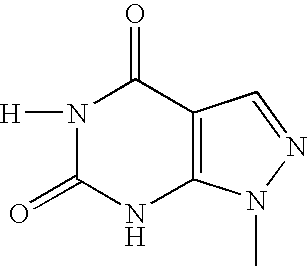
13. The composition of claim 1 wherein said C and U or T modified binding base is a C and U or T modified binding base of one of the following structures:
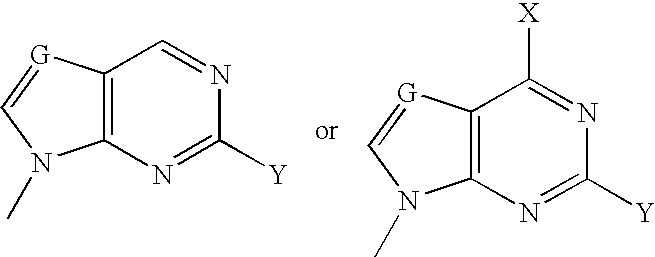
wherein
G is C or N;
X is NH2 or OH;
Y is R1Q or NHR1 Q, wherein R1 is a hydrocarbyl group having from 2 to about 20 carbon atoms and Q is H, NH2, a polyalkylamine, a hydrazine, a hydroxylamine, a semicarbazide, a thiosemicarbazide, a hydrazone, a hydrazide, an imidazole, an imidazole amide, an alkyl imidazole, an alkylimidazole, a tetrazole, a triazole, a pyrrolidine, a piperidine, a piperazine, a morpholine, a thiol, an aldehyde, a ketone, an alcohol, an alkoxy group, or a halogen.
14. The composition of claim 1 wherein said C and U or T modified binding base is a C and U or T modified binding base of the following structure:

wherein
G1 is CR2 or N;
R2 is H or a hydrocarbyl group having from 1 to 6 carbon atoms;
X1 is halogen, NH2, OH, NHR3Q1, or OR3Q1;
R3 is H or a hydrocarbyl group having from 2 to about 20 carbon atoms;
Q1, Q2, and Q3 are, independently, H, NH2, a polyalkylamine, a hydrazine, a hydroxylamine, a semicarbazide, a thiosemicarbazide, a hydrazone, a hydrazide, an imidazole, an imidazole amide, an alkyl imidazole, an alkylimidazole, a tetrazole, a triazole, a pyrrolidine, a piperidine, a piperazine, a morpholine, a thiol, an aldehyde, a ketone, an alcohol, an alkoxy group, or a halogen;
Y1 is halogen, NH2, H, R4Q2, or NHR4Q2, wherein said R4 is H or a hydrocarbyl group having from 2 to about 20 carbon atoms;
W is H, R5Q3, or NH4Q3;
R5 is H or a hydrocarbyl group having from 2 to about 20 carbon atoms; and
when X1 is NH2 and Y1 is H or when X1 is OH and Y1 is NH2, W is other than H or G is other than N.
15. The composition of claim 1 wherein said C and U or T modified binding base is a C and U or T modified binding base of one of the following structures:

wherein
R6, R7, R8, and R9 can be the same or different and are hydrogen, halogen, hydroxy, thio or substituted thio, amino or substituted amino, carboxy, lower alkyl, lower alkenyl, lower alkinyl, aryl, lower alkyloxy, aryloxy, aralkyl, aralkyloxy or a reporter group.
16. The composition of claim 1 wherein said C and U or T modified binding base is a C and U or T modified binding base of one of the following structures:
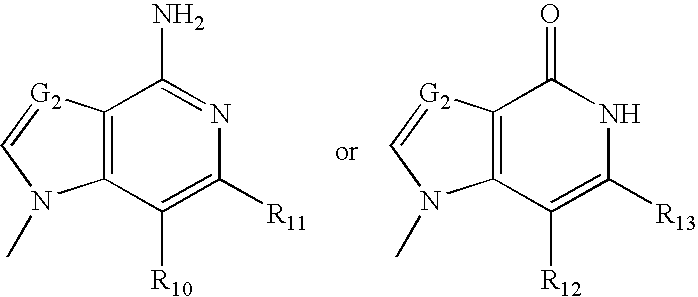
wherein
G2 is C or N;
R10 is NH2, alkyl, substituted alkyl, alkenyl, substituted alkenyl, aralkyl, amino, alkylamino, aralkylamino, substituted alkylamino, heterocycloalkyl, heterocycloalkylamino, aminoalkylamino, hetrocycloalkylamino, or polyalkylamino;
R11 is alkyl, substituted alkyl, alkenyl, substituted alkenyl, aralkyl, amino, alkylamino, aralkylamino, substituted alkylamino, heterocycloalkyl, heterocycloalkylamino, aminoalkylamino, hetrocycloalkylamino, or polyalkylamino;
R12 is H, NH2, alkyl, substituted alkyl, alkenyl, substituted alkenyl, aralkyl, amino, alkylamino, aralkylamino, substituted alkylamino, heterocycloalkyl, heterocycloalkylamino, aminoalkylamino, hetrocycloalkylamino, or polyalkylamino;
R13 is NH2, alkyl, substituted alkyl, alkenyl, substituted alkenyl, aralkyl, amino, alkylamino, aralkylamino, substituted alkylamino, heterocycloalkyl, heterocycloalkylamino, aminoalkylamino, hetrocycloalkylamino, or polyalkylamino; and
when R12 is H, R13 is not NH2.
17. The composition of claim 1 wherein said C and U or T modified binding base is a 4-amino-1H-pyrazolo[3,4-d]pyrimidine base of the following structure:

18. The composition of claim 1 wherein said C and U or T modified binding base is a C and U or T modified binding base of the following structure:
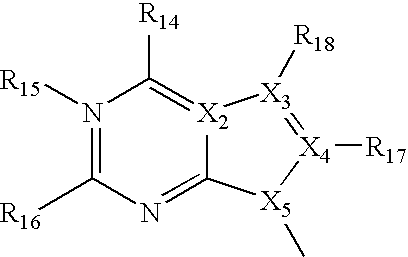
wherein
X2, X3, X4, and X5 are N, O, C, S, or Si and at least one of X2, X3, X4, and X5 is N;
R14 is a reactive group derivatizable with a detectable label wherein said reactive group is selected from the group consisting of NH2, SH, ═O, a linking moiety selected from the group consisting of an amide, a thioether, a disulfide, a combination of an amide a thioether or a disulfide, R19—(CH2)n—R20 and R19-R20—(CH2)n—R21 wherein n is an integer from 1 to 25 inclusive, and R19, R20, and R21 are H, OH, alkyl, acyl, amide, thioether, or disulfide, and wherein said detectable label is selected from the group consisting of radioisotopes, fluorescent or chemiluminescent reporter molecules, antibodies, haptens, biotin, photobiotin, digoxigenin, fluorescent aliphatic amino groups, avidin, enzymes, and acridinium;
R15 is H, absent, or part of an etheno linkage with R14;
R16 is H, NH2, SH, or ═O;
R17 and R18 are hydrogen, methyl, bromine, fluorine, iodine, alkyl or aromatic substituents, or a linking moiety selected from the group consisting of an amide, a thioether, a disulfide linkage, and a combination thereof;
when R14 is NH2, R16 is H, R15 is absent, X2 is C, X3 is N, X4 is C, X5 is N, R17 is H, and R18 is H, then R17 is other than H; and
when R14 is ═O, R16 is NH2, R15 is absent, X2 is C, X3 is N, X4 is C, X5 is N, R17 is H, and R18 is H, then R17 is other than H.
19. The composition of claim 1 wherein said C and U or T modified binding base is a 6-amino-1H-pyrazolo[3,4-d]pyrimidin-4(5H)-one base of the following structure:

20. The composition of claim 1 wherein said C and U or T modified binding base is a C and U or T modified binding base of one of the following structures:
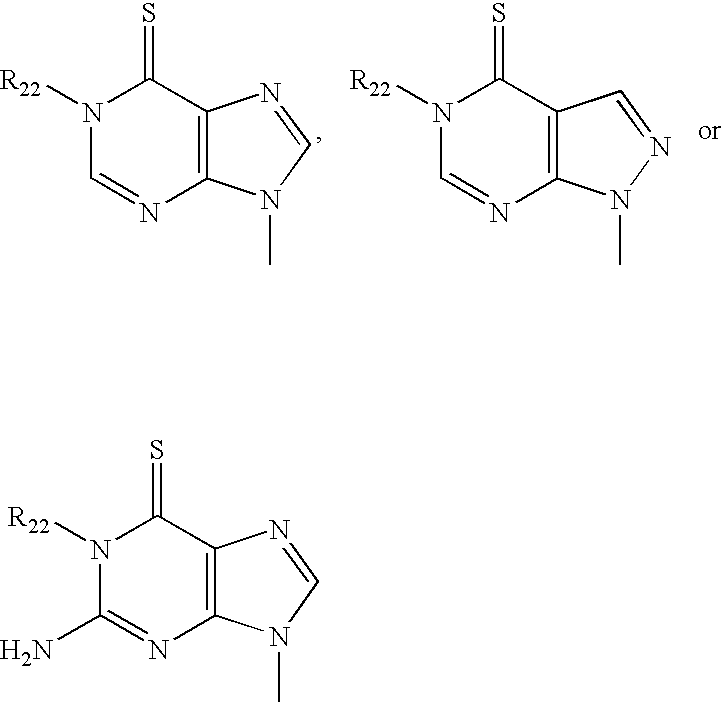
wherein R22 is C1-C6 alkyl, C2-C6 alkenyl or C2-C6 alkynyl.
21. The composition of claim 1 wherein said C and U or T modified binding base is a C and U or T modified binding base of the following structure:
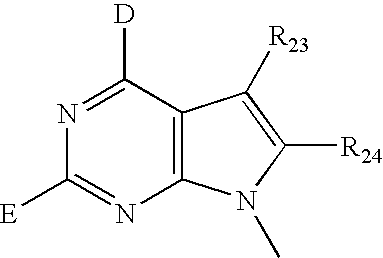
wherein
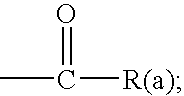
R23 and R24 are, independently of each other, 1) hydrogen; 2) halogen; 3) (C1-C10)-alkyl; 4) (C2-C10)-alkenyl; 5) (C2-C10)-alkynyl; 6) NO2; 7) NH2; 8) cyano; 9)—S—(C1-C6)-alkyl; 10) (C1-C6)-alkoxy; 11) (C6-C20)-aryloxy; 12) SiH3; 13)
14) a radical as described under 3), 4) or 5) which is substituted by one or more radicals from the group SH, S—(C1-C6)-alkyl, (C1-C6)-alkoxy, OH, —NR(c)R (d), —CO—R(b), —NH—CO—NR(c)R(d), —NR(c)R(g), —NR(e)R(f) or —NR(e)R(g), or by a polyalkyleneglycol radical of the formula —[O—(CH2)r]s—NR(c)R(d), where r and s are, independently of each other, an integer between 1 and 18, preferably between 1 and 6; or 15) a radical as defined under 3), 4) or 5) in which from one to all the H atoms are substituted by halogen, preferably fluorine;
R(a) is OH, (C1-C6)-alkoxy, (C6-C20)-aryloxy, NH2 or NH-T, where T is an alkylcarboxyl group or alkylamino group which is linked to one or more groups, where appropriate via a further linker, which favor intracellular uptake or serve for labeling a DNA or RNA probe or, when the oligonucleotide analog hybridizes to the target nucleic acid, attack the latter while binding, cross-linking or cleaving;
R(b) is hydroxyl, (C1-C6)-alkoxy or —NR(c)R(d);
R(c) and R(d) are, independently of each other, H or (C1-C6)-alkyl which is unsubstituted or substituted by —NR(e)R(f) or —NR(e)R(g);
R(e) and R(f) are, independently of each other, H or (C1-C6)-alkyl;
R(g) is (C1-C6)-alkyl-COOH;
R23 and R24 cannot each simultaneously be hydrogen, NO2, NH2, cyano or SiH3; and
D and E are, independently of each other, H, OH or NH2.
22. The composition of claim 1 wherein said C and U or T modified binding base is an O6-benzylguanine base of the following structure:
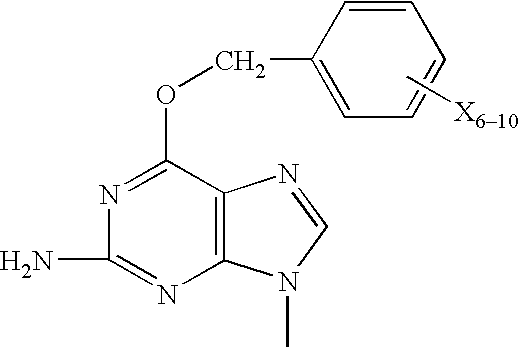
wherein
each of X6-X10 is selected from the group consisting of hydrogen, halogen, hydroxy, aryl, a C1-C8 alkyl substituted aryl, nitro, a polycyclic aromatic alkyl containing 2-4 aromatic rings wherein the alkyl is a C1-C6, a C3-C8 cycloalkyl, a C2-C6 alkenyl, a C2-C6 alkynyl, a C1-C6 hydroxyalkyl, a C1-C8 alkoxy, a C2-C8 alkoxyalkyl, aryloxy, aryloxy, an acyloxyalkyl wherein the alkyl is C1-C6, amino, a monoalkylamino wherein the alkyl is C1-C6, a dialkylamino wherein the alkyl is C1-C6, acylamino, ureido, thioureido, carboxy, a carboxyalkyl wherein the alkyl is C1-C6, cyano, a cyanoalkyl wherein the alkyl is C1-C6, C-formyl, C-acyl, a dialkoxymethyl wherein the alkoxy is C1-C6, an aminoalkyl wherein the alkyl is C1-C6, and SOn1R25 wherein n1=0, 1, 2 or 3, R25 is H, a C1-C6 alkyl or aryl.
23. The composition of claim 1 wherein said C and U or T modified binding base is a C and U or T modified binding base of the following structure:

wherein
X11-X14 are each independently selected from the group consisting of C2-C8 alkoxyalkyl, aryloxy, acyloxy, acyloxyalkyl wherein the alkyl is C1-C3, hydrazino, hydroxyamino, acylamino, nitro at o, m-positions, bromine, m-methyl, C1-C3 hydroxy alkyl, C2-C6 alkyl, C-formyl, and aryl.
24. The composition of claim 1 wherein said C and U or T modified binding base is a C and U or T modified binding base of one of the following structures:
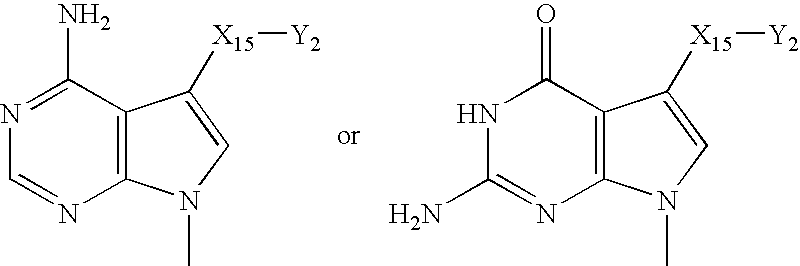
wherein
X15 is a linking group which is C1-C10 alkyl, C1-C10 unsaturated alkyl, dialkyl ether or dialkylthioether;
each Y2 may be the same or different and is a cationic moiety which is —(NH3)+, —(NH2R26)+, —(NHR26R27)+, —(NR26R27R28)+, dialkylsulfonium or trialkylphosphonium; and
R26, R27, and R28 are each independently lower alkyl having from one to ten carbon atoms.
25. The composition of claim 1 wherein said C and U or T modified binding base is a C and U or T modified binding base of the following structure:
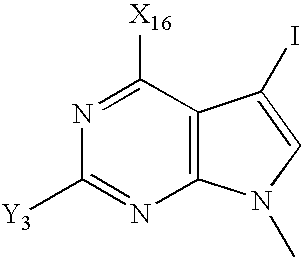
wherein
X16 is Cl, OH, SH, SR30, OR29, CN or N(H)J;
Y3 is OH, SH, SR30, OR30, CN or N(H)J;
each J is, independently, hydrogen or an amino protecting group; and
each R29 and R30 is, independently, C1-C10 alkyl.
26. The composition of claim 1 wherein said C and U or T modified binding base is a pyrazolo[3,4-d]pyrimidine derivative of the following structure:

wherein R31 is hydrogen or the group —W1-(X17)n2-A;
each of W1 and X17 is independently a chemical linker arm;
A is an intercalator, a metal ion chelator, an electrophilic crosslinker, a photoactivatable crosslinker, or a reporter group;
each of R32 and R33 is independently H, OR34, SR34, NHOR34, NH2, or NH(CH2)tNH2;
R34 is H or C1-6alkyl;
n2 is zero or one; and
t is zero to twelve.
27. The composition of claim 1 wherein said C and U or T modified binding base is a C and U or T modified binding base of the following structure:

wherein
X18 is a nitrogen atom or a methine radical;
W2 is a nitrogen atom or a C—R38 radical; and
R35, R36, R37 and R38, which can be the same or different, are hydrogen or halogen atoms, hydroxyl or mercapto groups, lower alkyl, lower alkylthio, lower alkoxy, aralkyl, aralkoxy or aryloxy radicals or amino groups optionally substituted once or twice.
28. The composition of claim 1 wherein said C and U or T modified binding base is a C and U or T modified binding base of the following structure:

wherein
X19 is selected from the group consisting of a nitrogen atom and a carbon atom bearing a substituent Z;
Z is selected from the group consisting of hydrogen and —CH3;
Y4 is selected from the group consisting of N and CH; and
the ring structure of the purine analog comprises no more than three nitrogen atoms consecutively bonded.
29. The composition of claim 1 wherein said C and U or T modified binding base is an 8-azapurine base of the following structure:
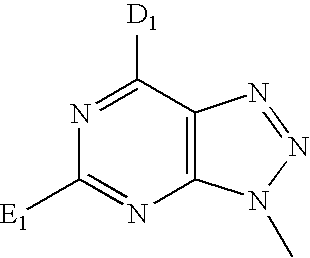
wherein D1 and E1 are, independently, H, OH, or NH2.
30. The composition of claim 1 wherein said C and U or T modified binding base is a C and U or T modified binding base of the following structure:
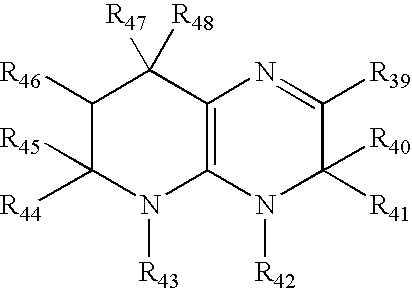
wherein
R47 is combined with R48 to form a single oxo oxygen joined by a double bond to ring vertex 4, or with R46 to form a double bond between ring vertices 3 and 4;
R48, when not combined with R47, is either NH2 or NH2 either mono- or disubstituted with a protecting group;
R46 when not combined with R47 is a lower alkyl or H;
R39 is either H, lower alkyl or phenyl;
R44 is combined with R45 to form a single oxo oxygen joined by a double bond to ring vertex 2, or with R43 to form a double bond between ring vertices 1 and 2, such that ring vertices 2 and 4 collectively bear at most one oxo oxygen;
R45 when not combined with R44 is a member selected from the group consisting of H, phenyl, NH2, and NH2 mono- or disubstituted with a protecting group;
when R44 is not combined with R45, R41 is combined with R40 to form a single oxo oxygen joined by a double bond to ring vertex 7;
when R44 is combined with R45, R41 is combined with R42 to form a double bond between ring vertices 7 and 8, and R19 is either H or a lower alkyl; and
R43 when not combined with R44, and R42 when not combined with R41, are a bond.
31. The composition of claim 1 wherein said C and U or T modified binding base is a C and U or T modified binding base of one of the following structures:
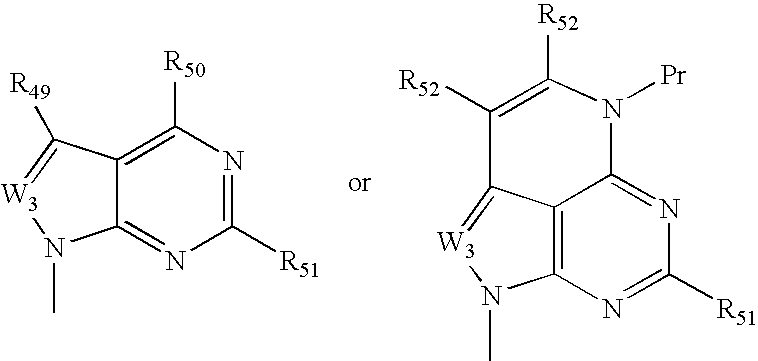
wherein
Pr is H (hydrogen) or a protecting group;
W3 is CH or N;
R49 is H, methyl, or a group containing a C atom connected to the 7-position of the base, wherein the C atom is bonded directly to another atom via a pi bond;
R50 is OH, SH or NH2;
R51 is H, OH, SH or NH2;
each R52 is independently H, OH, CN, halogen (F, Cl, Br, I), alkyl (C1-12), alkenyl (C2-12), alkynyl (C2-12), aryl (C6-9), heteroaryl (C4-9), or both R52, taken together with the carbon atoms to which they are linked at positions 11 and 12, form (a) a 5 or 6 membered carbocyclic ring or, (b) a 5 or 6 membered heterocyclic ring comprising 1-3 N, O or S ring atoms, wherein no 2 adjacent ring atoms are O—O, S—S, O—S or S-0, and wherein any unsaturated C atom of the carbocyclic or heterocyclic ring is substituted by R53 and any saturated carbons contain 2 R53 substituents, wherein R53 is H, alkyl (C1-4), alkenyl (C2-4), alkynyl (C2-4), OR54, SR54, or N(R54)2 or halogen, and there are no more than four halogens per 5 or 6 member ring; and
R54 is independently H, or alkyl (C1-4).
32. A pharmaceutical composition comprising the composition of claim 1 and a pharmaceutically acceptable carrier.
33. A method of modulating the expression of a target nucleic acid in a cell comprising contacting said cell with a composition of claim 1 .
34. A method of treating or preventing a disease or disorder associated with a target nucleic acid comprising administering to an animal having or predisposed to said disease or disorder a therapeutically effective amount of a composition of claim 1 .
35. A composition comprising an oligomer complementary to and capable of hybridizing to a selected target nucleic acid and at least one protein, said protein comprising at least a portion of a RNA-induced silencing complex (RISC), wherein:
said oligomer includes at least one C and U or T modified binding base.
36. The composition of claim 35 wherein said oligomer is an antisense oligomer.
37. The composition of claim 35 wherein said oligomer has 12 to 50 nucleotides.
38. The composition of claim 35 wherein said oligomer has 15 to 30 nucleotides.
39. The composition of claim 35 wherein said oligomer has 21 to 24 nucleotides.
40. The composition of claim 35 including a further oligomer, wherein said further oligomer is complementary to and hydrizable to said oligomer.
41. The composition of claim 40 wherein said further oligomer is a sense oligomer.
42. The composition of claim 40 wherein said further oligomer is an oligomer having a plurality of ribose nucleotide units.
43. The composition of claim 35 wherein said C and U or T modified binding base is a boronated C and U or T modified binding base having a boron-containing substituent selected from the group consisting of —BH2CN, —BH3, and —BH2COOR, wherein R is C1 to C18 alkyl.
44. The composition of claim 35 wherein said C and U or T modified binding base is a 1H-pyrazolo[3,4-d]pyrimidin-4(5H)-6(7H)-dione base of the following structure:
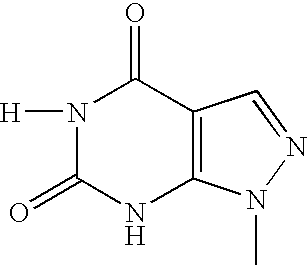
45. The composition of claim 35 wherein said C and U or T modified binding base is a C and U or T modified binding base of one of the following structures:
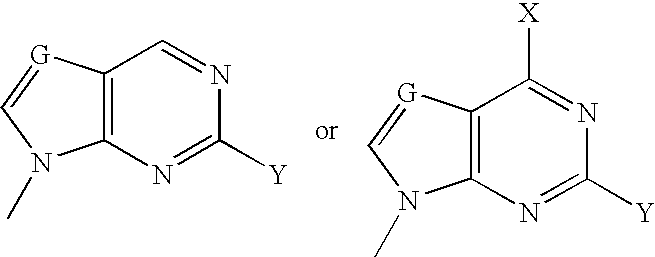
wherein
G is C or N;
X is NH2 or OH;
Y is R1Q or NHR1Q, wherein R1 is a hydrocarbyl group having from 2 to about 20 carbon atoms and Q is H, NH2, a polyalkylamine, a hydrazine, a hydroxylamine, a semicarbazide, a thiosemicarbazide, a hydrazone, a hydrazide, an imidazole, an imidazole amide, an alkyl imidazole, an alkylimidazole, a tetrazole, a triazole, a pyrrolidine, a piperidine, a piperazine, a morpholine, a thiol, an aldehyde, a ketone, an alcohol, an alkoxy group, or a halogen.
46. The composition of claim 35 wherein said C and U or T modified binding base is a C and U or T modified binding base of the following structure:
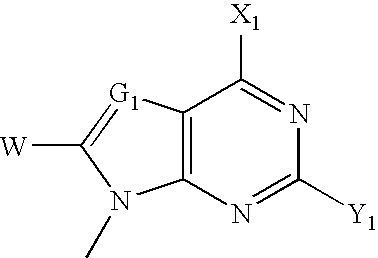
wherein
G1 is CR2 or N;
R2 is H or a hydrocarbyl group having from 1 to 6 carbon atoms;
X1 is halogen, NH2, OH, NHR3Q1, or OR3Q1;
R3 is H or a hydrocarbyl group having from 2 to about 20 carbon atoms;
Q1, Q2, and Q3 are, independently, H, NH2, a polyalkylamine, a hydrazine, a hydroxylamine, a semicarbazide, a thiosemicarbazide, a hydrazone, a hydrazide, an imidazole, an imidazole amide, an alkyl imidazole, an alkylimidazole, a tetrazole, a triazole, a pyrrolidine, a piperidine, a piperazine, a morpholine, a thiol, an aldehyde, a ketone, an alcohol, an alkoxy group, or a halogen;
Y1 is halogen, NH2, H, R4Q2, or NHR4Q2, wherein said R4 is H or a hydrocarbyl group having from 2 to about 20 carbon atoms;
W is H, R5Q3, or NH4Q3;
R5 is H or a hydrocarbyl group having from 2 to about 20 carbon atoms; and
when X1 is NH2 and Y1 is H or when X1 is OH and Y1 is NH2, W is other than H or G is other than N.
47. The composition of claim 35 wherein said C and U or T modified binding base is a C and U or T modified binding base of one of the following structures:
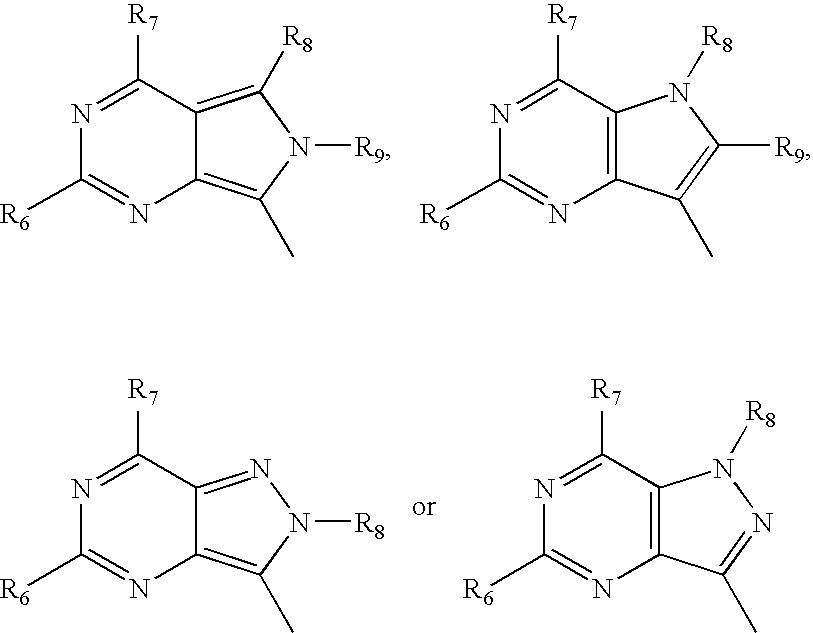
wherein
R6, R7, R8, and R9 can be the same or different and are hydrogen, halogen, hydroxy, thio or substituted thio, amino or substituted amino, carboxy, lower alkyl, lower alkenyl, lower alkinyl, aryl, lower alkyloxy, aryloxy, aralkyl, aralkyloxy or a reporter group.
48. The composition of claim 35 wherein said C and U or T modified binding base is a C and U or T modified binding base of one of the following structures:
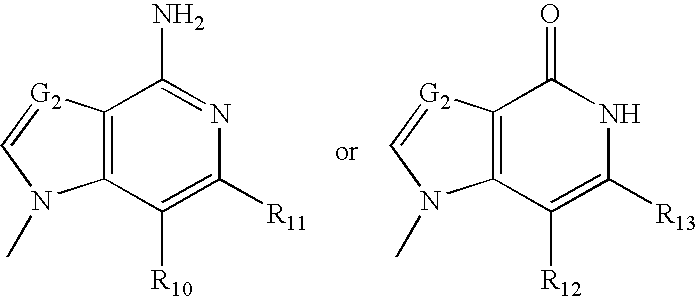
wherein
G2 is C or N;
R10 is NH2, alkyl, substituted alkyl, alkenyl, substituted alkenyl, aralkyl, amino, alkylamino, aralkylamino, substituted alkylamino, heterocycloalkyl, heterocycloalkylamino, aminoalkylamino, hetrocycloalkylamino, or polyalkylamino;
R11 is alkyl, substituted alkyl, alkenyl, substituted alkenyl, aralkyl, amino, alkylamino, aralkylamino, substituted alkylamino, heterocycloalkyl, heterocycloalkylamino, aminoalkylamino, hetrocycloalkylamino, or polyalkylamino;
R12 is H, NH2, alkyl, substituted alkyl, alkenyl, substituted alkenyl, aralkyl, amino, alkylamino, aralkylamino, substituted alkylamino, heterocycloalkyl, heterocycloalkylamino, aminoalkylamino, hetrocycloalkylamino, or polyalkylamino;
R13 is NH2, alkyl, substituted alkyl, alkenyl, substituted alkenyl, aralkyl, amino, alkylamino, aralkylamino, substituted alkylamino, heterocycloalkyl, heterocycloalkylamino, aminoalkylamino, hetrocycloalkylamino, or polyalkylamino; and
when R12 is H, R13 is not NH2.
49. The composition of claim 35 wherein said C and U or T modified binding base is a 4-amino-1H-pyrazolo[3,4-d]pyrimidine base of the following structure:
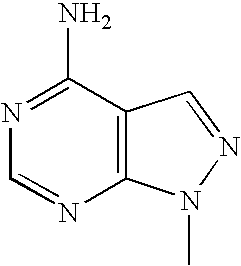
50. The composition of claim 35 wherein said C and U or T modified binding base is a C and U or T modified binding base of the following structure:
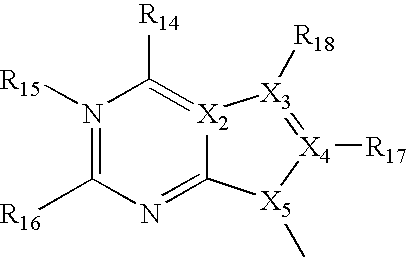
wherein
X2, X3, X4, and X5 are N, O, C, S, or Si and at least one of X2, X3, X4, and X5 is N;
R14 is a reactive group derivatizable with a detectable label wherein said reactive group is selected from the group consisting of NH2, SH, ═O, a linking moiety selected from the group consisting of an amide, a thioether, a disulfide, a combination of an amide a thioether or a disulfide, R19—(CH2)n—R20 and R19—R20—(CH2)n—R21 wherein n is an integer from 1 to 25 inclusive, and R19, R20, and R21 are H, OH, alkyl, acyl, amide, thioether, or disulfide, and wherein said detectable label is selected from the group consisting of radioisotopes, fluorescent or chemiluminescent reporter molecules, antibodies, haptens, biotin, photobiotin, digoxigenin, fluorescent aliphatic amino groups, avidin, enzymes, and acridinium;
R15 is H, absent, or part of an etheno linkage with R14;
R16 is H, NH2, SH, or ═O;
R17 and R18 are hydrogen, methyl, bromine, fluorine, iodine, alkyl or aromatic substituents, or a linking moiety selected from the group consisting of an amide, a thioether, a disulfide linkage, and a combination thereof;
when R14 is NH2, R16 is H, R15 is absent, X2 is C, X3 is N, X4 is C, X5 is N, R17 is H, and R18 is H, then R17 is other than H; and
when R14 is ═O, R16 is NH2, R15 is absent, X2 is C, X3 is N, X4 is C, X5 is N, R17 is H, and R18 is H, then R17 is other than H.
51. The composition of claim 35 wherein said C and U or T modified binding base is a 6-amino-1H-pyrazolo[3,4-d]pyrimidin-4(5H)-one base of the following structure:

52. The composition of claim 35 wherein said C and U or T modified binding base is a C and U or T modified binding base of one of the following structures:
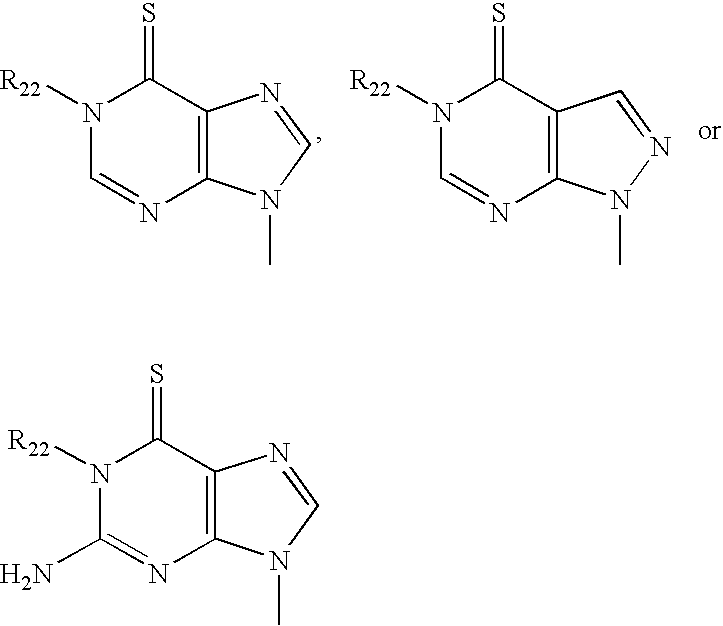
wherein R22 is C1-C6 alkyl, C2-C6 alkenyl or C2-C6 alkynyl.
53. The composition of claim 35 wherein said C and U or T modified binding base is a C and U or T modified binding base of the following structure:

wherein
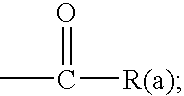
R23 and R24 are, independently of each other, 1) hydrogen; 2) halogen; 3) (C1-C10)-alkyl; 4) (C2-C10)-alkenyl; 5) (C2-C10)-alkynyl; 6) NO2; 7) NH2; 8) cyano; 9)—S—(C1-C6)-alkyl; 10) (C1-C6)-alkoxy; 11) (C6-C20)-aryloxy; 12) SiH3; 13)
14) a radical as described under 3), 4) or 5) which is substituted by one or more radicals from the group SH, S—(C1-C6)-alkyl, (C1-C6)-alkoxy, OH, —NR(c)R(d), —CO—R(b), —NH—CO—NR(c)R(d), —NR(c)R(g), —NR(e)R(f) or —NR(e)R(g), or by a polyalkyleneglycol radical of the formula —[O—(CH2)r]α-NR(c)R(d), where r and s are, independently of each other, an integer between 1 and 18, preferably between 1 and 6; or 15) a radical as defined under 3), 4) or 5) in which from one to all the H atoms are substituted by halogen, preferably fluorine;
R(a) is OH, (C1-C6)-alkoxy, (C6-C20)-aryloxy, NH2 or NH-T, where T is an alkylcarboxyl group or alkylamino group which is linked to one or more groups, where appropriate via a further linker, which favor intracellular uptake or serve for labeling a DNA or RNA probe or, when the oligonucleotide analog hybridizes to the target nucleic acid, attack the latter while binding, cross-linking or cleaving;
R(b) is hydroxyl, (C1-C6)-alkoxy or —NR(c)R(d);
R(c) and R(d) are, independently of each other, H or (C1-C6)-alkyl which is unsubstituted or substituted by —NR(e)R(f) or —NR(e)R(g);
R(e) and R(f) are, independently of each other, H or (C1-C6)-alkyl;
R(g) is (C1-C6)-alkyl-COOH;
R23 and R24 cannot each simultaneously be hydrogen, NO2, NH2, cyano or SiH3; and
D and E are, independently of each other, H, OH or NH2.
54. The composition of claim 35 wherein said C and U or T modified binding base is an O6-benzylguanine base of the following structure:

wherein
each of X6-X10 is selected from the group consisting of hydrogen, halogen, hydroxy, aryl, a C1-C8 alkyl substituted aryl, nitro, a polycyclic aromatic alkyl containing 2-4 aromatic rings wherein the alkyl is a C1-C6, a C3-C8 cycloalkyl, a C2-C6 alkenyl, a C2-C6 alkynyl, a C1-C6 hydroxyalkyl, a C1-C8 alkoxy, a C2-C8 alkoxyalkyl, aryloxy, aryloxy, an acyloxyalkyl wherein the alkyl is C1-C6, amino, a monoalkylamino wherein the alkyl is C1-C6, a dialkylamino wherein the alkyl is C1-C6, acylamino, ureido, thioureido, carboxy, a carboxyalkyl wherein the alkyl is C1-C6, cyano, a cyanoalkyl wherein the alkyl is C1-C6, C-formyl, C-acyl, a dialkoxymethyl wherein the alkoxy is C1-C6, an aminoalkyl wherein the alkyl is C1-C6, and SOn1R25 wherein n1=0, 1, 2 or 3, R25 is H, a C1-C6 alkyl or aryl.
55. The composition of claim 35 wherein said C and U or T modified binding base is a C and U or T modified binding base of the following structure:

wherein
X11-X14 are each independently selected from the group consisting of C2-C8 alkoxyalkyl, aryloxy, acyloxy, acyloxyalkyl wherein the alkyl is C1-C3, hydrazino, hydroxyamino, acylamino, nitro at o, m-positions, bromine, m-methyl, C1-C3 hydroxy alkyl, C2-C6 alkyl, C-formyl, and aryl.
56. The composition of claim 35 wherein said C and U or T modified binding base is a C and U or T modified binding base of one of the following structures:
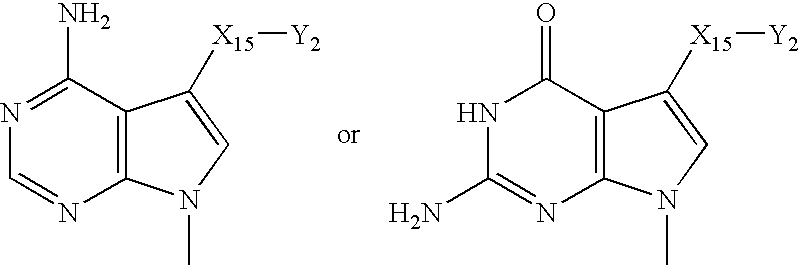
wherein
X15 is a linking group which is C1-C10 alkyl, C1-C10 unsaturated alkyl, dialkyl ether or dialkylthioether;
each Y2 may be the same or different and is a cationic moiety which is —(NH3)+, —(NH2R26)+, —(NHR26R27)+, —(NR26R27R28)+, dialkylsulfonium or trialkylphosphonium; and
R26, R27, and R28 are each independently lower alkyl having from one to ten carbon atoms.
57. The composition of claim 35 wherein said C and U or T modified binding base is a C and U or T modified binding base of the following structure:

wherein
X16 is Cl, OH, SH, SR30, OR29, CN or N(H)J;
Y3 is OH, SH, SR30, OR30, CN or N(H)J;
each J is, independently, hydrogen or an amino protecting group; and
each R29 and R30 is, independently, C1-C10 alkyl.
58. The composition of claim 35 wherein said C and U or T modified binding base is a pyrazolo[3,4-d]pyrimidine derivative of the following structure:
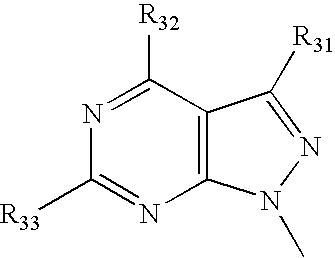
wherein
R31 is hydrogen or the group —W1—(X17)n2-A;
each of W1 and X17 is independently a chemical linker arm;
A is an intercalator, a metal ion chelator, an electrophilic crosslinker, a photoactivatable crosslinker, or a reporter group;
each of R32 and R33 is independently H, OR34, SR34, NHOR34, NH2, or NH(CH2)tNH2;
R34 is H or C1-6alkyl;
n2 is zero or one; and
t is zero to twelve.
59. The composition of claim 35 wherein said C and U or T modified binding base is a C and U or T modified binding base of the following structure:
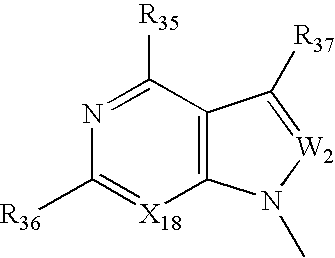
wherein
X18 is a nitrogen atom or a methine radical;
W2 is a nitrogen atom or a C—R38 radical; and
R35, R36, R37 and R38, which can be the same or different, are hydrogen or halogen atoms, hydroxyl or mercapto groups, lower alkyl, lower alkylthio, lower alkoxy, aralkyl, aralkoxy or aryloxy radicals or amino groups optionally substituted once or twice.
60. The composition of claim 35 wherein said C and U or T modified binding base is a C and U or T modified binding base of the following structure:

wherein
X19 is selected from the group consisting of a nitrogen atom and a carbon atom bearing a substituent Z;
Z is selected from the group consisting of hydrogen and —CH3;
Y4 is selected from the group consisting of N and CH; and
the ring structure of the purine analog comprises no more than three nitrogen atoms consecutively bonded.
61. The composition of claim 35 wherein said C and U or T modified binding base is an 8-azapurine base of the following structure:
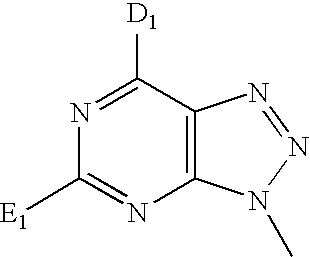
wherein D1 and E1 are, independently, H, OH, or NH2.
62. The composition of claim 35 wherein said C and U or T modified binding base is a C and U or T modified binding base of the following structure:

wherein
R47 is combined with R48 to form a single oxo oxygen joined by a double bond to ring vertex 4, or with R46 to form a double bond between ring vertices 3 and 4;
R48, when not combined with R47, is either NH2 or NH2 either mono- or disubstituted with a protecting group;
R46 when not combined with R47 is a lower alkyl or H;
R39 is either H, lower alkyl or phenyl;
R44 is combined with R45 to form a single oxo oxygen joined by a double bond to ring vertex 2, or with R43 to form a double bond between ring vertices 1 and 2, such that ring vertices 2 and 4 collectively bear at most one oxo oxygen;
R45 when not combined with R44 is a member selected from the group consisting of H, phenyl, NH2, and NH2 mono- or disubstituted with a protecting group;
when R44 is not combined with R45, R41 is combined with R40 to form a single oxo oxygen joined by a double bond to ring vertex 7;
when R44 is combined with R45, R41 is combined with R42 to form a double bond between ring vertices 7 and 8, and R19 is either H or a lower alkyl; and
R43 when not combined with R44, and R42 when not combined with R41, are a bond.
63. The composition of claim 35 wherein said C and U or T modified binding base is a C and U or T modified binding base of one of the following structures:
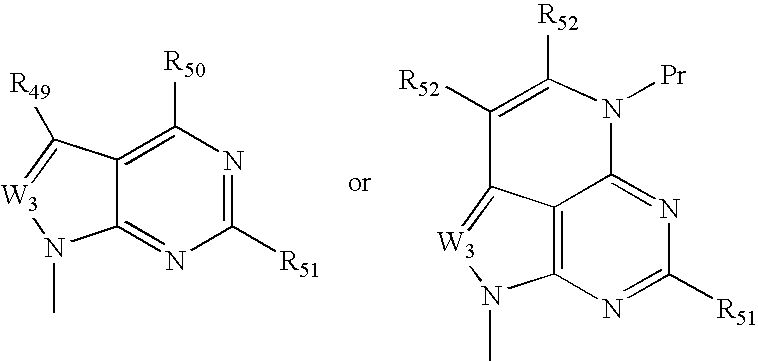
wherein
Pr is H (hydrogen) or a protecting group;
W3 is CH or N;
R49 is H, methyl, or a group containing a C atom connected to the 7-position of the base, wherein the C atom is bonded directly to another atom via a pi bond;
R50 is OH, SH or NH2;
R51 is H, OH, SH or NH2;
each R52 is independently H, OH, CN, halogen (F, Cl, Br, I), alkyl (C1-12), alkenyl (C2-12), alkynyl (C2-12), aryl (C6-9), heteroaryl (C4-9), or both R52, taken together with the carbon atoms to which they are linked at positions 11 and 12, form (a) a 5 or 6 membered carbocyclic ring or, (b) a 5 or 6 membered heterocyclic ring comprising 1-3 N, O or S ring atoms, wherein no 2 adjacent ring atoms are O—O, S—S, O—S or S—O, and wherein any unsaturated C atom of the carbocyclic or heterocyclic ring is substituted by R53 and any saturated carbons contain 2 R53 substituents, wherein R53 is H, alkyl (C1-4), alkenyl (C2-4), alkynyl (C2-4), OR54, SR54, or N(R54)2 or halogen, and there are no more than four halogens per 5 or 6 member ring; and
R54 is independently H, or alkyl (C1-4).
64. A pharmaceutical composition comprising the composition of claim 35 and a pharmaceutically acceptable carrier.
65. A method of modulating the expression of a target nucleic acid in a cell comprising contacting said cell with a composition of claim 35 .
66. A method of treating or preventing a disease or disorder associated with a target nucleic acid comprising administering to an animal having or predisposed to said disease or disorder a therapeutically effective amount of a composition of claim 35.
Priority Applications (1)
| Application Number | Priority Date | Filing Date | Title |
|---|---|---|---|
| US10/700,920 US20040171030A1 (en) | 1996-06-06 | 2003-11-04 | Oligomeric compounds having modified bases for binding to cytosine and uracil or thymine and their use in gene modulation |
Applications Claiming Priority (6)
| Application Number | Priority Date | Filing Date | Title |
|---|---|---|---|
| US08/659,440 US5898031A (en) | 1996-06-06 | 1996-06-06 | Oligoribonucleotides for cleaving RNA |
| US08/870,608 US6107094A (en) | 1996-06-06 | 1997-06-06 | Oligoribonucleotides and ribonucleases for cleaving RNA |
| US47978300A | 2000-01-07 | 2000-01-07 | |
| US10/078,949 US7695902B2 (en) | 1996-06-06 | 2002-02-20 | Oligoribonucleotides and ribonucleases for cleaving RNA |
| US42376002P | 2002-11-05 | 2002-11-05 | |
| US10/700,920 US20040171030A1 (en) | 1996-06-06 | 2003-11-04 | Oligomeric compounds having modified bases for binding to cytosine and uracil or thymine and their use in gene modulation |
Related Parent Applications (1)
| Application Number | Title | Priority Date | Filing Date |
|---|---|---|---|
| US10/078,949 Continuation-In-Part US7695902B2 (en) | 1996-06-06 | 2002-02-20 | Oligoribonucleotides and ribonucleases for cleaving RNA |
Publications (1)
| Publication Number | Publication Date |
|---|---|
| US20040171030A1 true US20040171030A1 (en) | 2004-09-02 |
Family
ID=32913307
Family Applications (1)
| Application Number | Title | Priority Date | Filing Date |
|---|---|---|---|
| US10/700,920 Abandoned US20040171030A1 (en) | 1996-06-06 | 2003-11-04 | Oligomeric compounds having modified bases for binding to cytosine and uracil or thymine and their use in gene modulation |
Country Status (1)
| Country | Link |
|---|---|
| US (1) | US20040171030A1 (en) |
Cited By (14)
| Publication number | Priority date | Publication date | Assignee | Title |
|---|---|---|---|---|
| US20040214198A1 (en) * | 2002-11-15 | 2004-10-28 | University Of Massachusetts | Allele-targeted RNA interference |
| US20050227256A1 (en) * | 2003-11-26 | 2005-10-13 | Gyorgy Hutvagner | Sequence-specific inhibition of small RNA function |
| US20060115455A1 (en) * | 2004-10-22 | 2006-06-01 | Reed Kenneth C | Therapeutic RNAi agents for treating psoriasis |
| US20070036740A1 (en) * | 2004-10-06 | 2007-02-15 | Reed Kenneth C | Modulation of hair growth |
| US20070298427A1 (en) * | 2006-06-22 | 2007-12-27 | Whitmore Theodore E | Methods of gene expression analysis |
| US20090023671A1 (en) * | 2005-01-06 | 2009-01-22 | Brashears Sarah J | Rnai Agents for Maintenance of Stem Cells |
| US20090118206A1 (en) * | 2003-09-12 | 2009-05-07 | University Of Massachusetts | Rna interference for the treatment of gain-of-function disorders |
| WO2009060122A3 (en) * | 2007-11-05 | 2009-06-25 | Baltic Technology Dev Ltd | Use of oligonucleotides with modified bases as antiviral agents |
| WO2009060124A3 (en) * | 2007-11-05 | 2009-08-13 | Baltic Technology Dev Ltd | Use of oligonucleotides with modified bases in hybridization of nucleic acids |
| WO2009144365A1 (en) * | 2008-05-30 | 2009-12-03 | Baltic Technology Development, Ltd. | Use of oligonucleotides with modified bases as antiviral agents |
| US20100151470A1 (en) * | 2007-05-01 | 2010-06-17 | University Of Massachusetts | Methods and compositions for locating snp heterozygosity for allele specific diagnosis and therapy |
| US7786292B2 (en) | 2006-05-03 | 2010-08-31 | Baltic Technology Development, Ltd. | Antisense agents combining strongly bound base-modified oligonucleotide and artificial nuclease |
| US20100267810A1 (en) * | 2005-08-18 | 2010-10-21 | University Of Massachusetts | Methods and compositions for treating neurological disease |
| US20110172291A1 (en) * | 2003-09-12 | 2011-07-14 | University Of Massachusetts | Rna interference for the treatment of gain-of-function disorders |
Citations (30)
| Publication number | Priority date | Publication date | Assignee | Title |
|---|---|---|---|---|
| US5034506A (en) * | 1985-03-15 | 1991-07-23 | Anti-Gene Development Group | Uncharged morpholino-based polymers having achiral intersubunit linkages |
| US5567811A (en) * | 1990-05-03 | 1996-10-22 | Amersham International Plc | Phosphoramidite derivatives, their preparation and the use thereof in the incorporation of reporter groups on synthetic oligonucleotides |
| US5576427A (en) * | 1993-03-30 | 1996-11-19 | Sterling Winthrop, Inc. | Acyclic nucleoside analogs and oligonucleotide sequences containing them |
| US5602240A (en) * | 1990-07-27 | 1997-02-11 | Ciba Geigy Ag. | Backbone modified oligonucleotide analogs |
| US5607922A (en) * | 1992-06-18 | 1997-03-04 | Stichting Rega Vzw | 1,5-anhydrohexitol nucleoside analogues |
| US5639873A (en) * | 1992-02-05 | 1997-06-17 | Centre National De La Recherche Scientifique (Cnrs) | Oligothionucleotides |
| US5681940A (en) * | 1994-11-02 | 1997-10-28 | Icn Pharmaceuticals | Sugar modified nucleosides and oligonucleotides |
| US5760209A (en) * | 1997-03-03 | 1998-06-02 | Isis Pharmaceuticals, Inc. | Protecting group for synthesizing oligonucleotide analogs |
| US5780607A (en) * | 1995-10-13 | 1998-07-14 | Hoffmann-La Roche Inc. | Antisense oligomers |
| US5808036A (en) * | 1993-09-01 | 1998-09-15 | Research Corporation Technologies Inc. | Stem-loop oligonucleotides containing parallel and antiparallel binding domains |
| US5854410A (en) * | 1994-03-31 | 1998-12-29 | Genta Incorporated | Oligonucleoside cleavage compounds and therapies |
| US5955443A (en) * | 1998-03-19 | 1999-09-21 | Isis Pharmaceuticals Inc. | Antisense modulation of PECAM-1 |
| US6037463A (en) * | 1996-05-24 | 2000-03-14 | Hoechst Aktiengesellschaft | Enzymatic RNA molecules that cleave mutant N-RAS |
| US6046306A (en) * | 1994-03-14 | 2000-04-04 | Hoechst Aktiengesellschaft | PNA synthesis using an amino protecting group which is labile to weak acids |
| US6150510A (en) * | 1995-11-06 | 2000-11-21 | Aventis Pharma Deutschland Gmbh | Modified oligonucleotides, their preparation and their use |
| US6294522B1 (en) * | 1999-12-03 | 2001-09-25 | Cv Therapeutics, Inc. | N6 heterocyclic 8-modified adenosine derivatives |
| US6329346B1 (en) * | 1991-05-25 | 2001-12-11 | Roche Diagnostics Gmbh | Oligo-2′-deoxynucleotides and their use as pharmaceutical agents with antiviral activity |
| US6380169B1 (en) * | 1994-08-31 | 2002-04-30 | Isis Pharmaceuticals, Inc. | Metal complex containing oligonucleoside cleavage compounds and therapies |
| US6395474B1 (en) * | 1991-05-24 | 2002-05-28 | Ole Buchardt | Peptide nucleic acids |
| US20020068708A1 (en) * | 1997-09-12 | 2002-06-06 | Jesper Wengel | Oligonucleotide analogues |
| US20020081736A1 (en) * | 2000-11-03 | 2002-06-27 | Conroy Susan E. | Nucleic acid delivery |
| US6436640B1 (en) * | 1999-03-18 | 2002-08-20 | Exiqon A/S | Use of LNA in mass spectrometry |
| US20020132788A1 (en) * | 2000-11-06 | 2002-09-19 | David Lewis | Inhibition of gene expression by delivery of small interfering RNA to post-embryonic animal cells in vivo |
| US20020160393A1 (en) * | 2000-12-28 | 2002-10-31 | Symonds Geoffrey P. | Double-stranded RNA-mediated gene suppression |
| US6573072B1 (en) * | 1992-02-26 | 2003-06-03 | University Of Massachusetts Worcester | Ribozymes having 2′-O substituted nucleotides in the flanking sequences |
| US20030143732A1 (en) * | 2001-04-05 | 2003-07-31 | Kathy Fosnaugh | RNA interference mediated inhibition of adenosine A1 receptor (ADORA1) gene expression using short interfering RNA |
| US20030206887A1 (en) * | 1992-05-14 | 2003-11-06 | David Morrissey | RNA interference mediated inhibition of hepatitis B virus (HBV) using short interfering nucleic acid (siNA) |
| US20040018999A1 (en) * | 2000-03-16 | 2004-01-29 | David Beach | Methods and compositions for RNA interference |
| US20040029275A1 (en) * | 2002-08-10 | 2004-02-12 | David Brown | Methods and compositions for reducing target gene expression using cocktails of siRNAs or constructs expressing siRNAs |
| US6849726B2 (en) * | 1993-09-02 | 2005-02-01 | Sirna Therapeutics, Inc. | Non-nucleotide containing RNA |
-
2003
- 2003-11-04 US US10/700,920 patent/US20040171030A1/en not_active Abandoned
Patent Citations (30)
| Publication number | Priority date | Publication date | Assignee | Title |
|---|---|---|---|---|
| US5034506A (en) * | 1985-03-15 | 1991-07-23 | Anti-Gene Development Group | Uncharged morpholino-based polymers having achiral intersubunit linkages |
| US5567811A (en) * | 1990-05-03 | 1996-10-22 | Amersham International Plc | Phosphoramidite derivatives, their preparation and the use thereof in the incorporation of reporter groups on synthetic oligonucleotides |
| US5602240A (en) * | 1990-07-27 | 1997-02-11 | Ciba Geigy Ag. | Backbone modified oligonucleotide analogs |
| US6395474B1 (en) * | 1991-05-24 | 2002-05-28 | Ole Buchardt | Peptide nucleic acids |
| US6329346B1 (en) * | 1991-05-25 | 2001-12-11 | Roche Diagnostics Gmbh | Oligo-2′-deoxynucleotides and their use as pharmaceutical agents with antiviral activity |
| US5639873A (en) * | 1992-02-05 | 1997-06-17 | Centre National De La Recherche Scientifique (Cnrs) | Oligothionucleotides |
| US6573072B1 (en) * | 1992-02-26 | 2003-06-03 | University Of Massachusetts Worcester | Ribozymes having 2′-O substituted nucleotides in the flanking sequences |
| US20030206887A1 (en) * | 1992-05-14 | 2003-11-06 | David Morrissey | RNA interference mediated inhibition of hepatitis B virus (HBV) using short interfering nucleic acid (siNA) |
| US5607922A (en) * | 1992-06-18 | 1997-03-04 | Stichting Rega Vzw | 1,5-anhydrohexitol nucleoside analogues |
| US5576427A (en) * | 1993-03-30 | 1996-11-19 | Sterling Winthrop, Inc. | Acyclic nucleoside analogs and oligonucleotide sequences containing them |
| US5808036A (en) * | 1993-09-01 | 1998-09-15 | Research Corporation Technologies Inc. | Stem-loop oligonucleotides containing parallel and antiparallel binding domains |
| US6849726B2 (en) * | 1993-09-02 | 2005-02-01 | Sirna Therapeutics, Inc. | Non-nucleotide containing RNA |
| US6046306A (en) * | 1994-03-14 | 2000-04-04 | Hoechst Aktiengesellschaft | PNA synthesis using an amino protecting group which is labile to weak acids |
| US5854410A (en) * | 1994-03-31 | 1998-12-29 | Genta Incorporated | Oligonucleoside cleavage compounds and therapies |
| US6380169B1 (en) * | 1994-08-31 | 2002-04-30 | Isis Pharmaceuticals, Inc. | Metal complex containing oligonucleoside cleavage compounds and therapies |
| US5681940A (en) * | 1994-11-02 | 1997-10-28 | Icn Pharmaceuticals | Sugar modified nucleosides and oligonucleotides |
| US5780607A (en) * | 1995-10-13 | 1998-07-14 | Hoffmann-La Roche Inc. | Antisense oligomers |
| US6150510A (en) * | 1995-11-06 | 2000-11-21 | Aventis Pharma Deutschland Gmbh | Modified oligonucleotides, their preparation and their use |
| US6037463A (en) * | 1996-05-24 | 2000-03-14 | Hoechst Aktiengesellschaft | Enzymatic RNA molecules that cleave mutant N-RAS |
| US5760209A (en) * | 1997-03-03 | 1998-06-02 | Isis Pharmaceuticals, Inc. | Protecting group for synthesizing oligonucleotide analogs |
| US20020068708A1 (en) * | 1997-09-12 | 2002-06-06 | Jesper Wengel | Oligonucleotide analogues |
| US5955443A (en) * | 1998-03-19 | 1999-09-21 | Isis Pharmaceuticals Inc. | Antisense modulation of PECAM-1 |
| US6436640B1 (en) * | 1999-03-18 | 2002-08-20 | Exiqon A/S | Use of LNA in mass spectrometry |
| US6294522B1 (en) * | 1999-12-03 | 2001-09-25 | Cv Therapeutics, Inc. | N6 heterocyclic 8-modified adenosine derivatives |
| US20040018999A1 (en) * | 2000-03-16 | 2004-01-29 | David Beach | Methods and compositions for RNA interference |
| US20020081736A1 (en) * | 2000-11-03 | 2002-06-27 | Conroy Susan E. | Nucleic acid delivery |
| US20020132788A1 (en) * | 2000-11-06 | 2002-09-19 | David Lewis | Inhibition of gene expression by delivery of small interfering RNA to post-embryonic animal cells in vivo |
| US20020160393A1 (en) * | 2000-12-28 | 2002-10-31 | Symonds Geoffrey P. | Double-stranded RNA-mediated gene suppression |
| US20030143732A1 (en) * | 2001-04-05 | 2003-07-31 | Kathy Fosnaugh | RNA interference mediated inhibition of adenosine A1 receptor (ADORA1) gene expression using short interfering RNA |
| US20040029275A1 (en) * | 2002-08-10 | 2004-02-12 | David Brown | Methods and compositions for reducing target gene expression using cocktails of siRNAs or constructs expressing siRNAs |
Cited By (28)
| Publication number | Priority date | Publication date | Assignee | Title |
|---|---|---|---|---|
| WO2004046324A3 (en) * | 2002-11-15 | 2005-08-04 | Univ Massachusetts | Allele-targeted rna interference |
| US20040214198A1 (en) * | 2002-11-15 | 2004-10-28 | University Of Massachusetts | Allele-targeted RNA interference |
| US7947658B2 (en) | 2003-09-12 | 2011-05-24 | University Of Massachusetts | RNA interference for the treatment of gain-of-function disorders |
| US11299734B2 (en) | 2003-09-12 | 2022-04-12 | University Of Massachusetts | RNA interference for the treatment of gain-of-function disorders |
| US10344277B2 (en) | 2003-09-12 | 2019-07-09 | University Of Massachusetts | RNA interference for the treatment of gain-of-function disorders |
| US9434943B2 (en) | 2003-09-12 | 2016-09-06 | University Of Massachusetts | RNA interference for the treatment of gain-of-function disorders |
| US8680063B2 (en) | 2003-09-12 | 2014-03-25 | University Of Massachusetts | RNA interference for the treatment of gain-of-function disorders |
| US20110172291A1 (en) * | 2003-09-12 | 2011-07-14 | University Of Massachusetts | Rna interference for the treatment of gain-of-function disorders |
| US20090118206A1 (en) * | 2003-09-12 | 2009-05-07 | University Of Massachusetts | Rna interference for the treatment of gain-of-function disorders |
| US8685946B2 (en) | 2003-11-26 | 2014-04-01 | Universiy of Massachusetts | Sequence-specific inhibition of small RNA function |
| US9334497B2 (en) | 2003-11-26 | 2016-05-10 | University Of Massachusetts | Sequence-specific inhibition of small RNA function |
| US11359196B2 (en) | 2003-11-26 | 2022-06-14 | University Of Massachusetts | Sequence-specific inhibition of small RNA function |
| US20050227256A1 (en) * | 2003-11-26 | 2005-10-13 | Gyorgy Hutvagner | Sequence-specific inhibition of small RNA function |
| US8598143B2 (en) | 2003-11-26 | 2013-12-03 | University Of Massachusetts | Sequence-specific inhibition of small RNA function |
| US20090083873A1 (en) * | 2003-11-26 | 2009-03-26 | Uinversity Of Massachusetts | Sequence-specific inhibition of small rna function |
| US20070036740A1 (en) * | 2004-10-06 | 2007-02-15 | Reed Kenneth C | Modulation of hair growth |
| US20060115455A1 (en) * | 2004-10-22 | 2006-06-01 | Reed Kenneth C | Therapeutic RNAi agents for treating psoriasis |
| US20090023671A1 (en) * | 2005-01-06 | 2009-01-22 | Brashears Sarah J | Rnai Agents for Maintenance of Stem Cells |
| US9914924B2 (en) | 2005-08-18 | 2018-03-13 | University Of Massachusetts | Methods and compositions for treating neurological disease |
| US20100267810A1 (en) * | 2005-08-18 | 2010-10-21 | University Of Massachusetts | Methods and compositions for treating neurological disease |
| US7786292B2 (en) | 2006-05-03 | 2010-08-31 | Baltic Technology Development, Ltd. | Antisense agents combining strongly bound base-modified oligonucleotide and artificial nuclease |
| US20070298427A1 (en) * | 2006-06-22 | 2007-12-27 | Whitmore Theodore E | Methods of gene expression analysis |
| US20100151470A1 (en) * | 2007-05-01 | 2010-06-17 | University Of Massachusetts | Methods and compositions for locating snp heterozygosity for allele specific diagnosis and therapy |
| WO2009060124A3 (en) * | 2007-11-05 | 2009-08-13 | Baltic Technology Dev Ltd | Use of oligonucleotides with modified bases in hybridization of nucleic acids |
| WO2009060122A3 (en) * | 2007-11-05 | 2009-06-25 | Baltic Technology Dev Ltd | Use of oligonucleotides with modified bases as antiviral agents |
| JP2011502502A (en) * | 2007-11-05 | 2011-01-27 | バルティック テクロノジー デヴェロプメント,リミテッド | Use of oligonucleotides containing modified bases in nucleic acid hybridization |
| JP2011502501A (en) * | 2007-11-05 | 2011-01-27 | バルティック テクロノジー デヴェロプメント,リミテッド | Use of oligonucleotides containing modified bases as antiviral agents |
| WO2009144365A1 (en) * | 2008-05-30 | 2009-12-03 | Baltic Technology Development, Ltd. | Use of oligonucleotides with modified bases as antiviral agents |
Similar Documents
| Publication | Publication Date | Title |
|---|---|---|
| US7919612B2 (en) | 2′-substituted oligomeric compounds and compositions for use in gene modulations | |
| US8124745B2 (en) | Polycyclic sugar surrogate-containing oligomeric compounds and compositions for use in gene modulation | |
| US7696345B2 (en) | Polycyclic sugar surrogate-containing oligomeric compounds and compositions for use in gene modulation | |
| US9096636B2 (en) | Chimeric oligomeric compounds and their use in gene modulation | |
| US20040161844A1 (en) | Sugar and backbone-surrogate-containing oligomeric compounds and compositions for use in gene modulation | |
| EP1563070A2 (en) | 2'-substituted oligomeric compounds and compositions for use in gene modulations | |
| US20050042647A1 (en) | Phosphorous-linked oligomeric compounds and their use in gene modulation | |
| US20040147022A1 (en) | 2'-methoxy substituted oligomeric compounds and compositions for use in gene modulations | |
| US20220288100A1 (en) | 2'-methoxy substituted oligomeric compounds and compositions for use in gene modulations | |
| US20050032067A1 (en) | Non-phosphorous-linked oligomeric compounds and their use in gene modulation | |
| US20050032069A1 (en) | Oligomeric compounds having modified bases for binding to adenine and guanine and their use in gene modulation | |
| US20040171031A1 (en) | Sugar surrogate-containing oligomeric compounds and compositions for use in gene modulation | |
| US20040171030A1 (en) | Oligomeric compounds having modified bases for binding to cytosine and uracil or thymine and their use in gene modulation | |
| US20040266706A1 (en) | Cross-linked oligomeric compounds and their use in gene modulation | |
| US20040171032A1 (en) | Non-phosphorous-linked oligomeric compounds and their use in gene modulation | |
| AU2003287505A1 (en) | Chimeric oligomeric compounds and their use in gene modulation | |
| US20050032068A1 (en) | Sugar and backbone-surrogate-containing oligomeric compounds and compositions for use in gene modulation | |
| US20040171028A1 (en) | Phosphorous-linked oligomeric compounds and their use in gene modulation | |
| US7812149B2 (en) | 2′-Fluoro substituted oligomeric compounds and compositions for use in gene modulations | |
| US20050053976A1 (en) | Chimeric oligomeric compounds and their use in gene modulation | |
| US20040254358A1 (en) | Phosphorous-linked oligomeric compounds and their use in gene modulation | |
| US9771578B2 (en) | Phosphorous-linked oligomeric compounds and their use in gene modulation | |
| AU2011203091B2 (en) | Chimeric oligomeric compounds and their use in gene modulation |
Legal Events
| Date | Code | Title | Description |
|---|---|---|---|
| AS | Assignment |
Owner name: ISIS PHARMACEUTICALS, INC., CALIFORNIA Free format text: ASSIGNMENT OF ASSIGNORS INTEREST;ASSIGNORS:BAKER, BRENDA F.;ELDRUP, ANNE B.;MANOHORAN, MUTHIAH;AND OTHERS;REEL/FRAME:014640/0552;SIGNING DATES FROM 20040219 TO 20040406 |
|
| STCB | Information on status: application discontinuation |
Free format text: ABANDONED -- FAILURE TO RESPOND TO AN OFFICE ACTION |