US20040147562A1 - Methods of treating conditions associated with an EDG-1 receptor - Google Patents
Methods of treating conditions associated with an EDG-1 receptor Download PDFInfo
- Publication number
- US20040147562A1 US20040147562A1 US10/621,966 US62196603A US2004147562A1 US 20040147562 A1 US20040147562 A1 US 20040147562A1 US 62196603 A US62196603 A US 62196603A US 2004147562 A1 US2004147562 A1 US 2004147562A1
- Authority
- US
- United States
- Prior art keywords
- substituted
- edg
- modulator
- cancer
- cell
- Prior art date
- Legal status (The legal status is an assumption and is not a legal conclusion. Google has not performed a legal analysis and makes no representation as to the accuracy of the status listed.)
- Abandoned
Links
- 102100025750 Sphingosine 1-phosphate receptor 1 Human genes 0.000 title claims abstract description 273
- 101000693265 Homo sapiens Sphingosine 1-phosphate receptor 1 Proteins 0.000 title claims abstract description 267
- 238000000034 method Methods 0.000 title claims abstract description 119
- 230000001404 mediated effect Effects 0.000 claims abstract description 35
- 230000004071 biological effect Effects 0.000 claims abstract description 25
- 150000001875 compounds Chemical class 0.000 claims description 175
- 210000004027 cell Anatomy 0.000 claims description 122
- -1 carboxy, carbamoyl Chemical group 0.000 claims description 84
- 208000037265 diseases, disorders, signs and symptoms Diseases 0.000 claims description 61
- 241000282414 Homo sapiens Species 0.000 claims description 59
- 239000005557 antagonist Substances 0.000 claims description 56
- 125000001072 heteroaryl group Chemical group 0.000 claims description 50
- 239000000556 agonist Substances 0.000 claims description 47
- 125000000217 alkyl group Chemical group 0.000 claims description 43
- 102000036530 EDG receptors Human genes 0.000 claims description 41
- 108091007263 EDG receptors Proteins 0.000 claims description 41
- 125000004435 hydrogen atom Chemical class [H]* 0.000 claims description 40
- 125000003710 aryl alkyl group Chemical group 0.000 claims description 37
- 125000004404 heteroalkyl group Chemical group 0.000 claims description 35
- 125000003118 aryl group Chemical group 0.000 claims description 34
- 208000035475 disorder Diseases 0.000 claims description 33
- 102100029802 Sphingosine 1-phosphate receptor 5 Human genes 0.000 claims description 32
- 125000000753 cycloalkyl group Chemical group 0.000 claims description 32
- 125000004453 alkoxycarbonyl group Chemical group 0.000 claims description 30
- 229910052739 hydrogen Inorganic materials 0.000 claims description 30
- 239000001257 hydrogen Substances 0.000 claims description 30
- 230000028993 immune response Effects 0.000 claims description 30
- 101000653759 Homo sapiens Sphingosine 1-phosphate receptor 5 Proteins 0.000 claims description 29
- 125000002252 acyl group Chemical group 0.000 claims description 29
- 125000004442 acylamino group Chemical group 0.000 claims description 29
- 125000003282 alkyl amino group Chemical group 0.000 claims description 29
- 125000004947 alkyl aryl amino group Chemical group 0.000 claims description 29
- 125000002102 aryl alkyloxo group Chemical group 0.000 claims description 29
- 125000004663 dialkyl amino group Chemical group 0.000 claims description 29
- 230000002401 inhibitory effect Effects 0.000 claims description 29
- 125000004414 alkyl thio group Chemical group 0.000 claims description 27
- 125000004391 aryl sulfonyl group Chemical group 0.000 claims description 27
- 125000005553 heteroaryloxy group Chemical group 0.000 claims description 27
- 125000000547 substituted alkyl group Chemical group 0.000 claims description 27
- 238000011282 treatment Methods 0.000 claims description 27
- 230000005764 inhibitory process Effects 0.000 claims description 26
- 230000001154 acute effect Effects 0.000 claims description 25
- 230000027455 binding Effects 0.000 claims description 25
- 239000003814 drug Substances 0.000 claims description 23
- 206010028980 Neoplasm Diseases 0.000 claims description 21
- 125000003545 alkoxy group Chemical group 0.000 claims description 21
- 230000015572 biosynthetic process Effects 0.000 claims description 20
- 102000005789 Vascular Endothelial Growth Factors Human genes 0.000 claims description 19
- 108010019530 Vascular Endothelial Growth Factors Proteins 0.000 claims description 19
- 230000004663 cell proliferation Effects 0.000 claims description 19
- 108090001007 Interleukin-8 Proteins 0.000 claims description 18
- 125000002924 primary amino group Chemical group [H]N([H])* 0.000 claims description 18
- 125000003107 substituted aryl group Chemical group 0.000 claims description 18
- 208000019693 Lung disease Diseases 0.000 claims description 17
- 125000005415 substituted alkoxy group Chemical group 0.000 claims description 17
- 125000002887 hydroxy group Chemical group [H]O* 0.000 claims description 15
- 125000005346 substituted cycloalkyl group Chemical group 0.000 claims description 15
- 206010047139 Vasoconstriction Diseases 0.000 claims description 14
- 201000011510 cancer Diseases 0.000 claims description 14
- 125000003917 carbamoyl group Chemical group [H]N([H])C(*)=O 0.000 claims description 14
- 230000001684 chronic effect Effects 0.000 claims description 14
- 229940079593 drug Drugs 0.000 claims description 14
- 108090000623 proteins and genes Proteins 0.000 claims description 14
- 238000003786 synthesis reaction Methods 0.000 claims description 14
- 230000025033 vasoconstriction Effects 0.000 claims description 14
- 230000004913 activation Effects 0.000 claims description 13
- 208000026278 immune system disease Diseases 0.000 claims description 13
- 230000002265 prevention Effects 0.000 claims description 13
- 102000004169 proteins and genes Human genes 0.000 claims description 13
- 206010001052 Acute respiratory distress syndrome Diseases 0.000 claims description 12
- 206010006187 Breast cancer Diseases 0.000 claims description 12
- 208000026310 Breast neoplasm Diseases 0.000 claims description 12
- 206010033128 Ovarian cancer Diseases 0.000 claims description 12
- 206010061535 Ovarian neoplasm Diseases 0.000 claims description 12
- 208000013616 Respiratory Distress Syndrome Diseases 0.000 claims description 12
- 208000011341 adult acute respiratory distress syndrome Diseases 0.000 claims description 12
- 201000000028 adult respiratory distress syndrome Diseases 0.000 claims description 12
- 229910052799 carbon Inorganic materials 0.000 claims description 12
- 125000000449 nitro group Chemical group [O-][N+](*)=O 0.000 claims description 12
- 125000001769 aryl amino group Chemical group 0.000 claims description 11
- 125000000446 sulfanediyl group Chemical group *S* 0.000 claims description 11
- 208000024172 Cardiovascular disease Diseases 0.000 claims description 10
- 125000003178 carboxy group Chemical group [H]OC(*)=O 0.000 claims description 10
- 125000004093 cyano group Chemical group *C#N 0.000 claims description 10
- 206010009900 Colitis ulcerative Diseases 0.000 claims description 9
- 208000011231 Crohn disease Diseases 0.000 claims description 9
- 201000006704 Ulcerative Colitis Diseases 0.000 claims description 9
- 206010073071 hepatocellular carcinoma Diseases 0.000 claims description 9
- 239000003112 inhibitor Substances 0.000 claims description 9
- 150000003904 phospholipids Chemical class 0.000 claims description 9
- 230000027425 release of sequestered calcium ion into cytosol Effects 0.000 claims description 9
- 206010039073 rheumatoid arthritis Diseases 0.000 claims description 9
- 201000000596 systemic lupus erythematosus Diseases 0.000 claims description 9
- 206010009944 Colon cancer Diseases 0.000 claims description 8
- 208000004760 Tenosynovitis Diseases 0.000 claims description 8
- 208000037888 epithelial cell injury Diseases 0.000 claims description 8
- 230000005713 exacerbation Effects 0.000 claims description 8
- 210000000987 immune system Anatomy 0.000 claims description 8
- 230000002757 inflammatory effect Effects 0.000 claims description 8
- 210000000056 organ Anatomy 0.000 claims description 8
- 230000002792 vascular Effects 0.000 claims description 8
- 206010008342 Cervix carcinoma Diseases 0.000 claims description 7
- 206010014733 Endometrial cancer Diseases 0.000 claims description 7
- 206010014759 Endometrial neoplasm Diseases 0.000 claims description 7
- 208000006105 Uterine Cervical Neoplasms Diseases 0.000 claims description 7
- 201000010881 cervical cancer Diseases 0.000 claims description 7
- 201000002628 peritoneum cancer Diseases 0.000 claims description 7
- 239000012453 solvate Substances 0.000 claims description 7
- 201000001320 Atherosclerosis Diseases 0.000 claims description 6
- 208000001333 Colorectal Neoplasms Diseases 0.000 claims description 6
- 208000008839 Kidney Neoplasms Diseases 0.000 claims description 6
- 206010058467 Lung neoplasm malignant Diseases 0.000 claims description 6
- 206010061902 Pancreatic neoplasm Diseases 0.000 claims description 6
- 206010038389 Renal cancer Diseases 0.000 claims description 6
- 208000005718 Stomach Neoplasms Diseases 0.000 claims description 6
- 208000024770 Thyroid neoplasm Diseases 0.000 claims description 6
- 208000002495 Uterine Neoplasms Diseases 0.000 claims description 6
- 208000006673 asthma Diseases 0.000 claims description 6
- 206010017758 gastric cancer Diseases 0.000 claims description 6
- 201000010982 kidney cancer Diseases 0.000 claims description 6
- 201000005202 lung cancer Diseases 0.000 claims description 6
- 208000020816 lung neoplasm Diseases 0.000 claims description 6
- 208000015486 malignant pancreatic neoplasm Diseases 0.000 claims description 6
- 230000002611 ovarian Effects 0.000 claims description 6
- 208000008443 pancreatic carcinoma Diseases 0.000 claims description 6
- 201000002314 small intestine cancer Diseases 0.000 claims description 6
- 201000011549 stomach cancer Diseases 0.000 claims description 6
- 201000002510 thyroid cancer Diseases 0.000 claims description 6
- 206010046766 uterine cancer Diseases 0.000 claims description 6
- 229960005486 vaccine Drugs 0.000 claims description 6
- 208000027496 Behcet disease Diseases 0.000 claims description 5
- 206010008909 Chronic Hepatitis Diseases 0.000 claims description 5
- 201000008808 Fibrosarcoma Diseases 0.000 claims description 5
- 206010018367 Glomerulonephritis chronic Diseases 0.000 claims description 5
- 208000035186 Hemolytic Autoimmune Anemia Diseases 0.000 claims description 5
- 206010019755 Hepatitis chronic active Diseases 0.000 claims description 5
- 208000019695 Migraine disease Diseases 0.000 claims description 5
- 206010029164 Nephrotic syndrome Diseases 0.000 claims description 5
- 201000004681 Psoriasis Diseases 0.000 claims description 5
- 208000032851 Subarachnoid Hemorrhage Diseases 0.000 claims description 5
- 206010043561 Thrombocytopenic purpura Diseases 0.000 claims description 5
- 206010047163 Vasospasm Diseases 0.000 claims description 5
- 201000000448 autoimmune hemolytic anemia Diseases 0.000 claims description 5
- 230000012292 cell migration Effects 0.000 claims description 5
- 210000001627 cerebral artery Anatomy 0.000 claims description 5
- 238000007710 freezing Methods 0.000 claims description 5
- 230000008014 freezing Effects 0.000 claims description 5
- 230000001434 glomerular Effects 0.000 claims description 5
- 208000028867 ischemia Diseases 0.000 claims description 5
- 208000009928 nephrosis Diseases 0.000 claims description 5
- 231100001027 nephrosis Toxicity 0.000 claims description 5
- 206010002965 Aplasia pure red cell Diseases 0.000 claims description 4
- 206010004485 Berylliosis Diseases 0.000 claims description 4
- 206010006811 Bursitis Diseases 0.000 claims description 4
- 208000002691 Choroiditis Diseases 0.000 claims description 4
- 208000023355 Chronic beryllium disease Diseases 0.000 claims description 4
- 208000015943 Coeliac disease Diseases 0.000 claims description 4
- 241000701022 Cytomegalovirus Species 0.000 claims description 4
- 201000004624 Dermatitis Diseases 0.000 claims description 4
- 201000011275 Epicondylitis Diseases 0.000 claims description 4
- 201000005569 Gout Diseases 0.000 claims description 4
- 206010018634 Gouty Arthritis Diseases 0.000 claims description 4
- 241000711549 Hepacivirus C Species 0.000 claims description 4
- 241000700721 Hepatitis B virus Species 0.000 claims description 4
- 241000709721 Hepatovirus A Species 0.000 claims description 4
- 241000701074 Human alphaherpesvirus 2 Species 0.000 claims description 4
- 241000725303 Human immunodeficiency virus Species 0.000 claims description 4
- 208000034961 Hypoplastic Congenital Anemia Diseases 0.000 claims description 4
- 206010021245 Idiopathic thrombocytopenic purpura Diseases 0.000 claims description 4
- 241000712431 Influenza A virus Species 0.000 claims description 4
- 241000713196 Influenza B virus Species 0.000 claims description 4
- 201000009324 Loeffler syndrome Diseases 0.000 claims description 4
- 208000003435 Optic Neuritis Diseases 0.000 claims description 4
- 241000721454 Pemphigus Species 0.000 claims description 4
- 208000003971 Posterior uveitis Diseases 0.000 claims description 4
- 201000001263 Psoriatic Arthritis Diseases 0.000 claims description 4
- 208000036824 Psoriatic arthropathy Diseases 0.000 claims description 4
- 208000025747 Rheumatic disease Diseases 0.000 claims description 4
- 206010042033 Stevens-Johnson syndrome Diseases 0.000 claims description 4
- 231100000168 Stevens-Johnson syndrome Toxicity 0.000 claims description 4
- 208000031981 Thrombocytopenic Idiopathic Purpura Diseases 0.000 claims description 4
- 206010067584 Type 1 diabetes mellitus Diseases 0.000 claims description 4
- 241000700605 Viruses Species 0.000 claims description 4
- 239000002671 adjuvant Substances 0.000 claims description 4
- 230000033115 angiogenesis Effects 0.000 claims description 4
- 201000003710 autoimmune thrombocytopenic purpura Diseases 0.000 claims description 4
- 201000004709 chorioretinitis Diseases 0.000 claims description 4
- 201000004425 congenital hypoplastic anemia Diseases 0.000 claims description 4
- 210000002950 fibroblast Anatomy 0.000 claims description 4
- 230000014509 gene expression Effects 0.000 claims description 4
- 208000007475 hemolytic anemia Diseases 0.000 claims description 4
- 206010023332 keratitis Diseases 0.000 claims description 4
- 201000006417 multiple sclerosis Diseases 0.000 claims description 4
- 201000005962 mycosis fungoides Diseases 0.000 claims description 4
- 201000008482 osteoarthritis Diseases 0.000 claims description 4
- 229910052760 oxygen Inorganic materials 0.000 claims description 4
- 230000000552 rheumatic effect Effects 0.000 claims description 4
- 229910052717 sulfur Inorganic materials 0.000 claims description 4
- 210000001519 tissue Anatomy 0.000 claims description 4
- 201000008827 tuberculosis Diseases 0.000 claims description 4
- 201000009030 Carcinoma Diseases 0.000 claims description 3
- 241000700584 Simplexvirus Species 0.000 claims description 3
- 230000007812 deficiency Effects 0.000 claims description 3
- 235000014113 dietary fatty acids Nutrition 0.000 claims description 3
- 239000000194 fatty acid Substances 0.000 claims description 3
- 229930195729 fatty acid Natural products 0.000 claims description 3
- 150000004665 fatty acids Chemical class 0.000 claims description 3
- 229910052757 nitrogen Inorganic materials 0.000 claims description 3
- 102000039446 nucleic acids Human genes 0.000 claims description 3
- 108020004707 nucleic acids Proteins 0.000 claims description 3
- 150000007523 nucleic acids Chemical group 0.000 claims description 3
- 230000029663 wound healing Effects 0.000 claims description 3
- 102000007469 Actins Human genes 0.000 claims description 2
- 108010085238 Actins Proteins 0.000 claims description 2
- 206010061218 Inflammation Diseases 0.000 claims description 2
- 230000006907 apoptotic process Effects 0.000 claims description 2
- 230000036523 atherogenesis Effects 0.000 claims description 2
- 210000002919 epithelial cell Anatomy 0.000 claims description 2
- 239000003102 growth factor Substances 0.000 claims description 2
- 230000007062 hydrolysis Effects 0.000 claims description 2
- 238000006460 hydrolysis reaction Methods 0.000 claims description 2
- 230000004054 inflammatory process Effects 0.000 claims description 2
- 210000003098 myoblast Anatomy 0.000 claims description 2
- 210000002569 neuron Anatomy 0.000 claims description 2
- 208000028591 pheochromocytoma Diseases 0.000 claims description 2
- 150000003906 phosphoinositides Chemical class 0.000 claims description 2
- 230000010118 platelet activation Effects 0.000 claims description 2
- 238000006116 polymerization reaction Methods 0.000 claims description 2
- 108090000765 processed proteins & peptides Proteins 0.000 claims description 2
- 208000023275 Autoimmune disease Diseases 0.000 claims 4
- 125000001475 halogen functional group Chemical group 0.000 claims 4
- OVSKIKFHRZPJSS-UHFFFAOYSA-N 2,4-D Chemical compound OC(=O)COC1=CC=C(Cl)C=C1Cl OVSKIKFHRZPJSS-UHFFFAOYSA-N 0.000 claims 1
- 208000006011 Stroke Diseases 0.000 claims 1
- 150000001720 carbohydrates Chemical class 0.000 claims 1
- 208000029742 colonic neoplasm Diseases 0.000 claims 1
- 206010027599 migraine Diseases 0.000 claims 1
- DUYSYHSSBDVJSM-KRWOKUGFSA-N sphingosine 1-phosphate Chemical compound CCCCCCCCCCCCC\C=C\[C@@H](O)[C@@H](N)COP(O)(O)=O DUYSYHSSBDVJSM-KRWOKUGFSA-N 0.000 description 79
- 239000000203 mixture Substances 0.000 description 73
- 238000003556 assay Methods 0.000 description 37
- OKKJLVBELUTLKV-UHFFFAOYSA-N Methanol Chemical compound OC OKKJLVBELUTLKV-UHFFFAOYSA-N 0.000 description 36
- IAZDPXIOMUYVGZ-UHFFFAOYSA-N Dimethylsulphoxide Chemical compound CS(C)=O IAZDPXIOMUYVGZ-UHFFFAOYSA-N 0.000 description 30
- 201000010099 disease Diseases 0.000 description 28
- 230000000694 effects Effects 0.000 description 28
- 150000003254 radicals Chemical class 0.000 description 28
- 239000000243 solution Substances 0.000 description 27
- LFQSCWFLJHTTHZ-UHFFFAOYSA-N Ethanol Chemical compound CCO LFQSCWFLJHTTHZ-UHFFFAOYSA-N 0.000 description 25
- 102100036846 C-C motif chemokine 21 Human genes 0.000 description 24
- 101000713085 Homo sapiens C-C motif chemokine 21 Proteins 0.000 description 24
- 239000011575 calcium Substances 0.000 description 24
- 229910052791 calcium Inorganic materials 0.000 description 24
- 238000011534 incubation Methods 0.000 description 24
- OYPRJOBELJOOCE-UHFFFAOYSA-N Calcium Chemical compound [Ca] OYPRJOBELJOOCE-UHFFFAOYSA-N 0.000 description 23
- 230000035605 chemotaxis Effects 0.000 description 23
- 101100389128 Mus musculus Eng gene Proteins 0.000 description 22
- 230000005012 migration Effects 0.000 description 21
- 230000000638 stimulation Effects 0.000 description 21
- 239000003981 vehicle Substances 0.000 description 21
- 239000003446 ligand Substances 0.000 description 20
- 102000004890 Interleukin-8 Human genes 0.000 description 17
- AWUCVROLDVIAJX-UHFFFAOYSA-N alpha-glycerophosphate Natural products OCC(O)COP(O)(O)=O AWUCVROLDVIAJX-UHFFFAOYSA-N 0.000 description 17
- 102000005962 receptors Human genes 0.000 description 17
- 108020003175 receptors Proteins 0.000 description 17
- 230000004936 stimulating effect Effects 0.000 description 17
- XLYOFNOQVPJJNP-UHFFFAOYSA-N water Chemical compound O XLYOFNOQVPJJNP-UHFFFAOYSA-N 0.000 description 17
- YMWUJEATGCHHMB-UHFFFAOYSA-N Dichloromethane Chemical compound ClCCl YMWUJEATGCHHMB-UHFFFAOYSA-N 0.000 description 16
- 238000010232 migration assay Methods 0.000 description 15
- 210000004698 lymphocyte Anatomy 0.000 description 14
- QZAYGJVTTNCVMB-UHFFFAOYSA-N serotonin Chemical compound C1=C(O)C=C2C(CCN)=CNC2=C1 QZAYGJVTTNCVMB-UHFFFAOYSA-N 0.000 description 14
- 239000007787 solid Substances 0.000 description 14
- 102000004137 Lysophosphatidic Acid Receptors Human genes 0.000 description 13
- 108090000642 Lysophosphatidic Acid Receptors Proteins 0.000 description 13
- 239000000872 buffer Substances 0.000 description 13
- 125000005843 halogen group Chemical group 0.000 description 13
- 239000007788 liquid Substances 0.000 description 13
- 238000003653 radioligand binding assay Methods 0.000 description 13
- 239000011541 reaction mixture Substances 0.000 description 13
- XEKOWRVHYACXOJ-UHFFFAOYSA-N Ethyl acetate Chemical compound CCOC(C)=O XEKOWRVHYACXOJ-UHFFFAOYSA-N 0.000 description 12
- YXFVVABEGXRONW-UHFFFAOYSA-N Toluene Chemical compound CC1=CC=CC=C1 YXFVVABEGXRONW-UHFFFAOYSA-N 0.000 description 12
- HEDRZPFGACZZDS-MICDWDOJSA-N Trichloro(2H)methane Chemical compound [2H]C(Cl)(Cl)Cl HEDRZPFGACZZDS-MICDWDOJSA-N 0.000 description 12
- 230000008901 benefit Effects 0.000 description 12
- 238000002474 experimental method Methods 0.000 description 12
- 125000004446 heteroarylalkyl group Chemical group 0.000 description 12
- VLKZOEOYAKHREP-UHFFFAOYSA-N n-Hexane Chemical class CCCCCC VLKZOEOYAKHREP-UHFFFAOYSA-N 0.000 description 12
- 235000018102 proteins Nutrition 0.000 description 12
- 210000001744 T-lymphocyte Anatomy 0.000 description 11
- 0 [20*]C1=NCC([21*])=C1NC(=O)OC([23*])[24*] Chemical compound [20*]C1=NCC([21*])=C1NC(=O)OC([23*])[24*] 0.000 description 11
- 238000009650 gentamicin protection assay Methods 0.000 description 11
- 238000013508 migration Methods 0.000 description 11
- 238000005160 1H NMR spectroscopy Methods 0.000 description 10
- OHCQJHSOBUTRHG-KGGHGJDLSA-N FORSKOLIN Chemical compound O=C([C@@]12O)C[C@](C)(C=C)O[C@]1(C)[C@@H](OC(=O)C)[C@@H](O)[C@@H]1[C@]2(C)[C@@H](O)CCC1(C)C OHCQJHSOBUTRHG-KGGHGJDLSA-N 0.000 description 10
- 150000001721 carbon Chemical group 0.000 description 10
- 239000000975 dye Substances 0.000 description 10
- 239000002287 radioligand Substances 0.000 description 10
- 150000003839 salts Chemical class 0.000 description 10
- 230000009870 specific binding Effects 0.000 description 10
- QTBSBXVTEAMEQO-UHFFFAOYSA-N Acetic acid Chemical compound CC(O)=O QTBSBXVTEAMEQO-UHFFFAOYSA-N 0.000 description 9
- 101000966782 Homo sapiens Lysophosphatidic acid receptor 1 Proteins 0.000 description 9
- 101001038006 Homo sapiens Lysophosphatidic acid receptor 3 Proteins 0.000 description 9
- 102100040607 Lysophosphatidic acid receptor 1 Human genes 0.000 description 9
- 102100040388 Lysophosphatidic acid receptor 3 Human genes 0.000 description 9
- VYPSYNLAJGMNEJ-UHFFFAOYSA-N Silicium dioxide Chemical compound O=[Si]=O VYPSYNLAJGMNEJ-UHFFFAOYSA-N 0.000 description 9
- 238000001514 detection method Methods 0.000 description 9
- 210000002889 endothelial cell Anatomy 0.000 description 9
- 238000009472 formulation Methods 0.000 description 9
- 239000007924 injection Substances 0.000 description 9
- 238000002347 injection Methods 0.000 description 9
- 210000004072 lung Anatomy 0.000 description 9
- 210000004379 membrane Anatomy 0.000 description 9
- 239000012528 membrane Substances 0.000 description 9
- 230000004044 response Effects 0.000 description 9
- 239000000741 silica gel Substances 0.000 description 9
- 229910002027 silica gel Inorganic materials 0.000 description 9
- 239000000126 substance Substances 0.000 description 9
- QKNYBSVHEMOAJP-UHFFFAOYSA-N 2-amino-2-(hydroxymethyl)propane-1,3-diol;hydron;chloride Chemical compound Cl.OCC(N)(CO)CO QKNYBSVHEMOAJP-UHFFFAOYSA-N 0.000 description 8
- CIWBSHSKHKDKBQ-JLAZNSOCSA-N Ascorbic acid Chemical compound OC[C@H](O)[C@H]1OC(=O)C(O)=C1O CIWBSHSKHKDKBQ-JLAZNSOCSA-N 0.000 description 8
- OKKJLVBELUTLKV-MZCSYVLQSA-N Deuterated methanol Chemical compound [2H]OC([2H])([2H])[2H] OKKJLVBELUTLKV-MZCSYVLQSA-N 0.000 description 8
- FAPWRFPIFSIZLT-UHFFFAOYSA-M Sodium chloride Chemical compound [Na+].[Cl-] FAPWRFPIFSIZLT-UHFFFAOYSA-M 0.000 description 8
- 239000000443 aerosol Substances 0.000 description 8
- 230000009286 beneficial effect Effects 0.000 description 8
- 230000003834 intracellular effect Effects 0.000 description 8
- 239000000463 material Substances 0.000 description 8
- 238000002360 preparation method Methods 0.000 description 8
- 239000012679 serum free medium Substances 0.000 description 8
- 239000000725 suspension Substances 0.000 description 8
- 210000003606 umbilical vein Anatomy 0.000 description 8
- 206010053613 Type IV hypersensitivity reaction Diseases 0.000 description 7
- 230000001800 adrenalinergic effect Effects 0.000 description 7
- 230000033228 biological regulation Effects 0.000 description 7
- 239000002775 capsule Substances 0.000 description 7
- 239000003153 chemical reaction reagent Substances 0.000 description 7
- 238000000338 in vitro Methods 0.000 description 7
- 238000001727 in vivo Methods 0.000 description 7
- 230000009545 invasion Effects 0.000 description 7
- 238000005259 measurement Methods 0.000 description 7
- 125000006239 protecting group Chemical group 0.000 description 7
- 210000002966 serum Anatomy 0.000 description 7
- 238000013268 sustained release Methods 0.000 description 7
- 239000012730 sustained-release form Substances 0.000 description 7
- 238000012360 testing method Methods 0.000 description 7
- 230000001225 therapeutic effect Effects 0.000 description 7
- 230000005951 type IV hypersensitivity Effects 0.000 description 7
- 208000027930 type IV hypersensitivity disease Diseases 0.000 description 7
- ITVIRNOCIDFYRZ-UHFFFAOYSA-N 1-(4-bromophenyl)-4,4,4-trifluorobutane-1,3-dione Chemical compound FC(F)(F)C(=O)CC(=O)C1=CC=C(Br)C=C1 ITVIRNOCIDFYRZ-UHFFFAOYSA-N 0.000 description 6
- VBICKXHEKHSIBG-UHFFFAOYSA-N 1-monostearoylglycerol Chemical compound CCCCCCCCCCCCCCCCCC(=O)OCC(O)CO VBICKXHEKHSIBG-UHFFFAOYSA-N 0.000 description 6
- 102000003688 G-Protein-Coupled Receptors Human genes 0.000 description 6
- 108090000045 G-Protein-Coupled Receptors Proteins 0.000 description 6
- PEDCQBHIVMGVHV-UHFFFAOYSA-N Glycerine Chemical compound OCC(O)CO PEDCQBHIVMGVHV-UHFFFAOYSA-N 0.000 description 6
- VEXZGXHMUGYJMC-UHFFFAOYSA-N Hydrochloric acid Chemical compound Cl VEXZGXHMUGYJMC-UHFFFAOYSA-N 0.000 description 6
- KWYUFKZDYYNOTN-UHFFFAOYSA-M Potassium hydroxide Chemical compound [OH-].[K+] KWYUFKZDYYNOTN-UHFFFAOYSA-M 0.000 description 6
- 241000700159 Rattus Species 0.000 description 6
- 241000700157 Rattus norvegicus Species 0.000 description 6
- 101710155454 Sphingosine 1-phosphate receptor 1 Proteins 0.000 description 6
- 125000003342 alkenyl group Chemical group 0.000 description 6
- 125000000304 alkynyl group Chemical group 0.000 description 6
- 230000037396 body weight Effects 0.000 description 6
- 239000011203 carbon fibre reinforced carbon Substances 0.000 description 6
- VYFYYTLLBUKUHU-UHFFFAOYSA-N dopamine Chemical compound NCCC1=CC=C(O)C(O)=C1 VYFYYTLLBUKUHU-UHFFFAOYSA-N 0.000 description 6
- 238000003818 flash chromatography Methods 0.000 description 6
- RAXXELZNTBOGNW-UHFFFAOYSA-N imidazole Natural products C1=CNC=N1 RAXXELZNTBOGNW-UHFFFAOYSA-N 0.000 description 6
- 238000001990 intravenous administration Methods 0.000 description 6
- 238000010992 reflux Methods 0.000 description 6
- 239000011780 sodium chloride Substances 0.000 description 6
- 229940124597 therapeutic agent Drugs 0.000 description 6
- SUZLHDUTVMZSEV-UHFFFAOYSA-N Deoxycoleonol Natural products C12C(=O)CC(C)(C=C)OC2(C)C(OC(=O)C)C(O)C2C1(C)C(O)CCC2(C)C SUZLHDUTVMZSEV-UHFFFAOYSA-N 0.000 description 5
- 238000002965 ELISA Methods 0.000 description 5
- 102000004190 Enzymes Human genes 0.000 description 5
- 108090000790 Enzymes Proteins 0.000 description 5
- SIKJAQJRHWYJAI-UHFFFAOYSA-N Indole Chemical compound C1=CC=C2NC=CC2=C1 SIKJAQJRHWYJAI-UHFFFAOYSA-N 0.000 description 5
- 239000002253 acid Substances 0.000 description 5
- 150000001413 amino acids Chemical group 0.000 description 5
- 238000010171 animal model Methods 0.000 description 5
- 125000004429 atom Chemical group 0.000 description 5
- 125000004432 carbon atom Chemical group C* 0.000 description 5
- 238000001516 cell proliferation assay Methods 0.000 description 5
- 238000006243 chemical reaction Methods 0.000 description 5
- 239000003795 chemical substances by application Substances 0.000 description 5
- 239000002975 chemoattractant Substances 0.000 description 5
- OHCQJHSOBUTRHG-UHFFFAOYSA-N colforsin Natural products OC12C(=O)CC(C)(C=C)OC1(C)C(OC(=O)C)C(O)C1C2(C)C(O)CCC1(C)C OHCQJHSOBUTRHG-UHFFFAOYSA-N 0.000 description 5
- 238000013270 controlled release Methods 0.000 description 5
- 125000006165 cyclic alkyl group Chemical group 0.000 description 5
- 229960000556 fingolimod Drugs 0.000 description 5
- SWZTYAVBMYWFGS-UHFFFAOYSA-N fingolimod hydrochloride Chemical compound Cl.CCCCCCCCC1=CC=C(CCC(N)(CO)CO)C=C1 SWZTYAVBMYWFGS-UHFFFAOYSA-N 0.000 description 5
- 108010082117 matrigel Proteins 0.000 description 5
- 210000003819 peripheral blood mononuclear cell Anatomy 0.000 description 5
- 235000011007 phosphoric acid Nutrition 0.000 description 5
- 239000000843 powder Substances 0.000 description 5
- 229940044601 receptor agonist Drugs 0.000 description 5
- 239000000018 receptor agonist Substances 0.000 description 5
- 229940075993 receptor modulator Drugs 0.000 description 5
- 229940076279 serotonin Drugs 0.000 description 5
- 239000000758 substrate Substances 0.000 description 5
- 230000009885 systemic effect Effects 0.000 description 5
- XNXGUYDYCYSOCU-UHFFFAOYSA-N (2-amino-5-chlorophenyl)-(3,4,5-trimethoxyphenyl)methanone Chemical compound COC1=C(OC)C(OC)=CC(C(=O)C=2C(=CC=C(Cl)C=2)N)=C1 XNXGUYDYCYSOCU-UHFFFAOYSA-N 0.000 description 4
- YUMSFEDUCCHSIV-UHFFFAOYSA-N 2-methyl-2-methylperoxypropane Chemical compound COOC(C)(C)C YUMSFEDUCCHSIV-UHFFFAOYSA-N 0.000 description 4
- 125000003903 2-propenyl group Chemical group [H]C([*])([H])C([H])=C([H])[H] 0.000 description 4
- YINKMJJZFLMKPA-UHFFFAOYSA-N 5-chloro-3-(3,4,5-trimethoxyphenyl)-2,1-benzoxazole Chemical compound COC1=C(OC)C(OC)=CC(C2=C3C=C(Cl)C=CC3=NO2)=C1 YINKMJJZFLMKPA-UHFFFAOYSA-N 0.000 description 4
- 108050009340 Endothelin Proteins 0.000 description 4
- 102000002045 Endothelin Human genes 0.000 description 4
- LYCAIKOWRPUZTN-UHFFFAOYSA-N Ethylene glycol Chemical compound OCCO LYCAIKOWRPUZTN-UHFFFAOYSA-N 0.000 description 4
- NTYJJOPFIAHURM-UHFFFAOYSA-N Histamine Chemical compound NCCC1=CN=CN1 NTYJJOPFIAHURM-UHFFFAOYSA-N 0.000 description 4
- CSNNHWWHGAXBCP-UHFFFAOYSA-L Magnesium sulfate Chemical compound [Mg+2].[O-][S+2]([O-])([O-])[O-] CSNNHWWHGAXBCP-UHFFFAOYSA-L 0.000 description 4
- 241001465754 Metazoa Species 0.000 description 4
- 206010027603 Migraine headaches Diseases 0.000 description 4
- 241001529936 Murinae Species 0.000 description 4
- 229910019142 PO4 Inorganic materials 0.000 description 4
- NBIIXXVUZAFLBC-UHFFFAOYSA-N Phosphoric acid Chemical compound OP(O)(O)=O NBIIXXVUZAFLBC-UHFFFAOYSA-N 0.000 description 4
- KYQCOXFCLRTKLS-UHFFFAOYSA-N Pyrazine Chemical compound C1=CN=CC=N1 KYQCOXFCLRTKLS-UHFFFAOYSA-N 0.000 description 4
- JUJWROOIHBZHMG-UHFFFAOYSA-N Pyridine Chemical compound C1=CC=NC=C1 JUJWROOIHBZHMG-UHFFFAOYSA-N 0.000 description 4
- KAESVJOAVNADME-UHFFFAOYSA-N Pyrrole Chemical compound C=1C=CNC=1 KAESVJOAVNADME-UHFFFAOYSA-N 0.000 description 4
- SMWDFEZZVXVKRB-UHFFFAOYSA-N Quinoline Chemical compound N1=CC=CC2=CC=CC=C21 SMWDFEZZVXVKRB-UHFFFAOYSA-N 0.000 description 4
- WQDUMFSSJAZKTM-UHFFFAOYSA-N Sodium methoxide Chemical compound [Na+].[O-]C WQDUMFSSJAZKTM-UHFFFAOYSA-N 0.000 description 4
- YTPLMLYBLZKORZ-UHFFFAOYSA-N Thiophene Chemical compound C=1C=CSC=1 YTPLMLYBLZKORZ-UHFFFAOYSA-N 0.000 description 4
- 239000013543 active substance Substances 0.000 description 4
- 235000010323 ascorbic acid Nutrition 0.000 description 4
- 239000011668 ascorbic acid Substances 0.000 description 4
- 238000000668 atmospheric pressure chemical ionisation mass spectrometry Methods 0.000 description 4
- 230000001363 autoimmune Effects 0.000 description 4
- 210000003710 cerebral cortex Anatomy 0.000 description 4
- 210000004978 chinese hamster ovary cell Anatomy 0.000 description 4
- 230000001419 dependent effect Effects 0.000 description 4
- 231100000673 dose–response relationship Toxicity 0.000 description 4
- 238000002330 electrospray ionisation mass spectrometry Methods 0.000 description 4
- 239000000839 emulsion Substances 0.000 description 4
- ZUBDGKVDJUIMQQ-UBFCDGJISA-N endothelin-1 Chemical compound C([C@@H](C(=O)N[C@@H](CC(C)C)C(=O)N[C@@H](CC(O)=O)C(=O)N[C@@H]([C@@H](C)CC)C(=O)N[C@@H]([C@@H](C)CC)C(=O)N[C@@H](CC=1C2=CC=CC=C2NC=1)C(O)=O)NC(=O)[C@H]1NC(=O)[C@H](CC=2C=CC=CC=2)NC(=O)[C@@H](CC=2C=CC(O)=CC=2)NC(=O)[C@H](C(C)C)NC(=O)[C@H]2CSSC[C@@H](C(N[C@H](CO)C(=O)N[C@@H](CO)C(=O)N[C@H](CC(C)C)C(=O)N[C@@H](CCSC)C(=O)N[C@H](CC(O)=O)C(=O)N[C@@H](CCCCN)C(=O)N[C@@H](CCC(O)=O)C(=O)N2)=O)NC(=O)[C@@H](CO)NC(=O)[C@H](N)CSSC1)C1=CNC=N1 ZUBDGKVDJUIMQQ-UBFCDGJISA-N 0.000 description 4
- 235000003642 hunger Nutrition 0.000 description 4
- 238000001802 infusion Methods 0.000 description 4
- 208000001286 intracranial vasospasm Diseases 0.000 description 4
- 239000002502 liposome Substances 0.000 description 4
- 239000003921 oil Substances 0.000 description 4
- 238000004806 packaging method and process Methods 0.000 description 4
- 239000000546 pharmaceutical excipient Substances 0.000 description 4
- 239000010452 phosphate Substances 0.000 description 4
- 229940002612 prodrug Drugs 0.000 description 4
- 239000000651 prodrug Substances 0.000 description 4
- 230000002685 pulmonary effect Effects 0.000 description 4
- KFUSANSHCADHNJ-UHFFFAOYSA-N pyridine-3-carbohydrazide Chemical compound NNC(=O)C1=CC=CN=C1 KFUSANSHCADHNJ-UHFFFAOYSA-N 0.000 description 4
- 229940044551 receptor antagonist Drugs 0.000 description 4
- 239000002464 receptor antagonist Substances 0.000 description 4
- 230000002441 reversible effect Effects 0.000 description 4
- 238000002390 rotary evaporation Methods 0.000 description 4
- 229920006395 saturated elastomer Polymers 0.000 description 4
- 239000007921 spray Substances 0.000 description 4
- 230000037351 starvation Effects 0.000 description 4
- 239000006228 supernatant Substances 0.000 description 4
- 239000000829 suppository Substances 0.000 description 4
- 230000001629 suppression Effects 0.000 description 4
- 208000024891 symptom Diseases 0.000 description 4
- 239000003826 tablet Substances 0.000 description 4
- 238000002054 transplantation Methods 0.000 description 4
- 125000004974 2-butenyl group Chemical group C(C=CC)* 0.000 description 3
- WFOVEDJTASPCIR-UHFFFAOYSA-N 3-[(4-methyl-5-pyridin-4-yl-1,2,4-triazol-3-yl)methylamino]-n-[[2-(trifluoromethyl)phenyl]methyl]benzamide Chemical compound N=1N=C(C=2C=CN=CC=2)N(C)C=1CNC(C=1)=CC=CC=1C(=O)NCC1=CC=CC=C1C(F)(F)F WFOVEDJTASPCIR-UHFFFAOYSA-N 0.000 description 3
- HBAQYPYDRFILMT-UHFFFAOYSA-N 8-[3-(1-cyclopropylpyrazol-4-yl)-1H-pyrazolo[4,3-d]pyrimidin-5-yl]-3-methyl-3,8-diazabicyclo[3.2.1]octan-2-one Chemical class C1(CC1)N1N=CC(=C1)C1=NNC2=C1N=C(N=C2)N1C2C(N(CC1CC2)C)=O HBAQYPYDRFILMT-UHFFFAOYSA-N 0.000 description 3
- GUBGYTABKSRVRQ-XLOQQCSPSA-N Alpha-Lactose Chemical compound O[C@@H]1[C@@H](O)[C@@H](O)[C@@H](CO)O[C@H]1O[C@@H]1[C@@H](CO)O[C@H](O)[C@H](O)[C@H]1O GUBGYTABKSRVRQ-XLOQQCSPSA-N 0.000 description 3
- 108010064733 Angiotensins Proteins 0.000 description 3
- 102000015427 Angiotensins Human genes 0.000 description 3
- UHOVQNZJYSORNB-UHFFFAOYSA-N Benzene Chemical compound C1=CC=CC=C1 UHOVQNZJYSORNB-UHFFFAOYSA-N 0.000 description 3
- 108700031361 Brachyury Proteins 0.000 description 3
- 108090000312 Calcium Channels Proteins 0.000 description 3
- 102000003922 Calcium Channels Human genes 0.000 description 3
- 108020004414 DNA Proteins 0.000 description 3
- 241000282412 Homo Species 0.000 description 3
- GUBGYTABKSRVRQ-QKKXKWKRSA-N Lactose Natural products OC[C@H]1O[C@@H](O[C@H]2[C@H](O)[C@@H](O)C(O)O[C@@H]2CO)[C@H](O)[C@@H](O)[C@H]1O GUBGYTABKSRVRQ-QKKXKWKRSA-N 0.000 description 3
- OFOBLEOULBTSOW-UHFFFAOYSA-N Malonic acid Chemical compound OC(=O)CC(O)=O OFOBLEOULBTSOW-UHFFFAOYSA-N 0.000 description 3
- PCNDJXKNXGMECE-UHFFFAOYSA-N Phenazine Natural products C1=CC=CC2=NC3=CC=CC=C3N=C21 PCNDJXKNXGMECE-UHFFFAOYSA-N 0.000 description 3
- DNIAPMSPPWPWGF-UHFFFAOYSA-N Propylene glycol Chemical compound CC(O)CO DNIAPMSPPWPWGF-UHFFFAOYSA-N 0.000 description 3
- RWRDLPDLKQPQOW-UHFFFAOYSA-N Pyrrolidine Chemical compound C1CCNC1 RWRDLPDLKQPQOW-UHFFFAOYSA-N 0.000 description 3
- 102100025749 Sphingosine 1-phosphate receptor 2 Human genes 0.000 description 3
- 101710155462 Sphingosine 1-phosphate receptor 2 Proteins 0.000 description 3
- 102100025747 Sphingosine 1-phosphate receptor 3 Human genes 0.000 description 3
- 101710155457 Sphingosine 1-phosphate receptor 3 Proteins 0.000 description 3
- 102100029803 Sphingosine 1-phosphate receptor 4 Human genes 0.000 description 3
- 101710155458 Sphingosine 1-phosphate receptor 4 Proteins 0.000 description 3
- 101710155451 Sphingosine 1-phosphate receptor 5 Proteins 0.000 description 3
- 229920002472 Starch Polymers 0.000 description 3
- HWJFXHPACTZNAE-UHFFFAOYSA-N [3-(4-bromophenyl)-5-(trifluoromethyl)pyrazol-1-yl]-pyridin-3-ylmethanone Chemical compound FC(F)(F)C1=CC(C=2C=CC(Br)=CC=2)=NN1C(=O)C1=CC=CN=C1 HWJFXHPACTZNAE-UHFFFAOYSA-N 0.000 description 3
- 230000002378 acidificating effect Effects 0.000 description 3
- 102000030621 adenylate cyclase Human genes 0.000 description 3
- 108060000200 adenylate cyclase Proteins 0.000 description 3
- 239000000427 antigen Substances 0.000 description 3
- 102000036639 antigens Human genes 0.000 description 3
- 108091007433 antigens Proteins 0.000 description 3
- 229960005070 ascorbic acid Drugs 0.000 description 3
- XSCHRSMBECNVNS-UHFFFAOYSA-N benzopyrazine Natural products N1=CC=NC2=CC=CC=C21 XSCHRSMBECNVNS-UHFFFAOYSA-N 0.000 description 3
- 125000001797 benzyl group Chemical group [H]C1=C([H])C([H])=C(C([H])=C1[H])C([H])([H])* 0.000 description 3
- 238000013262 cAMP assay Methods 0.000 description 3
- 239000006285 cell suspension Substances 0.000 description 3
- KRKNYBCHXYNGOX-UHFFFAOYSA-N citric acid Chemical compound OC(=O)CC(O)(C(O)=O)CC(O)=O KRKNYBCHXYNGOX-UHFFFAOYSA-N 0.000 description 3
- 239000003086 colorant Substances 0.000 description 3
- 230000002596 correlated effect Effects 0.000 description 3
- 238000000586 desensitisation Methods 0.000 description 3
- 239000003085 diluting agent Substances 0.000 description 3
- 229960003638 dopamine Drugs 0.000 description 3
- 239000013583 drug formulation Substances 0.000 description 3
- 125000001495 ethyl group Chemical group [H]C([H])([H])C([H])([H])* 0.000 description 3
- GVEPBJHOBDJJJI-UHFFFAOYSA-N fluoranthene Chemical compound C1=CC(C2=CC=CC=C22)=C3C2=CC=CC3=C1 GVEPBJHOBDJJJI-UHFFFAOYSA-N 0.000 description 3
- 238000007918 intramuscular administration Methods 0.000 description 3
- 238000007914 intraventricular administration Methods 0.000 description 3
- 125000000959 isobutyl group Chemical group [H]C([H])([H])C([H])(C([H])([H])[H])C([H])([H])* 0.000 description 3
- 125000001449 isopropyl group Chemical group [H]C([H])([H])C([H])(*)C([H])([H])[H] 0.000 description 3
- 210000003292 kidney cell Anatomy 0.000 description 3
- 239000008101 lactose Substances 0.000 description 3
- 238000011068 loading method Methods 0.000 description 3
- 230000004048 modification Effects 0.000 description 3
- 238000012986 modification Methods 0.000 description 3
- 239000003068 molecular probe Substances 0.000 description 3
- 239000000178 monomer Substances 0.000 description 3
- 230000003551 muscarinic effect Effects 0.000 description 3
- 239000008188 pellet Substances 0.000 description 3
- 239000008194 pharmaceutical composition Substances 0.000 description 3
- 150000003014 phosphoric acid esters Chemical class 0.000 description 3
- 150000003016 phosphoric acids Chemical class 0.000 description 3
- 230000003389 potentiating effect Effects 0.000 description 3
- 125000001436 propyl group Chemical group [H]C([*])([H])C([H])([H])C([H])([H])[H] 0.000 description 3
- 238000000159 protein binding assay Methods 0.000 description 3
- 239000002904 solvent Substances 0.000 description 3
- 239000008107 starch Substances 0.000 description 3
- 235000019698 starch Nutrition 0.000 description 3
- 238000007920 subcutaneous administration Methods 0.000 description 3
- 238000010189 synthetic method Methods 0.000 description 3
- YLQBMQCUIZJEEH-UHFFFAOYSA-N tetrahydrofuran Natural products C=1C=COC=1 YLQBMQCUIZJEEH-UHFFFAOYSA-N 0.000 description 3
- 230000032258 transport Effects 0.000 description 3
- 239000013598 vector Substances 0.000 description 3
- PVHUJELLJLJGLN-INIZCTEOSA-N (S)-nitrendipine Chemical compound CCOC(=O)C1=C(C)NC(C)=C(C(=O)OC)[C@@H]1C1=CC=CC([N+]([O-])=O)=C1 PVHUJELLJLJGLN-INIZCTEOSA-N 0.000 description 2
- YNGDWRXWKFWCJY-UHFFFAOYSA-N 1,4-Dihydropyridine Chemical compound C1C=CNC=C1 YNGDWRXWKFWCJY-UHFFFAOYSA-N 0.000 description 2
- WYECURVXVYPVAT-UHFFFAOYSA-N 1-(4-bromophenyl)ethanone Chemical compound CC(=O)C1=CC=C(Br)C=C1 WYECURVXVYPVAT-UHFFFAOYSA-N 0.000 description 2
- LJHFYVKVIIMXQM-UHFFFAOYSA-N 1-(4-chlorophenyl)-4,4,4-trifluorobutane-1,3-dione Chemical compound FC(F)(F)C(=O)CC(=O)C1=CC=C(Cl)C=C1 LJHFYVKVIIMXQM-UHFFFAOYSA-N 0.000 description 2
- GJNBAISSZRNGTM-UYAOXDASSA-N 1-[(4ar,9bs)-2,8-dimethyl-3,4,4a,9b-tetrahydro-1h-pyrido[4,3-b]indol-5-yl]-2-[1-(4-chlorophenyl)tetrazol-5-yl]sulfanylethanone Chemical compound C1([C@@H]2[C@H]3CCN(C2)C)=CC(C)=CC=C1N3C(=O)CSC1=NN=NN1C1=CC=C(Cl)C=C1 GJNBAISSZRNGTM-UYAOXDASSA-N 0.000 description 2
- RYCNUMLMNKHWPZ-SNVBAGLBSA-N 1-acetyl-sn-glycero-3-phosphocholine Chemical compound CC(=O)OC[C@@H](O)COP([O-])(=O)OCC[N+](C)(C)C RYCNUMLMNKHWPZ-SNVBAGLBSA-N 0.000 description 2
- FCEHBMOGCRZNNI-UHFFFAOYSA-N 1-benzothiophene Chemical compound C1=CC=C2SC=CC2=C1 FCEHBMOGCRZNNI-UHFFFAOYSA-N 0.000 description 2
- 125000004973 1-butenyl group Chemical group C(=CCC)* 0.000 description 2
- 125000004972 1-butynyl group Chemical group [H]C([H])([H])C([H])([H])C#C* 0.000 description 2
- YBYIRNPNPLQARY-UHFFFAOYSA-N 1H-indene Chemical compound C1=CC=C2CC=CC2=C1 YBYIRNPNPLQARY-UHFFFAOYSA-N 0.000 description 2
- ACFJNTXCEQCDBX-UHFFFAOYSA-N 2-(3,4,5-trimethoxyphenyl)acetonitrile Chemical compound COC1=CC(CC#N)=CC(OC)=C1OC ACFJNTXCEQCDBX-UHFFFAOYSA-N 0.000 description 2
- HZAXFHJVJLSVMW-UHFFFAOYSA-N 2-Aminoethan-1-ol Chemical compound NCCO HZAXFHJVJLSVMW-UHFFFAOYSA-N 0.000 description 2
- 125000001494 2-propynyl group Chemical group [H]C#CC([H])([H])* 0.000 description 2
- 125000000474 3-butynyl group Chemical group [H]C#CC([H])([H])C([H])([H])* 0.000 description 2
- XMIIGOLPHOKFCH-UHFFFAOYSA-N 3-phenylpropionic acid Chemical compound OC(=O)CCC1=CC=CC=C1 XMIIGOLPHOKFCH-UHFFFAOYSA-N 0.000 description 2
- CZGCEKJOLUNIFY-UHFFFAOYSA-N 4-Chloronitrobenzene Chemical compound [O-][N+](=O)C1=CC=C(Cl)C=C1 CZGCEKJOLUNIFY-UHFFFAOYSA-N 0.000 description 2
- YWHPHAAKRYCJCD-UHFFFAOYSA-N 5-(4-chlorophenyl)-2-(pyridin-3-ylmethyl)-3-(trifluoromethyl)-4h-pyrazol-3-ol Chemical compound FC(F)(F)C1(O)CC(C=2C=CC(Cl)=CC=2)=NN1CC1=CC=CN=C1 YWHPHAAKRYCJCD-UHFFFAOYSA-N 0.000 description 2
- KDCGOANMDULRCW-UHFFFAOYSA-N 7H-purine Chemical compound N1=CNC2=NC=NC2=C1 KDCGOANMDULRCW-UHFFFAOYSA-N 0.000 description 2
- UJOBWOGCFQCDNV-UHFFFAOYSA-N 9H-carbazole Chemical compound C1=CC=C2C3=CC=CC=C3NC2=C1 UJOBWOGCFQCDNV-UHFFFAOYSA-N 0.000 description 2
- 206010001197 Adenocarcinoma of the cervix Diseases 0.000 description 2
- 208000034246 Adenocarcinoma of the cervix uteri Diseases 0.000 description 2
- XKRFYHLGVUSROY-UHFFFAOYSA-N Argon Chemical compound [Ar] XKRFYHLGVUSROY-UHFFFAOYSA-N 0.000 description 2
- 238000007809 Boyden Chamber assay Methods 0.000 description 2
- 229910014263 BrF3 Inorganic materials 0.000 description 2
- JQXIANGPTPTOSL-UHFFFAOYSA-N C.NNC(=O)C1=CC=CN=C1.O=C(C1=CN=CC=C1)N1N=C(C2=CC=C(Br)C=C2)C=C1C(F)(F)F.O=C(CC(=O)C(F)(F)F)C1=CC=C(Br)C=C1 Chemical compound C.NNC(=O)C1=CC=CN=C1.O=C(C1=CN=CC=C1)N1N=C(C2=CC=C(Br)C=C2)C=C1C(F)(F)F.O=C(CC(=O)C(F)(F)F)C1=CC=C(Br)C=C1 JQXIANGPTPTOSL-UHFFFAOYSA-N 0.000 description 2
- XYMTXPPJQZJVFU-UHFFFAOYSA-N CC(=O)C1=CC=C(Br)C=C1.COC(=O)C(F)(F)F.CO[Na].O=C(CC(=O)C(F)(F)F)C1=CC=C(Br)C=C1 Chemical compound CC(=O)C1=CC=C(Br)C=C1.COC(=O)C(F)(F)F.CO[Na].O=C(CC(=O)C(F)(F)F)C1=CC=C(Br)C=C1 XYMTXPPJQZJVFU-UHFFFAOYSA-N 0.000 description 2
- XHURJKBSNYZVDS-UHFFFAOYSA-N COC1=CC(/C2=C3\C=C(Cl)C=C\C3=N\O2)=CC(OC)=C1OC.COC1=CC(C(=O)C2=C(N)C=CC(Cl)=C2)=CC(OC)=C1OC.COC1=CC(CC#N)=CC(OC)=C1[N+](=O)[O-].O=[N+]([O-])C1=CC=C(Cl)C=C1 Chemical compound COC1=CC(/C2=C3\C=C(Cl)C=C\C3=N\O2)=CC(OC)=C1OC.COC1=CC(C(=O)C2=C(N)C=CC(Cl)=C2)=CC(OC)=C1OC.COC1=CC(CC#N)=CC(OC)=C1[N+](=O)[O-].O=[N+]([O-])C1=CC=C(Cl)C=C1 XHURJKBSNYZVDS-UHFFFAOYSA-N 0.000 description 2
- UXVMQQNJUSDDNG-UHFFFAOYSA-L Calcium chloride Chemical compound [Cl-].[Cl-].[Ca+2] UXVMQQNJUSDDNG-UHFFFAOYSA-L 0.000 description 2
- CURLTUGMZLYLDI-UHFFFAOYSA-N Carbon dioxide Chemical compound O=C=O CURLTUGMZLYLDI-UHFFFAOYSA-N 0.000 description 2
- 229910020323 ClF3 Inorganic materials 0.000 description 2
- 208000035473 Communicable disease Diseases 0.000 description 2
- RGSFGYAAUTVSQA-UHFFFAOYSA-N Cyclopentane Chemical compound C1CCCC1 RGSFGYAAUTVSQA-UHFFFAOYSA-N 0.000 description 2
- 102000004127 Cytokines Human genes 0.000 description 2
- 108090000695 Cytokines Proteins 0.000 description 2
- IGXWBGJHJZYPQS-SSDOTTSWSA-N D-Luciferin Chemical compound OC(=O)[C@H]1CSC(C=2SC3=CC=C(O)C=C3N=2)=N1 IGXWBGJHJZYPQS-SSDOTTSWSA-N 0.000 description 2
- RGHNJXZEOKUKBD-SQOUGZDYSA-N D-gluconic acid Chemical group OC[C@@H](O)[C@@H](O)[C@H](O)[C@@H](O)C(O)=O RGHNJXZEOKUKBD-SQOUGZDYSA-N 0.000 description 2
- CYCGRDQQIOGCKX-UHFFFAOYSA-N Dehydro-luciferin Natural products OC(=O)C1=CSC(C=2SC3=CC(O)=CC=C3N=2)=N1 CYCGRDQQIOGCKX-UHFFFAOYSA-N 0.000 description 2
- AOJJSUZBOXZQNB-TZSSRYMLSA-N Doxorubicin Chemical compound O([C@H]1C[C@@](O)(CC=2C(O)=C3C(=O)C=4C=CC=C(C=4C(=O)C3=C(O)C=21)OC)C(=O)CO)[C@H]1C[C@H](N)[C@H](O)[C@H](C)O1 AOJJSUZBOXZQNB-TZSSRYMLSA-N 0.000 description 2
- BJGNCJDXODQBOB-UHFFFAOYSA-N Fivefly Luciferin Natural products OC(=O)C1CSC(C=2SC3=CC(O)=CC=C3N=2)=N1 BJGNCJDXODQBOB-UHFFFAOYSA-N 0.000 description 2
- VZCYOOQTPOCHFL-OWOJBTEDSA-N Fumaric acid Chemical compound OC(=O)\C=C\C(O)=O VZCYOOQTPOCHFL-OWOJBTEDSA-N 0.000 description 2
- 108091006027 G proteins Proteins 0.000 description 2
- 102000030782 GTP binding Human genes 0.000 description 2
- 108091000058 GTP-Binding Proteins 0.000 description 2
- 108010010803 Gelatin Proteins 0.000 description 2
- WQZGKKKJIJFFOK-GASJEMHNSA-N Glucose Natural products OC[C@H]1OC(O)[C@H](O)[C@@H](O)[C@@H]1O WQZGKKKJIJFFOK-GASJEMHNSA-N 0.000 description 2
- AEMRFAOFKBGASW-UHFFFAOYSA-N Glycolic acid Chemical compound OCC(O)=O AEMRFAOFKBGASW-UHFFFAOYSA-N 0.000 description 2
- 101001038001 Homo sapiens Lysophosphatidic acid receptor 2 Proteins 0.000 description 2
- XEEYBQQBJWHFJM-UHFFFAOYSA-N Iron Chemical compound [Fe] XEEYBQQBJWHFJM-UHFFFAOYSA-N 0.000 description 2
- 108060001084 Luciferase Proteins 0.000 description 2
- 239000005089 Luciferase Substances 0.000 description 2
- DDWFXDSYGUXRAY-UHFFFAOYSA-N Luciferin Natural products CCc1c(C)c(CC2NC(=O)C(=C2C=C)C)[nH]c1Cc3[nH]c4C(=C5/NC(CC(=O)O)C(C)C5CC(=O)O)CC(=O)c4c3C DDWFXDSYGUXRAY-UHFFFAOYSA-N 0.000 description 2
- 102100040387 Lysophosphatidic acid receptor 2 Human genes 0.000 description 2
- TWRXJAOTZQYOKJ-UHFFFAOYSA-L Magnesium chloride Chemical compound [Mg+2].[Cl-].[Cl-] TWRXJAOTZQYOKJ-UHFFFAOYSA-L 0.000 description 2
- 241000124008 Mammalia Species 0.000 description 2
- AFVFQIVMOAPDHO-UHFFFAOYSA-N Methanesulfonic acid Chemical compound CS(O)(=O)=O AFVFQIVMOAPDHO-UHFFFAOYSA-N 0.000 description 2
- YNAVUWVOSKDBBP-UHFFFAOYSA-N Morpholine Chemical compound C1COCCN1 YNAVUWVOSKDBBP-UHFFFAOYSA-N 0.000 description 2
- XJNXTJUJOWEVHG-UHFFFAOYSA-N NNC(=O)C1=CC=CN=C1.O=C(C1=CN=CC=C1)N1N=C(C2=CC=C(Cl)C=C2)CC1(O)C(F)(F)F.O=C(CC(=O)C(F)(F)F)C1=CC=C(Cl)C=C1 Chemical compound NNC(=O)C1=CC=CN=C1.O=C(C1=CN=CC=C1)N1N=C(C2=CC=C(Cl)C=C2)CC1(O)C(F)(F)F.O=C(CC(=O)C(F)(F)F)C1=CC=C(Cl)C=C1 XJNXTJUJOWEVHG-UHFFFAOYSA-N 0.000 description 2
- UFWIBTONFRDIAS-UHFFFAOYSA-N Naphthalene Chemical compound C1=CC=CC2=CC=CC=C21 UFWIBTONFRDIAS-UHFFFAOYSA-N 0.000 description 2
- ZCQWOFVYLHDMMC-UHFFFAOYSA-N Oxazole Chemical compound C1=COC=N1 ZCQWOFVYLHDMMC-UHFFFAOYSA-N 0.000 description 2
- GLUUGHFHXGJENI-UHFFFAOYSA-N Piperazine Chemical compound C1CNCCN1 GLUUGHFHXGJENI-UHFFFAOYSA-N 0.000 description 2
- NQRYJNQNLNOLGT-UHFFFAOYSA-N Piperidine Chemical compound C1CCNCC1 NQRYJNQNLNOLGT-UHFFFAOYSA-N 0.000 description 2
- 239000002202 Polyethylene glycol Substances 0.000 description 2
- LCTONWCANYUPML-UHFFFAOYSA-N Pyruvic acid Chemical compound CC(=O)C(O)=O LCTONWCANYUPML-UHFFFAOYSA-N 0.000 description 2
- 239000006146 Roswell Park Memorial Institute medium Substances 0.000 description 2
- 102000011011 Sphingosine 1-phosphate receptors Human genes 0.000 description 2
- 108050001083 Sphingosine 1-phosphate receptors Proteins 0.000 description 2
- QAOWNCQODCNURD-UHFFFAOYSA-N Sulfuric acid Chemical compound OS(O)(=O)=O QAOWNCQODCNURD-UHFFFAOYSA-N 0.000 description 2
- STSCVKRWJPWALQ-UHFFFAOYSA-N TRIFLUOROACETIC ACID ETHYL ESTER Chemical compound CCOC(=O)C(F)(F)F STSCVKRWJPWALQ-UHFFFAOYSA-N 0.000 description 2
- WYURNTSHIVDZCO-UHFFFAOYSA-N Tetrahydrofuran Chemical compound C1CCOC1 WYURNTSHIVDZCO-UHFFFAOYSA-N 0.000 description 2
- GMQSAPMDFWUBGN-WOJBJXKFSA-N [H][C@]12CN3CCC4=C(C=C(OC)C(OC)=C4)[C@@]3([H])CN1CCC1=C2C=C(OC)C(OC)=C1 Chemical compound [H][C@]12CN3CCC4=C(C=C(OC)C(OC)=C4)[C@@]3([H])CN1CCC1=C2C=C(OC)C(OC)=C1 GMQSAPMDFWUBGN-WOJBJXKFSA-N 0.000 description 2
- 238000010521 absorption reaction Methods 0.000 description 2
- 125000002777 acetyl group Chemical group [H]C([H])([H])C(*)=O 0.000 description 2
- DZBUGLKDJFMEHC-UHFFFAOYSA-N acridine Chemical compound C1=CC=CC2=CC3=CC=CC=C3N=C21 DZBUGLKDJFMEHC-UHFFFAOYSA-N 0.000 description 2
- 125000002015 acyclic group Chemical group 0.000 description 2
- 150000001335 aliphatic alkanes Chemical class 0.000 description 2
- 150000001336 alkenes Chemical class 0.000 description 2
- 150000001345 alkine derivatives Chemical class 0.000 description 2
- HSFWRNGVRCDJHI-UHFFFAOYSA-N alpha-acetylene Natural products C#C HSFWRNGVRCDJHI-UHFFFAOYSA-N 0.000 description 2
- 229910000147 aluminium phosphate Inorganic materials 0.000 description 2
- 235000001014 amino acid Nutrition 0.000 description 2
- 239000003708 ampul Substances 0.000 description 2
- 238000004458 analytical method Methods 0.000 description 2
- MWPLVEDNUUSJAV-UHFFFAOYSA-N anthracene Chemical compound C1=CC=CC2=CC3=CC=CC=C3C=C21 MWPLVEDNUUSJAV-UHFFFAOYSA-N 0.000 description 2
- 125000005161 aryl oxy carbonyl group Chemical group 0.000 description 2
- CUFNKYGDVFVPHO-UHFFFAOYSA-N azulene Chemical compound C1=CC=CC2=CC=CC2=C1 CUFNKYGDVFVPHO-UHFFFAOYSA-N 0.000 description 2
- 239000002585 base Substances 0.000 description 2
- WPYMKLBDIGXBTP-UHFFFAOYSA-N benzoic acid Chemical compound OC(=O)C1=CC=CC=C1 WPYMKLBDIGXBTP-UHFFFAOYSA-N 0.000 description 2
- WQZGKKKJIJFFOK-VFUOTHLCSA-N beta-D-glucose Chemical compound OC[C@H]1O[C@@H](O)[C@H](O)[C@@H](O)[C@@H]1O WQZGKKKJIJFFOK-VFUOTHLCSA-N 0.000 description 2
- BLGXFZZNTVWLAY-UHFFFAOYSA-N beta-Yohimbin Natural products C1=CC=C2C(CCN3CC4CCC(O)C(C4CC33)C(=O)OC)=C3NC2=C1 BLGXFZZNTVWLAY-UHFFFAOYSA-N 0.000 description 2
- 210000004556 brain Anatomy 0.000 description 2
- 239000012267 brine Substances 0.000 description 2
- 125000001246 bromo group Chemical group Br* 0.000 description 2
- 125000005510 but-1-en-2-yl group Chemical group 0.000 description 2
- 125000005514 but-1-yn-3-yl group Chemical group 0.000 description 2
- 230000003491 cAMP production Effects 0.000 description 2
- 239000001110 calcium chloride Substances 0.000 description 2
- 235000011148 calcium chloride Nutrition 0.000 description 2
- 229910001628 calcium chloride Inorganic materials 0.000 description 2
- 239000000969 carrier Substances 0.000 description 2
- 239000013592 cell lysate Substances 0.000 description 2
- 230000001413 cellular effect Effects 0.000 description 2
- 201000006662 cervical adenocarcinoma Diseases 0.000 description 2
- PBAYDYUZOSNJGU-UHFFFAOYSA-N chelidonic acid Natural products OC(=O)C1=CC(=O)C=C(C(O)=O)O1 PBAYDYUZOSNJGU-UHFFFAOYSA-N 0.000 description 2
- 239000005482 chemotactic factor Substances 0.000 description 2
- 125000001309 chloro group Chemical group Cl* 0.000 description 2
- 238000004587 chromatography analysis Methods 0.000 description 2
- WDECIBYCCFPHNR-UHFFFAOYSA-N chrysene Chemical compound C1=CC=CC2=CC=C3C4=CC=CC=C4C=CC3=C21 WDECIBYCCFPHNR-UHFFFAOYSA-N 0.000 description 2
- 238000002648 combination therapy Methods 0.000 description 2
- 238000002967 competitive immunoassay Methods 0.000 description 2
- VPUGDVKSAQVFFS-UHFFFAOYSA-N coronene Chemical compound C1=C(C2=C34)C=CC3=CC=C(C=C3)C4=C4C3=CC=C(C=C3)C4=C2C3=C1 VPUGDVKSAQVFFS-UHFFFAOYSA-N 0.000 description 2
- XBDQKXXYIPTUBI-UHFFFAOYSA-N dimethylselenoniopropionate Natural products CCC(O)=O XBDQKXXYIPTUBI-UHFFFAOYSA-N 0.000 description 2
- 239000003937 drug carrier Substances 0.000 description 2
- 238000005516 engineering process Methods 0.000 description 2
- 230000002255 enzymatic effect Effects 0.000 description 2
- 125000002534 ethynyl group Chemical group [H]C#C* 0.000 description 2
- 239000000835 fiber Substances 0.000 description 2
- 239000000706 filtrate Substances 0.000 description 2
- 238000001914 filtration Methods 0.000 description 2
- 239000000796 flavoring agent Substances 0.000 description 2
- 235000013355 food flavoring agent Nutrition 0.000 description 2
- 125000002485 formyl group Chemical group [H]C(*)=O 0.000 description 2
- 239000007789 gas Substances 0.000 description 2
- 239000008273 gelatin Substances 0.000 description 2
- 229920000159 gelatin Polymers 0.000 description 2
- 235000019322 gelatine Nutrition 0.000 description 2
- 235000011852 gelatine desserts Nutrition 0.000 description 2
- YQEMORVAKMFKLG-UHFFFAOYSA-N glycerine monostearate Natural products CCCCCCCCCCCCCCCCCC(=O)OC(CO)CO YQEMORVAKMFKLG-UHFFFAOYSA-N 0.000 description 2
- SVUQHVRAGMNPLW-UHFFFAOYSA-N glycerol monostearate Natural products CCCCCCCCCCCCCCCCC(=O)OCC(O)CO SVUQHVRAGMNPLW-UHFFFAOYSA-N 0.000 description 2
- LNEPOXFFQSENCJ-UHFFFAOYSA-N haloperidol Chemical compound C1CC(O)(C=2C=CC(Cl)=CC=2)CCN1CCCC(=O)C1=CC=C(F)C=C1 LNEPOXFFQSENCJ-UHFFFAOYSA-N 0.000 description 2
- 125000005842 heteroatom Chemical group 0.000 description 2
- 229960001340 histamine Drugs 0.000 description 2
- WGCNASOHLSPBMP-UHFFFAOYSA-N hydroxyacetaldehyde Natural products OCC=O WGCNASOHLSPBMP-UHFFFAOYSA-N 0.000 description 2
- 229960003444 immunosuppressant agent Drugs 0.000 description 2
- 239000003018 immunosuppressive agent Substances 0.000 description 2
- 239000007943 implant Substances 0.000 description 2
- 238000000099 in vitro assay Methods 0.000 description 2
- PQNFLJBBNBOBRQ-UHFFFAOYSA-N indane Chemical compound C1=CC=C2CCCC2=C1 PQNFLJBBNBOBRQ-UHFFFAOYSA-N 0.000 description 2
- PZOUSPYUWWUPPK-UHFFFAOYSA-N indole Natural products CC1=CC=CC2=C1C=CN2 PZOUSPYUWWUPPK-UHFFFAOYSA-N 0.000 description 2
- RKJUIXBNRJVNHR-UHFFFAOYSA-N indolenine Natural products C1=CC=C2CC=NC2=C1 RKJUIXBNRJVNHR-UHFFFAOYSA-N 0.000 description 2
- 208000015181 infectious disease Diseases 0.000 description 2
- 239000004615 ingredient Substances 0.000 description 2
- 238000007912 intraperitoneal administration Methods 0.000 description 2
- 238000007913 intrathecal administration Methods 0.000 description 2
- 125000002346 iodo group Chemical group I* 0.000 description 2
- SUMDYPCJJOFFON-UHFFFAOYSA-N isethionic acid Chemical compound OCCS(O)(=O)=O SUMDYPCJJOFFON-UHFFFAOYSA-N 0.000 description 2
- 125000000555 isopropenyl group Chemical group [H]\C([H])=C(\*)C([H])([H])[H] 0.000 description 2
- AWJUIBRHMBBTKR-UHFFFAOYSA-N isoquinoline Chemical compound C1=NC=CC2=CC=CC=C21 AWJUIBRHMBBTKR-UHFFFAOYSA-N 0.000 description 2
- JVTAAEKCZFNVCJ-UHFFFAOYSA-N lactic acid Chemical compound CC(O)C(O)=O JVTAAEKCZFNVCJ-UHFFFAOYSA-N 0.000 description 2
- 239000010410 layer Substances 0.000 description 2
- 238000012417 linear regression Methods 0.000 description 2
- 150000002632 lipids Chemical class 0.000 description 2
- 239000007937 lozenge Substances 0.000 description 2
- HQKMJHAJHXVSDF-UHFFFAOYSA-L magnesium stearate Chemical compound [Mg+2].CCCCCCCCCCCCCCCCCC([O-])=O.CCCCCCCCCCCCCCCCCC([O-])=O HQKMJHAJHXVSDF-UHFFFAOYSA-L 0.000 description 2
- 229910052943 magnesium sulfate Inorganic materials 0.000 description 2
- 235000019341 magnesium sulphate Nutrition 0.000 description 2
- 210000004962 mammalian cell Anatomy 0.000 description 2
- 230000007246 mechanism Effects 0.000 description 2
- 230000010534 mechanism of action Effects 0.000 description 2
- YECBIJXISLIIDS-UHFFFAOYSA-N mepyramine Chemical compound C1=CC(OC)=CC=C1CN(CCN(C)C)C1=CC=CC=N1 YECBIJXISLIIDS-UHFFFAOYSA-N 0.000 description 2
- 229960000582 mepyramine Drugs 0.000 description 2
- 238000012544 monitoring process Methods 0.000 description 2
- 239000012452 mother liquor Substances 0.000 description 2
- TXXHDPDFNKHHGW-UHFFFAOYSA-N muconic acid Chemical group OC(=O)C=CC=CC(O)=O TXXHDPDFNKHHGW-UHFFFAOYSA-N 0.000 description 2
- ZLAIFOAINHAATK-UHFFFAOYSA-N n-[(4-fluorophenyl)methyl]-3-methyl-2-phenylquinoline-4-carboxamide Chemical compound CC1=C(C=2C=CC=CC=2)N=C2C=CC=CC2=C1C(=O)NCC1=CC=C(F)C=C1 ZLAIFOAINHAATK-UHFFFAOYSA-N 0.000 description 2
- 125000004108 n-butyl group Chemical group [H]C([H])([H])C([H])([H])C([H])([H])C([H])([H])* 0.000 description 2
- FUZZWVXGSFPDMH-UHFFFAOYSA-N n-hexanoic acid Natural products CCCCCC(O)=O FUZZWVXGSFPDMH-UHFFFAOYSA-N 0.000 description 2
- 229960005425 nitrendipine Drugs 0.000 description 2
- 239000002773 nucleotide Substances 0.000 description 2
- 125000003729 nucleotide group Chemical group 0.000 description 2
- 239000012044 organic layer Substances 0.000 description 2
- 230000036961 partial effect Effects 0.000 description 2
- 230000037361 pathway Effects 0.000 description 2
- YNPNZTXNASCQKK-UHFFFAOYSA-N phenanthrene Chemical compound C1=CC=C2C3=CC=CC=C3C=CC2=C1 YNPNZTXNASCQKK-UHFFFAOYSA-N 0.000 description 2
- RDOWQLZANAYVLL-UHFFFAOYSA-N phenanthridine Chemical compound C1=CC=C2C3=CC=CC=C3C=NC2=C1 RDOWQLZANAYVLL-UHFFFAOYSA-N 0.000 description 2
- NBIIXXVUZAFLBC-UHFFFAOYSA-K phosphate Chemical compound [O-]P([O-])([O-])=O NBIIXXVUZAFLBC-UHFFFAOYSA-K 0.000 description 2
- GBROPGWFBFCKAG-UHFFFAOYSA-N picene Chemical compound C1=CC2=C3C=CC=CC3=CC=C2C2=C1C1=CC=CC=C1C=C2 GBROPGWFBFCKAG-UHFFFAOYSA-N 0.000 description 2
- 239000006187 pill Substances 0.000 description 2
- 239000004033 plastic Substances 0.000 description 2
- 229920003023 plastic Polymers 0.000 description 2
- BASFCYQUMIYNBI-UHFFFAOYSA-N platinum Substances [Pt] BASFCYQUMIYNBI-UHFFFAOYSA-N 0.000 description 2
- 229920001223 polyethylene glycol Polymers 0.000 description 2
- 239000011148 porous material Substances 0.000 description 2
- 239000002244 precipitate Substances 0.000 description 2
- 239000003755 preservative agent Substances 0.000 description 2
- 239000000047 product Substances 0.000 description 2
- 125000006238 prop-1-en-1-yl group Chemical group [H]\C(*)=C(/[H])C([H])([H])[H] 0.000 description 2
- 230000000069 prophylactic effect Effects 0.000 description 2
- BBEAQIROQSPTKN-UHFFFAOYSA-N pyrene Chemical compound C1=CC=C2C=CC3=CC=CC4=CC=C1C2=C43 BBEAQIROQSPTKN-UHFFFAOYSA-N 0.000 description 2
- UMJSCPRVCHMLSP-UHFFFAOYSA-N pyridine Natural products COC1=CC=CN=C1 UMJSCPRVCHMLSP-UHFFFAOYSA-N 0.000 description 2
- 238000001953 recrystallisation Methods 0.000 description 2
- 230000002829 reductive effect Effects 0.000 description 2
- 238000011160 research Methods 0.000 description 2
- CVHZOJJKTDOEJC-UHFFFAOYSA-N saccharin Chemical compound C1=CC=C2C(=O)NS(=O)(=O)C2=C1 CVHZOJJKTDOEJC-UHFFFAOYSA-N 0.000 description 2
- YGSDEFSMJLZEOE-UHFFFAOYSA-N salicylic acid Chemical group OC(=O)C1=CC=CC=C1O YGSDEFSMJLZEOE-UHFFFAOYSA-N 0.000 description 2
- HPALAKNZSZLMCH-UHFFFAOYSA-M sodium;chloride;hydrate Chemical compound O.[Na+].[Cl-] HPALAKNZSZLMCH-UHFFFAOYSA-M 0.000 description 2
- 230000006641 stabilisation Effects 0.000 description 2
- 238000011105 stabilization Methods 0.000 description 2
- 239000003381 stabilizer Substances 0.000 description 2
- 230000000087 stabilizing effect Effects 0.000 description 2
- 238000010186 staining Methods 0.000 description 2
- 125000001424 substituent group Chemical group 0.000 description 2
- 238000000967 suction filtration Methods 0.000 description 2
- 238000001356 surgical procedure Methods 0.000 description 2
- 229920001059 synthetic polymer Polymers 0.000 description 2
- 238000002560 therapeutic procedure Methods 0.000 description 2
- 229930192474 thiophene Natural products 0.000 description 2
- 231100000419 toxicity Toxicity 0.000 description 2
- 230000001988 toxicity Effects 0.000 description 2
- VZCYOOQTPOCHFL-UHFFFAOYSA-N trans-butenedioic acid Natural products OC(=O)C=CC(O)=O VZCYOOQTPOCHFL-UHFFFAOYSA-N 0.000 description 2
- 230000009466 transformation Effects 0.000 description 2
- 125000002221 trityl group Chemical group [H]C1=C([H])C([H])=C([H])C([H])=C1C([*])(C1=C(C(=C(C(=C1[H])[H])[H])[H])[H])C1=C([H])C([H])=C([H])C([H])=C1[H] 0.000 description 2
- 125000000391 vinyl group Chemical group [H]C([*])=C([H])[H] 0.000 description 2
- 230000009385 viral infection Effects 0.000 description 2
- QBYIENPQHBMVBV-HFEGYEGKSA-N (2R)-2-hydroxy-2-phenylacetic acid Chemical compound O[C@@H](C(O)=O)c1ccccc1.O[C@@H](C(O)=O)c1ccccc1 QBYIENPQHBMVBV-HFEGYEGKSA-N 0.000 description 1
- AQHHHDLHHXJYJD-AWEZNQCLSA-N (2s)-1-naphthalen-1-yloxy-3-(propan-2-ylamino)propan-2-ol Chemical compound C1=CC=C2C(OC[C@@H](O)CNC(C)C)=CC=CC2=C1 AQHHHDLHHXJYJD-AWEZNQCLSA-N 0.000 description 1
- 125000006376 (C3-C10) cycloalkyl group Chemical group 0.000 description 1
- 125000005913 (C3-C6) cycloalkyl group Chemical group 0.000 description 1
- MIOPJNTWMNEORI-GMSGAONNSA-N (S)-camphorsulfonic acid Chemical compound C1C[C@@]2(CS(O)(=O)=O)C(=O)C[C@@H]1C2(C)C MIOPJNTWMNEORI-GMSGAONNSA-N 0.000 description 1
- BJEPYKJPYRNKOW-REOHCLBHSA-N (S)-malic acid Chemical compound OC(=O)[C@@H](O)CC(O)=O BJEPYKJPYRNKOW-REOHCLBHSA-N 0.000 description 1
- 125000003088 (fluoren-9-ylmethoxy)carbonyl group Chemical group 0.000 description 1
- WBYWAXJHAXSJNI-VOTSOKGWSA-M .beta-Phenylacrylic acid Natural products [O-]C(=O)\C=C\C1=CC=CC=C1 WBYWAXJHAXSJNI-VOTSOKGWSA-M 0.000 description 1
- DDMOUSALMHHKOS-UHFFFAOYSA-N 1,2-dichloro-1,1,2,2-tetrafluoroethane Chemical compound FC(F)(Cl)C(F)(F)Cl DDMOUSALMHHKOS-UHFFFAOYSA-N 0.000 description 1
- FLBAYUMRQUHISI-UHFFFAOYSA-N 1,8-naphthyridine Chemical compound N1=CC=CC2=CC=CN=C21 FLBAYUMRQUHISI-UHFFFAOYSA-N 0.000 description 1
- AMMPLVWPWSYRDR-UHFFFAOYSA-N 1-methylbicyclo[2.2.2]oct-2-ene-4-carboxylic acid Chemical compound C1CC2(C(O)=O)CCC1(C)C=C2 AMMPLVWPWSYRDR-UHFFFAOYSA-N 0.000 description 1
- WRGQSWVCFNIUNZ-GDCKJWNLSA-N 1-oleoyl-sn-glycerol 3-phosphate Chemical compound CCCCCCCC\C=C/CCCCCCCC(=O)OC[C@@H](O)COP(O)(O)=O WRGQSWVCFNIUNZ-GDCKJWNLSA-N 0.000 description 1
- DGHHQBMTXTWTJV-BQAIUKQQSA-N 119413-54-6 Chemical compound Cl.C1=C(O)C(CN(C)C)=C2C=C(CN3C4=CC5=C(C3=O)COC(=O)[C@]5(O)CC)C4=NC2=C1 DGHHQBMTXTWTJV-BQAIUKQQSA-N 0.000 description 1
- BAXOFTOLAUCFNW-UHFFFAOYSA-N 1H-indazole Chemical compound C1=CC=C2C=NNC2=C1 BAXOFTOLAUCFNW-UHFFFAOYSA-N 0.000 description 1
- MFJCPDOGFAYSTF-UHFFFAOYSA-N 1H-isochromene Chemical compound C1=CC=C2COC=CC2=C1 MFJCPDOGFAYSTF-UHFFFAOYSA-N 0.000 description 1
- AAQTWLBJPNLKHT-UHFFFAOYSA-N 1H-perimidine Chemical compound N1C=NC2=CC=CC3=CC=CC1=C32 AAQTWLBJPNLKHT-UHFFFAOYSA-N 0.000 description 1
- ODMMNALOCMNQJZ-UHFFFAOYSA-N 1H-pyrrolizine Chemical compound C1=CC=C2CC=CN21 ODMMNALOCMNQJZ-UHFFFAOYSA-N 0.000 description 1
- VEPOHXYIFQMVHW-XOZOLZJESA-N 2,3-dihydroxybutanedioic acid (2S,3S)-3,4-dimethyl-2-phenylmorpholine Chemical compound OC(C(O)C(O)=O)C(O)=O.C[C@H]1[C@@H](OCCN1C)c1ccccc1 VEPOHXYIFQMVHW-XOZOLZJESA-N 0.000 description 1
- HUHXLHLWASNVDB-UHFFFAOYSA-N 2-(oxan-2-yloxy)oxane Chemical class O1CCCCC1OC1OCCCC1 HUHXLHLWASNVDB-UHFFFAOYSA-N 0.000 description 1
- JKMHFZQWWAIEOD-UHFFFAOYSA-N 2-[4-(2-hydroxyethyl)piperazin-1-yl]ethanesulfonic acid Chemical compound OCC[NH+]1CCN(CCS([O-])(=O)=O)CC1 JKMHFZQWWAIEOD-UHFFFAOYSA-N 0.000 description 1
- BCSUWOZFWWBYSX-MDZDMXLPSA-N 2-[[(e)-octadec-9-enoyl]amino]ethyl dihydrogen phosphate Chemical class CCCCCCCC\C=C\CCCCCCCC(=O)NCCOP(O)(O)=O BCSUWOZFWWBYSX-MDZDMXLPSA-N 0.000 description 1
- SCVJRXQHFJXZFZ-KVQBGUIXSA-N 2-amino-9-[(2r,4s,5r)-4-hydroxy-5-(hydroxymethyl)oxolan-2-yl]-3h-purine-6-thione Chemical compound C1=2NC(N)=NC(=S)C=2N=CN1[C@H]1C[C@H](O)[C@@H](CO)O1 SCVJRXQHFJXZFZ-KVQBGUIXSA-N 0.000 description 1
- UXGVMFHEKMGWMA-UHFFFAOYSA-N 2-benzofuran Chemical compound C1=CC=CC2=COC=C21 UXGVMFHEKMGWMA-UHFFFAOYSA-N 0.000 description 1
- UPHOPMSGKZNELG-UHFFFAOYSA-N 2-hydroxynaphthalene-1-carboxylic acid Chemical group C1=CC=C2C(C(=O)O)=C(O)C=CC2=C1 UPHOPMSGKZNELG-UHFFFAOYSA-N 0.000 description 1
- KRTGJZMJJVEKRX-UHFFFAOYSA-N 2-phenylethan-1-yl Chemical group [CH2]CC1=CC=CC=C1 KRTGJZMJJVEKRX-UHFFFAOYSA-N 0.000 description 1
- VHMICKWLTGFITH-UHFFFAOYSA-N 2H-isoindole Chemical compound C1=CC=CC2=CNC=C21 VHMICKWLTGFITH-UHFFFAOYSA-N 0.000 description 1
- MGADZUXDNSDTHW-UHFFFAOYSA-N 2H-pyran Chemical compound C1OC=CC=C1 MGADZUXDNSDTHW-UHFFFAOYSA-N 0.000 description 1
- XLZYKTYMLBOINK-UHFFFAOYSA-N 3-(4-hydroxybenzoyl)benzoic acid Chemical compound OC(=O)C1=CC=CC(C(=O)C=2C=CC(O)=CC=2)=C1 XLZYKTYMLBOINK-UHFFFAOYSA-N 0.000 description 1
- BMYNFMYTOJXKLE-UHFFFAOYSA-N 3-azaniumyl-2-hydroxypropanoate Chemical compound NCC(O)C(O)=O BMYNFMYTOJXKLE-UHFFFAOYSA-N 0.000 description 1
- ZRPLANDPDWYOMZ-UHFFFAOYSA-N 3-cyclopentylpropionic acid Chemical compound OC(=O)CCC1CCCC1 ZRPLANDPDWYOMZ-UHFFFAOYSA-N 0.000 description 1
- AOJJSUZBOXZQNB-VTZDEGQISA-N 4'-epidoxorubicin Chemical compound O([C@H]1C[C@@](O)(CC=2C(O)=C3C(=O)C=4C=CC=C(C=4C(=O)C3=C(O)C=21)OC)C(=O)CO)[C@H]1C[C@H](N)[C@@H](O)[C@H](C)O1 AOJJSUZBOXZQNB-VTZDEGQISA-N 0.000 description 1
- RJWBTWIBUIGANW-UHFFFAOYSA-N 4-chlorobenzenesulfonic acid Chemical compound OS(=O)(=O)C1=CC=C(Cl)C=C1 RJWBTWIBUIGANW-UHFFFAOYSA-N 0.000 description 1
- GDRVFDDBLLKWRI-UHFFFAOYSA-N 4H-quinolizine Chemical compound C1=CC=CN2CC=CC=C21 GDRVFDDBLLKWRI-UHFFFAOYSA-N 0.000 description 1
- GJCOSYZMQJWQCA-UHFFFAOYSA-N 9H-xanthene Chemical compound C1=CC=C2CC3=CC=CC=C3OC2=C1 GJCOSYZMQJWQCA-UHFFFAOYSA-N 0.000 description 1
- QTBSBXVTEAMEQO-UHFFFAOYSA-M Acetate Chemical compound CC([O-])=O QTBSBXVTEAMEQO-UHFFFAOYSA-M 0.000 description 1
- 108010011485 Aspartame Proteins 0.000 description 1
- 229930003347 Atropine Natural products 0.000 description 1
- 108010001478 Bacitracin Proteins 0.000 description 1
- 239000005711 Benzoic acid Substances 0.000 description 1
- 241000167854 Bourreria succulenta Species 0.000 description 1
- 125000001313 C5-C10 heteroaryl group Chemical group 0.000 description 1
- VTBXDGNPYHKJPD-UHFFFAOYSA-N CCC1=CC=C(C2=NN(C(=O)C3=CC=CN=C3)C(O)(C(F)(F)F)C2)C=C1 Chemical compound CCC1=CC=C(C2=NN(C(=O)C3=CC=CN=C3)C(O)(C(F)(F)F)C2)C=C1 VTBXDGNPYHKJPD-UHFFFAOYSA-N 0.000 description 1
- 108010026667 CGP 42112A Proteins 0.000 description 1
- UXGNARZDONUMMK-LRMQDCNJSA-N CGP-42112A Chemical compound CC[C@H](C)[C@@H](C(O)=O)NC(=O)[C@@H]1CCCN1C(=O)[C@@H](NC(=O)[C@H](CCCCNC(=O)[C@H](CCCN=C(N)N)NC(=O)OCC=1C=CC=CC=1)NC(=O)[C@H](CC=1C=CC(O)=CC=1)NC(=O)C=1C=NC=CC=1)CC1=CN=CN1 UXGNARZDONUMMK-LRMQDCNJSA-N 0.000 description 1
- 238000003650 Calcium Assay Kit Methods 0.000 description 1
- WWZKQHOCKIZLMA-UHFFFAOYSA-N Caprylic acid Natural products CCCCCCCC(O)=O WWZKQHOCKIZLMA-UHFFFAOYSA-N 0.000 description 1
- 241000700199 Cavia porcellus Species 0.000 description 1
- WBYWAXJHAXSJNI-SREVYHEPSA-N Cinnamic acid Chemical compound OC(=O)\C=C/C1=CC=CC=C1 WBYWAXJHAXSJNI-SREVYHEPSA-N 0.000 description 1
- KRKNYBCHXYNGOX-UHFFFAOYSA-K Citrate Chemical compound [O-]C(=O)CC(O)(CC([O-])=O)C([O-])=O KRKNYBCHXYNGOX-UHFFFAOYSA-K 0.000 description 1
- 102000012422 Collagen Type I Human genes 0.000 description 1
- 108010022452 Collagen Type I Proteins 0.000 description 1
- 206010010904 Convulsion Diseases 0.000 description 1
- IVOMOUWHDPKRLL-KQYNXXCUSA-N Cyclic adenosine monophosphate Chemical compound C([C@H]1O2)OP(O)(=O)O[C@H]1[C@@H](O)[C@@H]2N1C(N=CN=C2N)=C2N=C1 IVOMOUWHDPKRLL-KQYNXXCUSA-N 0.000 description 1
- PMPVIKIVABFJJI-UHFFFAOYSA-N Cyclobutane Chemical compound C1CCC1 PMPVIKIVABFJJI-UHFFFAOYSA-N 0.000 description 1
- XDTMQSROBMDMFD-UHFFFAOYSA-N Cyclohexane Chemical compound C1CCCCC1 XDTMQSROBMDMFD-UHFFFAOYSA-N 0.000 description 1
- CMSMOCZEIVJLDB-UHFFFAOYSA-N Cyclophosphamide Chemical compound ClCCN(CCCl)P1(=O)NCCCO1 CMSMOCZEIVJLDB-UHFFFAOYSA-N 0.000 description 1
- LVZWSLJZHVFIQJ-UHFFFAOYSA-N Cyclopropane Chemical compound C1CC1 LVZWSLJZHVFIQJ-UHFFFAOYSA-N 0.000 description 1
- FBPFZTCFMRRESA-KVTDHHQDSA-N D-Mannitol Chemical compound OC[C@@H](O)[C@@H](O)[C@H](O)[C@H](O)CO FBPFZTCFMRRESA-KVTDHHQDSA-N 0.000 description 1
- RGHNJXZEOKUKBD-UHFFFAOYSA-N D-gluconic acid Chemical group OCC(O)C(O)C(O)C(O)C(O)=O RGHNJXZEOKUKBD-UHFFFAOYSA-N 0.000 description 1
- FEWJPZIEWOKRBE-JCYAYHJZSA-N Dextrotartaric acid Chemical compound OC(=O)[C@H](O)[C@@H](O)C(O)=O FEWJPZIEWOKRBE-JCYAYHJZSA-N 0.000 description 1
- 239000004338 Dichlorodifluoromethane Substances 0.000 description 1
- KCXVZYZYPLLWCC-UHFFFAOYSA-N EDTA Chemical compound OC(=O)CN(CC(O)=O)CCN(CC(O)=O)CC(O)=O KCXVZYZYPLLWCC-UHFFFAOYSA-N 0.000 description 1
- 102400000686 Endothelin-1 Human genes 0.000 description 1
- 101800004490 Endothelin-1 Proteins 0.000 description 1
- 241000792859 Enema Species 0.000 description 1
- HTIJFSOGRVMCQR-UHFFFAOYSA-N Epirubicin Natural products COc1cccc2C(=O)c3c(O)c4CC(O)(CC(OC5CC(N)C(=O)C(C)O5)c4c(O)c3C(=O)c12)C(=O)CO HTIJFSOGRVMCQR-UHFFFAOYSA-N 0.000 description 1
- 108090000371 Esterases Proteins 0.000 description 1
- 229920001917 Ficoll Polymers 0.000 description 1
- GHASVSINZRGABV-UHFFFAOYSA-N Fluorouracil Chemical compound FC1=CNC(=O)NC1=O GHASVSINZRGABV-UHFFFAOYSA-N 0.000 description 1
- 229930091371 Fructose Natural products 0.000 description 1
- 239000005715 Fructose Substances 0.000 description 1
- RFSUNEUAIZKAJO-ARQDHWQXSA-N Fructose Chemical compound OC[C@H]1O[C@](O)(CO)[C@@H](O)[C@@H]1O RFSUNEUAIZKAJO-ARQDHWQXSA-N 0.000 description 1
- WHUUTDBJXJRKMK-UHFFFAOYSA-N Glutamic acid Chemical group OC(=O)C(N)CCC(O)=O WHUUTDBJXJRKMK-UHFFFAOYSA-N 0.000 description 1
- 239000007995 HEPES buffer Substances 0.000 description 1
- 239000012981 Hank's balanced salt solution Substances 0.000 description 1
- 101001002657 Homo sapiens Interleukin-2 Proteins 0.000 description 1
- 101001055222 Homo sapiens Interleukin-8 Proteins 0.000 description 1
- 101000808011 Homo sapiens Vascular endothelial growth factor A Proteins 0.000 description 1
- 241000700588 Human alphaherpesvirus 1 Species 0.000 description 1
- UFHFLCQGNIYNRP-UHFFFAOYSA-N Hydrogen Chemical compound [H][H] UFHFLCQGNIYNRP-UHFFFAOYSA-N 0.000 description 1
- RKUNBYITZUJHSG-UHFFFAOYSA-N Hyosciamin-hydrochlorid Natural products CN1C(C2)CCC1CC2OC(=O)C(CO)C1=CC=CC=C1 RKUNBYITZUJHSG-UHFFFAOYSA-N 0.000 description 1
- WRYCSMQKUKOKBP-UHFFFAOYSA-N Imidazolidine Chemical compound C1CNCN1 WRYCSMQKUKOKBP-UHFFFAOYSA-N 0.000 description 1
- 206010061598 Immunodeficiency Diseases 0.000 description 1
- 108010002350 Interleukin-2 Proteins 0.000 description 1
- 102000004310 Ion Channels Human genes 0.000 description 1
- 108090000862 Ion Channels Proteins 0.000 description 1
- PWKSKIMOESPYIA-BYPYZUCNSA-N L-N-acetyl-Cysteine Chemical compound CC(=O)N[C@@H](CS)C(O)=O PWKSKIMOESPYIA-BYPYZUCNSA-N 0.000 description 1
- WHUUTDBJXJRKMK-VKHMYHEASA-N L-glutamic acid Chemical group OC(=O)[C@@H](N)CCC(O)=O WHUUTDBJXJRKMK-VKHMYHEASA-N 0.000 description 1
- FFFHZYDWPBMWHY-VKHMYHEASA-N L-homocysteine Chemical compound OC(=O)[C@@H](N)CCS FFFHZYDWPBMWHY-VKHMYHEASA-N 0.000 description 1
- FBOZXECLQNJBKD-ZDUSSCGKSA-N L-methotrexate Chemical compound C=1N=C2N=C(N)N=C(N)C2=NC=1CN(C)C1=CC=C(C(=O)N[C@@H](CCC(O)=O)C(O)=O)C=C1 FBOZXECLQNJBKD-ZDUSSCGKSA-N 0.000 description 1
- NNJVILVZKWQKPM-UHFFFAOYSA-N Lidocaine Chemical compound CCN(CC)CC(=O)NC1=C(C)C=CC=C1C NNJVILVZKWQKPM-UHFFFAOYSA-N 0.000 description 1
- 229930195725 Mannitol Natural products 0.000 description 1
- 244000246386 Mentha pulegium Species 0.000 description 1
- 235000016257 Mentha pulegium Nutrition 0.000 description 1
- 235000004357 Mentha x piperita Nutrition 0.000 description 1
- 206010027476 Metastases Diseases 0.000 description 1
- TXXHDPDFNKHHGW-CCAGOZQPSA-N Muconic acid Chemical group OC(=O)\C=C/C=C\C(O)=O TXXHDPDFNKHHGW-CCAGOZQPSA-N 0.000 description 1
- GXCLVBGFBYZDAG-UHFFFAOYSA-N N-[2-(1H-indol-3-yl)ethyl]-N-methylprop-2-en-1-amine Chemical compound CN(CCC1=CNC2=C1C=CC=C2)CC=C GXCLVBGFBYZDAG-UHFFFAOYSA-N 0.000 description 1
- ZDZOTLJHXYCWBA-VCVYQWHSSA-N N-debenzoyl-N-(tert-butoxycarbonyl)-10-deacetyltaxol Chemical compound O([C@H]1[C@H]2[C@@](C([C@H](O)C3=C(C)[C@@H](OC(=O)[C@H](O)[C@@H](NC(=O)OC(C)(C)C)C=4C=CC=CC=4)C[C@]1(O)C3(C)C)=O)(C)[C@@H](O)C[C@H]1OC[C@]12OC(=O)C)C(=O)C1=CC=CC=C1 ZDZOTLJHXYCWBA-VCVYQWHSSA-N 0.000 description 1
- MBBZMMPHUWSWHV-BDVNFPICSA-N N-methylglucamine Chemical compound CNC[C@H](O)[C@@H](O)[C@H](O)[C@H](O)CO MBBZMMPHUWSWHV-BDVNFPICSA-N 0.000 description 1
- PQGLETPGCQDPFC-UHFFFAOYSA-N NC1=CC=C(C(=O)N2N=C(C(F)(F)F)CC2(O)C2=CC=C(Br)C=C2)C=C1 Chemical compound NC1=CC=C(C(=O)N2N=C(C(F)(F)F)CC2(O)C2=CC=C(Br)C=C2)C=C1 PQGLETPGCQDPFC-UHFFFAOYSA-N 0.000 description 1
- UNFJRENZEAOWKK-UHFFFAOYSA-N NC1=CC=C(C(=O)N2N=C(C3=CC=C(F)C=C3)CC2(O)C(F)(F)F)C=C1 Chemical compound NC1=CC=C(C(=O)N2N=C(C3=CC=C(F)C=C3)CC2(O)C(F)(F)F)C=C1 UNFJRENZEAOWKK-UHFFFAOYSA-N 0.000 description 1
- SCTXJDJIWSIBEL-UHFFFAOYSA-N NC1=CC=C(C(=O)N2N=C(C3=CC=CC=C3)CC2(O)C(F)(F)F)C=C1 Chemical compound NC1=CC=C(C(=O)N2N=C(C3=CC=CC=C3)CC2(O)C(F)(F)F)C=C1 SCTXJDJIWSIBEL-UHFFFAOYSA-N 0.000 description 1
- 229910003251 Na K Inorganic materials 0.000 description 1
- GRYLNZFGIOXLOG-UHFFFAOYSA-N Nitric acid Chemical compound O[N+]([O-])=O GRYLNZFGIOXLOG-UHFFFAOYSA-N 0.000 description 1
- JCXJVPUVTGWSNB-UHFFFAOYSA-N Nitrogen dioxide Chemical compound O=[N]=O JCXJVPUVTGWSNB-UHFFFAOYSA-N 0.000 description 1
- GCIZXSKDPAABMM-UHFFFAOYSA-N O=C(C1=CC=CC=C1)N1N=C(C2=CC=CC=C2)CC1(O)C(F)(F)F Chemical compound O=C(C1=CC=CC=C1)N1N=C(C2=CC=CC=C2)CC1(O)C(F)(F)F GCIZXSKDPAABMM-UHFFFAOYSA-N 0.000 description 1
- UJJOROQKXPSMLZ-UHFFFAOYSA-N O=C(C1=CC=CC=C1F)N1N=C(C(F)(F)F)CC1(O)C1=CC=C(Cl)C=C1 Chemical compound O=C(C1=CC=CC=C1F)N1N=C(C(F)(F)F)CC1(O)C1=CC=C(Cl)C=C1 UJJOROQKXPSMLZ-UHFFFAOYSA-N 0.000 description 1
- YYHKAPOMUFEKTA-UHFFFAOYSA-N O=C(C1=CN=CC=C1)N1N=C(C(F)(F)F)CC1(O)C1=CC=C(Cl)C=C1 Chemical compound O=C(C1=CN=CC=C1)N1N=C(C(F)(F)F)CC1(O)C1=CC=C(Cl)C=C1 YYHKAPOMUFEKTA-UHFFFAOYSA-N 0.000 description 1
- BXCJBLCNHYZYFN-UHFFFAOYSA-N O=C(C1=CN=CC=C1)N1N=C(C2=CC=C(Br)C=C2)CC1(O)C(F)(F)F.O=C(C1=CN=CC=C1)N1N=C(C2=CC=C(Cl)C=C2)CC1(O)C(F)(F)F Chemical compound O=C(C1=CN=CC=C1)N1N=C(C2=CC=C(Br)C=C2)CC1(O)C(F)(F)F.O=C(C1=CN=CC=C1)N1N=C(C2=CC=C(Cl)C=C2)CC1(O)C(F)(F)F BXCJBLCNHYZYFN-UHFFFAOYSA-N 0.000 description 1
- RYIBQHXHSFCNGT-UHFFFAOYSA-N O=C(C1=CN=CC=C1)N1N=C(C2=CC=C(F)C=C2)CC1(O)C(F)(F)F Chemical compound O=C(C1=CN=CC=C1)N1N=C(C2=CC=C(F)C=C2)CC1(O)C(F)(F)F RYIBQHXHSFCNGT-UHFFFAOYSA-N 0.000 description 1
- MNQMTIYJBITVIB-UHFFFAOYSA-N O=C(C1=CN=CC=C1)N1N=C(C2=CC=CC=C2)CC1(O)C(F)(F)F Chemical compound O=C(C1=CN=CC=C1)N1N=C(C2=CC=CC=C2)CC1(O)C(F)(F)F MNQMTIYJBITVIB-UHFFFAOYSA-N 0.000 description 1
- 229910004749 OS(O)2 Inorganic materials 0.000 description 1
- 240000007594 Oryza sativa Species 0.000 description 1
- 235000007164 Oryza sativa Nutrition 0.000 description 1
- 229930012538 Paclitaxel Natural products 0.000 description 1
- 208000002193 Pain Diseases 0.000 description 1
- DPWPWRLQFGFJFI-UHFFFAOYSA-N Pargyline Chemical compound C#CCN(C)CC1=CC=CC=C1 DPWPWRLQFGFJFI-UHFFFAOYSA-N 0.000 description 1
- 229920001213 Polysorbate 20 Polymers 0.000 description 1
- 102000001253 Protein Kinase Human genes 0.000 description 1
- WTKZEGDFNFYCGP-UHFFFAOYSA-N Pyrazole Chemical compound C=1C=NNC=1 WTKZEGDFNFYCGP-UHFFFAOYSA-N 0.000 description 1
- CZPWVGJYEJSRLH-UHFFFAOYSA-N Pyrimidine Chemical compound C1=CN=CN=C1 CZPWVGJYEJSRLH-UHFFFAOYSA-N 0.000 description 1
- IWYDHOAUDWTVEP-UHFFFAOYSA-N R-2-phenyl-2-hydroxyacetic acid Natural products OC(=O)C(O)C1=CC=CC=C1 IWYDHOAUDWTVEP-UHFFFAOYSA-N 0.000 description 1
- 108020004511 Recombinant DNA Proteins 0.000 description 1
- 240000003186 Stachytarpheta cayennensis Species 0.000 description 1
- 235000009233 Stachytarpheta cayennensis Nutrition 0.000 description 1
- 235000021355 Stearic acid Nutrition 0.000 description 1
- KDYFGRWQOYBRFD-UHFFFAOYSA-N Succinic acid Natural products OC(=O)CCC(O)=O KDYFGRWQOYBRFD-UHFFFAOYSA-N 0.000 description 1
- CZMRCDWAGMRECN-UGDNZRGBSA-N Sucrose Chemical compound O[C@H]1[C@H](O)[C@@H](CO)O[C@@]1(CO)O[C@@H]1[C@H](O)[C@@H](O)[C@H](O)[C@@H](CO)O1 CZMRCDWAGMRECN-UGDNZRGBSA-N 0.000 description 1
- 229930006000 Sucrose Natural products 0.000 description 1
- FEWJPZIEWOKRBE-UHFFFAOYSA-N Tartaric acid Natural products [H+].[H+].[O-]C(=O)C(O)C(O)C([O-])=O FEWJPZIEWOKRBE-UHFFFAOYSA-N 0.000 description 1
- 229940123237 Taxane Drugs 0.000 description 1
- DHXVGJBLRPWPCS-UHFFFAOYSA-N Tetrahydropyran Chemical compound C1CCOCC1 DHXVGJBLRPWPCS-UHFFFAOYSA-N 0.000 description 1
- FZWLAAWBMGSTSO-UHFFFAOYSA-N Thiazole Chemical compound C1=CSC=N1 FZWLAAWBMGSTSO-UHFFFAOYSA-N 0.000 description 1
- 108091023040 Transcription factor Proteins 0.000 description 1
- 102000040945 Transcription factor Human genes 0.000 description 1
- GSEJCLTVZPLZKY-UHFFFAOYSA-N Triethanolamine Chemical compound OCCN(CCO)CCO GSEJCLTVZPLZKY-UHFFFAOYSA-N 0.000 description 1
- DTQVDTLACAAQTR-UHFFFAOYSA-M Trifluoroacetate Chemical compound [O-]C(=O)C(F)(F)F DTQVDTLACAAQTR-UHFFFAOYSA-M 0.000 description 1
- SLGBZMMZGDRARJ-UHFFFAOYSA-N Triphenylene Natural products C1=CC=C2C3=CC=CC=C3C3=CC=CC=C3C2=C1 SLGBZMMZGDRARJ-UHFFFAOYSA-N 0.000 description 1
- IVOMOUWHDPKRLL-UHFFFAOYSA-N UNPD107823 Natural products O1C2COP(O)(=O)OC2C(O)C1N1C(N=CN=C2N)=C2N=C1 IVOMOUWHDPKRLL-UHFFFAOYSA-N 0.000 description 1
- 108010073929 Vascular Endothelial Growth Factor A Proteins 0.000 description 1
- 208000036142 Viral infection Diseases 0.000 description 1
- 206010052428 Wound Diseases 0.000 description 1
- 208000027418 Wounds and injury Diseases 0.000 description 1
- 241000269368 Xenopus laevis Species 0.000 description 1
- BLGXFZZNTVWLAY-CCZXDCJGSA-N Yohimbine Natural products C1=CC=C2C(CCN3C[C@@H]4CC[C@@H](O)[C@H]([C@H]4C[C@H]33)C(=O)OC)=C3NC2=C1 BLGXFZZNTVWLAY-CCZXDCJGSA-N 0.000 description 1
- HGMITUYOCPPQLE-IBGZPJMESA-N [(3r)-1-azabicyclo[2.2.2]octan-3-yl] 2-hydroxy-2,2-diphenylacetate Chemical compound O([C@@H]1C2CCN(CC2)C1)C(=O)C(O)(C=1C=CC=CC=1)C1=CC=CC=C1 HGMITUYOCPPQLE-IBGZPJMESA-N 0.000 description 1
- QVXFGVVYTKZLJN-KHPPLWFESA-N [(z)-hexadec-7-enyl] acetate Chemical compound CCCCCCCC\C=C/CCCCCCOC(C)=O QVXFGVVYTKZLJN-KHPPLWFESA-N 0.000 description 1
- DGEZNRSVGBDHLK-UHFFFAOYSA-N [1,10]phenanthroline Chemical compound C1=CN=C2C3=NC=CC=C3C=CC2=C1 DGEZNRSVGBDHLK-UHFFFAOYSA-N 0.000 description 1
- JDPAVWAQGBGGHD-UHFFFAOYSA-N aceanthrylene Chemical group C1=CC=C2C(C=CC3=CC=C4)=C3C4=CC2=C1 JDPAVWAQGBGGHD-UHFFFAOYSA-N 0.000 description 1
- 125000004054 acenaphthylenyl group Chemical group C1(=CC2=CC=CC3=CC=CC1=C23)* 0.000 description 1
- SQFPKRNUGBRTAR-UHFFFAOYSA-N acephenanthrylene Chemical group C1=CC(C=C2)=C3C2=CC2=CC=CC=C2C3=C1 SQFPKRNUGBRTAR-UHFFFAOYSA-N 0.000 description 1
- 125000000738 acetamido group Chemical group [H]C([H])([H])C(=O)N([H])[*] 0.000 description 1
- HXGDTGSAIMULJN-UHFFFAOYSA-N acetnaphthylene Natural products C1=CC(C=C2)=C3C2=CC=CC3=C1 HXGDTGSAIMULJN-UHFFFAOYSA-N 0.000 description 1
- 229960004308 acetylcysteine Drugs 0.000 description 1
- 125000003668 acetyloxy group Chemical group [H]C([H])([H])C(=O)O[*] 0.000 description 1
- QOMNQGZXFYNBNG-UHFFFAOYSA-N acetyloxymethyl 2-[2-[2-[5-[3-(acetyloxymethoxy)-2,7-difluoro-6-oxoxanthen-9-yl]-2-[bis[2-(acetyloxymethoxy)-2-oxoethyl]amino]phenoxy]ethoxy]-n-[2-(acetyloxymethoxy)-2-oxoethyl]-4-methylanilino]acetate Chemical compound CC(=O)OCOC(=O)CN(CC(=O)OCOC(C)=O)C1=CC=C(C)C=C1OCCOC1=CC(C2=C3C=C(F)C(=O)C=C3OC3=CC(OCOC(C)=O)=C(F)C=C32)=CC=C1N(CC(=O)OCOC(C)=O)CC(=O)OCOC(C)=O QOMNQGZXFYNBNG-UHFFFAOYSA-N 0.000 description 1
- 230000003213 activating effect Effects 0.000 description 1
- 239000004480 active ingredient Substances 0.000 description 1
- 239000000654 additive Substances 0.000 description 1
- 230000000996 additive effect Effects 0.000 description 1
- 150000001298 alcohols Chemical class 0.000 description 1
- 229910001413 alkali metal ion Inorganic materials 0.000 description 1
- 125000000033 alkoxyamino group Chemical group 0.000 description 1
- 150000005215 alkyl ethers Chemical class 0.000 description 1
- 125000004644 alkyl sulfinyl group Chemical group 0.000 description 1
- 125000004390 alkyl sulfonyl group Chemical group 0.000 description 1
- 229940100198 alkylating agent Drugs 0.000 description 1
- 239000002168 alkylating agent Substances 0.000 description 1
- BJEPYKJPYRNKOW-UHFFFAOYSA-N alpha-hydroxysuccinic acid Natural products OC(=O)C(O)CC(O)=O BJEPYKJPYRNKOW-UHFFFAOYSA-N 0.000 description 1
- VREFGVBLTWBCJP-UHFFFAOYSA-N alprazolam Chemical compound C12=CC(Cl)=CC=C2N2C(C)=NN=C2CN=C1C1=CC=CC=C1 VREFGVBLTWBCJP-UHFFFAOYSA-N 0.000 description 1
- 229910052782 aluminium Inorganic materials 0.000 description 1
- 230000002491 angiogenic effect Effects 0.000 description 1
- 229940045799 anthracyclines and related substance Drugs 0.000 description 1
- 239000003242 anti bacterial agent Substances 0.000 description 1
- 229940088710 antibiotic agent Drugs 0.000 description 1
- 229940045985 antineoplastic platinum compound Drugs 0.000 description 1
- 239000012062 aqueous buffer Substances 0.000 description 1
- 239000007864 aqueous solution Substances 0.000 description 1
- 229910052786 argon Inorganic materials 0.000 description 1
- 125000002029 aromatic hydrocarbon group Chemical group 0.000 description 1
- BVUSIQTYUVWOSX-UHFFFAOYSA-N arsindole Chemical compound C1=CC=C2[As]C=CC2=C1 BVUSIQTYUVWOSX-UHFFFAOYSA-N 0.000 description 1
- 125000005018 aryl alkenyl group Chemical group 0.000 description 1
- 125000005015 aryl alkynyl group Chemical group 0.000 description 1
- 125000004104 aryloxy group Chemical group 0.000 description 1
- KNNXFYIMEYKHBZ-UHFFFAOYSA-N as-indacene Chemical compound C1=CC2=CC=CC2=C2C=CC=C21 KNNXFYIMEYKHBZ-UHFFFAOYSA-N 0.000 description 1
- 229940072107 ascorbate Drugs 0.000 description 1
- 239000000605 aspartame Substances 0.000 description 1
- 235000010357 aspartame Nutrition 0.000 description 1
- IAOZJIPTCAWIRG-QWRGUYRKSA-N aspartame Chemical compound OC(=O)C[C@H](N)C(=O)N[C@H](C(=O)OC)CC1=CC=CC=C1 IAOZJIPTCAWIRG-QWRGUYRKSA-N 0.000 description 1
- 229960003438 aspartame Drugs 0.000 description 1
- RKUNBYITZUJHSG-SPUOUPEWSA-N atropine Chemical compound O([C@H]1C[C@H]2CC[C@@H](C1)N2C)C(=O)C(CO)C1=CC=CC=C1 RKUNBYITZUJHSG-SPUOUPEWSA-N 0.000 description 1
- 229960000396 atropine Drugs 0.000 description 1
- 239000012752 auxiliary agent Substances 0.000 description 1
- VSRXQHXAPYXROS-UHFFFAOYSA-N azanide;cyclobutane-1,1-dicarboxylic acid;platinum(2+) Chemical compound [NH2-].[NH2-].[Pt+2].OC(=O)C1(C(O)=O)CCC1 VSRXQHXAPYXROS-UHFFFAOYSA-N 0.000 description 1
- 125000000852 azido group Chemical group *N=[N+]=[N-] 0.000 description 1
- 229960003071 bacitracin Drugs 0.000 description 1
- 229930184125 bacitracin Natural products 0.000 description 1
- CLKOFPXJLQSYAH-ABRJDSQDSA-N bacitracin A Chemical compound C1SC([C@@H](N)[C@@H](C)CC)=N[C@@H]1C(=O)N[C@@H](CC(C)C)C(=O)N[C@H](CCC(O)=O)C(=O)N[C@@H]([C@@H](C)CC)C(=O)N[C@@H]1C(=O)N[C@H](CCCN)C(=O)N[C@@H]([C@@H](C)CC)C(=O)N[C@H](CC=2C=CC=CC=2)C(=O)N[C@@H](CC=2N=CNC=2)C(=O)N[C@H](CC(O)=O)C(=O)N[C@@H](CC(N)=O)C(=O)NCCCC1 CLKOFPXJLQSYAH-ABRJDSQDSA-N 0.000 description 1
- 230000004888 barrier function Effects 0.000 description 1
- 210000002469 basement membrane Anatomy 0.000 description 1
- RFRXIWQYSOIBDI-UHFFFAOYSA-N benzarone Chemical compound CCC=1OC2=CC=CC=C2C=1C(=O)C1=CC=C(O)C=C1 RFRXIWQYSOIBDI-UHFFFAOYSA-N 0.000 description 1
- SRSXLGNVWSONIS-UHFFFAOYSA-N benzenesulfonic acid Chemical compound OS(=O)(=O)C1=CC=CC=C1 SRSXLGNVWSONIS-UHFFFAOYSA-N 0.000 description 1
- 229940092714 benzenesulfonic acid Drugs 0.000 description 1
- 235000010233 benzoic acid Nutrition 0.000 description 1
- 125000003236 benzoyl group Chemical group [H]C1=C([H])C([H])=C(C([H])=C1[H])C(*)=O 0.000 description 1
- GONOPSZTUGRENK-UHFFFAOYSA-N benzyl(trichloro)silane Chemical compound Cl[Si](Cl)(Cl)CC1=CC=CC=C1 GONOPSZTUGRENK-UHFFFAOYSA-N 0.000 description 1
- 125000001584 benzyloxycarbonyl group Chemical group C(=O)(OCC1=CC=CC=C1)* 0.000 description 1
- 239000003833 bile salt Substances 0.000 description 1
- 229940093761 bile salts Drugs 0.000 description 1
- 230000008512 biological response Effects 0.000 description 1
- 210000004369 blood Anatomy 0.000 description 1
- 239000008280 blood Substances 0.000 description 1
- 238000009835 boiling Methods 0.000 description 1
- KDYFGRWQOYBRFD-NUQCWPJISA-N butanedioic acid Chemical compound O[14C](=O)CC[14C](O)=O KDYFGRWQOYBRFD-NUQCWPJISA-N 0.000 description 1
- 125000004369 butenyl group Chemical group C(=CCC)* 0.000 description 1
- 125000000484 butyl group Chemical group [H]C([*])([H])C([H])([H])C([H])([H])C([H])([H])[H] 0.000 description 1
- 125000000480 butynyl group Chemical group [*]C#CC([H])([H])C([H])([H])[H] 0.000 description 1
- BQRGNLJZBFXNCZ-UHFFFAOYSA-N calcein am Chemical compound O1C(=O)C2=CC=CC=C2C21C1=CC(CN(CC(=O)OCOC(C)=O)CC(=O)OCOC(C)=O)=C(OC(C)=O)C=C1OC1=C2C=C(CN(CC(=O)OCOC(C)=O)CC(=O)OCOC(=O)C)C(OC(C)=O)=C1 BQRGNLJZBFXNCZ-UHFFFAOYSA-N 0.000 description 1
- 239000001569 carbon dioxide Substances 0.000 description 1
- 229910002092 carbon dioxide Inorganic materials 0.000 description 1
- 229960004424 carbon dioxide Drugs 0.000 description 1
- 229960004562 carboplatin Drugs 0.000 description 1
- 125000004112 carboxyamino group Chemical group [H]OC(=O)N([H])[*] 0.000 description 1
- 201000011529 cardiovascular cancer Diseases 0.000 description 1
- 230000015556 catabolic process Effects 0.000 description 1
- 230000020411 cell activation Effects 0.000 description 1
- 238000000423 cell based assay Methods 0.000 description 1
- 230000003915 cell function Effects 0.000 description 1
- 210000000170 cell membrane Anatomy 0.000 description 1
- 230000005754 cellular signaling Effects 0.000 description 1
- 239000001913 cellulose Substances 0.000 description 1
- 229920002678 cellulose Polymers 0.000 description 1
- 210000003169 central nervous system Anatomy 0.000 description 1
- 210000001638 cerebellum Anatomy 0.000 description 1
- 230000003399 chemotactic effect Effects 0.000 description 1
- 235000019693 cherries Nutrition 0.000 description 1
- 229960004630 chlorambucil Drugs 0.000 description 1
- JCKYGMPEJWAADB-UHFFFAOYSA-N chlorambucil Chemical compound OC(=O)CCCC1=CC=C(N(CCCl)CCCl)C=C1 JCKYGMPEJWAADB-UHFFFAOYSA-N 0.000 description 1
- VZWXIQHBIQLMPN-UHFFFAOYSA-N chromane Chemical compound C1=CC=C2CCCOC2=C1 VZWXIQHBIQLMPN-UHFFFAOYSA-N 0.000 description 1
- QZHPTGXQGDFGEN-UHFFFAOYSA-N chromene Chemical compound C1=CC=C2C=C[CH]OC2=C1 QZHPTGXQGDFGEN-UHFFFAOYSA-N 0.000 description 1
- 210000000349 chromosome Anatomy 0.000 description 1
- 235000013985 cinnamic acid Nutrition 0.000 description 1
- 229930016911 cinnamic acid Natural products 0.000 description 1
- WCZVZNOTHYJIEI-UHFFFAOYSA-N cinnoline Chemical compound N1=NC=CC2=CC=CC=C21 WCZVZNOTHYJIEI-UHFFFAOYSA-N 0.000 description 1
- DQLATGHUWYMOKM-UHFFFAOYSA-L cisplatin Chemical compound N[Pt](N)(Cl)Cl DQLATGHUWYMOKM-UHFFFAOYSA-L 0.000 description 1
- 229960004316 cisplatin Drugs 0.000 description 1
- 235000015165 citric acid Nutrition 0.000 description 1
- 238000003776 cleavage reaction Methods 0.000 description 1
- 238000012761 co-transfection Methods 0.000 description 1
- 238000011278 co-treatment Methods 0.000 description 1
- 229940110456 cocoa butter Drugs 0.000 description 1
- 235000019868 cocoa butter Nutrition 0.000 description 1
- 238000004891 communication Methods 0.000 description 1
- 239000012141 concentrate Substances 0.000 description 1
- 235000008504 concentrate Nutrition 0.000 description 1
- 239000000599 controlled substance Substances 0.000 description 1
- 230000036461 convulsion Effects 0.000 description 1
- 230000000875 corresponding effect Effects 0.000 description 1
- 230000008878 coupling Effects 0.000 description 1
- 238000010168 coupling process Methods 0.000 description 1
- 238000005859 coupling reaction Methods 0.000 description 1
- 239000006071 cream Substances 0.000 description 1
- 229940095074 cyclic amp Drugs 0.000 description 1
- 125000004122 cyclic group Chemical group 0.000 description 1
- 125000000392 cycloalkenyl group Chemical group 0.000 description 1
- 229960004397 cyclophosphamide Drugs 0.000 description 1
- 230000003247 decreasing effect Effects 0.000 description 1
- 239000003405 delayed action preparation Substances 0.000 description 1
- 238000013461 design Methods 0.000 description 1
- 238000011161 development Methods 0.000 description 1
- 230000018109 developmental process Effects 0.000 description 1
- 239000008121 dextrose Substances 0.000 description 1
- PXBRQCKWGAHEHS-UHFFFAOYSA-N dichlorodifluoromethane Chemical compound FC(F)(Cl)Cl PXBRQCKWGAHEHS-UHFFFAOYSA-N 0.000 description 1
- 235000019404 dichlorodifluoromethane Nutrition 0.000 description 1
- 229940042935 dichlorodifluoromethane Drugs 0.000 description 1
- 229940087091 dichlorotetrafluoroethane Drugs 0.000 description 1
- ZBCBWPMODOFKDW-UHFFFAOYSA-N diethanolamine Chemical compound OCCNCCO ZBCBWPMODOFKDW-UHFFFAOYSA-N 0.000 description 1
- 230000004069 differentiation Effects 0.000 description 1
- 239000000539 dimer Substances 0.000 description 1
- 150000002012 dioxanes Chemical class 0.000 description 1
- 150000004862 dioxolanes Chemical class 0.000 description 1
- 150000002016 disaccharides Chemical class 0.000 description 1
- 230000006806 disease prevention Effects 0.000 description 1
- 239000002270 dispersing agent Substances 0.000 description 1
- 229960003668 docetaxel Drugs 0.000 description 1
- MOTZDAYCYVMXPC-UHFFFAOYSA-N dodecyl hydrogen sulfate Chemical group CCCCCCCCCCCCOS(O)(=O)=O MOTZDAYCYVMXPC-UHFFFAOYSA-N 0.000 description 1
- 239000002552 dosage form Substances 0.000 description 1
- 230000007783 downstream signaling Effects 0.000 description 1
- 229960004679 doxorubicin Drugs 0.000 description 1
- 229940126534 drug product Drugs 0.000 description 1
- 229940112141 dry powder inhaler Drugs 0.000 description 1
- 210000005069 ears Anatomy 0.000 description 1
- 239000012636 effector Substances 0.000 description 1
- 150000002066 eicosanoids Chemical class 0.000 description 1
- 239000003995 emulsifying agent Substances 0.000 description 1
- 230000001804 emulsifying effect Effects 0.000 description 1
- 238000005538 encapsulation Methods 0.000 description 1
- 230000003511 endothelial effect Effects 0.000 description 1
- 239000007920 enema Substances 0.000 description 1
- 229940079360 enema for constipation Drugs 0.000 description 1
- 150000002085 enols Chemical group 0.000 description 1
- 108700004025 env Genes Proteins 0.000 description 1
- 101150030339 env gene Proteins 0.000 description 1
- 238000001952 enzyme assay Methods 0.000 description 1
- 229960001904 epirubicin Drugs 0.000 description 1
- AFAXGSQYZLGZPG-UHFFFAOYSA-N ethanedisulfonic acid Chemical compound OS(=O)(=O)CCS(O)(=O)=O AFAXGSQYZLGZPG-UHFFFAOYSA-N 0.000 description 1
- CCIVGXIOQKPBKL-UHFFFAOYSA-M ethanesulfonate Chemical compound CCS([O-])(=O)=O CCIVGXIOQKPBKL-UHFFFAOYSA-M 0.000 description 1
- 125000006125 ethylsulfonyl group Chemical group 0.000 description 1
- VJJPUSNTGOMMGY-MRVIYFEKSA-N etoposide Chemical compound COC1=C(O)C(OC)=CC([C@@H]2C3=CC=4OCOC=4C=C3[C@@H](O[C@H]3[C@@H]([C@@H](O)[C@@H]4O[C@H](C)OC[C@H]4O3)O)[C@@H]3[C@@H]2C(OC3)=O)=C1 VJJPUSNTGOMMGY-MRVIYFEKSA-N 0.000 description 1
- 229960005420 etoposide Drugs 0.000 description 1
- 230000005284 excitation Effects 0.000 description 1
- 238000000605 extraction Methods 0.000 description 1
- 210000001508 eye Anatomy 0.000 description 1
- 239000010419 fine particle Substances 0.000 description 1
- 235000013312 flour Nutrition 0.000 description 1
- 239000012530 fluid Substances 0.000 description 1
- RMBPEFMHABBEKP-UHFFFAOYSA-N fluorene Chemical compound C1=CC=C2C3=C[CH]C=CC3=CC2=C1 RMBPEFMHABBEKP-UHFFFAOYSA-N 0.000 description 1
- 238000001917 fluorescence detection Methods 0.000 description 1
- 238000000799 fluorescence microscopy Methods 0.000 description 1
- 239000007850 fluorescent dye Substances 0.000 description 1
- 125000001153 fluoro group Chemical group F* 0.000 description 1
- 229960002949 fluorouracil Drugs 0.000 description 1
- 235000003599 food sweetener Nutrition 0.000 description 1
- 235000021588 free fatty acids Nutrition 0.000 description 1
- 229960002737 fructose Drugs 0.000 description 1
- 239000001530 fumaric acid Substances 0.000 description 1
- 235000011087 fumaric acid Nutrition 0.000 description 1
- 230000006870 function Effects 0.000 description 1
- 125000000524 functional group Chemical group 0.000 description 1
- 210000001035 gastrointestinal tract Anatomy 0.000 description 1
- 239000000499 gel Substances 0.000 description 1
- SDUQYLNIPVEERB-QPPQHZFASA-N gemcitabine Chemical compound O=C1N=C(N)C=CN1[C@H]1C(F)(F)[C@H](O)[C@@H](CO)O1 SDUQYLNIPVEERB-QPPQHZFASA-N 0.000 description 1
- 229960005277 gemcitabine Drugs 0.000 description 1
- 239000000174 gluconic acid Chemical group 0.000 description 1
- 235000012208 gluconic acid Nutrition 0.000 description 1
- 239000008103 glucose Substances 0.000 description 1
- 239000004220 glutamic acid Chemical group 0.000 description 1
- 235000013922 glutamic acid Nutrition 0.000 description 1
- 125000005456 glyceride group Chemical group 0.000 description 1
- 150000002314 glycerols Chemical class 0.000 description 1
- 239000008187 granular material Substances 0.000 description 1
- 229940093915 gynecological organic acid Drugs 0.000 description 1
- 125000001188 haloalkyl group Chemical group 0.000 description 1
- 229910052736 halogen Inorganic materials 0.000 description 1
- 229960003878 haloperidol Drugs 0.000 description 1
- DMEGYFMYUHOHGS-UHFFFAOYSA-N heptamethylene Natural products C1CCCCCC1 DMEGYFMYUHOHGS-UHFFFAOYSA-N 0.000 description 1
- 125000004447 heteroarylalkenyl group Chemical group 0.000 description 1
- 125000005226 heteroaryloxycarbonyl group Chemical group 0.000 description 1
- QSQIGGCOCHABAP-UHFFFAOYSA-N hexacene Chemical compound C1=CC=CC2=CC3=CC4=CC5=CC6=CC=CC=C6C=C5C=C4C=C3C=C21 QSQIGGCOCHABAP-UHFFFAOYSA-N 0.000 description 1
- VKYKSIONXSXAKP-UHFFFAOYSA-N hexamethylenetetramine Chemical compound C1N(C2)CN3CN1CN2C3 VKYKSIONXSXAKP-UHFFFAOYSA-N 0.000 description 1
- PKIFBGYEEVFWTJ-UHFFFAOYSA-N hexaphene Chemical compound C1=CC=C2C=C3C4=CC5=CC6=CC=CC=C6C=C5C=C4C=CC3=CC2=C1 PKIFBGYEEVFWTJ-UHFFFAOYSA-N 0.000 description 1
- 235000001050 hortel pimenta Nutrition 0.000 description 1
- 102000052624 human CXCL8 Human genes 0.000 description 1
- 102000058223 human VEGFA Human genes 0.000 description 1
- 210000005260 human cell Anatomy 0.000 description 1
- 150000002430 hydrocarbons Chemical group 0.000 description 1
- 230000002209 hydrophobic effect Effects 0.000 description 1
- 239000012729 immediate-release (IR) formulation Substances 0.000 description 1
- 230000036039 immunity Effects 0.000 description 1
- 238000002513 implantation Methods 0.000 description 1
- 238000010874 in vitro model Methods 0.000 description 1
- 238000005462 in vivo assay Methods 0.000 description 1
- HOBCFUWDNJPFHB-UHFFFAOYSA-N indolizine Chemical compound C1=CC=CN2C=CC=C21 HOBCFUWDNJPFHB-UHFFFAOYSA-N 0.000 description 1
- 239000012678 infectious agent Substances 0.000 description 1
- XKTZWUACRZHVAN-VADRZIEHSA-N interleukin-8 Chemical compound C([C@H](NC(=O)[C@H](CC(O)=O)NC(=O)[C@H](CC=1C2=CC=CC=C2NC=1)NC(=O)[C@@H](NC(C)=O)CCSC)C(=O)N[C@@H](CC(O)=O)C(=O)N[C@@H](CC(O)=O)C(=O)N[C@@H](CC(C)C)C(=O)N[C@@H](CC(N)=O)C(=O)N[C@@H](CC=1C=CC=CC=1)C(=O)N[C@@H]([C@@H](C)O)C(=O)NCC(=O)N[C@@H](CCSC)C(=O)N1[C@H](CCC1)C(=O)N1[C@H](CCC1)C(=O)N[C@@H](C)C(=O)N[C@H](CC(O)=O)C(=O)N[C@H](CCC(O)=O)C(=O)N[C@H](CC(O)=O)C(=O)N[C@H](CC=1C=CC(O)=CC=1)C(=O)N[C@H](CO)C(=O)N1[C@H](CCC1)C(N)=O)C1=CC=CC=C1 XKTZWUACRZHVAN-VADRZIEHSA-N 0.000 description 1
- 229940096397 interleukin-8 Drugs 0.000 description 1
- 239000000543 intermediate Substances 0.000 description 1
- 210000004347 intestinal mucosa Anatomy 0.000 description 1
- 239000007927 intramuscular injection Substances 0.000 description 1
- 238000010255 intramuscular injection Methods 0.000 description 1
- 239000007928 intraperitoneal injection Substances 0.000 description 1
- 239000003456 ion exchange resin Substances 0.000 description 1
- 229920003303 ion-exchange polymer Polymers 0.000 description 1
- 150000002500 ions Chemical class 0.000 description 1
- GWVMLCQWXVFZCN-UHFFFAOYSA-N isoindoline Chemical compound C1=CC=C2CNCC2=C1 GWVMLCQWXVFZCN-UHFFFAOYSA-N 0.000 description 1
- 238000002955 isolation Methods 0.000 description 1
- ZLTPDFXIESTBQG-UHFFFAOYSA-N isothiazole Chemical compound C=1C=NSC=1 ZLTPDFXIESTBQG-UHFFFAOYSA-N 0.000 description 1
- CTAPFRYPJLPFDF-UHFFFAOYSA-N isoxazole Chemical compound C=1C=NOC=1 CTAPFRYPJLPFDF-UHFFFAOYSA-N 0.000 description 1
- 210000002510 keratinocyte Anatomy 0.000 description 1
- 125000000468 ketone group Chemical group 0.000 description 1
- 239000004310 lactic acid Substances 0.000 description 1
- 235000014655 lactic acid Nutrition 0.000 description 1
- QDLAGTHXVHQKRE-UHFFFAOYSA-N lichenxanthone Natural products COC1=CC(O)=C2C(=O)C3=C(C)C=C(OC)C=C3OC2=C1 QDLAGTHXVHQKRE-UHFFFAOYSA-N 0.000 description 1
- 229960004194 lidocaine Drugs 0.000 description 1
- 239000003589 local anesthetic agent Substances 0.000 description 1
- 230000033001 locomotion Effects 0.000 description 1
- 239000000314 lubricant Substances 0.000 description 1
- 230000001050 lubricating effect Effects 0.000 description 1
- 239000008176 lyophilized powder Substances 0.000 description 1
- ZLNQQNXFFQJAID-UHFFFAOYSA-L magnesium carbonate Chemical compound [Mg+2].[O-]C([O-])=O ZLNQQNXFFQJAID-UHFFFAOYSA-L 0.000 description 1
- 239000001095 magnesium carbonate Substances 0.000 description 1
- 229910000021 magnesium carbonate Inorganic materials 0.000 description 1
- 229910001629 magnesium chloride Inorganic materials 0.000 description 1
- 235000019359 magnesium stearate Nutrition 0.000 description 1
- 238000012423 maintenance Methods 0.000 description 1
- 230000014759 maintenance of location Effects 0.000 description 1
- VZCYOOQTPOCHFL-UPHRSURJSA-N maleic acid Chemical compound OC(=O)\C=C/C(O)=O VZCYOOQTPOCHFL-UPHRSURJSA-N 0.000 description 1
- 239000011976 maleic acid Substances 0.000 description 1
- 239000001630 malic acid Substances 0.000 description 1
- 235000011090 malic acid Nutrition 0.000 description 1
- 229960002510 mandelic acid Drugs 0.000 description 1
- 239000000594 mannitol Substances 0.000 description 1
- 235000010355 mannitol Nutrition 0.000 description 1
- 238000004519 manufacturing process Methods 0.000 description 1
- 229960001924 melphalan Drugs 0.000 description 1
- SGDBTWWWUNNDEQ-LBPRGKRZSA-N melphalan Chemical compound OC(=O)[C@@H](N)CC1=CC=C(N(CCCl)CCCl)C=C1 SGDBTWWWUNNDEQ-LBPRGKRZSA-N 0.000 description 1
- 229910021645 metal ion Inorganic materials 0.000 description 1
- 230000009401 metastasis Effects 0.000 description 1
- 230000001394 metastastic effect Effects 0.000 description 1
- 206010061289 metastatic neoplasm Diseases 0.000 description 1
- 229940071648 metered dose inhaler Drugs 0.000 description 1
- 229940098779 methanesulfonic acid Drugs 0.000 description 1
- 229960000485 methotrexate Drugs 0.000 description 1
- 125000000956 methoxy group Chemical group [H]C([H])([H])O* 0.000 description 1
- 125000002496 methyl group Chemical group [H]C([H])([H])* 0.000 description 1
- WBYWAXJHAXSJNI-UHFFFAOYSA-N methyl p-hydroxycinnamate Natural products OC(=O)C=CC1=CC=CC=C1 WBYWAXJHAXSJNI-UHFFFAOYSA-N 0.000 description 1
- OSWPMRLSEDHDFF-UHFFFAOYSA-N methyl salicylate Chemical compound COC(=O)C1=CC=CC=C1O OSWPMRLSEDHDFF-UHFFFAOYSA-N 0.000 description 1
- 125000006216 methylsulfinyl group Chemical group [H]C([H])([H])S(*)=O 0.000 description 1
- 125000004170 methylsulfonyl group Chemical group [H]C([H])([H])S(*)(=O)=O 0.000 description 1
- 239000003094 microcapsule Substances 0.000 description 1
- 238000000520 microinjection Methods 0.000 description 1
- 239000011859 microparticle Substances 0.000 description 1
- 150000007522 mineralic acids Chemical class 0.000 description 1
- 238000002156 mixing Methods 0.000 description 1
- 210000005087 mononuclear cell Anatomy 0.000 description 1
- 150000002772 monosaccharides Chemical class 0.000 description 1
- 210000002200 mouth mucosa Anatomy 0.000 description 1
- 230000000420 mucociliary effect Effects 0.000 description 1
- 210000003097 mucus Anatomy 0.000 description 1
- KVBGVZZKJNLNJU-UHFFFAOYSA-N naphthalene-2-sulfonic acid Chemical compound C1=CC=CC2=CC(S(=O)(=O)O)=CC=C21 KVBGVZZKJNLNJU-UHFFFAOYSA-N 0.000 description 1
- 125000004923 naphthylmethyl group Chemical group C1(=CC=CC2=CC=CC=C12)C* 0.000 description 1
- 239000006199 nebulizer Substances 0.000 description 1
- 229910017604 nitric acid Inorganic materials 0.000 description 1
- HKKDKUMUWRTAIA-UHFFFAOYSA-N nitridooxidocarbon(.) Chemical compound [O]C#N HKKDKUMUWRTAIA-UHFFFAOYSA-N 0.000 description 1
- WWZSUKYMWZLORS-UHFFFAOYSA-N nonadecane-9,10,11-triol Chemical compound CCCCCCCCC(O)C(O)C(O)CCCCCCCC WWZSUKYMWZLORS-UHFFFAOYSA-N 0.000 description 1
- 231100000956 nontoxicity Toxicity 0.000 description 1
- 210000001331 nose Anatomy 0.000 description 1
- 239000012038 nucleophile Substances 0.000 description 1
- NIHNNTQXNPWCJQ-UHFFFAOYSA-N o-biphenylenemethane Natural products C1=CC=C2CC3=CC=CC=C3C2=C1 NIHNNTQXNPWCJQ-UHFFFAOYSA-N 0.000 description 1
- PFTXKXWAXWAZBP-UHFFFAOYSA-N octacene Chemical compound C1=CC=CC2=CC3=CC4=CC5=CC6=CC7=CC8=CC=CC=C8C=C7C=C6C=C5C=C4C=C3C=C21 PFTXKXWAXWAZBP-UHFFFAOYSA-N 0.000 description 1
- QIQXTHQIDYTFRH-UHFFFAOYSA-N octadecanoic acid Chemical group CCCCCCCCCCCCCCCCCC(O)=O QIQXTHQIDYTFRH-UHFFFAOYSA-N 0.000 description 1
- OQCDKBAXFALNLD-UHFFFAOYSA-N octadecanoic acid Chemical group CCCCCCCC(C)CCCCCCCCC(O)=O OQCDKBAXFALNLD-UHFFFAOYSA-N 0.000 description 1
- OVPVGJFDFSJUIG-UHFFFAOYSA-N octalene Chemical compound C1=CC=CC=C2C=CC=CC=CC2=C1 OVPVGJFDFSJUIG-UHFFFAOYSA-N 0.000 description 1
- WTFQBTLMPISHTA-UHFFFAOYSA-N octaphene Chemical compound C1=CC=C2C=C(C=C3C4=CC5=CC6=CC7=CC=CC=C7C=C6C=C5C=C4C=CC3=C3)C3=CC2=C1 WTFQBTLMPISHTA-UHFFFAOYSA-N 0.000 description 1
- 239000002674 ointment Substances 0.000 description 1
- 229920001542 oligosaccharide Polymers 0.000 description 1
- 150000002482 oligosaccharides Chemical class 0.000 description 1
- 210000000287 oocyte Anatomy 0.000 description 1
- 150000007524 organic acids Chemical class 0.000 description 1
- 235000005985 organic acids Nutrition 0.000 description 1
- 150000007530 organic bases Chemical class 0.000 description 1
- 238000006053 organic reaction Methods 0.000 description 1
- 230000003204 osmotic effect Effects 0.000 description 1
- LSQODMMMSXHVCN-UHFFFAOYSA-N ovalene Chemical compound C1=C(C2=C34)C=CC3=CC=C(C=C3C5=C6C(C=C3)=CC=C3C6=C6C(C=C3)=C3)C4=C5C6=C2C3=C1 LSQODMMMSXHVCN-UHFFFAOYSA-N 0.000 description 1
- WCPAKWJPBJAGKN-UHFFFAOYSA-N oxadiazole Chemical compound C1=CON=N1 WCPAKWJPBJAGKN-UHFFFAOYSA-N 0.000 description 1
- 150000002924 oxiranes Chemical class 0.000 description 1
- 239000006179 pH buffering agent Substances 0.000 description 1
- 229960001592 paclitaxel Drugs 0.000 description 1
- FJKROLUGYXJWQN-UHFFFAOYSA-N papa-hydroxy-benzoic acid Chemical group OC(=O)C1=CC=C(O)C=C1 FJKROLUGYXJWQN-UHFFFAOYSA-N 0.000 description 1
- 229960001779 pargyline Drugs 0.000 description 1
- PMJHHCWVYXUKFD-UHFFFAOYSA-N penta-1,3-diene Chemical compound CC=CC=C PMJHHCWVYXUKFD-UHFFFAOYSA-N 0.000 description 1
- SLIUAWYAILUBJU-UHFFFAOYSA-N pentacene Chemical compound C1=CC=CC2=CC3=CC4=CC5=CC=CC=C5C=C4C=C3C=C21 SLIUAWYAILUBJU-UHFFFAOYSA-N 0.000 description 1
- GUVXZFRDPCKWEM-UHFFFAOYSA-N pentalene Chemical compound C1=CC2=CC=CC2=C1 GUVXZFRDPCKWEM-UHFFFAOYSA-N 0.000 description 1
- JQQSUOJIMKJQHS-UHFFFAOYSA-N pentaphene Chemical compound C1=CC=C2C=C3C4=CC5=CC=CC=C5C=C4C=CC3=CC2=C1 JQQSUOJIMKJQHS-UHFFFAOYSA-N 0.000 description 1
- 210000003200 peritoneal cavity Anatomy 0.000 description 1
- 230000008823 permeabilization Effects 0.000 description 1
- 125000002080 perylenyl group Chemical group C1(=CC=C2C=CC=C3C4=CC=CC5=CC=CC(C1=C23)=C45)* 0.000 description 1
- CSHWQDPOILHKBI-UHFFFAOYSA-N peryrene Natural products C1=CC(C2=CC=CC=3C2=C2C=CC=3)=C3C2=CC=CC3=C1 CSHWQDPOILHKBI-UHFFFAOYSA-N 0.000 description 1
- 239000008177 pharmaceutical agent Substances 0.000 description 1
- 239000000825 pharmaceutical preparation Substances 0.000 description 1
- 230000000144 pharmacologic effect Effects 0.000 description 1
- NQFOGDIWKQWFMN-UHFFFAOYSA-N phenalene Chemical compound C1=CC([CH]C=C2)=C3C2=CC=CC3=C1 NQFOGDIWKQWFMN-UHFFFAOYSA-N 0.000 description 1
- 229960001999 phentolamine Drugs 0.000 description 1
- MRBDMNSDAVCSSF-UHFFFAOYSA-N phentolamine Chemical compound C1=CC(C)=CC=C1N(C=1C=C(O)C=CC=1)CC1=NCCN1 MRBDMNSDAVCSSF-UHFFFAOYSA-N 0.000 description 1
- UYWQUFXKFGHYNT-UHFFFAOYSA-N phenylmethyl ester of formic acid Chemical group O=COCC1=CC=CC=C1 UYWQUFXKFGHYNT-UHFFFAOYSA-N 0.000 description 1
- 239000008363 phosphate buffer Substances 0.000 description 1
- 125000002467 phosphate group Chemical group [H]OP(=O)(O[H])O[*] 0.000 description 1
- 229910052698 phosphorus Inorganic materials 0.000 description 1
- LFSXCDWNBUNEEM-UHFFFAOYSA-N phthalazine Chemical compound C1=NN=CC2=CC=CC=C21 LFSXCDWNBUNEEM-UHFFFAOYSA-N 0.000 description 1
- 239000002504 physiological saline solution Substances 0.000 description 1
- IUGYQRQAERSCNH-UHFFFAOYSA-N pivalic acid Chemical compound CC(C)(C)C(O)=O IUGYQRQAERSCNH-UHFFFAOYSA-N 0.000 description 1
- 150000003058 platinum compounds Chemical class 0.000 description 1
- DIJNSQQKNIVDPV-UHFFFAOYSA-N pleiadene Chemical compound C1=C2[CH]C=CC=C2C=C2C=CC=C3[C]2C1=CC=C3 DIJNSQQKNIVDPV-UHFFFAOYSA-N 0.000 description 1
- 229920001515 polyalkylene glycol Polymers 0.000 description 1
- 239000004417 polycarbonate Substances 0.000 description 1
- 229920000515 polycarbonate Polymers 0.000 description 1
- 229920000151 polyglycol Polymers 0.000 description 1
- 239000010695 polyglycol Substances 0.000 description 1
- 239000000256 polyoxyethylene sorbitan monolaurate Substances 0.000 description 1
- 235000010486 polyoxyethylene sorbitan monolaurate Nutrition 0.000 description 1
- WSHYKIAQCMIPTB-UHFFFAOYSA-M potassium;2-oxo-3-(3-oxo-1-phenylbutyl)chromen-4-olate Chemical compound [K+].[O-]C=1C2=CC=CC=C2OC(=O)C=1C(CC(=O)C)C1=CC=CC=C1 WSHYKIAQCMIPTB-UHFFFAOYSA-M 0.000 description 1
- IENZQIKPVFGBNW-UHFFFAOYSA-N prazosin Chemical compound N=1C(N)=C2C=C(OC)C(OC)=CC2=NC=1N(CC1)CCN1C(=O)C1=CC=CO1 IENZQIKPVFGBNW-UHFFFAOYSA-N 0.000 description 1
- 229960001289 prazosin Drugs 0.000 description 1
- 230000008569 process Effects 0.000 description 1
- 102000004196 processed proteins & peptides Human genes 0.000 description 1
- 238000012545 processing Methods 0.000 description 1
- 230000002062 proliferating effect Effects 0.000 description 1
- 239000003380 propellant Substances 0.000 description 1
- 125000004368 propenyl group Chemical group C(=CC)* 0.000 description 1
- 238000011321 prophylaxis Methods 0.000 description 1
- 235000019260 propionic acid Nutrition 0.000 description 1
- QQONPFPTGQHPMA-UHFFFAOYSA-N propylene Natural products CC=C QQONPFPTGQHPMA-UHFFFAOYSA-N 0.000 description 1
- 125000004805 propylene group Chemical group [H]C([H])([H])C([H])([*:1])C([H])([H])[*:2] 0.000 description 1
- 125000002568 propynyl group Chemical group [*]C#CC([H])([H])[H] 0.000 description 1
- 108060006633 protein kinase Proteins 0.000 description 1
- 239000003586 protic polar solvent Substances 0.000 description 1
- CPNGPNLZQNNVQM-UHFFFAOYSA-N pteridine Chemical compound N1=CN=CC2=NC=CN=C21 CPNGPNLZQNNVQM-UHFFFAOYSA-N 0.000 description 1
- LNKHTYQPVMAJSF-UHFFFAOYSA-N pyranthrene Chemical compound C1=C2C3=CC=CC=C3C=C(C=C3)C2=C2C3=CC3=C(C=CC=C4)C4=CC4=CC=C1C2=C34 LNKHTYQPVMAJSF-UHFFFAOYSA-N 0.000 description 1
- USPWKWBDZOARPV-UHFFFAOYSA-N pyrazolidine Chemical compound C1CNNC1 USPWKWBDZOARPV-UHFFFAOYSA-N 0.000 description 1
- PBMFSQRYOILNGV-UHFFFAOYSA-N pyridazine Chemical compound C1=CC=NN=C1 PBMFSQRYOILNGV-UHFFFAOYSA-N 0.000 description 1
- 229940107700 pyruvic acid Drugs 0.000 description 1
- JWVCLYRUEFBMGU-UHFFFAOYSA-N quinazoline Chemical compound N1=CN=CC2=CC=CC=C21 JWVCLYRUEFBMGU-UHFFFAOYSA-N 0.000 description 1
- IUVKMZGDUIUOCP-BTNSXGMBSA-N quinbolone Chemical compound O([C@H]1CC[C@H]2[C@H]3[C@@H]([C@]4(C=CC(=O)C=C4CC3)C)CC[C@@]21C)C1=CCCC1 IUVKMZGDUIUOCP-BTNSXGMBSA-N 0.000 description 1
- SBYHFKPVCBCYGV-UHFFFAOYSA-N quinuclidine Chemical compound C1CC2CCN1CC2 SBYHFKPVCBCYGV-UHFFFAOYSA-N 0.000 description 1
- 230000005855 radiation Effects 0.000 description 1
- BLGXFZZNTVWLAY-DIRVCLHFSA-N rauwolscine Chemical compound C1=CC=C2C(CCN3C[C@H]4CC[C@H](O)[C@H]([C@H]4C[C@H]33)C(=O)OC)=C3NC2=C1 BLGXFZZNTVWLAY-DIRVCLHFSA-N 0.000 description 1
- 230000009257 reactivity Effects 0.000 description 1
- 230000009467 reduction Effects 0.000 description 1
- 230000001105 regulatory effect Effects 0.000 description 1
- 238000012552 review Methods 0.000 description 1
- 235000009566 rice Nutrition 0.000 description 1
- FMKFBRKHHLWKDB-UHFFFAOYSA-N rubicene Chemical compound C12=CC=CC=C2C2=CC=CC3=C2C1=C1C=CC=C2C4=CC=CC=C4C3=C21 FMKFBRKHHLWKDB-UHFFFAOYSA-N 0.000 description 1
- WEMQMWWWCBYPOV-UHFFFAOYSA-N s-indacene Chemical compound C=1C2=CC=CC2=CC2=CC=CC2=1 WEMQMWWWCBYPOV-UHFFFAOYSA-N 0.000 description 1
- 235000019204 saccharin Nutrition 0.000 description 1
- 229940081974 saccharin Drugs 0.000 description 1
- 239000000901 saccharin and its Na,K and Ca salt Substances 0.000 description 1
- 229960004889 salicylic acid Drugs 0.000 description 1
- 239000000523 sample Substances 0.000 description 1
- 238000003118 sandwich ELISA Methods 0.000 description 1
- 230000007017 scission Effects 0.000 description 1
- 125000002914 sec-butyl group Chemical group [H]C([H])([H])C([H])([H])C([H])(*)C([H])([H])[H] 0.000 description 1
- 238000003375 selectivity assay Methods 0.000 description 1
- 230000035945 sensitivity Effects 0.000 description 1
- 238000000926 separation method Methods 0.000 description 1
- 230000019491 signal transduction Effects 0.000 description 1
- 230000011664 signaling Effects 0.000 description 1
- 229910052710 silicon Inorganic materials 0.000 description 1
- 235000020183 skimmed milk Nutrition 0.000 description 1
- 210000003491 skin Anatomy 0.000 description 1
- 239000011734 sodium Substances 0.000 description 1
- 239000003195 sodium channel blocking agent Substances 0.000 description 1
- RYYKJJJTJZKILX-UHFFFAOYSA-M sodium octadecanoate Chemical compound [Na+].CCCCCCCCCCCCCCCCCC([O-])=O RYYKJJJTJZKILX-UHFFFAOYSA-M 0.000 description 1
- 241000894007 species Species 0.000 description 1
- JLVSPVFPBBFMBE-HXSWCURESA-O sphingosylphosphocholine acid Chemical compound CCCCCCCCCCCCC\C=C\[C@@H](O)[C@@H]([NH3+])COP([O-])(=O)OCC[N+](C)(C)C JLVSPVFPBBFMBE-HXSWCURESA-O 0.000 description 1
- DKGZKTPJOSAWFA-UHFFFAOYSA-N spiperone Chemical compound C1=CC(F)=CC=C1C(=O)CCCN1CCC2(C(NCN2C=2C=CC=CC=2)=O)CC1 DKGZKTPJOSAWFA-UHFFFAOYSA-N 0.000 description 1
- 229950001675 spiperone Drugs 0.000 description 1
- 230000003393 splenic effect Effects 0.000 description 1
- 239000007858 starting material Substances 0.000 description 1
- 239000008117 stearic acid Chemical group 0.000 description 1
- 239000008227 sterile water for injection Substances 0.000 description 1
- 239000000021 stimulant Substances 0.000 description 1
- 239000005720 sucrose Substances 0.000 description 1
- 125000000472 sulfonyl group Chemical group *S(*)(=O)=O 0.000 description 1
- 239000002511 suppository base Substances 0.000 description 1
- 239000000375 suspending agent Substances 0.000 description 1
- 230000002459 sustained effect Effects 0.000 description 1
- 239000003765 sweetening agent Substances 0.000 description 1
- 239000006188 syrup Substances 0.000 description 1
- 235000020357 syrup Nutrition 0.000 description 1
- 239000000454 talc Substances 0.000 description 1
- 229910052623 talc Inorganic materials 0.000 description 1
- 239000011975 tartaric acid Substances 0.000 description 1
- 235000002906 tartaric acid Nutrition 0.000 description 1
- RCINICONZNJXQF-MZXODVADSA-N taxol Chemical compound O([C@@H]1[C@@]2(C[C@@H](C(C)=C(C2(C)C)[C@H](C([C@]2(C)[C@@H](O)C[C@H]3OC[C@]3([C@H]21)OC(C)=O)=O)OC(=O)C)OC(=O)[C@H](O)[C@@H](NC(=O)C=1C=CC=CC=1)C=1C=CC=CC=1)O)C(=O)C1=CC=CC=C1 RCINICONZNJXQF-MZXODVADSA-N 0.000 description 1
- 125000000999 tert-butyl group Chemical group [H]C([H])([H])C(*)(C([H])([H])[H])C([H])([H])[H] 0.000 description 1
- 125000005931 tert-butyloxycarbonyl group Chemical group [H]C([H])([H])C(OC(*)=O)(C([H])([H])[H])C([H])([H])[H] 0.000 description 1
- TXEYQDLBPFQVAA-UHFFFAOYSA-N tetrafluoromethane Chemical compound FC(F)(F)F TXEYQDLBPFQVAA-UHFFFAOYSA-N 0.000 description 1
- 150000003536 tetrazoles Chemical class 0.000 description 1
- 238000011287 therapeutic dose Methods 0.000 description 1
- 231100001274 therapeutic index Toxicity 0.000 description 1
- VLLMWSRANPNYQX-UHFFFAOYSA-N thiadiazole Chemical compound C1=CSN=N1.C1=CSN=N1 VLLMWSRANPNYQX-UHFFFAOYSA-N 0.000 description 1
- 230000008719 thickening Effects 0.000 description 1
- 239000002562 thickening agent Substances 0.000 description 1
- 125000000858 thiocyanato group Chemical group *SC#N 0.000 description 1
- JOXIMZWYDAKGHI-UHFFFAOYSA-N toluene-4-sulfonic acid Chemical compound CC1=CC=C(S(O)(=O)=O)C=C1 JOXIMZWYDAKGHI-UHFFFAOYSA-N 0.000 description 1
- 238000011200 topical administration Methods 0.000 description 1
- 230000000699 topical effect Effects 0.000 description 1
- 229960000303 topotecan Drugs 0.000 description 1
- 231100000331 toxic Toxicity 0.000 description 1
- 230000002588 toxic effect Effects 0.000 description 1
- 230000002463 transducing effect Effects 0.000 description 1
- 238000000844 transformation Methods 0.000 description 1
- 150000003852 triazoles Chemical class 0.000 description 1
- CYRMSUTZVYGINF-UHFFFAOYSA-N trichlorofluoromethane Chemical compound FC(Cl)(Cl)Cl CYRMSUTZVYGINF-UHFFFAOYSA-N 0.000 description 1
- 229940029284 trichlorofluoromethane Drugs 0.000 description 1
- 125000004044 trifluoroacetyl group Chemical group FC(C(=O)*)(F)F 0.000 description 1
- 125000005951 trifluoromethanesulfonyloxy group Chemical group 0.000 description 1
- 125000000026 trimethylsilyl group Chemical group [H]C([H])([H])[Si]([*])(C([H])([H])[H])C([H])([H])[H] 0.000 description 1
- 125000005580 triphenylene group Chemical group 0.000 description 1
- 210000004881 tumor cell Anatomy 0.000 description 1
- 210000003462 vein Anatomy 0.000 description 1
- 230000029812 viral genome replication Effects 0.000 description 1
- 230000003612 virological effect Effects 0.000 description 1
- 238000009736 wetting Methods 0.000 description 1
- 239000000080 wetting agent Substances 0.000 description 1
- 239000009637 wintergreen oil Substances 0.000 description 1
- GQDDNDAYOVNZPG-SCYLSFHTSA-N yohimbine Chemical compound C1=CC=C[C]2C(CCN3C[C@@H]4CC[C@H](O)[C@@H]([C@H]4C[C@H]33)C(=O)OC)=C3N=C21 GQDDNDAYOVNZPG-SCYLSFHTSA-N 0.000 description 1
- 229960000317 yohimbine Drugs 0.000 description 1
- AADVZSXPNRLYLV-UHFFFAOYSA-N yohimbine carboxylic acid Natural products C1=CC=C2C(CCN3CC4CCC(C(C4CC33)C(O)=O)O)=C3NC2=C1 AADVZSXPNRLYLV-UHFFFAOYSA-N 0.000 description 1
Images


Classifications
-
- A—HUMAN NECESSITIES
- A61—MEDICAL OR VETERINARY SCIENCE; HYGIENE
- A61K—PREPARATIONS FOR MEDICAL, DENTAL OR TOILETRY PURPOSES
- A61K31/00—Medicinal preparations containing organic active ingredients
-
- A—HUMAN NECESSITIES
- A61—MEDICAL OR VETERINARY SCIENCE; HYGIENE
- A61K—PREPARATIONS FOR MEDICAL, DENTAL OR TOILETRY PURPOSES
- A61K31/00—Medicinal preparations containing organic active ingredients
- A61K31/33—Heterocyclic compounds
- A61K31/395—Heterocyclic compounds having nitrogen as a ring hetero atom, e.g. guanethidine or rifamycins
- A61K31/41—Heterocyclic compounds having nitrogen as a ring hetero atom, e.g. guanethidine or rifamycins having five-membered rings with two or more ring hetero atoms, at least one of which being nitrogen, e.g. tetrazole
- A61K31/415—1,2-Diazoles
-
- A—HUMAN NECESSITIES
- A61—MEDICAL OR VETERINARY SCIENCE; HYGIENE
- A61K—PREPARATIONS FOR MEDICAL, DENTAL OR TOILETRY PURPOSES
- A61K31/00—Medicinal preparations containing organic active ingredients
- A61K31/33—Heterocyclic compounds
- A61K31/395—Heterocyclic compounds having nitrogen as a ring hetero atom, e.g. guanethidine or rifamycins
- A61K31/435—Heterocyclic compounds having nitrogen as a ring hetero atom, e.g. guanethidine or rifamycins having six-membered rings with one nitrogen as the only ring hetero atom
- A61K31/44—Non condensed pyridines; Hydrogenated derivatives thereof
- A61K31/4427—Non condensed pyridines; Hydrogenated derivatives thereof containing further heterocyclic ring systems
- A61K31/4439—Non condensed pyridines; Hydrogenated derivatives thereof containing further heterocyclic ring systems containing a five-membered ring with nitrogen as a ring hetero atom, e.g. omeprazole
-
- A—HUMAN NECESSITIES
- A61—MEDICAL OR VETERINARY SCIENCE; HYGIENE
- A61K—PREPARATIONS FOR MEDICAL, DENTAL OR TOILETRY PURPOSES
- A61K31/00—Medicinal preparations containing organic active ingredients
- A61K31/66—Phosphorus compounds
- A61K31/683—Diesters of a phosphorus acid with two hydroxy compounds, e.g. phosphatidylinositols
- A61K31/685—Diesters of a phosphorus acid with two hydroxy compounds, e.g. phosphatidylinositols one of the hydroxy compounds having nitrogen atoms, e.g. phosphatidylserine, lecithin
-
- A—HUMAN NECESSITIES
- A61—MEDICAL OR VETERINARY SCIENCE; HYGIENE
- A61P—SPECIFIC THERAPEUTIC ACTIVITY OF CHEMICAL COMPOUNDS OR MEDICINAL PREPARATIONS
- A61P1/00—Drugs for disorders of the alimentary tract or the digestive system
- A61P1/04—Drugs for disorders of the alimentary tract or the digestive system for ulcers, gastritis or reflux esophagitis, e.g. antacids, inhibitors of acid secretion, mucosal protectants
-
- A—HUMAN NECESSITIES
- A61—MEDICAL OR VETERINARY SCIENCE; HYGIENE
- A61P—SPECIFIC THERAPEUTIC ACTIVITY OF CHEMICAL COMPOUNDS OR MEDICINAL PREPARATIONS
- A61P1/00—Drugs for disorders of the alimentary tract or the digestive system
- A61P1/16—Drugs for disorders of the alimentary tract or the digestive system for liver or gallbladder disorders, e.g. hepatoprotective agents, cholagogues, litholytics
-
- A—HUMAN NECESSITIES
- A61—MEDICAL OR VETERINARY SCIENCE; HYGIENE
- A61P—SPECIFIC THERAPEUTIC ACTIVITY OF CHEMICAL COMPOUNDS OR MEDICINAL PREPARATIONS
- A61P11/00—Drugs for disorders of the respiratory system
-
- A—HUMAN NECESSITIES
- A61—MEDICAL OR VETERINARY SCIENCE; HYGIENE
- A61P—SPECIFIC THERAPEUTIC ACTIVITY OF CHEMICAL COMPOUNDS OR MEDICINAL PREPARATIONS
- A61P11/00—Drugs for disorders of the respiratory system
- A61P11/06—Antiasthmatics
-
- A—HUMAN NECESSITIES
- A61—MEDICAL OR VETERINARY SCIENCE; HYGIENE
- A61P—SPECIFIC THERAPEUTIC ACTIVITY OF CHEMICAL COMPOUNDS OR MEDICINAL PREPARATIONS
- A61P13/00—Drugs for disorders of the urinary system
- A61P13/12—Drugs for disorders of the urinary system of the kidneys
-
- A—HUMAN NECESSITIES
- A61—MEDICAL OR VETERINARY SCIENCE; HYGIENE
- A61P—SPECIFIC THERAPEUTIC ACTIVITY OF CHEMICAL COMPOUNDS OR MEDICINAL PREPARATIONS
- A61P17/00—Drugs for dermatological disorders
-
- A—HUMAN NECESSITIES
- A61—MEDICAL OR VETERINARY SCIENCE; HYGIENE
- A61P—SPECIFIC THERAPEUTIC ACTIVITY OF CHEMICAL COMPOUNDS OR MEDICINAL PREPARATIONS
- A61P17/00—Drugs for dermatological disorders
- A61P17/02—Drugs for dermatological disorders for treating wounds, ulcers, burns, scars, keloids, or the like
-
- A—HUMAN NECESSITIES
- A61—MEDICAL OR VETERINARY SCIENCE; HYGIENE
- A61P—SPECIFIC THERAPEUTIC ACTIVITY OF CHEMICAL COMPOUNDS OR MEDICINAL PREPARATIONS
- A61P17/00—Drugs for dermatological disorders
- A61P17/06—Antipsoriatics
-
- A—HUMAN NECESSITIES
- A61—MEDICAL OR VETERINARY SCIENCE; HYGIENE
- A61P—SPECIFIC THERAPEUTIC ACTIVITY OF CHEMICAL COMPOUNDS OR MEDICINAL PREPARATIONS
- A61P19/00—Drugs for skeletal disorders
-
- A—HUMAN NECESSITIES
- A61—MEDICAL OR VETERINARY SCIENCE; HYGIENE
- A61P—SPECIFIC THERAPEUTIC ACTIVITY OF CHEMICAL COMPOUNDS OR MEDICINAL PREPARATIONS
- A61P19/00—Drugs for skeletal disorders
- A61P19/02—Drugs for skeletal disorders for joint disorders, e.g. arthritis, arthrosis
-
- A—HUMAN NECESSITIES
- A61—MEDICAL OR VETERINARY SCIENCE; HYGIENE
- A61P—SPECIFIC THERAPEUTIC ACTIVITY OF CHEMICAL COMPOUNDS OR MEDICINAL PREPARATIONS
- A61P21/00—Drugs for disorders of the muscular or neuromuscular system
-
- A—HUMAN NECESSITIES
- A61—MEDICAL OR VETERINARY SCIENCE; HYGIENE
- A61P—SPECIFIC THERAPEUTIC ACTIVITY OF CHEMICAL COMPOUNDS OR MEDICINAL PREPARATIONS
- A61P25/00—Drugs for disorders of the nervous system
-
- A—HUMAN NECESSITIES
- A61—MEDICAL OR VETERINARY SCIENCE; HYGIENE
- A61P—SPECIFIC THERAPEUTIC ACTIVITY OF CHEMICAL COMPOUNDS OR MEDICINAL PREPARATIONS
- A61P25/00—Drugs for disorders of the nervous system
- A61P25/06—Antimigraine agents
-
- A—HUMAN NECESSITIES
- A61—MEDICAL OR VETERINARY SCIENCE; HYGIENE
- A61P—SPECIFIC THERAPEUTIC ACTIVITY OF CHEMICAL COMPOUNDS OR MEDICINAL PREPARATIONS
- A61P27/00—Drugs for disorders of the senses
- A61P27/02—Ophthalmic agents
-
- A—HUMAN NECESSITIES
- A61—MEDICAL OR VETERINARY SCIENCE; HYGIENE
- A61P—SPECIFIC THERAPEUTIC ACTIVITY OF CHEMICAL COMPOUNDS OR MEDICINAL PREPARATIONS
- A61P29/00—Non-central analgesic, antipyretic or antiinflammatory agents, e.g. antirheumatic agents; Non-steroidal antiinflammatory drugs [NSAID]
-
- A—HUMAN NECESSITIES
- A61—MEDICAL OR VETERINARY SCIENCE; HYGIENE
- A61P—SPECIFIC THERAPEUTIC ACTIVITY OF CHEMICAL COMPOUNDS OR MEDICINAL PREPARATIONS
- A61P3/00—Drugs for disorders of the metabolism
- A61P3/08—Drugs for disorders of the metabolism for glucose homeostasis
- A61P3/10—Drugs for disorders of the metabolism for glucose homeostasis for hyperglycaemia, e.g. antidiabetics
-
- A—HUMAN NECESSITIES
- A61—MEDICAL OR VETERINARY SCIENCE; HYGIENE
- A61P—SPECIFIC THERAPEUTIC ACTIVITY OF CHEMICAL COMPOUNDS OR MEDICINAL PREPARATIONS
- A61P31/00—Antiinfectives, i.e. antibiotics, antiseptics, chemotherapeutics
- A61P31/04—Antibacterial agents
- A61P31/06—Antibacterial agents for tuberculosis
-
- A—HUMAN NECESSITIES
- A61—MEDICAL OR VETERINARY SCIENCE; HYGIENE
- A61P—SPECIFIC THERAPEUTIC ACTIVITY OF CHEMICAL COMPOUNDS OR MEDICINAL PREPARATIONS
- A61P31/00—Antiinfectives, i.e. antibiotics, antiseptics, chemotherapeutics
- A61P31/12—Antivirals
-
- A—HUMAN NECESSITIES
- A61—MEDICAL OR VETERINARY SCIENCE; HYGIENE
- A61P—SPECIFIC THERAPEUTIC ACTIVITY OF CHEMICAL COMPOUNDS OR MEDICINAL PREPARATIONS
- A61P31/00—Antiinfectives, i.e. antibiotics, antiseptics, chemotherapeutics
- A61P31/12—Antivirals
- A61P31/14—Antivirals for RNA viruses
-
- A—HUMAN NECESSITIES
- A61—MEDICAL OR VETERINARY SCIENCE; HYGIENE
- A61P—SPECIFIC THERAPEUTIC ACTIVITY OF CHEMICAL COMPOUNDS OR MEDICINAL PREPARATIONS
- A61P31/00—Antiinfectives, i.e. antibiotics, antiseptics, chemotherapeutics
- A61P31/12—Antivirals
- A61P31/14—Antivirals for RNA viruses
- A61P31/16—Antivirals for RNA viruses for influenza or rhinoviruses
-
- A—HUMAN NECESSITIES
- A61—MEDICAL OR VETERINARY SCIENCE; HYGIENE
- A61P—SPECIFIC THERAPEUTIC ACTIVITY OF CHEMICAL COMPOUNDS OR MEDICINAL PREPARATIONS
- A61P31/00—Antiinfectives, i.e. antibiotics, antiseptics, chemotherapeutics
- A61P31/12—Antivirals
- A61P31/14—Antivirals for RNA viruses
- A61P31/18—Antivirals for RNA viruses for HIV
-
- A—HUMAN NECESSITIES
- A61—MEDICAL OR VETERINARY SCIENCE; HYGIENE
- A61P—SPECIFIC THERAPEUTIC ACTIVITY OF CHEMICAL COMPOUNDS OR MEDICINAL PREPARATIONS
- A61P31/00—Antiinfectives, i.e. antibiotics, antiseptics, chemotherapeutics
- A61P31/12—Antivirals
- A61P31/20—Antivirals for DNA viruses
-
- A—HUMAN NECESSITIES
- A61—MEDICAL OR VETERINARY SCIENCE; HYGIENE
- A61P—SPECIFIC THERAPEUTIC ACTIVITY OF CHEMICAL COMPOUNDS OR MEDICINAL PREPARATIONS
- A61P31/00—Antiinfectives, i.e. antibiotics, antiseptics, chemotherapeutics
- A61P31/12—Antivirals
- A61P31/20—Antivirals for DNA viruses
- A61P31/22—Antivirals for DNA viruses for herpes viruses
-
- A—HUMAN NECESSITIES
- A61—MEDICAL OR VETERINARY SCIENCE; HYGIENE
- A61P—SPECIFIC THERAPEUTIC ACTIVITY OF CHEMICAL COMPOUNDS OR MEDICINAL PREPARATIONS
- A61P35/00—Antineoplastic agents
-
- A—HUMAN NECESSITIES
- A61—MEDICAL OR VETERINARY SCIENCE; HYGIENE
- A61P—SPECIFIC THERAPEUTIC ACTIVITY OF CHEMICAL COMPOUNDS OR MEDICINAL PREPARATIONS
- A61P37/00—Drugs for immunological or allergic disorders
- A61P37/02—Immunomodulators
-
- A—HUMAN NECESSITIES
- A61—MEDICAL OR VETERINARY SCIENCE; HYGIENE
- A61P—SPECIFIC THERAPEUTIC ACTIVITY OF CHEMICAL COMPOUNDS OR MEDICINAL PREPARATIONS
- A61P37/00—Drugs for immunological or allergic disorders
- A61P37/02—Immunomodulators
- A61P37/04—Immunostimulants
-
- A—HUMAN NECESSITIES
- A61—MEDICAL OR VETERINARY SCIENCE; HYGIENE
- A61P—SPECIFIC THERAPEUTIC ACTIVITY OF CHEMICAL COMPOUNDS OR MEDICINAL PREPARATIONS
- A61P37/00—Drugs for immunological or allergic disorders
- A61P37/02—Immunomodulators
- A61P37/06—Immunosuppressants, e.g. drugs for graft rejection
-
- A—HUMAN NECESSITIES
- A61—MEDICAL OR VETERINARY SCIENCE; HYGIENE
- A61P—SPECIFIC THERAPEUTIC ACTIVITY OF CHEMICAL COMPOUNDS OR MEDICINAL PREPARATIONS
- A61P43/00—Drugs for specific purposes, not provided for in groups A61P1/00-A61P41/00
-
- A—HUMAN NECESSITIES
- A61—MEDICAL OR VETERINARY SCIENCE; HYGIENE
- A61P—SPECIFIC THERAPEUTIC ACTIVITY OF CHEMICAL COMPOUNDS OR MEDICINAL PREPARATIONS
- A61P7/00—Drugs for disorders of the blood or the extracellular fluid
- A61P7/04—Antihaemorrhagics; Procoagulants; Haemostatic agents; Antifibrinolytic agents
-
- A—HUMAN NECESSITIES
- A61—MEDICAL OR VETERINARY SCIENCE; HYGIENE
- A61P—SPECIFIC THERAPEUTIC ACTIVITY OF CHEMICAL COMPOUNDS OR MEDICINAL PREPARATIONS
- A61P9/00—Drugs for disorders of the cardiovascular system
- A61P9/08—Vasodilators for multiple indications
-
- A—HUMAN NECESSITIES
- A61—MEDICAL OR VETERINARY SCIENCE; HYGIENE
- A61P—SPECIFIC THERAPEUTIC ACTIVITY OF CHEMICAL COMPOUNDS OR MEDICINAL PREPARATIONS
- A61P9/00—Drugs for disorders of the cardiovascular system
- A61P9/10—Drugs for disorders of the cardiovascular system for treating ischaemic or atherosclerotic diseases, e.g. antianginal drugs, coronary vasodilators, drugs for myocardial infarction, retinopathy, cerebrovascula insufficiency, renal arteriosclerosis
-
- Y—GENERAL TAGGING OF NEW TECHNOLOGICAL DEVELOPMENTS; GENERAL TAGGING OF CROSS-SECTIONAL TECHNOLOGIES SPANNING OVER SEVERAL SECTIONS OF THE IPC; TECHNICAL SUBJECTS COVERED BY FORMER USPC CROSS-REFERENCE ART COLLECTIONS [XRACs] AND DIGESTS
- Y02—TECHNOLOGIES OR APPLICATIONS FOR MITIGATION OR ADAPTATION AGAINST CLIMATE CHANGE
- Y02A—TECHNOLOGIES FOR ADAPTATION TO CLIMATE CHANGE
- Y02A50/00—TECHNOLOGIES FOR ADAPTATION TO CLIMATE CHANGE in human health protection, e.g. against extreme weather
- Y02A50/30—Against vector-borne diseases, e.g. mosquito-borne, fly-borne, tick-borne or waterborne diseases whose impact is exacerbated by climate change
Definitions
- the present invention relates generally to methods of modulating biological activity mediated by the Edg-1 receptor. More specifically, the present invention provides compounds and compositions, which may be used to selectively modulate, e.g., agonize or antagonize, the Edg-1 receptor. The present invention also provides methods for making these compounds.
- Lysophospholipids include compounds such as lysophosphatidic acid (“LPA”), sphingosine-1-phosphate (“S1P”), lysophosphatidylcholine and sphingosylphosphorylcholine and are important second messengers that can activate particular cell surface transmembrane G-protein coupled receptors known as endothelial gene differentiation (“Edg”) receptors.
- LPA lysophosphatidic acid
- S1P sphingosine-1-phosphate
- Edg endothelial gene differentiation
- S1P1(Edg-1), S1P3 (Edg 3), S1P2 (Edg 5), and S1P5 (Edg 8) belong to one structural cluster and LPA1 (Edg 2), LPA2 (Edg 4) and LPA3 (Edg 7) are members of a second structural cluster (Goetzl, E. J., and Lynch, K. R. 2000 , Ann. N. Y. Acad. Sci. 905:1-357).
- S1P4 The amino acid sequence of S1P4 (Edg 6) lies between those of the two major clusters by amino acid sequence identity (Graler et al., 1998 , Genomics 53:164-169).
- Edg receptors specifically activated by LPA LPA1 or Edg 2, LPA2 or Edg 4 and LPA3 or Edg
- S1P receptors specifically activated by S1P S1P1 or Edg-1, S1P2 or Edg 5, S1P3 or Edg 3, S1P4 or Edg 6, and S1P5 or Edg 8).
- Edg-1 human Edg-1, GenBank Accession No. AF233365
- Edg-3 human Edg-3, GenBank Accession No. X83864
- Edg-5 human Edg-5, GenBank Accession No. AF034780
- Edg-6 human Edg-6, GenBank Accession No. AJ000479
- Edg-8 human Edg-8, GenBank Accession No. AF317676 receptors
- S1P LPA activates Edg-2 (human Edg-2, GenBank Accession No., U78192)
- Edg-4 human Edg-4, GenBank Accession Nos. AF233092 or AF011466
- Edg-7 human Edg-7, GenBank Accession No. AF127138
- Edg receptors are believed to mediate critical cellular events such as cell proliferation and cell migration, which makes these receptors attractive therapeutic targets.
- compounds, which bind to Edg receptors are almost exclusively phospholipids (e.g., S1P and LPA, analogs of S1P and LPA, dioctyl glycerol, etc).
- Most of these phospholipids compounds fail to effectively discriminate between different Edg receptors and have poor physicochemical properties, which limits their potential use as pharmaceutical agents.
- compounds which are not phospholipids that bind or otherwise regulate Edg receptors and can also selectively bind to a specific Edg receptor.
- the present invention provides compounds that modulate the S1P1 or Edg-1 receptor (e.g., human Edg-1, GenBank Accession No. AF233365). Such compounds preferably selectively bind or otherwise modulate the Edg-1 receptor.
- S1P1 or Edg-1 receptor e.g., human Edg-1, GenBank Accession No. AF233365.
- the present invention provides methods for modulating Edg-1 receptor mediated biological activity.
- the present invention also provides methods for using Edg-1 modulators (i.e., agonists or antagonists) in treating or preventing diseases such as ovarian cancer, peritoneal cancer, endometrial cancer, cervical cancer, breast cancer, colorectal cancer, uterine cancer, stomach cancer, small intestine cancer, thyroid cancer, lung cancer, kidney cancer, pancreas cancer and prostrate cancer; acute lung diseases, adult respiratory distress syndrome (“ARDS”), acute inflammatory exacerbation of chronic lung diseases such as asthma, surface epithelial cell injury, (e.g., transcorneal freezing or cutaneous bums) and cardiovascular diseases (e.g., ischemia) in a subject in need of such treatment or prevention.
- Edg-1 modulators i.e., agonists or antagonists
- diseases such as ovarian cancer, peritoneal cancer, endometrial cancer, cervical cancer, breast cancer, colorectal cancer, uterine cancer, stomach
- the present invention provides methods for using Edg-1 modulators (i.e., agonists or antagonists) in treating or preventing disorders such as, but not limited to, vasoconstriction in cerebral arteries, autoimmune and related immune disorders, including, but not limited to, systemic lupus erythematosus, rheumatoid arthritis, non-glomerular nephrosis, psoriasis, chronic active hepatitis, ulcerative colitis, Crohn's disease, Behçet's disease, chronic glomerulonephritis, chronic thrombocytopenic purpura, and autoimmune hemolytic anemia.
- Edg-1 modulators i.e., agonists or antagonists
- disorders such as, but not limited to, vasoconstriction in cerebral arteries, autoimmune and related immune disorders, including, but not limited to, systemic lupus erythematosus, rheumatoid arthritis, non-glomerular nephrosis,
- Edg-1 agonists and antagonists can be used to treat vascular occlusive disorders.
- activation of Edg-1 receptors by using an Edg-1 agonist can result in increased vasoconstriction which is beneficial in conditions such as migraine headaches.
- Inhibition of Edg-1 by an Edg-1 antagonist can be beneficial in conditions such as a stroke, a subarachnoid hemorrhage, or a vasospasm such as a cerebral vasospasm.
- the present invention provides methods for using Edg-1 modulators (i.e., agonists or antagonists) to treat or prevent a disease or disorder in a subject, comprising administering to a subject in need of such treatment or prevention a therapeutically effective amount of an Edg-1 modulator, e.g., for example, an Edg-1 agonist, that stimulates the immune system.
- an Edg-1 modulator e.g., for example, an Edg-1 agonist
- the subject is afflicted by an infectious agent.
- the subject is immunocompromised.
- the present invention provides methods for using Edg-1 modulators (i.e., agonists or antagonists) to treat or prevent an immune disorder in a subject, comprising administering to a subject in need of such treatment or prevention a therapeutically effective amount of an Edg-1 modulator, e.g., for example, an Edg-1 antagonist, wherein the immune disorder is characterized by inappropriate activation of the immune system.
- an Edg-1 modulator e.g., for example, an Edg-1 antagonist
- the immune disorder can be any immune disorder characterized by inappropriate activation of the immune system known by one of skill in the art without limitation.
- the subject is the recipient of a transplanted cell, tissue, or organ.
- the present invention provides a method of modulating an Edg-1 receptor mediated biological activity in a cell.
- a cell expressing the Edg-1 receptor is contacted with an amount of an Edg-1 receptor modulator sufficient to modulate the Edg-1 receptor mediated biological activity.
- the present invention provides a method for modulating an Edg-1 receptor mediated biological activity in a subject.
- an amount of a modulator of the Edg-1 receptor effective to modulate an Edg-1 receptor mediated biological activity is administered to the subject.
- FIG. 1 illustrates the selectivity of 101 for the Edg-1 receptor
- FIG. 2 illustrates the selectivity of 102 for the Edg-1 receptor
- FIG. 3 illustrates the selectivity of 103 for the Edg-1 receptor
- FIG. 4 provides the effect of Edg-1 antagonist 101 on calcium response in human umbilical vein endothelial cells
- FIG. 5 provides the effect of Edg-1 antagonist 102 on calcium response in human umbilical vein endothelial cells
- FIG. 6 provides the effect of 10 ⁇ M Edg-1 antagonist 102 on S1P-stimulated matrigel invasion of human umbilical vein endothelial cells
- FIG. 7 provides the effect of Edg-1 agonist 104 on the invasion of human umbilical vein endothelial cells.
- FIG. 8 provides the effect of Edg-1 antagonist 101 on Edg-1 agonist 104 stimulated invasion by human umbilical vein endothelial cells
- FIG. 9 provides the effect of Edg-1 agonist 104 on migration of human peripheral blood mononuclear cells (“PMBCs”); and
- FIG. 10 provides the effects of Edg-1 antagonist 101, Edg-3 antagonist 301, and the combination of 101 and 301 on S1P stimulated invasion by human vein endothelial cells;
- FIG. 11 provides the effects of Edg-1 agonist 104 on murine CD4 T cell chemotactic responses to exodus-2;
- FIG. 12 provides the effects of FTY720 and the Edg-1 antagonist 102 on S1P regulation of murine CD4 T cell chemotactic responses to exodus-2;
- FIG. 13 illustrates the migration of PBMCs to S1P
- FIG. 14 illustrates the regulation by Edg-1 of lymphocyte migration in vitro
- FIG. 15 illustrates the regulation by Edg-1 of lymphocyte migration in mouse dorsal air-pouches.
- Table 1 provides compounds 105-113
- Table 2 provides selectivity of compounds 101, 102 and 103 for Edg-1;
- Table 3 provides binding assays
- Table 4 provides selectivity of compound 104 for Edg-1.
- Compounds of the invention refers generally to any modulator of the S1P1 or Edg-1 receptor (e.g., human Edg-1, GenBank Accession No. AF233365) and includes any Edg-1 receptor modulator encompassed by generic formulae disclosed herein and further includes any species within those formulae whose structure is disclosed herein.
- the compounds of the invention may be identified either by their chemical structure and/or chemical name. If the chemical structure and chemical name conflict, the chemical structure is determinative of the identity of the compound.
- the compounds of the invention may contain one or more chiral centers and/or double bonds and, therefore, may exist as stereoisomers, such as double-bond isomers (i.e., geometric isomers), enantiomers or diastereomers.
- the chemical structures depicted herein encompass all possible enantiomers and stereoisomers of the illustrated compounds, including the stereoisomerically pure form (e.g., geometrically pure, enantiomerically pure or diastereomerically pure) and enantiomeric and stereoisomeric mixtures.
- Enantiomeric and stereoisomeric mixtures can be resolved into their component enantiomers or stereoisomers using separation techniques or chiral synthesis techniques well known to the skilled artisan.
- the compounds of the invention may also exist in several tautomeric forms including, but not limited to, the enol form, the keto form and mixtures thereof. Accordingly, the compounds of the invention as described herein encompass all possible tautomeric forms of the illustrated chemical structures.
- the compounds of the invention also include isotopically labeled compounds where one or more atoms have an atomic mass different from the atomic mass conventionally found in nature.
- isotopes that may be incorporated in the compounds of the invention include, but are not limited to, 2 H, 3 H, 13 C, 14 C, 15 N, 18 O, 17 O, 31 P, 32 P, 35 S, 18 F and 36 Cl. Further, it should be understood that when partial structures of the compounds of the invention are illustrated, brackets indicate the point of attachment of the partial structure to the rest of the compound.
- composition of the invention refers to at least one compound of the invention and a pharmaceutically acceptable vehicle, with which the compound is administered to a subject.
- the compounds of the invention are administered in isolated form, which means that the compounds are separated from a synthetic organic reaction mixture.
- Alkyl refers to a saturated or unsaturated, branched, straight-chain or cyclic monovalent hydrocarbon group derived by the removal of one hydrogen atom from a single carbon atom of a parent alkane, alkene or alkyne.
- Typical alkyl groups include, but are not limited to, methyl; ethyls such as ethanyl, ethenyl, ethynyl; propyls such as propan-1-yl, propan-2-yl, cyclopropan-1-yl, prop-1en-1-yl, prop-1-en-2-yl, prop-2-en-1-yl (allyl), cycloprop-1-en-1-yl; cycloprop-2-en-1-yl, prop-1-yn-1-yl , prop-2-yn-1-yl, etc.; butyls such as butan-1-yl, butan-2-yl, 2-methyl-propan-1-yl, 2-methyl-propan-2-yl, cyclobutan-1-yl, but-1-en-1-yl, but-1-en-2-yl, 2-methyl-prop-1-en-1-yl, but-2-en-2-yl, buta-1,
- alkyl is specifically intended to include groups having any degree or level of saturation, i.e., groups having exclusively single carbon-carbon bonds, groups having one or more double carbon-carbon bonds, groups having one or more triple carbon-carbon bonds and groups having mixtures of single, double and triple carbon-carbon bonds. Where a specific level of saturation is intended, the expressions “alkanyl,” “alkenyl,” and “alkynyl” are used. Preferably, an alkyl group comprises from 1 to 20 carbon atoms.
- alkanyl refers to a saturated branched, straight-chain or cyclic alkyl group derived by the removal of one hydrogen atom from a single carbon atom of a parent alkane.
- Typical alkanyl groups include, but are not limited to, methanyl; ethanyl; propanyls such as propan-1-yl, propan-2-yl (isopropyl), cyclopropan-1-yl, etc.; butanyls such as butan-1-yl, butan-2-yl (sec-butyl), 2-methyl-propan-1-yl (isobutyl), 2-methyl-propan-2-yl (t-butyl), cyclobutan-1-yl, etc.; and the like.
- Alkenyl refers to an unsaturated branched, straight-chain or cyclic alkyl group having at least one carbon-carbon double bond derived by the removal of one hydrogen atom from a single carbon atom of a parent alkene.
- the group may be in either the cis or trans conformation about the double bond(s).
- Typical alkenyl groups include, but are not limited to, ethenyl; propenyls such as prop-1-en-1-yl, prop-1-en-2-yl, prop-2-en-1-yl (allyl), prop-2-en-2-yl, cycloprop-1-en-1-yl; cycloprop-2-en-1-yl; butenyls such as but-1-en-1-yl, but-1-en-2-yl, 2-methyl-prop-1-en-1-yl, but-2-en-1-yl , but-2-en-1-yl, but-2-en-2-yl, buta-1,3-dien-1-yl, buta-1,3-dien-2-yl, cyclobut-1-en-1-yl, cyclobut-1-en-3-yl, cyclobuta-1,3-dien-1-yl, etc.; and the like.
- Alkynyl refers to an unsaturated branched, straight-chain or cyclic alkyl group having at least one carbon-carbon triple bond derived by the removal of one hydrogen atom from a single carbon atom of a parent alkyne.
- Typical alkynyl groups include, but are not limited to, ethynyl; propynyls such as prop-1-yn-1-yl, prop-2-yn-1-yl, etc.; butynyls such as but-1-yn-1-yl, but-1-yn-3-yl, but-3-yn-1-yl, etc.; and the like.
- Acyl refers to a radical —C(O)R, where R is hydrogen, alkyl, cycloalkyl, cycloheteroalkyl, aryl, arylalkyl, heteroalkyl, heteroaryl, heteroarylalkyl as defined herein.
- Representative examples include, but are not limited to, formyl, acetyl, cylcohexylcarbonyl, cyclohexylmethylcarbonyl, benzoyl, benzylcarbonyl and the like.
- Acylamino refers to a radical —NR′C(O)R, where R′ is hydrogen, alkyl, cycloalkyl, cycloheteroalkyl, aryl, arylalkyl, heteroalkyl, heteroaryl, heteroarylalkyl and R is hydrogen, alkyl, alkoxy, cycloalkyl, cycloheteroalkyl, aryl, arylalkyl, heteroalkyl, heteroaryl or heteroarylalkyl, as defined herein.
- Representative examples include, but are not limited to, formylamino, acetylamino, cylcohexylcarbonylamino, cyclohexylmethyl-carbonylamino, benzoylamino, benzylcarbonylamino and the like.
- Alkylamino refers to a radical —NHR where R represents an alkyl or cycloalkyl group as defined herein. Representative examples include, but are not limited to, methylamino, ethylamino, 1-methylethylamino, cyclohexyl amino and the like.
- Alkoxy refers to a radical —OR where R represents an alkyl or cycloalkyl group as defined herein. Representative examples include, but are not limited to, methoxy, ethoxy, propoxy, butoxy, cyclohexyloxy and the like.
- Alkoxyamino refers to a radical —N(H)OR where R represents an alkyl or cycloalkyl group as defined herein.
- Alkoxycarbonyl refers to a radical —C(O)-alkoxy where alkoxy is as defined herein.
- Alkylarylamino refers to a radical —NRR′ where R represents an alkyl or cycloalkyl group and R′ is an aryl as defined herein.
- Alkylsulfonyl refers to a radical —S(O) 2 R where R is an alkyl or cycloalkyl group as defined herein. Representative examples include, but are not limited to, methylsulfonyl, ethylsulfonyl, propylsulfonyl, butylsulfonyl and the like.
- Alkylsulfinyl refers to a radical —S(O)R where R is an alkyl or cycloalkyl group as defined herein. Representative examples include, but are not limited to, methylsulfinyl, ethylsulfinyl, propylsulfinyl, butylsulfinyl and the like.
- Alkylthio refers to a radical —SR where R is an alkyl or cycloalkyl group as defined herein that may be optionally substituted as defined herein. Representative examples include, but are not limited to, methylthio, ethylthio, propylthio, butylthio, and the like.
- Amino refers to the radical —NH 2 .
- Aryl refers to a monovalent aromatic hydrocarbon group derived by the removal of one hydrogen atom from a single carbon atom of a parent aromatic ring system.
- Typical aryl groups include, but are not limited to, groups derived from aceanthrylene, acenaphthylene, acephenanthrylene, anthracene, azulene, benzene, chrysene, coronene, fluoranthene, fluorene, hexacene, hexaphene, hexalene, as-indacene, s-indacene, indane, indene, naphthalene, octacene, octaphene, octalene, ovalene, penta-2,4-diene, pentacene, pentalene, pentaphene, perylene, phenalene, phenanthrene, picene, pleia
- Arylalkyl refers to an acyclic alkyl group in which one of the hydrogen atoms bonded to a carbon atom, typically a terminal or sp 3 carbon atom, is replaced with an aryl group.
- Typical arylalkyl groups include, but are not limited to, benzyl, 2-phenylethan-1-yl, 2-phenylethen-1-yl, naphthylmethyl, 2-naphthylethan-1-yl, 2-naphthylethen-1-yl, naphthobenzyl, 2-naphthophenylethan-1-yl and the like.
- arylalkanyl arylalkenyl and/or arylalkynyl
- an arylalkyl group is (C 6 -C 30 ) arylalkyl, e.g., the alkanyl, alkenyl or alkynyl moiety of the arylalkyl group is (C 1 -C 10 ) and the aryl moiety is (C 6 -C 20 ).
- Arylalkyloxy refers to an —O-arylalkyl radical where arylalkyl is as defined herein.
- Arylamino means a radical —NHR where R represents an aryl group as defined herein.
- Aryloxycarbonyl refers to a radical —C(O)—O-aryl where aryl is as defined herein.
- Arylsulfonyl refers to a radical —S(O) 2 R where R is an aryl or heteroaryl group as defined herein.
- Carbamoyl refers to the radical —C(O)N(R)2 where each R group is independently hydrogen, alkyl, cycloalkyl or aryl, as defined herein, which may be optionally substituted as defined herein.
- Carboxy refers to the radical —C(O)OH.
- Carboxyamino refers to the radical —N(H)C(O)OH.
- Cyano refers to the radical —CN.
- Cycloalkyl refers to a saturated or unsaturated cyclic alkyl group. Where a specific level of saturation is intended, the nomenclature “cycloalkanyl” or “cycloalkenyl” is used. Typical cycloalkyl groups include, but are not limited to, groups derived from cyclopropane, cyclobutane, cyclopentane, cyclohexane, and the like. In a preferred embodiment, the cycloalkyl group is (C 3 -C 10 ) cycloalkyl, more preferably (C 3 -C 6 ) cycloalkyl.
- Cycloheteroalkyl refers to a saturated or unsaturated cyclic alkyl group in which one or more carbon atoms (and any associated hydrogen atoms) are independently replaced with the same or different heteroatom.
- Typical heteroatoms to replace the carbon atom(s) include, but are not limited to, N, P, O, S, Si, etc. Where a specific level of saturation is intended, the nomenclature “cycloheteroalkanyl” or “cycloheteroalkenyl” is used.
- Typical cycloheteroalkyl groups include, but are not limited to, groups derived from dioxanes, dioxolanes, epoxides, imidazolidine, morpholine, piperazine, piperidine, pyrazolidine, pyrrolidine, quinuclidine, tetrahydrofuran, tetrahydropyran and the like.
- Cycloheteroalkyloxycarbonyl refers to a radical —C(O)—OR where R is cycloheteroalkyl is as defined herein.
- Dialkylamino means a radical —NRR′ where R and R′ independently represent an alkyl, substituted alkyl, aryl, substituted aryl, cycloalkyl, substituted cycloalkyl, cycloheteroalkyl, substituted cycloheteroalkyl, heteroaryl, or substituted heteroaryl group as defined herein.
- Halo means fluoro, chloro, bromo, or iodo.
- Haloalkyl means an alkyl radical substituted by one or more halo atoms wherein alkyl and halo is as defined herein.
- Heteroalkyloxy means an —O-heteroalkyl group where heteroalkyl is as defined herein.
- Heteroalkyl, Heteroalkanyl, Heteroalkenyl, Heteroalkynyl refer to alkyl, alkanyl, alkenyl and alkynyl groups, respectively, in which one or more of the carbon atoms (and any associated hydrogen atoms) are each independently replaced with the same or different heteroatomic groups.
- Typical heteroatomic groups include, but are not limited to, —O—, —S—, —O—O—, —S—S—, —O—S—, —NR′—, ⁇ N—N ⁇ , —N ⁇ N—, —N ⁇ N—NR′—, —PH—, —P(O) 2 —, —O—P(O) 2 —, —S(O)—, —S(O) 2 —, —SnH 2 — and the like, wherein R′ is hydrogen, alkyl, substituted alkyl, cycloalkyl, substituted cycloalkyl, aryl or substituted aryl.
- Heteroaryl refers to a monovalent heteroaromatic group derived by the removal of one hydrogen atom from a single atom of a parent heteroaromatic ring system.
- Typical heteroaryl groups include, but are not limited to, groups derived from acridine, arsindole, carbazole, ⁇ -carboline, chromane, chromene, cinnoline, furan, imidazole, indazole, indole, indoline, indolizine, isobenzofuran, isochromene, isoindole, isoindoline, isoquinoline, isothiazole, isoxazole, naphthyridine, oxadiazole, oxazole, perimidine, phenanthridine, phenanthroline, phenazine, phthalazine, pteridine, purine, pyran, pyrazine, pyrazole,
- the heteroaryl group is between 5-20 membered heteroaryl, with 5-10 membered heteroaryl being particularly preferred.
- Preferred heteroaryl groups are those derived from thiophene, pyrrole, benzothiophene, benzofuran, indole, pyridine, quinoline, imidazole, oxazole and pyrazine.
- Heteroaryloxy refers to an —O-heteroarylalkyl radical where heteroarylalkyl is as defined herein.
- Heteroaryloxycarbonyl refers to a radical —C(O)—OR where R is heteroaryl as defined herein.
- Heteroarylalkyl refers to an acyclic alkyl group in which one of the hydrogen atoms bonded to a carbon atom, typically a terminal or sp 3 carbon atom, is replaced with a heteroaryl group. Where specific alkyl moieties are intended, the nomenclature heteroarylalkanyl, heteroarylalkenyl and/or heterorylalkynyl is used.
- the heteroarylalkyl group is a 6-30 membered heteroarylalkyl, e.g., the alkanyl, alkenyl or alkynyl moiety of the heteroarylalkyl is 1-10 membered and the heteroaryl moiety is a 5-20 membered heteroaryl.
- Haldroxy refers to the radical —OH.
- “Leaving group” has the meaning conventionally associated with it in synthetic organic chemistry, i.e., an atom or a group capable of being displaced by a nucleophile and includes halo (such as chloro, bromo, and iodo), alkoxycarbonyl (e.g., acetoxy), aryloxycarbonyl, mesyloxy, tosyloxy, trifluoromethanesulfonyloxy, aryloxy (e.g., 2,4-dinitrophenoxy), methoxy, N,O-dimethylhydroxylamino, and the like.
- halo such as chloro, bromo, and iodo
- alkoxycarbonyl e.g., acetoxy
- aryloxycarbonyl mesyloxy, tosyloxy
- trifluoromethanesulfonyloxy aryloxy (e.g., 2,4-dinitrophenoxy), methoxy, N,O
- Niro refers to the radical —NO2.
- Oxo refers to the divalent radical ⁇ O.
- “Pharmaceutically acceptable” means approved by a regulatory agency of the Federal or a state government or listed in the U.S. Pharmacopoeia or other generally recognized pharmacopoeia for use in animals, and more particularly in humans.
- “Pharmaceutically acceptable salt” refers to a salt of a compound of the invention that is pharmaceutically acceptable and that possesses the desired pharmacological activity of the parent compound.
- Such salts include: (1) acid addition salts, formed with inorganic acids such as hydrochloric acid, hydrobromic acid, sulfuric acid, nitric acid, phosphoric acid, and the like; or formed with organic acids such as acetic acid, propionic acid, hexanoic acid, cyclopentanepropionic acid, glycolic acid, pyruvic acid, lactic acid, malonic acid, succinic acid, malic acid, maleic acid, fumaric acid, tartaric acid, citric acid, benzoic acid, 3-(4-hydroxybenzoyl) benzoic acid, cinnamic acid, mandelic acid, methanesulfonic acid, ethanesulfonic acid, 1,2-ethane-disulfonic acid, 2-hydroxyethanesulfonic acid, benz
- “Pharmaceutically acceptable vehicle” refers to a diluent, adjuvant, excipient or carrier with which a compound of the invention is administered.
- Preventing refers to a reduction in risk of acquiring a disease or disorder (i.e., causing at least one of the clinical symptoms of the disease not to develop in a subject that may be exposed to or predisposed to the disease but does not yet experience or display symptoms of the disease).
- Prodrug refers to a pharmacologically inactive derivative of a drug molecule that requires a transformation within the body to release the active drug.
- prodrugs are designed to overcome pharmaceutical and/or pharmacokinetically based problems associated with the parent drug molecule that would otherwise limit the clinical usefulness of the drug.
- “Promoiety” refers to a form of protecting group that when used to mask a functional group within a drug molecule converts the drug into a prodrug.
- the promoiety will be attached to the drug via bond(s) that are cleaved by enzymatic or non-enzymatic means in vivo. Ideally, the promoiety is rapidly cleared from the body upon cleavage from the prodrug.
- Protecting group refers to a grouping of atoms that when attached to a reactive group in a molecule masks, reduces or prevents that reactivity. Examples of protecting groups can be found in Green et al., “Protective Groups in Organic Chemistry”, (Wiley, 2 nd ed. 1991) and Harrison et al., “Compendium of Synthetic Organic Methods”, Vols. 1-8 (John Wiley and Sons, 1971-1996).
- Representative amino protecting groups include, but are not limited to, formyl, acetyl, trifluoroacetyl, benzyl, benzyloxycarbonyl (“CBZ”), tert-butoxycarbonyl (“Boc”), trimethylsilyl (“TMS”), 2-trimethylsilyl-ethanesulfonyl (“SES”), trityl and substituted trityl groups, allyloxycarbonyl, 9-fluorenylmethyloxycarbonyl (“FMOC”), nitro-veratryloxycarbonyl (“NVOC”) and the like.
- hydroxy protecting groups include, but are not limited to, those where the hydroxy group is either acylated or alkylated such as benzyl, and trityl ethers as well as alkyl ethers, tetrahydropyranyl ethers, trialkylsilyl ethers and allyl ethers.
- Subject includes humans.
- the terms “human,” “patient” and “subject” are used interchangeably herein.
- “Substituted” refers to a group in which one or more hydrogen atoms are each independently replaced with the same or different substituent(s).
- Typical substituents include, but are not limited to, —X, —R 14 , —O ⁇ , ⁇ O, —OR 14 , —SR 14 , —S ⁇ , ⁇ S, —NR 14 R 15 , ⁇ NR 14 , —CX 3 , —CF 3 , —CN, —OCN, —SCN, —NO, —NO 2 , ⁇ N 2 , —N 3 , —S(O) 2 O ⁇ , —S(O) 2 OH, —S(O) 2 R 14 , —OS(O 2 )O ⁇ , —OS(O) 2 R 14 , —P(O)(O ⁇ ) 2 , —P(O)(OR 14 )(O ⁇ ), —OP(O)
- “Sulfonyl” refers to the divalent radical —S(O)—.
- “Therapeutically effective amount” means the amount of a compound that, when administered to a subject for treating a disease, is sufficient to effect such treatment for the disease.
- the “therapeutically effective amount” can vary depending on the compound, the disease and its severity and the age, weight, etc., of the subject to be treated.
- Thio refers to the radical —SH.
- Thiocyanato refers to the radical —SCN.
- Thiono refers to the divalent radical ⁇ S.
- Treating” or “treatment” of any disease or disorder refers, in one embodiment, to ameliorating the disease or disorder (i.e., arresting or reducing the development of the disease or at least one of the clinical symptoms thereof). In another embodiment “treating” or “treatment” refers to ameliorating at least one physical parameter, which may not be discernible by the subject. In yet another embodiment, “treating” or “treatment” refers to modulating the disease or disorder, either physically, (e.g., stabilization of a discernible symptom), physiologically, (e.g., stabilization of a physical parameter), or both. In yet another embodiment, “treating” or “treatment” refers to delaying the onset of the disease or disorder.
- the present invention provides a method of modulating an S1P1 or Edg-1 receptor (e.g., human Edg-1, GenBank Accession No. AF233365) mediated biological activity.
- a cell expressing the Edg-1 receptor is contacted with an amount of an Edg-1 receptor agonist or antagonist sufficient to modulate an Edg-1 receptor mediated biological activity.
- Edg-1 is a G protein coupled receptor (“GPCR”).
- GPCR G protein coupled receptor
- the Edg-1 (S1P1) receptor is encoded by an endothelial differentiation gene and along with related receptors, Edg-3 (S1P3), Edg-5 (S1P2), Edg-6 (S1P4) and Edg-8 (S1P5), binds sphingosine-1-phosphate (“S1P”).
- S1P G protein coupled receptor
- the Edg-1 receptor is a human receptor.
- the Edg-1 receptor may be expressed by recombinant DNA methods well known to those of skill in the art.
- Particularly useful cell types for expressing and assaying Edg-1 include, but are not limited to, HTC4 (rat hepatoma cells), RH7777 (rat hepatoma cells), HepG2 (human hepatoma cells), CHO (Chinese hamster ovary cells) and HEK-293 (human embryonic kidney cells).
- Particularly useful vectors for expressing G-protein receptors include, but are not limited to, pLXSN and pCMV (Clontech Labs, Palo Alto, Calif.; Invitrogen Corporation, Carlsbad, Calif.).
- DNA encoding Edg-1 is well known (e.g., human Edg-1, GenBank Accession No. AF233365) and can be transfected into human or mammalian cells according to methods known to those of skill in the art.
- DNA encoding human Edg-1 can be co-transfected with a standard packaging vector, such as those described above, which provides an ecotropic envelope for viral replication, into a packaging cell line such as GP-293 (Clontech Labs, Palo Alto, Calif.).
- DNA encoding Edg-1 can be transfected into the EcoPack-293 cell line which has, in addition to gag and pol, the env gene to produce an ecotropic envelope.
- Both methods i.e., co-transfection with a packaging vector or use of EcoPack-293
- AmphoPack-293 cell line can be used (Clontech, Palo Alto, Calif.).
- a number of natural cell lines naturally express Edg-1 receptors. These include, but are not limited to, CaOV-3 human ovarian cancer cells, MDA-MB-453 and MDA-MB-231 breast cancer cells, HT-1080 human fibrosarcoma, HUVEC cells, SKOV3 human ovarian cancer cells, A2780 human ovarian cells, Hela human cervical adenocarcinoma cells, HEK293 human embryonic kidney cells, NIH 3T3 mouse fibroblast cells (ATCC, Manassas, Va.; Vec Technologies Inc., Rensselaer, N.Y.; Dr. Edward Goetzl, University of California, San Francisco, San Francisco, Calif.).
- cells which express the Edg-1 receptor may be grown in vitro or may be part of a complex organism such as, for example, a mammal. It is contemplated that the methods of the current invention will be applicable to inhibition of Edg-1 receptor activity, regardless of the local environment.
- cells that express the Edg-1 receptor are grown in vitro (i.e., are cultured).
- cells that express the Edg-1 receptor are in vivo (i.e., are part of a complex organism).
- the cells in which the method of the invention may be practiced include, but are not limited to, hepatoma cells, ovarian cells, epithelial cells, fibroblast cells, neuronal cells, carcinoma cells, pheochromocytoma cells, myoblast cells, platelet cells, keratinocytes and fibrosarcoma cells.
- the cells in which the invention may be practiced include, but are not limited to, SKOV3 human ovarian cells, HTC rat hepatoma cells, CAOV-3 human ovarian cancer cells, A2780 human ovarian cells, MDA-MB-453 breast cancer cells, MDA-MB-231 breast cancer cells, HUVEC, Hela human cervical adenocarcinoma cells, HEK293 human embryonic kidney cells, NIH 3T3 mouse fibroblast cells and HT-1080 human fibrosarcoma cells. Additional cells for the practice of the method of the invention include those that are described in co-pending U.S. application Ser. No. 09/904,099, filed Jul. 11, 2001, the content of which is hereby incorporated by reference in its entirety.
- an Edg-1 receptor mediated biological activity is modulated in a subject or in an animal model.
- a therapeutically effective amount of a modulator of the Edg-1 receptor is administered to the subject or animal.
- the subject or animal is in need of such treatment.
- the biological activity mediated by the Edg-1 receptor may include, for example, calcium mobilization, VEGF synthesis, IL-8 synthesis, platelet activation, cell migration, phosphoinositide hydrolysis, inhibition of cAMP formation or actin polymerization.
- the biological activity mediated by the Edg-1 receptor also includes, but is not limited to, apoptosis, angiogenesis, wound healing, inflammation, expression of endogenous protein growth factors, cancer invasiveness or atherogenesis.
- the biological activity mediated by the Edg-1 receptor is cell proliferation, which may lead to enhancement of wound healing; alternatively, it may lead ovarian cancer, peritoneal cancer, endometrial cancer, cervical cancer, breast cancer, colorectal cancer, uterine cancer, stomach cancer, small intestine cancer, thyroid cancer, lung cancer, kidney cancer, pancreas cancer or prostrate cancer.
- cell proliferation is stimulated by S1P.
- the biological activity mediated by the Edg-1 receptor may include increasing fatty acids levels (e.g., free fatty acids and lyso-phosphatidylcholine) which may lead to acute lung diseases, such as adult respiratory distress syndrome (“ARDS”) and acute inflammatory exacerbation of chronic lung diseases like asthma.
- ARDS adult respiratory distress syndrome
- chronic lung diseases like asthma.
- the biological activity mediated by the Edg-1 receptor can be an immune response.
- the immune response can be stimulated by Edg-1 receptor modulators.
- the Edg-1 receptor modulators that can stimulate an immune response are generally Edg-1 receptor agonists; however, certain Edg-1 receptor antagonists may also be able to stimulate an immune response.
- subjects that will benefit from stimulation of an immune response For example, subjects that suffer from an inherited immune deficiency will benefit from stimulation of an immune response.
- Other such subjects include subjects infected with a virus.
- the subject can be infected with cytomegalovirus, herpes simplex virus I, herpes simplex virus II, influenza A virus, influenza B virus, hepatitis A virus, hepatitis B virus, hepatitis C virus, or human immunodeficiency virus.
- the subject that will benefit from stimulation of an immune response include subjects that are administered a vaccine.
- an Edg-1 receptor modulator can be administered as an adjuvant to a vaccine.
- an Edg-1 receptor modulator can be administered simultaneously with a vaccine.
- the immune response can be suppressed by Edg-1 receptor modulators.
- the Edg-1 receptor modulators can be either Edg-1 receptor agonists or antagonists. Without intending to be bound by any particular theory or mechanism of action, it is believed that sufficiently strong Edg-1 agonists or sufficiently high doses of Edg-1 agonists can suppress an immune response by desensitizing cells that express the Edg-1 receptor to signaling by S1P.
- Edg-1 antagonists are thought to suppress an immune response by inhibiting S1P binding to the Edg-1 receptor or otherwise preventing the Edg-1 receptor from transducing a signal.
- disorders include, but are not limited to, systemic lupus erythematosus, rheumatic cardiatis, polymyosis, pemphigus, bullous dermatits herpetiformis, Stevens-Johnson syndrome, mycosis fungoides, dermatitis, ulcerative colitis, Crohn's disease, intractable sprue, idiopathic thrombocytopenic purpura, hemolytic anemia, erythroblastopenia, congenital hypoplastic anemia, osteoarthritis, rheumatoid arthritis, bursitis, acute gouty arthritis, epicondylitis, acute nonspecific tenosynovitis, multiple sclerosis, keratitis, blinkitis, irisocyclitis, chorio
- the present invention provides methods for using Edg-1 modulators in treating or preventing disorders such as, but not limited to, vasoconstriction in cerebral arteries, autoimmune and related immune disorders, including, but not limited to, systemic lupus erythematosus, rheumatoid arthritis, non-glomerular nephrosis, psoriasis, chronic active hepatitis, ulcerative colitis, Crohn's disease, Behçet's disease, chronic glomerulonephritis, chronic thrombocytopenic purpura, and autoimmune hemolytic anemia. Additionally, Edg-1 modulators can also be used in organ transplantation.
- disorders such as, but not limited to, vasoconstriction in cerebral arteries, autoimmune and related immune disorders, including, but not limited to, systemic lupus erythematosus, rheumatoid arthritis, non-glomerular nephrosis, psoriasis, chronic active hepatitis,
- Edg-1 agonists and antagonists can be used to treat vascular occlusive disorders.
- activation of Edg-1 receptors by using an Edg-1 agonist will result in increased vasoconstriction which is beneficial in conditions such as migraine headaches.
- Inhibition of Edg-1 by an Edg-1 antagonist will be beneficial in conditions such as a stroke, a subarachnoid hemorrhage, or a vasospasm such as a cerebral vasospasm.
- the modulator exhibits inhibitory selectivity for the Edg-1 receptor.
- the modulator exhibits at least about 5 fold inhibitory selectivity for Edg-1 relative to other Edg receptors.
- Inhibitory selectivity can be measured by assays such as a calcium mobilization assay or a migration and/or invasion assay or a proliferation assay, for example, as described in Sections 7.10, 7.12 and 7.13, respectively.
- Other assays suitable for determining inhibitory selectivity would be known to one of skill in the art.
- Preferred assays include the calcium mobilization assay of Section 7.10.
- the modulator exhibits at least about 20 fold inhibitory selectivity for Edg-1 relative to other Edg receptors.
- the modulator exhibits at least about 100 fold inhibitory selectivity for Edg-1 relative to other Edg receptors.
- the modulator exhibits at least about 200 fold inhibitory selectivity for Edg-1 relative to other Edg receptors.
- the modulator exhibits at least about 200 fold inhibitory selectivity for Edg-1 relative to Edg-3, Edg-5, Edg-6 and Edg-8 receptors.
- the modulator exhibits at least about 5 fold 25 inhibitory selectivity for Edg-1 relative to Edg-3, Edg-5, Edg-6 and Edg-8 receptors.
- the modulator exhibits at least about 20 fold 25 inhibitory selectivity for Edg-1 relative to Edg-3, Edg-5, Edg-6 and Edg-8 receptors.
- the modulator exhibits at least about 100 fold inhibitory selectivity for Edg-1 relative to Edg-3, Edg-5, Edg-6 and Edg-8 receptors.
- an modulator of cell proliferation exhibits at least about 5 fold inhibitory selectivity for Edg-1 relative to other Edg receptors.
- the modulator of cell proliferation exhibits at least about 20 fold inhibitory selectivity for Edg-1 relative to other Edg receptors.
- the modulator of cell proliferation exhibits at least about 5 fold inhibitory selectivity for Edg-1 relative to Edg-3, Edg-5, Edg-6 and Edg-8 receptors.
- the modulator of cell proliferation exhibits at least about 20 fold inhibitory selectivity for Edg-1 relative to Edg-3, Edg-5, Edg-6 and Edg-8 receptors.
- the modulator exhibits stimulatory selectivity for the Edg-1 receptor.
- the modulator exhibits at least about 5 fold stimulatory selectivity for Edg-1 relative to other Edg receptors.
- Stimulatory selectivity can be measured by assays such as a calcium mobilization assay or a migration and/or invasion assay or a proliferation assay, for example, as described in Sections 7.10, 7.12 and 7.13, respectively.
- Other assays suitable for determining stimulatory selectivity would be known to one of skill in the art.
- Preferred assays include the calcium mobilization assay of Section 7.10.
- the modulator exhibits at least about 20 fold stimulatory selectivity for Edg-1 relative to other Edg receptors.
- the modulator exhibits at least about 100 fold stimulatory selectivity for Edg-1 relative to other Edg receptors.
- the modulator exhibits at least about 200 fold stimulatory selectivity for Edg-1 relative to other Edg receptors.
- the modulator exhibits at least about 200 fold stimulatory selectivity for Edg-1 relative to Edg-3, Edg-5, Edg-6 and Edg-8 receptors.
- the modulator exhibits at least about 5 fold stimulatory selectivity for Edg-1 relative to Edg-3, Edg-5, Edg-6 and Edg-8 receptors.
- the modulator exhibits at least about 20 fold stimulatory selectivity for Edg-1 relative to Edg-3, Edg-5, Edg-6 and Edg-8 receptors.
- the modulator exhibits at least about 100 fold stimulatory selectivity for Edg-1 relative to Edg-3, Edg-5, Edg-6 and Edg-8 receptors.
- a modulator of cell proliferation exhibits at least about 5 fold stimulatory selectivity for Edg-1 relative to other Edg receptors.
- the modulator of cell proliferation exhibits at least about 20 fold stimulatory selectivity for Edg-1 relative to other Edg receptors.
- the modulator of cell proliferation exhibits at least about 5 fold stimulatory selectivity for Edg-1 relative to Edg-3, Edg-5, Edg-6 and Edg-8 receptors.
- the modulator of cell proliferation exhibits at least about 20 fold stimulatory selectivity for Edg-1 relative to Edg-3, Edg-5, Edg-6 and Edg-8 receptors.
- the Edg-1 modulator is not a lipid.
- the modulator of Edg-1 receptor mediated biological activity does not contain a phosphate group such as a phosphoric acid, a cyclic phosphate ester or a linear phosphate ester. More preferably, the modulator of the Edg-1 receptor is not a phospholipid.
- phospholipid includes all phosphate (both phosphate esters and phosphoric acids) containing glycerol derivatives with an alkyl chain of greater 10 carbon atoms or greater, any N-acyl ethanolamide phosphate derivative (both phosphate esters and phosphoric acids), LPA, S1P or any of their analogues (both phosphate esters and phosphoric acids) (see, e.g., Bandoh, et al., 2000 , FEBS Lett. 428, 759; Bittman et al., 1996 , J.
- the modulator of the Edg-1 receptor is not sphingosine-1-phosphate, a derivative or analog of sphingosine-1-phosphate or any modulator of Edg-1 activity described in WO 01/69252 or in WO 02/17899 (the contents of each are hereby incorporated by reference in their entireties).
- the modulator of the Edg-1 receptor is not FTY720 or any modulator of Edg-1 activity described in Brinkmann et al., 2002 , J. Biol. Chem. 277: 21453-21457.
- the modulator is also not a compound of structural formula (IV):
- X is O or S
- R 20 is alkyl, substituted alkyl, aryl, substituted aryl or halo
- R 21 is alkyl, substituted alkyl, aryl, substituted aryl, heteroaryl or substituted heteroaryl;
- R 23 is hydrogen, alkyl or substituted alkyl
- R 24 is aryl, substituted aryl, heteroaryl or substituted heteroaryl
- R 23 and R 24 form a cycloalkyl ring (International Application No: WO 01/60819).
- the modulator is not any compound of the formula below:
- R 20 , R 21 and R 24 are as previously defined.
- the modulator is not any compound disclosed in International Application No: WO 01/60819 (the content of which is hereby incorporated by reference in its entirety).
- the modulator is a agonist of the Edg-1 receptor.
- the modulator can be a weaker agonist than the natural agonist and may compete with the natural agonist for the binding site.
- the modulator is antagonist of the Edg-1 receptor.
- the Edg-1 modulator may be a biomolecule such as a nucleic acid, protein, (i.e., an enzyme or an antibody) or oligosaccharide or any combination thereof.
- the Edg-1 modulator may be oligomers or monomers of the above biomolecules such as amino acids, peptides, monosaccharides, disaccharides, nucleic acid monomers, dimers, etc., or any combination thereof.
- the Edg-1 modulator may also be a synthetic polymer or any combination of synthetic polymer with biomolecules including monomers or oligomers of biomolecules.
- the Edg-1 modulator may also be an organic molecule of molecular weight less than 1000 daltons.
- the molecular weight is about 200 to about 1000 daltons.
- the molecular weight is about 200 to about 750 daltons.
- the molecular weight is about 200 to about 600 daltons.
- the molecular weight is about 300 to about 500 daltons.
- the modulator may, for example, facilitate inhibition of the Edg-1 receptor through direct binding to the S1P binding site of the receptor, binding at some other site of the Edg-1 receptor, interference with Edg-1 or S1P biosynthesis, covalent modification of either S1P or the Edg-1 receptor, or may otherwise interfere with Edg-1 mediated signal transduction.
- the modulator binds to the Edg-1 receptor with a binding constant between about 10 ⁇ M and about 1 nM. In another embodiment, the modulator binds to the Edg-1 receptor with a binding constant between about 10 ⁇ M and about 1 nM. In another embodiment, the modulator binds to the Edg-1 receptor with a binding constant between about 1 ⁇ M and about 1 nM. In another embodiment, the modulator binds to the Edg-1 receptor with a binding constant between about 100 nM and about 1 nM. In another embodiment, the modulator binds to the Edg-1 receptor with a binding constant between about 10 nM and about 1 nM. Preferably, the modulator binds to the Edg-1 receptor with a binding constant better (i.e., less) than about 10 nM.
- the modulator is a compound of structural formula (I):
- each dashed line indicates an optional double bond
- n 0, 1, 2, 3, 4 or 5;
- X is CR 5 or N
- Y is CR 5 R 5 or NR 1 ;
- R 1 is or hydrogen, alkyl, substituted alkyl, acyl, substituted acyl, acylamino, substituted acylamino, alkylamino, substituted alkylamino, alkylthio, substituted alkylthio, alkoxy, substituted alkoxy, alkoxycarbonyl, substituted alkoxycarbonyl, alkylarylamino, substituted alkylarylamino, arylalkyloxy, substituted arylalkyloxy, amino, aryl, substituted aryl, arylalkyl, substituted arylalkyl, arylamino, substituted arylamino, arylsulfonyl, substituted arylsulfonyl, carboxy, carbamoyl, substituted carbamoyl, cycloalkyl, substituted cycloalkyl, cycloheteroalkyl, substituted cycloheteroalkyl, dialky
- R 2 , R 3 and each R 5 are independently hydrogen, alkyl, substituted alkyl, acyl, substituted acyl, acylamino, substituted acylamino, alkylamino, substituted alkylamino, alkylthio, substituted alkylthio, alkoxy, substituted alkoxy, alkoxycarbonyl, substituted alkoxycarbonyl, alkylarylamino, substituted alkylarylamino, arylalkyloxy, substituted arylalkyloxy, amino, aryl, substituted aryl, arylalkyl, substituted arylalkyl, arylamino, substituted arylamino, arylsulfonyl, substituted arylsulfonyl, carboxy, carbamoyl, substituted carbamoyl, cycloalkyl, substituted cycloalkyl, cycloheteroalkyl, substituted cyclohe
- each R 4 is independently hydrogen, alkyl, substituted alkyl, acyl, substituted acyl, acylamino, substituted acylamino, alkylamino, substituted alkylamino, alkylthio, substituted alkylthio, alkoxy, substituted alkoxy, alkoxycarbonyl, substituted alkoxycarbonyl, alkylarylamino, substituted alkylarylamino, arylalkyloxy, substituted arylalkyloxy, amino, aryl, substituted aryl, arylalkyl, substituted arylalkyl, arylsulfonyl, substituted arylsulfonyl, azido, carboxy, carbamoyl, substituted carbamoyl, carboxyl, cyano, cycloalkyl, substituted cycloalkyl, cycloheteroalkyl, substituted cycloheteroalkyl, dialkyla
- R 6 is either absent or hydrogen, alkyl, substituted alkyl, acyl, substituted acyl, acylamino, substituted acylamino, alkylamino, substituted alkylamino, alkylthio, substituted alkylthio, alkoxy, substituted alkoxy, alkoxycarbonyl, substituted alkoxycarbonyl, alkylarylamino, substituted alkylarylamino, arylalkyloxy, substituted arylalkyloxy, amino, aryl, substituted aryl, arylalkyl, substituted arylalkyl, arylamino, substituted arylamino, arylsulfonyl, substituted arylsulfonyl, carboxy, carbamoyl, substituted carbamoyl, cycloalkyl, substituted cycloalkyl, cycloheteroalkyl, substituted cycloheteroalkyl,
- the modulator is a compound of structural formula (Ia):
- n, X, Y, R 1 , R 2 , R 3 , R 4 and R 5 are as described for structure (I) above.
- the modulator is a compound of structural formula (I) wherein n is 1; X is N; Y is NR 1 , R 1 is acyl or substituted acyl; R 2 is alkyl or substituted alkyl; R 3 is hydrogen, alkoxy, substituted alkoxy, or hydroxyl; each R 5 is H; and R 6 is absent.
- Preferred modulators include 101 and 102, below, and 105-113 (Table 1). Compounds 105-113 show no activity against Edg receptors other than Edg-1 at 20 ⁇ M.
- this aspect of the present invention provides a compound according to structure (I) or (Ia) wherein the compound is not 101, 102 or 105-113.
- the modulator is a compound of structural formula (II):
- X is O or S
- each R 1 , R 2 , R 3 , R 4 and R 5 is independently hydrogen, alkyl, substituted alkyl, acyl, substituted acyl, acylamino, substituted acylamino, alkylamino, substituted alkylamino, alkylthio, substituted alkylthio, alkoxy, substituted alkoxy, alkoxycarbonyl, substituted alkoxycarbonyl, alkylarylamino, substituted alkylarylamino, arylalkyloxy, substituted arylalkyloxy, amino, aryl, substituted aryl, arylalkyl, substituted arylalkyl, arylsulfonyl, substituted arylsulfonyl, azido, carboxy, carbamoyl, substituted carbamoyl, carboxyl, cyano, cycloalkyl, substituted cycloalkyl, cycloheteroalkyl,
- the agonist is a compound of structural formula (II) wherein X is O; each R 1 , R 2 , R 3 , R 4 and R 5 is independently hydrogen, acylamino, substituted acylamino, alkylamino, substituted alkylamino, alkylarylamino, substituted alkylarylamino, amino, dialkylamino, substituted dialkylamino or halo; and each R 6 , R 7 , R 8 , R 9 and R 10 is independently hydrogen, alkoxy, substituted alkoxy, alkoxycarbonyl, substituted alkoxycarbonyl, arylalkyloxy or substituted arylalkyloxy.
- the agonist is a compound of structural formula (II) wherein X is O; each R 1 , R 2 , R 3 , R 4 and R 5 is independently hydrogen, amino, or halo; and each R 6 , R 7 , R 8 , R 9 and R 10 is independently hydrogen, alkoxy or substituted alkoxy.
- the agonist is a compound of structural formula (II) wherein X is O; each R 2 , R 3 , and R 5 is hydrogen; each R 1 and R 4 is independently amino or halo; each R 6 and R 10 is hydrogen; and each R 7 , R 8 , and R 9 is independently alkoxy.
- Preferred modulators also include 104:
- this aspect of the present invention provides a compound according to structure (II) wherein the compound is not 104.
- the modulator is a compound of structural formula (III):
- n 1, 2, 3, 4 or 5;
- m is 1, 2, 3, 4, or 5;
- each X and Y is independently C or N;
- each R 1 , R 2 , R 3 , R 4 and R 5 is independently hydrogen, alkyl, substituted alkyl, acyl, substituted acyl, acylamino, substituted acylamino, alkylamino, substituted alkylamino, alkylthio, substituted alkylthio, alkoxy, substituted alkoxy, alkoxycarbonyl, substituted alkoxycarbonyl, alkylarylamino, substituted alkylarylamino, arylalkyloxy, substituted arylalkyloxy, amino, aryl, substituted aryl, arylalkyl, substituted arylalkyl, arylsulfonyl, substituted arylsulfonyl, azido, carboxy, carbamoyl, substituted carbamoyl, carboxyl, cyano, cycloalkyl, substituted cycloalkyl, cycloheteroalkyl,
- the modulator is a compound of structural formula (IIIa):
- n, m, X, Y, R 1 , R 2 , R 3 , R 4 and R 5 are as defined for structure (III) above.
- the modulator is a compound of structural formula (III) or (IIIa) wherein n is 2; m is 2; X is N; Y is N; and each R 3 , R 4 and R 5 is hydrogen.
- the modulator is a compound of structural formula (III) or (IIIa) wherein n is 2; m is 2; X is N; Y is N; and each R 3 , R 4 and R 5 is hydrogen; and each R 1 and R 2 is independently alkoxy or substituted alkoxy.
- the modulator is a compound of structural formula (III) or (IIIa) wherein n is 2; m is 2; X is N; Y is N; and each R 3 , R 4 and R 5 is hydrogen; and each R 1 and R 2 is methoxy.
- Preferred modulators include 103:
- this aspect of the present invention provides a compound according to structure (III) or (IIIa) wherein the compound is not 103.
- the Edg-1 receptor modulators can be used in combination with one or more modulators of other Edg receptors.
- the modulators of other Edg receptors can modulate the Edg-2 receptor.
- the modulators of other Edg receptors can modulate the Edg-3receptor.
- the modulators of other Edg receptors can modulate the Edg-4 receptor.
- the modulators of other Edg receptors can modulate the Edg-7 receptor. Modulators of these other Edg receptors are extenisvely described in co-pending U.S. patent application Ser. Nos. 10/390,427, 10/390,426, 10/390,429, and 10/390,428, each of which is hereby incorporated by reference in its entirety.
- the compounds of the invention may be obtained via the synthetic methods illustrated in Scheme 1.
- Starting materials useful for preparing compounds of the invention and intermediates thereof are commercially available or can be prepared by well-known synthetic methods.
- Other methods for synthesis of the compounds described herein are either described in the art or will be readily apparent to the skilled artisan in view of general references well-known in the art (See e.g., Green et al., “Protective Groups in Organic Chemistry”, (Wiley, 2 nd ed. 1991); Harrison et al., “Compendium of Synthetic Organic Methods”, Vols.
- Compound 102 can be prepared according to the following synthetic scheme.
- Compound 103 is commercially available compound from Specs/BioSpecs(The Netherlands) #AH-262/34399012
- the compounds and/or compositions of the present invention may be used to treat diseases, including but not limited to, ovarian cancer (Xu et al., 1995 , Biochem. J. 309 (Pt 3):933-940; Xu et al., 1998 , JAMA 280 (8):719-723; Goetzl et al., 1999 , Cancer Res.
- peritoneal cancer endometrial cancer, cervical cancer, breast cancer, colorectal cancer, uterine cancer, stomach cancer, small intestine cancer, thyroid cancer, lung cancer, kidney cancer, pancreas cancer and prostrate cancer; acute lung diseases, adult respiratory distress syndrome (“ARDS”), acute inflammatory exacerbation of chronic lung diseases such as asthma (Chilton et al., 1996 , J Exp Med 183:2235-45; Arbibe et al., 1998 , J Clin Invest 102:1152-60) surface epithelial cell injury, (e.g., transcorneal freezing or cutaneous burns (Liliom et al., 1998 , Am. J.
- ARDS adult respiratory distress syndrome
- Physiol 274 (4 Pt 1): C1065-C1074) cardiovascular diseases, e.g., ischemia (Karliner et al., 2001 , J. Mol. Cell Cardiol. 33 (9):1713-1717) and atherosclerosis (Siess et al., 1999 , Proc. Natl. Acad. Sci. U.S.A. 96 (12):6931-6936; Siess et al., 2000 , IUBMB Life 49 (3):167-171)).
- cardiovascular diseases e.g., ischemia (Karliner et al., 2001 , J. Mol. Cell Cardiol. 33 (9):1713-1717)
- atherosclerosis Siess et al., 1999 , Proc. Natl. Acad. Sci. U.S.A. 96 (12):6931-6936; Siess et al., 2000 , IUBMB Life 49 (3):167-171)
- a compound and/or composition of the invention is administered to a subject, preferably a human, in need of treatment for a disease which includes but is not limited to, the diseases listed above.
- the compounds and/or compositions of the invention can be administered to a subject, preferably a human, as a preventative measure against diseases or disorders such as those depicted above.
- the compounds and/or compositions of the invention can be administered as a preventative measure to a subject having a predisposition, which includes but is not limited to, the diseases listed above.
- the compounds and/or compositions of the invention may be used for the prevention of one disease or disorder and concurrently treating another disease (e.g., preventing cancer and treating cardiovascular diseases).
- the compounds and/or compositions of the invention can be used to treat or prevent disorders involving an immune response.
- disorders can be treated or prevented by stimulating or potentiating an immune response and which disorders can be treated or preventing by suppressing an immune response.
- the Edg-1 receptor modulators are preferably, but not limited to, Edg-1 receptor agonists.
- Edg-1 receptor agonists One of ordinary skill in the art can readily determine whether a particular Edg-1 agonist or antagonist can stimulate an immune response by performing, for example, a migration and invasion assay as described in Section 7.12 or a migration assay in the mouse dorsal air-pouch model as described in Section 7.9. Further, one of ordinary skill in the art can readily identify whether a subject will benefit from stimulation of an immune response. For example, subjects that suffer from an inherited immune deficiency will benefit from stimulation of an immune response.
- subjects infected with a virus include subjects infected with a virus, including, but not limited to, cytomegalovirus, herpes simplex virus 1, herpes simplex virus II, influenza A virus, influenza B virus, hepatitis A virus, hepatitis B virus, hepatitis C virus, and human immunodeficiency virus.
- the subject that will benefit from stimulation of an immune response include subjects that are administered a vaccine.
- an Edg-1 receptor modulator can be administered as an adjuvant to a vaccine.
- the immune response can be suppressed by Edg-1 receptor modulators.
- the Edg-1 receptor modulators can be Edg-1 receptor agonists or antagonists, as described above.
- One of ordinary skill in the art can readily determine whether a particular Edg-1 agonist or antagonist can suppress an immune response by performing, for example, a migration and invasion assay as described in Section 7.12 or a migration assay in the mouse dorsal air-pouch model as described in Section 7.9.
- subjects that will benefit from suppression of an immune response For example, such subjects include those that suffer from an immune disorder that is characterized by an inappropriate activation of the immune system.
- Such disorders include, but are not limited to, systemic lupus erythematosus, rheumatic cardiatis, polymyosis, pemphigus, bullous dermatits herpetiformis, Stevens-Johnson syndrome, mycosis fungoides, dermatitis, ulcerative colitis, Crohn's disease, intractable sprue, idiopathic thrombocytopenic purpura, hemolytic anemia, erythroblastopenia, congenital hypoplastic anemia, osteoarthritis, rheumatoid arthritis, bursitis, acute gouty arthritis, epicondylitis, acute nonspecific tenosynovitis, multiple sclerosis, keratitis, ulceritis, irisocyclitis, chorioretinitis, choroiditis, optic neuritis, sarcoiodosis, Loeffler's syndrome, berylliosis, tuberculo
- a delayed-type hypersensitivity assay can be performed on the subject to test the subject's cell-based immunity.
- an antigen to which the subject has previously been exposed is injected subcutaneously. If the subject's immune response has been suppressed, no delayed-type hypersensitivity or mild delayed-type hypersensitivity is observed. If the subject's immune response has not been suppressed, a more robust delayed-type hypersensitivity reaction is observed. If the subject's immune response has been stimulated, no delayed-type hypersensitivity or mild delayed-type hypersensitivity is observed. Delayed-type hypersensitivity assays are well-known to the art and can readily be performed by one of ordinary skill.
- Edg-1 antagonists can be used to treat or prevent disorders such as, but not limited to, vasoconstriction in cerebral arteries, autoimmune and related immune disorders, including, but not limited to, systemic lupus erythematosus, rheumatoid arthritis, non-glomerular nephrosis, psoriasis, chronic active hepatitis, ulcerative colitis, Crohn's disease, Behçet's disease, chronic glomerulonephritis, chronic thrombocytopenic purpura, and autoimmune hemolytic anemia.
- disorders such as, but not limited to, vasoconstriction in cerebral arteries, autoimmune and related immune disorders, including, but not limited to, systemic lupus erythematosus, rheumatoid arthritis, non-glomerular nephrosis, psoriasis, chronic active hepatitis, ulcerative colitis, Crohn's disease, Behçet's disease, chronic
- Edg-1 agonists and/or antagonists can also be used as immunosuppressants in organ transplantation, as well as inhibitors of angiogenesis for treatment of various cancers.
- Edg-1 agonists and antagonists can be used to treat vascular occlusive disorders.
- activation of Edg-1 receptors by using an Edg-1 agonist will result in increased vasoconstriction which is beneficial in conditions such as migraine headaches.
- Inhibition of Edg-1 by an Edg-1 antagonist will be beneficial in conditions such as a stroke, a subarachnoid hemorrhage, or a vasospasm such as a cerebral vasospasm. It is well within the capability of those of skill in the art to assay and use the compounds and/or compositions of the invention to treat diseases, such as the diseases listed above.
- the compounds and/or compositions of the invention may be advantageously used in medicine, including human medicine.
- diseases which include but are not limited to, cancers, including, but not limited to, ovarian cancer, peritoneal cancer, endometrial cancer, cervical cancer, breast cancer, colorectal cancer, uterine cancer, stomach cancer, small intestine cancer, thyroid cancer, lung cancer, kidney cancer, pancreas cancer, prostrate cancer, acute lung diseases, including, but not limited to, adult respiratory distress syndrome (ARDS) and acute inflammatory exacerbation of chronic lung diseases such as asthma; surface epithelial cell injury, including, but not limited to, transcorneal freezing or cutaneous bums; cardiovascular diseases, including, but not limited to, ischemia and atherosclerosis; viral infections, including, but not limited to, cytomegalovirus, herpes simplex virus I, herpes simplex virus II, influenza A virus, influenza B virus,
- Edg-1 antagonists can be used to treat or prevent disorders such as, but not limited to, vasoconstriction in cerebral arteries, autoimmune and related immune disorders, including, but not limited to, systemic lupus erythematosus, rheumatoid arthritis, non-glomerular nephrosis, psoriasis, chronic active hepatitis, ulcerative colitis, Crohn's disease, Behçet's disease, chronic glomerulonephritis, chronic thrombocytopenic purpura, and autoimmune hemolytic anemia.
- disorders such as, but not limited to, vasoconstriction in cerebral arteries, autoimmune and related immune disorders, including, but not limited to, systemic lupus erythematosus, rheumatoid arthritis, non-glomerular nephrosis, psoriasis, chronic active hepatitis, ulcerative colitis, Crohn's disease, Behçet's disease, chronic
- Edg-1 agonists and/or antagonists can also be used as immunosuppressants in organ transplantation, as well as inhibitors of angiogenesis for treatment of various cancers.
- Edg-1 agonists and antagonists can be used to treat vascular occlusive disorders. For example, activation of Edg-1 receptors by using an Edg-1 agonist will result in increased vasoconstriction which is beneficial in conditions such as migraine headaches. Inhibition of Edg-1 by an Edg-1 antagonist will be beneficial in conditions such as a stroke, a subarachnoid hemorrhage, or a vasospasm such as a cerebral vasospasm.
- compounds and/or compositions of the invention When used to treat or prevent disease or disorders, compounds and/or compositions of the invention may be administered or applied singly, in combination with other agents.
- the compounds and/or compositions of the invention may also be administered or applied singly, in combination with other pharmaceutically active agents, including other compounds and/or compositions of the invention.
- the current invention provides methods of treatment and prophylaxis by administration to a subject of a therapeutically effective amount of a composition or compound of the invention.
- the subject may be an animal, is more preferably a mammal, and most preferably a human.
- the present compounds and/or compositions of the invention are preferably administered orally.
- the compounds and/or compositions of the invention may also be administered by any other convenient route, for example, by infusion or bolus injection, by absorption through epithelial or mucocutaneous linings (e.g., oral mucosa, rectal and intestinal mucosa, etc.). Administration can be systemic or local.
- Various delivery systems are known, (e.g., encapsulation in liposomes, microparticles, microcapsules, capsules, etc.) that can be used to administer a compound and/or composition of the invention.
- Methods of administration include, but are not limited to, intradermal, intramuscular, intraperitoneal, intravenous, subcutaneous, intranasal, epidural, oral, sublingual, intranasal, intracerebral, intravaginal, transdermal, rectally, by inhalation, or topically, particularly to the ears, nose, eyes, or skin.
- the preferred mode of administration is left to the discretion of the practitioner, and will depend in-part upon the site of the medical condition. In most instances, administration will result in the release of the compounds and/or compositions of the invention into the bloodstream.
- This may be achieved, for example, and not by way of limitation, by local infusion during surgery, topical application, e.g., in conjunction with a wound dressing after surgery, by injection, by means of a catheter, by means of a suppository, or by means of an implant, said implant being of a porous, non-porous, or gelatinous material, including membranes, such as sialastic membranes, or fibers.
- administration can be by direct injection at the site (or former site) of the diseases listed above.
- intraventricular injection may be facilitated by an intraventricular catheter, for example, attached to a reservoir, such as an Ommaya reservoir.
- a compound and/or composition of the invention may also be administered directly to the lung by inhalation.
- a compound and/or composition of the invention may be conveniently delivered to the lung by a number of different devices.
- a Metered Dose Inhaler (“MDI”), which utilizes canisters that contain a suitable low boiling propellant, (e.g., dichlorodifluoromethane, trichlorofluoromethane, dichlorotetrafluoroethane, carbon dioxide or any other suitable gas) may be used to deliver compounds of the invention directly to the lung.
- a suitable low boiling propellant e.g., dichlorodifluoromethane, trichlorofluoromethane, dichlorotetrafluoroethane, carbon dioxide or any other suitable gas
- a Dry Powder Inhaler (“DPI”) device may be used to administer a compound and/or composition of the invention to the lung.
- DPI devices typically use a mechanism such as a burst of gas to create a cloud of dry powder inside a container, which may then be inhaled by the subject.
- DPI devices are also well known in the art.
- a popular variation is the multiple dose DPI (“MDDPI”) system, which allows for the delivery of more than one therapeutic dose.
- MDDPI multiple dose DPI
- capsules and cartridges of gelatin for use in an inhaler or insufflator may be formulated containing a powder mix of a compound of the invention and a suitable powder base such as lactose or starch for these systems.
- liquid spray device Another type of device that may be used to deliver a compound and/or a composition of the invention to the lung is a liquid spray device.
- Liquid spray systems use extremely small nozzle holes to aerosolize liquid drug formulations that may then be directly inhaled into the lung.
- a nebulizer is used to deliver a compound and/or composition of the invention to the lung.
- Nebulizers create aerosols from liquid drug formulations by using, for example, ultrasonic energy to form fine particles that may be readily inhaled (see e.g., Verschoyle et al., British J. Cancer 1999, 80, Suppl. 2, 96, which is herein incorporated by reference).
- Examples of nebulizers include devices supplied by Sheffield/Systemic Pulmonary Delivery Ltd. (See, Armer et al., U.S. Pat. No. 5,954,047; van der Linden et al., U.S. Pat. No. 5,950,619; van der Linden et al., U.S. Pat. No. 5,970,974), Aventis and Batelle Pulmonary Therapeutics.
- an electrohydrodynamic (“EHD”) aerosol device is used to deliver a compound and/or composition of the invention to the lung.
- EHD aerosol devices use electrical energy to aerosolize liquid drug solutions or suspensions (see e.g., Noakes et al., U.S. Pat. No. 4,765,539).
- EHD aerosol devices may more efficiently deliver drugs to the lung than other pulmonary delivery technologies.
- the compounds of the invention can be delivered in a vesicle, in particular a liposome (see Langer, Science 1990, 249:1527-1533; Treat et al, in “Liposomes in the Therapy of Infectious Disease and Cancer,” Lopez-Berestein and Fidler (eds.), Liss, N.Y., pp. 353-365 (1989); see generally “Liposomes in the Therapy of Infectious Disease and Cancer,” Lopez-Berestein and Fidler (eds.), Liss, N.Y., pp. 353-365 (1989)).
- a liposome see generally “Liposomes in the Therapy of Infectious Disease and Cancer,” Lopez-Berestein and Fidler (eds.), Liss, N.Y., pp. 353-365 (1989)).
- the compounds of the invention can be delivered via sustained release systems, preferably oral sustained release systems.
- a pump may be used (see Langer, supra; Sefton, 1987 , CRC Crit. Ref Biomed. Eng. 14:201; Saudek et al., N. Engl. J Med. 1989, 321:574).
- polymeric materials can be used (see “Medical Applications of Controlled Release,” Langer and Wise (eds.), CRC Pres., Boca Raton, Fla. (1974); “Controlled Drug Bioavailability,” Drug Product Design and Performance, Smolen and Ball (eds.), Wiley, N.Y. (1984); Ranger and Peppas, J. Macromol. Sci. Rev. Macromol Chem. 1983, 23:61; see also Levy et al., Science 1985, 228: 190; During et al., Ann. Neurol. 1989, 25:351; Howard et al, J. Neurosurg. 1989, 71:105).
- polymeric materials are used for oral sustained release delivery.
- enteric-coated preparations can be used for oral sustained release administration.
- osmotic delivery systems are used for oral sustained release administration (Verma et al., Drug Dev. Ind. Pharm. 2000, 26:695-708).
- a controlled-release system can be placed in proximity of the target of the compounds and/or composition of the invention, thus requiring only a fraction of the systemic dose (see, e.g., Goodson, in “Medical Applications of Controlled Release,” supra, vol. 2, pp. 115-138 (1984)).
- Other controlled-release systems discussed in Langer, 1990 , Science 249:1527-1533 may also be used.
- compositions contain a therapeutically effective amount of one or more compounds of the invention, preferably in purified form, together with a suitable amount of a pharmaceutically acceptable vehicle, so as to provide the form for proper administration to a subject.
- a pharmaceutically acceptable vehicle When administered to a subject, the compounds of the invention and pharmaceutically acceptable vehicles are preferably sterile. Water is a preferred vehicle when the compound of the invention is administered intravenously. Saline solutions and aqueous dextrose and glycerol solutions can also be employed as liquid vehicles, particularly for injectable solutions.
- Suitable pharmaceutical vehicles also include excipients such as starch, glucose, lactose, sucrose, gelatin, malt, rice, flour, chalk, silica gel, sodium stearate, glycerol monostearate, talc, sodium chloride, dried skim milk, glycerol, propylene, glycol, water, ethanol and the like.
- excipients such as starch, glucose, lactose, sucrose, gelatin, malt, rice, flour, chalk, silica gel, sodium stearate, glycerol monostearate, talc, sodium chloride, dried skim milk, glycerol, propylene, glycol, water, ethanol and the like.
- the present compositions if desired, can also contain minor amounts of wetting or emulsifying agents or pH buffering agents.
- auxiliary, stabilizing, thickening, lubricating and coloring agents may be used.
- compositions comprising a compound of the invention may be manufactured by means of conventional mixing, dissolving, granulating, dragee-making, levigating, emulsifying, encapsulating, entrapping or lyophilizing processes.
- Pharmaceutical compositions may be formulated in conventional manner using one or more physiologically acceptable carriers, diluents, excipients or auxiliaries, which facilitate processing of compounds of the invention into preparations which can be used pharmaceutically. Proper formulation is dependent upon the route of administration chosen.
- compositions can take the form of solutions, suspensions, emulsion, tablets, pills, pellets, capsules, capsules containing liquids, powders, sustained-release formulations, suppositories, emulsions, aerosols, sprays, suspensions, or any other form suitable for use.
- the pharmaceutically acceptable vehicle is a capsule (see e.g., Grosswald et al., U.S. Pat. No. 5,698,155).
- suitable pharmaceutical vehicles have been described in the art (see Remington's Pharmaceutical Sciences, Philadelphia College of Pharmacy and Science, 17th Edition, 1985).
- topical administration compounds of the invention may be formulated as solutions, gels, ointments, creams, suspensions, etc. as are well-known in the art.
- Systemic formulations include those designed for administration by injection, e.g., subcutaneous, intravenous, intramuscular, intrathecal or intraperitoneal injection, as well as those designed for transdermal, transmucosal, oral or pulmonary administration.
- Systemic formulations may be made in combination with a further active agent that improves mucociliary clearance of airway mucus or reduces mucous viscosity.
- active agents include, but are not limited to, sodium channel blockers, antibiotics, N-acetyl cysteine, homocysteine and phospholipids.
- the compounds of the invention are formulated in accordance with routine procedures as a composition adapted for intravenous administration to human beings.
- compounds of the invention for intravenous administration are solutions in sterile isotonic aqueous buffer.
- a compound of the invention may be formulated in aqueous solutions, preferably in physiologically compatible buffers such as Hanks' solution, Ringer's solution, or physiological saline buffer.
- the solution may contain formulatory agents such as suspending, stabilizing and/or dispersing agents.
- the compositions may also include a solubilizing agent.
- Compositions for intravenous administration may optionally include a local anesthetic such as lignocaine to ease pain at the site of the injection.
- the ingredients are supplied either separately or mixed together in unit dosage form, for example, as a lyophilized powder or water free concentrate in a hermetically sealed container such as an ampoule or sachette indicating the quantity of active agent.
- a hermetically sealed container such as an ampoule or sachette indicating the quantity of active agent.
- the compound of the invention When the compound of the invention is administered by infusion, it can be dispensed, for example, with an infusion bottle containing sterile pharmaceutical grade water or saline.
- an ampoule of sterile water for injection or saline can be provided so that the ingredients may be mixed prior to administration.
- penetrants appropriate to the barrier to be permeated are used in the formulation. Such penetrants are generally known in the art.
- compositions for oral delivery may be in the form of tablets, lozenges, aqueous or oily suspensions, granules, powders, emulsions, capsules, syrups, or elixirs, for example.
- Orally administered compositions may contain one or more optionally agents, for example, sweetening agents such as fructose, aspartame or saccharin; flavoring agents such as peppermint, oil of wintergreen, or cherry coloring agents and preserving agents, to provide a pharmaceutically palatable preparation.
- the compositions may be coated to delay disintegration and absorption in the gastrointestinal tract, thereby providing a sustained action over an extended period of time.
- Selectively permeable membranes surrounding an osmotically active driving compound are also suitable for orally administered compounds of the invention.
- fluid from the environment surrounding the capsule is imbibed by the driving compound, which swells to displace the agent or agent composition through an aperture.
- delivery platforms can provide an essentially zero order delivery profile as opposed to the spiked profiles of immediate release formulations.
- a time delay material such as glycerol monostearate or glycerol stearate may also be used.
- Oral compositions can include standard vehicles such as mannitol, lactose, starch, magnesium stearate, sodium saccharine, cellulose, magnesium carbonate, etc. Such vehicles are preferably of pharmaceutical grade.
- suitable carriers, excipients or diluents include water, saline, alkyleneglycols (e.g., propylene glycol), polyalkylene glycols (e.g., polyethylene glycol) oils, alcohols, slightly acidic buffers between pH 4 and pH 6 (e.g., acetate, citrate, ascorbate at between about 5.0 mM to about 50.0 mM, etc).
- alkyleneglycols e.g., propylene glycol
- polyalkylene glycols e.g., polyethylene glycol
- slightly acidic buffers between pH 4 and pH 6 e.g., acetate, citrate, ascorbate at between about 5.0 mM to about 50.0 mM, etc.
- flavoring agents, preservatives, coloring agents, bile salts, acylcarnitines and the like may be added.
- compositions may take the form of tablets, lozenges, etc. formulated in conventional manner.
- Liquid drug formulations suitable for use with nebulizers and liquid spray devices and EE) aerosol devices will typically include a compound of the invention with a pharmaceutically acceptable vehicle.
- the pharmaceutically acceptable vehicle is a liquid such as alcohol, water, polyethylene glycol or a perfluorocarbon.
- another material may be added to alter the aerosol properties of the solution or suspension of compounds of the invention.
- this material is liquid such as an alcohol, glycol, polyglycol or a fatty acid.
- Other methods of formulating liquid drug solutions or suspension suitable for use in aerosol devices are known to those of skill in the art (see, e.g., Biesalski, U.S. Pat. No. 5,112,598; Biesalski, U.S. Pat. No. 5,556,611).
- a compound of the invention may also be formulated in rectal or vaginal compositions such as suppositories or retention enemas, e.g., containing conventional suppository bases such as cocoa butter or other glycerides.
- a compound of the invention may also be formulated as a depot preparation. Such long acting formulations may be administered by implantation (e.g., subcutaneously or intramuscularly) or by intramuscular injection.
- a compound of the invention may be formulated with suitable polymeric or hydrophobic materials (e.g., as an emulsion in an acceptable oil) or ion exchange resins, or as sparingly soluble derivatives, for example, as a sparingly soluble salt.
- a compound of the invention when it is acidic, it may be included in any of the above-described formulations as the free acid, a pharmaceutically acceptable salt, a solvate or hydrate.
- Pharmaceutically acceptable salts substantially retain the activity of the free acid, may be prepared by reaction with bases and tend to be more soluble in aqueous and other protic solvents than the corresponding free acid form.
- a compound of the invention, or compositions thereof will generally be used in an amount effective to achieve the intended purpose.
- the compounds of the invention or compositions thereof are administered or applied in a therapeutically effective amount for use to treat or prevent diseases or disorders including but not limited to, ovarian cancer, peritoneal cancer, endometrial cancer, cervical cancer, breast cancer, colorectal cancer, uterine cancer, stomach cancer, small intestine cancer, thyroid cancer, lung cancer, kidney cancer, pancreas cancer, prostrate cancer, acute lung diseases, (e.g., adult respiratory distress syndrome (ARDS) and asthma) surface epithelial cell injury (e.g., transcorneal freezing and cutaneous burns) and cardiovascular diseases such as ischemia and atherosclerosis.
- ARDS adult respiratory distress syndrome
- ARDS adult respiratory distress syndrome
- cardiovascular diseases such as ischemia and atherosclerosis.
- the amount of a compound of the invention that will be effective in the treatment of a particular disorder or condition disclosed herein will depend on the nature of the disorder or condition, and can be determined by standard clinical techniques known in the art as previously described. In addition, in vitro or in vivo assays may optionally be employed to help identify optimal dosage ranges.
- the amount of a compound of the invention administered will, of course, be dependent on, among other factors, the subject being treated, the weight of the subject, the severity of the affliction, the manner of administration and the judgment of the prescribing physician.
- the dosage may be delivered in a pharmaceutical composition by a single administration, by multiple applications or controlled release.
- the compounds of the invention are delivered by oral sustained release administration.
- the compounds of the invention are administered twice per day (more preferably, once per day). Dosing may be repeated intermittently, may be provided alone or in combination with other drugs and may continue as long as required for effective treatment of the disease state or disorder.
- Suitable dosage ranges for oral administration are dependent on the potency of the, but are generally about 0.001 mg to about 200 mg of a compound of the invention per kilogram body weight. Dosage ranges may be readily determined by methods known to the skilled artisan.
- Suitable dosage ranges for intravenous (i.v.) administration are about 0.01 mg to about 100 mg per kilogram body weight.
- Suitable dosage ranges for intranasal administration are generally about 0.01 mg/kg body weight to about 1 mg/kg body weight.
- Suppositories generally contain about 0.01 milligram to about 50 milligrams of a compound of the invention per kilogram body weight and comprise active ingredient in the range of about 0.5% to about 10% by weight.
- Recommended dosages for intradermal, intramuscular, intraperitoneal, subcutaneous, epidural, sublingual or intracerebral administration are in the range of about 0.001 mg to about 200 mg per kilogram of body weight.
- Effective doses may be extrapolated from dose-response curves derived from in vitro or animal model test systems. Such animal models and systems are well known in the art.
- the compounds of the invention are preferably assayed in vitro and in vivo, for the desired therapeutic or prophylactic activity, prior to use in humans.
- in vitro assays can be used to determine whether administration of a specific compound of the invention or a combination of compounds of the invention is preferred for reducing convulsion.
- the compounds of the invention may also be demonstrated to be effective and safe using animal model systems.
- a therapeutically effective dose of a compound of the invention described herein will provide therapeutic benefit without causing substantial toxicity.
- Toxicity of compounds of the invention may be determined using standard pharmaceutical procedures and may be readily ascertained by the skilled artisan.
- the dose ratio between toxic and therapeutic effect is the therapeutic index.
- a compound of the invention will preferably exhibit particularly high therapeutic indices in treating disease and disorders.
- the dosage of a compound of the inventions described herein will preferably be within a range of circulating concentrations that include an effective dose with little or no toxicity.
- the compounds of the invention can be used in combination therapy with at least one other therapeutic agent.
- the compound of the invention and the other therapeutic agent can act additively or, more preferably, synergistically.
- a compound of the invention is administered concurrently with the administration of another therapeutic agent.
- a composition comprising a compound of the invention is administered concurrently with the administration of another therapeutic agent, which can be part of the same composition as the compound of the invention or a different composition.
- a composition comprising a compound of the invention is administered prior or subsequent to administration of another therapeutic agent.
- Other therapeutic agents include but are not limited to, agonists and antagonists of Edg-1, drugs used to treat cardiovascular diseases and/or cancer such as, alkylating agents (e.g., cyclophosphamide, melphalan, chlorambucil), platinum compounds (e.g., cisplatin, carboplatin), anthracyclines (e.g., doxorubicin, epirubicin), taxanes (e.g., paclitaxel, docetaxel), chronic oral etoposide, topotecan, gemcitabine, hexamethylamine, methotrexate, and 5-fluorouracil.
- alkylating agents e.g., cyclophosphamide, melphalan, chlorambucil
- platinum compounds e.g., cisplatin, carboplatin
- anthracyclines e.g., doxorubicin, epirubicin
- taxanes e.g.,
- Edg-1 receptor activity is known to those of skill in the art.
- cells expressing Edg-1 receptors can be contacted with a membrane-permeant calcium sensitive dye such as Fluo-4 AM or a proprietary calcium dye loading kit (e.g., FLIPR Calcium Assay kit, Molecular Devices, Sunnyvale, Calif.).
- Intracellular calcium is capable of binding to the dye and emitting fluorescent radiation when illuminated at the appropriate wavelength.
- the cells can thus be illuminated an appropriate wavelength for the dye and any emitting light can be captured by a cooled CCD camera. Changes in fluorescence indicate changes in intracellular calcium resulting from the activation of an Edg-1 receptor.
- Dyes that are not membrane permeant can be introduced into the cell by microinjection, chemical permeabilization, scrape loading and similar techniques (Haughland, 1993, in “Fluorescent and Luminescent Probes for Biological Activity” ed. Mason, W. T. pp 34-43; Academic Press, London; Haughland, 1996, in “Handbook of Fluorescent Probes and Research Chemicals”, sixth edition, Molecular Probes, Eugene, OR).
- IL-8 interleukin-8
- VEGF vascular endothelial growth factor
- IL-8 and VEGF assays can be performed by techniques that include, but are not limited to, a standard enzyme-linked immunosorbent assay (“ELISA”).
- ELISA enzyme-linked immunosorbent assay
- the cells can be cultured, for example, in a 96 well format, serum starved overnight, and treated with LPA or S1P. Dose ranges would be known to one of skill in the art. For example, the doses can range from 0.1-10 ⁇ M in serum free medium. Cell supernatants can then be collected to measure the amount of IL-8 or VEGF secreted.
- an anti-IL-8 or anti-VEGF capture antibody can be adsorbed on to any surface, for example, a plastic dish. Cell supernatants containing IL-8 or VEGF can then be added to the dish and any method known in the art for detecting antibodies can be used to detect the anti-IL-8 or anti-VEGF antibody.
- an anti-IL-8 or anti-VEGF biotinylated detection antibody and streptavidin-HRP can be used for detection via the addition of a substrate solution and calorimetric reading using a microtiter plate reader. The level of IL-8 or VEGF can be interpolated by non-linear regression analysis from a standard curve.
- Migration and invasion assays are known to one of skill in the art.
- migration assays can be designed to measure the chemotactic potential of the cell line, or its movement toward a concentration gradient of chemoattractants, such as, but not limited to, LPA or S1P.
- Invasion assays can be designed, for example, to evaluate the ability of the cell line to pass through a basement membrane, a key feature of metastasis formation.
- Specific assays include a modified Boyden Chamber assay in which a cell suspension can be prepared in serum free medium and added to the top chamber.
- concentration of cells to be added for example, about 10 5 cells/ml is known to one of skill in the art.
- An appropriate dose of a chemoattractant can then be added to the bottom chamber.
- the number of cells invading the lower chamber can be quantified by methods known in the art.
- Fluoroblok filter inserts can be used and the number of cells migrating to the lower chamber can be quantified by staining the filter inserts and detecting the fluorescence by any means known in the art. The level of fluorescence may be correlated with the number of migrating cells.
- Proliferation assays quantitate the extent of cellular proliferation in response to a stimulant, which, in the case of Edg-1 receptors, may be S1P.
- a stimulant which, in the case of Edg-1 receptors, may be S1P.
- Cells can be plated and treated with the stimulant (e.g., S1P) with or without any serum starvation.
- Stimulant doses may range from 0.1 to 10 ⁇ M and in any event may be readily determined by those of skill in the art.
- the cells can be treated for a period of a few hours to a few days before cellular proliferation is measured.
- bioluminescent measurement of ATP which is present in all metabolically active cells.
- ATP can be extracted by addition of Nucleotide Releasing Reagent and its release can be monitored by the addition of the ATP Monitoring Reagent.
- An enzyme such as luciferase, which catalyzes the formation of light from ATP and luciferin, can be used to quantitate the amount of ATP present.
- cAMP acts a second messenger in cell signaling, activating protein kinases that in turn phosphorylate enzymes and transcription factors, cAMP concentration is frequently indicative of the activation state of downstream signaling pathways.
- GPCRs like the Edg receptors
- coupling via a G ⁇ i pathway results in inhibition of adenylyl cyclase activity, the key enzyme involved in breakdown of ATP and formation of cAMP.
- assays can be designed to measure inhibition of adenylyl cyclase activity, by first stimulating cAMP formation.
- One example of a compound, which stimulates cAMP formation is forskolin.
- Forskolin bypasses the receptor and directly activates adenylyl cyclase. Under these conditions, activation of a G ⁇ i coupled receptor will inhibit forskolin-stimulated cAMP, and an antagonist at such a receptor will reverse the inhibition.
- This assay can be performed by any means known to one of skill in the art.
- cells can be plated and treated with or without any serum starvation.
- the cells may be initially treated with a compound, such as forskolin, to induce cAMP production.
- a compound such as forskolin
- S1P an Edg-1 stimulator
- the dose of stimulator required is well known in the art, and could be in the range from 0.1-10 ⁇ M in serum free medium.
- the cells are lysed and the level of cAMP is determined.
- the cAMP assay can be performed by any means known to one of skill in the art, for example, by performing a competitive immunoassay.
- Cell lysates can be added to a plate precoated with anti-cAMP antibody, along with a cAMP-AP conjugate and a secondary anti-cAMP antibody.
- Detection can be performed by any appropriate means, including, but not limited to, using a substrate solution and chemiluminescent readout.
- 101, 102 and 103 are representatives of a series of compounds that demonstrate inhibition of Edg-1 stimulated S1P responses.
- the compounds were tested in HTC cells expressing human Edg-1 receptors.
- the rat hepatoma cell line, HTC does not express any detectable levels of any of the known Edg receptors. Therefore, HTC proved to be a useful system because Edg-1 could be tested in isolation when recombinantly introduced into these cells.
- the compounds were tested in this recombinant system first, and subsequently tested in cell lines expressing Edg-1 (in addition to other Edg receptors).
- FIG. 1 demonstrates that 101 specifically inhibited Edg-1 receptors. 101 did not inhibit LPA-stimulated calcium increases in HTC cells expressing Edg-2, Edg-4 or Edg-7 receptors and also did not inhibit S1P-stimulated calcium increases in HTC cells expressing Edg-3, Edg-5, Edg -6 or Edg-8 in concentrations as high as 20 ⁇ M.
- FIG. 2 demonstrates that another Edg-1 antagonist, 102 specifically inhibited Edg-1 receptors. 102 did not inhibit LPA-stimulated calcium increases in HTC cells expressing Edg-2, Edg-4 or Edg-7 receptors and also did not inhibit S1P-stimulated calcium increases in HTC cells expressing Edg-3, Edg-5, Edg -6 or Edg-8 in concentrations as high as 20 ⁇ M.
- FIG. 3 demonstrates that another Edg-1 antagonist, 103 specifically inhibited Edg-1 receptors. 103 did not inhibit LPA-stimulated calcium increases in HTC cells expressing Edg-2, Edg-4 or Edg-7 receptors and also did not inhibit S1P-stimulated calcium increases in HTC cells expressing Edg-3, Edg-5, Edg 6 or Edg-8 in concentrations as high as 20 ⁇ M.
- FIG. 4 demonstrates that the Edg-1 antagonist 101 inhibits S1P induced calcium responses in a dose-dependent manner in human umbilical vein endothelial cells.
- the calcium mobilization assay was performed according to Section 7.10, below.
- FIG. 5 demonstrates that the Edg-1 antagonist 102 inhibits S1P induced calcium responses in a dose-dependent manner in human umbilical vein endothelial cells.
- the calcium mobilization assay was performed according to Section 7.10, below.
- the Edg-3 antagonist 301 3-Methyl-2-phenyl-quinoline-4-carboxylic acid 4-fluoro-benzylamide, is extensively described in co-pending U.S. application Ser. No. 10/390,426, which is incorporated by reference in its entirety.
- 301 is identified as compound 101 in U.S. application Ser. No. 10/390,426. Further, 301 is commercially available from Specs (The Netherlands) as compound number AK-968/12971392.
- FIG. 10 presents the results of these experiments, showing that both compound 101 and compound 301 inhibit S1P-stimulated chemotaxis.
- 101 is a more potent inhibitor of S1P-stimulated chemotaxis than 301.
- the results indicate that the inhibitory effect of 101 and 301 are additive, suggesting that combinations of Edg-1 agonists and/or antagonists and agonists and/or antagonists of Edg-3 or other Edg receptors may be useful in the methods of the invention.
- Edg-1 receptors and Edg-6 receptors are strongly expressed in na ⁇ ve CD4 and CD8 cells, but much less strongly expressed in CD4 and CD8 cells that have been exposed to antigen. Without intending to be bound to any theory or mechanism of action, it is believed that the Edg-1 and Edg-6 receptors regulate the sensitivity of CD4 and CD8 lymphocytes cytokines that bring the lymphocytes to compartments where they are exposed to antigen. As part of this mechanism, Edg-1 modulates lymphocytes' chemotactic response to cytokines, including, for example, exodus-2.
- FIG. 11 presents the results of these experiments. It shows that both S1P and 104 exhibit a bell-shaped dose dependant response curve to chemotaxis of murine CD4 T cells to exodus-2. At low and high concentrations of S1P and 104, the chemotactic response to exodus-2 is desensitized, but moderate concentrations of S1P and 104 stimulate the chemotactic response to exodus-2. Further, S1P and 104 exhibit the same profile on the chemotactic response to exodus-2, but higher concentrations of 104 than S1P are required to exert the same effect on the chemotactic response.
- FIG. 12 shows the results of experiments testing the ability of the Edg-1 antagonists FTY720 and 102 to reverse S1P-mediated stimulation and desensitization of the chemotactic response to exodus-2. At moderate concentrations of S1P, FTY720 and 102 inhibit S1P-mediated stimulation of the chemotactic response to exodus-2. At high concentrations of S1P, FTY720 and 102 reverse S1P-mediated desensitization of the chemotactic response to exodus-2. Thus, these Edg-1 antagonists can antagonize both aspects of the regulation by S1P of exodus-2-mediated chemotaxis.
- S1P is a strong chemoattractant to human PBMCs. This effect is believed to be mediated by S1P receptors, notably Edg-1 (Mandala et al., Science 2002; Lynch et al., JBC 2002; Goetzl, personal communication).
- S1P receptors notably Edg-1 (Mandala et al., Science 2002; Lynch et al., JBC 2002; Goetzl, personal communication).
- Edg-1 Mcandala et al., Science 2002; Lynch et al., JBC 2002; Goetzl, personal communication.
- Several migration assays were performed to test this hypothesis and to determine the effect of Edg-1 agonists and antagonists on S1P mediated chemotaxis. The migration assays were performed according to the protocol described in Section 7.12, below. The results of theses assays are presented in FIG. 6, FIG. 7, FIG. 8, FIG. 9 and FIG. 13.
- FIG. 13 shows that S1P attracts human PMBCs in a dose dependent manner.
- FIG. 7 demonstrates that the Edg-1 agonist 104 stimulates invasion of Human Umbilical Vein Endothelial cells at concentrations between 0.5-100 ⁇ M, though this stimulation is significantly less potent that S1P.
- FIG. 9 shows that 104 also stimulates migration of human peripheral blood mononuclear cells at micromolar concentrations. Thus, 104 can attract cells expressing the Edg-1 receptor in a manner similar to S1P.
- FIGS. 6 and 8 show that Edg-1 antagonists can inhibit S1P and 104-mediated chemotaxis, indicating that the S1P chemoattractant effect is likely mediated by the Edg-1 receptor.
- FIG. 6 shows that the Edg-1 antagonist 102 inhibits S1P-induced matrigel invasion
- FIG. 8 demonstrates that the Edg-1 antagonist 101 inhibits 104-induced matrigel invasion.
- the Edg-1 Receptor Regulates Lymphocyte Trafficking in Vitro and in Vivo
- FIG. 14 presents the results of this experiment.
- the data show that high concentrations of S1P alone do not stimulate T cell migration, while exodus-2 does stimulate T cell migration.
- 101 and 102 enhance exodus-2-stimulated migration even in the presence of S1P.
- Edg-1 antagonists can reverse S1P-mediated inhibition of migration of T-cells to exodus-2 in vitro.
- exodus-2 To test migration of mouse T cells in vivo, the ability of exodus-2 to attract mouse lymphocytes was assessed in the mouse dorsal air-pouch model. In these experiments, 0.5 ml 1 ⁇ M exodus-2 was introduced into a dorsal air-pouch produced by injecting 5 ml of filtered air subcutaneously.
- Mouse splenic CD4 T cells were fluorescently labeled with FM-DiI (Molecular Probes, Inc., Eugene, Oreg.), then treated with S1P (1 ⁇ M), 102, or 104. The treated CD4T cells were introduced into the peritoneal cavity. After 24 hours, lavage (1 ml) from the dorsal air pouch was assayed for fluorescence.
- FIG. 15 presents the results of this experiment.
- the data indicate that the Edg-1 receptor, and compounds that modulate the Edg-1 receptor, can regulate lymphocyte tracking in the mouse air-pouch model.
- PBS-treated lymphocytes migrate to the chemoattractant exodus-2, while lymphocytes treated with S1P or the Edg-1 agonist 104 do not.
- the in vivo mouse dorsal air-pouch animal model confirms that S1P or 104 stimulation of the Edg-1 receptor desensitizes the lymphocytes to attraction by exodus-2. Further, this S1P-mediated desensitization can be reversed by co-treatment with the selective Edg-1 antagonist 102.
- LPA receptors such as Edg-1
- FLIPR Fluorescence Imaging Plate Reader
- the FLIPR system is a real-time, cell-based assay system with continuous fluorescence detection using a cooled CCD camera.
- the FLIPR system was used to develop an Edg-1 receptor screen.
- Rat hepatoma cells stably expressing Edg-1/3i3 chimera or Edg-1 and Gqi were plated on 384-well plates and loaded with a calcium dye loading kit (Molecular Devices, Sunnyvale, Calif.) for 1 hour at room temperature. Cells were then placed on the FLIPR 384 (Molecular Devices, Sunnyvale, Calif.) and excited by an argon laser at 488 nm. The data for the entire 384-well plate was updated every second. An integrated robotic pipettor allowed for simultaneous compound addition into each individual well in the plate.
- IL-8 and VEGF assays were performed by standard enzyme-linked immunosorbent assay (“ELISA”) techniques. Cells were cultured in a 96 well format, serum starved overnight, and treated with LPA or S1P (doses range from 0.1-10 ⁇ M in serum free medium) for 24 hours. Cell supernatants were then collected to measure the amount of IL-8 secreted.
- ELISA enzyme-linked immunosorbent assay
- the assay was a standard sandwich ELISA in which an anti-IL-8 or VEGF capture antibody was adsorbed to a plastic dish. Cell supernatants containing IL-8 or VEGF were added to the dish, and then an anti-IL-8/VEGF biotinylated detection antibody and streptavidin-HRP were added.
- Detection was via the addition of a substrate solution and colorimetric reading using a microtiter plate reader.
- the level of IL-8 or VEGF was interpolated by non-linear regression analysis from a standard curve.
- All reagents were from R&D Systems, Minneapolis, Minn.: MAB208 and AF-293-NA (capture antibody for IL-8 and VEGF respectively), BAF208 and BAF-293 (detection Ab for IL-8 and VEGF respectively), 208-IL-010 and 293-VE-010 (recombinant human IL-8 protein standard and recombinant human VEGF protein standard respectively), DY998 (streptavidin-HRP), DY999 (substrate solution).
- MAB208 and AF-293-NA capture antibody for IL-8 and VEGF respectively
- BAF208 and BAF-293 detection Ab for IL-8 and VEGF respectively
- 208-IL-010 and 293-VE-010 recombinant human IL-8 protein standard and recombinant human VEGF protein standard respectively
- DY998 streptavidin-HRP
- DY999 substrate solution
- Cells were plated in a 24 well format using Fluoroblok filter insert plates (8 ⁇ M pore size) or Fluoroblok matrigel coated filter insert plates (Becton Dickinson, San Diego, Calif.).
- the assay was a modified Boyden Chamber assay in which a cell suspension (1 ⁇ 10 5 cells/ml) was prepared in serum free medium and added to the top chamber. LPA or S1P (doses ranged from 0.1-10 ⁇ M in serum free medium) was added to the bottom chamber.
- the number of cells migrating or invading into the lower chamber was quantitated by transferring the filter insert into a fresh 24-well plate containing 4 ⁇ g/ml calcein AM (Molecular Probes, Sunnyvale, Calif.) in Hank's Balanced Salt Solution and staining for one hour.
- 4 ⁇ g/ml calcein AM Molecular Probes, Sunnyvale, Calif.
- Detection was via fluorescent readout at 450 nm excitation/530 nm emission using a fluorimeter. The level of fluorescence correlated with cell number.
- Human PBMCs are isolated from the buffy coats of healthy donors from the Stanford Blood Center. The blood is washed one time with PBS, then layered over a Ficoll gradient and centrifuged for 45 minutes at 400 g. The white mononuclear cell layer is removed and washed three times with PBS. The cells are then resuspended in complete RPMI containing 5 ⁇ g/ml PHA and 100 ng/ml recombinant human IL-2 and cultured in T175 flasks at a cell density should of 1 ⁇ 10 6 cells/ml. For maintenance in culture, cells are washed and resuspended in fresh RPMI+IL-2 every 3-5 days.
- the assay was performed using the ViaLight HS kit from BioWhittaker, Rockland, Me., which is based upon the bioluminescent measurement of ATP that is present in all metabolically active cells.
- the reaction utilized an enzyme, luciferase, which catalyzes the formation of light from ATP and luciferin.
- the emitted light intensity was linearly related to the ATP concentration, which correlated with cell number.
- Measurement of cell proliferation required the extraction of ATP by the addition of Nucleotide Releasing Reagent, followed by the addition of the ATP Monitoring Reagent (both provided in kit). Detection was via chemiluminescence using the EG&G Berthold Luminometer, Gaithersburg, Md.
- Cells were plated in a 96 well format. Treatments were performed directly without any serum starvation. The cells were treated with forskolin to induce cAMP production, followed by LPA or S1P doses in the range from 0.1-10 ⁇ M in serum free medium. Following a 30-minute incubation period, the cells were lysed and the level of cAMP was determined.
- the cAMP assay was performed using the Tropix cAMP-Screen (Applied BioSystems, Foster City, Calif.).
- the screen is a competitive immunoassay that utilizes a 96 well assay plate precoated with an anti-cAMP antibody. Cell lysates were added to the precoated plate, along with a cAMP-AP conjugate and a secondary anti-cAMP antibody.
- Detection was performed using a substrate solution and chemiluminescent readout.
- the level of chemiluminescence was inversely proportional to the level of cAMP and was calculated from a standard curve.
- a radioligand binding assay was performed using adrenergic ⁇ 1 according to the method of Greengrass and Bremner 1979 , Eur. J. Pharmacol. 55:323-326.
- a radioligand binding assay was performed using adrenergic ⁇ 2 according to the method of Boyajian and Leslie, 1987 , J. Pharmacol. Exp. Ther. 241:1092-1098.
- a radioligand binding assay was performed using adrenergic ⁇ according to the method of Feve et al., 1994 , Proc. Natl. Acad. Sci. USA 91:5677-5681.
- a radioligand binding assay was performed using angiotensin AT2 according to the method of Whitebread et al., 1991 , Biochem. Biophys. Res. Comm. 181:1365-1371.
- a radioligand binding assay was performed using calcium channel Type L, dihydropyridine according to the method of Ehlert et al., 1982 , Life Sci. 30:2191-2202.
- a radioligand binding assay was performed using dopamine D 2L according to the method of Bunzo et al., 1988 , Nature 336:783-787.
- a radioligand binding assay was performed using endothelin ET A according to the method of Mihara et al., 1994 , J. Pharmacol. Exp. Ther.
- a radioligand binding assay was performed using histamine H 1 Central according to the method of Hill et al., 1978 , J. Neurochem. 31:997-1004.
- a radioligand binding assay was performed using Muscarinic non-selective, Central according to the method of Luthin and Wolfe, 1984 , J. Pharmacol. Exp. Ther. 228:648-655.
- a radioligand binding assay was performed using serotonin 5-HT1, non-selective according to the method of Middlemiss, 1984 , Eur. J. Pharmacol. 101:289-293).
- Source Wistar rat cerebral cortex
- Incubation Buffer 20 mM HEPES, 2.5 mM Tris-HCl, pH 7.4 at 25° C.
- NonSpecific Ligand 1 ⁇ M S( ⁇ )-Propranolol
- Incubation Buffer 50 mM Tris-HCl, 5 mM MgCl 2 , 0.1% BSA, 1 mM EDTA, pH 7.4
- NonSpecific Ligand 10 ⁇ M [Sar 1 , Ile 8 ]-Ang II
- Incubation Buffer 50 mM Tris-HCl, pH 7.4, 150 mM NaCl, 1.4 mM ascorbic acid, 0.001% BSA
- Incubation Buffer 50 mM Tris-HCl, pH 7.4, 0.5 mM CaCl2, 0.1% bacitracin, 0.05% Tween-20, 1 mg/ml BSA
- Source Wistar rat cerebral cortex
- NonSpecific Ligand 0.1 ⁇ M Atropine
- Source Wistar rat cerebral cortex
- Incubation Buffer 50 mM Tris-HCl, 0.1% ascorbic acid, 10 ⁇ M pargyline, 4 mM CaCl2, pH 7.6
- NonSpecific Ligand 10 ⁇ M 5-HT (Serotonin)
Landscapes
- Health & Medical Sciences (AREA)
- Life Sciences & Earth Sciences (AREA)
- Public Health (AREA)
- Animal Behavior & Ethology (AREA)
- Veterinary Medicine (AREA)
- Chemical & Material Sciences (AREA)
- General Health & Medical Sciences (AREA)
- Pharmacology & Pharmacy (AREA)
- Medicinal Chemistry (AREA)
- Nuclear Medicine, Radiotherapy & Molecular Imaging (AREA)
- Organic Chemistry (AREA)
- General Chemical & Material Sciences (AREA)
- Chemical Kinetics & Catalysis (AREA)
- Engineering & Computer Science (AREA)
- Bioinformatics & Cheminformatics (AREA)
- Virology (AREA)
- Immunology (AREA)
- Epidemiology (AREA)
- Communicable Diseases (AREA)
- Oncology (AREA)
- Pulmonology (AREA)
- Molecular Biology (AREA)
- Diabetes (AREA)
- Neurology (AREA)
- Dermatology (AREA)
- Physical Education & Sports Medicine (AREA)
- Hematology (AREA)
- Heart & Thoracic Surgery (AREA)
- Orthopedic Medicine & Surgery (AREA)
- Cardiology (AREA)
- Biotechnology (AREA)
- Rheumatology (AREA)
- Biomedical Technology (AREA)
- Neurosurgery (AREA)
- Pain & Pain Management (AREA)
- Urology & Nephrology (AREA)
- Ophthalmology & Optometry (AREA)
- Obesity (AREA)
- Endocrinology (AREA)
- Emergency Medicine (AREA)
Abstract
In one aspect, the present invention provides a method of modulating an Edg-1 receptor mediated biological activity in a cell. A cell expressing the Edg-1 receptor is contacted with a modulator of the Edg-1 receptor sufficient to modulate the Edg-1 receptor mediated biological activity. In another aspect, the present invention provides a method for modulating an Edg-1 receptor mediated biological activity in a subject. A therapeutically effective amount of a modulator of the Edg-1 receptor is administered to the subject.
Description
- This application is entitled to and claims the benefit of U.S. Provisional Application No. 60/397,299, filed Jul., 18, 2002, which is hereby incorporated by reference in its entirety.
- The present invention relates generally to methods of modulating biological activity mediated by the Edg-1 receptor. More specifically, the present invention provides compounds and compositions, which may be used to selectively modulate, e.g., agonize or antagonize, the Edg-1 receptor. The present invention also provides methods for making these compounds.
- Recent studies have revealed a complex biological role for cell membrane phospholipids, which were previously believed to have only a structural function. Following cell activation, membrane phospholipids may be metabolized to eicosanoids and lysophospholipids, which are important regulators of cellular function and behavior. Lysophospholipids include compounds such as lysophosphatidic acid (“LPA”), sphingosine-1-phosphate (“S1P”), lysophosphatidylcholine and sphingosylphosphorylcholine and are important second messengers that can activate particular cell surface transmembrane G-protein coupled receptors known as endothelial gene differentiation (“Edg”) receptors.
- Two distinct subfamilies of G-protein coupled receptors bind LPA or S1P specifically and transduce diverse cellular signals by associating with one or more G proteins. Based on amino acid sequence identities, S1P1(Edg-1), S1P3 (Edg 3), S1P2 (Edg 5), and S1P5 (Edg 8) belong to one structural cluster and LPA1 (Edg 2), LPA2 (Edg 4) and LPA3 (Edg 7) are members of a second structural cluster (Goetzl, E. J., and Lynch, K. R. 2000 , Ann. N. Y. Acad. Sci. 905:1-357). Members of both subfamilies range in size from about 351 to about 400 amino acids, and are encoded by
chromosomes Edg 2, LPA2 orEdg 4 and LPA3 or Edg 7) and five known S1P receptors specifically activated by S1P (S1P1 or Edg-1, S1P2 or Edg 5, S1P3 or Edg 3, S1P4 orEdg 6, and S1P5 or Edg 8). - Edg-1 (human Edg-1, GenBank Accession No. AF233365), Edg-3 (human Edg-3, GenBank Accession No. X83864), Edg-5 (human Edg-5, GenBank Accession No. AF034780), Edg-6 (human Edg-6, GenBank Accession No. AJ000479) and Edg-8 (human Edg-8, GenBank Accession No. AF317676) receptors are activated by S1P, while LPA activates Edg-2 (human Edg-2, GenBank Accession No., U78192), Edg-4 (human Edg-4, GenBank Accession Nos. AF233092 or AF011466) and Edg-7 (human Edg-7, GenBank Accession No. AF127138) receptors.
- Edg receptors are believed to mediate critical cellular events such as cell proliferation and cell migration, which makes these receptors attractive therapeutic targets. However, currently known compounds, which bind to Edg receptors, are almost exclusively phospholipids (e.g., S1P and LPA, analogs of S1P and LPA, dioctyl glycerol, etc). Most of these phospholipids compounds fail to effectively discriminate between different Edg receptors and have poor physicochemical properties, which limits their potential use as pharmaceutical agents. Thus, there exists a need for compounds, which are not phospholipids that bind or otherwise regulate Edg receptors and can also selectively bind to a specific Edg receptor.
- The present invention provides compounds that modulate the S1P1 or Edg-1 receptor (e.g., human Edg-1, GenBank Accession No. AF233365). Such compounds preferably selectively bind or otherwise modulate the Edg-1 receptor.
- In one aspect, the present invention provides methods for modulating Edg-1 receptor mediated biological activity. The present invention also provides methods for using Edg-1 modulators (i.e., agonists or antagonists) in treating or preventing diseases such as ovarian cancer, peritoneal cancer, endometrial cancer, cervical cancer, breast cancer, colorectal cancer, uterine cancer, stomach cancer, small intestine cancer, thyroid cancer, lung cancer, kidney cancer, pancreas cancer and prostrate cancer; acute lung diseases, adult respiratory distress syndrome (“ARDS”), acute inflammatory exacerbation of chronic lung diseases such as asthma, surface epithelial cell injury, (e.g., transcorneal freezing or cutaneous bums) and cardiovascular diseases (e.g., ischemia) in a subject in need of such treatment or prevention.
- In another aspect, the present invention provides methods for using Edg-1 modulators (i.e., agonists or antagonists) in treating or preventing disorders such as, but not limited to, vasoconstriction in cerebral arteries, autoimmune and related immune disorders, including, but not limited to, systemic lupus erythematosus, rheumatoid arthritis, non-glomerular nephrosis, psoriasis, chronic active hepatitis, ulcerative colitis, Crohn's disease, Behçet's disease, chronic glomerulonephritis, chronic thrombocytopenic purpura, and autoimmune hemolytic anemia. Additionally, Edg-1 antagonists can also be used in organ transplantation. In yet another embodiment, Edg-1 agonists and antagonists can be used to treat vascular occlusive disorders. For example, activation of Edg-1 receptors by using an Edg-1 agonist can result in increased vasoconstriction which is beneficial in conditions such as migraine headaches. Inhibition of Edg-1 by an Edg-1 antagonist can be beneficial in conditions such as a stroke, a subarachnoid hemorrhage, or a vasospasm such as a cerebral vasospasm.
- In still another aspect, the present invention provides methods for using Edg-1 modulators (i.e., agonists or antagonists) to treat or prevent a disease or disorder in a subject, comprising administering to a subject in need of such treatment or prevention a therapeutically effective amount of an Edg-1 modulator, e.g., for example, an Edg-1 agonist, that stimulates the immune system. In certain embodiments, the subject is afflicted by an infectious agent. In other embodiments, the subject is immunocompromised.
- In yet another aspect, the present invention provides methods for using Edg-1 modulators (i.e., agonists or antagonists) to treat or prevent an immune disorder in a subject, comprising administering to a subject in need of such treatment or prevention a therapeutically effective amount of an Edg-1 modulator, e.g., for example, an Edg-1 antagonist, wherein the immune disorder is characterized by inappropriate activation of the immune system. The immune disorder can be any immune disorder characterized by inappropriate activation of the immune system known by one of skill in the art without limitation. In certain embodiments, the subject is the recipient of a transplanted cell, tissue, or organ.
- In still another aspect, the present invention provides a method of modulating an Edg-1 receptor mediated biological activity in a cell. A cell expressing the Edg-1 receptor is contacted with an amount of an Edg-1 receptor modulator sufficient to modulate the Edg-1 receptor mediated biological activity.
- In yet another aspect, the present invention provides a method for modulating an Edg-1 receptor mediated biological activity in a subject. In such a method, an amount of a modulator of the Edg-1 receptor effective to modulate an Edg-1 receptor mediated biological activity is administered to the subject.
- FIG. 1 illustrates the selectivity of 101 for the Edg-1 receptor; and
- FIG. 2 illustrates the selectivity of 102 for the Edg-1 receptor; and
- FIG. 3 illustrates the selectivity of 103 for the Edg-1 receptor; and
- FIG. 4 provides the effect of Edg-1
antagonist 101 on calcium response in human umbilical vein endothelial cells; and - FIG. 5 provides the effect of Edg-1
antagonist 102 on calcium response in human umbilical vein endothelial cells; and - FIG. 6 provides the effect of 10 μM Edg-1
antagonist 102 on S1P-stimulated matrigel invasion of human umbilical vein endothelial cells; and - FIG. 7 provides the effect of Edg-1
agonist 104 on the invasion of human umbilical vein endothelial cells; and - FIG. 8 provides the effect of Edg-1
antagonist 101 on Edg-1agonist 104 stimulated invasion by human umbilical vein endothelial cells; and - FIG. 9 provides the effect of Edg-1
agonist 104 on migration of human peripheral blood mononuclear cells (“PMBCs”); and - FIG. 10 provides the effects of Edg-1
antagonist 101, Edg-3antagonist 301, and the combination of 101 and 301 on S1P stimulated invasion by human vein endothelial cells; and - FIG. 11 provides the effects of Edg-1
agonist 104 on murine CD4 T cell chemotactic responses to exodus-2; and - FIG. 12 provides the effects of FTY720 and the Edg-1
antagonist 102 on S1P regulation of murine CD4 T cell chemotactic responses to exodus-2; and - FIG. 13 illustrates the migration of PBMCs to S1P; and
- FIG. 14 illustrates the regulation by Edg-1 of lymphocyte migration in vitro; and
- FIG. 15 illustrates the regulation by Edg-1 of lymphocyte migration in mouse dorsal air-pouches.
- Table 1 provides compounds 105-113;
- Table 2 provides selectivity of
compounds - Table 3 provides binding assays; and
- Table 4 provides selectivity of
compound 104 for Edg-1. - 6.1. Definitions
- “Compounds of the invention” refers generally to any modulator of the S1P1 or Edg-1 receptor (e.g., human Edg-1, GenBank Accession No. AF233365) and includes any Edg-1 receptor modulator encompassed by generic formulae disclosed herein and further includes any species within those formulae whose structure is disclosed herein. The compounds of the invention may be identified either by their chemical structure and/or chemical name. If the chemical structure and chemical name conflict, the chemical structure is determinative of the identity of the compound. The compounds of the invention may contain one or more chiral centers and/or double bonds and, therefore, may exist as stereoisomers, such as double-bond isomers (i.e., geometric isomers), enantiomers or diastereomers. Accordingly, the chemical structures depicted herein encompass all possible enantiomers and stereoisomers of the illustrated compounds, including the stereoisomerically pure form (e.g., geometrically pure, enantiomerically pure or diastereomerically pure) and enantiomeric and stereoisomeric mixtures. Enantiomeric and stereoisomeric mixtures can be resolved into their component enantiomers or stereoisomers using separation techniques or chiral synthesis techniques well known to the skilled artisan. The compounds of the invention may also exist in several tautomeric forms including, but not limited to, the enol form, the keto form and mixtures thereof. Accordingly, the compounds of the invention as described herein encompass all possible tautomeric forms of the illustrated chemical structures. The compounds of the invention also include isotopically labeled compounds where one or more atoms have an atomic mass different from the atomic mass conventionally found in nature. Examples of isotopes that may be incorporated in the compounds of the invention include, but are not limited to, 2H, 3H, 13C, 14C, 15N, 18O, 17O, 31P, 32P, 35S, 18F and 36Cl. Further, it should be understood that when partial structures of the compounds of the invention are illustrated, brackets indicate the point of attachment of the partial structure to the rest of the compound.
- “Composition of the invention” refers to at least one compound of the invention and a pharmaceutically acceptable vehicle, with which the compound is administered to a subject. When administered to a subject, the compounds of the invention are administered in isolated form, which means that the compounds are separated from a synthetic organic reaction mixture.
- “Alkyl” refers to a saturated or unsaturated, branched, straight-chain or cyclic monovalent hydrocarbon group derived by the removal of one hydrogen atom from a single carbon atom of a parent alkane, alkene or alkyne. Typical alkyl groups include, but are not limited to, methyl; ethyls such as ethanyl, ethenyl, ethynyl; propyls such as propan-1-yl, propan-2-yl, cyclopropan-1-yl, prop-1en-1-yl, prop-1-en-2-yl, prop-2-en-1-yl (allyl), cycloprop-1-en-1-yl; cycloprop-2-en-1-yl, prop-1-yn-1-yl , prop-2-yn-1-yl, etc.; butyls such as butan-1-yl, butan-2-yl, 2-methyl-propan-1-yl, 2-methyl-propan-2-yl, cyclobutan-1-yl, but-1-en-1-yl, but-1-en-2-yl, 2-methyl-prop-1-en-1-yl, but-2-en-1-yl, but-2-en-2-yl, buta-1,3-dien-1-yl, buta-1,3-dien-2-yl, cyclobut-1-en-1-yl, cyclobut-1-en-3-yl, cyclobuta-1,3-dien-1-yl, but-1-yn-1-yl, but-1-yn-3-yl, but-3-yn-1-yl, etc.; and the like.
- The term “alkyl” is specifically intended to include groups having any degree or level of saturation, i.e., groups having exclusively single carbon-carbon bonds, groups having one or more double carbon-carbon bonds, groups having one or more triple carbon-carbon bonds and groups having mixtures of single, double and triple carbon-carbon bonds. Where a specific level of saturation is intended, the expressions “alkanyl,” “alkenyl,” and “alkynyl” are used. Preferably, an alkyl group comprises from 1 to 20 carbon atoms.
- “Alkanyl” refers to a saturated branched, straight-chain or cyclic alkyl group derived by the removal of one hydrogen atom from a single carbon atom of a parent alkane. Typical alkanyl groups include, but are not limited to, methanyl; ethanyl; propanyls such as propan-1-yl, propan-2-yl (isopropyl), cyclopropan-1-yl, etc.; butanyls such as butan-1-yl, butan-2-yl (sec-butyl), 2-methyl-propan-1-yl (isobutyl), 2-methyl-propan-2-yl (t-butyl), cyclobutan-1-yl, etc.; and the like.
- “Alkenyl” refers to an unsaturated branched, straight-chain or cyclic alkyl group having at least one carbon-carbon double bond derived by the removal of one hydrogen atom from a single carbon atom of a parent alkene. The group may be in either the cis or trans conformation about the double bond(s). Typical alkenyl groups include, but are not limited to, ethenyl; propenyls such as prop-1-en-1-yl, prop-1-en-2-yl, prop-2-en-1-yl (allyl), prop-2-en-2-yl, cycloprop-1-en-1-yl; cycloprop-2-en-1-yl; butenyls such as but-1-en-1-yl, but-1-en-2-yl, 2-methyl-prop-1-en-1-yl, but-2-en-1-yl , but-2-en-1-yl, but-2-en-2-yl, buta-1,3-dien-1-yl, buta-1,3-dien-2-yl, cyclobut-1-en-1-yl, cyclobut-1-en-3-yl, cyclobuta-1,3-dien-1-yl, etc.; and the like.
- “Alkynyl” refers to an unsaturated branched, straight-chain or cyclic alkyl group having at least one carbon-carbon triple bond derived by the removal of one hydrogen atom from a single carbon atom of a parent alkyne. Typical alkynyl groups include, but are not limited to, ethynyl; propynyls such as prop-1-yn-1-yl, prop-2-yn-1-yl, etc.; butynyls such as but-1-yn-1-yl, but-1-yn-3-yl, but-3-yn-1-yl, etc.; and the like.
- “Acyl” refers to a radical —C(O)R, where R is hydrogen, alkyl, cycloalkyl, cycloheteroalkyl, aryl, arylalkyl, heteroalkyl, heteroaryl, heteroarylalkyl as defined herein. Representative examples include, but are not limited to, formyl, acetyl, cylcohexylcarbonyl, cyclohexylmethylcarbonyl, benzoyl, benzylcarbonyl and the like.
- “Acylamino” refers to a radical —NR′C(O)R, where R′ is hydrogen, alkyl, cycloalkyl, cycloheteroalkyl, aryl, arylalkyl, heteroalkyl, heteroaryl, heteroarylalkyl and R is hydrogen, alkyl, alkoxy, cycloalkyl, cycloheteroalkyl, aryl, arylalkyl, heteroalkyl, heteroaryl or heteroarylalkyl, as defined herein. Representative examples include, but are not limited to, formylamino, acetylamino, cylcohexylcarbonylamino, cyclohexylmethyl-carbonylamino, benzoylamino, benzylcarbonylamino and the like.
- “Alkylamino” refers to a radical —NHR where R represents an alkyl or cycloalkyl group as defined herein. Representative examples include, but are not limited to, methylamino, ethylamino, 1-methylethylamino, cyclohexyl amino and the like.
- “Alkoxy” refers to a radical —OR where R represents an alkyl or cycloalkyl group as defined herein. Representative examples include, but are not limited to, methoxy, ethoxy, propoxy, butoxy, cyclohexyloxy and the like.
- “Alkoxyamino” refers to a radical —N(H)OR where R represents an alkyl or cycloalkyl group as defined herein.
- “Alkoxycarbonyl” refers to a radical —C(O)-alkoxy where alkoxy is as defined herein.
- “Alkylarylamino” refers to a radical —NRR′ where R represents an alkyl or cycloalkyl group and R′ is an aryl as defined herein.
- “Alkylsulfonyl” refers to a radical —S(O) 2R where R is an alkyl or cycloalkyl group as defined herein. Representative examples include, but are not limited to, methylsulfonyl, ethylsulfonyl, propylsulfonyl, butylsulfonyl and the like.
- “Alkylsulfinyl” refers to a radical —S(O)R where R is an alkyl or cycloalkyl group as defined herein. Representative examples include, but are not limited to, methylsulfinyl, ethylsulfinyl, propylsulfinyl, butylsulfinyl and the like.
- “Alkylthio” refers to a radical —SR where R is an alkyl or cycloalkyl group as defined herein that may be optionally substituted as defined herein. Representative examples include, but are not limited to, methylthio, ethylthio, propylthio, butylthio, and the like.
- “Amino” refers to the radical —NH 2.
- “Aryl” refers to a monovalent aromatic hydrocarbon group derived by the removal of one hydrogen atom from a single carbon atom of a parent aromatic ring system. Typical aryl groups include, but are not limited to, groups derived from aceanthrylene, acenaphthylene, acephenanthrylene, anthracene, azulene, benzene, chrysene, coronene, fluoranthene, fluorene, hexacene, hexaphene, hexalene, as-indacene, s-indacene, indane, indene, naphthalene, octacene, octaphene, octalene, ovalene, penta-2,4-diene, pentacene, pentalene, pentaphene, perylene, phenalene, phenanthrene, picene, pleiadene, pyrene, pyranthrene, rubicene, triphenylene, trinaphthalene and the like. Preferably, an aryl group comprises from 6 to 20 carbon atoms.
- “Arylalkyl” refers to an acyclic alkyl group in which one of the hydrogen atoms bonded to a carbon atom, typically a terminal or sp 3 carbon atom, is replaced with an aryl group. Typical arylalkyl groups include, but are not limited to, benzyl, 2-phenylethan-1-yl, 2-phenylethen-1-yl, naphthylmethyl, 2-naphthylethan-1-yl, 2-naphthylethen-1-yl, naphthobenzyl, 2-naphthophenylethan-1-yl and the like. Where specific alkyl moieties are intended, the nomenclature arylalkanyl, arylalkenyl and/or arylalkynyl is used. Preferably, an arylalkyl group is (C6-C30) arylalkyl, e.g., the alkanyl, alkenyl or alkynyl moiety of the arylalkyl group is (C1-C10) and the aryl moiety is (C6-C20).
- “Arylalkyloxy” refers to an —O-arylalkyl radical where arylalkyl is as defined herein.
- “Arylamino” means a radical —NHR where R represents an aryl group as defined herein.
- “Aryloxycarbonyl” refers to a radical —C(O)—O-aryl where aryl is as defined herein.
- “Arylsulfonyl” refers to a radical —S(O) 2R where R is an aryl or heteroaryl group as defined herein.
- “Azido” refers to the radical —N3.
- “Carbamoyl” refers to the radical —C(O)N(R)2 where each R group is independently hydrogen, alkyl, cycloalkyl or aryl, as defined herein, which may be optionally substituted as defined herein.
- “Carboxy” refers to the radical —C(O)OH.
- “Carboxyamino” refers to the radical —N(H)C(O)OH.
- “Cyanato” refers to the radical —OCN.
- “Cyano” refers to the radical —CN.
- “Cycloalkyl” refers to a saturated or unsaturated cyclic alkyl group. Where a specific level of saturation is intended, the nomenclature “cycloalkanyl” or “cycloalkenyl” is used. Typical cycloalkyl groups include, but are not limited to, groups derived from cyclopropane, cyclobutane, cyclopentane, cyclohexane, and the like. In a preferred embodiment, the cycloalkyl group is (C 3-C10) cycloalkyl, more preferably (C3-C6) cycloalkyl.
- “Cycloheteroalkyl” refers to a saturated or unsaturated cyclic alkyl group in which one or more carbon atoms (and any associated hydrogen atoms) are independently replaced with the same or different heteroatom. Typical heteroatoms to replace the carbon atom(s) include, but are not limited to, N, P, O, S, Si, etc. Where a specific level of saturation is intended, the nomenclature “cycloheteroalkanyl” or “cycloheteroalkenyl” is used. Typical cycloheteroalkyl groups include, but are not limited to, groups derived from dioxanes, dioxolanes, epoxides, imidazolidine, morpholine, piperazine, piperidine, pyrazolidine, pyrrolidine, quinuclidine, tetrahydrofuran, tetrahydropyran and the like.
- “Cycloheteroalkyloxycarbonyl” refers to a radical —C(O)—OR where R is cycloheteroalkyl is as defined herein.
- “Dialkylamino” means a radical —NRR′ where R and R′ independently represent an alkyl, substituted alkyl, aryl, substituted aryl, cycloalkyl, substituted cycloalkyl, cycloheteroalkyl, substituted cycloheteroalkyl, heteroaryl, or substituted heteroaryl group as defined herein.
- “Halo” means fluoro, chloro, bromo, or iodo.
- “Haloalkyl” means an alkyl radical substituted by one or more halo atoms wherein alkyl and halo is as defined herein.
- “Heteroalkyloxy” means an —O-heteroalkyl group where heteroalkyl is as defined herein.
- “Heteroalkyl, Heteroalkanyl, Heteroalkenyl, Heteroalkynyl” refer to alkyl, alkanyl, alkenyl and alkynyl groups, respectively, in which one or more of the carbon atoms (and any associated hydrogen atoms) are each independently replaced with the same or different heteroatomic groups. Typical heteroatomic groups include, but are not limited to, —O—, —S—, —O—O—, —S—S—, —O—S—, —NR′—, ═N—N═, —N═N—, —N═N—NR′—, —PH—, —P(O) 2—, —O—P(O)2—, —S(O)—, —S(O)2—, —SnH2— and the like, wherein R′ is hydrogen, alkyl, substituted alkyl, cycloalkyl, substituted cycloalkyl, aryl or substituted aryl.
- “Heteroaryl” refers to a monovalent heteroaromatic group derived by the removal of one hydrogen atom from a single atom of a parent heteroaromatic ring system. Typical heteroaryl groups include, but are not limited to, groups derived from acridine, arsindole, carbazole, ∃-carboline, chromane, chromene, cinnoline, furan, imidazole, indazole, indole, indoline, indolizine, isobenzofuran, isochromene, isoindole, isoindoline, isoquinoline, isothiazole, isoxazole, naphthyridine, oxadiazole, oxazole, perimidine, phenanthridine, phenanthroline, phenazine, phthalazine, pteridine, purine, pyran, pyrazine, pyrazole, pyridazine, pyridine, pyrimidine, pyrrole, pyrrolizine, quinazoline, quinoline, quinolizine, quinoxaline, tetrazole, thiadiazole, thiazole, thiophene, triazole, xanthene, and the like. Preferably, the heteroaryl group is between 5-20 membered heteroaryl, with 5-10 membered heteroaryl being particularly preferred. Preferred heteroaryl groups are those derived from thiophene, pyrrole, benzothiophene, benzofuran, indole, pyridine, quinoline, imidazole, oxazole and pyrazine.
- “Heteroaryloxy” refers to an —O-heteroarylalkyl radical where heteroarylalkyl is as defined herein.
- “Heteroaryloxycarbonyl” refers to a radical —C(O)—OR where R is heteroaryl as defined herein.
- “Heteroarylalkyl” refers to an acyclic alkyl group in which one of the hydrogen atoms bonded to a carbon atom, typically a terminal or sp 3 carbon atom, is replaced with a heteroaryl group. Where specific alkyl moieties are intended, the nomenclature heteroarylalkanyl, heteroarylalkenyl and/or heterorylalkynyl is used. In preferred embodiments, the heteroarylalkyl group is a 6-30 membered heteroarylalkyl, e.g., the alkanyl, alkenyl or alkynyl moiety of the heteroarylalkyl is 1-10 membered and the heteroaryl moiety is a 5-20 membered heteroaryl.
- “Hydroxy” refers to the radical —OH.
- “Leaving group” has the meaning conventionally associated with it in synthetic organic chemistry, i.e., an atom or a group capable of being displaced by a nucleophile and includes halo (such as chloro, bromo, and iodo), alkoxycarbonyl (e.g., acetoxy), aryloxycarbonyl, mesyloxy, tosyloxy, trifluoromethanesulfonyloxy, aryloxy (e.g., 2,4-dinitrophenoxy), methoxy, N,O-dimethylhydroxylamino, and the like.
- “Nitro” refers to the radical —NO2.
- “Oxo” refers to the divalent radical ═O.
- “Pharmaceutically acceptable” means approved by a regulatory agency of the Federal or a state government or listed in the U.S. Pharmacopoeia or other generally recognized pharmacopoeia for use in animals, and more particularly in humans.
- “Pharmaceutically acceptable salt” refers to a salt of a compound of the invention that is pharmaceutically acceptable and that possesses the desired pharmacological activity of the parent compound. Such salts include: (1) acid addition salts, formed with inorganic acids such as hydrochloric acid, hydrobromic acid, sulfuric acid, nitric acid, phosphoric acid, and the like; or formed with organic acids such as acetic acid, propionic acid, hexanoic acid, cyclopentanepropionic acid, glycolic acid, pyruvic acid, lactic acid, malonic acid, succinic acid, malic acid, maleic acid, fumaric acid, tartaric acid, citric acid, benzoic acid, 3-(4-hydroxybenzoyl) benzoic acid, cinnamic acid, mandelic acid, methanesulfonic acid, ethanesulfonic acid, 1,2-ethane-disulfonic acid, 2-hydroxyethanesulfonic acid, benzenesulfonic acid, 4-chlorobenzenesulfonic acid, 2-naphthalenesulfonic acid, 4-toluenesulfonic acid, camphorsulfonic acid, 4-methylbicyclo[2.2.2]-oct-2-ene-1-carboxylic acid, glucoheptonic acid, 3-phenylpropionic acid, trimethylacetic acid, tertiary butylacetic acid, lauryl sulfuric acid, gluconic acid, glutamic acid, hydroxynaphthoic acid, salicylic acid, stearic acid, muconic acid, and the like; or (2) salts formed when an acidic proton present in the parent compound either is replaced by a metal ion, e.g., an alkali metal ion, an alkaline earth ion, or an aluminum ion; or coordinates with an organic base such as ethanolamine, diethanolamine, triethanolamine, N-methylglucamine and the like.
- “Pharmaceutically acceptable vehicle” refers to a diluent, adjuvant, excipient or carrier with which a compound of the invention is administered.
- “Preventing” or “prevention” refers to a reduction in risk of acquiring a disease or disorder (i.e., causing at least one of the clinical symptoms of the disease not to develop in a subject that may be exposed to or predisposed to the disease but does not yet experience or display symptoms of the disease).
- “Prodrug” refers to a pharmacologically inactive derivative of a drug molecule that requires a transformation within the body to release the active drug. Typically, prodrugs are designed to overcome pharmaceutical and/or pharmacokinetically based problems associated with the parent drug molecule that would otherwise limit the clinical usefulness of the drug.
- “Promoiety” refers to a form of protecting group that when used to mask a functional group within a drug molecule converts the drug into a prodrug. Typically, the promoiety will be attached to the drug via bond(s) that are cleaved by enzymatic or non-enzymatic means in vivo. Ideally, the promoiety is rapidly cleared from the body upon cleavage from the prodrug.
- “Protecting group” refers to a grouping of atoms that when attached to a reactive group in a molecule masks, reduces or prevents that reactivity. Examples of protecting groups can be found in Green et al., “Protective Groups in Organic Chemistry”, (Wiley, 2 nd ed. 1991) and Harrison et al., “Compendium of Synthetic Organic Methods”, Vols. 1-8 (John Wiley and Sons, 1971-1996). Representative amino protecting groups include, but are not limited to, formyl, acetyl, trifluoroacetyl, benzyl, benzyloxycarbonyl (“CBZ”), tert-butoxycarbonyl (“Boc”), trimethylsilyl (“TMS”), 2-trimethylsilyl-ethanesulfonyl (“SES”), trityl and substituted trityl groups, allyloxycarbonyl, 9-fluorenylmethyloxycarbonyl (“FMOC”), nitro-veratryloxycarbonyl (“NVOC”) and the like. Representative hydroxy protecting groups include, but are not limited to, those where the hydroxy group is either acylated or alkylated such as benzyl, and trityl ethers as well as alkyl ethers, tetrahydropyranyl ethers, trialkylsilyl ethers and allyl ethers.
- “Subject” includes humans. The terms “human,” “patient” and “subject” are used interchangeably herein.
- “Substituted” refers to a group in which one or more hydrogen atoms are each independently replaced with the same or different substituent(s). Typical substituents include, but are not limited to, —X, —R 14, —O−, ═O, —OR14, —SR14, —S−, ═S, —NR14R15, ═NR14, —CX3, —CF3, —CN, —OCN, —SCN, —NO, —NO2, ═N2, —N3, —S(O)2O−, —S(O)2OH, —S(O)2R14, —OS(O2)O−, —OS(O)2R14, —P(O)(O−)2, —P(O)(OR14)(O−), —OP(O)(OR14)(OR15), —C(O)R14, —C(S)R14, —C(O)OR14, —C(O)NR14R15, —C(O)O−, —C(S)OR14, —NR16C(O)NR14R15, —NR16C(S)NR14R15, —NR17C(NR16)NR14R15 and —C(NR16)NR14R15, where each X is independently a halogen; each R14, R15, R16 and R17 are independently hydrogen, alkyl, substituted alkyl, aryl, substituted alkyl, arylalkyl, substituted alkyl, cycloalkyl, substituted alkyl, cycloheteroalkyl, substituted cycloheteroalkyl, heteroalkyl, substituted heteroalkyl, heteroaryl, substituted heteroaryl, heteroarylalkyl, substituted heteroarylalkyl, —NR18R19, —C(O)R18 or —S(O)2R18 or optionally R18 and R19 together with the atom to which they are both attached form a cycloheteroalkyl or substituted cycloheteroalkyl ring; and R18 and R19 are independently hydrogen, alkyl, substituted alkyl, aryl, substituted alkyl, arylalkyl, substituted alkyl, cycloalkyl, substituted alkyl, cycloheteroalkyl, substituted cycloheteroalkyl, heteroalkyl, substituted heteroalkyl, heteroaryl, substituted heteroaryl, heteroarylalkyl or substituted heteroarylalkyl.
- “Sulfonyl” refers to the divalent radical —S(O)—.
- “Therapeutically effective amount” means the amount of a compound that, when administered to a subject for treating a disease, is sufficient to effect such treatment for the disease. The “therapeutically effective amount” can vary depending on the compound, the disease and its severity and the age, weight, etc., of the subject to be treated.
- “Thio” refers to the radical —SH.
- “Thiocyanato” refers to the radical —SCN.
- “Thiono” refers to the divalent radical ═S.
- “Treating” or “treatment” of any disease or disorder refers, in one embodiment, to ameliorating the disease or disorder (i.e., arresting or reducing the development of the disease or at least one of the clinical symptoms thereof). In another embodiment “treating” or “treatment” refers to ameliorating at least one physical parameter, which may not be discernible by the subject. In yet another embodiment, “treating” or “treatment” refers to modulating the disease or disorder, either physically, (e.g., stabilization of a discernible symptom), physiologically, (e.g., stabilization of a physical parameter), or both. In yet another embodiment, “treating” or “treatment” refers to delaying the onset of the disease or disorder.
- Reference will now be made in detail to preferred embodiments of the invention. While the invention will be described in conjunction with the preferred embodiments, it will be understood that it is not intended to limit the invention to those preferred embodiments. To the contrary, it is intended to cover alternatives, modifications, and equivalents as may be included within the spirit and scope of the invention as defined by the appended claims.
- 6.2. The Use of the Compounds of the Invention
- The present invention provides a method of modulating an S1P1 or Edg-1 receptor (e.g., human Edg-1, GenBank Accession No. AF233365) mediated biological activity. A cell expressing the Edg-1 receptor is contacted with an amount of an Edg-1 receptor agonist or antagonist sufficient to modulate an Edg-1 receptor mediated biological activity.
- Those of skill in the art will appreciate that Edg-1 is a G protein coupled receptor (“GPCR”). The Edg-1 (S1P1) receptor is encoded by an endothelial differentiation gene and along with related receptors, Edg-3 (S1P3), Edg-5 (S1P2), Edg-6 (S1P4) and Edg-8 (S1P5), binds sphingosine-1-phosphate (“S1P”). Preferably, the Edg-1 receptor is a human receptor.
- The Edg-1 receptor may be expressed by recombinant DNA methods well known to those of skill in the art. Particularly useful cell types for expressing and assaying Edg-1 include, but are not limited to, HTC4 (rat hepatoma cells), RH7777 (rat hepatoma cells), HepG2 (human hepatoma cells), CHO (Chinese hamster ovary cells) and HEK-293 (human embryonic kidney cells). Particularly useful vectors for expressing G-protein receptors include, but are not limited to, pLXSN and pCMV (Clontech Labs, Palo Alto, Calif.; Invitrogen Corporation, Carlsbad, Calif.).
- DNA encoding Edg-1 is well known (e.g., human Edg-1, GenBank Accession No. AF233365) and can be transfected into human or mammalian cells according to methods known to those of skill in the art. For example, DNA encoding human Edg-1 can be co-transfected with a standard packaging vector, such as those described above, which provides an ecotropic envelope for viral replication, into a packaging cell line such as GP-293 (Clontech Labs, Palo Alto, Calif.).
- Alternatively, DNA encoding Edg-1 can be transfected into the EcoPack-293 cell line which has, in addition to gag and pol, the env gene to produce an ecotropic envelope. Both methods (i.e., co-transfection with a packaging vector or use of EcoPack-293) enable the production of an ecotropic envelope for viral packaging, and can thus advantageously be used to transfect rat and mouse cells. For use in human and other mammalian cells, AmphoPack-293 cell line can be used (Clontech, Palo Alto, Calif.).
- A number of natural cell lines naturally express Edg-1 receptors. These include, but are not limited to, CaOV-3 human ovarian cancer cells, MDA-MB-453 and MDA-MB-231 breast cancer cells, HT-1080 human fibrosarcoma, HUVEC cells, SKOV3 human ovarian cancer cells, A2780 human ovarian cells, Hela human cervical adenocarcinoma cells, HEK293 human embryonic kidney cells, NIH 3T3 mouse fibroblast cells (ATCC, Manassas, Va.; Vec Technologies Inc., Rensselaer, N.Y.; Dr. Edward Goetzl, University of California, San Francisco, San Francisco, Calif.).
- Those of skill in the art will appreciate that cells which express the Edg-1 receptor may be grown in vitro or may be part of a complex organism such as, for example, a mammal. It is contemplated that the methods of the current invention will be applicable to inhibition of Edg-1 receptor activity, regardless of the local environment. In one preferred embodiment, cells that express the Edg-1 receptor are grown in vitro (i.e., are cultured). In another preferred embodiment, cells that express the Edg-1 receptor are in vivo (i.e., are part of a complex organism).
- The cells in which the method of the invention may be practiced include, but are not limited to, hepatoma cells, ovarian cells, epithelial cells, fibroblast cells, neuronal cells, carcinoma cells, pheochromocytoma cells, myoblast cells, platelet cells, keratinocytes and fibrosarcoma cells. More specifically, the cells in which the invention may be practiced include, but are not limited to, SKOV3 human ovarian cells, HTC rat hepatoma cells, CAOV-3 human ovarian cancer cells, A2780 human ovarian cells, MDA-MB-453 breast cancer cells, MDA-MB-231 breast cancer cells, HUVEC, Hela human cervical adenocarcinoma cells, HEK293 human embryonic kidney cells, NIH 3T3 mouse fibroblast cells and HT-1080 human fibrosarcoma cells. Additional cells for the practice of the method of the invention include those that are described in co-pending U.S. application Ser. No. 09/904,099, filed Jul. 11, 2001, the content of which is hereby incorporated by reference in its entirety.
- In a second aspect of the invention, an Edg-1 receptor mediated biological activity is modulated in a subject or in an animal model. A therapeutically effective amount of a modulator of the Edg-1 receptor is administered to the subject or animal. Preferably, the subject or animal is in need of such treatment.
- The biological activity mediated by the Edg-1 receptor may include, for example, calcium mobilization, VEGF synthesis, IL-8 synthesis, platelet activation, cell migration, phosphoinositide hydrolysis, inhibition of cAMP formation or actin polymerization. Preferably, the biological activity mediated by the Edg-1 receptor also includes, but is not limited to, apoptosis, angiogenesis, wound healing, inflammation, expression of endogenous protein growth factors, cancer invasiveness or atherogenesis. Most preferably, the biological activity mediated by the Edg-1 receptor is cell proliferation, which may lead to enhancement of wound healing; alternatively, it may lead ovarian cancer, peritoneal cancer, endometrial cancer, cervical cancer, breast cancer, colorectal cancer, uterine cancer, stomach cancer, small intestine cancer, thyroid cancer, lung cancer, kidney cancer, pancreas cancer or prostrate cancer. In one embodiment, cell proliferation is stimulated by S1P.
- In another embodiment, the biological activity mediated by the Edg-1 receptor may include increasing fatty acids levels (e.g., free fatty acids and lyso-phosphatidylcholine) which may lead to acute lung diseases, such as adult respiratory distress syndrome (“ARDS”) and acute inflammatory exacerbation of chronic lung diseases like asthma.
- In yet other embodiments, the biological activity mediated by the Edg-1 receptor can be an immune response. In certain embodiments, the immune response can be stimulated by Edg-1 receptor modulators. The Edg-1 receptor modulators that can stimulate an immune response are generally Edg-1 receptor agonists; however, certain Edg-1 receptor antagonists may also be able to stimulate an immune response.
- One of skill in the art can readily recognize subjects that will benefit from stimulation of an immune response. For example, subjects that suffer from an inherited immune deficiency will benefit from stimulation of an immune response. Other such subjects include subjects infected with a virus. For example, the subject can be infected with cytomegalovirus, herpes simplex virus I, herpes simplex virus II, influenza A virus, influenza B virus, hepatitis A virus, hepatitis B virus, hepatitis C virus, or human immunodeficiency virus. In yet other embodiments, the subject that will benefit from stimulation of an immune response include subjects that are administered a vaccine. In such embodiments, an Edg-1 receptor modulator can be administered as an adjuvant to a vaccine. In other embodiments, an Edg-1 receptor modulator can be administered simultaneously with a vaccine.
- In other embodiments, the immune response can be suppressed by Edg-1 receptor modulators. In such embodiments, the Edg-1 receptor modulators can be either Edg-1 receptor agonists or antagonists. Without intending to be bound by any particular theory or mechanism of action, it is believed that sufficiently strong Edg-1 agonists or sufficiently high doses of Edg-1 agonists can suppress an immune response by desensitizing cells that express the Edg-1 receptor to signaling by S1P. Edg-1 antagonists are thought to suppress an immune response by inhibiting S1P binding to the Edg-1 receptor or otherwise preventing the Edg-1 receptor from transducing a signal.
- One of skill in the art can readily recognize subjects that will benefit from suppression of an immune response. For example, such subjects include those that suffer from an immune disorder that is characterized by an inappropriate activation of the immune system. Such disorders include, but are not limited to, systemic lupus erythematosus, rheumatic cardiatis, polymyosis, pemphigus, bullous dermatits herpetiformis, Stevens-Johnson syndrome, mycosis fungoides, dermatitis, ulcerative colitis, Crohn's disease, intractable sprue, idiopathic thrombocytopenic purpura, hemolytic anemia, erythroblastopenia, congenital hypoplastic anemia, osteoarthritis, rheumatoid arthritis, bursitis, acute gouty arthritis, epicondylitis, acute nonspecific tenosynovitis, multiple sclerosis, keratitis, irititis, irisocyclitis, chorioretinitis, choroiditis, optic neuritis, sarcoiodosis, Loeffler's syndrome, berylliosis, tuberculosis, sponylitis, tenosynovitis, psoriatic arthritis, and type I diabetes mellitus. Another example of a subject that will benefit from suppression of an immune response is a subject that is the recipient of a transplanted cell, tissue, or organ.
- In yet another embodiment, the present invention provides methods for using Edg-1 modulators in treating or preventing disorders such as, but not limited to, vasoconstriction in cerebral arteries, autoimmune and related immune disorders, including, but not limited to, systemic lupus erythematosus, rheumatoid arthritis, non-glomerular nephrosis, psoriasis, chronic active hepatitis, ulcerative colitis, Crohn's disease, Behçet's disease, chronic glomerulonephritis, chronic thrombocytopenic purpura, and autoimmune hemolytic anemia. Additionally, Edg-1 modulators can also be used in organ transplantation. In yet another embodiment, Edg-1 agonists and antagonists can be used to treat vascular occlusive disorders. For example, activation of Edg-1 receptors by using an Edg-1 agonist will result in increased vasoconstriction which is beneficial in conditions such as migraine headaches. Inhibition of Edg-1 by an Edg-1 antagonist will be beneficial in conditions such as a stroke, a subarachnoid hemorrhage, or a vasospasm such as a cerebral vasospasm.
- In one embodiment, the modulator exhibits inhibitory selectivity for the Edg-1 receptor. For example, the modulator exhibits at least about 5 fold inhibitory selectivity for Edg-1 relative to other Edg receptors. Inhibitory selectivity can be measured by assays such as a calcium mobilization assay or a migration and/or invasion assay or a proliferation assay, for example, as described in Sections 7.10, 7.12 and 7.13, respectively. Other assays suitable for determining inhibitory selectivity would be known to one of skill in the art. Preferred assays include the calcium mobilization assay of Section 7.10.
- In another embodiment, the modulator exhibits at least about 20 fold inhibitory selectivity for Edg-1 relative to other Edg receptors.
- In another embodiment, the modulator exhibits at least about 100 fold inhibitory selectivity for Edg-1 relative to other Edg receptors.
- In another embodiment, the modulator exhibits at least about 200 fold inhibitory selectivity for Edg-1 relative to other Edg receptors.
- In still another embodiment, the modulator exhibits at least about 200 fold inhibitory selectivity for Edg-1 relative to Edg-3, Edg-5, Edg-6 and Edg-8 receptors.
- In still another embodiment, the modulator exhibits at least about 5
fold 25 inhibitory selectivity for Edg-1 relative to Edg-3, Edg-5, Edg-6 and Edg-8 receptors. - In still another embodiment, the modulator exhibits at least about 20
fold 25 inhibitory selectivity for Edg-1 relative to Edg-3, Edg-5, Edg-6 and Edg-8 receptors. - In still another embodiment, the modulator exhibits at least about 100 fold inhibitory selectivity for Edg-1 relative to Edg-3, Edg-5, Edg-6 and Edg-8 receptors.
- In a preferred embodiment, an modulator of cell proliferation exhibits at least about 5 fold inhibitory selectivity for Edg-1 relative to other Edg receptors.
- In another embodiment, the modulator of cell proliferation exhibits at least about 20 fold inhibitory selectivity for Edg-1 relative to other Edg receptors.
- In still another embodiment, the modulator of cell proliferation exhibits at least about 5 fold inhibitory selectivity for Edg-1 relative to Edg-3, Edg-5, Edg-6 and Edg-8 receptors.
- In still another embodiment, the modulator of cell proliferation exhibits at least about 20 fold inhibitory selectivity for Edg-1 relative to Edg-3, Edg-5, Edg-6 and Edg-8 receptors.
- In other embodiments, the modulator exhibits stimulatory selectivity for the Edg-1 receptor. For example, the modulator exhibits at least about 5 fold stimulatory selectivity for Edg-1 relative to other Edg receptors. Stimulatory selectivity can be measured by assays such as a calcium mobilization assay or a migration and/or invasion assay or a proliferation assay, for example, as described in Sections 7.10, 7.12 and 7.13, respectively. Other assays suitable for determining stimulatory selectivity would be known to one of skill in the art. Preferred assays include the calcium mobilization assay of Section 7.10.
- In another embodiment, the modulator exhibits at least about 20 fold stimulatory selectivity for Edg-1 relative to other Edg receptors.
- In another embodiment, the modulator exhibits at least about 100 fold stimulatory selectivity for Edg-1 relative to other Edg receptors.
- In another embodiment, the modulator exhibits at least about 200 fold stimulatory selectivity for Edg-1 relative to other Edg receptors.
- In still another embodiment, the modulator exhibits at least about 200 fold stimulatory selectivity for Edg-1 relative to Edg-3, Edg-5, Edg-6 and Edg-8 receptors.
- In still another embodiment, the modulator exhibits at least about 5 fold stimulatory selectivity for Edg-1 relative to Edg-3, Edg-5, Edg-6 and Edg-8 receptors.
- In still another embodiment, the modulator exhibits at least about 20 fold stimulatory selectivity for Edg-1 relative to Edg-3, Edg-5, Edg-6 and Edg-8 receptors.
- In still another embodiment, the modulator exhibits at least about 100 fold stimulatory selectivity for Edg-1 relative to Edg-3, Edg-5, Edg-6 and Edg-8 receptors.
- In a preferred embodiment, a modulator of cell proliferation exhibits at least about 5 fold stimulatory selectivity for Edg-1 relative to other Edg receptors.
- In another embodiment, the modulator of cell proliferation exhibits at least about 20 fold stimulatory selectivity for Edg-1 relative to other Edg receptors.
- In still another embodiment, the modulator of cell proliferation exhibits at least about 5 fold stimulatory selectivity for Edg-1 relative to Edg-3, Edg-5, Edg-6 and Edg-8 receptors.
- In still another embodiment, the modulator of cell proliferation exhibits at least about 20 fold stimulatory selectivity for Edg-1 relative to Edg-3, Edg-5, Edg-6 and Edg-8 receptors.
- In one embodiment, the Edg-1 modulator is not a lipid. Preferably, the modulator of Edg-1 receptor mediated biological activity does not contain a phosphate group such as a phosphoric acid, a cyclic phosphate ester or a linear phosphate ester. More preferably, the modulator of the Edg-1 receptor is not a phospholipid. The term “phospholipid” includes all phosphate (both phosphate esters and phosphoric acids) containing glycerol derivatives with an alkyl chain of greater 10 carbon atoms or greater, any N-acyl ethanolamide phosphate derivative (both phosphate esters and phosphoric acids), LPA, S1P or any of their analogues (both phosphate esters and phosphoric acids) (see, e.g., Bandoh, et al., 2000 , FEBS Lett. 428, 759; Bittman et al., 1996, J. Lipid Research 391; Lilliom et al., 1996, Molecular Pharmacology 616, Hooks et al., 1998, Molecular Pharmacology 188; Fischer et al., 1998, Molecular Pharmacology 979; Heise et al., 2001, Molecular Pharmacology 1173; Hopper et al., 1999, J. Med. Chem. 42 (6):963-970; Tigyi et al., 2001, Molecular Pharmacology 1161). In certain embodiments, the modulator of the Edg-1 receptor is not sphingosine-1-phosphate, a derivative or analog of sphingosine-1-phosphate or any modulator of Edg-1 activity described in WO 01/69252 or in WO 02/17899 (the contents of each are hereby incorporated by reference in their entireties). In other embodiments, the modulator of the Edg-1 receptor is not FTY720 or any modulator of Edg-1 activity described in Brinkmann et al., 2002, J. Biol. Chem. 277: 21453-21457.
- In another embodiment, the modulator is also not a compound of structural formula (IV):

- or a pharmaceutically available salt thereof, wherein:
- X is O or S;
- R 20 is alkyl, substituted alkyl, aryl, substituted aryl or halo;
- R 21 is alkyl, substituted alkyl, aryl, substituted aryl, heteroaryl or substituted heteroaryl;
- R 23 is hydrogen, alkyl or substituted alkyl;
- R 24 is aryl, substituted aryl, heteroaryl or substituted heteroaryl;
- or alternatively R 23 and R24 form a cycloalkyl ring (International Application No: WO 01/60819).
- In another embodiment, the modulator is not any compound of the formula below:

- wherein R 20, R21 and R24 are as previously defined. In yet another embodiment the modulator is not any compound disclosed in International Application No: WO 01/60819 (the content of which is hereby incorporated by reference in its entirety).
- In one preferred embodiment, the modulator is a agonist of the Edg-1 receptor. The modulator can be a weaker agonist than the natural agonist and may compete with the natural agonist for the binding site. In another preferred embodiment, the modulator is antagonist of the Edg-1 receptor. The Edg-1 modulator may be a biomolecule such as a nucleic acid, protein, (i.e., an enzyme or an antibody) or oligosaccharide or any combination thereof. Alternatively, the Edg-1 modulator may be oligomers or monomers of the above biomolecules such as amino acids, peptides, monosaccharides, disaccharides, nucleic acid monomers, dimers, etc., or any combination thereof. The Edg-1 modulator may also be a synthetic polymer or any combination of synthetic polymer with biomolecules including monomers or oligomers of biomolecules.
- The Edg-1 modulator may also be an organic molecule of molecular weight less than 1000 daltons. In one embodiment, the molecular weight is about 200 to about 1000 daltons. In another embodiment, the molecular weight is about 200 to about 750 daltons. In yet another embodiment, the molecular weight is about 200 to about 600 daltons. Preferably, the molecular weight is about 300 to about 500 daltons.
- Without wishing to be bound by any particular theory or understanding, the modulator may, for example, facilitate inhibition of the Edg-1 receptor through direct binding to the S1P binding site of the receptor, binding at some other site of the Edg-1 receptor, interference with Edg-1 or S1P biosynthesis, covalent modification of either S1P or the Edg-1 receptor, or may otherwise interfere with Edg-1 mediated signal transduction.
- In one embodiment, the modulator binds to the Edg-1 receptor with a binding constant between about 10 μM and about 1 nM. In another embodiment, the modulator binds to the Edg-1 receptor with a binding constant between about 10 μM and about 1 nM. In another embodiment, the modulator binds to the Edg-1 receptor with a binding constant between about 1 μM and about 1 nM. In another embodiment, the modulator binds to the Edg-1 receptor with a binding constant between about 100 nM and about 1 nM. In another embodiment, the modulator binds to the Edg-1 receptor with a binding constant between about 10 nM and about 1 nM. Preferably, the modulator binds to the Edg-1 receptor with a binding constant better (i.e., less) than about 10 nM.
- In one aspect, the modulator is a compound of structural formula (I):

- or a pharmaceutically available solvate or hydrate thereof, wherein:
- each dashed line indicates an optional double bond;
- n=0, 1, 2, 3, 4 or 5;
- X is CR 5 or N;
- Y is CR 5R5 or NR1;
- R 1 is or hydrogen, alkyl, substituted alkyl, acyl, substituted acyl, acylamino, substituted acylamino, alkylamino, substituted alkylamino, alkylthio, substituted alkylthio, alkoxy, substituted alkoxy, alkoxycarbonyl, substituted alkoxycarbonyl, alkylarylamino, substituted alkylarylamino, arylalkyloxy, substituted arylalkyloxy, amino, aryl, substituted aryl, arylalkyl, substituted arylalkyl, arylamino, substituted arylamino, arylsulfonyl, substituted arylsulfonyl, carboxy, carbamoyl, substituted carbamoyl, cycloalkyl, substituted cycloalkyl, cycloheteroalkyl, substituted cycloheteroalkyl, dialkylamino, substituted dialkylamino, heteroaryloxy, substituted heteroaryloxy, heteroaryl, substituted heteroaryl, heteroalkyl, or substituted heteroalkyl;
- R 2, R3 and each R5 are independently hydrogen, alkyl, substituted alkyl, acyl, substituted acyl, acylamino, substituted acylamino, alkylamino, substituted alkylamino, alkylthio, substituted alkylthio, alkoxy, substituted alkoxy, alkoxycarbonyl, substituted alkoxycarbonyl, alkylarylamino, substituted alkylarylamino, arylalkyloxy, substituted arylalkyloxy, amino, aryl, substituted aryl, arylalkyl, substituted arylalkyl, arylamino, substituted arylamino, arylsulfonyl, substituted arylsulfonyl, carboxy, carbamoyl, substituted carbamoyl, cycloalkyl, substituted cycloalkyl, cycloheteroalkyl, substituted cycloheteroalkyl, dialkylamino, substituted dialkylamino, heteroaryloxy, substituted heteroaryloxy, heteroaryl, substituted heteroaryl, heteroalkyl, substituted heteroalkyl, hydroxyl, nitro or thio;
- each R 4 is independently hydrogen, alkyl, substituted alkyl, acyl, substituted acyl, acylamino, substituted acylamino, alkylamino, substituted alkylamino, alkylthio, substituted alkylthio, alkoxy, substituted alkoxy, alkoxycarbonyl, substituted alkoxycarbonyl, alkylarylamino, substituted alkylarylamino, arylalkyloxy, substituted arylalkyloxy, amino, aryl, substituted aryl, arylalkyl, substituted arylalkyl, arylsulfonyl, substituted arylsulfonyl, azido, carboxy, carbamoyl, substituted carbamoyl, carboxyl, cyano, cycloalkyl, substituted cycloalkyl, cycloheteroalkyl, substituted cycloheteroalkyl, dialkylamino, substituted dialkylamino, halo, heteroaryloxy, substituted heteroaryloxy, heteroaryl, substituted heteroaryl, heteroalkyl, substituted heteroalkyl, hydroxyl, nitro or thio; and
- R 6 is either absent or hydrogen, alkyl, substituted alkyl, acyl, substituted acyl, acylamino, substituted acylamino, alkylamino, substituted alkylamino, alkylthio, substituted alkylthio, alkoxy, substituted alkoxy, alkoxycarbonyl, substituted alkoxycarbonyl, alkylarylamino, substituted alkylarylamino, arylalkyloxy, substituted arylalkyloxy, amino, aryl, substituted aryl, arylalkyl, substituted arylalkyl, arylamino, substituted arylamino, arylsulfonyl, substituted arylsulfonyl, carboxy, carbamoyl, substituted carbamoyl, cycloalkyl, substituted cycloalkyl, cycloheteroalkyl, substituted cycloheteroalkyl, dialkylamino, substituted dialkylamino, heteroaryloxy, substituted heteroaryloxy, heteroaryl, substituted heteroaryl, heteroalkyl, substituted heteroalkyl, hydroxyl, nitro or thio.
- In certain embodiments, the modulator is a compound of structural formula (Ia):

- wherein n, X, Y, R 1, R2 , R3, R4 and R5 are as described for structure (I) above.
- In preferred embodiments of the invention, the modulator is a compound of structural formula (I) wherein n is 1; X is N; Y is NR 1, R1 is acyl or substituted acyl; R2 is alkyl or substituted alkyl; R3 is hydrogen, alkoxy, substituted alkoxy, or hydroxyl; each R5 is H; and R6 is absent.
- Preferred modulators include 101 and 102, below, and 105-113 (Table 1). Compounds 105-113 show no activity against Edg receptors other than Edg-1 at 20 μM.
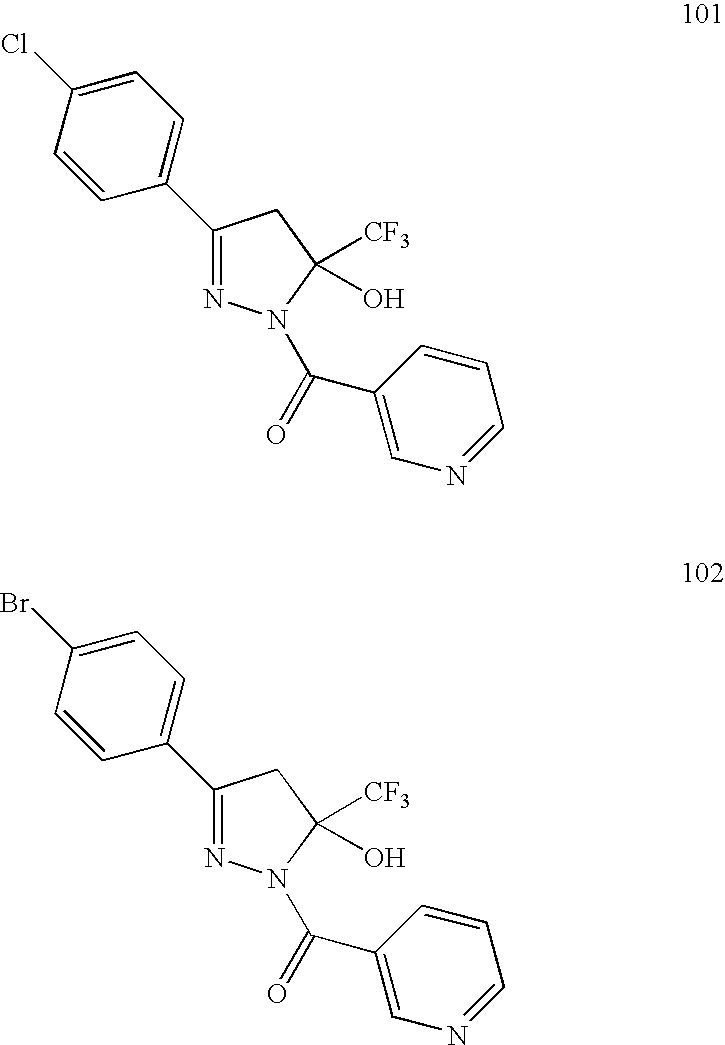
- In certain embodiments, this aspect of the present invention provides a compound according to structure (I) or (Ia) wherein the compound is not 101, 102 or 105-113.
- In a second aspect of the invention, the modulator is a compound of structural formula (II):

- or a pharmaceutically available solvate or hydrate thereof, wherein:
- X is O or S; and
- each R 1, R2, R3, R4 and R5 is independently hydrogen, alkyl, substituted alkyl, acyl, substituted acyl, acylamino, substituted acylamino, alkylamino, substituted alkylamino, alkylthio, substituted alkylthio, alkoxy, substituted alkoxy, alkoxycarbonyl, substituted alkoxycarbonyl, alkylarylamino, substituted alkylarylamino, arylalkyloxy, substituted arylalkyloxy, amino, aryl, substituted aryl, arylalkyl, substituted arylalkyl, arylsulfonyl, substituted arylsulfonyl, azido, carboxy, carbamoyl, substituted carbamoyl, carboxyl, cyano, cycloalkyl, substituted cycloalkyl, cycloheteroalkyl, substituted cycloheteroalkyl, dialkylamino, substituted dialkylamino, halo, heteroaryloxy, substituted heteroaryloxy, heteroaryl, substituted heteroaryl, heteroalkyl, substituted heteroalkyl, hydroxyl, nitro or thio; and each R6, R7, R8, R9 and R10 is independently hydrogen, alkyl, substituted alkyl, acyl, substituted acyl, acylamino, substituted acylamino, alkylamino, substituted alkylamino, alkylthio, substituted alkylthio, alkoxy, substituted alkoxy, alkoxycarbonyl, substituted alkoxycarbonyl, alkylarylamino, substituted alkylarylamino, arylalkyloxy, substituted arylalkyloxy, amino, aryl, substituted aryl, arylalkyl, substituted arylalkyl, arylsulfonyl, substituted arylsulfonyl, azido, carboxy, carbamoyl, substituted carbamoyl, carboxyl, cyano, cycloalkyl, substituted cycloalkyl, cycloheteroalkyl, substituted cycloheteroalkyl, dialkylamino, substituted dialkylamino, halo, heteroaryloxy, substituted heteroaryloxy, heteroaryl, substituted heteroaryl, heteroalkyl, substituted heteroalkyl, hydroxyl, nitro or thio.
- In preferred embodiments of the invention, the agonist is a compound of structural formula (II) wherein X is O; each R 1, R2, R3, R4 and R5 is independently hydrogen, acylamino, substituted acylamino, alkylamino, substituted alkylamino, alkylarylamino, substituted alkylarylamino, amino, dialkylamino, substituted dialkylamino or halo; and each R6, R7, R8, R9 and R10 is independently hydrogen, alkoxy, substituted alkoxy, alkoxycarbonyl, substituted alkoxycarbonyl, arylalkyloxy or substituted arylalkyloxy. In further preferred embodiments, the agonist is a compound of structural formula (II) wherein X is O; each R1, R2, R3, R4 and R5 is independently hydrogen, amino, or halo; and each R6, R7, R8, R9 and R10 is independently hydrogen, alkoxy or substituted alkoxy. In additional preferred embodiments, the agonist is a compound of structural formula (II) wherein X is O; each R2, R3, and R5is hydrogen; each R1 and R4 is independently amino or halo; each R6 and R10 is hydrogen; and each R7, R8, and R9 is independently alkoxy.
- Preferred modulators also include 104:

- In certain embodiments, this aspect of the present invention provides a compound according to structure (II) wherein the compound is not 104.
- In a third aspect of the invention, the modulator is a compound of structural formula (III):

- or a pharmaceutically available solvate or hydrate thereof, wherein:
- n is 1, 2, 3, 4 or 5;
- m is 1, 2, 3, 4, or 5;
- each X and Y is independently C or N; and
- each R 1, R2, R3, R4 and R5 is independently hydrogen, alkyl, substituted alkyl, acyl, substituted acyl, acylamino, substituted acylamino, alkylamino, substituted alkylamino, alkylthio, substituted alkylthio, alkoxy, substituted alkoxy, alkoxycarbonyl, substituted alkoxycarbonyl, alkylarylamino, substituted alkylarylamino, arylalkyloxy, substituted arylalkyloxy, amino, aryl, substituted aryl, arylalkyl, substituted arylalkyl, arylsulfonyl, substituted arylsulfonyl, azido, carboxy, carbamoyl, substituted carbamoyl, carboxyl, cyano, cycloalkyl, substituted cycloalkyl, cycloheteroalkyl, substituted cycloheteroalkyl, dialkylamino, substituted dialkylamino, halo, heteroaryloxy, substituted heteroaryloxy, heteroaryl, substituted heteroaryl, heteroalkyl, substituted heteroalkyl, hydroxyl, nitro or thio.
- In a preferred aspect of the invention, the modulator is a compound of structural formula (IIIa):

- or a pharmaceutically acceptable salt or hydrate thereof wherein n, m, X, Y, R 1, R2, R3, R4 and R5 are as defined for structure (III) above.
- In preferred embodiments of the invention, the modulator is a compound of structural formula (III) or (IIIa) wherein n is 2; m is 2; X is N; Y is N; and each R 3, R4 and R5 is hydrogen. In further preferred embodiments, the modulator is a compound of structural formula (III) or (IIIa) wherein n is 2; m is 2; X is N; Y is N; and each R3, R4 and R5 is hydrogen; and each R1 and R2 is independently alkoxy or substituted alkoxy. In additional preferred embodiments, the modulator is a compound of structural formula (III) or (IIIa) wherein n is 2; m is 2; X is N; Y is N; and each R3, R4 and R5 is hydrogen; and each R1 and R2is methoxy.
- Preferred modulators include 103:

- In certain embodiments, this aspect of the present invention provides a compound according to structure (III) or (IIIa) wherein the compound is not 103.
- Finally, in certain embodiments, the Edg-1 receptor modulators can be used in combination with one or more modulators of other Edg receptors. In certain embodiments, the modulators of other Edg receptors can modulate the Edg-2 receptor. In other embodiments, the modulators of other Edg receptors can modulate the Edg-3receptor. In still other embodiments, the modulators of other Edg receptors can modulate the Edg-4 receptor. In yet other embodiments, the modulators of other Edg receptors can modulate the Edg-7 receptor. Modulators of these other Edg receptors are extenisvely described in co-pending U.S. patent application Ser. Nos. 10/390,427, 10/390,426, 10/390,429, and 10/390,428, each of which is hereby incorporated by reference in its entirety.
- 6.3. Synthesis of the Compounds of the Invention
- The compounds of the invention may be obtained via the synthetic methods illustrated in
Scheme 1. Starting materials useful for preparing compounds of the invention and intermediates thereof are commercially available or can be prepared by well-known synthetic methods. Other methods for synthesis of the compounds described herein are either described in the art or will be readily apparent to the skilled artisan in view of general references well-known in the art (See e.g., Green et al., “Protective Groups in Organic Chemistry”, (Wiley, 2nd ed. 1991); Harrison et al., “Compendium of Synthetic Organic Methods”, Vols. 1-8 (John Wiley and Sons, 1971-1996); “Beilstein Handbook of Organic Chemistry,” Beilstein Institute of Organic Chemistry, Frankfurt, Germany; Feiser et al., “Reagents for Organic Synthesis,” Volumes 1-17, Wiley Interscience; Trost et al., “Comprehensive Organic Synthesis,” Pergamon Press, 1991; “Theilheimer's Synthetic Methods of Organic Chemistry,” Volumes 1-45, Karger, 1991; March, “Advanced Organic Chemistry,” Wiley Interscience, 1991; Larock “Comprehensive Organic Transformations,” VCH Publishers, 1989; Paquette, “Encyclopedia of Reagents for Organic Synthesis,” John Wiley & Sons, 1995) and may be used to synthesize the compounds of the invention. Accordingly, the methods presented inScheme 1 herein are illustrative rather than comprehensive. - The route described in
Scheme 1 may used to synthesize compounds of Formula (1).
- 6.3.1.
Compound 101 - A solution of 1-(4-chlorophenyl)-4,4,4-trifluoro-1,3-butanedione (0.883 g, 3.17 mmol) and nicotinic acid hydrazide (0.448 g, 3.17 mmol) in ethanol (˜2 mL) and toluene (50 mL) was heated at reflux. After 2 days the reaction mixture was reduced in vacuo and the crude residue was subjected to flash column chromatography over silica gel (98:2 CH 2Cl2/MeOH). Recrystallization of the impure product from ethanol afforded 5-(4-chlorophenyl)-2-pyridin-3-ylmethyl-3-trifluoromethyl-3,4-dihydro-2H-pyrazol-3-ol (0.134 g, 11% yield) as a light yellow solid. 1H NMR (300 MHz, CDCl3) δ 9.24 (m, 1H), 8.79 (m, 1H), 8.27 (m, 1H), 7.59 (m, 2H), 7.42 (m, 3H), 6.47 (s, 1H), 3.74 (d, 1H), 3.75 (d, 1H). ESI-MS m/z: 370 [C16H11ClF3N3O2+H]+. m.p. 158-160° C.
- 6.3.2.
Compound 102 -
Compound 102 can be prepared according to the following synthetic scheme. - (a) Synthesis of 1-(4-Bromophenyl)-4,4,4-trifluoro-1,3-butanedione

- To a solution of ethyl trifluoroacetate (81.0 mL, 0.452 mol) in methoxy tert-butyl ether (0.5 L) was slowly added sodium methoxide (30 wt % in methanol, 102 mL, 0.542 mol) at room temperature. The reaction exothermed and was cooled to room temperature with an ice bath. 4′-Bromoacetophenone (90.0 g, 0.452 mol) was added portion-wise to the reaction mixture over 10 min. and the reaction mixture was stirred overnight at room temperature. The organic layer was washed with hydrochloric acid (3N, 300 mL), brine (100 mL), dried (magnesium sulfate), filtered, and concentrated in vacuo. The residue was recrystallized from hexanes five times to provide 1-(4-bromophenyl)-4,4,4-trifluoro-1,3-butanedione (96.5 g, 72%) as a pale yellow solid: 1H NMR (300 MHz, CDCl3) δ 11.9 (s, 1H), 7.83-7.75 (m, 2H), 7.68-7.60 (m, 2H), 6.54 (s, 1H).
- (b) Preparation of [3-(4-Bromophenyl)-5-trifluoromethylpyrazol-1-yl]pyridin-3-yl-methanone

- A mixture of 1-(4-bromophenyl)-4,4,4-trifluoro-1,3-butanedione (55.2 g, 0.187 mol) and nicotinic acid hydrazide (25.6 g, 0.187 mol) in absolute ethanol (0.7 L) was stirred at reflux overnight. The reaction mixture was allowed to cool to room temperature and then was concentrated in vacuo. The crude residue was taken up in toluene (0.7 L) and was stirred at reflux for two days. The mixture was allowed to cool and then was concentrated in vacuo. The residue was treated with methoxy tert-butyl ether (0.4 L) and stirred at 55° C. for thirty min. The solids were filtered off and the mother liquor concentrated in vacuo. The crude residue was purified by chromatography (silica gel, 0.5% methanol/methylene chloride) to obtain [3-(4-bromophenyl)-5-trifluoromethylpyrazol-1-yl]pyridin-3-yl-methanone (13.0 g, 17%) as a white solid: mp 150-152° C.; 1H NMR (300 MHz, CD3OD) δ 9.11-8.92 (m, 1H), 8.69-8.58 (m, 1H), 8.38-8.20 (m, 1H), 7.74-7.42 (m, 5H), 3.95 (d, 1H), 3.60 (d, 1H); ESI MS m/z 414 [C16H11BrF3N3O2+H]+.
-
Compound 102 is also commercially available compound from Chembridge (San Diego, Calif.) #5795726 - 6.3.3. Compound 103
- Compound 103 is commercially available compound from Specs/BioSpecs(The Netherlands) #AH-262/34399012
- 6.3.4.
Compound 104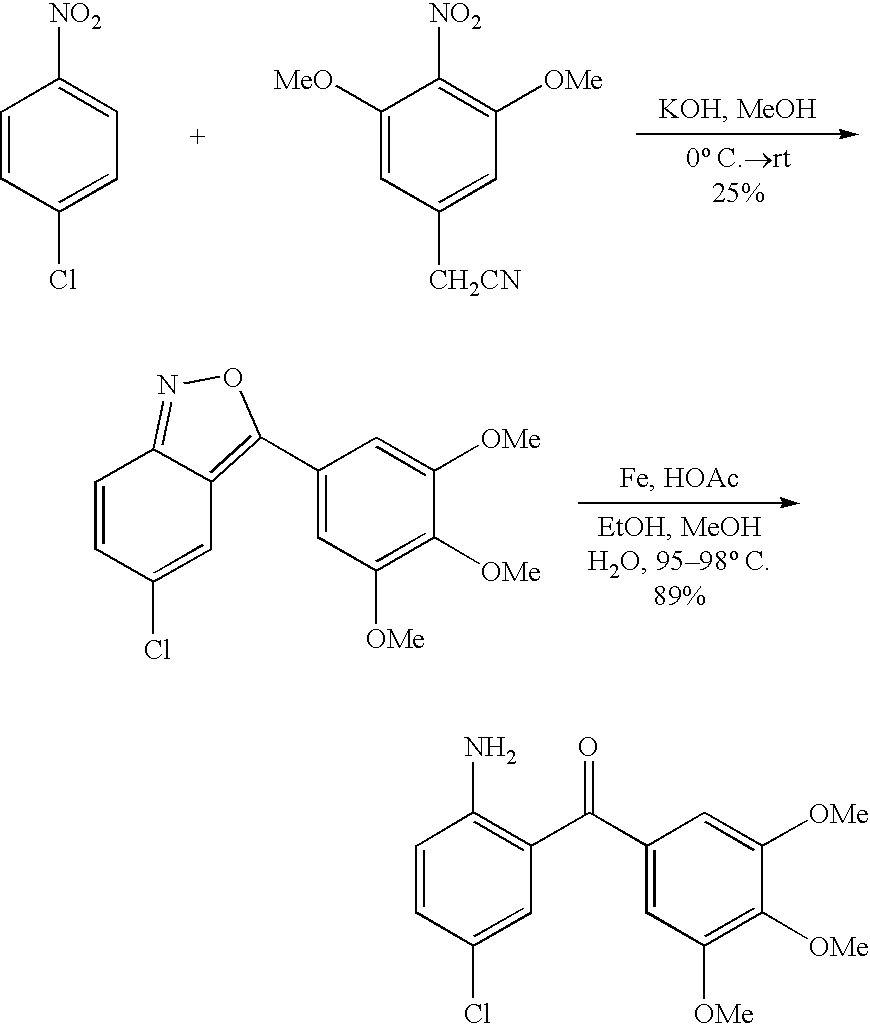
- Potassium hydroxide pellets (85%, 5.76 g, 87.3 mmol, 17.5 equiv) were dissolved in methanol (12 mL). The mixture was cooled with an ice bath, and a solution of p-chloronitrobenzene (788 mg, 5 mmol) and 3,4,5-trimethoxyphenylacetonitrile (Acros, 1.140 g, 5.5 mmol) in methanol (15 mL) was added dropwise (ref Davis, R. B.; Pizzini, L. C. J. Org. Chem. 1960, 25, 1884-1888). The dark purple reaction mixture was slowly warmed up to room temperature overnight and then poured into water (250 mL). The precipitates were collected by a suction filtration, washed several times with water, air-dried, and subject to flash column chromatography over silica gel using ethyl acetate/hexanes (1:10, 1:6, and 1:4). 5-Chloro-3-(3,4,5-trimethoxy-phenyl)benzo[c]isoxazole was isolated as a slightly yellow solid (405 mg, 25% yield). 1H NMR (300 MHz, CDCl3) δ 7.75 (m, 1H), 7.59 (m, 1H), 7.27 (m, 1H), 7.16 (s, 2H), 4.01 (s, 6H), 3.96 (s, 3H). APCI-MS: m/z 320 [C16H14ClNO4+H]+. m.p. 119-120° C.
- A mixture of iron powder (183 mg, 3.28 mmol, 3 equiv), ethanol (4 mL), water (2 mL), and acetic acid (6 mL) was preheated to 60° C. (oil bath). 5-Chloro-3-(3,4,5-trimethoxyphenyl)-benzo[c]isoxazole (350 mg, 1.10 mmol) in methanol (10 mL) was then added and the reaction mixture was stirred for 30 min at that temperature and then overnight at 95-98° C. Most of the solvents were removed by rotary evaporation and the residue was diluted with dichloromethane (100 mL). Insoluble inorganics were removed by filtration and the filtrate solution was concentrated by rotary evaporation. The resulting solid was subject to flash column chromatography over silica gel using ethyl acetate/hexanes (1:10, 1:6, 1:4, and 1:2). (2-Amino-5-chlorophenyl)-(3,4,5-trimethoxyphenyl)methanone was isolated as a yellow solid (315 mg, 89% yield). 1H NMR (500 MHz, CD3OD) δ 7.35 (m, 1H), 7.24 (m, 1H), 6.91 (s, 2H), 6.83 (m, 1H), 3.86 (s, 6H), 3.85 (s, 3H). APCI-MS: m/z 322 [C16H16ClNO4+H]+. m.p. 141-142° C.
- 6.4. Therapeutic Uses of the Compounds of the Invention
- The compounds and/or compositions of the present invention may be used to treat diseases, including but not limited to, ovarian cancer (Xu et al., 1995 , Biochem. J. 309 (Pt 3):933-940; Xu et al., 1998, JAMA 280 (8):719-723; Goetzl et al., 1999, Cancer Res. 59 (20):5370-5375), peritoneal cancer, endometrial cancer, cervical cancer, breast cancer, colorectal cancer, uterine cancer, stomach cancer, small intestine cancer, thyroid cancer, lung cancer, kidney cancer, pancreas cancer and prostrate cancer; acute lung diseases, adult respiratory distress syndrome (“ARDS”), acute inflammatory exacerbation of chronic lung diseases such as asthma (Chilton et al., 1996, J Exp Med 183:2235-45; Arbibe et al., 1998, J Clin Invest 102:1152-60) surface epithelial cell injury, (e.g., transcorneal freezing or cutaneous burns (Liliom et al., 1998, Am. J. Physiol 274 (4 Pt 1): C1065-C1074)), cardiovascular diseases, (e.g., ischemia (Karliner et al., 2001, J. Mol. Cell Cardiol. 33 (9):1713-1717) and atherosclerosis (Siess et al., 1999, Proc. Natl. Acad. Sci. U.S.A. 96 (12):6931-6936; Siess et al., 2000, IUBMB Life 49 (3):167-171)).
- In accordance with the invention, a compound and/or composition of the invention is administered to a subject, preferably a human, in need of treatment for a disease which includes but is not limited to, the diseases listed above. Further, in certain embodiments, the compounds and/or compositions of the invention can be administered to a subject, preferably a human, as a preventative measure against diseases or disorders such as those depicted above. Thus, the compounds and/or compositions of the invention can be administered as a preventative measure to a subject having a predisposition, which includes but is not limited to, the diseases listed above. Accordingly, the compounds and/or compositions of the invention may be used for the prevention of one disease or disorder and concurrently treating another disease (e.g., preventing cancer and treating cardiovascular diseases).
- In another aspect, the compounds and/or compositions of the invention can be used to treat or prevent disorders involving an immune response. One of skill in the art will readily recognize which disorders can be treated or prevented by stimulating or potentiating an immune response and which disorders can be treated or preventing by suppressing an immune response.
- Where the immune response is to be stimulated, the Edg-1 receptor modulators are preferably, but not limited to, Edg-1 receptor agonists. One of ordinary skill in the art can readily determine whether a particular Edg-1 agonist or antagonist can stimulate an immune response by performing, for example, a migration and invasion assay as described in Section 7.12 or a migration assay in the mouse dorsal air-pouch model as described in Section 7.9. Further, one of ordinary skill in the art can readily identify whether a subject will benefit from stimulation of an immune response. For example, subjects that suffer from an inherited immune deficiency will benefit from stimulation of an immune response. Other such subjects include subjects infected with a virus, including, but not limited to, cytomegalovirus,
herpes simplex virus 1, herpes simplex virus II, influenza A virus, influenza B virus, hepatitis A virus, hepatitis B virus, hepatitis C virus, and human immunodeficiency virus. In yet other embodiments, the subject that will benefit from stimulation of an immune response include subjects that are administered a vaccine. In such embodiments, an Edg-1 receptor modulator can be administered as an adjuvant to a vaccine. - In other embodiments, the immune response can be suppressed by Edg-1 receptor modulators. In such embodiments, the Edg-1 receptor modulators can be Edg-1 receptor agonists or antagonists, as described above. One of ordinary skill in the art can readily determine whether a particular Edg-1 agonist or antagonist can suppress an immune response by performing, for example, a migration and invasion assay as described in Section 7.12 or a migration assay in the mouse dorsal air-pouch model as described in Section 7.9. In addition, one of skill in the art can readily recognize subjects that will benefit from suppression of an immune response. For example, such subjects include those that suffer from an immune disorder that is characterized by an inappropriate activation of the immune system.
- Such disorders include, but are not limited to, systemic lupus erythematosus, rheumatic cardiatis, polymyosis, pemphigus, bullous dermatits herpetiformis, Stevens-Johnson syndrome, mycosis fungoides, dermatitis, ulcerative colitis, Crohn's disease, intractable sprue, idiopathic thrombocytopenic purpura, hemolytic anemia, erythroblastopenia, congenital hypoplastic anemia, osteoarthritis, rheumatoid arthritis, bursitis, acute gouty arthritis, epicondylitis, acute nonspecific tenosynovitis, multiple sclerosis, keratitis, irititis, irisocyclitis, chorioretinitis, choroiditis, optic neuritis, sarcoiodosis, Loeffler's syndrome, berylliosis, tuberculosis, sponylitis, tenosynovitis, psoriatic arthritis, and type I diabetes mellitus. Another example of a subject that will benefit from suppression of an immune response is a subject that is the recipient of a transplanted cell, tissue, or organ.
- One of ordinary skill in the art can readily determine whether a particular Edg-1 agonist or antagonist has successfully stimulated or suppressed an immune response when administered to a subject. For example, a delayed-type hypersensitivity assay can be performed on the subject to test the subject's cell-based immunity. In such assays, an antigen to which the subject has previously been exposed is injected subcutaneously. If the subject's immune response has been suppressed, no delayed-type hypersensitivity or mild delayed-type hypersensitivity is observed. If the subject's immune response has not been suppressed, a more robust delayed-type hypersensitivity reaction is observed. If the subject's immune response has been stimulated, no delayed-type hypersensitivity or mild delayed-type hypersensitivity is observed. Delayed-type hypersensitivity assays are well-known to the art and can readily be performed by one of ordinary skill.
- In a preferred embodiment, Edg-1 antagonists can be used to treat or prevent disorders such as, but not limited to, vasoconstriction in cerebral arteries, autoimmune and related immune disorders, including, but not limited to, systemic lupus erythematosus, rheumatoid arthritis, non-glomerular nephrosis, psoriasis, chronic active hepatitis, ulcerative colitis, Crohn's disease, Behçet's disease, chronic glomerulonephritis, chronic thrombocytopenic purpura, and autoimmune hemolytic anemia. Additionally, Edg-1 agonists and/or antagonists can also be used as immunosuppressants in organ transplantation, as well as inhibitors of angiogenesis for treatment of various cancers. In yet another embodiment, Edg-1 agonists and antagonists can be used to treat vascular occlusive disorders. For example, activation of Edg-1 receptors by using an Edg-1 agonist will result in increased vasoconstriction which is beneficial in conditions such as migraine headaches. Inhibition of Edg-1 by an Edg-1 antagonist will be beneficial in conditions such as a stroke, a subarachnoid hemorrhage, or a vasospasm such as a cerebral vasospasm. It is well within the capability of those of skill in the art to assay and use the compounds and/or compositions of the invention to treat diseases, such as the diseases listed above.
- 6.5. Therapeutic/Prophylactic Administration
- The compounds and/or compositions of the invention may be advantageously used in medicine, including human medicine. As previously described in Section 6.4 above, compounds and compositions of the invention are useful for the treatment or prevention of diseases, which include but are not limited to, cancers, including, but not limited to, ovarian cancer, peritoneal cancer, endometrial cancer, cervical cancer, breast cancer, colorectal cancer, uterine cancer, stomach cancer, small intestine cancer, thyroid cancer, lung cancer, kidney cancer, pancreas cancer, prostrate cancer, acute lung diseases, including, but not limited to, adult respiratory distress syndrome (ARDS) and acute inflammatory exacerbation of chronic lung diseases such as asthma; surface epithelial cell injury, including, but not limited to, transcorneal freezing or cutaneous bums; cardiovascular diseases, including, but not limited to, ischemia and atherosclerosis; viral infections, including, but not limited to, cytomegalovirus, herpes simplex virus I, herpes simplex virus II, influenza A virus, influenza B virus, hepatitis A virus, hepatitis B virus, hepatitis C virus, and human immunodeficiency virus infections; and immune disorders, including, but not limited to, systemic lupus erythematosus, rheumatic cardiatis, polymyosis, pemphigus, bullous dermatits herpetiformis, Stevens-Johnson syndrome, mycosis fungoides, dermatitis, ulcerative colitis, Crohn's disease, intractable sprue, idiopathic thrombocytopenic purpura, hemolytic anemia, erythroblastopenia, congenital hypoplastic anemia, osteoarthritis, rheumatoid arthritis, bursitis, acute gouty arthritis, epicondylitis, acute nonspecific tenosynovitis, multiple sclerosis, keratitis, irititis, irisocyclitis, chorioretinitis, choroiditis, optic neuritis, sarcoiodosis, Loeffler's syndrome, berylliosis, tuberculosis, sponylitis, tenosynovitis, psoriatic arthritis, and type I diabetes mellitus.
- In a preferred embodiment, Edg-1 antagonists can be used to treat or prevent disorders such as, but not limited to, vasoconstriction in cerebral arteries, autoimmune and related immune disorders, including, but not limited to, systemic lupus erythematosus, rheumatoid arthritis, non-glomerular nephrosis, psoriasis, chronic active hepatitis, ulcerative colitis, Crohn's disease, Behçet's disease, chronic glomerulonephritis, chronic thrombocytopenic purpura, and autoimmune hemolytic anemia. Additionally, Edg-1 agonists and/or antagonists can also be used as immunosuppressants in organ transplantation, as well as inhibitors of angiogenesis for treatment of various cancers. In yet another embodiment, Edg-1 agonists and antagonists can be used to treat vascular occlusive disorders. For example, activation of Edg-1 receptors by using an Edg-1 agonist will result in increased vasoconstriction which is beneficial in conditions such as migraine headaches. Inhibition of Edg-1 by an Edg-1 antagonist will be beneficial in conditions such as a stroke, a subarachnoid hemorrhage, or a vasospasm such as a cerebral vasospasm.
- When used to treat or prevent disease or disorders, compounds and/or compositions of the invention may be administered or applied singly, in combination with other agents. The compounds and/or compositions of the invention may also be administered or applied singly, in combination with other pharmaceutically active agents, including other compounds and/or compositions of the invention.
- The current invention provides methods of treatment and prophylaxis by administration to a subject of a therapeutically effective amount of a composition or compound of the invention. The subject may be an animal, is more preferably a mammal, and most preferably a human.
- The present compounds and/or compositions of the invention, which comprise one or more compounds of the invention, are preferably administered orally. The compounds and/or compositions of the invention may also be administered by any other convenient route, for example, by infusion or bolus injection, by absorption through epithelial or mucocutaneous linings (e.g., oral mucosa, rectal and intestinal mucosa, etc.). Administration can be systemic or local. Various delivery systems are known, (e.g., encapsulation in liposomes, microparticles, microcapsules, capsules, etc.) that can be used to administer a compound and/or composition of the invention. Methods of administration include, but are not limited to, intradermal, intramuscular, intraperitoneal, intravenous, subcutaneous, intranasal, epidural, oral, sublingual, intranasal, intracerebral, intravaginal, transdermal, rectally, by inhalation, or topically, particularly to the ears, nose, eyes, or skin. The preferred mode of administration is left to the discretion of the practitioner, and will depend in-part upon the site of the medical condition. In most instances, administration will result in the release of the compounds and/or compositions of the invention into the bloodstream.
- In specific embodiments, it may be desirable to administer one or more compounds and/or composition of the invention locally to the area in need of treatment. This may be achieved, for example, and not by way of limitation, by local infusion during surgery, topical application, e.g., in conjunction with a wound dressing after surgery, by injection, by means of a catheter, by means of a suppository, or by means of an implant, said implant being of a porous, non-porous, or gelatinous material, including membranes, such as sialastic membranes, or fibers. In one embodiment, administration can be by direct injection at the site (or former site) of the diseases listed above.
- In certain embodiments, it may be desirable to introduce one or more compounds and/or compositions of the invention into the central nervous system by any suitable route, including intraventricular, intrathecal and epidural injection. Intraventricular injection may be facilitated by an intraventricular catheter, for example, attached to a reservoir, such as an Ommaya reservoir.
- A compound and/or composition of the invention may also be administered directly to the lung by inhalation. For administration by inhalation, a compound and/or composition of the invention may be conveniently delivered to the lung by a number of different devices. For example, a Metered Dose Inhaler (“MDI”), which utilizes canisters that contain a suitable low boiling propellant, (e.g., dichlorodifluoromethane, trichlorofluoromethane, dichlorotetrafluoroethane, carbon dioxide or any other suitable gas) may be used to deliver compounds of the invention directly to the lung.
- Alternatively, a Dry Powder Inhaler (“DPI”) device may be used to administer a compound and/or composition of the invention to the lung. DPI devices typically use a mechanism such as a burst of gas to create a cloud of dry powder inside a container, which may then be inhaled by the subject. DPI devices are also well known in the art. A popular variation is the multiple dose DPI (“MDDPI”) system, which allows for the delivery of more than one therapeutic dose. For example, capsules and cartridges of gelatin for use in an inhaler or insufflator may be formulated containing a powder mix of a compound of the invention and a suitable powder base such as lactose or starch for these systems.
- Another type of device that may be used to deliver a compound and/or a composition of the invention to the lung is a liquid spray device. Liquid spray systems use extremely small nozzle holes to aerosolize liquid drug formulations that may then be directly inhaled into the lung.
- In one embodiment, a nebulizer is used to deliver a compound and/or composition of the invention to the lung. Nebulizers create aerosols from liquid drug formulations by using, for example, ultrasonic energy to form fine particles that may be readily inhaled (see e.g., Verschoyle et al.,
British J. Cancer 1999, 80, Suppl. 2, 96, which is herein incorporated by reference). Examples of nebulizers include devices supplied by Sheffield/Systemic Pulmonary Delivery Ltd. (See, Armer et al., U.S. Pat. No. 5,954,047; van der Linden et al., U.S. Pat. No. 5,950,619; van der Linden et al., U.S. Pat. No. 5,970,974), Aventis and Batelle Pulmonary Therapeutics. - In another embodiment, an electrohydrodynamic (“EHD”) aerosol device is used to deliver a compound and/or composition of the invention to the lung. EHD aerosol devices use electrical energy to aerosolize liquid drug solutions or suspensions (see e.g., Noakes et al., U.S. Pat. No. 4,765,539). EHD aerosol devices may more efficiently deliver drugs to the lung than other pulmonary delivery technologies.
- In another embodiment, the compounds of the invention can be delivered in a vesicle, in particular a liposome (see Langer, Science 1990, 249:1527-1533; Treat et al, in “Liposomes in the Therapy of Infectious Disease and Cancer,” Lopez-Berestein and Fidler (eds.), Liss, N.Y., pp. 353-365 (1989); see generally “Liposomes in the Therapy of Infectious Disease and Cancer,” Lopez-Berestein and Fidler (eds.), Liss, N.Y., pp. 353-365 (1989)).
- In yet another embodiment, the compounds of the invention can be delivered via sustained release systems, preferably oral sustained release systems. In one embodiment, a pump may be used (see Langer, supra; Sefton, 1987 , CRC Crit. Ref Biomed. Eng. 14:201; Saudek et al., N. Engl. J Med. 1989, 321:574).
- In another embodiment, polymeric materials can be used (see “Medical Applications of Controlled Release,” Langer and Wise (eds.), CRC Pres., Boca Raton, Fla. (1974); “Controlled Drug Bioavailability,” Drug Product Design and Performance, Smolen and Ball (eds.), Wiley, N.Y. (1984); Ranger and Peppas, J. Macromol. Sci. Rev. Macromol Chem. 1983, 23:61; see also Levy et al., Science 1985, 228: 190; During et al., Ann. Neurol. 1989, 25:351; Howard et al, J. Neurosurg. 1989, 71:105). In a preferred embodiment, polymeric materials are used for oral sustained release delivery. In another embodiment, enteric-coated preparations can be used for oral sustained release administration. In still another embodiment, osmotic delivery systems are used for oral sustained release administration (Verma et al., Drug Dev. Ind. Pharm. 2000, 26:695-708).
- In yet another embodiment, a controlled-release system can be placed in proximity of the target of the compounds and/or composition of the invention, thus requiring only a fraction of the systemic dose (see, e.g., Goodson, in “Medical Applications of Controlled Release,” supra, vol. 2, pp. 115-138 (1984)). Other controlled-release systems discussed in Langer, 1990 , Science 249:1527-1533 may also be used.
- 6.6. Compositions of the Invention
- The present compositions contain a therapeutically effective amount of one or more compounds of the invention, preferably in purified form, together with a suitable amount of a pharmaceutically acceptable vehicle, so as to provide the form for proper administration to a subject. When administered to a subject, the compounds of the invention and pharmaceutically acceptable vehicles are preferably sterile. Water is a preferred vehicle when the compound of the invention is administered intravenously. Saline solutions and aqueous dextrose and glycerol solutions can also be employed as liquid vehicles, particularly for injectable solutions. Suitable pharmaceutical vehicles also include excipients such as starch, glucose, lactose, sucrose, gelatin, malt, rice, flour, chalk, silica gel, sodium stearate, glycerol monostearate, talc, sodium chloride, dried skim milk, glycerol, propylene, glycol, water, ethanol and the like. The present compositions, if desired, can also contain minor amounts of wetting or emulsifying agents or pH buffering agents. In addition, auxiliary, stabilizing, thickening, lubricating and coloring agents may be used.
- Pharmaceutical compositions comprising a compound of the invention may be manufactured by means of conventional mixing, dissolving, granulating, dragee-making, levigating, emulsifying, encapsulating, entrapping or lyophilizing processes. Pharmaceutical compositions may be formulated in conventional manner using one or more physiologically acceptable carriers, diluents, excipients or auxiliaries, which facilitate processing of compounds of the invention into preparations which can be used pharmaceutically. Proper formulation is dependent upon the route of administration chosen.
- The present compositions can take the form of solutions, suspensions, emulsion, tablets, pills, pellets, capsules, capsules containing liquids, powders, sustained-release formulations, suppositories, emulsions, aerosols, sprays, suspensions, or any other form suitable for use. In one embodiment, the pharmaceutically acceptable vehicle is a capsule (see e.g., Grosswald et al., U.S. Pat. No. 5,698,155). Other examples of suitable pharmaceutical vehicles have been described in the art (see Remington's Pharmaceutical Sciences, Philadelphia College of Pharmacy and Science, 17th Edition, 1985).
- For topical administration compounds of the invention may be formulated as solutions, gels, ointments, creams, suspensions, etc. as are well-known in the art.
- Systemic formulations include those designed for administration by injection, e.g., subcutaneous, intravenous, intramuscular, intrathecal or intraperitoneal injection, as well as those designed for transdermal, transmucosal, oral or pulmonary administration. Systemic formulations may be made in combination with a further active agent that improves mucociliary clearance of airway mucus or reduces mucous viscosity. These active agents include, but are not limited to, sodium channel blockers, antibiotics, N-acetyl cysteine, homocysteine and phospholipids.
- In a preferred embodiment, the compounds of the invention are formulated in accordance with routine procedures as a composition adapted for intravenous administration to human beings. Typically, compounds of the invention for intravenous administration are solutions in sterile isotonic aqueous buffer. For injection, a compound of the invention may be formulated in aqueous solutions, preferably in physiologically compatible buffers such as Hanks' solution, Ringer's solution, or physiological saline buffer. The solution may contain formulatory agents such as suspending, stabilizing and/or dispersing agents. When necessary, the compositions may also include a solubilizing agent. Compositions for intravenous administration may optionally include a local anesthetic such as lignocaine to ease pain at the site of the injection. Generally, the ingredients are supplied either separately or mixed together in unit dosage form, for example, as a lyophilized powder or water free concentrate in a hermetically sealed container such as an ampoule or sachette indicating the quantity of active agent. When the compound of the invention is administered by infusion, it can be dispensed, for example, with an infusion bottle containing sterile pharmaceutical grade water or saline. When the compound of the invention is administered by injection, an ampoule of sterile water for injection or saline can be provided so that the ingredients may be mixed prior to administration.
- For transmucosal administration, penetrants appropriate to the barrier to be permeated are used in the formulation. Such penetrants are generally known in the art.
- Compositions for oral delivery may be in the form of tablets, lozenges, aqueous or oily suspensions, granules, powders, emulsions, capsules, syrups, or elixirs, for example. Orally administered compositions may contain one or more optionally agents, for example, sweetening agents such as fructose, aspartame or saccharin; flavoring agents such as peppermint, oil of wintergreen, or cherry coloring agents and preserving agents, to provide a pharmaceutically palatable preparation. Moreover, where in tablet or pill form, the compositions may be coated to delay disintegration and absorption in the gastrointestinal tract, thereby providing a sustained action over an extended period of time. Selectively permeable membranes surrounding an osmotically active driving compound are also suitable for orally administered compounds of the invention. In these later platforms, fluid from the environment surrounding the capsule is imbibed by the driving compound, which swells to displace the agent or agent composition through an aperture. These delivery platforms can provide an essentially zero order delivery profile as opposed to the spiked profiles of immediate release formulations. A time delay material such as glycerol monostearate or glycerol stearate may also be used. Oral compositions can include standard vehicles such as mannitol, lactose, starch, magnesium stearate, sodium saccharine, cellulose, magnesium carbonate, etc. Such vehicles are preferably of pharmaceutical grade.
- For oral liquid preparations such as, for example, suspensions, elixirs and solutions, suitable carriers, excipients or diluents include water, saline, alkyleneglycols (e.g., propylene glycol), polyalkylene glycols (e.g., polyethylene glycol) oils, alcohols, slightly acidic buffers between
pH 4 and pH 6 (e.g., acetate, citrate, ascorbate at between about 5.0 mM to about 50.0 mM, etc). Additionally, flavoring agents, preservatives, coloring agents, bile salts, acylcarnitines and the like may be added. - For buccal administration, the compositions may take the form of tablets, lozenges, etc. formulated in conventional manner.
- Liquid drug formulations suitable for use with nebulizers and liquid spray devices and EE) aerosol devices will typically include a compound of the invention with a pharmaceutically acceptable vehicle. Preferably, the pharmaceutically acceptable vehicle is a liquid such as alcohol, water, polyethylene glycol or a perfluorocarbon. Optionally, another material may be added to alter the aerosol properties of the solution or suspension of compounds of the invention. Preferably, this material is liquid such as an alcohol, glycol, polyglycol or a fatty acid. Other methods of formulating liquid drug solutions or suspension suitable for use in aerosol devices are known to those of skill in the art (see, e.g., Biesalski, U.S. Pat. No. 5,112,598; Biesalski, U.S. Pat. No. 5,556,611).
- A compound of the invention may also be formulated in rectal or vaginal compositions such as suppositories or retention enemas, e.g., containing conventional suppository bases such as cocoa butter or other glycerides.
- In addition to the formulations described previously, a compound of the invention may also be formulated as a depot preparation. Such long acting formulations may be administered by implantation (e.g., subcutaneously or intramuscularly) or by intramuscular injection. Thus, for example, a compound of the invention may be formulated with suitable polymeric or hydrophobic materials (e.g., as an emulsion in an acceptable oil) or ion exchange resins, or as sparingly soluble derivatives, for example, as a sparingly soluble salt.
- When a compound of the invention is acidic, it may be included in any of the above-described formulations as the free acid, a pharmaceutically acceptable salt, a solvate or hydrate. Pharmaceutically acceptable salts substantially retain the activity of the free acid, may be prepared by reaction with bases and tend to be more soluble in aqueous and other protic solvents than the corresponding free acid form.
- 6.7. Methods of Use and Doses
- A compound of the invention, or compositions thereof, will generally be used in an amount effective to achieve the intended purpose. The compounds of the invention or compositions thereof, are administered or applied in a therapeutically effective amount for use to treat or prevent diseases or disorders including but not limited to, ovarian cancer, peritoneal cancer, endometrial cancer, cervical cancer, breast cancer, colorectal cancer, uterine cancer, stomach cancer, small intestine cancer, thyroid cancer, lung cancer, kidney cancer, pancreas cancer, prostrate cancer, acute lung diseases, (e.g., adult respiratory distress syndrome (ARDS) and asthma) surface epithelial cell injury (e.g., transcorneal freezing and cutaneous burns) and cardiovascular diseases such as ischemia and atherosclerosis.
- The amount of a compound of the invention that will be effective in the treatment of a particular disorder or condition disclosed herein will depend on the nature of the disorder or condition, and can be determined by standard clinical techniques known in the art as previously described. In addition, in vitro or in vivo assays may optionally be employed to help identify optimal dosage ranges. The amount of a compound of the invention administered will, of course, be dependent on, among other factors, the subject being treated, the weight of the subject, the severity of the affliction, the manner of administration and the judgment of the prescribing physician.
- For example, the dosage may be delivered in a pharmaceutical composition by a single administration, by multiple applications or controlled release. In a preferred embodiment, the compounds of the invention are delivered by oral sustained release administration. Preferably, in this embodiment, the compounds of the invention are administered twice per day (more preferably, once per day). Dosing may be repeated intermittently, may be provided alone or in combination with other drugs and may continue as long as required for effective treatment of the disease state or disorder.
- Suitable dosage ranges for oral administration are dependent on the potency of the, but are generally about 0.001 mg to about 200 mg of a compound of the invention per kilogram body weight. Dosage ranges may be readily determined by methods known to the skilled artisan.
- Suitable dosage ranges for intravenous (i.v.) administration are about 0.01 mg to about 100 mg per kilogram body weight. Suitable dosage ranges for intranasal administration are generally about 0.01 mg/kg body weight to about 1 mg/kg body weight. Suppositories generally contain about 0.01 milligram to about 50 milligrams of a compound of the invention per kilogram body weight and comprise active ingredient in the range of about 0.5% to about 10% by weight. Recommended dosages for intradermal, intramuscular, intraperitoneal, subcutaneous, epidural, sublingual or intracerebral administration are in the range of about 0.001 mg to about 200 mg per kilogram of body weight. Effective doses may be extrapolated from dose-response curves derived from in vitro or animal model test systems. Such animal models and systems are well known in the art.
- The compounds of the invention are preferably assayed in vitro and in vivo, for the desired therapeutic or prophylactic activity, prior to use in humans. For example, in vitro assays can be used to determine whether administration of a specific compound of the invention or a combination of compounds of the invention is preferred for reducing convulsion. The compounds of the invention may also be demonstrated to be effective and safe using animal model systems.
- Preferably, a therapeutically effective dose of a compound of the invention described herein will provide therapeutic benefit without causing substantial toxicity. Toxicity of compounds of the invention may be determined using standard pharmaceutical procedures and may be readily ascertained by the skilled artisan. The dose ratio between toxic and therapeutic effect is the therapeutic index. A compound of the invention will preferably exhibit particularly high therapeutic indices in treating disease and disorders. The dosage of a compound of the inventions described herein will preferably be within a range of circulating concentrations that include an effective dose with little or no toxicity.
- 6.8. Combination Therapy
- In certain embodiments, the compounds of the invention can be used in combination therapy with at least one other therapeutic agent. The compound of the invention and the other therapeutic agent can act additively or, more preferably, synergistically. In a preferred embodiment, a compound of the invention is administered concurrently with the administration of another therapeutic agent. In another preferred embodiment, a composition comprising a compound of the invention is administered concurrently with the administration of another therapeutic agent, which can be part of the same composition as the compound of the invention or a different composition. In another embodiment, a composition comprising a compound of the invention is administered prior or subsequent to administration of another therapeutic agent. Other therapeutic agents, which may be used with the compounds and/or compositions of the invention, include but are not limited to, agonists and antagonists of Edg-1, drugs used to treat cardiovascular diseases and/or cancer such as, alkylating agents (e.g., cyclophosphamide, melphalan, chlorambucil), platinum compounds (e.g., cisplatin, carboplatin), anthracyclines (e.g., doxorubicin, epirubicin), taxanes (e.g., paclitaxel, docetaxel), chronic oral etoposide, topotecan, gemcitabine, hexamethylamine, methotrexate, and 5-fluorouracil.
- 6.9. Assays
- One of skill in the art can use the following assays to identify Edg-1 agonists or antagonists.
- 6.9.1. Intracellular Calcium Measurement Assays
- Specific assays for Edg-1 receptor activity are known to those of skill in the art. For example, cells expressing Edg-1 receptors can be contacted with a membrane-permeant calcium sensitive dye such as Fluo-4 AM or a proprietary calcium dye loading kit (e.g., FLIPR Calcium Assay kit, Molecular Devices, Sunnyvale, Calif.). Intracellular calcium is capable of binding to the dye and emitting fluorescent radiation when illuminated at the appropriate wavelength. The cells can thus be illuminated an appropriate wavelength for the dye and any emitting light can be captured by a cooled CCD camera. Changes in fluorescence indicate changes in intracellular calcium resulting from the activation of an Edg-1 receptor. Such changes can be measured advantageously in whole cells in “real-time” (Berridge et al.,
Nature Reviews 2000, 1:11-21). Exemplary methods are described in co-pending U.S. application Ser. No. 09/904,099, filed Jul. 11, 2001, the content of which is hereby incorporated by reference in its entirety. - Other methods of measuring intracellular calcium are known to those of skill in the art. For instance, a commonly used technique is the expression of receptors of interest in Xenopus laevis oocytes followed by measurement of calcium activated chloride currents (see Weber, 1999, Biochim Biophys Acta 1421:213-233). In addition, several calcium sensitive dyes are available for the measurement of intracellular calcium. Such dyes can be membrane permeant or not membrane permeant. Examples of useful membrane permeant dyes include acetoxymethyl ester forms of dyes that can be cleaved by intracellular esterases to form a free acid, which is no longer membrane permeant and remains trapped inside a cell. Dyes that are not membrane permeant can be introduced into the cell by microinjection, chemical permeabilization, scrape loading and similar techniques (Haughland, 1993, in “Fluorescent and Luminescent Probes for Biological Activity” ed. Mason, W. T. pp 34-43; Academic Press, London; Haughland, 1996, in “Handbook of Fluorescent Probes and Research Chemicals”, sixth edition, Molecular Probes, Eugene, OR).
- 6.9.2. IL-8 and VEGF Assays
- The levels of interleukin-8 (“IL-8”) and vascular endothelial growth factor (“VEGF”) are important markers for the proliferative potential, angiogenic capacity and metastatic potential of a tumor cell line. Specific assays for IL-8 and VEGF are known to those of skill in the art. For example, IL-8 and VEGF assays can be performed by techniques that include, but are not limited to, a standard enzyme-linked immunosorbent assay (“ELISA”). In a standard ELISA, the cells can be cultured, for example, in a 96 well format, serum starved overnight, and treated with LPA or S1P. Dose ranges would be known to one of skill in the art. For example, the doses can range from 0.1-10 μM in serum free medium. Cell supernatants can then be collected to measure the amount of IL-8 or VEGF secreted.
- Methods to measure the amount of IL-8 or VEGF secreted are known to one of skill in the art. In one method, an anti-IL-8 or anti-VEGF capture antibody can be adsorbed on to any surface, for example, a plastic dish. Cell supernatants containing IL-8 or VEGF can then be added to the dish and any method known in the art for detecting antibodies can be used to detect the anti-IL-8 or anti-VEGF antibody. In one embodiment, an anti-IL-8 or anti-VEGF biotinylated detection antibody and streptavidin-HRP can be used for detection via the addition of a substrate solution and calorimetric reading using a microtiter plate reader. The level of IL-8 or VEGF can be interpolated by non-linear regression analysis from a standard curve.
- 6.9.3. Migration and Invasion Assays
- Migration and invasion assays are known to one of skill in the art. For example, migration assays can be designed to measure the chemotactic potential of the cell line, or its movement toward a concentration gradient of chemoattractants, such as, but not limited to, LPA or S1P. Invasion assays can be designed, for example, to evaluate the ability of the cell line to pass through a basement membrane, a key feature of metastasis formation.
- Specific assays, known to one of skill in the art include a modified Boyden Chamber assay in which a cell suspension can be prepared in serum free medium and added to the top chamber. The concentration of cells to be added, for example, about 10 5 cells/ml is known to one of skill in the art. An appropriate dose of a chemoattractant can then be added to the bottom chamber. Following an incubation period, the number of cells invading the lower chamber can be quantified by methods known in the art. In one embodiment, Fluoroblok filter inserts can be used and the number of cells migrating to the lower chamber can be quantified by staining the filter inserts and detecting the fluorescence by any means known in the art. The level of fluorescence may be correlated with the number of migrating cells.
- 6.9.4. Proliferation Assay
- Proliferation assays quantitate the extent of cellular proliferation in response to a stimulant, which, in the case of Edg-1 receptors, may be S1P. Cells can be plated and treated with the stimulant (e.g., S1P) with or without any serum starvation. Stimulant doses may range from 0.1 to 10 μM and in any event may be readily determined by those of skill in the art. Typically, the cells can be treated for a period of a few hours to a few days before cellular proliferation is measured.
- Specific methods to determine the extent of cell proliferation are known to one of skill in the art. For example, one method is bioluminescent measurement of ATP, which is present in all metabolically active cells. ATP can be extracted by addition of Nucleotide Releasing Reagent and its release can be monitored by the addition of the ATP Monitoring Reagent. An enzyme, such as luciferase, which catalyzes the formation of light from ATP and luciferin, can be used to quantitate the amount of ATP present.
- 6.9.5. Cyclic AMP Assay
- Because cAMP acts a second messenger in cell signaling, activating protein kinases that in turn phosphorylate enzymes and transcription factors, cAMP concentration is frequently indicative of the activation state of downstream signaling pathways. For GPCRs like the Edg receptors, coupling via a Gαi pathway results in inhibition of adenylyl cyclase activity, the key enzyme involved in breakdown of ATP and formation of cAMP. Thus, assays can be designed to measure inhibition of adenylyl cyclase activity, by first stimulating cAMP formation. One example of a compound, which stimulates cAMP formation is forskolin. Forskolin bypasses the receptor and directly activates adenylyl cyclase. Under these conditions, activation of a Gαi coupled receptor will inhibit forskolin-stimulated cAMP, and an antagonist at such a receptor will reverse the inhibition.
- This assay can be performed by any means known to one of skill in the art. For example, cells can be plated and treated with or without any serum starvation. The cells may be initially treated with a compound, such as forskolin, to induce cAMP production. This is followed by the addition of an Edg-1 stimulator, for example, S1P. The dose of stimulator required is well known in the art, and could be in the range from 0.1-10 μM in serum free medium. Following an incubation period, the cells are lysed and the level of cAMP is determined.
- The cAMP assay can be performed by any means known to one of skill in the art, for example, by performing a competitive immunoassay. Cell lysates can be added to a plate precoated with anti-cAMP antibody, along with a cAMP-AP conjugate and a secondary anti-cAMP antibody. Detection can be performed by any appropriate means, including, but not limited to, using a substrate solution and chemiluminescent readout.
- The invention is further defined by reference to the following examples, which describe in detail preparation of compounds and compositions of the invention and assays for using compounds and compositions of the invention. It will be apparent to those skilled in the art that many modifications, both to materials and methods, may be practiced without departing from the scope of the invention.
-

- A solution of 1-(4-chlorophenyl)-4,4,4-trifluoro-1,3-butanedione (0.883 g, 3.17 mmol) and nicotinic acid hydrazide (0.448 g, 3.17 mmol) in ethanol (˜2 mL) and toluene (50 mL) was heated at reflux. After 2 days the reaction mixture was reduced in vacuo and the crude residue was subjected to flash column chromatography over silica gel (98:2 CH 2Cl2/MeOH). Recrystallization of the impure product from ethanol afforded 5-(4-chlorophenyl)-2-pyridin-3-ylmethyl-3-trifluoromethyl-3,4-dihydro-2H-pyrazol-3-ol (0.134 g, 11% yield) as a light yellow solid. 1H NMR (300 MHz, CDCl3) δ 9.24 (m, 1H), 8.79 (m, 1H), 8.27 (m, 1H), 7.59 (m, 2H), 7.42 (m, 3H), 6.47 (s, 1H), 3.74 (d, 1H), 3.75 (d, 1H). ESI-MS m/z: 370 [C16H11ClF3N3O2+H]+. m.p. 158-160° C.
- 7.2.1. Preparation of 1-(4-Bromophenyl)-4,4,4-trifluoro-1,3-butanedione

- To a solution of ethyl trifluoroacetate (81.0 mL, 0.452 mol) in methoxy tert-butyl ether (0.5 L) was slowly added sodium methoxide (30 wt % in methanol, 102 mL, 0.542 mol) at room temperature. The reaction exothermed and was cooled to room temperature with an ice bath. 4′-Bromoacetophenone (90.0 g, 0.452 mol) was added portion-wise to the reaction mixture over 10 min. and the reaction mixture was stirred overnight at room temperature. The organic layer was washed with hydrochloric acid (3N, 300 mL), brine (100 mL), dried (magnesium sulfate), filtered, and concentrated in vacuo. The residue was recrystallized from hexanes five times to provide 1-(4-bromophenyl)-4,4,4-trifluoro-1,3-butanedione (96.5 g, 72%) as a pale yellow solid: 1H NMR (300 MHz, CDCl3) δ 11.9 (s, 1H), 7.83-7.75 (m, 2H), 7.68-7.60 (m, 2H), 6.54 (s, 1H).
- 7.2.2. Preparation of [13-(4-Bromophenyl)-5-trifluoromethylpyrazol-1-yl]pyridin-3-yl-methanone

- A mixture of 1-(4-bromophenyl)-4,4,4-trifluoro-1,3-butanedione (55.2 g, 0.187 mol) and nicotinic acid hydrazide (25.6 g, 0.187 mol) in absolute ethanol (0.7 L) was stirred at reflux overnight. The reaction mixture was allowed to cool to room temperature and then was concentrated in vacuo. The crude residue was taken up in toluene (0.7 L) and was stirred at reflux for two days. The mixture was allowed to cool and then was concentrated in vacuo. The residue was treated with methoxy tert-butyl ether (0.4 L) and stirred at 55° C. for thirty min. The solids were filtered off and the mother liquor concentrated in vacuo. The crude residue was purified by chromatography (silica gel, 0.5% methanol/methylene chloride) to obtain [3-(4-bromophenyl)-5-trifluoromethylpyrazol-1-yl]pyridin-3-yl-methanone (13.0 g, 17%) as a white solid: mp 150-152° C.; 1H NMR (300 MHz, CD3OD) δ 9.11-8.92 (m, 1H), 8.69-8.58 (m, 1H), 8.38-8.20 (m, 1H), 7.74-7.42 (m, 5H), 3.95 (d, 1H), 3.60 (d, 1H); ESI MS m/z 414 [C16H11BrF3N3O2+H]+.
-
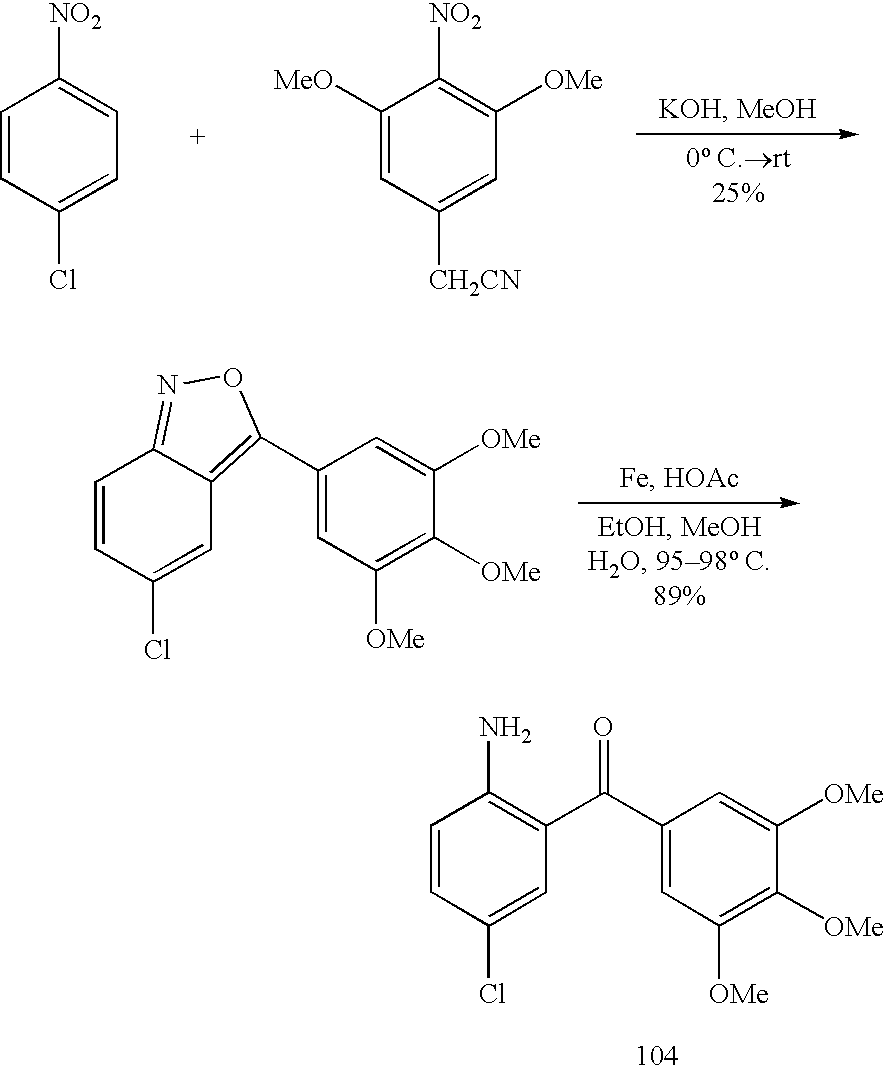
- Potassium hydroxide pellets (85%, 5.76g, 87.3 mmol, 17.5 equiv) were dissolved in methanol (12 mL). The mixture was cooled with an ice bath, and a solution of p-chloronitrobenzene (788 mg, 5 mmol) and 3,4,5-trimethoxyphenylacetonitrile (Acros, 1.140 g, 5.5 mmol) in methanol (15 mL) was added dropwise (ref Davis, R. B.; Pizzini, L. C. J. Org. Chem. 1960, 25, 1884-1888). The dark purple reaction mixture was slowly warmed up to room temperature overnight and then poured into water (250 mL). The precipitates were collected by a suction filtration, washed several times with water, air-dried, and subject to flash column chromatography over silica gel using ethyl acetate/hexanes (1:10, 1:6, and 1:4). 5-Chloro-3-(3,4,5-trimethoxy-phenyl)benzo[c]isoxazole was isolated as a slightly yellow solid (405 mg, 25% yield). 1H NMR (300 MHz, CDCl3) δ7.75 (m, 1H), 7.59 (m, 1H), 7.27 (m, 1H), 7.16 (s, 2H), 4.01 (s, 6H), 3.96 (s, 3H). APCI-MS: m/z 320 [Cl16H14ClNO4+H]+. m.p. 119-120° C.
- A mixture of iron powder (183 mg, 3.28 mmol, 3 equiv), ethanol (4 mL), water (2 mL), and acetic acid (6 mL) was preheated to 60° C. (oil bath). 5-Chloro-3-(3,4,5-trimethoxyphenyl)-benzo[c]isoxazole (350 mg, 1.10 mmol) in methanol (10 mL) was then added and the reaction mixture was stirred for 30 min at that temperature and then overnight at 95-98° C. Most of the solvents were removed by rotary evaporation and the residue was diluted with dichloromethane (100 mL). Insoluble inorganics were removed by filtration and the filtrate solution was concentrated by rotary evaporation. The resulting solid was subject to flash column chromatography over silica gel using ethyl acetate/hexanes (1:10, 1:6, 1:4, and 1:2). (2-Amino-5-chlorophenyl)-(3,4,5-trimethoxyphenyl)methanone was isolated as a yellow solid (315 mg, 89% yield). 1H NMR (500 MHz, CD3OD) δ7.35 (m, 1H), 7.24 (m, 1H), 6.91 (s, 2H), 6.83 (m, 1H), 3.86 (s, 6H), 3.85 (s, 3H). APCI-MS: m/z 322 [C16H16ClNO4+H]+. m.p. 141-142° C.
- 101, 102 and 103 are representatives of a series of compounds that demonstrate inhibition of Edg-1 stimulated S1P responses. The compounds were tested in HTC cells expressing human Edg-1 receptors. The rat hepatoma cell line, HTC, does not express any detectable levels of any of the known Edg receptors. Therefore, HTC proved to be a useful system because Edg-1 could be tested in isolation when recombinantly introduced into these cells. The compounds were tested in this recombinant system first, and subsequently tested in cell lines expressing Edg-1 (in addition to other Edg receptors).
- FIG. 1 demonstrates that 101 specifically inhibited Edg-1 receptors. 101 did not inhibit LPA-stimulated calcium increases in HTC cells expressing Edg-2, Edg-4 or Edg-7 receptors and also did not inhibit S1P-stimulated calcium increases in HTC cells expressing Edg-3, Edg-5, Edg -6 or Edg-8 in concentrations as high as 20 μM.
- FIG. 2 demonstrates that another Edg-1 antagonist, 102 specifically inhibited Edg-1 receptors. 102 did not inhibit LPA-stimulated calcium increases in HTC cells expressing Edg-2, Edg-4 or Edg-7 receptors and also did not inhibit S1P-stimulated calcium increases in HTC cells expressing Edg-3, Edg-5, Edg -6 or Edg-8 in concentrations as high as 20 μM.
- FIG. 3 demonstrates that another Edg-1 antagonist, 103 specifically inhibited Edg-1 receptors. 103 did not inhibit LPA-stimulated calcium increases in HTC cells expressing Edg-2, Edg-4 or Edg-7 receptors and also did not inhibit S1P-stimulated calcium increases in HTC cells expressing Edg-3, Edg-5,
Edg 6 or Edg-8 in concentrations as high as 20 μM. - FIG. 4 demonstrates that the Edg-1
antagonist 101 inhibits S1P induced calcium responses in a dose-dependent manner in human umbilical vein endothelial cells. The calcium mobilization assay was performed according to Section 7.10, below. - FIG. 5 demonstrates that the Edg-1
antagonist 102 inhibits S1P induced calcium responses in a dose-dependent manner in human umbilical vein endothelial cells. The calcium mobilization assay was performed according to Section 7.10, below. - Selectivity of 101, 102 and 103 for Edg-1 is also demonstrated in Table 2. Table 2 demonstrates the selectivity of 101, 102, and 103 for Edg-1 relative to other Edg receptors. Table 3 is a list of targets, including GPCRs and ion channels, against which 101 (10 μM) showed no activity in standard binding assays. The radioligand binding assays were conducted as described in Section 7.15.
- As shown above, 101 selectively inhibits Edg-1 mediated S1P responses. In addition to Edg-1, other Edg receptors are also implicated in S1P stimulated chemotaxis, including Edg-3 and Edg-6. To assess the relative roles of the Edg-1 receptors and Edg-3 receptors in S1P stimulated chemotaxis, the ability of S1P to evoke trans-matrigel chemotaxis was tested in the presence of the Edg-1
antagonist 101, the Edg-3antagonist 301, and the combination of 101 and 301. These experiments were performed according to the migration and invasion assay protocols described in Section 7.12, below. The Edg-3antagonist 301, 3-Methyl-2-phenyl-quinoline-4-carboxylic acid 4-fluoro-benzylamide, is extensively described in co-pending U.S. application Ser. No. 10/390,426, which is incorporated by reference in its entirety. 301 is identified ascompound 101 in U.S. application Ser. No. 10/390,426. Further, 301 is commercially available from Specs (The Netherlands) as compound number AK-968/12971392. - FIG. 10 presents the results of these experiments, showing that both
compound 101 andcompound 301 inhibit S1P-stimulated chemotaxis. In addition, 101 is a more potent inhibitor of S1P-stimulated chemotaxis than 301. Further, the results indicate that the inhibitory effect of 101 and 301 are additive, suggesting that combinations of Edg-1 agonists and/or antagonists and agonists and/or antagonists of Edg-3 or other Edg receptors may be useful in the methods of the invention. - Selectivity of the Edg-1
agonist 104 is shown in Table 4. Table 4 demonstrates the selectivity of 104 for Edg-1 relative to other Edg receptors. 104 did not elicit a calcium response in HTC cells expressing Edg-2, Edg-3, Edg -4, Edg-5, Edg -6, Edg-7 or Edg-8 receptors in concentrations as high as 25 μM. The calcium mobilization assay was performed according to Section 7.10, below. - Edg-1 receptors and Edg-6 receptors are strongly expressed in naïve CD4 and CD8 cells, but much less strongly expressed in CD4 and CD8 cells that have been exposed to antigen. Without intending to be bound to any theory or mechanism of action, it is believed that the Edg-1 and Edg-6 receptors regulate the sensitivity of CD4 and CD8 lymphocytes cytokines that bring the lymphocytes to compartments where they are exposed to antigen. As part of this mechanism, Edg-1 modulates lymphocytes' chemotactic response to cytokines, including, for example, exodus-2.
- To assess this modulation and to test the effects of Edg-1 agonists and antagonists on this effect, murine CD4 T cells chemotactic responses to exodus-2 were tested in the presence of S1P and the Edg-1
agonist 104. These experiments were performed according to the migration and invasion assay protocols described in Section 7.12, below. - FIG. 11 presents the results of these experiments. It shows that both S1P and 104 exhibit a bell-shaped dose dependant response curve to chemotaxis of murine CD4 T cells to exodus-2. At low and high concentrations of S1P and 104, the chemotactic response to exodus-2 is desensitized, but moderate concentrations of S1P and 104 stimulate the chemotactic response to exodus-2. Further, S1P and 104 exhibit the same profile on the chemotactic response to exodus-2, but higher concentrations of 104 than S1P are required to exert the same effect on the chemotactic response.
- The effects of Edg-1 antagonists on S1P regulation of the chemotactic response to exodus-2 were also assessed. This experiment was performed according to the migration and invasion assay protocols described in Section 7.12, below. FIG. 12 shows the results of experiments testing the ability of the Edg-1 antagonists FTY720 and 102 to reverse S1P-mediated stimulation and desensitization of the chemotactic response to exodus-2. At moderate concentrations of S1P, FTY720 and 102 inhibit S1P-mediated stimulation of the chemotactic response to exodus-2. At high concentrations of S1P, FTY720 and 102 reverse S1P-mediated desensitization of the chemotactic response to exodus-2. Thus, these Edg-1 antagonists can antagonize both aspects of the regulation by S1P of exodus-2-mediated chemotaxis.
- S1P is a strong chemoattractant to human PBMCs. This effect is believed to be mediated by S1P receptors, notably Edg-1 (Mandala et al., Science 2002; Lynch et al., JBC 2002; Goetzl, personal communication). Several migration assays were performed to test this hypothesis and to determine the effect of Edg-1 agonists and antagonists on S1P mediated chemotaxis. The migration assays were performed according to the protocol described in Section 7.12, below. The results of theses assays are presented in FIG. 6, FIG. 7, FIG. 8, FIG. 9 and FIG. 13.
- FIG. 13 shows that S1P attracts human PMBCs in a dose dependent manner. FIG. 7 demonstrates that the Edg-1
agonist 104 stimulates invasion of Human Umbilical Vein Endothelial cells at concentrations between 0.5-100 μM, though this stimulation is significantly less potent that S1P. In addition, FIG. 9 shows that 104 also stimulates migration of human peripheral blood mononuclear cells at micromolar concentrations. Thus, 104 can attract cells expressing the Edg-1 receptor in a manner similar to S1P. - Further, FIGS. 6 and 8 show that Edg-1 antagonists can inhibit S1P and 104-mediated chemotaxis, indicating that the S1P chemoattractant effect is likely mediated by the Edg-1 receptor. FIG. 6 shows that the Edg-1
antagonist 102 inhibits S1P-induced matrigel invasion, while FIG. 8 demonstrates that the Edg-1antagonist 101 inhibits 104-induced matrigel invasion. - To further elucidate the role of the Edg-1 receptor in lymphocyte trafficking, migration of mouse T cells was analyzed in both in vitro and in vivo models. Migration of mouse T cells was first tested in Transwell chambers (Costar, Cambridge, Mass.) with polycarbonate fibers having a pore width of 8 μm, separated by a layer of matrigel. Stimulants S1P or exodus-2 were separately added to the bottom chamber. The effects of exodus-2 were tested alone, with S1P, and with S1P and Edg-1
antagonists - FIG. 14 presents the results of this experiment. The data show that high concentrations of S1P alone do not stimulate T cell migration, while exodus-2 does stimulate T cell migration. However, 101 and 102 enhance exodus-2-stimulated migration even in the presence of S1P. Thus, Edg-1 antagonists can reverse S1P-mediated inhibition of migration of T-cells to exodus-2 in vitro.
- To test migration of mouse T cells in vivo, the ability of exodus-2 to attract mouse lymphocytes was assessed in the mouse dorsal air-pouch model. In these experiments, 0.5
ml 1 μM exodus-2 was introduced into a dorsal air-pouch produced by injecting 5 ml of filtered air subcutaneously. Mouse splenic CD4 T cells were fluorescently labeled with FM-DiI (Molecular Probes, Inc., Eugene, Oreg.), then treated with S1P (1 μM), 102, or 104. The treated CD4T cells were introduced into the peritoneal cavity. After 24 hours, lavage (1 ml) from the dorsal air pouch was assayed for fluorescence. - FIG. 15 presents the results of this experiment. The data indicate that the Edg-1 receptor, and compounds that modulate the Edg-1 receptor, can regulate lymphocyte tracking in the mouse air-pouch model. In particular, PBS-treated lymphocytes migrate to the chemoattractant exodus-2, while lymphocytes treated with S1P or the Edg-1
agonist 104 do not. Thus, the in vivo mouse dorsal air-pouch animal model confirms that S1P or 104 stimulation of the Edg-1 receptor desensitizes the lymphocytes to attraction by exodus-2. Further, this S1P-mediated desensitization can be reversed by co-treatment with the selective Edg-1antagonist 102. - These experiments confirm that S1P regulates the ability of lymphocytes to respond to various chemotactic factors, as exemplified by exodus-2. These experiments further indicate that S1P-dependent regulation of the ability to respond to such chemotactic factors is mediated at least in part by the Edg-1 receptor. Finally, the experiments show that use of selective Edg-1 agonists and antagonists can successfully manipulate this regulation, permitting increased or decreased lymphocyte homing and trafficking as desired.
- LPA receptors such as Edg-1, couple to calcium effector pathways, and result in increases in intracellular calcium following receptor activation (An, 1998, J. Cell Biochem. Supp 30-31:147-157). This biological response lends itself to a very efficient, high-throughput screen using a Fluorescence Imaging Plate Reader (FLIPR; Molecular Devices, Sunnyvale, Calif.). The FLIPR system is a real-time, cell-based assay system with continuous fluorescence detection using a cooled CCD camera. The FLIPR system was used to develop an Edg-1 receptor screen. Rat hepatoma cells stably expressing Edg-1/3i3 chimera or Edg-1 and Gqi were plated on 384-well plates and loaded with a calcium dye loading kit (Molecular Devices, Sunnyvale, Calif.) for 1 hour at room temperature. Cells were then placed on the FLIPR 384 (Molecular Devices, Sunnyvale, Calif.) and excited by an argon laser at 488 nm. The data for the entire 384-well plate was updated every second. An integrated robotic pipettor allowed for simultaneous compound addition into each individual well in the plate.
- IL-8 and VEGF assays were performed by standard enzyme-linked immunosorbent assay (“ELISA”) techniques. Cells were cultured in a 96 well format, serum starved overnight, and treated with LPA or S1P (doses range from 0.1-10 μM in serum free medium) for 24 hours. Cell supernatants were then collected to measure the amount of IL-8 secreted.
- The assay was a standard sandwich ELISA in which an anti-IL-8 or VEGF capture antibody was adsorbed to a plastic dish. Cell supernatants containing IL-8 or VEGF were added to the dish, and then an anti-IL-8/VEGF biotinylated detection antibody and streptavidin-HRP were added.
- Detection was via the addition of a substrate solution and colorimetric reading using a microtiter plate reader. The level of IL-8 or VEGF was interpolated by non-linear regression analysis from a standard curve.
- All reagents were from R&D Systems, Minneapolis, Minn.: MAB208 and AF-293-NA (capture antibody for IL-8 and VEGF respectively), BAF208 and BAF-293 (detection Ab for IL-8 and VEGF respectively), 208-IL-010 and 293-VE-010 (recombinant human IL-8 protein standard and recombinant human VEGF protein standard respectively), DY998 (streptavidin-HRP), DY999 (substrate solution).
- Cells were plated in a 24 well format using Fluoroblok filter insert plates (8 μM pore size) or Fluoroblok matrigel coated filter insert plates (Becton Dickinson, San Diego, Calif.). The assay was a modified Boyden Chamber assay in which a cell suspension (1×10 5 cells/ml) was prepared in serum free medium and added to the top chamber. LPA or S1P (doses ranged from 0.1-10 μM in serum free medium) was added to the bottom chamber. Following a 20-24 hour incubation period, the number of cells migrating or invading into the lower chamber was quantitated by transferring the filter insert into a fresh 24-well plate containing 4 μg/ml calcein AM (Molecular Probes, Sunnyvale, Calif.) in Hank's Balanced Salt Solution and staining for one hour.
- Detection was via fluorescent readout at 450 nm excitation/530 nm emission using a fluorimeter. The level of fluorescence correlated with cell number.
- For most cells types, no further manipulation was required. For CaOV3 human ovarian cancer cells, however, it was necessary that the cells be serum starved overnight prior to preparing the cell suspension. In addition, the filter inserts were coated with a solution of 1 mg/ml rat-tail Collagen I (BD, San Diego, Calif.).
- Human PBMCs are isolated from the buffy coats of healthy donors from the Stanford Blood Center. The blood is washed one time with PBS, then layered over a Ficoll gradient and centrifuged for 45 minutes at 400 g. The white mononuclear cell layer is removed and washed three times with PBS. The cells are then resuspended in complete RPMI containing 5 μg/ml PHA and 100 ng/ml recombinant human IL-2 and cultured in T175 flasks at a cell density should of 1×10 6 cells/ml. For maintenance in culture, cells are washed and resuspended in fresh RPMI+IL-2 every 3-5 days.
- Cells were plated in a 96 well format. Treatments were performed directly without any serum starvation, and typically included LPA or S1P doses in a range from 0.1-10 μM in serum free medium. Cells were treated for 24-48 before the extent of cellular proliferation was measured.
- The assay was performed using the ViaLight HS kit from BioWhittaker, Rockland, Me., which is based upon the bioluminescent measurement of ATP that is present in all metabolically active cells. The reaction utilized an enzyme, luciferase, which catalyzes the formation of light from ATP and luciferin. The emitted light intensity was linearly related to the ATP concentration, which correlated with cell number.
- Measurement of cell proliferation required the extraction of ATP by the addition of Nucleotide Releasing Reagent, followed by the addition of the ATP Monitoring Reagent (both provided in kit). Detection was via chemiluminescence using the EG&G Berthold Luminometer, Gaithersburg, Md.
- Cells were plated in a 96 well format. Treatments were performed directly without any serum starvation. The cells were treated with forskolin to induce cAMP production, followed by LPA or S1P doses in the range from 0.1-10 μM in serum free medium. Following a 30-minute incubation period, the cells were lysed and the level of cAMP was determined.
- The cAMP assay was performed using the Tropix cAMP-Screen (Applied BioSystems, Foster City, Calif.). The screen is a competitive immunoassay that utilizes a 96 well assay plate precoated with an anti-cAMP antibody. Cell lysates were added to the precoated plate, along with a cAMP-AP conjugate and a secondary anti-cAMP antibody.
- Detection was performed using a substrate solution and chemiluminescent readout. The level of chemiluminescence was inversely proportional to the level of cAMP and was calculated from a standard curve.
- In order to test the selectivity of compounds, various enzyme assays as well as radioligand binding assays were performed using numerous non-Edg receptor targets as listed below.
- A radioligand binding assay was performed using adrenergic α 1 according to the method of Greengrass and Bremner 1979, Eur. J. Pharmacol. 55:323-326. A radioligand binding assay was performed using adrenergic α2 according to the method of Boyajian and Leslie, 1987, J. Pharmacol. Exp. Ther. 241:1092-1098. A radioligand binding assay was performed using adrenergic β according to the method of Feve et al., 1994, Proc. Natl. Acad. Sci. USA 91:5677-5681. A radioligand binding assay was performed using angiotensin AT2 according to the method of Whitebread et al., 1991, Biochem. Biophys. Res. Comm. 181:1365-1371. A radioligand binding assay was performed using calcium channel Type L, dihydropyridine according to the method of Ehlert et al., 1982, Life Sci. 30:2191-2202. A radioligand binding assay was performed using dopamine D2L according to the method of Bunzo et al., 1988, Nature 336:783-787. A radioligand binding assay was performed using endothelin ETA according to the method of Mihara et al., 1994, J. Pharmacol. Exp. Ther. 268:1122-1127. A radioligand binding assay was performed using histamine H1 Central according to the method of Hill et al., 1978, J. Neurochem. 31:997-1004. A radioligand binding assay was performed using Muscarinic non-selective, Central according to the method of Luthin and Wolfe, 1984, J. Pharmacol. Exp. Ther. 228:648-655. A radioligand binding assay was performed using serotonin 5-HT1, non-selective according to the method of Middlemiss, 1984, Eur. J. Pharmacol. 101:289-293).
- 7.15.1. Radioligand Binding Assays
- 1. Adrenergic α 1, non-selective (Broadhurst et al., 1988, Life Sci. 43:83-92).
- Source: Wistar Rat brain
- Ligand: 0.25 nM 3H Prazosin
- Vehicle: 0.4% DMSO
- Incubation Time/Temp: 30 minutes at 25° C.
- Incubation Buffer: 50 mM Tris-HCl, 0.1% ascorbic acid, 10 μM
- NonSpecific Ligand: 0.1 μM Phentolamine
- K d: 0.29nM*
- B max: 0.095 pmol/mg Protein*
- Specific Binding: 90% *
- Quantitation Method: Radioligand Binding
- Significance Criteria: ≧50% of max stimulation or inhibition
- 2. Adrenergic α 2 (Boyajian and Leslie, 1987, J. Pharmacol. Exp. Ther. 241:1092-1098).
- Source: Wistar rat cerebral cortex
- Ligand: 0.7 nM 3H Rauwolscine
- Vehicle: 0.4% DMSO
- Incubation Time/Temp: 30 minutes at 25° C.
- Incubation Buffer: 20 mM HEPES, 2.5 mM Tris-HCl, pH 7.4 at 25° C.
- NonSpecific Ligand: 1 μM Yohimbine
- K d: 7.8 nM *
- B max: 0.36 pmol/mg Protein*
- Specific Binding: 80% *
- Quantitation Method: Radioligand Binding
- Significance Criteria: ≧50% of max stimulation or inhibition
- 3. Adrenergic β (Feve et al., 1994 , Proc. Natl. Acad. Sci. USA 91:5677-5681).
- Source: Wistar rat brain
- Ligand: 0.25 nM 3H Dihydroaplenolol
- Vehicle: 0.4% DMSO
- Incubation Time/Temp: 20 minutes at 25° C.
- Incubation Buffer: 50 mM Tris-HCl, pH 7.4
- NonSpecific Ligand: 1 μM S(−)-Propranolol
- K d: 0.5 nM *
- B max: 0.083 pmol/mg Protein*
- Specific Binding: 85% *
- Quantitation Method: Radioligand Binding
- Significance Criteria: ≧50% of max stimulation or inhibition
- 4. Angiotensin AT2 (Whitebread et al., 1991 , Biochem. Biophys. Res. Comm. 181:1365-1371).
- Source: Human recombinant Hela cells
- Ligand: 0.025 nM 125I, CGP-42112A
- Vehicle: 0.4% DMSO
- Incubation Time/Temp: 3 hours at 37° C.
- Incubation Buffer: 50 mM Tris-HCl, 5 mM MgCl 2, 0.1% BSA, 1 mM EDTA, pH 7.4
- NonSpecific Ligand: 10 μM [Sar 1, Ile8]-Ang II
- K d: 0.012 nM *
- B max: 2.9 pmol/mg Protein*
- Specific Binding: 90% *
- Quantitation Method: Radioligand Binding
- Significance Criteria: ≧50% of max stimulation or inhibition
- 5. Calcium Channel Type L, Dihydropyridine (Ehlert et al., 1982 , Life Sci. 30:2191-2202).
- Source: Wistar Rat cerebral cortex
- Ligand: 0.1 nM 3H Nitrendipine
- Vehicle: 0.4% DMSO
- Incubation Time/Temp: 90 minutes at 25° C.
- Incubation Buffer: 50 mM Tris-HCl, pH 7.7
- NonSpecific Ligand: 1 μM Nitrendipine
- K d: 0.18 nM *
- B max: 0.23 pmol/mg Protein*
- Specific Binding: 91% *
- Quantitation Method: Radioligand Binding
- Significance Criteria: ≧50% of max stimulation or inhibition
- 6. Dopamine D 2L (Bunzo et al., 1988, Nature 336:783-787).
- Source: Human recombinant CHO cells
- Ligand: 0.16 nM 3H Spiperone
- Vehicle: 0.4% DMSO
- Incubation Time/Temp: 2 hours at 25° C.
- Incubation Buffer: 50 mM Tris-HCl, pH 7.4, 150 mM NaCl, 1.4 mM ascorbic acid, 0.001% BSA
- NonSpecific Ligand: 10 μM Haloperidol
- K d: 0.08nM*
- B max: 0.48 pmol/mg Protein*
- Specific Binding: 85% *
- Quantitation Method: Radioligand Binding
- Significance Criteria: ≧50% of max stimulation or inhibition
- 7. Endothelin ETA (Mihara et al., 1994 , J. Pharmacol. Exp Ther. 268:1122-1127).
- Source: Human recombinant CHO cells
- Ligand: 0.03 nM 125I Endothelin
- Vehicle: 0.4% DMSO
- Incubation Time/Temp: 2 hours at 37° C.
- Incubation Buffer: 50 mM Tris-HCl, pH 7.4, 0.5 mM CaCl2, 0.1% bacitracin, 0.05% Tween-20, 1 mg/ml BSA
- NonSpecific Ligand: 0.1 μM Endothelin-1
- K d: 0.048 nM *
- B max: 0.35 pmol/mg Protein*
- Specific Binding: 90% *
- Quantitation Method: Radioligand Binding
- Significance Criteria: ≧50% of max stimulation or inhibition
- 8. Histamine H 1, Central (Hill et al., 1978, J. Neurochem. 31:997-1004).
- Source: Guinea pig cerebellum
- Ligand: 1.75 nM 3H Pyrilamine
- Vehicle: 0.4% DMSO
- Incubation Time/Temp: 60 minutes at 25° C.
- Incubation Buffer: 50 mM K-Na phosphate buffer pH 7.4 at 25° C.
- NonSpecific Ligand: 1 μM Pyrilamine
- K d: 0.23 nM *
- B max: 0.198 pmol/mg Protein*
- Specific Binding: 90% *
- Quantitation Method: Radioligand Binding
- Significance Criteria: ≧50% of max stimulation or inhibition
- 9. Muscarinic non-selective, Central (Luthin and Wolfe, 1984 , J. Pharmacol. Exp. Ther. 228:648-655).
- Source: Wistar rat cerebral cortex
- Ligand: 0.29 nM 3H Quinuclidinyl benzilate
- Vehicle: 0.4% DMSO
- Incubation Time/Temp: 60 minutes at 25° C.
- Incubation Buffer: 50 mM Na—K Phosphate, pH 7.4
- NonSpecific Ligand: 0.1 μM Atropine
- K d: 0.068 nM *
- B max: 1.4 pmol/mg Protein*
- Specific Binding: 97% *
- Quantitation Method: Radioligand Binding
- Significance Criteria: ≧50% of max stimulation or inhibition
- 10. Serotonin 5-HT1, non-selective (Middlemiss, 1984 , Eur. J. Pharmacol. 101:289-293).
- Source: Wistar rat cerebral cortex
- Ligand: 2 nM 3H Serotonin (5-HT) Trifluoroacetate
- Vehicle: 0.4% DMSO
- Incubation Time/Temp: 10 minutes at 25° C.
- Incubation Buffer: 50 mM Tris-HCl, 0.1% ascorbic acid, 10 μM pargyline, 4 mM CaCl2, pH 7.6
- NonSpecific Ligand: 10 μM 5-HT (Serotonin)
- K d: 0.61 nM *
- B max: 0.58 pmol/mg Protein*
- Specific Binding: 80% *
- Quantitation Method: Radioligand Binding
- Significance Criteria: ≧50% of max stimulation or inhibition
- Historical Values
- Finally, it should be noted that there are alternative ways of implementing both the present invention. Accordingly, the present embodiments are to be considered as illustrative and not restrictive, and the invention is not to be limited to the details given herein, but may be modified within the scope and equivalents of the appended claims.
- All publications and patents cited herein incorporated by reference in their entirety.
TABLE 1 IC50 Compound Structure (μM) VENDOR VENDOR ID 105 
1.29 Asinex BAS 0341 646 106 
1.74 Specs AG-670/11899149 107 
3.51 Chembridge 5798691 108 
3.56 Interbioscreen 1S-94315 109 
3.94 Interbioscreen 2S-04374 110 
4.58 Specs AG-205/36717010 111 
5.08 Chembridge 5660333 112 
5.92 Asinex BAS 1996652 113 
6.02 Specs AG-205/36656002 -
TABLE 2 Selectivity of 101, 102 and 103 for Edg-1 101 102 103 Edg 1 IC50 μM2.25 1.69 0.74 Edg 2 IC50 μM>20 >20 >20 Edg 3 IC50 μM>20 >20 >20 Edg 4 IC50 μM>20 >20 >20 Edg 5 IC50 μM>20 >20 >20 Edg 6 IC50 μM>20 >20 >20 Edg 7 IC50 μM>20 >20 >20 Edg 8 IC50 μM>20 >20 >20 Fold Selectivity >8.9 >11.8 >27.0 -
TABLE 3 Binding Assay Adrenergic Alpha 1, non-selective Alpha 2, non-selective Beta, non-selective Calcium Channels Type L, DHP Dopamine D2L Endothelin ETA H1 central Muscarinic, non-selective, central Serotonin 5HT1 non-selective Angiotensin AT2 -
TABLE 4 Selectivity of Edg-1 Agonist 104104 Edg 1/Gqi EC50 μM10.0 Edg 2 EC50 μM >25 Edg 3 EC50 μM >25 Edg 4 EC50 μM >25 Edg 5 EC50 μM >25 Edg 6 EC50 μM >25 Edg 7 EC50 μM >25 Edg 8 EC50 μM >25 Null/Gqi EC50 μM >25 Fold Selectivity >2.5
Claims (50)
1. A method of modulating an Edg-1 receptor mediated biological activity, comprising contacting a cell expressing the Edg-1 receptor with an amount of a modulator of the Edg-1 receptor sufficient to modulate the Edg-1 receptor mediated biological activity, wherein the modulator is not a phospholipid.
2. A method of modulating an Edg-1 receptor mediated biological activity in a subject, comprising administering to the subject a therapeutically effective amount of a modulator of the Edg-1 receptor, wherein the modulator is not a phospholipid.
3. The method of claim 1 or 2, wherein the modulator is an agonist.
4. The method of claim 1 or 2, wherein the modulator is an antagonist.
5. The method of claim 1 or 2, wherein the modulator exhibits at least about 200 fold inhibitory selectivity for Edg-1 relative to other Edg receptors.
6. The method of claim 1 or 2, wherein the modulator exhibits at least about 100 fold inhibitory selectivity for Edg-1 relative to other Edg receptors.
7. The method of claim 1 or 2, wherein the modulator exhibits at least about 20 fold inhibitory selectivity for Edg-1 relative to other Edg receptors.
8. The method of claim 1 or 2, wherein the inhibitor exhibits at least about 5 fold inhibitory selectivity for Edg-1 relative to other Edg receptors.
9. The method of claim 1 or 2, wherein the inhibitor exhibits at least about 200 fold inhibitory selectivity for Edg-1 relative to Edg-3, Edg-5, Edg-6 and Edg-8 receptors.
10. The method of claim 1 or 2, wherein the inhibitor exhibits at least about 100 fold inhibitory selectivity for Edg-1 relative to Edg-3, Edg-5, Edg-6 and Edg-8 receptors.
11. The method of claim 1 or 2, wherein the inhibitor exhibits at least about 20 fold inhibitory selectivity for Edg-1 relative to Edg-3, Edg-5, Edg-6 and Edg-8 receptors.
12. The method of claim 1 or 2, wherein the inhibitor exhibits at least about 5 fold inhibitory selectivity for Edg-1 relative to Edg-3, Edg-5, Edg-6 and Edg-8 receptors.
13. The method of claim 1 or 2, wherein the biological activity is cell proliferation.
14. The method of claim 13 , wherein the inhibitor exhibits at least about 200 fold inhibitory selectivity for Edg-1 relative to other Edg receptors.
15. The method of claim 13 , wherein the modulator exhibits at least about 5 fold inhibitory selectivity for Edg-1 relative to other Edg receptors.
16. The method of claim 13 , wherein the modulator exhibits at least about 200 fold inhibitory selectivity for Edg-1 relative to Edg-3, Edg-5, Edg-6 and Edg-8 receptors.
17. The method of claim 13 , wherein the modulator exhibits at least about 20 fold inhibitory selectivity for Edg-1 relative to Edg-3, Edg-5, Edg-6 and Edg-8 receptors.
18. The method of claim 13 , wherein cell proliferation leads to ovarian cancer, peritoneal cancer, endometrial cancer, cervical cancer, breast cancer, colon cancer or prostrate cancer.
19. The method of claim 13 , wherein cell proliferation is stimulated by S1P.
20. The method of claim 1 or 2, wherein the biological activity is calcium mobilization, VEGF synthesis, IL-8 synthesis, platelet activation, cell migration, phosphoinositide hydrolysis, inhibition of cAMP formation, increasing the level of fatty acids, actin polymerization, apoptosis, angiogenesis, inhibition of wound healing, inflammation, expression of endogenous protein growth factors, cancer invasiveness, vasoconstriction or atherogenesis.
21. The method of claim 1 or 2 wherein the modulator binds to the Edg-1 receptor with a binding constant between about 10 μM to about 1 nM.
22. The method of claim 1 or 2 wherein the modulator binds to the Edg-1 receptor with a binding constant of at least about 1 μM.
23. The method of claim 1 or 2 wherein the modulator binds to the Edg-1 receptor with a binding constant of at least about 10 nM.
24. The method of claim 1 or 2, wherein the modulator is a nucleic acid, peptide or carbohydrate.
25. The method of claim 1 or 2, wherein the modulator is an organic molecule of molecular weight of less than 750 daltons.
26. The method of claim 1 , wherein the cell is a HTC hepatoma cell, an ovarian cell, an epithelial cell, a fibroblast cell, a neuronal cell, a carcinoma cell, a pheochromocytoma cell, a myoblast cell, a platelet cell or a fibrosarcoma cell.
27. The method of claim 21 , wherein the cell is OV202 human ovarian cell, a HTC rat hepatoma cell, a CAOV-3 human ovarian cancer cell, MDA-MB-453 breast cancer cell, MDA-MB-231 breast cancer cell, HUVEC cells A431 human epitheloid carcinoma cell or a HT-1080 human fibrosarcoma cell.
28. The method of claim 1 or 2, wherein the modulator is a compound of structural formula (I):

or a pharmaceutically available solvate or hydrate thereof, wherein:
n=0, 1, 2, 3, 4 or 5;
X is CR5 or N;
Y is CR5R5 or NR1;
R1 is either absent or hydrogen, alkyl, substituted alkyl, acyl, substituted acyl, acylamino, substituted acylamino, alkylamino, substituted alkylamino, alkylthio, substituted alkylthio, alkoxy, substituted alkoxy, alkoxycarbonyl, substituted alkoxycarbonyl, alkylarylamino, substituted alkylarylamino, arylalkyloxy, substituted arylalkyloxy, amino, aryl, substituted aryl, arylalkyl, substituted arylalkyl, arylamino, substituted arylamino, arylsulfonyl, substituted arylsulfonyl, carboxy, carbamoyl, substituted carbamoyl, cycloalkyl, substituted cycloalkyl, cycloheteroalkyl, substituted cycloheteroalkyl, dialkylamino, substituted dialkylamino, heteroaryloxy, substituted heteroaryloxy, heteroaryl, substituted heteroaryl, heteroalkyl, or substituted heteroalkyl;
R2, R3 and each R5 are independently hydrogen, alkyl, substituted alkyl, acyl, substituted acyl, acylamino, substituted acylamino, alkylamino, substituted alkylamino, alkylthio, substituted alkylthio, alkoxy, substituted alkoxy, alkoxycarbonyl, substituted alkoxycarbonyl, alkylarylamino, substituted alkylarylamino, arylalkyloxy, substituted arylalkyloxy, amino, aryl, substituted aryl, arylalkyl, substituted arylalkyl, arylamino, substituted arylamino, arylsulfonyl, substituted arylsulfonyl, carboxy, carbamoyl, substituted carbamoyl, cycloalkyl, substituted cycloalkyl, cycloheteroalkyl, substituted cycloheteroalkyl, dialkylamino, substituted dialkylamino, heteroaryloxy, substituted heteroaryloxy, heteroaryl, substituted heteroaryl, heteroalkyl, substituted heteroalkyl, hydroxyl, nitro or thio; and
each R4 is independently alkyl, substituted alkyl, acyl, substituted acyl, acylamino, substituted acylamino, alkylamino, substituted alkylamino, alkylthio, substituted alkylthio, alkoxy, substituted alkoxy, alkoxycarbonyl, substituted alkoxycarbonyl, alkylarylamino, substituted alkylarylamino, arylalkyloxy, substituted arylalkyloxy, amino, aryl, substituted aryl, arylalkyl, substituted arylalkyl, arylsulfonyl, substituted arylsulfonyl, azido, carboxy, carbamoyl, substituted carbamoyl, carboxyl, cyano, cycloalkyl, substituted cycloalkyl, cycloheteroalkyl, substituted cycloheteroalkyl, dialkylamino, substituted dialkylamino, halo, heteroaryloxy, substituted heteroaryloxy, heteroaryl, substituted heteroaryl, heteroalkyl, substituted heteroalkyl, hydroxyl, nitro or thio.
29. The method of claim 1 or 2, wherein the modulator is a compound of structural formula (II):

or a pharmaceutically available solvate or hydrate thereof, wherein:
X is O or S;
each R1, R2, R3, R4 and R5 is independently hydrogen, alkyl, substituted alkyl, acyl, substituted acyl, acylamino, substituted acylamino, alkylamino, substituted alkylamino, alkylthio, substituted alkylthio, alkoxy, substituted alkoxy, alkoxycarbonyl, substituted alkoxycarbonyl, alkylarylamino, substituted alkylarylamino, arylalkyloxy, substituted arylalkyloxy, amino, aryl, substituted aryl, arylalkyl, substituted arylalkyl, arylsulfonyl, substituted arylsulfonyl, azido, carboxy, carbamoyl, substituted carbamoyl, carboxyl, cyano, cycloalkyl, substituted cycloalkyl, cycloheteroalkyl, substituted cycloheteroalkyl, dialkylamino, substituted dialkylamino, halo, heteroaryloxy, substituted heteroaryloxy, heteroaryl, substituted heteroaryl, heteroalkyl, substituted heteroalkyl, hydroxyl, nitro or thio; and
each R6, R7, R8, R9 and R10 is independently hydrogen, alkyl, substituted alkyl, acyl, substituted acyl, acylamino, substituted acylamino, alkylamino, substituted alkylamino, alkylthio, substituted alkylthio, alkoxy, substituted alkoxy, alkoxycarbonyl, substituted alkoxycarbonyl, alkylarylamino, substituted alkylarylamino, arylalkyloxy, substituted arylalkyloxy, amino, aryl, substituted aryl, arylalkyl, substituted arylalkyl, arylsulfonyl, substituted arylsulfonyl, azido, carboxy, carbamoyl, substituted carbamoyl, carboxyl, cyano, cycloalkyl, substituted cycloalkyl, cycloheteroalkyl, substituted cycloheteroalkyl, dialkylamino, substituted dialkylamino, halo, heteroaryloxy, substituted heteroaryloxy, heteroaryl, substituted heteroaryl, heteroalkyl, substituted heteroalkyl, hydroxyl, nitro or thio.
30. The method of claim 1 or 2, wherein the modulator is a compound of structural formula (III):

or a pharmaceutically available solvate or hydrate thereof, wherein:
n is 1, 2, 3, 4 or 5;
m is 1, 2, 3, 4, or 5;
each X and Y is independently C or N; and
each R1, R2, R3, R4 and R5 is independently hydrogen, alkyl, substituted alkyl, acyl, substituted acyl, acylamino, substituted acylamino, alkylamino, substituted alkylamino, alkylthio, substituted alkylthio, alkoxy, substituted alkoxy, alkoxycarbonyl, substituted alkoxycarbonyl, alkylarylamino, substituted alkylarylamino, arylalkyloxy, substituted arylalkyloxy, amino, aryl, substituted aryl, arylalkyl, substituted arylalkyl, arylsulfonyl, substituted arylsulfonyl, azido, carboxy, carbamoyl, substituted carbamoyl, carboxyl, cyano, cycloalkyl, substituted cycloalkyl, cycloheteroalkyl, substituted cycloheteroalkyl, dialkylamino, substituted dialkylamino, halo, heteroaryloxy, substituted heteroaryloxy, heteroaryl, substituted heteroaryl, heteroalkyl, substituted heteroalkyl, hydroxyl, nitro or thio.
31. A method for treating or preventing cancers, acute lung diseases, acute inflammatory exacerbation of chronic lung diseases, surface epithelial cell injury, or cardiovascular diseases in a subject comprising administering to a subject in need of such treatment or prevention a therapeutically effective amount of a compound of structural formula (I), (II) or (III).
32. A method for treating or preventing ovarian cancer, peritoneal cancer, endometrial cancer, cervical cancer, breast cancer, colorectal cancer, uterine cancer, stomach cancer, small intestine cancer, thyroid cancer, lung cancer, kidney cancer, pancreas cancer, prostrate cancer, adult respiratory distress syndrome (ARDS), asthma, transcorneal freezing, cutaneous burns, ischemia or atherosclerosis in a subject comprising administering to a subject in need of such treatment or prevention a therapeutically effective amount of a compound of structural formula (I), (II) or (III).
33. A method for treating or preventing vasoconstriction, autoimmune disorders or vascular occlusive disorders in a subject comprising administering to a subject in need of such treatment or prevention a therapeutically effective amount of a compound of structural formula (I), (II) or (III).
34. A method for treating or preventing vasoconstriction in cerebral arteries, systemic lupus erythematosus, rheumatoid arthritis, non-glomerular nephrosis, psoriasis, chronic active hepatitis, ulcerative colitis, Crohn's disease, Behçet's disease, chronic glomerulonephritis, chronic thrombocytopenic purpura, autoimmune hemolytic anemia, migraine headache, stroke, subarachnoid hemorrhage, or a vasospasm in a subject comprising administering to a subject in need of such treatment or prevention a therapeutically effective amount of a compound of structural formula (I), (II) or (III).
35. A method for treating or preventing cancers, acute lung diseases, acute inflammatory exacerbation of chronic lung diseases, surface epithelial cell injury, cardiovascular diseases, vasoconstriction, autoimmune disorders or vascular occlusive disorders in a subject comprising administering to a subject in need of such treatment or prevention a therapeutically effective amount of a compound of structural formula (I), (II) or (III) and one or more agonists or antagonists of an Edg receptor.
36. A method for treating or preventing cancers, acute lung diseases, acute inflammatory exacerbation of chronic lung diseases, surface epithelial cell injury, cardiovascular diseases, vasoconstriction, autoimmune disorders or vascular occlusive disorders in a subject comprising administering to a subject in need of such treatment or prevention a therapeutically effective amount of a compound of structural formula (I), (II) or (III) and one or more drugs useful in treating or preventing cancers, acute lung diseases, acute inflammatory exacerbation of chronic lung diseases, surface epithelial cell injury, cardiovascular diseases, vasoconstriction, autoimmune disorders or vascular occlusive disorders.
37. The method of claim 28 , wherein the modulator is a compound of a formula that is selected from the group consisting of:


38. The method of claim 29 , wherein the modulator is a compound of formula

39. The method of claim 30 , wherein the modulator is a compound of formula
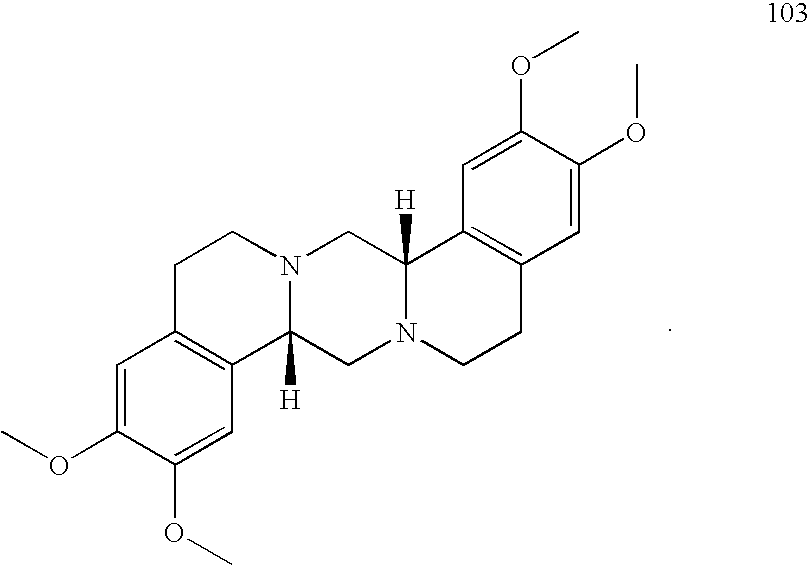
40. The method of claim 1 or 2, wherein the biological activity is an immune response.
41. The method of claim 40 , wherein the immune response is stimulated by S1P.
42. A method for treating or preventing a disorder in a subject, comprising administering to a subject in need of such treatment or prevention a therapeutically effective amount of a compound of structural formula (I), (II) or (III), wherein the compound of structural formula (I), (II) or (III) stimulates the immune system.
43. The method of claim 42 , wherein the subject suffers from an inherited immune deficiency.
44. The method of claim 42 , wherein the compound of structural formula (I), (II) or (III) is administered as an adjuvant to a vaccine.
45. The method of claim 42 , wherein the subject is infected with a virus.
46. The method of claim 45 , wherein the virus is selected from the group consisting of cytomegalovirus, herpes simplex virus I, herpes simplex virus II, influenza A virus, influenza B virus, hepatitis A virus, hepatitis B virus, hepatitis C virus, and human immunodeficiency virus.
47. A method for treating or preventing an immune disorder in a subject, comprising administering to a subject in need of such treatment or prevention a therapeutically effective amount of a compound of structural formula (I), (II) or (III), wherein the immune disorder is characterized by inappropriate activation of the immune system.
48. The method of claim 47 , wherein the compound of structural formula (I), (II) or (III) suppresses the immune system of the subject.
49. The method of claim 48 , wherein the subject is afflicted with a disorder that is selected from the group consisting of systemic lupus erythematosus, rheumatic cardiatis, polymyosis, pemphigus, bullous dermatits herpetiformis, Stevens-Johnson syndrome, mycosis fungoides, dermatitis, ulcerative colitis, Crohn's disease, intractable sprue, idiopathic thrombocytopenic purpura, hemolytic anemia, erythroblastopenia, congenital hypoplastic anemia, osteoarthritis, rheumatoid arthritis, bursitis, acute gouty arthritis, epicondylitis, acute nonspecific tenosynovitis, multiple sclerosis, keratitis, irititis, irisocyclitis, chorioretinitis, choroiditis, optic neuritis, sarcoiodosis, Loeffler's syndrome, berylliosis, tuberculosis, sponylitis, tenosynovitis, psoriatic arthritis, and type I diabetes mellitus.
50. The method of claim 48 , wherein the subject is the recipient of a transplanted cell, tissue, or organ.
Priority Applications (1)
| Application Number | Priority Date | Filing Date | Title |
|---|---|---|---|
| US10/621,966 US20040147562A1 (en) | 2002-07-18 | 2003-07-17 | Methods of treating conditions associated with an EDG-1 receptor |
Applications Claiming Priority (2)
| Application Number | Priority Date | Filing Date | Title |
|---|---|---|---|
| US39729902P | 2002-07-18 | 2002-07-18 | |
| US10/621,966 US20040147562A1 (en) | 2002-07-18 | 2003-07-17 | Methods of treating conditions associated with an EDG-1 receptor |
Publications (1)
| Publication Number | Publication Date |
|---|---|
| US20040147562A1 true US20040147562A1 (en) | 2004-07-29 |
Family
ID=30771033
Family Applications (1)
| Application Number | Title | Priority Date | Filing Date |
|---|---|---|---|
| US10/621,966 Abandoned US20040147562A1 (en) | 2002-07-18 | 2003-07-17 | Methods of treating conditions associated with an EDG-1 receptor |
Country Status (6)
| Country | Link |
|---|---|
| US (1) | US20040147562A1 (en) |
| EP (1) | EP1523556A1 (en) |
| JP (1) | JP2005533852A (en) |
| AU (1) | AU2003252023A1 (en) |
| CA (1) | CA2466288A1 (en) |
| WO (1) | WO2004009816A1 (en) |
Cited By (1)
| Publication number | Priority date | Publication date | Assignee | Title |
|---|---|---|---|---|
| US20130172351A1 (en) * | 2011-07-01 | 2013-07-04 | Merck Patent Gmbh | Dihydropyrazoles |
Families Citing this family (12)
| Publication number | Priority date | Publication date | Assignee | Title |
|---|---|---|---|---|
| GB0500020D0 (en) * | 2005-01-04 | 2005-02-09 | Novartis Ag | Organic compounds |
| CN103159692B (en) | 2006-06-29 | 2015-03-18 | 弗·哈夫曼-拉罗切有限公司 | Tetrazole-substituted arylamides |
| WO2009043780A1 (en) | 2007-10-04 | 2009-04-09 | F. Hoffmann-La Roche Ag | Tetrazole-substituted aryl amide derivatives and uses thereof |
| ES2517518T3 (en) | 2007-12-17 | 2014-11-03 | F. Hoffmann-La Roche Ag | Tetrazol substituted arylamide derivatives and their use as antagonists of purinergic receptors P2X3 and / or P2X2 / 3 |
| KR101405746B1 (en) | 2007-12-17 | 2014-06-10 | 에프. 호프만-라 로슈 아게 | Triazole-substituted arylamide derivatives and their use as p2x3 and /or p2x2/3 purinergic receptor antagonists |
| EP2234981B1 (en) | 2007-12-17 | 2016-03-30 | F. Hoffmann-La Roche AG | Novel imidazole-substituted arylamides |
| CA2707988C (en) | 2007-12-17 | 2016-08-30 | F. Hoffmann-La Roche Ag | Novel pyrazole-substituted arylamides |
| WO2010110400A1 (en) * | 2009-03-26 | 2010-09-30 | 武田薬品工業株式会社 | Heterocyclic compound |
| SG177301A1 (en) | 2009-06-22 | 2012-02-28 | Hoffmann La Roche | Novel indole, indazole and benzimidazole arylamides as p2x3 and/or p2x2/3 antagonists |
| CA2754654A1 (en) | 2009-06-22 | 2010-12-29 | F. Hoffmann-La Roche Ag | Novel oxazolone and pyrrolidinone-substituted arylamides |
| ES2450891T3 (en) | 2009-06-22 | 2014-03-25 | F. Hoffmann-La Roche Ag | Biphenylamides useful as modulators of P2X3 and / or P2X2 / 3 receptors |
| US8791100B2 (en) | 2010-02-02 | 2014-07-29 | Novartis Ag | Aryl benzylamine compounds |
Citations (4)
| Publication number | Priority date | Publication date | Assignee | Title |
|---|---|---|---|---|
| US5912144A (en) * | 1997-04-24 | 1999-06-15 | Incyte Pharmaceuticals, Inc. | Edg-1-receptor homolog |
| US20010041688A1 (en) * | 2000-03-13 | 2001-11-15 | Christian Waeber | Methods and compositions for the regulation of vasoconstriction |
| US20020155512A1 (en) * | 2001-04-18 | 2002-10-24 | Rigel Pharmaceuticals, Inc. | EDG: modulators of lymphocyte activation and migration |
| US20050245575A1 (en) * | 2002-06-17 | 2005-11-03 | Weirong Chen | 1-((5-aryl-1,2,4-oxadiazol-3-yl) benzyl)azetidine-3-carboxylates and 1-((5-aryl-1,2,4-oxadiazol-3-yl)benzyl) pyrrolidine-3-carboxylates as edg receptor agonists |
Family Cites Families (2)
| Publication number | Priority date | Publication date | Assignee | Title |
|---|---|---|---|---|
| US6060272A (en) * | 1997-05-07 | 2000-05-09 | Human Genome Sciences, Inc. | Human G-protein coupled receptors |
| WO2002017899A2 (en) * | 2000-08-31 | 2002-03-07 | University Of Connecticut | Regulation of angiogenesis via modulation of edg receptor mediated signal transduction comprising sphingosine-1-phosphate administration |
-
2003
- 2003-07-17 JP JP2004523557A patent/JP2005533852A/en active Pending
- 2003-07-17 WO PCT/US2003/022463 patent/WO2004009816A1/en not_active Ceased
- 2003-07-17 AU AU2003252023A patent/AU2003252023A1/en not_active Abandoned
- 2003-07-17 US US10/621,966 patent/US20040147562A1/en not_active Abandoned
- 2003-07-17 EP EP03765716A patent/EP1523556A1/en not_active Withdrawn
- 2003-07-17 CA CA002466288A patent/CA2466288A1/en not_active Abandoned
Patent Citations (4)
| Publication number | Priority date | Publication date | Assignee | Title |
|---|---|---|---|---|
| US5912144A (en) * | 1997-04-24 | 1999-06-15 | Incyte Pharmaceuticals, Inc. | Edg-1-receptor homolog |
| US20010041688A1 (en) * | 2000-03-13 | 2001-11-15 | Christian Waeber | Methods and compositions for the regulation of vasoconstriction |
| US20020155512A1 (en) * | 2001-04-18 | 2002-10-24 | Rigel Pharmaceuticals, Inc. | EDG: modulators of lymphocyte activation and migration |
| US20050245575A1 (en) * | 2002-06-17 | 2005-11-03 | Weirong Chen | 1-((5-aryl-1,2,4-oxadiazol-3-yl) benzyl)azetidine-3-carboxylates and 1-((5-aryl-1,2,4-oxadiazol-3-yl)benzyl) pyrrolidine-3-carboxylates as edg receptor agonists |
Cited By (3)
| Publication number | Priority date | Publication date | Assignee | Title |
|---|---|---|---|---|
| US20130172351A1 (en) * | 2011-07-01 | 2013-07-04 | Merck Patent Gmbh | Dihydropyrazoles |
| US8791114B2 (en) * | 2011-07-01 | 2014-07-29 | Merck Patent Gmbh | Dihydropyrazoles |
| US9775830B2 (en) | 2011-07-01 | 2017-10-03 | Merck Patent Gmbh | Dihydropyrazoles |
Also Published As
| Publication number | Publication date |
|---|---|
| WO2004009816A1 (en) | 2004-01-29 |
| AU2003252023A1 (en) | 2004-02-09 |
| JP2005533852A (en) | 2005-11-10 |
| EP1523556A1 (en) | 2005-04-20 |
| CA2466288A1 (en) | 2004-01-29 |
Similar Documents
| Publication | Publication Date | Title |
|---|---|---|
| US20050261298A1 (en) | Methods of treating conditions associated with an Edg-7 receptor | |
| US20050113283A1 (en) | Methods of treating conditions associated with an EDG-4 receptor | |
| CA2473740A1 (en) | Methods of treating conditions associated with an edg receptor | |
| US20050065194A1 (en) | Methods of treating conditions associated with an Edg-2 receptor | |
| US20040167192A1 (en) | Methods of treating conditions associated with an Edg-7 receptor | |
| US20040147562A1 (en) | Methods of treating conditions associated with an EDG-1 receptor | |
| TWI690521B (en) | Carbazole-containing amides, carbamates, and ureas as cryptochrome modulators | |
| US10696642B2 (en) | TEAD transcription factor autopalmitoylation inhibitors | |
| US20040167165A1 (en) | Methods of treating conditions associated with an Edg-7 receptor | |
| JP4637833B2 (en) | Methods for treating atherosclerosis, lipemia and related conditions, and pharmaceutical compositions | |
| JP3873746B2 (en) | Triazole derivative | |
| TWI643845B (en) | Oxalazine amide containing cryptochrome regulator | |
| US12410156B2 (en) | Kinase inhibitors | |
| US20050101518A1 (en) | Methods of treating conditions associated with an EDG-2 receptor | |
| US20040167132A1 (en) | Methods of treating conditions associted with an Edg-2 receptor | |
| JP2003012653A (en) | Quinazoline derivative | |
| US20040192739A1 (en) | Methods of treating conditions associated with an Edg-2 receptor | |
| US20040167185A1 (en) | Methods of treating conditions associated with an Edg-3 receptor | |
| WO2010006496A1 (en) | Compounds of estrogen-related receptor modulators and the uses thereof | |
| US7208502B2 (en) | Methods of treating conditions associated with an Edg-3 receptor | |
| US20040167181A1 (en) | Methods of treating conditions associated with an Edg-3 receptor | |
| US8877765B2 (en) | Highly soluble pyrimido-dione-quinoline compounds and their use in the treatment of cancer |
Legal Events
| Date | Code | Title | Description |
|---|---|---|---|
| AS | Assignment |
Owner name: MANIV ENERGY CAPITAL, NEW JERSEY Free format text: ASSIGNMENT OF ASSIGNORS INTEREST;ASSIGNOR:SRI INTERNATIONAL;REEL/FRAME:018378/0951 Effective date: 20060828 |
|
| STCB | Information on status: application discontinuation |
Free format text: ABANDONED -- FAILURE TO RESPOND TO AN OFFICE ACTION |