US20040126619A1 - Organic electroluminescent element - Google Patents
Organic electroluminescent element Download PDFInfo
- Publication number
- US20040126619A1 US20040126619A1 US10/732,451 US73245103A US2004126619A1 US 20040126619 A1 US20040126619 A1 US 20040126619A1 US 73245103 A US73245103 A US 73245103A US 2004126619 A1 US2004126619 A1 US 2004126619A1
- Authority
- US
- United States
- Prior art keywords
- group
- formula
- compound
- organic electroluminescent
- electroluminescent element
- Prior art date
- Legal status (The legal status is an assumption and is not a legal conclusion. Google has not performed a legal analysis and makes no representation as to the accuracy of the status listed.)
- Abandoned
Links
- 239000010410 layer Substances 0.000 claims abstract description 97
- 150000001875 compounds Chemical class 0.000 claims abstract description 90
- 239000012044 organic layer Substances 0.000 claims abstract description 65
- 229910052751 metal Inorganic materials 0.000 claims abstract description 56
- 239000002184 metal Substances 0.000 claims abstract description 56
- 239000000758 substrate Substances 0.000 claims abstract description 39
- 239000000203 mixture Substances 0.000 claims abstract description 33
- 239000011368 organic material Substances 0.000 claims abstract description 19
- 150000003839 salts Chemical class 0.000 claims abstract description 17
- -1 alkali metal salt Chemical class 0.000 claims description 86
- 125000001424 substituent group Chemical group 0.000 claims description 43
- 125000003118 aryl group Chemical group 0.000 claims description 36
- 125000000623 heterocyclic group Chemical group 0.000 claims description 31
- 125000006615 aromatic heterocyclic group Chemical group 0.000 claims description 27
- 125000005647 linker group Chemical group 0.000 claims description 21
- 229910052760 oxygen Inorganic materials 0.000 claims description 20
- 125000004429 atom Chemical group 0.000 claims description 17
- 125000004435 hydrogen atom Chemical group [H]* 0.000 claims description 17
- 125000001931 aliphatic group Chemical group 0.000 claims description 13
- 125000000217 alkyl group Chemical group 0.000 claims description 13
- 125000001183 hydrocarbyl group Chemical group 0.000 claims description 13
- 229910052717 sulfur Inorganic materials 0.000 claims description 11
- 125000003342 alkenyl group Chemical group 0.000 claims description 8
- 125000003545 alkoxy group Chemical group 0.000 claims description 8
- 229910052757 nitrogen Inorganic materials 0.000 claims description 8
- 125000004104 aryloxy group Chemical group 0.000 claims description 7
- 125000005843 halogen group Chemical group 0.000 claims description 7
- 125000004433 nitrogen atom Chemical group N* 0.000 claims description 7
- 229910052783 alkali metal Inorganic materials 0.000 claims description 6
- 229910052784 alkaline earth metal Inorganic materials 0.000 claims description 6
- 125000004093 cyano group Chemical group *C#N 0.000 claims description 6
- 229910052711 selenium Inorganic materials 0.000 claims description 6
- 125000000304 alkynyl group Chemical group 0.000 claims description 5
- 125000002252 acyl group Chemical group 0.000 claims description 4
- 125000004397 aminosulfonyl group Chemical group NS(=O)(=O)* 0.000 claims description 4
- 125000003917 carbamoyl group Chemical group [H]N([H])C(*)=O 0.000 claims description 4
- 229910052714 tellurium Inorganic materials 0.000 claims description 4
- 125000004442 acylamino group Chemical group 0.000 claims description 3
- 125000004423 acyloxy group Chemical group 0.000 claims description 3
- 125000004453 alkoxycarbonyl group Chemical group 0.000 claims description 3
- 125000004466 alkoxycarbonylamino group Chemical group 0.000 claims description 3
- 125000004414 alkyl thio group Chemical group 0.000 claims description 3
- 125000003277 amino group Chemical group 0.000 claims description 3
- 125000005162 aryl oxy carbonyl amino group Chemical group 0.000 claims description 3
- 125000005161 aryl oxy carbonyl group Chemical group 0.000 claims description 3
- 125000005110 aryl thio group Chemical group 0.000 claims description 3
- 125000006296 sulfonyl amino group Chemical group [H]N(*)S(*)(=O)=O 0.000 claims description 3
- 125000000472 sulfonyl group Chemical group *S(*)(=O)=O 0.000 claims description 3
- 125000004432 carbon atom Chemical group C* 0.000 description 104
- 238000000034 method Methods 0.000 description 49
- JUJWROOIHBZHMG-UHFFFAOYSA-N Pyridine Chemical compound C1=CC=NC=C1 JUJWROOIHBZHMG-UHFFFAOYSA-N 0.000 description 38
- 239000000463 material Substances 0.000 description 37
- KYQCOXFCLRTKLS-UHFFFAOYSA-N Pyrazine Chemical compound C1=CN=CC=N1 KYQCOXFCLRTKLS-UHFFFAOYSA-N 0.000 description 28
- PQXKHYXIUOZZFA-UHFFFAOYSA-M lithium fluoride Chemical compound [Li+].[F-] PQXKHYXIUOZZFA-UHFFFAOYSA-M 0.000 description 24
- YTPLMLYBLZKORZ-UHFFFAOYSA-N Thiophene Chemical group C=1C=CSC=1 YTPLMLYBLZKORZ-UHFFFAOYSA-N 0.000 description 21
- YLQBMQCUIZJEEH-UHFFFAOYSA-N Furan Chemical group C=1C=COC=1 YLQBMQCUIZJEEH-UHFFFAOYSA-N 0.000 description 19
- UMJSCPRVCHMLSP-UHFFFAOYSA-N pyridine Natural products COC1=CC=CN=C1 UMJSCPRVCHMLSP-UHFFFAOYSA-N 0.000 description 19
- SMWDFEZZVXVKRB-UHFFFAOYSA-N Quinoline Chemical compound N1=CC=CC2=CC=CC=C21 SMWDFEZZVXVKRB-UHFFFAOYSA-N 0.000 description 16
- 238000007789 sealing Methods 0.000 description 15
- PCNDJXKNXGMECE-UHFFFAOYSA-N Phenazine Natural products C1=CC=CC2=NC3=CC=CC=C3N=C21 PCNDJXKNXGMECE-UHFFFAOYSA-N 0.000 description 14
- XSCHRSMBECNVNS-UHFFFAOYSA-N benzopyrazine Natural products N1=CC=NC2=CC=CC=C21 XSCHRSMBECNVNS-UHFFFAOYSA-N 0.000 description 12
- RAXXELZNTBOGNW-UHFFFAOYSA-N imidazole Natural products C1=CNC=N1 RAXXELZNTBOGNW-UHFFFAOYSA-N 0.000 description 12
- 229910044991 metal oxide Inorganic materials 0.000 description 12
- 150000004706 metal oxides Chemical class 0.000 description 12
- 229920001721 polyimide Polymers 0.000 description 12
- 239000004642 Polyimide Substances 0.000 description 11
- 229910052782 aluminium Inorganic materials 0.000 description 11
- 238000000576 coating method Methods 0.000 description 11
- CZPWVGJYEJSRLH-UHFFFAOYSA-N Pyrimidine Chemical compound C1=CN=CN=C1 CZPWVGJYEJSRLH-UHFFFAOYSA-N 0.000 description 10
- XAGFODPZIPBFFR-UHFFFAOYSA-N aluminium Chemical compound [Al] XAGFODPZIPBFFR-UHFFFAOYSA-N 0.000 description 10
- QVGXLLKOCUKJST-UHFFFAOYSA-N atomic oxygen Chemical compound [O] QVGXLLKOCUKJST-UHFFFAOYSA-N 0.000 description 10
- 239000010408 film Substances 0.000 description 10
- 239000011888 foil Substances 0.000 description 10
- 239000001301 oxygen Substances 0.000 description 10
- PBMFSQRYOILNGV-UHFFFAOYSA-N pyridazine Chemical compound C1=CC=NN=C1 PBMFSQRYOILNGV-UHFFFAOYSA-N 0.000 description 10
- 229930192474 thiophene Natural products 0.000 description 10
- 238000001771 vacuum deposition Methods 0.000 description 10
- UHOVQNZJYSORNB-UHFFFAOYSA-N Benzene Chemical compound C1=CC=CC=C1 UHOVQNZJYSORNB-UHFFFAOYSA-N 0.000 description 9
- 230000015572 biosynthetic process Effects 0.000 description 9
- 229920005989 resin Polymers 0.000 description 9
- 239000011347 resin Substances 0.000 description 9
- 238000004544 sputter deposition Methods 0.000 description 9
- KAESVJOAVNADME-UHFFFAOYSA-N Pyrrole Chemical compound C=1C=CNC=1 KAESVJOAVNADME-UHFFFAOYSA-N 0.000 description 8
- 230000035699 permeability Effects 0.000 description 8
- 229920000123 polythiophene Polymers 0.000 description 8
- 239000002904 solvent Substances 0.000 description 8
- IOJUPLGTWVMSFF-UHFFFAOYSA-N benzothiazole Chemical compound C1=CC=C2SC=NC2=C1 IOJUPLGTWVMSFF-UHFFFAOYSA-N 0.000 description 7
- 150000004767 nitrides Chemical class 0.000 description 7
- 229920003023 plastic Polymers 0.000 description 7
- 239000004033 plastic Substances 0.000 description 7
- 239000011241 protective layer Substances 0.000 description 7
- 239000010409 thin film Substances 0.000 description 7
- UFWIBTONFRDIAS-UHFFFAOYSA-N Naphthalene Chemical class C1=CC=CC2=CC=CC=C21 UFWIBTONFRDIAS-UHFFFAOYSA-N 0.000 description 6
- RWRDLPDLKQPQOW-UHFFFAOYSA-N Pyrrolidine Chemical compound C1CCNC1 RWRDLPDLKQPQOW-UHFFFAOYSA-N 0.000 description 6
- XLOMVQKBTHCTTD-UHFFFAOYSA-N Zinc monoxide Chemical compound [Zn]=O XLOMVQKBTHCTTD-UHFFFAOYSA-N 0.000 description 6
- WUKWITHWXAAZEY-UHFFFAOYSA-L calcium difluoride Chemical compound [F-].[F-].[Ca+2] WUKWITHWXAAZEY-UHFFFAOYSA-L 0.000 description 6
- 229920001577 copolymer Polymers 0.000 description 6
- RKJUIXBNRJVNHR-UHFFFAOYSA-N indolenine Natural products C1=CC=C2CC=NC2=C1 RKJUIXBNRJVNHR-UHFFFAOYSA-N 0.000 description 6
- 229910001635 magnesium fluoride Inorganic materials 0.000 description 6
- 150000002739 metals Chemical class 0.000 description 6
- 229920005596 polymer binder Polymers 0.000 description 6
- 239000002491 polymer binding agent Substances 0.000 description 6
- 239000000126 substance Substances 0.000 description 6
- JYEUMXHLPRZUAT-UHFFFAOYSA-N 1,2,3-triazine Chemical compound C1=CN=NN=C1 JYEUMXHLPRZUAT-UHFFFAOYSA-N 0.000 description 5
- BCMCBBGGLRIHSE-UHFFFAOYSA-N 1,3-benzoxazole Chemical compound C1=CC=C2OC=NC2=C1 BCMCBBGGLRIHSE-UHFFFAOYSA-N 0.000 description 5
- KLSJWNVTNUYHDU-UHFFFAOYSA-N Amitrole Chemical group NC1=NC=NN1 KLSJWNVTNUYHDU-UHFFFAOYSA-N 0.000 description 5
- ZCQWOFVYLHDMMC-UHFFFAOYSA-N Oxazole Chemical compound C1=COC=N1 ZCQWOFVYLHDMMC-UHFFFAOYSA-N 0.000 description 5
- 239000004793 Polystyrene Substances 0.000 description 5
- VYPSYNLAJGMNEJ-UHFFFAOYSA-N Silicium dioxide Chemical compound O=[Si]=O VYPSYNLAJGMNEJ-UHFFFAOYSA-N 0.000 description 5
- FZWLAAWBMGSTSO-UHFFFAOYSA-N Thiazole Chemical compound C1=CSC=N1 FZWLAAWBMGSTSO-UHFFFAOYSA-N 0.000 description 5
- 229910052731 fluorine Inorganic materials 0.000 description 5
- 239000003446 ligand Substances 0.000 description 5
- 239000007788 liquid Substances 0.000 description 5
- 229920000515 polycarbonate Polymers 0.000 description 5
- 239000004417 polycarbonate Substances 0.000 description 5
- 229920000728 polyester Polymers 0.000 description 5
- 229920002223 polystyrene Polymers 0.000 description 5
- ODIRBFFBCSTPTO-UHFFFAOYSA-N 1,3-selenazole Chemical compound C1=C[se]C=N1 ODIRBFFBCSTPTO-UHFFFAOYSA-N 0.000 description 4
- FLBAYUMRQUHISI-UHFFFAOYSA-N 1,8-naphthyridine Chemical compound N1=CC=CC2=CC=CN=C21 FLBAYUMRQUHISI-UHFFFAOYSA-N 0.000 description 4
- KDCGOANMDULRCW-UHFFFAOYSA-N 7H-purine Chemical compound N1=CNC2=NC=NC2=C1 KDCGOANMDULRCW-UHFFFAOYSA-N 0.000 description 4
- YCKRFDGAMUMZLT-UHFFFAOYSA-N Fluorine atom Chemical compound [F] YCKRFDGAMUMZLT-UHFFFAOYSA-N 0.000 description 4
- SIKJAQJRHWYJAI-UHFFFAOYSA-N Indole Chemical compound C1=CC=C2NC=CC2=C1 SIKJAQJRHWYJAI-UHFFFAOYSA-N 0.000 description 4
- TWRXJAOTZQYOKJ-UHFFFAOYSA-L Magnesium chloride Chemical compound [Mg+2].[Cl-].[Cl-] TWRXJAOTZQYOKJ-UHFFFAOYSA-L 0.000 description 4
- NQRYJNQNLNOLGT-UHFFFAOYSA-N Piperidine Chemical compound C1CCNCC1 NQRYJNQNLNOLGT-UHFFFAOYSA-N 0.000 description 4
- 229920000265 Polyparaphenylene Polymers 0.000 description 4
- WTKZEGDFNFYCGP-UHFFFAOYSA-N Pyrazole Chemical compound C=1C=NNC=1 WTKZEGDFNFYCGP-UHFFFAOYSA-N 0.000 description 4
- 150000001340 alkali metals Chemical class 0.000 description 4
- 150000001342 alkaline earth metals Chemical class 0.000 description 4
- XJHCXCQVJFPJIK-UHFFFAOYSA-M caesium fluoride Inorganic materials [F-].[Cs+] XJHCXCQVJFPJIK-UHFFFAOYSA-M 0.000 description 4
- 229910001634 calcium fluoride Inorganic materials 0.000 description 4
- 239000011248 coating agent Substances 0.000 description 4
- 230000007547 defect Effects 0.000 description 4
- 239000011737 fluorine Substances 0.000 description 4
- PCHJSUWPFVWCPO-UHFFFAOYSA-N gold Chemical compound [Au] PCHJSUWPFVWCPO-UHFFFAOYSA-N 0.000 description 4
- 229910052737 gold Inorganic materials 0.000 description 4
- 239000010931 gold Substances 0.000 description 4
- 238000007733 ion plating Methods 0.000 description 4
- AWJUIBRHMBBTKR-UHFFFAOYSA-N isoquinoline Chemical compound C1=NC=CC2=CC=CC=C21 AWJUIBRHMBBTKR-UHFFFAOYSA-N 0.000 description 4
- ZLTPDFXIESTBQG-UHFFFAOYSA-N isothiazole Chemical compound C=1C=NSC=1 ZLTPDFXIESTBQG-UHFFFAOYSA-N 0.000 description 4
- CTAPFRYPJLPFDF-UHFFFAOYSA-N isoxazole Chemical compound C=1C=NOC=1 CTAPFRYPJLPFDF-UHFFFAOYSA-N 0.000 description 4
- 150000004866 oxadiazoles Chemical class 0.000 description 4
- PVADDRMAFCOOPC-UHFFFAOYSA-N oxogermanium Chemical compound [Ge]=O PVADDRMAFCOOPC-UHFFFAOYSA-N 0.000 description 4
- RDOWQLZANAYVLL-UHFFFAOYSA-N phenanthridine Chemical compound C1=CC=C2C3=CC=CC=C3C=NC2=C1 RDOWQLZANAYVLL-UHFFFAOYSA-N 0.000 description 4
- LFSXCDWNBUNEEM-UHFFFAOYSA-N phthalazine Chemical compound C1=NN=CC2=CC=CC=C21 LFSXCDWNBUNEEM-UHFFFAOYSA-N 0.000 description 4
- BASFCYQUMIYNBI-UHFFFAOYSA-N platinum Chemical compound [Pt] BASFCYQUMIYNBI-UHFFFAOYSA-N 0.000 description 4
- 229920000553 poly(phenylenevinylene) Polymers 0.000 description 4
- 229920002098 polyfluorene Polymers 0.000 description 4
- JWVCLYRUEFBMGU-UHFFFAOYSA-N quinazoline Chemical compound N1=CN=CC2=CC=CC=C21 JWVCLYRUEFBMGU-UHFFFAOYSA-N 0.000 description 4
- LIVNPJMFVYWSIS-UHFFFAOYSA-N silicon monoxide Chemical compound [Si-]#[O+] LIVNPJMFVYWSIS-UHFFFAOYSA-N 0.000 description 4
- XOLBLPGZBRYERU-UHFFFAOYSA-N tin dioxide Chemical compound O=[Sn]=O XOLBLPGZBRYERU-UHFFFAOYSA-N 0.000 description 4
- 229910001887 tin oxide Inorganic materials 0.000 description 4
- 229920002554 vinyl polymer Polymers 0.000 description 4
- UWRZIZXBOLBCON-VOTSOKGWSA-N (e)-2-phenylethenamine Chemical class N\C=C\C1=CC=CC=C1 UWRZIZXBOLBCON-VOTSOKGWSA-N 0.000 description 3
- OGYGFUAIIOPWQD-UHFFFAOYSA-N 1,3-thiazolidine Chemical compound C1CSCN1 OGYGFUAIIOPWQD-UHFFFAOYSA-N 0.000 description 3
- ZWEHNKRNPOVVGH-UHFFFAOYSA-N 2-Butanone Chemical compound CCC(C)=O ZWEHNKRNPOVVGH-UHFFFAOYSA-N 0.000 description 3
- UJOBWOGCFQCDNV-UHFFFAOYSA-N 9H-carbazole Chemical compound C1=CC=C2C3=CC=CC=C3NC2=C1 UJOBWOGCFQCDNV-UHFFFAOYSA-N 0.000 description 3
- CSCPPACGZOOCGX-UHFFFAOYSA-N Acetone Chemical compound CC(C)=O CSCPPACGZOOCGX-UHFFFAOYSA-N 0.000 description 3
- 229910000838 Al alloy Inorganic materials 0.000 description 3
- ODINCKMPIJJUCX-UHFFFAOYSA-N Calcium oxide Chemical compound [Ca]=O ODINCKMPIJJUCX-UHFFFAOYSA-N 0.000 description 3
- YMWUJEATGCHHMB-UHFFFAOYSA-N Dichloromethane Chemical compound ClCCl YMWUJEATGCHHMB-UHFFFAOYSA-N 0.000 description 3
- XEKOWRVHYACXOJ-UHFFFAOYSA-N Ethyl acetate Chemical compound CCOC(C)=O XEKOWRVHYACXOJ-UHFFFAOYSA-N 0.000 description 3
- CPLXHLVBOLITMK-UHFFFAOYSA-N Magnesium oxide Chemical compound [Mg]=O CPLXHLVBOLITMK-UHFFFAOYSA-N 0.000 description 3
- ZMXDDKWLCZADIW-UHFFFAOYSA-N N,N-Dimethylformamide Chemical compound CN(C)C=O ZMXDDKWLCZADIW-UHFFFAOYSA-N 0.000 description 3
- PAYRUJLWNCNPSJ-UHFFFAOYSA-N N-phenyl amine Natural products NC1=CC=CC=C1 PAYRUJLWNCNPSJ-UHFFFAOYSA-N 0.000 description 3
- PXHVJJICTQNCMI-UHFFFAOYSA-N Nickel Chemical compound [Ni] PXHVJJICTQNCMI-UHFFFAOYSA-N 0.000 description 3
- BQCADISMDOOEFD-UHFFFAOYSA-N Silver Chemical compound [Ag] BQCADISMDOOEFD-UHFFFAOYSA-N 0.000 description 3
- GWEVSGVZZGPLCZ-UHFFFAOYSA-N Titan oxide Chemical compound O=[Ti]=O GWEVSGVZZGPLCZ-UHFFFAOYSA-N 0.000 description 3
- YXFVVABEGXRONW-UHFFFAOYSA-N Toluene Chemical compound CC1=CC=CC=C1 YXFVVABEGXRONW-UHFFFAOYSA-N 0.000 description 3
- 239000002250 absorbent Substances 0.000 description 3
- 230000002745 absorbent Effects 0.000 description 3
- 125000002777 acetyl group Chemical group [H]C([H])([H])C(*)=O 0.000 description 3
- 239000000853 adhesive Substances 0.000 description 3
- 230000001070 adhesive effect Effects 0.000 description 3
- 229910045601 alloy Inorganic materials 0.000 description 3
- 239000000956 alloy Substances 0.000 description 3
- 125000000732 arylene group Chemical group 0.000 description 3
- QVQLCTNNEUAWMS-UHFFFAOYSA-N barium oxide Inorganic materials [Ba]=O QVQLCTNNEUAWMS-UHFFFAOYSA-N 0.000 description 3
- 230000004888 barrier function Effects 0.000 description 3
- 230000005540 biological transmission Effects 0.000 description 3
- 238000005229 chemical vapour deposition Methods 0.000 description 3
- 239000004020 conductor Substances 0.000 description 3
- 150000004696 coordination complex Chemical class 0.000 description 3
- 125000000113 cyclohexyl group Chemical group [H]C1([H])C([H])([H])C([H])([H])C([H])(*)C([H])([H])C1([H])[H] 0.000 description 3
- 125000001511 cyclopentyl group Chemical group [H]C1([H])C([H])([H])C([H])([H])C([H])(*)C1([H])[H] 0.000 description 3
- 125000001559 cyclopropyl group Chemical group [H]C1([H])C([H])([H])C1([H])* 0.000 description 3
- 238000000151 deposition Methods 0.000 description 3
- 239000006185 dispersion Substances 0.000 description 3
- 125000001495 ethyl group Chemical group [H]C([H])([H])C([H])([H])* 0.000 description 3
- 150000008376 fluorenones Chemical class 0.000 description 3
- YBMRDBCBODYGJE-UHFFFAOYSA-N germanium oxide Inorganic materials O=[Ge]=O YBMRDBCBODYGJE-UHFFFAOYSA-N 0.000 description 3
- 239000011521 glass Substances 0.000 description 3
- 238000010438 heat treatment Methods 0.000 description 3
- PJXISJQVUVHSOJ-UHFFFAOYSA-N indium(iii) oxide Chemical compound [O-2].[O-2].[O-2].[In+3].[In+3] PJXISJQVUVHSOJ-UHFFFAOYSA-N 0.000 description 3
- 238000002347 injection Methods 0.000 description 3
- 239000007924 injection Substances 0.000 description 3
- 230000009545 invasion Effects 0.000 description 3
- 125000001449 isopropyl group Chemical group [H]C([H])([H])C([H])(*)C([H])([H])[H] 0.000 description 3
- 125000002496 methyl group Chemical group [H]C([H])([H])* 0.000 description 3
- WCPAKWJPBJAGKN-UHFFFAOYSA-N oxadiazole Chemical compound C1=CON=N1 WCPAKWJPBJAGKN-UHFFFAOYSA-N 0.000 description 3
- 150000007978 oxazole derivatives Chemical class 0.000 description 3
- 125000004430 oxygen atom Chemical group O* 0.000 description 3
- 238000000059 patterning Methods 0.000 description 3
- 125000002080 perylenyl group Chemical class C1(=CC=C2C=CC=C3C4=CC=CC5=CC=CC(C1=C23)=C45)* 0.000 description 3
- 125000001997 phenyl group Chemical group [H]C1=C([H])C([H])=C(*)C([H])=C1[H] 0.000 description 3
- 238000005268 plasma chemical vapour deposition Methods 0.000 description 3
- 229920003227 poly(N-vinyl carbazole) Chemical class 0.000 description 3
- 229920003229 poly(methyl methacrylate) Polymers 0.000 description 3
- 229920000642 polymer Polymers 0.000 description 3
- 239000004926 polymethyl methacrylate Substances 0.000 description 3
- 150000004032 porphyrins Chemical class 0.000 description 3
- MCJGNVYPOGVAJF-UHFFFAOYSA-N quinolin-8-ol Chemical class C1=CN=C2C(O)=CC=CC2=C1 MCJGNVYPOGVAJF-UHFFFAOYSA-N 0.000 description 3
- 239000000565 sealant Substances 0.000 description 3
- 229910052709 silver Inorganic materials 0.000 description 3
- 239000000243 solution Substances 0.000 description 3
- 229940042055 systemic antimycotics triazole derivative Drugs 0.000 description 3
- 125000000999 tert-butyl group Chemical group [H]C([H])([H])C(*)(C([H])([H])[H])C([H])([H])[H] 0.000 description 3
- VLLMWSRANPNYQX-UHFFFAOYSA-N thiadiazole Chemical compound C1=CSN=N1.C1=CSN=N1 VLLMWSRANPNYQX-UHFFFAOYSA-N 0.000 description 3
- 150000003852 triazoles Chemical class 0.000 description 3
- 239000011787 zinc oxide Substances 0.000 description 3
- AIGNCQCMONAWOL-UHFFFAOYSA-N 1,3-benzoselenazole Chemical compound C1=CC=C2[se]C=NC2=C1 AIGNCQCMONAWOL-UHFFFAOYSA-N 0.000 description 2
- PYWQACMPJZLKOQ-UHFFFAOYSA-N 1,3-tellurazole Chemical compound [Te]1C=CN=C1 PYWQACMPJZLKOQ-UHFFFAOYSA-N 0.000 description 2
- VERMWGQSKPXSPZ-BUHFOSPRSA-N 1-[(e)-2-phenylethenyl]anthracene Chemical class C=1C=CC2=CC3=CC=CC=C3C=C2C=1\C=C\C1=CC=CC=C1 VERMWGQSKPXSPZ-BUHFOSPRSA-N 0.000 description 2
- 125000001637 1-naphthyl group Chemical group [H]C1=C([H])C([H])=C2C(*)=C([H])C([H])=C([H])C2=C1[H] 0.000 description 2
- HYZJCKYKOHLVJF-UHFFFAOYSA-N 1H-benzimidazole Chemical compound C1=CC=C2NC=NC2=C1 HYZJCKYKOHLVJF-UHFFFAOYSA-N 0.000 description 2
- BAXOFTOLAUCFNW-UHFFFAOYSA-N 1H-indazole Chemical compound C1=CC=C2C=NNC2=C1 BAXOFTOLAUCFNW-UHFFFAOYSA-N 0.000 description 2
- USYCQABRSUEURP-UHFFFAOYSA-N 1h-benzo[f]benzimidazole Chemical compound C1=CC=C2C=C(NC=N3)C3=CC2=C1 USYCQABRSUEURP-UHFFFAOYSA-N 0.000 description 2
- SULWTXOWAFVWOY-PHEQNACWSA-N 2,3-bis[(E)-2-phenylethenyl]pyrazine Chemical class C=1C=CC=CC=1/C=C/C1=NC=CN=C1\C=C\C1=CC=CC=C1 SULWTXOWAFVWOY-PHEQNACWSA-N 0.000 description 2
- MVWPVABZQQJTPL-UHFFFAOYSA-N 2,3-diphenylcyclohexa-2,5-diene-1,4-dione Chemical class O=C1C=CC(=O)C(C=2C=CC=CC=2)=C1C1=CC=CC=C1 MVWPVABZQQJTPL-UHFFFAOYSA-N 0.000 description 2
- IMSODMZESSGVBE-UHFFFAOYSA-N 2-Oxazoline Chemical compound C1CN=CO1 IMSODMZESSGVBE-UHFFFAOYSA-N 0.000 description 2
- 125000004974 2-butenyl group Chemical group C(C=CC)* 0.000 description 2
- 125000001622 2-naphthyl group Chemical group [H]C1=C([H])C([H])=C2C([H])=C(*)C([H])=C([H])C2=C1[H] 0.000 description 2
- 125000003903 2-propenyl group Chemical group [H]C([*])([H])C([H])=C([H])[H] 0.000 description 2
- 125000001494 2-propynyl group Chemical group [H]C#CC([H])([H])* 0.000 description 2
- YEJRWHAVMIAJKC-UHFFFAOYSA-N 4-Butyrolactone Chemical compound O=C1CCCO1 YEJRWHAVMIAJKC-UHFFFAOYSA-N 0.000 description 2
- 125000004172 4-methoxyphenyl group Chemical group [H]C1=C([H])C(OC([H])([H])[H])=C([H])C([H])=C1* 0.000 description 2
- NNWNNQTUZYVQRK-UHFFFAOYSA-N 5-bromo-1h-pyrrolo[2,3-c]pyridine-2-carboxylic acid Chemical compound BrC1=NC=C2NC(C(=O)O)=CC2=C1 NNWNNQTUZYVQRK-UHFFFAOYSA-N 0.000 description 2
- ZYASLTYCYTYKFC-UHFFFAOYSA-N 9-methylidenefluorene Chemical class C1=CC=C2C(=C)C3=CC=CC=C3C2=C1 ZYASLTYCYTYKFC-UHFFFAOYSA-N 0.000 description 2
- KLZUFWVZNOTSEM-UHFFFAOYSA-K Aluminium flouride Chemical compound F[Al](F)F KLZUFWVZNOTSEM-UHFFFAOYSA-K 0.000 description 2
- XKRFYHLGVUSROY-UHFFFAOYSA-N Argon Chemical compound [Ar] XKRFYHLGVUSROY-UHFFFAOYSA-N 0.000 description 2
- 229920002574 CR-39 Polymers 0.000 description 2
- UXVMQQNJUSDDNG-UHFFFAOYSA-L Calcium chloride Chemical compound [Cl-].[Cl-].[Ca+2] UXVMQQNJUSDDNG-UHFFFAOYSA-L 0.000 description 2
- HEDRZPFGACZZDS-UHFFFAOYSA-N Chloroform Chemical compound ClC(Cl)Cl HEDRZPFGACZZDS-UHFFFAOYSA-N 0.000 description 2
- RYGMFSIKBFXOCR-UHFFFAOYSA-N Copper Chemical compound [Cu] RYGMFSIKBFXOCR-UHFFFAOYSA-N 0.000 description 2
- IAZDPXIOMUYVGZ-UHFFFAOYSA-N Dimethylsulphoxide Chemical compound CS(C)=O IAZDPXIOMUYVGZ-UHFFFAOYSA-N 0.000 description 2
- ZZSNKZQZMQGXPY-UHFFFAOYSA-N Ethyl cellulose Chemical compound CCOCC1OC(OC)C(OCC)C(OCC)C1OC1C(O)C(O)C(OC)C(CO)O1 ZZSNKZQZMQGXPY-UHFFFAOYSA-N 0.000 description 2
- 239000001856 Ethyl cellulose Substances 0.000 description 2
- 239000013032 Hydrocarbon resin Substances 0.000 description 2
- CSNNHWWHGAXBCP-UHFFFAOYSA-L Magnesium sulfate Chemical compound [Mg+2].[O-][S+2]([O-])([O-])[O-] CSNNHWWHGAXBCP-UHFFFAOYSA-L 0.000 description 2
- 229920000877 Melamine resin Polymers 0.000 description 2
- 239000004640 Melamine resin Substances 0.000 description 2
- KDLHZDBZIXYQEI-UHFFFAOYSA-N Palladium Chemical compound [Pd] KDLHZDBZIXYQEI-UHFFFAOYSA-N 0.000 description 2
- 229920001774 Perfluoroether Polymers 0.000 description 2
- 239000004952 Polyamide Substances 0.000 description 2
- 239000005062 Polybutadiene Substances 0.000 description 2
- 239000004695 Polyether sulfone Substances 0.000 description 2
- 239000004721 Polyphenylene oxide Substances 0.000 description 2
- WCUXLLCKKVVCTQ-UHFFFAOYSA-M Potassium chloride Chemical compound [Cl-].[K+] WCUXLLCKKVVCTQ-UHFFFAOYSA-M 0.000 description 2
- BUGBHKTXTAQXES-UHFFFAOYSA-N Selenium Chemical group [Se] BUGBHKTXTAQXES-UHFFFAOYSA-N 0.000 description 2
- FAPWRFPIFSIZLT-UHFFFAOYSA-M Sodium chloride Chemical compound [Na+].[Cl-] FAPWRFPIFSIZLT-UHFFFAOYSA-M 0.000 description 2
- WYURNTSHIVDZCO-UHFFFAOYSA-N Tetrahydrofuran Chemical compound C1CCOC1 WYURNTSHIVDZCO-UHFFFAOYSA-N 0.000 description 2
- 238000003848 UV Light-Curing Methods 0.000 description 2
- XTXRWKRVRITETP-UHFFFAOYSA-N Vinyl acetate Chemical compound CC(=O)OC=C XTXRWKRVRITETP-UHFFFAOYSA-N 0.000 description 2
- DGEZNRSVGBDHLK-UHFFFAOYSA-N [1,10]phenanthroline Chemical compound C1=CN=C2C3=NC=CC=C3C=CC2=C1 DGEZNRSVGBDHLK-UHFFFAOYSA-N 0.000 description 2
- JFBZPFYRPYOZCQ-UHFFFAOYSA-N [Li].[Al] Chemical compound [Li].[Al] JFBZPFYRPYOZCQ-UHFFFAOYSA-N 0.000 description 2
- DHKHKXVYLBGOIT-UHFFFAOYSA-N acetaldehyde Diethyl Acetal Natural products CCOC(C)OCC DHKHKXVYLBGOIT-UHFFFAOYSA-N 0.000 description 2
- 229920000122 acrylonitrile butadiene styrene Polymers 0.000 description 2
- 229920000180 alkyd Polymers 0.000 description 2
- 239000010405 anode material Substances 0.000 description 2
- MWPLVEDNUUSJAV-UHFFFAOYSA-N anthracene Chemical compound C1=CC=CC2=CC3=CC=CC=C3C=C21 MWPLVEDNUUSJAV-UHFFFAOYSA-N 0.000 description 2
- 150000008425 anthrones Chemical class 0.000 description 2
- 229910052787 antimony Inorganic materials 0.000 description 2
- WATWJIUSRGPENY-UHFFFAOYSA-N antimony atom Chemical compound [Sb] WATWJIUSRGPENY-UHFFFAOYSA-N 0.000 description 2
- 150000004982 aromatic amines Chemical class 0.000 description 2
- AMTXUWGBSGZXCJ-UHFFFAOYSA-N benzo[e][1,3]benzoselenazole Chemical compound C1=CC=C2C(N=C[se]3)=C3C=CC2=C1 AMTXUWGBSGZXCJ-UHFFFAOYSA-N 0.000 description 2
- KXNQKOAQSGJCQU-UHFFFAOYSA-N benzo[e][1,3]benzothiazole Chemical compound C1=CC=C2C(N=CS3)=C3C=CC2=C1 KXNQKOAQSGJCQU-UHFFFAOYSA-N 0.000 description 2
- WMUIZUWOEIQJEH-UHFFFAOYSA-N benzo[e][1,3]benzoxazole Chemical compound C1=CC=C2C(N=CO3)=C3C=CC2=C1 WMUIZUWOEIQJEH-UHFFFAOYSA-N 0.000 description 2
- 239000011230 binding agent Substances 0.000 description 2
- 230000000903 blocking effect Effects 0.000 description 2
- DKPFZGUDAPQIHT-UHFFFAOYSA-N butyl acetate Chemical compound CCCCOC(C)=O DKPFZGUDAPQIHT-UHFFFAOYSA-N 0.000 description 2
- AIYUHDOJVYHVIT-UHFFFAOYSA-M caesium chloride Chemical compound [Cl-].[Cs+] AIYUHDOJVYHVIT-UHFFFAOYSA-M 0.000 description 2
- 239000001110 calcium chloride Substances 0.000 description 2
- 229910001628 calcium chloride Inorganic materials 0.000 description 2
- 239000000292 calcium oxide Substances 0.000 description 2
- 235000012255 calcium oxide Nutrition 0.000 description 2
- OSGAYBCDTDRGGQ-UHFFFAOYSA-L calcium sulfate Chemical compound [Ca+2].[O-]S([O-])(=O)=O OSGAYBCDTDRGGQ-UHFFFAOYSA-L 0.000 description 2
- 150000001716 carbazoles Chemical class 0.000 description 2
- 150000001718 carbodiimides Chemical class 0.000 description 2
- 239000010406 cathode material Substances 0.000 description 2
- 239000000919 ceramic Substances 0.000 description 2
- 238000003486 chemical etching Methods 0.000 description 2
- 229910052801 chlorine Inorganic materials 0.000 description 2
- MVPPADPHJFYWMZ-UHFFFAOYSA-N chlorobenzene Chemical compound ClC1=CC=CC=C1 MVPPADPHJFYWMZ-UHFFFAOYSA-N 0.000 description 2
- WCZVZNOTHYJIEI-UHFFFAOYSA-N cinnoline Chemical compound N1=NC=CC2=CC=CC=C21 WCZVZNOTHYJIEI-UHFFFAOYSA-N 0.000 description 2
- 230000000052 comparative effect Effects 0.000 description 2
- 238000001816 cooling Methods 0.000 description 2
- 239000011889 copper foil Substances 0.000 description 2
- JHIVVAPYMSGYDF-UHFFFAOYSA-N cyclohexanone Chemical compound O=C1CCCCC1 JHIVVAPYMSGYDF-UHFFFAOYSA-N 0.000 description 2
- 238000001035 drying Methods 0.000 description 2
- 239000003822 epoxy resin Substances 0.000 description 2
- 238000005530 etching Methods 0.000 description 2
- 229920001249 ethyl cellulose Polymers 0.000 description 2
- 235000019325 ethyl cellulose Nutrition 0.000 description 2
- FKRCODPIKNYEAC-UHFFFAOYSA-N ethyl propionate Chemical compound CCOC(=O)CC FKRCODPIKNYEAC-UHFFFAOYSA-N 0.000 description 2
- 229940083761 high-ceiling diuretics pyrazolone derivative Drugs 0.000 description 2
- 150000007857 hydrazones Chemical class 0.000 description 2
- 229920006270 hydrocarbon resin Polymers 0.000 description 2
- 150000002460 imidazoles Chemical class 0.000 description 2
- MTNDZQHUAFNZQY-UHFFFAOYSA-N imidazoline Chemical compound C1CN=CN1 MTNDZQHUAFNZQY-UHFFFAOYSA-N 0.000 description 2
- 229910052738 indium Inorganic materials 0.000 description 2
- 229910003437 indium oxide Inorganic materials 0.000 description 2
- AMGQUBHHOARCQH-UHFFFAOYSA-N indium;oxotin Chemical compound [In].[Sn]=O AMGQUBHHOARCQH-UHFFFAOYSA-N 0.000 description 2
- PZOUSPYUWWUPPK-UHFFFAOYSA-N indole Natural products CC1=CC=CC2=C1C=CN2 PZOUSPYUWWUPPK-UHFFFAOYSA-N 0.000 description 2
- 229910010272 inorganic material Inorganic materials 0.000 description 2
- 239000011147 inorganic material Substances 0.000 description 2
- 229940079865 intestinal antiinfectives imidazole derivative Drugs 0.000 description 2
- 150000002576 ketones Chemical class 0.000 description 2
- 239000011133 lead Substances 0.000 description 2
- KWGKDLIKAYFUFQ-UHFFFAOYSA-M lithium chloride Chemical compound [Li+].[Cl-] KWGKDLIKAYFUFQ-UHFFFAOYSA-M 0.000 description 2
- 238000004768 lowest unoccupied molecular orbital Methods 0.000 description 2
- 125000000040 m-tolyl group Chemical group [H]C1=C([H])C(*)=C([H])C(=C1[H])C([H])([H])[H] 0.000 description 2
- 239000011777 magnesium Substances 0.000 description 2
- 229910001629 magnesium chloride Inorganic materials 0.000 description 2
- 239000000395 magnesium oxide Substances 0.000 description 2
- 238000004519 manufacturing process Methods 0.000 description 2
- 229920003240 metallophthalocyanine polymer Chemical class 0.000 description 2
- QLOAVXSYZAJECW-UHFFFAOYSA-N methane;molecular fluorine Chemical compound C.FF QLOAVXSYZAJECW-UHFFFAOYSA-N 0.000 description 2
- KKFHAJHLJHVUDM-UHFFFAOYSA-N n-vinylcarbazole Chemical class C1=CC=C2N(C=C)C3=CC=CC=C3C2=C1 KKFHAJHLJHVUDM-UHFFFAOYSA-N 0.000 description 2
- 229910052759 nickel Inorganic materials 0.000 description 2
- GVGCUCJTUSOZKP-UHFFFAOYSA-N nitrogen trifluoride Chemical compound FN(F)F GVGCUCJTUSOZKP-UHFFFAOYSA-N 0.000 description 2
- JFNLZVQOOSMTJK-KNVOCYPGSA-N norbornene Chemical compound C1[C@@H]2CC[C@H]1C=C2 JFNLZVQOOSMTJK-KNVOCYPGSA-N 0.000 description 2
- 125000003261 o-tolyl group Chemical group [H]C1=C([H])C(*)=C(C([H])=C1[H])C([H])([H])[H] 0.000 description 2
- 150000002894 organic compounds Chemical class 0.000 description 2
- UJMWVICAENGCRF-UHFFFAOYSA-N oxygen difluoride Chemical compound FOF UJMWVICAENGCRF-UHFFFAOYSA-N 0.000 description 2
- 125000001037 p-tolyl group Chemical group [H]C1=C([H])C(=C([H])C([H])=C1*)C([H])([H])[H] 0.000 description 2
- 125000000538 pentafluorophenyl group Chemical group FC1=C(F)C(F)=C(*)C(F)=C1F 0.000 description 2
- XNLICIUVMPYHGG-UHFFFAOYSA-N pentan-2-one Chemical compound CCCC(C)=O XNLICIUVMPYHGG-UHFFFAOYSA-N 0.000 description 2
- FDPIMTJIUBPUKL-UHFFFAOYSA-N pentan-3-one Chemical compound CCC(=O)CC FDPIMTJIUBPUKL-UHFFFAOYSA-N 0.000 description 2
- CSHWQDPOILHKBI-UHFFFAOYSA-N peryrene Chemical class C1=CC(C2=CC=CC=3C2=C2C=CC=3)=C3C2=CC=CC3=C1 CSHWQDPOILHKBI-UHFFFAOYSA-N 0.000 description 2
- 239000013034 phenoxy resin Substances 0.000 description 2
- 229920006287 phenoxy resin Polymers 0.000 description 2
- 150000004986 phenylenediamines Chemical class 0.000 description 2
- 238000000206 photolithography Methods 0.000 description 2
- IEQIEDJGQAUEQZ-UHFFFAOYSA-N phthalocyanine Chemical class N1C(N=C2C3=CC=CC=C3C(N=C3C4=CC=CC=C4C(=N4)N3)=N2)=C(C=CC=C2)C2=C1N=C1C2=CC=CC=C2C4=N1 IEQIEDJGQAUEQZ-UHFFFAOYSA-N 0.000 description 2
- 238000000053 physical method Methods 0.000 description 2
- 229910052697 platinum Inorganic materials 0.000 description 2
- 229920001490 poly(butyl methacrylate) polymer Polymers 0.000 description 2
- 229920002493 poly(chlorotrifluoroethylene) Polymers 0.000 description 2
- 229920003207 poly(ethylene-2,6-naphthalate) Polymers 0.000 description 2
- 229920000548 poly(silane) polymer Polymers 0.000 description 2
- 229920002492 poly(sulfone) Polymers 0.000 description 2
- 229920002037 poly(vinyl butyral) polymer Polymers 0.000 description 2
- 229920003050 poly-cycloolefin Polymers 0.000 description 2
- 229920002647 polyamide Polymers 0.000 description 2
- 229920002857 polybutadiene Polymers 0.000 description 2
- 229920000647 polyepoxide Polymers 0.000 description 2
- 229920006393 polyether sulfone Polymers 0.000 description 2
- 239000011112 polyethylene naphthalate Substances 0.000 description 2
- 229920000139 polyethylene terephthalate Polymers 0.000 description 2
- 239000005020 polyethylene terephthalate Substances 0.000 description 2
- 229920006380 polyphenylene oxide Polymers 0.000 description 2
- 229920002635 polyurethane Polymers 0.000 description 2
- 239000004814 polyurethane Substances 0.000 description 2
- 239000004800 polyvinyl chloride Substances 0.000 description 2
- 229920000915 polyvinyl chloride Polymers 0.000 description 2
- YKYONYBAUNKHLG-UHFFFAOYSA-N propyl acetate Chemical compound CCCOC(C)=O YKYONYBAUNKHLG-UHFFFAOYSA-N 0.000 description 2
- CPNGPNLZQNNVQM-UHFFFAOYSA-N pteridine Chemical compound N1=CN=CC2=NC=CN=C21 CPNGPNLZQNNVQM-UHFFFAOYSA-N 0.000 description 2
- JEXVQSWXXUJEMA-UHFFFAOYSA-N pyrazol-3-one Chemical class O=C1C=CN=N1 JEXVQSWXXUJEMA-UHFFFAOYSA-N 0.000 description 2
- 150000003219 pyrazolines Chemical class 0.000 description 2
- 229910052761 rare earth metal Inorganic materials 0.000 description 2
- 150000002910 rare earth metals Chemical class 0.000 description 2
- FGDZQCVHDSGLHJ-UHFFFAOYSA-M rubidium chloride Chemical compound [Cl-].[Rb+] FGDZQCVHDSGLHJ-UHFFFAOYSA-M 0.000 description 2
- 239000011669 selenium Substances 0.000 description 2
- 239000000377 silicon dioxide Substances 0.000 description 2
- 229920002050 silicone resin Polymers 0.000 description 2
- 239000004332 silver Substances 0.000 description 2
- 125000003808 silyl group Chemical group [H][Si]([H])([H])[*] 0.000 description 2
- 239000010935 stainless steel Substances 0.000 description 2
- 229910001220 stainless steel Inorganic materials 0.000 description 2
- PJANXHGTPQOBST-UHFFFAOYSA-N stilbene Chemical class C=1C=CC=CC=1C=CC1=CC=CC=C1 PJANXHGTPQOBST-UHFFFAOYSA-N 0.000 description 2
- 125000004434 sulfur atom Chemical group 0.000 description 2
- VZGDMQKNWNREIO-UHFFFAOYSA-N tetrachloromethane Chemical compound ClC(Cl)(Cl)Cl VZGDMQKNWNREIO-UHFFFAOYSA-N 0.000 description 2
- IBBLKSWSCDAPIF-UHFFFAOYSA-N thiopyran Chemical compound S1C=CC=C=C1 IBBLKSWSCDAPIF-UHFFFAOYSA-N 0.000 description 2
- 229920006305 unsaturated polyester Polymers 0.000 description 2
- 125000000391 vinyl group Chemical group [H]C([*])=C([H])[H] 0.000 description 2
- XLYOFNOQVPJJNP-UHFFFAOYSA-N water Substances O XLYOFNOQVPJJNP-UHFFFAOYSA-N 0.000 description 2
- 229910001233 yttria-stabilized zirconia Inorganic materials 0.000 description 2
- YVTHLONGBIQYBO-UHFFFAOYSA-N zinc indium(3+) oxygen(2-) Chemical compound [O--].[Zn++].[In+3] YVTHLONGBIQYBO-UHFFFAOYSA-N 0.000 description 2
- SCYULBFZEHDVBN-UHFFFAOYSA-N 1,1-Dichloroethane Chemical compound CC(Cl)Cl SCYULBFZEHDVBN-UHFFFAOYSA-N 0.000 description 1
- WSLDOOZREJYCGB-UHFFFAOYSA-N 1,2-Dichloroethane Chemical compound ClCCCl WSLDOOZREJYCGB-UHFFFAOYSA-N 0.000 description 1
- KLCLIOISYBHYDZ-UHFFFAOYSA-N 1,4,4-triphenylbuta-1,3-dienylbenzene Chemical class C=1C=CC=CC=1C(C=1C=CC=CC=1)=CC=C(C=1C=CC=CC=1)C1=CC=CC=C1 KLCLIOISYBHYDZ-UHFFFAOYSA-N 0.000 description 1
- RYHBNJHYFVUHQT-UHFFFAOYSA-N 1,4-Dioxane Chemical compound C1COCCO1 RYHBNJHYFVUHQT-UHFFFAOYSA-N 0.000 description 1
- YQTCQNIPQMJNTI-UHFFFAOYSA-N 2,2-dimethylpropan-1-one Chemical group CC(C)(C)[C]=O YQTCQNIPQMJNTI-UHFFFAOYSA-N 0.000 description 1
- NEAQRZUHTPSBBM-UHFFFAOYSA-N 2-hydroxy-3,3-dimethyl-7-nitro-4h-isoquinolin-1-one Chemical compound C1=C([N+]([O-])=O)C=C2C(=O)N(O)C(C)(C)CC2=C1 NEAQRZUHTPSBBM-UHFFFAOYSA-N 0.000 description 1
- VLRSADZEDXVUPG-UHFFFAOYSA-N 2-naphthalen-1-ylpyridine Chemical class N1=CC=CC=C1C1=CC=CC2=CC=CC=C12 VLRSADZEDXVUPG-UHFFFAOYSA-N 0.000 description 1
- 150000005360 2-phenylpyridines Chemical class 0.000 description 1
- FSEXLNMNADBYJU-UHFFFAOYSA-N 2-phenylquinoline Chemical class C1=CC=CC=C1C1=CC=C(C=CC=C2)C2=N1 FSEXLNMNADBYJU-UHFFFAOYSA-N 0.000 description 1
- QLPKTAFPRRIFQX-UHFFFAOYSA-N 2-thiophen-2-ylpyridine Chemical class C1=CSC(C=2N=CC=CC=2)=C1 QLPKTAFPRRIFQX-UHFFFAOYSA-N 0.000 description 1
- MGADZUXDNSDTHW-UHFFFAOYSA-N 2H-pyran Chemical compound C1OC=CC=C1 MGADZUXDNSDTHW-UHFFFAOYSA-N 0.000 description 1
- LGLDSEPDYUTBNZ-UHFFFAOYSA-N 3-phenylbuta-1,3-dien-2-ylbenzene Chemical class C=1C=CC=CC=1C(=C)C(=C)C1=CC=CC=C1 LGLDSEPDYUTBNZ-UHFFFAOYSA-N 0.000 description 1
- 125000000590 4-methylphenyl group Chemical group [H]C1=C([H])C(=C([H])C([H])=C1*)C([H])([H])[H] 0.000 description 1
- ZCYVEMRRCGMTRW-UHFFFAOYSA-N 7553-56-2 Chemical group [I] ZCYVEMRRCGMTRW-UHFFFAOYSA-N 0.000 description 1
- OQOLNSMRZSCCFZ-UHFFFAOYSA-N 9,10-bis(2-phenylethenyl)anthracene Chemical class C=1C=CC=CC=1C=CC(C1=CC=CC=C11)=C2C=CC=CC2=C1C=CC1=CC=CC=C1 OQOLNSMRZSCCFZ-UHFFFAOYSA-N 0.000 description 1
- 229910001316 Ag alloy Inorganic materials 0.000 description 1
- WKBOTKDWSSQWDR-UHFFFAOYSA-N Bromine atom Chemical group [Br] WKBOTKDWSSQWDR-UHFFFAOYSA-N 0.000 description 1
- ZAMOUSCENKQFHK-UHFFFAOYSA-N Chlorine atom Chemical compound [Cl] ZAMOUSCENKQFHK-UHFFFAOYSA-N 0.000 description 1
- VYZAMTAEIAYCRO-UHFFFAOYSA-N Chromium Chemical compound [Cr] VYZAMTAEIAYCRO-UHFFFAOYSA-N 0.000 description 1
- QPLDLSVMHZLSFG-UHFFFAOYSA-N Copper oxide Chemical compound [Cu]=O QPLDLSVMHZLSFG-UHFFFAOYSA-N 0.000 description 1
- 239000005751 Copper oxide Substances 0.000 description 1
- OIFBSDVPJOWBCH-UHFFFAOYSA-N Diethyl carbonate Chemical compound CCOC(=O)OCC OIFBSDVPJOWBCH-UHFFFAOYSA-N 0.000 description 1
- 229910000799 K alloy Inorganic materials 0.000 description 1
- 229920000106 Liquid crystal polymer Polymers 0.000 description 1
- 239000004977 Liquid-crystal polymers (LCPs) Substances 0.000 description 1
- RJUFJBKOKNCXHH-UHFFFAOYSA-N Methyl propionate Chemical compound CCC(=O)OC RJUFJBKOKNCXHH-UHFFFAOYSA-N 0.000 description 1
- FXHOOIRPVKKKFG-UHFFFAOYSA-N N,N-Dimethylacetamide Chemical compound CN(C)C(C)=O FXHOOIRPVKKKFG-UHFFFAOYSA-N 0.000 description 1
- CTQNGGLPUBDAKN-UHFFFAOYSA-N O-Xylene Chemical compound CC1=CC=CC=C1C CTQNGGLPUBDAKN-UHFFFAOYSA-N 0.000 description 1
- 239000004698 Polyethylene Substances 0.000 description 1
- 239000004743 Polypropylene Substances 0.000 description 1
- 229920002396 Polyurea Polymers 0.000 description 1
- NRCMAYZCPIVABH-UHFFFAOYSA-N Quinacridone Chemical class N1C2=CC=CC=C2C(=O)C2=C1C=C1C(=O)C3=CC=CC=C3NC1=C2 NRCMAYZCPIVABH-UHFFFAOYSA-N 0.000 description 1
- KJTLSVCANCCWHF-UHFFFAOYSA-N Ruthenium Chemical compound [Ru] KJTLSVCANCCWHF-UHFFFAOYSA-N 0.000 description 1
- 229910052581 Si3N4 Inorganic materials 0.000 description 1
- PMZURENOXWZQFD-UHFFFAOYSA-L Sodium Sulfate Chemical compound [Na+].[Na+].[O-]S([O-])(=O)=O PMZURENOXWZQFD-UHFFFAOYSA-L 0.000 description 1
- 229920001646 UPILEX Polymers 0.000 description 1
- 229910052769 Ytterbium Inorganic materials 0.000 description 1
- 229910021536 Zeolite Inorganic materials 0.000 description 1
- 238000010521 absorption reaction Methods 0.000 description 1
- 125000000738 acetamido group Chemical group [H]C([H])([H])C(=O)N([H])[*] 0.000 description 1
- 125000003668 acetyloxy group Chemical group [H]C([H])([H])C(=O)O[*] 0.000 description 1
- 239000002253 acid Substances 0.000 description 1
- 125000004450 alkenylene group Chemical group 0.000 description 1
- 125000002947 alkylene group Chemical group 0.000 description 1
- 125000004419 alkynylene group Chemical group 0.000 description 1
- PNEYBMLMFCGWSK-UHFFFAOYSA-N aluminium oxide Inorganic materials [O-2].[O-2].[O-2].[Al+3].[Al+3] PNEYBMLMFCGWSK-UHFFFAOYSA-N 0.000 description 1
- 229910000147 aluminium phosphate Inorganic materials 0.000 description 1
- IZJSTXINDUKPRP-UHFFFAOYSA-N aluminum lead Chemical compound [Al].[Pb] IZJSTXINDUKPRP-UHFFFAOYSA-N 0.000 description 1
- SNAAJJQQZSMGQD-UHFFFAOYSA-N aluminum magnesium Chemical compound [Mg].[Al] SNAAJJQQZSMGQD-UHFFFAOYSA-N 0.000 description 1
- 150000001408 amides Chemical class 0.000 description 1
- 229940058303 antinematodal benzimidazole derivative Drugs 0.000 description 1
- 229910052786 argon Inorganic materials 0.000 description 1
- 239000003849 aromatic solvent Substances 0.000 description 1
- 238000003491 array Methods 0.000 description 1
- 125000002785 azepinyl group Chemical group 0.000 description 1
- 238000007611 bar coating method Methods 0.000 description 1
- 229910001626 barium chloride Inorganic materials 0.000 description 1
- WDIHJSXYQDMJHN-UHFFFAOYSA-L barium chloride Chemical compound [Cl-].[Cl-].[Ba+2] WDIHJSXYQDMJHN-UHFFFAOYSA-L 0.000 description 1
- 229910001632 barium fluoride Inorganic materials 0.000 description 1
- 125000000043 benzamido group Chemical group [H]N([*])C(=O)C1=C([H])C([H])=C([H])C([H])=C1[H] 0.000 description 1
- 150000001556 benzimidazoles Chemical class 0.000 description 1
- 125000003785 benzimidazolyl group Chemical group N1=C(NC2=C1C=CC=C2)* 0.000 description 1
- XJHABGPPCLHLLV-UHFFFAOYSA-N benzo[de]isoquinoline-1,3-dione Chemical class C1=CC(C(=O)NC2=O)=C3C2=CC=CC3=C1 XJHABGPPCLHLLV-UHFFFAOYSA-N 0.000 description 1
- WZJYKHNJTSNBHV-UHFFFAOYSA-N benzo[h]quinoline Chemical class C1=CN=C2C3=CC=CC=C3C=CC2=C1 WZJYKHNJTSNBHV-UHFFFAOYSA-N 0.000 description 1
- 125000001164 benzothiazolyl group Chemical group S1C(=NC2=C1C=CC=C2)* 0.000 description 1
- 125000003236 benzoyl group Chemical group [H]C1=C([H])C([H])=C(C([H])=C1[H])C(*)=O 0.000 description 1
- 125000001231 benzoyloxy group Chemical group C(C1=CC=CC=C1)(=O)O* 0.000 description 1
- 230000008033 biological extinction Effects 0.000 description 1
- 229910052792 caesium Inorganic materials 0.000 description 1
- 239000011575 calcium Substances 0.000 description 1
- 229910052791 calcium Inorganic materials 0.000 description 1
- 229910001622 calcium bromide Inorganic materials 0.000 description 1
- WGEFECGEFUFIQW-UHFFFAOYSA-L calcium dibromide Chemical compound [Ca+2].[Br-].[Br-] WGEFECGEFUFIQW-UHFFFAOYSA-L 0.000 description 1
- BRPQOXSCLDDYGP-UHFFFAOYSA-N calcium oxide Chemical compound [O-2].[Ca+2] BRPQOXSCLDDYGP-UHFFFAOYSA-N 0.000 description 1
- 235000011132 calcium sulphate Nutrition 0.000 description 1
- 125000001951 carbamoylamino group Chemical group C(N)(=O)N* 0.000 description 1
- 125000000609 carbazolyl group Chemical group C1(=CC=CC=2C3=CC=CC=C3NC12)* 0.000 description 1
- 229910052799 carbon Inorganic materials 0.000 description 1
- 125000003178 carboxy group Chemical group [H]OC(*)=O 0.000 description 1
- 230000008859 change Effects 0.000 description 1
- 239000000460 chlorine Substances 0.000 description 1
- 125000001309 chloro group Chemical group Cl* 0.000 description 1
- UUAGAQFQZIEFAH-UHFFFAOYSA-N chlorotrifluoroethylene Chemical group FC(F)=C(F)Cl UUAGAQFQZIEFAH-UHFFFAOYSA-N 0.000 description 1
- 229910052804 chromium Inorganic materials 0.000 description 1
- 239000011651 chromium Substances 0.000 description 1
- 229910052681 coesite Inorganic materials 0.000 description 1
- 229910052802 copper Inorganic materials 0.000 description 1
- 239000010949 copper Substances 0.000 description 1
- 229910000431 copper oxide Inorganic materials 0.000 description 1
- PMHQVHHXPFUNSP-UHFFFAOYSA-M copper(1+);methylsulfanylmethane;bromide Chemical compound Br[Cu].CSC PMHQVHHXPFUNSP-UHFFFAOYSA-M 0.000 description 1
- ORTQZVOHEJQUHG-UHFFFAOYSA-L copper(II) chloride Chemical compound Cl[Cu]Cl ORTQZVOHEJQUHG-UHFFFAOYSA-L 0.000 description 1
- OMZSGWSJDCOLKM-UHFFFAOYSA-N copper(II) sulfide Chemical compound [S-2].[Cu+2] OMZSGWSJDCOLKM-UHFFFAOYSA-N 0.000 description 1
- GBRBMTNGQBKBQE-UHFFFAOYSA-L copper;diiodide Chemical compound I[Cu]I GBRBMTNGQBKBQE-UHFFFAOYSA-L 0.000 description 1
- 229910052593 corundum Inorganic materials 0.000 description 1
- 150000001893 coumarin derivatives Chemical class 0.000 description 1
- 229910052906 cristobalite Inorganic materials 0.000 description 1
- 125000004122 cyclic group Chemical group 0.000 description 1
- ZSWFCLXCOIISFI-UHFFFAOYSA-N cyclopentadiene Chemical class C1C=CC=C1 ZSWFCLXCOIISFI-UHFFFAOYSA-N 0.000 description 1
- 230000003247 decreasing effect Effects 0.000 description 1
- 230000000881 depressing effect Effects 0.000 description 1
- 230000006866 deterioration Effects 0.000 description 1
- QDGONURINHVBEW-UHFFFAOYSA-N dichlorodifluoroethylene Chemical group FC(F)=C(Cl)Cl QDGONURINHVBEW-UHFFFAOYSA-N 0.000 description 1
- 238000007607 die coating method Methods 0.000 description 1
- HNPSIPDUKPIQMN-UHFFFAOYSA-N dioxosilane;oxo(oxoalumanyloxy)alumane Chemical compound O=[Si]=O.O=[Al]O[Al]=O HNPSIPDUKPIQMN-UHFFFAOYSA-N 0.000 description 1
- 238000003618 dip coating Methods 0.000 description 1
- YWEUIGNSBFLMFL-UHFFFAOYSA-N diphosphonate Chemical compound O=P(=O)OP(=O)=O YWEUIGNSBFLMFL-UHFFFAOYSA-N 0.000 description 1
- 238000007598 dipping method Methods 0.000 description 1
- 239000002019 doping agent Substances 0.000 description 1
- 230000005684 electric field Effects 0.000 description 1
- 239000003759 ester based solvent Substances 0.000 description 1
- 239000004210 ether based solvent Substances 0.000 description 1
- 125000003754 ethoxycarbonyl group Chemical group C(=O)(OCC)* 0.000 description 1
- 125000004705 ethylthio group Chemical group C(C)S* 0.000 description 1
- 238000011156 evaluation Methods 0.000 description 1
- 125000001153 fluoro group Chemical group F* 0.000 description 1
- 125000002485 formyl group Chemical group [H]C(*)=O 0.000 description 1
- 125000002541 furyl group Chemical group 0.000 description 1
- 229910052732 germanium Inorganic materials 0.000 description 1
- 229940119177 germanium dioxide Drugs 0.000 description 1
- BIXHRBFZLLFBFL-UHFFFAOYSA-N germanium nitride Chemical compound N#[Ge]N([Ge]#N)[Ge]#N BIXHRBFZLLFBFL-UHFFFAOYSA-N 0.000 description 1
- 238000007756 gravure coating Methods 0.000 description 1
- 229910052736 halogen Inorganic materials 0.000 description 1
- 150000002367 halogens Chemical class 0.000 description 1
- 229920006015 heat resistant resin Polymers 0.000 description 1
- 125000005842 heteroatom Chemical group 0.000 description 1
- 125000000717 hydrazino group Chemical group [H]N([*])N([H])[H] 0.000 description 1
- 125000002887 hydroxy group Chemical group [H]O* 0.000 description 1
- 238000005286 illumination Methods 0.000 description 1
- 125000002883 imidazolyl group Chemical group 0.000 description 1
- 125000001841 imino group Chemical group [H]N=* 0.000 description 1
- APFVFJFRJDLVQX-UHFFFAOYSA-N indium atom Chemical compound [In] APFVFJFRJDLVQX-UHFFFAOYSA-N 0.000 description 1
- 229910052809 inorganic oxide Inorganic materials 0.000 description 1
- 229910052740 iodine Inorganic materials 0.000 description 1
- 238000010884 ion-beam technique Methods 0.000 description 1
- 229910052741 iridium Inorganic materials 0.000 description 1
- GKOZUEZYRPOHIO-UHFFFAOYSA-N iridium atom Chemical compound [Ir] GKOZUEZYRPOHIO-UHFFFAOYSA-N 0.000 description 1
- UEEXRMUCXBPYOV-UHFFFAOYSA-N iridium;2-phenylpyridine Chemical compound [Ir].C1=CC=CC=C1C1=CC=CC=N1.C1=CC=CC=C1C1=CC=CC=N1.C1=CC=CC=C1C1=CC=CC=N1 UEEXRMUCXBPYOV-UHFFFAOYSA-N 0.000 description 1
- JEIPFZHSYJVQDO-UHFFFAOYSA-N iron(III) oxide Inorganic materials O=[Fe]O[Fe]=O JEIPFZHSYJVQDO-UHFFFAOYSA-N 0.000 description 1
- 239000005453 ketone based solvent Substances 0.000 description 1
- 238000010030 laminating Methods 0.000 description 1
- 238000001182 laser chemical vapour deposition Methods 0.000 description 1
- 229910052745 lead Inorganic materials 0.000 description 1
- 229910052744 lithium Inorganic materials 0.000 description 1
- 229910052749 magnesium Inorganic materials 0.000 description 1
- SJCKRGFTWFGHGZ-UHFFFAOYSA-N magnesium silver Chemical compound [Mg].[Ag] SJCKRGFTWFGHGZ-UHFFFAOYSA-N 0.000 description 1
- 229910052943 magnesium sulfate Inorganic materials 0.000 description 1
- 235000019341 magnesium sulphate Nutrition 0.000 description 1
- AXZKOIWUVFPNLO-UHFFFAOYSA-N magnesium;oxygen(2-) Chemical compound [O-2].[Mg+2] AXZKOIWUVFPNLO-UHFFFAOYSA-N 0.000 description 1
- 238000001755 magnetron sputter deposition Methods 0.000 description 1
- 150000002736 metal compounds Chemical class 0.000 description 1
- 229910001512 metal fluoride Inorganic materials 0.000 description 1
- 125000001160 methoxycarbonyl group Chemical group [H]C([H])([H])OC(*)=O 0.000 description 1
- 125000006626 methoxycarbonylamino group Chemical group 0.000 description 1
- 229940017219 methyl propionate Drugs 0.000 description 1
- 125000002816 methylsulfanyl group Chemical group [H]C([H])([H])S[*] 0.000 description 1
- 125000004170 methylsulfonyl group Chemical group [H]C([H])([H])S(*)(=O)=O 0.000 description 1
- 238000001451 molecular beam epitaxy Methods 0.000 description 1
- 239000002808 molecular sieve Substances 0.000 description 1
- IBHBKWKFFTZAHE-UHFFFAOYSA-N n-[4-[4-(n-naphthalen-1-ylanilino)phenyl]phenyl]-n-phenylnaphthalen-1-amine Chemical compound C1=CC=CC=C1N(C=1C2=CC=CC=C2C=CC=1)C1=CC=C(C=2C=CC(=CC=2)N(C=2C=CC=CC=2)C=2C3=CC=CC=C3C=CC=2)C=C1 IBHBKWKFFTZAHE-UHFFFAOYSA-N 0.000 description 1
- 125000001624 naphthyl group Chemical group 0.000 description 1
- GNRSAWUEBMWBQH-UHFFFAOYSA-N nickel(II) oxide Inorganic materials [Ni]=O GNRSAWUEBMWBQH-UHFFFAOYSA-N 0.000 description 1
- 125000000449 nitro group Chemical group [O-][N+](*)=O 0.000 description 1
- QJGQUHMNIGDVPM-UHFFFAOYSA-N nitrogen group Chemical group [N] QJGQUHMNIGDVPM-UHFFFAOYSA-N 0.000 description 1
- ORQBXQOJMQIAOY-UHFFFAOYSA-N nobelium Chemical compound [No] ORQBXQOJMQIAOY-UHFFFAOYSA-N 0.000 description 1
- TWNQGVIAIRXVLR-UHFFFAOYSA-N oxo(oxoalumanyloxy)alumane Chemical compound O=[Al]O[Al]=O TWNQGVIAIRXVLR-UHFFFAOYSA-N 0.000 description 1
- 229910052763 palladium Inorganic materials 0.000 description 1
- 239000002245 particle Substances 0.000 description 1
- AOLPZAHRYHXPLR-UHFFFAOYSA-I pentafluoroniobium Chemical compound F[Nb](F)(F)(F)F AOLPZAHRYHXPLR-UHFFFAOYSA-I 0.000 description 1
- 125000003356 phenylsulfanyl group Chemical group [*]SC1=C([H])C([H])=C([H])C([H])=C1[H] 0.000 description 1
- NBIIXXVUZAFLBC-UHFFFAOYSA-N phosphoric acid Substances OP(O)(O)=O NBIIXXVUZAFLBC-UHFFFAOYSA-N 0.000 description 1
- DLYUQMMRRRQYAE-UHFFFAOYSA-N phosphorus pentoxide Inorganic materials O1P(O2)(=O)OP3(=O)OP1(=O)OP2(=O)O3 DLYUQMMRRRQYAE-UHFFFAOYSA-N 0.000 description 1
- 230000000704 physical effect Effects 0.000 description 1
- 125000005936 piperidyl group Chemical group 0.000 description 1
- 229920000767 polyaniline Polymers 0.000 description 1
- 239000005023 polychlorotrifluoroethylene (PCTFE) polymer Substances 0.000 description 1
- 229920000573 polyethylene Polymers 0.000 description 1
- 238000006116 polymerization reaction Methods 0.000 description 1
- 229920006389 polyphenyl polymer Polymers 0.000 description 1
- 229920001155 polypropylene Polymers 0.000 description 1
- 229920000128 polypyrrole Polymers 0.000 description 1
- 229920001343 polytetrafluoroethylene Polymers 0.000 description 1
- 239000004810 polytetrafluoroethylene Substances 0.000 description 1
- BITYAPCSNKJESK-UHFFFAOYSA-N potassiosodium Chemical compound [Na].[K] BITYAPCSNKJESK-UHFFFAOYSA-N 0.000 description 1
- 229910052700 potassium Inorganic materials 0.000 description 1
- CHWRSCGUEQEHOH-UHFFFAOYSA-N potassium oxide Chemical compound [O-2].[K+].[K+] CHWRSCGUEQEHOH-UHFFFAOYSA-N 0.000 description 1
- 229910001950 potassium oxide Inorganic materials 0.000 description 1
- 238000002360 preparation method Methods 0.000 description 1
- 230000008569 process Effects 0.000 description 1
- 125000004076 pyridyl group Chemical group 0.000 description 1
- 150000005255 pyrrolopyridines Chemical class 0.000 description 1
- 125000005493 quinolyl group Chemical group 0.000 description 1
- 238000005546 reactive sputtering Methods 0.000 description 1
- 229910052703 rhodium Inorganic materials 0.000 description 1
- 239000010948 rhodium Substances 0.000 description 1
- MHOVAHRLVXNVSD-UHFFFAOYSA-N rhodium atom Chemical compound [Rh] MHOVAHRLVXNVSD-UHFFFAOYSA-N 0.000 description 1
- AHLATJUETSFVIM-UHFFFAOYSA-M rubidium fluoride Inorganic materials [F-].[Rb+] AHLATJUETSFVIM-UHFFFAOYSA-M 0.000 description 1
- 229910052707 ruthenium Inorganic materials 0.000 description 1
- 229910052710 silicon Inorganic materials 0.000 description 1
- 235000012239 silicon dioxide Nutrition 0.000 description 1
- HQVNEWCFYHHQES-UHFFFAOYSA-N silicon nitride Chemical compound N12[Si]34N5[Si]62N3[Si]51N64 HQVNEWCFYHHQES-UHFFFAOYSA-N 0.000 description 1
- 229910052814 silicon oxide Inorganic materials 0.000 description 1
- 229920002545 silicone oil Polymers 0.000 description 1
- 239000010944 silver (metal) Substances 0.000 description 1
- 229910052708 sodium Inorganic materials 0.000 description 1
- 239000011734 sodium Substances 0.000 description 1
- URGAHOPLAPQHLN-UHFFFAOYSA-N sodium aluminosilicate Chemical compound [Na+].[Al+3].[O-][Si]([O-])=O.[O-][Si]([O-])=O URGAHOPLAPQHLN-UHFFFAOYSA-N 0.000 description 1
- 239000011780 sodium chloride Substances 0.000 description 1
- KKCBUQHMOMHUOY-UHFFFAOYSA-N sodium oxide Chemical compound [O-2].[Na+].[Na+] KKCBUQHMOMHUOY-UHFFFAOYSA-N 0.000 description 1
- 229910001948 sodium oxide Inorganic materials 0.000 description 1
- 229910052938 sodium sulfate Inorganic materials 0.000 description 1
- 235000011152 sodium sulphate Nutrition 0.000 description 1
- 238000003980 solgel method Methods 0.000 description 1
- 239000007787 solid Substances 0.000 description 1
- 238000004528 spin coating Methods 0.000 description 1
- 229910052682 stishovite Inorganic materials 0.000 description 1
- 238000003860 storage Methods 0.000 description 1
- 229910001631 strontium chloride Inorganic materials 0.000 description 1
- AHBGXTDRMVNFER-UHFFFAOYSA-L strontium dichloride Chemical compound [Cl-].[Cl-].[Sr+2] AHBGXTDRMVNFER-UHFFFAOYSA-L 0.000 description 1
- 229910001637 strontium fluoride Inorganic materials 0.000 description 1
- FVRNDBHWWSPNOM-UHFFFAOYSA-L strontium fluoride Chemical compound [F-].[F-].[Sr+2] FVRNDBHWWSPNOM-UHFFFAOYSA-L 0.000 description 1
- 125000000213 sulfino group Chemical group [H]OS(*)=O 0.000 description 1
- 125000000475 sulfinyl group Chemical group [*:2]S([*:1])=O 0.000 description 1
- 125000000020 sulfo group Chemical group O=S(=O)([*])O[H] 0.000 description 1
- 150000000000 tetracarboxylic acids Chemical class 0.000 description 1
- BFKJFAAPBSQJPD-UHFFFAOYSA-N tetrafluoroethene Chemical group FC(F)=C(F)F BFKJFAAPBSQJPD-UHFFFAOYSA-N 0.000 description 1
- 238000002230 thermal chemical vapour deposition Methods 0.000 description 1
- 229920001187 thermosetting polymer Polymers 0.000 description 1
- QKTRRACPJVYJNU-UHFFFAOYSA-N thiadiazolo[5,4-b]pyridine Chemical class C1=CN=C2SN=NC2=C1 QKTRRACPJVYJNU-UHFFFAOYSA-N 0.000 description 1
- 125000001544 thienyl group Chemical group 0.000 description 1
- 125000003396 thiol group Chemical group [H]S* 0.000 description 1
- NZFNXWQNBYZDAQ-UHFFFAOYSA-N thioridazine hydrochloride Chemical class Cl.C12=CC(SC)=CC=C2SC2=CC=CC=C2N1CCC1CCCCN1C NZFNXWQNBYZDAQ-UHFFFAOYSA-N 0.000 description 1
- 229910052718 tin Inorganic materials 0.000 description 1
- 239000011135 tin Substances 0.000 description 1
- 239000010936 titanium Substances 0.000 description 1
- 229910052719 titanium Inorganic materials 0.000 description 1
- OGIDPMRJRNCKJF-UHFFFAOYSA-N titanium oxide Inorganic materials [Ti]=O OGIDPMRJRNCKJF-UHFFFAOYSA-N 0.000 description 1
- 125000002088 tosyl group Chemical group [H]C1=C([H])C(=C([H])C([H])=C1C([H])([H])[H])S(*)(=O)=O 0.000 description 1
- 229910052723 transition metal Inorganic materials 0.000 description 1
- 150000003624 transition metals Chemical class 0.000 description 1
- 229910052905 tridymite Inorganic materials 0.000 description 1
- 125000000026 trimethylsilyl group Chemical group [H]C([H])([H])[Si]([*])(C([H])([H])[H])C([H])([H])[H] 0.000 description 1
- ZOYIPGHJSALYPY-UHFFFAOYSA-K vanadium(iii) bromide Chemical compound [V+3].[Br-].[Br-].[Br-] ZOYIPGHJSALYPY-UHFFFAOYSA-K 0.000 description 1
- 239000008096 xylene Substances 0.000 description 1
- 229910001845 yogo sapphire Inorganic materials 0.000 description 1
- NAWDYIZEMPQZHO-UHFFFAOYSA-N ytterbium Chemical compound [Yb] NAWDYIZEMPQZHO-UHFFFAOYSA-N 0.000 description 1
- RUDFQVOCFDJEEF-UHFFFAOYSA-N yttrium(III) oxide Inorganic materials [O-2].[O-2].[O-2].[Y+3].[Y+3] RUDFQVOCFDJEEF-UHFFFAOYSA-N 0.000 description 1
- 239000010457 zeolite Substances 0.000 description 1
Classifications
-
- H—ELECTRICITY
- H10—SEMICONDUCTOR DEVICES; ELECTRIC SOLID-STATE DEVICES NOT OTHERWISE PROVIDED FOR
- H10K—ORGANIC ELECTRIC SOLID-STATE DEVICES
- H10K85/00—Organic materials used in the body or electrodes of devices covered by this subclass
- H10K85/60—Organic compounds having low molecular weight
- H10K85/649—Aromatic compounds comprising a hetero atom
-
- H—ELECTRICITY
- H10—SEMICONDUCTOR DEVICES; ELECTRIC SOLID-STATE DEVICES NOT OTHERWISE PROVIDED FOR
- H10K—ORGANIC ELECTRIC SOLID-STATE DEVICES
- H10K85/00—Organic materials used in the body or electrodes of devices covered by this subclass
- H10K85/60—Organic compounds having low molecular weight
- H10K85/615—Polycyclic condensed aromatic hydrocarbons, e.g. anthracene
-
- H—ELECTRICITY
- H10—SEMICONDUCTOR DEVICES; ELECTRIC SOLID-STATE DEVICES NOT OTHERWISE PROVIDED FOR
- H10K—ORGANIC ELECTRIC SOLID-STATE DEVICES
- H10K85/00—Organic materials used in the body or electrodes of devices covered by this subclass
- H10K85/40—Organosilicon compounds, e.g. TIPS pentacene
-
- H—ELECTRICITY
- H10—SEMICONDUCTOR DEVICES; ELECTRIC SOLID-STATE DEVICES NOT OTHERWISE PROVIDED FOR
- H10K—ORGANIC ELECTRIC SOLID-STATE DEVICES
- H10K50/00—Organic light-emitting devices
- H10K50/10—OLEDs or polymer light-emitting diodes [PLED]
- H10K50/14—Carrier transporting layers
-
- H—ELECTRICITY
- H10—SEMICONDUCTOR DEVICES; ELECTRIC SOLID-STATE DEVICES NOT OTHERWISE PROVIDED FOR
- H10K—ORGANIC ELECTRIC SOLID-STATE DEVICES
- H10K50/00—Organic light-emitting devices
- H10K50/10—OLEDs or polymer light-emitting diodes [PLED]
- H10K50/14—Carrier transporting layers
- H10K50/16—Electron transporting layers
- H10K50/165—Electron transporting layers comprising dopants
Definitions
- the present invention relates to an organic electroluminescent element, so-called organic EL device, which can be utilized as back light for full-color display, a flat light source such as a light source for illumination, or as light source arrays in a printer.
- the organic electroluminescent (EL) element is constituted by a light-emitting layer and a pair of opposed electrodes (a backside electrode and a transparent electrode) sandwiching the light-emitting layer.
- a pair of opposed electrodes a backside electrode and a transparent electrode
- electrons are usually injected from the backside into the light-emitting layer and, at the same time, holes are injected thereinto from the transparent electrode.
- the electrons and the holes are recombined in the light-emitting layer and, when their energy level returns from conduction band to valence band, the energy is released as light, thus the element emitting light.
- an organic electroluminescent element having an organic compound layer doped with a metal functioning as a donor dopant provided between the backside electrode of cathode and an organic light-emitting layer in order to reduce the energy barrier which causes trouble upon injection of electrons from the backside electrode into the light-emitting layer and to obtain a high luminance and a high light-emitting efficiency at a low driving voltage (see, for example, JP-A-10-270171).
- the organic EL element usually has a laminate structure wherein a transparent electrode (anode)/an organic layer/a backside electrode (cathode) are stacked in this order on a substrate, with light being emitted from the substrate side of the element.
- the substrate is required to be transparent, and materials to be used for the substrate are inevitably limited.
- TFT thin film transistor
- wiring are provided on the substrate for forming pixels, and they block off light on the substrate, thus opening ratio (ratio of the actually light-emitting portion to pixel) being decreased.
- an object of the invention is to provide an organic electroluminescent element which emits light with a high luminance and a high efficiency at a low driving voltage, and which is advantageous in view of choice of materials and application to a light source.
- An organic electroluminescent element having a cathode, at least one organic layer including a light-emitting layer and an anode in this order on a substrate, which has a mixture layer containing an inorganic metal salt and an electron transporting organic material between the cathode and the organic layer, with the electron transporting organic material being at least one of the compounds represented by the formula (A-I) and the formula (B-I):
- X represents O, S, Se, Te or N—R
- R represents a hydrogen atom, an aliphatic hydrocarbyl group, an aryl group or a heterocyclic group
- Q 1 represents atoms necessary for forming an aromatic heterocyclic ring (aromatic hetero ring)
- m represents an integer of 2 or more
- L represents a linking group
- R 11 represents a hydrogen atom or a substituent
- Q1 represents atoms necessary for forming an aromatic heterocyclic ring
- m represents an integer of 2 or more
- L represents a linking group
- the organic electroluminescent element of the invention is an organic electroluminescent element comprising a substrate having provided thereon a cathode, an organic layer and an anode in this order, which is characterized in that a mixture layer containing an inorganic metal salt and an electron transporting organic material is provided between the cathode and the organic layer.
- the lowest unoccupied molecular orbital (LUMO) of the organic compound in the organic layer is lowered by providing the mixture layer containing the inorganic metal salt and the electron transporting organic material adjacent to the cathode, which serves to lower the energy barrier upon injection of electron from the cathode.
- the organic electroluminescent element of the invention permits to lower its driving voltage in comparison with conventional elements.
- the element of the invention has the structure wherein a cathode/an organic layer/an anode are provided in this order on a substrate (hereinafter also referred to as “reverse structure”), and hence it is not necessary to take out light from the substrate side, thus a substrate which does not transmit light being usable.
- a substrate which does not transmit light being usable.
- This serves to increase choices of the material for substrate.
- a freely bendable flexible substrate using a polyimide film may be employed.
- a high opening ratio can be realized when applied to a display.
- the cathode since the cathode is formed as a film prior to the organic layer, it can be avoided to damage the organic layer upon forming the cathode film.
- the organic electroluminescent element of the invention is an element having a reverse structure wherein a cathode/an organic layer/an anode are provided in this order on a substrate, with a mixture layer containing an inorganic material and an electron transporting organic material being provided between the cathode and the organic layer.
- a cathode/a light-emitting layer/an anode As a specific stratum structure, there are illustrated a cathode/a light-emitting layer/an anode, a cathode/an electron transporting organic layer/a light-emitting layer/an anode, a cathode/an electron transporting organic layer/a light-emitting layer/a hole transporting organic layer/an anode, a cathode/an electron injecting organic layer/an electron transporting layer/a light-emitting layer/a hole injecting organic layer/an anode, and a cathode/an electron injecting organic layer/an electron transporting organic layer/a light-emitting layer/a hole transporting organic layer/a hole injecting organic layer/an anode.
- the mixture layer is provided between the cathode and the organic layer, and the mixture layer may also function as the electron transporting organic layer or the electron injecting organic layer or, alternatively, these layers may separately be provided in addition to the
- the light-emitting layer contains a fluorescent light-emitting compound and/or a phosphorescent light-emitting compound, and an emitted light is taken out from the cathode layer side or the anode layer side.
- Specific examples of the compounds to be used in each of the layers are described in, for example, “Yuki EL Display”, a separate volume of the October Number of “Gekkan Display” (published by Techno-Times Co.).
- salts of alkali metals such as Li or alkaline earth metals such as Mg are preferred, and LiF, NaF, KF, RbF, CsF, MgF 2 , CaF 2 , SrF 2 , BaF 2 , LiCl, NaCl, KCl, RbCl, CsCl, MgCl 2 , CaCl 2 , SrCl 2 and BaCl 2 may preferably be used.
- the concentration of the inorganic metal salt in the mixture layer is preferably 0.1% by weight to 99.0% by weight, more preferably 1.0 to 80.0% by weight.
- the weight ratio of the inorganic metal salt to the electron transporting organic material is preferably 0.1:99.9 to 99:1, more preferably 1:99 to 80:20.
- the thickness of the mixture layer is not particularly limited but, in view of forming a uniform film and reducing the driving voltage, it is preferably 1 nm to 200 nm, particularly preferably 20 nm to 80 nm.
- the electron transporting organic material to be contained in the mixture layer may be any of those which receive an electron injected from the cathode and transport it.
- An electron transporting layer or an electron injecting layer may separately be provided in addition to the mixture layer.
- the electron transporting organic material there may also be used, for example, triazole derivatives, oxazole derivatives, oxadiazole derivatives, fluorenone derivatives, anthraquinodimethane derivatives, anthrone derivatives, diphenylquinone derivatives, thiopyran dioxide derivatives, carbodiimide derivatives, fluorenylidenemethane derivatives, distyrylpyrazine derivatives, aromatic tetracarboxylic acid anhydrides of naphthalene or perylene, phthalocyanine derivatives, metal complexes of, for example, 8-quinolinol derivatives, metallophthalocyanines, metal complexes containing benzoxazole or benzothiazole as a ligand, conductive high polymers such as aniline copolymers, thiopehen oligomers and polythiophene, polythiophene derivatives, polyphenylene derivatives, polyphenylenevin
- At least one of the compounds represented by the foregoing formulae (A-I) and (B-I) is used as the electron transporting organic material to be incorporated in the mixture layer.
- the compounds serve to provide an element having good light-emitting characteristics and a high stability.
- m represents an integer of 2 or more, preferably 2 to 8, more preferably 2 to 6, still more preferably 2 to 4, particularly preferably 2 or 3, most preferably 3.
- L represents a linking group.
- Preferred examples of the linking group represented by L include a single bond and those linking groups formed by C, N, O, S, Si, Ge, etc., more preferred examples include a single bond, an alkylene group, an alkenylene group, an alkynylene group, an arylene group, a divalent heterocyclic group (heterocyclic ring group)(preferably an aromatic heterocyclic ring, more preferably an aromatic heterocyclic ring formed by an azole ring, a thiophene ring or a furan ring), and a group composed of a combination of N and these groups, and still more preferred examples include an arylene group, a divalent aromatic heterocyclic group, and a combination of N and these.
- linking group represented by L include the following ones in addition to a single bond.
- the linking group represented by L may have a substituent.
- Preferred examples of the substituent for L include an alkyl group, an alkenyl group, an alkynyl group, an aryl group, an alkoxy group, an aryloxy group, an acyl group, a halogen atom, a cyano group, a heterocyclic group and a silyl group, more preferred examples thereof include an alkyl group, an alkenyl group, an alkynyl group, an aryl group, an alkoxy group, an aryloxy group, a halogen atom, a cyano group and an aromatic heterocyclic group, and still more preferred examples thereof include an alkyl group, an aryl group and an aromatic heterocyclic group.
- X represents O, S, Se, Te or N—R.
- R represents a hydrogen atom, an aliphatic hydrocarbyl group, an aryl group or a heterocyclic group.
- Preferred examples of the aliphatic hydrocarbyl group represented by R include an alkyl group (containing preferably 1 to 20 carbon atoms, more preferably 1 to 12 carbon atoms, particularly preferably 1 to 8 carbon atoms; e.g., methyl, ethyl, iso-propyl, tert-butyl, n-octyl, n-decyl, n-hexadecyl, cyclopropyl, cyclopentyl and cyclohexyl), an alkenyl group (containing preferably 2 to 20 carbon atoms, more preferably 2 to 12 carbon atoms, particularly preferably 2 to 8 carbon atoms; e.g., vinyl, allyl, 2-butenyl and 3-pentenyl), analkynyl group (containing preferably 2 to 20 carbon atoms, more preferably 2 to 12 carbon atoms, particularly preferably 2 to 8 carbon atoms; e.g., propargy
- Preferred examples of the aryl group represented by R are those which contain preferably 6 to 30 carbon atoms, more preferably 6 to 20 carbon atoms, particularly preferably 6 to 12 carbon atoms, and include phenyl, 2-methylphenyl, 3-methylphenyl, 4-methylphenyl, 4-methoxyphenyl, 3-trifluoromethylphenyl, pentafluorophenyl, 2-biphenylyl, 3-biphenylyl, 4-biphenylyl, 1-naphthyl, 2-naphthyl and 1-pyrenyl.
- the heterocyclic group represented by R is a heterocyclic group containing a single ring or a condensed ring (a heterocyclic group containing preferably 1 to 20 carbon atoms, preferably 1 to 12 carbon atoms, still more preferably 2 to 10 carbon atoms) and is preferably an aromatic heterocyclic group containing at least one of a nitrogen atom, an oxygen atom and a selenium atom.
- heterocyclic group represented by R examples include pyrrolidine, piperidine, pyrrole, furan, thiophene, imidazoline, imidazole, benzimidazole, naphthimidazole, thiazolidine, thiazole, benzothiazole, naphthothiazole, isothiazole, oxazoline, oxazole, benzoxazole, naphthoxazole, isoxazole, selenazole, benzoselenazole, naphthoselenazole, pyridine, quinoline, isoquinoline, indole, indolenine, pyrazole, pyrazine, pyrimidine, pyridazine, triazine, indazole, purine, phthalazine, naphthyridine, quinoxaline, quinazoline, cinnoline, pteridine, phenanthridine, phenanthroline and
- Preferred examples thereof include furan, thiophene, pyridine, quinoline, pyrazine, pyrimidine, pyridazine, triazine, phthalazine, naphthyridine, quinoxaline and quinazoline, more preferred examples include furan, thiophene, pyridine and quinoline, and particularly preferred is quinoline.
- the aliphatic hydrocarbyl group, the aryl group and the heterocyclic group represented by R may have a substituent or substituents.
- substituents there are illustrated, for example, an alkyl group (containing preferably 1 to 30 carbon atoms, more preferably 1 to 20 carbon atoms, particularly preferably 1 to 10 carbon atoms; e.g., methyl, ethyl, iso-propyl, tert-butyl, n-octyl, n-decyl, n-hexadecyl, cyclopropyl, cyclopentyl or cyclohexyl), an alkenyl group (containing preferably 2 to 30 carbon atoms, more preferably 2 to 20 carbon atoms, particularly preferably 2 to 10 carbon atoms; e.g., vinyl, allyl, 2-butenyl or 3-pentenyl), an alkynyl group (containing preferably 2 to 30 carbon atoms,
- an alkoxy group (containing preferably 1 to 30 carbon atoms, more preferably 1 to 20 carbon atoms, particularly preferably 1 to 10 carbon atoms; e.g., methoxy, ethoxy, butoxy or 2-ethylhexyloxy), an aryloxy group (containing preferably 6 to 30 carbon atoms, more preferably 6 to 20 carbon atoms, particularly preferably 6 to 12 carbon atoms; e.g., phenyloxy, 1-naphthyloxy or 2-napthyloxy), an acyl group (containing preferably 1 to 30 carbon atoms, more preferably 1 to 20 carbon atoms, particularly preferably 2 to 12 carbon atoms; e.g., acetyl, benzoyl, formyl or pivaloyl), an alkoxycarbonyl group (containing preferably 2 to 30 carbon atoms, more preferably 2 to 20 carbon atoms, particularly preferably 2 to 12 carbon atoms; e.g.
- an acylamino group (containing preferably 2 to 30 carbon atoms, more preferably 2 to 20 carbon atoms, particularly preferably 2 to 10 carbon atoms; e.g., acetylamino or benzoylamino), an alkoxycarbonylamino group (containing preferably 2 to 30 carbon atoms, more preferably 2 to 20 carbon atoms, particularly preferably 2 to 12 carbon atoms; e.g., methoxycarbonylamino), an aryloxycarbonylamino group (containing preferably 7 to 30 carbon atoms, more preferably 7 to 20 carbon atoms, particularly preferably 7 to 12 carbon atoms; e.g., phenyloxycarbonylamino) a sulfonylamino group (containing preferably 1 to 30 carbon atoms, more preferably 1 to 20 carbon atoms, particularly preferably 1 to 12 carbon atoms; e.g., methanesulfonylamino or benzene
- a sulfamoyl group (containing preferably 0 to 30 carbon atoms, more preferably 0 to 20 carbon atoms, particularly preferably 0 to 12 carbon atoms; e.g., sulfamoyl, methylsulfamoyl, dimethylsulfamoyl or phenylsulfamoyl), a carbamoyl group (containing preferably 1 to 30 carbon atoms, more preferably 1 to 20 carbon atoms, particularly preferably 1 to 12 carbon atoms; e.g., carbamoyl, methylcarbamoyl, diethylcarbamoyl or phenylcarbamoyl), an alkylthio group (containing preferably 1 to 30 carbon atoms, more preferably 1 to 20 carbon atoms, particularly preferably 1 to 12 carbon atoms; e.g., methylthio or ethylthio), an arylthio group (containing preferably 0 to
- a hydroxyl group, a mercapto group, a halogen atom e.g., a fluorine atom, a chlorine atom, a bromine atom or an iodine atom
- a cyano group e.g., a fluorine atom, a chlorine atom, a bromine atom or an iodine atom
- a cyano group e.g., a fluorine atom, a chlorine atom, a bromine atom or an iodine atom
- a cyano group e.g., a fluorine atom, a chlorine atom, a bromine atom or an iodine atom
- a cyano group e.g., a fluorine atom, a chlorine atom, a bromine atom or an iodine atom
- a cyano group e.g., a fluorine atom, a chlorine
- substituents may further be substituted. Also, in the case where two or more substituents exist, they may be the same or different from each other and, if possible, they may be connected to each other to form a ring.
- R represents a heterocyclic ring
- preferred examples of the substituent include an alkyl group, an alkenyl group, an alkynyl group, an aryl group, an amino group, an alkoxy group, an aryloxy group, an acyl group, an alkoxycarbonyl group, an aryloxycarbonyl group, an acyloxy group, an acylamino group, an alkoxycarbonylamino group, an aryloxycarbonylamino group, a sulfonylamino group, a sulfamoyl group, a carbamoyl group, an alkylthio group, an arylthio group, a sulfonyl group, a halogen atom, a cyano group and a heterocyclic group, more preferred examples thereof include an alkyl group, an alkenyl group, an aryl group, an alkoxy group, an aryloxy group, a halogen atom,
- X is preferably O, S or N—R, more preferably O or N—R, still more preferably N—R, particularly preferably N-Ar (Ar being an aryl group or an aromatic azole group, more preferably an aryl group containing 6 to 30 carbon atoms or an aromatic azole group containing 2 to 30 carbon atoms, still more preferably an aryl group containing 6 to 20 carbon atoms or an aromatic azole group containing 2 to 16 carbon atoms, particularly preferably an aryl group containing 6 to 12 carbon atoms or an aromatic azole group containing 2 to 10 carbon atoms)
- Q 1 represents atoms necessary for forming an aromatic heterocyclic ring.
- the aromatic heterocyclic ring formed by Q 1 is preferably a 5- or 6-membered aromatic heterocyclic ring, more preferably a 5- or 6-membered, nitrogen-containing atomatic heterocyclic ring, still more preferably a 6-membered, nitrogen-containing aromatic heterocyclic ring.
- aromatic heterocyclic ring formed by Q 1 include furan, thiophene, pyran, pyrrole, imidazole, pyrazole, pyridine, pyrazine, pyrimidine, pyridazine, thiazole, oxazole, isothiazole, isoxazole, thiadiazole, oxadiazole, triazole, selenazole and tellurazole.
- Preferred examples thereof include pyridine, pyrazine, pyrimidine and pyridazine. More preferred are pyridine and pyrazine, with pyridine being still more preferred.
- the aromatic heterocyclic ring formed by Q 1 may be condensed with other ring to form a condensed ring, or may have a substituent.
- substituents those which have been illustrated as substituents for the heterocyclic group represented by R in the formula (A-I) may be employed, with preferred substituents being the same as described there.
- the nitrogen-containing aromatic heterocyclic ring formed by Q 2 is preferably a 5- or 6-membered, nitrogen-containing aromatic heterocyclic ring, more preferably a 6-membered, nitrogen-containing aromatic heterocyclic ring.
- aromatic heterocyclic ring formed by Q 2 include pyrrole, imidazole, pyrazole, pyridine, pyrazine, pyrimidine, pyridazine, thiazole, oxazole, isothiazole, isoxazole, thiadiazole, oxadiazole, triazole, selenazole and tellurazole.
- Preferred are pyridine, pyrazine, pyrimidine and pyridazine, with pyridine and pyrazine being more preferred, and pyridine being still more preferred.
- the aromatic heterocyclic ring formed by Q 2 may be condensed with other ring to form a condensed ring, or may have a substituent.
- substituents those which have been illustrated as substituents for the heterocyclic group represented by R in the formula (A-I) may be employed, with preferred substituents being the same as described there.
- m and L are the same as those defined with respect to the formula (A-I), and preferred scopes thereof are also the same as described there.
- X 3 represents O, S or N—R.
- R is the same as that defined with respect to the formula (A-I), and preferred scope thereof is also the same as described there.
- Q 3 represents atoms necessary for forming a nitrogen-containing aromatic heterocyclic ring.
- aromatic heterocyclic ring formed by Q 3 include pyridine, pyrazine, pyrimidine, pyridazine and triazine.
- Preferred are pyridine, pyrazine, pyrimidine and pyridazine, with pyridine and pyrazine being more preferred, and pyridine being still more preferred.
- the 6-membered aromatic heterocyclic ring formed by Q 3 may be condensed with other ring to form a condensed ring, or may have a substituent.
- substituents those which have been illustrated as substituents for the heterocyclic group represented by R in the formula (A-I) may be employed, with preferred substituents being the same as described there.
- L is the same as that defined with respect to the formula (A-I), and preferred scope thereof is also the same as described there.
- X 4 is the same as X 3 in the formula (A-I), and preferred scope thereof is also the same as described there.
- Q 4 is the same as Q 3 in the formula (A-III), and preferred scope thereof is also the same as described there.
- n represents an integer of 2 to 8, preferably 2 to 6, more preferably 2 to 4, still more preferably 2 or 3, particularly preferably 3.
- L is the same as that defined with respect to the formula (A-I), and preferred scope thereof is also the same as described there.
- R is the same as that defined with respect to the formula (A-I), and preferred scope thereof is also the same as described there.
- Q 5 is the same as Q 3 in the formula (A-III), and preferred scope thereof is also the same as described there.
- n is the same as that defined with respect to the formula (A-IV), and preferred scope thereof is also the same as described there.
- R 61 , R 62 and R 63 are the same as R in the formula (A-I), and preferred scopes thereof are also the same as described there.
- Q 61 , Q 62 and Q 63 are the same as Q 3 in the formula (A-III), and preferred scopes thereof are also the same as described there.
- L 1 , L 2 and L 3 are the same as L in the formula (A-I).
- L 1 , L 2 and L 3 each preferably represents a single bond, an arylene group, a divalent aromatic heterocyclic group or a linking group comprising a combination thereof, more preferably a single bond, a linking group comprising benzene, naphthalene, anthracene, pyridine, pyrazine, thiophene, furan, oxazole, thiazole, oxadiazole, thiadiazole or triazole, or a combination thereof, still more preferably a single bond or a linking group comprising benzeneorthiophene, or a combination thereof, particularly preferably a single bond or a linking group comprising benzene, or a combination thereof, most preferably a single bond.
- L 1 , L 2 and L 3 may have a substituent and, as the substituent, those referred to as substituents for the heterocyclic group represented by A in the formula (A-I) may be employed.
- Y represents a nitrogen atom or a 1,3,5-benzenetriyl group, and the latter may have a substituent at 2-, 4- or 6-position.
- substituent include an alkyl group, an aryl group and a halogen atom.
- Y is preferably a nitrogen atom or an unsubstituted 1,3,5-benzenetriyl group, with an unsubstituted 1,3,5-benzenetriyl group being more preferred.
- R 71 , R 72 and R 73 are the same as R in the formula (A-I), and preferred scopes thereof are also the same as described there.
- Q 71 , Q 72 and Q 73 are the same as Q 3 in the formula (A-III), and preferred scopes thereof are also the same as described there.
- R 81 , R 82 and R 83 are the same as R in the formula (A-I), and preferred scopes thereof are also the same as described there.
- R 84 , R 85 and R 86 each has a substituent.
- substituents for the heterocyclic group represented by R in the formula (A-I) may be employed, with preferred substituents also being the same as described there.
- the substituents may be connected to each other to form a ring.
- p 1 , p 2 and p 3 each represents an integer of 0 to 3, preferably 0 to 2, more preferably 0 or 1, still more preferably 0.
- R 11 represents a hydrogen atom or a substituent.
- substituent represented by R 11 there may be employed, for example, those which have been referred to as substituents for the heterocyclic group represented by R in the formula (A-I).
- the substituent represented by R 11 is preferably an aliphatic hydrocarbyl group, an aryl group or an aromatic heterocyclic group, more preferably an alkyl group (containing preferably 1 to 20 carbon atoms, more preferably 1 to 12 carbon atoms, particularly preferably 1 to 8 carbon atoms; e.g., methyl, ethyl, iso-propyl, tert-butyl, n-octyl, n-decyl, n-hexadecyl, cyclopropyl, cyclopentyl or cyclohexyl), an aryl group (containing preferably 6 to 30 carbon atoms, more preferably 6 to 20 carbon atoms, particularly preferably 6 to 12 carbon atoms; e.g., phenyl, 2-methylphenyl, 3-methylphenyl, 4-methylphenyl, 4-methoxyphenyl, 3-trifluoromethylphenyl, pentafluorophenyl
- m and L are the same as those defined with respect to the formula (A-I), and preferred scopes thereof are also the same as described there.
- Q 12 is the same as Q 2 in the formula (A-II), and preferred scope is also the same as that described there.
- R 11 is the same as defined with respect to the formula (B-I), and preferred scope thereof is the same as described there.
- m and L are the same as those defined with respect to the formula (A-I), and preferred scopes thereof are also the same as described there.
- Q 13 is the same as Q 3 in the formula (A-III), and preferred scope is also the same as that described there.
- R 11 is the same as defined with respect to the formula (B-I), and preferred scope thereof is the same as described there.
- L 1 , L 2 , L 3 and Y are the same as those defined with respect to the formula (A-VI), and preferred scopes thereof are also the same as described there.
- Q 141 , Q 142 and Q 143 are the same as Q 3 in the formula (A-III), and preferred scopes are also the same as described there.
- R 141 , R 142 and R 143 are the same as R 11 in the formula (B-I), and preferred scope thereof is the same as described there.
- Q 151 , Q 152 and Q 153 are the same as Q 3 in the formula (A-III), and preferred scopes are also the same as described there.
- R 151 , R 152 and R 153 are the same as R 11 in the formula (B-I), and preferred scope thereof is the same as described there.
- weight-average molecular weight in terms of polystyrene: 16,500
- any of transparent and opaque ones may be employed.
- specific examples thereof include inorganic materials such as yttria-stabilized zirconia (YSZ) and glass and organic materials such as polyesters (e.g., polyethylene terephthalate, polybutylene phthalate and polyethylene naphthalate), polystyrene, polycarbonate, polyether sulfone, polyallylate, allyldiglycol carbonate, polyimide, polycycloolefin, norbornene resin and poly(chlolotrifluoroethylene).
- the organic materials those which are excellent in heat resistance, dimensional stability, solvent resistance, electrically insulating properties and workability are preferred.
- the substrate is preferably colorless and transparent in order to depress scattering and extinction of the emitted light.
- the substrate has a moisture permeability of 0.01 g/m 2 ⁇ day or less from the point of preventing invasion of moisture or oxygen into the element and improving durability and, more preferably, has an oxygen permeability of 0.01 cc/m 2 ⁇ day or less.
- the moisture permeability can be measured according to JISK7129B mainly by MOCON method.
- the oxygen permeability can be measured according to JISK7126B mainly by MOCON method.
- the substrate to be used in the invention has a thermal linear expansion coefficient of preferably 20 ppm/° C. or less from the point of preventing cracks or peeling of the electrodes or the organic layer upon cooling or heating with time.
- the thermal linear expansion coefficient is measured by a method of heating at a constant rate and detecting change in length of a sample, mainly by TMA method.
- a substrate comprising a metal foil having provided on one side or both sides thereof an insulating layer is preferred.
- the metal foil is not particularly limited, and a metal foil such as an aluminum foil, a copper foil, a stainless steel foil, a gold foil or a silver foil may be used. Of these, an aluminum foil or a copper foil is preferred in view of workability and production cost.
- the thickness of the metal foil is preferably 10 ⁇ m to 100 ⁇ m for obtaining a small moisture permeability and a small oxygen permeability to improve durability of the element and for imparting enough flexibility to ensure easy handling.
- the insulating layer there exist no particular limitations as to the insulating layer.
- inorganic substances such as inorganic oxides and inorganic nitrides and plastics such as polyesters (e.g., polyethylene terephthalate, polybutylene phthalate and polyethylene naphthalate), polystyrene, polycarbonate, polyethersulfone, polyallylate, allyldiglycol carbonate, polyimide, polycycloolefin, norbornene resin, poly(chlorotrifluoroethylene) and polyimide may be used.
- polyesters e.g., polyethylene terephthalate, polybutylene phthalate and polyethylene naphthalate
- polystyrene polycarbonate
- polyethersulfone polyallylate
- allyldiglycol carbonate polyimide
- polycycloolefin polycycloolefin
- norbornene resin poly(chlorotrifluoroethylene) and polyimide
- the thermal linear expansion coefficient of the insulating layer is preferably 20 ppm/° C. or less in view of avoiding cracks or peeling upon cooling or heating with time.
- metal oxides such as silicon oxide, germanium oxide, zinc oxide, aluminum oxide, titanium oxide and copper oxide and metal nitrides such as silicon nitride, germanium nitride and aluminum nitride may preferably be used independently or in combination of two or more thereof.
- the thickness of the metal oxide and/or metal nitride insulating layer is preferably 10 nm to 1000 nm.
- the method for forming the metal oxide and/or metal nitride layer is not particularly limited, and there may be employed a dry method such as a vacuum deposition method, a sputtering method or a CVD method, a wet method such as a sol-gel method, or a method of dispersing metal oxide and/or metal nitride particles in a solvent and coating the dispersion.
- plastic materials having a thermal linear expansion coefficient of 20 ppm/° C. or less particularly polyimides or liquid crystal polymers may preferably be used. Detailed descriptions on the properties of these plastic materials are given in “Plastic Data Book” (Asahi Kasei Amidasu K.K.; compiled by “Plastic” compiling division), etc.
- polyimide or the like it is possible to laminate a polyimide sheet and an aluminum foil to form a laminated film.
- the thickness of the sheet of polyimide or the like is preferably 10 ⁇ m to 200 ⁇ m.
- the insulating layer may be provided only on one side or both sides of the metal foil.
- the metal oxide and/or metal nitride may be provided on both sides, or the sheet of polyimide or the like may be provided on both sides.
- the metal oxide and/or metal nitride may be provided on one side, and the sheet of polyimide or the like may be provided on the other side.
- a hard coat layer or an undercoat layer may further be provided, as needed, on the substrate.
- the substrate is not limited as to its shape, structure and size, and a proper one may be selected depending upon the use and purpose of the light-emitting element. Generally, a plate-shaped substrate is used.
- a pair of electrodes usually one is used as a transparent electrode on the light-emitting side, and the other is used as a backside electrode on the non-light-emitting side.
- Either of the cathode and the anode may be used as the transparent electrode or the backside electrode.
- anode usually those which function as an anode to feed holes to the organic layer may be used, and the shape, structure and size of the anode are not particularly limited. Proper electrodes may be selected from among known electrodes depending upon the use and purpose of the light-emitting element.
- materials for the anode there are preferably illustrated, for example, metals, alloys, metal oxides, organic electrically conductive compounds and mixtures thereof, with those which have a work function of 4.0 eV or more being more preferred.
- specific examples thereof include semi-conductive metal oxides such as tin oxide doped with antimony or fluorine (ATO or FTO), tin oxide, zinc oxide, indium oxide, indium tin oxide (ITO) and indium zinc oxide (IZO), metals such as gold, silver, chromium and nickel, mixtures or laminates of these metals and conductive metal oxides, inorganic electrically conductive materials such as copper iodide and copper sulfide, dispersions of the semi-conductive metal oxides or metal compounds, organic electrically conductive materials such as polyaniline, polythiophene and polypyrrole, and laminates of one of these and ITO.
- ATO or FTO antimony or fluorine
- ITO indium oxide
- IZO indium zinc oxide
- the anode may be formed on a substrate according to a method properly selected from among wet methods such as a printing method and a coating method, physical methods such as a vacuum deposition method, a sputtering method and an ion plating method and chemical methods such as a CVD method and a plasma CVD method in consideration of compatibility with the aforesaid materials.
- a method properly selected from among wet methods such as a printing method and a coating method
- physical methods such as a vacuum deposition method, a sputtering method and an ion plating method
- chemical methods such as a CVD method and a plasma CVD method in consideration of compatibility with the aforesaid materials.
- formation of the anode can be conducted according to a direct-current or high-frequency sputtering method, a vacuum deposition method or an ion plating method.
- formation of the anode can be conducted according to the wet filming method.
- the wet filming method is preferred.
- patterning of the anode may be conducted according to chemical etching by photolithography or the like, may be conducted according to physical etching by laser or the like, may be conducted by vacuum deposition or sputtering with superposing a mask, or may be conducted by a lift-off method or a printing method.
- the thickness of the anode may properly be selected from among the aforesaid materials and is usually 10 nm to 50 ⁇ m, preferably 50 nm to 20 ⁇ m, though not being specified in a general manner.
- the resistance value of the anode is preferably 10 6 ⁇ / ⁇ ( ⁇ /square) or less, more preferably 10 5 ⁇ / ⁇ or less. In the case where the resistance value of the anode is less than 10 5 ⁇ / ⁇ , large-area light-emitting elements having an excellent performance can be obtained by providing buss-line electrodes.
- the anode may be colorless and transparent, colored and transparent, or opaque but, in the case where an emitted light is taken out from the anode side using a transparent anode, the anode has a percent transmission of preferably 60% or more, more preferably 70% or more. This percent transmission can be measured according to a known method using a spectrophotometer.
- the transparent anode those electrodes which are described in detail in “Tomei Dodenmaku No Sin-tenkai” (supervised by Yutaka Sawada and published by CMC in 1999) may also be employable in the invention.
- ITO or IZO as the anode and form the film thereof at a temperature as low as 150° C. or lower to form the transparent anode.
- the cathode usually those which function as a cathode to inject electrons to the organic layer may be used, and the shape, structure and size of the cathode are not particularly limited. Proper cathodes may be selected from among known electrodes depending upon the use and purpose of the light-emitting element.
- materials for the cathode there are illustrated, for example, metals, alloys, metal oxides, electrically conductive compounds and mixtures thereof, with those which have a work function of 4.5 eV or more being more preferred.
- specific examples thereof include alkali metals (e.g., Li, Na, K and Cs), alkaline earth metals (e.g., Mg and Ca), gold, silver, lead, aluminum, sodium-potassium alloy, lithium-aluminum alloy, magnesium-silver alloy, and rare earth metals such as indium and ytterbium. These may be used independently but, in view of obtaining both stability and electron-injecting properties, two or more of them may be used in combination.
- alkali metals e.g., Li, Na, K and Cs
- alkaline earth metals e.g., Mg and Ca
- alkali metals and alkaline earth metals are preferred in view of electron-injecting properties, and materials containing aluminum as a major component are preferred in the point of excellent storage stability thereof.
- the materials containing aluminum as a major component means aluminum itself, or an alloy or mixture of aluminum and 0.01 to 10% by weight of an alkali metal or an alkaline earth metal (for example, lithium-aluminum alloy or magnesium-aluminum alloy).
- the transparent cathode In the case of taking out an emitted light from the cathode side, it is necessary to use a transparent cathode. It suffices for the transparent cathode to be substantially transparent for the light. In order to obtain both electron-injecting properties and transparency, it is possible to employ a two-layered structure of a thin film metal layer and a transparent conductive layer. Additionally, materials for the thin film metal layer are described in detail in JP-A-2-15595 and JP-A-5-121172. The thickness of the thin film metal layer is preferably 1 nm to 50 nm in view of filming a uniform film and maintaining good transparency.
- any material that has an electric conductivity or semi-conductivity and is transparent may be used without particular limitation, and those which have been referred to with respecto to the anode may preferably be used.
- tin oxide doped with antimony or fluorine (ATO or FTO) tin oxide, zinc oxide, indium oxide, indium tin oxide (ITO) and indium zinc oxide (IZO) are particularly illustrated.
- the thickness of the transparent conductive layer is preferably 30 nm to 500 nm in view of conductivity (semi-conductivity) and productivity.
- Methods for forming the cathode are not particularly limited, and it can be formed according to a publicly known method.
- the formation is conducted in a vacuum device.
- the cathode can be formed on the substrate according to a method properly selected from among physical methods such as a vacuum deposition method, a sputtering method and an ion plating method and chemical methods such as a CVD method and a plasma CVD method in consideration of compatibility with the aforesaid materials.
- a metal as the cathode material formation of the anode can be conducted by sputtering one metal or two or more metals at the same time or in turn.
- formation of the cathode can be conducted according to the wet filming method. Additionally, patterning of the cathode may be conducted according to chemical etching by photolithography or the like, may be conducted according to physical etching by laser or the like, may be conducted by vacuum deposition or sputtering with superposing a mask, or may be conducted by a lift-off method or a printing method.
- the organic layer comprises one or more layers including at least a light-emitting layer.
- an electron injecting organic layer, an electron transporting organic layer, a hole transporting organic layer and a hole injecting organic layer may be provided as needed.
- the organic layer in the organic electroluminescent element of the invention As to the position of the organic layer in the organic electroluminescent element of the invention, it is formed on the cathode as has been described hereinbefore. In this case, the organic layer is formed on the front surface or one side.
- the organic layer is not particularly limited as to its shape, size and thickness, and they are properly selected depending upon the purpose thereof.
- the light-emitting layer contains at least one light-emitting compound.
- the light-emitting compound is not particularly limited, and may be a fluorescent light-emitting compound or a phosphorescent light-emitting compound. It is also possible to use the fluorescent light-emitting compound and the phosphorescent light-emitting compound at the same time.
- the phosphorescent light-emitting compound is preferably used in view of luminance of emitted light and light-emitting efficiency.
- Examples of the fluorescent light-emitting compound include benzoxazole derivatives, benzimidazole derivatives, benzothiazole derivatives, styrylbenzene derivatives, polyphenyl derivatives, diphenylbutadiene derivatives, tetraphenylbutadiene derivatives, naphthalimide derivatives, coumarin derivatives, perylene derivatives, perynone derivatives, oxadiazole derivatives, aldazine derivatives, pyralidine derivatives, cyclopentadiene derivatives, bis(styryl) anthracene derivatives, quinacridone derivatives, pyrrolopyridine derivatives, thiadiazolopyridine derivatives, styrylamine derivatives, aromatic dimethylidene compounds, various metal complexes represented by metal complexes of 8-quinolinol derivatives, rare earth metal complexes, and high molecular compounds such as polythiophene derivatives, polyphenylene derivatives,
- the phosphorescent light-emitting compound is not particularly limited, but ortho-metalated metal complexes or porphyrin metal complexes are preferred. Of the porphyrin metal complexes, porphyrin platinum complex is preferred.
- the phosphorescent light-emitting compounds may be used independently or as a mixture of two or more of them.
- orthometalated metal complexes to be used in the invention is a general term for compounds described in “Yuki Kinzoku Kagaku, Kiso To Oyo” written by Akio Yamamoto and published by Shokabo Sha in year 1982, pp. 150 and 232; and “Photochemistry and Photophysics of Coordination Compounds” written by H. Yersin and published by Springer-Verlag Co. in year 1987, pp. 71 to 77 and 135 to 146.
- Ligands for forming the orthometalated metal complexes are not particularly limited, but are preferably 2-phenylpyridine derivatives, 7,8-benzoquinoline derivatives, 2-(2-thienyl)pyridine derivatives, 2-(1-naphthyl)pyridine derivatives or 2-phenylquinoline derivatives. These derivatives may have a substituent or substituents. Also, in addition to these ligands necessary for forming the orthometalated metal complexes, other ligands may exist.
- As a central metal forming the orthometalated metal complex any of transition metals may be used. In the invention, rhodium, platinum, gold, iridium, ruthenium and palladium can preferably be used.
- the organic layer containing such orthometalated metal complex is excellent in emitted light luminance and light-emitting efficiency.
- the orthometalated metal complexes specific examples are described in Japanese Patent Application No. 2000-254171.
- orthometalated metal complexes can be synthesized by known processes described in Inorg. Chem., 30, 1685, 1991; Inorg. Chem., 27, 3464, 1988; Inorg. Chem., 33, 545, 1994; Inorg. Chim. Acta, 181, 245, 1991; J. Organomet. Chem., 335, 293, 1987; and J. Am. Chem. Soc., 107, 1431, 1985.
- the content of the light-emitting compound in the light-emitting layer is not particularly limited but, in order to maintain light-emitting properties at a good level, the content is preferably 0.1 to 70% by weight, more preferably 1 to 20% by weight.
- the light-emitting layer may contain, if necessary, a host compound, a hole transporting material, an electron transporting material and an electrically inert polymer binder. Additionally, in some cases, functions of these materials can be conducted by one compound. For example, carbazole derivatives function not only as a host compound but as a hole transporting material as well.
- the host compound is a compound which, when excited, causes energy trapsportation to a light-emitting compound to make the light-emitting compound emit light.
- Specific examples thereof include carbazole derivatives, triazole derivatives, oxazole derivatives, oxadiazole derivatives, imidazole derivatives, polyarylalkane derivatives, pyrazoline derivatives, pyrazolone derivatives, phenylenediamine derivatives, arylamine derivatives, amino-substituted chalcone derivatives, styrylanthracene derivatives, fluorenone derivatives, hydrazone derivatives, stilbene derivatives, silazane derivatives, aromatic tertiary amine compounds, styrylamine compounds, aromatic dimethylidene compounds, porphyrin compounds, anthraquinodimethane derivatives, anthrone derivatives, diphenylquinone derivatives, thiopyran dioxide derivatives, carbodiimide derivatives, fluor
- the hole transporting material is not particularly limited as long as it exerts one of the function of injecting holes from the anode, the function of transporting holes, and the function of blocking electrons injected from the cathode, and may be a low-molecular compound or a high-molecular compound.
- carbazole derivatives include carbazole derivatives, triazole derivatives, oxazole derivatives, oxadiazole derivatives, imidazole derivatives, polyarylalkane derivatives, pyrazoline derivatives, pyrazolone derivatives, phenylenediamine derivatives, arylamine derivatives, amino-substituted chalcone derivatives, styrylanthracene derivatives, fluorenone derivatives, hydrazone derivatives, stilbene derivatives, silazane derivatives, aromatic tertiary amine compounds, styrylamine compounds, aromatic dimethylidene compounds, porphyrin compounds, conductive high polymers such as polysilane compounds, poly(N-vinylcarbazole) derivatives, aniline copolymers, thiophene oligomers and polythiophene, polythiophene derivatives, polyphenylene derivatives, polyphenylenevinylene derivatives, and polyfluorene derivatives.
- the electron transporting material is not particularly limited as long as it exerts one of the function of injecting electrons from the cathode, the function of transporting electrons, and the function of blocking holes injected from the anode, and those which have been illustrated as electron transporting organic materials to be used in the aforesaid mixture layer may be used independently or as a mixture of two or more of them.
- the content of the electron transporting material in the light-emitting layer is preferably 0 to 99.9% by weight, more preferably 0 to 80.0% by weight.
- the light-emitting layer containing the polymer binder can easily be coated according to the wet filming method to form a large-area element.
- the thickness of the light-emitting layer is preferably 10 to 200 nm, more preferably 20 to 80 nm, in view of preventing short-circuiting of the element and reducing driving voltage.
- a hole transporting organic layer or a hole injecting organic layer comprising the above-described hole transporting material may be provided as needed. These layers may contain the above-described polymer binder.
- the thickness of each layer is preferably 10 to 200 nm, more preferably 20 to 80 nm, in view of preventing short-circuiting of the element and reducing driving voltage.
- an electron transporting organic layer or an electron injecting organic layer comprising the above-described electron transporting material may be provided as needed.
- These layers may contain the above-described polymer binder.
- the thickness of each layer is preferably 10 to 200 nm, more preferably 20 to 80 nm, in view of preventing short-circuiting of the element and reducing driving voltage.
- the organic layer can favorably be formed by any of dry film-forming methods such as a vacuum deposition method and a sputtering method and wet film-forming methods such as a dipping method, a spin coating method, a dip coating method, a cast coating method, a die coating method, a roll coating method, a bar coating method and a gravure coating method.
- dry film-forming methods such as a vacuum deposition method and a sputtering method
- wet film-forming methods such as a dipping method, a spin coating method, a dip coating method, a cast coating method, a die coating method, a roll coating method, a bar coating method and a gravure coating method.
- Formation of the organic layer by the wet coating method is advantageous in that the organic layer can easily be enlarged and that a light-emitting element capable of emitting light with a highly bright luminance and an excellent light-emitting efficiency can be obtained at a low production cost in a high efficiency. Additionally, a proper film-forming method can be selected depending upon the material of the organic layer.
- drying may properly be conducted after formation of the film. Conditions for such drying are not particularly limited, and a temperature within a range of not damaging the layer formed by coating may be employed.
- a binder resin may be added to the organic layer.
- the binder resin include polyvinyl chloride, polycarbonate, polystyrene, polymethyl methacrylate, polybutylmethacrylate, polyester, polysulfone, polyphenylene oxide, polybutadiene, hydrocarbon resin, ketone, resin, phenoxy resin, polyamide, ethyl cellulose, vinyl acetate, ABS resin, polyurethane, melamine resin, unsaturated polyester, alkyd resin, epoxy resin, silicone resin, polyvinyl butyral and polyvinyl acetal. These may be used alone or in combination of two or more of them.
- solvents to be used upon preparation of a coating solution by dissolving the organic layer are not particularly limited, and a proper one may be selected depending upon kinds of the hole transporting material, the orthometalated metal complex, the host compound and the polymer binder.
- the solvent examples include halogen-containing solvents such as chloroform, carbon tetrachloride, dichloromethane, 1,2-dichloroethane and chlorobenzene, ketone solvents such as acetone, methyl ethyl ketone, diethyl ketone, n-propyl methyl ketone and cyclohexanone, aromatic solvents such as benzene, toluene and xylene, ester solvents such as ethyl acetate, n-propyl acetate, n-butyl acetate, methyl propionate, ethyl propionate, ⁇ -butyrolactone and diethyl carbonate, ether solvents such as tetrahydrofuran and dioxane, amide solvents such as dimethylformamide and dimethylacetamide, dimethylsulfoxide and water.
- halogen-containing solvents such as chloroform, carbon tetrachlor
- the amount of solid components in the coating solution is not particularly limited, and its viscosity can freely be selected depending upon the selected wet film-forming method.
- a mask having a finely patterned opening is used for forming a finely patterned organic layer.
- Materials for the mask are not limited, but those which are durable and inexpensive such as metals, glass, ceramics and heat-resistant resins are preferred. These materials may be used in combination thereof. Also, mainly in view of mechanical strength, the thickness of the mask is preferably 2 to 100 ⁇ m, more preferably 5 to 60 ⁇ m.
- organic electroluminescent element of the invention may be provided a protective layer or a sealing layer in order to prevent deterioration of light-emitting performance of the element.
- the protective layer there are illustrated those which are described in JP-A-7-85974, JP-A-7-192866, JP-A-8-22891, JP-A-10-275682 and JP-A-10-106746.
- the protective layer is Formed on the uppermost surface of the element.
- the term “uppermost surface” as used herein means the outer surface of the anode.
- the protective layer is not particularly limited as to its shape, size and thickness.
- Materials constituting the protective layer are not particularly limited, and any material may be used that has the function of depressing invasion or transmission of substances which deteriorate the organic thin film element such as moisture or oxygen into the element.
- silicon monoxide, silicon dioxide, germanium monoxide and germanium dioxide may be used.
- the method for forming the protective layer is not particularly limited, and there may be applied, for example, a vacuum deposition method, a sputtering method, a reactive sputtering method, a molecular beam epitaxy method, a cluster ion beam method, an ion plating method, a plasma polymerization method, a plasma CVD method, a laser CVD method, a thermal CVD method and a coating method.
- a sealing layer for preventing invasion of moisture or oxygen may be provided in the organic electroluminescent element of the invention.
- the materials for forming the sealing layer there may be used a copolymer of tetrafluoroethylene and at least one comonomer, a fluorine-containing copoloymer containing a cyclic structure in the main chain of the copolymer, polyethylene, polypropylene, polymethyl methacrylate, polyimide, polyurea, polytetrafluoroethylene, poloychlorotrifluoroethylene, polydichlorodifluoroethylene, a copolymer of chlorotrifluoroethylene or dichlorodifluoroethylene and other comonomer, a water-absorbing substance having a water absorption of 1% or more, a moisture-resistant substance of 0.1% or less, a metal (In, Sn, Pb, Au, Cu, Ag, Al, Ti or Ni), a metal oxide (MgO, SiO, Si
- a sealing member such as a sealing plate or a sealing vessel.
- the sealing member may be provided only on the anode side, or the light-emitting laminate (laminate containing the cathode, the organic layer, the anode and other layer) may wholly be covered by the sealing member.
- the sealing member is not limited as to its shape, size and thickness so long as the organic layer can be sealed and the outer air can be blocked.
- materials to be used for the sealing member glass, stainless steel, metal (aluminum, etc.), plastic (polychlorotrifluoroethylene, polyester, polycarbonate, etc.) and ceramic may be used.
- a sealant (adhesive) may be used as needed.
- the sealant UV-curing resins, thermosetting resins and two-part curable resins may be used.
- a moisture absorbent or an inert liquid may be placed in the space between the sealing member and the light-emitting laminate.
- the moisture absorbent is not particularly limited, and specific examples thereof include barium oxide, sodium oxide, potassium oxide, calcium oxide, sodium sulfate, calcium sulfate, magnesium sulfate, phosphorus pentoxide, calcium chloride, magnesium chloride, copper chloride, cesium fluoride, niobium fluoride, calcium bromide, vanadium bromide, molecular sieve, zeolite and magnesium oxide.
- the inert liquid paraffins, liquid paraffins, fluorine-containing solvents (perfluoroalkane, perfluoroamine and perfluoroether), chlorine-containing solvents and silicone oils may be used.
- the organic electroluminescent element of the invention emits light when a direct current volt (usually 2 to 40 v) (optionally containing an alternating current component) or a direct current is applied across the anode and the cathode.
- a polyimide sheet (Upilex 50S; 50 ⁇ m in thickness; manufactured by Ube Industries, Ltd.) was laminated on both sides of a 5-cm square aluminum foil (30 ⁇ m thick) using an adhesive to prepare a supporting substrate of the invention. Additionally, the substrate had a thermal linear expansion coefficient of 10 ppm/° C. (measured according to TMA). Also, the substrate had a moisture permeability of 0.01 g/m 2 ⁇ day or less (measured according to MOCON method at 25° C. and 90% RH) and an oxygen permeability of 0.01 g/m 2 ⁇ day or less (measured according to MOCON method at 25° C. and 0% RH).
- a cathode with a predetermined pattern was formed on this substrate by the vacuum deposition method using a stainless steel-made shadow mask.
- the cathode was formed by depositing Al in a film thickness of 250 nm in a reduced-pressure atmosphere of about 0.1 mPa.
- On this cathode was formed a mixture layer of 36 nm in thickness by using the aforesaid compound (21) as an electron transporting material and using LiF with adjusting the vacuum deposition rates of respective materials so that the content of LiF became 10% by weight based on the compound.
- a 0.2 ⁇ m thick ITO thin film (transparent anode) was formed thereon by DC magnetron sputtering (conditions: 100° C. in substrate temperature; 1 ⁇ 10 ⁇ 3 Pa in oxygen pressure) using an ITO target having an In 2 O 3 content of 95% by weight.
- the ITO thin film had a surface resistance of 10 ⁇ / ⁇ .
- Aluminum lead wires were connected to the transparent anode and the cathode, respectively, to form a light-emitting laminate. This was placed in an argon gas-replaced globe box and was sealed using a glass-made sealing vessel and a UV-curing adhesive (XNR5493T; made by Nagase Ciba) to obtain the organic electroluminescent element 101.
- An element 102 was prepared in the same manner as with the element 101 except for changing the inorganic metal salt in the mixture layer to MgF 2 and changing the electron transporting organic material in the layer to the compound (2).
- elements 103 to 108 were prepared by changing the inorganic metal salt and the electron transporting organic material in the mixture layer as shown in Table 1.
- An element 109 was prepared in the same manner as with the element 101 except for vacuum depositing LiF in a film thickness of 3 nm with the same pattern on the Al-deposited substrate and vacuum depositing thereon the compound (21) at a rate of 1 nm/sec to form a 0.03-um layer.
- a direct current voltage was applied to each of the organic EL elements to emit light using a source measure unit Model 2400 made by Toyo Technica Corp.
- the maximum luminance was referred to as L max
- the volt at which L max was obtained was referred to as V max .
- the light-emitting efficiency at 200 cd/m 2 was referred to as outer quantum efficiency ( ⁇ 200 ).
- ⁇ 200 outer quantum efficiency
- the organic electroluminescent elements of the invention emitted light with a high luminance and in a high yield at a low driving voltage. Also, they showed extremely less defects.
- the organic electroluminescent elements of the invention can be driven at a low driving voltage, and show markedly improved light-emitting properties with emitting light with a high luminance in a high yield. Also, they provide a wide choice of substrate materials and, in the case of using them as a light source for a display, they enables one to realize a high opening ratio.
Landscapes
- Chemical & Material Sciences (AREA)
- Engineering & Computer Science (AREA)
- Materials Engineering (AREA)
- Physics & Mathematics (AREA)
- Spectroscopy & Molecular Physics (AREA)
- Electroluminescent Light Sources (AREA)
Abstract
Description
- The present invention relates to an organic electroluminescent element, so-called organic EL device, which can be utilized as back light for full-color display, a flat light source such as a light source for illumination, or as light source arrays in a printer.
- In general, the organic electroluminescent (EL) element is constituted by a light-emitting layer and a pair of opposed electrodes (a backside electrode and a transparent electrode) sandwiching the light-emitting layer. When an electric field is applied across a pair of the opposed electrodes, electrons are usually injected from the backside into the light-emitting layer and, at the same time, holes are injected thereinto from the transparent electrode. The electrons and the holes are recombined in the light-emitting layer and, when their energy level returns from conduction band to valence band, the energy is released as light, thus the element emitting light.
- The structure of an organic EL element has conventionally been investigated from various aspects, and there has been proposed an organic electroluminescent element having an organic compound layer doped with a metal functioning as a donor dopant provided between the backside electrode of cathode and an organic light-emitting layer in order to reduce the energy barrier which causes trouble upon injection of electrons from the backside electrode into the light-emitting layer and to obtain a high luminance and a high light-emitting efficiency at a low driving voltage (see, for example, JP-A-10-270171).
- On the other hand, the organic EL element usually has a laminate structure wherein a transparent electrode (anode)/an organic layer/a backside electrode (cathode) are stacked in this order on a substrate, with light being emitted from the substrate side of the element. Thus, the substrate is required to be transparent, and materials to be used for the substrate are inevitably limited. Also, in the case of using the organic EL element as an actual light source for, for example, a color display, TFT (thin film transistor) elements and wiring are provided on the substrate for forming pixels, and they block off light on the substrate, thus opening ratio (ratio of the actually light-emitting portion to pixel) being decreased.
- Therefore, an object of the invention is to provide an organic electroluminescent element which emits light with a high luminance and a high efficiency at a low driving voltage, and which is advantageous in view of choice of materials and application to a light source.
- The above-described problems can be solved by the following organic electroluminescent element:
- (1) An organic electroluminescent element having a cathode, at least one organic layer including a light-emitting layer and an anode in this order on a substrate, which has a mixture layer containing an inorganic metal salt and an electron transporting organic material between the cathode and the organic layer, with the electron transporting organic material being at least one of the compounds represented by the formula (A-I) and the formula (B-I):

- wherein X represents O, S, Se, Te or N—R, R represents a hydrogen atom, an aliphatic hydrocarbyl group, an aryl group or a heterocyclic group, Q 1 represents atoms necessary for forming an aromatic heterocyclic ring (aromatic hetero ring), m represents an integer of 2 or more, and L represents a linking group;

- wherein R 11 represents a hydrogen atom or a substituent, Q1 represents atoms necessary for forming an aromatic heterocyclic ring, m represents an integer of 2 or more, and L represents a linking group;
- (2) The organic electroluminescent element as described in the above (1), wherein the inorganic metal salt is at least one of an alkali metal salt and an alkaline earth metal salt; and
- (3) The organic electroluminescent element as described in the above (1) or (2), wherein the concentration of the inorganic metal salt in the mixture layer is 0.1 to 99.0% by weight.
- The organic electroluminescent element of the invention is an organic electroluminescent element comprising a substrate having provided thereon a cathode, an organic layer and an anode in this order, which is characterized in that a mixture layer containing an inorganic metal salt and an electron transporting organic material is provided between the cathode and the organic layer.
- In the invention, the lowest unoccupied molecular orbital (LUMO) of the organic compound in the organic layer is lowered by providing the mixture layer containing the inorganic metal salt and the electron transporting organic material adjacent to the cathode, which serves to lower the energy barrier upon injection of electron from the cathode. The organic electroluminescent element of the invention permits to lower its driving voltage in comparison with conventional elements.
- The element of the invention has the structure wherein a cathode/an organic layer/an anode are provided in this order on a substrate (hereinafter also referred to as “reverse structure”), and hence it is not necessary to take out light from the substrate side, thus a substrate which does not transmit light being usable. This serves to increase choices of the material for substrate. For example, a freely bendable flexible substrate using a polyimide film may be employed. Also, a high opening ratio can be realized when applied to a display. Further, since the cathode is formed as a film prior to the organic layer, it can be avoided to damage the organic layer upon forming the cathode film.
- The invention is described in more detail below.
- The organic electroluminescent element of the invention is an element having a reverse structure wherein a cathode/an organic layer/an anode are provided in this order on a substrate, with a mixture layer containing an inorganic material and an electron transporting organic material being provided between the cathode and the organic layer.
- As a specific stratum structure, there are illustrated a cathode/a light-emitting layer/an anode, a cathode/an electron transporting organic layer/a light-emitting layer/an anode, a cathode/an electron transporting organic layer/a light-emitting layer/a hole transporting organic layer/an anode, a cathode/an electron injecting organic layer/an electron transporting layer/a light-emitting layer/an anode, and a cathode/an electron injecting organic layer/an electron transporting organic layer/a light-emitting layer/a hole transporting organic layer/a hole injecting organic layer/an anode. Here, the mixture layer is provided between the cathode and the organic layer, and the mixture layer may also function as the electron transporting organic layer or the electron injecting organic layer or, alternatively, these layers may separately be provided in addition to the mixture layer.
- The light-emitting layer contains a fluorescent light-emitting compound and/or a phosphorescent light-emitting compound, and an emitted light is taken out from the cathode layer side or the anode layer side. Specific examples of the compounds to be used in each of the layers are described in, for example, “Yuki EL Display”, a separate volume of the October Number of “Gekkan Display” (published by Techno-Times Co.).
- The substrate and each of the layers are described in detail below.
- [1] Mixture Layer
- As an inorganic metal salt to be contained in the mixture layer, salts of alkali metals such as Li or alkaline earth metals such as Mg are preferred, and LiF, NaF, KF, RbF, CsF, MgF 2, CaF2, SrF2, BaF2, LiCl, NaCl, KCl, RbCl, CsCl, MgCl2, CaCl2, SrCl2 and BaCl2 may preferably be used.
- In the invention, in view of lowering the energy barrier upon injection of electron and, at the same time, maintaining the concentration of the organic material functioning to transfer electrons in the vicinity of the cathode, the concentration of the inorganic metal salt in the mixture layer is preferably 0.1% by weight to 99.0% by weight, more preferably 1.0 to 80.0% by weight.
- The weight ratio of the inorganic metal salt to the electron transporting organic material is preferably 0.1:99.9 to 99:1, more preferably 1:99 to 80:20.
- The thickness of the mixture layer is not particularly limited but, in view of forming a uniform film and reducing the driving voltage, it is preferably 1 nm to 200 nm, particularly preferably 20 nm to 80 nm.
- The electron transporting organic material to be contained in the mixture layer may be any of those which receive an electron injected from the cathode and transport it. An electron transporting layer or an electron injecting layer may separately be provided in addition to the mixture layer.
- As the electron transporting organic material, there may also be used, for example, triazole derivatives, oxazole derivatives, oxadiazole derivatives, fluorenone derivatives, anthraquinodimethane derivatives, anthrone derivatives, diphenylquinone derivatives, thiopyran dioxide derivatives, carbodiimide derivatives, fluorenylidenemethane derivatives, distyrylpyrazine derivatives, aromatic tetracarboxylic acid anhydrides of naphthalene or perylene, phthalocyanine derivatives, metal complexes of, for example, 8-quinolinol derivatives, metallophthalocyanines, metal complexes containing benzoxazole or benzothiazole as a ligand, conductive high polymers such as aniline copolymers, thiopehen oligomers and polythiophene, polythiophene derivatives, polyphenylene derivatives, polyphenylenevinylene derivatives, and polyfluorene derivatives.
- In the invention, at least one of the compounds represented by the foregoing formulae (A-I) and (B-I) is used as the electron transporting organic material to be incorporated in the mixture layer. The compounds serve to provide an element having good light-emitting characteristics and a high stability.
- First, the compounds represented by the formula (A-I) are described below.
- In the formula (A-I), m represents an integer of 2 or more, preferably 2 to 8, more preferably 2 to 6, still more preferably 2 to 4, particularly preferably 2 or 3, most preferably 3.
- In the formula (A-I), L represents a linking group. Preferred examples of the linking group represented by L include a single bond and those linking groups formed by C, N, O, S, Si, Ge, etc., more preferred examples include a single bond, an alkylene group, an alkenylene group, an alkynylene group, an arylene group, a divalent heterocyclic group (heterocyclic ring group)(preferably an aromatic heterocyclic ring, more preferably an aromatic heterocyclic ring formed by an azole ring, a thiophene ring or a furan ring), and a group composed of a combination of N and these groups, and still more preferred examples include an arylene group, a divalent aromatic heterocyclic group, and a combination of N and these.
- Specific examples of the linking group represented by L include the following ones in addition to a single bond.
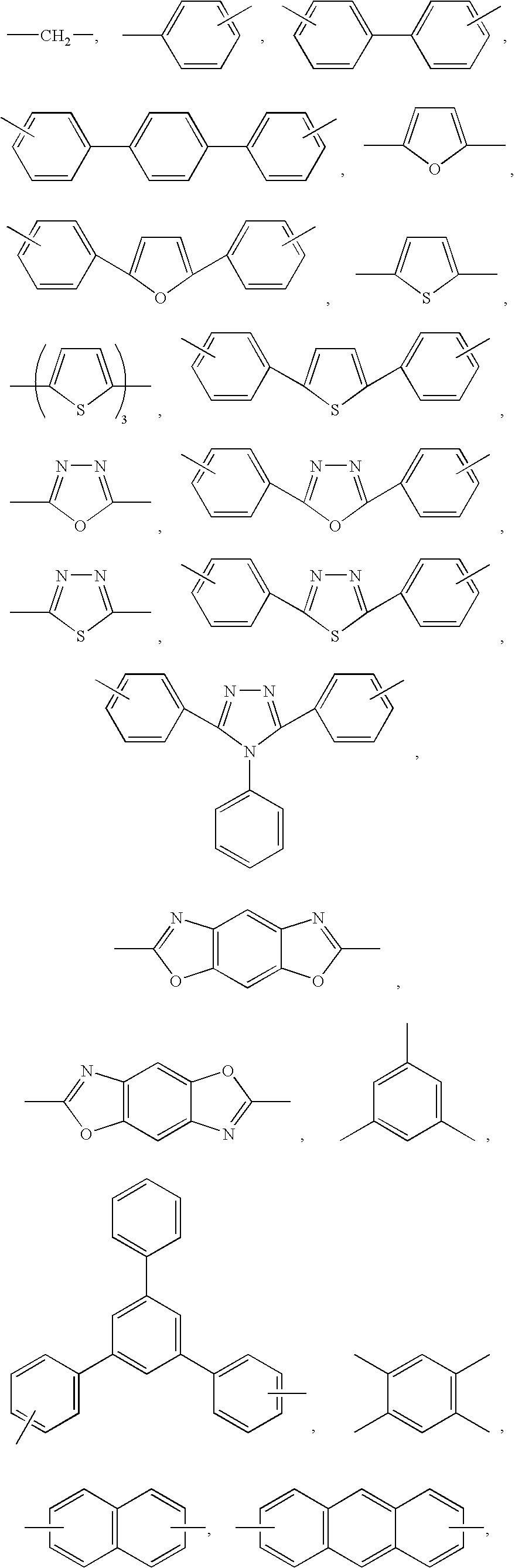


- The linking group represented by L may have a substituent. Preferred examples of the substituent for L include an alkyl group, an alkenyl group, an alkynyl group, an aryl group, an alkoxy group, an aryloxy group, an acyl group, a halogen atom, a cyano group, a heterocyclic group and a silyl group, more preferred examples thereof include an alkyl group, an alkenyl group, an alkynyl group, an aryl group, an alkoxy group, an aryloxy group, a halogen atom, a cyano group and an aromatic heterocyclic group, and still more preferred examples thereof include an alkyl group, an aryl group and an aromatic heterocyclic group.
- In the formula (A-I), X represents O, S, Se, Te or N—R. R represents a hydrogen atom, an aliphatic hydrocarbyl group, an aryl group or a heterocyclic group.
- Preferred examples of the aliphatic hydrocarbyl group represented by R include an alkyl group (containing preferably 1 to 20 carbon atoms, more preferably 1 to 12 carbon atoms, particularly preferably 1 to 8 carbon atoms; e.g., methyl, ethyl, iso-propyl, tert-butyl, n-octyl, n-decyl, n-hexadecyl, cyclopropyl, cyclopentyl and cyclohexyl), an alkenyl group (containing preferably 2 to 20 carbon atoms, more preferably 2 to 12 carbon atoms, particularly preferably 2 to 8 carbon atoms; e.g., vinyl, allyl, 2-butenyl and 3-pentenyl), analkynyl group (containing preferably 2 to 20 carbon atoms, more preferably 2 to 12 carbon atoms, particularly preferably 2 to 8 carbon atoms; e.g., propargyl and 3-pentynyl), with an alkyl group and an alkenyl group being more preferred.
- Preferred examples of the aryl group represented by R are those which contain preferably 6 to 30 carbon atoms, more preferably 6 to 20 carbon atoms, particularly preferably 6 to 12 carbon atoms, and include phenyl, 2-methylphenyl, 3-methylphenyl, 4-methylphenyl, 4-methoxyphenyl, 3-trifluoromethylphenyl, pentafluorophenyl, 2-biphenylyl, 3-biphenylyl, 4-biphenylyl, 1-naphthyl, 2-naphthyl and 1-pyrenyl.
- The heterocyclic group represented by R is a heterocyclic group containing a single ring or a condensed ring (a heterocyclic group containing preferably 1 to 20 carbon atoms, preferably 1 to 12 carbon atoms, still more preferably 2 to 10 carbon atoms) and is preferably an aromatic heterocyclic group containing at least one of a nitrogen atom, an oxygen atom and a selenium atom. Specific examples of the heterocyclic group represented by R include pyrrolidine, piperidine, pyrrole, furan, thiophene, imidazoline, imidazole, benzimidazole, naphthimidazole, thiazolidine, thiazole, benzothiazole, naphthothiazole, isothiazole, oxazoline, oxazole, benzoxazole, naphthoxazole, isoxazole, selenazole, benzoselenazole, naphthoselenazole, pyridine, quinoline, isoquinoline, indole, indolenine, pyrazole, pyrazine, pyrimidine, pyridazine, triazine, indazole, purine, phthalazine, naphthyridine, quinoxaline, quinazoline, cinnoline, pteridine, phenanthridine, phenanthroline and tetrazaindene. Preferred examples thereof include furan, thiophene, pyridine, quinoline, pyrazine, pyrimidine, pyridazine, triazine, phthalazine, naphthyridine, quinoxaline and quinazoline, more preferred examples include furan, thiophene, pyridine and quinoline, and particularly preferred is quinoline.
- The aliphatic hydrocarbyl group, the aryl group and the heterocyclic group represented by R may have a substituent or substituents. As such substituents, there are illustrated, for example, an alkyl group (containing preferably 1 to 30 carbon atoms, more preferably 1 to 20 carbon atoms, particularly preferably 1 to 10 carbon atoms; e.g., methyl, ethyl, iso-propyl, tert-butyl, n-octyl, n-decyl, n-hexadecyl, cyclopropyl, cyclopentyl or cyclohexyl), an alkenyl group (containing preferably 2 to 30 carbon atoms, more preferably 2 to 20 carbon atoms, particularly preferably 2 to 10 carbon atoms; e.g., vinyl, allyl, 2-butenyl or 3-pentenyl), an alkynyl group (containing preferably 2 to 30 carbon atoms, more preferably 2 to 20 carbon atoms, particularly preferably 2 to 10 carbon atoms; e.g., propargyl or 3-pentynyl), an aryl group (containing preferably 6 to 30 carbon atoms, more preferably 6 to 20 carbon atoms, particularly preferably 6 to 12 carbon atoms; e.g., phenyl, p-methylphenyl or naphthyl), an amino group (containing preferably 0 to 30 carbon atoms, more preferably 0 to 20 carbon atoms, particularly preferably 0 to 10 carbon atoms; e.g., amino, methylamino, dimethylamino, diethylamino, dibenzylamino, diphenylamino or ditolylamino),
- an alkoxy group (containing preferably 1 to 30 carbon atoms, more preferably 1 to 20 carbon atoms, particularly preferably 1 to 10 carbon atoms; e.g., methoxy, ethoxy, butoxy or 2-ethylhexyloxy), an aryloxy group (containing preferably 6 to 30 carbon atoms, more preferably 6 to 20 carbon atoms, particularly preferably 6 to 12 carbon atoms; e.g., phenyloxy, 1-naphthyloxy or 2-napthyloxy), an acyl group (containing preferably 1 to 30 carbon atoms, more preferably 1 to 20 carbon atoms, particularly preferably 2 to 12 carbon atoms; e.g., acetyl, benzoyl, formyl or pivaloyl), an alkoxycarbonyl group (containing preferably 2 to 30 carbon atoms, more preferably 2 to 20 carbon atoms, particularly preferably 2 to 12 carbon atoms; e.g., methoxycarbonyl or ethoxycarbonyl), an aryloxycarbonyl group (containing preferably 7 to 30 carbon atoms, more preferably 7 to 20 carbon atoms, particularly preferably 7 to 12 carbon atoms; e.g., phenyloxycarbonyl), an acyloxy group (containing preferably 2 to 30 carbon atoms, more preferably 2 to 20 carbon atoms, particularly preferably 2 to 10 carbon atoms; e.g., acetoxy or benzoyloxy),
- an acylamino group (containing preferably 2 to 30 carbon atoms, more preferably 2 to 20 carbon atoms, particularly preferably 2 to 10 carbon atoms; e.g., acetylamino or benzoylamino), an alkoxycarbonylamino group (containing preferably 2 to 30 carbon atoms, more preferably 2 to 20 carbon atoms, particularly preferably 2 to 12 carbon atoms; e.g., methoxycarbonylamino), an aryloxycarbonylamino group (containing preferably 7 to 30 carbon atoms, more preferably 7 to 20 carbon atoms, particularly preferably 7 to 12 carbon atoms; e.g., phenyloxycarbonylamino) a sulfonylamino group (containing preferably 1 to 30 carbon atoms, more preferably 1 to 20 carbon atoms, particularly preferably 1 to 12 carbon atoms; e.g., methanesulfonylamino or benzenesulfonylamino),
- a sulfamoyl group (containing preferably 0 to 30 carbon atoms, more preferably 0 to 20 carbon atoms, particularly preferably 0 to 12 carbon atoms; e.g., sulfamoyl, methylsulfamoyl, dimethylsulfamoyl or phenylsulfamoyl), a carbamoyl group (containing preferably 1 to 30 carbon atoms, more preferably 1 to 20 carbon atoms, particularly preferably 1 to 12 carbon atoms; e.g., carbamoyl, methylcarbamoyl, diethylcarbamoyl or phenylcarbamoyl), an alkylthio group (containing preferably 1 to 30 carbon atoms, more preferably 1 to 20 carbon atoms, particularly preferably 1 to 12 carbon atoms; e.g., methylthio or ethylthio), an arylthio group (containing preferably 6 to 30 carbon atoms, more preferably 6 to 20 carbon atoms, particularly preferably 6 to 12 carbon atoms; e.g., phenylthio), a sulfonyl group (containing preferably 1 to 30 carbon atoms, more preferably 1 to 20 carbon atoms, particularly preferably 1 to 12 carbon atoms; e.g., mesyl or tosyl), a sulfinyl group (containing preferably 1 to 30 carbon atoms, more preferably 1 to 20 carbon atoms, particularly preferably 1 to 12 carbon atoms; e.g., methanesulfinyl or benzenesulfinyl), a ureido group (containing preferably 1 to 30 carbon atoms, more preferably 1 to 20 carbon atoms, particularly preferably 1 to 12 carbon atoms; e.g., ureido, methylureido or phenylureido), a phosphoric acid amido group (containing preferably 1 to 30 carbon atoms, more preferably 1 to 20 carbon atoms, particularly preferably 1 to 12 carbon atoms; e.g., diethylphosphoric acid amido or phenylphosphoric acid amido),
- a hydroxyl group, a mercapto group, a halogen atom (e.g., a fluorine atom, a chlorine atom, a bromine atom or an iodine atom), a cyano group, a sulfo group, a carboxyl group, a nitro group, a hydroxamic acid group, a sulfino group, a hydrazino group, an imino group, a heterocyclic group (containing preferably 1 to 30 carbon atoms, more preferably 1 to 12 carbon atoms and containing, for example, a nitrogen atom, an oxygen atom or a sulfur atom as a hetero atom; specific examples thereof being imidazolyl, pyridyl, quinolyl, furyl, thienyl, piperidyl, morpholino, benzoxazolyl, benzimidazolyl, benzothiazolyl, carbazolyl and azepinyl), and a silyl group (containing preferably 3 to 40 carbon atoms, more preferably 3 to 30 carbon atoms, particularly preferably 3 to 24 carbon atoms; e.g., trimethylsilyl or triphenylsilyl).
- These substituents may further be substituted. Also, in the case where two or more substituents exist, they may be the same or different from each other and, if possible, they may be connected to each other to form a ring.
- Where R represents a heterocyclic ring, preferred examples of the substituent include an alkyl group, an alkenyl group, an alkynyl group, an aryl group, an amino group, an alkoxy group, an aryloxy group, an acyl group, an alkoxycarbonyl group, an aryloxycarbonyl group, an acyloxy group, an acylamino group, an alkoxycarbonylamino group, an aryloxycarbonylamino group, a sulfonylamino group, a sulfamoyl group, a carbamoyl group, an alkylthio group, an arylthio group, a sulfonyl group, a halogen atom, a cyano group and a heterocyclic group, more preferred examples thereof include an alkyl group, an alkenyl group, an aryl group, an alkoxy group, an aryloxy group, a halogen atom, a cyano group and a heterocyclic group, still more preferred examples thereof include an alkyl group, an aryl group, an alkoxy group, an aryloxy group and an aromaticf heterocyclic group, and particularly preferred examples thereof include an alkyl group, an aryl group, an alkoxy group and an aromatic heterocyclic group.
- X is preferably O, S or N—R, more preferably O or N—R, still more preferably N—R, particularly preferably N-Ar (Ar being an aryl group or an aromatic azole group, more preferably an aryl group containing 6 to 30 carbon atoms or an aromatic azole group containing 2 to 30 carbon atoms, still more preferably an aryl group containing 6 to 20 carbon atoms or an aromatic azole group containing 2 to 16 carbon atoms, particularly preferably an aryl group containing 6 to 12 carbon atoms or an aromatic azole group containing 2 to 10 carbon atoms) In the formula (A-I), Q 1 represents atoms necessary for forming an aromatic heterocyclic ring. The aromatic heterocyclic ring formed by Q1 is preferably a 5- or 6-membered aromatic heterocyclic ring, more preferably a 5- or 6-membered, nitrogen-containing atomatic heterocyclic ring, still more preferably a 6-membered, nitrogen-containing aromatic heterocyclic ring.
- Specific examples of the aromatic heterocyclic ring formed by Q 1 include furan, thiophene, pyran, pyrrole, imidazole, pyrazole, pyridine, pyrazine, pyrimidine, pyridazine, thiazole, oxazole, isothiazole, isoxazole, thiadiazole, oxadiazole, triazole, selenazole and tellurazole. Preferred examples thereof include pyridine, pyrazine, pyrimidine and pyridazine. More preferred are pyridine and pyrazine, with pyridine being still more preferred.
- The aromatic heterocyclic ring formed by Q 1 may be condensed with other ring to form a condensed ring, or may have a substituent. As the substituent, those which have been illustrated as substituents for the heterocyclic group represented by R in the formula (A-I) may be employed, with preferred substituents being the same as described there.
- Of the compounds represented by the formula (A-I), those which are represented by the following formula (A-II) are preferred.

- In the formula (A-II), m, L and X are the same as those defined with respect to the formula (A-I), and preferred scopes thereof are also the same. Q 2 represents atoms necessary for forming a nitrogen-containing aromatic heterocyclic ring.
- The nitrogen-containing aromatic heterocyclic ring formed by Q 2 is preferably a 5- or 6-membered, nitrogen-containing aromatic heterocyclic ring, more preferably a 6-membered, nitrogen-containing aromatic heterocyclic ring.
- Specific examples of the aromatic heterocyclic ring formed by Q 2 include pyrrole, imidazole, pyrazole, pyridine, pyrazine, pyrimidine, pyridazine, thiazole, oxazole, isothiazole, isoxazole, thiadiazole, oxadiazole, triazole, selenazole and tellurazole. Preferred are pyridine, pyrazine, pyrimidine and pyridazine, with pyridine and pyrazine being more preferred, and pyridine being still more preferred.
- The aromatic heterocyclic ring formed by Q 2 may be condensed with other ring to form a condensed ring, or may have a substituent. As the substituent, those which have been illustrated as substituents for the heterocyclic group represented by R in the formula (A-I) may be employed, with preferred substituents being the same as described there.
- Of the compounds represented by the formula (A-I), those which are represented by the following formula (A-III) are more preferred.

- In the formula (A-III), m and L are the same as those defined with respect to the formula (A-I), and preferred scopes thereof are also the same as described there. X 3 represents O, S or N—R. R is the same as that defined with respect to the formula (A-I), and preferred scope thereof is also the same as described there. Q3 represents atoms necessary for forming a nitrogen-containing aromatic heterocyclic ring.
- Specific examples of the aromatic heterocyclic ring formed by Q 3 include pyridine, pyrazine, pyrimidine, pyridazine and triazine. Preferred are pyridine, pyrazine, pyrimidine and pyridazine, with pyridine and pyrazine being more preferred, and pyridine being still more preferred.
- The 6-membered aromatic heterocyclic ring formed by Q 3 may be condensed with other ring to form a condensed ring, or may have a substituent. As the substituent, those which have been illustrated as substituents for the heterocyclic group represented by R in the formula (A-I) may be employed, with preferred substituents being the same as described there.
- Of the compounds represented by the formula (A-I), those which are represented by the following formula (A-IV) are still more preferred.

- In the formula (A-IV), L is the same as that defined with respect to the formula (A-I), and preferred scope thereof is also the same as described there. X 4 is the same as X3 in the formula (A-I), and preferred scope thereof is also the same as described there. Q4 is the same as Q3 in the formula (A-III), and preferred scope thereof is also the same as described there. n represents an integer of 2 to 8, preferably 2 to 6, more preferably 2 to 4, still more preferably 2 or 3, particularly preferably 3.
- Of the compounds represented by the formula (A-I), those which are represented by the following formula (A-IV) are still more preferred.

- In the formula (A-V), L is the same as that defined with respect to the formula (A-I), and preferred scope thereof is also the same as described there. R is the same as that defined with respect to the formula (A-I), and preferred scope thereof is also the same as described there. Q 5 is the same as Q3 in the formula (A-III), and preferred scope thereof is also the same as described there. n is the same as that defined with respect to the formula (A-IV), and preferred scope thereof is also the same as described there.
- Of the compounds represented by the formula (A-I), those which are represented by the following formula (A-VI) are still more preferred.

- In the formula (A-VI), R 61, R62 and R63 are the same as R in the formula (A-I), and preferred scopes thereof are also the same as described there. Q61, Q62 and Q63 are the same as Q3 in the formula (A-III), and preferred scopes thereof are also the same as described there. L1, L2 and L3 are the same as L in the formula (A-I).
- L 1, L2 and L3 each preferably represents a single bond, an arylene group, a divalent aromatic heterocyclic group or a linking group comprising a combination thereof, more preferably a single bond, a linking group comprising benzene, naphthalene, anthracene, pyridine, pyrazine, thiophene, furan, oxazole, thiazole, oxadiazole, thiadiazole or triazole, or a combination thereof, still more preferably a single bond or a linking group comprising benzeneorthiophene, or a combination thereof, particularly preferably a single bond or a linking group comprising benzene, or a combination thereof, most preferably a single bond.
- L 1, L2 and L3 may have a substituent and, as the substituent, those referred to as substituents for the heterocyclic group represented by A in the formula (A-I) may be employed.
- Y represents a nitrogen atom or a 1,3,5-benzenetriyl group, and the latter may have a substituent at 2-, 4- or 6-position. Examples of such substituent include an alkyl group, an aryl group and a halogen atom. Y is preferably a nitrogen atom or an unsubstituted 1,3,5-benzenetriyl group, with an unsubstituted 1,3,5-benzenetriyl group being more preferred.
- Of the compounds represented by the formula (A-I), compounds represented by the following formula (A-VII) are particularly preferred.

- In the formula (A-VII), R 71, R72 and R73 are the same as R in the formula (A-I), and preferred scopes thereof are also the same as described there. Q71, Q72 and Q73 are the same as Q3 in the formula (A-III), and preferred scopes thereof are also the same as described there.
- Of the compounds represented by the formula (A-I), compounds represented by the following formula (A-VIII) are most preferred.

- In the formula (A-VIII), R 81, R82 and R83 are the same as R in the formula (A-I), and preferred scopes thereof are also the same as described there. R84, R85 and R86 each has a substituent. As the substituent, those referred to as substituents for the heterocyclic group represented by R in the formula (A-I) may be employed, with preferred substituents also being the same as described there. Also, if possible, the substituents may be connected to each other to form a ring. p1, p2 and p3 each represents an integer of 0 to 3, preferably 0 to 2, more preferably 0 or 1, still more preferably 0.
- Next, description is given with respect to the formula (B-I).
- In the formula (B-I), m and L are the same as those defined with respect to the formula (A-I), and preferred scopes thereof are also the same as that described there. Q 1 is the same as defined with respect to the formula (A-I), and preferred scope is also the same as described there. R11 represents a hydrogen atom or a substituent. As the substituent represented by R11, there may be employed, for example, those which have been referred to as substituents for the heterocyclic group represented by R in the formula (A-I).
- The substituent represented by R 11 is preferably an aliphatic hydrocarbyl group, an aryl group or an aromatic heterocyclic group, more preferably an alkyl group (containing preferably 1 to 20 carbon atoms, more preferably 1 to 12 carbon atoms, particularly preferably 1 to 8 carbon atoms; e.g., methyl, ethyl, iso-propyl, tert-butyl, n-octyl, n-decyl, n-hexadecyl, cyclopropyl, cyclopentyl or cyclohexyl), an aryl group (containing preferably 6 to 30 carbon atoms, more preferably 6 to 20 carbon atoms, particularly preferably 6 to 12 carbon atoms; e.g., phenyl, 2-methylphenyl, 3-methylphenyl, 4-methylphenyl, 4-methoxyphenyl, 3-trifluoromethylphenyl, pentafluorophenyl, 1-naphthyl or 2-naphthyl), or an aromatic heterocyclic group (an aromatic heterocyclic group containing preferably 1 to 20 carbon atoms, more preferably 1 to 12 carbon atoms, still more preferably 2 to 10 carbon atoms and, more preferably, an aromatic heterocyclic group containing at least one of a nitrogen atom, an oxygen atom, a sulfur atom and a selenium atom; examples of the aromatic heterocyclic ring including pyrrolidine, piperidine, pyrrole, furan, thiophene, imidazoline, imidazole, benzimidazole, naphthimidazole, thiazolidine, thiazolidine, thiazole, benzothiazole, naphthothiazole, isothiazole, oxazoline, oxazole, benzoxazole, naphthoxazole, isoxazole, selenazole, benzoselenazole, naphthoselenazole, pyridine, quinoline, isoquinoline, indole, indolenine, pyrazole, pyrazine, pyrimidine, pyridazine, triazine, indazole, purine, phthalazine, naphthyridine, quinoxaline, quinazoline, cinnoline, pteridine, phenanthridine, phenanthroline, tetrazaindene and carbazole, with preferred examples thereof being furan, thiophene, pyridine, quinoline, pyrazine, pyrimidine, pyridazine, triazine, phthalazine, naphthyridine, quinoxaline and quinazoline, more preferred examples thereof being furan, thiophene, pyridine and quinoline, still more preferred examples thereof are quinoline), with an aryl group and an aromatic heterocyclic group being more preferred. The substituents represented by R11 may further be substituted or, if possible, may be connected to each other to form a ring.
- Of the compounds represented by the formula (B-I), compounds represented by the following formula (B-II) are more preferred.

- In the formula (B-II), m and L are the same as those defined with respect to the formula (A-I), and preferred scopes thereof are also the same as described there. Q 12 is the same as Q2 in the formula (A-II), and preferred scope is also the same as that described there. R11 is the same as defined with respect to the formula (B-I), and preferred scope thereof is the same as described there.
- Of the compounds represented by the formula (B-I), compounds represented by the following formula (B-III) are still more preferred.

- In the formula (B-III), m and L are the same as those defined with respect to the formula (A-I), and preferred scopes thereof are also the same as described there. Q 13 is the same as Q3 in the formula (A-III), and preferred scope is also the same as that described there. R11 is the same as defined with respect to the formula (B-I), and preferred scope thereof is the same as described there.
- Of the compounds represented by the formula (B-I), compounds represented by the following formula (B-IV) are particularly preferred.

- In the formula (B-IV), L 1, L2, L3 and Y are the same as those defined with respect to the formula (A-VI), and preferred scopes thereof are also the same as described there. Q141, Q142 and Q143 are the same as Q3 in the formula (A-III), and preferred scopes are also the same as described there. R141, R142 and R143 are the same as R11 in the formula (B-I), and preferred scope thereof is the same as described there.
- Of the compounds represented by the formula (B-I), compounds represented by the following formula (B-V) are most preferred.

- In the formula (B-V), Q 151, Q152 and Q153 are the same as Q3 in the formula (A-III), and preferred scopes are also the same as described there. R151, R152 and R153 are the same as R11 in the formula (B-I), and preferred scope thereof is the same as described there.
- Specific examples of the compounds represented by the formula (A-I) or (B-I) are illustrated below which, however, do not limit the invention in any way.


- weight-average molecular weight (in terms of polystyrene): 16,500


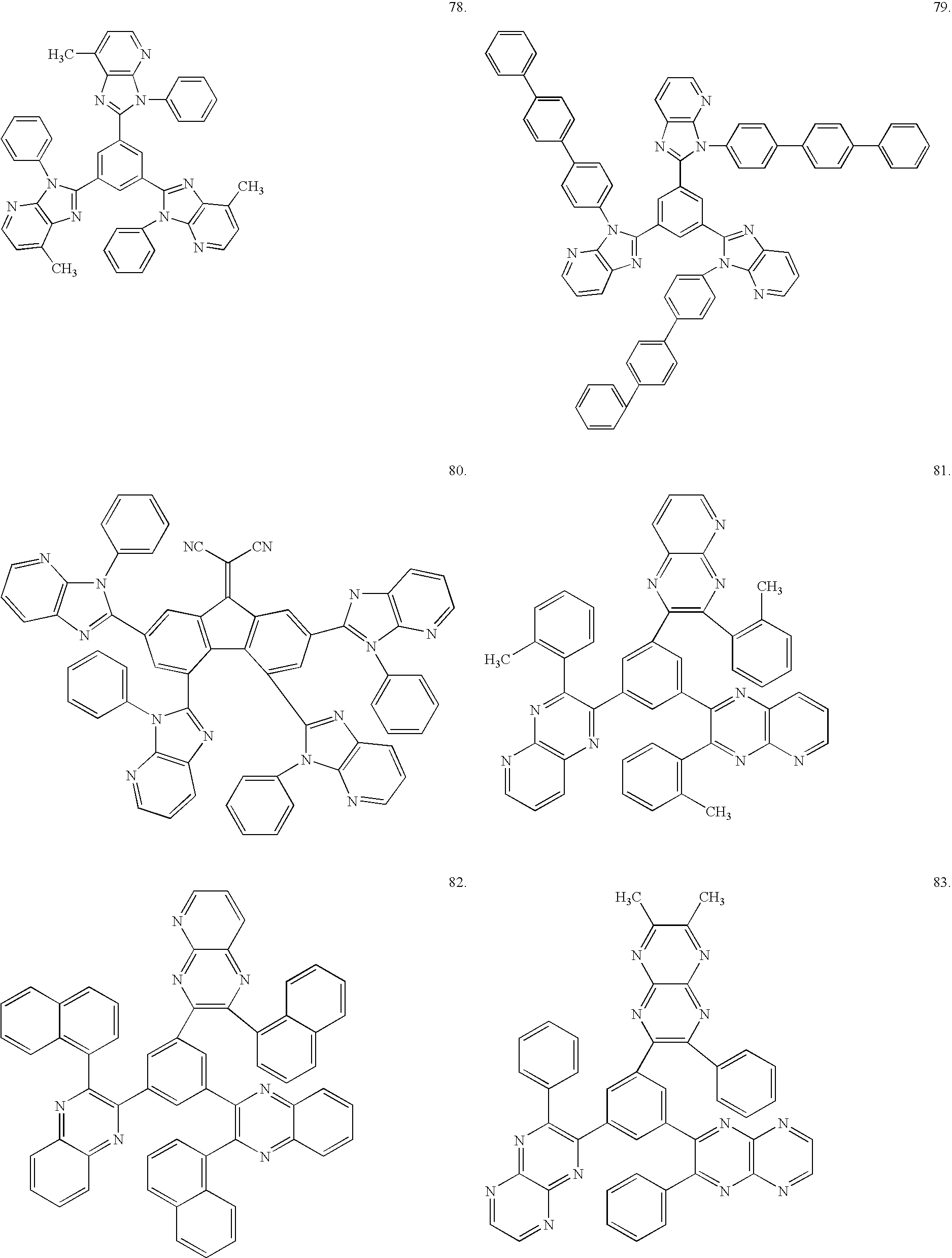

- [2] Substrates
- As the substrate for the organic electroluminescent element of the invention, any of transparent and opaque ones may be employed. Specific examples thereof include inorganic materials such as yttria-stabilized zirconia (YSZ) and glass and organic materials such as polyesters (e.g., polyethylene terephthalate, polybutylene phthalate and polyethylene naphthalate), polystyrene, polycarbonate, polyether sulfone, polyallylate, allyldiglycol carbonate, polyimide, polycycloolefin, norbornene resin and poly(chlolotrifluoroethylene). With the organic materials, those which are excellent in heat resistance, dimensional stability, solvent resistance, electrically insulating properties and workability are preferred. Also, in the case where an emitted light is taken out from the support side using a transparent electrode as the cathode, the substrate is preferably colorless and transparent in order to depress scattering and extinction of the emitted light.
- In the invention, the substrate has a moisture permeability of 0.01 g/m 2·day or less from the point of preventing invasion of moisture or oxygen into the element and improving durability and, more preferably, has an oxygen permeability of 0.01 cc/m2·day or less.
- The moisture permeability can be measured according to JISK7129B mainly by MOCON method. The oxygen permeability can be measured according to JISK7126B mainly by MOCON method.
- The substrate to be used in the invention has a thermal linear expansion coefficient of preferably 20 ppm/° C. or less from the point of preventing cracks or peeling of the electrodes or the organic layer upon cooling or heating with time. The thermal linear expansion coefficient is measured by a method of heating at a constant rate and detecting change in length of a sample, mainly by TMA method.
- As the substrate to be used in the invention which satisfies the above-described physical properties and difficultly causes shortcircuiting upon forming the electrode film to produce the element, a substrate comprising a metal foil having provided on one side or both sides thereof an insulating layer is preferred.
- In this case, the metal foil is not particularly limited, and a metal foil such as an aluminum foil, a copper foil, a stainless steel foil, a gold foil or a silver foil may be used. Of these, an aluminum foil or a copper foil is preferred in view of workability and production cost. The thickness of the metal foil is preferably 10 μm to 100 μm for obtaining a small moisture permeability and a small oxygen permeability to improve durability of the element and for imparting enough flexibility to ensure easy handling.
- Also, there exist no particular limitations as to the insulating layer. For example, inorganic substances such as inorganic oxides and inorganic nitrides and plastics such as polyesters (e.g., polyethylene terephthalate, polybutylene phthalate and polyethylene naphthalate), polystyrene, polycarbonate, polyethersulfone, polyallylate, allyldiglycol carbonate, polyimide, polycycloolefin, norbornene resin, poly(chlorotrifluoroethylene) and polyimide may be used.
- On this insulating layer are provided electrodes and organic layers. As has been described above, the thermal linear expansion coefficient of the insulating layer is preferably 20 ppm/° C. or less in view of avoiding cracks or peeling upon cooling or heating with time.
- As such insulating layer, metal oxides such as silicon oxide, germanium oxide, zinc oxide, aluminum oxide, titanium oxide and copper oxide and metal nitrides such as silicon nitride, germanium nitride and aluminum nitride may preferably be used independently or in combination of two or more thereof.
- In order to prevent formation of cracks or pinholes and maintain good insulating properties, the thickness of the metal oxide and/or metal nitride insulating layer is preferably 10 nm to 1000 nm.
- The method for forming the metal oxide and/or metal nitride layer is not particularly limited, and there may be employed a dry method such as a vacuum deposition method, a sputtering method or a CVD method, a wet method such as a sol-gel method, or a method of dispersing metal oxide and/or metal nitride particles in a solvent and coating the dispersion.
- As the insulating layer, plastic materials having a thermal linear expansion coefficient of 20 ppm/° C. or less, particularly polyimides or liquid crystal polymers may preferably be used. Detailed descriptions on the properties of these plastic materials are given in “Plastic Data Book” (Asahi Kasei Amidasu K.K.; compiled by “Plastic” compiling division), etc. In the case of using polyimide or the like as the insulating layer, it is possible to laminate a polyimide sheet and an aluminum foil to form a laminated film. In order to impart enough flexibility to facilitate handling upon laminating or the like, the thickness of the sheet of polyimide or the like is preferably 10 μm to 200 μm.
- The insulating layer may be provided only on one side or both sides of the metal foil. In the case of providing on both sides, the metal oxide and/or metal nitride may be provided on both sides, or the sheet of polyimide or the like may be provided on both sides. Also, the metal oxide and/or metal nitride may be provided on one side, and the sheet of polyimide or the like may be provided on the other side.
- In the invention, a hard coat layer or an undercoat layer may further be provided, as needed, on the substrate.
- The substrate is not limited as to its shape, structure and size, and a proper one may be selected depending upon the use and purpose of the light-emitting element. Generally, a plate-shaped substrate is used.
- [3] Electrode
- Of a pair of electrodes, usually one is used as a transparent electrode on the light-emitting side, and the other is used as a backside electrode on the non-light-emitting side. Either of the cathode and the anode may be used as the transparent electrode or the backside electrode. In the invention, it is preferred to use the cathode as the backside electrode, and the anode as the transparent electrode, since such structure permits to take out the emitted light from the side of the organic layer opposite to the substrate.
- (a) Anode
- As the anode, usually those which function as an anode to feed holes to the organic layer may be used, and the shape, structure and size of the anode are not particularly limited. Proper electrodes may be selected from among known electrodes depending upon the use and purpose of the light-emitting element.
- As materials for the anode, there are preferably illustrated, for example, metals, alloys, metal oxides, organic electrically conductive compounds and mixtures thereof, with those which have a work function of 4.0 eV or more being more preferred. Specific examples thereof include semi-conductive metal oxides such as tin oxide doped with antimony or fluorine (ATO or FTO), tin oxide, zinc oxide, indium oxide, indium tin oxide (ITO) and indium zinc oxide (IZO), metals such as gold, silver, chromium and nickel, mixtures or laminates of these metals and conductive metal oxides, inorganic electrically conductive materials such as copper iodide and copper sulfide, dispersions of the semi-conductive metal oxides or metal compounds, organic electrically conductive materials such as polyaniline, polythiophene and polypyrrole, and laminates of one of these and ITO.
- The anode may be formed on a substrate according to a method properly selected from among wet methods such as a printing method and a coating method, physical methods such as a vacuum deposition method, a sputtering method and an ion plating method and chemical methods such as a CVD method and a plasma CVD method in consideration of compatibility with the aforesaid materials. For example, in the case of selecting ITO as the anode material, formation of the anode can be conducted according to a direct-current or high-frequency sputtering method, a vacuum deposition method or an ion plating method. Also, in the case of selecting the organic electrically conductive compound as the anode material, formation of the anode can be conducted according to the wet filming method. In order to enlarge the area of the element with a good productivity, the wet filming method is preferred.
- Additionally, patterning of the anode may be conducted according to chemical etching by photolithography or the like, may be conducted according to physical etching by laser or the like, may be conducted by vacuum deposition or sputtering with superposing a mask, or may be conducted by a lift-off method or a printing method.
- The thickness of the anode may properly be selected from among the aforesaid materials and is usually 10 nm to 50 μm, preferably 50 nm to 20 μm, though not being specified in a general manner.
- The resistance value of the anode is preferably 10 6 Ω/□ (Ω/square) or less, more preferably 105 Ω/□ or less. In the case where the resistance value of the anode is less than 105 Ω/□, large-area light-emitting elements having an excellent performance can be obtained by providing buss-line electrodes.
- The anode may be colorless and transparent, colored and transparent, or opaque but, in the case where an emitted light is taken out from the anode side using a transparent anode, the anode has a percent transmission of preferably 60% or more, more preferably 70% or more. This percent transmission can be measured according to a known method using a spectrophotometer. As the transparent anode, those electrodes which are described in detail in “Tomei Dodenmaku No Sin-tenkai” (supervised by Yutaka Sawada and published by CMC in 1999) may also be employable in the invention. In particular, in the case of using a plastic substrate having a low heat resistance, it is preferred to use ITO or IZO as the anode and form the film thereof at a temperature as low as 150° C. or lower to form the transparent anode.
- (b) Cathode
- As the cathode, usually those which function as a cathode to inject electrons to the organic layer may be used, and the shape, structure and size of the cathode are not particularly limited. Proper cathodes may be selected from among known electrodes depending upon the use and purpose of the light-emitting element.
- As materials for the cathode, there are illustrated, for example, metals, alloys, metal oxides, electrically conductive compounds and mixtures thereof, with those which have a work function of 4.5 eV or more being more preferred. Specific examples thereof include alkali metals (e.g., Li, Na, K and Cs), alkaline earth metals (e.g., Mg and Ca), gold, silver, lead, aluminum, sodium-potassium alloy, lithium-aluminum alloy, magnesium-silver alloy, and rare earth metals such as indium and ytterbium. These may be used independently but, in view of obtaining both stability and electron-injecting properties, two or more of them may be used in combination.
- Among them, alkali metals and alkaline earth metals are preferred in view of electron-injecting properties, and materials containing aluminum as a major component are preferred in the point of excellent storage stability thereof. Here, the materials containing aluminum as a major component means aluminum itself, or an alloy or mixture of aluminum and 0.01 to 10% by weight of an alkali metal or an alkaline earth metal (for example, lithium-aluminum alloy or magnesium-aluminum alloy).
- In the case of taking out an emitted light from the cathode side, it is necessary to use a transparent cathode. It suffices for the transparent cathode to be substantially transparent for the light. In order to obtain both electron-injecting properties and transparency, it is possible to employ a two-layered structure of a thin film metal layer and a transparent conductive layer. Additionally, materials for the thin film metal layer are described in detail in JP-A-2-15595 and JP-A-5-121172. The thickness of the thin film metal layer is preferably 1 nm to 50 nm in view of filming a uniform film and maintaining good transparency.
- As materials to be used for the transparent conductive layer in the two-layer structured cathode, any material that has an electric conductivity or semi-conductivity and is transparent may be used without particular limitation, and those which have been referred to with respecto to the anode may preferably be used. Among them, tin oxide doped with antimony or fluorine (ATO or FTO), tin oxide, zinc oxide, indium oxide, indium tin oxide (ITO) and indium zinc oxide (IZO) are particularly illustrated. The thickness of the transparent conductive layer is preferably 30 nm to 500 nm in view of conductivity (semi-conductivity) and productivity.
- Methods for forming the cathode are not particularly limited, and it can be formed according to a publicly known method. In the invention, the formation is conducted in a vacuum device. For example, the cathode can be formed on the substrate according to a method properly selected from among physical methods such as a vacuum deposition method, a sputtering method and an ion plating method and chemical methods such as a CVD method and a plasma CVD method in consideration of compatibility with the aforesaid materials. For example, in the case of selecting a metal as the cathode material, formation of the anode can be conducted by sputtering one metal or two or more metals at the same time or in turn. Also, in the case of selecting the organic electrically conductive material as the cathode material, formation of the cathode can be conducted according to the wet filming method. Additionally, patterning of the cathode may be conducted according to chemical etching by photolithography or the like, may be conducted according to physical etching by laser or the like, may be conducted by vacuum deposition or sputtering with superposing a mask, or may be conducted by a lift-off method or a printing method.
- [4] Organic layer
- In the invention, the organic layer comprises one or more layers including at least a light-emitting layer. In addition to the light-emitting layer, an electron injecting organic layer, an electron transporting organic layer, a hole transporting organic layer and a hole injecting organic layer may be provided as needed.
- As to the position of the organic layer in the organic electroluminescent element of the invention, it is formed on the cathode as has been described hereinbefore. In this case, the organic layer is formed on the front surface or one side.
- The organic layer is not particularly limited as to its shape, size and thickness, and they are properly selected depending upon the purpose thereof.
- (a) Light-Emitting Layer
- The light-emitting layer contains at least one light-emitting compound. The light-emitting compound is not particularly limited, and may be a fluorescent light-emitting compound or a phosphorescent light-emitting compound. It is also possible to use the fluorescent light-emitting compound and the phosphorescent light-emitting compound at the same time. In the invention, the phosphorescent light-emitting compound is preferably used in view of luminance of emitted light and light-emitting efficiency.
- Additionally, the term “derivative” as used herein in the specification means the compound itself and the derivatives thereof.
- Examples of the fluorescent light-emitting compound include benzoxazole derivatives, benzimidazole derivatives, benzothiazole derivatives, styrylbenzene derivatives, polyphenyl derivatives, diphenylbutadiene derivatives, tetraphenylbutadiene derivatives, naphthalimide derivatives, coumarin derivatives, perylene derivatives, perynone derivatives, oxadiazole derivatives, aldazine derivatives, pyralidine derivatives, cyclopentadiene derivatives, bis(styryl) anthracene derivatives, quinacridone derivatives, pyrrolopyridine derivatives, thiadiazolopyridine derivatives, styrylamine derivatives, aromatic dimethylidene compounds, various metal complexes represented by metal complexes of 8-quinolinol derivatives, rare earth metal complexes, and high molecular compounds such as polythiophene derivatives, polyphenylene derivatives, polyphenylenevinylene derivatives and polyfluorene derivatives. These may be used independently or as a mixture of two or more of them.
- The phosphorescent light-emitting compound is not particularly limited, but ortho-metalated metal complexes or porphyrin metal complexes are preferred. Of the porphyrin metal complexes, porphyrin platinum complex is preferred. The phosphorescent light-emitting compounds may be used independently or as a mixture of two or more of them.
- The term “orthometalated metal complexes to be used in the invention is a general term for compounds described in “Yuki Kinzoku Kagaku, Kiso To Oyo” written by Akio Yamamoto and published by Shokabo Sha in year 1982, pp. 150 and 232; and “Photochemistry and Photophysics of Coordination Compounds” written by H. Yersin and published by Springer-Verlag Co. in year 1987, pp. 71 to 77 and 135 to 146. Ligands for forming the orthometalated metal complexes are not particularly limited, but are preferably 2-phenylpyridine derivatives, 7,8-benzoquinoline derivatives, 2-(2-thienyl)pyridine derivatives, 2-(1-naphthyl)pyridine derivatives or 2-phenylquinoline derivatives. These derivatives may have a substituent or substituents. Also, in addition to these ligands necessary for forming the orthometalated metal complexes, other ligands may exist. As a central metal forming the orthometalated metal complex, any of transition metals may be used. In the invention, rhodium, platinum, gold, iridium, ruthenium and palladium can preferably be used. The organic layer containing such orthometalated metal complex is excellent in emitted light luminance and light-emitting efficiency. As to the orthometalated metal complexes, specific examples are described in Japanese Patent Application No. 2000-254171.
- The orthometalated metal complexes can be synthesized by known processes described in Inorg. Chem., 30, 1685, 1991; Inorg. Chem., 27, 3464, 1988; Inorg. Chem., 33, 545, 1994; Inorg. Chim. Acta, 181, 245, 1991; J. Organomet. Chem., 335, 293, 1987; and J. Am. Chem. Soc., 107, 1431, 1985.
- The content of the light-emitting compound in the light-emitting layer is not particularly limited but, in order to maintain light-emitting properties at a good level, the content is preferably 0.1 to 70% by weight, more preferably 1 to 20% by weight.
- The light-emitting layer may contain, if necessary, a host compound, a hole transporting material, an electron transporting material and an electrically inert polymer binder. Additionally, in some cases, functions of these materials can be conducted by one compound. For example, carbazole derivatives function not only as a host compound but as a hole transporting material as well.
- The host compound is a compound which, when excited, causes energy trapsportation to a light-emitting compound to make the light-emitting compound emit light. Specific examples thereof include carbazole derivatives, triazole derivatives, oxazole derivatives, oxadiazole derivatives, imidazole derivatives, polyarylalkane derivatives, pyrazoline derivatives, pyrazolone derivatives, phenylenediamine derivatives, arylamine derivatives, amino-substituted chalcone derivatives, styrylanthracene derivatives, fluorenone derivatives, hydrazone derivatives, stilbene derivatives, silazane derivatives, aromatic tertiary amine compounds, styrylamine compounds, aromatic dimethylidene compounds, porphyrin compounds, anthraquinodimethane derivatives, anthrone derivatives, diphenylquinone derivatives, thiopyran dioxide derivatives, carbodiimide derivatives, fluorenylidenemethane derivatives, distyrylpyrazine derivatives, tetracarboxylic acid anhydrides of naphthalene or perylene, phthalocyanine derivatives, metal complexes of, for example, 8-quinolinol derivatives, metallophthalocyanines, metal complexes containing benzoxazole orbenzothiazole as a ligand, conductive high polymers such as polysilane compounds, poly(N-vinylcarbazole) derivatives, aniline copolymers, thiophene oligomers and polythiophene, polythiophene derivatives, polyphenylene derivatives, polyphenylenevinylene derivatives, and polyfluorene derivatives. The host compounds may be used independently or in combination of two or more thereof. The content of the host compound in the light-emitting layer is preferably 0 to 99.9% by weight, more preferably 0 to 99.0% by weight.
- The hole transporting material is not particularly limited as long as it exerts one of the function of injecting holes from the anode, the function of transporting holes, and the function of blocking electrons injected from the cathode, and may be a low-molecular compound or a high-molecular compound. Specific examples thereof include carbazole derivatives, triazole derivatives, oxazole derivatives, oxadiazole derivatives, imidazole derivatives, polyarylalkane derivatives, pyrazoline derivatives, pyrazolone derivatives, phenylenediamine derivatives, arylamine derivatives, amino-substituted chalcone derivatives, styrylanthracene derivatives, fluorenone derivatives, hydrazone derivatives, stilbene derivatives, silazane derivatives, aromatic tertiary amine compounds, styrylamine compounds, aromatic dimethylidene compounds, porphyrin compounds, conductive high polymers such as polysilane compounds, poly(N-vinylcarbazole) derivatives, aniline copolymers, thiophene oligomers and polythiophene, polythiophene derivatives, polyphenylene derivatives, polyphenylenevinylene derivatives, and polyfluorene derivatives. These may be used independently or in combination of two or more thereof. The content of the hole transporting material in the light-emitting layer is preferably 0 to 99.9% by weight, more preferably 0 to 80.0% by weight.
- The electron transporting material is not particularly limited as long as it exerts one of the function of injecting electrons from the cathode, the function of transporting electrons, and the function of blocking holes injected from the anode, and those which have been illustrated as electron transporting organic materials to be used in the aforesaid mixture layer may be used independently or as a mixture of two or more of them. The content of the electron transporting material in the light-emitting layer is preferably 0 to 99.9% by weight, more preferably 0 to 80.0% by weight.
- As the polymer binder, polyvinyl chloride, polycarbonate, polystyrene, polymethyl methacrylate, polybutyl methacrylate, polyester, polysulfone, polyphenylene oxide, polybutadiene, hydrocarbon resin, ketone resin, phenoxy resin, polyamide, ethyl cellulose, vinyl acetate, ABS resin, polyurethane, melamine resin, unsaturated polyester, alkyd resin, epoxy resin, silicone resin, polyvinyl butyral and polyvinyl acetal may be used. These may be used alone or in combination of two or more of them. The light-emitting layer containing the polymer binder can easily be coated according to the wet filming method to form a large-area element.
- The thickness of the light-emitting layer is preferably 10 to 200 nm, more preferably 20 to 80 nm, in view of preventing short-circuiting of the element and reducing driving voltage.
- (b) Hole Transporting Organic Layer and Hole Injecting Organic Layer
- In the invention, a hole transporting organic layer or a hole injecting organic layer comprising the above-described hole transporting material may be provided as needed. These layers may contain the above-described polymer binder. The thickness of each layer is preferably 10 to 200 nm, more preferably 20 to 80 nm, in view of preventing short-circuiting of the element and reducing driving voltage.
- (c) Electron Transporting Organic Layer and Electron Injecting Organic Layer
- In the invention, an electron transporting organic layer or an electron injecting organic layer comprising the above-described electron transporting material may be provided as needed. These layers may contain the above-described polymer binder. The thickness of each layer is preferably 10 to 200 nm, more preferably 20 to 80 nm, in view of preventing short-circuiting of the element and reducing driving voltage.
- (d) Formation of the Organic layer
- The organic layer can favorably be formed by any of dry film-forming methods such as a vacuum deposition method and a sputtering method and wet film-forming methods such as a dipping method, a spin coating method, a dip coating method, a cast coating method, a die coating method, a roll coating method, a bar coating method and a gravure coating method.
- Formation of the organic layer by the wet coating method is advantageous in that the organic layer can easily be enlarged and that a light-emitting element capable of emitting light with a highly bright luminance and an excellent light-emitting efficiency can be obtained at a low production cost in a high efficiency. Additionally, a proper film-forming method can be selected depending upon the material of the organic layer.
- In the case of forming the layer according to the wet film-forming method, drying may properly be conducted after formation of the film. Conditions for such drying are not particularly limited, and a temperature within a range of not damaging the layer formed by coating may be employed.
- In the case of forming the organic layer by wet coating method, a binder resin may be added to the organic layer. In this case, examples of the binder resin include polyvinyl chloride, polycarbonate, polystyrene, polymethyl methacrylate, polybutylmethacrylate, polyester, polysulfone, polyphenylene oxide, polybutadiene, hydrocarbon resin, ketone, resin, phenoxy resin, polyamide, ethyl cellulose, vinyl acetate, ABS resin, polyurethane, melamine resin, unsaturated polyester, alkyd resin, epoxy resin, silicone resin, polyvinyl butyral and polyvinyl acetal. These may be used alone or in combination of two or more of them.
- Also, in the case of forming the organic layer by wet coating method, solvents to be used upon preparation of a coating solution by dissolving the organic layer are not particularly limited, and a proper one may be selected depending upon kinds of the hole transporting material, the orthometalated metal complex, the host compound and the polymer binder. Examples of the solvent include halogen-containing solvents such as chloroform, carbon tetrachloride, dichloromethane, 1,2-dichloroethane and chlorobenzene, ketone solvents such as acetone, methyl ethyl ketone, diethyl ketone, n-propyl methyl ketone and cyclohexanone, aromatic solvents such as benzene, toluene and xylene, ester solvents such as ethyl acetate, n-propyl acetate, n-butyl acetate, methyl propionate, ethyl propionate, γ-butyrolactone and diethyl carbonate, ether solvents such as tetrahydrofuran and dioxane, amide solvents such as dimethylformamide and dimethylacetamide, dimethylsulfoxide and water.
- Additionally, the amount of solid components in the coating solution is not particularly limited, and its viscosity can freely be selected depending upon the selected wet film-forming method.
- (e) Patterning
- A mask having a finely patterned opening (fine mask) is used for forming a finely patterned organic layer. Materials for the mask are not limited, but those which are durable and inexpensive such as metals, glass, ceramics and heat-resistant resins are preferred. These materials may be used in combination thereof. Also, mainly in view of mechanical strength, the thickness of the mask is preferably 2 to 100 μm, more preferably 5 to 60 μm.
- [5] Other Layers
- In the organic electroluminescent element of the invention may be provided a protective layer or a sealing layer in order to prevent deterioration of light-emitting performance of the element.
- (a) Protective layer
- As the protective layer, there are illustrated those which are described in JP-A-7-85974, JP-A-7-192866, JP-A-8-22891, JP-A-10-275682 and JP-A-10-106746. The protective layer is Formed on the uppermost surface of the element. In the invention wherein a substrate, a cathode, an organic layer and an anode are stacked in this order, the term “uppermost surface” as used herein means the outer surface of the anode. The protective layer is not particularly limited as to its shape, size and thickness. Materials constituting the protective layer are not particularly limited, and any material may be used that has the function of depressing invasion or transmission of substances which deteriorate the organic thin film element such as moisture or oxygen into the element. For example, silicon monoxide, silicon dioxide, germanium monoxide and germanium dioxide may be used.
- The method for forming the protective layer is not particularly limited, and there may be applied, for example, a vacuum deposition method, a sputtering method, a reactive sputtering method, a molecular beam epitaxy method, a cluster ion beam method, an ion plating method, a plasma polymerization method, a plasma CVD method, a laser CVD method, a thermal CVD method and a coating method.
- (b) Sealing Layer
- A sealing layer for preventing invasion of moisture or oxygen may be provided in the organic electroluminescent element of the invention. As the materials for forming the sealing layer, there may be used a copolymer of tetrafluoroethylene and at least one comonomer, a fluorine-containing copoloymer containing a cyclic structure in the main chain of the copolymer, polyethylene, polypropylene, polymethyl methacrylate, polyimide, polyurea, polytetrafluoroethylene, poloychlorotrifluoroethylene, polydichlorodifluoroethylene, a copolymer of chlorotrifluoroethylene or dichlorodifluoroethylene and other comonomer, a water-absorbing substance having a water absorption of 1% or more, a moisture-resistant substance of 0.1% or less, a metal (In, Sn, Pb, Au, Cu, Ag, Al, Ti or Ni), a metal oxide (MgO, SiO, SiO 2, Al2O3, GeO, NiO, CaO, BaO, Fe2O3, Y2O3 or TiO2), a metal fluoride (MgF2, LiF, AlF3 or CaF2), a liquid fluorinated carbon (perfluoroalkane, perfluoroamine or perfluoroether), and a dispersion of an absorbent for moisture or oxygen in a liquid fluorinated carbon.
- In order to block moisture or oxygen from outside, it is preferred to seal the organic layer by a sealing member such as a sealing plate or a sealing vessel. The sealing member may be provided only on the anode side, or the light-emitting laminate (laminate containing the cathode, the organic layer, the anode and other layer) may wholly be covered by the sealing member. The sealing member is not limited as to its shape, size and thickness so long as the organic layer can be sealed and the outer air can be blocked. As materials to be used for the sealing member, glass, stainless steel, metal (aluminum, etc.), plastic (polychlorotrifluoroethylene, polyester, polycarbonate, etc.) and ceramic may be used.
- Upon providing the sealing member onto the light-emitting laminate, a sealant (adhesive) may be used as needed. In the case where the light-emitting laminate is wolly covered by the sealing member, it is also possible to heat-weld parts of the member to each other without using the sealant. As the sealant, UV-curing resins, thermosetting resins and two-part curable resins may be used.
- In the case of wholly covering the light-emitting laminate, a moisture absorbent or an inert liquid may be placed in the space between the sealing member and the light-emitting laminate. The moisture absorbent is not particularly limited, and specific examples thereof include barium oxide, sodium oxide, potassium oxide, calcium oxide, sodium sulfate, calcium sulfate, magnesium sulfate, phosphorus pentoxide, calcium chloride, magnesium chloride, copper chloride, cesium fluoride, niobium fluoride, calcium bromide, vanadium bromide, molecular sieve, zeolite and magnesium oxide. As the inert liquid, paraffins, liquid paraffins, fluorine-containing solvents (perfluoroalkane, perfluoroamine and perfluoroether), chlorine-containing solvents and silicone oils may be used.
- [6] Driving the Element
- The organic electroluminescent element of the invention emits light when a direct current volt (usually 2 to 40 v) (optionally containing an alternating current component) or a direct current is applied across the anode and the cathode.
- As to driving of the light-emitting element of the invention, methods described in JP-A-2-148687, JP-A-6-301355, JP-A-5-29080, JP-A-7-134558, JP-A-8-234685, JP-A-8-241047, U.S. Pat. No. 5,828,429, U.S. Pat. No. 6,023,308 and Japanese Patent No. 2,784,615 may be utilized.
- The invention is described in more detail below. However, the invention should not be construed as being limited thereto.
- A polyimide sheet (Upilex 50S; 50 μm in thickness; manufactured by Ube Industries, Ltd.) was laminated on both sides of a 5-cm square aluminum foil (30 μm thick) using an adhesive to prepare a supporting substrate of the invention. Additionally, the substrate had a thermal linear expansion coefficient of 10 ppm/° C. (measured according to TMA). Also, the substrate had a moisture permeability of 0.01 g/m 2·day or less (measured according to MOCON method at 25° C. and 90% RH) and an oxygen permeability of 0.01 g/m2·day or less (measured according to MOCON method at 25° C. and 0% RH).
- A cathode with a predetermined pattern was formed on this substrate by the vacuum deposition method using a stainless steel-made shadow mask. The cathode was formed by depositing Al in a film thickness of 250 nm in a reduced-pressure atmosphere of about 0.1 mPa. On this cathode was formed a mixture layer of 36 nm in thickness by using the aforesaid compound (21) as an electron transporting material and using LiF with adjusting the vacuum deposition rates of respective materials so that the content of LiF became 10% by weight based on the compound.
- Further, a solution of polyvinylcarbazole/tris(2-phenylpyridine)iridium complex (40/1 (by weight)) in dichloroethane was coated on the mixture layer using a spin coater to prepare a 0.1-μm thick light-emitting layer. Still further, N,N′-dinaphthyl-N,N′-diphenylbenzidine was vacuum deposited at a rate of 1 nm/sec to form a 0.04-μm thick hole transporting layer.
- Still further, a 0.2 μm thick ITO thin film (transparent anode) was formed thereon by DC magnetron sputtering (conditions: 100° C. in substrate temperature; 1×10 −3 Pa in oxygen pressure) using an ITO target having an In2O3 content of 95% by weight. The ITO thin film had a surface resistance of 10 Ω/□. Aluminum lead wires were connected to the transparent anode and the cathode, respectively, to form a light-emitting laminate. This was placed in an argon gas-replaced globe box and was sealed using a glass-made sealing vessel and a UV-curing adhesive (XNR5493T; made by Nagase Ciba) to obtain the organic electroluminescent element 101.
- An element 102 was prepared in the same manner as with the element 101 except for changing the inorganic metal salt in the mixture layer to MgF 2 and changing the electron transporting organic material in the layer to the compound (2).
- Further, elements 103 to 108 were prepared by changing the inorganic metal salt and the electron transporting organic material in the mixture layer as shown in Table 1.
- An element 109 was prepared in the same manner as with the element 101 except for vacuum depositing LiF in a film thickness of 3 nm with the same pattern on the Al-deposited substrate and vacuum depositing thereon the compound (21) at a rate of 1 nm/sec to form a 0.03-um layer.
- An element 110 was prepared in the same manner as with the element 101 except for using the following compound in place of the compound (21).

- The thus obtained elements were evaluated in the following manner.
- A direct current voltage was applied to each of the organic EL elements to emit light using a source measure unit Model 2400 made by Toyo Technica Corp. The maximum luminance was referred to as L max, and the volt at which Lmax was obtained was referred to as Vmax. The light-emitting efficiency at 200 cd/m2 was referred to as outer quantum efficiency (η200). Existence or absence of defect (dark spots) were visually checked. The defect was evaluated in terms of number of spots having an area of 1 mm2.
- 5 or less: ◯
- 6 to 20: Δ
- 21 or more: x
- Results of the evaluation are tabulated in Table 1.
TABLE 1 Ele- Inorganic Electron Degree ment Metal Transporting Lmax Vmax η200 of No. Salt Material (cd/m2) (V) (%) Defect Note 101 LiF (21) 36000 12 13.2 ∘ * 102 LiF (2) 47000 12 12.1 ∘ * 103 LiF (18) 32000 13 11.8 ∘ * 104 MgF2 (21) 41000 13 12.4 ∘ * 105 MgF2 (19) 41000 11 14.2 ∘ * 106 MgF2 (24) 35000 12 13.5 ∘ * 107 CaF2 (26) 44000 11 14.1 ∘ * 108 CaF2 (81) 37000 13 13.2 ∘ * 109 — (21) 8000 19 4.4 Δ ** 110 LiF — 3000 18 3.6 x ** - As is apparent from Table 1, the organic electroluminescent elements of the invention emitted light with a high luminance and in a high yield at a low driving voltage. Also, they showed extremely less defects.
- The organic electroluminescent elements of the invention can be driven at a low driving voltage, and show markedly improved light-emitting properties with emitting light with a high luminance in a high yield. Also, they provide a wide choice of substrate materials and, in the case of using them as a light source for a display, they enables one to realize a high opening ratio.
- This application is based on Japanese Patent application JP 2002-361110, filed Dec. 12, 2002, the entire content of which is hereby incorporated by reference, the same as if set forth at length.
Claims (15)


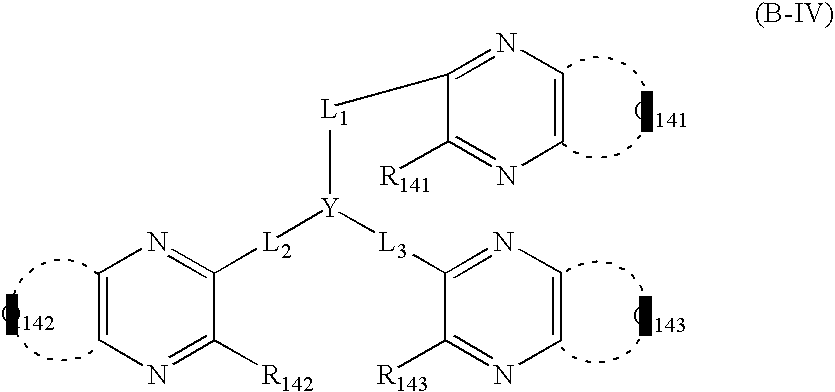
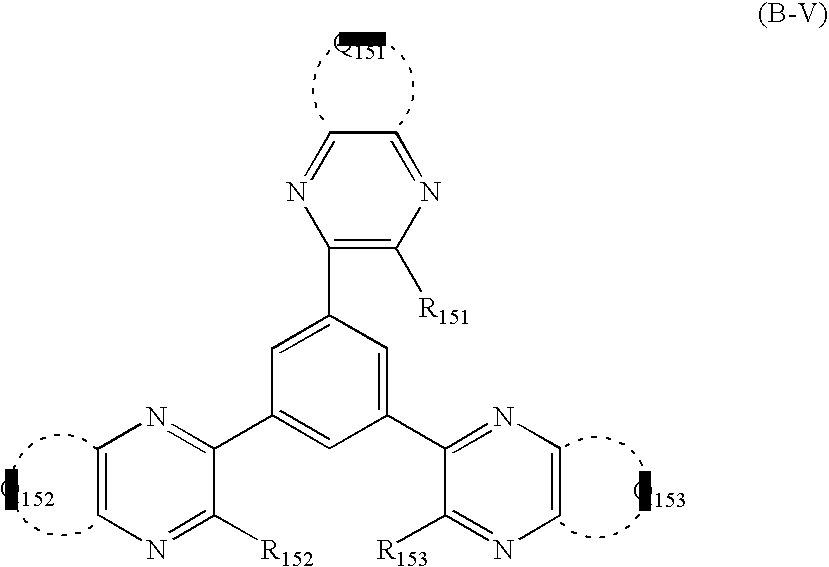
Applications Claiming Priority (2)
| Application Number | Priority Date | Filing Date | Title |
|---|---|---|---|
| JP2002361110A JP2004193011A (en) | 2002-12-12 | 2002-12-12 | Organic electroluminescent element |
| JP2002-361110 | 2002-12-12 |
Publications (1)
| Publication Number | Publication Date |
|---|---|
| US20040126619A1 true US20040126619A1 (en) | 2004-07-01 |
Family
ID=32652587
Family Applications (1)
| Application Number | Title | Priority Date | Filing Date |
|---|---|---|---|
| US10/732,451 Abandoned US20040126619A1 (en) | 2002-12-12 | 2003-12-11 | Organic electroluminescent element |
Country Status (2)
| Country | Link |
|---|---|
| US (1) | US20040126619A1 (en) |
| JP (1) | JP2004193011A (en) |
Cited By (12)
| Publication number | Priority date | Publication date | Assignee | Title |
|---|---|---|---|---|
| US20060182993A1 (en) * | 2004-08-10 | 2006-08-17 | Mitsubishi Chemical Corporation | Compositions for organic electroluminescent device and organic electroluminescent device |
| US20060204786A1 (en) * | 2005-03-10 | 2006-09-14 | Eastman Kodak Company | Electroluminescent devices with mixed electron transport materials |
| US20060246315A1 (en) * | 2005-04-27 | 2006-11-02 | Begley William J | Phosphorescent oled with mixed electron transport materials |
| US20080193704A1 (en) * | 2005-02-21 | 2008-08-14 | Tatsuya Ogawa | Adsorbent Film and an Organic El Device |
| US20080278072A1 (en) * | 2007-04-30 | 2008-11-13 | Lg Chem, Ltd. | Organic light emitting device and method of producing the same |
| US20090098400A1 (en) * | 2007-10-16 | 2009-04-16 | Tomomi Tateishi | Barrier laminate, barrier film substrate, device, and method for producing barrier laminate |
| US20100109514A1 (en) * | 2007-03-29 | 2010-05-06 | Schaefer Thomas | Heterocyclic bridged biphenyls |
| WO2011039323A3 (en) * | 2009-09-30 | 2011-06-23 | Osram Opto Semiconductors Gmbh | Organic electronic device and method for the production thereof |
| CN103911145A (en) * | 2014-02-28 | 2014-07-09 | 烟台万润精细化工股份有限公司 | Novel OLED electron transport material and application thereof |
| US9318715B2 (en) * | 2014-05-21 | 2016-04-19 | E I Du Point De Nemours And Company | Hole transport composition without luminance quenching |
| CN108781490A (en) * | 2016-10-19 | 2018-11-09 | 积水化学工业株式会社 | Sealant for organic EL display elements |
| KR20190029846A (en) * | 2017-09-12 | 2019-03-21 | 삼성디스플레이 주식회사 | Light emitting diode and display device including the same |
Families Citing this family (6)
| Publication number | Priority date | Publication date | Assignee | Title |
|---|---|---|---|---|
| WO2006103909A1 (en) * | 2005-03-28 | 2006-10-05 | Konica Minolta Holdings, Inc. | Organic electroluminescent device, display and illuminating device |
| JP5266514B2 (en) * | 2005-03-29 | 2013-08-21 | コニカミノルタ株式会社 | Organic electroluminescence device |
| JP5050333B2 (en) * | 2005-09-20 | 2012-10-17 | コニカミノルタホールディングス株式会社 | Organic electroluminescence device |
| WO2007069539A1 (en) * | 2005-12-15 | 2007-06-21 | Konica Minolta Holdings, Inc. | Organic electroluminescent device, display and illuminating device |
| JP5043404B2 (en) * | 2006-11-20 | 2012-10-10 | キヤノン株式会社 | Heterocyclic compounds and organic light emitting devices |
| JP5102522B2 (en) * | 2007-03-26 | 2012-12-19 | パナソニック株式会社 | Organic electroluminescence device |
Citations (9)
| Publication number | Priority date | Publication date | Assignee | Title |
|---|---|---|---|---|
| US5059862A (en) * | 1990-07-26 | 1991-10-22 | Eastman Kodak Company | Electroluminescent device with improved cathode |
| US5281489A (en) * | 1990-03-16 | 1994-01-25 | Asashi Kasei Kogyo Kabushiki Kaisha | Electroluminescent element |
| US5981092A (en) * | 1996-03-25 | 1999-11-09 | Tdk Corporation | Organic El device |
| US6180217B1 (en) * | 1997-03-19 | 2001-01-30 | Minolta Co., Ltd. | Organic electroluminescent element |
| US6284393B1 (en) * | 1996-11-29 | 2001-09-04 | Idemitsu Kosan Co., Ltd. | Organic electroluminescent device |
| US6396209B1 (en) * | 1998-12-16 | 2002-05-28 | International Manufacturing And Engineering Services Co., Ltd. | Organic electroluminescent device |
| US6589673B1 (en) * | 1999-09-29 | 2003-07-08 | Junji Kido | Organic electroluminescent device, group of organic electroluminescent devices |
| US6821649B2 (en) * | 2001-08-20 | 2004-11-23 | Tdk Corporation | Organic EL device and preparation method |
| US6821645B2 (en) * | 1999-12-27 | 2004-11-23 | Fuji Photo Film Co., Ltd. | Light-emitting material comprising orthometalated iridium complex, light-emitting device, high efficiency red light-emitting device, and novel iridium complex |
-
2002
- 2002-12-12 JP JP2002361110A patent/JP2004193011A/en active Pending
-
2003
- 2003-12-11 US US10/732,451 patent/US20040126619A1/en not_active Abandoned
Patent Citations (9)
| Publication number | Priority date | Publication date | Assignee | Title |
|---|---|---|---|---|
| US5281489A (en) * | 1990-03-16 | 1994-01-25 | Asashi Kasei Kogyo Kabushiki Kaisha | Electroluminescent element |
| US5059862A (en) * | 1990-07-26 | 1991-10-22 | Eastman Kodak Company | Electroluminescent device with improved cathode |
| US5981092A (en) * | 1996-03-25 | 1999-11-09 | Tdk Corporation | Organic El device |
| US6284393B1 (en) * | 1996-11-29 | 2001-09-04 | Idemitsu Kosan Co., Ltd. | Organic electroluminescent device |
| US6180217B1 (en) * | 1997-03-19 | 2001-01-30 | Minolta Co., Ltd. | Organic electroluminescent element |
| US6396209B1 (en) * | 1998-12-16 | 2002-05-28 | International Manufacturing And Engineering Services Co., Ltd. | Organic electroluminescent device |
| US6589673B1 (en) * | 1999-09-29 | 2003-07-08 | Junji Kido | Organic electroluminescent device, group of organic electroluminescent devices |
| US6821645B2 (en) * | 1999-12-27 | 2004-11-23 | Fuji Photo Film Co., Ltd. | Light-emitting material comprising orthometalated iridium complex, light-emitting device, high efficiency red light-emitting device, and novel iridium complex |
| US6821649B2 (en) * | 2001-08-20 | 2004-11-23 | Tdk Corporation | Organic EL device and preparation method |
Cited By (23)
| Publication number | Priority date | Publication date | Assignee | Title |
|---|---|---|---|---|
| US20060182993A1 (en) * | 2004-08-10 | 2006-08-17 | Mitsubishi Chemical Corporation | Compositions for organic electroluminescent device and organic electroluminescent device |
| US20080193704A1 (en) * | 2005-02-21 | 2008-08-14 | Tatsuya Ogawa | Adsorbent Film and an Organic El Device |
| US20060204786A1 (en) * | 2005-03-10 | 2006-09-14 | Eastman Kodak Company | Electroluminescent devices with mixed electron transport materials |
| WO2006098885A1 (en) * | 2005-03-10 | 2006-09-21 | Eastman Kodak Company | Electroluminescent devices with mixed electron transport materials |
| US7517595B2 (en) | 2005-03-10 | 2009-04-14 | Eastman Kodak Company | Electroluminescent devices with mixed electron transport materials |
| US20060246315A1 (en) * | 2005-04-27 | 2006-11-02 | Begley William J | Phosphorescent oled with mixed electron transport materials |
| US20080258615A1 (en) * | 2005-04-27 | 2008-10-23 | Begley William J | Phosphorescent oled with mixed electron transport materials |
| US8057917B2 (en) | 2005-04-27 | 2011-11-15 | Global Oled Technology Llc | Phosphorescent OLED with mixed electron transport materials |
| US20100109514A1 (en) * | 2007-03-29 | 2010-05-06 | Schaefer Thomas | Heterocyclic bridged biphenyls |
| EP2125752B1 (en) * | 2007-03-29 | 2015-08-12 | Basf Se | Heterocyclic bridged biphenyls |
| US9353065B2 (en) | 2007-03-29 | 2016-05-31 | Basf Se | Heterocyclic bridged biphenyls |
| US20080278072A1 (en) * | 2007-04-30 | 2008-11-13 | Lg Chem, Ltd. | Organic light emitting device and method of producing the same |
| US20090098400A1 (en) * | 2007-10-16 | 2009-04-16 | Tomomi Tateishi | Barrier laminate, barrier film substrate, device, and method for producing barrier laminate |
| EP2050780A3 (en) * | 2007-10-16 | 2009-12-16 | Fujifilm Corporation | Barrier laminate, barrier film substrate, device, and method for producing barrier laminate |
| US9520570B2 (en) | 2009-09-30 | 2016-12-13 | Osram Oled Gmbh | Organic electronic device and method for the production thereof |
| WO2011039323A3 (en) * | 2009-09-30 | 2011-06-23 | Osram Opto Semiconductors Gmbh | Organic electronic device and method for the production thereof |
| CN103911145A (en) * | 2014-02-28 | 2014-07-09 | 烟台万润精细化工股份有限公司 | Novel OLED electron transport material and application thereof |
| US9318715B2 (en) * | 2014-05-21 | 2016-04-19 | E I Du Point De Nemours And Company | Hole transport composition without luminance quenching |
| CN108781490A (en) * | 2016-10-19 | 2018-11-09 | 积水化学工业株式会社 | Sealant for organic EL display elements |
| CN108781490B (en) * | 2016-10-19 | 2021-11-12 | 积水化学工业株式会社 | Sealing agent for organic EL display element |
| KR20190029846A (en) * | 2017-09-12 | 2019-03-21 | 삼성디스플레이 주식회사 | Light emitting diode and display device including the same |
| US10418576B2 (en) * | 2017-09-12 | 2019-09-17 | Samsung Display Co., Ltd. | Light emitting diode and display device including the same |
| KR102254581B1 (en) | 2017-09-12 | 2021-05-21 | 삼성디스플레이 주식회사 | Light emitting diode and display device including the same |
Also Published As
| Publication number | Publication date |
|---|---|
| JP2004193011A (en) | 2004-07-08 |
Similar Documents
| Publication | Publication Date | Title |
|---|---|---|
| US6818325B2 (en) | Light-emitting device | |
| JP5351124B2 (en) | Novel heterocyclic compound, light emitting device material and light emitting device | |
| US7026759B2 (en) | Light-emitting device having specific linear thermal expansion coefficient and gas barrier properties | |
| US6780529B2 (en) | Heterocyclic compound and light-emitting device using same | |
| US7211336B2 (en) | Organic electroluminescent device | |
| US20040126619A1 (en) | Organic electroluminescent element | |
| JP4010845B2 (en) | Light emitting element | |
| JP2002299060A (en) | Organic light-emitting element | |
| JP4112800B2 (en) | Light emitting device and manufacturing method thereof | |
| JP4686011B2 (en) | Novel heterocyclic compound, light emitting device material, and light emitting device using the same | |
| TWI494412B (en) | Organic electroluminescent device | |
| US7179544B2 (en) | Organic electroluminescent element | |
| EP1665897A1 (en) | Electroluminescent device | |
| JP2004055333A (en) | Coating liquid for light emitting element and manufacturing method of light emitting element | |
| JP2002056976A (en) | Organic light emitting device | |
| JP2003133080A (en) | Light emitting element | |
| US7935432B2 (en) | Organic electroluminescent device | |
| JP2002246172A (en) | Light-emitting element and manufacturing method for the same | |
| JP2002246184A (en) | Light-emitting element | |
| JP2002175882A (en) | Luminous element | |
| JP4307793B2 (en) | Method for manufacturing light emitting device | |
| JP4119084B2 (en) | Method for manufacturing light emitting device | |
| JP2002170676A (en) | Luminescent element and its manufacturing method | |
| US7648778B2 (en) | Organic electroluminescent element | |
| JP2000104056A (en) | Material for organic light-emitting element and organic light-emitting element made therefrom |
Legal Events
| Date | Code | Title | Description |
|---|---|---|---|
| AS | Assignment |
Owner name: FUJI PHOTO FILM CO., LTD., JAPAN Free format text: ASSIGNMENT OF ASSIGNORS INTEREST;ASSIGNOR:NISHITA, NOBUHIRO;REEL/FRAME:014793/0248 Effective date: 20031128 |
|
| AS | Assignment |
Owner name: FUJIFILM HOLDINGS CORPORATION, JAPAN Free format text: CHANGE OF NAME;ASSIGNOR:FUJI PHOTO FILM CO., LTD.;REEL/FRAME:018898/0872 Effective date: 20061001 Owner name: FUJIFILM HOLDINGS CORPORATION,JAPAN Free format text: CHANGE OF NAME;ASSIGNOR:FUJI PHOTO FILM CO., LTD.;REEL/FRAME:018898/0872 Effective date: 20061001 |
|
| AS | Assignment |
Owner name: FUJIFILM CORPORATION, JAPAN Free format text: ASSIGNMENT OF ASSIGNORS INTEREST;ASSIGNOR:FUJIFILM HOLDINGS CORPORATION;REEL/FRAME:018934/0001 Effective date: 20070130 Owner name: FUJIFILM CORPORATION,JAPAN Free format text: ASSIGNMENT OF ASSIGNORS INTEREST;ASSIGNOR:FUJIFILM HOLDINGS CORPORATION;REEL/FRAME:018934/0001 Effective date: 20070130 |
|
| STCB | Information on status: application discontinuation |
Free format text: ABANDONED -- FAILURE TO RESPOND TO AN OFFICE ACTION |