US20040092521A1 - Bicyclic-substituted amines as histamine-3 receptor ligands - Google Patents
Bicyclic-substituted amines as histamine-3 receptor ligands Download PDFInfo
- Publication number
- US20040092521A1 US20040092521A1 US10/292,422 US29242202A US2004092521A1 US 20040092521 A1 US20040092521 A1 US 20040092521A1 US 29242202 A US29242202 A US 29242202A US 2004092521 A1 US2004092521 A1 US 2004092521A1
- Authority
- US
- United States
- Prior art keywords
- ethyl
- methyl
- pyrrolidinyl
- naphthyl
- compound
- Prior art date
- Legal status (The legal status is an assumption and is not a legal conclusion. Google has not performed a legal analysis and makes no representation as to the accuracy of the status listed.)
- Abandoned
Links
- 239000003446 ligand Substances 0.000 title abstract description 18
- 150000001412 amines Chemical class 0.000 title description 32
- 150000001875 compounds Chemical class 0.000 claims abstract description 384
- 238000000034 method Methods 0.000 claims abstract description 111
- 239000008194 pharmaceutical composition Substances 0.000 claims abstract description 10
- -1 pyridazinonyl Chemical group 0.000 claims description 211
- 125000000217 alkyl group Chemical group 0.000 claims description 74
- 229910052739 hydrogen Inorganic materials 0.000 claims description 59
- 239000001257 hydrogen Substances 0.000 claims description 58
- 229910052727 yttrium Inorganic materials 0.000 claims description 55
- 125000003118 aryl group Chemical group 0.000 claims description 50
- 125000001072 heteroaryl group Chemical group 0.000 claims description 47
- 229910052757 nitrogen Inorganic materials 0.000 claims description 44
- 150000002431 hydrogen Chemical group 0.000 claims description 37
- 125000003545 alkoxy group Chemical group 0.000 claims description 35
- 125000000753 cycloalkyl group Chemical group 0.000 claims description 31
- 150000003839 salts Chemical class 0.000 claims description 30
- IJGRMHOSHXDMSA-UHFFFAOYSA-N Atomic nitrogen Chemical compound N#N IJGRMHOSHXDMSA-UHFFFAOYSA-N 0.000 claims description 27
- 125000002887 hydroxy group Chemical group [H]O* 0.000 claims description 27
- 150000002148 esters Chemical class 0.000 claims description 26
- 125000001424 substituent group Chemical group 0.000 claims description 26
- 125000004093 cyano group Chemical group *C#N 0.000 claims description 25
- 125000000623 heterocyclic group Chemical group 0.000 claims description 24
- 125000005843 halogen group Chemical group 0.000 claims description 23
- UFHFLCQGNIYNRP-UHFFFAOYSA-N Hydrogen Chemical compound [H][H] UFHFLCQGNIYNRP-UHFFFAOYSA-N 0.000 claims description 21
- 125000004433 nitrogen atom Chemical group N* 0.000 claims description 21
- 125000002768 hydroxyalkyl group Chemical group 0.000 claims description 19
- 208000037265 diseases, disorders, signs and symptoms Diseases 0.000 claims description 18
- 208000035475 disorder Diseases 0.000 claims description 18
- 230000000694 effects Effects 0.000 claims description 18
- 125000001495 ethyl group Chemical group [H]C([H])([H])C([H])([H])* 0.000 claims description 17
- 150000001408 amides Chemical class 0.000 claims description 16
- 229910052799 carbon Inorganic materials 0.000 claims description 16
- 125000001153 fluoro group Chemical group F* 0.000 claims description 16
- 125000006574 non-aromatic ring group Chemical group 0.000 claims description 15
- 125000005309 thioalkoxy group Chemical group 0.000 claims description 14
- 125000002496 methyl group Chemical group [H]C([H])([H])* 0.000 claims description 13
- JFDZBHWFFUWGJE-UHFFFAOYSA-N benzonitrile Chemical compound N#CC1=CC=CC=C1 JFDZBHWFFUWGJE-UHFFFAOYSA-N 0.000 claims description 12
- 229910052760 oxygen Inorganic materials 0.000 claims description 12
- 125000002252 acyl group Chemical group 0.000 claims description 11
- 125000003368 amide group Chemical group 0.000 claims description 11
- 125000004432 carbon atom Chemical group C* 0.000 claims description 11
- 125000000719 pyrrolidinyl group Chemical group 0.000 claims description 11
- 125000001997 phenyl group Chemical group [H]C1=C([H])C([H])=C(*)C([H])=C1[H] 0.000 claims description 10
- 125000004183 alkoxy alkyl group Chemical group 0.000 claims description 9
- 239000003937 drug carrier Substances 0.000 claims description 9
- 125000003709 fluoroalkyl group Chemical group 0.000 claims description 9
- 125000002485 formyl group Chemical group [H]C(*)=O 0.000 claims description 9
- 125000001188 haloalkyl group Chemical group 0.000 claims description 9
- 125000002757 morpholinyl group Chemical group 0.000 claims description 9
- 239000000651 prodrug Substances 0.000 claims description 9
- 229940002612 prodrug Drugs 0.000 claims description 9
- 125000004568 thiomorpholinyl group Chemical group 0.000 claims description 9
- 229910052717 sulfur Inorganic materials 0.000 claims description 8
- 125000002393 azetidinyl group Chemical group 0.000 claims description 7
- 125000003386 piperidinyl group Chemical group 0.000 claims description 7
- 206010010904 Convulsion Diseases 0.000 claims description 6
- 125000003282 alkyl amino group Chemical group 0.000 claims description 6
- 125000003725 azepanyl group Chemical group 0.000 claims description 6
- 230000006735 deficit Effects 0.000 claims description 6
- 125000004663 dialkyl amino group Chemical group 0.000 claims description 6
- 125000000842 isoxazolyl group Chemical group 0.000 claims description 6
- 125000003373 pyrazinyl group Chemical group 0.000 claims description 6
- 125000002098 pyridazinyl group Chemical group 0.000 claims description 6
- 125000004076 pyridyl group Chemical group 0.000 claims description 6
- 125000000714 pyrimidinyl group Chemical group 0.000 claims description 6
- 125000001422 pyrrolinyl group Chemical group 0.000 claims description 6
- 125000000335 thiazolyl group Chemical group 0.000 claims description 6
- 125000001544 thienyl group Chemical group 0.000 claims description 6
- 241000124008 Mammalia Species 0.000 claims description 5
- 125000002777 acetyl group Chemical group [H]C([H])([H])C(*)=O 0.000 claims description 5
- 230000019771 cognition Effects 0.000 claims description 5
- 125000001316 cycloalkyl alkyl group Chemical group 0.000 claims description 5
- 206010015037 epilepsy Diseases 0.000 claims description 5
- 125000005842 heteroatom Chemical group 0.000 claims description 5
- OOGWMAIYWGZDRX-CYBMUJFWSA-N (2r)-1-[2-(6-bromonaphthalen-2-yl)ethyl]-2-methylpyrrolidine Chemical compound C[C@@H]1CCCN1CCC1=CC=C(C=C(Br)C=C2)C2=C1 OOGWMAIYWGZDRX-CYBMUJFWSA-N 0.000 claims description 4
- FNCSUEFWKPQTEL-UHFFFAOYSA-N 1-[2-(6-bromonaphthalen-2-yl)oxyethyl]pyrrolidine Chemical compound C1=CC2=CC(Br)=CC=C2C=C1OCCN1CCCC1 FNCSUEFWKPQTEL-UHFFFAOYSA-N 0.000 claims description 4
- DEMAMBJLPMRELV-GOSISDBHSA-N 1-[3-[6-[2-[(2r)-2-methylpyrrolidin-1-yl]ethyl]naphthalen-2-yl]phenyl]ethanone Chemical compound C[C@@H]1CCCN1CCC1=CC=C(C=C(C=C2)C=3C=C(C=CC=3)C(C)=O)C2=C1 DEMAMBJLPMRELV-GOSISDBHSA-N 0.000 claims description 4
- OFBJQPWIGPCSCM-OAHLLOKOSA-N 2-[6-[2-[(2r)-2-methylpyrrolidin-1-yl]ethyl]naphthalen-2-yl]-1,3-thiazole Chemical compound C[C@@H]1CCCN1CCC1=CC=C(C=C(C=C2)C=3SC=CN=3)C2=C1 OFBJQPWIGPCSCM-OAHLLOKOSA-N 0.000 claims description 4
- YBHLETUAEBDXIP-MRXNPFEDSA-N 2-[6-[2-[(2r)-2-methylpyrrolidin-1-yl]ethyl]naphthalen-2-yl]pyridazin-3-one Chemical compound C[C@@H]1CCCN1CCC1=CC=C(C=C(C=C2)N3C(C=CC=N3)=O)C2=C1 YBHLETUAEBDXIP-MRXNPFEDSA-N 0.000 claims description 4
- UXNUXASFUWVXDA-MRXNPFEDSA-N 3-[2-[(2r)-2-methylpyrrolidin-1-yl]ethyl]-7-pyridin-3-ylisoquinoline Chemical compound C[C@@H]1CCCN1CCC1=CC2=CC=C(C=3C=NC=CC=3)C=C2C=N1 UXNUXASFUWVXDA-MRXNPFEDSA-N 0.000 claims description 4
- KXGWZVUXLICERR-GOSISDBHSA-N 3-[6-[2-[(2r)-2-methylpyrrolidin-1-yl]ethyl]naphthalen-2-yl]benzonitrile Chemical compound C[C@@H]1CCCN1CCC1=CC=C(C=C(C=C2)C=3C=C(C=CC=3)C#N)C2=C1 KXGWZVUXLICERR-GOSISDBHSA-N 0.000 claims description 4
- JOZQKIOIDDTPCM-QGZVFWFLSA-N 4-[2-[2-[(2r)-2-methylpyrrolidin-1-yl]ethyl]quinolin-6-yl]benzonitrile Chemical compound C[C@@H]1CCCN1CCC1=CC=C(C=C(C=C2)C=3C=CC(=CC=3)C#N)C2=N1 JOZQKIOIDDTPCM-QGZVFWFLSA-N 0.000 claims description 4
- REZXKSRHNAKJPN-MRXNPFEDSA-N 4-[2-[2-[(2r)-2-methylpyrrolidin-1-yl]ethyl]quinoxalin-6-yl]benzonitrile Chemical compound C[C@@H]1CCCN1CCC1=CN=C(C=C(C=C2)C=3C=CC(=CC=3)C#N)C2=N1 REZXKSRHNAKJPN-MRXNPFEDSA-N 0.000 claims description 4
- JZZIBMGDYNYSSM-QGZVFWFLSA-N 4-[3-[2-[(2r)-2-methylpyrrolidin-1-yl]ethyl]isoquinolin-7-yl]benzonitrile Chemical compound C[C@@H]1CCCN1CCC1=CC2=CC=C(C=3C=CC(=CC=3)C#N)C=C2C=N1 JZZIBMGDYNYSSM-QGZVFWFLSA-N 0.000 claims description 4
- GWYHSVVDFNNZKF-MRXNPFEDSA-N 4-[3-[2-[(2r)-2-methylpyrrolidin-1-yl]ethyl]quinoxalin-6-yl]benzonitrile Chemical compound C[C@@H]1CCCN1CCC1=CN=C(C=CC(=C2)C=3C=CC(=CC=3)C#N)C2=N1 GWYHSVVDFNNZKF-MRXNPFEDSA-N 0.000 claims description 4
- AULXVGJBLMFJCV-GOSISDBHSA-N 4-[6-[2-[(2r)-2-methylpyrrolidin-1-yl]ethyl]naphthalen-2-yl]benzonitrile Chemical compound C[C@@H]1CCCN1CCC1=CC=C(C=C(C=C2)C=3C=CC(=CC=3)C#N)C2=C1 AULXVGJBLMFJCV-GOSISDBHSA-N 0.000 claims description 4
- MBBAXADMJFGYAG-QGZVFWFLSA-N 4-[6-[[(2r)-2-methylpyrrolidin-1-yl]methyl]naphthalen-2-yl]benzonitrile Chemical compound C[C@@H]1CCCN1CC1=CC=C(C=C(C=C2)C=3C=CC(=CC=3)C#N)C2=C1 MBBAXADMJFGYAG-QGZVFWFLSA-N 0.000 claims description 4
- UWKBUGTYYBWRQJ-QGZVFWFLSA-N 4-[7-[2-[(2r)-2-methylpyrrolidin-1-yl]ethyl]isoquinolin-3-yl]benzonitrile Chemical compound C[C@@H]1CCCN1CCC1=CC=C(C=C(N=C2)C=3C=CC(=CC=3)C#N)C2=C1 UWKBUGTYYBWRQJ-QGZVFWFLSA-N 0.000 claims description 4
- NYOCODFVYBQBLF-MRXNPFEDSA-N 5-[6-[2-[(2r)-2-methylpyrrolidin-1-yl]ethyl]naphthalen-2-yl]pyrimidine Chemical compound C[C@@H]1CCCN1CCC1=CC=C(C=C(C=C2)C=3C=NC=NC=3)C2=C1 NYOCODFVYBQBLF-MRXNPFEDSA-N 0.000 claims description 4
- SOZIXYLVABAHHP-OAHLLOKOSA-N 6-[2-[(2r)-2-methylpyrrolidin-1-yl]ethyl]-2-pyridin-3-ylquinazoline Chemical compound C[C@@H]1CCCN1CCC1=CC=C(N=C(N=C2)C=3C=NC=CC=3)C2=C1 SOZIXYLVABAHHP-OAHLLOKOSA-N 0.000 claims description 4
- IZBJOJGYBUOZPU-MRXNPFEDSA-N 6-[2-[(2r)-2-methylpyrrolidin-1-yl]ethyl]-2-pyridin-3-ylquinoline Chemical compound C[C@@H]1CCCN1CCC1=CC=C(N=C(C=C2)C=3C=NC=CC=3)C2=C1 IZBJOJGYBUOZPU-MRXNPFEDSA-N 0.000 claims description 4
- UTLFFXSMSBCADG-CQSZACIVSA-N 7-(2,6-difluoropyridin-3-yl)-3-[2-[(2r)-2-methylpyrrolidin-1-yl]ethyl]isoquinoline Chemical compound C[C@@H]1CCCN1CCC1=CC2=CC=C(C=3C(=NC(F)=CC=3)F)C=C2C=N1 UTLFFXSMSBCADG-CQSZACIVSA-N 0.000 claims description 4
- 206010012289 Dementia Diseases 0.000 claims description 4
- 206010061218 Inflammation Diseases 0.000 claims description 4
- 208000019695 Migraine disease Diseases 0.000 claims description 4
- 208000008589 Obesity Diseases 0.000 claims description 4
- 208000002193 Pain Diseases 0.000 claims description 4
- SMWDFEZZVXVKRB-UHFFFAOYSA-N Quinoline Chemical compound N1=CC=CC2=CC=CC=C21 SMWDFEZZVXVKRB-UHFFFAOYSA-N 0.000 claims description 4
- 208000006673 asthma Diseases 0.000 claims description 4
- 125000004069 aziridinyl group Chemical group 0.000 claims description 4
- 125000001246 bromo group Chemical group Br* 0.000 claims description 4
- 125000004216 fluoromethyl group Chemical group [H]C([H])(F)* 0.000 claims description 4
- 125000002541 furyl group Chemical group 0.000 claims description 4
- 125000004029 hydroxymethyl group Chemical group [H]OC([H])([H])* 0.000 claims description 4
- 125000002883 imidazolyl group Chemical group 0.000 claims description 4
- 230000004054 inflammatory process Effects 0.000 claims description 4
- 125000001786 isothiazolyl group Chemical group 0.000 claims description 4
- 206010027599 migraine Diseases 0.000 claims description 4
- 201000003152 motion sickness Diseases 0.000 claims description 4
- 201000003631 narcolepsy Diseases 0.000 claims description 4
- 235000020824 obesity Nutrition 0.000 claims description 4
- 125000001715 oxadiazolyl group Chemical group 0.000 claims description 4
- 125000002971 oxazolyl group Chemical group 0.000 claims description 4
- 125000004193 piperazinyl group Chemical group 0.000 claims description 4
- 125000003226 pyrazolyl group Chemical group 0.000 claims description 4
- 125000000168 pyrrolyl group Chemical group 0.000 claims description 4
- 125000003718 tetrahydrofuranyl group Chemical group 0.000 claims description 4
- 125000001412 tetrahydropyranyl group Chemical group 0.000 claims description 4
- 125000003831 tetrazolyl group Chemical group 0.000 claims description 4
- 125000001113 thiadiazolyl group Chemical group 0.000 claims description 4
- 125000004306 triazinyl group Chemical group 0.000 claims description 4
- 125000001425 triazolyl group Chemical group 0.000 claims description 4
- UYBYRTHERFJOEZ-MRXNPFEDSA-N (3-fluorophenyl)-[2-[2-[(2r)-2-methylpyrrolidin-1-yl]ethyl]quinolin-6-yl]methanone Chemical compound C[C@@H]1CCCN1CCC1=CC=C(C=C(C=C2)C(=O)C=3C=C(F)C=CC=3)C2=N1 UYBYRTHERFJOEZ-MRXNPFEDSA-N 0.000 claims description 3
- SJRINXQXMWKSIQ-BPNWFJGMSA-N (3-fluorophenyl)-[6-[2-[(2r)-2-methylpyrrolidin-1-yl]ethyl]naphthalen-2-yl]methanol Chemical compound C[C@@H]1CCCN1CCC1=CC=C(C=C(C=C2)C(O)C=3C=C(F)C=CC=3)C2=C1 SJRINXQXMWKSIQ-BPNWFJGMSA-N 0.000 claims description 3
- ZZFJUOPIJJXTFX-QGZVFWFLSA-N (3-fluorophenyl)-[6-[2-[(2r)-2-methylpyrrolidin-1-yl]ethyl]naphthalen-2-yl]methanone Chemical compound C[C@@H]1CCCN1CCC1=CC=C(C=C(C=C2)C(=O)C=3C=C(F)C=CC=3)C2=C1 ZZFJUOPIJJXTFX-QGZVFWFLSA-N 0.000 claims description 3
- XBBPGBBIFQDZQX-QGZVFWFLSA-N 1-[3-[2-[2-[(2r)-2-methylpyrrolidin-1-yl]ethyl]quinolin-6-yl]phenyl]ethanone Chemical compound C[C@@H]1CCCN1CCC1=CC=C(C=C(C=C2)C=3C=C(C=CC=3)C(C)=O)C2=N1 XBBPGBBIFQDZQX-QGZVFWFLSA-N 0.000 claims description 3
- STSIZUCXYURCFQ-MRXNPFEDSA-N 1-[6-[6-[2-[(2r)-2-methylpyrrolidin-1-yl]ethyl]quinolin-2-yl]pyridin-2-yl]ethanone Chemical compound C[C@@H]1CCCN1CCC1=CC=C(N=C(C=C2)C=3N=C(C=CC=3)C(C)=O)C2=C1 STSIZUCXYURCFQ-MRXNPFEDSA-N 0.000 claims description 3
- BZUOLQNPHMFGPW-CQSZACIVSA-N 2,4-dimethyl-5-[6-[2-[(2r)-2-methylpyrrolidin-1-yl]ethyl]quinolin-2-yl]-1,3-oxazole Chemical compound C[C@@H]1CCCN1CCC1=CC=C(N=C(C=C2)C3=C(N=C(C)O3)C)C2=C1 BZUOLQNPHMFGPW-CQSZACIVSA-N 0.000 claims description 3
- BQISWHWVPNTPCD-CQSZACIVSA-N 2,4-dimethyl-5-[6-[2-[(2r)-2-methylpyrrolidin-1-yl]ethyl]quinolin-2-yl]-1,3-thiazole Chemical compound C[C@@H]1CCCN1CCC1=CC=C(N=C(C=C2)C3=C(N=C(C)S3)C)C2=C1 BQISWHWVPNTPCD-CQSZACIVSA-N 0.000 claims description 3
- ABCLYDOXFRWKNB-MRXNPFEDSA-N 2,6-dimethyl-5-[6-[2-[(2r)-2-methylpyrrolidin-1-yl]ethyl]quinolin-2-yl]pyridine-3-carbonitrile Chemical compound C[C@@H]1CCCN1CCC1=CC=C(N=C(C=C2)C=3C(=NC(C)=C(C#N)C=3)C)C2=C1 ABCLYDOXFRWKNB-MRXNPFEDSA-N 0.000 claims description 3
- USFAOECFIBZRNC-OAHLLOKOSA-N 2-(3-methylpyrazin-2-yl)-6-[2-[(2r)-2-methylpyrrolidin-1-yl]ethyl]quinoline Chemical compound C[C@@H]1CCCN1CCC1=CC=C(N=C(C=C2)C=3C(=NC=CN=3)C)C2=C1 USFAOECFIBZRNC-OAHLLOKOSA-N 0.000 claims description 3
- DMYSICSASGJGSD-QGZVFWFLSA-N 2-[2-[(2r)-2-methylpyrrolidin-1-yl]ethyl]-6-(4-methylsulfonylphenyl)quinoline Chemical compound C[C@@H]1CCCN1CCC1=CC=C(C=C(C=C2)C=3C=CC(=CC=3)S(C)(=O)=O)C2=N1 DMYSICSASGJGSD-QGZVFWFLSA-N 0.000 claims description 3
- DDNSTRCXLSXDJW-MRXNPFEDSA-N 2-[2-[(2r)-2-methylpyrrolidin-1-yl]ethyl]-6-[4-(trifluoromethyl)phenyl]quinoline Chemical compound C[C@@H]1CCCN1CCC1=CC=C(C=C(C=C2)C=3C=CC(=CC=3)C(F)(F)F)C2=N1 DDNSTRCXLSXDJW-MRXNPFEDSA-N 0.000 claims description 3
- DVHILEXWQLSSLG-LJQANCHMSA-N 2-[3-[6-[2-[(2r)-2-methylpyrrolidin-1-yl]ethyl]naphthalen-2-yl]phenyl]propan-2-ol Chemical compound C[C@@H]1CCCN1CCC1=CC=C(C=C(C=C2)C=3C=C(C=CC=3)C(C)(C)O)C2=C1 DVHILEXWQLSSLG-LJQANCHMSA-N 0.000 claims description 3
- UHGSEJDZVOPSFT-CQSZACIVSA-N 2-[6-[2-[(2r)-2-methylpyrrolidin-1-yl]ethyl]quinolin-2-yl]-1,3-thiazole Chemical compound C[C@@H]1CCCN1CCC1=CC=C(N=C(C=C2)C=3SC=CN=3)C2=C1 UHGSEJDZVOPSFT-CQSZACIVSA-N 0.000 claims description 3
- HRMBWUJLMDNIED-CQSZACIVSA-N 2-cyclopropyl-6-[2-[(2r)-2-methylpyrrolidin-1-yl]ethyl]quinoline Chemical compound C[C@@H]1CCCN1CCC1=CC=C(N=C(C=C2)C3CC3)C2=C1 HRMBWUJLMDNIED-CQSZACIVSA-N 0.000 claims description 3
- FQFMXUNDXUAXPM-QGZVFWFLSA-N 2-methoxy-5-[6-[2-[(2r)-2-methylpyrrolidin-1-yl]ethyl]naphthalen-2-yl]pyridine Chemical compound C1=NC(OC)=CC=C1C1=CC=C(C=C(CCN2[C@@H](CCC2)C)C=C2)C2=C1 FQFMXUNDXUAXPM-QGZVFWFLSA-N 0.000 claims description 3
- CAHXGVBCUHWDMW-GOSISDBHSA-N 2-methyl-6-[2-[(2r)-2-methylpyrrolidin-1-yl]ethyl]-3-phenylmethoxyquinoline Chemical compound C[C@@H]1CCCN1CCC1=CC=C(N=C(C)C(OCC=2C=CC=CC=2)=C2)C2=C1 CAHXGVBCUHWDMW-GOSISDBHSA-N 0.000 claims description 3
- RVLKPHRXRCLXGS-OAHLLOKOSA-N 3,5-dimethyl-4-[6-[2-[(2r)-2-methylpyrrolidin-1-yl]ethyl]naphthalen-2-yl]-1,2-oxazole Chemical compound C[C@@H]1CCCN1CCC1=CC=C(C=C(C=C2)C3=C(ON=C3C)C)C2=C1 RVLKPHRXRCLXGS-OAHLLOKOSA-N 0.000 claims description 3
- UYBVQQVOOSOWNY-QGZVFWFLSA-N 3-[2-[2-[(2r)-2-methylpyrrolidin-1-yl]ethyl]quinolin-6-yl]benzonitrile Chemical compound C[C@@H]1CCCN1CCC1=CC=C(C=C(C=C2)C=3C=C(C=CC=3)C#N)C2=N1 UYBVQQVOOSOWNY-QGZVFWFLSA-N 0.000 claims description 3
- XTVFPEZZIOVYFC-QGZVFWFLSA-N 3-[3-[2-[(2r)-2-methylpyrrolidin-1-yl]ethyl]isoquinolin-7-yl]benzonitrile Chemical compound C[C@@H]1CCCN1CCC1=CC2=CC=C(C=3C=C(C=CC=3)C#N)C=C2C=N1 XTVFPEZZIOVYFC-QGZVFWFLSA-N 0.000 claims description 3
- BXLJMJYPEKYUFK-UHFFFAOYSA-N 3-[6-(2-pyrrolidin-1-ylethoxy)naphthalen-2-yl]benzonitrile Chemical compound N#CC1=CC=CC(C=2C=C3C=CC(OCCN4CCCC4)=CC3=CC=2)=C1 BXLJMJYPEKYUFK-UHFFFAOYSA-N 0.000 claims description 3
- SNNSZUXDPJHYLO-UHFFFAOYSA-N 3-[6-(2-pyrrolidin-1-ylethoxy)naphthalen-2-yl]pyridine Chemical compound C=1C=C2C=C(C=3C=NC=CC=3)C=CC2=CC=1OCCN1CCCC1 SNNSZUXDPJHYLO-UHFFFAOYSA-N 0.000 claims description 3
- LTJWGRFWPAABHV-GOSISDBHSA-N 3-[6-[2-[(2r)-2-methylpyrrolidin-1-yl]ethoxy]naphthalen-2-yl]benzonitrile Chemical compound C[C@@H]1CCCN1CCOC1=CC=C(C=C(C=C2)C=3C=C(C=CC=3)C#N)C2=C1 LTJWGRFWPAABHV-GOSISDBHSA-N 0.000 claims description 3
- JPTVBRQTPCDBIB-QGZVFWFLSA-N 3-[6-[2-[(2r)-2-methylpyrrolidin-1-yl]ethoxy]naphthalen-2-yl]pyridine Chemical compound C[C@@H]1CCCN1CCOC1=CC=C(C=C(C=C2)C=3C=NC=CC=3)C2=C1 JPTVBRQTPCDBIB-QGZVFWFLSA-N 0.000 claims description 3
- LJIRYKACRXDOGG-QGZVFWFLSA-N 3-[6-[2-[(2r)-2-methylpyrrolidin-1-yl]ethyl]naphthalen-2-yl]pyridine Chemical compound C[C@@H]1CCCN1CCC1=CC=C(C=C(C=C2)C=3C=NC=CC=3)C2=C1 LJIRYKACRXDOGG-QGZVFWFLSA-N 0.000 claims description 3
- LOTXDFZYMSSJRX-UHFFFAOYSA-N 4-[6-(2-pyrrolidin-1-ylethyl)naphthalen-2-yl]benzonitrile Chemical compound C1=CC(C#N)=CC=C1C1=CC=C(C=C(CCN2CCCC2)C=C2)C2=C1 LOTXDFZYMSSJRX-UHFFFAOYSA-N 0.000 claims description 3
- CAZRCEAMZLUFPH-UHFFFAOYSA-N 4-[6-[2-(2,5-dihydropyrrol-1-yl)ethyl]naphthalen-2-yl]benzonitrile Chemical compound C1=CC(C#N)=CC=C1C1=CC=C(C=C(CCN2CC=CC2)C=C2)C2=C1 CAZRCEAMZLUFPH-UHFFFAOYSA-N 0.000 claims description 3
- AULXVGJBLMFJCV-UHFFFAOYSA-N 4-[6-[2-(2-methylpyrrolidin-1-yl)ethyl]naphthalen-2-yl]benzonitrile Chemical compound CC1CCCN1CCC1=CC=C(C=C(C=C2)C=3C=CC(=CC=3)C#N)C2=C1 AULXVGJBLMFJCV-UHFFFAOYSA-N 0.000 claims description 3
- JITCFZZJUPHBRG-UHFFFAOYSA-N 4-[6-[2-(2-propan-2-ylpyrrolidin-1-yl)ethyl]naphthalen-2-yl]benzonitrile Chemical compound CC(C)C1CCCN1CCC1=CC=C(C=C(C=C2)C=3C=CC(=CC=3)C#N)C2=C1 JITCFZZJUPHBRG-UHFFFAOYSA-N 0.000 claims description 3
- JPXFWLSXGHUHRY-UHFFFAOYSA-N 4-[6-[2-(diethylamino)ethyl]naphthalen-2-yl]benzonitrile Chemical compound C1=CC2=CC(CCN(CC)CC)=CC=C2C=C1C1=CC=C(C#N)C=C1 JPXFWLSXGHUHRY-UHFFFAOYSA-N 0.000 claims description 3
- UKTQGMPJPKODML-UHFFFAOYSA-N 4-[6-[2-(dimethylamino)ethyl]naphthalen-2-yl]benzonitrile Chemical compound C1=CC2=CC(CCN(C)C)=CC=C2C=C1C1=CC=C(C#N)C=C1 UKTQGMPJPKODML-UHFFFAOYSA-N 0.000 claims description 3
- ZXKMLLOCABBRCL-LJQANCHMSA-N 4-[6-[2-[(2r)-2-methylpiperidin-1-yl]ethyl]naphthalen-2-yl]benzonitrile Chemical compound C[C@@H]1CCCCN1CCC1=CC=C(C=C(C=C2)C=3C=CC(=CC=3)C#N)C2=C1 ZXKMLLOCABBRCL-LJQANCHMSA-N 0.000 claims description 3
- YRGGTLLSFGCKFT-QGZVFWFLSA-N 4-[6-[2-[(2r)-2-methylpyrrolidin-1-yl]ethyl]naphthalen-2-yl]morpholine Chemical compound C[C@@H]1CCCN1CCC1=CC=C(C=C(C=C2)N3CCOCC3)C2=C1 YRGGTLLSFGCKFT-QGZVFWFLSA-N 0.000 claims description 3
- QCUQNYAQCOUQEB-QGZVFWFLSA-N 4-[6-[2-[(2r)-2-methylpyrrolidin-1-yl]ethyl]naphthalen-2-yl]pyridine Chemical compound C[C@@H]1CCCN1CCC1=CC=C(C=C(C=C2)C=3C=CN=CC=3)C2=C1 QCUQNYAQCOUQEB-QGZVFWFLSA-N 0.000 claims description 3
- YVJOECRRXBQCCF-QGZVFWFLSA-N 4-[6-[2-[(2r)-2-methylpyrrolidin-1-yl]ethyl]naphthalen-2-yl]thiomorpholine Chemical compound C[C@@H]1CCCN1CCC1=CC=C(C=C(C=C2)N3CCSCC3)C2=C1 YVJOECRRXBQCCF-QGZVFWFLSA-N 0.000 claims description 3
- LQLTVDHLUGEPRE-QGZVFWFLSA-N 4-[6-[2-[(2r)-2-methylpyrrolidin-1-yl]ethyl]quinolin-2-yl]benzonitrile Chemical compound C[C@@H]1CCCN1CCC1=CC=C(N=C(C=C2)C=3C=CC(=CC=3)C#N)C2=C1 LQLTVDHLUGEPRE-QGZVFWFLSA-N 0.000 claims description 3
- AULXVGJBLMFJCV-SFHVURJKSA-N 4-[6-[2-[(2s)-2-methylpyrrolidin-1-yl]ethyl]naphthalen-2-yl]benzonitrile Chemical compound C[C@H]1CCCN1CCC1=CC=C(C=C(C=C2)C=3C=CC(=CC=3)C#N)C2=C1 AULXVGJBLMFJCV-SFHVURJKSA-N 0.000 claims description 3
- OSFQTGQOBLQGDK-RUZDIDTESA-N 4-[6-[2-[(3r)-3-(dimethylamino)pyrrolidin-1-yl]ethyl]naphthalen-2-yl]benzonitrile Chemical compound C1[C@H](N(C)C)CCN1CCC1=CC=C(C=C(C=C2)C=3C=CC(=CC=3)C#N)C2=C1 OSFQTGQOBLQGDK-RUZDIDTESA-N 0.000 claims description 3
- YHMZHAITUOKJPI-HSZRJFAPSA-N 4-[6-[2-[(3r)-3-hydroxypyrrolidin-1-yl]ethyl]naphthalen-2-yl]benzonitrile Chemical compound C1[C@H](O)CCN1CCC1=CC=C(C=C(C=C2)C=3C=CC(=CC=3)C#N)C2=C1 YHMZHAITUOKJPI-HSZRJFAPSA-N 0.000 claims description 3
- RHFSRDCQLJSCGQ-UHFFFAOYSA-N 4-[6-[2-[2-(2-methylpropyl)pyrrolidin-1-yl]ethyl]naphthalen-2-yl]benzonitrile Chemical compound CC(C)CC1CCCN1CCC1=CC=C(C=C(C=C2)C=3C=CC(=CC=3)C#N)C2=C1 RHFSRDCQLJSCGQ-UHFFFAOYSA-N 0.000 claims description 3
- IPGDZALONNRITL-UHFFFAOYSA-N 4-[6-[2-[2-hydroxyethyl(methyl)amino]ethyl]naphthalen-2-yl]benzonitrile Chemical compound C1=CC2=CC(CCN(CCO)C)=CC=C2C=C1C1=CC=C(C#N)C=C1 IPGDZALONNRITL-UHFFFAOYSA-N 0.000 claims description 3
- NFNZDEVHQMJVQK-UHFFFAOYSA-N 4-[6-[2-[ethyl(propan-2-yl)amino]ethyl]naphthalen-2-yl]benzonitrile Chemical compound C1=CC2=CC(CCN(CC)C(C)C)=CC=C2C=C1C1=CC=C(C#N)C=C1 NFNZDEVHQMJVQK-UHFFFAOYSA-N 0.000 claims description 3
- KRDQHOLRLXIUJL-UHFFFAOYSA-N 4-[6-[2-[methyl(propyl)amino]ethyl]naphthalen-2-yl]benzonitrile Chemical compound C1=CC2=CC(CCN(C)CCC)=CC=C2C=C1C1=CC=C(C#N)C=C1 KRDQHOLRLXIUJL-UHFFFAOYSA-N 0.000 claims description 3
- SUSQCVBERBTURJ-UHFFFAOYSA-N 4-[6-[2-[tert-butyl(methyl)amino]ethyl]naphthalen-2-yl]benzonitrile Chemical compound C1=CC2=CC(CCN(C)C(C)(C)C)=CC=C2C=C1C1=CC=C(C#N)C=C1 SUSQCVBERBTURJ-UHFFFAOYSA-N 0.000 claims description 3
- MHAQFNSWCQLYOT-OAHLLOKOSA-N 5-[6-[2-[(2r)-2-methylpyrrolidin-1-yl]ethyl]quinolin-2-yl]thiophene-2-carbonitrile Chemical compound C[C@@H]1CCCN1CCC1=CC=C(N=C(C=C2)C=3SC(=CC=3)C#N)C2=C1 MHAQFNSWCQLYOT-OAHLLOKOSA-N 0.000 claims description 3
- BWLVAGAYYONUEE-OAHLLOKOSA-N 6-(3,5-difluorophenyl)-2-[2-[(2r)-2-methylpyrrolidin-1-yl]ethyl]quinoline Chemical compound C[C@@H]1CCCN1CCC1=CC=C(C=C(C=C2)C=3C=C(F)C=C(F)C=3)C2=N1 BWLVAGAYYONUEE-OAHLLOKOSA-N 0.000 claims description 3
- KXGXBBYFMRZGBX-MRXNPFEDSA-N 6-(4-fluorophenyl)-2-[2-[(2r)-2-methylpyrrolidin-1-yl]ethyl]quinoline Chemical compound C[C@@H]1CCCN1CCC1=CC=C(C=C(C=C2)C=3C=CC(F)=CC=3)C2=N1 KXGXBBYFMRZGBX-MRXNPFEDSA-N 0.000 claims description 3
- VZYRFWDWCBNPCZ-QGZVFWFLSA-N 6-(4-methoxyphenyl)-2-[2-[(2r)-2-methylpyrrolidin-1-yl]ethyl]quinoline Chemical compound C1=CC(OC)=CC=C1C1=CC=C(N=C(CCN2[C@@H](CCC2)C)C=C2)C2=C1 VZYRFWDWCBNPCZ-QGZVFWFLSA-N 0.000 claims description 3
- IUHSRKBVZLNMHR-MRXNPFEDSA-N 6-[2-[(2r)-2-methylpyrrolidin-1-yl]ethyl]-2-phenylquinoxaline Chemical compound C[C@@H]1CCCN1CCC1=CC=C(N=C(C=N2)C=3C=CC=CC=3)C2=C1 IUHSRKBVZLNMHR-MRXNPFEDSA-N 0.000 claims description 3
- LYWRKVXAAMHTBS-MRXNPFEDSA-N 6-[2-[(2r)-2-methylpyrrolidin-1-yl]ethyl]-2-pyridin-2-ylquinoline Chemical compound C[C@@H]1CCCN1CCC1=CC=C(N=C(C=C2)C=3N=CC=CC=3)C2=C1 LYWRKVXAAMHTBS-MRXNPFEDSA-N 0.000 claims description 3
- BYTPONDKUKDMDH-MRXNPFEDSA-N 6-[2-[(2r)-2-methylpyrrolidin-1-yl]ethyl]-2-pyridin-4-ylquinoline Chemical compound C[C@@H]1CCCN1CCC1=CC=C(N=C(C=C2)C=3C=CN=CC=3)C2=C1 BYTPONDKUKDMDH-MRXNPFEDSA-N 0.000 claims description 3
- GEEVIYLFCGTUAI-CQSZACIVSA-N 6-[2-[(2r)-2-methylpyrrolidin-1-yl]ethyl]naphthalene-2-carbonitrile Chemical compound C[C@@H]1CCCN1CCC1=CC=C(C=C(C=C2)C#N)C2=C1 GEEVIYLFCGTUAI-CQSZACIVSA-N 0.000 claims description 3
- FTZQBDQZFRQAFW-MRXNPFEDSA-N 7-[2-[(2r)-2-methylpyrrolidin-1-yl]ethyl]-2-phenylquinoxaline Chemical compound C[C@@H]1CCCN1CCC1=CC=C(N=CC(=N2)C=3C=CC=CC=3)C2=C1 FTZQBDQZFRQAFW-MRXNPFEDSA-N 0.000 claims description 3
- 208000024827 Alzheimer disease Diseases 0.000 claims description 3
- 208000006096 Attention Deficit Disorder with Hyperactivity Diseases 0.000 claims description 3
- 201000009030 Carcinoma Diseases 0.000 claims description 3
- 208000037196 Medullary thyroid carcinoma Diseases 0.000 claims description 3
- 208000027530 Meniere disease Diseases 0.000 claims description 3
- 208000018737 Parkinson disease Diseases 0.000 claims description 3
- 206010062519 Poor quality sleep Diseases 0.000 claims description 3
- 206010040070 Septic Shock Diseases 0.000 claims description 3
- 208000012886 Vertigo Diseases 0.000 claims description 3
- 206010000891 acute myocardial infarction Diseases 0.000 claims description 3
- 230000004075 alteration Effects 0.000 claims description 3
- 125000001309 chloro group Chemical group Cl* 0.000 claims description 3
- 230000007278 cognition impairment Effects 0.000 claims description 3
- 208000010877 cognitive disease Diseases 0.000 claims description 3
- 230000037410 cognitive enhancement Effects 0.000 claims description 3
- YFORIZAFPLSIPG-OAHLLOKOSA-N ethyl 5-[6-[2-[(2r)-2-methylpyrrolidin-1-yl]ethyl]quinolin-2-yl]-1,2-oxazole-3-carboxylate Chemical compound O1N=C(C(=O)OCC)C=C1C1=CC=C(C=C(CCN2[C@@H](CCC2)C)C=C2)C2=N1 YFORIZAFPLSIPG-OAHLLOKOSA-N 0.000 claims description 3
- FWRAPQVKJFNVCO-MRXNPFEDSA-N ethyl 5-[6-[2-[(2r)-2-methylpyrrolidin-1-yl]ethyl]quinolin-2-yl]thiophene-2-carboximidate Chemical compound S1C(C(=N)OCC)=CC=C1C1=CC=C(C=C(CCN2[C@@H](CCC2)C)C=C2)C2=N1 FWRAPQVKJFNVCO-MRXNPFEDSA-N 0.000 claims description 3
- 125000001449 isopropyl group Chemical group [H]C([H])([H])C([H])(*)C([H])([H])[H] 0.000 claims description 3
- 208000023356 medullary thyroid gland carcinoma Diseases 0.000 claims description 3
- 201000001441 melanoma Diseases 0.000 claims description 3
- 208000027061 mild cognitive impairment Diseases 0.000 claims description 3
- 230000036651 mood Effects 0.000 claims description 3
- 208000020016 psychiatric disease Diseases 0.000 claims description 3
- 201000000980 schizophrenia Diseases 0.000 claims description 3
- 230000036303 septic shock Effects 0.000 claims description 3
- 208000013818 thyroid gland medullary carcinoma Diseases 0.000 claims description 3
- 231100000889 vertigo Toxicity 0.000 claims description 3
- CDUGTNJEBHPKQS-DEOSSOPVSA-N 4-[6-[2-[(2s)-2-(fluoromethyl)pyrrolidin-1-yl]ethyl]naphthalen-2-yl]benzonitrile Chemical compound FC[C@@H]1CCCN1CCC1=CC=C(C=C(C=C2)C=3C=CC(=CC=3)C#N)C2=C1 CDUGTNJEBHPKQS-DEOSSOPVSA-N 0.000 claims description 2
- YKMNHKUFLWUPJX-OAHLLOKOSA-N 6-[2-[(2r)-2-methylpyrrolidin-1-yl]ethyl]-2-pyrazin-2-ylquinoline Chemical compound C[C@@H]1CCCN1CCC1=CC=C(N=C(C=C2)C=3N=CC=NC=3)C2=C1 YKMNHKUFLWUPJX-OAHLLOKOSA-N 0.000 claims description 2
- 208000036864 Attention deficit/hyperactivity disease Diseases 0.000 claims description 2
- 208000020925 Bipolar disease Diseases 0.000 claims description 2
- 208000019888 Circadian rhythm sleep disease Diseases 0.000 claims description 2
- 206010013654 Drug abuse Diseases 0.000 claims description 2
- 208000018522 Gastrointestinal disease Diseases 0.000 claims description 2
- 208000031773 Insulin resistance syndrome Diseases 0.000 claims description 2
- 208000001456 Jet Lag Syndrome Diseases 0.000 claims description 2
- 208000001145 Metabolic Syndrome Diseases 0.000 claims description 2
- 208000007920 Neurogenic Inflammation Diseases 0.000 claims description 2
- 208000021384 Obsessive-Compulsive disease Diseases 0.000 claims description 2
- 208000000323 Tourette Syndrome Diseases 0.000 claims description 2
- 208000016620 Tourette disease Diseases 0.000 claims description 2
- 201000000690 abdominal obesity-metabolic syndrome Diseases 0.000 claims description 2
- 208000015802 attention deficit-hyperactivity disease Diseases 0.000 claims description 2
- 125000002785 azepinyl group Chemical group 0.000 claims description 2
- 206010012601 diabetes mellitus Diseases 0.000 claims description 2
- 208000033915 jet lag type circadian rhythm sleep disease Diseases 0.000 claims description 2
- 125000002816 methylsulfanyl group Chemical group [H]C([H])([H])S[*] 0.000 claims description 2
- 201000010065 polycystic ovary syndrome Diseases 0.000 claims description 2
- 208000011117 substance-related disease Diseases 0.000 claims description 2
- 208000011580 syndromic disease Diseases 0.000 claims description 2
- 125000004853 tetrahydropyridinyl group Chemical group N1(CCCC=C1)* 0.000 claims description 2
- 208000001072 type 2 diabetes mellitus Diseases 0.000 claims description 2
- 239000000203 mixture Substances 0.000 abstract description 136
- 230000001668 ameliorated effect Effects 0.000 abstract description 2
- YMWUJEATGCHHMB-UHFFFAOYSA-N Dichloromethane Chemical compound ClCCl YMWUJEATGCHHMB-UHFFFAOYSA-N 0.000 description 269
- XEKOWRVHYACXOJ-UHFFFAOYSA-N Ethyl acetate Chemical compound CCOC(C)=O XEKOWRVHYACXOJ-UHFFFAOYSA-N 0.000 description 176
- HEDRZPFGACZZDS-MICDWDOJSA-N Trichloro(2H)methane Chemical compound [2H]C(Cl)(Cl)Cl HEDRZPFGACZZDS-MICDWDOJSA-N 0.000 description 160
- 239000000047 product Substances 0.000 description 151
- OKKJLVBELUTLKV-UHFFFAOYSA-N Methanol Chemical compound OC OKKJLVBELUTLKV-UHFFFAOYSA-N 0.000 description 144
- 238000005160 1H NMR spectroscopy Methods 0.000 description 123
- ZMANZCXQSJIPKH-UHFFFAOYSA-N Triethylamine Chemical compound CCN(CC)CC ZMANZCXQSJIPKH-UHFFFAOYSA-N 0.000 description 101
- OKKJLVBELUTLKV-MZCSYVLQSA-N Deuterated methanol Chemical compound [2H]OC([2H])([2H])[2H] OKKJLVBELUTLKV-MZCSYVLQSA-N 0.000 description 96
- 229910000069 nitrogen hydride Inorganic materials 0.000 description 96
- 230000002829 reductive effect Effects 0.000 description 81
- QGZKDVFQNNGYKY-UHFFFAOYSA-N Ammonia Chemical compound N QGZKDVFQNNGYKY-UHFFFAOYSA-N 0.000 description 74
- CSNNHWWHGAXBCP-UHFFFAOYSA-L Magnesium sulfate Chemical compound [Mg+2].[O-][S+2]([O-])([O-])[O-] CSNNHWWHGAXBCP-UHFFFAOYSA-L 0.000 description 70
- XLYOFNOQVPJJNP-UHFFFAOYSA-N water Substances O XLYOFNOQVPJJNP-UHFFFAOYSA-N 0.000 description 68
- 239000000243 solution Substances 0.000 description 66
- LFQSCWFLJHTTHZ-UHFFFAOYSA-N Ethanol Chemical compound CCO LFQSCWFLJHTTHZ-UHFFFAOYSA-N 0.000 description 60
- 235000019439 ethyl acetate Nutrition 0.000 description 59
- WYURNTSHIVDZCO-UHFFFAOYSA-N Tetrahydrofuran Chemical compound C1CCOC1 WYURNTSHIVDZCO-UHFFFAOYSA-N 0.000 description 58
- 239000000706 filtrate Substances 0.000 description 56
- KDLHZDBZIXYQEI-UHFFFAOYSA-N palladium Substances [Pd] KDLHZDBZIXYQEI-UHFFFAOYSA-N 0.000 description 56
- ZMXDDKWLCZADIW-UHFFFAOYSA-N N,N-Dimethylformamide Chemical compound CN(C)C=O ZMXDDKWLCZADIW-UHFFFAOYSA-N 0.000 description 54
- HEMHJVSKTPXQMS-UHFFFAOYSA-M Sodium hydroxide Chemical compound [OH-].[Na+] HEMHJVSKTPXQMS-UHFFFAOYSA-M 0.000 description 51
- VLKZOEOYAKHREP-UHFFFAOYSA-N n-Hexane Chemical compound CCCCCC VLKZOEOYAKHREP-UHFFFAOYSA-N 0.000 description 47
- 239000011541 reaction mixture Substances 0.000 description 47
- 239000007787 solid Substances 0.000 description 47
- RTZKZFJDLAIYFH-UHFFFAOYSA-N Diethyl ether Chemical compound CCOCC RTZKZFJDLAIYFH-UHFFFAOYSA-N 0.000 description 46
- 239000002904 solvent Substances 0.000 description 44
- YXFVVABEGXRONW-UHFFFAOYSA-N Toluene Chemical compound CC1=CC=CC=C1 YXFVVABEGXRONW-UHFFFAOYSA-N 0.000 description 42
- 239000002585 base Substances 0.000 description 40
- 108020003175 receptors Proteins 0.000 description 38
- 102000005962 receptors Human genes 0.000 description 38
- NTYJJOPFIAHURM-UHFFFAOYSA-N Histamine Chemical compound NCCC1=CN=CN1 NTYJJOPFIAHURM-UHFFFAOYSA-N 0.000 description 37
- VEXZGXHMUGYJMC-UHFFFAOYSA-N Hydrochloric acid Chemical compound Cl VEXZGXHMUGYJMC-UHFFFAOYSA-N 0.000 description 37
- WEVYAHXRMPXWCK-UHFFFAOYSA-N Acetonitrile Chemical compound CC#N WEVYAHXRMPXWCK-UHFFFAOYSA-N 0.000 description 36
- 235000019441 ethanol Nutrition 0.000 description 35
- 229910052943 magnesium sulfate Inorganic materials 0.000 description 35
- 239000002253 acid Substances 0.000 description 34
- VYPSYNLAJGMNEJ-UHFFFAOYSA-N Silicium dioxide Chemical compound O=[Si]=O VYPSYNLAJGMNEJ-UHFFFAOYSA-N 0.000 description 33
- QTBSBXVTEAMEQO-UHFFFAOYSA-N Acetic acid Chemical compound CC(O)=O QTBSBXVTEAMEQO-UHFFFAOYSA-N 0.000 description 32
- CDBYLPFSWZWCQE-UHFFFAOYSA-L Sodium Carbonate Chemical compound [Na+].[Na+].[O-]C([O-])=O CDBYLPFSWZWCQE-UHFFFAOYSA-L 0.000 description 32
- 239000012044 organic layer Substances 0.000 description 31
- IMNFDUFMRHMDMM-UHFFFAOYSA-N N-Heptane Chemical compound CCCCCCC IMNFDUFMRHMDMM-UHFFFAOYSA-N 0.000 description 30
- 238000006243 chemical reaction Methods 0.000 description 29
- 238000004440 column chromatography Methods 0.000 description 28
- KFZMGEQAYNKOFK-UHFFFAOYSA-N Isopropanol Chemical compound CC(C)O KFZMGEQAYNKOFK-UHFFFAOYSA-N 0.000 description 27
- UAOMVDZJSHZZME-UHFFFAOYSA-N diisopropylamine Chemical compound CC(C)NC(C)C UAOMVDZJSHZZME-UHFFFAOYSA-N 0.000 description 27
- UIIMBOGNXHQVGW-UHFFFAOYSA-M Sodium bicarbonate Chemical compound [Na+].OC([O-])=O UIIMBOGNXHQVGW-UHFFFAOYSA-M 0.000 description 26
- RGHPCLZJAFCTIK-RXMQYKEDSA-N (R)-2-methylpyrrolidine Chemical compound C[C@@H]1CCCN1 RGHPCLZJAFCTIK-RXMQYKEDSA-N 0.000 description 25
- BWHMMNNQKKPAPP-UHFFFAOYSA-L potassium carbonate Chemical compound [K+].[K+].[O-]C([O-])=O BWHMMNNQKKPAPP-UHFFFAOYSA-L 0.000 description 24
- VHUUQVKOLVNVRT-UHFFFAOYSA-N Ammonium hydroxide Chemical compound [NH4+].[OH-] VHUUQVKOLVNVRT-UHFFFAOYSA-N 0.000 description 23
- 239000012267 brine Substances 0.000 description 22
- 239000010410 layer Substances 0.000 description 22
- HPALAKNZSZLMCH-UHFFFAOYSA-M sodium;chloride;hydrate Chemical compound O.[Na+].[Cl-] HPALAKNZSZLMCH-UHFFFAOYSA-M 0.000 description 22
- 239000003153 chemical reaction reagent Substances 0.000 description 21
- 239000003814 drug Substances 0.000 description 20
- MZRVEZGGRBJDDB-UHFFFAOYSA-N N-Butyllithium Chemical compound [Li]CCCC MZRVEZGGRBJDDB-UHFFFAOYSA-N 0.000 description 19
- 239000012299 nitrogen atmosphere Substances 0.000 description 19
- 229910052763 palladium Inorganic materials 0.000 description 19
- 229920006395 saturated elastomer Polymers 0.000 description 19
- 239000012153 distilled water Substances 0.000 description 18
- 229940079593 drug Drugs 0.000 description 18
- 229960001340 histamine Drugs 0.000 description 18
- 229910002027 silica gel Inorganic materials 0.000 description 18
- 239000000741 silica gel Substances 0.000 description 18
- QAOWNCQODCNURD-UHFFFAOYSA-N sulfuric acid Substances OS(O)(=O)=O QAOWNCQODCNURD-UHFFFAOYSA-N 0.000 description 18
- IAZDPXIOMUYVGZ-UHFFFAOYSA-N Dimethylsulphoxide Chemical compound CS(C)=O IAZDPXIOMUYVGZ-UHFFFAOYSA-N 0.000 description 17
- IAZDPXIOMUYVGZ-WFGJKAKNSA-N Dimethyl sulfoxide Chemical compound [2H]C([2H])([2H])S(=O)C([2H])([2H])[2H] IAZDPXIOMUYVGZ-WFGJKAKNSA-N 0.000 description 16
- FAPWRFPIFSIZLT-UHFFFAOYSA-M Sodium chloride Chemical compound [Na+].[Cl-] FAPWRFPIFSIZLT-UHFFFAOYSA-M 0.000 description 16
- 150000001298 alcohols Chemical class 0.000 description 16
- 229910000029 sodium carbonate Inorganic materials 0.000 description 16
- YNHIGQDRGKUECZ-UHFFFAOYSA-L bis(triphenylphosphine)palladium(ii) dichloride Chemical compound [Cl-].[Cl-].[Pd+2].C1=CC=CC=C1P(C=1C=CC=CC=1)C1=CC=CC=C1.C1=CC=CC=C1P(C=1C=CC=CC=1)C1=CC=CC=C1 YNHIGQDRGKUECZ-UHFFFAOYSA-L 0.000 description 15
- MOMFXATYAINJML-UHFFFAOYSA-N 2-Acetylthiazole Chemical compound CC(=O)C1=NC=CS1 MOMFXATYAINJML-UHFFFAOYSA-N 0.000 description 14
- JUJWROOIHBZHMG-UHFFFAOYSA-N Pyridine Chemical compound C1=CC=NC=C1 JUJWROOIHBZHMG-UHFFFAOYSA-N 0.000 description 14
- 150000001448 anilines Chemical class 0.000 description 14
- 125000005620 boronic acid group Chemical class 0.000 description 14
- CEBAHYWORUOILU-UHFFFAOYSA-N (4-cyanophenyl)boronic acid Chemical compound OB(O)C1=CC=C(C#N)C=C1 CEBAHYWORUOILU-UHFFFAOYSA-N 0.000 description 13
- PMZURENOXWZQFD-UHFFFAOYSA-L Sodium Sulfate Chemical compound [Na+].[Na+].[O-]S([O-])(=O)=O PMZURENOXWZQFD-UHFFFAOYSA-L 0.000 description 13
- 229910000030 sodium bicarbonate Inorganic materials 0.000 description 13
- 238000003756 stirring Methods 0.000 description 13
- 238000011282 treatment Methods 0.000 description 13
- 238000001644 13C nuclear magnetic resonance spectroscopy Methods 0.000 description 12
- WFDIJRYMOXRFFG-UHFFFAOYSA-N Acetic anhydride Chemical compound CC(=O)OC(C)=O WFDIJRYMOXRFFG-UHFFFAOYSA-N 0.000 description 12
- CSCPPACGZOOCGX-UHFFFAOYSA-N Acetone Chemical compound CC(C)=O CSCPPACGZOOCGX-UHFFFAOYSA-N 0.000 description 12
- HEDRZPFGACZZDS-UHFFFAOYSA-N Chloroform Chemical compound ClC(Cl)Cl HEDRZPFGACZZDS-UHFFFAOYSA-N 0.000 description 12
- KRKNYBCHXYNGOX-UHFFFAOYSA-N citric acid Chemical compound OC(=O)CC(O)(C(O)=O)CC(O)=O KRKNYBCHXYNGOX-UHFFFAOYSA-N 0.000 description 12
- 229910000027 potassium carbonate Inorganic materials 0.000 description 12
- 229910052938 sodium sulfate Inorganic materials 0.000 description 12
- WJKHJLXJJJATHN-UHFFFAOYSA-N triflic anhydride Chemical compound FC(F)(F)S(=O)(=O)OS(=O)(=O)C(F)(F)F WJKHJLXJJJATHN-UHFFFAOYSA-N 0.000 description 12
- RIOQSEWOXXDEQQ-UHFFFAOYSA-N triphenylphosphine Chemical compound C1=CC=CC=C1P(C=1C=CC=CC=1)C1=CC=CC=C1 RIOQSEWOXXDEQQ-UHFFFAOYSA-N 0.000 description 12
- 229960000583 acetic acid Drugs 0.000 description 11
- 229910052751 metal Inorganic materials 0.000 description 11
- 239000002184 metal Substances 0.000 description 11
- 150000008648 triflates Chemical class 0.000 description 11
- CYPYTURSJDMMMP-WVCUSYJESA-N (1e,4e)-1,5-diphenylpenta-1,4-dien-3-one;palladium Chemical compound [Pd].[Pd].C=1C=CC=CC=1\C=C\C(=O)\C=C\C1=CC=CC=C1.C=1C=CC=CC=1\C=C\C(=O)\C=C\C1=CC=CC=C1.C=1C=CC=CC=1\C=C\C(=O)\C=C\C1=CC=CC=C1 CYPYTURSJDMMMP-WVCUSYJESA-N 0.000 description 10
- PCLIMKBDDGJMGD-UHFFFAOYSA-N N-bromosuccinimide Chemical compound BrN1C(=O)CCC1=O PCLIMKBDDGJMGD-UHFFFAOYSA-N 0.000 description 10
- 150000001345 alkine derivatives Chemical class 0.000 description 10
- 238000004587 chromatography analysis Methods 0.000 description 10
- 238000001914 filtration Methods 0.000 description 10
- 238000010438 heat treatment Methods 0.000 description 10
- 150000005054 naphthyridines Chemical class 0.000 description 10
- YJVFFLUZDVXJQI-UHFFFAOYSA-L palladium(ii) acetate Chemical compound [Pd+2].CC([O-])=O.CC([O-])=O YJVFFLUZDVXJQI-UHFFFAOYSA-L 0.000 description 10
- 238000000746 purification Methods 0.000 description 10
- 239000000126 substance Substances 0.000 description 10
- RYHBNJHYFVUHQT-UHFFFAOYSA-N 1,4-Dioxane Chemical compound C1COCCO1 RYHBNJHYFVUHQT-UHFFFAOYSA-N 0.000 description 9
- VHYFNPMBLIVWCW-UHFFFAOYSA-N 4-Dimethylaminopyridine Chemical compound CN(C)C1=CC=NC=C1 VHYFNPMBLIVWCW-UHFFFAOYSA-N 0.000 description 9
- YYROPELSRYBVMQ-UHFFFAOYSA-N 4-toluenesulfonyl chloride Chemical compound CC1=CC=C(S(Cl)(=O)=O)C=C1 YYROPELSRYBVMQ-UHFFFAOYSA-N 0.000 description 9
- NLXLAEXVIDQMFP-UHFFFAOYSA-N Ammonia chloride Chemical compound [NH4+].[Cl-] NLXLAEXVIDQMFP-UHFFFAOYSA-N 0.000 description 9
- PEDCQBHIVMGVHV-UHFFFAOYSA-N Glycerine Chemical compound OCC(O)CO PEDCQBHIVMGVHV-UHFFFAOYSA-N 0.000 description 9
- 239000012359 Methanesulfonyl chloride Substances 0.000 description 9
- KWYUFKZDYYNOTN-UHFFFAOYSA-M Potassium hydroxide Chemical compound [OH-].[K+] KWYUFKZDYYNOTN-UHFFFAOYSA-M 0.000 description 9
- DNIAPMSPPWPWGF-UHFFFAOYSA-N Propylene glycol Chemical compound CC(O)CO DNIAPMSPPWPWGF-UHFFFAOYSA-N 0.000 description 9
- 150000001721 carbon Chemical group 0.000 description 9
- 239000003638 chemical reducing agent Substances 0.000 description 9
- 229940043279 diisopropylamine Drugs 0.000 description 9
- JMMWKPVZQRWMSS-UHFFFAOYSA-N isopropyl acetate Chemical compound CC(C)OC(C)=O JMMWKPVZQRWMSS-UHFFFAOYSA-N 0.000 description 9
- QARBMVPHQWIHKH-UHFFFAOYSA-N methanesulfonyl chloride Chemical compound CS(Cl)(=O)=O QARBMVPHQWIHKH-UHFFFAOYSA-N 0.000 description 9
- 239000000843 powder Substances 0.000 description 9
- 238000002360 preparation method Methods 0.000 description 9
- 125000000472 sulfonyl group Chemical group *S(*)(=O)=O 0.000 description 9
- BWHDROKFUHTORW-UHFFFAOYSA-N tritert-butylphosphane Chemical compound CC(C)(C)P(C(C)(C)C)C(C)(C)C BWHDROKFUHTORW-UHFFFAOYSA-N 0.000 description 9
- 239000007832 Na2SO4 Substances 0.000 description 8
- 125000003342 alkenyl group Chemical group 0.000 description 8
- 125000000304 alkynyl group Chemical group 0.000 description 8
- FJDQFPXHSGXQBY-UHFFFAOYSA-L caesium carbonate Chemical compound [Cs+].[Cs+].[O-]C([O-])=O FJDQFPXHSGXQBY-UHFFFAOYSA-L 0.000 description 8
- 150000002537 isoquinolines Chemical class 0.000 description 8
- 239000002502 liposome Substances 0.000 description 8
- ZCSHNCUQKCANBX-UHFFFAOYSA-N lithium diisopropylamide Chemical compound [Li+].CC(C)[N-]C(C)C ZCSHNCUQKCANBX-UHFFFAOYSA-N 0.000 description 8
- 231100000252 nontoxic Toxicity 0.000 description 8
- 230000003000 nontoxic effect Effects 0.000 description 8
- 239000012074 organic phase Substances 0.000 description 8
- 238000003786 synthesis reaction Methods 0.000 description 8
- FYSNRJHAOHDILO-UHFFFAOYSA-N thionyl chloride Chemical compound ClS(Cl)=O FYSNRJHAOHDILO-UHFFFAOYSA-N 0.000 description 8
- 0 *C1=C(*N([4*])[5*])C=C2C=C([2*])C([1*])=[Y]C2=C1[3*] Chemical compound *C1=C(*N([4*])[5*])C=C2C=C([2*])C([1*])=[Y]C2=C1[3*] 0.000 description 7
- FEWJPZIEWOKRBE-JCYAYHJZSA-N Dextrotartaric acid Chemical compound OC(=O)[C@H](O)[C@@H](O)C(O)=O FEWJPZIEWOKRBE-JCYAYHJZSA-N 0.000 description 7
- 150000001350 alkyl halides Chemical class 0.000 description 7
- WPYMKLBDIGXBTP-UHFFFAOYSA-N benzoic acid Chemical compound OC(=O)C1=CC=CC=C1 WPYMKLBDIGXBTP-UHFFFAOYSA-N 0.000 description 7
- 230000015572 biosynthetic process Effects 0.000 description 7
- ZADPBFCGQRWHPN-UHFFFAOYSA-N boronic acid Chemical compound OBO ZADPBFCGQRWHPN-UHFFFAOYSA-N 0.000 description 7
- 150000001649 bromium compounds Chemical class 0.000 description 7
- 229910000024 caesium carbonate Inorganic materials 0.000 description 7
- 238000001816 cooling Methods 0.000 description 7
- 239000000284 extract Substances 0.000 description 7
- 239000012458 free base Substances 0.000 description 7
- 239000012280 lithium aluminium hydride Substances 0.000 description 7
- 239000003921 oil Substances 0.000 description 7
- 235000019198 oils Nutrition 0.000 description 7
- 125000004430 oxygen atom Chemical group O* 0.000 description 7
- LXNAVEXFUKBNMK-UHFFFAOYSA-N palladium(II) acetate Substances [Pd].CC(O)=O.CC(O)=O LXNAVEXFUKBNMK-UHFFFAOYSA-N 0.000 description 7
- UMJSCPRVCHMLSP-UHFFFAOYSA-N pyridine Natural products COC1=CC=CN=C1 UMJSCPRVCHMLSP-UHFFFAOYSA-N 0.000 description 7
- 239000011780 sodium chloride Substances 0.000 description 7
- DTQVDTLACAAQTR-UHFFFAOYSA-N trifluoroacetic acid Substances OC(=O)C(F)(F)F DTQVDTLACAAQTR-UHFFFAOYSA-N 0.000 description 7
- OISVCGZHLKNMSJ-UHFFFAOYSA-N 2,6-dimethylpyridine Chemical compound CC1=CC=CC(C)=N1 OISVCGZHLKNMSJ-UHFFFAOYSA-N 0.000 description 6
- QKNYBSVHEMOAJP-UHFFFAOYSA-N 2-amino-2-(hydroxymethyl)propane-1,3-diol;hydron;chloride Chemical compound Cl.OCC(N)(CO)CO QKNYBSVHEMOAJP-UHFFFAOYSA-N 0.000 description 6
- WEGYGNROSJDEIW-UHFFFAOYSA-N 3-Acetylpyridine Chemical compound CC(=O)C1=CC=CN=C1 WEGYGNROSJDEIW-UHFFFAOYSA-N 0.000 description 6
- QMMFVYPAHWMCMS-UHFFFAOYSA-N Dimethyl sulfide Chemical compound CSC QMMFVYPAHWMCMS-UHFFFAOYSA-N 0.000 description 6
- GUBGYTABKSRVRQ-QKKXKWKRSA-N Lactose Natural products OC[C@H]1O[C@@H](O[C@H]2[C@H](O)[C@@H](O)C(O)O[C@@H]2CO)[C@H](O)[C@@H](O)[C@H]1O GUBGYTABKSRVRQ-QKKXKWKRSA-N 0.000 description 6
- YNAVUWVOSKDBBP-UHFFFAOYSA-N Morpholine Chemical compound C1COCCN1 YNAVUWVOSKDBBP-UHFFFAOYSA-N 0.000 description 6
- 125000004423 acyloxy group Chemical group 0.000 description 6
- 125000005083 alkoxyalkoxy group Chemical group 0.000 description 6
- 125000004453 alkoxycarbonyl group Chemical group 0.000 description 6
- 125000000676 alkoxyimino group Chemical group 0.000 description 6
- 229910021529 ammonia Inorganic materials 0.000 description 6
- 239000008346 aqueous phase Substances 0.000 description 6
- 150000001642 boronic acid derivatives Chemical class 0.000 description 6
- XJHCXCQVJFPJIK-UHFFFAOYSA-M caesium fluoride Chemical compound [F-].[Cs+] XJHCXCQVJFPJIK-UHFFFAOYSA-M 0.000 description 6
- 239000003054 catalyst Substances 0.000 description 6
- 150000001854 cinnolines Chemical class 0.000 description 6
- 125000004438 haloalkoxy group Chemical group 0.000 description 6
- 239000007788 liquid Substances 0.000 description 6
- UBJFKNSINUCEAL-UHFFFAOYSA-N lithium;2-methylpropane Chemical compound [Li+].C[C-](C)C UBJFKNSINUCEAL-UHFFFAOYSA-N 0.000 description 6
- NUJOXMJBOLGQSY-UHFFFAOYSA-N manganese dioxide Chemical compound O=[Mn]=O NUJOXMJBOLGQSY-UHFFFAOYSA-N 0.000 description 6
- BDAGIHXWWSANSR-UHFFFAOYSA-N methanoic acid Natural products OC=O BDAGIHXWWSANSR-UHFFFAOYSA-N 0.000 description 6
- 229920001223 polyethylene glycol Polymers 0.000 description 6
- 150000003252 quinoxalines Chemical class 0.000 description 6
- MFRIHAYPQRLWNB-UHFFFAOYSA-N sodium tert-butoxide Chemical compound [Na+].CC(C)(C)[O-] MFRIHAYPQRLWNB-UHFFFAOYSA-N 0.000 description 6
- 239000000725 suspension Substances 0.000 description 6
- 230000001225 therapeutic effect Effects 0.000 description 6
- 229910000404 tripotassium phosphate Inorganic materials 0.000 description 6
- XDBHWPLGGBLUHH-UHFFFAOYSA-N (3-cyanophenyl)boronic acid Chemical group OB(O)C1=CC=CC(C#N)=C1 XDBHWPLGGBLUHH-UHFFFAOYSA-N 0.000 description 5
- LBMPOOHWJBYWPY-UHFFFAOYSA-N (5-bromo-2-iodophenyl)methanol Chemical compound OCC1=CC(Br)=CC=C1I LBMPOOHWJBYWPY-UHFFFAOYSA-N 0.000 description 5
- CZKCZPKLDHEBAX-UHFFFAOYSA-N 1-(5-bromo-2-iodophenyl)-n-tert-butylmethanimine Chemical compound CC(C)(C)N=CC1=CC(Br)=CC=C1I CZKCZPKLDHEBAX-UHFFFAOYSA-N 0.000 description 5
- QCQCHGYLTSGIGX-GHXANHINSA-N 4-[[(3ar,5ar,5br,7ar,9s,11ar,11br,13as)-5a,5b,8,8,11a-pentamethyl-3a-[(5-methylpyridine-3-carbonyl)amino]-2-oxo-1-propan-2-yl-4,5,6,7,7a,9,10,11,11b,12,13,13a-dodecahydro-3h-cyclopenta[a]chrysen-9-yl]oxy]-2,2-dimethyl-4-oxobutanoic acid Chemical class N([C@@]12CC[C@@]3(C)[C@]4(C)CC[C@H]5C(C)(C)[C@@H](OC(=O)CC(C)(C)C(O)=O)CC[C@]5(C)[C@H]4CC[C@@H]3C1=C(C(C2)=O)C(C)C)C(=O)C1=CN=CC(C)=C1 QCQCHGYLTSGIGX-GHXANHINSA-N 0.000 description 5
- MOELYMOGQIDKNW-UHFFFAOYSA-N 5-bromo-2-iodobenzaldehyde Chemical compound BrC1=CC=C(I)C(C=O)=C1 MOELYMOGQIDKNW-UHFFFAOYSA-N 0.000 description 5
- RYGMFSIKBFXOCR-UHFFFAOYSA-N Copper Chemical compound [Cu] RYGMFSIKBFXOCR-UHFFFAOYSA-N 0.000 description 5
- 241001465754 Metazoa Species 0.000 description 5
- BZLVMXJERCGZMT-UHFFFAOYSA-N Methyl tert-butyl ether Chemical compound COC(C)(C)C BZLVMXJERCGZMT-UHFFFAOYSA-N 0.000 description 5
- LQZMLBORDGWNPD-UHFFFAOYSA-N N-iodosuccinimide Substances IN1C(=O)CCC1=O LQZMLBORDGWNPD-UHFFFAOYSA-N 0.000 description 5
- NFHFRUOZVGFOOS-UHFFFAOYSA-N Pd(PPh3)4 Substances [Pd].C1=CC=CC=C1P(C=1C=CC=CC=1)C1=CC=CC=C1.C1=CC=CC=C1P(C=1C=CC=CC=1)C1=CC=CC=C1.C1=CC=CC=C1P(C=1C=CC=CC=1)C1=CC=CC=C1.C1=CC=CC=C1P(C=1C=CC=CC=1)C1=CC=CC=C1 NFHFRUOZVGFOOS-UHFFFAOYSA-N 0.000 description 5
- 238000010521 absorption reaction Methods 0.000 description 5
- 150000001299 aldehydes Chemical class 0.000 description 5
- 125000005138 alkoxysulfonyl group Chemical group 0.000 description 5
- 125000004390 alkyl sulfonyl group Chemical group 0.000 description 5
- 239000012298 atmosphere Substances 0.000 description 5
- 210000004556 brain Anatomy 0.000 description 5
- 125000002915 carbonyl group Chemical group [*:2]C([*:1])=O 0.000 description 5
- 125000003178 carboxy group Chemical group [H]OC(*)=O 0.000 description 5
- 239000003795 chemical substances by application Substances 0.000 description 5
- 150000001805 chlorine compounds Chemical class 0.000 description 5
- 238000001035 drying Methods 0.000 description 5
- 238000009472 formulation Methods 0.000 description 5
- 150000002466 imines Chemical class 0.000 description 5
- 229940011051 isopropyl acetate Drugs 0.000 description 5
- GWYFCOCPABKNJV-UHFFFAOYSA-M isovalerate Chemical compound CC(C)CC([O-])=O GWYFCOCPABKNJV-UHFFFAOYSA-M 0.000 description 5
- 239000000463 material Substances 0.000 description 5
- CJRHLSZJEFJDLA-UHFFFAOYSA-N methyl 5-bromo-2-iodobenzoate Chemical compound COC(=O)C1=CC(Br)=CC=C1I CJRHLSZJEFJDLA-UHFFFAOYSA-N 0.000 description 5
- 125000000449 nitro group Chemical group [O-][N+](*)=O 0.000 description 5
- 239000003755 preservative agent Substances 0.000 description 5
- ABMYEXAYWZJVOV-UHFFFAOYSA-N pyridin-3-ylboronic acid Chemical compound OB(O)C1=CC=CN=C1 ABMYEXAYWZJVOV-UHFFFAOYSA-N 0.000 description 5
- 238000010992 reflux Methods 0.000 description 5
- 238000011160 research Methods 0.000 description 5
- 239000000377 silicon dioxide Substances 0.000 description 5
- 239000002002 slurry Substances 0.000 description 5
- 239000012279 sodium borohydride Substances 0.000 description 5
- 229910000033 sodium borohydride Inorganic materials 0.000 description 5
- YLQBMQCUIZJEEH-UHFFFAOYSA-N tetrahydrofuran Natural products C=1C=COC=1 YLQBMQCUIZJEEH-UHFFFAOYSA-N 0.000 description 5
- RWRDLPDLKQPQOW-UHFFFAOYSA-N tetrahydropyrrole Natural products C1CCNC1 RWRDLPDLKQPQOW-UHFFFAOYSA-N 0.000 description 5
- 210000001519 tissue Anatomy 0.000 description 5
- PUPZLCDOIYMWBV-UHFFFAOYSA-N (+/-)-1,3-Butanediol Chemical compound CC(O)CCO PUPZLCDOIYMWBV-UHFFFAOYSA-N 0.000 description 4
- RGHPCLZJAFCTIK-UHFFFAOYSA-N 2-methylpyrrolidine Chemical group CC1CCCN1 RGHPCLZJAFCTIK-UHFFFAOYSA-N 0.000 description 4
- CXUGAWWYKSOLEL-UHFFFAOYSA-N 2h-cinnolin-3-one Chemical class C1=CC=C2N=NC(O)=CC2=C1 CXUGAWWYKSOLEL-UHFFFAOYSA-N 0.000 description 4
- SJGGDZCTGBKBCK-UHFFFAOYSA-N 3-acetylphenylboronic acid Chemical compound CC(=O)C1=CC=CC(B(O)O)=C1 SJGGDZCTGBKBCK-UHFFFAOYSA-N 0.000 description 4
- LZPWAYBEOJRFAX-UHFFFAOYSA-N 4,4,5,5-tetramethyl-1,3,2$l^{2}-dioxaborolane Chemical compound CC1(C)O[B]OC1(C)C LZPWAYBEOJRFAX-UHFFFAOYSA-N 0.000 description 4
- HBAQYPYDRFILMT-UHFFFAOYSA-N 8-[3-(1-cyclopropylpyrazol-4-yl)-1H-pyrazolo[4,3-d]pyrimidin-5-yl]-3-methyl-3,8-diazabicyclo[3.2.1]octan-2-one Chemical class C1(CC1)N1N=CC(=C1)C1=NNC2=C1N=C(N=C2)N1C2C(N(CC1CC2)C)=O HBAQYPYDRFILMT-UHFFFAOYSA-N 0.000 description 4
- GUBGYTABKSRVRQ-XLOQQCSPSA-N Alpha-Lactose Chemical compound O[C@@H]1[C@@H](O)[C@@H](O)[C@@H](CO)O[C@H]1O[C@@H]1[C@@H](CO)O[C@H](O)[C@H](O)[C@H]1O GUBGYTABKSRVRQ-XLOQQCSPSA-N 0.000 description 4
- OKTJSMMVPCPJKN-UHFFFAOYSA-N Carbon Chemical compound [C] OKTJSMMVPCPJKN-UHFFFAOYSA-N 0.000 description 4
- KCXVZYZYPLLWCC-UHFFFAOYSA-N EDTA Chemical compound OC(=O)CN(CC(O)=O)CCN(CC(O)=O)CC(O)=O KCXVZYZYPLLWCC-UHFFFAOYSA-N 0.000 description 4
- 241000282412 Homo Species 0.000 description 4
- BAVYZALUXZFZLV-UHFFFAOYSA-N Methylamine Chemical compound NC BAVYZALUXZFZLV-UHFFFAOYSA-N 0.000 description 4
- AIJULSRZWUXGPQ-UHFFFAOYSA-N Methylglyoxal Chemical compound CC(=O)C=O AIJULSRZWUXGPQ-UHFFFAOYSA-N 0.000 description 4
- MUBZPKHOEPUJKR-UHFFFAOYSA-N Oxalic acid Chemical compound OC(=O)C(O)=O MUBZPKHOEPUJKR-UHFFFAOYSA-N 0.000 description 4
- OFBQJSOFQDEBGM-UHFFFAOYSA-N Pentane Chemical compound CCCCC OFBQJSOFQDEBGM-UHFFFAOYSA-N 0.000 description 4
- NQRYJNQNLNOLGT-UHFFFAOYSA-N Piperidine Chemical compound C1CCNCC1 NQRYJNQNLNOLGT-UHFFFAOYSA-N 0.000 description 4
- 241000700159 Rattus Species 0.000 description 4
- 229920002472 Starch Polymers 0.000 description 4
- NINIDFKCEFEMDL-UHFFFAOYSA-N Sulfur Chemical compound [S] NINIDFKCEFEMDL-UHFFFAOYSA-N 0.000 description 4
- 238000006069 Suzuki reaction reaction Methods 0.000 description 4
- 150000003869 acetamides Chemical class 0.000 description 4
- 150000007513 acids Chemical class 0.000 description 4
- 239000000556 agonist Substances 0.000 description 4
- 235000010443 alginic acid Nutrition 0.000 description 4
- 229920000615 alginic acid Polymers 0.000 description 4
- 125000003277 amino group Chemical group 0.000 description 4
- 229940111121 antirheumatic drug quinolines Drugs 0.000 description 4
- 150000001502 aryl halides Chemical class 0.000 description 4
- QVGXLLKOCUKJST-UHFFFAOYSA-N atomic oxygen Chemical compound [O] QVGXLLKOCUKJST-UHFFFAOYSA-N 0.000 description 4
- 230000008901 benefit Effects 0.000 description 4
- 125000001797 benzyl group Chemical group [H]C1=C([H])C([H])=C(C([H])=C1[H])C([H])([H])* 0.000 description 4
- MUALRAIOVNYAIW-UHFFFAOYSA-N binap Chemical compound C1=CC=CC=C1P(C=1C(=C2C=CC=CC2=CC=1)C=1C2=CC=CC=C2C=CC=1P(C=1C=CC=CC=1)C=1C=CC=CC=1)C1=CC=CC=C1 MUALRAIOVNYAIW-UHFFFAOYSA-N 0.000 description 4
- 230000027455 binding Effects 0.000 description 4
- OTJZCIYGRUNXTP-UHFFFAOYSA-N but-3-yn-1-ol Chemical compound OCCC#C OTJZCIYGRUNXTP-UHFFFAOYSA-N 0.000 description 4
- 125000002843 carboxylic acid group Chemical group 0.000 description 4
- LCSNDSFWVKMJCT-UHFFFAOYSA-N dicyclohexyl-(2-phenylphenyl)phosphane Chemical group C1CCCCC1P(C=1C(=CC=CC=1)C=1C=CC=CC=1)C1CCCCC1 LCSNDSFWVKMJCT-UHFFFAOYSA-N 0.000 description 4
- LEQAOMBKQFMDFZ-UHFFFAOYSA-N glyoxal Chemical compound O=CC=O LEQAOMBKQFMDFZ-UHFFFAOYSA-N 0.000 description 4
- 229910052736 halogen Inorganic materials 0.000 description 4
- 150000002367 halogens Chemical class 0.000 description 4
- 150000003840 hydrochlorides Chemical class 0.000 description 4
- 238000011534 incubation Methods 0.000 description 4
- 239000000543 intermediate Substances 0.000 description 4
- INQOMBQAUSQDDS-UHFFFAOYSA-N iodomethane Chemical compound IC INQOMBQAUSQDDS-UHFFFAOYSA-N 0.000 description 4
- XJTQJERLRPWUGL-UHFFFAOYSA-N iodomethylbenzene Chemical compound ICC1=CC=CC=C1 XJTQJERLRPWUGL-UHFFFAOYSA-N 0.000 description 4
- 239000008101 lactose Substances 0.000 description 4
- HQKMJHAJHXVSDF-UHFFFAOYSA-L magnesium stearate Chemical compound [Mg+2].CCCCCCCCCCCCCCCCCC([O-])=O.CCCCCCCCCCCCCCCCCC([O-])=O HQKMJHAJHXVSDF-UHFFFAOYSA-L 0.000 description 4
- DVSDBMFJEQPWNO-UHFFFAOYSA-N methyllithium Chemical compound C[Li] DVSDBMFJEQPWNO-UHFFFAOYSA-N 0.000 description 4
- 239000002674 ointment Substances 0.000 description 4
- 239000007800 oxidant agent Substances 0.000 description 4
- 239000001301 oxygen Substances 0.000 description 4
- 239000008188 pellet Substances 0.000 description 4
- NROKBHXJSPEDAR-UHFFFAOYSA-M potassium fluoride Chemical compound [F-].[K+] NROKBHXJSPEDAR-UHFFFAOYSA-M 0.000 description 4
- 239000002244 precipitate Substances 0.000 description 4
- 230000008569 process Effects 0.000 description 4
- LEHBURLTIWGHEM-UHFFFAOYSA-N pyridinium chlorochromate Chemical compound [O-][Cr](Cl)(=O)=O.C1=CC=[NH+]C=C1 LEHBURLTIWGHEM-UHFFFAOYSA-N 0.000 description 4
- 150000003248 quinolines Chemical class 0.000 description 4
- SQGYOTSLMSWVJD-UHFFFAOYSA-N silver(1+) nitrate Chemical compound [Ag+].[O-]N(=O)=O SQGYOTSLMSWVJD-UHFFFAOYSA-N 0.000 description 4
- 235000017557 sodium bicarbonate Nutrition 0.000 description 4
- 235000011152 sodium sulphate Nutrition 0.000 description 4
- 239000007921 spray Substances 0.000 description 4
- 235000019698 starch Nutrition 0.000 description 4
- 125000001273 sulfonato group Chemical class [O-]S(*)(=O)=O 0.000 description 4
- 239000011593 sulfur Substances 0.000 description 4
- 239000000454 talc Substances 0.000 description 4
- 235000012222 talc Nutrition 0.000 description 4
- 229910052623 talc Inorganic materials 0.000 description 4
- 125000000999 tert-butyl group Chemical group [H]C([H])([H])C(*)(C([H])([H])[H])C([H])([H])[H] 0.000 description 4
- YBRBMKDOPFTVDT-UHFFFAOYSA-N tert-butylamine Chemical compound CC(C)(C)N YBRBMKDOPFTVDT-UHFFFAOYSA-N 0.000 description 4
- LWIHDJKSTIGBAC-UHFFFAOYSA-K tripotassium phosphate Chemical compound [K+].[K+].[K+].[O-]P([O-])([O-])=O LWIHDJKSTIGBAC-UHFFFAOYSA-K 0.000 description 4
- 239000001993 wax Substances 0.000 description 4
- 239000000080 wetting agent Substances 0.000 description 4
- 239000011592 zinc chloride Substances 0.000 description 4
- JIAARYAFYJHUJI-UHFFFAOYSA-L zinc dichloride Chemical compound [Cl-].[Cl-].[Zn+2] JIAARYAFYJHUJI-UHFFFAOYSA-L 0.000 description 4
- AVAOHVDRAKDFRF-KLPPUMKISA-N (2r,3r)-2,3-dihydroxybutanedioic acid;(2r)-2-methylpyrrolidine Chemical compound C[C@@H]1CCCN1.OC(=O)[C@H](O)[C@@H](O)C(O)=O AVAOHVDRAKDFRF-KLPPUMKISA-N 0.000 description 3
- NAWXUBYGYWOOIX-SFHVURJKSA-N (2s)-2-[[4-[2-(2,4-diaminoquinazolin-6-yl)ethyl]benzoyl]amino]-4-methylidenepentanedioic acid Chemical compound C1=CC2=NC(N)=NC(N)=C2C=C1CCC1=CC=C(C(=O)N[C@@H](CC(=C)C(O)=O)C(O)=O)C=C1 NAWXUBYGYWOOIX-SFHVURJKSA-N 0.000 description 3
- PHHLZYMGLZMZDX-UHFFFAOYSA-N (7-chlorocinnolin-3-yl) trifluoromethanesulfonate Chemical compound C1=C(Cl)C=C2N=NC(OS(=O)(=O)C(F)(F)F)=CC2=C1 PHHLZYMGLZMZDX-UHFFFAOYSA-N 0.000 description 3
- WSLDOOZREJYCGB-UHFFFAOYSA-N 1,2-Dichloroethane Chemical compound ClCCCl WSLDOOZREJYCGB-UHFFFAOYSA-N 0.000 description 3
- JVSFQJZRHXAUGT-UHFFFAOYSA-N 2,2-dimethylpropanoyl chloride Chemical compound CC(C)(C)C(Cl)=O JVSFQJZRHXAUGT-UHFFFAOYSA-N 0.000 description 3
- CQJSTYLJEZJSNM-UHFFFAOYSA-N 2-(7-bromo-1,5-naphthyridin-3-yl)acetaldehyde Chemical compound C1=C(CC=O)C=NC2=CC(Br)=CN=C21 CQJSTYLJEZJSNM-UHFFFAOYSA-N 0.000 description 3
- KHMDWOPSRXLPHK-UHFFFAOYSA-N 3-bromo-7-(2-ethoxyethenyl)-1,5-naphthyridine Chemical compound C1=C(Br)C=NC2=CC(C=COCC)=CN=C21 KHMDWOPSRXLPHK-UHFFFAOYSA-N 0.000 description 3
- OSWFIVFLDKOXQC-UHFFFAOYSA-N 4-(3-methoxyphenyl)aniline Chemical compound COC1=CC=CC(C=2C=CC(N)=CC=2)=C1 OSWFIVFLDKOXQC-UHFFFAOYSA-N 0.000 description 3
- 229960000549 4-dimethylaminophenol Drugs 0.000 description 3
- 229920001817 Agar Polymers 0.000 description 3
- 241000416162 Astragalus gummifer Species 0.000 description 3
- 239000005711 Benzoic acid Substances 0.000 description 3
- ROSDSFDQCJNGOL-UHFFFAOYSA-N Dimethylamine Chemical compound CNC ROSDSFDQCJNGOL-UHFFFAOYSA-N 0.000 description 3
- IAYPIBMASNFSPL-UHFFFAOYSA-N Ethylene oxide Chemical compound C1CO1 IAYPIBMASNFSPL-UHFFFAOYSA-N 0.000 description 3
- WSFSSNUMVMOOMR-UHFFFAOYSA-N Formaldehyde Chemical compound O=C WSFSSNUMVMOOMR-UHFFFAOYSA-N 0.000 description 3
- 108010010803 Gelatin Proteins 0.000 description 3
- 102000000543 Histamine Receptors Human genes 0.000 description 3
- 108010002059 Histamine Receptors Proteins 0.000 description 3
- NBIIXXVUZAFLBC-UHFFFAOYSA-N Phosphoric acid Chemical compound OP(O)(O)=O NBIIXXVUZAFLBC-UHFFFAOYSA-N 0.000 description 3
- CZMRCDWAGMRECN-UGDNZRGBSA-N Sucrose Chemical compound O[C@H]1[C@H](O)[C@@H](CO)O[C@@]1(CO)O[C@@H]1[C@H](O)[C@@H](O)[C@H](O)[C@@H](CO)O1 CZMRCDWAGMRECN-UGDNZRGBSA-N 0.000 description 3
- 229930006000 Sucrose Natural products 0.000 description 3
- 229920001615 Tragacanth Polymers 0.000 description 3
- DHKHKXVYLBGOIT-UHFFFAOYSA-N acetaldehyde Diethyl Acetal Natural products CCOC(C)OCC DHKHKXVYLBGOIT-UHFFFAOYSA-N 0.000 description 3
- 230000002378 acidificating effect Effects 0.000 description 3
- 235000010419 agar Nutrition 0.000 description 3
- 208000026935 allergic disease Diseases 0.000 description 3
- 239000000908 ammonium hydroxide Substances 0.000 description 3
- 239000011260 aqueous acid Substances 0.000 description 3
- 239000007864 aqueous solution Substances 0.000 description 3
- 125000003710 aryl alkyl group Chemical group 0.000 description 3
- 125000002102 aryl alkyloxo group Chemical group 0.000 description 3
- 235000012216 bentonite Nutrition 0.000 description 3
- 235000010233 benzoic acid Nutrition 0.000 description 3
- 125000001584 benzyloxycarbonyl group Chemical group C(=O)(OCC1=CC=CC=C1)* 0.000 description 3
- UWTDFICHZKXYAC-UHFFFAOYSA-N boron;oxolane Chemical compound [B].C1CCOC1 UWTDFICHZKXYAC-UHFFFAOYSA-N 0.000 description 3
- 239000000872 buffer Substances 0.000 description 3
- 244000309464 bull Species 0.000 description 3
- 239000002775 capsule Substances 0.000 description 3
- 239000011203 carbon fibre reinforced carbon Substances 0.000 description 3
- 239000000969 carrier Substances 0.000 description 3
- 210000003169 central nervous system Anatomy 0.000 description 3
- 238000000576 coating method Methods 0.000 description 3
- 238000007796 conventional method Methods 0.000 description 3
- 125000001995 cyclobutyl group Chemical group [H]C1([H])C([H])([H])C([H])(*)C1([H])[H] 0.000 description 3
- 125000000113 cyclohexyl group Chemical group [H]C1([H])C([H])([H])C([H])([H])C([H])(*)C([H])([H])C1([H])[H] 0.000 description 3
- 125000001511 cyclopentyl group Chemical group [H]C1([H])C([H])([H])C([H])([H])C([H])(*)C1([H])[H] 0.000 description 3
- 125000001559 cyclopropyl group Chemical group [H]C1([H])C([H])([H])C1([H])* 0.000 description 3
- 239000003085 diluting agent Substances 0.000 description 3
- 239000006185 dispersion Substances 0.000 description 3
- 239000002552 dosage form Substances 0.000 description 3
- 239000006196 drop Substances 0.000 description 3
- 239000003995 emulsifying agent Substances 0.000 description 3
- 239000000839 emulsion Substances 0.000 description 3
- 239000000945 filler Substances 0.000 description 3
- 230000037406 food intake Effects 0.000 description 3
- 235000012631 food intake Nutrition 0.000 description 3
- 235000019253 formic acid Nutrition 0.000 description 3
- 229920000159 gelatin Polymers 0.000 description 3
- 239000008273 gelatin Substances 0.000 description 3
- 235000019322 gelatine Nutrition 0.000 description 3
- 235000011852 gelatine desserts Nutrition 0.000 description 3
- 150000004820 halides Chemical class 0.000 description 3
- 239000003395 histamine H3 receptor antagonist Substances 0.000 description 3
- 150000002430 hydrocarbons Chemical class 0.000 description 3
- 150000002440 hydroxy compounds Chemical class 0.000 description 3
- 239000005457 ice water Substances 0.000 description 3
- RAXXELZNTBOGNW-UHFFFAOYSA-N imidazole Natural products C1=CNC=N1 RAXXELZNTBOGNW-UHFFFAOYSA-N 0.000 description 3
- 238000001727 in vivo Methods 0.000 description 3
- 239000007924 injection Substances 0.000 description 3
- 238000002347 injection Methods 0.000 description 3
- PCEBAZIVZVIQEO-UHFFFAOYSA-N iodocyclopentane Chemical compound IC1CCCC1 PCEBAZIVZVIQEO-UHFFFAOYSA-N 0.000 description 3
- 230000007794 irritation Effects 0.000 description 3
- 150000002632 lipids Chemical class 0.000 description 3
- 229910052744 lithium Inorganic materials 0.000 description 3
- WGOPGODQLGJZGL-UHFFFAOYSA-N lithium;butane Chemical compound [Li+].CC[CH-]C WGOPGODQLGJZGL-UHFFFAOYSA-N 0.000 description 3
- 210000004072 lung Anatomy 0.000 description 3
- 239000002609 medium Substances 0.000 description 3
- 239000012528 membrane Substances 0.000 description 3
- BXXLTVBTDZXPTN-UHFFFAOYSA-N methyl 2-iodobenzoate Chemical compound COC(=O)C1=CC=CC=C1I BXXLTVBTDZXPTN-UHFFFAOYSA-N 0.000 description 3
- QJGQUHMNIGDVPM-UHFFFAOYSA-N nitrogen group Chemical group [N] QJGQUHMNIGDVPM-UHFFFAOYSA-N 0.000 description 3
- 239000004006 olive oil Substances 0.000 description 3
- 150000007524 organic acids Chemical class 0.000 description 3
- 125000001979 organolithium group Chemical group 0.000 description 3
- MUJIDPITZJWBSW-UHFFFAOYSA-N palladium(2+) Chemical compound [Pd+2] MUJIDPITZJWBSW-UHFFFAOYSA-N 0.000 description 3
- 239000000137 peptide hydrolase inhibitor Substances 0.000 description 3
- 239000006187 pill Substances 0.000 description 3
- 229920000642 polymer Polymers 0.000 description 3
- 230000002265 prevention Effects 0.000 description 3
- 125000002924 primary amino group Chemical group [H]N([H])* 0.000 description 3
- 229960004063 propylene glycol Drugs 0.000 description 3
- QLULGIRFKAWHOJ-UHFFFAOYSA-N pyridin-4-ylboronic acid Chemical compound OB(O)C1=CC=NC=C1 QLULGIRFKAWHOJ-UHFFFAOYSA-N 0.000 description 3
- 150000003246 quinazolines Chemical class 0.000 description 3
- 150000003335 secondary amines Chemical class 0.000 description 3
- 238000010898 silica gel chromatography Methods 0.000 description 3
- 239000007909 solid dosage form Substances 0.000 description 3
- 239000008247 solid mixture Substances 0.000 description 3
- 239000005720 sucrose Substances 0.000 description 3
- 235000000346 sugar Nutrition 0.000 description 3
- 125000004434 sulfur atom Chemical group 0.000 description 3
- 239000000829 suppository Substances 0.000 description 3
- 239000000375 suspending agent Substances 0.000 description 3
- 239000003826 tablet Substances 0.000 description 3
- 229940095064 tartrate Drugs 0.000 description 3
- 150000003892 tartrate salts Chemical class 0.000 description 3
- 125000003396 thiol group Chemical class [H]S* 0.000 description 3
- 231100000419 toxicity Toxicity 0.000 description 3
- 230000001988 toxicity Effects 0.000 description 3
- 235000010487 tragacanth Nutrition 0.000 description 3
- 239000000196 tragacanth Substances 0.000 description 3
- 229940116362 tragacanth Drugs 0.000 description 3
- VZCYOOQTPOCHFL-UHFFFAOYSA-N trans-butenedioic acid Natural products OC(=O)C=CC(O)=O VZCYOOQTPOCHFL-UHFFFAOYSA-N 0.000 description 3
- DLQYXUGCCKQSRJ-UHFFFAOYSA-N tris(furan-2-yl)phosphane Chemical compound C1=COC(P(C=2OC=CC=2)C=2OC=CC=2)=C1 DLQYXUGCCKQSRJ-UHFFFAOYSA-N 0.000 description 3
- 125000002221 trityl group Chemical group [H]C1=C([H])C([H])=C([H])C([H])=C1C([*])(C1=C(C(=C(C(=C1[H])[H])[H])[H])[H])C1=C([H])C([H])=C([H])C([H])=C1[H] 0.000 description 3
- 239000003981 vehicle Substances 0.000 description 3
- JNYAEWCLZODPBN-JGWLITMVSA-N (2r,3r,4s)-2-[(1r)-1,2-dihydroxyethyl]oxolane-3,4-diol Chemical class OC[C@@H](O)[C@H]1OC[C@H](O)[C@H]1O JNYAEWCLZODPBN-JGWLITMVSA-N 0.000 description 2
- KXRWMDHPUURSND-USBNGQNGSA-N (4ar,6r,8as)-8a-[2,4-difluoro-5-[(2,2,2-trifluoroethylamino)methyl]phenyl]-6-(fluoromethyl)-4a,5,6,8-tetrahydro-4h-pyrano[3,4-d][1,3]thiazin-2-amine Chemical compound C1([C@@]23N=C(SC[C@@H]2C[C@H](CF)OC3)N)=CC(CNCC(F)(F)F)=C(F)C=C1F KXRWMDHPUURSND-USBNGQNGSA-N 0.000 description 2
- RMXNFSJPMQUWTB-UHFFFAOYSA-N (7-methoxy-2-methylquinolin-3-yl)methanol Chemical compound C1=C(CO)C(C)=NC2=CC(OC)=CC=C21 RMXNFSJPMQUWTB-UHFFFAOYSA-N 0.000 description 2
- PAAZPARNPHGIKF-UHFFFAOYSA-N 1,2-dibromoethane Chemical compound BrCCBr PAAZPARNPHGIKF-UHFFFAOYSA-N 0.000 description 2
- GEYOCULIXLDCMW-UHFFFAOYSA-N 1,2-phenylenediamine Chemical class NC1=CC=CC=C1N GEYOCULIXLDCMW-UHFFFAOYSA-N 0.000 description 2
- 150000005055 1,5-naphthyridines Chemical class 0.000 description 2
- VBICKXHEKHSIBG-UHFFFAOYSA-N 1-monostearoylglycerol Chemical compound CCCCCCCCCCCCCCCCCC(=O)OCC(O)CO VBICKXHEKHSIBG-UHFFFAOYSA-N 0.000 description 2
- AAILEWXSEQLMNI-UHFFFAOYSA-N 1h-pyridazin-6-one Chemical compound OC1=CC=CN=N1 AAILEWXSEQLMNI-UHFFFAOYSA-N 0.000 description 2
- AVRPFRMDMNDIDH-UHFFFAOYSA-N 1h-quinazolin-2-one Chemical class C1=CC=CC2=NC(O)=NC=C21 AVRPFRMDMNDIDH-UHFFFAOYSA-N 0.000 description 2
- XVUGJKOKDLWVJJ-UHFFFAOYSA-N 2-(3-nitrophenyl)ethyl methanesulfonate Chemical compound CS(=O)(=O)OCCC1=CC=CC([N+]([O-])=O)=C1 XVUGJKOKDLWVJJ-UHFFFAOYSA-N 0.000 description 2
- ADIJOODNHWUGQH-UHFFFAOYSA-N 2-(7-bromoisoquinolin-3-yl)ethanol Chemical compound C1=C(Br)C=C2C=NC(CCO)=CC2=C1 ADIJOODNHWUGQH-UHFFFAOYSA-N 0.000 description 2
- BMKMNHSQFVPLOQ-UHFFFAOYSA-N 2-(7-methoxy-2-methylquinolin-3-yl)acetic acid Chemical compound C1=C(CC(O)=O)C(C)=NC2=CC(OC)=CC=C21 BMKMNHSQFVPLOQ-UHFFFAOYSA-N 0.000 description 2
- XHXBCUKEIAQZRU-UHFFFAOYSA-N 2-(7-methoxy-2-methylquinolin-3-yl)acetonitrile Chemical compound C1=C(CC#N)C(C)=NC2=CC(OC)=CC=C21 XHXBCUKEIAQZRU-UHFFFAOYSA-N 0.000 description 2
- FHPFXRYGXSJUFN-UHFFFAOYSA-N 2-(7-methoxy-2-methylquinolin-3-yl)ethanol Chemical compound C1=C(CCO)C(C)=NC2=CC(OC)=CC=C21 FHPFXRYGXSJUFN-UHFFFAOYSA-N 0.000 description 2
- FYRHSPOHGHAAGQ-UHFFFAOYSA-N 2-(7-methoxy-2-methylquinolin-3-yl)ethyl methanesulfonate Chemical compound C1=C(CCOS(C)(=O)=O)C(C)=NC2=CC(OC)=CC=C21 FYRHSPOHGHAAGQ-UHFFFAOYSA-N 0.000 description 2
- HZAXFHJVJLSVMW-UHFFFAOYSA-N 2-Aminoethan-1-ol Chemical compound NCCO HZAXFHJVJLSVMW-UHFFFAOYSA-N 0.000 description 2
- LYRYWKFYNDLYML-MRXNPFEDSA-N 2-[2-[(2r)-2-methylpyrrolidin-1-yl]ethyl]-6-pyridin-3-ylquinoline Chemical compound C[C@@H]1CCCN1CCC1=CC=C(C=C(C=C2)C=3C=NC=CC=3)C2=N1 LYRYWKFYNDLYML-MRXNPFEDSA-N 0.000 description 2
- XWKFPIODWVPXLX-UHFFFAOYSA-N 2-methyl-5-methylpyridine Natural products CC1=CC=C(C)N=C1 XWKFPIODWVPXLX-UHFFFAOYSA-N 0.000 description 2
- ZUUZNOFTKGDLLN-UHFFFAOYSA-N 3-(1,3,2-dioxaborinan-2-yl)pyridine Chemical compound O1CCCOB1C1=CC=CN=C1 ZUUZNOFTKGDLLN-UHFFFAOYSA-N 0.000 description 2
- JEONGVUQNLHZDP-UHFFFAOYSA-N 3-(chloromethyl)-7-methoxy-2-methylquinoline Chemical compound C1=C(CCl)C(C)=NC2=CC(OC)=CC=C21 JEONGVUQNLHZDP-UHFFFAOYSA-N 0.000 description 2
- BMYNFMYTOJXKLE-UHFFFAOYSA-N 3-azaniumyl-2-hydroxypropanoate Chemical compound NCC(O)C(O)=O BMYNFMYTOJXKLE-UHFFFAOYSA-N 0.000 description 2
- NHQDETIJWKXCTC-UHFFFAOYSA-N 3-chloroperbenzoic acid Chemical compound OOC(=O)C1=CC=CC(Cl)=C1 NHQDETIJWKXCTC-UHFFFAOYSA-N 0.000 description 2
- CFEZMRAKKACDRJ-XMMPIXPASA-N 4-[6-[2-[(2r)-2-(hydroxymethyl)pyrrolidin-1-yl]ethyl]naphthalen-2-yl]benzonitrile Chemical compound OC[C@H]1CCCN1CCC1=CC=C(C=C(C=C2)C=3C=CC(=CC=3)C#N)C2=C1 CFEZMRAKKACDRJ-XMMPIXPASA-N 0.000 description 2
- CFEZMRAKKACDRJ-DEOSSOPVSA-N 4-[6-[2-[(2s)-2-(hydroxymethyl)pyrrolidin-1-yl]ethyl]naphthalen-2-yl]benzonitrile Chemical compound OC[C@@H]1CCCN1CCC1=CC=C(C=C(C=C2)C=3C=CC(=CC=3)C#N)C2=C1 CFEZMRAKKACDRJ-DEOSSOPVSA-N 0.000 description 2
- OCKGFTQIICXDQW-ZEQRLZLVSA-N 5-[(1r)-1-hydroxy-2-[4-[(2r)-2-hydroxy-2-(4-methyl-1-oxo-3h-2-benzofuran-5-yl)ethyl]piperazin-1-yl]ethyl]-4-methyl-3h-2-benzofuran-1-one Chemical compound C1=C2C(=O)OCC2=C(C)C([C@@H](O)CN2CCN(CC2)C[C@H](O)C2=CC=C3C(=O)OCC3=C2C)=C1 OCKGFTQIICXDQW-ZEQRLZLVSA-N 0.000 description 2
- VSHPLUBHIUFLES-UHFFFAOYSA-N 5-acetylthiophene-2-carbonitrile Chemical group CC(=O)C1=CC=C(C#N)S1 VSHPLUBHIUFLES-UHFFFAOYSA-N 0.000 description 2
- GYCPLYCTMDTEPU-UHFFFAOYSA-N 5-bromopyrimidine Chemical compound BrC1=CN=CN=C1 GYCPLYCTMDTEPU-UHFFFAOYSA-N 0.000 description 2
- XVMSFILGAMDHEY-UHFFFAOYSA-N 6-(4-aminophenyl)sulfonylpyridin-3-amine Chemical compound C1=CC(N)=CC=C1S(=O)(=O)C1=CC=C(N)C=N1 XVMSFILGAMDHEY-UHFFFAOYSA-N 0.000 description 2
- ZVHGQVDSOQQCKD-GFCCVEGCSA-N 6-[2-[(2r)-2-methylpyrrolidin-1-yl]ethyl]quinoxaline Chemical compound C[C@@H]1CCCN1CCC1=CC=C(N=CC=N2)C2=C1 ZVHGQVDSOQQCKD-GFCCVEGCSA-N 0.000 description 2
- ZWRXLPSGKQPIAC-UHFFFAOYSA-N 6-bromo-3-iodopyridine-2-carbaldehyde Chemical compound BrC1=CC=C(I)C(C=O)=N1 ZWRXLPSGKQPIAC-UHFFFAOYSA-N 0.000 description 2
- QDRDOSNYLWVGAC-GFCCVEGCSA-N 7-bromo-3-[2-[(2r)-2-methylpyrrolidin-1-yl]ethyl]isoquinoline Chemical compound C[C@@H]1CCCN1CCC1=CC2=CC=C(Br)C=C2C=N1 QDRDOSNYLWVGAC-GFCCVEGCSA-N 0.000 description 2
- SBGYTGPJBLAHNX-UHFFFAOYSA-N 7-chloro-3-(2-ethoxyethenyl)cinnoline Chemical compound C1=C(Cl)C=C2N=NC(C=COCC)=CC2=C1 SBGYTGPJBLAHNX-UHFFFAOYSA-N 0.000 description 2
- DLFVBJFMPXGRIB-UHFFFAOYSA-N Acetamide Chemical compound CC(N)=O DLFVBJFMPXGRIB-UHFFFAOYSA-N 0.000 description 2
- QTBSBXVTEAMEQO-UHFFFAOYSA-M Acetate Chemical compound CC([O-])=O QTBSBXVTEAMEQO-UHFFFAOYSA-M 0.000 description 2
- PAYRUJLWNCNPSJ-UHFFFAOYSA-N Aniline Chemical compound NC1=CC=CC=C1 PAYRUJLWNCNPSJ-UHFFFAOYSA-N 0.000 description 2
- BVKZGUZCCUSVTD-UHFFFAOYSA-M Bicarbonate Chemical compound OC([O-])=O BVKZGUZCCUSVTD-UHFFFAOYSA-M 0.000 description 2
- VTYYLEPIZMXCLO-UHFFFAOYSA-L Calcium carbonate Chemical compound [Ca+2].[O-]C([O-])=O VTYYLEPIZMXCLO-UHFFFAOYSA-L 0.000 description 2
- 239000004215 Carbon black (E152) Substances 0.000 description 2
- 229910021595 Copper(I) iodide Inorganic materials 0.000 description 2
- XTHFKEDIFFGKHM-UHFFFAOYSA-N Dimethoxyethane Chemical compound COCCOC XTHFKEDIFFGKHM-UHFFFAOYSA-N 0.000 description 2
- LVGKNOAMLMIIKO-UHFFFAOYSA-N Elaidinsaeure-aethylester Natural products CCCCCCCCC=CCCCCCCCC(=O)OCC LVGKNOAMLMIIKO-UHFFFAOYSA-N 0.000 description 2
- QUSNBJAOOMFDIB-UHFFFAOYSA-N Ethylamine Chemical compound CCN QUSNBJAOOMFDIB-UHFFFAOYSA-N 0.000 description 2
- 241000206672 Gelidium Species 0.000 description 2
- WQZGKKKJIJFFOK-GASJEMHNSA-N Glucose Natural products OC[C@H]1OC(O)[C@H](O)[C@@H](O)[C@@H]1O WQZGKKKJIJFFOK-GASJEMHNSA-N 0.000 description 2
- 239000005909 Kieselgur Substances 0.000 description 2
- WHXSMMKQMYFTQS-UHFFFAOYSA-N Lithium Chemical compound [Li] WHXSMMKQMYFTQS-UHFFFAOYSA-N 0.000 description 2
- 239000012448 Lithium borohydride Substances 0.000 description 2
- FYYHWMGAXLPEAU-UHFFFAOYSA-N Magnesium Chemical compound [Mg] FYYHWMGAXLPEAU-UHFFFAOYSA-N 0.000 description 2
- JGFZNNIVVJXRND-UHFFFAOYSA-N N,N-Diisopropylethylamine (DIPEA) Chemical compound CCN(C(C)C)C(C)C JGFZNNIVVJXRND-UHFFFAOYSA-N 0.000 description 2
- QKDDJDBFONZGBW-UHFFFAOYSA-N N-Cyclohexy-4-(imidazol-4-yl)-1-piperidinecarbothioamide Chemical compound C1CC(C=2NC=NC=2)CCN1C(=S)NC1CCCCC1 QKDDJDBFONZGBW-UHFFFAOYSA-N 0.000 description 2
- 238000005481 NMR spectroscopy Methods 0.000 description 2
- PXHVJJICTQNCMI-UHFFFAOYSA-N Nickel Chemical compound [Ni] PXHVJJICTQNCMI-UHFFFAOYSA-N 0.000 description 2
- GRYLNZFGIOXLOG-UHFFFAOYSA-N Nitric acid Chemical compound O[N+]([O-])=O GRYLNZFGIOXLOG-UHFFFAOYSA-N 0.000 description 2
- 229910002666 PdCl2 Inorganic materials 0.000 description 2
- ISWSIDIOOBJBQZ-UHFFFAOYSA-N Phenol Chemical compound OC1=CC=CC=C1 ISWSIDIOOBJBQZ-UHFFFAOYSA-N 0.000 description 2
- GLUUGHFHXGJENI-UHFFFAOYSA-N Piperazine Chemical compound C1CNCCN1 GLUUGHFHXGJENI-UHFFFAOYSA-N 0.000 description 2
- 239000002202 Polyethylene glycol Substances 0.000 description 2
- DBMJMQXJHONAFJ-UHFFFAOYSA-M Sodium laurylsulphate Chemical compound [Na+].CCCCCCCCCCCCOS([O-])(=O)=O DBMJMQXJHONAFJ-UHFFFAOYSA-M 0.000 description 2
- 238000006619 Stille reaction Methods 0.000 description 2
- KDYFGRWQOYBRFD-UHFFFAOYSA-N Succinic acid Natural products OC(=O)CCC(O)=O KDYFGRWQOYBRFD-UHFFFAOYSA-N 0.000 description 2
- GCTFWCDSFPMHHS-UHFFFAOYSA-M Tributyltin chloride Chemical compound CCCC[Sn](Cl)(CCCC)CCCC GCTFWCDSFPMHHS-UHFFFAOYSA-M 0.000 description 2
- XSQUKJJJFZCRTK-UHFFFAOYSA-N Urea Chemical compound NC(N)=O XSQUKJJJFZCRTK-UHFFFAOYSA-N 0.000 description 2
- XLOMVQKBTHCTTD-UHFFFAOYSA-N Zinc monoxide Chemical compound [Zn]=O XLOMVQKBTHCTTD-UHFFFAOYSA-N 0.000 description 2
- WETWJCDKMRHUPV-UHFFFAOYSA-N acetyl chloride Chemical compound CC(Cl)=O WETWJCDKMRHUPV-UHFFFAOYSA-N 0.000 description 2
- 239000012346 acetyl chloride Substances 0.000 description 2
- 230000009471 action Effects 0.000 description 2
- 239000004480 active ingredient Substances 0.000 description 2
- 239000013543 active substance Substances 0.000 description 2
- 150000001266 acyl halides Chemical class 0.000 description 2
- 239000002671 adjuvant Substances 0.000 description 2
- 239000000783 alginic acid Substances 0.000 description 2
- 229960001126 alginic acid Drugs 0.000 description 2
- 150000004781 alginic acids Chemical class 0.000 description 2
- WNROFYMDJYEPJX-UHFFFAOYSA-K aluminium hydroxide Chemical compound [OH-].[OH-].[OH-].[Al+3] WNROFYMDJYEPJX-UHFFFAOYSA-K 0.000 description 2
- 239000005557 antagonist Substances 0.000 description 2
- 125000005098 aryl alkoxy carbonyl group Chemical group 0.000 description 2
- 238000003556 assay Methods 0.000 description 2
- 230000003935 attention Effects 0.000 description 2
- 239000000440 bentonite Substances 0.000 description 2
- 229910000278 bentonite Inorganic materials 0.000 description 2
- SVPXDRXYRYOSEX-UHFFFAOYSA-N bentoquatam Chemical compound O.O=[Si]=O.O=[Al]O[Al]=O SVPXDRXYRYOSEX-UHFFFAOYSA-N 0.000 description 2
- SESFRYSPDFLNCH-UHFFFAOYSA-N benzyl benzoate Chemical compound C=1C=CC=CC=1C(=O)OCC1=CC=CC=C1 SESFRYSPDFLNCH-UHFFFAOYSA-N 0.000 description 2
- WQZGKKKJIJFFOK-VFUOTHLCSA-N beta-D-glucose Chemical compound OC[C@H]1O[C@@H](O)[C@H](O)[C@@H](O)[C@@H]1O WQZGKKKJIJFFOK-VFUOTHLCSA-N 0.000 description 2
- 229920002988 biodegradable polymer Polymers 0.000 description 2
- 239000004621 biodegradable polymer Substances 0.000 description 2
- 239000008280 blood Substances 0.000 description 2
- 210000004369 blood Anatomy 0.000 description 2
- 230000037396 body weight Effects 0.000 description 2
- ILAHWRKJUDSMFH-UHFFFAOYSA-N boron tribromide Chemical compound BrB(Br)Br ILAHWRKJUDSMFH-UHFFFAOYSA-N 0.000 description 2
- FNXLCIKXHOPCKH-UHFFFAOYSA-N bromamine Chemical class BrN FNXLCIKXHOPCKH-UHFFFAOYSA-N 0.000 description 2
- 239000006172 buffering agent Substances 0.000 description 2
- 235000019437 butane-1,3-diol Nutrition 0.000 description 2
- KDYFGRWQOYBRFD-NUQCWPJISA-N butanedioic acid Chemical compound O[14C](=O)CC[14C](O)=O KDYFGRWQOYBRFD-NUQCWPJISA-N 0.000 description 2
- YKPUWZUDDOIDPM-SOFGYWHQSA-N capsaicin Chemical compound COC1=CC(CNC(=O)CCCC\C=C\C(C)C)=CC=C1O YKPUWZUDDOIDPM-SOFGYWHQSA-N 0.000 description 2
- 239000001768 carboxy methyl cellulose Substances 0.000 description 2
- 230000009084 cardiovascular function Effects 0.000 description 2
- 238000009903 catalytic hydrogenation reaction Methods 0.000 description 2
- 150000001768 cations Chemical class 0.000 description 2
- 239000001913 cellulose Substances 0.000 description 2
- 235000010980 cellulose Nutrition 0.000 description 2
- 229920002678 cellulose Polymers 0.000 description 2
- KXZJHVJKXJLBKO-UHFFFAOYSA-N chembl1408157 Chemical compound N=1C2=CC=CC=C2C(C(=O)O)=CC=1C1=CC=C(O)C=C1 KXZJHVJKXJLBKO-UHFFFAOYSA-N 0.000 description 2
- KWTSZCJMWHGPOS-UHFFFAOYSA-M chloro(trimethyl)stannane Chemical compound C[Sn](C)(C)Cl KWTSZCJMWHGPOS-UHFFFAOYSA-M 0.000 description 2
- OSASVXMJTNOKOY-UHFFFAOYSA-N chlorobutanol Chemical compound CC(C)(O)C(Cl)(Cl)Cl OSASVXMJTNOKOY-UHFFFAOYSA-N 0.000 description 2
- 239000011248 coating agent Substances 0.000 description 2
- 229940110456 cocoa butter Drugs 0.000 description 2
- 235000019868 cocoa butter Nutrition 0.000 description 2
- 229910052802 copper Inorganic materials 0.000 description 2
- 239000010949 copper Substances 0.000 description 2
- 235000012343 cottonseed oil Nutrition 0.000 description 2
- 239000006071 cream Substances 0.000 description 2
- 238000006880 cross-coupling reaction Methods 0.000 description 2
- 239000012043 crude product Substances 0.000 description 2
- 125000000392 cycloalkenyl group Chemical group 0.000 description 2
- 230000003111 delayed effect Effects 0.000 description 2
- 125000005265 dialkylamine group Chemical group 0.000 description 2
- 125000003963 dichloro group Chemical group Cl* 0.000 description 2
- YNHIGQDRGKUECZ-UHFFFAOYSA-N dichloropalladium;triphenylphosphanium Chemical compound Cl[Pd]Cl.C1=CC=CC=C1[PH+](C=1C=CC=CC=1)C1=CC=CC=C1.C1=CC=CC=C1[PH+](C=1C=CC=CC=1)C1=CC=CC=C1 YNHIGQDRGKUECZ-UHFFFAOYSA-N 0.000 description 2
- 235000014113 dietary fatty acids Nutrition 0.000 description 2
- HPNMFZURTQLUMO-UHFFFAOYSA-N diethylamine Chemical compound CCNCC HPNMFZURTQLUMO-UHFFFAOYSA-N 0.000 description 2
- 229940042399 direct acting antivirals protease inhibitors Drugs 0.000 description 2
- 239000002270 dispersing agent Substances 0.000 description 2
- RKTKWZAIKQNOIU-UHFFFAOYSA-N ditert-butylphosphinous acid Chemical compound CC(C)(C)P(O)C(C)(C)C RKTKWZAIKQNOIU-UHFFFAOYSA-N 0.000 description 2
- 150000002170 ethers Chemical class 0.000 description 2
- YKAUGLDGHONGMM-UHFFFAOYSA-N ethyl 7-methoxy-2-methylquinoline-3-carboxylate Chemical compound C1=C(OC)C=C2N=C(C)C(C(=O)OCC)=CC2=C1 YKAUGLDGHONGMM-UHFFFAOYSA-N 0.000 description 2
- PQJJJMRNHATNKG-UHFFFAOYSA-N ethyl bromoacetate Chemical compound CCOC(=O)CBr PQJJJMRNHATNKG-UHFFFAOYSA-N 0.000 description 2
- RIFGWPKJUGCATF-UHFFFAOYSA-N ethyl chloroformate Chemical compound CCOC(Cl)=O RIFGWPKJUGCATF-UHFFFAOYSA-N 0.000 description 2
- MMXKVMNBHPAILY-UHFFFAOYSA-N ethyl laurate Chemical compound CCCCCCCCCCCC(=O)OCC MMXKVMNBHPAILY-UHFFFAOYSA-N 0.000 description 2
- LVGKNOAMLMIIKO-QXMHVHEDSA-N ethyl oleate Chemical compound CCCCCCCC\C=C/CCCCCCCC(=O)OCC LVGKNOAMLMIIKO-QXMHVHEDSA-N 0.000 description 2
- 229940093471 ethyl oleate Drugs 0.000 description 2
- 238000000605 extraction Methods 0.000 description 2
- 239000003885 eye ointment Substances 0.000 description 2
- 239000000194 fatty acid Substances 0.000 description 2
- 229930195729 fatty acid Natural products 0.000 description 2
- 239000012065 filter cake Substances 0.000 description 2
- 239000000796 flavoring agent Substances 0.000 description 2
- 238000003682 fluorination reaction Methods 0.000 description 2
- 230000006870 function Effects 0.000 description 2
- 210000001035 gastrointestinal tract Anatomy 0.000 description 2
- 239000000499 gel Substances 0.000 description 2
- 239000012362 glacial acetic acid Substances 0.000 description 2
- 239000008103 glucose Substances 0.000 description 2
- 229940015043 glyoxal Drugs 0.000 description 2
- 239000008187 granular material Substances 0.000 description 2
- 150000004795 grignard reagents Chemical class 0.000 description 2
- 229940093915 gynecological organic acid Drugs 0.000 description 2
- 238000004128 high performance liquid chromatography Methods 0.000 description 2
- 230000000742 histaminergic effect Effects 0.000 description 2
- 229930195733 hydrocarbon Natural products 0.000 description 2
- 125000004435 hydrogen atom Chemical group [H]* 0.000 description 2
- 150000001261 hydroxy acids Chemical class 0.000 description 2
- RCBVKBFIWMOMHF-UHFFFAOYSA-L hydroxy-(hydroxy(dioxo)chromio)oxy-dioxochromium;pyridine Chemical compound C1=CC=NC=C1.C1=CC=NC=C1.O[Cr](=O)(=O)O[Cr](O)(=O)=O RCBVKBFIWMOMHF-UHFFFAOYSA-L 0.000 description 2
- 125000001841 imino group Chemical group [H]N=* 0.000 description 2
- 238000011065 in-situ storage Methods 0.000 description 2
- 239000003701 inert diluent Substances 0.000 description 2
- 239000007972 injectable composition Substances 0.000 description 2
- 150000004694 iodide salts Chemical class 0.000 description 2
- SUMDYPCJJOFFON-UHFFFAOYSA-N isethionic acid Chemical compound OCCS(O)(=O)=O SUMDYPCJJOFFON-UHFFFAOYSA-N 0.000 description 2
- 238000002955 isolation Methods 0.000 description 2
- AWJUIBRHMBBTKR-UHFFFAOYSA-N isoquinoline Chemical compound C1=NC=CC2=CC=CC=C21 AWJUIBRHMBBTKR-UHFFFAOYSA-N 0.000 description 2
- 150000002576 ketones Chemical class 0.000 description 2
- JVTAAEKCZFNVCJ-UHFFFAOYSA-N lactic acid Chemical compound CC(O)C(O)=O JVTAAEKCZFNVCJ-UHFFFAOYSA-N 0.000 description 2
- 239000000787 lecithin Substances 0.000 description 2
- 235000010445 lecithin Nutrition 0.000 description 2
- 239000008297 liquid dosage form Substances 0.000 description 2
- 239000000314 lubricant Substances 0.000 description 2
- 229910052749 magnesium Inorganic materials 0.000 description 2
- 239000011777 magnesium Substances 0.000 description 2
- 235000019359 magnesium stearate Nutrition 0.000 description 2
- IUYHWZFSGMZEOG-UHFFFAOYSA-M magnesium;propane;chloride Chemical compound [Mg+2].[Cl-].C[CH-]C IUYHWZFSGMZEOG-UHFFFAOYSA-M 0.000 description 2
- VZCYOOQTPOCHFL-UPHRSURJSA-N maleic acid Chemical compound OC(=O)\C=C/C(O)=O VZCYOOQTPOCHFL-UPHRSURJSA-N 0.000 description 2
- IBIKHMZPHNKTHM-RDTXWAMCSA-N merck compound 25 Chemical compound C1C[C@@H](C(O)=O)[C@H](O)CN1C(C1=C(F)C=CC=C11)=NN1C(=O)C1=C(Cl)C=CC=C1C1CC1 IBIKHMZPHNKTHM-RDTXWAMCSA-N 0.000 description 2
- 125000004184 methoxymethyl group Chemical group [H]C([H])([H])OC([H])([H])* 0.000 description 2
- 125000004170 methylsulfonyl group Chemical group [H]C([H])([H])S(*)(=O)=O 0.000 description 2
- 239000004530 micro-emulsion Substances 0.000 description 2
- 150000007522 mineralic acids Chemical class 0.000 description 2
- 230000004048 modification Effects 0.000 description 2
- 238000012986 modification Methods 0.000 description 2
- HFMDLUQUEXNBOP-UHFFFAOYSA-N n-[4-amino-1-[[1-[[4-amino-1-oxo-1-[[6,9,18-tris(2-aminoethyl)-15-benzyl-3-(1-hydroxyethyl)-12-(2-methylpropyl)-2,5,8,11,14,17,20-heptaoxo-1,4,7,10,13,16,19-heptazacyclotricos-21-yl]amino]butan-2-yl]amino]-3-hydroxy-1-oxobutan-2-yl]amino]-1-oxobutan-2-yl] Chemical compound OS(O)(=O)=O.N1C(=O)C(CCN)NC(=O)C(NC(=O)C(CCN)NC(=O)C(C(C)O)NC(=O)C(CCN)NC(=O)CCCCC(C)CC)CCNC(=O)C(C(C)O)NC(=O)C(CCN)NC(=O)C(CCN)NC(=O)C(CC(C)C)NC(=O)C1CC1=CC=CC=C1 HFMDLUQUEXNBOP-UHFFFAOYSA-N 0.000 description 2
- VBEGHXKAFSLLGE-UHFFFAOYSA-N n-phenylnitramide Chemical class [O-][N+](=O)NC1=CC=CC=C1 VBEGHXKAFSLLGE-UHFFFAOYSA-N 0.000 description 2
- 210000005036 nerve Anatomy 0.000 description 2
- 230000003705 neurological process Effects 0.000 description 2
- 239000002547 new drug Substances 0.000 description 2
- 229910017604 nitric acid Inorganic materials 0.000 description 2
- 239000000346 nonvolatile oil Substances 0.000 description 2
- 235000008390 olive oil Nutrition 0.000 description 2
- 235000005985 organic acids Nutrition 0.000 description 2
- 239000003960 organic solvent Substances 0.000 description 2
- CTSLXHKWHWQRSH-UHFFFAOYSA-N oxalyl chloride Chemical compound ClC(=O)C(Cl)=O CTSLXHKWHWQRSH-UHFFFAOYSA-N 0.000 description 2
- 239000004031 partial agonist Substances 0.000 description 2
- 239000006072 paste Substances 0.000 description 2
- 125000006340 pentafluoro ethyl group Chemical group FC(F)(F)C(F)(F)* 0.000 description 2
- 239000002304 perfume Substances 0.000 description 2
- 150000004965 peroxy acids Chemical class 0.000 description 2
- HXITXNWTGFUOAU-UHFFFAOYSA-N phenylboronic acid Chemical compound OB(O)C1=CC=CC=C1 HXITXNWTGFUOAU-UHFFFAOYSA-N 0.000 description 2
- UYWQUFXKFGHYNT-UHFFFAOYSA-N phenylmethyl ester of formic acid Natural products O=COCC1=CC=CC=C1 UYWQUFXKFGHYNT-UHFFFAOYSA-N 0.000 description 2
- 150000003904 phospholipids Chemical class 0.000 description 2
- IVDFJHOHABJVEH-UHFFFAOYSA-N pinacol Chemical compound CC(C)(O)C(C)(C)O IVDFJHOHABJVEH-UHFFFAOYSA-N 0.000 description 2
- BASFCYQUMIYNBI-UHFFFAOYSA-N platinum Chemical compound [Pt] BASFCYQUMIYNBI-UHFFFAOYSA-N 0.000 description 2
- NNFCIKHAZHQZJG-UHFFFAOYSA-N potassium cyanide Chemical compound [K+].N#[C-] NNFCIKHAZHQZJG-UHFFFAOYSA-N 0.000 description 2
- RPDAUEIUDPHABB-UHFFFAOYSA-N potassium ethoxide Chemical compound [K+].CC[O-] RPDAUEIUDPHABB-UHFFFAOYSA-N 0.000 description 2
- 239000011698 potassium fluoride Substances 0.000 description 2
- 235000003270 potassium fluoride Nutrition 0.000 description 2
- 238000012746 preparative thin layer chromatography Methods 0.000 description 2
- 150000003141 primary amines Chemical class 0.000 description 2
- 239000003380 propellant Substances 0.000 description 2
- 125000001436 propyl group Chemical group [H]C([*])([H])C([H])([H])C([H])([H])[H] 0.000 description 2
- FFRYUAVNPBUEIC-UHFFFAOYSA-N quinoxalin-2-ol Chemical class C1=CC=CC2=NC(O)=CN=C21 FFRYUAVNPBUEIC-UHFFFAOYSA-N 0.000 description 2
- 239000002464 receptor antagonist Substances 0.000 description 2
- 229940044551 receptor antagonist Drugs 0.000 description 2
- 238000001953 recrystallisation Methods 0.000 description 2
- 229910052702 rhenium Inorganic materials 0.000 description 2
- YGSDEFSMJLZEOE-UHFFFAOYSA-N salicylic acid Chemical compound OC(=O)C1=CC=CC=C1O YGSDEFSMJLZEOE-UHFFFAOYSA-N 0.000 description 2
- 239000012047 saturated solution Substances 0.000 description 2
- 238000000926 separation method Methods 0.000 description 2
- 239000008159 sesame oil Substances 0.000 description 2
- 235000011803 sesame oil Nutrition 0.000 description 2
- RMAQACBXLXPBSY-UHFFFAOYSA-N silicic acid Chemical compound O[Si](O)(O)O RMAQACBXLXPBSY-UHFFFAOYSA-N 0.000 description 2
- 235000012239 silicon dioxide Nutrition 0.000 description 2
- 229910001961 silver nitrate Inorganic materials 0.000 description 2
- 239000011734 sodium Substances 0.000 description 2
- 235000019333 sodium laurylsulphate Nutrition 0.000 description 2
- LPXPTNMVRIOKMN-UHFFFAOYSA-M sodium nitrite Chemical compound [Na+].[O-]N=O LPXPTNMVRIOKMN-UHFFFAOYSA-M 0.000 description 2
- 239000008107 starch Substances 0.000 description 2
- 239000008223 sterile water Substances 0.000 description 2
- 239000003206 sterilizing agent Substances 0.000 description 2
- 239000012258 stirred mixture Substances 0.000 description 2
- 150000008163 sugars Chemical class 0.000 description 2
- 239000003765 sweetening agent Substances 0.000 description 2
- DYHSDKLCOJIUFX-UHFFFAOYSA-N tert-butoxycarbonyl anhydride Chemical compound CC(C)(C)OC(=O)OC(=O)OC(C)(C)C DYHSDKLCOJIUFX-UHFFFAOYSA-N 0.000 description 2
- BCNZYOJHNLTNEZ-UHFFFAOYSA-N tert-butyldimethylsilyl chloride Chemical compound CC(C)(C)[Si](C)(C)Cl BCNZYOJHNLTNEZ-UHFFFAOYSA-N 0.000 description 2
- 125000005931 tert-butyloxycarbonyl group Chemical group [H]C([H])([H])C(OC(*)=O)(C([H])([H])[H])C([H])([H])[H] 0.000 description 2
- 238000012360 testing method Methods 0.000 description 2
- YMBCJWGVCUEGHA-UHFFFAOYSA-M tetraethylammonium chloride Chemical compound [Cl-].CC[N+](CC)(CC)CC YMBCJWGVCUEGHA-UHFFFAOYSA-M 0.000 description 2
- 238000011285 therapeutic regimen Methods 0.000 description 2
- WARKYKQCOXTIAO-UHFFFAOYSA-N tributyl(2-ethoxyethenyl)stannane Chemical compound CCCC[Sn](CCCC)(CCCC)\C=C/OCC WARKYKQCOXTIAO-UHFFFAOYSA-N 0.000 description 2
- WLPUWLXVBWGYMZ-UHFFFAOYSA-N tricyclohexylphosphine Chemical compound C1CCCCC1P(C1CCCCC1)C1CCCCC1 WLPUWLXVBWGYMZ-UHFFFAOYSA-N 0.000 description 2
- QAEDZJGFFMLHHQ-UHFFFAOYSA-N trifluoroacetic anhydride Chemical compound FC(F)(F)C(=O)OC(=O)C(F)(F)F QAEDZJGFFMLHHQ-UHFFFAOYSA-N 0.000 description 2
- GRGCWBWNLSTIEN-UHFFFAOYSA-N trifluoromethanesulfonyl chloride Chemical compound FC(F)(F)S(Cl)(=O)=O GRGCWBWNLSTIEN-UHFFFAOYSA-N 0.000 description 2
- 125000002023 trifluoromethyl group Chemical group FC(F)(F)* 0.000 description 2
- GETQZCLCWQTVFV-UHFFFAOYSA-N trimethylamine Chemical compound CN(C)C GETQZCLCWQTVFV-UHFFFAOYSA-N 0.000 description 2
- CCRMAATUKBYMPA-UHFFFAOYSA-N trimethyltin Chemical compound C[Sn](C)C.C[Sn](C)C CCRMAATUKBYMPA-UHFFFAOYSA-N 0.000 description 2
- LSPHULWDVZXLIL-UHFFFAOYSA-N (+/-)-Camphoric acid Chemical compound CC1(C)C(C(O)=O)CCC1(C)C(O)=O LSPHULWDVZXLIL-UHFFFAOYSA-N 0.000 description 1
- SFLSHLFXELFNJZ-QMMMGPOBSA-N (-)-norepinephrine Chemical compound NC[C@H](O)C1=CC=C(O)C(O)=C1 SFLSHLFXELFNJZ-QMMMGPOBSA-N 0.000 description 1
- LCCZTROJRJFXNV-UHFFFAOYSA-N (2,6-difluoropyridin-3-yl)boronic acid Chemical compound OB(O)C1=CC=C(F)N=C1F LCCZTROJRJFXNV-UHFFFAOYSA-N 0.000 description 1
- CUMUXKDXPIIDJE-UHFFFAOYSA-N (2-oxo-1h-pyrimidin-5-yl)boronic acid Chemical compound OB(O)C=1C=NC(=O)NC=1 CUMUXKDXPIIDJE-UHFFFAOYSA-N 0.000 description 1
- QDZOEBFLNHCSSF-PFFBOGFISA-N (2S)-2-[[(2R)-2-[[(2S)-1-[(2S)-6-amino-2-[[(2S)-1-[(2R)-2-amino-5-carbamimidamidopentanoyl]pyrrolidine-2-carbonyl]amino]hexanoyl]pyrrolidine-2-carbonyl]amino]-3-(1H-indol-3-yl)propanoyl]amino]-N-[(2R)-1-[[(2S)-1-[[(2R)-1-[[(2S)-1-[[(2S)-1-amino-4-methyl-1-oxopentan-2-yl]amino]-4-methyl-1-oxopentan-2-yl]amino]-3-(1H-indol-3-yl)-1-oxopropan-2-yl]amino]-1-oxo-3-phenylpropan-2-yl]amino]-3-(1H-indol-3-yl)-1-oxopropan-2-yl]pentanediamide Chemical compound C([C@@H](C(=O)N[C@H](CC=1C2=CC=CC=C2NC=1)C(=O)N[C@@H](CC(C)C)C(=O)N[C@@H](CC(C)C)C(N)=O)NC(=O)[C@@H](CC=1C2=CC=CC=C2NC=1)NC(=O)[C@H](CCC(N)=O)NC(=O)[C@@H](CC=1C2=CC=CC=C2NC=1)NC(=O)[C@H]1N(CCC1)C(=O)[C@H](CCCCN)NC(=O)[C@H]1N(CCC1)C(=O)[C@H](N)CCCNC(N)=N)C1=CC=CC=C1 QDZOEBFLNHCSSF-PFFBOGFISA-N 0.000 description 1
- VDQGFPVXAGCROE-CYBMUJFWSA-N (2r)-1-[2-(6-bromonaphthalen-2-yl)oxyethyl]-2-methylpyrrolidine Chemical compound C[C@@H]1CCCN1CCOC1=CC=C(C=C(Br)C=C2)C2=C1 VDQGFPVXAGCROE-CYBMUJFWSA-N 0.000 description 1
- PFZYNGPCNCRLFU-LLVKDONJSA-N (2r)-2-methyl-1-[2-(4-nitrophenyl)ethyl]pyrrolidine Chemical compound C[C@@H]1CCCN1CCC1=CC=C([N+]([O-])=O)C=C1 PFZYNGPCNCRLFU-LLVKDONJSA-N 0.000 description 1
- NNWUEBIEOFQMSS-ZCFIWIBFSA-N (2r)-2-methylpiperidine Chemical group C[C@@H]1CCCCN1 NNWUEBIEOFQMSS-ZCFIWIBFSA-N 0.000 description 1
- WMCKMBIRRGZGLE-YFKPBYRVSA-N (2s)-2-(fluoromethyl)pyrrolidine Chemical group FC[C@@H]1CCCN1 WMCKMBIRRGZGLE-YFKPBYRVSA-N 0.000 description 1
- RGHPCLZJAFCTIK-YFKPBYRVSA-N (2s)-2-methylpyrrolidine Chemical group C[C@H]1CCCN1 RGHPCLZJAFCTIK-YFKPBYRVSA-N 0.000 description 1
- QWQBQRYFWNIDOC-UHFFFAOYSA-N (3,5-difluorophenyl)boronic acid Chemical group OB(O)C1=CC(F)=CC(F)=C1 QWQBQRYFWNIDOC-UHFFFAOYSA-N 0.000 description 1
- DIIFZCPZIRQDIJ-UHFFFAOYSA-N (3,5-dimethyl-1,2-oxazol-4-yl)boronic acid Chemical group CC1=NOC(C)=C1B(O)O DIIFZCPZIRQDIJ-UHFFFAOYSA-N 0.000 description 1
- AVAWMINJNRAQFS-ZCFIWIBFSA-N (3r)-n,n-dimethylpyrrolidin-3-amine Chemical group CN(C)[C@@H]1CCNC1 AVAWMINJNRAQFS-ZCFIWIBFSA-N 0.000 description 1
- JHHZLHWJQPUNKB-SCSAIBSYSA-N (3r)-pyrrolidin-3-ol Chemical group O[C@@H]1CCNC1 JHHZLHWJQPUNKB-SCSAIBSYSA-N 0.000 description 1
- VOAAEKKFGLPLLU-UHFFFAOYSA-N (4-methoxyphenyl)boronic acid Chemical group COC1=CC=C(B(O)O)C=C1 VOAAEKKFGLPLLU-UHFFFAOYSA-N 0.000 description 1
- VDUKDQTYMWUSAC-UHFFFAOYSA-N (4-methylsulfonylphenyl)boronic acid Chemical group CS(=O)(=O)C1=CC=C(B(O)O)C=C1 VDUKDQTYMWUSAC-UHFFFAOYSA-N 0.000 description 1
- MAARRMBCEFVKNV-UHFFFAOYSA-N (6-bromonaphthalen-2-yl)methanol Chemical compound C1=C(Br)C=CC2=CC(CO)=CC=C21 MAARRMBCEFVKNV-UHFFFAOYSA-N 0.000 description 1
- DHADXDMPEUWEAS-UHFFFAOYSA-N (6-methoxypyridin-3-yl)boronic acid Chemical group COC1=CC=C(B(O)O)C=N1 DHADXDMPEUWEAS-UHFFFAOYSA-N 0.000 description 1
- WRIDQFICGBMAFQ-UHFFFAOYSA-N (E)-8-Octadecenoic acid Natural products CCCCCCCCCC=CCCCCCCC(O)=O WRIDQFICGBMAFQ-UHFFFAOYSA-N 0.000 description 1
- KZPYGQFFRCFCPP-UHFFFAOYSA-N 1,1'-bis(diphenylphosphino)ferrocene Chemical compound [Fe+2].C1=CC=C[C-]1P(C=1C=CC=CC=1)C1=CC=CC=C1.C1=CC=C[C-]1P(C=1C=CC=CC=1)C1=CC=CC=C1 KZPYGQFFRCFCPP-UHFFFAOYSA-N 0.000 description 1
- DIOHEXPTUTVCNX-UHFFFAOYSA-N 1,1,1-trifluoro-n-phenyl-n-(trifluoromethylsulfonyl)methanesulfonamide Chemical compound FC(F)(F)S(=O)(=O)N(S(=O)(=O)C(F)(F)F)C1=CC=CC=C1 DIOHEXPTUTVCNX-UHFFFAOYSA-N 0.000 description 1
- FIARMZDBEGVMLV-UHFFFAOYSA-N 1,1,2,2,2-pentafluoroethanolate Chemical group [O-]C(F)(F)C(F)(F)F FIARMZDBEGVMLV-UHFFFAOYSA-N 0.000 description 1
- 229940058015 1,3-butylene glycol Drugs 0.000 description 1
- RNHDAKUGFHSZEV-UHFFFAOYSA-N 1,4-dioxane;hydrate Chemical compound O.C1COCCO1 RNHDAKUGFHSZEV-UHFFFAOYSA-N 0.000 description 1
- NTURQZFFJDCTMZ-UHFFFAOYSA-N 1-(2-bromoethyl)-4-nitrobenzene Chemical compound [O-][N+](=O)C1=CC=C(CCBr)C=C1 NTURQZFFJDCTMZ-UHFFFAOYSA-N 0.000 description 1
- WUCUMPHZBJFUTI-UHFFFAOYSA-N 1-[3-[6-(2-hydroxyethyl)naphthalen-2-yl]phenyl]ethanone Chemical compound CC(=O)C1=CC=CC(C=2C=C3C=CC(CCO)=CC3=CC=2)=C1 WUCUMPHZBJFUTI-UHFFFAOYSA-N 0.000 description 1
- 125000004972 1-butynyl group Chemical group [H]C([H])([H])C([H])([H])C#C* 0.000 description 1
- QXQAPNSHUJORMC-UHFFFAOYSA-N 1-chloro-4-propylbenzene Chemical compound CCCC1=CC=C(Cl)C=C1 QXQAPNSHUJORMC-UHFFFAOYSA-N 0.000 description 1
- VFWCMGCRMGJXDK-UHFFFAOYSA-N 1-chlorobutane Chemical class CCCCCl VFWCMGCRMGJXDK-UHFFFAOYSA-N 0.000 description 1
- VUQPJRPDRDVQMN-UHFFFAOYSA-N 1-chlorooctadecane Chemical class CCCCCCCCCCCCCCCCCCCl VUQPJRPDRDVQMN-UHFFFAOYSA-N 0.000 description 1
- HVCFCNAITDHQFX-UHFFFAOYSA-N 1-cyclopropylethanone Chemical group CC(=O)C1CC1 HVCFCNAITDHQFX-UHFFFAOYSA-N 0.000 description 1
- GXWTZXJGDGXMLZ-UHFFFAOYSA-N 1-dicyclohexylphosphoryl-2-phenylbenzene Chemical group C1CCCCC1P(C=1C(=CC=CC=1)C=1C=CC=CC=1)(=O)C1CCCCC1 GXWTZXJGDGXMLZ-UHFFFAOYSA-N 0.000 description 1
- IIZPXYDJLKNOIY-JXPKJXOSSA-N 1-palmitoyl-2-arachidonoyl-sn-glycero-3-phosphocholine Chemical compound CCCCCCCCCCCCCCCC(=O)OC[C@H](COP([O-])(=O)OCC[N+](C)(C)C)OC(=O)CCC\C=C/C\C=C/C\C=C/C\C=C/CCCCC IIZPXYDJLKNOIY-JXPKJXOSSA-N 0.000 description 1
- YHMRKVGUSQWDGZ-UHFFFAOYSA-N 1-phenylmethoxypropan-2-one Chemical group CC(=O)COCC1=CC=CC=C1 YHMRKVGUSQWDGZ-UHFFFAOYSA-N 0.000 description 1
- 125000000530 1-propynyl group Chemical group [H]C([H])([H])C#C* 0.000 description 1
- WMQUKDQWMMOHSA-UHFFFAOYSA-N 1-pyridin-4-ylethanone Chemical group CC(=O)C1=CC=NC=C1 WMQUKDQWMMOHSA-UHFFFAOYSA-N 0.000 description 1
- 125000000453 2,2,2-trichloroethyl group Chemical group [H]C([H])(*)C(Cl)(Cl)Cl 0.000 description 1
- 125000004206 2,2,2-trifluoroethyl group Chemical group [H]C([H])(*)C(F)(F)F 0.000 description 1
- BEWGXCJZMNOBIQ-UHFFFAOYSA-N 2,2,3-tribromopropanal Chemical compound BrCC(Br)(Br)C=O BEWGXCJZMNOBIQ-UHFFFAOYSA-N 0.000 description 1
- VMZHMJZEVNQXEE-CQSZACIVSA-N 2,2-dimethyl-n-[4-[2-[(2r)-2-methylpyrrolidin-1-yl]ethyl]phenyl]propanamide Chemical compound C[C@@H]1CCCN1CCC1=CC=C(NC(=O)C(C)(C)C)C=C1 VMZHMJZEVNQXEE-CQSZACIVSA-N 0.000 description 1
- 125000003562 2,2-dimethylpentyl group Chemical group [H]C([H])([H])C([H])([H])C([H])([H])C(C([H])([H])[H])(C([H])([H])[H])C([H])([H])* 0.000 description 1
- YQTCQNIPQMJNTI-UHFFFAOYSA-N 2,2-dimethylpropan-1-one Chemical group CC(C)(C)[C]=O YQTCQNIPQMJNTI-UHFFFAOYSA-N 0.000 description 1
- 125000003660 2,3-dimethylpentyl group Chemical group [H]C([H])([H])C([H])([H])C([H])(C([H])([H])[H])C([H])(C([H])([H])[H])C([H])([H])* 0.000 description 1
- BEZVGIHGZPLGBL-UHFFFAOYSA-N 2,6-diacetylpyridine Chemical group CC(=O)C1=CC=CC(C(C)=O)=N1 BEZVGIHGZPLGBL-UHFFFAOYSA-N 0.000 description 1
- JECYNCQXXKQDJN-UHFFFAOYSA-N 2-(2-methylhexan-2-yloxymethyl)oxirane Chemical compound CCCCC(C)(C)OCC1CO1 JECYNCQXXKQDJN-UHFFFAOYSA-N 0.000 description 1
- GNUABXXBKUNKNU-UHFFFAOYSA-N 2-(2-methylpropyl)pyrrolidine Chemical group CC(C)CC1CCCN1 GNUABXXBKUNKNU-UHFFFAOYSA-N 0.000 description 1
- PWZWTSYUZQZFKE-UHFFFAOYSA-N 2-(3-nitrophenyl)ethanol Chemical compound OCCC1=CC=CC([N+]([O-])=O)=C1 PWZWTSYUZQZFKE-UHFFFAOYSA-N 0.000 description 1
- LLOKMYIJIYGIGZ-UHFFFAOYSA-N 2-(5-bromo-1h-inden-2-yl)ethanol Chemical compound BrC1=CC=C2CC(CCO)=CC2=C1 LLOKMYIJIYGIGZ-UHFFFAOYSA-N 0.000 description 1
- DPZHKLJPVMYFCU-UHFFFAOYSA-N 2-(5-bromopyridin-2-yl)acetonitrile Chemical compound BrC1=CC=C(CC#N)N=C1 DPZHKLJPVMYFCU-UHFFFAOYSA-N 0.000 description 1
- DWKRBYGJRKGVFV-UHFFFAOYSA-N 2-(6-bromo-1-hydroxy-2,3-dihydro-1h-inden-2-yl)acetic acid Chemical compound C1=C(Br)C=C2C(O)C(CC(O)=O)CC2=C1 DWKRBYGJRKGVFV-UHFFFAOYSA-N 0.000 description 1
- NGDBDFPLVIBCEU-UHFFFAOYSA-N 2-(6-bromonaphthalen-2-yl)acetic acid Chemical compound C1=C(Br)C=CC2=CC(CC(=O)O)=CC=C21 NGDBDFPLVIBCEU-UHFFFAOYSA-N 0.000 description 1
- NZBZZSVXIBHSKR-UHFFFAOYSA-N 2-(6-bromonaphthalen-2-yl)acetonitrile Chemical compound C1=C(CC#N)C=CC2=CC(Br)=CC=C21 NZBZZSVXIBHSKR-UHFFFAOYSA-N 0.000 description 1
- ZYHQAPDVLIKKOX-UHFFFAOYSA-N 2-(6-bromonaphthalen-2-yl)ethanol Chemical compound C1=C(Br)C=CC2=CC(CCO)=CC=C21 ZYHQAPDVLIKKOX-UHFFFAOYSA-N 0.000 description 1
- GUOBQJCNHFKSLD-UHFFFAOYSA-N 2-(6-bromonaphthalen-2-yl)ethoxy-tert-butyl-dimethylsilane Chemical compound C1=C(Br)C=CC2=CC(CCO[Si](C)(C)C(C)(C)C)=CC=C21 GUOBQJCNHFKSLD-UHFFFAOYSA-N 0.000 description 1
- PEWMNLBJKQTJOW-UHFFFAOYSA-N 2-(6-bromonaphthalen-2-yl)ethyl trifluoromethanesulfonate Chemical compound C1=C(Br)C=CC2=CC(CCOS(=O)(=O)C(F)(F)F)=CC=C21 PEWMNLBJKQTJOW-UHFFFAOYSA-N 0.000 description 1
- NNQQXOSXGXPWSX-UHFFFAOYSA-N 2-(6-bromoquinolin-2-yl)ethanol Chemical compound C1=C(Br)C=CC2=NC(CCO)=CC=C21 NNQQXOSXGXPWSX-UHFFFAOYSA-N 0.000 description 1
- RVJKZXIQHJTRPF-UHFFFAOYSA-N 2-(6-bromoquinolin-2-yl)ethyl 4-methylbenzenesulfonate Chemical compound C1=CC(C)=CC=C1S(=O)(=O)OCCC1=CC=C(C=C(Br)C=C2)C2=N1 RVJKZXIQHJTRPF-UHFFFAOYSA-N 0.000 description 1
- SWHQMWDTGNHAFG-UHFFFAOYSA-N 2-(6-pyrimidin-5-ylnaphthalen-2-yl)ethanol Chemical compound C1=CC2=CC(CCO)=CC=C2C=C1C1=CN=CN=C1 SWHQMWDTGNHAFG-UHFFFAOYSA-N 0.000 description 1
- LDGOCQCFWNQVDL-UHFFFAOYSA-N 2-(6-pyrimidin-5-ylnaphthalen-2-yl)ethyl methanesulfonate Chemical compound C1=CC2=CC(CCOS(=O)(=O)C)=CC=C2C=C1C1=CN=CN=C1 LDGOCQCFWNQVDL-UHFFFAOYSA-N 0.000 description 1
- SFFHCEHDMPHMHZ-UHFFFAOYSA-N 2-(7-bromoisoquinolin-3-yl)ethyl 4-methylbenzenesulfonate Chemical compound C1=CC(C)=CC=C1S(=O)(=O)OCCC1=CC2=CC=C(Br)C=C2C=N1 SFFHCEHDMPHMHZ-UHFFFAOYSA-N 0.000 description 1
- VDECPGGSIHIILF-UHFFFAOYSA-N 2-(7-pyridin-3-ylisoquinolin-3-yl)ethanol Chemical compound C1=C2C=NC(CCO)=CC2=CC=C1C1=CC=CN=C1 VDECPGGSIHIILF-UHFFFAOYSA-N 0.000 description 1
- 125000003821 2-(trimethylsilyl)ethoxymethyl group Chemical group [H]C([H])([H])[Si](C([H])([H])[H])(C([H])([H])[H])C([H])([H])C(OC([H])([H])[*])([H])[H] 0.000 description 1
- QUNOTZOHYZZWKQ-UHFFFAOYSA-N 2-Acetyl-3-methylpyrazine Chemical group CC(=O)C1=NC=CN=C1C QUNOTZOHYZZWKQ-UHFFFAOYSA-N 0.000 description 1
- AJKVQEKCUACUMD-UHFFFAOYSA-N 2-Acetylpyridine Chemical group CC(=O)C1=CC=CC=N1 AJKVQEKCUACUMD-UHFFFAOYSA-N 0.000 description 1
- LBLYYCQCTBFVLH-UHFFFAOYSA-N 2-Methylbenzenesulfonic acid Chemical compound CC1=CC=CC=C1S(O)(=O)=O LBLYYCQCTBFVLH-UHFFFAOYSA-N 0.000 description 1
- URWMFRYGXSHPRV-UHFFFAOYSA-N 2-[4-(4,4,5,5-tetramethyl-1,3,2-dioxaborolan-2-yl)phenyl]acetonitrile Chemical compound O1C(C)(C)C(C)(C)OB1C1=CC=C(CC#N)C=C1 URWMFRYGXSHPRV-UHFFFAOYSA-N 0.000 description 1
- ARSPUJBGMJZUQA-UHFFFAOYSA-N 2-[6-(1,3-thiazol-2-yl)naphthalen-2-yl]ethanol Chemical compound C1=CC2=CC(CCO)=CC=C2C=C1C1=NC=CS1 ARSPUJBGMJZUQA-UHFFFAOYSA-N 0.000 description 1
- KMPAXWYEYVTIRG-UHFFFAOYSA-N 2-[6-(1,3-thiazol-2-yl)naphthalen-2-yl]ethyl methanesulfonate Chemical compound C1=CC2=CC(CCOS(=O)(=O)C)=CC=C2C=C1C1=NC=CS1 KMPAXWYEYVTIRG-UHFFFAOYSA-N 0.000 description 1
- VXNUKDKPQFLYQI-UHFFFAOYSA-N 2-[6-(2-hydroxyethyl)naphthalen-2-yl]pyridazin-3-one Chemical compound C1=CC2=CC(CCO)=CC=C2C=C1N1N=CC=CC1=O VXNUKDKPQFLYQI-UHFFFAOYSA-N 0.000 description 1
- CMWVSCJMRZMPEM-UHFFFAOYSA-N 2-[6-(3-acetylphenyl)naphthalen-2-yl]ethyl methanesulfonate Chemical compound CC(=O)C1=CC=CC(C=2C=C3C=CC(CCOS(C)(=O)=O)=CC3=CC=2)=C1 CMWVSCJMRZMPEM-UHFFFAOYSA-N 0.000 description 1
- DPWJWJFTFMGOGG-UHFFFAOYSA-N 2-[6-(3-cyanophenyl)naphthalen-2-yl]ethyl trifluoromethanesulfonate Chemical compound C1=CC2=CC(CCOS(=O)(=O)C(F)(F)F)=CC=C2C=C1C1=CC=CC(C#N)=C1 DPWJWJFTFMGOGG-UHFFFAOYSA-N 0.000 description 1
- NWRISXRWWCEZGM-UHFFFAOYSA-N 2-[6-(4-cyanophenyl)naphthalen-2-yl]ethyl 4-methylbenzenesulfonate Chemical compound C1=CC(C)=CC=C1S(=O)(=O)OCCC1=CC=C(C=C(C=C2)C=3C=CC(=CC=3)C#N)C2=C1 NWRISXRWWCEZGM-UHFFFAOYSA-N 0.000 description 1
- HXIAKZOESSJRPO-UHFFFAOYSA-N 2-[6-(6-oxopyridazin-1-yl)naphthalen-2-yl]ethyl methanesulfonate Chemical compound C1=CC2=CC(CCOS(=O)(=O)C)=CC=C2C=C1N1N=CC=CC1=O HXIAKZOESSJRPO-UHFFFAOYSA-N 0.000 description 1
- DBZAKQWXICEWNW-UHFFFAOYSA-N 2-acetylpyrazine Chemical group CC(=O)C1=CN=CC=N1 DBZAKQWXICEWNW-UHFFFAOYSA-N 0.000 description 1
- YRZPMISUGHSOHX-LLVKDONJSA-N 2-amino-5-[2-[(2r)-2-methylpyrrolidin-1-yl]ethyl]benzaldehyde Chemical compound C[C@@H]1CCCN1CCC1=CC=C(N)C(C=O)=C1 YRZPMISUGHSOHX-LLVKDONJSA-N 0.000 description 1
- RXNZFHIEDZEUQM-UHFFFAOYSA-N 2-bromo-1,3-thiazole Chemical group BrC1=NC=CS1 RXNZFHIEDZEUQM-UHFFFAOYSA-N 0.000 description 1
- XDSZHVRSAPNEDG-UHFFFAOYSA-N 2-bromo-6-(2-bromoethoxy)naphthalene Chemical compound C1=C(Br)C=CC2=CC(OCCBr)=CC=C21 XDSZHVRSAPNEDG-UHFFFAOYSA-N 0.000 description 1
- HZTBIWQKKWRJIG-UHFFFAOYSA-N 2-bromo-6-(chloromethyl)naphthalene Chemical compound C1=C(Br)C=CC2=CC(CCl)=CC=C21 HZTBIWQKKWRJIG-UHFFFAOYSA-N 0.000 description 1
- 125000004777 2-fluoroethyl group Chemical group [H]C([H])(F)C([H])([H])* 0.000 description 1
- MLAYZCMWRNQKQX-UHFFFAOYSA-N 2-hydroxy-1h-isoquinoline Chemical compound C1=CC=C2C=CN(O)CC2=C1 MLAYZCMWRNQKQX-UHFFFAOYSA-N 0.000 description 1
- 125000000954 2-hydroxyethyl group Chemical group [H]C([*])([H])C([H])([H])O[H] 0.000 description 1
- APOYTRAZFJURPB-UHFFFAOYSA-N 2-methoxy-n-(2-methoxyethyl)-n-(trifluoro-$l^{4}-sulfanyl)ethanamine Chemical compound COCCN(S(F)(F)F)CCOC APOYTRAZFJURPB-UHFFFAOYSA-N 0.000 description 1
- 125000004200 2-methoxyethyl group Chemical group [H]C([H])([H])OC([H])([H])C([H])([H])* 0.000 description 1
- 125000006022 2-methyl-2-propenyl group Chemical group 0.000 description 1
- 229940080296 2-naphthalenesulfonate Drugs 0.000 description 1
- 125000000094 2-phenylethyl group Chemical group [H]C1=C([H])C([H])=C(C([H])=C1[H])C([H])([H])C([H])([H])* 0.000 description 1
- WMPPDTMATNBGJN-UHFFFAOYSA-N 2-phenylethylbromide Chemical class BrCCC1=CC=CC=C1 WMPPDTMATNBGJN-UHFFFAOYSA-N 0.000 description 1
- UOADRGAJWNJVGC-UHFFFAOYSA-N 2-propan-2-ylpyrrolidine Chemical group CC(C)C1CCCN1 UOADRGAJWNJVGC-UHFFFAOYSA-N 0.000 description 1
- 125000003903 2-propenyl group Chemical group [H]C([*])([H])C([H])=C([H])[H] 0.000 description 1
- 125000001494 2-propynyl group Chemical group [H]C#CC([H])([H])* 0.000 description 1
- LQJBNNIYVWPHFW-UHFFFAOYSA-N 20:1omega9c fatty acid Natural products CCCCCCCCCCC=CCCCCCCCC(O)=O LQJBNNIYVWPHFW-UHFFFAOYSA-N 0.000 description 1
- BHEMSCKUFBIJTI-UHFFFAOYSA-N 3,7-dibromo-1,5-naphthyridine Chemical compound C1=C(Br)C=NC2=CC(Br)=CN=C21 BHEMSCKUFBIJTI-UHFFFAOYSA-N 0.000 description 1
- ZNDKOWABWDJGAF-UHFFFAOYSA-N 3-[6-(2-hydroxyethyl)naphthalen-2-yl]benzonitrile Chemical compound C1=CC2=CC(CCO)=CC=C2C=C1C1=CC=CC(C#N)=C1 ZNDKOWABWDJGAF-UHFFFAOYSA-N 0.000 description 1
- 125000004975 3-butenyl group Chemical group C(CC=C)* 0.000 description 1
- 125000000474 3-butynyl group Chemical group [H]C#CC([H])([H])C([H])([H])* 0.000 description 1
- RQOXEMMAAVCMRU-UHFFFAOYSA-N 3-fluoro-n-methoxy-n-methylbenzamide Chemical compound CON(C)C(=O)C1=CC=CC(F)=C1 RQOXEMMAAVCMRU-UHFFFAOYSA-N 0.000 description 1
- PIKNVEVCWAAOMJ-UHFFFAOYSA-N 3-fluorobenzaldehyde Chemical compound FC1=CC=CC(C=O)=C1 PIKNVEVCWAAOMJ-UHFFFAOYSA-N 0.000 description 1
- QOXOZONBQWIKDA-UHFFFAOYSA-N 3-hydroxypropyl Chemical group [CH2]CCO QOXOZONBQWIKDA-UHFFFAOYSA-N 0.000 description 1
- 125000003469 3-methylhexyl group Chemical group [H]C([H])([H])C([H])([H])C([H])([H])C([H])(C([H])([H])[H])C([H])([H])C([H])([H])* 0.000 description 1
- XMIIGOLPHOKFCH-UHFFFAOYSA-M 3-phenylpropionate Chemical compound [O-]C(=O)CCC1=CC=CC=C1 XMIIGOLPHOKFCH-UHFFFAOYSA-M 0.000 description 1
- 125000006201 3-phenylpropyl group Chemical group [H]C1=C([H])C([H])=C(C([H])=C1[H])C([H])([H])C([H])([H])C([H])([H])* 0.000 description 1
- JVQIKJMSUIMUDI-UHFFFAOYSA-N 3-pyrroline Chemical group C1NCC=C1 JVQIKJMSUIMUDI-UHFFFAOYSA-N 0.000 description 1
- KDKHMCADBDGNDS-UHFFFAOYSA-N 4-(2-methylquinoxalin-6-yl)benzonitrile Chemical compound C1=CC2=NC(C)=CN=C2C=C1C1=CC=C(C#N)C=C1 KDKHMCADBDGNDS-UHFFFAOYSA-N 0.000 description 1
- YVQQCXOSZMHDSW-UHFFFAOYSA-N 4-(3-methylquinoxalin-6-yl)benzonitrile Chemical compound C=1C2=NC(C)=CN=C2C=CC=1C1=CC=C(C#N)C=C1 YVQQCXOSZMHDSW-UHFFFAOYSA-N 0.000 description 1
- QGFVGZBVMOBXNF-UHFFFAOYSA-N 4-(7-bromoisoquinolin-3-yl)benzonitrile Chemical compound N1=CC2=CC(Br)=CC=C2C=C1C1=CC=C(C#N)C=C1 QGFVGZBVMOBXNF-UHFFFAOYSA-N 0.000 description 1
- HHHYEVZJFLHEST-SNVBAGLBSA-N 4-[2-[(2r)-2-methylpyrrolidin-1-yl]ethyl]-2-nitroaniline Chemical compound C[C@@H]1CCCN1CCC1=CC=C(N)C([N+]([O-])=O)=C1 HHHYEVZJFLHEST-SNVBAGLBSA-N 0.000 description 1
- IHMOPGZWSJSUFU-LLVKDONJSA-N 4-[2-[(2r)-2-methylpyrrolidin-1-yl]ethyl]aniline Chemical compound C[C@@H]1CCCN1CCC1=CC=C(N)C=C1 IHMOPGZWSJSUFU-LLVKDONJSA-N 0.000 description 1
- ADNGJQZDSJLMHY-SNVBAGLBSA-N 4-[2-[(2r)-2-methylpyrrolidin-1-yl]ethyl]benzene-1,2-diamine Chemical compound C[C@@H]1CCCN1CCC1=CC=C(N)C(N)=C1 ADNGJQZDSJLMHY-SNVBAGLBSA-N 0.000 description 1
- MRIIANJZYSXTMY-UHFFFAOYSA-N 4-[6-(2-hydroxyethyl)naphthalen-2-yl]benzonitrile Chemical compound C1=CC2=CC(CCO)=CC=C2C=C1C1=CC=C(C#N)C=C1 MRIIANJZYSXTMY-UHFFFAOYSA-N 0.000 description 1
- ZSDWVSLJGJTAMK-UHFFFAOYSA-N 4-[6-(chloromethyl)naphthalen-2-yl]benzonitrile Chemical compound C1=CC2=CC(CCl)=CC=C2C=C1C1=CC=C(C#N)C=C1 ZSDWVSLJGJTAMK-UHFFFAOYSA-N 0.000 description 1
- HHAXMTUCZOMQOP-UHFFFAOYSA-N 4-[6-(hydroxymethyl)naphthalen-2-yl]benzonitrile Chemical compound C1=CC2=CC(CO)=CC=C2C=C1C1=CC=C(C#N)C=C1 HHAXMTUCZOMQOP-UHFFFAOYSA-N 0.000 description 1
- NTGLQMDPJKPHAX-UHFFFAOYSA-N 4-[7-(2-hydroxyethyl)isoquinolin-3-yl]benzonitrile Chemical compound N1=CC2=CC(CCO)=CC=C2C=C1C1=CC=C(C#N)C=C1 NTGLQMDPJKPHAX-UHFFFAOYSA-N 0.000 description 1
- NLPHXWGWBKZSJC-UHFFFAOYSA-N 4-acetylbenzonitrile Chemical group CC(=O)C1=CC=C(C#N)C=C1 NLPHXWGWBKZSJC-UHFFFAOYSA-N 0.000 description 1
- QISOBCMNUJQOJU-UHFFFAOYSA-N 4-bromo-1h-pyrazole-5-carboxylic acid Chemical compound OC(=O)C=1NN=CC=1Br QISOBCMNUJQOJU-UHFFFAOYSA-N 0.000 description 1
- ZCWBZRBJSPWUPG-UHFFFAOYSA-N 4-bromo-2-nitroaniline Chemical compound NC1=CC=C(Br)C=C1[N+]([O-])=O ZCWBZRBJSPWUPG-UHFFFAOYSA-N 0.000 description 1
- WIHHVKUARKTSBU-UHFFFAOYSA-N 4-bromobenzene-1,2-diamine Chemical compound NC1=CC=C(Br)C=C1N WIHHVKUARKTSBU-UHFFFAOYSA-N 0.000 description 1
- LAGNMUUUMQJXBF-UHFFFAOYSA-N 4-ethynylbenzonitrile Chemical group C#CC1=CC=C(C#N)C=C1 LAGNMUUUMQJXBF-UHFFFAOYSA-N 0.000 description 1
- LBUNNMJLXWQQBY-UHFFFAOYSA-N 4-fluorophenylboronic acid Chemical group OB(O)C1=CC=C(F)C=C1 LBUNNMJLXWQQBY-UHFFFAOYSA-N 0.000 description 1
- SJZRECIVHVDYJC-UHFFFAOYSA-N 4-hydroxybutyric acid Chemical compound OCCCC(O)=O SJZRECIVHVDYJC-UHFFFAOYSA-N 0.000 description 1
- YJWCNOMJKJYKLQ-UHFFFAOYSA-N 5-Acetyl-2,4-dimethyloxazole Chemical group CC(=O)C=1OC(C)=NC=1C YJWCNOMJKJYKLQ-UHFFFAOYSA-N 0.000 description 1
- BLQOKWQUTLNKON-UHFFFAOYSA-N 5-Acetyl-2,4-dimethylthiazole Chemical group CC(=O)C=1SC(C)=NC=1C BLQOKWQUTLNKON-UHFFFAOYSA-N 0.000 description 1
- ABAJJIVQPQJWNO-UHFFFAOYSA-N 5-acetyl-2,6-dimethylpyridine-3-carbonitrile Chemical group CC(=O)C1=CC(C#N)=C(C)N=C1C ABAJJIVQPQJWNO-UHFFFAOYSA-N 0.000 description 1
- PXRKCOCTEMYUEG-UHFFFAOYSA-N 5-aminoisoindole-1,3-dione Chemical compound NC1=CC=C2C(=O)NC(=O)C2=C1 PXRKCOCTEMYUEG-UHFFFAOYSA-N 0.000 description 1
- KISIGYZVSJKAEK-UHFFFAOYSA-N 5-bromo-2-iodoaniline Chemical compound NC1=CC(Br)=CC=C1I KISIGYZVSJKAEK-UHFFFAOYSA-N 0.000 description 1
- 125000006043 5-hexenyl group Chemical group 0.000 description 1
- SEQHEDQNODAFIU-UHFFFAOYSA-N 6-bromo-2,3-dihydroinden-1-one Chemical compound BrC1=CC=C2CCC(=O)C2=C1 SEQHEDQNODAFIU-UHFFFAOYSA-N 0.000 description 1
- LUODLAGSXRVOFK-GFCCVEGCSA-N 6-bromo-2-[2-[(2r)-2-methylpyrrolidin-1-yl]ethyl]quinoline Chemical compound C[C@@H]1CCCN1CCC1=CC=C(C=C(Br)C=C2)C2=N1 LUODLAGSXRVOFK-GFCCVEGCSA-N 0.000 description 1
- SQRYQSKJZVQJAY-UHFFFAOYSA-N 6-bromo-2-methylquinoline Chemical compound C1=C(Br)C=CC2=NC(C)=CC=C21 SQRYQSKJZVQJAY-UHFFFAOYSA-N 0.000 description 1
- RGJZVJSYOCQGSB-UHFFFAOYSA-N 6-bromo-2-methylquinoxaline Chemical compound C1=C(Br)C=CC2=NC(C)=CN=C21 RGJZVJSYOCQGSB-UHFFFAOYSA-N 0.000 description 1
- YLDFTMJPQJXGSS-UHFFFAOYSA-N 6-bromo-2-naphthol Chemical compound C1=C(Br)C=CC2=CC(O)=CC=C21 YLDFTMJPQJXGSS-UHFFFAOYSA-N 0.000 description 1
- UHHLIEGXCQOFHX-UHFFFAOYSA-N 6-bromo-5-iodopyridine-2-carbaldehyde Chemical compound BrC1=NC(C=O)=CC=C1I UHHLIEGXCQOFHX-UHFFFAOYSA-N 0.000 description 1
- QWFHFNGMCPMOCD-UHFFFAOYSA-N 6-bromopyridine-2-carbaldehyde Chemical compound BrC1=CC=CC(C=O)=N1 QWFHFNGMCPMOCD-UHFFFAOYSA-N 0.000 description 1
- FHVDTGUDJYJELY-UHFFFAOYSA-N 6-{[2-carboxy-4,5-dihydroxy-6-(phosphanyloxy)oxan-3-yl]oxy}-4,5-dihydroxy-3-phosphanyloxane-2-carboxylic acid Chemical compound O1C(C(O)=O)C(P)C(O)C(O)C1OC1C(C(O)=O)OC(OP)C(O)C1O FHVDTGUDJYJELY-UHFFFAOYSA-N 0.000 description 1
- LBSGVFYYPILNOK-UHFFFAOYSA-N 7-bromo-2-methylquinoxaline Chemical compound C1=CC(Br)=CC2=NC(C)=CN=C21 LBSGVFYYPILNOK-UHFFFAOYSA-N 0.000 description 1
- XWBNQJIVYPOBNF-UHFFFAOYSA-N 7-chloro-2h-cinnolin-3-one Chemical compound O=C1NN=C2C=C(Cl)C=CC2=C1 XWBNQJIVYPOBNF-UHFFFAOYSA-N 0.000 description 1
- QSBYPNXLFMSGKH-UHFFFAOYSA-N 9-Heptadecensaeure Natural products CCCCCCCC=CCCCCCCCC(O)=O QSBYPNXLFMSGKH-UHFFFAOYSA-N 0.000 description 1
- 241001439211 Almeida Species 0.000 description 1
- 239000005995 Aluminium silicate Substances 0.000 description 1
- QGZKDVFQNNGYKY-UHFFFAOYSA-O Ammonium Chemical compound [NH4+] QGZKDVFQNNGYKY-UHFFFAOYSA-O 0.000 description 1
- 235000003276 Apios tuberosa Nutrition 0.000 description 1
- 244000105624 Arachis hypogaea Species 0.000 description 1
- 235000010777 Arachis hypogaea Nutrition 0.000 description 1
- 235000010744 Arachis villosulicarpa Nutrition 0.000 description 1
- 229910015446 B(OCH3)3 Inorganic materials 0.000 description 1
- 229910015845 BBr3 Inorganic materials 0.000 description 1
- COVZYZSDYWQREU-UHFFFAOYSA-N Busulfan Chemical compound CS(=O)(=O)OCCCCOS(C)(=O)=O COVZYZSDYWQREU-UHFFFAOYSA-N 0.000 description 1
- FERIUCNNQQJTOY-UHFFFAOYSA-M Butyrate Chemical compound CCCC([O-])=O FERIUCNNQQJTOY-UHFFFAOYSA-M 0.000 description 1
- FERIUCNNQQJTOY-UHFFFAOYSA-N Butyric acid Natural products CCCC(O)=O FERIUCNNQQJTOY-UHFFFAOYSA-N 0.000 description 1
- YNXLOPYTAAFMTN-SBUIBGKBSA-N C([C@H](N)C(=O)N1CCC[C@H]1C(=O)N[C@@H]([C@@H](C)CC)C(=O)N[C@@H](CCCCN)C(=O)N1[C@@H](CCC1)C(=O)N[C@@H](CCC(O)=O)C(=O)N[C@@H](C)C(=O)N1[C@@H](CCC1)C(=O)NCC(=O)N[C@@H](CCC(O)=O)C(=O)N[C@@H](CC(O)=O)C(=O)N[C@@H](C)C(=O)N[C@@H](CO)C(=O)N1[C@@H](CCC1)C(=O)N[C@@H](CCC(O)=O)C(=O)N[C@@H](CCC(O)=O)C(=O)N[C@@H](CC(C)C)C(=O)N[C@@H](CC(N)=O)C(=O)N[C@@H](CCCNC(N)=N)C(=O)N[C@@H](CC=1C=CC(O)=CC=1)C(=O)N[C@@H](CC=1C=CC(O)=CC=1)C(=O)N[C@@H](C)C(=O)N[C@@H](CO)C(=O)N[C@@H](CC(C)C)C(=O)N[C@@H](CCCNC(N)=N)C(=O)N[C@@H](CC=1NC=NC=1)C(=O)N[C@@H](CC=1C=CC(O)=CC=1)C(=O)N[C@@H](CC(C)C)C(=O)N[C@@H](CC(N)=O)C(=O)N[C@@H](CC(C)C)C(=O)N[C@@H](C(C)C)C(=O)N[C@@H]([C@@H](C)O)C(=O)N[C@@H](CCCNC(N)=N)C(=O)N[C@@H](CCC(N)=O)C(=O)N[C@@H](CCCNC(N)=N)C(=O)N[C@@H](CC=1C=CC(O)=CC=1)C(N)=O)C1=CC=C(O)C=C1 Chemical compound C([C@H](N)C(=O)N1CCC[C@H]1C(=O)N[C@@H]([C@@H](C)CC)C(=O)N[C@@H](CCCCN)C(=O)N1[C@@H](CCC1)C(=O)N[C@@H](CCC(O)=O)C(=O)N[C@@H](C)C(=O)N1[C@@H](CCC1)C(=O)NCC(=O)N[C@@H](CCC(O)=O)C(=O)N[C@@H](CC(O)=O)C(=O)N[C@@H](C)C(=O)N[C@@H](CO)C(=O)N1[C@@H](CCC1)C(=O)N[C@@H](CCC(O)=O)C(=O)N[C@@H](CCC(O)=O)C(=O)N[C@@H](CC(C)C)C(=O)N[C@@H](CC(N)=O)C(=O)N[C@@H](CCCNC(N)=N)C(=O)N[C@@H](CC=1C=CC(O)=CC=1)C(=O)N[C@@H](CC=1C=CC(O)=CC=1)C(=O)N[C@@H](C)C(=O)N[C@@H](CO)C(=O)N[C@@H](CC(C)C)C(=O)N[C@@H](CCCNC(N)=N)C(=O)N[C@@H](CC=1NC=NC=1)C(=O)N[C@@H](CC=1C=CC(O)=CC=1)C(=O)N[C@@H](CC(C)C)C(=O)N[C@@H](CC(N)=O)C(=O)N[C@@H](CC(C)C)C(=O)N[C@@H](C(C)C)C(=O)N[C@@H]([C@@H](C)O)C(=O)N[C@@H](CCCNC(N)=N)C(=O)N[C@@H](CCC(N)=O)C(=O)N[C@@H](CCCNC(N)=N)C(=O)N[C@@H](CC=1C=CC(O)=CC=1)C(N)=O)C1=CC=C(O)C=C1 YNXLOPYTAAFMTN-SBUIBGKBSA-N 0.000 description 1
- OYPRJOBELJOOCE-UHFFFAOYSA-N Calcium Chemical compound [Ca] OYPRJOBELJOOCE-UHFFFAOYSA-N 0.000 description 1
- BVKZGUZCCUSVTD-UHFFFAOYSA-L Carbonate Chemical compound [O-]C([O-])=O BVKZGUZCCUSVTD-UHFFFAOYSA-L 0.000 description 1
- 229920002134 Carboxymethyl cellulose Polymers 0.000 description 1
- 208000024172 Cardiovascular disease Diseases 0.000 description 1
- KRKNYBCHXYNGOX-UHFFFAOYSA-K Citrate Chemical compound [O-]C(=O)CC(O)(CC([O-])=O)C([O-])=O KRKNYBCHXYNGOX-UHFFFAOYSA-K 0.000 description 1
- 229920002261 Corn starch Polymers 0.000 description 1
- 241000557626 Corvus corax Species 0.000 description 1
- FBPFZTCFMRRESA-FSIIMWSLSA-N D-Glucitol Natural products OC[C@H](O)[C@H](O)[C@@H](O)[C@H](O)CO FBPFZTCFMRRESA-FSIIMWSLSA-N 0.000 description 1
- FBPFZTCFMRRESA-KVTDHHQDSA-N D-Mannitol Chemical compound OC[C@@H](O)[C@@H](O)[C@H](O)[C@H](O)CO FBPFZTCFMRRESA-KVTDHHQDSA-N 0.000 description 1
- FBPFZTCFMRRESA-JGWLITMVSA-N D-glucitol Chemical compound OC[C@H](O)[C@@H](O)[C@H](O)[C@H](O)CO FBPFZTCFMRRESA-JGWLITMVSA-N 0.000 description 1
- HVVNJUAVDAZWCB-RXMQYKEDSA-N D-prolinol Chemical group OC[C@H]1CCCN1 HVVNJUAVDAZWCB-RXMQYKEDSA-N 0.000 description 1
- 235000019739 Dicalciumphosphate Nutrition 0.000 description 1
- QOSSAOTZNIDXMA-UHFFFAOYSA-N Dicylcohexylcarbodiimide Chemical compound C1CCCCC1N=C=NC1CCCCC1 QOSSAOTZNIDXMA-UHFFFAOYSA-N 0.000 description 1
- 208000030814 Eating disease Diseases 0.000 description 1
- 239000001856 Ethyl cellulose Substances 0.000 description 1
- ZZSNKZQZMQGXPY-UHFFFAOYSA-N Ethyl cellulose Chemical compound CCOCC1OC(OC)C(OCC)C(OCC)C1OC1C(O)C(O)C(OC)C(CO)O1 ZZSNKZQZMQGXPY-UHFFFAOYSA-N 0.000 description 1
- PIICEJLVQHRZGT-UHFFFAOYSA-N Ethylenediamine Chemical compound NCCN PIICEJLVQHRZGT-UHFFFAOYSA-N 0.000 description 1
- 208000019454 Feeding and Eating disease Diseases 0.000 description 1
- 206010057671 Female sexual dysfunction Diseases 0.000 description 1
- 239000004606 Fillers/Extenders Substances 0.000 description 1
- VZCYOOQTPOCHFL-OWOJBTEDSA-N Fumaric acid Chemical compound OC(=O)\C=C\C(O)=O VZCYOOQTPOCHFL-OWOJBTEDSA-N 0.000 description 1
- 230000010558 Gene Alterations Effects 0.000 description 1
- AEMRFAOFKBGASW-UHFFFAOYSA-N Glycolic acid Polymers OCC(O)=O AEMRFAOFKBGASW-UHFFFAOYSA-N 0.000 description 1
- 238000003747 Grignard reaction Methods 0.000 description 1
- 239000004705 High-molecular-weight polyethylene Substances 0.000 description 1
- CPELXLSAUQHCOX-UHFFFAOYSA-N Hydrogen bromide Chemical compound Br CPELXLSAUQHCOX-UHFFFAOYSA-N 0.000 description 1
- AVXURJPOCDRRFD-UHFFFAOYSA-N Hydroxylamine Chemical compound ON AVXURJPOCDRRFD-UHFFFAOYSA-N 0.000 description 1
- DGAQECJNVWCQMB-PUAWFVPOSA-M Ilexoside XXIX Chemical compound C[C@@H]1CC[C@@]2(CC[C@@]3(C(=CC[C@H]4[C@]3(CC[C@@H]5[C@@]4(CC[C@@H](C5(C)C)OS(=O)(=O)[O-])C)C)[C@@H]2[C@]1(C)O)C)C(=O)O[C@H]6[C@@H]([C@H]([C@@H]([C@H](O6)CO)O)O)O.[Na+] DGAQECJNVWCQMB-PUAWFVPOSA-M 0.000 description 1
- CKLJMWTZIZZHCS-REOHCLBHSA-N L-aspartic acid Chemical compound OC(=O)[C@@H](N)CC(O)=O CKLJMWTZIZZHCS-REOHCLBHSA-N 0.000 description 1
- WHUUTDBJXJRKMK-VKHMYHEASA-N L-glutamic acid Chemical compound OC(=O)[C@@H](N)CCC(O)=O WHUUTDBJXJRKMK-VKHMYHEASA-N 0.000 description 1
- JVTAAEKCZFNVCJ-UHFFFAOYSA-M Lactate Chemical compound CC(O)C([O-])=O JVTAAEKCZFNVCJ-UHFFFAOYSA-M 0.000 description 1
- 240000007472 Leucaena leucocephala Species 0.000 description 1
- 235000010643 Leucaena leucocephala Nutrition 0.000 description 1
- 206010057672 Male sexual dysfunction Diseases 0.000 description 1
- 240000003183 Manihot esculenta Species 0.000 description 1
- 235000016735 Manihot esculenta subsp esculenta Nutrition 0.000 description 1
- 229930195725 Mannitol Natural products 0.000 description 1
- AFVFQIVMOAPDHO-UHFFFAOYSA-N Methanesulfonic acid Chemical compound CS(O)(=O)=O AFVFQIVMOAPDHO-UHFFFAOYSA-N 0.000 description 1
- 229920000168 Microcrystalline cellulose Polymers 0.000 description 1
- 238000007006 Miyaura reaction Methods 0.000 description 1
- 241000699670 Mus sp. Species 0.000 description 1
- KWYHDKDOAIKMQN-UHFFFAOYSA-N N,N,N',N'-tetramethylethylenediamine Chemical compound CN(C)CCN(C)C KWYHDKDOAIKMQN-UHFFFAOYSA-N 0.000 description 1
- GXCLVBGFBYZDAG-UHFFFAOYSA-N N-[2-(1H-indol-3-yl)ethyl]-N-methylprop-2-en-1-amine Chemical compound CN(CCC1=CNC2=C1C=CC=C2)CC=C GXCLVBGFBYZDAG-UHFFFAOYSA-N 0.000 description 1
- PHSPJQZRQAJPPF-UHFFFAOYSA-N N-alpha-Methylhistamine Chemical compound CNCCC1=CN=CN1 PHSPJQZRQAJPPF-UHFFFAOYSA-N 0.000 description 1
- OPKOKAMJFNKNAS-UHFFFAOYSA-N N-methylethanolamine Chemical group CNCCO OPKOKAMJFNKNAS-UHFFFAOYSA-N 0.000 description 1
- 229910017912 NH2OH Inorganic materials 0.000 description 1
- 206010028980 Neoplasm Diseases 0.000 description 1
- PVNIIMVLHYAWGP-UHFFFAOYSA-N Niacin Chemical compound OC(=O)C1=CC=CN=C1 PVNIIMVLHYAWGP-UHFFFAOYSA-N 0.000 description 1
- 241000336896 Numata Species 0.000 description 1
- 240000007817 Olea europaea Species 0.000 description 1
- 239000005642 Oleic acid Substances 0.000 description 1
- ZQPPMHVWECSIRJ-UHFFFAOYSA-N Oleic acid Natural products CCCCCCCCC=CCCCCCCCC(O)=O ZQPPMHVWECSIRJ-UHFFFAOYSA-N 0.000 description 1
- 241000283973 Oryctolagus cuniculus Species 0.000 description 1
- CBENFWSGALASAD-UHFFFAOYSA-N Ozone Chemical compound [O-][O+]=O CBENFWSGALASAD-UHFFFAOYSA-N 0.000 description 1
- 229910019142 PO4 Inorganic materials 0.000 description 1
- 235000019483 Peanut oil Nutrition 0.000 description 1
- 108010088847 Peptide YY Proteins 0.000 description 1
- 102100029909 Peptide YY Human genes 0.000 description 1
- 229920003171 Poly (ethylene oxide) Polymers 0.000 description 1
- 239000004952 Polyamide Substances 0.000 description 1
- 229920002732 Polyanhydride Polymers 0.000 description 1
- 229920000954 Polyglycolide Polymers 0.000 description 1
- 229920001710 Polyorthoester Polymers 0.000 description 1
- ZLMJMSJWJFRBEC-UHFFFAOYSA-N Potassium Chemical compound [K] ZLMJMSJWJFRBEC-UHFFFAOYSA-N 0.000 description 1
- OFOBLEOULBTSOW-UHFFFAOYSA-N Propanedioic acid Natural products OC(=O)CC(O)=O OFOBLEOULBTSOW-UHFFFAOYSA-N 0.000 description 1
- XBDQKXXYIPTUBI-UHFFFAOYSA-M Propionate Chemical compound CCC([O-])=O XBDQKXXYIPTUBI-UHFFFAOYSA-M 0.000 description 1
- 102100024304 Protachykinin-1 Human genes 0.000 description 1
- 229940124158 Protease/peptidase inhibitor Drugs 0.000 description 1
- 241000700157 Rattus norvegicus Species 0.000 description 1
- 208000003782 Raynaud disease Diseases 0.000 description 1
- 208000012322 Raynaud phenomenon Diseases 0.000 description 1
- 206010039085 Rhinitis allergic Diseases 0.000 description 1
- 235000004443 Ricinus communis Nutrition 0.000 description 1
- 235000019485 Safflower oil Nutrition 0.000 description 1
- BQCADISMDOOEFD-UHFFFAOYSA-N Silver Chemical compound [Ag] BQCADISMDOOEFD-UHFFFAOYSA-N 0.000 description 1
- KEAYESYHFKHZAL-UHFFFAOYSA-N Sodium Chemical compound [Na] KEAYESYHFKHZAL-UHFFFAOYSA-N 0.000 description 1
- 235000002595 Solanum tuberosum Nutrition 0.000 description 1
- 244000061456 Solanum tuberosum Species 0.000 description 1
- 238000003477 Sonogashira cross-coupling reaction Methods 0.000 description 1
- SSZBUIDZHHWXNJ-UHFFFAOYSA-N Stearinsaeure-hexadecylester Natural products CCCCCCCCCCCCCCCCCC(=O)OCCCCCCCCCCCCCCCC SSZBUIDZHHWXNJ-UHFFFAOYSA-N 0.000 description 1
- 101800003906 Substance P Proteins 0.000 description 1
- FEWJPZIEWOKRBE-UHFFFAOYSA-N Tartaric acid Natural products [H+].[H+].[O-]C(=O)C(O)C(O)C([O-])=O FEWJPZIEWOKRBE-UHFFFAOYSA-N 0.000 description 1
- ZMZDMBWJUHKJPS-UHFFFAOYSA-M Thiocyanate anion Chemical compound [S-]C#N ZMZDMBWJUHKJPS-UHFFFAOYSA-M 0.000 description 1
- ATJFFYVFTNAWJD-UHFFFAOYSA-N Tin Chemical compound [Sn] ATJFFYVFTNAWJD-UHFFFAOYSA-N 0.000 description 1
- 239000007983 Tris buffer Substances 0.000 description 1
- 206010046543 Urinary incontinence Diseases 0.000 description 1
- 240000008042 Zea mays Species 0.000 description 1
- 235000005824 Zea mays ssp. parviglumis Nutrition 0.000 description 1
- 235000002017 Zea mays subsp mays Nutrition 0.000 description 1
- 239000001089 [(2R)-oxolan-2-yl]methanol Substances 0.000 description 1
- HVVNJUAVDAZWCB-YFKPBYRVSA-N [(2s)-pyrrolidin-2-yl]methanol Chemical group OC[C@@H]1CCCN1 HVVNJUAVDAZWCB-YFKPBYRVSA-N 0.000 description 1
- KLKWZMKGTIQLOG-UHFFFAOYSA-N [3-fluoro-5-(2-methylpropoxy)phenyl]boronic acid Chemical compound CC(C)COC1=CC(F)=CC(B(O)O)=C1 KLKWZMKGTIQLOG-UHFFFAOYSA-N 0.000 description 1
- 239000002250 absorbent Substances 0.000 description 1
- 230000002745 absorbent Effects 0.000 description 1
- 239000003655 absorption accelerator Substances 0.000 description 1
- 150000001241 acetals Chemical class 0.000 description 1
- DPXJVFZANSGRMM-UHFFFAOYSA-N acetic acid;2,3,4,5,6-pentahydroxyhexanal;sodium Chemical compound [Na].CC(O)=O.OCC(O)C(O)C(O)C(O)C=O DPXJVFZANSGRMM-UHFFFAOYSA-N 0.000 description 1
- FXXACINHVKSMDR-UHFFFAOYSA-N acetyl bromide Chemical compound CC(Br)=O FXXACINHVKSMDR-UHFFFAOYSA-N 0.000 description 1
- OIPILFWXSMYKGL-UHFFFAOYSA-N acetylcholine Chemical compound CC(=O)OCC[N+](C)(C)C OIPILFWXSMYKGL-UHFFFAOYSA-N 0.000 description 1
- 229960004373 acetylcholine Drugs 0.000 description 1
- 230000004913 activation Effects 0.000 description 1
- WNLRTRBMVRJNCN-UHFFFAOYSA-L adipate(2-) Chemical compound [O-]C(=O)CCCCC([O-])=O WNLRTRBMVRJNCN-UHFFFAOYSA-L 0.000 description 1
- 230000001800 adrenalinergic effect Effects 0.000 description 1
- 239000008272 agar Substances 0.000 description 1
- 238000013019 agitation Methods 0.000 description 1
- 229940072056 alginate Drugs 0.000 description 1
- 229910052783 alkali metal Inorganic materials 0.000 description 1
- 150000001340 alkali metals Chemical class 0.000 description 1
- 229910052784 alkaline earth metal Inorganic materials 0.000 description 1
- 150000001342 alkaline earth metals Chemical class 0.000 description 1
- 150000001336 alkenes Chemical class 0.000 description 1
- 150000003973 alkyl amines Chemical class 0.000 description 1
- 125000005907 alkyl ester group Chemical group 0.000 description 1
- 150000001343 alkyl silanes Chemical group 0.000 description 1
- 230000029936 alkylation Effects 0.000 description 1
- 238000005804 alkylation reaction Methods 0.000 description 1
- 201000010105 allergic rhinitis Diseases 0.000 description 1
- AWUCVROLDVIAJX-UHFFFAOYSA-N alpha-glycerophosphate Natural products OCC(O)COP(O)(O)=O AWUCVROLDVIAJX-UHFFFAOYSA-N 0.000 description 1
- AZDRQVAHHNSJOQ-UHFFFAOYSA-N alumane Chemical class [AlH3] AZDRQVAHHNSJOQ-UHFFFAOYSA-N 0.000 description 1
- 229910052782 aluminium Inorganic materials 0.000 description 1
- XAGFODPZIPBFFR-UHFFFAOYSA-N aluminium Chemical compound [Al] XAGFODPZIPBFFR-UHFFFAOYSA-N 0.000 description 1
- PNEYBMLMFCGWSK-UHFFFAOYSA-N aluminium oxide Inorganic materials [O-2].[O-2].[O-2].[Al+3].[Al+3] PNEYBMLMFCGWSK-UHFFFAOYSA-N 0.000 description 1
- 229910000147 aluminium phosphate Inorganic materials 0.000 description 1
- 235000012211 aluminium silicate Nutrition 0.000 description 1
- 230000006229 amino acid addition Effects 0.000 description 1
- 125000004397 aminosulfonyl group Chemical group NS(=O)(=O)* 0.000 description 1
- 235000019270 ammonium chloride Nutrition 0.000 description 1
- 150000008064 anhydrides Chemical class 0.000 description 1
- 239000003242 anti bacterial agent Substances 0.000 description 1
- 230000000844 anti-bacterial effect Effects 0.000 description 1
- 239000003429 antifungal agent Substances 0.000 description 1
- 229940121375 antifungal agent Drugs 0.000 description 1
- 239000003963 antioxidant agent Substances 0.000 description 1
- 235000006708 antioxidants Nutrition 0.000 description 1
- 239000012736 aqueous medium Substances 0.000 description 1
- 229940009098 aspartate Drugs 0.000 description 1
- 125000004429 atom Chemical group 0.000 description 1
- NWCHELUCVWSRRS-UHFFFAOYSA-N atrolactic acid Chemical compound OC(=O)C(O)(C)C1=CC=CC=C1 NWCHELUCVWSRRS-UHFFFAOYSA-N 0.000 description 1
- 239000003637 basic solution Substances 0.000 description 1
- 230000009286 beneficial effect Effects 0.000 description 1
- 229940077388 benzenesulfonate Drugs 0.000 description 1
- SRSXLGNVWSONIS-UHFFFAOYSA-M benzenesulfonate Chemical compound [O-]S(=O)(=O)C1=CC=CC=C1 SRSXLGNVWSONIS-UHFFFAOYSA-M 0.000 description 1
- CSKNSYBAZOQPLR-UHFFFAOYSA-N benzenesulfonyl chloride Chemical compound ClS(=O)(=O)C1=CC=CC=C1 CSKNSYBAZOQPLR-UHFFFAOYSA-N 0.000 description 1
- 229940050390 benzoate Drugs 0.000 description 1
- PASDCCFISLVPSO-UHFFFAOYSA-N benzoyl chloride Chemical compound ClC(=O)C1=CC=CC=C1 PASDCCFISLVPSO-UHFFFAOYSA-N 0.000 description 1
- 125000003236 benzoyl group Chemical group [H]C1=C([H])C([H])=C(C([H])=C1[H])C(*)=O 0.000 description 1
- 229960002903 benzyl benzoate Drugs 0.000 description 1
- AGEZXYOZHKGVCM-UHFFFAOYSA-N benzyl bromide Chemical compound BrCC1=CC=CC=C1 AGEZXYOZHKGVCM-UHFFFAOYSA-N 0.000 description 1
- KCXMKQUNVWSEMD-UHFFFAOYSA-N benzyl chloride Chemical compound ClCC1=CC=CC=C1 KCXMKQUNVWSEMD-UHFFFAOYSA-N 0.000 description 1
- 229940073608 benzyl chloride Drugs 0.000 description 1
- HSDAJNMJOMSNEV-UHFFFAOYSA-N benzyl chloroformate Chemical compound ClC(=O)OCC1=CC=CC=C1 HSDAJNMJOMSNEV-UHFFFAOYSA-N 0.000 description 1
- XMIIGOLPHOKFCH-UHFFFAOYSA-N beta-phenylpropanoic acid Natural products OC(=O)CCC1=CC=CC=C1 XMIIGOLPHOKFCH-UHFFFAOYSA-N 0.000 description 1
- 125000002619 bicyclic group Chemical group 0.000 description 1
- 239000011230 binding agent Substances 0.000 description 1
- 230000004071 biological effect Effects 0.000 description 1
- 230000033228 biological regulation Effects 0.000 description 1
- 230000036983 biotransformation Effects 0.000 description 1
- 230000036760 body temperature Effects 0.000 description 1
- PVYPHUYXKVVURH-UHFFFAOYSA-N boron;2-methylpropan-2-amine Chemical compound [B].CC(C)(C)N PVYPHUYXKVVURH-UHFFFAOYSA-N 0.000 description 1
- KDPAWGWELVVRCH-UHFFFAOYSA-M bromoacetate Chemical compound [O-]C(=O)CBr KDPAWGWELVVRCH-UHFFFAOYSA-M 0.000 description 1
- APJYYFNGGGLDJF-UHFFFAOYSA-N but-3-ynyl methanesulfonate Chemical compound CS(=O)(=O)OCCC#C APJYYFNGGGLDJF-UHFFFAOYSA-N 0.000 description 1
- 125000006309 butyl amino group Chemical group 0.000 description 1
- 125000000484 butyl group Chemical group [H]C([*])([H])C([H])([H])C([H])([H])C([H])([H])[H] 0.000 description 1
- 125000004744 butyloxycarbonyl group Chemical group 0.000 description 1
- 229910052791 calcium Inorganic materials 0.000 description 1
- 239000011575 calcium Substances 0.000 description 1
- 229910000019 calcium carbonate Inorganic materials 0.000 description 1
- 235000010216 calcium carbonate Nutrition 0.000 description 1
- 239000001506 calcium phosphate Substances 0.000 description 1
- 235000012241 calcium silicate Nutrition 0.000 description 1
- CJZGTCYPCWQAJB-UHFFFAOYSA-L calcium stearate Chemical compound [Ca+2].CCCCCCCCCCCCCCCCCC([O-])=O.CCCCCCCCCCCCCCCCCC([O-])=O CJZGTCYPCWQAJB-UHFFFAOYSA-L 0.000 description 1
- 239000008116 calcium stearate Substances 0.000 description 1
- 235000013539 calcium stearate Nutrition 0.000 description 1
- MIOPJNTWMNEORI-UHFFFAOYSA-N camphorsulfonic acid Chemical compound C1CC2(CS(O)(=O)=O)C(=O)CC1C2(C)C MIOPJNTWMNEORI-UHFFFAOYSA-N 0.000 description 1
- 201000011510 cancer Diseases 0.000 description 1
- 235000017663 capsaicin Nutrition 0.000 description 1
- 229960002504 capsaicin Drugs 0.000 description 1
- 150000004657 carbamic acid derivatives Chemical class 0.000 description 1
- 239000004202 carbamide Substances 0.000 description 1
- 125000003917 carbamoyl group Chemical group [H]N([H])C(*)=O 0.000 description 1
- BVKZGUZCCUSVTD-UHFFFAOYSA-N carbonic acid Chemical compound OC(O)=O BVKZGUZCCUSVTD-UHFFFAOYSA-N 0.000 description 1
- PFKFTWBEEFSNDU-UHFFFAOYSA-N carbonyldiimidazole Chemical compound C1=CN=CN1C(=O)N1C=CN=C1 PFKFTWBEEFSNDU-UHFFFAOYSA-N 0.000 description 1
- 235000010948 carboxy methyl cellulose Nutrition 0.000 description 1
- 150000001732 carboxylic acid derivatives Chemical class 0.000 description 1
- 239000008112 carboxymethyl-cellulose Substances 0.000 description 1
- 210000000748 cardiovascular system Anatomy 0.000 description 1
- 239000004359 castor oil Substances 0.000 description 1
- 230000003197 catalytic effect Effects 0.000 description 1
- 238000006555 catalytic reaction Methods 0.000 description 1
- 210000004027 cell Anatomy 0.000 description 1
- 229920002301 cellulose acetate Polymers 0.000 description 1
- 229960000541 cetyl alcohol Drugs 0.000 description 1
- 239000012320 chlorinating reagent Substances 0.000 description 1
- FZFAMSAMCHXGEF-UHFFFAOYSA-N chloro formate Chemical compound ClOC=O FZFAMSAMCHXGEF-UHFFFAOYSA-N 0.000 description 1
- 229960004926 chlorobutanol Drugs 0.000 description 1
- 150000005827 chlorofluoro hydrocarbons Chemical class 0.000 description 1
- 125000004218 chloromethyl group Chemical group [H]C([H])(Cl)* 0.000 description 1
- 230000001713 cholinergic effect Effects 0.000 description 1
- 229940001468 citrate Drugs 0.000 description 1
- 239000004927 clay Substances 0.000 description 1
- 239000003086 colorant Substances 0.000 description 1
- 239000012230 colorless oil Substances 0.000 description 1
- 230000036461 convulsion Effects 0.000 description 1
- 235000005822 corn Nutrition 0.000 description 1
- 235000005687 corn oil Nutrition 0.000 description 1
- 239000002285 corn oil Substances 0.000 description 1
- 239000008120 corn starch Substances 0.000 description 1
- 230000001054 cortical effect Effects 0.000 description 1
- 239000002385 cottonseed oil Substances 0.000 description 1
- 239000013078 crystal Substances 0.000 description 1
- WZHCOOQXZCIUNC-UHFFFAOYSA-N cyclandelate Chemical compound C1C(C)(C)CC(C)CC1OC(=O)C(O)C1=CC=CC=C1 WZHCOOQXZCIUNC-UHFFFAOYSA-N 0.000 description 1
- 150000005676 cyclic carbonates Chemical class 0.000 description 1
- 125000004122 cyclic group Chemical group 0.000 description 1
- 150000001925 cycloalkenes Chemical class 0.000 description 1
- 125000000582 cycloheptyl group Chemical group [H]C1([H])C([H])([H])C([H])([H])C([H])([H])C([H])(*)C([H])([H])C1([H])[H] 0.000 description 1
- 125000004210 cyclohexylmethyl group Chemical group [H]C([H])(*)C1([H])C([H])([H])C([H])([H])C([H])([H])C([H])([H])C1([H])[H] 0.000 description 1
- 125000000640 cyclooctyl group Chemical group [H]C1([H])C([H])([H])C([H])([H])C([H])([H])C([H])(*)C([H])([H])C([H])([H])C1([H])[H] 0.000 description 1
- 125000004851 cyclopentylmethyl group Chemical group C1(CCCC1)C* 0.000 description 1
- ACQBHJXEAYTHCY-UHFFFAOYSA-N cyclopropyl-[4-[3-(1H-imidazol-5-yl)propoxy]phenyl]methanone Chemical compound C=1C=C(OCCCC=2NC=NC=2)C=CC=1C(=O)C1CC1 ACQBHJXEAYTHCY-UHFFFAOYSA-N 0.000 description 1
- 125000004186 cyclopropylmethyl group Chemical group [H]C([H])(*)C1([H])C([H])([H])C1([H])[H] 0.000 description 1
- 230000003247 decreasing effect Effects 0.000 description 1
- 125000002704 decyl group Chemical group [H]C([H])([H])C([H])([H])C([H])([H])C([H])([H])C([H])([H])C([H])([H])C([H])([H])C([H])([H])C([H])([H])C([H])([H])* 0.000 description 1
- 239000012024 dehydrating agents Substances 0.000 description 1
- 238000011161 development Methods 0.000 description 1
- 150000008050 dialkyl sulfates Chemical class 0.000 description 1
- NEFBYIFKOOEVPA-UHFFFAOYSA-K dicalcium phosphate Chemical compound [Ca+2].[Ca+2].[O-]P([O-])([O-])=O NEFBYIFKOOEVPA-UHFFFAOYSA-K 0.000 description 1
- 229940038472 dicalcium phosphate Drugs 0.000 description 1
- 229910000390 dicalcium phosphate Inorganic materials 0.000 description 1
- 235000005911 diet Nutrition 0.000 description 1
- 230000037213 diet Effects 0.000 description 1
- ZBCBWPMODOFKDW-UHFFFAOYSA-N diethanolamine Chemical compound OCCNCCO ZBCBWPMODOFKDW-UHFFFAOYSA-N 0.000 description 1
- 125000004177 diethyl group Chemical group [H]C([H])([H])C([H])([H])* 0.000 description 1
- 125000001664 diethylamino group Chemical group [H]C([H])([H])C([H])([H])N(*)C([H])([H])C([H])([H])[H] 0.000 description 1
- CSJLBAMHHLJAAS-UHFFFAOYSA-N diethylaminosulfur trifluoride Chemical compound CCN(CC)S(F)(F)F CSJLBAMHHLJAAS-UHFFFAOYSA-N 0.000 description 1
- 125000001028 difluoromethyl group Chemical group [H]C(F)(F)* 0.000 description 1
- UGMCXQCYOVCMTB-UHFFFAOYSA-K dihydroxy(stearato)aluminium Chemical compound CCCCCCCCCCCCCCCCCC(=O)O[Al](O)O UGMCXQCYOVCMTB-UHFFFAOYSA-K 0.000 description 1
- NZZFYRREKKOMAT-UHFFFAOYSA-N diiodomethane Chemical compound ICI NZZFYRREKKOMAT-UHFFFAOYSA-N 0.000 description 1
- 238000007865 diluting Methods 0.000 description 1
- 239000000539 dimer Substances 0.000 description 1
- IEJIGPNLZYLLBP-UHFFFAOYSA-N dimethyl carbonate Chemical compound COC(=O)OC IEJIGPNLZYLLBP-UHFFFAOYSA-N 0.000 description 1
- 125000000118 dimethyl group Chemical group [H]C([H])([H])* 0.000 description 1
- 125000002147 dimethylamino group Chemical group [H]C([H])([H])N(*)C([H])([H])[H] 0.000 description 1
- 150000002009 diols Chemical class 0.000 description 1
- GAFRWLVTHPVQGK-UHFFFAOYSA-N dipentyl sulfate Chemical class CCCCCOS(=O)(=O)OCCCCC GAFRWLVTHPVQGK-UHFFFAOYSA-N 0.000 description 1
- ZPWVASYFFYYZEW-UHFFFAOYSA-L dipotassium hydrogen phosphate Chemical compound [K+].[K+].OP([O-])([O-])=O ZPWVASYFFYYZEW-UHFFFAOYSA-L 0.000 description 1
- 229910000396 dipotassium phosphate Inorganic materials 0.000 description 1
- 230000006806 disease prevention Effects 0.000 description 1
- 235000014632 disordered eating Nutrition 0.000 description 1
- 238000004090 dissolution Methods 0.000 description 1
- 238000004821 distillation Methods 0.000 description 1
- 125000003438 dodecyl group Chemical group [H]C([H])([H])C([H])([H])C([H])([H])C([H])([H])C([H])([H])C([H])([H])C([H])([H])C([H])([H])C([H])([H])C([H])([H])C([H])([H])C([H])([H])* 0.000 description 1
- 230000003291 dopaminomimetic effect Effects 0.000 description 1
- 239000008298 dragée Substances 0.000 description 1
- 238000009510 drug design Methods 0.000 description 1
- 230000004064 dysfunction Effects 0.000 description 1
- 239000003221 ear drop Substances 0.000 description 1
- 229940047652 ear drops Drugs 0.000 description 1
- 238000010828 elution Methods 0.000 description 1
- 230000001804 emulsifying effect Effects 0.000 description 1
- 238000005516 engineering process Methods 0.000 description 1
- 239000002702 enteric coating Substances 0.000 description 1
- 238000009505 enteric coating Methods 0.000 description 1
- 125000004185 ester group Chemical group 0.000 description 1
- CCIVGXIOQKPBKL-UHFFFAOYSA-M ethanesulfonate Chemical compound CCS([O-])(=O)=O CCIVGXIOQKPBKL-UHFFFAOYSA-M 0.000 description 1
- BEFDCLMNVWHSGT-UHFFFAOYSA-N ethenylcyclopentane Chemical compound C=CC1CCCC1 BEFDCLMNVWHSGT-UHFFFAOYSA-N 0.000 description 1
- 125000001301 ethoxy group Chemical group [H]C([H])([H])C([H])([H])O* 0.000 description 1
- 125000003754 ethoxycarbonyl group Chemical group C(=O)(OCC)* 0.000 description 1
- RESHDAHPKCAQCX-UHFFFAOYSA-N ethyl 2-(5-bromo-3-oxo-1,2-dihydroinden-2-yl)acetate Chemical compound C1=C(Br)C=C2C(=O)C(CC(=O)OCC)CC2=C1 RESHDAHPKCAQCX-UHFFFAOYSA-N 0.000 description 1
- SMIBXSPTLAYVFJ-UHFFFAOYSA-N ethyl 2-(6-bromoquinolin-2-yl)acetate Chemical compound C1=C(Br)C=CC2=NC(CC(=O)OCC)=CC=C21 SMIBXSPTLAYVFJ-UHFFFAOYSA-N 0.000 description 1
- STCHMMQIQVRPTC-OAHLLOKOSA-N ethyl 3-methyl-5-[6-[2-[(2r)-2-methylpyrrolidin-1-yl]ethyl]quinolin-2-yl]-1,2-oxazole-4-carboxylate Chemical compound CC1=NOC(C=2N=C3C=CC(CCN4[C@@H](CCC4)C)=CC3=CC=2)=C1C(=O)OCC STCHMMQIQVRPTC-OAHLLOKOSA-N 0.000 description 1
- WHZRTVZOVQOWLG-UHFFFAOYSA-N ethyl 5-acetyl-1,2-oxazole-3-carboxylate Chemical group CCOC(=O)C=1C=C(C(C)=O)ON=1 WHZRTVZOVQOWLG-UHFFFAOYSA-N 0.000 description 1
- MPDKUFZYJWTWJE-UHFFFAOYSA-N ethyl 5-acetyl-3-methyl-1,2-oxazole-4-carboxylate Chemical group CCOC(=O)C=1C(C)=NOC=1C(C)=O MPDKUFZYJWTWJE-UHFFFAOYSA-N 0.000 description 1
- 229940093499 ethyl acetate Drugs 0.000 description 1
- 235000019325 ethyl cellulose Nutrition 0.000 description 1
- 229920001249 ethyl cellulose Polymers 0.000 description 1
- 125000006125 ethylsulfonyl group Chemical group 0.000 description 1
- 238000001704 evaporation Methods 0.000 description 1
- 230000008020 evaporation Effects 0.000 description 1
- 230000029142 excretion Effects 0.000 description 1
- 150000004665 fatty acids Chemical class 0.000 description 1
- NHGVZTMBVDFPHJ-UHFFFAOYSA-N formyl fluoride Chemical compound FC=O NHGVZTMBVDFPHJ-UHFFFAOYSA-N 0.000 description 1
- 238000010575 fractional recrystallization Methods 0.000 description 1
- 239000007903 gelatin capsule Substances 0.000 description 1
- 229930195712 glutamate Natural products 0.000 description 1
- YQEMORVAKMFKLG-UHFFFAOYSA-N glycerine monostearate Natural products CCCCCCCCCCCCCCCCCC(=O)OC(CO)CO YQEMORVAKMFKLG-UHFFFAOYSA-N 0.000 description 1
- SVUQHVRAGMNPLW-UHFFFAOYSA-N glycerol monostearate Natural products CCCCCCCCCCCCCCCCC(=O)OCC(O)CO SVUQHVRAGMNPLW-UHFFFAOYSA-N 0.000 description 1
- 150000002334 glycols Chemical class 0.000 description 1
- 230000036541 health Effects 0.000 description 1
- MNWFXJYAOYHMED-UHFFFAOYSA-N heptanoic acid Chemical compound CCCCCCC(O)=O MNWFXJYAOYHMED-UHFFFAOYSA-N 0.000 description 1
- 150000002390 heteroarenes Chemical class 0.000 description 1
- BXWNKGSJHAJOGX-UHFFFAOYSA-N hexadecan-1-ol Chemical compound CCCCCCCCCCCCCCCCO BXWNKGSJHAJOGX-UHFFFAOYSA-N 0.000 description 1
- FUZZWVXGSFPDMH-UHFFFAOYSA-N hexanoic acid Chemical compound CCCCCC(O)=O FUZZWVXGSFPDMH-UHFFFAOYSA-N 0.000 description 1
- 125000003707 hexyloxy group Chemical group [H]C([H])([H])C([H])([H])C([H])([H])C([H])([H])C([H])([H])C([H])([H])O* 0.000 description 1
- 210000003630 histaminocyte Anatomy 0.000 description 1
- 238000000265 homogenisation Methods 0.000 description 1
- 239000003906 humectant Substances 0.000 description 1
- 239000000852 hydrogen donor Substances 0.000 description 1
- XMBWDFGMSWQBCA-UHFFFAOYSA-N hydrogen iodide Chemical compound I XMBWDFGMSWQBCA-UHFFFAOYSA-N 0.000 description 1
- ZMZDMBWJUHKJPS-UHFFFAOYSA-N hydrogen thiocyanate Natural products SC#N ZMZDMBWJUHKJPS-UHFFFAOYSA-N 0.000 description 1
- QAOWNCQODCNURD-UHFFFAOYSA-M hydrogensulfate Chemical compound OS([O-])(=O)=O QAOWNCQODCNURD-UHFFFAOYSA-M 0.000 description 1
- 230000007062 hydrolysis Effects 0.000 description 1
- 238000006460 hydrolysis reaction Methods 0.000 description 1
- MSYBLBLAMDYKKZ-UHFFFAOYSA-N hydron;pyridine-3-carbonyl chloride;chloride Chemical compound Cl.ClC(=O)C1=CC=CN=C1 MSYBLBLAMDYKKZ-UHFFFAOYSA-N 0.000 description 1
- XLYOFNOQVPJJNP-UHFFFAOYSA-M hydroxide Chemical compound [OH-] XLYOFNOQVPJJNP-UHFFFAOYSA-M 0.000 description 1
- 230000002267 hypothalamic effect Effects 0.000 description 1
- 238000000338 in vitro Methods 0.000 description 1
- 238000010348 incorporation Methods 0.000 description 1
- QNXSIUBBGPHDDE-UHFFFAOYSA-N indan-1-one Chemical class C1=CC=C2C(=O)CCC2=C1 QNXSIUBBGPHDDE-UHFFFAOYSA-N 0.000 description 1
- 229910052738 indium Inorganic materials 0.000 description 1
- APFVFJFRJDLVQX-UHFFFAOYSA-N indium atom Chemical compound [In] APFVFJFRJDLVQX-UHFFFAOYSA-N 0.000 description 1
- 238000001802 infusion Methods 0.000 description 1
- 230000000977 initiatory effect Effects 0.000 description 1
- 229940102223 injectable solution Drugs 0.000 description 1
- 229940102213 injectable suspension Drugs 0.000 description 1
- 239000002198 insoluble material Substances 0.000 description 1
- 238000007918 intramuscular administration Methods 0.000 description 1
- 238000010255 intramuscular injection Methods 0.000 description 1
- 239000007927 intramuscular injection Substances 0.000 description 1
- 238000007912 intraperitoneal administration Methods 0.000 description 1
- 238000001990 intravenous administration Methods 0.000 description 1
- 229910052741 iridium Inorganic materials 0.000 description 1
- GKOZUEZYRPOHIO-UHFFFAOYSA-N iridium atom Chemical compound [Ir] GKOZUEZYRPOHIO-UHFFFAOYSA-N 0.000 description 1
- 208000028867 ischemia Diseases 0.000 description 1
- 125000000959 isobutyl group Chemical group [H]C([H])([H])C([H])(C([H])([H])[H])C([H])([H])* 0.000 description 1
- QXJSBBXBKPUZAA-UHFFFAOYSA-N isooleic acid Natural products CCCCCCCC=CCCCCCCCCC(O)=O QXJSBBXBKPUZAA-UHFFFAOYSA-N 0.000 description 1
- 125000001972 isopentyl group Chemical group [H]C([H])([H])C([H])(C([H])([H])[H])C([H])([H])C([H])([H])* 0.000 description 1
- YWXYYJSYQOXTPL-SLPGGIOYSA-N isosorbide mononitrate Chemical compound [O-][N+](=O)O[C@@H]1CO[C@@H]2[C@@H](O)CO[C@@H]21 YWXYYJSYQOXTPL-SLPGGIOYSA-N 0.000 description 1
- 239000007951 isotonicity adjuster Substances 0.000 description 1
- NLYAJNPCOHFWQQ-UHFFFAOYSA-N kaolin Chemical compound O.O.O=[Al]O[Si](=O)O[Si](=O)O[Al]=O NLYAJNPCOHFWQQ-UHFFFAOYSA-N 0.000 description 1
- 239000004310 lactic acid Substances 0.000 description 1
- 235000014655 lactic acid Nutrition 0.000 description 1
- 229940067606 lecithin Drugs 0.000 description 1
- 239000004973 liquid crystal related substance Substances 0.000 description 1
- 238000005567 liquid scintillation counting Methods 0.000 description 1
- 239000006194 liquid suspension Substances 0.000 description 1
- DLEDOFVPSDKWEF-UHFFFAOYSA-N lithium butane Chemical compound [Li+].CCC[CH2-] DLEDOFVPSDKWEF-UHFFFAOYSA-N 0.000 description 1
- OVEHNNQXLPJPPL-UHFFFAOYSA-N lithium;n-propan-2-ylpropan-2-amine Chemical compound [Li].CC(C)NC(C)C OVEHNNQXLPJPPL-UHFFFAOYSA-N 0.000 description 1
- 239000006210 lotion Substances 0.000 description 1
- VTHJTEIRLNZDEV-UHFFFAOYSA-L magnesium dihydroxide Chemical compound [OH-].[OH-].[Mg+2] VTHJTEIRLNZDEV-UHFFFAOYSA-L 0.000 description 1
- 239000000347 magnesium hydroxide Substances 0.000 description 1
- 229910001862 magnesium hydroxide Inorganic materials 0.000 description 1
- CCERQOYLJJULMD-UHFFFAOYSA-M magnesium;carbanide;chloride Chemical compound [CH3-].[Mg+2].[Cl-] CCERQOYLJJULMD-UHFFFAOYSA-M 0.000 description 1
- 238000012423 maintenance Methods 0.000 description 1
- 239000011976 maleic acid Substances 0.000 description 1
- 239000000594 mannitol Substances 0.000 description 1
- 235000010355 mannitol Nutrition 0.000 description 1
- 239000011159 matrix material Substances 0.000 description 1
- 230000001404 mediated effect Effects 0.000 description 1
- 229910001507 metal halide Inorganic materials 0.000 description 1
- 150000005309 metal halides Chemical class 0.000 description 1
- TWXDDNPPQUTEOV-FVGYRXGTSA-N methamphetamine hydrochloride Chemical compound Cl.CN[C@@H](C)CC1=CC=CC=C1 TWXDDNPPQUTEOV-FVGYRXGTSA-N 0.000 description 1
- 125000001160 methoxycarbonyl group Chemical group [H]C([H])([H])OC(*)=O 0.000 description 1
- PQXRZFDHVHOIGI-UHFFFAOYSA-N methyl 2-(5-bromo-1h-inden-2-yl)acetate Chemical compound BrC1=CC=C2CC(CC(=O)OC)=CC2=C1 PQXRZFDHVHOIGI-UHFFFAOYSA-N 0.000 description 1
- JEUBRLPXJZOGPX-UHFFFAOYSA-N methyl 6-bromonaphthalene-2-carboxylate Chemical compound C1=C(Br)C=CC2=CC(C(=O)OC)=CC=C21 JEUBRLPXJZOGPX-UHFFFAOYSA-N 0.000 description 1
- 125000004458 methylaminocarbonyl group Chemical group [H]N(C(*)=O)C([H])([H])[H] 0.000 description 1
- GRVDJDISBSALJP-UHFFFAOYSA-N methyloxidanyl Chemical compound [O]C GRVDJDISBSALJP-UHFFFAOYSA-N 0.000 description 1
- 244000005700 microbiome Species 0.000 description 1
- 229940016286 microcrystalline cellulose Drugs 0.000 description 1
- 235000019813 microcrystalline cellulose Nutrition 0.000 description 1
- 239000008108 microcrystalline cellulose Substances 0.000 description 1
- 239000004005 microsphere Substances 0.000 description 1
- 238000002156 mixing Methods 0.000 description 1
- 239000002808 molecular sieve Substances 0.000 description 1
- 125000002950 monocyclic group Chemical group 0.000 description 1
- CQDGTJPVBWZJAZ-UHFFFAOYSA-N monoethyl carbonate Chemical compound CCOC(O)=O CQDGTJPVBWZJAZ-UHFFFAOYSA-N 0.000 description 1
- 208000031225 myocardial ischemia Diseases 0.000 description 1
- 125000001421 myristyl group Chemical group [H]C([*])([H])C([H])([H])C([H])([H])C([H])([H])C([H])([H])C([H])([H])C([H])([H])C([H])([H])C([H])([H])C([H])([H])C([H])([H])C([H])([H])C([H])([H])C([H])([H])[H] 0.000 description 1
- ZQGJEUVBUVKZKS-UHFFFAOYSA-N n,2-dimethylpropan-2-amine Chemical group CNC(C)(C)C ZQGJEUVBUVKZKS-UHFFFAOYSA-N 0.000 description 1
- PSHKMPUSSFXUIA-UHFFFAOYSA-N n,n-dimethylpyridin-2-amine Chemical compound CN(C)C1=CC=CC=N1 PSHKMPUSSFXUIA-UHFFFAOYSA-N 0.000 description 1
- YHAZPYOAQJQMAL-CQSZACIVSA-N n-[2-formyl-4-[2-[(2r)-2-methylpyrrolidin-1-yl]ethyl]phenyl]-2,2-dimethylpropanamide Chemical compound C[C@@H]1CCCN1CCC1=CC=C(NC(=O)C(C)(C)C)C(C=O)=C1 YHAZPYOAQJQMAL-CQSZACIVSA-N 0.000 description 1
- HKDUTUAPDDLHTI-OAHLLOKOSA-N n-[2-formyl-4-[2-[(2r)-2-methylpyrrolidin-1-yl]ethyl]phenyl]pyridine-3-carboxamide Chemical compound C[C@@H]1CCCN1CCC(C=C1C=O)=CC=C1NC(=O)C1=CC=CN=C1 HKDUTUAPDDLHTI-OAHLLOKOSA-N 0.000 description 1
- NXGKVACYMSSIAV-LLVKDONJSA-N n-[4-[2-[(2r)-2-methylpyrrolidin-1-yl]ethyl]-2-nitrophenyl]acetamide Chemical compound C[C@@H]1CCCN1CCC1=CC=C(NC(C)=O)C([N+]([O-])=O)=C1 NXGKVACYMSSIAV-LLVKDONJSA-N 0.000 description 1
- ZNDYVWPXAJFTOG-GFCCVEGCSA-N n-[4-[2-[(2r)-2-methylpyrrolidin-1-yl]ethyl]phenyl]acetamide Chemical compound C[C@@H]1CCCN1CCC1=CC=C(NC(C)=O)C=C1 ZNDYVWPXAJFTOG-GFCCVEGCSA-N 0.000 description 1
- QQEVAEVDNGPTQA-UHFFFAOYSA-N n-boranyl-2-methylpropan-2-amine Chemical compound BNC(C)(C)C QQEVAEVDNGPTQA-UHFFFAOYSA-N 0.000 description 1
- 125000004108 n-butyl group Chemical group [H]C([H])([H])C([H])([H])C([H])([H])C([H])([H])* 0.000 description 1
- RIVIDPPYRINTTH-UHFFFAOYSA-N n-ethylpropan-2-amine Chemical group CCNC(C)C RIVIDPPYRINTTH-UHFFFAOYSA-N 0.000 description 1
- 125000003136 n-heptyl group Chemical group [H]C([H])([H])C([H])([H])C([H])([H])C([H])([H])C([H])([H])C([H])([H])C([H])([H])* 0.000 description 1
- 125000001280 n-hexyl group Chemical group C(CCCCC)* 0.000 description 1
- GVWISOJSERXQBM-UHFFFAOYSA-N n-methylpropan-1-amine Chemical group CCCNC GVWISOJSERXQBM-UHFFFAOYSA-N 0.000 description 1
- 125000000740 n-pentyl group Chemical group [H]C([H])([H])C([H])([H])C([H])([H])C([H])([H])C([H])([H])* 0.000 description 1
- 125000004123 n-propyl group Chemical group [H]C([H])([H])C([H])([H])C([H])([H])* 0.000 description 1
- PSZYNBSKGUBXEH-UHFFFAOYSA-N naphthalene-1-sulfonic acid Chemical compound C1=CC=C2C(S(=O)(=O)O)=CC=CC2=C1 PSZYNBSKGUBXEH-UHFFFAOYSA-N 0.000 description 1
- KVBGVZZKJNLNJU-UHFFFAOYSA-M naphthalene-2-sulfonate Chemical compound C1=CC=CC2=CC(S(=O)(=O)[O-])=CC=C21 KVBGVZZKJNLNJU-UHFFFAOYSA-M 0.000 description 1
- 229940097496 nasal spray Drugs 0.000 description 1
- 239000007922 nasal spray Substances 0.000 description 1
- 125000001971 neopentyl group Chemical group [H]C([*])([H])C(C([H])([H])[H])(C([H])([H])[H])C([H])([H])[H] 0.000 description 1
- 210000005170 neoplastic cell Anatomy 0.000 description 1
- 210000001640 nerve ending Anatomy 0.000 description 1
- 230000001537 neural effect Effects 0.000 description 1
- 230000004770 neurodegeneration Effects 0.000 description 1
- 210000002569 neuron Anatomy 0.000 description 1
- 239000002858 neurotransmitter agent Substances 0.000 description 1
- 229910052759 nickel Inorganic materials 0.000 description 1
- 235000001968 nicotinic acid Nutrition 0.000 description 1
- 239000011664 nicotinic acid Substances 0.000 description 1
- 150000002825 nitriles Chemical class 0.000 description 1
- 150000005181 nitrobenzenes Chemical class 0.000 description 1
- 231100000344 non-irritating Toxicity 0.000 description 1
- 239000012457 nonaqueous media Substances 0.000 description 1
- 230000009871 nonspecific binding Effects 0.000 description 1
- 229960002748 norepinephrine Drugs 0.000 description 1
- SFLSHLFXELFNJZ-UHFFFAOYSA-N norepinephrine Natural products NCC(O)C1=CC=C(O)C(O)=C1 SFLSHLFXELFNJZ-UHFFFAOYSA-N 0.000 description 1
- TVMXDCGIABBOFY-UHFFFAOYSA-N octane Chemical compound CCCCCCCC TVMXDCGIABBOFY-UHFFFAOYSA-N 0.000 description 1
- ZQPPMHVWECSIRJ-KTKRTIGZSA-N oleic acid Chemical compound CCCCCCCC\C=C/CCCCCCCC(O)=O ZQPPMHVWECSIRJ-KTKRTIGZSA-N 0.000 description 1
- 230000003287 optical effect Effects 0.000 description 1
- 229940041678 oral spray Drugs 0.000 description 1
- 239000000668 oral spray Substances 0.000 description 1
- 210000000056 organ Anatomy 0.000 description 1
- 150000002895 organic esters Chemical class 0.000 description 1
- 125000002524 organometallic group Chemical group 0.000 description 1
- 235000006408 oxalic acid Nutrition 0.000 description 1
- 230000001590 oxidative effect Effects 0.000 description 1
- 125000004043 oxo group Chemical group O=* 0.000 description 1
- PIBWKRNGBLPSSY-UHFFFAOYSA-L palladium(II) chloride Chemical compound Cl[Pd]Cl PIBWKRNGBLPSSY-UHFFFAOYSA-L 0.000 description 1
- FJKROLUGYXJWQN-UHFFFAOYSA-N papa-hydroxy-benzoic acid Natural products OC(=O)C1=CC=C(O)C=C1 FJKROLUGYXJWQN-UHFFFAOYSA-N 0.000 description 1
- 239000012188 paraffin wax Substances 0.000 description 1
- 239000002245 particle Substances 0.000 description 1
- 239000000312 peanut oil Substances 0.000 description 1
- 230000002093 peripheral effect Effects 0.000 description 1
- JRKICGRDRMAZLK-UHFFFAOYSA-L peroxydisulfate Chemical compound [O-]S(=O)(=O)OOS([O-])(=O)=O JRKICGRDRMAZLK-UHFFFAOYSA-L 0.000 description 1
- 239000012071 phase Substances 0.000 description 1
- 229960003742 phenol Drugs 0.000 description 1
- IWEYLSNROPSJMR-UHFFFAOYSA-M phenyl 3-bromopyridin-1-ium-1-carboxylate;chloride Chemical compound [Cl-].BrC1=CC=C[N+](C(=O)OC=2C=CC=CC=2)=C1 IWEYLSNROPSJMR-UHFFFAOYSA-M 0.000 description 1
- WVDDGKGOMKODPV-ZQBYOMGUSA-N phenyl(114C)methanol Chemical compound O[14CH2]C1=CC=CC=C1 WVDDGKGOMKODPV-ZQBYOMGUSA-N 0.000 description 1
- WLJVXDMOQOGPHL-UHFFFAOYSA-N phenylacetic acid Chemical compound OC(=O)CC1=CC=CC=C1 WLJVXDMOQOGPHL-UHFFFAOYSA-N 0.000 description 1
- OJUGVDODNPJEEC-UHFFFAOYSA-N phenylglyoxal Chemical compound O=CC(=O)C1=CC=CC=C1 OJUGVDODNPJEEC-UHFFFAOYSA-N 0.000 description 1
- 125000003170 phenylsulfonyl group Chemical group C1(=CC=CC=C1)S(=O)(=O)* 0.000 description 1
- NBIIXXVUZAFLBC-UHFFFAOYSA-K phosphate Chemical compound [O-]P([O-])([O-])=O NBIIXXVUZAFLBC-UHFFFAOYSA-K 0.000 description 1
- 239000010452 phosphate Substances 0.000 description 1
- 239000008363 phosphate buffer Substances 0.000 description 1
- 150000008105 phosphatidylcholines Chemical class 0.000 description 1
- 229940075930 picrate Drugs 0.000 description 1
- OXNIZHLAWKMVMX-UHFFFAOYSA-M picrate anion Chemical compound [O-]C1=C([N+]([O-])=O)C=C([N+]([O-])=O)C=C1[N+]([O-])=O OXNIZHLAWKMVMX-UHFFFAOYSA-M 0.000 description 1
- IUGYQRQAERSCNH-UHFFFAOYSA-M pivalate Chemical compound CC(C)(C)C([O-])=O IUGYQRQAERSCNH-UHFFFAOYSA-M 0.000 description 1
- 229950010765 pivalate Drugs 0.000 description 1
- 229920002647 polyamide Polymers 0.000 description 1
- 229920005862 polyol Polymers 0.000 description 1
- 150000003077 polyols Chemical class 0.000 description 1
- 229920001296 polysiloxane Polymers 0.000 description 1
- 229910052700 potassium Inorganic materials 0.000 description 1
- 239000011591 potassium Substances 0.000 description 1
- SCVFZCLFOSHCOH-UHFFFAOYSA-M potassium acetate Chemical compound [K+].CC([O-])=O SCVFZCLFOSHCOH-UHFFFAOYSA-M 0.000 description 1
- 229910000160 potassium phosphate Inorganic materials 0.000 description 1
- 235000011009 potassium phosphates Nutrition 0.000 description 1
- 229920001592 potato starch Polymers 0.000 description 1
- 230000035755 proliferation Effects 0.000 description 1
- 230000002035 prolonged effect Effects 0.000 description 1
- UFUASNAHBMBJIX-UHFFFAOYSA-N propan-1-one Chemical group CC[C]=O UFUASNAHBMBJIX-UHFFFAOYSA-N 0.000 description 1
- 125000006239 protecting group Chemical group 0.000 description 1
- UBQKCCHYAOITMY-UHFFFAOYSA-N pyridin-2-ol Chemical compound OC1=CC=CC=N1 UBQKCCHYAOITMY-UHFFFAOYSA-N 0.000 description 1
- 150000003856 quaternary ammonium compounds Chemical class 0.000 description 1
- IUVKMZGDUIUOCP-BTNSXGMBSA-N quinbolone Chemical compound O([C@H]1CC[C@H]2[C@H]3[C@@H]([C@]4(C=CC(=O)C=C4CC3)C)CC[C@@]21C)C1=CCCC1 IUVKMZGDUIUOCP-BTNSXGMBSA-N 0.000 description 1
- 108700042226 ras Genes Proteins 0.000 description 1
- 239000000018 receptor agonist Substances 0.000 description 1
- 229940044601 receptor agonist Drugs 0.000 description 1
- 210000000664 rectum Anatomy 0.000 description 1
- 230000009467 reduction Effects 0.000 description 1
- 238000006722 reduction reaction Methods 0.000 description 1
- 238000006268 reductive amination reaction Methods 0.000 description 1
- 230000001105 regulatory effect Effects 0.000 description 1
- 239000003340 retarding agent Substances 0.000 description 1
- 238000012552 review Methods 0.000 description 1
- 235000005713 safflower oil Nutrition 0.000 description 1
- 239000003813 safflower oil Substances 0.000 description 1
- 229960004889 salicylic acid Drugs 0.000 description 1
- 125000002914 sec-butyl group Chemical group [H]C([H])([H])C([H])([H])C([H])(*)C([H])([H])[H] 0.000 description 1
- 150000003334 secondary amides Chemical class 0.000 description 1
- 125000000467 secondary amino group Chemical group [H]N([*:1])[*:2] 0.000 description 1
- 230000002295 serotoninergic effect Effects 0.000 description 1
- 230000011664 signaling Effects 0.000 description 1
- 150000004760 silicates Chemical class 0.000 description 1
- 229910052709 silver Inorganic materials 0.000 description 1
- 239000004332 silver Substances 0.000 description 1
- 208000019116 sleep disease Diseases 0.000 description 1
- AWUCVROLDVIAJX-GSVOUGTGSA-N sn-glycerol 3-phosphate Chemical compound OC[C@@H](O)COP(O)(O)=O AWUCVROLDVIAJX-GSVOUGTGSA-N 0.000 description 1
- 229910052708 sodium Inorganic materials 0.000 description 1
- URGAHOPLAPQHLN-UHFFFAOYSA-N sodium aluminosilicate Chemical compound [Na+].[Al+3].[O-][Si]([O-])=O.[O-][Si]([O-])=O URGAHOPLAPQHLN-UHFFFAOYSA-N 0.000 description 1
- 235000019812 sodium carboxymethyl cellulose Nutrition 0.000 description 1
- 229920001027 sodium carboxymethylcellulose Polymers 0.000 description 1
- 239000001509 sodium citrate Substances 0.000 description 1
- NLJMYIDDQXHKNR-UHFFFAOYSA-K sodium citrate Chemical compound O.O.[Na+].[Na+].[Na+].[O-]C(=O)CC(O)(CC([O-])=O)C([O-])=O NLJMYIDDQXHKNR-UHFFFAOYSA-K 0.000 description 1
- MNWBNISUBARLIT-UHFFFAOYSA-N sodium cyanide Chemical compound [Na+].N#[C-] MNWBNISUBARLIT-UHFFFAOYSA-N 0.000 description 1
- 239000012312 sodium hydride Substances 0.000 description 1
- 229910000104 sodium hydride Inorganic materials 0.000 description 1
- 235000010288 sodium nitrite Nutrition 0.000 description 1
- AKHNMLFCWUSKQB-UHFFFAOYSA-L sodium thiosulfate Chemical compound [Na+].[Na+].[O-]S([O-])(=O)=S AKHNMLFCWUSKQB-UHFFFAOYSA-L 0.000 description 1
- 239000012321 sodium triacetoxyborohydride Substances 0.000 description 1
- VXKVZCJLLIJKAK-UHFFFAOYSA-N sodium;trimethyltin Chemical compound C[Sn](C)(C)[Na] VXKVZCJLLIJKAK-UHFFFAOYSA-N 0.000 description 1
- 239000004334 sorbic acid Substances 0.000 description 1
- 235000010199 sorbic acid Nutrition 0.000 description 1
- 229940075582 sorbic acid Drugs 0.000 description 1
- 239000000600 sorbitol Substances 0.000 description 1
- 239000003549 soybean oil Substances 0.000 description 1
- 235000012424 soybean oil Nutrition 0.000 description 1
- 210000000952 spleen Anatomy 0.000 description 1
- 238000013222 sprague-dawley male rat Methods 0.000 description 1
- 238000012453 sprague-dawley rat model Methods 0.000 description 1
- 239000003381 stabilizer Substances 0.000 description 1
- 239000007858 starting material Substances 0.000 description 1
- 238000007920 subcutaneous administration Methods 0.000 description 1
- 238000010254 subcutaneous injection Methods 0.000 description 1
- 239000007929 subcutaneous injection Substances 0.000 description 1
- 238000000859 sublimation Methods 0.000 description 1
- 230000008022 sublimation Effects 0.000 description 1
- KDYFGRWQOYBRFD-UHFFFAOYSA-L succinate(2-) Chemical compound [O-]C(=O)CCC([O-])=O KDYFGRWQOYBRFD-UHFFFAOYSA-L 0.000 description 1
- PXQLVRUNWNTZOS-UHFFFAOYSA-N sulfanyl Chemical compound [SH] PXQLVRUNWNTZOS-UHFFFAOYSA-N 0.000 description 1
- BDHFUVZGWQCTTF-UHFFFAOYSA-M sulfonate Chemical compound [O-]S(=O)=O BDHFUVZGWQCTTF-UHFFFAOYSA-M 0.000 description 1
- YBBRCQOCSYXUOC-UHFFFAOYSA-N sulfuryl dichloride Chemical compound ClS(Cl)(=O)=O YBBRCQOCSYXUOC-UHFFFAOYSA-N 0.000 description 1
- 239000001117 sulphuric acid Substances 0.000 description 1
- 235000011149 sulphuric acid Nutrition 0.000 description 1
- 239000006228 supernatant Substances 0.000 description 1
- 239000004094 surface-active agent Substances 0.000 description 1
- 230000005062 synaptic transmission Effects 0.000 description 1
- 238000010189 synthetic method Methods 0.000 description 1
- 239000006188 syrup Substances 0.000 description 1
- 235000020357 syrup Nutrition 0.000 description 1
- 230000009885 systemic effect Effects 0.000 description 1
- 239000011975 tartaric acid Substances 0.000 description 1
- 235000002906 tartaric acid Nutrition 0.000 description 1
- ILMRJRBKQSSXGY-UHFFFAOYSA-N tert-butyl(dimethyl)silicon Chemical group C[Si](C)C(C)(C)C ILMRJRBKQSSXGY-UHFFFAOYSA-N 0.000 description 1
- WSFROOKTXQWOSD-UHFFFAOYSA-N tert-butyl-dimethyl-[2-(6-pyrimidin-5-ylnaphthalen-2-yl)ethoxy]silane Chemical compound C1=CC2=CC(CCO[Si](C)(C)C(C)(C)C)=CC=C2C=C1C1=CN=CN=C1 WSFROOKTXQWOSD-UHFFFAOYSA-N 0.000 description 1
- DMPXRUUNQOZMHB-UHFFFAOYSA-N tert-butyl-dimethyl-[2-[6-(1,3-thiazol-2-yl)naphthalen-2-yl]ethoxy]silane Chemical compound C1=CC2=CC(CCO[Si](C)(C)C(C)(C)C)=CC=C2C=C1C1=NC=CS1 DMPXRUUNQOZMHB-UHFFFAOYSA-N 0.000 description 1
- JYGGVVJQAKDLCM-UHFFFAOYSA-N tert-butyl-dimethyl-[2-[6-(4,4,5,5-tetramethyl-1,3,2-dioxaborolan-2-yl)naphthalen-2-yl]ethoxy]silane Chemical compound C1=CC2=CC(CCO[Si](C)(C)C(C)(C)C)=CC=C2C=C1B1OC(C)(C)C(C)(C)O1 JYGGVVJQAKDLCM-UHFFFAOYSA-N 0.000 description 1
- 150000003512 tertiary amines Chemical class 0.000 description 1
- JRMUNVKIHCOMHV-UHFFFAOYSA-M tetrabutylammonium bromide Chemical compound [Br-].CCCC[N+](CCCC)(CCCC)CCCC JRMUNVKIHCOMHV-UHFFFAOYSA-M 0.000 description 1
- UQCWXKSHRQJGPH-UHFFFAOYSA-M tetrabutylazanium;fluoride;hydrate Chemical compound O.[F-].CCCC[N+](CCCC)(CCCC)CCCC UQCWXKSHRQJGPH-UHFFFAOYSA-M 0.000 description 1
- CBXCPBUEXACCNR-UHFFFAOYSA-N tetraethylammonium Chemical compound CC[N+](CC)(CC)CC CBXCPBUEXACCNR-UHFFFAOYSA-N 0.000 description 1
- BSYVTEYKTMYBMK-UHFFFAOYSA-N tetrahydrofurfuryl alcohol Chemical compound OCC1CCCO1 BSYVTEYKTMYBMK-UHFFFAOYSA-N 0.000 description 1
- QEMXHQIAXOOASZ-UHFFFAOYSA-N tetramethylammonium Chemical compound C[N+](C)(C)C QEMXHQIAXOOASZ-UHFFFAOYSA-N 0.000 description 1
- 238000002560 therapeutic procedure Methods 0.000 description 1
- 230000004797 therapeutic response Effects 0.000 description 1
- 238000004809 thin layer chromatography Methods 0.000 description 1
- BRNULMACUQOKMR-UHFFFAOYSA-N thiomorpholine Chemical group C1CSCCN1 BRNULMACUQOKMR-UHFFFAOYSA-N 0.000 description 1
- JOXIMZWYDAKGHI-UHFFFAOYSA-N toluene-4-sulfonic acid Chemical compound CC1=CC=C(S(O)(=O)=O)C=C1 JOXIMZWYDAKGHI-UHFFFAOYSA-N 0.000 description 1
- 238000011200 topical administration Methods 0.000 description 1
- 230000000699 topical effect Effects 0.000 description 1
- 230000009466 transformation Effects 0.000 description 1
- STMPXDBGVJZCEX-UHFFFAOYSA-N triethylsilyl trifluoromethanesulfonate Chemical compound CC[Si](CC)(CC)OS(=O)(=O)C(F)(F)F STMPXDBGVJZCEX-UHFFFAOYSA-N 0.000 description 1
- 125000002827 triflate group Chemical group FC(S(=O)(=O)O*)(F)F 0.000 description 1
- 125000004044 trifluoroacetyl group Chemical group FC(C(=O)*)(F)F 0.000 description 1
- 125000000876 trifluoromethoxy group Chemical group FC(F)(F)O* 0.000 description 1
- WRECIMRULFAWHA-UHFFFAOYSA-N trimethyl borate Chemical compound COB(OC)OC WRECIMRULFAWHA-UHFFFAOYSA-N 0.000 description 1
- 125000000026 trimethylsilyl group Chemical group [H]C([H])([H])[Si]([*])(C([H])([H])[H])C([H])([H])[H] 0.000 description 1
- BPLUKJNHPBNVQL-UHFFFAOYSA-N triphenylarsine Chemical compound C1=CC=CC=C1[As](C=1C=CC=CC=1)C1=CC=CC=C1 BPLUKJNHPBNVQL-UHFFFAOYSA-N 0.000 description 1
- JBWKIWSBJXDJDT-UHFFFAOYSA-N triphenylmethyl chloride Chemical compound C=1C=CC=CC=1C(C=1C=CC=CC=1)(Cl)C1=CC=CC=C1 JBWKIWSBJXDJDT-UHFFFAOYSA-N 0.000 description 1
- 238000001665 trituration Methods 0.000 description 1
- 210000004881 tumor cell Anatomy 0.000 description 1
- ZDPHROOEEOARMN-UHFFFAOYSA-N undecanoic acid Chemical compound CCCCCCCCCCC(O)=O ZDPHROOEEOARMN-UHFFFAOYSA-N 0.000 description 1
- 235000015112 vegetable and seed oil Nutrition 0.000 description 1
- 235000019871 vegetable fat Nutrition 0.000 description 1
- 239000008158 vegetable oil Substances 0.000 description 1
- 230000001720 vestibular Effects 0.000 description 1
- 125000000391 vinyl group Chemical group [H]C([*])=C([H])[H] 0.000 description 1
- 230000004584 weight gain Effects 0.000 description 1
- 235000019786 weight gain Nutrition 0.000 description 1
- GTLDTDOJJJZVBW-UHFFFAOYSA-N zinc cyanide Chemical compound [Zn+2].N#[C-].N#[C-] GTLDTDOJJJZVBW-UHFFFAOYSA-N 0.000 description 1
- 239000011787 zinc oxide Substances 0.000 description 1
- 235000014692 zinc oxide Nutrition 0.000 description 1
Classifications
-
- C—CHEMISTRY; METALLURGY
- C07—ORGANIC CHEMISTRY
- C07C—ACYCLIC OR CARBOCYCLIC COMPOUNDS
- C07C255/00—Carboxylic acid nitriles
- C07C255/49—Carboxylic acid nitriles having cyano groups bound to carbon atoms of six-membered aromatic rings of a carbon skeleton
- C07C255/58—Carboxylic acid nitriles having cyano groups bound to carbon atoms of six-membered aromatic rings of a carbon skeleton containing cyano groups and singly-bound nitrogen atoms, not being further bound to other hetero atoms, bound to the carbon skeleton
-
- C—CHEMISTRY; METALLURGY
- C07—ORGANIC CHEMISTRY
- C07D—HETEROCYCLIC COMPOUNDS
- C07D207/00—Heterocyclic compounds containing five-membered rings not condensed with other rings, with one nitrogen atom as the only ring hetero atom
- C07D207/02—Heterocyclic compounds containing five-membered rings not condensed with other rings, with one nitrogen atom as the only ring hetero atom with only hydrogen or carbon atoms directly attached to the ring nitrogen atom
- C07D207/04—Heterocyclic compounds containing five-membered rings not condensed with other rings, with one nitrogen atom as the only ring hetero atom with only hydrogen or carbon atoms directly attached to the ring nitrogen atom having no double bonds between ring members or between ring members and non-ring members
- C07D207/08—Heterocyclic compounds containing five-membered rings not condensed with other rings, with one nitrogen atom as the only ring hetero atom with only hydrogen or carbon atoms directly attached to the ring nitrogen atom having no double bonds between ring members or between ring members and non-ring members with hydrocarbon radicals, substituted by hetero atoms, attached to ring carbon atoms
-
- C—CHEMISTRY; METALLURGY
- C07—ORGANIC CHEMISTRY
- C07D—HETEROCYCLIC COMPOUNDS
- C07D207/00—Heterocyclic compounds containing five-membered rings not condensed with other rings, with one nitrogen atom as the only ring hetero atom
- C07D207/02—Heterocyclic compounds containing five-membered rings not condensed with other rings, with one nitrogen atom as the only ring hetero atom with only hydrogen or carbon atoms directly attached to the ring nitrogen atom
- C07D207/04—Heterocyclic compounds containing five-membered rings not condensed with other rings, with one nitrogen atom as the only ring hetero atom with only hydrogen or carbon atoms directly attached to the ring nitrogen atom having no double bonds between ring members or between ring members and non-ring members
- C07D207/10—Heterocyclic compounds containing five-membered rings not condensed with other rings, with one nitrogen atom as the only ring hetero atom with only hydrogen or carbon atoms directly attached to the ring nitrogen atom having no double bonds between ring members or between ring members and non-ring members with hetero atoms or with carbon atoms having three bonds to hetero atoms with at the most one bond to halogen, e.g. ester or nitrile radicals, directly attached to ring carbon atoms
- C07D207/12—Oxygen or sulfur atoms
-
- C—CHEMISTRY; METALLURGY
- C07—ORGANIC CHEMISTRY
- C07D—HETEROCYCLIC COMPOUNDS
- C07D207/00—Heterocyclic compounds containing five-membered rings not condensed with other rings, with one nitrogen atom as the only ring hetero atom
- C07D207/02—Heterocyclic compounds containing five-membered rings not condensed with other rings, with one nitrogen atom as the only ring hetero atom with only hydrogen or carbon atoms directly attached to the ring nitrogen atom
- C07D207/04—Heterocyclic compounds containing five-membered rings not condensed with other rings, with one nitrogen atom as the only ring hetero atom with only hydrogen or carbon atoms directly attached to the ring nitrogen atom having no double bonds between ring members or between ring members and non-ring members
- C07D207/10—Heterocyclic compounds containing five-membered rings not condensed with other rings, with one nitrogen atom as the only ring hetero atom with only hydrogen or carbon atoms directly attached to the ring nitrogen atom having no double bonds between ring members or between ring members and non-ring members with hetero atoms or with carbon atoms having three bonds to hetero atoms with at the most one bond to halogen, e.g. ester or nitrile radicals, directly attached to ring carbon atoms
- C07D207/14—Nitrogen atoms not forming part of a nitro radical
-
- C—CHEMISTRY; METALLURGY
- C07—ORGANIC CHEMISTRY
- C07D—HETEROCYCLIC COMPOUNDS
- C07D207/00—Heterocyclic compounds containing five-membered rings not condensed with other rings, with one nitrogen atom as the only ring hetero atom
- C07D207/02—Heterocyclic compounds containing five-membered rings not condensed with other rings, with one nitrogen atom as the only ring hetero atom with only hydrogen or carbon atoms directly attached to the ring nitrogen atom
- C07D207/18—Heterocyclic compounds containing five-membered rings not condensed with other rings, with one nitrogen atom as the only ring hetero atom with only hydrogen or carbon atoms directly attached to the ring nitrogen atom having one double bond between ring members or between a ring member and a non-ring member
- C07D207/20—Heterocyclic compounds containing five-membered rings not condensed with other rings, with one nitrogen atom as the only ring hetero atom with only hydrogen or carbon atoms directly attached to the ring nitrogen atom having one double bond between ring members or between a ring member and a non-ring member with only hydrogen atoms, hydrocarbon or substituted hydrocarbon radicals, directly attached to ring carbon atoms
-
- C—CHEMISTRY; METALLURGY
- C07—ORGANIC CHEMISTRY
- C07D—HETEROCYCLIC COMPOUNDS
- C07D213/00—Heterocyclic compounds containing six-membered rings, not condensed with other rings, with one nitrogen atom as the only ring hetero atom and three or more double bonds between ring members or between ring members and non-ring members
- C07D213/02—Heterocyclic compounds containing six-membered rings, not condensed with other rings, with one nitrogen atom as the only ring hetero atom and three or more double bonds between ring members or between ring members and non-ring members having three double bonds between ring members or between ring members and non-ring members
- C07D213/04—Heterocyclic compounds containing six-membered rings, not condensed with other rings, with one nitrogen atom as the only ring hetero atom and three or more double bonds between ring members or between ring members and non-ring members having three double bonds between ring members or between ring members and non-ring members having no bond between the ring nitrogen atom and a non-ring member or having only hydrogen or carbon atoms directly attached to the ring nitrogen atom
- C07D213/24—Heterocyclic compounds containing six-membered rings, not condensed with other rings, with one nitrogen atom as the only ring hetero atom and three or more double bonds between ring members or between ring members and non-ring members having three double bonds between ring members or between ring members and non-ring members having no bond between the ring nitrogen atom and a non-ring member or having only hydrogen or carbon atoms directly attached to the ring nitrogen atom with substituted hydrocarbon radicals attached to ring carbon atoms
- C07D213/28—Radicals substituted by singly-bound oxygen or sulphur atoms
- C07D213/30—Oxygen atoms
-
- C—CHEMISTRY; METALLURGY
- C07—ORGANIC CHEMISTRY
- C07D—HETEROCYCLIC COMPOUNDS
- C07D213/00—Heterocyclic compounds containing six-membered rings, not condensed with other rings, with one nitrogen atom as the only ring hetero atom and three or more double bonds between ring members or between ring members and non-ring members
- C07D213/02—Heterocyclic compounds containing six-membered rings, not condensed with other rings, with one nitrogen atom as the only ring hetero atom and three or more double bonds between ring members or between ring members and non-ring members having three double bonds between ring members or between ring members and non-ring members
- C07D213/04—Heterocyclic compounds containing six-membered rings, not condensed with other rings, with one nitrogen atom as the only ring hetero atom and three or more double bonds between ring members or between ring members and non-ring members having three double bonds between ring members or between ring members and non-ring members having no bond between the ring nitrogen atom and a non-ring member or having only hydrogen or carbon atoms directly attached to the ring nitrogen atom
- C07D213/24—Heterocyclic compounds containing six-membered rings, not condensed with other rings, with one nitrogen atom as the only ring hetero atom and three or more double bonds between ring members or between ring members and non-ring members having three double bonds between ring members or between ring members and non-ring members having no bond between the ring nitrogen atom and a non-ring member or having only hydrogen or carbon atoms directly attached to the ring nitrogen atom with substituted hydrocarbon radicals attached to ring carbon atoms
- C07D213/36—Radicals substituted by singly-bound nitrogen atoms
- C07D213/38—Radicals substituted by singly-bound nitrogen atoms having only hydrogen or hydrocarbon radicals attached to the substituent nitrogen atom
-
- C—CHEMISTRY; METALLURGY
- C07—ORGANIC CHEMISTRY
- C07D—HETEROCYCLIC COMPOUNDS
- C07D213/00—Heterocyclic compounds containing six-membered rings, not condensed with other rings, with one nitrogen atom as the only ring hetero atom and three or more double bonds between ring members or between ring members and non-ring members
- C07D213/02—Heterocyclic compounds containing six-membered rings, not condensed with other rings, with one nitrogen atom as the only ring hetero atom and three or more double bonds between ring members or between ring members and non-ring members having three double bonds between ring members or between ring members and non-ring members
- C07D213/04—Heterocyclic compounds containing six-membered rings, not condensed with other rings, with one nitrogen atom as the only ring hetero atom and three or more double bonds between ring members or between ring members and non-ring members having three double bonds between ring members or between ring members and non-ring members having no bond between the ring nitrogen atom and a non-ring member or having only hydrogen or carbon atoms directly attached to the ring nitrogen atom
- C07D213/60—Heterocyclic compounds containing six-membered rings, not condensed with other rings, with one nitrogen atom as the only ring hetero atom and three or more double bonds between ring members or between ring members and non-ring members having three double bonds between ring members or between ring members and non-ring members having no bond between the ring nitrogen atom and a non-ring member or having only hydrogen or carbon atoms directly attached to the ring nitrogen atom with hetero atoms or with carbon atoms having three bonds to hetero atoms with at the most one bond to halogen, e.g. ester or nitrile radicals, directly attached to ring carbon atoms
- C07D213/61—Halogen atoms or nitro radicals
-
- C—CHEMISTRY; METALLURGY
- C07—ORGANIC CHEMISTRY
- C07D—HETEROCYCLIC COMPOUNDS
- C07D213/00—Heterocyclic compounds containing six-membered rings, not condensed with other rings, with one nitrogen atom as the only ring hetero atom and three or more double bonds between ring members or between ring members and non-ring members
- C07D213/02—Heterocyclic compounds containing six-membered rings, not condensed with other rings, with one nitrogen atom as the only ring hetero atom and three or more double bonds between ring members or between ring members and non-ring members having three double bonds between ring members or between ring members and non-ring members
- C07D213/04—Heterocyclic compounds containing six-membered rings, not condensed with other rings, with one nitrogen atom as the only ring hetero atom and three or more double bonds between ring members or between ring members and non-ring members having three double bonds between ring members or between ring members and non-ring members having no bond between the ring nitrogen atom and a non-ring member or having only hydrogen or carbon atoms directly attached to the ring nitrogen atom
- C07D213/60—Heterocyclic compounds containing six-membered rings, not condensed with other rings, with one nitrogen atom as the only ring hetero atom and three or more double bonds between ring members or between ring members and non-ring members having three double bonds between ring members or between ring members and non-ring members having no bond between the ring nitrogen atom and a non-ring member or having only hydrogen or carbon atoms directly attached to the ring nitrogen atom with hetero atoms or with carbon atoms having three bonds to hetero atoms with at the most one bond to halogen, e.g. ester or nitrile radicals, directly attached to ring carbon atoms
- C07D213/62—Oxygen or sulfur atoms
- C07D213/63—One oxygen atom
- C07D213/64—One oxygen atom attached in position 2 or 6
-
- C—CHEMISTRY; METALLURGY
- C07—ORGANIC CHEMISTRY
- C07D—HETEROCYCLIC COMPOUNDS
- C07D213/00—Heterocyclic compounds containing six-membered rings, not condensed with other rings, with one nitrogen atom as the only ring hetero atom and three or more double bonds between ring members or between ring members and non-ring members
- C07D213/02—Heterocyclic compounds containing six-membered rings, not condensed with other rings, with one nitrogen atom as the only ring hetero atom and three or more double bonds between ring members or between ring members and non-ring members having three double bonds between ring members or between ring members and non-ring members
- C07D213/04—Heterocyclic compounds containing six-membered rings, not condensed with other rings, with one nitrogen atom as the only ring hetero atom and three or more double bonds between ring members or between ring members and non-ring members having three double bonds between ring members or between ring members and non-ring members having no bond between the ring nitrogen atom and a non-ring member or having only hydrogen or carbon atoms directly attached to the ring nitrogen atom
- C07D213/60—Heterocyclic compounds containing six-membered rings, not condensed with other rings, with one nitrogen atom as the only ring hetero atom and three or more double bonds between ring members or between ring members and non-ring members having three double bonds between ring members or between ring members and non-ring members having no bond between the ring nitrogen atom and a non-ring member or having only hydrogen or carbon atoms directly attached to the ring nitrogen atom with hetero atoms or with carbon atoms having three bonds to hetero atoms with at the most one bond to halogen, e.g. ester or nitrile radicals, directly attached to ring carbon atoms
- C07D213/78—Carbon atoms having three bonds to hetero atoms, with at the most one bond to halogen, e.g. ester or nitrile radicals
- C07D213/84—Nitriles
- C07D213/85—Nitriles in position 3
-
- C—CHEMISTRY; METALLURGY
- C07—ORGANIC CHEMISTRY
- C07D—HETEROCYCLIC COMPOUNDS
- C07D215/00—Heterocyclic compounds containing quinoline or hydrogenated quinoline ring systems
- C07D215/02—Heterocyclic compounds containing quinoline or hydrogenated quinoline ring systems having no bond between the ring nitrogen atom and a non-ring member or having only hydrogen atoms or carbon atoms directly attached to the ring nitrogen atom
- C07D215/12—Heterocyclic compounds containing quinoline or hydrogenated quinoline ring systems having no bond between the ring nitrogen atom and a non-ring member or having only hydrogen atoms or carbon atoms directly attached to the ring nitrogen atom with substituted hydrocarbon radicals attached to ring carbon atoms
-
- C—CHEMISTRY; METALLURGY
- C07—ORGANIC CHEMISTRY
- C07D—HETEROCYCLIC COMPOUNDS
- C07D215/00—Heterocyclic compounds containing quinoline or hydrogenated quinoline ring systems
- C07D215/02—Heterocyclic compounds containing quinoline or hydrogenated quinoline ring systems having no bond between the ring nitrogen atom and a non-ring member or having only hydrogen atoms or carbon atoms directly attached to the ring nitrogen atom
- C07D215/12—Heterocyclic compounds containing quinoline or hydrogenated quinoline ring systems having no bond between the ring nitrogen atom and a non-ring member or having only hydrogen atoms or carbon atoms directly attached to the ring nitrogen atom with substituted hydrocarbon radicals attached to ring carbon atoms
- C07D215/14—Radicals substituted by oxygen atoms
-
- C—CHEMISTRY; METALLURGY
- C07—ORGANIC CHEMISTRY
- C07D—HETEROCYCLIC COMPOUNDS
- C07D215/00—Heterocyclic compounds containing quinoline or hydrogenated quinoline ring systems
- C07D215/02—Heterocyclic compounds containing quinoline or hydrogenated quinoline ring systems having no bond between the ring nitrogen atom and a non-ring member or having only hydrogen atoms or carbon atoms directly attached to the ring nitrogen atom
- C07D215/16—Heterocyclic compounds containing quinoline or hydrogenated quinoline ring systems having no bond between the ring nitrogen atom and a non-ring member or having only hydrogen atoms or carbon atoms directly attached to the ring nitrogen atom with hetero atoms or with carbon atoms having three bonds to hetero atoms with at the most one bond to halogen, e.g. ester or nitrile radicals, directly attached to ring carbon atoms
- C07D215/20—Oxygen atoms
-
- C—CHEMISTRY; METALLURGY
- C07—ORGANIC CHEMISTRY
- C07D—HETEROCYCLIC COMPOUNDS
- C07D217/00—Heterocyclic compounds containing isoquinoline or hydrogenated isoquinoline ring systems
- C07D217/12—Heterocyclic compounds containing isoquinoline or hydrogenated isoquinoline ring systems with radicals, substituted by hetero atoms, attached to carbon atoms of the nitrogen-containing ring
- C07D217/14—Heterocyclic compounds containing isoquinoline or hydrogenated isoquinoline ring systems with radicals, substituted by hetero atoms, attached to carbon atoms of the nitrogen-containing ring other than aralkyl radicals
-
- C—CHEMISTRY; METALLURGY
- C07—ORGANIC CHEMISTRY
- C07D—HETEROCYCLIC COMPOUNDS
- C07D237/00—Heterocyclic compounds containing 1,2-diazine or hydrogenated 1,2-diazine rings
- C07D237/02—Heterocyclic compounds containing 1,2-diazine or hydrogenated 1,2-diazine rings not condensed with other rings
- C07D237/06—Heterocyclic compounds containing 1,2-diazine or hydrogenated 1,2-diazine rings not condensed with other rings having three double bonds between ring members or between ring members and non-ring members
- C07D237/10—Heterocyclic compounds containing 1,2-diazine or hydrogenated 1,2-diazine rings not condensed with other rings having three double bonds between ring members or between ring members and non-ring members with hetero atoms or with carbon atoms having three bonds to hetero atoms with at the most one bond to halogen, e.g. ester or nitrile radicals, directly attached to ring carbon atoms
- C07D237/12—Halogen atoms or nitro radicals
-
- C—CHEMISTRY; METALLURGY
- C07—ORGANIC CHEMISTRY
- C07D—HETEROCYCLIC COMPOUNDS
- C07D237/00—Heterocyclic compounds containing 1,2-diazine or hydrogenated 1,2-diazine rings
- C07D237/02—Heterocyclic compounds containing 1,2-diazine or hydrogenated 1,2-diazine rings not condensed with other rings
- C07D237/06—Heterocyclic compounds containing 1,2-diazine or hydrogenated 1,2-diazine rings not condensed with other rings having three double bonds between ring members or between ring members and non-ring members
- C07D237/10—Heterocyclic compounds containing 1,2-diazine or hydrogenated 1,2-diazine rings not condensed with other rings having three double bonds between ring members or between ring members and non-ring members with hetero atoms or with carbon atoms having three bonds to hetero atoms with at the most one bond to halogen, e.g. ester or nitrile radicals, directly attached to ring carbon atoms
- C07D237/14—Oxygen atoms
-
- C—CHEMISTRY; METALLURGY
- C07—ORGANIC CHEMISTRY
- C07D—HETEROCYCLIC COMPOUNDS
- C07D237/00—Heterocyclic compounds containing 1,2-diazine or hydrogenated 1,2-diazine rings
- C07D237/26—Heterocyclic compounds containing 1,2-diazine or hydrogenated 1,2-diazine rings condensed with carbocyclic rings or ring systems
- C07D237/28—Cinnolines
-
- C—CHEMISTRY; METALLURGY
- C07—ORGANIC CHEMISTRY
- C07D—HETEROCYCLIC COMPOUNDS
- C07D239/00—Heterocyclic compounds containing 1,3-diazine or hydrogenated 1,3-diazine rings
- C07D239/02—Heterocyclic compounds containing 1,3-diazine or hydrogenated 1,3-diazine rings not condensed with other rings
- C07D239/24—Heterocyclic compounds containing 1,3-diazine or hydrogenated 1,3-diazine rings not condensed with other rings having three or more double bonds between ring members or between ring members and non-ring members
- C07D239/26—Heterocyclic compounds containing 1,3-diazine or hydrogenated 1,3-diazine rings not condensed with other rings having three or more double bonds between ring members or between ring members and non-ring members with only hydrogen atoms, hydrocarbon or substituted hydrocarbon radicals, directly attached to ring carbon atoms
-
- C—CHEMISTRY; METALLURGY
- C07—ORGANIC CHEMISTRY
- C07D—HETEROCYCLIC COMPOUNDS
- C07D239/00—Heterocyclic compounds containing 1,3-diazine or hydrogenated 1,3-diazine rings
- C07D239/02—Heterocyclic compounds containing 1,3-diazine or hydrogenated 1,3-diazine rings not condensed with other rings
- C07D239/24—Heterocyclic compounds containing 1,3-diazine or hydrogenated 1,3-diazine rings not condensed with other rings having three or more double bonds between ring members or between ring members and non-ring members
- C07D239/28—Heterocyclic compounds containing 1,3-diazine or hydrogenated 1,3-diazine rings not condensed with other rings having three or more double bonds between ring members or between ring members and non-ring members with hetero atoms or with carbon atoms having three bonds to hetero atoms with at the most one bond to halogen, directly attached to ring carbon atoms
-
- C—CHEMISTRY; METALLURGY
- C07—ORGANIC CHEMISTRY
- C07D—HETEROCYCLIC COMPOUNDS
- C07D239/00—Heterocyclic compounds containing 1,3-diazine or hydrogenated 1,3-diazine rings
- C07D239/02—Heterocyclic compounds containing 1,3-diazine or hydrogenated 1,3-diazine rings not condensed with other rings
- C07D239/24—Heterocyclic compounds containing 1,3-diazine or hydrogenated 1,3-diazine rings not condensed with other rings having three or more double bonds between ring members or between ring members and non-ring members
- C07D239/28—Heterocyclic compounds containing 1,3-diazine or hydrogenated 1,3-diazine rings not condensed with other rings having three or more double bonds between ring members or between ring members and non-ring members with hetero atoms or with carbon atoms having three bonds to hetero atoms with at the most one bond to halogen, directly attached to ring carbon atoms
- C07D239/32—One oxygen, sulfur or nitrogen atom
- C07D239/42—One nitrogen atom
-
- C—CHEMISTRY; METALLURGY
- C07—ORGANIC CHEMISTRY
- C07D—HETEROCYCLIC COMPOUNDS
- C07D239/00—Heterocyclic compounds containing 1,3-diazine or hydrogenated 1,3-diazine rings
- C07D239/02—Heterocyclic compounds containing 1,3-diazine or hydrogenated 1,3-diazine rings not condensed with other rings
- C07D239/24—Heterocyclic compounds containing 1,3-diazine or hydrogenated 1,3-diazine rings not condensed with other rings having three or more double bonds between ring members or between ring members and non-ring members
- C07D239/28—Heterocyclic compounds containing 1,3-diazine or hydrogenated 1,3-diazine rings not condensed with other rings having three or more double bonds between ring members or between ring members and non-ring members with hetero atoms or with carbon atoms having three bonds to hetero atoms with at the most one bond to halogen, directly attached to ring carbon atoms
- C07D239/46—Two or more oxygen, sulphur or nitrogen atoms
- C07D239/52—Two oxygen atoms
-
- C—CHEMISTRY; METALLURGY
- C07—ORGANIC CHEMISTRY
- C07D—HETEROCYCLIC COMPOUNDS
- C07D241/00—Heterocyclic compounds containing 1,4-diazine or hydrogenated 1,4-diazine rings
- C07D241/02—Heterocyclic compounds containing 1,4-diazine or hydrogenated 1,4-diazine rings not condensed with other rings
- C07D241/10—Heterocyclic compounds containing 1,4-diazine or hydrogenated 1,4-diazine rings not condensed with other rings having three double bonds between ring members or between ring members and non-ring members
- C07D241/12—Heterocyclic compounds containing 1,4-diazine or hydrogenated 1,4-diazine rings not condensed with other rings having three double bonds between ring members or between ring members and non-ring members with only hydrogen atoms, hydrocarbon or substituted hydrocarbon radicals, directly attached to ring carbon atoms
-
- C—CHEMISTRY; METALLURGY
- C07—ORGANIC CHEMISTRY
- C07D—HETEROCYCLIC COMPOUNDS
- C07D241/00—Heterocyclic compounds containing 1,4-diazine or hydrogenated 1,4-diazine rings
- C07D241/36—Heterocyclic compounds containing 1,4-diazine or hydrogenated 1,4-diazine rings condensed with carbocyclic rings or ring systems
- C07D241/38—Heterocyclic compounds containing 1,4-diazine or hydrogenated 1,4-diazine rings condensed with carbocyclic rings or ring systems with only hydrogen or carbon atoms directly attached to the ring nitrogen atoms
- C07D241/40—Benzopyrazines
- C07D241/42—Benzopyrazines with only hydrogen atoms, hydrocarbon or substituted hydrocarbon radicals, directly attached to carbon atoms of the hetero ring
-
- C—CHEMISTRY; METALLURGY
- C07—ORGANIC CHEMISTRY
- C07D—HETEROCYCLIC COMPOUNDS
- C07D261/00—Heterocyclic compounds containing 1,2-oxazole or hydrogenated 1,2-oxazole rings
- C07D261/02—Heterocyclic compounds containing 1,2-oxazole or hydrogenated 1,2-oxazole rings not condensed with other rings
- C07D261/06—Heterocyclic compounds containing 1,2-oxazole or hydrogenated 1,2-oxazole rings not condensed with other rings having two or more double bonds between ring members or between ring members and non-ring members
- C07D261/08—Heterocyclic compounds containing 1,2-oxazole or hydrogenated 1,2-oxazole rings not condensed with other rings having two or more double bonds between ring members or between ring members and non-ring members with only hydrogen atoms, hydrocarbon or substituted hydrocarbon radicals, directly attached to ring carbon atoms
-
- C—CHEMISTRY; METALLURGY
- C07—ORGANIC CHEMISTRY
- C07D—HETEROCYCLIC COMPOUNDS
- C07D263/00—Heterocyclic compounds containing 1,3-oxazole or hydrogenated 1,3-oxazole rings
- C07D263/02—Heterocyclic compounds containing 1,3-oxazole or hydrogenated 1,3-oxazole rings not condensed with other rings
- C07D263/30—Heterocyclic compounds containing 1,3-oxazole or hydrogenated 1,3-oxazole rings not condensed with other rings having two or three double bonds between ring members or between ring members and non-ring members
- C07D263/32—Heterocyclic compounds containing 1,3-oxazole or hydrogenated 1,3-oxazole rings not condensed with other rings having two or three double bonds between ring members or between ring members and non-ring members with only hydrogen atoms, hydrocarbon or substituted hydrocarbon radicals, directly attached to ring carbon atoms
-
- C—CHEMISTRY; METALLURGY
- C07—ORGANIC CHEMISTRY
- C07D—HETEROCYCLIC COMPOUNDS
- C07D277/00—Heterocyclic compounds containing 1,3-thiazole or hydrogenated 1,3-thiazole rings
- C07D277/02—Heterocyclic compounds containing 1,3-thiazole or hydrogenated 1,3-thiazole rings not condensed with other rings
- C07D277/20—Heterocyclic compounds containing 1,3-thiazole or hydrogenated 1,3-thiazole rings not condensed with other rings having two or three double bonds between ring members or between ring members and non-ring members
- C07D277/22—Heterocyclic compounds containing 1,3-thiazole or hydrogenated 1,3-thiazole rings not condensed with other rings having two or three double bonds between ring members or between ring members and non-ring members with only hydrogen atoms, hydrocarbon or substituted hydrocarbon radicals, directly attached to ring carbon atoms
- C07D277/28—Radicals substituted by nitrogen atoms
-
- C—CHEMISTRY; METALLURGY
- C07—ORGANIC CHEMISTRY
- C07D—HETEROCYCLIC COMPOUNDS
- C07D295/00—Heterocyclic compounds containing polymethylene-imine rings with at least five ring members, 3-azabicyclo [3.2.2] nonane, piperazine, morpholine or thiomorpholine rings, having only hydrogen atoms directly attached to the ring carbon atoms
- C07D295/04—Heterocyclic compounds containing polymethylene-imine rings with at least five ring members, 3-azabicyclo [3.2.2] nonane, piperazine, morpholine or thiomorpholine rings, having only hydrogen atoms directly attached to the ring carbon atoms with substituted hydrocarbon radicals attached to ring nitrogen atoms
- C07D295/06—Heterocyclic compounds containing polymethylene-imine rings with at least five ring members, 3-azabicyclo [3.2.2] nonane, piperazine, morpholine or thiomorpholine rings, having only hydrogen atoms directly attached to the ring carbon atoms with substituted hydrocarbon radicals attached to ring nitrogen atoms substituted by halogen atoms or nitro radicals
- C07D295/073—Heterocyclic compounds containing polymethylene-imine rings with at least five ring members, 3-azabicyclo [3.2.2] nonane, piperazine, morpholine or thiomorpholine rings, having only hydrogen atoms directly attached to the ring carbon atoms with substituted hydrocarbon radicals attached to ring nitrogen atoms substituted by halogen atoms or nitro radicals with the ring nitrogen atoms and the substituents separated by carbocyclic rings or by carbon chains interrupted by carbocyclic rings
-
- C—CHEMISTRY; METALLURGY
- C07—ORGANIC CHEMISTRY
- C07D—HETEROCYCLIC COMPOUNDS
- C07D295/00—Heterocyclic compounds containing polymethylene-imine rings with at least five ring members, 3-azabicyclo [3.2.2] nonane, piperazine, morpholine or thiomorpholine rings, having only hydrogen atoms directly attached to the ring carbon atoms
- C07D295/04—Heterocyclic compounds containing polymethylene-imine rings with at least five ring members, 3-azabicyclo [3.2.2] nonane, piperazine, morpholine or thiomorpholine rings, having only hydrogen atoms directly attached to the ring carbon atoms with substituted hydrocarbon radicals attached to ring nitrogen atoms
- C07D295/08—Heterocyclic compounds containing polymethylene-imine rings with at least five ring members, 3-azabicyclo [3.2.2] nonane, piperazine, morpholine or thiomorpholine rings, having only hydrogen atoms directly attached to the ring carbon atoms with substituted hydrocarbon radicals attached to ring nitrogen atoms substituted by singly bound oxygen or sulfur atoms
- C07D295/084—Heterocyclic compounds containing polymethylene-imine rings with at least five ring members, 3-azabicyclo [3.2.2] nonane, piperazine, morpholine or thiomorpholine rings, having only hydrogen atoms directly attached to the ring carbon atoms with substituted hydrocarbon radicals attached to ring nitrogen atoms substituted by singly bound oxygen or sulfur atoms with the ring nitrogen atoms and the oxygen or sulfur atoms attached to the same carbon chain, which is not interrupted by carbocyclic rings
- C07D295/088—Heterocyclic compounds containing polymethylene-imine rings with at least five ring members, 3-azabicyclo [3.2.2] nonane, piperazine, morpholine or thiomorpholine rings, having only hydrogen atoms directly attached to the ring carbon atoms with substituted hydrocarbon radicals attached to ring nitrogen atoms substituted by singly bound oxygen or sulfur atoms with the ring nitrogen atoms and the oxygen or sulfur atoms attached to the same carbon chain, which is not interrupted by carbocyclic rings to an acyclic saturated chain
-
- C—CHEMISTRY; METALLURGY
- C07—ORGANIC CHEMISTRY
- C07D—HETEROCYCLIC COMPOUNDS
- C07D295/00—Heterocyclic compounds containing polymethylene-imine rings with at least five ring members, 3-azabicyclo [3.2.2] nonane, piperazine, morpholine or thiomorpholine rings, having only hydrogen atoms directly attached to the ring carbon atoms
- C07D295/04—Heterocyclic compounds containing polymethylene-imine rings with at least five ring members, 3-azabicyclo [3.2.2] nonane, piperazine, morpholine or thiomorpholine rings, having only hydrogen atoms directly attached to the ring carbon atoms with substituted hydrocarbon radicals attached to ring nitrogen atoms
- C07D295/08—Heterocyclic compounds containing polymethylene-imine rings with at least five ring members, 3-azabicyclo [3.2.2] nonane, piperazine, morpholine or thiomorpholine rings, having only hydrogen atoms directly attached to the ring carbon atoms with substituted hydrocarbon radicals attached to ring nitrogen atoms substituted by singly bound oxygen or sulfur atoms
- C07D295/096—Heterocyclic compounds containing polymethylene-imine rings with at least five ring members, 3-azabicyclo [3.2.2] nonane, piperazine, morpholine or thiomorpholine rings, having only hydrogen atoms directly attached to the ring carbon atoms with substituted hydrocarbon radicals attached to ring nitrogen atoms substituted by singly bound oxygen or sulfur atoms with the ring nitrogen atoms and the oxygen or sulfur atoms separated by carbocyclic rings or by carbon chains interrupted by carbocyclic rings
-
- C—CHEMISTRY; METALLURGY
- C07—ORGANIC CHEMISTRY
- C07D—HETEROCYCLIC COMPOUNDS
- C07D295/00—Heterocyclic compounds containing polymethylene-imine rings with at least five ring members, 3-azabicyclo [3.2.2] nonane, piperazine, morpholine or thiomorpholine rings, having only hydrogen atoms directly attached to the ring carbon atoms
- C07D295/04—Heterocyclic compounds containing polymethylene-imine rings with at least five ring members, 3-azabicyclo [3.2.2] nonane, piperazine, morpholine or thiomorpholine rings, having only hydrogen atoms directly attached to the ring carbon atoms with substituted hydrocarbon radicals attached to ring nitrogen atoms
- C07D295/10—Heterocyclic compounds containing polymethylene-imine rings with at least five ring members, 3-azabicyclo [3.2.2] nonane, piperazine, morpholine or thiomorpholine rings, having only hydrogen atoms directly attached to the ring carbon atoms with substituted hydrocarbon radicals attached to ring nitrogen atoms substituted by doubly bound oxygen or sulphur atoms
- C07D295/112—Heterocyclic compounds containing polymethylene-imine rings with at least five ring members, 3-azabicyclo [3.2.2] nonane, piperazine, morpholine or thiomorpholine rings, having only hydrogen atoms directly attached to the ring carbon atoms with substituted hydrocarbon radicals attached to ring nitrogen atoms substituted by doubly bound oxygen or sulphur atoms with the ring nitrogen atoms and the doubly bound oxygen or sulfur atoms separated by carbocyclic rings or by carbon chains interrupted by carbocyclic rings
-
- C—CHEMISTRY; METALLURGY
- C07—ORGANIC CHEMISTRY
- C07D—HETEROCYCLIC COMPOUNDS
- C07D295/00—Heterocyclic compounds containing polymethylene-imine rings with at least five ring members, 3-azabicyclo [3.2.2] nonane, piperazine, morpholine or thiomorpholine rings, having only hydrogen atoms directly attached to the ring carbon atoms
- C07D295/04—Heterocyclic compounds containing polymethylene-imine rings with at least five ring members, 3-azabicyclo [3.2.2] nonane, piperazine, morpholine or thiomorpholine rings, having only hydrogen atoms directly attached to the ring carbon atoms with substituted hydrocarbon radicals attached to ring nitrogen atoms
- C07D295/12—Heterocyclic compounds containing polymethylene-imine rings with at least five ring members, 3-azabicyclo [3.2.2] nonane, piperazine, morpholine or thiomorpholine rings, having only hydrogen atoms directly attached to the ring carbon atoms with substituted hydrocarbon radicals attached to ring nitrogen atoms substituted by singly or doubly bound nitrogen atoms
- C07D295/135—Heterocyclic compounds containing polymethylene-imine rings with at least five ring members, 3-azabicyclo [3.2.2] nonane, piperazine, morpholine or thiomorpholine rings, having only hydrogen atoms directly attached to the ring carbon atoms with substituted hydrocarbon radicals attached to ring nitrogen atoms substituted by singly or doubly bound nitrogen atoms with the ring nitrogen atoms and the substituent nitrogen atoms separated by carbocyclic rings or by carbon chains interrupted by carbocyclic rings
-
- C—CHEMISTRY; METALLURGY
- C07—ORGANIC CHEMISTRY
- C07D—HETEROCYCLIC COMPOUNDS
- C07D295/00—Heterocyclic compounds containing polymethylene-imine rings with at least five ring members, 3-azabicyclo [3.2.2] nonane, piperazine, morpholine or thiomorpholine rings, having only hydrogen atoms directly attached to the ring carbon atoms
- C07D295/04—Heterocyclic compounds containing polymethylene-imine rings with at least five ring members, 3-azabicyclo [3.2.2] nonane, piperazine, morpholine or thiomorpholine rings, having only hydrogen atoms directly attached to the ring carbon atoms with substituted hydrocarbon radicals attached to ring nitrogen atoms
- C07D295/14—Heterocyclic compounds containing polymethylene-imine rings with at least five ring members, 3-azabicyclo [3.2.2] nonane, piperazine, morpholine or thiomorpholine rings, having only hydrogen atoms directly attached to the ring carbon atoms with substituted hydrocarbon radicals attached to ring nitrogen atoms substituted by carbon atoms having three bonds to hetero atoms with at the most one bond to halogen, e.g. ester or nitrile radicals
- C07D295/155—Heterocyclic compounds containing polymethylene-imine rings with at least five ring members, 3-azabicyclo [3.2.2] nonane, piperazine, morpholine or thiomorpholine rings, having only hydrogen atoms directly attached to the ring carbon atoms with substituted hydrocarbon radicals attached to ring nitrogen atoms substituted by carbon atoms having three bonds to hetero atoms with at the most one bond to halogen, e.g. ester or nitrile radicals with the ring nitrogen atoms and the carbon atoms with three bonds to hetero atoms separated by carbocyclic rings or by carbon chains interrupted by carbocyclic rings
-
- C—CHEMISTRY; METALLURGY
- C07—ORGANIC CHEMISTRY
- C07D—HETEROCYCLIC COMPOUNDS
- C07D401/00—Heterocyclic compounds containing two or more hetero rings, having nitrogen atoms as the only ring hetero atoms, at least one ring being a six-membered ring with only one nitrogen atom
- C07D401/02—Heterocyclic compounds containing two or more hetero rings, having nitrogen atoms as the only ring hetero atoms, at least one ring being a six-membered ring with only one nitrogen atom containing two hetero rings
- C07D401/04—Heterocyclic compounds containing two or more hetero rings, having nitrogen atoms as the only ring hetero atoms, at least one ring being a six-membered ring with only one nitrogen atom containing two hetero rings directly linked by a ring-member-to-ring-member bond
-
- C—CHEMISTRY; METALLURGY
- C07—ORGANIC CHEMISTRY
- C07D—HETEROCYCLIC COMPOUNDS
- C07D401/00—Heterocyclic compounds containing two or more hetero rings, having nitrogen atoms as the only ring hetero atoms, at least one ring being a six-membered ring with only one nitrogen atom
- C07D401/02—Heterocyclic compounds containing two or more hetero rings, having nitrogen atoms as the only ring hetero atoms, at least one ring being a six-membered ring with only one nitrogen atom containing two hetero rings
- C07D401/10—Heterocyclic compounds containing two or more hetero rings, having nitrogen atoms as the only ring hetero atoms, at least one ring being a six-membered ring with only one nitrogen atom containing two hetero rings linked by a carbon chain containing aromatic rings
-
- C—CHEMISTRY; METALLURGY
- C07—ORGANIC CHEMISTRY
- C07D—HETEROCYCLIC COMPOUNDS
- C07D403/00—Heterocyclic compounds containing two or more hetero rings, having nitrogen atoms as the only ring hetero atoms, not provided for by group C07D401/00
- C07D403/02—Heterocyclic compounds containing two or more hetero rings, having nitrogen atoms as the only ring hetero atoms, not provided for by group C07D401/00 containing two hetero rings
- C07D403/04—Heterocyclic compounds containing two or more hetero rings, having nitrogen atoms as the only ring hetero atoms, not provided for by group C07D401/00 containing two hetero rings directly linked by a ring-member-to-ring-member bond
-
- C—CHEMISTRY; METALLURGY
- C07—ORGANIC CHEMISTRY
- C07D—HETEROCYCLIC COMPOUNDS
- C07D403/00—Heterocyclic compounds containing two or more hetero rings, having nitrogen atoms as the only ring hetero atoms, not provided for by group C07D401/00
- C07D403/02—Heterocyclic compounds containing two or more hetero rings, having nitrogen atoms as the only ring hetero atoms, not provided for by group C07D401/00 containing two hetero rings
- C07D403/10—Heterocyclic compounds containing two or more hetero rings, having nitrogen atoms as the only ring hetero atoms, not provided for by group C07D401/00 containing two hetero rings linked by a carbon chain containing aromatic rings
-
- C—CHEMISTRY; METALLURGY
- C07—ORGANIC CHEMISTRY
- C07D—HETEROCYCLIC COMPOUNDS
- C07D405/00—Heterocyclic compounds containing both one or more hetero rings having oxygen atoms as the only ring hetero atoms, and one or more rings having nitrogen as the only ring hetero atom
- C07D405/02—Heterocyclic compounds containing both one or more hetero rings having oxygen atoms as the only ring hetero atoms, and one or more rings having nitrogen as the only ring hetero atom containing two hetero rings
- C07D405/04—Heterocyclic compounds containing both one or more hetero rings having oxygen atoms as the only ring hetero atoms, and one or more rings having nitrogen as the only ring hetero atom containing two hetero rings directly linked by a ring-member-to-ring-member bond
-
- C—CHEMISTRY; METALLURGY
- C07—ORGANIC CHEMISTRY
- C07D—HETEROCYCLIC COMPOUNDS
- C07D409/00—Heterocyclic compounds containing two or more hetero rings, at least one ring having sulfur atoms as the only ring hetero atoms
- C07D409/02—Heterocyclic compounds containing two or more hetero rings, at least one ring having sulfur atoms as the only ring hetero atoms containing two hetero rings
- C07D409/04—Heterocyclic compounds containing two or more hetero rings, at least one ring having sulfur atoms as the only ring hetero atoms containing two hetero rings directly linked by a ring-member-to-ring-member bond
-
- C—CHEMISTRY; METALLURGY
- C07—ORGANIC CHEMISTRY
- C07D—HETEROCYCLIC COMPOUNDS
- C07D413/00—Heterocyclic compounds containing two or more hetero rings, at least one ring having nitrogen and oxygen atoms as the only ring hetero atoms
- C07D413/02—Heterocyclic compounds containing two or more hetero rings, at least one ring having nitrogen and oxygen atoms as the only ring hetero atoms containing two hetero rings
- C07D413/04—Heterocyclic compounds containing two or more hetero rings, at least one ring having nitrogen and oxygen atoms as the only ring hetero atoms containing two hetero rings directly linked by a ring-member-to-ring-member bond
-
- C—CHEMISTRY; METALLURGY
- C07—ORGANIC CHEMISTRY
- C07D—HETEROCYCLIC COMPOUNDS
- C07D417/00—Heterocyclic compounds containing two or more hetero rings, at least one ring having nitrogen and sulfur atoms as the only ring hetero atoms, not provided for by group C07D415/00
- C07D417/02—Heterocyclic compounds containing two or more hetero rings, at least one ring having nitrogen and sulfur atoms as the only ring hetero atoms, not provided for by group C07D415/00 containing two hetero rings
- C07D417/04—Heterocyclic compounds containing two or more hetero rings, at least one ring having nitrogen and sulfur atoms as the only ring hetero atoms, not provided for by group C07D415/00 containing two hetero rings directly linked by a ring-member-to-ring-member bond
-
- C—CHEMISTRY; METALLURGY
- C07—ORGANIC CHEMISTRY
- C07D—HETEROCYCLIC COMPOUNDS
- C07D471/00—Heterocyclic compounds containing nitrogen atoms as the only ring hetero atoms in the condensed system, at least one ring being a six-membered ring with one nitrogen atom, not provided for by groups C07D451/00 - C07D463/00
- C07D471/02—Heterocyclic compounds containing nitrogen atoms as the only ring hetero atoms in the condensed system, at least one ring being a six-membered ring with one nitrogen atom, not provided for by groups C07D451/00 - C07D463/00 in which the condensed system contains two hetero rings
- C07D471/04—Ortho-condensed systems
Definitions
- the invention relates to bicyclio-substituted amine compounds, compositions comprising such compounds, and methods of treating conditions and disorders using such compounds and compositions.
- Histamine is a well-known modulator of neuronal activity. At least four types of histamine receptors have been reported in the literature, typically referred to histamine 1, histamine-2, histamine-3, and histamine-4. The class of histamine receptor known as histamine-3 receptors is believed to play a role in neurotransmission in the central nervous system.
- H 3 receptor The histamine-3 (H 3 ) receptor was first characterized pharmacologically on histaminergic nerve terminals (Nature, 302:832-837 (1983)), where it regulates the release of neurotransmitters in both the central nervous system and peripheral organs, particularly the lungs, cardiovascular system and gastrointestinal tract. H 3 receptors are thought to be disposed presynaptically on histaminergic nerve endings, and also on neurons possessing other activity, such as adrenergic, cholinergic, serotoninergic, and dopaminergic activity.
- H 3 receptors have been confirmed by the development of selective H 3 receptor agonists and antagonists ((Nature, 327:117-123 (1987); Leurs and Timmerman, ed. “The History of H 3 Receptor: a Target for New Drugs,” Elsevier (1998)).
- the activity at the H 3 receptors can be modified or regulated by the administration of H 3 receptor ligands.
- the ligands can demonstrate antagonist, agonist or partial agonist activity.
- H 3 receptors have been linked to conditions and disorders related to memory and cognition processes, neurological processes, cardiovascular function, and regulation of blood sugar, among other systemic activities.
- various classes of compounds demonstrating H 3 receptor-modulating activity exist, it would be beneficial to provide additional compounds demonstrating activity at the H 3 receptors that can be incorporated into pharmaceutical compositions useful for therapeutic methods.
- the invention is directed to substituted amines and, more particularly, bicyclic-substituted amines. Accordingly, one aspect of the invention relates to compounds of formula (I):
- X, Y, and Y′ are each independently selected from the group consisting of CH, CF, and N;
- X′, Z, and Z′ are each independently C or N;
- R 1 and R 2 are selected from the group consisting of halo, cyano, and L 2 R 6 ;
- R 1 and R 2 is selected from the group consisting of hydrogen, alkyl, alkoxy, aryl, cycloalkyl, halo, cyano, and thioalkoxy, provided that R 2 is absent when Z′ is N;
- R 3 is absent when X′ is N or R 3 is selected from the group consisting of hydrogen, alkyl, alkoxy, halo, cyano, and thioalkoxy;
- R 3a is absent when Z is N or R 3a is selected from the group consisting of hydrogen, methyl, alkoxy, halo, and cyano;
- R 4 and R 5 are each independently selected from the group consisting of alkyl, haloalkyl, hydroxyalkyl, alkoxyalkyl, cycloalkyl, and cycloalkylalkyl, or R 4 and R 5 taken together with the nitrogen atom to which each is attached form a non-aromatic ring of the formula:
- R 6 is selected from the group consisting of aryl, heteroaryl, heterocycle, and cycloalkyl
- R 7 , R 8 , R 9 , and R 10 are each independently selected from the group consisting of hydrogen, hydroxyalkyl, fluoroalkyl, and alkyl; or one of the pair R 7 and R 8 or the pair R 9 and R 10 is taken together to form a C 3 -C 6 ring, wherein 0, 1, or 2 heteroatoms selected from O, N, or S replace a carbon atom in the ring;
- R 11 , R 12 , R 13 , and R 14 are each independently selected from the group consisting of hydrogen, hydroxy, hydroxyalkyl, alkyl, and fluoro;
- Q is selected from the group consisting of a bond, O, S, and NR 15 ;
- L is —[C(R 16 )(R 17 )] n — or —[C(R 16 )(R 17 )] p O—;
- L 2 is a bond or L 2 is selected from the group consisting of —O—, —C( ⁇ O)—, —S—, —[C(R 18 )(R 19 )] q —, —O—[C(R 18 )(R 19 )] q —, —NH— and —N(alkyl)-;
- R 15 is selected from the group consisting of hydrogen, alkyl, acyl, amido, and formyl;
- R 16 and R 17 at each occurrence are independently selected from the group consisting of hydrogen, alkyl, alkoxy, and fluoro;
- R 18 and R 19 are each independently selected from the group consisting of hydrogen, hydroxy, alkyl, alkoxy, and fluoro;
- R x and R y at each occurrence are independently selected from the group consisting of hydrogen, hydroxy, alkyl, alkoxy, alkylamino, dialkylamino, and fluoro, or one of R x or R y represents a covalent bond when taken together with R x or R y on an adjacent carbon atom such that a double bond is represented between the adjacent carbon atoms;
- m is an integer from 1 to 5;
- n is an integer from 1 to 6;
- p is an integer from 2 to 6;
- q is an integer from 1 to 4.
- X, X′, Y, Y′, Z, and Z′ can be nitrogen; provided that R 3 is absent when X′ is N; R 3a is absent when Z is N; and R 2 is absent when Z is N.
- compositions comprising compounds of the invention.
- Such compositions can be administered in accordance with a method of the invention, typically as part of a therapeutic regimen for treatment or prevention of conditions and disorders related to H 3 receptor activity.
- Yet another aspect of the invention relates to a method of selectively modulating H 3 receptor activity.
- the method is useful for treating and/or preventing conditions and disorders related to H 3 receptor modulation in mammals. More particularly, the method is useful for conditions and disorders related to memory and cognition processes, neurological processes, cardiovascular function, and body weight.
- compositions comprising the compounds, and methods for treating or preventing conditions and disorders by administering the compounds are further described herein.
- acyl as used herein, means an alkyl group, as defined herein, appended to the parent molecular moiety through a carbonyl group, as defined herein.
- Representative examples of acyl include, but are not limited to, acetyl, 1-oxopropyl, 2,2-dimethyl-1-oxopropyl, 1-oxobutyl, and 1-oxopentyl.
- acyloxy as used herein, means an acyl group, as defined herein, appended to the parent molecular moiety through an oxygen atom.
- Representative examples of acyloxy include, but are not limited to, acetyloxy, propionyloxy, and isobutyryloxy.
- alkenyl as used herein, means a straight or branched chain hydrocarbon containing from 2 to 10 carbons and containing at least one carbon-carbon double bond formed by the removal of two hydrogens.
- Representative examples of alkenyl include, but are not limited to, ethenyl, 2-propenyl, 2-methyl-2-propenyl, 3-butenyl, 4-pentenyl, 5-hexenyl, 2-heptenyl, 2-methyl-1-heptenyl, and 3-decenyl.
- alkoxy as used herein, means an alkyl group, as defined herein, appended to the parent molecular moiety through an oxygen atom.
- Representative examples of alkoxy include, but are not limited to, methoxy, ethoxy, propoxy, 2-propoxy, butoxy, tert-butoxy, pentyloxy, and hexyloxy.
- alkoxyalkoxy means an alkoxy group, as defined herein, appended to the parent molecular moiety through another alkoxy group, as defined herein.
- Representative examples of alkoxyalkoxy include, but are not limited to, tert-butoxymethoxy, 2-ethoxyethoxy, 2-methoxyethoxy, and methoxymethoxy.
- alkoxyalkyl as used herein, means an alkoxy group, as defined herein, appended to the parent molecular moiety through an alkyl group, as defined herein.
- Representative examples of alkoxyalkyl include, but are not limited to, tert-butoxymethyl, 2-ethoxyethyl, 2-methoxyethyl, and methoxymethyl.
- alkoxycarbonyl as used herein, means an alkoxy group, as defined herein, appended to the parent molecular moiety through a carbonyl group, as defined herein.
- Representative examples of alkoxycarbonyl include, but are not limited to, methoxycarbonyl, ethoxycarbonyl, and tert-butoxycarbonyl.
- alkoxyimino as used herein, means an alkoxy group, as defined herein, appended to the parent molecular moiety through an imino group, as defined herein.
- Representative examples of alkoxyimino include, but are not limited to, ethoxy(imino)methyl and methoxy(imino)methyl.
- alkoxysulfonyl as used herein, means an alkoxy group, as defined herein, appended to the parent molecular moiety through a sulfonyl group, as defined herein.
- Representative examples of alkoxysulfonyl include, but are not limited to, methoxysulfonyl, ethoxysulfonyl, and propoxysulfonyl.
- alkyl as used herein, means a straight or branched chain hydrocarbon containing from 1 to 10 carbon atoms.
- Representative examples of alkyl include, but are not limited to, methyl, ethyl, n-propyl, isopropyl, n-butyl, sec-butyl, iso-butyl, tert-butyl, n-pentyl, isopentyl, neopentyl, n-hexyl, 3-methylhexyl, 2,2-dimethylpentyl, 2,3-dimethylpentyl, n-heptyl, n-octyl, n-nonyl, and n-decyl.
- alkylamino as used herein, means an alkyl group, as defined herein, appended to the parent molecular moiety through a NH group.
- Representative examples of alkylamino include, but are not limited to, methylamino, ethylamino, isopropylamino, and butylamino.
- alkylsulfonyl as used herein, means an alkyl group, as defined herein, appended to the parent molecular moiety through a sulfonyl group, as defined herein.
- Representative examples of alkylsulfonyl include, but are not limited to, methylsulfonyl and ethylsulfonyl.
- alkynyl as used herein, means a straight or branched chain hydrocarbon group containing from 2 to 10 carbon atoms and containing at least one carbon-carbon triple bond.
- Representative examples of alkynyl include, but are not limited, to acetylenyl, 1-propynyl, 2-propynyl, 3-butynyl, 2-pentynyl, and 1-butynyl.
- amido means an amino, alkylamino, or dialkylamino group appended to the parent molecular moiety through a carbonyl group, as defined herein.
- Representative examples of amido include, but are not limited to, aminocarbonyl, methylaminocarbonyl, dimethylaminocarbonyl, and ethylmethylaminocarbonyl.
- amino as used herein, means a —NH 2 group.
- aryl as used herein, means a monocyclic aromatic ring system. Representative examples of aryl include, but are not limited to, phenyl.
- the aryl groups of this invention are substituted with 0, 1, 2, 3, 4, or 5 substituents independently selected from acyl, acyloxy, alkenyl, alkoxy, alkoxyalkoxy, alkoxyalkyl, alkoxycarbonyl, alkoxyimino, alkoxysulfonyl, alkyl, alkylsulfonyl, alkynyl, amido, carboxy, cyano, formyl, haloalkoxy, haloalkyl, halo, hydroxy, hydroxyalkyl, mercapto, nitro, thioalkoxy, —NR A R B , and (NR A R B )sulfonyl.
- substituents independently selected from acyl, acyloxy, alkenyl, alkoxy, alkoxyalkoxy, alkoxyalkyl, alkoxycarbonyl, alkoxyimino, alkoxysulfonyl, alkyl, alkylsulf
- arylalkoxy as used herein, means an aryl group, as defined herein, appended to the parent molecular moiety through an alkoxy group, as defined herein.
- Representative examples of arylalkoxy include, but are not limited to, 2-phenylethoxy, 3-naphth-2-ylpropoxy, and 5-phenylpentyloxy.
- arylalkoxycarbonyl as used herein, means an arylalkoxy group, as defined herein, appended to the parent molecular moiety through a carbonyl group, as defined herein.
- Representative examples of arylalkoxycarboryl include, but are not limited to, benzyloxycarbonyl and naphth-2-ylmethoxycarbonyl.
- arylalkyl as used herein, means an aryl group, as defined herein, appended to the parent molecular moiety through an alkyl group, as defined herein.
- Representative examples of arylalkyl include, but are not limited to, benzyl, 2-phenylethyl, 3-phenylpropyl, and 2-naphth-2-ylethyl.
- carbonyl as used herein, means a —C(O)— group.
- carboxy as used herein, means a —CO 2 H group, which may be protected as an ester group —CO 2 -alkyl.
- cyano as used herein, means a —CN group.
- cycloalkenyl as used herein, means a cyclic hydrocarbon containing from 3 to 8 carbons and containing at least one carbon-carbon double bond formed by the removal of two hydrogens.
- Representative examples of cycloalkenyl include, but are not limited to, 2-cyclohexen-1-yl, 3-cyclohexen-1-yl, 2,4-cyclohexadien-1-yl and 3-cyclopenten-1-yl.
- cycloalkyl as used herein, means a saturated cyclic hydrocarbon group containing from 3 to 8 carbons.
- Examples of cycloalkyl include cyclopropyl, cyclobutyl, cyclopentyl, cyclohexyl, cycloheptyl, and cyclooctyl.
- the cycoalkyl groups of the invention are substituted with 0, 1, 2, 3, or 4 substituents selected from acyl, acyloxy, alkenyl, alkoxy, alkoxyalkoxy, alkoxyalkyl, alkoxycarbonyl, alkoxyimino, alkyl, alkynyl, amido, carboxy, cyano, ethylenedioxy, formyl, haloalkoxy, haloalkyl, halo, hydroxy, hydroxyalkyl, methylenedioxy, thioalkoxy, and —NR A R B .
- cycloalkylalkyl as used herein, means a cycloalkyl group, as defined herein, appended to the parent molecular moiety through an alkyl group, as defined herein.
- Representative examples of cycloalkylalkyl include, but are not limited to, cyclopropylmethyl, 2-cyclobutylethyl, cyclopentylmethyl, cyclohexylmethyl, and 4 cycloheptylbutyl.
- dialkylamino means two independent alkyl groups, as defined herein, appended to the parent molecular moiety through a nitrogen atom.
- Representative examples of dialkylamino include, but are not limited to, dimethylamino, diethylamino, ethylmethylamino, butylmethylamino.
- ethylenedioxy means a —O(CH 2 ) 2 O— group wherein the oxygen atoms of the ethylenedioxy group are attached to the parent molecular moiety through one carbon atom forming a five-membered ring or the oxygen atoms of the ethylenedioxy group are attached to the parent molecular moiety through two adjacent carbon atoms forming a six-membered ring.
- fluoro as used herein means —F.
- fluoroalkyl means at least one fluoro group, as defined herein, appended to the parent molecular moiety through an alkyl group, as defined herein.
- Representative example of fluoroalkyl include, but are not limited to, fluoromethyl, difluoromethyl, trifluoromethyl, pentafluoroethyl, and 2,2,2-trifluoroethyl.
- halo or “halogen” as used herein, means —Cl, —Br, —I or —F.
- haloalkoxy means at least one halogen, as defined herein, appended to the parent molecular moiety through an alkoxy group, as defined herein.
- Representative examples of haloalkoxy include, but are not limited to, chloromethoxy, 2-fluoroethoxy, trifluoromethoxy, and pentafluoroethoxy.
- haloalkyl as used herein, means at least one halogen, as defined herein, appended to the parent molecular moiety through an alkyl group, as defined herein.
- Representative examples of haloalkyl include, but are not limited to, chloromethyl, 2-fluoroethyl, trifluoromethyl, pentafluoroethyl, and 2-chloro-3 fluoropentyl.
- heteroaryl refers to an aromatic five or six-membered ring wherein 1, 2, 3, or 4 heteroatoms are independently selected from nitrogen, oxygen, or sulfur, or a tautomer thereof.
- examples of such rings include, but are not limited to, a ring wherein one carbon is replaced with an O or S atom; one, two, or three N atoms arranged in a suitable manner to provide an aromatic ring, or a ring wherein two carbon atoms in the ring are replaced with one O or S atom and one N atom.
- the heteroaryl groups are connected to the parent molecular moiety through a carbon or nitrogen atom.
- heteroaryl examples include, but are not limited to, furyl, imidazolyl, isoxazolyl, isothiazolyl, oxadiazolyl, oxazolyl, pyrazinyl, pyrazolyl, pyridazinyl, pyridazinonyl, pyridinyl, pyrimidinyl, pyrrolyl, tetrazolyl, thiadiazolyl, thiazolyl, thienyl, triazinyl, and triazolyl.
- Specific heteroaryl groups include, but are not limited to, 2H-pyridazin-3-one-2-yl.
- heteroaryl groups of the invention are substituted with 0, 1, 2, 3, or 4 substituents independently selected from acyl, acyloxy, alkenyl, alkoxy, alkoxyalkoxy, alkoxyalkyl, alkoxycarbonyl, alkoxyimino, alkoxysulfonyl, alkyl, alkylsulfonyl, alkynyl, amido, carboxy, cyano, formyl, haloalkoxy, haloalkyl, halo, hydroxy, hydroxyalkyl, mercapto, nitro, thioalkoxy, —NR A R B , and (NR A R B )sulfonyl.
- substituents independently selected from acyl, acyloxy, alkenyl, alkoxy, alkoxyalkoxy, alkoxyalkyl, alkoxycarbonyl, alkoxyimino, alkoxysulfonyl, alkyl, alkylsulfony
- heterocycle refers to a three-, four-, five, six-, seven-, or eight-membered ring containing one, two, or three heteroatoms independently selected from the group consisting of nitrogen, oxygen, and sulfur. Rings containing at least four members can be saturated or unsaturated. For example, the four- and five membered ring has zero or one double bond. The six-membered ring has zero, one, or two double bonds. The seven- and eight-membered rings have zero, one, two, or three double bonds.
- the heterocycle groups of the invention can be attached to the parent molecular moiety through a carbon atom or a nitrogen atom.
- nitrogen-containing heterocycles include, but are not limited to, azepanyl, azetidinyl, aziridinyl, azocanyl, morpholinyl, piperazinyl, piperidinyl, pyrrolidinyl, pyrrolinyl, and thiomorpholinyl.
- non-nitrogen containing heterocycles include, but are not limited to, tetrahydrofuranyl and tetrahydropyranyl.
- the heterocycles of the invention are substituted with 0, 1, 2, 3, or 4 substituents independently selected from acyl, acyloxy, alkenyl, alkoxy, alkoxyalkoxy, alkoxyalkyl, alkoxycarbonyl, alkoxyimino, alkoxysulfonyl, alkyl, alkylsulfonyl, alkynyl, amido, arylalkyl, arylalkoxycarbonyl, carboxy, cyano, formyl, haloalkoxy, haloalkyl, halo, hydroxy, hydroxyalkyl, mercapto, nitro, oxo, thioalkoxy, —NR A R B , and (NR A R B )sulfonyl.
- substituents independently selected from acyl, acyloxy, alkenyl, alkoxy, alkoxyalkoxy, alkoxyalkyl, alkoxycarbonyl, alkoxyimino,
- hydroxy as used herein means a OH group.
- hydroxyalkyl as used herein, means at least one hydroxy group, as defined herein, appended to the parent molecular moiety through an alkyl group, as defined herein.
- Representative examples of hydroxyalkyl include, but are not limited to, hydroxymethyl, 2-hydroxyethyl, 3-hydroxypropyl, 2,3-dihydroxypentyl, and 2-ethyl-4-hydroxyheptyl.
- hydroxy-protecting group means a substituent which protects hydroxyl groups against undesirable reactions during synthetic procedures.
- hydroxy-protecting groups include, but are not limited to, methoxymethyl, benzyloxymethyl, 2-methoxyethoxymethyl, 2-(trimethylsilyl)ethoxymethyl, benzyl, triphenylmethyl, 2,2,2-trichloroethyl, tbutyl, trimethylsilyl, t-butyldimethylsilyl, t-butyldiphenylsilyl, methylene acetal, acetonidebenzylidene acetal, cyclic ortho esters, methoxymethylene, cyclic carbonates, and cyclic boronates.
- Hydroxy-protecting groups are appended onto hydroxy groups by reaction of the compound that contains the hydroxy group with a base, such as triethylamine, and a reagent selected from an alkyl halide, alkyl trifilate, trialkylsilyl halide, trialkylsilyl triflate, aryldialkylsilyltriflate, or an alkylchloroformate, CH 2 I 2 , or a dihaloboronate ester, for example with methyliodide, benzyl iodide, triethylsilyltriflate, acetyl chloride, benzylchloride, or dimethylcarbonate.
- a protecting group also may be appended onto a hydroxy group by reaction of the compound that contains the hydroxy group with acid and an alkyl acetal.
- amino as defined herein means a —C( ⁇ NH)— group.
- mercapto as used herein, means a —SH group.
- methylenedioxy as used herein, means a —OCH 2 O— group wherein the oxygen atoms of the methylenedioxy are attached to the parent molecular moiety through two adjacent carbon atoms.
- —NR A R B means two groups, R A and R B , which are appended to the parent molecular moiety through a nitrogen atom.
- R A and R B are independently selected from hydrogen, alkyl, acyl and formyl.
- Representative examples of —NR A R B include, but are not limited to, amino, methylamino, acetylamino, and acetylmethylamino.
- (NR A R B )sulfonyl as used herein, means a —NR A R B group, as defined herein, appended to the parent molecular moiety through a sulfonyl group, as defined herein.
- Representative examples of (NR A R B )sulfonyl include, but are not limited to, aminosulfonyl, (methylamino)sulfonyl, (dimethylamino)sulfonyl and (ethylmethylamino)sulfonyl.
- nitro as used herein means a —NO 2 group.
- nitrogen protecting group means those groups intended to protect a nitrogen atom against undesirable reactions during synthetic procedures. Nitrogen protecting groups comprise carbamates, amides, N-benzyl derivatives, and imine derivatives. Preferred nitrogen protecting groups are acetyl, benzoyl, benzyl, benzyloxycarbonyl (Cbz), formyl, phenylsulfonyl, pivaloyl, tert butoxycarbonyl (Boc), tert-butylacetyl, trifluoroacetyl, and triphenylmethyl (trityl).
- Nitrogen-protecting groups are appended onto primary or secondary amino groups by reacting the compound that contains the amine group with base, such as triethylamine, and a reagent selected from an alkyl halide, an alkyl trifilate, a dialkyl anhydride, for example as represented by (alkyl-O) 2 C ⁇ O, a diaryl anhydride, for example as represented by (aryl-O) 2 C ⁇ O, an acyl halide, an alkylchloroformate, or an alkylsulfonylhalide, an arylsulfonylhalide, or halo-CON(alkyl) 2 , for example acetylchloride, benzoylchloride, benzylbromide, benzyloxycarbonylchloride, formylfluoride, phenylsulfonylchloride, pivaloylchloride, (tert-butyl-O—C ⁇ O)
- sulfonyl as used herein means a —S(O) z group.
- thioalkoxy as used herein means an alkyl group, as defined herein, appended to the parent molecular moiety through a sulfur atom.
- Representative examples of thioalkoxy include, but are no limited to, methylthio, ethylthio, and propylthio.
- X, Y, and Y′ each can be CH, CF, or N, and X′, Z, and Z′ each can be independently selected from C or N.
- R 1 can be halo, cyano, or L 2 R 6 , wherein L 2 is selected from the group consisting of a bond, —O—, —C( ⁇ O)—, —S—, —[C(R 18 )(R 19 )] q —, as defined herein, —NH—, and —N(alkyl)-, and R 6 is selected from the group consisting of aryl, heteroaryl, heterocycle, and cycloalkyl.
- the substituent for R 1 is selected from bromo, cyano, or L 2 R 6 .
- Specific examples of groups for R 1 wherein the substituent is halo or cyano include, but are not limited to, bromo and cyano.
- L 2 is selected from a bond, —O—, —C( ⁇ O)—, —S—, or —[C(R 18 )(R 19 )] q —.
- L 2 as a bond is most preferred.
- Preferred groups for R 6 are aryl, heteroaryl, and cycloalkyl.
- the aryl, heteroaryl, and heterocyclic groups can be unsubstituted or substituted, for example as described in the Definition of the Terms.
- aryl groups for R 6 can include, but are not limited to, phenyl.
- Preferred substituents for aryl are cyano, chloro, fluoro, and methylthio. The more preferred substituent is cyano.
- heteroaryl groups for R 6 can include, but are not limited to, furyl, imidazolyl, isothiazolyl, isoxazolyl, oxadiazolyl, oxazolyl, pyrazinyl, pyrazolyl, pyridazinyl, pyridazinonyl, pyridinyl, pyrimidinyl, pyrrolyl, tetrazolyl, thiadiazolyl, thiazolyl, thienyl, triazinyl, and triazolyl.
- Specific heteroaryl groups for the invention include, but are not limited to, 2H-pyridazin-3-one-2-yl.
- Heterocycle groups for R 6 can include, but are not limited to, azepanyl, azetidinyl, aziridinyl, azocanyl, morpholinyl, piperazinyl, piperidinyl, pyrrolidinyl, pyrrolinyl, and thiomorpholinyl, as well as non-nitrogen containing heterocycles, for example, tetrahydrofuranyl and tetrhydropyranyl.
- Preferred heterocycles are morpholinyl, piperidinyl, pyrrolidinyl, thiomorpholinyl, and tetrahydropyranyl.
- Specific cycloalkyl groups for R 6 can include, but are not limited to, cyclopropyl, cyclobutyl, cyclopentyl, and cyclohexyl.
- R 2 in a compound of formula (I) is absent when Z′ is N.
- R 2 also can be independently selected from the group consisting of hydrogen, alkyl, alkoxy, aryl, cycloalkyl, halo, cyano, and thioalkoxy when Z′ is C.
- Preferred groups for R 2 are hydrogen, alkyl, and cycloalkyl.
- R 2 can be halo, cyano, or L 2 R 6 , as defined for R 1 .
- R 1 can be selected from the group consisting of hydrogen, alkyl, alkoxy, aryl, cycloalkyl, halo, cyano, and thioalkoxy.
- R 1 is a group represented by L 2 R 6 , particularly wherein L 2 is a bond and R 6 is selected from aryl, heteroaryl, or cycloalkyl.
- R 1 in this embodiment examples include, but are not limited to, phenyl, phenyl substituted with a group selected from alkoxy, acetyl, cyano, and halo, isoxazolyl, dimethylisoxazolyl, morpholinyl, pyrazinyl, pyridazinyl, pyridazinonyl, pyridinyl, pyrimidinyl, thiazolyl, thienyl, and thiomorpholinyl.
- R 1 is a group represented by L 2 R 6 wherein L 2 is selected from a bond, —O—, —C( ⁇ O)—, —S—, or —[C(R 18 )(R 19 )] q —, and wherein R 6 is as previously described for compounds of formula (I).
- L 2 is a bond is more preferred.
- R 3 in a compound of formula (I) is absent when X′ is N.
- R 3 can be independently selected from the group consisting of hydrogen, alkyl, alkoxy, cycloalkyl, halo, cyano, and thioalkoxy when X′ is C.
- Preferred groups for R 3 are hydrogen, alkyl, and cycloalkyl.
- R 3a in a compound of formula (I) is absent when Z is N.
- R 3a can be independently selected from the group consisting of hydrogen, alkyl, alkoxy, cyano, and thioalkoxy when Z is C.
- Preferred groups for R 3a are hydrogen and alkyl.
- R 4 and R 5 in a compound of formula (I) are each independently selected from the group consisting of alkyl, haloalkyl, hydroxyalkyl, alkoxyalkyl, cycloalkyl, and cycloalkylalkyl, or R 4 and R 5 taken together with the nitrogen atom to which each is attached form a non-aromatic ring of the formula:
- R 7 , R 8 , R 9 , R 10 , R 11 , R 12 , R 13 , R 14 , R x , R y , and m are as previously defined herein, for example as for compounds of formula (I).
- Preferred compounds of formula (I), wherein R 4 and R 5 are independently selected are those wherein R 4 and R 5 are each independently selected from methyl, ethyl, and propyl, particularly isopropyl.
- R 4 and R 5 taken together with the nitrogen atom to which each is attached form a 4- to 8-membered non-aromatic ring represented by formula (a).
- R 7 , R 8 , R 9 , and R 10 each can be independently selected from the group consisting of hydrogen, hydroxyalkyl, fluoroalkyl, and alkyl.
- each pair of R 7 and R 8 or R 9 and R 10 taken together can form a C 3 -C 6 ring, including the carbon atom to which each is attached.
- the C 3 -C 6 ring can include 0, 1, or 2 heteroatoms selected from O, N, or S to replace a carbon atom in the ring.
- C 3 C 6 rings can include, but are not limited to, cyclopropyl, cyclobutyl, cyclopentyl, cyclohexyl, azetidinyl, pyrrolidinyl, oxirane, and the like.
- R x and R y each can be independently selected from hydrogen, hydroxy, alkyl, alkoxy, alkylamino, dialkylamino, and fluoro. Also, one of R x and R y can represent a bond when taken with R x or R y on an adjacent carbon atom, such that a double bond is represented between the adjacent carbon atoms.
- the value represented by m can be selected from 1 to 5, inclusive. Preferred values for m are 2 and 3.
- Compounds of formula (I) also can relate to those wherein R 4 and R 5 are taken together with the nitrogen atom to which each is attached to form a non-aromatic ring of formula (b), wherein R 7 , R 8 , R 9 , and R 10 are as previously described; R 11 , R 12 , R 13 , and R 14 are each independently selected from the group consisting of hydrogen, hydroxy, hydroxyalkyl, alkyl, and fluoro; and Q is a bond or Q is selected from the group consisting of O, S, and NR 15 , wherein R 15 is selected from the group consisting of hydrogen, alkyl, acyl, amido, and formyl.
- R 11 , R 12 , R 13 , and R 14 are each hydrogen and R 7 , R 8 , R 9 , and R 10 are each independently selected from hydrogen, methyl, ethyl, fluoromethyl, and hydroxymethyl.
- R 1 and R 12 are hydrogen
- R 13 and R 14 are each independently selected from hydrogen or alkyl
- R 7 , R 8 , R 9 , and R 10 are as previously defined.
- groups for R 4 and R 5 are taken together with the nitrogen atom to which each is attached form a non-aromatic ring of formula (a) or formula (b) and at least one of the substituents R 7 , R 8 , R 9 , and R 10 is selected from hydroxyalkyl, fluoroalkyl, or alkyl.
- at least one of R 7 , R 8 , R 9 , and R 10 can be selected from methyl, ethyl, fluoromethyl, or hydroxymethyl, and the like.
- it is particularly preferred that one substituent represented by R 7 , R 8 , R 9 , and R 10 is alkyl, and particularly methyl, and the other three substituents are hydrogen.
- Compounds wherein R 4 and R 5 taken together with the nitrogen atom to which each is attached to form a 4 to 8-membered non-aromatic ring of formula (a) can include those wherein the 4- to 8-membered non-aromatic ring is selected from azetidinyl, azepanyl, azepinyl, pyrrolidinyl, pyrrolinyl, piperidinyl, or tetrahydropyridinyl.
- Groups for R 4 and R 5 also can be taken together with the nitrogen atom to which each is attached to form a 4 to 8-membered non-aromatic ring of formula (a) or formula (b), wherein the ring is substituted with at least one substituent selected from hydroxy, alkyl, halo, fluoroalkyl, or hydroxyalkyl.
- R 4 and R 5 include, for example, those wherein R 4 and R 5 are taken together with the nitrogen atom to which each is attached to form a 4- to 8-membered non-aromatic ring selected from morpholine and unsubstituted or substituted pyrrolidinyl, for example, methylpyrrolidinyl, ethylpyrrolidinyl, dimethylaminopyrrolidinyl, isopropylpyrrolidinyl, isobutylpyrrolidinyl, hydroxymethylpyrrolidinyl, and fluoromethylpyrrolidinyl.
- R 4 and R 5 are those wherein R 4 and R 5 taken together with the nitrogen atom to which each is attached form a 4- to 8-membered non-aromatic ring selected from morpholinyl, thiomorpholinyl, or pyrrolidinyl, and particularly methylpyrrolidinyl.
- R 15 preferably is selected from hydrogen, hydroxy, alkyl, amido, or formyl.
- Compounds of the invention also can have the formula (I) wherein L is —[C(R 16 )(R 17 )] n — or —[C(R 16 )(R 17 )] p O—, wherein R 16 and R 17 are each independently selected from the group consisting of hydrogen, alkyl, alkoxy, and fluoro, and n is an integer selected from 1 to 6, inclusive, and p is an integer selected from 2 to 6, inclusive. R 16 and R 17 preferably are hydrogen. The preferred value of n is 2 or 3. The preferred value for p is 2.
- L 2 can be a bond or selected from —O—, —C( ⁇ O)—, —S—, —[C(R 18 )(R 19 )] q —, —NH—, —N(alkyl)-, wherein R 18 and R 19 are each independently selected from the group consisting of hydrogen, hydroxy, alkyl, alkoxy, and fluoro, and q is an integer selected from 1 to 4, inclusive.
- the alkyl group of —N(alkyl)- preferably contains from 1 to 6 carbons.
- Compounds of the invention can have the formula (I) wherein L 2 is —[C(R 18 )(R 19 )] q —, R 18 and R 19 are hydrogen, and q is 1, 2, 3 or 4. The preferred value for q is 1.
- Preferred compounds of formula (I) are those wherein R 1 is a group L 2 R 6 , wherein L 2 is a bond and R 6 is heteroaryl or heterocycle; R 2 , R 3 , and R 3a are hydrogen; L is —[C(R 16 )(R 17 )] n —; n is 2; R 16 and R 17 are hydrogen at each occurrence; R 4 and R 5 are taken together to form a methylpyrrolidinyl ring of formula (a), wherein one of R 7 , R 8 , R 9 , and R 10 is methyl and the remaining three substituents are hydrogen; and X, X′, Y, Y′, Z, and Z′ are CH.
- a preferred heteroaryl group is pyridazinonyl and, more particularly, 2H-pyridazin-3-one-2-yl.
- X, X′, Y, Y′, Z, and Z′ can be nitrogen.
- Compounds of the invention can have the formula (I) wherein X, X′, Y, Y′, Z, and Z′ are CH.
- compounds of the invention have formula (I) wherein Z′ is N; and X, X′, Y, Y′, and Z are CH.
- Compounds of the invention also can have the formula (I) wherein X is N, and X′, Y, Y′, Z′, and Z are CH.
- Compounds of the invention also can have the formula (I) wherein X, X′, Y′, Z and Z′ are CH; and Y is N.
- the invention also includes compounds having the formula (I) wherein X, X′, Y, Y′, and Z′ are CH; and Z is N.
- compounds of the invention can have formula (I) wherein X, X′, Y, Z and Z′ are CH; and Y′ is N.
- compounds of the invention have formula (I) wherein X is N; Z is N; and X′, Y, Y′, and Z are CH.
- compounds of the invention have formula (I) wherein X′ is N; Z is N; and X, Y, Y′, and Z are CH.
- Yet another embodiment relates to compounds of the invention having the formula (I) wherein Y and Y′ are N; and X, X′, Z and Z′ are CH.
- Still yet another embodiment relates to compounds of the invention having the formula (I) wherein Y and Z′ are N; and X, X′, Y′, and Z are CH.
- Another embodiment relates to compounds of the invention having the formula (I) wherein X′ and Y are N; and X, Y, Z and Z′ are CH.
- Still yet another embodiment relates to compounds of the invention having the formula (I) wherein Y and Z are N; and X, X′, Y′, and Z′ are CH.
- Still yet another embodiment relates to compounds of the invention having the formula (I) wherein Y′ and Z′ are N; and X, X′, Y, and Z are CH.
- Still yet another embodiment relates to compounds of the invention having the formula (I) wherein X′ and X are N; and Y, Y′, Z′, and Z are CH.
- X′, Z, and Z′ represent a carbon atom to allow for the substituents represented by R 2 , R 3 , and R 3a .
- Specific examples of compounds of the invention include, but are not limited to:
- Stereoisomers may exist as stereoisomers wherein, asymmetric or chiral centers are present. These stereoisomers are “R” or “S” depending on the configuration of substituents around the chiral carbon atom.
- R and S used herein are configurations as defined in IUPAC 1974 Recommendations for Section E, Fundamental Stereochemistry, Pure Appl. Chem., 1976, 45: 13-30.
- Stereoisomers include enantiomers and diastereomers, and mixtures of enantiomers or diastereomers.
- Individual stereoisomers of compounds of the invention may be prepared synthetically from commercially available starting materials which contain asymmetric or chiral centers or by preparation of racemic mixtures followed by resolution well-known to those of ordinary skill in the art. These methods of resolution are exemplified by (1) attachment of a mixture of enantiomers to a chiral auxiliary, separation of the resulting mixture of diastereomers by recrystallization or chromatography and optional liberation of the optically pure product from the auxiliary as described in Furniss, Hannaford, Smith, and Tatchell, “Vogel's Textbook of Practical Organic Chemistry”, 5th edition (1989), Longman Scientific & Technical, Essex CM20 2JE, England, or (2) direct separation of the mixture of optical enantiomers on chiral chromatographic columns or (3) fractional recrystallization methods.
- Alcohols of formula (3) can be treated with a base such as, but not limited to, triethylamine and a sulfonate such as, but not limited to, methanesulfonyl chloride or p-toluensulfonyl chloride or triflic anhydride to provide sulfonates of formula (4).
- Sulfonates of formula (4) can be treated with an optional base such as, but not limited to, potassium carbonate or sodium carbonate and an amine of formula (5) with or without heat to provide amines of formula (6).
- the Suzuki reaction can be used to produce compounds of formula (I), wherein R 1 is an aryl, heteroaryl, heterocyclic, or cycloalkyl ring.
- compounds of formula (I) wherein R 1 is a triflate or halogen are reacted with boronic acids of formula (7), a metal catalyst such as, but not limited to, palladium diacetate or Pd(PPh 3 ) 4 , optionally with a Pd ligand added such as (dicyclohexylphosphinyl)biphenyl or trifurylphosphine, and a base such as, but not limited to, aqueous 0.2 M K 3 PO 4 to provide products of formula (I) wherein R 1 is an aryl, heteroaryl, heterocyclic or cycloalkyl ring.
- Boronic acid esters of (7) support the Suzuki reaction just as boronic acids. Boronic acids can be esterified to the corresponding boronic acid esters with alcohols such as methanol or with diols such as pinacol. Likewise, amines of formula (6) can be subjected to the Suzuki reaction to provide amines of formula (8).
- compounds of formula (8) may be preprared from compounds of formula (6) by treatment with aryl, heteroaryl, and heterocyclic stannanes (Me 3 SnR 6 , Bu 3 SnR 6 ), a palladium source such as tris(dibenzylidineacetone)dipalladium (CAS # 52409-22-0) or palladium diacetate, and a ligand such as tri(2-furyl)phosphine (CAS # 5518-52-5) or triphenyl arsine in a solvent such as DMF at 25-150° C.
- aryl, heteroaryl, and heterocyclic stannanes Me 3 SnR 6 , Bu 3 SnR 6
- a palladium source such as tris(dibenzylidineacetone)dipalladium (CAS # 52409-22-0) or palladium diacetate
- a ligand such as tri(2-furyl)phosphine (CAS # 5518-52-5) or tripheny
- organotin reagents are commercially or described in the literature that support the Stille coupling reaction where compounds of formula (6) can be transformed to compounds of formula (8)
- distannanes like (Me 3 Sn) 2 (hexamethyl distannane)
- Pd(Ph 3 P) 4 palladium source
- a base such as, but not limited to, sodium t-butoxide or cesium carbonate
- a metal catalyst such as, but not limited to copper metal or CuI, palladium diacetate
- a ligand such as, but not limited to, BINAP, tri-tertbutyl
- Compounds of structure (6) can be transformed to heterocyclic or heteroaryl compounds of structure (8) where the R 6 moiety is, for instance, an N-pyridazinone by heating with 3(2H)-pyridazinone (or an optionally functionalized heterocycle that contains an acidic NH group in the heterocycle, such as pyridin-2-one) with copper powder and base as described in (WO 0024719, p. 127, Example 62).
- Compounds of formula (6) can also be treated with an organolithium reagent such as, but not limited to, n-butyllithium, methyllithium, or tert-butyllithium and an amide of formula (9) to provide compounds of formula (10).
- organolithium reagent such as, but not limited to, n-butyllithium, methyllithium, or tert-butyllithium and an amide of formula (9) to provide compounds of formula (10).
- Compounds of formula (11), wherein L 2 is —NH— or —N(alkyl)- and R 6 is as defined for a compound of formula (I) can be prepared by heating compounds of formula (6) with a compound of formula H 2 N—R 6 or HN(alkyl)-R 6 with a base such as, but not limited to sodium t-butoxide or cesium carbonate in the presence of a metal catalyst such as, but not limited to copper metal or CuI, palladium diacetate, and also optionally with a ligand such as, but not limited to, BINAP, tri-tertbutylphosphine in solvents such as dioxane, toluene, pyridine.
- a base such as, but not limited to sodium t-butoxide or cesium carbonate
- a metal catalyst such as, but not limited to copper metal or CuI, palladium diacetate
- a ligand such as, but not limited to, BINAP, tri-tertbuty
- Compounds of formula (11), wherein L 2 is oxygen and R 6 is defined in formula (I) can be prepared by heating compounds of formula (6) with a compound of formula HOR 6 using a base such as but not limited to sodium hydride in a solvent such as toluene or N,N-dimethylformamide in the presence of a metal containing catalyst such as CuI or palladium diacetate.
- a base such as but not limited to sodium hydride in a solvent such as toluene or N,N-dimethylformamide
- a metal containing catalyst such as CuI or palladium diacetate.
- Compounds of formula (11), wherein L 2 is —[C(R 18 (R 19 )] q and R 6 , R 18 , R 19 and q are as defined for a compound of formula (I) can be prepared from compounds of formula (6).
- Compounds of formula (6) can also be treated with an organolithium reagent such as, but not limited to, n-butyllithium, methyllithium, or tert-butyllithium and a alkyl halide of general formla X—[C(R 18 )(R 19 )] q —R 6 to provide compounds of formula (11).
- organolithium reagent such as, but not limited to, n-butyllithium, methyllithium, or tert-butyllithium and a alkyl halide of general formla X—[C(R 18 )(R 19 )] q —R 6 to provide compounds of formula (11).
- Suitable reagents for example, alkyl Grignard reagents, boronic acids or ester, tin intermediates, alkenes and alkynes can be coupled with compounds of formuls (6) in the presence of a metal catalyst such as palladium, nickel, silver or indium, to prepare compounds of formula (11) wherein L 2 is a substituted or unsubstituted alkyl, alkenyl or alkynyl chain.
- Compounds of formula (11) wherein L 2 is an alkenyl or alkynyl chain can be reduced to compounds of formula (11) wherein L 2 is an alkyl by methods known to those skilled in the art such as catalytic hydrogenation. References that describe these methodologies may be found in the following references: G. A.
- esters of formula (13) can be treated with a reducing agent such as, but not limited to, lithium aluminum hydride to provide alcohols of formula (14).
- Alcohols of formula (14) can be treated with thionyl chloride to provide chlorides of formula (15).
- Chlorides of formula (15) can be treated with sodium cyanide or potassium cyanide to provide the nitrile which can be treated with aqueous acid to provide acids of formula (16).
- Acids of formula (16) can be treated with a reducing agent such as, but not limited to, diborane or borane THF complex to provide alcohols of formula (17).
- Alcohols of formula (17) can be treated with a hydroxy-protecting reagent such as, but not limited to, tert-butyldimethylsilyl chloride.
- the protected compounds of formula (18) can be processed as described in Scheme 1 to provide compounds of formula (19).
- Compounds of formula (19) can be deprotected using methods known to those of ordinary skill in the art and then treated with a sulfonyl chloride such as, but not limited to, methanesulfonyl chloride or p-toluensulfonyl chloride to provide sulfonates of formula (20).
- Sulfonates of formula (20) can be treated with an amine of formula (5) to provide compounds of formula (8).
- Hydroxyacids of formula (30) can be treated with a strong acid such as, but not limited to, concentrated sulfuric acid with heat in a solvent such as methanol to provide esters of formula (31).
- Esters of formula (31) can be treated with a reducing agent such as, but not limited to, lithium aluminum hydride to provide alcohols of formula (32).
- Alcohols of formula (32) can be treated with ozone followed by dimethylsulfide and ammonium hydroxide to provide isoquinolines of formula (33).
- Isoquinolines of formula (33) can be processed as described in Schemes 1 and 2 to provide compounds of formula (34).
- Protected anilines of formula (38) can be treated with an organolithium reagent such as, but not limited to, n-butyllithium, sec-butyllithium, or tert-butyllithium and N,N-dimethylformamide to provide aldehydes of formula (39).
- organolithium reagent such as, but not limited to, n-butyllithium, sec-butyllithium, or tert-butyllithium and N,N-dimethylformamide to provide aldehydes of formula (39).
- the aniline of aldehydes of formula (39) can be deprotected using methods well know to those skilled in the art such as, but not limited to, heating in aqueous hydrochloric acid to provide aldehydes of formula (40).
- Aldehydes of formula (40) can be treated with ketones of formula (41) and a base such as, but not limited to, potassium ethoxide to provide compounds of formula (42).
- (7-Methoxy-2-methyl-3-quinolinyl)methanol can be treated with a chlorinating reagent, such as, but not limited to, thionyl chloride to provide 3-(chloromethyl)-7-methoxy-2-methylquinoline.
- a chlorinating reagent such as, but not limited to, thionyl chloride
- 3-(Chloromethyl)-7-methoxy-2-methylquinoline can be treated with sodium cyanide or potassium cyanide to provide (7-methoxy-2-methyl-3-quinolinyl)acetonitrile.
- (7-Methoxy-2-methyl-3-quinolinyl)acetonitrile can be treated with acid, such as, but not limited to, glacial acetic acid and concentrated sulfuric acid, in water and 1,4-dioxane with heat to provide (7-methoxy-2-methyl-3-quinolinyl)acetic acid.
- (7-Methoxy-2-methyl-3-quinolinyl)acetic acid can be treated with a reducing agent, such as, but not limited to, B 2 H 6 , borane THF complex, or borane-pryridine complex, to provide 2-(7-methoxy-2-methyl-3-quinolinyl)ethanol.
- 2-(7-Methoxy-2-methyl-3-quinolinyl)ethanol can be treated with methanesulfonyl chloride and a base, such as, but not limited to, triethylamine or diisopropylamine to provide 2-(7-methoxy-2-methyl-3-quinolinyl)ethyl methanesulfonate.
- 2-(7-Methoxy-2-methyl-3-quinolinyl)ethyl methanesulfonate can be treated with an amine of formula (5) to provide amines of formula (47).
- Amines of formula (47) can be treated with BBr 3 to provide hydroxy compounds of formula (48).
- Hydroxy compounds of formula (48) can be treated with trifluoromethanesulfonic anhydride or trifluoromethanesulfonic chloride to provide triflates of formula (49).
- Triflates of formula (49) can be treated with boronic acids of formula (7) as described in Scheme 1 to provide compounds of formula (50).
- 1,5-Naphthyridines of formula (53), wherein R and R 5 are as defined in formula (I) and R 6 is aryl or heteroaryl, can be prepared as described in Scheme 7.
- Chem., 33:1384 (1968) can be treated with (2-ethoxyvinyl)tributylstannane, a halide source, such as, but not limited to, tetraethylammonium chloride, and a palladium source, such as, but not limited to, dichlorobis(triphenylphosphine)palladium (II) in a solvent, such as, but not limited to, N,N-dimethylformamide with heat (about 50° C. to about 150° C.) to provide 3-bromo-7-[2-ethoxyvinyl]-1,5-naphthyridine.
- a halide source such as, but not limited to, tetraethylammonium chloride
- a palladium source such as, but not limited to, dichlorobis(triphenylphosphine)palladium (II) in a solvent, such as, but not limited to, N,N-dimethylformamide
- 3-Bromo-7-[2-ethoxyvinyl]-1,5-naphthyridine can be treated with an acid, such as, but not limited to, formic acid at about 0° C. to about 60° C. in a solvent, such as, but not limited to, 1,2-dichloroethane to provide (7-bromo-1,5-naphthyridin-3-yl)acetaldehyde.
- an acid such as, but not limited to, formic acid at about 0° C. to about 60° C.
- a solvent such as, but not limited to, 1,2-dichloroethane to provide (7-bromo-1,5-naphthyridin-3-yl)acetaldehyde.
- 3-bromo-7-[2-ethoxyvinyl]-1,5-naphthyridine in a solvent can be treated with an aqueous acid, such as, but not limited to, hydrochloric acid at about 0° C. to about 60° C. to provide (7-bromo-1,5-naphthyridin-3-yl)acetaldehyde.
- (7-Bromo-1,5-naphthyridin-3-yl)acetaldehyde can be treated to an amine of formula (5) under reductive amination conditions, such as, but not limited to, sodium triacetoxyborohydride and an acid, such as, but not limited to, acetic acid in a solvent, such as, but not limited to, 1,2-dichloroethane at about 0° C. to about 50° C. to povide amines of formula (52).
- Amines of formula (52) can be treated with boronic acids of formula (7), a palladium source, such as, but not limited to, tris(dibenzylideneacetone)dipalladium (0), a ligand, such as, but not limited to, tri(tert butyl)phosphine, and a base, such as, but not limited to, potassium fluoride in a solvent, such as, but not limited to, tetrahydrofuran at about 20° C. to about 80° C. to provide 1,5-naphthyridines of formula (53).
- a palladium source such as, but not limited to, tris(dibenzylideneacetone)dipalladium (0)
- a ligand such as, but not limited to, tri(tert butyl)phosphine
- a base such as, but not limited to, potassium fluoride in a solvent, such as, but not limited to, tetrahydrofuran at about 20° C.
- Cinnolines of formula (60), wherein R 4 and R 5 are as defined in formula (I) and R 6 is aryl or heteroaryl, can be prepared as described in Scheme 8.
- Amines of formula (5) can be treated with 3-butynyl methanesulfonate at room temperature with stirring for about 1 hour and then heated at about 50° C. for about 24 hours. The mixture is allowed to cool to room temperature, and filtered. The filtrate is diluted with acetonitrile to provide a 0.1 M solution of alkynes of formula (55) for use in subsequent steps.
- 5-Bromo-2-iodophenylamine prepared as described by Sakamoto in Chem. Pharm.
- Bull., 35:1823 (1987), can be treated with alkynes of formula (55), a source of palladium (II), such as, but not limited to, Pd(Ph 3 P) 2 Cl 2 , CuI, and a base, such as, but not limited to, triethylamine in an organic solvent, such as, but not limited to, DMF at about 50° C. to about 80° C. to provide alkynes of formula (56).
- Alkynes of formula (56) can be treated with aqueous acid, such as but not limited to aqueous HCl in the presence of sodium nitrite at about 0° C. to about 100° C. to provide hydroxy cinnolines of formula (57).
- Hydroxy cinnolines of formula (57) can be treated with boronic acids of formula (7) as described in Scheme 1 to provide hydroxy cinnolines of formula (58).
- Hydroxy cinnolines of formula (58) can be treated with N-phenylbis(trifluoromethanesulfonimide) and a base, such as, but not limited to, diisopropylethylamine in an organic solvent, such as, but not limited to, 1,2-dichloroethane at about 25° C. to about 40° C. to provide triflates of formula (59).
- Triflates of formula (59) can be treated with a catalytic palladium source, such as, but not limited to, palladium (II) acetate and a hydrogen donor, such as, but not limited to, formic acid at about 25° C. to about 50° C. to provide cinnolines of formula (60).
- a catalytic palladium source such as, but not limited to, palladium (II) acetate
- a hydrogen donor such as, but not limited to, formic acid at about 25° C. to about 50° C. to provide cinnolines of formula (60).
- 7-Chloro-3-cinnolinol prepared as described by H. E. Baumgarten, J. Het. Chem., 6:333 (1969), can be treated with trifluoromethanesulfonyl chloride or trifluoromethanesulfonic anhydride and a base, such as, but not limited to, triethylamine or pyridine in a solvent, such as, but not limited to, dichloromethane at about 0° C.
- 7-chloro-3-cinnolinyl trifluoromethanesulfonate can be treated with (2-ethoxyvinyl)tributylstannane, a halide source, such as, but not limited to, tetraethylammonium chloride, and a palladium source, such as, but not limited to, dichlorobis(triphenylphosphine)palladium (II) in a solvent, such as, but not limited to, N,N-dimethylformamide at about 50° C. to about 150° C.
- a solvent such as, but not limited to, N,N-dimethylformamide at about 50° C. to about 150° C.
- 7-chloro-3-(2-ethoxyvinyl)cinnoline can be processed as described in Scheme 7 to provide amines of formula (62).
- Amines of formula (62) can be treated with boronic acids of formula (7), a palladium source, such as, but not limited to, dichloro(di-tert-butylphosphinous acid)palladium (II) dimer) or tris(dibenzylideneacetone)dipalladium (0), tri(tert-butyl)phosphine, and a base, such as, but not limited to, cesium fluoride, in a solvent, such as, but not limited to, 1,4-dioxane at about 30° C. to about 120° C. to provide cinnolines of formula (60).
- a palladium source such as, but not limited to, dichloro(di-tert-butylphosphinous acid)palladium (II) dimer) or tris(d
- Cinnolines of formula (67), wherein R 4 and R 5 are as defined in formula (I) and R 6 is aryl or heteroaryl, can be prepared as described in Scheme 10 7-Chloro-3-cinnolinyl trifluoromethanesulfonate, prepared as described in Scheme 9, can be treated with boronic acids of formula (7), a palladium source, such as, but not limited to, tris(dibenzylideneacetone)dipalladium (0), tricyclohexylphosphine (or triphenylphosphine or tri(tert-butyl)phosphine), and a base, such as, but not limited to, potassium fluoride, in a solvent, such as, but not limited to, tetrahydrofuran at about 20° C.
- a palladium source such as, but not limited to, tris(dibenzylideneacetone)dipalladium (0), tricyclohexylphosphine (or trip
- Chlorides of formula (64) can be treated with 2-(2-ethoxy-vinyl-4,4,5,5-tetramethyl-[1,3,2]dioxaborolane, prepared as described by C. M. Vogels in Chem. Commun.
- a palladium source such as, but not limited to, tris(dibenzylideneacetone)dipalladium (0), tri(tert-butyl)phosphine or, in place of both, dichloro(di-tert-butylphosphinous acid)palladium (II) dimer and a base such as cesium fluoride, in a solvent, such as, but not limited to, 1,4-dioxane at about 30° C. to about 120° C. to provide ethers of formula (65).
- Ethers of formula (65) can be processed as described in Scheme 7 to provide cinnolines of formula (67).
- 2-(3-Nitrophenyl)ethyl methanesulfonate can be treated with amines of formula (5) and a base, such as, but not limited to, potassium carbonate in a solvent, such as, but not limited to, acetonitrile to provide amines of formula (70).
- Amines of formula (70) can be treated with hydrogen with a palladium source, such as but not limited to palladium on carbon in a solvent, such as, but not limited to, methanol, ethanol, or ethyl acetate to provide anilines of formula (71).
- Anilines of formula (71) can be treated with 2,2,3-tribromopropanal as described in S. W. Tinsley, J. Amer. Chem. Soc. 77:4175-4176 (1955), to provide quinolines of formula (72).
- Quinolines of formula (72) can be treated with boronic acids of formula (7) to provide quinolines of formula (73).
- Naphthyridines of formula (80), wherein R 4 and R 5 are as defined in formula (I) and R 6 is aryl or heteroaryl, can be prepared as described in Scheme 12.
- 3-Bromo-1-(phenoxycarbonyl)pyridinium chloride can be treated with Grignard reagents of formula (75) as described in D. Comins et al., J. Het. Chem. 12391243 (1983) to provide compounds of formula (76).
- Compounds of formula (76) can be treated with a base, such as, but not limited to, lithium diisopropylamide and N,N-dimethylformamide, as described in Numata et al, Synthesis, 1999, 306-311, to provide compounds of formula (77).
- Compounds of formula (77) can be treated with 3-butyn-1-ol, CuI, a base, such as, but not limited to, triethylamine, and palladium source, such as, but not limited to, Pd(PPh 3 ) 2 Cl 2 in a solvent, such as but not limited to N,N-dimethylformamide to provide alkynes of formula (78).
- Alkynes of formula (78) can be treated with ammonia at about 80° C. in a solvent, such as, but not limited to, ethanol to provide naphthyridines of formula (79). Naphthyridines of formula (79) can be processed as described in Scheme 1 to provide naphthyridines of formula (80
- Naphthyridines of formula (86), wherein R 4 and R 5 are as defined in formula (I) and R 6 is aryl or heteroaryl, can be prepared as described in Scheme 13.
- 6-Bromo-2-pyridinecarbaldehyde can be treated with N-iodosuccinimide in sulfuric acid and acetic acid to provide 6-bromo-3-iodo-2-pyridinecarbaldehyde and 6-bromo-5-iodo-2-pyridinecarbaldehyde.
- 6-Bromo-3-iodo-2-pyridinecarbaldehyde can be treated with tert-butylamine in a solvent, such as, but not limited to, THF to provide imine (84).
- Imine (84) can be treated with 3-butyn-1-ol, CuI, a base, such as, but not limited to, triethylamine or diisopropylamine, and a palladium source, such as, but not limited to, Pd(PPh 3 ) 2 Cl 2 in a solvent, such as but not limited to N,N-dimethylformamide to provide alcohols of formula (85).
- Alcohols of formula (85) can be processed as described in Scheme 1 to provide naphthyridines of formula (86).
- Naphthyridines of formula (91), wherein R 4 and R 5 are as defined in formula (I) and R 6 is aryl or heteroaryl, can be prepared as described in Scheme 14.
- Imines of formula (84), prepared as described in Scheme 13 can be treated with alkynes of formula (88), CuI, a base, such as, but not limited to, triethylamine or diisopropylamine, and a palladium source, such as, but not limited to, Pd(PPh 3 ) 2 Cl 2 in a solvent, such as but not limited to N,N-dimethylformamide to provide naphthyridines of formula (89).
- Naphthyridines of formula (89) can be treated with an alkyllithium reagent, such as, but not limited to, methyllithium, n-butyllithium, sec-butyllithium, or t-butyllithium, and ethylene oxide in a solvent, such as, but not limited to, THF or diethyl ether to provide alcohols of formula (90).
- Alcohols of formula (90) can be treated as described in Scheme 1 to provide naphthyridines of formula (91).
- Isoquinolines of formula (95), wherein R 4 and R 5 are as defined in formula (I) and R 6 is aryl or heteroaryl, can be prepared as described in Scheme 15.
- Methyl 2-iodobenzoate can be treated with N-bromosuccinimide in acetic acid and sufuric acid to provide methyl 5-bromo-2-iodobenzoate.
- Methyl 5-bromo-2-iodobenzoate can be treated with a reducing agent, such as, but not limited to, sodium borohydride or lithium aluminum hydride in a solvent, such as, but not limited to, THF, ethanol, or a mixture thereof, to provide (5-bromo-2-iodophenyl)methanol.
- (5-Bromo-2-iodophenyl)methanol can be treated with an oxidizing agent, such as, but not limited to, pyridinium chlorochromate, pyridinium dichromate, MnO 2 , a peracid such as meta-chloroperoxybenzoic acid, or Swern conditions (DMSO/Cl(CO) 2 Cl/TEA) to provide 5-bromo-2-iodobenzaldehyde.
- an oxidizing agent such as, but not limited to, pyridinium chlorochromate, pyridinium dichromate, MnO 2 , a peracid such as meta-chloroperoxybenzoic acid, or Swern conditions (DMSO/Cl(CO) 2 Cl/TEA) to provide 5-bromo-2-iodobenzaldehyde.
- 5-Bromo-2-iodobenzaldehyde can be treated with tert-butylamine in a solvent, such as, but not limited to, THF to provide N-[(5-bromo-2-iodophenyl)methylene]N-(tert-butyl)amine.
- a solvent such as, but not limited to, THF
- N-[(5-Bromo-2-iodophenyl)methylene]-N-(tert-butyl)amine can be treated with alkynes of formula (88), CuI, a base, such as, but not limited to, triethylamine or diisopropylamine, and a palladium source, such as, but not limited to, Pd(PPh 3 ) 2 Cl 2 in a solvent, such as but not limited to N,N-dimethylformamide to provide isoquinolines of formula (93).
- Isoquinolines of formula (93) can be treated with an alkyllithium reagent, such as, but not limited to, methyllithium, n-butyllithium, sec-butyllithium, or t-butyllithium, and ethylene oxide in a solvent, such as, but not limited to, THF or diethyl ether to provide alcohols of formula (94).
- Alcohols of formula (94) can be treated as described in Scheme 1 to provide isoquinolines of formula (95).
- Isoquinolines of formula (34a) are a subgenus of compounds (34), wherein X, Y′, and Z′ are all carbon atoms, for instance CH, and R 4 and R 5 are as defined in formula (I) and R 6 is aryl or heteroaryl, and the compounds of the subgenus (34a) can be prepared as described in Scheme 16.
- Methyl 2-iodobenzoate can be treated with N-bromosuccinimide in acetic acid and sufuric acid to provde methyl 5-bromo-2-iodobenzoate.
- Methyl 5-bromo-2-iodobenzoate can be treated with a reducing agent, such as, but not limited to, sodium borohydride or lithium aluminum hydride in a solvent, such as, but not limited to, THF, ethanol, or a mixture thereof, to provide (5-bromo-2-iodophenyl)methanol.
- a reducing agent such as, but not limited to, sodium borohydride or lithium aluminum hydride in a solvent, such as, but not limited to, THF, ethanol, or a mixture thereof.
- (5-Bromo-2-iodophenyl)methanol can be treated with an oxidizing agent, such as, but not limited to, pyridinium chlorochromate, pyridinium dichromate, MnO 2 , a peracid such as meta-chloroperoxybenzoic acid, or Swern conditions (DMSO/Cl(CO) 2 Cl/TEA) to provide 5-bromo-2-iodobenzaldehyde.
- an oxidizing agent such as, but not limited to, pyridinium chlorochromate, pyridinium dichromate, MnO 2 , a peracid such as meta-chloroperoxybenzoic acid, or Swern conditions (DMSO/Cl(CO) 2 Cl/TEA) to provide 5-bromo-2-iodobenzaldehyde.
- 5-Bromo-2-iodobenzaldehyde can be treated with tert-butylamine in a solvent, such as, but not limited to, THF to provide N-[(5-bromo-2-iodophenyl)methylene]-N-(tert-butyl)amine.
- a solvent such as, but not limited to, THF
- N-[(5-Bromo-2-iodophenyl)methylene]-N-(tert-butyl)amine can be treated with the alkyne but-3-yn-1-ol, CuI, a base, such as, but not limited to, triethylamine or diisopropylamine, and a palladium source, such as, but not limited to, Pd(PPh 3 ) 2 Cl 2 in a solvent, such as, but not limited to, N,N-dimethylformamide to provide an isoquinoline.
- the 2-hydroxyisoquinoline can be treated as described in Scheme 1 to provide isoquinolines of formula (34a).
- Acetamides of formula (101) can be can be converted to Boc protected nitroanilines using a procedure described in Grehen, L, et. al, Acta Chem. Scand. Ser. B. 41, 1, 18-23, in which the acetamide is reacted with di-tert-butyldicarbonate in the presence of 4-dimethylaminopyridine followed by treatment with 2-diethylaminodiethylamine to provide a Boc protected nitroaniline which can be treated with palladium on carbon under a hydrogen atmosphere to provide anilines of formula (102).
- Anilines of formula (102) can be reacted with an acetyl bromide of formula (103) to provide amines of formula (104).
- Amines of formula (104) can be treated with an acid such as trifluoroacetic acid with heating to provide quinoxalines of formula (105). Treatment of amines of formula (104) may result in the formation of dihydroquinoxalines of formula (106). Dihydroquinoxalines of formula (106) may be oxidized with an oxidant such as silver nitrate to provide quinoxalines of formula (105).
- An alternate route to quinoxalines of formula (105), wherein R 4 and R 5 are as defined in formula (I) and R 6 is aryl or heteroaryl can be prepared as described in Scheme 18.
- Anilines of formula (102), prepared as described in Scheme 17, can be reacted with a bromoacetate to provide anilines of formula (110).
- Anilines of formula (110) can be treated with an acid such as, but not limited to, trifluoroacetic acid with heating to provide dihydroquinoxalinones of formula (111).
- Dihydroquinoxalinones of formula (111) can be oxidized using an oxidizing agent such as, but not limited to, silver nitrate to provide quinoxalinones of formula (112).
- Quinoxalinones of formula (112) can be treated with triflic anhydride in the presence of a base such as 2,6-lutidine in a solvent such as dichloromethane to provide triflates of formula (113).
- Triflates of formula (113) can be treated with boronic acids of formula (7) as described in Scheme 1 to provide quinoxalines of formula (105).
- Quinazolines of formula (123), wherein RP and R 5 are as defined in formula (I) and R 6 is aryl, heteroaryl, heterocycle, or cycloalkyl, can be prepared as described in Scheme 19.
- Anilines of formula (40), prepared as described in Scheme 5, can be treated with acid chlorides of formula (121) in the presence of a base such as pyridine in a solvent such as dichloromethane to provide amides of formula (122).
- Amides of formula (122) can be treated with a source of ammonia, such as aqueous ammonium hydroxide, and heated to provide quinazolines of formula (123).
- Quinazolines of formula (123), wherein RP and R 5 are as defined in formula (I) and R 6 is aryl or heteroaryl can also be prepared as described in Scheme 20.
- Anilines of formula (40), prepared as described in Scheme 5, can be treated with urea and heated as described in Troeger, et. al. Prakt. Chem. 117, 1927, 181, to provide quinazolinones of formula (130).
- Quinazolinones of formula (130) can be treated with triflic anhydride in the presence of a base such as 2,6-lutidine in a solvent such as dichloromethane to provide triflates of general strucure (131).
- Triflates of formula (131) can be treated with boronic acids of general strucure (7) as described in Scheme 1 to provide quinoxalines of formula (123).
- Bromides of formula (140) and (141) can be treated with amines of formula (5) to provide a mixture of aminobromides of formula (142) and (143).
- Aminobromides of formula (142) and (143) can be processed as described in Scheme 1 to provide compounds of formula (144) and (145).
- Examples of conventional methods for isolating and purifying compounds can include, but are not limited to, chromatography on solid supports such as silica gel, alumina, or silica derivatized with alkylsilane groups, by recrystallization at high or low temperature with an optional pretreatment with activated carbon, thin-layer chromatography, distillation at various pressures, sublimation under vacuum, and trituration, as described for instance in “Vogel's Textbook of Practical Organic Chemistry”, 5th edition (1989), by Furniss, Hannaford, Smith, and Tatchell, pub. Longman Scientific & Technical, Essex CM20 2JE, England.
- the compounds of the invention have at least one basic nitrogen whereby the compound can be treated with an acid to form a desired salt.
- a compound may be reacted with an acid at or above room temperature to provide the desired salt, which is deposited, and collected by filtration after cooling.
- acids suitable for the reaction include, but are not limited to tartaric acid, lactic acid, succinic acid, as well as mandelic, atrolactic, methanesulfonic, ethanesulfonic, toluenesulfonic, naphthalenesulfonic, carbonic, fumaric, gluconic, acetic, propionic, salicylic, hydrochloric, hydrobromic, phosphoric, sulfuric, citric, or hydroxybutyric acid, camphorsulfonic, malic, phenylacetic, aspartic, glutamic, and the like.
- the invention also provides pharmaceutical compositions comprising a therapeutically effective amount of a compound of formula (I) in combination with a pharmaceutically acceptable carrier.
- the compositions comprise compounds of the invention formulated together with one or more non-toxic pharmaceutically acceptable carriers.
- the pharmaceutical compositions can be formulated for oral administration in solid or liquid form, for parenteral injection or for rectal administration.
- pharmaceutically acceptable carrier means a non-toxic, inert solid, semi-solid or liquid filler, diluent, encapsulating material or formulation auxiliary of any type.
- materials which can serve as pharmaceutically acceptable carriers are sugars such as lactose, glucose and sucrose; starches such as corn starch and potato starch; cellulose and its derivatives such as sodium carboxymethyl cellulose, ethyl cellulose and cellulose acetate; powdered tragacanth; malt; gelatin; talc; cocoa butter and suppository waxes; oils such as peanut oil, cottonseed oil, safflower oil, sesame oil, olive oil, corn oil and soybean oil; glycols; such a propylene glycol; esters such as ethyl oleate and ethyl laurate; agar; buffering agents such as magnesium hydroxide and aluminum hydroxide; alginic acid; pyrogen-free
- compositions of this invention can be administered to humans and other mammals orally, rectally, parenterally, intracisternally, intravaginally, intraperitoneally, topically (as by powders, ointments or drops), bucally or as an oral or nasal spray.
- parenterally refers to modes of administration which include intravenous, intramuscular, intraperitoneal, intrasternal, subcutaneous, intraarticular injection and infusion.
- compositions for parenteral injection comprise pharmaceutically acceptable sterile aqueous or nonaqueous solutions, dispersions, suspensions or emulsions and sterile powders for reconstitution into sterile injectable solutions or dispersions.
- suitable aqueous and nonaqueous carriers, diluents, solvents or vehicles include water, ethanol, polyols (propylene glycol, polyethylene glycol, glycerol, and the like, and suitable mixtures thereof), vegetable oils (such as olive oil) and injectable organic esters such as ethyl oleate, or suitable mixtures thereof.
- Suitable fluidity of the composition may be maintained, for example, by the use of a coating such as lecithin, by the maintenance of the required particle size in the case of dispersions, and by the use of surfactants.
- compositions may also contain adjuvants such as preservative agents, wetting agents, emulsifying agents, and dispersing agents. Prevention of the action of microorganisms may be ensured by various antibacterial and antifungal agents, for example, parabens, chlorobutanol, phenol, sorbic acid, and the like. It may also be desirable to include isotonic agents, for example, sugars, sodium chloride and the like. Prolonged absorption of the injectable pharmaceutical form may be brought about by the use of agents delaying absorption, for example, aluminum monostearate and gelatin.
- Suspensions in addition to the active compounds, may contain suspending agents, for example, ethoxylated isostearyl alcohols, polyoxyethylene sorbitol and sorbitan esters, microcrystalline cellulose, aluminum metahydroxide, bentonite, agar-agar, tragacanth, and mixtures thereof.
- suspending agents for example, ethoxylated isostearyl alcohols, polyoxyethylene sorbitol and sorbitan esters, microcrystalline cellulose, aluminum metahydroxide, bentonite, agar-agar, tragacanth, and mixtures thereof.
- the compounds of the invention can be incorporated into slow-release or targeted-delivery systems such as polymer matrices, liposomes, and microspheres. They may be sterilized, for example, by filtration through a bacteria-retaining filter or by incorporation of sterilizing agents in the form of sterile solid compositions, which may be dissolved in sterile water or some other sterile injectable medium immediately before use.
- Injectable depot forms are made by forming microencapsulated matrices of the drug in biodegradable polymers such as polylactide-polyglycolide. Depending upon the ratio of drug to polymer and the nature of the particular polymer employed, the rate of drug release can be controlled. Examples of other biodegradable polymers include poly(orthoesters) and poly(anhydrides) Depot injectable formulations also are prepared by entrapping the drug in liposomes or microemulsions which are compatible with body tissues.
- biodegradable polymers such as polylactide-polyglycolide.
- Depot injectable formulations also are prepared by entrapping the drug in liposomes or microemulsions which are compatible with body tissues.
- the injectable formulations can be sterilized, for example, by filtration through a bacterial-retaining filter or by incorporating sterilizing agents in the form of sterile solid compositions which can be dissolved or dispersed in sterile water or other sterile injectable medium just prior to use.
- Injectable preparations for example, sterile injectable aqueous or oleaginous suspensions may be formulated according to the known art using suitable dispersing or wetting agents and suspending agents.
- the sterile injectable preparation may also be a sterile injectable solution, suspension or emulsion in a nontoxic, parenterally acceptable diluent or solvent such as a solution in 1,3-butanediol.
- acceptable vehicles and solvents that may be employed are water, Ringer's solution, U.S.P. and isotonic sodium chloride solution.
- sterile, fixed oils are conventionally employed as a solvent or suspending medium.
- any bland fixed oil can be employed including synthetic mono- or diglycerides.
- fatty acids such as oleic acid are used in the preparation of injectables.
- Solid dosage forms for oral administration include capsules, tablets, pills, powders, and granules.
- one or more compounds of the invention is mixed with at least one inert pharmaceutically acceptable carrier such as sodium citrate or dicalcium phosphate and/or a) fillers or extenders such as starches, lactose, sucrose, glucose, mannitol, and salicylic acid; b) binders such as carboxymethylcellulose, alginates, gelatin, polyvinylpyrrolidinone, sucrose, and acacia; c) humectants such as glycerol; d) disintegrating agents such as agar-agar, calcium carbonate, potato or tapioca starch, alginic acid, certain silicates, and sodium carbonate; e) solution retarding agents such as paraffin; f) absorption accelerators such as quaternary ammonium compounds; g) wetting agents such as cetyl alcohol and glycerol monostea
- compositions of a similar type may also be employed as fillers in soft and hard-filled gelatin capsules using lactose or milk sugar as well as high molecular weight polyethylene glycols.
- the solid dosage forms of tablets, dragees, capsules, pills, and granules can be prepared with coatings and shells such as enteric coatings and other coatings well known in the pharmaceutical formulating art. They may optionally contain opacifying agents and can also be of a composition that they release the active ingredient(s) only, or preferentially, in a certain part of the intestinal tract in a delayed manner. Examples of materials which can be useful for delaying release of the active agent can include polymeric substances and waxes.
- compositions for rectal or vaginal administration are preferably suppositories which can be prepared by mixing the compounds of this invention with suitable non irritating carriers such as cocoa butter, polyethylene glycol or a suppository wax which are solid at ambient temperature but liquid at body temperature and therefore melt in the rectum or vaginal cavity and release the active compound.
- suitable non irritating carriers such as cocoa butter, polyethylene glycol or a suppository wax which are solid at ambient temperature but liquid at body temperature and therefore melt in the rectum or vaginal cavity and release the active compound.
- Liquid dosage forms for oral administration include pharmaceutically acceptable emulsions, microemulsions, solutions, suspensions, syrups and elixirs.
- the liquid dosage forms may contain inert diluents commonly used in the art such as, for example, water or other solvents, solubilizing agents and emulsifiers such as ethyl alcohol, isopropyl alcohol, ethyl carbonate, ethyl acetate, benzyl alcohol, benzyl benzoate, propylene glycol, 1,3-butylene glycol, dimethylformamide, oils (in particular, cottonseed, groundnut, corn, germ, olive, castor, and sesame oils), glycerol, tetrahydrofurfuryl alcohol, polyethylene glycols and fatty acid esters of sorbitan, and mixtures thereof.
- inert diluents commonly used in the art such as, for example, water or other solvents, solubilizing agents and
- the oral compositions can also include adjuvants such as wetting agents, emulsifying and suspending agents, sweetening, flavoring, and perfuming agents.
- adjuvants such as wetting agents, emulsifying and suspending agents, sweetening, flavoring, and perfuming agents.
- Dosage forms for topical or transdermal administration of a compound of this invention include ointments, pastes, creams, lotions, gels, powders, solutions, sprays, inhalants or patches.
- a desired compound of the invention is admixed under sterile conditions with a pharmaceutically acceptable carrier and any needed preservatives or buffers as may be required.
- Ophthalmic formulation, ear drops, eye ointments, powders and solutions are also contemplated as being within the scope of this invention.
- the ointments, pastes, creams and gels may contain, in addition to an active compound of this invention, animal and vegetable fats, oils, waxes, paraffins, starch, tragacanth, cellulose derivatives, polyethylene glycols, silicones, bentonites, silicic acid, talc and zinc oxide, or mixtures thereof.
- Powders and sprays can contain, in addition to the compounds of this invention, lactose, talc, silicic acid, aluminum hydroxide, calcium silicates and polyamide powder, or mixtures of these substances.
- Sprays can additionally contain customary propellants such as chlorofluorohydrocarbons.
- Liposomes are generally derived from phospholipids or other lipid substances. Liposomes are formed by mono- or multilamellar hydrated liquid crystals that are dispersed in an aqueous medium. Any non-toxic, physiologically acceptable and metabolizable lipid capable of forming liposomes may be used.
- the present compositions in liposome form may contain, in addition to the compounds of the invention, stabilizers, preservatives, and the like.
- the preferred lipids are the natural and synthetic phospholipids and phosphatidylcholines (lecithins) used separately or together.
- Dosage forms for topical administration of a compound of this invention include powders, sprays, ointments and inhalants.
- the active compound is mixed under sterile conditions with a pharmaceutically acceptable carrier and any needed preservatives, buffers or propellants which can be required.
- Opthalmic formulations, eye ointments, powders and solutions are also contemplated as being within the scope of this invention.
- Aqueous liquid compositions of the invention are particularly useful for the treatment and prevention of asthma, epilepsy, Raynaud's syndrome, male sexual dysfunction, female sexual dysfunction, migraine, pain, eating disorders, urinary incontinence, functional bowel disorders, neurodegeneration and stroke.
- the compounds of the invention can be used in the form of pharmaceutically acceptable salts, esters, or amides derived from inorganic or organic acids.
- pharmaceutically acceptable salts, esters and amides refer to carboxylate salts, amino acid addition salts, zwitterions, esters and amides of compounds of formula (I) which are, within the scope of sound medical judgement, suitable for use in contact with the tissues of humans and lower animals without undue toxicity, irritation, allergic response, and the like, are commensurate with a reasonable benefit/risk ratio, and are effective for their intended use.
- salts refers to those salts which are, within the scope of sound medical judgement, suitable for use in contact with the tissues of humans and lower animals without undue toxicity, irritation, allergic response, and the like, and are commensurate with a reasonable benefit/risk ratio.
- Pharmaceutically acceptable salts are well-known in the art. The salts can be prepared in situ during the final isolation and purification of the compounds of the invention or separately by reacting a free base function with a suitable organic acid.
- Representative acid addition salts include, but are not limited to acetate, adipate, alginate, citrate, aspartate, benzoate, benzenesulfonate, bisulfate, butyrate, camphorate, camphorsulfonate, digluconate, glycerophosphate, hemisulfate, heptanoate, hexanoate, fumarate, hydrochloride, hydrobromide, hydroiodide, 2-hydroxyethansulfonate (isethionate), lactate, maleate, methanesulfonate, nicotinate, 2-naphthalenesulfonate, oxalate, pamoate, pectinate, persulfate, 3-phenylpropionate, picrate, pivalate, propionate, succinate, tartrate, thiocyanate, phosphate, glutamate, bicarbonate, p-toluenesulfonate and undecan
- the basic nitrogen-containing groups can be quaternized with such agents as lower alkyl halides such as methyl, ethyl, propyl, and butyl chlorides, bromides and iodides; dialkyl sulfates such as dimethyl, diethyl, dibutyl and diamyl sulfates; long chain halides such as decyl, lauryl, myristyl and stearyl chlorides, bromides and iodides; arylalkyl halides such as benzyl and phenethyl bromides and others. Water or oil-soluble or dispersible products are thereby obtained.
- lower alkyl halides such as methyl, ethyl, propyl, and butyl chlorides, bromides and iodides
- dialkyl sulfates such as dimethyl, diethyl, dibutyl and diamyl sulfates
- long chain halides such as de
- acids which can be employed to form pharmaceutically acceptable acid addition salts include such inorganic acids as hydrochloric acid, hydrobromic acid, sulphuric acid and phosphoric acid and such organic acids as oxalic acid, maleic acid, succinic acid, and citric acid.
- Basic addition salts can be prepared in situ during the final isolation and purification of compounds of this invention by reacting a carboxylic acid-containing moiety with a suitable base such as the hydroxide, carbonate or bicarbonate of a pharmaceutically acceptable metal cation or with ammonia or an organic primary, secondary or tertiary amine.
- a suitable base such as the hydroxide, carbonate or bicarbonate of a pharmaceutically acceptable metal cation or with ammonia or an organic primary, secondary or tertiary amine.
- Pharmaceutically acceptable salts include, but are not limited to, cations based on alkali metals or alkaline earth metals such as lithium, sodium, potassium, calcium, magnesium, and aluminum salts, and the like, and nontoxic quaternary ammonia and amine cations including ammonium, tetramethylammonium, tetraethylammonium, methylamine, dimethylamine, trimethylamine, triethylamine, diethylamine, ethylamine and the such as.
- Other representative organic amines useful for the formation of base addition salts include ethylenediamine, ethanolamine, diethanolamine, piperidine, and piperazine.
- esters of compounds of the invention which hydrolyze in vivo and include those that break down readily in the human body to leave the parent compound or a salt thereof.
- examples of pharmaceutically acceptable, nontoxic esters of the invention include C 1 -to-C 6 alkyl esters and C 5 -to-C 7 cycloalkyl esters, although C 1 -to-C 4 alkyl esters are preferred.
- Esters of the compounds of formula (I) may be prepared according to conventional methods.
- esters are prepared from compounds containing hydroxy groups by reaction of the compound that contains the hydroxy group with base such as triethylamine and an alkyl halide, alkyl trifilate, for example with methyliodide, benzyl iodide, cyclopentyl iodide. They may also be appended onto hydroxy groups by reaction of the compound that contains the hydroxy group with acid and an alkylcarboxylic acid such as acetic acid, or with acid and an arylcarboxylic acid such as benzoic acid.
- the pharmaceutically acceptable esters are prepared from compounds containing the carboxylic acid groups by reaction of the compound with base such as triethylamine and an alkyl halide, alkyl trifilate, for example with methyliodide, benzyl iodide, cyclopentyl iodide. They also may be prepared by reaction of the compound with an acid such as hydrochloric acid and an alkylcarboxylic acid such as acetic acid, or with acid and an arylcarboxylic acid such as benzoic acid.
- base such as triethylamine and an alkyl halide, alkyl trifilate, for example with methyliodide, benzyl iodide, cyclopentyl iodide.
- bases such as triethylamine and an alkyl halide, alkyl trifilate, for example with methyliodide, benzyl iodide, cyclopentyl iod
- amide refers to non-toxic amides of the invention derived from ammonia, primary C 1 -to-C 6 alkyl amines and secondary C 1 -to-C 6 dialkyl amines. In the case of secondary amines, the amine may also be in the form of a 5- or 6-membered heterocycle containing one nitrogen atom. Amides derived from ammonia, C 1 -to-C 3 alkyl primary amides and C 1 -to-C 2 dialkyl secondary amides are preferred. Amides of the compounds of formula (I) may be prepared according to conventional methods.
- amides are prepared from compounds containing primary or secondary amine groups by reaction of the compound that contains the amine group with base such as triethylamine and an alkyl halide, alkyl trifilate, for example with methyliodide, benzyl iodide, cyclopentyl iodide. They may also be appended onto amino groups by reaction of the compound that contains the amino group with an alkyl anhydride, aryl anhydride, acyl halide, or aryl halide.
- the pharmaceutically acceptable esters are prepared from compounds containing the carboxylic acid groups by reaction of the compound with base such as triethylamine, a dehydrating agent such as dicyclohexyl carbodiimide or carbonyl diimidazole, and an alkyl amine, dialkylamine, for example with methylamine, diethylamine, piperidine. They also may be prepared by reaction of the compound with an acid such as sulfuric acid and an alkylcarboxylic acid such as acetic acid, or with acid and an arylcarboxylic acid such as benzoic acid under dehydrating conditions as with molecular sieves added.
- the composition can contain a compound of the invention in the form of a pharmaceutically acceptable prodrug.
- prodrug or “prodrug,” as used herein, represents those prodrugs of the compounds of the invention which are, within the scope of sound medical judgement, suitable for use in contact with the tissues of humans and lower animals without undue toxicity, irritation, allergic response, and the like, commensurate with a reasonable benefit/risk ratio, and effective for their intended use.
- Prodrugs of the invention may be rapidly transformed in vivo to a parent compound of formula (I), for example, by hydrolysis in blood.
- a thorough discussion is provided in T. Higuchi and V. Stella, Pro-drugs as Novel Delivery Systems, V. 14 of the A.C.S. Symposium Series, and in Edward B. Roche, ed., Bioreversible Carriers in Drug Design, American Pharmaceutical Association and Pergamon Press (1987), hereby incorporated by reference.
- the invention contemplates pharmaceutically active compounds either chemically synthesized or formed by in vivo biotransformation to compounds of formula (I).
- Compounds and compositions of the invention are useful for modulating the effects of histamine-3 receptors.
- the compounds and compositions of the invention can be used for treating and preventing disorders modulated by the histamine 3 receptors.
- disorders can be ameliorated by selectively modulating the histamine-3 receptors in a mammal, preferably by administering a compound or composition of the invention, either alone or in combination with another active agent as part of a therapeutic regimen.
- the compounds of the invention possess an affinity for the histamine-3 receptors.
- histamine-3 receptor ligands the compounds of the invention may be useful for the treatment and prevention of diseases or conditions such as acute myocardial infarction, Alzheimer's disease, asthma, attention-deficit hyperactivity disorder, bipolar disorder, cognitive enhancement, cognitive deficits in psychiatric disorders, deficits of memory, deficits of learning, dementia, cutaneous carcinoma, drug abuse, diabetes, type II diabetes, depression, epilepsy, gastrointestinal disorders, inflammation, insulin resistance syndrome, jet lag, medullary thyroid carcinoma, melanoma, Meniere's disease, metabolic syndrome, mild cognitive impairment, migraine, mood and attention alteration, motion sickness, narcolepsy, neurogenic inflammation, obesity, obsessive compulsive disorder, pain, Parkinson's disease, polycystic ovary syndrome, schizophrenia, seizures, septic shock, Syndrome X, Tourette's syndrome, vertigo, and wakefulness
- diseases or conditions such as acute myocardial infarction
- ADHD attention-deficit hyperactivity disorder
- Compounds of the invention are particularly useful for treating and preventing a condition or disorder affecting the memory or cognition.
- compositions of this invention can be varied so as to obtain an amount of the active compound(s) which is effective to achieve the desired therapeutic response for a particular patient, compositions and mode of administration.
- the selected dosage level will depend upon the activity of the particular compound, the route of administration, the severity of the condition being treated and the condition and prior medical history of the patient being treated. However, it is within the skill of the art to start doses of the compound at levels lower than required to achieve the desired therapeutic effect and to gradually increase the dosage until the desired effect is achieved.
- a therapeutically effective amount of one of the compounds of the invention can be employed in pure form or, where such forms exist, in pharmaceutically acceptable salt, ester, amide or prodrug form.
- the compound can be administered as a pharmaceutical composition containing the compound of interest in combination with one or more pharmaceutically acceptable carriers.
- therapeutically effective amount means a sufficient amount of the compound to treat disorders, at a reasonable benefit/risk ratio applicable to any medical treatment. It will be understood, however, that the total daily usage of the compounds and compositions of the invention will be decided by the attending physician within the scope of sound medical judgement.
- the specific therapeutically effective dose level for any particular patient will depend upon a variety of factors including the disorder being treated and the severity of the is disorder; activity of the specific compound employed; the specific composition employed; the age, body weight, general health, sex and diet of the patient; the time of administration, route of administration, and rate of excretion of the specific compound employed; the duration of the treatment; drugs used in combination or coincidental with the specific compound employed; and like factors well known in the medical arts. For example, it is well within the skill of the art to start doses of the compound at levels lower than required to achieve the desired therapeutic effect and to gradually increase the dosage until the desired effect is achieved.
- the total daily dose of the compounds of this invention administered to a human or lower animal may range from about 0.003 to about 30 mg/kg/day.
- more preferable doses can be in the range of from about 0.1 to about 15 mg/kg/day.
- the effective daily dose can be divided into multiple doses for purposes of administration; consequently, single dose compositions may contain such amounts or submultiples thereof to make up the daily dose.
- [0319] may serve as synthetic replacements for boronic acids of formula (7) in the Schemes.
- the substituents represented by R e and R f in compounds of formula (7a) may be alkyl, or alternatively R e and R f can be taken together to form a ring, which may itself be substituted with alkyl or aryl groups.
- suitable compound of formula (7a) include, but are not limited to (CH 3 O) 2 BPh and (4-cyanomethylphenyl)boronic acid pinacol ester (CombiBlocks Inc., San Diego)).
- Boronic acids of formula (7) and boronic acid esters of formula (7a) are commercially available or can be prepared by methods well known to those skilled in the art of synthetic organic chemistry.
- Takagi et al. (Tetrahedron Letters, (2002) 43, 5649-5651) prepared heteroaryl pinacolborane esters of formula (7a) using heteroaromatic compounds and reaction with bis(pinacolborane) in the presence of an iridium catalysis of IrCl[COD]2-(4,4′-di-t-butyl-2,2′-bipyridine in octane.
- Other methods have been described wherein aryl halides and heteroaryl halides are transmetallated with alkyl lithiums or Grignard reagents, then treated with trialkylborate esters, then treated with acid to produce compounds of formulae (7) and (7a) (B. T.
- Another method is the Miyaura reaction described in Ishiyama, Tatsuo; Ishida, Kousaku, Miyaura, Norio, Tetrahedron, 98139816 (2001) in which aryl and heteroaryl halides are reacted with bis(pinacolborane), KOAc, and Pd 2 dba 3 and tris-cyclohexylphosphine or PdCl 2 dppf (Ishiyama, et al. Tetrahedron 9813-9816 (2001)).
- Another method for preparation of compounds of formula (7a) is the reaction described in O. Baudoin, et al., J. Org.
- reagents such as Me 3 SnR 6 , Bu 3 SnR 6 , and R 6 ZnCl are suitable for reactions under Stille conditions in Scheme 1 and are commercially available.
- R 6 is heteroaryl, heterocyclic, or aryl
- they may be prepared by methods available to one with skill in the art. Examples of such methods include lithium halogen-metal exchange of heteroaryl, heterocyclic or aryl halides, followed by treatment with Me 3 SnCl (Li, et al. J. Med. Chem. 1996, 39, 1846), Bu 3 SnCl, ZnCl 2 , or B(OCH 3 ) 3 (O'Neill, et al.
- Heteroaryl halides and triflates can be treated wtih hexamethyldistannane as described in W. C. Black, et al. J. Med. Chem. 1999, 42, 1274., to give Me 3 SnR 6 .
- Example 37B The product from Example 37B and 3-(1,3,2-dioxaborinan-2-yl)pyridine acid were processed as described in Example 38, except that a second column chromatography was done to provide 10 mg of the title compound.
- 1 HNMR 300 MHz, CD 3 OD
- the filtrate was partitioned between water and 2:1 dichloromethane/hexanes.
- the aqueous phase was separated and extracted with 20% hexanes/dichloromethane, and the combined organic phases were concentrated and chromatographed through silica with a little hexanes/dichloromethane followed by a gradient of 0 to 10% methanol/dichloromethane.
- the appropriate fractions were combined and concentrated under high vacuum to provide 451 mg of a 6:1 mixture of title compound and starting dibromide which was used in the next step without further purification; MS (ESI APCI) m/z 334/336 (M+H) + .
- Example 40A The product from Example 40A and 3-(1,3,2-dioxaborinan-2-yl)pyridine were processed as described for Example 40B, except that a single chromatography was conducted with a gradient of 0%/50%/50% to 10%/40%/50% methanol/ethyl acetate/dichloromethane followed by 8% methanol/dichloromethane to provide the title compound.
- the brown solution was stirred for 0.5 hour, and ethyl chloroformate (7.45 g, 0.069 mole) in ether (50 mL) syringed into the mixture slowly so that the internal temperature does not exceed ⁇ 70° C.
- the yellow reaction mixture was quenched by addition of 50 mL water, allowed to warm up to rt, diluted with ethyl acetate (300 mL).
- the solution was washed with 5% sodium bicarbonate aq. solution (700 mL ⁇ 3), 25% brine (700 mL), dried over MgSO 4 , filtered.
- the organic was concentrated to 50 mL volume, and the slurry diluted with heptane (50 mL).
- the upper organic was washed with water (150 mL), concentrated, chased with ethyl acetate (250 mL ⁇ 2) to a volume of ⁇ 50 mL.
- the slurry was diluted with heptane (50 mL), stirred at rt overnight, and 5° C. for 8 hours.
- the precipitate was collected by filtration, rinsed with heptane (20 mL), dried at 50° C.
- n-Butyllithium 14 mL, 2 M in pentane was added dropwise to a solution of diisopropylamine (2.86 g, 28 mmol) in tetrahydrofuran (60 mL) cooled to ⁇ 70° C. After 30 minutes of stirring at ⁇ 70° C., the mixture was treated with 6-bromo-1-indanone (4.8 g, 22.7 mmol), prepared according to the procedure described in J. Org. Chem, 49:4226-423 (1984), in two portions over 5 minutes. After 10 minutes, the mixture was allowed to warm to ⁇ 50° C. and was treated with ethyl bromoacetate (4.8 g, 28 mmol).
- the mixture was allowed to warm to ⁇ 10° C. and was stirred at ⁇ 10 to ⁇ 15° C. for 1 hour.
- the reaction was quenched by careful addition of water (60 mL) followed by IPAC (60 mL).
- the organic layer was separated, washed with aqueous HCl (50 mL, prepared by adjusting the pH of water to 2 with conc. HCl), and then aqueous potassium carbonate (50 mL, 5%).
- the organic layer was concentrated under vacuum to provide the title compound which was used in the next step without further purification.
- aqueous acidic extractions were combined, washed with diethyl ether (50 mL), cooled to 0° C., adjusted to pH 14 with 50% NaOH solution, and extracted with dichloromethane (3 times, 50 mL). The dichloromethane extractions were combined, dried (MgSO 4 ), filtered, and the filtrate concentrated to provide the title compound.
- Example 54A The product from Example 54A (3.85 g, 16.4 mmol) was hydrogenated using 10% Pd/C (0.39 g) in methanol (20 mL) under 1 atm H 2 for 16 hours. After the H 2 was replaced with N 2 , the mixture was diluted with methanol (150 mL), stirred for 15 minutes, filtered, and the filtrate was concentrated to provide the title compound.
- (2R)-2-Methylpyrrolidine hydrochloride 5 (973 mg, 8.0 mmol) and 37% aqueous solution of formaldehyde (0.57 mL, 7.0 mmol) were combined in EtOH (20 mL) and heated in a sealed tube at 85° C. for 1 hour. The mixture was allowed to cool to room temperature, treated with the products from Example 61C (500 mg, 2.0 mmol), and heated at 85° C. overnight. The mixture was allowed to cool to room and concentrated to dryness under vacuum. The residue was partitioned between IPAc (50 mL) and 20% brine (40 mL). The organic layer was separated, dried with Na 2 SO 4 , filtered, and the filtrate was concentrated under vacuum.
- Example 62D The product from Example 62D (3.6 mmol), 4-cyanophenylacetylene (4.3 mmol), CuI (0.2 mmol), PdCl 2 (PPh 3 ) 2 (0.1 mmol), and diisopropylamine (5.3 mmol) can be combined in toluene (15 mL) and processed as described in Example 62E to provide the title compound.
- Example 74B The product from Example 74B, methanesulfonyl chloride, and (2R)-2-methylpyrrolidine hydrochloride are processed as described in Example 62F to provide the title compound.
- Example 75D The product from Example 75D (14.6 mg, 0.067 mmol) was treated with 0.075 mL of a 1M solution of glyoxal in ethanol (made by diluting 0.4 g of a 40% weight solution of glyoxal in water with ethanol to a total volume of 6.9 mL) and heated at 80° C. for 16 hours. The mixture was allowed to cool to room temperature and concentrated. The residue was chromatographed on silica gel eluting with a gradient of 2% and 3.5% (9:1 MeOH:conc NH 4 OH) in dichloromethane to provide the title compound.
- Example 75D The product from Example 75D and oxo(phenyl)acetaldehyde is processed as described in Example 75E to provide the title compounds.
- H 3 receptor ligands histamine-3 receptor ligands
- the membrane pellet was resuspended in 6.25 volumes (per gram wet weight of pellet) of 50 mM Tris-HCl/5 mM EDTA with protease inhibitors and aliquots flash frozen in liquid N 2 and stored at ⁇ 70° C. until used in assays.
- Rat cortical membranes (12 mg wet weight/tube) were incubated with ( 3 H)—N- ⁇ -methylhistamine (0.6 nM) with or without H 3 receptor antagonists in a total incubation volume of 0.5 mL of 50 mM Tris HCl/5 mM EDTA (pH 7.7).
- Test compounds were dissolved in DMSO to provide a 20 mM solution, serially diluted and then added to the incubation mixtures prior to initiating the incubation assay by addition of the membranes. Thioperamide (3 ⁇ M) was used to determine nonspecific binding. Binding incubations were conducted for 30 minutes at 25° C. and terminated by addition of 2 mL of ice cold 50 mM Tris-HCl (pH 7.7) and filtration through 0.3% polyethylenimine-soaked Unifilter plates (Packard). These filters were washed 4 additional times with 2 mL of ice-cold 50 mM Tris HCl and dried for 1 hour. Radioactivity was determined using liquid scintillation counting techniques. Results were analyzed by Hill transformation and K values were determined using the Cheng-Prusoff equation.
- Compounds of the invention are histamine-3 receptor ligands that modulate function of the histamine-3 receptor by altering the activity of the receptor. These compounds may be inverse agonists that inhibit the basal activity of the receptor or they may be antagonists that completely block the action of receptor-activating agonists. These compounds may also be partial agonists that partially block or partially activate the histamine-3 receptor receptor or they may be agonists that activate the receptor.
Landscapes
- Chemical & Material Sciences (AREA)
- Organic Chemistry (AREA)
- Pharmaceuticals Containing Other Organic And Inorganic Compounds (AREA)
Abstract
Compounds of formula (I)

are useful in treating conditions or disorders prevented by or ameliorated by histamine-3 receptor ligands. Also disclosed are pharmaceutical compositions comprising the histamine-3 receptor ligands and methods for using such compounds and compositions.
Description
- 1. Technical Field
- The invention relates to bicyclio-substituted amine compounds, compositions comprising such compounds, and methods of treating conditions and disorders using such compounds and compositions.
- 2. Description of Related Technology
- Histamine is a well-known modulator of neuronal activity. At least four types of histamine receptors have been reported in the literature, typically referred to histamine 1, histamine-2, histamine-3, and histamine-4. The class of histamine receptor known as histamine-3 receptors is believed to play a role in neurotransmission in the central nervous system.
- The histamine-3 (H 3) receptor was first characterized pharmacologically on histaminergic nerve terminals (Nature, 302:832-837 (1983)), where it regulates the release of neurotransmitters in both the central nervous system and peripheral organs, particularly the lungs, cardiovascular system and gastrointestinal tract. H3 receptors are thought to be disposed presynaptically on histaminergic nerve endings, and also on neurons possessing other activity, such as adrenergic, cholinergic, serotoninergic, and dopaminergic activity. The existence of H3 receptors has been confirmed by the development of selective H3 receptor agonists and antagonists ((Nature, 327:117-123 (1987); Leurs and Timmerman, ed. “The History of H3 Receptor: a Target for New Drugs,” Elsevier (1998)).
- The activity at the H 3 receptors can be modified or regulated by the administration of H3 receptor ligands. The ligands can demonstrate antagonist, agonist or partial agonist activity. For example, H3 receptors have been linked to conditions and disorders related to memory and cognition processes, neurological processes, cardiovascular function, and regulation of blood sugar, among other systemic activities. Although various classes of compounds demonstrating H3 receptor-modulating activity exist, it would be beneficial to provide additional compounds demonstrating activity at the H3 receptors that can be incorporated into pharmaceutical compositions useful for therapeutic methods.
- The invention is directed to substituted amines and, more particularly, bicyclic-substituted amines. Accordingly, one aspect of the invention relates to compounds of formula (I):
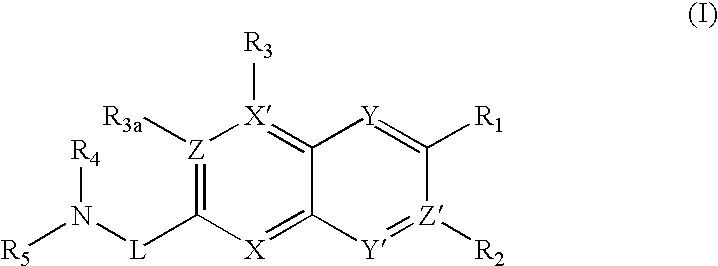
- or a pharmaceutically acceptable salt, ester, amide, or prodrug thereof, wherein:
- X, Y, and Y′ are each independently selected from the group consisting of CH, CF, and N;
- X′, Z, and Z′ are each independently C or N;
- one of R 1 and R2 is selected from the group consisting of halo, cyano, and L2R6;
- the other of R 1 and R2 is selected from the group consisting of hydrogen, alkyl, alkoxy, aryl, cycloalkyl, halo, cyano, and thioalkoxy, provided that R2 is absent when Z′ is N;
- R 3 is absent when X′ is N or R3 is selected from the group consisting of hydrogen, alkyl, alkoxy, halo, cyano, and thioalkoxy;
- R 3a is absent when Z is N or R3a is selected from the group consisting of hydrogen, methyl, alkoxy, halo, and cyano;
- R 4 and R5 are each independently selected from the group consisting of alkyl, haloalkyl, hydroxyalkyl, alkoxyalkyl, cycloalkyl, and cycloalkylalkyl, or R4 and R5 taken together with the nitrogen atom to which each is attached form a non-aromatic ring of the formula:

- R 6 is selected from the group consisting of aryl, heteroaryl, heterocycle, and cycloalkyl;
- R 7, R8, R9, and R10 are each independently selected from the group consisting of hydrogen, hydroxyalkyl, fluoroalkyl, and alkyl; or one of the pair R7 and R8 or the pair R9 and R10 is taken together to form a C3-C6 ring, wherein 0, 1, or 2 heteroatoms selected from O, N, or S replace a carbon atom in the ring;
- R 11, R12, R13, and R14 are each independently selected from the group consisting of hydrogen, hydroxy, hydroxyalkyl, alkyl, and fluoro;
- Q is selected from the group consisting of a bond, O, S, and NR 15;
- L is —[C(R 16)(R17)]n— or —[C(R16)(R17)]pO—;
- L 2 is a bond or L2 is selected from the group consisting of —O—, —C(═O)—, —S—, —[C(R18)(R19)]q—, —O—[C(R18)(R19)]q—, —NH— and —N(alkyl)-;
- R 15 is selected from the group consisting of hydrogen, alkyl, acyl, amido, and formyl;
- R 16 and R17 at each occurrence are independently selected from the group consisting of hydrogen, alkyl, alkoxy, and fluoro;
- R 18 and R19 are each independently selected from the group consisting of hydrogen, hydroxy, alkyl, alkoxy, and fluoro;
- R x and Ry at each occurrence are independently selected from the group consisting of hydrogen, hydroxy, alkyl, alkoxy, alkylamino, dialkylamino, and fluoro, or one of Rx or Ry represents a covalent bond when taken together with Rx or Ry on an adjacent carbon atom such that a double bond is represented between the adjacent carbon atoms;
- m is an integer from 1 to 5;
- n is an integer from 1 to 6;
- p is an integer from 2 to 6; and
- q is an integer from 1 to 4;
- wherein 0, 1, or 2 of X, X′, Y, Y′, Z, and Z′ can be nitrogen; provided that R 3 is absent when X′ is N; R3a is absent when Z is N; and R2 is absent when Z is N.
- Another aspect of the invention relates to pharmaceutical compositions comprising compounds of the invention. Such compositions can be administered in accordance with a method of the invention, typically as part of a therapeutic regimen for treatment or prevention of conditions and disorders related to H 3 receptor activity.
- Yet another aspect of the invention relates to a method of selectively modulating H 3 receptor activity. The method is useful for treating and/or preventing conditions and disorders related to H3 receptor modulation in mammals. More particularly, the method is useful for conditions and disorders related to memory and cognition processes, neurological processes, cardiovascular function, and body weight.
- The compounds, compositions comprising the compounds, and methods for treating or preventing conditions and disorders by administering the compounds are further described herein.
- Definition of Terms
- Certain terms as used in the specification are intended to refer to the following definitions, as detailed below.
- The term “acyl” as used herein, means an alkyl group, as defined herein, appended to the parent molecular moiety through a carbonyl group, as defined herein. Representative examples of acyl include, but are not limited to, acetyl, 1-oxopropyl, 2,2-dimethyl-1-oxopropyl, 1-oxobutyl, and 1-oxopentyl.
- The term “acyloxy” as used herein, means an acyl group, as defined herein, appended to the parent molecular moiety through an oxygen atom. Representative examples of acyloxy include, but are not limited to, acetyloxy, propionyloxy, and isobutyryloxy.
- The term “alkenyl” as used herein, means a straight or branched chain hydrocarbon containing from 2 to 10 carbons and containing at least one carbon-carbon double bond formed by the removal of two hydrogens. Representative examples of alkenyl include, but are not limited to, ethenyl, 2-propenyl, 2-methyl-2-propenyl, 3-butenyl, 4-pentenyl, 5-hexenyl, 2-heptenyl, 2-methyl-1-heptenyl, and 3-decenyl.
- The term “alkoxy” as used herein, means an alkyl group, as defined herein, appended to the parent molecular moiety through an oxygen atom. Representative examples of alkoxy include, but are not limited to, methoxy, ethoxy, propoxy, 2-propoxy, butoxy, tert-butoxy, pentyloxy, and hexyloxy.
- The term “alkoxyalkoxy” as used herein, means an alkoxy group, as defined herein, appended to the parent molecular moiety through another alkoxy group, as defined herein. Representative examples of alkoxyalkoxy include, but are not limited to, tert-butoxymethoxy, 2-ethoxyethoxy, 2-methoxyethoxy, and methoxymethoxy.
- The term “alkoxyalkyl” as used herein, means an alkoxy group, as defined herein, appended to the parent molecular moiety through an alkyl group, as defined herein. Representative examples of alkoxyalkyl include, but are not limited to, tert-butoxymethyl, 2-ethoxyethyl, 2-methoxyethyl, and methoxymethyl.
- The term “alkoxycarbonyl” as used herein, means an alkoxy group, as defined herein, appended to the parent molecular moiety through a carbonyl group, as defined herein. Representative examples of alkoxycarbonyl include, but are not limited to, methoxycarbonyl, ethoxycarbonyl, and tert-butoxycarbonyl.
- The term “alkoxyimino” as used herein, means an alkoxy group, as defined herein, appended to the parent molecular moiety through an imino group, as defined herein. Representative examples of alkoxyimino include, but are not limited to, ethoxy(imino)methyl and methoxy(imino)methyl.
- The term “alkoxysulfonyl” as used herein, means an alkoxy group, as defined herein, appended to the parent molecular moiety through a sulfonyl group, as defined herein. Representative examples of alkoxysulfonyl include, but are not limited to, methoxysulfonyl, ethoxysulfonyl, and propoxysulfonyl.
- The term “alkyl” as used herein, means a straight or branched chain hydrocarbon containing from 1 to 10 carbon atoms. Representative examples of alkyl include, but are not limited to, methyl, ethyl, n-propyl, isopropyl, n-butyl, sec-butyl, iso-butyl, tert-butyl, n-pentyl, isopentyl, neopentyl, n-hexyl, 3-methylhexyl, 2,2-dimethylpentyl, 2,3-dimethylpentyl, n-heptyl, n-octyl, n-nonyl, and n-decyl.
- The term “alkylamino” as used herein, means an alkyl group, as defined herein, appended to the parent molecular moiety through a NH group. Representative examples of alkylamino include, but are not limited to, methylamino, ethylamino, isopropylamino, and butylamino.
- The term “alkylsulfonyl” as used herein, means an alkyl group, as defined herein, appended to the parent molecular moiety through a sulfonyl group, as defined herein. Representative examples of alkylsulfonyl include, but are not limited to, methylsulfonyl and ethylsulfonyl.
- The term “alkynyl” as used herein, means a straight or branched chain hydrocarbon group containing from 2 to 10 carbon atoms and containing at least one carbon-carbon triple bond. Representative examples of alkynyl include, but are not limited, to acetylenyl, 1-propynyl, 2-propynyl, 3-butynyl, 2-pentynyl, and 1-butynyl.
- The term “amido” as used herein, means an amino, alkylamino, or dialkylamino group appended to the parent molecular moiety through a carbonyl group, as defined herein. Representative examples of amido include, but are not limited to, aminocarbonyl, methylaminocarbonyl, dimethylaminocarbonyl, and ethylmethylaminocarbonyl.
- The term “amino” as used herein, means a —NH 2 group.
- The term “aryl” as used herein, means a monocyclic aromatic ring system. Representative examples of aryl include, but are not limited to, phenyl.
- The aryl groups of this invention are substituted with 0, 1, 2, 3, 4, or 5 substituents independently selected from acyl, acyloxy, alkenyl, alkoxy, alkoxyalkoxy, alkoxyalkyl, alkoxycarbonyl, alkoxyimino, alkoxysulfonyl, alkyl, alkylsulfonyl, alkynyl, amido, carboxy, cyano, formyl, haloalkoxy, haloalkyl, halo, hydroxy, hydroxyalkyl, mercapto, nitro, thioalkoxy, —NR ARB, and (NRARB)sulfonyl.
- The term “arylalkoxy” as used herein, means an aryl group, as defined herein, appended to the parent molecular moiety through an alkoxy group, as defined herein. Representative examples of arylalkoxy include, but are not limited to, 2-phenylethoxy, 3-naphth-2-ylpropoxy, and 5-phenylpentyloxy.
- The term “arylalkoxycarbonyl” as used herein, means an arylalkoxy group, as defined herein, appended to the parent molecular moiety through a carbonyl group, as defined herein. Representative examples of arylalkoxycarboryl include, but are not limited to, benzyloxycarbonyl and naphth-2-ylmethoxycarbonyl.
- The term “arylalkyl” as used herein, means an aryl group, as defined herein, appended to the parent molecular moiety through an alkyl group, as defined herein. Representative examples of arylalkyl include, but are not limited to, benzyl, 2-phenylethyl, 3-phenylpropyl, and 2-naphth-2-ylethyl.
- The term “carbonyl” as used herein, means a —C(O)— group.
- The term “carboxy” as used herein, means a —CO 2H group, which may be protected as an ester group —CO2-alkyl.
- The term “cyano” as used herein, means a —CN group.
- The term “cycloalkenyl” as used herein, means a cyclic hydrocarbon containing from 3 to 8 carbons and containing at least one carbon-carbon double bond formed by the removal of two hydrogens. Representative examples of cycloalkenyl include, but are not limited to, 2-cyclohexen-1-yl, 3-cyclohexen-1-yl, 2,4-cyclohexadien-1-yl and 3-cyclopenten-1-yl.
- The term “cycloalkyl” as used herein, means a saturated cyclic hydrocarbon group containing from 3 to 8 carbons. Examples of cycloalkyl include cyclopropyl, cyclobutyl, cyclopentyl, cyclohexyl, cycloheptyl, and cyclooctyl.
- The cycoalkyl groups of the invention are substituted with 0, 1, 2, 3, or 4 substituents selected from acyl, acyloxy, alkenyl, alkoxy, alkoxyalkoxy, alkoxyalkyl, alkoxycarbonyl, alkoxyimino, alkyl, alkynyl, amido, carboxy, cyano, ethylenedioxy, formyl, haloalkoxy, haloalkyl, halo, hydroxy, hydroxyalkyl, methylenedioxy, thioalkoxy, and —NR ARB.
- The term “cycloalkylalkyl” as used herein, means a cycloalkyl group, as defined herein, appended to the parent molecular moiety through an alkyl group, as defined herein. Representative examples of cycloalkylalkyl include, but are not limited to, cyclopropylmethyl, 2-cyclobutylethyl, cyclopentylmethyl, cyclohexylmethyl, and 4 cycloheptylbutyl.
- The term “dialkylamino” as used herein, means two independent alkyl groups, as defined herein, appended to the parent molecular moiety through a nitrogen atom. Representative examples of dialkylamino include, but are not limited to, dimethylamino, diethylamino, ethylmethylamino, butylmethylamino.
- The term “ethylenedioxy” as used herein, means a —O(CH 2)2O— group wherein the oxygen atoms of the ethylenedioxy group are attached to the parent molecular moiety through one carbon atom forming a five-membered ring or the oxygen atoms of the ethylenedioxy group are attached to the parent molecular moiety through two adjacent carbon atoms forming a six-membered ring.
- The term “fluoro” as used herein means —F.
- The term “fluoroalkyl” as used herein, means at least one fluoro group, as defined herein, appended to the parent molecular moiety through an alkyl group, as defined herein. Representative example of fluoroalkyl include, but are not limited to, fluoromethyl, difluoromethyl, trifluoromethyl, pentafluoroethyl, and 2,2,2-trifluoroethyl.
- The term “formyl” as used herein, means a —C(O)H group.
- The term “halo” or “halogen” as used herein, means —Cl, —Br, —I or —F.
- The term “haloalkoxy” as used herein, means at least one halogen, as defined herein, appended to the parent molecular moiety through an alkoxy group, as defined herein. Representative examples of haloalkoxy include, but are not limited to, chloromethoxy, 2-fluoroethoxy, trifluoromethoxy, and pentafluoroethoxy.
- The term “haloalkyl” as used herein, means at least one halogen, as defined herein, appended to the parent molecular moiety through an alkyl group, as defined herein. Representative examples of haloalkyl include, but are not limited to, chloromethyl, 2-fluoroethyl, trifluoromethyl, pentafluoroethyl, and 2-chloro-3 fluoropentyl.
- The term “heteroaryl,” as used herein, refers to an aromatic five or six-membered ring wherein 1, 2, 3, or 4 heteroatoms are independently selected from nitrogen, oxygen, or sulfur, or a tautomer thereof. Examples of such rings include, but are not limited to, a ring wherein one carbon is replaced with an O or S atom; one, two, or three N atoms arranged in a suitable manner to provide an aromatic ring, or a ring wherein two carbon atoms in the ring are replaced with one O or S atom and one N atom. The heteroaryl groups are connected to the parent molecular moiety through a carbon or nitrogen atom. Representative examples of heteroaryl include, but are not limited to, furyl, imidazolyl, isoxazolyl, isothiazolyl, oxadiazolyl, oxazolyl, pyrazinyl, pyrazolyl, pyridazinyl, pyridazinonyl, pyridinyl, pyrimidinyl, pyrrolyl, tetrazolyl, thiadiazolyl, thiazolyl, thienyl, triazinyl, and triazolyl. Specific heteroaryl groups include, but are not limited to, 2H-pyridazin-3-one-2-yl.
- The heteroaryl groups of the invention are substituted with 0, 1, 2, 3, or 4 substituents independently selected from acyl, acyloxy, alkenyl, alkoxy, alkoxyalkoxy, alkoxyalkyl, alkoxycarbonyl, alkoxyimino, alkoxysulfonyl, alkyl, alkylsulfonyl, alkynyl, amido, carboxy, cyano, formyl, haloalkoxy, haloalkyl, halo, hydroxy, hydroxyalkyl, mercapto, nitro, thioalkoxy, —NR ARB, and (NRARB)sulfonyl.
- The term “heterocycle,” as used herein, refers to a three-, four-, five, six-, seven-, or eight-membered ring containing one, two, or three heteroatoms independently selected from the group consisting of nitrogen, oxygen, and sulfur. Rings containing at least four members can be saturated or unsaturated. For example, the four- and five membered ring has zero or one double bond. The six-membered ring has zero, one, or two double bonds. The seven- and eight-membered rings have zero, one, two, or three double bonds. The heterocycle groups of the invention can be attached to the parent molecular moiety through a carbon atom or a nitrogen atom. Representative examples of nitrogen-containing heterocycles include, but are not limited to, azepanyl, azetidinyl, aziridinyl, azocanyl, morpholinyl, piperazinyl, piperidinyl, pyrrolidinyl, pyrrolinyl, and thiomorpholinyl. Representative examples of non-nitrogen containing heterocycles include, but are not limited to, tetrahydrofuranyl and tetrahydropyranyl.
- The heterocycles of the invention are substituted with 0, 1, 2, 3, or 4 substituents independently selected from acyl, acyloxy, alkenyl, alkoxy, alkoxyalkoxy, alkoxyalkyl, alkoxycarbonyl, alkoxyimino, alkoxysulfonyl, alkyl, alkylsulfonyl, alkynyl, amido, arylalkyl, arylalkoxycarbonyl, carboxy, cyano, formyl, haloalkoxy, haloalkyl, halo, hydroxy, hydroxyalkyl, mercapto, nitro, oxo, thioalkoxy, —NR ARB, and (NRARB)sulfonyl.
- The term “hydroxy” as used herein means a OH group.
- The term “hydroxyalkyl” as used herein, means at least one hydroxy group, as defined herein, appended to the parent molecular moiety through an alkyl group, as defined herein. Representative examples of hydroxyalkyl include, but are not limited to, hydroxymethyl, 2-hydroxyethyl, 3-hydroxypropyl, 2,3-dihydroxypentyl, and 2-ethyl-4-hydroxyheptyl.
- The term “hydroxy-protecting group” means a substituent which protects hydroxyl groups against undesirable reactions during synthetic procedures. Examples of hydroxy-protecting groups include, but are not limited to, methoxymethyl, benzyloxymethyl, 2-methoxyethoxymethyl, 2-(trimethylsilyl)ethoxymethyl, benzyl, triphenylmethyl, 2,2,2-trichloroethyl, tbutyl, trimethylsilyl, t-butyldimethylsilyl, t-butyldiphenylsilyl, methylene acetal, acetonidebenzylidene acetal, cyclic ortho esters, methoxymethylene, cyclic carbonates, and cyclic boronates. Hydroxy-protecting groups are appended onto hydroxy groups by reaction of the compound that contains the hydroxy group with a base, such as triethylamine, and a reagent selected from an alkyl halide, alkyl trifilate, trialkylsilyl halide, trialkylsilyl triflate, aryldialkylsilyltriflate, or an alkylchloroformate, CH 2I2, or a dihaloboronate ester, for example with methyliodide, benzyl iodide, triethylsilyltriflate, acetyl chloride, benzylchloride, or dimethylcarbonate. A protecting group also may be appended onto a hydroxy group by reaction of the compound that contains the hydroxy group with acid and an alkyl acetal.
- The term “imino” as defined herein means a —C(═NH)— group.
- The term “mercapto” as used herein, means a —SH group.
- The term “methylenedioxy” as used herein, means a —OCH 2O— group wherein the oxygen atoms of the methylenedioxy are attached to the parent molecular moiety through two adjacent carbon atoms.
- The term “—NR ARB” as used herein, means two groups, RA and RB, which are appended to the parent molecular moiety through a nitrogen atom. RA and RB are independently selected from hydrogen, alkyl, acyl and formyl. Representative examples of —NRARB include, but are not limited to, amino, methylamino, acetylamino, and acetylmethylamino.
- The term “(NR ARB)sulfonyl” as used herein, means a —NRARB group, as defined herein, appended to the parent molecular moiety through a sulfonyl group, as defined herein. Representative examples of (NRARB)sulfonyl include, but are not limited to, aminosulfonyl, (methylamino)sulfonyl, (dimethylamino)sulfonyl and (ethylmethylamino)sulfonyl.
- The term “nitro” as used herein means a —NO 2 group.
- The term “nitrogen protecting group” as used herein, means those groups intended to protect a nitrogen atom against undesirable reactions during synthetic procedures. Nitrogen protecting groups comprise carbamates, amides, N-benzyl derivatives, and imine derivatives. Preferred nitrogen protecting groups are acetyl, benzoyl, benzyl, benzyloxycarbonyl (Cbz), formyl, phenylsulfonyl, pivaloyl, tert butoxycarbonyl (Boc), tert-butylacetyl, trifluoroacetyl, and triphenylmethyl (trityl). Nitrogen-protecting groups are appended onto primary or secondary amino groups by reacting the compound that contains the amine group with base, such as triethylamine, and a reagent selected from an alkyl halide, an alkyl trifilate, a dialkyl anhydride, for example as represented by (alkyl-O) 2C═O, a diaryl anhydride, for example as represented by (aryl-O)2C═O, an acyl halide, an alkylchloroformate, or an alkylsulfonylhalide, an arylsulfonylhalide, or halo-CON(alkyl)2, for example acetylchloride, benzoylchloride, benzylbromide, benzyloxycarbonylchloride, formylfluoride, phenylsulfonylchloride, pivaloylchloride, (tert-butyl-O—C═O)2O, trifluoroacetic anhydride, and triphenylmethylchloride.
- The term “oxo” as used herein means (═O).
- The term “sulfonyl” as used herein means a —S(O) z group.
- The term “thioalkoxy” as used herein means an alkyl group, as defined herein, appended to the parent molecular moiety through a sulfur atom. Representative examples of thioalkoxy include, but are no limited to, methylthio, ethylthio, and propylthio.
- Compounds of the Invention
- Compounds of the invention can have the general formula (I) as described above.
- As previously described, X, Y, and Y′ each can be CH, CF, or N, and X′, Z, and Z′ each can be independently selected from C or N.
- R 1 can be halo, cyano, or L2R6, wherein L2 is selected from the group consisting of a bond, —O—, —C(═O)—, —S—, —[C(R18)(R19)]q—, as defined herein, —NH—, and —N(alkyl)-, and R6 is selected from the group consisting of aryl, heteroaryl, heterocycle, and cycloalkyl.
- Typically, the substituent for R 1 is selected from bromo, cyano, or L2R6. Specific examples of groups for R1 wherein the substituent is halo or cyano include, but are not limited to, bromo and cyano.
- Preferably L 2 is selected from a bond, —O—, —C(═O)—, —S—, or —[C(R18)(R19)]q—.
- L 2 as a bond is most preferred. Preferred groups for R6 are aryl, heteroaryl, and cycloalkyl. The aryl, heteroaryl, and heterocyclic groups can be unsubstituted or substituted, for example as described in the Definition of the Terms.
- Examples of aryl groups for R 6 can include, but are not limited to, phenyl. Preferred substituents for aryl are cyano, chloro, fluoro, and methylthio. The more preferred substituent is cyano.
- Specific heteroaryl groups for R 6 can include, but are not limited to, furyl, imidazolyl, isothiazolyl, isoxazolyl, oxadiazolyl, oxazolyl, pyrazinyl, pyrazolyl, pyridazinyl, pyridazinonyl, pyridinyl, pyrimidinyl, pyrrolyl, tetrazolyl, thiadiazolyl, thiazolyl, thienyl, triazinyl, and triazolyl. Specific heteroaryl groups for the invention include, but are not limited to, 2H-pyridazin-3-one-2-yl.
- Heterocycle groups for R 6 can include, but are not limited to, azepanyl, azetidinyl, aziridinyl, azocanyl, morpholinyl, piperazinyl, piperidinyl, pyrrolidinyl, pyrrolinyl, and thiomorpholinyl, as well as non-nitrogen containing heterocycles, for example, tetrahydrofuranyl and tetrhydropyranyl. Preferred heterocycles are morpholinyl, piperidinyl, pyrrolidinyl, thiomorpholinyl, and tetrahydropyranyl.
- Specific cycloalkyl groups for R 6 can include, but are not limited to, cyclopropyl, cyclobutyl, cyclopentyl, and cyclohexyl.
- R 2 in a compound of formula (I) is absent when Z′ is N. R2 also can be independently selected from the group consisting of hydrogen, alkyl, alkoxy, aryl, cycloalkyl, halo, cyano, and thioalkoxy when Z′ is C. Preferred groups for R2 are hydrogen, alkyl, and cycloalkyl. Alternatively, R2 can be halo, cyano, or L2R6, as defined for R1. In compounds wherein R2 is a group of the formula L2R6, R1 can be selected from the group consisting of hydrogen, alkyl, alkoxy, aryl, cycloalkyl, halo, cyano, and thioalkoxy.
- In one embodiment, R 1 is a group represented by L2R6, particularly wherein L2 is a bond and R6 is selected from aryl, heteroaryl, or cycloalkyl.
- Examples of specific groups for R 1 in this embodiment include, but are not limited to, phenyl, phenyl substituted with a group selected from alkoxy, acetyl, cyano, and halo, isoxazolyl, dimethylisoxazolyl, morpholinyl, pyrazinyl, pyridazinyl, pyridazinonyl, pyridinyl, pyrimidinyl, thiazolyl, thienyl, and thiomorpholinyl.
- In another embodiment, R 1 is a group represented by L2R6 wherein L2 is selected from a bond, —O—, —C(═O)—, —S—, or —[C(R18)(R19)]q—, and wherein R6 is as previously described for compounds of formula (I). In such embodiment, L2 is a bond is more preferred.
- R 3 in a compound of formula (I) is absent when X′ is N. In addition, R3 can be independently selected from the group consisting of hydrogen, alkyl, alkoxy, cycloalkyl, halo, cyano, and thioalkoxy when X′ is C. Preferred groups for R3 are hydrogen, alkyl, and cycloalkyl.
- R 3a in a compound of formula (I) is absent when Z is N. In addition, R3a can be independently selected from the group consisting of hydrogen, alkyl, alkoxy, cyano, and thioalkoxy when Z is C. Preferred groups for R3a are hydrogen and alkyl.
- R 4 and R5 in a compound of formula (I) are each independently selected from the group consisting of alkyl, haloalkyl, hydroxyalkyl, alkoxyalkyl, cycloalkyl, and cycloalkylalkyl, or R4 and R5 taken together with the nitrogen atom to which each is attached form a non-aromatic ring of the formula:

- wherein R 7, R8, R9, R10, R11, R12, R13, R14, Rx, Ry, and m are as previously defined herein, for example as for compounds of formula (I). Preferred compounds of formula (I), wherein R4 and R5 are independently selected are those wherein R4 and R5 are each independently selected from methyl, ethyl, and propyl, particularly isopropyl.
- In a preferred embodiment, R 4 and R5 taken together with the nitrogen atom to which each is attached form a 4- to 8-membered non-aromatic ring represented by formula (a).
- R 7, R8, R9, and R10 each can be independently selected from the group consisting of hydrogen, hydroxyalkyl, fluoroalkyl, and alkyl. Alternatively, each pair of R7 and R8 or R9 and R10 taken together can form a C3-C6 ring, including the carbon atom to which each is attached. The C3-C6 ring can include 0, 1, or 2 heteroatoms selected from O, N, or S to replace a carbon atom in the ring. Examples of C3C6 rings can include, but are not limited to, cyclopropyl, cyclobutyl, cyclopentyl, cyclohexyl, azetidinyl, pyrrolidinyl, oxirane, and the like.
- R x and Ry each can be independently selected from hydrogen, hydroxy, alkyl, alkoxy, alkylamino, dialkylamino, and fluoro. Also, one of Rx and Ry can represent a bond when taken with Rx or Ry on an adjacent carbon atom, such that a double bond is represented between the adjacent carbon atoms.
- The value represented by m can be selected from 1 to 5, inclusive. Preferred values for m are 2 and 3.
- Compounds of formula (I) also can relate to those wherein R 4 and R5 are taken together with the nitrogen atom to which each is attached to form a non-aromatic ring of formula (b), wherein R7, R8, R9, and R10 are as previously described; R11, R12, R13, and R14 are each independently selected from the group consisting of hydrogen, hydroxy, hydroxyalkyl, alkyl, and fluoro; and Q is a bond or Q is selected from the group consisting of O, S, and NR15, wherein R15 is selected from the group consisting of hydrogen, alkyl, acyl, amido, and formyl. Preferably, R11, R12, R13, and R14 are each hydrogen and R7, R8, R9, and R10 are each independently selected from hydrogen, methyl, ethyl, fluoromethyl, and hydroxymethyl. Alternatively, it is preferred that R1 and R12 are hydrogen, R13 and R14 are each independently selected from hydrogen or alkyl, and R7, R8, R9, and R10 are as previously defined.
- In one embodiment, groups for R 4 and R5 are taken together with the nitrogen atom to which each is attached form a non-aromatic ring of formula (a) or formula (b) and at least one of the substituents R7, R8, R9, and R10 is selected from hydroxyalkyl, fluoroalkyl, or alkyl. In this embodiment, at least one of R7, R8, R9, and R10 can be selected from methyl, ethyl, fluoromethyl, or hydroxymethyl, and the like. In such embodiment, it is particularly preferred that one substituent represented by R7, R8, R9, and R10 is alkyl, and particularly methyl, and the other three substituents are hydrogen.
- Compounds wherein R 4 and R5 taken together with the nitrogen atom to which each is attached to form a 4 to 8-membered non-aromatic ring of formula (a) can include those wherein the 4- to 8-membered non-aromatic ring is selected from azetidinyl, azepanyl, azepinyl, pyrrolidinyl, pyrrolinyl, piperidinyl, or tetrahydropyridinyl.
- Groups for R 4 and R5 also can be taken together with the nitrogen atom to which each is attached to form a 4 to 8-membered non-aromatic ring of formula (a) or formula (b), wherein the ring is substituted with at least one substituent selected from hydroxy, alkyl, halo, fluoroalkyl, or hydroxyalkyl.
- More specific groups for R 4 and R5 include, for example, those wherein R4 and R5 are taken together with the nitrogen atom to which each is attached to form a 4- to 8-membered non-aromatic ring selected from morpholine and unsubstituted or substituted pyrrolidinyl, for example, methylpyrrolidinyl, ethylpyrrolidinyl, dimethylaminopyrrolidinyl, isopropylpyrrolidinyl, isobutylpyrrolidinyl, hydroxymethylpyrrolidinyl, and fluoromethylpyrrolidinyl.
- More preferred groups for R 4 and R5 are those wherein R4 and R5 taken together with the nitrogen atom to which each is attached form a 4- to 8-membered non-aromatic ring selected from morpholinyl, thiomorpholinyl, or pyrrolidinyl, and particularly methylpyrrolidinyl.
- One specific embodiment relates to compounds having the formula (I) wherein R 4 and R5 taken together with the nitrogen atom to which each is attached form a non-aromatic ring of formula (b) and Q is NR15. In such embodiment, R15 preferably is selected from hydrogen, hydroxy, alkyl, amido, or formyl.
- Compounds of the invention also can have the formula (I) wherein L is —[C(R 16)(R17)]n— or —[C(R16)(R17)]pO—, wherein R16 and R17 are each independently selected from the group consisting of hydrogen, alkyl, alkoxy, and fluoro, and n is an integer selected from 1 to 6, inclusive, and p is an integer selected from 2 to 6, inclusive. R16 and R17 preferably are hydrogen. The preferred value of n is 2 or 3. The preferred value for p is 2.
- L 2 can be a bond or selected from —O—, —C(═O)—, —S—, —[C(R18)(R19)]q—, —NH—, —N(alkyl)-, wherein R18 and R19 are each independently selected from the group consisting of hydrogen, hydroxy, alkyl, alkoxy, and fluoro, and q is an integer selected from 1 to 4, inclusive. The alkyl group of —N(alkyl)- preferably contains from 1 to 6 carbons. Compounds of the invention can have the formula (I) wherein L2 is —[C(R18)(R19)]q—, R18 and R19 are hydrogen, and q is 1, 2, 3 or 4. The preferred value for q is 1.
- Preferred compounds of formula (I) are those wherein R 1 is a group L2R6, wherein L2 is a bond and R6 is heteroaryl or heterocycle; R2, R3, and R3a are hydrogen; L is —[C(R16)(R17)]n—; n is 2; R16 and R17 are hydrogen at each occurrence; R4 and R5 are taken together to form a methylpyrrolidinyl ring of formula (a), wherein one of R7, R8, R9, and R10 is methyl and the remaining three substituents are hydrogen; and X, X′, Y, Y′, Z, and Z′ are CH. A preferred heteroaryl group is pyridazinonyl and, more particularly, 2H-pyridazin-3-one-2-yl.
- With respect to the ring system, 0, 1, or 2 atoms represented by X, X′, Y, Y′, Z, and Z′ can be nitrogen.
- Compounds of the invention can have the formula (I) wherein X, X′, Y, Y′, Z, and Z′ are CH.
- Alternatively, compounds of the invention have formula (I) wherein Z′ is N; and X, X′, Y, Y′, and Z are CH.
- Compounds of the invention also can have the formula (I) wherein X is N, and X′, Y, Y′, Z′, and Z are CH.
- Compounds of the invention also can have the formula (I) wherein X, X′, Y′, Z and Z′ are CH; and Y is N.
- The invention also includes compounds having the formula (I) wherein X, X′, Y, Y′, and Z′ are CH; and Z is N.
- In another embodiment, compounds of the invention can have formula (I) wherein X, X′, Y, Z and Z′ are CH; and Y′ is N.
- In yet another embodiment, compounds of the invention have formula (I) wherein X is N; Z is N; and X′, Y, Y′, and Z are CH.
- In yet another embodiment, compounds of the invention have formula (I) wherein X′ is N; Z is N; and X, Y, Y′, and Z are CH.
- Yet another embodiment relates to compounds of the invention having the formula (I) wherein Y and Y′ are N; and X, X′, Z and Z′ are CH.
- Still yet another embodiment relates to compounds of the invention having the formula (I) wherein Y and Z′ are N; and X, X′, Y′, and Z are CH.
- Another embodiment relates to compounds of the invention having the formula (I) wherein X′ and Y are N; and X, Y, Z and Z′ are CH.
- Still yet another embodiment relates to compounds of the invention having the formula (I) wherein Y and Z are N; and X, X′, Y′, and Z′ are CH.
- Still yet another embodiment relates to compounds of the invention having the formula (I) wherein Y′ and Z′ are N; and X, X′, Y, and Z are CH.
- Still yet another embodiment relates to compounds of the invention having the formula (I) wherein X′ and X are N; and Y, Y′, Z′, and Z are CH.
- When substituents represented by R 2, R3, and R3a are present, X′, Z, and Z′, respectively, represent a carbon atom to allow for the substituents represented by R2, R3, and R3a. Specific examples of compounds of the invention include, but are not limited to:
- 4-(6-{2-[(2R)-2-methyl-1-pyrrolidinyl]ethyl}-2-naphthyl)benzonitrile;
- (2R)-1-[2-(6-bromo-2-naphthyl)ethyl]-2-methylpyrrolidine;
- 1-[3-(6-{2-[(2R)-2-methyl-1-pyrrolidinyl]ethyl}-2-naphthyl)phenyl]ethanone;
- 2-[3-(6-{2-[(2R)-2-methyl-1-pyrrolidinyl]ethyl}-2-naphthyl)phenyl]-2-propanol;
- 6-{2-[(2R)-2-methyl-1-pyrrolidinyl]ethyl}-2-naphthonitrile;
- 4-(6-{[(2R)-2-methyl-1-pyrrolidinyl]methyl}-2-naphthyl)benzonitrile;
- 3-(6-{2-[(2R)-2-methyl-1-pyrrolidinyl]ethyl}-2-naphthyl)benzonitrile;
- 4-(6-{2-[(2R)-2-methyl-1-pyrrolidinyl]ethyl}-2-naphthyl)pyridine;
- 3-(6-{2-[(2R)-2-methyl-1-pyrrolidinyl]ethyl}-2-naphthyl)pyridine;
- (3-fluorophenyl)(6-{2-[(2R)-2-methyl-1-pyrrolidinyl]ethyl}-2-naphthyl)methanol;
- 3,5-dimethyl-4-(6-{2-[(2R)-2-methyl-1-pyrrolidinyl]ethyl}-2-naphthyl)isoxazole;
- 4-(6-{2-[(2S)-2-(hydroxymethyl)-1-pyrrolidinyl]ethyl}-2-naphthyl)benzonitrile;
- 4-(6-{2-[(3R)-3-hydroxy-1-pyrrolidinyl]ethyl}-2-naphthyl)benzonitrile;
- 4-{6-[2-(2-isobutyl-1-pyrrolidinyl)ethyl]-2-naphthyl}benzonitrile;
- 4-{6-[2-(2-isopropyl-1-pyrrolidinyl)ethyl]-2-naphthyl}benzonitrile;
- 4-(6-{2-[(3R)-3-(dimethylamino)-1-pyrrolidinyl]ethyl}-2-naphthyl)benzonitrile;
- 4-{6-[2-(diethylamino)ethyl]-2-naphthyl}benzonitrile;
- 4-{6-[2-(dimethylamino)ethyl]-2-naphthyl}benzonitrile;
- 4-(6-{2-[ethyl(isopropyl)amino]ethyl}-2-naphthyl)benzonitrile;
- 4-(6-{2-[tert-butyl(methyl)amino]ethyl}-2-naphthyl)benzonitrile;
- 4-(6-{2-[(2S)-2-methyl-1-pyrrolidinyl]ethyl}-2-naphthyl)benzonitrile;
- 4-(6-{2-[(2R)-2-methyl-1-piperidinyl]ethyl}-2-naphthyl)benzonitrile;
- 4-{6-[2-(2,5-dihydro-1H-pyrrol-1-yl)ethyl]-2-naphthyl}benzonitrile;
- 4-(6-{2-[methyl(propyl)amino]ethyl}-2-naphthyl)benzonitrile;
- 4-(6-{2-[(2-hydroxyethyl)(methyl)amino]ethyl}-2-naphthyl)benzonitrile;
- 5-(6-{2-[(2R)-2-methyl-1-pyrrolidinyl]ethyl}-2-naphthyl)pyrimidine;
- 4-(6-{2-[(2R)-2-methyl-1-pyrrolidinyl]ethyl}-2-naphthyl)morpholine;
- 2-(6-{2-[(2R)-2-methyl-1-pyrrolidinyl]ethyl}-2-naphthyl)-1,3-thiazole;
- 4-(6-{2-[(2S)-2-(fluoromethylyl-pyrrolidinyl]ethyl}-2-naphthyl)benzonitrile;
- (3-fluorophenyl)(6-{2-[(2R)-2-methyl-1-pyrrolidinyl]ethyl}-2-naphthyl)methanone;
- 2-(6-{2-[(2R)-2-methyl-1-pyrrolidinyl]ethyl}-2-naphthyl)-3(2H)-pyridazinone;
- 2-methoxy-5-(6-{2-[(2R)-2-methyl-1-pyrrolidinyl]ethyl}-2-naphthyl)pyridine;
- 4-(6-{2-[(2R)-2-(hydroxymethyl)-1-pyrrolidinyl]ethyl}-2-naphthyl)benzonitrile;
- 4-{6-[2-(2-methyl-1-pyrrolidinyl)ethyl]-2-naphthyl}benzonitrile;
- 4-{6-[2-(1-pyrrolidinyl)ethyl]-2-naphthyl}benzonitrile;
- 4-(6-{2-[(2R)-2-methyl-1-pyrrolidinyl]ethyl}-2-naphthyl)thiomorpholine;
- 1-{2-[(6-bromo-2-naphthyl)oxy]ethyl}pyrrolidine;
- 3-{6-[2-(1-pyrrolidinyl)ethoxy]-2-naphthyl}benzonitrile;
- 3-{6-[2-(1-pyrrolidinyl)ethoxy]-2-naphthyl}pyridine;
- 3-(6-{2-[(2R)-2-methyl-1-pyrrolidinyi]ethoxy}-2-naphthyl)benzonitrile;
- 3-(6-{2-[(2R)-2-methyl-1-pyrrolidinyl]ethoxy}-2-naphthyl)pyridine;
- 4-(2-{2-[(2R)-2-methyl-1-pyrrolidinyl]ethyl}-6-quinolinyl)benzonitrile;
- 6-(4-fluorophenyl)-2-{2-[(2R)-2-methyl-1-pyrrolidinyl]ethyl}quinoline;
- 3-(2-{2-[(2R)-2-methyl-1-pyrrolidinyl]ethyl}-6-quinolinyl)benzonitrile;
- 1-[3-(2-{2-[(2R)-2-methyl-1-pyrrolidinyl]ethyl}-6-quinolinyl)phenyl]ethanone;
- 6-(4-methoxyphenyl)-2-{2-[(2R)-2-methyl-1-pyrrolidinyl]ethyl}quinoline;
- 2-{2-[(2R)-2-methyl-1-pyrrolidinyl]ethyl}-6-[4-(trifluoromethyl)phenyl]quinoline;
- 2-{2-[(2R)-2-methyl-1-pyrrolidinyl]ethyl}-6-[4-(methylsulfonyl)phenyl]quinoline;
- 6-(3,5-difluorophenyl)-2-{2-[(2R)-2-methyl-1-pyrrolidinyl]ethyl}quinoline;
- (3-fluorophenyl)(2-{2-[(2R)-2-methyl-1-pyrrolidinyl]ethyl}-6-quinolinyl)methanone;
- 2-{2-[(2R)-2-methyl-1-pyrrolidinyl]ethyl}-6-(3-pyridinyl)quinoline;
- 4-(3-{2-[(2R)-2-methyl-1-pyrrolidinyl]ethyl}-7-isoquinolinyl)benzonitrile;
- 3-(3-{2-[(2R)-2-methyl-1-pyrrolidinyl]ethyl}-7-isoquinolinyl)benzonitrile;
- 6-{2-[(2R)-2-methyl-1-pyrrolidinyl]ethyl}-2-(3-pyridinyl)quinoline;
- 6-{2-[(2R)-2-methyl-1-pyrrolidinyl]ethyl}-2-(4-pyridinyl)quinoline;
- 6-{2-[(2R)-2-methyl-1-pyrrolidinyl]ethyl}-2-(2-pyridinyl)quinoline;
- 6-{2-[(2R)-2-methyl-1-pyrrolidinyl]ethyl}-2-(1,3-thiazol-2-yl)quinoline;
- 2-(2,4-dimethyl-1,3-thiazol-5-yl)-6-{2-[(2R)-2-methyl-1-pyrrolidinyl]ethyl}quinoline;
- 6-{2-[(2R)-2-methyl-1-pyrrolidinyl]ethyl}-2-(2-pyrazinyl)quinoline;
- 1-[6-(6-{2-[(2R)-2-methyl-1-pyrrolidinyl]ethyl}-2-quinolinyl)-2-pyridinyl]ethanone;
- 4-(2-{2-[(2R)-2-methyl-1-pyrrolidinyl]ethyl}-6-quinoxalinyl)benzonitrile;
- 4-(3-{2-[(2R)-2-methyl-1-pyrrolidinyl]ethyl}-6-quinoxalinyl)benzonitrile;
- 7-(2,6-difluoro-3-pyridinyl)-3-{2-[(2R)-2-methyl-1-pyrrolidinyl]ethyl}isoquinoline;
- 3-{2-[(2R)-2-methyl-1-pyrrolidinyl]ethyl}-7-(3-pyridinyl)isoquinoline;
- 3-(benzyloxy)-2-methyl-6-{2-[(2R)-2-methyl-1-pyrrolidinyl]ethyl}quinoline;
- 2-cyclopropyl-6-{2-[(2R)-2-methyl-1-pyrrolidinyl]ethyl}quinoline;
- 4-(6-{2-[(2R)-2-methyl-1-pyrrolidinyl]ethyl}-2-quinolinyl)benzonitrile;
- 2,6-dimethyl-5-(6-{2-[(2R)-2-methyl-1-pyrrolidinyl]ethyl}-2-quinolinyl)nicotinonitrile;
- 2-(3-methyl-2-pyrazinyl)-6-{2-[(2R)-2-methyl-1-pyrrolidinyl]ethyl}quinoline;
- ethyl 5-(6-{2-[(2R)-2-methyl-1-pyrrolidinyl]ethyl}-2-quinolinyl)-3-isoxazolecarboxylate;
- 5-(6-{2-[(2R)-2-methyl-1-pyrrolidinyl]ethyl}-2-quinolinyl)-2-thiophenecarbonitrile;
- ethyl 5-(6-{2-[(2R)-2-methyl-1-pyrrolidinyl]ethyl}-2-quinolinyl)-2-thiophenecarboximidoate;
- 2-(2,4-dimethyl-1,3-oxazol-5-yl)-6-{2-[(2R)-2-methyl-1-pyrrolidinyl]ethyl}quinoline;
- ethyl 3-methyl-5-(6-{2-[(2R)-2-methyl-1-pyrrolidinyl]ethyl}-2-quinolinyl)-4-isoxazolecarboxylate;
- 4-(7-{2-[(2R)-2-methyl-1-pyrrolidinyl]ethyl}-3-isoquinolinyl)benzonitrile;
- 6-{2-[(2R)-2-methyl-1-pyrrolidinyl]ethyl}-2-phenylquinoxaline;
- 7-{2-[(2R)-2-methyl-1-pyrrolidinyl]ethyl}-2-phenylquinoxaline; and
- 6-{2-[(2R)-2-methyl-1-pyrrolidinyl]ethyl}-2-(3-pyridinyl)quinazoline; or a pharmaceutically acceptable salt thereof.
- Compounds of the invention may exist as stereoisomers wherein, asymmetric or chiral centers are present. These stereoisomers are “R” or “S” depending on the configuration of substituents around the chiral carbon atom. The terms “R” and “S” used herein are configurations as defined in IUPAC 1974 Recommendations for Section E, Fundamental Stereochemistry, Pure Appl. Chem., 1976, 45: 13-30. The invention contemplates various stereoisomers and mixtures thereof and are specifically included within the scope of this invention. Stereoisomers include enantiomers and diastereomers, and mixtures of enantiomers or diastereomers. Individual stereoisomers of compounds of the invention may be prepared synthetically from commercially available starting materials which contain asymmetric or chiral centers or by preparation of racemic mixtures followed by resolution well-known to those of ordinary skill in the art. These methods of resolution are exemplified by (1) attachment of a mixture of enantiomers to a chiral auxiliary, separation of the resulting mixture of diastereomers by recrystallization or chromatography and optional liberation of the optically pure product from the auxiliary as described in Furniss, Hannaford, Smith, and Tatchell, “Vogel's Textbook of Practical Organic Chemistry”, 5th edition (1989), Longman Scientific & Technical, Essex CM20 2JE, England, or (2) direct separation of the mixture of optical enantiomers on chiral chromatographic columns or (3) fractional recrystallization methods.
- Methods for Preparing Compounds of the Invention
- The compounds of the invention can be better understood in connection with the following synthetic schemes and methods which illustrate a means by which the compounds can be prepared.
- Abbreviations which have been used in the descriptions of the schemes and the examples that follow are: Ac for acetyl; atm for atmosphere(s); BINAP for 2,2′-bis(diphenylphosphino)-1,1′-binaphthyl; Boc for butyloxycarbonyl; Bu for butyl; DCM for dichloromethane; DMAP for 4-(N,N-dimethylamino)pyridine; DMF for N,N-dimethylformamide; DMSO for dimethylsulfoxide; Et for ethyl; EtOH for ethanol; EtOAc for ethyl acetate; HPLC for high pressure liquid chromatography; IPA for isopropyl alcohol; IPAC or IPAc for isopropyl acetate; LDA for lithium diisopropylamide; NBS for N-bromosuccinimide; NIS for N-iodosuccinimide; Me for methyl; MeOH for methanol; Ms for methanesulfonyl; MTBE for tert-butyl methyl ether; Pd for palladium; tBu for tert-butyl; TEA for triethylamine; TFA for trifluoroacetic acid; THF for tetrahydrofuran; and Ts for p-MePhS(O) 2—.
- The compounds of this invention can be prepared by a variety of synthetic procedures. Representative procedures are shown in, but are not limited to, Schemes 1-21.


- Compounds of formula (8) and (10), wherein X, X′, Y, Y′, Z, Z′, R 2, R8, R4, and R5 are as defined in formula (I) and P6 is aryl or heteroaryl, can be prepared as described in Scheme 1. Bromides of formula (1), purchased or prepared using methodolgy known to those of ordinary skill in the art, can be treated with lithium diisopropylamine and a chloroformate such as, but not limited to, ethyl chloroformate to provide esters of formula (2). Esters of formula (2) can be treated with a reducing agent such as, but not limited to, lithium borohydride to provide alcohols of formula (3). Alcohols of formula (3) can be treated with a base such as, but not limited to, triethylamine and a sulfonate such as, but not limited to, methanesulfonyl chloride or p-toluensulfonyl chloride or triflic anhydride to provide sulfonates of formula (4). Sulfonates of formula (4) can be treated with an optional base such as, but not limited to, potassium carbonate or sodium carbonate and an amine of formula (5) with or without heat to provide amines of formula (6).
- The Suzuki reaction can be used to produce compounds of formula (I), wherein R 1 is an aryl, heteroaryl, heterocyclic, or cycloalkyl ring. In such a Suzuki reaction, compounds of formula (I) wherein R1 is a triflate or halogen are reacted with boronic acids of formula (7), a metal catalyst such as, but not limited to, palladium diacetate or Pd(PPh3)4, optionally with a Pd ligand added such as (dicyclohexylphosphinyl)biphenyl or trifurylphosphine, and a base such as, but not limited to, aqueous 0.2 M K3PO4 to provide products of formula (I) wherein R1 is an aryl, heteroaryl, heterocyclic or cycloalkyl ring. Boronic acid esters of (7) support the Suzuki reaction just as boronic acids. Boronic acids can be esterified to the corresponding boronic acid esters with alcohols such as methanol or with diols such as pinacol. Likewise, amines of formula (6) can be subjected to the Suzuki reaction to provide amines of formula (8).
- There are many aryl, heteroaryl, and heterocyclic boronic acids and boronic acid esters that are available commercially or that can be prepared as described in the scientific literature of synthetic organic chemistry. The preparation of boronic acid and boronic acid ester reagents suitable for incorporating into the synthetic methods for preparing compounds of formula (I) are more specifically described in Reference Example 2 herein.
- Alternatively, using the Stille coupling, compounds of formula (8) may be preprared from compounds of formula (6) by treatment with aryl, heteroaryl, and heterocyclic stannanes (Me 3SnR6, Bu3SnR6), a palladium source such as tris(dibenzylidineacetone)dipalladium (CAS # 52409-22-0) or palladium diacetate, and a ligand such as tri(2-furyl)phosphine (CAS # 5518-52-5) or triphenyl arsine in a solvent such as DMF at 25-150° C. While many organotin reagents are commercially or described in the literature that support the Stille coupling reaction where compounds of formula (6) can be transformed to compounds of formula (8), it is also possible to prepare new organotin reagents from arylhalides, aryltrflates, heteroarylhalides, heteroaryltriflates by reaction with distannanes like (Me3Sn)2 (hexamethyl distannane) in the presence of a palladium source like Pd(Ph3P)4. Such methods are described for instance in Krische, et. al., Helvetica Chimica Acta 81(11):1909-1920 (1998), and in Benaglia, et al., Tetrahedron Letters 38:4737-4740 (1997). These reagents can be reacted with (6) to give (8) as described under Suzuki conditions, or for example under the conditions reported by Littke, Schwartz, and Fu, Journal of the American Chemical Society 124:6343-6348 (2002).
- Compounds of formula (8) wherein the R 6 group is a nitrogen-containing heteroaryl or heterocyclic ring linked to the bicyclic core group through a nitrogen may be prepared by heating compounds of formula (6) with the H—R6 (R6=heteroaryl or heterocyclic group) with a base such as, but not limited to, sodium t-butoxide or cesium carbonate, in the presence of a metal catalyst such as, but not limited to copper metal or CuI, palladium diacetate, and also optionally with a ligand such as, but not limited to, BINAP, tri-tertbutylphosphine in solvents such as dioxane, toluene and pyridine. References that describe these methodologies may be found in the following references: J. Hartwig et al., Angew. Chem. Int. Ed. 37:2046-2067 (1998); J. P. Wolfe et al., Acc. Chem. Res., 13:805-818 (1998); M. Sugahara et al., Chem. Pharm. Bull., 45:719-721 (1997); J. P. Wolfe et al., J. Org. Chem., 65:1158-1174, (2000); F. Y. Kwong et al., Org. Lett., 4:581-584, (2002); A. Klapars et al., J. Amer. Chem. Soc., 123:7727-7729 (2001); B. H. Yang et al., J. Organomet. Chem., 576:125-146 (1999); and A. Kiyomori et al., Tet. Lett., 40:2657-2640 (1999). Additional references may also be found in Hartwig, J. Org. Chem., 64(15):5575-5580 (1999), where compounds of structure (6) can be transformed to compounds of structure (8) or (11) by reaction with amines, anilines, amides with tris-tert-butyl phoshine and a palladium source such as Pd(OAc)2. Compounds of structure (6) can be transformed to heterocyclic or heteroaryl compounds of structure (8) where the R6 moiety is, for instance, an N-pyridazinone by heating with 3(2H)-pyridazinone (or an optionally functionalized heterocycle that contains an acidic NH group in the heterocycle, such as pyridin-2-one) with copper powder and base as described in (WO 0024719, p. 127, Example 62).
- Compounds of formula (6) can also be treated with an organolithium reagent such as, but not limited to, n-butyllithium, methyllithium, or tert-butyllithium and an amide of formula (9) to provide compounds of formula (10).
- Compounds of formula (11), wherein L 2 is —NH— or —N(alkyl)- and R6 is as defined for a compound of formula (I) can be prepared by heating compounds of formula (6) with a compound of formula H2N—R6 or HN(alkyl)-R6 with a base such as, but not limited to sodium t-butoxide or cesium carbonate in the presence of a metal catalyst such as, but not limited to copper metal or CuI, palladium diacetate, and also optionally with a ligand such as, but not limited to, BINAP, tri-tertbutylphosphine in solvents such as dioxane, toluene, pyridine. References that describe these methodologies may be found in the following references: J. Hartwig, et al., Angew. Chem. Int. Ed., 37:2046-2067 (1998); J. P. Wolfe et al., Acc. Chem. Res., 13:805-818 (1998); J. P. Wolfe et al., J. Org. Chem., 65:1158-1174 (2000); F. Y. Kwong et al., Org. Lett., 4:581-584, (2002); and B. H. Yang et al., J. Organomet. Chem., 576:125-146 (1999).
- Compounds of formula (11), wherein L 2 is oxygen and R6 is defined in formula (I) can be prepared by heating compounds of formula (6) with a compound of formula HOR6 using a base such as but not limited to sodium hydride in a solvent such as toluene or N,N-dimethylformamide in the presence of a metal containing catalyst such as CuI or palladium diacetate. References that describe these methodologies may be found in the following references: J. Hartwig et al., Angew. Chem. Int. Ed., 37:2046-2067 (1998); K. E. Torraca et al., J. Amer. Chem. Soc., 123:10770-10771 (2001); S. Kuwabe et al., J. Amer. Chem. Soc., 123:12202-12206 (2001); K. E. Toracca et al., J. Am. Chem. Soc., 122:12907-12908 (2000); R. Olivera et al., Tet. Lett., 41:4353-4356 (2000); J.-F. Marcoux et al., J. Am. Chem. Soc., 119:10539-10540 (1997); A. Aranyos et al., J. Amer. Chem. Soc., 121:4369-4378 (1999); T. Satoh et al., Bull. Chem. Soc. Jpn., 71:2239-2246 (1998); J. F. Hartwig, Tet. Lett., 38:2239-2246 (1997); M. Palucki et al., J. Amer. Chem. Soc., 119:3395-3396 (1997); N. Hagaet al, J. Org. Chem., 61:735-745 (1996); R. Bates et al., J. Org. Chem., 47:4374-4376 (1982); T. Yamamoto et al., Can. J. Chem., 61:86-91 (1983). Additional methodologies useful for the synthesis of compounds of formula (11), wherein the L2 is sulfur and R6 is defined in formula (1) can be found in the following references: A. Aranyos et al., J. Amer. Chem. Soc., 121:4369-4378 (1999); and E. Baston et al., Synth. Commun., 28:2725-2730 (1998).
- Compounds of formula (11), wherein L 2 is sulfur and R6 is as defined for a compound of formula (I) can be prepared by heating compounds of formula (6) with a compound of formula HSR6 using a base with or without a metal catalyst such as CuI or palladium diacetate in the presence of a base in a solvent such as dimethylformamide or toluene. References that describe these methodologies may be found in the following references: G. Y. Li et al., J. Org. Chem., 66:8677-8681 (2001); Y. Wang et al., Bioorg. Med. Chem. Lett., 11:891-894 (2001); G. Liu et al., J. Med. Chem., 44:1202-1210 (2001); G. Y. Li et al., Angew. Chem. Int. Ed., 40:1513-1516 (2001); U. Schopfer et al., Tetrahedron, 57:3069-3074 (2001); and C. Palomo et al., Tet. Lett., 41:1283-1286 (2000). Additional methodologies useful for the synthesis of compounds of formula (11), wherein the L2 is oxygen and R6 is defined in formula (1) can be found in the following references: A. Pelter et al., Tet. Lett., 42:8391-8394 (2001); W. Lee et al., J. Org. Chem., 66:474-480 (2001); and A. Toshimitsu et al., Het. Chem., 12:392-397 (2001).
- Compounds of formula (11), wherein L 2 is —[C(R18)(R19)]q and R6, R18 and R19 are as defined for a compound of formula (I) and q=1, can be prepared from compounds of formula (10). Compounds of formula (10) can be manipulated by reactions well known to those skilled in the art of organic chemistry such as the Grignard reaction, catalytic hydrogenation, metal halide reduction, alkylation of alcohols, fluorination with (diethylamino)sulfur trifluoride, fluorination with [bis(2-methoxyethyl)amino]sulfur trifluoride to provide compounds of formula (11), wherein L2 is —[C(R18)(R19)]q and R6, R18 and R19 are defined in for a compound of formula (I) and q=1.
- Compounds of formula (11), wherein L 2 is —[C(R18(R19)]q and R6, R18, R19 and q are as defined for a compound of formula (I) can be prepared from compounds of formula (6). Compounds of formula (6) can also be treated with an organolithium reagent such as, but not limited to, n-butyllithium, methyllithium, or tert-butyllithium and a alkyl halide of general formla X—[C(R18)(R19)]q—R6 to provide compounds of formula (11). References that describe these methodologies may be found in the following references: K. H. Doetz et al., Eur. J. Org. Chem., 39-48 (2002); S. Y. W. Lau et al., Can. J. Chem., 79:1541-1545 (2001); and K. Terashima et al., Bioorg. Med. Chem., 10:1619-1626 (2002).
- Compounds of formula (11), wherein L 2 is —[C(R18)(R19)]q and R6, R18, R19 and q are as defined for a compound of formula (I) can be prepared by crosscoupling reactions known to those skilled in the art. Examples of these reactions are the Kumada, Suzuki, Heck, Stille, Suzuki-Miyaaura, Tamao-Kamuda and Sonogashira reaction. Suitable reagents, for example, alkyl Grignard reagents, boronic acids or ester, tin intermediates, alkenes and alkynes can be coupled with compounds of formuls (6) in the presence of a metal catalyst such as palladium, nickel, silver or indium, to prepare compounds of formula (11) wherein L2 is a substituted or unsubstituted alkyl, alkenyl or alkynyl chain. Compounds of formula (11) wherein L2 is an alkenyl or alkynyl chain can be reduced to compounds of formula (11) wherein L2 is an alkyl by methods known to those skilled in the art such as catalytic hydrogenation. References that describe these methodologies may be found in the following references: G. A. Molander et al., Tetrahedron, 58:1465-1470 (2002); S. Condon et al., Eur. J. Org. Chem., 105-112 (2002); W. Dohle et. al., Org. Lett., 3:2871-2873 (2001); G. Zou et al., Tet. Lett., 42:5817-5820 (2001); G. Zou et al, Tet. Lett., 42:7213-7216 (2001); A. J. Suzuki, Organomet. Chem., 576:147-168 (1999); A. F. Littke, J. Amer. Chem. Soc., 122:4020-4028 (2000); N. Miyaura et al., Chem. Rev., 95:2457-2483 (1995); I. Perez et al., J. Amer. Chem. Soc., 123:4155-4160 (2001); H. Horie et al., J. Mater. Chem., 11:1063-1071 (2001); C.-W. Kuo et al., Synth. Commun., 31:877-892 (2001); E. Riguet et al., J. Organomet. Chem., 624:376-379 (2001); C. Dai et al., J. Amer. Chem. Soc., 123:2719-2724 (2001); J. Lee et al., J. Org. Chem., 65:5428-5430 (2000); A. E. Jensen et al., Tetrahedron, 56:4197-4202 (2000); F. Diederich et al., Metal-catalyzed Cross-Coupling Reactions, Wiley-VCH; Weinheim, 1998; A. Mohanakrishnan et al., Syn. Lett., 7:1097-1099 (1999); N. Kurono et al., Tetrahedron, 55:6097-6108 (1999); B. H. Lipshutz et al., Org. Lett., 3:1869-1872 (2001); B. H. Lipshutz et al., Tet. Lett., 40:197-200 (1999); M. Shlosser, Organometallics in Synthesis—A Manual, John Wiley & Sons: New York, 1994; and J. Tsuji, Palladium Reagents and Catalysts—Innovations in Organic Synthesis, John Wiley & Sons: New York, 1995.


- Alternatively, compounds of formula (8), wherein X, X′, Y, Y′, Z, Z, R 2, R3, R4, and R5 are as defined in formula (I) and R6 is aryl or heteroaryl, can be prepared as described in Scheme 2. Esters of formula (13) can be treated with a reducing agent such as, but not limited to, lithium aluminum hydride to provide alcohols of formula (14). Alcohols of formula (14) can be treated with thionyl chloride to provide chlorides of formula (15). Chlorides of formula (15) can be treated with sodium cyanide or potassium cyanide to provide the nitrile which can be treated with aqueous acid to provide acids of formula (16). Acids of formula (16) can be treated with a reducing agent such as, but not limited to, diborane or borane THF complex to provide alcohols of formula (17). Alcohols of formula (17) can be treated with a hydroxy-protecting reagent such as, but not limited to, tert-butyldimethylsilyl chloride. The protected compounds of formula (18) can be processed as described in Scheme 1 to provide compounds of formula (19). Compounds of formula (19) can be deprotected using methods known to those of ordinary skill in the art and then treated with a sulfonyl chloride such as, but not limited to, methanesulfonyl chloride or p-toluensulfonyl chloride to provide sulfonates of formula (20). Sulfonates of formula (20) can be treated with an amine of formula (5) to provide compounds of formula (8).

- Compounds of formula (26), wherein X, X′, Y, Y′, Z, Z′, R 2, R3, R4 and R5 are as defined in formula (I) and R6 is aryl or heteroaryl, can be prepared as described in Scheme 3. Hydroxy compounds of formula (23), purchased or prepared using methods known to those of ordinary skill in the art, can be treated with 1,2-dibromoethane to provide bromides of formula (24). Bromides of formula (24) can be treated with amines of formula (5) to provide compounds of formula (25). Compounds of formula (25) can be processed as described in Scheme 1 to provide compounds of formula (26).

- Compounds of formula (34), wherein Y, Y′, Z′, R 2, R4, and R5 are as defined in formula (I) and R6 is aryl or heteroaryl, can be prepared as described in Scheme 4. Indanones of formula (28) can be treated with a base such as, but not limited to, lithium diisopropylamide and ethyl bromoacetate to provide esters of formula (29). Esters of formula (29) can be treated with tert-butylamineborane and then an aqueous basic solution such as, but not limited to, sodium hydroxide in water to provide hydroxyacids of formula (30). Hydroxyacids of formula (30) can be treated with a strong acid such as, but not limited to, concentrated sulfuric acid with heat in a solvent such as methanol to provide esters of formula (31). Esters of formula (31) can be treated with a reducing agent such as, but not limited to, lithium aluminum hydride to provide alcohols of formula (32). Alcohols of formula (32) can be treated with ozone followed by dimethylsulfide and ammonium hydroxide to provide isoquinolines of formula (33). Isoquinolines of formula (33) can be processed as described in Schemes 1 and 2 to provide compounds of formula (34).


- Compounds of formula (42), wherein R 2, R3, R4, R5 and R6 are as defined in formula (I) and L2 is —[C(C18)(C19)]q— or a bond can be prepared as described in Scheme 5. 1-(2-Bromoethyl)-4-nitrobenzene can be treated with amines of formula (5) to provide amines of formula (37). Amines of formula (37) can be treated with palladium on carbon under a hydrogen atmosphere to provide anilines which can then be treated with a nitrogen protecting reagent such as, but not limited to, trimethylacetyl chloride to provide protected anilines of formula (38). Protected anilines of formula (38) can be treated with an organolithium reagent such as, but not limited to, n-butyllithium, sec-butyllithium, or tert-butyllithium and N,N-dimethylformamide to provide aldehydes of formula (39). The aniline of aldehydes of formula (39) can be deprotected using methods well know to those skilled in the art such as, but not limited to, heating in aqueous hydrochloric acid to provide aldehydes of formula (40). Aldehydes of formula (40) can be treated with ketones of formula (41) and a base such as, but not limited to, potassium ethoxide to provide compounds of formula (42).
- Compounds of formula (44), wherein R 1, R3, R4, R5 and R6 are as defined in formula (I) and L2 is —[C(C18)(C19)]q— or a bond can be prepared as described in Scheme 5. Aldehydes of formula (40) can be treated with ketones of formula (43) and a base such as, but not limited to, potassium ethoxide to provide compounds of formula (44).
- Compounds of formula (41) and (43) can be purchased commercially or synthesized from procedures which are known to those skilled in the art.

- Compounds of formula (50), wherein R 4 and R5 are as defined in formula (I) and R6 is aryl or heteroaryl, can be prepared as described in Scheme 6. Ethyl 7-methoxy-2-methyl-3-quinolinecarboxylate can be prepared using the procedures described in Synthetic Comm., 17(14): 1647-1653 (1987). Ethyl 7-methoxy-2-methyl-3-quinolinecarboxylate can be treated with a reducing agent, such as, but not limited to, lithium aluminum hydride or sodium borohydride, to provide (7-methoxy-2-methyl-3-quinolinyl)methanol. (7-Methoxy-2-methyl-3-quinolinyl)methanol can be treated with a chlorinating reagent, such as, but not limited to, thionyl chloride to provide 3-(chloromethyl)-7-methoxy-2-methylquinoline. 3-(Chloromethyl)-7-methoxy-2-methylquinoline can be treated with sodium cyanide or potassium cyanide to provide (7-methoxy-2-methyl-3-quinolinyl)acetonitrile. (7-Methoxy-2-methyl-3-quinolinyl)acetonitrile can be treated with acid, such as, but not limited to, glacial acetic acid and concentrated sulfuric acid, in water and 1,4-dioxane with heat to provide (7-methoxy-2-methyl-3-quinolinyl)acetic acid. (7-Methoxy-2-methyl-3-quinolinyl)acetic acid can be treated with a reducing agent, such as, but not limited to, B2H6, borane THF complex, or borane-pryridine complex, to provide 2-(7-methoxy-2-methyl-3-quinolinyl)ethanol. 2-(7-Methoxy-2-methyl-3-quinolinyl)ethanol can be treated with methanesulfonyl chloride and a base, such as, but not limited to, triethylamine or diisopropylamine to provide 2-(7-methoxy-2-methyl-3-quinolinyl)ethyl methanesulfonate. 2-(7-Methoxy-2-methyl-3-quinolinyl)ethyl methanesulfonate can be treated with an amine of formula (5) to provide amines of formula (47). Amines of formula (47) can be treated with BBr3 to provide hydroxy compounds of formula (48). Hydroxy compounds of formula (48) can be treated with trifluoromethanesulfonic anhydride or trifluoromethanesulfonic chloride to provide triflates of formula (49). Triflates of formula (49) can be treated with boronic acids of formula (7) as described in Scheme 1 to provide compounds of formula (50).

- 1,5-Naphthyridines of formula (53), wherein R and R 5 are as defined in formula (I) and R6 is aryl or heteroaryl, can be prepared as described in Scheme 7. 3,7-Dibromo-[1,5]naphthyridine, prepared as described by W. W. Paudler, J. Org. Chem., 33:1384 (1968), can be treated with (2-ethoxyvinyl)tributylstannane, a halide source, such as, but not limited to, tetraethylammonium chloride, and a palladium source, such as, but not limited to, dichlorobis(triphenylphosphine)palladium (II) in a solvent, such as, but not limited to, N,N-dimethylformamide with heat (about 50° C. to about 150° C.) to provide 3-bromo-7-[2-ethoxyvinyl]-1,5-naphthyridine. 3-Bromo-7-[2-ethoxyvinyl]-1,5-naphthyridine can be treated with an acid, such as, but not limited to, formic acid at about 0° C. to about 60° C. in a solvent, such as, but not limited to, 1,2-dichloroethane to provide (7-bromo-1,5-naphthyridin-3-yl)acetaldehyde. Alternatively, 3-bromo-7-[2-ethoxyvinyl]-1,5-naphthyridine in a solvent, such as, but not limited to, tetrahydrofuran can be treated with an aqueous acid, such as, but not limited to, hydrochloric acid at about 0° C. to about 60° C. to provide (7-bromo-1,5-naphthyridin-3-yl)acetaldehyde. (7-Bromo-1,5-naphthyridin-3-yl)acetaldehyde can be treated to an amine of formula (5) under reductive amination conditions, such as, but not limited to, sodium triacetoxyborohydride and an acid, such as, but not limited to, acetic acid in a solvent, such as, but not limited to, 1,2-dichloroethane at about 0° C. to about 50° C. to povide amines of formula (52). Amines of formula (52) can be treated with boronic acids of formula (7), a palladium source, such as, but not limited to, tris(dibenzylideneacetone)dipalladium (0), a ligand, such as, but not limited to, tri(tert butyl)phosphine, and a base, such as, but not limited to, potassium fluoride in a solvent, such as, but not limited to, tetrahydrofuran at about 20° C. to about 80° C. to provide 1,5-naphthyridines of formula (53).

- Cinnolines of formula (60), wherein R 4 and R5 are as defined in formula (I) and R6 is aryl or heteroaryl, can be prepared as described in Scheme 8. Amines of formula (5) can be treated with 3-butynyl methanesulfonate at room temperature with stirring for about 1 hour and then heated at about 50° C. for about 24 hours. The mixture is allowed to cool to room temperature, and filtered. The filtrate is diluted with acetonitrile to provide a 0.1 M solution of alkynes of formula (55) for use in subsequent steps. 5-Bromo-2-iodophenylamine, prepared as described by Sakamoto in Chem. Pharm. Bull., 35:1823 (1987), can be treated with alkynes of formula (55), a source of palladium (II), such as, but not limited to, Pd(Ph3P)2Cl2, CuI, and a base, such as, but not limited to, triethylamine in an organic solvent, such as, but not limited to, DMF at about 50° C. to about 80° C. to provide alkynes of formula (56). Alkynes of formula (56) can be treated with aqueous acid, such as but not limited to aqueous HCl in the presence of sodium nitrite at about 0° C. to about 100° C. to provide hydroxy cinnolines of formula (57). Hydroxy cinnolines of formula (57) can be treated with boronic acids of formula (7) as described in Scheme 1 to provide hydroxy cinnolines of formula (58). Hydroxy cinnolines of formula (58) can be treated with N-phenylbis(trifluoromethanesulfonimide) and a base, such as, but not limited to, diisopropylethylamine in an organic solvent, such as, but not limited to, 1,2-dichloroethane at about 25° C. to about 40° C. to provide triflates of formula (59). Triflates of formula (59) can be treated with a catalytic palladium source, such as, but not limited to, palladium (II) acetate and a hydrogen donor, such as, but not limited to, formic acid at about 25° C. to about 50° C. to provide cinnolines of formula (60).

- Cinnolines of formula (60), wherein R 4 and R5 are as defined in formula (I) and R6 is aryl or heteroaryl, also can be prepared as described in Scheme 9. 7-Chloro-3-cinnolinol, prepared as described by H. E. Baumgarten, J. Het. Chem., 6:333 (1969), can be treated with trifluoromethanesulfonyl chloride or trifluoromethanesulfonic anhydride and a base, such as, but not limited to, triethylamine or pyridine in a solvent, such as, but not limited to, dichloromethane at about 0° C. or room temperature to provide 7-chloro-3-cinnolinyl trifluoromethanesulfonate. 7-Chloro-3-cinnolinyl trifluoromethanesulfonate can be treated with (2-ethoxyvinyl)tributylstannane, a halide source, such as, but not limited to, tetraethylammonium chloride, and a palladium source, such as, but not limited to, dichlorobis(triphenylphosphine)palladium (II) in a solvent, such as, but not limited to, N,N-dimethylformamide at about 50° C. to about 150° C. to provide 7-chloro-3-(2-ethoxyvinyl)cinnoline. 7-Chloro-3-(2-ethoxyvinyl)cinnoline can be processed as described in Scheme 7 to provide amines of formula (62). Amines of formula (62) can be treated with boronic acids of formula (7), a palladium source, such as, but not limited to, dichloro(di-tert-butylphosphinous acid)palladium (II) dimer) or tris(dibenzylideneacetone)dipalladium (0), tri(tert-butyl)phosphine, and a base, such as, but not limited to, cesium fluoride, in a solvent, such as, but not limited to, 1,4-dioxane at about 30° C. to about 120° C. to provide cinnolines of formula (60).
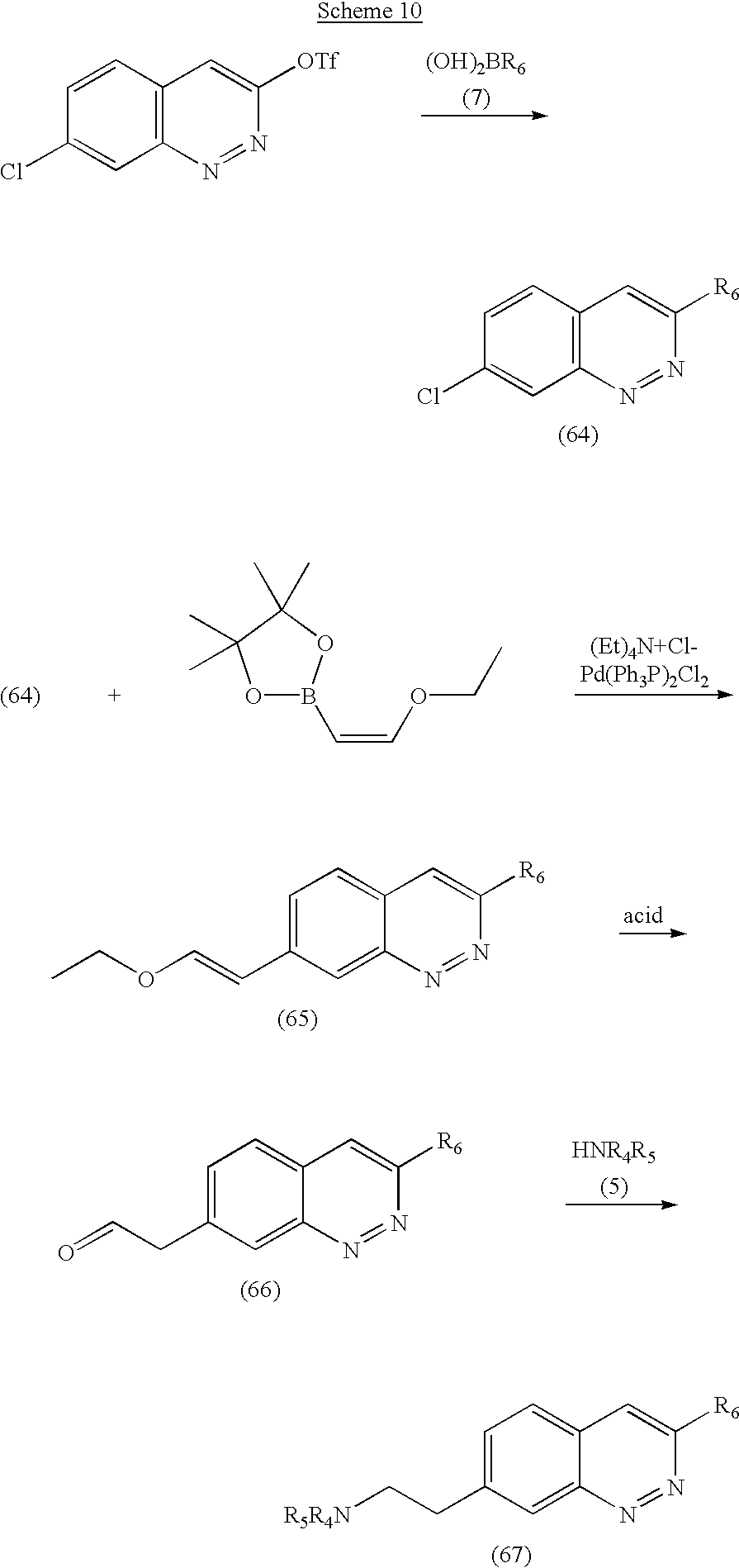
- Cinnolines of formula (67), wherein R 4 and R5 are as defined in formula (I) and R6 is aryl or heteroaryl, can be prepared as described in Scheme 10 7-Chloro-3-cinnolinyl trifluoromethanesulfonate, prepared as described in Scheme 9, can be treated with boronic acids of formula (7), a palladium source, such as, but not limited to, tris(dibenzylideneacetone)dipalladium (0), tricyclohexylphosphine (or triphenylphosphine or tri(tert-butyl)phosphine), and a base, such as, but not limited to, potassium fluoride, in a solvent, such as, but not limited to, tetrahydrofuran at about 20° C. to about 80° C. to provide chlorides of formula (64). Chlorides of formula (64) can be treated with 2-(2-ethoxy-vinyl-4,4,5,5-tetramethyl-[1,3,2]dioxaborolane, prepared as described by C. M. Vogels in Chem. Commun. (2000) 1, 51, a palladium source, such as, but not limited to, tris(dibenzylideneacetone)dipalladium (0), tri(tert-butyl)phosphine or, in place of both, dichloro(di-tert-butylphosphinous acid)palladium (II) dimer and a base such as cesium fluoride, in a solvent, such as, but not limited to, 1,4-dioxane at about 30° C. to about 120° C. to provide ethers of formula (65). Ethers of formula (65) can be processed as described in Scheme 7 to provide cinnolines of formula (67).

- Quinolines of formula (73), wherein R 4 and R5 are as defined in formula (I) and R6 is aryl or heteroaryl, can be prepared as described in Scheme 11. 2-(3-Nitrophenyl)ethanol, CAS 100-27-6, can be treated with methanesulfonyl chloride (or para-toluenesulfonyl chloride), and a base, such as, but not limited to, triethylamine in a solvent, such as, but not limited to, methylene chloride to provide 2-(3-nitrophenyl)ethyl methanesulfonate. 2-(3-Nitrophenyl)ethyl methanesulfonate can be treated with amines of formula (5) and a base, such as, but not limited to, potassium carbonate in a solvent, such as, but not limited to, acetonitrile to provide amines of formula (70). Amines of formula (70) can be treated with hydrogen with a palladium source, such as but not limited to palladium on carbon in a solvent, such as, but not limited to, methanol, ethanol, or ethyl acetate to provide anilines of formula (71). Anilines of formula (71) can be treated with 2,2,3-tribromopropanal as described in S. W. Tinsley, J. Amer. Chem. Soc. 77:4175-4176 (1955), to provide quinolines of formula (72). Quinolines of formula (72) can be treated with boronic acids of formula (7) to provide quinolines of formula (73).

- Naphthyridines of formula (80), wherein R 4 and R5 are as defined in formula (I) and R6 is aryl or heteroaryl, can be prepared as described in Scheme 12. 3-Bromo-1-(phenoxycarbonyl)pyridinium chloride can be treated with Grignard reagents of formula (75) as described in D. Comins et al., J. Het. Chem. 12391243 (1983) to provide compounds of formula (76). Compounds of formula (76) can be treated with a base, such as, but not limited to, lithium diisopropylamide and N,N-dimethylformamide, as described in Numata et al, Synthesis, 1999, 306-311, to provide compounds of formula (77). Compounds of formula (77) can be treated with 3-butyn-1-ol, CuI, a base, such as, but not limited to, triethylamine, and palladium source, such as, but not limited to, Pd(PPh3)2Cl2 in a solvent, such as but not limited to N,N-dimethylformamide to provide alkynes of formula (78). Alkynes of formula (78) can be treated with ammonia at about 80° C. in a solvent, such as, but not limited to, ethanol to provide naphthyridines of formula (79). Naphthyridines of formula (79) can be processed as described in Scheme 1 to provide naphthyridines of formula (80).

- Naphthyridines of formula (86), wherein R 4 and R5 are as defined in formula (I) and R6 is aryl or heteroaryl, can be prepared as described in Scheme 13. 6-Bromo-2-pyridinecarbaldehyde can be treated with N-iodosuccinimide in sulfuric acid and acetic acid to provide 6-bromo-3-iodo-2-pyridinecarbaldehyde and 6-bromo-5-iodo-2-pyridinecarbaldehyde. 6-Bromo-3-iodo-2-pyridinecarbaldehyde can be treated with tert-butylamine in a solvent, such as, but not limited to, THF to provide imine (84). Imine (84) can be treated with 3-butyn-1-ol, CuI, a base, such as, but not limited to, triethylamine or diisopropylamine, and a palladium source, such as, but not limited to, Pd(PPh3)2Cl2 in a solvent, such as but not limited to N,N-dimethylformamide to provide alcohols of formula (85). Alcohols of formula (85) can be processed as described in Scheme 1 to provide naphthyridines of formula (86).

- Naphthyridines of formula (91), wherein R 4 and R5 are as defined in formula (I) and R6 is aryl or heteroaryl, can be prepared as described in Scheme 14. Imines of formula (84), prepared as described in Scheme 13, can be treated with alkynes of formula (88), CuI, a base, such as, but not limited to, triethylamine or diisopropylamine, and a palladium source, such as, but not limited to, Pd(PPh3)2Cl2 in a solvent, such as but not limited to N,N-dimethylformamide to provide naphthyridines of formula (89). Naphthyridines of formula (89) can be treated with an alkyllithium reagent, such as, but not limited to, methyllithium, n-butyllithium, sec-butyllithium, or t-butyllithium, and ethylene oxide in a solvent, such as, but not limited to, THF or diethyl ether to provide alcohols of formula (90). Alcohols of formula (90) can be treated as described in Scheme 1 to provide naphthyridines of formula (91).

- Isoquinolines of formula (95), wherein R 4 and R5 are as defined in formula (I) and R6 is aryl or heteroaryl, can be prepared as described in Scheme 15. Methyl 2-iodobenzoate can be treated with N-bromosuccinimide in acetic acid and sufuric acid to provide methyl 5-bromo-2-iodobenzoate. Methyl 5-bromo-2-iodobenzoate can be treated with a reducing agent, such as, but not limited to, sodium borohydride or lithium aluminum hydride in a solvent, such as, but not limited to, THF, ethanol, or a mixture thereof, to provide (5-bromo-2-iodophenyl)methanol. (5-Bromo-2-iodophenyl)methanol can be treated with an oxidizing agent, such as, but not limited to, pyridinium chlorochromate, pyridinium dichromate, MnO2, a peracid such as meta-chloroperoxybenzoic acid, or Swern conditions (DMSO/Cl(CO)2Cl/TEA) to provide 5-bromo-2-iodobenzaldehyde. 5-Bromo-2-iodobenzaldehyde can be treated with tert-butylamine in a solvent, such as, but not limited to, THF to provide N-[(5-bromo-2-iodophenyl)methylene]N-(tert-butyl)amine. N-[(5-Bromo-2-iodophenyl)methylene]-N-(tert-butyl)amine can be treated with alkynes of formula (88), CuI, a base, such as, but not limited to, triethylamine or diisopropylamine, and a palladium source, such as, but not limited to, Pd(PPh3)2Cl2 in a solvent, such as but not limited to N,N-dimethylformamide to provide isoquinolines of formula (93). Isoquinolines of formula (93) can be treated with an alkyllithium reagent, such as, but not limited to, methyllithium, n-butyllithium, sec-butyllithium, or t-butyllithium, and ethylene oxide in a solvent, such as, but not limited to, THF or diethyl ether to provide alcohols of formula (94). Alcohols of formula (94) can be treated as described in Scheme 1 to provide isoquinolines of formula (95).
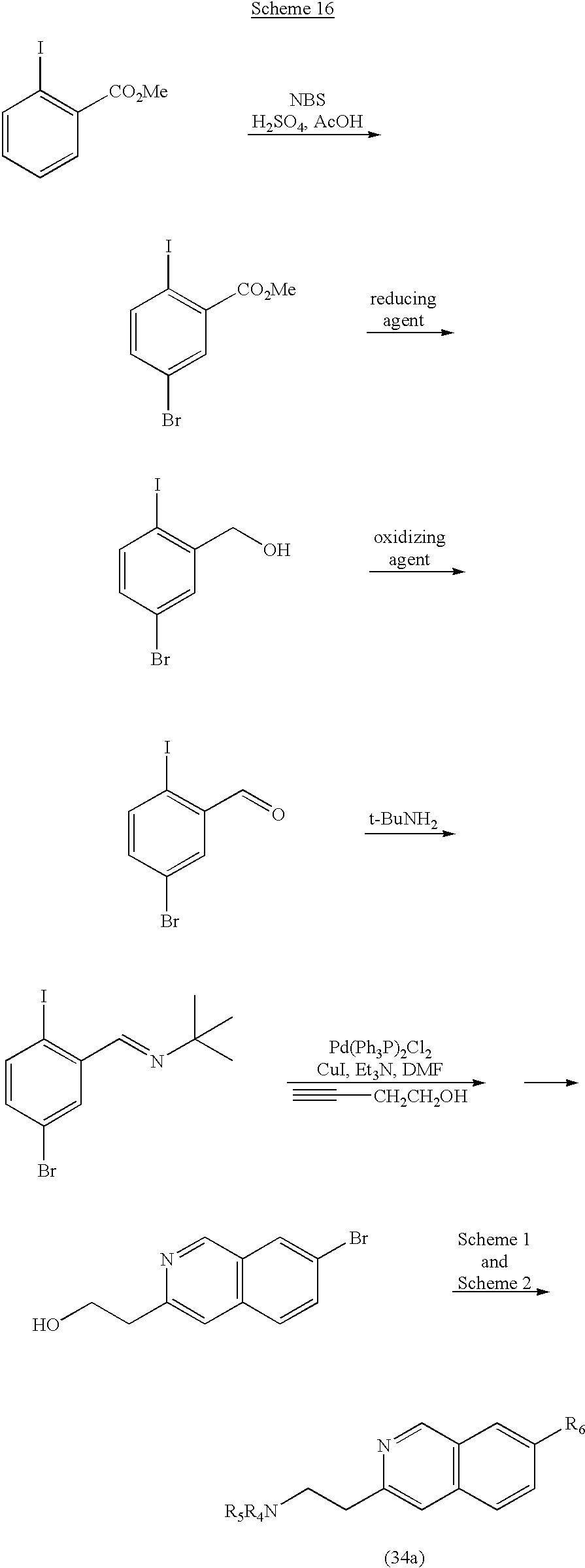
- Isoquinolines of formula (34a) are a subgenus of compounds (34), wherein X, Y′, and Z′ are all carbon atoms, for instance CH, and R 4 and R5 are as defined in formula (I) and R6 is aryl or heteroaryl, and the compounds of the subgenus (34a) can be prepared as described in Scheme 16. Methyl 2-iodobenzoate can be treated with N-bromosuccinimide in acetic acid and sufuric acid to provde methyl 5-bromo-2-iodobenzoate. Methyl 5-bromo-2-iodobenzoate can be treated with a reducing agent, such as, but not limited to, sodium borohydride or lithium aluminum hydride in a solvent, such as, but not limited to, THF, ethanol, or a mixture thereof, to provide (5-bromo-2-iodophenyl)methanol. (5-Bromo-2-iodophenyl)methanol can be treated with an oxidizing agent, such as, but not limited to, pyridinium chlorochromate, pyridinium dichromate, MnO2, a peracid such as meta-chloroperoxybenzoic acid, or Swern conditions (DMSO/Cl(CO)2Cl/TEA) to provide 5-bromo-2-iodobenzaldehyde. 5-Bromo-2-iodobenzaldehyde can be treated with tert-butylamine in a solvent, such as, but not limited to, THF to provide N-[(5-bromo-2-iodophenyl)methylene]-N-(tert-butyl)amine. N-[(5-Bromo-2-iodophenyl)methylene]-N-(tert-butyl)amine can be treated with the alkyne but-3-yn-1-ol, CuI, a base, such as, but not limited to, triethylamine or diisopropylamine, and a palladium source, such as, but not limited to, Pd(PPh3)2Cl2 in a solvent, such as, but not limited to, N,N-dimethylformamide to provide an isoquinoline. The 2-hydroxyisoquinoline can be treated as described in Scheme 1 to provide isoquinolines of formula (34a).

- Quinoxalines of formula (105), wherein Rat and R 5 are as defined in formula (I) and R6 is aryl, heteroaryl, heterocycle, or cycloalkyl, can be prepared as described in Scheme 17. Amines of formula (37), prepared as described in Scheme 5, can be treated with palladium on carbon under a hydrogen atmosphere to provide anilines that can then be treated with acetic anhydride in a solvent such as a mixture of sulfuric acid and water to provide acetamides of formula (100). Acetamides of formula (100) can be nitrated using conditions well known to those skilled in the art such as, but not limited to, nitric acid in sulfuric acid in the presence of acetic anhydride to provide acetamides of formula (101). Acetamides of formula (101) can be can be converted to Boc protected nitroanilines using a procedure described in Grehen, L, et. al, Acta Chem. Scand. Ser. B. 41, 1, 18-23, in which the acetamide is reacted with di-tert-butyldicarbonate in the presence of 4-dimethylaminopyridine followed by treatment with 2-diethylaminodiethylamine to provide a Boc protected nitroaniline which can be treated with palladium on carbon under a hydrogen atmosphere to provide anilines of formula (102). Anilines of formula (102) can be reacted with an acetyl bromide of formula (103) to provide amines of formula (104). Amines of formula (104) can be treated with an acid such as trifluoroacetic acid with heating to provide quinoxalines of formula (105). Treatment of amines of formula (104) may result in the formation of dihydroquinoxalines of formula (106). Dihydroquinoxalines of formula (106) may be oxidized with an oxidant such as silver nitrate to provide quinoxalines of formula (105).

- An alternate route to quinoxalines of formula (105), wherein R 4 and R5 are as defined in formula (I) and R6 is aryl or heteroaryl can be prepared as described in Scheme 18. Anilines of formula (102), prepared as described in Scheme 17, can be reacted with a bromoacetate to provide anilines of formula (110). Anilines of formula (110) can be treated with an acid such as, but not limited to, trifluoroacetic acid with heating to provide dihydroquinoxalinones of formula (111). Dihydroquinoxalinones of formula (111) can be oxidized using an oxidizing agent such as, but not limited to, silver nitrate to provide quinoxalinones of formula (112). Quinoxalinones of formula (112) can be treated with triflic anhydride in the presence of a base such as 2,6-lutidine in a solvent such as dichloromethane to provide triflates of formula (113). Triflates of formula (113) can be treated with boronic acids of formula (7) as described in Scheme 1 to provide quinoxalines of formula (105).

- Quinazolines of formula (123), wherein RP and R 5 are as defined in formula (I) and R6 is aryl, heteroaryl, heterocycle, or cycloalkyl, can be prepared as described in Scheme 19. Anilines of formula (40), prepared as described in Scheme 5, can be treated with acid chlorides of formula (121) in the presence of a base such as pyridine in a solvent such as dichloromethane to provide amides of formula (122). Amides of formula (122) can be treated with a source of ammonia, such as aqueous ammonium hydroxide, and heated to provide quinazolines of formula (123).

- Quinazolines of formula (123), wherein RP and R 5 are as defined in formula (I) and R6 is aryl or heteroaryl can also be prepared as described in Scheme 20. Anilines of formula (40), prepared as described in Scheme 5, can be treated with urea and heated as described in Troeger, et. al. Prakt. Chem. 117, 1927, 181, to provide quinazolinones of formula (130). Quinazolinones of formula (130) can be treated with triflic anhydride in the presence of a base such as 2,6-lutidine in a solvent such as dichloromethane to provide triflates of general strucure (131). Triflates of formula (131) can be treated with boronic acids of general strucure (7) as described in Scheme 1 to provide quinoxalines of formula (123).


- Compounds of formula (144) and (145), wherein Y, Y′, Z′, R 2, R4, and R5 are as defined in formula (I) and R6 is aryl or heteroaryl, can be prepared as described in Scheme 21. Nitrobenzenes of formula (138) can be treated with a reducing agent such as, but not limited to, platinum on carbon under a hydrogen atmosphere to provide diaminobenzenes of formula (139). Diaminobenzenes of formula (139) can be treated with 2-oxopropanal to provide a mixture of bromides of formula (140) and (141). Bromides of formula (140) and (141) can be treated with amines of formula (5) to provide a mixture of aminobromides of formula (142) and (143). Aminobromides of formula (142) and (143) can be processed as described in Scheme 1 to provide compounds of formula (144) and (145).
- The compounds and intermediates of the invention may be isolated and purified by methods well-known to those skilled in the art of organic synthesis.
- Examples of conventional methods for isolating and purifying compounds can include, but are not limited to, chromatography on solid supports such as silica gel, alumina, or silica derivatized with alkylsilane groups, by recrystallization at high or low temperature with an optional pretreatment with activated carbon, thin-layer chromatography, distillation at various pressures, sublimation under vacuum, and trituration, as described for instance in “Vogel's Textbook of Practical Organic Chemistry”, 5th edition (1989), by Furniss, Hannaford, Smith, and Tatchell, pub. Longman Scientific & Technical, Essex CM20 2JE, England.
- The compounds of the invention have at least one basic nitrogen whereby the compound can be treated with an acid to form a desired salt. For example, a compound may be reacted with an acid at or above room temperature to provide the desired salt, which is deposited, and collected by filtration after cooling. Examples of acids suitable for the reaction include, but are not limited to tartaric acid, lactic acid, succinic acid, as well as mandelic, atrolactic, methanesulfonic, ethanesulfonic, toluenesulfonic, naphthalenesulfonic, carbonic, fumaric, gluconic, acetic, propionic, salicylic, hydrochloric, hydrobromic, phosphoric, sulfuric, citric, or hydroxybutyric acid, camphorsulfonic, malic, phenylacetic, aspartic, glutamic, and the like.
- Compositions of the Invention
- The invention also provides pharmaceutical compositions comprising a therapeutically effective amount of a compound of formula (I) in combination with a pharmaceutically acceptable carrier. The compositions comprise compounds of the invention formulated together with one or more non-toxic pharmaceutically acceptable carriers. The pharmaceutical compositions can be formulated for oral administration in solid or liquid form, for parenteral injection or for rectal administration.
- The term “pharmaceutically acceptable carrier,” as used herein, means a non-toxic, inert solid, semi-solid or liquid filler, diluent, encapsulating material or formulation auxiliary of any type. Some examples of materials which can serve as pharmaceutically acceptable carriers are sugars such as lactose, glucose and sucrose; starches such as corn starch and potato starch; cellulose and its derivatives such as sodium carboxymethyl cellulose, ethyl cellulose and cellulose acetate; powdered tragacanth; malt; gelatin; talc; cocoa butter and suppository waxes; oils such as peanut oil, cottonseed oil, safflower oil, sesame oil, olive oil, corn oil and soybean oil; glycols; such a propylene glycol; esters such as ethyl oleate and ethyl laurate; agar; buffering agents such as magnesium hydroxide and aluminum hydroxide; alginic acid; pyrogen-free water; isotonic saline; Ringer's solution; ethyl alcohol, and phosphate buffer solutions, as well as other nontoxic compatible lubricants such as sodium lauryl sulfate and magnesium stearate, as well as coloring agents, releasing agents, coating agents, sweetening, flavoring and perfuming agents, preservatives and antioxidants can also be present in the composition, according to the judgment of one skilled in the art of formulations.
- The pharmaceutical compositions of this invention can be administered to humans and other mammals orally, rectally, parenterally, intracisternally, intravaginally, intraperitoneally, topically (as by powders, ointments or drops), bucally or as an oral or nasal spray. The term “parenterally,” as used herein, refers to modes of administration which include intravenous, intramuscular, intraperitoneal, intrasternal, subcutaneous, intraarticular injection and infusion.
- Pharmaceutical compositions for parenteral injection comprise pharmaceutically acceptable sterile aqueous or nonaqueous solutions, dispersions, suspensions or emulsions and sterile powders for reconstitution into sterile injectable solutions or dispersions. Examples of suitable aqueous and nonaqueous carriers, diluents, solvents or vehicles include water, ethanol, polyols (propylene glycol, polyethylene glycol, glycerol, and the like, and suitable mixtures thereof), vegetable oils (such as olive oil) and injectable organic esters such as ethyl oleate, or suitable mixtures thereof. Suitable fluidity of the composition may be maintained, for example, by the use of a coating such as lecithin, by the maintenance of the required particle size in the case of dispersions, and by the use of surfactants.
- These compositions may also contain adjuvants such as preservative agents, wetting agents, emulsifying agents, and dispersing agents. Prevention of the action of microorganisms may be ensured by various antibacterial and antifungal agents, for example, parabens, chlorobutanol, phenol, sorbic acid, and the like. It may also be desirable to include isotonic agents, for example, sugars, sodium chloride and the like. Prolonged absorption of the injectable pharmaceutical form may be brought about by the use of agents delaying absorption, for example, aluminum monostearate and gelatin.
- In some cases, in order to prolong the effect of a drug, it is often desirable to slow the absorption of the drug from subcutaneous or intramuscular injection. This may be accomplished by the use of a liquid suspension of crystalline or amorphous material with poor water solubility. The rate of absorption of the drug then depends upon its rate of dissolution which, in turn, may depend upon crystal size and crystalline form. Alternatively, delayed absorption of a parenterally administered drug form is accomplished by dissolving or suspending the drug in an oil vehicle.
- Suspensions, in addition to the active compounds, may contain suspending agents, for example, ethoxylated isostearyl alcohols, polyoxyethylene sorbitol and sorbitan esters, microcrystalline cellulose, aluminum metahydroxide, bentonite, agar-agar, tragacanth, and mixtures thereof.
- If desired, and for more effective distribution, the compounds of the invention can be incorporated into slow-release or targeted-delivery systems such as polymer matrices, liposomes, and microspheres. They may be sterilized, for example, by filtration through a bacteria-retaining filter or by incorporation of sterilizing agents in the form of sterile solid compositions, which may be dissolved in sterile water or some other sterile injectable medium immediately before use.
- Injectable depot forms are made by forming microencapsulated matrices of the drug in biodegradable polymers such as polylactide-polyglycolide. Depending upon the ratio of drug to polymer and the nature of the particular polymer employed, the rate of drug release can be controlled. Examples of other biodegradable polymers include poly(orthoesters) and poly(anhydrides) Depot injectable formulations also are prepared by entrapping the drug in liposomes or microemulsions which are compatible with body tissues.
- The injectable formulations can be sterilized, for example, by filtration through a bacterial-retaining filter or by incorporating sterilizing agents in the form of sterile solid compositions which can be dissolved or dispersed in sterile water or other sterile injectable medium just prior to use.
- Injectable preparations, for example, sterile injectable aqueous or oleaginous suspensions may be formulated according to the known art using suitable dispersing or wetting agents and suspending agents. The sterile injectable preparation may also be a sterile injectable solution, suspension or emulsion in a nontoxic, parenterally acceptable diluent or solvent such as a solution in 1,3-butanediol. Among the acceptable vehicles and solvents that may be employed are water, Ringer's solution, U.S.P. and isotonic sodium chloride solution. In addition, sterile, fixed oils are conventionally employed as a solvent or suspending medium. For this purpose any bland fixed oil can be employed including synthetic mono- or diglycerides. In addition, fatty acids such as oleic acid are used in the preparation of injectables.
- Solid dosage forms for oral administration include capsules, tablets, pills, powders, and granules. In such solid dosage forms, one or more compounds of the invention is mixed with at least one inert pharmaceutically acceptable carrier such as sodium citrate or dicalcium phosphate and/or a) fillers or extenders such as starches, lactose, sucrose, glucose, mannitol, and salicylic acid; b) binders such as carboxymethylcellulose, alginates, gelatin, polyvinylpyrrolidinone, sucrose, and acacia; c) humectants such as glycerol; d) disintegrating agents such as agar-agar, calcium carbonate, potato or tapioca starch, alginic acid, certain silicates, and sodium carbonate; e) solution retarding agents such as paraffin; f) absorption accelerators such as quaternary ammonium compounds; g) wetting agents such as cetyl alcohol and glycerol monostearate; h) absorbents such as kaolin and bentonite clay; and i) lubricants such as talc, calcium stearate, magnesium stearate, solid polyethylene glycols, sodium lauryl sulfate, and mixtures thereof. In the case of capsules, tablets and pills, the dosage form may also comprise buffering agents.
- Solid compositions of a similar type may also be employed as fillers in soft and hard-filled gelatin capsules using lactose or milk sugar as well as high molecular weight polyethylene glycols.
- The solid dosage forms of tablets, dragees, capsules, pills, and granules can be prepared with coatings and shells such as enteric coatings and other coatings well known in the pharmaceutical formulating art. They may optionally contain opacifying agents and can also be of a composition that they release the active ingredient(s) only, or preferentially, in a certain part of the intestinal tract in a delayed manner. Examples of materials which can be useful for delaying release of the active agent can include polymeric substances and waxes.
- Compositions for rectal or vaginal administration are preferably suppositories which can be prepared by mixing the compounds of this invention with suitable non irritating carriers such as cocoa butter, polyethylene glycol or a suppository wax which are solid at ambient temperature but liquid at body temperature and therefore melt in the rectum or vaginal cavity and release the active compound.
- Liquid dosage forms for oral administration include pharmaceutically acceptable emulsions, microemulsions, solutions, suspensions, syrups and elixirs. In addition to the active compounds, the liquid dosage forms may contain inert diluents commonly used in the art such as, for example, water or other solvents, solubilizing agents and emulsifiers such as ethyl alcohol, isopropyl alcohol, ethyl carbonate, ethyl acetate, benzyl alcohol, benzyl benzoate, propylene glycol, 1,3-butylene glycol, dimethylformamide, oils (in particular, cottonseed, groundnut, corn, germ, olive, castor, and sesame oils), glycerol, tetrahydrofurfuryl alcohol, polyethylene glycols and fatty acid esters of sorbitan, and mixtures thereof.
- Besides inert diluents, the oral compositions can also include adjuvants such as wetting agents, emulsifying and suspending agents, sweetening, flavoring, and perfuming agents.
- Dosage forms for topical or transdermal administration of a compound of this invention include ointments, pastes, creams, lotions, gels, powders, solutions, sprays, inhalants or patches. A desired compound of the invention is admixed under sterile conditions with a pharmaceutically acceptable carrier and any needed preservatives or buffers as may be required. Ophthalmic formulation, ear drops, eye ointments, powders and solutions are also contemplated as being within the scope of this invention.
- The ointments, pastes, creams and gels may contain, in addition to an active compound of this invention, animal and vegetable fats, oils, waxes, paraffins, starch, tragacanth, cellulose derivatives, polyethylene glycols, silicones, bentonites, silicic acid, talc and zinc oxide, or mixtures thereof.
- Powders and sprays can contain, in addition to the compounds of this invention, lactose, talc, silicic acid, aluminum hydroxide, calcium silicates and polyamide powder, or mixtures of these substances. Sprays can additionally contain customary propellants such as chlorofluorohydrocarbons.
- Compounds of the invention may also be administered in the form of liposomes. As is known in the art, liposomes are generally derived from phospholipids or other lipid substances. Liposomes are formed by mono- or multilamellar hydrated liquid crystals that are dispersed in an aqueous medium. Any non-toxic, physiologically acceptable and metabolizable lipid capable of forming liposomes may be used. The present compositions in liposome form may contain, in addition to the compounds of the invention, stabilizers, preservatives, and the like. The preferred lipids are the natural and synthetic phospholipids and phosphatidylcholines (lecithins) used separately or together.
- Methods to form liposomes are known in the art. See, for example, Prescott, Ed., Methods in Cell Biology, Volume XIV, Academic Press, New York, N.Y., (1976), p 33 et seq.
- Dosage forms for topical administration of a compound of this invention include powders, sprays, ointments and inhalants. The active compound is mixed under sterile conditions with a pharmaceutically acceptable carrier and any needed preservatives, buffers or propellants which can be required. Opthalmic formulations, eye ointments, powders and solutions are also contemplated as being within the scope of this invention.
- Aqueous liquid compositions of the invention are particularly useful for the treatment and prevention of asthma, epilepsy, Raynaud's syndrome, male sexual dysfunction, female sexual dysfunction, migraine, pain, eating disorders, urinary incontinence, functional bowel disorders, neurodegeneration and stroke.
- The compounds of the invention can be used in the form of pharmaceutically acceptable salts, esters, or amides derived from inorganic or organic acids. The term “pharmaceutically acceptable salts, esters and amides,” as used herein, refer to carboxylate salts, amino acid addition salts, zwitterions, esters and amides of compounds of formula (I) which are, within the scope of sound medical judgement, suitable for use in contact with the tissues of humans and lower animals without undue toxicity, irritation, allergic response, and the like, are commensurate with a reasonable benefit/risk ratio, and are effective for their intended use.
- The term “pharmaceutically acceptable salt” refers to those salts which are, within the scope of sound medical judgement, suitable for use in contact with the tissues of humans and lower animals without undue toxicity, irritation, allergic response, and the like, and are commensurate with a reasonable benefit/risk ratio. Pharmaceutically acceptable salts are well-known in the art. The salts can be prepared in situ during the final isolation and purification of the compounds of the invention or separately by reacting a free base function with a suitable organic acid.
- Representative acid addition salts include, but are not limited to acetate, adipate, alginate, citrate, aspartate, benzoate, benzenesulfonate, bisulfate, butyrate, camphorate, camphorsulfonate, digluconate, glycerophosphate, hemisulfate, heptanoate, hexanoate, fumarate, hydrochloride, hydrobromide, hydroiodide, 2-hydroxyethansulfonate (isethionate), lactate, maleate, methanesulfonate, nicotinate, 2-naphthalenesulfonate, oxalate, pamoate, pectinate, persulfate, 3-phenylpropionate, picrate, pivalate, propionate, succinate, tartrate, thiocyanate, phosphate, glutamate, bicarbonate, p-toluenesulfonate and undecanoate. Preferred salts of the compounds of the invention are the tartrate and hydrochloride salts.
- Also, the basic nitrogen-containing groups can be quaternized with such agents as lower alkyl halides such as methyl, ethyl, propyl, and butyl chlorides, bromides and iodides; dialkyl sulfates such as dimethyl, diethyl, dibutyl and diamyl sulfates; long chain halides such as decyl, lauryl, myristyl and stearyl chlorides, bromides and iodides; arylalkyl halides such as benzyl and phenethyl bromides and others. Water or oil-soluble or dispersible products are thereby obtained.
- Examples of acids which can be employed to form pharmaceutically acceptable acid addition salts include such inorganic acids as hydrochloric acid, hydrobromic acid, sulphuric acid and phosphoric acid and such organic acids as oxalic acid, maleic acid, succinic acid, and citric acid.
- Basic addition salts can be prepared in situ during the final isolation and purification of compounds of this invention by reacting a carboxylic acid-containing moiety with a suitable base such as the hydroxide, carbonate or bicarbonate of a pharmaceutically acceptable metal cation or with ammonia or an organic primary, secondary or tertiary amine. Pharmaceutically acceptable salts include, but are not limited to, cations based on alkali metals or alkaline earth metals such as lithium, sodium, potassium, calcium, magnesium, and aluminum salts, and the like, and nontoxic quaternary ammonia and amine cations including ammonium, tetramethylammonium, tetraethylammonium, methylamine, dimethylamine, trimethylamine, triethylamine, diethylamine, ethylamine and the such as. Other representative organic amines useful for the formation of base addition salts include ethylenediamine, ethanolamine, diethanolamine, piperidine, and piperazine.
- The term “pharmaceutically acceptable ester,” as used herein, refers to esters of compounds of the invention which hydrolyze in vivo and include those that break down readily in the human body to leave the parent compound or a salt thereof. Examples of pharmaceutically acceptable, nontoxic esters of the invention include C 1-to-C6 alkyl esters and C5-to-C7 cycloalkyl esters, although C1-to-C4 alkyl esters are preferred. Esters of the compounds of formula (I) may be prepared according to conventional methods. Pharmaceutically acceptable esters are prepared from compounds containing hydroxy groups by reaction of the compound that contains the hydroxy group with base such as triethylamine and an alkyl halide, alkyl trifilate, for example with methyliodide, benzyl iodide, cyclopentyl iodide. They may also be appended onto hydroxy groups by reaction of the compound that contains the hydroxy group with acid and an alkylcarboxylic acid such as acetic acid, or with acid and an arylcarboxylic acid such as benzoic acid. In the case of compounds containing carboxylic acid groups, the pharmaceutically acceptable esters are prepared from compounds containing the carboxylic acid groups by reaction of the compound with base such as triethylamine and an alkyl halide, alkyl trifilate, for example with methyliodide, benzyl iodide, cyclopentyl iodide. They also may be prepared by reaction of the compound with an acid such as hydrochloric acid and an alkylcarboxylic acid such as acetic acid, or with acid and an arylcarboxylic acid such as benzoic acid.
- The term “pharmaceutically acceptable amide,” as used herein, refers to non-toxic amides of the invention derived from ammonia, primary C 1-to-C6 alkyl amines and secondary C1-to-C6 dialkyl amines. In the case of secondary amines, the amine may also be in the form of a 5- or 6-membered heterocycle containing one nitrogen atom. Amides derived from ammonia, C1-to-C3 alkyl primary amides and C1-to-C2 dialkyl secondary amides are preferred. Amides of the compounds of formula (I) may be prepared according to conventional methods. Pharmaceutically acceptable amides are prepared from compounds containing primary or secondary amine groups by reaction of the compound that contains the amine group with base such as triethylamine and an alkyl halide, alkyl trifilate, for example with methyliodide, benzyl iodide, cyclopentyl iodide. They may also be appended onto amino groups by reaction of the compound that contains the amino group with an alkyl anhydride, aryl anhydride, acyl halide, or aryl halide. In the case of compounds containing carboxylic acid groups, the pharmaceutically acceptable esters are prepared from compounds containing the carboxylic acid groups by reaction of the compound with base such as triethylamine, a dehydrating agent such as dicyclohexyl carbodiimide or carbonyl diimidazole, and an alkyl amine, dialkylamine, for example with methylamine, diethylamine, piperidine. They also may be prepared by reaction of the compound with an acid such as sulfuric acid and an alkylcarboxylic acid such as acetic acid, or with acid and an arylcarboxylic acid such as benzoic acid under dehydrating conditions as with molecular sieves added. The composition can contain a compound of the invention in the form of a pharmaceutically acceptable prodrug.
- The term “pharmaceutically acceptable prodrug” or “prodrug,” as used herein, represents those prodrugs of the compounds of the invention which are, within the scope of sound medical judgement, suitable for use in contact with the tissues of humans and lower animals without undue toxicity, irritation, allergic response, and the like, commensurate with a reasonable benefit/risk ratio, and effective for their intended use. Prodrugs of the invention may be rapidly transformed in vivo to a parent compound of formula (I), for example, by hydrolysis in blood. A thorough discussion is provided in T. Higuchi and V. Stella, Pro-drugs as Novel Delivery Systems, V. 14 of the A.C.S. Symposium Series, and in Edward B. Roche, ed., Bioreversible Carriers in Drug Design, American Pharmaceutical Association and Pergamon Press (1987), hereby incorporated by reference.
- The invention contemplates pharmaceutically active compounds either chemically synthesized or formed by in vivo biotransformation to compounds of formula (I).
- Methods of the Invention
- Compounds and compositions of the invention are useful for modulating the effects of histamine-3 receptors. In particular, the compounds and compositions of the invention can be used for treating and preventing disorders modulated by the histamine 3 receptors. Typically, such disorders can be ameliorated by selectively modulating the histamine-3 receptors in a mammal, preferably by administering a compound or composition of the invention, either alone or in combination with another active agent as part of a therapeutic regimen.
- The compounds of the invention, including but not limits to those specified in the examples, possess an affinity for the histamine-3 receptors. As histamine-3 receptor ligands, the compounds of the invention may be useful for the treatment and prevention of diseases or conditions such as acute myocardial infarction, Alzheimer's disease, asthma, attention-deficit hyperactivity disorder, bipolar disorder, cognitive enhancement, cognitive deficits in psychiatric disorders, deficits of memory, deficits of learning, dementia, cutaneous carcinoma, drug abuse, diabetes, type II diabetes, depression, epilepsy, gastrointestinal disorders, inflammation, insulin resistance syndrome, jet lag, medullary thyroid carcinoma, melanoma, Meniere's disease, metabolic syndrome, mild cognitive impairment, migraine, mood and attention alteration, motion sickness, narcolepsy, neurogenic inflammation, obesity, obsessive compulsive disorder, pain, Parkinson's disease, polycystic ovary syndrome, schizophrenia, seizures, septic shock, Syndrome X, Tourette's syndrome, vertigo, and wakefulness.
- The ability of the compounds of the invention, including, but not limited to, those specified in the examples, to treat septic shock and cardiovascular disorders, in particular, acute myocardial infarction may be demonstrated by Imamura et al., Circ. Res., 78:475-481 (1996); Imamura et. al., Circ. Res., 78:863-869 (1996); R. Levi and N. C. E. Smith, “Histamine H 3-receptors: A new frontier in myocardial ischemia”, J. Pharm. Exp. Ther., 292:825-830 (2000); and Hatta, E., K. Yasuda and R. Levi, “Activation of histamine H3 receptors inhibits carrier-mediated norepinephrine release in a human model of protracted myocradial ischemia”, J. Pharm. Exp. Ther., 283:494-500 (1997).
- The ability of the compounds of the invention, including, but not limited to, those specified in the examples, to treat sleep disorders, in particular, narcolepsy may be demonstrated by Lin et al., Brain Res., 523:325-330 (1990); Monti, et al., Neuropsychopharmacology 15:31-35 (1996); Sakai, et al., Life Sci., 48:2397-2404 (1991); Mazurkiewicz-Kwilecki and Nsonwah, Can. J. Physiol. Pharmacol., 67:75-78 (1989); P. Panula, et al., Neuroscience 44:465-481 (1998); Wada, et al., Trends in Neuroscience 14:415 (1991); and Monti, et al., Eur. J. Pharmacol. 205:283 (1991).
- The ability of the compounds of the invention, including, but not limited to, those specified in the examples, to treat cognition and memory process disorders may be demonstrated by Mazurkiewicz-Kwilecki and Nsonwah, Can. J. Physiol. Pharmacol., 67:75-78 (1989); P. Panula, et al., Neuroscience, 82:993-997 (1997); Haas, et al., Behav. Brain Res., 66:41-44 (1995); De Almeida and Izquierdo, Arch. Int. Pharmacodyn., 283:193-198 (1986); Kamei et al., Psychopharmacology, 102:312-318 (1990); Kamei and Sakata, Jpn. J. Pharmacol., 57:437-482 (1991); Schwartz et al., Psychopharmacology, The fourth Generation of Progress. Bloom and Kupfer (eds). Raven Press, New York, (1995) 397; and Wada, et al., Trends in Neurosci., 14:415 (1991).
- The ability of the compounds of the invention, including, but not limited to, those specified in the examples, to treat attention-deficit hyperactivity disorder (ADHD) may be demonstrated by Shaywitz et al., Psychopharmacology, 82:73-77 (1984); Dumery and Blozovski, Exp. Brain Res., 67:61-69 (1987); Tedford et al., J. Pharmacol. Exp. Ther., 275:598-604 (1995); Tedford et al., Soc. Neurosci. Abstr., 22:22 (1996); and Fox, et al., Behav. Brain Res., 131:151-161 (2002).
- The ability of the compounds of the invention, including, but not limited to, those specified in the examples, to treat seizures, in particular, epilepsy may be demonstrated by Yokoyama, et al., Eur. J. Pharmacol., 234:129 (1993); Yokoyama and Iinuma, CNS Drugs 5:321 (1996); Onodera et al., Prog. Neurobiol., 42:685 (1994); R. Leurs, R. C. Vollinga and H. Timmerman, “The medicinal chemistry and therapeutic potential of ligands of the histamine H 3 receptor”, Progress in Drug Research 45:170-165, (1995); Leurs and Timmerman, Prog. Drug Res., 39:127 (1992); The Histamine H3 Receptor, Leurs and Timmerman (eds), Elsevier Science, Amsterdam, The Netherlands (1998); H. Yokoyama and K. Iinuma, “Histamine and Seizures: Implications for the treatment of epilepsy”, CNS Drugs, 5(5):321-330 (1995); and K. Hurukami, H. Yokoyama, K. Onodera, K. Iinuma and T. Watanabe, “AQ-0145, A newly developed histamine H3 antagonist, decreased seizure susceptibility of electrically induced convulsions in mice”, Meth. Find. Exp. Clin. Pharmacol., 17(C):70-73 (1995).
- The ability of the compounds of the invention, including, but not limited to, those specified in the examples, to treat motion sickness, Alzheimer's disease, and Parkinson's disease may be demonstrated by Onodera, et al., Prog. Neurobiol., 42:685 (1994); Leurs and Timmerman, Prog. Drug Res., 39:127 (1992); and The Hitamine H 3 Receptor, Leurs and Timmerman (eds), Elsevier Science, Amsterdam, The Netherlands (1998).
- The ability of the compounds of the invention, including, but not limited to, those specified in the examples, to treat narcolepsy, schizophrenia, depression, and dementia may be demonstrated by R. Leurs, R. C. Vollinga and H. Timmerman, “The medicinal chemistry and therapeutic potential of ligands of the histamine H 3 receptor”, Progress in Drug Research 45:170-165 (1995); The Histamine H3 Receptor, Leurs and Timmerman (eds), Elsevier Science, Amsterdam, The Netherlands (1998); and Perez-Garcia C, et. al., and Psychopharmacology (Berl) 142(2):215-20 (Feb, 1999).
- The ability of the compounds of the invention, including, but not limited to, those specified in the examples, to treat wakefulness, cognitive enhancement, mood and attention alteration, vertigo and motion sickness, and treatment of cognitive deficits in psychiatric disorders may be demonstrated by Schwartz, Physiol. Review 71:1-51 (1991).
- The ability of the compounds of the invention, including, but not limited to, those specified in the examples, to treat mild cognitive impairment, deficits of memory, deficits of learning and dementia may be demonstrated by C. E. Tedford, in “The Histamine H 3 Receptor: a target for new drugs”, the Pharmacochemistry Library, vol. 30 (1998) edited by R. Leurs and H. Timmerman, Elsevier (New York). p. 269 and references also contained therein.
- The ability of the compounds of the invention, including, but not limited to, those specified in the examples, to treat obesity may be demonstrated by Leurs, et al., Trends in Pharm. Sci., 19:177-183 (1998); E. Itoh, M. Fujimiay, and A. Inui, “Thioperamide, A histamine H 3 receptor antagonist, powerfully suppresses peptide YY-induced food intake in rats,” Biol. Psych., 45(4):475-481 (1999); S. I. Yates, et al., “Effects of a novel histamine H3 receptor antagonist, GT-2394, on food intake and weight gain in Sprague Dawley rats,” Abstracts, Society for Neuroscience, 102.10:219 (November, 2000); and C. Bjenning, et al., “Peripherally administered ciproxifan elevates hypothalamic histamine levels and potently reduces food intake in the Sprague Dawley rat,” Abstracts, International Sendai Histamine Symposium, Sendai, Japan, #P39 (November, 2000).
- The ability of the compounds of the invention, including, but not limited to, those specified in the examples, to treat inflammation and pain may be demonstrated by Phillips, et al., Annual Reports in Medicinal Chemistry 33:3140 (1998).
- The ability of the compounds of the invention, including, but not limited to, those specified in the examples, to treat migraine may be demonstrated by R. Leurs, R. C. Vollinga and H. Timmerman, “The medicinal chemistry and therapeutic potential of ligands of the histamine H 3 receptor,” Progress in Drug Research 45:170-165 (1995); Matsubara, et al., Eur. J. Pharmacol., 224:145 (1992); and Rouleau, et al., J. Pharmacol. Exp. Ther., 281:1085 (1997).
- The ability of the compounds of the invention, including, but not limited to, those specified in the examples, to treat cancer, in particular, melanoma cutaneous carcinoma and medullary thyroid carcinoma may be demonstrated by Polish Med. Sci. Mon., 4(5):747 (1998); Adam Szelag, “Role of histamine H 3-receptors in the proliferation of neoplastic cells in vitro,” Med. Sci. Monit., 4(5):747-755 (1998); and C. H. Fitzsimons, et al., “Histamine receptors signalling in epidermal tumor cell lines with H-ras gene alterations,” Inflammation Res., 47 (Suppl 1):S50-S51 (1998).
- The ability of the compounds of the invention, including, but not limited to, those specified in the examples, to treat vestibular dysfunctions, in particular, Meniere's disease may be demonstrated by R. Leurs, R. C. Vollinga and H. Timmerman, “The medicinal chemistry and therapeutic potential of ligands of the histamine H 3 receptor,” Progress in Drug Research 45:170-165 (1995), and Pan, et al., Methods and Findings in Experimental and Chemical Pharmacology 21:771-777 (1998).
- The ability of the compounds of the invention, including, but not limited to, those specified in the examples, to treat asthma may be demonstrated by A. Delaunois A., et al., “Modulation of acetylcholine, capsaicin and substance P effects by histamine H 3 receptors in isolated perfused rabbit lungs,” European Journal of Pharmacology 277(2-3):243-250 (1995); and Dimitriadou, et al., “Functional relationship between mast cells and C-sensitive nerve fibres evidenced by histamine H3-receptor modulation in rat lung and spleen,” Clinical Science 87(2):151-163 (1994).
- The ability of the compounds of the invention, including, but not limited to, those specified in the examples, to allergic rhinitis may be demonstrated by McLeod, et al., Progress in Resp. Research 31:133 (2001).
- Compounds of the invention are particularly useful for treating and preventing a condition or disorder affecting the memory or cognition.
- Actual dosage levels of active ingredients in the pharmaceutical compositions of this invention can be varied so as to obtain an amount of the active compound(s) which is effective to achieve the desired therapeutic response for a particular patient, compositions and mode of administration. The selected dosage level will depend upon the activity of the particular compound, the route of administration, the severity of the condition being treated and the condition and prior medical history of the patient being treated. However, it is within the skill of the art to start doses of the compound at levels lower than required to achieve the desired therapeutic effect and to gradually increase the dosage until the desired effect is achieved.
- When used in the above or other treatments, a therapeutically effective amount of one of the compounds of the invention can be employed in pure form or, where such forms exist, in pharmaceutically acceptable salt, ester, amide or prodrug form. Alternatively, the compound can be administered as a pharmaceutical composition containing the compound of interest in combination with one or more pharmaceutically acceptable carriers. The phrase “therapeutically effective amount” of the compound of the invention means a sufficient amount of the compound to treat disorders, at a reasonable benefit/risk ratio applicable to any medical treatment. It will be understood, however, that the total daily usage of the compounds and compositions of the invention will be decided by the attending physician within the scope of sound medical judgement. The specific therapeutically effective dose level for any particular patient will depend upon a variety of factors including the disorder being treated and the severity of the is disorder; activity of the specific compound employed; the specific composition employed; the age, body weight, general health, sex and diet of the patient; the time of administration, route of administration, and rate of excretion of the specific compound employed; the duration of the treatment; drugs used in combination or coincidental with the specific compound employed; and like factors well known in the medical arts. For example, it is well within the skill of the art to start doses of the compound at levels lower than required to achieve the desired therapeutic effect and to gradually increase the dosage until the desired effect is achieved.
- The total daily dose of the compounds of this invention administered to a human or lower animal may range from about 0.003 to about 30 mg/kg/day. For purposes of oral administration, more preferable doses can be in the range of from about 0.1 to about 15 mg/kg/day. If desired, the effective daily dose can be divided into multiple doses for purposes of administration; consequently, single dose compositions may contain such amounts or submultiples thereof to make up the daily dose.
- The compounds and processes of the invention will be better understood by reference to the following examples, which are intended as an illustration of and not a limitation upon the scope of the invention.
- The title compound was prepared using the procedure described in Todd R. Elworthy, A. I. Meyers, Tetrahedron, 50(20):6089-6096 (1994); Karrer, Ehrhardt, Helv. Chim. Acta, 34:2202,2208 (1951); Gaffield, William, Lundin, E. Robert, Keefer, K. Larry, Tetrahedron, 37:1861-1869 (1981); Yamada et al., Tetrahedron Lett., 381 (1973); or Andres, M. Jose, Herraiz-Sierra, Ignacio, Pedrosa, Rafael, Perez-Encabo, Alfonso, Eur. J. Org. Chem., 9:1719-1726 (2000).
- There are many aryl, heteroaryl, and heterocyclic boronic acids and boronic acid esters that are available commercially or that can be prepared as described in the scientific literature of synthetic organic chemistry. Non-exhaustive examples of boronic acid and boronic acid ester reagents for the synthesis of compounds of formula (I) are provided in Table 1, below, and the following description.
TABLE 1 Examples of Boronic Acid and Boronic Acid Ester Reagents Boronic Acid or Commercial Source, Chemical Boronic Acid Abstracts Number or Literature Ester Reference 2-pyrimidinone-5-boronic acid Matrix Scientific, Columbia, SC 1H-pyrimidine-2,4-dione-5- Specs, Fleminglaan, the Netherlands boranic acid pyridine-3-boronic acid 1692-25-7, Frontier Specialty Chemicals, Dublin, NH 2,4-dimethoxypyrimidine-5- 89641-18-9, Frontier Specialty boronic acid Chemicals, Dublin, NH 2-methoxy-5-pyridine boronic Digital Specialty Chemicals, Dublin, NH acid pyrimidine-5-boronic acid S. Gronowitz, et al., “On the synthesis of various thienyl- and selenienylpyrimidines,” Chem. Scr. 26(2): 305-309 (1986). pyrimidine-5-boronic acid, Umemoto, Kazuhiko; Tsukui, Hitoshi; pinacol ester Kusukawa, Takahiro; Biradha, Kumar; Fujita, Makoto; Angew. Chem. Int. Ed.; 40(14): 2620-2622 (2001). - Boronic acid esters of formula (7a):
- (ReO)(RfO)B—R6 (7a)
- may serve as synthetic replacements for boronic acids of formula (7) in the Schemes. The substituents represented by R e and Rf in compounds of formula (7a) may be alkyl, or alternatively Re and Rf can be taken together to form a ring, which may itself be substituted with alkyl or aryl groups. Examples of suitable compound of formula (7a) include, but are not limited to (CH3O)2BPh and (4-cyanomethylphenyl)boronic acid pinacol ester (CombiBlocks Inc., San Diego)). Boronic acids of formula (7) and boronic acid esters of formula (7a) are commercially available or can be prepared by methods well known to those skilled in the art of synthetic organic chemistry. For instance, Takagi et al. (Tetrahedron Letters, (2002) 43, 5649-5651) prepared heteroaryl pinacolborane esters of formula (7a) using heteroaromatic compounds and reaction with bis(pinacolborane) in the presence of an iridium catalysis of IrCl[COD]2-(4,4′-di-t-butyl-2,2′-bipyridine in octane. Other methods have been described wherein aryl halides and heteroaryl halides are transmetallated with alkyl lithiums or Grignard reagents, then treated with trialkylborate esters, then treated with acid to produce compounds of formulae (7) and (7a) (B. T. O'Neill, et al., Organic Letters, 2:4201 (2000); M. D. Sindkhedkar, et al., Tetrahedron, 57:2991 (2001); W. C. Black, et al., Journal of Medicinal Chemistry, 42:1274 (1999); Letsinger; Dandegaonker, J. Amer. Chem. Soc., 81:498-501 (1959); Carroll, F. Ivy, et al. J. Med. Chem., 2229-2237 (2001). Another method is the Miyaura reaction described in Ishiyama, Tatsuo; Ishida, Kousaku, Miyaura, Norio, Tetrahedron, 98139816 (2001) in which aryl and heteroaryl halides are reacted with bis(pinacolborane), KOAc, and Pd2 dba3 and tris-cyclohexylphosphine or PdCl2dppf (Ishiyama, et al. Tetrahedron 9813-9816 (2001)). Another method for preparation of compounds of formula (7a) is the reaction described in O. Baudoin, et al., J. Org. Chem., 65:9268-9271 (2000), in which aryl and heteroaryl halides or triflates are reacted with a dialkoxyborane such as pinacolborane, in the presence of Et3N and Pd(OAc)2 in dioxane. Compounds of formula (7) and (7a) wherein R6 is a cycloalkyl ring can be prepared, for example, from cycloalkenes (for example, see H. C. Brown, et al., J. Amer. Chem. Soc., 95:2396-2397 (1973) and H. C. Brown, et al., J. Amer. Chem. Soc., 98:1798-1806 (1976)) or cycloalkyl Grignard or cycloalkyl lithium intermediates (see, for example, Graf et al., Tetrahedron, 55:8801-8814 (1999) and Michailow, et al., Izv. Akad. Nauk SSSR Ser. Khim, 76:78 (1959)).
- Many reagents such as Me 3SnR6, Bu3SnR6, and R6ZnCl are suitable for reactions under Stille conditions in Scheme 1 and are commercially available. However, where the reagents wherein R6 is heteroaryl, heterocyclic, or aryl are not commercially available, they may be prepared by methods available to one with skill in the art. Examples of such methods include lithium halogen-metal exchange of heteroaryl, heterocyclic or aryl halides, followed by treatment with Me3SnCl (Li, et al. J. Med. Chem. 1996, 39, 1846), Bu3SnCl, ZnCl2, or B(OCH3)3 (O'Neill, et al. Org. Lett. 2000, 2, 4201; Sindkhedkar, et al. Tet. 2001, 57, 2991) and magnesium halogen-metal exchange with isopropylmagnesium chloride as described in Knochel, et al. J. Org. Chem. 2000, 65, 4618-4634, followed by treatment with Me3SnCl, Bu3SnCl, or ZnCl2. Heteroaryl halides and triflates can be treated wtih trimethylstannyl sodium as described in A. O. Koren, et al. J. Med. Chem. 1998, 41, 3690, to give Me3SnR6. Heteroaryl halides and triflates can be treated wtih hexamethyldistannane as described in W. C. Black, et al. J. Med. Chem. 1999, 42, 1274., to give Me3SnR6.
- To a stirred 1.0 M solution of lithium aluminum hydride (108 mL, 108 mmol) was added dropwise over 20 min a solution of methyl 6-bromo-2-naphthoate (18.9 g, 71.3 mmol) in THF (180 mL), while maintaining the reaction temperature below −5° C. When the addition was complete, the reaction mixture was stirred at −10° C. for 1 hr, then quenched by the sequential dropwise addition of distilled water (4 mL), 2 N aqueous Na 2CO3 (4 mL), and distilled water (12 mL). After stirring for 15 min at room temperature, the reaction mixture was filtered. The filter cake was washed with ethyl acetate (3×100 mL) and the combined filtrates were dried (MgSO4) and filtered. This filtrate was concentrated under reduced pressure to give a white solid. Drying under vacuum overnight at 40° C. provided the product (16.84 g, 99% yield). M.p. 149.9151.6° C. 1H NMR (CDCl3, 300 MHz) δ 7.99 (d, J=2 Hz, 1H), 7.79-7.67 (m, 3H), 7.55 (dd, J=2, 12 Hz, 1H), 7.52 (dd, J=2, 12 Hz, 1H), 4.85 (s, 2H). MS (DCl—NH3) [M+H]+ at 236.
- A stirred solution of the product from Example 1A (30.5 g, 129 mmol) in dioxane (320 mL) under a dry nitrogen atmosphere was chilled to 40° C. Solid anhydrous ZnCl 2 (514 mg, 3.77 mmol, 0.03 equiv.) was added in one lot, followed by the dropwise addition of thionyl chloride (19.3 mL, 264 mmol, 2.0 equiv.). The reaction mixture was allowed to warm to room temperature then stirred an additional 2 hr. This reaction mixture was then concentrated under reduced pressure and the residue was partitioned between dichloromethane and saturated aqueous NaHCO3 (500 mL). The organic layer was washed with brine (2×100 mL), dried (MgSO4), and filtered. The filtrate was concentrated under reduced pressure to give a white solid. Drying under vacuum overnight at 40° C. provided the product (32.6 g, 99% yield). M.p. 133.1-134.1° C. h NMR (CDCl3, 300 MHz) δ 8.00 (d, J=2 Hz, 1H), 7.81-7.67 (m, 3H), 7.56 (dd, J=2, 12 Hz, 1H), 7.54 (dd, J=2, 12 Hz, 1H), 4.73 (s, 2H). MS (DCl—NH3) [M+NH4—H2O]+ at 254.
- A mixture of the product from Example 1B (32.2 g, 126 mmol) and NaCN (7.44 g, 152 mmol, 1.2 equiv.) in acetonitrile (314 mL) and distilled water (32 mL) under a dry nitrogen atmosphere was stirred at reflux for 21 hr. The reaction mixture was cooled to room temperature then concentrated under reduced pressure. The residue was stirred with distilled water (314 mL) for 45 min. The resulting white solid was isolated by filtration and washed with distilled water (1500 mL). Drying under vacuum overnight at 40° C. provided the product (32.2 g, 97% yield). M.p. 119.6-120.6° C. 1H NMR (CDCl3, 300 MHz) δ 8.01 (d, J=2 Hz, 1H), 7.82-7.68 (m, 3H), 7.60 (dd, J=2, 12 Hz, 1H), 7.41 (dd, J=2, 12 Hz, 1H), 3.90 (s, 2H). MS (DCl—NH3) [M+NH4—H2O]+ at 245, [M+NH4]+ at 263, [M+NH4 NH3]+ at 280.
- A stirred mixture of the product from Example 1C (29.62 g, 120 mmol) in glacial acetic acid (300 mL) and distilled water (150 mL) under a dry nitrogen atmosphere was cooled to −15° C. Concentrated sulfuric acid (120 mL, 4.32 mol, 36.0 equiv.) was added dropwise over 20 min while maintaining the reaction temperature below 10° C. The reaction mixture was then stirred at reflux for 2 hr. After cooling to 35° C., ice (500 g) was added to the mixture and stirring was continued for 45 min. The resulting white solid was isolated by filtration and washed with distilled water (1500 mL). Drying under vacuum overnight at 40° C. provided the product (29.57 g, 93% yield). 1H NMR (CDCl3, 300 MHz) δ 7.99 (d, J=2 Hz, 1H), 7.76-7.64 (m, 3H), 7.54 (dd, J=2, 12 Hz, 1H), 7.44 (dd, J=2, 12 Hz, 1H), 3.81 (s, 2H). MS (DCl—NH3) [M+NH4]+ at 282.
- To a stirred, −15° C. solution of the product from Example 1D (28.6 g, 108 mmol) in anhydrous THF (143 mL) under a dry nitrogen atmosphere was added dropwise over 15 min a 1.0 M solution of BH 3-THF (409 mL, 409 mmol, 3.8 equiv.) while maintaining the reaction temperature below 0° C. When the addition was complete, the reaction mixture was stirred at −15° C. for 15 min, then allowed to warm to room temperature and stirred an additional 2 hr. The reaction mixture was then cooled to −10° C. and quenched with distilled water (104 mL). After stirring for 15 min at room temperature, the reaction mixture was concentrated under reduced pressure. The residue was partitioned between dichloromethane (350 mL) and distilled water (200 mL) and the aqueous layer was extracted with dichloromethane (2×100 mL). The combined organic extracts were washed with distilled water (3×100 mL), dried (MgSO4) and filtered. The filtrate was concentrated under reduced pressure to give a white solid. Drying under vacuum overnight at 40° C. provided the product (26.1 g, 96% yield). M.p. 102.3-103.1° C. 1H NMR (CDCl3, 300 MHz) δ 7.98 (d, J=2 Hz, 1H), 7.74-7.63 (m, 3H), 7.53 (dd, J=2, 12 Hz, 1H), 7.49 (dd, J=2, 12 Hz, 1H), 4.00-3.92 (m, 2H), 3.02 (t, J=6 Hz, 2H), 1.43-1.35 (tbr, J=6 Hz, 1H). MS (DCl—NH3) [M+NH4—H2O]+ at 250, [M+NH4]+ at 268.
- A mixture of the product from Example 1E (0.60 g, 2.39 mmol), 4-cyanophenylboronic acid (0.42 g, 2.87 mmol, 1.2 equiv.), PdCl 2(PPh3)2 (34 mg, 0.048 mmol, 0.020 equiv.) and K3PO4H2O (1.38 g, 7.17 mmol, 3.0 equiv.) in isopropanol (40 mL) and distilled water (15 mL) was stirred at 65° C. under a dry nitrogen atmosphere for 1.5 hr. The reaction mixture was cooled to room temperature then concentrated under reduced pressure. The residue was partitioned between ethyl acetate and brine. The aqueous layer was washed with ethyl acetate, and the combined organic extracts were washed with saturated aqueous NH4Cl, dried (MgSO4), and filtered. The filtrate was concentrated under reduced pressure and the residue was purified by column chromatography (7:3 hexane/ethyl acetate). Fractions containing product were combined and concentrated under reduced pressure to provide the product as an off white solid (0.59 g, 90% yield). 1H NMR (CDCl3, 300 MHz) δ 8.04 (d, J=2 Hz, 1H), 7.93-7.68 (m, 8H), 7.44 (dd, J=2, 12 Hz, 1H), 3.98 (t, J=6 Hz, 2H), 3.07 (t, J=6 Hz, 2H). MS (DCl—NH3) [M+NH4]+ at 291, [M+NH4 NH3]+ at 308.
- A mixture of the product from Example 1F (0.48 g, 1.76 mmol), p-toluenesulfonyl chloride (0.37 g, 1.93 mmol, 1.1 equiv.), and pyridine (3.0 mL, 37.1 mmol, 21.1 equiv.) in anhydrous dichloromethane (20 mL) was stirred at room temperature under a dry nitrogen atmosphere for 3 days. The reaction mixture was concentrated under reduced pressure. The residue was partitioned between ethyl acetate and 10% aqueous citric acid. The aqueous layer was washed with ethyl acetate, and the combined organic extracts were washed with saturated aqueous NaHCO 3, dried (MgSO4), and filtered. The filtrate was concentrated under reduced pressure and the residue was purified by column chromatography (6:4 dichloromethane/hexane). Fractions containing product were combined and concentrated under reduced pressure to provide the product as a white solid (0.30 g, 40% yield). 1H NMR (CDCl3, 300 MHz) δ 8.01 (d, J=2 Hz, 1H), 7.86-7.75 (m, 6H), 7.72-7.56 (m, 4H), 7.29 (dd, J=2, 12 Hz, 1H); 7.17 (d, J=9 Hz, 2H), 4.34 (t, J=6 Hz, 2H), 3.14 (t, J=6 Hz, 2H), 2.36 (s, 3H). MS (DCl—NH3) [M+NH4]+ at 445.
- A mixture of the product from Example 1G (0.30 g, 1.08 mmol), (2R)-2 methylpyrrolidine (0.30 g, 3.52 mmol, 5.0 equiv.), and cesium carbonate (0.70 g, 2.1 mmol, 3.0 equiv.) in anhydrous acetonitrile (5 mL) was stirred in a sealed tube at 50° C. under a dry nitrogen atmosphere for 2 days. The reaction mixture was cooled to room temperature then concentrated under reduced pressure. The residue was partitioned between ethyl acetate and saturated aqueous Na 2CO3. The aqueous layer was washed with ethyl acetate, and the combined organic extracts were washed with brine, dried (MgSO4), and filtered. The filtrate was concentrated under reduced pressure and the residue was purified by column chromatography (95:5:trace dichloromethane/methanol/NH4OH). Fractions containing product were combined and concentrated under reduced pressure to provide the product as an offwhite solid (0.130 g, 54.4% yield). This solid was dissolved in methanol and stirred with one equivalent of L-tartaric acid. The solvent was removed under reduced pressure to give the tartrate salt of the product as a white solid. M.p. 157.4158.1° C. 1H NMR (tartrate, CD3OD, 300 MHz) δ 8.20 (d, J=2 Hz, 1H), 8.01-7.93 (m, 4H), 7.88-7.81 (m, 4H), 7.53 (dd, J=2, 12 Hz, 1H), 4.40 (s, 2H), 3.81-3.63 (m, 2H), 3.63-3.50 (m, 1H), 3.40-3.20 (m, 4H), 2.40-2.27 (m, 1H), 2.18-2.04 (m, 2H), 1.85-1.70 (m, 1H), 1.47 (d, J=6 Hz, 3H). MS (DCl—NH3) [M+H]+ at 341.
- To a stirred, 0° C. solution of the product from Example 1E (1.08 g, 4.3 mmol) and pyridine (0.46 mL, 5.6 mmol, 1.3 equiv.) in anhydrous dichloromethane (40 mL) was added dropwise trifluoromethane sulfonic acid anhydride (0.040 mL, 0.24 mmol). The reaction mixture was stirred at 0° C. for 1 hr, then treated with ice water (20 mL). The organic layer was isolated, dried (MgSO 4), and filtered. The filtrate was concentrated under reduced pressure to give an oil that was purified by elution through a plug of silica gel with 95:5 hexane/ethyl acetate. Fractions containing product were combined and concentrated under reduced pressure to give the product as an off-white solid (1.34 g, 81% yield). 1H NMR (CDCl3, 300 MHz) δ 8.00 (d, J=2 Hz, 1H), 7.77-7.64 (m, 3H), 7.56 (dd, J=2, 12 Hz, 1H), 7.35 (dd, J=2, 12 Hz, 1H), 4.73 (t, J=6 Hz, 2H), 3.28 (t, J=6 Hz, 2H). MS (DCl—NH3)[M+NH4—H2O]+ at 382, [M+NH4]+ at 400, [M+NH4NH3]+ at 417.
- A mixture of the product from Example 2A (1.08 mL, 108 mmol), (2R)-2-methylpyrrolidine (0.90 g, 10.57 mmol, 3.0 equiv.), and cesium carbonate (3.42 g, 10.49 mmol, 3.0 equiv.) in acetonitrile (15 mL) was stirred at 50° C. in a sealed tube for 18 hr. The reaction mixture was cooled to room temperature then concentrated under reduced pressure. The residue was partitioned between ethyl acetate and distilled water. The organic layer was washed with brine, then dried (MgSO 4) and filtered. The filtrate was concentrated under reduced pressure to give a beige solid that was dissolved in Et2O.
- The resulting solution was filtered free of any insoluble material, then treated with HCl (g) to give a white precipitate that was collected by filtration. This hydrochloride salt was dissolved in a minimum of water and sodium hydroxide was added to bring the pH to 14. This basic aqueous mixture was extracted with Et 2O. The organic layer was dried (MgSO4) and filtered. The filtrate was concentrated under reduced pressure to provide the free base product as a white solid (0.90 g, 80.8% yield). M.p. (HCl salt) 247.3-250.7° C. 1H NMR (free base, CD3OD, 300 MHz) δ 8.00 (d, J=2 Hz, 1H), 7.77-7.67 (m, 3H), 7.52 (dd, J=2, 12 Hz, 1H), 7.42 (dd, J=2, 12 Hz, 1H), 3.32-3.23 (m, 1H), 3.18-3.03 (m, 1H), 3.03-2.87 (m, 2H), 2.48-2.24 (m, 3H), 2.07-1.94 (m, 1H), 1.86-1.73 (m, 2H), 1.52-1.38 (m, 1H), 1.15 (d, J=6 Hz, 3H). MS (DCl—NH3) [M+H]+ at 318.
- A mixture of the product from Example 1E (0.78 g, 3.11 mmol), 3-acetylphenylboronic acid (0.61 g, 3.72 mmol, 1.2 equiv.), PdCl 2(PPh2)2 (0.044 g, 0.062 mmol, 0.02 equiv), and K3PO4H2O (1.80 g, 9.35 mmol, 3 equiv) in isopropanol (40 mL) and distilled water (15 mL) was stirred at 65° C. under a dry nitrogen atmosphere for 1.5 hr. The reaction mixture was cooled to room temperature then concentrated under reduced pressure. The residue was partitioned between ethyl acetate and brine. The aqueous layer was washed with ethyl acetate, and the combined organic extracts were washed with saturated aqueous NH4Cl, dried (MgSO4), and filtered. The filtrate was concentrated under reduced pressure and the residue was purified by column chromatography (7:3 hexane/ethyl acetate). Fractions containing product were combined and concentrated under reduced pressure to provide the product as an off-white solid (0.57 g, 63% yield). 1H NMR (CD3OD, 300 MHz) δ 8.31 (s, 1H), 8.05 (s, 1H), 8.92-8.98 (m, 4H), 8.72-8.79 (m, 2H), 8.54 (t, J=7 Hz, 1H), 7.4 (d, J=5.7 Hz), 3.96 (t, J=5.3 Hz, 2H), 3.04 (t, J=5.3 Hz, 2H), 2.67, (s, 3H), 2.48 (bs, 1H) MS (DCl—NH3) [M+H]+at 2.91 [M+NH4]+ at 308.
- To a stirred, 0° C. solution of the product from Example 3A (0.44 g, 1.49 mmol) and Et 3N (0.30 g, 2.98 mmol, 2.0 equiv), methanesulfonyl chloride (0.24 g, 2.09 mmol, 1.4 equiv) was added dropwise via a syringe. After 15 minutes the ice bath was removed and the reaction mixture was stirred at room temperature for 1.5 hours. The reaction mixture was concentrated under reduced pressure. The residue was partitioned between brine and CH2Cl2. The aqueous layer was washed with CH2Cl2. The combined organic extracts were dried (MgSO4) and filtered. The filtrate was concentrated under reduced pressure to provide the product as an offwhite solid (0.547 g, 99.6% yield). 1H NMR (CDCl3, 300 MHz) δ 8.28 (s, 1H), 8.05 (s, 1H), 7.87-7.98 (m, 4H), 7.72-7.79 (m, 2H), 7.55 (t, J=5.6 Hz, 1H), 7.38 (d, J=5.6 Hz, 1H), 4.48 (t, J=6 Hz, 2H), 3.22 (t, J=6 Hz, 2H), 2.86 (s, 3H), 2.66 (s, 3H). MS (DCl—NH3) [M+NH4]+ at 386.
- A mixture of the product from Example 3B (0.55 g, 1.48 mmol), (2R)-2-methylpyrrolidine (0.26 g, 3.05 mmol, 3 equiv), and Cs 2CO3 (1.16 g, 3.56 mmol, 2 equiv) in anhydrous acetonitrile (30 mL) was stirred in a sealed tube at 45°C for 18 hrs. The reaction mixture was cooled to room temperature then concentrated under reduced pressure. The residue was partitioned between ethyl acetate and aqueous 2 N NaOH. The aqueous layer was washed with ethyl acetate. The combined organic layers were dried (MgSO4), and filtered. The filtrate was concentrated under reduced pressure and the residue was purified by column chromatography (95:5:trace dichloromethane/methanol/NH4OH). Fractions containing product were combined and concentrated under reduced pressure to provide the product as an offwhite solid (0.115 g, 22% yield). The solid was dissolved in ether and treated with HCl (g) to provide the HCl salt. 1H NMR (CD3OD, 300 MHz) δ 8.31 (s, 1H), 8.10 (s, 1H), 7.99 (s, 1H), 7.96 (s, 1H), 7.89 (s, 1H), 7.87 (d, J=13.3 Hz, 1H), 7.75 (d, J=5.8 Hz, 1H), 7.71 (s, 1H), 7.58 (t, J=6.7 Hz, 1H), 7.39 (d, J=5.8 Hz, 1H), 3.2-3.28 (m, 1H), 3.1-3.2 (m, 1H), 2.9-3.03 (m, 2H), 2.67 (s, 3H), 2.37-2.47 (m, 2H), 2.26 (q, J=7 Hz, 1H), 1.94-2.05 (m, 1H), 1.74-1.85 (m, 2H) 1.39-1.52 (m, 1H), 1.17 (d, J=6 Hz). MS (DCl—NH3) [M+H]+ at 358.
- 2-[3-(6-{2-[(2R)-2-methyl-1-pyrrolidinyl]ethyl}-2-naphthyl)phenyl]-2-propanol A mixture of the product from Example 3C (0.68 g, 1.91 mmol), in anhydrous THF (10 mL), was added CH 3MgCl (0.91 g, 7.64 mmol, 4 equiv) dropwise via a syringe. The reaction mixture was stirred at room temperature for 18 hrs. The reaction was quenched by the addition of aqueous K2HPO4 (25 mL). The reaction mixture was concentrated under reduced pressure. The residue was partitioned between aqueous 2 N NaOH and ethyl acetate. The aqueous layer was washed with ethyl acetate, and the combined organic extracts were dried (MgSO4), and filtered. The filtrate was concentrated under reduced pressure and the residue was purified by column chromatography (90:10:0.1 dichloromethane/methanol/NH4OH). Fractions containing product were combined and concentrated under reduced pressure to provide the product as an off-white solid (0.118 g, 17% yield). The solid was dissolved in ether and treated with HCl (g) to provide the HCl salt. 1H NMR (CD3OD, 300 MHz) δ 8.05 (s, 1H), 7.87-7.9 (m, 3H), 7.42 (d, J=6 Hz, 1H), 7.0 (s, 1H), 7.7 (d, J=5.3 Hz, 1H), 7.45-7.49 (m, 1H), 7.42 (s, 1H), 7.4 (s, 1H), 3.2-3.28 (m, 1H), 3.1-3.2 (m, 1H), 2.9-3.03 (m, 2H), 2.37-2.47 (m, 2H), 2.26 (q, J=7 Hz, 1H), 1.94-2.05 (m, 1H), 1.74-1.85 (m, 2H) 1.39-1.52 (m, 1H), 1.61 (s, 6H), 1.17 (d, J=6 Hz). MS (DCl—NH3) [M+H]+ at 374.
- A mixture of the product from Example 2B (100 mg, 0.314 mmol), zinc cyanide (22 mg, 0.188 mmol, 0.6 equiv.), Pd 2(dba)3 (14 mg, 0.016 mmol, 0.05 equiv.), 1,1′-bis(diphenylphosphino)ferrocene (21 mg, 0.038 mmol, 0.12 equiv.) in DMF (5 mL) and distilled water (0.05 mL) was stirred under a dry nitrogen atmosphere at 120° C. for 24 hr. The reaction mixture was cooled to 80° C. and treated with 4:1:4 saturated aqueous NH4Cl/NH4OH/water, and stirred overnight while cooling to room temperature. The mixture was extracted with ethyl acetate. The organic layer was washed first with 4:1:5 saturated aqueous NH4Cl/NH4OH/water, then with brine. The organic leer was dried (MgSO4), and filtered. The filtrate was concentrated under reduced pressure and the residue was purified by column chromatography (97:3:trace dichloromethane/methanol/NH4OH). Fractions containing product were combined and concentrated under reduced pressure and the residue was dissolved in Et2O. The solution was treated with HCl (g) and the mixture was concentrated under reduced pressure to provide the hydrochloride salt of the product as a white solid (51 mg, 43% yield). M.p. 187.4-188.6° C. 1H NMR (CD3OD, 300 MHz) δ 8.38 (s br, 1H), 8.03 (d, J=2 Hz, 1H), 8.00 (d, J=2 Hz, 1H), 7.94 (s br, 2H), 7.68 (dd, J=2, 12 Hz, 1H), 7.63 (dd, J=2, 12 Hz, 1H), 3.84-3.67 (m, 2H), 3.63-3.48 (m, 1H), 3.43-3.19 (m, 4H), 2.43-2.29 (m, 1H), 2.24-2.01 (m, 2H), 1.84-1.68 (m, 1H), 1.48 (d, J=7 Hz, 3H). MS (DCl—NH3) [M+H]+ at 264.
- A mixture of the product from Example 1A (0.119 g, 0.50 mmol), 4 cyanophenylboronic acid (0.088 g, 0.60 mmol, 1.2 equiv.), PdCl 2(PPh3)2 (7 mg, 0.001 mmol, 0.020 equiv.) and K3PO4H2O (288 mg, 1.5 mmol, 3.0 equiv.) in isopropanol (10 mL) and distilled water (4 mL) was stirred at 50° C. under a dry nitrogen atmosphere for 1.5 hr. The reaction mixture was cooled to room temperature then concentrated under reduced pressure. The residue was partitioned between ethyl acetate and saturated aqueous NH4Cl. The organic layer was dried (MgSO4), and filtered. The filtrate was concentrated under reduced pressure and the residue was purified by column chromatography (65:35 hexane/ethyl acetate). Fractions containing product were combined and concentrated under reduced pressure to provide the product as a white solid (95 mg, 73% yield). M.p. 174.1-175.5° C. 1H NMR (CDCl3, 300 MHz) δ 8.06 (d, J=2 Hz, 1H), 7.97-7.70 (m, 8H), 7.54 (dd, J=2, 12 Hz, 1H), 4.90 (dbr, J=6 Hz, 2H), 1.78 (tbr, J=6 Hz, 1H). MS (DCl—NH3) [M+NH4]+ at 277, [M+NH4 NH3]+ at 294.
- A mixture of the product from Example 6A (90 mg, 0.347 mmol), 0.5M ZnCl 2 in THF (0.21 mL, 0.104 mmol, 0.3 equiv.), and thionyl chloride (0.51 mL, 6.94 mmol, 20.0 equiv.) in dioxane (40 mL) was stirred at room temperature under a dry nitrogen atmosphere for 3 hr. The reaction mixture was concentrated under reduced pressure and the residue was partitioned between ethyl acetate and saturated aqueous Na2CO3. The organic layer was dried (MgSO4), and filtered. The filtrate was concentrated under reduced pressure and the residue was purified by column chromatography (95:5 hexane/ethyl acetate). Fractions containing product were combined and concentrated under reduced pressure to provide the product as a whte solid (91 mg, 94.4% yield). M.p. 147.5-149.2° C. 1H NMR (CDCl3, 300 MHz) δ 8.05 (d, J=2 Hz, 1H), 7.97-7.90 (m, 2H), 7.89-7.84 (m, 1H), 7.84-7.71 (m, 5H), 7.57 (dd, J=2, 12 Hz, 1H), 4.78 (s, 2H). MS (DCl—NH3) [M+NH4]+ at 295, [M+NH4 NH3]+ at 312.
- A mixture of the product from Example 6B (90 mg, 0.324 mmol), (2R)-2 methylpyrrolidine (138 mg, 1.62 mmol, 5.0 equiv.), and cesium carbonate (317 mg, 0.972 mmol, 3.0 equiv.) in acetonitrile (10 mL) in a sealed tube was stirred at 45° C. for 3 hr then for 2 days at room temperature. The reaction mixture was concentrated under reduced pressure. The residue was partitioned between ethyl acetate and distilled water. The organic layer was dried (MgSO 4), and filtered. The filtrate was concentrated under reduced pressure and the residue was purified by column chromatography (97:3:trace dichloromethane/methanol/NH4OH). Fractions containing product were combined and concentrated under reduced pressure and the residue was dissolved in Et2O. The solution was treated with HCl (g) and the precipitate was collected by filtration to provide the hydrochloride salt of the product as a white solid (51 mg, 43% yield). M.p. 212.6-213.6° C. 1H NMR (CD3OD, 300 MHz) δ 8.29 (d, J=2 Hz, 1H), 8.15-8.06 (m, 3H), 7.98 (d, J=9 Hz, 2H), 7.93 (dd, J=2, 12 Hz, 1H), 7.86 (d, J=9 Hz, 2H), 7.67 (dd, J=2, 12 Hz, 1H), 4.77 (, J=3 Hz, 1H), 4.37 (d, J=3 Hz, 1H), 3.75-3.61 (m, 1H), 3.46-3.30 (m, 2H), 2.48-2.35 (m, 1H), 2.22-1.92 (m, 2H), 1.86-1.72 (m, 1H), 1.47 (d, J=7 Hz, 3H). MS (DCl—NH3) [M+H]+ at 327.
- The title compound was prepared by the method of Example 3A, substituting 3-cyanophenylboronic acid in place of 3-acetylphenylboronic acid (0.21 g, 96% yield). 1H NMR (CDCl3, 300 MHz) δ 8.03-7.97 (m, 2H), 7.97-7.86 (m, 3H), 7.76-7.55 (m, 4H), 7.43 (dd, J=2, 12 Hz, 1H), 3.98 (t, J=6 Hz, 2H), 3.07 (t, J=6 Hz, 2H). MS (DCl—NH3) [M+NH4]+ at 291, [M+NH4NH3]+ at 308.
- To a stirred, 0° C. solution of the product from Example 7A (0.21 g, 0.768 mmol) and pyridine (0.08 mL, 1.0 mmol, 1.3 equiv.) in anhydrous dichloromethane (15 mL) was added dropwise trifluoromethane sulfonic acid anhydride (0.16 mL, 0.922 mmol, 1.2 equiv.). The reaction mixture was stirred at 0° C. for 30, then treated with ice water (20 mL). The organic layer was isolated, dried (MgSO 4), and filtered. The filtrate was concentrated under reduced pressure to give an oil that was purified by column chromatography (95:5 to 70:30 hexane/ethyl acetate). Fractions containing product were combined and concentrated under reduced pressure to give the product (60 mg, 19% yield). 1H NMR (CDCl3, 300 MHz) δ 8.02-7.87 (m, 5H), 7.76-7.55 (m, 4H), 7.40 (dd, J=2, 12 Hz, 1H), 4.80 (t, J=6 Hz, 2H), 3.32 (t, J=6 Hz, 2H). MS (DCl—NH3) [M+NH4]+ at 423.
- The title compound was prepared by the method of Example 3C, substituting the product from Example 7B for the product from Example 3B (21 mg, 38% yield). M.p. 228.5-231.6° C. 1H NMR (CD3OD, 300 MHz) δ 8.23 (d, J=2 Hz, 1H), 8.20-8.18 (m, 1H), 8.14-8.09 (m, 1H), 8.04-7.98 (m, 2H), 7.90-7.85 (m, 2H), 7.70-7.65 (m, 2H), 7.60 (t, J=7 Hz, 2H), 7.54 (dd, J=2, 12 Hz, 1H), 3.81-3.63 (m, 2H), 3.60-3.48 (m, 1H), 3.40-3.13 (m, 4H), 2.39-2.24 (m, 1H), 2.18-2.00 (m, 2H), 1.82-1.67 (m, 1H), 1.46 (d, J=7 Hz, 3H). MS (DCl—NH3) [M+H]+ at 341.
- A mixture of the product from Example 2B (50 mg, 0.157 mmol), 4 pyridinylboronic acid (48 mg, 0.393 mmol, 2.5 equiv.), PdCl 2(PPh3)2 (6 mg, 0.0085 mmol, 0.054 equiv.) and K3PO4H2O (181 mg, 0.943 mmol, 6.0 equiv.) in isopropanol (5 mL) and distilled water (2 mL) was stirred at 60° C. under a dry nitrogen atmosphere for 1 hr. The reaction mixture was cooled to room temperature then concentrated under reduced pressure. The residue was partitioned between ethyl acetate and saturated aqueous Na2CO3. The organic layer was dried (MgSO4), and filtered. The filtrate was concentrated under reduced pressure and the residue was purified by column chromatography (95:5:trace dichloromethane/methanol/NH4OH). Fractions containing product were combined and concentrated under reduced pressure to provide the product as an off-white solid that was dissolved in Et2O and treated with HCl (g). This mixture was concentrated under reduced pressure to provide the dihydrochloride salt of the product as an off-white, hygroscopic solid (21 mg, 34% yield). 1H NMR (CD3OD, 300 MHz) δ 8.90 (d, J=6 Hz, 2H), 8.63 (d, J=2 Hz, 1H), 8.56 (d, J=6 Hz, 2H), 8.15-8.05 (m, 3H), 7.98-7.95 (m, 1H), 7.64 (dd, J=2, 12 Hz, 1H), 3.86-3.69 (m, 2H), 3.65-3.50 (m, 1H), 3.45-3.19 (m, 4H), 2.44-2.30 (m, 1H), 2.28-2.01 (m, 2H), 1.85-1.70 (m, 1H), 1.50 (d, J=6 Hz, 3H). MS (DCl—NH3) [M+H]+ at 317.
- The title compound was prepared by the method in Example 8, substituting 3 pyridinylboronic acid in place of 4-pyridinylboronic acid (16 mg, 26% yield). 1H NMR (CD3OD, 300 MHz) δ 9.35-9.32 (m, 1H), 9.11-9.06 (m, 1H), 8.89-8.85 (m, 1H), 8.41 (d, J=2 Hz, 1H), 8.26-8.20 (m, 1H), 8.08 (t, J=9 Hz, 2H), 7.98-7.93 (m, 2H), 7.62 (dd, J=2, 12 Hz, 1H), 3.86-3.69 (m, 2H), 3.65-3.49 (m, 1H), 3.45-3.22 (m, 4H), 2.43-2.31 (m, 1H), 2.23-2.01 (m, 2H), 1.86-1.71 (m, 1H), 1.51 (d, J=7 Hz, 3H). MS (DCl—NH3) [M+H]+ at 317.
- A 1.7 M solution of t-butyllithium in pentane (0.41 mL, 0.691 mmol, 2.2 equiv.) was added dropwise to a stirred, −78° C. solution of the product from Example 2B (100 mg, 0.314 mmol) in anhydrous THF (3 mL). The reaction mixture was stirred at −78° C. for 20 min then 3-fluorobenzaldehyde (0.04 mL, 0.377 mmol, 1.2 equiv.) was added dropwise to the reaction mixture. After stirring at −78° C. for 10 min, the reaction mixture was allowed to reach room temperature then partitioned between ethyl (acetate and saturated aqueous Na 2O3. The organic layer was dried (MgSO4), and filtered. The filtrate was concentrated under reduced pressure and the residue was purified by preparative TLC (95:5:trace dichloromethane/methanol/NH4OH). The band containing product was isolated and eluted with 95:5:trace dichloromethane/methanol/NH4OH. The resulting solution was concentrated under reduced pressure to provide the free base product as a white solid (3.2 mg, 2.5% yield). 1H NMR (CD3OD, 300 MHz) δ 7.84-7.72 (m, 3H), 7.66-7.63 (m, 1H), 7.42-7.26 (m, 3H), 7.22-7.13 (m, 2H), 6.98-6.91 (m, 1H), 5.91 (s, 1H), 3.32-3.23 (m, 1H), 3.19-3.09 (m, 2H), 2.51-2.26 (m, 3H), 2.06-1.94 (m, 1H), 1.85-1.74 (m, 2H), 1.52-1.38 (m, 1H), 1.15 (d, J=7 Hz, 3H). MS (DCl—NH3) [M+H]+ at 364.
- 3,5-dimethyl-4-(6-{2-[(2R)-2-methyl-1-pyrrolidinyl]ethyl}-2-naphthyl)isoxazole The title compound was prepared by the methods of Example 3A-3C, substituting 3,5-dimethyl-4-isoxazolylboronic acid in place of 3-acetylphenylboronic acid in Example 3A (38 mg, 12% yield). 1H NMR (CD3OD, 300 MHz) δ 7.95 (dd, J=2, 12, 2H), 7.85 (dbr, J=12 Hz, 2H), 7.56-7.45 (m, 2H), 3.84-3.65 (m, 2H), 3.63-3.47 (m, 1H), 3.43-3.15 (m, 4H), 2.46 (s, 3H), 2.42-2.26 (m, 1H), 2.30 (s, 3H), 2.21-2.01 (m, 2H), 1.84-1.68 (m, 1H), 1.48 (d, J=7 Hz, 3H). MS (DCl—NH3) [M+H]+ at 335.
- The title compound was prepared by the method of Example 1H, substituting (2S)-2-pyrrolidinylmethanol in place of (2R)-2-methylpyrrolidine. 1H NMR (CD3OD, 300 MHz) δ 8.13 (s, 1H), 7.87-7.96 (m, 4H), 7.71-7.85 (m, 4H), 7.41 (d. J=6 Hz, 1H), 3.51-3.64 (m, 2H), 3.2-3.34 (m, 2H), 2.93-3.1 (m, 2H), 2.69-2.75 (m, 2H), 2.4 (q, J=6 Hz, 1H), 1.9-2.4 (m, 1H), 1.95-2.05 (m, 2H), 1.81-1.91 (m, 1H). MS (DCl—NH3) [M+H]+ at 357.
- The title compound was prepared by the method of Example 1H, substituting (3R)-3-pyrrolidinol in place of (2R)-2-methylpyrrolidine. 1H NMR (CD3OD, 300 MHz) 68.13 (s, 1H), 7.87-7.96 (m, 4H), 7.71-7.85 (m, 4H), 7.41 (d. J=6 Hz, 1H), 4.34-4.43 (m, 1H), 2.82-3.08 (m, 6H), 2.67-2.78 (m, 1H), 2.61 (d, J=5.7 Hz, 1H), 2.11-2.24 (m, 1H), 1.71-2.03 (m, 1H). MS (DCl—NH3) [M+H]+ at 343.
- The title compound was prepared by the method of Example 1H, substituting 2 isobutylpyrrolidine in place of (2R)-2-methylpyrrolidine. 1H NMR (CD3OD, 300 MHz) δ 8.13 (s, 1H), 7.87-7.96 (m, 4H), 7.71-7.85 (m, 4H), 7.41 (d. J=6 Hz, 1H), 3.31-3.44 (m, 2H), 2.9-3.11 (m, 2H), 2.4-2.53 (m, 2H), 2.31 (q, J=5.7 Hz), 1.9-2.12 (m, 2H), 1.41.65 (m, 3H), 1.22-1.36 (m, 1H), 0.92 (d, J=5.6 Hz, 3H), 0.87 (d, J=5.6 Hz, 3H). MS (DCl—NH3) [M+H]+ at 383.
- The title compound was prepared by the method of Example 1H, substituting 2 isopropylpyrrolidine in place of (2R)-2-methylpyrrolidine. 1H NMR (CD3OD, 300 MHz) δ 8.13 (s, 1H), 7.87-7.96 (m, 4H), 7.71-7.85 (m, 4H), 7.41 (d. J=6 Hz, 1H), 3.11-3.22 (m, 1H), 2.91-3.1 (m, 2H), 2.46-2.62 (m, 1H), 2.41-2.45 (m, 2H), 1.8-1.93 (m, 1H), 1.68-1.8 (m, 4H), 1.54-1.63 (m 1H), 0.92 (d, J=5.6 Hz, 3H), 0.79 (d, J=5.6 Hz, 3H). MS (DCl—NH3) [M+H]+ at 369.
- The title compound was prepared by the method of Example 1H, substituting (3R)-N,N-dimethyl-3-pyrrolidinamine in place of (2R)-2-methylpyrrolidine. 1H NMR (CD3OD, 300 MHz) δ 8.13 (s, 1H), 7.87-7.96 (m, 4H), 7.71-7.85 (m, 4H), 7.41 (d. J=6 Hz, 1H), 2.98-3.08 (m, 4H), 2.83-2.95 (m, 3H), 2.72-2.76 (m, 1H) 2.5-2.58 (m, 1H), 2.31 (s, 6H), 2.01-2.13 (m, 1H), 1.75-1.85 (m, 1H). MS (DCl—NH3) [M+H]+ at 370.
- The title compound was prepared by the method of Example 1H, substituting diethylamine in place of (2R)-2-methylpyrrolidine. 1H NMR (CD3OD, 300 MHz) δ 8.13 (s, 1H), 7.87-7.96 (m, 4H), 7.71-7.85 (m, 4H), 7.41 (d. J=6 Hz, 1H), 3.53 (t, J=3.3 Hz, 2H), 3.31 (q, J=3.6 Hz, 4H), 3.22 (t, J=3.3 Hz, 2H), 1.35 (t, J=3.6 Hz, 6H). MS (DCl—NH3) [M+H]+ at 329.
- The title compound was prepared by the method of Example 1H, substituting dimethylamine in place of (2R)-2-methylpyrrolidine. 1H NMR (CD3OD, 300 MHz) δ 8.13 (s, 1H), 7.87-7.96 (m, 4H), 7.71-7.85 (m, 4H), 7.41 (d. J=6 Hz, 1H), 3.49-3.54 (t, J=3.3 Hz, 2H), 3.23-3.28 (t, J=3.3 Hz, 2H), 2.97 (s, 6H). MS (DCl—NH3) [M+H]+ at 301.
- The title compound was prepared by the method of Example 1H, substituting isopropylethylamine in place of (2R)-2-methylpyrrolidine. 1H NMR (CD3OD, 300 MHz) δ 8.13 (s, 1H), 7.87-7.96 (m, 4H), 7.71-7.85 (m, 4H), 7.41 (d. J=6 Hz, 1H), 3.8-3.87 (m, 1H), 3.1-3.57 (m, 6H), 1.31-1.45 (m, 9H). MS (DCl—NH3) [M+H]+ at 343.
- The title compound was prepared by the method of Example 1H, substituting t-butylmethylamine in place of (2R)-2-methylpyrrolidine. 1H NMR (CD3OD, 300 MHz) δ 8.13 (s, 1H), 7.87-7.96 (m, 4H), 7.71-7.85 (m, 4H), 7.41 (d. J=6 Hz, 1H), 3.68-3.75 (m, 1H), 3.3-3.43 (m, 2H), 2.31-3.28 (m, 1H), 3.11-3.19 (m, 1H), 2.7 (s, 3H), 1.45 (s, 9H). MS (DCl—NH3) [M+H]+ at 343.
- The title compound was prepared by the method of Example 1H, substituting (2S)-2-methylpyrrolidine in place of (2R)-2-methylpyrrolidine. 1H NMR (CD3OD, 300 MHz) δ 8.13 (s, 1H), 7.87-7.96 (m, 4H), 7.71-7.85 (m, 4H), 7.41 (d. J=6 Hz, 1H), 3.34-3.45 (m, 1H), 3.24-3.35 (m, 1H), 2.97-3.18 (m, 2H), 2.55-2.78 (m, 3H), 2.02-2.15 (m, 1H) 1.82-1.94 (m, 2H), 1.48-1.59 (m, 1H), 1.11 (d, J=6 Hz, 3H). MS (DCl—NH3) [M+H]+at 341.
- The title compound was prepared by the method of Example 1H, substituting (2R)-2-methylpiperidine in place of (2R)-2-methylpyrrolidine. 1H NMR (CD3OD, 300 MHz) δ 8.13 (s, 1H), 7.87-7.96 (m, 4H), 7.71-7.85 (m, 4H), 7.41 (d. J=6 Hz, 1H), 2.86-3.13 (m, 5H), 2.49-2.55 (m, 2H), 1.67-1.81 (m, 4H), 1.33-1.46 (m, 2H), 1.08 (d, J=6 Hz, 3H). MS (DCl—NH3) [M+H]+ at 355.
- The title compound was prepared by the method of Example 1H, substituting 2,5-dihydro-1H-pyrrole in place of (2R)-2-methylpyrrolidine. 1H NMR (CD3OD, 300 MHz) δ 8.13 (s, 1H), 7.87-7.96 (m, 4H), 7.71-7.85 (m, 4H), 7.41 (d. J=6 Hz, 1H), 5.83, (s, 2H), 3.57 (m, 4H), 2.99 (m, 4H). MS (DCl—NH3) [M+H]+ at 325.
- The title compound was prepared by the method of Example 1H, substituting propylmethylamine in place of (2R)-2-methylpyrrolidine. 1H NMR (CD3OD, 300 MHz) δ 8.13 (s, 1H), 7.87-7.96 (m, 4H), 7.71-7.85 (m, 4H), 7.41 (d. J=6 Hz, 1H), 2.94-3.03 (m, 2H), 2.74-2.81 (m, 2H), 2.45-2.53 (m, 2H), 2.38 (s, 3H), 1.51-1.65 (m, 2H), 0.91 (t, J=6.3 Hz, 3H). MS (DCl—NH3) [M+H]+ at 329.
- The title compound was prepared by the method of Example 1H, substituting 2 (methylamino)ethanol in place of (2R)-2-methylpyrrolidine. 1H NMR (CD3OD, 300 MHz) δ 8.13 (s, 1H), 7.87-7.96 (m, 4H), 7.71-7.85 (m, 4H), 7.41 (d. J=6 Hz, 1H), 3.67 (t, J=6 Hz, 2H), 2.96-3.04 (m, 2H), 2.90-2.98 (m, 2H), 2.66 (t, J=5.3 Hz, 2H), 2.42 (s, 3H). MS (DCl—NH3) [M+H]+ at 331.
- A stirred solution of the product from Example 1E (2.51 g, 10 mmol), imidazole (0.715 g, 10.5 mmol, 1.05 equiv), and DMAP (8 mg, 0.066 mmol, 0.0066 equiv.) in anhydrous dichloromethane (65 mL) was chilled at 0° C. under a dry nitrogen atmosphere. A solution of t-butyldimethylsilyl chloride in anhydrous dichloromethane (15 mL) was added slowly to the reaction mixture. When the addition was complete, the reaction mixture was allowed to warm to room temperature and stirred for 18 hr. An aqueous solution of citric acid (10%) was added to the reaction mixture. The organic layer was washed with brine then dried (MgSO 4), and filtered. The filtrate was concentrated under reduced pressure and the residue was purified by column chromatography (100% hexane). Fractions containing product were combined and concentrated under reduced pressure to provide the product as a white solid (3.25 g, 89% yield). 1H NMR (CDCl3, 300 MHz) δ 7.95 (d, J=2 Hz, 1H), 7.68-7.60 (m, 3H), 7.50 (dd, J=2, 12 Hz, 1H), 7.37 (dd, J=2, 12 Hz, 1H), 3.88 (t, J=6 Hz, 2H), 2.96 (t, J=6 Hz, 2H), 1.46 (s, 9H), −0.04 (s, 6H). MS (DCl—NH3) [M+H]+ at 365, [M+NH4]+ at 382.
- A solution of the product from Example 26A (920 mg, 2.518 mmol), Pd(OAc) 2, (28 mg, 0.126 mmol, 0.05 equiv.), 2-(dicyclohexylphosphino)biphenyl (176 mg, 0.504 mmol, 0.2 equiv.), and Et3N (1.4 mL, 10.07 mmol, 4 equiv.) in dioxane (15 mL) was stirred under a dry nitrogen atmosphere at room temperature. Pinacolborane (1.1 mL, 7.553 mmol, 3 equiv.) was added dropwise to the reaction mixture. When the addition was complete, the reaction was stirred at 80° C. for 1 hr. After cooling to room temperature, the reaction mixture was concentrated under reduced pressure. The residue was partitioned between saturated aqueous NH4Cl and Et2O. The organic layer was dried (MgSO4), and filtered. The filtrate was concentrated under reduced pressure and the residue was purified by column chromatography (98:2 hexane/ethyl acetate). Fractions containing product were combined and concentrated under reduced pressure to give the product as a yellow solid (660 mg, 64% yield). NMR (CDCl3, 300 MHz) δ 8.32 (d, J=2 Hz, 1H), 7.83-7.77 (m, 3H), 7.64-7.62 (m, 1H), 7.33 (dd, J=2, 12 Hz, 1H), 4.51 (t, 5.7 Hz, 2H), 3.22 (t, 5.7 Hz, 2H), 1.39, (s, 9H), −0.04 (s, 6H). MS (DCl—NH3) [M+NH4]+ at 430.
- A solution of the product from Example 26B (206 mg, 0.5 mmol), 5-bromopyrimidine (79.5 mg, 0.5 mmol), Pd(PPh 3)4 (28.9 mg, 0.025 mmol, 0.05 equiv.), and Na2CO3 (106 mg, 1 mmol, 2 equiv.) in toluene (10 mL) and distilled water (1.5 mL) was stirred at reflux under a dry nitrogen atmosphere for 3 hr. After cooling to room temperature, the mixture was concentrated under reduced pressure and the residue was partitioned between ethyl acetate and saturated aqueous Na2CO3. The organic layer was dried (MgSO4) and filtered. The filtrate was concentrated under reduced pressure and the residue was purified by column chromatography (8:2 hexane/ethyl acetate). Fractions containing product were combined and concentrated under reduced pressure to give the product as an off-white solid (57 mg, 31%). 1H NMR (CDCl3, 300 MHz) δ 9.23 (sbr, 1H), 9.08 (sbr, 2H), 8.02 (d, J=2 Hz, 1H), 7.93 (dbr, J=7 Hz, 1H), 7.86 (dbr, J=7 Hz, 1H), 7.72 (sbr, 1H), 7.66 (dd, J=2, 12, 1H), 7.44 (dd, J=2, 12, 1H), 3.92 (t, J=6 Hz, 2H), 3.01 (t, J=6 Hz, 2H), 0.88 (s, 9H), −0.02 (s, 6H). MS (DCl—NH3) [M+H]+ at 365.
- A solution of the product from Example 26C (56 mg, 0.154 mmol) and TBAF H 2O (48 mg, 0.184 mmol, 1.2 equiv.) in THF (3 mL) was stirred at room temperature under a dry nitrogen atmosphere for 30 min. The mixture was then partitioned between ethyl acetate and saturated aqueous Na2CO3. The organic layer was washed with brine then dried (MgSO4) and filtered. The filtrate was concentrated under reduced pressure to give the title compound as an offwhite solid 32 mg, 83% yield) which was used in the next step without further purification.
- The title compound was prepared by the method of Example 3B, substituting the product from Example 26D in place of the product from Example 3A to give an off-white solid.
- The title compound was prepared by the method of Example 3C substituting the product from Example 26E in place of the product from Example 3B (17 mg, 36% yield). 1H NMR (CD3OD, 300 MHz) δ 9.35 (sbr, 2H), 9.28 (sbr, 1H), 8.32 (d, J=2 Hz, 1H), 8.09-8.03 (m, 2H), 7.94-7.88 (m, 2H), 7.60-7.55 (m, 1H), 3.85-3.69 (m, 2H), 3.62-3.50 (m, 1H), 3.44-3.18 (m, 4H), 2.43-2.30 (m, 1H), 2.27-2.01 (m, 2H), 1.84-1.70 (m, 1H), 1.50 (d, J=6 Hz). MS (DCl—NH3) [M+H]+ at 318.
- A mixture of the product from Example 2B (318 mg, 1.0 mmol), morpholine (0.87 mL, 1.0 mmol), Pd 2(dba)3 (18.3 mg, 0.02 mmol, 0.02 equiv.), (t-Bu)3P (3.6 mg, 0.016 mmol, 0.016 equiv.), and sodium t-butoxide (144.2 mg, 1.5 mmol, 1.5 equiv.) in toluene (2 mL) was stirred at room temperature under a dry nitrogen atmosphere for 66 hr. The reaction mixture was partitioned between ethyl acetate and saturated aqueous Na2CO3. The organic layer was then washed with brine, dried (MgSO4), and filtered. The filtrate was concentrated under reduced pressure and the residue was purified by column chromatography (97:3:trace dichloromethane/methanol/NH4OH). Fractions containing product were combined and concentrated under reduced pressure to provide the product that was dissolved in Et2O and treated with HCl (g). This mixture was concentrated under reduced pressure to provide the dihydrochloride salt of the product as an off-white, hygroscopic solid (100 mg, 31% yield). 1H NMR (CD3OD, 300 MHz) δ 8.21 (d, J=6 Hz, 2H), 8.12-8.00 (m, 2H), 7.95 (sbr, 3H), 7.80 (dd, J=2, 12 Hz, 1H), 7.64 (dd, J=2, 12 Hz, 1H), 4.18-4.13 (m, 4H), 3.94-3.67 (m, 2H), 3.92-3.87 (m, 4H), 3.63-3.47 (m, 1H), 3.47-3.21 (m, 4H), 2.42-2.30 (m, 1H), 2.23-2.00 (m, 2H), 1.85-1.70 (m, 1H), 1.50 (d, J=6 Hz, 3H). MS (DCl—NH3) [M+H]+ at 325.
- The title compound was prepared by the method in Example 26C, substituting 2 bromothiazole in place of 5-bromopyrimidine (40 mg, 22% yield). 1H NMR (CDCl3, 300 MHz) δ 8.44 (d, J=2 Hz, 1H), 8.07 (dd, J=2, 12 Hz, 2H), 7.93 (d, J=3 Hz, 1H), 7.19-7.84 (m, 2H), 7.70-7.68 (m, 1H), 7.42 (dd, J=2, 12, 1H), 7.38 (d, J=3, 1H), 3.93 (t, J=6 Hz, 2H), 3.02 (t, J=6 Hz, 2H), 0.89 (s, 9H), 0.02 (s, 6H). MS (DCl—NH3) [M+H]+ at 370.
- The title compound was prepared by the method in Example 26D, substituting the product from Example 30A in place of the product from Example 26C.
- The title compound was prepared by the method of Example 3B, substituting the product from Example 28B in place of the product from Example 3A to give an off-white solid.
- The title compound was prepared by the method of Example 3C substituting the product from Example 28C in place of the product from Example 3B (hydrochloride salt, 4 mg, 14% yield). 1H NMR (CD3OD, 300 MHz) δ 8.55 (d, J=2 Hz, 1H), 8.12 (d, J=3 Hz, 1H), 8.10-8.02 (m, 3H), 7.95-7.92 (m, 1H), 7.89 (d, J=3 Hz, 1H), 7.61 (dd, J=2, 12, 1H), 3.84-3.69 (m, 2H), 3.64-3.49 (m, 1H), 3.43-3.19 (m, 4H), 2.43-2.30 (m, 1H), 2.23-2.00 (m, 2H), 1.83-1.69 (m, 1H), 1.50 (d, J=6 Hz). MS (DCl—NH3) [M+H]+ at 323.
- The title compound was prepared by the method of Example 1H, substituting (2S)-2-(fluoromethyl)pyrrolidine in place of (2R)-2-methylpyrrolidine. 1H NMR (CD3OD, 300 MHz) δ 8.13 (s, 1H), 7.87-7.96 (m, 4H), 7.71-7.85 (m, 4H), 7.41 (d. J=6 Hz, 1H), 4.44 (d, J=1.3 Hz, 1H), 4.28 (d, J=1.3 Hz, 1H), 3.18-3.35 (m, 2H), 2.98-3.06 (m, 2H), 2.84-2.99 (m, 1H), 2.69-2.78 (M, 1H), 2.41-2.53 (m, 1H), 1.92-2.03 (m, 1H), 1.75-1.88 (m, 2H), 1.58-1.7 (m, 1H). MS (DCl—NH3) [M+H]+ at 359.
- A mixture the product from Example 10 (3.2 mg, 0.009 mmol) and manganese dioxide (5.4 mg, 0.062 mmol, 7 equiv.) in anhydrous dichloromethane (1 mL) was stirred at room temperature for 3.5 hr. The reaction mixture was filtered through Celite and the filtrate was concentrated under reduced pressure. The residue was purified by preparative TLC (95:5:trace dichloromethane/methanol/NH 4OH). The band containing product was isolated and eluted with 95:5:trace dichloromethane/methanol/NH4OH. The resulting solution was concentrated under reduced pressure to provide the free base product (0.91 mg, 28.5% yield). 1H NMR (CD3OD, 300 MHz) δ 8.27 (d, J=2 Hz, 1H), 8.02-7.86 (m, 4H), 7.65-7.51 (m, 4H), 7.46-7.39 (m, 1H), 3.56-3.37 (m, 2H), 3.26-3.07 (m, 2H), 3.02-2.74 (m, 2H), 2.21-2.10 (m, 1H), 2.02-1.88 (m, 2H), 1.69-1.52 (m, 2H), 1.30 (d, J=6 Hz, 3H). MS (DCl—NH3) [M+H]+ at 362.
- A mixture of the product from Example 1E (500 mg, 1.87 mmol), 3(2H>pyridazinone (180 mg, 1.87 mmol), copper powder (120 mg, 1.87 mmol), and K 2CO3 (775 mg, 5.61 mmol, 3 equiv.) in pyridine (75 mL) was stirred at reflux under a dry nitrogen atmosphere for 20 hr. The reaction mixture was cooled to room temperature then concentrated under reduced pressure. Residual pyridine was removed by repeated evaporation with toluene. The residue was partitioned between ethyl acetate (350 mL) and saturated aqueous Na2CO3. The organic layer was washed twice with aqueous NH4Cl, dried (MgSO4), filtered, and the filtrate was concentrated under reduced pressure. The residue was purified by column chromatography (75:25 ethyl acetate/hexane) to provide the title compound. 1H NMR (CDCl3, 300 MHz) δ 8.11 (d, J=2 Hz, 1H), 7.97-7.93 (m, 1H), 7.88 (t, J=9 Hz, 2H), 7.75-7.68 (m, 2H), 7.41 (dd, J=2, 12 Hz, 1H), 7.31-7.24 (m, 1H), 7.10 (dd, J=2, 12 Hz, 1H), 3.97 (t, J=6 Hz, 2H), 3.06 (t, J=6 Hz, 1H). MS (DCl—NH3) [M+H]+ at 267, [M+NH4]+ at 284.
- The title compound was prepared according to the method of Example 3B, substituting the product from Example 31A in place of the product from Example 3A to give an off-white solid (300 mg, 87% yield). 1H NMR (CDCl3, 300 MHz) δ 8.12 (d, J=2 Hz, 1H), 7.97-7.94 (m, 1H), 7.89 (t, J=9 Hz, 2H), 7.76-7.71 (m, 2H), 7.41 (dd, J=2, 12 Hz, 1H), 7.31-7.25 (m, 1H), 7.10 (dd, J=2, 12 Hz, 1H), 4.53 (t, J=6 Hz, 2H), 3.24 (t, J=6 Hz, 1H), 2.83 (s, 3H). MS (DCl—NH3) [M+H]+ at 345, [M+NH4]+ at 362.
- 25
- The title product was prepared by the method of Example 1H, substituting the product from Example 31B in place of the product from Example 1G. After column chromatography (97:3:trace, dichloromethane/methanol/NH 4OH) the free base product was obtained as a white solid (220 mg, 75.7% yield). The free base was dissolved in MeOH and the pH of the solution was adjusted with HCl to pH 2. This solution was concentrated under reduced pressure and the residue was crystallized from MeOH/Et2O to give the hydrochloride salt. M.p. 198.9201.5° C. 1H NMR (CD3OD, 300 MHz) δ 8.12-8.07 (m, 2H), 8.00-7.88 (m, 3H), 7.68 (dd, J=2, 12 Hz, 1H), 7.57-7.49 (m, 2H), 7.13 (dd, J=2, 12 Hz, 1H), 3.84-3.64 (m, 2H), 3.64-3.46 (m, 1H), 3.46-3.13 (m, 4H), 2.43-2.26 (m, 1H), 2.22-1.99 (m, 2H), 1.85-1.67 (m, 1H), 1.48 (d, J=6 Hz 3H). MS (DCl—NH3) [M+H]+ at 334.
- The title compound was prepared by the method in Example 8, substituting 6 methoxy-3-pyridinylboronic acid in place of 4-pyridinylboronic acid (37 mg, 24% yield). 1H NMR (CD3OD, 300 MHz) δ 8.50 (d, J=2 Hz, 1H), 8.10-8.05 (m, 2H), 7.98-7.92 (m, 22H), 7.85-7.83 (m, 1H), 7.75 (dd, J=2, 10 Hz, 1H), 7.50 (dd, J=2, 12 Hz, 1H), 6.93 (d, J=9 Hz, 1H), 4.43 (s, 2H), 3.97 (s, 3H), 3.81-3.47 (m, 3H), 3.42-3.17 (m, 4H), 2.41-2.28 (m, 1H), 2.26-2.04 (m, 2H), 1.85-1.71 (m, 1H), 1.47 (d, J=6 Hz, 3H). MS (DCl—NH3) [M+H]+ at 347.
- The title compound was prepared by the method of Example 1H, substituting (2R)-2-pyrrolidinylmethanol in place of (2R) 2-methylpyrrolidine. 1H NMR (CD3OD, 300 MHz) δ 8.13 (s, 1H), 7.87-7.96 (m, 4H), 7.71-7.85 (m, 4H), 7.41 (d. J=6 Hz, 1H), 3.51-3.64 (m, 2H), 3.2-3.34 (m, 2H), 2.93-3.1 (m, 2H), 2.69-2.75 (m, 2H), 2.4 (q, J=6 Hz, 1H), 1.9-2.4 (m, 1H), 1.95-2.05 (m, 2H), 1.81-1.91 (m, 1H). MS (DCl—NH3) [M+H]+ at 357.
- The title compound was prepared by the method of Example 1H, substituting rac-2-methylpyrrolidine in place of (2R)-2-methylpyrrolidine. 1H NMR (CD3OD, 300 MHz) δ 8.13 (s, 1H), 7.87-7.96 (m, 4H), 7.71-7.85 (m, 4H), 7.41 (d. J=6 Hz, 1H), 3.68-3.83 (m, 2H), 3.51-3.61 (m, 1H), 3.17-3.42 (m, 4H), 2.3-2.43 (m, 1H), 2.02-2.12 (m, 2H), 1.68-1.82 (m, 1H), 1.44 (d, J=6 Hz, 3H). MS (DCl—NH3) [M+H]+ at 341.
- The title compound was prepared by the method of Example 1H, substituting pyrrolidine in place of (2R)-2-methylpyrrolidine. 1H NMR (CD3OD, 300 MHz) δ 8.13 (s, 1H), 7.87-7.96 (m, 4H), 7.71-7.85 (m, 4H), 7.41 (d. J=6 Hz, 1H) 3.56-3.62 (M, 1H), 3.1-3.18 (m, 1H), 2.84-2.91 (m, 1H), 2.75-2.8 (m, 1H), 2.66-2.73 (m, 4H), 1.84-1.9 (m, 4H). MS (DCl—NH3) [M+H]+ at 327.
- The title compound was prepared by the method of Example 27, substituting thiomorpholine in place of morpholine. 1H NMR (CD3OD, 300 MHz) δ 7.62-7.69 (m, 2H), 7.53 (s, 1H), 7.21-7.3 (m, 2H), 7.13 (s, 1H), 3.53 (m, 4H), 3.234.0 (m, 1H), 3.06-3.16 (m, 1H), 2.82-3.01 (m, 2H), 2.73 (m, 4H), 2.25-2.48 (m, 3H), 1.94-2.04 (m, 1H), 1.72-1.84 (m, 2H), 1.38-1.41 (m, 1H), 1.11 (d, J=6 Hz, 3H). MS (DCl—NH3) (M+H)+at 341.
- A round-bottom flask containing 1.0 g (4.5 mmol) of 6-bromo-2-naphthol, 1,2-dibromoethane (135 mmol, 12 mL), potassium hydroxide (5 mL of a 40% solution) and tetrabutylammonium bromide (1.35 mmol, 0.43 g) was heated at 100° C. for 3 h. The reaction mixture was diluted with 150 mL of CH 2CL and washed with water and brine, dried over sodium sulfate and concentrated under vacuum to give the desired compound in 100% as a pale brown solid; 1HNMR (300 MHz, CDCl3) δ 3.70 (t, 2H), 4.40 9 (t, 3H), 7.057.90 (m, 6H); MS (DCI) m/z 330 (M+).
- In a flask containing 0.5 g (1.5 mmol) the product from Example 37A, 10 mL of pyrrolidine was added. After stirring at 80° C. for 3 h, the reaction mixture was concentrated under vacuum. The residue was diluted with 100 mL of CH 2Cl2 and washed sequentially with water, sodium bicarbonate and brine, dried and evaporated under reduced pressure. Silica gel chromatography (MeOH:CH2Cl2, 95:5) gave the desired material in 98% yield. 1HNMR (300 MHz, CDCl3) δ 1.80 (m, 4H), 2.6 (m, 4H), 2.97 (t, 2H), 4.20 (t, 2H), 2.49 (m, 2H) 7.10-7.90 (m, 6H); MS (ESI) m/z 321 (M+H)+.
- A mixture of the product from Example 37B (35 mg, 0.11 mmol), 3 cyanophenylboronic acid (22 mg, 0.15 mmol), PdCl 2(PPh3)2 (4.2 mg, 6 μmol), and isopropanol (0.5 mL) was treated with 2 M aqueous sodium carbonate (80 μL) and heated at 85° C. overnight. The mixture was cooled to room temperature and partitioned between 2 M aqueous NaOH and dichloromethane. The aqueous phase was separated and extracted with dichloromethane. The combined organic phases were filtered through diatomaceous earth, concentrated, and chromatographed through silica with a gradient of 0%/50%/50% to 10%/40%/50% methanol/ethyl acetate/dichloromethane followed by 8% methanol/dichloromethane to provide the title compound. 1HNMR (300 MHz, CD3OD) δ 1.86 (m, 4H), 2.73 (m, 4H), 3.01 (t, 2H), 4.28 (t, 2H), 7.22 (dd, 1H), 7.31 (d, 1H), 7.65 (t, 1H), 7.70 (dt, 1H), 7.75 (dd, 1H), 7.85-7.92 (m, 2H), 8.06 (dt, 1H), 8.07-8.13 (m, 2H); MS (ESI) m/z 343 (M+H)+.
- The product from Example 37B and 3-(1,3,2-dioxaborinan-2-yl)pyridine acid were processed as described in Example 38, except that a second column chromatography was done to provide 10 mg of the title compound. 1HNMR (300 MHz, CD3OD) δ 1.86 (m, 4H), 2.74 (m, 4H), 3.02 (t, 2H), 4.29 (t, 2H), 7.23 (dd, 1H), 7.31 (d, 1H), 7.56 (ddd, 1H), 7.76 (dd, 1H), 7.86-7.93 (m, 2H), 8.10 (d, 1H), 8.20 (ddd, 1H), 852 (dd, 1H), 8.91 (dd, 1H); MS (ESI) m/z 319 (M++1).
- ((2R)-2-Methylpyrrolidine (L)-tartrate (541 mg, 2.3 mmol) was partitioned between aqueous 2 M NaOH (2.5 mL) and toluene (0.6 mL). The aqueous phase was separated, diluted with brine (0.3 mL), and extracted with toluene (2×0.3 mL). The combined organic phases were dried (Na 2SO4) and carried on to the next step with a toluene rinse (0.3 mL).
- The product from Example 37A (495 mg, 1.5 mmol), potassium carbonate (207 mg, 1.5 mmol), and the above toluene solution were suspended into DMF (3 mL) and heated at 50° C. overnight. The reaction mixture was brought to room temperature and partitioned between 0.2 M aqueous NaOH (20 mL) and dichloromethane (10 mL). The aqueous phase was separated and extracted with dichloromethane, and the combined organic phases were washed with 0.2 M aqueous NaOH, dried (Na 2SO4), and filtered quickly through a silica plug with a 0 to 10% methanol/dichloromethane gradient. The filtrate was partitioned between water and 2:1 dichloromethane/hexanes. The aqueous phase was separated and extracted with 20% hexanes/dichloromethane, and the combined organic phases were concentrated and chromatographed through silica with a little hexanes/dichloromethane followed by a gradient of 0 to 10% methanol/dichloromethane. The appropriate fractions were combined and concentrated under high vacuum to provide 451 mg of a 6:1 mixture of title compound and starting dibromide which was used in the next step without further purification; MS (ESI APCI) m/z 334/336 (M+H)+.
- A mixture of the product from Example 40A (147 mg, approximately 0.38 mmol), 3-cyanophenylboronic acid (96 mg, 0.65 mmol), PdCl 2(PPh3)2 (28 mg, 0.04 mmol) and isopropanol (2.5 mL) was treated with 2M aqueous sodium carbonate (700 μL) and heated at 55° C. overnight, then at 85° C. for two days. The mixure was cooled to room temperature and partitioned between 2 M aqueous NaOH (2 mL) and dichloromethane (10 mL). The aqueous phase was separated and extracted with dichloromethane. The combined organic phases were filtered through diatomaceous earth, concentrated, and chromatographed through silica once with a gradient of 0%/50%/50% to 10%/40%/50% methanol/ethyl acetate/dichloromethane, and a second time with a gradient of 0%/0%/100% to 0%/50%/50% to 5%145%150% methanol/ethyl acetate/dichloromethane to provide 28 mg of an orange gum; 1HNMR (300 MHz, CD3OD) δ 1.10 (d, 3H), 1.48 (m, 1H), 1.75-1.88 (m, 2H), 2.01 (m, 1H), 2.40 (m, 1H), 2.53 (m, 1H), 2.65 (m, 1H), 3.23-3.38 (m, 2H), 4.22-4.34 (m, 2H), 7.22 (dd, 1H), 7.30 (d, 1H), 7.65 (t, 1H), 7.70 (dt, 1H), 7.75 (dd, 1H), 7.85-7.92 (m, 2H), 8.06 (dt, 1H), 8.07-8.12 (m, 2H); MS (ESI) m/z 357 (M+H)+.
- The product from Example 40A and 3-(1,3,2-dioxaborinan-2-yl)pyridine were processed as described for Example 40B, except that a single chromatography was conducted with a gradient of 0%/50%/50% to 10%/40%/50% methanol/ethyl acetate/dichloromethane followed by 8% methanol/dichloromethane to provide the title compound. 1HNMR (300 MHz, CD3OD) δ 1.10 (d, 3H), 1.47 (m, 1H), 1.75-1.88 (m, 2H), 2.02 (m, 1H), 2.41 (m, 1H), 2.54 (m, 1H), 2.66 (m, 1H), 3.22-3.39 (m, 2H), 4.24-4.33 (m, 2H), 7.22 (dd, 1H), 7.31 (d, 1H), 7.55 (ddd, 1H), 7.76 (dd, 1H), 7.867.94 (m, 2H), 8.10 (d, 1H), 8.21 (ddd, 1H), 8.52 (dd, 1H), 8.91 (dd, 1H); MS (ESI) m/z 333 (M+H).
- To a solution of diisopropylamine (19.2 g, 0.19 mole) in diethyl ether (200 mL) was added 2.5 M n-butyllithium in hexane (74 mL, 0.185 mole) at −78° C. The clear solution was mixed for 30 min, and followed by addition of 6-bromo-2-methyl-quinoline (13.32 g, 0.060 mole) in ether (200 mL) slowly at −78° C. The brown solution was stirred for 0.5 hour, and ethyl chloroformate (7.45 g, 0.069 mole) in ether (50 mL) syringed into the mixture slowly so that the internal temperature does not exceed −70° C. The yellow reaction mixture was quenched by addition of 50 mL water, allowed to warm up to rt, diluted with ethyl acetate (300 mL). The solution was washed with 5% sodium bicarbonate aq. solution (700 mL×3), 25% brine (700 mL), dried over MgSO 4, filtered. The organic was concentrated to 50 mL volume, and the slurry diluted with heptane (50 mL). The slurry was stirred at 0° C. for 2 h, and collected by filtration, rinsed with a ice-cold heptane: ethyl acetate (10 mL, 2:1), dried at 50° C. under vacuum to give a yellow solid (12.0 g). Concentration of the mother liquid afforded a 2nd crop of the product (3.6 g). Total yield: 88%; mp: 100-101° C. (uncorrected); MS (ESI): 294, 296 (M+H)+; 1H-NMR (CDCl3) δ 8.02 (1H, d, J=8.5 hz), 7.94 (1H, d, J=2.2 hz), 7.91 (1H, d, J=8.9 Hz), 7.74 (1H, dd, J=8.9, 2.2 Hz), 7.44 (1H, d, J=8.5 Hz), 4.20 (2H, q, J=7.1 Hz), 4.01 (2H, s), 1.27 (3H, t, J=7.1 Hz); 13C-NMR (CDCl3) δ 169.7, 154.9, 146.0, 135.1, 132.6, 130.5, 128.9, 127.8, 122.3, 119.9, 61.2, 44.9, 14.5.
- A 1 L round bottom flask was charged with the product from Example 42A (12.0 g, 0.0408 mole), lithium borohydride (1.78 g, 0.00816 mole) and THF (450 mL) under a nitrogen atmosphere. Ethanol (18.8 g, 0.408 mole) was added slowly at <25° C., and the yellow mixture stirred at rt for 4 hours. Methanol (40 mL) was carefully added and the mixture was concentrated to ˜50 mL of volume. The mixture was diluted with ethyl acetate (250 mL), washed with 5% NaHCO 3 aq. solution, water (300 mL). The organic layer was concentrated, chased with ethyl acetate (250 mL×2) to a volume of ˜50 mL. The resulting precipitate was diluted with heptane (50 mL), stirred at room temperature overnight, 5° C. for 2 hours. The solid was filtered, rinsed with heptane (20 mL), dried at 50° C. to give 7.70 g of the product (75% yield); mp: 103-104° C. (uncorrected); MS (ESI): 251, 253 (M+H)+; 1H-NMR (CDCl3) δ 7.96 (1H, d, J=8.4 Hz), 7.90 (1H, d, J=2.2 Hz), 7.84 (1H, d, J=8.9 Hz), 7.72 (1H, dd, J=8.9, 2.2 Hz), 7.27 (1H, d, J=8.4 Hz), 4.13 (2H, d, J=5.6 Hz), 3.19 (2H, d, J=5.6 Hz); 13C-NMR (CDCl3) δ 161.3, 145.4, 135.1, 132.6, 130.1, 129.2, 127.5, 122.4, 119.5, 61.2, 39.7.
- A 500 mL round bottom flask was charged with the product from Example 42B (7.65 g, 0.0304 mole), N,N-dimethylaminopyridine (0.36 g, 0.003 mole), dichloromethane (100 mL) and triethylamine (9.3 g, 0.092 mmol). p-Toluenesulfonyl chloride (11.5 g, 0.060 mole) was added in portions, and the solution was stirred at rt for 6 hours. The solution was stripped down to dryness, and the crude product was taken into ethyl acetate (150 mL) and 5% NaHCO 3 aq. solution (150 mL). The upper organic was washed with water (150 mL), concentrated, chased with ethyl acetate (250 mL×2) to a volume of ˜50 mL. The slurry was diluted with heptane (50 mL), stirred at rt overnight, and 5° C. for 8 hours. The precipitate was collected by filtration, rinsed with heptane (20 mL), dried at 50° C. under vacuum overnight to afford 10.80 g of the product as an off-white solid; mp 107-109° C.; MS (ESI): 406, 408 (M+H)+; 1H-NMR (CDCl3) δ 7.92 (1H, m), 7.91 (1H, m), 7.7 (2H, m), 7.58 (2H, m), 7.25 (1H, d, J=8.4 hz), 7.09 (2H, m), 4.56 (2H, t, J=6.3 Hz), 3.27 (2H, t, J=6.3 Hz), 2.33 (3H, s); 13C-NMR (CDCl3) δ 157.2, 145.9, 144.1, 135.0, 132.5, 132.3, 130.3, 129.2, 129.2, 127.7, 127.4, 122.5, 119.6, 69.2, 38.0, 21.8.
- (2R)-2-Methylpyrrolidine L-tartrate (7.00 g, 0.0298 mole, milled), potassium carbonate (9.04 g, 0.0655 mole, milled), and acetonitrile (190 mL) were combined and heated at 60° C. with agitation for 48 hours. The mixture was allowed to cool to 30° C., and treated with the product from Example 42C (8.00 g, 0.0197 mole). The reaction mixture was heated at ˜60° C. for 36 hours and then distilled down to ˜{fraction (1/4)} volume, and isopropyl acetate (200 mL) was added. The mixture was washed with 5% NaHCO 3 aq. solution (200 mL×2), 25% brine (200 mL). The upper organic was dried over anhydrous sodium sulphate, filtered, and the filtrate was concentrated to dryness. The crude product was purified with a short-path silica gel column eluted with heptane:ethyl acetate:TEA (60:40:1) to give 5.8 g (92% yield) of product as an oil, which solidified on standing; mp 49-50° C. (uncorrected); MS (ESI): 319, 311 (M+H)+; 1H-NMR (CDCl3) δ 7.95 (1H, d, J=8.5 Hz), 7.91 (1H, d, J=2.2 Hz), 7.89 (1H, d, J=8.9 Hz), 7.72 (1H, dd, J=8.9, 2.2 Hz), 7.35 (1H, d, J=8.5 Hz), 3.23 (2H, m), 3.18 (2H, m), 2.55 (1H, m), 2.38 (1H, m), 2.25 (1H, q, J=8.9 Hz), 1.93 (1H, m), 1.80 (1H, m), 1.71 (1H, m), 1.42 (1H, m), 1.11 (3H, d, J=6.0 Hz); 13C-NMR (CDCl3) δ 161.3, 146.1, 134.7, 132.3, 130.3, 129.2, 127.6, 122.2, 119.2, 59.9, 54.0, 53.6, 38.6, 33.0, 22.0, 19.4.
- The product from Example 42D (160 mg, 0.5 mmol), 4-cyanophenylboronic acid (0.75 mmol), and dichlorobis(triphenylphosphine) palladium (II) (35.1 mg, 0.05 mmol) were combined in isopropyl alcohol (5.0 mL) and 0.2 M K 3PO4 aq. solution (5.0 mL, 1.0 mmol) and heated at 60° C. for 24 hours. The reaction mixture was allowed to cool to room temperature and diluted with ethyl acetate (20 mL). The organic phase was separated, washed with 5% NaHCO3 (25 mL×3), 25% brine (25 mL), dried over Na2SO4, filtered, and the filtrate concentrated to dryness. The residue was purified by column chromatography (heptane:acetone:CH2Cl2:TEA (60:40:5:1) to provide the title compound. The title compound was treated with one equivalent of L-tartaric acid in IPA:ethanol to give the tartrate salt. mp 164° C.; MS (ESI) 342 (M+H)+; 1H NMR (DMSO-d6) δ 8.40 (1H,d), 8.38 (1H,d), 8.12 (1H, d), 8.06 (1H,d), 8.04 (2H,d), 7.98 (2H,d), 7.58 (1H,d), 4.05 (2H,s), 3.63 (1H,m), 3.50 (1H,m), 3.33 (2H,t), 3.15 (2H,m), 2.88 (1H,m), 2.09 (1H,m), 1.86 (2H,m), 1.55 (1H,m), 1.29 (3H,d).
- The title compound was prepared using the procedure described in Example 42E substituting 4-fluorophenylboronic acid for 4-cyanophenylboronic acid. The title compound was treated with HCl in IPA:ethyl acetate to give the dihydrochloride salt. mp 145° C.; MS (ESI) 335 (M+H) +; 1H NMR (DMSO-d6) δ 8.88 (1H,d), 8.5 (1H,br), 8.42 (1H,d), 8.37 (1H,d), 7.97 (1H,d), 7.91 (2H, dd), 7.40 (2H, t), 3.93 (1H,br), 3.72 (3H,br), 3.5 (2H,br), 3.26 (1H,br), 2.2(1H,m), 2.0 (2H,br), 1.7 (1H, br), 1.42 (3H, br).
- The title compound was prepared using the procedure described in Example 42E substituting 3-cyanophenylboronic acid for 4-cyanophenylboronic acid. The title compound was treated with one equivalent of L-tartaric acid in IPA:ethanol to give the tartrate salt. mp 172° C.; MS (ESI) 360 (M+H) +; 1H NMR (DMSO-d6) δ 9.2 (1H,d), 8.61 (1H, d), 8.42 (2H, overlapping), 8.21 (1H,d), 8.19 (1H,d), 8.17 (1H,dt), 7.82 (1H,dt), 7.75 (1H,t), 4.88 (2H, s), 4.06 (1H,m), 3.90 (3H, m), 3.65 (2H, m), 2.40 (1H, m), 2.20 (2H, m), 1.84 (1H, m), 1.59 (3H, d).
- The title compound was prepared using the procedure described in Example 42E substituting 3-acetylphenylboronic acid for 4-cyanophenylboronic acid. The title compound was treated with HCl in IPA:ethyl acetate to give the dihydrochloride salt. mp 174-175° C.; MS (ESI) 342 (M+H) +; 1H NMR (CD3OD) δ 9.14 (1H,d), 8.56, 8.50 (1H,d), 8.4 (2H, m), 8.33, 7.79 (1H,t), 8.14 (1H, dd), 8.05 (1H, dt), 7.74, 7.52 (1H,dt), 7.62-7.50 (1H,t), 4.02 (1H,m), 3.83 (2H, m), 3.60 (2H,m), 3.41 (1H,m), 2.62 (1H, m), 2.37 (1H, m), 2.15 (3H, m), 1.80 (1H, m), 1.53 (3H, s), 1.1 (3H, d).
- The title compound was prepared using the procedure described in Example 42E substituting 4-methoxyphenylboronic acid for 4-cyanophenylboronic acid. The title compound was treated with HCl in IPA:ethyl acetate to give the dihydrochloride salt. mp 165° C. (dec.); MS (ESI) 347 (M+H) +; 1H NMR (CD3OD) δ 9.12 (1H,d), 8.46 (2H, m), 8.36 (1H,d), 8.11 (1H, d), 7.80 (2H, d), 7.10 (2H,d), 4.02 (1H,m), 3.90 (3H,s), 3.82 (2H, m), 3.62 (2H,m), 3.41 (1H,m), 2.39 (2H, m), 2.18 (2H, m), 1.82 (1H, m), 1.56 (3H, d).
- The title compound was prepared using the procedure described in Example 42E substituting 4-(triflouromethyl)phenylboronic acid for 4-cyanophenylboronic acid. The title compound was treated with HCl in IPA:ethyl acetate to give the dihydrochloride salt. mp 143-145° C. (dec.); MS (ESI) 385 (M+H) +; 1H NMR (DMSO-d6) δ 8.65 (1H,d), 8.50 (1H,s), 8.23 (2H, m), 8.09 (2H,d), 7.91 (2H,d), 7.74 (1H, d), 4.0-3.4 (6H, br, m), 3.22 (1H, br), 2.22 (1H, br), 2.0 (2H, m), 1.70 (1H, m), 1.44 (3H, br).
- The title compound was prepared using the procedure described in Example 42E substituting 4-(methylsulfonyl)phenylboronic acid for 4-cyanophenylboronic acid. The title compound was treated with HCl in IPA:ethyl acetate to give the dihydrochloride salt. MS (ESI) 395 (M+H) +; 1H NMR (CD3OD) δ 9.05 (1H,d), 8.56 (1H, d), 8.45 (1H,dd), 8.38 (1H, d), 8.10 (4H, m), 8.02 (1H,d), 4.03 (1H,br, m), 3.85 (1H,br,m), 3.75 (2H, br,m), 3.62 (2H,br, m), 3.41 (1H,m), 3.18 (3H, s), 2.39 (1H, m), 2.18 (2H, m), 1.82 (1H, m), 1.57 (3H, br, d).
- The title compound was prepared using the procedure described in Example 42E substituting 3,5-difluorophenylboronic acid for 4-cyanophenylboronic acid. The title compound was treated with HCl in IPA:ethyl acetate to give the dihydrochloride salt. mp 164165° C.; MS (ESI) 353 (M+H) +; 1H NMR (DMSO-d6) δ 8.72 (1H, d), 8.59 (1H, s), 8.31 (2H, m), 7.76 (1H, d), 7.63 (2H, dd), 7.55 (1H, tt). 3.90 (1H, br), 3.63 (2H, br, m), 3.50 (2H, br, m), 3.23 (1H, br), 2.9-2.6 (1H, br, m), 2.2 (1H, m), 1.98 (2H, br, m), 1.64 (1H, br, m), 1.45 (3H, br).
- The product from Example 42D (320 mg, 1.0 mmol) in THF (10 m) was treated with 2.5M n-butyllithium (0.5 mL, 1.25 mmol) at −78° C. The solution was mixed for 15 min, and treated with a solution of 3-fluoro-N-methoxy-N-methylbenzamide (2.0 mmol) in THF (5.0 mL) at −78° C. The mixture was allowed to warm to room temperature overnight, quenched by 1 mL ethanol, concentrated, and diluted with ethyl acetate. The mixture was washed with 5% NaHCO 3 (25 mL×3), 25% brine (25 mL), dried over Na2SO4, filtered, and the filtrate was concentrated to dryness. The residue was purified by column chromatography (heptane:acetone:CH2Cl2:TEA (60:40:5:1) to provide the title compound. The title compound was treated with HCl in IPA:ethyl acetate to give the dihydrochloride salt. mp 162-164° C. (dec.); MS (ESI) 363 (M+H)+; 1H NMR (DMSO-d6) δ 8.79 (1H, d), 8.53 (1H, d), 8.30 (1H, d), 8.21 91H, dd), 7.82 (1H, d), 7.6 (4H, m), 3.9 (1H, br, m), 3.63 (2H, br, m), 3.50 (2H, br, m), 3.21 (1H, br, m), 2.2 (1H, m), 1.98 (2H, br, m), 1.7 (1H, br, m), 1.46, 1.30 (3H, d).
- Tetrakis(triphenylphosphine) palladium (0) (28.8 mg, 0.025 mmol), 2-(dicyclohexylphosphino)biphenyl (35.0 mg, 0.10 mmol), 3-pyridinylboronic acid (0.375 mmol), and sodium carbonate (40.0 mg, 0.375 mmol) were combined in 1,2-dimethoxyethane (4 mL) and water (1.5 mL). The mixture was then treated with the product from Example 42D (80 mg, 0.25 mmol) and heated at 80° C. for 24 hours. The reaction mixture was allowed to cool to room temperature and diluted with ethyl acetate (20 mL). The organic layer was separated, washed with 5% NaHCO 3 (25 mL×3), 25% brine (25 mL), dried over Na2SO4, filtered, and the filtrate was concentrated to dryness. The residue was purified by column chromatography (heptane:acetone:CH12:TEA (60:40:5:1) to provide the title compound. The title compound was treated with HCl in IPA:ethyl acetate to give the trihydrochloride salt. mp 205-207° C.; MS (ESI) 318 (M+H)+; 1H NMR (DMSO-d6) δ 9.48 (1H, br, s), 9.05 (1H, d), 8.96 (1H, d), 9.00 (1H, d), 8.86 (1H, br, s), 8.60 (1H, d), 8.59 (1H, d), 8.32 (1H, dd), 8.23 (1H, d), 4.08 (1H, br, m), 3.90 (2H, br, m), 3.65 (2H, br, m), 3.46 (1H, q), 2.40 (1H, m), 2.19 (2H, m), 1.84 (1H, m), 1.58 (3H, d).
- n-Butyllithium (14 mL, 2 M in pentane) was added dropwise to a solution of diisopropylamine (2.86 g, 28 mmol) in tetrahydrofuran (60 mL) cooled to −70° C. After 30 minutes of stirring at −70° C., the mixture was treated with 6-bromo-1-indanone (4.8 g, 22.7 mmol), prepared according to the procedure described in J. Org. Chem, 49:4226-423 (1984), in two portions over 5 minutes. After 10 minutes, the mixture was allowed to warm to −50° C. and was treated with ethyl bromoacetate (4.8 g, 28 mmol). The mixture was allowed to warm to −10° C. and was stirred at −10 to −15° C. for 1 hour. The reaction was quenched by careful addition of water (60 mL) followed by IPAC (60 mL). The organic layer was separated, washed with aqueous HCl (50 mL, prepared by adjusting the pH of water to 2 with conc. HCl), and then aqueous potassium carbonate (50 mL, 5%). The organic layer was concentrated under vacuum to provide the title compound which was used in the next step without further purification.
- The product from Example 52A in THF was treated with tert-butylaminoborane (1.18 g, 13.5 mmol) and heated at 4045° C. for 2.5 hours. The mixture was treated with sodium hydroxide solution (1.8 g in water, 40 mL) and heating was continued for 30 minutes. The mixture was allowed to cool to room temperature and the aqueous layer was separated. The organic layer was diluted with isopropyl acetate (40 mL) and water (40 mL) and combined with the aqueous layer. The solution was cooled to 0° C. and the pH was adjusted to 2 by addition of concentrated hydrochloric acid. The mixture was filtered and the fitler cake dried at room temperature. The solid was slurried in dichloromethane (6 mL), refiltered, and redried to provide the title compound. 1H NMR (DMSO-d6) δ 2.18 (dd 8.1, 16.2 Hz, 1H); 2.30-2.46 (m, 3H); 2.47-2.73 (m, 4H); 2.83 (dd, 6.9, 15.4 Hz, 1H); 2.94-3.04 (m, 1H); 4.67 (d, 7.0 Hz, 1H); 4.92 (d, 6.0 Hz, 1H); 7.13 (d, 8.0 Hz, 1H); 7.15 (d, 8.1 Hz, 1H); 7.28-7.37 (m, 2H); 7.39 (s, 1H); 7.4 (d, 1.9 Hz, 1H).
- The product from Example 52B (1.35 g, 5 mmol) in methanol (12 mL) was treated with concentrated sulfuric acid (2 mL) and heated to gentle reflux. After 2 hours, additional sulfuric acid was added (1 mL) and heating was continued for another 2 hours. The mixture was concentrated under vacuum and the residue was diluted with water (15 mL). The mixture was cooled to 10° C., filtered, and the filter cake washed with water (5 mL) and dried to provide the title compound. 1H NMR (CDCl3) δ 3.42 (s, 2H); 3.55 (s, 2H); 3.74 (s, 3H); 6.65 (m, 1H); 7.22-7.31 (m, 2H), 7.44 (m, 1H).
- The product from Example 52C (1.1 g, 4.1 mmol) in diethyl ether (5 mL) was added dropwise to a suspension of lithium aluminum hydride (0.125 g, 3.3 mmol) in diethyl ether (10 mL) maintaining the internal temperature below 10° C. After stirring for 30 minutes, the reaction mixture was diluted with diethyl ether (10 mL), cooled to 0° C., and treated with saturated aqueous sodium sulfate dropwise. The ethereal solution was decanted, dried with sodium sulfate, filtered, and the filtrate was concentrated to provide the title compound which was used without further purfication in the next step. 1H NMR (CDCl3) δ 2.77 (m, 2H); 3.32 (s, 2H); 3.88 (t, 6.5 Hz, 2H); 6.56 m, 1H), 7.23 (m, 2H); 7.40 m (1H).
- The product from Example 52D (0.85 g, 3.5 mmol) in methanol (15 mL) at −70° C. was ozonated until a bluish color developed (10 minutes). The mixture was treated with dimethylsulfide (0.7 mL, excess) and sodium bicarbonate (0.2 g) and allowed to warm to room temperature. After stirring for 3 hours, the mixture was treated with aqueous ammonium hydroxide (7.4 mL, 28%). After stirring an additional 4 hours, the reaction mixture was concentrated under vacuum and then diluted with dichloromethane (20 mL). The organic layer was separated and evaporated to provide the title compound which was used without further purification in the next step. 1H NMR (CDCl3) δ 3.13 (t, 5.6 Hz, 2H); 4.07 (t, 5.6 Hz, 2H); 7.47 (s, 1H); 7.61 (d, 8.7 Hz, 1H); 7.71 (dd, 1.9, 8.7 Hz, 1H); 9.04 (s, 1H); Anal. Calcd. for C11H10BrNO: C, 52.41; H, 4.00; N, 5.56. Found: C, 52.51; H, 3.94; N, 5.42.
- The product from Example 52E (0.51 g, 2.0 mmol), tosyl chloride (0.68 g, 3.6 mmol), triethylamine (0.55 g, 5.4 mmol), and DMAP (25 mg, 0.2 mmol) were combined in dichloromethane (20 mL) and stirred at room temperature for 6 hours. The mixture was treated with water (0.5 mL), stirred for 2 hours, and then treated with additional water (15 mL). The organic layer was separated, washed with aqueous sodium chloride solution (10 mL, 10%), evaporated in vacuo, and the residue was chased with heptane (15 mL) to provide the title compound which was used in the next step without further purification.
- The product from Example 52F was dissolved in a solution of (2R)-2-methylpyrrolidine (0.26 g, 3.0 mmol) in acetonitrile (20 mL). The solution was treated with potassium carbonate (0.5 g, 3.6 mmol) and heated at 50-55° C. for 20 hours in a sealed flask. The mixture was allowed to cool to room temperature, filtered, and the filtrate was concentrated in vacuo. The residue was diluted with MTBE (20 mL) and water (20 mL) and the pH was adjusted to 3-3.5 with concentrated HCl. The aqueous layer was separated, extracted with MTBE (10 mL), adjusted to a pH of 8-8.5 with potassium carbonate, and extracted with isopropyl acetate (20 mL). The organic layer was separated and concentrated in vacuo. The residue was dissolved in heptane (20 mL), filtered, and the filtrate concentrated under vacuum to provide the title compound. 1H NMR (CDCl3) δ 1.10 (d, 6.1 Hz, 3H); 1.35-1.49 (m, 1H); 1.62-1.85 (m, 2H); 1.85-1.98 (m, 1H); 2.23 (q, 8.8. Hz, 1H); 2.28-2.42 (m, 1H); 2.46-2.57 (m, 1H), 3.04-3.19 (m, 2H); 3.19-3.30 (m, 2H); 7.47 (s, 1H); 7.60 (d, 8.8 Hz, 1H), 7.64-7.70 (m, 1H), 8.05 (m, 1H); 9.09 (s, 1H); HRMS Calcd. for [C16H19BrN2+H+]: 319.0810. Found: 319.0795.
- The product from Example 52G (0.2 g, 0.6 mmol), 4-cyanophenylboronic acid (0.22 g, 1.5 mmol), bis(triphenylphosphine)palladium dichloride (55 mg, 0.08 mmol), and potassium phosphate (7 mL, 0.2M in water) were combined in isopropanol (7 mL) and heated at 60-65° C. for 7 hours in a sealed flask. The mixture was filtered through celite, the filtrate was concentrated in vacuo, and then partitioned between MTBE (10 mL) and water (10 mL). The organic layer was separated, washed with aqueous sodium bicarbonate solution (5%, 10 mL), and then extracted with a solution of 2M HCl (15 mL). The pH of the acidic aqueous layer was adjusted with base using potassium carbonate and extracted with isopropyl acetate (15 mL). The organic layer was evaporated in vacuo and the residue was chased with heptane (10 mL) to provide the title compound. 1H NMR (CDCl3) δ 1.12 (d, 6.0 Hz, 3H); 1.37-1.50 (m, 1H); 1.64-1.85 (m, 2H); 1.85-1.98 (m, 1H); 2.26 (q, 8.8. Hz, 1H); 2.32-2.43 (m, 1H); 2.50-2.60 (m, 1H), 3.09-3.34 (m, 4H); 7.56 (m, 1H); 7.73-7.81 (m, 4H), 7.84-7.87 (m, 2H), 8.12 (m, 1H); 9.26 (s, 1H). HRMS Calcd. for [C23F23N3+H+]: 342.1970. Found: 342.1974.
- The title compound was prepared using the procedure described in Example 52H substituting 3-cyanophenylboronic acid for 4-cyanophenylboronic acid. 1H NMR (CDCl3) δ 1.15 (d, 6.1 Hz, 3H); 1.39-1.54 (m, 1H); 1.66-1.87 (m, 2H); 1.88-2.01 (m, 1H); 2.29 (q, 8.8. Hz, 1H); 2.34-2.47 (m, 1H); 2.52-2.65 (m, 1H), 3.09-3.40 (m, 4H); 7.58 (m, 1H); 7.61 (d, 7.8 Hz, 1H); 7.64-7.70 (m, 1H), 7.82-7.89 (m, 2H); 7.89-7.95 (m, 1H); 7.97 (m, 1H), 8.10 (m, 1H); 9.27 (s, 1H).
- (2R)-2-Methylpyrrolidine L-tartrate (4.0 g, 17.0 mmol), 142-bromoethyl)-4-nitrobenzene (9.8 g, 43 mmol), and potassium carbonate (12 g, 85 mmol), were combined in DMF (20 mL) in a sealed tube at 50° C. and stirred vigorously for 16 hours. The mixture was allowed to cool to room temperature, diluted with diethyl ether (100 mL), washed with water (2 times, 100 mL and then 50 mL), and extracted with 1M HCl (2 times, 50 mL and 25 mL). The aqueous acidic extractions were combined, washed with diethyl ether (50 mL), cooled to 0° C., adjusted to pH 14 with 50% NaOH solution, and extracted with dichloromethane (3 times, 50 mL). The dichloromethane extractions were combined, dried (MgSO 4), filtered, and the filtrate concentrated to provide the title compound. 1H NMR (300 MHz, CDCl3) δ 1.08 (d, J=6 Hz, 3H), 1.43 (m, 1H), 1.75 (m, 2H), 1.93 (m, 1H), 2.19 (q, J=9 Hz, 1H), 2.34 (m, 2H), 2.91 (m, 2H), 3.03 (m, 1H), 3.22 (td, J=8, 3 Hz, 1H), 7.38 (d, J=9 Hz, 2H), 8.15 (d, J=9 Hz, 2H); MS (DCl/NH) m/z 235 (M+H)+.
- The product from Example 54A (3.85 g, 16.4 mmol) was hydrogenated using 10% Pd/C (0.39 g) in methanol (20 mL) under 1 atm H 2 for 16 hours. After the H2 was replaced with N2, the mixture was diluted with methanol (150 mL), stirred for 15 minutes, filtered, and the filtrate was concentrated to provide the title compound. 1H NMR (300 MHz, CDCl3) δ 1.11 (d, J=6 Hz, 3H), 1.43 (m, 1H), 1.74 (m, 2H), 1.90 (m, 1H), 2.25 (m, 3H), 2.70 (m, 2H), 2.97 (m, 1H), 3.24 (td, J=9, 3 Hz, 1H), 3.55 (s, 2H), 6.63 (d, J=8 Hz, 2H), 7.01 (d, J=8 Hz, 2H); MS (DCl/NH3) m/z 205 (M+H)+.
- The product from Example 54B (2.77 g, 14 mmol) was dissolved in anhydrous dichloromethane (70 mL) under nitrogen, treated with triethylamine (2.3 mL, 16 mmol), cooled to 0° C., treated with trimethylacetyl chloride (1.9 mL, 15 mmol), stirred at ambient temperature for 60 hours and treated with 1M NaOH (40 mL). The layers were separated and the aqueous layer was extracted with dichloromethane (2 times, 40 mL). The combined dichloromethane layers were dried (MgSO 4), filtered, and the filtrate was concentrated to provide 4.0 g of the title compound. 1H NMR (300 MHz, CDCl3) δ 1.10 (d, J=6 Hz, 3H), 1.31 (s, 9H), 1.44 (m, 1H), 1.76 (m, 2H), 1.92 (m, 1H), 2.18 (q, J=9 Hz, 1H), 2.27 (m, 2H), 2.78 (m, 2H), 2.99 (m, 1H), 3.23 (td, J=9, 3 Hz, 1H), 7.17 (d, J=8 Hz, 2H), 7.44 (d, J=8 Hz, 2H); MS (DCl/NH3) m/z 289 (M+H)+.
- The product from Example 54C (4.0 g, 13.9 mmol) under nitrogen in anhydrous diethyl ether (140 mL) was treated with N,N,N′N′-tetramethylethylenediamine (6.5 mL, 43 mmol), cooled to −5° C., treated with n-butyllithium (16.7 mL of a 2.5 M solution in hexanes) over 10 minutes, stirred for 4 hours at ambient temperature, cooled to −5° C., treated all at once with anhydrous N,N-dimethylformamide (6.5 mL, 83 mmol), stirred for 16 hours at ambient temperature, diluted with diethyl ether (100 mL), washed with water (75 mL), washed with brine, dried (MgSO 4), filtered, and the filtrate was concentrated. The residue was purified by chromatography on silica gel eluting with a gradient of 2%, 3.5%, 5%, and 7.5% (9:1 MeOH:conc NH4OH) in dichloromethane to provide the title compound. 1H NMR (300 MHz, CDCl3) δ 1.10 (d, J=6 Hz, 3H), 1.35 (s, 9H), 1.44 (m, 1H), 1.75 (m, 2H), 1.93 (m, 1H), 2.19 (q, J=9 Hz, 1H), 2.31 (m, 2H), 2.85 (m, 2H), 3.01 (m, 1H), 3.23 (td, J=8, 3 Hz, 1H), 7.47 (dd, J=8, 2 Hz, 1H), 7.51 (d, J=2 Hz, 1H), 8.71 (d, J=8 Hz, 1H), 9.92 (s, 1H), 11.31 (s, 1H); MS (DCl/NH) m/z 317 (M+H)+.
- The product from Example 54D (2.46 g, 7.8 mmol) in 3M HCl (40 mL) was heated at 80° C. for 4 hours, allowed to cool to room temperature, and carefully poured into a mixture of 1M NaOH (250 mL) and dichloromethane (75 mL). The layers were separated and the aqueous layer was extracted with dichloromethane (2 times, 75 mL). The combined dichloromethane layers were dried (MgSO 4), filtered, and the filtrate was concentrated. The residue was purified by chromatography on silica gel eluting with a gradient of 2%, 3.5% and 5% (9:1 MeOH:conc NH4OH) in dichloromethane to provide the title compound. 1H NMR (300 MHz, CDCl3) δ 1.12 (d, J=6 Hz, 3H), 1.50 (m, 1H), 1.76 (m, 2H), 1.93 (m, 1H), 2.25 (m, 3H), 2.76 (m, 2H), 2.99 (m, 1H), 3.25 (td, J=9, 3 Hz, 1H), 5.99 (s, 2H), 6.60 (d, J=8 Hz, 1H), 7.19 (dd, J=8, 2 Hz, 1H), 7.31 (d, J=2 Hz, 1H), 9.85 (s, 1H); MS (DCl/NH3) m/z 233 (M+H)+.
- The product from Example 54E (32.5 mg, 0.14 mmol) and 3-acetylpyridine (17 mg, 0.14 mmol) were combined in ethanol (2 mL) and treated with one drop of a saturated solution of potassium hydroxide in ethanol and heated at 80° C. for 16 hours. The mixture was allowed to cool to room temperature and concentrated. The residue was purified by chromatography on silica gel eluting with a gradient 10:1:1 to 6:1:1 to 4:1:1 ethyl acetate:formic acid:water. The fractions containing the product were collected, concentrated, and the residue repurifed by chromatography on silica gel eluting with a gradient of 2%, 3.5% and 5% (9:1 MeOH:conc NH 4OH) in dichloromethane to provide the title compound. 1H NMR (300 MHz, CD3OD) δ 1.17 (d, J=6 Hz, 3H), 1.47 (m, 1H), 1.82 (m, 2H), 2.02 (m, 1H), 2.35 (q, J=9 Hz, 1H), 2.47 (m, 2H), 3.04 (m, 2H), 3.19 (m, 2H), 7.62 (dd, J=8, 5 Hz, 1H), 7.72 (dd, J=9, 2 Hz, 1H), 7.82 (d, J=2 Hz, 1H), 8.04 (d, J=9 Hz, 1H), 8.08 (d, J=9 Hz, 1H), 8.40 (d, J=9 Hz, 1H), 8.60 (dt, J=8, 2 Hz, 1H), 8.64 (dd, J=5, 1 Hz, 1 H), 9.32 (d, J=1 Hz, 1H); MS (DCl/NH3) m/z 318 (M+H)+.
- The title compound was prepared using the procedure described in Example 54F substituting 4-acetylpyridine acid for 3-acetylpyridine. 1H NMR (300 MHz, CDCl3) δ 1.14 (d, J=6 Hz, 3H), 1.48 (m, 1H), 1.78 (m, 2H), 1.96 (m, 1H), 2.25 (q, J=9 Hz, 1H), 2.42 (m, 2H), 3.09 (m, 3H), 3.30 (td, J=9, 3 Hz, 1H), 7.66 (m, 2H), 7.89 (d, J=9 Hz, 1H), 8.05 (dd, J=4, 2 Hz, 2H), 8.12 (d, J=9 Hz, 1H), 8.23 (dd, J=9, 1 Hz, 1H), 8.78 (dd, J=4, 2 Hz, 2H); MS (DCl/NH3) m/z 318 (M+H)+.
- The title compound was prepared using the procedure described in Example 54F substituting 2-acetylpyridine acid for 3-acetylpyridine. 1H NMR (300 MHz, CDCl3) δ 1.14 (d, J=6 Hz, 3H), 1.46 (m, 1H), 1.77 (m, 2H), 1.94 (m, 1H), 2.25 (q, J=9 Hz, 1H), 2.40 (m, 2H), 3.03 (m, 2H), 3.14 (m, 1H), 3.30 (td, J=9, 3 Hz, 1H), 7.35 (ddd, J=8, 5, 1 Hz, 1H), 7.62 (dd, J=9, 2 Hz, 1H), 7.67 (d, J=1 Hz, 1H), 7.86 (td, J=8, 2 Hz, 1H), 8.10 (d, J=9 Hz, 1H), 8.22 (d, J=9 Hz, 1H), 8.53 (d, J=9 Hz, 1H), 8.63 (d, J=8 Hz, 1H), 8.73 (m, 1H); MS (DCl/NH3) m/z 318 (M+H)+.
- The product from Example 54E (46 mg, 0.20 mmol) and 1-(1,3-thiazol-2-yl)ethanone (52 mg, 0.41 mmol) were combined in ethanol 0.4 mL and treated with one drop of a saturated solution of potassium hydroxide in ethanol and heated at 80° C. for 16 hours. The mixture was allowed to cool to room temperature and concentrated. The residue was purified by chromatography on silica gel eluting with a gradient of 2% and 3.5% (9:1 MeOH:conc NH 4OH) in dichloromethane to provide the title compound. 1H NMR (300 MHz, CDCl3) δ 1.13 (d, J=6 Hz, 3H), 1.46 (m, 1H), 1.77 (m, 2H), 1.93 (m, 1H), 2.24 (q, J=9 Hz, 1H), 2.39 (m, 2H), 3.01 (m, 2H), 3.11 (m, 1H), 3.29 (td, J=9, 3 Hz, 1H), 7.48 (d, J=3 Hz, 1H), 7.63 (m, 2H), 7.97 (d, J=3 Hz, 1H), 8.06 (d, J=9 Hz, 1H), 8.19 (d, J=9 Hz, 1H), 8.31 (d, J=9 Hz, 1H); (DCl/NH3) m/z 324 (M+H)+.
- The title compound was prepared using the procedure described in Example 57 substituting 1-(2,4-dimethyl-1,3-thiazol-5-yl)ethanone for 1-(1, 3-thiazol-2-yl)ethanone. 1H NMR (300 MHz, CDCl3) δ 1.13 (d, J=6 Hz, 3H), 1.48 (m, 1H), 1.76 (m, 2H), 1.94 (m, 1H), 2.24 (q, J=9 Hz, 1H), 2.39 (m, 2H), 2.72 (s, 3H), 2.75 (s, 3H), 3.01 (m, 2H), 3.12 (m, 1H), 3.29 (td, J=9, 2 Hz, 1H), 7.62 (m, 3H), 7.99 (d, J=9 Hz, 1H), 8.11 (d, J=9 Hz, 1H); (DCl/NH3) m/z 352 (M+H)+.
- The title compound was prepared using the procedure described in Example 57 substituting 1-(2-pyrazinyl)ethanone for 1-(1,3-thiazol-2-yl)ethanone. 1H NMR (300 MHz, CDCl3) δ 1.14 (d, J=6 Hz, 3H), 1.46 (m, 1H), 1.78 (m, 2H), 1.94 (m, 1H), 2.25 (q, J=9 Hz, 1H), 2.40 (m, 2H), 3.05 (m, 2H), 3.16 (m, 1H), 3.30 (td, J=9, 3 Hz, 1H), 7.65 (dd, J=8, 2 Hz, 1H), 7.68 (br. s., 1H). 8.13 (d, J=8 Hz, 1H), 8.24 (d, J=8 Hz, 1H), 8.46 (d, J=9 Hz, 1H), 8.63 (d, J=2 Hz, 1H), 8.66 (dd, J=3, 2 Hz, 1H), 9.86 (d, J=1 Hz, 1H); (DCl/NH3) m/z 319 (M+H)+.
- The title compound was prepared using the procedure described in Example 57 substituting 2,6-diacetylpyridine for 1-(1,3-thiazol-2-yl)ethanone. 1H NMR (300 MHz, CDCl3) δ 1.14 (d, J=6 Hz, 3H), 1.48 (m, 1H), 1.78 (m, 2H), 1.95 (m, 1H), 2.26 (q, J=9 Hz, 1H), 2.41 (m, 2H), 2.88 (s, 3H), 3.04 (m, 2H), 3.17 (m, 1H), 3.31 (td, J=9, 3 Hz, 1H), 7.64 (dd, J=9, 2 Hz, 1H), 7.69 (d, J=2 Hz, 1H), 8.00 (t, J=8 Hz, 1H), 8.10 (m, 2H), 8.25 (d, J=9 Hz, 1H), 8.66 (d, J=9 Hz, 1H), 8.88 (dd, J=8, 1 Hz, 1H); (DCl/NH3) m/z 360 (M+H)+.
- 4-Bromo-2-nitroaniline (10 g, 46 mmol) in THF (120 mL) was treated with 1% Pt/C (1.0 g) and hydrogenated at room temperature under 40 psi of H 2 pressure. After 2 hours, the reaction was filtered and the filtrate concentrated to provide the title compound which was used without further purification in the next step. MS 188 (M+H)+; 1H NMR (400 MHz, CDCl3) δ6.77-6.81 (m, 2H), 6.54 (d, J=8.4 Hz, 1H), 3.28 (br, 4H).
- The product from Example 61A (9.4 g, 50 mmol) in acetonitrile (100 mL) was treated with 40% aqueous pyruvic aldehyde (11.0 ml 60 mmol) dropwise. After stirring at room temperature for 2 hours, the mixture was concentrated and the residue was suspended in IPAc (100 mL) and filtered. The filtrate was washed with 20% brine, dried with Na 2SO4, filtered, and the filtrate was concentrated. The residue was purified by silica gel column chromatography eluting with heptane:EtOH:MeOH (8:2:1) to provide the title compounds. MS 224 (M+H)+; 1H NMR (400 MHz, CDCl3) δ 8.73 (s, 1H), 8.72 (s, 1H), 8.23 (d, J=2.2 Hz, 1H), 8.18 (d, J=2.1 Hz, 1H), 7.75-7.93 (m, 4H), 2.78 (s, 3H), 2.76 (s, 3H); 13C NMR (400 MHz, CDCl3) δ 154.32, 153.73, 146.34, 145.83, 142.28, 141.17, 140.45, 139.34, 133.17, 132.15, 131.15, 130.75, 130.16, 129.71, 123.66, 122.38, 22.89.
- 4-Cyanophenylboronic acid (588 mg, 4.0 mmol), cesium carbonate (2.2 g, 7.0 mmol), and cesium fluoride (608 mg, 4.0 mmol) were combined in H 2O (15 mL) and treated with the products from Example 61B (446 mg, 2.0 mmol) in toluene (10 mL) and heated at 80° C. for 3 hours. The reaction mixture was allowed to cool to room temperature and filtered through a pad of celite. The filtrate was partitioned between IPAc (60 mL) and H2O (50 mL). The organic layer was separated, washed with 20% brine, dried with Na2SO4, filtered, and the filtrate was concentrated under vacuum to provide the title compounds which were used in the next step without further purification. MS 246 (M+H)+; 1H NMR (400 MHz, CDCl3) δ 8.71 (s, 1H), 8.69 (s, 1H), 8.02-8.20 (m, 4H), 7.84-7.90 (m, 2H), 7.70-7.76 (m, 8H), 2.73 (s, 6H); 13C NMR (400 MHz, CDCl3) δ 154.34, 154.10, 146.47, 147.17, 143.80, 142.93, 141.74, 140.62, 140.39, 140.18, 139.16, 132.49, 130.16, 129.74, 129.25, 128.71, 128.63, 128.06, 127.77, 127.74, 127.66, 127.59, 127.22, 126.73, 118.39, 118.37, 111.61, 111.51, 22.96.
- (2R)-2-Methylpyrrolidine hydrochloride 5 (973 mg, 8.0 mmol) and 37% aqueous solution of formaldehyde (0.57 mL, 7.0 mmol) were combined in EtOH (20 mL) and heated in a sealed tube at 85° C. for 1 hour. The mixture was allowed to cool to room temperature, treated with the products from Example 61C (500 mg, 2.0 mmol), and heated at 85° C. overnight. The mixture was allowed to cool to room and concentrated to dryness under vacuum. The residue was partitioned between IPAc (50 mL) and 20% brine (40 mL). The organic layer was separated, dried with Na 2SO4, filtered, and the filtrate was concentrated under vacuum. The residue was purified by silica gel column chromatography eluting with heptane:acetone:CH2Cl2:Et3N (60:40:3:1) to provide the title compounds. MS 343 (M+H)+; 1H NMR (400 MHz, CDCl3) δ 8.74 (s, 1H), 7.72 (s, 1H), 8.16 (m, 2H), 8.06 (m, 2H), 7.85 (m, 2H), 7.70 (m, 4H), 3.17 (m, 8H), 2.52 (m, 2H), 2.31 (m, 2H), 2.17 (m, 2H), 1.83 (m, 2H), 1.65 (m, 4H), 1.32 (m, 2H). 13C NMR (400 MHz, CDCl3) δ 156.63, 156.41, 146.45, 145.16, 143.73, 143.70, 141.75, 141.53, 140.81, 140.60, 139.89, 139.04, 132.38, 129.66, 129.36, 128.42, 127.68, 127.65, 127.55, 137.13, 126.86, 118.29, 111.48, 111.40, 59.87, 53.93, 52.89, 35.83, 32.90, 21.98, 19.25.
- To a stirred slurry of methyl 2-iodo-benzoate (5.0 g, 0.019 mol) and N-bromosuccinimide (3.74 g, 0.021 mol) in acetic acid (10 mL) was added concentrated H 2SO4 (10 mL) dropwise, keeping the temperature at 20-40° C. The mixture was stirred at room temperature for 88 hours and then heated at 50° C. for 4 hours. The mixture was cooled to 10° C., treated with 40 g of ice water, and extracted with 50 mL of CH2Cl2. The organic phase was washed in succession with 2×50 mL 5% NaHCO3, 50 mL 10% Na2S2O3, 50 mL water, and concentrated to colorless oil. The residue was purified by column chromatography (silica gel, 10:90 EtOAc:hexane) to provide the title compound. 1H NMR (CDCl3, 400 MHz) δ 7.92 (d, J=4 Hz, 1H), 7.83 (d, J=8 Hz, 1H), 7.27 (dd, J=8, 4 Hz, 1H), 3.92 (s, 3H); MS (DCl/NH3) [M+NH4]+ at 358, [M+NH3 NH4]+ at 375.
- To a stirred mixture of NaBH 4 (11.18 g, 0.296 mol) in EtOH (200 mL) at 5° C. was added the product from Example 62A (50.4 g, 0.148 mol) in THF (100 mL). The mixture was alowed to warm to room temperature and stirred for 18 hours. The mixture was treated with additional NaBH4 (8.4 g, 0.222 mol) and was stirred for 22 hours. The mixture was cooled to 0° C., treated with 100 mL of 15% aqueous citric acid slowly, and extracted with 600 mL of CH2Cl2. The organic phase was washed with 200 mL of 15% NaCl and concentrated to provide the title compound. 1H NMR (CDCl3, 400 MHz) δ 7.64 (d, J=8 Hz, 1H), 7.61 (d, J=4 Hz, 1H), 7.12 (dd, J=4, 8 Hz, 1H), 4.63 (d, J=8 Hz, 2H), 1.98 (t, J=8 Hz, 1H). MS (DCl/NH3) [M+NH4]+ at 330, [M+NH4—H2O]+ at 312.
- A solution of oxalyl chloride (1.53 g, 0.012 mol) in CH 2Cl2 (15 mL) was cooled to −70° C., and DMSO (1.41 g, 0.018 mol) in CH2Ck (15 mL) was added at −65 to −70° C. The mixture was stirred under nitrogen for 10 minutes at −70° C. and then treated with the product from Example 62B (2.35 g, 7.5 mmol) in 60 mL CH2Cl2. The slurry was stirred at −65° C. for 15 minutes and treated with triethylamine (3.8 g, 0.037 mol). The mixture was allowed to warm to −10° C. over 1 hour. The mixture was treated with 20 mL of water and allowed to warm to room temperature. The organic layer was separated and concentrated to provide the title compound. 1H NMR (CDCl3, 400 MHz) δ 9.97 (s, 1H), 7.97 (d, J=4 Hz, 1H), 7.79 (d, J=8 Hz, 1H), 7.40 (dd, J=4, 8 Hz, 1H). MS (DCl/NH3) [M+NH4]+ at 328.
- The product from Example 62C (2.28 g, 7.3 mmol) in THF (10 mL) was treated with t-butylamine (1.61 g, 22.0 mmol) and stirred under nitrogen at room temperature for 40 hours. The mixture was concentrated under reduced pressure and the residue was dissolved in 30 mL of methylene chloride. The methylene chloride was washed with 10 mL water and concentrated to provide the title compound which was used in the next step without further purification. 1H NMR (CDCl3, 400 MHz) δ 8.29 (s, 1H), 8.05 (d, J=4 Hz, 1H), 7.66 (d, J=8 Hz, 1H), 7.19 (dd, J=4, 8 Hz, 1H), 1.34 (s, 9H). MS (DCl/NH3) 366 [M+H]+.
- The product from Example 62D (1.3 g, 3.6 mmol), 3-butyn-1-ol (0.3 g, 4.3 mmol), CuI (0.04 g, 0.2 mmol), and PdCl 2(PPh3)2 (0.08 g, 0.1 mmol) were combined in toluene (15 mL). The mixture was treated with diisopropylamine (0.54 g, 5.3 mmol) and stirred at room temperature for 4 hours. The mixture was then treated with additional CuI (0.07 g, 0.4 mmol) and heated at 100° C. for 4 hours. The mixture was allowed to cool to room temperature, diluted with 30 mL CH2Cl2, and filtered. The filtrate was washed with 2×10 mL 15% NaCl and concentrated under reduced pressure. The residue was purified by column chromatography (silica gel, 10:90 MeOH:CHCl3) to provide the title compound. 1H NMR (CDCl3, 400 MHz) δ 9.08 (s, 1H), 8.09 (d, J=4 Hz, 1H), 7.73 (dd, J=8, 4 Hz, 1H), 7.63 (d, J=8 Hz, 1H), 7.48 (s, 1H), 4.08 (t, J=4 Hz, 2H) 3.92 (s, 1H), 3.15 (t, J=4 Hz, 2H). 13C NMR (CDCl3, 100 MHz) δ 153.8, 150.3, 134.5, 133.8, 129.4, 127.6, 120.0, 118.6, 62.3, 39.4. MS (DCl/NH3) 252, 254 [M+H]+.
- The product from Example 62E (0.5 g, 2.0 mmol) and triethylamine (0.5 g, 4.9 mmol) were combined in THF (15 mL) at −15° C. The mixture was treated with methanesulfonyl chloride (0.24 g, 2.1 mmol) and stirred at 0-10° C. for 2 hours. The mixture was treated with additional methanesulfonyl chloride (0.2 mmol) and stirred at room temperature for 16 hours. The mixture was treated with (2R)-2-methylpyrrolidine hydrochloride (0.72 g, 6.0 mmol) and K 2CO3 (0.27 g, 2.0 mmol) in acetonitrile (25 mL) and then the mixture was heated at 60° C. for 20 hours. The mixture was allowed to cool to room temperature and was concentrated under reduced pressure. The residue was dissolved in 20 mL CH2Cl2, washed with 5 mL of water and concentrated under reduced pressure. The residue was purified by column chromatography (silica gel, 10:90 MeOH:CHCl3) to provide the title compound. 1H NMR (CDCl3, 400 MHz) δ 9.10 (s, 1H), 8.09 (d, J=4 Hz, 1H), 7.72 (dd, J=12, 4 Hz, 1H), 7.64 (d, J=12 Hz, 1H), 7.58 (s, 1H), 3.46-3.40 (m, 2H), 3.34-3.29 (m, 2H), 2.91-1.85 (m, 1H), 2.81-2.68 (m, 1H), 2.59-2.49 (m, 1H), 2.11-2.02 (m, 1H), 2.00-1.91 (m, 1H), 1.88-1.79 (m, 1H), 1.71-1.61 (m, 1H), 1.32 (d, J=8 Hz, 3H). 13C NMR (CDCl3, 100 MHz) δ 152.5, 150.6, 134.5, 133.6, 129.2, 127.8, 127.7, 120.0, 118.7, 61.7, 53.7, 53.4, 36.0, 32.4, 21.9, 17.9. MS (DCl/NH3) 319, 321 [M+H]+.
- The product from Example 62F (0.30 g, 0.9 mmol), 2,6-difluoro-3-pyridineboronic acid (0.3 g, 1.9 mmol), 2-(dicyclohexylphosphino)biphenyl (66 mg, 0.2 mmol), and PdCl 2(PPh3)2 (66 mg, 0.1 mmol) were combined in isopropanol (15 mL). The mixture was treated with a solution of Na2CO3 (0.15 g, 1.4 mmol, in 5 mL water) and heated at 65° C for 16 hours. After cooling to room temperature, the mixture was diluted with 20 mL of CH2Cl2 and filtered. The filtrate was washed with 10 mL of 15% NaCl and concentrated under reduced pressure. The residue was purified by column chromatography (silica gel, 10:90:1 MeOH:CHCl3:Et3N) to provide the title compound. 1H NMR (CDCl3, 400 MHz) δ 9.25 (s, 1H), 8.11-8.05 (m, 2H), 7.85 (d, J=10 Hz, 1H), 7.81-7.78 (m, 1H), 7.58 (s, 1H), 6.98 (dd, J=10 Hz, 1H), 3.34-3.27 (m, 2H), 3.22-3.15 (m, 2H), 2.65-2.56 (m, 1H), 2.45-2.40 (m, 1H), 2.33-2.27 (m, 1H), 2.01-1.91 (m, 1H), 1.87-1.80 (m, 1H), 1.77-1.70 (m, 1H), 1.52-1.42 (m, 1H), 1.16 (d, J=8 Hz, 3H); 13C NMR (CDCl3, 400 MHz) δ 158.9, 154.6, 151.9, 144.6, 144.5, 135.6, 130.7, 130.2, 127.3, 126.7, 126.6, 118.1, 1006.8, 106.5, 60.2, 54.2, 54.1, 37.5, 32.9, 22.0, 19.2.
- The product from Example 62E (0.3 g, 1.2 mmol), 3-pyridineboronic acid (0.22 g, 1.8 mmol), 2-(dicyclohexylphosphino)biphenyl (80 mg, 0.2 mmol), and PdCl 2(PPh3)2 (80 mg, 0.1 mmol) were combined in isopropanol (15 mL) and treated with a solution of Na2CO3 (0.19 g, 1.8 mmol) in water (5 mL) and heated at 65° C. for 16 hours. After cooling to room temperature, the mixture was diluted with 20 mL of CH2Cl2 and filtered. The filtrate was washed with 10 ml 15% NaCl and concentrated under reduced pressure. The residue was purifed by column chromatography (silica gel, 10:90 MeOH:CHCl3) to provide the title compound. 1H NMR (CDCl3 400 MHz) δ 9.24 (s, 1H), 8.95 (8.95 (d, H=4 Hz, 1H), 8.65 (dd, J=2, 8 Hz, 1H), 8.13 (bs, 1H), 7.98 (2 m, 1H), 7.91-7.86 (m, 2H), 7.55 (s, 1H), 7.44-7.41 (2d, 1H), 4.11 (t, J=4 Hz, 2H), 3.19 (t, J=4 Hz, 2H); 13C NMR (CDCl3, 400 MHz) δ 153.9, 151.7, 148.6, 148.0, 135.9, 135.5, 135.4, 134.2, 129.5, 127.2, 126.9, 125.4, 123.5, 118.5, 62.4, 39.4.
- The product from Example 63A (0.25 g, 1.0 mmol) and triethylamine (0.15 g, 1.5 mmol) in methylene chloride (10 mL) at −5° C. were treated with methanesulfonyl chloride (0.12 g, 1.2 mmol) and stirred at 0° C. for 2 hours and then stirred at room temperature for 15 hours. The mixture was concentrated under reduced pressure and the residue was treated with K 2CO3 (0.21 g, 1.5 mmol) and (2R)-2-methylpyrrolidine (0.13 g, 1.5 mmol) in acetonitrile (15 mL), and then heated at 60° C. for 5 hours. The mixture was concentrated under reduced pressure and the residue was dissolved in 30 mL methylene chloride, washed with 10 mL 15% NaCl, and concentrated under reduced pressure. The residue was purified by column chromatography (silica gel, 10:90:1 MeOH:CHCl3:Et3N) to provide the title compound. 1H NMR (CDCl3, 400 MHz) δ 9.27 (s, 1H), 8.95 (m, 1H), 8.64 (dd, J=2, 4 Hz, 1H), 8.12 (s, 1H), 7.98 (2m, 1H), 1.90-1.86 (m, 2H), 7.56 (s, 1H), 7.44-7.40 (m, 1H), 3.37-3.28 (m, 2H), 3.26-3.18 (m, 2H), 2.68-2.61 (m, 2H), 2.51-2.46 (m, 1H), 2.38-2.31 (m, 1H), 2.00-1.93 (m, 1H), 1.88-1.82 (m, 1H), 1.80-1.72 (m, 1H), 1.55-1.46 (m, 1H), 1.14 (d, 3H); 13C NMR (CDCl3, 400 MHz) δ 9.27 153.8, 151.9, 148.4, 147.9, 135.6, 135.5, 135.4, 134.1, 129.1, 127.0, 126.9, 125.2, 123.4, 118.2, 60.4, 54.1, 54.0, 37.2, 32.8, 21.9, 19.0.
- The title compound was prepared using the procedure described in Example 57 substituting 1-(benzyloxy)acetone for 1-(1,3-thiazol-2-yl)ethanone. 1H NMR (300 MHz, CDCl3) δ1.13 (d, J=6.1 Hz, 3H), 1.46 (m, 1H), 1.75 (m, 1H), 1.94 (m, 1H), 2.23 (q, J=8.8 Hz, 1H), 2.37 (m, 2H), 2.70 (s, 3H), 2.97 (m, 2H), 3.11 (m, 1H), 3.28 (m, 1H), 5.20 (s, 2H), 7.31 (s, 1H), 7.35-7.46 (m, 5H), 7.50 (m, 3H), 7.89 (d, J=8.5 Hz, 1H); (DCl/NH3) m/z 361 (M+H)+.
- The title compound was prepared using the procedure described in Example 57 substituting 1-cyclopropylethanone for 1-(1,3-thiazol-2-yl)ethanone. 1H NMR (300 MHz, CDCl3) δ 1.02-1.16 (m, 4H), 1.12 (d, J=6.1 Hz, 3H), 1.45 (m, 1H), 1.76 (m, 2H), 1.93 (m, 1H), 2.23 (m, 2H), 2.37 (m, 2H), 2.98 (m, 2H), 3.10 (m, 1H), 3.28 (m, 1H), 7.13 (d, J=8.5 Hz, 1H), 7.50-7.56 (m, 2H), 7.88 (d, J=8.5 Hz, 1H), 7.93 (d, J=8.5 Hz, 1H); (DCl/NH3) m/z 281 (M+H)+.
- The title compound was prepared using the procedure described in Example 57 substituting 4-acetylbenzonitrile for 1-(1,3-thiazol-2-yl)ethanone. 1H NMR (400 MHz, CDCl3) δ 1.13 (d, J=5.8 Hz, 3H), 1.46 (m, 1H), 1.73 (m, 1H), 1.83 (m, 1H), 1.95 (m, 1H), 2.25 (q, J=8.6 Hz, 1H), 2.40 (m, 2H), 3.03 (m, 2H), 3.14 (m, 1H), 3.29 (dt,J=8.4, 2.3 Hz, 1H), 7.66 (m, 2H), 7.81 (d, J=8.6 Hz, 2H), 7.86 (d, J=8.3 Hz, 1H), 8.09 (d, J=8.6 Hz, 1H), 8.22 (d, J=8.29 Hz, 1H), 8.29 (d, J=8.59 Hz, 2H); (DCl/NH3) m/z 342 (M+H)+.
- The title compound was prepared using the procedure described in Example 57 substituting 5-acetyl-2,6-dimethylnicotinonitrile for 1-(1,3-thiazol-2-yl)ethanone. 1H NMR (300 MHz, CDCl3) δ 1.14 (d, J=6.10 Hz, 3H), 1.48 (m, 1H), 1.77 (m, 2H), 1.95 (m, 1H), 2.25 (q, J=8.70 Hz, 1H), 2.40 (m, 2H), 2.69 (s, 3H), 2.82 (s, 3H), 3.10 (m, 3H), 3.30 (m, 1H), 7.50 (d, J=8.48 Hz, 1H), 7.68 (dd, J=2.03, 8.48 Hz, 1H), 7.71 (bs, 1H), 8.06 (d, J=8.48 Hz, 1H), 8.06 (s, 1H), 8.22 (d, J=8.48 Hz, 1H); (DCl/NH3) m/z 371 (M+H)+.
- The title compound was prepared using the procedure described in Example 57 substituting 1-(3-methyl-2-pyrazinyl)ethanone for 1-(1,3-thiazol-2-yl)ethanone. 1H NMR (300 MHz, CDCl3) δ 1.14 (d, J=6.10 Hz, 3H), 1.47 (m, 1H), 1.77 (m, 2H), 1.95 (m, 1H), 2.25 (q, J=8.81 Hz, 1H), 2.41 (m, 2H), 2.94 (s, 3H), 3.10 (m, 3H), 3.31 (td, J=8.39, 2.54 Hz, 1H), 7.66 (dd, J=8.65, 1.86 Hz, 1H), 7.70 (d, J=2.00 Hz, 1H), 8.02 (d, J=8.48 Hz, 1H), 8.09 (d, J=8.48 Hz, 1H), 8.25 (d, J=8.82 Hz, 1H), 8.53 (m, 2H); (DCl/NH3) m/z 333 (M+H)+.
- The title compound was prepared using the procedure described in Example 57 substituting ethyl 5-acetyl-3-isoxazolecarboxylate for 1-(1,3-thiazol-2-yl)ethanone. 1H NMR (300 MHz, CDCl3) δ 1.13 (d, J=6.10 Hz, 3H), 1.45 (m, 1H), 1.46 (t J=7.12 Hz, 3H), 1.77 (m, 2H), 1.95 (m, 1H), 2.24 (q, J=8.48 Hz, 1H), 2.38 (m, 2H), 2.97-3.22 (m, 3H), 3.29 (m, 1H), 4.50 (q, J=7.12 Hz, 2H), 7.46 (s, 1H), 7.68 (m, 2H), 8.02 (d, J=8.48 Hz, 1H), 8.09 (d, J=8.82 Hz, 1H), 8.25 (d, J=8.48 Hz, 1H); (DCl/NH3) m/z 380 (M+H)+.
- The title compound was prepared as the major product using the procedure described in Example 57 substituting 5-acetyl-2-thiophenecarbonitrile for 1-(1,3-thiazol-2-yl)ethanone. 1H NMR (300 MHz, CDCl3) δ 1.13 (d, J=5.76 Hz, 3H), 1.46 (m, 1H), 1.76 (m, 2H), 1.95 (m, 1H), 2.23 (q, J=8.59 Hz, 1H), 2.40 (m, 2H), 3.01 (m, 2H), 3.14 (m, 1H), 3.28 (dt, 1H), 7.64 (m, 4H), 7.77 (d, J=8.81 Hz, 1H), 8.01 (d, J=9.15 Hz, 1H), 8.15 (d, J=9.15 Hz, 1H); (DCl/NH3) m/z 348 (M+H)+.
- The title compound was prepared as a minor product using the procedure described in Example 57 substituting 5-acetyl-2-thiophenecarbonitrile for 1-(1,3-thiazol-2-yl)ethanone. 1H NMR (300 MHz, CDCl3) δ1.13 (d, J=6.10 Hz, 3H), 1.44 (t, J=7.12 Hz, 3H), 1.46 (m, 1H), 1.77 (m, 2H), 1.95 (m, 1H), 2.24 (q, J=8.82 Hz, 1H), 2.39 (m, 2H), 3.00 (m, 2H), 3.12 (m, 1H), 3.29 (m, 1H), 4.34 (q,J=7.46 Hz, 2H), 7.60 (m, 4H), 7.77 (d, J=8.48 Hz, 1H), 8.01 (d, J=9.16 Hz, 1H), 8.10 (d,J=8.48 Hz, 1H); (DCl/NH3) m/z 394 (M+H)+.
- The title compound was prepared using the procedure described in Example 57 substituting 1-(2,4-dimethyl-1,3-oxazol-5-yl)ethanone for 1-(1,3-thiazol-2-yl)ethanone. 1H NMR (300 MHz, CD3OD) δ 1.20 (d, J=6.10 Hz, 3H), 1.50 (m, 1H), 1.85 (m, 2H), 2.05 (m, 1H), 2.44 (m, 1H), 2.55 (s, 3H), 2.56 (m, 2H), 2.65 (s, 3H), 3.05 (m, 2H), 3.29 (m, 2H), 7.67 (dd, J=8.65, 1.86 Hz, 1H), 7.75 (d, J=1.86 Hz, 1H), 7.80 (d, J=8.48 Hz, 1H), 7.98 (d, J=8.48 Hz, 1H), 8.29 (d, J=8.81 Hz, 1H); (DCl/NH3) m/z 336 (M+H)+.
- The title compound was prepared using the procedure described in Example 57 substituting ethyl 5-acetyl-3-methyl-4-isoxazolecarboxylate for 1-(1,3-thiazol-2-yl)ethanone. 1H NMR (300 MHz, CD3OD) δ 1.18 (d, J=6.10 Hz, 3H), 1.19 (t, J=7.12 Hz, 3H), 1.48 (m, 1H), 1.82 (m, 2H), 2.03 (m, 1H), 2.37 (m, 1H), 2.52 (m, 2H), 2.53 (s, 3 H), 3.07 (m, 2H), 3.21 (m, 1H), 3.31 (m, 1H), 4.29 (q, 7.12 Hz, 2H), 7.78 (dd, J=8.82, 2.03 Hz, 1H), 7.89 (d, J=1.36 Hz, 1H), 7.98 (d,J=8.48 Hz, 1H), 8.07 (d, J=8.82 Hz, 1H), 8.45 (d, J=8.82 Hz, 1H); (DCl/NH3) m/z 394 (M+H)+.
- The product from Example 62D (3.6 mmol), 4-cyanophenylacetylene (4.3 mmol), CuI (0.2 mmol), PdCl 2(PPh3)2 (0.1 mmol), and diisopropylamine (5.3 mmol) can be combined in toluene (15 mL) and processed as described in Example 62E to provide the title compound.
- The product from Example 74A (4 mmol) is dissolved in 20 mL THF and is cooled to −60° C. under nitrogen. n-BuLi (4.4 mmol) is added dropwise, and the mixture is stirred at −60° C. for additional 30 minutes. A solution of ethylene oxide (20 mmol) in 10 ml THF is added and the mixture is allowed to warm to 10° C. and is stirred to complete the reaction. The mixture iss cooled back down to 0° C. and is slowly quenched with 2N HCl to pH=3. The solvent is removed under vacuum and the residue is dissolved in 20 mL methylene chloride, is washed with water, and is concentrated under reduced pressure. The residue is chromatographed on silica gel (5:95 MeOH:CHCl 3) to provide the title compound.
- The product from Example 74B, methanesulfonyl chloride, and (2R)-2-methylpyrrolidine hydrochloride are processed as described in Example 62F to provide the title compound.
- The product from Example 54B (0.47 g, 2.3 mmol) in acetic acid:water (1:1) at 0° C. was treated with acetic anhydride (0.44 mL, 4.6 mmol) and heated at 100 for 45 minutes. The mixture was allowed to cool to room temperature, concentrated, and the residue was partitioned between 1M NaOH and dichloromethane. The phases were separated and the aqueous phase was extracted with dichloromethane (3 times). The dichloromethane layers were combined, dried (MgSO 4), filtered, and the filtrate was concentrated to provide the title compound. 1H NMR (300 MHz, CDCl3) δ 1.10 (d, J=6 Hz, 3H), 1.43 (m, 1H), 1.76 (m, 2H), 1.92 (m, 1H), 2.16 (s, 3H), 2.25 (m, 3H), 2.77 (m, 2H), 2.99 (m, 1H), 3.23 (td, J=9, 3 Hz, 1H), 7.16 (d, J=8 Hz, 2H), 7.40 (d, J=8 Hz, 2H); (DCl/NH3) m/z 247 (M+H)+.
- The product from Example 75A (0.58 g, 2.4 mmol) in acetic anhydride (2.2 mL) and concentrated sulfuric acid (0.16 mL) was cooled to (C and treated dropwise with 90% nitric acid (0.115, 2.4 mmol). After stirring at ambient temperature for 16 hours, the mixture was diluted with water, cooled to 0° C., the pH adjusted using 1M NaOH, and extracted with dichloromethane (3 times). The combined dichloromethane layers were dried (MgSO 4), filtered, and the filtrate was concentrated to provide the title compound. 1H NMR (300 MHz, CDCl3) δ 1.08 (d, J=6 Hz, 3H), 1.43 (m, 1H), 1.74 (m, 2H), 1.92 (m, 1H), 2.18 (q, J=9 Hz, 1H), 2.28 (s, 3H), 2.32 (m, 1H), 2.84 (m, 2H), 3.02 (m, 1H), 3.21 (td, J=8, 3 Hz, 1H), 7.51 (dd, J=9, 2 Hz, 1H), 8.07 (d, J=2 Hz, 1H), 8.65 (d, J=9 Hz, 1H), 10.23 (s, 1H); (DCl/NH3) m/z 292 (M+H)+.
- The product from Example 75B (0.60 g, 2.1 mmol) in 3M HCl (12 mL) was heated at 80° C. for 2 hours, cooled to 0° C., the pH was adjusted by the slow addition of 1M NaOH, and extracted with dichloromethane (4 times). The combined dichloromethane layers were dried (MgSO 4), filtered, and the filtrate was concentrated to provide the title compound. 1H NMR (300 MHz, CDCl3) δ 1.13 (d, J=6 Hz, 3H), 1.47 (m, 1H), 1.77 (m, 2H), 1.95 (m, 1H), 2.29 (m, 3H), 2.76 (dd, J=9, 7 Hz, 2H), 3.00 (m, 1H), 3.25 (td, J=8, 3 Hz, 1H), 5.97 (s, 2H), 6.75 (d, J=9 Hz, 1H), 7.26 (dd, J=9, 2 Hz, 1H), 7.96 (d, J=2 Hz, 1H); (DCl/NH3) m/z 250 (M+H)+.
- The title compound was prepared using the procedure described in Example 56B substituting the product from Example 64C for the product from Example 56A to provide the title compound. 1H NMR (300 MHz, CDCl3) δ 1.15 (d, J=6 Hz, 3H), 1.47 (m, 1H), 1.83 (m, 3H), 2.30 (m, 3H), 2.70 (m, 2H), 3.00 (m, 1H), 3.27 (m, 5H), 6.59 (m, 3H); (DCl/NH3) m/z 220 (M+H)+.
- The product from Example 75D (14.6 mg, 0.067 mmol) was treated with 0.075 mL of a 1M solution of glyoxal in ethanol (made by diluting 0.4 g of a 40% weight solution of glyoxal in water with ethanol to a total volume of 6.9 mL) and heated at 80° C. for 16 hours. The mixture was allowed to cool to room temperature and concentrated. The residue was chromatographed on silica gel eluting with a gradient of 2% and 3.5% (9:1 MeOH:conc NH 4OH) in dichloromethane to provide the title compound. 1H NMR (300 MHz, CD3OD) δ 1.15 (d, J=6 Hz, 3H), 1.47 (m, 1H), 1.80 (m, 2H), 2.03 (m, 1H), 2.34 (q, J=9 Hz, 1H), 2.48 (m, 2H), 3.07 (m, 2H), 3.25 (m, 2H), 7.80 (dd, J=9, 2 Hz, 1H), 7.95 (d, J=2 Hz, 1H), 8.04 (d, J=9 Hz, 1H), 8.84 (d, J=2 Hz, 1H), 8.86 (d, J=2 Hz, 1H); (DCl/NH3) m/z 242 (M+H)+.
- The product from Example 75D and oxo(phenyl)acetaldehyde is processed as described in Example 75E to provide the title compounds.
- The product from Example 54E (35 mg, 0.15 mmol) and triethylamine (0.051 mL, 0.36 mmol) were combined in dichloromethane (0.5 mL) and treated with nicotinoyl chloride hydrochloride (30 mg, 0.17 mmol). After stirring at ambient temperature for 16 hours, the mixture was concentrated and the residue purified by chromatography on silica gel eluting with a gradient of 2% and 3.5% (9:1 MeOH:conc NH 2OH) in dichloromethane to provide the title compound. 1H NMR (300 MHz, CDCl) δ 1.11 (d, J=6 Hz, 3H), 1.45 (m, 1H), 1.77 (m, 2H), 1.94 (m, 1H), 2.22 (q, J=9 Hz, 1H), 2.35 (m, 2H), 2.90 (m, 2H), 3.06 (m, 1H), 3.25 (m, 1H), 7.48 (dd, J=8, 5 Hz, 1H), 7.56 (dd, J=8, 2 Hz, 1H), 7.60 (d, J=2 Hz, 1H), 8.34 (dt, J=8, 2 Hz, 1H), 8.83 (m, 2H), 9.32 (d, J=2 Hz, 1H), 9.99 (s, 1H), 12.09 (s, 1H); MS (DCl/NH3) m/z 338 (M+H)+.
- The product from Example 77A (25 mg, 0.074 mmol) in saturated aqueous ammonium chloride (3 mL) was heated at 8° C. for 16 hours. The mixture was allowed to cool to room temperature, basified to ph 14 with 1M NaOH, and extracted with dichloromethane (3 times). The combined dichloromethane layers were dried (MgSO 4), filtered, and the filtrate was concentrated. The residue was purified by chromatography on silica gel eluting with a gradient of 2% and 3.5% (9:1 MeOH:conc NH4OH) in dichloromethane to provide the title compound. 1H NMR (300 MHz, CDCl3) δ 1.13 (d, J=6 Hz, 3H), 1.47 (m, 1H), 1.75 (m, 2H), 1.96 (m, 1H), 2.25 (q, J=9 Hz, 1H), 2.41 (m, 2H), 3.10 (m, 3H), 3.29 (m, 1H), 7.45 (dd, J=8, 5 Hz, 1H), 7.78 (d, J=1 Hz, 1H), 7.83 (dd, J=8, 2 Hz, 1H), 8.03 (d, J=8 Hz, 1H), 8.73 (d, J=4 Hz, 1H), 8.85 (dt, J=8, 2 Hz, 1H), 9.43 (d, J=1 Hz, 1H), 9.80 (s, 1H); MS (DCl/NH3) m/z 319 (M+H)+.
- To determine the effectiveness of representative compounds of this invention as histamine-3 receptor ligands (H 3 receptor ligands), the following tests were conducted according to methods previously described (European Journal of Pharmacology, 188:219-227 (1990); Journal of Pharmacology and Experimental Therapeutics, 275:598-604 (1995); Journal of Pharmacology and Experimental Therapeutics, 276:1009-1015 (1996); and Biochemical Pharmacology, 22:3099-3108 (1973)).
- Briefly, male Sprague-Dawley rat brain cortices were homogenized (1 g tissue/10 mL buffer) in 50 mM Tris-HCl/5 mM EDTA containing protease inhibitor cocktail (Calbiochem) using a polytron set at 20,500 rpm. Homogenates were centrifuged for 20 minutes at 40,000×g. The supernatant was decanted, and pellets were weighed. The pellet was resuspended by polytron homogenization in 40 mL 50 mM Tris HCl/5 mM EDTA with protease inhibitors and centrifuged for 20 minutes at 40,000×g. The membrane pellet was resuspended in 6.25 volumes (per gram wet weight of pellet) of 50 mM Tris-HCl/5 mM EDTA with protease inhibitors and aliquots flash frozen in liquid N 2 and stored at −70° C. until used in assays. Rat cortical membranes (12 mg wet weight/tube) were incubated with (3H)—N-α-methylhistamine (0.6 nM) with or without H3 receptor antagonists in a total incubation volume of 0.5 mL of 50 mM Tris HCl/5 mM EDTA (pH 7.7). Test compounds were dissolved in DMSO to provide a 20 mM solution, serially diluted and then added to the incubation mixtures prior to initiating the incubation assay by addition of the membranes. Thioperamide (3 μM) was used to determine nonspecific binding. Binding incubations were conducted for 30 minutes at 25° C. and terminated by addition of 2 mL of ice cold 50 mM Tris-HCl (pH 7.7) and filtration through 0.3% polyethylenimine-soaked Unifilter plates (Packard). These filters were washed 4 additional times with 2 mL of ice-cold 50 mM Tris HCl and dried for 1 hour. Radioactivity was determined using liquid scintillation counting techniques. Results were analyzed by Hill transformation and K values were determined using the Cheng-Prusoff equation.
- Representative compounds of the invention bound to histamine-3 receptors with binding affinities from about 810 nM to about 0.12 nM. Preferred compounds of the invention bound to histamine-3 receptors with binding affinities from about 100 nM to about 0.12 nM. More preferred compounds of the invention bound to histamine-3 receptors with binding affinities from about 20 nM to about 0.12 nM.
- Compounds of the invention are histamine-3 receptor ligands that modulate function of the histamine-3 receptor by altering the activity of the receptor. These compounds may be inverse agonists that inhibit the basal activity of the receptor or they may be antagonists that completely block the action of receptor-activating agonists. These compounds may also be partial agonists that partially block or partially activate the histamine-3 receptor receptor or they may be agonists that activate the receptor.
- It is understood that the foregoing detailed description and accompanying examples are merely illustrative and are not to be taken as limitations upon the scope of the invention, which is defined solely by the appended claims and their equivalents. Various changes and modifications to the disclosed embodiments will be apparent to those skilled in the art. Such changes and modifications, including without limitation those relating to the chemical structures, substituents, derivatives, intermediates, syntheses, formulations and/or methods of use of the invention, may be made without departing from the spirit and scope thereof. All references cited herein are incorporated by referance. In the case of inconsistencies, the instant disclosure, including definitions, will prevail.
Claims (50)
1. A compound of the formula:

or a pharmaceutically acceptable salt, ester, amide, or prodrug thereof, wherein:

X, Y, and Y′ are each independently selected from the group consisting of CH, CF, and N;
X′, Z, and Z′ are each independently C or N;
one of R1 and R2 is selected from the group consisting of halo, cyano, and L2R6;
the other of R1 and R2 is selected from the group consisting of hydrogen, alkyl, alkoxy, aryl, cycloalkyl, halo, cyano, and thioalkoxy, provided that R2 is absent when Z′ is N;
R3 is absent when X′ is N or R3 is selected from the group consisting of hydrogen, alkyl, alkoxy, halo, cyano, and thioalkoxy;
R3a is absent when Z is N or R3a is selected from the group consisting of hydrogen, methyl, alkoxy, halo, and cyano;
R4 and R5 are each independently selected from the group consisting of alkyl, haloalkyl, hydroxyalkyl, alkoxyalkyl, cycloalkyl, and cycloalkylalkyl, or R4 and R5 taken together with the nitrogen atom to which each is attached form a non-aromatic ring of the formula:
R6 is selected from the group consisting of aryl, heteroaryl, heterocycle, and cycloalkyl;
R7, R8, R9, and R10 are each independently selected from the group consisting of hydrogen, hydroxyalkyl, fluoroalkyl, and alkyl; or one of the pair R7 and R8 or the pair R9 and R10 is taken together to form a C3-C6 ring, wherein 0, 1, or 2 heteroatoms selected from O, N, or S replace a carbon atom in the ring;
R11, R12, R13, and R14 are each independently selected from the group consisting of hydrogen, hydroxy, hydroxyalkyl, alkyl, and fluoro;
Q is selected from the group consisting of a bond, O, S, and NR15;
L is —[C(R16)(R17)]n— or —[C(R16)(R17)]pO—;
L2 is selected from the group consisting of a bond, —O—, —C(═O)—, —S—, —[C(R18)(R19)]q—, —O—[C(R18)(R19)]q—, —NH— and —N(alkyl)-;
R15 is selected from the group consisting of hydrogen, alkyl, acyl, amido, and formyl;
R16 and R17 at each occurrence are independently selected from the group consisting of hydrogen, alkyl, alkoxy, and fluoro;
R18 and R19 are each independently selected from the group consisting of hydrogen, hydroxy, alkyl, alkoxy, and fluoro;
Rx and Ry at each occurrence are independently selected from the group consisting of hydrogen, hydroxy, alkyl, alkoxy, alkylamino, dialkylamino, and fluoro, or one of Rx or Ry represents a covalent bond when taken together with Rx or Ry on an adjacent carbon atom such that a double bond is represented between the adjacent carbon atoms;
m is an integer from 1 to 5;
n is an integer from 1 to 6;
p is an integer from 2 to 6; and
q is an integer from 1 to 4;
wherein 0, 1, or 2 of X, X′, Y, Y′, Z, and Z′ can be nitrogen; provided that R3 is absent when X′ is N; R3a is absent when Z is N; and R2 is absent when Z is N.
2. The compound of claim 1 , wherein R1 is bromo, cyano, or L2R6.
3. The compound of claim 2 , wherein R6 is selected from the group consisting of aryl, heteroaryl, and cycloalkyl.
4. The compound of claim 2 , wherein R6 is selected from the group consisting of furyl, imidazolyl, isoxazolyl, isothiazolyl, oxadiazolyl, oxazolyl, phenyl, pyrazinyl, pyrazolyl, pyridazinyl, pyridazinonyl, pyridinyl, pyrimidinyl, pyrrolyl, tetrazolyl, thiadiazolyl, thiazolyl, thienyl, triazinyl, triazolyl, azepanyl, azetidinyl, aziridinyl, azocanyl, morpholinyl, piperazinyl, piperidinyl, pyrrolidinyl, pyrrolinyl, thiomorpholinyl, tetrahydrofuranyl, and tetrahydropyranyl.
5. The compound of claim 1 , wherein L2 is selected from the group consisting of —O—, —C(═O)—, —S—, —[C(R18)(R19)]q—, and —O—[C(R18)(R19)]q—.
6. The compound of claim 1 , wherein L2 is —C(═O)—.
7. The compound of claim 1 , wherein R1 is L2R6 wherein L2 is —C(═O)— and wherein R6 is selected from the group consisting of cycloalkyl and phenyl, wherein the phenyl is substituted with 1, 2, or 3 substituents selected from chloro, cyano, fluoro, and methylthio.
8. The compound of claim 1 , wherein R1 is L2R6 wherein L2 is a bond and R6 is selected from the group consisting of furyl, imidazolyl, isoxazolyl, isothiazolyl, oxadiazolyl, oxazolyl, phenyl, pyrazinyl, pyrazolyl, pyridazinyl, pyridazinonyl, pyridinyl, pyrimidinyl, pyrrolyl, tetrazolyl, thiadiazolyl, thiazolyl, thienyl, triazinyl, triazolyl, azepanyl, azetidinyl, aziridinyl, azocanyl, morpholinyl, piperazinyl, piperidinyl, pyrrolidinyl, pyrrolinyl, thiomorpholinyl, tetrahydrofuranyl, and tetrahydropyranyl.
9. The compound of claim 1 , wherein R1 is L2R6 wherein L2 is a bond and R6 is selected from the group consisting of phenyl, phenyl substituted with a group selected from alkoxy, acetyl, cyano, and halo, isoxazolyl, dimethylisoxazolyl, morpholinyl, pyrazinyl, pyridazinyl, pyridazinonyl, pyridinyl, pyrimidinyl, thiazolyl, thienyl, and thiomorpholinyl.
10. The compound of claim 1 , wherein R2 R3, and R3a are each independently selected from the group consisting of hydrogen, alkyl, and cycloalkyl.
11. The compound of claim 1 , wherein R4 and R5 taken together with the nitrogen atom to which each is attached form a 4- to 8-membered non-aromatic ring represented by formula (a).
12. The compound of claim 11 , wherein the 4 to 8-membered non-aromatic ring is selected from the group consisting of azetidinyl, azepanyl, azepinyl, pyrrolidinyl, pyrrolinyl, piperidinyl, and tetrahydropyridinyl.
13. The compound of claim 11 , wherein at least one substituent represented by R7, R8, R9, R10, Rx or Ry is selected from the group consisting of alkyl, halo, fluoroalkyl, and hydroxyalkyl.
14. The compound of claim 11 , wherein the 4 to 8-membered non-aromatic ring is selected from the group consisting of methylpyrrolidinyl, ethylpyrrolidinyl, dimethylaminopyrrolidinyl, isopropylpyrrolidinyl, isobutylpyrrolidinyl, hydroxymethylpyrrolidinyl, and fluoromethylpyrrolidinyl.
15. The compound of claim 1 , wherein R4 and R5 taken together with the nitrogen atom to which each is attached form morpholinyl or thiomorpholinyl.
16. The compound of claim 1 , wherein R4 and R5 are each independently selected from methyl, ethyl, and isopropyl.
17. The compound of claim 1 , wherein at least one substituent represented by R7, R8, R9, and R1 is hydroxyalkyl, fluoroalkyl, or alkyl.
18. The compound of claim 1 , wherein one substituent represented by R7, R8, R9, and R10 is methyl, ethyl, fluoromethyl, or hydroxymethyl.
19. The compound of claim 1 , wherein one substituent represented by R7, R8, R9, and R10 is alkyl and the other three substituents are hydrogen.
20. The compound of claim 1 , wherein R11, R12, R13, and R14 are each hydrogen.
21. The compound of claim 1 , wherein R13 and R14 are each independently selected from the group consisting of hydrogen and alkyl.
22. The compound of claim 1 , wherein R15 is selected from the group consisting of hydrogen, alkyl, amido, and formyl.
23. The compound of claim 1 , wherein R16 and R17 are hydrogen.
24. The compound of claim 1 , wherein R18 and R19 are hydrogen.
25. The compound of claim 1 , wherein m is 2 or 3.
26. The compound of claim 1 , wherein n is 2 or 3.
27. The compound of claim 1 , wherein p is 2.
28. The compound of claim 1 , wherein q is 1.
29. The compound of claim 1 , wherein X, X′, Y, Y′, Z, and Z′ are CH.
30. The compound of claim 1 , wherein Z′ is N, and N X′, Y, Y′, and Z are CH.
31. The compound of claim 1 , wherein X′, Y, Y′, Z and Z′ are CH, and X is N.
32. The compound of claim 1 , wherein X, X′, Y, Y′, and Z′ are CH, and Z is N.
33. The compound of claim 1 , wherein X, X′, Y, Z and Z′ are CH, and Y′ is N.
34. The compound of claim 1 , wherein X′ is N, Z is N, and X, Y, Y′, and Z are CH.
35. The compound of claim 1 , wherein Y and Y′ are N, and X, X′, Z and Z′ are CH.
36. The compound of claim 1 , wherein Y and Z′ are N, and X, X′, Y′, and Z are CH.
37. The compound of claim 1 , wherein X′ is N, Y is N, and X, Y′, Z, and Z′ are CH.
38. The compound of claim 1 , wherein Y and Z are N, and X, X′, Y and Z′ are CH.
39. The compound of claim 1 , wherein Y′ and Z′ are N, and X, X′, Y, and Z are CH.
40. The compound of claim 1 , wherein X is N, and X′, Y. Y′, Z′, and Z are CH.
41. The compound of claim 1 , wherein Z and X are N, and X′, Y. Y′, and Z′ are CH.
42. The compound of claim 1 , wherein:
R1 is L2R6 wherein L2 is a bond and R6 is heteroaryl or heterocycle;
R2, R3, and R3a are hydrogen;
L is —[C(R16)(R17)]n—;
n is 2;
R16 and R17 at each occurrence are hydrogen;
R4 and R5 are taken together to form a methylpyrrolidinyl ring of formula (a), wherein one of R7, R8, R9, and R10 is methyl and the remaining three substituents are hydrogen; and
X, X′, Y, Y′, Z, and Z′ are CH.
43. The compound of claim 42 , wherein R1 is a heteroaryl group selected from 2H-pyridazin-3-one-2-yl.
44. The compound of claim 1 selected from the group consisting of
4-(6-{2-[(2R)-2-methyl-1-pyrrolidinyl]ethyl}-2-naphthyl)benzonitrile;
(2R)-1-[2-(6-bromo-2-naphthyl)ethyl]-2-methylpyrrolidine;
1-[3-(6-{2-[(2R)-2-methyl-1-pyrrolidinyl]ethyl}-2-naphthyl)phenyl]ethanone;
2-[3-(6-{2-[(2R)-2-methyl-1-pyrrolidinyl]ethyl}-2-naphthyl)phenyl]-2-propanol;
6-{2-[(2R)-2-methyl-1-pyrrolidinyl]ethyl}-2-naphthonitrile;
4-(6-{[(2R)-2-methyl-1-pyrrolidinyl]methyl}-2-naphthyl)benzonitrile;
3-(6-{2-[(2R)-2-methyl-1-pyrrolidinyl]ethyl}-2-naphthyl)benzonitrile;
4-(6-{2-[(2R)-2-methyl-1-pyrrolidinyl]ethyl}-2-naphthyl)pyridine;
3-(6-{2-[(2R)-2-methyl-1-pyrrolidinyl]ethyl}-2-naphthyl)pyridine;
(3-fluorophenyl)(6-{2-[(2R)-2-methyl-1-pyrrolidinyl]ethyl}-2-naphthyl)methanol;
3,5-dimethyl-4-(6-{2-[(2R)-2-methyl-1-pyrrolidinyl]ethyl}-2-naphthyl)isoxazole;
4-(6-{2-[(2S)-2-(hydroxymethyl 1-pyrrolidinyl]ethyl}-2-naphthyl)benzonitrile;
4-(6-{2-[(3R)-3-hydroxy-1-pyrrolidinyl]ethyl}-2-naphthyl)benzonitrile;
4-{6-[2-(2-isobutyl-1-pyrrolidinyl)ethyl]-2-naphthyl}benzonitrile;
4-{6-[2-(2-isopropyl-1-pyrrolidinyl)ethyl]-2-naphthyl}benzonitrile;
4-(6-{2-[(3R)-3-(dimethylamino)-1-pyrrolidinyl]ethyl}-2-naphthyl)benzonitrile;
4-{6-[2-(diethylamino)ethyl]-2-naphthyl}benzonitrile;
4-{6-[2-(dimethylamino)ethyl]-2-naphthyl}benzonitrile;
4-(6-{2-[ethyl(isopropyl)amino]ethyl}-2-naphthyl)benzonitrile;
4-(6-{2-[tert-butyl(methyl)amino]ethyl}-2-naphthyl)benzonitrile;
4-(6-{2-[(2S)-2-methyl-1-pyrrolidinyl]ethyl}-2-naphthyl)benzonitrile;
4-(6-{2-[(2R)-2-methyl-1-piperidinyl]ethyl}-2-naphthyl)benzonitrile;
4-{6-[2-(2,5-dihydro-1H-pyrrol-1-yl)ethyl]-2-naphthyl}benzonitrile;
4-(6-{2-[methyl(propyl)amino]ethyl}-2-naphthyl)benzonitrile;
4-(6-{2-[(2-hydroxyethyl)(methyl)amino]ethyl}-2-naphthyl)benzonitrile;
5-(6-{2-[(2R)-2-methyl-1-pyrrolidinyl]ethyl}-2-naphthyl)pyrimidine;
4-(6-{2-[(2R)-2-methyl-1-pyrrolidinyl]ethyl}-2-naphthyl)morpholine;
2-(6-{2-[(2R)-2-methyl-1-pyrrolidinyl]ethyl}-2-naphthyl)-1,3-thiazole;
4-(6-{2-[(2S)-2-(fluoromethyl)-1-pyrrolidinyl]ethyl}-2-naphthyl)benzonitrile;
(3-fluorophenyl)(6-{2-[(2R)-2-methyl-1-pyrrolidinyl]ethyl}-2-naphthyl)methanone;
2-(6-{2-[(2R)-2-methyl-1-pyrrolidinyl]ethyl}-2-naphthyl)-3(2 H)-pyridazinone;
2-methoxy-5-(6-{2-[(2R)-2-methyl-1-pyrrolidinyl]ethyl}-2-naphthyl)pyridine;
4-(6-{2-[(2R)-2-(hydroxymethyl 1-pyrrolidinyl]ethyl}-2-naphthyl)benzonitrile;
4-{6-[2-(2-methyl-1-pyrrolidinyl)ethyl]-2-naphthyl}benzonitrile;
4-{6-[2-(1-pyrrolidinyl)ethyl]-2-naphthyl}benzonitrile;
4-(6-{2-[(2R)-2-methyl-1-pyrrolidinyl]ethyl}-2-naphthyl)thiomorpholine;
1-{2-[(6-bromo-2-naphthyl)oxy]ethyl}pyrrolidine;
3-{6-[2-(1-pyrrolidinyl)ethoxy]-2-naphthyl}benzonitrile;
3-{6-[2-(1-pyrrolidinyl)ethoxy]-2-naphthyl}pyridine;
3-(6-{2-[(2R)-2-methyl-1-pyrrolidinyl]ethoxy}-2-naphthyl)benzonitrile;
3-(6-{2-[(2R)-2-methyl-1-pyrrolidinyl]ethoxy}-2-naphthyl)pyridine;
4-(2-{2-[(2R)-2-methyl-1-pyrrolidinyl]ethyl}-6-quinolinyl)benzonitrile;
6-(4-fluorophenyl)-2-{2-[(2R)-2-methyl-1-pyrrolidinyl]ethyl}quinoline;
3-(2-{2-[(2R)-2-methyl-1-pyrrolidinyl]ethyl}-6-quinolinyl)benzonitrile;
1-[3-(2-{2-[(2R)-2-methyl-1-pyrrolidinyl]ethyl}-6-quinolinyl)phenyl]ethanone;
6-(4-methoxyphenyl)-2-{2-[(2R)-2-methyl-1-pyrrolidinyl]ethyl}quinoline;
2-{2-[(2R)-2-methyl-1-pyrrolidinyl]ethyl}-6-[4-(trifluoromethyl)phenyl]quinoline;
2-{2-[(2R)-2-methyl-1-pyrrolidinyl]ethyl}-6-[4-(methylsulfonyl)phenyl]quinoline;
6-(3,5-difluorophenyl)-2-{2-[(2R)-2-methyl-1-pyrrolidinyl]ethyl}quinoline;
(3-fluorophenyl)(2-{2-[(2R)-2-methyl-1-pyrrolidinyl]ethyl}-6-quinolinyl)methanone;
2-{2-[(2R)-2-methyl-1-pyrrolidinyl]ethyl}-6-(43-pyridinyl)quinoline;
4-(3-{2-[(2R)-2-methyl-1-pyrrolidinyl]ethyl}-7-isoquinolinyl)benzonitrile;
3-(3-{2-[(2R)-2-methyl-1-pyrrolidinyl]ethyl}-7-isoquinolinyl)benzonitrile;
6-{2-[(2R)-2-methyl-1-pyrrolidinyl]ethyl}-2-(3-pyridinyl)quinoline;
6-{2-[(2R)-2-methyl-1-pyrrolidinyl]ethyl}-2-(4-pyridinyl)quinoline;
6-{2-[(2R)-2-methyl-1-pyrrolidinyl]ethyl}-2-(2-pyridinyl)quinoline;
6-{2-[(2R)-2-methyl-1-pyrrolidinyl]ethyl}-2-(1,3-thiazol-2-yl)quinoline;
2-(2,4-dimethyl-1,3-thiazol-5-yl)-6-{2-[(2R)-2-methyl-1-pyrrolidinyl]ethyl}quinoline;
6-{2-[(2R)-2-methyl-1-pyrrolidinyl]ethyl}-2-(2-pyrazinyl)quinoline;
1-[6-(6-{2-[(2R)-2-methyl-1-pyrrolidinyl]ethyl}-2-quinolinyl)-2-pyridinyl]ethanone;
4-(2-{2-[(2R)-2-methyl-1-pyrrolidinyl]ethyl}-6-quinoxalinyl)benzonitrile;
4-(3-{2-[(2R)-2-methyl-1-pyrrolidinyl]ethyl}-6-quinoxalinyl)benzonitrile;
7-(2,6-difluoro-3-pyridinyl)-3-{2-[(2R)-2-methyl-1-pyrrolidinyl]ethyl}isoquinoline;
3-{2-[(2R)-2-methyl-1-pyrrolidinyl]ethyl}-7-(3-pyridinyl)isoquinoline;
3-(benzyloxy)-2-methyl-6-{2-[(2R)-2-methyl-1-pyrrolidinyl]ethyl}quinoline;
2-cyclopropyl-6-{2-[(2R)-2-methyl-1-pyrrolidinyl]ethyl}quinoline;
4-(6-{2-[(2R)-2-methyl-1-pyrrolidinyl]ethyl}-2-quinolinyl)benzonitrile;
2,6-dimethyl-5-(6-{2-[(2R)-2-methyl-1-pyrrolidinyl]ethyl}-2-quinolinyl)nicotinonitrile;
2-(3-methyl-2-pyrazinyl)-6-{2-[(2R)-2-methyl-1-pyrrolidinyl]ethyl}quinoline;
ethyl 5-(6-{2-[(2R)-2-methyl-1-pyrrolidinyl]ethyl}-2-quinolinyl)-3-isoxazolecarboxylate;
5-(6-{2-[(2R)-2-methyl-1-pyrrolidinyl]ethyl}-2-quinolinyl)-2-thiophenecarbonitrile;
ethyl 5-(6-{2-[(2R)-2-methyl-1-pyrrolidinyl]ethyl}-2-quinolinyl)-2-thiophenecarboximidoate;
2-(2,4-dimethyl-1,3-oxazol-5-yl)-6-{2-[(2R)-2-methyl-1-pyrrolidinyl]ethyl}quinoline;
ethyl 3-methyl-5-(62-[(2R)-2-methyl-1-pyrrolidinyl]ethyl)-2-quinolinyl)-4-isoxazolecarboxylate;
4-(7-{2-[(2R)-2-methyl-1-pyrrolidinyl]ethyl}-3-isoquinolinyl)benzonitrile;
6-{2-[(2R)-2-methyl-1-pyrrolidinyl]ethyl}-2-phenylquinoxaline;
7-{2-[(2R)-2-methyl-1-pyrrolidinyl]ethyl}-2-phenylquinoxaline; and
6-{2-[(2R)-2-methyl-1-pyrrolidinyl]ethyl}-2-(3-pyridinyl)quinazoline.
45. A pharmaceutical composition comprising a therapeutically effective amount of a compound of claim 1 in combination with a pharmaceutically acceptable carrier.
46. A method of selectively modulating the effects of histamine-3 receptors in a mammal comprising administering an effective amount of a compound of claim 1 .
47. A method of treating a condition or disorder modulated by the histamine-3 receptors in a mammal comprising administering an effective amount of a compound of claim 1 .
48. The method according to claim 45 , wherein the condition or disorder is selected from the group consisting of acute myocardial infarction, Alzheimer's disease, asthma, attention-deficit hyperactivity disorder, bipolar disorder, cognitive enhancement, cognitive deficits in psychiatric disorders, deficits of memory, deficits of learning, dementia, cutaneous carcinoma, drug abuse, diabetes, type II diabetes, depression, epilepsy, gastrointestinal disorders, inflammation, insulin resistance syndrome, jet lag, medullary thyroid carcinoma, melanoma, Meniere's disease, metabolic syndrome, mild cognitive impairment, migraine, mood and attention alteration, motion sickness, narcolepsy, neurogenic inflammation, obesity, obsessive compulsive disorder, pain, Parkinson's disease, polycystic ovary syndrome, schizophrenia, seizures, septic shock, Syndrome X, Tourette's syndrome, vertigo, and wakefulness.
49. The method according to claim 47 , wherein the condition or disorder affects the memory or cognition.
50. The method according to claim 47 , wherein the disorder is obesity.
Priority Applications (11)
| Application Number | Priority Date | Filing Date | Title |
|---|---|---|---|
| US10/292,422 US20040092521A1 (en) | 2002-11-12 | 2002-11-12 | Bicyclic-substituted amines as histamine-3 receptor ligands |
| JP2004551799A JP4820094B2 (en) | 2002-11-12 | 2003-11-05 | Bicyclic substituted amines as histamine-3 receptor ligands |
| PL376751A PL376751A1 (en) | 2002-11-12 | 2003-11-05 | Bicyclic-substituted amines as histamine-3 receptor ligands |
| AU2003291329A AU2003291329A1 (en) | 2002-11-12 | 2003-11-05 | Bicyclic-substituted amines as histamine-3 receptor ligands |
| CA2505427A CA2505427C (en) | 2002-11-12 | 2003-11-05 | Bicyclic-substituted amines as histamine-3 receptor ligands |
| EP03768721A EP1569637A1 (en) | 2002-11-12 | 2003-11-05 | Bicyclic-substituted amines as histamine-3 receptor ligands |
| CA2765093A CA2765093A1 (en) | 2002-11-12 | 2003-11-05 | Bicyclic-substituted amines as histamine-3 receptor ligands |
| PCT/US2003/035365 WO2004043458A1 (en) | 2002-11-12 | 2003-11-05 | Bicyclic-substituted amines as histamine-3 receptor ligands |
| MXPA05005116A MXPA05005116A (en) | 2002-11-12 | 2003-11-05 | Bicyclic-substituted amines as histamine-3 receptor ligands. |
| TW092131661A TWI359658B (en) | 2002-11-12 | 2003-11-12 | Bicyclic-substituted amines as histamine-3 recepto |
| JP2010235798A JP2011063594A (en) | 2002-11-12 | 2010-10-20 | Bicyclic-substituted amine as histamine-3 receptor ligand |
Applications Claiming Priority (1)
| Application Number | Priority Date | Filing Date | Title |
|---|---|---|---|
| US10/292,422 US20040092521A1 (en) | 2002-11-12 | 2002-11-12 | Bicyclic-substituted amines as histamine-3 receptor ligands |
Publications (1)
| Publication Number | Publication Date |
|---|---|
| US20040092521A1 true US20040092521A1 (en) | 2004-05-13 |
Family
ID=32229457
Family Applications (1)
| Application Number | Title | Priority Date | Filing Date |
|---|---|---|---|
| US10/292,422 Abandoned US20040092521A1 (en) | 2002-11-12 | 2002-11-12 | Bicyclic-substituted amines as histamine-3 receptor ligands |
Country Status (1)
| Country | Link |
|---|---|
| US (1) | US20040092521A1 (en) |
Cited By (14)
| Publication number | Priority date | Publication date | Assignee | Title |
|---|---|---|---|---|
| US20070105899A1 (en) * | 2004-04-16 | 2007-05-10 | Nobuyasu Suzuki | Benzene compounds |
| US20070123494A1 (en) * | 2005-11-11 | 2007-05-31 | Zentaris Gmbh | Pyridopyrazine derivatives and their use |
| US20070232612A1 (en) * | 2006-02-24 | 2007-10-04 | Cowart Marlon D | Octahydro-pyrrolo[3,4-b]pyrrole Derivatives |
| WO2007080121A3 (en) * | 2006-01-13 | 2007-11-01 | Basell Polyolefine Gmbh | Process for preparing imino compounds |
| US20070265270A1 (en) * | 2006-02-21 | 2007-11-15 | Hitchcock Stephen A | Cinnoline derivatives as phosphodiesterase 10 inhibitors |
| US20070299067A1 (en) * | 2006-03-08 | 2007-12-27 | Ruiping Liu | Quinoline and isoquinoline derivatives as phosphodiesterase 10 inhibitors |
| US20090105267A1 (en) * | 2007-09-11 | 2009-04-23 | Abbott Laboratories | Octahydro-pyrrolo[3,4-b]pyrrole n-oxides |
| US20090221591A1 (en) * | 2005-03-03 | 2009-09-03 | Universitat Des Saarlandes | Selective Inhibitors of Human Corticosteroid Synthases |
| US8217042B2 (en) | 2005-11-11 | 2012-07-10 | Zentaris Gmbh | Pyridopyrazines and their use as modulators of kinases |
| US9334286B2 (en) | 2012-09-07 | 2016-05-10 | Cancer Research Technology Limited | Pharmacologically active compounds |
| US9371319B2 (en) | 2011-03-14 | 2016-06-21 | Cancer Research Technology Limited | Pyrrolopyridineamino derivatives as MPS1 inhibitors |
| US9409907B2 (en) | 2012-09-07 | 2016-08-09 | Cancer Research Technology Limited | Inhibitor compounds |
| US9902721B2 (en) | 2014-02-28 | 2018-02-27 | Cancer Research Technology Limited | N2-phenyl-pyrido[3,4-d]pyrimidine-2, 8-diamine derivatives and their use as Mps1 inhibitors |
| US11207321B2 (en) | 2017-06-20 | 2021-12-28 | The Institute Of Cancer Research: Royal Cancer Hospital | Methods and medical uses |
Citations (2)
| Publication number | Priority date | Publication date | Assignee | Title |
|---|---|---|---|---|
| US4327022A (en) * | 1973-08-16 | 1982-04-27 | Sterling Drug Inc. | Heterocyclic alkyl naphthols |
| US6300352B1 (en) * | 1997-03-25 | 2001-10-09 | Astrazeneca Ab | Pyridine derivatives and pharmaceutical compositions containing them |
-
2002
- 2002-11-12 US US10/292,422 patent/US20040092521A1/en not_active Abandoned
Patent Citations (2)
| Publication number | Priority date | Publication date | Assignee | Title |
|---|---|---|---|---|
| US4327022A (en) * | 1973-08-16 | 1982-04-27 | Sterling Drug Inc. | Heterocyclic alkyl naphthols |
| US6300352B1 (en) * | 1997-03-25 | 2001-10-09 | Astrazeneca Ab | Pyridine derivatives and pharmaceutical compositions containing them |
Cited By (31)
| Publication number | Priority date | Publication date | Assignee | Title |
|---|---|---|---|---|
| US20070105899A1 (en) * | 2004-04-16 | 2007-05-10 | Nobuyasu Suzuki | Benzene compounds |
| US7402696B2 (en) | 2004-04-16 | 2008-07-22 | Ajinomoto Co., Inc. | Benzene compounds |
| US9271963B2 (en) * | 2005-03-03 | 2016-03-01 | Universitat Des Saarlandes | Selective inhibitors of human corticosteroid synthases |
| US20090221591A1 (en) * | 2005-03-03 | 2009-09-03 | Universitat Des Saarlandes | Selective Inhibitors of Human Corticosteroid Synthases |
| US20070123494A1 (en) * | 2005-11-11 | 2007-05-31 | Zentaris Gmbh | Pyridopyrazine derivatives and their use |
| US8937068B2 (en) | 2005-11-11 | 2015-01-20 | Zentaris Gmbh | Pyridopyrazine derivatives and their use |
| US8217042B2 (en) | 2005-11-11 | 2012-07-10 | Zentaris Gmbh | Pyridopyrazines and their use as modulators of kinases |
| US20090005571A1 (en) * | 2006-01-13 | 2009-01-01 | Basell Polyolefine Gmbh | Process for Preparing Imino Compounds |
| US7795441B2 (en) | 2006-01-13 | 2010-09-14 | Basell Polyolefine Gmbh | Process for preparing imino compounds |
| WO2007080121A3 (en) * | 2006-01-13 | 2007-11-01 | Basell Polyolefine Gmbh | Process for preparing imino compounds |
| US20070265270A1 (en) * | 2006-02-21 | 2007-11-15 | Hitchcock Stephen A | Cinnoline derivatives as phosphodiesterase 10 inhibitors |
| US7728031B2 (en) | 2006-02-24 | 2010-06-01 | Abbott Laboratories | Octahydro-pyrrolo[3,4-b]pyrrole derivatives |
| US20100222358A1 (en) * | 2006-02-24 | 2010-09-02 | Abbott Laboratories | Octahydro-pyrrolo[3,4-b]pyrrole derivatives |
| US8399468B2 (en) | 2006-02-24 | 2013-03-19 | Abbott Laboratories | Octahydro-pyrrolo[3,4-B]pyrrole derivatives |
| US20070232612A1 (en) * | 2006-02-24 | 2007-10-04 | Cowart Marlon D | Octahydro-pyrrolo[3,4-b]pyrrole Derivatives |
| US20070299067A1 (en) * | 2006-03-08 | 2007-12-27 | Ruiping Liu | Quinoline and isoquinoline derivatives as phosphodiesterase 10 inhibitors |
| US8026240B2 (en) | 2007-09-11 | 2011-09-27 | Abbott Laboratories | Octahydro-pyrrolo[3,4-b]pyrrole N-oxides |
| US20090105267A1 (en) * | 2007-09-11 | 2009-04-23 | Abbott Laboratories | Octahydro-pyrrolo[3,4-b]pyrrole n-oxides |
| US9371319B2 (en) | 2011-03-14 | 2016-06-21 | Cancer Research Technology Limited | Pyrrolopyridineamino derivatives as MPS1 inhibitors |
| US9334286B2 (en) | 2012-09-07 | 2016-05-10 | Cancer Research Technology Limited | Pharmacologically active compounds |
| US9409907B2 (en) | 2012-09-07 | 2016-08-09 | Cancer Research Technology Limited | Inhibitor compounds |
| US9834552B2 (en) | 2012-09-07 | 2017-12-05 | Cancer Research Technology Limited | Inhibitor compounds |
| US9890157B2 (en) | 2012-09-07 | 2018-02-13 | Cancer Research Technology Limited | Inhibitor compounds |
| US9895364B2 (en) | 2012-09-07 | 2018-02-20 | Cancer Research Technology Limited | Pharmacologically active compounds |
| US10188642B2 (en) | 2012-09-07 | 2019-01-29 | Cancer Research Technology Limited | Pharmacologically active compounds |
| US10479788B2 (en) | 2012-09-07 | 2019-11-19 | Cancer Research Technology Limited | Compounds that inhibit MPS1 kinase |
| US11046688B2 (en) | 2012-09-07 | 2021-06-29 | Cancer Research Technology Limited | Inhibitor compounds |
| US11897877B2 (en) | 2012-09-07 | 2024-02-13 | Cancer Research Technology Limited | Inhibitor compounds |
| US9902721B2 (en) | 2014-02-28 | 2018-02-27 | Cancer Research Technology Limited | N2-phenyl-pyrido[3,4-d]pyrimidine-2, 8-diamine derivatives and their use as Mps1 inhibitors |
| US10399974B2 (en) | 2014-02-28 | 2019-09-03 | Cancer Research Technology Limited | N2-phenyl-pyrido[3,4-D]pyrimidine-2, 8-diamine derivatives and their use as Mps1 inhibitors |
| US11207321B2 (en) | 2017-06-20 | 2021-12-28 | The Institute Of Cancer Research: Royal Cancer Hospital | Methods and medical uses |
Similar Documents
| Publication | Publication Date | Title |
|---|---|---|
| CA2505427C (en) | Bicyclic-substituted amines as histamine-3 receptor ligands | |
| US7947711B2 (en) | Bicyclic-substituted amines as histamine-3 receptor ligands | |
| US7098222B2 (en) | Bicyclic-substituted amines having cyclic-substituted monocyclic substituents | |
| JP4981794B2 (en) | Cyclobutylamine derivative | |
| US20050256309A1 (en) | Tri-and bi-cyclic heteroaryl histamine-3 receptor ligands | |
| EP1751149B1 (en) | Bicyclic-substituted amines having cyclic-substituted monocyclic substituents | |
| JP5649975B2 (en) | Cyclopropylamine derivative | |
| US20050272736A1 (en) | Tri- and bi-cyclic heteroaryl histamine-3 receptor ligands | |
| US20040092521A1 (en) | Bicyclic-substituted amines as histamine-3 receptor ligands | |
| US20040224952A1 (en) | Fused bicyclic-substituted amines as histamine-3 receptor ligands | |
| JP5203360B2 (en) | Cyclopropylamine derivatives as histamine H3 receptor modulators | |
| US8106088B2 (en) | Fused bicyclic-substituted amines as histamine-3 receptor ligands |
Legal Events
| Date | Code | Title | Description |
|---|---|---|---|
| AS | Assignment |
Owner name: ABBOTT LABORATORIES, ILLINOIS Free format text: ASSIGNMENT OF ASSIGNORS INTEREST;ASSIGNORS:ALTENBACH, ROBERT J.;BLACK, LAWRENCE A.;CHANG, SOU-JEN;AND OTHERS;REEL/FRAME:013632/0066;SIGNING DATES FROM 20030312 TO 20030424 |
|
| STCB | Information on status: application discontinuation |
Free format text: ABANDONED -- FAILURE TO RESPOND TO AN OFFICE ACTION |