US20040072315A1 - Integrin-binding chimeras - Google Patents
Integrin-binding chimeras Download PDFInfo
- Publication number
- US20040072315A1 US20040072315A1 US10/467,020 US46702003A US2004072315A1 US 20040072315 A1 US20040072315 A1 US 20040072315A1 US 46702003 A US46702003 A US 46702003A US 2004072315 A1 US2004072315 A1 US 2004072315A1
- Authority
- US
- United States
- Prior art keywords
- product
- sequence
- protein
- amino acid
- dendroaspin
- Prior art date
- Legal status (The legal status is an assumption and is not a legal conclusion. Google has not performed a legal analysis and makes no representation as to the accuracy of the status listed.)
- Abandoned
Links
- 230000027455 binding Effects 0.000 title claims abstract description 74
- 108010044426 integrins Proteins 0.000 title claims abstract description 53
- 102000006495 integrins Human genes 0.000 title claims abstract description 53
- 239000012634 fragment Substances 0.000 claims abstract description 20
- 102000029719 integrin binding proteins Human genes 0.000 claims abstract description 20
- 108091009291 integrin binding proteins Proteins 0.000 claims abstract description 20
- 239000003998 snake venom Substances 0.000 claims abstract description 15
- 101710099833 Venom protein Proteins 0.000 claims abstract description 9
- 101710084146 Dendroaspin Proteins 0.000 claims description 164
- 108090000623 proteins and genes Proteins 0.000 claims description 121
- 102000004169 proteins and genes Human genes 0.000 claims description 102
- 108090000765 processed proteins & peptides Proteins 0.000 claims description 75
- IYMAXBFPHPZYIK-BQBZGAKWSA-N Arg-Gly-Asp Chemical group NC(N)=NCCC[C@H](N)C(=O)NCC(=O)N[C@@H](CC(O)=O)C(O)=O IYMAXBFPHPZYIK-BQBZGAKWSA-N 0.000 claims description 71
- 102000004196 processed proteins & peptides Human genes 0.000 claims description 62
- 229920001184 polypeptide Polymers 0.000 claims description 56
- 125000003275 alpha amino acid group Chemical group 0.000 claims description 53
- 230000000694 effects Effects 0.000 claims description 53
- 238000000034 method Methods 0.000 claims description 50
- 125000001841 imino group Chemical group [H]N=* 0.000 claims description 44
- 239000002253 acid Substances 0.000 claims description 43
- 125000000539 amino acid group Chemical group 0.000 claims description 34
- 150000007523 nucleic acids Chemical class 0.000 claims description 33
- -1 poly(amino acid) Polymers 0.000 claims description 30
- 239000000203 mixture Substances 0.000 claims description 29
- 150000001413 amino acids Chemical class 0.000 claims description 28
- 210000004027 cell Anatomy 0.000 claims description 26
- DHMQDGOQFOQNFH-UHFFFAOYSA-N Glycine Chemical compound NCC(O)=O DHMQDGOQFOQNFH-UHFFFAOYSA-N 0.000 claims description 23
- 229920001308 poly(aminoacid) Polymers 0.000 claims description 22
- 238000006467 substitution reaction Methods 0.000 claims description 21
- ONIBWKKTOPOVIA-UHFFFAOYSA-N Proline Natural products OC(=O)C1CCCN1 ONIBWKKTOPOVIA-UHFFFAOYSA-N 0.000 claims description 19
- 208000007536 Thrombosis Diseases 0.000 claims description 19
- 102000005720 Glutathione transferase Human genes 0.000 claims description 18
- 108010070675 Glutathione transferase Proteins 0.000 claims description 18
- ONIBWKKTOPOVIA-BYPYZUCNSA-N L-Proline Chemical compound OC(=O)[C@@H]1CCCN1 ONIBWKKTOPOVIA-BYPYZUCNSA-N 0.000 claims description 18
- 108091034117 Oligonucleotide Proteins 0.000 claims description 18
- 230000005764 inhibitory process Effects 0.000 claims description 18
- 108091028043 Nucleic acid sequence Proteins 0.000 claims description 16
- JLCPHMBAVCMARE-UHFFFAOYSA-N [3-[[3-[[3-[[3-[[3-[[3-[[3-[[3-[[3-[[3-[[3-[[5-(2-amino-6-oxo-1H-purin-9-yl)-3-[[3-[[3-[[3-[[3-[[3-[[5-(2-amino-6-oxo-1H-purin-9-yl)-3-[[5-(2-amino-6-oxo-1H-purin-9-yl)-3-hydroxyoxolan-2-yl]methoxy-hydroxyphosphoryl]oxyoxolan-2-yl]methoxy-hydroxyphosphoryl]oxy-5-(5-methyl-2,4-dioxopyrimidin-1-yl)oxolan-2-yl]methoxy-hydroxyphosphoryl]oxy-5-(6-aminopurin-9-yl)oxolan-2-yl]methoxy-hydroxyphosphoryl]oxy-5-(6-aminopurin-9-yl)oxolan-2-yl]methoxy-hydroxyphosphoryl]oxy-5-(6-aminopurin-9-yl)oxolan-2-yl]methoxy-hydroxyphosphoryl]oxy-5-(6-aminopurin-9-yl)oxolan-2-yl]methoxy-hydroxyphosphoryl]oxyoxolan-2-yl]methoxy-hydroxyphosphoryl]oxy-5-(5-methyl-2,4-dioxopyrimidin-1-yl)oxolan-2-yl]methoxy-hydroxyphosphoryl]oxy-5-(4-amino-2-oxopyrimidin-1-yl)oxolan-2-yl]methoxy-hydroxyphosphoryl]oxy-5-(5-methyl-2,4-dioxopyrimidin-1-yl)oxolan-2-yl]methoxy-hydroxyphosphoryl]oxy-5-(5-methyl-2,4-dioxopyrimidin-1-yl)oxolan-2-yl]methoxy-hydroxyphosphoryl]oxy-5-(6-aminopurin-9-yl)oxolan-2-yl]methoxy-hydroxyphosphoryl]oxy-5-(6-aminopurin-9-yl)oxolan-2-yl]methoxy-hydroxyphosphoryl]oxy-5-(4-amino-2-oxopyrimidin-1-yl)oxolan-2-yl]methoxy-hydroxyphosphoryl]oxy-5-(4-amino-2-oxopyrimidin-1-yl)oxolan-2-yl]methoxy-hydroxyphosphoryl]oxy-5-(4-amino-2-oxopyrimidin-1-yl)oxolan-2-yl]methoxy-hydroxyphosphoryl]oxy-5-(6-aminopurin-9-yl)oxolan-2-yl]methoxy-hydroxyphosphoryl]oxy-5-(4-amino-2-oxopyrimidin-1-yl)oxolan-2-yl]methyl [5-(6-aminopurin-9-yl)-2-(hydroxymethyl)oxolan-3-yl] hydrogen phosphate Polymers Cc1cn(C2CC(OP(O)(=O)OCC3OC(CC3OP(O)(=O)OCC3OC(CC3O)n3cnc4c3nc(N)[nH]c4=O)n3cnc4c3nc(N)[nH]c4=O)C(COP(O)(=O)OC3CC(OC3COP(O)(=O)OC3CC(OC3COP(O)(=O)OC3CC(OC3COP(O)(=O)OC3CC(OC3COP(O)(=O)OC3CC(OC3COP(O)(=O)OC3CC(OC3COP(O)(=O)OC3CC(OC3COP(O)(=O)OC3CC(OC3COP(O)(=O)OC3CC(OC3COP(O)(=O)OC3CC(OC3COP(O)(=O)OC3CC(OC3COP(O)(=O)OC3CC(OC3COP(O)(=O)OC3CC(OC3COP(O)(=O)OC3CC(OC3COP(O)(=O)OC3CC(OC3COP(O)(=O)OC3CC(OC3COP(O)(=O)OC3CC(OC3CO)n3cnc4c(N)ncnc34)n3ccc(N)nc3=O)n3cnc4c(N)ncnc34)n3ccc(N)nc3=O)n3ccc(N)nc3=O)n3ccc(N)nc3=O)n3cnc4c(N)ncnc34)n3cnc4c(N)ncnc34)n3cc(C)c(=O)[nH]c3=O)n3cc(C)c(=O)[nH]c3=O)n3ccc(N)nc3=O)n3cc(C)c(=O)[nH]c3=O)n3cnc4c3nc(N)[nH]c4=O)n3cnc4c(N)ncnc34)n3cnc4c(N)ncnc34)n3cnc4c(N)ncnc34)n3cnc4c(N)ncnc34)O2)c(=O)[nH]c1=O JLCPHMBAVCMARE-UHFFFAOYSA-N 0.000 claims description 16
- 239000013612 plasmid Substances 0.000 claims description 16
- 230000004048 modification Effects 0.000 claims description 15
- 238000012986 modification Methods 0.000 claims description 15
- 238000012217 deletion Methods 0.000 claims description 14
- 230000037430 deletion Effects 0.000 claims description 14
- 239000003814 drug Substances 0.000 claims description 14
- 238000003780 insertion Methods 0.000 claims description 14
- 230000037431 insertion Effects 0.000 claims description 14
- 239000013604 expression vector Substances 0.000 claims description 13
- 230000014509 gene expression Effects 0.000 claims description 13
- 108020004707 nucleic acids Proteins 0.000 claims description 13
- 102000039446 nucleic acids Human genes 0.000 claims description 13
- 125000001500 prolyl group Chemical group [H]N1C([H])(C(=O)[*])C([H])([H])C([H])([H])C1([H])[H] 0.000 claims description 13
- 239000013598 vector Substances 0.000 claims description 13
- 238000003776 cleavage reaction Methods 0.000 claims description 12
- 230000007017 scission Effects 0.000 claims description 12
- 238000011282 treatment Methods 0.000 claims description 12
- 239000004471 Glycine Substances 0.000 claims description 11
- 238000001261 affinity purification Methods 0.000 claims description 11
- 101001024703 Homo sapiens Nck-associated protein 5 Proteins 0.000 claims description 10
- 108020001507 fusion proteins Proteins 0.000 claims description 10
- 102000037865 fusion proteins Human genes 0.000 claims description 10
- BPHPUYQFMNQIOC-NXRLNHOXSA-N isopropyl beta-D-thiogalactopyranoside Chemical group CC(C)S[C@@H]1O[C@H](CO)[C@H](O)[C@H](O)[C@H]1O BPHPUYQFMNQIOC-NXRLNHOXSA-N 0.000 claims description 10
- 102100036946 Nck-associated protein 5 Human genes 0.000 claims description 9
- 238000000746 purification Methods 0.000 claims description 9
- 108010038512 Platelet-Derived Growth Factor Proteins 0.000 claims description 8
- 102000010780 Platelet-Derived Growth Factor Human genes 0.000 claims description 8
- 229910052757 nitrogen Inorganic materials 0.000 claims description 8
- 102000005962 receptors Human genes 0.000 claims description 8
- 108020003175 receptors Proteins 0.000 claims description 8
- 108091026890 Coding region Proteins 0.000 claims description 7
- 229940122055 Serine protease inhibitor Drugs 0.000 claims description 7
- 101710102218 Serine protease inhibitor Proteins 0.000 claims description 7
- 238000010367 cloning Methods 0.000 claims description 7
- 230000006378 damage Effects 0.000 claims description 7
- 239000000546 pharmaceutical excipient Substances 0.000 claims description 7
- 239000003001 serine protease inhibitor Substances 0.000 claims description 7
- 229940123583 Factor Xa inhibitor Drugs 0.000 claims description 6
- 241000282414 Homo sapiens Species 0.000 claims description 6
- 208000027418 Wounds and injury Diseases 0.000 claims description 6
- 238000004113 cell culture Methods 0.000 claims description 6
- 208000037265 diseases, disorders, signs and symptoms Diseases 0.000 claims description 6
- 125000003630 glycyl group Chemical group [H]N([H])C([H])([H])C(*)=O 0.000 claims description 6
- 229910052739 hydrogen Inorganic materials 0.000 claims description 6
- 208000014674 injury Diseases 0.000 claims description 6
- 229910052740 iodine Inorganic materials 0.000 claims description 6
- 238000004519 manufacturing process Methods 0.000 claims description 6
- ZTYNVDHJNRIRLL-FWZKYCSMSA-N rhodostomin Chemical compound C([C@H]1C(=O)N[C@@H](CO)C(=O)N[C@@H](CCCNC(N)=N)C(=O)N[C@@H](C)C(=O)NCC(=O)N[C@@H](CCCCN)C(=O)N[C@H](C(N[C@@H]2C(=O)N[C@@H](CCCNC(N)=N)C(=O)N[C@H](C(=O)N3CCC[C@H]3C(=O)N[C@@H](CCCNC(N)=N)C(=O)NCC(=O)N[C@@H](CC(O)=O)C(=O)N[C@@H](CCSC)C(=O)N3CCC[C@H]3C(=O)N[C@@H](CC(O)=O)C(=O)N[C@@H](CC(O)=O)C(=O)N[C@@H](CCCNC(N)=N)C(=O)N[C@H](C(N[C@H](C(=O)NCC(=O)N[C@@H](CCC(N)=O)C(=O)N[C@@H](CO)C(=O)N[C@@H](C)C(=O)N[C@@H](CC(O)=O)C(=O)N[C@@H](CSSC2)C(=O)N2[C@@H](CCC2)C(=O)N[C@@H](CCCNC(N)=N)C(=O)N[C@@H](CC=2C=CC(O)=CC=2)C(=O)N[C@@H](CC=2NC=NC=2)C(O)=O)[C@@H](C)O)=O)CSSC[C@H]2C(=O)N[C@H]3CSSC[C@@H](C(NCC(=O)N[C@@H](CCC(O)=O)C(=O)NCC(=O)N[C@@H](CC(C)C)C(=O)N2)=O)NC(=O)[C@H](CCC(N)=O)NC(=O)[C@H](C)NC(=O)CNC(=O)[C@@H]2CCCN2C(=O)[C@H](CCCNC(N)=N)NC(=O)[C@H](CC(C)C)NC(=O)[C@H](CCCCN)NC(=O)[C@H]2NC(=O)[C@H]([C@@H](C)O)NC(=O)[C@H](C)NC(=O)[C@H](C)NC(=O)[C@H](CC(O)=O)NC(=O)[C@@H]4CSSC[C@H](NC(=O)[C@H](CC(O)=O)NC(=O)[C@@H](NC(=O)[C@H](CCC(O)=O)NC(=O)[C@H](CCCCN)NC(=O)CN)CSSC2)C(=O)N[C@@H](CO)C(=O)N[C@@H](CO)C(=O)N2CCC[C@H]2C(=O)N[C@@H](CCC(O)=O)C(=O)N[C@@H](CC(N)=O)C(=O)N2CCC[C@H]2C(=O)N[C@H](C(N4)=O)CSSC[C@H](NC(=O)[C@H](CCC(N)=O)NC(=O)[C@H](CCC(O)=O)NC3=O)C(=O)N[C@@H](CCCCN)C(=O)N1)[C@@H](C)CC)=O)[C@@H](C)CC)C1=CC=CC=C1 ZTYNVDHJNRIRLL-FWZKYCSMSA-N 0.000 claims description 6
- 238000001042 affinity chromatography Methods 0.000 claims description 5
- 210000004899 c-terminal region Anatomy 0.000 claims description 5
- 201000010099 disease Diseases 0.000 claims description 5
- 208000010125 myocardial infarction Diseases 0.000 claims description 5
- 239000008194 pharmaceutical composition Substances 0.000 claims description 5
- 125000002924 primary amino group Chemical group [H]N([H])* 0.000 claims description 5
- 108010047303 von Willebrand Factor Proteins 0.000 claims description 5
- 102100036537 von Willebrand factor Human genes 0.000 claims description 5
- 229960001134 von willebrand factor Drugs 0.000 claims description 5
- CUKWUWBLQQDQAC-VEQWQPCFSA-N (3s)-3-amino-4-[[(2s)-1-[[(2s)-1-[[(2s)-1-[[(2s,3s)-1-[[(2s)-1-[(2s)-2-[[(1s)-1-carboxyethyl]carbamoyl]pyrrolidin-1-yl]-3-(1h-imidazol-5-yl)-1-oxopropan-2-yl]amino]-3-methyl-1-oxopentan-2-yl]amino]-3-(4-hydroxyphenyl)-1-oxopropan-2-yl]amino]-3-methyl-1-ox Chemical compound C([C@@H](C(=O)N[C@@H]([C@@H](C)CC)C(=O)N[C@@H](CC=1NC=NC=1)C(=O)N1[C@@H](CCC1)C(=O)N[C@@H](C)C(O)=O)NC(=O)[C@@H](NC(=O)[C@H](CCCN=C(N)N)NC(=O)[C@@H](N)CC(O)=O)C(C)C)C1=CC=C(O)C=C1 CUKWUWBLQQDQAC-VEQWQPCFSA-N 0.000 claims description 4
- 102400000345 Angiotensin-2 Human genes 0.000 claims description 4
- 101800000733 Angiotensin-2 Proteins 0.000 claims description 4
- 101800001224 Disintegrin Proteins 0.000 claims description 4
- 101800003838 Epidermal growth factor Proteins 0.000 claims description 4
- 108010054218 Factor VIII Proteins 0.000 claims description 4
- 102000001690 Factor VIII Human genes 0.000 claims description 4
- 102000003974 Fibroblast growth factor 2 Human genes 0.000 claims description 4
- 108090000379 Fibroblast growth factor 2 Proteins 0.000 claims description 4
- 102000007625 Hirudins Human genes 0.000 claims description 4
- 108010007267 Hirudins Proteins 0.000 claims description 4
- 102100025306 Integrin alpha-IIb Human genes 0.000 claims description 4
- 101710149643 Integrin alpha-IIb Proteins 0.000 claims description 4
- 241001465754 Metazoa Species 0.000 claims description 4
- 102000023159 Platelet Glycoprotein GPIb-IX Complex Human genes 0.000 claims description 4
- 108010045766 Platelet Glycoprotein GPIb-IX Complex Proteins 0.000 claims description 4
- 108010035030 Platelet Membrane Glycoprotein IIb Proteins 0.000 claims description 4
- 108010079274 Thrombomodulin Proteins 0.000 claims description 4
- 102100026966 Thrombomodulin Human genes 0.000 claims description 4
- 229950006323 angiotensin ii Drugs 0.000 claims description 4
- 230000004186 co-expression Effects 0.000 claims description 4
- 230000001419 dependent effect Effects 0.000 claims description 4
- 239000003937 drug carrier Substances 0.000 claims description 4
- 230000003511 endothelial effect Effects 0.000 claims description 4
- 229940116977 epidermal growth factor Drugs 0.000 claims description 4
- 229960000301 factor viii Drugs 0.000 claims description 4
- WQPDUTSPKFMPDP-OUMQNGNKSA-N hirudin Chemical compound C([C@@H](C(=O)N[C@@H](CCC(O)=O)C(=O)N[C@@H](CCC(O)=O)C(=O)N[C@@H]([C@@H](C)CC)C(=O)N1[C@@H](CCC1)C(=O)N[C@@H](CCC(O)=O)C(=O)N[C@@H](CCC(O)=O)C(=O)N[C@@H](CC=1C=CC(OS(O)(=O)=O)=CC=1)C(=O)N[C@@H](CC(C)C)C(=O)N[C@@H](CCC(N)=O)C(O)=O)NC(=O)[C@H](CC(O)=O)NC(=O)CNC(=O)[C@H](CC(O)=O)NC(=O)[C@H](CC(N)=O)NC(=O)[C@H](CC=1NC=NC=1)NC(=O)[C@H](CO)NC(=O)[C@H](CCC(N)=O)NC(=O)[C@H]1N(CCC1)C(=O)[C@H](CCCCN)NC(=O)[C@H]1N(CCC1)C(=O)[C@@H](NC(=O)CNC(=O)[C@H](CCC(O)=O)NC(=O)CNC(=O)[C@@H](NC(=O)[C@@H](NC(=O)[C@H]1NC(=O)[C@H](CCC(N)=O)NC(=O)[C@H](CC(N)=O)NC(=O)[C@H](CCCCN)NC(=O)[C@H](CCC(O)=O)NC(=O)CNC(=O)[C@H](CC(O)=O)NC(=O)[C@H](CO)NC(=O)CNC(=O)[C@H](CC(C)C)NC(=O)[C@H]([C@@H](C)CC)NC(=O)[C@@H]2CSSC[C@@H](C(=O)N[C@@H](CCC(O)=O)C(=O)NCC(=O)N[C@@H](CO)C(=O)N[C@@H](CC(N)=O)C(=O)N[C@H](C(=O)N[C@H](C(NCC(=O)N[C@@H](CCC(N)=O)C(=O)NCC(=O)N[C@@H](CC(N)=O)C(=O)N[C@@H](CCCCN)C(=O)N2)=O)CSSC1)C(C)C)NC(=O)[C@H](CC(C)C)NC(=O)[C@H]1NC(=O)[C@H](CC(C)C)NC(=O)[C@H](CC(N)=O)NC(=O)[C@H](CCC(N)=O)NC(=O)CNC(=O)[C@H](CO)NC(=O)[C@H](CCC(O)=O)NC(=O)[C@H]([C@@H](C)O)NC(=O)[C@@H](NC(=O)[C@H](CC(O)=O)NC(=O)[C@@H](NC(=O)[C@H](CC=2C=CC(O)=CC=2)NC(=O)[C@@H](NC(=O)[C@@H](N)C(C)C)C(C)C)[C@@H](C)O)CSSC1)C(C)C)[C@@H](C)O)[C@@H](C)O)C1=CC=CC=C1 WQPDUTSPKFMPDP-OUMQNGNKSA-N 0.000 claims description 4
- 229940006607 hirudin Drugs 0.000 claims description 4
- 238000011321 prophylaxis Methods 0.000 claims description 4
- 230000001131 transforming effect Effects 0.000 claims description 4
- VBEQCZHXXJYVRD-GACYYNSASA-N uroanthelone Chemical compound C([C@@H](C(=O)N[C@H](C(=O)N[C@@H](CS)C(=O)N[C@@H](CC(N)=O)C(=O)N[C@@H](CS)C(=O)N[C@H](C(=O)N[C@@H]([C@@H](C)CC)C(=O)NCC(=O)N[C@@H](CC=1C=CC(O)=CC=1)C(=O)N[C@@H](CO)C(=O)NCC(=O)N[C@@H](CC(O)=O)C(=O)N[C@@H](CCCNC(N)=N)C(=O)N[C@@H](CS)C(=O)N[C@@H](CCC(N)=O)C(=O)N[C@@H]([C@@H](C)O)C(=O)N[C@@H](CCCNC(N)=N)C(=O)N[C@@H](CC(O)=O)C(=O)N[C@@H](CC(C)C)C(=O)N[C@@H](CCCNC(N)=N)C(=O)N[C@@H](CC=1C2=CC=CC=C2NC=1)C(=O)N[C@@H](CC=1C2=CC=CC=C2NC=1)C(=O)N[C@@H](CCC(O)=O)C(=O)N[C@@H](CC(C)C)C(=O)N[C@@H](CCCNC(N)=N)C(O)=O)C(C)C)[C@@H](C)O)NC(=O)[C@H](CO)NC(=O)[C@H](CC(O)=O)NC(=O)[C@H](CC(C)C)NC(=O)[C@H](CO)NC(=O)[C@H](CCC(O)=O)NC(=O)[C@@H](NC(=O)[C@H](CC=1NC=NC=1)NC(=O)[C@H](CCSC)NC(=O)[C@H](CS)NC(=O)[C@@H](NC(=O)CNC(=O)CNC(=O)[C@H](CC(N)=O)NC(=O)[C@H](CC(C)C)NC(=O)[C@H](CS)NC(=O)[C@H](CC=1C=CC(O)=CC=1)NC(=O)CNC(=O)[C@H](CC(O)=O)NC(=O)[C@H](CC=1C=CC(O)=CC=1)NC(=O)[C@H](CO)NC(=O)[C@H](CO)NC(=O)[C@H]1N(CCC1)C(=O)[C@H](CS)NC(=O)CNC(=O)[C@H]1N(CCC1)C(=O)[C@H](CC=1C=CC(O)=CC=1)NC(=O)[C@H](CO)NC(=O)[C@@H](N)CC(N)=O)C(C)C)[C@@H](C)CC)C1=CC=C(O)C=C1 VBEQCZHXXJYVRD-GACYYNSASA-N 0.000 claims description 4
- 230000002792 vascular Effects 0.000 claims description 4
- 241000244206 Nematoda Species 0.000 claims description 3
- 208000007135 Retinal Neovascularization Diseases 0.000 claims description 3
- 108010036006 albolabrin Proteins 0.000 claims description 3
- 108010073977 decorsin Proteins 0.000 claims description 3
- 108010059557 kistrin Proteins 0.000 claims description 3
- 230000002785 anti-thrombosis Effects 0.000 claims description 2
- 238000012258 culturing Methods 0.000 claims description 2
- 230000004927 fusion Effects 0.000 claims description 2
- 230000001939 inductive effect Effects 0.000 claims description 2
- 230000013152 negative regulation of cell migration Effects 0.000 claims description 2
- 230000035407 negative regulation of cell proliferation Effects 0.000 claims description 2
- 230000014508 negative regulation of coagulation Effects 0.000 claims description 2
- 230000016515 regulation of signal transduction Effects 0.000 claims description 2
- 239000002506 anticoagulant protein Substances 0.000 claims 4
- 102400001368 Epidermal growth factor Human genes 0.000 claims 2
- 102000046299 Transforming Growth Factor beta1 Human genes 0.000 claims 2
- 101800002279 Transforming growth factor beta-1 Proteins 0.000 claims 2
- 230000009810 platelet binding activity Effects 0.000 claims 2
- 229940099456 transforming growth factor beta 1 Drugs 0.000 claims 2
- 239000000047 product Substances 0.000 description 70
- 235000018102 proteins Nutrition 0.000 description 63
- 150000001875 compounds Chemical class 0.000 description 42
- 208000010110 spontaneous platelet aggregation Diseases 0.000 description 30
- 229940024606 amino acid Drugs 0.000 description 26
- 210000001772 blood platelet Anatomy 0.000 description 26
- 235000001014 amino acid Nutrition 0.000 description 25
- 108010074860 Factor Xa Proteins 0.000 description 23
- 239000003112 inhibitor Substances 0.000 description 19
- 108090000190 Thrombin Proteins 0.000 description 17
- 235000013930 proline Nutrition 0.000 description 17
- 229960004072 thrombin Drugs 0.000 description 16
- WEVYAHXRMPXWCK-UHFFFAOYSA-N Acetonitrile Chemical compound CC#N WEVYAHXRMPXWCK-UHFFFAOYSA-N 0.000 description 15
- 108020004414 DNA Proteins 0.000 description 15
- 102100023038 WD and tetratricopeptide repeats protein 1 Human genes 0.000 description 13
- DTQVDTLACAAQTR-UHFFFAOYSA-N Trifluoroacetic acid Chemical compound OC(=O)C(F)(F)F DTQVDTLACAAQTR-UHFFFAOYSA-N 0.000 description 12
- 230000015572 biosynthetic process Effects 0.000 description 12
- 230000006870 function Effects 0.000 description 12
- 230000003389 potentiating effect Effects 0.000 description 12
- 230000021164 cell adhesion Effects 0.000 description 11
- 230000002401 inhibitory effect Effects 0.000 description 11
- 238000003786 synthesis reaction Methods 0.000 description 11
- 108010049003 Fibrinogen Proteins 0.000 description 10
- 102000008946 Fibrinogen Human genes 0.000 description 10
- FAPWRFPIFSIZLT-UHFFFAOYSA-M Sodium chloride Chemical compound [Na+].[Cl-] FAPWRFPIFSIZLT-UHFFFAOYSA-M 0.000 description 10
- 239000003146 anticoagulant agent Substances 0.000 description 10
- 108010016616 cysteinylglycine Proteins 0.000 description 10
- 229940012952 fibrinogen Drugs 0.000 description 10
- 108010014614 prolyl-glycyl-proline Proteins 0.000 description 10
- 241000894007 species Species 0.000 description 10
- PEDCQBHIVMGVHV-UHFFFAOYSA-N Glycerine Chemical compound OCC(O)CO PEDCQBHIVMGVHV-UHFFFAOYSA-N 0.000 description 9
- XZFYRXDAULDNFX-UHFFFAOYSA-N N-L-cysteinyl-L-phenylalanine Natural products SCC(N)C(=O)NC(C(O)=O)CC1=CC=CC=C1 XZFYRXDAULDNFX-UHFFFAOYSA-N 0.000 description 9
- 230000015271 coagulation Effects 0.000 description 9
- 238000005345 coagulation Methods 0.000 description 9
- 229940079593 drug Drugs 0.000 description 9
- HCIUUZGFTDTEGM-NAKRPEOUSA-N Arg-Ile-Cys Chemical compound CC[C@H](C)[C@@H](C(=O)N[C@@H](CS)C(=O)O)NC(=O)[C@H](CCCN=C(N)N)N HCIUUZGFTDTEGM-NAKRPEOUSA-N 0.000 description 8
- 102000004190 Enzymes Human genes 0.000 description 8
- 108090000790 Enzymes Proteins 0.000 description 8
- LFQSCWFLJHTTHZ-UHFFFAOYSA-N Ethanol Chemical compound CCO LFQSCWFLJHTTHZ-UHFFFAOYSA-N 0.000 description 8
- SHUFSZDAIPLZLF-BEAPCOKYSA-N Phe-Thr-Pro Chemical compound C[C@H]([C@@H](C(=O)N1CCC[C@@H]1C(=O)O)NC(=O)[C@H](CC2=CC=CC=C2)N)O SHUFSZDAIPLZLF-BEAPCOKYSA-N 0.000 description 8
- 210000004369 blood Anatomy 0.000 description 8
- 239000008280 blood Substances 0.000 description 8
- 239000003795 chemical substances by application Substances 0.000 description 8
- 229940088598 enzyme Drugs 0.000 description 8
- 239000003446 ligand Substances 0.000 description 8
- 238000003752 polymerase chain reaction Methods 0.000 description 8
- 150000003839 salts Chemical class 0.000 description 8
- 239000000126 substance Substances 0.000 description 8
- XLYOFNOQVPJJNP-UHFFFAOYSA-N water Substances O XLYOFNOQVPJJNP-UHFFFAOYSA-N 0.000 description 8
- 108010072041 arginyl-glycyl-aspartic acid Proteins 0.000 description 7
- 238000003556 assay Methods 0.000 description 7
- 238000005119 centrifugation Methods 0.000 description 7
- 238000010276 construction Methods 0.000 description 7
- 230000008878 coupling Effects 0.000 description 7
- 238000010168 coupling process Methods 0.000 description 7
- 238000005859 coupling reaction Methods 0.000 description 7
- RWSXRVCMGQZWBV-WDSKDSINSA-N glutathione Chemical group OC(=O)[C@@H](N)CCC(=O)N[C@@H](CS)C(=O)NCC(O)=O RWSXRVCMGQZWBV-WDSKDSINSA-N 0.000 description 7
- 230000003993 interaction Effects 0.000 description 7
- 239000002502 liposome Substances 0.000 description 7
- 238000002703 mutagenesis Methods 0.000 description 7
- 231100000350 mutagenesis Toxicity 0.000 description 7
- 210000004623 platelet-rich plasma Anatomy 0.000 description 7
- 239000002904 solvent Substances 0.000 description 7
- IASNWHAGGYTEKX-IUCAKERBSA-N Arg-Arg-Gly Chemical compound NC(N)=NCCC[C@H](N)C(=O)N[C@@H](CCCN=C(N)N)C(=O)NCC(O)=O IASNWHAGGYTEKX-IUCAKERBSA-N 0.000 description 6
- URDUGPGPLNXXES-WHFBIAKZSA-N Cys-Gly-Cys Chemical compound SC[C@H](N)C(=O)NCC(=O)N[C@@H](CS)C(O)=O URDUGPGPLNXXES-WHFBIAKZSA-N 0.000 description 6
- YMWUJEATGCHHMB-UHFFFAOYSA-N Dichloromethane Chemical compound ClCCl YMWUJEATGCHHMB-UHFFFAOYSA-N 0.000 description 6
- 108700021041 Disintegrin Proteins 0.000 description 6
- XEKOWRVHYACXOJ-UHFFFAOYSA-N Ethyl acetate Chemical compound CCOC(C)=O XEKOWRVHYACXOJ-UHFFFAOYSA-N 0.000 description 6
- JNGHLWWFPGIJER-STQMWFEESA-N Gly-Pro-Tyr Chemical compound NCC(=O)N1CCC[C@H]1C(=O)N[C@H](C(O)=O)CC1=CC=C(O)C=C1 JNGHLWWFPGIJER-STQMWFEESA-N 0.000 description 6
- 102000003886 Glycoproteins Human genes 0.000 description 6
- 108090000288 Glycoproteins Proteins 0.000 description 6
- OAQJOXZPGHTJNA-NGTWOADLSA-N Ile-Trp-Thr Chemical compound CC[C@H](C)[C@@H](C(=O)N[C@@H](CC1=CNC2=CC=CC=C21)C(=O)N[C@@H]([C@@H](C)O)C(=O)O)N OAQJOXZPGHTJNA-NGTWOADLSA-N 0.000 description 6
- HYMLKESRWLZDBR-WEDXCCLWSA-N Leu-Gly-Thr Chemical compound CC(C)C[C@H](N)C(=O)NCC(=O)N[C@@H]([C@@H](C)O)C(O)=O HYMLKESRWLZDBR-WEDXCCLWSA-N 0.000 description 6
- UQJOKDAYFULYIX-AVGNSLFASA-N Lys-Pro-Pro Chemical compound NCCCC[C@H](N)C(=O)N1CCC[C@H]1C(=O)N1[C@H](C(O)=O)CCC1 UQJOKDAYFULYIX-AVGNSLFASA-N 0.000 description 6
- 101150112822 NAP5 gene Proteins 0.000 description 6
- WMGVYPPIMZPWPN-SRVKXCTJSA-N Phe-Asp-Asn Chemical compound C1=CC=C(C=C1)C[C@@H](C(=O)N[C@@H](CC(=O)O)C(=O)N[C@@H](CC(=O)N)C(=O)O)N WMGVYPPIMZPWPN-SRVKXCTJSA-N 0.000 description 6
- DNIAPMSPPWPWGF-UHFFFAOYSA-N Propylene glycol Chemical compound CC(O)CO DNIAPMSPPWPWGF-UHFFFAOYSA-N 0.000 description 6
- 102000012479 Serine Proteases Human genes 0.000 description 6
- 108010022999 Serine Proteases Proteins 0.000 description 6
- VBMOVTMNHWPZJR-SUSMZKCASA-N Thr-Thr-Glu Chemical compound [H]N[C@@H]([C@@H](C)O)C(=O)N[C@@H]([C@@H](C)O)C(=O)N[C@@H](CCC(O)=O)C(O)=O VBMOVTMNHWPZJR-SUSMZKCASA-N 0.000 description 6
- GITNQBVCEQBDQC-KKUMJFAQSA-N Tyr-Lys-Asn Chemical compound [H]N[C@@H](CC1=CC=C(O)C=C1)C(=O)N[C@@H](CCCCN)C(=O)N[C@@H](CC(N)=O)C(O)=O GITNQBVCEQBDQC-KKUMJFAQSA-N 0.000 description 6
- 238000010521 absorption reaction Methods 0.000 description 6
- 238000007792 addition Methods 0.000 description 6
- 230000002776 aggregation Effects 0.000 description 6
- 238000004220 aggregation Methods 0.000 description 6
- 235000004279 alanine Nutrition 0.000 description 6
- 239000000872 buffer Substances 0.000 description 6
- 230000002349 favourable effect Effects 0.000 description 6
- 239000000651 prodrug Substances 0.000 description 6
- 229940002612 prodrug Drugs 0.000 description 6
- 238000002741 site-directed mutagenesis Methods 0.000 description 6
- 230000001225 therapeutic effect Effects 0.000 description 6
- 210000001519 tissue Anatomy 0.000 description 6
- PPPXVIBMLFWNSK-BQBZGAKWSA-N Arg-Gly-Cys Chemical compound C(C[C@@H](C(=O)NCC(=O)N[C@@H](CS)C(=O)O)N)CN=C(N)N PPPXVIBMLFWNSK-BQBZGAKWSA-N 0.000 description 5
- FIAKNCXQFFKSSI-ZLUOBGJFSA-N Asp-Ser-Cys Chemical compound OC(=O)C[C@H](N)C(=O)N[C@@H](CO)C(=O)N[C@@H](CS)C(O)=O FIAKNCXQFFKSSI-ZLUOBGJFSA-N 0.000 description 5
- MBILEVLLOHJZMG-FXQIFTODSA-N Cys-Gln-Glu Chemical compound C(CC(=O)N)[C@@H](C(=O)N[C@@H](CCC(=O)O)C(=O)O)NC(=O)[C@H](CS)N MBILEVLLOHJZMG-FXQIFTODSA-N 0.000 description 5
- 241000588724 Escherichia coli Species 0.000 description 5
- JRCUFCXYZLPSDZ-ACZMJKKPSA-N Glu-Asp-Ser Chemical compound OC(=O)CC[C@H](N)C(=O)N[C@@H](CC(O)=O)C(=O)N[C@@H](CO)C(O)=O JRCUFCXYZLPSDZ-ACZMJKKPSA-N 0.000 description 5
- WHUUTDBJXJRKMK-UHFFFAOYSA-N Glutamic acid Natural products OC(=O)C(N)CCC(O)=O WHUUTDBJXJRKMK-UHFFFAOYSA-N 0.000 description 5
- SABZDFAAOJATBR-QWRGUYRKSA-N Gly-Cys-Phe Chemical compound [H]NCC(=O)N[C@@H](CS)C(=O)N[C@@H](CC1=CC=CC=C1)C(O)=O SABZDFAAOJATBR-QWRGUYRKSA-N 0.000 description 5
- KYLIZSDYWQQTFM-PEDHHIEDSA-N Ile-Ile-Arg Chemical compound CC[C@H](C)[C@H](N)C(=O)N[C@@H]([C@@H](C)CC)C(=O)N[C@H](C(O)=O)CCCN=C(N)N KYLIZSDYWQQTFM-PEDHHIEDSA-N 0.000 description 5
- KFZMGEQAYNKOFK-UHFFFAOYSA-N Isopropanol Chemical compound CC(C)O KFZMGEQAYNKOFK-UHFFFAOYSA-N 0.000 description 5
- 229920002684 Sepharose Polymers 0.000 description 5
- WYLAVUAWOUVUCA-XVSYOHENSA-N Thr-Phe-Asp Chemical compound [H]N[C@@H]([C@@H](C)O)C(=O)N[C@@H](CC1=CC=CC=C1)C(=O)N[C@@H](CC(O)=O)C(O)=O WYLAVUAWOUVUCA-XVSYOHENSA-N 0.000 description 5
- CYDVHRFXDMDMGX-KKUMJFAQSA-N Tyr-Asn-His Chemical compound C1=CC(=CC=C1C[C@@H](C(=O)N[C@@H](CC(=O)N)C(=O)N[C@@H](CC2=CN=CN2)C(=O)O)N)O CYDVHRFXDMDMGX-KKUMJFAQSA-N 0.000 description 5
- 125000003295 alanine group Chemical group N[C@@H](C)C(=O)* 0.000 description 5
- 230000023555 blood coagulation Effects 0.000 description 5
- 230000035602 clotting Effects 0.000 description 5
- 108010069495 cysteinyltyrosine Proteins 0.000 description 5
- 238000005516 engineering process Methods 0.000 description 5
- 108010063718 gamma-glutamylaspartic acid Proteins 0.000 description 5
- 108010025306 histidylleucine Proteins 0.000 description 5
- 230000001404 mediated effect Effects 0.000 description 5
- 229920001223 polyethylene glycol Polymers 0.000 description 5
- 125000006239 protecting group Chemical group 0.000 description 5
- 239000011347 resin Substances 0.000 description 5
- 229920005989 resin Polymers 0.000 description 5
- 239000011780 sodium chloride Substances 0.000 description 5
- 238000002415 sodium dodecyl sulfate polyacrylamide gel electrophoresis Methods 0.000 description 5
- 239000007790 solid phase Substances 0.000 description 5
- 238000010532 solid phase synthesis reaction Methods 0.000 description 5
- 230000009466 transformation Effects 0.000 description 5
- 101100268602 Arabidopsis thaliana ABCI7 gene Proteins 0.000 description 4
- GOKCTAJWRPSCHP-VHWLVUOQSA-N Asn-Ile-Trp Chemical compound CC[C@H](C)[C@@H](C(=O)N[C@@H](CC1=CNC2=CC=CC=C21)C(=O)O)NC(=O)[C@H](CC(=O)N)N GOKCTAJWRPSCHP-VHWLVUOQSA-N 0.000 description 4
- YVHGKXAOSVBGJV-CIUDSAMLSA-N Asp-Lys-Cys Chemical compound C(CCN)C[C@@H](C(=O)N[C@@H](CS)C(=O)O)NC(=O)[C@H](CC(=O)O)N YVHGKXAOSVBGJV-CIUDSAMLSA-N 0.000 description 4
- 101100505161 Caenorhabditis elegans mel-32 gene Proteins 0.000 description 4
- 206010053567 Coagulopathies Diseases 0.000 description 4
- ZEXHDOQQYZKOIB-ACZMJKKPSA-N Cys-Glu-Ser Chemical compound [H]N[C@@H](CS)C(=O)N[C@@H](CCC(O)=O)C(=O)N[C@@H](CO)C(O)=O ZEXHDOQQYZKOIB-ACZMJKKPSA-N 0.000 description 4
- LLUXQOVDMQZMPJ-KKUMJFAQSA-N Cys-Tyr-Lys Chemical compound NCCCC[C@@H](C(O)=O)NC(=O)[C@@H](NC(=O)[C@@H](N)CS)CC1=CC=C(O)C=C1 LLUXQOVDMQZMPJ-KKUMJFAQSA-N 0.000 description 4
- 102100037362 Fibronectin Human genes 0.000 description 4
- 108010067306 Fibronectins Proteins 0.000 description 4
- 108010024636 Glutathione Proteins 0.000 description 4
- CKLJMWTZIZZHCS-REOHCLBHSA-N L-aspartic acid Chemical compound OC(=O)[C@@H](N)CC(O)=O CKLJMWTZIZZHCS-REOHCLBHSA-N 0.000 description 4
- GUBGYTABKSRVRQ-QKKXKWKRSA-N Lactose Natural products OC[C@H]1O[C@@H](O[C@H]2[C@H](O)[C@@H](O)C(O)O[C@@H]2CO)[C@H](O)[C@@H](O)[C@H]1O GUBGYTABKSRVRQ-QKKXKWKRSA-N 0.000 description 4
- XVZCXCTYGHPNEM-UHFFFAOYSA-N Leu-Leu-Pro Natural products CC(C)CC(N)C(=O)NC(CC(C)C)C(=O)N1CCCC1C(O)=O XVZCXCTYGHPNEM-UHFFFAOYSA-N 0.000 description 4
- WMIOEVKKYIMVKI-DCAQKATOSA-N Leu-Pro-Ala Chemical compound [H]N[C@@H](CC(C)C)C(=O)N1CCC[C@H]1C(=O)N[C@@H](C)C(O)=O WMIOEVKKYIMVKI-DCAQKATOSA-N 0.000 description 4
- TWRXJAOTZQYOKJ-UHFFFAOYSA-L Magnesium chloride Chemical compound [Mg+2].[Cl-].[Cl-] TWRXJAOTZQYOKJ-UHFFFAOYSA-L 0.000 description 4
- VSJAPSMRFYUOKS-IUCAKERBSA-N Met-Pro-Gly Chemical compound CSCC[C@H](N)C(=O)N1CCC[C@H]1C(=O)NCC(O)=O VSJAPSMRFYUOKS-IUCAKERBSA-N 0.000 description 4
- BVTYXOFTHDXSNI-IHRRRGAJSA-N Pro-Tyr-Cys Chemical compound C([C@@H](C(=O)N[C@@H](CS)C(=O)O)NC(=O)[C@H]1NCCC1)C1=CC=C(O)C=C1 BVTYXOFTHDXSNI-IHRRRGAJSA-N 0.000 description 4
- 102100030951 Tissue factor pathway inhibitor Human genes 0.000 description 4
- 108010001244 Tli polymerase Proteins 0.000 description 4
- XSQUKJJJFZCRTK-UHFFFAOYSA-N Urea Chemical compound NC(N)=O XSQUKJJJFZCRTK-UHFFFAOYSA-N 0.000 description 4
- 108090000435 Urokinase-type plasminogen activator Proteins 0.000 description 4
- 230000003321 amplification Effects 0.000 description 4
- 239000005557 antagonist Substances 0.000 description 4
- 230000000702 anti-platelet effect Effects 0.000 description 4
- 229940127219 anticoagulant drug Drugs 0.000 description 4
- 108010052670 arginyl-glutamyl-glutamic acid Proteins 0.000 description 4
- 210000004204 blood vessel Anatomy 0.000 description 4
- 239000000969 carrier Substances 0.000 description 4
- 239000003153 chemical reaction reagent Substances 0.000 description 4
- 108010004073 cysteinylcysteine Proteins 0.000 description 4
- LOKCTEFSRHRXRJ-UHFFFAOYSA-I dipotassium trisodium dihydrogen phosphate hydrogen phosphate dichloride Chemical compound P(=O)(O)(O)[O-].[K+].P(=O)(O)([O-])[O-].[Na+].[Na+].[Cl-].[K+].[Cl-].[Na+] LOKCTEFSRHRXRJ-UHFFFAOYSA-I 0.000 description 4
- 239000002552 dosage form Substances 0.000 description 4
- 235000019441 ethanol Nutrition 0.000 description 4
- 125000000524 functional group Chemical group 0.000 description 4
- XKUKSGPZAADMRA-UHFFFAOYSA-N glycyl-glycyl-glycine Natural products NCC(=O)NCC(=O)NCC(O)=O XKUKSGPZAADMRA-UHFFFAOYSA-N 0.000 description 4
- 238000004128 high performance liquid chromatography Methods 0.000 description 4
- 108010013555 lipoprotein-associated coagulation inhibitor Proteins 0.000 description 4
- 239000000463 material Substances 0.000 description 4
- 238000003199 nucleic acid amplification method Methods 0.000 description 4
- 239000008188 pellet Substances 0.000 description 4
- 238000010647 peptide synthesis reaction Methods 0.000 description 4
- 239000002953 phosphate buffered saline Substances 0.000 description 4
- 239000000843 powder Substances 0.000 description 4
- 238000002360 preparation method Methods 0.000 description 4
- 238000004007 reversed phase HPLC Methods 0.000 description 4
- 239000000243 solution Substances 0.000 description 4
- 239000000725 suspension Substances 0.000 description 4
- BRPMXFSTKXXNHF-IUCAKERBSA-N (2s)-1-[2-[[(2s)-pyrrolidine-2-carbonyl]amino]acetyl]pyrrolidine-2-carboxylic acid Chemical compound OC(=O)[C@@H]1CCCN1C(=O)CNC(=O)[C@H]1NCCC1 BRPMXFSTKXXNHF-IUCAKERBSA-N 0.000 description 3
- QKNYBSVHEMOAJP-UHFFFAOYSA-N 2-amino-2-(hydroxymethyl)propane-1,3-diol;hydron;chloride Chemical compound Cl.OCC(N)(CO)CO QKNYBSVHEMOAJP-UHFFFAOYSA-N 0.000 description 3
- BZMWJLLUAKSIMH-FXQIFTODSA-N Asn-Glu-Glu Chemical compound [H]N[C@@H](CC(N)=O)C(=O)N[C@@H](CCC(O)=O)C(=O)N[C@@H](CCC(O)=O)C(O)=O BZMWJLLUAKSIMH-FXQIFTODSA-N 0.000 description 3
- AKPLMZMNJGNUKT-ZLUOBGJFSA-N Asp-Asp-Cys Chemical compound OC(=O)C[C@H](N)C(=O)N[C@@H](CC(O)=O)C(=O)N[C@@H](CS)C(O)=O AKPLMZMNJGNUKT-ZLUOBGJFSA-N 0.000 description 3
- KHGPWGKPYHPOIK-QWRGUYRKSA-N Asp-Gly-Phe Chemical compound [H]N[C@@H](CC(O)=O)C(=O)NCC(=O)N[C@@H](CC1=CC=CC=C1)C(O)=O KHGPWGKPYHPOIK-QWRGUYRKSA-N 0.000 description 3
- 208000005623 Carcinogenesis Diseases 0.000 description 3
- WVLZTXGTNGHPBO-SRVKXCTJSA-N Cys-Leu-Leu Chemical compound [H]N[C@@H](CS)C(=O)N[C@@H](CC(C)C)C(=O)N[C@@H](CC(C)C)C(O)=O WVLZTXGTNGHPBO-SRVKXCTJSA-N 0.000 description 3
- 102000012410 DNA Ligases Human genes 0.000 description 3
- 108010061982 DNA Ligases Proteins 0.000 description 3
- QMMFVYPAHWMCMS-UHFFFAOYSA-N Dimethyl sulfide Chemical compound CSC QMMFVYPAHWMCMS-UHFFFAOYSA-N 0.000 description 3
- 101800000620 Disintegrin-like Proteins 0.000 description 3
- 108010073385 Fibrin Proteins 0.000 description 3
- 102000009123 Fibrin Human genes 0.000 description 3
- BWGVNKXGVNDBDI-UHFFFAOYSA-N Fibrin monomer Chemical compound CNC(=O)CNC(=O)CN BWGVNKXGVNDBDI-UHFFFAOYSA-N 0.000 description 3
- 206010016654 Fibrosis Diseases 0.000 description 3
- HGJREIGJLUQBTJ-SZMVWBNQSA-N Glu-Trp-Leu Chemical compound [H]N[C@@H](CCC(O)=O)C(=O)N[C@@H](CC1=CNC2=C1C=CC=C2)C(=O)N[C@@H](CC(C)C)C(O)=O HGJREIGJLUQBTJ-SZMVWBNQSA-N 0.000 description 3
- SUDUYJOBLHQAMI-WHFBIAKZSA-N Gly-Asp-Cys Chemical compound NCC(=O)N[C@@H](CC(O)=O)C(=O)N[C@@H](CS)C(O)=O SUDUYJOBLHQAMI-WHFBIAKZSA-N 0.000 description 3
- ZRZILYKEJBMFHY-BQBZGAKWSA-N Gly-Asp-Met Chemical compound CSCC[C@@H](C(=O)O)NC(=O)[C@H](CC(=O)O)NC(=O)CN ZRZILYKEJBMFHY-BQBZGAKWSA-N 0.000 description 3
- BUEFQXUHTUZXHR-LURJTMIESA-N Gly-Gly-Pro zwitterion Chemical compound NCC(=O)NCC(=O)N1CCC[C@H]1C(O)=O BUEFQXUHTUZXHR-LURJTMIESA-N 0.000 description 3
- NSVOVKWEKGEOQB-LURJTMIESA-N Gly-Pro-Gly Chemical compound NCC(=O)N1CCC[C@H]1C(=O)NCC(O)=O NSVOVKWEKGEOQB-LURJTMIESA-N 0.000 description 3
- HUWYGQOISIJNMK-SIGLWIIPSA-N Ile-Ile-His Chemical compound CC[C@H](C)[C@@H](C(=O)N[C@@H]([C@@H](C)CC)C(=O)N[C@@H](CC1=CN=CN1)C(=O)O)N HUWYGQOISIJNMK-SIGLWIIPSA-N 0.000 description 3
- 108010065920 Insulin Lispro Proteins 0.000 description 3
- DCXYFEDJOCDNAF-REOHCLBHSA-N L-asparagine Chemical compound OC(=O)[C@@H](N)CC(N)=O DCXYFEDJOCDNAF-REOHCLBHSA-N 0.000 description 3
- ROHFNLRQFUQHCH-YFKPBYRVSA-N L-leucine Chemical compound CC(C)C[C@H](N)C(O)=O ROHFNLRQFUQHCH-YFKPBYRVSA-N 0.000 description 3
- ROHFNLRQFUQHCH-UHFFFAOYSA-N Leucine Natural products CC(C)CC(N)C(O)=O ROHFNLRQFUQHCH-UHFFFAOYSA-N 0.000 description 3
- 102100021960 Leukemia NUP98 fusion partner 1 Human genes 0.000 description 3
- KDXKERNSBIXSRK-UHFFFAOYSA-N Lysine Natural products NCCCCC(N)C(O)=O KDXKERNSBIXSRK-UHFFFAOYSA-N 0.000 description 3
- ZMXDDKWLCZADIW-UHFFFAOYSA-N N,N-Dimethylformamide Chemical compound CN(C)C=O ZMXDDKWLCZADIW-UHFFFAOYSA-N 0.000 description 3
- 102100038436 Neuronal pentraxin-1 Human genes 0.000 description 3
- 102100021878 Neuronal pentraxin-2 Human genes 0.000 description 3
- 108010021757 Polynucleotide 5'-Hydroxyl-Kinase Proteins 0.000 description 3
- 102000008422 Polynucleotide 5'-hydroxyl-kinase Human genes 0.000 description 3
- DIZLUAZLNDFDPR-CIUDSAMLSA-N Pro-Cys-Gln Chemical compound NC(=O)CC[C@@H](C(O)=O)NC(=O)[C@H](CS)NC(=O)[C@@H]1CCCN1 DIZLUAZLNDFDPR-CIUDSAMLSA-N 0.000 description 3
- RFWXYTJSVDUBBZ-DCAQKATOSA-N Pro-Pro-Glu Chemical compound OC(=O)CC[C@@H](C(O)=O)NC(=O)[C@@H]1CCCN1C(=O)[C@H]1NCCC1 RFWXYTJSVDUBBZ-DCAQKATOSA-N 0.000 description 3
- IALSFJSONJZBKB-HRCADAONSA-N Pro-Tyr-Pro Chemical compound C1C[C@H](NC1)C(=O)N[C@@H](CC2=CC=C(C=C2)O)C(=O)N3CCC[C@@H]3C(=O)O IALSFJSONJZBKB-HRCADAONSA-N 0.000 description 3
- 101000702488 Rattus norvegicus High affinity cationic amino acid transporter 1 Proteins 0.000 description 3
- CZMRCDWAGMRECN-UGDNZRGBSA-N Sucrose Chemical compound O[C@H]1[C@H](O)[C@@H](CO)O[C@@]1(CO)O[C@@H]1[C@H](O)[C@@H](O)[C@H](O)[C@@H](CO)O1 CZMRCDWAGMRECN-UGDNZRGBSA-N 0.000 description 3
- 229930006000 Sucrose Natural products 0.000 description 3
- GFRIEEKFXOVPIR-RHYQMDGZSA-N Thr-Pro-Lys Chemical compound C[C@@H](O)[C@H](N)C(=O)N1CCC[C@H]1C(=O)N[C@@H](CCCCN)C(O)=O GFRIEEKFXOVPIR-RHYQMDGZSA-N 0.000 description 3
- ILUOMMDDGREELW-OSUNSFLBSA-N Thr-Val-Ile Chemical compound CC[C@H](C)[C@@H](C(O)=O)NC(=O)[C@H](C(C)C)NC(=O)[C@@H](N)[C@@H](C)O ILUOMMDDGREELW-OSUNSFLBSA-N 0.000 description 3
- ZMANZCXQSJIPKH-UHFFFAOYSA-N Triethylamine Chemical compound CCN(CC)CC ZMANZCXQSJIPKH-UHFFFAOYSA-N 0.000 description 3
- 102000003990 Urokinase-type plasminogen activator Human genes 0.000 description 3
- 239000002671 adjuvant Substances 0.000 description 3
- KOSRFJWDECSPRO-UHFFFAOYSA-N alpha-L-glutamyl-L-glutamic acid Natural products OC(=O)CCC(N)C(=O)NC(CCC(O)=O)C(O)=O KOSRFJWDECSPRO-UHFFFAOYSA-N 0.000 description 3
- 235000003704 aspartic acid Nutrition 0.000 description 3
- 230000001580 bacterial effect Effects 0.000 description 3
- OQFSQFPPLPISGP-UHFFFAOYSA-N beta-carboxyaspartic acid Natural products OC(=O)C(N)C(C(O)=O)C(O)=O OQFSQFPPLPISGP-UHFFFAOYSA-N 0.000 description 3
- 230000001588 bifunctional effect Effects 0.000 description 3
- 230000000903 blocking effect Effects 0.000 description 3
- 230000037396 body weight Effects 0.000 description 3
- 238000006664 bond formation reaction Methods 0.000 description 3
- 230000036952 cancer formation Effects 0.000 description 3
- 239000002775 capsule Substances 0.000 description 3
- 231100000504 carcinogenesis Toxicity 0.000 description 3
- 238000012512 characterization method Methods 0.000 description 3
- 238000000576 coating method Methods 0.000 description 3
- 230000000295 complement effect Effects 0.000 description 3
- 235000018417 cysteine Nutrition 0.000 description 3
- XUJNEKJLAYXESH-UHFFFAOYSA-N cysteine Natural products SCC(N)C(O)=O XUJNEKJLAYXESH-UHFFFAOYSA-N 0.000 description 3
- 239000003085 diluting agent Substances 0.000 description 3
- 239000006185 dispersion Substances 0.000 description 3
- 238000010828 elution Methods 0.000 description 3
- 239000003995 emulsifying agent Substances 0.000 description 3
- 229950003499 fibrin Drugs 0.000 description 3
- 230000004761 fibrosis Effects 0.000 description 3
- 238000009472 formulation Methods 0.000 description 3
- 239000000499 gel Substances 0.000 description 3
- 108010013768 glutamyl-aspartyl-proline Proteins 0.000 description 3
- 108010055341 glutamyl-glutamic acid Proteins 0.000 description 3
- 229960003180 glutathione Drugs 0.000 description 3
- 108010067216 glycyl-glycyl-glycine Proteins 0.000 description 3
- 108010001064 glycyl-glycyl-glycyl-glycine Proteins 0.000 description 3
- 230000005934 immune activation Effects 0.000 description 3
- 238000000338 in vitro Methods 0.000 description 3
- 238000001727 in vivo Methods 0.000 description 3
- 238000011534 incubation Methods 0.000 description 3
- 239000007924 injection Substances 0.000 description 3
- 238000002347 injection Methods 0.000 description 3
- 230000002452 interceptive effect Effects 0.000 description 3
- 210000000265 leukocyte Anatomy 0.000 description 3
- 150000002632 lipids Chemical class 0.000 description 3
- 238000005259 measurement Methods 0.000 description 3
- 231100000252 nontoxic Toxicity 0.000 description 3
- 230000003000 nontoxic effect Effects 0.000 description 3
- 150000003904 phospholipids Chemical class 0.000 description 3
- 239000006187 pill Substances 0.000 description 3
- 239000003755 preservative agent Substances 0.000 description 3
- 108010004914 prolylarginine Proteins 0.000 description 3
- 230000007115 recruitment Effects 0.000 description 3
- 230000002441 reversible effect Effects 0.000 description 3
- 108010049985 rhodostomin Proteins 0.000 description 3
- 238000000926 separation method Methods 0.000 description 3
- 238000012163 sequencing technique Methods 0.000 description 3
- 239000007787 solid Substances 0.000 description 3
- 239000007909 solid dosage form Substances 0.000 description 3
- 239000005720 sucrose Substances 0.000 description 3
- 239000003826 tablet Substances 0.000 description 3
- 229960000187 tissue plasminogen activator Drugs 0.000 description 3
- 239000001226 triphosphate Substances 0.000 description 3
- 235000011178 triphosphate Nutrition 0.000 description 3
- 125000002264 triphosphate group Chemical class [H]OP(=O)(O[H])OP(=O)(O[H])OP(=O)(O[H])O* 0.000 description 3
- 108010020532 tyrosyl-proline Proteins 0.000 description 3
- 229960005356 urokinase Drugs 0.000 description 3
- 239000002435 venom Substances 0.000 description 3
- 210000001048 venom Anatomy 0.000 description 3
- 231100000611 venom Toxicity 0.000 description 3
- 239000000080 wetting agent Substances 0.000 description 3
- PUPZLCDOIYMWBV-UHFFFAOYSA-N (+/-)-1,3-Butanediol Chemical compound CC(O)CCO PUPZLCDOIYMWBV-UHFFFAOYSA-N 0.000 description 2
- JNYAEWCLZODPBN-JGWLITMVSA-N (2r,3r,4s)-2-[(1r)-1,2-dihydroxyethyl]oxolane-3,4-diol Chemical compound OC[C@@H](O)[C@H]1OC[C@H](O)[C@H]1O JNYAEWCLZODPBN-JGWLITMVSA-N 0.000 description 2
- BDNKZNFMNDZQMI-UHFFFAOYSA-N 1,3-diisopropylcarbodiimide Chemical compound CC(C)N=C=NC(C)C BDNKZNFMNDZQMI-UHFFFAOYSA-N 0.000 description 2
- FPKVOQKZMBDBKP-UHFFFAOYSA-N 1-[4-[(2,5-dioxopyrrol-1-yl)methyl]cyclohexanecarbonyl]oxy-2,5-dioxopyrrolidine-3-sulfonic acid Chemical compound O=C1C(S(=O)(=O)O)CC(=O)N1OC(=O)C1CCC(CN2C(C=CC2=O)=O)CC1 FPKVOQKZMBDBKP-UHFFFAOYSA-N 0.000 description 2
- VBICKXHEKHSIBG-UHFFFAOYSA-N 1-monostearoylglycerol Chemical compound CCCCCCCCCCCCCCCCCC(=O)OCC(O)CO VBICKXHEKHSIBG-UHFFFAOYSA-N 0.000 description 2
- JKMHFZQWWAIEOD-UHFFFAOYSA-N 2-[4-(2-hydroxyethyl)piperazin-1-yl]ethanesulfonic acid Chemical compound OCC[NH+]1CCN(CCS([O-])(=O)=O)CC1 JKMHFZQWWAIEOD-UHFFFAOYSA-N 0.000 description 2
- 229920001817 Agar Polymers 0.000 description 2
- IAUSCRHURCZUJP-CIUDSAMLSA-N Ala-Lys-Cys Chemical compound NCCCC[C@H](NC(=O)[C@@H](N)C)C(=O)N[C@@H](CS)C(O)=O IAUSCRHURCZUJP-CIUDSAMLSA-N 0.000 description 2
- GUBGYTABKSRVRQ-XLOQQCSPSA-N Alpha-Lactose Chemical compound O[C@@H]1[C@@H](O)[C@@H](O)[C@@H](CO)O[C@H]1O[C@@H]1[C@@H](CO)O[C@H](O)[C@H](O)[C@H]1O GUBGYTABKSRVRQ-XLOQQCSPSA-N 0.000 description 2
- 241001147672 Ancylostoma caninum Species 0.000 description 2
- 108010058207 Anistreplase Proteins 0.000 description 2
- PNQWAUXQDBIJDY-GUBZILKMSA-N Arg-Glu-Glu Chemical compound [H]N[C@@H](CCCNC(N)=N)C(=O)N[C@@H](CCC(O)=O)C(=O)N[C@@H](CCC(O)=O)C(O)=O PNQWAUXQDBIJDY-GUBZILKMSA-N 0.000 description 2
- VENMDXUVHSKEIN-GUBZILKMSA-N Arg-Ser-Arg Chemical compound NC(N)=NCCC[C@H](N)C(=O)N[C@@H](CO)C(=O)N[C@@H](CCCN=C(N)N)C(O)=O VENMDXUVHSKEIN-GUBZILKMSA-N 0.000 description 2
- 239000004475 Arginine Substances 0.000 description 2
- YBMUFUWSMIKJQA-GUBZILKMSA-N Asp-Gln-His Chemical compound C1=C(NC=N1)C[C@@H](C(=O)O)NC(=O)[C@H](CCC(=O)N)NC(=O)[C@H](CC(=O)O)N YBMUFUWSMIKJQA-GUBZILKMSA-N 0.000 description 2
- DCXYFEDJOCDNAF-UHFFFAOYSA-N Asparagine Natural products OC(=O)C(N)CC(N)=O DCXYFEDJOCDNAF-UHFFFAOYSA-N 0.000 description 2
- 201000001320 Atherosclerosis Diseases 0.000 description 2
- 102000004506 Blood Proteins Human genes 0.000 description 2
- 108010017384 Blood Proteins Proteins 0.000 description 2
- 125000001433 C-terminal amino-acid group Chemical group 0.000 description 2
- VTYYLEPIZMXCLO-UHFFFAOYSA-L Calcium carbonate Chemical compound [Ca+2].[O-]C([O-])=O VTYYLEPIZMXCLO-UHFFFAOYSA-L 0.000 description 2
- UXVMQQNJUSDDNG-UHFFFAOYSA-L Calcium chloride Chemical compound [Cl-].[Cl-].[Ca+2] UXVMQQNJUSDDNG-UHFFFAOYSA-L 0.000 description 2
- 108091033380 Coding strand Proteins 0.000 description 2
- 108020004705 Codon Proteins 0.000 description 2
- 108700010070 Codon Usage Proteins 0.000 description 2
- ISWAQPWFWKGCAL-ACZMJKKPSA-N Cys-Cys-Glu Chemical compound [H]N[C@@H](CS)C(=O)N[C@@H](CS)C(=O)N[C@@H](CCC(O)=O)C(O)=O ISWAQPWFWKGCAL-ACZMJKKPSA-N 0.000 description 2
- MQQLYEHXSBJTRK-FXQIFTODSA-N Cys-Val-Cys Chemical compound CC(C)[C@@H](C(=O)N[C@@H](CS)C(=O)O)NC(=O)[C@H](CS)N MQQLYEHXSBJTRK-FXQIFTODSA-N 0.000 description 2
- 238000001712 DNA sequencing Methods 0.000 description 2
- RTZKZFJDLAIYFH-UHFFFAOYSA-N Diethyl ether Chemical compound CCOCC RTZKZFJDLAIYFH-UHFFFAOYSA-N 0.000 description 2
- 102100031107 Disintegrin and metalloproteinase domain-containing protein 11 Human genes 0.000 description 2
- 102100031113 Disintegrin and metalloproteinase domain-containing protein 15 Human genes 0.000 description 2
- 101710121363 Disintegrin and metalloproteinase domain-containing protein 15 Proteins 0.000 description 2
- KCXVZYZYPLLWCC-UHFFFAOYSA-N EDTA Chemical compound OC(=O)CN(CC(O)=O)CCN(CC(O)=O)CC(O)=O KCXVZYZYPLLWCC-UHFFFAOYSA-N 0.000 description 2
- 241000272060 Elapidae Species 0.000 description 2
- 108010037362 Extracellular Matrix Proteins Proteins 0.000 description 2
- 102000010834 Extracellular Matrix Proteins Human genes 0.000 description 2
- 108050001049 Extracellular proteins Proteins 0.000 description 2
- 108010088842 Fibrinolysin Proteins 0.000 description 2
- 108010010803 Gelatin Proteins 0.000 description 2
- 241000206672 Gelidium Species 0.000 description 2
- GLEGHWQNGPMKHO-DCAQKATOSA-N Gln-His-Glu Chemical compound C1=C(NC=N1)C[C@@H](C(=O)N[C@@H](CCC(=O)O)C(=O)O)NC(=O)[C@H](CCC(=O)N)N GLEGHWQNGPMKHO-DCAQKATOSA-N 0.000 description 2
- CKOFNWCLWRYUHK-XHNCKOQMSA-N Glu-Asp-Pro Chemical compound C1C[C@@H](N(C1)C(=O)[C@H](CC(=O)O)NC(=O)[C@H](CCC(=O)O)N)C(=O)O CKOFNWCLWRYUHK-XHNCKOQMSA-N 0.000 description 2
- OBIHEDRRSMRKLU-ACZMJKKPSA-N Glu-Cys-Asp Chemical compound C(CC(=O)O)[C@@H](C(=O)N[C@@H](CS)C(=O)N[C@@H](CC(=O)O)C(=O)O)N OBIHEDRRSMRKLU-ACZMJKKPSA-N 0.000 description 2
- MRWYPDWDZSLWJM-ACZMJKKPSA-N Glu-Ser-Asp Chemical compound [H]N[C@@H](CCC(O)=O)C(=O)N[C@@H](CO)C(=O)N[C@@H](CC(O)=O)C(O)=O MRWYPDWDZSLWJM-ACZMJKKPSA-N 0.000 description 2
- WQZGKKKJIJFFOK-GASJEMHNSA-N Glucose Natural products OC[C@H]1OC(O)[C@H](O)[C@@H](O)[C@@H]1O WQZGKKKJIJFFOK-GASJEMHNSA-N 0.000 description 2
- HDNXXTBKOJKWNN-WDSKDSINSA-N Gly-Glu-Asn Chemical compound NCC(=O)N[C@@H](CCC(O)=O)C(=O)N[C@@H](CC(N)=O)C(O)=O HDNXXTBKOJKWNN-WDSKDSINSA-N 0.000 description 2
- HQRHFUYMGCHHJS-LURJTMIESA-N Gly-Gly-Arg Chemical compound NCC(=O)NCC(=O)N[C@H](C(O)=O)CCCN=C(N)N HQRHFUYMGCHHJS-LURJTMIESA-N 0.000 description 2
- 241000282412 Homo Species 0.000 description 2
- SJIGTGZVQGLMGG-NAKRPEOUSA-N Ile-Cys-Arg Chemical compound N[C@@H]([C@@H](C)CC)C(=O)N[C@@H](CS)C(=O)N[C@@H](CCCNC(N)=N)C(=O)O SJIGTGZVQGLMGG-NAKRPEOUSA-N 0.000 description 2
- VCYVLFAWCJRXFT-HJPIBITLSA-N Ile-Cys-Tyr Chemical compound CC[C@H](C)[C@@H](C(=O)N[C@@H](CS)C(=O)N[C@@H](CC1=CC=C(C=C1)O)C(=O)O)N VCYVLFAWCJRXFT-HJPIBITLSA-N 0.000 description 2
- 229940123038 Integrin antagonist Drugs 0.000 description 2
- QNAYBMKLOCPYGJ-REOHCLBHSA-N L-alanine Chemical compound C[C@H](N)C(O)=O QNAYBMKLOCPYGJ-REOHCLBHSA-N 0.000 description 2
- UGTHTQWIQKEDEH-BQBZGAKWSA-N L-alanyl-L-prolylglycine zwitterion Chemical compound C[C@H](N)C(=O)N1CCC[C@H]1C(=O)NCC(O)=O UGTHTQWIQKEDEH-BQBZGAKWSA-N 0.000 description 2
- AGPKZVBTJJNPAG-WHFBIAKZSA-N L-isoleucine Chemical compound CC[C@H](C)[C@H](N)C(O)=O AGPKZVBTJJNPAG-WHFBIAKZSA-N 0.000 description 2
- OUYCCCASQSFEME-QMMMGPOBSA-N L-tyrosine Chemical group OC(=O)[C@@H](N)CC1=CC=C(O)C=C1 OUYCCCASQSFEME-QMMMGPOBSA-N 0.000 description 2
- VHXMZJGOKIMETG-CQDKDKBSSA-N Lys-Ala-Tyr Chemical compound C[C@@H](C(=O)N[C@@H](CC1=CC=C(C=C1)O)C(=O)O)NC(=O)[C@H](CCCCN)N VHXMZJGOKIMETG-CQDKDKBSSA-N 0.000 description 2
- AAORVPFVUIHEAB-YUMQZZPRSA-N Lys-Asp-Gly Chemical compound [H]N[C@@H](CCCCN)C(=O)N[C@@H](CC(O)=O)C(=O)NCC(O)=O AAORVPFVUIHEAB-YUMQZZPRSA-N 0.000 description 2
- GPJGFSFYBJGYRX-YUMQZZPRSA-N Lys-Gly-Asp Chemical compound NCCCC[C@H](N)C(=O)NCC(=O)N[C@H](C(O)=O)CC(O)=O GPJGFSFYBJGYRX-YUMQZZPRSA-N 0.000 description 2
- 239000004472 Lysine Substances 0.000 description 2
- 102000005741 Metalloproteases Human genes 0.000 description 2
- 108010006035 Metalloproteases Proteins 0.000 description 2
- 108010067372 Pancreatic elastase Proteins 0.000 description 2
- 102000016387 Pancreatic elastase Human genes 0.000 description 2
- 102000035195 Peptidases Human genes 0.000 description 2
- 108091005804 Peptidases Proteins 0.000 description 2
- VFDRDMOMHBJGKD-UFYCRDLUSA-N Phe-Tyr-Arg Chemical compound C1=CC=C(C=C1)C[C@@H](C(=O)N[C@@H](CC2=CC=C(C=C2)O)C(=O)N[C@@H](CCCN=C(N)N)C(=O)O)N VFDRDMOMHBJGKD-UFYCRDLUSA-N 0.000 description 2
- ISWSIDIOOBJBQZ-UHFFFAOYSA-N Phenol Chemical compound OC1=CC=CC=C1 ISWSIDIOOBJBQZ-UHFFFAOYSA-N 0.000 description 2
- 239000002202 Polyethylene glycol Substances 0.000 description 2
- LCWXSALTPTZKNM-CIUDSAMLSA-N Pro-Cys-Glu Chemical compound C1C[C@H](NC1)C(=O)N[C@@H](CS)C(=O)N[C@@H](CCC(=O)O)C(=O)O LCWXSALTPTZKNM-CIUDSAMLSA-N 0.000 description 2
- QCARZLHECSFOGG-CIUDSAMLSA-N Pro-Glu-Cys Chemical compound C1C[C@H](NC1)C(=O)N[C@@H](CCC(=O)O)C(=O)N[C@@H](CS)C(=O)O QCARZLHECSFOGG-CIUDSAMLSA-N 0.000 description 2
- FRKBNXCFJBPJOL-GUBZILKMSA-N Pro-Glu-Glu Chemical compound [H]N1CCC[C@H]1C(=O)N[C@@H](CCC(O)=O)C(=O)N[C@@H](CCC(O)=O)C(O)=O FRKBNXCFJBPJOL-GUBZILKMSA-N 0.000 description 2
- GZNYIXWOIUFLGO-ZJDVBMNYSA-N Pro-Thr-Thr Chemical compound [H]N1CCC[C@H]1C(=O)N[C@@H]([C@@H](C)O)C(=O)N[C@@H]([C@@H](C)O)C(O)=O GZNYIXWOIUFLGO-ZJDVBMNYSA-N 0.000 description 2
- 102100033237 Pro-epidermal growth factor Human genes 0.000 description 2
- 239000004365 Protease Substances 0.000 description 2
- RWRDLPDLKQPQOW-UHFFFAOYSA-N Pyrrolidine Chemical group C1CCNC1 RWRDLPDLKQPQOW-UHFFFAOYSA-N 0.000 description 2
- 108010008281 Recombinant Fusion Proteins Proteins 0.000 description 2
- 102000007056 Recombinant Fusion Proteins Human genes 0.000 description 2
- HQTKVSCNCDLXSX-BQBZGAKWSA-N Ser-Arg-Gly Chemical compound [H]N[C@@H](CO)C(=O)N[C@@H](CCCNC(N)=N)C(=O)NCC(O)=O HQTKVSCNCDLXSX-BQBZGAKWSA-N 0.000 description 2
- 241000270295 Serpentes Species 0.000 description 2
- CDBYLPFSWZWCQE-UHFFFAOYSA-L Sodium Carbonate Chemical compound [Na+].[Na+].[O-]C([O-])=O CDBYLPFSWZWCQE-UHFFFAOYSA-L 0.000 description 2
- 229920002472 Starch Polymers 0.000 description 2
- UTCFSBBXPWKLTG-XKBZYTNZSA-N Thr-Cys-Gln Chemical compound C[C@H]([C@@H](C(=O)N[C@@H](CS)C(=O)N[C@@H](CCC(=O)N)C(=O)O)N)O UTCFSBBXPWKLTG-XKBZYTNZSA-N 0.000 description 2
- LAFLAXHTDVNVEL-WDCWCFNPSA-N Thr-Gln-Lys Chemical compound C[C@H]([C@@H](C(=O)N[C@@H](CCC(=O)N)C(=O)N[C@@H](CCCCN)C(=O)O)N)O LAFLAXHTDVNVEL-WDCWCFNPSA-N 0.000 description 2
- 108090000373 Tissue Plasminogen Activator Proteins 0.000 description 2
- 102000003978 Tissue Plasminogen Activator Human genes 0.000 description 2
- 229920004890 Triton X-100 Polymers 0.000 description 2
- 239000013504 Triton X-100 Substances 0.000 description 2
- MICSYKFECRFCTJ-IHRRRGAJSA-N Tyr-Arg-Asp Chemical compound C1=CC(=CC=C1C[C@@H](C(=O)N[C@@H](CCCN=C(N)N)C(=O)N[C@@H](CC(=O)O)C(=O)O)N)O MICSYKFECRFCTJ-IHRRRGAJSA-N 0.000 description 2
- CGDZGRLRXPNCOC-SRVKXCTJSA-N Tyr-Cys-Cys Chemical compound SC[C@@H](C(O)=O)NC(=O)[C@H](CS)NC(=O)[C@@H](N)CC1=CC=C(O)C=C1 CGDZGRLRXPNCOC-SRVKXCTJSA-N 0.000 description 2
- XIFAHCUNWWKUDE-DCAQKATOSA-N Val-Cys-Lys Chemical compound CC(C)[C@@H](C(=O)N[C@@H](CS)C(=O)N[C@@H](CCCCN)C(=O)O)N XIFAHCUNWWKUDE-DCAQKATOSA-N 0.000 description 2
- PIFJAFRUVWZRKR-QMMMGPOBSA-N Val-Gly-Gly Chemical compound CC(C)[C@H]([NH3+])C(=O)NCC(=O)NCC([O-])=O PIFJAFRUVWZRKR-QMMMGPOBSA-N 0.000 description 2
- KZSNJWFQEVHDMF-UHFFFAOYSA-N Valine Chemical group CC(C)C(N)C(O)=O KZSNJWFQEVHDMF-UHFFFAOYSA-N 0.000 description 2
- 230000002159 abnormal effect Effects 0.000 description 2
- 230000002378 acidificating effect Effects 0.000 description 2
- 150000007513 acids Chemical class 0.000 description 2
- 239000004480 active ingredient Substances 0.000 description 2
- 235000010419 agar Nutrition 0.000 description 2
- 239000011543 agarose gel Substances 0.000 description 2
- 239000000556 agonist Substances 0.000 description 2
- 235000010443 alginic acid Nutrition 0.000 description 2
- 229920000615 alginic acid Polymers 0.000 description 2
- 238000004458 analytical method Methods 0.000 description 2
- RDOXTESZEPMUJZ-UHFFFAOYSA-N anisole Chemical compound COC1=CC=CC=C1 RDOXTESZEPMUJZ-UHFFFAOYSA-N 0.000 description 2
- 230000001858 anti-Xa Effects 0.000 description 2
- 230000001455 anti-clotting effect Effects 0.000 description 2
- 230000010100 anticoagulation Effects 0.000 description 2
- 229940030225 antihemorrhagics Drugs 0.000 description 2
- 230000006907 apoptotic process Effects 0.000 description 2
- ODKSFYDXXFIFQN-UHFFFAOYSA-N arginine Natural products OC(=O)C(N)CCCNC(N)=N ODKSFYDXXFIFQN-UHFFFAOYSA-N 0.000 description 2
- 210000001367 artery Anatomy 0.000 description 2
- 235000009582 asparagine Nutrition 0.000 description 2
- 229960001230 asparagine Drugs 0.000 description 2
- 230000008901 benefit Effects 0.000 description 2
- 239000000440 bentonite Substances 0.000 description 2
- 229910000278 bentonite Inorganic materials 0.000 description 2
- 235000012216 bentonite Nutrition 0.000 description 2
- SVPXDRXYRYOSEX-UHFFFAOYSA-N bentoquatam Chemical compound O.O=[Si]=O.O=[Al]O[Al]=O SVPXDRXYRYOSEX-UHFFFAOYSA-N 0.000 description 2
- SESFRYSPDFLNCH-UHFFFAOYSA-N benzyl benzoate Chemical compound C=1C=CC=CC=1C(=O)OCC1=CC=CC=C1 SESFRYSPDFLNCH-UHFFFAOYSA-N 0.000 description 2
- WQZGKKKJIJFFOK-VFUOTHLCSA-N beta-D-glucose Chemical compound OC[C@H]1O[C@@H](O)[C@H](O)[C@@H](O)[C@@H]1O WQZGKKKJIJFFOK-VFUOTHLCSA-N 0.000 description 2
- 229920002988 biodegradable polymer Polymers 0.000 description 2
- 239000004621 biodegradable polymer Substances 0.000 description 2
- 230000005540 biological transmission Effects 0.000 description 2
- 230000000740 bleeding effect Effects 0.000 description 2
- 239000001110 calcium chloride Substances 0.000 description 2
- 229910001628 calcium chloride Inorganic materials 0.000 description 2
- 239000004202 carbamide Substances 0.000 description 2
- 125000003178 carboxy group Chemical group [H]OC(*)=O 0.000 description 2
- 230000003197 catalytic effect Effects 0.000 description 2
- 230000020411 cell activation Effects 0.000 description 2
- 230000012292 cell migration Effects 0.000 description 2
- 230000008859 change Effects 0.000 description 2
- 238000006243 chemical reaction Methods 0.000 description 2
- OSASVXMJTNOKOY-UHFFFAOYSA-N chlorobutanol Chemical compound CC(C)(O)C(Cl)(Cl)Cl OSASVXMJTNOKOY-UHFFFAOYSA-N 0.000 description 2
- 239000003431 cross linking reagent Substances 0.000 description 2
- 238000011161 development Methods 0.000 description 2
- 230000029087 digestion Effects 0.000 description 2
- BGRWYRAHAFMIBJ-UHFFFAOYSA-N diisopropylcarbodiimide Natural products CC(C)NC(=O)NC(C)C BGRWYRAHAFMIBJ-UHFFFAOYSA-N 0.000 description 2
- NALBLJLOBICXRH-UHFFFAOYSA-N dinitrogen monohydride Chemical compound N=[N] NALBLJLOBICXRH-UHFFFAOYSA-N 0.000 description 2
- 239000000839 emulsion Substances 0.000 description 2
- 239000002532 enzyme inhibitor Substances 0.000 description 2
- 150000002148 esters Chemical class 0.000 description 2
- 229940012414 factor viia Drugs 0.000 description 2
- 239000000945 filler Substances 0.000 description 2
- 239000008273 gelatin Substances 0.000 description 2
- 229920000159 gelatin Polymers 0.000 description 2
- 235000019322 gelatine Nutrition 0.000 description 2
- 235000011852 gelatine desserts Nutrition 0.000 description 2
- 239000008103 glucose Substances 0.000 description 2
- 235000013922 glutamic acid Nutrition 0.000 description 2
- 239000004220 glutamic acid Substances 0.000 description 2
- 108010049041 glutamylalanine Proteins 0.000 description 2
- 239000008187 granular material Substances 0.000 description 2
- 230000012010 growth Effects 0.000 description 2
- 230000000025 haemostatic effect Effects 0.000 description 2
- 229940106780 human fibrinogen Drugs 0.000 description 2
- 239000001257 hydrogen Substances 0.000 description 2
- 230000007062 hydrolysis Effects 0.000 description 2
- 238000006460 hydrolysis reaction Methods 0.000 description 2
- 230000002209 hydrophobic effect Effects 0.000 description 2
- 230000006698 induction Effects 0.000 description 2
- 239000003701 inert diluent Substances 0.000 description 2
- 238000001802 infusion Methods 0.000 description 2
- 239000007972 injectable composition Substances 0.000 description 2
- 239000008101 lactose Substances 0.000 description 2
- 239000000787 lecithin Substances 0.000 description 2
- 235000010445 lecithin Nutrition 0.000 description 2
- 238000007834 ligase chain reaction Methods 0.000 description 2
- 239000008297 liquid dosage form Substances 0.000 description 2
- 108010003700 lysyl aspartic acid Proteins 0.000 description 2
- 108010064235 lysylglycine Proteins 0.000 description 2
- 229910001629 magnesium chloride Inorganic materials 0.000 description 2
- HQKMJHAJHXVSDF-UHFFFAOYSA-L magnesium stearate Chemical compound [Mg+2].CCCCCCCCCCCCCCCCCC([O-])=O.CCCCCCCCCCCCCCCCCC([O-])=O HQKMJHAJHXVSDF-UHFFFAOYSA-L 0.000 description 2
- 239000002609 medium Substances 0.000 description 2
- 239000012528 membrane Substances 0.000 description 2
- MYWUZJCMWCOHBA-VIFPVBQESA-N methamphetamine Chemical compound CN[C@@H](C)CC1=CC=CC=C1 MYWUZJCMWCOHBA-VIFPVBQESA-N 0.000 description 2
- 238000010369 molecular cloning Methods 0.000 description 2
- 239000012457 nonaqueous media Substances 0.000 description 2
- 108091006110 nucleoid-associated proteins Proteins 0.000 description 2
- 239000002773 nucleotide Substances 0.000 description 2
- 125000003729 nucleotide group Chemical group 0.000 description 2
- 239000003921 oil Substances 0.000 description 2
- 235000019198 oils Nutrition 0.000 description 2
- 239000004006 olive oil Substances 0.000 description 2
- YBYRMVIVWMBXKQ-UHFFFAOYSA-N phenylmethanesulfonyl fluoride Chemical compound FS(=O)(=O)CC1=CC=CC=C1 YBYRMVIVWMBXKQ-UHFFFAOYSA-N 0.000 description 2
- 229940012957 plasmin Drugs 0.000 description 2
- 230000010118 platelet activation Effects 0.000 description 2
- 229920000642 polymer Polymers 0.000 description 2
- 108091033319 polynucleotide Proteins 0.000 description 2
- 102000040430 polynucleotide Human genes 0.000 description 2
- 239000002157 polynucleotide Substances 0.000 description 2
- 230000002035 prolonged effect Effects 0.000 description 2
- 230000004044 response Effects 0.000 description 2
- 108091008146 restriction endonucleases Proteins 0.000 description 2
- 238000011218 seed culture Methods 0.000 description 2
- 239000008247 solid mixture Substances 0.000 description 2
- 235000019698 starch Nutrition 0.000 description 2
- 230000003335 steric effect Effects 0.000 description 2
- 239000000758 substrate Substances 0.000 description 2
- 239000006228 supernatant Substances 0.000 description 2
- 239000000829 suppository Substances 0.000 description 2
- 238000001356 surgical procedure Methods 0.000 description 2
- 239000000375 suspending agent Substances 0.000 description 2
- 239000003981 vehicle Substances 0.000 description 2
- 239000001993 wax Substances 0.000 description 2
- FLCQLSRLQIPNLM-UHFFFAOYSA-N (2,5-dioxopyrrolidin-1-yl) 2-acetylsulfanylacetate Chemical compound CC(=O)SCC(=O)ON1C(=O)CCC1=O FLCQLSRLQIPNLM-UHFFFAOYSA-N 0.000 description 1
- WXPZDDCNKXMOMC-AVGNSLFASA-N (2s)-1-[(2s)-2-[[(2s)-1-(2-aminoacetyl)pyrrolidine-2-carbonyl]amino]-5-(diaminomethylideneamino)pentanoyl]pyrrolidine-2-carboxylic acid Chemical compound NCC(=O)N1CCC[C@H]1C(=O)N[C@@H](CCCNC(N)=N)C(=O)N1[C@H](C(O)=O)CCC1 WXPZDDCNKXMOMC-AVGNSLFASA-N 0.000 description 1
- 229940058015 1,3-butylene glycol Drugs 0.000 description 1
- ASOKPJOREAFHNY-UHFFFAOYSA-N 1-Hydroxybenzotriazole Chemical compound C1=CC=C2N(O)N=NC2=C1 ASOKPJOREAFHNY-UHFFFAOYSA-N 0.000 description 1
- IIZPXYDJLKNOIY-JXPKJXOSSA-N 1-palmitoyl-2-arachidonoyl-sn-glycero-3-phosphocholine Chemical compound CCCCCCCCCCCCCCCC(=O)OC[C@H](COP([O-])(=O)OCC[N+](C)(C)C)OC(=O)CCC\C=C/C\C=C/C\C=C/C\C=C/CCCCC IIZPXYDJLKNOIY-JXPKJXOSSA-N 0.000 description 1
- GZCWLCBFPRFLKL-UHFFFAOYSA-N 1-prop-2-ynoxypropan-2-ol Chemical compound CC(O)COCC#C GZCWLCBFPRFLKL-UHFFFAOYSA-N 0.000 description 1
- XLBBKEHLEPNMMF-SSUNCQRMSA-N 129038-42-2 Chemical compound C([C@@H](C(=O)N[C@@H](CC(C)C)C(=O)N[C@@H](CCCCN)C(=O)N[C@@H](CCC(O)=O)C(=O)NCC(=O)N[C@H](C(=O)N[C@@H]([C@@H](C)CC)C(=O)N[C@@H](CS)C(=O)N[C@@H](CCCCN)C(=O)N[C@@H](CCCNC(N)=N)C(=O)N[C@@H](C)C(=O)N[C@@H](CCCNC(N)=N)C(=O)NCC(=O)N[C@@H](CC(O)=O)C(=O)N[C@@H](CC(O)=O)C(=O)N[C@@H](CCSC)C(=O)N[C@@H](CC(O)=O)C(=O)N[C@@H](CC(O)=O)C(=O)N[C@@H](CC=1C=CC(O)=CC=1)C(=O)N[C@@H](CS)C(=O)N[C@@H](CC(N)=O)C(=O)NCC(=O)N[C@@H](CCCCN)C(=O)N[C@@H]([C@@H](C)O)C(=O)N[C@@H](CS)C(=O)N[C@@H](CC(O)=O)C(=O)N[C@@H](CS)C(=O)N1[C@@H](CCC1)C(=O)N[C@@H](CCCNC(N)=N)C(=O)N[C@@H](CC(N)=O)C(=O)N1[C@@H](CCC1)C(=O)N[C@@H](CC=1NC=NC=1)C(=O)N[C@@H](CCCCN)C(=O)NCC(=O)N1[C@@H](CCC1)C(=O)N[C@@H](C)C(=O)N[C@@H]([C@@H](C)O)C(O)=O)[C@@H](C)O)NC(=O)[C@H](CCCCN)NC(=O)[C@H](CS)NC(=O)[C@H](CC(N)=O)NC(=O)[C@H](CCCNC(N)=N)NC(=O)[C@H](CS)NC(=O)[C@H](CS)NC(=O)[C@H]1N(CCC1)C(=O)CNC(=O)[C@H](CO)NC(=O)[C@H](CCC(O)=O)NC(=O)[C@H](CS)NC(=O)[C@@H](N)CCC(O)=O)C1=CC=CC=C1 XLBBKEHLEPNMMF-SSUNCQRMSA-N 0.000 description 1
- PEZMQPADLFXCJJ-ZETCQYMHSA-N 2-[[2-[[(2s)-1-(2-aminoacetyl)pyrrolidine-2-carbonyl]amino]acetyl]amino]acetic acid Chemical compound NCC(=O)N1CCC[C@H]1C(=O)NCC(=O)NCC(O)=O PEZMQPADLFXCJJ-ZETCQYMHSA-N 0.000 description 1
- QMOQBVOBWVNSNO-UHFFFAOYSA-N 2-[[2-[[2-[(2-azaniumylacetyl)amino]acetyl]amino]acetyl]amino]acetate Chemical compound NCC(=O)NCC(=O)NCC(=O)NCC(O)=O QMOQBVOBWVNSNO-UHFFFAOYSA-N 0.000 description 1
- NKDFYOWSKOHCCO-YPVLXUMRSA-N 20-hydroxyecdysone Chemical compound C1[C@@H](O)[C@@H](O)C[C@]2(C)[C@@H](CC[C@@]3([C@@H]([C@@](C)(O)[C@H](O)CCC(C)(O)C)CC[C@]33O)C)C3=CC(=O)[C@@H]21 NKDFYOWSKOHCCO-YPVLXUMRSA-N 0.000 description 1
- 101710176159 32 kDa protein Proteins 0.000 description 1
- XZKIHKMTEMTJQX-UHFFFAOYSA-N 4-Nitrophenyl Phosphate Chemical compound OP(O)(=O)OC1=CC=C([N+]([O-])=O)C=C1 XZKIHKMTEMTJQX-UHFFFAOYSA-N 0.000 description 1
- LKDMKWNDBAVNQZ-UHFFFAOYSA-N 4-[[1-[[1-[2-[[1-(4-nitroanilino)-1-oxo-3-phenylpropan-2-yl]carbamoyl]pyrrolidin-1-yl]-1-oxopropan-2-yl]amino]-1-oxopropan-2-yl]amino]-4-oxobutanoic acid Chemical compound OC(=O)CCC(=O)NC(C)C(=O)NC(C)C(=O)N1CCCC1C(=O)NC(C(=O)NC=1C=CC(=CC=1)[N+]([O-])=O)CC1=CC=CC=C1 LKDMKWNDBAVNQZ-UHFFFAOYSA-N 0.000 description 1
- FJKROLUGYXJWQN-UHFFFAOYSA-N 4-hydroxybenzoic acid Chemical compound OC(=O)C1=CC=C(O)C=C1 FJKROLUGYXJWQN-UHFFFAOYSA-N 0.000 description 1
- BSYNRYMUTXBXSQ-FOQJRBATSA-N 59096-14-9 Chemical compound CC(=O)OC1=CC=CC=C1[14C](O)=O BSYNRYMUTXBXSQ-FOQJRBATSA-N 0.000 description 1
- ZCYVEMRRCGMTRW-UHFFFAOYSA-N 7553-56-2 Chemical compound [I] ZCYVEMRRCGMTRW-UHFFFAOYSA-N 0.000 description 1
- 102000013563 Acid Phosphatase Human genes 0.000 description 1
- 108010051457 Acid Phosphatase Proteins 0.000 description 1
- HRPVXLWXLXDGHG-UHFFFAOYSA-N Acrylamide Chemical compound NC(=O)C=C HRPVXLWXLXDGHG-UHFFFAOYSA-N 0.000 description 1
- JBGSZRYCXBPWGX-BQBZGAKWSA-N Ala-Arg-Gly Chemical compound OC(=O)CNC(=O)[C@@H](NC(=O)[C@@H](N)C)CCCN=C(N)N JBGSZRYCXBPWGX-BQBZGAKWSA-N 0.000 description 1
- MPLOSMWGDNJSEV-WHFBIAKZSA-N Ala-Gly-Asp Chemical compound [H]N[C@@H](C)C(=O)NCC(=O)N[C@@H](CC(O)=O)C(O)=O MPLOSMWGDNJSEV-WHFBIAKZSA-N 0.000 description 1
- 239000005995 Aluminium silicate Substances 0.000 description 1
- 235000003276 Apios tuberosa Nutrition 0.000 description 1
- 108010039627 Aprotinin Proteins 0.000 description 1
- 244000105624 Arachis hypogaea Species 0.000 description 1
- 235000010777 Arachis hypogaea Nutrition 0.000 description 1
- 235000010744 Arachis villosulicarpa Nutrition 0.000 description 1
- YVTHEZNOKSAWRW-DCAQKATOSA-N Arg-Lys-Ala Chemical compound [H]N[C@@H](CCCNC(N)=N)C(=O)N[C@@H](CCCCN)C(=O)N[C@@H](C)C(O)=O YVTHEZNOKSAWRW-DCAQKATOSA-N 0.000 description 1
- DNBMCNQKNOKOSD-DCAQKATOSA-N Arg-Pro-Gln Chemical compound NC(N)=NCCC[C@H](N)C(=O)N1CCC[C@H]1C(=O)N[C@@H](CCC(N)=O)C(O)=O DNBMCNQKNOKOSD-DCAQKATOSA-N 0.000 description 1
- 208000031104 Arterial Occlusive disease Diseases 0.000 description 1
- HLTLEIXYIJDFOY-ZLUOBGJFSA-N Asn-Cys-Asn Chemical compound NC(=O)C[C@H](N)C(=O)N[C@@H](CS)C(=O)N[C@@H](CC(N)=O)C(O)=O HLTLEIXYIJDFOY-ZLUOBGJFSA-N 0.000 description 1
- IKLAUGBIDCDFOY-SRVKXCTJSA-N Asn-His-Leu Chemical compound [H]N[C@@H](CC(N)=O)C(=O)N[C@@H](CC1=CNC=N1)C(=O)N[C@@H](CC(C)C)C(O)=O IKLAUGBIDCDFOY-SRVKXCTJSA-N 0.000 description 1
- YYSYDIYQTUPNQQ-SXTJYALSSA-N Asn-Ile-Ile Chemical compound [H]N[C@@H](CC(N)=O)C(=O)N[C@@H]([C@@H](C)CC)C(=O)N[C@@H]([C@@H](C)CC)C(O)=O YYSYDIYQTUPNQQ-SXTJYALSSA-N 0.000 description 1
- MUWDILPCTSMUHI-ZLUOBGJFSA-N Asp-Asn-Cys Chemical compound C([C@@H](C(=O)N[C@@H](CC(=O)N)C(=O)N[C@@H](CS)C(=O)O)N)C(=O)O MUWDILPCTSMUHI-ZLUOBGJFSA-N 0.000 description 1
- WBDWQKRLTVCDSY-WHFBIAKZSA-N Asp-Gly-Asp Chemical compound OC(=O)C[C@H](N)C(=O)NCC(=O)N[C@@H](CC(O)=O)C(O)=O WBDWQKRLTVCDSY-WHFBIAKZSA-N 0.000 description 1
- VIRHEUMYXXLCBF-WDSKDSINSA-N Asp-Gly-Glu Chemical compound [H]N[C@@H](CC(O)=O)C(=O)NCC(=O)N[C@@H](CCC(O)=O)C(O)=O VIRHEUMYXXLCBF-WDSKDSINSA-N 0.000 description 1
- POTCZYQVVNXUIG-BQBZGAKWSA-N Asp-Gly-Pro Chemical compound OC(=O)C[C@H](N)C(=O)NCC(=O)N1CCC[C@H]1C(O)=O POTCZYQVVNXUIG-BQBZGAKWSA-N 0.000 description 1
- MYOHQBFRJQFIDZ-KKUMJFAQSA-N Asp-Leu-Tyr Chemical compound [H]N[C@@H](CC(O)=O)C(=O)N[C@@H](CC(C)C)C(=O)N[C@@H](CC1=CC=C(O)C=C1)C(O)=O MYOHQBFRJQFIDZ-KKUMJFAQSA-N 0.000 description 1
- RRUWMFBLFLUZSI-LPEHRKFASA-N Asp-Met-Pro Chemical compound CSCC[C@@H](C(=O)N1CCC[C@@H]1C(=O)O)NC(=O)[C@H](CC(=O)O)N RRUWMFBLFLUZSI-LPEHRKFASA-N 0.000 description 1
- ITGFVUYOLWBPQW-KKHAAJSZSA-N Asp-Thr-Val Chemical compound [H]N[C@@H](CC(O)=O)C(=O)N[C@@H]([C@@H](C)O)C(=O)N[C@@H](C(C)C)C(O)=O ITGFVUYOLWBPQW-KKHAAJSZSA-N 0.000 description 1
- ALMIMUZAWTUNIO-BZSNNMDCSA-N Asp-Tyr-Tyr Chemical compound [H]N[C@@H](CC(O)=O)C(=O)N[C@@H](CC1=CC=C(O)C=C1)C(=O)N[C@@H](CC1=CC=C(O)C=C1)C(O)=O ALMIMUZAWTUNIO-BZSNNMDCSA-N 0.000 description 1
- QPDUWAUSSWGJSB-NGZCFLSTSA-N Asp-Val-Pro Chemical compound CC(C)[C@@H](C(=O)N1CCC[C@@H]1C(=O)O)NC(=O)[C@H](CC(=O)O)N QPDUWAUSSWGJSB-NGZCFLSTSA-N 0.000 description 1
- BSYNRYMUTXBXSQ-UHFFFAOYSA-N Aspirin Chemical compound CC(=O)OC1=CC=CC=C1C(O)=O BSYNRYMUTXBXSQ-UHFFFAOYSA-N 0.000 description 1
- 241000416162 Astragalus gummifer Species 0.000 description 1
- 239000005552 B01AC04 - Clopidogrel Substances 0.000 description 1
- 239000005528 B01AC05 - Ticlopidine Substances 0.000 description 1
- 102000015081 Blood Coagulation Factors Human genes 0.000 description 1
- 108010039209 Blood Coagulation Factors Proteins 0.000 description 1
- 108091003079 Bovine Serum Albumin Proteins 0.000 description 1
- 241000208199 Buxus sempervirens Species 0.000 description 1
- 0 COC(=O)C1*CN1C Chemical compound COC(=O)C1*CN1C 0.000 description 1
- BHPQYMZQTOCNFJ-UHFFFAOYSA-N Calcium cation Chemical compound [Ca+2] BHPQYMZQTOCNFJ-UHFFFAOYSA-N 0.000 description 1
- 229920002134 Carboxymethyl cellulose Polymers 0.000 description 1
- 108090000617 Cathepsin G Proteins 0.000 description 1
- 102000004173 Cathepsin G Human genes 0.000 description 1
- 102000000844 Cell Surface Receptors Human genes 0.000 description 1
- 108010001857 Cell Surface Receptors Proteins 0.000 description 1
- 108090000317 Chymotrypsin Proteins 0.000 description 1
- 108010035532 Collagen Proteins 0.000 description 1
- 102000008186 Collagen Human genes 0.000 description 1
- 244000068485 Convallaria majalis Species 0.000 description 1
- 235000009046 Convallaria majalis Nutrition 0.000 description 1
- UPJGYXRAPJWIHD-CIUDSAMLSA-N Cys-Asn-Leu Chemical compound [H]N[C@@H](CS)C(=O)N[C@@H](CC(N)=O)C(=O)N[C@@H](CC(C)C)C(O)=O UPJGYXRAPJWIHD-CIUDSAMLSA-N 0.000 description 1
- GCDLPNRHPWBKJJ-WDSKDSINSA-N Cys-Gly-Glu Chemical compound [H]N[C@@H](CS)C(=O)NCC(=O)N[C@@H](CCC(O)=O)C(O)=O GCDLPNRHPWBKJJ-WDSKDSINSA-N 0.000 description 1
- GFMJUESGWILPEN-MELADBBJSA-N Cys-Phe-Pro Chemical compound C1C[C@@H](N(C1)C(=O)[C@H](CC2=CC=CC=C2)NC(=O)[C@H](CS)N)C(=O)O GFMJUESGWILPEN-MELADBBJSA-N 0.000 description 1
- QQOWCDCBFFBRQH-IXOXFDKPSA-N Cys-Phe-Thr Chemical compound C[C@H]([C@@H](C(=O)O)NC(=O)[C@H](CC1=CC=CC=C1)NC(=O)[C@H](CS)N)O QQOWCDCBFFBRQH-IXOXFDKPSA-N 0.000 description 1
- ZLFRUAFDAIFNHN-LKXGYXEUSA-N Cys-Thr-Asp Chemical compound C[C@H]([C@@H](C(=O)N[C@@H](CC(=O)O)C(=O)O)NC(=O)[C@H](CS)N)O ZLFRUAFDAIFNHN-LKXGYXEUSA-N 0.000 description 1
- IWVNIQXKTIQXCT-SRVKXCTJSA-N Cys-Tyr-Asn Chemical compound C1=CC(=CC=C1C[C@@H](C(=O)N[C@@H](CC(=O)N)C(=O)O)NC(=O)[C@H](CS)N)O IWVNIQXKTIQXCT-SRVKXCTJSA-N 0.000 description 1
- MHYHLWUGWUBUHF-GUBZILKMSA-N Cys-Val-Arg Chemical compound CC(C)[C@@H](C(=O)N[C@@H](CCCN=C(N)N)C(=O)O)NC(=O)[C@H](CS)N MHYHLWUGWUBUHF-GUBZILKMSA-N 0.000 description 1
- FBPFZTCFMRRESA-FSIIMWSLSA-N D-Glucitol Natural products OC[C@H](O)[C@H](O)[C@@H](O)[C@H](O)CO FBPFZTCFMRRESA-FSIIMWSLSA-N 0.000 description 1
- FBPFZTCFMRRESA-KVTDHHQDSA-N D-Mannitol Chemical compound OC[C@@H](O)[C@@H](O)[C@H](O)[C@H](O)CO FBPFZTCFMRRESA-KVTDHHQDSA-N 0.000 description 1
- FBPFZTCFMRRESA-JGWLITMVSA-N D-glucitol Chemical compound OC[C@H](O)[C@@H](O)[C@H](O)[C@H](O)CO FBPFZTCFMRRESA-JGWLITMVSA-N 0.000 description 1
- 102000053602 DNA Human genes 0.000 description 1
- 108010014303 DNA-directed DNA polymerase Proteins 0.000 description 1
- 102000016928 DNA-directed DNA polymerase Human genes 0.000 description 1
- 206010051055 Deep vein thrombosis Diseases 0.000 description 1
- 241000272093 Dendroaspis Species 0.000 description 1
- 241000272017 Dendroaspis jamesoni Species 0.000 description 1
- 235000019739 Dicalciumphosphate Nutrition 0.000 description 1
- LVGKNOAMLMIIKO-UHFFFAOYSA-N Elaidinsaeure-aethylester Natural products CCCCCCCCC=CCCCCCCCC(=O)OCC LVGKNOAMLMIIKO-UHFFFAOYSA-N 0.000 description 1
- 235000000836 Epigaea repens Nutrition 0.000 description 1
- 108010056764 Eptifibatide Proteins 0.000 description 1
- 241000620209 Escherichia coli DH5[alpha] Species 0.000 description 1
- JOYRKODLDBILNP-UHFFFAOYSA-N Ethyl urethane Chemical compound CCOC(N)=O JOYRKODLDBILNP-UHFFFAOYSA-N 0.000 description 1
- 108010054265 Factor VIIa Proteins 0.000 description 1
- 239000004606 Fillers/Extenders Substances 0.000 description 1
- KRHYYFGTRYWZRS-UHFFFAOYSA-N Fluorane Chemical compound F KRHYYFGTRYWZRS-UHFFFAOYSA-N 0.000 description 1
- CGVWDTRDPLOMHZ-FXQIFTODSA-N Gln-Glu-Asp Chemical compound [H]N[C@@H](CCC(N)=O)C(=O)N[C@@H](CCC(O)=O)C(=O)N[C@@H](CC(O)=O)C(O)=O CGVWDTRDPLOMHZ-FXQIFTODSA-N 0.000 description 1
- NSNUZSPSADIMJQ-WDSKDSINSA-N Gln-Gly-Asp Chemical compound NC(=O)CC[C@H](N)C(=O)NCC(=O)N[C@@H](CC(O)=O)C(O)=O NSNUZSPSADIMJQ-WDSKDSINSA-N 0.000 description 1
- JJKKWYQVHRUSDG-GUBZILKMSA-N Glu-Ala-Lys Chemical compound [H]N[C@@H](CCC(O)=O)C(=O)N[C@@H](C)C(=O)N[C@@H](CCCCN)C(O)=O JJKKWYQVHRUSDG-GUBZILKMSA-N 0.000 description 1
- OWVURWCRZZMAOZ-XHNCKOQMSA-N Glu-Cys-Pro Chemical compound C1C[C@@H](N(C1)C(=O)[C@H](CS)NC(=O)[C@H](CCC(=O)O)N)C(=O)O OWVURWCRZZMAOZ-XHNCKOQMSA-N 0.000 description 1
- NKLRYVLERDYDBI-FXQIFTODSA-N Glu-Glu-Asp Chemical compound OC(=O)CC[C@H](N)C(=O)N[C@@H](CCC(O)=O)C(=O)N[C@@H](CC(O)=O)C(O)=O NKLRYVLERDYDBI-FXQIFTODSA-N 0.000 description 1
- NUSWUSKZRCGFEX-FXQIFTODSA-N Glu-Glu-Cys Chemical compound OC(=O)CC[C@H](N)C(=O)N[C@@H](CCC(O)=O)C(=O)N[C@@H](CS)C(O)=O NUSWUSKZRCGFEX-FXQIFTODSA-N 0.000 description 1
- BUZMZDDKFCSKOT-CIUDSAMLSA-N Glu-Glu-Glu Chemical compound OC(=O)CC[C@H](N)C(=O)N[C@@H](CCC(O)=O)C(=O)N[C@@H](CCC(O)=O)C(O)=O BUZMZDDKFCSKOT-CIUDSAMLSA-N 0.000 description 1
- AUTNXSQEVVHSJK-YVNDNENWSA-N Glu-Glu-Ile Chemical compound CC[C@H](C)[C@@H](C(O)=O)NC(=O)[C@H](CCC(O)=O)NC(=O)[C@@H](N)CCC(O)=O AUTNXSQEVVHSJK-YVNDNENWSA-N 0.000 description 1
- XMPAXPSENRSOSV-RYUDHWBXSA-N Glu-Gly-Tyr Chemical compound [H]N[C@@H](CCC(O)=O)C(=O)NCC(=O)N[C@@H](CC1=CC=C(O)C=C1)C(O)=O XMPAXPSENRSOSV-RYUDHWBXSA-N 0.000 description 1
- ZCOJVESMNGBGLF-GRLWGSQLSA-N Glu-Ile-Ile Chemical compound [H]N[C@@H](CCC(O)=O)C(=O)N[C@@H]([C@@H](C)CC)C(=O)N[C@@H]([C@@H](C)CC)C(O)=O ZCOJVESMNGBGLF-GRLWGSQLSA-N 0.000 description 1
- LWYUQLZOIORFFJ-XKBZYTNZSA-N Glu-Thr-Cys Chemical compound C[C@H]([C@@H](C(=O)N[C@@H](CS)C(=O)O)NC(=O)[C@H](CCC(=O)O)N)O LWYUQLZOIORFFJ-XKBZYTNZSA-N 0.000 description 1
- OCQUNKSFDYDXBG-QXEWZRGKSA-N Gly-Arg-Ile Chemical compound CC[C@H](C)[C@@H](C(O)=O)NC(=O)[C@@H](NC(=O)CN)CCCN=C(N)N OCQUNKSFDYDXBG-QXEWZRGKSA-N 0.000 description 1
- PMNHJLASAAWELO-FOHZUACHSA-N Gly-Asp-Thr Chemical compound [H]NCC(=O)N[C@@H](CC(O)=O)C(=O)N[C@@H]([C@@H](C)O)C(O)=O PMNHJLASAAWELO-FOHZUACHSA-N 0.000 description 1
- JPWIMMUNWUKOAD-STQMWFEESA-N Gly-Asp-Trp Chemical compound C1=CC=C2C(=C1)C(=CN2)C[C@@H](C(=O)O)NC(=O)[C@H](CC(=O)O)NC(=O)CN JPWIMMUNWUKOAD-STQMWFEESA-N 0.000 description 1
- TZOVVRJYUDETQG-RCOVLWMOSA-N Gly-Asp-Val Chemical compound CC(C)[C@@H](C(O)=O)NC(=O)[C@H](CC(O)=O)NC(=O)CN TZOVVRJYUDETQG-RCOVLWMOSA-N 0.000 description 1
- IXKRSKPKSLXIHN-YUMQZZPRSA-N Gly-Cys-Leu Chemical compound [H]NCC(=O)N[C@@H](CS)C(=O)N[C@@H](CC(C)C)C(O)=O IXKRSKPKSLXIHN-YUMQZZPRSA-N 0.000 description 1
- DENRBIYENOKSEX-PEXQALLHSA-N Gly-Ile-His Chemical compound NCC(=O)N[C@@H]([C@@H](C)CC)C(=O)N[C@H](C(O)=O)CC1=CN=CN1 DENRBIYENOKSEX-PEXQALLHSA-N 0.000 description 1
- CQMFNTVQVLQRLT-JHEQGTHGSA-N Gly-Thr-Gln Chemical compound [H]NCC(=O)N[C@@H]([C@@H](C)O)C(=O)N[C@@H](CCC(N)=O)C(O)=O CQMFNTVQVLQRLT-JHEQGTHGSA-N 0.000 description 1
- XHVONGZZVUUORG-WEDXCCLWSA-N Gly-Thr-Lys Chemical compound NCC(=O)N[C@@H]([C@H](O)C)C(=O)N[C@H](C(O)=O)CCCCN XHVONGZZVUUORG-WEDXCCLWSA-N 0.000 description 1
- AEMRFAOFKBGASW-UHFFFAOYSA-N Glycolic acid Polymers OCC(O)=O AEMRFAOFKBGASW-UHFFFAOYSA-N 0.000 description 1
- JBCLFWXMTIKCCB-UHFFFAOYSA-N H-Gly-Phe-OH Natural products NCC(=O)NC(C(O)=O)CC1=CC=CC=C1 JBCLFWXMTIKCCB-UHFFFAOYSA-N 0.000 description 1
- 239000007995 HEPES buffer Substances 0.000 description 1
- 239000004705 High-molecular-weight polyethylene Substances 0.000 description 1
- 241000545744 Hirudinea Species 0.000 description 1
- AIPUZFXMXAHZKY-QWRGUYRKSA-N His-Leu-Gly Chemical compound [H]N[C@@H](CC1=CNC=N1)C(=O)N[C@@H](CC(C)C)C(=O)NCC(O)=O AIPUZFXMXAHZKY-QWRGUYRKSA-N 0.000 description 1
- CGAMSLMBYJHMDY-ONGXEEELSA-N His-Val-Gly Chemical compound CC(C)[C@@H](C(=O)NCC(=O)O)NC(=O)[C@H](CC1=CN=CN1)N CGAMSLMBYJHMDY-ONGXEEELSA-N 0.000 description 1
- IDAHFEPYTJJZFD-PEFMBERDSA-N Ile-Asp-Glu Chemical compound CC[C@H](C)[C@@H](C(=O)N[C@@H](CC(=O)O)C(=O)N[C@@H](CCC(=O)O)C(=O)O)N IDAHFEPYTJJZFD-PEFMBERDSA-N 0.000 description 1
- MTFVYKQRLXYAQN-LAEOZQHASA-N Ile-Glu-Gly Chemical compound [H]N[C@@H]([C@@H](C)CC)C(=O)N[C@@H](CCC(O)=O)C(=O)NCC(O)=O MTFVYKQRLXYAQN-LAEOZQHASA-N 0.000 description 1
- KFVUBLZRFSVDGO-BYULHYEWSA-N Ile-Gly-Asp Chemical compound CC[C@H](C)[C@H](N)C(=O)NCC(=O)N[C@H](C(O)=O)CC(O)=O KFVUBLZRFSVDGO-BYULHYEWSA-N 0.000 description 1
- OUUCIIJSBIBCHB-ZPFDUUQYSA-N Ile-Leu-Asp Chemical compound CC[C@H](C)[C@H](N)C(=O)N[C@@H](CC(C)C)C(=O)N[C@@H](CC(O)=O)C(O)=O OUUCIIJSBIBCHB-ZPFDUUQYSA-N 0.000 description 1
- PWWVAXIEGOYWEE-UHFFFAOYSA-N Isophenergan Chemical compound C1=CC=C2N(CC(C)N(C)C)C3=CC=CC=C3SC2=C1 PWWVAXIEGOYWEE-UHFFFAOYSA-N 0.000 description 1
- 108060005987 Kallikrein Proteins 0.000 description 1
- 102000001399 Kallikrein Human genes 0.000 description 1
- FFEARJCKVFRZRR-BYPYZUCNSA-N L-methionine Chemical compound CSCC[C@H](N)C(O)=O FFEARJCKVFRZRR-BYPYZUCNSA-N 0.000 description 1
- HXEACLLIILLPRG-YFKPBYRVSA-N L-pipecolic acid Chemical compound [O-]C(=O)[C@@H]1CCCC[NH2+]1 HXEACLLIILLPRG-YFKPBYRVSA-N 0.000 description 1
- QIVBCDIJIAJPQS-VIFPVBQESA-N L-tryptophane Chemical compound C1=CC=C2C(C[C@H](N)C(O)=O)=CNC2=C1 QIVBCDIJIAJPQS-VIFPVBQESA-N 0.000 description 1
- KZSNJWFQEVHDMF-BYPYZUCNSA-N L-valine Chemical compound CC(C)[C@H](N)C(O)=O KZSNJWFQEVHDMF-BYPYZUCNSA-N 0.000 description 1
- 101710096250 Lachesin Proteins 0.000 description 1
- 102000003960 Ligases Human genes 0.000 description 1
- DEFGUIIUYAUEDU-ZPFDUUQYSA-N Lys-Asn-Ile Chemical compound [H]N[C@@H](CCCCN)C(=O)N[C@@H](CC(N)=O)C(=O)N[C@@H]([C@@H](C)CC)C(O)=O DEFGUIIUYAUEDU-ZPFDUUQYSA-N 0.000 description 1
- XTONYTDATVADQH-CIUDSAMLSA-N Lys-Cys-Asn Chemical compound [H]N[C@@H](CCCCN)C(=O)N[C@@H](CS)C(=O)N[C@@H](CC(N)=O)C(O)=O XTONYTDATVADQH-CIUDSAMLSA-N 0.000 description 1
- AFAFFVKJJYBBTC-UHFFFAOYSA-N Lys-Gln-Ala-Gly-Asp-Val Chemical compound CC(C)C(C(O)=O)NC(=O)C(CC(O)=O)NC(=O)CNC(=O)C(C)NC(=O)C(CCC(N)=O)NC(=O)C(N)CCCCN AFAFFVKJJYBBTC-UHFFFAOYSA-N 0.000 description 1
- JCVOHUKUYSYBAD-DCAQKATOSA-N Lys-Pro-Cys Chemical compound C1C[C@H](N(C1)C(=O)[C@H](CCCCN)N)C(=O)N[C@@H](CS)C(=O)O JCVOHUKUYSYBAD-DCAQKATOSA-N 0.000 description 1
- 240000003183 Manihot esculenta Species 0.000 description 1
- 235000016735 Manihot esculenta subsp esculenta Nutrition 0.000 description 1
- 229930195725 Mannitol Natural products 0.000 description 1
- 229920000168 Microcrystalline cellulose Polymers 0.000 description 1
- 241001563100 Mixcoatlus barbouri Species 0.000 description 1
- 101710151833 Movement protein TGBp3 Proteins 0.000 description 1
- KZNQNBZMBZJQJO-UHFFFAOYSA-N N-glycyl-L-proline Natural products NCC(=O)N1CCCC1C(O)=O KZNQNBZMBZJQJO-UHFFFAOYSA-N 0.000 description 1
- 125000000729 N-terminal amino-acid group Chemical group 0.000 description 1
- 101000963954 Naja atra Cobrotoxin-b Proteins 0.000 description 1
- 101000822877 Naja naja Cobrotoxin homolog Proteins 0.000 description 1
- 101710138657 Neurotoxin Proteins 0.000 description 1
- 240000007817 Olea europaea Species 0.000 description 1
- 241000238890 Ornithodoros moubata Species 0.000 description 1
- GMWNQSGWWGKTSF-LFSVMHDDSA-N Phe-Thr-Ala Chemical compound [H]N[C@@H](CC1=CC=CC=C1)C(=O)N[C@@H]([C@@H](C)O)C(=O)N[C@@H](C)C(O)=O GMWNQSGWWGKTSF-LFSVMHDDSA-N 0.000 description 1
- 102000001938 Plasminogen Activators Human genes 0.000 description 1
- 108010001014 Plasminogen Activators Proteins 0.000 description 1
- 229920003171 Poly (ethylene oxide) Polymers 0.000 description 1
- 229920002732 Polyanhydride Polymers 0.000 description 1
- 229920002594 Polyethylene Glycol 8000 Polymers 0.000 description 1
- 229920000954 Polyglycolide Polymers 0.000 description 1
- 229920001710 Polyorthoester Polymers 0.000 description 1
- TYMBHHITTMGGPI-NAKRPEOUSA-N Pro-Ile-Cys Chemical compound CC[C@H](C)[C@@H](C(=O)N[C@@H](CS)C(=O)O)NC(=O)[C@@H]1CCCN1 TYMBHHITTMGGPI-NAKRPEOUSA-N 0.000 description 1
- 108010094028 Prothrombin Proteins 0.000 description 1
- 102100027378 Prothrombin Human genes 0.000 description 1
- 101000781681 Protobothrops flavoviridis Disintegrin triflavin Proteins 0.000 description 1
- 208000010378 Pulmonary Embolism Diseases 0.000 description 1
- 102000007466 Purinergic P2 Receptors Human genes 0.000 description 1
- 108010085249 Purinergic P2 Receptors Proteins 0.000 description 1
- 108020004511 Recombinant DNA Proteins 0.000 description 1
- 235000004443 Ricinus communis Nutrition 0.000 description 1
- OHKLFYXEOGGGCK-ZLUOBGJFSA-N Ser-Asp-Asn Chemical compound [H]N[C@@H](CO)C(=O)N[C@@H](CC(O)=O)C(=O)N[C@@H](CC(N)=O)C(O)=O OHKLFYXEOGGGCK-ZLUOBGJFSA-N 0.000 description 1
- WKLJLEXEENIYQE-SRVKXCTJSA-N Ser-Cys-Tyr Chemical compound [H]N[C@@H](CO)C(=O)N[C@@H](CS)C(=O)N[C@@H](CC1=CC=C(O)C=C1)C(O)=O WKLJLEXEENIYQE-SRVKXCTJSA-N 0.000 description 1
- RJHJPZQOMKCSTP-CIUDSAMLSA-N Ser-His-Asn Chemical compound [H]N[C@@H](CO)C(=O)N[C@@H](CC1=CNC=N1)C(=O)N[C@@H](CC(N)=O)C(O)=O RJHJPZQOMKCSTP-CIUDSAMLSA-N 0.000 description 1
- MTCFGRXMJLQNBG-UHFFFAOYSA-N Serine Natural products OCC(N)C(O)=O MTCFGRXMJLQNBG-UHFFFAOYSA-N 0.000 description 1
- 241000271477 Sistrurus Species 0.000 description 1
- VMHLLURERBWHNL-UHFFFAOYSA-M Sodium acetate Chemical compound [Na+].CC([O-])=O VMHLLURERBWHNL-UHFFFAOYSA-M 0.000 description 1
- DBMJMQXJHONAFJ-UHFFFAOYSA-M Sodium laurylsulphate Chemical compound [Na+].CCCCCCCCCCCCOS([O-])(=O)=O DBMJMQXJHONAFJ-UHFFFAOYSA-M 0.000 description 1
- 235000002595 Solanum tuberosum Nutrition 0.000 description 1
- 244000061456 Solanum tuberosum Species 0.000 description 1
- 101000829189 Staphylococcus aureus Glutamyl endopeptidase Proteins 0.000 description 1
- SSZBUIDZHHWXNJ-UHFFFAOYSA-N Stearinsaeure-hexadecylester Natural products CCCCCCCCCCCCCCCCCC(=O)OCCCCCCCCCCCCCCCC SSZBUIDZHHWXNJ-UHFFFAOYSA-N 0.000 description 1
- 108010023197 Streptokinase Proteins 0.000 description 1
- 208000006011 Stroke Diseases 0.000 description 1
- 108700005078 Synthetic Genes Proteins 0.000 description 1
- 101000865057 Thermococcus litoralis DNA polymerase Proteins 0.000 description 1
- MQCPGOZXFSYJPS-KZVJFYERSA-N Thr-Ala-Arg Chemical compound [H]N[C@@H]([C@@H](C)O)C(=O)N[C@@H](C)C(=O)N[C@@H](CCCNC(N)=N)C(O)=O MQCPGOZXFSYJPS-KZVJFYERSA-N 0.000 description 1
- BECPPKYKPSRKCP-ZDLURKLDSA-N Thr-Glu Chemical compound C[C@@H](O)[C@H](N)C(=O)N[C@H](C(O)=O)CCC(O)=O BECPPKYKPSRKCP-ZDLURKLDSA-N 0.000 description 1
- WFAUDCSNCWJJAA-KXNHARMFSA-N Thr-Lys-Pro Chemical compound C[C@@H](O)[C@H](N)C(=O)N[C@@H](CCCCN)C(=O)N1CCC[C@@H]1C(O)=O WFAUDCSNCWJJAA-KXNHARMFSA-N 0.000 description 1
- LKJCABTUFGTPPY-HJGDQZAQSA-N Thr-Pro-Gln Chemical compound C[C@@H](O)[C@H](N)C(=O)N1CCC[C@H]1C(=O)N[C@@H](CCC(N)=O)C(O)=O LKJCABTUFGTPPY-HJGDQZAQSA-N 0.000 description 1
- AYFVYJQAPQTCCC-UHFFFAOYSA-N Threonine Natural products CC(O)C(N)C(O)=O AYFVYJQAPQTCCC-UHFFFAOYSA-N 0.000 description 1
- 239000004473 Threonine Substances 0.000 description 1
- 108060008245 Thrombospondin Proteins 0.000 description 1
- 102000002938 Thrombospondin Human genes 0.000 description 1
- 102000003938 Thromboxane Receptors Human genes 0.000 description 1
- 108090000300 Thromboxane Receptors Proteins 0.000 description 1
- 108010069102 Thromboxane-A synthase Proteins 0.000 description 1
- 108700022175 Tissue Kallikreins Proteins 0.000 description 1
- 102000057032 Tissue Kallikreins Human genes 0.000 description 1
- 229920001615 Tragacanth Polymers 0.000 description 1
- 108090000631 Trypsin Proteins 0.000 description 1
- 102000004142 Trypsin Human genes 0.000 description 1
- 229940122618 Trypsin inhibitor Drugs 0.000 description 1
- 101710162629 Trypsin inhibitor Proteins 0.000 description 1
- QIVBCDIJIAJPQS-UHFFFAOYSA-N Tryptophan Natural products C1=CC=C2C(CC(N)C(O)=O)=CNC2=C1 QIVBCDIJIAJPQS-UHFFFAOYSA-N 0.000 description 1
- NKUGCYDFQKFVOJ-JYJNAYRXSA-N Tyr-Leu-Gln Chemical compound NC(=O)CC[C@@H](C(O)=O)NC(=O)[C@H](CC(C)C)NC(=O)[C@@H](N)CC1=CC=C(O)C=C1 NKUGCYDFQKFVOJ-JYJNAYRXSA-N 0.000 description 1
- QKXAEWMHAAVVGS-KKUMJFAQSA-N Tyr-Pro-Glu Chemical compound N[C@@H](Cc1ccc(O)cc1)C(=O)N1CCC[C@H]1C(=O)N[C@@H](CCC(O)=O)C(O)=O QKXAEWMHAAVVGS-KKUMJFAQSA-N 0.000 description 1
- KKHRWGYHBZORMQ-NHCYSSNCSA-N Val-Arg-Glu Chemical compound CC(C)[C@@H](C(=O)N[C@@H](CCCN=C(N)N)C(=O)N[C@@H](CCC(=O)O)C(=O)O)N KKHRWGYHBZORMQ-NHCYSSNCSA-N 0.000 description 1
- SJRUJQFQVLMZFW-WPRPVWTQSA-N Val-Pro-Gly Chemical compound CC(C)[C@H](N)C(=O)N1CCC[C@H]1C(=O)NCC(O)=O SJRUJQFQVLMZFW-WPRPVWTQSA-N 0.000 description 1
- 208000024248 Vascular System injury Diseases 0.000 description 1
- 208000012339 Vascular injury Diseases 0.000 description 1
- 206010047249 Venous thrombosis Diseases 0.000 description 1
- 108010031318 Vitronectin Proteins 0.000 description 1
- 102100035140 Vitronectin Human genes 0.000 description 1
- 240000008042 Zea mays Species 0.000 description 1
- 235000005824 Zea mays ssp. parviglumis Nutrition 0.000 description 1
- 235000002017 Zea mays subsp mays Nutrition 0.000 description 1
- 239000001089 [(2R)-oxolan-2-yl]methanol Substances 0.000 description 1
- SWPYNTWPIAZGLT-UHFFFAOYSA-N [amino(ethoxy)phosphanyl]oxyethane Chemical compound CCOP(N)OCC SWPYNTWPIAZGLT-UHFFFAOYSA-N 0.000 description 1
- 239000002250 absorbent Substances 0.000 description 1
- 230000002745 absorbent Effects 0.000 description 1
- 239000003655 absorption accelerator Substances 0.000 description 1
- 108010041979 accutin Proteins 0.000 description 1
- 229960001138 acetylsalicylic acid Drugs 0.000 description 1
- 230000009471 action Effects 0.000 description 1
- 230000003213 activating effect Effects 0.000 description 1
- 230000001154 acute effect Effects 0.000 description 1
- 239000000654 additive Substances 0.000 description 1
- 230000001464 adherent effect Effects 0.000 description 1
- 102000019997 adhesion receptor Human genes 0.000 description 1
- 108010013985 adhesion receptor Proteins 0.000 description 1
- 239000000853 adhesive Substances 0.000 description 1
- 230000001070 adhesive effect Effects 0.000 description 1
- 108010039538 alanyl-glycyl-aspartyl-valine Proteins 0.000 description 1
- 108010069020 alanyl-prolyl-glycine Proteins 0.000 description 1
- 239000000783 alginic acid Substances 0.000 description 1
- 229960001126 alginic acid Drugs 0.000 description 1
- 150000004781 alginic acids Chemical class 0.000 description 1
- 125000000217 alkyl group Chemical group 0.000 description 1
- 208000026935 allergic disease Diseases 0.000 description 1
- 229910052782 aluminium Inorganic materials 0.000 description 1
- XAGFODPZIPBFFR-UHFFFAOYSA-N aluminium Chemical compound [Al] XAGFODPZIPBFFR-UHFFFAOYSA-N 0.000 description 1
- 235000012211 aluminium silicate Nutrition 0.000 description 1
- 150000001412 amines Chemical class 0.000 description 1
- 238000002399 angioplasty Methods 0.000 description 1
- 238000000137 annealing Methods 0.000 description 1
- 239000003242 anti bacterial agent Substances 0.000 description 1
- 230000002744 anti-aggregatory effect Effects 0.000 description 1
- 230000000844 anti-bacterial effect Effects 0.000 description 1
- 230000002429 anti-coagulating effect Effects 0.000 description 1
- 239000003429 antifungal agent Substances 0.000 description 1
- 229940121375 antifungal agent Drugs 0.000 description 1
- 229940127218 antiplatelet drug Drugs 0.000 description 1
- 229960004676 antithrombotic agent Drugs 0.000 description 1
- 229960004405 aprotinin Drugs 0.000 description 1
- 239000012736 aqueous medium Substances 0.000 description 1
- 239000007864 aqueous solution Substances 0.000 description 1
- 208000021328 arterial occlusion Diseases 0.000 description 1
- 108010040443 aspartyl-aspartic acid Proteins 0.000 description 1
- 108010027234 aspartyl-glycyl-glutamyl-alanine Proteins 0.000 description 1
- 108010069205 aspartyl-phenylalanine Proteins 0.000 description 1
- 108010092854 aspartyllysine Proteins 0.000 description 1
- 230000003190 augmentative effect Effects 0.000 description 1
- 108010058966 bacteriophage T7 induced DNA polymerase Proteins 0.000 description 1
- 230000009286 beneficial effect Effects 0.000 description 1
- 229960002903 benzyl benzoate Drugs 0.000 description 1
- 239000011230 binding agent Substances 0.000 description 1
- 238000010170 biological method Methods 0.000 description 1
- 239000003114 blood coagulation factor Substances 0.000 description 1
- 230000036760 body temperature Effects 0.000 description 1
- 229940098773 bovine serum albumin Drugs 0.000 description 1
- 239000006172 buffering agent Substances 0.000 description 1
- 235000019437 butane-1,3-diol Nutrition 0.000 description 1
- 229910000019 calcium carbonate Inorganic materials 0.000 description 1
- 235000010216 calcium carbonate Nutrition 0.000 description 1
- 229910001424 calcium ion Inorganic materials 0.000 description 1
- 239000001506 calcium phosphate Substances 0.000 description 1
- CJZGTCYPCWQAJB-UHFFFAOYSA-L calcium stearate Chemical compound [Ca+2].CCCCCCCCCCCCCCCCCC([O-])=O.CCCCCCCCCCCCCCCCCC([O-])=O CJZGTCYPCWQAJB-UHFFFAOYSA-L 0.000 description 1
- 239000008116 calcium stearate Substances 0.000 description 1
- 235000013539 calcium stearate Nutrition 0.000 description 1
- TTZWEOINXHJHCY-UHFFFAOYSA-N carapanaubine Natural products O=C1NC(C(=C(OC)C=C2)OC)=C2C11CCN2CC3C(C)OC=C(C(=O)OC)C3CC21 TTZWEOINXHJHCY-UHFFFAOYSA-N 0.000 description 1
- 239000001768 carboxy methyl cellulose Substances 0.000 description 1
- 235000010948 carboxy methyl cellulose Nutrition 0.000 description 1
- 239000008112 carboxymethyl-cellulose Substances 0.000 description 1
- 229940082638 cardiac stimulant phosphodiesterase inhibitors Drugs 0.000 description 1
- 239000004359 castor oil Substances 0.000 description 1
- 150000001768 cations Chemical class 0.000 description 1
- 238000003352 cell adhesion assay Methods 0.000 description 1
- 230000004956 cell adhesive effect Effects 0.000 description 1
- 239000013592 cell lysate Substances 0.000 description 1
- 210000000170 cell membrane Anatomy 0.000 description 1
- 229960000541 cetyl alcohol Drugs 0.000 description 1
- 239000013626 chemical specie Substances 0.000 description 1
- 229960004926 chlorobutanol Drugs 0.000 description 1
- 239000003593 chromogenic compound Substances 0.000 description 1
- 229960002376 chymotrypsin Drugs 0.000 description 1
- 239000004927 clay Substances 0.000 description 1
- 238000012411 cloning technique Methods 0.000 description 1
- GKTWGGQPFAXNFI-HNNXBMFYSA-N clopidogrel Chemical compound C1([C@H](N2CC=3C=CSC=3CC2)C(=O)OC)=CC=CC=C1Cl GKTWGGQPFAXNFI-HNNXBMFYSA-N 0.000 description 1
- 229960003009 clopidogrel Drugs 0.000 description 1
- 239000011248 coating agent Substances 0.000 description 1
- 229940110456 cocoa butter Drugs 0.000 description 1
- 235000019868 cocoa butter Nutrition 0.000 description 1
- 229920001436 collagen Polymers 0.000 description 1
- 238000004891 communication Methods 0.000 description 1
- 238000006482 condensation reaction Methods 0.000 description 1
- 230000001268 conjugating effect Effects 0.000 description 1
- 230000021615 conjugation Effects 0.000 description 1
- 238000007596 consolidation process Methods 0.000 description 1
- 238000001816 cooling Methods 0.000 description 1
- 235000005822 corn Nutrition 0.000 description 1
- 235000012343 cottonseed oil Nutrition 0.000 description 1
- 239000007822 coupling agent Substances 0.000 description 1
- 239000013078 crystal Substances 0.000 description 1
- 125000000151 cysteine group Chemical group N[C@@H](CS)C(=O)* 0.000 description 1
- SUYVUBYJARFZHO-RRKCRQDMSA-N dATP Chemical compound C1=NC=2C(N)=NC=NC=2N1[C@H]1C[C@H](O)[C@@H](COP(O)(=O)OP(O)(=O)OP(O)(O)=O)O1 SUYVUBYJARFZHO-RRKCRQDMSA-N 0.000 description 1
- SUYVUBYJARFZHO-UHFFFAOYSA-N dATP Natural products C1=NC=2C(N)=NC=NC=2N1C1CC(O)C(COP(O)(=O)OP(O)(=O)OP(O)(O)=O)O1 SUYVUBYJARFZHO-UHFFFAOYSA-N 0.000 description 1
- 230000003111 delayed effect Effects 0.000 description 1
- 238000010511 deprotection reaction Methods 0.000 description 1
- 238000013461 design Methods 0.000 description 1
- 238000000502 dialysis Methods 0.000 description 1
- NEFBYIFKOOEVPA-UHFFFAOYSA-K dicalcium phosphate Chemical compound [Ca+2].[Ca+2].[O-]P([O-])([O-])=O NEFBYIFKOOEVPA-UHFFFAOYSA-K 0.000 description 1
- 229940038472 dicalcium phosphate Drugs 0.000 description 1
- 229910000390 dicalcium phosphate Inorganic materials 0.000 description 1
- 239000005546 dideoxynucleotide Substances 0.000 description 1
- 235000014113 dietary fatty acids Nutrition 0.000 description 1
- UGMCXQCYOVCMTB-UHFFFAOYSA-K dihydroxy(stearato)aluminium Chemical compound CCCCCCCCCCCCCCCCCC(=O)O[Al](O)O UGMCXQCYOVCMTB-UHFFFAOYSA-K 0.000 description 1
- 238000010790 dilution Methods 0.000 description 1
- 239000012895 dilution Substances 0.000 description 1
- IZEKFCXSFNUWAM-UHFFFAOYSA-N dipyridamole Chemical compound C=12N=C(N(CCO)CCO)N=C(N3CCCCC3)C2=NC(N(CCO)CCO)=NC=1N1CCCCC1 IZEKFCXSFNUWAM-UHFFFAOYSA-N 0.000 description 1
- 229960002768 dipyridamole Drugs 0.000 description 1
- 229940042399 direct acting antivirals protease inhibitors Drugs 0.000 description 1
- 208000035475 disorder Diseases 0.000 description 1
- 239000002270 dispersing agent Substances 0.000 description 1
- 238000004090 dissolution Methods 0.000 description 1
- 150000002019 disulfides Chemical class 0.000 description 1
- 239000008298 dragée Substances 0.000 description 1
- 238000009510 drug design Methods 0.000 description 1
- 238000002651 drug therapy Methods 0.000 description 1
- 108010025752 echistatin Proteins 0.000 description 1
- 238000002330 electrospray ionisation mass spectrometry Methods 0.000 description 1
- 108010070423 elegantin Proteins 0.000 description 1
- 230000001804 emulsifying effect Effects 0.000 description 1
- 230000002708 enhancing effect Effects 0.000 description 1
- 239000002702 enteric coating Substances 0.000 description 1
- 238000009505 enteric coating Methods 0.000 description 1
- 230000002255 enzymatic effect Effects 0.000 description 1
- 229960001123 epoprostenol Drugs 0.000 description 1
- KAQKFAOMNZTLHT-VVUHWYTRSA-N epoprostenol Chemical compound O1C(=CCCCC(O)=O)C[C@@H]2[C@@H](/C=C/[C@@H](O)CCCCC)[C@H](O)C[C@@H]21 KAQKFAOMNZTLHT-VVUHWYTRSA-N 0.000 description 1
- CZKPOZZJODAYPZ-LROMGURASA-N eptifibatide Chemical compound N1C(=O)[C@H](CC(O)=O)NC(=O)CNC(=O)[C@H](CCCCNC(=N)N)NC(=O)CCSSC[C@@H](C(N)=O)NC(=O)[C@@H]2CCCN2C(=O)[C@@H]1CC1=CNC2=CC=CC=C12 CZKPOZZJODAYPZ-LROMGURASA-N 0.000 description 1
- BEFDCLMNVWHSGT-UHFFFAOYSA-N ethenylcyclopentane Chemical compound C=CC1CCCC1 BEFDCLMNVWHSGT-UHFFFAOYSA-N 0.000 description 1
- 229940093499 ethyl acetate Drugs 0.000 description 1
- LVGKNOAMLMIIKO-QXMHVHEDSA-N ethyl oleate Chemical compound CCCCCCCC\C=C/CCCCCCCC(=O)OCC LVGKNOAMLMIIKO-QXMHVHEDSA-N 0.000 description 1
- 229940093471 ethyl oleate Drugs 0.000 description 1
- TVCAZGSWNBZVJN-UHFFFAOYSA-M ethyl-[2-(2-hydroxy-2,2-diphenylacetyl)oxyethyl]-dimethylazanium;chloride Chemical compound [Cl-].C=1C=CC=CC=1C(O)(C(=O)OCC[N+](C)(C)CC)C1=CC=CC=C1 TVCAZGSWNBZVJN-UHFFFAOYSA-M 0.000 description 1
- 210000002744 extracellular matrix Anatomy 0.000 description 1
- 238000000605 extraction Methods 0.000 description 1
- 230000006624 extrinsic pathway Effects 0.000 description 1
- 239000003885 eye ointment Substances 0.000 description 1
- 239000000194 fatty acid Substances 0.000 description 1
- 229930195729 fatty acid Natural products 0.000 description 1
- 239000002319 fibrinogen receptor antagonist Substances 0.000 description 1
- 238000001914 filtration Methods 0.000 description 1
- 239000000796 flavoring agent Substances 0.000 description 1
- 238000007710 freezing Methods 0.000 description 1
- 230000008014 freezing Effects 0.000 description 1
- 210000001035 gastrointestinal tract Anatomy 0.000 description 1
- 239000007903 gelatin capsule Substances 0.000 description 1
- ZDXPYRJPNDTMRX-UHFFFAOYSA-N glutamine Natural products OC(=O)C(N)CCC(N)=O ZDXPYRJPNDTMRX-UHFFFAOYSA-N 0.000 description 1
- 108010078144 glutaminyl-glycine Proteins 0.000 description 1
- YQEMORVAKMFKLG-UHFFFAOYSA-N glycerine monostearate Natural products CCCCCCCCCCCCCCCCCC(=O)OC(CO)CO YQEMORVAKMFKLG-UHFFFAOYSA-N 0.000 description 1
- SVUQHVRAGMNPLW-UHFFFAOYSA-N glycerol monostearate Natural products CCCCCCCCCCCCCCCCC(=O)OCC(O)CO SVUQHVRAGMNPLW-UHFFFAOYSA-N 0.000 description 1
- 150000002333 glycines Chemical class 0.000 description 1
- 108010062266 glycyl-glycyl-argininal Proteins 0.000 description 1
- 108010051307 glycyl-glycyl-proline Proteins 0.000 description 1
- 108010043293 glycyl-prolyl-glycyl-glycine Proteins 0.000 description 1
- 108010089804 glycyl-threonine Proteins 0.000 description 1
- 108010081551 glycylphenylalanine Proteins 0.000 description 1
- 239000003102 growth factor Substances 0.000 description 1
- 239000001963 growth medium Substances 0.000 description 1
- 206010073071 hepatocellular carcinoma Diseases 0.000 description 1
- BXWNKGSJHAJOGX-UHFFFAOYSA-N hexadecan-1-ol Chemical compound CCCCCCCCCCCCCCCCO BXWNKGSJHAJOGX-UHFFFAOYSA-N 0.000 description 1
- HNDVDQJCIGZPNO-UHFFFAOYSA-N histidine Natural products OC(=O)C(N)CC1=CN=CN1 HNDVDQJCIGZPNO-UHFFFAOYSA-N 0.000 description 1
- 239000003906 humectant Substances 0.000 description 1
- 238000009396 hybridization Methods 0.000 description 1
- ZPNFWUPYTFPOJU-LPYSRVMUSA-N iniprol Chemical compound C([C@H]1C(=O)NCC(=O)NCC(=O)N[C@H]2CSSC[C@H]3C(=O)N[C@@H](CCCCN)C(=O)N[C@@H](C)C(=O)N[C@@H](CCCNC(N)=N)C(=O)N[C@H](C(N[C@H](C(=O)N[C@@H](CCCNC(N)=N)C(=O)N[C@@H](CC=4C=CC(O)=CC=4)C(=O)N[C@@H](CC=4C=CC=CC=4)C(=O)N[C@@H](CC=4C=CC(O)=CC=4)C(=O)N[C@@H](CC(N)=O)C(=O)N[C@@H](C)C(=O)N[C@@H](CCCCN)C(=O)N[C@@H](C)C(=O)NCC(=O)N[C@@H](CC(C)C)C(=O)N[C@@H](CSSC[C@H](NC(=O)[C@H](CC(O)=O)NC(=O)[C@H](CCC(O)=O)NC(=O)[C@H](C)NC(=O)[C@H](CO)NC(=O)[C@H](CCCCN)NC(=O)[C@H](CC=4C=CC=CC=4)NC(=O)[C@H](CC(N)=O)NC(=O)[C@H](CC(N)=O)NC(=O)[C@H](CCCNC(N)=N)NC(=O)[C@H](CCCCN)NC(=O)[C@H](C)NC(=O)[C@H](CCCNC(N)=N)NC2=O)C(=O)N[C@@H](CCSC)C(=O)N[C@@H](CCCNC(N)=N)C(=O)N[C@@H]([C@@H](C)O)C(=O)N[C@@H](CSSC[C@H](NC(=O)[C@H](CC=2C=CC=CC=2)NC(=O)[C@H](CC(O)=O)NC(=O)[C@H]2N(CCC2)C(=O)[C@@H](N)CCCNC(N)=N)C(=O)N[C@@H](CC(C)C)C(=O)N[C@@H](CCC(O)=O)C(=O)N2[C@@H](CCC2)C(=O)N2[C@@H](CCC2)C(=O)N[C@@H](CC=2C=CC(O)=CC=2)C(=O)N[C@@H]([C@@H](C)O)C(=O)NCC(=O)N2[C@@H](CCC2)C(=O)N3)C(=O)NCC(=O)NCC(=O)N[C@@H](C)C(O)=O)C(=O)N[C@@H](CCC(N)=O)C(=O)N[C@H](C(=O)N[C@@H](CC=2C=CC=CC=2)C(=O)N[C@H](C(=O)N1)C(C)C)[C@@H](C)O)[C@@H](C)CC)=O)[C@@H](C)CC)C1=CC=C(O)C=C1 ZPNFWUPYTFPOJU-LPYSRVMUSA-N 0.000 description 1
- 239000002198 insoluble material Substances 0.000 description 1
- 229940056984 integrilin Drugs 0.000 description 1
- 230000004068 intracellular signaling Effects 0.000 description 1
- 238000007918 intramuscular administration Methods 0.000 description 1
- 238000010255 intramuscular injection Methods 0.000 description 1
- 239000007927 intramuscular injection Substances 0.000 description 1
- 238000007912 intraperitoneal administration Methods 0.000 description 1
- 238000001990 intravenous administration Methods 0.000 description 1
- 230000006623 intrinsic pathway Effects 0.000 description 1
- 238000011835 investigation Methods 0.000 description 1
- 230000026045 iodination Effects 0.000 description 1
- 238000006192 iodination reaction Methods 0.000 description 1
- 239000011630 iodine Substances 0.000 description 1
- 230000007794 irritation Effects 0.000 description 1
- AGPKZVBTJJNPAG-UHFFFAOYSA-N isoleucine Natural products CCC(C)C(N)C(O)=O AGPKZVBTJJNPAG-UHFFFAOYSA-N 0.000 description 1
- 229960000310 isoleucine Drugs 0.000 description 1
- 108010027338 isoleucylcysteine Proteins 0.000 description 1
- 239000007951 isotonicity adjuster Substances 0.000 description 1
- NLYAJNPCOHFWQQ-UHFFFAOYSA-N kaolin Chemical compound O.O.O=[Al]O[Si](=O)O[Si](=O)O[Al]=O NLYAJNPCOHFWQQ-UHFFFAOYSA-N 0.000 description 1
- HXEACLLIILLPRG-RXMQYKEDSA-N l-pipecolic acid Natural products OC(=O)[C@H]1CCCCN1 HXEACLLIILLPRG-RXMQYKEDSA-N 0.000 description 1
- 229940067606 lecithin Drugs 0.000 description 1
- 125000001909 leucine group Chemical group [H]N(*)C(C(*)=O)C([H])([H])C(C([H])([H])[H])C([H])([H])[H] 0.000 description 1
- 239000007788 liquid Substances 0.000 description 1
- 239000004973 liquid crystal related substance Substances 0.000 description 1
- 239000006194 liquid suspension Substances 0.000 description 1
- 238000011068 loading method Methods 0.000 description 1
- 231100000053 low toxicity Toxicity 0.000 description 1
- 239000000314 lubricant Substances 0.000 description 1
- 125000003588 lysine group Chemical group [H]N([H])C([H])([H])C([H])([H])C([H])([H])C([H])([H])C([H])(N([H])[H])C(*)=O 0.000 description 1
- 108010039221 lysyl-glutaminyl-alanyl-glycyl-aspartyl-valine Proteins 0.000 description 1
- 235000019359 magnesium stearate Nutrition 0.000 description 1
- 238000012423 maintenance Methods 0.000 description 1
- 239000000594 mannitol Substances 0.000 description 1
- 235000010355 mannitol Nutrition 0.000 description 1
- 238000004949 mass spectrometry Methods 0.000 description 1
- 239000011159 matrix material Substances 0.000 description 1
- 230000007246 mechanism Effects 0.000 description 1
- 230000010534 mechanism of action Effects 0.000 description 1
- 229930182817 methionine Natural products 0.000 description 1
- UZKWTJUDCOPSNM-UHFFFAOYSA-N methoxybenzene Substances CCCCOC=C UZKWTJUDCOPSNM-UHFFFAOYSA-N 0.000 description 1
- 239000004530 micro-emulsion Substances 0.000 description 1
- 244000005700 microbiome Species 0.000 description 1
- 229940016286 microcrystalline cellulose Drugs 0.000 description 1
- 235000019813 microcrystalline cellulose Nutrition 0.000 description 1
- 239000008108 microcrystalline cellulose Substances 0.000 description 1
- 150000007522 mineralic acids Chemical class 0.000 description 1
- 238000002156 mixing Methods 0.000 description 1
- 238000000302 molecular modelling Methods 0.000 description 1
- 238000012900 molecular simulation Methods 0.000 description 1
- CQDGTJPVBWZJAZ-UHFFFAOYSA-N monoethyl carbonate Chemical compound CCOC(O)=O CQDGTJPVBWZJAZ-UHFFFAOYSA-N 0.000 description 1
- 230000035772 mutation Effects 0.000 description 1
- 239000007922 nasal spray Substances 0.000 description 1
- 229940097496 nasal spray Drugs 0.000 description 1
- 239000002581 neurotoxin Substances 0.000 description 1
- 231100000618 neurotoxin Toxicity 0.000 description 1
- 238000006386 neutralization reaction Methods 0.000 description 1
- 230000003472 neutralizing effect Effects 0.000 description 1
- QJGQUHMNIGDVPM-UHFFFAOYSA-N nitrogen group Chemical group [N] QJGQUHMNIGDVPM-UHFFFAOYSA-N 0.000 description 1
- 231100000344 non-irritating Toxicity 0.000 description 1
- 230000000269 nucleophilic effect Effects 0.000 description 1
- 239000002674 ointment Substances 0.000 description 1
- 235000008390 olive oil Nutrition 0.000 description 1
- 239000000668 oral spray Substances 0.000 description 1
- 229940041678 oral spray Drugs 0.000 description 1
- 150000007524 organic acids Chemical class 0.000 description 1
- 150000002895 organic esters Chemical class 0.000 description 1
- 239000003960 organic solvent Substances 0.000 description 1
- 239000012188 paraffin wax Substances 0.000 description 1
- 238000007911 parenteral administration Methods 0.000 description 1
- 230000036961 partial effect Effects 0.000 description 1
- 239000002245 particle Substances 0.000 description 1
- 229950000964 pepstatin Drugs 0.000 description 1
- 108010091212 pepstatin Proteins 0.000 description 1
- FAXGPCHRFPCXOO-LXTPJMTPSA-N pepstatin A Chemical compound OC(=O)C[C@H](O)[C@H](CC(C)C)NC(=O)[C@H](C)NC(=O)C[C@H](O)[C@H](CC(C)C)NC(=O)[C@H](C(C)C)NC(=O)[C@H](C(C)C)NC(=O)CC(C)C FAXGPCHRFPCXOO-LXTPJMTPSA-N 0.000 description 1
- 239000000137 peptide hydrolase inhibitor Substances 0.000 description 1
- 239000000816 peptidomimetic Substances 0.000 description 1
- 239000002304 perfume Substances 0.000 description 1
- 230000002093 peripheral effect Effects 0.000 description 1
- 239000000825 pharmaceutical preparation Substances 0.000 description 1
- 230000000144 pharmacologic effect Effects 0.000 description 1
- 239000012071 phase Substances 0.000 description 1
- WVDDGKGOMKODPV-ZQBYOMGUSA-N phenyl(114C)methanol Chemical compound O[14CH2]C1=CC=CC=C1 WVDDGKGOMKODPV-ZQBYOMGUSA-N 0.000 description 1
- COLNVLDHVKWLRT-UHFFFAOYSA-N phenylalanine Natural products OC(=O)C(N)CC1=CC=CC=C1 COLNVLDHVKWLRT-UHFFFAOYSA-N 0.000 description 1
- 108010089198 phenylalanyl-prolyl-arginine Proteins 0.000 description 1
- 150000008105 phosphatidylcholines Chemical class 0.000 description 1
- 239000002571 phosphodiesterase inhibitor Substances 0.000 description 1
- 150000004713 phosphodiesters Chemical class 0.000 description 1
- 210000002381 plasma Anatomy 0.000 description 1
- 229940127126 plasminogen activator Drugs 0.000 description 1
- 239000000106 platelet aggregation inhibitor Substances 0.000 description 1
- 229920002401 polyacrylamide Polymers 0.000 description 1
- 238000002264 polyacrylamide gel electrophoresis Methods 0.000 description 1
- 238000006116 polymerization reaction Methods 0.000 description 1
- 229920005862 polyol Polymers 0.000 description 1
- 150000003077 polyols Chemical class 0.000 description 1
- 235000013855 polyvinylpyrrolidone Nutrition 0.000 description 1
- 239000001267 polyvinylpyrrolidone Substances 0.000 description 1
- 229920000036 polyvinylpyrrolidone Polymers 0.000 description 1
- 230000002335 preservative effect Effects 0.000 description 1
- 230000002265 prevention Effects 0.000 description 1
- 230000008569 process Effects 0.000 description 1
- 108010020755 prolyl-glycyl-glycine Proteins 0.000 description 1
- 239000003380 propellant Substances 0.000 description 1
- 230000000069 prophylactic effect Effects 0.000 description 1
- 229960004063 propylene glycol Drugs 0.000 description 1
- 235000019419 proteases Nutrition 0.000 description 1
- 230000002797 proteolythic effect Effects 0.000 description 1
- 229940039716 prothrombin Drugs 0.000 description 1
- 108010014806 prothrombinase complex Proteins 0.000 description 1
- 150000003856 quaternary ammonium compounds Chemical class 0.000 description 1
- 239000011541 reaction mixture Substances 0.000 description 1
- 210000000664 rectum Anatomy 0.000 description 1
- 230000002829 reductive effect Effects 0.000 description 1
- 238000004153 renaturation Methods 0.000 description 1
- 230000010076 replication Effects 0.000 description 1
- 238000011160 research Methods 0.000 description 1
- 239000003340 retarding agent Substances 0.000 description 1
- 210000003079 salivary gland Anatomy 0.000 description 1
- 108010073863 saruplase Proteins 0.000 description 1
- 239000008159 sesame oil Substances 0.000 description 1
- 235000011803 sesame oil Nutrition 0.000 description 1
- 238000007086 side reaction Methods 0.000 description 1
- 150000004760 silicates Chemical class 0.000 description 1
- 238000012868 site-directed mutagenesis technique Methods 0.000 description 1
- 239000001632 sodium acetate Substances 0.000 description 1
- 235000017281 sodium acetate Nutrition 0.000 description 1
- 229910000029 sodium carbonate Inorganic materials 0.000 description 1
- 239000001509 sodium citrate Substances 0.000 description 1
- NLJMYIDDQXHKNR-UHFFFAOYSA-K sodium citrate Chemical compound O.O.[Na+].[Na+].[Na+].[O-]C(=O)CC(O)(CC([O-])=O)C([O-])=O NLJMYIDDQXHKNR-UHFFFAOYSA-K 0.000 description 1
- 235000019333 sodium laurylsulphate Nutrition 0.000 description 1
- 239000004334 sorbic acid Substances 0.000 description 1
- 229940075582 sorbic acid Drugs 0.000 description 1
- 235000010199 sorbic acid Nutrition 0.000 description 1
- 239000000600 sorbitol Substances 0.000 description 1
- 239000007921 spray Substances 0.000 description 1
- 230000006641 stabilisation Effects 0.000 description 1
- 239000003381 stabilizer Substances 0.000 description 1
- 238000010561 standard procedure Methods 0.000 description 1
- 239000008107 starch Substances 0.000 description 1
- 239000008223 sterile water Substances 0.000 description 1
- 239000003206 sterilizing agent Substances 0.000 description 1
- 229960005202 streptokinase Drugs 0.000 description 1
- 238000007920 subcutaneous administration Methods 0.000 description 1
- 238000010254 subcutaneous injection Methods 0.000 description 1
- 239000007929 subcutaneous injection Substances 0.000 description 1
- 235000000346 sugar Nutrition 0.000 description 1
- 150000008163 sugars Chemical class 0.000 description 1
- 239000004094 surface-active agent Substances 0.000 description 1
- 238000013268 sustained release Methods 0.000 description 1
- 239000012730 sustained-release form Substances 0.000 description 1
- 239000003765 sweetening agent Substances 0.000 description 1
- 239000006188 syrup Substances 0.000 description 1
- 235000020357 syrup Nutrition 0.000 description 1
- 230000009885 systemic effect Effects 0.000 description 1
- 239000000454 talc Substances 0.000 description 1
- 229910052623 talc Inorganic materials 0.000 description 1
- 235000012222 talc Nutrition 0.000 description 1
- 238000012360 testing method Methods 0.000 description 1
- BSYVTEYKTMYBMK-UHFFFAOYSA-N tetrahydrofurfuryl alcohol Chemical compound OCC1CCCO1 BSYVTEYKTMYBMK-UHFFFAOYSA-N 0.000 description 1
- 229940124597 therapeutic agent Drugs 0.000 description 1
- 238000002560 therapeutic procedure Methods 0.000 description 1
- 230000004797 therapeutic response Effects 0.000 description 1
- 230000008719 thickening Effects 0.000 description 1
- 108010071097 threonyl-lysyl-proline Proteins 0.000 description 1
- 229960000103 thrombolytic agent Drugs 0.000 description 1
- 230000002537 thrombolytic effect Effects 0.000 description 1
- 230000001732 thrombotic effect Effects 0.000 description 1
- PHWBOXQYWZNQIN-UHFFFAOYSA-N ticlopidine Chemical compound ClC1=CC=CC=C1CN1CC(C=CS2)=C2CC1 PHWBOXQYWZNQIN-UHFFFAOYSA-N 0.000 description 1
- 229960005001 ticlopidine Drugs 0.000 description 1
- 230000036964 tight binding Effects 0.000 description 1
- 230000000451 tissue damage Effects 0.000 description 1
- 231100000827 tissue damage Toxicity 0.000 description 1
- 238000011200 topical administration Methods 0.000 description 1
- 231100000419 toxicity Toxicity 0.000 description 1
- 230000001988 toxicity Effects 0.000 description 1
- 235000010487 tragacanth Nutrition 0.000 description 1
- 239000000196 tragacanth Substances 0.000 description 1
- 229940116362 tragacanth Drugs 0.000 description 1
- 238000013518 transcription Methods 0.000 description 1
- 230000035897 transcription Effects 0.000 description 1
- 238000013519 translation Methods 0.000 description 1
- 239000012588 trypsin Substances 0.000 description 1
- 229960001322 trypsin Drugs 0.000 description 1
- 239000002753 trypsin inhibitor Substances 0.000 description 1
- 108010084932 tryptophyl-proline Proteins 0.000 description 1
- OUYCCCASQSFEME-UHFFFAOYSA-N tyrosine Natural products OC(=O)C(N)CC1=CC=C(O)C=C1 OUYCCCASQSFEME-UHFFFAOYSA-N 0.000 description 1
- 239000004474 valine Substances 0.000 description 1
- 208000019553 vascular disease Diseases 0.000 description 1
- 235000015112 vegetable and seed oil Nutrition 0.000 description 1
- 239000008158 vegetable oil Substances 0.000 description 1
- YEIGUXGHHKAURB-VAMGGRTRSA-N viridin Chemical compound O=C1C2=C3CCC(=O)C3=CC=C2[C@@]2(C)[C@H](O)[C@H](OC)C(=O)C3=COC1=C23 YEIGUXGHHKAURB-VAMGGRTRSA-N 0.000 description 1
- 108010086097 viridin Proteins 0.000 description 1
- YEIGUXGHHKAURB-UHFFFAOYSA-N viridine Natural products O=C1C2=C3CCC(=O)C3=CC=C2C2(C)C(O)C(OC)C(=O)C3=COC1=C23 YEIGUXGHHKAURB-UHFFFAOYSA-N 0.000 description 1
- 238000005406 washing Methods 0.000 description 1
Images


Classifications
-
- C—CHEMISTRY; METALLURGY
- C07—ORGANIC CHEMISTRY
- C07K—PEPTIDES
- C07K14/00—Peptides having more than 20 amino acids; Gastrins; Somatostatins; Melanotropins; Derivatives thereof
- C07K14/81—Protease inhibitors
- C07K14/8107—Endopeptidase (E.C. 3.4.21-99) inhibitors
- C07K14/811—Serine protease (E.C. 3.4.21) inhibitors
-
- A—HUMAN NECESSITIES
- A61—MEDICAL OR VETERINARY SCIENCE; HYGIENE
- A61K—PREPARATIONS FOR MEDICAL, DENTAL OR TOILETRY PURPOSES
- A61K38/00—Medicinal preparations containing peptides
- A61K38/16—Peptides having more than 20 amino acids; Gastrins; Somatostatins; Melanotropins; Derivatives thereof
- A61K38/17—Peptides having more than 20 amino acids; Gastrins; Somatostatins; Melanotropins; Derivatives thereof from animals; from humans
-
- C—CHEMISTRY; METALLURGY
- C07—ORGANIC CHEMISTRY
- C07K—PEPTIDES
- C07K14/00—Peptides having more than 20 amino acids; Gastrins; Somatostatins; Melanotropins; Derivatives thereof
- C07K14/435—Peptides having more than 20 amino acids; Gastrins; Somatostatins; Melanotropins; Derivatives thereof from animals; from humans
- C07K14/46—Peptides having more than 20 amino acids; Gastrins; Somatostatins; Melanotropins; Derivatives thereof from animals; from humans from vertebrates
-
- C—CHEMISTRY; METALLURGY
- C07—ORGANIC CHEMISTRY
- C07K—PEPTIDES
- C07K2319/00—Fusion polypeptide
Definitions
- the present invention relates to targeted drug therapy or bi- or multi-functional therapeutic compounds. More particularly it relates to chemical species which contain two interlinked functional moieties of which one is an integrin-binding protein (e.g. a snake venom protein) or a homologue thereof.
- an integrin-binding protein e.g. a snake venom protein
- a homologue thereof e.g. a homologue thereof.
- the role of blood coagulation is to provide an insoluble fibrin matrix for consolidation and stabilisation of a haemostatic plug (blood clot). Formation of a cross-linked fibrin clot results from a series of biochemical interactions involving a range of plasma proteins.
- Acute vascular diseases such as myocardial infarction, stroke, pulmonary embolism, deep vein thrombosis and peripheral arterial occlusion are caused by either partial or total occlusion of a blood vessel by a blood clot.
- thrombosis The formation of a blood clot within a blood vessel is termed thrombosis and is dependent upon platelet aggregation.
- platelet aggregation In the context of blood vessel injury (such as that which might arise in surgical procedures), the interaction of blood platelets with the endothelial surface of injured blood vessels and with other platelets is a major factor in the course of development of clots or thrombi.
- Glycoprotein GP IIb/IIIa is a member of a large family of cell adhesion receptors known as integrins, many of which are known to recognise an Arg-Gly-Asp (RGD) tripeptide recognition sequence.
- Integrins are a family of cell surface receptors that mediate adhesion of cells to each other or to extracellular matrix substrate (1-5). They are composed of non-covalently associated ⁇ and ⁇ transmembrane subunits selected from among 16 ⁇ and 8 ⁇ subunits that heterodimerise to produce 20 receptors (6). Among the integrins, the platelet membrane ⁇ IIb ⁇ 3 is the best characterised (3, 5).
- the ⁇ IIb ⁇ 3 integrin binds several glycoproteins, predominantly through the Arg-Gly-Asp (RGD) tripeptide sequence (6-8) present in extracellular proteins such as fibrinogen (9), fibronectin (10), von Willebrand factor (11), vitronectin (12) and thrombospondin (13).
- fibrinogen 9
- fibronectin 10
- von Willebrand factor 11
- vitronectin 12
- thrombospondin 13
- the nature of the interactions between these glycoprotein ligands and their integrin receptors is known to be complex with conformation changes occurring in both the receptor (14) and the ligand (15).
- Dendroaspin therefore, is a natural variant of the short neurotoxin family, but contains the adhesive tripeptide Arg-Gly-Asp (RGD) and functions as a potent antagonist of integrin-mediated cell adhesive interactions.
- RGD adhesive tripeptide Arg-Gly-Asp
- Dendroaspin was originally isolated from the venom of the Elapidae snake Dendroaspis jamesonil (Jameson's mamba) as a potent inhibitor of platelet aggregation and integrin mediated platelet adhesion.
- the activity of dendroaspin is due to an RGD motif contained within a solvent-exposed loop.
- WO 98/42834 describes amongst other things bi- or multi-functional molecules based on a dendroaspin scaffold, in which, in addition to integrin-binding function, a second function is achieved by adding a domain of another protein to a dendroaspin scaffold.
- WO 98/42834 and its entire content is included herein by reference, as is the disclosure of the corresponding U.S. application Ser. No. 09/381,546.
- the dendroaspin molecule has 59 amino acid residues and comprises 3 loops.
- Loop I comprises amino residues 4-16, loop II residues 23-36 and loop III residues 40-50; it is loop III which contains the RGD motif in wild-type dendroaspin.
- the RGD domain forms residues 43-45.
- the response to vascular injury results in the sequential formation of the serine proteases factor Xa and ⁇ -thrombin.
- the factor Xa functions at the intersection of the intrinsic and extrinsic pathway for blood coagulation, activates prothrombin to thrombin mediated by the catalytic prothrombinase complex composed of cofactor Va, and acidic phospholipid membranes in the presence of calcium ions.
- Thrombin is the principal mediator of the thrombotic response through its role as the primary agonist of platelet activation and subsequent aggregation and, through the proteolytic conversion of soluble fibrinogen to insoluble fibrin, both of which result in the formation of an intravascular thrombus.
- factor Xa inhibitors will have therapeutic utility as anticoagulants. Consequently, a number of factor Xa inhibitors such as tick and nematode anticoagulant peptides were originally isolated from Ornithodoros moubata (TAP) and hookworm Ancylostoma caninum (ACAP, NAP), respectively.
- TAP Ornithodoros moubata
- ACAP hookworm Ancylostoma caninum
- NAPs are discussed by Stanssens et al (39), Duggan et al (40) and Rebello et al (41), the disclosures of all of which are included herein by reference.
- Three different proteins (NAP5, NAP6 and NAPc2) with anticoagulant properties have been identified in the hookworm Ancylostoma caninum .
- These NAPs are highly potent and specific inhibitors of Factors VIIa and Xa. When tested against 11 other serine proteases, NAP5 showed 50% inhibition of just Factor Xa, while NAP6 and NAPc2 did not significantly inhibit any of the other proteases.
- NAP5 and NAP6 inhibit thrombin formation by direct binding to the catalytic site of Factor Xa; NAPc2 inhibits thrombin by binding to Factor Xa at an exo-site and by the binding of the resultant complex to the tissue factor-Factor VIIa complex.
- NAP5 are 75-84 residues long and contain 10 cysteine residues paired into 5 disulfides (see FIG. 1 of Duggan for the sequences).
- TAP is a low molecular weight serine protease inhibitor.
- the inhibitor also acts as an anticoagulant in several human plasma clotting assays in vitro.
- TAP inhibits only factor Xa: it has been found to have no effect at a 300-fold molar excess on factor VIIa, kallikrein, trypsin, chymotrypsin, thrombin, urokinase, plasmin, tissue plasminogen activator, elastase, or Staphylococcus aureus V8 protease (Waxman et al, 42).
- the characteristics and expression of TAP are described also in U.S. Pat. No. 5,239,058; the disclosures of Waxman and U.S. Pat. No. 5,239,058 are included herein by reference.
- Snake venoms contain a variety of proteins, some of which contain an Arg-Gly-Asp (RGD) or Lys-Gly-Asp (KGD) sequence and can act as potent inhibitors of platelet aggregation and integrin mediated platelet adhesion. These molecules include the disintegrin family and dendroaspin.
- the invention therefore provides a product having a first portion, which has a binding activity and is an integrin-binding protein (especially a snake venom protein), a homologue thereof or a fragment of either, ligated to a second portion which has a different function and, preferably, to another protein.
- the ligation may be direct but is preferably through a linker, particularly but not necessarily a peptide linker.
- the invention particularly provides products comprising a NAP-based domain linked to an integrin-binding domain, for example a domain containing RGD or KGD or a dendroaspin-based domain.
- the linker when present preferably comprises an imino acid, for example it may comprise the amino acid sequence PG or GP or homologues thereof. In which one or both P (proline) residues are replaced by another imino acid.
- Such linkers are new and are themselves included in the invention, as are poly(amino acid) molecules comprising two domains having different activities interlinked by a linker comprising an imino acid residue.
- the two domains may comprise one domain derived from a first native molecule and another domain foreign to the first native molecule, for example derived from a second native molecule; in one class of molecules, the molecules are not wild-type molecules.
- the present invention therefore relates in one aspect to products comprising a first portion which is an integrin-binding protein, a homologue thereof having a binding activity or a fragment of either which has a binding activity, preferably integrin-binding activity, and, ligated to the first portion, a second portion which has a different function.
- the integrin-binding protein is most often a protein which binds to GP IIb/IIIa. RGD and KGD proteins are particularly preferred.
- the terms “first” and “second” here do not refer to the sequence of the two portions, since the invention includes products in which the first portion is linked to the C-terminus of the second portion (as is preferred in one class of product) or vice-versa.
- the protein is preferably a snake venom protein.
- the protein is a disintegrin or a protein with a disintegrin-like domain (especially an RGD disintegrin-like domain), for example an MDC enzyme [MDC enzymes are large metalloproteinases composed of an N-terminal Metalloproteinase domain, a Disintegrin-like domain and a Cys-rich C-terminus).
- disintegrins are small non-enzymatic RGD-containing cysteine-rich polypeptides.
- Exemplary proteins are MDC-15 (metargidin), rhodostomin, accutin, applaggin, kistrin, flavoridin, batroxostatin, elegantin, jararacin, lachesin, basilicin, cereberin, viridin, molossin, echstatin, albolabrin, decorsin or dendroaspin.
- the first portion may comprise a non-wild-type protein.
- it may be a homologue of a wild-type protein, modified at the integrin-binding domain to have another integrin-binding motif or to have another binding activity; additionally or alternatively the protein may have been modified elsewhere, for example to add a further functional domain, to modify the activity of a functional domain (especially the integrin-binding domain) or as an artefact of production, for example an artefact of production as described below in relation to the second portion.
- the homologue preferably has at least 50% amino acid sequence homology with the wild-type protein, preferably at least 65% homology, more preferably at least 75% homology and most preferably at least 85% amino acid sequence homology with the wild-type protein.
- the wild-type protein comprises an integrin-binding sequence which is RGD or KGD and a preferred class of their homologues contain in place of the native integrin-binding sequence another integrin-binding sequence comprising a tripeptide sequence containing D or E adjacent to G.
- Another integrin-binding motif useful in the products of the invention is LDV.
- the invention includes products in which the first portion comprises a fragment of a protein or polypeptide mentioned above.
- the invention includes products in which the first portion comprises a dendroaspin sequence, that is a sequence comprised in the native dendroaspin molecule.
- the invention includes products in which the first portion comprises a functional sequence contained in, or derived from, a native sequence.
- the function of the second portion in one preferred class is a serine protease inhibitor function.
- the invention includes a class of products in which the second portion is an inhibitor of a component of the haemostatic system, especially the coagulation system.
- the second portion comprises a protein or a polypeptide, which may have a wild-type sequence or a modification of a wild-type sequence.
- the protein may have been modified in its functional domain or elsewhere; for example it may have been modified to add a further functional domain, to modify the activity of a functional domain or as an artefact of production.
- artefacts of production may be mentioned one or more accidental mutations and the residue of a linker sequence to an affinity purification protein.
- the protein or polypeptide is a modification of a native sequence, it preferably has a degree of homology with its wild-type protein which is at least 50%, preferably at least 65%, more preferably at least 75% and most preferably at least 85%.
- the second portion comprises a wild-type TAP protein, NAP protein (notably NAP5 or NAP6) or ACAP protein or a homologue thereof.
- NAP protein notably NAP5 or NAP6
- ACAP protein or a homologue thereof.
- the second portion may comprise a fragment of one of these, the fragment having inhibitor function of the same type as the corresponding wild-type protein.
- the invention includes products in which the second portion comprises a fragment of a protein or polypeptide mentioned above, as for example in the case of the product termed Nb9-F3 (SEQ ID NO:30).
- the invention includes products in which the second portion is or comprises a poly(amino acid) having Factor Xa inhibitory activity and having one or more NAP domains as described or claimed in U.S. Pat. Nos. 6,121,435, 5,872,098, 5,863,894, 5,866,542, 5,866,543, or 5,945,275.
- the invention includes products in which the second portion comprises a functional sequence contained in, or derived from, a native sequence.
- the second portion comprises an amino acid sequence comprised in the sequence of amino acid residues from residue 1 to residue 40 of SEQ ID no: 30 (ND9-F3) or a homologue thereof; for example, the second portion may consist of, or include, amino acid residues 1 to 40 of SEQ ID no:30 (ND9-F3) or a homologue thereof comprising 1, 2 or 3 amino acid modifications (i.e. substitution, insertion and/or deletion of 1, 2 or 3 amino acid residues).
- the invention includes a class of product in which the second portion consists of, or includes, an amino acid sequence comprised in the sequence of amino acid residues from residue 8 to 84 of SEQ ID NO:29 (ND9-F1) or a homologue thereof; for example, the second portion may consist of, or include, amino acid residues 8 to 84 of SEQ ID NO:29 (ND9-F1) or a homologue thereof comprising 1, 2 or 3 amino acid modifications (i.e. substitution, insertion and/or deletion of 1, 2 or 3 amino acid residues). It will be understood that the homologues of the second portion may contain more than 3 amino acid modifications, for example 4, 5 or even up to 10 modifications or more.
- Some very preferred products have a first portion which is a dendroaspin-based sequence. Accordingly in exemplary products the first portion comprises a dendroaspin scaffold (either wild-type or a homologue, modified by deletion or replacement of the RGD motif and/or elsewhere).
- the invention includes products comprising a dendroaspin scaffold and, in particular, a serine protease inhibitor domain ligated to the dendroaspin scaffold.
- This class of products includes those in which the native RGD motif of dendroaspin has been replaced by a replacement amino acid sequence, which optionally is (i) an amino acid sequence having no integrin-binding activity or (ii) an integrin-binding amino acid sequence and comprising a tripeptide sequence other than RGD containing D or E adjacent to G.
- the ligation is preferably performed through a linker, especially a linker which comprises or is a poly(amino acid).
- the poly(amino acid) contains from 5 to 20 amino acid residues.
- the linker contains an imino acid residue, for example proline, since this provides a turn or bend in the linker which can give rise to a conformation in which the two portions of the product are positioned so as not to interfere with each other. Whilst not bound by theory, it is believed that this conformational behaviour of imino acids, for example proline, may be due to the nature of the imino residue which restricts the conformational freedom of adjacent residues.
- the proline residue the only common imino acid in proteins, has a bulky pyrrolidine ring that is believed to restrict the conformational range of adjacent residues.
- the lack of a proton on the imino nitrogen blocks hydrogen bond formation required for ⁇ -helix and ⁇ -sheet secondary structure, and thus disrupts the propagation of neighbouring secondary structures through interactive site(s).
- the linker advantageously comprises at least two imino acid residues.
- Some products of the invention comprise linkers which contain from 2 to 5 imino acid residues.
- a particularly preferred class of linkers comprise at least a pair of non-adjacent imino acid residues, for example separated by from 1 to 10 amino acid residues, e.g. 1, 2, 3, 4, 5 or 6 amino acid residues.
- at least one of the separating residue(s) is glycine, desirably glycine adjacent a member of the pair of non-adjacent imino acid residues; more desirably, each imino acid of the pair is adjacent a glycine residue desirably located between it and the other member of the pair.
- Preferred imino acid residues are of the formula
- R is —CH 2 —, —CH 2 —CH 2 —, —S—CH 2 —, or —CH 2 —CH 2 —CH 2 —, which group is optionally substituted at one or more —CH 2 — groups by from 1 to 3 C 1 , C 2 or C 3 alkyl groups.
- other exemplary imino acids are 2- or 3-thiprolne and pipecolic acid.
- the products of the invention comprise a linker which contains an imino acid next to a glycine, i.e. which contains the sequence GP or PG or a homologue in which P is replace by another imino acid.
- a linker which contains an imino acid next to a glycine, i.e. which contains the sequence GP or PG or a homologue in which P is replace by another imino acid.
- the or each imino acid residue of the linker is adjacent a glycine.
- Glycine residues have no side chain, a feature which may avoid unwanted involvement of a side chain with the main chain.
- it is particularly preferred for at least one pair of adjacent imino acid and G residues to be in the sequence IA-G-IA, where each IA independently is an imino acid, notably proline.
- One class of products comprises species in which the linker comprises a region, containing for example from 5 to 20 residues, consisting solely of glycine and imino acid residues.
- the region comprises the sequence IA-(G) n -IA, preferably G-IA-G-IA-(G) n -IA-G, where n is from 1 to 10 and preferably 2, 3, 4 or 5 (e.g. 3); an exemplary sequence is GGGG-IA-G-IA-GGG-IA-GG, in both these sequences, each IA independently is an imino acid, notably proline.
- the invention therefore includes molecules comprising first and second portions interconnected by a linker.
- the second portion is a protein, as well as the first portion.
- the linker consists of amino acids and the entire molecule may be a hybrid recombinant polypeptide.
- the two portions of the product may be ligated together between positions of the two portions which facilitate or maximise the separation between the active domains of the two: for example, when the first portion is a dendroaspin, the second portion is preferably ligated to its N-terminal, relatively remote from loop III (which contains RGD in wild-type dendroaspin).
- the linkers themselves are novel and form an aspect of the invention.
- the invention includes a linker comprising an amino acid sequence selected from the group consisting of Aa1-Gly and Gly-Aa1, wherein Aa1 is an imino acid.
- the sequence is contained in the amino acid sequence Aa1-Gly-Aa2, where Aa1 and Aa2 are each independently an imino acid and preferably proline, as this sequence is believed to be particularly important for maintaining separation between the two linked domains, alternatively a plurality of Gly residues may be present between the two imino acid residues. More preferably, said sequence is contained in the amino acid sequence Gly-Aa1-Gly-Aa2-Gly.
- the linker consists of a poly(amino acid) sequence containing from 5 to 20 amino acids.
- a suitable linker is shown in the sequences of ND9-F1 (SEQ ID NO:29) and ND9-F3 (SEQ ID NO:30) and comprises the sequence G G G G P G P G G G P G G (SEQ ID NO:27).
- Preferred products of the invention are molecules comprising a dendroaspin scaffold as the first portion.
- the dendroaspin scaffold is usually linked through a proline-containing linker to a moiety which is typically a protein or polypeptide.
- the linker is preferably linked to the N-terminus of the dendroaspin scaffold.
- the moiety to which the dendroaspin scaffold is linked is preferably a serine protease inhibitor and typically selective for a chosen serine protease coagulation enzyme.
- the invention relates preferably to molecules comprising a dendroaspin (or other) scaffold ligated to a second portion which has a different function or, preferably, to another protein.
- the dendroaspin scaffold may have the wild-type sequence or be modified as compared with wild-type dendroaspin.
- the modification may comprise the deletion, addition or substitution of one or more amino acids and may merely be artefact(s) of the recombinant preparation of the molecule.
- the modification may be to change the properties of the dendroaspin scaffold, for instance loop III may be modified to change the binding properties of the RGD motif. In this respect, proline in loop III is believed to diverge the loop from the ⁇ -sheet.
- proline residues particularly either flanking the RGD sequence (P 42 RGDMP 47 ) or neighbouring the RGD sequence (RGDMP 47 GP 49 ), are believed to provide a favourable conformation binding to GPIIb/IIIa and it is preferred not to remove all of them when the dendroaspin is to have GPIIb/IIIa binding activity.
- it is preferred not to remove both P 42 and P 47 although it may be convenient to remove P 42 (e.g. replace it with A), otherwise a thrombin cleavage site is formed.
- the dendroaspin (or other RGD protein) may be modified to replace the RGD motif with another integrin-binding motif.
- the invention includes molecules in which the native RGD motif has been replaced by an integrin-binding amino acid sequence other than RGD which contains aspartic acid (D) or glutamic acid (E), e.g. KGD.
- the replacement integrin-binding amino acid sequence comprises a tripeptide sequence other than RGD containing D or E adjacent to G or to a hydrophobic amino acid. Alternatively, it may be LDV.
- non-RGD tripeptide sequence is of the formula
- J-Z is GD or GE and B is R, K, Q, A, H, N, A, V, I, L, M, F, P or W but is not R when J-Z is GD;
- B-J is DG or EG and Z is any amino acid
- I is D or E and B and Z are each independently selected from A, V, 1, L, M, F, P or W.
- J-Z is GD and, in the products in which J-Z is GD or GE, B is preferably R, K, Q, A, H or N and more preferably is R, K, Q or A (but is not R when J-Z is GD).
- a preferred class of products (I) comprises those in which B-J-Z is bonded at its C-terminal end to M, W, N or V.
- M, W, N or V residue is followed by the P which is at position 47 of wild type dendroaspin or, less preferably, by an A residue substituted therefor.
- Another preferred class of products (I) comprises those in which the integrin-binding amino acid sequence is preceded by the P which is at position 42 of wild type dendroaspin or, less preferably, by an A residue substituted therefor.
- B is A, V, I, M, F, P, W and more preferably is L or V.
- the most preferred products of this type are those in which B is L and is preceded by M.
- Preferred products (II) include those in which B-J is DG and/or Z is E, R or P, and especially in which Z is followed by the P which is at position 47 of wild type dendroaspin or by an A inserted before the wild type position 47 P.
- a preferred class of products (III) comprises those in which J is D and, more particularly, B-J-Z is LDV. B-J-Z is preferably preceded by an I residue.
- modified dendroaspins will often have a configuration which differs somewhat from that of wild-type dendroaspin but do normally have a three-loop structure.
- any RGD-replacement associates with a receptor pocket or another pocket, since loop III is favourable for pocket-binding sequences; such sequences include a thrombin-binding sequence (GPRP is a thrombin-binding sequence) and the collagen ⁇ 2 ⁇ 1 -binding sequence DGE.
- GPRP is a thrombin-binding sequence
- DGE the collagen ⁇ 2 ⁇ 1 -binding sequence
- the invention includes products or hybrid polypeptides which comprise a modified dendroaspin scaffold which has an integrin-binding amino acid sequence at one domain and a non-dendroaspin amino acid sequence which confers a second functionality on another domain.
- the non-dendroaspin amino acid sequence may be comprised in the loops of the scaffold or be wholly or partially external to the loops. (The same applies to other loop-containing proteins).
- the dendroaspin-based products or polypeptides of the invention may therefore comprise in the dendroaspin scaffold at least one non-wild-type dendroaspin domain elsewhere than the native RGD site.
- the at least one non-wild-type dendroaspin domain usually comprises at least one non-dendroaspin sequence which confers functionality on the polypeptide.
- modified dendroaspin scaffolds are described in WO 98/42834 and in the US national phase application derived therefrom, U.S. Ser. No. 09/381,546, which is incorporated herein by reference.
- the dendroaspin scaffold contains the RGD motif or another platelet-binding sequence, especially KGD.
- the dendroaspin scaffold may contain another non-wild-type dendroaspin domain which provides secondary, optionally further, functionality.
- the dendroaspin scaffold is of course ligated to a species which has another functionality e.g. antithrombotic action, inhibition of cell migration and/or proliferation, or regulation of signal transduction.
- a species which has another functionality e.g. antithrombotic action, inhibition of cell migration and/or proliferation, or regulation of signal transduction.
- Such products are therefore bi- or multi-functional in their activities, and preferably are bi- or multi-functional in their activities against blood coagulation, particularly thrombus formation and arterial/venous wall thickening at the sites of injury.
- Products of the invention may have activity against leukocyte recruitment, immune system activation, tissue fibrosis or tumorigenesis.
- Those skilled in the art are familiar with peptide and peptidomimetic inhibitors of serine proteases (e.g.
- elastase cathepsin G
- urokinase also called uPA
- Factors II IX, X, VII, IXa and XII thrombin
- kallikrein tissue plasminogen activator and plasmin
- the second portion may comprise such an inhibitor.
- the second portion is a protein or polypeptide, especially an inhibitor of a coagulation enzyme.
- the second portion comprises wild-type TAP protein, NAP protein (notably NAP5) or ACAP protein or a homologue thereof having selective factor Xa inhibitory activity or, inhibitory activity selective for another serine protease, especially a coagulation serine protease.
- the invention includes products in which the second portion confers platelet derived growth factor (PDGF) activity, glycoprotein IB activity, hirudin activity, thrombomodulin activity, vascular epidermal growth factor activity, transforming growth factor-1 activity, basic fibroblast growth factor activity, angiotensin II activity, factor VIII activity, tissue factor pathway inhibitor (TFPI) or von Willebrand factor activity.
- PDGF platelet derived growth factor
- glycoprotein IB activity glycoprotein IB activity
- hirudin activity hirudin activity
- thrombomodulin activity vascular epidermal growth factor activity
- transforming growth factor-1 activity transforming growth factor-1 activity
- basic fibroblast growth factor activity transforming growth factor-1 activity
- angiotensin II activity factor VIII activity
- TFPI tissue factor pathway inhibitor
- von Willebrand factor activity von Willebrand factor
- the second portion thus may comprise an amino add sequence derived from platelet derived growth factor (PDGF), glycoprotein IB, hirudin, thrombomodulin, vascular epidermal growth factor, transforming growth factor-1, basic fibroblast growth factor, angiotensin II, factor VIII, tissue factor pathway inhibitor (TFPI) or von Willebrand factor, or a functional sequence having homology to at least part of such sequence.
- PDGF platelet derived growth factor
- glycoprotein IB glycoprotein IB
- hirudin hirudin
- thrombomodulin vascular epidermal growth factor
- transforming growth factor-1 transformed growth factor-1
- basic fibroblast growth factor transforming growth factor-1
- angiotensin II factor VIII
- TFPI tissue factor pathway inhibitor
- von Willebrand factor or a functional sequence having homology to at least part of such sequence.
- the molecules of the invention may be rendered multifunctional so that they are active against, for example, platelet aggregation and another component in the dotting cascade (e.g. a serine protease coagulation enzyme, for example thrombin), or the intracellular signalling cascade (e.g. growth factor).
- the invention includes of course molecules which contain no integrin-binding function and molecules with no anti-coagulant function.
- the products of the invention may comprise a dendroaspin scaffold having an amino acid sequence as shown in FIG. 1.
- the products of the invention include polypeptides comprising dendroaspin scaffolds homologous to wild-type dendroaspin which may share about 50% or more amino acid sequence homology, preferably about 65% or more, more preferably about 75% or more and even more preferably about 85% or more homology with dendroaspin.
- the dendroaspin scaffolds may comprise a greater or lesser number of amino acid residues compared to the 59 amino acids of dendroaspin.
- the dendroaspin scaffolds may comprise a number of amino acid residues in the range 45 to 159, preferably about 49 to 89, more preferably about 53 to 69, even more preferably about 57 to 61.
- the invention includes polypeptides in which the dendroaspin scaffold contain 59 amino acid residues.
- the invention includes species in which a foreign sequence is contained wholly within the dendroaspin scaffold (i.e. between residues 1 and 59, inclusive) and is for example loop grafted.
- a non-wild-type domain(s) is/are incorporated into (a) loop I and/or loop II; (b) loop I and/or loop III; (c) loop II and/or loop III; or loop I, loop II and loop III of the dendroaspin scaffold. If the polypeptide comprises a non-wild-type domain incorporated into a loop, the non-wild-type domain is in some polypeptides incorporated into either loop I or loop II, leaving loop III unaltered.
- Another class comprises dendroaspin scaffolds which comprise a non-wild-type domain extending into or substituting regions external to the loops, i.e. residues 1-3, 17-22, 37-39 and 51-59 such that residues of the non-loop regions are augmented or substituted for those of a further amino acid sequence being inserted (the non-wild-type domain).
- the invention includes species in which a foreign sequence is contained within the scaffold of another integrin-binding protein.
- any inserted non-wild-type domain is preferably an amino acid sequence having no more than 100 amino acid residues, e.g. from 3 to 40 amino acid residues.
- the non-wild-type domain more preferably has from 3-16, even more preferably 3-14 amino acid residues.
- the linear distance between these is preferably from 1-35 amino acids, more preferably 1-14 amino acids.
- Loop III of dendroaspin may be modified by insertion, deletion or substitution of any one or more amino acid residues, preferably a maximum of 8 or a minimum of 1 amino acids can be modified within loop III of dendroaspin, e.g. 1, 2, 3 or 4.
- An integrin-binding sequence (e.g. KGD or RGD motif) may be incorporated into the dendroaspin scaffold or other integrin-binding polypeptide at a place other than the wild-type integrin-binding domain, preferably into loop I or loop II in the case of dendroaspin.
- the dendroaspin-based molecules of the invention may comprise a dendroaspin loop III having an amino acid sequence flanking the RGD site modified from that flanking RGD in wild-type dendroaspin, for example modified as shown in FIG. 3B of WO 98/42834.
- An advantage of modifying the flanking region is that the activity (e.g. integrin-binding activity) of the sequence at the RGD site may be enhanced or become more specific for certain glycoprotein ligands.
- loop III around the RGD domain can be modified to overcome any steric hindrance thereby at least partially restoring, perhaps enhancing, functionality at the RGD domain.
- amino acids flanking the RGD site may be deleted, for example so that the number of amino acid residues in loop III remains as 13.
- modification of the dendroaspin loops may become necessary if a “foreign” further amino acid sequence incorporated into the dendroaspin scaffold has a steric hindrance effect either on another incorporated domain or on the loop III.
- Computer assisted molecular modelling using insight II software can be used to predict the structure of the “loop grafted” dendroaspins scaffolds. In instances where steric effects between the loops may serve to cause loss of functionality, these effects can be “designed out” by modifying appropriate parts of the dendroaspin molecule in an appropriate way. Sometimes this may involve incorporating a number of suitable amino acid residues to extend one or more of the loop structures.
- “fine tuning” of activity, stability or other desired biological or biochemical characteristic may be achieved by altering individual selected amino acid residues by way of substitution or deletion. Modification by an insertion of an amino acid residue or residues at a selected location is also within the scope of this “fine tuning” aspect of the invention.
- the site-directed mutagenesis techniques available for altering an amino acid sequence at a particular site in the molecule will be well known to a person skilled in the art.
- the invention includes molecules comprising two domains, not both derived from the same native molecule, interlinked by a linker comprising an imino acid residue, as previously described.
- One of these domains may have platelet-binding, or GPIIb/IIIa-binding activity, and the other may be a second portion as described above in relation to the preferred products having a dendroaspin-based first portion.
- the compounds of the invention may exist in different forms, such as acids, esters, salts and tautomers, for example, and the invention includes all variant forms of the compounds.
- the compounds may be in the form of acid addition salts which, for those compounds for pharmaceutical use, will be pharmaceutically acceptable.
- Exemplary acids include HBr, HCl and HSO 2 CH 3 .
- the invention includes prodrugs for the active pharmaceutical species of the invention, for example in which one or more functional groups are protected or derivatised but can be converted in vivo to the functional group, as in the case of protected nitrogens.
- prodrug represents compounds which are rapidly transformed in vivo to the parent compound, for example, by hydrolysis in blood.
- the pharmaceutically acceptable salts of the present invention can be prepared from the parent compound which contains a basic or acidic moiety by conventional chemical methods. Generally, such salts can be prepared by reacting the free acid or base forms of these compounds with a stoichiometric amount of the appropriate base or acid in water or in an organic solvent, or in a mixture of the two; generally, nonaqueous media like ether, ethyl acetate, ethanol; isopropanol, or acetonitrile are preferred. Lists of suitable salts are found in Remington's Pharmaceutical Sciences, 17th ed., Mack Publishing Company, Easton, Pa., US, 1985, p. 1418, the disclosure of which is hereby incorporated by reference.
- phrases “pharmaceutically acceptable” is employed herein to refer to those compounds, materials, compositions, and/or dosage forms which are, within the scope of sound medical judgment, suitable for use in contact with the tissues of human beings or animals without excessive toxicity, irritation, allergic response, or other problem or complication, commensurate with a reasonable benefit/risk ratio.
- the invention therefore includes all variant forms of the defined compounds, for example any pharmaceutically acceptable salt, ester, acid or other variant of the defined compounds and their tautomers as well as substances which, upon administration, are capable of providing directly or indirectly a compound as defined above or providing a species which is capable of existing in equilibrium with such a compound.
- the products of the invention may comprise, and preferably are, polypeptides which may be made by construction of appropriate expression vectors, e.g. polynucleotides comprising a coding sequence operatively linked to a promoter.
- appropriate expression vectors e.g. polynucleotides comprising a coding sequence operatively linked to a promoter.
- the products of the invention are wholly or partly chemically synthesised.
- a preferred technique for synthesis of peptides is solid phase synthesis, manual or automated, as first developed by Merrifield and described by Stewart et al. In Solid Phase Peptide Synthesis (1984). Chemical synthesis joins the amino acids in the predetermined sequence starting at the C-terminus. Basic solid phase methods require coupling the C-terminal protected.alpha.-amino acid to a suitable insoluble resin support. Amino acids for synthesis require protection on the ⁇ -amino group to ensure proper peptide bond formation with the preceding residue (or resin support). Following completion of the condensation reaction at the carboxyl end, the ⁇ -amino protecting group is removed to allow the addition of the next residue.
- Solid phase synthesis is initiated by the coupling of the C-terminal ⁇ -protected amino acid residue. Coupling requires activating agents, such as dicyclohexycarbodiimide (DCC) with or without 1-hydroxybenzo-triazole (HOBT), diisopropylcarbodiimide (DIIPC), or ethyidimethylaminopropylcarbodiimide (EDC).
- DCC dicyclohexycarbodiimide
- DIIPC diisopropylcarbodiimide
- EDC ethyidimethylaminopropylcarbodiimide
- the ⁇ -amino protected group is removed by trifluoroacetic acid (25% or greater) in dichloromethane in the case of add labile tertiary-butyloxycarbonyl (Boc) groups.
- a neutralizing step with triethylamine (10%) in dichloromethane recovers the free amine (versus the salt).
- the cycle of deprotection, neutralization and coupling, with intermediate wash steps, is repeated in order to extend the protected peptide chain.
- Each protected amino acid is introduced in excess (three to five fold) with equimolar amounts of coupling reagent in suitable solvent.
- reagents are applied to cleave the peptide form the resin and to remove the side chain blocking groups.
- Anhydrous hydrogen fluoride (HF) cleaves the acid labile tertiary-butyloxycarbonyl (Boc) chemistry groups.
- nucleophilic scavengers such as dimethylsulfide and anisole, are included to avoid side reactions especially on side chain functional groups.
- Bispecific molecules of the present invention can be prepared by chemically conjugating the two portions (which may previously have been cloned or chemically synthesised) using methods well-known in the art. For example, a variety of coupling or cross-linking agents can be used for covalent conjugation.
- cross-linking agents examples include protein A, carbodjimide, N-succinimidyl-S-acetyl-thioacetate (SATA), N-succinimidyl-3-(2-pyridyidithio)-propionate (SPDP), and sulfosuccinimidyl 4-(N-maleimidomethyl) cyclohexane-1-carboxylate (sulfo-SMCC) (see e.g., Karpovsky et al. (1984) J. Exp. Med. 160:1686; Liu, M A et al. (1985) Proc. Natl. Acad. Sci. USA 82:8648).
- SATA N-succinimidyl-S-acetyl-thioacetate
- SPDP N-succinimidyl-3-(2-pyridyidithio)-propionate
- sulfo-SMCC sulfo-SMCC
- one preferred class of products comprises hybrid recombinant polypeptides.
- the skilled person can readily construct a variety of clones containing functional nucleic acids. Cloning methodologies to accomplish these ends, and sequencing methods to verify the sequences of nucleic acids, are well known in the art. Examples of appropriate cloning and sequencing techniques, and instructions sufficient to direct persons of skill through many cloning exercises are found in Sambrook, et al., Molecular Cloning: A Laboratory Manual (2nd Ed., Vols. 1-3, Cold Spring Harbor Laboratory (1989)), Methods in Enzymology, Vol. 152: Guide to Molecular Cloning Techniques (Berger and Kimmel (eds.), San Diego: Academic Press, Inc. (1987)), or Current Protocols in Molecular Biology, (Ausubel, et al. (eds.), Greene Publishing and Wiley-Interscience, New York (1987).
- Polynucleotides containing a desired gene can be prepared by any suitable method including, for example, cloning and restriction of appropriate sequences as discussed supra, or by direct chemical synthesis by methods such as the phosphotriester method of Narang et al. Meth. Enzymol. 68: 90-99 (1979); the phosphodiester method of Brown et al., Meth. Enzymol. 68: 109-151 (1979); the diethylphosphoramidite method of Beaucage et al., Tetra.
- This may be converted into double stranded DNA by hybridization with a complementary sequence, or by polymerization with a DNA polymerase using the single strand as a template.
- a complementary sequence or by polymerization with a DNA polymerase using the single strand as a template.
- Nucleic acids may be modified by site-directed mutagenesis, as is well known in the art.
- Native and other nucleic acids can be amplified by in vitro methods.
- Amplification methods include the polymerase chain reaction (PCR), the ligase chain reaction (LCR), the transcription-based amplification system (TAS), the self-sustained sequence replication system (SSR).
- PCR polymerase chain reaction
- LCR ligase chain reaction
- TAS transcription-based amplification system
- SSR self-sustained sequence replication system
- a wide variety of cloning methods, host cells, and in vitro amplification methodologies are well-known to persons of skill.
- Rhodostomin an RGD-containing peptide expressed from a synthetic gene in Escherichia coli , facilitates the attachment of human hepatoma cells, Biochem. Biophys. Res. Commun. 190:242-249, whilst the cloning and expression of recombinant kistrins is described by Tselepis V H, Green L J, Humphries M J, J Biol Chem Aug. 22, 1997;272(34):21341-8. Recombinant elegantins have been expressed by Salman Rahman, Alex Aitken, Geraldine Flynn, Caroline Formstone, Geoffrey F. Savidge, Biochem J Issue 2 (1998) pp 247-257.
- the wild type dendroaspin gene may be successfully inserted into a plasmid pGEX-3 ⁇ (FIG. 2 of WO 98/42834) and expressed according to the method of Lu et al, (1996) J Biol Chem 271: 289-295.
- variants of the dendroaspin gene for expressing polypeptides of the invention may then be engineered using recombinant DNA technology.
- oligonucleotides which encode the non-dendroaspin or heterologous amino acids may simply be inserted directly into suitably restriction digested wild type dendroaspin gene and then ligated.
- site directed mutagenesis may be used, for example using the TransformerTM Site-Directed Mutagenesis kit from Clontech Laboratories in accordance with the manufacturer's instructions.
- genes encoding polypeptides of the invention may be made by methods which comprise the construction of vectors containing non-wild-type genes by ligation of oligonucleotides optionally followed by modification by, in particular, site-directed mutagenesis.
- FIG. 2A of WO 98/42834 shows the nucleotide sequence of a synthetic dendroaspin (Den) gene.
- the gene was designed on the basis of the known amino acid sequence (Williams J A et al ((1992)) Biochem Soc Trans 21: 735) and the codons for each amino acid were adopted from those which were highly expressed in E coli (Fiers W ((1982)) Gene 18: 199-209).
- Ten synthetic oligonucleotides are shown in brackets and numbered individually 1 to 10 either above the coding strand or below the non-coding strand. The stop codon is indicated by an asterisk.
- Three-letter amino acid code is used and the total of 59 amino acids of Den are only numbered 1 for N-terminal residue arginine and 59 for C-terminal leucine.
- the invention resides in nucleic acid molecules encoding a polypeptide of the invention.
- the nucleic acid may be operatively linked to a promoter and optionally to a nucleic acid sequence encoding a heterologous protein or peptide thereby to encode a fusion product.
- the promoter is IPTG inducible and optionally the heterologous protein or peptide is glutathione 5-transferase.
- nucleic acid sequences encoding the polypeptides of the invention may share about 50% nudeotide sequence homology, preferably about 65%, more preferably about 75% and even more preferably about 85% homology with a wild-type integrin-binding protein nucleotide sequence.
- the invention includes plasmids comprising a nucleic acid of the invention, for example plasmid pGEX-3 ⁇ comprising a nucleic acid of the invention, as well as host cells transformed with such a plasmid.
- a suitable host cell is E coli .
- the host cells may be provided as cell cultures.
- Another aspect of the invention resides in a method of producing a polypeptide comprising culturing a host cell of the invention so as to express said polypeptide, extracting the polypeptide from the culture and purifying it.
- the invention further includes a method of producing a polypeptide comprising an integrin-binding protein or its homologue, the method comprising:
- step (a) (ii) may comprise modifying the nucleic acid sequence of the vector by one or more of the insertion, deletion or substitution of nucleic acid residues.
- Others of the methods comprise constructing from oligonucleotides an expression vector comprising a nucleic acid sequence encoding a dendroaspin (or other RGD protein) sequence in which the RGD-encoding domain has been deleted or replaced by a replacement amino acid sequence as defined herein and, optionally, modifying at least one other domain of the nucleic acid sequence of the vector encoding the dendroaspin scaffold by one or more of insertion, deletion or substitution of nucleic acid residues so that on expression the dendroaspin scaffold comprises a corresponding domain having a non-wild-type dendroaspin sequence.
- the method may comprise the steps of:
- the heterologous affinity purification protein is suitably glutathione S-transferase (GST) and the purification suitably involves GST affinity chromatography followed by cleavage of the modified dendroaspin from GST.
- GST glutathione S-transferase
- Some products of the invention are made by producing an RGD-free dendroaspin as described above and chemically ligating a non-dendroaspin species to it.
- the peptides of the invention may be used for scientific investigations or as pharmaceuticals.
- an integrin-binding protein provides an excellent scaffold for carrying “foreign” species, especially proteins, to potential targets.
- the small size and conformational stability of the dendroaspin scaffold make it a particularly good model for pharmaceutical use.
- the products of the invention advantageously contain a platelet-binding domain in the first portion (e.g. dendroaspin) and have a second portion (e.g. a NAP or TAP) which inhibits a coagulation enzyme, preferably selectively.
- anti-coagulant activity can be targeted at areas where there are activated platelets and clot formation is commencing, potentially enabling beneficial localised anti-clotting activity without substantial systemic anti-clotting activity which can result in haemorrhaging.
- products may be prepared with other therapeutically useful bi- or multi-functional activities.
- the pharmacologically active polypeptides may be formulated as a pharmaceutical composition comprising a polypeptide as hereinbefore defined, optionally further comprising a pharmaceutically acceptable excipient or carrier.
- a plurality of therapeutic (e.g. prophylactic) polypeptides of the invention of different functionalities may be combined together in a pharmaceutically acceptable form so as to provide a desired treatment, and/or they may be combined with one or more other therapeutic agents.
- the compounds of the invention will normally be administered orally, intravenously, subcutaneously, buccally, rectally, dermally, nasally, tracheally, bronchially, by any other parenteral route, as an oral or nasal spray or via inhalation, More typically, the compounds will be administered by injection or infusion, especially intravenously.
- the compounds may be administered in the form of pharmaceutical preparations comprising prodrug or active compound either as a free compound or, for example, a pharmaceutically acceptable non-toxic organic or inorganic acid or base addition salt, in a pharmaceutically acceptable dosage form.
- the compositions may be administered at varying doses.
- the coagulation enzyme inhibitors of the invention may also be combined and/or co-administered with any antithrombotic agent with a different mechanism of action, such as the antiplatelet agents acetylsalicylic acid, ticlopidine, clopidogrel, thromboxane receptor and/or synthetase inhibitors, fibrinogen receptor antagonists, prostacyclin mimetics and phosphodiesterase inhibitors and ADP-receptor (P 2 T) antagonists.
- any antithrombotic agent with a different mechanism of action
- antiplatelet agents acetylsalicylic acid, ticlopidine, clopidogrel, thromboxane receptor and/or synthetase inhibitors, fibrinogen receptor antagonists, prostacyclin mimetics and phosphodiesterase inhibitors and ADP-receptor (P 2 T) antagonists.
- the coagulation enzyme inhibitors of the invention may further be combined and/or co-administered with thrombolytics such as tissue plasminogen activator (natural, recombinant or modified), streptokinase, urokinase, prourokinase, anisoylated plasminogen-streptokinase activator complex (APSAC), animal salivary gland plasminogen activators, and the like, in the treatment of thrombotic diseases, in particular myocardial infarction.
- tissue plasminogen activator naturally, recombinant or modified
- streptokinase urokinase
- prourokinase prourokinase
- anisoylated plasminogen-streptokinase activator complex APSAC
- animal salivary gland plasminogen activators and the like
- the pharmaceutical compounds of the invention may be administered orally or parenterally (“parenterally” as used herein, refers to modes of administration which include intravenous, intramuscular, intraperitoneal, intrasternal, subcutaneous and intraarticular injection and infusion) to a host to obtain an protease-inhibitory effect.
- parenterally refers to modes of administration which include intravenous, intramuscular, intraperitoneal, intrasternal, subcutaneous and intraarticular injection and infusion
- the compounds may be administered alone or as compositions in combination with pharmaceutically acceptable diluents, excipients or carriers.
- compositions of this invention may be varied so as to obtain an amount of the active compound(s) that is effective to achieve the desired therapeutic response for a particular patient, compositions, and mode of administration.
- the selected dosage level will depend upon the activity of the particular compound, the route of administration, the severity of the condition being treated and the condition and prior medical history of the patient being treated. However, it is within the skill of the art to start doses of the compound at levels lower than required for to achieve the desired therapeutic effect and to gradually increase the dosage until the desired effect is achieved.
- Envisaged suitable daily doses of the compounds of the invention in therapeutic treatment of humans are about 0.001-100 mg/kg body weight at peroral administration and 0.001-50 mg/kg body weight at parenteral administration.
- a preferred peroral dose of from 0.02 to 15 mg/Kg of body weight is envisaged, and the active compound may be given as a single dose, in multiple doses or as a sustained release formulation.
- For use with whole blood from 1 to 10 mg per litre may be provided to prevent coagulation.
- composition including a compound of the invention, in admixture with a pharmaceutically acceptable adjuvant, diluent or carrier.
- compositions of this invention for parenteral injection suitably comprise pharmaceutically acceptable sterile aqueous or nonaqueous solutions, dispersions, suspensions or emulsions as well as sterile powders for reconstitution into sterile injectable solutions or dispersions just prior to use.
- suitable aqueous and nonaqueous carriers, diluents, solvents or vehicles include water, ethanol, polyols (such as glycerol, propylene glycol, polyethylene glycol and the like), and suitable mixtures thereof, vegetable oils (such as olive oil) and injectable organic esters such as ethyl oleate.
- Proper fluidity can be maintained, for example, by the use of coating materials such as lecithin, by the maintenance of the required particle size in the case of dispersions and by the use of surfactants.
- compositions may also contain adjuvants such as preservative, wetting agents, emulsifying agents and dispersing agents. Prevention of the action of microorganisms may be ensured by the inclusion of various antibacterial and antifungal agents, for example, paraben, chlorobutanol or phenol sorbic acid. It may also be desirable to include isotonic agents such as sugars or sodium chloride, for example. Prolonged absorption of the injectable pharmaceutical form may be brought about by the inclusion of agents (for example aluminium monostearate and gelatin) which delay absorption.
- adjuvants such as preservative, wetting agents, emulsifying agents and dispersing agents. Prevention of the action of microorganisms may be ensured by the inclusion of various antibacterial and antifungal agents, for example, paraben, chlorobutanol or phenol sorbic acid. It may also be desirable to include isotonic agents such as sugars or sodium chloride, for example. Prolonged absorption of the injectable pharmaceutical form may be brought about
- the absorption of the drug in order to prolong the effect of the drug, it is desirable to slow the absorption of the drug from subcutaneous or intramuscular injection. This may be accomplished by the use of a liquid suspension of crystalline or amorphous material with poor water solubility. The rate of absorption of the drug then depends upon its rate of dissolution which, in turn, may depend upon crystal size and crystalline form. Alternatively, delayed-absorption of a parenterally administered drug form is accomplished by dissolving or suspending the drug in an oil vehicle.
- Injectable depot forms are suitably made by forming microencapsule matrices of the drug in biodegradable polymers, for example polylactide-polyglycolide. Depending upon the ratio of drug to polymer and the nature of the particular polymer employed, the rate of drug release can be controlled. Examples of other biodegradable polymers include poly(orthoesters) and poly(anhydrides). Depot injectable formulations may also prepared by entrapping the drug in liposomes or microemulsions which are compatible with body tissues.
- biodegradable polymers for example polylactide-polyglycolide.
- biodegradable polymers for example polylactide-polyglycolide.
- Depot injectable formulations may also prepared by entrapping the drug in liposomes or microemulsions which are compatible with body tissues.
- the injectable formulations can be sterilized, for example, by filtration through a bacterial-retaining filter or by incorporating sterilizing agents in the form of sterile solid compositions which can be dissolved or dispersed in sterile water or other sterile injectable media just prior to use.
- Solid dosage forms for oral administration include capsules, tablets, pills, powders and granules.
- the active compound is typically mixed with at least one inert, pharmaceutically acceptable excipient or carrier such as sodium citrate or dicalcium phosphate and/or one or more: a) fillers or extenders such as starches, lactose, sucrose, glucose, mannitol and silicic add; b) binders such as carboxymethylcellulose, alginates, gelatin, polyvinylpyrrolidone, sucrose and acada; c) humectants such as glycerol; d) disintegrating agents such as agar-agar, calcium carbonate, potato or tapioca starch, alginic acid, certain silicates and sodium carbonate; e) solution retarding agents such as paraffin; f) absorption accelerators such as quaternary ammonium compounds; g) wetting agents such as cetyl alcohol and glycerol monoste
- the dosage form may also comprise buffering agents.
- Solid compositions of a similar type may also be employed as fillers in soft and hard-filled gelatin capsules using such excipients as lactose or milk sugar as well as high molecular weight polyethylene glycol, for example.
- the solid dosage forms of tablets, dragees, capsules, pills, and granules can be prepared with coatings and shells such as enteric coatings and other coatings well known in the pharmaceutical formulating art. They may optionally contain opacifying agents and may also be of a composition such that they release the active ingredient(s) only, or preferentially, in a certain part of the intestinal tract, and/or in delayed fashion. Examples of embedding compositions which can be used include polymeric substances and waxes.
- the active compounds may also be in micro-encapsulated form, if appropriate, with one or more of the above-mentioned exciplents.
- Liquid dosage forms for oral administration include pharmaceutically acceptable emulsions, solutions, suspensions, syrups and elixirs.
- the liquid dosage forms may contain inert diluents commonly used in the art such as water or other solvents, solubilizing agents and emulsifiers such as ethyl alcohol, isopropyl alcohol, ethyl carbonate, ethyl acetate, benzyl alcohol, benzyl benzoate, propylene glycol, 1,3-butylene glycol, dimethyl formamide, oils (in particular, cottonseed, groundnut, corn, germ, olive, castor, and sesame oils), glycerol, tetrahydrofurfuryl alcohol, polyethylene glycols and fatty acid esters of sorbitan and mixtures thereof.
- inert diluents commonly used in the art such as water or other solvents, solubilizing agents and emulsifiers such as ethyl alcohol, is
- the oral compositions may also include adjuvants such as wetting agents, emulsifying and suspending agents, sweetening, flavoring and perfuming agents.
- Suspensions in addition to the active compounds, may contain suspending agents such as ethoxylated isostearyl alcohols, polyoxyethylene sorbitol and sorbitan esters, microcrystalline cellulose, aluminum metahydroxide, bentonite, agar-agar, and tragacanth and mixtures thereof.
- compositions for rectal or vaginal administration are preferably suppositories which can be prepared by mixing the compounds of this invention with suitable non-irritating excipients or carriers such as cocoa butter, polyethylene glycol or a suppository wax which are solid at room temperature but liquid at body temperature and therefore melt in the rectum or vaginal cavity and release the active compound.
- suitable non-irritating excipients or carriers such as cocoa butter, polyethylene glycol or a suppository wax which are solid at room temperature but liquid at body temperature and therefore melt in the rectum or vaginal cavity and release the active compound.
- liposomes are generally derived from phospholipids or other lipid substances. Liposomes are formed by mono- or multi-lamellar hydrated liquid crystals which are dispersed in an aqueous medium. Any non-toxic, physiologically acceptable and metabolisable lipid capable of forming liposomes can be used.
- the present compositions in liposome form can contain, in addition to a compound of the present invention, stabilisers, preservatives, excipients and the like.
- the preferred lipids are the phospholipids and the phosphatidyl cholines (lecithins), both natural and synthetic. Methods to form liposomes are known in the art, for example, Prescott, Ed., Methods in Cell Biology, Volume XIV, Academic Press, New York, N.Y. (1976), p 33 et seq.
- Dosage forms for topical administration of a compound of this invention include powders, sprays, ointments and inhalants.
- the active compound is mixed under sterile conditions with a pharmaceutically acceptable carrier and any needed preservatives, buffers or propellants which may be required.
- Ophthalmic formulations, eye ointments, powders and solutions are also contemplated as being within the scope of this invention.
- the compounds of the invention are orally active, have rapid onset of activity and low toxicity.
- One formulation may comprise extravasated blood combined with a polypeptide of the invention at a concentration in the range 1 nM-60 ⁇ M.
- This blood may be stored in ready to use form and provides an immediate and convenient supply of blood for transfusion in cases when clotting must be avoided such as during or immediately following surgical procedures.
- the invention includes a therapeutic polypeptide as hereinbefore defined for use in medicine, preferably as a pharmaceutical.
- the invention also provides for the use of a pharmacologically active polypeptide as hereinbefore defined for the manufacture of a medicament, which may for example be for the treatment or prophylaxis of disease associated with binding at a receptor or with thrombosis; more particularly thrombosis, myocardial infarction, retinal neovascularization, endothelial injury, dysregulated apoptosis, abnormal cell migration, leukocyte recruitment, immune system activation, tissue fibrosis and tumorigenesis.
- a pharmacologically active polypeptide as hereinbefore defined for the manufacture of a medicament, which may for example be for the treatment or prophylaxis of disease associated with binding at a receptor or with thrombosis; more particularly thrombosis, myocardial infarction, retinal neovascularization, endothelial injury, dysregulated apoptosis, abnormal cell migration, leukocyte recruitment, immune system activation, tissue fibrosis and tumorigenesis.
- the invention also provides methods for the treatment by therapy or prophylaxis of diseases associated with binding at a receptor or with thrombosis; more particularly thrombosis, myocardial infarction, retinal neovascularization, endothelial injury, dysregulated apoptosis, abnormal cell migration, leukocyte recruitment, immune system activation, tissue fibrosis and tumorigenesis.
- the methods comprise administering a therapeutically effective amount of a polypeptide as hereinbefore defined.
- FIG. 1 comprises alignments of modified dendroaspins useful in the products of the invention where the inserted amino acid sequences (SEQ ID NOS:2 TO 15) are listed beneath the amino acid sequence of dendroaspin (SEQ ID NO: 1).
- FIG. 2 shows an HPLC profile of an ND9-mixture.
- FIG. 3 shows a diagramatic representation of the structure of ND9.
- Restriction enzymes T4 polynucleotide kinase, T4 DNA ligase, IPTG (isopropyl- ⁇ -D-thio-galactopyranoside) and DHS ⁇ competent cells were purchased from Life Technologies Ltd (U.K.) or Promega Ltd (Southampton, U.K.). Vent (exo-) DNA polymerase was supplied by New England Biolabs Ltd (Hitchin, U.K.). Proteinase Factor Xa was purchased from Boehringer Mannheim (Sussex, England). Oligonucleotides were made by Cruachem Ltd (Glasgow, U.K.).
- Deoxynucleotide triphosphates dNTP's
- plasmid pGEX-3 ⁇ a vector that expresses a cloned gene as a fusion protein linked to glutathione S-tranferase (GST), and glutathione-sepharose CL-4B were purchased from Pharmacia Biotech Ltd (Herts, U.K.).
- Gel extraction kit and Plasmid maxi kit were purchased from Quiegen Ltd (Surrey, U.K.).
- a synthetic dendroaspin gene was constructed by ligating 10 complementary and overlapping oligonucleotides coding for the protein sequence of dendroaspin, using Escherichia coli codon usage data, and cloned into plasmid pGEX-3 ⁇ .
- the detailed description of protein expression, purification and functional characterisation of recombinant dendroaspin and comparison with its natural counterpart purified from snake venom has been reported previously [38].
- the NAP5 gene was constructed by ligating 6 complementary and overlapping oligonudeotides (shown below) coding for the protein sequence of NAP5, using Escherichia coli codon usage data, and cloned into plasmid pGEX-3 ⁇ .
- ND9 is a bifunctional molecule which contains two domains, one is a NAP domain and the other a dendroaspin RGD domain.
- FIG. 3 shows a diagramatic representation of the structure of ND9. The ND9 gene was synthesised from two modified fragments: one is modified NAP5 gene and the other is modified dendroaspin gene.
- the former was amplified by polymerase chain reaction (PCR), using a mixture of 2 units of vent polymerase, 1 ⁇ l of wild-type NAP5 gene (5 ng) as a template, 1 ⁇ l of each of two 5′-overhanging deoxyoligonucleotides composed of a forward primer 5′-GGGATCCATATC GMGGT CGTAAAGCTTACCCGGMTGCGGT (xnp5) (SEQ ID NO:22), which contains a sequence for coding IEGR, a non-specific thrombin cleavage site for releasing (by cleavage by thrombin) expressed protein from GST, and a reverse primer 5′-ATGCCCGGGACCACCACCCGGACCACCACCACCACCGACATGGATGATTTCATGCTG (xnp3) (SEQ ID NO:23), which contains a designed linker and a restriction enzyme (Sma I) site for the linking of the fragment of dendroaspin gene.
- PCR polymerase chain reaction
- the latter was amplified also by PCR, using a mixture of 2 units of vent polymerase, 1 ⁇ l of wild-type dendroaspin gene (5 ng) as a template, 1 ⁇ l of each of two 5′-overhanging deoxyoligonucleotides composed of a forward primer 5′-GGGCCCGGGGGGCGTA TCTGCTACAACCAT (SEQ ID NO:24), which also contains a Sma I site for the linking of the modified NAP5 gene fragment and a reverse primer 5′-AATTCTCAAAGGTGCATTTGTCA GATTCGCAGCAGTACGGACCCGGCATGTCACCACGAGCAGTGAAGCA (SEQ ID NO:25), which substitutes ACG into AGC (GCT into CGT; P into A) for avoiding thrombin cleavage after translation into protein.
- the modified NAP5 gene was digested with BamH I and Sma I and the modified dendroaspin gene with Sma I and EcoR I, then, ligated with PGEX-3 ⁇ vector restricted by BamH I and EcoR I to form a complete ND9 gene (SEQ ID NO:26).
- Transformation and protein expression were as performed previously [38].
- recombinant plasmid ( ⁇ 5 ng) was used to transform 50 ⁇ l of E. coli DH5 ⁇ competent cells. The presence of the correct coding sequence of the constructs was verified by complete DNA sequencing of the inserted fragments using the dideoxy chain-termination method.
- Bacterial culture conditions were carried out as follows; the culture was inoculated with an overnight seed culture (1%, v/v) and grown in 2YT/ampillin medium (100 ⁇ g/ml) and shaken at 37° C. until it reached an A 600 of 0.7, then IPTG was added to a final concentration of 0.1 mM for induction. The cells were grown for an additional 4 hours at a low temperature of 30° C. and harvested by centrifugation.
- recombinant ND9 Purification of recombinant ND9 was performed as described previously [38]. In brief, recombinant GST-ND9 from supematants of sonicated cell debris after centrifugation was purified by affinity chromatography on Glutathione-sepharose CLUB columns. The recombinant GST-ND9 was digested with thrombin (1:30, w/w thrombin: fusion protein) at 4° C. for 12 hours.
- thrombin 1:30, w/w thrombin: fusion protein
- FIG. 2 shows the elution profile after purification through one column; the F1 and F3 peaks are indicated, it has been found that a large F1 peak can normally be obtained by freezing the sample before running HPLC.
- the fractions from HPLC were freeze-dried, dissolved in water and assayed for the inhibition of ADP-induced platelet aggregation and Xa inhibition. The results for three fractions are shown below.
- Platelet aggregation was measured by the increase in light transmission as described previously [2]. Briefly, PRP was prepared from citrated human blood, obtained from healthy individuals, by centrifugation at 200 ⁇ g for 15 mins. Platelet aggregation was induced with 10 ⁇ M ADP and measured using a Payton Dual-Aggregometer linked to a chart recorder.
- Clotting factor Xa was diluted to 200 ⁇ M in 10 mM Hepes (pH 7.5) containing 0.1% bovine serum albumin and 150 mM NaCl (HBSA). Fifty microliters of sample (diluted at vary concentrations into HSBA) were incubated for 30 min at room temperature with 100 ⁇ l of factor Xa in a 96-well microtiter plate.
- NAP5 The amino acid sequence of NAP5 (SEQ ID NO:28) commences with residue 8 (K or lysine) of ND9-F1 (SEQ ID NO:29). Residues 1 to 7 are the remainder of a linker to GST. In an alternative construct, residues 1 to 7 of ND9-F1 are replaced by the classic thrombin cleavage sequence LVPR.
- Residue 52 of ND9-F1 and corresponding residue 7 of ND9-F3 is L (leucine) which is accidentally mutated from the corresponding P (proline) residue of the published native sequence (39, 40). This substitution suggests that the residue is not critical for the activity of NAPS and that the active domain of the protein does not include the residue.
- the fourth residue from the C-terminus of the ND9 proteins is N (asparagine) which is accidentally mutated from the K (lysine) residue of native dendroaspin. This conservative substitution has not destroyed the activity of the dendroaspin domain.
- the linker, SEQ ID NO:27 (shown underlined) contains 10 glycines and three prolines.
- the glycine residue has no side chain which may avoid unwanted involvement of the side chain with the main chain; proline sequences like PGP and GPG give necessary turns for an ⁇ -helix to form a favourable conformation which avoids the sequences containing the two domains (anti-platelet and anti-Xa) interfering with each other (see example 4).
- Inhibition data are shown below: Inhibition Inhibition of collagen- of ADP-induced induced platelet Compound platelet aggregation aggregation Anti-Xa Integrilin* 0.2 ⁇ g/ml 277 nM 0.23 ⁇ g/ml 319 nM — — Repro* 3.2 ⁇ g/ml 76 nM 3.80 ⁇ g/ml 90 nM — — Dendroaspin 1.2 ⁇ g/ml 120-180 nM 0.35 ⁇ g/ml 52 nM — — TAP — — — — 0.02-0.07 ⁇ g/ml 2.8-10 nM ND9-F1 # 8.1 ⁇ g/ml 500 nM 6.30 ⁇ g/ml 388 nM 0.018 ⁇ g/ml 1.1 nM ND9-F2 # 6.5 ⁇ g/ml 400 nM 3.60 ⁇ g/ml 225 nM 1.5 ⁇
- Lyophilised snake venoms were obtained from either Latoxan (05150 Rosans, France) or Sigma Chemical Ltd (Dorset, U. K.). Oligonucleotides were made by Cruachem Ltd., (Glasgow, U. K.) and further purified by denaturing PAGE on a 15% acrylamide/B M urea gel.
- Deoxynucleotide triphosphates (dNTPs), dideoxynucleotide triphosphates (ddNTPs) and plasmid pGEX-3 ⁇ , a vector that expresses a doned gene as a fusion protein linked to glutathione S-transferase (GST), and Glutathione-Sepharose CL-4B were purchased from Pharmacia Biotech Ltd. (Herts, U. K.). “Geneclean” kit and Plasmid maxi Kit were purchased from Bio 101, La Jolla Calif. U.S.A. and Qiagen Ltd., Surrey, U.K. respectively. The sequencing enzyme (Sequenase 2.0) was obtained from Cambridge Bioscience (Cambridge, U.
- [ 35 S]dATP[ ⁇ S] and 125I (15.3 mCi/mg iodine) were supplied by NEN Dupont (Herts, U.K.) and Amersham International Pic (Amersham, Bucks, England), respectively.
- a dendroaspin gene was constructed from synthetic oligonucleotides, using the same 10 oligonucleotides shown in FIG. 2A of WO 98/42834. Each purified oligonucleotide was phosphorylated at 37° C. for 60 min in the presence of 1 mM ATP and T4 polynucleotide kinase. Each pair of overlapping phosphorylated oligonucleotides was annealed separately on a Perkin-Elmer/Cetus thermal cycler. The following programme was used: 95° C. 5 min, 70° C. 30s then slowly cooling to room temperature. Ligation was performed at 16° C.
- the dendroaspin gene was amplified by PCR using 1 ⁇ l of ligation mixture as template with oligo 1 and 10 as primers and 2 units of Vent DNA polymerase. The following programme was applied: one cycle of 3 min at 94° C. and 1 min at 72° C., followed by 39 cydes of 30s at 94° C., and 2 min at 72° C.
- the amplification product was checked and found to be of expected size (216 bp) as ascertained on a 2% agarose gel and further purified on a 2% low-melting-point agarose gel.
- the dendroaspin gene was digested with EcoRI and BamHI and then cloned into the restriction vector pGEX-3 ⁇ to produce recombinant plasmid pGEXDendroaspin gene.
- the same protocol is followed in the construction of the non-wild type expression vectors, for example the pGEX-KGD-Dendroaspin gene (see below).
- the KGD-dendroaspin gene was produced by using a TransformerTM site-directed mutagenesis kit (Clontech Laboratories Inc, Palo Alto, Calif., USA).
- a selection oligonucleotide was designed to introduce a novel restriction site (BamHI ⁇ ACC65I) into the PGEX-3 ⁇ vector to allow selection of recombinant from parental constructs by digestion with ACC65I. After annealing, ligation and digestion, the reaction mixture was transformed into E coli mut S cells (Clontech) and subsequent colonies were screened by ACC65I restriction analysis. After two or three rounds of restriction with ACC65I and transformation, more than 90% recombinant clones were identified.
- Transformation and protein expression Recombinant gene (S ng) was used to transform 50 ⁇ l of E. coli DHS ⁇ competent cells by standard methods (34), The presence of correct coding sequence of the constructs was verified by complete DNA sequencing of the inserted fragments using the dideoxy chain-termination method (35).
- Bacterial culture conditions were carried out as follows: the culture was inoculated with an overnight seed culture (1%, v/v) and grown in LB/ampidllin medium (100 ⁇ g/ml) and shaken at 37° C. until it reached an A 600 of 0.7, then IPTG was added to a final concentration of 0.1 mM for induction. The cells were grown for an additional 4 hours at a lower temperature of 30° C. and harvested by centrifugation.
- Recombinant GST-dendroaspin and GST-mutant-dendroaspins from supernatants were purified by affinity chromatography on glutathione-Sepharose CL-4B columns by absorption in PBS containing 150 mM NaCl and elution with 50 mM Tris-HCl containing 10 mM reduced glutathione (pH 8.0). With the remaining insoluble fusion protein in the pellets, solubilisation was achieved in the presence of 8 M urea, by gently shaking at room temperature for 30 min and subsequent renaturation by continual dilution and dialysis at room temperature against Tris-HCl buffer. The refolded fusion protein mixture was subjected to further centrifugation and affinity-purification.
- the purification was monitored by SDS-PAGE and the appropriate fractions comprising the recombinant GST-Dendroaspin and GST-mutant-dendroaspins were digested in the presence of 150 mM NaCl, 1 mM CaCl 2 and Factor Xa (1:100, w/w Factor Xa:fusion protein) at 4° C. for 24 hours.
- fractions were loaded onto a Vydac C 18 reverse phase HPLC analytical column (TP104) and eluted with a gradient of 0-26% acetonitrile (1.78% per min) containing 0.1% trifluoroacetic acid (TFA), followed by 26-36% acetonitrile in 0.1% TFA (0.25% per min).
- TFA trifluoroacetic acid
- further analytical columns were run under the same conditions.
- the fractions from HPLC were freeze-dried, dissolved in water and assayed for the inhibition of ADP-induced platelet aggregation. Purified wild-type dendroaspin and mutants were characterised by 20% SDS-PAGE and electrospray ionisation mass spectrometry.
- Platelet aggregation was measured by the increase in light transmission as described previously (36, 37). Briefly, platelet rich plasma (PRP) was prepared from citrated human blood, obtained from healthy individuals, by centrifugation at 200 ⁇ g for 15 min. Washed platelets were prepared from PRP and resuspended in adhesion/aggregation buffer (145 mM NaCl, 5 mM KCl, 1 mM MgCl 2 , 2 mM CaCl 2 , 10 mM glucose, 3.5 mg/ml BSA and 10 mM HEPES, pH 7.35) and adjusted to a count of 3 ⁇ 10/ml.
- adhesion/aggregation buffer 145 mM NaCl, 5 mM KCl, 1 mM MgCl 2 , 2 mM CaCl 2 , 10 mM glucose, 3.5 mg/ml BSA and 10 mM HEPES, pH 7.35
- Platelet aggregation (320 ⁇ l incubations) was induced with 10 ⁇ M ADP in the presence of 1.67 mg/ml fibrinogen and measured using a Payton Dual-Aggregometer, linked to a chart recorder. KGD-dendroaspin was found to show potent inhibition of ADP-induced platelet aggregation.
- Platelet adhesion is measured as described previously (37). Briefly, 96 well plates are coated overnight at 4° C. with either human fibrinogen or fibronectin reconstituted in phosphate buffered saline (PBS) (pH 7.4) at appropriate concentrations (2-10 ⁇ g/ml, 100 ⁇ l). Platelets are treated with antagonists at appropriate concentrations for 3 min before the addition (90 ⁇ l) to the microtitre plates which are pre-loaded with 10 ⁇ l of 500 ⁇ M ADP (final conc.
- PBS phosphate buffered saline
- the number of adherent platelets is determined by measurement of endogenous acid phosphatase using 130 ⁇ l/well of the developing buffer (sodium acetate, pH 5.5, 10 mM p-nitrophenyl phosphate, 0.1% Triton X-100) and read at 410/630 nm on an automated plate reader.
- the developing buffer sodium acetate, pH 5.5, 10 mM p-nitrophenyl phosphate, 0.1% Triton X-100
- FIG. 1 shows the sequences of modified monofunctional and bifunctional dendroaspins obtainable by mutagenesis of the dendroaspin gene as described in the specification and in WO 98/42834. The sequences of these molecules are shown in the sequence listing.
- mutagenesis primer used in the site-directed mutagenesis was: dGGT TGC TTC ACT CCG AAA CAG GCT GGT GAC GTT CCG GGT CCG TAC TGC (SEQ ID NO:33), corresponding to the amino acid sequence: GCFTPKQAGDVPGPYC (SEQ ID NO:34).
- dendroaspin variants were prepared with either single or double proline to alanine substitutions namely A 42 -Den, A 47 -Den, A 49 -Den, A 42,47 -Den and A 47,49 -Den.
- proline residues particularly in either flanking the RGD sequence (P 4 2RGDMP 47 ) or neighbouring the RGD sequence (RGDMP 47 GP 49 ), provide a favourable conformation for the RGD site in which it is exposed in solvent and recognised by integrin receptor, such as integrin ⁇ IIb ⁇ 3 . It is possible that the middle residue glycine in the P 47 GP 49 sequence may also contribute to assist in “presentation” of the RGD site due to the lack of side chain
Landscapes
- Health & Medical Sciences (AREA)
- Chemical & Material Sciences (AREA)
- Life Sciences & Earth Sciences (AREA)
- Organic Chemistry (AREA)
- Medicinal Chemistry (AREA)
- Gastroenterology & Hepatology (AREA)
- General Health & Medical Sciences (AREA)
- Proteomics, Peptides & Aminoacids (AREA)
- Zoology (AREA)
- Molecular Biology (AREA)
- Genetics & Genomics (AREA)
- Biophysics (AREA)
- Biochemistry (AREA)
- Immunology (AREA)
- Bioinformatics & Cheminformatics (AREA)
- Engineering & Computer Science (AREA)
- Pharmacology & Pharmacy (AREA)
- Epidemiology (AREA)
- Animal Behavior & Ethology (AREA)
- Public Health (AREA)
- Veterinary Medicine (AREA)
- Toxicology (AREA)
- Peptides Or Proteins (AREA)
- Medicines That Contain Protein Lipid Enzymes And Other Medicines (AREA)
Abstract
Products which contain two interlinked functional moieties of which one is an integrin-binding protein (e.g. a snake venom protein) or a homologue thereof. The products comprise a first portion which is an integrin-binding protein, a homologue thereof having a binding activity or a fragment of either which has integrin-binding activity, and, ligated to the first portion, a second portion which has a different function.
Description
- The present invention relates to targeted drug therapy or bi- or multi-functional therapeutic compounds. More particularly it relates to chemical species which contain two interlinked functional moieties of which one is an integrin-binding protein (e.g. a snake venom protein) or a homologue thereof.
- The role of blood coagulation is to provide an insoluble fibrin matrix for consolidation and stabilisation of a haemostatic plug (blood clot). Formation of a cross-linked fibrin clot results from a series of biochemical interactions involving a range of plasma proteins.
- Acute vascular diseases, such as myocardial infarction, stroke, pulmonary embolism, deep vein thrombosis and peripheral arterial occlusion are caused by either partial or total occlusion of a blood vessel by a blood clot.
- The formation of a blood clot within a blood vessel is termed thrombosis and is dependent upon platelet aggregation. In the context of blood vessel injury (such as that which might arise in surgical procedures), the interaction of blood platelets with the endothelial surface of injured blood vessels and with other platelets is a major factor in the course of development of clots or thrombi.
- Platelet aggregation is dependent upon the binding of fibrinogen and other serum proteins to the glycoprotein receptor IIb/IIIa complex on the platelet plasma membrane. Glycoprotein GP IIb/IIIa is a member of a large family of cell adhesion receptors known as integrins, many of which are known to recognise an Arg-Gly-Asp (RGD) tripeptide recognition sequence.
- Integrins are a family of cell surface receptors that mediate adhesion of cells to each other or to extracellular matrix substrate (1-5). They are composed of non-covalently associated α and β transmembrane subunits selected from among 16α and 8β subunits that heterodimerise to produce 20 receptors (6). Among the integrins, the platelet membrane α IIbβ3 is the best characterised (3, 5). Upon cell activation, the αIIbβ3 integrin (GP IIb/IIIa) binds several glycoproteins, predominantly through the Arg-Gly-Asp (RGD) tripeptide sequence (6-8) present in extracellular proteins such as fibrinogen (9), fibronectin (10), von Willebrand factor (11), vitronectin (12) and thrombospondin (13). The nature of the interactions between these glycoprotein ligands and their integrin receptors is known to be complex with conformation changes occurring in both the receptor (14) and the ligand (15).
- The practical effect of such interactions can be illustrated by considering the treatment of localised narrowing of an artery caused by atherosclerosis. This is a condition which can usually be remedied surgically by the technique of balloon angioplasty. The procedure is invasive and causes some tissue damage to the arterial wall which can result in thrombus formation. Extracellular proteins such as fibronectin in the arterial wall become exposed to blood in the artery. Platelets bind to the RGD motif of fibronectin via integrin receptors which in turn leads to platelet aggregation and the start of the cascade of clotting reactions. An agent which specifically inhibits platelet aggregation at the sites of damage and which also inhibits clotting at these sites is required. The agent should be non-toxic and free of undesirable side effects such as a risk of generalised bleeding.
- Various agents for preventing formation of blood clots are now available, such as aspirin, dipyridamole and filopidine. These products generally inhibit platelet activation and aggregation, or delay the process of blood coagulation, but they have the potential side effect of causing prolonged bleeding. Moreover, the effect of such products can be reversed only by new platelets being formed or provided.
- Therefore, the development of antagonists towards selected cell adhesion events would be of significant clinical utility in the treatment of thrombosis and atherosclerosis. A key cell adhesion mechanism common to a number of integrin-ligand interactions involves the recognition of aspartic acid (D)-containing sequences or motifs identified by the use of inhibitory synthetic peptide analogues including RGD, KGD, LDV, KQAGDV. However, these peptides are limited by low potency and specificity. In this regard, a major breakthrough has been the discovery of a family of small, RGD-containing proteins derived from snake venoms termed disintegrins.
- Scarborough et al (17) have reported a naturally occurring KGD-containing snake protein isolated from the venom of Sistrurus M. Barbouri termed barbourin showing a GPIIb-IIIa specific integrin antagonist activity.
- Recently, many proteins from a variety of snake venoms have been identified as potent inhibitors of platelet aggregation and integrin dependent cell adhesion. The majority of these proteins which belong to the disintegrin family share a high level of sequence homology, are small (4-8 kDa), cysteine rich and contain the sequence RGD (16) or KGD (17). In addition to the disintegrin family, a number of non-disintegrin RGD proteins of similar inhibitory potency, high degree of disulphide bonding and small size, have been isolated from both the venoms of the Elapidae family of snakes (18, 19) and leech homogenates (20). All of these proteins are approximately 1000 times more potent inhibitors of the interactions of glycoprotein ligands with the integrin receptors than simple linear RGD peptides—a feature that is attributed to the optimally favourable conformation of the RGD motif held within the protein scaffold. The NMR structures of several inhibitors including kistrin (21-23), flavorldin (24), echistatin (25-28), albolabrin (29), decorsin (30) and dendroaspin (31, 32) have been reported and the only common structural feature elucidated so far is the positioning of the RGD motif at the end of a solvent exposed loop, a characteristic that is of prime importance to their inhibitory action.
- Dendroaspin, therefore, is a natural variant of the short neurotoxin family, but contains the adhesive tripeptide Arg-Gly-Asp (RGD) and functions as a potent antagonist of integrin-mediated cell adhesive interactions. Dendroaspin was originally isolated from the venom of the Elapidae snake Dendroaspis jamesonil (Jameson's mamba) as a potent inhibitor of platelet aggregation and integrin mediated platelet adhesion. The activity of dendroaspin is due to an RGD motif contained within a solvent-exposed loop. International patent application WO 98/42834 describes amongst other things bi- or multi-functional molecules based on a dendroaspin scaffold, in which, in addition to integrin-binding function, a second function is achieved by adding a domain of another protein to a dendroaspin scaffold. WO 98/42834 and its entire content is included herein by reference, as is the disclosure of the corresponding U.S. application Ser. No. 09/381,546.
- As is described in WO 98/42834, the dendroaspin molecule has 59 amino acid residues and comprises 3 loops. Loop I comprises amino residues 4-16, loop II residues 23-36 and loop III residues 40-50; it is loop III which contains the RGD motif in wild-type dendroaspin. The RGD domain forms residues 43-45.
- As discussed above, therefore, the response to vascular injury results in the sequential formation of the serine proteases factor Xa and α-thrombin. The factor Xa functions at the intersection of the intrinsic and extrinsic pathway for blood coagulation, activates prothrombin to thrombin mediated by the catalytic prothrombinase complex composed of cofactor Va, and acidic phospholipid membranes in the presence of calcium ions. Thrombin is the principal mediator of the thrombotic response through its role as the primary agonist of platelet activation and subsequent aggregation and, through the proteolytic conversion of soluble fibrinogen to insoluble fibrin, both of which result in the formation of an intravascular thrombus. The central role of factor Xa in blood coagulation suggests that factor Xa inhibitors will have therapeutic utility as anticoagulants. Consequently, a number of factor Xa inhibitors such as tick and nematode anticoagulant peptides were originally isolated from Ornithodoros moubata (TAP) and hookworm Ancylostoma caninum (ACAP, NAP), respectively.
- NAPs are discussed by Stanssens et al (39), Duggan et al (40) and Rebello et al (41), the disclosures of all of which are included herein by reference. Three different proteins (NAP5, NAP6 and NAPc2) with anticoagulant properties have been identified in the hookworm Ancylostoma caninum. These NAPs are highly potent and specific inhibitors of Factors VIIa and Xa. When tested against 11 other serine proteases, NAP5 showed 50% inhibition of just Factor Xa, while NAP6 and NAPc2 did not significantly inhibit any of the other proteases. NAP5 and NAP6 inhibit thrombin formation by direct binding to the catalytic site of Factor Xa; NAPc2 inhibits thrombin by binding to Factor Xa at an exo-site and by the binding of the resultant complex to the tissue factor-Factor VIIa complex. These NAP5 are 75-84 residues long and contain 10 cysteine residues paired into 5 disulfides (see FIG. 1 of Duggan for the sequences).
- The preparation and characterisation of rNAP5 is disclosed by Stanssens et al.
- Proteins having Factor Xa inhibitory activity and having one or more NAP domains, as well as the expression and use of such proteins, are described in U.S. Pat. No. 6,121,435, which is a continuation of co-pending application U.S. Ser. No. 08/809,455 filed on Apr. 17, 1997, which was a 371 of PCT/US95/13231, filed Apr. 17, 1997 and Continuation-In-Part of U.S. Ser. No. 08/461,965, now U.S. Pat. No. 5,872,098, Ser. No. 08/465,380, now U.S. Pat. No. 5,863,894, Ser. No. 08/486,397, now U.S. Pat. No. 5,866,542 and Ser. No. 08/486,399, now U.S. Pat. No. 5,866,543, all filed on Jun. 5, 1995, each of which is a continuation-in-part of U.S. Ser. No. 08/326,110, now U.S. Pat. No. 5,945,275, filed Oct. 15, 1994; the disclosures of all these patents are incorporated herein by reference.
- TAP is a low molecular weight serine protease inhibitor. The peptide is a slow, tight-binding inhibitor, specific for factor Xa (Ki=0.588+/−0.054 nM). The inhibitor also acts as an anticoagulant in several human plasma clotting assays in vitro. TAP inhibits only factor Xa: it has been found to have no effect at a 300-fold molar excess on factor VIIa, kallikrein, trypsin, chymotrypsin, thrombin, urokinase, plasmin, tissue plasminogen activator, elastase, or Staphylococcus aureus V8 protease (Waxman et al, 42). The characteristics and expression of TAP are described also in U.S. Pat. No. 5,239,058; the disclosures of Waxman and U.S. Pat. No. 5,239,058 are included herein by reference.
- Also as discussed above, therefore, it is well known that the binding of platelets to fibrinogen is an essential step in the formation of a platelet-rich blood clot and is mediated by the integrin α IIbβ3 found on the surface of activated platelets. Upon cell activation, the αIIbβ3 integrin binds several glycoproteins, predominantly through the Arg-Gly-Asp (RGD) tripeptide sequence present in extracellular matrix proteins. Potentially, an αIIbβ3 integrin antagonist could be used as an antiplatelet aggregation agent for the treatment of thrombotic diseases. Snake venoms contain a variety of proteins, some of which contain an Arg-Gly-Asp (RGD) or Lys-Gly-Asp (KGD) sequence and can act as potent inhibitors of platelet aggregation and integrin mediated platelet adhesion. These molecules include the disintegrin family and dendroaspin.
- The following abbreviations are used in this specification:
- Hydrophobic Amino Acids
- A=Ala=alanine
- V=Val=valine
- I=Ile=isoleucine
- L=Leu=leucine
- M=Met=methionine
- F=Phe=phenylalanine
- P Pro=proline
- W=Trp=tryptophan
- Polar (Uncharged) Amino Acids
- N=Asn=asparagine
- C=Cys=cysteine
- Q=Gin=glutamine
- G=Gly=glycine
- S=Ser=serine
- T=Thr=threonine
- Y=Tyr=tyrosine
- Positively Charged Amino Acids
- R=Arg=arginine
- H=His=histidine.
- K=Lys=lysine
- Negatively Charged Amino Acids
- D=Asp=aspartic acid
- E=Glu=glutamic acid
- So as to create potent inhibitors having bifunctional activity and specifically showing both anti-coagulation and anti-platelet activities, the inventors have developed an effective chimeric product composed of the interlinked functional domains of an integrin-binding protein and another functional species. A specific chimera in this case is of an anti-factor Xa NAP and an anti-platelet dendroaspin, and potentially inhibits both platelet aggregation and the serine protease factor Xa at nanomolar scales. This inhibitory action is surprisingly good compared to previous bi-functional anti-coagulation and anti-aggregation molecules.
- The invention therefore provides a product having a first portion, which has a binding activity and is an integrin-binding protein (especially a snake venom protein), a homologue thereof or a fragment of either, ligated to a second portion which has a different function and, preferably, to another protein. The ligation may be direct but is preferably through a linker, particularly but not necessarily a peptide linker. The invention particularly provides products comprising a NAP-based domain linked to an integrin-binding domain, for example a domain containing RGD or KGD or a dendroaspin-based domain.
- The linker, when present preferably comprises an imino acid, for example it may comprise the amino acid sequence PG or GP or homologues thereof. In which one or both P (proline) residues are replaced by another imino acid. Such linkers are new and are themselves included in the invention, as are poly(amino acid) molecules comprising two domains having different activities interlinked by a linker comprising an imino acid residue. The two domains may comprise one domain derived from a first native molecule and another domain foreign to the first native molecule, for example derived from a second native molecule; in one class of molecules, the molecules are not wild-type molecules.
- The present invention therefore relates in one aspect to products comprising a first portion which is an integrin-binding protein, a homologue thereof having a binding activity or a fragment of either which has a binding activity, preferably integrin-binding activity, and, ligated to the first portion, a second portion which has a different function. The integrin-binding protein is most often a protein which binds to GP IIb/IIIa. RGD and KGD proteins are particularly preferred. The terms “first” and “second” here do not refer to the sequence of the two portions, since the invention includes products in which the first portion is linked to the C-terminus of the second portion (as is preferred in one class of product) or vice-versa.
- Throughout the description and claims of this specification, the word “comprise” and variations of the word, such as “comprising” and “comprises”, means “including but not limited to,” and is not intended to exclude other components, integers, additives or steps. The protein is preferably a snake venom protein. In one preferred class of products, the protein is a disintegrin or a protein with a disintegrin-like domain (especially an RGD disintegrin-like domain), for example an MDC enzyme [MDC enzymes are large metalloproteinases composed of an N-terminal Metalloproteinase domain, a Disintegrin-like domain and a Cys-rich C-terminus). In contrast, disintegrins are small non-enzymatic RGD-containing cysteine-rich polypeptides]. Exemplary proteins are MDC-15 (metargidin), rhodostomin, accutin, applaggin, kistrin, flavoridin, batroxostatin, elegantin, jararacin, lachesin, basilicin, cereberin, viridin, molossin, echstatin, albolabrin, decorsin or dendroaspin.
- The first portion may comprise a non-wild-type protein. In particular, it may be a homologue of a wild-type protein, modified at the integrin-binding domain to have another integrin-binding motif or to have another binding activity; additionally or alternatively the protein may have been modified elsewhere, for example to add a further functional domain, to modify the activity of a functional domain (especially the integrin-binding domain) or as an artefact of production, for example an artefact of production as described below in relation to the second portion. The homologue preferably has at least 50% amino acid sequence homology with the wild-type protein, preferably at least 65% homology, more preferably at least 75% homology and most preferably at least 85% amino acid sequence homology with the wild-type protein.
- In preferred products, the wild-type protein comprises an integrin-binding sequence which is RGD or KGD and a preferred class of their homologues contain in place of the native integrin-binding sequence another integrin-binding sequence comprising a tripeptide sequence containing D or E adjacent to G. Another integrin-binding motif useful in the products of the invention is LDV.
- The invention includes products in which the first portion comprises a fragment of a protein or polypeptide mentioned above. Thus the invention includes products in which the first portion comprises a dendroaspin sequence, that is a sequence comprised in the native dendroaspin molecule. Generally stated, therefore, the invention includes products in which the first portion comprises a functional sequence contained in, or derived from, a native sequence.
- The function of the second portion in one preferred class is a serine protease inhibitor function. The invention includes a class of products in which the second portion is an inhibitor of a component of the haemostatic system, especially the coagulation system. Most preferably the second portion comprises a protein or a polypeptide, which may have a wild-type sequence or a modification of a wild-type sequence. In the latter case, the protein may have been modified in its functional domain or elsewhere; for example it may have been modified to add a further functional domain, to modify the activity of a functional domain or as an artefact of production. As examples of artefacts of production may be mentioned one or more accidental mutations and the residue of a linker sequence to an affinity purification protein. If the protein or polypeptide is a modification of a native sequence, it preferably has a degree of homology with its wild-type protein which is at least 50%, preferably at least 65%, more preferably at least 75% and most preferably at least 85%.
- In a particularly preferred class of products, the second portion comprises a wild-type TAP protein, NAP protein (notably NAP5 or NAP6) or ACAP protein or a homologue thereof. Alternatively the second portion may comprise a fragment of one of these, the fragment having inhibitor function of the same type as the corresponding wild-type protein.
- The invention includes products in which the second portion comprises a fragment of a protein or polypeptide mentioned above, as for example in the case of the product termed Nb9-F3 (SEQ ID NO:30). The invention includes products in which the second portion is or comprises a poly(amino acid) having Factor Xa inhibitory activity and having one or more NAP domains as described or claimed in U.S. Pat. Nos. 6,121,435, 5,872,098, 5,863,894, 5,866,542, 5,866,543, or 5,945,275. Generally stated, therefore, the invention includes products in which the second portion comprises a functional sequence contained in, or derived from, a native sequence.
- In many products of the invention the second portion comprises an amino acid sequence comprised in the sequence of amino acid residues from
residue 1 to residue 40 of SEQ ID no: 30 (ND9-F3) or a homologue thereof; for example, the second portion may consist of, or include,amino acid residues 1 to 40 of SEQ ID no:30 (ND9-F3) or a homologue thereof comprising 1, 2 or 3 amino acid modifications (i.e. substitution, insertion and/or deletion of 1, 2 or 3 amino acid residues). - The invention includes a class of product in which the second portion consists of, or includes, an amino acid sequence comprised in the sequence of amino acid residues from
residue 8 to 84 of SEQ ID NO:29 (ND9-F1) or a homologue thereof; for example, the second portion may consist of, or include,amino acid residues 8 to 84 of SEQ ID NO:29 (ND9-F1) or a homologue thereof comprising 1, 2 or 3 amino acid modifications (i.e. substitution, insertion and/or deletion of 1, 2 or 3 amino acid residues). It will be understood that the homologues of the second portion may contain more than 3 amino acid modifications, for example 4, 5 or even up to 10 modifications or more. - Some very preferred products have a first portion which is a dendroaspin-based sequence. Accordingly in exemplary products the first portion comprises a dendroaspin scaffold (either wild-type or a homologue, modified by deletion or replacement of the RGD motif and/or elsewhere).
- Thus the invention includes products comprising a dendroaspin scaffold and, in particular, a serine protease inhibitor domain ligated to the dendroaspin scaffold. This class of products includes those in which the native RGD motif of dendroaspin has been replaced by a replacement amino acid sequence, which optionally is (i) an amino acid sequence having no integrin-binding activity or (ii) an integrin-binding amino acid sequence and comprising a tripeptide sequence other than RGD containing D or E adjacent to G.
- The ligation is preferably performed through a linker, especially a linker which comprises or is a poly(amino acid). Suitably, the poly(amino acid) contains from 5 to 20 amino acid residues. Advantageously the linker contains an imino acid residue, for example proline, since this provides a turn or bend in the linker which can give rise to a conformation in which the two portions of the product are positioned so as not to interfere with each other. Whilst not bound by theory, it is believed that this conformational behaviour of imino acids, for example proline, may be due to the nature of the imino residue which restricts the conformational freedom of adjacent residues. Thus, the proline residue, the only common imino acid in proteins, has a bulky pyrrolidine ring that is believed to restrict the conformational range of adjacent residues. The lack of a proton on the imino nitrogen blocks hydrogen bond formation required for α-helix and β-sheet secondary structure, and thus disrupts the propagation of neighbouring secondary structures through interactive site(s).
- For the purpose of disrupting the propagation of secondary structures and thus maintaining a separation between the two linked portions of the product, the linker advantageously comprises at least two imino acid residues. Some products of the invention comprise linkers which contain from 2 to 5 imino acid residues.
- A particularly preferred class of linkers comprise at least a pair of non-adjacent imino acid residues, for example separated by from 1 to 10 amino acid residues, e.g. 1, 2, 3, 4, 5 or 6 amino acid residues. Typically at least one of the separating residue(s) is glycine, desirably glycine adjacent a member of the pair of non-adjacent imino acid residues; more desirably, each imino acid of the pair is adjacent a glycine residue desirably located between it and the other member of the pair.
- Preferred imino acid residues are of the formula
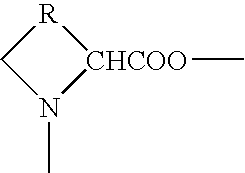
- where R is —CH 2—, —CH2—CH2—, —S—CH2—, or —CH2—CH2—CH2—, which group is optionally substituted at one or more —CH2— groups by from 1 to 3 C1, C2 or C3 alkyl groups. In addition to prollne, other exemplary imino acids are 2- or 3-thiprolne and pipecolic acid.
- Preferably, the products of the invention comprise a linker which contains an imino acid next to a glycine, i.e. which contains the sequence GP or PG or a homologue in which P is replace by another imino acid. More preferably, the or each imino acid residue of the linker is adjacent a glycine. (Glycine residues have no side chain, a feature which may avoid unwanted involvement of a side chain with the main chain). In some products, it is particularly preferred for at least one pair of adjacent imino acid and G residues to be in the sequence IA-G-IA, where each IA independently is an imino acid, notably proline.
- One class of products comprises species in which the linker comprises a region, containing for example from 5 to 20 residues, consisting solely of glycine and imino acid residues. In preferred members of this class the region comprises the sequence IA-(G) n-IA, preferably G-IA-G-IA-(G)n-IA-G, where n is from 1 to 10 and preferably 2, 3, 4 or 5 (e.g. 3); an exemplary sequence is GGGG-IA-G-IA-GGG-IA-GG, in both these sequences, each IA independently is an imino acid, notably proline.
- The invention therefore includes molecules comprising first and second portions interconnected by a linker. Typically, the second portion is a protein, as well as the first portion. In one class of molecules the linker consists of amino acids and the entire molecule may be a hybrid recombinant polypeptide.
- The two portions of the product may be ligated together between positions of the two portions which facilitate or maximise the separation between the active domains of the two: for example, when the first portion is a dendroaspin, the second portion is preferably ligated to its N-terminal, relatively remote from loop III (which contains RGD in wild-type dendroaspin).
- The linkers themselves are novel and form an aspect of the invention. Thus, the invention includes a linker comprising an amino acid sequence selected from the group consisting of Aa1-Gly and Gly-Aa1, wherein Aa1 is an imino acid. Preferably, the sequence is contained in the amino acid sequence Aa1-Gly-Aa2, where Aa1 and Aa2 are each independently an imino acid and preferably proline, as this sequence is believed to be particularly important for maintaining separation between the two linked domains, alternatively a plurality of Gly residues may be present between the two imino acid residues. More preferably, said sequence is contained in the amino acid sequence Gly-Aa1-Gly-Aa2-Gly.
- It is common that both Aa1 and Aa2 are proline. Usually, but not always, the linker consists of a poly(amino acid) sequence containing from 5 to 20 amino acids. For example a suitable linker is shown in the sequences of ND9-F1 (SEQ ID NO:29) and ND9-F3 (SEQ ID NO:30) and comprises the sequence G G G G P G P G G G P G G (SEQ ID NO:27).
- Preferred products of the invention are molecules comprising a dendroaspin scaffold as the first portion. The dendroaspin scaffold is usually linked through a proline-containing linker to a moiety which is typically a protein or polypeptide. The linker is preferably linked to the N-terminus of the dendroaspin scaffold. The moiety to which the dendroaspin scaffold is linked is preferably a serine protease inhibitor and typically selective for a chosen serine protease coagulation enzyme.
- In the following detailed description, the invention is described by way of example with reference to dendroaspin scaffolds as the first portion of the product but it will be understood that the principles elucidated are applicable to other integrin-binding proteins and sequences. Thus, alternative integrin-binding protein scaffolds or their fragments may be used, whether in native or modified form.
- The invention relates preferably to molecules comprising a dendroaspin (or other) scaffold ligated to a second portion which has a different function or, preferably, to another protein. The dendroaspin scaffold may have the wild-type sequence or be modified as compared with wild-type dendroaspin. The modification may comprise the deletion, addition or substitution of one or more amino acids and may merely be artefact(s) of the recombinant preparation of the molecule. Alternatively, the modification may be to change the properties of the dendroaspin scaffold, for instance loop III may be modified to change the binding properties of the RGD motif. In this respect, proline in loop III is believed to diverge the loop from the β-sheet. Thus proline residues, particularly either flanking the RGD sequence (P 42RGDMP47) or neighbouring the RGD sequence (RGDMP47GP49), are believed to provide a favourable conformation binding to GPIIb/IIIa and it is preferred not to remove all of them when the dendroaspin is to have GPIIb/IIIa binding activity. In particular it is preferred not to remove both P42 and P47, although it may be convenient to remove P42 (e.g. replace it with A), otherwise a thrombin cleavage site is formed.
- Additionally or alternatively to modification of the flanking sequences, the dendroaspin (or other RGD protein) may be modified to replace the RGD motif with another integrin-binding motif. The invention includes molecules in which the native RGD motif has been replaced by an integrin-binding amino acid sequence other than RGD which contains aspartic acid (D) or glutamic acid (E), e.g. KGD. Preferably, the replacement integrin-binding amino acid sequence comprises a tripeptide sequence other than RGD containing D or E adjacent to G or to a hydrophobic amino acid. Alternatively, it may be LDV.
- In some products the non-RGD tripeptide sequence is of the formula
- B-J-Z
- wherein
- (I) J-Z is GD or GE and B is R, K, Q, A, H, N, A, V, I, L, M, F, P or W but is not R when J-Z is GD;
- (II) B-J is DG or EG and Z is any amino acid; or
- (III) I is D or E and B and Z are each independently selected from A, V, 1, L, M, F, P or W.
- Preferably J-Z is GD and, in the products in which J-Z is GD or GE, B is preferably R, K, Q, A, H or N and more preferably is R, K, Q or A (but is not R when J-Z is GD).
- A preferred class of products (I) comprises those in which B-J-Z is bonded at its C-terminal end to M, W, N or V. Preferably the M, W, N or V residue is followed by the P which is at position 47 of wild type dendroaspin or, less preferably, by an A residue substituted therefor.
- Another preferred class of products (I) comprises those in which the integrin-binding amino acid sequence is preceded by the P which is at position 42 of wild type dendroaspin or, less preferably, by an A residue substituted therefor.
- In some preferred products (I), especially those in which J-Z is GD, B is A, V, I, M, F, P, W and more preferably is L or V. The most preferred products of this type are those in which B is L and is preceded by M.
- Preferred products (II) include those in which B-J is DG and/or Z is E, R or P, and especially in which Z is followed by the P which is at position 47 of wild type dendroaspin or by an A inserted before the wild type position 47 P.
- A preferred class of products (III) comprises those in which J is D and, more particularly, B-J-Z is LDV. B-J-Z is preferably preceded by an I residue.
- Of course, modified dendroaspins will often have a configuration which differs somewhat from that of wild-type dendroaspin but do normally have a three-loop structure. Preferably, any RGD-replacement associates with a receptor pocket or another pocket, since loop III is favourable for pocket-binding sequences; such sequences include a thrombin-binding sequence (GPRP is a thrombin-binding sequence) and the collagen α 2β1-binding sequence DGE.
- The invention includes products or hybrid polypeptides which comprise a modified dendroaspin scaffold which has an integrin-binding amino acid sequence at one domain and a non-dendroaspin amino acid sequence which confers a second functionality on another domain. The non-dendroaspin amino acid sequence may be comprised in the loops of the scaffold or be wholly or partially external to the loops. (The same applies to other loop-containing proteins). The dendroaspin-based products or polypeptides of the invention may therefore comprise in the dendroaspin scaffold at least one non-wild-type dendroaspin domain elsewhere than the native RGD site. The at least one non-wild-type dendroaspin domain usually comprises at least one non-dendroaspin sequence which confers functionality on the polypeptide. Such modified dendroaspin scaffolds are described in WO 98/42834 and in the US national phase application derived therefrom, U.S. Ser. No. 09/381,546, which is incorporated herein by reference.
- One class of products have an integrin-binding activity which, when product molecules are administered in vivo, results in the binding of the molecules to platelets thereby inhibiting the aggregation of the platelets at sites of injury. In these products, the dendroaspin scaffold contains the RGD motif or another platelet-binding sequence, especially KGD. In addition to containing an integrin-binding domain, the dendroaspin scaffold may contain another non-wild-type dendroaspin domain which provides secondary, optionally further, functionality.
- The dendroaspin scaffold is of course ligated to a species which has another functionality e.g. antithrombotic action, inhibition of cell migration and/or proliferation, or regulation of signal transduction. Such products are therefore bi- or multi-functional in their activities, and preferably are bi- or multi-functional in their activities against blood coagulation, particularly thrombus formation and arterial/venous wall thickening at the sites of injury. Products of the invention may have activity against leukocyte recruitment, immune system activation, tissue fibrosis or tumorigenesis. Those skilled in the art are familiar with peptide and peptidomimetic inhibitors of serine proteases (e.g. elastase, cathepsin G, urokinase (also called uPA), Factors II, IX, X, VII, IXa and XII thrombin, kallikrein, tissue plasminogen activator and plasmin) and the second portion may comprise such an inhibitor.
- In particular the second portion is a protein or polypeptide, especially an inhibitor of a coagulation enzyme. Preferably, the second portion comprises wild-type TAP protein, NAP protein (notably NAP5) or ACAP protein or a homologue thereof having selective factor Xa inhibitory activity or, inhibitory activity selective for another serine protease, especially a coagulation serine protease.
- The invention includes products in which the second portion confers platelet derived growth factor (PDGF) activity, glycoprotein IB activity, hirudin activity, thrombomodulin activity, vascular epidermal growth factor activity, transforming growth factor-1 activity, basic fibroblast growth factor activity, angiotensin II activity, factor VIII activity, tissue factor pathway inhibitor (TFPI) or von Willebrand factor activity. The second portion thus may comprise an amino add sequence derived from platelet derived growth factor (PDGF), glycoprotein IB, hirudin, thrombomodulin, vascular epidermal growth factor, transforming growth factor-1, basic fibroblast growth factor, angiotensin II, factor VIII, tissue factor pathway inhibitor (TFPI) or von Willebrand factor, or a functional sequence having homology to at least part of such sequence.
- In this way the molecules of the invention may be rendered multifunctional so that they are active against, for example, platelet aggregation and another component in the dotting cascade (e.g. a serine protease coagulation enzyme, for example thrombin), or the intracellular signalling cascade (e.g. growth factor). The invention includes of course molecules which contain no integrin-binding function and molecules with no anti-coagulant function.
- The products of the invention may comprise a dendroaspin scaffold having an amino acid sequence as shown in FIG. 1. Excluding the second portion and any linker, the products of the invention include polypeptides comprising dendroaspin scaffolds homologous to wild-type dendroaspin which may share about 50% or more amino acid sequence homology, preferably about 65% or more, more preferably about 75% or more and even more preferably about 85% or more homology with dendroaspin.
- The dendroaspin scaffolds may comprise a greater or lesser number of amino acid residues compared to the 59 amino acids of dendroaspin. For example, the dendroaspin scaffolds may comprise a number of amino acid residues in the range 45 to 159, preferably about 49 to 89, more preferably about 53 to 69, even more preferably about 57 to 61. However, the invention includes polypeptides in which the dendroaspin scaffold contain 59 amino acid residues.
- The invention includes species in which a foreign sequence is contained wholly within the dendroaspin scaffold (i.e. between
residues 1 and 59, inclusive) and is for example loop grafted. Thus, in one class of products, a non-wild-type domain(s) is/are incorporated into (a) loop I and/or loop II; (b) loop I and/or loop III; (c) loop II and/or loop III; or loop I, loop II and loop III of the dendroaspin scaffold. If the polypeptide comprises a non-wild-type domain incorporated into a loop, the non-wild-type domain is in some polypeptides incorporated into either loop I or loop II, leaving loop III unaltered. - Another class, however, comprises dendroaspin scaffolds which comprise a non-wild-type domain extending into or substituting regions external to the loops, i.e. residues 1-3, 17-22, 37-39 and 51-59 such that residues of the non-loop regions are augmented or substituted for those of a further amino acid sequence being inserted (the non-wild-type domain).
- The invention includes species in which a foreign sequence is contained within the scaffold of another integrin-binding protein.
- Any inserted non-wild-type domain is preferably an amino acid sequence having no more than 100 amino acid residues, e.g. from 3 to 40 amino acid residues. Especially in the case of inserted sequences which are contained wholly within the dendroaspin scaffold, the non-wild-type domain more preferably has from 3-16, even more preferably 3-14 amino acid residues. When two non-wild-type domains are incorporated into the dendroaspin scaffold then the linear distance between these is preferably from 1-35 amino acids, more preferably 1-14 amino acids. When more than two non-wild-type domains are incorporated then there is preferably at least one native dendroaspin amino acid residue separating each further amino acid sequence.
- Loop III of dendroaspin may be modified by insertion, deletion or substitution of any one or more amino acid residues, preferably a maximum of 8 or a minimum of 1 amino acids can be modified within loop III of dendroaspin, e.g. 1, 2, 3 or 4.
- An integrin-binding sequence (e.g. KGD or RGD motif) may be incorporated into the dendroaspin scaffold or other integrin-binding polypeptide at a place other than the wild-type integrin-binding domain, preferably into loop I or loop II in the case of dendroaspin.
- The dendroaspin-based molecules of the invention may comprise a dendroaspin loop III having an amino acid sequence flanking the RGD site modified from that flanking RGD in wild-type dendroaspin, for example modified as shown in FIG. 3B of WO 98/42834. An advantage of modifying the flanking region is that the activity (e.g. integrin-binding activity) of the sequence at the RGD site may be enhanced or become more specific for certain glycoprotein ligands. Also, if a modification of the dendroaspin scaffold has steric effects on a replacement amino acid sequence for RGD then loop III around the RGD domain can be modified to overcome any steric hindrance thereby at least partially restoring, perhaps enhancing, functionality at the RGD domain.
- Especially if the RGD motif is replaced by an amino acid sequence having more than 3 residues, amino acids flanking the RGD site may be deleted, for example so that the number of amino acid residues in loop III remains as 13.
- As indicated, modification of the dendroaspin loops may become necessary if a “foreign” further amino acid sequence incorporated into the dendroaspin scaffold has a steric hindrance effect either on another incorporated domain or on the loop III. Computer assisted molecular modelling using insight II software (Molecular Simulations Inc) can be used to predict the structure of the “loop grafted” dendroaspins scaffolds. In instances where steric effects between the loops may serve to cause loss of functionality, these effects can be “designed out” by modifying appropriate parts of the dendroaspin molecule in an appropriate way. Sometimes this may involve incorporating a number of suitable amino acid residues to extend one or more of the loop structures.
- In the design of a bi-functional or multi-functional composition of matter in accordance with the invention, “fine tuning” of activity, stability or other desired biological or biochemical characteristic may be achieved by altering individual selected amino acid residues by way of substitution or deletion. Modification by an insertion of an amino acid residue or residues at a selected location is also within the scope of this “fine tuning” aspect of the invention. The site-directed mutagenesis techniques available for altering an amino acid sequence at a particular site in the molecule will be well known to a person skilled in the art.
- The invention includes molecules comprising two domains, not both derived from the same native molecule, interlinked by a linker comprising an imino acid residue, as previously described. One of these domains may have platelet-binding, or GPIIb/IIIa-binding activity, and the other may be a second portion as described above in relation to the preferred products having a dendroaspin-based first portion.
- The compounds of the invention may exist in different forms, such as acids, esters, salts and tautomers, for example, and the invention includes all variant forms of the compounds. In particular, the compounds may be in the form of acid addition salts which, for those compounds for pharmaceutical use, will be pharmaceutically acceptable. Exemplary acids include HBr, HCl and HSO 2CH3.
- The invention includes prodrugs for the active pharmaceutical species of the invention, for example in which one or more functional groups are protected or derivatised but can be converted in vivo to the functional group, as in the case of protected nitrogens. The term “prodrug,” as used herein, represents compounds which are rapidly transformed in vivo to the parent compound, for example, by hydrolysis in blood. A thorough discussion is provided in T. Higuchi and V. Stella, Prodrugs as Novel Delivery Systems, Vol. 14 of the A.C.S. Symposium Series, Edward B. Roche, ed., Bioreversible Carriers in Drug Design, American Pharmaceutical Association and Pergamon Press, 1987, and Judkins, et al. Synthetic Communications, 26(23), 4351-4367 (1996), each of which is incorporated herein by reference.
- The use of protecting groups is fully described in ‘Protective Groups in Organic Chemistry’, edited by J W F McOmie, Plenum Press (1973), and ‘Protective Groups in Organic Synthesis’, 2nd edition, T W Greene & P G M Wutz, Wiley-Interscience (1991).
- Thus, it will be appreciated by those skilled in the art that, even if a protected derivative of compounds of the invention does not possess pharmacological activity as such, it may be administered, for example parenterally or orally, and thereafter metabolised in the body to form compounds of the invention which are pharmacologically active. Such derivatives are therefore examples of “prodrugs”. All prodrugs of the described compounds are included within the scope of the invention.
- The pharmaceutically acceptable salts of the present invention can be prepared from the parent compound which contains a basic or acidic moiety by conventional chemical methods. Generally, such salts can be prepared by reacting the free acid or base forms of these compounds with a stoichiometric amount of the appropriate base or acid in water or in an organic solvent, or in a mixture of the two; generally, nonaqueous media like ether, ethyl acetate, ethanol; isopropanol, or acetonitrile are preferred. Lists of suitable salts are found in Remington's Pharmaceutical Sciences, 17th ed., Mack Publishing Company, Easton, Pa., US, 1985, p. 1418, the disclosure of which is hereby incorporated by reference.
- The phrase “pharmaceutically acceptable” is employed herein to refer to those compounds, materials, compositions, and/or dosage forms which are, within the scope of sound medical judgment, suitable for use in contact with the tissues of human beings or animals without excessive toxicity, irritation, allergic response, or other problem or complication, commensurate with a reasonable benefit/risk ratio.
- The invention therefore includes all variant forms of the defined compounds, for example any pharmaceutically acceptable salt, ester, acid or other variant of the defined compounds and their tautomers as well as substances which, upon administration, are capable of providing directly or indirectly a compound as defined above or providing a species which is capable of existing in equilibrium with such a compound.
- Preparation
- The products of the invention may comprise, and preferably are, polypeptides which may be made by construction of appropriate expression vectors, e.g. polynucleotides comprising a coding sequence operatively linked to a promoter. In other embodiments, the products of the invention are wholly or partly chemically synthesised.
- In the case of products made in whole or in part using chemical synthesis, for example to ligate the two portions of the product together through a linker conventional technology may be used. Solid phase techniques may be used in whole or in part. The skilled reader will require no instruction in the chemical synthesis of peptides but ample instructions are to be found in “The Chemical Synthesis of Peptides”, John Jones, Clarendon Press, Oxford, England, 1991; Sharma, R. P.; Jones, D. A.; Broadbridge, R. J.; Corina, D. L. and Akhtar, M. A Novel Method of Solid Phase Synthesis Of Peptide Analogues, in Innovation and Perspectives in Solid Phase Synthesis, ed., R. Epton, 1994, Mayflower Worldwide Limited, Birmingham, page 353-356; Letsinger, R. L. and Kornet, M. J. J.Amer.Chem.Soc., 1963, 85, 3045.
- A preferred technique for synthesis of peptides is solid phase synthesis, manual or automated, as first developed by Merrifield and described by Stewart et al. In Solid Phase Peptide Synthesis (1984). Chemical synthesis joins the amino acids in the predetermined sequence starting at the C-terminus. Basic solid phase methods require coupling the C-terminal protected.alpha.-amino acid to a suitable insoluble resin support. Amino acids for synthesis require protection on the α-amino group to ensure proper peptide bond formation with the preceding residue (or resin support). Following completion of the condensation reaction at the carboxyl end, the α-amino protecting group is removed to allow the addition of the next residue. Several classes of a-protecting groups have been described, see Stewart et al. in Solid Phase Peptide Synthesis (1984), with the acid labile, urethan-based tertiary-butyloxycarbonyl (Boc) being the historically preferred. Other protecting groups, and the related chemical strategies, may be used, including the base labile 9-fluorenylmethyloxycarbonyl (FMOC). Also, the reactive amino acid sidechain functional groups require blocking until the synthesis is completed. The complex array of functional blocking groups, along with strategies and limitations to their use, have been reviewed by Bodansky in Peptide Synthesis (1976) and, Stewart et al. in Solid Phase Peptide Synthesis (1984).
- Solid phase synthesis is initiated by the coupling of the C-terminal α-protected amino acid residue. Coupling requires activating agents, such as dicyclohexycarbodiimide (DCC) with or without 1-hydroxybenzo-triazole (HOBT), diisopropylcarbodiimide (DIIPC), or ethyidimethylaminopropylcarbodiimide (EDC). After coupling the C-terminal residue, the α-amino protected group is removed by trifluoroacetic acid (25% or greater) in dichloromethane in the case of add labile tertiary-butyloxycarbonyl (Boc) groups. A neutralizing step with triethylamine (10%) in dichloromethane recovers the free amine (versus the salt). After the C-terminal residue is added to the resin, the cycle of deprotection, neutralization and coupling, with intermediate wash steps, is repeated in order to extend the protected peptide chain. Each protected amino acid is introduced in excess (three to five fold) with equimolar amounts of coupling reagent in suitable solvent. Finally, after the completely blocked peptide is assembled on the resin support, reagents are applied to cleave the peptide form the resin and to remove the side chain blocking groups. Anhydrous hydrogen fluoride (HF) cleaves the acid labile tertiary-butyloxycarbonyl (Boc) chemistry groups. Several nucleophilic scavengers, such as dimethylsulfide and anisole, are included to avoid side reactions especially on side chain functional groups.
- Bispecific molecules of the present invention can be prepared by chemically conjugating the two portions (which may previously have been cloned or chemically synthesised) using methods well-known in the art. For example, a variety of coupling or cross-linking agents can be used for covalent conjugation. Examples of cross-linking agents include protein A, carbodjimide, N-succinimidyl-S-acetyl-thioacetate (SATA), N-succinimidyl-3-(2-pyridyidithio)-propionate (SPDP), and sulfosuccinimidyl 4-(N-maleimidomethyl) cyclohexane-1-carboxylate (sulfo-SMCC) (see e.g., Karpovsky et al. (1984) J. Exp. Med. 160:1686; Liu, M A et al. (1985) Proc. Natl. Acad. Sci. USA 82:8648). Other methods include those described by Paulus (Behring Ins. Mitt. (1985) No. 78, 118-132); Brennan et al. (Science (1985) 229:81-83), and Glennie et al. (J. Immunol. (1987) 139: 2367-2375).
- However, one preferred class of products comprises hybrid recombinant polypeptides. The skilled person can readily construct a variety of clones containing functional nucleic acids. Cloning methodologies to accomplish these ends, and sequencing methods to verify the sequences of nucleic acids, are well known in the art. Examples of appropriate cloning and sequencing techniques, and instructions sufficient to direct persons of skill through many cloning exercises are found in Sambrook, et al., Molecular Cloning: A Laboratory Manual (2nd Ed., Vols. 1-3, Cold Spring Harbor Laboratory (1989)), Methods in Enzymology, Vol. 152: Guide to Molecular Cloning Techniques (Berger and Kimmel (eds.), San Diego: Academic Press, Inc. (1987)), or Current Protocols in Molecular Biology, (Ausubel, et al. (eds.), Greene Publishing and Wiley-Interscience, New York (1987).
- Product information from manufacturers of biological reagents and experimental equipment also provide information useful in known biological methods. Such manufacturers include the SIGMA chemical company (Saint Louis, Mo.), R&D systems (Minneapolis, Minn.), Pharmacia LKB Biotechnology (Piscataway, N.J.), CLONTECH Laboratories, Inc. (Palo Alto, Calif.), Chem Genes Corp., Aldrich Chemical Company (Milwaukee, Wis.), Glen Research, Inc., GIBCO BRL Life Technologies, Inc. (Gaithersberg, Md.), Fluka Chemica-Biochemika Analytika (Fluka Chemie A G, Buchs, Switzerland), invitrogen, San Diego, Calif., and Applied Biosystems (Foster City, Calif.), as well as many other commercial sources known to one of skill.
- Polynucleotides containing a desired gene can be prepared by any suitable method including, for example, cloning and restriction of appropriate sequences as discussed supra, or by direct chemical synthesis by methods such as the phosphotriester method of Narang et al. Meth. Enzymol. 68: 90-99 (1979); the phosphodiester method of Brown et al., Meth. Enzymol. 68: 109-151 (1979); the diethylphosphoramidite method of Beaucage et al., Tetra. Lett., 22: 1859-1862 (1981); the solid phase phosphoramidite triester method described by Beaucage and Caruthers (1981), Tetrahedron Letts., 22(20):1859-1862, e.g., using an automated synthesizer, e.g., as described in Needham-VanDevanter et al. (1984) Nucleic Acids Res., 12:6159-6168; and, the solid support method of U.S. Pat. No. 4,458,066. Chemical synthesis produces a single stranded oligonucleotide. This may be converted into double stranded DNA by hybridization with a complementary sequence, or by polymerization with a DNA polymerase using the single strand as a template. One of skill would recognize that, while chemical synthesis of DNA is limited to sequences of about 100 bases, longer sequences may be obtained by the ligation of shorter sequences.
- Nucleic acids may be modified by site-directed mutagenesis, as is well known in the art. Native and other nucleic acids can be amplified by in vitro methods. Amplification methods include the polymerase chain reaction (PCR), the ligase chain reaction (LCR), the transcription-based amplification system (TAS), the self-sustained sequence replication system (SSR). A wide variety of cloning methods, host cells, and in vitro amplification methodologies are well-known to persons of skill.
- The expression of rhodostomin is described in Chang H H, Hu S T, Huang T F, Chen S H, Lee Wu Y H, Lo S J. (1993). Rhodostomin, an RGD-containing peptide expressed from a synthetic gene in Escherichia coli, facilitates the attachment of human hepatoma cells, Biochem. Biophys. Res. Commun. 190:242-249, whilst the cloning and expression of recombinant kistrins is described by Tselepis V H, Green L J, Humphries M J, J Biol Chem Aug. 22, 1997;272(34):21341-8. Recombinant elegantins have been expressed by Salman Rahman, Alex Aitken, Geraldine Flynn, Caroline Formstone, Geoffrey F. Savidge, Biochem J Issue 2 (1998) pp 247-257.
- In the case of dendroaspin-containing products and as described in WO 98/42834, the wild type dendroaspin gene may be successfully inserted into a plasmid pGEX-3×(FIG. 2 of WO 98/42834) and expressed according to the method of Lu et al, (1996) J Biol Chem 271: 289-295. Starting with the wild type gene for dendroaspin, variants of the dendroaspin gene for expressing polypeptides of the invention may then be engineered using recombinant DNA technology. For the longer insertion variants, oligonucleotides which encode the non-dendroaspin or heterologous amino acids may simply be inserted directly into suitably restriction digested wild type dendroaspin gene and then ligated. For minor changes such as modification of a few amino acid residues including the insertion, substitution or deletion, site directed mutagenesis may be used, for example using the Transformer™ Site-Directed Mutagenesis kit from Clontech Laboratories in accordance with the manufacturer's instructions.
- As an alternative to modifying the wild type gene after insertion into an expression vector, as described above with reference to plasmid pGEX-3×, genes encoding polypeptides of the invention may be made by methods which comprise the construction of vectors containing non-wild-type genes by ligation of oligonucleotides optionally followed by modification by, in particular, site-directed mutagenesis.
- FIG. 2A of WO 98/42834 shows the nucleotide sequence of a synthetic dendroaspin (Den) gene. The gene was designed on the basis of the known amino acid sequence (Williams J A et al ((1992)) Biochem Soc Trans 21: 735) and the codons for each amino acid were adopted from those which were highly expressed in E coli (Fiers W ((1982)) Gene 18: 199-209). Ten synthetic oligonucleotides are shown in brackets and numbered individually 1 to 10 either above the coding strand or below the non-coding strand. The stop codon is indicated by an asterisk. Three-letter amino acid code is used and the total of 59 amino acids of Den are only numbered 1 for N-terminal residue arginine and 59 for C-terminal leucine.
- In an additional aspect, therefore, the invention resides in nucleic acid molecules encoding a polypeptide of the invention. The nucleic acid may be operatively linked to a promoter and optionally to a nucleic acid sequence encoding a heterologous protein or peptide thereby to encode a fusion product. Suitably the promoter is IPTG inducible and optionally the heterologous protein or peptide is glutathione 5-transferase.
- Excluding the nucleic acid sequence encoding the second portion and any linker, nucleic acid sequences encoding the polypeptides of the invention may share about 50% nudeotide sequence homology, preferably about 65%, more preferably about 75% and even more preferably about 85% homology with a wild-type integrin-binding protein nucleotide sequence.
- The invention includes plasmids comprising a nucleic acid of the invention, for example plasmid pGEX-3× comprising a nucleic acid of the invention, as well as host cells transformed with such a plasmid. A suitable host cell is E coli. The host cells may be provided as cell cultures.
- Another aspect of the invention resides in a method of producing a polypeptide comprising culturing a host cell of the invention so as to express said polypeptide, extracting the polypeptide from the culture and purifying it.
- The invention further includes a method of producing a polypeptide comprising an integrin-binding protein or its homologue, the method comprising:
- a) preparing an expression vector comprising a nucleic acid sequence encoding a polypeptide product of the invention operatively linked to a promoter and optionally linked to a nucleic acid sequence encoding a heterologous protein for co-expression therewith; and
- b) transforming a host cell with the vector and causing the host cell to express the nucleic acid sequence.
- Some of these methods comprise
- (i) assembling from overlapping oligonucleotides the coding sequence of an integrin-binding protein or a homologue thereof having a binding activity;
- (ii) assembling from overlapping oligonucleotides the coding sequence of the second portion;
- (iii) amplifying the coding sequences, the PCR primers being so designed to allow cloning of the integrin-binding protein and the second portion into an expression vector, the PCR primers optionally encoding a linker to interlink the integrin-binding protein and the second portion;
- (iv) preparing an expression vector comprising the coding sequences operatively linked to a promoter and optionally linked to a nucleic acid sequence encoding a heterologous affinity purification protein for co-expression therewith.
- In such methods, step (a) (ii) may comprise modifying the nucleic acid sequence of the vector by one or more of the insertion, deletion or substitution of nucleic acid residues.
- Others of the methods comprise constructing from oligonucleotides an expression vector comprising a nucleic acid sequence encoding a dendroaspin (or other RGD protein) sequence in which the RGD-encoding domain has been deleted or replaced by a replacement amino acid sequence as defined herein and, optionally, modifying at least one other domain of the nucleic acid sequence of the vector encoding the dendroaspin scaffold by one or more of insertion, deletion or substitution of nucleic acid residues so that on expression the dendroaspin scaffold comprises a corresponding domain having a non-wild-type dendroaspin sequence.
- The method may comprise the steps of:
- a) extracting the expressed polypeptide from a host cell culture,
- b) purifying the expressed polypeptide from the cell culture extract, and, if the expressed polypeptide is a fusion protein with a heterologous affinity purification protein, cleaving the desired product from the heterologous affinity purification portion of the fusion protein.
- The heterologous affinity purification protein is suitably glutathione S-transferase (GST) and the purification suitably involves GST affinity chromatography followed by cleavage of the modified dendroaspin from GST.
- Some products of the invention are made by producing an RGD-free dendroaspin as described above and chemically ligating a non-dendroaspin species to it.
- Use
- The peptides of the invention may be used for scientific investigations or as pharmaceuticals.
- We have found that an integrin-binding protein provides an excellent scaffold for carrying “foreign” species, especially proteins, to potential targets. In this respect, the small size and conformational stability of the dendroaspin scaffold make it a particularly good model for pharmaceutical use. The products of the invention advantageously contain a platelet-binding domain in the first portion (e.g. dendroaspin) and have a second portion (e.g. a NAP or TAP) which inhibits a coagulation enzyme, preferably selectively. In this way, anti-coagulant activity can be targeted at areas where there are activated platelets and clot formation is commencing, potentially enabling beneficial localised anti-clotting activity without substantial systemic anti-clotting activity which can result in haemorrhaging. Alternatively, products may be prepared with other therapeutically useful bi- or multi-functional activities.
- The pharmacologically active polypeptides may be formulated as a pharmaceutical composition comprising a polypeptide as hereinbefore defined, optionally further comprising a pharmaceutically acceptable excipient or carrier. A plurality of therapeutic (e.g. prophylactic) polypeptides of the invention of different functionalities may be combined together in a pharmaceutically acceptable form so as to provide a desired treatment, and/or they may be combined with one or more other therapeutic agents.
- The compounds of the invention will normally be administered orally, intravenously, subcutaneously, buccally, rectally, dermally, nasally, tracheally, bronchially, by any other parenteral route, as an oral or nasal spray or via inhalation, More typically, the compounds will be administered by injection or infusion, especially intravenously. The compounds may be administered in the form of pharmaceutical preparations comprising prodrug or active compound either as a free compound or, for example, a pharmaceutically acceptable non-toxic organic or inorganic acid or base addition salt, in a pharmaceutically acceptable dosage form. Depending upon the disorder and patient to be treated and the route of administration, the compositions may be administered at varying doses.
- The coagulation enzyme inhibitors of the invention may also be combined and/or co-administered with any antithrombotic agent with a different mechanism of action, such as the antiplatelet agents acetylsalicylic acid, ticlopidine, clopidogrel, thromboxane receptor and/or synthetase inhibitors, fibrinogen receptor antagonists, prostacyclin mimetics and phosphodiesterase inhibitors and ADP-receptor (P 2 T) antagonists.
- The coagulation enzyme inhibitors of the invention may further be combined and/or co-administered with thrombolytics such as tissue plasminogen activator (natural, recombinant or modified), streptokinase, urokinase, prourokinase, anisoylated plasminogen-streptokinase activator complex (APSAC), animal salivary gland plasminogen activators, and the like, in the treatment of thrombotic diseases, in particular myocardial infarction.
- Typically, therefore, the pharmaceutical compounds of the invention may be administered orally or parenterally (“parenterally” as used herein, refers to modes of administration which include intravenous, intramuscular, intraperitoneal, intrasternal, subcutaneous and intraarticular injection and infusion) to a host to obtain an protease-inhibitory effect. In the case of larger animals, such as humans, the compounds may be administered alone or as compositions in combination with pharmaceutically acceptable diluents, excipients or carriers.
- Actual dosage levels of active ingredients in the pharmaceutical compositions of this invention may be varied so as to obtain an amount of the active compound(s) that is effective to achieve the desired therapeutic response for a particular patient, compositions, and mode of administration. The selected dosage level will depend upon the activity of the particular compound, the route of administration, the severity of the condition being treated and the condition and prior medical history of the patient being treated. However, it is within the skill of the art to start doses of the compound at levels lower than required for to achieve the desired therapeutic effect and to gradually increase the dosage until the desired effect is achieved.
- Envisaged suitable daily doses of the compounds of the invention in therapeutic treatment of humans are about 0.001-100 mg/kg body weight at peroral administration and 0.001-50 mg/kg body weight at parenteral administration. A preferred peroral dose of from 0.02 to 15 mg/Kg of body weight is envisaged, and the active compound may be given as a single dose, in multiple doses or as a sustained release formulation. For use with whole blood, from 1 to 10 mg per litre may be provided to prevent coagulation.
- According to a further aspect of the invention there is thus provided a pharmaceutical composition including a compound of the invention, in admixture with a pharmaceutically acceptable adjuvant, diluent or carrier.
- Pharmaceutical compositions of this invention for parenteral injection suitably comprise pharmaceutically acceptable sterile aqueous or nonaqueous solutions, dispersions, suspensions or emulsions as well as sterile powders for reconstitution into sterile injectable solutions or dispersions just prior to use. Examples of suitable aqueous and nonaqueous carriers, diluents, solvents or vehicles include water, ethanol, polyols (such as glycerol, propylene glycol, polyethylene glycol and the like), and suitable mixtures thereof, vegetable oils (such as olive oil) and injectable organic esters such as ethyl oleate. Proper fluidity can be maintained, for example, by the use of coating materials such as lecithin, by the maintenance of the required particle size in the case of dispersions and by the use of surfactants.
- These compositions may also contain adjuvants such as preservative, wetting agents, emulsifying agents and dispersing agents. Prevention of the action of microorganisms may be ensured by the inclusion of various antibacterial and antifungal agents, for example, paraben, chlorobutanol or phenol sorbic acid. It may also be desirable to include isotonic agents such as sugars or sodium chloride, for example. Prolonged absorption of the injectable pharmaceutical form may be brought about by the inclusion of agents (for example aluminium monostearate and gelatin) which delay absorption.
- In some cases, in order to prolong the effect of the drug, it is desirable to slow the absorption of the drug from subcutaneous or intramuscular injection. This may be accomplished by the use of a liquid suspension of crystalline or amorphous material with poor water solubility. The rate of absorption of the drug then depends upon its rate of dissolution which, in turn, may depend upon crystal size and crystalline form. Alternatively, delayed-absorption of a parenterally administered drug form is accomplished by dissolving or suspending the drug in an oil vehicle.
- Injectable depot forms are suitably made by forming microencapsule matrices of the drug in biodegradable polymers, for example polylactide-polyglycolide. Depending upon the ratio of drug to polymer and the nature of the particular polymer employed, the rate of drug release can be controlled. Examples of other biodegradable polymers include poly(orthoesters) and poly(anhydrides). Depot injectable formulations may also prepared by entrapping the drug in liposomes or microemulsions which are compatible with body tissues. The injectable formulations can be sterilized, for example, by filtration through a bacterial-retaining filter or by incorporating sterilizing agents in the form of sterile solid compositions which can be dissolved or dispersed in sterile water or other sterile injectable media just prior to use.
- Solid dosage forms for oral administration include capsules, tablets, pills, powders and granules. In such solid dosage forms, the active compound is typically mixed with at least one inert, pharmaceutically acceptable excipient or carrier such as sodium citrate or dicalcium phosphate and/or one or more: a) fillers or extenders such as starches, lactose, sucrose, glucose, mannitol and silicic add; b) binders such as carboxymethylcellulose, alginates, gelatin, polyvinylpyrrolidone, sucrose and acada; c) humectants such as glycerol; d) disintegrating agents such as agar-agar, calcium carbonate, potato or tapioca starch, alginic acid, certain silicates and sodium carbonate; e) solution retarding agents such as paraffin; f) absorption accelerators such as quaternary ammonium compounds; g) wetting agents such as cetyl alcohol and glycerol monostearate; h) absorbents such as kaolin and bentonite clay and i) lubricants such as talc, calcium stearate, magnesium stearate, solid polyethylene glycols, sodium lauryl sulfate and mixtures thereof. In the case of capsules, tablets and pills, the dosage form may also comprise buffering agents. Solid compositions of a similar type may also be employed as fillers in soft and hard-filled gelatin capsules using such excipients as lactose or milk sugar as well as high molecular weight polyethylene glycol, for example.
- The solid dosage forms of tablets, dragees, capsules, pills, and granules can be prepared with coatings and shells such as enteric coatings and other coatings well known in the pharmaceutical formulating art. They may optionally contain opacifying agents and may also be of a composition such that they release the active ingredient(s) only, or preferentially, in a certain part of the intestinal tract, and/or in delayed fashion. Examples of embedding compositions which can be used include polymeric substances and waxes.
- The active compounds may also be in micro-encapsulated form, if appropriate, with one or more of the above-mentioned exciplents.
- Liquid dosage forms for oral administration include pharmaceutically acceptable emulsions, solutions, suspensions, syrups and elixirs. In addition to the active compounds, the liquid dosage forms may contain inert diluents commonly used in the art such as water or other solvents, solubilizing agents and emulsifiers such as ethyl alcohol, isopropyl alcohol, ethyl carbonate, ethyl acetate, benzyl alcohol, benzyl benzoate, propylene glycol, 1,3-butylene glycol, dimethyl formamide, oils (in particular, cottonseed, groundnut, corn, germ, olive, castor, and sesame oils), glycerol, tetrahydrofurfuryl alcohol, polyethylene glycols and fatty acid esters of sorbitan and mixtures thereof. Besides inert diluents, the oral compositions may also include adjuvants such as wetting agents, emulsifying and suspending agents, sweetening, flavoring and perfuming agents. Suspensions, in addition to the active compounds, may contain suspending agents such as ethoxylated isostearyl alcohols, polyoxyethylene sorbitol and sorbitan esters, microcrystalline cellulose, aluminum metahydroxide, bentonite, agar-agar, and tragacanth and mixtures thereof.
- Compositions for rectal or vaginal administration are preferably suppositories which can be prepared by mixing the compounds of this invention with suitable non-irritating excipients or carriers such as cocoa butter, polyethylene glycol or a suppository wax which are solid at room temperature but liquid at body temperature and therefore melt in the rectum or vaginal cavity and release the active compound.
- Compounds of the present invention can also be administered in the form of liposomes. As is known in the art, liposomes are generally derived from phospholipids or other lipid substances. Liposomes are formed by mono- or multi-lamellar hydrated liquid crystals which are dispersed in an aqueous medium. Any non-toxic, physiologically acceptable and metabolisable lipid capable of forming liposomes can be used. The present compositions in liposome form, can contain, in addition to a compound of the present invention, stabilisers, preservatives, excipients and the like. The preferred lipids are the phospholipids and the phosphatidyl cholines (lecithins), both natural and synthetic. Methods to form liposomes are known in the art, for example, Prescott, Ed., Methods in Cell Biology, Volume XIV, Academic Press, New York, N.Y. (1976), p 33 et seq.
- Dosage forms for topical administration of a compound of this invention include powders, sprays, ointments and inhalants. The active compound is mixed under sterile conditions with a pharmaceutically acceptable carrier and any needed preservatives, buffers or propellants which may be required. Ophthalmic formulations, eye ointments, powders and solutions are also contemplated as being within the scope of this invention.
- Advantageously, the compounds of the invention are orally active, have rapid onset of activity and low toxicity.
- One formulation may comprise extravasated blood combined with a polypeptide of the invention at a concentration in the
range 1 nM-60 μM. This blood may be stored in ready to use form and provides an immediate and convenient supply of blood for transfusion in cases when clotting must be avoided such as during or immediately following surgical procedures. - The invention includes a therapeutic polypeptide as hereinbefore defined for use in medicine, preferably as a pharmaceutical.
- The invention also provides for the use of a pharmacologically active polypeptide as hereinbefore defined for the manufacture of a medicament, which may for example be for the treatment or prophylaxis of disease associated with binding at a receptor or with thrombosis; more particularly thrombosis, myocardial infarction, retinal neovascularization, endothelial injury, dysregulated apoptosis, abnormal cell migration, leukocyte recruitment, immune system activation, tissue fibrosis and tumorigenesis.
- The invention also provides methods for the treatment by therapy or prophylaxis of diseases associated with binding at a receptor or with thrombosis; more particularly thrombosis, myocardial infarction, retinal neovascularization, endothelial injury, dysregulated apoptosis, abnormal cell migration, leukocyte recruitment, immune system activation, tissue fibrosis and tumorigenesis.
- The methods comprise administering a therapeutically effective amount of a polypeptide as hereinbefore defined.
- FIG. 1 comprises alignments of modified dendroaspins useful in the products of the invention where the inserted amino acid sequences (SEQ ID NOS:2 TO 15) are listed beneath the amino acid sequence of dendroaspin (SEQ ID NO: 1).
- FIG. 2 shows an HPLC profile of an ND9-mixture.
- FIG. 3 shows a diagramatic representation of the structure of ND9.
- NAP-RGD-Dendroaspin
- Restriction enzymes, T4 polynucleotide kinase, T4 DNA ligase, IPTG (isopropyl-β-D-thio-galactopyranoside) and DHSα competent cells were purchased from Life Technologies Ltd (U.K.) or Promega Ltd (Southampton, U.K.). Vent (exo-) DNA polymerase was supplied by New England Biolabs Ltd (Hitchin, U.K.). Proteinase Factor Xa was purchased from Boehringer Mannheim (Sussex, England). Oligonucleotides were made by Cruachem Ltd (Glasgow, U.K.). Deoxynucleotide triphosphates (dNTP's), and plasmid pGEX-3×, a vector that expresses a cloned gene as a fusion protein linked to glutathione S-tranferase (GST), and glutathione-sepharose CL-4B were purchased from Pharmacia Biotech Ltd (Herts, U.K.). Gel extraction kit and Plasmid maxi kit were purchased from Quiegen Ltd (Surrey, U.K.).
- Construction of Synthetic Dendroaspin and NAP5 Genes, Respectively
- A synthetic dendroaspin gene was constructed by ligating 10 complementary and overlapping oligonucleotides coding for the protein sequence of dendroaspin, using Escherichia coli codon usage data, and cloned into plasmid pGEX-3×. The detailed description of protein expression, purification and functional characterisation of recombinant dendroaspin and comparison with its natural counterpart purified from snake venom has been reported previously [38]. Similarly, the NAP5 gene was constructed by ligating 6 complementary and overlapping oligonudeotides (shown below) coding for the protein sequence of NAP5, using Escherichia coli codon usage data, and cloned into plasmid pGEX-3×. The ligated mixtures were digested with BamH I and EcoR I and then cloned into the restricted vector pGEX-3×.
Overlapping oligonucleotides used to construct NAP5 gene NP1(NM1) NP3 RN50 NP2 (NM2) NP4 RN60 The following oligonudeotides were used: NP1: dGGG ATC CTT GTC CCG CGT AAA GCT TAC CCG GAA TGC GGT GAA AAC GAA TGG CTT GAC GAC (SEQ ID NO:16) TGC GGT ACT GAG AAA CCG TGC GAA NP2: dGCATTTAGCTTCGCACGGTTTCTGAGTACCGCAGTCGTCAAGCCAT (SEQ ID NO:17) TCGTTTTCACCGCATTCCGGGTATGCTTTACGCGGGACAAG NP3: dGCTAAATGCAACGAAGAACCGCCGGAAGAAGAAGACCCGATCTGCCCGTTCTCGTGGTTGCCTTCTTCCGC (SEQ ID NO:18) CGGCTTGCGTCTGCAAA NP4: dGTAGAAACCGTCTTGCAGACGCAAGCCGGCGGAAGAAGGCAACCACGAGAACGGCAGATCGGGTCTTCT (SEQ ID NO:19) TCTTCCGGCGGTTCTTCGTT RN50: DGACGGTTTCTACCGTGACACTGTCATCGGTGACTGCGTCCGTGAAGAAGAATGCGACCAGCATGAAATCA (SEQ ID NO:20) TCCATGTCTGAG RN60: dAATTCTCAGACATGGATGATTTCATGCTGGTCGCATTCTTCTTCACGGACGCAGTCACCGATGACAGTGTC (SEQ ID NO:21) ACG - Construction of Synthetic ND9
- ND9 is a bifunctional molecule which contains two domains, one is a NAP domain and the other a dendroaspin RGD domain. FIG. 3 shows a diagramatic representation of the structure of ND9. The ND9 gene was synthesised from two modified fragments: one is modified NAP5 gene and the other is modified dendroaspin gene. The former was amplified by polymerase chain reaction (PCR), using a mixture of 2 units of vent polymerase, 1 μl of wild-type NAP5 gene (5 ng) as a template, 1 μl of each of two 5′-overhanging deoxyoligonucleotides composed of a
forward primer 5′-GGGATCCATATC GMGGT CGTAAAGCTTACCCGGMTGCGGT (xnp5) (SEQ ID NO:22), which contains a sequence for coding IEGR, a non-specific thrombin cleavage site for releasing (by cleavage by thrombin) expressed protein from GST, and areverse primer 5′-ATGCCCGGGACCACCACCCGGACCACCACCACCGACATGGATGATTTCATGCTG (xnp3) (SEQ ID NO:23), which contains a designed linker and a restriction enzyme (Sma I) site for the linking of the fragment of dendroaspin gene. The latter was amplified also by PCR, using a mixture of 2 units of vent polymerase, 1 μl of wild-type dendroaspin gene (5 ng) as a template, 1 μl of each of two 5′-overhanging deoxyoligonucleotides composed of aforward primer 5′-GGGCCCGGGGGGCGTA TCTGCTACAACCAT (SEQ ID NO:24), which also contains a Sma I site for the linking of the modified NAP5 gene fragment and areverse primer 5′-AATTCTCAAAGGTGCATTTGTCA GATTCGCAGCAGTACGGACCCGGCATGTCACCACGAGCAGTGAAGCA (SEQ ID NO:25), which substitutes ACG into AGC (GCT into CGT; P into A) for avoiding thrombin cleavage after translation into protein. The modified NAP5 gene was digested with BamH I and Sma I and the modified dendroaspin gene with Sma I and EcoR I, then, ligated with PGEX-3×vector restricted by BamH I and EcoR I to form a complete ND9 gene (SEQ ID NO:26). - Transformation and Protein Expression
- Transformation and protein expression were as performed previously [38]. In brief, recombinant plasmid (−5 ng) was used to transform 50 μl of E. coli DH5α competent cells. The presence of the correct coding sequence of the constructs was verified by complete DNA sequencing of the inserted fragments using the dideoxy chain-termination method. Bacterial culture conditions were carried out as follows; the culture was inoculated with an overnight seed culture (1%, v/v) and grown in 2YT/ampillin medium (100 μg/ml) and shaken at 37° C. until it reached an A600 of 0.7, then IPTG was added to a final concentration of 0.1 mM for induction. The cells were grown for an additional 4 hours at a low temperature of 30° C. and harvested by centrifugation.
- Purification of recombinant ND9
- Purification of recombinant ND9 was performed as described previously [38]. In brief, recombinant GST-ND9 from supematants of sonicated cell debris after centrifugation was purified by affinity chromatography on Glutathione-sepharose CLUB columns. The recombinant GST-ND9 was digested with thrombin (1:30, w/w thrombin: fusion protein) at 4° C. for 12 hours. After cleavage, the fractions were loaded onto a Vydac C 18 reverse phase HPLC analytical column (TP104) and eluted with a gradient of 0-26% acetonitrile (1.78% per min) containing 0.1% TFA, followed by 26-36% acetonitrile in 0.1% TFA (0.25% per min). When necessary, further analytical columns were run under the same conditions. FIG. 2 shows the elution profile after purification through one column; the F1 and F3 peaks are indicated, it has been found that a large F1 peak can normally be obtained by freezing the sample before running HPLC. The fractions from HPLC were freeze-dried, dissolved in water and assayed for the inhibition of ADP-induced platelet aggregation and Xa inhibition. The results for three fractions are shown below.
- Platelet Aggregation Assay
- Platelet aggregation was measured by the increase in light transmission as described previously [2]. Briefly, PRP was prepared from citrated human blood, obtained from healthy individuals, by centrifugation at 200×g for 15 mins. Platelet aggregation was induced with 10 μM ADP and measured using a Payton Dual-Aggregometer linked to a chart recorder.
- Factor Xa Inhibition Assay
- A single-stage chromogenic assay of factor Xa inhibition was used to determine this recombinant molecule. Clotting factor Xa was diluted to 200 μM in 10 mM Hepes (pH 7.5) containing 0.1% bovine serum albumin and 150 mM NaCl (HBSA). Fifty microliters of sample (diluted at vary concentrations into HSBA) were incubated for 30 min at room temperature with 100 μl of factor Xa in a 96-well microtiter plate. Fifty microliters of 1 mM S-2765, a chromogenic substrate for factor Xa, was then added, and the initial rate (mOD per min) of substrate hydrolysis over 5 min was measured at 405/650 nm by using a automated plate reader.
- The amino acid sequences of the recombinant molecule designated ND9-F1 (seq id no:29) and NDF9-F3 (SEQ ID NO:30) are shown below:
Sequence of ND9-F1 G I H I E G R K A Y P E C G E N E W L D D C G T Q K P C E (SEQ ID NO:29) A K C N E E P P E E E D P I C R S R G C L L L1 P A C V C K D G F Y R D T V I G D C V R E E E C D Q H E I I H V G G G G P G P G G G P G G 3 R I C Y N H L G T K P P T T E T C Q E D S C Y K N I W T F D N I I R R G C G C F T A R G D M P G P Y C C E S D N2 C N L - The amino acid sequence of NAP5 (SEQ ID NO:28) commences with residue 8 (K or lysine) of ND9-F1 (SEQ ID NO:29).
Residues 1 to 7 are the remainder of a linker to GST. In an alternative construct,residues 1 to 7 of ND9-F1 are replaced by the classic thrombin cleavage sequence LVPR.Sequence of ND9-F3 ⊕R S R G C L L L1 P A C V C K D G F Y R D T V I G D C V R (SEQ ID NO:30) E E E C D Q H E I I H V G G G G P G P G G G P G G 3 R I C Y N H L G T K P P T T E T C Q E D S C Y K N I W T F D N I I R R G C G C F T A R G D M P G P Y C C E S D N2 C N L Notes The symbol ⊕denotes a cleavage site. 1Residue 52 of ND9-F1 and corresponding residue 7 of ND9-F3 is L(leucine) which is accidentally mutated from the corresponding P (proline) residue of the published native sequence (39, 40). This substitution suggests that the residue is not critical for the activity of NAPS and that the active domain of the protein does not include the residue. 2The fourth residue from the C-terminus of the ND9 proteins is N (asparagine) which is accidentally mutated from the K (lysine) residue of native dendroaspin. This conservative substitution has not destroyed the activity of the dendroaspin domain. 3The linker, SEQ ID NO:27 (shown underlined) contains 10 glycines and three prolines. The glycine residue has no side chain which may avoid unwanted involvement of the side chain with the main chain; proline sequences like PGP and GPG give necessary turns for an α-helix to form a favourable conformation which avoids the sequences containing the two domains (anti-platelet and anti-Xa) interfering with each other (see example 4). - Inhibition data are shown below:
Inhibition Inhibition of collagen- of ADP-induced induced platelet Compound platelet aggregation aggregation Anti-Xa Integrilin* 0.2 μg/ml 277 nM 0.23 μg/ml 319 nM — — Repro* 3.2 μg/ml 76 nM 3.80 μg/ml 90 nM — — Dendroaspin 1.2 μg/ml 120-180 nM 0.35 μg/ml 52 nM — — TAP — — — — 0.02-0.07 μg/ml 2.8-10 nM ND9-F1# 8.1 μg/ml 500 nM 6.30 μg/ml 388 nM 0.018 μg/ml 1.1 nM ND9-F2# 6.5 μg/ml 400 nM 3.60 μg/ml 225 nM 1.5 μg/ml 91.1 nM ND9-M3# 4.2 μg/ml 260 nM 3.90 μg/ml 240 nM 2.3 μg/ml 140.9 nM NAP — — — 20000 nM 0.03-0.16 μg/ml 3-18 nM - KGD-Dendroaspin
- Materials—Restriction enzymes, T4 polynucleotide kinase, T4 DNA ligase, IPTG (isopropyl-β-D-thio-galactopyranoside) and DH5α competent cells were purchased from Life Technologies Ltd (U.K.) or Promega Ltd. (Southampton, U.K.). Vent (exo-) DNA polymerase was supplied by New England Biolabs Ltd. (Hitchin, U. K.). Proteinase Factor Xa was purchased from Boehringer Mannheim (Sussex, England). Human fibrinogen (grade L) was purchased from Kabi (Stockholm, Sweden). Lyophilised snake venoms were obtained from either Latoxan (05150 Rosans, France) or Sigma Chemical Ltd (Dorset, U. K.). Oligonucleotides were made by Cruachem Ltd., (Glasgow, U. K.) and further purified by denaturing PAGE on a 15% acrylamide/B M urea gel. Deoxynucleotide triphosphates (dNTPs), dideoxynucleotide triphosphates (ddNTPs) and plasmid pGEX-3×, a vector that expresses a doned gene as a fusion protein linked to glutathione S-transferase (GST), and Glutathione-Sepharose CL-4B were purchased from Pharmacia Biotech Ltd. (Herts, U. K.). “Geneclean” kit and Plasmid maxi Kit were purchased from Bio 101, La Jolla Calif. U.S.A. and Qiagen Ltd., Surrey, U.K. respectively. The sequencing enzyme (Sequenase 2.0) was obtained from Cambridge Bioscience (Cambridge, U. K.). [ 35S]dATP[αS] and 125I (15.3 mCi/mg iodine) were supplied by NEN Dupont (Herts, U.K.) and Amersham International Pic (Amersham, Bucks, England), respectively.
- Construction of the expression vectors—A dendroaspin gene was constructed from synthetic oligonucleotides, using the same 10 oligonucleotides shown in FIG. 2A of WO 98/42834. Each purified oligonucleotide was phosphorylated at 37° C. for 60 min in the presence of 1 mM ATP and T4 polynucleotide kinase. Each pair of overlapping phosphorylated oligonucleotides was annealed separately on a Perkin-Elmer/Cetus thermal cycler. The following programme was used: 95° C. 5 min, 70° C. 30s then slowly cooling to room temperature. Ligation was performed at 16° C. for 15 hours in a total volume of 50 μl containing approx. 1 nM of each annealed fragment, 50 mM Tris-HCl (pH 7.6), 10 mM MgCl 2, 1 mM ATP and 5
% PEG 8000 and 5 units of T4 DNA ligase. After ligation, the dendroaspin gene was amplified by PCR using 1 μl of ligation mixture as template witholigo - The KGD-dendroaspin gene was produced by using a Transformer™ site-directed mutagenesis kit (Clontech Laboratories Inc, Palo Alto, Calif., USA). A selection oligonucleotide was designed to introduce a novel restriction site (BamHI→ACC65I) into the PGEX-3× vector to allow selection of recombinant from parental constructs by digestion with ACC65I. After annealing, ligation and digestion, the reaction mixture was transformed into E coli mut S cells (Clontech) and subsequent colonies were screened by ACC65I restriction analysis. After two or three rounds of restriction with ACC65I and transformation, more than 90% recombinant clones were identified. In the mutagenesis procedure, there were used the selection primer dGAAGGTCGTGGGTACCATATCGAAGGTCGT (SEQ ID NO:31) and the mutagenesis primer dTGCTTCACTCCGAAAGGTGACATGCCGGGTCCGTAC (SEQ ID NO:32).
- Transformation and protein expression—Recombinant gene (S ng) was used to transform 50 μl of E. coli DHSα competent cells by standard methods (34), The presence of correct coding sequence of the constructs was verified by complete DNA sequencing of the inserted fragments using the dideoxy chain-termination method (35). Bacterial culture conditions were carried out as follows: the culture was inoculated with an overnight seed culture (1%, v/v) and grown in LB/ampidllin medium (100 μg/ml) and shaken at 37° C. until it reached an A600 of 0.7, then IPTG was added to a final concentration of 0.1 mM for induction. The cells were grown for an additional 4 hours at a lower temperature of 30° C. and harvested by centrifugation.
- Purification of native and recombinant snake venom RGD proteins—Elegantin, and dendroaspin were purified using reverse-phase HPLC as described previously (36). Recombinant dendroaspins were purified as follows: the cell pellets were suspended in PBS buffer (pH 7.4) containing 1% Triton X-100 and the protease inhibitors PMSF (1 μM), pepstatin (5 μg/ml), aprotinin (5 μg/ml), trypsin inhibitor (1 μg/ml), 1 mM EDTA, and sonicated on ice. The sonicated mixture was centrifuged at 7,800×g at 4° C. to pellet the cell debris and insoluble material. Recombinant GST-dendroaspin and GST-mutant-dendroaspins from supernatants were purified by affinity chromatography on glutathione-Sepharose CL-4B columns by absorption in PBS containing 150 mM NaCl and elution with 50 mM Tris-HCl containing 10 mM reduced glutathione (pH 8.0). With the remaining insoluble fusion protein in the pellets, solubilisation was achieved in the presence of 8 M urea, by gently shaking at room temperature for 30 min and subsequent renaturation by continual dilution and dialysis at room temperature against Tris-HCl buffer. The refolded fusion protein mixture was subjected to further centrifugation and affinity-purification. The purification was monitored by SDS-PAGE and the appropriate fractions comprising the recombinant GST-Dendroaspin and GST-mutant-dendroaspins were digested in the presence of 150 mM NaCl, 1 mM CaCl 2 and Factor Xa (1:100, w/w Factor Xa:fusion protein) at 4° C. for 24 hours. After cleavage, the fractions were loaded onto a Vydac C18 reverse phase HPLC analytical column (TP104) and eluted with a gradient of 0-26% acetonitrile (1.78% per min) containing 0.1% trifluoroacetic acid (TFA), followed by 26-36% acetonitrile in 0.1% TFA (0.25% per min). When necessary, further analytical columns were run under the same conditions. The fractions from HPLC were freeze-dried, dissolved in water and assayed for the inhibition of ADP-induced platelet aggregation. Purified wild-type dendroaspin and mutants were characterised by 20% SDS-PAGE and electrospray ionisation mass spectrometry.
- Measurement of platelet aggregation—Platelet aggregation was measured by the increase in light transmission as described previously (36, 37). Briefly, platelet rich plasma (PRP) was prepared from citrated human blood, obtained from healthy individuals, by centrifugation at 200×g for 15 min. Washed platelets were prepared from PRP and resuspended in adhesion/aggregation buffer (145 mM NaCl, 5 mM KCl, 1 mM MgCl 2, 2 mM CaCl2, 10 mM glucose, 3.5 mg/ml BSA and 10 mM HEPES, pH 7.35) and adjusted to a count of 3×10/ml. Platelet aggregation (320 μl incubations) was induced with 10 μM ADP in the presence of 1.67 mg/ml fibrinogen and measured using a Payton Dual-Aggregometer, linked to a chart recorder. KGD-dendroaspin was found to show potent inhibition of ADP-induced platelet aggregation.
- Measurement of platelet adhesion—Platelet adhesion is measured as described previously (37). Briefly, 96 well plates are coated overnight at 4° C. with either human fibrinogen or fibronectin reconstituted in phosphate buffered saline (PBS) (pH 7.4) at appropriate concentrations (2-10 μg/ml, 100 μl). Platelets are treated with antagonists at appropriate concentrations for 3 min before the addition (90 μl) to the microtitre plates which are pre-loaded with 10 μl of 500 μM ADP (final conc. 50 μM) and the number of adherent platelets is determined by measurement of endogenous acid phosphatase using 130 μl/well of the developing buffer (sodium acetate, pH 5.5, 10 mM p-nitrophenyl phosphate, 0.1% Triton X-100) and read at 410/630 nm on an automated plate reader.
- Iodination of Ligands and Ligand Binding Studies—lodination of all proteins used in this study is performed using Enzymobead Radioiodination Reagent (Blorad Laboratories) according to the manufacturer's specifications. The binding of 125I-labelled disintegrins, dendroaspin and mutant dendroaspins to washed platelets is performed under equilibrium conditions essentially as described previously (37). Briefly, the incubation mixture is composed of 300 μl of washed platelets (3×10⁸/ml), 10 μl of agonist (1.75 mM ADP giving a final conc. of 50 μM), 10 μl of 125I-labelled protein samples, 5-20 μl resuspension buffer and made to a final volume of 350 μl. In antibody inhibition studies, platelet suspensions are treated with antibody for 30 min prior to exposure to ADP and then added to 125I-protein samples and the mixture incubated at room temperature for a further 60 min. Incubations are terminated by loading onto a 25% (w/v) sucrose, 1% BSA cushion and centrifugation at 12,000×g for 10 min. Both platelet pellets and supernatants are counted to determine the levels of bound and free ligand. Background binding levels are determined in the presence of a 50-fold excess of cold disintegrin or 10 mM EDTA.
- Expression and purification of recombinant wild-type dendroaspin and mutantdendroaspins—The synthetic wild-type and mutated dendroaspin genes were cloned into the expression vector pGEX-3×at the carboxyl terminus of the glutathione S-transferase (GST) gene with a Factor Xa cleavage sequence positioned 5′ of the gene coding for these recombinant proteins. The expression of the GST-fusion protein in E. coli was induced by addition of IPTG to the growth medium, as described under the headings “Construction of the expression vector” and “Transformation and protein expression”. In contrast to non-induced transformants, analysis of IPTG treated cell lysates by SDS-PAGE showed an emergence of a 32 kDa protein corresponding to the GST-fusion protein. The GST-protein was purified by affinity chromatography on glutathlone-Sepharose CL-4B column and monitored by SDS-PAGE. Elution of the absorbed material with glutathione resulted in the appearance of a major band migrating at 32 kDa and a minor band at 28 kDa in 12.5% polyacrylamide gels. This minor 28 kDa component may correspond to free GST released from the GST-protein by an endogenous bacterial protease with Factor Xa-like activity since the relative levels of this species varied with different preparations. Treatment of the purified GST-proteins with Factor Xa released recombinant proteins migrating as 7 kDa bands, approximating the size of dendroaspin, and free GST appearing as an intensification of the 28 kDa band identified by SDS-PAGE. The 7 kDa protein was further purified to homogeneity by reverse-phase HPLC with the active fraction identified by testing aliquots from each peak for their ability to inhibit ADP-induced platelet aggregation in PRP. Further characterisation by mass spectrometry confirmed the successful cleavage at Arg1 by Factor Xa protease treatment.
- Modified Molecules—FIG. 1 shows the sequences of modified monofunctional and bifunctional dendroaspins obtainable by mutagenesis of the dendroaspin gene as described in the specification and in WO 98/42834. The sequences of these molecules are shown in the sequence listing.
- KQAGDV-Dendroaspin
- The same procedures as described in Example 2 were followed to express and purify KQAGDV-dendroaspin. The mutagenesis primer used in the site-directed mutagenesis was: dGGT TGC TTC ACT CCG AAA CAG GCT GGT GAC GTT CCG GGT CCG TAC TGC (SEQ ID NO:33), corresponding to the amino acid sequence: GCFTPKQAGDVPGPYC (SEQ ID NO:34).
- In this example the role of proline residues flanking the RGD motif of dendroaspin was investigated. Five dendroaspin variants were prepared with either single or double proline to alanine substitutions namely A 42-Den, A47-Den, A49-Den, A42,47-Den and A47,49-Den.
- Inhibition of Platelet Aggregation by Mutants of Dendroaspin
- The efficacy of wild-type and five variants of dendroaspin was assessed using ADP-induced platelet aggregation in PRP. The percentage of inhibition of platelet aggregation by these mutant dendroaspins was compared with wild-type dendroaspin and the inhibition of platelet aggregation expressed as IC 50 values. A42-Den, A4′-Den and A49-Den were approx equal potent inhibitors of ADP-induced platelet aggregation in PRP, with IC50 values of ˜170 nM. They showed similar potency to wild-type dendroaspin. In contrast, both mutants with double alanine substitutions, A42,47-Den, and A47,49-Den, were approx. 6-8-fold less potent inhibitors of platelet aggregation than wild-type dendroaspin, with IC50 values of ˜1.3 nM.
- Inhibition of A375 (β 3 Integrins) Adhesion to Fibrinogen
- The inhibitory efficacy of wild-type and five variants of dendroaspin for A375-SM cell adhesion was also determined in the presence of Mn 2+cations. A375-SM cell adhesion on fibrinogen was maximal at a Mn2+concentration of 500 μM.
- Under assay conditions, the percentage of inhibition of A375 cell adhesion to fibrinogen by these mutant dendroaspins shows similar patterns to those seen in the platelet aggregation assay. A 42-Den, A47-Den and A49-Den were approx. equally potent inhibitors of A375 cell adhesion to fibrinogen as wild-type dendroaspin at a concentration of 10 nM. In contrast, both mutants with double alanine substitutions, A42,47-Den and A47,49-Den, were approx. 5-fold less potent inhibitors of cell adhesion than wild-type dendroaspin even with as double concentration as that of wild-type dendroaspin (FIG. 3C).
- Discussion
- Both ADP-induced platelet aggregation and cell adhesion assays for determining the effect of mutagenesis of proline residues on the potency of inhibition of platelet aggregation and. A375-SM cell adhesion. The results showed that a single alanine for proline substitution did not affect potency either of inhibiting platelet aggregation or A375 cell adhesion to fibrinogen, producing similar potency to that of wild-type dendroaspin. By comparison, double proline to alanine substitutions significantly reduced the potency in both assays by approx. 5-8-fold. This suggests that neither proline is essential for binding to the integrin, but loss of both prolines may affect structure of the loop.
- The results suggest that the presentation of the proline provides a favourable environment for the RGD-antiplatelet activity. This property may be due to the nature of the proline residue, the only common imino acid in proteins with a bulky pyrrolidine ring that restricts the conformational range of adjacent residues. The lack of a proton on the imino nitrogen blocks hydrogen bond formation required for α-helix and β-sheet secondary structure, and thus disrupts the propagation of neighbouring secondary structures through interactive site(s). Proline also causes kinks and bends in the protein structure that, in dendroaspin, diverge the RGD-loop from the β-sheet [Sutcliffe, M. J., Jaseja, M., Hyde, E. I., Lu, X. and Wiliams, J. A. (1994) Three-dimensional structure of the RGD-containing neurotoxin homologue dendroaspin. Nat. Struct. Biol. 1, 802-807]. Thus proline residues, particularly in either flanking the RGD sequence (P 42RGDMP47) or neighbouring the RGD sequence (RGDMP47GP49), provide a favourable conformation for the RGD site in which it is exposed in solvent and recognised by integrin receptor, such as integrin αIIbβ3. It is possible that the middle residue glycine in the P47GP49 sequence may also contribute to assist in “presentation” of the RGD site due to the lack of side chain
- 1. Kieffer, N., and Phillips, D. R. (1990) Ann. Rev. Cell Biol. 6, 329-357
- 2. Hynes, R. O. (1992) Cell 69, 11-25
- 3. McEver, R. P. (1992) Curr. Opin.
Cell Biol 4, 840-849 - 4. Smyth, S. S., Joneckis, C. C., and Parise, L V. (1993) Blood 81, 2827-2843
- 5. Giancotb, F. G. and Mainiero, F. (1994) Biochim. Siophys. Acta. 1198, 47-64
- 6. Pierschbacher, M. D., and Ruoslahti, E. (1984) Nature 309, 30-33
- 7. Plow, E. F., Pierschbacher, M. D., Ruoslahti, E., Marguerie G., Ginsberg, M. H. (1987) Blood 70, 110-115
- 8. Pytela, R., Pierschbacher, M. D., Ginsberg, M. H., Plow, E. F., Ruoslahti, E. (1986) Science 231, 1559-1162
- 9. Nachman, R. L., & Nachman, L. L. K. (1992) J. Clin. Invest. 69, 263-269
- 10. Gardner, J. M. & Hynes, R. O. (1985). Cell 42, 438-449
- 11. Ruggeri, Z. M., De Mario, L., Gath, L., Bader, R., & Montgomery, R. R. (1983) J. Cin. Invest. 72, 1-12
- 12. Pytela, R. M., Pierschbacher, M. D. & Rouslahti, E. (1985) Proc. Natl. Acad, Sci USA 82, 5766-5770
- 13. Karczewski, J. K., Knudsen, A., Smith, L., Murphy, A., Rothman, V. L. & Tuszinski, G. P. (1989) J. Biol Chem. 264, 21322-21326
- 14. Sims, P. J., Ginsberg, M. H., Plow, E. F. and Shattil, S. J. (1991) J. Biol. Chem. 266, 7345-7352
- 15. Ugarova, T., Agbanyo, F. R., and Plow E. F. Thrombosis and Haemostasis (1995) 74, 253-257
- 16. Gould, R. J., Polokoff, M. A., Friedman, P. A., Huang, T. F., Holt, J. C., Cook, J. J. and Niewiarowski, S. (1990) Proc Soc. Exp. Bio. Med. 195, 168-171
- 17. Scarborough, R. M., Rose, J. W., Hsu, M. A., Phillips, D. R., Fried, V. A., Campbell, A. M., Nannizzi, L. and Charo, I. F. (1991) J. Biol. Chem. 266, 9359-9362
- 18. McDowell, R. S., Dennis, M. S., Louie, A. Shuster, M., Mulkerrin, M. G. and Lasarus, R. A. (1992) Biochemistry 31, 4766-4772
- 19. Williams J. A., Lu, X., Rahman, S., Keating, C. & Kakkar V. V. (1992) Biochem. Soc. Trans. 21, 73S
- 20. Knapp, A., Degenhardt, T. & Dod, J. (1992) J. Biol. Chem. 267, 24230-24234
- 21. Adler, M., Lazarus, R. A., Dennis, M. S. & Wagner, G. (1991) Science 253, 445448
- 22. Adler, M. & Wagner, G (1992) Biochemistry31, 1031-1039
- 23. Adler, M., Carter, P., Lazarus, R. A. & Wagner, G. (1993) Biochemistry 32, 282-289
- 24. Senn, H. & Klaus, W. (1993) J. Mol. Biol. 234, 907-925
- 25. Saudek, V., Atkinson, R. A. & Pelton, J. T. (1991a) Biochemistry 30, 7369-7372
- 26. Saudek, V., Atkinson, R. A., Lepage, P. & Pelton, J. T. (1991b) Eur. J. Biochem. 202, 329-338
- 27. Cooke, R. M., Carter, B. G., Martin, D. M. A., Murray-Rust, P. & Weir, M. P. (1991) Eur. J. Biochem. 202, 323-328
- 28. Cooke, R. M., Carter, B. G., Murray-Rust, P., Hartshorn, M. J., Herzyk, P. & Hubbard, R. E. (1992) Protein Eng. 5, 473-477
- 29. Jaseja, M., Smith, K. I., Lu, X., Williams, J. A., Trayer, H., Trayer, I. P., Hyde, E. I. (1993) Eur. J. Biochem. 218, 853-860
- 30. Krezel, A. M., Wagner, G., Seymour-Ulmer, J. & Lazarus, R. A. (1994) Science 264, 1944-1947
- 31. Jaseja, M., Lu, X., Williams, J. A., Sutcliffe, M. J., Kakkar, V. V., Parslow, R. A., and Hyde, E. I. (1994) Eur. J. Biochem. 226, 861-868
- 32. Sutcliffe, M. J., Jaseja, M., Hyde, E. I., Lu, X., Williams, J. A. (1994)
Nature Structure Biology 1, 802-807 - 33. Homby, E. J., Brown, S., Wilkinson, J. M., Mattock, C. & Authi, K. S. (1991) Br. J. Haematol. 79, 277-285
- 34. Sambrook, J., Fritsch, E. F. & Maniatis, T. (1989) Molecular cloning: A Laboratory Manual, Cold Spring Harbor Laboratory Press, Cold Spring Harbor, N.Y.
- 35. Sanger, F. S., Nicklen, S. & Coulson, A. R. (1977) Proc. Natl. Acad. Sci. U.S.A 74, 5463-5467
- 36. Lu, X., Deadman, J. J., Williams, J. A., Kakkar, V. V. & Rahman, S. (1993) Biochem. J. 296, 21-24
- 37. Lu, X., Williams, J. A., Salmon, G. P., Kakkar, V., Wilkinson, J. M., Baruch, D., Authi, K. S. & Rahmna, S. (1994) Biochem. J. 304, 929-936
- 38. Lu X, Rahman, S, Kakkar, V. V. and Authi, K. S. (1996) J. Biol. Chem. 271, 289-294
- 39. Stanssens, P. Bergum, P. W., Ganseman, Y., lespers, L., Laroche, Y., Huang, S., Maki, S., Messens, J., Lauwereys, M., Cappello, M., Hotez, P. J., Lasters, I. and Vlasuk, G. P. (1996) Proc. Natl. Acad. Sci. USA 93, 2149-2154.
- 40. Duggan, B. M., Dyson, H. J., and Wright, P. E. (1999) Eur. J. Biochem. 265, 539-548.
- 41. Rebello, S. S., Blank, H. S., Rote, W. E., Vlasuk, G. P. and Lucchesi, B. R. (1997) J. Pharmacol Exp. Therapeutics 285, 91-99.
- 42. Waxman L., Smith D. E., Arcuri K. E., Vlasuk G. P., (1990) Science, 248(4955):593-6
-
0 SEQUENCE LISTING <160> NUMBER OF SEQ ID NOS: 34 <210> SEQ ID NO 1 <211> LENGTH: 59 <212> TYPE: PRT <213> ORGANISM: Dendroaspis jamesonii kaimosae <300> PUBLICATION INFORMATION: <302> TITLE: Dendroaspin Molecules <309> DATABASE ENTRY DATE: <310> PATENT DOCUMENT NUMBER: WO 98/42834 <311> PATENT FILING DATE: 1998-03-20 <312> PUBLICATION DATE: 1998-10-01 <400> SEQUENCE: 1 Arg Ile Cys Tyr Asn His Leu Gly Thr Lys Pro Pro Thr Thr Glu Thr 1 5 10 15 Cys Gln Glu Asp Ser Cys Tyr Lys Asn Ile Trp Thr Phe Asp Asn Ile 20 25 30 Ile Arg Arg Gly Cys Gly Cys Phe Thr Pro Arg Gly Asp Met Pro Gly 35 40 45 Pro Tyr Cys Cys Glu Ser Asp Lys Cys Asn Leu 50 55 <210> SEQ ID NO 2 <211> LENGTH: 59 <212> TYPE: PRT <213> ORGANISM: Artificial sequence <220> FEATURE: <221> NAME/KEY: misc_feature <223> OTHER INFORMATION: Description of Artificial Sequence: Modified Dendroaspin (KGD-dendroaspin) <400> SEQUENCE: 2 Arg Ile Cys Tyr Asn His Leu Gly Thr Lys Pro Pro Thr Thr Glu Thr 1 5 10 15 Cys Gln Glu Asp Ser Cys Tyr Lys Asn Ile Trp Thr Phe Asp Asn Ile 20 25 30 Ile Arg Arg Gly Cys Gly Cys Phe Thr Pro Lys Gly Asp Met Pro Gly 35 40 45 Pro Tyr Cys Cys Glu Ser Asp Lys Cys Asn Leu 50 55 <210> SEQ ID NO 3 <211> LENGTH: 59 <212> TYPE: PRT <213> ORGANISM: Artificial sequence <220> FEATURE: <221> NAME/KEY: misc_feature <223> OTHER INFORMATION: Description of Artificial Sequence: Modified Dendroaspin (KQA-dendroaspin) <400> SEQUENCE: 3 Arg Ile Cys Tyr Asn His Leu Gly Thr Lys Pro Pro Thr Thr Glu Thr 1 5 10 15 Cys Gln Glu Asp Ser Cys Tyr Lys Asn Ile Trp Thr Phe Asp Asn Ile 20 25 30 Ile Arg Arg Gly Cys Gly Cys Phe Thr Pro Lys Gln Ala Met Pro Gly 35 40 45 Pro Tyr Cys Cys Glu Ser Asp Lys Cys Asn Leu 50 55 <210> SEQ ID NO 4 <211> LENGTH: 59 <212> TYPE: PRT <213> ORGANISM: Artificial sequence <220> FEATURE: <221> NAME/KEY: misc_feature <223> OTHER INFORMATION: Description of Artificial Sequence: Modified Dendroaspin (KGDW-dendroaspin) <400> SEQUENCE: 4 Arg Ile Cys Tyr Asn His Leu Gly Thr Lys Pro Pro Thr Thr Glu Thr 1 5 10 15 Cys Gln Glu Asp Ser Cys Tyr Lys Asn Ile Trp Thr Phe Asp Asn Ile 20 25 30 Ile Arg Arg Gly Cys Gly Cys Phe Thr Pro Lys Gly Asp Trp Pro Gly 35 40 45 Pro Tyr Cys Cys Glu Ser Asp Lys Cys Asn Leu 50 55 <210> SEQ ID NO 5 <211> LENGTH: 59 <212> TYPE: PRT <213> ORGANISM: Artificial sequence <220> FEATURE: <221> NAME/KEY: misc_feature <223> OTHER INFORMATION: Description of Artificial Sequence: Modified Dendroaspin (QGDM-dendroaspin) <400> SEQUENCE: 5 Arg Ile Cys Tyr Asn His Leu Gly Thr Lys Pro Pro Thr Thr Glu Thr 1 5 10 15 Cys Gln Glu Asp Ser Cys Tyr Lys Asn Ile Trp Thr Phe Asp Asn Ile 20 25 30 Ile Arg Arg Gly Cys Gly Cys Phe Thr Pro Gln Gly Asp Met Pro Gly 35 40 45 Pro Tyr Cys Cys Glu Ser Asp Lys Cys Asn Leu 50 55 <210> SEQ ID NO 6 <211> LENGTH: 58 <212> TYPE: PRT <213> ORGANISM: Artificial sequence <220> FEATURE: <221> NAME/KEY: misc_feature <223> OTHER INFORMATION: Description of Artificial Sequence: Modified Dendroaspin (LDV-dendroaspin) <400> SEQUENCE: 6 Arg Ile Cys Tyr Asn His Leu Gly Thr Lys Pro Pro Thr Thr Glu Thr 1 5 10 15 Cys Gln Glu Asp Ser Cys Tyr Lys Asn Ile Trp Thr Phe Asp Asn Ile 20 25 30 Ile Arg Arg Gly Cys Gly Cys Phe Thr Pro Leu Asp Val Pro Gly Pro 35 40 45 Tyr Cys Cys Glu Ser Asp Lys Cys Asn Leu 50 55 <210> SEQ ID NO 7 <211> LENGTH: 59 <212> TYPE: PRT <213> ORGANISM: Aritifical sequence <220> FEATURE: <221> NAME/KEY: misc_feature <223> OTHER INFORMATION: Description of Artificial Sequence: Modified Dendroaspin (AGDV-dendroaspin) <400> SEQUENCE: 7 Arg Ile Cys Tyr Asn His Leu Gly Thr Lys Pro Pro Thr Thr Glu Thr 1 5 10 15 Cys Gln Glu Asp Ser Cys Tyr Lys Asn Ile Trp Thr Phe Asp Asn Ile 20 25 30 Ile Arg Arg Gly Cys Gly Cys Phe Thr Pro Ala Gly Asp Val Pro Gly 35 40 45 Pro Tyr Cys Cys Glu Ser Asp Lys Cys Asn Leu 50 55 <210> SEQ ID NO 8 <211> LENGTH: 59 <212> TYPE: PRT <213> ORGANISM: Aritifical sequence <220> FEATURE: <221> NAME/KEY: misc_feature <223> OTHER INFORMATION: Description of Artificial Sequence: Modified Dendroaspin (AGDM-dendroaspin) <400> SEQUENCE: 8 Arg Ile Cys Tyr Asn His Leu Gly Thr Lys Pro Pro Thr Thr Glu Thr 1 5 10 15 Cys Gln Glu Asp Ser Cys Tyr Lys Asn Ile Trp Thr Phe Asp Asn Ile 20 25 30 Ile Arg Arg Gly Cys Gly Cys Phe Thr Pro Ala Gly Asp Met Pro Gly 35 40 45 Pro Tyr Cys Cys Glu Ser Asp Lys Cys Asn Leu 50 55 <210> SEQ ID NO 9 <211> LENGTH: 61 <212> TYPE: PRT <213> ORGANISM: Artificial sequence <220> FEATURE: <221> NAME/KEY: misc_feature <223> OTHER INFORMATION: Description of Artificial Sequence: Modified Dendroaspin (KQAGD-dendroaspin) <400> SEQUENCE: 9 Arg Ile Cys Tyr Asn His Leu Gly Thr Lys Pro Pro Thr Thr Glu Thr 1 5 10 15 Cys Gln Glu Asp Ser Cys Tyr Lys Asn Ile Trp Thr Phe Asp Asn Ile 20 25 30 Ile Arg Arg Gly Cys Gly Cys Phe Thr Pro Lys Gln Ala Gly Asp Val 35 40 45 Pro Gly Pro Tyr Cys Cys Glu Ser Asp Lys Cys Asn Leu 50 55 60 <210> SEQ ID NO 10 <211> LENGTH: 59 <212> TYPE: PRT <213> ORGANISM: Artificial sequence <220> FEATURE: <221> NAME/KEY: misc_feature <223> OTHER INFORMATION: Description of Artificial Sequence: Modified Dendroaspin (QGDV-dendroaspin) <400> SEQUENCE: 10 Arg Ile Cys Tyr Asn His Leu Gly Thr Lys Pro Pro Thr Thr Glu Thr 1 5 10 15 Cys Gln Glu Asp Ser Cys Tyr Lys Asn Ile Trp Thr Phe Asp Asn Ile 20 25 30 Ile Arg Arg Gly Cys Gly Cys Phe Thr Pro Gln Gly Asp Val Pro Gly 35 40 45 Pro Tyr Cys Cys Glu Ser Asp Lys Cys Asn Leu 50 55 <210> SEQ ID NO 11 <211> LENGTH: 59 <212> TYPE: PRT <213> ORGANISM: Artificial sequence <220> FEATURE: <221> NAME/KEY: misc_feature <223> OTHER INFORMATION: Description of Artificial Sequence: Modified Dendroaspin (DGEA-dendroaspin) <400> SEQUENCE: 11 Arg Ile Cys Tyr Asn His Leu Gly Thr Lys Pro Pro Thr Thr Glu Thr 1 5 10 15 Cys Gln Glu Asp Ser Cys Tyr Lys Asn Ile Trp Thr Phe Asp Asn Ile 20 25 30 Ile Arg Arg Gly Cys Gly Cys Phe Thr Pro Asp Gly Glu Ala Pro Gly 35 40 45 Pro Tyr Cys Cys Glu Ser Asp Lys Cys Asn Leu 50 55 <210> SEQ ID NO 12 <211> LENGTH: 59 <212> TYPE: PRT <213> ORGANISM: Artificial sequence <220> FEATURE: <221> NAME/KEY: misc_feature <223> OTHER INFORMATION: Description of Artificial Sequence: Modified Dendroaspin (DGPA-dendroaspin) <400> SEQUENCE: 12 Arg Ile Cys Tyr Asn His Leu Gly Thr Lys Pro Pro Thr Thr Glu Thr 1 5 10 15 Cys Gln Glu Asp Ser Cys Tyr Lys Asn Ile Trp Thr Phe Asp Asn Ile 20 25 30 Ile Arg Arg Gly Cys Gly Cys Phe Thr Pro Asp Gly Pro Ala Pro Gly 35 40 45 Pro Tyr Cys Cys Glu Ser Asp Lys Cys Asn Leu 50 55 <210> SEQ ID NO 13 <211> LENGTH: 73 <212> TYPE: PRT <213> ORGANISM: Artificial sequence <220> FEATURE: <221> NAME/KEY: misc_feature <223> OTHER INFORMATION: Description of Artificial Sequence: Modified Dendroaspin (KGDM-dendroaspin-Hr) <400> SEQUENCE: 13 Arg Ile Cys Phe Thr Pro Arg Gly Asp Met Pro Gly Pro Tyr Pro Gly 1 5 10 15 Pro Cys Gln Glu Asp Ser Cys Tyr Lys Asn Ile Trp Thr Phe Asp Asn 20 25 30 Ile Ile Arg Arg Gly Cys Gly Cys Phe Thr Pro Lys Gly Asp Met Pro 35 40 45 Gly Pro Tyr Cys Phe Pro Arg Pro Gln Ser His Asn Asp Gly Asp Phe 50 55 60 Glu Glu Ile Pro Glu Glu Tyr Leu Gln 65 70 <210> SEQ ID NO 14 <211> LENGTH: 70 <212> TYPE: PRT <213> ORGANISM: Artificial sequence <220> FEATURE: <221> NAME/KEY: misc_feature <223> OTHER INFORMATION: Description of Artificial Sequence: Modified Dendroaspin (QGDV-dendroaspin-Tm) <400> SEQUENCE: 14 Arg Ile Cys Phe Thr Pro Arg Gly Asp Met Pro Gly Pro Tyr Pro Gly 1 5 10 15 Pro Cys Gln Glu Asp Ser Cys Tyr Lys Asn Ile Trp Thr Phe Asp Asn 20 25 30 Ile Ile Arg Arg Gly Cys Gly Cys Phe Thr Pro Gln Gly Asp Val Pro 35 40 45 Gly Pro Tyr Glu Cys Pro Glu Gly Tyr Ile Leu Asp Asp Gly Phe Ile 50 55 60 Cys Thr Asp Ile Asp Glu 65 70 <210> SEQ ID NO 15 <211> LENGTH: 66 <212> TYPE: PRT <213> ORGANISM: Artificial sequence <220> FEATURE: <221> NAME/KEY: misc_feature <223> OTHER INFORMATION: Description of Artificial Sequence: Modified Dendroaspin (KGDW-dendroaspin-Gb) <400> SEQUENCE: 15 Arg Ile Cys Phe Thr Pro Arg Gly Asp Met Pro Gly Pro Tyr Pro Gly 1 5 10 15 Pro Cys Gln Glu Asp Ser Cys Tyr Lys Asn Ile Trp Thr Phe Asp Asn 20 25 30 Ile Ile Arg Arg Gly Cys Gly Cys Phe Thr Pro Lys Gly Asp Trp Pro 35 40 45 Gly Pro Tyr Gly Asp Thr Asp Leu Tyr Asp Tyr Tyr Pro Glu Glu Asp 50 55 60 Thr Glu 65 <210> SEQ ID NO 16 <211> LENGTH: 84 <212> TYPE: DNA <213> ORGANISM: Artificial sequence <220> FEATURE: <221> NAME/KEY: misc_feature <223> OTHER INFORMATION: Description of Artificial Sequence: Deoxyoligonucleotide sequence NP1 <400> SEQUENCE: 16 gggatccttg tcccgcgtaa agcttacccg gaatgcggtg aaaacgaatg gcttgacgac 60 tgcggtactc agaaaccgtg cgaa 84 <210> SEQ ID NO 17 <211> LENGTH: 87 <212> TYPE: DNA <213> ORGANISM: Artificial sequence <220> FEATURE: <221> NAME/KEY: misc_feature <223> OTHER INFORMATION: Description of Artificial Sequence: Deoxyoligonucleotide sequence NP2 <400> SEQUENCE: 17 gcatttagct tcgcacggtt tctgagtacc gcagtcgtca agccattcgt tttcaccgca 60 ttccgggtat gctttacgcg ggacaag 87 <210> SEQ ID NO 18 <211> LENGTH: 87 <212> TYPE: DNA <213> ORGANISM: Artificial sequence <220> FEATURE: <221> NAME/KEY: misc_feature <223> OTHER INFORMATION: Description of Artificial Sequence: Deoxyoligonucleotide sequence NP3 <400> SEQUENCE: 18 gctaaatgca acgaagaacc gccggaagaa gaagacccga tctgccgttc tcgtggttgc 60 cttcttccgc cggcttgcgt ctgcaaa 87 <210> SEQ ID NO 19 <211> LENGTH: 90 <212> TYPE: DNA <213> ORGANISM: Artificial sequence <220> FEATURE: <221> NAME/KEY: misc_feature <223> OTHER INFORMATION: Description of Artificial Sequence: Deoxyoligonucleotide sequence NP4 <400> SEQUENCE: 19 gtagaaaccg tctttgcaga cgcaagccgg cggaagaagg caaccacgag aacggcagat 60 cgggtcttct tcttccggcg gttcttcgtt 90 <210> SEQ ID NO 20 <211> LENGTH: 82 <212> TYPE: DNA <213> ORGANISM: Artificial sequence <220> FEATURE: <221> NAME/KEY: misc_feature <223> OTHER INFORMATION: Description of Artificial Sequence: Deoxyoligonucleotide sequence RN50 <400> SEQUENCE: 20 gacggtttct accgtgacac tgtcatcggt gactgcgtcc gtgaagaaga atgcgaccag 60 catgaaatca tccatgtctg ag 82 <210> SEQ ID NO 21 <211> LENGTH: 74 <212> TYPE: DNA <213> ORGANISM: Artificial sequence <220> FEATURE: <221> NAME/KEY: misc_feature <223> OTHER INFORMATION: Description of Artificial Sequence: Deoxyoligonucleotide sequence RN60 <400> SEQUENCE: 21 aattctcaga catggatgat ttcatgctgg tcgcattctt cttcacggac gcagtcaccg 60 atgacagtgt cacg 74 <210> SEQ ID NO 22 <211> LENGTH: 42 <212> TYPE: DNA <213> ORGANISM: Artificial sequence <220> FEATURE: <221> NAME/KEY: misc_feature <223> OTHER INFORMATION: Description of Artificial Sequence: Deoxyoligonucleotide primer (xnp5) <400> SEQUENCE: 22 gggatccata tcgaaggtcg taaagcttac ccggaatgcg gt 42 <210> SEQ ID NO 23 <211> LENGTH: 54 <212> TYPE: DNA <213> ORGANISM: Artificial sequence <220> FEATURE: <221> NAME/KEY: misc_feature <223> OTHER INFORMATION: Description of Artificial Sequence: Deoxyoligonucleotide primer (xnp3) <400> SEQUENCE: 23 atgcccggga ccaccacccg gaccaccacc accgacatgg atgatttcat gctg 54 <210> SEQ ID NO 24 <211> LENGTH: 30 <212> TYPE: DNA <213> ORGANISM: Artificial sequence <220> FEATURE: <221> NAME/KEY: misc_feature <223> OTHER INFORMATION: Description of Artificial Sequence: Deoxyoligonucleotide primer (forward) <400> SEQUENCE: 24 gggcccgggg ggcgtatctg ctacaaccat 30 <210> SEQ ID NO 25 <211> LENGTH: 71 <212> TYPE: DNA <213> ORGANISM: Artificial sequence <220> FEATURE: <221> NAME/KEY: misc_feature <223> OTHER INFORMATION: Description of Artificial Sequence: Deoxyoligonucleotide primer (reverse) <400> SEQUENCE: 25 aattctcaaa ggttgcattt gtcagattcg cagcagtacg gacccggcat gtcaccacga 60 gcagtgaagc a 71 <210> SEQ ID NO 26 <211> LENGTH: 149 <212> TYPE: PRT <213> ORGANISM: Artificial sequence <220> FEATURE: <221> NAME/KEY: Misc_feature <223> OTHER INFORMATION: Description of Artificial Sequence: ND9 <400> SEQUENCE: 26 Lys Ala Tyr Pro Glu Cys Gly Glu Asn Glu Trp Leu Asp Asp Cys Gly 1 5 10 15 Thr Gln Lys Pro Cys Glu Ala Lys Cys Asn Glu Glu Pro Pro Glu Glu 20 25 30 Glu Asp Pro Ile Cys Arg Ser Arg Gly Cys Leu Leu Leu Pro Ala Cys 35 40 45 Val Cys Lys Asp Gly Phe Tyr Arg Asp Thr Val Ile Gly Asp Cys Val 50 55 60 Arg Glu Glu Glu Cys Asp Gln His Glu Ile Ile His Val Gly Gly Gly 65 70 75 80 Gly Pro Gly Pro Gly Gly Gly Pro Gly Gly Arg Ile Cys Tyr Asn His 85 90 95 Leu Gly Thr Lys Pro Pro Thr Thr Glu Thr Cys Gln Glu Asp Ser Cys 100 105 110 Tyr Lys Asn Ile Trp Thr Phe Asp Asn Ile Ile Arg Arg Gly Cys Gly 115 120 125 Cys Phe Thr Ala Arg Gly Asp Met Pro Gly Pro Tyr Cys Cys Glu Ser 130 135 140 Asp Asn Cys Asn Leu 145 <210> SEQ ID NO 27 <211> LENGTH: 13 <212> TYPE: PRT <213> ORGANISM: Artificial sequence <220> FEATURE: <221> NAME/KEY: Misc_feature <223> OTHER INFORMATION: Description of Artificial Sequence: linker portion of ND9 <400> SEQUENCE: 27 Gly Gly Gly Gly Pro Gly Pro Gly Gly Gly Pro Gly Gly 1 5 10 <210> SEQ ID NO 28 <211> LENGTH: 76 <212> TYPE: PRT <213> ORGANISM: Artificial sequence <220> FEATURE: <221> NAME/KEY: Misc_feature <223> OTHER INFORMATION: Description of Artificial Sequence: NAP portion of ND9 <400> SEQUENCE: 28 Lys Ala Tyr Pro Glu Cys Gly Glu Asn Glu Trp Leu Asp Asp Cys Gly 1 5 10 15 Thr Gln Lys Pro Cys Glu Ala Lys Cys Asn Glu Glu Pro Pro Glu Glu 20 25 30 Glu Asp Pro Ile Cys Arg Ser Arg Gly Cys Leu Leu Leu Pro Ala Cys 35 40 45 Val Cys Lys Asp Gly Phe Tyr Arg Asp Thr Val Ile Gly Asp Cys Val 50 55 60 Arg Glu Glu Glu Cys Asp Gln His Glu Ile Ile His 65 70 75 <210> SEQ ID NO 29 <211> LENGTH: 156 <212> TYPE: PRT <213> ORGANISM: Artificial sequence <220> FEATURE: <221> NAME/KEY: misc_feature <223> OTHER INFORMATION: Description of Artificial Sequence: protein fragment ND9-F1 <400> SEQUENCE: 29 Gly Ile His Ile Glu Gly Arg Lys Ala Tyr Pro Glu Cys Gly Glu Asn 1 5 10 15 Glu Trp Leu Asp Asp Cys Gly Thr Gln Lys Pro Cys Glu Ala Lys Cys 20 25 30 Asn Glu Glu Pro Pro Glu Glu Glu Asp Pro Ile Cys Arg Ser Arg Gly 35 40 45 Cys Leu Leu Leu Pro Ala Cys Val Cys Lys Asp Gly Phe Tyr Arg Asp 50 55 60 Thr Val Ile Gly Asp Cys Val Arg Glu Glu Glu Cys Asp Gln His Glu 65 70 75 80 Ile Ile His Val Gly Gly Gly Gly Pro Gly Pro Gly Gly Gly Pro Gly 85 90 95 Gly Arg Ile Cys Tyr Asn His Leu Gly Thr Lys Pro Pro Thr Thr Glu 100 105 110 Thr Cys Gln Glu Asp Ser Cys Tyr Lys Asn Ile Trp Thr Phe Asp Asn 115 120 125 Ile Ile Arg Arg Gly Cys Gly Cys Phe Thr Ala Arg Gly Asp Met Pro 130 135 140 Gly Pro Tyr Cys Cys Glu Ser Asp Asn Cys Asn Leu 145 150 155 <210> SEQ ID NO 30 <211> LENGTH: 112 <212> TYPE: PRT <213> ORGANISM: Artificial sequence <220> FEATURE: <221> NAME/KEY: misc_feature <223> OTHER INFORMATION: Descriotion of Artificial Sequence: protein fragment ND9-F3 <400> SEQUENCE: 30 Arg Ser Arg Gly Cys Leu Leu Leu Pro Ala Cys Val Cys Lys Asp Gly 1 5 10 15 Phe Tyr Arg Asp Thr Val Ile Gly Asp Cys Val Arg Glu Glu Glu Cys 20 25 30 Asp Gln His Glu Ile Ile His Val Gly Gly Gly Gly Pro Gly Pro Gly 35 40 45 Gly Gly Pro Gly Gly Arg Ile Cys Tyr Asn His Leu Gly Thr Lys Pro 50 55 60 Pro Thr Thr Glu Thr Cys Gln Glu Asp Ser Cys Tyr Lys Asn Ile Trp 65 70 75 80 Thr Phe Asp Asn Ile Ile Arg Arg Gly Cys Gly Cys Phe Thr Ala Arg 85 90 95 Gly Asp Met Pro Gly Pro Tyr Cys Cys Glu Ser Asp Asn Cys Asn Leu 100 105 110 <210> SEQ ID NO 31 <211> LENGTH: 30 <212> TYPE: DNA <213> ORGANISM: Artificial sequence <220> FEATURE: <221> NAME/KEY: misc_feature <223> OTHER INFORMATION: Description of Artificial Sequence: selection primer <400> SEQUENCE: 31 gaaggtcgtg ggtaccatat cgaaggtcgt 30 <210> SEQ ID NO 32 <211> LENGTH: 36 <212> TYPE: DNA <213> ORGANISM: Artificial sequence <220> FEATURE: <221> NAME/KEY: misc_feature <223> OTHER INFORMATION: Description of Artificial Sequence: mutagenesis primer <400> SEQUENCE: 32 tgcttcactc cgaaaggtga catgccgggt ccgtac 36 <210> SEQ ID NO 33 <211> LENGTH: 48 <212> TYPE: DNA <213> ORGANISM: Artificial sequence <220> FEATURE: <221> NAME/KEY: misc_feature <223> OTHER INFORMATION: Description of Artificial Sequence: mutagenesis deoxyoligonucleotide <400> SEQUENCE: 33 ggttgcttca ctccgaaaca ggctggtgac gttccgggtc cgtactgc 48 <210> SEQ ID NO 34 <211> LENGTH: 16 <212> TYPE: PRT <213> ORGANISM: Artificial sequence <220> FEATURE: <221> NAME/KEY: misc_feature <223> OTHER INFORMATION: Description of Artificial Sequence: mutated peptide sequence <400> SEQUENCE: 34 Gly Cys Phe Thr Pro Lys Gln Ala Gly Asp Val Pro Gly Pro Tyr Cys 1 5 10 15
Claims (108)
1. A product comprising
a dendroaspin scaffold, optionally in which the native RGD motif has been deleted or has been replaced by a replacement amino acid sequence, which optionally is (i) an amino acid sequence having no integrin-binding activity or (ii) an integrin-binding amino acid sequence and comprising a tripeptide sequence other than RGD containing D or E adjacent to G, and
a second portion comprising a serine protease inhibitor domain ligated to the dendroaspin scaffold.
2. A product of claim 1 wherein the second portion is ligated to the N-terminus of the dendroaspin scaffold.
3. A product comprising a first portion which is an integrin-binding protein, a homologue thereof having a binding activity, or a fragment of either which has a binding activity, and, ligated to the first portion, a second portion which has a different function.
4. A product of claim 3 wherein said different function is a serine protease inhibitor function.
5. A product of claim 3 or claim 4 wherein the homologue has at least 50% amino acid sequence homology with the wild-type protein.
6. A product of claim 5 wherein the homologue has at least 65% amino acid sequence homology with the wild-type protein.
7. A product of claim 6 wherein the homologue has at least 75% amino acid sequence homology with the wild-type protein.
8. A product of claim 7 wherein the homologue has at least 85% amino acid sequence homology with the wild-type protein.
9. A product of any of claims 3 to 8 wherein the wild-type protein comprises an integrin-binding sequence which is RGD or KGD.
10. A product of claim 9 wherein the homologue contains in place of its native integrin-binding sequence another integrin-binding sequence comprising a tripeptide sequence containing D or E adjacent to G.
11. A product of any of claims 1 to 10 wherein the second portion comprises a protein or a polypeptide.
12. A product of claim 11 wherein the protein or polypeptide of the second portion has a wild-type sequence.
13. A product of claim 11 wherein the protein or polypeptide of the second portion has a sequence which is a modification of a wild-type sequence.
14. A product of claim 13 wherein the protein or polypeptide has a degree of homology with its wild-type protein which is at least 50%, preferably at least 65%, more preferably at least 75% and most preferably at least 85%.
15. A product of any of claims 11 to 14 wherein the protein or polypeptide of the second portion comprises a TAP protein, a NAP protein or an ACAP protein or a homologue thereof having factor Xa inhibitor function.
16. A product of claim 15 wherein the protein or polypeptide comprises NAP5 or a homologue thereof having factor Xa inhibitor function.
17. A product of any of claims 1 to 10 wherein the second portion comprises a fragment of a protein or polypeptide referred to in claim 15 or claim 16 .
18. A product of any of claims 1 to 17 wherein the ligation is through a linker.
19. A product of claim 18 wherein the linker comprises a poly(amino acid) which comprises at least one imino acid residue.
20. A product of claim 19 wherein the poly(amino acid) has from 5 to 20 amino acid residues.
21. A product of claim 19 or claim 20 wherein the linker comprises at least a pair of non-adjacent imino acidresidues.
22. A product of any of claims 19 to 21 wherein the linker contains from 2 to 5 imino acidresidues.
23. A product of any of claims 19 to 22 wherein the or each imino acidresidue is adjacent a glycine.
24. A product of claim 23 wherein the linker comprises a region of at least 5 amino add residues consisting solely of glycine and imino acidresidues.
25. A product of claim 24 wherein the number of amino acid residues in said region is from 5 to 20.
26. A product of any of claims 21 to 25 wherein the imino acid is proline.
27. A product of claim 26 wherein the linker comprises a PGP sequence.
28. A product of claim 24 or claim 25 wherein the region comprises the sequence GPGP(G)nPG, where n is from 1 to 10.
29. A product of any of claims 11 to 16 , or 17 to 28 when dependent (directly or indirectly) on claim 11 , wherein said protein is a snake venom protein and optionally is a disintegrin, applaggin, kistrin, echstatin, flavoridin, albolabrin, decorsin or dendroaspin.
30. A product of claim 1 or claim 10 in which the tripeptide sequence is of the formula
B-J-Z
wherein
I) J-Z is GD or GE and B is R, K, Q, A, H, N, A, V, I, L, M, F, P or W;
II) B-J is DG or EG and Z is any amino acid; or
III) J is D or E and B and Z are each independently selected from A, V, I, L, M, F, P or W.
31. A products of claim 30(I) in which J-Z is GD.
32. A products of claim 30(I) or claim 31 in which B is R, K, Q, A, H or N.
33. A product of claim 31 in which B is R, K, Q or A.
34. A product of any of claims 30(I) and 31 to 33 in which B-J-Z is included at its C-terminal end to M, W, N or V.
35. A product of claim 34 in which said M, W, N or V residue is followed by the P which is at position 47 of wild type dendroaspin or by an A residue substituted therefor.
36. A product of any of claims 30(I) and 31 to 35 in which the snake venom protein of claim 2 is dendroaspin and the integrin-binding amino acid sequence is preceded by the P which is at position 42 of wild type dendroaspin or by an A residue substituted therefor.
37. A product of claim 30(I) or 31 in which B is A, V, I, M, F, P, W.
38. A product of claim 37 in which B is L or V.
39. A product of claim 35 in which B is L and is preceded by M.
40. A product of claim 30(II) in which B-J is DG.
41. A product of claim 30(II) or claim 40 in which Z is E, R or P.
42. A product of any of claims 30(II), 40 and 41 in which the snake venom protein of claim 3 is dendroaspin and Z is followed by the P which is at position 47 of wild type dendroaspin or by an A inserted before the wild type position 47 P.
43. A product of claim 40 (III) in which 3 is D.
44. A product of claim 40(III) in which B-J-Z is LDV.
45. A product of any of claims 40(III), 43 and 44 in which B-J-Z is preceded by an I residue.
46. A product of claim 1 or claim 2 , which comprises a said replacement amino acid sequence (i) having no integrin binding activity, the replacement amino acid sequence having a receptor-binding function; or a product of claim 3 in which the binding activity is receptor-binding activity.
47. A product of claim 1 or claim 2 , which comprises a said replacement amino acid sequence (i) having no integrin binding activity, the replacement amino acid sequence being one which in its native polypeptide enters a pocket to function; or a product of claim 3 which comprises a sequence having the binding activity which in its native polypeptide enters a pocket to function.
48. A product of claim 1 or claim 2 , or a product of claim 3 in which the snake venom protein is dendroaspin, wherein in either case the amino acids flanking RGD or said integrin binding sequence are modified as compared with wild-type dendroaspin.
49. A product of claim 1 or claim 2 , which contains not more than 100 amino acid residues more than native dendroaspin; or a product of claim 3 , which contains not more than 100 amino acid residues more than the native snake venom protein.
50. A product of claim 1 wherein the dendroaspin scaffold has GP IIb/IIIa binding function and the second portion is a TAP protein, a NAP protein or an ACAP protein, a homologue thereof or a fragment of the aforesaid, and has Factor Xa inhibitor function; the dendroaspin scaffold being ligated at its N-terminus to the second portion through a linker comprising a region consisting solely of glycine and proline residues.
51. A product of claim 50 wherein the second portion comprises a NAP protein; a homologue of a NAP protein or a fragment of either and has Factor Xa inhibitor function.
52. A product of claim 51 wherein the second portion comprises an amino acid sequence comprised in the sequence of amino acid residues from residue 1 to residue 40 of SEQ ID NO: 30 (ND9-F3) or a homologue thereof.
53. A product of claim 51 wherein the second portion comprises an amino acid sequence comprised in the sequence of amino acid residues from residue 8 to 84 of SEQ ID NO:29 (ND9F1).
54. A product of any of claims 50 to 53 wherein the dendroaspin scaffold has an RGD motif in loop III.
55. A product of claim 54 wherein the non-RGD residues of loop III are unmodified as compared with native dendroaspin or are modified by substitution, insertion and/or deletion of 1, 2 or 3 amino acid residues.
56. A product of claim 55 wherein the non-RGD residues are unmodified or are modified by substitution of 1, 2 or 3 amino acid residues.
57. A product of claim 56 wherein loop III has the sequence of loop III of ND9-F1(residues 93 to 103 of SEQ ID NO: 29.
58. A product of claim 56 wherein loop III has the sequence of loop III of native dendroaspin (residues 40 to 50 of SEQ ID NO:1).
59. A product of any of claims 53 to 58 wherein the dendroaspin scaffold outside loop III is unmodified as compared with dendroaspin or is modified by substitution, insertion and/or deletion of from 1 to 10 residues.
60. A product of claim 59 wherein the dendroaspin scaffold outside loop m is unmodified or is modified by substitution, insertion and/or deletion of 1, 2 or 3 residues.
61. A product of any of claims 50 to 53 wherein the dendroaspin scaffold has the sequence of native dendroaspin (SEQ ID NO:1) or the sequence of residues 54 to 112 of SEQ ID NO:30 (ND9F3).
62. A product of any of claims 50 to 61 wherein the linker is as defined in any of claims 19 to 28 .
63. A poly(amino acid) comprising a NAP-based domain having serine protease inhibitor activity linked through a proline-containing domain to another domain having integrin binding activity.
64. A poly(amino acid) of claim 63 wherein said other domain comprises a dendroaspin sequence.
65. A hybrid poly(amino acid) comprising two domains, not both derived from the same native molecule, interlinked by a linker comprising an imino acid residue.
66. A poly(amino acid) of claim 65 wherein the linker comprises at least two non-adjacent imino acid residues.
67. A poly(amino acid) of claim 66 wherein the linker contains from 2 to 5 imino acid residues.
68. A poly(amino acid) of claim 67 wherein the non-adjacent imino acid residues comprise a pair of imino acid residues separated by from 1 to 10 amino acid residues.
69. A poly(amino acid) of any of claims 65 to 68 wherein at least one imino acid is adjacent a glycine residue.
70. A poly(amino acid) of any of claims 66 to 68 wherein the linker comprises at least two non-adjacent imino acid residues which are adjacent a glycine residue.
71. A poly(amino acid) of claim 66 wherein the linker comprises a sequence IA-(G)n-IA, where each IA independently is an imino acid, G is glycine and n is from 1 to 10.
72. A poly(amino acid) of claim 71 wherein the linker comprises the sequence IA-G-IA.
73. A poly(amino add) of claim 71 wherein the linker comprises the sequence G-IA-G-IA-G(n)-IA-G.
74. A poly(amino acid) of any of claims 65 to 73 wherein each imino acid is proline.
75. A poly(amino acid) of any of claims 65 to 74 wherein one of the two domains has platelet-binding activity and the other of the two domains has an activity selected from the group consisting of platelet binding activity, anticoagulant activity, antithrombotic activity, inhibition of cell migration, inhibition of cell proliferation, inhibition of a component in the dotting cascade and regulation of signal transduction.
76. A poly(amino acid) of any of claims 65 to 75 wherein one of the two domains confers GPIIb/IIIa binding activity and the other of the two domains confers platelet derived growth factor (PDGF) activity, glycoprotein IBα activity, hirudin activity, thrombomodulin activity, vascular epidermal growth factor activity, transforming growth factor-β1 activity, basic fibroblast growth factor activity, angiotensin II activity, factor VIII activity, von Willebrand factor activity, tick anticoagulant protein (TAP) activity or nematode anticoagulant protein (NAP) activity.
77. A poly(amino acid) of claim 76 , wherein the other of the two domains comprises a sequence derived from platelet derived growth factor (PDGF), glycoprotein IBα, hirudin, thrombomodulin, vascular epidermal growth factor, transforming growth factor-β1, basic fibroblast growth factor, angiotensin II, factor VIII, von Willebrand factor, tick anticoagulant protein (TAP) or nematode anticoagulant protein (NAP), or a sequence having homology to at least part of such sequence.
78. A nucleic acid molecule encoding a polypeptide product of any one of claims 1 to 77 .
79. A nucleic acid of claim 78 , operatively linked to a promoter and optionally to a nucleic acid sequence encoding a heterologous protein or peptide thereby to encode a fusion product.
80. A nucleic add of claim 79 , wherein the promoter is IPTG inducible and optionally the heterologous protein or peptide is glutathione S-transferase.
81. A plasmid comprising a nucleic acid of any one of claims 78 to 80 .
82. Plasmid pGEX-3×comprising a nucleic acid of claim 78 .
83. A host cell transformed with a plasmid of claim 81 or claim 82 .
84. A host cell of claim 83 which is E coli.
85. A cell culture comprising host cells of claim 83 or claim 84 .
86. A method of producing a polypeptide product of claims 1 to 77 comprising culturing a host cell of claim 83 or claim 84 so as to express said polypeptide, extracting the polypeptide from the culture and purifying it.
87. A method of producing a polypeptide comprising an integrin-binding protein or its homologue, the method comprising:
a) preparing an expression vector comprising a nucleic add sequence encoding a polypeptide product of claim 3 operatively linked to a promoter and optionally linked to a nucleic acid sequence encoding a heterologous affinity purification protein for co-expression therewith; and
b) transforming a host cell with the vector and causing the host cell to express the nucleic acid sequence.
88. A method of claim 87 , wherein step (a) comprises
(i) assembling from overlapping oligonucleotides the coding sequence of an integr-inbinding protein or a homologue thereof having a binding activity;
(ii) assembling from overlapping oligonucleotides the coding sequence of the second portion;
(iii) amplifying the coding sequences, the PCR primers being designed to allow cloning of the integrin-binding protein and the second portion into an expression vector, the PCR primers optionally encoding a linker to interlink the integrin-binding protein and the second portion;
(iv) preparing an expression vector comprising the coding sequences operatively linked to a promoter and optionally linked to a nucleic acid sequence encoding a heterologous affinity purification protein for co-expression therewith.
89. A method of claim 88 , which further comprises modifying the nucleic acid sequence of the vector by one or more of the insertion, deletion or substitution of nudeic acid residues.
90. A method of claim 87 , wherein step (a) comprises constructing from oligonucleotides an expression vector comprising a nucleic acid sequence encoding a dendroaspin sequence in which the RGD-encoding domain has been deleted or replaced by a replacement amino acid sequence as defined in any of claims 30 to 45 and, optionally, modifying at least one other domain of the nucleic acid sequence of the vector encoding the dendroaspin scaffold by one or more of insertion, deletion or substitution of nucleic acid residues so that on expression the dendroaspin scaffold comprises a corresponding domain having a non-wild-type dendroaspin sequence.
91. A method of any of claims 86 to 90 , further comprising the steps of:
d) extracting the expressed polypeptide from a host cell culture,
e) purifying the polypeptide from the cell culture extract, and, if the polypeptide is a fusion protein with a heterologous affinity purification protein, cleaving the desired product from the heterologous affinity purification portion of the fusion protein.
92. A method of claim 91 wherein the heterologous affinity purification protein is glutathione S-transferase (GST) and the purification involves GST affinity chromatography followed by cleavage of the modified dendroaspin from GST.
93. A polypeptide product of any of claims 1 to 77 obtainable by the method of any one of claims 86 to 92 .
94. A pharmaceutical composition comprising a pharmacologically active product of any one of claims 1 to 77 or 93.
95. A composition as claimed in claim 94 , further comprising a pharmaceutically acceptable excipient or carrier.
96. A pharmacologically active product as claimed in any one of claims 1 to 77 or 93 for use as a pharmaceutical.
97. The use of a pharmacologically active product as claimed in any one of claims 1 to 77 or 93 for the manufacture of a medicament for the treatment or prophylaxis of disease associated with thrombosis.
98. The use as claimed in claim 97 , wherein said disease is one of more of thrombosis, myocardial infarction, retinal neovascularization and endothelial injury.
99. A method for the treatment or prophylaxis of a disease associated with thrombosis in a human or animal patient, comprising administering to the patient an effective amount of a pharmacologically active product as claimed in any one of claims 1 to 66 or 77.
100. A linker comprising an amino acid sequence selected from the group consisting of Aa1-Gly and Gly-Aa1, wherein Aa1 is an imino add.
101. A linker of claim 100 wherein said sequence is contained in the amino acid sequence Aa1-Gly-Aa2, where Aa1 and Aa2 are each independently imino acids.
102. A linker of claim 101 wherein said sequence is contained in the amino add sequence Gly-Aa1-Gly-Aa2-Gly.
103. A linker any of claims 100 to 102 wherein Aa1 and Aa2 are both proline.
104. A linker which comprises at least two non-adjacent imino acids.
105. A linker of any of claims 100 to 104 which consists of a poly(amino acid) sequence containing from 5 to 20 amino acids.
106. A product comprising first and second biologically active moieties linked through a linker of any of claims 100 to 105 .
107. A product of claim 106 wherein at least one of said moieties is a protein.
108. A product of claim 107 wherein both of said moieties are proteins.
Applications Claiming Priority (2)
| Application Number | Priority Date | Filing Date | Title |
|---|---|---|---|
| US26723401P | 2001-02-05 | 2001-02-05 | |
| PCT/GB2002/000500 WO2002063017A2 (en) | 2001-02-05 | 2002-02-05 | Integrin-binding chimeras |
Publications (1)
| Publication Number | Publication Date |
|---|---|
| US20040072315A1 true US20040072315A1 (en) | 2004-04-15 |
Family
ID=23017894
Family Applications (1)
| Application Number | Title | Priority Date | Filing Date |
|---|---|---|---|
| US10/467,020 Abandoned US20040072315A1 (en) | 2001-02-05 | 2002-02-05 | Integrin-binding chimeras |
Country Status (2)
| Country | Link |
|---|---|
| US (1) | US20040072315A1 (en) |
| WO (1) | WO2002063017A2 (en) |
Cited By (5)
| Publication number | Priority date | Publication date | Assignee | Title |
|---|---|---|---|---|
| US7074237B2 (en) | 2000-12-13 | 2006-07-11 | Facet Solutions, Inc. | Multiple facet joint replacement |
| US20130129621A1 (en) * | 2009-11-10 | 2013-05-23 | Allegro Pharmaceuticals, Inc. | Integrin Receptor Antagonists and Their Methods of Use |
| US9872886B2 (en) | 2009-11-10 | 2018-01-23 | Allegro Pharmaceuticals, Inc. | Compositions and methods for inhibiting cellular adhesion or directing diagnostic or therapeutic agents to RGD binding sites |
| US11673914B2 (en) | 2009-11-10 | 2023-06-13 | Allegro Pharmaceuticals, LLC | Peptide therapies for reduction of macular thickening |
| TWI836556B (en) * | 2022-08-17 | 2024-03-21 | 國立成功大學 | FUSION PROTEIN CONTAINING TISSUE PLASMINOGEN ACTIVATOR OR ITS VARIANT AND TARGETING INTEGRIN αⅡbβ3 AND THE APPLICATION THEREOF |
Families Citing this family (1)
| Publication number | Priority date | Publication date | Assignee | Title |
|---|---|---|---|---|
| MX2013002556A (en) | 2010-09-14 | 2013-05-28 | Hoffmann La Roche | Serpin-finger fusion polypeptide. |
Citations (3)
| Publication number | Priority date | Publication date | Assignee | Title |
|---|---|---|---|---|
| US5990275A (en) * | 1992-11-20 | 1999-11-23 | Enzon, Inc. | Linker and linked fusion polypeptides |
| US6121435A (en) * | 1994-10-18 | 2000-09-19 | Corvas International, Inc. | Nematode-extracted serine protease inhibitors and anticoagulant proteins |
| US6451976B1 (en) * | 1997-03-20 | 2002-09-17 | Trigen Limited | Bi-or multifunctional molecules based on a dendroaspin scaffold |
Family Cites Families (1)
| Publication number | Priority date | Publication date | Assignee | Title |
|---|---|---|---|---|
| AU5960394A (en) * | 1993-01-04 | 1994-08-15 | Regents Of The University Of California, The | Platelet-specific therapeutic compound and method of treating platelet-mobilizing diseases |
-
2002
- 2002-02-05 US US10/467,020 patent/US20040072315A1/en not_active Abandoned
- 2002-02-05 WO PCT/GB2002/000500 patent/WO2002063017A2/en not_active Ceased
Patent Citations (3)
| Publication number | Priority date | Publication date | Assignee | Title |
|---|---|---|---|---|
| US5990275A (en) * | 1992-11-20 | 1999-11-23 | Enzon, Inc. | Linker and linked fusion polypeptides |
| US6121435A (en) * | 1994-10-18 | 2000-09-19 | Corvas International, Inc. | Nematode-extracted serine protease inhibitors and anticoagulant proteins |
| US6451976B1 (en) * | 1997-03-20 | 2002-09-17 | Trigen Limited | Bi-or multifunctional molecules based on a dendroaspin scaffold |
Cited By (10)
| Publication number | Priority date | Publication date | Assignee | Title |
|---|---|---|---|---|
| US7074237B2 (en) | 2000-12-13 | 2006-07-11 | Facet Solutions, Inc. | Multiple facet joint replacement |
| US20130129621A1 (en) * | 2009-11-10 | 2013-05-23 | Allegro Pharmaceuticals, Inc. | Integrin Receptor Antagonists and Their Methods of Use |
| US9872886B2 (en) | 2009-11-10 | 2018-01-23 | Allegro Pharmaceuticals, Inc. | Compositions and methods for inhibiting cellular adhesion or directing diagnostic or therapeutic agents to RGD binding sites |
| US9896480B2 (en) * | 2009-11-10 | 2018-02-20 | Allegro Pharmaceuticals, Inc. | Integrin receptor antagonists and their methods of use |
| US10307460B2 (en) | 2009-11-10 | 2019-06-04 | Allegro Pharmaceuticals, LLC | Compositions and methods for inhibiting cellular adhesion or directing diagnostic or therapeutic agents to RGD binding sites |
| US10590166B2 (en) | 2009-11-10 | 2020-03-17 | Allegro Pharmaceuticals, LLC | Peptides useable for treating cancer |
| US10639347B2 (en) | 2009-11-10 | 2020-05-05 | Allegro Pharmaceuticals, LLC | Peptides useable for treatment of disorders of the eye |
| US11666625B2 (en) | 2009-11-10 | 2023-06-06 | Allegro Pharmaceuticals, LLC | Pharmaceutical compositions and preparations for administration to the eye |
| US11673914B2 (en) | 2009-11-10 | 2023-06-13 | Allegro Pharmaceuticals, LLC | Peptide therapies for reduction of macular thickening |
| TWI836556B (en) * | 2022-08-17 | 2024-03-21 | 國立成功大學 | FUSION PROTEIN CONTAINING TISSUE PLASMINOGEN ACTIVATOR OR ITS VARIANT AND TARGETING INTEGRIN αⅡbβ3 AND THE APPLICATION THEREOF |
Also Published As
| Publication number | Publication date |
|---|---|
| WO2002063017A3 (en) | 2003-10-16 |
| WO2002063017A2 (en) | 2002-08-15 |
Similar Documents
| Publication | Publication Date | Title |
|---|---|---|
| US5242810A (en) | Bifunctional inhibitors of thrombin and platelet activation | |
| EP0832232B1 (en) | Kunitz type plasma kallikrein inhibitors | |
| CA1341032C (en) | Anticoagulant peptides | |
| US5786328A (en) | Use of kunitz type plasma kallikrein inhibitors | |
| JPH07507995A (en) | thrombin receptor antagonist | |
| US5227469A (en) | Platelet aggregation inhibitors from the leech | |
| JP2012525836A (en) | Method for modifying serine protease inhibitors | |
| AU735427B2 (en) | Bi- or multifunctional molecules based on a dendroaspin scaffold | |
| EP0866870B1 (en) | TISSUE FACTOR - KUNITZ DOMAIN FUSION PROTEINS AS FACTOR VIIa INHIBITORS | |
| US6127337A (en) | Bivalent thrombin inhibitors | |
| WO1992007870A1 (en) | Platelet aggregation inhibitors | |
| US20040072315A1 (en) | Integrin-binding chimeras | |
| AU766970B2 (en) | Tissue factor protein variants with increased affinity for coagulation factor FVII/FVIIa | |
| US5721213A (en) | Peptides, active as inhibitors of platelet aggregation | |
| WO2007101602A2 (en) | Chimeric kunitz domains and their use | |
| Dodt et al. | Thrombin inhibitors of bloodsucking animals | |
| WO2001057210A2 (en) | Use of dendroaspin as a vehicle for non-dendroaspin domains | |
| JPH08511518A (en) | Trifunctional antithrombotic and antiplatelet peptides | |
| WO1995005836A9 (en) | Draculin, its method of preparation and use | |
| MXPA99008525A (en) | Bi- or multifunctional molecules based on a dendroaspin scaffold |
Legal Events
| Date | Code | Title | Description |
|---|---|---|---|
| AS | Assignment |
Owner name: TRIGEN LIMITED, GREAT BRITAIN Free format text: ASSIGNMENT OF ASSIGNORS INTEREST;ASSIGNORS:LU, XINJIE;KAKKAR, VIJAY VIR;REEL/FRAME:014547/0312 Effective date: 20030807 |
|
| STCB | Information on status: application discontinuation |
Free format text: ABANDONED -- FAILURE TO RESPOND TO AN OFFICE ACTION |