US20040043959A1 - Combination therapies for treating methylthioadenosine phosphorylase deficient cells - Google Patents
Combination therapies for treating methylthioadenosine phosphorylase deficient cells Download PDFInfo
- Publication number
- US20040043959A1 US20040043959A1 US10/367,366 US36736603A US2004043959A1 US 20040043959 A1 US20040043959 A1 US 20040043959A1 US 36736603 A US36736603 A US 36736603A US 2004043959 A1 US2004043959 A1 US 2004043959A1
- Authority
- US
- United States
- Prior art keywords
- alkyl
- heterocycloalkyl
- cycloalkyl
- unsubstituted
- aryl
- Prior art date
- Legal status (The legal status is an assumption and is not a legal conclusion. Google has not performed a legal analysis and makes no representation as to the accuracy of the status listed.)
- Abandoned
Links
- 102100034187 S-methyl-5'-thioadenosine phosphorylase Human genes 0.000 title claims abstract description 120
- 230000002950 deficient Effects 0.000 title claims abstract description 49
- 108010034457 5'-methylthioadenosine phosphorylase Proteins 0.000 title abstract description 116
- 238000002648 combination therapy Methods 0.000 title abstract description 21
- 239000003112 inhibitor Substances 0.000 claims abstract description 155
- 239000003795 chemical substances by application Substances 0.000 claims abstract description 73
- 239000000758 substrate Substances 0.000 claims abstract description 48
- 241000124008 Mammalia Species 0.000 claims abstract description 35
- 229940002612 prodrug Drugs 0.000 claims abstract description 35
- 239000000651 prodrug Substances 0.000 claims abstract description 35
- 102100020796 Inosine 5'-monophosphate cyclohydrolase Human genes 0.000 claims abstract description 28
- 101001138523 Homo sapiens Inosine 5'-monophosphate cyclohydrolase Proteins 0.000 claims abstract description 27
- 108091028664 Ribonucleotide Proteins 0.000 claims abstract description 15
- 239000002336 ribonucleotide Substances 0.000 claims abstract description 15
- 101000606741 Homo sapiens Phosphoribosylglycinamide formyltransferase Proteins 0.000 claims abstract description 11
- 125000002652 ribonucleotide group Chemical group 0.000 claims abstract description 11
- 102100039654 Phosphoribosylglycinamide formyltransferase Human genes 0.000 claims abstract description 9
- 108010072462 Hydroxymethyl and Formyl Transferases Proteins 0.000 claims abstract description 8
- 102000006933 Hydroxymethyl and Formyl Transferases Human genes 0.000 claims abstract description 8
- 230000002062 proliferating effect Effects 0.000 claims abstract description 7
- 150000001875 compounds Chemical class 0.000 claims description 170
- 238000000034 method Methods 0.000 claims description 134
- 125000000592 heterocycloalkyl group Chemical group 0.000 claims description 120
- -1 amino, hydroxyl Chemical group 0.000 claims description 110
- 125000001072 heteroaryl group Chemical group 0.000 claims description 107
- 125000000753 cycloalkyl group Chemical group 0.000 claims description 106
- 125000003118 aryl group Chemical group 0.000 claims description 105
- 229910052717 sulfur Inorganic materials 0.000 claims description 86
- 125000000217 alkyl group Chemical group 0.000 claims description 81
- 125000003545 alkoxy group Chemical group 0.000 claims description 73
- 125000000304 alkynyl group Chemical group 0.000 claims description 73
- 229910052757 nitrogen Inorganic materials 0.000 claims description 57
- 229910052739 hydrogen Inorganic materials 0.000 claims description 55
- 125000004404 heteroalkyl group Chemical group 0.000 claims description 53
- 125000001424 substituent group Chemical group 0.000 claims description 53
- WHUUTDBJXJRKMK-VKHMYHEASA-N L-glutamic acid Chemical compound OC(=O)[C@@H](N)CCC(O)=O WHUUTDBJXJRKMK-VKHMYHEASA-N 0.000 claims description 44
- 229910052799 carbon Inorganic materials 0.000 claims description 42
- 125000000882 C2-C6 alkenyl group Chemical group 0.000 claims description 40
- ZZUFCTLCJUWOSV-UHFFFAOYSA-N furosemide Chemical compound C1=C(Cl)C(S(=O)(=O)N)=CC(C(O)=O)=C1NCC1=CC=CO1 ZZUFCTLCJUWOSV-UHFFFAOYSA-N 0.000 claims description 37
- 125000002252 acyl group Chemical group 0.000 claims description 36
- 125000003342 alkenyl group Chemical group 0.000 claims description 35
- 125000004051 hexyl group Chemical group [H]C([H])([H])C([H])([H])C([H])([H])C([H])([H])C([H])([H])C([H])([H])* 0.000 claims description 35
- 239000011593 sulfur Substances 0.000 claims description 35
- 125000004169 (C1-C6) alkyl group Chemical group 0.000 claims description 34
- NINIDFKCEFEMDL-UHFFFAOYSA-N Sulfur Chemical group [S] NINIDFKCEFEMDL-UHFFFAOYSA-N 0.000 claims description 34
- 239000000203 mixture Substances 0.000 claims description 34
- 229910052760 oxygen Inorganic materials 0.000 claims description 30
- 125000001188 haloalkyl group Chemical group 0.000 claims description 28
- 125000002887 hydroxy group Chemical group [H]O* 0.000 claims description 28
- 239000011724 folic acid Substances 0.000 claims description 26
- 125000002924 primary amino group Chemical group [H]N([H])* 0.000 claims description 26
- 239000000126 substance Substances 0.000 claims description 25
- IJGRMHOSHXDMSA-UHFFFAOYSA-N Atomic nitrogen Chemical compound N#N IJGRMHOSHXDMSA-UHFFFAOYSA-N 0.000 claims description 23
- OVBPIULPVIDEAO-LBPRGKRZSA-N folic acid Chemical compound C=1N=C2NC(N)=NC(=O)C2=NC=1CNC1=CC=C(C(=O)N[C@@H](CCC(O)=O)C(O)=O)C=C1 OVBPIULPVIDEAO-LBPRGKRZSA-N 0.000 claims description 23
- 125000000449 nitro group Chemical group [O-][N+](*)=O 0.000 claims description 23
- QVGXLLKOCUKJST-UHFFFAOYSA-N atomic oxygen Chemical compound [O] QVGXLLKOCUKJST-UHFFFAOYSA-N 0.000 claims description 22
- 239000001301 oxygen Substances 0.000 claims description 22
- 229960002989 glutamic acid Drugs 0.000 claims description 21
- 235000019152 folic acid Nutrition 0.000 claims description 20
- 125000000325 methylidene group Chemical group [H]C([H])=* 0.000 claims description 20
- 125000004093 cyano group Chemical group *C#N 0.000 claims description 19
- 230000001988 toxicity Effects 0.000 claims description 19
- 231100000419 toxicity Toxicity 0.000 claims description 19
- 150000003839 salts Chemical class 0.000 claims description 18
- BUGBHKTXTAQXES-UHFFFAOYSA-N Selenium Chemical group [Se] BUGBHKTXTAQXES-UHFFFAOYSA-N 0.000 claims description 17
- 108090000623 proteins and genes Proteins 0.000 claims description 17
- 229910052711 selenium Chemical group 0.000 claims description 17
- 239000011669 selenium Chemical group 0.000 claims description 17
- 229930194542 Keto Natural products 0.000 claims description 16
- 229940014144 folate Drugs 0.000 claims description 16
- 125000003106 haloaryl group Chemical group 0.000 claims description 16
- 125000000468 ketone group Chemical group 0.000 claims description 16
- 150000001412 amines Chemical class 0.000 claims description 15
- 125000004429 atom Chemical group 0.000 claims description 14
- 125000001145 hydrido group Chemical group *[H] 0.000 claims description 14
- 239000012453 solvate Substances 0.000 claims description 14
- 125000004432 carbon atom Chemical group C* 0.000 claims description 13
- WHUUTDBJXJRKMK-UHFFFAOYSA-N Glutamic acid Natural products OC(=O)C(N)CCC(O)=O WHUUTDBJXJRKMK-UHFFFAOYSA-N 0.000 claims description 12
- 229910019066 Ra—O—Rb Inorganic materials 0.000 claims description 12
- 235000013922 glutamic acid Nutrition 0.000 claims description 12
- 239000004220 glutamic acid Substances 0.000 claims description 12
- 125000002950 monocyclic group Chemical group 0.000 claims description 12
- 125000006273 (C1-C3) alkyl group Chemical group 0.000 claims description 10
- 125000004450 alkenylene group Chemical group 0.000 claims description 10
- 150000001345 alkine derivatives Chemical class 0.000 claims description 10
- 208000037265 diseases, disorders, signs and symptoms Diseases 0.000 claims description 10
- 125000004185 ester group Chemical group 0.000 claims description 10
- 125000002877 alkyl aryl group Chemical group 0.000 claims description 9
- 235000018102 proteins Nutrition 0.000 claims description 9
- 125000006850 spacer group Chemical group 0.000 claims description 9
- 150000001336 alkenes Chemical class 0.000 claims description 8
- 239000012528 membrane Substances 0.000 claims description 8
- 102000004169 proteins and genes Human genes 0.000 claims description 8
- 230000027455 binding Effects 0.000 claims description 7
- 125000001997 phenyl group Chemical group [H]C1=C([H])C([H])=C(*)C([H])=C1[H] 0.000 claims description 7
- 125000004178 (C1-C4) alkyl group Chemical group 0.000 claims description 6
- 125000003601 C2-C6 alkynyl group Chemical group 0.000 claims description 6
- OKTJSMMVPCPJKN-UHFFFAOYSA-N Carbon Chemical compound [C] OKTJSMMVPCPJKN-UHFFFAOYSA-N 0.000 claims description 6
- 229910019142 PO4 Inorganic materials 0.000 claims description 6
- 206010061902 Pancreatic neoplasm Diseases 0.000 claims description 6
- 150000001335 aliphatic alkanes Chemical class 0.000 claims description 6
- 125000003368 amide group Chemical group 0.000 claims description 6
- VILAVOFMIJHSJA-UHFFFAOYSA-N dicarbon monoxide Chemical compound [C]=C=O VILAVOFMIJHSJA-UHFFFAOYSA-N 0.000 claims description 6
- 125000005347 halocycloalkyl group Chemical group 0.000 claims description 6
- 208000015486 malignant pancreatic neoplasm Diseases 0.000 claims description 6
- 201000002528 pancreatic cancer Diseases 0.000 claims description 6
- 208000008443 pancreatic carcinoma Diseases 0.000 claims description 6
- 125000005323 thioketone group Chemical group 0.000 claims description 6
- 206010006187 Breast cancer Diseases 0.000 claims description 5
- 208000026310 Breast neoplasm Diseases 0.000 claims description 5
- 206010009944 Colon cancer Diseases 0.000 claims description 5
- 206010058467 Lung neoplasm malignant Diseases 0.000 claims description 5
- 201000010536 head and neck cancer Diseases 0.000 claims description 5
- 208000014829 head and neck neoplasm Diseases 0.000 claims description 5
- 208000032839 leukemia Diseases 0.000 claims description 5
- 125000000229 (C1-C4)alkoxy group Chemical group 0.000 claims description 4
- 125000006527 (C1-C5) alkyl group Chemical group 0.000 claims description 4
- 125000006727 (C1-C6) alkenyl group Chemical group 0.000 claims description 4
- 125000000171 (C1-C6) haloalkyl group Chemical group 0.000 claims description 4
- 206010018338 Glioma Diseases 0.000 claims description 4
- OAICVXFJPJFONN-UHFFFAOYSA-N Phosphorus Chemical compound [P] OAICVXFJPJFONN-UHFFFAOYSA-N 0.000 claims description 4
- 206010060862 Prostate cancer Diseases 0.000 claims description 4
- 208000000236 Prostatic Neoplasms Diseases 0.000 claims description 4
- 208000000453 Skin Neoplasms Diseases 0.000 claims description 4
- 125000005119 alkyl cycloalkyl group Chemical group 0.000 claims description 4
- 125000003277 amino group Chemical group 0.000 claims description 4
- 125000004103 aminoalkyl group Chemical group 0.000 claims description 4
- 208000029742 colonic neoplasm Diseases 0.000 claims description 4
- 238000009472 formulation Methods 0.000 claims description 4
- 230000002147 killing effect Effects 0.000 claims description 4
- 201000005202 lung cancer Diseases 0.000 claims description 4
- 208000020816 lung neoplasm Diseases 0.000 claims description 4
- 229910052698 phosphorus Inorganic materials 0.000 claims description 4
- 239000011574 phosphorus Substances 0.000 claims description 4
- 201000000849 skin cancer Diseases 0.000 claims description 4
- 159000000000 sodium salts Chemical class 0.000 claims description 4
- 125000006716 (C1-C6) heteroalkyl group Chemical group 0.000 claims description 3
- 208000032612 Glial tumor Diseases 0.000 claims description 3
- 229910052736 halogen Inorganic materials 0.000 claims description 3
- 150000002367 halogens Chemical class 0.000 claims description 3
- NBIIXXVUZAFLBC-UHFFFAOYSA-K phosphate Chemical compound [O-]P([O-])([O-])=O NBIIXXVUZAFLBC-UHFFFAOYSA-K 0.000 claims description 3
- 239000010452 phosphate Substances 0.000 claims description 3
- 206010044412 transitional cell carcinoma Diseases 0.000 claims description 3
- 125000006726 (C1-C5) alkenyl group Chemical group 0.000 claims description 2
- 102000002114 Reduced Folate Carrier Human genes 0.000 claims description 2
- 108050009454 Reduced Folate Carrier Proteins 0.000 claims description 2
- 125000001041 indolyl group Chemical group 0.000 claims description 2
- 125000004573 morpholin-4-yl group Chemical group N1(CCOCC1)* 0.000 claims description 2
- 125000000843 phenylene group Chemical group C1(=C(C=CC=C1)*)* 0.000 claims description 2
- 125000003831 tetrazolyl group Chemical group 0.000 claims description 2
- 125000001544 thienyl group Chemical group 0.000 claims description 2
- 125000001475 halogen functional group Chemical group 0.000 claims 52
- 101710136206 S-methyl-5'-thioadenosine phosphorylase Proteins 0.000 claims 7
- PXQLVRUNWNTZOS-UHFFFAOYSA-N sulfanyl Chemical class [SH] PXQLVRUNWNTZOS-UHFFFAOYSA-N 0.000 claims 4
- LMBFAGIMSUYTBN-MPZNNTNKSA-N teixobactin Chemical group C([C@H](C(=O)N[C@@H]([C@@H](C)CC)C(=O)N[C@@H](CO)C(=O)N[C@H](CCC(N)=O)C(=O)N[C@H]([C@@H](C)CC)C(=O)N[C@@H]([C@@H](C)CC)C(=O)N[C@@H](CO)C(=O)N[C@H]1C(N[C@@H](C)C(=O)N[C@@H](C[C@@H]2NC(=N)NC2)C(=O)N[C@H](C(=O)O[C@H]1C)[C@@H](C)CC)=O)NC)C1=CC=CC=C1 LMBFAGIMSUYTBN-MPZNNTNKSA-N 0.000 claims 1
- WUUGFSXJNOTRMR-IOSLPCCCSA-N 5'-S-methyl-5'-thioadenosine Chemical compound O[C@@H]1[C@H](O)[C@@H](CSC)O[C@H]1N1C2=NC=NC(N)=C2N=C1 WUUGFSXJNOTRMR-IOSLPCCCSA-N 0.000 abstract description 129
- 230000015572 biosynthetic process Effects 0.000 abstract description 60
- 238000003786 synthesis reaction Methods 0.000 abstract description 55
- 239000002243 precursor Substances 0.000 abstract description 14
- GRSZFWQUAKGDAV-KQYNXXCUSA-L IMP(2-) Chemical compound O[C@@H]1[C@H](O)[C@@H](COP([O-])([O-])=O)O[C@H]1N1C(N=CNC2=O)=C2N=C1 GRSZFWQUAKGDAV-KQYNXXCUSA-L 0.000 abstract description 11
- 210000004027 cell Anatomy 0.000 description 122
- YMWUJEATGCHHMB-UHFFFAOYSA-N Dichloromethane Chemical compound ClCCl YMWUJEATGCHHMB-UHFFFAOYSA-N 0.000 description 111
- WUUGFSXJNOTRMR-UHFFFAOYSA-N 5alpha-Hydroxy-3abeta,5beta,8-trimethyl-1-(1,5-dimethyl-hexen-(4)-yl)-4abetaH,7abetaH-dicyclopentano[a.d]cyclooctaen-(8) Natural products OC1C(O)C(CSC)OC1N1C2=NC=NC(N)=C2N=C1 WUUGFSXJNOTRMR-UHFFFAOYSA-N 0.000 description 105
- XLYOFNOQVPJJNP-UHFFFAOYSA-N water Substances O XLYOFNOQVPJJNP-UHFFFAOYSA-N 0.000 description 87
- 229910001868 water Inorganic materials 0.000 description 86
- IAZDPXIOMUYVGZ-WFGJKAKNSA-N Dimethyl sulfoxide Chemical compound [2H]C([2H])([2H])S(=O)C([2H])([2H])[2H] IAZDPXIOMUYVGZ-WFGJKAKNSA-N 0.000 description 81
- ZMXDDKWLCZADIW-UHFFFAOYSA-N N,N-Dimethylformamide Chemical compound CN(C)C=O ZMXDDKWLCZADIW-UHFFFAOYSA-N 0.000 description 81
- 238000005160 1H NMR spectroscopy Methods 0.000 description 79
- OKKJLVBELUTLKV-UHFFFAOYSA-N Methanol Chemical compound OC OKKJLVBELUTLKV-UHFFFAOYSA-N 0.000 description 69
- 239000000243 solution Substances 0.000 description 65
- 238000006243 chemical reaction Methods 0.000 description 55
- HEDRZPFGACZZDS-MICDWDOJSA-N Trichloro(2H)methane Chemical compound [2H]C(Cl)(Cl)Cl HEDRZPFGACZZDS-MICDWDOJSA-N 0.000 description 41
- 239000000047 product Substances 0.000 description 40
- LFQSCWFLJHTTHZ-UHFFFAOYSA-N Ethanol Chemical compound CCO LFQSCWFLJHTTHZ-UHFFFAOYSA-N 0.000 description 38
- 0 [41*][C@H]1O[C@@H](N2C=NC3=C2N=CN=C3C)[C@]([44*])([45*])[C@]1([42*])[43*] Chemical compound [41*][C@H]1O[C@@H](N2C=NC3=C2N=CN=C3C)[C@]([44*])([45*])[C@]1([42*])[43*] 0.000 description 37
- QTBSBXVTEAMEQO-UHFFFAOYSA-N Acetic acid Chemical compound CC(O)=O QTBSBXVTEAMEQO-UHFFFAOYSA-N 0.000 description 36
- 229940125782 compound 2 Drugs 0.000 description 36
- 125000002496 methyl group Chemical group [H]C([H])([H])* 0.000 description 34
- 239000000543 intermediate Substances 0.000 description 32
- 239000007787 solid Substances 0.000 description 31
- OKKJLVBELUTLKV-MZCSYVLQSA-N Deuterated methanol Chemical compound [2H]OC([2H])([2H])[2H] OKKJLVBELUTLKV-MZCSYVLQSA-N 0.000 description 30
- XEKOWRVHYACXOJ-UHFFFAOYSA-N Ethyl acetate Chemical compound CCOC(C)=O XEKOWRVHYACXOJ-UHFFFAOYSA-N 0.000 description 30
- WYURNTSHIVDZCO-UHFFFAOYSA-N Tetrahydrofuran Chemical compound C1CCOC1 WYURNTSHIVDZCO-UHFFFAOYSA-N 0.000 description 29
- WEVYAHXRMPXWCK-UHFFFAOYSA-N Acetonitrile Chemical compound CC#N WEVYAHXRMPXWCK-UHFFFAOYSA-N 0.000 description 27
- 206010028980 Neoplasm Diseases 0.000 description 25
- 230000000694 effects Effects 0.000 description 25
- 125000005843 halogen group Chemical group 0.000 description 25
- 239000011541 reaction mixture Substances 0.000 description 25
- HEMHJVSKTPXQMS-UHFFFAOYSA-M Sodium hydroxide Chemical compound [OH-].[Na+] HEMHJVSKTPXQMS-UHFFFAOYSA-M 0.000 description 24
- UDMBCSSLTHHNCD-KQYNXXCUSA-N adenosine 5'-monophosphate Chemical compound C1=NC=2C(N)=NC=NC=2N1[C@@H]1O[C@H](COP(O)(O)=O)[C@@H](O)[C@H]1O UDMBCSSLTHHNCD-KQYNXXCUSA-N 0.000 description 24
- BZLVMXJERCGZMT-UHFFFAOYSA-N Methyl tert-butyl ether Chemical compound COC(C)(C)C BZLVMXJERCGZMT-UHFFFAOYSA-N 0.000 description 21
- UIIMBOGNXHQVGW-UHFFFAOYSA-M Sodium bicarbonate Chemical class [Na+].OC([O-])=O UIIMBOGNXHQVGW-UHFFFAOYSA-M 0.000 description 21
- VLKZOEOYAKHREP-UHFFFAOYSA-N n-Hexane Chemical compound CCCCCC VLKZOEOYAKHREP-UHFFFAOYSA-N 0.000 description 21
- 230000037361 pathway Effects 0.000 description 21
- 125000000446 sulfanediyl group Chemical group *S* 0.000 description 21
- HEDRZPFGACZZDS-UHFFFAOYSA-N Chloroform Chemical compound ClC(Cl)Cl HEDRZPFGACZZDS-UHFFFAOYSA-N 0.000 description 20
- ZMANZCXQSJIPKH-UHFFFAOYSA-N Triethylamine Chemical compound CCN(CC)CC ZMANZCXQSJIPKH-UHFFFAOYSA-N 0.000 description 19
- 238000004128 high performance liquid chromatography Methods 0.000 description 19
- JUJWROOIHBZHMG-UHFFFAOYSA-N Pyridine Chemical compound C1=CC=NC=C1 JUJWROOIHBZHMG-UHFFFAOYSA-N 0.000 description 18
- CSCPPACGZOOCGX-UHFFFAOYSA-N Acetone Chemical compound CC(C)=O CSCPPACGZOOCGX-UHFFFAOYSA-N 0.000 description 17
- VEXZGXHMUGYJMC-UHFFFAOYSA-N Hydrochloric acid Chemical compound Cl VEXZGXHMUGYJMC-UHFFFAOYSA-N 0.000 description 17
- 241000699670 Mus sp. Species 0.000 description 17
- ZUQBAQVRAURMCL-DOMZBBRYSA-N (2s)-2-[[4-[2-[(6r)-2-amino-4-oxo-5,6,7,8-tetrahydro-1h-pyrido[2,3-d]pyrimidin-6-yl]ethyl]benzoyl]amino]pentanedioic acid Chemical compound C([C@@H]1CC=2C(=O)N=C(NC=2NC1)N)CC1=CC=C(C(=O)N[C@@H](CCC(O)=O)C(O)=O)C=C1 ZUQBAQVRAURMCL-DOMZBBRYSA-N 0.000 description 16
- VHYFNPMBLIVWCW-UHFFFAOYSA-N 4-Dimethylaminopyridine Chemical compound CN(C)C1=CC=NC=C1 VHYFNPMBLIVWCW-UHFFFAOYSA-N 0.000 description 16
- 239000002253 acid Substances 0.000 description 16
- 125000001495 ethyl group Chemical group [H]C([H])([H])C([H])([H])* 0.000 description 16
- 229940049906 glutamate Drugs 0.000 description 16
- 229930195712 glutamate Natural products 0.000 description 16
- 229950000909 lometrexol Drugs 0.000 description 15
- 102000004190 Enzymes Human genes 0.000 description 14
- 108090000790 Enzymes Proteins 0.000 description 14
- 231100000135 cytotoxicity Toxicity 0.000 description 13
- 125000004177 diethyl group Chemical group [H]C([H])([H])C([H])([H])* 0.000 description 13
- 150000002148 esters Chemical group 0.000 description 13
- 238000000338 in vitro Methods 0.000 description 13
- 239000003944 phosphoribosylglycinamide formyltransferase inhibitor Substances 0.000 description 13
- DTQVDTLACAAQTR-UHFFFAOYSA-N Trifluoroacetic acid Chemical compound OC(=O)C(F)(F)F DTQVDTLACAAQTR-UHFFFAOYSA-N 0.000 description 12
- 238000010828 elution Methods 0.000 description 12
- 235000019439 ethyl acetate Nutrition 0.000 description 12
- 238000004519 manufacturing process Methods 0.000 description 12
- 239000000843 powder Substances 0.000 description 12
- 125000004943 pyrimidin-6-yl group Chemical group N1=CN=CC=C1* 0.000 description 12
- 239000000523 sample Substances 0.000 description 12
- DAEPDZWVDSPTHF-UHFFFAOYSA-M sodium pyruvate Chemical compound [Na+].CC(=O)C([O-])=O DAEPDZWVDSPTHF-UHFFFAOYSA-M 0.000 description 12
- RTZKZFJDLAIYFH-UHFFFAOYSA-N Diethyl ether Chemical compound CCOCC RTZKZFJDLAIYFH-UHFFFAOYSA-N 0.000 description 11
- KFZMGEQAYNKOFK-UHFFFAOYSA-N Isopropanol Chemical compound CC(C)O KFZMGEQAYNKOFK-UHFFFAOYSA-N 0.000 description 11
- 238000003556 assay Methods 0.000 description 11
- 238000012217 deletion Methods 0.000 description 11
- 230000037430 deletion Effects 0.000 description 11
- 238000001914 filtration Methods 0.000 description 11
- 229920006395 saturated elastomer Polymers 0.000 description 11
- GFFGJBXGBJISGV-UHFFFAOYSA-N Adenine Chemical compound NC1=NC=NC2=C1N=CN2 GFFGJBXGBJISGV-UHFFFAOYSA-N 0.000 description 10
- XKRFYHLGVUSROY-UHFFFAOYSA-N Argon Chemical compound [Ar] XKRFYHLGVUSROY-UHFFFAOYSA-N 0.000 description 10
- VYPSYNLAJGMNEJ-UHFFFAOYSA-N Silicium dioxide Chemical compound O=[Si]=O VYPSYNLAJGMNEJ-UHFFFAOYSA-N 0.000 description 10
- 229960000643 adenine Drugs 0.000 description 10
- 238000004458 analytical method Methods 0.000 description 10
- 239000008346 aqueous phase Substances 0.000 description 10
- 201000011510 cancer Diseases 0.000 description 10
- 230000003013 cytotoxicity Effects 0.000 description 10
- 239000003814 drug Substances 0.000 description 10
- 229940079593 drug Drugs 0.000 description 10
- 229960000304 folic acid Drugs 0.000 description 10
- 230000005764 inhibitory process Effects 0.000 description 10
- 239000012074 organic phase Substances 0.000 description 10
- 125000006413 ring segment Chemical group 0.000 description 10
- 239000002002 slurry Substances 0.000 description 10
- 239000002904 solvent Substances 0.000 description 10
- 229930024421 Adenine Natural products 0.000 description 9
- IAZDPXIOMUYVGZ-UHFFFAOYSA-N Dimethylsulphoxide Chemical compound CS(C)=O IAZDPXIOMUYVGZ-UHFFFAOYSA-N 0.000 description 9
- OIRDTQYFTABQOQ-KQYNXXCUSA-N adenosine Chemical compound C1=NC=2C(N)=NC=NC=2N1[C@@H]1O[C@H](CO)[C@@H](O)[C@H]1O OIRDTQYFTABQOQ-KQYNXXCUSA-N 0.000 description 9
- 229940024606 amino acid Drugs 0.000 description 9
- 235000001014 amino acid Nutrition 0.000 description 9
- 150000001413 amino acids Chemical class 0.000 description 9
- 239000003153 chemical reaction reagent Substances 0.000 description 9
- 229940125904 compound 1 Drugs 0.000 description 9
- 229940126214 compound 3 Drugs 0.000 description 9
- 230000009036 growth inhibition Effects 0.000 description 9
- 239000002609 medium Substances 0.000 description 9
- 239000003921 oil Substances 0.000 description 9
- 235000019198 oils Nutrition 0.000 description 9
- 239000012071 phase Substances 0.000 description 9
- UMJSCPRVCHMLSP-UHFFFAOYSA-N pyridine Natural products COC1=CC=CN=C1 UMJSCPRVCHMLSP-UHFFFAOYSA-N 0.000 description 9
- 229910000030 sodium bicarbonate Inorganic materials 0.000 description 9
- 241000894007 species Species 0.000 description 9
- 150000003573 thiols Chemical class 0.000 description 9
- 238000005481 NMR spectroscopy Methods 0.000 description 8
- ISWSIDIOOBJBQZ-UHFFFAOYSA-N Phenol Chemical compound OC1=CC=CC=C1 ISWSIDIOOBJBQZ-UHFFFAOYSA-N 0.000 description 8
- 150000003838 adenosines Chemical class 0.000 description 8
- 208000035475 disorder Diseases 0.000 description 8
- 239000000706 filtrate Substances 0.000 description 8
- 238000001727 in vivo Methods 0.000 description 8
- 230000002401 inhibitory effect Effects 0.000 description 8
- 239000012044 organic layer Substances 0.000 description 8
- SSYDTHANSGMJTP-UHFFFAOYSA-N oxolane-3,4-diol Chemical compound OC1COCC1O SSYDTHANSGMJTP-UHFFFAOYSA-N 0.000 description 8
- 230000002829 reductive effect Effects 0.000 description 8
- ZGNLFUXWZJGETL-YUSKDDKASA-N (Z)-[(2S)-2-amino-2-carboxyethyl]-hydroxyimino-oxidoazanium Chemical compound N[C@@H](C\[N+]([O-])=N\O)C(O)=O ZGNLFUXWZJGETL-YUSKDDKASA-N 0.000 description 7
- MLFKVJCWGUZWNV-UHFFFAOYSA-N L-alanosine Natural products OC(=O)C(N)CN(O)N=O MLFKVJCWGUZWNV-UHFFFAOYSA-N 0.000 description 7
- FAPWRFPIFSIZLT-UHFFFAOYSA-M Sodium chloride Chemical compound [Na+].[Cl-] FAPWRFPIFSIZLT-UHFFFAOYSA-M 0.000 description 7
- 150000001298 alcohols Chemical class 0.000 description 7
- 239000002299 complementary DNA Substances 0.000 description 7
- 239000013078 crystal Substances 0.000 description 7
- 238000001514 detection method Methods 0.000 description 7
- 238000003752 polymerase chain reaction Methods 0.000 description 7
- 238000000746 purification Methods 0.000 description 7
- 238000011894 semi-preparative HPLC Methods 0.000 description 7
- KDCGOANMDULRCW-UHFFFAOYSA-N 7H-purine Chemical compound N1=CNC2=NC=NC2=C1 KDCGOANMDULRCW-UHFFFAOYSA-N 0.000 description 6
- ONZNWDLCGCWGKA-AAEUAGOBSA-N CCC[C@H](NC(=O)C1=CC(C)=C(CC[C@@H]2CNC3=C(C2)C(=O)NC(N)=N3)S1)C(=O)O Chemical compound CCC[C@H](NC(=O)C1=CC(C)=C(CC[C@@H]2CNC3=C(C2)C(=O)NC(N)=N3)S1)C(=O)O ONZNWDLCGCWGKA-AAEUAGOBSA-N 0.000 description 6
- 241001465754 Metazoa Species 0.000 description 6
- KDLHZDBZIXYQEI-UHFFFAOYSA-N Palladium Chemical compound [Pd] KDLHZDBZIXYQEI-UHFFFAOYSA-N 0.000 description 6
- 230000000259 anti-tumor effect Effects 0.000 description 6
- WPYMKLBDIGXBTP-UHFFFAOYSA-N benzoic acid Chemical compound OC(=O)C1=CC=CC=C1 WPYMKLBDIGXBTP-UHFFFAOYSA-N 0.000 description 6
- 230000007812 deficiency Effects 0.000 description 6
- 230000002255 enzymatic effect Effects 0.000 description 6
- 229940093499 ethyl acetate Drugs 0.000 description 6
- 238000002474 experimental method Methods 0.000 description 6
- 230000012010 growth Effects 0.000 description 6
- 238000005191 phase separation Methods 0.000 description 6
- 239000002244 precipitate Substances 0.000 description 6
- 230000009467 reduction Effects 0.000 description 6
- 238000006722 reduction reaction Methods 0.000 description 6
- 235000017557 sodium bicarbonate Nutrition 0.000 description 6
- FVAUCKIRQBBSSJ-UHFFFAOYSA-M sodium iodide Chemical compound [Na+].[I-] FVAUCKIRQBBSSJ-UHFFFAOYSA-M 0.000 description 6
- 229940054269 sodium pyruvate Drugs 0.000 description 6
- HPALAKNZSZLMCH-UHFFFAOYSA-M sodium;chloride;hydrate Chemical compound O.[Na+].[Cl-] HPALAKNZSZLMCH-UHFFFAOYSA-M 0.000 description 6
- 230000003381 solubilizing effect Effects 0.000 description 6
- 238000003756 stirring Methods 0.000 description 6
- 210000001519 tissue Anatomy 0.000 description 6
- WJKHJLXJJJATHN-UHFFFAOYSA-N triflic anhydride Chemical compound FC(F)(F)S(=O)(=O)OS(=O)(=O)C(F)(F)F WJKHJLXJJJATHN-UHFFFAOYSA-N 0.000 description 6
- RIOQSEWOXXDEQQ-UHFFFAOYSA-N triphenylphosphine Chemical compound C1=CC=CC=C1P(C=1C=CC=CC=1)C1=CC=CC=C1 RIOQSEWOXXDEQQ-UHFFFAOYSA-N 0.000 description 6
- 239000003981 vehicle Substances 0.000 description 6
- 230000004580 weight loss Effects 0.000 description 6
- JKPIENNMIYUJJP-YXYADJKSSA-N (2r,3r,4s,5s)-2-(6-aminopurin-9-yl)-5-(2-methylbutylsulfanylmethyl)oxolane-3,4-diol Chemical compound O[C@@H]1[C@H](O)[C@@H](CSCC(C)CC)O[C@H]1N1C2=NC=NC(N)=C2N=C1 JKPIENNMIYUJJP-YXYADJKSSA-N 0.000 description 5
- ZEWUUWSOKRJOET-QYVSTXNMSA-N (2r,3r,4s,5s)-2-(6-aminopurin-9-yl)-5-(pyrimidin-2-ylsulfanylmethyl)oxolane-3,4-diol Chemical compound C([C@H]1O[C@H]([C@@H]([C@@H]1O)O)N1C=2N=CN=C(C=2N=C1)N)SC1=NC=CC=N1 ZEWUUWSOKRJOET-QYVSTXNMSA-N 0.000 description 5
- PFVIQQLRAXLZIB-LSCFUAHRSA-N (2r,3r,4s,5s)-2-(6-aminopurin-9-yl)-5-[(3-methylphenyl)sulfanylmethyl]oxolane-3,4-diol Chemical compound CC1=CC=CC(SC[C@@H]2[C@H]([C@@H](O)[C@@H](O2)N2C3=NC=NC(N)=C3N=C2)O)=C1 PFVIQQLRAXLZIB-LSCFUAHRSA-N 0.000 description 5
- HZAXFHJVJLSVMW-UHFFFAOYSA-N 2-Aminoethan-1-ol Chemical compound NCCO HZAXFHJVJLSVMW-UHFFFAOYSA-N 0.000 description 5
- NLXLAEXVIDQMFP-UHFFFAOYSA-N Ammonia chloride Chemical compound [NH4+].[Cl-] NLXLAEXVIDQMFP-UHFFFAOYSA-N 0.000 description 5
- 108020004414 DNA Proteins 0.000 description 5
- 229910004373 HOAc Inorganic materials 0.000 description 5
- 108010064209 Phosphoribosylglycinamide formyltransferase Proteins 0.000 description 5
- 101001039269 Rattus norvegicus Glycine N-methyltransferase Proteins 0.000 description 5
- 229910052786 argon Inorganic materials 0.000 description 5
- 230000003197 catalytic effect Effects 0.000 description 5
- 238000013461 design Methods 0.000 description 5
- 125000004494 ethyl ester group Chemical group 0.000 description 5
- 239000000284 extract Substances 0.000 description 5
- 239000006260 foam Substances 0.000 description 5
- 238000004895 liquid chromatography mass spectrometry Methods 0.000 description 5
- 201000001441 melanoma Diseases 0.000 description 5
- 101150102751 mtap gene Proteins 0.000 description 5
- 238000003199 nucleic acid amplification method Methods 0.000 description 5
- 125000003835 nucleoside group Chemical group 0.000 description 5
- 238000002360 preparation method Methods 0.000 description 5
- 230000001177 retroviral effect Effects 0.000 description 5
- 238000006467 substitution reaction Methods 0.000 description 5
- 239000000725 suspension Substances 0.000 description 5
- 238000012360 testing method Methods 0.000 description 5
- 230000001225 therapeutic effect Effects 0.000 description 5
- 238000001890 transfection Methods 0.000 description 5
- SZXHSSHDQHZYAO-LSCFUAHRSA-N (2r,3r,4s,5s)-2-(6-aminopurin-9-yl)-5-(2-pyridin-2-ylethylsulfanylmethyl)oxolane-3,4-diol Chemical compound C([C@H]1O[C@H]([C@@H]([C@@H]1O)O)N1C=2N=CN=C(C=2N=C1)N)SCCC1=CC=CC=N1 SZXHSSHDQHZYAO-LSCFUAHRSA-N 0.000 description 4
- LYDGCMAAUJUZIN-PMXXHBEXSA-N (2r,3r,4s,5s)-2-(6-aminopurin-9-yl)-5-(pyridin-2-ylsulfanylmethyl)oxolane-3,4-diol Chemical compound C([C@H]1O[C@H]([C@@H]([C@@H]1O)O)N1C=2N=CN=C(C=2N=C1)N)SC1=CC=CC=N1 LYDGCMAAUJUZIN-PMXXHBEXSA-N 0.000 description 4
- SGSWFEQDPUFITR-BGIGGGFGSA-N (2r,3r,4s,5s)-2-(6-aminopurin-9-yl)-5-(quinolin-2-ylsulfanylmethyl)oxolane-3,4-diol Chemical compound C1=CC=CC2=NC(SC[C@H]3O[C@H]([C@@H]([C@@H]3O)O)N3C=4N=CN=C(C=4N=C3)N)=CC=C21 SGSWFEQDPUFITR-BGIGGGFGSA-N 0.000 description 4
- LYYODKVXGZKKQT-LSCFUAHRSA-N (2r,3r,4s,5s)-2-(6-aminopurin-9-yl)-5-[(3-methoxyphenyl)sulfanylmethyl]oxolane-3,4-diol Chemical compound COC1=CC=CC(SC[C@@H]2[C@H]([C@@H](O)[C@@H](O2)N2C3=NC=NC(N)=C3N=C2)O)=C1 LYYODKVXGZKKQT-LSCFUAHRSA-N 0.000 description 4
- HHQZUTODSUYLKZ-SCFUHWHPSA-N (2r,3r,4s,5s)-2-(6-aminopurin-9-yl)-5-[(4-methoxyphenyl)methylsulfanylmethyl]oxolane-3,4-diol Chemical compound C1=CC(OC)=CC=C1CSC[C@@H]1[C@@H](O)[C@@H](O)[C@H](N2C3=NC=NC(N)=C3N=C2)O1 HHQZUTODSUYLKZ-SCFUHWHPSA-N 0.000 description 4
- HZTMYWLSGQTGMY-LSCFUAHRSA-N (2r,3r,4s,5s)-2-(6-aminopurin-9-yl)-5-[(6-methyl-1h-benzimidazol-2-yl)sulfanylmethyl]oxolane-3,4-diol Chemical compound C1=NC2=C(N)N=CN=C2N1[C@@H]([C@H](O)[C@@H]1O)O[C@@H]1CSC1=NC2=CC(C)=CC=C2N1 HZTMYWLSGQTGMY-LSCFUAHRSA-N 0.000 description 4
- NWYQTDWEWLRQED-XNIJJKJLSA-N (2r,3r,4s,5s)-2-(6-aminopurin-9-yl)-5-[[3-(trifluoromethyl)phenyl]sulfanylmethyl]oxolane-3,4-diol Chemical compound C([C@H]1O[C@H]([C@@H]([C@@H]1O)O)N1C=2N=CN=C(C=2N=C1)N)SC1=CC=CC(C(F)(F)F)=C1 NWYQTDWEWLRQED-XNIJJKJLSA-N 0.000 description 4
- GQCXGHHHNACOGE-SKDRFNHKSA-N (2s)-2-[[5-[2-[(6r)-2-amino-4-oxo-5,6,7,8-tetrahydro-1h-pyrido[2,3-d]pyrimidin-6-yl]ethyl]thiophene-2-carbonyl]amino]pentanedioic acid Chemical compound C([C@@H]1CC=2C(=O)N=C(NC=2NC1)N)CC1=CC=C(C(=O)N[C@@H](CCC(O)=O)C(O)=O)S1 GQCXGHHHNACOGE-SKDRFNHKSA-N 0.000 description 4
- PLDLXZBHSVQZNN-CRKDRTNXSA-N (2s,3r,4s,5r)-2-(6-aminopurin-9-yl)-2-chloro-5-(hydroxymethyl)oxolane-3,4-diol Chemical compound C1=NC=2C(N)=NC=NC=2N1[C@]1(Cl)O[C@H](CO)[C@@H](O)[C@H]1O PLDLXZBHSVQZNN-CRKDRTNXSA-N 0.000 description 4
- WHZJXVCXAWLROV-XNIJJKJLSA-N (2s,3s,4r,5r)-2-[(4-aminophenyl)sulfanylmethyl]-5-(6-aminopurin-9-yl)oxolane-3,4-diol Chemical compound C1=CC(N)=CC=C1SC[C@@H]1[C@@H](O)[C@@H](O)[C@H](N2C3=NC=NC(N)=C3N=C2)O1 WHZJXVCXAWLROV-XNIJJKJLSA-N 0.000 description 4
- HNSDLXPSAYFUHK-UHFFFAOYSA-N 1,4-bis(2-ethylhexyl) sulfosuccinate Chemical compound CCCCC(CC)COC(=O)CC(S(O)(=O)=O)C(=O)OCC(CC)CCCC HNSDLXPSAYFUHK-UHFFFAOYSA-N 0.000 description 4
- PQGCEDQWHSBAJP-TXICZTDVSA-N 5-O-phosphono-alpha-D-ribofuranosyl diphosphate Chemical compound O[C@H]1[C@@H](O)[C@@H](O[P@](O)(=O)OP(O)(O)=O)O[C@@H]1COP(O)(O)=O PQGCEDQWHSBAJP-TXICZTDVSA-N 0.000 description 4
- HSHPZFSEXMTXSY-UHFFFAOYSA-N 5-bromo-4-methylthiophene-2-carboxylic acid Chemical compound CC=1C=C(C(O)=O)SC=1Br HSHPZFSEXMTXSY-UHFFFAOYSA-N 0.000 description 4
- 239000002126 C01EB10 - Adenosine Substances 0.000 description 4
- ONZNWDLCGCWGKA-YPMHNXCESA-N CCC[C@H](NC(=O)C1=CC(C)=C(CC[C@H]2CNC3=C(C2)C(=O)NC(N)=N3)S1)C(=O)O Chemical compound CCC[C@H](NC(=O)C1=CC(C)=C(CC[C@H]2CNC3=C(C2)C(=O)NC(N)=N3)S1)C(=O)O ONZNWDLCGCWGKA-YPMHNXCESA-N 0.000 description 4
- QOSSAOTZNIDXMA-UHFFFAOYSA-N Dicylcohexylcarbodiimide Chemical compound C1CCCCC1N=C=NC1CCCCC1 QOSSAOTZNIDXMA-UHFFFAOYSA-N 0.000 description 4
- 102000019448 GART Human genes 0.000 description 4
- AFVFQIVMOAPDHO-UHFFFAOYSA-N Methanesulfonic acid Chemical class CS(O)(=O)=O AFVFQIVMOAPDHO-UHFFFAOYSA-N 0.000 description 4
- OVBPIULPVIDEAO-UHFFFAOYSA-N N-Pteroyl-L-glutaminsaeure Natural products C=1N=C2NC(N)=NC(=O)C2=NC=1CNC1=CC=C(C(=O)NC(CCC(O)=O)C(O)=O)C=C1 OVBPIULPVIDEAO-UHFFFAOYSA-N 0.000 description 4
- UIIMBOGNXHQVGW-DEQYMQKBSA-M Sodium bicarbonate-14C Chemical compound [Na+].O[14C]([O-])=O UIIMBOGNXHQVGW-DEQYMQKBSA-M 0.000 description 4
- 208000029052 T-cell acute lymphoblastic leukemia Diseases 0.000 description 4
- 229960005305 adenosine Drugs 0.000 description 4
- 230000003321 amplification Effects 0.000 description 4
- 239000007864 aqueous solution Substances 0.000 description 4
- 239000012267 brine Substances 0.000 description 4
- 229910052794 bromium Inorganic materials 0.000 description 4
- 239000000872 buffer Substances 0.000 description 4
- 238000004113 cell culture Methods 0.000 description 4
- 238000001816 cooling Methods 0.000 description 4
- 238000001035 drying Methods 0.000 description 4
- LIWAQLJGPBVORC-UHFFFAOYSA-N ethylmethylamine Chemical compound CCNC LIWAQLJGPBVORC-UHFFFAOYSA-N 0.000 description 4
- 238000003818 flash chromatography Methods 0.000 description 4
- OBQMLSFOUZUIOB-SHUUEZRQSA-N glycineamide ribonucleotide Chemical compound NCC(=O)N[C@@H]1O[C@H](COP(O)(O)=O)[C@@H](O)[C@H]1O OBQMLSFOUZUIOB-SHUUEZRQSA-N 0.000 description 4
- FDGQSTZJBFJUBT-UHFFFAOYSA-N hypoxanthine Chemical compound O=C1NC=NC2=C1NC=N2 FDGQSTZJBFJUBT-UHFFFAOYSA-N 0.000 description 4
- 238000011534 incubation Methods 0.000 description 4
- 239000000463 material Substances 0.000 description 4
- 239000002207 metabolite Substances 0.000 description 4
- OKKJLVBELUTLKV-VMNATFBRSA-N methanol-d1 Chemical compound [2H]OC OKKJLVBELUTLKV-VMNATFBRSA-N 0.000 description 4
- 230000004048 modification Effects 0.000 description 4
- 238000012986 modification Methods 0.000 description 4
- 208000002154 non-small cell lung carcinoma Diseases 0.000 description 4
- 239000002777 nucleoside Substances 0.000 description 4
- 239000002773 nucleotide Substances 0.000 description 4
- 125000003729 nucleotide group Chemical group 0.000 description 4
- 235000021317 phosphate Nutrition 0.000 description 4
- BWHMMNNQKKPAPP-UHFFFAOYSA-L potassium carbonate Chemical compound [K+].[K+].[O-]C([O-])=O BWHMMNNQKKPAPP-UHFFFAOYSA-L 0.000 description 4
- 125000006239 protecting group Chemical group 0.000 description 4
- 150000003212 purines Chemical class 0.000 description 4
- 230000002441 reversible effect Effects 0.000 description 4
- 239000006228 supernatant Substances 0.000 description 4
- 230000004083 survival effect Effects 0.000 description 4
- 231100001274 therapeutic index Toxicity 0.000 description 4
- 208000029729 tumor suppressor gene on chromosome 11 Diseases 0.000 description 4
- 239000013598 vector Substances 0.000 description 4
- 238000005406 washing Methods 0.000 description 4
- DGVVWUTYPXICAM-UHFFFAOYSA-N β‐Mercaptoethanol Chemical compound OCCS DGVVWUTYPXICAM-UHFFFAOYSA-N 0.000 description 4
- KXLYDMYMNDAXPA-IOSLPCCCSA-N (2r,3r,4r,5r)-5-(6-aminopurin-9-yl)-2-(hydroxymethyl)-4-methylsulfanyloxolan-3-ol Chemical compound CS[C@@H]1[C@H](O)[C@@H](CO)O[C@H]1N1C2=NC=NC(N)=C2N=C1 KXLYDMYMNDAXPA-IOSLPCCCSA-N 0.000 description 3
- MLFJPVLRZZMIIP-IOSLPCCCSA-N (2r,3r,4s,5r)-2-(6-aminopurin-9-yl)-5-(methoxymethyl)oxolane-3,4-diol Chemical compound O[C@@H]1[C@H](O)[C@@H](COC)O[C@H]1N1C2=NC=NC(N)=C2N=C1 MLFJPVLRZZMIIP-IOSLPCCCSA-N 0.000 description 3
- BXZBRKQCHMTSGU-ZRURSIFKSA-N (2r,3r,4s,5s)-2-(6-aminopurin-9-yl)-5-(2-hydroxypropylsulfanylmethyl)oxolane-3,4-diol Chemical compound O[C@@H]1[C@H](O)[C@@H](CSCC(O)C)O[C@H]1N1C2=NC=NC(N)=C2N=C1 BXZBRKQCHMTSGU-ZRURSIFKSA-N 0.000 description 3
- VYKMAEUZJOVKCO-QYVSTXNMSA-N (2r,3r,4s,5s)-2-(6-aminopurin-9-yl)-5-(propan-2-ylsulfanylmethyl)oxolane-3,4-diol Chemical compound O[C@@H]1[C@H](O)[C@@H](CSC(C)C)O[C@H]1N1C2=NC=NC(N)=C2N=C1 VYKMAEUZJOVKCO-QYVSTXNMSA-N 0.000 description 3
- QSIXXMMYRCGHBE-FRJWGUMJSA-N (2r,3r,4s,5s)-2-(6-aminopurin-9-yl)-5-(thiophen-2-ylsulfanylmethyl)oxolane-3,4-diol Chemical compound C([C@H]1O[C@H]([C@@H]([C@@H]1O)O)N1C=2N=CN=C(C=2N=C1)N)SC1=CC=CS1 QSIXXMMYRCGHBE-FRJWGUMJSA-N 0.000 description 3
- SVSUEVHMKIGOLQ-WVSUBDOOSA-N (2r,3r,4s,5s)-2-(6-aminopurin-9-yl)-5-[(2,4,6-trimethylphenyl)methylsulfanylmethyl]oxolane-3,4-diol Chemical compound CC1=CC(C)=CC(C)=C1CSC[C@@H]1[C@@H](O)[C@@H](O)[C@H](N2C3=NC=NC(N)=C3N=C2)O1 SVSUEVHMKIGOLQ-WVSUBDOOSA-N 0.000 description 3
- IBUVFIWCOXPDLO-RVXWVPLUSA-N (2r,3r,4s,5s)-2-(6-aminopurin-9-yl)-5-[(2-bromophenyl)sulfanylmethyl]oxolane-3,4-diol Chemical compound C([C@H]1O[C@H]([C@@H]([C@@H]1O)O)N1C=2N=CN=C(C=2N=C1)N)SC1=CC=CC=C1Br IBUVFIWCOXPDLO-RVXWVPLUSA-N 0.000 description 3
- WMPUQTSDVJBPLH-IWCJZZDYSA-N (2r,3r,4s,5s)-2-(6-aminopurin-9-yl)-5-[(2-methylphenyl)sulfanylmethyl]oxolane-3,4-diol Chemical compound CC1=CC=CC=C1SC[C@@H]1[C@@H](O)[C@@H](O)[C@H](N2C3=NC=NC(N)=C3N=C2)O1 WMPUQTSDVJBPLH-IWCJZZDYSA-N 0.000 description 3
- ZEDSMFYZFVMAKP-XNIJJKJLSA-N (2r,3r,4s,5s)-2-(6-aminopurin-9-yl)-5-[(3,4-dichlorophenyl)sulfanylmethyl]oxolane-3,4-diol Chemical compound C([C@H]1O[C@H]([C@@H]([C@@H]1O)O)N1C=2N=CN=C(C=2N=C1)N)SC1=CC=C(Cl)C(Cl)=C1 ZEDSMFYZFVMAKP-XNIJJKJLSA-N 0.000 description 3
- UKFALOPTQVWNLX-XNIJJKJLSA-N (2r,3r,4s,5s)-2-(6-aminopurin-9-yl)-5-[(3,5-dichlorophenyl)sulfanylmethyl]oxolane-3,4-diol Chemical compound C([C@H]1O[C@H]([C@@H]([C@@H]1O)O)N1C=2N=CN=C(C=2N=C1)N)SC1=CC(Cl)=CC(Cl)=C1 UKFALOPTQVWNLX-XNIJJKJLSA-N 0.000 description 3
- XEUYDSNUKGEEFT-XNIJJKJLSA-N (2r,3r,4s,5s)-2-(6-aminopurin-9-yl)-5-[(3-chlorophenyl)sulfanylmethyl]oxolane-3,4-diol Chemical compound C([C@H]1O[C@H]([C@@H]([C@@H]1O)O)N1C=2N=CN=C(C=2N=C1)N)SC1=CC=CC(Cl)=C1 XEUYDSNUKGEEFT-XNIJJKJLSA-N 0.000 description 3
- QCXIPUWILQMZOU-SCFUHWHPSA-N (2r,3r,4s,5s)-2-(6-aminopurin-9-yl)-5-[(3-methylphenyl)methylsulfanylmethyl]oxolane-3,4-diol Chemical compound CC1=CC=CC(CSC[C@@H]2[C@H]([C@@H](O)[C@@H](O2)N2C3=NC=NC(N)=C3N=C2)O)=C1 QCXIPUWILQMZOU-SCFUHWHPSA-N 0.000 description 3
- AKNXSTXFUXAHGA-QYVSTXNMSA-N (2r,3r,4s,5s)-2-(6-aminopurin-9-yl)-5-[(4,5-dimethyl-1,2,4-triazol-3-yl)sulfanylmethyl]oxolane-3,4-diol Chemical compound CN1C(C)=NN=C1SC[C@@H]1[C@@H](O)[C@@H](O)[C@H](N2C3=NC=NC(N)=C3N=C2)O1 AKNXSTXFUXAHGA-QYVSTXNMSA-N 0.000 description 3
- SLKSBOSDRBQDEE-IOSLPCCCSA-N (2r,3r,4s,5s)-2-(6-aminopurin-9-yl)-5-[(4-amino-1,3,5-triazin-2-yl)sulfanylmethyl]oxolane-3,4-diol Chemical compound NC1=NC=NC(SC[C@@H]2[C@H]([C@@H](O)[C@@H](O2)N2C3=NC=NC(N)=C3N=C2)O)=N1 SLKSBOSDRBQDEE-IOSLPCCCSA-N 0.000 description 3
- LZDOKLMKBMXLED-XNIJJKJLSA-N (2r,3r,4s,5s)-2-(6-aminopurin-9-yl)-5-[(4-bromophenyl)sulfanylmethyl]oxolane-3,4-diol Chemical compound C([C@H]1O[C@H]([C@@H]([C@@H]1O)O)N1C=2N=CN=C(C=2N=C1)N)SC1=CC=C(Br)C=C1 LZDOKLMKBMXLED-XNIJJKJLSA-N 0.000 description 3
- YPBFMIZDPCDUOG-LSCFUAHRSA-N (2r,3r,4s,5s)-2-(6-aminopurin-9-yl)-5-[(4-methoxyphenyl)sulfanylmethyl]oxolane-3,4-diol Chemical compound C1=CC(OC)=CC=C1SC[C@@H]1[C@@H](O)[C@@H](O)[C@H](N2C3=NC=NC(N)=C3N=C2)O1 YPBFMIZDPCDUOG-LSCFUAHRSA-N 0.000 description 3
- UYVYUNPSTIWZDD-LSCFUAHRSA-N (2r,3r,4s,5s)-2-(6-aminopurin-9-yl)-5-[(4-methylphenyl)sulfanylmethyl]oxolane-3,4-diol Chemical compound C1=CC(C)=CC=C1SC[C@@H]1[C@@H](O)[C@@H](O)[C@H](N2C3=NC=NC(N)=C3N=C2)O1 UYVYUNPSTIWZDD-LSCFUAHRSA-N 0.000 description 3
- DHYRZRKMSXTFBW-SCFUHWHPSA-N (2r,3r,4s,5s)-2-(6-aminopurin-9-yl)-5-[(4-phenyl-1,3-thiazol-2-yl)sulfanylmethyl]oxolane-3,4-diol Chemical compound C([C@H]1O[C@H]([C@@H]([C@@H]1O)O)N1C=2N=CN=C(C=2N=C1)N)SC(SC=1)=NC=1C1=CC=CC=C1 DHYRZRKMSXTFBW-SCFUHWHPSA-N 0.000 description 3
- PYUUINJAIPQCDT-NVQRDWNXSA-N (2r,3r,4s,5s)-2-(6-aminopurin-9-yl)-5-[(4-tert-butylphenyl)sulfanylmethyl]oxolane-3,4-diol Chemical compound C1=CC(C(C)(C)C)=CC=C1SC[C@@H]1[C@@H](O)[C@@H](O)[C@H](N2C3=NC=NC(N)=C3N=C2)O1 PYUUINJAIPQCDT-NVQRDWNXSA-N 0.000 description 3
- WAGOXMZRXZLPCY-WOUKDFQISA-N (2r,3r,4s,5s)-2-(6-aminopurin-9-yl)-5-[(5-methyl-1,3,4-thiadiazol-2-yl)sulfanylmethyl]oxolane-3,4-diol Chemical compound S1C(C)=NN=C1SC[C@@H]1[C@@H](O)[C@@H](O)[C@H](N2C3=NC=NC(N)=C3N=C2)O1 WAGOXMZRXZLPCY-WOUKDFQISA-N 0.000 description 3
- BVEKGANPQGLMKO-AEVYOOLXSA-N (2r,3r,4s,5s)-2-(6-aminopurin-9-yl)-5-[(5-tert-butyl-2-methylphenyl)sulfanylmethyl]oxolane-3,4-diol Chemical compound CC1=CC=C(C(C)(C)C)C=C1SC[C@@H]1[C@@H](O)[C@@H](O)[C@H](N2C3=NC=NC(N)=C3N=C2)O1 BVEKGANPQGLMKO-AEVYOOLXSA-N 0.000 description 3
- UXJYGVIRERFJEV-LSCFUAHRSA-N (2r,3r,4s,5s)-2-(6-aminopurin-9-yl)-5-[(6-methoxy-1h-benzimidazol-2-yl)sulfanylmethyl]oxolane-3,4-diol Chemical compound C1=NC2=C(N)N=CN=C2N1[C@@H]([C@H](O)[C@@H]1O)O[C@@H]1CSC1=NC2=CC(OC)=CC=C2N1 UXJYGVIRERFJEV-LSCFUAHRSA-N 0.000 description 3
- MDJORWDEFGCTEW-WVSUBDOOSA-N (2r,3r,4s,5s)-2-(6-aminopurin-9-yl)-5-[2-(1h-indol-3-yl)ethylsulfanylmethyl]oxolane-3,4-diol Chemical compound C1=CC=C2C(CCSC[C@H]3O[C@H]([C@@H]([C@@H]3O)O)N3C=4N=CN=C(C=4N=C3)N)=CNC2=C1 MDJORWDEFGCTEW-WVSUBDOOSA-N 0.000 description 3
- IVVKOEFIDDUGER-UVLLPENVSA-N (2r,3r,4s,5s)-2-(6-aminopurin-9-yl)-5-[[3-(2-phenylethyl)pyrazin-2-yl]sulfanylmethyl]oxolane-3,4-diol Chemical compound C([C@H]1O[C@H]([C@@H]([C@@H]1O)O)N1C=2N=CN=C(C=2N=C1)N)SC1=NC=CN=C1CCC1=CC=CC=C1 IVVKOEFIDDUGER-UVLLPENVSA-N 0.000 description 3
- LYTIDKQIRXAXFG-XNIJJKJLSA-N (2r,3r,4s,5s)-2-(6-aminopurin-9-yl)-5-[[4-(trifluoromethyl)phenyl]sulfanylmethyl]oxolane-3,4-diol Chemical compound C([C@H]1O[C@H]([C@@H]([C@@H]1O)O)N1C=2N=CN=C(C=2N=C1)N)SC1=CC=C(C(F)(F)F)C=C1 LYTIDKQIRXAXFG-XNIJJKJLSA-N 0.000 description 3
- NDGWFCVAYOISNC-XNIJJKJLSA-N (2s,3s,4r,5r)-2-[(3-aminophenyl)sulfanylmethyl]-5-(6-aminopurin-9-yl)oxolane-3,4-diol Chemical compound NC1=CC=CC(SC[C@@H]2[C@H]([C@@H](O)[C@@H](O2)N2C3=NC=NC(N)=C3N=C2)O)=C1 NDGWFCVAYOISNC-XNIJJKJLSA-N 0.000 description 3
- PFKFTWBEEFSNDU-UHFFFAOYSA-N 1,1'-Carbonyldiimidazole Substances C1=CN=CN1C(=O)N1C=CN=C1 PFKFTWBEEFSNDU-UHFFFAOYSA-N 0.000 description 3
- ALQXYBSUUXRBFN-IOSLPCCCSA-N 3-[[(2s,3s,4r,5r)-5-(6-aminopurin-9-yl)-3,4-dihydroxyoxolan-2-yl]methylsulfanyl]-4-methyl-1h-1,2,4-triazol-5-one Chemical compound CN1C(O)=NN=C1SC[C@@H]1[C@@H](O)[C@@H](O)[C@H](N2C3=NC=NC(N)=C3N=C2)O1 ALQXYBSUUXRBFN-IOSLPCCCSA-N 0.000 description 3
- 229960000549 4-dimethylaminophenol Drugs 0.000 description 3
- IYSNPOMTKFZDHZ-KQYNXXCUSA-N 5'-chloro-5'-deoxyadenosine Chemical compound C1=NC=2C(N)=NC=NC=2N1[C@@H]1O[C@H](CCl)[C@@H](O)[C@H]1O IYSNPOMTKFZDHZ-KQYNXXCUSA-N 0.000 description 3
- WKBOTKDWSSQWDR-UHFFFAOYSA-N Bromine atom Chemical group [Br] WKBOTKDWSSQWDR-UHFFFAOYSA-N 0.000 description 3
- QXOPTIPQEVJERB-JQWIXIFHSA-N CC1=C(CC[C@@H]2CNC3=C(C2)C(=O)NC(N)=N3)SC(C(=O)N[C@@H](CCC(=O)O)C(=O)O)=C1 Chemical compound CC1=C(CC[C@@H]2CNC3=C(C2)C(=O)NC(N)=N3)SC(C(=O)N[C@@H](CCC(=O)O)C(=O)O)=C1 QXOPTIPQEVJERB-JQWIXIFHSA-N 0.000 description 3
- JXLUUFBZGXCZRH-ZJUUUORDSA-N CC1=C(CC[C@@H]2CNC3=C(S2)C(=O)NC(N)=N3)SC(C(=O)N[C@@H](CCC(=O)O)C(=O)O)=C1 Chemical compound CC1=C(CC[C@@H]2CNC3=C(S2)C(=O)NC(N)=N3)SC(C(=O)N[C@@H](CCC(=O)O)C(=O)O)=C1 JXLUUFBZGXCZRH-ZJUUUORDSA-N 0.000 description 3
- DFKASTVJDCCMKL-VSBQSISVSA-N CCCC(C)NC(=O)[Ar]CCC1[2H]C2=C(N=C(N)CC2=O)NC1 Chemical compound CCCC(C)NC(=O)[Ar]CCC1[2H]C2=C(N=C(N)CC2=O)NC1 DFKASTVJDCCMKL-VSBQSISVSA-N 0.000 description 3
- JWLFDOVUTJFNAB-PMXXHBEXSA-N CCOC(=O)CCSC[C@H]1O[C@@H](N2C=NC3=C(N)N=CN=C32)[C@H](O)[C@@H]1O Chemical compound CCOC(=O)CCSC[C@H]1O[C@@H](N2C=NC3=C(N)N=CN=C32)[C@H](O)[C@@H]1O JWLFDOVUTJFNAB-PMXXHBEXSA-N 0.000 description 3
- 241000282412 Homo Species 0.000 description 3
- FBOZXECLQNJBKD-ZDUSSCGKSA-N L-methotrexate Chemical compound C=1N=C2N=C(N)N=C(N)C2=NC=1CN(C)C1=CC=C(C(=O)N[C@@H](CCC(O)=O)C(O)=O)C=C1 FBOZXECLQNJBKD-ZDUSSCGKSA-N 0.000 description 3
- CSNNHWWHGAXBCP-UHFFFAOYSA-L Magnesium sulfate Chemical compound [Mg+2].[O-][S+2]([O-])([O-])[O-] CSNNHWWHGAXBCP-UHFFFAOYSA-L 0.000 description 3
- OFOBLEOULBTSOW-UHFFFAOYSA-L Malonate Chemical compound [O-]C(=O)CC([O-])=O OFOBLEOULBTSOW-UHFFFAOYSA-L 0.000 description 3
- JGFZNNIVVJXRND-UHFFFAOYSA-N N,N-Diisopropylethylamine (DIPEA) Chemical compound CCN(C(C)C)C(C)C JGFZNNIVVJXRND-UHFFFAOYSA-N 0.000 description 3
- REQMWPOZOCJGBN-LSCFUAHRSA-N NC1=C2N=CN([C@@H]3O[C@H](CSCC4=CC=C(F)C=C4)[C@@H](O)[C@H]3O)C2=NC=N1 Chemical compound NC1=C2N=CN([C@@H]3O[C@H](CSCC4=CC=C(F)C=C4)[C@@H](O)[C@H]3O)C2=NC=N1 REQMWPOZOCJGBN-LSCFUAHRSA-N 0.000 description 3
- VJZRNOLNBPLUJC-NVQRDWNXSA-N NC1=C2N=CN([C@@H]3O[C@H](CSCCCC4=CC=CC=C4)[C@@H](O)[C@H]3O)C2=NC=N1 Chemical compound NC1=C2N=CN([C@@H]3O[C@H](CSCCCC4=CC=CC=C4)[C@@H](O)[C@H]3O)C2=NC=N1 VJZRNOLNBPLUJC-NVQRDWNXSA-N 0.000 description 3
- IJLUIMSYWGUZCP-LSCFUAHRSA-N NC1=NC=NC2=C1N=CN2[C@@H]1O[C@H](CSCC2=CC=C(Cl)C=C2)[C@@H](O)[C@H]1O Chemical compound NC1=NC=NC2=C1N=CN2[C@@H]1O[C@H](CSCC2=CC=C(Cl)C=C2)[C@@H](O)[C@H]1O IJLUIMSYWGUZCP-LSCFUAHRSA-N 0.000 description 3
- 239000007832 Na2SO4 Substances 0.000 description 3
- 101800000628 PDH precursor-related peptide Proteins 0.000 description 3
- PMZURENOXWZQFD-UHFFFAOYSA-L Sodium Sulfate Chemical compound [Na+].[Na+].[O-]S([O-])(=O)=O PMZURENOXWZQFD-UHFFFAOYSA-L 0.000 description 3
- KOUQSQYFSVBCTL-QYVSTXNMSA-N [H]OCCCSC[C@H]1O[C@@H](N2/C=N\C3=C2N=CN=C3N)[C@H](O)[C@@H]1O Chemical compound [H]OCCCSC[C@H]1O[C@@H](N2/C=N\C3=C2N=CN=C3N)[C@H](O)[C@@H]1O KOUQSQYFSVBCTL-QYVSTXNMSA-N 0.000 description 3
- 230000002378 acidificating effect Effects 0.000 description 3
- HSFWRNGVRCDJHI-UHFFFAOYSA-N alpha-acetylene Natural products C#C HSFWRNGVRCDJHI-UHFFFAOYSA-N 0.000 description 3
- GDTBXPJZTBHREO-UHFFFAOYSA-N bromine Chemical group BrBr GDTBXPJZTBHREO-UHFFFAOYSA-N 0.000 description 3
- 125000000484 butyl group Chemical group [H]C([*])([H])C([H])([H])C([H])([H])C([H])([H])[H] 0.000 description 3
- OSGAYBCDTDRGGQ-UHFFFAOYSA-L calcium sulfate Chemical compound [Ca+2].[O-]S([O-])(=O)=O OSGAYBCDTDRGGQ-UHFFFAOYSA-L 0.000 description 3
- 150000001244 carboxylic acid anhydrides Chemical class 0.000 description 3
- 150000001732 carboxylic acid derivatives Chemical class 0.000 description 3
- 150000001735 carboxylic acids Chemical class 0.000 description 3
- 239000000969 carrier Substances 0.000 description 3
- 230000010261 cell growth Effects 0.000 description 3
- 239000000460 chlorine Substances 0.000 description 3
- 238000003776 cleavage reaction Methods 0.000 description 3
- 150000005676 cyclic carbonates Chemical class 0.000 description 3
- 230000003247 decreasing effect Effects 0.000 description 3
- 231100000371 dose-limiting toxicity Toxicity 0.000 description 3
- 125000002534 ethynyl group Chemical group [H]C#C* 0.000 description 3
- 238000000605 extraction Methods 0.000 description 3
- 230000006870 function Effects 0.000 description 3
- 125000000291 glutamic acid group Chemical group N[C@@H](CCC(O)=O)C(=O)* 0.000 description 3
- RQFCJASXJCIDSX-UUOKFMHZSA-N guanosine 5'-monophosphate Chemical compound C1=2NC(N)=NC(=O)C=2N=CN1[C@@H]1O[C@H](COP(O)(O)=O)[C@@H](O)[C@H]1O RQFCJASXJCIDSX-UUOKFMHZSA-N 0.000 description 3
- KQNPFQTWMSNSAP-UHFFFAOYSA-N isobutyric acid Chemical class CC(C)C(O)=O KQNPFQTWMSNSAP-UHFFFAOYSA-N 0.000 description 3
- 239000007788 liquid Substances 0.000 description 3
- 210000004072 lung Anatomy 0.000 description 3
- 230000001404 mediated effect Effects 0.000 description 3
- 230000004060 metabolic process Effects 0.000 description 3
- 229960000485 methotrexate Drugs 0.000 description 3
- MZRVEZGGRBJDDB-UHFFFAOYSA-N n-Butyllithium Substances [Li]CCCC MZRVEZGGRBJDDB-UHFFFAOYSA-N 0.000 description 3
- 108020004707 nucleic acids Proteins 0.000 description 3
- 102000039446 nucleic acids Human genes 0.000 description 3
- 150000007523 nucleic acids Chemical class 0.000 description 3
- 150000003013 phosphoric acid derivatives Chemical class 0.000 description 3
- 230000036470 plasma concentration Effects 0.000 description 3
- 108091033319 polynucleotide Proteins 0.000 description 3
- 239000002157 polynucleotide Substances 0.000 description 3
- 102000040430 polynucleotide Human genes 0.000 description 3
- UBQKCCHYAOITMY-UHFFFAOYSA-N pyridin-2-ol Chemical group OC1=CC=CC=N1 UBQKCCHYAOITMY-UHFFFAOYSA-N 0.000 description 3
- 150000003254 radicals Chemical class 0.000 description 3
- 238000011160 research Methods 0.000 description 3
- 238000004366 reverse phase liquid chromatography Methods 0.000 description 3
- 230000007017 scission Effects 0.000 description 3
- 238000010898 silica gel chromatography Methods 0.000 description 3
- WBHQBSYUUJJSRZ-UHFFFAOYSA-M sodium bisulfate Chemical compound [Na+].OS([O-])(=O)=O WBHQBSYUUJJSRZ-UHFFFAOYSA-M 0.000 description 3
- 229910000342 sodium bisulfate Inorganic materials 0.000 description 3
- 239000011780 sodium chloride Substances 0.000 description 3
- 229910052938 sodium sulfate Inorganic materials 0.000 description 3
- 239000007858 starting material Substances 0.000 description 3
- 230000009469 supplementation Effects 0.000 description 3
- 238000002560 therapeutic procedure Methods 0.000 description 3
- 125000003396 thiol group Chemical group [H]S* 0.000 description 3
- 150000003571 thiolactams Chemical class 0.000 description 3
- 230000036964 tight binding Effects 0.000 description 3
- ITMCEJHCFYSIIV-UHFFFAOYSA-M triflate Chemical compound [O-]S(=O)(=O)C(F)(F)F ITMCEJHCFYSIIV-UHFFFAOYSA-M 0.000 description 3
- 210000004881 tumor cell Anatomy 0.000 description 3
- GHYOCDFICYLMRF-UTIIJYGPSA-N (2S,3R)-N-[(2S)-3-(cyclopenten-1-yl)-1-[(2R)-2-methyloxiran-2-yl]-1-oxopropan-2-yl]-3-hydroxy-3-(4-methoxyphenyl)-2-[[(2S)-2-[(2-morpholin-4-ylacetyl)amino]propanoyl]amino]propanamide Chemical compound C1(=CCCC1)C[C@@H](C(=O)[C@@]1(OC1)C)NC([C@H]([C@@H](C1=CC=C(C=C1)OC)O)NC([C@H](C)NC(CN1CCOCC1)=O)=O)=O GHYOCDFICYLMRF-UTIIJYGPSA-N 0.000 description 2
- ZYIZAKXANBARCW-IDTAVKCVSA-N (2r,3r,4s,5r)-2-(6-aminopurin-9-yl)-5-(morpholin-4-ylmethyl)oxolane-3,4-diol Chemical compound C([C@H]1O[C@H]([C@@H]([C@@H]1O)O)N1C=2N=CN=C(C=2N=C1)N)N1CCOCC1 ZYIZAKXANBARCW-IDTAVKCVSA-N 0.000 description 2
- SLNWRDWGFHZRAQ-WOUKDFQISA-N (2r,3r,4s,5r)-2-(6-aminopurin-9-yl)-5-[(dimethylamino)methyl]oxolane-3,4-diol Chemical compound O[C@@H]1[C@H](O)[C@@H](CN(C)C)O[C@H]1N1C2=NC=NC(N)=C2N=C1 SLNWRDWGFHZRAQ-WOUKDFQISA-N 0.000 description 2
- RQLGHUUCYHQXKW-RVXWVPLUSA-N (2r,3r,4s,5s)-2-(6-aminopurin-9-yl)-5-(1,3-benzothiazol-2-ylsulfanylmethyl)oxolane-3,4-diol Chemical compound C1=CC=C2SC(SC[C@H]3O[C@H]([C@@H]([C@@H]3O)O)N3C=4N=CN=C(C=4N=C3)N)=NC2=C1 RQLGHUUCYHQXKW-RVXWVPLUSA-N 0.000 description 2
- CBKUPTYMACNLSE-XNIJJKJLSA-N (2r,3r,4s,5s)-2-(6-aminopurin-9-yl)-5-(1,3-benzoxazol-2-ylsulfanylmethyl)oxolane-3,4-diol Chemical compound C1=CC=C2OC(SC[C@H]3O[C@H]([C@@H]([C@@H]3O)O)N3C=4N=CN=C(C=4N=C3)N)=NC2=C1 CBKUPTYMACNLSE-XNIJJKJLSA-N 0.000 description 2
- LBAWEXJLZCAPBB-BGIGGGFGSA-N (2r,3r,4s,5s)-2-(6-aminopurin-9-yl)-5-(1-benzothiophen-3-ylmethylsulfanylmethyl)oxolane-3,4-diol Chemical compound C1=CC=C2C(CSC[C@H]3O[C@H]([C@@H]([C@@H]3O)O)N3C=4N=CN=C(C=4N=C3)N)=CSC2=C1 LBAWEXJLZCAPBB-BGIGGGFGSA-N 0.000 description 2
- HSAUNMCGXPISKU-BTBIENRZSA-N (2r,3r,4s,5s)-2-(6-aminopurin-9-yl)-5-(1-phenylethylsulfanylmethyl)oxolane-3,4-diol Chemical compound C([C@@H]1[C@H]([C@@H](O)[C@@H](O1)N1C2=NC=NC(N)=C2N=C1)O)SC(C)C1=CC=CC=C1 HSAUNMCGXPISKU-BTBIENRZSA-N 0.000 description 2
- RDEHCTRJIUQAIG-IOSLPCCCSA-N (2r,3r,4s,5s)-2-(6-aminopurin-9-yl)-5-(1h-1,2,4-triazol-5-ylsulfanylmethyl)oxolane-3,4-diol Chemical compound C([C@H]1O[C@H]([C@@H]([C@@H]1O)O)N1C=2N=CN=C(C=2N=C1)N)SC=1N=CNN=1 RDEHCTRJIUQAIG-IOSLPCCCSA-N 0.000 description 2
- XTJPLYCIWMGZNY-XKLVTHTNSA-N (2r,3r,4s,5s)-2-(6-aminopurin-9-yl)-5-(1h-indol-3-ylsulfanylmethyl)oxolane-3,4-diol Chemical compound C1=CC=C2C(SC[C@H]3O[C@H]([C@@H]([C@@H]3O)O)N3C=4N=CN=C(C=4N=C3)N)=CNC2=C1 XTJPLYCIWMGZNY-XKLVTHTNSA-N 0.000 description 2
- OADDFVPHOXLNAW-IOSLPCCCSA-N (2r,3r,4s,5s)-2-(6-aminopurin-9-yl)-5-(2,2,2-trifluoroethylsulfanylmethyl)oxolane-3,4-diol Chemical compound C1=NC=2C(N)=NC=NC=2N1[C@@H]1O[C@H](CSCC(F)(F)F)[C@@H](O)[C@H]1O OADDFVPHOXLNAW-IOSLPCCCSA-N 0.000 description 2
- BCEOLYGVTWQHCM-ZRURSIFKSA-N (2r,3r,4s,5s)-2-(6-aminopurin-9-yl)-5-(2,3-dihydroxypropylsulfanylmethyl)oxolane-3,4-diol Chemical compound C1=NC=2C(N)=NC=NC=2N1[C@@H]1O[C@H](CSCC(O)CO)[C@@H](O)[C@H]1O BCEOLYGVTWQHCM-ZRURSIFKSA-N 0.000 description 2
- JDDUQGRUPLKDNT-IDTAVKCVSA-N (2r,3r,4s,5s)-2-(6-aminopurin-9-yl)-5-(2-methylpropylsulfanylmethyl)oxolane-3,4-diol Chemical compound O[C@@H]1[C@H](O)[C@@H](CSCC(C)C)O[C@H]1N1C2=NC=NC(N)=C2N=C1 JDDUQGRUPLKDNT-IDTAVKCVSA-N 0.000 description 2
- FAXRUSMAJVYOCY-SCFUHWHPSA-N (2r,3r,4s,5s)-2-(6-aminopurin-9-yl)-5-(2-phenylethylsulfanylmethyl)oxolane-3,4-diol Chemical compound C([C@H]1O[C@H]([C@@H]([C@@H]1O)O)N1C=2N=CN=C(C=2N=C1)N)SCCC1=CC=CC=C1 FAXRUSMAJVYOCY-SCFUHWHPSA-N 0.000 description 2
- OAFGEOSHUJXJDJ-LSCFUAHRSA-N (2r,3r,4s,5s)-2-(6-aminopurin-9-yl)-5-(2-pyridin-4-ylethylsulfanylmethyl)oxolane-3,4-diol Chemical compound C([C@H]1O[C@H]([C@@H]([C@@H]1O)O)N1C=2N=CN=C(C=2N=C1)N)SCCC1=CC=NC=C1 OAFGEOSHUJXJDJ-LSCFUAHRSA-N 0.000 description 2
- RGLAVRBAVXCCLU-LWCRYBRRSA-N (2r,3r,4s,5s)-2-(6-aminopurin-9-yl)-5-(3-hydroxybutan-2-ylsulfanylmethyl)oxolane-3,4-diol Chemical compound O[C@@H]1[C@H](O)[C@@H](CSC(C)C(O)C)O[C@H]1N1C2=NC=NC(N)=C2N=C1 RGLAVRBAVXCCLU-LWCRYBRRSA-N 0.000 description 2
- XPPULFCNHYIDGH-SDBHATRESA-N (2r,3r,4s,5s)-2-(6-aminopurin-9-yl)-5-(3h-imidazo[4,5-c]pyridin-2-ylsulfanylmethyl)oxolane-3,4-diol Chemical compound N1=CC=C2NC(SC[C@H]3O[C@H]([C@@H]([C@@H]3O)O)N3C=4N=CN=C(C=4N=C3)N)=NC2=C1 XPPULFCNHYIDGH-SDBHATRESA-N 0.000 description 2
- FEUWMZLAKGHCOJ-LSCFUAHRSA-N (2r,3r,4s,5s)-2-(6-aminopurin-9-yl)-5-(benzylsulfanylmethyl)oxolane-3,4-diol Chemical compound C([C@H]1O[C@H]([C@@H]([C@@H]1O)O)N1C=2N=CN=C(C=2N=C1)N)SCC1=CC=CC=C1 FEUWMZLAKGHCOJ-LSCFUAHRSA-N 0.000 description 2
- ZNFXDFISGWTKOH-HVMNINKTSA-N (2r,3r,4s,5s)-2-(6-aminopurin-9-yl)-5-(butan-2-ylsulfanylmethyl)oxolane-3,4-diol Chemical compound O[C@@H]1[C@H](O)[C@@H](CSC(C)CC)O[C@H]1N1C2=NC=NC(N)=C2N=C1 ZNFXDFISGWTKOH-HVMNINKTSA-N 0.000 description 2
- YIZBUJZFFMODRY-IDTAVKCVSA-N (2r,3r,4s,5s)-2-(6-aminopurin-9-yl)-5-(butylsulfanylmethyl)oxolane-3,4-diol Chemical compound O[C@@H]1[C@H](O)[C@@H](CSCCCC)O[C@H]1N1C2=NC=NC(N)=C2N=C1 YIZBUJZFFMODRY-IDTAVKCVSA-N 0.000 description 2
- IQSPGYZRGNKSTO-WVSUBDOOSA-N (2r,3r,4s,5s)-2-(6-aminopurin-9-yl)-5-(decylsulfanylmethyl)oxolane-3,4-diol Chemical compound O[C@@H]1[C@H](O)[C@@H](CSCCCCCCCCCC)O[C@H]1N1C2=NC=NC(N)=C2N=C1 IQSPGYZRGNKSTO-WVSUBDOOSA-N 0.000 description 2
- HMECIBOATAUFOB-LSCFUAHRSA-N (2r,3r,4s,5s)-2-(6-aminopurin-9-yl)-5-(heptylsulfanylmethyl)oxolane-3,4-diol Chemical compound O[C@@H]1[C@H](O)[C@@H](CSCCCCCCC)O[C@H]1N1C2=NC=NC(N)=C2N=C1 HMECIBOATAUFOB-LSCFUAHRSA-N 0.000 description 2
- UNOIZRJTCCVMMW-XNIJJKJLSA-N (2r,3r,4s,5s)-2-(6-aminopurin-9-yl)-5-(hexylsulfanylmethyl)oxolane-3,4-diol Chemical compound O[C@@H]1[C@H](O)[C@@H](CSCCCCCC)O[C@H]1N1C2=NC=NC(N)=C2N=C1 UNOIZRJTCCVMMW-XNIJJKJLSA-N 0.000 description 2
- XRSXJNXZKRMAIR-AEVYOOLXSA-N (2r,3r,4s,5s)-2-(6-aminopurin-9-yl)-5-(naphthalen-1-ylsulfanylmethyl)oxolane-3,4-diol Chemical compound C1=CC=C2C(SC[C@H]3O[C@H]([C@@H]([C@@H]3O)O)N3C=4N=CN=C(C=4N=C3)N)=CC=CC2=C1 XRSXJNXZKRMAIR-AEVYOOLXSA-N 0.000 description 2
- UMUANRMGHUAZHY-NVQRDWNXSA-N (2r,3r,4s,5s)-2-(6-aminopurin-9-yl)-5-(nonylsulfanylmethyl)oxolane-3,4-diol Chemical compound O[C@@H]1[C@H](O)[C@@H](CSCCCCCCCCC)O[C@H]1N1C2=NC=NC(N)=C2N=C1 UMUANRMGHUAZHY-NVQRDWNXSA-N 0.000 description 2
- JTGYVWTYITVECG-SCFUHWHPSA-N (2r,3r,4s,5s)-2-(6-aminopurin-9-yl)-5-(octylsulfanylmethyl)oxolane-3,4-diol Chemical compound O[C@@H]1[C@H](O)[C@@H](CSCCCCCCCC)O[C@H]1N1C2=NC=NC(N)=C2N=C1 JTGYVWTYITVECG-SCFUHWHPSA-N 0.000 description 2
- UMVGOQBTNMZBLZ-FRJWGUMJSA-N (2r,3r,4s,5s)-2-(6-aminopurin-9-yl)-5-(pyrazin-2-ylsulfanylmethyl)oxolane-3,4-diol Chemical compound C([C@H]1O[C@H]([C@@H]([C@@H]1O)O)N1C=2N=CN=C(C=2N=C1)N)SC1=CN=CC=N1 UMVGOQBTNMZBLZ-FRJWGUMJSA-N 0.000 description 2
- QUZCYTPZYQVRBV-QYVSTXNMSA-N (2r,3r,4s,5s)-2-(6-aminopurin-9-yl)-5-(tert-butylsulfanylmethyl)oxolane-3,4-diol Chemical compound O[C@@H]1[C@H](O)[C@@H](CSC(C)(C)C)O[C@H]1N1C2=NC=NC(N)=C2N=C1 QUZCYTPZYQVRBV-QYVSTXNMSA-N 0.000 description 2
- UPKDGVYOUKBNID-NVQRDWNXSA-N (2r,3r,4s,5s)-2-(6-aminopurin-9-yl)-5-[(1-benzylimidazol-2-yl)sulfanylmethyl]oxolane-3,4-diol Chemical compound C([C@H]1O[C@H]([C@@H]([C@@H]1O)O)N1C=2N=CN=C(C=2N=C1)N)SC1=NC=CN1CC1=CC=CC=C1 UPKDGVYOUKBNID-NVQRDWNXSA-N 0.000 description 2
- JBKNPHWOKBAOJQ-LSCFUAHRSA-N (2r,3r,4s,5s)-2-(6-aminopurin-9-yl)-5-[(1-methylbenzimidazol-2-yl)sulfanylmethyl]oxolane-3,4-diol Chemical compound C1=CC=C2N(C)C(SC[C@@H]3[C@H]([C@@H](O)[C@@H](O3)N3C4=NC=NC(N)=C4N=C3)O)=NC2=C1 JBKNPHWOKBAOJQ-LSCFUAHRSA-N 0.000 description 2
- ACMXTPSZFZZLIR-IOSLPCCCSA-N (2r,3r,4s,5s)-2-(6-aminopurin-9-yl)-5-[(1-methyltetrazol-5-yl)sulfanylmethyl]oxolane-3,4-diol Chemical compound CN1N=NN=C1SC[C@@H]1[C@@H](O)[C@@H](O)[C@H](N2C3=NC=NC(N)=C3N=C2)O1 ACMXTPSZFZZLIR-IOSLPCCCSA-N 0.000 description 2
- WOINPNQNZPFYIG-KWDXPJCYSA-N (2r,3r,4s,5s)-2-(6-aminopurin-9-yl)-5-[(2,3-dichlorophenyl)sulfanylmethyl]oxolane-3,4-diol Chemical compound C([C@H]1O[C@H]([C@@H]([C@@H]1O)O)N1C=2N=CN=C(C=2N=C1)N)SC1=CC=CC(Cl)=C1Cl WOINPNQNZPFYIG-KWDXPJCYSA-N 0.000 description 2
- VIKPZTZZZXOMDD-LSCFUAHRSA-N (2r,3r,4s,5s)-2-(6-aminopurin-9-yl)-5-[(2,4-dichlorophenyl)methylsulfanylmethyl]oxolane-3,4-diol Chemical compound C([C@H]1O[C@H]([C@@H]([C@@H]1O)O)N1C=2N=CN=C(C=2N=C1)N)SCC1=CC=C(Cl)C=C1Cl VIKPZTZZZXOMDD-LSCFUAHRSA-N 0.000 description 2
- GBABYMFPXFTIQZ-RVXWVPLUSA-N (2r,3r,4s,5s)-2-(6-aminopurin-9-yl)-5-[(2,4-dichlorophenyl)sulfanylmethyl]oxolane-3,4-diol Chemical compound C([C@H]1O[C@H]([C@@H]([C@@H]1O)O)N1C=2N=CN=C(C=2N=C1)N)SC1=CC=C(Cl)C=C1Cl GBABYMFPXFTIQZ-RVXWVPLUSA-N 0.000 description 2
- YWAWVSQNOHQDHU-NVQRDWNXSA-N (2r,3r,4s,5s)-2-(6-aminopurin-9-yl)-5-[(2,4-dimethoxyphenyl)methylsulfanylmethyl]oxolane-3,4-diol Chemical compound COC1=CC(OC)=CC=C1CSC[C@@H]1[C@@H](O)[C@@H](O)[C@H](N2C3=NC=NC(N)=C3N=C2)O1 YWAWVSQNOHQDHU-NVQRDWNXSA-N 0.000 description 2
- IQXLELJDOPLQJZ-XKLVTHTNSA-N (2r,3r,4s,5s)-2-(6-aminopurin-9-yl)-5-[(2,4-dimethylphenyl)sulfanylmethyl]oxolane-3,4-diol Chemical compound CC1=CC(C)=CC=C1SC[C@@H]1[C@@H](O)[C@@H](O)[C@H](N2C3=NC=NC(N)=C3N=C2)O1 IQXLELJDOPLQJZ-XKLVTHTNSA-N 0.000 description 2
- VIRRHTHFIHRESA-RVXWVPLUSA-N (2r,3r,4s,5s)-2-(6-aminopurin-9-yl)-5-[(2,5-dichlorophenyl)sulfanylmethyl]oxolane-3,4-diol Chemical compound C([C@H]1O[C@H]([C@@H]([C@@H]1O)O)N1C=2N=CN=C(C=2N=C1)N)SC1=CC(Cl)=CC=C1Cl VIRRHTHFIHRESA-RVXWVPLUSA-N 0.000 description 2
- QPQRQQBJKWSPCO-XKLVTHTNSA-N (2r,3r,4s,5s)-2-(6-aminopurin-9-yl)-5-[(2,5-dimethoxyphenyl)sulfanylmethyl]oxolane-3,4-diol Chemical compound COC1=CC=C(OC)C(SC[C@@H]2[C@H]([C@@H](O)[C@@H](O2)N2C3=NC=NC(N)=C3N=C2)O)=C1 QPQRQQBJKWSPCO-XKLVTHTNSA-N 0.000 description 2
- LJJNBRMBYZWLFI-XWXWGSFUSA-N (2r,3r,4s,5s)-2-(6-aminopurin-9-yl)-5-[(2,6-dimethylphenyl)sulfanylmethyl]oxolane-3,4-diol Chemical compound CC1=CC=CC(C)=C1SC[C@@H]1[C@@H](O)[C@@H](O)[C@H](N2C3=NC=NC(N)=C3N=C2)O1 LJJNBRMBYZWLFI-XWXWGSFUSA-N 0.000 description 2
- VRAWJBIDTDZWPS-KOEUUQBSSA-N (2r,3r,4s,5s)-2-(6-aminopurin-9-yl)-5-[(2-amino-7h-purin-6-yl)sulfanylmethyl]oxolane-3,4-diol Chemical compound C1=NC2=C(N)N=CN=C2N1[C@@H]([C@H](O)[C@@H]1O)O[C@@H]1CSC1=C(NC=N2)C2=NC(N)=N1 VRAWJBIDTDZWPS-KOEUUQBSSA-N 0.000 description 2
- NTBWUOCHWKWLAE-LSCFUAHRSA-N (2r,3r,4s,5s)-2-(6-aminopurin-9-yl)-5-[(2-chloro-6-fluorophenyl)methylsulfanylmethyl]oxolane-3,4-diol Chemical compound C([C@H]1O[C@H]([C@@H]([C@@H]1O)O)N1C=2N=CN=C(C=2N=C1)N)SCC1=C(F)C=CC=C1Cl NTBWUOCHWKWLAE-LSCFUAHRSA-N 0.000 description 2
- ADFVFOUKGQLYPI-LSCFUAHRSA-N (2r,3r,4s,5s)-2-(6-aminopurin-9-yl)-5-[(2-chlorophenyl)methylsulfanylmethyl]oxolane-3,4-diol Chemical compound C([C@H]1O[C@H]([C@@H]([C@@H]1O)O)N1C=2N=CN=C(C=2N=C1)N)SCC1=CC=CC=C1Cl ADFVFOUKGQLYPI-LSCFUAHRSA-N 0.000 description 2
- ZHQFIWINGVFOPY-XKLVTHTNSA-N (2r,3r,4s,5s)-2-(6-aminopurin-9-yl)-5-[(2-ethylphenyl)sulfanylmethyl]oxolane-3,4-diol Chemical compound CCC1=CC=CC=C1SC[C@@H]1[C@@H](O)[C@@H](O)[C@H](N2C3=NC=NC(N)=C3N=C2)O1 ZHQFIWINGVFOPY-XKLVTHTNSA-N 0.000 description 2
- SNTCCZIXBXICFN-LSCFUAHRSA-N (2r,3r,4s,5s)-2-(6-aminopurin-9-yl)-5-[(2-fluorophenyl)methylsulfanylmethyl]oxolane-3,4-diol Chemical compound C([C@H]1O[C@H]([C@@H]([C@@H]1O)O)N1C=2N=CN=C(C=2N=C1)N)SCC1=CC=CC=C1F SNTCCZIXBXICFN-LSCFUAHRSA-N 0.000 description 2
- MTASAVKPJVLBQJ-RVXWVPLUSA-N (2r,3r,4s,5s)-2-(6-aminopurin-9-yl)-5-[(2-hydroxyphenyl)sulfanylmethyl]oxolane-3,4-diol Chemical compound C([C@H]1O[C@H]([C@@H]([C@@H]1O)O)N1C=2N=CN=C(C=2N=C1)N)SC1=CC=CC=C1O MTASAVKPJVLBQJ-RVXWVPLUSA-N 0.000 description 2
- PCUAMCILLQMHFM-PMXXHBEXSA-N (2r,3r,4s,5s)-2-(6-aminopurin-9-yl)-5-[(2-methylfuran-3-yl)sulfanylmethyl]oxolane-3,4-diol Chemical compound O1C=CC(SC[C@@H]2[C@H]([C@@H](O)[C@@H](O2)N2C3=NC=NC(N)=C3N=C2)O)=C1C PCUAMCILLQMHFM-PMXXHBEXSA-N 0.000 description 2
- JCBXLRZVGWCYOE-ISJWUFSJSA-N (2r,3r,4s,5s)-2-(6-aminopurin-9-yl)-5-[(2-methyloxolan-3-yl)sulfanylmethyl]oxolane-3,4-diol Chemical compound CC1OCCC1SC[C@@H]1[C@@H](O)[C@@H](O)[C@H](N2C3=NC=NC(N)=C3N=C2)O1 JCBXLRZVGWCYOE-ISJWUFSJSA-N 0.000 description 2
- MUGFAQJBUZVNQB-SCFUHWHPSA-N (2r,3r,4s,5s)-2-(6-aminopurin-9-yl)-5-[(2-methylphenyl)methylsulfanylmethyl]oxolane-3,4-diol Chemical compound CC1=CC=CC=C1CSC[C@@H]1[C@@H](O)[C@@H](O)[C@H](N2C3=NC=NC(N)=C3N=C2)O1 MUGFAQJBUZVNQB-SCFUHWHPSA-N 0.000 description 2
- DZHHFFZCOXNJTC-RVXWVPLUSA-N (2r,3r,4s,5s)-2-(6-aminopurin-9-yl)-5-[(2-nitrophenyl)sulfanylmethyl]oxolane-3,4-diol Chemical compound C([C@H]1O[C@H]([C@@H]([C@@H]1O)O)N1C=2N=CN=C(C=2N=C1)N)SC1=CC=CC=C1[N+]([O-])=O DZHHFFZCOXNJTC-RVXWVPLUSA-N 0.000 description 2
- NXWHHWCXGAXISW-BGIGGGFGSA-N (2r,3r,4s,5s)-2-(6-aminopurin-9-yl)-5-[(2-propan-2-ylphenyl)sulfanylmethyl]oxolane-3,4-diol Chemical compound CC(C)C1=CC=CC=C1SC[C@@H]1[C@@H](O)[C@@H](O)[C@H](N2C3=NC=NC(N)=C3N=C2)O1 NXWHHWCXGAXISW-BGIGGGFGSA-N 0.000 description 2
- YUHVLKLKQQWPLK-LSCFUAHRSA-N (2r,3r,4s,5s)-2-(6-aminopurin-9-yl)-5-[(3,4-dichlorophenyl)methylsulfanylmethyl]oxolane-3,4-diol Chemical compound C([C@H]1O[C@H]([C@@H]([C@@H]1O)O)N1C=2N=CN=C(C=2N=C1)N)SCC1=CC=C(Cl)C(Cl)=C1 YUHVLKLKQQWPLK-LSCFUAHRSA-N 0.000 description 2
- IRUSANZSBIWZJH-SCFUHWHPSA-N (2r,3r,4s,5s)-2-(6-aminopurin-9-yl)-5-[(3,4-dimethoxyphenyl)sulfanylmethyl]oxolane-3,4-diol Chemical compound C1=C(OC)C(OC)=CC=C1SC[C@@H]1[C@@H](O)[C@@H](O)[C@H](N2C3=NC=NC(N)=C3N=C2)O1 IRUSANZSBIWZJH-SCFUHWHPSA-N 0.000 description 2
- YEPSRIMRXIYUMH-SCFUHWHPSA-N (2r,3r,4s,5s)-2-(6-aminopurin-9-yl)-5-[(3,4-dimethylphenyl)sulfanylmethyl]oxolane-3,4-diol Chemical compound C1=C(C)C(C)=CC=C1SC[C@@H]1[C@@H](O)[C@@H](O)[C@H](N2C3=NC=NC(N)=C3N=C2)O1 YEPSRIMRXIYUMH-SCFUHWHPSA-N 0.000 description 2
- NOOJJIQTHQINJG-SCFUHWHPSA-N (2r,3r,4s,5s)-2-(6-aminopurin-9-yl)-5-[(3,5-dimethylphenyl)sulfanylmethyl]oxolane-3,4-diol Chemical compound CC1=CC(C)=CC(SC[C@@H]2[C@H]([C@@H](O)[C@@H](O2)N2C3=NC=NC(N)=C3N=C2)O)=C1 NOOJJIQTHQINJG-SCFUHWHPSA-N 0.000 description 2
- CEVYGQRMCWWAPC-ORXWAGORSA-N (2r,3r,4s,5s)-2-(6-aminopurin-9-yl)-5-[(3-aminopyridin-2-yl)sulfanylmethyl]oxolane-3,4-diol Chemical compound NC1=CC=CN=C1SC[C@@H]1[C@@H](O)[C@@H](O)[C@H](N2C3=NC=NC(N)=C3N=C2)O1 CEVYGQRMCWWAPC-ORXWAGORSA-N 0.000 description 2
- ZNLGDDQSOJMQHX-XNIJJKJLSA-N (2r,3r,4s,5s)-2-(6-aminopurin-9-yl)-5-[(3-bromophenyl)sulfanylmethyl]oxolane-3,4-diol Chemical compound C([C@H]1O[C@H]([C@@H]([C@@H]1O)O)N1C=2N=CN=C(C=2N=C1)N)SC1=CC=CC(Br)=C1 ZNLGDDQSOJMQHX-XNIJJKJLSA-N 0.000 description 2
- AQUDGGLTFOBGMO-XNIJJKJLSA-N (2r,3r,4s,5s)-2-(6-aminopurin-9-yl)-5-[(3-fluorophenyl)sulfanylmethyl]oxolane-3,4-diol Chemical compound C([C@H]1O[C@H]([C@@H]([C@@H]1O)O)N1C=2N=CN=C(C=2N=C1)N)SC1=CC=CC(F)=C1 AQUDGGLTFOBGMO-XNIJJKJLSA-N 0.000 description 2
- ODILBZVYFKIZIO-ORXWAGORSA-N (2r,3r,4s,5s)-2-(6-aminopurin-9-yl)-5-[(3-methylpyrazin-2-yl)sulfanylmethyl]oxolane-3,4-diol Chemical compound CC1=NC=CN=C1SC[C@@H]1[C@@H](O)[C@@H](O)[C@H](N2C3=NC=NC(N)=C3N=C2)O1 ODILBZVYFKIZIO-ORXWAGORSA-N 0.000 description 2
- WJUVNFJPDKWOHT-SDBHATRESA-N (2r,3r,4s,5s)-2-(6-aminopurin-9-yl)-5-[(4,6-dimethylpyrimidin-2-yl)sulfanylmethyl]oxolane-3,4-diol Chemical compound CC1=CC(C)=NC(SC[C@@H]2[C@H]([C@@H](O)[C@@H](O2)N2C3=NC=NC(N)=C3N=C2)O)=N1 WJUVNFJPDKWOHT-SDBHATRESA-N 0.000 description 2
- MWNFZCJMFAAEKB-XNIJJKJLSA-N (2r,3r,4s,5s)-2-(6-aminopurin-9-yl)-5-[(4-chlorophenyl)sulfanylmethyl]oxolane-3,4-diol Chemical compound C([C@H]1O[C@H]([C@@H]([C@@H]1O)O)N1C=2N=CN=C(C=2N=C1)N)SC1=CC=C(Cl)C=C1 MWNFZCJMFAAEKB-XNIJJKJLSA-N 0.000 description 2
- LVNZYLRAZKROLO-XNIJJKJLSA-N (2r,3r,4s,5s)-2-(6-aminopurin-9-yl)-5-[(4-hydroxyphenyl)sulfanylmethyl]oxolane-3,4-diol Chemical compound C([C@H]1O[C@H]([C@@H]([C@@H]1O)O)N1C=2N=CN=C(C=2N=C1)N)SC1=CC=C(O)C=C1 LVNZYLRAZKROLO-XNIJJKJLSA-N 0.000 description 2
- DYYZAVUVOJHHLN-IWCJZZDYSA-N (2r,3r,4s,5s)-2-(6-aminopurin-9-yl)-5-[(4-methyl-1h-benzimidazol-2-yl)sulfanylmethyl]oxolane-3,4-diol Chemical compound C1=NC2=C(N)N=CN=C2N1[C@@H]([C@H](O)[C@@H]1O)O[C@@H]1CSC(N1)=NC2=C1C=CC=C2C DYYZAVUVOJHHLN-IWCJZZDYSA-N 0.000 description 2
- XDGNMAUTGWEHKU-LSCFUAHRSA-N (2r,3r,4s,5s)-2-(6-aminopurin-9-yl)-5-[(4-methylsulfanylphenyl)sulfanylmethyl]oxolane-3,4-diol Chemical compound C1=CC(SC)=CC=C1SC[C@@H]1[C@@H](O)[C@@H](O)[C@H](N2C3=NC=NC(N)=C3N=C2)O1 XDGNMAUTGWEHKU-LSCFUAHRSA-N 0.000 description 2
- NSQNXFOAJOYKGF-NVQRDWNXSA-N (2r,3r,4s,5s)-2-(6-aminopurin-9-yl)-5-[(4-propan-2-ylphenyl)sulfanylmethyl]oxolane-3,4-diol Chemical compound C1=CC(C(C)C)=CC=C1SC[C@@H]1[C@@H](O)[C@@H](O)[C@H](N2C3=NC=NC(N)=C3N=C2)O1 NSQNXFOAJOYKGF-NVQRDWNXSA-N 0.000 description 2
- HYYBUVXCBMSRGA-SDBHATRESA-N (2r,3r,4s,5s)-2-(6-aminopurin-9-yl)-5-[(5,7-dimethyl-[1,2,4]triazolo[1,5-a]pyrimidin-2-yl)sulfanylmethyl]oxolane-3,4-diol Chemical compound C1=NC2=C(N)N=CN=C2N1[C@@H]([C@H](O)[C@@H]1O)O[C@@H]1CSC1=NN2C(C)=CC(C)=NC2=N1 HYYBUVXCBMSRGA-SDBHATRESA-N 0.000 description 2
- VBEZLXRECJXWLK-KQYNXXCUSA-N (2r,3r,4s,5s)-2-(6-aminopurin-9-yl)-5-[(5-amino-1,3,4-thiadiazol-2-yl)sulfanylmethyl]oxolane-3,4-diol Chemical compound S1C(N)=NN=C1SC[C@@H]1[C@@H](O)[C@@H](O)[C@H](N2C3=NC=NC(N)=C3N=C2)O1 VBEZLXRECJXWLK-KQYNXXCUSA-N 0.000 description 2
- XIGJGVXQSTXBRK-RVXWVPLUSA-N (2r,3r,4s,5s)-2-(6-aminopurin-9-yl)-5-[(5-chloro-1,3-benzothiazol-2-yl)sulfanylmethyl]oxolane-3,4-diol Chemical compound ClC1=CC=C2SC(SC[C@H]3O[C@H]([C@@H]([C@@H]3O)O)N3C=4N=CN=C(C=4N=C3)N)=NC2=C1 XIGJGVXQSTXBRK-RVXWVPLUSA-N 0.000 description 2
- JHMWRXMIKREBCZ-XNIJJKJLSA-N (2r,3r,4s,5s)-2-(6-aminopurin-9-yl)-5-[(5-chloro-1,3-benzoxazol-2-yl)sulfanylmethyl]oxolane-3,4-diol Chemical compound ClC1=CC=C2OC(SC[C@H]3O[C@H]([C@@H]([C@@H]3O)O)N3C=4N=CN=C(C=4N=C3)N)=NC2=C1 JHMWRXMIKREBCZ-XNIJJKJLSA-N 0.000 description 2
- SPCQXXMUYOPJEL-PMXXHBEXSA-N (2r,3r,4s,5s)-2-(6-aminopurin-9-yl)-5-[(5-nitropyridin-2-yl)sulfanylmethyl]oxolane-3,4-diol Chemical compound C([C@H]1O[C@H]([C@@H]([C@@H]1O)O)N1C=2N=CN=C(C=2N=C1)N)SC1=CC=C([N+]([O-])=O)C=N1 SPCQXXMUYOPJEL-PMXXHBEXSA-N 0.000 description 2
- ZUXZSIDLVUUYHR-NVQRDWNXSA-N (2r,3r,4s,5s)-2-(6-aminopurin-9-yl)-5-[(6-propylsulfanyl-1h-benzimidazol-2-yl)sulfanylmethyl]oxolane-3,4-diol Chemical compound C1=NC2=C(N)N=CN=C2N1[C@@H]([C@H](O)[C@@H]1O)O[C@@H]1CSC1=NC2=CC(SCCC)=CC=C2N1 ZUXZSIDLVUUYHR-NVQRDWNXSA-N 0.000 description 2
- GELWPHWNEPWKFO-XNIJJKJLSA-N (2r,3r,4s,5s)-2-(6-aminopurin-9-yl)-5-[2-(butylamino)ethylsulfanylmethyl]oxolane-3,4-diol Chemical compound O[C@@H]1[C@H](O)[C@@H](CSCCNCCCC)O[C@H]1N1C2=NC=NC(N)=C2N=C1 GELWPHWNEPWKFO-XNIJJKJLSA-N 0.000 description 2
- JQEQGIOCPRWXLY-VXHCAWKWSA-N (2r,3r,4s,5s)-2-(6-aminopurin-9-yl)-5-[[2-(1,4,5,6-tetrahydropyrimidin-2-yl)phenyl]sulfanylmethyl]oxolane-3,4-diol Chemical compound C([C@H]1O[C@H]([C@@H]([C@@H]1O)O)N1C=2N=CN=C(C=2N=C1)N)SC1=CC=CC=C1C1=NCCCN1 JQEQGIOCPRWXLY-VXHCAWKWSA-N 0.000 description 2
- TXTXBMWPARVPCP-IWCJZZDYSA-N (2r,3r,4s,5s)-2-(6-aminopurin-9-yl)-5-[[2-(hydroxymethyl)phenyl]sulfanylmethyl]oxolane-3,4-diol Chemical compound C([C@H]1O[C@H]([C@@H]([C@@H]1O)O)N1C=2N=CN=C(C=2N=C1)N)SC1=CC=CC=C1CO TXTXBMWPARVPCP-IWCJZZDYSA-N 0.000 description 2
- CMWPIGCZAUKPLU-RVXWVPLUSA-N (2r,3r,4s,5s)-2-(6-aminopurin-9-yl)-5-[[2-(trifluoromethoxy)phenyl]sulfanylmethyl]oxolane-3,4-diol Chemical compound C([C@H]1O[C@H]([C@@H]([C@@H]1O)O)N1C=2N=CN=C(C=2N=C1)N)SC1=CC=CC=C1OC(F)(F)F CMWPIGCZAUKPLU-RVXWVPLUSA-N 0.000 description 2
- COXOMKBHQWFILT-RVXWVPLUSA-N (2r,3r,4s,5s)-2-(6-aminopurin-9-yl)-5-[[2-(trifluoromethyl)phenyl]sulfanylmethyl]oxolane-3,4-diol Chemical compound C([C@H]1O[C@H]([C@@H]([C@@H]1O)O)N1C=2N=CN=C(C=2N=C1)N)SC1=CC=CC=C1C(F)(F)F COXOMKBHQWFILT-RVXWVPLUSA-N 0.000 description 2
- BSPDWZBDXADQBH-LSCFUAHRSA-N (2r,3r,4s,5s)-2-(6-aminopurin-9-yl)-5-[[4-(furan-2-yl)pyrimidin-2-yl]sulfanylmethyl]oxolane-3,4-diol Chemical compound C([C@H]1O[C@H]([C@@H]([C@@H]1O)O)N1C=2N=CN=C(C=2N=C1)N)SC(N=1)=NC=CC=1C1=CC=CO1 BSPDWZBDXADQBH-LSCFUAHRSA-N 0.000 description 2
- BFRQVEKAEUXQPM-IDTAVKCVSA-N (2r,3r,4s,5s)-2-(6-aminopurin-9-yl)-5-[[5-(hydroxymethyl)-1-methylimidazol-2-yl]sulfanylmethyl]oxolane-3,4-diol Chemical compound CN1C(CO)=CN=C1SC[C@@H]1[C@@H](O)[C@@H](O)[C@H](N2C3=NC=NC(N)=C3N=C2)O1 BFRQVEKAEUXQPM-IDTAVKCVSA-N 0.000 description 2
- KFSNKSQKCMKEJQ-PMXXHBEXSA-N (2r,3r,4s,5s)-2-(6-aminopurin-9-yl)-5-[[5-[(dimethylamino)methyl]-4-methyl-1,2,4-triazol-3-yl]sulfanylmethyl]oxolane-3,4-diol Chemical compound CN1C(CN(C)C)=NN=C1SC[C@@H]1[C@@H](O)[C@@H](O)[C@H](N2C3=NC=NC(N)=C3N=C2)O1 KFSNKSQKCMKEJQ-PMXXHBEXSA-N 0.000 description 2
- APAPOJUCRZTCHD-WOUKDFQISA-N (2s,3s,4r,5r)-2-(2-aminoethylsulfanylmethyl)-5-(6-aminopurin-9-yl)oxolane-3,4-diol Chemical compound O[C@@H]1[C@H](O)[C@@H](CSCCN)O[C@H]1N1C2=NC=NC(N)=C2N=C1 APAPOJUCRZTCHD-WOUKDFQISA-N 0.000 description 2
- LDRWONLTYDLEHW-RVXWVPLUSA-N (2s,3s,4r,5r)-2-[(2-aminophenyl)sulfanylmethyl]-5-(6-aminopurin-9-yl)oxolane-3,4-diol Chemical compound NC1=CC=CC=C1SC[C@@H]1[C@@H](O)[C@@H](O)[C@H](N2C3=NC=NC(N)=C3N=C2)O1 LDRWONLTYDLEHW-RVXWVPLUSA-N 0.000 description 2
- WNVBPSXXDYMPEQ-XNIJJKJLSA-N (2s,3s,4r,5r)-2-[(6-amino-1h-benzimidazol-2-yl)sulfanylmethyl]-5-(6-aminopurin-9-yl)oxolane-3,4-diol Chemical compound C1=NC2=C(N)N=CN=C2N1[C@@H]([C@H](O)[C@@H]1O)O[C@@H]1CSC1=NC2=CC(N)=CC=C2N1 WNVBPSXXDYMPEQ-XNIJJKJLSA-N 0.000 description 2
- CFBCTNGXNOUHLL-QRIDJOKKSA-N (2s,3s,4r,5r)-5-(6-aminopurin-9-yl)-n-ethyl-3,4-dihydroxy-n-methyloxolane-2-carboxamide Chemical compound O[C@@H]1[C@H](O)[C@@H](C(=O)N(C)CC)O[C@H]1N1C2=NC=NC(N)=C2N=C1 CFBCTNGXNOUHLL-QRIDJOKKSA-N 0.000 description 2
- UDJXASQTLPEVJO-PFQVGCJCSA-N (e)-3-[4-[[(2s,3s,4r,5r)-5-(6-aminopurin-9-yl)-3,4-dihydroxyoxolan-2-yl]methylsulfanyl]phenyl]prop-2-enoic acid Chemical compound C([C@H]1O[C@H]([C@@H]([C@@H]1O)O)N1C=2N=CN=C(C=2N=C1)N)SC1=CC=C(\C=C\C(O)=O)C=C1 UDJXASQTLPEVJO-PFQVGCJCSA-N 0.000 description 2
- 108091032973 (ribonucleotides)n+m Proteins 0.000 description 2
- TZJUVVIWVWFLCD-UHFFFAOYSA-N 1,1-dioxo-2-[4-[4-(2-pyrimidinyl)-1-piperazinyl]butyl]-1,2-benzothiazol-3-one Chemical compound O=S1(=O)C2=CC=CC=C2C(=O)N1CCCCN(CC1)CCN1C1=NC=CC=N1 TZJUVVIWVWFLCD-UHFFFAOYSA-N 0.000 description 2
- LTMRRSWNXVJMBA-UHFFFAOYSA-L 2,2-diethylpropanedioate Chemical compound CCC(CC)(C([O-])=O)C([O-])=O LTMRRSWNXVJMBA-UHFFFAOYSA-L 0.000 description 2
- NHBKXEKEPDILRR-UHFFFAOYSA-N 2,3-bis(butanoylsulfanyl)propyl butanoate Chemical compound CCCC(=O)OCC(SC(=O)CCC)CSC(=O)CCC NHBKXEKEPDILRR-UHFFFAOYSA-N 0.000 description 2
- HPHAZYAXBCEBMS-JORRBWEZSA-N 2-[[(2s,3s,4r,5r)-5-(6-aminopurin-9-yl)-3,4-dihydroxyoxolan-2-yl]methylsulfanyl]-1,7-dihydropyrrolo[2,3-d]pyrimidin-4-one Chemical compound OC1=C2C=CNC2=NC(SC[C@H]2O[C@H]([C@@H]([C@@H]2O)O)N2C=3N=CN=C(C=3N=C2)N)=N1 HPHAZYAXBCEBMS-JORRBWEZSA-N 0.000 description 2
- BZBBNZBZOWOCDB-ORXWAGORSA-N 2-[[(2s,3s,4r,5r)-5-(6-aminopurin-9-yl)-3,4-dihydroxyoxolan-2-yl]methylsulfanyl]-5,6-dimethyl-1h-pyrimidin-4-one Chemical compound OC1=C(C)C(C)=NC(SC[C@@H]2[C@H]([C@@H](O)[C@@H](O2)N2C3=NC=NC(N)=C3N=C2)O)=N1 BZBBNZBZOWOCDB-ORXWAGORSA-N 0.000 description 2
- MRKHCYYUWFPVRS-AKAIJSEGSA-N 2-[[(2s,3s,4r,5r)-5-(6-aminopurin-9-yl)-3,4-dihydroxyoxolan-2-yl]methylsulfanyl]-5-methyl-1h-pyrimidin-6-one Chemical compound N1=C(O)C(C)=CN=C1SC[C@@H]1[C@@H](O)[C@@H](O)[C@H](N2C3=NC=NC(N)=C3N=C2)O1 MRKHCYYUWFPVRS-AKAIJSEGSA-N 0.000 description 2
- VZCOHOGCZWVNIH-RVXWVPLUSA-N 2-[[(2s,3s,4r,5r)-5-(6-aminopurin-9-yl)-3,4-dihydroxyoxolan-2-yl]methylsulfanyl]-6-propyl-1h-pyrimidin-4-one Chemical compound CCCC1=CC(O)=NC(SC[C@@H]2[C@H]([C@@H](O)[C@@H](O2)N2C3=NC=NC(N)=C3N=C2)O)=N1 VZCOHOGCZWVNIH-RVXWVPLUSA-N 0.000 description 2
- MOKVZNHJEPCFFU-KWDXPJCYSA-N 2-[[(2s,3s,4r,5r)-5-(6-aminopurin-9-yl)-3,4-dihydroxyoxolan-2-yl]methylsulfanyl]-6-tert-butyl-1h-pyrimidin-4-one Chemical compound CC(C)(C)C1=CC(O)=NC(SC[C@@H]2[C@H]([C@@H](O)[C@@H](O2)N2C3=NC=NC(N)=C3N=C2)O)=N1 MOKVZNHJEPCFFU-KWDXPJCYSA-N 0.000 description 2
- XAAHLZPIAXUOEF-OXQGGJHDSA-N 2-[[(2s,3s,4r,5r)-5-(6-aminopurin-9-yl)-3,4-dihydroxyoxolan-2-yl]methylsulfanyl]-n-methylbenzamide Chemical compound CNC(=O)C1=CC=CC=C1SC[C@@H]1[C@@H](O)[C@@H](O)[C@H](N2C3=NC=NC(N)=C3N=C2)O1 XAAHLZPIAXUOEF-OXQGGJHDSA-N 0.000 description 2
- GTABQOUERFTYKV-XKLVTHTNSA-N 2-[[(2s,3s,4r,5r)-5-(6-aminopurin-9-yl)-3,4-dihydroxyoxolan-2-yl]methylsulfanyl]-n-phenylacetamide Chemical compound C([C@H]1O[C@H]([C@@H]([C@@H]1O)O)N1C=2N=CN=C(C=2N=C1)N)SCC(=O)NC1=CC=CC=C1 GTABQOUERFTYKV-XKLVTHTNSA-N 0.000 description 2
- FXNYDZOYVDRQTI-UBEDBUPSSA-N 2-[[(2s,3s,4r,5r)-5-(6-aminopurin-9-yl)-3,4-dihydroxyoxolan-2-yl]methylsulfanyl]pyridine-3-carbonitrile Chemical compound C([C@H]1O[C@H]([C@@H]([C@@H]1O)O)N1C=2N=CN=C(C=2N=C1)N)SC1=NC=CC=C1C#N FXNYDZOYVDRQTI-UBEDBUPSSA-N 0.000 description 2
- XQIQDQHXCLYQMC-YZVYYRORSA-N 2-[[(2s,3s,4r,5r)-5-(6-aminopurin-9-yl)-3,4-dihydroxyoxolan-2-yl]methylsulfanyl]pyridine-3-carboxamide Chemical compound NC(=O)C1=CC=CN=C1SC[C@@H]1[C@@H](O)[C@@H](O)[C@H](N2C3=NC=NC(N)=C3N=C2)O1 XQIQDQHXCLYQMC-YZVYYRORSA-N 0.000 description 2
- FPQQSJJWHUJYPU-UHFFFAOYSA-N 3-(dimethylamino)propyliminomethylidene-ethylazanium;chloride Chemical compound Cl.CCN=C=NCCCN(C)C FPQQSJJWHUJYPU-UHFFFAOYSA-N 0.000 description 2
- GQUICZYNEOVBDE-XNIJJKJLSA-N 3-[[(2s,3s,4r,5r)-5-(6-aminopurin-9-yl)-3,4-dihydroxyoxolan-2-yl]methylsulfanyl]benzoic acid Chemical compound C([C@H]1O[C@H]([C@@H]([C@@H]1O)O)N1C=2N=CN=C(C=2N=C1)N)SC1=CC=CC(C(O)=O)=C1 GQUICZYNEOVBDE-XNIJJKJLSA-N 0.000 description 2
- GRFNBEZIAWKNCO-UHFFFAOYSA-N 3-pyridinol Chemical class OC1=CC=CN=C1 GRFNBEZIAWKNCO-UHFFFAOYSA-N 0.000 description 2
- RRTBBKSJPNRFCG-UHFFFAOYSA-N 4-(6-aminopurin-9-yl)-2,2-dimethyl-3a,4,6,6a-tetrahydrofuro[3,4-d][1,3]dioxole-6-carboxylic acid Chemical compound C1=NC2=C(N)N=CN=C2N1C(OC1C(O)=O)C2C1OC(C)(C)O2 RRTBBKSJPNRFCG-UHFFFAOYSA-N 0.000 description 2
- ARSLQBDRZMNACI-XNIJJKJLSA-N 4-[[(2s,3s,4r,5r)-5-(6-aminopurin-9-yl)-3,4-dihydroxyoxolan-2-yl]methylsulfanyl]benzoic acid Chemical compound C([C@H]1O[C@H]([C@@H]([C@@H]1O)O)N1C=2N=CN=C(C=2N=C1)N)SC1=CC=C(C(O)=O)C=C1 ARSLQBDRZMNACI-XNIJJKJLSA-N 0.000 description 2
- XGYIMTFOTBMPFP-KQYNXXCUSA-N 5'-deoxyadenosine Chemical compound O[C@@H]1[C@H](O)[C@@H](C)O[C@H]1N1C2=NC=NC(N)=C2N=C1 XGYIMTFOTBMPFP-KQYNXXCUSA-N 0.000 description 2
- HMXHURAGFHWODC-UHFFFAOYSA-N 5-Thioethyladenosin Natural products OC1C(O)C(CSCC)OC1N1C2=NC=NC(N)=C2N=C1 HMXHURAGFHWODC-UHFFFAOYSA-N 0.000 description 2
- AOPVEHPAUBPPBW-KWDXPJCYSA-N 5-[[9-[(2r,3r,4s,5s)-3,4-dihydroxy-5-(methylsulfanylmethyl)oxolan-2-yl]purin-6-yl]amino]-5-oxopentanoic acid Chemical compound O[C@@H]1[C@H](O)[C@@H](CSC)O[C@H]1N1C2=NC=NC(NC(=O)CCCC(O)=O)=C2N=C1 AOPVEHPAUBPPBW-KWDXPJCYSA-N 0.000 description 2
- DVNYTAVYBRSTGK-UHFFFAOYSA-N 5-aminoimidazole-4-carboxamide Chemical compound NC(=O)C=1N=CNC=1N DVNYTAVYBRSTGK-UHFFFAOYSA-N 0.000 description 2
- ABCOOORLYAOBOZ-KQYNXXCUSA-N 5-formamido-1-(5-phospho-D-ribosyl)imidazole-4-carboxamide Chemical compound O=CNC1=C(C(=O)N)N=CN1[C@H]1[C@H](O)[C@H](O)[C@@H](COP(O)(O)=O)O1 ABCOOORLYAOBOZ-KQYNXXCUSA-N 0.000 description 2
- KACLBOKYBNCSMH-PSNDSNHDSA-N 6-[[(2s,3s,4r,5r)-5-(6-aminopurin-9-yl)-3,4-dihydroxyoxolan-2-yl]methylsulfanyl]-1,2-dihydropyrazolo[3,4-d]pyrimidin-4-one Chemical compound OC1=C2C=NNC2=NC(SC[C@H]2O[C@H]([C@@H]([C@@H]2O)O)N2C=3N=CN=C(C=3N=C2)N)=N1 KACLBOKYBNCSMH-PSNDSNHDSA-N 0.000 description 2
- PVFJKBMYOZTYDV-KRQFVHPKSA-N 6-[[9-[(2r,3r,4s,5s)-3,4-dihydroxy-5-(methylsulfanylmethyl)oxolan-2-yl]purin-6-yl]amino]-6-oxohexanoic acid Chemical compound O[C@@H]1[C@H](O)[C@@H](CSC)O[C@H]1N1C2=NC=NC(NC(=O)CCCCC(O)=O)=C2N=C1 PVFJKBMYOZTYDV-KRQFVHPKSA-N 0.000 description 2
- WAYHLAPYJYUDFN-AEVYOOLXSA-N 7-[[(2s,3s,4r,5r)-5-(6-aminopurin-9-yl)-3,4-dihydroxyoxolan-2-yl]methylsulfanyl]-4-methylchromen-2-one Chemical compound C1=NC2=C(N)N=CN=C2N1[C@@H]([C@H](O)[C@@H]1O)O[C@@H]1CSC1=CC(OC(=O)C=C2C)=C2C=C1 WAYHLAPYJYUDFN-AEVYOOLXSA-N 0.000 description 2
- NOTGFIUVDGNKRI-UUOKFMHZSA-N AICA ribonucleotide Chemical compound NC1=C(C(=O)N)N=CN1[C@H]1[C@H](O)[C@H](O)[C@@H](COP(O)(O)=O)O1 NOTGFIUVDGNKRI-UUOKFMHZSA-N 0.000 description 2
- RTRQQBHATOEIAF-UHFFFAOYSA-N AICA riboside Natural products NC1=C(C(=O)N)N=CN1C1C(O)C(O)C(CO)O1 RTRQQBHATOEIAF-UHFFFAOYSA-N 0.000 description 2
- ZKHQWZAMYRWXGA-KQYNXXCUSA-N Adenosine triphosphate Chemical compound C1=NC=2C(N)=NC=NC=2N1[C@@H]1O[C@H](COP(O)(=O)OP(O)(=O)OP(O)(O)=O)[C@@H](O)[C@H]1O ZKHQWZAMYRWXGA-KQYNXXCUSA-N 0.000 description 2
- ZKHQWZAMYRWXGA-UHFFFAOYSA-N Adenosine triphosphate Natural products C1=NC=2C(N)=NC=NC=2N1C1OC(COP(O)(=O)OP(O)(=O)OP(O)(O)=O)C(O)C1O ZKHQWZAMYRWXGA-UHFFFAOYSA-N 0.000 description 2
- VHUUQVKOLVNVRT-UHFFFAOYSA-N Ammonium hydroxide Chemical compound [NH4+].[OH-] VHUUQVKOLVNVRT-UHFFFAOYSA-N 0.000 description 2
- BGAYXOPOKJAGGI-ZOLRJYJHSA-N BC1=C(CCC2[2H]C3=C(N=C(N)NC3=O)NC2)[Y]C(C(=O)NC(C)CCC)=C1C Chemical compound BC1=C(CCC2[2H]C3=C(N=C(N)NC3=O)NC2)[Y]C(C(=O)NC(C)CCC)=C1C BGAYXOPOKJAGGI-ZOLRJYJHSA-N 0.000 description 2
- 239000005711 Benzoic acid Substances 0.000 description 2
- 206010005003 Bladder cancer Diseases 0.000 description 2
- 108091003079 Bovine Serum Albumin Proteins 0.000 description 2
- JDDUQGRUPLKDNT-AGSIJNCFSA-N CC(C)CSC[C@@H]1O[C@H](N2C=NC3=C2N=CN=C3N)[C@H](O)[C@@H]1O Chemical compound CC(C)CSC[C@@H]1O[C@H](N2C=NC3=C2N=CN=C3N)[C@H](O)[C@@H]1O JDDUQGRUPLKDNT-AGSIJNCFSA-N 0.000 description 2
- JXLUUFBZGXCZRH-UWVGGRQHSA-N CC1=C(CC[C@H]2CNC3=C(S2)C(=O)NC(N)=N3)SC(C(=O)N[C@@H](CCC(=O)O)C(=O)O)=C1 Chemical compound CC1=C(CC[C@H]2CNC3=C(S2)C(=O)NC(N)=N3)SC(C(=O)N[C@@H](CCC(=O)O)C(=O)O)=C1 JXLUUFBZGXCZRH-UWVGGRQHSA-N 0.000 description 2
- HIBISTIJWDHIPA-JTQLQIEISA-N CCC[C@H](NC(=O)C1=CC(C)=C(CCCSC2=C(N)N=C(N)NC2=O)S1)C(=O)O Chemical compound CCC[C@H](NC(=O)C1=CC(C)=C(CCCSC2=C(N)N=C(N)NC2=O)S1)C(=O)O HIBISTIJWDHIPA-JTQLQIEISA-N 0.000 description 2
- CCZKFKWJDHBLJO-MNOVXSKESA-N CCC[C@H](NC(=O)C1=CC(C)=C(CC[C@@H]2CNC3=C(S2)C(=O)NC(N)=N3)S1)C(=O)O Chemical compound CCC[C@H](NC(=O)C1=CC(C)=C(CC[C@@H]2CNC3=C(S2)C(=O)NC(N)=N3)S1)C(=O)O CCZKFKWJDHBLJO-MNOVXSKESA-N 0.000 description 2
- CCZKFKWJDHBLJO-QWRGUYRKSA-N CCC[C@H](NC(=O)C1=CC(C)=C(CC[C@H]2CNC3=C(S2)C(=O)NC(N)=N3)S1)C(=O)O Chemical compound CCC[C@H](NC(=O)C1=CC(C)=C(CC[C@H]2CNC3=C(S2)C(=O)NC(N)=N3)S1)C(=O)O CCZKFKWJDHBLJO-QWRGUYRKSA-N 0.000 description 2
- YFEJQTMAEHJTOQ-ZRFIDHNTSA-N CNC(=O)CSC[C@H]1O[C@@H](N2C=NC3=C2N=CN=C3N)[C@H](O)[C@@H]1O Chemical compound CNC(=O)CSC[C@H]1O[C@@H](N2C=NC3=C2N=CN=C3N)[C@H](O)[C@@H]1O YFEJQTMAEHJTOQ-ZRFIDHNTSA-N 0.000 description 2
- JAZDSAGJPXWNRC-IWCJZZDYSA-N COC1=CC=CC=C1SC[C@H]1O[C@@H](N2C=NC3=C2N=CN=C3N)[C@H](O)[C@@H]1O Chemical compound COC1=CC=CC=C1SC[C@H]1O[C@@H](N2C=NC3=C2N=CN=C3N)[C@H](O)[C@@H]1O JAZDSAGJPXWNRC-IWCJZZDYSA-N 0.000 description 2
- RHOQGCXNGILIDG-UORFTKCHSA-N CO[C@@H]1[C@@H](CSC)O[C@@H](N2C=NC3=C2N=CN=C3C)[C@@H]1O[Rn] Chemical compound CO[C@@H]1[C@@H](CSC)O[C@@H](N2C=NC3=C2N=CN=C3C)[C@@H]1O[Rn] RHOQGCXNGILIDG-UORFTKCHSA-N 0.000 description 2
- XLDFEQZROQIAAN-WOUKDFQISA-N CO[C@@H]1[C@@H](CSC)O[C@@H](N2C=NC3=C2N=CN=C3N)[C@@H]1O[Rn] Chemical compound CO[C@@H]1[C@@H](CSC)O[C@@H](N2C=NC3=C2N=CN=C3N)[C@@H]1O[Rn] XLDFEQZROQIAAN-WOUKDFQISA-N 0.000 description 2
- 101100322308 Caenorhabditis elegans gar-1 gene Proteins 0.000 description 2
- 229910021595 Copper(I) iodide Inorganic materials 0.000 description 2
- 102100028712 Cytosolic purine 5'-nucleotidase Human genes 0.000 description 2
- 241000400611 Eucalyptus deanei Species 0.000 description 2
- 102000037909 Folate transporters Human genes 0.000 description 2
- 108091006783 Folate transporters Proteins 0.000 description 2
- ZRALSGWEFCBTJO-UHFFFAOYSA-N Guanidine Chemical compound NC(N)=N ZRALSGWEFCBTJO-UHFFFAOYSA-N 0.000 description 2
- 101001134276 Homo sapiens S-methyl-5'-thioadenosine phosphorylase Proteins 0.000 description 2
- UGQMRVRMYYASKQ-UHFFFAOYSA-N Hypoxanthine nucleoside Natural products OC1C(O)C(CO)OC1N1C(NC=NC2=O)=C2N=C1 UGQMRVRMYYASKQ-UHFFFAOYSA-N 0.000 description 2
- 108010047761 Interferon-alpha Proteins 0.000 description 2
- WMFOQBRAJBCJND-UHFFFAOYSA-M Lithium hydroxide Chemical compound [Li+].[OH-] WMFOQBRAJBCJND-UHFFFAOYSA-M 0.000 description 2
- 239000012359 Methanesulfonyl chloride Substances 0.000 description 2
- KWYHDKDOAIKMQN-UHFFFAOYSA-N N,N,N',N'-tetramethylethylenediamine Chemical compound CN(C)CCN(C)C KWYHDKDOAIKMQN-UHFFFAOYSA-N 0.000 description 2
- IMNFDUFMRHMDMM-UHFFFAOYSA-N N-Heptane Chemical compound CCCCCCC IMNFDUFMRHMDMM-UHFFFAOYSA-N 0.000 description 2
- WESLZQQBTJAEIN-IDTAVKCVSA-N NC1=C2N=CN([C@@H]3O[C@H](CN4CCCC4)[C@@H](O)[C@H]3O)C2=NC=N1 Chemical compound NC1=C2N=CN([C@@H]3O[C@H](CN4CCCC4)[C@@H](O)[C@H]3O)C2=NC=N1 WESLZQQBTJAEIN-IDTAVKCVSA-N 0.000 description 2
- HRBQDYGBHUGRQE-XNIJJKJLSA-N NC1=C2N=CN([C@@H]3O[C@H](CNC4=CC=CC=C4)[C@@H](O)[C@H]3O)C2=NC=N1 Chemical compound NC1=C2N=CN([C@@H]3O[C@H](CNC4=CC=CC=C4)[C@@H](O)[C@H]3O)C2=NC=N1 HRBQDYGBHUGRQE-XNIJJKJLSA-N 0.000 description 2
- XKGUAMHMQCLDBN-SDBHATRESA-N NC1=C2N=CN([C@@H]3O[C@H](CNC4CCCC4)[C@@H](O)[C@H]3O)C2=NC=N1 Chemical compound NC1=C2N=CN([C@@H]3O[C@H](CNC4CCCC4)[C@@H](O)[C@H]3O)C2=NC=N1 XKGUAMHMQCLDBN-SDBHATRESA-N 0.000 description 2
- IFHLMTIGYLZUAV-LSCFUAHRSA-N NC1=C2N=CN([C@@H]3O[C@H](CNCC4=CC=C(F)C=C4)[C@@H](O)[C@H]3O)C2=NC=N1 Chemical compound NC1=C2N=CN([C@@H]3O[C@H](CNCC4=CC=C(F)C=C4)[C@@H](O)[C@H]3O)C2=NC=N1 IFHLMTIGYLZUAV-LSCFUAHRSA-N 0.000 description 2
- BRKDECMDDBQUDP-LSCFUAHRSA-N NC1=C2N=CN([C@@H]3O[C@H](CNCCC4=NC=CC=C4)[C@@H](O)[C@H]3O)C2=NC=N1 Chemical compound NC1=C2N=CN([C@@H]3O[C@H](CNCCC4=NC=CC=C4)[C@@H](O)[C@H]3O)C2=NC=N1 BRKDECMDDBQUDP-LSCFUAHRSA-N 0.000 description 2
- HLIXOIUEVVORRS-WOUKDFQISA-N NC1=C2N=CN([C@@H]3O[C@H](CNCCO)[C@@H](O)[C@H]3O)C2=NC=N1 Chemical compound NC1=C2N=CN([C@@H]3O[C@H](CNCCO)[C@@H](O)[C@H]3O)C2=NC=N1 HLIXOIUEVVORRS-WOUKDFQISA-N 0.000 description 2
- FGCXULVIORNKMS-SDBHATRESA-N NC1=C2N=CN([C@@H]3O[C@H](CSC4=CC=NC=C4)[C@@H](O)[C@H]3O)C2=NC=N1 Chemical compound NC1=C2N=CN([C@@H]3O[C@H](CSC4=CC=NC=C4)[C@@H](O)[C@H]3O)C2=NC=N1 FGCXULVIORNKMS-SDBHATRESA-N 0.000 description 2
- KTLQJVHQZSXYOD-WOUKDFQISA-N NC1=C2N=CN([C@@H]3O[C@H](CSC4=NC=CS4)[C@@H](O)[C@H]3O)C2=NC=N1 Chemical compound NC1=C2N=CN([C@@H]3O[C@H](CSC4=NC=CS4)[C@@H](O)[C@H]3O)C2=NC=N1 KTLQJVHQZSXYOD-WOUKDFQISA-N 0.000 description 2
- ZZJZQYJDHAIMJM-SDBHATRESA-N NC1=C2N=CN([C@@H]3O[C@H](CSC4CCCC4)[C@@H](O)[C@H]3O)C2=NC=N1 Chemical compound NC1=C2N=CN([C@@H]3O[C@H](CSC4CCCC4)[C@@H](O)[C@H]3O)C2=NC=N1 ZZJZQYJDHAIMJM-SDBHATRESA-N 0.000 description 2
- FNRTWXZXSRZYKR-SDBHATRESA-N NC1=C2N=CN([C@@H]3O[C@H](CSCC4=CC=CO4)[C@@H](O)[C@H]3O)C2=NC=N1 Chemical compound NC1=C2N=CN([C@@H]3O[C@H](CSCC4=CC=CO4)[C@@H](O)[C@H]3O)C2=NC=N1 FNRTWXZXSRZYKR-SDBHATRESA-N 0.000 description 2
- KQCHAFQONURAEO-SDBHATRESA-N NC1=C2N=CN([C@@H]3O[C@H](CSCC4=CC=CS4)[C@@H](O)[C@H]3O)C2=NC=N1 Chemical compound NC1=C2N=CN([C@@H]3O[C@H](CSCC4=CC=CS4)[C@@H](O)[C@H]3O)C2=NC=N1 KQCHAFQONURAEO-SDBHATRESA-N 0.000 description 2
- YLPQAZPIFSHMAY-FLNNQWSLSA-N NC1=NC=NC2=C1N=CN2[C@@H]1O[C@H](C(=O)NCCO)[C@@H](O)[C@H]1O Chemical compound NC1=NC=NC2=C1N=CN2[C@@H]1O[C@H](C(=O)NCCO)[C@@H](O)[C@H]1O YLPQAZPIFSHMAY-FLNNQWSLSA-N 0.000 description 2
- OHHUDNMEVYUFGM-PMXXHBEXSA-N NC1=NC=NC2=C1N=CN2[C@@H]1O[C@H](COC2=NC=CC=C2)[C@@H](O)[C@H]1O Chemical compound NC1=NC=NC2=C1N=CN2[C@@H]1O[C@H](COC2=NC=CC=C2)[C@@H](O)[C@H]1O OHHUDNMEVYUFGM-PMXXHBEXSA-N 0.000 description 2
- 102100027330 Phosphoribosylaminoimidazole carboxylase Human genes 0.000 description 2
- NBIIXXVUZAFLBC-UHFFFAOYSA-N Phosphoric acid Chemical class OP(O)(O)=O NBIIXXVUZAFLBC-UHFFFAOYSA-N 0.000 description 2
- XBDQKXXYIPTUBI-UHFFFAOYSA-N Propionic acid Chemical class CCC(O)=O XBDQKXXYIPTUBI-UHFFFAOYSA-N 0.000 description 2
- CZPWVGJYEJSRLH-UHFFFAOYSA-N Pyrimidine Chemical compound C1=CN=CN=C1 CZPWVGJYEJSRLH-UHFFFAOYSA-N 0.000 description 2
- QFMZWQMVYIDNOI-WOUKDFQISA-N S[C@@H]1[C@H](O)[C@@H](CCC)O[C@H]1N1C2=NC=NC(N)=C2N=C1 Chemical compound S[C@@H]1[C@H](O)[C@@H](CCC)O[C@H]1N1C2=NC=NC(N)=C2N=C1 QFMZWQMVYIDNOI-WOUKDFQISA-N 0.000 description 2
- KEAYESYHFKHZAL-UHFFFAOYSA-N Sodium Chemical compound [Na] KEAYESYHFKHZAL-UHFFFAOYSA-N 0.000 description 2
- CDBYLPFSWZWCQE-UHFFFAOYSA-L Sodium Carbonate Chemical compound [Na+].[Na+].[O-]C([O-])=O CDBYLPFSWZWCQE-UHFFFAOYSA-L 0.000 description 2
- PXIPVTKHYLBLMZ-UHFFFAOYSA-N Sodium azide Chemical compound [Na+].[N-]=[N+]=[N-] PXIPVTKHYLBLMZ-UHFFFAOYSA-N 0.000 description 2
- 102000001742 Tumor Suppressor Proteins Human genes 0.000 description 2
- 108010040002 Tumor Suppressor Proteins Proteins 0.000 description 2
- 208000007097 Urinary Bladder Neoplasms Diseases 0.000 description 2
- GXVZRWBMQKKTNO-PPXSNHOSSA-N [3H]C1=C(CCC2CNC3=C(C2)C(=O)NC(N)=N3)SC(C(=O)N[C@H](C)CCC)=C1 Chemical compound [3H]C1=C(CCC2CNC3=C(C2)C(=O)NC(N)=N3)SC(C(=O)N[C@H](C)CCC)=C1 GXVZRWBMQKKTNO-PPXSNHOSSA-N 0.000 description 2
- 238000002835 absorbance Methods 0.000 description 2
- 229950005033 alanosine Drugs 0.000 description 2
- 150000001299 aldehydes Chemical class 0.000 description 2
- 235000019270 ammonium chloride Nutrition 0.000 description 2
- 238000010171 animal model Methods 0.000 description 2
- 230000003416 augmentation Effects 0.000 description 2
- 238000010533 azeotropic distillation Methods 0.000 description 2
- 230000008901 benefit Effects 0.000 description 2
- HUMNYLRZRPPJDN-UHFFFAOYSA-N benzaldehyde Chemical compound O=CC1=CC=CC=C1 HUMNYLRZRPPJDN-UHFFFAOYSA-N 0.000 description 2
- 235000010233 benzoic acid Nutrition 0.000 description 2
- PASDCCFISLVPSO-UHFFFAOYSA-N benzoyl chloride Chemical compound ClC(=O)C1=CC=CC=C1 PASDCCFISLVPSO-UHFFFAOYSA-N 0.000 description 2
- AGEZXYOZHKGVCM-UHFFFAOYSA-N benzyl bromide Chemical compound BrCC1=CC=CC=C1 AGEZXYOZHKGVCM-UHFFFAOYSA-N 0.000 description 2
- 125000000051 benzyloxy group Chemical group [H]C1=C([H])C([H])=C(C([H])=C1[H])C([H])([H])O* 0.000 description 2
- 210000004369 blood Anatomy 0.000 description 2
- 239000008280 blood Substances 0.000 description 2
- 229940098773 bovine serum albumin Drugs 0.000 description 2
- SBBONGKUETYENK-RVXWVPLUSA-N butyl 2-[[(2s,3s,4r,5r)-5-(6-aminopurin-9-yl)-3,4-dihydroxyoxolan-2-yl]methylsulfanyl]acetate Chemical compound O[C@@H]1[C@H](O)[C@@H](CSCC(=O)OCCCC)O[C@H]1N1C2=NC=NC(N)=C2N=C1 SBBONGKUETYENK-RVXWVPLUSA-N 0.000 description 2
- 150000004657 carbamic acid derivatives Chemical class 0.000 description 2
- 150000007942 carboxylates Chemical group 0.000 description 2
- 230000001413 cellular effect Effects 0.000 description 2
- 125000001309 chloro group Chemical group Cl* 0.000 description 2
- 238000004587 chromatography analysis Methods 0.000 description 2
- 210000001072 colon Anatomy 0.000 description 2
- 238000012875 competitive assay Methods 0.000 description 2
- 230000000295 complement effect Effects 0.000 description 2
- 229940125797 compound 12 Drugs 0.000 description 2
- 229940125898 compound 5 Drugs 0.000 description 2
- LSXDOTMGLUJQCM-UHFFFAOYSA-M copper(i) iodide Chemical compound I[Cu] LSXDOTMGLUJQCM-UHFFFAOYSA-M 0.000 description 2
- 230000008878 coupling Effects 0.000 description 2
- 239000007822 coupling agent Substances 0.000 description 2
- 238000010168 coupling process Methods 0.000 description 2
- 238000005859 coupling reaction Methods 0.000 description 2
- 239000013058 crude material Substances 0.000 description 2
- 239000012043 crude product Substances 0.000 description 2
- 231100000433 cytotoxic Toxicity 0.000 description 2
- 230000001472 cytotoxic effect Effects 0.000 description 2
- 238000010511 deprotection reaction Methods 0.000 description 2
- ZFTFAPZRGNKQPU-UHFFFAOYSA-N dicarbonic acid Chemical class OC(=O)OC(O)=O ZFTFAPZRGNKQPU-UHFFFAOYSA-N 0.000 description 2
- 235000005911 diet Nutrition 0.000 description 2
- 230000037213 diet Effects 0.000 description 2
- 150000002009 diols Chemical class 0.000 description 2
- 238000009510 drug design Methods 0.000 description 2
- 238000009509 drug development Methods 0.000 description 2
- OSKPHKYCXJSHBH-IDTAVKCVSA-N ethyl 2-[[(2s,3s,4r,5r)-5-(6-aminopurin-9-yl)-3,4-dihydroxyoxolan-2-yl]methylsulfanyl]-1h-imidazole-5-carboxylate Chemical compound CCOC(=O)C1=CNC(SC[C@@H]2[C@H]([C@@H](O)[C@@H](O2)N2C3=NC=NC(N)=C3N=C2)O)=N1 OSKPHKYCXJSHBH-IDTAVKCVSA-N 0.000 description 2
- VWDWCEAOQYALDG-FRJWGUMJSA-N ethyl 2-[[(2s,3s,4r,5r)-5-(6-aminopurin-9-yl)-3,4-dihydroxyoxolan-2-yl]methylsulfanyl]acetate Chemical compound O[C@@H]1[C@H](O)[C@@H](CSCC(=O)OCC)O[C@H]1N1C2=NC=NC(N)=C2N=C1 VWDWCEAOQYALDG-FRJWGUMJSA-N 0.000 description 2
- QBBWELCUDYVXGA-HVMNINKTSA-N ethyl 2-[[(2s,3s,4r,5r)-5-(6-aminopurin-9-yl)-3,4-dihydroxyoxolan-2-yl]methylsulfanyl]propanoate Chemical compound O[C@@H]1[C@H](O)[C@@H](CSC(C)C(=O)OCC)O[C@H]1N1C2=NC=NC(N)=C2N=C1 QBBWELCUDYVXGA-HVMNINKTSA-N 0.000 description 2
- 239000007850 fluorescent dye Substances 0.000 description 2
- 150000002224 folic acids Chemical class 0.000 description 2
- 235000013305 food Nutrition 0.000 description 2
- 239000012737 fresh medium Substances 0.000 description 2
- 238000007429 general method Methods 0.000 description 2
- BRZYSWJRSDMWLG-CAXSIQPQSA-N geneticin Chemical compound O1C[C@@](O)(C)[C@H](NC)[C@@H](O)[C@H]1O[C@@H]1[C@@H](O)[C@H](O[C@@H]2[C@@H]([C@@H](O)[C@H](O)[C@@H](C(C)O)O2)N)[C@@H](N)C[C@H]1N BRZYSWJRSDMWLG-CAXSIQPQSA-N 0.000 description 2
- 230000009422 growth inhibiting effect Effects 0.000 description 2
- 125000005842 heteroatom Chemical group 0.000 description 2
- 238000009396 hybridization Methods 0.000 description 2
- WJRBRSLFGCUECM-UHFFFAOYSA-N hydantoin Chemical compound O=C1CNC(=O)N1 WJRBRSLFGCUECM-UHFFFAOYSA-N 0.000 description 2
- RCBVKBFIWMOMHF-UHFFFAOYSA-L hydroxy-(hydroxy(dioxo)chromio)oxy-dioxochromium;pyridine Chemical compound C1=CC=NC=C1.C1=CC=NC=C1.O[Cr](=O)(=O)O[Cr](O)(=O)=O RCBVKBFIWMOMHF-UHFFFAOYSA-L 0.000 description 2
- 230000002779 inactivation Effects 0.000 description 2
- 238000001802 infusion Methods 0.000 description 2
- 230000000977 initiatory effect Effects 0.000 description 2
- 238000006317 isomerization reaction Methods 0.000 description 2
- 150000003951 lactams Chemical class 0.000 description 2
- CFHGBZLNZZVTAY-UHFFFAOYSA-N lawesson's reagent Chemical compound C1=CC(OC)=CC=C1P1(=S)SP(=S)(C=2C=CC(OC)=CC=2)S1 CFHGBZLNZZVTAY-UHFFFAOYSA-N 0.000 description 2
- HQKMJHAJHXVSDF-UHFFFAOYSA-L magnesium stearate Chemical compound [Mg+2].CCCCCCCCCCCCCCCCCC([O-])=O.CCCCCCCCCCCCCCCCCC([O-])=O HQKMJHAJHXVSDF-UHFFFAOYSA-L 0.000 description 2
- VNWKTOKETHGBQD-UHFFFAOYSA-N methane Natural products C VNWKTOKETHGBQD-UHFFFAOYSA-N 0.000 description 2
- QARBMVPHQWIHKH-UHFFFAOYSA-N methanesulfonyl chloride Chemical compound CS(Cl)(=O)=O QARBMVPHQWIHKH-UHFFFAOYSA-N 0.000 description 2
- NDCSKQXBDGMLSY-IDTAVKCVSA-N methyl 2-[[(2s,3s,4r,5r)-5-(6-aminopurin-9-yl)-3,4-dihydroxyoxolan-2-yl]methylsulfanyl]-3-methylimidazole-4-carboxylate Chemical compound CN1C(C(=O)OC)=CN=C1SC[C@@H]1[C@@H](O)[C@@H](O)[C@H](N2C3=NC=NC(N)=C3N=C2)O1 NDCSKQXBDGMLSY-IDTAVKCVSA-N 0.000 description 2
- BESDTHUYVYMCFT-ZRFIDHNTSA-N methyl 2-[[(2s,3s,4r,5r)-5-(6-aminopurin-9-yl)-3,4-dihydroxyoxolan-2-yl]methylsulfanyl]acetate Chemical compound O[C@@H]1[C@H](O)[C@@H](CSCC(=O)OC)O[C@H]1N1C2=NC=NC(N)=C2N=C1 BESDTHUYVYMCFT-ZRFIDHNTSA-N 0.000 description 2
- CLEPNUICTCIRDK-IWCJZZDYSA-N methyl 2-[[(2s,3s,4r,5r)-5-(6-aminopurin-9-yl)-3,4-dihydroxyoxolan-2-yl]methylsulfanyl]benzoate Chemical compound COC(=O)C1=CC=CC=C1SC[C@@H]1[C@@H](O)[C@@H](O)[C@H](N2C3=NC=NC(N)=C3N=C2)O1 CLEPNUICTCIRDK-IWCJZZDYSA-N 0.000 description 2
- CVNBVEMVVDYDOG-IDTAVKCVSA-N n-[2-[[(2s,3s,4r,5r)-5-(6-aminopurin-9-yl)-3,4-dihydroxyoxolan-2-yl]methylsulfanyl]ethyl]acetamide Chemical compound O[C@@H]1[C@H](O)[C@@H](CSCCNC(=O)C)O[C@H]1N1C2=NC=NC(N)=C2N=C1 CVNBVEMVVDYDOG-IDTAVKCVSA-N 0.000 description 2
- VOJXFIAAYVWHLY-XWXWGSFUSA-N n-[9-[(2r,3r,4s,5s)-3,4-dihydroxy-5-(methylsulfanylmethyl)oxolan-2-yl]purin-6-yl]benzamide Chemical compound O[C@@H]1[C@H](O)[C@@H](CSC)O[C@H]1N1C2=NC=NC(NC(=O)C=3C=CC=CC=3)=C2N=C1 VOJXFIAAYVWHLY-XWXWGSFUSA-N 0.000 description 2
- 239000012038 nucleophile Substances 0.000 description 2
- 201000008968 osteosarcoma Diseases 0.000 description 2
- NWVVVBRKAWDGAB-UHFFFAOYSA-N p-methoxyphenol Chemical class COC1=CC=C(O)C=C1 NWVVVBRKAWDGAB-UHFFFAOYSA-N 0.000 description 2
- 238000004806 packaging method and process Methods 0.000 description 2
- NFHFRUOZVGFOOS-UHFFFAOYSA-N palladium;triphenylphosphane Chemical compound [Pd].C1=CC=CC=C1P(C=1C=CC=CC=1)C1=CC=CC=C1.C1=CC=CC=C1P(C=1C=CC=CC=1)C1=CC=CC=C1.C1=CC=CC=C1P(C=1C=CC=CC=1)C1=CC=CC=C1.C1=CC=CC=C1P(C=1C=CC=CC=1)C1=CC=CC=C1 NFHFRUOZVGFOOS-UHFFFAOYSA-N 0.000 description 2
- 239000013618 particulate matter Substances 0.000 description 2
- 239000008188 pellet Substances 0.000 description 2
- 239000008363 phosphate buffer Substances 0.000 description 2
- 108010035774 phosphoribosylaminoimidazole carboxylase Proteins 0.000 description 2
- 238000007747 plating Methods 0.000 description 2
- 229910000027 potassium carbonate Inorganic materials 0.000 description 2
- LPNYRYFBWFDTMA-UHFFFAOYSA-N potassium tert-butoxide Chemical compound [K+].CC(C)(C)[O-] LPNYRYFBWFDTMA-UHFFFAOYSA-N 0.000 description 2
- 230000008569 process Effects 0.000 description 2
- 238000000425 proton nuclear magnetic resonance spectrum Methods 0.000 description 2
- 230000006825 purine synthesis Effects 0.000 description 2
- 239000011347 resin Substances 0.000 description 2
- 229920005989 resin Polymers 0.000 description 2
- 238000004007 reversed phase HPLC Methods 0.000 description 2
- 238000012216 screening Methods 0.000 description 2
- 230000035945 sensitivity Effects 0.000 description 2
- 238000000926 separation method Methods 0.000 description 2
- 239000000377 silicon dioxide Substances 0.000 description 2
- 229910000104 sodium hydride Inorganic materials 0.000 description 2
- 235000009518 sodium iodide Nutrition 0.000 description 2
- 150000003871 sulfonates Chemical class 0.000 description 2
- QAOWNCQODCNURD-UHFFFAOYSA-N sulfuric acid Substances OS(O)(=O)=O QAOWNCQODCNURD-UHFFFAOYSA-N 0.000 description 2
- 125000000999 tert-butyl group Chemical group [H]C([H])([H])C(*)(C([H])([H])[H])C([H])([H])[H] 0.000 description 2
- KHHDDJDSOWQNBT-SDBHATRESA-N tert-butyl n-[2-[[(2s,3s,4r,5r)-5-(6-aminopurin-9-yl)-3,4-dihydroxyoxolan-2-yl]methylsulfanyl]ethyl]carbamate Chemical compound O[C@@H]1[C@H](O)[C@@H](CSCCNC(=O)OC(C)(C)C)O[C@H]1N1C2=NC=NC(N)=C2N=C1 KHHDDJDSOWQNBT-SDBHATRESA-N 0.000 description 2
- VZGDMQKNWNREIO-UHFFFAOYSA-N tetrachloromethane Chemical compound ClC(Cl)(Cl)Cl VZGDMQKNWNREIO-UHFFFAOYSA-N 0.000 description 2
- FYSNRJHAOHDILO-UHFFFAOYSA-N thionyl chloride Chemical compound ClS(Cl)=O FYSNRJHAOHDILO-UHFFFAOYSA-N 0.000 description 2
- XJDNKRIXUMDJCW-UHFFFAOYSA-J titanium tetrachloride Chemical compound Cl[Ti](Cl)(Cl)Cl XJDNKRIXUMDJCW-UHFFFAOYSA-J 0.000 description 2
- 231100000331 toxic Toxicity 0.000 description 2
- 230000002588 toxic effect Effects 0.000 description 2
- 238000013518 transcription Methods 0.000 description 2
- 230000035897 transcription Effects 0.000 description 2
- 241001430294 unidentified retrovirus Species 0.000 description 2
- 201000005112 urinary bladder cancer Diseases 0.000 description 2
- 238000005292 vacuum distillation Methods 0.000 description 2
- 238000010792 warming Methods 0.000 description 2
- 238000010626 work up procedure Methods 0.000 description 2
- ZEPCKPQAALTQGT-IOSLPCCCSA-N (2R,3R,4R,5R)-5-(6-aminopurin-9-yl)-2,5-dimethyl-4-sulfanyloxolan-3-ol Chemical compound S[C@@H]1[C@H](O)[C@@H](C)O[C@@]1(C)N1C2=NC=NC(N)=C2N=C1 ZEPCKPQAALTQGT-IOSLPCCCSA-N 0.000 description 1
- ZLGKOOYLCJDFHS-WOUKDFQISA-N (2r,3r,4r,5r)-5-(6-aminopurin-9-yl)-4-ethylsulfanyl-2-(hydroxymethyl)oxolan-3-ol Chemical compound CCS[C@@H]1[C@H](O)[C@@H](CO)O[C@H]1N1C2=NC=NC(N)=C2N=C1 ZLGKOOYLCJDFHS-WOUKDFQISA-N 0.000 description 1
- XECCOMIMOJOGCO-IQEPQDSISA-N (2r,3r,4r,5s)-2-(6-aminopurin-9-yl)-5-(2-hydroxyethylsulfanylmethyl)oxolane-3,4-diol Chemical compound C1=NC=2C(N)=NC=NC=2N1[C@@H]1O[C@H](CSCCO)[C@H](O)[C@H]1O XECCOMIMOJOGCO-IQEPQDSISA-N 0.000 description 1
- KNXXOXHVJIYOEW-LSCFUAHRSA-N (2r,3r,4s,5r)-2-(6-aminopurin-9-yl)-5-(phenylmethoxymethyl)oxolane-3,4-diol Chemical compound C([C@H]1O[C@H]([C@@H]([C@@H]1O)O)N1C=2N=CN=C(C=2N=C1)N)OCC1=CC=CC=C1 KNXXOXHVJIYOEW-LSCFUAHRSA-N 0.000 description 1
- PHGRDXPCUKQZJC-XNIJJKJLSA-N (2r,3r,4s,5r)-2-(6-aminopurin-9-yl)-5-[(cyclohexylamino)methyl]oxolane-3,4-diol Chemical compound C([C@H]1O[C@H]([C@@H]([C@@H]1O)O)N1C=2N=CN=C(C=2N=C1)N)NC1CCCCC1 PHGRDXPCUKQZJC-XNIJJKJLSA-N 0.000 description 1
- ULPAUODNDLKOOA-SDBHATRESA-N (2r,3r,4s,5s)-2-(6-aminopurin-9-yl)-2-butyl-5-(methylsulfanylmethyl)oxolane-3,4-diol Chemical compound C1=NC2=C(N)N=CN=C2N1[C@]1(CCCC)O[C@H](CSC)[C@@H](O)[C@H]1O ULPAUODNDLKOOA-SDBHATRESA-N 0.000 description 1
- WBDWRRJVOSTKAC-XNIJJKJLSA-N (2r,3r,4s,5s)-2-(6-aminopurin-9-yl)-5-[(3-hydroxyphenyl)sulfanylmethyl]oxolane-3,4-diol Chemical compound C([C@H]1O[C@H]([C@@H]([C@@H]1O)O)N1C=2N=CN=C(C=2N=C1)N)SC1=CC=CC(O)=C1 WBDWRRJVOSTKAC-XNIJJKJLSA-N 0.000 description 1
- VSBBRMDNAHRLDO-RVXWVPLUSA-N (2r,3r,4s,5s)-2-(6-aminopurin-9-yl)-5-[[2-nitro-4-(trifluoromethyl)phenyl]sulfanylmethyl]oxolane-3,4-diol Chemical compound C([C@H]1O[C@H]([C@@H]([C@@H]1O)O)N1C=2N=CN=C(C=2N=C1)N)SC1=CC=C(C(F)(F)F)C=C1[N+]([O-])=O VSBBRMDNAHRLDO-RVXWVPLUSA-N 0.000 description 1
- LYNCQTGVSDZDAE-ORXWAGORSA-N (2r,3r,4s,5s)-2-(6-aminopurin-9-yl)-5-[[3-chloro-5-(trifluoromethyl)pyridin-2-yl]sulfanylmethyl]oxolane-3,4-diol Chemical compound C([C@H]1O[C@H]([C@@H]([C@@H]1O)O)N1C=2N=CN=C(C=2N=C1)N)SC1=NC=C(C(F)(F)F)C=C1Cl LYNCQTGVSDZDAE-ORXWAGORSA-N 0.000 description 1
- WFMJHCVQFIIPHW-QEPJRFBGSA-N (2r,3r,4s,5s)-2-(6-aminopurin-9-yl)-5-[[5-(3-methoxyphenyl)-4-methyl-1,2,4-triazol-3-yl]sulfanylmethyl]oxolane-3,4-diol Chemical compound COC1=CC=CC(C=2N(C(SC[C@@H]3[C@H]([C@@H](O)[C@@H](O3)N3C4=NC=NC(N)=C4N=C3)O)=NN=2)C)=C1 WFMJHCVQFIIPHW-QEPJRFBGSA-N 0.000 description 1
- LJJGTKVXMCACKD-VACFVATLSA-N (2r,3s,4s,5s)-2-(6-aminopurin-9-yl)-5-(methylsulfanylmethyl)-4-(oxan-2-yloxy)oxolan-3-ol Chemical compound O([C@H]1[C@H](O)[C@@H](O[C@@H]1CSC)N1C2=NC=NC(N)=C2N=C1)C1CCCCO1 LJJGTKVXMCACKD-VACFVATLSA-N 0.000 description 1
- QVHJQCGUWFKTSE-YFKPBYRVSA-N (2s)-2-[(2-methylpropan-2-yl)oxycarbonylamino]propanoic acid Chemical compound OC(=O)[C@H](C)NC(=O)OC(C)(C)C QVHJQCGUWFKTSE-YFKPBYRVSA-N 0.000 description 1
- KTLQJVHQZSXYOD-CCQAIOMUSA-N (2s,3r,4r,5r)-2-(6-aminopurin-9-yl)-5-(1,3-thiazol-2-ylsulfanylmethyl)oxolane-3,4-diol Chemical compound C([C@@H]1O[C@@H]([C@@H]([C@H]1O)O)N1C=2N=CN=C(C=2N=C1)N)SC1=NC=CS1 KTLQJVHQZSXYOD-CCQAIOMUSA-N 0.000 description 1
- RAVZCFVYBJGXAY-CCQAIOMUSA-N (2s,3r,4r,5r)-2-(6-aminopurin-9-yl)-5-(1h-imidazol-2-ylsulfanylmethyl)oxolane-3,4-diol Chemical compound C([C@@H]1O[C@@H]([C@@H]([C@H]1O)O)N1C=2N=CN=C(C=2N=C1)N)SC1=NC=CN1 RAVZCFVYBJGXAY-CCQAIOMUSA-N 0.000 description 1
- HRBQDYGBHUGRQE-HBCZOZSTSA-N (2s,3r,4r,5r)-2-(6-aminopurin-9-yl)-5-(anilinomethyl)oxolane-3,4-diol Chemical compound C([C@H]1O[C@@H]([C@@H]([C@H]1O)O)N1C=2N=CN=C(C=2N=C1)N)NC1=CC=CC=C1 HRBQDYGBHUGRQE-HBCZOZSTSA-N 0.000 description 1
- ZZJZQYJDHAIMJM-BTABJRDXSA-N (2s,3r,4r,5r)-2-(6-aminopurin-9-yl)-5-(cyclopentylsulfanylmethyl)oxolane-3,4-diol Chemical compound C([C@@H]1O[C@@H]([C@@H]([C@H]1O)O)N1C=2N=CN=C(C=2N=C1)N)SC1CCCC1 ZZJZQYJDHAIMJM-BTABJRDXSA-N 0.000 description 1
- FNRTWXZXSRZYKR-BTABJRDXSA-N (2s,3r,4r,5r)-2-(6-aminopurin-9-yl)-5-(furan-2-ylmethylsulfanylmethyl)oxolane-3,4-diol Chemical compound C([C@@H]1O[C@@H]([C@@H]([C@H]1O)O)N1C=2N=CN=C(C=2N=C1)N)SCC1=CC=CO1 FNRTWXZXSRZYKR-BTABJRDXSA-N 0.000 description 1
- KHLOIMYFSCCRCH-HBCZOZSTSA-N (2s,3r,4r,5r)-2-(6-aminopurin-9-yl)-5-(phenoxymethyl)oxolane-3,4-diol Chemical compound C([C@H]1O[C@@H]([C@@H]([C@H]1O)O)N1C=2N=CN=C(C=2N=C1)N)OC1=CC=CC=C1 KHLOIMYFSCCRCH-HBCZOZSTSA-N 0.000 description 1
- OHHUDNMEVYUFGM-JDSYJXLJSA-N (2s,3r,4r,5r)-2-(6-aminopurin-9-yl)-5-(pyridin-2-yloxymethyl)oxolane-3,4-diol Chemical compound C([C@H]1O[C@@H]([C@@H]([C@H]1O)O)N1C=2N=CN=C(C=2N=C1)N)OC1=CC=CC=N1 OHHUDNMEVYUFGM-JDSYJXLJSA-N 0.000 description 1
- UZZGFWDZNMFIHM-FQMFCJFBSA-N (2s,3r,4r,5r)-2-(6-aminopurin-9-yl)-5-(pyridin-3-yloxymethyl)oxolane-3,4-diol Chemical compound C([C@H]1O[C@@H]([C@@H]([C@H]1O)O)N1C=2N=CN=C(C=2N=C1)N)OC1=CC=CN=C1 UZZGFWDZNMFIHM-FQMFCJFBSA-N 0.000 description 1
- FGCXULVIORNKMS-BTABJRDXSA-N (2s,3r,4r,5r)-2-(6-aminopurin-9-yl)-5-(pyridin-4-ylsulfanylmethyl)oxolane-3,4-diol Chemical compound C([C@@H]1O[C@@H]([C@@H]([C@H]1O)O)N1C=2N=CN=C(C=2N=C1)N)SC1=CC=NC=C1 FGCXULVIORNKMS-BTABJRDXSA-N 0.000 description 1
- KQCHAFQONURAEO-BTABJRDXSA-N (2s,3r,4r,5r)-2-(6-aminopurin-9-yl)-5-(thiophen-2-ylmethylsulfanylmethyl)oxolane-3,4-diol Chemical compound C([C@@H]1O[C@@H]([C@@H]([C@H]1O)O)N1C=2N=CN=C(C=2N=C1)N)SCC1=CC=CS1 KQCHAFQONURAEO-BTABJRDXSA-N 0.000 description 1
- BRKDECMDDBQUDP-WFTWPBCJSA-N (2s,3r,4r,5r)-2-(6-aminopurin-9-yl)-5-[(2-pyridin-2-ylethylamino)methyl]oxolane-3,4-diol Chemical compound C([C@H]1O[C@@H]([C@@H]([C@H]1O)O)N1C=2N=CN=C(C=2N=C1)N)NCCC1=CC=CC=N1 BRKDECMDDBQUDP-WFTWPBCJSA-N 0.000 description 1
- REQMWPOZOCJGBN-DPYKFYPSSA-N (2s,3r,4r,5r)-2-(6-aminopurin-9-yl)-5-[(4-fluorophenyl)methylsulfanylmethyl]oxolane-3,4-diol Chemical compound C([C@@H]1O[C@@H]([C@@H]([C@H]1O)O)N1C=2N=CN=C(C=2N=C1)N)SCC1=CC=C(F)C=C1 REQMWPOZOCJGBN-DPYKFYPSSA-N 0.000 description 1
- FFJUKTNWGZTULY-WFTWPBCJSA-N (2s,3r,4r,5r)-2-(6-aminopurin-9-yl)-5-[(4-methoxyphenoxy)methyl]oxolane-3,4-diol Chemical compound C1=CC(OC)=CC=C1OC[C@@H]1[C@H](O)[C@@H](O)[C@@H](N2C3=NC=NC(N)=C3N=C2)O1 FFJUKTNWGZTULY-WFTWPBCJSA-N 0.000 description 1
- OHZQQNZNUGGZDT-HUKYDQBMSA-N (2s,3r,4r,5r)-5-(6-aminopurin-9-yl)-4-chloro-2-(methylsulfanylmethyl)oxolan-3-ol Chemical compound Cl[C@@H]1[C@H](O)[C@@H](CSC)O[C@H]1N1C2=NC=NC(N)=C2N=C1 OHZQQNZNUGGZDT-HUKYDQBMSA-N 0.000 description 1
- HDBNQFKPYRCGAM-QYVSTXNMSA-N (2s,3r,4r,5r)-5-(6-aminopurin-9-yl)-4-ethylsulfanyl-2-(methylsulfanylmethyl)oxolan-3-ol Chemical compound CCS[C@@H]1[C@H](O)[C@@H](CSC)O[C@H]1N1C2=NC=NC(N)=C2N=C1 HDBNQFKPYRCGAM-QYVSTXNMSA-N 0.000 description 1
- MCMYHURRIQWYNL-WOUKDFQISA-N (2s,3r,4r,5r)-5-(6-aminopurin-9-yl)-4-methylsulfanyl-2-(methylsulfanylmethyl)oxolan-3-ol Chemical compound CS[C@@H]1[C@H](O)[C@@H](CSC)O[C@H]1N1C2=NC=NC(N)=C2N=C1 MCMYHURRIQWYNL-WOUKDFQISA-N 0.000 description 1
- KOUQSQYFSVBCTL-PYSAPBNWSA-N (2s,3s,4r,5r)-2-(6-aminopurin-9-yl)-5-(3-hydroxypropylsulfanylmethyl)oxolane-3,4-diol Chemical compound C1=NC=2C(N)=NC=NC=2N1[C@H]1O[C@@H](CSCCCO)[C@H](O)[C@@H]1O KOUQSQYFSVBCTL-PYSAPBNWSA-N 0.000 description 1
- ZEWUUWSOKRJOET-PYSAPBNWSA-N (2s,3s,4r,5r)-2-(6-aminopurin-9-yl)-5-(pyrimidin-2-ylsulfanylmethyl)oxolane-3,4-diol Chemical compound C([C@@H]1O[C@@H]([C@H]([C@H]1O)O)N1C=2N=CN=C(C=2N=C1)N)SC1=NC=CC=N1 ZEWUUWSOKRJOET-PYSAPBNWSA-N 0.000 description 1
- SGSWFEQDPUFITR-DLLGKBFGSA-N (2s,3s,4r,5r)-2-(6-aminopurin-9-yl)-5-(quinolin-2-ylsulfanylmethyl)oxolane-3,4-diol Chemical compound C1=CC=CC2=NC(SC[C@@H]3O[C@@H]([C@H]([C@H]3O)O)N3C=4N=CN=C(C=4N=C3)N)=CC=C21 SGSWFEQDPUFITR-DLLGKBFGSA-N 0.000 description 1
- IJLUIMSYWGUZCP-MJFSBKNWSA-N (2s,3s,4r,5r)-2-(6-aminopurin-9-yl)-5-[(4-chlorophenyl)methylsulfanylmethyl]oxolane-3,4-diol Chemical compound C([C@@H]1O[C@@H]([C@H]([C@H]1O)O)N1C=2N=CN=C(C=2N=C1)N)SCC1=CC=C(Cl)C=C1 IJLUIMSYWGUZCP-MJFSBKNWSA-N 0.000 description 1
- SEFZGNWIAYBDND-HUKYDQBMSA-N (2s,3s,4r,5r)-4-amino-5-(6-aminopurin-9-yl)-2-(methylsulfanylmethyl)oxolan-3-ol Chemical compound N[C@@H]1[C@H](O)[C@@H](CSC)O[C@H]1N1C2=NC=NC(N)=C2N=C1 SEFZGNWIAYBDND-HUKYDQBMSA-N 0.000 description 1
- BLMHAOGGJQDPLX-LKCKTBJASA-N (2s,3s,4r,5r)-5-(6-aminopurin-9-yl)-3,4-dihydroxyoxolane-2-carboxamide Chemical class O[C@@H]1[C@H](O)[C@@H](C(=O)N)O[C@H]1N1C2=NC=NC(N)=C2N=C1 BLMHAOGGJQDPLX-LKCKTBJASA-N 0.000 description 1
- GRKGOFGUAINAKA-IOSLPCCCSA-N (3ar,4r,6s,6as)-4-(6-aminopurin-9-yl)-6-(methylsulfanylmethyl)-3a,4,6,6a-tetrahydrofuro[3,4-d][1,3]dioxol-2-one Chemical compound C1=NC2=C(N)N=CN=C2N1[C@@H]1O[C@H](CSC)[C@H]2OC(=O)O[C@H]21 GRKGOFGUAINAKA-IOSLPCCCSA-N 0.000 description 1
- OJOFMLDBXPDXLQ-VIFPVBQESA-N (4s)-4-benzyl-1,3-oxazolidin-2-one Chemical compound C1OC(=O)N[C@H]1CC1=CC=CC=C1 OJOFMLDBXPDXLQ-VIFPVBQESA-N 0.000 description 1
- AHVBUHMVQBZIRG-UHFFFAOYSA-N (5-amino-1h-imidazol-4-yl)carbamic acid Chemical compound NC=1NC=NC=1NC(O)=O AHVBUHMVQBZIRG-UHFFFAOYSA-N 0.000 description 1
- QDVBKXJMLILLLB-UHFFFAOYSA-N 1,4'-bipiperidine Chemical compound C1CCCCN1C1CCNCC1 QDVBKXJMLILLLB-UHFFFAOYSA-N 0.000 description 1
- FJWVEDMJFKIJFB-UHFFFAOYSA-N 1,4'-bipiperidine-1'-carboxylic acid Chemical compound C1CN(C(=O)O)CCC1N1CCCCC1 FJWVEDMJFKIJFB-UHFFFAOYSA-N 0.000 description 1
- NVNPLEPBDPJYRZ-UHFFFAOYSA-N 1-(bromomethyl)-4-fluorobenzene Chemical compound FC1=CC=C(CBr)C=C1 NVNPLEPBDPJYRZ-UHFFFAOYSA-N 0.000 description 1
- ASOKPJOREAFHNY-UHFFFAOYSA-N 1-Hydroxybenzotriazole Chemical compound C1=CC=C2N(O)N=NC2=C1 ASOKPJOREAFHNY-UHFFFAOYSA-N 0.000 description 1
- PGZVFRAEAAXREB-UHFFFAOYSA-N 2,2-dimethylpropanoyl 2,2-dimethylpropanoate Chemical compound CC(C)(C)C(=O)OC(=O)C(C)(C)C PGZVFRAEAAXREB-UHFFFAOYSA-N 0.000 description 1
- JVSFQJZRHXAUGT-UHFFFAOYSA-N 2,2-dimethylpropanoyl chloride Chemical compound CC(C)(C)C(Cl)=O JVSFQJZRHXAUGT-UHFFFAOYSA-N 0.000 description 1
- HCSBTDBGTNZOAB-UHFFFAOYSA-N 2,3-dinitrobenzoic acid Chemical class OC(=O)C1=CC=CC([N+]([O-])=O)=C1[N+]([O-])=O HCSBTDBGTNZOAB-UHFFFAOYSA-N 0.000 description 1
- FBFNMTGUOBUGFQ-UHFFFAOYSA-M 2-(2,5-diphenyltetrazol-1-ium-1-yl)-4,5-dimethyl-1,3-thiazole;bromide Chemical compound [Br-].S1C(C)=C(C)N=C1[N+]1=C(C=2C=CC=CC=2)N=NN1C1=CC=CC=C1 FBFNMTGUOBUGFQ-UHFFFAOYSA-M 0.000 description 1
- HOIMDPCMCGPDHO-UHFFFAOYSA-N 2-(6-aminopurin-9-yl)-2-methyl-5-pyrrolidin-1-yloxolane-3,4-diol Chemical compound OC1C(O)C(C)(N2C3=NC=NC(N)=C3N=C2)OC1N1CCCC1 HOIMDPCMCGPDHO-UHFFFAOYSA-N 0.000 description 1
- XKGUAMHMQCLDBN-UHFFFAOYSA-N 2-(6-aminopurin-9-yl)-5-[(cyclopentylamino)methyl]oxolane-3,4-diol Chemical compound C1=NC=2C(N)=NC=NC=2N1C(C(C1O)O)OC1CNC1CCCC1 XKGUAMHMQCLDBN-UHFFFAOYSA-N 0.000 description 1
- SLNWRDWGFHZRAQ-UHFFFAOYSA-N 2-(6-aminopurin-9-yl)-5-[(dimethylamino)methyl]oxolane-3,4-diol Chemical compound OC1C(O)C(CN(C)C)OC1N1C2=NC=NC(N)=C2N=C1 SLNWRDWGFHZRAQ-UHFFFAOYSA-N 0.000 description 1
- IZXIZTKNFFYFOF-UHFFFAOYSA-N 2-Oxazolidone Chemical compound O=C1NCCO1 IZXIZTKNFFYFOF-UHFFFAOYSA-N 0.000 description 1
- JKMHFZQWWAIEOD-UHFFFAOYSA-N 2-[4-(2-hydroxyethyl)piperazin-1-yl]ethanesulfonic acid Chemical compound OCC[NH+]1CCN(CCS([O-])(=O)=O)CC1 JKMHFZQWWAIEOD-UHFFFAOYSA-N 0.000 description 1
- 125000004974 2-butenyl group Chemical group C(C=CC)* 0.000 description 1
- 125000000069 2-butynyl group Chemical group [H]C([H])([H])C#CC([H])([H])* 0.000 description 1
- GPIQOFWTZXXOOV-UHFFFAOYSA-N 2-chloro-4,6-dimethoxy-1,3,5-triazine Chemical compound COC1=NC(Cl)=NC(OC)=N1 GPIQOFWTZXXOOV-UHFFFAOYSA-N 0.000 description 1
- IKCLCGXPQILATA-UHFFFAOYSA-N 2-chlorobenzoic acid Chemical class OC(=O)C1=CC=CC=C1Cl IKCLCGXPQILATA-UHFFFAOYSA-N 0.000 description 1
- 125000004182 2-chlorophenyl group Chemical group [H]C1=C([H])C(Cl)=C(*)C([H])=C1[H] 0.000 description 1
- 125000004198 2-fluorophenyl group Chemical group [H]C1=C([H])C(F)=C(*)C([H])=C1[H] 0.000 description 1
- 125000002941 2-furyl group Chemical group O1C([*])=C([H])C([H])=C1[H] 0.000 description 1
- AFENDNXGAFYKQO-UHFFFAOYSA-N 2-hydroxybutyric acid Chemical class CCC(O)C(O)=O AFENDNXGAFYKQO-UHFFFAOYSA-N 0.000 description 1
- 125000004204 2-methoxyphenyl group Chemical group [H]C1=C([H])C(*)=C(OC([H])([H])[H])C([H])=C1[H] 0.000 description 1
- 125000004493 2-methylbut-1-yl group Chemical group CC(C*)CC 0.000 description 1
- UEDJQIMAZLFJCX-XWUUDUPGSA-N 3-[[(2s,3s,4r,5r)-5-(6-aminopurin-9-yl)-3,4-dihydroxyoxolan-2-yl]-hydroxymethyl]sulfanylpropanoic acid Chemical compound C1=NC=2C(N)=NC=NC=2N1[C@@H]1O[C@H](C(O)SCCC(O)=O)[C@@H](O)[C@H]1O UEDJQIMAZLFJCX-XWUUDUPGSA-N 0.000 description 1
- DBVTYDLZMXNRIN-UHFFFAOYSA-N 3-benzyl-1,3-oxazolidin-2-one Chemical compound O=C1OCCN1CC1=CC=CC=C1 DBVTYDLZMXNRIN-UHFFFAOYSA-N 0.000 description 1
- 125000004975 3-butenyl group Chemical group C(CC=C)* 0.000 description 1
- 125000000474 3-butynyl group Chemical group [H]C#CC([H])([H])C([H])([H])* 0.000 description 1
- QMNUDYFKZYBWQX-UHFFFAOYSA-N 3H-quinazolinyl-4-one Natural products C1=CC=C2C(=O)N=CNC2=C1 QMNUDYFKZYBWQX-UHFFFAOYSA-N 0.000 description 1
- CTRACIXKGSMCNT-IZQLOUJOSA-N 4-[(2S)-2-[(3S,4R,5R)-5-(6-aminopurin-9-yl)-4-(2,2-dimethylpropanoyloxy)-2-(methylsulfanylmethyl)oxolan-3-yl]piperidin-1-yl]piperidine-1-carboxylic acid Chemical compound CC(C)(C)C(=O)O[C@@H]1[C@@H](C(O[C@H]1N2C=NC3=C(N=CN=C32)N)CSC)[C@@H]4CCCCN4C5CCN(CC5)C(=O)O CTRACIXKGSMCNT-IZQLOUJOSA-N 0.000 description 1
- 125000006283 4-chlorobenzyl group Chemical group [H]C1=C([H])C(=C([H])C([H])=C1Cl)C([H])([H])* 0.000 description 1
- BTJIUGUIPKRLHP-UHFFFAOYSA-N 4-nitrophenol Chemical compound OC1=CC=C([N+]([O-])=O)C=C1 BTJIUGUIPKRLHP-UHFFFAOYSA-N 0.000 description 1
- VDXLUNDMVKSKHO-XVFCMESISA-N 5'-phosphoribosyl-n-formylglycinamide Chemical compound O[C@H]1[C@@H](O)[C@H](NC(=O)CNC=O)O[C@@H]1COP(O)(O)=O VDXLUNDMVKSKHO-XVFCMESISA-N 0.000 description 1
- ZCYVEMRRCGMTRW-UHFFFAOYSA-N 7553-56-2 Chemical group [I] ZCYVEMRRCGMTRW-UHFFFAOYSA-N 0.000 description 1
- HBAQYPYDRFILMT-UHFFFAOYSA-N 8-[3-(1-cyclopropylpyrazol-4-yl)-1H-pyrazolo[4,3-d]pyrimidin-5-yl]-3-methyl-3,8-diazabicyclo[3.2.1]octan-2-one Chemical class C1(CC1)N1N=CC(=C1)C1=NNC2=C1N=C(N=C2)N1C2C(N(CC1CC2)C)=O HBAQYPYDRFILMT-UHFFFAOYSA-N 0.000 description 1
- JSAAVRHYVAQORV-QZFQIOIRSA-N 9-[(2r,3r,4r,5s)-3-chloro-5-(methylsulfanylmethyl)-4-(oxan-2-yloxy)oxolan-2-yl]purin-6-amine Chemical compound O([C@H]1[C@@H](Cl)[C@@H](O[C@@H]1CSC)N1C2=NC=NC(N)=C2N=C1)C1CCCCO1 JSAAVRHYVAQORV-QZFQIOIRSA-N 0.000 description 1
- JXTIQIFDZHUZRA-QQHRNGFRSA-N 9-[(2r,3r,4s,5s)-3-azido-4-[tert-butyl(dimethyl)silyl]oxy-5-(methylsulfanylmethyl)oxolan-2-yl]purin-6-amine Chemical compound [N-]=[N+]=N[C@@H]1[C@H](O[Si](C)(C)C(C)(C)C)[C@@H](CSC)O[C@H]1N1C2=NC=NC(N)=C2N=C1 JXTIQIFDZHUZRA-QQHRNGFRSA-N 0.000 description 1
- IBYWUFHJUDTSOC-SOVPELCUSA-N 9-riburonosyladenine Chemical compound C1=NC=2C(N)=NC=NC=2N1[C@@H]1O[C@H](C(O)=O)[C@@H](O)[C@H]1O IBYWUFHJUDTSOC-SOVPELCUSA-N 0.000 description 1
- 230000002407 ATP formation Effects 0.000 description 1
- 208000024893 Acute lymphoblastic leukemia Diseases 0.000 description 1
- 208000014697 Acute lymphocytic leukaemia Diseases 0.000 description 1
- 206010052747 Adenocarcinoma pancreas Diseases 0.000 description 1
- 102000055161 Adenylosuccinate lyases Human genes 0.000 description 1
- 108010056443 Adenylosuccinate synthase Proteins 0.000 description 1
- 229920001817 Agar Polymers 0.000 description 1
- YCIPQJTZJGUXND-UHFFFAOYSA-N Aglaia odorata Alkaloid Natural products C1=CC(OC)=CC=C1C1(C(C=2C(=O)N3CCCC3=NC=22)C=3C=CC=CC=3)C2(O)C2=C(OC)C=C(OC)C=C2O1 YCIPQJTZJGUXND-UHFFFAOYSA-N 0.000 description 1
- GUBGYTABKSRVRQ-XLOQQCSPSA-N Alpha-Lactose Chemical compound O[C@@H]1[C@@H](O)[C@@H](O)[C@@H](CO)O[C@H]1O[C@@H]1[C@@H](CO)O[C@H](O)[C@H](O)[C@H]1O GUBGYTABKSRVRQ-XLOQQCSPSA-N 0.000 description 1
- QHNKNLSHYGTSHU-LFDQUCCBSA-N B.C.CC(=O)[C@H]1O[C@@H](N2C=NC3=C2N=CN=C3N)[C@H](O)[C@@H]1O.CC(=O)[C@H]1O[C@@H](N2C=NC3=C2N=CN=C3N)[C@H](O)[C@@H]1O.CC[C@H]1O[C@@H](N2C=NC3=C2N=CN=C3N(C)P(P)PP)[C@H](OPP)[C@@H]1OC.CO[C@@H]1[C@@H](C(=O)O)O[C@@H](N2C=NC3=C2N=CN=C3N(C)P(P)PP)[C@@H]1OPP.F.[HH] Chemical compound B.C.CC(=O)[C@H]1O[C@@H](N2C=NC3=C2N=CN=C3N)[C@H](O)[C@@H]1O.CC(=O)[C@H]1O[C@@H](N2C=NC3=C2N=CN=C3N)[C@H](O)[C@@H]1O.CC[C@H]1O[C@@H](N2C=NC3=C2N=CN=C3N(C)P(P)PP)[C@H](OPP)[C@@H]1OC.CO[C@@H]1[C@@H](C(=O)O)O[C@@H](N2C=NC3=C2N=CN=C3N(C)P(P)PP)[C@@H]1OPP.F.[HH] QHNKNLSHYGTSHU-LFDQUCCBSA-N 0.000 description 1
- IFIKYRHHSYRUNP-VBWAFJTPSA-N B.C.CC[C@H]1O[C@@H](N2C=NC3=C2N=CN=C3N(C)P(P)PP)[C@H](OPP)[C@@H]1OC.CC[C@H]1O[C@@H](N2C=NC3=C2N=CN=C3N)[C@H](O)[C@@H]1O.NC1=NC=NC2=C1N=CN2[C@@H]1O[C@H](CO)[C@@H](O)[C@H]1O Chemical compound B.C.CC[C@H]1O[C@@H](N2C=NC3=C2N=CN=C3N(C)P(P)PP)[C@H](OPP)[C@@H]1OC.CC[C@H]1O[C@@H](N2C=NC3=C2N=CN=C3N)[C@H](O)[C@@H]1O.NC1=NC=NC2=C1N=CN2[C@@H]1O[C@H](CO)[C@@H](O)[C@H]1O IFIKYRHHSYRUNP-VBWAFJTPSA-N 0.000 description 1
- UQSBCTKCKAZXDW-KTBZUQHZSA-N BB(B)B(B)B(BB(B(B)B)B(B)B)B(B)B.BB(B)B(B)B(BB(B(B)B)B(B)B)B(B)B.BBB(B(B)B)B(BB(B(B)B)B(B)B)B(B)B.BBB(B)B(BB(B(B)B)B(B)B)B(B)B.COC1=CC=C(P2(=S)SP(=S)(C3=CC=C(OC)C=C3)S2)C=C1.N=C(N)N.[H]C1(C(=O)OCC)C[C@]([H])(CCC2=C(C)C=C(C(=O)O)S2)CNC1=O.[H]C1(C(=O)OCC)C[C@]([H])(CCC2=C(C)C=C(C(=O)O)S2)CNC1=S.[H]C1(C(=O)OCC)C[C@]([H])(CCC2=C(C)C=C(C(=O)O)S2)CNC1=S.[H][C@@]1(CCC2=C(C)C=C(C(=O)O)S2)CNC2=C(C1)C(=O)NC(N)=N2 Chemical compound BB(B)B(B)B(BB(B(B)B)B(B)B)B(B)B.BB(B)B(B)B(BB(B(B)B)B(B)B)B(B)B.BBB(B(B)B)B(BB(B(B)B)B(B)B)B(B)B.BBB(B)B(BB(B(B)B)B(B)B)B(B)B.COC1=CC=C(P2(=S)SP(=S)(C3=CC=C(OC)C=C3)S2)C=C1.N=C(N)N.[H]C1(C(=O)OCC)C[C@]([H])(CCC2=C(C)C=C(C(=O)O)S2)CNC1=O.[H]C1(C(=O)OCC)C[C@]([H])(CCC2=C(C)C=C(C(=O)O)S2)CNC1=S.[H]C1(C(=O)OCC)C[C@]([H])(CCC2=C(C)C=C(C(=O)O)S2)CNC1=S.[H][C@@]1(CCC2=C(C)C=C(C(=O)O)S2)CNC2=C(C1)C(=O)NC(N)=N2 UQSBCTKCKAZXDW-KTBZUQHZSA-N 0.000 description 1
- SEHSMJUHPFNRJS-VLRQNYKMSA-N BB(B)B(B)BB(B(B)B)B(B)B.BB(B)B(BB(B(B)B)B(B)B)B(B)B.BBB(BB(B(B)B)B(B)B)B(B)B.BBB(BB(B(B)B)B(B)B)B(B)B.CC1=C(CC[C@@H](CO)CNC(=O)OCC2=CC=CC=C2)SC(C(=O)OCC2=CC=CC=C2)=C1.CC1=C(CC[C@H](CNC(=O)OCC2=CC=CC=C2)COS(C)(=O)=O)SC(C(=O)OCC2=CC=CC=C2)=C1.CC1=C(CC[C@H](CNC(=O)OCC2=CC=CC=C2)COS(C)(=O)=O)SC(C(=O)OCC2=CC=CC=C2)=C1.CCOC(=O)C(C[C@H](CCC1=C(C)C=C(C(=O)OCC2=CC=CC=C2)S1)CNC(=O)OCC1=CC=CC=C1)C(=O)OCC Chemical compound BB(B)B(B)BB(B(B)B)B(B)B.BB(B)B(BB(B(B)B)B(B)B)B(B)B.BBB(BB(B(B)B)B(B)B)B(B)B.BBB(BB(B(B)B)B(B)B)B(B)B.CC1=C(CC[C@@H](CO)CNC(=O)OCC2=CC=CC=C2)SC(C(=O)OCC2=CC=CC=C2)=C1.CC1=C(CC[C@H](CNC(=O)OCC2=CC=CC=C2)COS(C)(=O)=O)SC(C(=O)OCC2=CC=CC=C2)=C1.CC1=C(CC[C@H](CNC(=O)OCC2=CC=CC=C2)COS(C)(=O)=O)SC(C(=O)OCC2=CC=CC=C2)=C1.CCOC(=O)C(C[C@H](CCC1=C(C)C=C(C(=O)OCC2=CC=CC=C2)S1)CNC(=O)OCC1=CC=CC=C1)C(=O)OCC SEHSMJUHPFNRJS-VLRQNYKMSA-N 0.000 description 1
- APRSXSQVAOBRRE-CWRBLKRCSA-N BB(B)B(B)BB(B(B)B)B(B)B.BBB(B)BB(B(B)B)B(B)B.C.CC1=C(CC[C@@H](CO)CNC(=O)OCC2=CC=CC=C2)SC(C(=O)OCC2=CC=CC=C2)=C1.CC1=C(CC[C@H](CNC(=O)OCC2=CC=CC=C2)C(=O)N2C(=O)OC[C@@H]2CC2=CC=CC=C2)SC(C(=O)OCC2=CC=CC=C2)=C1.COCNC(=O)OCC1=CC=CC=C1.NC(=O)OCC1=CC=CC=C1.O=C(NCO)OCC1=CC=CC=C1 Chemical compound BB(B)B(B)BB(B(B)B)B(B)B.BBB(B)BB(B(B)B)B(B)B.C.CC1=C(CC[C@@H](CO)CNC(=O)OCC2=CC=CC=C2)SC(C(=O)OCC2=CC=CC=C2)=C1.CC1=C(CC[C@H](CNC(=O)OCC2=CC=CC=C2)C(=O)N2C(=O)OC[C@@H]2CC2=CC=CC=C2)SC(C(=O)OCC2=CC=CC=C2)=C1.COCNC(=O)OCC1=CC=CC=C1.NC(=O)OCC1=CC=CC=C1.O=C(NCO)OCC1=CC=CC=C1 APRSXSQVAOBRRE-CWRBLKRCSA-N 0.000 description 1
- QDDSKZZWCVXYPK-XKBVAAOCSA-N BB(B)B(BB(B(B)B)B(B(B)B)B(B)B)B(B)B.BBB(B(B)B)B(BB(B(B)B)B(B)B)B(B)B.[H][C@@]1(CCC2=C(C)C=C(C(=O)N[C@@H](CCC(=O)OC(C)(C)C)C(=O)C(C)(C)C)S2)CNC2=C(C1)C(=O)NC(N)=N2.[H][C@@]1(CCC2=C(C)C=C(C(=O)O)S2)CNC2=C(C1)C(=O)NC(N)=N2 Chemical compound BB(B)B(BB(B(B)B)B(B(B)B)B(B)B)B(B)B.BBB(B(B)B)B(BB(B(B)B)B(B)B)B(B)B.[H][C@@]1(CCC2=C(C)C=C(C(=O)N[C@@H](CCC(=O)OC(C)(C)C)C(=O)C(C)(C)C)S2)CNC2=C(C1)C(=O)NC(N)=N2.[H][C@@]1(CCC2=C(C)C=C(C(=O)O)S2)CNC2=C(C1)C(=O)NC(N)=N2 QDDSKZZWCVXYPK-XKBVAAOCSA-N 0.000 description 1
- GFBXVOUOUWICDT-HYUCLMEMSA-N BB(B)B(BB(B(B)B)B(B(B)B)B(B)B)B(B)B.C.[H][C@@]1(CCC2=C(C)C=C(C(=O)N[C@@H](CCC(=O)O)C(=O)O)S2)CNC2=C(C1)C(=O)NC(N)=N2.[H][C@@]1(CCC2=C(C)C=C(C(=O)N[C@@H](CCC(=O)OC(C)(C)C)C(=O)C(C)(C)C)S2)CNC2=C(C1)C(=O)NC(N)=N2 Chemical compound BB(B)B(BB(B(B)B)B(B(B)B)B(B)B)B(B)B.C.[H][C@@]1(CCC2=C(C)C=C(C(=O)N[C@@H](CCC(=O)O)C(=O)O)S2)CNC2=C(C1)C(=O)NC(N)=N2.[H][C@@]1(CCC2=C(C)C=C(C(=O)N[C@@H](CCC(=O)OC(C)(C)C)C(=O)C(C)(C)C)S2)CNC2=C(C1)C(=O)NC(N)=N2 GFBXVOUOUWICDT-HYUCLMEMSA-N 0.000 description 1
- JMQXGJAXDJFCJN-JCKCELHKSA-N BB(B)B(BB(B(B)B)B(B)B)B(B)B.BBB(B)B(BB(B(B)B)B(B)B)B(B)B.CCOC(=O)C(C[C@H](CCC1=C(C)C=C(C(=O)OCC2=CC=CC=C2)S1)CNC(=O)OCC1=CC=CC=C1)C(=O)OCC.[H]C1(C(=O)OCC)C[C@]([H])(CCC2=C(C)C=C(C(=O)O)S2)CNC1=O Chemical compound BB(B)B(BB(B(B)B)B(B)B)B(B)B.BBB(B)B(BB(B(B)B)B(B)B)B(B)B.CCOC(=O)C(C[C@H](CCC1=C(C)C=C(C(=O)OCC2=CC=CC=C2)S1)CNC(=O)OCC1=CC=CC=C1)C(=O)OCC.[H]C1(C(=O)OCC)C[C@]([H])(CCC2=C(C)C=C(C(=O)O)S2)CNC1=O JMQXGJAXDJFCJN-JCKCELHKSA-N 0.000 description 1
- OITIVASYDYEHLR-UNRAQTPOSA-N BB(B)BB(B)B(B)B.BBB(B)BB(B(B)B)B(B)B.BBB(BB(B)B)B(B)B.BBB(BB(B)B)B(B)B.CC1=C(CCCC(=O)N2C(=O)OC[C@@H]2CC2=CC=CC=C2)SC(C(=O)OCC2=CC=CC=C2)=C1.CC1=C(CCCC(=O)N2C(=O)OC[C@@H]2CC2=CC=CC=C2)SC(C(=O)OCC2=CC=CC=C2)=C1.CC1=C(CCCC(=O)O)SC(C(=O)OCC2=CC=CC=C2)=C1.CC1=C(CC[C@H](CNC(=O)OCC2=CC=CC=C2)C(=O)N2C(=O)OC[C@@H]2CC2=CC=CC=C2)SC(C(=O)OCC2=CC=CC=C2)=C1.O=C1N[C@@H](CC2=CC=CC=C2)CO1 Chemical compound BB(B)BB(B)B(B)B.BBB(B)BB(B(B)B)B(B)B.BBB(BB(B)B)B(B)B.BBB(BB(B)B)B(B)B.CC1=C(CCCC(=O)N2C(=O)OC[C@@H]2CC2=CC=CC=C2)SC(C(=O)OCC2=CC=CC=C2)=C1.CC1=C(CCCC(=O)N2C(=O)OC[C@@H]2CC2=CC=CC=C2)SC(C(=O)OCC2=CC=CC=C2)=C1.CC1=C(CCCC(=O)O)SC(C(=O)OCC2=CC=CC=C2)=C1.CC1=C(CC[C@H](CNC(=O)OCC2=CC=CC=C2)C(=O)N2C(=O)OC[C@@H]2CC2=CC=CC=C2)SC(C(=O)OCC2=CC=CC=C2)=C1.O=C1N[C@@H](CC2=CC=CC=C2)CO1 OITIVASYDYEHLR-UNRAQTPOSA-N 0.000 description 1
- SLRBIKNRLQEZJR-UHFFFAOYSA-N BB(B)BB(B)B(B)B.BBB(B)BB(B)B.CC1=C(CCCC(=O)O)SC(C(=O)OCC2=CC=CC=C2)=C1.CC1=C(CCCCO)SC(C(=O)OCC2=CC=CC=C2)=C1 Chemical compound BB(B)BB(B)B(B)B.BBB(B)BB(B)B.CC1=C(CCCC(=O)O)SC(C(=O)OCC2=CC=CC=C2)=C1.CC1=C(CCCCO)SC(C(=O)OCC2=CC=CC=C2)=C1 SLRBIKNRLQEZJR-UHFFFAOYSA-N 0.000 description 1
- JPHPHOQVBHPELL-UHFFFAOYSA-M BB(B)BB(B)B.BB(B)BB(B)B.BBB(B)BB(B)B.BBBB(B)B.C.CC1=C(CCCCO)SC(C(=O)O)=C1.CC1=C(CCCCO)SC(C(=O)O)=C1.CC1=C(CCCCO)SC(C(=O)OCC2=CC=CC=C2)=C1.CCOC(=O)C1=CC(C)=C(CCCCO)S1.[Li]O Chemical compound BB(B)BB(B)B.BB(B)BB(B)B.BBB(B)BB(B)B.BBBB(B)B.C.CC1=C(CCCCO)SC(C(=O)O)=C1.CC1=C(CCCCO)SC(C(=O)O)=C1.CC1=C(CCCCO)SC(C(=O)OCC2=CC=CC=C2)=C1.CCOC(=O)C1=CC(C)=C(CCCCO)S1.[Li]O JPHPHOQVBHPELL-UHFFFAOYSA-M 0.000 description 1
- HAVPLZJJIXXAEK-UHFFFAOYSA-N BB.BBB.CC1=C(Br)SC(C(=O)O)=C1.CC1=CSC(C(=O)O)=C1 Chemical compound BB.BBB.CC1=C(Br)SC(C(=O)O)=C1.CC1=CSC(C(=O)O)=C1 HAVPLZJJIXXAEK-UHFFFAOYSA-N 0.000 description 1
- BXQIUROEZODOGC-UHFFFAOYSA-N BB.CC1=CSC(C(=O)O)=C1.CC1=CSC=C1 Chemical compound BB.CC1=CSC(C(=O)O)=C1.CC1=CSC=C1 BXQIUROEZODOGC-UHFFFAOYSA-N 0.000 description 1
- VIUHGRDCHOOOKN-UHFFFAOYSA-N BBB(B)B.BBBB(B)B.CCOC(=O)C1=CC(C)=C(C#CCCO)S1.CCOC(=O)C1=CC(C)=C(CCCCO)S1 Chemical compound BBB(B)B.BBBB(B)B.CCOC(=O)C1=CC(C)=C(C#CCCO)S1.CCOC(=O)C1=CC(C)=C(CCCCO)S1 VIUHGRDCHOOOKN-UHFFFAOYSA-N 0.000 description 1
- MMGBTPBSICWJFD-UHFFFAOYSA-N BBB.BBBB.CC1=C(Br)SC(C(=O)O)=C1.CCOC(=O)C1=CC(C)=C(Br)S1 Chemical compound BBB.BBBB.CC1=C(Br)SC(C(=O)O)=C1.CCOC(=O)C1=CC(C)=C(Br)S1 MMGBTPBSICWJFD-UHFFFAOYSA-N 0.000 description 1
- 238000009010 Bradford assay Methods 0.000 description 1
- CPELXLSAUQHCOX-UHFFFAOYSA-M Bromide Chemical compound [Br-] CPELXLSAUQHCOX-UHFFFAOYSA-M 0.000 description 1
- FERIUCNNQQJTOY-UHFFFAOYSA-N Butyric acid Natural products CCCC(O)=O FERIUCNNQQJTOY-UHFFFAOYSA-N 0.000 description 1
- KLUNIYXWSVXRCD-UHFFFAOYSA-N C#CC1=CC2=C(N=C1)N=C(NC(=O)C(C)(C)C)NC2=O Chemical compound C#CC1=CC2=C(N=C1)N=C(NC(=O)C(C)(C)C)NC2=O KLUNIYXWSVXRCD-UHFFFAOYSA-N 0.000 description 1
- OYMOOSMEUXYHOE-QYVSTXNMSA-N C#CCSC1=NN=C(SC[C@H]2O[C@@H](N3C=NC4=C3N=CN=C4N)[C@H](O)[C@@H]2O)S1 Chemical compound C#CCSC1=NN=C(SC[C@H]2O[C@@H](N3C=NC4=C3N=CN=C4N)[C@H](O)[C@@H]2O)S1 OYMOOSMEUXYHOE-QYVSTXNMSA-N 0.000 description 1
- BYXIXLOMRUZTLJ-BLIMQWRRSA-N C.C.C.CC[C@H]1O[C@@H](N2C=NC3=C2N=CN=C3N)[C@H](O)[C@@H]1O.CC[C@H]1O[C@@H](N2C=NC3=C2N=CN=C3N)[C@H](OC)[C@@H]1OC.CC[C@H]1O[C@@H](N2C=NC3=C2N=CN=C3N)[C@H](OC)[C@@H]1O[Rn].CC[C@H]1O[C@@H](N2C=NC3=C2N=CN=C3N)[C@H](O[Rn])[C@@H]1OC.[2HH] Chemical compound C.C.C.CC[C@H]1O[C@@H](N2C=NC3=C2N=CN=C3N)[C@H](O)[C@@H]1O.CC[C@H]1O[C@@H](N2C=NC3=C2N=CN=C3N)[C@H](OC)[C@@H]1OC.CC[C@H]1O[C@@H](N2C=NC3=C2N=CN=C3N)[C@H](OC)[C@@H]1O[Rn].CC[C@H]1O[C@@H](N2C=NC3=C2N=CN=C3N)[C@H](O[Rn])[C@@H]1OC.[2HH] BYXIXLOMRUZTLJ-BLIMQWRRSA-N 0.000 description 1
- OHFDCHDYSMPCKU-UHFFFAOYSA-N C1=C/C2=C/C=C\C3=C\C=C/C(=C1)=C23.C1=CC=C2C(=C1)C=CC1=C2C=CC=C1.C1=CC=C2C=C3C=CC=CC3=CC2=C1.C1=CC=C2C=CC=CC2=C1.C1=CC=CC=C1 Chemical compound C1=C/C2=C/C=C\C3=C\C=C/C(=C1)=C23.C1=CC=C2C(=C1)C=CC1=C2C=CC=C1.C1=CC=C2C=C3C=CC=CC3=CC2=C1.C1=CC=C2C=CC=CC2=C1.C1=CC=CC=C1 OHFDCHDYSMPCKU-UHFFFAOYSA-N 0.000 description 1
- JGRRLIOWFDKWLJ-UHFFFAOYSA-N C1=CC2CCC1C2.C1=CC2CCCC2=C1.C1=CC2CCCCC2C1.C1=CC=C2CCCCC2=C1.C1=CCC=CC1.C1=CCCC1.C1=CCCC=C1.C1=CCCCC1.C1C2CC3CC1C23.C1CC1.C1CC2CC12.C1CC2CC2C1.C1CC2CCC1C2.C1CC2CCC1C2.C1CC2CCC1CC2.C1CC2CCCC2C1.C1CCC1.C1CCC2CCCC2C1.C1CCC2CCCCC2C1.C1CCCC1.C1CCCCC1.C1CCCCCC1.C1CCCCCCC1 Chemical compound C1=CC2CCC1C2.C1=CC2CCCC2=C1.C1=CC2CCCCC2C1.C1=CC=C2CCCCC2=C1.C1=CCC=CC1.C1=CCCC1.C1=CCCC=C1.C1=CCCCC1.C1C2CC3CC1C23.C1CC1.C1CC2CC12.C1CC2CC2C1.C1CC2CCC1C2.C1CC2CCC1C2.C1CC2CCC1CC2.C1CC2CCCC2C1.C1CCC1.C1CCC2CCCC2C1.C1CCC2CCCCC2C1.C1CCCC1.C1CCCCC1.C1CCCCCC1.C1CCCCCCC1 JGRRLIOWFDKWLJ-UHFFFAOYSA-N 0.000 description 1
- BWVNUCILPPEQFJ-UHFFFAOYSA-N C1=CC=C2OCCOC2=C1.C1=CCNC1.C1=CNCCC1.C1=CSC=CN1.C1=NCCN1.C1=NCCO1.C1CC2CCC1O2.C1CCN2CCCCC2C1.C1CCNC1.C1CCNCC1.C1CCOC1.C1CN2CCC1NC2.C1CNCCN1.C1CNNC1.C1CO1.C1COCCN1.C1CSCN1.O=C1CCCN1.O=C1CCCO1.O=C1CCCS1.O=C1NCCCO1.O=C1NCCN1.O=C1OCCO1.O=S1(=O)CCCC1.O=S1(=O)CCCCCN1 Chemical compound C1=CC=C2OCCOC2=C1.C1=CCNC1.C1=CNCCC1.C1=CSC=CN1.C1=NCCN1.C1=NCCO1.C1CC2CCC1O2.C1CCN2CCCCC2C1.C1CCNC1.C1CCNCC1.C1CCOC1.C1CN2CCC1NC2.C1CNCCN1.C1CNNC1.C1CO1.C1COCCN1.C1CSCN1.O=C1CCCN1.O=C1CCCO1.O=C1CCCS1.O=C1NCCCO1.O=C1NCCN1.O=C1OCCO1.O=S1(=O)CCCC1.O=S1(=O)CCCCCN1 BWVNUCILPPEQFJ-UHFFFAOYSA-N 0.000 description 1
- GDDLOMHXPIROTK-QYVSTXNMSA-N C=CCSC[C@H]1O[C@@H](N2C=NC3=C2N=CN=C3N)[C@H](O)[C@@H]1O Chemical compound C=CCSC[C@H]1O[C@@H](N2C=NC3=C2N=CN=C3N)[C@H](O)[C@@H]1O GDDLOMHXPIROTK-QYVSTXNMSA-N 0.000 description 1
- PSXXNWCZDDFAGM-SBJZIFDSSA-L CC(=O)C(C)(C)C.CC(C)(C)C(=O)C(C)(C)C.CC(C)(C)C(=O)C1=CC=CC=C1.CC(C)(C)C(=O)N1CCC(N2CCCCC2)CC1.CC(C)(C)P(=O)(O[Na])O[Na].CC(C)CC(=O)C(C)(C)C.CN(C)CCNC(=O)C(C)(C)C.CN1CCC(C(=O)C(C)(C)C)CC1.CN1CCN(C(=O)C(C)(C)C)CC1.C[C@H](NC(=O)OC(C)(C)C)C(=O)C(C)(C)C Chemical compound CC(=O)C(C)(C)C.CC(C)(C)C(=O)C(C)(C)C.CC(C)(C)C(=O)C1=CC=CC=C1.CC(C)(C)C(=O)N1CCC(N2CCCCC2)CC1.CC(C)(C)P(=O)(O[Na])O[Na].CC(C)CC(=O)C(C)(C)C.CN(C)CCNC(=O)C(C)(C)C.CN1CCC(C(=O)C(C)(C)C)CC1.CN1CCN(C(=O)C(C)(C)C)CC1.C[C@H](NC(=O)OC(C)(C)C)C(=O)C(C)(C)C PSXXNWCZDDFAGM-SBJZIFDSSA-L 0.000 description 1
- KYQLGGAWJBYTLW-SBJZIFDSSA-L CC(=O)C(C)(C)C.CC(C)(C)C(=O)C(C)(C)C.CC(C)(C)C(=O)C1=CC=CC=C1.CC(C)(C)C(=O)N1CCC(N2CCCCC2)CC1.CC(C)CC(=O)C(C)(C)C.CC(C)P(=O)(O[Na])O[Na].CN(C)CCNC(=O)C(C)(C)C.CN1CCC(C(=O)C(C)(C)C)CC1.CN1CCN(C(=O)C(C)(C)C)CC1.C[C@H](NC(=O)OC(C)(C)C)C(=O)C(C)(C)C Chemical compound CC(=O)C(C)(C)C.CC(C)(C)C(=O)C(C)(C)C.CC(C)(C)C(=O)C1=CC=CC=C1.CC(C)(C)C(=O)N1CCC(N2CCCCC2)CC1.CC(C)CC(=O)C(C)(C)C.CC(C)P(=O)(O[Na])O[Na].CN(C)CCNC(=O)C(C)(C)C.CN1CCC(C(=O)C(C)(C)C)CC1.CN1CCN(C(=O)C(C)(C)C)CC1.C[C@H](NC(=O)OC(C)(C)C)C(=O)C(C)(C)C KYQLGGAWJBYTLW-SBJZIFDSSA-L 0.000 description 1
- GODOWYQFEIZPLD-HTBBJORKSA-M CC(=O)C(C)(C)C.CC(C)(C)C(=O)C(C)(C)C.CC(C)(C)C(=O)C1=CC=CC=C1.CC(C)(C)C(=O)N1CCC(N2CCCCC2)CC1.CC(C)CC(=O)C(C)(C)C.CN(C)CCNC(=O)C(C)(C)C.CN1CCC(C(=O)C(C)(C)C)CC1.CN1CCN(C(=O)C(C)(C)C)CC1.C[C@H](NC(=O)OC(C)(C)C)C(=O)C(C)(C)C.O[Na] Chemical compound CC(=O)C(C)(C)C.CC(C)(C)C(=O)C(C)(C)C.CC(C)(C)C(=O)C1=CC=CC=C1.CC(C)(C)C(=O)N1CCC(N2CCCCC2)CC1.CC(C)CC(=O)C(C)(C)C.CN(C)CCNC(=O)C(C)(C)C.CN1CCC(C(=O)C(C)(C)C)CC1.CN1CCN(C(=O)C(C)(C)C)CC1.C[C@H](NC(=O)OC(C)(C)C)C(=O)C(C)(C)C.O[Na] GODOWYQFEIZPLD-HTBBJORKSA-M 0.000 description 1
- GQXCGIYPJDVWAN-SCFUHWHPSA-N CC(=O)NC1=CC=C(SC[C@H]2O[C@@H](N3C=NC4=C3N=CN=C4N)[C@H](O)[C@@H]2O)C=C1 Chemical compound CC(=O)NC1=CC=C(SC[C@H]2O[C@@H](N3C=NC4=C3N=CN=C4N)[C@H](O)[C@@H]2O)C=C1 GQXCGIYPJDVWAN-SCFUHWHPSA-N 0.000 description 1
- LGUWDWHQPVEILU-XYAUZSHGSA-N CC(=O)O[C@@H]1[C@@H](CSCC(C)C)O[C@@H](N2C=NC3=C2N=CN=C3C)[C@@H]1OC(C)=O.CCSC[C@H]1O[C@@H](N2C=NC3=C2N=CN=C3N)[C@H](OC(C)=O)[C@@H]1OC(C)=O.CSC[C@H]1O[C@@H](N2C=NC3=C2N=CN=C3N)[C@H](OC(C)=O)[C@@H]1OC(C)=O Chemical compound CC(=O)O[C@@H]1[C@@H](CSCC(C)C)O[C@@H](N2C=NC3=C2N=CN=C3C)[C@@H]1OC(C)=O.CCSC[C@H]1O[C@@H](N2C=NC3=C2N=CN=C3N)[C@H](OC(C)=O)[C@@H]1OC(C)=O.CSC[C@H]1O[C@@H](N2C=NC3=C2N=CN=C3N)[C@H](OC(C)=O)[C@@H]1OC(C)=O LGUWDWHQPVEILU-XYAUZSHGSA-N 0.000 description 1
- CQRJGPJQSKUQBR-ZWSHXWHDSA-N CC(=O)O[C@@H]1[C@@H](CSCC(C)C)O[C@@H](N2C=NC3=C2N=CN=C3N)[C@@H]1OC(C)=O.CC(C)CSC[C@H]1O[C@@H](N2C=NC3=C2N=CN=C3N)[C@H](O)[C@@H]1O.CCSC[C@H]1O[C@@H](N2C=NC3=C2N=CN=C3N)[C@H](O)[C@@H]1O.CCSC[C@H]1O[C@@H](N2C=NC3=C2N=CN=C3N)[C@H](OC(C)=O)[C@@H]1OC(C)=O Chemical compound CC(=O)O[C@@H]1[C@@H](CSCC(C)C)O[C@@H](N2C=NC3=C2N=CN=C3N)[C@@H]1OC(C)=O.CC(C)CSC[C@H]1O[C@@H](N2C=NC3=C2N=CN=C3N)[C@H](O)[C@@H]1O.CCSC[C@H]1O[C@@H](N2C=NC3=C2N=CN=C3N)[C@H](O)[C@@H]1O.CCSC[C@H]1O[C@@H](N2C=NC3=C2N=CN=C3N)[C@H](OC(C)=O)[C@@H]1OC(C)=O CQRJGPJQSKUQBR-ZWSHXWHDSA-N 0.000 description 1
- CRSOQBOWXPBRES-UHFFFAOYSA-N CC(C)(C)C Chemical compound CC(C)(C)C CRSOQBOWXPBRES-UHFFFAOYSA-N 0.000 description 1
- NHHMUIHUFKFGBZ-FWCWJUSUSA-N CC(C)(C)NC[C@H]1O[C@@H](N2C=NC3=C(N)N=CN=C32)[C@H](O)[C@@H]1O.NC1=NC=NC2=C1/N=C\N2[C@@H]1C[C@H](CCl)[C@@H](O)[C@H]1O Chemical compound CC(C)(C)NC[C@H]1O[C@@H](N2C=NC3=C(N)N=CN=C32)[C@H](O)[C@@H]1O.NC1=NC=NC2=C1/N=C\N2[C@@H]1C[C@H](CCl)[C@@H](O)[C@H]1O NHHMUIHUFKFGBZ-FWCWJUSUSA-N 0.000 description 1
- CUXKVTIHEHVUNU-SDBHATRESA-N CC(C)CCSC[C@H]1O[C@@H](N2C=NC3=C2N=CN=C3N)[C@H](O)[C@@H]1O Chemical compound CC(C)CCSC[C@H]1O[C@@H](N2C=NC3=C2N=CN=C3N)[C@H](O)[C@@H]1O CUXKVTIHEHVUNU-SDBHATRESA-N 0.000 description 1
- BCBKUVFBXNFZKY-QYVSTXNMSA-N CC(C)N1C(O)=NN=C1SC[C@H]1O[C@@H](N2C=NC3=C2N=CN=C3N)[C@H](O)[C@@H]1O Chemical compound CC(C)N1C(O)=NN=C1SC[C@H]1O[C@@H](N2C=NC3=C2N=CN=C3N)[C@H](O)[C@@H]1O BCBKUVFBXNFZKY-QYVSTXNMSA-N 0.000 description 1
- BFSHKSQVJIXPQT-DKZPQINMSA-N CC1(C)O[C@@H]2[C@@H](/C=C/C3=CC=CC=C3)O[C@@H](N3C=NC4=C(N(C(=O)C5=CC=CC=C5)C(=O)C5=CC=CC=C5)N=CN=C43)[C@@H]2O1.NC1=C2N=CN([C@@H]3O[C@H](CCC4=CC=CC=C4)[C@@H](O)[C@H]3O)C2=NC=N1 Chemical compound CC1(C)O[C@@H]2[C@@H](/C=C/C3=CC=CC=C3)O[C@@H](N3C=NC4=C(N(C(=O)C5=CC=CC=C5)C(=O)C5=CC=CC=C5)N=CN=C43)[C@@H]2O1.NC1=C2N=CN([C@@H]3O[C@H](CCC4=CC=CC=C4)[C@@H](O)[C@H]3O)C2=NC=N1 BFSHKSQVJIXPQT-DKZPQINMSA-N 0.000 description 1
- IMMXCQUHKFXJTA-XREFRDOYSA-N CC1(C)O[C@@H]2[C@@H](C(=O)O)O[C@@H](N3C=NC4=C3N=CN=C4N)[C@@H]2O1.CC1(C)O[C@@H]2[C@@H](C(=O)OC3=CC=C([N+](=O)[O-])C=C3)O[C@@H](N3C=NC4=C3N=CN=C4N)[C@@H]2O1.CC1(C)O[C@@H]2[C@@H](CO)O[C@@H](N3C=NC4=C3N=CN=C4N)[C@@H]2O1.CCN(CC)CC.CN(C)C(=O)[C@H]1O[C@@H](N2C=NC3=C2N=CN=C3N)[C@@H]2OC(C)(C)O[C@H]12.CN(C)C(=O)[C@H]1O[C@@H](N2C=NC3=C2N=CN=C3N)[C@H](O)[C@@H]1O.CNC.O.O=[N+]([O-])C1=CC=C(O)C=C1 Chemical compound CC1(C)O[C@@H]2[C@@H](C(=O)O)O[C@@H](N3C=NC4=C3N=CN=C4N)[C@@H]2O1.CC1(C)O[C@@H]2[C@@H](C(=O)OC3=CC=C([N+](=O)[O-])C=C3)O[C@@H](N3C=NC4=C3N=CN=C4N)[C@@H]2O1.CC1(C)O[C@@H]2[C@@H](CO)O[C@@H](N3C=NC4=C3N=CN=C4N)[C@@H]2O1.CCN(CC)CC.CN(C)C(=O)[C@H]1O[C@@H](N2C=NC3=C2N=CN=C3N)[C@@H]2OC(C)(C)O[C@H]12.CN(C)C(=O)[C@H]1O[C@@H](N2C=NC3=C2N=CN=C3N)[C@H](O)[C@@H]1O.CNC.O.O=[N+]([O-])C1=CC=C(O)C=C1 IMMXCQUHKFXJTA-XREFRDOYSA-N 0.000 description 1
- QLIQDECZRSZQOD-FUAHFWTFSA-N CC1(C)O[C@@H]2[C@@H](C(=O)O)O[C@@H](N3C=NC4=C3N=CN=C4N)[C@@H]2O1.CN(C)C(=O)[C@H]1O[C@@H](N2C=NC3=C2N=CN=C3N)[C@H](O)[C@@H]1O Chemical compound CC1(C)O[C@@H]2[C@@H](C(=O)O)O[C@@H](N3C=NC4=C3N=CN=C4N)[C@@H]2O1.CN(C)C(=O)[C@H]1O[C@@H](N2C=NC3=C2N=CN=C3N)[C@H](O)[C@@H]1O QLIQDECZRSZQOD-FUAHFWTFSA-N 0.000 description 1
- XYARVPSPSHDIRS-YHSCPPAZSA-N CC1(C)O[C@@H]2[C@@H](CO)O[C@@H](N3/C=N\C4=C3N=CN=C4N(C(=O)C3=CC=CC=C3)C(=O)C3=CC=CC=C3)[C@@H]2O1.CC1(C)O[C@@H]2[C@@H](COCC3=CC=C(F)C=C3)O[C@@H](N3/C=N\C4=C3N=CN=C4N(C(=O)C3=CC=CC=C3)C(=O)C3=CC=CC=C3)[C@@H]2O1.CC1(C)O[C@@H]2[C@@H](COCC3=CC=C(F)C=C3)O[C@@H](N3/C=N\C4=C3N=CN=C4N)[C@@H]2O1.NC1=NC=NC2=C1/N=C\N2[C@@H]1O[C@H](COCC2=CC=C(F)C=C2)[C@@H](O)[C@H]1O Chemical compound CC1(C)O[C@@H]2[C@@H](CO)O[C@@H](N3/C=N\C4=C3N=CN=C4N(C(=O)C3=CC=CC=C3)C(=O)C3=CC=CC=C3)[C@@H]2O1.CC1(C)O[C@@H]2[C@@H](COCC3=CC=C(F)C=C3)O[C@@H](N3/C=N\C4=C3N=CN=C4N(C(=O)C3=CC=CC=C3)C(=O)C3=CC=CC=C3)[C@@H]2O1.CC1(C)O[C@@H]2[C@@H](COCC3=CC=C(F)C=C3)O[C@@H](N3/C=N\C4=C3N=CN=C4N)[C@@H]2O1.NC1=NC=NC2=C1/N=C\N2[C@@H]1O[C@H](COCC2=CC=C(F)C=C2)[C@@H](O)[C@H]1O XYARVPSPSHDIRS-YHSCPPAZSA-N 0.000 description 1
- HWXBBYURHLHFAP-OTLAUQNNSA-N CC1(C)O[C@@H]2[C@@H](COC3=CC=CC=C3)O[C@@H](N3C=NC4=C(N)N=CN=C43)[C@@H]2O1.NC1=C2N=CN([C@@H]3O[C@H](COC4=CC=CC=C4)[C@@H](O)[C@H]3O)C2=NC=N1 Chemical compound CC1(C)O[C@@H]2[C@@H](COC3=CC=CC=C3)O[C@@H](N3C=NC4=C(N)N=CN=C43)[C@@H]2O1.NC1=C2N=CN([C@@H]3O[C@H](COC4=CC=CC=C4)[C@@H](O)[C@H]3O)C2=NC=N1 HWXBBYURHLHFAP-OTLAUQNNSA-N 0.000 description 1
- XOBIHBLQLULBCC-OHZJOLBHSA-N CC1(C)O[C@@H]2[C@@H](COC3=CC=CC=N3)O[C@@H](N3C=NC4=C(N)N=CN=C43)[C@@H]2O1.NC1=C2N=CN([C@@H]3O[C@H](COC4=CC=CC=N4)[C@@H](O)[C@H]3O)C2=NC=N1 Chemical compound CC1(C)O[C@@H]2[C@@H](COC3=CC=CC=N3)O[C@@H](N3C=NC4=C(N)N=CN=C43)[C@@H]2O1.NC1=C2N=CN([C@@H]3O[C@H](COC4=CC=CC=N4)[C@@H](O)[C@H]3O)C2=NC=N1 XOBIHBLQLULBCC-OHZJOLBHSA-N 0.000 description 1
- ABTOEARONLXROY-ZBZASNMZSA-N CC1(C)O[C@@H]2[C@@H](COC3=CC=CN=C3)O[C@@H](N3C=NC4=C(N)N=CN=C43)[C@@H]2O1.NC1=C2N=CN([C@@H]3O[C@H](COC4=CC=CN=C4)[C@@H](O)[C@H]3O)C2=NC=N1 Chemical compound CC1(C)O[C@@H]2[C@@H](COC3=CC=CN=C3)O[C@@H](N3C=NC4=C(N)N=CN=C43)[C@@H]2O1.NC1=C2N=CN([C@@H]3O[C@H](COC4=CC=CN=C4)[C@@H](O)[C@H]3O)C2=NC=N1 ABTOEARONLXROY-ZBZASNMZSA-N 0.000 description 1
- NYJDBGGZESCIEC-SCFUHWHPSA-N CC1(C)O[C@H]2[C@H]([n]3c4ncnc(N)c4nc3)O[C@H](COc3ccccc3)[C@H]2O1 Chemical compound CC1(C)O[C@H]2[C@H]([n]3c4ncnc(N)c4nc3)O[C@H](COc3ccccc3)[C@H]2O1 NYJDBGGZESCIEC-SCFUHWHPSA-N 0.000 description 1
- OKNIIEVIVGGLDO-XKLVTHTNSA-N CC1=C(C)C=C(SC[C@H]2O[C@@H](N3C=NC4=C3N=CN=C4N)[C@H](O)[C@@H]2O)C(N)=C1 Chemical compound CC1=C(C)C=C(SC[C@H]2O[C@@H](N3C=NC4=C3N=CN=C4N)[C@H](O)[C@@H]2O)C(N)=C1 OKNIIEVIVGGLDO-XKLVTHTNSA-N 0.000 description 1
- RPXDQPDLDPKBHG-VIFPVBQESA-N CC1=C(CCCSC2=C(N)N=C(N)NC2=O)SC(C(=O)N[C@@H](CCC(=O)O)C(=O)O)=C1 Chemical compound CC1=C(CCCSC2=C(N)N=C(N)NC2=O)SC(C(=O)N[C@@H](CCC(=O)O)C(=O)O)=C1 RPXDQPDLDPKBHG-VIFPVBQESA-N 0.000 description 1
- RMQUZILDERVILC-XWXWGSFUSA-N CC1=CC(C)=C(C#N)C(SC[C@H]2O[C@@H](N3C=NC4=C3N=CN=C4N)[C@H](O)[C@@H]2O)=N1 Chemical compound CC1=CC(C)=C(C#N)C(SC[C@H]2O[C@@H](N3C=NC4=C3N=CN=C4N)[C@H](O)[C@@H]2O)=N1 RMQUZILDERVILC-XWXWGSFUSA-N 0.000 description 1
- XFOZPBOXNQDOEP-XKLVTHTNSA-N CC1=CC(SC[C@H]2O[C@@H](N3C=NC4=C3N=CN=C4N)[C@H](O)[C@@H]2O)=C(C)C=C1 Chemical compound CC1=CC(SC[C@H]2O[C@@H](N3C=NC4=C3N=CN=C4N)[C@H](O)[C@@H]2O)=C(C)C=C1 XFOZPBOXNQDOEP-XKLVTHTNSA-N 0.000 description 1
- BHYJXQYBXQXMTL-QYVSTXNMSA-N CC1=CSC(SC[C@H]2O[C@@H](N3C=NC4=C3N=CN=C4N)[C@H](O)[C@@H]2O)=N1 Chemical compound CC1=CSC(SC[C@H]2O[C@@H](N3C=NC4=C3N=CN=C4N)[C@H](O)[C@@H]2O)=N1 BHYJXQYBXQXMTL-QYVSTXNMSA-N 0.000 description 1
- YHKDNWAJDQTHLR-PYHGXSLLSA-N CC1=NC=NC2=C1N=CN2[C@@H]1O[C@H](C(=O)O)[C@@H](O)[C@H]1O Chemical compound CC1=NC=NC2=C1N=CN2[C@@H]1O[C@H](C(=O)O)[C@@H](O)[C@H]1O YHKDNWAJDQTHLR-PYHGXSLLSA-N 0.000 description 1
- WCENDOIXHAHJNM-SCFUHWHPSA-N CCC1=CC=C(SC[C@H]2O[C@@H](N3C=NC4=C3N=CN=C4N)[C@H](O)[C@@H]2O)C=C1 Chemical compound CCC1=CC=C(SC[C@H]2O[C@@H](N3C=NC4=C3N=CN=C4N)[C@H](O)[C@@H]2O)C=C1 WCENDOIXHAHJNM-SCFUHWHPSA-N 0.000 description 1
- GVTAPGJZESPIFD-ORXWAGORSA-N CCC1=CN=C(SC[C@H]2O[C@@H](N3C=NC4=C3N=CN=C4N)[C@H](O)[C@@H]2O)NC1=O Chemical compound CCC1=CN=C(SC[C@H]2O[C@@H](N3C=NC4=C3N=CN=C4N)[C@H](O)[C@@H]2O)NC1=O GVTAPGJZESPIFD-ORXWAGORSA-N 0.000 description 1
- BGYYCVDPIVHOHL-CALCHNCGSA-N CCCC(CCO)SC[C@H]1O[C@@H](N2C=NC3=C2N=CN=C3N)[C@H](O)[C@@H]1O Chemical compound CCCC(CCO)SC[C@H]1O[C@@H](N2C=NC3=C2N=CN=C3N)[C@H](O)[C@@H]1O BGYYCVDPIVHOHL-CALCHNCGSA-N 0.000 description 1
- NLOXBBIOMNZVKC-IWCJZZDYSA-N CCCCOC(=O)CCSC[C@H]1O[C@@H](N2C=NC3=C2N=CN=C3N)[C@H](O)[C@@H]1O Chemical compound CCCCOC(=O)CCSC[C@H]1O[C@@H](N2C=NC3=C2N=CN=C3N)[C@H](O)[C@@H]1O NLOXBBIOMNZVKC-IWCJZZDYSA-N 0.000 description 1
- IHVGBRGJZHSWCS-VIFPVBQESA-N CCC[C@H](NC(=O)C1=CC=C(CCSC2=C(N)N=C(N)NC2=O)S1)C(=O)O Chemical compound CCC[C@H](NC(=O)C1=CC=C(CCSC2=C(N)N=C(N)NC2=O)S1)C(=O)O IHVGBRGJZHSWCS-VIFPVBQESA-N 0.000 description 1
- ODBYDZWWQCYSBT-ZOSHJYKCSA-N CCC[C@H](NC(=O)C1=CC=C(CC[C@H]2CNC3=C(S2)C(=O)NC(N)=N3)S1)C(=O)O.NC1=NC(N)=C(SCCC2=CC=C(C(=O)N[C@@H](CCC(=O)O)C(=O)O)S2)C(=O)N1 Chemical compound CCC[C@H](NC(=O)C1=CC=C(CC[C@H]2CNC3=C(S2)C(=O)NC(N)=N3)S1)C(=O)O.NC1=NC(N)=C(SCCC2=CC=C(C(=O)N[C@@H](CCC(=O)O)C(=O)O)S2)C(=O)N1 ODBYDZWWQCYSBT-ZOSHJYKCSA-N 0.000 description 1
- SCMIDIGXGGWAGH-BBGACYKPSA-N CCN(C)C(=O)[C@H]1O[C@@H](N2C=NC3=C2N=CN=C3C)[C@H](O)[C@@H]1O Chemical compound CCN(C)C(=O)[C@H]1O[C@@H](N2C=NC3=C2N=CN=C3C)[C@H](O)[C@@H]1O SCMIDIGXGGWAGH-BBGACYKPSA-N 0.000 description 1
- JGLMVXWAHNTPRF-CMDGGOBGSA-N CCN1N=C(C)C=C1C(=O)NC1=NC2=CC(=CC(OC)=C2N1C\C=C\CN1C(NC(=O)C2=CC(C)=NN2CC)=NC2=CC(=CC(OCCCN3CCOCC3)=C12)C(N)=O)C(N)=O Chemical compound CCN1N=C(C)C=C1C(=O)NC1=NC2=CC(=CC(OC)=C2N1C\C=C\CN1C(NC(=O)C2=CC(C)=NN2CC)=NC2=CC(=CC(OCCCN3CCOCC3)=C12)C(N)=O)C(N)=O JGLMVXWAHNTPRF-CMDGGOBGSA-N 0.000 description 1
- JNPLBALFKRTVQQ-ORXWAGORSA-N CCOC(=O)C1=CN=C(SC[C@H]2O[C@@H](N3C=NC4=C3N=CN=C4N)[C@H](O)[C@@H]2O)N=C1N Chemical compound CCOC(=O)C1=CN=C(SC[C@H]2O[C@@H](N3C=NC4=C3N=CN=C4N)[C@H](O)[C@@H]2O)N=C1N JNPLBALFKRTVQQ-ORXWAGORSA-N 0.000 description 1
- BTFNAXBPYLYRQF-JTQLQIEISA-N CCOC(=O)CC[C@H](NC(=O)C1=CC(C)=C(Br)S1)C(=O)OCC Chemical compound CCOC(=O)CC[C@H](NC(=O)C1=CC(C)=C(Br)S1)C(=O)OCC BTFNAXBPYLYRQF-JTQLQIEISA-N 0.000 description 1
- JIPOMAMETGRYFA-IBGZPJMESA-N CCOC(=O)CC[C@H](NC(=O)C1=CC(C)=C(C#CC2=CC3=C(N=C2)N=C(NC(=O)C(C)(C)C)NC3=O)S1)C(=O)OCC Chemical compound CCOC(=O)CC[C@H](NC(=O)C1=CC(C)=C(C#CC2=CC3=C(N=C2)N=C(NC(=O)C(C)(C)C)NC3=O)S1)C(=O)OCC JIPOMAMETGRYFA-IBGZPJMESA-N 0.000 description 1
- ZORRGPMYGOKUKT-IBGZPJMESA-N CCOC(=O)CC[C@H](NC(=O)C1=CC(C)=C(CCC2=CC3=C(N=C2)N=C(NC(=O)C(C)(C)C)NC3=O)S1)C(=O)OCC Chemical compound CCOC(=O)CC[C@H](NC(=O)C1=CC(C)=C(CCC2=CC3=C(N=C2)N=C(NC(=O)C(C)(C)C)NC3=O)S1)C(=O)OCC ZORRGPMYGOKUKT-IBGZPJMESA-N 0.000 description 1
- ZTQBAKQDLMRSBW-NNBQYGFHSA-N CCOC(=O)CC[C@H](NC(=O)C1=CC(C)=C(CCC2CNC3=C(C2)C(=O)NC(NC(=O)C(C)(C)C)=N3)S1)C(=O)OCC Chemical compound CCOC(=O)CC[C@H](NC(=O)C1=CC(C)=C(CCC2CNC3=C(C2)C(=O)NC(NC(=O)C(C)(C)C)=N3)S1)C(=O)OCC ZTQBAKQDLMRSBW-NNBQYGFHSA-N 0.000 description 1
- DNKINXKUWXUNRF-FRJWGUMJSA-N CCOC(=O)CC[C@H]1O[C@@H](N2C=NC3=C2N=CN=C3N)[C@H](O)[C@@H]1O Chemical compound CCOC(=O)CC[C@H]1O[C@@H](N2C=NC3=C2N=CN=C3N)[C@H](O)[C@@H]1O DNKINXKUWXUNRF-FRJWGUMJSA-N 0.000 description 1
- HMXHURAGFHWODC-WOUKDFQISA-N CCSC[C@H]1O[C@@H](N2C=NC3=C2N=CN=C3N)[C@H](O)[C@@H]1O Chemical compound CCSC[C@H]1O[C@@H](N2C=NC3=C2N=CN=C3N)[C@H](O)[C@@H]1O HMXHURAGFHWODC-WOUKDFQISA-N 0.000 description 1
- AZLMEZPPTDHZOT-CDCSVELWSA-N CCS[C@@H]1[C@H](O)[C@@H](CO)O[C@H]1N1C=NC2=C1N=CN=C2N.CCS[C@@H]1[C@H](O)[C@@H](CSC)O[C@H]1N1C=NC2=C1N=CN=C2N Chemical compound CCS[C@@H]1[C@H](O)[C@@H](CO)O[C@H]1N1C=NC2=C1N=CN=C2N.CCS[C@@H]1[C@H](O)[C@@H](CSC)O[C@H]1N1C=NC2=C1N=CN=C2N AZLMEZPPTDHZOT-CDCSVELWSA-N 0.000 description 1
- ONIUZKDADRRJAG-QYVSTXNMSA-N CN1C=CN=C1SC[C@H]1O[C@@H](N2C=NC3=C2N=CN=C3N)[C@H](O)[C@@H]1O Chemical compound CN1C=CN=C1SC[C@H]1O[C@@H](N2C=NC3=C2N=CN=C3N)[C@H](O)[C@@H]1O ONIUZKDADRRJAG-QYVSTXNMSA-N 0.000 description 1
- QTRNVFKURUPZQN-OBFQQUQOSA-N COC(=O)/C=C/C1=CC=C(SC[C@H]2O[C@@H](N3C=NC4=C3N=CN=C4N)[C@H](O)[C@@H]2O)C=C1 Chemical compound COC(=O)/C=C/C1=CC=C(SC[C@H]2O[C@@H](N3C=NC4=C3N=CN=C4N)[C@H](O)[C@@H]2O)C=C1 QTRNVFKURUPZQN-OBFQQUQOSA-N 0.000 description 1
- WTORBGMIWGXMMW-RGGDEONJSA-N COC(=O)C(CC1=CC=CC=C1)NC(=O)[C@H]1O[C@@H](N2C=NC3=C2N=CN=C3N)[C@H](O)[C@@H]1O Chemical compound COC(=O)C(CC1=CC=CC=C1)NC(=O)[C@H]1O[C@@H](N2C=NC3=C2N=CN=C3N)[C@H](O)[C@@H]1O WTORBGMIWGXMMW-RGGDEONJSA-N 0.000 description 1
- YCJBJWWBPDJIOT-LSCFUAHRSA-N COC(=O)C1=CC=C(SC[C@H]2O[C@@H](N3C=NC4=C3N=CN=C4N)[C@H](O)[C@@H]2O)C=C1 Chemical compound COC(=O)C1=CC=C(SC[C@H]2O[C@@H](N3C=NC4=C3N=CN=C4N)[C@H](O)[C@@H]2O)C=C1 YCJBJWWBPDJIOT-LSCFUAHRSA-N 0.000 description 1
- OKVDOTFOWWQDCS-LSCFUAHRSA-N COC(=O)C1=CC=CC(SC[C@H]2O[C@@H](N3C=NC4=C3N=CN=C4N)[C@H](O)[C@@H]2O)=C1 Chemical compound COC(=O)C1=CC=CC(SC[C@H]2O[C@@H](N3C=NC4=C3N=CN=C4N)[C@H](O)[C@@H]2O)=C1 OKVDOTFOWWQDCS-LSCFUAHRSA-N 0.000 description 1
- UUVVXNTVQQANHS-FRJWGUMJSA-N COC(=O)CCSC[C@H]1O[C@@H](N2C=NC3=C2N=CN=C3N)[C@H](O)[C@@H]1O Chemical compound COC(=O)CCSC[C@H]1O[C@@H](N2C=NC3=C2N=CN=C3N)[C@H](O)[C@@H]1O UUVVXNTVQQANHS-FRJWGUMJSA-N 0.000 description 1
- LBIZHQYGIQTYPU-QRIDJOKKSA-N COC(=O)CNC(=O)[C@H]1O[C@@H](N2C=NC3=C2N=CN=C3N)[C@H](O)[C@@H]1O Chemical compound COC(=O)CNC(=O)[C@H]1O[C@@H](N2C=NC3=C2N=CN=C3N)[C@H](O)[C@@H]1O LBIZHQYGIQTYPU-QRIDJOKKSA-N 0.000 description 1
- XDXKWNWOFITGKA-WVSUBDOOSA-N COC1=CC(C2=NN=C(SC[C@H]3O[C@@H](N4C=NC5=C4N=CN=C5C)[C@H](O)[C@@H]3O)N2C)=CC=C1 Chemical compound COC1=CC(C2=NN=C(SC[C@H]3O[C@@H](N4C=NC5=C4N=CN=C5C)[C@H](O)[C@@H]3O)N2C)=CC=C1 XDXKWNWOFITGKA-WVSUBDOOSA-N 0.000 description 1
- LGUKYIDUQBPEBC-IWCJZZDYSA-N COC1=CC2=C(C=C1)SC(SC[C@H]1O[C@@H](N3C=NC4=C3N=CN=C4N)[C@H](O)[C@@H]1O)=N2 Chemical compound COC1=CC2=C(C=C1)SC(SC[C@H]1O[C@@H](N3C=NC4=C3N=CN=C4N)[C@H](O)[C@@H]1O)=N2 LGUKYIDUQBPEBC-IWCJZZDYSA-N 0.000 description 1
- VMRMRFHEDCEKNX-QUVIISCVSA-N COC1=CC=C(OC[C@H]2O[C@@H](N3C=NC4=C(N)N=CN=C43)[C@@H]3OC(C)(C)O[C@H]23)C=C1.COC1=CC=C(OC[C@H]2O[C@@H](N3C=NC4=C(N)N=CN=C43)[C@H](O)[C@@H]2O)C=C1 Chemical compound COC1=CC=C(OC[C@H]2O[C@@H](N3C=NC4=C(N)N=CN=C43)[C@@H]3OC(C)(C)O[C@H]23)C=C1.COC1=CC=C(OC[C@H]2O[C@@H](N3C=NC4=C(N)N=CN=C43)[C@H](O)[C@@H]2O)C=C1 VMRMRFHEDCEKNX-QUVIISCVSA-N 0.000 description 1
- FFJUKTNWGZTULY-LSCFUAHRSA-N COC1=CC=C(OC[C@H]2O[C@@H](N3C=NC4=C3N=CN=C4N)[C@H](O)[C@@H]2O)C=C1 Chemical compound COC1=CC=C(OC[C@H]2O[C@@H](N3C=NC4=C3N=CN=C4N)[C@H](O)[C@@H]2O)C=C1 FFJUKTNWGZTULY-LSCFUAHRSA-N 0.000 description 1
- RUBWNOYMHFWDSL-IOSLPCCCSA-N CSC1=NSC(SC[C@H]2O[C@@H](N3C=NC4=C3N=CN=C4N)[C@H](O)[C@@H]2O)=N1 Chemical compound CSC1=NSC(SC[C@H]2O[C@@H](N3C=NC4=C3N=CN=C4N)[C@H](O)[C@@H]2O)=N1 RUBWNOYMHFWDSL-IOSLPCCCSA-N 0.000 description 1
- WUUGFSXJNOTRMR-RIIHGPLQSA-N CSCC1OC(N2C=NC3=C2N=CN=C3N)[C@@H](O)[C@H]1O Chemical compound CSCC1OC(N2C=NC3=C2N=CN=C3N)[C@@H](O)[C@H]1O WUUGFSXJNOTRMR-RIIHGPLQSA-N 0.000 description 1
- ZZFRCDZWLRUKED-DSXDNCNDSA-N CSCC1OC(N2C=NC3=C2N=CN=C3N)[C@@H](O)[C@H]1O.NC1=NC=NC2=C1N=CN2C1OC(CCl)[C@H](O)[C@@H]1O.NC1=NC=NC2=C1N=CN2C1OC(CO)[C@H](O)[C@@H]1O Chemical compound CSCC1OC(N2C=NC3=C2N=CN=C3N)[C@@H](O)[C@H]1O.NC1=NC=NC2=C1N=CN2C1OC(CCl)[C@H](O)[C@@H]1O.NC1=NC=NC2=C1N=CN2C1OC(CO)[C@H](O)[C@@H]1O ZZFRCDZWLRUKED-DSXDNCNDSA-N 0.000 description 1
- KLTQZXHABWFANM-MVKOHCKWSA-N CSC[C@@H]1C[C@@H](O)[C@H](N2C=NC3=C2N=CN=C3N)O1 Chemical compound CSC[C@@H]1C[C@@H](O)[C@H](N2C=NC3=C2N=CN=C3N)O1 KLTQZXHABWFANM-MVKOHCKWSA-N 0.000 description 1
- SHYODXJKQLMVIC-ZIYJGFGOSA-N CSC[C@H]1O[C@@H](N2C=NC3=C2N=CN=C3C)[C@@H](O)[C@@H]1O Chemical compound CSC[C@H]1O[C@@H](N2C=NC3=C2N=CN=C3C)[C@@H](O)[C@@H]1O SHYODXJKQLMVIC-ZIYJGFGOSA-N 0.000 description 1
- SHYODXJKQLMVIC-UGKPPGOTSA-N CSC[C@H]1O[C@@H](N2C=NC3=C2N=CN=C3C)[C@H](O)[C@@H]1O Chemical compound CSC[C@H]1O[C@@H](N2C=NC3=C2N=CN=C3C)[C@H](O)[C@@H]1O SHYODXJKQLMVIC-UGKPPGOTSA-N 0.000 description 1
- BWXSYYMCWOVRKC-POFSFWDZSA-N CSC[C@H]1O[C@@H](N2C=NC3=C2N=CN=C3N)C(N=[N+]=[N-])[C@@H]1O.CSC[C@H]1O[C@@H](N2C=NC3=C2N=CN=C3N)[C@H](N)[C@@H]1O Chemical compound CSC[C@H]1O[C@@H](N2C=NC3=C2N=CN=C3N)C(N=[N+]=[N-])[C@@H]1O.CSC[C@H]1O[C@@H](N2C=NC3=C2N=CN=C3N)[C@H](N)[C@@H]1O BWXSYYMCWOVRKC-POFSFWDZSA-N 0.000 description 1
- HYLJGASTSTUVMR-XLPZGREQSA-N CSC[C@H]1O[C@@H](N2C=NC3=C2N=CN=C3N)C[C@@H]1O Chemical compound CSC[C@H]1O[C@@H](N2C=NC3=C2N=CN=C3N)C[C@@H]1O HYLJGASTSTUVMR-XLPZGREQSA-N 0.000 description 1
- WUUGFSXJNOTRMR-ICQCTTRCSA-N CSC[C@H]1O[C@@H](N2C=NC3=C2N=CN=C3N)[C@@H](O)[C@@H]1O Chemical compound CSC[C@H]1O[C@@H](N2C=NC3=C2N=CN=C3N)[C@@H](O)[C@@H]1O WUUGFSXJNOTRMR-ICQCTTRCSA-N 0.000 description 1
- TVCBXNQISXORMF-OSSLBVOUSA-N CSC[C@H]1O[C@@H](N2C=NC3=C2N=CN=C3N)[C@@H](O)[C@@H]1O.CSC[C@H]1O[C@@H](N2C=NC3=C2N=CN=C3N)[C@@H](O)[C@H]1OC1CCCCO1.CSC[C@H]1O[C@@H](N2C=NC3=C2N=CN=C3N)[C@H](Cl)[C@@H]1O.CSC[C@H]1O[C@@H](N2C=NC3=C2N=CN=C3N)[C@H](Cl)[C@H]1OC1CCCCO1 Chemical compound CSC[C@H]1O[C@@H](N2C=NC3=C2N=CN=C3N)[C@@H](O)[C@@H]1O.CSC[C@H]1O[C@@H](N2C=NC3=C2N=CN=C3N)[C@@H](O)[C@H]1OC1CCCCO1.CSC[C@H]1O[C@@H](N2C=NC3=C2N=CN=C3N)[C@H](Cl)[C@@H]1O.CSC[C@H]1O[C@@H](N2C=NC3=C2N=CN=C3N)[C@H](Cl)[C@H]1OC1CCCCO1 TVCBXNQISXORMF-OSSLBVOUSA-N 0.000 description 1
- IGNZEPCRWSRYJY-XZWUTKFBSA-N CSC[C@H]1O[C@@H](N2C=NC3=C2N=CN=C3N)[C@@H]2OC(=O)O[C@H]12.CSC[C@H]1O[C@@H](N2C=NC3=C2N=CN=C3N)[C@H](O)[C@@H]1O Chemical compound CSC[C@H]1O[C@@H](N2C=NC3=C2N=CN=C3N)[C@@H]2OC(=O)O[C@H]12.CSC[C@H]1O[C@@H](N2C=NC3=C2N=CN=C3N)[C@H](O)[C@@H]1O IGNZEPCRWSRYJY-XZWUTKFBSA-N 0.000 description 1
- IGVZMPFWURLRDL-YBGPYGTRSA-N CSC[C@H]1O[C@@H](N2C=NC3=C2N=CN=C3N)[C@@H]2OC(=O)O[C@H]12.CSC[C@H]1O[C@@H](N2C=NC3=C2N=CN=C3N)[C@H](O)[C@@H]1OC(=O)N1CCC(N2CCCCC2)CC1.CSC[C@H]1O[C@@H](N2C=NC3=C2N=CN=C3N)[C@H](OC(=O)N2CCC(N3CCCCC3)CC2)[C@@H]1O Chemical compound CSC[C@H]1O[C@@H](N2C=NC3=C2N=CN=C3N)[C@@H]2OC(=O)O[C@H]12.CSC[C@H]1O[C@@H](N2C=NC3=C2N=CN=C3N)[C@H](O)[C@@H]1OC(=O)N1CCC(N2CCCCC2)CC1.CSC[C@H]1O[C@@H](N2C=NC3=C2N=CN=C3N)[C@H](OC(=O)N2CCC(N3CCCCC3)CC2)[C@@H]1O IGVZMPFWURLRDL-YBGPYGTRSA-N 0.000 description 1
- YHYFGGOGBUGNTQ-ZHHPYGCASA-N CSC[C@H]1O[C@@H](N2C=NC3=C2N=CN=C3N)[C@@H]2OC(=O)O[C@H]12.CSC[C@H]1O[C@@H](N2C=NC3=C2N=CN=C3N)[C@H](O)[C@@H]1OC(=O)NCCN(C)C.CSC[C@H]1O[C@@H](N2C=NC3=C2N=CN=C3N)[C@H](OC(=O)NCCN(C)C)[C@@H]1O Chemical compound CSC[C@H]1O[C@@H](N2C=NC3=C2N=CN=C3N)[C@@H]2OC(=O)O[C@H]12.CSC[C@H]1O[C@@H](N2C=NC3=C2N=CN=C3N)[C@H](O)[C@@H]1OC(=O)NCCN(C)C.CSC[C@H]1O[C@@H](N2C=NC3=C2N=CN=C3N)[C@H](OC(=O)NCCN(C)C)[C@@H]1O YHYFGGOGBUGNTQ-ZHHPYGCASA-N 0.000 description 1
- UQCOEDJDCFVVFL-HUKYDQBMSA-N CSC[C@H]1O[C@@H](N2C=NC3=C2N=CN=C3N)[C@H](N=N=N)[C@@H]1O Chemical compound CSC[C@H]1O[C@@H](N2C=NC3=C2N=CN=C3N)[C@H](N=N=N)[C@@H]1O UQCOEDJDCFVVFL-HUKYDQBMSA-N 0.000 description 1
- YPWPUICQVFNVPZ-GARIPLNRSA-N CSC[C@H]1O[C@@H](N2C=NC3=C2N=CN=C3N)[C@H](N=[N+]=[N-])[C@@H]1O.CSC[C@H]1O[C@@H](N2C=NC3=C2N=CN=C3N)[C@H](N=[N+]=[N-])[C@H]1O[Si](C)(C)C(C)(C)C.CSC[C@H]1O[C@@H](N2C=NC3=C2N=CN=C3N)[C@H](O)[C@H]1O[Si](C)(C)C(C)(C)C.CSC[C@H]1O[C@@H](N2C=NC3=C2N=CN=C3N)[C@H](OC(C)=O)[C@H]1O[Si](C)(C)C(C)(C)C Chemical compound CSC[C@H]1O[C@@H](N2C=NC3=C2N=CN=C3N)[C@H](N=[N+]=[N-])[C@@H]1O.CSC[C@H]1O[C@@H](N2C=NC3=C2N=CN=C3N)[C@H](N=[N+]=[N-])[C@H]1O[Si](C)(C)C(C)(C)C.CSC[C@H]1O[C@@H](N2C=NC3=C2N=CN=C3N)[C@H](O)[C@H]1O[Si](C)(C)C(C)(C)C.CSC[C@H]1O[C@@H](N2C=NC3=C2N=CN=C3N)[C@H](OC(C)=O)[C@H]1O[Si](C)(C)C(C)(C)C YPWPUICQVFNVPZ-GARIPLNRSA-N 0.000 description 1
- FWRXPSFOBRKKKV-LARQEHSISA-N CSC[C@H]1O[C@@H](N2C=NC3=C2N=CN=C3N)[C@H](O)[C@@H]1O.CSC[C@H]1O[C@@H](N2C=NC3=C2N=CN=C3N)[C@H](OC(=N)C2CCN(C)CC2)[C@@H]1OC(=O)C1CCN(C)CC1 Chemical compound CSC[C@H]1O[C@@H](N2C=NC3=C2N=CN=C3N)[C@H](O)[C@@H]1O.CSC[C@H]1O[C@@H](N2C=NC3=C2N=CN=C3N)[C@H](OC(=N)C2CCN(C)CC2)[C@@H]1OC(=O)C1CCN(C)CC1 FWRXPSFOBRKKKV-LARQEHSISA-N 0.000 description 1
- FGRMRSADKKEHIF-LDJPQGINSA-N CSC[C@H]1O[C@@H](N2C=NC3=C2N=CN=C3N)[C@H](O)[C@@H]1OC(=O)N1CCC(N2CCCCC2)CC1.CSC[C@H]1O[C@@H](N2C=NC3=C2N=CN=C3N)[C@H](OC(=O)C(C)(C)C)[C@@H]1OC(=O)N1CCC(N2CCCCC2)CC1.CSC[C@H]1O[C@@H](N2C=NC3=C2N=CN=C3N)[C@H](OC(=O)N2CCC(N3CCCCC3)CC2)[C@@H]1O.CSC[C@H]1O[C@@H](N2C=NC3=C2N=CN=C3N)[C@H](OC(=O)N2CCC(N3CCCCC3)CC2)[C@@H]1OC(=O)C(C)(C)C Chemical compound CSC[C@H]1O[C@@H](N2C=NC3=C2N=CN=C3N)[C@H](O)[C@@H]1OC(=O)N1CCC(N2CCCCC2)CC1.CSC[C@H]1O[C@@H](N2C=NC3=C2N=CN=C3N)[C@H](OC(=O)C(C)(C)C)[C@@H]1OC(=O)N1CCC(N2CCCCC2)CC1.CSC[C@H]1O[C@@H](N2C=NC3=C2N=CN=C3N)[C@H](OC(=O)N2CCC(N3CCCCC3)CC2)[C@@H]1O.CSC[C@H]1O[C@@H](N2C=NC3=C2N=CN=C3N)[C@H](OC(=O)N2CCC(N3CCCCC3)CC2)[C@@H]1OC(=O)C(C)(C)C FGRMRSADKKEHIF-LDJPQGINSA-N 0.000 description 1
- RAKORDVWZFANOS-LDJPQGINSA-N CSC[C@H]1O[C@@H](N2C=NC3=C2N=CN=C3N)[C@H](O)[C@@H]1OC(=O)N1CCC(N2CCCCC2)CC1.CSC[C@H]1O[C@@H](N2C=NC3=C2N=CN=C3N)[C@H](OC(=O)C(C)C)[C@@H]1OC(=O)N1CCC(N2CCCCC2)CC1.CSC[C@H]1O[C@@H](N2C=NC3=C2N=CN=C3N)[C@H](OC(=O)N2CCC(N3CCCCC3)CC2)[C@@H]1O.CSC[C@H]1O[C@@H](N2C=NC3=C2N=CN=C3N)[C@H](OC(=O)N2CCC(N3CCCCC3)CC2)[C@@H]1OC(=O)C(C)C Chemical compound CSC[C@H]1O[C@@H](N2C=NC3=C2N=CN=C3N)[C@H](O)[C@@H]1OC(=O)N1CCC(N2CCCCC2)CC1.CSC[C@H]1O[C@@H](N2C=NC3=C2N=CN=C3N)[C@H](OC(=O)C(C)C)[C@@H]1OC(=O)N1CCC(N2CCCCC2)CC1.CSC[C@H]1O[C@@H](N2C=NC3=C2N=CN=C3N)[C@H](OC(=O)N2CCC(N3CCCCC3)CC2)[C@@H]1O.CSC[C@H]1O[C@@H](N2C=NC3=C2N=CN=C3N)[C@H](OC(=O)N2CCC(N3CCCCC3)CC2)[C@@H]1OC(=O)C(C)C RAKORDVWZFANOS-LDJPQGINSA-N 0.000 description 1
- PTHIRWGXZMVCPZ-ZZQGLXANSA-N CSC[C@H]1O[C@@H](N2C=NC3=C2N=CN=C3N)[C@H](O)[C@@H]1OC(=O)N1CCC(N2CCCCC2)CC1.CSC[C@H]1O[C@@H](N2C=NC3=C2N=CN=C3N)[C@H](OC(=O)C2=CC=CC=C2)[C@@H]1OC(=O)N1CCC(N2CCCCC2)CC1.CSC[C@H]1O[C@@H](N2C=NC3=C2N=CN=C3N)[C@H](OC(=O)N2CCC(N3CCCCC3)CC2)[C@@H]1O.CSC[C@H]1O[C@@H](N2C=NC3=C2N=CN=C3N)[C@H](OC(=O)N2CCC(N3CCCCC3)CC2)[C@@H]1OC(=O)C1=CC=CC=C1 Chemical compound CSC[C@H]1O[C@@H](N2C=NC3=C2N=CN=C3N)[C@H](O)[C@@H]1OC(=O)N1CCC(N2CCCCC2)CC1.CSC[C@H]1O[C@@H](N2C=NC3=C2N=CN=C3N)[C@H](OC(=O)C2=CC=CC=C2)[C@@H]1OC(=O)N1CCC(N2CCCCC2)CC1.CSC[C@H]1O[C@@H](N2C=NC3=C2N=CN=C3N)[C@H](OC(=O)N2CCC(N3CCCCC3)CC2)[C@@H]1O.CSC[C@H]1O[C@@H](N2C=NC3=C2N=CN=C3N)[C@H](OC(=O)N2CCC(N3CCCCC3)CC2)[C@@H]1OC(=O)C1=CC=CC=C1 PTHIRWGXZMVCPZ-ZZQGLXANSA-N 0.000 description 1
- AOIVYBVPOJTAHG-WTPIDYFTSA-N CSC[C@H]1O[C@@H](N2C=NC3=C2N=CN=C3N)[C@H](O)[C@@H]1OC(=O)N1CCC(N2CCCCC2)CC1.CSC[C@H]1O[C@@H](N2C=NC3=C2N=CN=C3N)[C@H](OC(=O)N2CCC(N3CCCCC3)CC2)[C@@H]1O.CSC[C@H]1O[C@@H](N2C=NC3=C2N=CN=C3N)[C@H](OC(=O)N2CCC(N3CCCCC3)CC2)[C@@H]1OC(=O)[C@H](C)NC(=O)OC(C)(C)C.CSC[C@H]1O[C@@H](N2C=NC3=C2N=CN=C3N)[C@H](OC(=O)[C@H](C)NC(=O)OC(C)(C)C)[C@@H]1OC(=O)N1CCC(N2CCCCC2)CC1 Chemical compound CSC[C@H]1O[C@@H](N2C=NC3=C2N=CN=C3N)[C@H](O)[C@@H]1OC(=O)N1CCC(N2CCCCC2)CC1.CSC[C@H]1O[C@@H](N2C=NC3=C2N=CN=C3N)[C@H](OC(=O)N2CCC(N3CCCCC3)CC2)[C@@H]1O.CSC[C@H]1O[C@@H](N2C=NC3=C2N=CN=C3N)[C@H](OC(=O)N2CCC(N3CCCCC3)CC2)[C@@H]1OC(=O)[C@H](C)NC(=O)OC(C)(C)C.CSC[C@H]1O[C@@H](N2C=NC3=C2N=CN=C3N)[C@H](OC(=O)[C@H](C)NC(=O)OC(C)(C)C)[C@@H]1OC(=O)N1CCC(N2CCCCC2)CC1 AOIVYBVPOJTAHG-WTPIDYFTSA-N 0.000 description 1
- SQOBURFUTJQRHL-ZTBIRBIMSA-N CSC[C@H]1O[C@@H](N2C=NC3=C2N=CN=C3N)[C@H](O)[C@@H]1OC(=O)NCCN(C)C.CSC[C@H]1O[C@@H](N2C=NC3=C2N=CN=C3N)[C@H](OC(=O)C(C)(C)C)[C@@H]1OC(=O)NCCN(C)C.CSC[C@H]1O[C@@H](N2C=NC3=C2N=CN=C3N)[C@H](OC(=O)NCCN(C)C)[C@@H]1O.CSC[C@H]1O[C@@H](N2C=NC3=C2N=CN=C3N)[C@H](OC(=O)NCCN(C)C)[C@@H]1OC(=O)C(C)(C)C Chemical compound CSC[C@H]1O[C@@H](N2C=NC3=C2N=CN=C3N)[C@H](O)[C@@H]1OC(=O)NCCN(C)C.CSC[C@H]1O[C@@H](N2C=NC3=C2N=CN=C3N)[C@H](OC(=O)C(C)(C)C)[C@@H]1OC(=O)NCCN(C)C.CSC[C@H]1O[C@@H](N2C=NC3=C2N=CN=C3N)[C@H](OC(=O)NCCN(C)C)[C@@H]1O.CSC[C@H]1O[C@@H](N2C=NC3=C2N=CN=C3N)[C@H](OC(=O)NCCN(C)C)[C@@H]1OC(=O)C(C)(C)C SQOBURFUTJQRHL-ZTBIRBIMSA-N 0.000 description 1
- KJYVIKKDFLHFLY-XOGRSWRGSA-N CSC[C@H]1O[C@@H](N2C=NC3=C2N=CN=C3N)[C@H](O)[C@@H]1OC(=O)NCCN(C)C.CSC[C@H]1O[C@@H](N2C=NC3=C2N=CN=C3N)[C@H](OC(=O)C2=CC=CC=C2)[C@@H]1OC(=O)NCCN(C)C.CSC[C@H]1O[C@@H](N2C=NC3=C2N=CN=C3N)[C@H](OC(=O)NCCN(C)C)[C@@H]1O.CSC[C@H]1O[C@@H](N2C=NC3=C2N=CN=C3N)[C@H](OC(=O)NCCN(C)C)[C@@H]1OC(=O)C1=CC=CC=C1 Chemical compound CSC[C@H]1O[C@@H](N2C=NC3=C2N=CN=C3N)[C@H](O)[C@@H]1OC(=O)NCCN(C)C.CSC[C@H]1O[C@@H](N2C=NC3=C2N=CN=C3N)[C@H](OC(=O)C2=CC=CC=C2)[C@@H]1OC(=O)NCCN(C)C.CSC[C@H]1O[C@@H](N2C=NC3=C2N=CN=C3N)[C@H](OC(=O)NCCN(C)C)[C@@H]1O.CSC[C@H]1O[C@@H](N2C=NC3=C2N=CN=C3N)[C@H](OC(=O)NCCN(C)C)[C@@H]1OC(=O)C1=CC=CC=C1 KJYVIKKDFLHFLY-XOGRSWRGSA-N 0.000 description 1
- VPWURCKBXHITPV-IXYHKIBUSA-N CSC[C@H]1O[C@@H](N2C=NC3=C2N=CN=C3N)[C@H](SC)[C@@H]1O.CS[C@@H]1[C@H](O)[C@@H](CO)O[C@H]1N1C=NC2=C1N=CN=C2N Chemical compound CSC[C@H]1O[C@@H](N2C=NC3=C2N=CN=C3N)[C@H](SC)[C@@H]1O.CS[C@@H]1[C@H](O)[C@@H](CO)O[C@H]1N1C=NC2=C1N=CN=C2N VPWURCKBXHITPV-IXYHKIBUSA-N 0.000 description 1
- BRXNZTJSDZJZMQ-ZEJQDISCSA-N C[SH](CCCN)C[C@H]1O[C@@H](N2C=NC3=C2N=CN=C3N)[C@H](O)[C@@H]1O.C[SH](CC[C@H](N)C(=O)O)C[C@H]1O[C@@H](N2C=NC3=C2N=CN=C3N)[C@H](O)[C@@H]1O Chemical compound C[SH](CCCN)C[C@H]1O[C@@H](N2C=NC3=C2N=CN=C3N)[C@H](O)[C@@H]1O.C[SH](CC[C@H](N)C(=O)O)C[C@H]1O[C@@H](N2C=NC3=C2N=CN=C3N)[C@H](O)[C@@H]1O BRXNZTJSDZJZMQ-ZEJQDISCSA-N 0.000 description 1
- KXDHJXZQYSOELW-UHFFFAOYSA-M Carbamate Chemical compound NC([O-])=O KXDHJXZQYSOELW-UHFFFAOYSA-M 0.000 description 1
- 201000009030 Carcinoma Diseases 0.000 description 1
- VEXZGXHMUGYJMC-UHFFFAOYSA-M Chloride anion Chemical compound [Cl-] VEXZGXHMUGYJMC-UHFFFAOYSA-M 0.000 description 1
- 108091026890 Coding region Proteins 0.000 description 1
- 208000001333 Colorectal Neoplasms Diseases 0.000 description 1
- 206010052360 Colorectal adenocarcinoma Diseases 0.000 description 1
- 229940117937 Dihydrofolate reductase inhibitor Drugs 0.000 description 1
- BUDQDWGNQVEFAC-UHFFFAOYSA-N Dihydropyran Chemical compound C1COC=CC1 BUDQDWGNQVEFAC-UHFFFAOYSA-N 0.000 description 1
- 239000006144 Dulbecco’s modified Eagle's medium Substances 0.000 description 1
- 241000588724 Escherichia coli Species 0.000 description 1
- 241000672609 Escherichia coli BL21 Species 0.000 description 1
- 201000008808 Fibrosarcoma Diseases 0.000 description 1
- PXGOKWXKJXAPGV-UHFFFAOYSA-N Fluorine Chemical group FF PXGOKWXKJXAPGV-UHFFFAOYSA-N 0.000 description 1
- 206010016880 Folate deficiency Diseases 0.000 description 1
- 108010010803 Gelatin Proteins 0.000 description 1
- OBQMLSFOUZUIOB-UHFFFAOYSA-N Glycinamide ribonucleotide Natural products NCC(=O)NC1OC(COP(O)(O)=O)C(O)C1O OBQMLSFOUZUIOB-UHFFFAOYSA-N 0.000 description 1
- 229920000209 Hexadimethrine bromide Polymers 0.000 description 1
- 101100346685 Homo sapiens MTAP gene Proteins 0.000 description 1
- 101001131930 Homo sapiens Transcriptional activator protein Pur-beta Proteins 0.000 description 1
- UFHFLCQGNIYNRP-UHFFFAOYSA-N Hydrogen Chemical compound [H][H] UFHFLCQGNIYNRP-UHFFFAOYSA-N 0.000 description 1
- CPELXLSAUQHCOX-UHFFFAOYSA-N Hydrogen bromide Chemical compound Br CPELXLSAUQHCOX-UHFFFAOYSA-N 0.000 description 1
- 108010007666 IMP cyclohydrolase Proteins 0.000 description 1
- 102000006992 Interferon-alpha Human genes 0.000 description 1
- 239000005909 Kieselgur Substances 0.000 description 1
- FFEARJCKVFRZRR-BYPYZUCNSA-N L-methionine Chemical compound CSCC[C@H](N)C(O)=O FFEARJCKVFRZRR-BYPYZUCNSA-N 0.000 description 1
- GUBGYTABKSRVRQ-QKKXKWKRSA-N Lactose Natural products OC[C@H]1O[C@@H](O[C@H]2[C@H](O)[C@@H](O)C(O)O[C@@H]2CO)[C@H](O)[C@@H](O)[C@H]1O GUBGYTABKSRVRQ-QKKXKWKRSA-N 0.000 description 1
- 235000010643 Leucaena leucocephala Nutrition 0.000 description 1
- 240000007472 Leucaena leucocephala Species 0.000 description 1
- 239000012448 Lithium borohydride Substances 0.000 description 1
- 108090000856 Lyases Proteins 0.000 description 1
- 102000004317 Lyases Human genes 0.000 description 1
- CHJJGSNFBQVOTG-UHFFFAOYSA-N N-methyl-guanidine Natural products CNC(N)=N CHJJGSNFBQVOTG-UHFFFAOYSA-N 0.000 description 1
- LBYTTYUTRYZKIJ-JJNLEZRASA-N NC(=O)CSC[C@H]1O[C@@H](N2C=NC3=C2N=CN=C3N)[C@H](O)[C@@H]1O Chemical compound NC(=O)CSC[C@H]1O[C@@H](N2C=NC3=C2N=CN=C3N)[C@H](O)[C@@H]1O LBYTTYUTRYZKIJ-JJNLEZRASA-N 0.000 description 1
- PRFNBZOURUMZEI-UHFFFAOYSA-N NC(c1ccc(N)[nH]1)=O Chemical compound NC(c1ccc(N)[nH]1)=O PRFNBZOURUMZEI-UHFFFAOYSA-N 0.000 description 1
- SMGOQOUHWGPLEO-UHFFFAOYSA-N NC1=C2N=CN(C2=NC=N1)C1(OC(C(C1O)O)N1CCOCC1)C Chemical compound NC1=C2N=CN(C2=NC=N1)C1(OC(C(C1O)O)N1CCOCC1)C SMGOQOUHWGPLEO-UHFFFAOYSA-N 0.000 description 1
- RAVZCFVYBJGXAY-WOUKDFQISA-N NC1=C2N=CN([C@@H]3O[C@H](CSC4=NC=CN4)[C@@H](O)[C@H]3O)C2=NC=N1 Chemical compound NC1=C2N=CN([C@@H]3O[C@H](CSC4=NC=CN4)[C@@H](O)[C@H]3O)C2=NC=N1 RAVZCFVYBJGXAY-WOUKDFQISA-N 0.000 description 1
- YCKCXPMZAPQBPA-XNIJJKJLSA-N NC1=C2N=CN([C@@H]3O[C@H](CSC4CCCCC4)[C@@H](O)[C@H]3O)C2=NC=N1 Chemical compound NC1=C2N=CN([C@@H]3O[C@H](CSC4CCCCC4)[C@@H](O)[C@H]3O)C2=NC=N1 YCKCXPMZAPQBPA-XNIJJKJLSA-N 0.000 description 1
- ZZZQDZDFSDBALW-QMMMGPOBSA-N NC1=NC(N)=C(SCCC2=CC=C(C(=O)N[C@@H](CCC(=O)O)C(=O)O)S2)C(=O)N1 Chemical compound NC1=NC(N)=C(SCCC2=CC=C(C(=O)N[C@@H](CCC(=O)O)C(=O)O)S2)C(=O)N1 ZZZQDZDFSDBALW-QMMMGPOBSA-N 0.000 description 1
- HHKAOUMVRGSKLS-UWVGGRQHSA-N NC1=NC2=C(S[C@@H](CCC3=CC=C(C(=O)N[C@@H](CCC(=O)O)C(=O)O)S3)CN2)C(=O)N1 Chemical compound NC1=NC2=C(S[C@@H](CCC3=CC=C(C(=O)N[C@@H](CCC(=O)O)C(=O)O)S3)CN2)C(=O)N1 HHKAOUMVRGSKLS-UWVGGRQHSA-N 0.000 description 1
- IYSNPOMTKFZDHZ-JYQXIPBXSA-N NC1=NC=NC2=C1N=CN2C1OC(CCl)[C@H](O)[C@@H]1O Chemical compound NC1=NC=NC2=C1N=CN2C1OC(CCl)[C@H](O)[C@@H]1O IYSNPOMTKFZDHZ-JYQXIPBXSA-N 0.000 description 1
- YUNLULSMDPCDNP-LSCFUAHRSA-N NC1=NC=NC2=C1N=CN2[C@@H]1O[C@H](CCC2=CC=CC=C2)[C@@H](O)[C@H]1O Chemical compound NC1=NC=NC2=C1N=CN2[C@@H]1O[C@H](CCC2=CC=CC=C2)[C@@H](O)[C@H]1O YUNLULSMDPCDNP-LSCFUAHRSA-N 0.000 description 1
- UZZGFWDZNMFIHM-SDBHATRESA-N NC1=NC=NC2=C1N=CN2[C@@H]1O[C@H](COC2=CC=CN=C2)[C@@H](O)[C@H]1O Chemical compound NC1=NC=NC2=C1N=CN2[C@@H]1O[C@H](COC2=CC=CN=C2)[C@@H](O)[C@H]1O UZZGFWDZNMFIHM-SDBHATRESA-N 0.000 description 1
- JYFNRFIQEBAJNE-RVXWVPLUSA-N NC1=NC=NC2=C1N=CN2[C@@H]1O[C@H](CSC2=C(Cl)C=CC=C2)[C@@H](O)[C@H]1O Chemical compound NC1=NC=NC2=C1N=CN2[C@@H]1O[C@H](CSC2=C(Cl)C=CC=C2)[C@@H](O)[C@H]1O JYFNRFIQEBAJNE-RVXWVPLUSA-N 0.000 description 1
- KISMNQXHJHRJTA-UBEDBUPSSA-N NC1=NC=NC2=C1N=CN2[C@@H]1O[C@H](CSC2=C(Cl)C=CC=C2Cl)[C@@H](O)[C@H]1O Chemical compound NC1=NC=NC2=C1N=CN2[C@@H]1O[C@H](CSC2=C(Cl)C=CC=C2Cl)[C@@H](O)[C@H]1O KISMNQXHJHRJTA-UBEDBUPSSA-N 0.000 description 1
- UHLMAQIXILMZKQ-RVXWVPLUSA-N NC1=NC=NC2=C1N=CN2[C@@H]1O[C@H](CSC2=C(F)C=CC=C2)[C@@H](O)[C@H]1O Chemical compound NC1=NC=NC2=C1N=CN2[C@@H]1O[C@H](CSC2=C(F)C=CC=C2)[C@@H](O)[C@H]1O UHLMAQIXILMZKQ-RVXWVPLUSA-N 0.000 description 1
- GOLCEWZUUQRODG-RVXWVPLUSA-N NC1=NC=NC2=C1N=CN2[C@@H]1O[C@H](CSC2=CC=C(C(F)(F)F)C=C2N=O)[C@@H](O)[C@H]1O Chemical compound NC1=NC=NC2=C1N=CN2[C@@H]1O[C@H](CSC2=CC=C(C(F)(F)F)C=C2N=O)[C@@H](O)[C@H]1O GOLCEWZUUQRODG-RVXWVPLUSA-N 0.000 description 1
- ZOQHADCYIHRGQQ-XNIJJKJLSA-N NC1=NC=NC2=C1N=CN2[C@@H]1O[C@H](CSC2=CC=C(F)C=C2)[C@@H](O)[C@H]1O Chemical compound NC1=NC=NC2=C1N=CN2[C@@H]1O[C@H](CSC2=CC=C(F)C=C2)[C@@H](O)[C@H]1O ZOQHADCYIHRGQQ-XNIJJKJLSA-N 0.000 description 1
- QVFVRQNGWNWFTF-XNIJJKJLSA-N NC1=NC=NC2=C1N=CN2[C@@H]1O[C@H](CSC2=CC=CC=C2)[C@@H](O)[C@H]1O Chemical compound NC1=NC=NC2=C1N=CN2[C@@H]1O[C@H](CSC2=CC=CC=C2)[C@@H](O)[C@H]1O QVFVRQNGWNWFTF-XNIJJKJLSA-N 0.000 description 1
- LDGJQKCTSIGIPI-ZRFIDHNTSA-N NC1=NC=NC2=C1N=CN2[C@@H]1O[C@H](CSC2=NC(C(F)(F)F)=CC=N2)[C@@H](O)[C@H]1O Chemical compound NC1=NC=NC2=C1N=CN2[C@@H]1O[C@H](CSC2=NC(C(F)(F)F)=CC=N2)[C@@H](O)[C@H]1O LDGJQKCTSIGIPI-ZRFIDHNTSA-N 0.000 description 1
- PKYIVFAZZPCVSK-XNIJJKJLSA-N NC1=NC=NC2=C1N=CN2[C@@H]1O[C@H](CSC2=NC3=C(C=C(Cl)C=C3)O2)[C@@H](O)[C@H]1O Chemical compound NC1=NC=NC2=C1N=CN2[C@@H]1O[C@H](CSC2=NC3=C(C=C(Cl)C=C3)O2)[C@@H](O)[C@H]1O PKYIVFAZZPCVSK-XNIJJKJLSA-N 0.000 description 1
- RXTCRWGPNIWJFE-XNIJJKJLSA-N NC1=NC=NC2=C1N=CN2[C@@H]1O[C@H](CSC2=NC3=C(C=CC=C3)N2)[C@@H](O)[C@H]1O Chemical compound NC1=NC=NC2=C1N=CN2[C@@H]1O[C@H](CSC2=NC3=C(C=CC=C3)N2)[C@@H](O)[C@H]1O RXTCRWGPNIWJFE-XNIJJKJLSA-N 0.000 description 1
- QIDDGWMWVXHXSO-ORXWAGORSA-N NC1=NC=NC2=C1N=CN2[C@@H]1O[C@H](CSC2=NC3=CC=CN=C3S2)[C@@H](O)[C@H]1O Chemical compound NC1=NC=NC2=C1N=CN2[C@@H]1O[C@H](CSC2=NC3=CC=CN=C3S2)[C@@H](O)[C@H]1O QIDDGWMWVXHXSO-ORXWAGORSA-N 0.000 description 1
- MHCUOYHLFJHGHR-ORXWAGORSA-N NC1=NC=NC2=C1N=CN2[C@@H]1O[C@H](CSC2=NC=C(C(F)(F)F)C=C2O)[C@@H](O)[C@H]1O Chemical compound NC1=NC=NC2=C1N=CN2[C@@H]1O[C@H](CSC2=NC=C(C(F)(F)F)C=C2O)[C@@H](O)[C@H]1O MHCUOYHLFJHGHR-ORXWAGORSA-N 0.000 description 1
- ZQHBVRUYLSLLNR-NCEGKOTBSA-N NC1=NC=NC2=C1N=CN2[C@@H]1O[C@H](CSC2=NC=NC3=C2NC=N3)[C@@H](O)[C@H]1O Chemical compound NC1=NC=NC2=C1N=CN2[C@@H]1O[C@H](CSC2=NC=NC3=C2NC=N3)[C@@H](O)[C@H]1O ZQHBVRUYLSLLNR-NCEGKOTBSA-N 0.000 description 1
- YCKCXPMZAPQBPA-VHBSBENZSA-N NC1=NC=NC2=C1N=CN2[C@@H]1O[C@H](CSC2CCCCC2)C(O)C1O Chemical compound NC1=NC=NC2=C1N=CN2[C@@H]1O[C@H](CSC2CCCCC2)C(O)C1O YCKCXPMZAPQBPA-VHBSBENZSA-N 0.000 description 1
- HGPOUQIZDOXUOV-LSCFUAHRSA-N NC1=NC=NC2=C1N=CN2[C@@H]1O[C@H](CSCC2=CC(C(F)(F)F)=CC=C2)[C@@H](O)[C@H]1O Chemical compound NC1=NC=NC2=C1N=CN2[C@@H]1O[C@H](CSCC2=CC(C(F)(F)F)=CC=C2)[C@@H](O)[C@H]1O HGPOUQIZDOXUOV-LSCFUAHRSA-N 0.000 description 1
- VQGMNQMIJAQRCZ-XNIJJKJLSA-N NC1=NC=NC2=C1N=CN2[C@@H]1O[C@H](CSCCC2=CN=CC=N2)[C@@H](O)[C@H]1O Chemical compound NC1=NC=NC2=C1N=CN2[C@@H]1O[C@H](CSCCC2=CN=CC=N2)[C@@H](O)[C@H]1O VQGMNQMIJAQRCZ-XNIJJKJLSA-N 0.000 description 1
- GQBHBQBBTQOSCC-XNIJJKJLSA-N NC1=NC=NC2=C1N=CN2[C@@H]1O[C@H](CSCCCCCCO)[C@@H](O)[C@H]1O Chemical compound NC1=NC=NC2=C1N=CN2[C@@H]1O[C@H](CSCCCCCCO)[C@@H](O)[C@H]1O GQBHBQBBTQOSCC-XNIJJKJLSA-N 0.000 description 1
- AFYOOFNISZJWCX-IDTAVKCVSA-N NC1=NC=NC2=C1N=CN2[C@@H]1O[C@H](CSCCCCO)[C@@H](O)[C@H]1O Chemical compound NC1=NC=NC2=C1N=CN2[C@@H]1O[C@H](CSCCCCO)[C@@H](O)[C@H]1O AFYOOFNISZJWCX-IDTAVKCVSA-N 0.000 description 1
- XECCOMIMOJOGCO-WOUKDFQISA-N NC1=NC=NC2=C1N=CN2[C@@H]1O[C@H](CSCCO)[C@@H](O)[C@H]1O Chemical compound NC1=NC=NC2=C1N=CN2[C@@H]1O[C@H](CSCCO)[C@@H](O)[C@H]1O XECCOMIMOJOGCO-WOUKDFQISA-N 0.000 description 1
- KJKBBURIDCSXOV-YTMOPEAISA-N NC1=NC=NC2=C1N=CN2[C@@H]1O[C@H](CSC[C@@H]2NC(=O)NC2=O)[C@@H](O)[C@H]1O Chemical compound NC1=NC=NC2=C1N=CN2[C@@H]1O[C@H](CSC[C@@H]2NC(=O)NC2=O)[C@@H](O)[C@H]1O KJKBBURIDCSXOV-YTMOPEAISA-N 0.000 description 1
- 208000002454 Nasopharyngeal Carcinoma Diseases 0.000 description 1
- 206010061306 Nasopharyngeal cancer Diseases 0.000 description 1
- 239000000020 Nitrocellulose Substances 0.000 description 1
- 238000000636 Northern blotting Methods 0.000 description 1
- ILUJQPXNXACGAN-UHFFFAOYSA-N O-methylsalicylic acid Chemical class COC1=CC=CC=C1C(O)=O ILUJQPXNXACGAN-UHFFFAOYSA-N 0.000 description 1
- KIRRTSVUKBEIAT-WOUKDFQISA-N OCCC[C@@H]1[C@H]([C@H]([C@@H](O1)N1C=NC=2C(N)=NC=NC12)S)O Chemical compound OCCC[C@@H]1[C@H]([C@H]([C@@H](O1)N1C=NC=2C(N)=NC=NC12)S)O KIRRTSVUKBEIAT-WOUKDFQISA-N 0.000 description 1
- BQQDIHWYOYSDQG-XNIJJKJLSA-N O[C@@H]1[C@@H](CSC2=NC3=C(C=CC(Cl)=C3)N2)O[C@@H](N2C=NC3=C2N=CN=C3I)[C@@H]1O Chemical compound O[C@@H]1[C@@H](CSC2=NC3=C(C=CC(Cl)=C3)N2)O[C@@H](N2C=NC3=C2N=CN=C3I)[C@@H]1O BQQDIHWYOYSDQG-XNIJJKJLSA-N 0.000 description 1
- 235000019502 Orange oil Nutrition 0.000 description 1
- 235000019483 Peanut oil Nutrition 0.000 description 1
- QPFYXYFORQJZEC-FOCLMDBBSA-N Phenazopyridine Chemical compound NC1=NC(N)=CC=C1\N=N\C1=CC=CC=C1 QPFYXYFORQJZEC-FOCLMDBBSA-N 0.000 description 1
- IGVPBCZDHMIOJH-UHFFFAOYSA-N Phenyl butyrate Chemical class CCCC(=O)OC1=CC=CC=C1 IGVPBCZDHMIOJH-UHFFFAOYSA-N 0.000 description 1
- 108010045040 Phosphoribosylaminoimidazolecarboxamide formyltransferase Proteins 0.000 description 1
- 102100036473 Phosphoribosylformylglycinamidine synthase Human genes 0.000 description 1
- 108030004873 Phosphoribosylformylglycinamidine synthases Proteins 0.000 description 1
- 102000015082 Phosphoribosylglycinamide formyltransferase Human genes 0.000 description 1
- 208000006664 Precursor Cell Lymphoblastic Leukemia-Lymphoma Diseases 0.000 description 1
- 108010066717 Q beta Replicase Proteins 0.000 description 1
- 238000002123 RNA extraction Methods 0.000 description 1
- 238000010240 RT-PCR analysis Methods 0.000 description 1
- 241000283984 Rodentia Species 0.000 description 1
- MEFKEPWMEQBLKI-AIRLBKTGSA-N S-adenosyl-L-methioninate Chemical compound O[C@@H]1[C@H](O)[C@@H](C[S+](CC[C@H](N)C([O-])=O)C)O[C@H]1N1C2=NC=NC(N)=C2N=C1 MEFKEPWMEQBLKI-AIRLBKTGSA-N 0.000 description 1
- ZUNBITIXDCPNSD-LSRJEVITSA-N S-adenosylmethioninamine Chemical compound O[C@@H]1[C@H](O)[C@@H](C[S+](CCCN)C)O[C@H]1N1C2=NC=NC(N)=C2N=C1 ZUNBITIXDCPNSD-LSRJEVITSA-N 0.000 description 1
- NAQGHJTUZRHGAC-ZZZDFHIKSA-N SAICAR Chemical compound NC1=C(C(=O)N[C@@H](CC(O)=O)C(O)=O)N=CN1[C@H]1[C@H](O)[C@H](O)[C@@H](COP(O)(O)=O)O1 NAQGHJTUZRHGAC-ZZZDFHIKSA-N 0.000 description 1
- VMHLLURERBWHNL-UHFFFAOYSA-M Sodium acetate Chemical compound [Na+].CC([O-])=O VMHLLURERBWHNL-UHFFFAOYSA-M 0.000 description 1
- DWAQJAXMDSEUJJ-UHFFFAOYSA-M Sodium bisulfite Chemical compound [Na+].OS([O-])=O DWAQJAXMDSEUJJ-UHFFFAOYSA-M 0.000 description 1
- 229920002472 Starch Polymers 0.000 description 1
- 235000021355 Stearic acid Nutrition 0.000 description 1
- 241000970320 Streptomyces alanosinicus Species 0.000 description 1
- CZMRCDWAGMRECN-UGDNZRGBSA-N Sucrose Chemical compound O[C@H]1[C@H](O)[C@@H](CO)O[C@@]1(CO)O[C@@H]1[C@H](O)[C@@H](O)[C@H](O)[C@@H](CO)O1 CZMRCDWAGMRECN-UGDNZRGBSA-N 0.000 description 1
- 229930006000 Sucrose Natural products 0.000 description 1
- LSNNMFCWUKXFEE-UHFFFAOYSA-N Sulfurous acid Chemical class OS(O)=O LSNNMFCWUKXFEE-UHFFFAOYSA-N 0.000 description 1
- RTAQQCXQSZGOHL-UHFFFAOYSA-N Titanium Chemical compound [Ti] RTAQQCXQSZGOHL-UHFFFAOYSA-N 0.000 description 1
- 239000007983 Tris buffer Substances 0.000 description 1
- 241000287433 Turdus Species 0.000 description 1
- 238000007295 Wittig olefination reaction Methods 0.000 description 1
- 238000002441 X-ray diffraction Methods 0.000 description 1
- 102100033220 Xanthine oxidase Human genes 0.000 description 1
- 108010093894 Xanthine oxidase Proteins 0.000 description 1
- AUQYCBPKTIQDDE-UMCMBGNQSA-N [(2r,3r,4s,5s)-2-(6-aminopurin-9-yl)-4-(2,2-dimethylpropanoyloxy)-5-(methylsulfanylmethyl)oxolan-3-yl] 4-piperidin-1-ylpiperidine-1-carboxylate Chemical compound O([C@H]1[C@@H](O[C@@H]([C@H]1OC(=O)C(C)(C)C)CSC)N1C2=NC=NC(N)=C2N=C1)C(=O)N(CC1)CCC1N1CCCCC1 AUQYCBPKTIQDDE-UMCMBGNQSA-N 0.000 description 1
- WICFIGUVOPHZMP-UMCMBGNQSA-N [(2r,3r,4s,5s)-2-(6-aminopurin-9-yl)-4-(2-methylpropanoyloxy)-5-(methylsulfanylmethyl)oxolan-3-yl] 4-piperidin-1-ylpiperidine-1-carboxylate Chemical compound O([C@H]1[C@@H](O[C@@H]([C@H]1OC(=O)C(C)C)CSC)N1C2=NC=NC(N)=C2N=C1)C(=O)N(CC1)CCC1N1CCCCC1 WICFIGUVOPHZMP-UMCMBGNQSA-N 0.000 description 1
- PXZDIMMCMLAYNO-UUTKOORCSA-N [(2r,3r,4s,5s)-2-(6-aminopurin-9-yl)-4-[(2r)-2-[(2-methylpropan-2-yl)oxycarbonylamino]propanoyl]oxy-5-(methylsulfanylmethyl)oxolan-3-yl] 4-piperidin-1-ylpiperidine-1-carboxylate Chemical compound O([C@H]1[C@@H](O[C@@H]([C@H]1OC(=O)[C@@H](C)NC(=O)OC(C)(C)C)CSC)N1C2=NC=NC(N)=C2N=C1)C(=O)N(CC1)CCC1N1CCCCC1 PXZDIMMCMLAYNO-UUTKOORCSA-N 0.000 description 1
- SLJUXHJZIWFKOF-SCFUHWHPSA-N [(2r,3r,4s,5s)-2-(6-aminopurin-9-yl)-4-[2-(dimethylamino)ethylcarbamoyloxy]-5-(methylsulfanylmethyl)oxolan-3-yl] 2,2-dimethylpropanoate Chemical compound CC(C)(C)C(=O)O[C@@H]1[C@H](OC(=O)NCCN(C)C)[C@@H](CSC)O[C@H]1N1C2=NC=NC(N)=C2N=C1 SLJUXHJZIWFKOF-SCFUHWHPSA-N 0.000 description 1
- WRXIARCXFXNGII-QTQZEZTPSA-N [(2r,3r,4s,5s)-2-(6-aminopurin-9-yl)-4-[2-(dimethylamino)ethylcarbamoyloxy]-5-(methylsulfanylmethyl)oxolan-3-yl] benzoate Chemical compound O([C@H]1[C@@H](O[C@@H]([C@H]1OC(=O)NCCN(C)C)CSC)N1C2=NC=NC(N)=C2N=C1)C(=O)C1=CC=CC=C1 WRXIARCXFXNGII-QTQZEZTPSA-N 0.000 description 1
- WGDOTEVLOLQCQJ-QTQZEZTPSA-N [(2r,3r,4s,5s)-2-(6-aminopurin-9-yl)-4-hydroxy-5-(methylsulfanylmethyl)oxolan-3-yl] 4-piperidin-1-ylpiperidine-1-carboxylate Chemical compound O([C@H]1[C@@H](O[C@@H]([C@H]1O)CSC)N1C2=NC=NC(N)=C2N=C1)C(=O)N(CC1)CCC1N1CCCCC1 WGDOTEVLOLQCQJ-QTQZEZTPSA-N 0.000 description 1
- IXGMQZJTQWNGOE-SDBHATRESA-N [(2r,3r,4s,5s)-2-(6-aminopurin-9-yl)-4-hydroxy-5-(methylsulfanylmethyl)oxolan-3-yl] n-[2-(dimethylamino)ethyl]carbamate Chemical compound CN(C)CCNC(=O)O[C@@H]1[C@H](O)[C@@H](CSC)O[C@H]1N1C2=NC=NC(N)=C2N=C1 IXGMQZJTQWNGOE-SDBHATRESA-N 0.000 description 1
- IYBHHYWMHAAWKU-YGSHXTJESA-N [(2r,3s,4s,5s)-2-(6-aminopurin-9-yl)-4-[tert-butyl(dimethyl)silyl]oxy-5-(methylsulfanylmethyl)oxolan-3-yl] hydrogen carbonate Chemical compound OC(=O)O[C@H]1[C@H](O[Si](C)(C)C(C)(C)C)[C@@H](CSC)O[C@H]1N1C2=NC=NC(N)=C2N=C1 IYBHHYWMHAAWKU-YGSHXTJESA-N 0.000 description 1
- LFEYMWCCUAOUKZ-FVGYRXGTSA-N [(2s)-1,5-bis[(2-methylpropan-2-yl)oxy]-1,5-dioxopentan-2-yl]azanium;chloride Chemical compound Cl.CC(C)(C)OC(=O)CC[C@H](N)C(=O)OC(C)(C)C LFEYMWCCUAOUKZ-FVGYRXGTSA-N 0.000 description 1
- WHKDCFZRWZSIPN-SCFUHWHPSA-N [(2s,3s,4r,5r)-4-acetyloxy-5-(6-aminopurin-9-yl)-2-(2-methylpropylsulfanylmethyl)oxolan-3-yl] acetate Chemical compound CC(=O)O[C@@H]1[C@H](OC(C)=O)[C@@H](CSCC(C)C)O[C@H]1N1C2=NC=NC(N)=C2N=C1 WHKDCFZRWZSIPN-SCFUHWHPSA-N 0.000 description 1
- GOLZLUDGBBBCOT-XNIJJKJLSA-N [(2s,3s,4r,5r)-4-acetyloxy-5-(6-aminopurin-9-yl)-2-(ethylsulfanylmethyl)oxolan-3-yl] acetate Chemical compound CC(=O)O[C@@H]1[C@H](OC(C)=O)[C@@H](CSCC)O[C@H]1N1C2=NC=NC(N)=C2N=C1 GOLZLUDGBBBCOT-XNIJJKJLSA-N 0.000 description 1
- IRWUDYQHSIMJFJ-ZDXOVATRSA-N [(2s,3s,4r,5r)-5-(6-aminopurin-9-yl)-4-(1-methylpiperidine-4-carbonyl)oxy-2-(methylsulfanylmethyl)oxolan-3-yl] 1-methylpiperidine-4-carboxylate Chemical compound O([C@H]1[C@@H](O[C@@H]([C@H]1OC(=O)C1CCN(C)CC1)CSC)N1C2=NC=NC(N)=C2N=C1)C(=O)C1CCN(C)CC1 IRWUDYQHSIMJFJ-ZDXOVATRSA-N 0.000 description 1
- MIYLICWYXKURKE-UMCMBGNQSA-N [(2s,3s,4r,5r)-5-(6-aminopurin-9-yl)-4-(2-methylpropanoyloxy)-2-(methylsulfanylmethyl)oxolan-3-yl] 4-piperidin-1-ylpiperidine-1-carboxylate Chemical compound O([C@H]1[C@@H](OC(=O)C(C)C)[C@@H](O[C@@H]1CSC)N1C2=NC=NC(N)=C2N=C1)C(=O)N(CC1)CCC1N1CCCCC1 MIYLICWYXKURKE-UMCMBGNQSA-N 0.000 description 1
- QLHXLXYYDPLAJB-UUTKOORCSA-N [(2s,3s,4r,5r)-5-(6-aminopurin-9-yl)-4-[(2r)-2-[(2-methylpropan-2-yl)oxycarbonylamino]propanoyl]oxy-2-(methylsulfanylmethyl)oxolan-3-yl] 4-piperidin-1-ylpiperidine-1-carboxylate Chemical compound O([C@H]1[C@@H](OC(=O)[C@@H](C)NC(=O)OC(C)(C)C)[C@@H](O[C@@H]1CSC)N1C2=NC=NC(N)=C2N=C1)C(=O)N(CC1)CCC1N1CCCCC1 QLHXLXYYDPLAJB-UUTKOORCSA-N 0.000 description 1
- YXUPSNJULMUCQM-SCFUHWHPSA-N [(2s,3s,4r,5r)-5-(6-aminopurin-9-yl)-4-[2-(dimethylamino)ethylcarbamoyloxy]-2-(methylsulfanylmethyl)oxolan-3-yl] 2,2-dimethylpropanoate Chemical compound CN(C)CCNC(=O)O[C@@H]1[C@H](OC(=O)C(C)(C)C)[C@@H](CSC)O[C@H]1N1C2=NC=NC(N)=C2N=C1 YXUPSNJULMUCQM-SCFUHWHPSA-N 0.000 description 1
- CTPLWSHJFSQSKN-QTQZEZTPSA-N [(2s,3s,4r,5r)-5-(6-aminopurin-9-yl)-4-[2-(dimethylamino)ethylcarbamoyloxy]-2-(methylsulfanylmethyl)oxolan-3-yl] benzoate Chemical compound O([C@H]1[C@@H](OC(=O)NCCN(C)C)[C@@H](O[C@@H]1CSC)N1C2=NC=NC(N)=C2N=C1)C(=O)C1=CC=CC=C1 CTPLWSHJFSQSKN-QTQZEZTPSA-N 0.000 description 1
- GDEDIAVCBOOOSV-VBHAUSMQSA-N [(2s,3s,4r,5r)-5-(6-aminopurin-9-yl)-4-benzoyloxy-2-(methylsulfanylmethyl)oxolan-3-yl] 4-piperidin-1-ylpiperidine-1-carboxylate Chemical compound O([C@H]1[C@@H](O[C@@H]([C@H]1OC(=O)N1CCC(CC1)N1CCCCC1)CSC)N1C2=NC=NC(N)=C2N=C1)C(=O)C1=CC=CC=C1 GDEDIAVCBOOOSV-VBHAUSMQSA-N 0.000 description 1
- RJQVLDMWIXFWKV-QTQZEZTPSA-N [(2s,3s,4r,5r)-5-(6-aminopurin-9-yl)-4-hydroxy-2-(methylsulfanylmethyl)oxolan-3-yl] 4-piperidin-1-ylpiperidine-1-carboxylate Chemical compound O([C@H]1[C@@H](O)[C@@H](O[C@@H]1CSC)N1C2=NC=NC(N)=C2N=C1)C(=O)N(CC1)CCC1N1CCCCC1 RJQVLDMWIXFWKV-QTQZEZTPSA-N 0.000 description 1
- CSAGZHNALLJRDG-SDBHATRESA-N [(2s,3s,4r,5r)-5-(6-aminopurin-9-yl)-4-hydroxy-2-(methylsulfanylmethyl)oxolan-3-yl] n-[2-(dimethylamino)ethyl]carbamate Chemical compound O[C@@H]1[C@H](OC(=O)NCCN(C)C)[C@@H](CSC)O[C@H]1N1C2=NC=NC(N)=C2N=C1 CSAGZHNALLJRDG-SDBHATRESA-N 0.000 description 1
- LCCLUOXEZAHUNS-UHFFFAOYSA-N [4-(6-aminopurin-9-yl)-2,2-dimethyl-3a,4,6,6a-tetrahydrofuro[3,4-d][1,3]dioxol-6-yl]methanol Chemical compound C1=NC2=C(N)N=CN=C2N1C1OC(CO)C2OC(C)(C)OC21 LCCLUOXEZAHUNS-UHFFFAOYSA-N 0.000 description 1
- 235000011054 acetic acid Nutrition 0.000 description 1
- 150000001242 acetic acid derivatives Chemical class 0.000 description 1
- 150000008065 acid anhydrides Chemical class 0.000 description 1
- 150000007513 acids Chemical class 0.000 description 1
- 150000001252 acrylic acid derivatives Chemical class 0.000 description 1
- 230000009471 action Effects 0.000 description 1
- 229960001570 ademetionine Drugs 0.000 description 1
- 229960001456 adenosine triphosphate Drugs 0.000 description 1
- 102000005130 adenylosuccinate synthetase Human genes 0.000 description 1
- PWAXUOGZOSVGBO-UHFFFAOYSA-N adipoyl chloride Chemical compound ClC(=O)CCCCC(Cl)=O PWAXUOGZOSVGBO-UHFFFAOYSA-N 0.000 description 1
- 230000002411 adverse Effects 0.000 description 1
- 238000001042 affinity chromatography Methods 0.000 description 1
- 239000008272 agar Substances 0.000 description 1
- 235000010419 agar Nutrition 0.000 description 1
- 150000004703 alkoxides Chemical class 0.000 description 1
- 150000003973 alkyl amines Chemical group 0.000 description 1
- 150000005215 alkyl ethers Chemical class 0.000 description 1
- MDFFNEOEWAXZRQ-UHFFFAOYSA-N aminyl Chemical compound [NH2] MDFFNEOEWAXZRQ-UHFFFAOYSA-N 0.000 description 1
- 208000007502 anemia Diseases 0.000 description 1
- 150000008064 anhydrides Chemical class 0.000 description 1
- 150000001450 anions Chemical class 0.000 description 1
- 239000003242 anti bacterial agent Substances 0.000 description 1
- 239000006286 aqueous extract Substances 0.000 description 1
- 239000012736 aqueous medium Substances 0.000 description 1
- 239000012300 argon atmosphere Substances 0.000 description 1
- 125000003710 aryl alkyl group Chemical group 0.000 description 1
- 239000012131 assay buffer Substances 0.000 description 1
- METKIMKYRPQLGS-UHFFFAOYSA-N atenolol Chemical compound CC(C)NCC(O)COC1=CC=C(CC(N)=O)C=C1 METKIMKYRPQLGS-UHFFFAOYSA-N 0.000 description 1
- 239000012298 atmosphere Substances 0.000 description 1
- 150000001540 azides Chemical class 0.000 description 1
- 230000009286 beneficial effect Effects 0.000 description 1
- 150000001558 benzoic acid derivatives Chemical class 0.000 description 1
- 238000005574 benzylation reaction Methods 0.000 description 1
- 238000005842 biochemical reaction Methods 0.000 description 1
- 230000003115 biocidal effect Effects 0.000 description 1
- 238000012925 biological evaluation Methods 0.000 description 1
- 238000001574 biopsy Methods 0.000 description 1
- QAOWNCQODCNURD-UHFFFAOYSA-M bisulphate group Chemical group S([O-])(O)(=O)=O QAOWNCQODCNURD-UHFFFAOYSA-M 0.000 description 1
- 150000001649 bromium compounds Chemical class 0.000 description 1
- 125000001246 bromo group Chemical group Br* 0.000 description 1
- OTJZCIYGRUNXTP-UHFFFAOYSA-N but-3-yn-1-ol Chemical compound OCCC#C OTJZCIYGRUNXTP-UHFFFAOYSA-N 0.000 description 1
- 239000006227 byproduct Substances 0.000 description 1
- 239000001506 calcium phosphate Substances 0.000 description 1
- 229910000389 calcium phosphate Inorganic materials 0.000 description 1
- 235000011010 calcium phosphates Nutrition 0.000 description 1
- PASHVRUKOFIRIK-UHFFFAOYSA-L calcium sulfate dihydrate Chemical compound O.O.[Ca+2].[O-]S([O-])(=O)=O PASHVRUKOFIRIK-UHFFFAOYSA-L 0.000 description 1
- 235000011132 calcium sulphate Nutrition 0.000 description 1
- 239000002775 capsule Substances 0.000 description 1
- 150000004649 carbonic acid derivatives Chemical class 0.000 description 1
- 150000003857 carboxamides Chemical class 0.000 description 1
- 150000001733 carboxylic acid esters Chemical class 0.000 description 1
- 230000015556 catabolic process Effects 0.000 description 1
- 239000003054 catalyst Substances 0.000 description 1
- 230000030833 cell death Effects 0.000 description 1
- 230000006037 cell lysis Effects 0.000 description 1
- 210000000170 cell membrane Anatomy 0.000 description 1
- 239000007795 chemical reaction product Substances 0.000 description 1
- 229910052801 chlorine Inorganic materials 0.000 description 1
- 150000001805 chlorine compounds Chemical class 0.000 description 1
- 210000000349 chromosome Anatomy 0.000 description 1
- 150000001860 citric acid derivatives Chemical class 0.000 description 1
- 201000010989 colorectal carcinoma Diseases 0.000 description 1
- 238000004440 column chromatography Methods 0.000 description 1
- 231100000026 common toxicity Toxicity 0.000 description 1
- 230000006957 competitive inhibition Effects 0.000 description 1
- 238000004590 computer program Methods 0.000 description 1
- 239000012141 concentrate Substances 0.000 description 1
- 235000008504 concentrate Nutrition 0.000 description 1
- 239000010949 copper Substances 0.000 description 1
- 230000002596 correlated effect Effects 0.000 description 1
- 239000006071 cream Substances 0.000 description 1
- 238000002425 crystallisation Methods 0.000 description 1
- 230000008025 crystallization Effects 0.000 description 1
- 230000034994 death Effects 0.000 description 1
- 231100000517 death Toxicity 0.000 description 1
- 125000005534 decanoate group Chemical class 0.000 description 1
- 238000006731 degradation reaction Methods 0.000 description 1
- 230000018044 dehydration Effects 0.000 description 1
- 238000006297 dehydration reaction Methods 0.000 description 1
- 239000008367 deionised water Substances 0.000 description 1
- 229910021641 deionized water Inorganic materials 0.000 description 1
- 230000003111 delayed effect Effects 0.000 description 1
- 238000011873 diastereoselective alkylation Methods 0.000 description 1
- YNHIGQDRGKUECZ-UHFFFAOYSA-N dichloropalladium;triphenylphosphanium Chemical compound Cl[Pd]Cl.C1=CC=CC=C1[PH+](C=1C=CC=CC=1)C1=CC=CC=C1.C1=CC=CC=C1[PH+](C=1C=CC=CC=1)C1=CC=CC=C1 YNHIGQDRGKUECZ-UHFFFAOYSA-N 0.000 description 1
- SOCTUWSJJQCPFX-UHFFFAOYSA-N dichromate(2-) Chemical compound [O-][Cr](=O)(=O)O[Cr]([O-])(=O)=O SOCTUWSJJQCPFX-UHFFFAOYSA-N 0.000 description 1
- 150000005690 diesters Chemical class 0.000 description 1
- WSEQLMQNPBNMSL-FJXQXJEOSA-N diethyl (2s)-2-aminopentanedioate;hydron;chloride Chemical compound Cl.CCOC(=O)CC[C@H](N)C(=O)OCC WSEQLMQNPBNMSL-FJXQXJEOSA-N 0.000 description 1
- HPNMFZURTQLUMO-UHFFFAOYSA-N diethylamine Chemical compound CCNCC HPNMFZURTQLUMO-UHFFFAOYSA-N 0.000 description 1
- 238000002050 diffraction method Methods 0.000 description 1
- 238000009792 diffusion process Methods 0.000 description 1
- 239000003166 dihydrofolate reductase inhibitor Substances 0.000 description 1
- 125000005594 diketone group Chemical group 0.000 description 1
- 238000010790 dilution Methods 0.000 description 1
- 239000012895 dilution Substances 0.000 description 1
- SWSQBOPZIKWTGO-UHFFFAOYSA-N dimethylaminoamidine Natural products CN(C)C(N)=N SWSQBOPZIKWTGO-UHFFFAOYSA-N 0.000 description 1
- 235000011180 diphosphates Nutrition 0.000 description 1
- 238000006073 displacement reaction Methods 0.000 description 1
- 238000010494 dissociation reaction Methods 0.000 description 1
- 230000005593 dissociations Effects 0.000 description 1
- NTUGPDFKMVHCCJ-VIFPVBQESA-N ditert-butyl (2s)-2-aminopentanedioate Chemical compound CC(C)(C)OC(=O)CC[C@H](N)C(=O)OC(C)(C)C NTUGPDFKMVHCCJ-VIFPVBQESA-N 0.000 description 1
- 239000002552 dosage form Substances 0.000 description 1
- 239000003937 drug carrier Substances 0.000 description 1
- 238000005516 engineering process Methods 0.000 description 1
- 238000007824 enzymatic assay Methods 0.000 description 1
- 230000009088 enzymatic function Effects 0.000 description 1
- 208000037828 epithelial carcinoma Diseases 0.000 description 1
- 230000032050 esterification Effects 0.000 description 1
- 238000005886 esterification reaction Methods 0.000 description 1
- 150000002170 ethers Chemical class 0.000 description 1
- JWLFDOVUTJFNAB-ZBTLEPIDSA-N ethyl 3-[[(2s,3r,4r,5r)-5-(6-aminopurin-9-yl)-3,4-dihydroxyoxolan-2-yl]methylsulfanyl]propanoate Chemical compound O[C@@H]1[C@@H](O)[C@@H](CSCCC(=O)OCC)O[C@H]1N1C2=NC=NC(N)=C2N=C1 JWLFDOVUTJFNAB-ZBTLEPIDSA-N 0.000 description 1
- 239000011737 fluorine Chemical group 0.000 description 1
- 229910052731 fluorine Inorganic materials 0.000 description 1
- 125000001153 fluoro group Chemical group F* 0.000 description 1
- 102000006815 folate receptor Human genes 0.000 description 1
- 108020005243 folate receptor Proteins 0.000 description 1
- 150000004675 formic acid derivatives Chemical class 0.000 description 1
- 239000012634 fragment Substances 0.000 description 1
- VZCYOOQTPOCHFL-OWOJBTEDSA-L fumarate(2-) Chemical class [O-]C(=O)\C=C\C([O-])=O VZCYOOQTPOCHFL-OWOJBTEDSA-L 0.000 description 1
- 125000000524 functional group Chemical group 0.000 description 1
- 238000001502 gel electrophoresis Methods 0.000 description 1
- 239000008273 gelatin Substances 0.000 description 1
- 229920000159 gelatin Polymers 0.000 description 1
- 235000019322 gelatine Nutrition 0.000 description 1
- 235000011852 gelatine desserts Nutrition 0.000 description 1
- 238000012224 gene deletion Methods 0.000 description 1
- 230000030279 gene silencing Effects 0.000 description 1
- 230000004077 genetic alteration Effects 0.000 description 1
- 231100000118 genetic alteration Toxicity 0.000 description 1
- 230000002068 genetic effect Effects 0.000 description 1
- 208000005017 glioblastoma Diseases 0.000 description 1
- 150000002306 glutamic acid derivatives Chemical class 0.000 description 1
- ZDXPYRJPNDTMRX-UHFFFAOYSA-N glutamine Natural products OC(=O)C(N)CCC(N)=O ZDXPYRJPNDTMRX-UHFFFAOYSA-N 0.000 description 1
- MNWFXJYAOYHMED-UHFFFAOYSA-N heptanoic acid Chemical class CCCCCCC(O)=O MNWFXJYAOYHMED-UHFFFAOYSA-N 0.000 description 1
- 239000008241 heterogeneous mixture Substances 0.000 description 1
- KKLGDUSGQMHBPB-UHFFFAOYSA-N hex-2-ynedioic acid Chemical class OC(=O)CCC#CC(O)=O KKLGDUSGQMHBPB-UHFFFAOYSA-N 0.000 description 1
- GNOIPBMMFNIUFM-UHFFFAOYSA-N hexamethylphosphoric triamide Chemical compound CN(C)P(=O)(N(C)C)N(C)C GNOIPBMMFNIUFM-UHFFFAOYSA-N 0.000 description 1
- 231100000086 high toxicity Toxicity 0.000 description 1
- 210000005260 human cell Anatomy 0.000 description 1
- 239000001257 hydrogen Substances 0.000 description 1
- 230000007062 hydrolysis Effects 0.000 description 1
- 238000006460 hydrolysis reaction Methods 0.000 description 1
- 125000002768 hydroxyalkyl group Chemical group 0.000 description 1
- 238000003364 immunohistochemistry Methods 0.000 description 1
- 239000007943 implant Substances 0.000 description 1
- 238000012606 in vitro cell culture Methods 0.000 description 1
- 238000011065 in-situ storage Methods 0.000 description 1
- 238000010348 incorporation Methods 0.000 description 1
- 230000006698 induction Effects 0.000 description 1
- 208000015181 infectious disease Diseases 0.000 description 1
- 230000003834 intracellular effect Effects 0.000 description 1
- 150000004694 iodide salts Chemical class 0.000 description 1
- 239000011630 iodine Chemical group 0.000 description 1
- 229910052740 iodine Chemical group 0.000 description 1
- 125000002346 iodo group Chemical group I* 0.000 description 1
- 125000000959 isobutyl group Chemical group [H]C([H])([H])C([H])(C([H])([H])[H])C([H])([H])* 0.000 description 1
- 125000004491 isohexyl group Chemical group C(CCC(C)C)* 0.000 description 1
- 238000002955 isolation Methods 0.000 description 1
- 125000001972 isopentyl group Chemical group [H]C([H])([H])C([H])(C([H])([H])[H])C([H])([H])C([H])([H])* 0.000 description 1
- 125000001449 isopropyl group Chemical group [H]C([H])([H])C([H])(*)C([H])([H])[H] 0.000 description 1
- 150000002576 ketones Chemical class 0.000 description 1
- 150000003903 lactic acid esters Chemical class 0.000 description 1
- 239000008101 lactose Substances 0.000 description 1
- 239000010410 layer Substances 0.000 description 1
- 238000012417 linear regression Methods 0.000 description 1
- 238000006138 lithiation reaction Methods 0.000 description 1
- DLEDOFVPSDKWEF-UHFFFAOYSA-N lithium butane Chemical compound [Li+].CCC[CH2-] DLEDOFVPSDKWEF-UHFFFAOYSA-N 0.000 description 1
- 201000005296 lung carcinoma Diseases 0.000 description 1
- 201000009546 lung large cell carcinoma Diseases 0.000 description 1
- 201000005243 lung squamous cell carcinoma Diseases 0.000 description 1
- 235000019359 magnesium stearate Nutrition 0.000 description 1
- 229910052943 magnesium sulfate Inorganic materials 0.000 description 1
- 150000002688 maleic acid derivatives Chemical class 0.000 description 1
- 150000002690 malonic acid derivatives Chemical class 0.000 description 1
- 238000004949 mass spectrometry Methods 0.000 description 1
- 231100000682 maximum tolerated dose Toxicity 0.000 description 1
- 238000005259 measurement Methods 0.000 description 1
- 230000007246 mechanism Effects 0.000 description 1
- 239000000155 melt Substances 0.000 description 1
- 108020004999 messenger RNA Proteins 0.000 description 1
- 230000037353 metabolic pathway Effects 0.000 description 1
- 229910052751 metal Inorganic materials 0.000 description 1
- 239000002184 metal Substances 0.000 description 1
- 125000005341 metaphosphate group Chemical group 0.000 description 1
- AFVFQIVMOAPDHO-UHFFFAOYSA-M methanesulfonate group Chemical class CS(=O)(=O)[O-] AFVFQIVMOAPDHO-UHFFFAOYSA-M 0.000 description 1
- WSFSSNUMVMOOMR-NJFSPNSNSA-N methanone Chemical group O=[14CH2] WSFSSNUMVMOOMR-NJFSPNSNSA-N 0.000 description 1
- 229930182817 methionine Natural products 0.000 description 1
- WTORBGMIWGXMMW-UHFFFAOYSA-N methyl 2-[[5-(6-aminopurin-9-yl)-3,4-dihydroxyoxolane-2-carbonyl]amino]-3-phenylpropanoate Chemical compound O1C(N2C3=NC=NC(N)=C3N=C2)C(O)C(O)C1C(=O)NC(C(=O)OC)CC1=CC=CC=C1 WTORBGMIWGXMMW-UHFFFAOYSA-N 0.000 description 1
- LBIZHQYGIQTYPU-UHFFFAOYSA-N methyl 2-[[5-(6-aminopurin-9-yl)-3,4-dihydroxyoxolane-2-carbonyl]amino]acetate Chemical compound OC1C(O)C(C(=O)NCC(=O)OC)OC1N1C2=NC=NC(N)=C2N=C1 LBIZHQYGIQTYPU-UHFFFAOYSA-N 0.000 description 1
- VSDUZFOSJDMAFZ-VIFPVBQESA-N methyl L-phenylalaninate Chemical compound COC(=O)[C@@H](N)CC1=CC=CC=C1 VSDUZFOSJDMAFZ-VIFPVBQESA-N 0.000 description 1
- QPJVMBTYPHYUOC-UHFFFAOYSA-N methyl benzoate Chemical class COC(=O)C1=CC=CC=C1 QPJVMBTYPHYUOC-UHFFFAOYSA-N 0.000 description 1
- KQSSATDQUYCRGS-UHFFFAOYSA-N methyl glycinate Chemical compound COC(=O)CN KQSSATDQUYCRGS-UHFFFAOYSA-N 0.000 description 1
- 125000002816 methylsulfanyl group Chemical group [H]C([H])([H])S[*] 0.000 description 1
- 239000002480 mineral oil Substances 0.000 description 1
- 235000010446 mineral oil Nutrition 0.000 description 1
- 238000002156 mixing Methods 0.000 description 1
- 238000010369 molecular cloning Methods 0.000 description 1
- 238000012544 monitoring process Methods 0.000 description 1
- 239000002324 mouth wash Substances 0.000 description 1
- 229940051866 mouthwash Drugs 0.000 description 1
- 210000003205 muscle Anatomy 0.000 description 1
- 230000035772 mutation Effects 0.000 description 1
- DILRJUIACXKSQE-UHFFFAOYSA-N n',n'-dimethylethane-1,2-diamine Chemical compound CN(C)CCN DILRJUIACXKSQE-UHFFFAOYSA-N 0.000 description 1
- 125000004123 n-propyl group Chemical group [H]C([H])([H])C([H])([H])C([H])([H])* 0.000 description 1
- PSZYNBSKGUBXEH-UHFFFAOYSA-N naphthalene-1-sulfonic acid Chemical class C1=CC=C2C(S(=O)(=O)O)=CC=CC2=C1 PSZYNBSKGUBXEH-UHFFFAOYSA-N 0.000 description 1
- KVBGVZZKJNLNJU-UHFFFAOYSA-N naphthalene-2-sulfonic acid Chemical class C1=CC=CC2=CC(S(=O)(=O)O)=CC=C21 KVBGVZZKJNLNJU-UHFFFAOYSA-N 0.000 description 1
- 201000011216 nasopharynx carcinoma Diseases 0.000 description 1
- MRWXACSTFXYYMV-FDDDBJFASA-N nebularine Chemical compound O[C@@H]1[C@H](O)[C@@H](CO)O[C@H]1N1C2=NC=NC=C2N=C1 MRWXACSTFXYYMV-FDDDBJFASA-N 0.000 description 1
- 150000002825 nitriles Chemical class 0.000 description 1
- 229920001220 nitrocellulos Polymers 0.000 description 1
- QJGQUHMNIGDVPM-UHFFFAOYSA-N nitrogen group Chemical group [N] QJGQUHMNIGDVPM-UHFFFAOYSA-N 0.000 description 1
- 238000001668 nucleic acid synthesis Methods 0.000 description 1
- 230000000269 nucleophilic effect Effects 0.000 description 1
- QIQXTHQIDYTFRH-UHFFFAOYSA-N octadecanoic acid Chemical compound CCCCCCCCCCCCCCCCCC(O)=O QIQXTHQIDYTFRH-UHFFFAOYSA-N 0.000 description 1
- OQCDKBAXFALNLD-UHFFFAOYSA-N octadecanoic acid Natural products CCCCCCCC(C)CCCCCCCCC(O)=O OQCDKBAXFALNLD-UHFFFAOYSA-N 0.000 description 1
- WWZKQHOCKIZLMA-UHFFFAOYSA-M octanoate Chemical class CCCCCCCC([O-])=O WWZKQHOCKIZLMA-UHFFFAOYSA-M 0.000 description 1
- 239000002674 ointment Substances 0.000 description 1
- 239000004006 olive oil Substances 0.000 description 1
- 235000008390 olive oil Nutrition 0.000 description 1
- 230000000771 oncological effect Effects 0.000 description 1
- 238000011275 oncology therapy Methods 0.000 description 1
- 239000010502 orange oil Substances 0.000 description 1
- 239000003960 organic solvent Substances 0.000 description 1
- 150000003901 oxalic acid esters Chemical class 0.000 description 1
- 230000003647 oxidation Effects 0.000 description 1
- 238000007254 oxidation reaction Methods 0.000 description 1
- 230000020477 pH reduction Effects 0.000 description 1
- 201000002094 pancreatic adenocarcinoma Diseases 0.000 description 1
- QNGNSVIICDLXHT-UHFFFAOYSA-N para-ethylbenzaldehyde Natural products CCC1=CC=C(C=O)C=C1 QNGNSVIICDLXHT-UHFFFAOYSA-N 0.000 description 1
- 239000000312 peanut oil Substances 0.000 description 1
- 239000001814 pectin Substances 0.000 description 1
- 235000010987 pectin Nutrition 0.000 description 1
- 229920001277 pectin Polymers 0.000 description 1
- 125000002255 pentenyl group Chemical group C(=CCCC)* 0.000 description 1
- 125000001147 pentyl group Chemical group C(CCCC)* 0.000 description 1
- 125000005981 pentynyl group Chemical group 0.000 description 1
- 150000002978 peroxides Chemical class 0.000 description 1
- 150000004965 peroxy acids Chemical class 0.000 description 1
- 230000003285 pharmacodynamic effect Effects 0.000 description 1
- 230000000144 pharmacologic effect Effects 0.000 description 1
- DYUMLJSJISTVPV-UHFFFAOYSA-N phenyl propanoate Chemical class CCC(=O)OC1=CC=CC=C1 DYUMLJSJISTVPV-UHFFFAOYSA-N 0.000 description 1
- WLJVXDMOQOGPHL-UHFFFAOYSA-N phenylacetic acid Chemical class OC(=O)CC1=CC=CC=C1 WLJVXDMOQOGPHL-UHFFFAOYSA-N 0.000 description 1
- 108010034343 phosphoribosylamine-glycine ligase Proteins 0.000 description 1
- 108010031697 phosphoribosylaminoimidazole synthase Proteins 0.000 description 1
- 125000005498 phthalate group Chemical class 0.000 description 1
- 230000004962 physiological condition Effects 0.000 description 1
- 230000003169 placental effect Effects 0.000 description 1
- 239000013612 plasmid Substances 0.000 description 1
- BASFCYQUMIYNBI-UHFFFAOYSA-N platinum Chemical compound [Pt] BASFCYQUMIYNBI-UHFFFAOYSA-N 0.000 description 1
- 229920000768 polyamine Polymers 0.000 description 1
- 229920001296 polysiloxane Polymers 0.000 description 1
- CHKVPAROMQMJNQ-UHFFFAOYSA-M potassium bisulfate Chemical compound [K+].OS([O-])(=O)=O CHKVPAROMQMJNQ-UHFFFAOYSA-M 0.000 description 1
- 229910000343 potassium bisulfate Inorganic materials 0.000 description 1
- 239000008057 potassium phosphate buffer Substances 0.000 description 1
- 230000003389 potentiating effect Effects 0.000 description 1
- 230000002035 prolonged effect Effects 0.000 description 1
- VVWRJUBEIPHGQF-UHFFFAOYSA-N propan-2-yl n-propan-2-yloxycarbonyliminocarbamate Chemical compound CC(C)OC(=O)N=NC(=O)OC(C)C VVWRJUBEIPHGQF-UHFFFAOYSA-N 0.000 description 1
- KCXFHTAICRTXLI-UHFFFAOYSA-N propane-1-sulfonic acid Chemical class CCCS(O)(=O)=O KCXFHTAICRTXLI-UHFFFAOYSA-N 0.000 description 1
- 125000002572 propoxy group Chemical group [*]OC([H])([H])C(C([H])([H])[H])([H])[H] 0.000 description 1
- UORVCLMRJXCDCP-UHFFFAOYSA-N propynoic acid Chemical class OC(=O)C#C UORVCLMRJXCDCP-UHFFFAOYSA-N 0.000 description 1
- 125000002568 propynyl group Chemical group [*]C#CC([H])([H])[H] 0.000 description 1
- 238000010926 purge Methods 0.000 description 1
- 239000012264 purified product Substances 0.000 description 1
- 239000002212 purine nucleoside Substances 0.000 description 1
- 229940070891 pyridium Drugs 0.000 description 1
- VTGOHKSTWXHQJK-UHFFFAOYSA-N pyrimidin-2-ol Chemical compound OC1=NC=CC=N1 VTGOHKSTWXHQJK-UHFFFAOYSA-N 0.000 description 1
- 238000010791 quenching Methods 0.000 description 1
- 230000000171 quenching effect Effects 0.000 description 1
- 238000006268 reductive amination reaction Methods 0.000 description 1
- 238000010992 reflux Methods 0.000 description 1
- 230000010076 replication Effects 0.000 description 1
- 238000003757 reverse transcription PCR Methods 0.000 description 1
- 238000006798 ring closing metathesis reaction Methods 0.000 description 1
- 238000007363 ring formation reaction Methods 0.000 description 1
- YGSDEFSMJLZEOE-UHFFFAOYSA-N salicylic acid Chemical class OC(=O)C1=CC=CC=C1O YGSDEFSMJLZEOE-UHFFFAOYSA-N 0.000 description 1
- 238000007127 saponification reaction Methods 0.000 description 1
- 238000003345 scintillation counting Methods 0.000 description 1
- CXMXRPHRNRROMY-UHFFFAOYSA-N sebacic acid Chemical class OC(=O)CCCCCCCCC(O)=O CXMXRPHRNRROMY-UHFFFAOYSA-N 0.000 description 1
- 125000002914 sec-butyl group Chemical group [H]C([H])([H])C([H])([H])C([H])(*)C([H])([H])[H] 0.000 description 1
- 238000013207 serial dilution Methods 0.000 description 1
- 210000002966 serum Anatomy 0.000 description 1
- 231100000004 severe toxicity Toxicity 0.000 description 1
- 239000011734 sodium Substances 0.000 description 1
- 229910000029 sodium carbonate Inorganic materials 0.000 description 1
- 239000012312 sodium hydride Substances 0.000 description 1
- 238000003797 solvolysis reaction Methods 0.000 description 1
- 238000001228 spectrum Methods 0.000 description 1
- 239000008107 starch Substances 0.000 description 1
- 235000019698 starch Nutrition 0.000 description 1
- 239000008117 stearic acid Substances 0.000 description 1
- 239000008227 sterile water for injection Substances 0.000 description 1
- 238000007920 subcutaneous administration Methods 0.000 description 1
- TYFQFVWCELRYAO-UHFFFAOYSA-N suberic acid Chemical class OC(=O)CCCCCCC(O)=O TYFQFVWCELRYAO-UHFFFAOYSA-N 0.000 description 1
- 150000003900 succinic acid esters Chemical class 0.000 description 1
- 239000005720 sucrose Substances 0.000 description 1
- LSNNMFCWUKXFEE-UHFFFAOYSA-L sulfite Chemical class [O-]S([O-])=O LSNNMFCWUKXFEE-UHFFFAOYSA-L 0.000 description 1
- 150000003467 sulfuric acid derivatives Chemical class 0.000 description 1
- 239000013589 supplement Substances 0.000 description 1
- 239000000829 suppository Substances 0.000 description 1
- 230000002459 sustained effect Effects 0.000 description 1
- 238000001308 synthesis method Methods 0.000 description 1
- 230000002194 synthesizing effect Effects 0.000 description 1
- 239000006188 syrup Substances 0.000 description 1
- 235000020357 syrup Nutrition 0.000 description 1
- 239000003826 tablet Substances 0.000 description 1
- 239000000454 talc Substances 0.000 description 1
- FKHIFSZMMVMEQY-UHFFFAOYSA-N talc Chemical compound [Mg+2].[O-][Si]([O-])=O FKHIFSZMMVMEQY-UHFFFAOYSA-N 0.000 description 1
- 235000012222 talc Nutrition 0.000 description 1
- 229910052623 talc Inorganic materials 0.000 description 1
- 238000002626 targeted therapy Methods 0.000 description 1
- 150000003899 tartaric acid esters Chemical class 0.000 description 1
- 238000003419 tautomerization reaction Methods 0.000 description 1
- XDSQZLPJMGQUOL-UHFFFAOYSA-N tert-butyl 4-[[(4-bromophenyl)methylamino]methyl]piperidine-1-carboxylate Chemical compound C1CN(C(=O)OC(C)(C)C)CCC1CNCC1=CC=C(Br)C=C1 XDSQZLPJMGQUOL-UHFFFAOYSA-N 0.000 description 1
- YBRBMKDOPFTVDT-UHFFFAOYSA-N tert-butylamine Chemical compound CC(C)(C)N YBRBMKDOPFTVDT-UHFFFAOYSA-N 0.000 description 1
- 125000001973 tert-pentyl group Chemical group [H]C([H])([H])C([H])([H])C(*)(C([H])([H])[H])C([H])([H])[H] 0.000 description 1
- FPGGTKZVZWFYPV-UHFFFAOYSA-M tetrabutylammonium fluoride Chemical compound [F-].CCCC[N+](CCCC)(CCCC)CCCC FPGGTKZVZWFYPV-UHFFFAOYSA-M 0.000 description 1
- FODWRUPJCKASBN-UHFFFAOYSA-M tetrabutylazanium;chloride;hydrate Chemical compound O.[Cl-].CCCC[N+](CCCC)(CCCC)CCCC FODWRUPJCKASBN-UHFFFAOYSA-M 0.000 description 1
- YLQBMQCUIZJEEH-UHFFFAOYSA-N tetrahydrofuran Natural products C=1C=COC=1 YLQBMQCUIZJEEH-UHFFFAOYSA-N 0.000 description 1
- DLFVBJFMPXGRIB-UHFFFAOYSA-N thioacetamide Natural products CC(N)=O DLFVBJFMPXGRIB-UHFFFAOYSA-N 0.000 description 1
- 150000003568 thioethers Chemical class 0.000 description 1
- 206010043554 thrombocytopenia Diseases 0.000 description 1
- 239000010936 titanium Substances 0.000 description 1
- 229910052719 titanium Inorganic materials 0.000 description 1
- JOXIMZWYDAKGHI-UHFFFAOYSA-M toluene-4-sulfonate Chemical compound CC1=CC=C(S([O-])(=O)=O)C=C1 JOXIMZWYDAKGHI-UHFFFAOYSA-M 0.000 description 1
- JOXIMZWYDAKGHI-UHFFFAOYSA-N toluene-4-sulfonic acid Chemical compound CC1=CC=C(S(O)(=O)=O)C=C1 JOXIMZWYDAKGHI-UHFFFAOYSA-N 0.000 description 1
- 231100000041 toxicology testing Toxicity 0.000 description 1
- 230000002103 transcriptional effect Effects 0.000 description 1
- 238000010361 transduction Methods 0.000 description 1
- 230000026683 transduction Effects 0.000 description 1
- 238000013519 translation Methods 0.000 description 1
- VLCQZHSMCYCDJL-UHFFFAOYSA-N tribenuron methyl Chemical compound COC(=O)C1=CC=CC=C1S(=O)(=O)NC(=O)N(C)C1=NC(C)=NC(OC)=N1 VLCQZHSMCYCDJL-UHFFFAOYSA-N 0.000 description 1
- QORWJWZARLRLPR-UHFFFAOYSA-H tricalcium bis(phosphate) Chemical compound [Ca+2].[Ca+2].[Ca+2].[O-]P([O-])([O-])=O.[O-]P([O-])([O-])=O QORWJWZARLRLPR-UHFFFAOYSA-H 0.000 description 1
- LENZDBCJOHFCAS-UHFFFAOYSA-N tris Chemical compound OCC(N)(CO)CO LENZDBCJOHFCAS-UHFFFAOYSA-N 0.000 description 1
- 125000004417 unsaturated alkyl group Chemical group 0.000 description 1
- 238000003828 vacuum filtration Methods 0.000 description 1
- 230000035899 viability Effects 0.000 description 1
- 125000000391 vinyl group Chemical group [H]C([*])=C([H])[H] 0.000 description 1
- 238000001262 western blot Methods 0.000 description 1
- 238000002424 x-ray crystallography Methods 0.000 description 1
- GDJZZWYLFXAGFH-UHFFFAOYSA-M xylenesulfonate group Chemical group C1(C(C=CC=C1)C)(C)S(=O)(=O)[O-] GDJZZWYLFXAGFH-UHFFFAOYSA-M 0.000 description 1
Images


Classifications
-
- A—HUMAN NECESSITIES
- A61—MEDICAL OR VETERINARY SCIENCE; HYGIENE
- A61K—PREPARATIONS FOR MEDICAL, DENTAL OR TOILETRY PURPOSES
- A61K31/00—Medicinal preparations containing organic active ingredients
- A61K31/33—Heterocyclic compounds
- A61K31/395—Heterocyclic compounds having nitrogen as a ring hetero atom, e.g. guanethidine or rifamycins
- A61K31/495—Heterocyclic compounds having nitrogen as a ring hetero atom, e.g. guanethidine or rifamycins having six-membered rings with two or more nitrogen atoms as the only ring heteroatoms, e.g. piperazine or tetrazines
- A61K31/505—Pyrimidines; Hydrogenated pyrimidines, e.g. trimethoprim
- A61K31/519—Pyrimidines; Hydrogenated pyrimidines, e.g. trimethoprim ortho- or peri-condensed with heterocyclic rings
-
- A—HUMAN NECESSITIES
- A61—MEDICAL OR VETERINARY SCIENCE; HYGIENE
- A61K—PREPARATIONS FOR MEDICAL, DENTAL OR TOILETRY PURPOSES
- A61K45/00—Medicinal preparations containing active ingredients not provided for in groups A61K31/00 - A61K41/00
- A61K45/06—Mixtures of active ingredients without chemical characterisation, e.g. antiphlogistics and cardiaca
-
- A—HUMAN NECESSITIES
- A61—MEDICAL OR VETERINARY SCIENCE; HYGIENE
- A61K—PREPARATIONS FOR MEDICAL, DENTAL OR TOILETRY PURPOSES
- A61K31/00—Medicinal preparations containing organic active ingredients
- A61K31/33—Heterocyclic compounds
- A61K31/395—Heterocyclic compounds having nitrogen as a ring hetero atom, e.g. guanethidine or rifamycins
- A61K31/495—Heterocyclic compounds having nitrogen as a ring hetero atom, e.g. guanethidine or rifamycins having six-membered rings with two or more nitrogen atoms as the only ring heteroatoms, e.g. piperazine or tetrazines
- A61K31/505—Pyrimidines; Hydrogenated pyrimidines, e.g. trimethoprim
- A61K31/513—Pyrimidines; Hydrogenated pyrimidines, e.g. trimethoprim having oxo groups directly attached to the heterocyclic ring, e.g. cytosine
-
- A—HUMAN NECESSITIES
- A61—MEDICAL OR VETERINARY SCIENCE; HYGIENE
- A61K—PREPARATIONS FOR MEDICAL, DENTAL OR TOILETRY PURPOSES
- A61K31/00—Medicinal preparations containing organic active ingredients
- A61K31/33—Heterocyclic compounds
- A61K31/395—Heterocyclic compounds having nitrogen as a ring hetero atom, e.g. guanethidine or rifamycins
- A61K31/495—Heterocyclic compounds having nitrogen as a ring hetero atom, e.g. guanethidine or rifamycins having six-membered rings with two or more nitrogen atoms as the only ring heteroatoms, e.g. piperazine or tetrazines
- A61K31/505—Pyrimidines; Hydrogenated pyrimidines, e.g. trimethoprim
- A61K31/519—Pyrimidines; Hydrogenated pyrimidines, e.g. trimethoprim ortho- or peri-condensed with heterocyclic rings
- A61K31/52—Purines, e.g. adenine
-
- A—HUMAN NECESSITIES
- A61—MEDICAL OR VETERINARY SCIENCE; HYGIENE
- A61K—PREPARATIONS FOR MEDICAL, DENTAL OR TOILETRY PURPOSES
- A61K31/00—Medicinal preparations containing organic active ingredients
- A61K31/70—Carbohydrates; Sugars; Derivatives thereof
- A61K31/7042—Compounds having saccharide radicals and heterocyclic rings
- A61K31/7052—Compounds having saccharide radicals and heterocyclic rings having nitrogen as a ring hetero atom, e.g. nucleosides, nucleotides
-
- A—HUMAN NECESSITIES
- A61—MEDICAL OR VETERINARY SCIENCE; HYGIENE
- A61P—SPECIFIC THERAPEUTIC ACTIVITY OF CHEMICAL COMPOUNDS OR MEDICINAL PREPARATIONS
- A61P3/00—Drugs for disorders of the metabolism
-
- A—HUMAN NECESSITIES
- A61—MEDICAL OR VETERINARY SCIENCE; HYGIENE
- A61P—SPECIFIC THERAPEUTIC ACTIVITY OF CHEMICAL COMPOUNDS OR MEDICINAL PREPARATIONS
- A61P35/00—Antineoplastic agents
Definitions
- This invention relates to combination therapies for treating cell proliferative disorders in methylthioadenosine phosphorylase (“MTAP”) deficient cells in a mammal.
- the combination therapies selectively kill MTAP-deficient cells when an inhibitor of de novo inosinate synthesis is administered with an anti-toxicity agent.
- this invention relates to combination therapies comprising an inhibitor of de novo inosinate synthesis selected from inhibitors of glycinamide ribonucleotide formyltransferase (“GARFT”), aminoinidazolecarboximide ribonucleotide formyltransferase (“AICARFT”), or both, and an anti-toxicity agent selected from MTAP substrates, precursors of methylthioadenosine (“MTA”), analogs of MTA precursors, or prodrugs of MTAP substrates.
- GARFT glycinamide ribonucleotide formyltransferase
- AICARFT aminoinidazolecarboximide ribonucleotide formyltransferase
- an anti-toxicity agent selected from MTAP substrates, precursors of methylthioadenosine (“MTA”), analogs of MTA precursors, or prodrugs of MTAP substrates.
- Methylthioadenosine phosphorylase (“MTAP”) is an enzyme involved in the metabolism of polyamines and purines. Although MTAP is present in all healthy cells, certain cancers are known to have an incidence of MTAP-deficiency. See, e.g., Fitchen et al., “Methylthioadenosine phosphorylase deficiency in human leukemias and solid tumors,” Cancer Res., 46: 5409-5412,(1986); Nobori et al., “Methylthioadenosine phosphrylase deficiency in human non-small cell lung cancers,” Cancer Res., 53: 1098-1101 (1993).
- adenosine 5′-triphosphate (“ATP”) production relies on the salvage or synthesis of adenylate (“AMP”).
- AMP is produced primarily through one of two ways: (1) the de novo synthesis of the intermediate inosinate (“IMP”; i.e., the de novo pathway), or (2) through the MTAP-mediated salvage pathway.
- IMP intermediate inosinate
- AMP production proceeds primarily through the de novo pathway, while the MTAP salvage pathway is closed. Accordingly, when the de novo pathway is also turned off, MTAP-deficient cells are expected to be selectively killed.
- the MTAP-deficient nature of certain cancers therefore provides an opportunity to design therapies that selectively kill MTAP-deficient cells by preventing toxicity in MTAP-competent cells.
- L-alanosine the L isomer of an antibiotic obtained from Streptomyces alanosinicus, which blocks the conversion of IMP to AMP by inhibition of adenylosuccinate synthetase. See, e.g., Batova et al., “Use of Alanosine as a Methylthioadenosine Phosphorylase-Selective Therapy for T-cell Acute Lymphoblastic Leukemia In vitro”, Cancer Research 59: 1492-1497 (1999); WO99/20791; U.S. Pat. No. 5,840,505. L-alanosine failed in its early antitumor clinical trials. Those early trials, however, did not identify or differentiate patients whose cancers were MTAP-deficient. Further clinical trials have been initiated.
- Lometrexol and LY309887 relied predominantly on the membrane folate binding protein (“mFBP”) for transport into cells.
- mFBP membrane folate binding protein
- administration of lometrexol and LY309887 resulted in markedly high toxicity in mammals with relatively lower circulating folate levels (e.g. humans, when compared to mice). It has been suggested that the undesirable toxicity of these inhibitors, particularly in mammals with lower circulating folate levels, is related to their high affinity for the mFBP, which is unregulated during times of folate deficiency.
- MTA methylthioadenosine
- Lometrexol is an inhibitor of glycinamide ribonucleotide formyltransferase (“GARFT”), whereas methotrexate is primarily a dihydrofolate reductase inhibitor that also inhibits GARFT and aminoinidazolecarboximide ribonucleotide formyltransferase (“AICARFT”).
- GARFT glycinamide ribonucleotide formyltransferase
- AICARFT aminoinidazolecarboximide ribonucleotide formyltransferase
- This invention relates to a method of selectively killing methylthioadenosine phosphorylase (MTAP)-deficient cells of a mammal by administering a therapeutically effective amount of an inhibitor of glycinamide ribonucleotide formyltransferase (“GARFT”) and/or aminoimidazolecarboximide ribonucleotide formyltransferase (“AICARFT”), and administering an anti-toxicity agent in an amount effective to increase the maximally tolerated dose of the inhibitor, wherein the anti-toxicity agent is administered during and after administration of the inhibitor.
- the anti-toxicity agent is selected from the group consisting of MTAP substrates and prodrugs of MTAP substrates, or combinations thereof.
- the anti-toxicity agent is an analog of MTA having Formula X, wherein R 41 , R 42 , R 43 , R 44 and R 45 are as defined below:
- the an-toxicity agent is a prodrug of MTA having Formula XI, wherein R m and R n are as defined below:
- the combination therapy includes one or more inhibitors of GARFT and/or AICARFT which are derivatives of 5-thia or 5-selenopyrimidinonyl compounds containing a glutamic acid moiety.
- the 5-thia or 5-selenopyrmidinonyl compounds containing a glutamic acid moiety have the Formula I, wherein A, Z, R 1 , R 2 and R 3 are as defined herein below:
- the combination therapy comprises GARFT inhibitors having Formula VII, and the tautomers and steroisomers thereof, wherein L, M, T, R 20 and R 21 are as defined herein below:
- the GARFT inhibitor is a compound having the chemical structure:
- the inhibitors of de novo inosinate synthesis are inhibitors specific to GARFT and are preferably GARFT inhibitors having a glutamic acid or ester moiety as defined in Formula IV, wherein n, D, M, Ar, R 20 and R 21 as defined herein below:
- the present invention includes combination therapy with inhibitors specific to AICARFT and are preferably AICARFT inhibitors having a glutamate or ester moiety as defined in Formula VIII, wherein A, W, R 1 , R 2 and R 3 as defined herein below.
- This combination therapy is administered to a mammal in need thereof.
- the mammal is a human and the anti-toxicity agent is administered to the mammal parenterally or orally.
- the anti-toxicity agent is administered during and after each dose of the inhibitor.
- the anti-toxicity agent is administered to the mammal by multiple bolus or pump dosing, or by slow release formulations.
- the method is used to treat a cell proliferative disorder selected from the group comprising lung cancer, leukemia, glioma, urothelial cancer, colon cancer, breast cancer, prostate cancer, pancreatic cancer, skin cancer, head and neck cancer.
- the present invention is alternatively directed to a combination therapy wherein the inhibitor of GARFT and/or AICARFT does not have a high binding affinity to a membrane binding folate protein (mFBP).
- the inhibitor is predominantly transported into cells by a reduced folate carrier protein.
- the inhibitor is an inhibitor of GARFT having Formula VII. More preferably, the inhibitor is a compound having the chemical structure:
- FIG. 1 is a chart depicting the intracellular metabolic pathway for production and salvage of adenylate (AMP).
- FIG. 2 is a chart depicting the de novo inosinate (IMP) synthesis pathway.
- FIG. 3 is a graph indicating the growth inhibition of MTAP-competent SK-MES-1 non-small cell lung cancer cells treated with varying concentrations of Compound 7 alone or with a combination therapy of Compound 7 and 10 ⁇ M MTA, as performed in Example 3(A) below.
- FIG. 4 is a table indicating the magnitude of in vitro selective reversal of Compound 7 growth inhibition in MTAP-competent versus MTAP-deficient cells treated with Compound 7 and MTA, as in Example 3(A) below.
- FIG. 5 a is a chart depicting the in vitro cytotoxicity of BxPC-3 cells transfected with the MTAP gene when treated with varying concentrations of Compound 7 either alone or in combination with 50 ⁇ M MTA or 50 ⁇ M dcSAMe, as in Example 3(B) below.
- FIG. 5 b is a chart depicting the in vitro cytotoxicity of MTAP-deficient BxPC-3 treated with varying concentrations of Compound 7 in combination with either 50 ⁇ M MTA or 50 ⁇ M dcSAMe, as in Example 3(B) below.
- FIG. 6 is a table indicating the selective reduction of Compound 7 cytoxicity by MTA in isogenic pairs of MTAP-competent and MTAP-deficient cell lines.
- FIG. 7 is a table showing the reduced growth inhibition of combination therapy using either Compound 1 or Compound 3, in combination with MTA, in MTAP-competent NCI-H460 cells, as described in Example 3(C) below.
- FIG. 8 is a graph showing the reduction in Compound 7 cytotoxicity in cells with MTA exposure for varying periods of time.
- FIG. 9 is a graph depicting the decreased weight loss induced by Compound 7 in mice treated with doses of MTA.
- FIG. 10 is a graph depicting the antitumour activity of Compound 7 when administered with and without MTA, in mice bearing BxPC-3 xenograft tumors.
- FIG. 1 A chart depicting the role of methylthioadenosine phosphorylase (“MTAP”) in relation to the salvage of adenine in the metabolism of healthy cells in mammals is provided in FIG. 1.
- MTAP methylthioadenosine phosphorylase
- MTAP-deficient cells are unable to cleave MTA into adenine, and are consequently unable to produce AMP via MTAP-mediated adenine salvage.
- Cells lacking MTAP are particularly reliant on de novo purine synthesis, and are therefore peculiarly vulnerable to disruptions to the de novo pathway. Therefore, MTAP-deficient cells rely on production of AMP via production of inosinate (“IMP”).
- IMP inosinate
- “de novo IMP synthesis” refers to the process by which IMP is produced from the starting point of 5-phosphoribosyl-1-pyrophosphate (“PRPP”), as illustrated in FIG. 2.
- PRPP 5-phosphoribosyl-1-pyrophosphate
- the starting point is the formation of 5′-phospho- ⁇ -D-ribosylamine from PRPP by glutamine PRPP amidotransferase (step 1), followed by conversion to glycinamide ribonucleotide (“GAR”) by GAR synthetase (step 2).
- GAR is then formylated to N-formylglycinamidine ribonucleotide (“FGAR”) by GAR formyltransferase (“GARFT”) (step 3).
- FGAM N-formylglycinamidine ribonucleotide
- FGAR amidotransferase step 4
- AIR 5-aminoimidazolecarboximide ribonucleotide
- AIR 5-Amino-4-carboxyaminoimidazole ribonucleotide
- SAICAR N-succinylo-5-aminoimidazole-4-carboxamide ribonucleotide
- AICAR 5-aminoimidazole-4-carboxamide ribonucleotide
- AICAR N-Formylaminoimidazole-4-carboxamide ribonucleotide
- AICAR N-Formylaminoimidazole-4-carboxamide ribonucleotide
- step 10 dehydration and ring closure of FAICAR (step 10) leads to production of IMP, which goes on to become either AMP or guanylate monophosphate (“GMP”).
- GMP guanylate monophosphate
- an “inhibitor” includes, in its various grammatical forms (e.g., “inhibit”, “inhibition”, “inhibiting”, etc.), an agent, typically a molecule or compound, capable of disrupting and/or eliminating the activity of an enzymatic target involved in the synthesis of a target product.
- an “inhibitor of de novo IMP synthesis” includes an agent capable of disrupting and/or eliminating the activity of at least one enzymatic target in de novo IMP synthesis, as described above with reference to FIG. 2.
- An inhibitor of de novo IMP synthesis may have multiple enzymatic targets.
- the inhibitor When the inhibitor has multiple enzymatic targets, the inhibitor preferably works predominantly through inhibition of one or more targets on the de novo IMP synthesis pathway.
- the inhibitors of the present invention preferably inhibit the enzymes glycinamide ribonucleotide formyltransferase (“GARFT”) and/or aminoimidazolecarboximide ribonucleotide formyltransferase (“AICARFT”).
- GARFT glycinamide ribonucleotide formyltransferase
- AICARFT aminoimidazolecarboximide ribonucleotide formyltransferase
- the inhibitors of the present invention also include specific inhibitors which have relative specificity or selectivity for inhibiting only one target enzyme on the de novo IMP synthesis pathway, e.g., an inhibitor specific to GARFT.
- the inhibitors of de novo IMP synthesis include inhibitors of GARFT, AICARFT or both, which are derivatives of 5-thia or 5-selenopyrimidinonyl compounds containing a glutamic acid moiety.
- GARFT and/or AICARFT inhibitors which are derivatives of 5-thia or 5-selenopyrimidinonyl compounds, their intermediates and methods of making the same, are disclosed in U.S. Pat. Nos. 5,739,141; 6,207,670; 5,945,427; and 5,726,312, the disclosures of which are incorporated by reference herein.
- the inhibitor of de novo IMP synthesis is a compound of the Formula I:
- A represents sulfur or selenium
- Z represents: a) a noncyclic spacer which separates A from the carbonyl carbon of the amido group by 1 to 10 atoms, said atoms being independently selected from carbon, oxygen, sulfur; nitrogen and phosphorus, said spacer being unsubstituted or substituted with one or more suitable substituents; b) a cycloalkyl, heterocycloalkyl, aryl or heteroaryl diradical, said diradical being unsubstituted or substituted with one or more suitable substituents c) a combination of at least one of said noncyclic spacers and at least one of said diradicals, wherein when said non-cyclic spacer is bonded directly to A, said non-cyclic spacer separates A from one of said diradicals by 1 to about 10 atoms, and further wherein when said non-cyclic spacer is bonded directly to the carbonyl carbon of the amido group, said non-cyclic spacer separates the carbonyl carbon of the amido group from
- R 1 and R 2 represent, independently, hydro, C 1 to C 6 alkyl, or a readily hydrolyzable group
- R 3 represents hydro or a cyclic C 1 to C 6 alkyl or cycloalkyl group unsubstituted or substituted by one or more halo, hydroxyl or amino.
- the moiety Z is represented by Q-X—Ar wherein:
- Q represents a C 1 -C 5 alkenyl, or a C 2 -C 5 alkenylene or alkynylene radical, unsubstituted or substituted by one or more substitutents independently selected from C 1 to C 6 alkyl, C 2 to C 6 alkenyl, C 1 to C 6 alkoxy, C 1 to C 6 alkoxy(C 1 to C 6 )alkyl, C 2 to C 6 alkynyl, acyl, halo, amino, hydroxyl, nitro, mercapto, a cycloalkyl, heterocycloalkyl, aryl or heteroaryl ring;
- X represents a methylene, monocyclic cycloalkyl, heterocycloalkyl, aryl or heteroaryl ring, sulfur, oxygen or amino radical, unsubstituted or substituted by one or more substituents independently selected from C 1 to C 6 alkyl, C 2 to C 6 alkenyl, C 1 to C 6 alkoxy, C 1 to C 6 alkoxy(C 1 to C 6 )alkyl, C 2 to C 6 alkynyl, acyl, halo, amino, hydroxyl, nitro, mercapto, cycloalkyl, heterocycloalkyl, aryl or heteroaryl ring; and
- Ar represents a monocyclic or bicyclic cycloalkyl, heterocycloalkyl, aryl or heteroaryl ring, wherein Ar may be fused to the monocyclic cycloalkyl, heterocycloalkyl, aryl or heteroaryl ring of X, said Ar is unsubstituted or substituted with one or more substituents independently selected from C 1 to C 6 alkyl, C 2 to C 6 alkenyl, C 1 to C 6 alkoxy, C 1 to C 6 alkoxy(C 1 to C 6 )alkyl, C 2 to C 6 alkynyl, acyl, halo, amino, hydroxyl, nitro, mercapto, cycloalkyl, heterocycloalkyl, aryl or heteroaryl ring.
- alkyl refers to a straight- or branched-chain, saturated or partially unsaturated, alkyl group having from 1 to about 12 carbon atoms, preferably from 1 to about 6 carbon atoms in the chain.
- exemplary alkyl groups include methyl (Me, which also may be structurally depicted by/), ethyl (Et), n-propyl, isopropyl, butyl, isobutyl, sec-butyl, tert-butyl (tBu), pentyl, isopentyl, tert-pentyl, hexyl, isohexyl, and the like.
- heteroalkyl refers to a straight- or branched-chain, saturated or partially unsaturated alkyl group having from 2 to about 12 atoms, and preferably from 2 to about 6 atoms, in the chain, one or more of which is a heteroatom selected from S, O, and N.
- exemplary heteroalkyls include alkyl ethers, secondary and tertiary alkyl amines, alkyl sulfides, and the like.
- alkenyl refers to a straight- or branched-chain alkenyl group having from 2 to about 12 carbon atoms, preferably from 2 to about 6 carbon atoms, in the chain.
- Illustrative alkenyl groups include prop-2-enyl, but-2-enyl, but-3-enyl, 2-methylprop-2-enyl, hex-2-enyl, ethenyl, pentenyl, and the like.
- alkynyl refers to a straight- or branched-chain alkynyl group having from 2 to about 12 carbon atoms, and preferably from 2 to about 6 carbon atoms, in the chain.
- Illustrative alkynyl groups include prop-2-ynyl, but-2-ynyl, but-3-ynyl, 2-methylbut-2-ynyl, hex-2-ynyl, ethynyl, propynyl, pentynyl and the like.
- aryl refers to a monocyclic, or fused or spiro polycyclic, aromatic carbocycle (ring structure having ring atoms that are all carbon) having from to about 12 ring atoms, and preferably from 3 to about 8 ring atoms, per ring.
- aryl groups include the following moieties:
- heteroaryl refers to a monocyclic, or fused or spiro polycyclic, aromatic heterocycle (ring structure having ring atoms selected from carbon atoms as well as nitrogen, oxygen, and sulfur heteroatoms) having from 3 to about 12 ring atoms, and preferably from 3 to about 8 ring atoms, per ring.
- aromatic heterocycle ring structure having ring atoms selected from carbon atoms as well as nitrogen, oxygen, and sulfur heteroatoms having from 3 to about 12 ring atoms, and preferably from 3 to about 8 ring atoms, per ring.
- Illustrative examples of heteraryl groups include the following moieties:
- cycloalkyl refers to a saturated or partially saturated, monocyclic or fused or spiro polycyclic, carbocycle having from 3 to 12 ring atoms, and preferably from 3 to about 8 ring atoms, per ring.
- Illustrative examples of cycloalkyl groups include the following moieties:
- heterocycloalkyl refers to a monocyclic, or fused or spiro polycyclic, ring structure that is saturated or partially saturated and has from 3 to about 12 ring atoms, and preferably from 3 to about 8 ring atoms, per ring selected from C atoms and N, O, and S heteroatoms.
- heterocycloalkyl groups include:
- halogen represents chlorine, fluorine, bromine or iodine.
- halo represents chloro, fluoro, bromo or iodo.
- An “amino” group is intended to mean the radical —NH 2 .
- a “mercapto” group is intended to mean the radical —SH.
- acyl is intended to mean any carboxylic acid, aldehyde, ester, ketone of the formula —C(O)H, —C(O)OH, —C(O)R t , —C(O)OR t wherein R t is any alkyl, alkenyl, alkynyl, heteroalkyl, cycloalkyl, heterocycloalkyl, aryl, or heteroaryl.
- acyl groups include, but are not limited to, formaldehyde, benzaldehyde, dimethyl ketone, acetone, diketone, peroxide, acetic acid, benzoic acid, ethyl acetate, peroxyacid, acid anhydride, and the like.
- alkoxy group is intended to mean the radical —OR a , where R a is an alkyl group.
- exemplary alkoxy groups include methoxy, ethoxy, and propoxy.
- Lower alkoxy refers to alkoxy groups wherein the alkyl portion has 1 to 4 carbon atoms.
- hydrolyzable group is intended to mean any group which can be hydrolyzed in an aqueous medium, either acidic or alkaline, to its free carboxylate form by means known in the art.
- An exemplary hydrolysable group is the glutamic acid dialkyl diester which can be hydrolyzed to either the free glutamic acid or the glutamate salt.
- Preferred hydrolysable ester groups include C 1 -C 6 alkyl, hydroxyalkyl, alkylaryl and aralkyl.
- [0060] is used in structural formulae herein to depict the bond that is the point of attachment of the moiety or substituent to the core or backbone structure. Where chiral carbons are included in chemical structures, unless a particular orientation is depicted, both stereoisomeric forms are intended to be encompassed. Further, the specific inhibitors of the present invention may exist as single stereoisomers, racemates, and/or mixtures of enantiomers and/or diastereomers. All such single stereoisomers, racemates, and mixtures thereof are intended to be within the broad scope of the present invention.
- the chemical formulae referred to herein may exhibit the phenomenon of tautomerism. Although the structural formulae depict one of the possible tautomeric forms, it should be understood that the invention nonetheless encompasses all tautomeric forms.
- substituted means that the specified group or moiety bears one or more substituents.
- unsubstituted means that the specified group bears no substituents.
- substituted or suitable substituent is intended to mean any suitable substituent that may be recognized or selected, such as through routine testing, by those skilled in the art.
- substituents include alkyl, heteroalkyl, haloalkyl, haloaryl, halocycloalkyl, haloheterocycloalkyl, aryl, cycloalkyl, heterocycloalkyl, heteroaryl, —NO 2 , —NH 2 , —N—OR c , —(CH 2 ) z —CN where z is 0-4, halo, —OH, —O—R a —O—R b , —OR b , —CO—R c , —O—CO—R c , —CO—OR c , —O—CO—OR c , —O—CO—OR c , —O—CO—O—CO—R c , —O—OR c , keto ( ⁇ O), thioketo ( ⁇ S), —SO 2 —R c , —SO—R c , —O—OR
- the inhibitors are compounds having Formula II:
- A represents sulfur or selenium
- (group) represents a non-cyclic spacer which separates A from (ring) by 1 to 5 atoms, said atoms being independently selected from carbon, oxygen, sulfur, nitrogen and phosphorus, said spacer being unsubstituted or substituted by one or more substituents independently selected from C 1 to C 6 alkyl, C 2 to C 6 alkenyl, C 1 to C 6 alkoxy, C 1 to C 6 alkoxy(C 1 to C 6 )alkyl, C 2 to C 6 alkynyl, acyl, halo, amino, hydroxyl, nitro, mercapto, cycloalkyl, heterocycloalkyl, aryl or heteroaryl ring;
- (ring) represents a cycloalkyl, heterocycloalkyl, aryl or heteroaryl ring, unsubstituted or substituted with or more substituents selected from C 1 to C 6 alkyl, C 2 to C 6 alkenyl, C 1 to C 6 alkoxy, C 1 to C 6 alkoxy(C 1 to C 6 )alkyl, C 2 to C 6 alkynyl, acyl, halo, amino, hydroxyl, nitro, mercapto, cycloalkyl, heterocycloalkyl, aryl or heteroaryl ring;
- R 1 and R 2 represent, independently, hydro, C 1 to C 6 alkyl, or a readily hydrolyzable group
- R 3 represents hydro or a C 1 to C 6 alkyl or cycloalkyl group unsubstituted or substituted by one or more halo, hydroxyl or amino.
- Preferred species of Formula II are compounds having the following chemical structures:
- the inhibitors are compounds having Formula III:
- n is an integer from 0 to 5;
- A represents sulfur or selenium
- X represents a diradical of methylene, a monocyclic cycloalkyl, heterocycloalkyl, aryl or heteroaryl ring, oxygen, sulfur or an amine;
- Ar represents an aromatic diradical wherein Ar can form a fused bicyclic ring system with said ring of X;
- R 1 and R 2 represent, independently, hydro or C 1 -C 6 alkyl.
- the inhibitors of de novo IMP synthesis include inhibitors of GARFT having a glutamic acid or ester moiety.
- GARFT inhibitors having a glutamic acid or ester moiety, their intermediates and methods of making thereof are disclosed in U.S. Pat. Nos. 5,723,607; 5,641,771; 5,639,749; 5,639,747; 5,610,319; 5,641,774; 5,625,061; and 5,594,139; the disclosures of which are hereby incorporated by reference in their entireties.
- GARFT inhibitors having a glutamic acid or ester moiety include compounds having the Formula IV:
- n represents an integer from 0 to 2;
- D represents sulfur, CH 2 , oxygen, NH or selenium, provided that when n is 0, D is not CH 2 , and when n is 1, D is not CH 2 or NH;
- M represents sulfur, oxygen, or a diradical of C 1 -C 3 alkane, C 2 -C 3 alkene, C 2 -C 3 alkyne, or amine, wherein M is unsubstituted or substituted by one or more suitable substituents;
- Ar represents a diradical of a cycloalkyl, heterocycloalkyl, aryl or heteroaryl ring system, said Ar is unsubstituted or substituted with one or more substituents independently selected from C 1 to C 6 alkyl, C 2 to C 6 alkenyl, C 1 to C 6 alkoxy, C 1 to C 6 alkoxy(C 1 to C 6 )alkyl, C 2 to C 6 alkynyl, acyl, halo, amino, hydroxyl, nitro, mercapto, cycloalkyl, heterocycloalkyl, aryl or heteroaryl ring; and
- R 20 and R 21 represent, independently, hydro or a moiety that forms, together with the attached CO 2 , a readily hydrolyzable ester group.
- the inhibitors are compounds having the Formula V:
- A represents sulfur or selenium
- U represents CH 2 , sulfur, oxygen or NH
- Ar represents a diradical of a cycloalkyl, heterocycloalkyl, aryl or heteroaryl ring system, said Ar is unsubstituted or substituted with one or more substituents independently selected from C 1 to C 6 alkyl, C 2 to C 6 alkenyl, C 1 to C 6 alkoxy, C 1 to C 6 alkoxy(C 1 to C 6 )alkyl, C 2 to C 6 alkynyl, acyl, halo, amino, hydroxyl, nitro, mercapto, cycloalkyl, heterocycloalkyl, aryl or heteroaryl ring; and
- R 20 and R 21 represent, independently, hydro or a moiety that forms, together with the attached CO 2 , a readily hydrolyzable ester group.
- the inhibitors are compounds having the Formula VI:
- D represents oxygen, sulfur or selenium
- M′ represents sulfur, oxygen, or a diradical of C 1 -C 3 alkene, C 2 -C 3 alkene, C 2 -C 3 alkyne, or amine, said M′ is unsubstituted or substituted by one or more suitable substituents;
- Y represents O, S or NH
- B represents hydro or halo
- C represents hydro or halo or an unsubstituted or substituted C 1 -C 6 alkyl
- R 20 and R 21 represent independently hydro or a moiety that forms, together with the attached CO 2 , a readily hydrozyable ester group.
- One preferred species of GARFT inhibitor of Formula VI is a compound having the chemical structure:
- the inhibitors of de novo IMP synthesis are inhibitors specific to GARFT having the Formula VII:
- L represents sulfur, CH 2 or selenium
- M represents a sulfur, oxygen, or a diradical of C 1 -C 3 alkane, C 2 -C 3 alkene, C 2 -C 3 alkyne, or amine, wherein M is unsubstituted or substituted by one or more suitable substituents;
- T represents C 1 -C 6 alkyl; C 2 -C 6 alkenyl; C 2 -C 6 alkynyl; —C(O)E, wherein E represents hydro, C 1 -C 3 alkyl, C 2 -C 3 alkenyl, C 2 -C 3 alkynyl, OC 1 -C 3 alkoxy, or NR 10 R 11 , wherein R 10 and R 11 represent independently hydro, C 1 -C 3 alkyl, C 2 -C 3 alkenyl, C 2 -C 3 alkynyl; or NR 10 R 11 , wherein R 10 and R 11 represent independently hydro, C 1 -C 3 alkyl, C 2 -C 3 alkenyl, C 2 -C 3 alkynyl, hydroxyl; nitro; SR 12 , wherein R 12 is hydro, C 1 -C 6 alkyl, C 2 -C 6 alkenyl, C 2 -C 6 alkynyl, cyan
- R 20 and R 21 are each independently hydro or a moiety that forms, together with the attached CO 2 , a readily hydrolyzable ester group.
- GARFT inhibitors having Formula VII, and the tautomers and stereoisomers thereof, are capable of particularly low binding affinities to mFBP. These inhibitors are capable of having mFBP disassociation constants that are at least thirty five times greater than lometrexol and are disclosed in U.S. Pat. Nos. 5,646,141 and 5,608,082, the disclosures of which are hereby incorporated by reference in their entireties.
- Preferred species of a GARFT inhibitor of Formula VII are compounds having the following chemical structures:
- a more preferred species of a GARFT inhibitor having the formula VII, and which has limited binding affinity to mFBP, is a compound having the chemical structure:
- the inhibitors of de novo IMP synthesis include inhibitors specific to AICARFT which also have a glutamate or ester moiety.
- AICARFT inhibitors having a glutamate or ester moiety, their intermediates and methods of making the same are disclosed in U.S. Pat. Nos. 5,739,141; 6,207,670; 5,945,427; and 5,726,312, the disclosures of which are hereby incorporated by reference in their entireties.
- AICARFT inhibitors having a glutamate or ester moiety include compounds having the Formula VIII:
- A represents sulfur or selenium
- W represents an unsubstituted phenylene or thinylene diradical
- R 1 and R 2 represent, independently, hydro, C 1 to C 6 alkyl, or other readily hydrolyzable group
- R 3 represents hydro or a C 1 -C 6 alkyl or cycloalkyl group, unsubstituted or substituted by one or more halogen, hydroxyl or amino groups.
- AICARFT inhibitors useful in the present invention are disclosed in International Publication No. WO13688, the disclosure of which is hereby incorporated by reference in its entirety.
- the disclosed AICARFT inhibitors are compounds having the Formula IX:
- R 30 represents hydro or CN
- R 31 represent phenyl or thienyl, unsubstituted or substituted with phenyl, phenoxy, thienyl, tetrazolyl, or 4-morpholinyl;
- R 32 is phenyl substituted with —SO 2 NR 33 R 34 or —NR 33 SO 2 R 34 , unsubstituted or substituted with C 1 -C 4 alkyl, C 1 -C 4 alkoxy, or halo, wherein R 33 is H or C 1 -C 4 alkyl and R 34 is C 1 -C 4 alkyl, unsubstituted or substituted with heteroalkyl, aryl, heteroaryl, indolyl, or is
- n is an integer of from 1 to 4, R 35 is hydroxyl, C 1 -C 4 alkoxy, or a glutamic-acid or glutamate-ester moiety linked through the amine functional group.
- AICARFT inhibitors useful in the method of this invention include compounds having the following chemical structures:
- the inhibitors of de novo IMP synthesis useful in the methods of the present invention include any pharmaceutically acceptable salt, prodrug, solvate or pharmaceutically active metabolite thereof.
- a “prodrug” is a compound that may be converted under physiological conditions or by solvolysis to the specified compound or to a pharmaceutically acceptable salt of such compound.
- An “active metabolite” is a pharmacologically active product produced through metabolism in the body of a specified compound or salt thereof. Prodrugs and active metabolites of a compound may be routinely identified using techniques known in the art. See, e.g., Bertolini et al., J. Med. Chem. (1997), 40:2011-2016; Shan et al., J.
- a “pharmaceutically acceptable salt” is intended to mean a salt that retains the biological effectiveness of the free acids and bases of a specified compound and that is not biologically or otherwise undesirable.
- pharmaceutically acceptable salts include sulfates, pyrosulfates, bisulfates, sulfites, bisulfites, phosphates, monohydrogenphosphates, dihydrogenphosphates, metaphosphates, pyrophosphates, chlorides, bromides, iodides, acetates, propionates, decanoates, caprylates, acrylates, formates, isobutyrates, caproates, heptanoates, propiolates, oxalates, malonates, succinates, suberates, sebacates, fumarates, maleates, butyne-1,4-dioates, hexyne-1,6-dioates, benzoates, chlorobenzoates, methylbenzoates
- solvate is intended to mean a pharmaceutically acceptable solvate form of a specified compound that retains the biological effectiveness of such compound.
- solvates include compounds of the invention in combination with water, isopropanol, ethanol, methanol, DMSO, ethyl acetate, acetic acid, or ethanolamine.
- inhibitor compounds, salts, or solvates that are solids
- the useful inhibitor compounds, salts, and solvates of the invention may exist in different crystal forms, all of which are intended to be within the scope of the inhibitors of the present invention and their specified formulae.
- the inhibitor compounds according to the invention, as well as the pharmaceutically acceptable prodrugs, salts, solvates or pharmaceutically active metabolites thereof, may be incorporated into convenient dosage forms such as capsules, tablets or injectable preparations. Solid or liquid pharmaceutically acceptable carriers may also be employed.
- Solid carriers include starch, lactose, calcium sulphate dihydrate; terra alba, sucrose, talc, gelatin, agar, pectin, acacia, magnesium stearate and stearic acid.
- Liquid carriers include syrup, peanut oil, olive oil, saline solution and water, among other carriers well known in the art.
- the inhibitors of de novo IMP synthesis useful in the present invention are preferably capable of inhibiting GARFT and/or AICARFT and have a relative affinity that is higher for GARFT and/or AICARFT than for other enzymes in the de novo IMP synthesis pathway. More preferably, the inhibitors useful in the invention are specific to either GARFT or AICARFT, by having a relative affinity that is higher for either GARFT or AICARFT.
- the inhibitors useful in the methods of the present invention do not have a high affinity to membrane folate binding protein (“mFBP”) and preferably have a disassociation constant to mFBP that is greater than lometrexol by at least a factor of about thirty-five.
- the disassociation constant to mFBP may be determined by using a competitive binding assay with mFBP, as described below.
- the inhibitors useful in the present invention are predominantly transported into cells by an alternate mechanism other than that involving mFBP, for example, via a reduced folate transport protein.
- the reduced folate transport protein has a preference for reduced folates but will transport a number of folic acid derivatives.
- inhibition constants for de novo IMP inhibitors may be conducted as per the assays disclosed in U.S. Pat. No. 5,646,141 or International Publication No. WO 13688, the disclosures of which are hereby incorporated by reference in their entireties.
- the inhibition constant can be determined by modifying the assay method of Young et al, Biochemistry 23 (1984) 3979-3986 or of Black et al, Anal. Biochem. 90 (1978) 397-401, the disclosures of which are also hereby incorporated by reference in their entireties.
- the reaction mixtures are designed to contain the catalytic domain of the human enzyme and its substrate (i.e., GARFT and GAR, or AICARFT and AICAR), the subject test inhibitor, and any necessary substrates (i.e. N 10 -formyl-5,8-dideazafolate).
- the reaction is initiated by addition of the enzyme and then monitored for an increase in absorbance at 298 nm at 25° C.
- the inhibition constant (K i ) can be determined from the dependence of the steady-state catalytic rate on inhibitor and substrate concentration.
- the type of inhibition observed is then analyzed for competitiveness with respect to any substrate of the target enzyme (e.g. N 10 -formyl H 4 folate or its analog, formyl-5,8-dideazafolate (“FDDF”), for GARFT and AICARFT inhibitors).
- the Michaelis constant K m for N 10 -formyl H 4 folate or FDDF is then determined independently by the dependence of the catalytic rate on substrate concentration.
- Data for both the K m and K i determinations are fitted by non-linear methods to the Michaelis equation, or the Michaelis equation for competitive inhibition, as appropriate.
- Data resulting from tight-binding inhibition is then analyzed and K i is determined by fitting the data to the tight-binding equation of Morrison, Biochem Biophys Acta 185 (1969), 269-286, using nonlinear methods.
- K d The dissociation constant (K d ) of the preferred inhibitors of the present invention for human membrane folate-binding protein (mFBP) can be determined in a competitive binding assay using mFBP prepared from cultured KB cells (human nasopharyngeal carcinoma cells) as disclosed in U.S. Pat. No. 5,646,141, the disclosures of which is hereby incorporated by reference in its entirety.
- Human membrane folate binding protein can be obtained from KB cells by methods well known in the art. KB cells are washed, sonicated for cell lysis and centrifuged to form pelleted cells. The pellet can then be stripped of endogenous bound folate by resuspension in acidic buffer (KH 2 PO 4 —KOH and 2-mercaptoethanol) and centrifuged again. The pellet is then resuspended and the protein content quantitated using the Bradford method with bovine serum albumin (BSA) as standard.
- BSA bovine serum albumin
- Disassociation constants are determined by allowing, the test inhibitor to compete against 3 H-folic acid for binding to mFBP.
- Reaction mixtures are designed to generally contain mFBP, 3 H-folic acid, and various concentrations of the subject test inhibitor in acidic buffer (KH 2 PO 4 —KOH and 2-mercaptoethanol).
- the competition reaction is typically conducted at 25°. Because of the slow nature of release of bound 3 H-folic acid, the test inhibitor may be prebound prior to addition of bound 3 H-folic acid, after which the reaction should be allowed to equilibriate. The full reaction mixtures then should be drawn through nitrocellulose filters to isolate the cell membranes with bound 3 H-folic acid.
- the trapped mFBP are then washed and measured by scintillation counting.
- the data can then be nonlinearly fitted as described above in determining K i .
- the mFBP K d for 3 H-folic acid, used for calculating the competitor K d can be obtained by directly titrating mFBP with 3 H-folate.
- the mFBP K d can then be used to calculate the competitor K d by nonlinear fitting of the data to an equation for tight-binding K c .
- Table 1 below provides the K d values of several GARFT inhibitors using the assay described above. TABLE 1 GARFT Inhibitor K d (nM) to mFBP Lometrexol 0.019 Compound 2 136 Compound 3 0.0042 Compound 4 1.0 Compound 5 0.71 Compound 7 290
- an anti-toxicity agent is administered in combination with the inhibitor to provide a supply of adenine or AMP.
- the anti-toxicity agent comprises an MTAP substrate (e.g. methylthioadenosine or “MTA”), a precursor of MTA, an analog of an MTA precursor, a prodrug of an MTAP substrate, or a combination thereof.
- MTA substrate refers to MTA or a synthetic analog of MTA, which is capable of providing a substrate for cleavage by MTAP for production of either adenine or AMP.
- MTA is represented by the chemical structure below:
- MTA can be prepared according to known methods as disclosed in Kikugawa et al. J. Med. Chem. 15, 387(1972) and Robins et al. Can. J. Chem. 69,1468 (1991).
- An alternate method of synthesizing MTA is provided in Example 2(A) below.
- an “analog of MTA” refers to any compound related to MTA in physical structure and which is capable of providing a cleavage site for MTAP. Synthetic analogs can be prepared to provide a substrate for cleavage by MTAP, which in turn provides adenine or AMP.
- the anti-toxicity agents of the present invention are analogs of MTA having the Formula X:
- R 41 is selected from the group consisting of:
- R g represents a C 1 -C 5 alkyl, C 2 -C 5 alkenylene or alkynylene radical, unsubstituted or substituted by one or more substitutents independently selected from C 1 to C 6 alkoxy, C 1 to C 6 alkoxy(C 1 to C 6 )alkyl, C 2 to C 6 alkynyl, acyl, halo, amino, hydroxyl, nitro, mercapto, cycloalkyl, heterocycloalkyl, aryl or heteroaryl;
- R g is as defined above, Y represents O, NH, S, or methylene; and R h and R i represent, independently, (i) H; (ii) a C 1 -C 9 alkyl, or a C 2 -C 6 alkenyl or alkynyl, unsubstituted or substituted by one or more substitutents independently selected from C 1 to C 6 alkoxy; C 1 to C 6 alkoxy(C 1 to C 6 )alkyl; C 2 to C 6 alkynyl; acyl; halo; amino; hydroxyl; nitro; mercapto; —NCOOR o ; —CONH 2 ; C(O)N(R o ) 2 ; C(O)R o ; or C(O)OR o , wherein R o is selected from the group consisting of H, C 1 -C 6 alkyl,
- R j and R k represent, independently, (i) H; or (ii) a C 1 -C 6 alkyl, amino, C 1 -C 6 haloalkyl, C 1 -C 6 aminoalkyl, C 1 -C 6 boc-aminoalkyl, C 1 -C 6 cycloalkyl, C 1 -C 6 alkenyl, C 2 -C 6 alkenylene, C 2 -C 6 alkynylene radical, wherein R j and R k are optionally joined together to form, together with the nitrogen to which they are bound, a heterocycloalkyl or heteroaryl ring containing two to five carbon atoms and wherein the C(O)NR j R k group is further unsubstituted or substituted by one or more substitutents independently selected from —C(O)R o , —C(O)OR o wherein R o is
- R 42 and R 44 represent, independently, H or OH
- R 43 and R 45 represent, independently, H, OH, amino or halo
- any of the cycloalkyl, heterocycloalkyl, aryl, heteroaryl moieties present in the above may be further substituted with one or more additional substituents independently selected from the group consisting of nitro, amino, —(CH 2 ) z —CN where z is 0-4, halo, haloalkyl, haloaryl, hydroxyl, keto, C 1 to C 6 alkyl, C 2 to C 6 alkenyl, C 2 to C 6 alkynyl, heteroalkyl, unsubstituted cycloalkyl, unsubstituted heterocycloalkyl, unsubstituted aryl or unsubstituted heteroaryl;
- the anti-toxicity agents of the present invention are analogs of MTA having the Formula XII:
- R 46 represents (i) H; (ii) a C 1 -C 9 alkyl, or a C 2 -C 6 alkenyl or alkynyl, unsubstituted or substituted by one or more substitutents independently selected from C 1 to C 6 alkoxy; C 1 to C 6 alkoxy(C 1 to C 6 )alkyl; C 2 to C 6 alkynyl; acyl; halo; amino; hydroxyl; nitro; mercapto; cycloalkyl, heterocycloalkyl, aryl or heteroaryl; or (iii) a monocyclic or bicyclic cycloalkyl, heterocycloalkyl, aryl or heteroaryl, unsubstituted or substituted with one or more substituents independently selected from C 1 to C 6 alkyl, C 2 to C 6 alkenyl, C 1 to C 6 alkoxy, C 1 to C 6 alkoxy(C 1 to C 6 )al
- MTA analogs can be prepared via literature methods.
- the 5′ thio analogs of adenosine can be prepared from 5′-chloro-5′-deoxyadenosine (Kikugawa et al. J. Med. Chem. 15, 387 (1972) and M. J. Robins et. al. Can. J. Chem.
- 5′ adenosine analogs of MTA can also be prepared via literature methods, including 5′-cyclohexylamino-5′-deoxyadenosine (Murayama, A. et. al. J. Org. Chem. (1971), 36, 3029.), 5′-morpholin-4-yl-5′-deoxyadenosine (Vuilhorgne, M. et. al.
- the adenosine-5′-carboxamide derivative can be prepared from 2′,3′-O-isopropylideneadenosine-5′-carboxylic acid (Harmon et. al. Chem. Ind. (London) 1141 (1969); Harper and Hampton J. Org. Chem. 35, 1688(1970); Singh Tetrahedron Lett. 33, 2307 (1992)) using a variation of the method described by S. Wnuk J. Med. Chem. 39,4162 (1996):
- adenosine-5′-carboxylic acid sodium salt can be prepared from adenosine-5′-carboxylic acid (R. E. Harmon et. al. Chem. Ind. (London) 1141 (1969); Harper and Hampton J. Org. Chem. 35, 1688 (1970); Singh Tetrahedron Lett. 33, 2307 (1992)) and NaOH:
- MTA analogs of Formula X are compounds having the following chemical structures:
- the anti-toxicity agents are MTAP substrates or prodrugs producing MTAP substrates which have a Km less than 150 times (330 ⁇ M) that of MTA. More preferably, the anti-toxicity agent is an MTAP substrate or prodrug thereof which has a Km less than 50 times (110 ⁇ M) that of MTA.
- Other preferred anti-toxicity agents include MTAP substrates, or prodrugs thereof, which have a Kcat/Km ratio that is greater than 0.05 s ⁇ 1. ⁇ M ⁇ 1 . More preferably the anti-toxicity agents are MTAP substrates or prodrugs thereof having a Kcat/Km ratio that is greater than 0.01 s ⁇ 1. ⁇ M ⁇ 1 .
- Examples 2(B), 2(D), 2(E), 2(F) and 2(G) below provides synthetic schemes for the synthesis of MTAP substrates.
- precursors of MTA will be converted to MTA for action by MTAP.
- a “precursor” is a compound from which a target compound is formed via, one or a number of biochemical reactions that occur in vivo.
- a “precursor of MTA” is, therefore, an intermediate which occurs in vivo in the formation of MTA.
- precursors of MTA include S-adenosylmethionine (“SAMe”) or decarboxylated S-adenosylmethionine (“dcSAMe” or “dSAM”). SAMe and dcSAMe, respectively, are described by the compounds BB and CC below:
- an “analog of an MTA precursor” refers to a compound related in physical structure to an MTA precursor, e.g., SAMe or dcSAMe, and which in vivo acts as an intermediate in the formation of an MTAP substrate.
- Prodrugs of MTAP substrates are also useful in the invention as anti-toxicity agents.
- Prodrugs may be designed to improve physicochemical or pharmacological characteristics of the MTAP substrate.
- a prodrug of a MTAP substrate may have functional groups added to increase its solubility and/or bioavailability.
- Prodrugs of MTAP substrates which are more soluble than MTA are disclosed, for example, in J. Org. Chem. (1994) 49(3): 544-555, the disclosures of which are hereby incorporated by reference in its entirety.
- preferred prodrugs of MTAP substrates include carbamates, esters, phosphates, and diamino acid esters of MTA or of MTA analogs. Additional prodrugs can be prepared by those skilled in the, art.
- the 2′, 3′-diacetate derivatives of 5′-deoxy 5′-methylthioadenosine J. R. Sufrin et. al. J. Med. Chem. 32, 997 (1989)
- 5′-deoxy 5′-ethylthioadenosine and 5′-iso-butylthio 5′-deoxyadenosine can be prepared according to the methods described in J. Org. Chem. 59, 544 (1994):
- the anti-toxicity agents of the present invention are prodrugs of MTAP substrates having the Formula XI:
- R m and R n are, independently, selected from the group consisting of H; a phosphate or a sodium salt thereof; C(O)N(R o ) 2 ; C(O)R o ; or C(O)OR o , wherein R o is selected from the group consisting of H, C 1 -C 6 alkyl, C 2 -C 6 heterocycloalkyl, cycloalkyl, heteroaryl, aryl, and amino, unsubstituted or substituted with C 1 -C 6 alkyl, C 1 -C 6 heteroalkyl, C 2 -C 6 heterocycloalkyl, cycloalkyl, C 1 -C 6 boc-aminoalkyl;
- R m and R n may each, independently, represent:
- the methods of the present invention are applicable to mammals having MTAP-deficient cells, preferably mammals having primary tumor cells lacking the MTAP gene product.
- an “MTAP-deficient cell” is a cell incapable of producing a functional MTAP enzyme necessary for production of adenine through the salvage pathway of purine synthesis.
- the MTAP-deficient cells useful in the present invention have homozygous deletions of all or a part of the gene encoding MTAP, or have inactivations of the MTAP protein. These cells may be MTAP-deficient due to cellular changes including genetic changes, e.g. gene deletion or mutation, or by disruption of transcription, e.g.
- MTAP-deficient cells also encompasses cells deficient of allelic variants or homologues of the MTAP-encoding gene, or cells lacking, adequate levels of functional MTAP protein to provide sufficient salvage of purines. Methods and assays for detecting the MTAP-deficient cells of a mammal are described below.
- the present invention is directed to treating cell proliferative disorders which have incidence of MTAP deficiencies.
- cell proliferative disorders which have been associated with MTAP deficiency include, but are not limited to, breast cancer, pancreatic cancer, head and neck cancer, pancreatic cancer, colon cancer, prostrate cancer, melanoma or skin cancer, acute lymphoblastic leukemias, gliomas, osteosarcomas, non-small cell lung cancers and urothelial tumors (e.g., bladder cancer).
- Cancer cell samples should be assayed for MTAP deficiency as clinically indicated.
- Assays to assess MTAP-deficiency include those to assess gene status, transcription, and protein level or functionality.
- U.S. Pat. No. 5,840,505; U.S. Pat. No. 5,942,393 and International Publication No. WO99/20791 provide methods for the detection of MTAP deficient tumor cells, and are hereby incorporated by reference in their entireties.
- a polynucleotide sequence of the human MTAP gene is on deposit with the American Type Culture Collection, Rockville, Md., as ATCC NM — 002451.
- the MTAP gene has been located on chromosome 9 at region p21. It is known that the MTAP homozygous deletion has also been correlated with homozygous deletion of the genes encoding p16 tumor suppressor and interferon- ⁇ . Detection of homozygous deletions of the p16 tumor suppressor and interferon- ⁇ genes may be an additional means to identify MTAP-deficient cells.
- Table 2 below indicates the rate of MTAP deficiency, including those inferred based on rates of p16 deletion, in a sample of human primary cancers.
- TABLE 2 MTAP Deletions in Human Primary Cancers
- Non-small cell lung cancer 35-50% Osteosarcoma
- Leukemia T-cell ALL
- Glioblastoma 30-45% Breast cancer 0-15%
- Prostate cancer 0-20%
- MTAP-encoding DNA or cDNA can be determined by Southern analysis, in which total DNA from a cell or tissue sample is extracted and hybridized with a labeled probe (i.e. a complementary nucleic acid molecules), and the probe is detected.
- the label can be a radioisotope, a fluorescent compound, an enzyme or an enzyme co-factor.
- MTAP encoding nucleic acid can also be detected and/or quantified using PCR methods, gel electrophoresis, column chromatography, and immunohistochemistry, as would be known to those skilled in the art.
- RNA extraction from a cell or tissue sample e.g., RNA extraction from a cell or tissue sample
- a labeled probe i.e., a complementary nucleic acid molecule
- the label can be a radioisotope, a fluorescent compound, an enzyme, or an enzyme co-factor.
- the MTAP protein can also be detected using antibody screening methods, such as Western blot analysis.
- Another method for identifying patients with an MTAP-deficient disorder is by screening for MTAP enzymatic activity in cell or tissue samples.
- An assay for MTAP-deficient cells can comprise an assay for homozygous deletions of the MTAP-encoding gene, or for lack of mRNA and/or MTAP protein. See U.S. Pat. No. 5,942,393, which is hereby incorporated by reference in its entirety. Because identification of homozygous deletions of the MTAP-encoding gene involves the detection of low, if any, quantities of MTAP, amplification may be desirable to increase sensitivity.
- Detection of the MTAP-encoding gene would thus involve the use of a probe/primer in a polymerase chain reaction (PCR), such as anchor PCR or RACE PCR, or, alternatively, in a ligation chain reaction (LCR) (see, e.g., U.S. Pat. Nos. 4,683,195; 4,683,202 Landegran et al (1988) Science 241:1077-1080; and Nakazawa et al. (1994) Proc. Mail. Acad. Sci. USA 91:360-364, each of which is hereby incorporated by reference in its entirety).
- PCR polymerase chain reaction
- LCR ligation chain reaction
- PCR and/or LCR may be desirable to use as a preliminary amplification step in conjunction with any of the techniques used for detecting deletion of the MTAP gene.
- Alternative amplification methods for amplifying any present MTAP-encoding polynucleotides include self sustained sequence replication (Guatelli, J C. et al., (1990) Proc. Natl. Acad. Sci. USA 87:1874-1878), transcriptional amplification system (Kwoh, D. Y. et al., (1989) Proc. Natl. Acad. Sci. USA 86:1173-1177), Q-Beta Replicase (Lizardi, P. M. et al. (1988) Bio-Technology 6:1197), or any other nucleic acid amplification method, followed by the detection of the amplified molecules using techniques known to those of skill in the art.
- the MTAP-deficient cell samples are obtained by biopsy or surgical extraction of portions of tumor tissue from the mammalian host. More preferably, the cell samples are free of healthy cells which may contaminate the sample by providing false positives.
- the mammal may be treated with a therapeutically effective dosage of an inhibitor of de novo IMP synthesis and an antitoxicity agent in an amount effective to increase the maximally tolerated dose of such inhibitor. It is also within the scope of the invention that more than one inhibitor may be concurrently administered in the present invention. While rodent subjects are provided in the examples of the present invention (Examples 4 and 5), combination therapy of the present invention may ultimately be applicable to human patients as well. Analysis of the toxicity of other mammals may also be obtained using obvious variants of the techniques outlined below.
- the methods of the present invention are suitable for all mammals independent of circulating folate levels. See Alati et al. “Augmentation of the Therapeutic Activity of Lometrexol [6-R)t, 10-Dideazatetrahydrofolate] by Oral Folic Acid, Cancer Res. 56: 2331-2335 (1996).
- the present invention is therefore advantageous in that folic acid supplementation is not required.
- Therapeutic efficacy and toxicity of the combinations of inhibitor and anti-toxicity agent can be determined by standard pre-clinical and clinical procedures in cell cultures, experimental animals or human patients.
- Therapeutically effective dosages of the compounds include pharmaceutical dosage units comprising an effective amount of the active compound.
- a “therapeutically effective amount” of an inhibitor of de novo IMP synthesis means an amount sufficient to inhibit the de novo purine pathways and derive the beneficial effects therefrom. With reference to these standards, a determination of therapeutically effective dosages for the IMP inhibitors to be used in the invention may be readily made by those of ordinary skill in the oncological art.
- the anti-toxicity agent is administered in a dosage amount effective to decrease the toxicity of the inhibitor.
- a decrease in toxicity can be determined by detecting an increase in the IC 50 , i.e., the concentration of inhibitor needed to inhibit cell growth or induce cell death by 50%.
- ad erease intoxicity can be determined by detecting an increase in the maximally tolerated dose.
- a dose of an anti-toxicity, agent usefull in this invention contains at least “an amount effective to increase the maximally tolerated dose” of the inhibitor.
- a “maximally tolerated dose” as used herein, refers to the highest dose that is considered tolerable, as determined against accepted pre-clinical and clinical standards.
- Toxicity studies can be designed to determine the inhibitor's maximally tolerated dose (“MTD”).
- MTD maximally tolerated dose
- the MTD can be defined as the LD 50 or by other statistically useful standards, e.g, as the amount causing no more than 20% weight loss and no toxic deaths (see, e.g., Example 4 below).
- the MTD can be determined as that dose at which fewer than one third of patients suffer dose limiting toxicity, which is in turn defined by pertinent clinical standards (e.g., by a grade 4 thrombocytopenia or a grade 3 anemia). See National Cancer Institute's cancer therapy evaluation program for common toxicity criteria; and Mani, Sridhar and Ratain, Mark J., New Phase I Trial Methodology, Seminars in Oncology, vol. 24, 253-261 (1997), the disclosures of which are hereby incorporated by reference in their entireties.
- the dose ratio between toxic and therapeutic effects is the therapeutic index.
- the therapeutic index can be expressed as the ratio of maximally tolerated dose over the minimum therapeutically effective dose.
- combination therapies which increase the therapeutic index are preferred.
- the dosage of such inhibitor compounds preferably yields a circulating plasma concentration that lies within a range that includes the therapeutically effective amount of the inhibitor but below the amount that causes dose-limiting toxicity. Consequently, the dosage of any anti-toxicity agent preferably yields a circulating plasma concentration that lies within a range that includes the amount effective to increase the dosage of inhibitor which causes dose-limiting toxicity.
- the dosage may vary depending upon the form employed and the route of administration utilized.
- the therapeutically effective plasma concentration can be estimated initially from cell culture data, as shown in Example 3 below.
- An exemplary initial dose of the inhibitor or anti-toxicity agent for a mammalian host comprises an amount of up to two grams per square meter of body surface area of the host, preferably one gram, and more preferably, about 700 milligrams or less, per square meter of the animal's body surface area.
- the present invention provides that the anti-toxicity agent is administered during and after administration of the inhibitor such that the effects of the agent persist throughout the period of inhibitor activity for sufficient cell survival and viability of the organism.
- Administration of the anti-toxicity agent may be performed by any suitable method, including but not limited to, during and after each dose of the inhibitor, by multiple bolus or pump dosing, or by slow release formulations.
- the anti-toxicity agent is administered such that the effects of the agent persist for a period concurrent with the presence of the inhibitor.
- the in vivo presence of the inhibitor can be determined using pharmacokinetic indicators as determined by one skilled in the art, e.g., direct measurement of the presence of inhibitor in plasma or tissues.
- the anti-toxicity agent is administered such that the effects of the agent persist until inhibitor activity has substantially ceased, as determined by using pharmacodynamic indicators, e.g., as purine nucleoside levels in plasma.
- the anti-toxicity agent increased the MTD of the inhibitor compound in mice when it was administered for an additional 4 days after the last dose of the inhibitor.
- Example 3(D) further demonstrates that cytotoxicity decreased most dramatically in cell culture samples when administration with the anti-toxicity agent was prolonged long after dosing with the inhibitor compound was terminated.
- the agents of the invention may be independently administered by any clinically acceptable means to a mammal, e.g. a human patient, in need thereof.
- Clincally acceptable means for administering a dose include topically, for example, as an ointment or a cream orally, including as a mouthwash; rectally, for example as a suppository; parenterally or infusion; or continuously by intravaginal, intranasal, intrabronchial intraaural or intraocular infusion.
- the agents of the invention are administered orally or parenterally.
- Step 2 6-ethynyl-2-(pivaloylamino)-4(3H)-oxopyrido [2,3-d]pyrimidine
- Step 4 Diethyl N-(5-[(2-[pivaloylamino]-4(3H)-oxopyrido[2,3-d]pyrimidin-6-yl) ethynyl]-4-methylthieno-2-yl) glutamate:
- Step 5 Diethyl N-(5-[(2-[pivaloylamino]-4(3H)-oxopyrido[2,3,d] pyrimidin-6-yl) ethyl]-4-methylthieno-2-yl) glutamate
- Step 6 Diethyl N-(5-[(2-[pivaloylamino]-4(3H)-oxo-5,6,7,8-tetrahydropyrido[2,3-d]pyrimidin-6-yl)-ethyl]-4-methylthieno-2-yl) glutamate
- This diastreomeric mixture was further purified by chiral-phase HPLC. Elution from a Chiralpak column with hexane:ethanol:diethylamine (70:30:0.15) at a temperature of 40° C. and a flow rate of 1.0 ml/minute provided the separate diastereomers as yellow solids (1.07 g and 1.34 g, respectively). The 1 H NMR spectra of the individual diastereomers were indistinguishable from each other and from the spectrum obtained for the mixture.
- Step 7 N-(5-[2-(2-amino-4(3H)-oxo-5,6,7,8-tetrahydropyrido-[2,3-d]pyrimidin-6-(R)-yl) ethyl]-4-methylthieno-2-yl): glutamic acid (Compound 6):
- Step 8 N-(5-[2-(2-amino-4(3H)-oxo-5,6,7,8-tetrahydropyrido-[2,3-d]pyrimidin-6-(S)-yl) ethyl]-4-methylthieno-2-yl) glutamic acid (Compound 7):
- Step 8 Crystallography of Compounds 6 and 7
- the GART domain (residues 808-1010) of the trifunctional human GARS-AIRS-GART enzyme was purified according to the method described by Kan, C. C., et al., J. Protein Chem. 11:467-473, (1992). Following purification, GART was concentrated to 20 mg/mL in a buffer containing 25 mM Tris pH 7.0 and 1 mM DTT. Crystallization was done by hanging-drop vapor diffusion, mixing the protein and reservoir solution (38-44% MPD, 0.1 M Hepes, pH 7.2-7.6) in a 1:1 ratio, and equilibrating at 13° C. Crystals would typically grow within 3 days and measure 0.2 ⁇ 0.25 ⁇ 0.3 mm.
- X-ray diffraction data were collected from ternary complex crystals of GART, GAR 1 and inhibitor at 4° C. using a San Diego Multiwire Systems 2-panel area detector and a Rigaku AFC-6R monochomatic Cu K ⁇ X-ray source and goniostat (Table 3).
- the space group was determined to be P3 2 21, with the cell constants shown below.
- the crystal structures of both compounds 6 and 7 complexes were solved by molecular replacement using MERLOT (Fitzgerald, P. M. D. MERLOT, an Integrated Package of Computer Programs for the Determination of Crystal Structures by Molecular Replacement. J. Appl. Crystallogr. 21:273-278 (1988)).
- the search model consisted of residues 1-209 from an E. coli GART ternary complex structure (Protein Data Bank accession number 1 cde).
- the highest peak in the cross rotation function (Crowther, R. A. The Fast Rotation Function. In The Molecular Replacement Method, 1972) was used in 3-dimensional translation functions (Crowther, R. A., et al., A method of Positioning a Known Molecule in an Unknown Crystal Structure. Acta Crystallogr. 23:544-548 (1967)), in search of Harker vectors.
- the top peak in all five searches i.e. from one molecule to each of the five symmetry related molecules) produced a consistent set of vectors that positioned the model.
- Compound 7 can be synthesized by an alternate route, according to the following scheme.
- the synthesis begins with the regioselective lithiation at the 5′ position of commercially available 3-methylthiphene (La Porte Performance Chemicals, UK). Under argon, 4.4L MTBE and 800 mL N,N,N,N-tetramethylethylenediamine (“TMEDA”) was combined and cooled to ⁇ 10° C. 2.10 L of 2.5 M n-BuLi was then added over 30-45 minutes and allow to equilibrate (10-20 min). Also under argon, 500 mL of 3-methylthiphene and 4.4 L MTBE was combined in a separate flask and cooled to ⁇ 10° C.
- TMEDA N,N,N,N-tetramethylethylenediamine
- n-BuLi-TMEDA was then added to the 3-methylthiphene/MTBE solution, while stirring at a temperature below 20° C. After warming the mixture to room temperature (2 hrs), the solution was then cooled to ⁇ 10° C. and CO 2 was bubbled through. After purging with CO 2 , the reaction mixture was quenched with 14 L water, and the organic phase was separated and extracted with NaOH. The aqueous extract was acidified to pH 2 with HCl. The precipitated product 1(B2) was then collected by filtration, washed twice with water and dried in vacuo at 60-65° C.
- the material thus obtained was an approximately 90/10 mixture of the desired product 4-methyl-2-thiphenecarboxylic acid 1(B2) and regioisomeric 3-methyl-2-thiphenecarboxylic acid (541 g; 3.81 mol; 66% yield of 1(B2)).
- Alkyne 1(B5) was hydrogenated over a 10 day period to cleanly give alcohol 1(B6).
- 1.56 kg of alkyne 1(B5) was dissolved in 5 L ethanol and charged into a 19 L hydrogenator under nitrogen, followed by the addition of a slurry of Pd/C (100 g of 10% Pd/C in 350 mL, ethanol).
- the hydrogenator was pressurized to 50 psi with nitrogen and vented with stirring, for a total of 3 cycles, followed by an additional 3 cycles at 100 psi and period repressurization over 1-2 days.
- reaction mixture was filtered through a 1 inch pad of Celite and subsequently recharged into the hydrogenator along with 100 g of fresh 10% Pd/C in ethanol. The recharging was repeated as described above four times, with 1.5-2 days between each recharge of catalyst. Upon complete consumption of any unsaturated species, the reaction was filtered through a Celite pad and dried in vacuo to yield ethyl 5-(4-hydroxbutyl)-3-methylthiphene-2-carboxylate 1(B6) (1.55 kg; 6.40 mol; 96% yield).
- the aqueous phase was acidified to pH 1 with HCl, and extracted three times with 2 L methylene chloride. The solvents were then removed in vacuo and water removed by azeotropic distillation with 2 L methylene chloride followed by 2 L MTBE to provide alcohol-acid 1(B7). 1.21 kg alcohol-acid 1(B7) and benzyl bromide (1 equivalent) were then dissolved in DMF (8 L), and 1.18 kg K 2 CO 3 (1.5 equivalents) was added. After cooling the reaction temperature to 15° C., and then warming to room temperature overnight, water and MTBE were added.
- benzyl ester 1(B8) (1.61 kg; 5.28 mol; 93% yield).
- Alcohol 1(B8) was oxidized with four equivalents of pyridinium dichromate to give acid 1(B9). 5.5 kg of pyridinium dichromate was added in 500 g portions to a flask charged with 8 L DMF, and the solution was allowed to warm to 18° C. Alcohol 1(B8) (1.11 kg) was dissolved in 1.5 L DMF and added dropwise to the pyridium dichromate solution at a reaction temperature of 23-24° C. The reaction was allowed to warm to room temperature overnight, then was quenched into a 50 L extractor containing 18 L water, 8 L MTBE and 0.5 L methylene chloride). After phase separation, the aqueous phase was extracted twice with 4 L MTBE.
- Acid 1(B9) is converted to the mixed pivaloyl anhydride 1(B10), which is immediately reacted with the lithiated benzyloxazolidinone chiral auxiliary to give acyloxazolidinone 1(B11).
- Triethylamine (214 mL) was added to a solution of carboxylic acid 1(B9) (423 g in 3.2 L MTBE) and the reaction was cooled to ⁇ 16° C.
- Pivaloyl chloride was added and the reaction was stirred, then allowed to warm to room temperature. The slurry was filtered through a pad of Celite 545, rinsed with 3.2 L MTBE, and then cooled to ⁇ 70° C.
- the first permanent chiral center was installed by the diastereoselective alkylation of the titanium enolate of acyloxazolidinone 1(B11) with O-benzyl N-methoxymethyl carbamate, to give CBZ protected amine 1(B12).
- acyloxazolidinone 1(B11) 884 g in 3.1 L methylene chlride
- a 1 M solution of titanium tetrachloride in methylene chloride (1.05 equivalents) was added dropwise over 1.25 hours at 3-7° C. and stirred for an additional hour.
- Hunigs base (1.1 equivalents) was added dropwise, and the mixture stirred for 1 hr.
- mesylate 1(B14) as an oil (661 g).
- mesylate 1(B14) 580 g in 3.83 L THF
- a solution of sodium salt of diethyl malonate 340 mL diethyle malonate in 2 L THF, in a flask charged with 50 g sodium hydride.
- Sodium iodide (0.27 equivalents) was added and the reaction was heated at 62° C. until complete. The reaction was quenched into a mixture of 8 L MTBE and 4 L saturated aqueous sodium bicarbonate.
- the aqueous phase was washed with 2 L MTBE.
- the aqueous phase was then diluted with 1.5 L methylene chloride, adjusted to pH 1, and the organic phase was washed with water and aqueous sodium chloride.
- the methylene chloride solution of lactam 1(B16) was concentrated in vacuo to about 200 mL.
- the resulting slurry was left to stand at room temperature overnight.
- the solids were collected by filtration and dried in vacuo over night to provide the product 1(B16) (67.1 g).
- a 2-liter, 3-neck flask equipped with a mechanical stirrer and a temperature probe was charged with 400 mL of acetonitrile followed by adenosine (100 g, 0.374 mol). The resulting slurry was stirred while cooling to ⁇ 8° C. with ice/acetone. The reaction was then charged with thionyl chloride (82 mL, 1.124 mol) over 5 minutes. The reaction was then charged with pyridine (6908 mL, 0.749 mol) dropwise over 40 minutes (the addition is exothermic). The ice bath was removed and the temperature was allowed to rise to room temperature while stirring for 18 hours. The product began to precipitate out of solution.
- an adenosine A the 5′ position is converted to an appropriate activated functionality X (with or without additional protecting groups P 1 , P 2 , P 3 , P 4 ).
- this group may be, but is not limited to a metal alkoxide.
- the X functionality may be a leaving group such as chloride, bromide, triflate, tosylate, etc.
- the X group may be an aldehyde for incorporation of amine via reductive amination or carbon chain extension via Wittig olefination.
- the protecting groups are removed to give 5′ adenosine analogs of type C, which may be further transformed.
- Scheme III shows the general method for conversion of intermediate B (X ⁇ OH) into 5′ carboxylate derivatives:
- Oxidation of the 5′ hydroxyl group of compound B gives intermediate F.
- This compound can be further converted into either a carboxylate salt G or to carboxylic ester (Y ⁇ O) or carboxamide (Y ⁇ N) derivative H.
- Scheme IV shows the conversion of intermediate C, from Scheme II above, to either symmetrically substituted prodrug D or unsymmetrically substituted prodrugs E and E′:
- the capping groups R m and R n may include, but are not limited to esters, carbonates, carbamates, ethers, phosphates and sulfonates. After introduction of the prodrug moiety, the compounds maybe further modified.
- Scheme V shows the preparation of asymmetrically substituted prodrugs of 5′ adenosine analogs, starting from an appropriate 5′ substituted adenosine analog C as derived from Scheme II above (i.e., R ⁇ Me, Y ⁇ S, 5′-deoxy 5′-methythioadenosine; MTA):
- the diol C is converted to the cyclic carbonate Vb by treatment with 1,1′-carbonyldiimidazole (CDI) or a related reagent to give intermediate Vb.
- CDI 1,1′-carbonyldiimidazole
- the cyclic carbonate is opened by treatment with a nucleophilic species, such as an amine, alcohol or thiol.
- a nucleophilic species such as an amine, alcohol or thiol.
- the reaction is not regiospecific giving a mixture of two isomers, Vc and Vc′, which may rapidly interconvert. This mixture is not purified, but is treated with an acylating agent to cap the remaining free hydroxyl group and allow separation of the two isomeric final products, Vd and Vd′.
- the acylating groups may include, but are not limited to carboxylic acids, amino acids, carboxylic acid anhydrides, dialkyl dicarbonates (or pyrocarbonates), carbamyl chlorides, isocyantes, etc.
- Either the nucleophile utilized to open the cyclic carbonate or the subsequent acylating group may contain either an intact or masked solubilizing group. If necessary, the individual products Vd or Vd′ maybe further transformed to liberate the desired solubilizing group.
- Scheme VI shows the preparation of symmetrically substituted prodrugs of 5′ adenosine analogs.
- both alcohols of the starting material are capped with the same acylating group
- the acylating group may include, but are not limited to carboxylic acids, amino acids, carboxylic acid anhydrides, dialkyl dicarbonates (or pyrocarbonates), carbamyl chlorides, isocyantes, etc. which contains either an intact or masked solubilizing group(R). If necessary, the compound VIa maybe further transformed to VIb in order liberate the desired solubilizing group (R*).
- Alcohols 2(C)(5a) and 2(C)(5a′) (748 mg, 1.82 mmol) were aceylated and purified according the procedure given for Example 2(C)(1) and 2(C)(1′) to give the title compounds 2(C)(5) and 2(C)(5′) as white powders (243 mg, 27% and 128 mg, 14% respectively).
- Alcohols 2(C)(5a) and 2(C)(5a′) (1.04 g, 2.52 mmol) were aceylated and purified according the procedure given for Example 2(C)(4) and 2(C)(4′) to give the title compounds 2(C)(6) and 2(C)(6′) as white powders (473 mg, 36% and 220 mg, 17% respectively).
- the title compound 2(C)(10) was prepared as follows. To a solution of 2(C)(10c) in THF (20 mL) at 0° C. was added TBAF (1M in THF, 1.5 mL, 1.5 mmol) dropwise. After 30 min at rt, AcOH (0.5 mL) and CH 2 Cl 2 (50 mL) were added, and the reaction mixture was filtered through silicone treated filter paper (Whatman 1PS) and concentrated under vacuum. The resulting residue was purified on semipreparative reverse phase HPLC using water and acetonitrile (each containing 0.1% v/v acetic acid) as mobile phase to give the title compound 2(C)(10) as a white powder (103 mg, 18%).
- the title compound 2(C)(12) was prepared as follows. A solution of 2(C)(12c) (0.226 g, 0.565 mmol) in MeOH (20 mL) was treated with aq. 1N HCl (20 mL). After 1 h at rt, the reaction mixture was poured into H 2 O, neutralized with NaHCO 3 , extracted with CHCl 3 , and concentrated. The resulting residue was purified by reverse phase chromatography (Biotage Flash 40M, C-18) with acetonitrile/H 2 O (1:4) to give the title compound as a white powder (126 mg, 71%).
- Scheme VII shows the method to prepare additional prodrugs of 5′ adenosine analogs.
- the prodrugs have been nitrogen substituted at the 6′ position of the purine ring.
- the compound is acylated on all open positions (2′ and 3′ alcohol and N 6 of the adenine ring) to give intermediate VIIb.
- the acylating group may include, but is not limited to carboxylic acids, amino acids, carboxylic acid anhydrides, etc. which contains either an intact or masked solubilizing group (R).
- Compound VIIb is typically not isolated, but rather immediately placed under hydrolysis conditions (i.e. NaOH or related reagents) to remove the esters to give VII. As necessary, VII may or may not be further treated in order liberate the desired solubilizing group.
- Schemes VIII and IX outline the general methods to prepare adenosine analogs at the 5′ position of the sugar ring, where the 2′ position has already been modified.
- scheme VIII the sequence is begun with an appropriate intermediate that is already modified at the 2′ position (VIIIa). Conversion of the 5′ position into a leaving group (VIIIb; X ⁇ Cl) and subsequent displacement with a thiol gives the desired product VIIIc.
- the stereochemistry of the starting diol VIIIa is not specified and it may be either diastereomer.
- scheme IX illustrates a sequence wherein the 5′ position is already substituted with an appropriate thiol. Selective protection of the 3′ position gives the desired starting alcohol IXa.
- a nucleophile including, but not limited to azide, thiols, amines, alcohols, etc.
- Compound 7 is a GARFT inhibitor having a K i of 0.5 nM, and a K d of 290 nM to mFBP (binds about 1400-fold less tightly than lometrexol; Bartlett et al. Proc AACR 40 (1999)) and can by synthesized by methods provided in Example 1 above.
- FIG. 3 indicates that Compound 7 fully inhibited cell growth as a single agent, with a background of approximately 5%.
- addition of 10 ⁇ M MTA to up to approximately 60 times the IC 50 concentration of Compound 7 decreased the induction of growth inhibition dramatically, causing the cell number to increase to about 75% of control at the highest concentration of Compound 7 tested.
- FIG. 4 indicates that MTA reduced the growth inhibitory activity of Compound 7 in the 5 MTAP-competent human lung, colon and melanoma cell lines (3- to >50-fold shift in the IC 50 of Compound 7) but not in the 3 MTAP-deficient human cell lines.
- the coding region of the MTAP cDNA was PCR amplified from a placental cDNA library using the forward primer, GCAGACATGGCCTCTGGCACC (SEQ ID: 2), and reverse primer AGCCATGCTACTTTAATGTCTTGG (SEQ ID: 3).
- the amplified product was cloned to pCR-2.1-TOPO (Invitrogen, Carlsbad, Calif.) and sequenced (SEQ ID: 1).
- the MTAP cDNA was subcloned to the retroviral vector pCLNCX for production of recombinant retrovirus.
- Retroviral production was conducted by transfecting the pCLNCX/MTAP vector into the PT67 amphotrophic retrovirus packaging cell line (Clontech, Palo Alto, USA) using calcium phosphate mediated transfection according to the suppliers protocol. Supernatants from the transfected packaging cells were collected at 48 hours post transfection and filtered through 0.45 ⁇ m filters before infection of target cells.
- Transduction of target cell lines and isolation of MTAP expressing clonal cell lines was conducted by plating target cells at low density in 10 cm dishes and growing for 24 hours. Retroviral supernatants were diluted 1:2 with fresh medium containing polybrene at 8 ⁇ g/ml. Medium from target cells was removed and replaced with the prepared retroviral supernatant and cells were incubated for 24 hours. Retroviral supernatant was then removed and replaced with fresh medium and incubated another 24 hours. Infected target cells were then harvested and replated onto 10 cm dishes at a range of densities into medium containing geneticin at 400 ug/ml to select for transduced cells. After 2-3 weeks, isolated colonies were picked and expanded as individual clonal cell lines. Expression of the MTAP cDNA within individual clonal line s determined through RT-PCR analysis using the Advantage One Step RT-PCR kit (Clontech, Palo Alto, USA) according to the manufacturer's protocol.
- Cytoxicity data was collected using BxPC-3, PANC-1 and HT-1080 cells which were cultured in Iscove's medium supplemented with 10% dialyzed, horse serum, 5% nonessential amino acids and 5% sodium pyruvate.
- Mid-log-phase cells were trypsinized and placed in 60 mm tissue culture dishes at 200 or 250 cells per dish. Cells from each cell line were left to attach for 4 hours and then were treated with Compound 7, with or without MTA or dcSAMe, in 5-fold serial dilutions for 6 or 24 hours. For data shown in FIGS. 5 a and 5 b, cells were exposed to drug(s) for 6 hours only. For data shown in FIG. 6, cells were exposed to Compound 7 for 24 hours and to MTA continuously for the duration of colony growth (i.e. 24 hours and thereafter). Cells were incubated until visible colonies formed in the control dishes, as indicated in Table 6 below.
- FIGS. 5 a and 5 b The cytotoxicity data for 6 hours of simultaneous drug exposure with Compound 7 with or without dcSAMe or MTA is summarized in FIGS. 5 a and 5 b.
- FIG. 5 a indicates that cell survival of MTAP-competent cells increased to 100% at 1.5 ⁇ M Compound 7 with either 50 ⁇ M MTA or dcSAMe.
- the same concentrations of MTA and dcSAMe in MTAP-deficient cells either did not increase cell survival (MTA) or increased cell survival by less than observed for the MTAP competent cells (dcSAMe).
- FIG. 6 summarizes selective reduction of cytotoxicity of Compound 7 by the introduction of MTA. Exposure of Compound 7 for 24 hours, with exposure to MTA for those 24 hours and continuously thereafter, achieved a >10- to >35-fold shift in the MTAP-competent cell lines versus their MTAP-deficient counterparts.
- Compound 1 is a specific inhibitor of AICARFT having a micromolar K i and a K d of 83 nM to mFBP.
- Compound 3 is a GARFT inhibitor having a K i of 2.8 nM and a K d 0.0042 nM to mFBP. (Bartlett et al. Proc AACR 40 (1999)).
- Compounds 1 and 3 have the following chemical structures, respectively, and can be synthesized by methods described in U.S. Pat. Nos. 5,739,141 and 5,639,747, which are incorporated herein by reference in their entirety:
- FIG. 7 indicates that exposure of Compound 1 with MTA reduced the growth inhibitory activity of Compound 1 in the MTAP-competent human lung by a factor of 3. Similarly, exposure of Compound 3 with MTA reduced the growth inhibitory activity of Compound 3 in the MTAP-competent cell line by a factor of greater than 5.
- Cytoxicity data for combination therapy of Compound 7 with MTA was collected using MTAP-competent NCI-H1460 cells. NCI-H460 cells were cultured, incubated and stained as described in Example 3(B) above, but with an incubation time of up to eight days.
- mice were introduced to mice to produce xenograft MTAP-deficient tumors.
- 108 BALB/c/nu/nu female mice bearing subcutaneous tumor fragments produced from the MTAP-deficent BxPC-3 cell line were housed 3 per cage with free access to food and water.
- Mice were fed a folate-deficient chow (#Td84052, Harlan Teklad, Madison, Wis.) beginning 14 days prior to initiation of drug treatment and continuing throughout the study.
- mice After randomization by tumor volume into 8 treatment groups and assigning the remaining 12 mice to group 7, beginning on the twenty-first day after tumor implant mice were dosed with Compound 7 daily for 4 days, and with MTA or vehicle twice-a-day for 8 days, in the amounts indicated in Table 7 below.
- the vehicle for both compounds was 0.75% sodium bicarbonate in water (7.5% NaHCO 3 solution (Cellgro #25-035-4, Mediatech, Herndon, Va.) diluted 1:10 in sterile water for injection (Butler, Columbus, Ohio)) under pH adjusted to 7.0-7.4. Solutions were sterilized by filtration through 0.22 micron polycarboniate filters (Cameo 25GAS, Micron Separations Inc., Westboro, Mass.).
- FIG. 9 A graphic representation of the magnitude of animal weight loss of the subject animals, induced by varying doses of Compound 7 and MTA, is provided in FIG. 9. The similarities in weight loss between mice treated with 2.5 mg/kg Compound 7 alone versus mice treated with 40 mg/kg Compound 7 plus 50 mg/kg MTA, indicate a 16-fold reduction in toxicity.
- mice were housed 3 per cage with free access to food and water. Mice were fed a folate-deficient chow (#Td84052, Harlan-Teklad, Madison, Wis.) for at least 14 days prior to initiation of drug treatment and continuing throughout the study. Mice were dosed with Compound 7 daily for 4 days, and with MTA or vehicle twice daily on the schedule indicated in Table 11. Animal weight loss, which is a measure of toxicity, was recorded at least daily for 18 days at the same time of day.
- Table 11 presents a summary of data from multiple experiments, i.e., at least two experiments for each schedule. These data indicate that coadministration of MTA can increase the maximum tolerated dose of Compound 7. To produce this effect, MTA must be administered at the beginning of treatment with Compound 7 and continuing until after treatment with Compound 7. Further, since the activity of Compound 7 continues for at least a few days after the last dose was administered, to produce an effect MTA must be administered during this period of activity, i.e. for at least 2 days after the last dose of the cytotoxic was administered. TABLE 11 Compound 7 MTA Increase in Compound 7 maximum (days) (days) tolerated dose (-fold dose) 1-4 3-8 None 1-4 1-6 4 1-4 1-5 None 1-4 5-7 None 1-4 3-8 None
Landscapes
- Health & Medical Sciences (AREA)
- Life Sciences & Earth Sciences (AREA)
- Public Health (AREA)
- Chemical & Material Sciences (AREA)
- Medicinal Chemistry (AREA)
- Veterinary Medicine (AREA)
- Pharmacology & Pharmacy (AREA)
- Animal Behavior & Ethology (AREA)
- General Health & Medical Sciences (AREA)
- Epidemiology (AREA)
- Molecular Biology (AREA)
- Nuclear Medicine, Radiotherapy & Molecular Imaging (AREA)
- Organic Chemistry (AREA)
- General Chemical & Material Sciences (AREA)
- Chemical Kinetics & Catalysis (AREA)
- Engineering & Computer Science (AREA)
- Bioinformatics & Cheminformatics (AREA)
- Diabetes (AREA)
- Hematology (AREA)
- Obesity (AREA)
- Pharmaceuticals Containing Other Organic And Inorganic Compounds (AREA)
- Medicines That Contain Protein Lipid Enzymes And Other Medicines (AREA)
- Enzymes And Modification Thereof (AREA)
Abstract
The present invention is directed to combination therapies for treating cell proliferative disorders associated with methylthioadenosine phosphorylase (MTAP) deficient cells in a mammal. The combination therapies selectively kill MTAP-deficient cells by administering an inhibitor of de novo inosinate synthesis and administering an anti-toxicity agent, wherein the inhibitors of de novo inosinate synthesis are inhibitors of glycinamide ribonucleotide formyltransferase (“GARFT”) and/or aminoinidazolecarboximide ribonucleotide formyltransferase (“AICARFT”), and the anti-toxicity agent is an MTAP substrate (e.g. methylthioadenosine or “MTA”), a precursor of MTA, an analog of an MTA precursor or a prodrug of an MTAP substrate.
Description
- This application claims the benefit of U.S. Provisional Application Serial No. 60/361,645 filed Mar. 4, 2002, and U.S. Provisional Application Serial No. 60/432,275 filed Dec. 9, 2002, which are hereby incorporated by reference in their entireties.
- This invention relates to combination therapies for treating cell proliferative disorders in methylthioadenosine phosphorylase (“MTAP”) deficient cells in a mammal. The combination therapies selectively kill MTAP-deficient cells when an inhibitor of de novo inosinate synthesis is administered with an anti-toxicity agent. More particularly, this invention relates to combination therapies comprising an inhibitor of de novo inosinate synthesis selected from inhibitors of glycinamide ribonucleotide formyltransferase (“GARFT”), aminoinidazolecarboximide ribonucleotide formyltransferase (“AICARFT”), or both, and an anti-toxicity agent selected from MTAP substrates, precursors of methylthioadenosine (“MTA”), analogs of MTA precursors, or prodrugs of MTAP substrates.
- Methylthioadenosine phosphorylase (“MTAP”) is an enzyme involved in the metabolism of polyamines and purines. Although MTAP is present in all healthy cells, certain cancers are known to have an incidence of MTAP-deficiency. See, e.g., Fitchen et al., “Methylthioadenosine phosphorylase deficiency in human leukemias and solid tumors,” Cancer Res., 46: 5409-5412,(1986); Nobori et al., “Methylthioadenosine phosphrylase deficiency in human non-small cell lung cancers,” Cancer Res., 53: 1098-1101 (1993).
- As shown in FIG. 1,
adenosine 5′-triphosphate (“ATP”) production relies on the salvage or synthesis of adenylate (“AMP”). In healthy, MTAP-competent cells, AMP is produced primarily through one of two ways: (1) the de novo synthesis of the intermediate inosinate (“IMP”; i.e., the de novo pathway), or (2) through the MTAP-mediated salvage pathway. In contrast, in MTAP-deficient cells, AMP production proceeds primarily through the de novo pathway, while the MTAP salvage pathway is closed. Accordingly, when the de novo pathway is also turned off, MTAP-deficient cells are expected to be selectively killed. The MTAP-deficient nature of certain cancers therefore provides an opportunity to design therapies that selectively kill MTAP-deficient cells by preventing toxicity in MTAP-competent cells. - Several attempts have been made to selectively target cancers deficient in MTAP in mammals by inhibiting the de novo pathway. One attempt employed the inhibitor L-alanosine, the L isomer of an antibiotic obtained from Streptomyces alanosinicus, which blocks the conversion of IMP to AMP by inhibition of adenylosuccinate synthetase. See, e.g., Batova et al., “Use of Alanosine as a Methylthioadenosine Phosphorylase-Selective Therapy for T-cell Acute Lymphoblastic Leukemia In vitro”, Cancer Research 59: 1492-1497 (1999); WO99/20791; U.S. Pat. No. 5,840,505. L-alanosine failed in its early antitumor clinical trials. Those early trials, however, did not identify or differentiate patients whose cancers were MTAP-deficient. Further clinical trials have been initiated.
- Other inhibitors of de novo AMP synthesis have been discovered and studied for antitumor activity. Blockage of earlier steps in the de novo AMP synthesis pathway, i.e., blockage of de novo IMP synthesis, was investigated using the IMP synthesis inhibitor dideazatetrahydrofolate (“lometrexol” or “DDATHF”). In initial clinical trials, administration of lometrexol resulted in severe, delayed toxicities. Alati et al. asserted that lometrexol's severe toxicity was attributable to lower folate levels in human plasma as compared to mice. (Alati et al. “Augmentation of the Therapeutic Activity of Lometrexol [6-R)t, 10-Dideazatetrahydrofolate] by Oral Folic Acid,” Cancer Res. 56: 2331-2335 (1996)). Similar toxicity problems have been encountered with LY309887, an even more potent IMP synthesis inhibitor than lometrexol. Worzalla, et al., “Antitumor Therapeutic Index of LY309887 is Improved With Increased Folic Acid Supplementation in Mice Maintained on a Folate Deficient Diet,” Proc. AACR 37: 0197-016X (1996).
- Lometrexol and LY309887 relied predominantly on the membrane folate binding protein (“mFBP”) for transport into cells. As mentioned above, administration of lometrexol and LY309887 resulted in markedly high toxicity in mammals with relatively lower circulating folate levels (e.g. humans, when compared to mice). It has been suggested that the undesirable toxicity of these inhibitors, particularly in mammals with lower circulating folate levels, is related to their high affinity for the mFBP, which is unregulated during times of folate deficiency. See Antony, “The Biological Chemistry of Folate Receptors,” Blood, 79: 2807-2820 (1992); see also Pizzorno et al., “5,10-Dideazatetrahydrofolic Acid (DDATHF) Transport in CCRF-CEM and MA104 Cell Lines, ” J. Biol. Chemistry, 268: 1017-1023 (1993). These toxicity problems have led to the use of folate supplementation in later clinical trials with inhibitors of GARFT.
- Since MTAP provides a salvage pathway for AMP production (and therefore ATP production), administration of a substrate for MTAP, e.g., methylthioadenosine (“MTA”), along with a de novo AMP inhibitor, was expected to counteract the toxicity of the inhibitor in MTAP-competent (i.e., healthy) cells but not in MTAP-deficient (i.e., cancer) cells. This theory has been extensively studied by combination of MTA with L-alanosine. See, e.g., Batova et al., “Use of Alanosine as a Methylthioadenosine Phosphorylase-Selective Therapy for T-cell Acute Lymphoblastic Leukemia In vitro”, Cancer Research 59: 1492-1497 (1999); Batova et al., “Frequent Deletion in the Methylthioadenosine Phosphorylase Gene in T-Cell Acute Lymphoblastic Leukemia: Strategies for Enzyme-Targeted Therapy,” Blood, 88: 3083-3090 (1996); WO99/20791; U.S. Pat. No. 5,840,505; European Patent Publication No. 0974362A1. As described above, L-alanosine acts to inhibit the conversion of IMP to AMP, after the de novo synthesis of IMP.
- The L-alanosine studies described above assert that blockage of earlier steps in the de novo AMP synthesis pathway, i.e. blockage of de novo IMP synthesis, would result in inhibition of not only AMP synthesis, but guanylate synthesis as well, and would thus prevent MTA from selectively rescuing MTAP-competent cells. Hori et al, “Methylthioadenosine Phosphorylase cDNA Transfection Alters Sensitivity to Depletion of Purine and Methionine in A549 Lung Cancer Cells”, Cancer Research, 56, 5656 (1996). This hypothesis was borne out by experiments involving the simultaneous in vitro administration of MTA with either lometrexol or with methotrexate. Lometrexol is an inhibitor of glycinamide ribonucleotide formyltransferase (“GARFT”), whereas methotrexate is primarily a dihydrofolate reductase inhibitor that also inhibits GARFT and aminoinidazolecarboximide ribonucleotide formyltransferase (“AICARFT”). For both lometrexol and methotrexate, simultaneous administration of MTA with the drug did not completely restore cell growth at therapeutically desirable concentrations of the inhibitors. See Hori et al, Cancer Res., 56, 5656 (1996).
- There is a need for effective combination therapies for treating cell-proliferative disorders having incidence of MTAP-deficiency.
- This invention relates to a method of selectively killing methylthioadenosine phosphorylase (MTAP)-deficient cells of a mammal by administering a therapeutically effective amount of an inhibitor of glycinamide ribonucleotide formyltransferase (“GARFT”) and/or aminoimidazolecarboximide ribonucleotide formyltransferase (“AICARFT”), and administering an anti-toxicity agent in an amount effective to increase the maximally tolerated dose of the inhibitor, wherein the anti-toxicity agent is administered during and after administration of the inhibitor. Preferably, the anti-toxicity agent is selected from the group consisting of MTAP substrates and prodrugs of MTAP substrates, or combinations thereof.
- In one embodiment, the anti-toxicity agent is an analog of MTA having Formula X, wherein R 41, R42, R43, R44 and R45 are as defined below:

- Alternatively, the an-toxicity agent is a prodrug of MTA having Formula XI, wherein R m and Rn are as defined below:

- In a preferred embodiment of the invention, the combination therapy includes one or more inhibitors of GARFT and/or AICARFT which are derivatives of 5-thia or 5-selenopyrimidinonyl compounds containing a glutamic acid moiety. In this embodiment, the 5-thia or 5-selenopyrmidinonyl compounds containing a glutamic acid moiety have the Formula I, wherein A, Z, R 1, R2 and R3 are as defined herein below:

- Preferably, the combination therapy comprises GARFT inhibitors having Formula VII, and the tautomers and steroisomers thereof, wherein L, M, T, R 20 and R21 are as defined herein below:
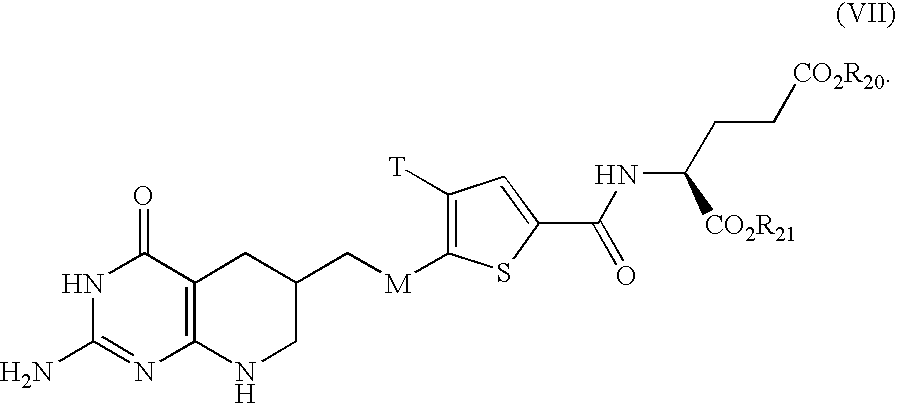
- Most preferably, the GARFT inhibitor is a compound having the chemical structure:

- In another embodiment, the inhibitors of de novo inosinate synthesis are inhibitors specific to GARFT and are preferably GARFT inhibitors having a glutamic acid or ester moiety as defined in Formula IV, wherein n, D, M, Ar, R 20 and R21 as defined herein below:

- Alternatively, the present invention includes combination therapy with inhibitors specific to AICARFT and are preferably AICARFT inhibitors having a glutamate or ester moiety as defined in Formula VIII, wherein A, W, R 1, R2 and R3 as defined herein below.

- Additional inhibitors specific to AICARFT are also disclosed below.
- This combination therapy is administered to a mammal in need thereof. Preferably, the mammal is a human and the anti-toxicity agent is administered to the mammal parenterally or orally. In a further preferred embodiment, the anti-toxicity agent is administered during and after each dose of the inhibitor. In another embodiment the anti-toxicity agent is administered to the mammal by multiple bolus or pump dosing, or by slow release formulations. In a most preferred embodiment, the method is used to treat a cell proliferative disorder selected from the group comprising lung cancer, leukemia, glioma, urothelial cancer, colon cancer, breast cancer, prostate cancer, pancreatic cancer, skin cancer, head and neck cancer.
- The present invention is alternatively directed to a combination therapy wherein the inhibitor of GARFT and/or AICARFT does not have a high binding affinity to a membrane binding folate protein (mFBP). Preferably, the inhibitor is predominantly transported into cells by a reduced folate carrier protein. In a further preferred embodiment, the inhibitor is an inhibitor of GARFT having Formula VII. More preferably, the inhibitor is a compound having the chemical structure:

- FIG. 1 is a chart depicting the intracellular metabolic pathway for production and salvage of adenylate (AMP).
- FIG. 2 is a chart depicting the de novo inosinate (IMP) synthesis pathway.
- FIG. 3 is a graph indicating the growth inhibition of MTAP-competent SK-MES-1 non-small cell lung cancer cells treated with varying concentrations of
Compound 7 alone or with a combination therapy ofCompound - FIG. 4 is a table indicating the magnitude of in vitro selective reversal of
Compound 7 growth inhibition in MTAP-competent versus MTAP-deficient cells treated withCompound 7 and MTA, as in Example 3(A) below. - FIG. 5 a is a chart depicting the in vitro cytotoxicity of BxPC-3 cells transfected with the MTAP gene when treated with varying concentrations of
Compound 7 either alone or in combination with 50 μM MTA or 50 μM dcSAMe, as in Example 3(B) below. - FIG. 5 b is a chart depicting the in vitro cytotoxicity of MTAP-deficient BxPC-3 treated with varying concentrations of
Compound 7 in combination with either 50 μM MTA or 50 μM dcSAMe, as in Example 3(B) below. - FIG. 6 is a table indicating the selective reduction of
Compound 7 cytoxicity by MTA in isogenic pairs of MTAP-competent and MTAP-deficient cell lines. - FIG. 7 is a table showing the reduced growth inhibition of combination therapy using either
Compound 1 orCompound 3, in combination with MTA, in MTAP-competent NCI-H460 cells, as described in Example 3(C) below. - FIG. 8 is a graph showing the reduction in
Compound 7 cytotoxicity in cells with MTA exposure for varying periods of time. - FIG. 9 is a graph depicting the decreased weight loss induced by
Compound 7 in mice treated with doses of MTA. - FIG. 10 is a graph depicting the antitumour activity of
Compound 7 when administered with and without MTA, in mice bearing BxPC-3 xenograft tumors. - A chart depicting the role of methylthioadenosine phosphorylase (“MTAP”) in relation to the salvage of adenine in the metabolism of healthy cells in mammals is provided in FIG. 1. As depicted in the chart, there are two routes by which adenylate (“AMP”) is produced, by salvage of adenine via methylthioadenosine (“MTA”) and its precursors, and by de novo AMP synthesis via production of inosinate (“IMP”). It has been theorized that tumor cells, due to a high demand for nucleic acid synthesis and genetic alterations in salvage pathway enzymes, tend to make purines by the de novo pathway. In particular, MTAP-deficient cells are unable to cleave MTA into adenine, and are consequently unable to produce AMP via MTAP-mediated adenine salvage. Cells lacking MTAP are particularly reliant on de novo purine synthesis, and are therefore peculiarly vulnerable to disruptions to the de novo pathway. Therefore, MTAP-deficient cells rely on production of AMP via production of inosinate (“IMP”). Referring to FIG. 2, IMP is in turn produced by one of two, pathways, by salvage of hypoxanthine, or by de novo IMP synthesis. Hypoxanthine salvage alone is inadequate to provide a sufficient supply of IMP.
- As used herein, “de novo IMP synthesis” refers to the process by which IMP is produced from the starting point of 5-phosphoribosyl-1-pyrophosphate (“PRPP”), as illustrated in FIG. 2. The starting point is the formation of 5′-phospho-β-D-ribosylamine from PRPP by glutamine PRPP amidotransferase (step 1), followed by conversion to glycinamide ribonucleotide (“GAR”) by GAR synthetase (step 2). GAR is then formylated to N-formylglycinamidine ribonucleotide (“FGAR”) by GAR formyltransferase (“GARFT”) (step 3). Synthesis continues with the formation of N-formylglycinamidine ribonucleotide (“FGAM”) by FGAR amidotransferase (step 4), followed by successive formation of 5-aminoimidazolecarboximide ribonucleotide (“AIR”) by AIR synthetase (step 5), 5-Amino-4-carboxyaminoimidazole ribonucleotide by AIR carboxylase (step 6), N-succinylo-5-aminoimidazole-4-carboxamide ribonucleotide (“SAICAR”) by SAICAR synthetase (step 7), 5-aminoimidazole-4-carboxamide ribonucleotide (“AICAR”) by adenylosuccinate lyase (also known as SAICAR lyase) (step 8), and N-Formylaminoimidazole-4-carboxamide ribonucleotide (“FAICAR”) by AICAR transformylase (“AICARFT”) (step 9). Finally, dehydration and ring closure of FAICAR (step 10) leads to production of IMP, which goes on to become either AMP or guanylate monophosphate (“GMP”). A decrease in cellular levels of IMP therefore causes a decrease in the pools along the GMP pathway as well as the AMP pathway.
- I. Inhibitors of De Novo IMP Synthesis
- As used herein, the term “inhibitor” includes, in its various grammatical forms (e.g., “inhibit”, “inhibition”, “inhibiting”, etc.), an agent, typically a molecule or compound, capable of disrupting and/or eliminating the activity of an enzymatic target involved in the synthesis of a target product. For example, an “inhibitor of de novo IMP synthesis” includes an agent capable of disrupting and/or eliminating the activity of at least one enzymatic target in de novo IMP synthesis, as described above with reference to FIG. 2. An inhibitor of de novo IMP synthesis may have multiple enzymatic targets. When the inhibitor has multiple enzymatic targets, the inhibitor preferably works predominantly through inhibition of one or more targets on the de novo IMP synthesis pathway. In particular, the inhibitors of the present invention preferably inhibit the enzymes glycinamide ribonucleotide formyltransferase (“GARFT”) and/or aminoimidazolecarboximide ribonucleotide formyltransferase (“AICARFT”). The inhibitors of the present invention also include specific inhibitors which have relative specificity or selectivity for inhibiting only one target enzyme on the de novo IMP synthesis pathway, e.g., an inhibitor specific to GARFT.
- In one embodiment, the inhibitors of de novo IMP synthesis include inhibitors of GARFT, AICARFT or both, which are derivatives of 5-thia or 5-selenopyrimidinonyl compounds containing a glutamic acid moiety. GARFT and/or AICARFT inhibitors which are derivatives of 5-thia or 5-selenopyrimidinonyl compounds, their intermediates and methods of making the same, are disclosed in U.S. Pat. Nos. 5,739,141; 6,207,670; 5,945,427; and 5,726,312, the disclosures of which are incorporated by reference herein.
- In another embodiment, the inhibitor of de novo IMP synthesis is a compound of the Formula I:

- wherein:
- A represents sulfur or selenium;
- Z represents: a) a noncyclic spacer which separates A from the carbonyl carbon of the amido group by 1 to 10 atoms, said atoms being independently selected from carbon, oxygen, sulfur; nitrogen and phosphorus, said spacer being unsubstituted or substituted with one or more suitable substituents; b) a cycloalkyl, heterocycloalkyl, aryl or heteroaryl diradical, said diradical being unsubstituted or substituted with one or more suitable substituents c) a combination of at least one of said noncyclic spacers and at least one of said diradicals, wherein when said non-cyclic spacer is bonded directly to A, said non-cyclic spacer separates A from one of said diradicals by 1 to about 10 atoms, and further wherein when said non-cyclic spacer is bonded directly to the carbonyl carbon of the amido group, said non-cyclic spacer separates the carbonyl carbon of the amido group from one of said diradicals by 1 to about 10 atoms;
- R 1 and R2 represent, independently, hydro, C1 to C6 alkyl, or a readily hydrolyzable group; and
- R 3 represents hydro or a cyclic C1 to C6 alkyl or cycloalkyl group unsubstituted or substituted by one or more halo, hydroxyl or amino.
- In one embodiment of Formula I, the moiety Z is represented by Q-X—Ar wherein:
- Q represents a C 1-C5 alkenyl, or a C2-C5 alkenylene or alkynylene radical, unsubstituted or substituted by one or more substitutents independently selected from C1 to C6 alkyl, C2 to C6 alkenyl, C1 to C6 alkoxy, C1 to C6 alkoxy(C1 to C6)alkyl, C2 to C6 alkynyl, acyl, halo, amino, hydroxyl, nitro, mercapto, a cycloalkyl, heterocycloalkyl, aryl or heteroaryl ring;
- X represents a methylene, monocyclic cycloalkyl, heterocycloalkyl, aryl or heteroaryl ring, sulfur, oxygen or amino radical, unsubstituted or substituted by one or more substituents independently selected from C 1 to C6 alkyl, C2 to C6 alkenyl, C1 to C6 alkoxy, C1 to C6 alkoxy(C1 to C6)alkyl, C2 to C6 alkynyl, acyl, halo, amino, hydroxyl, nitro, mercapto, cycloalkyl, heterocycloalkyl, aryl or heteroaryl ring; and
- Ar represents a monocyclic or bicyclic cycloalkyl, heterocycloalkyl, aryl or heteroaryl ring, wherein Ar may be fused to the monocyclic cycloalkyl, heterocycloalkyl, aryl or heteroaryl ring of X, said Ar is unsubstituted or substituted with one or more substituents independently selected from C 1 to C6 alkyl, C2 to C6 alkenyl, C1 to C6 alkoxy, C1 to C6 alkoxy(C1 to C6)alkyl, C2 to C6 alkynyl, acyl, halo, amino, hydroxyl, nitro, mercapto, cycloalkyl, heterocycloalkyl, aryl or heteroaryl ring.
- The term “alkyl” refers to a straight- or branched-chain, saturated or partially unsaturated, alkyl group having from 1 to about 12 carbon atoms, preferably from 1 to about 6 carbon atoms in the chain. Exemplary alkyl groups include methyl (Me, which also may be structurally depicted by/), ethyl (Et), n-propyl, isopropyl, butyl, isobutyl, sec-butyl, tert-butyl (tBu), pentyl, isopentyl, tert-pentyl, hexyl, isohexyl, and the like.
- The term “heteroalkyl” refers to a straight- or branched-chain, saturated or partially unsaturated alkyl group having from 2 to about 12 atoms, and preferably from 2 to about 6 atoms, in the chain, one or more of which is a heteroatom selected from S, O, and N. Exemplary heteroalkyls include alkyl ethers, secondary and tertiary alkyl amines, alkyl sulfides, and the like.
- The term “alkenyl” refers to a straight- or branched-chain alkenyl group having from 2 to about 12 carbon atoms, preferably from 2 to about 6 carbon atoms, in the chain. Illustrative alkenyl groups include prop-2-enyl, but-2-enyl, but-3-enyl, 2-methylprop-2-enyl, hex-2-enyl, ethenyl, pentenyl, and the like.
- The term “alkynyl” refers to a straight- or branched-chain alkynyl group having from 2 to about 12 carbon atoms, and preferably from 2 to about 6 carbon atoms, in the chain. Illustrative alkynyl groups include prop-2-ynyl, but-2-ynyl, but-3-ynyl, 2-methylbut-2-ynyl, hex-2-ynyl, ethynyl, propynyl, pentynyl and the like.
- The term “aryl” (Ar) refers to a monocyclic, or fused or spiro polycyclic, aromatic carbocycle (ring structure having ring atoms that are all carbon) having from to about 12 ring atoms, and preferably from 3 to about 8 ring atoms, per ring. Illustrative examples, of aryl groups include the following moieties:

- The term “heteroaryl” (heteroAr) refers to a monocyclic, or fused or spiro polycyclic, aromatic heterocycle (ring structure having ring atoms selected from carbon atoms as well as nitrogen, oxygen, and sulfur heteroatoms) having from 3 to about 12 ring atoms, and preferably from 3 to about 8 ring atoms, per ring. Illustrative examples of heteraryl groups include the following moieties:
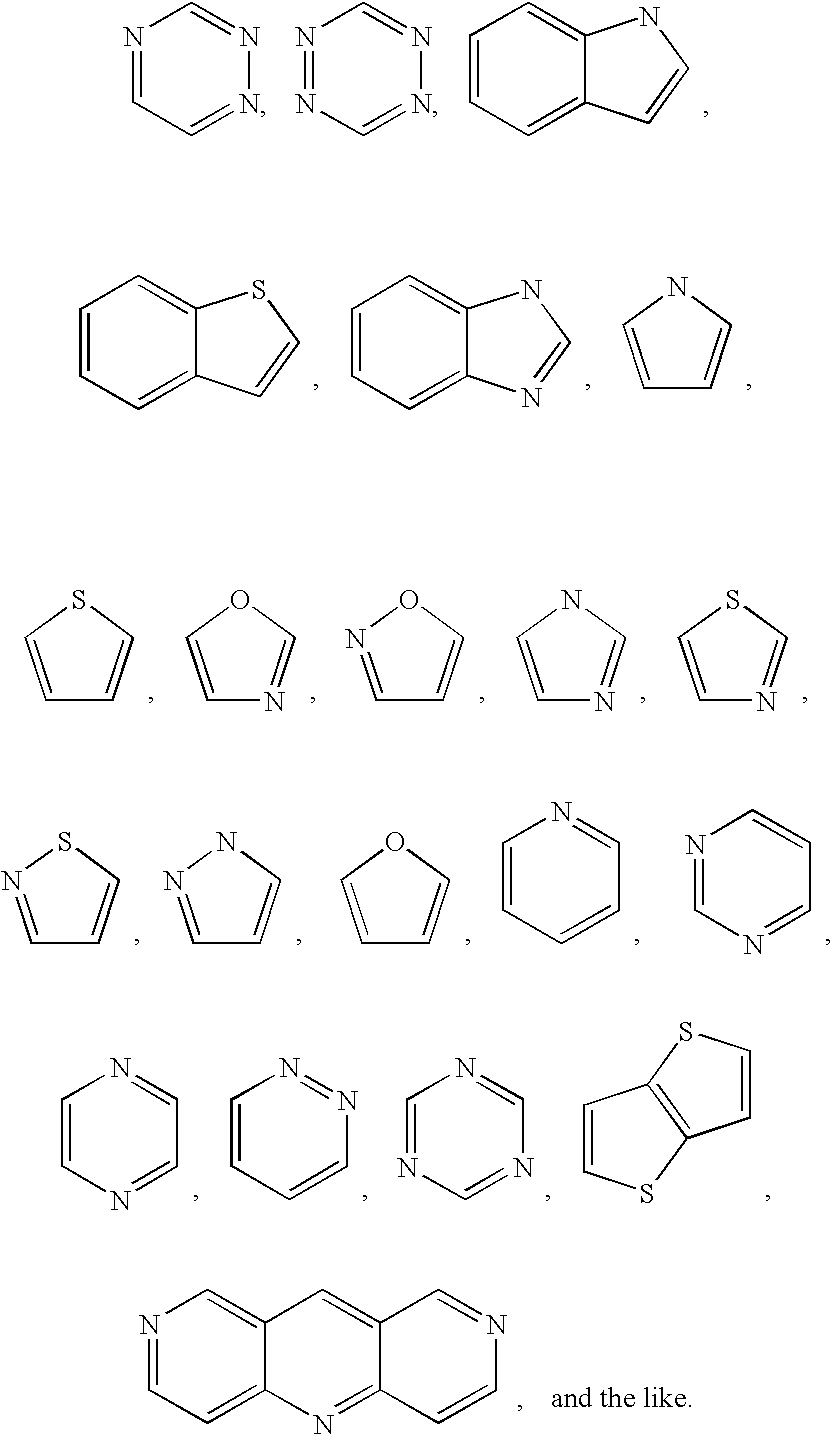
- The term “cycloalkyl” refers to a saturated or partially saturated, monocyclic or fused or spiro polycyclic, carbocycle having from 3 to 12 ring atoms, and preferably from 3 to about 8 ring atoms, per ring. Illustrative examples of cycloalkyl groups include the following moieties:
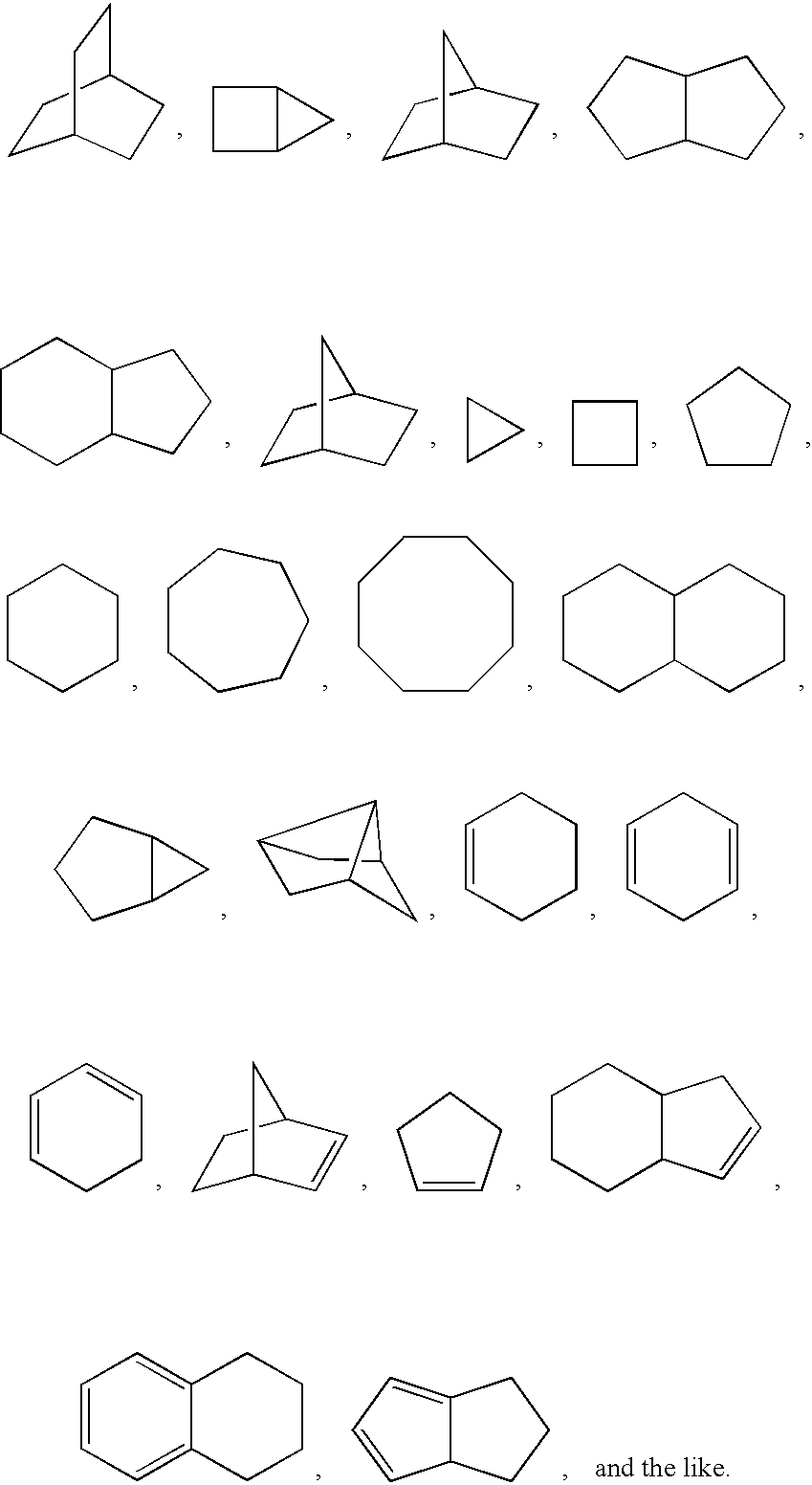
- A “heterocycloalkyl” refers to a monocyclic, or fused or spiro polycyclic, ring structure that is saturated or partially saturated and has from 3 to about 12 ring atoms, and preferably from 3 to about 8 ring atoms, per ring selected from C atoms and N, O, and S heteroatoms. Illustrative examples of heterocycloalkyl groups include:

- The term “halogen” represents chlorine, fluorine, bromine or iodine. The term “halo” represents chloro, fluoro, bromo or iodo. An “amino” group is intended to mean the radical —NH 2. A “mercapto” group is intended to mean the radical —SH. An “acyl” group is intended to mean any carboxylic acid, aldehyde, ester, ketone of the formula —C(O)H, —C(O)OH, —C(O)Rt, —C(O)ORt wherein Rt is any alkyl, alkenyl, alkynyl, heteroalkyl, cycloalkyl, heterocycloalkyl, aryl, or heteroaryl. Examples of acyl groups include, but are not limited to, formaldehyde, benzaldehyde, dimethyl ketone, acetone, diketone, peroxide, acetic acid, benzoic acid, ethyl acetate, peroxyacid, acid anhydride, and the like.
- An “alkoxy group” is intended to mean the radical —OR a, where Ra is an alkyl group. Exemplary alkoxy groups include methoxy, ethoxy, and propoxy. “Lower alkoxy” refers to alkoxy groups wherein the alkyl portion has 1 to 4 carbon atoms.
- An “hydrolyzable group” is intended to mean any group which can be hydrolyzed in an aqueous medium, either acidic or alkaline, to its free carboxylate form by means known in the art. An exemplary hydrolysable group is the glutamic acid dialkyl diester which can be hydrolyzed to either the free glutamic acid or the glutamate salt. Preferred hydrolysable ester groups include C 1-C6 alkyl, hydroxyalkyl, alkylaryl and aralkyl.
- In accordance with a convention used in the art,

- is used in structural formulae herein to depict the bond that is the point of attachment of the moiety or substituent to the core or backbone structure. Where chiral carbons are included in chemical structures, unless a particular orientation is depicted, both stereoisomeric forms are intended to be encompassed. Further, the specific inhibitors of the present invention may exist as single stereoisomers, racemates, and/or mixtures of enantiomers and/or diastereomers. All such single stereoisomers, racemates, and mixtures thereof are intended to be within the broad scope of the present invention. The chemical formulae referred to herein may exhibit the phenomenon of tautomerism. Although the structural formulae depict one of the possible tautomeric forms, it should be understood that the invention nonetheless encompasses all tautomeric forms.
- The term “substituted” means that the specified group or moiety bears one or more substituents. The term “unsubstituted” means that the specified group bears no substituents. The term “substituent” or “suitable substituent” is intended to mean any suitable substituent that may be recognized or selected, such as through routine testing, by those skilled in the art. Unless expressly indicated otherwise, illustrative examples of suitable substituents include alkyl, heteroalkyl, haloalkyl, haloaryl, halocycloalkyl, haloheterocycloalkyl, aryl, cycloalkyl, heterocycloalkyl, heteroaryl, —NO 2, —NH2, —N—ORc, —(CH2)z—CN where z is 0-4, halo, —OH, —O—Ra—O—Rb, —ORb, —CO—Rc, —O—CO—Rc, —CO—ORc, —O—CO—ORc, —O—CO—O—CO—Rc, —O—ORc, keto (═O), thioketo (═S), —SO2—Rc, —SO—Rc, —NRdRe, —CO—NRdRe, —O—CO—NRdRe, —NRc—CO—NRdRe, —NRc—CO—Re—NRc—CO2—ORe, —CO—NRc—CO—Rd, —O—SO2—Re, —O—SO—Rc, —O—S—Rc, —S—CO—Rc, —SO—CO—ORc, —SO2—CO—ORc, —O—SO3, —NRc—SRd, —NRc—SO—Rd, —NRc—SO2—Rd, —CO—SRc, —CO—SO—Rc, —CO—SO2—Rc, —CS—Rc, —CSO—Rc, —CSO2—Rc, —NRc—CS—Rd, —O—CS—Rc, —O—CSO—Rc, —O—CSO2—Rc, —SO2—NRdRe, —SO—NRdRe, —S—NRdRe, —NRd—CSO2—Rd, —NRc—CSO—R d, —NRc—CS—Rd, —SH, —S—Rb, and —PO2—ORc, where Ra is selected from the group consisting of alkyl, heteroalkyl, alkenyl, and alkynyl; Rb is selected from the group consisting of alkyl, heteroalkyl, haloalkyl, alkenyl, alkynyl, halo, —CO—Rc, —CO—ORc, —O—CO—O—Rc, —O—CO—Rc, —NRc—CO—Rd, —CO—NRdRe, —OH, aryl, heteroaryl, heterocycloalkyl, and cycloalkyl; Rc, Rd and Re are each independently selected from the group consisting of hydro, hydroxyl, halo, alkyl, heteroalkyl, haloalkyl, alkenyl, alkynyl, —CORf, —COORf, —O—CO—O—Rf, —O—CO—Rf, —OH, aryl, heteroaryl, cycloalkyl, and heterocycloalkyl, or Rd and Re cyclize to form a heteroaryl or heterocycloalkyl group; and Rf is selected from the group consisting of hydro, alkyl, and heteroalkyl; and where any of the alkyl, heteroalkyl, alkenyl, aryl, cycloalkyl, heterocycloalkyl, or heteroaryl moieties present in the above substituents may be further substituted with one or more additional substituents independently selected from the group consisting of —NO2, —NH2, —(CH2)z—CN where z is 0-4, halo, haloalkyl, haloaryl, —OH, keto (═O), —N—OH, NRc—ORc, —NRdRe, —CO—NRdRe, —CO—ORc, —CO—Rc, —NRc—CO—NRdRe, —C—CO—ORc, —NRc—CO—Rd, —O—CO—O—Rc, —O—CO—NRdRe, —SH, —O—Rb, —O—Ra—O—Rb, —S—Rb, unsubstituted alkyl, unsubstituted aryl, unsubstituted cycloalkyl, unsubstituted heterocycloalkyl, and unsubstituted heteroaryl, where Ra, Rb, Rc, Rd, and Re are as defined above.
- In another embodiment of Formula I, the inhibitors are compounds having Formula II:

- wherein:
- A represents sulfur or selenium;
- (group) represents a non-cyclic spacer which separates A from (ring) by 1 to 5 atoms, said atoms being independently selected from carbon, oxygen, sulfur, nitrogen and phosphorus, said spacer being unsubstituted or substituted by one or more substituents independently selected from C 1 to C6 alkyl, C2 to C6 alkenyl, C1 to C6 alkoxy, C1 to C6 alkoxy(C1 to C6)alkyl, C2 to C6 alkynyl, acyl, halo, amino, hydroxyl, nitro, mercapto, cycloalkyl, heterocycloalkyl, aryl or heteroaryl ring;
- (ring) represents a cycloalkyl, heterocycloalkyl, aryl or heteroaryl ring, unsubstituted or substituted with or more substituents selected from C 1 to C6 alkyl, C2 to C6 alkenyl, C1 to C6 alkoxy, C1 to C6 alkoxy(C1 to C6)alkyl, C2 to C6 alkynyl, acyl, halo, amino, hydroxyl, nitro, mercapto, cycloalkyl, heterocycloalkyl, aryl or heteroaryl ring;
- R 1 and R2 represent, independently, hydro, C1 to C6 alkyl, or a readily hydrolyzable group; and
- R 3 represents hydro or a C1 to C6 alkyl or cycloalkyl group unsubstituted or substituted by one or more halo, hydroxyl or amino.
- Preferred species of Formula II are compounds having the following chemical structures:

- (Compound 1: N-[5-(2[(2,6-diamino-4(3H)-oxopyrimidin5yl)thio]ethyl)thieno-2-yl]-L-glutamic acid); and

- (Compound 2: N-[5-(3-[(2,6-diamino-4(3H)-oxopyrimidin-5yl)thio]propyl)-4-methyl-thieno-2-yl/-L-glutamic acid).
- In yet another embodiment of Formula I, the inhibitors are compounds having Formula III:

- wherein:
- n is an integer from 0 to 5;
- A represents sulfur or selenium;
- X represents a diradical of methylene, a monocyclic cycloalkyl, heterocycloalkyl, aryl or heteroaryl ring, oxygen, sulfur or an amine;
- Ar represents an aromatic diradical wherein Ar can form a fused bicyclic ring system with said ring of X; and
- R 1 and R2, represent, independently, hydro or C1-C6 alkyl.
- In an alternative embodiment, the inhibitors of de novo IMP synthesis include inhibitors of GARFT having a glutamic acid or ester moiety. GARFT inhibitors having a glutamic acid or ester moiety, their intermediates and methods of making thereof are disclosed in U.S. Pat. Nos. 5,723,607; 5,641,771; 5,639,749; 5,639,747; 5,610,319; 5,641,774; 5,625,061; and 5,594,139; the disclosures of which are hereby incorporated by reference in their entireties. In particular, GARFT inhibitors having a glutamic acid or ester moiety include compounds having the Formula IV:

- wherein:
- n represents an integer from 0 to 2;
- D represents sulfur, CH 2, oxygen, NH or selenium, provided that when n is 0, D is not CH2, and when n is 1, D is not CH2 or NH;
- M represents sulfur, oxygen, or a diradical of C 1-C3 alkane, C2-C3 alkene, C2-C3 alkyne, or amine, wherein M is unsubstituted or substituted by one or more suitable substituents;
- Ar represents a diradical of a cycloalkyl, heterocycloalkyl, aryl or heteroaryl ring system, said Ar is unsubstituted or substituted with one or more substituents independently selected from C 1 to C6 alkyl, C2 to C6 alkenyl, C1 to C6 alkoxy, C1 to C6 alkoxy(C1 to C6)alkyl, C2 to C6 alkynyl, acyl, halo, amino, hydroxyl, nitro, mercapto, cycloalkyl, heterocycloalkyl, aryl or heteroaryl ring; and
- R 20 and R21 represent, independently, hydro or a moiety that forms, together with the attached CO2, a readily hydrolyzable ester group.
- In one embodiment of Formula IV, the inhibitors are compounds having the Formula V:

- wherein:
- A represents sulfur or selenium;
- U represents CH 2, sulfur, oxygen or NH;
- Ar represents a diradical of a cycloalkyl, heterocycloalkyl, aryl or heteroaryl ring system, said Ar is unsubstituted or substituted with one or more substituents independently selected from C 1 to C6 alkyl, C2 to C6 alkenyl, C1 to C6 alkoxy, C1 to C6 alkoxy(C1 to C6)alkyl, C2 to C6 alkynyl, acyl, halo, amino, hydroxyl, nitro, mercapto, cycloalkyl, heterocycloalkyl, aryl or heteroaryl ring; and
- R 20 and R21 represent, independently, hydro or a moiety that forms, together with the attached CO2, a readily hydrolyzable ester group.
- In another embodiment of Formula IV, the inhibitors are compounds having the Formula VI:

- wherein:
- D represents oxygen, sulfur or selenium;
- M′ represents sulfur, oxygen, or a diradical of C 1-C3 alkene, C2-C3 alkene, C2-C3 alkyne, or amine, said M′ is unsubstituted or substituted by one or more suitable substituents;
- Y represents O, S or NH;
- B represents hydro or halo;
- C represents hydro or halo or an unsubstituted or substituted C 1-C6 alkyl; and
- R 20 and R21 represent independently hydro or a moiety that forms, together with the attached CO2, a readily hydrozyable ester group.
- One preferred species of GARFT inhibitor of Formula VI is a compound having the chemical structure:

- (Compound 3: 4-[2-(2-Amino-4-oxo-4,6,7,8-tetraydro-3H-pyrimido[5,4-b][1,4]thiazin-6-yl)(R)-ethyl]-3-methyl-2-thienoyl-5-amino-L-glutamic acid).
- In another alternative embodiment of the invention, the inhibitors of de novo IMP synthesis are inhibitors specific to GARFT having the Formula VII:

- wherein L represents sulfur, CH 2 or selenium;
- M represents a sulfur, oxygen, or a diradical of C 1-C3 alkane, C2-C3 alkene, C2-C3 alkyne, or amine, wherein M is unsubstituted or substituted by one or more suitable substituents;
- T represents C 1-C6 alkyl; C2-C6 alkenyl; C2-C6 alkynyl; —C(O)E, wherein E represents hydro, C1-C3 alkyl, C2-C3 alkenyl, C2-C3 alkynyl, OC1-C3 alkoxy, or NR10R11, wherein R10 and R11 represent independently hydro, C1-C3 alkyl, C2-C3 alkenyl, C2-C3 alkynyl; or NR10R11, wherein R10 and R11 represent independently hydro, C1-C3 alkyl, C2-C3 alkenyl, C2-C3 alkynyl, hydroxyl; nitro; SR12, wherein R12 is hydro, C1-C6 alkyl, C2-C6 alkenyl, C2-C6 alkynyl, cyano; or O(C1-C3) alkyl; and
- R 20 and R21 are each independently hydro or a moiety that forms, together with the attached CO2, a readily hydrolyzable ester group.
- GARFT inhibitors having Formula VII, and the tautomers and stereoisomers thereof, are capable of particularly low binding affinities to mFBP. These inhibitors are capable of having mFBP disassociation constants that are at least thirty five times greater than lometrexol and are disclosed in U.S. Pat. Nos. 5,646,141 and 5,608,082, the disclosures of which are hereby incorporated by reference in their entireties.
- Preferred species of a GARFT inhibitor of Formula VII are compounds having the following chemical structures:

- (Compound 4: 4-[2-(2-Amino-4-oxo-4,6,7,8-tetraydro-3H-pyrimido[5,4-b][1,4]thiazin-6-yl)-(R)-ethyl]-3-methyl-2-thienoyl-5-amino-L-glutamic acid),

- (Compound 5: 4-[2-(2-Amino-4-oxo-4,6,7,8-tetrahydro-3H-pyrimido[5,4-b][1,4]thiazin-6-yl)-(S)-ethyl]-3-methyl-2-thienoyl-5-amino-L-glutamic acid), and

- (Compound 6: N-(5-[2-(2-amino-4(3H)-oxo-5,6,7,8-tetrahydropyrido[2,3-d]pyrimidin-6-yl)-(R)-ethyl]-4-methylthieno-2-yl)-L-glutamic acid).
- A more preferred species of a GARFT inhibitor having the formula VII, and which has limited binding affinity to mFBP, is a compound having the chemical structure:
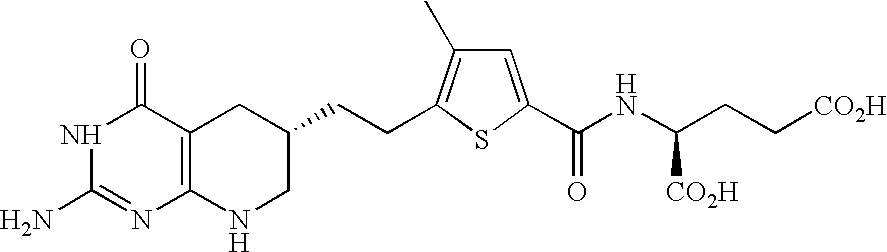
- (Compound 7: N-(5-[2-(2-amino-4(3H)-oxo-5,6,7,8-tetrahydropyrido[2,3-d]pyrimidin-6-yl)-(S)-ethyl]-4-methylthieno-2-yl)-L-glutamic acid).
- In another alternate embodiment, the inhibitors of de novo IMP synthesis include inhibitors specific to AICARFT which also have a glutamate or ester moiety. AICARFT inhibitors having a glutamate or ester moiety, their intermediates and methods of making the same are disclosed in U.S. Pat. Nos. 5,739,141; 6,207,670; 5,945,427; and 5,726,312, the disclosures of which are hereby incorporated by reference in their entireties. In particular, AICARFT inhibitors having a glutamate or ester moiety include compounds having the Formula VIII:

- wherein:
- A represents sulfur or selenium;
- W represents an unsubstituted phenylene or thinylene diradical;
- R 1 and R2 represent, independently, hydro, C1 to C6 alkyl, or other readily hydrolyzable group; and
- R 3 represents hydro or a C1-C6 alkyl or cycloalkyl group, unsubstituted or substituted by one or more halogen, hydroxyl or amino groups.
- Additional AICARFT inhibitors useful in the present invention are disclosed in International Publication No. WO13688, the disclosure of which is hereby incorporated by reference in its entirety. In particular, the disclosed AICARFT inhibitors are compounds having the Formula IX:

- wherein:
- R 30 represents hydro or CN;
- R 31 represent phenyl or thienyl, unsubstituted or substituted with phenyl, phenoxy, thienyl, tetrazolyl, or 4-morpholinyl; and
- R 32 is phenyl substituted with —SO2NR33R34 or —NR33SO2R34, unsubstituted or substituted with C1-C4 alkyl, C1-C4 alkoxy, or halo, wherein R33 is H or C1-C4 alkyl and R34 is C1-C4 alkyl, unsubstituted or substituted with heteroalkyl, aryl, heteroaryl, indolyl, or is

- wherein n is an integer of from 1 to 4, R 35 is hydroxyl, C1-C4 alkoxy, or a glutamic-acid or glutamate-ester moiety linked through the amine functional group.
- Preferred species of AICARFT inhibitors useful in the method of this invention include compounds having the following chemical structures:
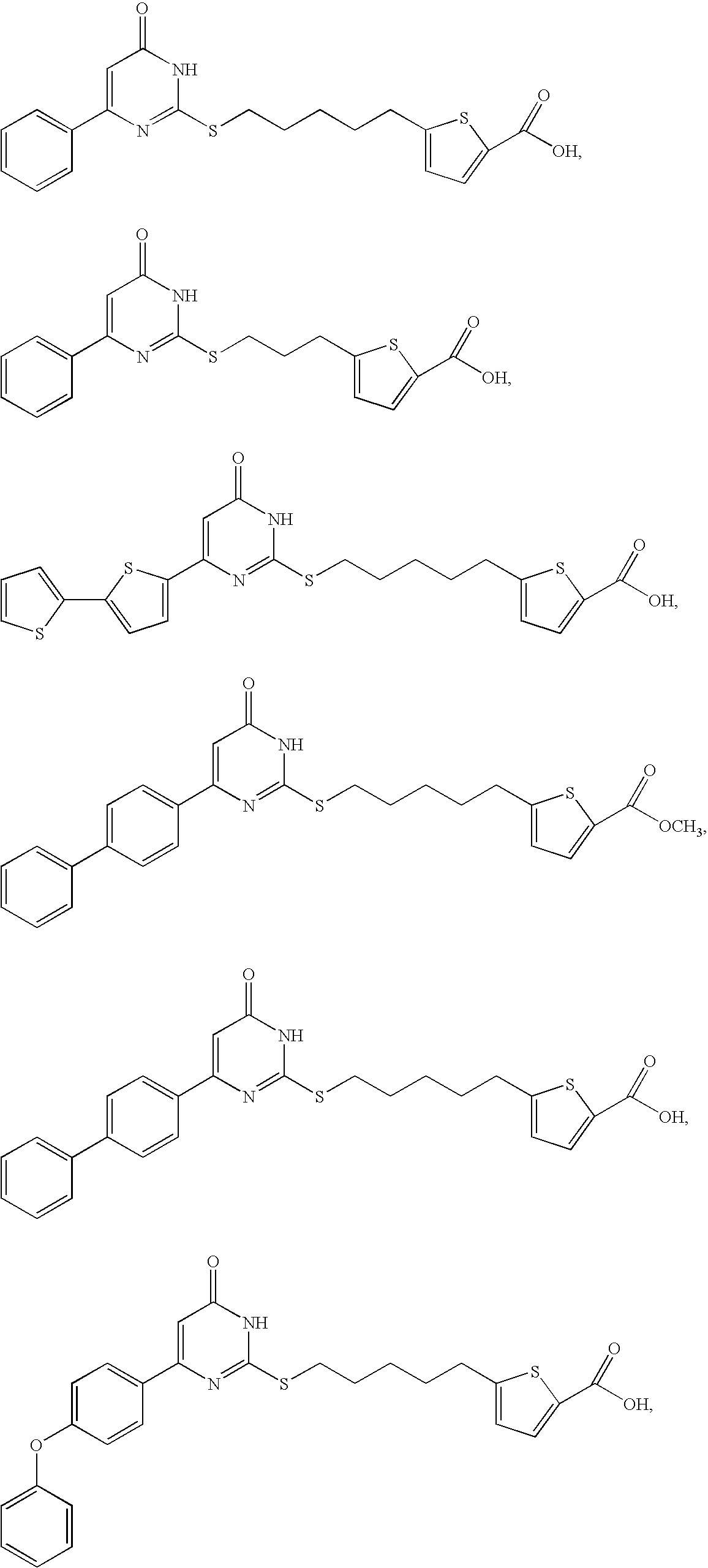


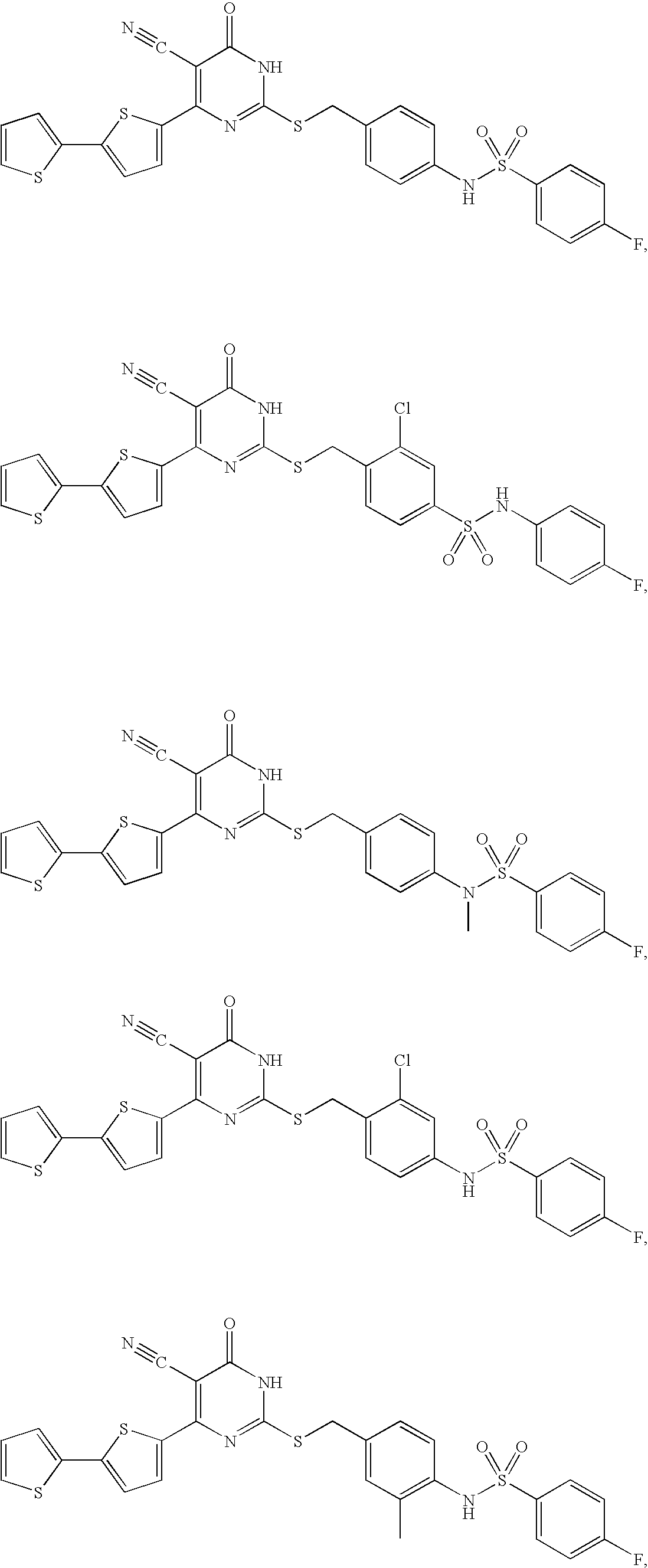

- The inhibitors of de novo IMP synthesis useful in the methods of the present invention include any pharmaceutically acceptable salt, prodrug, solvate or pharmaceutically active metabolite thereof. As used herein, a “prodrug” is a compound that may be converted under physiological conditions or by solvolysis to the specified compound or to a pharmaceutically acceptable salt of such compound. An “active metabolite” is a pharmacologically active product produced through metabolism in the body of a specified compound or salt thereof. Prodrugs and active metabolites of a compound may be routinely identified using techniques known in the art. See, e.g., Bertolini et al., J. Med. Chem. (1997), 40:2011-2016; Shan et al., J. Pharm. Sci. (1997), 86 (7):765-767; Bagshawe, Drug Dev. Res. (1995), 34:220-230; Bodor, Advances in Drug Res. (1984), 13:224-331; Bundgaard, Design of Prodrugs (Elsevier Press 1985); Larsen, Design and Application of Prodrugs, Drug Design and Development (Krogsgaard-Larsen et al. eds., Harwood Academic Publishers, 1991); Dear et al., J. Chromatogr. B (2000), 748:281-293; Spraul et al., J. Pharmaceutical & Biomedical Analysis (1992), 10 (8):601-605; and Prox et al., Xenobiol. (1992), 3 (2):103-112. A “pharmaceutically acceptable salt” is intended to mean a salt that retains the biological effectiveness of the free acids and bases of a specified compound and that is not biologically or otherwise undesirable. Examples of pharmaceutically acceptable salts include sulfates, pyrosulfates, bisulfates, sulfites, bisulfites, phosphates, monohydrogenphosphates, dihydrogenphosphates, metaphosphates, pyrophosphates, chlorides, bromides, iodides, acetates, propionates, decanoates, caprylates, acrylates, formates, isobutyrates, caproates, heptanoates, propiolates, oxalates, malonates, succinates, suberates, sebacates, fumarates, maleates, butyne-1,4-dioates, hexyne-1,6-dioates, benzoates, chlorobenzoates, methylbenzoates, dinitrobenzoates, hydroxybenzoates, methoxybenzoates, phthalates, sulfonates, xylenesulfonates, phenylacetates, phenylpropionates, phenylbutyrates, citrates, lactates, (hydroxybutyrates, glycollates, tartrates, methane-sulfonates (mesylates), propanesulfonates, naphthalene-1-sulfonates, naphthalene-2-sulfonates, and mandelates. A “solvate” is intended to mean a pharmaceutically acceptable solvate form of a specified compound that retains the biological effectiveness of such compound. Examples of solvates include compounds of the invention in combination with water, isopropanol, ethanol, methanol, DMSO, ethyl acetate, acetic acid, or ethanolamine.
- In the case of compounds, salts, or solvates that are solids, it is understood by those skilled in the art that the useful inhibitor compounds, salts, and solvates of the invention may exist in different crystal forms, all of which are intended to be within the scope of the inhibitors of the present invention and their specified formulae. The inhibitor compounds according to the invention, as well as the pharmaceutically acceptable prodrugs, salts, solvates or pharmaceutically active metabolites thereof, may be incorporated into convenient dosage forms such as capsules, tablets or injectable preparations. Solid or liquid pharmaceutically acceptable carriers may also be employed. Solid carriers include starch, lactose, calcium sulphate dihydrate; terra alba, sucrose, talc, gelatin, agar, pectin, acacia, magnesium stearate and stearic acid. Liquid carriers include syrup, peanut oil, olive oil, saline solution and water, among other carriers well known in the art.
- As mentioned above, the inhibitors of de novo IMP synthesis useful in the present invention are preferably capable of inhibiting GARFT and/or AICARFT and have a relative affinity that is higher for GARFT and/or AICARFT than for other enzymes in the de novo IMP synthesis pathway. More preferably, the inhibitors useful in the invention are specific to either GARFT or AICARFT, by having a relative affinity that is higher for either GARFT or AICARFT.
- In a preferred embodiment, the inhibitors useful in the methods of the present invention do not have a high affinity to membrane folate binding protein (“mFBP”) and preferably have a disassociation constant to mFBP that is greater than lometrexol by at least a factor of about thirty-five. The disassociation constant to mFBP may be determined by using a competitive binding assay with mFBP, as described below. Accordingly, the inhibitors useful in the present invention are predominantly transported into cells by an alternate mechanism other than that involving mFBP, for example, via a reduced folate transport protein. The reduced folate transport protein has a preference for reduced folates but will transport a number of folic acid derivatives.
- A. Determination of Inhibition Constants for Inhibitors of De Novo IMP Synthesis
- The determination of inhibition constants for de novo IMP inhibitors may be conducted as per the assays disclosed in U.S. Pat. No. 5,646,141 or International Publication No. WO 13688, the disclosures of which are hereby incorporated by reference in their entireties. In particulars the inhibition constant can be determined by modifying the assay method of Young et al, Biochemistry 23 (1984) 3979-3986 or of Black et al, Anal. Biochem. 90 (1978) 397-401, the disclosures of which are also hereby incorporated by reference in their entireties. Generally, the reaction mixtures are designed to contain the catalytic domain of the human enzyme and its substrate (i.e., GARFT and GAR, or AICARFT and AICAR), the subject test inhibitor, and any necessary substrates (i.e. N10-formyl-5,8-dideazafolate). The reaction is initiated by addition of the enzyme and then monitored for an increase in absorbance at 298 nm at 25° C.
- The inhibition constant (K i) can be determined from the dependence of the steady-state catalytic rate on inhibitor and substrate concentration. The type of inhibition observed is then analyzed for competitiveness with respect to any substrate of the target enzyme (e.g. N10-formyl H4 folate or its analog, formyl-5,8-dideazafolate (“FDDF”), for GARFT and AICARFT inhibitors). The Michaelis constant Km for N10-formyl H4 folate or FDDF is then determined independently by the dependence of the catalytic rate on substrate concentration. Data for both the Km and Ki determinations are fitted by non-linear methods to the Michaelis equation, or the Michaelis equation for competitive inhibition, as appropriate. Data resulting from tight-binding inhibition is then analyzed and Ki is determined by fitting the data to the tight-binding equation of Morrison, Biochem Biophys Acta 185 (1969), 269-286, using nonlinear methods.
- B. Determination of Disassociation Constants for Human Membrane Folate Binding Protein
- The dissociation constant (K d) of the preferred inhibitors of the present invention for human membrane folate-binding protein (mFBP) can be determined in a competitive binding assay using mFBP prepared from cultured KB cells (human nasopharyngeal carcinoma cells) as disclosed in U.S. Pat. No. 5,646,141, the disclosures of which is hereby incorporated by reference in its entirety.
- Human membrane folate binding protein can be obtained from KB cells by methods well known in the art. KB cells are washed, sonicated for cell lysis and centrifuged to form pelleted cells. The pellet can then be stripped of endogenous bound folate by resuspension in acidic buffer (KH 2PO4—KOH and 2-mercaptoethanol) and centrifuged again. The pellet is then resuspended and the protein content quantitated using the Bradford method with bovine serum albumin (BSA) as standard.
- Disassociation constants are determined by allowing, the test inhibitor to compete against 3H-folic acid for binding to mFBP. Reaction mixtures are designed to generally contain mFBP, 3H-folic acid, and various concentrations of the subject test inhibitor in acidic buffer (KH2PO4—KOH and 2-mercaptoethanol). The competition reaction is typically conducted at 25°. Because of the slow nature of release of bound 3H-folic acid, the test inhibitor may be prebound prior to addition of bound 3H-folic acid, after which the reaction should be allowed to equilibriate. The full reaction mixtures then should be drawn through nitrocellulose filters to isolate the cell membranes with bound 3H-folic acid. The trapped mFBP are then washed and measured by scintillation counting. The data can then be nonlinearly fitted as described above in determining Ki. The mFBP Kd for 3H-folic acid, used for calculating the competitor Kd, can be obtained by directly titrating mFBP with 3H-folate. The mFBP Kd can then be used to calculate the competitor Kd by nonlinear fitting of the data to an equation for tight-binding Kc. Table 1 below provides the Kd values of several GARFT inhibitors using the assay described above.
TABLE 1 GARFT Inhibitor Kd (nM) to mFBP Lometrexol 0.019 Compound 2136 Compound 30.0042 Compound 41.0 Compound 50.71 Compound 7290 - II. Anti-Toxicity Agents
- To reduce the toxicity of an IMP inhibitor on non-cancerous, MTAP-competent cells, an anti-toxicity agent is administered in combination with the inhibitor to provide a supply of adenine or AMP. The anti-toxicity agent comprises an MTAP substrate (e.g. methylthioadenosine or “MTA”), a precursor of MTA, an analog of an MTA precursor, a prodrug of an MTAP substrate, or a combination thereof. As used herein, an “MTAP substrate” refers to MTA or a synthetic analog of MTA, which is capable of providing a substrate for cleavage by MTAP for production of either adenine or AMP. MTA is represented by the chemical structure below:

- MTA can be prepared according to known methods as disclosed in Kikugawa et al. J. Med. Chem. 15, 387(1972) and Robins et al. Can. J. Chem. 69,1468 (1991). An alternate method of synthesizing MTA is provided in Example 2(A) below.
- As used herein, an “analog of MTA” refers to any compound related to MTA in physical structure and which is capable of providing a cleavage site for MTAP. Synthetic analogs can be prepared to provide a substrate for cleavage by MTAP, which in turn provides adenine or AMP.
- In one embodiment, the anti-toxicity agents of the present invention are analogs of MTA having the Formula X:

- wherein
- R 41 is selected from the group consisting of:
- (a) —R g wherein Rg represents a C1-C5 alkyl, C2-C5 alkenylene or alkynylene radical, unsubstituted or substituted by one or more substitutents independently selected from C1 to C6 alkoxy, C1 to C6 alkoxy(C1 to C6)alkyl, C2 to C6 alkynyl, acyl, halo, amino, hydroxyl, nitro, mercapto, cycloalkyl, heterocycloalkyl, aryl or heteroaryl;
- (b) —R g(Y)RhRi wherein Rg is as defined above, Y represents O, NH, S, or methylene; and Rh and Ri represent, independently, (i) H; (ii) a C1-C9 alkyl, or a C2-C6 alkenyl or alkynyl, unsubstituted or substituted by one or more substitutents independently selected from C1 to C6 alkoxy; C1 to C6 alkoxy(C1 to C6)alkyl; C2 to C6 alkynyl; acyl; halo; amino; hydroxyl; nitro; mercapto; —NCOORo; —CONH2; C(O)N(Ro)2; C(O)Ro; or C(O)ORo, wherein Ro is selected from the group consisting of H, C1-C6 alkyl, C2-C6 heterocycloalkyl, cycloalkyl, heteroaryl, aryl, and amino, unsubstituted or substituted with C1-C6 alkyl, 2- to 6-membered heteroalkyl, heterocycloalkyl, cycloalkyl, C1-C6 boc-aminoalkyl; cycloalkyl, heterocycloalkyl, aryl or heteroaryl; or (iii) a monocyclic or bicyclic cycloalkyl, heterocycloalkyl, aryl or heteroaryl, unsubstituted or substituted with one or more substituents independently selected from C1 to C6 alkyl, C2 to C6 alkenyl, C1 to C6 alkoxy, C1 to C6 alkoxy(C1 to C6)alkyl, C2 to C6 alkynyl, acyl, halo, amino, hydroxyl, nitro, mercapto, cycloalkyl, heterocycloalkyl, aryl heteroaryl, —COORo, —NCORo wherein Ro is as defined above, 2 to 6 membered heteroalkyl, C1 to C6 alkyl-cycloalkyl, C1 to C6 alkyl-heterocycloalkyl, C1 to C6 alkyl-aryl or C1 to C6 alkyl-aryl;
- (c) C(O)NR jRk wherein Rj and Rk represent, independently, (i) H; or (ii) a C1-C6 alkyl, amino, C1-C6 haloalkyl, C1-C6 aminoalkyl, C1-C6 boc-aminoalkyl, C1-C6 cycloalkyl, C1-C6 alkenyl, C2-C6 alkenylene, C2-C6 alkynylene radical, wherein Rj and Rk are optionally joined together to form, together with the nitrogen to which they are bound, a heterocycloalkyl or heteroaryl ring containing two to five carbon atoms and wherein the C(O)NRjRk group is further unsubstituted or substituted by one or more substitutents independently selected from —C(O)Ro, —C(O)ORo wherein Ro is as defined above, C1 to C6 alkyl, C2 to C6 alkenyl, C1 to C6 alkoxy, C1 to C6 alkoxy(C1 to C6)alkyl, C2 to C6 alkynyl, acyl, halo, amino, hydroxyl, nitro, mercapto, cycloalkyl, heterocycloalkyl, aryl or heteroaryl; or
- (d) C(O)OR h wherein Rh is as defined above;
- R 42 and R44 represent, independently, H or OH; and
- R 43 and R45 represent, independently, H, OH, amino or halo;
- where any of the cycloalkyl, heterocycloalkyl, aryl, heteroaryl moieties present in the above may be further substituted with one or more additional substituents independently selected from the group consisting of nitro, amino, —(CH 2)z—CN where z is 0-4, halo, haloalkyl, haloaryl, hydroxyl, keto, C1 to C6 alkyl, C2 to C6 alkenyl, C2 to C6 alkynyl, heteroalkyl, unsubstituted cycloalkyl, unsubstituted heterocycloalkyl, unsubstituted aryl or unsubstituted heteroaryl;
- and salts or solvates thereof.
- In another embodiment, the anti-toxicity agents of the present invention are analogs of MTA having the Formula XII:

- wherein R 46 represents (i) H; (ii) a C1-C9 alkyl, or a C2-C6 alkenyl or alkynyl, unsubstituted or substituted by one or more substitutents independently selected from C1 to C6 alkoxy; C1 to C6 alkoxy(C1 to C6)alkyl; C2 to C6 alkynyl; acyl; halo; amino; hydroxyl; nitro; mercapto; cycloalkyl, heterocycloalkyl, aryl or heteroaryl; or (iii) a monocyclic or bicyclic cycloalkyl, heterocycloalkyl, aryl or heteroaryl, unsubstituted or substituted with one or more substituents independently selected from C1 to C6 alkyl, C2 to C6 alkenyl, C1 to C6 alkoxy, C1 to C6 alkoxy(C1 to C6)alkyl, C2 to C6 alkynyl, acyl, halo, amino, hydroxyl, nitro, imercapto, cycloalkyl, heterocycloalkyl, aryl or heteroaryl; and wherein R41, R42, R43, R44 and R45 are as described above.
- MTA analogs can be prepared via literature methods. The 5′ thio analogs of adenosine can be prepared from 5′-chloro-5′-deoxyadenosine (Kikugawa et al. J. Med. Chem. 15, 387 (1972) and M. J. Robins et. al. Can. J. Chem. 69, 1468 (1991)), including 5′-
deoxy 5′-methythioadenosine (Kikugawa et al.), 5′-deoxy 5′-ethylthioadenosine (Kikugawa et al.), 5′-deoxy 5′-phenylthioadenosine(Kikugawa et. al. and M. J. Robins et al.), 5′-deoxy 5′-hydroxyethylthioadenosine (Kikugawa et. al.), 5′-iso-butylthio 5′-deoxyadenosine (Craig andMoffatt Nucleosides Nucleotides 5, 399 (1986)), 3-adenosin-5′-ylsulfanyl-propionic acid (Hildesheim et al. Biochimie (1972), 54, 431), S-tert-butyl-5′-thio-adenosine (Kuhn et al. Chem. Ber. (1965), 98, 1699), S-butyl-5′-thio-adenosine (Hildesheim et al.), S-(2-amino-ethyl)-5′-thio-adenosine (Hildesheim et al), S-pyridin-2-yl-5′-thio-adenosine (Nakagawa et al. Tetrahedron Letter (1975), 17, 1409.-a different synthesis method), S-benzyl-5′-thio-adenosine (Kikugawa et al.), S-phenethyl-5′-thio-adenosine (Anderson et al. J. Med. Chem. (1981), 24, 1271.), S-methylbutyl-5′thio-adenosine (Vedel, M. Biochem. Biophysical Res. Comm. (1981) 99(4), 1316-25, Other preferred species of 5′ adenosine analogs of MTA can also be prepared via literature methods, including 5′-cyclohexylamino-5′-deoxyadenosine (Murayama, A. et. al. J. Org. Chem. (1971), 36, 3029.), 5′-morpholin-4-yl-5′-deoxyadenosine (Vuilhorgne, M. et. al. Hetercycles (1978), 11, 495.), 5′-dimethylamino-5′-deoxyadenosine (Morr, M. et. al. J. Chem. Res. Miniprint (1981), 4, 1153.), O5′-methyl-adenosine (Smith, C. G. et al. J. Med. Chem. (1995), 38(12) 2259.), O5′-benzyl-adenosine (Chan, L. et al. Tetrahedron (1990), 46(1), 151.) and 1-(6-amino-purin-9-yl)-β-D-ribo-1,5,6-trideoxy-heptofuranuronic acid ethyl ester (Montgomery et al. J. Heterocycl. Chem. (1974), 11, 211.). 5′-Deoxyadenosine is commercially available from Sigma-Aldrich Corporation and can be prepared by methods disclosed in Robins et al, (1991). - The adenosine-5′-carboxamide derivative can be prepared from 2′,3′-O-isopropylideneadenosine-5′-carboxylic acid (Harmon et. al. Chem. Ind. (London) 1141 (1969); Harper and Hampton J. Org. Chem. 35, 1688(1970); Singh Tetrahedron Lett. 33, 2307 (1992)) using a variation of the method described by S. Wnuk J. Med. Chem. 39,4162 (1996):

- In addition, the adenosine-5′-carboxylic acid sodium salt (Prasad et. al. J. Med. Chem. 19, 1180 (1976)) can be prepared from adenosine-5′-carboxylic acid (R. E. Harmon et. al. Chem. Ind. (London) 1141 (1969); Harper and Hampton J. Org. Chem. 35, 1688 (1970); Singh Tetrahedron Lett. 33, 2307 (1992)) and NaOH:
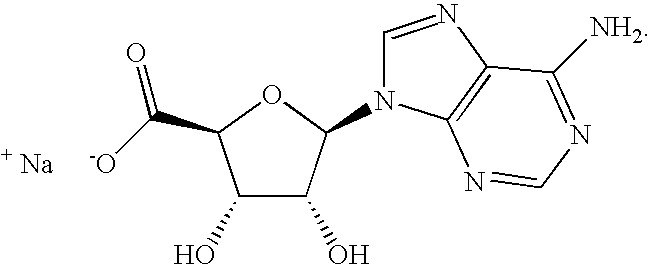
- Additional species of MTA analogs of Formula X are compounds having the following chemical structures:

- and
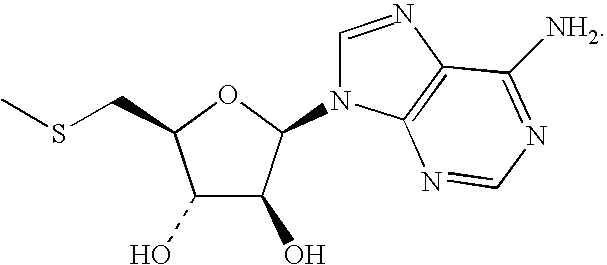
- The latter four compounds can be made via literature methods (Montgomery et. Al. J. Med. Chem. 17, 1197 (1974); Gavagnin and Sodano, Nucleosides & Nucleotides 8, 1319 (1989); Allart et al., Nucleosides & Nucleotides 18, 857 (1999)).
- Preferably, the anti-toxicity agents are MTAP substrates or prodrugs producing MTAP substrates which have a Km less than 150 times (330 μM) that of MTA. More preferably, the anti-toxicity agent is an MTAP substrate or prodrug thereof which has a Km less than 50 times (110 μM) that of MTA.
- Other preferred anti-toxicity agents include MTAP substrates, or prodrugs thereof, which have a Kcat/Km ratio that is greater than 0.05 s −1. μM−1. More preferably the anti-toxicity agents are MTAP substrates or prodrugs thereof having a Kcat/Km ratio that is greater than 0.01 s−1. μM−1.
- Examples 2(B), 2(D), 2(E), 2(F) and 2(G) below provides synthetic schemes for the synthesis of MTAP substrates.
- In healthy cells, natural precursors of MTA will be converted to MTA for action by MTAP. As used herein, a “precursor” is a compound from which a target compound is formed via, one or a number of biochemical reactions that occur in vivo. A “precursor of MTA” is, therefore, an intermediate which occurs in vivo in the formation of MTA. For example, precursors of MTA include S-adenosylmethionine (“SAMe”) or decarboxylated S-adenosylmethionine (“dcSAMe” or “dSAM”). SAMe and dcSAMe, respectively, are described by the compounds BB and CC below:

- In addition, synthetic analogs of MTA precursors can be prepared. As used herein, an “analog of an MTA precursor” refers to a compound related in physical structure to an MTA precursor, e.g., SAMe or dcSAMe, and which in vivo acts as an intermediate in the formation of an MTAP substrate.
- Prodrugs of MTAP substrates are also useful in the invention as anti-toxicity agents. Prodrugs may be designed to improve physicochemical or pharmacological characteristics of the MTAP substrate. For example a prodrug of a MTAP substrate may have functional groups added to increase its solubility and/or bioavailability. Prodrugs of MTAP substrates which are more soluble than MTA are disclosed, for example, in J. Org. Chem. (1994) 49(3): 544-555, the disclosures of which are hereby incorporated by reference in its entirety.
- In the present invention, preferred prodrugs of MTAP substrates include carbamates, esters, phosphates, and diamino acid esters of MTA or of MTA analogs. Additional prodrugs can be prepared by those skilled in the, art. For example, the 2′, 3′-diacetate derivatives of 5′-
deoxy 5′-methylthioadenosine (J. R. Sufrin et. al. J. Med. Chem. 32, 997 (1989)), 5′-deoxy 5′-ethylthioadenosine and 5′-iso-butylthio 5′-deoxyadenosine can be prepared according to the methods described in J. Org. Chem. 59, 544 (1994):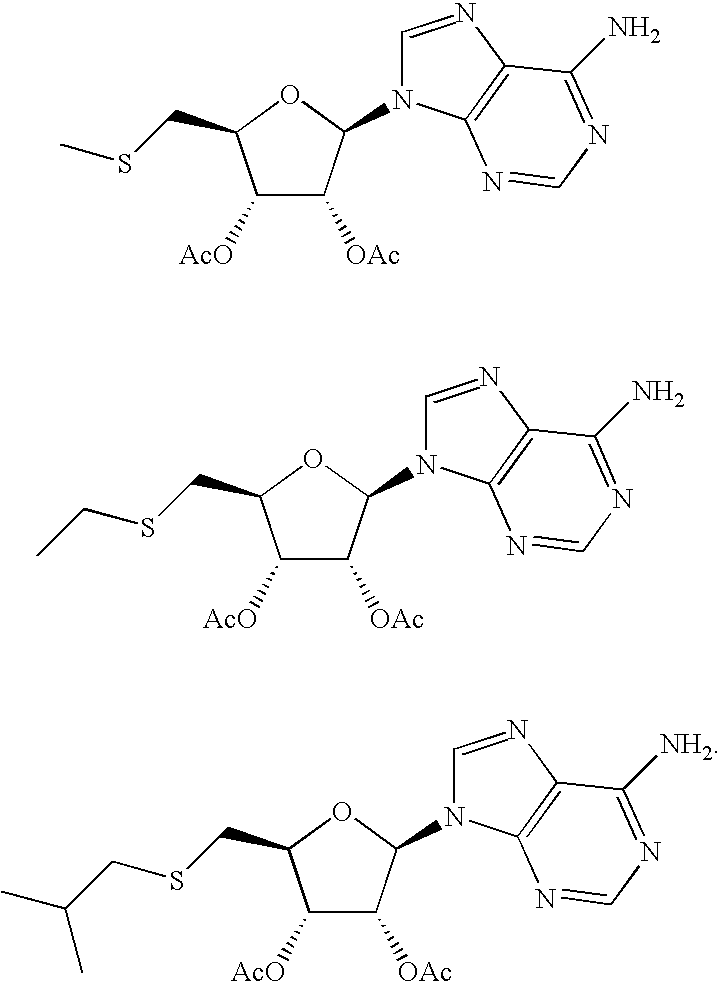
- See also, e.g., Bertolini et al., J. Med. Chem. (1997), 40:2011-2016; Shan et al., J. Pharm. Sci. (1997), 86 (7):765-767; Bagshawe, Drug Dev. Res. (1995), 34:220-230; Bodor, Advances in Drug Res. (1984), 13:224-331; Bundgaard, Design of Prodrugs (Elsevier Press 1985); Larsen, Design and Application of Prodrugs, Drug Design and Development (Krogsgaard-Larsen et al. eds., Harwood Academic Publishers, 1991); Dear et al., J. Chromatogr. B (2000), 748:281-293; Spraul et al., J. Pharmaceutical & Biomedical Analysis (1992), 10 (8):601-605; and Prox et al., Xenobiol. (1992), 3 (2):103-112.
- In one embodiment, the anti-toxicity agents of the present invention are prodrugs of MTAP substrates having the Formula XI:

- wherein
- R m and Rn are, independently, selected from the group consisting of H; a phosphate or a sodium salt thereof; C(O)N(Ro)2; C(O)Ro; or C(O)ORo, wherein Ro is selected from the group consisting of H, C1-C6 alkyl, C2-C6 heterocycloalkyl, cycloalkyl, heteroaryl, aryl, and amino, unsubstituted or substituted with C1-C6 alkyl, C1-C6 heteroalkyl, C2-C6 heterocycloalkyl, cycloalkyl, C1-C6 boc-aminoalkyl;
- and solvates or salts thereof.
- R mand Rn may each, independently, represent:

- Additional prodrugs of MTAP substrates can be synthesized as shown in Example 2(C) below.
- III. Identification of MTAP-Deficient Cells
- The methods of the present invention are applicable to mammals having MTAP-deficient cells, preferably mammals having primary tumor cells lacking the MTAP gene product. As used herein, an “MTAP-deficient cell” is a cell incapable of producing a functional MTAP enzyme necessary for production of adenine through the salvage pathway of purine synthesis. Generally, the MTAP-deficient cells useful in the present invention have homozygous deletions of all or a part of the gene encoding MTAP, or have inactivations of the MTAP protein. These cells may be MTAP-deficient due to cellular changes including genetic changes, e.g. gene deletion or mutation, or by disruption of transcription, e.g. silencing of the gene promotor, and/or protein inactivation or degradation. The term “MTAP-deficient cells” also encompasses cells deficient of allelic variants or homologues of the MTAP-encoding gene, or cells lacking, adequate levels of functional MTAP protein to provide sufficient salvage of purines. Methods and assays for detecting the MTAP-deficient cells of a mammal are described below.
- The present invention is directed to treating cell proliferative disorders which have incidence of MTAP deficiencies. Examples of cell proliferative disorders which have been associated with MTAP deficiency include, but are not limited to, breast cancer, pancreatic cancer, head and neck cancer, pancreatic cancer, colon cancer, prostrate cancer, melanoma or skin cancer, acute lymphoblastic leukemias, gliomas, osteosarcomas, non-small cell lung cancers and urothelial tumors (e.g., bladder cancer). Cancer cell samples should be assayed for MTAP deficiency as clinically indicated. Assays to assess MTAP-deficiency include those to assess gene status, transcription, and protein level or functionality. U.S. Pat. No. 5,840,505; U.S. Pat. No. 5,942,393 and International Publication No. WO99/20791 provide methods for the detection of MTAP deficient tumor cells, and are hereby incorporated by reference in their entireties.
- A polynucleotide sequence of the human MTAP gene is on deposit with the American Type Culture Collection, Rockville, Md., as ATCC NM —002451. The MTAP gene has been located on chromosome 9 at region p21. It is known that the MTAP homozygous deletion has also been correlated with homozygous deletion of the genes encoding p16 tumor suppressor and interferon-α. Detection of homozygous deletions of the p16 tumor suppressor and interferon-α genes may be an additional means to identify MTAP-deficient cells.
- Table 2 below indicates the rate of MTAP deficiency, including those inferred based on rates of p16 deletion, in a sample of human primary cancers.
TABLE 2 MTAP Deletions in Human Primary Cancers Non-small cell lung cancer 35-50% Osteosarcoma 30-40% Leukemia (T-cell ALL) 30-40% Glioblastoma 30-45% Breast cancer 0-15% Prostate cancer 0-20% Pancreatic cancer 50% Melanoma 10-20% Bladder cancer 25-40% Head and Neck cancer ˜30% - To identify patients whose cell-proliferative disorders are MTAP-deficient, a number of methods known in the art may be employed. These methods include, but not are not limited to, hybridization assays for homozygous deletion of the MTAP gene (see, e.g., Sambrook, J., Fritsh, E. F., and Maniatis, T. Molecular Cloning: A Laboratory Manual. 2nd, ed, Cold Spring Harbor Laboratory, Cold Spring Harbor Laboratory Press, Cold Spring Harbor, N.Y. (1989), and Current Protocols in Molecular Biology, eds. Ausubel et al, John Wiley & Sons (1992)). For example, it is convenient to assess the presence of MTAP-encoding DNA or cDNA can be determined by Southern analysis, in which total DNA from a cell or tissue sample is extracted and hybridized with a labeled probe (i.e. a complementary nucleic acid molecules), and the probe is detected. The label can be a radioisotope, a fluorescent compound, an enzyme or an enzyme co-factor. MTAP encoding nucleic acid can also be detected and/or quantified using PCR methods, gel electrophoresis, column chromatography, and immunohistochemistry, as would be known to those skilled in the art.
- Other methodologies for identifying patients with an MTAP-deficient disorder involve detection of no transcribed polynucleotide, e.g., RNA extraction from a cell or tissue sample, followed by hybridization of a labeled probe (i.e., a complementary nucleic acid molecule) specific for the target MTAP RNA to the extracted RNA and detection of the probe (i.e. Northern blotting). The label can be a radioisotope, a fluorescent compound, an enzyme, or an enzyme co-factor. The MTAP protein can also be detected using antibody screening methods, such as Western blot analysis. Another method for identifying patients with an MTAP-deficient disorder is by screening for MTAP enzymatic activity in cell or tissue samples.
- An assay for MTAP-deficient cells can comprise an assay for homozygous deletions of the MTAP-encoding gene, or for lack of mRNA and/or MTAP protein. See U.S. Pat. No. 5,942,393, which is hereby incorporated by reference in its entirety. Because identification of homozygous deletions of the MTAP-encoding gene involves the detection of low, if any, quantities of MTAP, amplification may be desirable to increase sensitivity. Detection of the MTAP-encoding gene would thus involve the use of a probe/primer in a polymerase chain reaction (PCR), such as anchor PCR or RACE PCR, or, alternatively, in a ligation chain reaction (LCR) (see, e.g., U.S. Pat. Nos. 4,683,195; 4,683,202 Landegran et al (1988) Science 241:1077-1080; and Nakazawa et al. (1994) Proc. Mail. Acad. Sci. USA 91:360-364, each of which is hereby incorporated by reference in its entirety). PCR and/or LCR may be desirable to use as a preliminary amplification step in conjunction with any of the techniques used for detecting deletion of the MTAP gene. Alternative amplification methods for amplifying any present MTAP-encoding polynucleotides include self sustained sequence replication (Guatelli, J C. et al., (1990) Proc. Natl. Acad. Sci. USA 87:1874-1878), transcriptional amplification system (Kwoh, D. Y. et al., (1989) Proc. Natl. Acad. Sci. USA 86:1173-1177), Q-Beta Replicase (Lizardi, P. M. et al. (1988) Bio-Technology 6:1197), or any other nucleic acid amplification method, followed by the detection of the amplified molecules using techniques known to those of skill in the art.
- Preferably, the MTAP-deficient cell samples are obtained by biopsy or surgical extraction of portions of tumor tissue from the mammalian host. More preferably, the cell samples are free of healthy cells which may contaminate the sample by providing false positives.
- IV. Administration of the Inhibitor of De Novo IMP Synthesis and Anti-Toxicity Agent
- Once a mammal in need of treatment has been identified as possessing MTAP-deficient cells, the mammal may be treated with a therapeutically effective dosage of an inhibitor of de novo IMP synthesis and an antitoxicity agent in an amount effective to increase the maximally tolerated dose of such inhibitor. It is also within the scope of the invention that more than one inhibitor may be concurrently administered in the present invention. While rodent subjects are provided in the examples of the present invention (Examples 4 and 5), combination therapy of the present invention may ultimately be applicable to human patients as well. Analysis of the toxicity of other mammals may also be obtained using obvious variants of the techniques outlined below.
- The methods of the present invention are suitable for all mammals independent of circulating folate levels. See Alati et al. “Augmentation of the Therapeutic Activity of Lometrexol [6-R)t, 10-Dideazatetrahydrofolate] by Oral Folic Acid, Cancer Res. 56: 2331-2335 (1996). The present invention is therefore advantageous in that folic acid supplementation is not required.
- Therapeutic efficacy and toxicity of the combinations of inhibitor and anti-toxicity agent can be determined by standard pre-clinical and clinical procedures in cell cultures, experimental animals or human patients. Therapeutically effective dosages of the compounds include pharmaceutical dosage units comprising an effective amount of the active compound.
- A “therapeutically effective amount” of an inhibitor of de novo IMP synthesis means an amount sufficient to inhibit the de novo purine pathways and derive the beneficial effects therefrom. With reference to these standards, a determination of therapeutically effective dosages for the IMP inhibitors to be used in the invention may be readily made by those of ordinary skill in the oncological art.
- In the present invention the anti-toxicity agent is administered in a dosage amount effective to decrease the toxicity of the inhibitor. In regards to in vitro cell culture experiments, a decrease in toxicity can be determined by detecting an increase in the IC 50, i.e., the concentration of inhibitor needed to inhibit cell growth or induce cell death by 50%. In mammals, ad erease intoxicity can be determined by detecting an increase in the maximally tolerated dose. As used in the present invention, a dose of an anti-toxicity, agent usefull in this invention contains at least “an amount effective to increase the maximally tolerated dose” of the inhibitor. A “maximally tolerated dose” as used herein, refers to the highest dose that is considered tolerable, as determined against accepted pre-clinical and clinical standards. Toxicity studies can be designed to determine the inhibitor's maximally tolerated dose (“MTD”). In experimental animal studies, the MTD can be defined as the LD50 or by other statistically useful standards, e.g, as the amount causing no more than 20% weight loss and no toxic deaths (see, e.g., Example 4 below). In clinical studies, the MTD can be determined as that dose at which fewer than one third of patients suffer dose limiting toxicity, which is in turn defined by pertinent clinical standards (e.g., by a
grade 4 thrombocytopenia or agrade 3 anemia). See National Cancer Institute's cancer therapy evaluation program for common toxicity criteria; and Mani, Sridhar and Ratain, Mark J., New Phase I Trial Methodology, Seminars in Oncology, vol. 24, 253-261 (1997), the disclosures of which are hereby incorporated by reference in their entireties. - The dose ratio between toxic and therapeutic effects is the therapeutic index. The therapeutic index can be expressed as the ratio of maximally tolerated dose over the minimum therapeutically effective dose. In the present invention, combination therapies which increase the therapeutic index are preferred.
- Data obtained from cell culture assays and animal studies can be used in formulating a range of dosages and schedules of administration for the inhibitor and anti-toxicity agent when used in humans. The dosage of such inhibitor compounds preferably yields a circulating plasma concentration that lies within a range that includes the therapeutically effective amount of the inhibitor but below the amount that causes dose-limiting toxicity. Consequently, the dosage of any anti-toxicity agent preferably yields a circulating plasma concentration that lies within a range that includes the amount effective to increase the dosage of inhibitor which causes dose-limiting toxicity. The dosage may vary depending upon the form employed and the route of administration utilized. For any inhibitor compound used in the methods of the invention, the therapeutically effective plasma concentration can be estimated initially from cell culture data, as shown in Example 3 below. Such information can be used to more accurately determine useful doses in humans. Levels in plasma may be measured, for example, by mass spectrometry. An exemplary initial dose of the inhibitor or anti-toxicity agent for a mammalian host comprises an amount of up to two grams per square meter of body surface area of the host, preferably one gram, and more preferably, about 700 milligrams or less, per square meter of the animal's body surface area.
- The present invention provides that the anti-toxicity agent is administered during and after administration of the inhibitor such that the effects of the agent persist throughout the period of inhibitor activity for sufficient cell survival and viability of the organism. Administration of the anti-toxicity agent may be performed by any suitable method, including but not limited to, during and after each dose of the inhibitor, by multiple bolus or pump dosing, or by slow release formulations. In one aspect, the anti-toxicity agent is administered such that the effects of the agent persist for a period concurrent with the presence of the inhibitor. The in vivo presence of the inhibitor can be determined using pharmacokinetic indicators as determined by one skilled in the art, e.g., direct measurement of the presence of inhibitor in plasma or tissues. In another aspect, the anti-toxicity agent is administered such that the effects of the agent persist until inhibitor activity has substantially ceased, as determined by using pharmacodynamic indicators, e.g., as purine nucleoside levels in plasma. As shown in Example 4 below, the anti-toxicity agent increased the MTD of the inhibitor compound in mice when it was administered for an additional 4 days after the last dose of the inhibitor. Example 3(D) further demonstrates that cytotoxicity decreased most dramatically in cell culture samples when administration with the anti-toxicity agent was prolonged long after dosing with the inhibitor compound was terminated.
- The agents of the invention, both the IMP inhibitors and the anti-toxicity agent, may be independently administered by any clinically acceptable means to a mammal, e.g. a human patient, in need thereof. Clincally acceptable means for administering a dose include topically, for example, as an ointment or a cream orally, including as a mouthwash; rectally, for example as a suppository; parenterally or infusion; or continuously by intravaginal, intranasal, intrabronchial intraaural or intraocular infusion. Preferably, the agents of the invention are administered orally or parenterally.
- Preferred embodiments of the invention are illustrated by the examples set forth below. It will be understood, that the examples do not limit the scope of the invention, which is defined by the appended claims. Standard abbreviations are used throughout the Examples, such as “μl” for microliter, “hr” for hour and “mg” for milligram.
- Syntheses of
Compounds 6 and 7 - Compound 6: N-(5-[2-(2-amino-4(3H)-oxo-5,6,7,8-tetrahydropyrido[2,3-d]pyrimidin-6-yl)-(R)-ethyl]-4-methylthieno-2-yl)-L-glutamic acid

- Compound 7: N-(5-[2-(2-amino-4(3H)-oxo-5,6,7,8-tetrahydropyrido[2,3-d]pyrimidin 6-yl)-(S)-ethyl]-4-methylthieno-2-yl)-L-glutamic acid

- Synthesis route for
Compounds 6 and 7 - In one method, compounds 6 and 7 were synthesized by the following process.
- Step 1: 5-bromo-4-methylthiophene-2-carboxylic acid

- This compound was prepared according to M. Nemec, Collection Czechoslov. Chem. Commun., vol. 39 (1974), 3527.
- Step 2: 6-ethynyl-2-(pivaloylamino)-4(3H)-oxopyrido [2,3-d]pyrimidine

- This compound was prepared according to E. C. Taylor & G. S. K. Wong, J. Org. Chem., vol. 54 (1989), 3618.
- Step 3: Diethyl N-(5-bromo-4-methylthieno-2-yl)-L-glutamate

- To a stirred solution of 5-bromo-4-methylthiophene-2-carboxylic acid (3.32 g, 15 mmol), 1-hydroxybenzotriazole (2.24 g, 16.6 mmol), L-glutamic acid diethyl ester hydrochloride (3.98 g, 16.6 mmol) and diisopropylethylamine (2.9 ml, 2.15 g, 16.6 mmol) in dimethylformamide (DMF) (40 ml) was added 1-(3-dimethylaminopropyl)-3-ethylcarbodiimide hydrochloride (3.18 g, 16.6 mmol). The resulting solution was stirred under argon at ambient temperature for 18 hours, poured into brine (300 ml), diluted with water (100 ml) and extracted with ether (3×120 ml). The combined organic extracts were washed with water (150 ml), dried over MgSO 4 and concentrated in vacuo to give a brown gum, which was purified by flash chromatography. Elution with hexane: EtOAc (2:1) provided the product as an orange oil (5.05 g, 83% yield). Analyses indicated that the product was diethyl N-(5-bromo-4-methylthieno-2-yl) glutamate. NMR(CDCl3) δ:7.22 (1H, s), 6.86 (1H, d, J=7.5 Hz), 4.69 (1H, ddd, J=4.8, 7.5, 9.4 Hz), 4.23 (2H, q, J=7.1 Hz), 4.12 (2H, q, J=7.1 Hz), 2.55−2.39 (2H, m), 2.35−2.22 (1H, m), 2.19 (3H, s), 2.17−2.04 (1H, m), 1.29 (3H, t, J=7.1 Hz), 1.23 (3H, t, J=7.1 Hz). Anal. (C15H20 NO5 SBr) C,H,N,S,Br.
- Step 4: Diethyl N-(5-[(2-[pivaloylamino]-4(3H)-oxopyrido[2,3-d]pyrimidin-6-yl) ethynyl]-4-methylthieno-2-yl) glutamate:

- To a stirred solution of diethyl N-(5-bromo-4-methylthieno-2-yl) glutamate (4.21 g, 10.4 mmol) in acetonitrile (55 ml) under an argon atmosphere were added bis (triphenylphosphine) palladium chloride (702 mg, 1.0 mmol), cuprous iodide (200 mg, 1.1 mmol), triethylamine (1.5 ml, 1.09 g, 10.8 mmol) and 6-ethynyl-2-(pivaloylamino)-4(3H)-oxopyrido[2,3-d]pyrimidine (5.68 g, 21 mmol). The resultant suspension was heated at reflux for 6 hours. After cooling to room temperature, the crude reaction mixture was filtered and the precipitate was washed with acetonitrile (50 ml) and ethylacetate (EtOAc) (2×50 ml). The combined filtrates were concentrated in vacuo to give a brown resin, which was purified by flash chromatography. Elution with CH 2Cl2:CH3OH (49:1) provided the product as an orange solid (4.16 g, 67% yield). Analyses indicated that the product was diethyl N-(5-[(2-[pivaloylamino]-4(3H)-oxopyrido[2,3-d]pyrimidin-6-yl) ethynyl]-4-methylthieno-2-yl) glutamate. NMR (CDCl3) δ:8.95 (1H, d, J=2.2 Hz), 8.59 (1H, d, J=2.2 Hz), 7.33 (1H, s), 7.03 (1H, d, J=7.4 Hz), 4.73 (1H, ddd, J=4.8, 7.4, 9.5 Hz), 4.24 (2H, q, J=7.1 Hz), 4.13 (2H, q, J=7.1 Hz), 2.55−2.41 (2H, m), 2.38 (3H, s), 2.35−2.24 (1H, m),2.19−2.05 (1H, m), 1.34 (9H, s), 1.30 (3H, t, J=7.1 Hz), 1.24 (3H, t, J=7.1 Hz). Anal. (C29H33N5O7S.0.75H2O) C,H,N,S.
- Step 5: Diethyl N-(5-[(2-[pivaloylamino]-4(3H)-oxopyrido[2,3,d] pyrimidin-6-yl) ethyl]-4-methylthieno-2-yl) glutamate

- A suspension of diethyl N-(5-[(2-[pivaloylamino]-4(3H)-oxopyrido [2,3-d]pyrimidin-6-yl)ethyl]-4-methylthieno-2-yl) glutamate (959 mg, 1.6 mmol) and 10% Pd on carbon (1.5 g, 150% wt. eq.) in trifluoroacetic acid (30 ml) was shaken under 50 psi of H 2 for 22 hours. The crude reaction mixture was diluted with CH2Cl2, filtered through a pad of Celite (diatomaceous earth) and concentrated in vacuo. The residue obtained was dissolved in CH2Cl2 (120 ml), washed with saturated NaHCO3 (2×100 ml), dried over Na2SO4 and concentrated in vacuo to give a brown gum, which was purified by flash chromatography. Elution with CH2Cl2:CH3OH (49:1) provided the product as a yellow solid (772 mg, 80% yield). Analyses indicated that the product was diethyl N-(5-[(2-[pivaloylamino]-4(3H)-oxopyrido[2,3-d]pyrimidin-6-yl)ethyl]-4-methylthieno-2-yl) glutamate. NMR (CDCl.sub.3) δ:8.60 (1H, d, J=2.2 Hz), 8.49 (1H, broad), 8.32 (1H, d, J=2.2 Hz), 7.22 (1H, s), 6.78 (1H, d, J=7.5 Hz), 4.72 (1H, ddd, J=4.8, 7.5, 9.5 Hz), 4.23 (2H, q, J=7.1 Hz), 4.11 (2H, q, J=7.1 Hz), 3.12−3.00 (4H, m), 2.52−2.41 (2H, m), 2.37−2.22 (1H, m), 2.16−2.04 (1H, m), 2.02 (3H, s), 1.33 (9H, s), 1.29 (3H, t, J=7.1 Hz), 1.23 (3H, t, J=7.1 Hz). Anal. (C29H37N5O7S.0.5H2O) C,H,N,S.
- Step 6: Diethyl N-(5-[(2-[pivaloylamino]-4(3H)-oxo-5,6,7,8-tetrahydropyrido[2,3-d]pyrimidin-6-yl)-ethyl]-4-methylthieno-2-yl) glutamate

- A suspension of diethyl N-(5-[(2-[pivaloylamino]-4(3H)-oxopyrido [2,3-d]pyrimidin-6-yl)ethyl]-4-methylthieno-2-yl) glutamate (32.2 g, 59 mmol), 10% Pt on carbon (25.12 g, 78% wt. eq.), 10% Pd on carbon (10.05 g, 30% wt. eq.) and PtO.sub.2 (10 g, 30% wt. eq.) in trifluoroacetic acid (170 ml) was shaken under 900 psi of H.sub.2 for 330 hours. The crude reaction mixture was diluted with CH 2Cl2, filtered through a pad of Celite, and concentrated in vacuo. The residue obtained was dissolved if CH2Cl2 (600 ml), washed with saturated NaHCO3 (2×400 ml), dried over Na2SO4, and concentrated in vacuo to give a brown resin, which was purified by flash chromatography. Elution with CH2Cl2:CH3OH (24:1) provided initially an unreacted substrate (10.33 g, 32% yield) and then the product, yellow solid, as a mixture of diastereomers (4.06 g, 11% yield). Analyses indicated that the product was diethyl N-(5-[(2-[pivaloylamino]-4(3H)-oxo-5,6,7,8-tetrahydropyrido-[2,3-d]pyrimidin-6-yl)ethyl]-4-methylthieno-2-yl) glutamate. NMR (CDCl.sub.3) δ:7.24 (1H, s), 6.75 (1H, d, J=7.6 Hz), 5.57 (1H, broad), 4.72 (1H, ddd, J=4.8, 7.6, 12.6 Hz), 4.22 (2H, q, J=7.1 Hz), 4.11 (2H, q, J=7.1 Hz), 3.43−3.36 (1H, m), 3.06−2.98 (1H, m), 2.89−2.68 (3H, m), 2.52−2.40 (3H, m), 2.37−2.23 (1H, m), 2.15 (3H, s), 2.14−2.03 (1H, m), 1.94−1.83 (1H, m), 1.73−1.63 (2H, m), 1.32 (9H,s), 1.29 (3H, t, J=7.1 Hz), 1.23 (3H, t, J=7.1 Hz). Anal. (C29H41N5O7S.0.5H2O) C,H,N,S.
- This diastreomeric mixture was further purified by chiral-phase HPLC. Elution from a Chiralpak column with hexane:ethanol:diethylamine (70:30:0.15) at a temperature of 40° C. and a flow rate of 1.0 ml/minute provided the separate diastereomers as yellow solids (1.07 g and 1.34 g, respectively). The 1H NMR spectra of the individual diastereomers were indistinguishable from each other and from the spectrum obtained for the mixture.
- Step 7: N-(5-[2-(2-amino-4(3H)-oxo-5,6,7,8-tetrahydropyrido-[2,3-d]pyrimidin-6-(R)-yl) ethyl]-4-methylthieno-2-yl): glutamic acid (Compound 6):
- A suspension of the slower-eluting diastereomer of diethyl N-(5-[(2-[pivaloylamino]-4(3H)-oxo-5,6,7,8-tetrahydrlpyrido[2,3-d]pyrimidin-6-yl)ethyl]-4- methylthieno-2- yl) glutamate (1.31 g, 2.2 mmol) in 2N NaOH (40 ml) was stirred at ambient temperature for 120 hours, then filtered to remove any remaining particulate matter. The filtrate was subsequently adjusted to pH 5.5 with 6N HCl. The precipitate that formed was collected by filtration and washed with water (2×10 ml) and ether (2×10 ml) to provide the product as a yellow solid (794 mg, 79% yield). Analyses indicated that the product was N-(5-[2-(2-amino-4(3H)-oxo-5,6,7,8-tetrahydropyrido[2,3-d]pyrimidin-6-yl)ethyl]-4-methylthieno-2-yl) glutamic acid. NMR (DMSO-d 6) δ:12.35 (2H, broad), 9.83 (1H, broad), 8.41 (1H, d, J=7.7 Hz), 7.57 (1H, s), 6.43 (1H, br s), 6.20 (2H, br s), 4.34−4.26 (1H, m), 3.29−3.19 (2H, m), 2.83−2.74 (3H, m), 2.32 (2H, t, J=7.3 Hz), 2.12 (3H, s), 2.08−2.00 (1H, m), 1.92−1.81 (2H, m), 1.68−1.49 (3H, m), Anal. (C20H25N5O6S0.8H2O) C,H,N,S.
- Step 8: N-(5-[2-(2-amino-4(3H)-oxo-5,6,7,8-tetrahydropyrido-[2,3-d]pyrimidin-6-(S)-yl) ethyl]-4-methylthieno-2-yl) glutamic acid (Compound 7):
- A suspension of the faster-eluting diastereomer of diethyl N-(5-[(2-[pivaloylamino]-4(3H)-oxo-5,6,7,8-tetrahydropyrido[2,3-d]pyrimidin-6-yl)ethyl]-4-methylthieno-2-yl) glutamate (1.02 g, 1.7 mmol) in 2N NaOH (35 ml) was stirred at ambient temperature for 120 hours, then filtered to remove any remaining particulate matter. The filtrate was subsequently adjusted to pH 5.5 with 6N HCl. The precipitate that formed was collected by filtration and washed with water (2×10 ml) and ether (2×10 ml) to provide the product as a yellow solid (531 mg, 68% yield). Analyses indicated that the product was N-(5-[2-(2-amino-4(3H)-oxo-5,6,7,8-tetrahydropyrido[2,3-d]pyrimidin-6-yl)ethyl]-4-methylthieno-2-yl) glutamic acid. NMR (DMSO-d 6) δ:12.52 (2H, broad), 9.69 (1H, broad), 8.36 (1H, d, J=7.7 Hz), 7.56 (1H, s), 6.26 (1H, br s), 5.93 (2H, br s), 4.32−4.25 (1H, m), 3.24−3.16 (2H, m), 2.81−2.73 (3H, m), 2.31 (2H, t, J=7.2 Hz), 2.12 (3H, s), 2.07−1.98 (1H, m), 1.91−1.79 (2H, m), 1.65−1.48 (3H,m). Anal. (C20H25N5O6S.0.7H2O) C,H,N,S.
- Step 8: Crystallography of
Compounds 6 and 7 - The GART domain (residues 808-1010) of the trifunctional human GARS-AIRS-GART enzyme was purified according to the method described by Kan, C. C., et al., J. Protein Chem. 11:467-473, (1992). Following purification, GART was concentrated to 20 mg/mL in a buffer containing 25 mM Tris pH 7.0 and 1 mM DTT. Crystallization was done by hanging-drop vapor diffusion, mixing the protein and reservoir solution (38-44% MPD, 0.1 M Hepes, pH 7.2-7.6) in a 1:1 ratio, and equilibrating at 13° C. Crystals would typically grow within 3 days and measure 0.2×0.25×0.3 mm.
- X-ray diffraction data were collected from ternary complex crystals of GART,
GAR 1 and inhibitor at 4° C. using a San Diego Multiwire Systems 2-panel area detector and a Rigaku AFC-6R monochomatic Cu Kα X-ray source and goniostat (Table 3). The space group was determined to be P3221, with the cell constants shown below. The crystal structures of bothcompounds 6 and 7 complexes were solved by molecular replacement using MERLOT (Fitzgerald, P. M. D. MERLOT, an Integrated Package of Computer Programs for the Determination of Crystal Structures by Molecular Replacement. J. Appl. Crystallogr. 21:273-278 (1988)). The search model consisted of residues 1-209 from an E. coli GART ternary complex structure (Protein DataBank accession number 1 cde). The highest peak in the cross rotation function (Crowther, R. A. The Fast Rotation Function. In The Molecular Replacement Method, 1972) was used in 3-dimensional translation functions (Crowther, R. A., et al., A method of Positioning a Known Molecule in an Unknown Crystal Structure. Acta Crystallogr. 23:544-548 (1967)), in search of Harker vectors. The top peak in all five searches (i.e. from one molecule to each of the five symmetry related molecules) produced a consistent set of vectors that positioned the model. After initial refinement with XPLOR (Brunger, A. T. X-PLOR Version 3.1: A System for X-ray Crystallography and NMR. New Haven, Conn. (1992)), density was seen for thesubstrate GAR 1 and the inhibitor. The final structures were obtained by manual model building in 2Fo−Fc and Fo−Fc election density maps followed by further refinement with XPLOR (Table 3).TABLE 3 Summary of X-ray Data and Refinement for Compounds 6 and 76 7 Resolution (Å) 10-2.3 10-3.2 cell (a, Å) 77.17 76.77 cell (c, Å) 102.67 101.45 Rmerge (%)a 6.51 12.75 Total rels 59522 25756 Unique refls 16606 6858 R factor (%)b 17.8 17.1 No. solvent 65 62 - EXAMPLE 1(B)
- Alternate Synthesis Route for
Compound 7 -
Compound 7 can be synthesized by an alternate route, according to the following scheme.
- The synthesis begins with the regioselective lithiation at the 5′ position of commercially available 3-methylthiphene (La Porte Performance Chemicals, UK). Under argon, 4.4L MTBE and 800 mL N,N,N,N-tetramethylethylenediamine (“TMEDA”) was combined and cooled to −10° C. 2.10 L of 2.5 M n-BuLi was then added over 30-45 minutes and allow to equilibrate (10-20 min). Also under argon, 500 mL of 3-methylthiphene and 4.4 L MTBE was combined in a separate flask and cooled to −10° C. The n-BuLi-TMEDA was then added to the 3-methylthiphene/MTBE solution, while stirring at a temperature below 20° C. After warming the mixture to room temperature (2 hrs), the solution was then cooled to −10° C. and CO 2 was bubbled through. After purging with CO2, the reaction mixture was quenched with 14 L water, and the organic phase was separated and extracted with NaOH. The aqueous extract was acidified to
pH 2 with HCl. The precipitated product 1(B2) was then collected by filtration, washed twice with water and dried in vacuo at 60-65° C. The material thus obtained was an approximately 90/10 mixture of the desired product 4-methyl-2-thiphenecarboxylic acid 1(B2) and regioisomeric 3-methyl-2-thiphenecarboxylic acid (541 g; 3.81 mol; 66% yield of 1(B2)).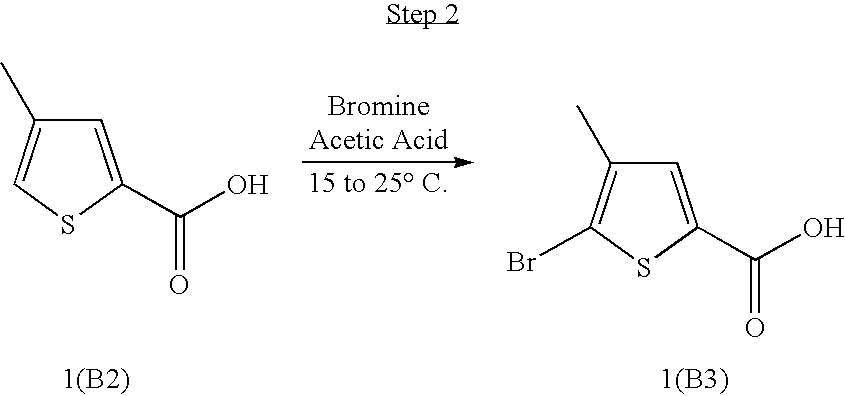
- The product mixture containing 1(B2) was brominated with a solution of bromine in acetic acid (195 mL bromine in 2.8 L acetic acid), added to a stirred solution of 1(B2) over 1.5 hours. After 30 minutes the reaction mixture was quenched in 19 L water at room temperature with vigorous stirring. During quenching the desired product 5-bromo-4-methyl-2-thiophenecarboxylic acid 1(B3) precipitated out, and was collected by vacuum filtration, washed twice with water, and dried in vacuo at 65-70° C. The product was obtained as a single isomer by proton NMR (692 g; 3.13 mol; 82% yield). It appeared that the undesired isomer of 1(B2) was only partially brominated and that the unreacted materials and unwanted isomers remained in solution.
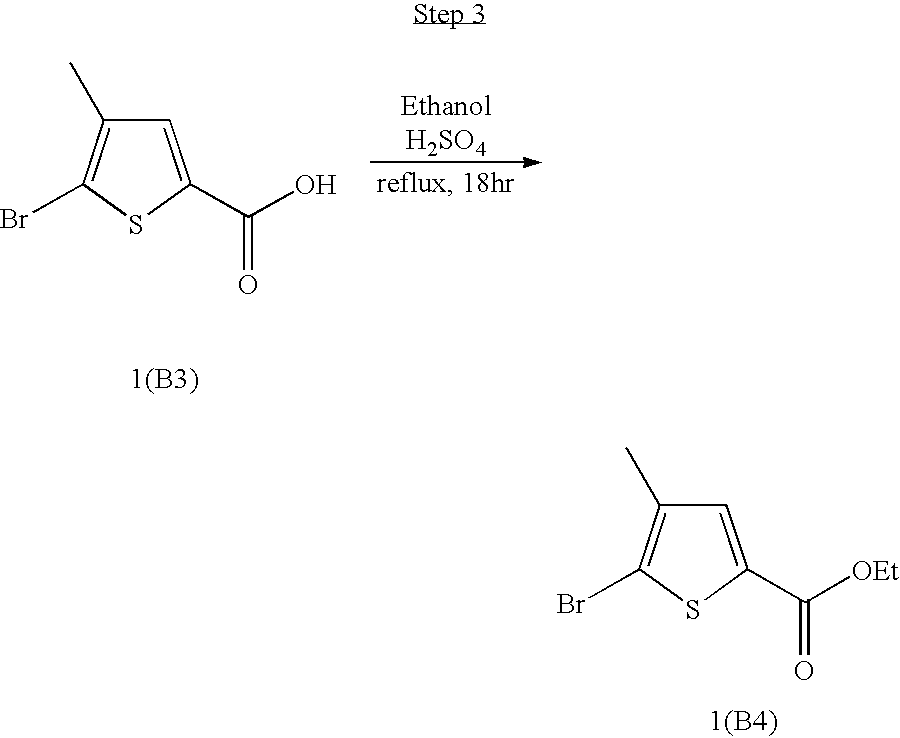
- Fisher esterification of acid 1(B3) with ethanol and 1.8 equivalents of concentrated sulfuric acid provided ethyl ester 1(B4) as an oil, after an extractive work-up. 690 g of 1(B3) (in 7.4 L of EtOH) was combined with 270 mL H 2SO4 and the reaction was refluxed under a calcium sulfate drying tube for 18 hours. After cooling to room temperature, the solution pH was adjusted to pH 8 with sodium bicarbonate and the resulting slurry was concentrated in vacuo to remove ethanol. Water was added and this mixture was extracted twice with 4 L of MTBE. Solvents were removed in vacuo to give 726 g of ethyl 5-bromo-4-methylthiphene-2-carboxylate 1(B4) as an oil (2.92 mol; 93% yield).

- Under argon, the bromothiophene ester 1(B4) was combined with 3-butyn-1-ol (2 equivalents), triethylamine, and CH 3CN in the presence of catalytic tetrakis(triphenylphosphine)palladium and copper(I)iodide and warmed to 78-82° C. for 18 hours. The mixture was then cooled to about 50° C., diluted with water, and concentrated in vacuo to remove CH3CN. The reaction mixture was then further diluted with 4 L ethyl acetate and 4 L water, and the aqueous phase was extracted further with 2 L additional ethyl acetate. After washing of the combined organic extract (2.5 L of 0.5 M aq HCl and 4 L water), the excess water was removed by azeotropic distillation with ethyl acetate and MTBE to provide the alkyne 1(B5) as a dark oil (1.7 kg; 85% yield).

- Alkyne 1(B5) was hydrogenated over a 10 day period to cleanly give alcohol 1(B6). 1.56 kg of alkyne 1(B5) was dissolved in 5 L ethanol and charged into a 19 L hydrogenator under nitrogen, followed by the addition of a slurry of Pd/C (100 g of 10% Pd/C in 350 mL, ethanol). The hydrogenator was pressurized to 50 psi with nitrogen and vented with stirring, for a total of 3 cycles, followed by an additional 3 cycles at 100 psi and period repressurization over 1-2 days. After slowing of hydrogen uptake, the reaction mixture was filtered through a 1 inch pad of Celite and subsequently recharged into the hydrogenator along with 100 g of fresh 10% Pd/C in ethanol. The recharging was repeated as described above four times, with 1.5-2 days between each recharge of catalyst. Upon complete consumption of any unsaturated species, the reaction was filtered through a Celite pad and dried in vacuo to yield ethyl 5-(4-hydroxbutyl)-3-methylthiphene-2-carboxylate 1(B6) (1.55 kg; 6.40 mol; 96% yield).
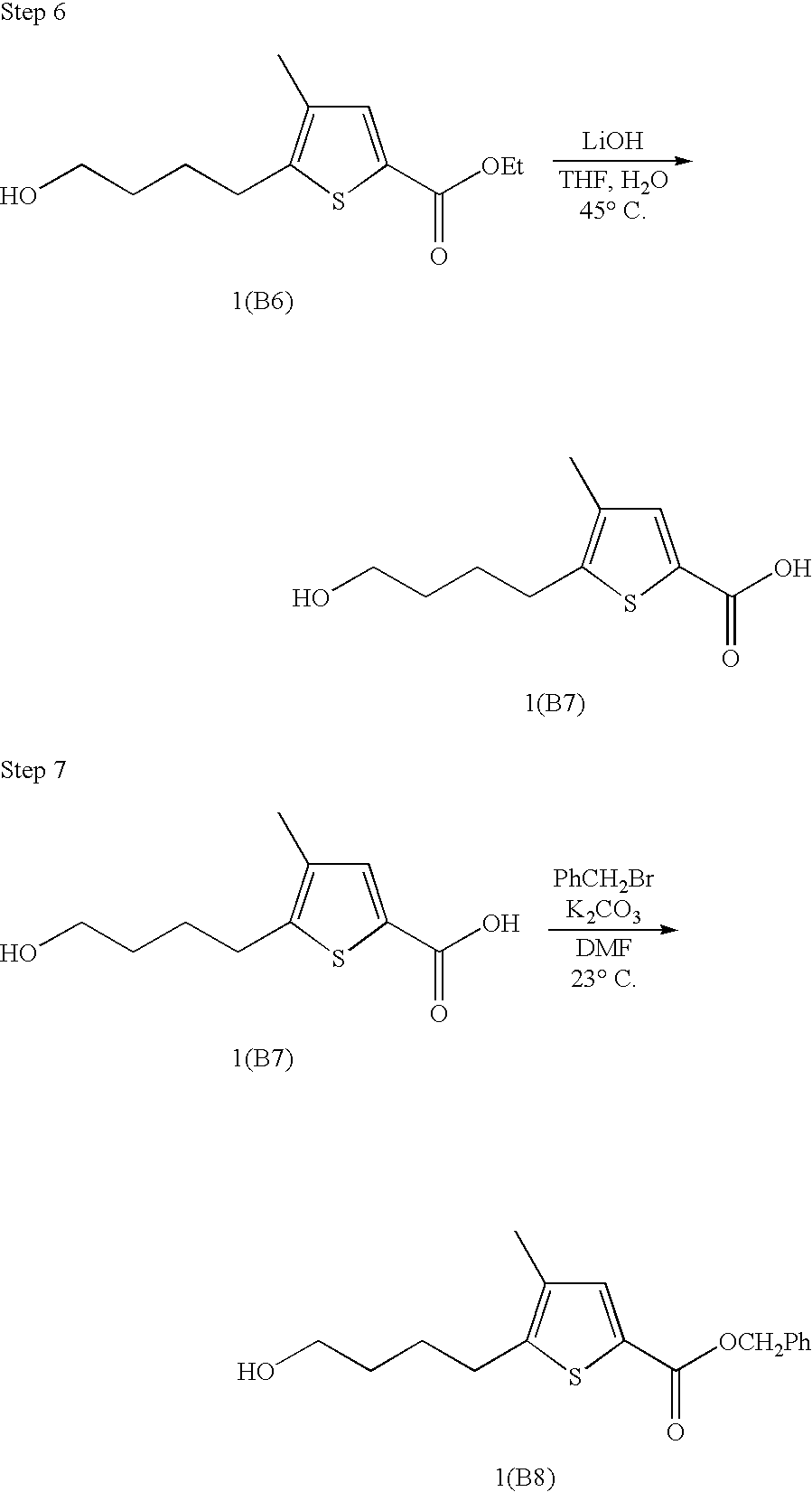
- Saponification of ethyl ester 1(B6) yields alcohol-acid 1(B7), which undergoes benzylation with benzyl bromide to give alcohol-ester 1(B8). 306 g aqueous LiOH was added to a solution of ethyl ester 1(B6) (1.55 kg ethyl ester 1(B6)/6.5 L THF), and the mixture was warmed to 45° C. for 19 hrs. The reaction mixture was then cooled to 32° C. and diluted with 3 L MTBE. After phase separation and organic phase extraction (2×500 mL of 1 M NaOH), the aqueous phases were combined and washed twice with 1.5 L MTBE. The aqueous phase was acidified to
pH 1 with HCl, and extracted three times with 2 L methylene chloride. The solvents were then removed in vacuo and water removed by azeotropic distillation with 2 L methylene chloride followed by 2 L MTBE to provide alcohol-acid 1(B7). 1.21 kg alcohol-acid 1(B7) and benzyl bromide (1 equivalent) were then dissolved in DMF (8 L), and 1.18 kg K2CO3 (1.5 equivalents) was added. After cooling the reaction temperature to 15° C., and then warming to room temperature overnight, water and MTBE were added. After phase separation, the aqueous phase was recharged into the 50 L extractor and the remaining inorganic salts were washed three times with MTBE, and all organic phases were combined for extraction of the aqueous phase. The organic extract was washed with aqueous sodium bicarbonate and water then evaporated in vacuo to provide benzyl ester 1(B8) (1.61 kg; 5.28 mol; 93% yield).
- Alcohol 1(B8) was oxidized with four equivalents of pyridinium dichromate to give acid 1(B9). 5.5 kg of pyridinium dichromate was added in 500 g portions to a flask charged with 8 L DMF, and the solution was allowed to warm to 18° C. Alcohol 1(B8) (1.11 kg) was dissolved in 1.5 L DMF and added dropwise to the pyridium dichromate solution at a reaction temperature of 23-24° C. The reaction was allowed to warm to room temperature overnight, then was quenched into a 50 L extractor containing 18 L water, 8 L MTBE and 0.5 L methylene chloride). After phase separation, the aqueous phase was extracted twice with 4 L MTBE. The solid salts were combined with 4 L water and the resulting slurry was extracted with MTBE. The combined MTBE extract was then worked with 0.4 M HCl and water, and the product was back-extracted into aqueous sodium carbonate. After washing the aqueous phase with MTBE the pH was adjusted to 3-4 with HCl, and the product was extracted into MTBE. The MTBE extract was worked with water and washed and dried in vacuo to provide product 1(B9) (816 g; 2.56 mol; 70% yield).

- Acid 1(B9) is converted to the mixed pivaloyl anhydride 1(B10), which is immediately reacted with the lithiated benzyloxazolidinone chiral auxiliary to give acyloxazolidinone 1(B11). Triethylamine (214 mL) was added to a solution of carboxylic acid 1(B9) (423 g in 3.2 L MTBE) and the reaction was cooled to −16° C. Pivaloyl chloride was added and the reaction was stirred, then allowed to warm to room temperature. The slurry was filtered through a pad of Celite 545, rinsed with 3.2 L MTBE, and then cooled to −70° C.
- In a separate flask, a 2.5 M solution of n-butyllithium in hexanes was added dropwise to a solution of (S)-4-benzyl-2-oxazolidinone (246.8 g in 3.2 L tetrahydrofuran) and cooled to −70° C. for 1 hr with stirring. The lithiated oxazolidinone was added to the mixed anhydride, and after one hour the reaction was quenched by the addition of 2 L of 2 M aq potassium hydrogen sulfate. After phase separation, the organic phase was washed with aqueous sodium bicarbonate, water and brine, and then dried in vacuo to remove solvents and water.
- The first permanent chiral center was installed by the diastereoselective alkylation of the titanium enolate of acyloxazolidinone 1(B11) with O-benzyl N-methoxymethyl carbamate, to give CBZ protected amine 1(B12). Starting with a solution of acyloxazolidinone 1(B11) (884 g in 3.1 L methylene chlride), a 1 M solution of titanium tetrachloride in methylene chloride (1.05 equivalents) was added dropwise over 1.25 hours at 3-7° C. and stirred for an additional hour. Hunigs base (1.1 equivalents) was added dropwise, and the mixture stirred for 1 hr. The solution was cooled to −70° C. and then a solution of N-Methoxymethyl O-benzyl carbamate (1.25 equivalents) (453 g in 496 mL methylene chloride) was added. The O-benzyl N-methoxymethyl carbamate is obtained in two steps via known literature methods. Tetrahedron, 44: 5605-5614 (1998). After 30 minutes, 2.31 L of 1 M titanium tetrachloride in methylene chloride (1.25 equivalents) was added over 1.5 hr and the reaction was continued for 1 hour. The reaction was then placed in a 4° C. room for 16 hr, after which the reaction was quenched into a 50 L extractor containing a solution of water and ammonium chloride (1 kg NH4CL in 8 L water). The flask then was rinsed with methylene chloride, the phases were separated, and the organic phase washed in aqueous ammonium chloride. The methylene chloride was removed in vacuo and the resulting product solidified overnight and was subsequently slurried in 3.8 L methanol. The product was collected by filtration and reslurried in methanol twice, before drying in vacuo, to give carbamate 1(B12) (714 g).
- Preparation of N-Methoxymethyl O-Benzyl Carbamate

- The chiral auxiliary was removed reductively to give alcohol 1(B13). A 2 M solution of lithium borohydride in THF (1.44 equivalents) was added dropwise to a solution of substrate 1(B12) (714 g in 2.0 L THF and 27.2 mL water). The reaction was stirred for 2.5 hours, and then quenched by dropwise addition of 3.0 L of 3 M aq HCl. The reaction was worked up by addition of 4 L methylene chloride, the phases were separated, and the organic phase was washed with 2 L saturated sodium bicarbonate solution. The organic solvents were removed in vacuo to give product 1(B13) (716 g) containing cleaved chiral auxiliary. (The chiral auxiliary is not removed during the workup and is carried on through the next two reactions.)

- Treatment of alcohol 1(B13) with methanesulfonyl chloride provides mesylate 1(B14), which is reacted with sodio diethyl malonate in the presence of catalytic sodium iodide to give very crude tualonate 1(B15). Starting with a solution of alcohol 1(B13) (432 g in 2.60 L methylene chloride), triethylamine was added and the reaction cooled to −10.3° C., after which 86 mL methanesulfonyl chloride was added dropwise. After about 2.25 hours, the reaction was quenched by addition of 1 L of M aq HCl. The organic phase was separated, washed with aqueous sodium bicarbonate, and dried in vacuo to remove solvent and water to give mesylate 1(B14) as an oil (661 g). To a solution of the mesylate 1(B14) (580 g in 3.83 L THF) was then added a solution of sodium salt of diethyl malonate (340 mL diethyle malonate in 2 L THF, in a flask charged with 50 g sodium hydride). Sodium iodide (0.27 equivalents) was added and the reaction was heated at 62° C. until complete. The reaction was quenched into a mixture of 8 L MTBE and 4 L saturated aqueous sodium bicarbonate. After phase separation, the organic phase was washed with 3 L saturated aqueous sodium bicarbonate and evaporated in vacuo to give malonate 1(B15) (968 g), which was purified by chromatography on silica and eluted with hexane/methylene chloride (75/25).

- The carbonylbenzyloxy group of 1(B15) was removed from the amine, which then cyclized onto one of the carboethoxy groups to give a pyridinone ring system. At the same time, the benzyl ester was debenzylated to give the carboxylic acid 1(B16). After purification by chromotagraphy, 162.8 g of the malonate 1(B15) was treated with 30% HBr in acetic acid (86.5 g in 213 mL; 4 equivalents) at room temperature. After 15 hours, the reaction was poured into an extractor and buffered to a pH 8-9 by addition of sodium bicarbonate/potassium carbonate. After phase separation, the aqueous phase was washed with 2 L MTBE. The aqueous phase was then diluted with 1.5 L methylene chloride, adjusted to
pH 1, and the organic phase was washed with water and aqueous sodium chloride. After drying over anhydrous magnesium sulfate, the methylene chloride solution of lactam 1(B16) was concentrated in vacuo to about 200 mL. The resulting slurry was left to stand at room temperature overnight. The solids were collected by filtration and dried in vacuo over night to provide the product 1(B16) (67.1 g).
- Reaction of lactam 1(B16) (53.5 g in 1.60 L THF, heated to 45° C. then re-cooled to 35° C.) with Lawesson's reagent (71.0 g; 1.12 equivalents) yielded the thiolactam 1(B17) over a period of about 21.5 hours. The reaction was quenched by dilution into 8 L methylene chloride, followed by 4 L water and 0.4 L saturated aqueous sodium chloride. The phases were split, and the organic phase was washed with 4 L water and 0.4 L saturated aqueous sodium chloride, and further evaporated in vacuo to provide thiolactam 1(B17) (estimated 56 g). No purification was performed at this point and the very crude thiolactam 1(B17) (along with all of the Lawesson's reagent by-products) was treated with neat guanidine under vacuum at 110° C. Cyclization in the melt provided pyrimidinone acid 1(B18). The crude product was dissolved in 700 ml water and the mixture was acidified with HCl to pH 5-6. The precipitated solid was collected by filtration. Acid 1(B18) was purified by slurry washing with acetone, and collection by filtration, followed by drying at 50° C. to give a crude material (45.34 g) that is pure enough for the next reaction.

- Coupling of 45.3 g of acid 1(B18) with di-t-butyl glutamate using the coupling agent, 2-chloro-4,6-dimethoxy-1,3,5-triazine (1.1 equivalents), yielded diethyl ester 1(B19). The coupling agent was added to a solution of acid 1(B18) (57.0 mL triethylamine and 698 mL DMF) at room temperature. The reaction was blanketed with argon and stirred for 1.5 hours. Di-t-butyl glutamate hydrochloride (1.1 equivalents) was added and stirring was continued for 24 hours. After filtration of solids, the filtrate was concentrated in vacuo to provide a yellow oil. The oil was dissolved in methylene chloride, washed with aqueous sodium bicarbonate, water and brine, and dried in vacuo. This material was then carefully purified by chromatography on silica (750 g) and elucted with methylene chloride/methanol (40:10) to provide di-t-butyl ester 1(B19).

- Final deprotection of di-t-butyl ester 1(B19) to give
Compound 7 was accomplished as follows. A solution of purified di-t-butyl ester 1(B19) was treated with pre-chilled trifluoroacetic acid (50 equivalents) at 0° C. for 10-16 hours. All solvents were removed in vacuo at 0-3° C. The crude product was then dissolved in aqueous sodium bicarbonate, washed with methylene chloride, and obtained as a solid following acidification of the aqueous phase with HCl and collection by filtration. The solid thus obtained was treated with trifluoroacetic acid (25 equivalents) a second time as described above, and isolated in an identical manner, to giveCompound 7 as a white solid. Two consecutive water re-slurries were carried out in order to free the desired compound from residual trifluoroacetic acid The product thus obtained exhibited diastereomeric purity of 99.8%;and an overall purity of>96%. - Synthesis of Anti-Toxicity Agents
- Synthesis of Methylthioadenosine (“MTA ”) (Compound AA)
- Scheme I, which is depicted below, is useful for preparing MTA (Compound AA).

- Step 1: Synthesis of Chloroadenosine
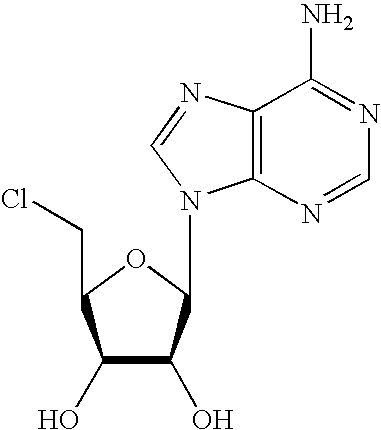
- A 2-liter, 3-neck flask equipped with a mechanical stirrer and a temperature probe was charged with 400 mL of acetonitrile followed by adenosine (100 g, 0.374 mol). The resulting slurry was stirred while cooling to −8° C. with ice/acetone. The reaction was then charged with thionyl chloride (82 mL, 1.124 mol) over 5 minutes. The reaction was then charged with pyridine (6908 mL, 0.749 mol) dropwise over 40 minutes (the addition is exothermic). The ice bath was removed and the temperature was allowed to rise to room temperature while stirring for 18 hours. The product began to precipitate out of solution. After a total of 18 hours, the reaction was charged with water (600 mL) dropwise (the addition is exothermic). Acetonitrile was removed by vacuum distillation at 35° C. The reaction was then charged with methanol (350 mL). The reaction was stirred vigorously and charged dropwise with concentrated NH 4OH (225 mL). The addition was controlled to maintain the temperature below 40° C. The pH of the solution after addition was 9. The resulting solution was stirred for 1.5 hours, allowing it to cool to room temperature. After 1.5 hours, 200 mL of methanol was removed by vacuum distillation at 35° C. The resulting clear yellow solution was cooled to 0° C. for one hour and filtered. The resulting colorless solid was washed with, cold methanol (100 mL). Then dried at 40° C. under vacuum for 18 hours. The reaction afforded chloroadenosine as a colorless crystalline solid (98.9 g, 92.7%). The NMR1H indicated that a very clean desired product with a small water peak was produced. 1H NMR (DMSO-d6): 8.35 (1H), 8.17 (H), 7.32 (2H), 5.94 (d, J=5.7 Hz, 1H), 5.61 (d, J=6 Hz, 1H), 5.47 (d, J=5.1 Hz, 1H), 4.76 (dd, J=5.7 & 5.4 Hz, 1H), 4.23 (dd, J=5.1 Hz & 3.9 Hz, 1H), 4.10 (m, 1H), 3.35-3.98 (m, 2H).
- Step 2: Synthesis of Methylthiodenosine

- A 3-liter, 3-neck flask equipped with a mechanical stirrer and a temperature probe was charged with DMF (486 mL) followed by chloroadenosine (97.16 g, 0.341 mol). The resulting slurry was charged with NaSCH 3 (52.54 g, 0.75 mol), and the addition is exothermic. The reaction was then stirred with a mechanical stirrer for 18 hours. The reaction was charged with saturated brine (1500 mL) and the pH was adjusted to 7 with concentrated HCl (≈40 mL). The pH was monitored during addition with a pH probe. The resulting slurry was cooled to 0° C., stirred for one hour with a mechanical stirrer, and filtered. The colorless residue was triturated with water (500 mL) for one hour, filtered, and dried under vacuum for 18 hours at 40° C. A colorless solid of methylthioadenosine was produced (94.44 g, 93.3% yield from chloroadenosine; 86.5% yield from initial starting materials). The resulting MTA was 99% pure. 1H NMR (DMSO-d6): 8.36 (1H), 8.16 (1H), 7.30 (2H), 5.90 (d, J=6.0 Hz, 1H), 5.51 (d, J=6 Hz, 1H), 5.33 (d, J=5.1 Hz, 1H), 4.76 (dd, J=6.0 & 5.4 Hz, 1H), 4.15 (dd, J=4.8 Hz & 3.9 Hz, 1H), 4.04 (m, 1H), 2.75-2.91 (m, 2H), and 2.52 (s, 3H).
- Synthesis of Analogs of MTA
- The preparation of 5′-adenosine analogs is illustrated in Scheme II:

- Starting with an adenosine A, the 5′ position is converted to an appropriate activated functionality X (with or without additional protecting groups P 1, P2, P3, P4). For ether formation at the 5′ position, this group may be, but is not limited to a metal alkoxide. To incorporate thioethers, amines or simple reduction, the X functionality may be a leaving group such as chloride, bromide, triflate, tosylate, etc. In additon, the X group may be an aldehyde for incorporation of amine via reductive amination or carbon chain extension via Wittig olefination. After conversion to the intermediate to the desired 5′ substitution, the protecting groups (if applicable) are removed to give 5′ adenosine analogs of type C, which may be further transformed.
- Scheme III shows the general method for conversion of intermediate B (X═OH) into 5′ carboxylate derivatives:

- Oxidation of the 5′ hydroxyl group of compound B gives intermediate F. This compound can be further converted into either a carboxylate salt G or to carboxylic ester (Y═O) or carboxamide (Y═N) derivative H.
- (2S,3S,4R,5R)-5-(6-amino-9H-purin-9-yl)-N-ethyl-3,4-dihydroxy-N-methyltetrahydrofuran-2-carboxamide.

- The title compound was prepared from 2′,3′-O-isopropylideneadenosine-5′-carboxylic acid (R. E. Harmon et. al. Chem. Ind. (London) 1141 (1969); P. J. Harper and A. Hampton J. Org. Chem. 35, 1688 (1970); A. K. Singh Tetrahedron Lett. 33, 2307 (1992)) and N-ethylmethylamine using a modification of the procedure of S. F. Wnuk et. al. (J. Med. Chem. 39, 4162 (1996)) as follows:

- The reagents 1-[3-(dimethylamino)propyl]-3-ethylcarbodiimide hydrochloride and 4-nitrophenol were used to couple the two starting materials and the protecting group was removed with aqueous TFA (as described in the reference listed above) to give, after purification by silica gel column chromatography (eluted with 9:1 CH 2Cl2:MeOH), 336 mg (57%) of product 2(B)(1) as white solid. mp: 86-90 ° C.; 1H-NMR (DMSO-d6) δ0.90-1.14 (m, 6H), 2.76 (s, 1H), 2.90 (s, 1H), 3.21-3.35 (m, 2H), 4.18 (br s, 1H), 4.37 (br s, 2H), 4.69-4.74 (dd, 1H, J=3.0, 2.3 Hz), 5.59 (br s, 1H), 5.94-5.96 (d, 1H, J=5.2 Hz), 7.29 (br s, 2H), 8.06 (s, 1H), 8.50-8.52 (d, 1H, J=7.5 Hz). LRMS (m/z) 323 (M+H)+]and 345 (M+Na)+. Anal. (C13H18N6O4-2.3 TFA) C,H,N.
- 2-(6-Amino-purin-9-yl)-5-(4-fluoro-benzyloxymethyl-tetrahydro-furan-3,4-diol.

- Intermediate 2(B)(2a): N-Benzoyl-N-{9-[6-(4-fluoro-benzyloxymethyl)-2,2-dimethyl-tetrahydro-furo-[3,4-d][1,3]dioxo-4-yl]-9H-purine-6-yl}-benzamide. To a solution of the starting reagent 2(B)(2a) (400 mg, 0.78 mmol) with nBu4N +I− (15 mg, 0.04 mmol.) in 16 ml of THF was added NaH (47 mg, 1.16 mmol., 60% in mineral oil). After 30 min, 4-fluorobenzyl bromide (0.12 ml, 0.94 mmol) was added dropwise. The resulting mixture was stirred at room temperature overnight. The mixture was quenched with MeOH and neutralized with HOAc to pH7.0 and florisil (2.0 g) was added, then concentrated by vacuum. The residue was treated with CH2Cl2 and filtered off and washed well with CH2Cl2. The filtrate was extracted with 10% NaHSO3 (30 ml), brine (30 ml). The organic layer was dried (Na2SO4), then concentrated by vacuum. The residue was purified by Dionex System (25%-95% MeCN:H2O w 0.1% HOAc buffer) to collect desired fraction to afford intermediate 2(B)(2b) (114 mg, 0.18 mmol., 23% yield) as white solid. TLC: Rf=0.2 (Hexane:EtOAc/2:1). 1H NMR (400 MHz, CHLOROFORM-D) □ ppm 1.31 (d, J=10.11 Hz, 3 H) 1.55 (d, J=7.07 Hz, 3 H) 4.36 (dd, J=11.62, 5.56 Hz, 1 H) 4.49 (m, 2 H) 5.04 (m, J=6.32, 3.54 Hz, 1 H) 5.39 (dd, J=6.44, 2.40 Hz, 2 H) 5.48 (m, J=1.26 Hz, 2 H) 5.99 (d, J=2.27 Hz, 1 H) 6.84 (m, 2 H) 7.08 (m, J=7.58, 7.58 Hz, 3 H) 7.35 (m, 5 H) 7.49 (t, J=7.45 Hz, 1 H) 7.87 (m, 3 H) 8.42 (s, 1 H). MS for C34H30FN5O6 (MW:623), m/e 624 (MH+).
- Intermediate 2(B)(2c): 9-[6-(4-Fluoro-benzyloxymethyl-2,2-dimethyl-tetrahydro-furo-[3,4-d][1,3]dioxo-4-yl]-9H-purin-6-ylamine. To a solution of 2(B)(2b) (110 mg, 0.18 mmol.) in 2 ml of MeOH was added concentrate NH 4OH (2 ml). The resulting mixture was stirred at room temperature under N2 for overnight. The reaction mixture was concentrated by vacuum. The residue was purified by Dionex System (5%-95% MeCN:H2O w 0.1% HOAc) to collect desired fraction to afford intermediate 2(B)(2c) (47 mg, 0.11 mmol.,63% yield) as white solid. TLC: Rf<0.3 (CH2Cl2:EtOAc/2:1). 1H NMR (400 MHz, CHLOROFORM-D) □ ppm 1.31 (s, 3 H) 1.58 (s, 3 H) 3.74 (m, 1 H) 3.91 (d, J=12.88 Hz, 1 H) 4.48 (s, 1 H) 4.75 (s, 2 H) 5.05 (d, J=5.81 Hz, 1 H) 5.14 (t, J=5.31 Hz, 1 H) 5.77 (d, J=5.05 Hz, 1 H) 6.16 (s, 1 H) 6.66 (s, 1 H) 6.95 (m, J=8.59, 8.59 Hz, 2 H) 7.27 (m, J=8.21, 5.43 Hz, 2 H) 7.71 (s, 1 H) 8.30 (s, 1 H). MS for C20H22FN5O4 (MW:415), m/e 416(MH+). The title compound 2(B)(2) was made as follows. The reaction mixture of 2(B)(2c) (45 mg, 0.11 mmol.) in 1.5 ml of HOAc and 1.5 ml of H2O was heated at 70° C. for 8 hours. The mixture was concentrated by vacuum. The residue was purified by Dionex System (5%-95% MeCN:H2O w 0.1% HOAc) to collect desired fraction to afford 2(B)(2) (35 mg, 0.1 mmol, 85% yield) as white solid. TLC: Rf=0.1 (CH2Cl2:MeOH/9:1). 1H NMR (400 MHz, MeOD) □ ppm 3.66 (dd, J=12.63, 2.53 Hz, 1 H) 3.80 (m, 1 H) 4.09 (q, J=2.53 Hz, 1 H) 4.24 (dd, J=5.05, 2.53 Hz, 1 H) 4.66 (dd, J=6.44, 5.18 Hz, 1 H) 4.75 (m, 2 H) 5.87 (d, J=6.32 Hz, 1 H) 6.96 (m, 2 H) 7.32 (dd, J=8.59, 5.56 Hz, 2 H) 8.17 (d, J=9.85 Hz, 2 H). HRMS for C17H18FN5O4 (MW:375.35), m/e 376.1417 (MH+). EA Calcd for C17H18F N5O4.1.1H2O: C 51.67, H 5.15, N 17.72. Found: C 51.76, H 4.96, N 17.33.
- 2S,3R,4R,5R,)-2-(6-Amino-purin-9-yl)-5-(tert-butylamino-methyl)-tetrahydro-furan-3,4-diol

- tert-Butylamine (1.5 mL, 15 mmol) was added to 2(B)(3a) (286 mg, 1.0 mmol) and the mixture was microwaved using Smithsynthesizer (150° C., 1 h). The resulting mixture was concentrated under reduced pressure to reduce the volume. The crude mixture was then purified by reverse phase HPLC (Dionex System; 100 →50% MeCN:H 2O) to afford Cc1 (120 mg, 37% yield) as a white foam. 1H NMR (400 MHz, CD3OD) δ ppm 1.24 (d, J=8.8 Hz, 9 H) 1.82 (s, 1 H) 3.42 (m, 1 H) 3.69 (s, 1 H) 4.18 (m, 1 H) 4.33 (m, 1 H) 4.41 (br. s., 1 H) 5.71 (s, 1 H) 5.76 (br. s., 1 H) 5.92 (d, J=5.1 Hz, 1 H) 7.31 (s, 1 H) 7.54 (m, 1 H) 8.11 (s, 1 H) 8.15 (s, 1 H). LCMS Calcd for C14H22N6O3 (MW:322), m/e 323 (MH+). Anal. Calcd. for C14H22 N6O3.1.4CH3COOH.2.0H2O C: 45.60, H: 7.20, N: 18.99. Found C: 45.47, H: 7.45, N: 18.62.
- (2S,3R,4R,5R)-2-(6-Amino-purin-9-yl)-5-phenylaminomethyl-tetrahydro-furan-3,4-diol

- Compound 2(B)(4) was prepared and isolated by modifying the method described in Example 2(B)(3). 1H NMR (400 MHz, CD3OD) δ ppm 1.80 (s, 1 H) 3.39 (m, J=4.0 Hz, 2 H) 4.18 (m, J=4.0 Hz, 1 H) 4.24 (m, 1 H) 4.73 (m, 1 H) 5.86 (d, J=5.8 Hz, 1 H) 6.53 (t, J=7.2 Hz, 1 H) 6.63 (m, J=7.6 Hz, 2 H) 7.01 (m, 2 H) 8.08 (s, 1 H) 8.15 (s, 1 H). HRMS Calcd for C16H19N6O3 (M+H)=343.1519, observed MS=343.1516.
- 2-(6-Amino-purin-9-yl)-5-dimethylaminomethyl-tetrahydro-furan-3,4-diol

- Compound 2(B)(5) was prepared and isolated by modifying the method described in Example 2(B)(3). 1H NMR (400 MHz, CD3OD) δ ppm 2.72 (s, 3 H) 2.88 (s, 3 H) 3.77 (s, 1 H) 4.25 (m, J=5.8 Hz, 1 H),4.36 (m, 2 H) 4.46 (m, 1 H) 4.52 (s 1 H) 5.89 (s, 1 H) 6.05 (d, J=5.6 Hz, 1 H) 7.66 (s, 1 H) 8.26 (s, 1 H) 8.28 (s, 1 H) HRMS Calcd for C12H19N6O3 (M+H)=295.1519, observed MS=295.1501.
- (2S,3R,4R,5R)-2-(6-Amino-purin-9-yl)-5-[(2-pyridin-2-yl-ethylamino)-methyl]-tetrahydro-furan-3,4-diol

- Compound 2(B)(6) was prepare and isolated by modifying the method described in Example 2(B)(3). 1H NMR (300 MHz, CD3OD) δ ppm 1.94 (m, 2 H) 2.77 (m, 1 H) 3.17 (t, J=6.8 Hz, 3 H) 3.36 (m, 4 H) 3.73 (m, 1 H) 4.43 (d, J=9.2 Hz, 1 H) 6.05 (d, J=5.7 Hz, 1 H) 7.36 (dd, J=14.3, 7.9 Hz, 2 H) 7.80 (m, 1 H) 8.07 (d, J=3.6 Hz, 1 H) 8.27 (d, J=8.1 Hz, 1 H) 8.55 (m, 1 H). HRMS Calcd for C17H21N7O3 (M+H)=372.1784, observed MS=372.1799.
- (2S,3R,4R,5R)-2-(6-Amino-purin-9-yl)-5-[(4-benzylamino)-methyl]-tetrahydro-furan-3,4-diol

- Compound 2(B)(7) was prepared and isolated by modifying the method described in Example 2(B)(3). 1H NMR (300 MHz, CD3OD) δ ppm 2.00 (s, 2 H) 3.38 (m, 2 H) 4.13 (s, 2 H) 4.23 (d, J=3.8 Hz, 2 H) 4.41 (m, 2 H) 4.66 (s, 1 H) 5.89 (s, 1 H) 6.03 (d, J=4.9 Hz, 1 H) 7.19 (m, 2 H) 7.51 (m, 2 H) 8.05 (d, J=2.6 Hz, 1 H) 8.25 (s, 1 H). HRMS Calcd for C17H19FN6l O 3 (M+H)=3 75.1581, observed MS=375.1582.
- (2S,3R,4R,5R)-2-(6-Amino-purin-9-yl)-5-[(2-hydroxy-ethylamino)-methyl]-tetrahydro-furan,3,4-diol.

- Compound 2(B)(8) was prepared and isolated by modifying the method described in Example 2(B)(3). 1H NMR (400 MHz, CD3OD) δ ppm 1.78 (s, 2 H) 2.69 (t, J=5.4 Hz, 1 H) 2.81 (t, J=5.3 Hz, 2 H) 3.24 (s, 2 H) 3.57 (m, 2 H) 4.11 (br. s., 1 H) 4.18 (m, J=4.8 Hz, 1 H) 4.70 (m, J=5.2 Hz, 2 H) 5.38 (s, 1 H) 5.86 (d, J=5.3 Hz, 1 H) 8.11 (s, 1 H) 8.16 (s, 1 H). HRMS Calcd for C12H18N6O4 (M+H)=311.1468, observed MS=311.1480.
- 2-(6-Amino-purin-9-yl)-5-morpholin-yl-methyl-tetrahydro-furan-3,4-diol

- (Compound 2(B)(9) was prepared and isolated by modifying the method described in Example 2(B)(3). 1H NMR (400 MHz, CD3OD) δ ppm 1.72 (d, J=5.6 Hz, 2 H) 2.37 (m, 2 H) 2.57 (m, 2 H,) 2.93 (m, 2 H) 3.08 (m, 1 H) 3.45 (m, J=4.8, 4.8 Hz, 2 H) 3.61 (m, 2 H) 3.99 (m, 2 H) 4.07 (t, J=5.7 Hz, 1 H) 4.46 (m, 1 H) 5.75 (d, J=4.3 Hz, 1 H) 7.97 (s, 1 H) 8.07 (s, 1 H). HRMS Calcd for C14H20N6O4 (M+H)=337.1624, observed MS=337.1626. Anal. Calcd for C14H20N6O4.1.5CH3COOH C: 46.50, H: 6.29, N: 19.14. Found C: 46.42, H: 6.85, N: 19.10.
- 2-(6-Amino-purin-9-yl)-5-pyrrolidin-yl-methyl-tetrahydro-furan-3,4-diol.

- Compound 2(B)(10) was prepared and isolated by modifying the method described in Example 2(B)(3). 1H NMR (400 MHz, CD3OD) δ ppm 1.82 (m, 2 H) 2.93 (m, J=6.44, 6.44 Hz, 4 H) 3.13 (m, 2 H) 3.20 (m, 2 H) 3.24 (s, 1 H) 3.33 (m, J=13.0, 9.2 Hz, 2 H) 4.20 (m, 2 H) 4.71 (t, J=4.8 Hz, 1 H) 5.90 (d, J=4.8 Hz, 1 H) 8.12 (s, 1 H) 8.15 (s, 1 H). HRMS Calcd for C14H20N6O3 (M+H)=321.1675, observed MS 321.1662. Anal. Calcd for C14H20N6O3.1.0CH3COOH.0.6CH2Cl2 C: 41.07, H: 6.48, N: 17.31. Found C: 41.11, H: 5.86, N: 17.61.
- 2-(6-Amino-purin-9-yl)-5-cyclopentylaminomethyl-tetrahydro-furan-3,4-diol.

- Compound 2(B)(11) was prepared and isolated by modifying the method described in Example 2(B)(3). 1H NMR (400 MHz, CD3OD) δ ppm 0.07 (m, 6 H) 0.30 (m, 2 H) 0.45 (m, 4 H) 1.87 (m, 2 H) 1.96 (m, 2 H) 2.19 (s, 1 H) 2.70 (m, 1 H) 2.78 (t, J=4.7 Hz, 1 H) 4.40 (d, J=5.1 Hz, 1 H) 6.61 (s, 1 H) 6.65 (s, 1 H). LCMS Calcd for C15H22N6O3 (M+H)=335, observed MS=335. Anal. Calcd for C14H22N6O3.2.2CH3COOH.0.8C6H12 C: 51.84, H: 8.05, N: 14.99. Found C: 51.89, H: 8.46, N: 15.02.
- (2S,3R,4R,5R)-2-(6-amino-9H-purin-9-yl)-5-(phenoxymethyl)tetrahydrofuran-3,4-diol.

- Intermediate 2(B)(12a): (2S,3R,4R,5R)-9-[2,2-dimethyl-6-(phenoxymethyl)tetrahydrofuro[3,4-d][1,3]dioxol-4-yl]-9H-purin-6-amine Triphenyl phosphine (641 mg, 2.44 mmol) and phenol (311 mg, 3.30 mmol) were added sequentially to a stirred solution of 2′, 3′-isopropylidene adenosine (500 mg, 1.63 mmol) in THF (15 mL). The reaction mixture was then put in an ice bath and diisopropyl azodicarboxylate (0.5 mL; 2.44 mmol) was added. The ice bath was removed and the mixture was stirred at room temperature for 12 h. The solvent was evaporated to give a brown-yellow oil residue. The residue was purified by silica gel chromatography (eluting with 80→100% EtOAc in hexanes) to give compound 2(B)(12a) as a white foam (152.8 mg; 0.4 mmol; 40% yield). 1H NMR (400 MHz, CDCl3) δ ppm 1.43 (s, 3 H) 1.67 (s, 3 H) 4.14 (dd, J=10.2, 4.7 Hz, 1 H) 4.27 (m, 1 H) 4.70 (m, 1 H) 5.18 (dd, J=6.1, 2.8 Hz, 1 H) 5.46 (dd, J=6.2, 2.1 Hz, 1 H) 6.24 (d, J=2.3 Hz, 1 H) 6.37 (m, 1 H) 6.80 (d, J=8.1 Hz, 1 H) 6.95 (t, J=7.5 Hz, 1 H) 7.26 (m, 1 H) 7.48 (m, 2 H) 7.68 (m, 1 H) 7.99 (s, 1 H) 8.37 (s, 1 H). Acetic acid (20 mL, 80% in H2O) was added to compound 2(B)(12a) (153 mg, 0.4 mmol). The resulting solution was heated to 100° C. for 6 hrs. The reaction mixture was evaporated and was purified by silica gel chromatography (eluting with 28% MeOH, 2% H2O in CH2Cl2) to give compound 2(B)(12) as a white foam (75.5 mg; 0.22 mmol; 40% yield); 1H NMR (300 MHz, CD3OD) □ ppm 4.13 (dd, J=10.7, 3.4 Hz, 1 H) 4.23 (d, J=3.2 Hz, 1 H) 4.29 (m, 1 H) 4.40 (t, J=4.9 Hz, 1 H) 4.63 (t, J=4.7 Hz, 1 H) 6.00 (d, J=4.5 Hz, 1 H) 6.85 (dd, J=12.7, 7.6 Hz, 3 H) 7.18 (m, 2 H) 8.10 (s, 1 H) 8.22 (s, 1 H). Anal. Calcd for C16H17N5O4.0.25H2O. 2CH3COOH C: 53.00, H: 5.31, N: 17.17. Found C: 52.82, H: 5.52, N: 17.29.
- (2S,3R,4R,5R)-2-(6-amino-9H-purin-9-yl)-5-[(pyridin-3-yloxy)methyl]tetrahydrofuran-3,4-diol.

- Compound 2(B)(13a) was prepared and isolated by modifying the method described in Example 2(B)(12), with the substitution of 3-hydroxypyridine for the phenol reagent. 1H NMR (400 MHz, CDCl3) δ ppm 1.39 (s, 3 H) 1.62 (s, 3 H) 4.17 (dd, J=10.1, 5.6 Hz, 1 H) 4.28 (m, 1 H) 4.64 (m, 1 H) 5.18 (dd, J=6.3, 3.3 Hz, 1 H) 5.48 (dd, J=6.3, 2.0 Hz, 1 H) 6.16 (d, J=2.0 Hz, 1 H) 6.27 (s, 2 H) 7.05 (ddd, J=8.4, 3.0, 1.3 Hz, 1 H) 7.13 (m, 1 H) 7.89 (s, 1 H) 8.19 (m, 2 H) 8.31 (s, 1 H).
- Compound 2(B)(13) was prepared and isolated from intermediate 2(B)(13a) using the method described in Example.2(B)(12). Compound 2(B)(13): 1H NMR (400 MHz, CD3OD) δ ppm 4.30 (m, 3 H) 4.45 (t, J=4.9 Hz, 1 H) 4.70 (t, J=4.8 Hz, 1 H) 5.97 (d, J=4.6 Hz, 1 H) 7.23 (dd, J8.5, 4.7 Hz, 1 H) 7.36 (ddd, J=8.5, 2.8, 1.3 Hz, 1 H) 8.02 (d, J=4.3 Hz, 1 H) 8.08 (s, 1 H) 8.17 (s, 2 H). Anal. Calcd for C15H16N6O4.1.25H2O.0.25CH3COOH C: 48.75, H: 5.15,N: 22.01. Found C: 48.32, H: 5.12, N: 22.35.
- (2S,3R,4R,5R)-2-(6-amino-9H-purin-9-yl)-5-[(pyridin-2-yloxy)methyl]tetrahydrofuran-3,4-diol.

- Compound 2(B)(14a) was prepared and isolated by modifying the method described in Example 2(B)(12), with the substitution of 2-hydroxypyridine for the phenol reagent. Intermediate 2(B)(14a): 1H NMR (400 MHz, CDCl3) δ ppm 1.37 (s, 3 H) 1.60 (s, 3 H) 4.46 (dd, J=1.6, 5.3 Hz, 1 H) 4.54 (m, 1 H) 4.68 (m, 1 H) 5.09 (dd, J=6.2, 2.9 Hz, 1 H) 5.44 (dd, J=6.2, 2.2 Hz, 1 H) 6.17 (d, J=2.0 Hz, 1 H) 6.41 (s, 2 H) 6.52 (d, J=8.3 Hz, 1 H) 6.80 (dd, J=6.3, 5.1 Hz, 1 H) 7.47 (m, 1 H) 7.94 (s, 1 H) 8.04 (dd, J=5.1, 1.0 Hz, 1 H) 8.32 (s, 1 H).
- Compound 2(B)(14) was prepared and isolated from intermediate 2(B)(14a) using the method described in Example 2(B)(12). Compound 2(B)(12). 1H NMR (400 MHz, CD3OD) δ ppm 4.41 (q, J=4.2 Hz, 1 H) 4.48 (t, J=4.9 Hz, 1 H) 4.54 (m, 1 H) 4.61 (m, 1 H) 4.76 (t, J=4.9 Hz, 1 H) 6.08 (d, J=4.6 Hz, 1 H) 6.83 (d, J=8.3 Hz, 1 H) 6.95 (dd, J=6.7, 5.4 Hz, 1 H) 7.68 (m, 1 H) 8.12 (dd, J=5.1, 1.3 Hz, 1 H) 8.19 (s, 1 H) 8.31 (s, 1 H). Anal. Calcd for C15H16N6O4.0.75H2O.0.5CH3COOH C: 49.55, H: 5.07, N: 21.67. Found C: 49.85, H: 5.04, N: 21.74.
- (2S,3R,4R,5R)-2-(6-amino-9H-purin-9-yl)-5-[(4-methoxyphenoxy)methyl]tetrahydrofuran-3,4-diol.

- Compound 2(B)(15a) was prepared and isolated by modifying the method described in Example 2(B)(12), with the substitution of 4-methoxyphenol for the phenol reagent. Intermediate 2(B) (15a): 1H NMR (400 MHz, CDCl3) δ ppm 1.39 (s, 3 H) 1.63 (s, 3 H) 3.72 (s, 3 H) 4.06 (dd, J=10.2, 4.7. Hz, 1 H) 4.18 (m, 1 H) 4.65 (m, 1 H) 5.12 (dd, J=6.2, 2.7 Hz, 1 H) 5.41 (dd, J=6.1, 2.3 Hz, 1 H) 6.21 (m, 3 H) 6.73 (m, 3 H) 7.97 (s, 1 H) 8.34 (s, 1 H).
- Compound 2(B)(15) was prepared and isolated from intermediate 2(B)(15a) using the method described in Example 2(B)(12). Compound 2(B)(15): 1H NMR (400 MHz, DMSO-d6) δ ppm 3.68 (s, 3 H) 4.11 (m, 1 H) 4.18 (m, 2 H) 4.30 (q, J=4.6 Hz, 1 H) 4.67 (m, 1 H) 5.38 (d, J=5.3 Hz, 1 H) 5.58 (d, J=5.8 Hz, 1 H) 5.94 (d, J=5.1 Hz, 1 H) 6.87 (m, 4 H) 7.30 (s, 2 H) 8.14 (s, 1 H) 8.33 (s, 1 H). Anal. Calcd for C17H19N5O5.0.5H2O C: 53.40, H: 5.27, N: 18.32. Found C: 53.49, H: 5.33, N: 18.02.
- (2S,3R,4R,5R)-N-Benzoyl-N-{9-[2,2-dimethyl-6-((E)-styryl)-tetrahydro-furo[3,4-d][1,3]dioxol-4-yl]-9H-purin-6-yl}-benzamide

- Intermediate 2(B)(16a) was prepared and isolated using the method disclosed in Montgomery et al., J. Heterocycl. Chem. 11, 211 (1974). Intermediate 2(B)(16a): 1H NMR (300 MHz, CHLOROFORM-D) δ ppm 1.33 (s, 3 H) 1.59 (s, 3 H) 4.81 (dd, J=7.6, 3.1 Hz, 1 H) 4.98 (m, 1 H) 5.44 (m, 1 H) 5.63 (dd, J=11.5, 9.6 Hz, 1 H) 6.07 (d, J=1.9 Hz, 1 H) 6.12 (d, J=2.3 Hz, 1 H) 6.19 (dd, J=15.9, 7.6 Hz, 1 H) 6.59 (m, 1 H) 7.31 (m, 10 H) 7.78 (m, 4 H) 8.13 (m, 1 H) 8.63 (s, 1 H).
- Compound 2(B)(16) was then prepared and isolated by modifying the method described in Montgomery et al, J. Heterocycl. Chem. 11, 211 (1974). 1H NMR (400 MHz, DMSO-d6) δ ppm 1.95 (m, 2 H) 2.59 (m, 1 H) 2.66 (dd, J=9.4, 5.6 Hz, 1 H) 3.84 (m, 1 H) 4.07 (q, J=4.7 Hz, 1 H) 4.71 (q, J=5.6 Hz, 1 H) 5.18 (d, J=5.1 Hz, 1 H) 5.42 (d, J=6.1 Hz, 1 H) 5.86 (d, J=5.6 Hz, 1 H) 7.21 (m, 5 H) 8.14 (s, 1 H) 8.34 (s, 1 H). Anal. Calcd for C17H19N5O3.1H2O C: 56.82, H: 5.89, N: 19.49. Found C: 56.89, H: 5.70, N: 19.56.
- {[5-(6-Amino-purin-9-yl)-3,4-dihydroxy-tetrahydro-furan-2-carbonyl]-amino}-acetic acid methyl ester.

- Compound 2(B)(17) was made by modification of the method described in Example 2(B)(1), with the addition of Glycine methylester*HCl (249 mg, 198 mmol) and Et 3N (0.5 ml, 3.3 mmol) in place of N-ethylmethylamine. 2(B)(17): 1HNMR (300 MHz, DMSO-D6) δ ppm 1.20 (t, J=7.16 Hz, 2H) 4.03 (m, 3 H) 4.17 (d, J=4.52 Hz, 1 H) 4.42 (d, J=0.94 Hz, 1 H) 4.61 (m, J=7.82, 4.62 Hz, 2 H) 6.02 (d, J=7.91 Hz, 2 H) 7.78 (s, 2 H) 8.28 (s, 1 H) 8.45 (s, 1 H) 9.54 (s, 1 H). LCMS Calcd for C13H16N6O6 (M+H)=353, observed MS=353. EA calcd for C13H16N6O6*0.6TFA; C:40.54, H:3.98, N:19.98. Found C:40.98, H:4.40 N:19.38.
- {[5-(6-Amino-purin-9-yl)-3,4-dihydroxy-tetrahydro-furan-2-carbonyl]-amino}-3-phenyl-propionic acid methyl ester

- Compound 2(B)(18) was made by modification of the method described in Example 2(B)(1), with the addition of H-Phe-OMe*HCl (418 mg, 1.98 mmol) and Et 3N (0.5 ml, 3.3 mmol) in place of N-ethylmethylamine. 2(B)(18): 1H NMR (300 MHz, DMSO-D6) δ ppm 3.38 (m, 3 H) 3.63 (m, 3 H) 4.25 (s, 1 H) 4.48 (m, 1 H) 4.88 (m, 1 H) 5.56 (d, J=6.78 Hz, 1 H) 5.76 (d, J=4.14 Hz, 1 H) 5.89 (m, J=8.29 Hz, 1 H) 7.23 (m, 5 H) 7.51 (s, 2 H) 8.13 (m, 1 H) 8.30 (m, 1 H) 9.55 (d, J=8.67 Hz, 1 H). LCMS Calcd for C20H22 N6O6 (M+H)=443, observed MS=443. EA calcd for C20H22N6O6*0.55TFA; C:50.26, H:4.51, N:16.67. Found C:50.56, H:4.94, N:16.14.
- 5-(6-Amino-purin-9-yl)-3,4-dihydroxy-tetrahydro-furan-2-carbonylic acid (2-hydroxy-ethyl)-amide

- Compound 2(B)(18) was made by modification of the method described in Example 2(B)(1), with the addition of ethanolamine (0.12 ml, 1.92 mmol) in place of N-ethylmethylamine. 2(B)(19): 1H NMR (300 MHz, DMSO-D6) δ ppm 3.23 (m, 2 H) 3.41 (m, 3H) 4.10 (m, J=4.14 Hz, 1 H) 4.29 (d, J=1.32 Hz, 1 H) 4.57 (m, J=2.83 Hz, 1 H) 5.52 (m, 1 H) 5.71 (m, 1 H) 5.92 (d, J=7.72 Hz, 1 H) 7.48 (s, 2 H) 8.18 (s, 1 H) 8.37 (s, 1 H) 8.92 (m, J=5.84 Hz, 1 H). LCMS Calcd for C12H16 N6O5 (M+H)=325, observed MS=325. EA calcd for C12H16N6O5*3.3TFA*1.0 CH2Cl2; C:29.97, H:2.73, N: 10.70. Found C:29.41, H:2.93, N:11.02.
- Synthesis of Prodrugs of MTAP Substrates
- Scheme IV shows the conversion of intermediate C, from Scheme II above, to either symmetrically substituted prodrug D or unsymmetrically substituted prodrugs E and E′:

- The capping groups R m and Rn, may include, but are not limited to esters, carbonates, carbamates, ethers, phosphates and sulfonates. After introduction of the prodrug moiety, the compounds maybe further modified.
- In particular, Scheme V shows the preparation of asymmetrically substituted prodrugs of 5′ adenosine analogs, starting from an appropriate 5′ substituted adenosine analog C as derived from Scheme II above (i.e., R═Me, Y═S, 5′-
deoxy 5′-methythioadenosine; MTA):
- The diol C is converted to the cyclic carbonate Vb by treatment with 1,1′-carbonyldiimidazole (CDI) or a related reagent to give intermediate Vb. The cyclic carbonate is opened by treatment with a nucleophilic species, such as an amine, alcohol or thiol. The reaction is not regiospecific giving a mixture of two isomers, Vc and Vc′, which may rapidly interconvert. This mixture is not purified, but is treated with an acylating agent to cap the remaining free hydroxyl group and allow separation of the two isomeric final products, Vd and Vd′. The acylating groups may include, but are not limited to carboxylic acids, amino acids, carboxylic acid anhydrides, dialkyl dicarbonates (or pyrocarbonates), carbamyl chlorides, isocyantes, etc. Either the nucleophile utilized to open the cyclic carbonate or the subsequent acylating group may contain either an intact or masked solubilizing group. If necessary, the individual products Vd or Vd′ maybe further transformed to liberate the desired solubilizing group.
- Alternatively, Scheme VI shows the preparation of symmetrically substituted prodrugs of 5′ adenosine analogs.

- Starting from analog C, as derived from Scheme II above, both alcohols of the starting material are capped with the same acylating group the acylating group may include, but are not limited to carboxylic acids, amino acids, carboxylic acid anhydrides, dialkyl dicarbonates (or pyrocarbonates), carbamyl chlorides, isocyantes, etc. which contains either an intact or masked solubilizing group(R). If necessary, the compound VIa maybe further transformed to VIb in order liberate the desired solubilizing group (R*).
- (2S,3S,4R,5R)-5-(6-amino-9H-purin-9-yl)-4-[(2,2-dimethylpropanoyl)oxy]-2-[(methylsulfanyl)methyl]tetrahydrofuran-3-yl-1,4′-bipiperidine-1′-carboxylate), and (2R,3R,4S,5S)-2-(6-amino-9H-purin-9-yl)-4-[(2,2-dimethylpropanoyl)oxy]-5-[(methylsulfanyl)methyl]tetrahydrofuran-3-
yl 
- 2(C)(1a): (3aR,4R,6S,6aS)-4-(6-amino-9H-purin-9-yl)-6-[(methylsulfanyl)methyl]tetrahydrofuro[3,4-d][1,3]dioxol-2-one.
- To a solution of 5′-deoxy-5′-methylthioadenosine (13.4 g, 45.1 mmol) in DMF (250 mL) at 0° C., was added 1,1′-carbonyldiimidazole (8.50 g, 52.4 mmol) in one portion. After 1 h, the reaction was complete by HPLC, and the DMF was removed under vacuum. The resulting crude residue was dissolved in CHCl 3 and a minimal amount of i-PrOH. The organic layer was washed with a 4% aqueous solution of AcOH and then concentrated under vacuum. Azeatropic removal of excess acetic acid with heptane gave 2(C)(1a) as a white powder which was sufficiently pure to use without further purification (15.1 g, 100%). 1H NMR (DMSO-d6) δ:8.34 (1H, s), 8.18 (1H, s), 7.44 (2H, Br), 6.49 (1H, d, J=2.3 Hz), 6.05 (1H, dd, J=7.7 and 2.4 Hz), 5.48 (1H, dd, J=7.7 and 3.4 Hz), 4.56 (1H, dt, J=3.4 and 7.7 Hz), 2.78−2.71 (2H, m), 2.03 (3H, s). HPLC Rt=2.616 min. LRMS (m/z) 324 (M+H)+.

- 2(C)(1b): (2S,3S,4R,5R)-5-(6-amino-9H-purin-9-yl)-4-hydroxy-2-[(methylsulfanyl)methyl]tetrahydrofuran-3-
yl - 2(C)(1b′): (2R,3R,4S,5S)-2-(6-amino-9H-purin-9-yl)-4-hydroxy-5-[(methylsulfanyl)methyl]tetrahydrofuran-3-
yl - To a solution of 2(C)(1a) (3.18 g, 9.83 mmol) in DMF (40 mL) at room temperature (″rt) was added 4-piperidinopiperidine (6.06 g, 36.0 mmol). After 1.5 h at rt, the reaction wasp complete by HPLC, and the reaction mixture was split into four equal fractions. Each fraction was purified on a reverse phase column (Biotage Flash 40i System, Flash 40M cartridge, C-18, 10% MeOH/H 2O to 100% MeOH gradient) to give compounds 2(C)(1b) and 2(C)(1b′) in a 2.2:1 ratio, respectively. The individual regeoisomers were not isolated due to facile isomerization.

- To a solution of 2(C)(1b) and 2(C)(1b′) (750 mg, 1.53 mmol) in CH 2Cl2 (45 mL) at 0° C. was added trimethylacetic anhydride (1.0 mL, 4.9 mmol) and 4-dimethylaminopyridine (30 mg, 0.25 mmol), and the reaction mixture was warmed to rt. After 20 h, a 1:1 mixture of DMF and i-PrOH (3 mL) was added and the CH2Cl2 was removed under vacuum. The resulting solution was purified on semipreparative HPLC with a linear gradient elution of 20% A/80% B to 40% A/60% B over 30 min to give compounds 2(C)(1) and 2(C)(1′) as white powders (387 mg, 44% and 142 mg, 16% respectively). 2(C)(1): 1H NMR (CDCl3) δ:8.37 (1H, s), 8.07 (1H, s), 6.16 (1H, d, J=5.8 Hz), 5.88 (1H, t, J=5.6 Hz), 5.59 (2H, s), 5.53 (1H, s), 4.47 (1H, q, J=4.5 Hz), 4.22 (2H, m), 3.00 (2H, d, J=4.9 Hz), 2.92−2.69 (2H, m), 2.56−2.38 (5H, m), 2.17 (3H, s), 1.88−1.83 (2H, m), 1.77−1.70 (2H, m), 1.65−1.39 (6H, m), 1.14 and 1.15 (9H, 2s). HPLC Rt=3.318 min. LRMS (m/z) 576 (M+H)+. Anal. (C27H41N7O5S-0.25 H2O) C, H, N, S. 2(C)(1′): (474 mg, 76%). 1H NMR (CDCl3) δ:8.38 (1H, s), 8.08 (1H, s), 6.20 (1H, d, J=5.6 Hz), 5.87−5.80 (1H, m), 5.60 (1H, dd, J=5.8 and 4.5 Hz), 5.54 (2H, s), 4.38 (1H, q, J=5.1 Hz), 4.15−4.11 (2H, m), 2.98 (2H, d, J=5.0 Hz), 2.83−2.67 (2H, m), 2.50−2.32 (5H, m), 2.16 (3H, s), 1.82−1.72 (2H, m), 1.61−1.52 (4H, m), 1.48−1.30 (4H, m), 1.26 and 1.24 (9H, 2s). HPLC Rt=3.512 min. LRMS (m/z ) 576 (M+H)+. Anal. (C27H41N7O5S-0.20 H2O) C, H, N, S.
- (2S,3S,4R,5R)-5-(6-amino-9H-purin-9-yl)-4-(isobutyryloxy)-2-[(methylthio)methyl]tetrahydrofuran-3-
yl yl 
- To a solution of alcohols 2(C)(1b) and 2(C)(1b′) (202 mg, 0.411 mmol) in CH 2Cl2 (4 mL) at rt was added isobutyric acid (95.0 mg, 1.08 mmol), 1,3-dicyclohexylcarbodiimide (244 mg, 1.19 mmol), and 4-dimethylaminopyridine (3.2 mg, 0.026 mmol). After 24 h, the reaction was complete, and a 1:1 mixture of DMF and i-PrOH (1 mL) was added. The CH2Cl2 was removed under vacuum, leaving the DMF/i-PrOH solution which was purified by semipreparative HPLC with a linear gradient elution of 20% A/80% B to 40% A/60% B over 30 min to give the title compounds 2(C)(2) and 2(C)(2′) as white powders (83.9 mg, 36% and 22.0 mg, 10% respectively). 2(C)(2): 1H NMR (CDCl3) δ:8.38 (1H, s), 8.08 (1H, s), 6.18 (1H, d, J=6.0 Hz), 5.93 (1H, t, J=4.5 Hz), 5.58 (2H, s), 5.53 (1H, t, J=4.1 Hz), 4.46 (1H, q, J=4.9 Hz), 4.20 (2H, m), 3.00 (2H, d, J=5.1 Hz), 2.90−2.68 (2H, m), 2.60−2.38 (6H, m), 2.17 (3H, s), 1.87−1.83 (2H, m), 1.64−1.40 (8H, m), 1.19−1.10 (6H, m). HPLC Rt=3.322 min. LRMS (m/z) 562 (M+H)+. Anal. (C26H39N7O5S) C, H, N, S. 2(C)(2′): 1H NMR (CDCl3) δ:8.38 (1H, s), 8.08 (1H, s), 6.21 (1H, d, J=5.6 Hz), 5.85 (1H, t, J=5.3 Hz), 5.63−5.56 (3H, m), 4.40 (1H, q, J=4.7 Hz), 4.18−4.04 (2H, m), 2.97 (2H, d, J=5.2 Hz), 2.85−2.55 (3H, m), 2.51−2.31 (5H, m), 2.16 (3H, s), 1.84−1.80 (2H, m), 1.62−1.52 (4H, m), 1.48−1.3 (4H, m), 1.27−1.16 (6H, m). HPLC Rt=3.432 min. LRMS (m/z) 562 (M+H)+. Anal. (C26H39N7O5S-0.40 H2O) C, H, N, S.
- (2S,3S,4R,5R)-5-(6-amino-9H-purin-9-yl)-4-({(2R)-2-[(tert-butoxycarbonyl)amino]propanoyl}oxy)-2-[(methylthio)methyl]tetrahydrofuran-3-
yl yl 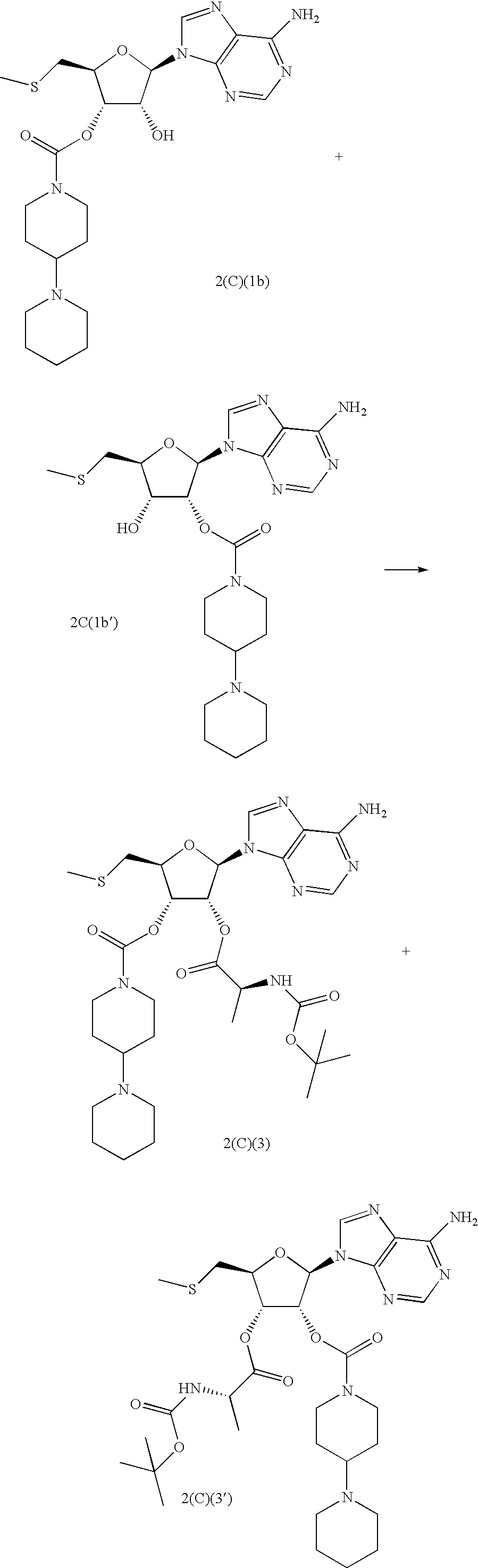
- To a solution of alcohols 2(C)(1b) and 2(C)(1b′) (329 mg, 0.668 mmol) in CH 2Cl2 (6.5 mL) at rt was added N-(tert-butoxycarbonyl)-L-alanine (329 mg, 1.74 mmol), 1,3-dicyclohexylcarbodiimide (400 mg, 1.94 mmol), and 4-dimethylaminopyridine (10 mg, 0.082 mmol). After 0.5 h, the reaction was complete, the precipitate was filtered, and a 1:1 mixture of DMF/i-PrOH (2 mL) was added to the filtrate. The CH2Cl2 was removed under vacuum, leaving the DMF/i-PrOH solution which was purified by semipreparative HPLC with a linear gradient elution of 15% A/85% B to 35% A/65% B over 30 min to give the title compounds 2(C)(3) and 2(C)(3′) as white powders (134 mg, 30% and 36.9 mg, 8% respectively). 2(C)(3): 1H NMR (CDCl3) δ:8.37 (1H, s), 8.01 (1H, s), 6.15 (1H, d, J=5.3 Hz), 6.09−6.02 (1H, m), 5.63−5.52 (3H, m), 4.44 (1H, q, J=5.1 H) 4.38−4.26 (1H, m), 4.25−4.12 (2H, m), 2.99 (2H, d, J=5.2 Hz), 2.93−2.67 (2H, m), 2.54−2.36 (5H, m), 2.15 (3H, s), 1.90−1.80 (2H, m), 1.64−1.54 (4H, m), 1.51−1.25 (16H, m). HPLC Rt=3.513 min. LRMS (m/z) 663 (M+H)+. Anal. (C30H46N8O7S) C, H, N, S. 2(C)(3′): 1HNMR(CDCl3) δ:8.37,(1H, s), 8.05 (1H, s), 6.17 (1H, d, J=5.4 Hz), 5.90 (1H, t, J=5.4 Hz), 5.70,(1H, t, J=4.8 Hz), 5.55 (2H, s), 4.41 (2H, q, J=4.9 Hz), 4.16−4.01 (2H, m), 2.97 (2H, d, J=5.1 Hz), 2.86−2.64 (2H, m), 2.53−2.30 (5H, m), 2.15 (3H, s); 1.85−1.72 (2H, m), 1.61−1.51 (4H, m), 1.50−1.38 (16H, m). HPLC Rt=3.642 min. LRMS (m/z) 663 (M+H)+. Anal. (C30H46N8O7S) C, H, N, S.
- (2S,3S,4R,5R)-5-(6-amino-9H-purin-9-yl)-4-(benzoyloxy)-2-[(methylthio)methyl]tetrahydrofuran-3-
yl yl 
- To a solution of alcohols 2(C)(1b) and 2(C)(1b′) (559 mg, 1.14 mmol) in CH 2Cl2 (11 mL) at rt was added benzoic acid (250 mg, 2.05 mmol), 1,3-dicyclohexylcarbodiimide (469 mg, 2.27 mmol), and 4-dimethylaminopyridine (17 mg, 0.14 mmol). After 45 min., the reaction was complete, the precipitate was filtered, and a 3:1 mixture of DMF/i-PrOH (4 mL) was added to the filtrate. The CH2Cl2 was removed under vacuum, leaving the DMF/i-PrOH solution which was purified by semipreparative HPLC with a linear gradient elution of 20% A/80% B to 25% A/75% B over 30 min to give the title compounds 2(C)(4) and 2(C)(4′) as white powders (264 mg, 39% and 032.8 mg, 5% respectively). 2(C)(4): 1H NMR (CDCl3) δ:8.39 (1H, s), 8.13 (1H, s), 8.01 (2H, m), 7.59 (1H, t, J=7.5 Hz, 7.44 (2H, t, J=7.5 Hz), 6.37 (1H, d, J=5.3 Hz), 6.13 (1H, t, J=5.6 Hz), 5.67 (1H, t, J=5.1 Hz), 5.58 (2H, s), 4.54 (1H, q, J=4.7 Hz), 4.19−3.98 (2H, m), 3.06−3.03 (2H, m), 2.77=2.62 (2H, m), 2.52=2.27 (5H, m), 2.20 (3H, s), 1.82−1.71 (2H, m), 1.63−1.48 (4H, m), 1.48−1.24 (4H, m). HPLC Rt=3.483 min. LRMS (m/z) 596 (M+H)+. Anal. (C29H37N7O5S) C, H, N, S. 2(C)(4′): 1H NMR (CDCl3) δ:8.40 (1H, s), 8.11 (1H, s), 8.03-8.06 (2H, m), 7.63 (1H, t, J=7.6 Hz), 7.49 (2H, t, J=7.9 Hz), 6.28 (1H, d, J=5.6 Hz), 6.05−5.98 (1H, m), 5.90−5.84 (1H, m), 5.54 2H, s), 4.61 (1H, q, J=4.5 Hz), 4.13−3.88 (2H, m), 3.05 (2H, d, J=5.1 Hz), 2.68−2.53 (2H, m), 2.43−2.23 (5H, m), 2.19 (3H, s), 1.75−1.62 (2H, m), 1.58−1.47 (4H, m), 1.48−1.25 (4H, m). HPLC Rt=3.640 min. LRMS (m/z) 596 (M+H)+. Anal. (C29H37N7O5S-0.25 H2O) C, H, N, S.
- (2R,3R,4S,5S)-2-(6-amino-9H-purin-9-yl)-4-[({[2-(dimethylamino)ethyl]amino}carbonyl) oxy]-5-[(methylthio)methyl]tetrahydrofuran-3-yl pivalate and (2S,3S,4R,5R)-5-(6-amino-9H-purin-9-yl)-4-[({[2-(dimethylamino)ethyl]amino}carbonyl)oxy]-2-[(methylthio)methyl]tetrahydrofuran-3-yl pivalate.

- 2(C)(5)(a) and 2(C)(5)(a′): (2S,3S,4R,5R)-5-(6-amino-9H-purin-9-yl)-4-hydroxy-2-[(methylthio)methyl]tetrahydrofuran-3-yl 2-(dimethylamino)ethylcarbamate, and (2R,3R,4S,5S)-2-(6-amino-9H-purin-9-yl)-4-hydroxy-5-[(methylthio)methyl]tetrahydrofuran-3-yl 2-(dimethylamino)ethylcarbamate.
- To a solution of 2(C)(1a) (1.90 g, 5.88 mmol) in DMF (5 mL) at rt was added N,N-dimethylethylenediamine (803 mg, 9.11 mmol). After 20 min. at rt, the reaction was complete by HPLC. The reaction mixture was loaded directly on a reverse phase column (Biotage Flash 40i System, Flash 40M cartridge, C-18, 10% MeOH/H 2O to 100% MeOH gradient) to give the title compounds 2(C)(5a) and 2(C)(5a′) in a 1.9:1 ratio, respectively. As with intermediates 2(C)(1b) and 2(C)(1b′), the individual regeoisomers were not isolated due to facile isomerization.

- Alcohols 2(C)(5a) and 2(C)(5a′) (748 mg, 1.82 mmol) were aceylated and purified according the procedure given for Example 2(C)(1) and 2(C)(1′) to give the title compounds 2(C)(5) and 2(C)(5′) as white powders (243 mg, 27% and 128 mg, 14% respectively). Compound 2(C)(5): 1H NMR (CDCl3) δ:8.37 (1H, s), 8.05 (1H, s), 6.16 (1H, d, J=5.7 Hz), 5.87 (1H, t, J=5.7 Hz), 5.67 (2H, s), 5.55 (1H, t, J=4.7 Hz), 5.51−5.44 (1H, m), 4.43 (1H, q, J=4.7 Hz), 3.31−3.21 (2H, m), 2.99−2.96 (2H, m), 2.41 (2H, q, J=4.4 Hz), 2.24 (6H, s), 2.17 (3H, s), 1.15 (9H, s). HPLC Rt=3.024 min. LRMS (m/z) 496 (M+H)+. Anal. (C21H33N7O5S) C, H, N, S. Compound 2(C)(5′): 1H NMR (CDCl3) δ:8.39 (1H, s), 8.07 (1H, s), 6.16 (1H, d, J=5.7 Hz), 5.86 (1H, t, J=5.8 Hz), 5.63−5.55 (3H, m), 5.42 (1H, t, J=5.1 Hz), 4.38 (1H, q, J=4.9 Hz), 3.19 (2H, q, J=5.7 Hz), 2.97 (2H, d, J=5.1 Hz), 2.37−2.33 (2H, m), 2.18 (6H, s), 2.16 (3H, s), 1.25 (9H, s). HPLC Rt=3.291 min. LRMS (m/z) 496 (M+H)+. Anal. (C21H33N7O5S) C, H, N, S.
- (2R,3R,4S,5S)-2-(6-amino-9H-purin-9-yl)-4-[({[2-(dimethylamino)ethyl]amino}carbonyl) oxy]-5-[(methylthio)methyl]tetrahydrofuran-3-yl benzoate, and (2S,3S,4R,5R)-5-(6-amino-9H-purin-9-yl)-4-[({[2-(dimethylamino)ethyl]amino}carbonyl)oxy]-2-[(methylthio)methyl]tetrahydrofuran-3-yl benzoate.

- Alcohols 2(C)(5a) and 2(C)(5a′) (1.04 g, 2.52 mmol) were aceylated and purified according the procedure given for Example 2(C)(4) and 2(C)(4′) to give the title compounds 2(C)(6) and 2(C)(6′) as white powders (473 mg, 36% and 220 mg, 17% respectively). Compound 2(C)(6): 1H NMR (CDCl3) δ:8.39 (1H, s), 8.11 (1H, s), 7.92 (2H, d, J=7.5 Hz), 7.56 (1H, t, J=7.5 Hz), 7.40 (2H, t, J=7.5 Hz), 6.35 (1H, d, J=5.7 Hz), 6.18 (1H, t, J=5.6 Hz), 5.70−5.61 (3H, m), 5.57−5.49 (1H, m), 4.52 (1H, q, J=4.7 Hz), 3.23−3.16 (2H, m), 3.05−3.02 (2H, m), 2.34 (2H, q, J=5.8 Hz), 2.19 (3H, s), 2.18 (6H, s). HPLC Rt=3.090 min. LRMS (m/z) 516 (M+H)+. Anal. (C23H29N7O5S) C, H, N, S. Compound 2(C)(6′): 1H NMR (CDCl3) δ:8.40 (1H, s), 8.11−8.08 (3H, m), 7.62 (1H, t, J=7.3 Hz), 7.48 (2H, t, J=7.5 Hz), 6.28 (1H, d, J=5.9 Hz), 5.99 (1H, t, J=5.8 Hz), 5.87 (1H, t, J=4.1 Hz), 5.68 (2H, s), 5.45 (1H, t, J=4.7 Hz), 4.57 (1H, q, J=4.3 Hz), 3.13 (2H, q, J=5.5 Hz), 3.06 (2H, d, J=5.3 Hz), 2.32−2.23 (2H, m), 2.19 (3H, s), 2.12 (6H, s). HPLC Rt=3.348 min. LRMS (m/z) 516 (M+H)+. Anal. (C23H29N7O5S) C, H, N, S.
- (2R,3R,4S,5S)-2-(6-amino-9H-purin-9-yl)-4-{[(1-methylpiperidin-4-yl)carbonyl]oxy}-5-[(methylsulfanyl)methyl]tetrahydrofuran-3-yl 1-methylpiperidine-4-carboxylate.

- To a heterogeneous mixture of 5′-deoxy-5′-methylthioadenosine (MTA) (2.12 g, 7.13 mmol) in CH 2Cl2 (100 mL) at rt was added 1,3-dicyclohexylcarbodiimide (4.85 g, 23.5 mmol) and 4-dimethylaminopyridine (174 mg, 1.43 mmol). After 16 h, the precipitate was removed by filtration, the filtrate was diluted with MeOH, and the CH2Cl2 was removed under vacuum. The resulting methanolic solution was purified on semipreparative HPLC with a linear gradient elution of 5% A/95% B to 12% A/88% B over 30 min to give B(1) as a white powder (207 mg, 5.3%). 1H NMR (CDCl3) δ:8.37 (1H, s), 8.03 (1H, s), 6.14 (1H, d, J=5.7 Hz), 5.98 (1H, t, J=5.6 Hz), 5.65 (1H, t, J=5.6 Hz), 5.64 (2H, s), 4.39 (1H, q, J=4.7 Hz), 2.98 (2H, d, J=5.0 Hz), 2.86−2.82 (2H, m), 2.78−2.72 (2H, m), 2.39−2.21 (2H, m), 2.29 (3H, s), 2.24 (3H, s), 2.16 (3H, s), 2.05−1.66 (12H, m). HPLC Rt=2.637 min. LRMS (m/z) 548 (M+H)+. Anal. (C25H37N7O5S-0.20 H2O) C, H, N, S.
- (2R,3R,4S,5S)-4-(acetyloxy)-2-(6-amino-9H-purin-9-yl)-5-[(ethylsulfanyl)methyl]tetrahydrofuran-3-yl acetate, and (2R,3R,4S,5S)-4-(acetyloxy)-2-(6-amino-9H-purin-9-yl)-5-[(isobutylsulfanyl)methyl]tetrahydrofuran-3-yl acetate.
- The following 2′, 3′-diacetate derivatives of 5′-
deoxy 5′-alkylthioadenosine were prepared according to the method described by M. J. Robins et. al. J. Org. Chem. 59, 544 (1994).
- 2(c)(8): 1H NMR (DMSO-d6) δ:1.14 (t, 3H, J=7.4 Hz), 2.04 (s, 3H), 2.15 (s, 3H), 2.54 (q, 2H, J=7.4 Hz), 2.95-3.10 (m, 2H), 4.31(dd, 1H, J=6.4, 6.0 Hz), 5.60 (dd, 1H, J=5.3, 4.3 Hz), 6.12-6.18 (m, 1H), 6.20-6.25 (m, 1H), 7.44 (s, 2H), 8.22 (s, 1H), 8.44 (s, 1H). LRMS (m/z) 395 (M+H)+ Anal. C16H21N5O5S-1.0 H2O) C, H N, S. 2(c)(9): 1H NMR (DMSO-d6) δ:0.82 (t, 6H, J=7.0 Hz), 1.62-1.75 (m, 1H), 2.00 (s, 3H), 2.11 (s, 3H), 2.32-2.46 (m, 2H), 2.93-3.07 (m, 2H), 4.25-4.35 (m, 1H), 5.56 (t, 1H, J=4.4 Hz), 6.15-6.27 (m, 2H), 7.41 (s, 2H), 8.17 (s, 1H), 8.40 (s, 1H). LRMS (m/z) 423 (M+H)+. Anal. (C18H25N5O5S-0.5 H2O) C,H,N,S.
- (2S,3S,4R,5R)-5-(6-amino-9H-purin-9-yl)-4-azido-2-[(methylthio)methyl]tetrahydrofuran-3-ol.

- Intermediate 2(C)(10b): (2R,3S,4S,5S)-2-(6-amino-9H-purin-9-yl)-4-{[tert-butyl(dimethyl)silyl]oxy}-5-[(methylthio)methyl]tetrahydrofuran-3-yl hydrogen carbonate. To a solution of 2(C)(10a) (prepared via the method described by Gavagnin and Sodano. Nucleosides & Nucleotides, 8, 1319 (1989))(1.82 g, 4.42 mmol), pyridine (3 mL), and DMAP (1.78 g, 14.6 mmol) in CH2Cl2 (150 mL) at 0° C. was added triflic anhydride (1.42 g, 8.46 mmol) dropwise. After 1 h, the reaction mixture was poured into cold 1N NaHSO4 and partitioned with CHCl3. The organic layer was concentrated, and the resulting residue was redissolved in HMPA (20 mL), treated with NaOAc (2.99 g, 36.5 mmol), warmed to 40° C. for 1 h, and then stirred at rt for 16 h. The reaction mixture was then poured into H2O and partitioned with CHCl3. The organic layer was concentrated under vacuum, and the resulting residue was purified by reverse phase chromatography (
Biotage Fash 40, C-18) eluting with a linear gradient of 5-60% acetonitrile in H2O to give 2(C)(10b) as a white solid (0.437 g, 22%). LRMS (m/z) 454.(M+H)+. - Intermediate 2(C)(10c): 9-{(2R,3R,4S,5S)-3-azido-4-{[tert-butyl(dimethyl)silyl]oxy}-5-[(methylthio)methyl]tetrahydrofuran-2-yl}-9H-purin-6-amine. A solution of 2(C)(10b) (0.437 g, 0.964 mmol) in MeOH (30 mL) was saturated with NH 3(g). The removal of the acetate group was complete after 20 min, after which solvent and reagent were removed under vacuum to give the free alcohol as a yellow solid. This crude material was dissolved in CH2Cl2 (30 mL) at 0° C., to which was added pyridine (0.685 g, 8.65 mmol) and DMAP (0.391 g, 3.20 mmol), followed by dropwise addition of triflic anhydride (0.395 g, 2.35 mmol). After 3 h at 0° C., the reaction mixture was poured into cold 1N NaHSO4, partitioned with CHCl3 and the organic layer concentrated. The resulting crude triflate was dissolve in DMF (40 mL) and treated with NaN3 (0.627 g, 9.65 mmol). After 16 h at rt, the DMF was removed under vacuum, and the residue was partially dissolved in CHCl3 and washed with H2O. The organic layer was concentrated to give intermediate 2(C)(10c) as a yellow oil. This material was used without any further purification. LRMS (m/z) 436 (M+H)+.
- The title compound 2(C)(10) was prepared as follows. To a solution of 2(C)(10c) in THF (20 mL) at 0° C. was added TBAF (1M in THF, 1.5 mL, 1.5 mmol) dropwise. After 30 min at rt, AcOH (0.5 mL) and CH 2Cl2 (50 mL) were added, and the reaction mixture was filtered through silicone treated filter paper (Whatman 1PS) and concentrated under vacuum. The resulting residue was purified on semipreparative reverse phase HPLC using water and acetonitrile (each containing 0.1% v/v acetic acid) as mobile phase to give the title compound 2(C)(10) as a white powder (103 mg, 18%). 1H NMR (DMSO-d6) δ:8.37 (1H, s), 8.17 (1H, s), 7.38 (2H, s), 6.16 (1H, s), 6.02 (1H, d, J=5.8 Hz), 4.88 (1H, t, J=5.7 Hz), 4.59 (1H, t, J=4.5 Hz), 4.06 (1H, q, J=5.8 Hz), 2.91 (1H, dd, J=13.9 and 5.7 Hz), 2.79 (1H, dd, J=16.4 and 7.0 Hz), 2.05 (3H, s). LRMS (m/z) 323 (M+H)+ Anal. (C11H14N8O2S-0.20 H2O) C, H, N, S.
- (2S,3S,4R,5R)-4-amino-5-(6-amino-9H-purin-9-yl)-2-[(methylthio)methyl]tetrahydrofuran-3-ol.

- To a solution of example 2(C)(10) (0.480 g, 1.49 mmol) in pyridine (40 mL) at rt was added PPh 3 (0.586 g, 2.24 mmol). After 24 h, H2O (5 mL) was added and the reaction stirred for an additional 60 h. The solvents were removed under vacuum, and the resulting residue was dissolved in H2O and washed with Et2O. The aqueous layer was concentrated under vacuum, and the resulting residue purified by reverse phase chromatography (Biotage Flash 40M, C-18) with a linear gradient elution of 5-10% acetonirile in H2O to give the title compound 2(C)(11) as a white powder (176 mg, 40%). 1H NMR (DMSO-d6) δ:8.35 (1H, s), 8.14 (1H, s), 7.27 (2H, s), 5.72 (1H, d, J=7.8 Hz), 4.19−4.15 (1H, m), 4.10−4.02 (2H, m), 2.88 (1H, dd, J=13.9 and 6.8 Hz), 2.79 (1H, dd, J=13.6 and 6.6 Hz), 2.06 (3H, s). LRMS (m/z) 297 (M+H)+Anal. (C11H16N6O2S-0.40 H2O) C, H, N, S.
- EXAMPLE 2(C)(12)
- (2S,3R,4R,5R)-5-(6-amino-9H-purin-9-yl)-4-chloro-2-[(methylthio)methyl]tetrahydrofuran-3-ol.

- Intermediate 2(C)(12b): (2R,3S,4S,5S)-2-(6-amino-9H-purin-9-yl)-5-[(methylthio)methyl]-4-(tetrahydro-2H-pyran-2-yloxy)tetrahydrofuran-3-ol. To a solution of MTA [J. A. Montgomery et. al. J. Med. Chem. 17, 1197 (1974); Gavagnin and Sodano Nucleosides & Nucleotides 8, 1319 (1989)] (0.480 g, 1.661 mmol) in DMF (36 mL) was added dihydropyran (8 mL) and para-toluenesulfonic acid (0.450 g, 2.37 mmol). After 45 min at rt, sat. aq. NaHCO3 (200 mL) was added and the aqueous solution was extracted with EtOAc. The organic layer was concentrated, and the residue chromatographed with acetone/CH2Cl2 (product elutes with 2:1) to give 2(C)(12b) as a white solid (0.413 g, 67%). LRMS (m/z) 382 (M+H)+.
- Intermediate 2(C)(12c): 9-[(2R,3R,4R,5S)-3-chloro-5-[(methylthio)methyl]-4-(tetrahydro-2H-pyran-2-yloxy)tetrahydrofuran-2-yl]-9H-purin-6-amine. A solution of 2(C)(12b) (0.361 g, 0.946 mmol), pyridine (0.684 g, 8.65 mmol) and DMAP (0.381 g, 3.12 mmol) in CH 2Cl2 (40 mL) at 0° C. was treated with triflic anhydride (0.395 g, 2.35 mmol) dropwise. After 2 h at 0° C., the reaction mixture was poured into cold 1N NaHSO4, extracted with CHCl3, and the organic layer concentrated. The resulting residue was dissolve in DMF (60 mL) and treated with tetrabutylammonium chloride-hydrate (0.526 g, 1.89 mmol). After 16 h at rt, the DMF was removed under vacuum and the resulting residue chromatographed with acetone/CH2Cl2 (product elutes with 1:1) to give 2(C)(12c) as a white solid (0.270 g, 71%). LRMS (m/z) 400 (M+H)+.
- The title compound 2(C)(12) was prepared as follows. A solution of 2(C)(12c) (0.226 g, 0.565 mmol) in MeOH (20 mL) was treated with aq. 1N HCl (20 mL). After 1 h at rt, the reaction mixture was poured into H 2O, neutralized with NaHCO3, extracted with CHCl3, and concentrated. The resulting residue was purified by reverse phase chromatography (Biotage Flash 40M, C-18) with acetonitrile/H2O (1:4) to give the title compound as a white powder (126 mg, 71%). 1H NMR (DMSO-d6) δ:8.41 (1H, s), 8.17 (1H, s), 7.39 (2H, s), 6.16 (1H, d, J=7.3 Hz), 6.11 (1H, d, J=5.1 Hz), 5.40−5.37 (1H, m), 4.39 (1H, q, J=2.8 Hz), 4.15 (1H, dt, J=6.6 and 2.8 Hz), 2.91 (1H, dd, J=13.9 and 6.3 Hz), 2.83 (1H, dd, J=13.9 and 6.8 Hz), 2.07 (3H, s). LRMS (m/z) 316 (M+H)+.
- Synthesis of Purine Analogs of MTAP Substrates
- The following examples illustrate methods to prepare MTA analogs at the 6′ position of the purine ring.
- Scheme VII shows the method to prepare additional prodrugs of 5′ adenosine analogs. The prodrugs have been nitrogen substituted at the 6′ position of the purine ring. Starting from VIIa, the compound is acylated on all open positions (2′ and 3′ alcohol and N 6 of the adenine ring) to give intermediate VIIb. The acylating group may include, but is not limited to carboxylic acids, amino acids, carboxylic acid anhydrides, etc. which contains either an intact or masked solubilizing group (R). Compound VIIb is typically not isolated, but rather immediately placed under hydrolysis conditions (i.e. NaOH or related reagents) to remove the esters to give VII. As necessary, VII may or may not be further treated in order liberate the desired solubilizing group.

- N-(9-{(2R,3R,4S,5S)-3,4-dihydroxy-5-[(methylthio)methyl]tetrahydrofuran-2-yl}-9H-purin-6-yl)benzamide.

- To a solution of MTA (1.12 g, 3.78 mmol) in pyridine (47 mL) was added benzoyl chloride (1.6 mL, 13.8 mmol) at rt. After 1 h, additional benzoyl chloride (0.4 mL, 3.45 mmol) was added and the reaction stirred for another hour before the pyridine was removed under vacuum. The resulting foam was dissolved in EtOH (35 mL) and THF (30 mL) and treated with 2N NaOH (26 mL). After 1h, the reaction was diluted with ice (100 mL) and pH=7 phosphate buffer (50 mL), and neutralized with 1N HCl. The aqueous solution was extracted with CHCl 3, concentrated, and the resulting solid triturated with CHCl3/Et2O to give the title compound as a white solid (1.32 g, 3.28 mmol). 1H NMR (DMSO-d6) δ:11.23 (1H, s), 8.78 (1H, s), 8.73 (1H, s), 8.05 (2H, d, J=7.2 Hz), 7.66 (1H, t, J=7.2 Hz), 7.56 (2H, t, J=8.1 Hz), 6.05 (1H, d, J=5.8 Hz), 5.62 (1H, d, J=6.0 Hz), 5.41 (1H, d, J=4.9 Hz), 4.83 (1H, q, J=5.3 Hz), 4.19 (1H, q, J=3.8 Hz), 4.17−4.06 (1H, m), 2.92 (1H, dd, J=13.9 and 5.8 Hz), 2.82 (1H, dd, J=13.9 and 6.8 Hz), 2.07 (3H, s). LRMS (m/z) 402 (M+H)+. Anal. (C18H19N5O4S) C, H, N, S.
- 5-[(9-{(2R,3R,4S,5S)-3,4-dihydroxy-5-[(methylthio)methyl]tetrahydrofuran-2-yl}-9H-purin-6-yl)amino]-5-oxopentanoic acid.

- To a solution of MTA (1.07 g, 3.60 mmol) in pyridine (45 mL) was added ethyl glutarylchloride (2.3 mL, 14.6 mmol) at rt. After 16 h, the pyridine was removed under vacuum, and the resulting foam was redissolved in EtOH (35 mL) and THF (50 mL) and treated with 2N NaOH (40 mL). After 1 h at 0° C., the reaction was diluted with pH=7 phosphate buffer (50 mL) and neutralized with 1N HCl. The aqueous solution was extracted with CHCl 3, concentrated, and the resulting solid purified on semipreparative HPLC to give the title compound as a white solid (154 mg, 10%). 1H NMR (DMSO-d6) δ:10.72 (1H, s), 8.69 (1H, s), 8.67 (1H, s), 6.01 (1H, d, J=5.8 Hz), 5.62−5.56 (1H, m), 5.41−5.37 (1H, m), 4.82−4.75 (1H, m), 4.20−4.14 (1H, m), 4.10−4.03 (1H, m), 2.91 (1H, dd, J=13.9 and 5.8 Hz), 2.82 (1H, dd, J=13.9 and 6.8 Hz), 2.61 (2H, t, J=7.2 Hz), 2.30 (2H, t, J=7.4 Hz), 2.06 (3H, s), 1.87−1.77 (2H, m). LRMS (m/z) 412 (M+H)+. Anal. (C16H21N5O6S) C, H, N, S.
- 6-[(9-{(2R,3R,4S,5S)-3,4-dihydroxy-5-[(methylthio)methyl]tetrahydrofuran-2-yl}-9H-purin-6-yl)amino]-6-oxohexanoic acid.
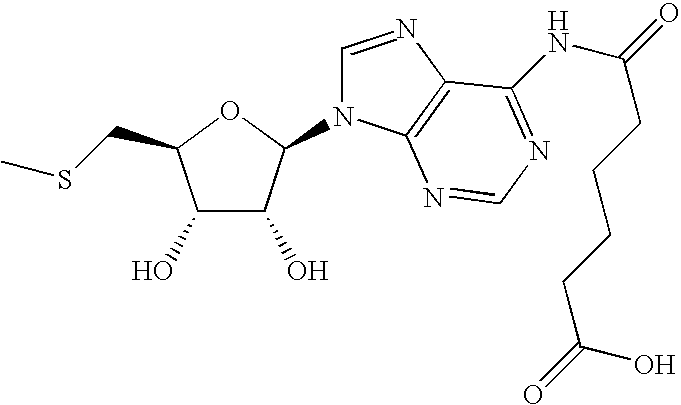
- The title compound 2(D)(3) was prepared in a similar fashion to the previous example using adipoylchloride and MTA. 1H NMR (DMSO-d6) δ:12.02 (1H, br s), 10.70 (1H, s), 8.69 (1H, s), 8.67 (1H, s), 6.01 (1H, d, J=5.8 Hz), 5.63−5.55 (1H, m), 5.43−5.36 (1H, m), 4.79 (1H t, J=5.5 Hz), 4.21−4.14 (1H, m), 4.11−4.03 (1H, m), 2.91 (1H, dd, J=13.9 and 6.0 Hz) 2.80 (1H, dd, J=14.3 and 6.0 Hz), 2.57 (2H, t, J=6.6 Hz), 2.25 (2H, t, J=6.8 Hz), 2.06 (3H, s), 1.67−1.49 (4H, m). LRMS (m/z) 426 (M+H)+. Anal. (C17H23N5O6S-0.4 H2O) C, H, N, S.
- Synthesis of Additional Adenosine Analogs of MTAP Substrates
- Schemes VIII and IX outline the general methods to prepare adenosine analogs at the 5′ position of the sugar ring, where the 2′ position has already been modified. In scheme VIII, the sequence is begun with an appropriate intermediate that is already modified at the 2′ position (VIIIa). Conversion of the 5′ position into a leaving group (VIIIb; X═Cl) and subsequent displacement with a thiol gives the desired product VIIIc. The stereochemistry of the starting diol VIIIa is not specified and it may be either diastereomer.
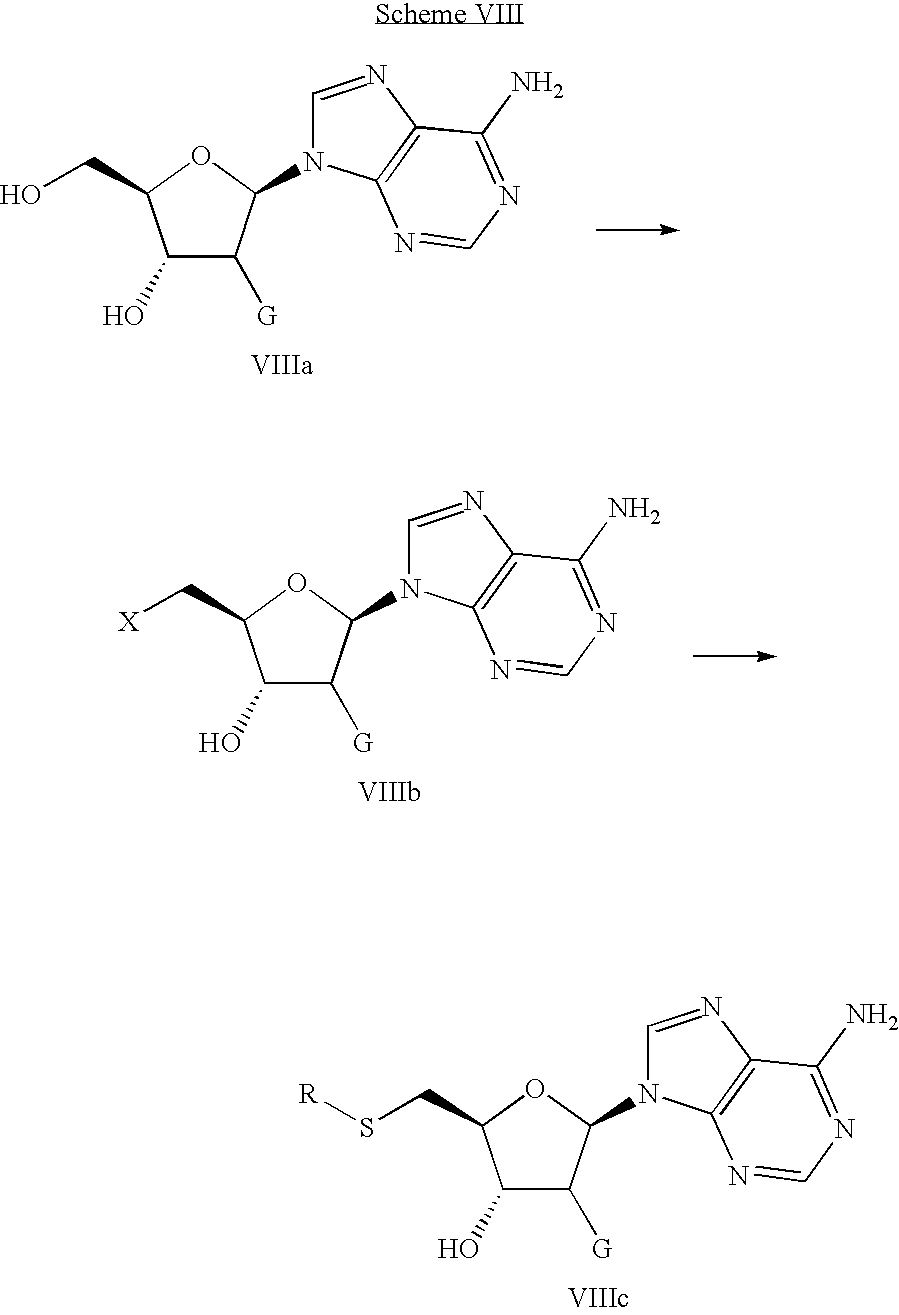
- Alternatively, scheme IX illustrates a sequence wherein the 5′ position is already substituted with an appropriate thiol. Selective protection of the 3′ position gives the desired starting alcohol IXa. The free alcohol is converted to a leaving group (IXb; X=triflate (—OTf)), which is then displaced by a nucleophile (including, but not limited to azide, thiols, amines, alcohols, etc.). Following deprotection of the 3′ protecting group, the final products are obtained. Depending on the stereochemistry of the intermediates, it is possible to get both possible products, that is to say IXc or IXc′.

- (2S,3R,4R,5R)-5-(6-amino-9H-purin-9-yl)-4-(methylthio)-2-[(methylthio)methyl]tetrahydrofuran-3-ol.

- The title compound was prepared from S-methyl-2′-thio-adenosine (Robins et al. J. Amer. Chem. Soc. 1996, 46, 11341.; Fraser et al. J. Heterocycl. Chem. 1993, 5, 1277.; Montgomery, T. J. Heterocycl. Chem. 1979, 16, 353.; Ryan et al. J. Org. Chem. 1971, 36, 2646.) To a solution of S-methyl-2′-thio-adenosine (0.365 g, 1.23 mmol) in DMF (10 mL) and CCl4 (2 mL) was added PPh3 (0.322 g, 1.23 mmol). After 0.5 h at rt, the reaction was quenched with i-PrOH (10 mL), and the mixture was concentrated under vacuum. The resulting oil was redissolved in DMF (10 mL) and treated with NaSMe (0.222 g, 3.17 mmol). After 16 h at rt, the reaction mixture was concentrated under vacuum, and the resulting crude residue was purified on semipreparative HPLC with a linear gradient elution of 10% A/90% B to 30% A/70% B over 30 min to give the titled compound as a white powder (72.4 mg, 18%). 1H NMR (DMSO-d6) δ:8.43 (1H, s), 8.17 (1H, s), 7.35 (2H, s), 6.12 (1H, d, J=8.6 Hz), 5.89 (1H, bs), 4.35−4.24 (2H, m), 4.08 (1H, t, J=6.6 Hz), 2.90 (1H, dd, J=13.9 and 7.1 Hz), 2.82 (1H, dd, J=13.6 and 6.8 Hz), 2.08 (3H, s), 1.79 (3H, s). Anal. (C12H17N5O2S2) C, H, N, S.
- (2S,3R,4R,5R)-5-(6-amino-9H-purin-9-yl)-4-(ethylthio)-2-[(methylthio)methyl]tetrahydrofuran-3-ol.

- S-ethyl-2′-thio-adenosine was prepared in a similar fashion to that of S-methyl-2′-thio-adenosine (see references above) and was converted to the title compound using the procedure described for the example above. 1H NMR (DMSO-d6) δ:8.44 (1H, s), 8.16 (1H, s), 7.34 (2H, s), 6.07 (1H, d, J=8.8 Hz), 5.83 (1H, s), 4.39−4.36 (1H, m), 4.28−4.26 (1H, m), 4.08 (1H, t, J=6.8 Hz), 2.92 (1H, dd, J=13.9 and 7.3 Hz), 2.83 (1H, dd, J=13.6 and 6.8 Hz), 2.21 (2H, q, J=7.3 Hz), 2.07 (3H, s), 0.92 (3H, t, J=7.3 Hz). LRMS (m/z) 342 (M+H)+. Anal. (C13H19N5O2S2-0.2 Hexanes) C, H, N, S.
- Synthesis of Thiol Analogs of MTAP Substrates
- The following examples were made using 5′-chloroadenosine as outlined in the procedure for Scheme I of Example 2(A), with substitution of the appropriate thiolate salt reagent in place of NaSCH 3. For those thiols where the thiolate salt was not commercially available, the anion was generated in situ using potassium t-butoxide.
- (2S,3S,4R,5R)-2-(6-amino-9H-purin-9-yl)-5-{[(4-chlorobenzyl)thio]methyl}tetrahydrofuran-3,4-diol.

- 1H-NMR (DMSO-d6) δ:8.35 (1H, s), 8.15 (1H,s), 7.33−7.23 (6H, m), 5.89 (1H, d, J=5.2 Hz), 5.53 (1H, d, J=5.8 Hz), 5.33 (1H, d, J=5.2 Hz), 4.77−4.72 (1H, m), 4.20−4.15 (1H, m), 4.02−3.98 (1H; m), 3.73 (2H, s), 2.86−2.67 (2H, m). LRMS (m/z), 408 (M+H)+. Anal. (C17H18ClN5O3S) C, H, N, S.
- (2S,3S,4R,5R)-2-(6-amino-9H-purin-9-yl)-5-{[(3-hydroxypropyl)thio]methyl}tetrahydrofuran-3,4-diol.
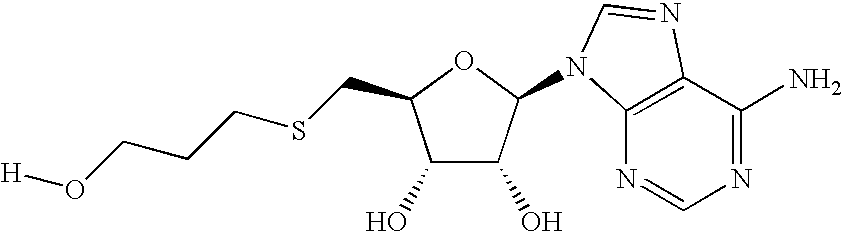
- 1H-NMR (DMSO-d6) δ:8.35 (1H, s), 8.15 (1H, s), 7.29 (2H, s), 5.89 (1H d, J=5.8 Hz), 5.49 (1H, s, J=6.2 Hz), 5.32 (1H, s, J=4.9 Hz), 4.78−4.73 (1H, m), 4.47−4.43 (1H, m), 4.17−4.12 (1H, m), 4.03−3.98 (1H, m), 3.43−3.37 (2H, m), 2.94−2.76 (1H, m), 2.57−2.52 (2H, m), 1.67−1.58 (2H, m). LRMS (m/z) 442 (M+H)+. Anal. (C13H19N5O4S-0.3 H2O, 0.1 MeOH) C, H, N, S.
- (2S,3S,4R,5R)-2-(6-amino-9H-purin-9-yl)-5-[(pyrimidin-2-ylthio)methyl]tetrahydrofuran-3,4-diol.

- 1H-NMR (DMSO-d6) δ:8.64 (2H, d, J=4.9 Hz), 8.37 (1H, s), 8.15 (1H, s), 7.30 (2H, s), 7.23 (1H, t, J=4.9 Hz), 5.90 (1H, d, J=6.2 Hz), 5.51 (1H, d, J=6.2 Hz), 5.39 (1H, d, J=4.7 Hz), 4.89−4.83(1H, m), 4.23−4.19 (1H, s), 4.15−4.10 (1H, s), 3.64−3.45 (1H, m). LRMS (m/z) 362 (M+H)+. Anal. (C14H15N7O3S-0.75 H2O, 0.25 MeOH) C, H, N, S.
- (2S,3S,4R,5R)-2-(6-amino-9H-purin-9-yl)-5-{[(2-methylbutyl)thio]methyl}tetrahydrofuran-3,4-dio.

- 1H-NMR (DMSO-d6) δ:8.35 (1H, s); 8.15 (1H, s), 7.29 (2H, s), 5.88 (1H, d, J=4.7 Hz), 5.49 (1H, d, J=6.2 Hz), 5.29 (1H, d, J=4.5 Hz), 4.77 (br s, 1H), 4.15 (br s, 1H), 4.01 (br s, 1H), 2.91−2.81 (2H, m), 2.38−2.31 (1H, m), 1.48 (br s, 1H), 1.32 (br s, 1H), 1.10 (br s, 1H), 0.87−0.77 (6H, m). LRMS (m/z) 354 (M+H)+. Anal. (C15H23N5O3S-0.5 H2O) C, H, N, S.
- (2S,3S,4R,5R)-2-(6-amino-9H-purin-9-yl)-5-{[(4-methyoxybenzyl)thio]methyl}tetrahydrofuran-3,4-diol.

- 1H-NMR (DMSO-d6) δ8.35 (1H, s), 8.14 (1H, s), 7.31 (2H, s), 7.13 (2H, d, J=8.4 HZ), 6.81 (2H, d, J=8.4), 5.89 (1H, d, J=5.2 Hz), 5.51 (1H, d, J=6.0 Hz), 5.31 (1H, d, J=5.0), 4.77−4.71 (1H, m), 4.20−4.15 (1H, m), 4.04−3.98 (1H, m), 3.72 (3H, s), 3.68 (2H, s), 2.85−2.61 (2H, m). LRMS (m/z) 404 (M+H)+. Anal. (C18H21N5O4S-0.5 H2O) C, H, N, S.
- (2S,3S,4R,5R)-2-(6-amino-9H-purin-9-yl)-5-[(quinolin-2-ylthio)methyl]tetrahydrofuran-3,4-diol.

- 1H-NMR (DMSO-d6) δ:8.31 (1H, s), 8.09−8.06 (2H, m), 7.83−7.77 (2H, m), 7.65−7.59 (1H, m), 7.44−7.42 (1H, m), 7.31 (1H, d, J=8.6 Hz), 7.21 (2H, s), 5.82 (1H, d, J=6.4 Hz), 5.42 (1H, d, J=6.2 Hz), 5.28 (1H, d, J=4.9 Hz), 4.88−4.82 (1H, m), 4.17−4.08 (2H, m), 3.79−3.52 (2H, m). LRMS (m/z) 411 (M+H)+. Anal. (C19H18N6O3S) C, H, N, S.
- (2R,3R,4S,5S)-2-(6-amino-9H-purin-9-yl)-5-{[(3-methylphenyl)thio]methyl}tetrahydrofuran-3,4-diol.

- 1H NMR (DMSO-d6) δ:8.34 (1H, s), 8.14 (1H, s), 7.30 (2H, s), 7.18−7.11 (3H, m), 6.98 (1H, d, J=7.1 Hz), 5.88 (1H, d, J=5.8 Hz), 5.51 (1H, d, J=6.3 Hz), 5.36 (1H, d, J=5.1 Hz), 4.81 (1H, q, J=5.8 Hz), 4.18 (1H, q, J=3.8 Hz), 3.98 (1H, q, J=3.8 Hz), 3.39 (1H, dd, J=13.9 and 6.1 Hz), 3.28 (1H, dd, J=13.9 and 6.06 Hz), 2.34 (3H, s). LRMS (m/z) 374 (M+H)+. Anal. (C17H19N5O3S-0.50 H2O) C, H, N, S.
- (2R,3R,4S,5S)-2-(6-amino-9H-purin-9-yl)-5-{[(4-methylphenyl)thio]methyl}tetrahydrofuran-3,4-diol.

- 1H NMR (DMSO-d6) δ:8.34 (1H, s), 8.14 (1H, s), 7.30 (2H, s), 7.25 (2H, d, J=8.3 Hz), 7.11 (1H, d, J=8.3 Hz), 5.87 (1H, d, J=5.8 Hz), 5.50 (1H, d, J=6.3 Hz), 5.35 (1H, d, J=4.8 Hz), 4.80 (1H, q, J=6.1 Hz), 4.16 (1H, q, J=3.3 Hz), 3.96 (1H, m), 3.36 (1H, dd, J=13.9 and 6.06 Hz), 3.23 (1H, dd, J=13.9 and 7.06 Hz), 2.25 (3H, s). LRMS (m/z) 374 (M+H)+. Anal (C17H19N5O3S-0.70 H2O) C, H, N, S.
- (2R,3R,4,5 S)-2-(6-amino-9H-purin-9-yl)-5-{[(2-methoxyphenyl)thio]methyl}tetrahydrofuran-3,4-diol.

- 1H NMR (DMSO-d6) δ:8.35 (1H, s), 8.14 (1H, s), 7.29 (2H, s), 7.27 (1H, d, J=7.8 Hz), 7.17 (1H, t, J=7.6 Hz), 6.97 (d, 1H, J=8.1 Hz), 6.96 (t, 1H, J=7.3 Hz), 5.87 (1H, d, J=6.1 Hz), 5.50 (1H, d, J=6.1 Hz), 5.36 (1H, d, J=4.8 Hz), 4.82 (1H, q, J=5.3 Hz), 4.18 (1H, q, J=3.3 Hz), 4.00−3.95 (1H, m), 3.79 (s, 3H), 3.37−3.30 (1H, m), 3.22−3.15 (1H, m). LRMS (m/z) 390 (M+H)+. Anal. (C17H19N5O4S-0.50 H2O) C, H, N, S.
- (2R,3R,4S,5S)-2-(6-amino-9H-purin-9-yl)-5-{[(3-methoxyphenyl)thio]methyl}tetrahydrofuran-3,4-diol.

- 1H NMR (DMSO-d6) δ:8.34(1H, s), 8.14 (1H, s), 7.30 (2H, s), 7.19 (1H, t, J=7.8 Hz), 6.90−6.89 (2H, m), 6.74 (d, 1H, J=8.1 Hz), 5.88 (1H, d, J=5.8 Hz), 5.52 (1H, d, J=6.1 Hz), 5.38 (1H, d, J=5.1 Hz), 4.80 (1H, q, J=5.6 Hz), 4.19 (1H, q, J=3.8 Hz), 4.01−3.97 (1H, m), 3.70 (s, 3H), 3.43 (1H, dd, J=13.9 and 5.8 Hz), 3.29 (1H, dd, J=14.2 and 7.1 Hz). LRMS (m/z) 390 (M+H)+. Anal. (C17H19N5O4S-0.50 H2O) C, H, N, S.
- (2R,3R,4S,5S) -2-(6-amino-9H-purin-9-yl)-5-{[(4-methoxyphenyl)thio]methyl}tetrahydrofuran-3,4-diol.

- 1H NMR (DMSO-d6) δ:8.33(1H, s), 8.14 (1H, s), 7.31 (2H, d, J=8.8 Hz), 7.29 (2H, s), 6.87 (2H, d, J=8.8 Hz), 5.86 (1H, d, J=6.1 Hz), 5.48 (1H, d, J=6.1 Hz), 5.33 (1H, d, J=4.8 Hz), 4.80 (1H, q, J=5.3 Hz), 4.14 (1H, q, J=4.8 Hz), 3.94−3.90 (1H, m), 3.72 (s, 3H), 3.27 (1H, dd, J=13.9 and 6.1 Hz), 3.10 (1H, dd, J=13.9 and 7.1 Hz). LRMS (m/z) 390 (M+H)+. Anal. (C17H19N5O4S-0.50 H2O) C, H, N, S.
- (2R,3R,4S,5S)-2-(6-amino-9H-purin-9-yl)-5-{[(2-methylbenzyl)thio]methyl}tetrahydrofuran-3,4-diol.

- 1H NMR (DMSO-d6) δ:8.35(1H, s), 8.14 (1H, s), 7.30 (2H, s), 7.14−7.02 (4H, m), 5.89 (1H, d, J=5.5 Hz), 5.51 (1H, d, J=6.0 Hz), 5.32 (1H, d, J=5.3 Hz), 4.76 (1H, q, J=4.3 Hz), 4.17 (1H, q, J=4.7 Hz), 4.05−4.00 (1H, m), 3.73 (s, 2H), 2.87 (1H, dd, J=13.8 and 5.8 Hz), 2.73 (1H, dd, J=13.9 and 7.0 Hz), 2.28 (s, 3H). LRMS (m/z) 388 (M+H)+. Anal. (C18H21N5O3S-0.40 H2O) C, H, N, S.
- (2R,3R,4S,5S)-2-(6-amino-9H-purin-9-yl)-5-{[(3-methylbenzyl)thio]methyl}tetrahydrofuran-3,4-diol.

- 1H NMR (DMSO-d6) δ:8.34(1H, s), 8.13 (1H, s), 7.30 (2H, s), 7.15 (1H, t, J=7.4 Hz), 7.04−7.00 (3H, m), 5.88 (1H, d, J=5.5 Hz), 5.51 (1H, d, J=5.8 Hz), 5.31 (1H, d, J=5.3 Hz), 4.73 (1H, q, J=5.3 Hz), 4.17 (1H, q, J=4.7 Hz), 4.04−3.98 (1H, m), 3.69 (s, 2H), 2.83 (1H, dd, J=13.9 and 5.8 Hz), 2.68 (1H, dd, J=13.8 and 7.0 Hz), 2.25 (s, 3H). LRMS (m/z) 388 (M+H)+. (C18H21N5O3S-0.50 H2O) C, H, N, S.
- (2R,3R,4S,5S)-2-(6-amino-9H-purin-9-yl)-5-({[3-(trifluoromethyl)phenyl]thio}methyl)tetrahydrofuran-3,4-diol.

- 1H NMR (DMSO-d6) δ:8.33(1H, s), 8.14 (1H, s), 7.66−7.59 (2H, m), 7.51−7.47 (2H, m), 7.31 (2H, s), 5.90 (1H, d, J=5.7 Hz), 5.56 (1H, d, J=6.0 Hz), 5.42 (1H, d, J=4.5 Hz), 4.84−4.77 (1H, m), 4.25−4.18 (1H, m), 4.05−3.99 (1H, m), 3.53 (1H, dd, J=13.8 and 5.8 Hz), 3.44 (1H, dd, J=14.3 and 7.5 Hz). LRMS (m/z) 428 (M+H)+. Anal. (C17H16F3N5O3S) C, H, N, S.
- (2R,3R,4S,5S)-2-(6-amino-9H-purin-9-yl)-5-({[4-(trifluoromethyl)phenyl]thio}methyl)tetrahydrofuran-3,4-diol.

- 1H NMR (DMSO-d6) δ:8.36(1H, s), 8.15 (1H, s), 7.60 (2H, d, J=8.3 Hz), 7.51 (2H, d, J=8.3 Hz), 7.31 (2H, s), 5.90 (1H, d, J=5.8 Hz), 5.57 (1H, d, J 5.8 Hz), 5.41 (1H, d, J=5.1 Hz), 4.83 (1H, q, J=5.3 Hz), 4.25−4.19 (1H, m), 4.08−4.00 (1H, m), 3.54 (1H, dd, J=13.8 and 5.5 Hz), 3.44 (1H, dd, J=13.6 and 7.0 Hz). LRMS (m/z) 428 (M+H)+. (C17H16F3N5O3S-0.50 H2O) C, H, N, S.
- (2R,3R,4S,5S)-2-(6-amino-9H-purin-9-yl)-5-{[(2-pyridin-ylethyl)thio]methyl}tetrahydrofuran-3,4-diol

- 1HNMR (300 MHz, DMSO-D6) δ ppm 2.57 (t, 2H, J=6.0 Hz) 2.87 (m, 2H) 3.49 (q, 2H, J=6.0 Hz) 4.01 (m, J=3.58 Hz, 1 H) 4.13 (m, 1 H) 5.32 (s, 1 H) 5.50 (s, 1 H) 5.87 (d, J=5.65 Hz, 1 H) 7.20 (m, 2 H) 7.36 (s, 2 H) 7.68 (td, J=7.68, 1.79 Hz, 1 H) 8.15 (s, 1 H) 8.36 (s, 1 H) 8.46 (d, J=4.14 Hz, 1 H). Anal. Calcd for C17H20N6O3S.1H2O C: 50.24, H: 5.46, N: 20.68, S: 7.89. Found C: 50.18, H: 5.29, N: 20.60, S: 7.80.
- (2S,3R,4R,5R)-2-(6-amino-9H-purin-9-yl)-5-[(pyridin-4-ylthio)methyl]tetrahydrofuran-3,4-diol

- 1H NMR (400 MHz, DMSO-d6) δ ppm 3.37 (dd, J=14.3, 7.5 Hz, 1 H) 3.48 (m, 1 H) 4.00 (s, 1 H) 4.17 (d, J=3.54 Hz, 1 H) 4.76 (d, J=5.6 Hz, 1 H) 5.38 (d, J=4.8 Hz, 1 H) 5.51 (d, J=6.1 Hz, 1 H) 5.84 (d, J=5.6 Hz, 1 H) 7.23 (m, 4 H) 8.08 (s, 1 H) 8.26 (m, 3 H). Anal. Calcd for C15H16N6O3S.0.5H2O C: 48.77, H: 4.64, N: 22.75, S: 8.68. Found C: 48.81 H: 4.57, N: 22.71, S: 8.74.
- (2R,3R,4R,5S)-2-(6-amino-9H-purin-9-yl)-5-{[(2-hydroxyethyl)thio]methyl}tetrahydrofuran-3,4-diol

- 1H NMR (400 MHz, DMSO-d6) δ ppm 1.14 (m, 5 H) 1.48 (m, 1 H) 1.61 (m, 2 H) 1.84 (m, 2 H) 2.65 (m, 1H) 2.79 (dd, J=14.0, 7.0 Hz, 1 H) 2.91 (dd, J=12.0, 4.0 Hz, 1 H) 3.96 (m, 1 H) 4.14 (m, 1 H) 4.77 (q, J=5.6 Hz, 1 H) 5.28 (d, J=5.1 Hz, 1 H) 5.47 (d, J=6.1 Hz, 1 H) 5.86 (d, J=5.8 Hz, 1H) 7.28 (s, 1 H) 8.13 (s, 1 H) 8.34 (s, 1 H). Anal. Calcd for C16H23N5O3S.0.75H2O C: 50.71, H: 6.52, N: 18.48, S: 8.46. Found C: 51.02 H: 6.29, N: 18.55, S: 8.37.
- (2R,3R,4S,5S)-2-(6-amino-9H-purin-9-yl)-5-[(pyridin-2-ylthio)methyl]tetrahydrofuran-3,4-diol

- 1H NMR (400 MHz, DMSO-D6) δ ppm 3.16 (d, J=4.8 Hz, 1 H) 3.48 (dd, J=13.8, 7.0 Hz, 1 H) 3.61 (dd, J=12.0, 6.0 Hz, 1 H) 4.07 (m, 1 H) 4.17 (m, 1 H) 4.84 (q, J=6.0 Hz, 1 H) 5.36 (d, J=4.8 Hz, 1 H) 5.50 (d, J=6.3 Hz, 1 H) 5.88 (d, J=6.3 Hz, 1 H) 7.10 (dd, J=6.7, 4.9 Hz, 1 H) 7.30 (s, 1 H) 7.61 (d, J=7.7, 1.8 Hz, 1 H) 8.14 (s, 1 H) 8.35 (s, 1 H) 8.42 (d, J=4.0 Hz, 1 H). Anal. Calcd for C15H16N6O3S.0.25HCl.1.0H2O.0.5CH3OH C: 46.13, H: 5.06, N: 20.83, S: 7.95. Found C: 46.18 H: 5.16, N: 20.75, S: 7.93.
- (2S,3R,4R,5R)-ethyl-3-({[5-(6-amino-9H-purin-9-yl)-3,4-dihydroxytetrahydrofuran-2- yl]methyl}thio)propanoate

- 1H NMR (300 MHz, CD3OD) δ ppm 1.20 (t, J=4.0 Hz, 3 H) 2.55 (m, 2 H) 2.78 (m, 2 H) 2.97 (m, 2 H) 4.07 (q, J=4.0 Hz, 2 H) 4.20 (d, J=4.9 Hz, 1 H) 4.32 (d, J=4.9 Hz, 1 H) 4.79 (d, J=4.9 Hz, 1 H) 5.99 (d, J=4.9 Hz, 1 H) 8.21 (s, 1 H) 8.31 (s, 1 H). Anal. Calcd for C15H21N5O5S.0.2CH3COOH.0.5HCl C: 44.71, H: 5.43, N: 16.93, S: 7.75. Found C: 44.49 H: 5.60, N. 16.66, S: 8.16.
- (2S,3R,4R,5R)-2-(6-amino-9H-purin-9-yl)-5-{[(2-furylmethyl)thio]methyl}tetrahydrofuran-3,4-diol

- 1H NMR (400 MHz, DMSO-d6) δ ppm 2.75 (dd, J=13.9, 7.1 Hz, 1H) 2.89 (m, 1 H) 3.16 (d, J=4.8 Hz, 1 H) 3.76 (s, 2 H) 3.97 (m, 1 H) 4.12 (m, 1 H) 4.73 (q, J=5.7 Hz, 1 H) 5.30 (d, J=5.3 Hz, 1H) 5.49 (d, J=6.1 Hz, 1 H) 5.87 (d, J=5.8 Hz, 1 H) 6.18 (d, J=3.0 Hz, 1 H) 6.34 (dd, J=3.0, 1.8 Hz, 1 H) 7.29 (s, 2 H) 7.55 (d, J=2.0 Hz, 1 H) 8.13 (s, 1 H) 8.33 (s, 1 H). Anal. Calcd for C15H17N5O4S.0.5H2O C: 48.38, H: 4.87, N: 18.81, S: 8.61. Found C: 48.25, H: 4.72, N: 18.53, S: 8.69.
- (2S,3R,4R,5R)-2-(6-Amino-purin-9-yl)-5-(1H-imidazole-2-ylsulfanylmethyl)-tetrahydro-furan-3,4-diol

- 1H NMR (400 MHz, MeOD) δ ppm 3.26 (m, 2 H) 3.69 (s, 1 H) 4.07 (m, J=4.04 Hz, 1 H) 4.18 (m, 1 H) 5.86 (d, J=5.56 Hz, 1 H) 6.91 (s, 2 H) 8.10 (d, J=7.33 Hz, 2 H). MS for C13H15N7O3S (MW:349), m/e 350 (MH+). Anal. Calcd for C13H15N7O3S.1.0H2O.0.35 hexane C: 45.62, H: 5.55, N: 24.65. Found C: 45.84, H: 5.20, N: 24.27.
- (2S,3R,4R,5R)-2-(6-Amino-purin-9-yl)-5-(thiazol-2-ylsulfanylmethyl)-tetrahydro-furan-3,4-diol

- 1H NMR (400 MHz, MeOD) δ ppm 3.66 (m, 2 H) 4.29 (m, 1 H) 4.35 (m, 1 H) 5.95 (d, J=5.05 Hz, 1 H) 7.41 (d, J=3.28 Hz, 1 H) 7.61 (d, J=3.54 Hz, 1 H) 8.16 (s, 1 H) 8.21 (s, 1H). HRMS for C13H14N6O3S2 (MW:366.425), m/e 367.0647 (MH+). Anal. Calcd for C13H14N6O3S2.0.4H2O C: 41.79, H: 3.99, N: 22.49. Found C: 41.96, H: 4.03, N: 22.10.
- (2S,3R,4R,5R)-2-(6-Amino-purin-9-yl)-5-(4-fluoro-benzylsulfanylmethyl)-tetrahydro-furan-3,4-diol
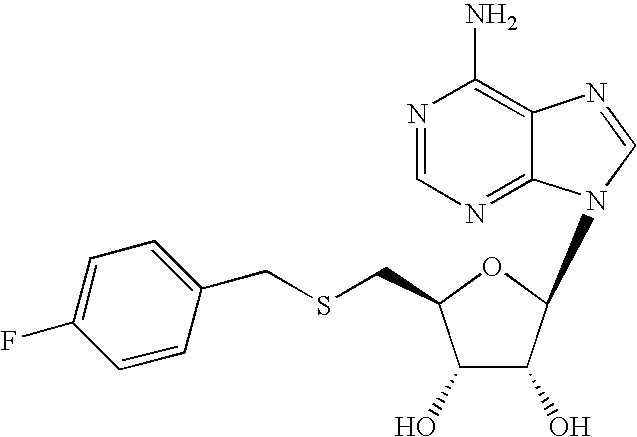
- 1H NMR (400 MHz, MeOD) δ ppm 2.67 (m, 1 H) 3.63 (m, 2 H) 4.08 (m, 1 H) 4.24 (m, J=5.18, 5.18 Hz, 1 H) 4.66 (m, J=4.93, 4.93 Hz, 1 H) 5.90 (d, J=4.55 Hz, 1 H) 6.85 (t, J=8.72 Hz, 2 H) 7.13 (m, 2 H) 7.88 (s, 1 H) 8.09 (s, 1 H) 8.19 (s, 1 H). MS for C17H18FN5O3S (MW:391), m/e 392 (MH+). Anal. Calcd for C17H19FN5O3S.0.6MeOH C: 51.47, H: 5.01, N: 17.06. Found C: 51.56, H: 5.50, N: 17.21.
- (2S,3R,4R,5R)-2-(6-Amino-purin-9-yl)-5-(thiophen-2-ylmethylsulfanylmethyl)-tetrahydro-furan-3,4-diol

- 1H NMR (400 MHz, CD3OD) δ ppm 1.08 (t, J=7.1 Hz, 1 H) 2.74 (dd, J=14.3, 6.2 Hz, 1 H) 2.83 (m, 1 H) 3.51 (q, J=7.1 Hz, 1 H) 3.88 (q, J=14.4 Hz, 2 H) 4.10 (q, J=5.3 Hz, 1 H) 4.23 (t, J=5.2 Hz, 1 H) 4.66 (t, J=5.1 Hz, 1 H) 5.89 (d, J=4.8 Hz, 1 H) 6.75 (m, 2 H) 7.14 (dd, J=4.7, 1.6 Hz, 1 H) 8.09 (s, 1 H) 8.19 (s, 1 H). HRMS for C15H17N5O3S (MW:379.46), m/e 380.086 (MH+). Anal. Calcd for C15H17N5O3S.0.4H2O.0.4HOAc C: 46.21, H: 4.76, N: 17.05. Found C: 46.19, H: 4.51, N: 16.92.
- (2S,3R,4R,5R)-2-(6-Amino-purin-9-yl)-5-cyclopentylsulfanylmethyl-tetrahydro-furan-3,4-diol

- 1H NMR (400 MHz, DMSO-d6) δ ppm 1.41 (m, 2 H) 1.47 (m, 2 H) 1.63 (m, 2 H) 1.89 (m, 2 H) 2.82 (dd, J=13.8, 7.0 Hz, 1 H) 2.93 (m, 1 H) 3.13 (m, 1 H) 4.02 (m, 1 H) 4.15 (m, 1 H) 4.77 (q, J=5.7 Hz, 1 H) 5.32 (d, J=5.1 Hz, 1 H) 5.50 (d, J=6.3 Hz, 1 H) 5.89 (d, J=5.8 Hz, 1 H) 7.30 (s, 2 H) 8.15 (s, 1 H) 8.36 (s, 1 H) MS for C15H21N5O3S (MW:351), m/e 352 (MH+). Anal. Calcd for C15H21N5O3S.0.3H2O C: 50.49, H: 6.10, N: 19.63. Found C: 50.46, H: 6.17, N: 19.50.
- (2S,3R,4R,5R)-2-(6-Amino-purin-9-yl)-5-(3-phenyl-propylsufanylmethyl-tetrahydro-furan-3,4-diol

- 1H NMR (400 MHz, CD3OD) δ ppm 1.74 (m, 2 H) 2.44 (m, 2 H) 2.52 (m, 2 H) 2.83 (m, 4 H) 4.09 (q, J=5.5 Hz, 1 H) 4.23 (t, J=5.1 Hz, 1 H) 4.69 (t, J=5.2 Hz, 1 H) 5.89 (d, J=5.1 Hz, 1 H) 7.01 (m, 3 H) 7.11 (t, J=7.3 Hz, 2 H) 8.10 (s, 1 H) 8.21 (s, 1 H). HRMS for C19H23N5O3S (MW:401.15) m/e 402.1617 (MH+). Anal. Calcd for C19H23N5O3S.0.1CH3COOH C: 56.59, H: 5.78, N: 17.19. Found C: 56.50, H: 5.76, N: 17.22.
- (2R,3R,4S,5S)-2-(6-amino-9H-purin-9-yl)-5-{[(2-methylphenyl)thio]methyl}tetrahydrofuran-3,4-diol

- 1H NR (DMSO-d6) δ: 8.16 (1H, s), 7.95 (1H, s), 7.15 (1H, d, J=6.82 Hz), 7.11 (2H s) 7.01−6.88 (3H, m) 5.70 (1H, d, J=6.1 Hz), 5.34 (1H, d, J=6.1 Hz), 5.20 (1H, d, J=5.1 Hz), 4.64 (1H, J=5.8 Hz), 4.02 (1H, q, J=4.8 Hz), 3.83−3.78 (1H, m), 3.20 (1H, dd, J=13.6 and 6.1 Hz), 3.08 (1H, dd, J=13.6 and 7.3 Hz), 2.08 (3H, s). LRMS (m/z) 374 (M+H)+.
- Combinatorial Libraries of MTAP Substrates
- Combinatorial libraries of thiol derivatives off the 5′ position of the adenosine were made as follows.

- To a solution of the thiol in DMF (1.5 equiv.) was added a solution of alkyl mercaptan in DMF (1.0 equiv.) followed by the addition of a potassium t-butoxide solution in THF (1.5 equiv.). The mixture was heated to 55° C. for 12 h. The solvents were removed, and the residues were reconstituted in DMSO. Purification by HPLC afforded purified products (3-68% yield) as shown in Table 9 below.
TABLE 9 Library compounds of thiol derivatives off the 5′ position of the adenosine ring. m/z MT- MT- Example [MW + A— A— Number Name Stucture MW 1] 10 50 2(G)(1) (2R, 3R, 4S, 5S)-2-(6- amino-9H-purin-9-yl)-5- ({[2-(1, 4, 5, 6- tetrahydropyrimidin-2- yl)phenyl]thio}methyl)- tetrahydrofuran-3,4-diol 
441.51 443 8 23 2(G)(2) (2R, 3R, 4S, 5S)-2-(6- amino-9H-purin-9-yl)-5- {[(2-amino- phenyl)thio]methyl}tetrahydrofuran-3,4-diol 
374.42 375 3 5 2(G)(3) (2R, 3R, 4S, 5S)-2-(6- amino-9H-purin-9-yl)-5- {[(2-amino-7H-purin-6- yl)thio]methyl}tetrahydro- furan-3,4-diol 
416.42 417 46 45 2(G)(4) 2-({[(2S, 3S, 4R, 5R)-5-(6- amino-9H-purin-9-yl)- dihydroxytetrahydrofuran- 2-yl]methyl}thio)-5- ethylpyrimidin-4(3H)-one 
405.44 406 38 49 2(G)(5) (2R, 3R, 4S, 5S)-2-(6- amino-9H-purin-9-yl)-5- {[(5-chloro-1H- yl)thio]methyl}tetrahydro- furan-3,4-diol 
433.88 434/ 436 5 2 2(G)(6) (2R, 3R, 4S, 5S)-2-(6- amino-9H-purin-9-yl)-5- {[(1-methyl-1H-tetrazol- 5-yl)thio]methyl}tetra- hydrofuran-3,4-diol 
365.38 366 46 47 2(G)(7) (2R, 3R, 4S, 5S)-2-(6- amino-9H-purin-9-yl)-5- ({[5-(propylthio)-1H- benzimidazol-2- yl]thio}methyl)tetrahydro- furan-3,4-diol 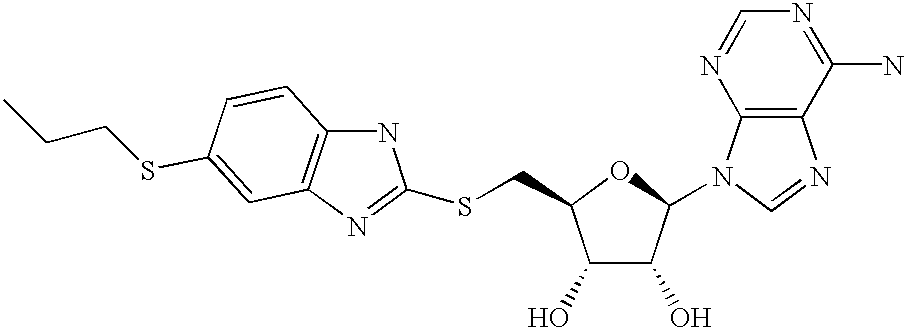
473.58 475 3 0 2(G)(8) (2R, 3R, 4S, 5S)-2-(6- amino-9H-purin-9-yl)-5- [(pyrimidin-2- ylthio)methyl]tetrahydro- furan-3,4-diol 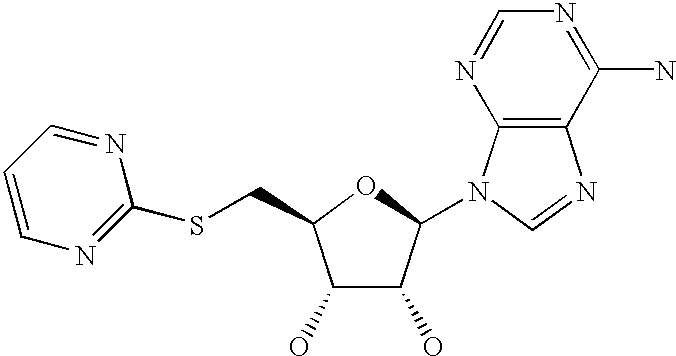
361.38 362 54 59 2(G)(9) (2R, 3R, 4S, 5S)-2-(6- amino-9H-purin-9-yl)-5- {[(5-amino-1,3,4- thiadiazol-2- yl)thio]methyl}tetrahydro- furan-3,4-diol 382.43 383 34 47 2(G)(10) (2R, 3R, 4S, 5S)-2-(6- amino-9H-purin-9-yl)-5- {[(4- aminophenyl)thio]methyl]- tetrahydrofuran-3,4- diol 
374.42 375 20 19 2(G)(11) (2R, 3R, 4S, 5S)-2-(6- amino-9H-purin-9-yl)-5- {[(5-chloro-1,3- benzothiazol-2- yl)thio]methyl}tetrahydro- furan-3,4-diol 
450.93 451/ 453 22 25 2(G)(12) (2R, 3R, 4S, 5S)-2-(6- amino-9H-purin-9-yl)-5- [(1,3-benzothiazol-2- ylthio)methyl]tetrahydro- furan-3,4-diol 
416.48 417 24 25 2(G)(13) N-[4-({[(2S, 3S, 4R, 5R)-5- (6-amino-9H-purin-9-yl)- dihydroxytetrahydro- furan-2-yl]methyl}thio)phenyl]acetamide 
416.46 417 19 17 2(G)(14) (2R, 3R, 4S, 5S)-2-(6- amino-9H-purin-9-yl)-5- {[(4-hydroxyphenyl)-thio]- methyl}tetrahydrofuran- 3,4-diol 
375.41 376 16 51 2(G)(15) (2R, 3R, 4S, 5S)-2-(6- amino-9H-purin-9-yl)-5- {[(2-naphthylthio)methyl]- tetrahydrofuran-3,4-diol 
409.47 410 29 25 2(G)(16) (2R, 3R, 4S, 5S)-2-(6- amino-9H-purin-9-yl)-5- {[(4-methoxybenzyl)- thio]methyl}tetrahydro- furan-3,4-diol 
403.46 404 59 60 2(G)(17) (2R, 3R, 4S, 5S)-2-(6- amino-9H-purin-9-yl)-5- {[(4-bromophenyl)- thio]methyl}tetrahydro- furan-3,4-diol 
438.30 438/ 440 21 17 2(G)(18) (2R, 3R, 4S, 5S)-2-(6- amino-9H-purin-9-yl)-5- [(1-naphthylthio)methyl]tetrahydrofuran-3,4-diol 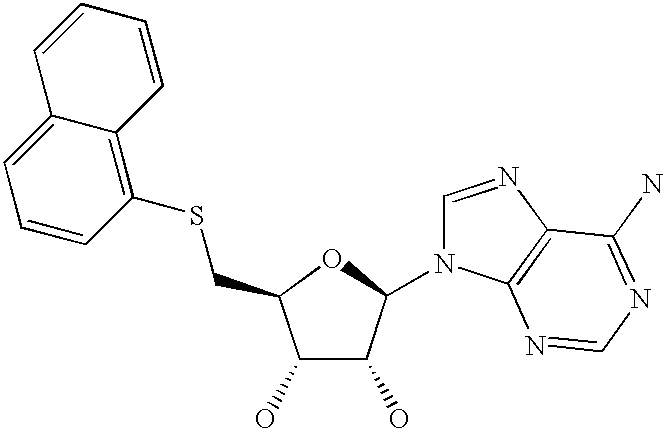
409.47 410 5 4 2(G)(19) (2R, 3R, 4S, 5S)-2-(6- amino-9H-purin-9-yl)-5- {[(4-chlorophenyl)thio]- methyl}tetrahydro- furan-3,4-diol 
393.85 394/ 396 19 17 2(G)(20) methyl 4- ({[(2S, 3S, 4R, 5R)-5-(6- amino-9H-purin-9-yl)-5- 3,4-dihydroxytetrahydro- furan-2-yl]methyl}thio)benzoate 
417.44 418 7 5 2(G)(21) (2R, 3R, 4S, 5S)-2-(6- amino-9H-purin-9-yl)-5- {[(4-tert- butylphenyl)thio]methyl}tetrahydrofuran-3,4-diol 
415.52 417 12 9 2(G)(22) (2R, 3R, 4S, 5S)-2-(6- amino-9H-purin-9-yl)-5- {[(2,6-dimethylphenyl)- thio]methyl}tetrahydro- furan-3,4-diol 
387.46 388 3 15 2(G)(23) (2R, 3R, 4S, 5S)-2-(6- amino-9H-purin-9-yl)-5- {[(4-fluorophenyl)- thio]methyl}tetra- hydrafuran-3,4-diol 
377.40 378 21 31 2(G)(24) (2R, 3R, 4S, 5S)-2-(6- amino-9H-purin-9-yl)-5- {[(2,5-dimethoxy- phenyl)-thio]methyl}tetrahydrofuran- 3,4-diol 
419.46 420 4 23 2(G)(25) (2R, 3R, 4S, 5S)-2-(6- amino-9H-purin-9-yl)-5- {[(3,4-dimethoxyphenyl)- thio]methyl}tetrahydro- furan-3,4-diol 
419.46 420 5 30 2(G)(26) (2R, 3R, 4S, 5S)-2-(6- amino-9H-purin-9-yl)-5- {[(2-ethylphenyl)- thio]methyl}tetrahydro- furan-3,4-diol 
387.46 388 6 7 2(G)(27) (2R, 3R, 4S, 5S)-2-(6- amino-9H-purin-9-yl)-5- {[(2-hydroxyphenyl)- thio]methyl}tetrahydro- furan-3,4-diol 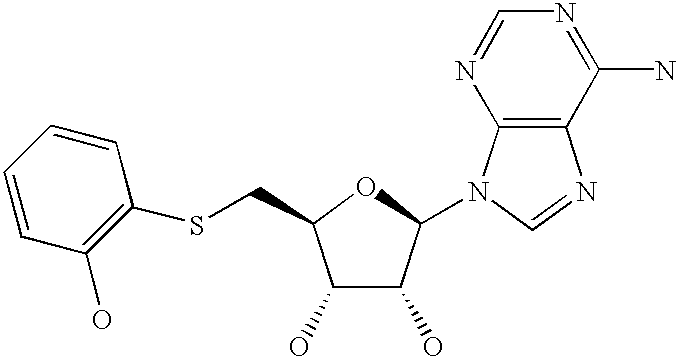
375.41 376 7 23 2(G)(28) (2R, 3R, 4S, 5S)-2-(6- amino-9H-purin-9-yl)-5- {[2,5-dimethylphenyl)- thio]methyl}tetrahydro- furan-3,4-diol 
387.46 388 6 4 2(G)(29) (2R, 3R, 4S, 5S)-2-(6- amino-9H-purin-9-yl)-5- {[(3-bromophenyl)- thio]methyl}tetrahydro- furan-3,4-diol 
438.30 438/ 440 21 19 2(G)(30) (2R, 3R, 4S, 5S)-2-(6- amino-9H-purin-9-yl)-5- ({[5-(prop-2-yn-1-ylthio)- 1,3,4-thiodiazol-2- yl]thio}methyl)tetra- hydrofuran-3,4-diol 
437.53 439 11 12 2(G)(31) (2R, 3R, 4S, 5S)-2-(6- amino-9H-purin-9-yl)-5- {[(5-hydroxy-4-methyl- 4H-1,2,4-triazol-3-yl)- thio]methyl}tetrahydro- furan-3,4-diol 
380.39 381 46 50 2(G)(32) (2R, 3R, 4S, 5S)-2-(6- amino-9H-purin-9-yl)-5- {[(5,7-dimethyl[1,2,4]- triazolo[1,5-a]pyrimidin- 2-yl)thio]methyl}tetra- hydrofuran-3,4-diol 
429.46 430 6 7 2(G)(33) (2R, 3R, 4S, 5S)-2-(6- amino-9H-purin-9-yl)-5- ({[4-(trifluoromethyl)-pyr- imidin-2-yl]thio}methyl)- tetrahydrofuran-3,4-diol 
429.38 430 28 36 2(G)(34) (2R, 3R, 4S, 5S)-2-(6- amino-9H-purin-9-yl)-5- {[(5-tert-butyl-2-methyl- phenyl)thio]methyl}- tetrahydrofuran-3,4-diol 
429.54 431 2 3 2(G)(35) (2R, 3R, 4S, 5S)-2-(6- amino-9H-purin-9-yl)-5- {[(4-isopropylphenyl)- thio]methyl}tetrahydro- furan-3,4-diol 
401.49 402 15 11 2(G)(36) ethyl 4-amino-2- ({](2S, 3S, 4R, 5R)-5-(6- amino-9H-purin-9-yl)- 3-4-dihydroxytetrahydro- furan-2-yl]methyl}thio)- pyrimidine-5-carboxylate 
448.46 449 35 40 2(G)(37) (2R, 3R, 4S, 5S)-2-(6- amino-9H-purin-9-yl)-5- {[(2-methyl-3- furyl)thio]methyl}tetra- hydrofuran-3,4-diol 
363.40 364 10 26 2(G)(38) (2R, 3R, 4S, 5S)-2-(6- amino-9H-purin-9-yl)-5- {[(2,2,2-trifluoroethyl)- thio]methyl}tetrahydro- furan-3,4-diol 
365.34 366 30 32 2(G)(39) tert-butyl [2- ({[(2S, 3S, 4R, 5R)-5-(6- amino-9H-purin-9-yl)- 3,4-dihydroxytetrahydro- furan-2-yl]methyl}thio)- ethyl]carbamate 
426.50 427 7 8 2(G)(40) 7-({[(2S, 3S, 4R, 5R)-5-(6- amino-9H-purin-9-yl)- 3,4-dihydroxytetrahydro- furan-2-yl]methyl}thio)- 4-methyl-2H-chromen- 2-one 
441.47 442 6 10 2(G)(41) (2R, 3R, 4S, 5S)-2-(6- amino-9H-purin-9-yl)-5- ({[3-chloro-5- (trifluoromethyl)pyridin- yl]thio}methyl)tetra- hydrofuran-3,4-diol 
462.84 463/ 465 7 7 2(G)(42) (2R, 3R, 4S, 5S)-2-(6- amino-9H-purin-9-yl)-5- [(quinolin-2-ylthio)methyl]- tetrahydrofuran-3,4-diol 
410.46 411 38 47 2(G)(43) 2-({[(2S, 3S, 4R, 5R)-5-(6- amino-9H-purin-9-yl)- dihydroxytetrahydro- furan-2-yl]methyl}thio)- 4,6-dimethylnicotino- nitrile 
413.46 414 5 7 2(G)(44) (2R, 3R, 4S, 5S)-2-(6- amino-9H-purin-9-yl)-5- [(allythio)methyl]tetra- hydrofuran-3,4-diol 
323.38 324 77 82 2(G)(45) (2R, 3R, 4S, 5S)-2-(6- amino-9H-purin-9-yl)-5- [(isopropylthio)methyl]- tetrahydrofuran-3,4-diol 
325.39 326 53 57 2(G)(46) (2R, 3R, 4S, 5S)-2-(6- amino-9H-purin-9-yl)-5- {[(4-methyl-1H- benzimidazol-2-yl)- thio]methyl}tetrahydro- furan-3,4-diol 
413.46 414 42 45 2(G)(47) (2R, 3R, 4S, 5S)-2-(6- amino-9H-purin-9-yl)-5- [(1H-imidazo[4,5-c]- pyridin-2-ylthio)methyl]- tetrahydrofuran-3,4-diol 
400.42 401 49 50 2(G)(48) (2R, 3R, 4S, 5S)-2-(6- amino-9H-purin-9-yl)-5- {[(5-methyl-1H- benzimidazol-2-yl)thio]- methyl}tetrahydro- furan-3,4-diol 
413.46 414 3 5 2(G)(49) (2R, 3R, 4S, 5S)-2-(6- amino-9H-purin-9-yl)-5- {[(4-hydroxy-1H- pyrazolo[3,4-d]pyrimidin-6- yl)thio]methyl}tetra- hydrofuran-3,4-diol 
417.41 418 52 46 2(G)(50) 2-({[(2S, 3S, 4R, 5R)-2-(6- amino-9H-purin-9-yl)- dihydroxytetrahydro- furan-2-yl]methyl}thio)- quinazolin-4-(3H)-one 
427.44 428 9 37 2(G)(51) (2R, 3R, 4S, 5S)-2-(6- amino-9H-purin-9-yl)-5- {[(5-amino-1H- benzoimidazol-2- yl)thio]methyl}tetrahydro- furan-3,4-diol 
414.45 415 16 36 2(G)(52) (2R, 3R, 4S, 5S)-2-(6- amino-9H-purin-9-yl)-5- {[(5-methyl-1,3,4- thiadiazol-2- yl)thio]methyl}tetrahydro- furan-3,4-diol 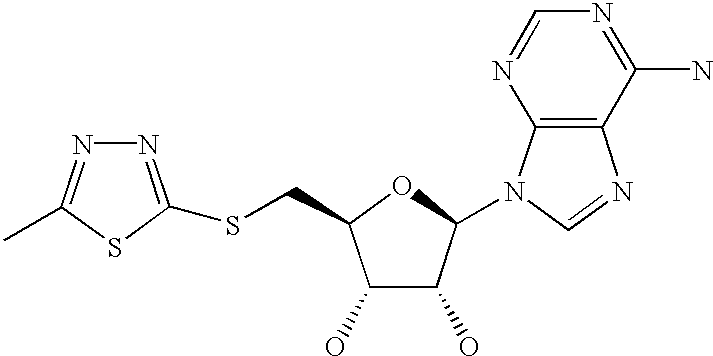
381.44 382 19 23 2(G)(53) (2R, 3R, 4S, 5S)-2-(6- amino-9H-purin-9-yl)-5- [(1H-1,2,4-triazol-3- ylthio)methyl]tetrahydro- furan-3,4-diol 
350.36 351 58 57 2(G)(54) methyl ({[(2S, 3S, 4R, 5R)- 5-(6-amino-9H-purin-9- yl)-3,4-dihydroxy- tetrahydrofuran-2- yl]methyl}thio)acetate 
355.37 356 36 44 2(G)(55) (2R, 3R, 4S, 5S)-2-(6- amino-9H-purin-9-yl)-5- {[(4-amino-1,3,5-triazin- 2-yl)thio]methyl}tetra- hydrofuran-3,4-diol 
377.39 378 43 47 2(G)(56) 2-({[(2S, 3S, 4R, 5R)-5-(6- amino-9H-purin-9-yl)- dihydroxytetrahydro furan-2-yl]methyl}thio)- N-methylacetamide 
354.39 355 6 10 2(G)(57) (2R, 3R, 4S, 5S)-2-(6- amino-9H-purin-9-yl)-5- hydroybutyl)thio]methyl}tetrahydrofuran-3,4- diol 
355.42 356 31 45 2(G)(58) (2R, 3R, 4S, 5S)-2-(6- amino-9H-purin-9-yl)-5- {[(2-pyridin-4- ylethyl)thio]methyl}tetra- hydrofuran-3,4-diol 
388.45 389 38 47 2(G)(59) (2R, 3R, 4S, 5S)-2-(6- amino-9H-purin-9-yl)-5- {[(3-aminopyridin-2- yl)thio]methyl}tetra- hydrofuran-3,4-diol 
375.41 376 18 47 2(G)(60) 2-({[(2S, 3S, 4R, 5R)-5-(6- amino-9H-purin-9-yl)- 3,4-dihydroxytetrahydro- furan-2-yl]methyl}thio)- nicotinamide 
403.42 404 4 8 2(G)(61) (2R, 3R, 4S, 5S)-2-(6- amino-9H-purin-9-yl)-5- {](2-pyrazin-2- ylethyl)thio]methyl}tetra- hydrofuran-3,4-diol 
389.44 390 15 20 2(G)(62) (2R, 3R, 4S, 5S)-2-(6- amino-9H-purin-9-yl)-5- {[(2-methyltetra- hydrofuran-3-yl)thio]methyl}tetrahydrofuran- 3,4-diol 
367.43 368 6 7 2(G)(63) (2R, 3R, 4S, 5S)-2-(6- amino-9H-purin-9-yl)-5- ({[5-(hydroxymethyl)-1- methyl-1H-imidazol-2- yl]thio}methyl)tetra- hydrofuran-3,4-diol 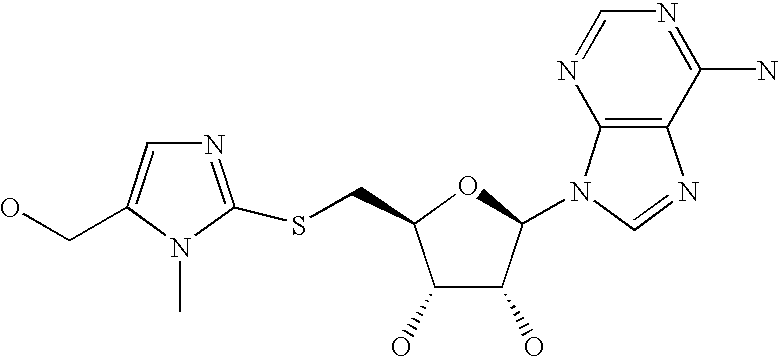
393.43 394 5 5 2(G)(64) (2R, 3R, 4S, 5S)-2-(6- amino-9H-purin-9-yl)-5- {[(4-hydroxy-7H- pyrrolo[2,3-d]pyrimidin- 2-yl)thio]methyl}tetra- hydrofuran-3,4-diol 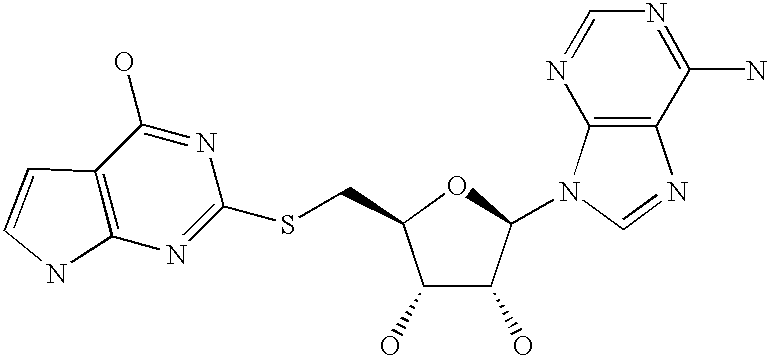
416.62 417 48 48 2(G)(65) (2R, 3R, 4S, 5S)-2-(6- amino-9H-purin-9-yl)-5- {[(5-hydroxy-4- isopropyl-4H-1,2,4- triazol-3-yl)thio]methyl}tetrahydrofuran-3,4-diol 
408.44 409 5 4 2(G)(66) (2R, 3R, 4S, 5S)-2-(6- amino-9H-purin-9-yl)-5- [({5-[(dimethylamino)- methyl]-4-methyl-4H- 1,2,4-triazol-3-yl}thio)methyl]tetrahydro- furan-3,4-diol 
421.48 422 6 6 2(G)(67) (2R, 3R, 4S, 5S)-2-(6- amino-9H-purin-9-yl)-5- {[(4,5-dimethyl-4H- 1,2,4-triazol-3- yl)thio]methyl}tetra- hydrofuran-3,4-diol 
378.42 379 45 47 2(G)(68) (2R, 3R, 4S, 5S)-2-(6- amino-9H-purin-9-yl)-5- [(sec- butylthio)methyl]tetra- hydrofuran-3,4-diol 
339.42 340 42 45 2(G)(69) (2R, 3R, 4S, 5S)-2-(6- amino-9H-purin-9-yl)-5- [(pyrazin-2- ylthio)methyl]tetrahydro- furan-3,4-diol 
361.38 362 31 40 2(G)(70) (2R, 3R, 4S, 5S)-2-(6- amino-9H-purin-9-yl)-5- {[(2-bromophenyl)- thio]methyl}tetrahydro- furan-3,4-diol 
438.30 438/ 440 6 3 2(G)(71) (2R, 3R, 4S, 5S)-2-(6- amino-9H-purin-9-yl)-5- {[(2-methylbutyl)- thio]methyl}tetrahydro- furan-3,4-diol 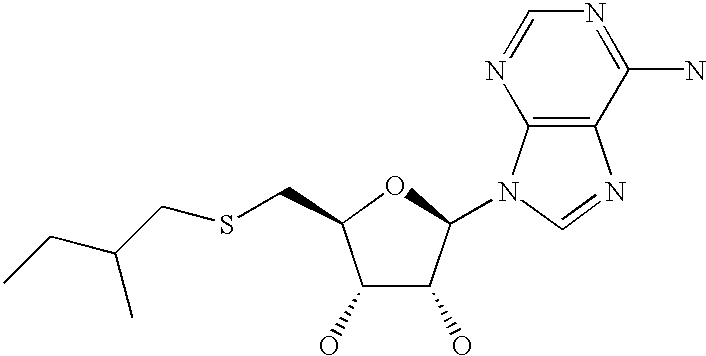
353.45 354 77 73 2(G)(72) (2R, 3R, 4S, 5S)-2-(6- amino-9H-purin-9-yl)-5- {[(3-aminophenyl)thio]- methyl}tetrahydrofuran- 3,4-diol 
374.42 375 33 38 2(G)(73) (2R, 3R, 4S, 5S)-2-(6- amino-9H-purin-9-yl)-5- {[(2-chlorobenzyl)thio]- methyl}tetrahydrofuran- 3,4-diol 
407.88 408/ 410 30 21 2(G)(74) (2R, 3R, 4S, 5S)-2-(6- amino-9H-purin-9-yl)-5- ({[3-(trifluoromethyl)- benzylthio}methyl)tetra- hydrofuran-3,4-diol 
441.43 442 23 22 2(G)(75) (2R, 3R, 4S, 5S)-2-(6- amino-9H-purin-9-yl)-5- hydroxypropyl)thio]- methyl}tetrahydrofuran- 3,4-diol 
341.39 342 32 39 2(G)(76) (2R, 3R, 4S, 5S)-2-(6- amino-9H-purin-9-yl)-5- {[(2,4-dichlorobenzyl)- thio]methyl}tetrahydro- furan-3,4-diol 
442.33 442/ 444/ 446 14 11 2(G)(77) (2R, 3R, 4S, 5S)-2-(6- amino-9H-purin-9-yl)-5- hydroxyethyl)butyl]thio}methyl)tetrahydrofuran- 3,4-diol 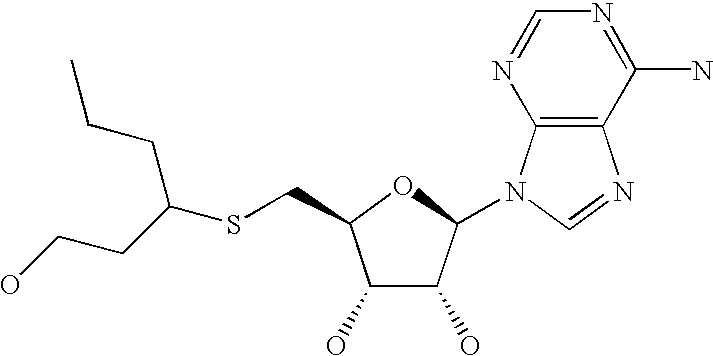
383.47 384 3 6 2(G)(78) (2R, 3P, 4S, 5S)-2-(6- amino-9H-purin-9-yl)-5- hydroxyhexyl)thio]methyl}tetrahydrofuran-3,4-diol 
383.47 384 3 6 2(G)(79) (2R, 3R, 4S, 5S)-2-(6- amino-9H-purin-9-yl)-5- {[(4-methyl-1,3-thiozol- 2-yl)thio]methyl}tetrahydrofuran-3,4-diol 
380.45 381 38 45 2(G)(80) (2R, 3R, 4S, 5S)-2-(6- amino-9H-purin-9-yl)-5- ethylphenyl)thio]methyl}tetrahydrofuran-3,4-diol 
387.46 388 13 15 2(G)(81) (2R, 3R, 4S, 5S)-2-(6- amino-9H-purin-9-yl)-5- ({[2-(1H-indol-3- yl)ethyl]thio}methyl)- tetrahydrofuran-3,4-diol 
426.50 427 18 18 2(G)(82) (2R, 3R, 4S, 5S)-2-(6- amino-9H-purin-9-yl)-5- ({[2-(trifluoromethyl)- phenyl]thio}methyl)tetra- hydrofuran-3,4-diol 
427.41 428 1 1 2(G)(83) (2R, 3R, 4S, 5S)-2-(6- amino-9H-purin-9-yl)-5- {[(2,4-dimethoxybenzyl)- thio]methyl}tetrahydro- furan-3,4-diol 
433.49 434 5 8 2(G)(84) (2R, 3R, 4S, 5S)-2-(6- amino-9H-purin-9-yl)-5- dimethylphenyl)thio]- methyl}tetrahydrofuran- 3,4-diol 
402.48 403 4 5 2(G)(85) (2R, 3R, 4S, 5S)-2-(6- amino-9H-purin-9-yl)-5- [([1,3]thiozolo[5,4- b]pyridin-2-ylthio)- methyl]tetrahydrofuran- 3,4-diol 
417.47 418 10 2 2(G)(86) (2R, 3R, 4S, 5S)-2-(6- amino-9H-purin-9-yl)-5- {[(5-methoxy-1,3- benzothiozol-2-yl)thio]- methyl}tetrahydro- furan-3,4-diol 
446.51 448 31 33 2(G)(87) (2R, 3R, 4S, 5S)-2-(6- amino-9H-purin-9-yl)-5- [(2-thienylthio)methyl]- tetrahydrofuran-3,4-diol 
365.44 366 36 33 2(G)(88) ethyl ({[(2S, 3S, 4R, 5R)-5- (6-amino-9H-purin-9-yl)- 3,4-dihydroxytetrahydro- furan-2-yl]methyl}thio)acetate 
369.40 370 25 33 2(G)(89) 2-({[(2S, 3S, 4R, 5R)-5-(6- amino-9H-purin-9-yl)- 3,4-dihydroxytetrahydro- furan-2-yl]methyl}thio)nicotinonitrile 
385.41 386 3 5 2(G)(90) 3-({[(2S, 3S, 4R, 5R)-5-(6- amino-9H-purin-9-yl)- 3,4-dihydroxytetrahydro- furan-2-yl]methyl}thio)benzoic acid 
403.42 404 3 8 2(G)(91) (2R, 3R, 4S, 5S)-2-(6- amino-9H-purin-9-yl)-5- {[(2-nitrophenyl)thio]- methyl}tetrahydrofuran- 3,4-diol 
404.41 405 5 5 2(G)(92) methyl 3-({[(2S, 3S, 4R, 5R)-5-(6-amino-9H-purin- 9-yl)-dihydroxytetra- hydrofuran-2-yl]- methyl}thio)propanoate 
369.40 370 27 36 2(G)(93) (2R, 3R, 4S, 5S)-2-(6- amino-9H-purin-9-yl)-5- {[(1-benzothien-3- ylmethyl)thio]methyl}tetrahydrofuran-3,4-diol 
429.52 431 18 17 2(G)(94) (2R, 3R, 4S, 5S)-2-(6- amino-9H-purin-9-yl)-5- ({[3-(2-phenylethyl)- pyrazin-2-yl]thio}methyl)tetrahydrofuran- 3,4-diol 
465.54 467 5 5 2(G)(95) 4-({[(2S, 3S, 4R, 5R)-5-(6- amino-9H-purin-9-yl)- 3,4-dihydroxytetrahydro- furan-2-yl]methyl}thio)- benzoic acid 
403.42 404 7 7 2(G)(96) (2R, 3R, 4S, 5S)-2-(6- amino-9H-purin-9-yl)-5- {((2-chlorophenyl)thio]- methyl}tetrahydrofuran- 3,4-diol 
393.85 394/ 396 5 6 2(G)(97) (2R, 3R, 4S, 5S)-2-(6- amino-9H-purin-9-yl)-5- {[(2,5-dichlorophenyl)- thio]methyl}tetrahydro- furan-3,4-diol 
428.30 428/ 430/ 432 5 6 2(G)(98) (2R, 3R, 4S, 5S)-2-(6- amino-9H-purin-9-yl)-5- {[(3-chlorophenyl)thio]- methyl}tetrahydrofuran- 3,4-diol 
393.85 394/ 396 20 18 2(G)(99) (2R, 3R,4S, 5S)-2-(6- amino-9H-purin-9-yl)-5- ({[3-(trifluoromethyl)- phenyl]thio}methyl)- tetrahydrofuran-3,4-diol 
427.41 428 17 18 2(G)(100) (2R, 3R, 4S, 5S)-2-(6- amino-9H-purin-9-yl)-5- {[(3-methylpyrazin-2- yl)thio]methyl}tetrahydro- furan-3,4-diol 
375.41 376 7 10 2(G)(101) (2R, 3R, 4S, 5S)-2-(6- amino-9H-purin-9-yl)-5- {[(3-hydroxyphenyl)- thio]methyl}tetrahydro- furan-3,4-diol 
375.41 376 36 38 2(G)(102) (2R, 3R, 4S, 5S)-2-(6- amino-9H-purin-9-yl)-5- {[(2,6-dichIorophenyl)- thio]methyl}tetrahydro- furan-3,4-diol 
428.30 428/ 430/ 432 2 3 2(G)(103) (2R, 3R, 4S, 5S)-2-(6- amino-9H-purin-9-yl)-5- ({[2-nitro-4- (trifluoromethyl)phenyl]thio}methyl)tetrahydro- furan-3,4-diol 
472.40 473 3 4 2(G)(104) 2-({[(2S, 3S, 4R, 5R)-5- (6-amino-9H-purin-9-yl)- 3,4-dihydroxytetrahydro- furan-2-yl]methyl}thio)- N-phenylacetamide 
416.46 417 5 15 2(G)(105) (2R, 3R, 4S, 5S)-2-(6- amino-9H-purin-9-yl)-5- {[(5-nitropyridin-2- yl)thio]methyl}tetrahydro- furan-3,4-diol 
405.39 406 17 21 2(G)(106) (2R, 3R, 4S, 5S)-2-(6- amino-9H-purin-9-yl)-5- [(1H-indol-3-ylthio)- methyl]-tetrahydrofuran- 3,4-diol 
398.45 399 6 3 2(G)(107) methyl 2-({[(2S, 3S, 4R, 5R)-5-(6-amino-9H-purin- 9-yl)-3,4-dihydroxy- tetrahydrofuran-2-yl]- methyl}thio)- benzoate 
417.44 418 4 2 2(G)(108) (2E)-3-[4-({[(2S, 3S, 4R, 5R)-5-(6-amino-9H-purin- 9-yl)-3,4-dihydroxytetra- hydrofuran-2-yl]methyl}thio)phenyl]acrylic acid 
429.46 430 8 19 2(G)(109) methyl 3-({[(2S, 3S, 4R, 5R)-5-(6-amino-9H-purin- 9-yl)-1,3,4-dihydroxytetra- hydrofuran-2-yl]methyl}thio)benzoate 
417.44 418 8 8 2(G)(110) methyl (2E)-3-[4-({[(2S, 3S, 4R, 5R)-5-(6-amino- 9H-purin-9-yl)-dihydroxy- tetrahydrofuran-2-yl]- methyl}thio)phenyl]- acrylate 
443.48 444 15 9 2(G)(111) (2R, 3R, 4S, 5S)-2-(6- amino-9H-purin-9-yl)-5- ({[5-(3-methoxyphenyl)- 4-methyl-4H-1,2,4- triazol-3-yl]thio}- methyl)tetrahydrofuran- 3,4-diol 
470.51 472 8 4 2(G)(112) (2R, 3R, 4S, 5S)-2-(6- amino-9H-purin-9-yl)-5- ({[4-(2-furyl)pyrimidin-2- yl]thio}methyl)tetrahydro- furan-3,4-diol 
427.44 428 17 10 2(G)(113) (2R, 3R, 4S, 5S)-2-(6- amino-9H-purin-9-yl)-5- {[(1-methyl-1H- benzimidazol-2-yl)thio]- methyl}tetrahydro- furan-3,4-diol 
413.46 414 48 43 2(G)(114) N-[2-({[(2S, 3S, 4R, 5R)-5-(6-amino-9H-purin- 9-yl)-3,4-dihydroxytetra- hydrofuran-2-yl]methyl}thio)ethyl]acetamide 
368.42 369 29 11 2(G)(115) (2R, 3R, 4S, 5S)-2-(6- amino-9H-purin-9-yl)-5- ({[4-(methylthio)phenyl]- thio}methyl)tetrahydro- furan-3,4-diol 
405.50 407 12 15 2(G)(116) (2R, 3R, 4S, 5S)-2-(6- amino-9H-purin-9-yl)-5- ({[2-(trifluoromethoxy)- phenyl]thio}methyl)tetra- hydrofuran-3,4-diol 
443.40 444 3 7 2(G)(117) (2R, 3R, 4S, 5S)-2-(6- amino-9H-purin-9-yl)- 5-{[(2-fluorophenyl)thio)- methyl}tetrahydrofuran- 3,4-diol 
377.41 378 25 28 2(G)(118) (2R, 3R, 4S, 5S)-2-(6- amino-9H-purin-9-yl)- 5-{[(5-methoxy-1H- benzimidazol-2-yl)thio]methyl}tetrahydrofuran- 3,4-diol 
429.47 430 2.5 2.5 2(G)(119) (2R, 3R, 4S, 5S)-2-(6- amino-9H-purin-9-yl)- 5-[(1H-benzimidazol-2- ylthio)methyl)tetrahydro- furan-3,4-diol 
399.44 400 12 26 2(G)(120) (2R, 3R, 4S, 5S)-2-(6- amino-9H-purin-9-yl)- 5-{[(1-methyl-1H-imidazol- 2-yl)thio)methyl}tetra- hydrofuran-3,4-diol 
363.41 364 1 3 2(G)(121) (2R, 3R, 4S, 5S)-2-(6- amino-9H-purin-9-yl)-5- [(nonylthio)methyl]tetra- hydrofuran-3,4-diol 
409.56 411 64.5 54.5 2(G)(122) (2R, 3R, 4S, 5S)-2-(6- amino-9H-purin-9-yl)-5- [(1,3-benzoxazol-2-ylthio)- methyl]tetrahydrofuran- 3,4-diol 
400.43 401 30.5 37 2(G)(123) (5R)-5-[({[(2S, 3S, 4R, 5R)-5-(6-amino-9H-purin- 9-yl)-3,4-dihydroxytetra- hydrofuran-2-yl)methyl}thio)methyl]imidazo- lidine-2,4-dione 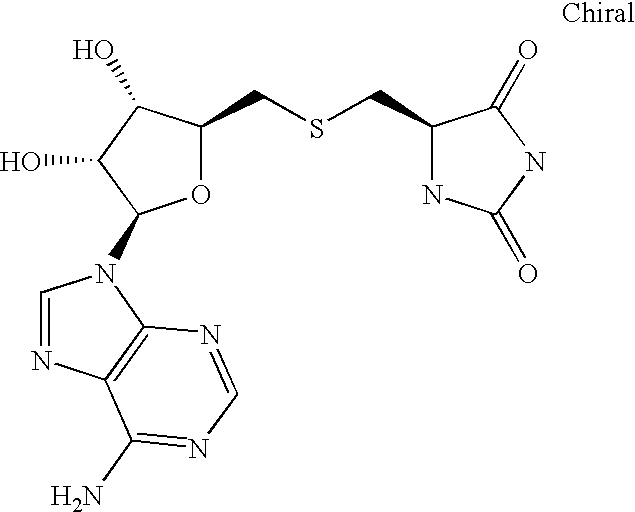
395.41 396 23 22 2(G)(124) (2R, 3R, 4S, 5S)-2-(6- amino-9H-purin-9-yl)- 5-[{(4-chlorobenzyl)thio]- methyl}tetrahydrofuran- 3,4-diol 
407.89 408/ 410 47 51 2(G)(125) (2R, 3R, 4S, 5S)-2-(6- amino-9H-purin-9-yl)- 5-[(heptylthio)methyl]- tetrahydrofuran-3,4-diol 
381.51 383 101 62.5 2(G)(126) (2R, 3R, 4S, 5S)-2-(6- amino-9H-purin-9-yl)-5- [(hexylthio)methyl]tetra- hydrofuran-3,4-diol 
367.48 368 72 67.5 2(G)(127) (2R, 3R, 4S, 5S)-2-(6- amino-9H-purin-9-yl)- 5-{[(2-fluorobenzyl)- thio]methyl}tetrahydro- furan-3,4-diol 
391.44 392 56 58.5 2(G)(128) (2R, 3R, 4S, 5S)-2-(6- amino-9H-purin-9-yl)- 5{[(3,4-dichlorophenyl)- thio]methyl}tetrahydro- furan-3,4-diol 
428.31 428/ 430/ 432 11 10.5 2(G)(129) (2R, 3R, 4S, 5S)-2-(6- amino-9H-purin-9-yl)-5- [(decylthio)methyl]tetra- hydrofuran-3,4-diol 
423.59 425 46 41.5 2(G)(130) (2R, 3R, 4S, 5S)-2-(6- amino-9H-purin-9-yl)-5- {[(2,4-dichlorophenyl)- thio]methyl}tetrahydro- furan-3,4-diol 
428.31 428/ 430/ 432 −2 4.5 2(G)(131) (2R, 3R, 4S, 5S)-2-(6- amino-9H-purin-9-yl)-5- {[(3,5-dichlorophenyl)- thio]methyl}tetrahydro- furan-3,4-diol 
428.31 428/ 430/ 432 11.5 11 2(G)(132) Ethyl 2-({[(2S, 3S, 4R, 5R)-5-(6-amino-9H-purin- 9-yl)-3,4-dihydroxytetra- hydrofuran-2-yl]methyl}thio)-1H-imidazole-4- carboxylate 
421.45 22 0 1.5 2(G)(133) Butyl ({[(2S, 3S, 4R, 5R)- 5-(6-amino-9H-purin-9- yl)-3,4-dihydroxytetra- hydrofuran-2-yl]methyl}- thio)acetate 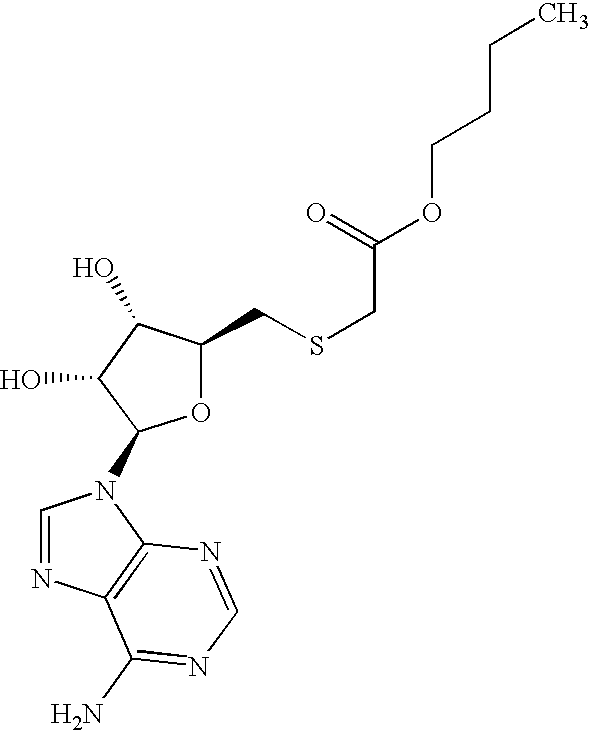
397.47 398 22.5 31.5 2(G)(134) (2R, 3R, 4S, 5S)-2-(6- amino-9H-purin-9-yl)- 5-[(7H-purin-6-ylthio)- methyl)tetrahydrofuran- 3,4-diol 
401.42 402 2(G)(135) (2R, 3R, 4S, 5S)-2-(6- amino-9H-purin-9-yl)- 5-{[(5-methyl-1H- benzimidazol-2-yl)thio]- methyl}tetrahydro- furan-3,4-diol 
413.47 414 2(G)(136) (2R, 3R, 4S, 5S)-2-(6- amino-9H-purin-9-yl)- 5-({[2-(butylamino)- ethyl]thio}methyl)- tetrahydrofuran-3,4-diol 
382.51 384 18 37.5 2(G)(137) (2R, 3R, 4S, 5S)-2-(6- amino-9H-purin-9-yl)- 5-{[(mesitylmethyl)thio]- methyl}tetrahydrofuran- 3,4-diol 
415.53 417 3.5 2 2(G)(138) (2R, 3R, 4S, 5S)-2-(6- amino-9H-purin-9-yl)- 5-{[(4-phenyl-1,3- thiazol-2-yl)thio]methyl}- tetrahydrofuran-3,4-diol 
442.53 444 9 12.5 2(G)(139) Butyl 3-({[(2S, 3S, 4R, 5R)-5-(6-amino-9H-purin- 9-yl)-dihydroxytetrahydro- furan-2-yl]methyl}thio)- propanoate 
411.49 412 26.5 30 2(G)(140) Ethyl 2-({[(2S, 3S, 4R, 5R)-5-(6-amino-9H-purin- 9-yl)-3,4-dihydroxytetra- hydrofuran-2-yl]methyl}- thio)-propanoate 
383.44 384 3 7.5 2(G)(141) (2R, 3R, 4S, 5S)-2-(6- amino-9H-purin-9-yl)- 5-{[(2-hydroxypropyl)- thio]methyl}tetrahydro- furan-3,4-diol 
341.40 342 10 27 2(G)(142) (2R, 3R, 4S, 5S)-2-(6- amino-9H-purin-9-yl)- 5-[(octylthio)methyl]tetra- hydrofuran-3,4-diol 
395.54 397 1.5 58 2(G)(143) (2R, 3R, 4S, 5S)-2-(6- amino-9H-purin-9-yl)- 5-{[(2,3-dihydroxypropyl)- thio]methyl}tetrahydro- furan-3,4-diol 
357.40 358 12 3 2(G)(143) (2R, 3R, 4S, 5S)-2-(6- amino-9H-purin-9-yl)- 5-{[(2-chloro-6- fluorobenzyl)thio]methyl}- tetrahydrofuran-3,4-diol 
425.88 426/ 428 3 10.5 2(G)(144) (2R, 3R, 4S, 5S)-2-(6- amino-9H-purin-9-yl)- 5-{[(2-hydroxy-1-methyl- propyl)thio]methyl}tetra- hydrofuran-3,4-diol 
355.43 356 18 7.5 2(G)(145) (2R, 3R, 4S, 5S)-2-(6- amino-9H-purin-9-yl)- 5-{[(3,4-dichlorobenzyl)- thio]methyl}tetrahydro- furan-3,4-diol 
442.34 443 3.5 16 2(G)(146) (2R, 3R, 4S, 5S)-2-(6- amino-9H-purin-9-yl)- 5-{[(2-isopropylphenyl)- thio]methyl}tetrahydro- furan-3,4-diol 
401.50 403 28 2 2(G)(147) (2R, 3R, 4S, 5S)-2-(6- amino-9H-purin-9-yl)- 5-{[(3-fluorophenyl)- thio]methyl}tetrahydro- furan-3,4-diol 
377.41 378 18.5 25.5 2(G)(148) (2R, 3R, 4S, 5S)-2-(6- amino-9H-purin-9-yl)- 5-{[(3,5-dimethylphenyl)- thio]methyl}tetrahydro- furan-3,4-diol 
387.47 388 2 15 2(G)(149) (2R, 3R, 4S, 5S)-2-(6- amino-9H-purin-9-yl)- 5-{[(2,4-dimethylphenyl)- thio]methyl}tetrahydro- furan-3,4-diol 
387.47 388 35.5 2.5 2(G)(150) (2R, 3R, 4S, 5S)-2-(6- amino-9H-purin-9-yl)- 5-{[(3,4-dimethylphenyl)- thio]methyl}tetrahydro- furan-3,4-diol 
387.47 388 2 33.5 2(G)(151) (2R, 3R, 4S, 5S)-2-(6- amino-9H-purin-9-yl)- 5-{[(2,3-dichlorophenyl)- thio]methyl}tetrahydro- furan-3,4-diol 
428.31 429 13.5 2 2(G)(152) (2R, 3R, 4S, 5S)-2-(6- amino-9H-purin-9-yl)- 5-({[3-(methylthio)- 1,2,4-thiodiazol-5-yl)- thio}methyl)tetrahydro- furan-3,4-diol 
413.51 415 19.5 17 2(G)(153) (2R, 3R, 4S, 5S)-2-(6- amino-9H-purin-9-yl)- 5-{[(6-chloro-1,3-benz- oxazol-2-yl)thio]methyl}tetrahydrofuran-3,4-diol 
434.87 435/ 437 10 22.5 2(G)(154) (2R, 3R, 4S, 5S)-2-(6- amino-9H-purin-9-yl)- 5-{[(4,6-dimethyl- pyrimidin-2-yl)thio]methyl}tetrahydrofuran-3,4-diol 
389.45 390 39 26 2(G)(155) (2R, 3R, 4S, 5S)-2-(6- amino-9H-purin-9-yl)- 5-{[(4-hydroxy-5-methyl- pyrimidin-2-yl)thio]- methyl}tetrahydrofuran- 3,4-diol 
391.42 392 22.5 39 2(G)(156) (2R, 3R, 4S, 5S)-2-(6- amino-9H-purin-9-yl)- 5-{[(1-phenylethyl)thio]- methyl}tetrahydrofuran- 3,4-diol 
387.47 388 6 33 2(G)(157) (2R, 3R, 4S, 5S)-2-(6- amino-9H-purin-9-yl)- 5-({[2-(hydroxymethyl)- phenyl]thio}methyl)tetra- hydrofuran-3,4-diol 
389.45 390 32.5 15.5 2(G)(158) (2R, 3R, 4S, 5S)-2-(6- amino-9H-purin-9-yl)- 5-{[(4-hydroxy-5,6- dimethylpyrimidin-2-yl)- thio]methyl}tetrahydro- furan-3,4-diol 
405.45 406 7 43.5 2(G)(159) 2-({[(2S, 3S, 4R, 5R)-5-(6- amino-9H-purin-9-yl)- 3,4-dihydroxytetrahydro- furan-2-yl)methyl}thio)- acetamide 
340.37 341 7.5 28 2(G)(160) (2R, 3R, 4S, 5S)-2-(6- amino-9H-purin-9-yl)- 5-{[(1-benzyl-1H-imidazol- 2-yl)thio]methyl}tetra- hydrofuran-3,4-diol 
439.51 441 12 17 2(G)(161) 2-({[(2S, 3S, 4R, 5R)-5-(6- amino-9H-purin-9-yl)- 3,4-dihydroxytetrahydro- furan-2-yl]methyl}thio)- N-methylbenzamide 
416.47 417 14.5 28 2(G)(162) (2R, 3R, 4S, 5S)-2-(6- amino-9H-purin-9-yl)- 5-{[(4-hydroxy-6- propylpyrimidin-2-yl)- thio]methyl}tetrahydro- furan-3,4-diol 
419.48 420 29 39.5 2(G)(163) (2R, 3R, 4S, 5S)-2-(6- amino-9H-purin-9-yl)- 5-{[(5-chloro-1,3-benz- oxazol-2-yl)thio]methyl}- tetrahydrofuran-3,4-diol 
434.87 436 12 26.5 2(G)(164) Methyl 2-({[(2S, 3S, 4R, 5R)-5-(6-amino-9H-purin- 9-yl)-3,4-dihydroxy- tetrahydrofuran-2-yl]methyl}thio)-1-methyl-1H- imidazole-5-carboxylate 
421.45 422 13.5 29 2(G)(165) (2R, 3R, 4S, 5S)-2-(6- amino-9H-purin-9-yl)- 5-{[(4-tert-butyl-6- hydroxypyrimidin-2- yl)thio]methyl}tetrahydro- furan-3,4-diol 
433.50 435 25 33.5 - Biochemical and Biological Evaluation
- An enzymatic assay to determine the activity of MTAP against a given substrate was performed. Human MTAP containing an N-terminal six-histidine tag was expressed in E. coli BL21 DE3 cells. The protein was purified to homogeneity by Ni2+ affinity chromatography. Enzymatic activity was measured using a coupled spectrophotometric assay designed to monitor the reaction product adenine (Savarese, T. M., Crabtree, G. W., and Parks, R. E. Jr., (1980) Biochem. Pharmacol. 30, 189-199). Various concentrations of the indicated 5′-deoxymethylthio adenosine (MTA) or substrate were incubated in assay buffer (40 mM potassium phosphate buffer, 1 mM, and DTT 0.8 units/ml xanthine oxidase coupling enzyme) for 5 minutes at 37° C. The reaction was initiated by the addition of MTAP. The exact concentration of enzyme used varied for each substrate tested and ranged from 2 nM to 500 nM. Activity as a function of enzyme concentration was determined for each substrate tested to ensure that the appropriate enzyme concentration was used. Activity was detected by continuous monitoring of absorbance at 305 nm for 10 minutes (ΔE=15,500 M−1). Initial velocities were calculated by linear regression. kcat and Km values were determined by fitting initial velocity data to the Henri-Michaelis-Menton equation and are listed for some of the example compounds in Table 10 below.
- Library compounds (10 and 50 uM) were tested using the assay described above with 2 nM MTAP enzyme. The resultant initial velocities are reported as a percentage of the initial velocity observed when MTA is the substrate. MTA controls, 10 and 50 uM concentrations, were run on each plate alongside the library compounds. The relative initial velocities, as compared to MTA at 10 and 50 uM, are listed in Table 9 above.
TABLE 10 Kcat and Km values for select Examples. Example No. Structure kcat (/s) Km (uM) 2(F)(17) 
0.23 0.88 2(B)(16) 
4.6 1.3 2(F)(8) 
1.44 1.5 2(F)(15) 
0.29 1.7 Known* 
2.9 1.8 2(F)(7) 
2.4 2 2(F)(10) 
1.4 2.2 MTA (Compd AA) 
3.967 2.233 2(F)(27) 
2.16 2.8 known 
5.5 2.8 known 
1.5 3 known 
2.3 3.1 2(F)(26) 
1.5 3.2 known 
0.76 3.3 known 
5.4 3.3 2(F)(23) 
2.49 3.4 2(F)(18) 
1.57 3.5 2(F)(5) 
3.8 3.7 known 
0.004 3.9 2(F)(1) 
3.3 3.9 2(F)(13) 
1.82 4 2(F)(20) 
1.54 4.3 2(F)(21) 
6.15 4.45 known 
2.5 4.65 2(F)(14) 
4.2 5 known 
2.14 5 2(F)(19) 
3.44 5.2 2(F)(24) 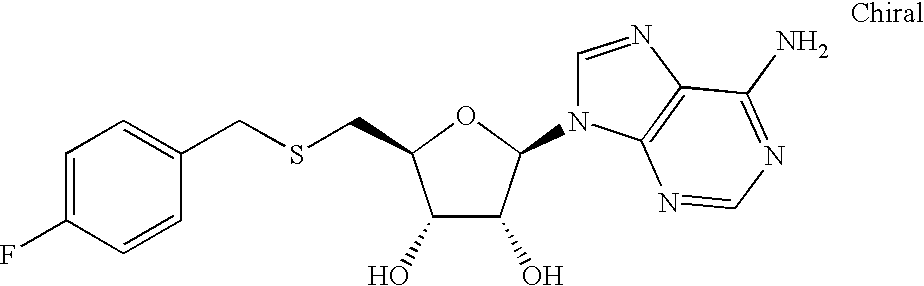
2.24 5.4 2(F)(28) 
0.175 5.6 known 
4.115 5.95 2(F)(25) 
4.6 6 known 
4.8 6 2(F)(6) 
3.16 6.9 2(F)(3) 
4.1 7 2(F)(11) 
0.8 7 2(B)(4) 
2.02 8.5 2(F)(22) 
3.8 9 2(B)(15) 
0.54 10 2(F)(12) 
0.79 10 2(F)(16) 
1.01 10.2 2(B)(12) 
1.11 12 2(F)(9) 
0.13 13 known 
0.85 17 2(E)(2) 
3.1 21 known 
1.46 25 2(B)(14) 
3.82 29 2(C)(11) 
0.67 30 2(B)(13) 
0.126 33 known 
0.006 106 2(B)(7) 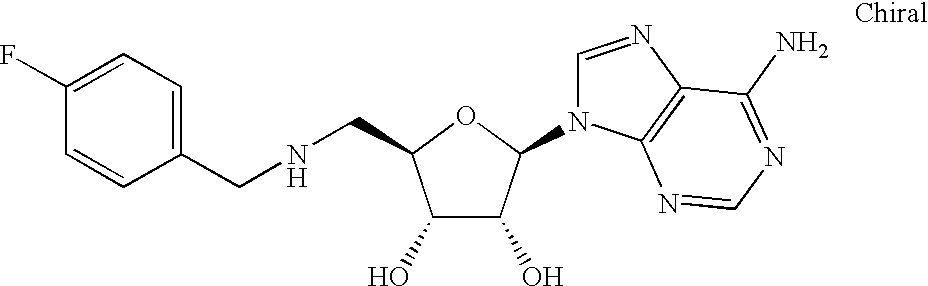
0.089 145 known 
0.006 250 2(B)(1) 
0.8 300 known 
0.141 390 2(B)(11) 
0.3 600 2(B)(8) 
0.029 758 2(B)(19) 
3 1000 2(B)(6) 
0.018 1300 2(C)(10) 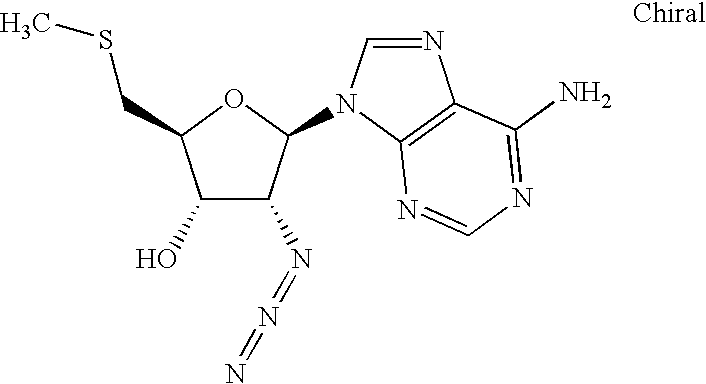
0.04 3600 - In Vitro Studies
- Growth Inhibition Effect of
Compound 7 In Vitro On MTAP-Competent and MTAP-Deficient Cells with and Without Methylthio-Adenosine as Anti-Toxicity Agent - The effect of combination
therapy using Compound 7 and MTA was performed in vitro on both MTAP-deficient and MTAP-competent cells.Compound 7 is a GARFT inhibitor having a Ki of 0.5 nM, and a Kd of 290 nM to mFBP (binds about 1400-fold less tightly than lometrexol; Bartlett et al. Proc AACR 40 (1999)) and can by synthesized by methods provided in Example 1 above. - The growth inhibition of
Compound 7, both with and without MTA, was analyzed using 5 MTAP-competent and 3 MTAP-deficient human lung, colon, pancreatic, muscle, leukemic and melanoma cell lines, as listed in Table 4. All cell lines were purchased from the American Type Culture Collection. The growth conditions and media requirements of each cell line are summarized in Table 5. All cultures were maintained at 37° C., in 5% air-CO2 atmosphere in a humidified incubator.TABLE 4 MTAP Cell Line Competent? Origin NCI-H460 Yes Human, large cell lung carcinoma SK-MES-1 Yes Human, lung squamous cell carcinoma HCT-8 Yes Human, ileocecal colorectal adenocarcinoma HCT-116 Yes Human, colorectal carcinoma A2058 Yes Human, melanoma PANC-1 No Human, pancreatic epithelial carcinoma BxPC-3 No Human, pancreatic adenocarcinoma HT-1080 No Human, fibrosarcoma - Cells were plated in columns 2-12 of a 96-well microtiter plate, with
column 2 designated as the vehicle control. The same volume of medium was added tocolumn 1.Column 1 was designated as the media control. After a 4-hour incubation, the cells were treated withCompound 7, with or without a non-growth inhibitory concentration of MTA, in quadruplicate wells. Cells were incubated withcompound 7 for 72 hours or 168 hours, as indicated in Table 5 below, i.e., cells were exposed toCompound 7 and/or MTA continuously for ˜2.5-3 cell doublings. MTT (4,5-dimethylthiazol-2-yl)-2,5-diphenyl tetrazolium bromide; Sigma, St. Louis, Mo.) was added to a final concentration of 0.25-1 mg/ml in each well, and the plates were incubated for 4 hours. The liquid was removed from each well. DMSO was added to each well, then the plates were vortexed slowly in the dark for 7-20 minutes. The formazin product was quantified spectrophotometrically at 540 run on a Molecular Devices Vmax™ kinetic microplate reader.TABLE 5 Plating Optional Density Incubation Cell Line Medium* Supplements (cells/well) Time (hrs) NCI-H460 MEM** None 1500 72 SK-MES-1 MEM** 5% 1500 168 nonessential amino acids, 5% sodium pyruvate HCT-8 Iscove's** 5% 900 72 nonessential amino acids, 5% sodium pyruvate HCT-116 Iscove's** 5% 1000 168 nonessential amino acids, 5% sodium pyruvate A2058 Iscove's** 5% 2000 72 nonessential amino acids, 5% sodium pyruvate PANC-1 DMEM*** None 1000 168 BxPC-3 RPMI- None 1500 168 1640*** HT-1080 Iscove's** 5% 1000 72 nonessential amino acids, 5% sodium pyruvate - The effect of
Compound 7 on SK-MES-1 cells, with and without MTA, is shown in FIG. 3. FIG. 3 indicates thatCompound 7 fully inhibited cell growth as a single agent, with a background of approximately 5%. However, addition of 10 μM MTA to up to approximately 60 times the IC50 concentration ofCompound 7 decreased the induction of growth inhibition dramatically, causing the cell number to increase to about 75% of control at the highest concentration ofCompound 7 tested. - With regard to the growth inhibitory effect of
Compound 7 on all 9 cell lines, FIG. 4 indicates that MTA reduced the growth inhibitory activity ofCompound 7 in the 5 MTAP-competent human lung, colon and melanoma cell lines (3- to >50-fold shift in the IC50 of Compound 7) but not in the 3 MTAP-deficient human cell lines. - Cytotoxicity of
Compound 7 in vitro on MTAP- And Sham-Transfected BXPC-3, PANC-1 and HT-1080 Cells with and Without Methylthioadenosine or dcSAMe as Anti-Toxicity Agent - The efficacy of combination therapy of
Compound 7 with MTA or dcSAMe on toxicity was evaluated using isogenic pairs of cell lines, i.e. BxPC-3, PANC-1, and HT-1080, which were either MTAP-deficient, or were made MTAP-competent by transfection of a plasmid carrying the MTAP-encoding gene. - Transfection
- The coding region of the MTAP cDNA was PCR amplified from a placental cDNA library using the forward primer, GCAGACATGGCCTCTGGCACC (SEQ ID: 2), and reverse primer AGCCATGCTACTTTAATGTCTTGG (SEQ ID: 3). The amplified product was cloned to pCR-2.1-TOPO (Invitrogen, Carlsbad, Calif.) and sequenced (SEQ ID: 1). The MTAP cDNA was subcloned to the retroviral vector pCLNCX for production of recombinant retrovirus.
- Retroviral production was conducted by transfecting the pCLNCX/MTAP vector into the PT67 amphotrophic retrovirus packaging cell line (Clontech, Palo Alto, USA) using calcium phosphate mediated transfection according to the suppliers protocol. Supernatants from the transfected packaging cells were collected at 48 hours post transfection and filtered through 0.45 μm filters before infection of target cells.
- Transduction of target cell lines and isolation of MTAP expressing clonal cell lines was conducted by plating target cells at low density in 10 cm dishes and growing for 24 hours. Retroviral supernatants were diluted 1:2 with fresh medium containing polybrene at 8 μg/ml. Medium from target cells was removed and replaced with the prepared retroviral supernatant and cells were incubated for 24 hours. Retroviral supernatant was then removed and replaced with fresh medium and incubated another 24 hours. Infected target cells were then harvested and replated onto 10 cm dishes at a range of densities into medium containing geneticin at 400 ug/ml to select for transduced cells. After 2-3 weeks, isolated colonies were picked and expanded as individual clonal cell lines. Expression of the MTAP cDNA within individual clonal line s determined through RT-PCR analysis using the Advantage One Step RT-PCR kit (Clontech, Palo Alto, USA) according to the manufacturer's protocol.
- Cytotoxicity
- Cytoxicity data was collected using BxPC-3, PANC-1 and HT-1080 cells which were cultured in Iscove's medium supplemented with 10% dialyzed, horse serum, 5% nonessential amino acids and 5% sodium pyruvate.
- Mid-log-phase cells were trypsinized and placed in 60 mm tissue culture dishes at 200 or 250 cells per dish. Cells from each cell line were left to attach for 4 hours and then were treated with
Compound 7, with or without MTA or dcSAMe, in 5-fold serial dilutions for 6 or 24 hours. For data shown in FIGS. 5a and 5 b, cells were exposed to drug(s) for 6 hours only. For data shown in FIG. 6, cells were exposed toCompound 7 for 24 hours and to MTA continuously for the duration of colony growth (i.e. 24 hours and thereafter). Cells were incubated until visible colonies formed in the control dishes, as indicated in Table 6 below. Cells were next washed with PBS, and then fixed and stained with 1% w/v crystal violet in 25% methanol (Sigma, St. Louis, Mo.). After washing the dishes 2-3 times. with deionized water, the colonies were counted. Triplicate dishes were used for each drug concentration.TABLE 6 Cell Line Medium Incubation Time (days) BxPC-3 Iscove's medium* 13-14 HT-1080 Iscove's medium* 6-7 PANC-1 Iscove's medium* 14 - The cytotoxicity data for 6 hours of simultaneous drug exposure with
Compound 7 with or without dcSAMe or MTA is summarized in FIGS. 5a and 5 b. FIG. 5a indicates that cell survival of MTAP-competent cells increased to 100% at 1.5μM Compound 7 with either 50 μM MTA or dcSAMe. By contrast, as indicated in FIG. 5b, the same concentrations of MTA and dcSAMe in MTAP-deficient cells either did not increase cell survival (MTA) or increased cell survival by less than observed for the MTAP competent cells (dcSAMe). - FIG. 6 summarizes selective reduction of cytotoxicity of
Compound 7 by the introduction of MTA. Exposure ofCompound 7 for 24 hours, with exposure to MTA for those 24 hours and continuously thereafter, achieved a >10- to >35-fold shift in the MTAP-competent cell lines versus their MTAP-deficient counterparts. - Growth Inhibition Effect of
Compounds - The growth inhibition effect of combination
therapy using Compound 1 orCompound 3 in combination with MTA was performed in vitro on MTAP-competent NCI-H460 cells.Compound 1 is a specific inhibitor of AICARFT having a micromolar Ki and a Kd of 83 nM to mFBP.Compound 3 is a GARFT inhibitor having a Ki of 2.8 nM and a Kd 0.0042 nM to mFBP. (Bartlett et al. Proc AACR 40 (1999)).Compounds 
- The growth inhibition of
Compound 1 andCompound 3, each with and without MTA, was analyzed using an MTAP-competent human lung carcinoma cell line. NCI-H460 cells were grown,, plated and treated with varying concentrations ofCompound 1 orCompound 3 in combination with MTA, in the same manner as described in Example 3 (A) above. - With regard to the growth inhibitory effect of
Compound 1 on the MTAP-competent cell line, FIG. 7 indicates that exposure ofCompound 1 with MTA reduced the growth inhibitory activity ofCompound 1 in the MTAP-competent human lung by a factor of 3. Similarly, exposure ofCompound 3 with MTA reduced the growth inhibitory activity ofCompound 3 in the MTAP-competent cell line by a factor of greater than 5. - Cytotoxicity of
Compound 7 in vitro on MTAP-Competent Cells when Administered with MTA During and After Administration ofCompound 7. - Cytoxicity data for combination therapy of
Compound 7 with MTA was collected using MTAP-competent NCI-H1460 cells. NCI-H460 cells were cultured, incubated and stained as described in Example 3(B) above, but with an incubation time of up to eight days. - As shown in FIG. 8, increasing the duration of MTA exposure increased the number of surviving colonies treated with cytotoxic concentrations of
Compound 7. In particular, extending MTA administration to at least 48 hours, i.e. for at least 1 day subsequent to exposure withCompound 7, fully protected cells from Compound 7-induced cytotoxicity. - Effect of
Compound 7 in vivo in MTAP-Deficient Xenograft Model with and Without Methylthioadenosine as an Anti-Toxicity Agent - To evaluate the in vivo effect of combination therapy on known human MTAP-deficient tumors, an MTAP-deficient cell line was introduced to mice to produce xenograft MTAP-deficient tumors. 108 BALB/c/nu/nu female mice bearing subcutaneous tumor fragments produced from the MTAP-deficent BxPC-3 cell line were housed 3 per cage with free access to food and water. Mice were fed a folate-deficient chow (#Td84052, Harlan Teklad, Madison, Wis.) beginning 14 days prior to initiation of drug treatment and continuing throughout the study. After randomization by tumor volume into 8 treatment groups and assigning the remaining 12 mice to
group 7, beginning on the twenty-first day after tumor implant mice were dosed withCompound 7 daily for 4 days, and with MTA or vehicle twice-a-day for 8 days, in the amounts indicated in Table 7 below. The vehicle for both compounds was 0.75% sodium bicarbonate in water (7.5% NaHCO3 solution (Cellgro #25-035-4, Mediatech, Herndon, Va.) diluted 1:10 in sterile water for injection (Butler, Columbus, Ohio)) under pH adjusted to 7.0-7.4. Solutions were sterilized by filtration through 0.22 micron polycarboniate filters (Cameo 25GAS, Micron Separations Inc., Westboro, Mass.). Tumor volumes and animal weight loss, which is an indicator of toxicity, were recorded daily for 14 days at the same time of day, then on a Monday, Wednesday, Friday schedule for the remainder of the study.TABLE 7 Group Compound 7 (mg/kg) MTA (mg/kg) 1 0 0 2 0 50 3 20 0 4 10 0 5 5 0 6 2.5 0 7 40 50 8 20 50 9 10 50 - A graphic representation of the magnitude of animal weight loss of the subject animals, induced by varying doses of
Compound 7 and MTA, is provided in FIG. 9. The similarities in weight loss between mice treated with 2.5 mg/kg Compound 7 alone versus mice treated with 40 mg/kg Compound 7 plus 50 mg/kg MTA, indicate a 16-fold reduction in toxicity. - The BxPC-3 xenograft experiments further indicate that MTA lessened the toxicity of
Compound 7 without adversely affecting its antitumor activity. As shown in FIG. 10 and in Table 8 below, there was no significant difference in the antitumour data forCompound 7, based on the mean time for tumours to grow to a volume of 1000 mm3 (approximately 35.2 days for 20 mg/kg Compound 7 alone versus 35.3 days for 20 mg/kg Compound 7+MTA).TABLE 8 The activity of Compound 7 qd daily x4 with andwithout 50 mg/kg MTA bid daily x8 against the human pancreatic BxPC-3 tumor Time to 1000 p-valuesb mm3 (days) Compound 7 (mg/kg) Vehicle Treatment na Mean SD Median 20 5 2.5 control Vehicle control 12 20.8 4.9 20.4 20 mg/ kg Compound 79 35.2 6.6 36.4 0.290 0.329 10 mg/ kg Compound 711 34.0 6.0 33.4 5 mg/ kg Compound 712 32.1 6.4 32.4 2.5 mg/ kg Compound 710 32.3 5.9 32.4 <0.0001 50 mg/ kg MTA 11 22.6 6.8 21.4 20 mg/kg Compound 12 35.3 3.4 34.9 0.957 0.135 0.170 0.462 7 + MTA 10 mg/kg Compound 12 37.7 4.9 37.9 7 + MTA - Thus, adding MTA twice a day for 8 days to the daily administration of
Compound 7 for 4 days in nu/nu tumor-bearing mice on a folate-deficient diet increased the therapeutic window ofCompound 7 by 16- fold. - In vivo Effect of Extended Dosing Schedule of MTA on Maximally Tolerated Dose of
Compound 7 - A series of experiments were undertaken in order to evaluate the in vivo effect of schedule of administration of MTA on reduction of toxicity induced by toxicity. BALB/c/nu/nu female mice were housed 3 per cage with free access to food and water. Mice were fed a folate-deficient chow (#Td84052, Harlan-Teklad, Madison, Wis.) for at least 14 days prior to initiation of drug treatment and continuing throughout the study. Mice were dosed with
Compound 7 daily for 4 days, and with MTA or vehicle twice daily on the schedule indicated in Table 11. Animal weight loss, which is a measure of toxicity, was recorded at least daily for 18 days at the same time of day. Table 11 presents a summary of data from multiple experiments, i.e., at least two experiments for each schedule. These data indicate that coadministration of MTA can increase the maximum tolerated dose ofCompound 7. To produce this effect, MTA must be administered at the beginning of treatment withCompound 7 and continuing until after treatment withCompound 7. Further, since the activity ofCompound 7 continues for at least a few days after the last dose was administered, to produce an effect MTA must be administered during this period of activity, i.e. for at least 2 days after the last dose of the cytotoxic was administered.TABLE 11 Compound 7MTA Increase in Compound 7 maximum(days) (days) tolerated dose (-fold dose) 1-4 3-8 None 1-4 1-6 4 1-4 1-5 None 1-4 5-7 None 1-4 3-8 None -
-
1 3 1 870 DNA Artificial Cloned MTAP cDNA 1 gcagacatgg cctctggcac caccaccacc gccgtgaaga ttggaataat tggtggaaca 60 ggcctggatg atccagaaat tttagaagga agaactgaaa aatatgtgga tactccattt 120 ggcaagccat ctgatgcctt aattttgggg aagataaaaa atgttgattg cgtcctcctt 180 gcaaggcatg gaaggcagca caccatcatg ccttcaaagg tcaactacca ggcgaacatc 240 tgggctttga aggaagaggg ctgtacacat gtcatagtga ccacagcttg tggctccttg 300 agggaggaga ttcagcccgg cgatattgtc attattgatc agttcattga caggaccact 360 atgagacctc agtccttcta tgatggaagt cattcttgtg ccagaggagt gtgccatatt 420 ccaatggctg agccgttttg ccccaaaacg agagaggttc ttatagagac tgctaagaag 480 ctaggactcc ggtgccactc aaaggggaca atggtcacaa tcgagggacc tcgttttagc 540 tcccgggcag aaagcttcat gttccgcacc tggggggcgg atgttatcaa catgaccaca 600 gttccagagg tggttcttgc taaggaggct ggaatttgtt acgcaagtat cgccatggcg 660 acagattatg actgctggaa ggagcacgag gaagcagttt cggtggaccg ggtcttaaag 720 accctgaaag aaaacgctaa taaagccaaa agcttactgc tcactaccat acctcagata 780 gggtccacag aatggtcaga aaccctccat aacctgaaga atatggccca gttttctgtt 840 ttattaccaa gacattaaag tagcatggct 870 2 21 DNA Artificial Forward Primer 2 gcagacatgg cctctggcac c 21 3 24 DNA Artificial Reverse Primer 3 agccatgcta ctttaatgtc ttgg 24
Claims (54)
1. A method for selectively killing MTAP-deficient cells of a mammal, the method comprising:
(a) administering to the mammal an inhibitor of glycinamide ribonucleotide formyltransferase, aminoimidazolecarboximide ribonucleotide formyltransferase: or both in a therapeutically effective amount; and
(b) administering to the mammal an anti-toxicity agent in an amount effective to increase the maximally tolerated dose of the inhibitor; wherein the anti-toxicity agent is administered during and after administration of the inhibitor.
2. The method of claim 1 , wherein the anti-toxicity agent is an MTAP substrate or a prodrug of an MTAP substrate.
3. The method of claim 2 , wherein the anti-toxicity agent has Formula X:

R41 is selected from the group consisting of:
(a) —Rg wherein Rg represents a C1-C5 alkyl, C2-C5 alkenylene or alkynylene radical, unsubstituted or substituted by one or more substitutents independently selected from C1 to C6 alkoxy, C1 to C6 alkoxy(C1 to C6)alkyl, C2 to C6 alkynyl, acyl, halo, amino, hydroxyl, nitro, mercapto, cycloalkyl, heterocycloalkyl, aryl or heteroaryl;
(b) —Rg(Y)RhRi wherein Rg is as defined above, Y represents O, NH, S, or methylene; and Rh and Ri represent, independently, (i) H; (ii) a C1-C9 alkyl, or a C2-C6 alkenyl or alkynyl, unsubstituted or substituted by one or more substitutents independently selected from C1 to C6 alkoxy; C1 to C6 alkoxy(C1 to C6)alkyl; C2 to C6 alkynyl; acyl; halo; amino; hydroxyl; nitro; mercapto; —NCOORo; —CONH2; C(O)N(Ro)2; C(O)Ro; or C(O)ORo, wherein Ro is selected from the group consisting of H, C1-C6 alkyl, C2-C6 heterocycloalkyl, cycloalkyl, heteroaryl, aryl, and amino, unsubstituted or substituted with C1-C6 alkyl, 2- to 6-membered heteroalkyl, heterocycloalkyl, cycloalkyl, C1-C6 boc-aminoalkyl; cycloalkyl, heterocycloalkyl, aryl or heteroaryl; or (iii) a monocyclic or bicyclic cycloalkyl, heterocycloalkyl, aryl or heteroaryl, unsubstituted or substituted with one or more substituents independently selected from C1 to C6 alkyl, C2 to C6 alkenyl, C1 to C6 alkoxy, C1 to C6 alkoxy(C1 to C6)alkyl, C2 to C6 alkynyl, acyl, halo, amino, hydroxyl, nitro, mereapto, cycloalkyl, heterocycloalkyl, aryl heteroaryl, —COORo, —NCORo wherein Ro is as defined above, 2 to 6 membered heteroalkyl, C1 to C6 alkyl-cycloalkyl, C1 to C6 alkylheterocycloalkyl, C1 to C6 alkyl-aryl or C1 to C6 alkyl-aryl;
(c) C(O)NRjRk wherein Rj and Rk represent, independently, (i) H; or (ii) a C1-C6 alkyl, amino, C1-C6 haloalkyl, C1-C6 aminoalkyl, C1-C6 boc-aminoalkyl, C1-C6 cycloalkyl, C1-C6 alkenyl, C2-C6 alkenylene, C2-C6 alkynylene radical, wherein Rj and Rk are optionally joined together to form, together with the nitrogen to which they are bound, a heterocycloalkyl or heteroaryl ring containing two to five carbon atoms and wherein the C(O)NRjRk group is further unsubstituted or substituted by one or more substitutents independently selected from —C(O)Ro, —C(O)ORo wherein Ro is as defined above, C1 to C6 alkyl, C2 to C6 alkenyl, C1 to C6 alkoxy, C1 to C6 alkoxy(C1 to C6)alkyl, C2 to C6 alkynyl, acyl, halo, amino, hydroxyl, nitro, mercapto, cycloalkyl, heterocycloalkyl, aryl or heteroaryl; or
(d) C(O)ORh wherein Rh is as defined above;
R42 and R44 represent, independently, H or OH; and
R43 and R45 represent, independently, H, OH, amino or halo;
where any of the cycloalkyl, heterocycloalkyl, aryl, heteroaryl moieties present in the above may be further substituted with one or more additional substituents independently selected from the group consisting of nitro, amino, —(CH2)z—CN where z is 0-4, halo, haloalkyl, haloaryl, hydroxyl, keto, C1 to C6 alkyl, C2 to C6 alkenyl, C2 to C6 alkynyl, heteroalkyl, unsubstituted cycloalkyl, unsubstituted heterocycloalkyl, unsubstituted aryl or unsubstituted heteroaryl;
and salts or solvates thereof.
4. The method of claim 3 , wherein the anti -toxicity agent has a Kcat/Km ratio that is greater than 0.05 s−1 μM−1.
5. The method of claim 2 , wherein the anti-toxicity agent has Formula XI:

wherein
Rm and Rn are, independently, selected from the group consisting of H; a phosphate or a sodium salt thereof; C(O)N(Ro)2; C(O)Ro; or C(O)ORo, wherein Ro is selected from the group consisting of H, C1-C6 alkyl, C2-C6 heterocycloalkyl, cycloalkyl, heteroaryl, aryl, and amino, unsubstituted or substituted with C1-C6 alkyl, C1-C6 heteroalkyl, C2-C6 heterocycloalkyl, cycloalkyl, C1-C6 boc-aminoalkyl, and
solvates or salts thereof.
6. The method of claim 5 , wherein Rm and Rn independently represent:

7. The method of claim 1 , wherein the inhibitor is a compound of Formula I:

wherein:
A represents sulfur or selenium;
Z represents: a) a noncyclic spacer which separates A from the carbonyl carbon of the amido group by 1 to 10 atoms, said atoms being independently selected from carbon, oxygen, sulfur, nitrogen and phosphorus, said spacer being unsubstituted or substituted with one or more substituents selected from the group consisting of alkyl, heteroalkyl, haloalkyl, haloaryl, halocycloalkyl, haloheterocycloalkyl, aryl, cycloalkyl, heterocycloalkyl, heteroaryl, —NO2, —NH2, —N—ORc, —(CH2)z—CN where z is 0-4, halo, —OH, —O—Ra—O—Rb, —ORb, —CO—Rc, —O—CO—Rc, —CO—ORc, —O—CO—ORc, —O—CO—O—CO—Rc, —O—ORc, keto (═O), thioketo (═S), —SO2—Rc, —SO—Rc, —NRdRe, —CO—NRe, —O—CO—NRdRe, —NRc—CO—NRdRe, —NRe—CO—Re, —NRc—CO2—ORe, —CO—NRc—CO—Rd, —O—SO2—Rc, —O—SO—Rc, —O—S—Rc, —S—CO—Rc, —SO—CO—ORc, —SO2—CO—ORc, —O—SO3, —NRc—SRd, NRc—SO—Rd, —NRc—SO2—Rd, —CO—SRc, —CO—SO—Rc, —CO—SO2—Rc, —CS—Rc, —CSO—Rc—CSO2—Rc, —NRc—CS—Rd, —O—CS—Rc, —O—CSO—Rc, —SO2—Rc, —SO2—NRdRe, —SO—NRdRe, —S—NRdRe, —NRd—CSO2—Rd, —NRc—CSO—Rd, —NRc—CS—Rd, —SH, —S—Rb, and —PO2—ORc, where Ra is selected from the group consisting of alkyl, heteroalkyl, alkenyl, and alkynyl; Rb is selected from the group consisting of alkyl, heteroalkyl, haloalkyl, alkenyl, alkynyl, halo, —CO—Rc, —CO—ORc, —O—CO—O—Rc, —O—CO—Rc, —NRc—CO—Rd, —CO—NRdRe, —OH, aryl, heteroaryl, heterocycloalkyl, and cycloalkyl; Rc, Rd and Re are each independently selected from the group consisting of hydro, hydroxyl, halo, alkyl, heteroalkyl, haloalkyl, alkenyl, alkynyl, —CORf, —COORf, —O—CO—O—Rf, —O—CO—Rf, —OH, aryl, heteroaryl, cycloalkyl, and heterocycloalkyl, or Rd and Re cyclize to form a heteroaryl or heterocycloalkyl group; and Rf is selected from the group consisting of hydro, alkyl, and heteroalkyl; and where any of the alkyl, heteroalkyl, alkenyl, aryl, cycloalkyl, heterocycloalkyl, or heteroaryl moieties present in the above substituents may be further substituted with one or more additional substituents independently selected from the group consisting of —NO2, —NH2, —(CH2)z—CN where z is 0-4, halo, haloalkyl, haloaryl, —OH, keto (═O), —N—OH, NRc—ORc, —NRdRc, —CO—NRdRe, —CO—ORc, —CO—Rc, —NRc—CO—NRdRe, —C—CO—ORc, —NRc—CO—Rd, —O—CO—O—R, —O—CO—NRdRe, —SH, —O—Rb, —O—Ra—O—Rb, —S—Rb, unsubstituted alkyl, unsubstituted aryl, unsubstituted cycloalkyl, unsubstituted heterocycloalkyl, and unsubstituted heteroaryl, where Ra, Rb, Rc, Rd, and Re are as defined above; b) a cycloalkyl, heterocycloalkyl, aryl or heteroaryl didiradical being unsubstituted or substituted with one or more substituents from those substituents recited in a); or c) a combination of at least one of said non-cyclic spacer and at least one of said diradicals, wherein when said noncyclic spacer is bonded directly to A, said non-cyclic spacer separates A from one of said diradicals by 1 to about 10 atoms and further wherein when said non-cyclic spacer is bonded directly to the carbonyl carbon of the amido group, said noncyclic spacer separates the carbonyl carbon of the amido group from one of said diradicals by 1 to about 10 atoms;
R1 and R2 represent, independently, hydro, C1 to C6 alkyl, or a hydrolyzable group; and
R3 represents hydro or a C1 to C6 alkyl or cycloalkyl group unsubstituted or substituted by one or more halo, hydroxyl or amino.
8. The method of claim 7 , wherein Z represents a moiety of formula Q-X—Ar wherein:
Q represents a C1-C5 alkenyl, or a C2-C5 alkenylene or alkynylene radical, unsubstituted or substituted by one or more substitutents independently selected from C1 to C6 alkyl, C2 to C6 alkenyl, C1 to C6 alkoxy, C1 to C6 alkoxy(C1 to C6)alkyl, C2 to C6 alkynyl, acyl, halo, amino, hydroxyl, nitro, mercapto, cycloalkyl, heterocycloalkyl, aryl or heteroaryl ring;
X represents a diradical of methylene, monocyclic cycloalkyl, heterocycloalkyl, aryl or heteroaryl ring, sulfur, oxygen or amino radicaal, unsubstituted or substituted by one or more substituents independently selected from C1 to C6 alkyl, C2 to C6 alkenyl, C1 to C6 alkoxy C1 to C6 alkoxy(C1 to C6)alkyl, C2 to C6 alkynyl, acyl, halo, amino, hydroxyl, nitro, mercapto, cycloalkyl, heterocycloalkyl, aryl or heteroaryl ring; and
Ar represents a monocyclic or bicyclic cycloalkyl, heterocycloalkyl, aryl or heteroaryl ring, wherein Ar may be fused to the monocyclic cycloalkyl, heterocycloalkyl, aryl or heteroaryl ring of X, said Ar is unsubstituted or substituted with one or more substituents independently selected from C1 to C6 alkyl, C2 to C6 alkenyl, C1 to C6 alkoxy, C1 to C6 alkoxy(C1 to C6)alkyl, C2 to C6 alkynyl, acyl, halo, amino, hydroxyl, nitro, mercapto, cycloalkyl, heterocycloalkyl, aryl or heteroaryl ring.
9. The method of claim 1 , wherein the inhibitor is a compound of Formula II:

wherein:
A represents sulfur or selenium;
(group) represents a non-cyclic spacer which separates A from (ring) by 1 to 5 atoms, said atoms being independently selected from carbon, oxygen, sulfur, nitrogen and phosphorus, said spacer being unsubstituted or substituted by one or more substituents independently selected from C1 to C6 alkyl, C2 to C6 alkenyl, C1 to C6 alkoxy, C1 to C6 alkoxy(C1 to C6)alkyl, C2 to C6 alkynyl, acyl, halo, amino, hydroxyl, nitro, mercapto, cycloalkyl, heterocycloalkyl, aryl or heteroaryl ring;
(ring) represents at least one cycloalkyl, heterocycloalkyl, aryl or heteroaryl ring, unsubstituted or substituted with or more substituents selected from C1 to C6 alkyl, C2 to C6 alkenyl, C1 to C6 alkoxy, C1 to C6 alkoxy(C1 to C6)alkyl, C2 to C6 alkynyl, acyl, halo, amino, hydroxyl, nitro, mercapto, cycloalkyl, heterocycloalkyl, aryl or heteroaryl ring;
R1 and R2 represent, independently, hydro, C1 to C6 alkyl, or a readily hydrolyzable group; and
R3 represents hydro or a C1 to C6 alkyl or cycloalkyl group unsubstituted or substituted by one or more halo, hydroxyl or amino.
10. The method of claim 9 , wherein the inhibitor has the chemical structure:

11. The method of claim 9 , wherein the inhibitor has the chemical structure:

12. The method of claim 7 , wherein the inhibitor is a compound of Formula III:

wherein:
n is an integer from 0 to 5;
A represents sulfur or selenium;
X represents a diradical of methylene, a monocyclic cycloalkyl, heterocycloalkyl, aryl or heteroaryl ring, oxygen, sulfur or an amine;
Ar represents an aromatic diradical wherein Ar can form a fused bicyclic ring system with said ring of X; and
R1 and R2, represent, independently, hydro or C1-C6 alkyl.
13. The method of claim 1 , wherein the inhibitor is an inhibitor specific to glycinamide ribonucleotide formyltransferase.
14. The method of claim 13 , wherein the inhibitor is a compound having the Formula VII:

wherein L represents sulfur, CH2 or selenium;
M represents a sulfur, oxygen, or a diradical of C1-C3 alkane, C2-C3 alkene, C2-C3 alkyne, or amine, wherein M is unsubstituted or substituted by one or more substituents selected from the group consisting ofalkyl, heteroalkyl, haloalkyl, haloaryl, halocycloalkyl, haloheterocycloalkyl, aryl, cycloalkyl, heterocycloalkyl, heteroaryl, —NO2, —NH2, —N—ORc, —(CH2)z—CN where z is 0-4, halo, —OH, —O—Ra—O—Rb, —ORb, —CO—Rc, —O—CO—Rc—, —CO—OR cORc, —O—CO—O—CO—Rc, —O—Rc, keto (═O), thioketo (═S), —SO2—Rc, —SO—Rc, —NRdRe—CO—NRdRe, —O—CO—NRdRe, —NRc—CO—NRdRe, —NRc—CO—Re, —NRc—CO2—ORe, —CO—NRc—CO—Rd, —O—SO2—Rc, —O—SO-Rc, —O—S—Rc, —S—CO—Rc, —SO—CO—ORc, —SO2—CO—ORc, —O—SO3, —NRc—SRd, —NRc—SO—Rd, —NRc—SO2—Rd, —CO—SRc, —CO—SO—Rc, —CO—SO2—Rc, —CS—Rc, —CSO—Rc, —CSO2—Rc, —NRc—CS—Rd, —O—CS—Rc, —O—CSO—Rc, —O—CSO2—Rc, —SO2—NRdRe, —SO—NRdRe, —S—NRdRe, —NRd—CSO2—Rd, —NRc—CSO—Rd, —NRc—CS—Rd, —SH, —S—Rb, and —PO2—ORc, where Ra is selected from the group consisting of alkyl, heteroalkyl, alkenyl, and alkynyl; Rb is selected from the group consisting of alkyl, heteroalkyl, haloalkyl, alkenyl, alkynyl, halo, —CO—Rc, —CO—ORc, —O—CO—O—Rc, —O—CO—Rc, —NRc—CO—Rd, —CO—NRdRe, —OH, aryl, heteroaryl, heterocycloalkyl, and cycloalkyl; Rc, Rd and Re are each independently selected from the group consisting of hydro, hydroxyl, halo, alkyl, heteroalkyl, haloalkyl, alkenyl, alkynyl, —CORf, —COORf, —O—CO—O—Rf, —O—CO—Rf, —OH, aryl, heteroaryl, cycloalkyl, and heterocycloalkyl, or Rd and Re cyclize to form a heteroaryl or heterocycloalkyl group; and Rf is selected from the group consisting of hydro, alkyl, and heteroalkyl; and where any of the alkyl, heteroalkyl, alkenyl, aryl, cycloalkyl, heterocycloalkyl, or heteroaryl moieties present in the above substituents may be further substituted with one or more additional substituents independently selected from the group consisting of —NO2, —NH2, —(CH2)z—CN where z is 0-4, halo, haloalkyl, haloaryl, —OH, keto (═O), —N—OH, NRc—ORc, —NRdRe, —CO—NRdRe, —CO—ORc, —CO—Rc, —NRc—CO—NRdRe, —C—CO—ORc, —NRc—CO—Rd, —O—CO—O—Rc, —O—CO—NRdRe, —SH, —O—Rb, —O—Ra—O—Rb, —S—Rb, unsubstituted alkyl, unsubstituted aryl, unsubstituted cycloalkyl, unsubstituted heterocycloalkyl, and unsubstituted heteroaryl, where Ra, Rb, Rc, Rd, and Re are as defined above;
T represents C1-C6 alkyl; C2-C6 alkenyl; C2-C6 alkynyl; —C(O)E, wherein E represents hydro, C1-C3 alkyl, C2-C3 alkenyl, C2-C3 alkynyl, O—(C1-C3) alkoxy, or NR10R11, wherein R10 and R11 represent independently hydro, C1-C3 alkyl, C2-C3 alkenyl, C2-C3 alkynyl; hydroxyl; nitro; SR12, wherein R12 is hydro, C1-C6 alkyl, C2-C6 alkenyl, C2-C6 alkynyl, cyano; or O(C1-C3) alkyl; and
R20 and R21 are each independently hydro or a moiety that forms, together with the attached CO2, a readily hydrolyzable ester group.
15. The method of claim 14 , wherein the inhibitor does not have a high affinity to a membrane binding folate protein.
16. The method of claim 15 , wherein the inhibitor has the chemical structure:

17. The method of claim 15 , wherein the inhibitor has the chemical structure:

18. The method of claim 15 , wherein the inhibitor has the chemical structure:

19. The method of claim 15 , wherein the inhibitor has the chemical structure:

20. The method of claim 13 , wherein the inhibitor is a compound having the Formula IV:

wherein:
n represents an integer from 0 to 2;
D represents sulfur, CH2, oxygen, NH or selenium, provided that when n is 0, D is not CH2, and when n is; 1, D is not CH2 or NH;
M represents sulfur, oxygen, or a diradical of C1-C3 alkane, C2-C3 alkene, C2-C3 alkyne, or amine, wherein M is unsubstituted or substituted by one or more substituents selected from the group consisting of alkyl, heteroalkyl, haloalkyl, haloaryl, halocycloalkyl, haloheterocycloalkyl, aryl, cycloalkyl, heterocycloalkyl, heteroaryl, —NO2, —NH2, —N—ORc, —(CH2)z—CN where z is 0-4, halo, —OH, —O—Ra—O—Rb, —ORb, —CO—Rc, —O—CO—Rc, —CO—ORc, —O—CO—ORc, —O—CO—O—CO—Rc, —O—ORc, keto (═O), thioketo (═S), —SO2—Rc, —SO—Rc, —NRdRe, —CO—NRdRe, —O—CO—NRdRe, —NR—CO—NRdRe, —NRc—CO—Re, —NRc—CO2—ORe, —CO—NR—CO—Rd, —O—SO2—Rc, —O—SO—Rc, —O—S—Rc, —S—CO—Rc, —SO—CO—ORc, —SO2—CO—ORc, —O—SO3, —NRc—SRd, —NRc—SO—Rd, —NRc—SO2—Rd, —CO—SRc, —CO—SO—Rc, —CO—SO2—Rc, —CS—Rc, —CSO—Rc, —CSO2—Rc, —NRc—CS—Rd, —O—CS—Rc, —O—CSO—Rc, —O—CSO2-Rc, —SO2—NRdRc, —SO—NRdRe, —S—NRdRe, —NRd—CSO2—Rd, —NRc—CSO—Rd, —NRc—CS—Rd, —SH, —S—Rb, and —PO2—ORc, where Ra is selected from the group consisting of alkyl, heteroalkyl, alkenyl, and alkynyl; Rb is selected from the group consisting of alkyl, heteroalkyl, haloalkyl, alkenyl, alkynyl, halo, —CO—Rc, —CO—ORc, —O—CO—O—Rc, —O—CO—Rc, —NRc—CO—Rd, —CO—NRdRe, —OH, aryl, heteroaryl, heterocycloalkyl, and cycloalkyl; Rc, Rd and Re are each independently selected from the group consisting of hydro, hydroxyl, halo, alkyl, heteroalkyl, haloalkyl, alkenyl, alkynyl, —CORf, —COORf, —O—CO—O—Rf, —O—CO—Rf, —OH, aryl, heteroaryl, cycloalkyl, and heterocycloalkyl, or Rd and Re cyclize to form a heteroaryl or heterocycloalkyl group, and Rf is selected from the group consisting of hydro, alkyl, and heteroalkyl; and where any of the alkyl, heteroalkyl, alkenyl, aryl, cycloalkyl, heterocycloalkyl, or heteroaryl moieties present in the above substituents may be further substituted with one or more additional substituents independently selected from the group consisting of —NO2, —NH2, —(CH2)z—CN where z is 0-4, halo, haloalkyl, haloaryl, —OH, keto (═O), —N—OH, NRc—ORe, —NRdRe, —CO—NRdRe, —CO—ORc, —CO—Rc, —NRc—CO—NRdRe, —C—CO—ORc, —NRc—CO—Rd, —O—CO—O—Rc, —O—CO—NRdRe, —SH, —O—Rb, —O—Ra—O—Rb, —S—Rb, unsubstituted alkyl, unsubstituted aryl, unsubstituted cycloalkyl, unsubstituted heterocycloalkyl; and unsubstituted heteroaryl, where Ra, Rb, Rc, Rd, and Re are as defined above;
Ar represents a diradical of a cycloalkyl, heterocycloalkyl, aryl or heteroaryl ring system, said Ar is unsubstituted or substituted with one or more substituents independently selected from C1 to C6 alkyl, C2 to C6 alkenyl, C1 to C6 alkoxy, C1 to C6 alkoxy(C1 to C6)alkyl, C2 to C6 alkynyl, acyl, halo, amino, hydroxyl, nitro, mercapto, cycloalkyl, heterocycloalkyl, aryl or heteroaryl ring; and
R20 and R21 represent, independently, hydro or a moiety that forms, together with the attached CO2, a readily hydrolyzable ester group.
21. The method of claim 20 , wherein the inhibitor is a compound having the Formula V:

wherein:
A represents sulfur or selenium;
U represents CH2, sulfur, oxygen or NH;
Ar represents a diradical of a cycloalkyl, heterocycloalkyl, aryl or heteroaryl ring system, said Ar is unsubstituted or substituted with one or more substituents independently selected from C1 to C6 alkyl, C2 to C6 alkenyl, C1 to C6 alkoxy, C1 to C6 alkoxy(C1 to C6)alkyl, C2 to C6 alkynyl, acyl, halo, amino, hydroxyl, nitro, mercapto, cycloalkyl, heterocycloalkyl, aryl or heteroaryl ring; and
R20 and R21 represent, independently, hydro or a moiety that forms, together with the attached CO2, a readily hydrolyzable ester group.
22. The method of claim 20 , wherein the inhibitor is a compound having the Formula VI:

wherein:
D′ represents oxygen, sulfur or selenium;
M′ represents a sulfur, oxygen, or a diradical of C1-C3 alkane, C2-C3 alkene, C2-C3 alkyne, or amine, said M′ is unsubstituted or substituted by one or more substituents selected from the group consisting of alkyl, heteroalkyl, haloalkyl, haloaryl, halocycloalkyl, haloheterocycloalkyl, aryl, cycloalkyl, heterocycloalkyl, heteroaryl, —NO2, —NH2, —N—ORc, —(CH2)z—CN where z is 0-4, halo, —OH, —O—Ra—O—Rb, —ORb, —CO—Rc, —O—CO—Rc, —CO—ORc, —O—CO—ORc, —O—CO—O—CO—Rc, —O—ORc, keto (═O), thioketo (═S), —SO2—Rc, —SO—Rc, —NRdRe, —CO—NRdRe, —O—CO—NRdRe, —NRc—CO—NRdRe, —NRc—CO—Re, —NRc—CO2—ORe, —CO—NRc—CO—Rd, —O—SO2—Rc, —O—SO—Rc, —O—S—Rc, —S—CO—Rc, —SO—CO—ORc, —SO2—CO—ORc, —O—SO3, —NRc—SRd, —NRc—SO—Rd, —NRc—SO2—Rd, —CO—SRc, —CO—SO—Rc, —CO—SO2—Rc, —CS—Rc, —CSO—Rc, —CSO2—Rc, —NRc—CS—Rd, —O—CS—Rc, —O—CSO—Rc, —O—CSO2—Rc, —SO2—NRdRe, —SO—NRdRe, —S—NRdRe, —NRd—CSO2—Rd, —NRc—CSO—Rd, —NRc—CS—Rd, —SH, —S—Rb, and —PO2—ORc, where Ra is selected from the group consisting of alkyl, heteroalkyl, alkenyl, and alkynyl; Rb is selected from the group consisting of alkyl, heteroalkyl, haloalkyl, alkenyl, alkynyl, halo, —CO—Rc, —CO—ORc, —O—CO—O—Rc, —O—CO—Rc, —NRc—CO—Rd, —CO—NRdRe, —OH, aryl, heteroaryl, heterocycloalkyl, and cycloalkyl; Rc, Rd and Re are each independently selected from the group consisting of hydro, hydroxyl, halo, alkyl, heteroalkyl, haloalkyl, alkenyl, alkynyl —CORf, —COORf, —O—CO—O—Rf, —O—CO—Rf, —OH, aryl, heteroaryl, cycloalkyl, and heterocycloalkyl, or Rd and Re cyclize to form a heteroaryl or heterocycloalkyl group; and Rf is selected from the group consisting of hydro, alkyl, and heteroalkyl; and where any of the alkyl, heteroalkyl, alkenyl, aryl, cycloalkyl, heterocycloalkyl, or heteroaryl moieties present in the above substituents may be further substituted with one or more additional substituents independently selected from the group consisting of —NO2, —NH2, —(CH2)z—CN where z is 0-4, halo, haloalkyl, haloaryl, —OH, keto (═O), —N—OH, NRc—ORc, —NRdRe, —CO—NRdRe, —CO—ORc, —CO—Rc, —NRc—CO—NRdRe, —C—CO—ORc, —NRc—CO—Rd, —O—CO—O—Rc, —O—CO—NRdRe, —SH, —O—Rb, —O—Ra—O—Rb, —S—Rb, unsubstituted alkyl, unsubstituted aryl, unsubstituted cycloalkyl, unsubstituted heterocycloalkyl, and unsubstituted heteroaryl, where Ra, Rb, Rc, Rd, and Re are as defined above;
Y represents O, S or NH;
B represents hydro or halo;
C represents hydro or halo or an unsubstituted or substituted C1-C6 alkyl; and
R20 and R21 represent independently hydro or a moiety that forms, together with the attached CO2, a readily hydrozyable ester group.
23. The method of claim 22 , wherein the inhibitor has the chemical structure:

24. The method of claim 1 , wherein the inhibitor is an inhibitor specific to aminoimidazolecarboximide ribonucleotide formyltransferase.
25. The method of claim 24 , wherein the inhibitor is a compound having the Formula VIII:

wherein:
A represents sulfur or selenium;
W represents an unsubstituted phenylene or thinylene diradical;
R1 and R2 represent, independently, hydro, C1 to C6 alkyl, or other readily hydrolyzable group; and
R3 represents hydro or a C1-C6 alkyl or cycloalkyl group, unsubstituted or substituted by one or more halogen, hydroxyl or amino groups.
26. The method of claim 24 , wherein the inhibitor is a compound having the Formula IX:

wherein:

R30 represents hydro or CN;
R31 represent phenyl or thienyl, unsubstituted or substituted with phenyl, phenoxy, thienyl, tetrazolyl, or 4-morpholinyl; and
R32 is phenyl substituted with —SO2NR33R34 or —NR33SO2R34, unsubstituted or substituted with C1-C4 alkyl, C1-C4 alkoxy, or halo, wherein R33 is H or C1-C4 alkyl and R34 is C1-C4 alkyl, unsubstituted or substituted with heteroalkyl, aryl, heteroaryl, indolyl, or is
wherein n is an integer of from 1 to 4, R35 is hydroxyl, C1-C4 alkoxy, or a glutamic-acid or glutamate-ester moiety linked through the amine functional group.
27. The method of claim 26 , wherein the inhibitor is selected from the group consisting of:


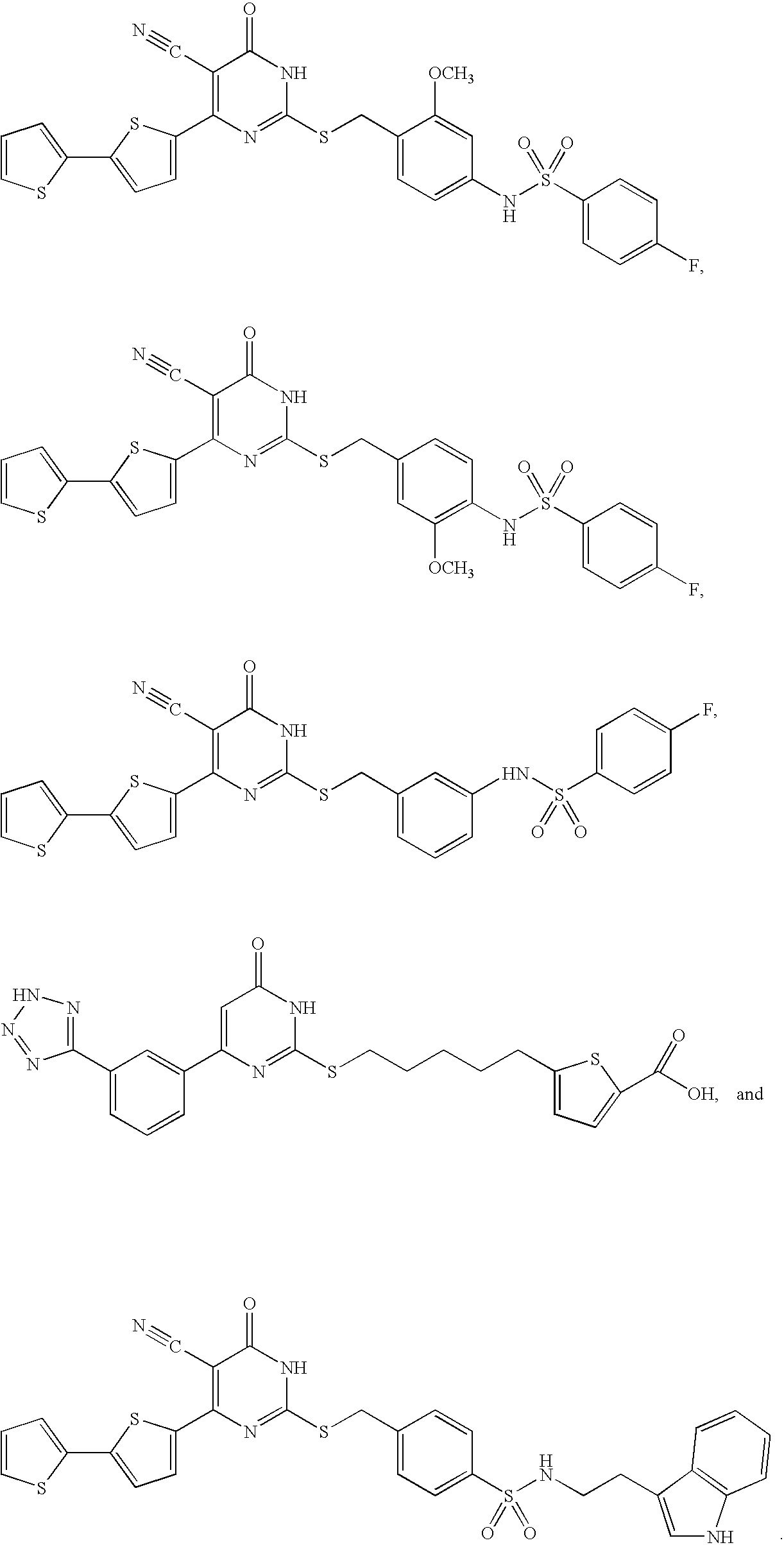
28. The method according to claim 1 , wherein the mammal is a human.
29. The method according to claim 1 , wherein the anti-toxicity agent is administered to the mammal parenterally orally.
30. The method according to claim 1 , wherein the anti toxicity agent is administered during and after each dose of the inhibitor.
31. The method according to claim 1 , wherein the anti-toxicity agent is administered to the mammal by multiple bolus or pump dosing, or by slow release formulations.
32. The method according to claim 1 , wherein the method is used to treat a cell proliferative disorder selected from the group comprising lung cancer, leukemia, glioma, urothelial cancer, colon cancer, breast cancer, prostate cancer, pancreatic cancer, skin cancer, head and neck cancer.
33. A method for selectively killing MTAP-deficient cells of a mammal, the method comprising:
(c) administering to the mammal an inhibitor of glycinamide ribonucleotide formyltransferase (“GARFT”), aminoimidazolecarboximide ribonucleotide formyltransferase (“AICARFT”) or both in a therapeutically effective amount; and
(d) administering to the mammal an anti-toxicity agent in an amount effective to increase the maximally tolerated dose of the inhibitor;
wherein the inhibitor does not have high affinity to a membrane binding folate protein.
34. The method of claim 33 , wherein the inhibitor is predominantly transported into cells by a reduced folate carrier protein.
35. The method of claim 33 , wherein the anti-toxicity agent is an MTAP substrate or a prodrug of an MTAP substrate.
36. The method of claim 35 , wherein the anti-toxicity agent has Formula X

R41 is selected from the group consisting of:
(a) —Rg wherein Rg represents a C1-C5 alkyl, C2-C5 alkenylene or alkynylene radical, unsubstituted or substituted by one or more substitutents independently selected from C1 to C6 alkoxy, C1 to C6 alkoxy(C1 to C6)alkyl, C2 to C6 alkynyl, acyl, halo, amino, hydroxyl, nitro, mercapto, cycloalkyl, heterocycloalkyl, aryl or heteroaryl;
(b) —Rg(Y)RhRi wherein Rg is as defined above, Y represents O, NH, S, or methylene; and Rh and Ri represent, independently, (i) H;: (ii), a C1-C9 alkyl, or a C2-C6 alkenyl or alkynyl, unsubstituted or substituted by one or more substitutents independently selected from C1 to C6 alkoxy; C1 to C6 alkoxy(C1 to C6)alkyl; C2 to C6 alkynyl; acyl; halo; amino; hydroxyl; nitro; mercapto; —NCOORo; —CONH2; C(O)N(Ro)2; C(O)Ro; or C(O)ORo, wherein Ro is selected from the group consisting of H, C1-C6 alkyl, C2-C6 heterocycloalkyl, cycloalkyl, heteroaryl, aryl, and amino, unsubstituted or substituted with C1-C6 alkyl, 2- to 6-membered heteroalkyl, heterocycloalkyl, cycloalkyl, C1-C6 boc-aminoalkyl; cycloalkyl, heterocycloalkyl, aryl or heteroaryl; or (iii) a monocyclic or bicyclic cycloalkyl, heterocycloalkyl, aryl or heteroaryl, unsubstituted or substituted with one or more substituents independently selected from C1 to C6 alkyl, C2 to C6 alkenyl, C1 to C6 alkoxy, C1 to C6 alkoxy(C1 to C6)alkyl, C2 to C6 alkynyl, acyl, halo, amino, hydroxyl, nitro, mercapto, cycloalkyl, heterocycloalkyl, aryl heteroaryl, —COORo, —NCORo wherein Ro is as defined above, 2 to 6 membered heteroalkyl, C1 to C6 alkyl-cycloalkyl, C1 to C6 alkyl-heterocycloalkyl, C1 to C6 alkyl-aryl or C1 to C6 alkyl-aryl;
(c) C(O)NRjRk wherein Rj and Rk represent, independently, (i) H; or (ii) a C1-C6 alkyl, amino, C1-C6 haloalkyl, C1-C6 aminoalkyl, C1-C6 boc-aminoalkyl, C1-C6 cycloalkyl, C1-C6 alkenyl, C2-C6 alkenylene, C2-C6 alkynylene radical, wherein Rj and Rk are optionally joined together to form, together with the nitrogen to which they are bound; a heterocycloalkyl or heteroaryl ring containing two to five carbon atoms and wherein the C(O)NRjRk group is further unsubstituted or substituted by one or more substitutents independently selected from —C(O)Ro, —C(O)ORo wherein Ro is as defined above, C1 to C6 alkyl, C2 to C6 alkenyl, C1 to C6 alkoxy, C1 to C6 alkoxy(C1 to C6)alkyl C2 to C6 alkynyl, acyl, halo, amino, hydroxyl, nitro, mercapto, cycloalkyl, heterocycloalkyl, aryl or heteroaryl; or
(d) C(O)ORh wherein Rh is as defined above;
R42 and R44 represent, independently, H or OH; and
R43 and R45 represent, independently, H, OH, amino or halo;
where any of the cycloalkyl, heterocycloalkyl, aryl, heteroaryl moieties present in the above may be further substituted with one or more additional substituents independently selected from the group consisting of nitro, amino, —(CH2)z—CN where z is 0-4, halo, haloalkyl, haloaryl, hydroxyl, keto, C1 to C6 alkyl, C2 to C6 alkenyl, C2 to C6 alkynyl, heteroalkyl, unsubstituted cycloalkyl, unsubstituted heterocycloalkyl, unsubstituted aryl or unsubstituted heteroaryl;
and salts or solvates thereof.
37. The method of claim 36 , wherein the anti-toxicity agent has a Kcat/Km ratio that is greater than 0.05 s−1 μM−1.
38. The method of claim 35 , wherein the anti-toxicity agent has Formula XI:
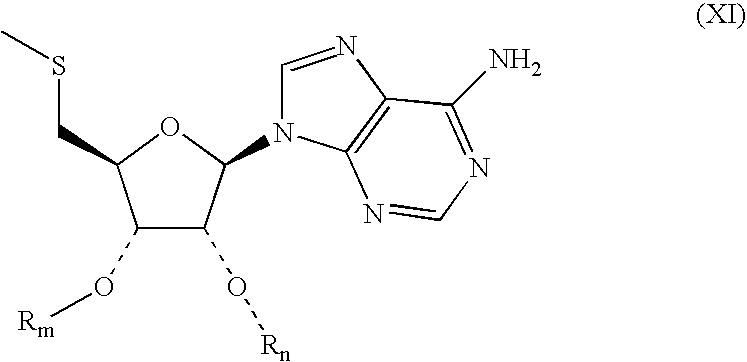
wherein
Rm and Rn are, independently, selected from the group consisting of H; a phosphate or a sodium salt thereof; C(O)N(Ro)2; C(O)Ro; or C(O)ORo, wherein Ro is selected from the group consisting of H, C1-C6 alkyl, C2-C6 heterocycloalkyl, cycloalkyl, heteroaryl, aryl, and amino, unsubstituted or substituted with C1-C6 alkyl, C1-C6 heteroalkyl, C2-C6 heterocycloalkyl cycloalkyl, C1-C6 boc-aminoalkyl, and solvates or salts thereof.
39. The method of claim 38 , wherein Rm and Rn independently represent

40. The method of claim 33 , wherein the inhibitor is an inhibitor specific to glycinamide ribonucleotide formyltransferase.
41. The method of claim 40 , wherein the inhibitor is a compound having the Formula VII:
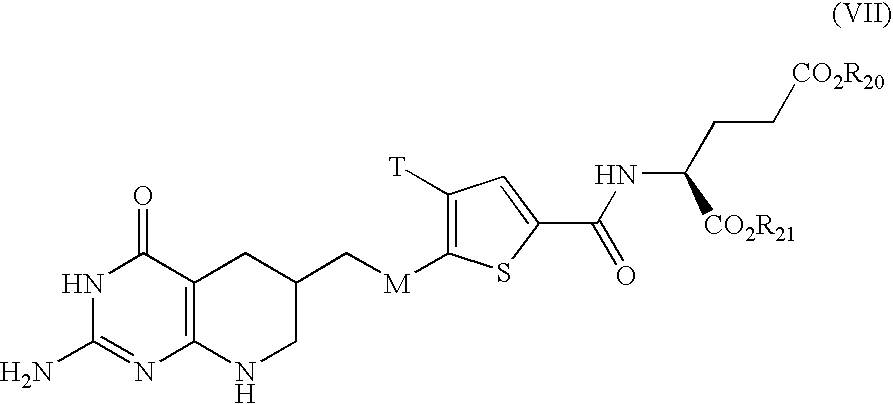
wherein L represents sulfur, CH2 or selenium;
M represents a sulfur, oxygen, or a diradical of C1-C3 alkane, C2-C3 alkene, C2-C3 alkyne, or amine, wherein M is unsubstituted or substituted by one or more substituents selected from the group consisting of alkyl, heteroalkyl, haloalkyl, haloaryl, halocycloalkyl, haloheterocycloalkyl, aryl, cycloalkyl, heterocycloalkyl, heteroaryl, —NO2, —NH2, —N—ORc, —(CH2)z—CN where z is 0-4, halo, —OH, —O—Ra—O—Rb, —ORb, —CO—Rc, —O—CO—Rc, —CO—ORc, —O—CO—ORc, —O—CO—O—CO—Rc, —O—ORc, keto (═O), thioketo (═S), —SO2—Rc, —SO—Rc, —NRdRe, —CO—NRdRe, —O—CO—NRdRe, —NRc—CO—NRdRe, —NRc—CO—Re, —NRc—CO2—ORe, —CO—NRc—CO—Rd, —O—SO2—Rc, —O—SO—Rc, —O—S—Rc, —S—CO—Rc, —SO—CO—ORc, —SO2—CO—ORc, —O—SO3, —NRc—SRd, —NRc—SO—Rd, —NRc—SO2—Rd, —CO—SRc, —CO—SO—Rc, —CO—SO2—Rc, —CS—Rc, —CSO—Rc, —CSO2—Rc, —NRc—CS—Rd, —O—CS—Rc, —O—CSO—Rc, —O—CSO2—Rc, —SO2NRdRe, —SO—NRdRe, —S—NRdRe, —NRd—CSO2—Rd, —NRc—CSO—Rd, —NRc—CS—Rd, —SH, —S—Rb, and —PO2—ORc, where Ra is selected from the group consisting of alkyl, heteroalkyl, alkenyl, and alkynyl; Rb is selected from the group consisting of alkyl, heteroalkyl, haloalkyl, alkenyl, alkynyl, halo, —CO—Rc, —CO—ORc, —O—CO—O—Rc, —O—CO—Rc, —NRc—CO—Rd, —CO—NRdRe, —OH, aryl, heteroaryl, heterocycloalkyl, and cycloalkyl; Rc, Rd and Re are each independently selected from the group consisting of hydro, hydroxyl, halo, alkyl, heteroalkyl, haloalkyl, alkenyl, alkynyl, —CORf, —COORf, —O—CO—O—Rf, —O—CO—Rf, —OH, aryl, heteroaryl, cycloalkyl, and heterocycloalkyl, or Rd and Re cyclize to form a heteroaryl or heterocycloalkyl group; and Rf is selected from the group consisting of hydro, alkyl, and heteroalkyl; and where any of the alkyl, heteroalkyl, alkenyl, aryl, cycloalkyl, heterocycloalkyl, or heteroaryl moieties present in the above substituents may be further substituted with one or more additional substituents independently selected from the group consisting of —NO2, —NH2, —(CH2)z—CN where z is 0-4, halo, haloalkyl, haloaryl, —OH, keto (═O), —N—OH, NRc—ORc, —NRdRe, —CO—NRdRe, —CO—ORe, —CO—Rc, NRc—CO—NRdRe, —C—CO—ORc, —NRc—CO—Rd, —O—CO—O—Rc, —O—CO—NRdRe, —SH, —O—Rb, —O—Ra—O—Rb, —S—Rb, unsubstituted alkyl, unsubstituted aryl, unsubstituted cycloalkyl, unsubstituted heterocycloalkyl, and unsubstituted heteroaryl, where Ra, Rb, Rc, Rd and Re are as defined above;
T represents C1-C6 alkyl; C2-C6 alkenyl; C2-C6 alkynyl; —C(O)E, wherein E represents hydro, C1-C3 alkyl, C2-C3 alkenyl, C2-C3 alkynyl, O—(C1-C3) alkoxy, or NR10R11, wherein R10 and R11 represent independently hydro, C1-C3 alkyl, C2-C3 alkenyl, C2-C3 alkynyl; hydroxyl; nitro; SR12, wherein R12 is hydro, C1-C6 alkyl, C2-C6 alkenyl, C2-C6 alkynyl, cyano; or O(C1-C3) alkyl; and
R20 and R21 are each independently hydro or a moiety that forms, together with the attached CO2, a readily hydrolyzable ester group.
42. The method of claim 41 , wherein the inhibitor has the chemical structure:

43. The method of claim 41 , wherein the inhibitor has the chemical structure:

44. The method of claim 41 , wherein the inhibitor has the chemical structure:

45. The method of claim 41 wherein the inhibitor has the chemical structure:

46. The method of claim 33 wherein the inhibitor has the chemical structure:

47. The method according to claim 33 , wherein the mammal is a human.
48. The method according to claim 33 , wherein the anti-toxicity agent is administered to the mammal parenterally or orally.
49. The method according to claim 33 , wherein the anti-toxicity agent is administered during and after each dose of the inhibitor.
50. The method according to claim 33 , wherein the anti-toxicity agent is administered to the mammal by multiple bolus or pump dosing, or by slow release formulations.
51. The method according to claim 33 , wherein the method is used to treat a cell proliferative disorder selected from the group comprising lung cancer, leukemia, glioma, urothelial cancer, colon cancer, breast cancer, prostate cancer, pancreatic cancer, skin cancer, head and neck cancer.
52. A method for selectively killing MTAP-deficient cells of a mammal, the method comprising:

(a) administering to the mammal an inhibitor of glycinamide ribonucleotide formyltransferase (“GARFT”) in a therapeutically effective amount, the inhibitor having the formula:
(b) administering to the mammal an anti-toxicity agent in an amount effective to increase the maximally tolerated dose of the inhibitor;
wherein the anti-toxicity agent is administered during and after administration of the inhibitor.
53. The method of claim 52 , wherein the anti-toxicity agent has a Kcat/Km ratio that is greater than 0.05 s−1 μM−1.
54. The method of claim 2 , wherein the anti-toxicity agent has Formula XII:

R41 is selected from the group consisting of:
(a) —Rg wherein Rg represents a C1-C5 alkyl, C2-C5 alkenylene or alkynylene radical, unsubstituted or substituted by one or more substitutents independently selected from C1 to C6 alkoxy, C1 to C6 alkoxy(C1 to C6)alkyl, C2 to C6 alkynyl, acyl, halo, amino, hydroxyl, nitro, mercapto, cycloalkyl, heterocycloalkyl, aryl or heteroaryl;
(b) —Rg(Y)RhRi wherein Rg is as defined above, Y represents O, NH, S, or methylene; and Rh and Ri represent, independently, (i) H; (ii) a C1-C9 alkyl, or a C2-C6 alkenyl or alkynyl, unsubstituted or substituted by one or more substitutents independently selected from C1 to C6 alkoxy; C1 to C6 alkoxy(C1 to C6)alkyl; C2 to C6 alkynyl; acyl; halo; amino hydroxyl; nitro; mercapto; —NCOORo; —CONH2; C(O)N(Ro)2; C(O)Ro; or C(O)ORo, wherein Ro is selected from the group consisting of H, C1-C6 alkyl, C1-C6 heterocycloalkyl, cycloalkyl, heteroaryl, aryl, and amino, unsubstituted or substituted with C1-C6 alkyl, 2- to 6-membered heteroalkyl, heterocycloalkyl, cycloalkyl, C1-C6 boc-aminoalkyl; cycloalkyl, heterocycloalkyl, aryl or heteroaryl; or (iii) a monocyclic or bicyclic cycloalkyl, heterocycloalkyl, aryl or heteroaryl, unsubstituted or substituted with one or more substituents independently selected from C1 to C6 alkyl, C2 to C6 alkenyl, C1 to C6 alkoxy, C1 to C6 alkoxy(C1 to C6)alkyl, C2 to C6 alkynyl, acyl, halo, amino, hydroxyl, nitro, mercapto, cycloalkyl, heterocycloalkyl, aryl heteroaryl, —COORo, —NCORo wherein Ro is as defined above, 2 to 6 membered heteroalkyl, C1 to C6 alkyl-cycloalkyl, C1 to C6 alkyl-heterocycloalkyl, C1 to C6 alkyl-aryl or C1 to C6 alkyl-aryl;
(c) C(O)NRjRk wherein Rj and Rk represent, independently, (i) H; or (ii) a C1-C6 alkyl, amino, C1-C6 haloalkyl, C1-C6 aminoalkyl, C1-C6 boc-aminoalkyl, C1-C6 cycloalkyl, C1-C6 alkenyl, C2-C6 alkenylene, C2-C6 alkynylene radical, wherein Rj and Rk are optionally joined together to form, together with the nitrogen to which they are bound, a heterocycloalkyl or heteroaryl ring containing two to five carbon atoms and wherein the C(O)NRjRk group is further unsubstituted or substituted by one or more substitutents independently selected from —C(O)Ro, —C(O)ORo wherein Ro is as defined above, C1 to C6 alkyl, C2 to C6 alkenyl, C1 to C6 alkoxy, C1 to C6 alkoxy(C1 to C6)alkyl, C2 to C6 alkynyl, acyl, halo, amino, hydroxyl, nitro, mercapto, cycloalkyl, heterocycloalkyl, aryl or, heteroaryl; or
(d) C(O)ORh wherein Rh is as defined above;
R42 and R44 represent, independently, H or OH; and
R43 and R45 represent, independently, H, OH, amino or halo;
where any of the cycloalkyl, heterocycloalkyl, aryl, heteroaryl moieties present in the above may be further substituted with one or more additional substituents independently selected from the group consisting of nitro, amino, —(CH2)z—CN where z is 0-4, halo, haloalkyl, haloaryl, hydroxyl, keto, C1 to C6 alkyl, C2 to C6 alkenyl, C2 to C6 alkynyl, heteroalkyl, unsubstituted cycloalkyl, unsubstituted heterocycloalkyl, unsubstituted aryl or unsubstituted heteroaryl;
and R46 represents (i) H; (ii) a C1-C9 alkyl, or a C2-C6 alkenyl or alkynyl, unsubstituted or substituted by one or more substitutents independently selected from C1 to C6 alkoxy; C1 to C6 alkoxy(C1 to C6)alkyl; C2 to C6 alkynyl; acyl; halo; amino; hydroxyl; nitro; mercapto; cycloalkyl, heterocycloalkyl, aryl or heteroaryl; or (iii) a monocyclic or bicyclic cycloalkyl, heterocycloalkyl, aryl or heteroaryl, unsubstituted or substituted with one or more substituents independently selected from C1 to C6 alkyl, C2 to C6 alkenyl, C1 to C6 alkoxy, C1 to C6 alkoxy(C1 to C6)alkyl, C2 to C6 alkynyl, acyl, halo, amino, hydroxyl, nitro, mercapto, cycloalkyl, heterocycloalkyl, aryl or heteroaryl;
and salts or solvates thereof.
Priority Applications (1)
| Application Number | Priority Date | Filing Date | Title |
|---|---|---|---|
| US10/367,366 US20040043959A1 (en) | 2002-03-04 | 2003-02-14 | Combination therapies for treating methylthioadenosine phosphorylase deficient cells |
Applications Claiming Priority (3)
| Application Number | Priority Date | Filing Date | Title |
|---|---|---|---|
| US36164502P | 2002-03-04 | 2002-03-04 | |
| US43227502P | 2002-12-09 | 2002-12-09 | |
| US10/367,366 US20040043959A1 (en) | 2002-03-04 | 2003-02-14 | Combination therapies for treating methylthioadenosine phosphorylase deficient cells |
Publications (1)
| Publication Number | Publication Date |
|---|---|
| US20040043959A1 true US20040043959A1 (en) | 2004-03-04 |
Family
ID=27791683
Family Applications (1)
| Application Number | Title | Priority Date | Filing Date |
|---|---|---|---|
| US10/367,366 Abandoned US20040043959A1 (en) | 2002-03-04 | 2003-02-14 | Combination therapies for treating methylthioadenosine phosphorylase deficient cells |
Country Status (14)
| Country | Link |
|---|---|
| US (1) | US20040043959A1 (en) |
| EP (1) | EP1482977A1 (en) |
| KR (1) | KR20040091089A (en) |
| AR (1) | AR038863A1 (en) |
| AU (1) | AU2003206019A1 (en) |
| BR (1) | BR0308222A (en) |
| CA (1) | CA2477422A1 (en) |
| IL (1) | IL163776A0 (en) |
| NO (1) | NO20044191L (en) |
| PA (1) | PA8568201A1 (en) |
| PE (1) | PE20030907A1 (en) |
| TW (1) | TW200304380A (en) |
| UY (1) | UY27692A1 (en) |
| WO (1) | WO2003074083A1 (en) |
Cited By (41)
| Publication number | Priority date | Publication date | Assignee | Title |
|---|---|---|---|---|
| US20040266827A1 (en) * | 2003-06-25 | 2004-12-30 | Agouron Pharmaceuticals, Inc. | Convergent asymmetric route to produce a key intermediate towards the synthesis of a garft inhibitor |
| US20070280946A1 (en) * | 2004-04-05 | 2007-12-06 | Yoshito Numata | Antibody to 5' -Deoxy-5' - Methylthioadenosine And Uses Thereof |
| WO2008002894A1 (en) * | 2006-06-28 | 2008-01-03 | Duquesne University Of The Holy Ghost | Chemotherapeutic compounds for selectively targeting tumor cells with fr type receptors |
| US20120329776A1 (en) * | 2009-05-07 | 2012-12-27 | Pingda Ren | Heterocyclic compounds and uses thereof |
| US20130323836A1 (en) * | 2010-04-22 | 2013-12-05 | Isis Pharmaceuticals, Inc. | 5'-end derivatives |
| US8604032B2 (en) | 2010-05-21 | 2013-12-10 | Infinity Pharmaceuticals, Inc. | Chemical compounds, compositions and methods for kinase modulation |
| US8703778B2 (en) | 2008-09-26 | 2014-04-22 | Intellikine Llc | Heterocyclic kinase inhibitors |
| US8703777B2 (en) | 2008-01-04 | 2014-04-22 | Intellikine Llc | Certain chemical entities, compositions and methods |
| US8785456B2 (en) | 2008-01-04 | 2014-07-22 | Intellikine Llc | Substituted isoquinolin-1(2H)-ones, and methods of use thereof |
| US8785470B2 (en) | 2011-08-29 | 2014-07-22 | Infinity Pharmaceuticals, Inc. | Heterocyclic compounds and uses thereof |
| US8796241B2 (en) | 2007-08-29 | 2014-08-05 | Adam Lubin | Therapy of tumors and infectious agents deficient in methylthioadenosine phosphorylase |
| US8809349B2 (en) | 2011-01-10 | 2014-08-19 | Infinity Pharmaceuticals, Inc. | Processes for preparing isoquinolinones and solid forms of isoquinolinones |
| US8828998B2 (en) | 2012-06-25 | 2014-09-09 | Infinity Pharmaceuticals, Inc. | Treatment of lupus, fibrotic conditions, and inflammatory myopathies and other disorders using PI3 kinase inhibitors |
| US8940742B2 (en) | 2012-04-10 | 2015-01-27 | Infinity Pharmaceuticals, Inc. | Heterocyclic compounds and uses thereof |
| US8969363B2 (en) | 2011-07-19 | 2015-03-03 | Infinity Pharmaceuticals, Inc. | Heterocyclic compounds and uses thereof |
| US9056877B2 (en) | 2011-07-19 | 2015-06-16 | Infinity Pharmaceuticals, Inc. | Heterocyclic compounds and uses thereof |
| US9359365B2 (en) | 2013-10-04 | 2016-06-07 | Infinity Pharmaceuticals, Inc. | Heterocyclic compounds and uses thereof |
| US9388183B2 (en) | 2010-11-10 | 2016-07-12 | Infinity Pharmaceuticals, Inc. | Heterocyclic compounds and uses thereof |
| US9481667B2 (en) | 2013-03-15 | 2016-11-01 | Infinity Pharmaceuticals, Inc. | Salts and solid forms of isoquinolinones and composition comprising and methods of using the same |
| US9708348B2 (en) | 2014-10-03 | 2017-07-18 | Infinity Pharmaceuticals, Inc. | Trisubstituted bicyclic heterocyclic compounds with kinase activities and uses thereof |
| US9751888B2 (en) | 2013-10-04 | 2017-09-05 | Infinity Pharmaceuticals, Inc. | Heterocyclic compounds and uses thereof |
| US9775844B2 (en) | 2014-03-19 | 2017-10-03 | Infinity Pharmaceuticals, Inc. | Heterocyclic compounds and uses thereof |
| US10160761B2 (en) | 2015-09-14 | 2018-12-25 | Infinity Pharmaceuticals, Inc. | Solid forms of isoquinolinones, and process of making, composition comprising, and methods of using the same |
| US10745409B2 (en) | 2016-12-15 | 2020-08-18 | Janssen Pharmaceutica Nv | Azepane inhibitors of menin-MLL interaction |
| US10759806B2 (en) | 2016-03-17 | 2020-09-01 | Infinity Pharmaceuticals, Inc. | Isotopologues of isoquinolinone and quinazolinone compounds and uses thereof as PI3K kinase inhibitors |
| US10919914B2 (en) | 2016-06-08 | 2021-02-16 | Infinity Pharmaceuticals, Inc. | Heterocyclic compounds and uses thereof |
| US10975100B2 (en) | 2016-09-14 | 2021-04-13 | Janssen Pharmaceutica Nv | Fused bicyclic inhibitors of menin-MLL interaction |
| US11059850B2 (en) | 2017-12-08 | 2021-07-13 | Janssen Pharmaceutica Nv | Spirobicyclic analogues |
| US11098062B2 (en) | 2016-10-03 | 2021-08-24 | Janssen Pharmaceutica Nv | Monocyclic and bicyclic ring system substituted carbanucleoside analogues for use as PRMT5 inhibitors |
| US11110096B2 (en) | 2014-04-16 | 2021-09-07 | Infinity Pharmaceuticals, Inc. | Combination therapies |
| US11147818B2 (en) | 2016-06-24 | 2021-10-19 | Infinity Pharmaceuticals, Inc. | Combination therapies |
| US11220517B2 (en) | 2016-09-14 | 2022-01-11 | Janssen Pharmaceutica Nv | Spiro bicyclic inhibitors of menin-MLL interaction |
| US11279970B2 (en) | 2017-02-27 | 2022-03-22 | Janssen Pharmaceutica Nv | Use of biomarkers in identifying cancer patients that will be responsive to treatment with a PRMT5 inhibitor |
| US11318157B2 (en) | 2015-08-26 | 2022-05-03 | Janssen Pharmaceutica Nv | 6-6 bicyclic aromatic ring substituted nucleoside analogues for use as PRMT5 inhibitors |
| US11396517B1 (en) | 2017-12-20 | 2022-07-26 | Janssen Pharmaceutica Nv | Exo-aza spiro inhibitors of menin-MLL interaction |
| WO2022225866A1 (en) * | 2021-04-19 | 2022-10-27 | Emory University | Quinazoline derivatives, pharmaceutical compositions, and therapeutic uses related to nox inhibition |
| US11571437B2 (en) | 2019-06-06 | 2023-02-07 | Janssen Pharmaceutica Nv | Methods of treating cancer using PRMT5 inhibitors |
| CN116406271A (en) * | 2020-07-14 | 2023-07-07 | 江苏先声药业有限公司 | Bicyclic compounds |
| US12084462B2 (en) | 2016-09-14 | 2024-09-10 | Janssen Pharmaceutica Nv | Spiro bicyclic inhibitors of menin-MLL interaction |
| US12213983B2 (en) | 2012-11-01 | 2025-02-04 | Infinity Pharmaceuticals, Inc. | Treatment of cancers using PI3 kinase isoform modulators |
| US12473295B2 (en) | 2019-12-19 | 2025-11-18 | Janssen Pharmaceutica Nv | Substituted straight chain spiro derivatives |
Families Citing this family (19)
| Publication number | Priority date | Publication date | Assignee | Title |
|---|---|---|---|---|
| RU2013130253A (en) | 2010-12-03 | 2015-01-10 | Эпизайм, Инк. | 7-DEAZAPURINE HISTONIC METHYL TRANSFERASES AND WAYS OF THEIR APPLICATION |
| US8580762B2 (en) | 2010-12-03 | 2013-11-12 | Epizyme, Inc. | Substituted purine and 7-deazapurine compounds |
| EP2771012A4 (en) * | 2011-10-24 | 2015-06-24 | Glaxosmithkline Ip No 2 Ltd | New compounds |
| US20150284422A1 (en) | 2012-08-10 | 2015-10-08 | Epizyme, Inc. | Inhibitors of protein methyltransferase dot1l and methods of use thereof |
| WO2014039839A1 (en) | 2012-09-06 | 2014-03-13 | Epizyme, Inc. | Method of treating leukemia |
| CN103073606B (en) * | 2013-02-05 | 2016-05-18 | 中国医药研究开发中心有限公司 | Synthetic and the preparation method of 5 '-S-(4,4 '-dimethoxytrityl)-2 '-deoxyinosine |
| US9175032B2 (en) | 2013-03-15 | 2015-11-03 | Epizyme, Inc. | Methods of synthesizing substituted purine compounds |
| WO2015164573A1 (en) * | 2014-04-25 | 2015-10-29 | Vitae Pharmaceuticals, Inc. | Purine derivatives as cd73 inhibitors for the treatment of cancer |
| JPWO2016056606A1 (en) * | 2014-10-07 | 2017-07-20 | 国立大学法人京都大学 | Benzisothiazolopyrimidine derivatives or salts thereof, viral infection inhibitors and pharmaceuticals |
| KR20180116307A (en) | 2016-03-10 | 2018-10-24 | 얀센 파마슈티카 엔.브이. | Substituted nucleoside analogs for use as PRMT5 inhibitors |
| MX374813B (en) * | 2016-03-10 | 2025-03-06 | Janssen Pharmaceutica Nv | SUBSTITUTED NUCLEOSIDE ANALOGUES FOR USE AS PRMT5 INHIBITORS. |
| CA2969295A1 (en) * | 2016-06-06 | 2017-12-06 | Pfizer Inc. | Substituted carbonucleoside derivatives, and use thereof as a prmt5 inhibitor |
| WO2018065365A1 (en) | 2016-10-03 | 2018-04-12 | Janssen Pharmaceutica Nv | Novel monocyclic and bicyclic ring system substituted carbanucleoside analogues for use as prmt5 inhibitors |
| CN109369758B (en) * | 2018-11-02 | 2021-04-13 | 哈尔滨商业大学 | Synthesis method and application of 5'- (6-chloronicotinyl ester) -3' -deoxyadenosine |
| CN109111445B (en) * | 2018-11-02 | 2020-12-18 | 哈尔滨商业大学 | Synthetic method and application of 5'-furoyl ester-3'-deoxyadenosine |
| EP3939988A4 (en) * | 2019-03-20 | 2022-08-24 | Korea Research Institute of Chemical Technology | PHARMACEUTICAL COMPOSITION COMPRISING A NEW HETEROCYCLIC COMPOUND AZOLOPYRIMIDINE AS ACTIVE SUBSTANCE |
| CR20220012A (en) | 2019-06-12 | 2022-03-11 | Janssen Pharmaceutica Nv | NEW SPIROBICYCLIC INTERMEDIATES |
| LV15670B (en) * | 2021-03-10 | 2023-11-20 | Latvijas Organiskās Sintēzes Institūts | New adenosylmercaptan derivatives as inhibitors of viral m-RNA capping methyltransferases |
| CN113603721B (en) * | 2021-06-21 | 2023-12-01 | 重庆文理学院 | A method of synthesizing SAICAR |
Citations (8)
| Publication number | Priority date | Publication date | Assignee | Title |
|---|---|---|---|---|
| US4683195A (en) * | 1986-01-30 | 1987-07-28 | Cetus Corporation | Process for amplifying, detecting, and/or-cloning nucleic acid sequences |
| US4683202A (en) * | 1985-03-28 | 1987-07-28 | Cetus Corporation | Process for amplifying nucleic acid sequences |
| US5594139A (en) * | 1993-01-29 | 1997-01-14 | Agouron Pharmaceuticals, Inc. | Processes for preparing antiproliferative garft-inhibiting compounds |
| US5608082A (en) * | 1994-07-28 | 1997-03-04 | Agouron Pharmaceuticals, Inc. | Compounds useful as antiproliferative agents and GARFT inhibitors |
| US5726312A (en) * | 1992-12-16 | 1998-03-10 | Agouron Pharmaceuticals, Inc. | Methods for preparing antiproliferative 5-substituted pyrimidone compounds |
| US5840505A (en) * | 1993-12-29 | 1998-11-24 | The Regents Of The University Of California | Method for inhibiting adenylosuccinate synthetase activity in methylthioadenosine phosphorylase deficient cells |
| US5942393A (en) * | 1993-12-29 | 1999-08-24 | The Regents Of The University Of California | Method for the detection of the presence or absence of methylthioadenosine phosphorylase (MTASE) in a cell sample by detection of the presence or absence of MTASE encoding nucleic acid in the cell sample |
| US5945427A (en) * | 1995-06-07 | 1999-08-31 | Agouron Pharmaceuticals, Inc. | Antiproliferative substituted 5-thiapyrimidinone and 5-selenopyrimidinone compounds |
Family Cites Families (3)
| Publication number | Priority date | Publication date | Assignee | Title |
|---|---|---|---|---|
| GB8625019D0 (en) * | 1986-10-18 | 1986-11-19 | Wellcome Found | Compounds |
| NZ261497A (en) * | 1993-01-29 | 1997-06-24 | Agouron Pharma | 2-[4-[2-(2-amino-4-oxo-3h-pyrido[5,4-b]n-hetring)-ring containing hydrocarbyl chain]-amido]-pentanedioic acid |
| RU2136686C1 (en) * | 1994-07-28 | 1999-09-10 | Агурон Фармасьютикалз, Инк. | Glutamic acid derivatives (variants), pharmaceutical composition and method of inhibition of growth and proliferation of cells |
-
2003
- 2003-02-14 US US10/367,366 patent/US20040043959A1/en not_active Abandoned
- 2003-02-17 CA CA002477422A patent/CA2477422A1/en not_active Abandoned
- 2003-02-17 IL IL17377603A patent/IL163776A0/en unknown
- 2003-02-17 WO PCT/IB2003/000615 patent/WO2003074083A1/en not_active Ceased
- 2003-02-17 AU AU2003206019A patent/AU2003206019A1/en not_active Abandoned
- 2003-02-17 KR KR10-2004-7013707A patent/KR20040091089A/en not_active Ceased
- 2003-02-17 EP EP03702902A patent/EP1482977A1/en not_active Withdrawn
- 2003-02-17 BR BR0308222-9A patent/BR0308222A/en not_active Application Discontinuation
- 2003-02-28 PE PE2003000205A patent/PE20030907A1/en not_active Application Discontinuation
- 2003-02-28 PA PA20038568201A patent/PA8568201A1/en unknown
- 2003-02-28 UY UY27692A patent/UY27692A1/en not_active Application Discontinuation
- 2003-03-03 TW TW092104399A patent/TW200304380A/en unknown
- 2003-03-03 AR ARP030100700A patent/AR038863A1/en not_active Application Discontinuation
-
2004
- 2004-09-30 NO NO20044191A patent/NO20044191L/en not_active Application Discontinuation
Patent Citations (20)
| Publication number | Priority date | Publication date | Assignee | Title |
|---|---|---|---|---|
| US4683202A (en) * | 1985-03-28 | 1987-07-28 | Cetus Corporation | Process for amplifying nucleic acid sequences |
| US4683202B1 (en) * | 1985-03-28 | 1990-11-27 | Cetus Corp | |
| US4683195A (en) * | 1986-01-30 | 1987-07-28 | Cetus Corporation | Process for amplifying, detecting, and/or-cloning nucleic acid sequences |
| US4683195B1 (en) * | 1986-01-30 | 1990-11-27 | Cetus Corp | |
| US6207670B1 (en) * | 1992-12-16 | 2001-03-27 | Agouron Pharmaceuticals, Inc. | Antiproliferative substituted 5-thiapyrimidinone and 5-selenopyrimidinone compounds |
| US5739141A (en) * | 1992-12-16 | 1998-04-14 | Agouron Pharmaceuticals, Inc. | Antiproliferative substituted 5-thiapyrimidinone and 5-selenopyrimidinone compounds |
| US5726312A (en) * | 1992-12-16 | 1998-03-10 | Agouron Pharmaceuticals, Inc. | Methods for preparing antiproliferative 5-substituted pyrimidone compounds |
| US5641774A (en) * | 1993-01-29 | 1997-06-24 | Agouron Pharmaceuticals, Inc. | Compounds useful as antiproliferative agents and garft inhibitors |
| US5639747A (en) * | 1993-01-29 | 1997-06-17 | Agouron Pharmaceuticals, Inc. | Compounds useful as antiproliferative agents and garft inhibitors |
| US5639749A (en) * | 1993-01-29 | 1997-06-17 | Agouron Pharmaceuticals, Inc. | Compounds useful as antiproliferative agents and garft inhibitors |
| US5625061A (en) * | 1993-01-29 | 1997-04-29 | Agouron Pharmaceuticals, Inc. | Compounds useful in preparing antiproliferative agents and garft inhibitors |
| US5641771A (en) * | 1993-01-29 | 1997-06-24 | Agouron Pharmaceuticals, Inc. | Compounds useful as antiproliferative agents and garft inhibitors |
| US5723607A (en) * | 1993-01-29 | 1998-03-03 | Agouron Pharmaceticals, Inc. | Compounds useful as antiproliferative agents and GARFT inhibitors |
| US5610319A (en) * | 1993-01-29 | 1997-03-11 | Agouron Pharmaceuticals, Inc. | Compound useful as antiproliferative agents and GARFT inhibitors |
| US5594139A (en) * | 1993-01-29 | 1997-01-14 | Agouron Pharmaceuticals, Inc. | Processes for preparing antiproliferative garft-inhibiting compounds |
| US5840505A (en) * | 1993-12-29 | 1998-11-24 | The Regents Of The University Of California | Method for inhibiting adenylosuccinate synthetase activity in methylthioadenosine phosphorylase deficient cells |
| US5942393A (en) * | 1993-12-29 | 1999-08-24 | The Regents Of The University Of California | Method for the detection of the presence or absence of methylthioadenosine phosphorylase (MTASE) in a cell sample by detection of the presence or absence of MTASE encoding nucleic acid in the cell sample |
| US5646141A (en) * | 1994-07-28 | 1997-07-08 | Agouron Pharmaceuticals, Inc. | Compounds useful as antiproliferative agents and GARFT inhibitors |
| US5608082A (en) * | 1994-07-28 | 1997-03-04 | Agouron Pharmaceuticals, Inc. | Compounds useful as antiproliferative agents and GARFT inhibitors |
| US5945427A (en) * | 1995-06-07 | 1999-08-31 | Agouron Pharmaceuticals, Inc. | Antiproliferative substituted 5-thiapyrimidinone and 5-selenopyrimidinone compounds |
Cited By (82)
| Publication number | Priority date | Publication date | Assignee | Title |
|---|---|---|---|---|
| US20040266827A1 (en) * | 2003-06-25 | 2004-12-30 | Agouron Pharmaceuticals, Inc. | Convergent asymmetric route to produce a key intermediate towards the synthesis of a garft inhibitor |
| US20070280946A1 (en) * | 2004-04-05 | 2007-12-06 | Yoshito Numata | Antibody to 5' -Deoxy-5' - Methylthioadenosine And Uses Thereof |
| WO2008002894A1 (en) * | 2006-06-28 | 2008-01-03 | Duquesne University Of The Holy Ghost | Chemotherapeutic compounds for selectively targeting tumor cells with fr type receptors |
| US8796241B2 (en) | 2007-08-29 | 2014-08-05 | Adam Lubin | Therapy of tumors and infectious agents deficient in methylthioadenosine phosphorylase |
| US8785456B2 (en) | 2008-01-04 | 2014-07-22 | Intellikine Llc | Substituted isoquinolin-1(2H)-ones, and methods of use thereof |
| US9822131B2 (en) | 2008-01-04 | 2017-11-21 | Intellikine Llc | Certain chemical entities, compositions and methods |
| US8703777B2 (en) | 2008-01-04 | 2014-04-22 | Intellikine Llc | Certain chemical entities, compositions and methods |
| US11433065B2 (en) | 2008-01-04 | 2022-09-06 | Intellikine Llc | Certain chemical entities, compositions and methods |
| US9655892B2 (en) | 2008-01-04 | 2017-05-23 | Intellikine Llc | Certain chemical entities, compositions and methods |
| US9216982B2 (en) | 2008-01-04 | 2015-12-22 | Intellikine Llc | Certain chemical entities, compositions and methods |
| US8703778B2 (en) | 2008-09-26 | 2014-04-22 | Intellikine Llc | Heterocyclic kinase inhibitors |
| US9790228B2 (en) | 2008-09-26 | 2017-10-17 | Intellikine Llc | Heterocyclic kinase inhibitors |
| US9296742B2 (en) | 2008-09-26 | 2016-03-29 | Intellikine Llc | Heterocyclic kinase inhibitors |
| US8785454B2 (en) * | 2009-05-07 | 2014-07-22 | Intellikine Llc | Heterocyclic compounds and uses thereof |
| US20120329776A1 (en) * | 2009-05-07 | 2012-12-27 | Pingda Ren | Heterocyclic compounds and uses thereof |
| US9315505B2 (en) | 2009-05-07 | 2016-04-19 | Intellikine Llc | Heterocyclic compounds and uses thereof |
| US9206182B2 (en) | 2009-07-15 | 2015-12-08 | Intellikine Llc | Substituted isoquinolin-1(2H)-one compounds, compositions, and methods thereof |
| US9522146B2 (en) | 2009-07-15 | 2016-12-20 | Intellikine Llc | Substituted Isoquinolin-1(2H)-one compounds, compositions, and methods thereof |
| US9725479B2 (en) * | 2010-04-22 | 2017-08-08 | Ionis Pharmaceuticals, Inc. | 5′-end derivatives |
| US20130323836A1 (en) * | 2010-04-22 | 2013-12-05 | Isis Pharmaceuticals, Inc. | 5'-end derivatives |
| US9181221B2 (en) | 2010-05-21 | 2015-11-10 | Infinity Pharmaceuticals, Inc. | Chemical compounds, compositions and methods for kinase modulation |
| US9738644B2 (en) | 2010-05-21 | 2017-08-22 | Infinity Pharmaceuticals, Inc. | Chemical compounds, compositions and methods for kinase modulation |
| US8604032B2 (en) | 2010-05-21 | 2013-12-10 | Infinity Pharmaceuticals, Inc. | Chemical compounds, compositions and methods for kinase modulation |
| US9388183B2 (en) | 2010-11-10 | 2016-07-12 | Infinity Pharmaceuticals, Inc. | Heterocyclic compounds and uses thereof |
| US11312718B2 (en) | 2011-01-10 | 2022-04-26 | Infinity Pharmaceuticals, Inc. | Formulations of (S)-3-(1-(9H-purin-6-ylamino)ethyl)-8-chloro-2-phenylisoquinolin-1(2H)-one |
| US9840505B2 (en) | 2011-01-10 | 2017-12-12 | Infinity Pharmaceuticals, Inc. | Solid forms of (S)-3-(1-(9H-purin-6-ylamino)ethyl)-8-chloro-2-phenylisoquinolin-1 (2H)-one and methods of use thereof |
| US10550122B2 (en) | 2011-01-10 | 2020-02-04 | Infinity Pharmaceuticals, Inc. | Solid forms of (S)-3-(1-(9H-purin-6-ylamino)ethyl)-8-chloro-2-phenylisoquinolin-1(2H)-one and methods of use thereof |
| USRE46621E1 (en) | 2011-01-10 | 2017-12-05 | Infinity Pharmaceuticals, Inc. | Processes for preparing isoquinolinones and solid forms of isoquinolinones |
| US9290497B2 (en) | 2011-01-10 | 2016-03-22 | Infinity Pharmaceuticals, Inc. | Processes for preparing isoquinolinones and solid forms of isoquinolinones |
| US8809349B2 (en) | 2011-01-10 | 2014-08-19 | Infinity Pharmaceuticals, Inc. | Processes for preparing isoquinolinones and solid forms of isoquinolinones |
| US9718815B2 (en) | 2011-07-19 | 2017-08-01 | Infinity Pharmaceuticals, Inc. | Heterocyclic compounds and uses thereof |
| US8969363B2 (en) | 2011-07-19 | 2015-03-03 | Infinity Pharmaceuticals, Inc. | Heterocyclic compounds and uses thereof |
| US9605003B2 (en) | 2011-07-19 | 2017-03-28 | Infinity Pharmaceuticals, Inc. | Heterocyclic compounds and uses thereof |
| US9056877B2 (en) | 2011-07-19 | 2015-06-16 | Infinity Pharmaceuticals, Inc. | Heterocyclic compounds and uses thereof |
| US8785470B2 (en) | 2011-08-29 | 2014-07-22 | Infinity Pharmaceuticals, Inc. | Heterocyclic compounds and uses thereof |
| US9546180B2 (en) | 2011-08-29 | 2017-01-17 | Infinity Pharmaceuticals, Inc. | Heterocyclic compounds and uses thereof |
| US9115141B2 (en) | 2011-08-29 | 2015-08-25 | Infinity Pharmaceuticals, Inc. | Substituted isoquinolinones and methods of treatment thereof |
| US9255108B2 (en) | 2012-04-10 | 2016-02-09 | Infinity Pharmaceuticals, Inc. | Heterocyclic compounds and uses thereof |
| US8940742B2 (en) | 2012-04-10 | 2015-01-27 | Infinity Pharmaceuticals, Inc. | Heterocyclic compounds and uses thereof |
| US8828998B2 (en) | 2012-06-25 | 2014-09-09 | Infinity Pharmaceuticals, Inc. | Treatment of lupus, fibrotic conditions, and inflammatory myopathies and other disorders using PI3 kinase inhibitors |
| US9527847B2 (en) | 2012-06-25 | 2016-12-27 | Infinity Pharmaceuticals, Inc. | Treatment of lupus, fibrotic conditions, and inflammatory myopathies and other disorders using PI3 kinase inhibitors |
| US12213983B2 (en) | 2012-11-01 | 2025-02-04 | Infinity Pharmaceuticals, Inc. | Treatment of cancers using PI3 kinase isoform modulators |
| US9481667B2 (en) | 2013-03-15 | 2016-11-01 | Infinity Pharmaceuticals, Inc. | Salts and solid forms of isoquinolinones and composition comprising and methods of using the same |
| US9828377B2 (en) | 2013-10-04 | 2017-11-28 | Infinity Pharmaceuticals, Inc. | Heterocyclic compounds and uses thereof |
| US12152032B2 (en) | 2013-10-04 | 2024-11-26 | Infinity Pharmaceuticals, Inc. | Heterocyclic compounds and uses thereof |
| US9751888B2 (en) | 2013-10-04 | 2017-09-05 | Infinity Pharmaceuticals, Inc. | Heterocyclic compounds and uses thereof |
| US10329299B2 (en) | 2013-10-04 | 2019-06-25 | Infinity Pharmaceuticals, Inc. | Heterocyclic compounds and uses thereof |
| US9359365B2 (en) | 2013-10-04 | 2016-06-07 | Infinity Pharmaceuticals, Inc. | Heterocyclic compounds and uses thereof |
| US10675286B2 (en) | 2014-03-19 | 2020-06-09 | Infinity Pharmaceuticals, Inc. | Heterocyclic compounds and uses thereof |
| US9775844B2 (en) | 2014-03-19 | 2017-10-03 | Infinity Pharmaceuticals, Inc. | Heterocyclic compounds and uses thereof |
| US11541059B2 (en) | 2014-03-19 | 2023-01-03 | Infinity Pharmaceuticals, Inc. | Heterocyclic compounds and uses thereof |
| US11110096B2 (en) | 2014-04-16 | 2021-09-07 | Infinity Pharmaceuticals, Inc. | Combination therapies |
| US11944631B2 (en) | 2014-04-16 | 2024-04-02 | Infinity Pharmaceuticals, Inc. | Combination therapies |
| US10941162B2 (en) | 2014-10-03 | 2021-03-09 | Infinity Pharmaceuticals, Inc. | Heterocyclic compounds and uses thereof |
| US9708348B2 (en) | 2014-10-03 | 2017-07-18 | Infinity Pharmaceuticals, Inc. | Trisubstituted bicyclic heterocyclic compounds with kinase activities and uses thereof |
| US10253047B2 (en) | 2014-10-03 | 2019-04-09 | Infinity Pharmaceuticals, Inc. | Heterocyclic compounds and uses thereof |
| US11318157B2 (en) | 2015-08-26 | 2022-05-03 | Janssen Pharmaceutica Nv | 6-6 bicyclic aromatic ring substituted nucleoside analogues for use as PRMT5 inhibitors |
| US11883367B2 (en) | 2015-08-26 | 2024-01-30 | Janssen Pharmaceutica Nv | 6-6 bicyclic aromatic ring substituted nucleoside analogues for use as PRMT5 inhibitors |
| US11939333B2 (en) | 2015-09-14 | 2024-03-26 | Infinity Pharmaceuticals, Inc. | Solid forms of isoquinolinones, and process of making, composition comprising, and methods of using the same |
| US10160761B2 (en) | 2015-09-14 | 2018-12-25 | Infinity Pharmaceuticals, Inc. | Solid forms of isoquinolinones, and process of making, composition comprising, and methods of using the same |
| US11247995B2 (en) | 2015-09-14 | 2022-02-15 | Infinity Pharmaceuticals, Inc. | Solid forms of isoquinolinones, and process of making, composition comprising, and methods of using the same |
| US12384792B2 (en) | 2015-09-14 | 2025-08-12 | Twelve Therapeutics, Inc. | Solid forms of isoquinolinones, and process of making, composition comprising, and methods of using the same |
| US10759806B2 (en) | 2016-03-17 | 2020-09-01 | Infinity Pharmaceuticals, Inc. | Isotopologues of isoquinolinone and quinazolinone compounds and uses thereof as PI3K kinase inhibitors |
| US10919914B2 (en) | 2016-06-08 | 2021-02-16 | Infinity Pharmaceuticals, Inc. | Heterocyclic compounds and uses thereof |
| US11147818B2 (en) | 2016-06-24 | 2021-10-19 | Infinity Pharmaceuticals, Inc. | Combination therapies |
| US11220517B2 (en) | 2016-09-14 | 2022-01-11 | Janssen Pharmaceutica Nv | Spiro bicyclic inhibitors of menin-MLL interaction |
| US12084462B2 (en) | 2016-09-14 | 2024-09-10 | Janssen Pharmaceutica Nv | Spiro bicyclic inhibitors of menin-MLL interaction |
| US10975100B2 (en) | 2016-09-14 | 2021-04-13 | Janssen Pharmaceutica Nv | Fused bicyclic inhibitors of menin-MLL interaction |
| US11993614B2 (en) | 2016-10-03 | 2024-05-28 | Janssen Pharmaceutica Nv | Monocyclic and bicyclic ring system substituted carbanucleoside analogues for use as PRMT5 inhibitors |
| US11098062B2 (en) | 2016-10-03 | 2021-08-24 | Janssen Pharmaceutica Nv | Monocyclic and bicyclic ring system substituted carbanucleoside analogues for use as PRMT5 inhibitors |
| US10745409B2 (en) | 2016-12-15 | 2020-08-18 | Janssen Pharmaceutica Nv | Azepane inhibitors of menin-MLL interaction |
| US11530226B2 (en) | 2016-12-15 | 2022-12-20 | Janssen Pharmaceutica Nv | Azepane inhibitors of menin-MLL interaction |
| US11999993B2 (en) | 2017-02-27 | 2024-06-04 | Janssen Pharmaceutica Nv | Use of biomarkers in identifying cancer patients that will be responsive to treatment with a PRMT5 inhibitor |
| US11279970B2 (en) | 2017-02-27 | 2022-03-22 | Janssen Pharmaceutica Nv | Use of biomarkers in identifying cancer patients that will be responsive to treatment with a PRMT5 inhibitor |
| US11059850B2 (en) | 2017-12-08 | 2021-07-13 | Janssen Pharmaceutica Nv | Spirobicyclic analogues |
| US12145961B2 (en) | 2017-12-08 | 2024-11-19 | Janssen Pharmaceutica Nv | Spirobicyclic analogues |
| US11702441B2 (en) | 2017-12-08 | 2023-07-18 | Janssen Pharmaceutica Nv | Spirobicyclic analogues |
| US11396517B1 (en) | 2017-12-20 | 2022-07-26 | Janssen Pharmaceutica Nv | Exo-aza spiro inhibitors of menin-MLL interaction |
| US11571437B2 (en) | 2019-06-06 | 2023-02-07 | Janssen Pharmaceutica Nv | Methods of treating cancer using PRMT5 inhibitors |
| US12473295B2 (en) | 2019-12-19 | 2025-11-18 | Janssen Pharmaceutica Nv | Substituted straight chain spiro derivatives |
| CN116406271A (en) * | 2020-07-14 | 2023-07-07 | 江苏先声药业有限公司 | Bicyclic compounds |
| WO2022225866A1 (en) * | 2021-04-19 | 2022-10-27 | Emory University | Quinazoline derivatives, pharmaceutical compositions, and therapeutic uses related to nox inhibition |
Also Published As
| Publication number | Publication date |
|---|---|
| NO20044191L (en) | 2004-09-30 |
| AU2003206019A1 (en) | 2003-09-16 |
| WO2003074083A1 (en) | 2003-09-12 |
| EP1482977A1 (en) | 2004-12-08 |
| BR0308222A (en) | 2005-02-09 |
| CA2477422A1 (en) | 2003-09-12 |
| PE20030907A1 (en) | 2003-10-29 |
| KR20040091089A (en) | 2004-10-27 |
| TW200304380A (en) | 2003-10-01 |
| IL163776A0 (en) | 2005-12-18 |
| UY27692A1 (en) | 2003-10-31 |
| AR038863A1 (en) | 2005-02-02 |
| PA8568201A1 (en) | 2003-11-12 |
Similar Documents
| Publication | Publication Date | Title |
|---|---|---|
| US20040043959A1 (en) | Combination therapies for treating methylthioadenosine phosphorylase deficient cells | |
| US11648254B2 (en) | Substituted pyrido[2,3-d]pyrimidines as inhibitors of Ras pathway signaling | |
| AU2018307743C1 (en) | Compounds and compositions for treating conditions associated with NLRP activity | |
| CN112312904B (en) | Spirocyclic compounds | |
| ES2963590T3 (en) | EZH2 inhibitor and its use | |
| US8603998B2 (en) | Modulators of cell cycle checkpoints and their use in combination with checkpoint kinase inhibitors | |
| JP6802251B2 (en) | Cyanopyrrolidine as a DUB inhibitor for the treatment of cancer | |
| CA2996318C (en) | Heteroaryl compounds as irak inhibitors and uses thereof | |
| US7879872B2 (en) | Compositions comprising multiple bioactive agents, and methods of using the same | |
| US9382286B2 (en) | Treatment of EBV and KHSV infection and associated abnormal cellular proliferation | |
| AU2014360743B2 (en) | CCR6 compounds | |
| CA3005656A1 (en) | Oxoisoindolinyl compounds as modulators of chemokine receptors | |
| TW201002683A (en) | Novel substituted pyridin-2-ones and pyridazin-3-ones | |
| EA008865B1 (en) | 2-imino-4-oxothiazoline derivatives | |
| AU2018376310B2 (en) | Antitumor agent | |
| JP2025514386A (en) | Certain Chemical Substances, Compositions, and Methods | |
| WO2023125707A1 (en) | P38 mapk/mk2 pathway regulator, composition thereof, preparation method therefor and use thereof | |
| US10316038B2 (en) | Pyrrolopyrimidine ITK inhibitors for treating inflammation and cancer | |
| US8993535B2 (en) | Modulators of cell cycle checkpoints and their use in combination with checkpoint kinase inhibitors | |
| CN108191857B (en) | 6-substituted pyrido [2,3-D ] pyrimidines as protein kinase inhibitors | |
| JP2021512867A (en) | Quinoline compounds and their use as IRAK inhibitors | |
| CN115785074B (en) | PARP7 inhibitors and uses thereof | |
| US20250145635A1 (en) | Compound containing bis(azanylylidene) sulfonyl structure and use thereof in medicine | |
| KR20060014071A (en) | Thiadiazoline derivatives | |
| CN120435471A (en) | Protein tyrosine phosphatase inhibitor 1,2,4-thiazolidin-3-one 1,1-dioxide, compositions and methods of use |
Legal Events
| Date | Code | Title | Description |
|---|---|---|---|
| AS | Assignment |
Owner name: AGOURON PHARMACEUTICALS INC., CALIFORNIA Free format text: ASSIGNMENT OF ASSIGNORS INTEREST;ASSIGNOR:KUHN, LESLIE;REEL/FRAME:013790/0183 Effective date: 20030203 Owner name: AGOURON PHARMACEUTICALS INC., CALIFORNIA Free format text: ASSIGNMENT OF ASSIGNORS INTEREST;ASSIGNORS:BLOOM, LAURA A.;BORITZKI, THEODORE J.;OGDEN, RICHARD;AND OTHERS;REEL/FRAME:013790/0172;SIGNING DATES FROM 20030128 TO 20030204 |
|
| STCB | Information on status: application discontinuation |
Free format text: ABANDONED -- FAILURE TO RESPOND TO AN OFFICE ACTION |