US20040024180A1 - Process for the production of 2,5 -diketopiperazines,2,5-diketopiperazines , dipeptides and their use thereof - Google Patents
Process for the production of 2,5 -diketopiperazines,2,5-diketopiperazines , dipeptides and their use thereof Download PDFInfo
- Publication number
- US20040024180A1 US20040024180A1 US10/258,029 US25802903A US2004024180A1 US 20040024180 A1 US20040024180 A1 US 20040024180A1 US 25802903 A US25802903 A US 25802903A US 2004024180 A1 US2004024180 A1 US 2004024180A1
- Authority
- US
- United States
- Prior art keywords
- alkyl
- diketopiperazines
- dipeptides
- aryl
- heteroaryl
- Prior art date
- Legal status (The legal status is an assumption and is not a legal conclusion. Google has not performed a legal analysis and makes no representation as to the accuracy of the status listed.)
- Abandoned
Links
- 108010016626 Dipeptides Proteins 0.000 title claims abstract description 31
- 238000000034 method Methods 0.000 title claims abstract description 23
- 238000004519 manufacturing process Methods 0.000 title claims abstract description 14
- XLYOFNOQVPJJNP-UHFFFAOYSA-N water Substances O XLYOFNOQVPJJNP-UHFFFAOYSA-N 0.000 claims abstract description 24
- BXRNXXXXHLBUKK-UHFFFAOYSA-N piperazine-2,5-dione Chemical class O=C1CNC(=O)CN1 BXRNXXXXHLBUKK-UHFFFAOYSA-N 0.000 claims abstract description 20
- 239000003960 organic solvent Substances 0.000 claims abstract description 6
- 238000010438 heat treatment Methods 0.000 claims abstract description 5
- 238000004821 distillation Methods 0.000 claims abstract description 3
- 125000004209 (C1-C8) alkyl group Chemical group 0.000 claims description 32
- LRHPLDYGYMQRHN-UHFFFAOYSA-N N-Butanol Chemical compound CCCCO LRHPLDYGYMQRHN-UHFFFAOYSA-N 0.000 claims description 26
- 238000006243 chemical reaction Methods 0.000 claims description 12
- 150000001875 compounds Chemical class 0.000 claims description 10
- 125000006552 (C3-C8) cycloalkyl group Chemical group 0.000 claims description 7
- 125000004648 C2-C8 alkenyl group Chemical group 0.000 claims description 7
- 239000007864 aqueous solution Substances 0.000 claims description 6
- 235000008206 alpha-amino acids Nutrition 0.000 claims description 5
- 150000001370 alpha-amino acid derivatives Chemical class 0.000 claims description 4
- 125000002023 trifluoromethyl group Chemical group FC(F)(F)* 0.000 claims description 4
- 230000015572 biosynthetic process Effects 0.000 claims description 3
- 238000003786 synthesis reaction Methods 0.000 claims description 3
- NVGBPTNZLWRQSY-UWVGGRQHSA-N Lys-Lys Chemical compound NCCCC[C@H](N)C(=O)N[C@H](C(O)=O)CCCCN NVGBPTNZLWRQSY-UWVGGRQHSA-N 0.000 claims description 2
- 230000000975 bioactive effect Effects 0.000 claims description 2
- 108010054155 lysyllysine Proteins 0.000 claims description 2
- 0 [1*]C1C(=O)N([4*])C([2*])C(=O)N1[3*] Chemical compound [1*]C1C(=O)N([4*])C([2*])C(=O)N1[3*] 0.000 description 12
- 238000004128 high performance liquid chromatography Methods 0.000 description 10
- 239000000203 mixture Substances 0.000 description 9
- XEKOWRVHYACXOJ-UHFFFAOYSA-N Ethyl acetate Chemical compound CCOC(C)=O XEKOWRVHYACXOJ-UHFFFAOYSA-N 0.000 description 8
- WCUXLLCKKVVCTQ-UHFFFAOYSA-M Potassium chloride Chemical compound [Cl-].[K+] WCUXLLCKKVVCTQ-UHFFFAOYSA-M 0.000 description 8
- -1 cyclic dipeptides Chemical class 0.000 description 8
- 239000000243 solution Substances 0.000 description 8
- 229940024606 amino acid Drugs 0.000 description 7
- 239000013078 crystal Substances 0.000 description 7
- 125000006648 (C1-C8) haloalkyl group Chemical group 0.000 description 6
- 235000001014 amino acid Nutrition 0.000 description 6
- 229910052736 halogen Inorganic materials 0.000 description 6
- 150000002367 halogens Chemical class 0.000 description 6
- 150000001413 amino acids Chemical class 0.000 description 5
- 238000001816 cooling Methods 0.000 description 5
- 239000007787 solid Substances 0.000 description 5
- 150000002148 esters Chemical class 0.000 description 4
- 239000012074 organic phase Substances 0.000 description 4
- 239000012071 phase Substances 0.000 description 4
- 239000001103 potassium chloride Substances 0.000 description 4
- 235000011164 potassium chloride Nutrition 0.000 description 4
- 239000002904 solvent Substances 0.000 description 4
- AZUYLZMQTIKGSC-UHFFFAOYSA-N 1-[6-[4-(5-chloro-6-methyl-1H-indazol-4-yl)-5-methyl-3-(1-methylindazol-5-yl)pyrazol-1-yl]-2-azaspiro[3.3]heptan-2-yl]prop-2-en-1-one Chemical compound ClC=1C(=C2C=NNC2=CC=1C)C=1C(=NN(C=1C)C1CC2(CN(C2)C(C=C)=O)C1)C=1C=C2C=NN(C2=CC=1)C AZUYLZMQTIKGSC-UHFFFAOYSA-N 0.000 description 3
- QTBSBXVTEAMEQO-UHFFFAOYSA-N Acetic acid Chemical compound CC(O)=O QTBSBXVTEAMEQO-UHFFFAOYSA-N 0.000 description 3
- WEVYAHXRMPXWCK-UHFFFAOYSA-N Acetonitrile Chemical compound CC#N WEVYAHXRMPXWCK-UHFFFAOYSA-N 0.000 description 3
- UHOVQNZJYSORNB-UHFFFAOYSA-N Benzene Chemical compound C1=CC=CC=C1 UHOVQNZJYSORNB-UHFFFAOYSA-N 0.000 description 3
- HEMHJVSKTPXQMS-UHFFFAOYSA-M Sodium hydroxide Chemical compound [OH-].[Na+] HEMHJVSKTPXQMS-UHFFFAOYSA-M 0.000 description 3
- YXFVVABEGXRONW-UHFFFAOYSA-N Toluene Chemical compound CC1=CC=CC=C1 YXFVVABEGXRONW-UHFFFAOYSA-N 0.000 description 3
- BTANRVKWQNVYAZ-UHFFFAOYSA-N butan-2-ol Chemical compound CCC(C)O BTANRVKWQNVYAZ-UHFFFAOYSA-N 0.000 description 3
- 125000004432 carbon atom Chemical group C* 0.000 description 3
- 125000002496 methyl group Chemical group [H]C([H])([H])* 0.000 description 3
- 125000006239 protecting group Chemical group 0.000 description 3
- 150000003839 salts Chemical class 0.000 description 3
- 239000000725 suspension Substances 0.000 description 3
- SPEUIVXLLWOEMJ-UHFFFAOYSA-N 1,1-dimethoxyethane Chemical compound COC(C)OC SPEUIVXLLWOEMJ-UHFFFAOYSA-N 0.000 description 2
- HEDRZPFGACZZDS-UHFFFAOYSA-N Chloroform Chemical compound ClC(Cl)Cl HEDRZPFGACZZDS-UHFFFAOYSA-N 0.000 description 2
- DHMQDGOQFOQNFH-UHFFFAOYSA-N Glycine Chemical compound NCC(O)=O DHMQDGOQFOQNFH-UHFFFAOYSA-N 0.000 description 2
- ROHFNLRQFUQHCH-YFKPBYRVSA-N L-leucine Chemical compound CC(C)C[C@H](N)C(O)=O ROHFNLRQFUQHCH-YFKPBYRVSA-N 0.000 description 2
- COLNVLDHVKWLRT-QMMMGPOBSA-N L-phenylalanine Chemical compound OC(=O)[C@@H](N)CC1=CC=CC=C1 COLNVLDHVKWLRT-QMMMGPOBSA-N 0.000 description 2
- KZSNJWFQEVHDMF-BYPYZUCNSA-N L-valine Chemical compound CC(C)[C@H](N)C(O)=O KZSNJWFQEVHDMF-BYPYZUCNSA-N 0.000 description 2
- IMNFDUFMRHMDMM-UHFFFAOYSA-N N-Heptane Chemical compound CCCCCCC IMNFDUFMRHMDMM-UHFFFAOYSA-N 0.000 description 2
- IWIANZLCJVYEFX-RYUDHWBXSA-N Pro-Phe Chemical compound C([C@@H](C(=O)O)NC(=O)[C@H]1NCCC1)C1=CC=CC=C1 IWIANZLCJVYEFX-RYUDHWBXSA-N 0.000 description 2
- XXROGKLTLUQVRX-UHFFFAOYSA-N allyl alcohol Chemical compound OCC=C XXROGKLTLUQVRX-UHFFFAOYSA-N 0.000 description 2
- 125000003118 aryl group Chemical group 0.000 description 2
- 238000009835 boiling Methods 0.000 description 2
- DKPFZGUDAPQIHT-UHFFFAOYSA-N butyl acetate Chemical compound CCCCOC(C)=O DKPFZGUDAPQIHT-UHFFFAOYSA-N 0.000 description 2
- MVPPADPHJFYWMZ-UHFFFAOYSA-N chlorobenzene Chemical compound ClC1=CC=CC=C1 MVPPADPHJFYWMZ-UHFFFAOYSA-N 0.000 description 2
- 238000002425 crystallisation Methods 0.000 description 2
- SZJNCZMRZAUNQT-IUCAKERBSA-N cyclo(L-Leu-L-Pro) Chemical compound O=C1[C@H](CC(C)C)NC(=O)[C@@H]2CCCN21 SZJNCZMRZAUNQT-IUCAKERBSA-N 0.000 description 2
- QZBUWPVZSXDWSB-RYUDHWBXSA-N cyclo(L-Phe-L-Pro) Chemical compound C([C@@H]1NC([C@@H]2CCCN2C1=O)=O)C1=CC=CC=C1 QZBUWPVZSXDWSB-RYUDHWBXSA-N 0.000 description 2
- 125000001072 heteroaryl group Chemical group 0.000 description 2
- 125000005842 heteroatom Chemical group 0.000 description 2
- 230000003287 optical effect Effects 0.000 description 2
- AQIXEPGDORPWBJ-UHFFFAOYSA-N pentan-3-ol Chemical compound CCC(O)CC AQIXEPGDORPWBJ-UHFFFAOYSA-N 0.000 description 2
- 239000000126 substance Substances 0.000 description 2
- VZGDMQKNWNREIO-UHFFFAOYSA-N tetrachloromethane Chemical compound ClC(Cl)(Cl)Cl VZGDMQKNWNREIO-UHFFFAOYSA-N 0.000 description 2
- QHZUABXEBRGBLP-LKWYKXIFSA-N (6aR,9R,10aR)-N-[(2R,4R,9aS,9bR)-4-benzyl-9b-hydroxy-3,5-dioxo-2-propan-2-yl-3a,4,7,8,9,9a-hexahydrofuro[3,2-g]indolizin-2-yl]-7-methyl-6,6a,8,9,10,10a-hexahydro-4H-indolo[4,3-fg]quinoline-9-carboxamide (6aR,9R,10aR)-N-[(2R,4R,9aS,9bR)-9b-hydroxy-3,5-dioxo-2,4-di(propan-2-yl)-3a,4,7,8,9,9a-hexahydrofuro[3,2-g]indolizin-2-yl]-7-methyl-6,6a,8,9,10,10a-hexahydro-4H-indolo[4,3-fg]quinoline-9-carboxamide (6aR,10aR)-N-[(2S,4S,9bS)-9b-hydroxy-4-(2-methylpropyl)-3,5-dioxo-2-propan-2-yl-3a,4,7,8,9,9a-hexahydrofuro[3,2-g]indolizin-2-yl]-7-methyl-6,6a,8,9,10,10a-hexahydro-4H-indolo[4,3-fg]quinoline-9-carboxamide methanesulfonic acid Chemical compound CS(O)(=O)=O.CS(O)(=O)=O.CS(O)(=O)=O.C1=CC([C@H]2C[C@H](CN(C)[C@@H]2C2)C(=O)N[C@]3(C(=O)C4[C@H](C(N5CCC[C@H]5[C@]4(O)O3)=O)C(C)C)C(C)C)=C3C2=CNC3=C1.C1=CC([C@H]2CC(CN(C)[C@@H]2C2)C(=O)N[C@@]3(C(=O)C4[C@@H](C(N5CCCC5[C@@]4(O)O3)=O)CC(C)C)C(C)C)=C3C2=CNC3=C1.C([C@H]1C(=O)N2CCC[C@H]2[C@]2(O)O[C@](C(C21)=O)(NC(=O)[C@H]1CN(C)[C@H]2[C@@H](C=3C=CC=C4NC=C(C=34)C2)C1)C(C)C)C1=CC=CC=C1 QHZUABXEBRGBLP-LKWYKXIFSA-N 0.000 description 1
- DHKHKXVYLBGOIT-UHFFFAOYSA-N 1,1-Diethoxyethane Chemical compound CCOC(C)OCC DHKHKXVYLBGOIT-UHFFFAOYSA-N 0.000 description 1
- WSLDOOZREJYCGB-UHFFFAOYSA-N 1,2-Dichloroethane Chemical compound ClCCCl WSLDOOZREJYCGB-UHFFFAOYSA-N 0.000 description 1
- 238000005160 1H NMR spectroscopy Methods 0.000 description 1
- 125000003682 3-furyl group Chemical group O1C([H])=C([*])C([H])=C1[H] 0.000 description 1
- 125000004575 3-pyrrolidinyl group Chemical group [H]N1C([H])([H])C([H])([H])C([H])(*)C1([H])[H] 0.000 description 1
- 125000001397 3-pyrrolyl group Chemical group [H]N1C([H])=C([*])C([H])=C1[H] 0.000 description 1
- 125000001541 3-thienyl group Chemical group S1C([H])=C([*])C([H])=C1[H] 0.000 description 1
- 125000000339 4-pyridyl group Chemical group N1=C([H])C([H])=C([*])C([H])=C1[H] 0.000 description 1
- ZCYVEMRRCGMTRW-UHFFFAOYSA-N 7553-56-2 Chemical compound [I] ZCYVEMRRCGMTRW-UHFFFAOYSA-N 0.000 description 1
- HBAQYPYDRFILMT-UHFFFAOYSA-N 8-[3-(1-cyclopropylpyrazol-4-yl)-1H-pyrazolo[4,3-d]pyrimidin-5-yl]-3-methyl-3,8-diazabicyclo[3.2.1]octan-2-one Chemical class C1(CC1)N1N=CC(=C1)C1=NNC2=C1N=C(N=C2)N1C2C(N(CC1CC2)C)=O HBAQYPYDRFILMT-UHFFFAOYSA-N 0.000 description 1
- WKBOTKDWSSQWDR-UHFFFAOYSA-N Bromine atom Chemical compound [Br] WKBOTKDWSSQWDR-UHFFFAOYSA-N 0.000 description 1
- ZAMOUSCENKQFHK-UHFFFAOYSA-N Chlorine atom Chemical compound [Cl] ZAMOUSCENKQFHK-UHFFFAOYSA-N 0.000 description 1
- XDTMQSROBMDMFD-UHFFFAOYSA-N Cyclohexane Chemical compound C1CCCCC1 XDTMQSROBMDMFD-UHFFFAOYSA-N 0.000 description 1
- IAZDPXIOMUYVGZ-WFGJKAKNSA-N Dimethyl sulfoxide Chemical compound [2H]C([2H])([2H])S(=O)C([2H])([2H])[2H] IAZDPXIOMUYVGZ-WFGJKAKNSA-N 0.000 description 1
- PXGOKWXKJXAPGV-UHFFFAOYSA-N Fluorine Chemical compound FF PXGOKWXKJXAPGV-UHFFFAOYSA-N 0.000 description 1
- 239000004471 Glycine Substances 0.000 description 1
- BBIXOODYWPFNDT-CIUDSAMLSA-N Ile-Pro Chemical compound CC[C@H](C)[C@H](N)C(=O)N1CCC[C@H]1C(O)=O BBIXOODYWPFNDT-CIUDSAMLSA-N 0.000 description 1
- AGPKZVBTJJNPAG-WHFBIAKZSA-N L-isoleucine Chemical compound CC[C@H](C)[C@H](N)C(O)=O AGPKZVBTJJNPAG-WHFBIAKZSA-N 0.000 description 1
- 229930182844 L-isoleucine Natural products 0.000 description 1
- 239000004395 L-leucine Substances 0.000 description 1
- 235000019454 L-leucine Nutrition 0.000 description 1
- VTJUNIYRYIAIHF-IUCAKERBSA-N Leu-Pro Chemical compound CC(C)C[C@H](N)C(=O)N1CCC[C@H]1C(O)=O VTJUNIYRYIAIHF-IUCAKERBSA-N 0.000 description 1
- NTIZESTWPVYFNL-UHFFFAOYSA-N Methyl isobutyl ketone Chemical compound CC(C)CC(C)=O NTIZESTWPVYFNL-UHFFFAOYSA-N 0.000 description 1
- UIHCLUNTQKBZGK-UHFFFAOYSA-N Methyl isobutyl ketone Natural products CCC(C)C(C)=O UIHCLUNTQKBZGK-UHFFFAOYSA-N 0.000 description 1
- BZLVMXJERCGZMT-UHFFFAOYSA-N Methyl tert-butyl ether Chemical compound COC(C)(C)C BZLVMXJERCGZMT-UHFFFAOYSA-N 0.000 description 1
- CTQNGGLPUBDAKN-UHFFFAOYSA-N O-Xylene Chemical compound CC1=CC=CC=C1C CTQNGGLPUBDAKN-UHFFFAOYSA-N 0.000 description 1
- WEQJQNWXCSUVMA-RYUDHWBXSA-N Phe-Pro Chemical compound C([C@H]([NH3+])C(=O)N1[C@@H](CCC1)C([O-])=O)C1=CC=CC=C1 WEQJQNWXCSUVMA-RYUDHWBXSA-N 0.000 description 1
- BEPSGCXDIVACBU-IUCAKERBSA-N Pro-His Chemical compound C([C@@H](C(=O)O)NC(=O)[C@H]1NCCC1)C1=CN=CN1 BEPSGCXDIVACBU-IUCAKERBSA-N 0.000 description 1
- NINIDFKCEFEMDL-UHFFFAOYSA-N Sulfur Chemical group [S] NINIDFKCEFEMDL-UHFFFAOYSA-N 0.000 description 1
- DKGAVHZHDRPRBM-UHFFFAOYSA-N Tert-Butanol Chemical compound CC(C)(C)O DKGAVHZHDRPRBM-UHFFFAOYSA-N 0.000 description 1
- GIAZPLMMQOERPN-YUMQZZPRSA-N Val-Pro Chemical compound CC(C)[C@H](N)C(=O)N1CCC[C@H]1C(O)=O GIAZPLMMQOERPN-YUMQZZPRSA-N 0.000 description 1
- 150000008065 acid anhydrides Chemical class 0.000 description 1
- 125000000641 acridinyl group Chemical group C1(=CC=CC2=NC3=CC=CC=C3C=C12)* 0.000 description 1
- 229910001854 alkali hydroxide Inorganic materials 0.000 description 1
- 150000008044 alkali metal hydroxides Chemical class 0.000 description 1
- 150000001371 alpha-amino acids Chemical class 0.000 description 1
- 125000005428 anthryl group Chemical group [H]C1=C([H])C([H])=C2C([H])=C3C(*)=C([H])C([H])=C([H])C3=C([H])C2=C1[H] 0.000 description 1
- QVGXLLKOCUKJST-UHFFFAOYSA-N atomic oxygen Chemical group [O] QVGXLLKOCUKJST-UHFFFAOYSA-N 0.000 description 1
- 239000002585 base Substances 0.000 description 1
- 235000013405 beer Nutrition 0.000 description 1
- 125000006267 biphenyl group Chemical group 0.000 description 1
- GDTBXPJZTBHREO-UHFFFAOYSA-N bromine Substances BrBr GDTBXPJZTBHREO-UHFFFAOYSA-N 0.000 description 1
- 229910052794 bromium Inorganic materials 0.000 description 1
- 244000309464 bull Species 0.000 description 1
- 239000003054 catalyst Substances 0.000 description 1
- 239000003795 chemical substances by application Substances 0.000 description 1
- 229910052801 chlorine Inorganic materials 0.000 description 1
- 239000000460 chlorine Substances 0.000 description 1
- 230000008878 coupling Effects 0.000 description 1
- 238000010168 coupling process Methods 0.000 description 1
- 238000005859 coupling reaction Methods 0.000 description 1
- 125000004122 cyclic group Chemical group 0.000 description 1
- 125000001995 cyclobutyl group Chemical group [H]C1([H])C([H])([H])C([H])(*)C1([H])[H] 0.000 description 1
- 125000000582 cycloheptyl group Chemical group [H]C1([H])C([H])([H])C([H])([H])C([H])([H])C([H])(*)C([H])([H])C1([H])[H] 0.000 description 1
- 125000000113 cyclohexyl group Chemical group [H]C1([H])C([H])([H])C([H])([H])C([H])(*)C([H])([H])C1([H])[H] 0.000 description 1
- 125000001511 cyclopentyl group Chemical group [H]C1([H])C([H])([H])C([H])([H])C([H])(*)C1([H])[H] 0.000 description 1
- 125000001559 cyclopropyl group Chemical group [H]C1([H])C([H])([H])C1([H])* 0.000 description 1
- 238000000354 decomposition reaction Methods 0.000 description 1
- 229940079593 drug Drugs 0.000 description 1
- 239000003814 drug Substances 0.000 description 1
- 238000012377 drug delivery Methods 0.000 description 1
- 125000001495 ethyl group Chemical group [H]C([H])([H])C([H])([H])* 0.000 description 1
- 238000002474 experimental method Methods 0.000 description 1
- 238000000605 extraction Methods 0.000 description 1
- 239000000796 flavoring agent Substances 0.000 description 1
- 229910052731 fluorine Inorganic materials 0.000 description 1
- 239000011737 fluorine Substances 0.000 description 1
- 235000013305 food Nutrition 0.000 description 1
- 125000005843 halogen group Chemical group 0.000 description 1
- 125000003187 heptyl group Chemical group [H]C([*])([H])C([H])([H])C([H])([H])C([H])([H])C([H])([H])C([H])([H])C([H])([H])[H] 0.000 description 1
- 125000004051 hexyl group Chemical group [H]C([H])([H])C([H])([H])C([H])([H])C([H])([H])C([H])([H])C([H])([H])* 0.000 description 1
- 239000011630 iodine Substances 0.000 description 1
- 229910052740 iodine Inorganic materials 0.000 description 1
- 125000000959 isobutyl group Chemical group [H]C([H])([H])C([H])(C([H])([H])[H])C([H])([H])* 0.000 description 1
- 238000002955 isolation Methods 0.000 description 1
- 229960000310 isoleucine Drugs 0.000 description 1
- 125000001449 isopropyl group Chemical group [H]C([H])([H])C([H])(*)C([H])([H])[H] 0.000 description 1
- 229960003136 leucine Drugs 0.000 description 1
- 229940043265 methyl isobutyl ketone Drugs 0.000 description 1
- 125000004573 morpholin-4-yl group Chemical group N1(CCOCC1)* 0.000 description 1
- 125000004108 n-butyl group Chemical group [H]C([H])([H])C([H])([H])C([H])([H])C([H])([H])* 0.000 description 1
- 125000004123 n-propyl group Chemical group [H]C([H])([H])C([H])([H])C([H])([H])* 0.000 description 1
- 125000001624 naphthyl group Chemical group 0.000 description 1
- 238000006386 neutralization reaction Methods 0.000 description 1
- 229910052757 nitrogen Inorganic materials 0.000 description 1
- IJGRMHOSHXDMSA-UHFFFAOYSA-N nitrogen Substances N#N IJGRMHOSHXDMSA-UHFFFAOYSA-N 0.000 description 1
- QJGQUHMNIGDVPM-UHFFFAOYSA-N nitrogen group Chemical group [N] QJGQUHMNIGDVPM-UHFFFAOYSA-N 0.000 description 1
- 125000002347 octyl group Chemical group [H]C([*])([H])C([H])([H])C([H])([H])C([H])([H])C([H])([H])C([H])([H])C([H])([H])C([H])([H])[H] 0.000 description 1
- 229910052760 oxygen Inorganic materials 0.000 description 1
- 239000001301 oxygen Chemical group 0.000 description 1
- 125000004430 oxygen atom Chemical group O* 0.000 description 1
- 125000001147 pentyl group Chemical group C(CCCC)* 0.000 description 1
- 238000005897 peptide coupling reaction Methods 0.000 description 1
- 239000000825 pharmaceutical preparation Substances 0.000 description 1
- 229940127557 pharmaceutical product Drugs 0.000 description 1
- 230000000144 pharmacologic effect Effects 0.000 description 1
- 125000004934 phenanthridinyl group Chemical group C1(=CC=CC2=NC=C3C=CC=CC3=C12)* 0.000 description 1
- 125000005561 phenanthryl group Chemical group 0.000 description 1
- WVDDGKGOMKODPV-ZQBYOMGUSA-N phenyl(114C)methanol Chemical compound O[14CH2]C1=CC=CC=C1 WVDDGKGOMKODPV-ZQBYOMGUSA-N 0.000 description 1
- 229960005190 phenylalanine Drugs 0.000 description 1
- 150000004885 piperazines Chemical class 0.000 description 1
- 239000002243 precursor Substances 0.000 description 1
- 235000018102 proteins Nutrition 0.000 description 1
- 108090000623 proteins and genes Proteins 0.000 description 1
- 102000004169 proteins and genes Human genes 0.000 description 1
- 238000000746 purification Methods 0.000 description 1
- 125000004943 pyrimidin-6-yl group Chemical group N1=CN=CC=C1* 0.000 description 1
- 125000002943 quinolinyl group Chemical group N1=C(C=CC2=CC=CC=C12)* 0.000 description 1
- 239000011541 reaction mixture Substances 0.000 description 1
- 230000036632 reaction speed Effects 0.000 description 1
- 238000010992 reflux Methods 0.000 description 1
- 125000002914 sec-butyl group Chemical group [H]C([H])([H])C([H])([H])C([H])(*)C([H])([H])[H] 0.000 description 1
- 229910052717 sulfur Chemical group 0.000 description 1
- 239000011593 sulfur Chemical group 0.000 description 1
- 125000000999 tert-butyl group Chemical group [H]C([H])([H])C(*)(C([H])([H])[H])C([H])([H])[H] 0.000 description 1
- 229960004295 valine Drugs 0.000 description 1
- 239000008096 xylene Substances 0.000 description 1
Classifications
-
- C—CHEMISTRY; METALLURGY
- C07—ORGANIC CHEMISTRY
- C07D—HETEROCYCLIC COMPOUNDS
- C07D241/00—Heterocyclic compounds containing 1,4-diazine or hydrogenated 1,4-diazine rings
- C07D241/02—Heterocyclic compounds containing 1,4-diazine or hydrogenated 1,4-diazine rings not condensed with other rings
- C07D241/06—Heterocyclic compounds containing 1,4-diazine or hydrogenated 1,4-diazine rings not condensed with other rings having one or two double bonds between ring members or between ring members and non-ring members
- C07D241/08—Heterocyclic compounds containing 1,4-diazine or hydrogenated 1,4-diazine rings not condensed with other rings having one or two double bonds between ring members or between ring members and non-ring members with oxygen atoms directly attached to ring carbon atoms
-
- C—CHEMISTRY; METALLURGY
- C07—ORGANIC CHEMISTRY
- C07K—PEPTIDES
- C07K5/00—Peptides containing up to four amino acids in a fully defined sequence; Derivatives thereof
- C07K5/04—Peptides containing up to four amino acids in a fully defined sequence; Derivatives thereof containing only normal peptide links
- C07K5/06—Dipeptides
- C07K5/06086—Dipeptides with the first amino acid being basic
-
- C—CHEMISTRY; METALLURGY
- C07—ORGANIC CHEMISTRY
- C07K—PEPTIDES
- C07K5/00—Peptides containing up to four amino acids in a fully defined sequence; Derivatives thereof
- C07K5/04—Peptides containing up to four amino acids in a fully defined sequence; Derivatives thereof containing only normal peptide links
- C07K5/06—Dipeptides
- C07K5/06191—Dipeptides containing heteroatoms different from O, S, or N
-
- C—CHEMISTRY; METALLURGY
- C07—ORGANIC CHEMISTRY
- C07K—PEPTIDES
- C07K5/00—Peptides containing up to four amino acids in a fully defined sequence; Derivatives thereof
- C07K5/04—Peptides containing up to four amino acids in a fully defined sequence; Derivatives thereof containing only normal peptide links
- C07K5/12—Cyclic peptides with only normal peptide bonds in the ring
Definitions
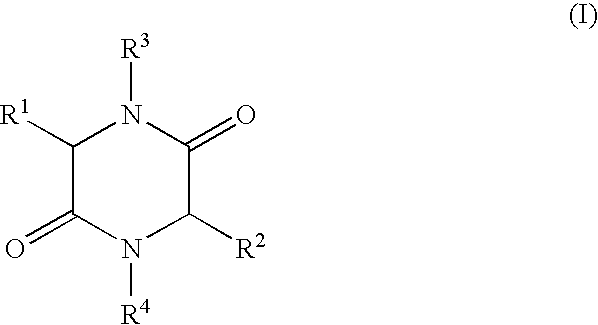
- the present invention relates to a process for the production of 2,5-diketopiperazines of general formula I,
- R 1 , R 2 independently of each other represent H, (C 1 -C 8 )-alkyl, (C 2 -C 8 )-alkenyl, (C 2 -C 8 )-alkinyl, (C 1 -C 8 )-alkoxy, (C 3 -C 8 )-cycloalkyl, (C 6 -C 18 )-aryl, (C 7 -C 19 )-aralkyl, (C 3 -C 18 )-heteroaryl, (C 4 -C 19 )-heteroaralkyl, ((C 1 -C 8 )-alkyl) 1-3 -(C 3 -C 8 )-cycloalkyl, ((C 1 -C 8 )-alkyl) 1-3 -(C 6 -C 18 )-aryl, ((C 1 -C 8 )-alkyl) 1-3 -(C 3 -C 18 )-heteroaryl
- R 3 , R 4 independently of each other represent H, (C 1 -C 8 )-alkyl, (C 2 -C 8 )-alkenyl, (C 2 -C 8 )-alkinyl, (C 1 -C 8 )-acyl, (C 3 -C 8 )-cycloalkyl, (C 6 -C 18 )-aryl, (C 7 -C 19 )-aralkyl, (C 3 -C 18 ) heteroaryl, (C 4 -C 19 )-heteroaralkyl, ((C 1 -C 8 )-alkyl) 1-3 -(C 3 -C 8 )-cycloalkyl, ((C 1 -C 8 )-alkyl) 1-3 -(C 6 -C 18 )-aryl, ((C 1 -C 8 )-alkyl) 1-3 -(C 3 -C 18 )-heteroaryl, or
- R 1 and R 3 and/or R 2 and R 4 form a ring via a (C 2 -C 8 )-alkylene unit and also the use of the compounds of formula I produced by such a process.
- a further aspect of the invention concerns special 2,5-diketopiperazines, dipeptides and their use.
- 2,5-diketopiperazines i.e. cyclic dipeptides
- are a class of substances found widely in nature F. T. Witiak, Y. Wei, Prog. Drug. Res. 35, 249 (1990)). In most cases, they are formed by the decomposition of proteins and are used as flavourings in many foodstuffs such as e.g. beer (M. Gautschiet, J. Agri. Food Chem. 45, 3183 (1997)).
- a number of diketopiperazines such as e.g.
- cyclo[Pro-His] also have a pharmacological action (U.S. Pat. No. 5,418,218).
- Structures derived from diketopiperazines are being developed as pharmaceutical products (e.g. U.S. Pat. No. 5,932,579) or are already in use as such (e.g. dihydroergotoxin, A. Stoll, Helv. Chim. Acta 26, 2070 (1943), DOS 2802113). They are also used as Drug Delivery Systems (WO 9610396, WO 9609813, U.S. Pat. No. 5,503,852, WO 9318754).
- Diketopiperazines can also be used as chiral catalysts, e.g. for the production of chiral cyanohydrines (M. North, Synlett, 1993, 807) or as educts for enantio-selective production of amino acids (U. Schollkopf, Tetrahedron 39, 2085 (1983)).
- esters of the corresponding dipeptides are basic and, on the other hand, it is known that diketopiperazines racemise more easily than the corresponding dipeptides or amino acids, the possibility of partial racemisation must always be considered with this method. This can largely be avoided by adding acetic acid when cyclising the esters (T. Ueda, Bull. Chem. Soc. Jpn., 50 566 (1983). Nevertheless, this method has the disadvantage that the esters must first be produced from the dipeptides or an amino acid ester must be used to produce the dipeptides. In both cases, an additional process step is required.
- 2,5-diketopiperazines can also be obtained by heating the dipeptides in water to temperatures of >100° C. (S. Steinberg, Science 213, 544 (1981)).
- diketopiperazines are relatively easily hydrolysed, full conversion cannot be achieved by this method. Rather, an equilibrium is established between the diketopiperazine and the two dipeptides.
- the object was therefore to provide another process for the production of 2,5-diketopiperazines, which makes it possible to produce sufficient yields of the desired compounds with a good degree of purity.
- the process should be suitable for use on an industrial scale, i.e. it should be possible to generate the 2,5-diketopiperazines by the most economically and ecologically advantageous means.
- Claims 2 to 6 represent preferred embodiments of the process according to the invention.
- Claims 7 to 10 protect special 2,5-diketopiperazines and their precursors, the dipeptides.
- Claims 11 and 12 focus on preferred uses.
- R 1 , R 2 independently of each other represent H, (C 1 -C 8 )-alkyl, (C 2 -C 8 )-alkenyl, (C 2 -C 8 )-alkinyl, (C 1 -C 8 )-alkoxy, (C 3 -C 8 )-cycloalkyl, (C 6 -C 18 )-aryl, (C 7 -C 19 )-aralkyl, (C 3 -C 18 )-heteroaryl, (C 4 -C 19 )-heteroaralkyl, ((C 1 -C 8 )-alkyl) 1-3 -(C 3 -C 8 )-cycloalkyl, ((C 1 -C 8 )-alkyl) 1-3 -(C 6 -C 18 )-aryl, ((C 1 -C 8 )-alkyl) 1-3 -(C 3 -C 18 )-heteroaryl
- R 1 and R 3 and/or R 2 and R 4 form a ring via a (C 2 -C 8 )-alkylene unit
- R 1 , R 2 , R 3 , R 4 have the meaning given above, are heated in an organic solvent whilst removing water by distillation, a process that can be carried out advantageously on an industrial scale with good yields of the desired 2,5-diketopiperazines at a high degree of purity is achieved surprisingly easily.
- the piperazines are partly obtained in a crystallisation yield of up to 70% with a purity of >99% per HPLC after one crystallisation, in particular highly enantiomer-enriched.
- organic solvents can be considered as a solvent, that are capable of removing sufficient quantities of water from the reaction mixture at increased temperatures.
- Solvents that form a low-boiling azeotrope with water such as e.g acetonitrile, allyl alcohol, benzene, benzyl alcohol, n-butanol, 2-butanol, tert.-butanol, acetic acid butylester, carbon tetrachloride, chlorobenzene, chloroform, cyclohexane, 1,2-dichlorethane, diethylacetal, dimethylacetal, acetic acid ethylester, heptane, methylisobutylketone, 3-pentanol, toluene, xylene, are preferred in particuler. n-butanol is preferred most particularly as a solvent.
- the temperature of the reaction depends firstly on the reaction speed at which the cyclisation takes place and secondly on the type of azeotroping agent used. It is also restricted by the cost factor of the energy to be used.
- the reaction is preferably carried out at 50-200° C., in particular at 80-150° C.
- the pH range in which cyclisation takes place can easily be determined by the person skilled in the art, in principle by means of routine experiments. It is advantageously 2 to 9, preferably 3 to 7.
- the dipeptides of formula (II) can be used in the cyclising reaction in the form of an aqueous solution.
- hydrolysable protective groups such as e.g. Ncarboxylic acid anhydride, tert.-butyloxycarbonyl-, formyl- or fluourenylmethoxycarbonyl are used as an N-terminal protective group for peptide coupling.
- the protective groups can be split off without isolation, directly in the reaction solution to be used for cyclisation.
- the bases required in most cases for coupling with free amino acids, such as e.g. alkali hydroxides or -carbonates, tert.-amines have to be split off; they can remain in the solution after neutralisation in the form of their salts.
- the 2,5-diketopiperazines are generally considerably less soluble in water than the corresponding dipeptides, they can simply be purified after the reaction has taken place by treatment with water, all salts and optionally unreacted dipeptides or amino acids being removed. In cases in which the 2,5-diketopiperazines are soluble in organic, non water-miscible solvents, this purification can even be carried out by extraction with water.
- R 5 represents H or trifluoromethyl.
- (S,S) configuration of this compound is preferred.
- the invention also relates to dipeptides of formula
- R 5 represents H or trifluoromethyl.
- the (S,S) configuration of this compound is also preferred.
- III and IV are preferably used to produce cyclo[Lys-Lys].
- the compounds of formula I according to the invention can be used in the synthesis of bio-active compounds.
- Methyl, ethyl, n-Propyl, isopropyl, n-Butyl, isobutyl, sec-butyl, tert-butyl, pentyl, hexyl, heptyl or octyl and all bond isomers are to be considered as (C 1 -C 8 )-alkyl.
- These can be mono- or poly-substituted with (C 1 -C 8 )-alkoxy, (C 1 -C 8 )-haloalkyl, OH, halogen, NH 2 , NO 2 , SH, S-(C 1 -C 8 )alkyl.
- (C 2 -C 8 )-alkenyl is understood to mean a (C 1 -C 8 )-alkyl group as illustrated above having at least one double bond.
- (C 2 -C 8 )-alkinyl is understood to mean a (C 1 -C 8 )-alkyl group as illustrated above, having at least one triple bond.
- (C 1 -C 8 )-acyl is understood to mean a (C 1 -C 8 )-alkyl group bound to the molecule by a C ⁇ O function.
- (C 3 -C 8 )-Cycloalkyl is understood to mean cyclopropyl, cyclobutyl, cyclopentyl, cyclohexyl or cycloheptyl groups etc. These may be substituted with one or more halogens and/or groups containing N—, O—, P—, S-atoms- and/or may have groups containing N—, O—, P—, S-atoms- in the ring, such as e.g. 1-, 2-, 3-, 4-piperidyl, 1-, 2-, 3-pyrrolidinyl, 2-, 3-tetrahydrofuryl, 2-, 3-, 4-morpholinyl. These can also be mono- or poly-substituted with (C 1 -C 8 )-alkoxy, (C 1 -C 8 )-haloalkyl, OH, C 1 , NH 2 , NO 2 .
- a (C 6 -C 18 )-aryl group is understood to be an aromatic group with 6 to 18 C-atoms. These include in particular compounds such as phenyl-, naphthyl-, anthryl-, phenanthryl-, biphenyl groups. It can be mono-or poly-substituted with (C 1 -C 8 )-alkoxy, (C 1 -C 8 )-haloalkyl, OH, halogen, NH 2 , NO 2 , SH, S—(C 1 -C 8 )-alkyl.
- a (C 7 -C 19 )-aralkyl group is a (C 6 -C 18 )-aryl group bound to the molecule by a (C 1 -C 8 )-alkyl group.
- (C 1 -C 8 )-alkoxy is a (C 1 -C 8 )-alkyl group bound to the molecule under consideration by an oxygen atom.
- (C 1 -C 8 )-haloalkyl is a (C 1 -C 8 )-alkyl group substituted with one or more halogen atoms.
- a (C 3 -C 18 )-heteroaryl group means, in the context of the invention, a five-, six-, or seven-link aromatic ring system of 3 to 18 C atoms, which has heteroatoms such as nitrogen, oxygen or sulfur in the ring.
- a (C 4 -C 19 )-heteroaralkyl is understood to be a heteroaromatic system corresponding to the (C 7 -C 19 )-aralkyl group.
- (C 1 -C 8 )-alkylene unit is understood to mean a (C 1 -C 8 )-alkyl group, which is bound to the relevant molecule by two of its C atoms. It can be mono- or poly-substituted with (C 1 -C 8 )-alkoxy, (C 1 -C 8 )-haloalkyl, OH, halogen, NH 2 , NO 2 , SH, S-(C 1 -C 8 )-alkyl.
- Fluorine, chlorine, bromine and iodine may be considered as halogens.
- a side-chain group of an ⁇ -amino acid is understood to mean the changeable group on the ⁇ -C atom of glycine as the basic amino acid.
- Natural 1-amino acids are given for example in Bayer-Walter, Lehrbuch der organischen Chemie, S. Hirzel Verlag, Stuttgart, 22nd edition, page 822ff.
- Preferred synthetic ⁇ -amino acids are those from DE 19903268.8.
- the side chain groups can be derived from those referred to there.
- the stated chemical structures relate to all possible stereoisomers that can be obtained by varying the configuration of the individual chiral centres, axes or surfaces, in other words all possible diastereomers as well as all optical isomers (enantiomers) falling within this group.
- enantiomer-enriched is understood to mean the content of an enantiomer in the mixture with its optical antipodes in a range of >50% and ⁇ 100%.
- 1940 g of an aqueous solution of 235 g L-phenylalanyl-L-proline, which still contained 7 g L-phenylalanine and ca 300 g potassium chloride was set to pH 6.4 and concentrated in a vacuum to a thick crystal paste. 1 1 n-butanol was then added and the mixture was heated for 2 hours in the water separator. According to HPLC the mixture then consisted of 57% DKP and 26% dipeptide. After cooling, 700 ml water was added and the phases were separated. The organic phase was washed again with 150 ml water and concentrated in a vacuum. The remaining oil was stirred up with MTBE and the solid formed was filtered off.
Landscapes
- Chemical & Material Sciences (AREA)
- Organic Chemistry (AREA)
- Genetics & Genomics (AREA)
- Biochemistry (AREA)
- Biophysics (AREA)
- General Health & Medical Sciences (AREA)
- Health & Medical Sciences (AREA)
- Medicinal Chemistry (AREA)
- Molecular Biology (AREA)
- Proteomics, Peptides & Aminoacids (AREA)
- Life Sciences & Earth Sciences (AREA)
- Peptides Or Proteins (AREA)
- Medicines That Contain Protein Lipid Enzymes And Other Medicines (AREA)
Abstract
Process for the production of 2,5-diketopiperazines of general formula I,
by heating dipeptides of general formula II
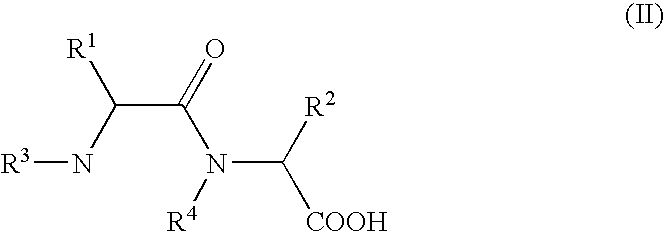
in an organic solvent whilst removing water by distillation.
Novel 2,5-diketopiperazines, dipeptides and their use.
Description
- The present invention relates to a process for the production of 2,5-diketopiperazines of general formula I,
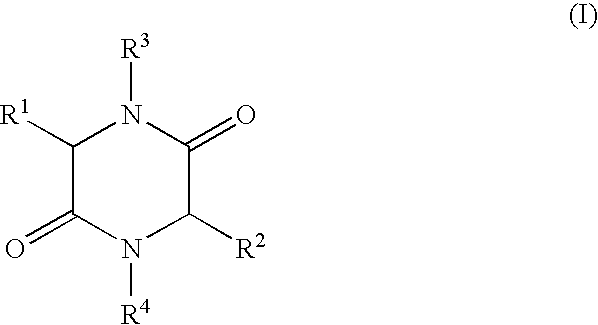
- in which R 1, R2 independently of each other represent H, (C1-C8)-alkyl, (C2-C8)-alkenyl, (C2-C8)-alkinyl, (C1-C8)-alkoxy, (C3-C8)-cycloalkyl, (C6-C18)-aryl, (C7-C19)-aralkyl, (C3-C18)-heteroaryl, (C4-C19)-heteroaralkyl, ((C1-C8)-alkyl)1-3-(C3-C8)-cycloalkyl, ((C1-C8)-alkyl)1-3-(C6-C18)-aryl, ((C1-C8)-alkyl)1-3-(C3-C18)-heteroaryl, or the side chain group of an α-amino acid,
- R 3, R4 independently of each other represent H, (C1-C8)-alkyl, (C2-C8)-alkenyl, (C2-C8)-alkinyl, (C1-C8)-acyl, (C3-C8)-cycloalkyl, (C6-C18)-aryl, (C7-C19)-aralkyl, (C3-C18) heteroaryl, (C4-C19)-heteroaralkyl, ((C1-C8)-alkyl)1-3-(C3-C8)-cycloalkyl, ((C1-C8)-alkyl)1-3-(C6-C18)-aryl, ((C1-C8)-alkyl)1-3-(C3-C18)-heteroaryl, or
- R 1 and R3 and/or R2 and R4 form a ring via a (C2-C8)-alkylene unit and also the use of the compounds of formula I produced by such a process.
- A further aspect of the invention concerns special 2,5-diketopiperazines, dipeptides and their use. 2,5-diketopiperazines, i.e. cyclic dipeptides, are a class of substances found widely in nature (F. T. Witiak, Y. Wei, Prog. Drug. Res. 35, 249 (1990)). In most cases, they are formed by the decomposition of proteins and are used as flavourings in many foodstuffs such as e.g. beer (M. Gautschiet, J. Agri. Food Chem. 45, 3183 (1997)). A number of diketopiperazines, such as e.g. cyclo[Pro-His] also have a pharmacological action (U.S. Pat. No. 5,418,218). Structures derived from diketopiperazines are being developed as pharmaceutical products (e.g. U.S. Pat. No. 5,932,579) or are already in use as such (e.g. dihydroergotoxin, A. Stoll, Helv. Chim. Acta 26, 2070 (1943), DOS 2802113). They are also used as Drug Delivery Systems (WO 9610396, WO 9609813, U.S. Pat. No. 5,503,852, WO 9318754).
- Diketopiperazines can also be used as chiral catalysts, e.g. for the production of chiral cyanohydrines (M. North, Synlett, 1993, 807) or as educts for enantio-selective production of amino acids (U. Schollkopf, Tetrahedron 39, 2085 (1983)).
- The most common method of producing 2,5-diketopiperazines is to release esters of the corresponding dipeptides from the salts and optionally to heat them (E. Fischer, Chem. Ber. 34, 2893 (1903)). However, as the free esters are basic and, on the other hand, it is known that diketopiperazines racemise more easily than the corresponding dipeptides or amino acids, the possibility of partial racemisation must always be considered with this method. This can largely be avoided by adding acetic acid when cyclising the esters (T. Ueda, Bull. Chem. Soc. Jpn., 50 566 (1983). Nevertheless, this method has the disadvantage that the esters must first be produced from the dipeptides or an amino acid ester must be used to produce the dipeptides. In both cases, an additional process step is required.
- Some 2,5-diketopiperazines can also be obtained by heating the dipeptides in water to temperatures of >100° C. (S. Steinberg, Science 213, 544 (1981)). However, as diketopiperazines are relatively easily hydrolysed, full conversion cannot be achieved by this method. Rather, an equilibrium is established between the diketopiperazine and the two dipeptides.
- The object was therefore to provide another process for the production of 2,5-diketopiperazines, which makes it possible to produce sufficient yields of the desired compounds with a good degree of purity. In particular, the process should be suitable for use on an industrial scale, i.e. it should be possible to generate the 2,5-diketopiperazines by the most economically and ecologically advantageous means.
- This object is achieved by a process according to claim 1. Claims 2 to 6 represent preferred embodiments of the process according to the invention. Claims 7 to 10 protect special 2,5-diketopiperazines and their precursors, the dipeptides. Claims 11 and 12 focus on preferred uses.
- By using a process for the production of 2,5-diketopiperazines of general formula I,
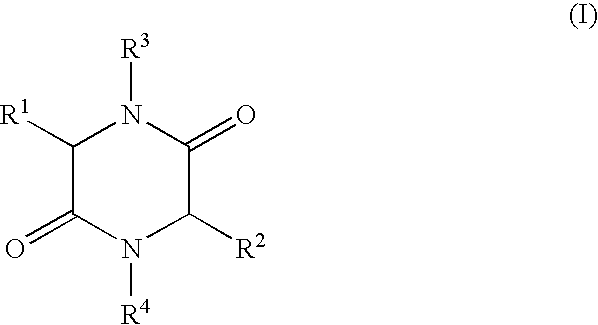
- in which R 1, R2 independently of each other represent H, (C1-C8)-alkyl, (C2-C8)-alkenyl, (C2-C8)-alkinyl, (C1-C8)-alkoxy, (C3-C8)-cycloalkyl, (C6-C18)-aryl, (C7-C19)-aralkyl, (C3-C18)-heteroaryl, (C4-C19)-heteroaralkyl, ((C1-C8)-alkyl)1-3-(C3-C8)-cycloalkyl, ((C1-C8)-alkyl)1-3-(C6-C18)-aryl, ((C1-C8)-alkyl)1-3-(C3-C18)-heteroaryl, or the side chain groups of an α-amino acid R3, R4 independently of each other represent H, (C1-C8)-alkyl, (C2-C8)-alkenyl, (C2-C8)-alkinyl, (C1-C8)-acyl, (C3-C8)-cycloalkyl, (C6-C18)-aryl, (C7-C19)-aralkyl, (C3-C18)-heteroaryl, (C4-C19)-heteroaralkyl, ((C1-C8)-alkyl)1-3-(C3-C8)-cycloalkyl, ((C1-C8)-alkyl)1-3-(C6-C18)-aryl, ((C1-C8)-alkyl)1-3-(C3-C18)-heteroaryl, or
- R 1 and R3 and/or R2 and R4 form a ring via a (C2-C8)-alkylene unit,
- in which dipeptides of general formula II

- in which R 1, R2, R3, R4 have the meaning given above, are heated in an organic solvent whilst removing water by distillation, a process that can be carried out advantageously on an industrial scale with good yields of the desired 2,5-diketopiperazines at a high degree of purity is achieved surprisingly easily. The piperazines are partly obtained in a crystallisation yield of up to 70% with a purity of >99% per HPLC after one crystallisation, in particular highly enantiomer-enriched.
- In principle, all organic solvents can be considered as a solvent, that are capable of removing sufficient quantities of water from the reaction mixture at increased temperatures. Solvents that form a low-boiling azeotrope with water, such as e.g acetonitrile, allyl alcohol, benzene, benzyl alcohol, n-butanol, 2-butanol, tert.-butanol, acetic acid butylester, carbon tetrachloride, chlorobenzene, chloroform, cyclohexane, 1,2-dichlorethane, diethylacetal, dimethylacetal, acetic acid ethylester, heptane, methylisobutylketone, 3-pentanol, toluene, xylene, are preferred in particuler. n-butanol is preferred most particularly as a solvent.
- The temperature of the reaction depends firstly on the reaction speed at which the cyclisation takes place and secondly on the type of azeotroping agent used. It is also restricted by the cost factor of the energy to be used. The reaction is preferably carried out at 50-200° C., in particular at 80-150° C. The pH range in which cyclisation takes place can easily be determined by the person skilled in the art, in principle by means of routine experiments. It is advantageously 2 to 9, preferably 3 to 7.
- With regard to the use of synthesis on an industrial scale, it is particularly advantageous if the dipeptides of formula (II) can be used in the cyclising reaction in the form of an aqueous solution. This variant is advantageously used if hydrolysable protective groups such as e.g. Ncarboxylic acid anhydride, tert.-butyloxycarbonyl-, formyl- or fluourenylmethoxycarbonyl are used as an N-terminal protective group for peptide coupling. In these cases the protective groups can be split off without isolation, directly in the reaction solution to be used for cyclisation. Nor do the bases required in most cases for coupling with free amino acids, such as e.g. alkali hydroxides or -carbonates, tert.-amines, have to be split off; they can remain in the solution after neutralisation in the form of their salts.
- As the 2,5-diketopiperazines are generally considerably less soluble in water than the corresponding dipeptides, they can simply be purified after the reaction has taken place by treatment with water, all salts and optionally unreacted dipeptides or amino acids being removed. In cases in which the 2,5-diketopiperazines are soluble in organic, non water-miscible solvents, this purification can even be carried out by extraction with water.
- The advantages of the process according to the invention are demonstrated impressively by a reference example. Whilst the cyclisation of an aqueous L-phenylalanyl-L-prolin solution at pH 4 with n-Butanol delivers a conversion of 99% after just one hour, when heating the same solution to reflux temperature without n-butanol, only 19% conversion is achieved after 4 hours. Although, after 20 hours at this temperature, the L-phenylalanyl-L-prolin is no longer detectable, 30% of the inverse dipeptide L-prolyl-L-phenylalanine is obtained alongside 70% of the 2,5-diketopiperazine. This is not obtained in the process according to the invention.
- In a further development the invention relates to 2,5-diketopiperazines of general formula III,

- in which R 5 represents H or trifluoromethyl. The (S,S) configuration of this compound is preferred.
- The invention also relates to dipeptides of formula

- in which R 5 represents H or trifluoromethyl. The (S,S) configuration of this compound is also preferred. III and IV are preferably used to produce cyclo[Lys-Lys]. The compounds of formula I according to the invention can be used in the synthesis of bio-active compounds.
- Methyl, ethyl, n-Propyl, isopropyl, n-Butyl, isobutyl, sec-butyl, tert-butyl, pentyl, hexyl, heptyl or octyl and all bond isomers are to be considered as (C 1-C8)-alkyl. These can be mono- or poly-substituted with (C1-C8)-alkoxy, (C1-C8)-haloalkyl, OH, halogen, NH2, NO2, SH, S-(C1-C8)alkyl.
- (C 2-C8)-alkenyl, with the exception of methyl, is understood to mean a (C1-C8)-alkyl group as illustrated above having at least one double bond.
- (C 2-C8)-alkinyl, with the exception of methyl, is understood to mean a (C1-C8)-alkyl group as illustrated above, having at least one triple bond.
- (C 1-C8)-acyl is understood to mean a (C1-C8)-alkyl group bound to the molecule by a C═O function.
- (C 3-C8)-Cycloalkyl is understood to mean cyclopropyl, cyclobutyl, cyclopentyl, cyclohexyl or cycloheptyl groups etc. These may be substituted with one or more halogens and/or groups containing N—, O—, P—, S-atoms- and/or may have groups containing N—, O—, P—, S-atoms- in the ring, such as e.g. 1-, 2-, 3-, 4-piperidyl, 1-, 2-, 3-pyrrolidinyl, 2-, 3-tetrahydrofuryl, 2-, 3-, 4-morpholinyl. These can also be mono- or poly-substituted with (C1-C8)-alkoxy, (C1-C8)-haloalkyl, OH, C1, NH2, NO2.
- A (C 6-C18)-aryl group is understood to be an aromatic group with 6 to 18 C-atoms. These include in particular compounds such as phenyl-, naphthyl-, anthryl-, phenanthryl-, biphenyl groups. It can be mono-or poly-substituted with (C1-C8)-alkoxy, (C1-C8)-haloalkyl, OH, halogen, NH2, NO2, SH, S—(C1-C8)-alkyl.
- A (C 7-C19)-aralkyl group is a (C6-C18)-aryl group bound to the molecule by a (C1-C8)-alkyl group.
- (C 1-C8)-alkoxy is a (C1-C8)-alkyl group bound to the molecule under consideration by an oxygen atom.
- (C 1-C8)-haloalkyl is a (C1-C8)-alkyl group substituted with one or more halogen atoms.
- A (C 3-C18)-heteroaryl group means, in the context of the invention, a five-, six-, or seven-link aromatic ring system of 3 to 18 C atoms, which has heteroatoms such as nitrogen, oxygen or sulfur in the ring. Groups such as 1-, 2-, 3-furyl, such as 1-, 2-, 3-pyrrolyl, 1-, 2-,3-thienyl, 2-, 3-, 4-pyridyl, 2-, 3-, 4-, 5-, 6-, 7-indolyl, 3-, 4-, 5-pyrazolyl, 2-, 4-, 5-imidazolyl, acridinyl, chinolinyl, phenanthridinyl, 2-, 4-, 5-, 6-pyrimidinyl are considered in particular to be such heteroatoms. It can be mono-or poly-substituted with (C1-C8)-alkoxy, (C1-C8)-haloalkyl, OH, halogen, NH2, NO2, SH, S-(C1-C8)-alkyl.
- A (C 4-C19)-heteroaralkyl is understood to be a heteroaromatic system corresponding to the (C7-C19)-aralkyl group.
- The term (C 1-C8)-alkylene unit is understood to mean a (C1-C8)-alkyl group, which is bound to the relevant molecule by two of its C atoms. It can be mono- or poly-substituted with (C1-C8)-alkoxy, (C1-C8)-haloalkyl, OH, halogen, NH2, NO2, SH, S-(C1-C8)-alkyl.
- Fluorine, chlorine, bromine and iodine may be considered as halogens.
- A side-chain group of an α-amino acid is understood to mean the changeable group on the α-C atom of glycine as the basic amino acid. Natural 1-amino acids are given for example in Bayer-Walter, Lehrbuch der organischen Chemie, S. Hirzel Verlag, Stuttgart, 22nd edition, page 822ff.
- Preferred synthetic α-amino acids are those from DE 19903268.8. The side chain groups can be derived from those referred to there.
- The stated chemical structures relate to all possible stereoisomers that can be obtained by varying the configuration of the individual chiral centres, axes or surfaces, in other words all possible diastereomers as well as all optical isomers (enantiomers) falling within this group.
- In the context of the invention the term enantiomer-enriched is understood to mean the content of an enantiomer in the mixture with its optical antipodes in a range of >50% and <100%.
- Production of Cyclo [L-phenylalanyl-L-prolyl]
- a. Cyclisation at pH=6.4
- 1940 g of an aqueous solution of 235 g L-phenylalanyl-L-proline, which still contained 7 g L-phenylalanine and ca 300 g potassium chloride was set to pH 6.4 and concentrated in a vacuum to a thick crystal paste. 1 1 n-butanol was then added and the mixture was heated for 2 hours in the water separator. According to HPLC the mixture then consisted of 57% DKP and 26% dipeptide. After cooling, 700 ml water was added and the phases were separated. The organic phase was washed again with 150 ml water and concentrated in a vacuum. The remaining oil was stirred up with MTBE and the solid formed was filtered off. 113 g (52% of theoretical) cyclo[L-phenylalanyl-L-prolyl] with an HPLC-purity of >99% and an [α] D/20 of −105.1° (c=1, n-butanol) was obtained.
- b. Cyclisation at pH=4.0
- 100 ml of the aqueous dipeptide solution used in example 1a was set to pH 4.0 and reacted as in example 1a. After heating for 1 hour, the ratio of DKP.dipeptide was 99:1.
- c. Cyclisation at pH=4.0 in Water
- 100 ml of the aqueous dipeptide solution used in example 1a was set to pH 4.0 and heated to boiling point. The course of the reaction was followed by HPLC. The ratio of DKP dipeptide was 19:81 after 2 hours and 39:61 after 4 hours. After 24 hours no more L-phenylalanyl-L-prolin was detectable. Instead, the DKP and the L-prolyl-L-phenylalanine was detected in a ratio of 69:31.
- Production of Cyclo[L-valyl-L-prolyl]
- 1740 g of an aqueous solution of 132 g L-valyl-L-proline, which still contained ca 10 g L-valine and ca 300 g potassium chloride was set to pH 6.4 and concentrated in a vacuum to a thick crystal paste. 1 1 n-butanol was then added and the mixture was heated for 2 hours in the water separator. According to HPLC the mixture then contained 3% of the dipeptide. After cooling 800 ml water was added and the phases were separated. The organic phase was washed again with 200 ml water and concentrated in a vacuum. The remaining crystal suspension was stirred up with ethyl acetate and the solid was filtered off. 70.5 g (58% of theoretical) cyclo[L-valyl-L-prolyl] with an HPLC purity of >99% and an [α]D/20 of −164.3° (c=1, n-butanol) was obtained.
- Production of Cyclo[L-leucyl-L-prolyl]
- 1350 ml of an aqueous solution of 145 g L-leucyl-L-proline, which still contained ca 7 g L-leucine and ca 225 g potassium chloride was set to pH 4.5 and concentrated in a vacuum to a thick crystal paste. 1 1 n-butanol was then added and the mixture was heated for 0.5 hours in the water separator. According to HPLC, the mixture then still contained 3% of the dipeptide. After cooling, 500 ml water was added and the phases were separated. The organic phase was washed again with 100 ml water and concentrated in a vacuum. The remaining crystal suspension was stirred up with ethyl acetate and the solid was filtered off. 91.8 g (69% of theoretical) cyclo[L-leucyl-L-prolyl] with an HPLC purity of >99% and an [a]D/20 of −137.40 (c=1, n-Butanol) was obtained.
- Production of cyclo[L-isoleucyl-L-prolyl]
- 2030 g of an aqueous solution of 199 g L-isoleucyl-L-proline, which still contained ca 7 g L-isoleucine and ca 300 g potassium chloride was set to pH 6.4 and concentrated in a vacuum to a thick crystal paste. 1 1 n-butanol was then added and the mixture was heated for 1 hour in the water separator. According to HPLC, the mixture then still contained 1% of the dipeptide. After cooling, 500 ml water was added and the phases were separated. The organic phase was washed again with 100 ml water and concentrated in a vacuum. The remaining crystal suspension was stirred up with MtBE and the solid was filtered off. 126.3 g (70% of theoretical) cyclo[L-isoleucyl-L-prolyl] with an HPLC purity of >99% and an [α] D/20 of −105.1° (c=1, n-butanol) was obtained.
- Production of cyclo[ε-trifluoroacetyl-L-lysyl-ε-trifluoroacetyl-L-lysyl]
- 500 ml of a butanolic solution of 21 g ε-trifluoroacetyl-L-lysyl-ε-trifluoroacetyl-L-lysine hydrochloride was set to pH 6 with 50% sodium hydroxide solution and heated in the water separator for 2 hours. According to HPLC analysis, 57% of the dipeptide had then been cyclised to DKP. The solid deposited after cooling is filtered off and dried. 8.0 cyclo[ε-trifluoroacetyl-L-lysyl-ε-trifluoroacetyl-L-lysyl] was obtained.
- 1H-NMR (d6-DMSO): 1.30 (m, 4H), 1.48 (m, 4H), 1.67 (m, 4H), 3.17 (m, 4H), 3.80 (m, 2H), 8.13 (s, 2H), 9.43 (s, 2H).
Claims (12)
1. Process for the production of 2,5-diketopiperazines of general formula I,
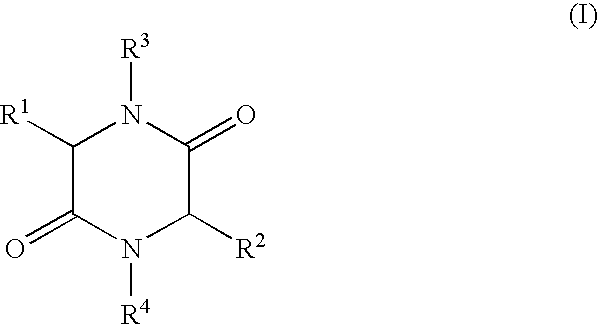
in which R1, R2 independently of each other represent H, (C1-C8)-alkyl, (C2-C8)-alkenyl, (C2-C8)-alkinyl, (C1-C8)-alkoxy, (C3-C8)-cycloalkyl, (C6-C18)-aryl, (C7-C19)-aralkyl, (C3-C18)-heteroaryl, (C4-C19)-heteroaralkyl, ((C1-C8)-alkyl)1-3-(C3-C8)-cycloalkyl, ((C1-C8)-alkyl)1-3-(C6-C18)-aryl, ((C1-C8)-alkyl)1-3-(C3-C18)-heteroaryl, or the side chain group of an α-amino acid,
R3, R4 independently of each other represent H, (C1-C8)-alkyl, (C2-C8)-alkenyl, (C2-C8)-alkinyl, (C1-C8)-acyl, (C3-C8)-cycloalkyl, (C6-C18)-aryl, (C7-C19)-aralkyl, (C3-C18)-heteroaryl, (C4-C19)-heteroaralkyl, ((C1-C8)-alkyl)1-3-(C3-C8)-cycloalkyl, ((C1-C8)-alkyl)1-3-(C6-C18)-aryl, ((C1-C8)-alkyl) 1-3-(C3-C18)-heteroaryl, or R1 and R3 and/or R2 and R4 form a ring via a (C2-C8)-alkylene unit,
by heating dipeptides of general formula II
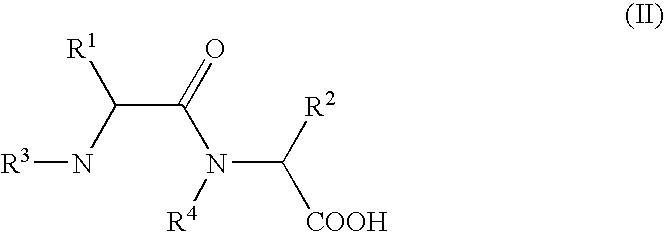
in which R1, R2, R3, R4 have the meaning given above, in an organic solvent whilst removing water by distillation.
2. Process according to claim 1 ,
characterised in that
an organic solvent is used, which forms an azeotrope with water.
3. Process according to claim 2 ,
characterised in that
n-butanol is used as the organic solvent.
4. Process according to one or more of the preceding claims,
characterised in that
the reaction is carried out at temperatures of 80-150° C.
5. Process according to one or more of the preceding claims,
characterised in that
the reaction is carried out in a pH range of 3 to 7.
6. Process according to one or more of the preceding claims,
characterised in that
the dipeptides of formula (II) are used in the reaction in the form of an aqueous solution.
7. 2,5-diketopiperazines of general formula III,
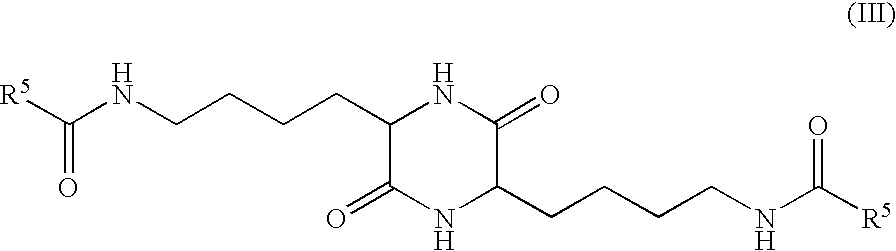
in which R5 represents H or trifluoromethyl.
8. 2,5-diketopiperazine according to claim 7 ,
characterised in that
it is present in the (S,S) configuration.
9. Dipeptides of general formula (IV),
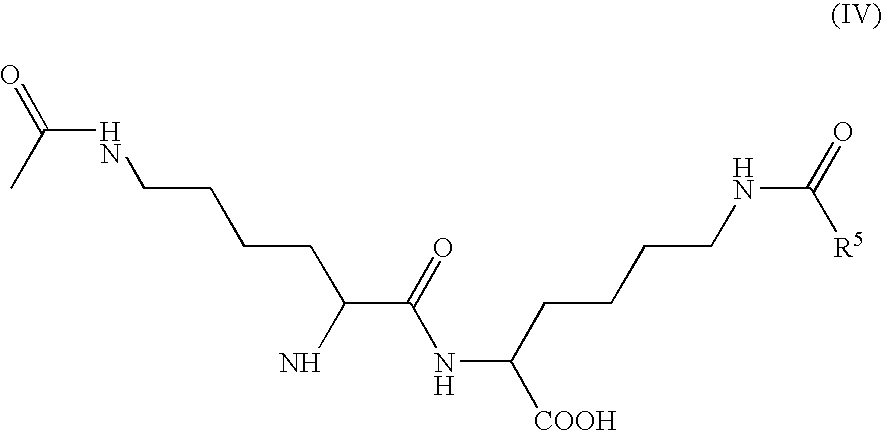
in which R5 represents H or trifluoromethyl.
10. Dipeptide according to claim 9 ,
characterised in that
it is present in the (S,S) configuration.
11. Use of the compounds according to one or more of claims 7 to 10 for the production of cyclo[Lys-Lys].
12. Use of the compounds produced according to claim 1 in the synthesis of bio-active compounds.
Applications Claiming Priority (3)
| Application Number | Priority Date | Filing Date | Title |
|---|---|---|---|
| DE10019879A DE10019879A1 (en) | 2000-04-20 | 2000-04-20 | Production of known and new 2,5-diketopiperazine derivatives useful for the synthesis of bioactive compounds, e.g. cyclo(Lys-Lys) |
| DE10019879.1 | 2000-04-20 | ||
| PCT/EP2001/003322 WO2001081321A1 (en) | 2000-04-20 | 2001-03-23 | Method for producing 2,5-diketopiperazines, 2,5-diketopiperazines, dipeptides and the use thereof |
Publications (1)
| Publication Number | Publication Date |
|---|---|
| US20040024180A1 true US20040024180A1 (en) | 2004-02-05 |
Family
ID=7639634
Family Applications (1)
| Application Number | Title | Priority Date | Filing Date |
|---|---|---|---|
| US10/258,029 Abandoned US20040024180A1 (en) | 2000-04-20 | 2001-03-23 | Process for the production of 2,5 -diketopiperazines,2,5-diketopiperazines , dipeptides and their use thereof |
Country Status (6)
| Country | Link |
|---|---|
| US (1) | US20040024180A1 (en) |
| EP (1) | EP1274693A1 (en) |
| JP (1) | JP2003531197A (en) |
| DE (1) | DE10019879A1 (en) |
| NO (1) | NO323617B1 (en) |
| WO (1) | WO2001081321A1 (en) |
Cited By (43)
| Publication number | Priority date | Publication date | Assignee | Title |
|---|---|---|---|---|
| US20030225103A1 (en) * | 2000-08-04 | 2003-12-04 | Dmi Biosciences, Inc. | Method of using diketopiperazines and composition containing them |
| US20050119177A1 (en) * | 2003-05-15 | 2005-06-02 | David Bar-Or | Treatment of T-cell mediated diseases |
| US20100105698A1 (en) * | 2008-05-27 | 2010-04-29 | Dmi Life Sciences, Inc. | Therapeutic Methods and Compounds |
| WO2012033792A2 (en) | 2010-09-07 | 2012-03-15 | Dmi Acquisition Corp. | Treatment of diseases |
| WO2013055749A1 (en) * | 2011-10-10 | 2013-04-18 | Ampio Pharmaceuticals, Inc. | Implantable medical devices with increased immune tolerance, and methods for making and implanting |
| WO2013055734A1 (en) | 2011-10-10 | 2013-04-18 | Ampio Pharmaceuticals, Inc. | Treatment of degenerative joint disease |
| WO2013063413A1 (en) | 2011-10-28 | 2013-05-02 | Ampio Pharmaceuticals, Inc. | Treatment of rhinitis |
| WO2014012991A1 (en) | 2012-07-17 | 2014-01-23 | Straitmark Holding Ag | Method for the synthesis of n-(phosphonomethyl)glycine |
| US8748609B2 (en) | 2004-08-20 | 2014-06-10 | Mannkind Corporation | Catalysis of diketopiperazine synthesis |
| WO2014145729A2 (en) | 2013-03-15 | 2014-09-18 | Ampio Pharmaceuticals, Inc. | Compositions for the mobilization, homing, expansion and differentiation of stem cells and methods of using the same |
| US9193691B2 (en) | 2012-04-27 | 2015-11-24 | Mannkind Corporation | Methods for the synthesis of activated ethylfumarates and their use as intermediates |
| US9192675B2 (en) | 2008-06-13 | 2015-11-24 | Mankind Corporation | Dry powder inhaler and system for drug delivery |
| US9220687B2 (en) | 2008-12-29 | 2015-12-29 | Mannkind Corporation | Substituted diketopiperazine analogs for use as drug delivery agents |
| US9233159B2 (en) | 2011-10-24 | 2016-01-12 | Mannkind Corporation | Methods and compositions for treating pain |
| US9241903B2 (en) | 2006-02-22 | 2016-01-26 | Mannkind Corporation | Method for improving the pharmaceutic properties of microparticles comprising diketopiperazine and an active agent |
| US9283193B2 (en) | 2005-09-14 | 2016-03-15 | Mannkind Corporation | Method of drug formulation based on increasing the affinity of crystalline microparticle surfaces for active agents |
| US9364619B2 (en) | 2008-06-20 | 2016-06-14 | Mannkind Corporation | Interactive apparatus and method for real-time profiling of inhalation efforts |
| US9364436B2 (en) | 2011-06-17 | 2016-06-14 | Mannkind Corporation | High capacity diketopiperazine microparticles and methods |
| US9416113B2 (en) | 2011-02-10 | 2016-08-16 | Mannkind Corporation | Formation of N-protected bis-3,6-(4-aminoalkyl)-2,5,diketopiperazine |
| US9630930B2 (en) | 2009-06-12 | 2017-04-25 | Mannkind Corporation | Diketopiperazine microparticles with defined specific surface areas |
| US9662461B2 (en) | 2008-06-13 | 2017-05-30 | Mannkind Corporation | Dry powder drug delivery system and methods |
| US9675674B2 (en) | 2004-08-23 | 2017-06-13 | Mannkind Corporation | Diketopiperazine salts for drug delivery and related methods |
| US9700690B2 (en) | 2002-03-20 | 2017-07-11 | Mannkind Corporation | Inhalation apparatus |
| US9706944B2 (en) | 2009-11-03 | 2017-07-18 | Mannkind Corporation | Apparatus and method for simulating inhalation efforts |
| US9801925B2 (en) | 1999-06-29 | 2017-10-31 | Mannkind Corporation | Potentiation of glucose elimination |
| US9802012B2 (en) | 2012-07-12 | 2017-10-31 | Mannkind Corporation | Dry powder drug delivery system and methods |
| US9925144B2 (en) | 2013-07-18 | 2018-03-27 | Mannkind Corporation | Heat-stable dry powder pharmaceutical compositions and methods |
| US9943571B2 (en) | 2008-08-11 | 2018-04-17 | Mannkind Corporation | Use of ultrarapid acting insulin |
| US9956217B2 (en) | 2014-08-18 | 2018-05-01 | Ampio Pharmaceuticals, Inc. | Treatment of joint conditions |
| US9983108B2 (en) | 2009-03-11 | 2018-05-29 | Mannkind Corporation | Apparatus, system and method for measuring resistance of an inhaler |
| US10159644B2 (en) | 2012-10-26 | 2018-12-25 | Mannkind Corporation | Inhalable vaccine compositions and methods |
| US10280189B2 (en) | 2012-07-17 | 2019-05-07 | Monsanto Technology Llc | Method for the synthesis of aminoalkylenephosphonic acid |
| US10307464B2 (en) | 2014-03-28 | 2019-06-04 | Mannkind Corporation | Use of ultrarapid acting insulin |
| US10342938B2 (en) | 2008-06-13 | 2019-07-09 | Mannkind Corporation | Dry powder drug delivery system |
| US10364262B2 (en) | 2012-07-17 | 2019-07-30 | Monsanto Technology Llc | Method for the synthesis of N-phosphonomethyliminodiacetic acid |
| US10421729B2 (en) | 2013-03-15 | 2019-09-24 | Mannkind Corporation | Microcrystalline diketopiperazine compositions and methods |
| US10464958B2 (en) | 2012-07-17 | 2019-11-05 | Monsanto Technology Llc | Method for the synthesis of alpha-aminoalkylenephosphonic acid |
| US10561806B2 (en) | 2014-10-02 | 2020-02-18 | Mannkind Corporation | Mouthpiece cover for an inhaler |
| US10625034B2 (en) | 2011-04-01 | 2020-04-21 | Mannkind Corporation | Blister package for pharmaceutical cartridges |
| US11129878B1 (en) | 2020-03-24 | 2021-09-28 | Ampio Pharmaceuticals, Inc. | Methods for treating diseases associated with respiratory viruses |
| US11389512B2 (en) | 2015-06-22 | 2022-07-19 | Ampio Pharmaceuticals, Inc. | Use of low molecular weight fractions of human serum albumin in treating diseases |
| US11446127B2 (en) | 2013-08-05 | 2022-09-20 | Mannkind Corporation | Insufflation apparatus and methods |
| CN118994038A (en) * | 2024-07-31 | 2024-11-22 | 三峡大学 | Method for synthesizing glycine anhydride from glycine |
Families Citing this family (1)
| Publication number | Priority date | Publication date | Assignee | Title |
|---|---|---|---|---|
| EP1572669A2 (en) * | 2002-11-22 | 2005-09-14 | Novo Nordisk A/S | 2,5-diketopiperazines for the treatment of obesity |
Citations (6)
| Publication number | Priority date | Publication date | Assignee | Title |
|---|---|---|---|---|
| US4935526A (en) * | 1988-04-06 | 1990-06-19 | Rhone-Poulenc Chimie | Process for the purification of peptides |
| US4992552A (en) * | 1988-08-31 | 1991-02-12 | Eastman Kodak Company | Process for preparation of amino acids |
| US5418218A (en) * | 1992-07-10 | 1995-05-23 | The University Of Maryland At Baltimore | Histidyl-proline diketopiperazine (cyclo his-pro) a cns-active pharmacologic agent |
| US5481218A (en) * | 1994-09-30 | 1996-01-02 | Telefonaktiebolaget Lm Ericsson | Logarithmic converter |
| US5503852A (en) * | 1992-03-11 | 1996-04-02 | Pharmaceutical Discovery Corporation | Method for making self-assembling diketopiperazine drug delivery system |
| US5932579A (en) * | 1996-06-18 | 1999-08-03 | Affymax Technologies N.V. | Collagenase-1 and stromelysin-1 inhibitors, pharmaceutical compositions comprising same and methods of their use |
Family Cites Families (9)
| Publication number | Priority date | Publication date | Assignee | Title |
|---|---|---|---|---|
| US2786049A (en) * | 1956-02-20 | 1957-03-19 | Harold P Lundgren | Synthesis of peptide structures |
| ZA837994B (en) * | 1982-11-22 | 1984-06-27 | Shell Oil Co | Process for the preparation of optically-active cyanomethyl esters |
| JPS61225196A (en) * | 1985-03-29 | 1986-10-06 | Mitsui Toatsu Chem Inc | Production of alpha-l-aspartyl-l-phenylalaninemethyl ester or hydrochloride thereof |
| IL92011A0 (en) * | 1988-10-19 | 1990-07-12 | Abbott Lab | Heterocyclic peptide renin inhibitors |
| ATE141613T1 (en) * | 1990-03-15 | 1996-09-15 | Nutrasweet Co | PROCESS FOR PREPARING ASPARTAME FROM A DIKETOPIPERAZINE AND NEW INTERMEDIATE PRODUCTS AND DERIVATIVES THEREFOR |
| JPH04234374A (en) * | 1990-12-27 | 1992-08-24 | Ajinomoto Co Inc | Production of diketopiperazine derivative |
| JP2814941B2 (en) * | 1995-01-30 | 1998-10-27 | 大日本インキ化学工業株式会社 | Method for producing N-butoxymethyl (meth) acrylamides |
| WO1998030540A1 (en) * | 1997-01-10 | 1998-07-16 | Merck & Co., Inc. | Efficient synthesis of a chiral mediator |
| JPH10330385A (en) * | 1997-05-30 | 1998-12-15 | Mitsui Chem Inc | Disproportionation of organosilanes |
-
2000
- 2000-04-20 DE DE10019879A patent/DE10019879A1/en not_active Withdrawn
-
2001
- 2001-03-23 US US10/258,029 patent/US20040024180A1/en not_active Abandoned
- 2001-03-23 JP JP2001578414A patent/JP2003531197A/en active Pending
- 2001-03-23 WO PCT/EP2001/003322 patent/WO2001081321A1/en not_active Ceased
- 2001-03-23 EP EP01927786A patent/EP1274693A1/en not_active Withdrawn
-
2002
- 2002-10-17 NO NO20025004A patent/NO323617B1/en not_active IP Right Cessation
Patent Citations (6)
| Publication number | Priority date | Publication date | Assignee | Title |
|---|---|---|---|---|
| US4935526A (en) * | 1988-04-06 | 1990-06-19 | Rhone-Poulenc Chimie | Process for the purification of peptides |
| US4992552A (en) * | 1988-08-31 | 1991-02-12 | Eastman Kodak Company | Process for preparation of amino acids |
| US5503852A (en) * | 1992-03-11 | 1996-04-02 | Pharmaceutical Discovery Corporation | Method for making self-assembling diketopiperazine drug delivery system |
| US5418218A (en) * | 1992-07-10 | 1995-05-23 | The University Of Maryland At Baltimore | Histidyl-proline diketopiperazine (cyclo his-pro) a cns-active pharmacologic agent |
| US5481218A (en) * | 1994-09-30 | 1996-01-02 | Telefonaktiebolaget Lm Ericsson | Logarithmic converter |
| US5932579A (en) * | 1996-06-18 | 1999-08-03 | Affymax Technologies N.V. | Collagenase-1 and stromelysin-1 inhibitors, pharmaceutical compositions comprising same and methods of their use |
Cited By (120)
| Publication number | Priority date | Publication date | Assignee | Title |
|---|---|---|---|---|
| US9801925B2 (en) | 1999-06-29 | 2017-10-31 | Mannkind Corporation | Potentiation of glucose elimination |
| US8268830B2 (en) | 2000-08-04 | 2012-09-18 | Dmi Biosciences, Inc. | Method of using diketopiperazines and composition containing them |
| US10039760B2 (en) | 2000-08-04 | 2018-08-07 | Ampio Pharmaceuticals, Inc. | Method of using diketopiperazines and composition containing them |
| US20030225103A1 (en) * | 2000-08-04 | 2003-12-04 | Dmi Biosciences, Inc. | Method of using diketopiperazines and composition containing them |
| US9561226B2 (en) | 2000-08-04 | 2017-02-07 | Ampio Pharmaceuticals, Inc. | Method of using diketopiperazines and composition containing them |
| US8916568B2 (en) | 2000-08-04 | 2014-12-23 | Ampio Pharmaceuticals, Inc. | Method of using diketopiperazines and composition containing them |
| US8841307B2 (en) | 2000-08-04 | 2014-09-23 | Ampio Pharmaceuticals, Inc. | Method of using diketopiperazines and composition containing them |
| US8455517B2 (en) | 2000-08-04 | 2013-06-04 | Dmi Acquisition Corp. | Method of using diketopiperazines and composition containing them |
| US8440696B2 (en) | 2000-08-04 | 2013-05-14 | Dmi Acquisition Corp. | Method of using diketopiperazines and composition containing them |
| US9700690B2 (en) | 2002-03-20 | 2017-07-11 | Mannkind Corporation | Inhalation apparatus |
| US9707227B2 (en) | 2003-05-15 | 2017-07-18 | Ampio Pharmaceuticals, Inc. | Treatment of T-cell mediated diseases |
| US7732403B2 (en) | 2003-05-15 | 2010-06-08 | Dmi Biosciences, Inc. | Treatment of T-cell mediated diseases |
| EP2517721A2 (en) | 2003-05-15 | 2012-10-31 | DMI Biosciences, Inc. | Treatment of T-cell mediated diseases |
| EP2517722A2 (en) | 2003-05-15 | 2012-10-31 | DMI Biosciences, Inc. | Treatment of T-cell mediated diseases |
| EP2517718A2 (en) | 2003-05-15 | 2012-10-31 | DMI Biosciences, Inc. | Treatment of T-cell mediated diseases |
| US8324167B2 (en) | 2003-05-15 | 2012-12-04 | Dmi Biosciences, Inc. | Treatment of T-cell mediated diseases |
| EP2537524A2 (en) | 2003-05-15 | 2012-12-26 | DMI Biosciences, Inc. | Treatment of T-cell mediated diseases |
| US9730924B2 (en) | 2003-05-15 | 2017-08-15 | Ampio Pharmaceuticals, Inc. | Treatment of T-cell mediated diseases |
| US11369598B2 (en) | 2003-05-15 | 2022-06-28 | Ampio Pharmaceuticals, Inc. | Treatment of T-cell mediated diseases |
| US10828296B2 (en) | 2003-05-15 | 2020-11-10 | Ampio Pharmaceuticals, Inc. | Treatment of T-cell mediated diseases |
| US20100143338A1 (en) * | 2003-05-15 | 2010-06-10 | David Bar-Or | Treatment of t-cell mediated diseases |
| US8183209B2 (en) | 2003-05-15 | 2012-05-22 | Dmi Biosciences, Inc. | Treatment of T-cell mediated diseases |
| EP2517719A1 (en) | 2003-05-15 | 2012-10-31 | DMI Biosciences, Inc. | Treatment of T-cell mediated diseases |
| US8513196B2 (en) | 2003-05-15 | 2013-08-20 | Dmi Acquisition Corp. | Treatment of T-cell mediated diseases |
| US8551953B2 (en) | 2003-05-15 | 2013-10-08 | Dmi Acquisition Corp. | Treatment of T-cell mediated diseases |
| US20100144611A1 (en) * | 2003-05-15 | 2010-06-10 | David Bar-Or | Treatment of t-cell mediated diseases |
| US20050119177A1 (en) * | 2003-05-15 | 2005-06-02 | David Bar-Or | Treatment of T-cell mediated diseases |
| US8969308B2 (en) | 2003-05-15 | 2015-03-03 | Ampio Pharmaceuticals, Inc. | Treatment of T-cell mediated diseases |
| US8962568B2 (en) | 2003-05-15 | 2015-02-24 | Ampio Pharmaceuticals, Inc. | Treatment of T-cell mediated diseases |
| US20100190696A1 (en) * | 2003-05-15 | 2010-07-29 | David Bar-Or | Treatment of t-cell mediated diseases |
| EP2799114A2 (en) | 2003-05-15 | 2014-11-05 | Ampio Pharmaceuticals, Inc. | Treatment of T-cell mediated diseases |
| US9796688B2 (en) | 2004-08-20 | 2017-10-24 | Mannkind Corporation | Catalysis of diketopiperazine synthesis |
| US8748609B2 (en) | 2004-08-20 | 2014-06-10 | Mannkind Corporation | Catalysis of diketopiperazine synthesis |
| US10130685B2 (en) | 2004-08-23 | 2018-11-20 | Mannkind Corporation | Diketopiperazine salts for drug delivery and related methods |
| US9675674B2 (en) | 2004-08-23 | 2017-06-13 | Mannkind Corporation | Diketopiperazine salts for drug delivery and related methods |
| US10143655B2 (en) | 2005-09-14 | 2018-12-04 | Mannkind Corporation | Method of drug formulation |
| US9446001B2 (en) | 2005-09-14 | 2016-09-20 | Mannkind Corporation | Increasing drug affinity for crystalline microparticle surfaces |
| US9717689B2 (en) | 2005-09-14 | 2017-08-01 | Mannkind Corporation | Method of drug formulation based on increasing the affinity of crystalline microparticle surfaces for active agents |
| US9283193B2 (en) | 2005-09-14 | 2016-03-15 | Mannkind Corporation | Method of drug formulation based on increasing the affinity of crystalline microparticle surfaces for active agents |
| US10130581B2 (en) | 2006-02-22 | 2018-11-20 | Mannkind Corporation | Method for improving the pharmaceutic properties of microparticles comprising diketopiperazine and an active agent |
| US9241903B2 (en) | 2006-02-22 | 2016-01-26 | Mannkind Corporation | Method for improving the pharmaceutic properties of microparticles comprising diketopiperazine and an active agent |
| US8871772B2 (en) | 2008-05-27 | 2014-10-28 | Ampio Pharmaceuticals, Inc. | Therapeutic methods and compounds |
| US8217047B2 (en) | 2008-05-27 | 2012-07-10 | Dmi Acquisition Corp. | Therapeutic methods and compounds |
| US9522893B2 (en) | 2008-05-27 | 2016-12-20 | Ampio Pharmaceuticals, Inc. | Therapeutic methods and compounds |
| US20100105698A1 (en) * | 2008-05-27 | 2010-04-29 | Dmi Life Sciences, Inc. | Therapeutic Methods and Compounds |
| US10751488B2 (en) | 2008-06-13 | 2020-08-25 | Mannkind Corporation | Dry powder inhaler and system for drug delivery |
| US9192675B2 (en) | 2008-06-13 | 2015-11-24 | Mankind Corporation | Dry powder inhaler and system for drug delivery |
| US9446133B2 (en) | 2008-06-13 | 2016-09-20 | Mannkind Corporation | Dry powder inhaler and system for drug delivery |
| US9511198B2 (en) | 2008-06-13 | 2016-12-06 | Mannkind Corporation | Dry powder inhaler and system for drug delivery |
| US9339615B2 (en) | 2008-06-13 | 2016-05-17 | Mannkind Corporation | Dry powder inhaler and system for drug delivery |
| US9662461B2 (en) | 2008-06-13 | 2017-05-30 | Mannkind Corporation | Dry powder drug delivery system and methods |
| US10201672B2 (en) | 2008-06-13 | 2019-02-12 | Mannkind Corporation | Dry powder inhaler and system for drug delivery |
| US10342938B2 (en) | 2008-06-13 | 2019-07-09 | Mannkind Corporation | Dry powder drug delivery system |
| US12447293B2 (en) | 2008-06-13 | 2025-10-21 | Mannkind Corporation | Dry powder inhaler and system for drug delivery |
| US9364619B2 (en) | 2008-06-20 | 2016-06-14 | Mannkind Corporation | Interactive apparatus and method for real-time profiling of inhalation efforts |
| US10675421B2 (en) | 2008-06-20 | 2020-06-09 | Mannkind Corporation | Interactive apparatus and method for real-time profiling of inhalation efforts |
| US9943571B2 (en) | 2008-08-11 | 2018-04-17 | Mannkind Corporation | Use of ultrarapid acting insulin |
| US9220687B2 (en) | 2008-12-29 | 2015-12-29 | Mannkind Corporation | Substituted diketopiperazine analogs for use as drug delivery agents |
| US9655850B2 (en) | 2008-12-29 | 2017-05-23 | Mannkind Corporation | Substituted diketopiperazine analogs for use as drug delivery agents |
| US10172850B2 (en) | 2008-12-29 | 2019-01-08 | Mannkind Corporation | Substituted diketopiperazine analogs for use as drug delivery agents |
| US9983108B2 (en) | 2009-03-11 | 2018-05-29 | Mannkind Corporation | Apparatus, system and method for measuring resistance of an inhaler |
| US9630930B2 (en) | 2009-06-12 | 2017-04-25 | Mannkind Corporation | Diketopiperazine microparticles with defined specific surface areas |
| US9706944B2 (en) | 2009-11-03 | 2017-07-18 | Mannkind Corporation | Apparatus and method for simulating inhalation efforts |
| US8507496B2 (en) | 2010-09-07 | 2013-08-13 | Dmi Acquisition Corp. | Treatment of diseases |
| WO2012033792A2 (en) | 2010-09-07 | 2012-03-15 | Dmi Acquisition Corp. | Treatment of diseases |
| US9034878B2 (en) | 2010-09-07 | 2015-05-19 | Ampio Pharmaceuticals, Inc. | Treatment of diseases |
| US10640471B2 (en) | 2011-02-10 | 2020-05-05 | Mannkind, Corp. | Formation of N-protected 3,6-bis-(4-aminoalkyl)-2,5,diketopiperazine |
| US9416113B2 (en) | 2011-02-10 | 2016-08-16 | Mannkind Corporation | Formation of N-protected bis-3,6-(4-aminoalkyl)-2,5,diketopiperazine |
| US12459903B2 (en) | 2011-02-10 | 2025-11-04 | Mannkind Corporation | Formation of n-protected 3,6-bis-(4-aminoalkyl)-2,5,diketopiperazine |
| US10196366B2 (en) | 2011-02-10 | 2019-02-05 | Mannkind Corporation | Formation of N-protected 3,6-bis-(4-aminoalkyl)-2,5,diketopiperazine |
| US11440891B2 (en) | 2011-02-10 | 2022-09-13 | Mannkind, Corp. | Formation of N-protected 3,6-bis-(4-aminoalkyl)-2,5,diketopiperazine |
| US10625034B2 (en) | 2011-04-01 | 2020-04-21 | Mannkind Corporation | Blister package for pharmaceutical cartridges |
| US9364436B2 (en) | 2011-06-17 | 2016-06-14 | Mannkind Corporation | High capacity diketopiperazine microparticles and methods |
| US10130709B2 (en) | 2011-06-17 | 2018-11-20 | Mannkind Corporation | High capacity diketopiperazine microparticles and methods |
| US9925300B2 (en) | 2011-10-10 | 2018-03-27 | Ampio Pharmaceuticals, Inc. | Implantable medical devices with increased immune tolerance, and methods for making and implanting |
| US10251930B2 (en) | 2011-10-10 | 2019-04-09 | Ampio Pharmaceuticals, Inc. | Treatment of degenerative joint disease |
| US9060968B2 (en) | 2011-10-10 | 2015-06-23 | Ampio Pharmaceuticals, Inc. | Treatment of degenerative joint disease |
| US11058798B2 (en) | 2011-10-10 | 2021-07-13 | Ampio Pharmaceuticals, Inc. | Implantable medical devices with increased immune tolerance, and methods for making and implanting |
| EA027343B1 (en) * | 2011-10-10 | 2017-07-31 | Ампио Фармасьютикалз, Инк. | Implantable medical devices with increased immune tolerance, and methods for making and implanting |
| US8980834B2 (en) | 2011-10-10 | 2015-03-17 | Ampio Pharmaceuticals, Inc. | Treatment of degenerative joint disease |
| US10842847B2 (en) | 2011-10-10 | 2020-11-24 | Ampio Pharmaceuticals, Inc. | Treatment of degenerative joint disease |
| WO2013055734A1 (en) | 2011-10-10 | 2013-04-18 | Ampio Pharmaceuticals, Inc. | Treatment of degenerative joint disease |
| US9623072B2 (en) | 2011-10-10 | 2017-04-18 | Ampio Pharmaceuticals, Inc. | Treatment of degenerative joint disease |
| WO2013055749A1 (en) * | 2011-10-10 | 2013-04-18 | Ampio Pharmaceuticals, Inc. | Implantable medical devices with increased immune tolerance, and methods for making and implanting |
| US10471178B2 (en) | 2011-10-10 | 2019-11-12 | Ampio Pharmaceuticals, Inc. | Implantable medical devices with increased immune tolerance, and methods for making and implanting |
| EP3701921A1 (en) | 2011-10-10 | 2020-09-02 | Ampio Pharmaceuticals, Inc. | Implantable medical devices with increased immune tolerance, and methods for making and implanting |
| EP3721884A1 (en) | 2011-10-10 | 2020-10-14 | Ampio Pharmaceuticals, Inc. | Treatment of degenerative joint disease with da-dkp (= aspartyl-alanyl diketopiperazine) |
| US10258664B2 (en) | 2011-10-24 | 2019-04-16 | Mannkind Corporation | Methods and compositions for treating pain |
| US9610351B2 (en) | 2011-10-24 | 2017-04-04 | Mannkind Corporation | Methods and compositions for treating pain |
| US9233159B2 (en) | 2011-10-24 | 2016-01-12 | Mannkind Corporation | Methods and compositions for treating pain |
| WO2013063413A1 (en) | 2011-10-28 | 2013-05-02 | Ampio Pharmaceuticals, Inc. | Treatment of rhinitis |
| US10881710B2 (en) | 2011-10-28 | 2021-01-05 | Ampio Pharmaceuticals, Inc. | Treatment of rhinitis |
| US9193691B2 (en) | 2012-04-27 | 2015-11-24 | Mannkind Corporation | Methods for the synthesis of activated ethylfumarates and their use as intermediates |
| US10071969B2 (en) | 2012-04-27 | 2018-09-11 | Mannkind Corporation | Methods for the synthesis of activated ethylfumarates and their use as intermediates |
| US12202807B2 (en) | 2012-04-27 | 2025-01-21 | Mannkind Corp. | Methods for the synthesis of activated ethylfumarates and their use as intermediates |
| US11479535B2 (en) | 2012-04-27 | 2022-10-25 | Mannkind, Corp. | Methods for the synthesis of activated ethylfumarates and their use as intermediates |
| US10858325B2 (en) | 2012-04-27 | 2020-12-08 | Mannkind, Corp. | Methods for the synthesis of activated ethylfumarates and their use as intermediates |
| US9802012B2 (en) | 2012-07-12 | 2017-10-31 | Mannkind Corporation | Dry powder drug delivery system and methods |
| US10364262B2 (en) | 2012-07-17 | 2019-07-30 | Monsanto Technology Llc | Method for the synthesis of N-phosphonomethyliminodiacetic acid |
| WO2014012991A1 (en) | 2012-07-17 | 2014-01-23 | Straitmark Holding Ag | Method for the synthesis of n-(phosphonomethyl)glycine |
| US9676799B2 (en) | 2012-07-17 | 2017-06-13 | Straitmark Holding Ag | Method for the synthesis of N-(phosphonomethyl)glycine |
| US10464958B2 (en) | 2012-07-17 | 2019-11-05 | Monsanto Technology Llc | Method for the synthesis of alpha-aminoalkylenephosphonic acid |
| US10280189B2 (en) | 2012-07-17 | 2019-05-07 | Monsanto Technology Llc | Method for the synthesis of aminoalkylenephosphonic acid |
| US10159644B2 (en) | 2012-10-26 | 2018-12-25 | Mannkind Corporation | Inhalable vaccine compositions and methods |
| US11026940B2 (en) | 2013-03-15 | 2021-06-08 | Ampio Pharmaceuticals, Inc. | Compositions for the mobilization, homing, expansion and differentiation of stem cells and methods of using the same |
| US10421729B2 (en) | 2013-03-15 | 2019-09-24 | Mannkind Corporation | Microcrystalline diketopiperazine compositions and methods |
| WO2014145729A2 (en) | 2013-03-15 | 2014-09-18 | Ampio Pharmaceuticals, Inc. | Compositions for the mobilization, homing, expansion and differentiation of stem cells and methods of using the same |
| US9808454B2 (en) | 2013-03-15 | 2017-11-07 | Ampio Pharmaceuticals, Inc. | Compositions for the mobilization, homing, expansion and differentiation of stem cells and methods of using the same |
| US9925144B2 (en) | 2013-07-18 | 2018-03-27 | Mannkind Corporation | Heat-stable dry powder pharmaceutical compositions and methods |
| US11446127B2 (en) | 2013-08-05 | 2022-09-20 | Mannkind Corporation | Insufflation apparatus and methods |
| US10307464B2 (en) | 2014-03-28 | 2019-06-04 | Mannkind Corporation | Use of ultrarapid acting insulin |
| US11090301B2 (en) | 2014-08-18 | 2021-08-17 | Ampio Pharmaceuticals, Inc. | Treatment of joint conditions |
| US9956217B2 (en) | 2014-08-18 | 2018-05-01 | Ampio Pharmaceuticals, Inc. | Treatment of joint conditions |
| EP4066836A1 (en) | 2014-08-18 | 2022-10-05 | Ampio Pharmaceuticals, Inc. | Treatment of joint conditions |
| US10342793B2 (en) | 2014-08-18 | 2019-07-09 | Ampio Pharmaceuticals, Inc. | Treatment of joint conditions |
| US10561806B2 (en) | 2014-10-02 | 2020-02-18 | Mannkind Corporation | Mouthpiece cover for an inhaler |
| US11389512B2 (en) | 2015-06-22 | 2022-07-19 | Ampio Pharmaceuticals, Inc. | Use of low molecular weight fractions of human serum albumin in treating diseases |
| US11278598B2 (en) | 2020-03-24 | 2022-03-22 | Ampio Pharmaceuticals, Inc. | Methods for treating diseases associated with respiratory viruses |
| US11129878B1 (en) | 2020-03-24 | 2021-09-28 | Ampio Pharmaceuticals, Inc. | Methods for treating diseases associated with respiratory viruses |
| CN118994038A (en) * | 2024-07-31 | 2024-11-22 | 三峡大学 | Method for synthesizing glycine anhydride from glycine |
Also Published As
| Publication number | Publication date |
|---|---|
| DE10019879A1 (en) | 2001-10-25 |
| JP2003531197A (en) | 2003-10-21 |
| NO323617B1 (en) | 2007-06-18 |
| WO2001081321A1 (en) | 2001-11-01 |
| NO20025004L (en) | 2002-12-19 |
| EP1274693A1 (en) | 2003-01-15 |
| NO20025004D0 (en) | 2002-10-17 |
Similar Documents
| Publication | Publication Date | Title |
|---|---|---|
| US20040024180A1 (en) | Process for the production of 2,5 -diketopiperazines,2,5-diketopiperazines , dipeptides and their use thereof | |
| US20040248814A1 (en) | Process for the preparation of perindopril, its analgous compounds and salts therof using 2,5 dioxo-oxazolidine intermediate compounds | |
| CN102159587B (en) | Pseudoproline dipeptides | |
| NZ547354A (en) | A process for resolving, optionally substituted, mandelic acids by salt formation with a chiral base cyclic amide | |
| EP0710652B1 (en) | Process for preparing optically active piperazine derivatives and intermediates for preparation | |
| CA2266757C (en) | Process for preparing pharmacologically acceptable salts of n-(1(s)-ethoxycarbonyl-3-phenylpropyl)-l-alanyl-amino acids | |
| AU2005245087B2 (en) | Process for the preparation of perindopril and salts thereof | |
| US20120116117A1 (en) | Process for the preparation of melphalan hydrochloride | |
| US7057066B2 (en) | Process for producing 3-amino-2-hydroxypropionic acid derivatives | |
| JPH0717941A (en) | Process for producing N-alkoxycarbonyl amino acid | |
| US7026345B2 (en) | Resolution of 3-amino alkylnitriles | |
| JP3774763B2 (en) | Lactamaldehyde compounds and methods for producing them | |
| JP3089996B2 (en) | Method for producing optically active piperazine derivative and intermediate for production | |
| US20190202793A1 (en) | Processes for the preparation of eluxadoline | |
| JP3586710B2 (en) | Lactonimine compounds and methods for their production | |
| JP2728891B2 (en) | Method for producing amino acid ester mineral salts | |
| JP2002528091A (en) | Enzyme-mediated synthesis of peptide mimetics | |
| JPH09255666A (en) | Process for producing piperazine amide compound and piperazine amide derivative |
Legal Events
| Date | Code | Title | Description |
|---|---|---|---|
| AS | Assignment |
Owner name: DEGUSSA AG, GERMANY Free format text: ASSIGNMENT OF ASSIGNORS INTEREST;ASSIGNORS:DRAUZ, KARLHEINZ;KNAUP, GUNTER;REEL/FRAME:014512/0976;SIGNING DATES FROM 20021122 TO 20021125 |
|
| STCB | Information on status: application discontinuation |
Free format text: ABANDONED -- FAILURE TO RESPOND TO AN OFFICE ACTION |