US20030208002A1 - Toughened cyanoacrylate adhesives containing alkene-acrylate copolymers and method for production - Google Patents
Toughened cyanoacrylate adhesives containing alkene-acrylate copolymers and method for production Download PDFInfo
- Publication number
- US20030208002A1 US20030208002A1 US10/239,139 US23913902A US2003208002A1 US 20030208002 A1 US20030208002 A1 US 20030208002A1 US 23913902 A US23913902 A US 23913902A US 2003208002 A1 US2003208002 A1 US 2003208002A1
- Authority
- US
- United States
- Prior art keywords
- copolymer
- composition
- olefin
- cyanoacrylate
- meth
- Prior art date
- Legal status (The legal status is an assumption and is not a legal conclusion. Google has not performed a legal analysis and makes no representation as to the accuracy of the status listed.)
- Granted
Links
- 229920001577 copolymer Polymers 0.000 title claims abstract description 234
- 239000004830 Super Glue Substances 0.000 title claims abstract description 52
- 238000004519 manufacturing process Methods 0.000 title claims description 5
- 239000000203 mixture Substances 0.000 claims abstract description 141
- 150000001336 alkenes Chemical class 0.000 claims abstract description 106
- JRZJOMJEPLMPRA-UHFFFAOYSA-N olefin Natural products CCCCCCCC=C JRZJOMJEPLMPRA-UHFFFAOYSA-N 0.000 claims abstract description 91
- 239000000654 additive Substances 0.000 claims abstract description 83
- MWCLLHOVUTZFKS-UHFFFAOYSA-N Methyl cyanoacrylate Chemical compound COC(=O)C(=C)C#N MWCLLHOVUTZFKS-UHFFFAOYSA-N 0.000 claims abstract description 74
- 229920001651 Cyanoacrylate Polymers 0.000 claims abstract description 72
- 239000000178 monomer Substances 0.000 claims abstract description 72
- 239000000853 adhesive Substances 0.000 claims abstract description 67
- 230000001070 adhesive effect Effects 0.000 claims abstract description 67
- -1 acrylate ester Chemical class 0.000 claims abstract description 61
- FGBJXOREULPLGL-UHFFFAOYSA-N ethyl cyanoacrylate Chemical compound CCOC(=O)C(=C)C#N FGBJXOREULPLGL-UHFFFAOYSA-N 0.000 claims abstract description 48
- 239000007795 chemical reaction product Substances 0.000 claims abstract description 26
- 229920001198 elastomeric copolymer Polymers 0.000 claims abstract description 4
- BAPJBEWLBFYGME-UHFFFAOYSA-N Methyl acrylate Chemical group COC(=O)C=C BAPJBEWLBFYGME-UHFFFAOYSA-N 0.000 claims description 131
- 238000000034 method Methods 0.000 claims description 85
- 230000008569 process Effects 0.000 claims description 55
- LIKMAJRDDDTEIG-UHFFFAOYSA-N 1-hexene Chemical compound CCCCC=C LIKMAJRDDDTEIG-UHFFFAOYSA-N 0.000 claims description 53
- 230000000996 additive effect Effects 0.000 claims description 36
- JIAARYAFYJHUJI-UHFFFAOYSA-L zinc dichloride Chemical compound [Cl-].[Cl-].[Zn+2] JIAARYAFYJHUJI-UHFFFAOYSA-L 0.000 claims description 33
- 230000002378 acidificating effect Effects 0.000 claims description 31
- 238000005886 esterification reaction Methods 0.000 claims description 25
- 230000032050 esterification Effects 0.000 claims description 23
- JFNLZVQOOSMTJK-KNVOCYPGSA-N norbornene Chemical compound C1[C@@H]2CC[C@H]1C=C2 JFNLZVQOOSMTJK-KNVOCYPGSA-N 0.000 claims description 23
- 239000011592 zinc chloride Substances 0.000 claims description 23
- 230000009257 reactivity Effects 0.000 claims description 19
- AFVFQIVMOAPDHO-UHFFFAOYSA-N Methanesulfonic acid Chemical compound CS(O)(=O)=O AFVFQIVMOAPDHO-UHFFFAOYSA-N 0.000 claims description 18
- 239000002904 solvent Substances 0.000 claims description 17
- 150000002148 esters Chemical class 0.000 claims description 16
- 239000012535 impurity Substances 0.000 claims description 16
- 238000005191 phase separation Methods 0.000 claims description 16
- VGGSQFUCUMXWEO-UHFFFAOYSA-N Ethene Chemical compound C=C VGGSQFUCUMXWEO-UHFFFAOYSA-N 0.000 claims description 15
- 239000005977 Ethylene Substances 0.000 claims description 15
- 239000003112 inhibitor Substances 0.000 claims description 14
- 239000002253 acid Substances 0.000 claims description 12
- 239000003377 acid catalyst Substances 0.000 claims description 12
- 239000003999 initiator Substances 0.000 claims description 12
- 239000002841 Lewis acid Substances 0.000 claims description 11
- 238000007334 copolymerization reaction Methods 0.000 claims description 11
- 150000007517 lewis acids Chemical class 0.000 claims description 11
- NIXOWILDQLNWCW-UHFFFAOYSA-M Acrylate Chemical compound [O-]C(=O)C=C NIXOWILDQLNWCW-UHFFFAOYSA-M 0.000 claims description 10
- LRHPLDYGYMQRHN-UHFFFAOYSA-N N-Butanol Chemical compound CCCCO LRHPLDYGYMQRHN-UHFFFAOYSA-N 0.000 claims description 10
- 125000004432 carbon atom Chemical group C* 0.000 claims description 10
- 150000001732 carboxylic acid derivatives Chemical group 0.000 claims description 10
- 150000005215 alkyl ethers Chemical class 0.000 claims description 9
- 125000000217 alkyl group Chemical group 0.000 claims description 9
- WTEOIRVLGSZEPR-UHFFFAOYSA-N boron trifluoride Chemical compound FB(F)F WTEOIRVLGSZEPR-UHFFFAOYSA-N 0.000 claims description 9
- 125000000753 cycloalkyl group Chemical group 0.000 claims description 9
- 229940098779 methanesulfonic acid Drugs 0.000 claims description 9
- 150000003254 radicals Chemical class 0.000 claims description 9
- 238000010539 anionic addition polymerization reaction Methods 0.000 claims description 8
- 125000001424 substituent group Chemical group 0.000 claims description 8
- LFQSCWFLJHTTHZ-UHFFFAOYSA-N Ethanol Chemical compound CCO LFQSCWFLJHTTHZ-UHFFFAOYSA-N 0.000 claims description 7
- 125000002496 methyl group Chemical group [H]C([H])([H])* 0.000 claims description 7
- QQONPFPTGQHPMA-UHFFFAOYSA-N propylene Natural products CC=C QQONPFPTGQHPMA-UHFFFAOYSA-N 0.000 claims description 7
- 125000004805 propylene group Chemical group [H]C([H])([H])C([H])([*:1])C([H])([H])[*:2] 0.000 claims description 7
- 238000010526 radical polymerization reaction Methods 0.000 claims description 7
- 230000002411 adverse Effects 0.000 claims description 6
- 239000003054 catalyst Substances 0.000 claims description 6
- 229910052739 hydrogen Inorganic materials 0.000 claims description 6
- 239000001257 hydrogen Substances 0.000 claims description 6
- 125000001997 phenyl group Chemical group [H]C1=C([H])C([H])=C(*)C([H])=C1[H] 0.000 claims description 6
- 229910015900 BF3 Inorganic materials 0.000 claims description 5
- 239000004342 Benzoyl peroxide Substances 0.000 claims description 5
- OMPJBNCRMGITSC-UHFFFAOYSA-N Benzoylperoxide Chemical group C=1C=CC=CC=1C(=O)OOC(=O)C1=CC=CC=C1 OMPJBNCRMGITSC-UHFFFAOYSA-N 0.000 claims description 5
- 235000019400 benzoyl peroxide Nutrition 0.000 claims description 5
- 229910052760 oxygen Inorganic materials 0.000 claims description 5
- MWUXSHHQAYIFBG-UHFFFAOYSA-N Nitric oxide Chemical compound O=[N] MWUXSHHQAYIFBG-UHFFFAOYSA-N 0.000 claims description 4
- RAHZWNYVWXNFOC-UHFFFAOYSA-N Sulphur dioxide Chemical compound O=S=O RAHZWNYVWXNFOC-UHFFFAOYSA-N 0.000 claims description 4
- 125000000113 cyclohexyl group Chemical group [H]C1([H])C([H])([H])C([H])([H])C([H])(*)C([H])([H])C1([H])[H] 0.000 claims description 4
- 238000010438 heat treatment Methods 0.000 claims description 4
- 239000004615 ingredient Substances 0.000 claims description 4
- 230000001376 precipitating effect Effects 0.000 claims description 4
- AKEJUJNQAAGONA-UHFFFAOYSA-N sulfur trioxide Chemical compound O=S(=O)=O AKEJUJNQAAGONA-UHFFFAOYSA-N 0.000 claims description 4
- 125000000008 (C1-C10) alkyl group Chemical group 0.000 claims description 3
- 125000006732 (C1-C15) alkyl group Chemical group 0.000 claims description 3
- 125000006702 (C1-C18) alkyl group Chemical group 0.000 claims description 3
- 125000003342 alkenyl group Chemical group 0.000 claims description 3
- 125000004183 alkoxy alkyl group Chemical group 0.000 claims description 3
- 125000002877 alkyl aryl group Chemical group 0.000 claims description 3
- 150000001350 alkyl halides Chemical class 0.000 claims description 3
- 125000003118 aryl group Chemical group 0.000 claims description 3
- 239000012933 diacyl peroxide Substances 0.000 claims description 3
- 125000002425 furfuryl group Chemical group C(C1=CC=CO1)* 0.000 claims description 3
- 229910052736 halogen Inorganic materials 0.000 claims description 3
- 150000002367 halogens Chemical class 0.000 claims description 3
- 150000002432 hydroperoxides Chemical class 0.000 claims description 3
- 238000007789 sealing Methods 0.000 claims description 3
- 239000012453 solvate Substances 0.000 claims description 3
- 229910052717 sulfur Inorganic materials 0.000 claims description 3
- KRHYYFGTRYWZRS-UHFFFAOYSA-N Fluorane Chemical compound F KRHYYFGTRYWZRS-UHFFFAOYSA-N 0.000 claims description 2
- 229910000040 hydrogen fluoride Inorganic materials 0.000 claims description 2
- 150000002976 peresters Chemical class 0.000 claims description 2
- 150000002978 peroxides Chemical class 0.000 claims description 2
- 150000004978 peroxycarbonates Chemical class 0.000 claims description 2
- 150000008053 sultones Chemical class 0.000 claims description 2
- 125000004435 hydrogen atom Chemical group [H]* 0.000 claims 4
- AZQWKYJCGOJGHM-UHFFFAOYSA-N 1,4-benzoquinone Chemical compound O=C1C=CC(=O)C=C1 AZQWKYJCGOJGHM-UHFFFAOYSA-N 0.000 claims 2
- QIGBRXMKCJKVMJ-UHFFFAOYSA-N Hydroquinone Chemical compound OC1=CC=C(O)C=C1 QIGBRXMKCJKVMJ-UHFFFAOYSA-N 0.000 claims 2
- 238000004458 analytical method Methods 0.000 abstract description 15
- 125000000524 functional group Chemical group 0.000 abstract description 9
- 230000008901 benefit Effects 0.000 abstract description 5
- 238000006243 chemical reaction Methods 0.000 description 21
- OKKJLVBELUTLKV-UHFFFAOYSA-N Methanol Chemical compound OC OKKJLVBELUTLKV-UHFFFAOYSA-N 0.000 description 18
- 238000009472 formulation Methods 0.000 description 17
- 239000000047 product Substances 0.000 description 17
- 229920000642 polymer Polymers 0.000 description 16
- 239000012745 toughening agent Substances 0.000 description 16
- XEKOWRVHYACXOJ-UHFFFAOYSA-N Ethyl acetate Chemical compound CCOC(C)=O XEKOWRVHYACXOJ-UHFFFAOYSA-N 0.000 description 15
- 238000006116 polymerization reaction Methods 0.000 description 11
- 235000005074 zinc chloride Nutrition 0.000 description 11
- 229920001971 elastomer Polymers 0.000 description 9
- 239000000463 material Substances 0.000 description 9
- 238000012360 testing method Methods 0.000 description 9
- 230000007704 transition Effects 0.000 description 9
- 0 C1=CC2CCC1C2.C1=CCCC1.[1*]C([2*])=C.[3*]C.[3*]C Chemical compound C1=CC2CCC1C2.C1=CCCC1.[1*]C([2*])=C.[3*]C.[3*]C 0.000 description 8
- 230000002452 interceptive effect Effects 0.000 description 8
- 239000000806 elastomer Substances 0.000 description 7
- 230000006872 improvement Effects 0.000 description 7
- 238000010348 incorporation Methods 0.000 description 7
- 150000001252 acrylic acid derivatives Chemical class 0.000 description 6
- 230000000052 comparative effect Effects 0.000 description 6
- 230000000694 effects Effects 0.000 description 6
- 229920006225 ethylene-methyl acrylate Polymers 0.000 description 6
- 239000011159 matrix material Substances 0.000 description 6
- 238000010581 sealed tube method Methods 0.000 description 6
- 239000003381 stabilizer Substances 0.000 description 6
- CERQOIWHTDAKMF-UHFFFAOYSA-N Methacrylic acid Chemical compound CC(=C)C(O)=O CERQOIWHTDAKMF-UHFFFAOYSA-N 0.000 description 5
- 239000002245 particle Substances 0.000 description 5
- 238000003860 storage Methods 0.000 description 5
- 239000000758 substrate Substances 0.000 description 5
- XLYOFNOQVPJJNP-UHFFFAOYSA-N water Chemical compound O XLYOFNOQVPJJNP-UHFFFAOYSA-N 0.000 description 5
- IJGRMHOSHXDMSA-UHFFFAOYSA-N Atomic nitrogen Chemical compound N#N IJGRMHOSHXDMSA-UHFFFAOYSA-N 0.000 description 4
- 125000000129 anionic group Chemical group 0.000 description 4
- 238000012512 characterization method Methods 0.000 description 4
- 238000001723 curing Methods 0.000 description 4
- 239000000376 reactant Substances 0.000 description 4
- 238000013112 stability test Methods 0.000 description 4
- IJVRPNIWWODHHA-UHFFFAOYSA-N 2-cyanoprop-2-enoic acid Chemical compound OC(=O)C(=C)C#N IJVRPNIWWODHHA-UHFFFAOYSA-N 0.000 description 3
- UHOVQNZJYSORNB-UHFFFAOYSA-N Benzene Chemical compound C1=CC=CC=C1 UHOVQNZJYSORNB-UHFFFAOYSA-N 0.000 description 3
- QOTJRRINCVHVOP-HFBYIDTLSA-K C#C(/C)=C(\C#N)C(=O)O[RaH].C=C(C#N)C(=O)O[RaH].C=C([Rb])/C(C)=C(\C#N)C(=O)O[RaH] Chemical compound C#C(/C)=C(\C#N)C(=O)O[RaH].C=C(C#N)C(=O)O[RaH].C=C([Rb])/C(C)=C(\C#N)C(=O)O[RaH] QOTJRRINCVHVOP-HFBYIDTLSA-K 0.000 description 3
- YXFVVABEGXRONW-UHFFFAOYSA-N Toluene Chemical compound CC1=CC=CC=C1 YXFVVABEGXRONW-UHFFFAOYSA-N 0.000 description 3
- 239000002313 adhesive film Substances 0.000 description 3
- 230000000712 assembly Effects 0.000 description 3
- 238000000429 assembly Methods 0.000 description 3
- 230000015572 biosynthetic process Effects 0.000 description 3
- NLCKLZIHJQEMCU-UHFFFAOYSA-N cyano prop-2-enoate Chemical class C=CC(=O)OC#N NLCKLZIHJQEMCU-UHFFFAOYSA-N 0.000 description 3
- 230000008030 elimination Effects 0.000 description 3
- 238000003379 elimination reaction Methods 0.000 description 3
- 230000009477 glass transition Effects 0.000 description 3
- 125000004836 hexamethylene group Chemical group [H]C([H])([*:2])C([H])([H])C([H])([H])C([H])([H])C([H])([H])C([H])([H])[*:1] 0.000 description 3
- VLKZOEOYAKHREP-UHFFFAOYSA-N n-Hexane Chemical compound CCCCCC VLKZOEOYAKHREP-UHFFFAOYSA-N 0.000 description 3
- 229920003229 poly(methyl methacrylate) Polymers 0.000 description 3
- 229920002721 polycyanoacrylate Polymers 0.000 description 3
- 239000004926 polymethyl methacrylate Substances 0.000 description 3
- 238000011105 stabilization Methods 0.000 description 3
- WSSSPWUEQFSQQG-UHFFFAOYSA-N 4-methyl-1-pentene Chemical compound CC(C)CC=C WSSSPWUEQFSQQG-UHFFFAOYSA-N 0.000 description 2
- CSCPPACGZOOCGX-UHFFFAOYSA-N Acetone Chemical compound CC(C)=O CSCPPACGZOOCGX-UHFFFAOYSA-N 0.000 description 2
- ZCRPWIGHQPBBME-UHFFFAOYSA-N C.C1=CC2CCC1C2.C=CC(=O)OC.COC(=O)C(C)CC1C2CCC(C2)C1C Chemical compound C.C1=CC2CCC1C2.C=CC(=O)OC.COC(=O)C(C)CC1C2CCC(C2)C1C ZCRPWIGHQPBBME-UHFFFAOYSA-N 0.000 description 2
- ZWEHNKRNPOVVGH-UHFFFAOYSA-N Methyl ethyl ketone Natural products CCC(C)=O ZWEHNKRNPOVVGH-UHFFFAOYSA-N 0.000 description 2
- BZLVMXJERCGZMT-UHFFFAOYSA-N Methyl tert-butyl ether Chemical compound COC(C)(C)C BZLVMXJERCGZMT-UHFFFAOYSA-N 0.000 description 2
- NBIIXXVUZAFLBC-UHFFFAOYSA-N Phosphoric acid Chemical compound OP(O)(O)=O NBIIXXVUZAFLBC-UHFFFAOYSA-N 0.000 description 2
- PMZURENOXWZQFD-UHFFFAOYSA-L Sodium Sulfate Chemical compound [Na+].[Na+].[O-]S([O-])(=O)=O PMZURENOXWZQFD-UHFFFAOYSA-L 0.000 description 2
- QAOWNCQODCNURD-UHFFFAOYSA-N Sulfuric acid Chemical compound OS(O)(=O)=O QAOWNCQODCNURD-UHFFFAOYSA-N 0.000 description 2
- LFOXEOLGJPJZAA-UHFFFAOYSA-N [(2,6-dimethoxybenzoyl)-(2,4,4-trimethylpentyl)phosphoryl]-(2,6-dimethoxyphenyl)methanone Chemical compound COC1=CC=CC(OC)=C1C(=O)P(=O)(CC(C)CC(C)(C)C)C(=O)C1=C(OC)C=CC=C1OC LFOXEOLGJPJZAA-UHFFFAOYSA-N 0.000 description 2
- 238000010521 absorption reaction Methods 0.000 description 2
- 150000001298 alcohols Chemical class 0.000 description 2
- QVGXLLKOCUKJST-UHFFFAOYSA-N atomic oxygen Chemical compound [O] QVGXLLKOCUKJST-UHFFFAOYSA-N 0.000 description 2
- BLISMBVABGPZGQ-UHFFFAOYSA-N bicyclo[2.2.1]hept-2-ene;methyl prop-2-enoate Chemical compound COC(=O)C=C.C1C2CCC1C=C2 BLISMBVABGPZGQ-UHFFFAOYSA-N 0.000 description 2
- 125000002843 carboxylic acid group Chemical group 0.000 description 2
- 150000001875 compounds Chemical class 0.000 description 2
- 239000012153 distilled water Substances 0.000 description 2
- 238000001035 drying Methods 0.000 description 2
- 229940053009 ethyl cyanoacrylate Drugs 0.000 description 2
- 239000005043 ethylene-methyl acrylate Substances 0.000 description 2
- KTWOOEGAPBSYNW-UHFFFAOYSA-N ferrocene Chemical compound [Fe+2].C=1C=C[CH-]C=1.C=1C=C[CH-]C=1 KTWOOEGAPBSYNW-UHFFFAOYSA-N 0.000 description 2
- 238000007656 fracture toughness test Methods 0.000 description 2
- 239000011521 glass Substances 0.000 description 2
- 229920001519 homopolymer Polymers 0.000 description 2
- 239000007788 liquid Substances 0.000 description 2
- 238000005259 measurement Methods 0.000 description 2
- 230000007935 neutral effect Effects 0.000 description 2
- 229910052757 nitrogen Inorganic materials 0.000 description 2
- 239000012044 organic layer Substances 0.000 description 2
- 239000001301 oxygen Substances 0.000 description 2
- 125000000864 peroxy group Chemical group O(O*)* 0.000 description 2
- 229920000058 polyacrylate Polymers 0.000 description 2
- 238000001556 precipitation Methods 0.000 description 2
- 238000002360 preparation method Methods 0.000 description 2
- 230000001737 promoting effect Effects 0.000 description 2
- 238000000425 proton nuclear magnetic resonance spectrum Methods 0.000 description 2
- 230000009467 reduction Effects 0.000 description 2
- 239000005060 rubber Substances 0.000 description 2
- KDYFGRWQOYBRFD-UHFFFAOYSA-N succinic acid Chemical compound OC(=O)CCC(O)=O KDYFGRWQOYBRFD-UHFFFAOYSA-N 0.000 description 2
- 238000003786 synthesis reaction Methods 0.000 description 2
- 150000005208 1,4-dihydroxybenzenes Chemical class 0.000 description 1
- KWKAKUADMBZCLK-UHFFFAOYSA-N 1-octene Chemical compound CCCCCCC=C KWKAKUADMBZCLK-UHFFFAOYSA-N 0.000 description 1
- 238000005160 1H NMR spectroscopy Methods 0.000 description 1
- XMNIXWIUMCBBBL-UHFFFAOYSA-N 2-(2-phenylpropan-2-ylperoxy)propan-2-ylbenzene Chemical compound C=1C=CC=CC=1C(C)(C)OOC(C)(C)C1=CC=CC=C1 XMNIXWIUMCBBBL-UHFFFAOYSA-N 0.000 description 1
- LBLYYCQCTBFVLH-UHFFFAOYSA-N 2-Methylbenzenesulfonic acid Chemical compound CC1=CC=CC=C1S(O)(=O)=O LBLYYCQCTBFVLH-UHFFFAOYSA-N 0.000 description 1
- RANXVQXZDJJZOE-UHFFFAOYSA-N 2-chloroethyl 2-cyanoprop-2-enoate Chemical compound ClCCOC(=O)C(=C)C#N RANXVQXZDJJZOE-UHFFFAOYSA-N 0.000 description 1
- WFUGQJXVXHBTEM-UHFFFAOYSA-N 2-hydroperoxy-2-(2-hydroperoxybutan-2-ylperoxy)butane Chemical compound CCC(C)(OO)OOC(C)(CC)OO WFUGQJXVXHBTEM-UHFFFAOYSA-N 0.000 description 1
- WWUVJRULCWHUSA-UHFFFAOYSA-N 2-methyl-1-pentene Chemical compound CCCC(C)=C WWUVJRULCWHUSA-UHFFFAOYSA-N 0.000 description 1
- 125000003903 2-propenyl group Chemical group [H]C([*])([H])C([H])=C([H])[H] 0.000 description 1
- FRIBMENBGGCKPD-UHFFFAOYSA-N 3-(2,3-dimethoxyphenyl)prop-2-enal Chemical compound COC1=CC=CC(C=CC=O)=C1OC FRIBMENBGGCKPD-UHFFFAOYSA-N 0.000 description 1
- XTVRLCUJHGUXCP-UHFFFAOYSA-N 3-methyleneheptane Chemical compound CCCCC(=C)CC XTVRLCUJHGUXCP-UHFFFAOYSA-N 0.000 description 1
- DFVOXRAAHOJJBN-UHFFFAOYSA-N 6-methylhept-1-ene Chemical compound CC(C)CCCC=C DFVOXRAAHOJJBN-UHFFFAOYSA-N 0.000 description 1
- BMTAFVWTTFSTOG-UHFFFAOYSA-N Butylate Chemical compound CCSC(=O)N(CC(C)C)CC(C)C BMTAFVWTTFSTOG-UHFFFAOYSA-N 0.000 description 1
- 239000004215 Carbon black (E152) Substances 0.000 description 1
- XDTMQSROBMDMFD-UHFFFAOYSA-N Cyclohexane Chemical compound C1CCCCC1 XDTMQSROBMDMFD-UHFFFAOYSA-N 0.000 description 1
- UFHFLCQGNIYNRP-UHFFFAOYSA-N Hydrogen Chemical compound [H][H] UFHFLCQGNIYNRP-UHFFFAOYSA-N 0.000 description 1
- OWYWGLHRNBIFJP-UHFFFAOYSA-N Ipazine Chemical compound CCN(CC)C1=NC(Cl)=NC(NC(C)C)=N1 OWYWGLHRNBIFJP-UHFFFAOYSA-N 0.000 description 1
- YIVJZNGAASQVEM-UHFFFAOYSA-N Lauroyl peroxide Chemical compound CCCCCCCCCCCC(=O)OOC(=O)CCCCCCCCCCC YIVJZNGAASQVEM-UHFFFAOYSA-N 0.000 description 1
- 229910001209 Low-carbon steel Inorganic materials 0.000 description 1
- CTQNGGLPUBDAKN-UHFFFAOYSA-N O-Xylene Chemical compound CC1=CC=CC=C1C CTQNGGLPUBDAKN-UHFFFAOYSA-N 0.000 description 1
- 229920002319 Poly(methyl acrylate) Polymers 0.000 description 1
- 239000004698 Polyethylene Substances 0.000 description 1
- 239000004743 Polypropylene Substances 0.000 description 1
- 239000004823 Reactive adhesive Substances 0.000 description 1
- XTXRWKRVRITETP-UHFFFAOYSA-N Vinyl acetate Chemical compound CC(=O)OC=C XTXRWKRVRITETP-UHFFFAOYSA-N 0.000 description 1
- 150000007513 acids Chemical class 0.000 description 1
- 125000005396 acrylic acid ester group Chemical group 0.000 description 1
- 229920000800 acrylic rubber Polymers 0.000 description 1
- 230000009471 action Effects 0.000 description 1
- 230000003213 activating effect Effects 0.000 description 1
- 230000032683 aging Effects 0.000 description 1
- 125000005250 alkyl acrylate group Chemical group 0.000 description 1
- 229920005603 alternating copolymer Polymers 0.000 description 1
- 229910000147 aluminium phosphate Inorganic materials 0.000 description 1
- 230000009286 beneficial effect Effects 0.000 description 1
- 229920001400 block copolymer Polymers 0.000 description 1
- 238000009835 boiling Methods 0.000 description 1
- CQEYYJKEWSMYFG-UHFFFAOYSA-N butyl acrylate Chemical compound CCCCOC(=O)C=C CQEYYJKEWSMYFG-UHFFFAOYSA-N 0.000 description 1
- 230000006208 butylation Effects 0.000 description 1
- 230000015556 catabolic process Effects 0.000 description 1
- 230000008859 change Effects 0.000 description 1
- 239000003795 chemical substances by application Substances 0.000 description 1
- 239000012612 commercial material Substances 0.000 description 1
- 238000006482 condensation reaction Methods 0.000 description 1
- KBLWLMPSVYBVDK-UHFFFAOYSA-N cyclohexyl prop-2-enoate Chemical class C=CC(=O)OC1CCCCC1 KBLWLMPSVYBVDK-UHFFFAOYSA-N 0.000 description 1
- 238000013016 damping Methods 0.000 description 1
- 238000006731 degradation reaction Methods 0.000 description 1
- 239000008367 deionised water Substances 0.000 description 1
- 229910021641 deionized water Inorganic materials 0.000 description 1
- LSXWFXONGKSEMY-UHFFFAOYSA-N di-tert-butyl peroxide Chemical compound CC(C)(C)OOC(C)(C)C LSXWFXONGKSEMY-UHFFFAOYSA-N 0.000 description 1
- 230000008034 disappearance Effects 0.000 description 1
- 238000004090 dissolution Methods 0.000 description 1
- 238000009826 distribution Methods 0.000 description 1
- 239000000975 dye Substances 0.000 description 1
- 239000000839 emulsion Substances 0.000 description 1
- 238000005516 engineering process Methods 0.000 description 1
- 150000002170 ethers Chemical class 0.000 description 1
- 125000001495 ethyl group Chemical group [H]C([H])([H])C([H])([H])* 0.000 description 1
- 229920006228 ethylene acrylate copolymer Polymers 0.000 description 1
- 229920006229 ethylene acrylic elastomer Polymers 0.000 description 1
- 239000000945 filler Substances 0.000 description 1
- 150000004820 halides Chemical class 0.000 description 1
- HTJHVTQFHKLSRF-UHFFFAOYSA-N hex-1-ene;methyl prop-2-enoate Chemical compound CCCCC=C.COC(=O)C=C HTJHVTQFHKLSRF-UHFFFAOYSA-N 0.000 description 1
- 125000004051 hexyl group Chemical group [H]C([H])([H])C([H])([H])C([H])([H])C([H])([H])C([H])([H])C([H])([H])* 0.000 description 1
- 229930195733 hydrocarbon Natural products 0.000 description 1
- 150000002430 hydrocarbons Chemical class 0.000 description 1
- 150000002431 hydrogen Chemical class 0.000 description 1
- 238000002329 infrared spectrum Methods 0.000 description 1
- 125000000959 isobutyl group Chemical group [H]C([H])([H])C([H])(C([H])([H])[H])C([H])([H])* 0.000 description 1
- 239000012948 isocyanate Substances 0.000 description 1
- 150000002513 isocyanates Chemical class 0.000 description 1
- 125000004491 isohexyl group Chemical group C(CCC(C)C)* 0.000 description 1
- 125000001449 isopropyl group Chemical group [H]C([H])([H])C([H])(*)C([H])([H])[H] 0.000 description 1
- 239000012669 liquid formulation Substances 0.000 description 1
- 238000011068 loading method Methods 0.000 description 1
- QSHDDOUJBYECFT-UHFFFAOYSA-N mercury Chemical compound [Hg] QSHDDOUJBYECFT-UHFFFAOYSA-N 0.000 description 1
- 229910052753 mercury Inorganic materials 0.000 description 1
- 125000005397 methacrylic acid ester group Chemical group 0.000 description 1
- 238000002156 mixing Methods 0.000 description 1
- 230000004048 modification Effects 0.000 description 1
- 238000012986 modification Methods 0.000 description 1
- 239000003607 modifier Substances 0.000 description 1
- 125000004108 n-butyl group Chemical group [H]C([H])([H])C([H])([H])C([H])([H])C([H])([H])* 0.000 description 1
- AFFLGGQVNFXPEV-UHFFFAOYSA-N n-decene Natural products CCCCCCCCC=C AFFLGGQVNFXPEV-UHFFFAOYSA-N 0.000 description 1
- 125000000740 n-pentyl group Chemical group [H]C([H])([H])C([H])([H])C([H])([H])C([H])([H])C([H])([H])* 0.000 description 1
- 238000000655 nuclear magnetic resonance spectrum Methods 0.000 description 1
- 230000000269 nucleophilic effect Effects 0.000 description 1
- YWAKXRMUMFPDSH-UHFFFAOYSA-N pentene Chemical compound CCCC=C YWAKXRMUMFPDSH-UHFFFAOYSA-N 0.000 description 1
- 125000001147 pentyl group Chemical group C(CCCC)* 0.000 description 1
- 238000000016 photochemical curing Methods 0.000 description 1
- 239000004014 plasticizer Substances 0.000 description 1
- 229920000573 polyethylene Polymers 0.000 description 1
- 229920006254 polymer film Polymers 0.000 description 1
- 229920001155 polypropylene Polymers 0.000 description 1
- 230000002028 premature Effects 0.000 description 1
- 125000001436 propyl group Chemical group [H]C([*])([H])C([H])([H])C([H])([H])[H] 0.000 description 1
- 238000000746 purification Methods 0.000 description 1
- 150000004053 quinones Chemical class 0.000 description 1
- 229920005604 random copolymer Polymers 0.000 description 1
- 239000011541 reaction mixture Substances 0.000 description 1
- 230000035484 reaction time Effects 0.000 description 1
- 229920005989 resin Polymers 0.000 description 1
- 239000011347 resin Substances 0.000 description 1
- 125000002914 sec-butyl group Chemical group [H]C([H])([H])C([H])([H])C([H])(*)C([H])([H])[H] 0.000 description 1
- 238000005204 segregation Methods 0.000 description 1
- 238000001542 size-exclusion chromatography Methods 0.000 description 1
- 229910052938 sodium sulfate Inorganic materials 0.000 description 1
- 235000011152 sodium sulphate Nutrition 0.000 description 1
- 125000006850 spacer group Chemical group 0.000 description 1
- 238000004611 spectroscopical analysis Methods 0.000 description 1
- 238000001228 spectrum Methods 0.000 description 1
- 230000006641 stabilisation Effects 0.000 description 1
- 238000007655 standard test method Methods 0.000 description 1
- 230000003068 static effect Effects 0.000 description 1
- 238000003756 stirring Methods 0.000 description 1
- 230000035882 stress Effects 0.000 description 1
- 239000000126 substance Substances 0.000 description 1
- 239000001384 succinic acid Substances 0.000 description 1
- 229920001897 terpolymer Polymers 0.000 description 1
- GJBRNHKUVLOCEB-UHFFFAOYSA-N tert-butyl benzenecarboperoxoate Chemical compound CC(C)(C)OOC(=O)C1=CC=CC=C1 GJBRNHKUVLOCEB-UHFFFAOYSA-N 0.000 description 1
- SWAXTRYEYUTSAP-UHFFFAOYSA-N tert-butyl ethaneperoxoate Chemical compound CC(=O)OOC(C)(C)C SWAXTRYEYUTSAP-UHFFFAOYSA-N 0.000 description 1
- 125000000999 tert-butyl group Chemical group [H]C([H])([H])C(*)(C([H])([H])[H])C([H])([H])[H] 0.000 description 1
- CIHOLLKRGTVIJN-UHFFFAOYSA-N tert‐butyl hydroperoxide Chemical compound CC(C)(C)OO CIHOLLKRGTVIJN-UHFFFAOYSA-N 0.000 description 1
- 238000005809 transesterification reaction Methods 0.000 description 1
- 238000012546 transfer Methods 0.000 description 1
- 125000000391 vinyl group Chemical group [H]C([*])=C([H])[H] 0.000 description 1
- 229920002554 vinyl polymer Polymers 0.000 description 1
- 239000008096 xylene Substances 0.000 description 1
Images


Classifications
-
- C—CHEMISTRY; METALLURGY
- C09—DYES; PAINTS; POLISHES; NATURAL RESINS; ADHESIVES; COMPOSITIONS NOT OTHERWISE PROVIDED FOR; APPLICATIONS OF MATERIALS NOT OTHERWISE PROVIDED FOR
- C09J—ADHESIVES; NON-MECHANICAL ASPECTS OF ADHESIVE PROCESSES IN GENERAL; ADHESIVE PROCESSES NOT PROVIDED FOR ELSEWHERE; USE OF MATERIALS AS ADHESIVES
- C09J151/00—Adhesives based on graft polymers in which the grafted component is obtained by reactions only involving carbon-to-carbon unsaturated bonds; Adhesives based on derivatives of such polymers
- C09J151/06—Adhesives based on graft polymers in which the grafted component is obtained by reactions only involving carbon-to-carbon unsaturated bonds; Adhesives based on derivatives of such polymers grafted on to homopolymers or copolymers of aliphatic hydrocarbons containing only one carbon-to-carbon double bond
-
- C—CHEMISTRY; METALLURGY
- C08—ORGANIC MACROMOLECULAR COMPOUNDS; THEIR PREPARATION OR CHEMICAL WORKING-UP; COMPOSITIONS BASED THEREON
- C08F—MACROMOLECULAR COMPOUNDS OBTAINED BY REACTIONS ONLY INVOLVING CARBON-TO-CARBON UNSATURATED BONDS
- C08F255/00—Macromolecular compounds obtained by polymerising monomers on to polymers of hydrocarbons as defined in group C08F10/00
-
- C—CHEMISTRY; METALLURGY
- C08—ORGANIC MACROMOLECULAR COMPOUNDS; THEIR PREPARATION OR CHEMICAL WORKING-UP; COMPOSITIONS BASED THEREON
- C08F—MACROMOLECULAR COMPOUNDS OBTAINED BY REACTIONS ONLY INVOLVING CARBON-TO-CARBON UNSATURATED BONDS
- C08F255/00—Macromolecular compounds obtained by polymerising monomers on to polymers of hydrocarbons as defined in group C08F10/00
- C08F255/02—Macromolecular compounds obtained by polymerising monomers on to polymers of hydrocarbons as defined in group C08F10/00 on to polymers of olefins having two or three carbon atoms
-
- C—CHEMISTRY; METALLURGY
- C08—ORGANIC MACROMOLECULAR COMPOUNDS; THEIR PREPARATION OR CHEMICAL WORKING-UP; COMPOSITIONS BASED THEREON
- C08F—MACROMOLECULAR COMPOUNDS OBTAINED BY REACTIONS ONLY INVOLVING CARBON-TO-CARBON UNSATURATED BONDS
- C08F265/00—Macromolecular compounds obtained by polymerising monomers on to polymers of unsaturated monocarboxylic acids or derivatives thereof as defined in group C08F20/00
- C08F265/04—Macromolecular compounds obtained by polymerising monomers on to polymers of unsaturated monocarboxylic acids or derivatives thereof as defined in group C08F20/00 on to polymers of esters
-
- C—CHEMISTRY; METALLURGY
- C08—ORGANIC MACROMOLECULAR COMPOUNDS; THEIR PREPARATION OR CHEMICAL WORKING-UP; COMPOSITIONS BASED THEREON
- C08F—MACROMOLECULAR COMPOUNDS OBTAINED BY REACTIONS ONLY INVOLVING CARBON-TO-CARBON UNSATURATED BONDS
- C08F265/00—Macromolecular compounds obtained by polymerising monomers on to polymers of unsaturated monocarboxylic acids or derivatives thereof as defined in group C08F20/00
- C08F265/04—Macromolecular compounds obtained by polymerising monomers on to polymers of unsaturated monocarboxylic acids or derivatives thereof as defined in group C08F20/00 on to polymers of esters
- C08F265/06—Polymerisation of acrylate or methacrylate esters on to polymers thereof
-
- C—CHEMISTRY; METALLURGY
- C08—ORGANIC MACROMOLECULAR COMPOUNDS; THEIR PREPARATION OR CHEMICAL WORKING-UP; COMPOSITIONS BASED THEREON
- C08F—MACROMOLECULAR COMPOUNDS OBTAINED BY REACTIONS ONLY INVOLVING CARBON-TO-CARBON UNSATURATED BONDS
- C08F265/00—Macromolecular compounds obtained by polymerising monomers on to polymers of unsaturated monocarboxylic acids or derivatives thereof as defined in group C08F20/00
- C08F265/08—Macromolecular compounds obtained by polymerising monomers on to polymers of unsaturated monocarboxylic acids or derivatives thereof as defined in group C08F20/00 on to polymers of nitriles
-
- C—CHEMISTRY; METALLURGY
- C08—ORGANIC MACROMOLECULAR COMPOUNDS; THEIR PREPARATION OR CHEMICAL WORKING-UP; COMPOSITIONS BASED THEREON
- C08F—MACROMOLECULAR COMPOUNDS OBTAINED BY REACTIONS ONLY INVOLVING CARBON-TO-CARBON UNSATURATED BONDS
- C08F267/00—Macromolecular compounds obtained by polymerising monomers on to polymers of unsaturated polycarboxylic acids or derivatives thereof as defined in group C08F22/00
- C08F267/08—Macromolecular compounds obtained by polymerising monomers on to polymers of unsaturated polycarboxylic acids or derivatives thereof as defined in group C08F22/00 on to polymers of nitriles
-
- C—CHEMISTRY; METALLURGY
- C08—ORGANIC MACROMOLECULAR COMPOUNDS; THEIR PREPARATION OR CHEMICAL WORKING-UP; COMPOSITIONS BASED THEREON
- C08F—MACROMOLECULAR COMPOUNDS OBTAINED BY REACTIONS ONLY INVOLVING CARBON-TO-CARBON UNSATURATED BONDS
- C08F293/00—Macromolecular compounds obtained by polymerisation on to a macromolecule having groups capable of inducing the formation of new polymer chains bound exclusively at one or both ends of the starting macromolecule
- C08F293/005—Macromolecular compounds obtained by polymerisation on to a macromolecule having groups capable of inducing the formation of new polymer chains bound exclusively at one or both ends of the starting macromolecule using free radical "living" or "controlled" polymerisation, e.g. using a complexing agent
-
- C—CHEMISTRY; METALLURGY
- C08—ORGANIC MACROMOLECULAR COMPOUNDS; THEIR PREPARATION OR CHEMICAL WORKING-UP; COMPOSITIONS BASED THEREON
- C08F—MACROMOLECULAR COMPOUNDS OBTAINED BY REACTIONS ONLY INVOLVING CARBON-TO-CARBON UNSATURATED BONDS
- C08F8/00—Chemical modification by after-treatment
- C08F8/30—Introducing nitrogen atoms or nitrogen-containing groups
-
- C—CHEMISTRY; METALLURGY
- C09—DYES; PAINTS; POLISHES; NATURAL RESINS; ADHESIVES; COMPOSITIONS NOT OTHERWISE PROVIDED FOR; APPLICATIONS OF MATERIALS NOT OTHERWISE PROVIDED FOR
- C09J—ADHESIVES; NON-MECHANICAL ASPECTS OF ADHESIVE PROCESSES IN GENERAL; ADHESIVE PROCESSES NOT PROVIDED FOR ELSEWHERE; USE OF MATERIALS AS ADHESIVES
- C09J151/00—Adhesives based on graft polymers in which the grafted component is obtained by reactions only involving carbon-to-carbon unsaturated bonds; Adhesives based on derivatives of such polymers
- C09J151/003—Adhesives based on graft polymers in which the grafted component is obtained by reactions only involving carbon-to-carbon unsaturated bonds; Adhesives based on derivatives of such polymers grafted on to macromolecular compounds obtained by reactions only involving unsaturated carbon-to-carbon bonds
-
- C—CHEMISTRY; METALLURGY
- C09—DYES; PAINTS; POLISHES; NATURAL RESINS; ADHESIVES; COMPOSITIONS NOT OTHERWISE PROVIDED FOR; APPLICATIONS OF MATERIALS NOT OTHERWISE PROVIDED FOR
- C09J—ADHESIVES; NON-MECHANICAL ASPECTS OF ADHESIVE PROCESSES IN GENERAL; ADHESIVE PROCESSES NOT PROVIDED FOR ELSEWHERE; USE OF MATERIALS AS ADHESIVES
- C09J153/00—Adhesives based on block copolymers containing at least one sequence of a polymer obtained by reactions only involving carbon-to-carbon unsaturated bonds; Adhesives based on derivatives of such polymers
-
- C—CHEMISTRY; METALLURGY
- C08—ORGANIC MACROMOLECULAR COMPOUNDS; THEIR PREPARATION OR CHEMICAL WORKING-UP; COMPOSITIONS BASED THEREON
- C08L—COMPOSITIONS OF MACROMOLECULAR COMPOUNDS
- C08L2666/00—Composition of polymers characterized by a further compound in the blend, being organic macromolecular compounds, natural resins, waxes or and bituminous materials, non-macromolecular organic substances, inorganic substances or characterized by their function in the composition
- C08L2666/02—Organic macromolecular compounds, natural resins, waxes or and bituminous materials
Definitions
- the present invention is directed generally to toughening copolymer additives such as alkene-(meth)acrylate ester copolymer additives which when incorporated into adhesive compositions, such as cyanoacrylate adhesive compositions, increase the toughness of the adhesive upon cure.
- copolymer additives such as alkene-(meth)acrylate ester copolymer additives which when incorporated into adhesive compositions, such as cyanoacrylate adhesive compositions, increase the toughness of the adhesive upon cure.
- Cyanoacrylates are highly reactive monomers that undergo rapid anionic polymerization reactions initiated by minute amounts of basic or nucleophillic species. It is generally known that small amounts of acidic or electrophilic species will retard or inhibit this reaction. As a consequence of their extreme anionic reactivity, commercial formulations of cyanoacrylate monomers usually contain small amounts of acidic stabilizers that are intended to be sufficient to ensure a reasonable shelf-life for the product, but not so excessive as to render the product inactive when it is applied to the surface of a substrate. If too little stabilizer is added, the product will be prone to premature polymerization and if too much is added it will be less active and function less effectively as an adhesive. The commercially available ethylene/methyl acrylate toughening additives, are also problematic in this respect because they often contain small amounts of materials, e.g. acids, that result in the over- or under-stabilization of the total adhesive composition.
- cyanoacrylate adhesives are useful for many applications, they inherently lack sufficient toughness and are often too brittle for certain applications. Attempts have been made to eliminate post-cure embrittlement, through the addition of various types of additives, and particularly toughening additives, which generally have elastomeric properties.
- various types of additives and particularly toughening additives, which generally have elastomeric properties.
- copolymers formed from the copolymerization of acrylate esters with olefins have been added as modifiers to cyanoacrylate adhesive compositions to impart toughening properties and lower brittleness of the cured product.
- ethylene-methyl acrylate copolymers are sold commercially by DuPont under the trademark Vamac and have been used as toughening additives for cyanoacrylate adhesives.
- Loctite Corporation's Patent No. 4,440,910 discloses a cyanoacrylate adhesive composition which contains a monomeric ester of 2-cyanoacrylic acid and about 0.5% to about 20% by weight of an elastomeric polymer selected from the group consisting of elastomeric copolymers of a lower alkene monomer and (i) acrylic acid esters, (ii) methacrylic acid esters or (iii) vinyl acetate.
- Acrylic rubbers disclosed in this patent include ethylene-methyl acrylates under the trade name Vamac N-123 and Vamac B-124.
- Vamac-G and Vamac-D either contain free carboxylic acid functionalities and/or impurities which cause a slowing of the cure rate of cyanoacrylate adhesive compositions or a decrease in shelf-life when incorporated therein.
- the toughening additive with the cyanoacrylate monomer is an important feature.
- the toughening agent itself should not be so acidic that it significantly slows down the cure rate, and not so basic or nucleophilic that it cures prematurely.
- Known commercially available ethylene-acrylate copolymers are also problematic in this respect because they often contain trace amounts of carboxylic functional groups, which are known to cause a slowing of the cure rate of the adhesive In addition, these functionalities contribute to reduced activity upon storage.
- toughening copolymers used in cyanoacrylate adhesive formulations are generally prepared from olefin monomers having three carbons or less.
- olefins with greater than three carbons are difficult to polymerize with alkyl acrylate esters by free radical polymerization due to their low reactivity toward free radicals and their increased tendency to undergo a chain transfer rather than a propagation reaction.
- U.S. Pat. No. 3,183,217 discloses a process for copolymerizing an alkene with a (meth)acrylic acid ester.
- the '217 patent discloses higher alkenes such as 1-hexene, as well as lower alkenes, as being useful materials for copolymerization with (meth)acrylic acid esters.
- This patent discloses admixing the alkenes with (meth)acrylic acid esters with equimolar amounts of a Lewis acid per mole of the polar vinyl monomer, i.e., (meth)acrylic acid ester, and copolymerizing the resulting admixture in the presence of a free radical initiator, under anhydrous conditions and at a temperature of about ⁇ 78° to about 175° C.
- a free radical initiator under anhydrous conditions and at a temperature of about ⁇ 78° to about 175° C.
- the present invention provides new copolymer toughening additives which are substantially free of acidic functionality, and acidic or basic impurities and which are the reaction of an olefin monomer containing between 2 to 20 carbon atoms (olefin C 2-20 ) and a (meth)acrylate ester. These copolymer toughening additives are made by new processes.
- One process includes copolymerizing a (meth)acrylic ester with an olefin C 2-20 by (i) admixing a (meth)acrylic ester, a greater than equimolar amount of a Lewis acid per mole of the (meth)acrylic ester, a free radical initiator and an olefin C 2-20 ; (ii) and heating the resultant admixture at a temperature from about 60 to about 80° C. for a time sufficient to permit copolymerization of the ester with the olefin. It may, under certain circumstances, be desirable to use a solvent to facilitate this reaction.
- Zinc chloride is an example of a desirable Lewis acid useful in the present invention.
- the molar ratio of olefin to (meth)acrylic ester is desirably from about 0.1 to about 10.
- An additional process for preparation of copolymer toughening additives includes esterification of existing olefin/(meth)acrylate or olefin/alkenoic acid copolymers containing acidic functional groups to allow conversion of the undesirable, interfering acidic functionalities into esters, thus making the copolymers more suitable for use as additives for cyanoacrylate adhesives.
- the esterification process includes reacting the copolymer with an alcohol in the presence of a catalytically effective amount of an acid catalyst, at a temperature of about 50 to about 180° C. and in the presence of a solvent which is capable of dissolving the copolymer and which is generally suitable for esterifications.
- the reaction is allowed to proceed for a time sufficient to allow conversion of the interfering carboxylic acid functionalities into esters. It is usually desirable to remove the acid catalyst after the reaction is complete by precipitating the copolymer in a solvent in which the catalyst is soluble and the copolymer is insoluble, e.g. methanol.
- the present invention also provides cyanoacrylate adhesive compositions which are toughened by copolymers substantially free of acidic functional groups and acidic or basic impurities that can result in the over- or under-stabilization of the cyanoacrylate adhesive composition.
- a toughened cyanoacrylate adhesive composition which contains at least one cyanoacrylate monomer and a copolymer toughening additive soluble in the cyanoacrylate monomer, which copolymer toughening additive is substantially free of acidic functionalities and acidic or basic impurities and is the reaction product of an olefin C 2-20 and (meth)acrylate ester.
- a copolymer toughening additive which is at least partially, and desirably fully, soluble in a cyanoacrylate monomer and that, upon cure of the cyanoacrylate adhesive composition, undergoes a phase separation characteristic of an improvement in toughness.
- the present invention further provides a method for preparing the copolymer toughening additive which allows for copolymerization of alkenes (C 2-20 ) with (meth)acrylate esters and provides a means to vary the degree of incorporation of the alkene into the copolymer additive.
- the present invention seeks to provide a method of preparing a toughened adhesive composition that contains, as one of its components, the copolymer toughening additives herein described.
- the present invention further relates to a process for preparing cyanoacrylate adhesive compositions which when cured exhibit increased toughness as compared to the same or similar adhesive compositions without the copolymer toughener additives.
- This process includes combining a cyanoacrylate monomer with a toughening additive which is the copolymer reaction product of an olefin C 2-20 and a (meth)acrylate ester; subjecting the combined cyanoacrylate monomer and copolymer to conditions sufficient to allow the monomer to at least partially, and desirably fully, solvate the copolymer.
- the adhesive composition undergoes a phase separation of the copolymer additive from the polycyanoacrylate matrix.
- a further aspect of the present invention includes providing a composition useful for toughening various types of adhesive compositions, and particularly cyanoacrylate adhesive compositions, which composition includes a copolymer toughening additive which is substantially free of acidic functionalities and acidic or basic impurities and which is the reaction product of an olefin C 2-20 and a (meth)acrylate ester.
- the present invention provides a process for sealing or adhering surfaces which includes the steps of applying the toughened adhesive composition of the present invention to a substrate surface, placing the surface in abutting relationship with another surface and permitting the adhesive composition to cure therebetween.
- FIG. 1 is a graph showing the dependence of the norbornene concentration in the copolymer formed from norbornene and methyl acrylate on the concentration of zinc chloride in the feed.
- FIG. 2 is a dynamic mechanical analysis (DMA) trace of photocured poly(ethyl 2-cyanoacrylate)(PECA) without a copolymer toughening agent.
- DMA dynamic mechanical analysis
- FIG. 3 is a DMA trace of photocured PECA containing 7.5% Vamac G, a commercially available toughening additive.
- FIG. 4 is a DMA trace of photocured PECA containing 5% poly(hexene-co-methyl acrylate) where the mole ratio of hexene to methyl acrylate is 0.27 (sample #2).
- FIG. 5 is a DMA trace of photocured PECA containing 5% poly(hexene-co-methyl acrylate) where the mole ratio of hexene to methyl acryl 0.21 (sample #1).
- FIG. 6 is a DMA trace for UV cured CA film containing 8% poly(norbornene-co-methyl acrylate) where the molar ratio of norbornene to methyl acrylate in the copolymer is 0.37 (sample #N2).
- the cyanoacrylate adhesive compositions of the present invention may employ one or more monomeric esters represented by formulas 1, 2, and 3 below:
- R a represents a C 1-16 alkyl, alkoxyalkyl, alkylhalide, alkenyl, cyclohexyl, phenyl or furfuryl group.
- R b may be hydrogen, a C 1-5 alkyl, phenyl or halogen and R c may be hydrogen or methyl.
- the R a , R b and R c groups can contain any linkages or substituents which do not adversely affect the monomer in the performance of its intended function in the cyanoacrylate adhesive compositions. For example, the substituents should not adversely affect the stability or reactivity of the adhesive composition.
- cyanoacrylate esters include methoxethyl cyanoacrylate and 2-chloroethyl cyanoacrylate.
- the esters of cyanoacrylate can be used singly or in combination.
- a single ester is used having formula (1), which is selected from C 1 to about C 5 alkyl, allyl and cyclohexyl esters of alpha-cyanoacrylate.
- the most desirable esters are methyl-alpha-cyanoacrylate or ethyl-alpha-cyanoacrylate.
- Useful cyanoacrylate monomers having formulas (2) or (3) include 1-cyano-1-carbethoxy butadiene-1,3,1-cyano-1-carbethoxy-3-cholorbutadiene-1,3 and 1-cyano-1-butene-1-yne-3. These compounds and their method of making are disclosed in U.S. Pat. No. 3,316,227.
- the cyanoacrylate adhesive compositions of the present invention contain at least one cyanoacrylate monomeric ester and at least one copolymer toughening additive substantially soluble in the cyanoacrylate monomer.
- the copolymer toughening additive is desirably an elastomer material which is substantially free of acidic functionalities and acidic or basic impurities and which is the reaction product of an olefin C 2-20 and a (meth)acrylate ester.
- the copolymers of this invention are completely soluble in cyanoacrylate monomer and exhibit little or no phase separation once fully dissolved in the uncured cyanoacrylate monomer.
- the adhesive composition undergoes a phase separation of the copolymer additive from the polycyanoacrylate matrix. This is associated with an increase in toughness of the cured adhesive.
- Olefins C 2-20 which are useful in making the toughening additives of the present invention are represented by the following monofunctional olefin structures (4), (5), or (6):
- the (meth)acrylate esters useful in making the toughening additives of the present invention are monofunctional (meth)acrylate monomers represented by structure (7):
- R 4 may be H or CH 3 and R 5 may be C 1 -C 18 alkyl, cycloalkyl, alkyl ether, aryl, alkaryl, substituted or unsubstituted, linear or branched. It is required that the substituents do not interfere with anionic polymerization of the cyanoacrylate monomer.
- the (meth)acrylate ester used for the chain reaction which forms the copolymer toughening additive is methyl acrylate.
- Suitable (meth)acrylate esters include, but are not limited to, ethyl, propyl, isopropyl, n-butyl, sec-butyl, isobutyl, t-butyl, pentyl, amyl, hexyl, 4-methyl pentyl, octyl methoxy, ethyl and cyclohexyl acrylates.
- the copolymer of the present invention is obtained by a polymerization reaction of an olefin C 2-20 having at least six carbon atoms and a (meth)acrylate ester.
- the olefin C 2-20 may be 1-hexene or norbornene
- the (meth)acrylate ester may be methyl acrylate.
- the reaction of norbornene and methyl acrylate, shown below, produces the copolymer toughening additive corresponding to the alternating structures shown However, random or block copolymers of these reactants may also be produced.
- the copolymer toughening additives of the present invention include olefin/(meth)acrylate copolymers [poly(alkene-co-alkyl acrylate) or poly (alkene-co-alkyl methacrylate)] comprising repeat units of the substructure (8) shown below and one or more of the substructures (9), (10), or (11) shown below in random, alternating or block sequences.
- the mole ratios of (8) to (9), (10) and/or (11) may be varied from 0.1 to 10.0.
- the molecular weights of the copolymers may be varied from about 2,000 to 2,000,000 and are preferably in the range of 20,000 to 200,000.
- R 1 through R 5 are as already defined.
- the (meth)acrylate ester used for the condensation reaction which forms the copolymer toughening additive is methyl acrylate.
- the copolymer toughening additives of the present invention are at least partially soluble in a cyanoacrylate monomer. As already described, it is desirable to have a fully soluble rather than partially soluble toughening additive.
- Norbornene-methyl acrylate and hexene-methyl acrylate copolymers are examples of toughening additives which are readily soluble in monomers of ethyl 2-cyanoacrylate. It is also important that the copolymer toughening agent be insoluble in the corresponding cured cyanoacrylate adhesive composition.
- the molar ratio of olefin to acrylate in the copolymers of the present invention can affect the characteristics of the copolymer as well as the properties and characteristics of an adhesive in which it is used as an additive.
- the present invention provides an effective means of controlling the degree of incorporation of olefin in the copolymer in order to produce a series of copolymers with different characteristics that can be optimized for particular applications.
- the present invention employs a method of forming copolymer toughening additives which uses the addition of varying amounts of a Lewis acid, e.g.
- zinc chloride as a means of controlling the molar ratio of alkene to acrylate in the resultant copolymer toughening additives and in promoting the incorporation of higher levels of alkene content into the resultant copolymer toughening additives.
- Olefin-acrylate copolymers of the present invention may be synthesized from olefin and (meth)acrylate ester monomers by two methods which are outlined below; a stirred reactor method and a sealed tube method. Each of these methods was performed under anhydrous conditions and, conveniently, under ambient pressure. Moreover, each of these methods requires addition of a Lewis acid, e.g. ZnCl 2 , and an initiator of free radical polymerization, e.g. benzoyl peroxide. The reaction temperatures are in the range of 60° C. for the stirred reactor method and 80° C. for the sealed tube method, with reaction times varying from 3 to 24 hours, respectively.
- a Lewis acid e.g. ZnCl 2
- an initiator of free radical polymerization e.g. benzoyl peroxide.
- the reaction temperatures are in the range of 60° C. for the stirred reactor method and 80° C. for the sealed tube method, with reaction times varying from 3 to 24 hours, respectively
- the sealed tube method provided a higher yield of copolymer, as compared to the stirred reactor method. It is an advantage of these methods that no special purification of the copolymer products is necessary.
- the copolymer solution is simply washed with distilled water to remove zinc chloride prior to drying. This is in contrast to the methods used to produce similar commercially available copolymers which have a comparatively high degree of impurity or undesirable moieties.
- the present invention provides an improved process for copolymerizing a (meth)acrylic ester with an olefin C 2-20 .
- This process includes the steps of admixing a (meth)acrylic ester, a greater than equimolar amount of a Lewis acid per mole of the (meth)acrylic ester, a free radical initiator and an olefin C 2-20 , and heating the admixture at a temperature from about 60 to about 80° C. for a time sufficient to permit copolymerization of the ester with the olefin.
- the mole ratio of the olefin to the (meth)acrylic ester in the feed is desirably from about 0.1:1 to about 10:1, most desirably 1:1 to about 10:1. This molar ratio range has been found to give copolymer toughening additives useful in the present invention.
- Suitable olefins for purposes of this invention are those containing groups promoting the release of electrons at the double bond.
- the olefin has at least six carbon atoms.
- Desirable olefins to be used for copolymerization with the (meth)acrylic ester include hexene and norbomene.
- Other useful olefins include, but are not limited to, pentene, 4-methyl pentene, octene, isooctene, 2-ethylhexene, 2-methyl pentene, decene and nonene.
- the invention provides a process for esterification of a commercial olefin/(meth)acrylate copolymer or olefin/alkenoic acid copolymer, which eliminates interfering acid functionalities, thus making the copolymers suitable as toughening additives for cyanoacrylate adhesives.
- the process includes reacting the copolymer with an alcohol in the presence of a catalytically effective amount of an acid catalyst at a temperature of about 50 to about 180° C. and in the presence of a solvent which is capable of dissolving the copolymer and which is generally suitable for esterifications for a time sufficient to convert carboxylic acid functionalities on the commercial copolymers into ester functionalities. It is usually desirable to remove the acid catalyst after the reaction is complete by precipitating the copolymer in a solvent in which the catalyst is soluble and the copolymer is insoluble, e.g. methanol.
- the olefin/(meth)acrylate copolymer is an ethylene/methyl acrylate copolymer, such as commercially available Vamac G, or a propylene/methyl acrylate copolymer.
- One useful alcohol is n-butanol, although other alcohols may be useful.
- attempts to esterify a Vamac G copolymer by the esterification process of the present invention were unsuccessful when the alcohol used in the reaction was methanol.
- the acid catalyst is methane sulfonic acid (MSA).
- Other useful acid catalysts can include toluene sulfonic acid, sulfuric acid, phosphoric acid, as well as others generally known in the art to be useful for esterifications, provided they can be effectively removed from the esterified copolymer so as not to affect the cure rate or stability of cyanoacrylate adhesive compositions into which the esterified copolymer is added as a toughener.
- Suitable solvents for use in practicing the esterification process of the present invention are those capable of forming an azeotrope with water which can also effectively dissolve the commercial copolymer. These include, but are not limited to, benzene, tolulene, xylene, and high-boiling ethers such as methyl tert butyl ether. Where tolulene is the solvent, it is desirable that the temperature of the reaction be about 100 to about 120° C.
- the copolymers of the present invention are an improvement over commercially available toughening agents in that they do not contain interfering additives or interfering functional groups. Instead, they are extremely compatible with the cyanoacrylate monomer, affecting neither the storage stability of the adhesive nor the reactivity of the cyanoacrylate monomer. Stability tests performed on cyanoacrylate adhesive compositions containing the hexene/methyl acrylate copolymer toughening additives of the present invention exhibited significant improvement over the same adhesive compositions containing certain commercially available Vamac products. Stability tests performed on cyanoacrylate adhesive compositions containing the norbornene/methyl acrylate copolymer toughening additives of the present invention also exhibited significant improvement over the same adhesive compositions containing certain commercially available Vamac products.
- the copolymer toughening additive is present in amounts of about 0.5 to about 20% by weight of the cyanoacrylate adhesive composition. Desirably, the copolymer toughening additive is present in amounts of about 1.5 to about 15% by weight of the cyanoacrylate adhesive composition. It is most desired that the copolymer be present in amounts of about 5 to about 15% by weight of the cyanoacrylate adhesive composition.
- FIGS. 4 - 6 show the presence of a dispersed phase of the inventive toughening copolymer particles in a cured cyanoacrylate adhesive composition. This determination was made by Dynamic Mechanical Analysis (DMA), generally known to be a good indicator of a phase separated polymer morphology, when there is a difference in glass transition temperature (T g ) between the phases.
- DMA Dynamic Mechanical Analysis
- phase-separated toughening particles have a low glass transition temperature relative to the polymeric cyanoacrylate adhesive in which they are dispersed.
- DMA analysis indicated that the hexene-methyl acrylate copolymers made in accordance with the present invention (which have a hexene to methyl acrylate mole ratio of 0.27) had a T g of about 9° C., as compared with 149° C. for the cured cyanoacrylate polymer. This difference in T g is indicative of their potential as toughening agents for adhesives.
- the copolymer toughening additives of the present invention have as an advantage over commercially available copolymer additives of being substantially free of acidic functionalities and acidic or basic impurities.
- the inventive copolymer toughening additives are the reaction product of an olefin C 2-20 and a (meth)acrylate ester.
- the olefin C 2-20 is ethylene or propylene.
- the olefin has at least six carbon atoms.
- One desirable (meth)acrylate ester is methyl acrylate. Other (meth)acrylate esters, however, may be employed.
- One desirable olefin useful in the present invention is 1-hexene.
- the reaction product of 1-hexene and methyl acrylate forms a particularly useful copolymer toughening agent.
- the olefin in the copolymer is 1-hexene and the cyanoacrylate monomer is ethyl cyanoacrylate
- the mole ratio of olefin to (meth)acrylate ester is at least 0.25 or greater. It is believed that a threshold concentration of hexene in the copolymer is needed to achieve the benefits of toughening from this particular copolymer.
- DMA analysis performed on adhesive films containing hexene-methyl acrylate copolymers, as shown in FIGS.
- Copolymers having relatively high olefin contents are insoluble in the polymerized cyanoacrylate monomer and toughen cyanoacrylate polymers, whereas copolymers having relatively high acrylate contents are soluble in the polymerized cyanoacrylate monomer and plasticize materials to which they are added. Furthermore, the threshold concentration of olefin necessary for toughening may differ for each cyanoacrylate monomer or monomer blend.
- the reaction product of 1-hexene and methyl acrylate forms a particularly useful copolymer toughening agent.
- This is further indicated by data presented in Example 7 which show results of fracture toughness tests performed on photocured adhesive films containing hexene-methyl acrylate copolymers. The results show a significant improvement in fracture toughness of the formulation containing the olefin-acrylate copolymer of this invention, when compared with a formulation that does not contain any copolymer.
- One desirable copolymer toughening additive is the reaction product of norbornene and methyl acrylate.
- DMA analysis indicated a high degree of toughening potential for the copolymer, as shown in FIG. 6, based on the presence of the shoulder at 96° C. when the cyanoacrylate monomer was ethyl cyanoacrylate.
- Another desirable copolymer toughening additive of the present invention which is free of acid functionalities and acidic or basic impurities, is the reaction product of ethylene or propylene and methyl acrylate.
- the present invention provides a process for esterifying commercial olefin/(meth)acrylate copolymers, such as the ethylene/methyl acrylate copolymer Vamac G, which results in the elimination of the carboxylic acid functionalities which interfere with the cure rate of cyanoacrylate adhesives.
- the present invention includes ethylene/methyl acrylate and propylene/methyl acrylate toughening copolymers suitable for use as additives for cyanoacrylate adhesive compositions.
- the free radical initiator used for formation of the copolymers of the present invention is desirably benzoyl peroxide, a diacyl peroxide
- other peroxy initiators known in the art may be useful. These include, but are not limited to the following: diacyl peroxides such as dilauroyl peroxide; dialkyl peroxides such as di-t-butyl peroxide and dicumyl peroxide; ketone peroxides such as methylethyl ketone peroxides; peresters which readily hydrolyze, e.g., t-butyl peracetate, t-butyl perbenzoate, di-t-butyldiperphthalate; and peroxycarbonates, i.e., reaction products of isocyanates and hydroperoxides.
- peroxy initiators are the organic hydroperoxides such as cumene hydroperoxide, methyl ethyl ketone hydroperoxide, and t-butyl hydroperoxide.
- organic hydroperoxides such as cumene hydroperoxide, methyl ethyl ketone hydroperoxide, and t-butyl hydroperoxide.
- free-radical initiators may be useful that do not require the presence of peroxide compounds, e.g. azonitriles or succinic acid.
- One (meth)acrylic ester useful for preparing toughening copolymers of the present invention is methyl acrylate, although other acrylates as previously described may be useful.
- the inventive process for preparing a toughened adhesive composition includes the steps of combining the cyanoacrylate monomer with the copolymer toughening additive, and subjecting the combined ingredients to conditions sufficient to allow the monomer to at least partially, and desirably fully solvate the copolymer toughening additive.
- the olefin C 2-20 which is copolymerized with a (meth)acrylate ester has at least six carbon atoms.
- the olefin C 2-20 can have three carbons or less.
- the copolymer additive can be the commercially obtained reaction product of ethylene and methyl acrylate which has been modified by the esterification process provided by the present invention to remove acidic functionalities that can interfere with the reactivity of the cyanoacrylate monomer. It is an aspect of the foregoing process that upon cure of the cyanoacrylate monomer the solvated copolymer undergoes a phase separation associated with a toughening of the adhesive composition.
- the copolymer be present in amounts of about 5 to about 15% by weight of the cyanoacrylate adhesive composition.
- useful particle sizes of the phase-separated copolymer in the cured cyanoacrylate adhesive will generally be in the range of about 0.2 microns to about 200 microns, desirably 2-20 microns.
- the adhesive composition of the invention may include an inhibitor of anionic or free radical polymerization.
- the anionic inhibitor can include sulfur dioxide, sulfur trioxide, nitric oxide, hydrogen fluoride, organic sultone inhibitors, boron trifluoride and methane sulfonic acid, which are all well known in the art. It is an embodiment of this invention that inhibitors of anionic polymerization be present at about 0.0001 to about 0.1% of the adhesive composition.
- Free radical inhibitors may include hydroquinones or quinones which are present at about 0.0005 to about 10% of the adhesive composition.
- additives include viscosity modifying agents, dyes, inert fillers and plasticizers.
- the invention further includes a method for sealing or adhering surfaces.
- the method includes the steps of applying, to a substrate the surface the toughened cyanoacrylate adhesive composition of the present invention, placing the surface in an abutting relationship with another substrate surface and permitting the composition to cure. Pressure may or may not be applied to the bond line.
- the toughened cyanoacrylate adhesives of the present invention generally contain an inhibitor of anionic or free-radical polymerization. When placed on a substrate to be bonded and exposed to atmospheric and surface moisture in so doing, cure generally occurs in a short period of time, usually in less than two minutes.
- the olefin-acrylate copolymers of the present invention were prepared by free-radical copolymerization of olefin and acrylate monomers or by esterificatidn of copolymers. These copolymers were free of detectable acidic functionality or impurities.
- the polymerization reaction was performed by either of two methods, viz., in a stirred reactor or in a sealed tube. The methods are described below for the synthesis of poly(1-hexene-co-methyl acrylate) by copolymerization of 1-hexene and methyl acrylate and the esterification of a commercially available ethylene-methyl acrylate elastomer, Vamac G, with n-butanol.
- the procedures may be employed to prepare other copolymers by using different olefin and acrylate comonomer reactants in the polymerization reaction or by using other olefin-acrylate elastomers and alcohols in the esterification reaction.
- the polymer was placed in a dish and dried overnight in a vacuum oven at 60° C. About 13 g were isolated. Spectroscopic analysis showed the compound to be a terpolymer of ethylene-methyl acrylate and N-butyl acrylate.
- the level of hexene incorporated into the copolymer was determined from the integral ratio of the methyl group signals of hexene and methyl acrylate, ⁇ 0.9 / ⁇ 3.7 , in the NMR spectrum, which provides the mole ratio of the two comonomers directly, i.e. [Hex]/[MA].
- Molecular weight measurements were determined relative to PMMA standards.
- the molecular weight ratio of hydrocarbon to oxygen in the copolymer (CH/O) is an arbitrary but convenient index of the degree of incorporation of olefin into the copolymer toughening additive product.
- the CH/O value for Vamac G is approximately 4.3 and the corresponding value for poly(methyl acrylate)homopolymer is 1.7.
- the CH/O value for poly(1-hexene) is undefined since it does not contain oxygen.
- norbornene is copolymerized with methyl acrylate, using ZnCl 2 as the Lewis acid to produce copolymers having random, alternating or block structures incorporating units derived from norbornene and methyl acrylate.
- ZnCl 2 as the Lewis acid to produce copolymers having random, alternating or block structures incorporating units derived from norbornene and methyl acrylate.
- the scheme below shows the structure of a perfectly alternating copolymer of norbornene and methyl acrylate.
- a series of poly(norbornene-co methyl acrylates) were synthesized by heating solutions of norbornene and methyl acrylate in ethyl acetate for two hours at 70° C., according to the stirred reactor procedure described in Example 1 In all cases equi-molar amounts of the two comonomers were employed. The reaction was performed under conditions of varying concentrations of zinc chloride in order to produce copolymers with different compositions.
- Vamac G a commercially available toughening agent
- M n Molecular weights
- MWD distributions
- CH/O index which provides an index of the degree of incorporation of olefin into the copolymer and permits comparisons to be made between different olefin-acrylate copolymers, indicates that sample N6 has a CH/O index which exceeds that of Vamac G, a commercially available toughening agent.
- Toughening particles dispersed in polymeric adhesives are typically about 0.5 to 5 ⁇ m in diameter and are present at a volume fraction of about 5 to 30%.
- Dynamic mechanical analysis represents one of the best methods for detecting the presence of a dispersed phase of toughening particles in an adhesive or polymeric matrix. In such cases, the dispersed phase is indicated by the presence of one or more secondary transitions in the DMA plots of elastic modulus (G′), loss modulus (G′′) or damping (G′′/G′, also defined as tan ⁇ ) versus temperature.
- Cyanoacrylate (CA) adhesive formulations were prepared for DMA testing by dissolving the copolymers in ethyl 2-cyanoacrylate containing 25 ppm BF 3 as stabilizer.
- the formulae were sensitized for photocuring by the addition of 1% Irgacure 1700 (supplied by Ciba Geigy) and 130 ppm ferrocene.
- Films of the cured adhesive were prepared between two release treated overlapping glass slides.
- the slide assemblies were filled with the sensitized liquid formulation by capillary action while a gap of 1 mm was maintained by means of a spacer located at one end of each assembly.
- the filled assemblies were exposed to ultraviolet (UV) light from an Oriel Corp.
- Model 87331 mercury arc lamp projector (1.8 J/cm 2 /side) to cure the adhesive. After curing, the films were removed from the glass plates by immersing the assemblies in warm water for a few minutes. The free films were then dried to constant weight and cut to the required dimensions. This method provided highly uniform defect-free cyanoacrylate polymer films.
- DMA were performed on a Rheometrics RDAII in torsional shear mode at a frequency of 10 rad/s ( ⁇ 1.6 Hz). The analyses were conducted over the temperature range ⁇ 120 to +150° C. Cyanoacrylate adhesives containing copolymer samples #1, #2 of Example 3 and #N2 of Example 4 were tested. For comparative purposes, films of unmodified UV cured poly(ethyl 2-cyanoacrylate) (PECA) and PECA toughened with Vamac G were also examined. The results are presented in FIGS. 2 - 6 .
- FIG. 2 which shows the trace for UV cured PECA without added toughening agent
- a single ⁇ -transition at 147° C. is observed in the tan ⁇ plot corresponding to the glass transition (T g ) for the polymer.
- T g glass transition
- the polymer rapidly decomposes.
- the DMA traces of the cured material containing 7.5% by weight Vamac G (FIG. 3)
- FIG. 4 shows the DMA traces corresponding to the PECA film containing 5% hexene/methyl acrylate copolymer sample #2 (Table 2, Example 3), which has a hexene/methyl acrylate mole ratio of 0.27.
- This trace clearly shows a ⁇ -transition at about 9° C. corresponding to the phase separated rubber.
- the corresponding modulus drop is approximately the same magnitude as that observed with Vamac G, indicating a comparable degree of phase separation.
- the ⁇ -transition, at 149° C. is essentially unchanged from that of the unmodified CA polymer (FIG. 2), indicating that there is little or no plasticization of the CA polymer.
- Vamac G and hexene/methyl acrylate copolymer #2 are similar with respect to their insolubility in PECA and may be expected to impart similar degrees of toughness to the cyanoacrylate polymer.
- olefin/alkyl (meth)acrylate copolymers prepared as described in Example 1 are neutral with regard to their influence on the reactivity and stability of cyanoacrylate monomers.
- Compositions for stability and reactivity testing were prepared by dissolving 8% copolymer in ethyl 2-cyanoacrylate (ECA) containing 25 ppm of boron trifluoride. Stability was determined by the length of time that the formulated product remained in a liquid and useable state under ambient storage conditions in a polyethylene container.
- ECA ethyl 2-cyanoacrylate
- the stability test results are presented in Table 3. TABLE 3 Stability of Toughened Cyanoacrylate Adhesives Under Ambient Storage Conditions Copolymer Stability Sample # (months) none >6 Hexene/methyl acrylate #5 >6 Norbornene/methyl acrylate #N2 >6 Vamac G >6 Vamac D 0
- the reactivities of the adhesive formulations were determined by measuring the minimum time required to fixture a single-lap shear adhesive joint under static loading of 3 kilograms. The tests were conducted on 1 ⁇ 4 inch 2 , solvent wiped, mild-steel test specimens assembled with an overlap area of 0.5 square inches. The stress was applied to the adhesive for 5 seconds and the assembly was considered fixtured if the specimens did not move relative to one another during that time. Three consecutive replicate measurements were made and the minimum time range recorded. The results are presented in Table 4.
- the fixture-time of a freshly prepared adhesive composition is over three times higher than that of the unmodified monomer.
- the reactivity is further reduced on storage, such that after six months the fixture time is almost an order of magnitude longer than that of the unmodified adhesive.
- This material is clearly undesirable for use as an additive of cyanoacrylate adhesives.
- the copolymers of the present invention represent a marked improvement over commercial toughening agents in terms of both fixture time and stability.
- the process is for esterification of an olefin/(meth)acrylate copolymer or an olefin/alkenoic acid copolymer containing carboxylic acid functionalities, which process includes reacting the copolymer with an alcohol in the presence of a catalytically effective amount of an acid catalyst, at a temperature of about 50 to about 180° C.
- the process further includes substantial removal of the acid catalyst by precipitating the copolymer in a solvent in which the catalyst is soluble, but the copolymer is insoluble.
- Vamac G Certain commercially available olefin-acrylate elastomers, such as Vamac G, may be used to toughen cyanoacrylate adhesives.
- Vamac G certain commercially available olefin-acrylate elastomers, such as Vamac G, may be used to toughen cyanoacrylate adhesives.
- these products have the undesirable effect of slowing the cure speed as a consequence of the presence of a low concentration of free carboxylic acid groups present in the copolymer.
- we esterified Vamac G to eliminate the free carboxylic acid functionality.
- Vamac G was successfully esterified with excess n-butanol in the presence of methane sulfonic acid (MSA) as catalyst to provide the corresponding ethylene-methyl acrylate-butyl acrylate terpolymer using the scheme below.
- MSA methane sulfonic acid
- the product was isolated by precipitation in methanol and drying to constant weight. This has the effect of purifying the copolymer such that the acid catalyst is substantially removed from it.
- Infrared analysis of the starting Vamac G polymer shows a broad absorption band at 3265 cm ⁇ 1 characteristic of a carboxylic acid group. This absorption band is absent in the spectrum of the product indicating that esterification is essentially complete.
- Acid analysis of the new material was 3.8 mg KOH/g, which represents a significant reduction from the 21.1 value of the starting Vamac G. It confirms that the esterification is essentially complete and that the acid added to catalyze the esterification reaction was effectively removed during the precipitation of the copolymer.
- a test formulation was prepared by dissolving 8% by weight of the butylated Vamac in ethyl 2-cyanoacrylate, which contained 50 ppm methanesulfonic acid as stabilizer.
- a similar composition containing 8% unmodified Vamac G was also prepared for comparative purposes.
- the adhesive fixture times were determined as described in Example 6 and the results are presented in Table 5.
- TABLE 5 Comparative Fixture Times of ECA Adhesives Containing Butylated Vamac G and Unmodified Vamac G Fixture time Toughening Agent (seconds) Butylated Vamac G 75-90 Vamac G 150-180
- UV-violet light (UV) curable adhesive formulations were prepared by blending together the material components listed in Table 6. TABLE 6 Formulations of UV-Curable Cyanoacrylate Adhesives Formula A Formula B Component weight % weight % Ethyl 2-cyanoacrylate 94.984 98.984 Poly(1-hexene-co-methyl acrylate) 4.000 0 Irgacure 1700 1.000 1.000 Ferrocene 0.013 0.013 Boron trifluoride 0.003 0.0003
- Formulation A containing a small amount of olefin-acrylate copolymer is representative of the present invention, whereas formulation B is included for comparative purposes. It does not contain any copolymer.
- the results clearly show a significant improvement in fracture toughness of formulation A compared to formulation B.
- the improved toughness resulting from the presence of the copolymer is further confirmed by the mode of failure. When copolymer is present, the failure occurs in a ductile mode, whereas brittle failure is observed when the copolymer is omitted.
Landscapes
- Chemical & Material Sciences (AREA)
- Chemical Kinetics & Catalysis (AREA)
- Organic Chemistry (AREA)
- Health & Medical Sciences (AREA)
- Medicinal Chemistry (AREA)
- Polymers & Plastics (AREA)
- General Chemical & Material Sciences (AREA)
- Adhesives Or Adhesive Processes (AREA)
- Addition Polymer Or Copolymer, Post-Treatments, Or Chemical Modifications (AREA)
Abstract
Description
- The present invention is directed generally to toughening copolymer additives such as alkene-(meth)acrylate ester copolymer additives which when incorporated into adhesive compositions, such as cyanoacrylate adhesive compositions, increase the toughness of the adhesive upon cure.
- Cyanoacrylates are highly reactive monomers that undergo rapid anionic polymerization reactions initiated by minute amounts of basic or nucleophillic species. It is generally known that small amounts of acidic or electrophilic species will retard or inhibit this reaction. As a consequence of their extreme anionic reactivity, commercial formulations of cyanoacrylate monomers usually contain small amounts of acidic stabilizers that are intended to be sufficient to ensure a reasonable shelf-life for the product, but not so excessive as to render the product inactive when it is applied to the surface of a substrate. If too little stabilizer is added, the product will be prone to premature polymerization and if too much is added it will be less active and function less effectively as an adhesive. The commercially available ethylene/methyl acrylate toughening additives, are also problematic in this respect because they often contain small amounts of materials, e.g. acids, that result in the over- or under-stabilization of the total adhesive composition.
- While cyanoacrylate adhesives are useful for many applications, they inherently lack sufficient toughness and are often too brittle for certain applications. Attempts have been made to eliminate post-cure embrittlement, through the addition of various types of additives, and particularly toughening additives, which generally have elastomeric properties. For example, copolymers formed from the copolymerization of acrylate esters with olefins have been added as modifiers to cyanoacrylate adhesive compositions to impart toughening properties and lower brittleness of the cured product. In particular, ethylene-methyl acrylate copolymers are sold commercially by DuPont under the trademark Vamac and have been used as toughening additives for cyanoacrylate adhesives.
- Loctite Corporation's Patent No. 4,440,910 discloses a cyanoacrylate adhesive composition which contains a monomeric ester of 2-cyanoacrylic acid and about 0.5% to about 20% by weight of an elastomeric polymer selected from the group consisting of elastomeric copolymers of a lower alkene monomer and (i) acrylic acid esters, (ii) methacrylic acid esters or (iii) vinyl acetate. Acrylic rubbers disclosed in this patent include ethylene-methyl acrylates under the trade name Vamac N-123 and Vamac B-124. These rubbers, as well as other Vamac products, for example, Vamac-G and Vamac-D, either contain free carboxylic acid functionalities and/or impurities which cause a slowing of the cure rate of cyanoacrylate adhesive compositions or a decrease in shelf-life when incorporated therein.
- It is generally accepted in the reactive adhesive art that increased toughness and lower brittleness is achievable if toughening additives can be solvated by the uncured reactive monomer and subsequently undergo a phase separation from the adhesive matrix during the curing process.. The ability of these additives to be solvated by the cyanoacrylate monomer results in a demonstrable phase separation of the additive during polymerization of the cyanoacrylate monomer. Phase separation is generally accepted as a necessary condition for increased adhesive toughness. One problem with some commercially available ethylene-methyl acrylate copolymers is that they are only partially solvated by cyanoacrylate monomers. Thus, when cyanoacrylate adhesives which incorporate these commercially available toughening additives are cured, polymerization-induced phase separation, and hence toughening, is not optimized.
- Compatibility of the toughening additive with the cyanoacrylate monomer is an important feature. For example, as noted above the toughening agent itself should not be so acidic that it significantly slows down the cure rate, and not so basic or nucleophilic that it cures prematurely. Known commercially available ethylene-acrylate copolymers are also problematic in this respect because they often contain trace amounts of carboxylic functional groups, which are known to cause a slowing of the cure rate of the adhesive In addition, these functionalities contribute to reduced activity upon storage.
- Commercially available toughening copolymers used in cyanoacrylate adhesive formulations are generally prepared from olefin monomers having three carbons or less. In general, for formation of the copolymers, olefins with greater than three carbons are difficult to polymerize with alkyl acrylate esters by free radical polymerization due to their low reactivity toward free radicals and their increased tendency to undergo a chain transfer rather than a propagation reaction.
- U.S. Pat. No. 3,183,217 discloses a process for copolymerizing an alkene with a (meth)acrylic acid ester. The '217 patent discloses higher alkenes such as 1-hexene, as well as lower alkenes, as being useful materials for copolymerization with (meth)acrylic acid esters. This patent discloses admixing the alkenes with (meth)acrylic acid esters with equimolar amounts of a Lewis acid per mole of the polar vinyl monomer, i.e., (meth)acrylic acid ester, and copolymerizing the resulting admixture in the presence of a free radical initiator, under anhydrous conditions and at a temperature of about −78° to about 175° C. Using this method and the ratio of reactants disclosed therein, however, limits the amount of olefin which can be incorporated into the final copolymer product.
- It is generally desired to have higher levels of olefin relative to (meth)acrylic acid ester incorporated into the copolymer product in order to avoid an unwanted plasticization of the cured adhesive. If the olefin incorporated into the copolymer product is too low, a plasticization rather than toughening of the cured adhesive occurs, which would be manifested by an incomplete or absence of phase separation of the copolymer from the adhesive matrix during cure. Moreover, the optimal amount of olefin for incorporation into the copolymer for adhesive toughening may change depending on the cyanoacrylate monomer used in the adhesive composition.
- It would therefore be desirable to have a means of varying the olefin content in the olefin/(meth)acrylate ester copolymers in accordance with the cyanoacrylate monomer chosen in order to control the balance between toughening and plasticization. Thus, there is a need for a process of polymerization of an alkene (olefin) with a (meth)acrylate ester wherein the reaction conditions can be varied in order to increase the olefin content and vary the molecular weight of the resulting copolymer to achieve adhesive toughening.
- It would also be beneficial to achieve toughening without the reactivity and stabilization difficulties associated with commercial toughening copolymer additives. Therefore, there is a need for curable adhesives containing toughening copolymer additives with improved solubility in cyanoacrylate monomers, as well as copolymers which do not contain trace amounts of interfering functional groups, additives, or stabilizers that can shorten the shelf life of the adhesive monomer or reduce its activity.
- It would therefore be desirable to provide toughening copolymers which have been synthesized de novo from olefin and (meth)acrylate ester monomers by a method wherein the resulting copolymer products are free of interfering functional groups, additives or stabilizers. Moreover, it would be desirable to provide a method for modifying existing commercial olefin (meth)acrylate and olefin/alkenoic acid copolymers in order to eliminate acidic functional groups which are known to affect the cure rate of cyanoacrylate monomers, and by so doing make them suitable for use as toughening additives of cyanoacrylate adhesives.
- The present invention provides new copolymer toughening additives which are substantially free of acidic functionality, and acidic or basic impurities and which are the reaction of an olefin monomer containing between 2 to 20 carbon atoms (olefin C 2-20) and a (meth)acrylate ester. These copolymer toughening additives are made by new processes. One process includes copolymerizing a (meth)acrylic ester with an olefin C2-20 by (i) admixing a (meth)acrylic ester, a greater than equimolar amount of a Lewis acid per mole of the (meth)acrylic ester, a free radical initiator and an olefin C2-20; (ii) and heating the resultant admixture at a temperature from about 60 to about 80° C. for a time sufficient to permit copolymerization of the ester with the olefin. It may, under certain circumstances, be desirable to use a solvent to facilitate this reaction. Zinc chloride is an example of a desirable Lewis acid useful in the present invention. The molar ratio of olefin to (meth)acrylic ester is desirably from about 0.1 to about 10.
- An additional process for preparation of copolymer toughening additives includes esterification of existing olefin/(meth)acrylate or olefin/alkenoic acid copolymers containing acidic functional groups to allow conversion of the undesirable, interfering acidic functionalities into esters, thus making the copolymers more suitable for use as additives for cyanoacrylate adhesives. The esterification process includes reacting the copolymer with an alcohol in the presence of a catalytically effective amount of an acid catalyst, at a temperature of about 50 to about 180° C. and in the presence of a solvent which is capable of dissolving the copolymer and which is generally suitable for esterifications. The reaction is allowed to proceed for a time sufficient to allow conversion of the interfering carboxylic acid functionalities into esters. It is usually desirable to remove the acid catalyst after the reaction is complete by precipitating the copolymer in a solvent in which the catalyst is soluble and the copolymer is insoluble, e.g. methanol.
- The present invention also provides cyanoacrylate adhesive compositions which are toughened by copolymers substantially free of acidic functional groups and acidic or basic impurities that can result in the over- or under-stabilization of the cyanoacrylate adhesive composition.
- In another aspect of the invention there is provided a toughened cyanoacrylate adhesive composition which contains at least one cyanoacrylate monomer and a copolymer toughening additive soluble in the cyanoacrylate monomer, which copolymer toughening additive is substantially free of acidic functionalities and acidic or basic impurities and is the reaction product of an olefin C 2-20 and (meth)acrylate ester.
- In another aspect of the present invention there is provided a copolymer toughening additive which is at least partially, and desirably fully, soluble in a cyanoacrylate monomer and that, upon cure of the cyanoacrylate adhesive composition, undergoes a phase separation characteristic of an improvement in toughness. The present invention further provides a method for preparing the copolymer toughening additive which allows for copolymerization of alkenes (C 2-20) with (meth)acrylate esters and provides a means to vary the degree of incorporation of the alkene into the copolymer additive. Moreover, the present invention seeks to provide a method of preparing a toughened adhesive composition that contains, as one of its components, the copolymer toughening additives herein described.
- The present invention further relates to a process for preparing cyanoacrylate adhesive compositions which when cured exhibit increased toughness as compared to the same or similar adhesive compositions without the copolymer toughener additives. This process includes combining a cyanoacrylate monomer with a toughening additive which is the copolymer reaction product of an olefin C 2-20 and a (meth)acrylate ester; subjecting the combined cyanoacrylate monomer and copolymer to conditions sufficient to allow the monomer to at least partially, and desirably fully, solvate the copolymer. On curing, the adhesive composition undergoes a phase separation of the copolymer additive from the polycyanoacrylate matrix.
- A further aspect of the present invention includes providing a composition useful for toughening various types of adhesive compositions, and particularly cyanoacrylate adhesive compositions, which composition includes a copolymer toughening additive which is substantially free of acidic functionalities and acidic or basic impurities and which is the reaction product of an olefin C 2-20 and a (meth)acrylate ester.
- Finally, the present invention provides a process for sealing or adhering surfaces which includes the steps of applying the toughened adhesive composition of the present invention to a substrate surface, placing the surface in abutting relationship with another surface and permitting the adhesive composition to cure therebetween.
- FIG. 1 is a graph showing the dependence of the norbornene concentration in the copolymer formed from norbornene and methyl acrylate on the concentration of zinc chloride in the feed.
- FIG. 2 is a dynamic mechanical analysis (DMA) trace of photocured poly(ethyl 2-cyanoacrylate)(PECA) without a copolymer toughening agent.
- FIG. 3 is a DMA trace of photocured PECA containing 7.5% Vamac G, a commercially available toughening additive.
- FIG. 4 is a DMA trace of photocured PECA containing 5% poly(hexene-co-methyl acrylate) where the mole ratio of hexene to methyl acrylate is 0.27 (sample #2).
- FIG. 5 is a DMA trace of photocured PECA containing 5% poly(hexene-co-methyl acrylate) where the mole ratio of hexene to methyl acryl 0.21 (sample #1).
- FIG. 6 is a DMA trace for UV cured CA film containing 8% poly(norbornene-co-methyl acrylate) where the molar ratio of norbornene to methyl acrylate in the copolymer is 0.37 (sample #N2).
- The cyanoacrylate adhesive compositions of the present invention may employ one or more monomeric esters represented by formulas 1, 2, and 3 below:
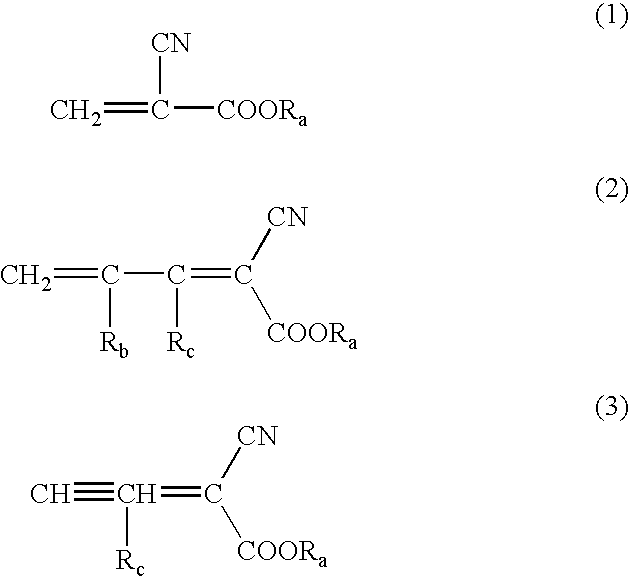
- wherein R a represents a C1-16 alkyl, alkoxyalkyl, alkylhalide, alkenyl, cyclohexyl, phenyl or furfuryl group. Rb may be hydrogen, a C1-5 alkyl, phenyl or halogen and Rc may be hydrogen or methyl. The Ra, Rb and Rc groups can contain any linkages or substituents which do not adversely affect the monomer in the performance of its intended function in the cyanoacrylate adhesive compositions. For example, the substituents should not adversely affect the stability or reactivity of the adhesive composition. Useful cyanoacrylate esters include methoxethyl cyanoacrylate and 2-chloroethyl cyanoacrylate. In the adhesive composition of the present invention, the esters of cyanoacrylate can be used singly or in combination. Typically, a single ester is used having formula (1), which is selected from C1 to about C5 alkyl, allyl and cyclohexyl esters of alpha-cyanoacrylate. The most desirable esters are methyl-alpha-cyanoacrylate or ethyl-alpha-cyanoacrylate. Methods of preparing the monomeric esters of alpha-cyanoacrylate are known in the art, such as those described in U.S. Pat. Nos. 2,467,927 and 3,254,111. Useful cyanoacrylate monomers having formulas (2) or (3) include 1-cyano-1-carbethoxy butadiene-1,3,1-cyano-1-carbethoxy-3-cholorbutadiene-1,3 and 1-cyano-1-butene-1-yne-3. These compounds and their method of making are disclosed in U.S. Pat. No. 3,316,227.
- The cyanoacrylate adhesive compositions of the present invention contain at least one cyanoacrylate monomeric ester and at least one copolymer toughening additive substantially soluble in the cyanoacrylate monomer. The copolymer toughening additive is desirably an elastomer material which is substantially free of acidic functionalities and acidic or basic impurities and which is the reaction product of an olefin C 2-20 and a (meth)acrylate ester. Desirably, the copolymers of this invention are completely soluble in cyanoacrylate monomer and exhibit little or no phase separation once fully dissolved in the uncured cyanoacrylate monomer. On curing, the adhesive composition undergoes a phase separation of the copolymer additive from the polycyanoacrylate matrix. This is associated with an increase in toughness of the cured adhesive.
- Olefins C 2-20 which are useful in making the toughening additives of the present invention are represented by the following monofunctional olefin structures (4), (5), or (6):
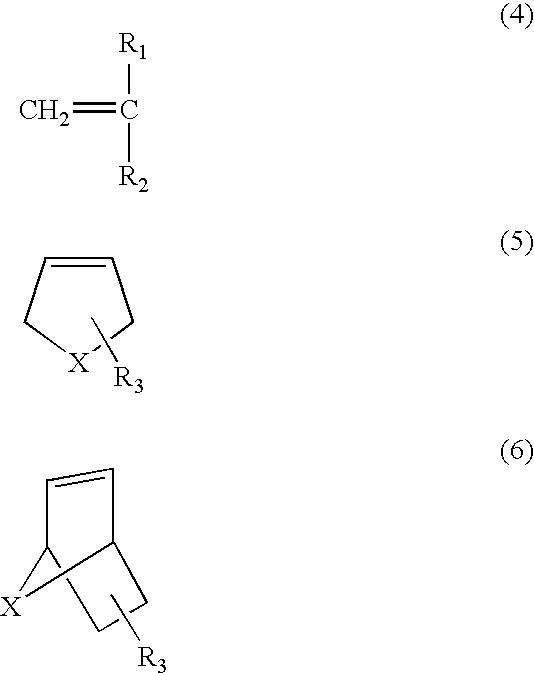
- where R 1 and R2 may be the same or different and are independently selected from H, C1-C15 alkyl, cycloalkyl, alkyl ether, substituted or unsubstituted, linear or branched and R3 may be H, C1-C10 alkyl, cycloalkyl, alkyl ether, substituted or unsubstituted, linear or branched, X may be ═O, S or —(CH2)n—, where n may be =0-6. It is required that the substituents are neutral with respect to the reactivity of cyanoacrylates, i.e. non-acidic and non-basic.
- The (meth)acrylate esters useful in making the toughening additives of the present invention are monofunctional (meth)acrylate monomers represented by structure (7):
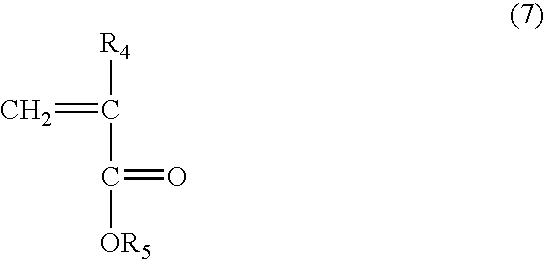
- where R 4 may be H or CH3 and R5 may be C1-C18 alkyl, cycloalkyl, alkyl ether, aryl, alkaryl, substituted or unsubstituted, linear or branched. It is required that the substituents do not interfere with anionic polymerization of the cyanoacrylate monomer. Desirably, the (meth)acrylate ester used for the chain reaction which forms the copolymer toughening additive is methyl acrylate. Other useful (meth)acrylate esters include, but are not limited to, ethyl, propyl, isopropyl, n-butyl, sec-butyl, isobutyl, t-butyl, pentyl, amyl, hexyl, 4-methyl pentyl, octyl methoxy, ethyl and cyclohexyl acrylates.
- In one desired embodiment, the copolymer of the present invention is obtained by a polymerization reaction of an olefin C 2-20 having at least six carbon atoms and a (meth)acrylate ester. In one desirable embodiment, the olefin C2-20 may be 1-hexene or norbornene, and the (meth)acrylate ester may be methyl acrylate. For example, the reaction of norbornene and methyl acrylate, shown below, produces the copolymer toughening additive corresponding to the alternating structures shown However, random or block copolymers of these reactants may also be produced.
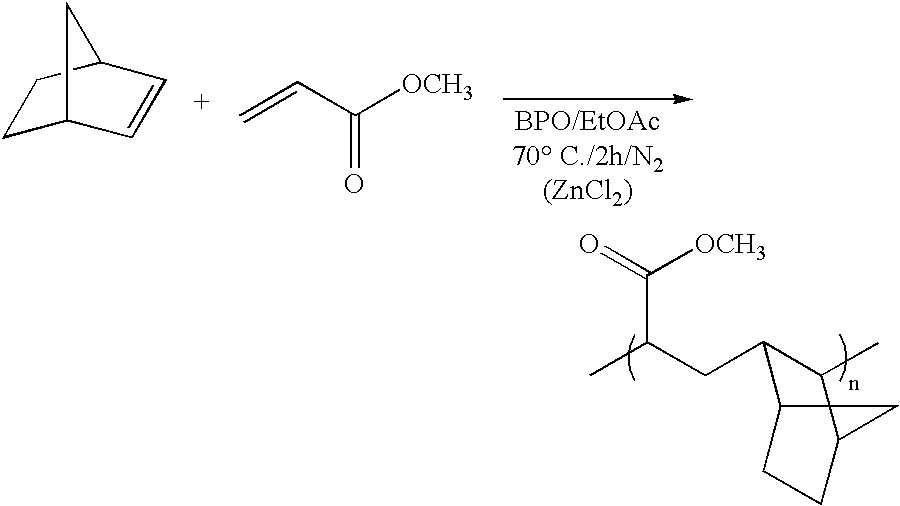
- The copolymer toughening additives of the present invention include olefin/(meth)acrylate copolymers [poly(alkene-co-alkyl acrylate) or poly (alkene-co-alkyl methacrylate)] comprising repeat units of the substructure (8) shown below and one or more of the substructures (9), (10), or (11) shown below in random, alternating or block sequences. The mole ratios of (8) to (9), (10) and/or (11) may be varied from 0.1 to 10.0. The molecular weights of the copolymers may be varied from about 2,000 to 2,000,000 and are preferably in the range of 20,000 to 200,000.
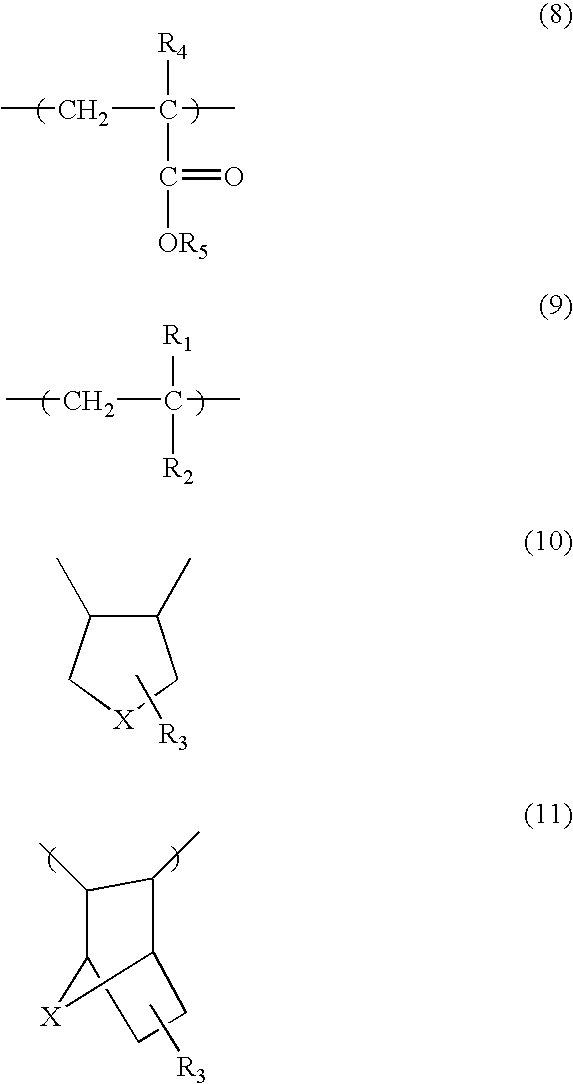
- In the above substructure examples, R 1 through R5 are as already defined. Desirably, the (meth)acrylate ester used for the condensation reaction which forms the copolymer toughening additive is methyl acrylate.
- The copolymer toughening additives of the present invention are at least partially soluble in a cyanoacrylate monomer. As already described, it is desirable to have a fully soluble rather than partially soluble toughening additive. Norbornene-methyl acrylate and hexene-methyl acrylate copolymers are examples of toughening additives which are readily soluble in monomers of ethyl 2-cyanoacrylate. It is also important that the copolymer toughening agent be insoluble in the corresponding cured cyanoacrylate adhesive composition. Both norbornene-methyl acrylate and hexene-methyl acrylate undergo a phase separation upon polymerization (cure) of an ethyl 2-cyanoacrylate monomer, characteristic of toughening, as determined by DMA analysis which provides one of the most effective means of determining the degree of toughening potential known in the art.
- The molar ratio of olefin to acrylate in the copolymers of the present invention can affect the characteristics of the copolymer as well as the properties and characteristics of an adhesive in which it is used as an additive. The present invention provides an effective means of controlling the degree of incorporation of olefin in the copolymer in order to produce a series of copolymers with different characteristics that can be optimized for particular applications. The present invention employs a method of forming copolymer toughening additives which uses the addition of varying amounts of a Lewis acid, e.g. zinc chloride, as a means of controlling the molar ratio of alkene to acrylate in the resultant copolymer toughening additives and in promoting the incorporation of higher levels of alkene content into the resultant copolymer toughening additives.
- Olefin-acrylate copolymers of the present invention may be synthesized from olefin and (meth)acrylate ester monomers by two methods which are outlined below; a stirred reactor method and a sealed tube method. Each of these methods was performed under anhydrous conditions and, conveniently, under ambient pressure. Moreover, each of these methods requires addition of a Lewis acid, e.g. ZnCl 2, and an initiator of free radical polymerization, e.g. benzoyl peroxide. The reaction temperatures are in the range of 60° C. for the stirred reactor method and 80° C. for the sealed tube method, with reaction times varying from 3 to 24 hours, respectively. In general, the sealed tube method provided a higher yield of copolymer, as compared to the stirred reactor method. It is an advantage of these methods that no special purification of the copolymer products is necessary. The copolymer solution is simply washed with distilled water to remove zinc chloride prior to drying. This is in contrast to the methods used to produce similar commercially available copolymers which have a comparatively high degree of impurity or undesirable moieties.
- In particular, the present invention provides an improved process for copolymerizing a (meth)acrylic ester with an olefin C 2-20. This process includes the steps of admixing a (meth)acrylic ester, a greater than equimolar amount of a Lewis acid per mole of the (meth)acrylic ester, a free radical initiator and an olefin C2-20, and heating the admixture at a temperature from about 60 to about 80° C. for a time sufficient to permit copolymerization of the ester with the olefin. The mole ratio of the olefin to the (meth)acrylic ester in the feed is desirably from about 0.1:1 to about 10:1, most desirably 1:1 to about 10:1. This molar ratio range has been found to give copolymer toughening additives useful in the present invention.
- One Lewis acid particularly suitable for practicing this invention is ZnCl 2. Suitable olefins for purposes of this invention are those containing groups promoting the release of electrons at the double bond. In one embodiment, the olefin has at least six carbon atoms. Desirable olefins to be used for copolymerization with the (meth)acrylic ester include hexene and norbomene. Other useful olefins include, but are not limited to, pentene, 4-methyl pentene, octene, isooctene, 2-ethylhexene, 2-methyl pentene, decene and nonene.
- As previously mentioned, commercially available polymeric toughening agents used with cyanoacrylate adhesives, including ethylene/methyl acrylate copolymers sold under the trademark Vamac by DuPont, are problematic in that they contain additives or functional groups which can affect the stability and fixture time of the adhesive. For example, Table 5 below shows that the effect of removing the interfering carboxylic acid functionality in commercial Vamac G via esterification by a process provided by the present invention is to significantly enhance the reactivity of the cyanoacrylate adhesive and improve its fixture time.
- In particular, the invention provides a process for esterification of a commercial olefin/(meth)acrylate copolymer or olefin/alkenoic acid copolymer, which eliminates interfering acid functionalities, thus making the copolymers suitable as toughening additives for cyanoacrylate adhesives. The process includes reacting the copolymer with an alcohol in the presence of a catalytically effective amount of an acid catalyst at a temperature of about 50 to about 180° C. and in the presence of a solvent which is capable of dissolving the copolymer and which is generally suitable for esterifications for a time sufficient to convert carboxylic acid functionalities on the commercial copolymers into ester functionalities. It is usually desirable to remove the acid catalyst after the reaction is complete by precipitating the copolymer in a solvent in which the catalyst is soluble and the copolymer is insoluble, e.g. methanol.
- In one embodiment of the esterification process of the present invention the olefin/(meth)acrylate copolymer is an ethylene/methyl acrylate copolymer, such as commercially available Vamac G, or a propylene/methyl acrylate copolymer. One useful alcohol is n-butanol, although other alcohols may be useful. However, attempts to esterify a Vamac G copolymer by the esterification process of the present invention were unsuccessful when the alcohol used in the reaction was methanol. In one embodiment, the acid catalyst is methane sulfonic acid (MSA). Other useful acid catalysts can include toluene sulfonic acid, sulfuric acid, phosphoric acid, as well as others generally known in the art to be useful for esterifications, provided they can be effectively removed from the esterified copolymer so as not to affect the cure rate or stability of cyanoacrylate adhesive compositions into which the esterified copolymer is added as a toughener.
- Suitable solvents for use in practicing the esterification process of the present invention are those capable of forming an azeotrope with water which can also effectively dissolve the commercial copolymer. These include, but are not limited to, benzene, tolulene, xylene, and high-boiling ethers such as methyl tert butyl ether. Where tolulene is the solvent, it is desirable that the temperature of the reaction be about 100 to about 120° C.
- The copolymers of the present invention are an improvement over commercially available toughening agents in that they do not contain interfering additives or interfering functional groups. Instead, they are extremely compatible with the cyanoacrylate monomer, affecting neither the storage stability of the adhesive nor the reactivity of the cyanoacrylate monomer. Stability tests performed on cyanoacrylate adhesive compositions containing the hexene/methyl acrylate copolymer toughening additives of the present invention exhibited significant improvement over the same adhesive compositions containing certain commercially available Vamac products. Stability tests performed on cyanoacrylate adhesive compositions containing the norbornene/methyl acrylate copolymer toughening additives of the present invention also exhibited significant improvement over the same adhesive compositions containing certain commercially available Vamac products.
- The copolymer toughening additive is present in amounts of about 0.5 to about 20% by weight of the cyanoacrylate adhesive composition. Desirably, the copolymer toughening additive is present in amounts of about 1.5 to about 15% by weight of the cyanoacrylate adhesive composition. It is most desired that the copolymer be present in amounts of about 5 to about 15% by weight of the cyanoacrylate adhesive composition.
- It is an aspect of the toughened cyanoacrylate adhesive compositions of the present invention that upon cure of the cyanoacrylate monomer component, the copolymer toughening additive undergoes a polymerization-induced phase separation. FIGS. 4-6 below show the presence of a dispersed phase of the inventive toughening copolymer particles in a cured cyanoacrylate adhesive composition. This determination was made by Dynamic Mechanical Analysis (DMA), generally known to be a good indicator of a phase separated polymer morphology, when there is a difference in glass transition temperature (Tg) between the phases. Generally, phase-separated toughening particles have a low glass transition temperature relative to the polymeric cyanoacrylate adhesive in which they are dispersed. As can be seen from FIG. 4 of the present invention, DMA analysis indicated that the hexene-methyl acrylate copolymers made in accordance with the present invention (which have a hexene to methyl acrylate mole ratio of 0.27) had a Tg of about 9° C., as compared with 149° C. for the cured cyanoacrylate polymer. This difference in Tg is indicative of their potential as toughening agents for adhesives. Furthermore, when DMA analysis was performed on a polymeric adhesive film containing the inventive norbornene-methyl acrylate copolymer toughening additives (having a norbornene to methyl acrylate mole ratio of 0.37), as shown in FIG. 6, a shoulder appeared in the scan at 96° C., which was not observed in scans of the same polymeric adhesive without the copolymer toughening adhesive. The relative size of this shoulder compared to the alpha transition at 146° C. for the matrix of the polymeric adhesive indicates a high degree of toughening potential for the copolymer.
- The copolymer toughening additives of the present invention have as an advantage over commercially available copolymer additives of being substantially free of acidic functionalities and acidic or basic impurities. Desirably, the inventive copolymer toughening additives are the reaction product of an olefin C 2-20 and a (meth)acrylate ester. In one embodiment, the olefin C2-20 is ethylene or propylene. In another embodiment, the olefin has at least six carbon atoms. One desirable (meth)acrylate ester is methyl acrylate. Other (meth)acrylate esters, however, may be employed. One desirable olefin useful in the present invention is 1-hexene. The reaction product of 1-hexene and methyl acrylate forms a particularly useful copolymer toughening agent. Where the olefin in the copolymer is 1-hexene and the cyanoacrylate monomer is ethyl cyanoacrylate, it is desired that the mole ratio of olefin to (meth)acrylate ester is at least 0.25 or greater. It is believed that a threshold concentration of hexene in the copolymer is needed to achieve the benefits of toughening from this particular copolymer. For example, DMA analysis performed on adhesive films containing hexene-methyl acrylate copolymers, as shown in FIGS. 4-5, suggested that when the mole ratio of hexene to methyl acrylate was 0.21, plasticization was prevalent, whereas when the same mole ratio was 0.27, a phase separation of the copolymer occurred, as indicated by the beta transition at 9° C., which is associated with toughening. Thus, the relative concentrations of the non-polar olefin and polar acrylate components of the copolymer control the compatibility of the copolymer in polycyanoacrylate. Copolymers having relatively high olefin contents are insoluble in the polymerized cyanoacrylate monomer and toughen cyanoacrylate polymers, whereas copolymers having relatively high acrylate contents are soluble in the polymerized cyanoacrylate monomer and plasticize materials to which they are added. Furthermore, the threshold concentration of olefin necessary for toughening may differ for each cyanoacrylate monomer or monomer blend.
- As described above, the reaction product of 1-hexene and methyl acrylate forms a particularly useful copolymer toughening agent. This is further indicated by data presented in Example 7 which show results of fracture toughness tests performed on photocured adhesive films containing hexene-methyl acrylate copolymers. The results show a significant improvement in fracture toughness of the formulation containing the olefin-acrylate copolymer of this invention, when compared with a formulation that does not contain any copolymer.
- One desirable copolymer toughening additive is the reaction product of norbornene and methyl acrylate. When the molar ratio of norbornene to methyl acrylate in the copolymer was 0.37, DMA analysis indicated a high degree of toughening potential for the copolymer, as shown in FIG. 6, based on the presence of the shoulder at 96° C. when the cyanoacrylate monomer was ethyl cyanoacrylate.
- Another desirable copolymer toughening additive of the present invention which is free of acid functionalities and acidic or basic impurities, is the reaction product of ethylene or propylene and methyl acrylate. As described, the present invention provides a process for esterifying commercial olefin/(meth)acrylate copolymers, such as the ethylene/methyl acrylate copolymer Vamac G, which results in the elimination of the carboxylic acid functionalities which interfere with the cure rate of cyanoacrylate adhesives. Thus, the present invention includes ethylene/methyl acrylate and propylene/methyl acrylate toughening copolymers suitable for use as additives for cyanoacrylate adhesive compositions.
- While the free radical initiator used for formation of the copolymers of the present invention is desirably benzoyl peroxide, a diacyl peroxide, other peroxy initiators known in the art may be useful. These include, but are not limited to the following: diacyl peroxides such as dilauroyl peroxide; dialkyl peroxides such as di-t-butyl peroxide and dicumyl peroxide; ketone peroxides such as methylethyl ketone peroxides; peresters which readily hydrolyze, e.g., t-butyl peracetate, t-butyl perbenzoate, di-t-butyldiperphthalate; and peroxycarbonates, i.e., reaction products of isocyanates and hydroperoxides. Another useful class of peroxy initiators are the organic hydroperoxides such as cumene hydroperoxide, methyl ethyl ketone hydroperoxide, and t-butyl hydroperoxide. Moreover, other free-radical initiators may be useful that do not require the presence of peroxide compounds, e.g. azonitriles or succinic acid.
- One (meth)acrylic ester useful for preparing toughening copolymers of the present invention is methyl acrylate, although other acrylates as previously described may be useful.
- The inventive process for preparing a toughened adhesive composition includes the steps of combining the cyanoacrylate monomer with the copolymer toughening additive, and subjecting the combined ingredients to conditions sufficient to allow the monomer to at least partially, and desirably fully solvate the copolymer toughening additive. In one embodiment, the olefin C 2-20 which is copolymerized with a (meth)acrylate ester has at least six carbon atoms. In another embodiment, the olefin C2-20 can have three carbons or less. For example, the copolymer additive can be the commercially obtained reaction product of ethylene and methyl acrylate which has been modified by the esterification process provided by the present invention to remove acidic functionalities that can interfere with the reactivity of the cyanoacrylate monomer. It is an aspect of the foregoing process that upon cure of the cyanoacrylate monomer the solvated copolymer undergoes a phase separation associated with a toughening of the adhesive composition.
- It is desirable that during the step of combining the ingredients of the cyanoacrylate adhesive composition, the copolymer be present in amounts of about 5 to about 15% by weight of the cyanoacrylate adhesive composition. For purposes of this invention, useful particle sizes of the phase-separated copolymer in the cured cyanoacrylate adhesive will generally be in the range of about 0.2 microns to about 200 microns, desirably 2-20 microns.
- In addition to the above named ingredients, the adhesive composition of the invention may include an inhibitor of anionic or free radical polymerization. The anionic inhibitor can include sulfur dioxide, sulfur trioxide, nitric oxide, hydrogen fluoride, organic sultone inhibitors, boron trifluoride and methane sulfonic acid, which are all well known in the art. It is an embodiment of this invention that inhibitors of anionic polymerization be present at about 0.0001 to about 0.1% of the adhesive composition. Free radical inhibitors may include hydroquinones or quinones which are present at about 0.0005 to about 10% of the adhesive composition.
- Apart from the incorporation of initiators and polymerization inhibitors in the compositions, it is also known and well within the contemplation of the present invention to incorporate other additives to modify the chemical and physical characteristics of the compositions. These additives include viscosity modifying agents, dyes, inert fillers and plasticizers.
- The invention further includes a method for sealing or adhering surfaces. The method includes the steps of applying, to a substrate the surface the toughened cyanoacrylate adhesive composition of the present invention, placing the surface in an abutting relationship with another substrate surface and permitting the composition to cure. Pressure may or may not be applied to the bond line. The toughened cyanoacrylate adhesives of the present invention generally contain an inhibitor of anionic or free-radical polymerization. When placed on a substrate to be bonded and exposed to atmospheric and surface moisture in so doing, cure generally occurs in a short period of time, usually in less than two minutes.
- The following examples illustrate the present invention.
- Syntheses of Olefin-Acrylate Copolymers
- The olefin-acrylate copolymers of the present invention were prepared by free-radical copolymerization of olefin and acrylate monomers or by esterificatidn of copolymers. These copolymers were free of detectable acidic functionality or impurities. The polymerization reaction was performed by either of two methods, viz., in a stirred reactor or in a sealed tube. The methods are described below for the synthesis of poly(1-hexene-co-methyl acrylate) by copolymerization of 1-hexene and methyl acrylate and the esterification of a commercially available ethylene-methyl acrylate elastomer, Vamac G, with n-butanol. The procedures may be employed to prepare other copolymers by using different olefin and acrylate comonomer reactants in the polymerization reaction or by using other olefin-acrylate elastomers and alcohols in the esterification reaction.
- Stirred Reactor Method. A 200-ml resin reaction flask was fitted with a condenser, thermocouple with temperature controller, magnetic stirrer and an oil bath. To the flask was added 39.0 g (0.465 moles) of 1-hexene, 20.0 g methyl acrylate (0.233 moles) and 80 ml ethyl acetate. The mixture was stirred and 0.295 g of benzoyl peroxide (0.5% by weight of monomers) and 47.5 g (0.35 moles) of zinc chloride were added. The latter was added gradually; the mixture was stirred for several minutes to dissolve the zinc chloride. A gentle stream of nitrogen was blown over the mixture then it was heated to about 60-70° C. for 3 hours. The mixture was cooled, poured into a 250-ml separatory funnel, and washed twice with about 100 ml of distilled water to remove zinc chloride. The funnel was allowed to stand overnight to separate the emulsion. The organic layer was drained and dried over anhydrous sodium sulfate then filtered. The solution was poured into a polypropylene beaker and placed onto a warm hot plate. When the bulk of the solvent had evaporated, the beaker and copolymer were placed in a vacuum oven at 60° C. and 9 torr and dried over 20 hours to constant weight. A total of 12.5 g (31% yield) of poly(1-hexene-co-methyl acrylate) was recovered.
- Sealed Tube Method. To a stirred solution of 14.3 g (0.105 moles) of zinc chloride dissolved in 40 ml of ethyl acetate was added 11.6 g (0.138 moles) of 1-hexene, 6.0 g (0.07 moles) of methyl acrylate, and 0.088 g of benzoyl peroxide (0.5 weight percent of comonomers). Equal amounts of the resulting mixture were added to two thick-walled 30-ml polymerization tubes and purged with nitrogen. The tubes were sealed and heated at 80° C. for 24 hours. The resulting copolymer solution was cooled and transferred to separatory funnel. The tube was rinsed with additional ethyl acetate (ca. 20 ml), which was also transferred to the funnel. The solution was washed twice with 40 ml of deionized water to remove zinc chloride. The organic layer was dried over sodium sulfate, filtered, and the solvent evaporated in a vacuum oven to yield 6.08 g (52% yield) of poly(1-hexene-co-methyl acrylate).
- Esterification of Ethylene-Acrylic Elastomers. Twenty grams of Vamac G were dissolved in 125 ml of toluene and added to a 250 mL three-necked, round bottomed flask containing a magnetic stir bar. To the mixture was added 0.2 g of methanesulfonic acid and 16 g of n-butanol. A condenser with Dean-Stark trap and a thermocouple were fitted to the flask. The mixture was refluxed for 12 hours, during which time IR spectra taken periodically to chart the disappearance of the carboxylic acid's —OH peak. The mixture was cooled and the polymer precipitated in about 600 mL of methanol. The polymer was placed in a dish and dried overnight in a vacuum oven at 60° C. About 13 g were isolated. Spectroscopic analysis showed the compound to be a terpolymer of ethylene-methyl acrylate and N-butyl acrylate.
- Characterization of Hexene/Methyl Acrylate Copolymers
- This example was performed for the purpose of characterizing, using analytical techniques, the hexene/methyl acrylate copolymer toughening additive formed using the inventive process. The isolated copolymers were characterized by 1H NMR spectroscopy and size exclusion chromatography and were determined to be copolymers of the reactants, as opposed to homopolymer blends. This was confirmed further by solubility tests and by the fact that hexene does not polymerize under these reaction conditions. The inventive copolymer toughening additives were completely soluble in non-solvents of poly(1-hexene), e.g. ethyl acetate and acetone, and insoluble in solvents of poly(1-hexene), e.g. hexane and cyclohexane. Table 1 below shows the characterization and composition of hexene/methyl acrylate copolymers which were synthesized by the sealed tube method in Example 1.
TABLE 1 Characterization and Composition of Hexene/Methyl Acrylate Copolymers [ZnCl2] [Hex] [Hex] Copolymer [MA] [MA] [MA] Mn sample # feed feed copolymer (PMMA) MWD CHO 1 0 1 0.21 15,900 2.7 2.2 2 1 1 0.27 17,600 2.1 2.4 3 1 2 0.46 12,700 2.3 2.9 4 1 3 0.42 12,400 1.8 2.8 5 1.5 2 0.50 13,600 2.1 3.0 Vamac G 60,800 4.8 4.3 - The level of hexene incorporated into the copolymer was determined from the integral ratio of the methyl group signals of hexene and methyl acrylate, δ 0.9/δ3.7, in the NMR spectrum, which provides the mole ratio of the two comonomers directly, i.e. [Hex]/[MA]. Molecular weight measurements were determined relative to PMMA standards. The molecular weight ratio of hydrocarbon to oxygen in the copolymer (CH/O) is an arbitrary but convenient index of the degree of incorporation of olefin into the copolymer toughening additive product. The CH/O value for Vamac G is approximately 4.3 and the corresponding value for poly(methyl acrylate)homopolymer is 1.7. The CH/O value for poly(1-hexene) is undefined since it does not contain oxygen.
- Referring now to samples 3 and 5 of Table 1, which were synthesized using the sealed tube method, it is clear from sample 5 that inclusion of a greater than equimolar amount of ZnCl 2 (a Lewis acid) per mole of methyl acrylate results in a desirably higher mole ratio of hexene to methyl acrylate in the copolymer reaction product, as compared to sample 3 where an equimolar amount of the halide per mole of methyl acrylate is used: For both samples 3 and 5, the ratio of hexene to methyl acrylate in the feed was 2.0. There is a clear correlation between the amount of ZnCl2 added to the reaction and the amount of olefin incorporated into the copolymer formed. In particular, the data from Table 1 shows that olefin content in the copolymer increases with increasing concentrations of ZnCl2.
- Copolymerization of Norbornene and Methyl Acrylate
- In this example, norbornene is copolymerized with methyl acrylate, using ZnCl 2 as the Lewis acid to produce copolymers having random, alternating or block structures incorporating units derived from norbornene and methyl acrylate. For example, the scheme below shows the structure of a perfectly alternating copolymer of norbornene and methyl acrylate.
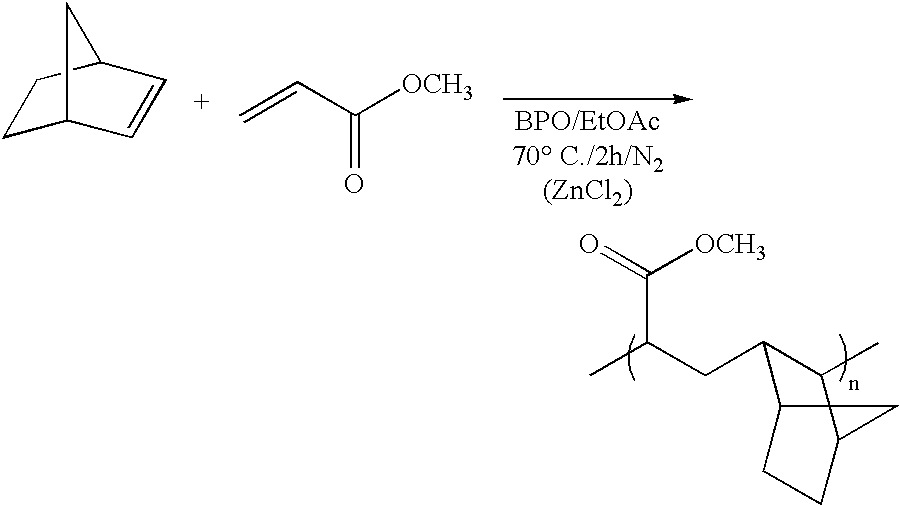
- A series of poly(norbornene-co methyl acrylates) were synthesized by heating solutions of norbornene and methyl acrylate in ethyl acetate for two hours at 70° C., according to the stirred reactor procedure described in Example 1 In all cases equi-molar amounts of the two comonomers were employed. The reaction was performed under conditions of varying concentrations of zinc chloride in order to produce copolymers with different compositions. The results are presented in Table 2
TABLE 2 Copolymerization of Norbornene and Methyl Acrylate [ZnCl2] Yield Mn [NB] Sample [MA] (%) (PMMA) MWD [MA] CHO N1 0 44 37,000 3.1 0.38 2.8 N2 0 42 36,000 2.8 0.37 2.8 N3 0.5 47 54,000 2.3 0.62 3.5 N4 1.0 37 — — 0.78 4.0 N5 2.0 34 35,000 1.7 0.85 4.2 N6 2.5 45 — — 0.95 4.5 Vamac G 60,000 3.8 4.3 - Referring now to Table 2, which shows the characterization and composition of copolymers formed from norbomene and methyl acrylate using the stirred reactor method, it can be seen that the amount of norbomene incorporated into the copolymer increases linearly with increasing concentrations of ZnCl 2 in the feed. The data presented graphically in FIG. 1 shows that there is a good correlation between the concentration of ZnCl2 in the reaction mixture and the concentration of norbomene incorporated into the copolymer for molar ratios of ZnCl2 to methyl acrylate up to 2.5. The continuous line in FIG. 1 is the data plotted from the least squares method. When 2.5 moles of ZnCl2 per mole of methyl acrylate is used, a copolymer (N6) containing a molar ratio of norbomene to methyl acrylate [NB]/[MA] of almost 1:1 is formed, as determined from the 1H NMR spectrum.
- Vamac G, a commercially available toughening agent, is included in Table 2 for comparative purposes. Molecular weights (M n) and distributions (MWD) were lower than those recorded for the commercial ethylene-methyl acrylate copolymer, Vamac G. The CH/O index, which provides an index of the degree of incorporation of olefin into the copolymer and permits comparisons to be made between different olefin-acrylate copolymers, indicates that sample N6 has a CH/O index which exceeds that of Vamac G, a commercially available toughening agent.
- Dynamic Mechanical Analysis
- Toughening particles dispersed in polymeric adhesives are typically about 0.5 to 5 μm in diameter and are present at a volume fraction of about 5 to 30%. Dynamic mechanical analysis (DMA) represents one of the best methods for detecting the presence of a dispersed phase of toughening particles in an adhesive or polymeric matrix. In such cases, the dispersed phase is indicated by the presence of one or more secondary transitions in the DMA plots of elastic modulus (G′), loss modulus (G″) or damping (G″/G′, also defined as tan δ) versus temperature.
- Cyanoacrylate (CA) adhesive formulations were prepared for DMA testing by dissolving the copolymers in ethyl 2-cyanoacrylate containing 25 ppm BF 3 as stabilizer. The formulae were sensitized for photocuring by the addition of 1% Irgacure 1700 (supplied by Ciba Geigy) and 130 ppm ferrocene. Films of the cured adhesive were prepared between two release treated overlapping glass slides. The slide assemblies were filled with the sensitized liquid formulation by capillary action while a gap of 1 mm was maintained by means of a spacer located at one end of each assembly. The filled assemblies were exposed to ultraviolet (UV) light from an Oriel Corp. Model 87331 mercury arc lamp projector (1.8 J/cm2/side) to cure the adhesive. After curing, the films were removed from the glass plates by immersing the assemblies in warm water for a few minutes. The free films were then dried to constant weight and cut to the required dimensions. This method provided highly uniform defect-free cyanoacrylate polymer films.
- DMA were performed on a Rheometrics RDAII in torsional shear mode at a frequency of 10 rad/s (˜1.6 Hz). The analyses were conducted over the temperature range −120 to +150° C. Cyanoacrylate adhesives containing copolymer samples #1, #2 of Example 3 and #N2 of Example 4 were tested. For comparative purposes, films of unmodified UV cured poly(ethyl 2-cyanoacrylate) (PECA) and PECA toughened with Vamac G were also examined. The results are presented in FIGS. 2-6.
- Referring to FIG. 2, which shows the trace for UV cured PECA without added toughening agent, a single α-transition at 147° C. is observed in the tan δ plot corresponding to the glass transition (T g) for the polymer. Above Tg, the polymer rapidly decomposes. In contrast, the DMA traces of the cured material containing 7.5% by weight Vamac G (FIG. 3), show a weak β-transition (secondary transition) at −15° C. in the tan δ plot and an associated reduction in the elastic modulus (G′). This transition corresponds to the Tg of the added elastomer, which has phase-separated from the CA polymer. The main transition is still observed at approximately 150° C. indicating that there is little plasticization of the CA by the added copolymer, which provides additional evidence, that phase segregation has occurred. The film broke before the α-transition was completely defined. This is frequently observed with CA samples since the onset of degradation occurs almost immediately after the polymer becomes rubbery.
- FIG. 4 shows the DMA traces corresponding to the PECA film containing 5% hexene/methyl acrylate copolymer sample #2 (Table 2, Example 3), which has a hexene/methyl acrylate mole ratio of 0.27. This trace clearly shows a β-transition at about 9° C. corresponding to the phase separated rubber. The corresponding modulus drop is approximately the same magnitude as that observed with Vamac G, indicating a comparable degree of phase separation. In addition the α-transition, at 149° C., is essentially unchanged from that of the unmodified CA polymer (FIG. 2), indicating that there is little or no plasticization of the CA polymer. Thus Vamac G and hexene/methyl acrylate copolymer #2 are similar with respect to their insolubility in PECA and may be expected to impart similar degrees of toughness to the cyanoacrylate polymer.
- In contrast, the CA film containing copolymer #1, having a lower mole ratio of hexene/methyl acrylate ([Hex]/[MA]=0.21), does not show a distinct β-transition and the value of the α-transition is lowered compared to that of the unmodified polymer, as shown in FIG. 5.
- This suggests that there is a threshold concentration of hexene in the copolymer (between mole ratio hexene/MA 0.21-0.27), above which phase separation occurs and below which plasticization is prevalent. DMA was also performed on a photocured ECA film containing poly(norbornene-co-methyl acrylate), having a N/MA ratio of 0.37 (FIG. 6). This film exhibits a primary transition due to the CA polymer at 146° C., which is close to the value observed for unmodified PECA (FIG. 2). A secondary transition appears as a shoulder at approximately 96° C., which is not observed in scans of unmodified PECA. This is likely due to the T g of the phase-separated copolymer. The relative size of this shoulder compared to the alpha transition indicates a high degree of toughening potential for the copolymer, although the relatively high Tg may restrict its benefit to a narrow temperature range of use in CA's in the region 90-150° C. A less well-defined y-transition is also observed at 17° C.
- Stability Tests and Fixture-Time Tests of Toughened CA Adhesives.
- The olefin/alkyl (meth)acrylate copolymers prepared as described in Example 1 are neutral with regard to their influence on the reactivity and stability of cyanoacrylate monomers. Compositions for stability and reactivity testing were prepared by dissolving 8% copolymer in ethyl 2-cyanoacrylate (ECA) containing 25 ppm of boron trifluoride. Stability was determined by the length of time that the formulated product remained in a liquid and useable state under ambient storage conditions in a polyethylene container. Adhesives containing the inventive hexene/methyl acrylate copolymer #5 and norbornene/methyl acrylate copolymer #N2 additives, respectively, were selected, as well as two commercially available ethylene/methyl acrylate elastomers, Vamac G and Vamac D, which were chosen for comparative purposes. The stability test results are presented in Table 3.
TABLE 3 Stability of Toughened Cyanoacrylate Adhesives Under Ambient Storage Conditions Copolymer Stability Sample # (months) none >6 Hexene/methyl acrylate #5 >6 Norbornene/methyl acrylate #N2 >6 Vamac G >6 Vamac D 0 - The data show that the inventive copolymers #5 and #N2 provide stable liquid adhesive compositions for periods exceeding 6 months, as does the commercial material Vamac G. However, the related material, Vamac D, provides unstable adhesives that polymerize in a matter of a few hours, following the dissolution of the copolymer.
- The reactivities of the adhesive formulations were determined by measuring the minimum time required to fixture a single-lap shear adhesive joint under static loading of 3 kilograms. The tests were conducted on 1×4 inch 2, solvent wiped, mild-steel test specimens assembled with an overlap area of 0.5 square inches. The stress was applied to the adhesive for 5 seconds and the assembly was considered fixtured if the specimens did not move relative to one another during that time. Three consecutive replicate measurements were made and the minimum time range recorded. The results are presented in Table 4.
TABLE 4 Fixture Times of ECA Adhesives Containing Various Copolymers Copolymer Sample Age Fixture-Time Sample # (months) (seconds) None 0 20-30 Hex/MA #5 0 20-30 Hex/MA #5 11 20-30 Norb/MA #N2 6 10-20 Vamac G 0 90-105 Vamac G 6 210-240 - Referring to Table 4, the reactivities of adhesives containing copolymers of the present invention were compared with the same formulation containing Vamac G. The data show that the presence of 8% hexene/methyl acrylate has no influence on the reactivity of the monomer. The fixture time is identical to that of the unmodified monomer before and after aging for 11 months under ambient conditions. With norbornene/methyl acrylate, there is a slight activating effect, but since this adhesive formulation has stability in excess of six months, the copolymer is acceptable as an additive for use in cyanoacrylates. In contrast, there is a significant deactivating effect in the composition containing Vamac G. The fixture-time of a freshly prepared adhesive composition is over three times higher than that of the unmodified monomer. In addition, the reactivity is further reduced on storage, such that after six months the fixture time is almost an order of magnitude longer than that of the unmodified adhesive. This material is clearly undesirable for use as an additive of cyanoacrylate adhesives. In contrast the copolymers of the present invention represent a marked improvement over commercial toughening agents in terms of both fixture time and stability.
- Esterification of Olefin/Alkyl (Meth)Acrylate Copolymers
- This example demonstrates:
- (1) that the fixture time of cyanoacrylate compositions containing commercially available copolymer toughening additives such as Vamac G are significantly longer than those same compositions containing one of the inventive copolymer toughening additives of the present invention which was prepared by an esterification of the Vamac G. This is believed to be due to the acidic functionality and/or impurity present in these commercial copolymer additives as a result of their method of preparation For example, elimination of the acidic functionality and/or impurities responsible for such slow fixture times by using an esterification process of the present invention to butylate the Vamac G copolymer, resulted in improved fixture times (70-90 seconds) which were two to three times faster than an unmodified Vamac G copolymer (150-180 seconds) in a test composition.
- (2) a process for converting a copolymer unsuitable for use as a toughening additive in cyanoacrylate adhesives into a copolymer useful as a toughener in cyanoacrylate adhesives by elimination of the acid functionalities therein which affect the reactivity of the cyanoacrylate monomer. In particular, the process is for esterification of an olefin/(meth)acrylate copolymer or an olefin/alkenoic acid copolymer containing carboxylic acid functionalities, which process includes reacting the copolymer with an alcohol in the presence of a catalytically effective amount of an acid catalyst, at a temperature of about 50 to about 180° C. and in the presence of a solvent suitable for esterification for a time sufficient to allow conversion of the carboxylic acid functionalities into esters. The process further includes substantial removal of the acid catalyst by precipitating the copolymer in a solvent in which the catalyst is soluble, but the copolymer is insoluble.
- Certain commercially available olefin-acrylate elastomers, such as Vamac G, may be used to toughen cyanoacrylate adhesives. However, these products have the undesirable effect of slowing the cure speed as a consequence of the presence of a low concentration of free carboxylic acid groups present in the copolymer. In order to overcome this limitation, we esterified Vamac G to eliminate the free carboxylic acid functionality.
- Vamac G was successfully esterified with excess n-butanol in the presence of methane sulfonic acid (MSA) as catalyst to provide the corresponding ethylene-methyl acrylate-butyl acrylate terpolymer using the scheme below. The product was isolated by precipitation in methanol and drying to constant weight. This has the effect of purifying the copolymer such that the acid catalyst is substantially removed from it.

- Infrared analysis of the starting Vamac G polymer shows a broad absorption band at 3265 cm −1 characteristic of a carboxylic acid group. This absorption band is absent in the spectrum of the product indicating that esterification is essentially complete. Acid analysis of the new material was 3.8 mg KOH/g, which represents a significant reduction from the 21.1 value of the starting Vamac G. It confirms that the esterification is essentially complete and that the acid added to catalyze the esterification reaction was effectively removed during the precipitation of the copolymer. Proton NMR analysis confirmed the presence of a partially butylated structure and showed that the degree of butylation was in the range of 16-21% of total ester content. This indicates that significant transesterification has also occurred under the above conditions where x+n=˜y/5 in this scheme. Attempts to esterify the elastomer with excess methanol by this method were unsuccessful.
- A test formulation was prepared by dissolving 8% by weight of the butylated Vamac in ethyl 2-cyanoacrylate, which contained 50 ppm methanesulfonic acid as stabilizer. A similar composition containing 8% unmodified Vamac G was also prepared for comparative purposes. The adhesive fixture times were determined as described in Example 6 and the results are presented in Table 5.
TABLE 5 Comparative Fixture Times of ECA Adhesives Containing Butylated Vamac G and Unmodified Vamac G Fixture time Toughening Agent (seconds) Butylated Vamac G 75-90 Vamac G 150-180 - Fracture Toughness Test
- This example demonstrates that the olefin-acrylate copolymers of the present invention are capable of toughening cyanoacrylate adhesives.
- A sample of poly(1-hexene-co-methyl acrylate) containing 25 mole % hexene was prepared according to the stirred reactor method described in Example 1. Ultra-violet light (UV) curable adhesive formulations were prepared by blending together the material components listed in Table 6.
TABLE 6 Formulations of UV-Curable Cyanoacrylate Adhesives Formula A Formula B Component weight % weight % Ethyl 2-cyanoacrylate 94.984 98.984 Poly(1-hexene-co-methyl acrylate) 4.000 0 Irgacure 1700 1.000 1.000 Ferrocene 0.013 0.013 Boron trifluoride 0.003 0.0003 - Photocured films of each formulation were prepared according to the procedure already described in (Example 4). The films were cut and machined into standard sized fracture test specimens and tested for fracture toughness according to ASTM E813-89, Standard Test Method for J IC, a Measure of Fracture Toughness. The results are presented in Table 7.
TABLE 7 Fracture Toughness and Failure Modes for Cyanoacrylate Adhesives Fracture Toughness Energy Release Rate Formulation lbs/in Mode of Failure A 10.7 (±1.7) (Jq) Ductile B 1.5 (±0.4) (Gq) Brittle - Formulation A, containing a small amount of olefin-acrylate copolymer is representative of the present invention, whereas formulation B is included for comparative purposes. It does not contain any copolymer. The results clearly show a significant improvement in fracture toughness of formulation A compared to formulation B. The improved toughness resulting from the presence of the copolymer is further confirmed by the mode of failure. When copolymer is present, the failure occurs in a ductile mode, whereas brittle failure is observed when the copolymer is omitted.
- The invention being thus described, it will be evident to those skilled in the art that the same may be varied in many ways. Such variations are not to be regarded as a departure from the spirit and scope of the invention and all such modifications are intended to be defined by the claims.
Claims (62)


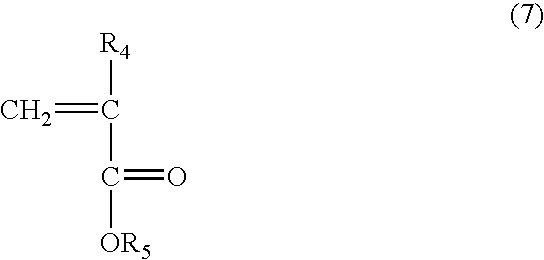
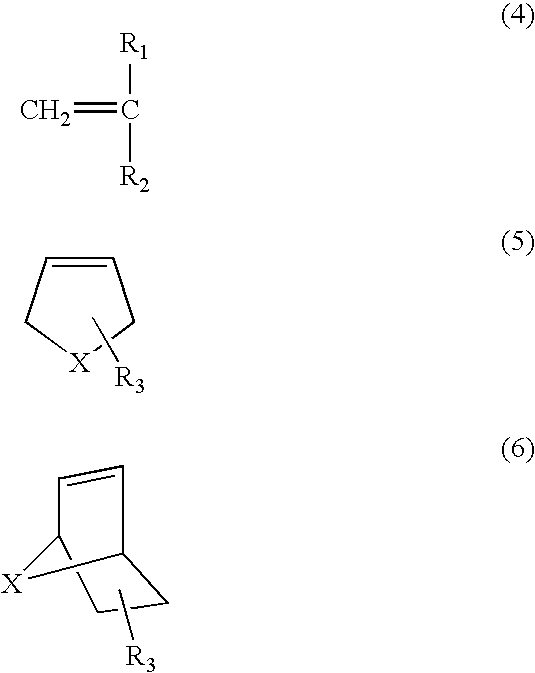

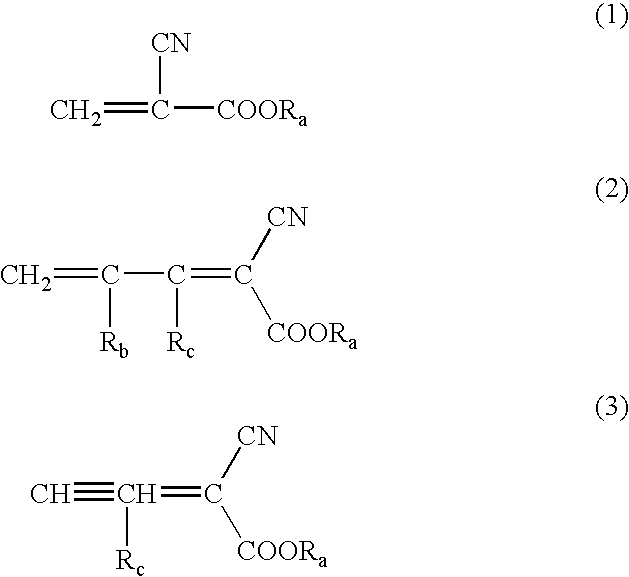
Priority Applications (1)
| Application Number | Priority Date | Filing Date | Title |
|---|---|---|---|
| US10/239,139 US6822052B2 (en) | 2001-05-24 | 2001-05-24 | Toughened cyanoacrylate adhesives containing alkene-acrylate copolymers and method for production |
Applications Claiming Priority (2)
| Application Number | Priority Date | Filing Date | Title |
|---|---|---|---|
| US10/239,139 US6822052B2 (en) | 2001-05-24 | 2001-05-24 | Toughened cyanoacrylate adhesives containing alkene-acrylate copolymers and method for production |
| PCT/US2001/016933 WO2002000801A1 (en) | 2000-06-27 | 2001-05-24 | Toughened cyanoacrylate adhesives containing alkene-acrylate copolymers and method for production |
Publications (2)
| Publication Number | Publication Date |
|---|---|
| US20030208002A1 true US20030208002A1 (en) | 2003-11-06 |
| US6822052B2 US6822052B2 (en) | 2004-11-23 |
Family
ID=29270235
Family Applications (1)
| Application Number | Title | Priority Date | Filing Date |
|---|---|---|---|
| US10/239,139 Expired - Lifetime US6822052B2 (en) | 2001-05-24 | 2001-05-24 | Toughened cyanoacrylate adhesives containing alkene-acrylate copolymers and method for production |
Country Status (1)
| Country | Link |
|---|---|
| US (1) | US6822052B2 (en) |
Cited By (3)
| Publication number | Priority date | Publication date | Assignee | Title |
|---|---|---|---|---|
| EP1907496A1 (en) | 2005-07-11 | 2008-04-09 | Henkel Corporation | Toughened cyanoacrylate compositions |
| US20110151243A1 (en) * | 2008-09-01 | 2011-06-23 | Loctite (R&D) Limited | Transferable curable non-liquid film on a release substrate |
| US20210253907A1 (en) * | 2018-10-18 | 2021-08-19 | Henkel IP & Holding GmbH | Two-part, cyanoacrylate/free radically curable adhesive systems |
Families Citing this family (4)
| Publication number | Priority date | Publication date | Assignee | Title |
|---|---|---|---|---|
| EP1945702A1 (en) * | 2005-11-10 | 2008-07-23 | Henkel AG & Co. KGaA | Adhesives, sealants and coatings containing glass particles as a filler |
| ATE499421T1 (en) * | 2005-11-10 | 2011-03-15 | Henkel Ag & Co Kgaa | ADHESIVES, SEALANTS AND COATING MATERIALS WITH GLASS PARTICLES AS A FILLER |
| US20080003196A1 (en) * | 2006-06-30 | 2008-01-03 | Jonn Jerry Y | Absorbable cyanoacrylate compositions |
| US8287687B1 (en) | 2008-10-22 | 2012-10-16 | Henkel Corporation | Cyanoacrylate compositions incorporating organic micropulp |
Citations (21)
| Publication number | Priority date | Publication date | Assignee | Title |
|---|---|---|---|---|
| US2467927A (en) * | 1947-05-29 | 1949-04-19 | Goodrich Co B F | Preparation of monomeric alkyl alpha-cyano-acrylates |
| US3183217A (en) * | 1961-03-01 | 1965-05-11 | Exxon Research Engineering Co | Copolymerization of polar with nonpolar monomers in the presence of a friedel-craftsand a free radical initator |
| US3254111A (en) * | 1960-12-09 | 1966-05-31 | Eastman Kodak Co | Esters of alpha-cyanoacrylic acid and process for the manufacture thereof |
| US3316227A (en) * | 1963-10-18 | 1967-04-25 | Lord Corp | Preparation of 1, 1-disubstituted diunsaturated compounds |
| US3963772A (en) * | 1973-02-09 | 1976-06-15 | E. I. Du Pont De Nemours And Company | Alternating alkylene/acrylic telomers |
| US4102945A (en) * | 1976-07-14 | 1978-07-25 | Loctite (Ireland) Limited | Filled cyanoacrylate adhesive compositions |
| US4440910A (en) * | 1982-01-18 | 1984-04-03 | Loctite Corporation | Toughened cyanoacrylates containing elastomeric rubbers |
| US4444933A (en) * | 1982-12-02 | 1984-04-24 | Borden, Inc. | Adhesive cyanoacrylate compositions with reduced adhesion to skin |
| US4477687A (en) * | 1983-06-06 | 1984-10-16 | Finney Philip F | Thermocouple and method of making the thermocouple and of mounting the thermocouple on a heat exchanger tube |
| US4533422A (en) * | 1983-08-31 | 1985-08-06 | Loctite Corporation | Thixotropic cyanoacrylate compositions |
| US4556700A (en) * | 1984-01-30 | 1985-12-03 | Loctite Limited | Instant adhesive composition utilizing calixarene accelerators |
| US4560723A (en) * | 1983-11-14 | 1985-12-24 | Minnesota Mining And Manufacturing Company | Cyanoacrylate adhesive composition having sustained toughness |
| US4622414A (en) * | 1984-01-27 | 1986-11-11 | Loctite Limited | Novel calixarene compounds |
| US4636539A (en) * | 1984-01-30 | 1987-01-13 | Loctite (Ireland) Limited | Instant adhesive composition utilizing calixarene accelerators |
| US4695615A (en) * | 1984-11-21 | 1987-09-22 | Loctite (Ireland) Limited | Instant adhesive composition utilizing mixed functionality calixarenes as accelerators |
| US4718966A (en) * | 1984-01-30 | 1988-01-12 | Loctite (Ireland) Ltd. | Bonding method utilizing cyanoacrylate adhesive having calixarene accelerator |
| USRE32889E (en) * | 1983-08-31 | 1989-03-14 | Loctite Corporation | Thixotropic cyanoacrylate compositions |
| US4837260A (en) * | 1986-05-23 | 1989-06-06 | Toagosei Chemical Industry Co., Ltd. | Cyanoacrylate compositions |
| US4855461A (en) * | 1987-01-21 | 1989-08-08 | Loctite (Ireland) Ltd. | Functionalized oxacalixarenes, their preparation and use in instant adhesive compositions |
| US5340873A (en) * | 1991-08-23 | 1994-08-23 | National Starch And Chemical Investment Holding Corporation | Toughened cyanoacrylate adhesive composition containing polyester polymers |
| US5994464A (en) * | 1995-03-23 | 1999-11-30 | Three Bond., Ltd. | Cyanoacrylate adhesive composition |
-
2001
- 2001-05-24 US US10/239,139 patent/US6822052B2/en not_active Expired - Lifetime
Patent Citations (21)
| Publication number | Priority date | Publication date | Assignee | Title |
|---|---|---|---|---|
| US2467927A (en) * | 1947-05-29 | 1949-04-19 | Goodrich Co B F | Preparation of monomeric alkyl alpha-cyano-acrylates |
| US3254111A (en) * | 1960-12-09 | 1966-05-31 | Eastman Kodak Co | Esters of alpha-cyanoacrylic acid and process for the manufacture thereof |
| US3183217A (en) * | 1961-03-01 | 1965-05-11 | Exxon Research Engineering Co | Copolymerization of polar with nonpolar monomers in the presence of a friedel-craftsand a free radical initator |
| US3316227A (en) * | 1963-10-18 | 1967-04-25 | Lord Corp | Preparation of 1, 1-disubstituted diunsaturated compounds |
| US3963772A (en) * | 1973-02-09 | 1976-06-15 | E. I. Du Pont De Nemours And Company | Alternating alkylene/acrylic telomers |
| US4102945A (en) * | 1976-07-14 | 1978-07-25 | Loctite (Ireland) Limited | Filled cyanoacrylate adhesive compositions |
| US4440910A (en) * | 1982-01-18 | 1984-04-03 | Loctite Corporation | Toughened cyanoacrylates containing elastomeric rubbers |
| US4444933A (en) * | 1982-12-02 | 1984-04-24 | Borden, Inc. | Adhesive cyanoacrylate compositions with reduced adhesion to skin |
| US4477687A (en) * | 1983-06-06 | 1984-10-16 | Finney Philip F | Thermocouple and method of making the thermocouple and of mounting the thermocouple on a heat exchanger tube |
| US4533422A (en) * | 1983-08-31 | 1985-08-06 | Loctite Corporation | Thixotropic cyanoacrylate compositions |
| USRE32889E (en) * | 1983-08-31 | 1989-03-14 | Loctite Corporation | Thixotropic cyanoacrylate compositions |
| US4560723A (en) * | 1983-11-14 | 1985-12-24 | Minnesota Mining And Manufacturing Company | Cyanoacrylate adhesive composition having sustained toughness |
| US4622414A (en) * | 1984-01-27 | 1986-11-11 | Loctite Limited | Novel calixarene compounds |
| US4556700A (en) * | 1984-01-30 | 1985-12-03 | Loctite Limited | Instant adhesive composition utilizing calixarene accelerators |
| US4718966A (en) * | 1984-01-30 | 1988-01-12 | Loctite (Ireland) Ltd. | Bonding method utilizing cyanoacrylate adhesive having calixarene accelerator |
| US4636539A (en) * | 1984-01-30 | 1987-01-13 | Loctite (Ireland) Limited | Instant adhesive composition utilizing calixarene accelerators |
| US4695615A (en) * | 1984-11-21 | 1987-09-22 | Loctite (Ireland) Limited | Instant adhesive composition utilizing mixed functionality calixarenes as accelerators |
| US4837260A (en) * | 1986-05-23 | 1989-06-06 | Toagosei Chemical Industry Co., Ltd. | Cyanoacrylate compositions |
| US4855461A (en) * | 1987-01-21 | 1989-08-08 | Loctite (Ireland) Ltd. | Functionalized oxacalixarenes, their preparation and use in instant adhesive compositions |
| US5340873A (en) * | 1991-08-23 | 1994-08-23 | National Starch And Chemical Investment Holding Corporation | Toughened cyanoacrylate adhesive composition containing polyester polymers |
| US5994464A (en) * | 1995-03-23 | 1999-11-30 | Three Bond., Ltd. | Cyanoacrylate adhesive composition |
Cited By (11)
| Publication number | Priority date | Publication date | Assignee | Title |
|---|---|---|---|---|
| EP1907496A1 (en) | 2005-07-11 | 2008-04-09 | Henkel Corporation | Toughened cyanoacrylate compositions |
| US20080314519A1 (en) * | 2005-07-11 | 2008-12-25 | Henkel Corporation | Toughened Cyanoacrylate Compositions |
| JP2009500517A (en) * | 2005-07-11 | 2009-01-08 | ヘンケル コーポレイション | Toughened cyanoacrylate composition |
| CN101258211B (en) * | 2005-07-11 | 2012-05-30 | 汉高公司 | Toughened cyanoacrylate compositions |
| KR101273821B1 (en) * | 2005-07-11 | 2013-06-11 | 헨켈 코포레이션 | Toughened cyanoacrylate compositions |
| US20170051182A1 (en) * | 2005-07-11 | 2017-02-23 | Henkel IP & Holding GmbH | Toughened cyanoacrylate compositions |
| US9944830B2 (en) * | 2005-07-11 | 2018-04-17 | Henkel IP & Holding GmbH | Toughened cyanoacrylate compositions |
| US20110151243A1 (en) * | 2008-09-01 | 2011-06-23 | Loctite (R&D) Limited | Transferable curable non-liquid film on a release substrate |
| US8425999B2 (en) * | 2008-09-01 | 2013-04-23 | Henkel Ireland Limited | Transferable curable non-liquid film on a release substrate |
| US20210253907A1 (en) * | 2018-10-18 | 2021-08-19 | Henkel IP & Holding GmbH | Two-part, cyanoacrylate/free radically curable adhesive systems |
| US12180395B2 (en) * | 2018-10-18 | 2024-12-31 | Henkel Ag & Co. Kgaa | Two-part, cyanoacrylate/free radically curable adhesive systems |
Also Published As
| Publication number | Publication date |
|---|---|
| US6822052B2 (en) | 2004-11-23 |
Similar Documents
| Publication | Publication Date | Title |
|---|---|---|
| JP5654026B2 (en) | Anaerobic curable composition | |
| EP2516391B1 (en) | (Meth)acryloyl-aziridine crosslinking agents and adhesive polymers | |
| US9546305B2 (en) | Ultraviolet cureable pressure sensitive adhesives comprising bound photoinitiator and vinyl groups | |
| US10351649B2 (en) | Compositions comprising cleavable crosslinker and methods | |
| KR101989008B1 (en) | Method for producing non-colored polyacrylate adhesive compounds with a narrow molar mass distribution | |
| JP5460592B2 (en) | Novel adducts useful as curing components for anaerobic curable compositions | |
| WO2000031149A1 (en) | Radical-curable adhesive compositions, reaction products of which demonstrate superior resistance to thermal degradation | |
| US11485699B2 (en) | (Meth)acrylic oligomers | |
| US10189771B2 (en) | Acrylic adhesive composition from protected photocrosslinking agents | |
| US6822052B2 (en) | Toughened cyanoacrylate adhesives containing alkene-acrylate copolymers and method for production | |
| US20200048392A1 (en) | Physically crosslinkable (meth)acrylate copolymer composition | |
| EP0156038B1 (en) | High temperature stable adhesive compositions employing aromatic polyimide and polyisoimide bis-acetylene additives | |
| WO2002000801A1 (en) | Toughened cyanoacrylate adhesives containing alkene-acrylate copolymers and method for production | |
| US9951162B2 (en) | UV-crosslinkable polymer composition | |
| CN114729090B (en) | Two-component (2K) curable compositions | |
| EP3209640B1 (en) | Phenylhydrazine/anhydride adducts and anaerobic curable compositions using same | |
| KR101346643B1 (en) | Compound, adhesive composition comprising the same and adhesive prepared by using the same | |
| WO2025212368A1 (en) | Moisture curable composition with improved uv resistance | |
| WO2024127119A1 (en) | Pressure-sensitive adhesive compositions and articles including the same | |
| CN119119927A (en) | Modified acrylic pressure-sensitive adhesive and preparation method thereof | |
| WO2022230928A1 (en) | Heat releasable adhesive, article and release method | |
| WO2024179886A1 (en) | Uv-curable solvent-free hotmelt adhesive comprising a uv-crosslinkable poly(meth)acrylate and a radiation-curable, free-radically polymerizable compound | |
| EP4194523A1 (en) | Cyanoacrylate adhesive composition |
Legal Events
| Date | Code | Title | Description |
|---|---|---|---|
| AS | Assignment |
Owner name: LOCTITE CORPORATION, CONNECTICUT Free format text: ASSIGNMENT OF ASSIGNORS INTEREST;ASSIGNORS:WOODS, JOHN;MORRILL, SUSANNE;REEL/FRAME:011981/0149 Effective date: 20010712 |
|
| STCF | Information on status: patent grant |
Free format text: PATENTED CASE |
|
| CC | Certificate of correction | ||
| FPAY | Fee payment |
Year of fee payment: 4 |
|
| FPAY | Fee payment |
Year of fee payment: 8 |
|
| AS | Assignment |
Owner name: HENKEL CORPORATION, CONNECTICUT Free format text: CHANGE OF NAME;ASSIGNOR:LOCTITE CORPORATION;REEL/FRAME:032315/0772 Effective date: 20020515 |
|
| AS | Assignment |
Owner name: HENKEL CORPORATION, CONNECTICUT Free format text: MERGER;ASSIGNOR:HENKEL LOCTITE CORPORATION;REEL/FRAME:032372/0423 Effective date: 20031215 |
|
| AS | Assignment |
Owner name: HENKEL US IP LLC, CONNECTICUT Free format text: ASSIGNMENT OF ASSIGNORS INTEREST;ASSIGNOR:HENKEL CORPORATION;REEL/FRAME:034183/0611 Effective date: 20141106 |
|
| AS | Assignment |
Owner name: HENKEL IP & HOLDING GMBH, GERMANY Free format text: ASSIGNMENT OF ASSIGNORS INTEREST;ASSIGNOR:HENKEL US IP LLC;REEL/FRAME:035100/0151 Effective date: 20150225 |
|
| FPAY | Fee payment |
Year of fee payment: 12 |