US20030148961A1 - Peptidyl ketones as inhibitors of DPIV - Google Patents
Peptidyl ketones as inhibitors of DPIV Download PDFInfo
- Publication number
- US20030148961A1 US20030148961A1 US10/216,305 US21630502A US2003148961A1 US 20030148961 A1 US20030148961 A1 US 20030148961A1 US 21630502 A US21630502 A US 21630502A US 2003148961 A1 US2003148961 A1 US 2003148961A1
- Authority
- US
- United States
- Prior art keywords
- chronic
- alkyl
- residue
- mmol
- pro
- Prior art date
- Legal status (The legal status is an assumption and is not a legal conclusion. Google has not performed a legal analysis and makes no representation as to the accuracy of the status listed.)
- Granted
Links
- 0 *CC(=O)C1CCCN1C(=O)C(*)C Chemical compound *CC(=O)C1CCCN1C(=O)C(*)C 0.000 description 14
- BMILLJORICKAPA-TXOOBNKBSA-N CC(=O)/C=C(\C)N(C)C.CN(C)C.CN=C(C)C Chemical compound CC(=O)/C=C(\C)N(C)C.CN(C)C.CN=C(C)C BMILLJORICKAPA-TXOOBNKBSA-N 0.000 description 2
- ROSDSFDQCJNGOL-UHFFFAOYSA-N [H]N(C)C Chemical compound [H]N(C)C ROSDSFDQCJNGOL-UHFFFAOYSA-N 0.000 description 2
- GETQZCLCWQTVFV-UHFFFAOYSA-N CN(C)C Chemical compound CN(C)C GETQZCLCWQTVFV-UHFFFAOYSA-N 0.000 description 1
Classifications
-
- C—CHEMISTRY; METALLURGY
- C07—ORGANIC CHEMISTRY
- C07K—PEPTIDES
- C07K7/00—Peptides having 5 to 20 amino acids in a fully defined sequence; Derivatives thereof
- C07K7/04—Linear peptides containing only normal peptide links
- C07K7/06—Linear peptides containing only normal peptide links having 5 to 11 amino acids
-
- A—HUMAN NECESSITIES
- A61—MEDICAL OR VETERINARY SCIENCE; HYGIENE
- A61K—PREPARATIONS FOR MEDICAL, DENTAL OR TOILETRY PURPOSES
- A61K38/00—Medicinal preparations containing peptides
- A61K38/04—Peptides having up to 20 amino acids in a fully defined sequence; Derivatives thereof
-
- A—HUMAN NECESSITIES
- A61—MEDICAL OR VETERINARY SCIENCE; HYGIENE
- A61K—PREPARATIONS FOR MEDICAL, DENTAL OR TOILETRY PURPOSES
- A61K38/00—Medicinal preparations containing peptides
- A61K38/04—Peptides having up to 20 amino acids in a fully defined sequence; Derivatives thereof
- A61K38/06—Tripeptides
-
- A—HUMAN NECESSITIES
- A61—MEDICAL OR VETERINARY SCIENCE; HYGIENE
- A61K—PREPARATIONS FOR MEDICAL, DENTAL OR TOILETRY PURPOSES
- A61K38/00—Medicinal preparations containing peptides
- A61K38/04—Peptides having up to 20 amino acids in a fully defined sequence; Derivatives thereof
- A61K38/07—Tetrapeptides
-
- A—HUMAN NECESSITIES
- A61—MEDICAL OR VETERINARY SCIENCE; HYGIENE
- A61K—PREPARATIONS FOR MEDICAL, DENTAL OR TOILETRY PURPOSES
- A61K38/00—Medicinal preparations containing peptides
- A61K38/04—Peptides having up to 20 amino acids in a fully defined sequence; Derivatives thereof
- A61K38/08—Peptides having 5 to 11 amino acids
-
- A—HUMAN NECESSITIES
- A61—MEDICAL OR VETERINARY SCIENCE; HYGIENE
- A61P—SPECIFIC THERAPEUTIC ACTIVITY OF CHEMICAL COMPOUNDS OR MEDICINAL PREPARATIONS
- A61P13/00—Drugs for disorders of the urinary system
- A61P13/12—Drugs for disorders of the urinary system of the kidneys
-
- A—HUMAN NECESSITIES
- A61—MEDICAL OR VETERINARY SCIENCE; HYGIENE
- A61P—SPECIFIC THERAPEUTIC ACTIVITY OF CHEMICAL COMPOUNDS OR MEDICINAL PREPARATIONS
- A61P17/00—Drugs for dermatological disorders
-
- A—HUMAN NECESSITIES
- A61—MEDICAL OR VETERINARY SCIENCE; HYGIENE
- A61P—SPECIFIC THERAPEUTIC ACTIVITY OF CHEMICAL COMPOUNDS OR MEDICINAL PREPARATIONS
- A61P25/00—Drugs for disorders of the nervous system
-
- A—HUMAN NECESSITIES
- A61—MEDICAL OR VETERINARY SCIENCE; HYGIENE
- A61P—SPECIFIC THERAPEUTIC ACTIVITY OF CHEMICAL COMPOUNDS OR MEDICINAL PREPARATIONS
- A61P25/00—Drugs for disorders of the nervous system
- A61P25/04—Centrally acting analgesics, e.g. opioids
-
- A—HUMAN NECESSITIES
- A61—MEDICAL OR VETERINARY SCIENCE; HYGIENE
- A61P—SPECIFIC THERAPEUTIC ACTIVITY OF CHEMICAL COMPOUNDS OR MEDICINAL PREPARATIONS
- A61P25/00—Drugs for disorders of the nervous system
- A61P25/08—Antiepileptics; Anticonvulsants
-
- A—HUMAN NECESSITIES
- A61—MEDICAL OR VETERINARY SCIENCE; HYGIENE
- A61P—SPECIFIC THERAPEUTIC ACTIVITY OF CHEMICAL COMPOUNDS OR MEDICINAL PREPARATIONS
- A61P25/00—Drugs for disorders of the nervous system
- A61P25/20—Hypnotics; Sedatives
-
- A—HUMAN NECESSITIES
- A61—MEDICAL OR VETERINARY SCIENCE; HYGIENE
- A61P—SPECIFIC THERAPEUTIC ACTIVITY OF CHEMICAL COMPOUNDS OR MEDICINAL PREPARATIONS
- A61P25/00—Drugs for disorders of the nervous system
- A61P25/24—Antidepressants
-
- A—HUMAN NECESSITIES
- A61—MEDICAL OR VETERINARY SCIENCE; HYGIENE
- A61P—SPECIFIC THERAPEUTIC ACTIVITY OF CHEMICAL COMPOUNDS OR MEDICINAL PREPARATIONS
- A61P29/00—Non-central analgesic, antipyretic or antiinflammatory agents, e.g. antirheumatic agents; Non-steroidal antiinflammatory drugs [NSAID]
-
- A—HUMAN NECESSITIES
- A61—MEDICAL OR VETERINARY SCIENCE; HYGIENE
- A61P—SPECIFIC THERAPEUTIC ACTIVITY OF CHEMICAL COMPOUNDS OR MEDICINAL PREPARATIONS
- A61P3/00—Drugs for disorders of the metabolism
-
- A—HUMAN NECESSITIES
- A61—MEDICAL OR VETERINARY SCIENCE; HYGIENE
- A61P—SPECIFIC THERAPEUTIC ACTIVITY OF CHEMICAL COMPOUNDS OR MEDICINAL PREPARATIONS
- A61P3/00—Drugs for disorders of the metabolism
- A61P3/06—Antihyperlipidemics
-
- A—HUMAN NECESSITIES
- A61—MEDICAL OR VETERINARY SCIENCE; HYGIENE
- A61P—SPECIFIC THERAPEUTIC ACTIVITY OF CHEMICAL COMPOUNDS OR MEDICINAL PREPARATIONS
- A61P3/00—Drugs for disorders of the metabolism
- A61P3/08—Drugs for disorders of the metabolism for glucose homeostasis
- A61P3/10—Drugs for disorders of the metabolism for glucose homeostasis for hyperglycaemia, e.g. antidiabetics
-
- A—HUMAN NECESSITIES
- A61—MEDICAL OR VETERINARY SCIENCE; HYGIENE
- A61P—SPECIFIC THERAPEUTIC ACTIVITY OF CHEMICAL COMPOUNDS OR MEDICINAL PREPARATIONS
- A61P37/00—Drugs for immunological or allergic disorders
- A61P37/02—Immunomodulators
- A61P37/06—Immunosuppressants, e.g. drugs for graft rejection
-
- A—HUMAN NECESSITIES
- A61—MEDICAL OR VETERINARY SCIENCE; HYGIENE
- A61P—SPECIFIC THERAPEUTIC ACTIVITY OF CHEMICAL COMPOUNDS OR MEDICINAL PREPARATIONS
- A61P43/00—Drugs for specific purposes, not provided for in groups A61P1/00-A61P41/00
-
- A—HUMAN NECESSITIES
- A61—MEDICAL OR VETERINARY SCIENCE; HYGIENE
- A61P—SPECIFIC THERAPEUTIC ACTIVITY OF CHEMICAL COMPOUNDS OR MEDICINAL PREPARATIONS
- A61P9/00—Drugs for disorders of the cardiovascular system
-
- C—CHEMISTRY; METALLURGY
- C07—ORGANIC CHEMISTRY
- C07K—PEPTIDES
- C07K5/00—Peptides containing up to four amino acids in a fully defined sequence; Derivatives thereof
- C07K5/04—Peptides containing up to four amino acids in a fully defined sequence; Derivatives thereof containing only normal peptide links
- C07K5/08—Tripeptides
- C07K5/0802—Tripeptides with the first amino acid being neutral
- C07K5/0804—Tripeptides with the first amino acid being neutral and aliphatic
- C07K5/0806—Tripeptides with the first amino acid being neutral and aliphatic the side chain containing 0 or 1 carbon atoms, i.e. Gly, Ala
-
- C—CHEMISTRY; METALLURGY
- C07—ORGANIC CHEMISTRY
- C07K—PEPTIDES
- C07K5/00—Peptides containing up to four amino acids in a fully defined sequence; Derivatives thereof
- C07K5/04—Peptides containing up to four amino acids in a fully defined sequence; Derivatives thereof containing only normal peptide links
- C07K5/08—Tripeptides
- C07K5/0802—Tripeptides with the first amino acid being neutral
- C07K5/0804—Tripeptides with the first amino acid being neutral and aliphatic
- C07K5/0808—Tripeptides with the first amino acid being neutral and aliphatic the side chain containing 2 to 4 carbon atoms, e.g. Val, Ile, Leu
-
- C—CHEMISTRY; METALLURGY
- C07—ORGANIC CHEMISTRY
- C07K—PEPTIDES
- C07K5/00—Peptides containing up to four amino acids in a fully defined sequence; Derivatives thereof
- C07K5/04—Peptides containing up to four amino acids in a fully defined sequence; Derivatives thereof containing only normal peptide links
- C07K5/08—Tripeptides
- C07K5/0802—Tripeptides with the first amino acid being neutral
- C07K5/0804—Tripeptides with the first amino acid being neutral and aliphatic
- C07K5/081—Tripeptides with the first amino acid being neutral and aliphatic the side chain containing O or S as heteroatoms, e.g. Cys, Ser
-
- C—CHEMISTRY; METALLURGY
- C07—ORGANIC CHEMISTRY
- C07K—PEPTIDES
- C07K5/00—Peptides containing up to four amino acids in a fully defined sequence; Derivatives thereof
- C07K5/04—Peptides containing up to four amino acids in a fully defined sequence; Derivatives thereof containing only normal peptide links
- C07K5/08—Tripeptides
- C07K5/0802—Tripeptides with the first amino acid being neutral
- C07K5/0812—Tripeptides with the first amino acid being neutral and aromatic or cycloaliphatic
Definitions
- the present invention relates to peptidyl ketones and salts thereof, hereinafter referred to as peptidyl ketones, and to the use of the compounds for the preparation of a medicament for the in vivo inhibition of DPIV or/and DPIV-like enzymes.
- the invention relates especially to the use of the compounds for the preparation of a medicament for the treatment of impaired glucose tolerance, glucosuria, hyperlipidaemia, metabolic acidosis, diabetes mellitus, diabetic neuropathy and nephropathy and of sequelae caused by diabetes mellitus in mammals, for the treatment of metabolism-related hypertension and of cardiovascular sequelae caused by hypertension in mammals, for the prophylaxis or treatment of skin diseases and diseases of the mucosae, autoimmune diseases and inflammatory conditions, and for the treatment of psychosomatic, neuropsychiatric and depressive illnesses, such as anxiety, depression, sleep disorders, chronic fatigue, schizophrenia, epilepsy, nutritional disorders, spasm and chronic pain.
- psychosomatic, neuropsychiatric and depressive illnesses such as anxiety, depression, sleep disorders, chronic fatigue, schizophrenia, epilepsy, nutritional disorders, spasm and chronic pain.
- Dipeptidyl peptidase IV is a post-proline (to a lesser extent post-alanine, post-serine or post-glycine) cleaving serine protease found in various tissues of the body including kidney, liver, and intestine, where it removes dipeptides from the N-terminus of biologically active peptides with a high specificity when proline or alanine form the residues that are adjacent to the N-terminal amino acid in their sequence.
- DPIV Dipeptidyl peptidase IV
- DPIV-like enzymes relate to structurally and/or functionally DPIV/CD26-related enzyme proteins (Sedo & Malik, Dipeptidyl peptidase IV-like molecules: homologous proteins or homologous activities? Biochimica et Biophysica Acta 2001, 36506: 1-10).
- this small group of enzymes has evolved during evolution to release H-Xaa-Pro-Dipeptides and H-Xaa-Ala-Dipeptides from the N-terminus of oligo- or polypeptides. They show the common feature, that they I in the Pro-position also Ala, Ser, Thr and other amino acids with small hydrophobic side-chains as Gly or Val.
- the hydrolytic efficacy is ranked Pro>Ala>>Ser, Thr>>Gly, Val. Same proteins have been only available in such small quantities that only the post-Pro or post-Ala cleavage could be established. While the proteins: DPIV, DP II, FAP ⁇ (Seprase), DP 6, DP 8 and DP 9 are structurally related and show a high sequence homology, attractin is an extraordinary functional DPIV-like enzyme, characterized by a similar activity and inhibitory pattern.
- DPIV-like enzymes are disclosed in WO 01/19866, WO 02/34900 and WO02/31134.
- WO 01/19866 discloses novel human dipeptidyl aminopeptidase 8 (DPP8) with structural und functional similarities to DPIV and fibroblast activation protein (FAP).
- WO 02/34900 discloses a novel dipeptidyl peptidase 9 (DPP9) with significant homology to the amino acid sequences of DPIV and DPP8.
- WO 02/31134 discloses three DPIV-like enzymes, DPRP1, DPRP2 and DPRP3. Sequence analysis revealed that DPRP1 is identical to DPP8 as disclosed in WO 01/19866, that DPRP2 is identical to DPP9 and that DPRP3 is identical to KIAA1492 as disclosed in WO 02/04610.
- DPIV is responsible for ina ⁇ lucagonsg glucagon-like peptide-1 (GLP-1) and glucose-dependent insulinotropic peptide also known as gastric-inhibitory peptide (GIP). Since GLP-1 is a major stimulator of pancreatic insulin secretion and has direct beneficial effects on glucose disposal, in WO 97/40832 and U.S. Pat. No. 6,303,661 inhibition of DPIV and DPIV-like enzyme activity was shown to represent an attractive approach for treating non-insulin-dependent diabetes mellitus (NIDDM).
- NIDDM non-insulin-dependent diabetes mellitus
- Hyperglycaemia and its associated causes and sequelae are treated according to the current state of the art by administering insulin (for example material isolated from bovine pancreas or also material obtained by genetic engineering) to those affected, in various forms of administration.
- insulin for example material isolated from bovine pancreas or also material obtained by genetic engineering
- All of the previously known methods and also more modern methods are characterised by high expenditure on materials, high costs and often by crucial impairment of the patient's life quality.
- the classical method (daily i.v. insulin injection, customary since the thirties) treats the acute symptoms of the disease but leads, after prolonged use, to inter alia severe vascular changes (arteriosclerosis) and nerve damage.
- DPIV-Inhibitors may be useful for the treatment of impaired glucose tolerance and diabetes mellitus (International Patent Application, Publication Number WO 99/61431, Pederson R A et al, Diabetes. August 1998; 47(8):1253-8 and Pauly R P et al, Metabolism March 1999; 48(3):385-9).
- DPIV-Inhibitors comprising an amino acid residue and a thiazolidine or pyrrolidine group, and salts thereof, especially L-threo-isoleucyl thiazolidine, L-allo-isoleucyl thiazolidine, L-threo-isoleucyl pyrrolidine, L-allo-isoleucyl thiazolidine, L-allo-isoleucyl pyrrolidine, and salts thereof.
- low molecular weight dipeptidyl peptidase IV inhibitors are agents such as tetrahydroisoquinolin-3-carboxamide derivatives, N-substituted 2-cyanopyrroles and -pyrrolidines, N-(N′-substituted glycyl)-2-cyanopyrrolidines, N-(substituted glycyl)-thiazolidines, N-(substituted glycyl)-4-cyanothiazolidines, amino-acyl-borono-prolyl-inhibitors and cyclopropyl-fused pyrrolidines.
- Inhibitors of dipeptidyl peptidase IV are described in U.S. Pat. Nos. 6,011,155; 6,107,317; 6,110,949; 6,124,305; 6,172,081; WO 99/61431, WO 99/67278, WO 99/67279, DE 198 34 591, WO 97/40832, DE 196 16 486 C 2, WO 98/19998, WO 00/07617, WO 99/38501, WO 99/46272, WO 99/38501, WO 01/68603, WO 01/40180, WO 01/81337, WO 01/81304, WO 01/55105, WO 02/02560 and WO 02/14271, the teachings of which are herein incorporated by reference in their entirety concerning these inhibitors, their uses, definition and their production.
- the problem of the invention is therefore to provide new compounds for the treatment of, for example, impaired glucose tolerance, glucosuria, hyperlipidaemia, metabolic acidosis, diabetes mellitus, diabetic neuropathy and nephropathy and of sequelae caused by diabetes mellitus in mammals, metabolism-related hypertension and cardiovascular sequelae caused by hypertension in mammals, for the prophylaxis or treatment of skin diseases and diseases of the mucosae, autoimmune diseases and inflammatory conditions, and for the treatment of psychosomatic, neuropsychiatric and depressive illnesses, such as anxiety, depression, sleep disorders, chronic fatigue, schizophrenia, epilepsy, nutritional disorders, spasm and chronic pain, and a simple method for the treatment of those diseases.
- A is selected from the following structures:
- X 1 is H or an acyl or oxycarbonyl group including an amino acid residue, a N-protected amino acid residue, a peptide residue or a N-protected peptide residue,
- X 3 is H or selected from an alkyl-, alkoxy-, halogen-, nitro-, cyano- or carboxy-substituted phenyl or from an alkyl-, alkoxy-, halogen-, nitro-, cyano- or carboxy- substituted pyridyl residue,
- X 4 is H or selected from an alkyl-, alkoxy-, halogen-, nitro-, cyano- or carboxy-substituted phenyl or from an alkyl-, alkoxy-, halogen-, nitro-, cyano- or carboxy- substituted pyridyl residue,
- X 5 is H or an alkyl, alkoxy or phenyl residue
- X 6 is H or an alkyl residue
- X is selected from: H, OR 2 , SR 2 , NR 2 R 3 , N + R 2 R 3 R 4 , wherein:
- R 2 stands for acyl residues, which are optionally substituted with alkyl, cycloalkyl, aryl or heteroaryl residues, or for amino acid residues or peptidic residues, or alkyl residues, which are optionally substituted with alkyl, cycloalkyl, aryl or heteroaryl residues,
- R 3 stands for alkyl or acyl residues, wherein R 2 and R 3 may be part of a saturated or unsaturated carbocyclic or heterocyclic ring,
- R 4 stands for alkyl residues, wherein R 2 and R 4 or R 3 and R 4 may be part of a saturated or unsaturated carbocyclic or heterocyclic ring,
- X is selected from:
- B stands for: O, S or NR 5 , wherein R 5 is H, alkyl or acyl,
- C, D, E, F, G, Y, K, L, M, Q, T, U, V and W are independently selected from alkyl and substituted alkyl residues, oxyalkyl, thioalkyl, aminoalkyl, carbonylalkyl, acyl, carbamoyl, aryl and heteroaryl residues, and
- Z is selected from H, or a branched or straight chain alkyl residue from C 1 -C 9 , a branched or straight chain alkenyl residue from C 2 -C 9 , a cycloalkyl residue from C 3 -C 8 , a cycloalkenyl residue from C 5 -C 7 , an aryl or heteroaryl residue, or a side chain selected from all side chains of all natural amino acids or derivatives thereof.
- X 1 is H or an acyl or oxycarbonyl group including an amino acid residue, N-acylated amino acid residue, a peptide residue from di- to pentapeptides, preferably a dipeptide residue, or a N-protected peptide residue from di- to pentapeptides, preferably a N-protected dipeptide residue,
- X is preferably selected from: H, OR 2 , SR 2 , NR 2 R 3 , wherein:
- R 2 stands for acyl residues, which are optionally substituted with alkyl, cycloalkyl, aryl or heteroaryl residues, or for amino acid residues or peptidic residues, or alkyl residues, which are optionally substituted with alkyl, cycloalkyl, aryl or heteroaryl residues,
- R 3 stands for alkyl or acyl residues, wherein R 2 and R 3 may be part of a saturated or unsaturated carbocyclic or heterocyclic ring,
- X is preferably selected from:
- B stands for: O, S or NR 5 , wherein R 5 is H, alkyl or acyl, C, D, E, F, G, Y, K, L, M and Q are independently selected from alkyl and substituted alkyl residues, oxyalkyl, thioalkyl, aminoalkyl, carbonylalkyl, acyl, carbamoyl, aryl and heteroaryl residues, and
- Z is selected from H, or a branched or straight chain alkyl residue from C 1 -C 9 , preferably C 2 -C 6 , a branched or straight chain alkenyl residue from C 2 -C 9 , a cycloalkyl residue from C 3 -C 8 , a cycloalkenyl residue from C 5 -C 7 , an aryl or heteroaryl residue, or a side chain selected from all side chains of all natural amino acids or derivatives thereof.
- X 1 is H or an acyl or oxycarbonyl group including an amino acid residue, N-acylated amino acid residue or a peptide residue from di- to pentapeptides, preferably a dipeptide residue, or a N-protected peptide residue from di- to pentapeptides, preferably a N-protected dipeptide residue
- X is preferably selected from: H, OR 2 , SR 2 , wherein:
- R 2 stands for acyl residues, which are optionally substituted with alkyl or aryl residues,
- X is preferably selected from:
- B stands for: O, S or NR 5 , wherein R 5 is H, alkyl or acyl,
- C, D, E, F, G, Y, K, L, M and Q are independently selected from alkyl and substituted alkyl residues, oxyalkyl, thioalkyl, aminoalkyl, carbonylalkyl, acyl, carbamoyl, aryl and heteroaryl residues, and
- Z is selected from H, or a branched or straight chain alkyl residue from C 1 -C 9 , preferably C 2 -C 6 , a branched or straight chain alkenyl residue from C 2 -C 9 , a cycloalkyl residue from C 3 -C 8 , a cycloalkenyl residue from C 5 -C 7 , an aryl or heteroaryl residue, or a side chain selected from all side chains of all natural amino acids or derivatives thereof.
- X is preferably selected from:
- B stands for: O or S, most preferably for S C, D, E, F, G, Y, K, L, M, Q, are H and
- Z is selected from H, or a branched or straight chain alkyl residue from C 3 -C 5 , a branched or straight chain alkenyl residue from C 2 -C 9 , a cycloalkyl residue from C 5 -C 7 , a cycloalkenyl residue from C 5 -C 7 , an aryl or heteroaryl residue, or a side chain selected from all side chains of all natural amino acids or derivatives thereof. Most preferred for Z is H.
- the acyl groups are C1-C6-acyl groups.
- alk(yl) groups are C1-C6-alk(yl) groups, which may be branched or unbranched.
- the alkoxy groups are C1-C6-alkoxy groups.
- the aryl residues are C5-C12 aryl residues that have optionally fused rings.
- cycloalkyl residues are C3-C8-cycloalkyl residues
- heteroaryl residues are C4-C11 aryl residues that have optionally fused rings and, in at least one ring, additionally from 1 to 4 preferably 1 or 2 hetero atoms, such as O, N and/or S.
- peptide residues are corresponding residues containing from 2 to 50 amino acids.
- the heterocyclic residues are C2-C7-cycloalkyl radicals that additionally have from 1 to 4, preferably 1 or 2 hetero atoms, such as O, N and/or S.
- the carboxy groups are C1-C6 carboxy groups, which may be branched or unbranched.
- the oxycarbonyl groups are groups of the formula —O—(CH 2 ) 1-6 COOH,
- the amino acids can be any natural or synthetic amino acid, preferably natural alpha amino acids.
- amino acids are:
- aspartic acid Aspartic acid (Asp), glutamic acid (Glu), arginine (Arg), lysine (Lys), histidine (His), glycine (Gly), serine (Ser) and cysteine (Cys), threonine (Thr), asparagine (Asn), glutamine (Gln), tyrosine (Tyr), alanine (Ala), proline (Pro), valine (Val), isoleucine (IIe), leucine (Leu), methionine (Met), phenylalanine (Phe), tryptophan (Trp), hydroxyproline (Hyp), beta-alanine (beta-Ala), 2-amino octanoic acid (Aoa), azetidine-(2)-carboxylic acid (Ace), pipecolic acid (Pip), 3-amino propionic, 4-amino butyric and so forth, alpha-aminoisobuty
- amino acids are: indanylglycine (Igl), indoline-2-carboxylic acid (Idc), octahydroindole-2-carboxylic acid (Oic), diaminopropionic acid (Dpr), diaminobutyric acid (Dbu), naphtylalanine (1-Nal), (2-Nal), 4-aminophenylalanin (Phe(4-NH 2 )), 4-benzoylphenylalanine (Bpa), diphenylalanine (Dip), 4-bromophenylalanine (Phe(4-Br)), 2-chlorophenylalanine (Phe(2-Cl)), 3-chlorophenylalanine (Phe(3-Cl)), 4-chlorophenylalanine (Phe(4-Cl)), 3,4-chlorophenylalanine (Phe (3,4-Cl 2 )), 3-fluorophenylalanine
- the endogenous (or additionally exogenously administered) insulinotropic peptides GIP 1-42 and GLP-1 7-36 (or GLP-1 7-37 or analogues thereof), for example, are broken down to a lesser degree by DPIV or DPIV-like enzymes and hence the reduction in the concentration of those peptide hormones and their analogues is reduced or delayed.
- the invention is based, therefore, on the finding that a reduction of the DPIV or DPIV-like enzyme activity in the bloodstream results in influencing of the blood sugar level.
- the oral administration of the high-affinity, low-molecular-weight enzyme inhibitors of the invention is a more cost-effective alternative, for example, to invasive surgical techniques in the treatment of pathological symptoms.
- chemical design of stability, transport and clearance properties their mode of action can be modified and matched to individual characteristics.
- the salts of the compounds of the invention may, assuming that they have basic properties, be in the form of inorganic or organic salts.
- the compounds of the present invention can be converted into and used as acid addition salts, especially pharmaceutically acceptable acid addition salts.
- the pharmaceutically acceptable salt generally takes a form in which a basic side chain is protonated with an inorganic or organic acid.
- Representative organic or inorganic acids include hydrochloric, hydrobromic, perchloric, sulfuric, nitric, phosphoric, acetic, propionic, glycolic, lactic, succinic, maleic, fumaric, malic, tartaric, citric, benzoic, mandelic, methanesulfonic, hydroxyethanesulfonic, benzenesulfonic, oxalic, pamoic, 2-naphthalenesulfonic, p-toulenesulfonic, cyclohexanesulfamic, salicylic, saccharinic or trifluoroacetic acid. All pharmaceutically acceptable acid addition salt forms of the compounds of the present invention are intended to be embraced by the scope of this invention
- the compounds according to this invention may accordingly exist as enantiomers. Where the compounds possess two or more chiral centers, they may additionally exist as diastereomers. It is to be understood that all such isomers and mixtures thereof are encompassed within the scope of the present invention. Furthermore, some of the crystalline forms of the compounds may exist as polymorphs and as such are intended to be included in the present invention. In addition, some of the compounds may form solvates with water (i.e. hydrates) or common organic solvents, and such solvates are also intended to be encompassed within the scope of this invention.
- the compounds, including their salts, can also be obtained in the form of their hydrates, or include other solvents used for their crystallization.
- the invention accordingly relates to effectors, especially inhibitors of dipeptidyl peptidase IV (DPIV) and DPIV-like enzyme activity and to their use for lowering the blood sugar level below the glucose concentration characteristic of hyperglycaemia in the serum of a mammal.
- the invention relates especially to the use of the compounds of the invention for modulating DPIV and DPIV-like enzyme activity in order to prevent or alleviate pathological metabolic abnormalities of mammals, such as, for example, impaired glucose tolerance, glucosuria, hyperlipidaemia, metabolic acidosis, diabetes mellitus, diabetic neuropathy and nephropathy, and sequelae caused by diabetes mellitus in mammals.
- the invention further relates to the use of the compounds of the invention for modulating DPIV and DPIV-like enzyme activity in order to prevent or alleviate neurodegenerative diseases and high blood pressure.
- the invention relates to the improvement of signal action at the cells of the islets of Langerhans and of insulin sensitivity in the peripheral tissue in the postprandial phase.
- the invention further relates to the use of the compounds of the invention for the chronic treatment of chronic metabolic diseases in humans; for the chronic treatment of chronically impaired glucose tolerance, chronic glucosuria, chronic hyper-lipidaemia, chronic metabolic acidosis, chronic diabetes mellitus, chronic diabetic neuropathy and nephropathy and of chronic sequelae caused by diabetes mellitus, chronic neurodegenerative diseases and chronic disturbance of signal action at the cells of the islets of Langerhans and chronic insulin sensitivity in the peripheral tissue in the postprandial phase of mammals; for the chronic treatment of chronic metabolism-related hypertension and of chronic cardiovascular sequelae caused by hypertension in mammals; for the chronic treatment of chronic psychosomatic, chronic neuropsychiatric and depressive illnesses, such as chronic anxiety, chronic depression, chronic sleep disorders, chronic fatigue, chronic schizophrenia, chronic epilepsy, chronic nutritional disorders, spasm and chronic pain.
- the compounds of the present invention act as prodrugs of DPIV-inhibitors.
- the compounds can be used as effectors, especially as inhibitors of DPIV and DPIV-like enzymes and it is possible to define the site of their action, the time of onset of their action and the duration of action precisely.
- the compounds of the invention are cleaved, for example by suitable enzymes, and the active inhibitors are released.
- the active inhibitors can be released both by chemical and enzymatic mechanisms.
- esterases, proteases and peptidases serve to release the active inhibitors from the compounds according to the invention.
- esterases, proteases, etc. are disclosed, for example, in WO 97/45117, U.S. Pat. Nos. 5,433,955, 5,614,379 and 5,624,894.
- Preferred proteases are aminopeptidases, dipeptidyl aminopeptidases, endoproteases, and endopeptidases.
- Especially preferred proteases for the release of the active inhibitors from the compounds of the present invention are aminopeptidase N, aminopeptidase P, pyroglutaminyl aminopeptidase,dipeptidyl pepitdase IV and dipeptidyl pepitdase IV-like enzymes.
- the released active inhibitors can interact with the DPIV and DPIV-like enzymes.
- the above-mentioned insulinotropic peptides are broken down to a lesser degree and the effectiveness of insulin is thereby increased.
- the present invention uses the concept to stabilize unstable inhibitors by masking them in prodrug form.
- the properties of the active inhibitors according to the invention can be designed in such a way that the deactivation time of the DPIV-inhibitors e.g. by intramolecular cyclisation after their release from the prodrugs, is definable.
- the compounds according to the invention have the advantage that the active inhibitors of DPIV and DPIV-like enzymes are released according to individual patients' needs.
- a compound according to the invention interacts with a DPIV molecule or a aminopeptidase N molecule, it is cleaved by these enzymes and the active inhibitor is released.
- the active inhibitor will inhibit DPIV and/or DPIV-like enzymes so that DPIV itself cannot cleave any further compounds for a defined time.
- the remaining compounds are not degraded during this defined time and thus, constitute an inhibitor reservoir until the concentration of DPIV molecules or aminopeptidase N molecules rises again or active inhibitor molecules are eliminated or inactivated.
- the invention has the further advantage that each organism will release exactly that amount of active inhibitor that is necessary to inhibit that amount of DPIV molecules, which is present in the body of the respective organism.
- the present invention accordingly relates to novel compounds of unstable inhibitors of the serine protease dipeptidyl peptidase IV or DPIV-like enzymes, which can be used in the treatment of various disorders, especially of metabolic disorders associated with diabetes mellitus.
- the compounds according to the present invention are transported through the mucosa of the small intenstine without delay, for example simultaneously with nutrient intake.
- the site of action, at which the active DPIV-inhibitors are released can also be controlled by their structure
- the compounds of the present invention, and their corresponding pharmaceutically acceptable acid addition salt forms are useful in inhibiting DPIV and DPIV—like enzyme activity.
- the ability of the compounds of the present invention, and their corresponding pharmaceutically acceptable acid addition salt forms to inhibit DPIV and DPIV—like enzyme activity may be demonstrated employing the DPIV activity assay for determination of the K i -values and the IC 50 -values in vitro, as described in examples 2 and 3.
- DPIV is present in a wide variety of mammalian organs and tissues e.g. the intestinal brush-border (Gutschmidt S. et al., “In situ”—measurements of protein contents in the brush border region along rat jejunal villi and their correlations with four enzyme activities. Histochemistry 1981, 72 (3), 467-79), exocrine epithelia, hepatocytes, renal tubuli, endothelia, myofibroblasts (Feller A.C. et al., A monoclonal antibody detecting dipeptidylpeptidase IV in human tissue. Virchows Arch. A. Pathol. Anat. Histopathol.
- DPIV was originally believed to be the only membrane-bound enzyme specific for proline as the penultimate residue at the amino-terminus of the polypeptide chain.
- DPIV-like enzymes which are identified so far, are e.g.
- fibroblast activation protein ⁇ dipeptidyl peptidase IV ⁇ , dipeptidyl aminopeptidase-like protein, N-acetylated ⁇ -linked acidic dipeptidase, quiescent cell proline dipeptidase, dipeptidyl peptidase II, attractin and dipeptidyl peptidase IV related protein (DPP 8), and are described in the review article by Sedo & Malik (Sedo & Malik, Dipeptidyl peptidase IV-like molecules: homologous proteins or homologous activities? Biochimica et Biophysica Acta 2001, 36506: 1-10).
- DPIV-like enzymes are disclosed in WO 01/19866, WO 02/34900 and WO02/31134.
- WO 01/19866 discloses novel human dipeptidyl aminopeptidase 8 (DPP8) with structural und functional similarities to DPIV and fibroblast activation protein (FAP).
- WO 02/34900 discloses a novel dipeptidyl peptidase 9 (DPP9) with significant homology to the amino acid sequences of DPIV and DPP8.
- WO 02/31134 discloses three DPIV-like enzymes, DPRP1, DPRP2 and DPRP3.
- the compounds of the present invention, and their corresponding pharmaceutically acceptable acid addition salt forms have only low, if no inhibitory activity against non-DPIV and non-DPIV—like proline specific enzymes. See therefore example 5.
- the compounds of the present invention are useful in treating conditions mediated by said enzyme activities.
- the compounds disclosed herein are useful in the treatment of conditions such as immune, autoimmune disorders or central nervous system disorders, selected from the group consisting of strokes, tumors, ischemia, Parkinson's disease, and migraines.
- the compounds of the present invention and their corresponding pharmaceutically acceptable acid addition salt forms improve glucose tolerance by lowering elevated blood glucose levels in response to an oral glucose challenge and, therefore, are useful in treating non-insulin-dependent diabetes mellitus.
- the ability of the compounds of the present invention, and their corresponding pharmaceutically acceptable acid addition salt forms, to improve glucose tolerance in response to an oral glucose challenge may be measured in diabetic Zucker rats. The method is described in example 7.
- the present invention therefore provides a method of preventing or treating a condition mediated by modulation of the DPIV or DPIV—like enzyme activity in a subject in need thereof which comprises administering any of the compounds of the present invention or pharmaceutical compositions thereof in a quantity and dosing regimen therapeutically effective to treat the condition.
- the present invention includes the use of the compounds of this invention, and their corresponding pharmaceutically acceptable acid addition salt forms, for the preparation of a medicament for the prevention or treatment of a condition mediated by modulation of the DPIV activity in a subject.
- the compound may be administered to a patient by any conventional route of administration, including, but not limited to, intravenous, oral, subcutaneous, intramuscular, intradermal, parenteral and combinations thereof.
- the invention relates to pharmaceutical compositions, that is to say, medicaments, that contain at least one compound of the invention or salts thereof, optionally in combination with one or more pharmaceutically acceptable carriers and/or solvents.
- compositions may, for example, be in the form of parenteral or enteral formulations and contain appropriate carriers, or they may be in the form of oral formulations that may contain appropriate carriers suitable for oral administration. Preferably, they are in the form of oral formulations.
- compositions may additionally contain one or more hypoglycaemically active ingredients which may be active ingredients that are known per se.
- the effectors of DP IV and DPIV-like enzymes administered according to the invention may be employed in pharmaceutically administrable formulations or formulation complexes as inhibitors or in combination with inhibitors, substrates, pseudosubstrates, inhibitors of DP IV expression, binding proteins or antibodies of those enzyme proteins that reduce the DP IV and DPIV-like protein concentration in mammals.
- the compounds of the invention make it possible to adjust treatment individually to patients and diseases, it being possible, in particular, to avoid individual intolerances, allergies and side-effects.
- the compounds also exhibit differing degrees of activity as a function of time.
- the doctor providing treatment is thereby given the opportunity to respond differently to the individual situation of patients: he is able to adjust precisely, on the one hand, the speed of the onset of action and, on the other hand, the duration of action and especially the intensity of action.
- the method according to the Invention represents especially a new approach to the reduction of raised blood glucose concentration in the serum of mammals. It is simple, susceptible of commercial application and suitable for use in the treatment of especially diseases that are based on above-average blood glucose values, on neurodegenerative diseases or on high blood pressure, in mammals and especially in human medicine.
- the compounds are administered, for example, in the form of pharmaceutical preparations that contain the active ingredient in combination with customary additives like diluents, excipients and/or carriers known from the prior art.
- customary additives like diluents, excipients and/or carriers known from the prior art.
- they are administered parenterally (for example i.v. in physiological saline solution) or enterally (for example orally, formulated with customary carriers, such as, for example, glucose).
- one or more doses of the compounds can be given per day in order to achieve the desired normalisation of the blood glucose values.
- a dosage range in humans may be in the range of from 0.01 mg to 250.0 mg per day, preferably in the range of from 0.01 to 100 mg of compound per kilogram of body weight.
- the blood sugar level falls below the glucose concentration characteristic of hyperglycaemia in the serum of the subject treated. Accordingly, it is possible to prevent or alleviate metabolic abnormalities, such as impaired glucose tolerance, glucosuria, hyperlipidaemia, metabolic acidosis, diabetes mellitus, diabetic neuropathy and nephropathy and sequelae caused by diabetes mellitus in mammals, metabolism-related hypertension and cardiovascular sequelae caused by hypertension in mammals, skin diseases and diseases of the mucosae, autoimmune diseases, high blood pressure and inflammatory conditions, and psychosomatic, neuropsychiatric and depressive illnesses, such as anxiety, depression, sleep disorders, chronic fatigue, schizophrenia, epilepsy, nutritional disorders, spasm and chronic pain.
- metabolic abnormalities such as impaired glucose tolerance, glucosuria, hyperlipidaemia, metabolic acidosis, diabetes mellitus, diabetic neuropathy and nephropathy and sequelae caused by diabetes mellitus in mammals, metabolism-related hypertension and cardiovascular sequelae caused by hypertension in mammals,
- the compounds used according to the invention can accordingly be converted in a manner known per se into conventional formulations, such as, for example, tablets, capsules, dragées, pills, suppositories, granules, aerosols, syrups, liquid, solid and cream-like emulsions and suspensions and solutions, using inert, non-toxic, pharmaceutically suitable carriers and additives or solvents.
- the therapeutically effective compounds are preferably present in a concentration of approximately from 0.1 to 80% by weight, preferably from 1 to 50% by weight, of the total mixture, that is to say, in amounts sufficient for the mentioned dosage latitude to be obtained.
- the substances can be used as medicaments in the form of dragées, capsules, bitable capsules, tablets, drops, syrups or also as suppositories or as nasal sprays.
- the formulations are prepared, for example, by extending the active ingredient with solvents and/or carriers, optionally with the use of emulsifiers and/or dispersants, it being possible, for example, in the case where water is used as diluent, for organic solvents to be optionally used as auxiliary solvents.
- excipients water, non-toxic organic solvents, such as paraffins (for example natural oil fractions), vegetable oils (for example rapeseed oil, groundnut oil, sesame oil), alcohols (for example ethyl alcohol, glycerol), glycols (for example propylene glycol, polyethylene glycol); solid carriers, such as, for example, natural powdered minerals (for example highly disperse silica, silicates), sugars (for example raw sugar, lactose and dextrose); emulsifiers, such as non-ionic and anionic emulsifiers (for example polyoxyethylene fatty acid esters, polyoxyethylene fatty alcohol ethers, alkylsulphonates and arylsulphonates), dispersants (for example lignin, sulphite liquors, methylcellulose, starch and polyvinylpyrrolidone) and lubricants (for example magnesium stearate, talcum,
- paraffins for example natural oil fractions
- Administration is carried out in the usual manner, preferably enterally or parenterally, especially orally.
- tablets may contain in addition to the mentioned carriers further additives such as sodium citrate, calcium carbonate and calcium phosphate, together with various additives, such as starch, preferably potato starch, gelatin and the like.
- lubricants such as magnesium stearate, sodium lauryl sulphate and talcum, can be used concomitantly for tabletting.
- various taste correctives or colourings can be added to the active ingredients in addition to the above-mentioned excipients.
- solutions of the active ingredients using suitable liquid carriers can be employed.
- the solution is introduced into soft gelatin capsules in a manner known per se.
- the capsules are suitable for chewing or swallowing.
- Boc-Val-OH (3.00 g, 13.8 mmol) was dissolved in 10 ml of dry THF and cooled down to ⁇ 15° C.
- CAIBE (1.80 ml, 13.8 mmol) and NMM (1.52 ml, 13.8 mmol) where added and the solution was stirred until the formation of the mixed anhydride was complete. Then the mixture was brought to ⁇ 10° C. and NMM (1.52 ml, 13.8 mmol) was added followed by H-Pro-OMe*HCl (2.29 g, 13.8 mmol). The mixture was allowed to reach r.t. and left overnight.
- the active ester was dissolved with 1 eq of 35 in dry THF and brought to 0° C. 1 eq of triethylamin was added and stirred for 2 h at 0° C. The solvent was removed and the resulting oil was dissolved in ethyl acetate. After washing with 1N HCl, water, a saturated solution of NaHCO 3 and brine the solvent was removed after drying. The mixture was purified by column chromatography using a heptane/chloroforme gradient
- H-Ala Val-Pro-CO-Benzothiazole*TFA 3.73*10 ⁇ 8 17.0 H-Ala Gly-Pro-CO-Benzothiazole*TFA 1.07*10 ⁇ 7 5.1 H-Ala Val-Pro-CO-Thiazole*TFA 3.32*10 ⁇ 8 15.1 H-Ala Val-Pro-CO-(2-Pyridinyl)*TFA n.d. n.d. H-Ala-Val-Pro-CO—CH 2 —S—CH 2 - ⁇ 1.0*10 ⁇ 7 n.d. Dichlorphenyl*TFA
- DP II (3.4.14.2) releases N-terminal dipeptides from oligopeptides if the N-terminus is not protonated (McDonald, J. K., Ellis, S. & Reilly, T. J., 1966, J. Biol. Chem., 241, 1494-1501). Pro and Ala in P 1 -position are preferred residues.
- the enzyme activity is described as DPIV-like activity, but DP II has an acidic pH-optimum. The enzyme used was purified from porcine kidney.
- 100 ⁇ l inhibitor stock solution were mixed with 100 ⁇ l buffer (HEPES pH7.6) and 20 ⁇ l diluted attractin and preincubated at 30° C. Reaction was started by addition of a mixture of 50 ⁇ l substrate (Gly-Pro-pNA, final concentration 0.4 mM) and 2 ⁇ l APN stock solution. Formation of the product pNA was measured at 405 nm and 30° C. over 10 min using the HTS 7000Plus plate reader (Perkin Elmer) and slopes were calculated. The final inhibitor concentrations ranged between 1 mM and 30 nM. For calculation of IC 50 values, GraFit 4.0.13 (Erithacus Software) was used.
- inhibitors were tested for their cross reacting potency against dipeptidyl peptidase I, prolyl oligopeptidase and Prolidase.
- DP I or cathepsin C is a lysosomal cysteine protease which cleaves off dipeptides from the N-terminus of their substrates (Gutman, H. R. & Fruton, J. S., 1948, J. Biol: Chem ., 174, 851-858). It is classified as a cysteine protease.
- the enzyme used was purchased from Qiagen (Qiagen GmbH, Hilden, Germany).
- the enzyme was diluted 1000fold in MES buffer pH5,6 (40 mM MES, 4 mM DTT, 4 mM KCl, 2 mM EDTA, 0.015% Brij) and pre-incubated for 30 min at 30° C.
- Prolidase (EC 3.4.13.9) was first described by Bergmann & Fruton (Bergmann, M. & Fruton, J S, 1937 , J. Biol. Chem. 189-202). Prolidase releases the N-terminal amino acid from Xaa-Pro dipeptides and has a pH optimum between 6 and 9.
- Angiotensin I-converting enzyme (ACE; peptidyl-dipeptidase A) is a zinc metallopeptidase which cleaves the C-terminal dipeptide from angiotensin I to produce the potent vasopressor octapeptide angiotensin II (Skeggs L. T., Kahn, J. R. & Shumway, N. P. (1956) The preparation and function of the hypertensin-converting enzyme. J. Exp. Med. 103, 295-299.) and inactivates bradykinin by the sequential removal of two C-terminal dipeptides (Yang H. Y. T., Erdös, E. G. & Levin, Y.
- ACE cleaves C-terminal dipeptides from various oligopeptides with a free C-terminus. ACE is also able to cleave a C-terminal dipeptide amide.
- Acylaminoacyl-peptidase (EC 3.4.19.1) has also been referred to by the names acylpeptide hydrolase (Gade W. & Brown, J. L. (1978) Purification and partial characterization of a-N-acylpeptide hydrolase from bovine liver. J. Biol. Chem. 253, 5012-5018.; Jones W. M. & Manning, J. M. (1985) Acylpeptide hydrolase activity from erythrocytes. Biochem. Biophys. Res. Commun. 126, 933-940.; Kobayashi K., Lin, L. W., Yeadon, J. E., Vogelstein, L. B. & Smith, J. A.
- the products of the reaction are the free acyl amino acid and a peptide with a free N-terminus shortened by one amino acid.
- the enzyme acts on a variety of peptides with different N-terminal acyl groups, including acetyl, chloroacetyl, formyl and carbamyl (Jones W. M., Scaloni, A., Bossa, F., Popowicz, A. M., Schneewind, O. & Manning, J. M. (1991) Genetic relationship between acylpeptide hydrolase and acylase, two hydrolytic enzymes with similar binding but different catalytic specificities. Proc. Natl Acad. Sci. USA 88, 2194-2198.).
- catheters were implanted into the carotid artery of Wistar rats under general anaesthesia (i.p. injection of 0.25 ml/kg b.w. Rompun® [2%], BayerVital, Germany and 0.5 ml/kg b.w. Ketamin 10, Atarost GmbH & Co., Twistringen, Germany). The animals were allowed to recover for one week. The catheters were flushed with heparin-saline (100 IU/ml) three times per week. In case of catheter dysfunction, a second catheter was inserted into the contra-lateral carotid artery of the respective rat. After one week of recovery from surgery, this animal was reintegrated into the study. In case of dysfunction of the second catheter, the animal was withdrawn from the study. A new animal was recruited and the experiments were continued in the planned sequence, beginning at least 7 days after catheter implantation.
- general anaesthesia i.p. injection of 0.25 ml/kg b.w. Rompun® [2%], BayerVital,
- Rats with intact catheter function were administered placebo (1 ml saline, 0.154 mol/l) or test compound via the oral and the intra-vasal (intra-arterial) route. After overnight fasting, 100 ⁇ l samples of heparinised arterial blood were collected at ⁇ 30, ⁇ 5, and 0 min. The test substance was dissolved freshly in 1.0 ml saline (0.154 mol/l) and was administered at 0 min either orally via a feeding tube (75 mm; Fine Science Tools, Heidelberg, Germany) or via the intra-vasal route. In the case of oral administration, an additional volume of 1 ml saline was injected into the arterial catheter. In the case of intra-arterial administration, the catheter was immediately flushed with 30 ⁇ l saline and an additional 1 ml of saline was given orally via the feeding tube.
- the assay mixture for determination of plasma DPIV activity consisted of 80 ⁇ l reagent and 20 ⁇ l plasma sample. Kinetic measurement of the formation of the yellow product 4-nitroaniline from the substrate glycylprolyl-4-nitroaniline was performed at 390 nm for 1 min at 30° C. after 2 min pre-incubation at the same temperature. The DPIV activity was expressed in mU/ml.
- N 30 male Zucker rats (fa/fa), mean age 11 weeks (5-12 weeks), mean body weight 350 g (150-400 g), were purchased from Charles River (Sulzfeld, Germany). They were kept for >12 weeks until all the fatty Zucker rats had the characteristics of manifest Diabetes mellitus.
- arterial blood samples were taken at ⁇ 30 min, at 20, 40 60 and 120 min from the carotid catheter of the conscious unrestrained fatty Zucker rats and given into ice cooled Eppendorf tubes (Eppendorf-Netheler-Hinz, Hamburg, Germany) filled with 10 ⁇ l sodium citrate buffer (pH 3.0) for plasma DP activity measurement. Eppendorf tubes were centrifuged immediately (12000 rpm for 2 min, Hettich Zentrifuge EBA 12, Tuttlingen; Germany): The plasma fractions were stored on ice until analysis.
- the compounds of the present invention tested in the in vivo assay, improved significantly the glucose tolerance after oral administration during an OGTT in Zucker rats (see 7.1).
Landscapes
- Health & Medical Sciences (AREA)
- Chemical & Material Sciences (AREA)
- Life Sciences & Earth Sciences (AREA)
- Organic Chemistry (AREA)
- General Health & Medical Sciences (AREA)
- Medicinal Chemistry (AREA)
- Animal Behavior & Ethology (AREA)
- Engineering & Computer Science (AREA)
- Veterinary Medicine (AREA)
- Public Health (AREA)
- Bioinformatics & Cheminformatics (AREA)
- Pharmacology & Pharmacy (AREA)
- Proteomics, Peptides & Aminoacids (AREA)
- Nuclear Medicine, Radiotherapy & Molecular Imaging (AREA)
- Chemical Kinetics & Catalysis (AREA)
- General Chemical & Material Sciences (AREA)
- Immunology (AREA)
- Genetics & Genomics (AREA)
- Biochemistry (AREA)
- Biophysics (AREA)
- Molecular Biology (AREA)
- Gastroenterology & Hepatology (AREA)
- Epidemiology (AREA)
- Diabetes (AREA)
- Biomedical Technology (AREA)
- Neurology (AREA)
- Neurosurgery (AREA)
- Pain & Pain Management (AREA)
- Obesity (AREA)
- Hematology (AREA)
- Transplantation (AREA)
- Heart & Thoracic Surgery (AREA)
- Dermatology (AREA)
- Psychiatry (AREA)
- Urology & Nephrology (AREA)
- Emergency Medicine (AREA)
- Rheumatology (AREA)
- Endocrinology (AREA)
- Cardiology (AREA)
- Anesthesiology (AREA)
Abstract

Description
- This application claims the benefit of priority to U.S. Provisional Patent Application No. 06/340,151 filed Dec. 14, 2001 and to German Patent Application DE 101 50 203 filed Dec. 10, 2001.
- The present invention relates to peptidyl ketones and salts thereof, hereinafter referred to as peptidyl ketones, and to the use of the compounds for the preparation of a medicament for the in vivo inhibition of DPIV or/and DPIV-like enzymes.
- The invention relates especially to the use of the compounds for the preparation of a medicament for the treatment of impaired glucose tolerance, glucosuria, hyperlipidaemia, metabolic acidosis, diabetes mellitus, diabetic neuropathy and nephropathy and of sequelae caused by diabetes mellitus in mammals, for the treatment of metabolism-related hypertension and of cardiovascular sequelae caused by hypertension in mammals, for the prophylaxis or treatment of skin diseases and diseases of the mucosae, autoimmune diseases and inflammatory conditions, and for the treatment of psychosomatic, neuropsychiatric and depressive illnesses, such as anxiety, depression, sleep disorders, chronic fatigue, schizophrenia, epilepsy, nutritional disorders, spasm and chronic pain.
- Dipeptidyl peptidase IV (DPIV) is a post-proline (to a lesser extent post-alanine, post-serine or post-glycine) cleaving serine protease found in various tissues of the body including kidney, liver, and intestine, where it removes dipeptides from the N-terminus of biologically active peptides with a high specificity when proline or alanine form the residues that are adjacent to the N-terminal amino acid in their sequence.
- The term DPIV-like enzymes relates to structurally and/or functionally DPIV/CD26-related enzyme proteins (Sedo & Malik, Dipeptidyl peptidase IV-like molecules: homologous proteins or homologous activities? Biochimica et Biophysica Acta 2001, 36506: 1-10). In essence, this small group of enzymes has evolved during evolution to release H-Xaa-Pro-Dipeptides and H-Xaa-Ala-Dipeptides from the N-terminus of oligo- or polypeptides. They show the common feature, that they I in the Pro-position also Ala, Ser, Thr and other amino acids with small hydrophobic side-chains as Gly or Val. The hydrolytic efficacy is ranked Pro>Ala>>Ser, Thr>>Gly, Val. Same proteins have been only available in such small quantities that only the post-Pro or post-Ala cleavage could be established. While the proteins: DPIV, DP II, FAPα (Seprase), DP 6, DP 8 and DP 9 are structurally related and show a high sequence homology, attractin is an extraordinary functional DPIV-like enzyme, characterized by a similar activity and inhibitory pattern.
- Further DPIV-like enzymes are disclosed in WO 01/19866, WO 02/34900 and WO02/31134. WO 01/19866 discloses novel human dipeptidyl aminopeptidase 8 (DPP8) with structural und functional similarities to DPIV and fibroblast activation protein (FAP). WO 02/34900 discloses a novel dipeptidyl peptidase 9 (DPP9) with significant homology to the amino acid sequences of DPIV and DPP8. WO 02/31134 discloses three DPIV-like enzymes, DPRP1, DPRP2 and DPRP3. Sequence analysis revealed that DPRP1 is identical to DPP8 as disclosed in WO 01/19866, that DPRP2 is identical to DPP9 and that DPRP3 is identical to KIAA1492 as disclosed in WO 02/04610.
- Likewise, it has been discovered that DPIV is responsible for ina□lucagonsg glucagon-like peptide-1 (GLP-1) and glucose-dependent insulinotropic peptide also known as gastric-inhibitory peptide (GIP). Since GLP-1 is a major stimulator of pancreatic insulin secretion and has direct beneficial effects on glucose disposal, in WO 97/40832 and U.S. Pat. No. 6,303,661 inhibition of DPIV and DPIV-like enzyme activity was shown to represent an attractive approach for treating non-insulin-dependent diabetes mellitus (NIDDM).
- The reduction of such DP IV and DPIV-like enzyme activity for cleaving such sub-strates in vivo can serve to suppress undesirable enzyme activity effectively both under laboratory conditions and in pathological conditions of mammals. For example, Diabetes mellitus type II (also diabetes of old age) is based upon reduced insulin secretion or disturbances in receptor function which are founded inter alia upon proteolytically determined abnormalities in the concentration of the incretins.
- Hyperglycaemia and its associated causes and sequelae (also Diabetes mellitus) are treated according to the current state of the art by administering insulin (for example material isolated from bovine pancreas or also material obtained by genetic engineering) to those affected, in various forms of administration. All of the previously known methods and also more modern methods are characterised by high expenditure on materials, high costs and often by crucial impairment of the patient's life quality. The classical method (daily i.v. insulin injection, customary since the thirties) treats the acute symptoms of the disease but leads, after prolonged use, to inter alia severe vascular changes (arteriosclerosis) and nerve damage.
- It is known that DPIV-Inhibitors may be useful for the treatment of impaired glucose tolerance and diabetes mellitus (International Patent Application, Publication Number WO 99/61431, Pederson R A et al, Diabetes. August 1998; 47(8):1253-8 and Pauly R P et al, Metabolism March 1999; 48(3):385-9). In particular WO 99/61431 discloses DPIV-Inhibitors comprising an amino acid residue and a thiazolidine or pyrrolidine group, and salts thereof, especially L-threo-isoleucyl thiazolidine, L-allo-isoleucyl thiazolidine, L-threo-isoleucyl pyrrolidine, L-allo-isoleucyl thiazolidine, L-allo-isoleucyl pyrrolidine, and salts thereof.
- Further examples of low molecular weight dipeptidyl peptidase IV inhibitors are agents such as tetrahydroisoquinolin-3-carboxamide derivatives, N-substituted 2-cyanopyrroles and -pyrrolidines, N-(N′-substituted glycyl)-2-cyanopyrrolidines, N-(substituted glycyl)-thiazolidines, N-(substituted glycyl)-4-cyanothiazolidines, amino-acyl-borono-prolyl-inhibitors and cyclopropyl-fused pyrrolidines. Inhibitors of dipeptidyl peptidase IV are described in U.S. Pat. Nos. 6,011,155; 6,107,317; 6,110,949; 6,124,305; 6,172,081; WO 99/61431, WO 99/67278, WO 99/67279, DE 198 34 591, WO 97/40832, DE 196 16 486 C 2, WO 98/19998, WO 00/07617, WO 99/38501, WO 99/46272, WO 99/38501, WO 01/68603, WO 01/40180, WO 01/81337, WO 01/81304, WO 01/55105, WO 02/02560 and WO 02/14271, the teachings of which are herein incorporated by reference in their entirety concerning these inhibitors, their uses, definition and their production.
- More recently, the installation of subcutaneous depot implants (the insulin is released in metered amounts, and daily injections are unnecessary) and the implantation (transplantation) of intact Langerhans cells into the dysfunctional pancreas gland or other organs and tissues have been proposed. Such transplantation is complicated from a technical point of view, It furthermore represents risky surgical intervention in the recipient and, in the case of cell transplantation, also requires methods of suppressing or by-passing the immune system.
- The problem of the invention is therefore to provide new compounds for the treatment of, for example, impaired glucose tolerance, glucosuria, hyperlipidaemia, metabolic acidosis, diabetes mellitus, diabetic neuropathy and nephropathy and of sequelae caused by diabetes mellitus in mammals, metabolism-related hypertension and cardiovascular sequelae caused by hypertension in mammals, for the prophylaxis or treatment of skin diseases and diseases of the mucosae, autoimmune diseases and inflammatory conditions, and for the treatment of psychosomatic, neuropsychiatric and depressive illnesses, such as anxiety, depression, sleep disorders, chronic fatigue, schizophrenia, epilepsy, nutritional disorders, spasm and chronic pain, and a simple method for the treatment of those diseases.
- That problem is solved according to the invention by providing compounds of the general formula 1 and pharmaceutically acceptable salts thereof, including all stereoisomers:

- and pharmaceutically acceptable salts thereof, wherein:
- A is selected from the following structures:

- wherein
- X 1 is H or an acyl or oxycarbonyl group including an amino acid residue, a N-protected amino acid residue, a peptide residue or a N-protected peptide residue,
- X 2 is H, —(CH)m—NH—C5H3N—Y with m=2-4 or —C5H3N—Y (a divalent pyridyl residue) and Y is selected from H, Br, Cl, I, NO2 or CN,
- X 3 is H or selected from an alkyl-, alkoxy-, halogen-, nitro-, cyano- or carboxy-substituted phenyl or from an alkyl-, alkoxy-, halogen-, nitro-, cyano- or carboxy- substituted pyridyl residue,
- X 4 is H or selected from an alkyl-, alkoxy-, halogen-, nitro-, cyano- or carboxy-substituted phenyl or from an alkyl-, alkoxy-, halogen-, nitro-, cyano- or carboxy- substituted pyridyl residue,
- X 5 is H or an alkyl, alkoxy or phenyl residue,
- X 6 is H or an alkyl residue,
- for n=1
- X is selected from: H, OR 2, SR2, NR2R3, N+R2R3R4, wherein:
- R 2 stands for acyl residues, which are optionally substituted with alkyl, cycloalkyl, aryl or heteroaryl residues, or for amino acid residues or peptidic residues, or alkyl residues, which are optionally substituted with alkyl, cycloalkyl, aryl or heteroaryl residues,
- R 3 stands for alkyl or acyl residues, wherein R2 and R3 may be part of a saturated or unsaturated carbocyclic or heterocyclic ring,
- R 4 stands for alkyl residues, wherein R2 and R4 or R3 and R4 may be part of a saturated or unsaturated carbocyclic or heterocyclic ring,
- for n=0
- X is selected from:

- wherein
- B stands for: O, S or NR 5, wherein R5 is H, alkyl or acyl,
- C, D, E, F, G, Y, K, L, M, Q, T, U, V and W are independently selected from alkyl and substituted alkyl residues, oxyalkyl, thioalkyl, aminoalkyl, carbonylalkyl, acyl, carbamoyl, aryl and heteroaryl residues, and
- Z is selected from H, or a branched or straight chain alkyl residue from C 1-C9, a branched or straight chain alkenyl residue from C2-C9, a cycloalkyl residue from C3-C8, a cycloalkenyl residue from C5-C7, an aryl or heteroaryl residue, or a side chain selected from all side chains of all natural amino acids or derivatives thereof.
- In preferred compounds of formula 1, A is

- wherein
- X 1 is H or an acyl or oxycarbonyl group including an amino acid residue, N-acylated amino acid residue, a peptide residue from di- to pentapeptides, preferably a dipeptide residue, or a N-protected peptide residue from di- to pentapeptides, preferably a N-protected dipeptide residue,
- X 2 is H, —(CH)m—NH—C5H3N—Y with m=2-4 or —C5H3N—Y (a divalent pyridyl residue) and Y is selected from H, Br, Cl, I, NO2 or CN,
- for n=1
- X is preferably selected from: H, OR 2, SR2, NR2R3, wherein:
- R 2 stands for acyl residues, which are optionally substituted with alkyl, cycloalkyl, aryl or heteroaryl residues, or for amino acid residues or peptidic residues, or alkyl residues, which are optionally substituted with alkyl, cycloalkyl, aryl or heteroaryl residues,
- R 3 stands for alkyl or acyl residues, wherein R2 and R3 may be part of a saturated or unsaturated carbocyclic or heterocyclic ring,
- for n=0
- X is preferably selected from:

- wherein
- B stands for: O, S or NR 5, wherein R5 is H, alkyl or acyl, C, D, E, F, G, Y, K, L, M and Q are independently selected from alkyl and substituted alkyl residues, oxyalkyl, thioalkyl, aminoalkyl, carbonylalkyl, acyl, carbamoyl, aryl and heteroaryl residues, and
- Z is selected from H, or a branched or straight chain alkyl residue from C 1-C9, preferably C2-C6, a branched or straight chain alkenyl residue from C2-C9, a cycloalkyl residue from C3-C8, a cycloalkenyl residue from C5-C7, an aryl or heteroaryl residue, or a side chain selected from all side chains of all natural amino acids or derivatives thereof.
- In more preferred compounds of formula 1, A is

- wherein
- X 1 is H or an acyl or oxycarbonyl group including an amino acid residue, N-acylated amino acid residue or a peptide residue from di- to pentapeptides, preferably a dipeptide residue, or a N-protected peptide residue from di- to pentapeptides, preferably a N-protected dipeptide residue
- for n=1,
- X is preferably selected from: H, OR 2, SR2, wherein:
- R 2 stands for acyl residues, which are optionally substituted with alkyl or aryl residues,
- for n=0
- X is preferably selected from:

- wherein
- B stands for: O, S or NR 5, wherein R5 is H, alkyl or acyl,
- C, D, E, F, G, Y, K, L, M and Q, are independently selected from alkyl and substituted alkyl residues, oxyalkyl, thioalkyl, aminoalkyl, carbonylalkyl, acyl, carbamoyl, aryl and heteroaryl residues, and
- Z is selected from H, or a branched or straight chain alkyl residue from C 1-C9, preferably C2-C6, a branched or straight chain alkenyl residue from C2-C9, a cycloalkyl residue from C3-C8, a cycloalkenyl residue from C5-C7, an aryl or heteroaryl residue, or a side chain selected from all side chains of all natural amino acids or derivatives thereof.
- In most preferred compounds of formula 1, A is
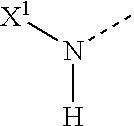
- wherein
- X 1 is H or an acyl or oxycarbonyl group including an amino acid residue, N-acylated amino acid residue or a dipeptide residue, containing a Pro or Ala in the penultimate position, or a N-protected dipeptide residue containing a Pro or Ala in the penultimate position, for n=1,
- X is H,
- for n=0
- X is preferably selected from:

- wherein
- B stands for: O or S, most preferably for S C, D, E, F, G, Y, K, L, M, Q, are H and
- Z is selected from H, or a branched or straight chain alkyl residue from C 3-C5, a branched or straight chain alkenyl residue from C2-C9, a cycloalkyl residue from C5-C7, a cycloalkenyl residue from C5-C7, an aryl or heteroaryl residue, or a side chain selected from all side chains of all natural amino acids or derivatives thereof. Most preferred for Z is H.
- According to a preferred embodiment the acyl groups are C1-C6-acyl groups.
- According to a further preferred embodiment the alk(yl) groups are C1-C6-alk(yl) groups, which may be branched or unbranched.
- According to a further preferred embodiment the alkoxy groups are C1-C6-alkoxy groups.
- According to a further preferred embodiment the aryl residues are C5-C12 aryl residues that have optionally fused rings.
- According to a further preferred embodiment the cycloalkyl residues (carbocycles) are C3-C8-cycloalkyl residues,
- According to a further preferred embodiment the heteroaryl residues are C4-C11 aryl residues that have optionally fused rings and, in at least one ring, additionally from 1 to 4 preferably 1 or 2 hetero atoms, such as O, N and/or S.
- According to a further preferred embodiment peptide residues are corresponding residues containing from 2 to 50 amino acids.
- According to a further preferred embodiment the heterocyclic residues are C2-C7-cycloalkyl radicals that additionally have from 1 to 4, preferably 1 or 2 hetero atoms, such as O, N and/or S.
- According to a further preferred embodiment the carboxy groups are C1-C6 carboxy groups, which may be branched or unbranched.
- According to a further preferred embodiment the oxycarbonyl groups are groups of the formula —O—(CH 2)1-6COOH,
- The amino acids can be any natural or synthetic amino acid, preferably natural alpha amino acids.
- Examples of amino acids which can be used in the present invention are L and D-amino acids, N-methyl-amino-acids; allo- and threo-forms of lie and Thr, which can, e.g. be α-, β- or ω-amino acids, whereof α-amino acids are preferred.
- Examples of amino acids are:
- aspartic acid (Asp), glutamic acid (Glu), arginine (Arg), lysine (Lys), histidine (His), glycine (Gly), serine (Ser) and cysteine (Cys), threonine (Thr), asparagine (Asn), glutamine (Gln), tyrosine (Tyr), alanine (Ala), proline (Pro), valine (Val), isoleucine (IIe), leucine (Leu), methionine (Met), phenylalanine (Phe), tryptophan (Trp), hydroxyproline (Hyp), beta-alanine (beta-Ala), 2-amino octanoic acid (Aoa), azetidine-(2)-carboxylic acid (Ace), pipecolic acid (Pip), 3-amino propionic, 4-amino butyric and so forth, alpha-aminoisobutyric acid (Aib), sarcosine (Sar), ornithine (Orn), citrulline (Cit), homoarginine (Har), t-butylalanine (t-butyl-Ala), t-butylglycine (t-butyl-Gly), N-methylisoleucine (N-Melle), phenylglycine (Phg), cyclohexylalanine (Cha), norleucine (Nle), cysteic acid (Cya) and methionine sulfoxide (MSO), Acetyl-Lys, modified amino acids such as phosphoryl-serine (Ser(P)), benzyl-serine (Ser(Bzl)) and phosphoryl-tyrosine (Tyr(P)), 2-aminobutyric acid (Abu), aminoethylcysteine (AECys), carboxymethylcysteine (Cmc), dehydroalanine (Dha), dehydroamino-2-butyric acid (Dhb), carboxyglutaminic acid (Gla), homoserine (Hse), hydroxylysine (Hyl), cis-hydroxyproline (cisHyp), trans-hydroxyproline (transHyp), isovaline (Iva), pyroglutamic acid (Pyr), norvaline (Nva), 2-aminobenzoic acid (2-Abz), 3- aminobenzoic acid (3-Abz), 4- aminobenzoic acid (4-Abz), 4-(aminomethyl)benzoic acid (Amb), 4-(aminomethyl)cyclohexanecarboxylic acid (4-Amc), Penicillamine (Pen), 2-Amino-4-cyanobutyric acid (Cba), cycloalkane-carboxylic aicds.
- Examples of ω-amino acids are e.g.: 5-Ara (aminoraleric acid), 6-Ahx (aminohexanoic acid), 8-Aoc (aminooctanoic aicd), 9-Anc (aminovanoic aicd), 10-Adc (aminodecanoic acid), 11-Aun (aminoundecanoic acid), 12-Ado (aminododecanoic acid).
- Further amino acids are: indanylglycine (Igl), indoline-2-carboxylic acid (Idc), octahydroindole-2-carboxylic acid (Oic), diaminopropionic acid (Dpr), diaminobutyric acid (Dbu), naphtylalanine (1-Nal), (2-Nal), 4-aminophenylalanin (Phe(4-NH 2)), 4-benzoylphenylalanine (Bpa), diphenylalanine (Dip), 4-bromophenylalanine (Phe(4-Br)), 2-chlorophenylalanine (Phe(2-Cl)), 3-chlorophenylalanine (Phe(3-Cl)), 4-chlorophenylalanine (Phe(4-Cl)), 3,4-chlorophenylalanine (Phe (3,4-Cl2)), 3-fluorophenylalanine (Phe(3-F)), 4- fluorophenylalanine (Phe(4-F)), 3,4-fluorophenylalanine (Phe(3,4-F2)), pentafluorophenylalanine (Phe(F5)), 4-guanidinophenylalanine (Phe(4-guanidino)), homophenylalanine (hPhe), 3-jodophenylalanine (Phe(3-J)), 4 jodophenylalanine (Phe(4-J)), 4-methylphenylalanine (Phe(4-Me)), 4-nitrophenylalanine (Phe-4-NO2)), biphenylalanine (Bip), 4-phosphonomehtylphenylalanine (Pmp), cyclohexyglycine (Ghg), 3-pyridinylalanine (3-Pal), 4-pyridinylalanine (4-Pal), 3,4-dehydroproline (A-Pro), 4-ketoproline (Pro(4-keto)), thioproline (Thz), isonipecotic acid (Inp), 1,2,3,4,-tetrahydroisoquinolin-3-carboxylic acid (Tic), propargylglycine (Pra), 6-hydroxynorleucine (NU(6-OH)), homotyrosine (hTyr), 3-jodotyrosine (Tyr(3-J)), 3,5-dijodotyrosine (Tyr(3,5-J2)), d-methyl-tyrosine (Tyr(Me)), 3-NO2-tyrosine (Tyr(3-NO2)), phosphotyrosine (Tyr(PO3H2)), alkylglycine, 1-aminoindane-1-carboxy acid, 2-aminoindane-2-carboxy acid (Aic), 4-amino-methylpyrrol-2-carboxylic acid (Py), 4-amino-pyrrolidine-2-carboxylic acid (Abpc), 2-aminotetraline-2-carboxylic acid (Atc), diaminoacetic acid (Gly(NH2)), diaminobutyric acid (Dab), 1,3-dihydro-2H-isoinole-carboxylic acid (Disc), homocylcohexylalanin (hCha), homophenylalanin (hPhe oder Hof), trans-3-phenyl-azetidine-2-carboxylic acid, 4-phenyl-pyrrolidine-2-carboxylic acid, 5-phenyl-pyrrolidine-2-carboxylic acid, 3-pyridylalanine (3-Pya), 4-pyridylalanine (4-Pya), styrylalanine, tetrahydroisoquinoline-1-carboxylic acid (Tiq), 1,2,3,4-tetrahydronorharmane-3-carboxylic acid (Tpi), β-(2-thienryl)-alanine (Tha)
- Upon—preferably oral—administration of those compounds to a mammal, the endogenous (or additionally exogenously administered) insulinotropic peptides GIP 1-42 and GLP-17-36 (or GLP-17-37 or analogues thereof), for example, are broken down to a lesser degree by DPIV or DPIV-like enzymes and hence the reduction in the concentration of those peptide hormones and their analogues is reduced or delayed. The invention is based, therefore, on the finding that a reduction of the DPIV or DPIV-like enzyme activity in the bloodstream results in influencing of the blood sugar level.
- The oral administration of the high-affinity, low-molecular-weight enzyme inhibitors of the invention is a more cost-effective alternative, for example, to invasive surgical techniques in the treatment of pathological symptoms. By chemical design of stability, transport and clearance properties their mode of action can be modified and matched to individual characteristics.
- The salts of the compounds of the invention may, assuming that they have basic properties, be in the form of inorganic or organic salts.
- The compounds of the present invention can be converted into and used as acid addition salts, especially pharmaceutically acceptable acid addition salts. The pharmaceutically acceptable salt generally takes a form in which a basic side chain is protonated with an inorganic or organic acid. Representative organic or inorganic acids include hydrochloric, hydrobromic, perchloric, sulfuric, nitric, phosphoric, acetic, propionic, glycolic, lactic, succinic, maleic, fumaric, malic, tartaric, citric, benzoic, mandelic, methanesulfonic, hydroxyethanesulfonic, benzenesulfonic, oxalic, pamoic, 2-naphthalenesulfonic, p-toulenesulfonic, cyclohexanesulfamic, salicylic, saccharinic or trifluoroacetic acid. All pharmaceutically acceptable acid addition salt forms of the compounds of the present invention are intended to be embraced by the scope of this invention.
- In view of the close relationship between the free compounds and the compounds in the form of their salts, whenever a compound is referred to in this context, a corresponding salt is also intended, provided such is possible or appropriate under the circumstances.
- Where the compounds according to this invention have at least one chiral center, they may accordingly exist as enantiomers. Where the compounds possess two or more chiral centers, they may additionally exist as diastereomers. It is to be understood that all such isomers and mixtures thereof are encompassed within the scope of the present invention. Furthermore, some of the crystalline forms of the compounds may exist as polymorphs and as such are intended to be included in the present invention. In addition, some of the compounds may form solvates with water (i.e. hydrates) or common organic solvents, and such solvates are also intended to be encompassed within the scope of this invention.
- The compounds, including their salts, can also be obtained in the form of their hydrates, or include other solvents used for their crystallization.
- The invention accordingly relates to effectors, especially inhibitors of dipeptidyl peptidase IV (DPIV) and DPIV-like enzyme activity and to their use for lowering the blood sugar level below the glucose concentration characteristic of hyperglycaemia in the serum of a mammal. The invention relates especially to the use of the compounds of the invention for modulating DPIV and DPIV-like enzyme activity in order to prevent or alleviate pathological metabolic abnormalities of mammals, such as, for example, impaired glucose tolerance, glucosuria, hyperlipidaemia, metabolic acidosis, diabetes mellitus, diabetic neuropathy and nephropathy, and sequelae caused by diabetes mellitus in mammals. The invention further relates to the use of the compounds of the invention for modulating DPIV and DPIV-like enzyme activity in order to prevent or alleviate neurodegenerative diseases and high blood pressure. In the case of chronic administration of the compounds of the invention, the invention relates to the improvement of signal action at the cells of the islets of Langerhans and of insulin sensitivity in the peripheral tissue in the postprandial phase.
- The invention further relates to the use of the compounds of the invention for the chronic treatment of chronic metabolic diseases in humans; for the chronic treatment of chronically impaired glucose tolerance, chronic glucosuria, chronic hyper-lipidaemia, chronic metabolic acidosis, chronic diabetes mellitus, chronic diabetic neuropathy and nephropathy and of chronic sequelae caused by diabetes mellitus, chronic neurodegenerative diseases and chronic disturbance of signal action at the cells of the islets of Langerhans and chronic insulin sensitivity in the peripheral tissue in the postprandial phase of mammals; for the chronic treatment of chronic metabolism-related hypertension and of chronic cardiovascular sequelae caused by hypertension in mammals; for the chronic treatment of chronic psychosomatic, chronic neuropsychiatric and depressive illnesses, such as chronic anxiety, chronic depression, chronic sleep disorders, chronic fatigue, chronic schizophrenia, chronic epilepsy, chronic nutritional disorders, spasm and chronic pain.
- The compounds of the present invention act as prodrugs of DPIV-inhibitors. According to the invention, the compounds can be used as effectors, especially as inhibitors of DPIV and DPIV-like enzymes and it is possible to define the site of their action, the time of onset of their action and the duration of action precisely.
- Upon administration, the compounds of the invention are cleaved, for example by suitable enzymes, and the active inhibitors are released. The active inhibitors can be released both by chemical and enzymatic mechanisms. For example, esterases, proteases and peptidases serve to release the active inhibitors from the compounds according to the invention. Such esterases, proteases, etc. are disclosed, for example, in WO 97/45117, U.S. Pat. Nos. 5,433,955, 5,614,379 and 5,624,894. Preferred proteases are aminopeptidases, dipeptidyl aminopeptidases, endoproteases, and endopeptidases. Especially preferred proteases for the release of the active inhibitors from the compounds of the present invention are aminopeptidase N, aminopeptidase P, pyroglutaminyl aminopeptidase,dipeptidyl pepitdase IV and dipeptidyl pepitdase IV-like enzymes.
- The released active inhibitors can interact with the DPIV and DPIV-like enzymes. As a direct result, for example, the above-mentioned insulinotropic peptides are broken down to a lesser degree and the effectiveness of insulin is thereby increased.
- The administration of unstable inhibitors of DPIV per se has disadvantages since they are degraded very rapidly in vivo and thus an even-distribution of the inhibitors, especially in the human body, is impossible. In particular, upon oral administration such inhibitors are so unstable that they have virtually no activity at all. Accordingly, stable inhibitors have hitherto been used especially in the treatment of diabetes mellitus.
- The present invention uses the concept to stabilize unstable inhibitors by masking them in prodrug form.
- The properties of the active inhibitors according to the invention can be designed in such a way that the deactivation time of the DPIV-inhibitors e.g. by intramolecular cyclisation after their release from the prodrugs, is definable.
- In particular, the compounds according to the invention have the advantage that the active inhibitors of DPIV and DPIV-like enzymes are released according to individual patients' needs.
- When a compound according to the invention interacts with a DPIV molecule or a aminopeptidase N molecule, it is cleaved by these enzymes and the active inhibitor is released. The active inhibitor will inhibit DPIV and/or DPIV-like enzymes so that DPIV itself cannot cleave any further compounds for a defined time. The remaining compounds are not degraded during this defined time and thus, constitute an inhibitor reservoir until the concentration of DPIV molecules or aminopeptidase N molecules rises again or active inhibitor molecules are eliminated or inactivated.
- The invention has the further advantage that each organism will release exactly that amount of active inhibitor that is necessary to inhibit that amount of DPIV molecules, which is present in the body of the respective organism.
- The present invention accordingly relates to novel compounds of unstable inhibitors of the serine protease dipeptidyl peptidase IV or DPIV-like enzymes, which can be used in the treatment of various disorders, especially of metabolic disorders associated with diabetes mellitus.
- Surprisingly such masked inhibitors are additionally considerably more effective than non-masked inhibitors: if identical amounts of non-masked DP IV-inhibitors and of compounds according to the invention are used, the compounds according to the invention produce a marked improvement in glucose tolerance in Diabetic Zucker rats.
- The compounds according to the present invention, are transported through the mucosa of the small intenstine without delay, for example simultaneously with nutrient intake.
- Moreover, the site of action, at which the active DPIV-inhibitors are released can also be controlled by their structure,
- To summarise, it may be stated that, using the compounds of the present invention, it is possible in a completely surprising manner:
- 1. to achieve increased action of the inhibitors;
- 2. to release the active inhibitors according to the patient's needs;
- 3. to release the active inhibitors in a temporally controlled manner;
- 4. to release the active inhibitors in a site-specific manner; and
- 5. to provide a reservoir of DPIV-inhibitors.
- As indicated above, the compounds of the present invention, and their corresponding pharmaceutically acceptable acid addition salt forms, are useful in inhibiting DPIV and DPIV—like enzyme activity. The ability of the compounds of the present invention, and their corresponding pharmaceutically acceptable acid addition salt forms to inhibit DPIV and DPIV—like enzyme activity may be demonstrated employing the DPIV activity assay for determination of the K i-values and the IC50-values in vitro, as described in examples 2 and 3.
- The ability of the compounds of the present invention, and their corresponding pharmaceutically acceptable acid addition salt forms to inhibit DPIV in vivo may be demonstrated by oral or intravasal administration to Wistar rats, as described in example 6. The compounds of the present invention inhibit DPIV activity in vivo after both, oral and intravasal administration to Wistar rats.
- DPIV is present in a wide variety of mammalian organs and tissues e.g. the intestinal brush-border (Gutschmidt S. et al., “In situ”—measurements of protein contents in the brush border region along rat jejunal villi and their correlations with four enzyme activities. Histochemistry 1981, 72 (3), 467-79), exocrine epithelia, hepatocytes, renal tubuli, endothelia, myofibroblasts (Feller A.C. et al., A monoclonal antibody detecting dipeptidylpeptidase IV in human tissue. Virchows Arch. A. Pathol. Anat. Histopathol. 1986; 409 (2):263-73), nerve cells, lateral membranes of certain surface epithelia, e.g. Fallopian tube, uterus and vesicular gland, in the luminal cytoplasm of e.g., vesicular gland epithelium, and in mucous cells of Brunner's gland (Hartel S. et al., Dipeptidyl peptidase (DPP) IV in rat organs. Comparison of immunohistochemistry and activity histochemistry. Histochemistry 1988; 89 (2): 151-61), reproductive organs, e.g. cauda epididymis and ampulla, seminal vesicles and their secretions (Agrawal & Vanha-Perttula, Dipeptidyl peptidases in bovine reproductive organs and secretions. Int. J, Androl. 1986, 9 (6): 435-52). In human serum, two molecular forms of dipeptidyl peptidase are present (Krepela E. et al., Demonstration of two molecular forms of dipeptidyl peptidase IV in normal human serum. Physiol. Bohemoslov. 1983, 32 (6): 486-96). The serum high molecular weight form of DPIV is expressed on the surface of activated T cells (Duke-Cohan J. S. et al., Serum high molecular weight dipeptidyl peptidase IV (CD26) is similar to a novel antigen DPPT-L released from activated T cells. J. Immunol. 1996,156 (5): 1714-21).
- The compounds of the present invention, and their corresponding pharmaceutically acceptable acid addition salt forms are able to inhibit DPIV in vivo. In one embodiment of the present invention, all molecular forms, homologues and epitopes of DPIV from all mammalian tissues and organs, also of those, which are undiscovered yet, are intended to be embraced by the scope of this invention.
- Among the rare group of proline-specific proteases, DPIV was originally believed to be the only membrane-bound enzyme specific for proline as the penultimate residue at the amino-terminus of the polypeptide chain. However, other molecules, even structurally non-homologous with the DPIV but bearing corresponding enzyme activity, have been identified recently. DPIV-like enzymes, which are identified so far, are e.g. fibroblast activation protein α, dipeptidyl peptidase IV β, dipeptidyl aminopeptidase-like protein, N-acetylated α-linked acidic dipeptidase, quiescent cell proline dipeptidase, dipeptidyl peptidase II, attractin and dipeptidyl peptidase IV related protein (DPP 8), and are described in the review article by Sedo & Malik (Sedo & Malik, Dipeptidyl peptidase IV-like molecules: homologous proteins or homologous activities? Biochimica et Biophysica Acta 2001, 36506: 1-10). Further DPIV-like enzymes are disclosed in WO 01/19866, WO 02/34900 and WO02/31134. WO 01/19866 discloses novel human dipeptidyl aminopeptidase 8 (DPP8) with structural und functional similarities to DPIV and fibroblast activation protein (FAP). WO 02/34900 discloses a novel dipeptidyl peptidase 9 (DPP9) with significant homology to the amino acid sequences of DPIV and DPP8. WO 02/31134 discloses three DPIV-like enzymes, DPRP1, DPRP2 and DPRP3.
- In another preferred embodiment of the present invention, all molecular forms, homologues and epitopes of proteins comprising DPIV-like enzyme activity, from all mammalian tissues and organs, also of those, which are undiscovered yet, are intended to be embraced by the scope of this invention.
- The ability of the compounds of the present invention, and their corresponding pharmaceutically acceptable acid addition salt forms to inhibit DPIV-like enzymes may be demonstrated employing an enzyme activity assay for determination of the K i-values in vitro as described in example 4.
- In another embodiment, the compounds of the present invention, and their corresponding pharmaceutically acceptable acid addition salt forms have only low, if no inhibitory activity against non-DPIV and non-DPIV—like proline specific enzymes. See therefore example 5.
- In view of their ability to inhibit DPIV and DPIV—like enzyme activity, the compounds of the present invention, and their corresponding pharmaceutically acceptable acid addition salt forms, are useful in treating conditions mediated by said enzyme activities. Based on the findings described in the examples of the present invention and in the literature, it can be shown that the compounds disclosed herein are useful in the treatment of conditions such as immune, autoimmune disorders or central nervous system disorders, selected from the group consisting of strokes, tumors, ischemia, Parkinson's disease, and migraines.
- In a more preferred embodiment of this invention, the compounds of the present invention and their corresponding pharmaceutically acceptable acid addition salt forms, improve glucose tolerance by lowering elevated blood glucose levels in response to an oral glucose challenge and, therefore, are useful in treating non-insulin-dependent diabetes mellitus. The ability of the compounds of the present invention, and their corresponding pharmaceutically acceptable acid addition salt forms, to improve glucose tolerance in response to an oral glucose challenge, may be measured in diabetic Zucker rats. The method is described in example 7.
- The present invention therefore provides a method of preventing or treating a condition mediated by modulation of the DPIV or DPIV—like enzyme activity in a subject in need thereof which comprises administering any of the compounds of the present invention or pharmaceutical compositions thereof in a quantity and dosing regimen therapeutically effective to treat the condition. Additionally, the present invention includes the use of the compounds of this invention, and their corresponding pharmaceutically acceptable acid addition salt forms, for the preparation of a medicament for the prevention or treatment of a condition mediated by modulation of the DPIV activity in a subject. The compound may be administered to a patient by any conventional route of administration, including, but not limited to, intravenous, oral, subcutaneous, intramuscular, intradermal, parenteral and combinations thereof.
- In a further preferred form of implementation, the invention relates to pharmaceutical compositions, that is to say, medicaments, that contain at least one compound of the invention or salts thereof, optionally in combination with one or more pharmaceutically acceptable carriers and/or solvents.
- The pharmaceutical compositions may, for example, be in the form of parenteral or enteral formulations and contain appropriate carriers, or they may be in the form of oral formulations that may contain appropriate carriers suitable for oral administration. Preferably, they are in the form of oral formulations.
- The pharmaceutical compositions may additionally contain one or more hypoglycaemically active ingredients which may be active ingredients that are known per se.
- The effectors of DP IV and DPIV-like enzymes administered according to the invention may be employed in pharmaceutically administrable formulations or formulation complexes as inhibitors or in combination with inhibitors, substrates, pseudosubstrates, inhibitors of DP IV expression, binding proteins or antibodies of those enzyme proteins that reduce the DP IV and DPIV-like protein concentration in mammals. The compounds of the invention make it possible to adjust treatment individually to patients and diseases, it being possible, in particular, to avoid individual intolerances, allergies and side-effects.
- The compounds also exhibit differing degrees of activity as a function of time. The doctor providing treatment is thereby given the opportunity to respond differently to the individual situation of patients: he is able to adjust precisely, on the one hand, the speed of the onset of action and, on the other hand, the duration of action and especially the intensity of action.
- The method according to the Invention represents especially a new approach to the reduction of raised blood glucose concentration in the serum of mammals. It is simple, susceptible of commercial application and suitable for use in the treatment of especially diseases that are based on above-average blood glucose values, on neurodegenerative diseases or on high blood pressure, in mammals and especially in human medicine.
- The compounds are administered, for example, in the form of pharmaceutical preparations that contain the active ingredient in combination with customary additives like diluents, excipients and/or carriers known from the prior art. For example, they are administered parenterally (for example i.v. in physiological saline solution) or enterally (for example orally, formulated with customary carriers, such as, for example, glucose).
- Depending upon their endogenous stability and their bioavailability, one or more doses of the compounds can be given per day in order to achieve the desired normalisation of the blood glucose values. For example, such a dosage range in humans may be in the range of from 0.01 mg to 250.0 mg per day, preferably in the range of from 0.01 to 100 mg of compound per kilogram of body weight.
- It has been found that by administering effectors of dipeptidyl peptidase IV and DPIV-like enzyme activities in the blood of a mammal, owing to the associated temporary reduction in activity, the endogenous (or additionally exogenously administered) insulinotropic peptides Gastric Inhibitory Polypeptide 1-42 (GIP 1-42) and Glucagon-Like Peptide Amide-1 7-36 (GLP-17-36) (or other GLP-17-37 or analogues thereof) are, as a consequence, broken down to a lesser extent by DP IV and DP IV-like enzymes and hence the reduction in the concentration of those peptide hormones and their analogues is reduced or delayed. The increased stability of the (endogenous or exogenously supplied) incretins or their analogues, which is achieved owing to the action of DP IV effectors and which results in their being available in greater quantities for insulinotropic stimulation of the incretin receptors of the Langerhans cells in the pancreas, alters inter alia the effectiveness of the body's own insulin, which brings with it a stimulation of the carbohydrate metabolism of the subject treated.
- As a result, the blood sugar level falls below the glucose concentration characteristic of hyperglycaemia in the serum of the subject treated. Accordingly, it is possible to prevent or alleviate metabolic abnormalities, such as impaired glucose tolerance, glucosuria, hyperlipidaemia, metabolic acidosis, diabetes mellitus, diabetic neuropathy and nephropathy and sequelae caused by diabetes mellitus in mammals, metabolism-related hypertension and cardiovascular sequelae caused by hypertension in mammals, skin diseases and diseases of the mucosae, autoimmune diseases, high blood pressure and inflammatory conditions, and psychosomatic, neuropsychiatric and depressive illnesses, such as anxiety, depression, sleep disorders, chronic fatigue, schizophrenia, epilepsy, nutritional disorders, spasm and chronic pain.
- To enhance the blood-sugar-reducing action of various antidiabetics, combinations of various orally active antidiabetics are often used. Since the antihyperglycaemic action of the compounds of the invention operates independently of other known orally administrable antidiabetics, the active ingredients of the invention are analogously suitable for use in -combination therapies, in an appropriate galenical form, for achieving the desired normoglycaemic effect.
- The compounds used according to the invention can accordingly be converted in a manner known per se into conventional formulations, such as, for example, tablets, capsules, dragées, pills, suppositories, granules, aerosols, syrups, liquid, solid and cream-like emulsions and suspensions and solutions, using inert, non-toxic, pharmaceutically suitable carriers and additives or solvents. In each of those formulations, the therapeutically effective compounds are preferably present in a concentration of approximately from 0.1 to 80% by weight, preferably from 1 to 50% by weight, of the total mixture, that is to say, in amounts sufficient for the mentioned dosage latitude to be obtained.
- The good absorption of the compounds used according to the invention by the mucosae of the gastrointestinal tract makes it possible for many galenical preparations to be used:
- The substances can be used as medicaments in the form of dragées, capsules, bitable capsules, tablets, drops, syrups or also as suppositories or as nasal sprays.
- The formulations are prepared, for example, by extending the active ingredient with solvents and/or carriers, optionally with the use of emulsifiers and/or dispersants, it being possible, for example, in the case where water is used as diluent, for organic solvents to be optionally used as auxiliary solvents.
- There may be mentioned as examples of excipients: water, non-toxic organic solvents, such as paraffins (for example natural oil fractions), vegetable oils (for example rapeseed oil, groundnut oil, sesame oil), alcohols (for example ethyl alcohol, glycerol), glycols (for example propylene glycol, polyethylene glycol); solid carriers, such as, for example, natural powdered minerals (for example highly disperse silica, silicates), sugars (for example raw sugar, lactose and dextrose); emulsifiers, such as non-ionic and anionic emulsifiers (for example polyoxyethylene fatty acid esters, polyoxyethylene fatty alcohol ethers, alkylsulphonates and arylsulphonates), dispersants (for example lignin, sulphite liquors, methylcellulose, starch and polyvinylpyrrolidone) and lubricants (for example magnesium stearate, talcum, stearic acid and sodium lauryl sulphate) and optionally flavourings.
- Administration is carried out in the usual manner, preferably enterally or parenterally, especially orally. In the case of enteral administration, tablets may contain in addition to the mentioned carriers further additives such as sodium citrate, calcium carbonate and calcium phosphate, together with various additives, such as starch, preferably potato starch, gelatin and the like. Furthermore, lubricants, such as magnesium stearate, sodium lauryl sulphate and talcum, can be used concomitantly for tabletting. In the case of aqueous suspensions and/or elixirs intended for oral administration, various taste correctives or colourings can be added to the active ingredients in addition to the above-mentioned excipients.
- In the case of parenteral administration, solutions of the active ingredients using suitable liquid carriers can be employed. In general, it has been found advantageous to administer, in the case of intravenous administration, amounts of approximately from 0.01 to 2.0 mg/kg, preferably approximately from 0.01 to 1.0 mg/kg, of body weight per day to obtain effective results and, in the case of enteral administration, the dosage is approximately from 0.01 to 2 mg/kg, preferably approximately from 0.01 to 1 mg/kg, of body weight per day.
- It may nevertheless be necessary in some cases to deviate from the stated amounts, depending upon the body weight of the experimental animal or the patient or upon the type of administration route, but also on the basis of the species of animal and its individual response to the medicament or the interval at which administration is carried out. Accordingly, it may be sufficient in some cases to use less than the above-mentioned minimum amount, while, in other cases, the mentioned upper limit will have to be exceeded. In cases where relatively large amounts are being administered, it may be advisable to divide those amounts into several single doses over the day. For administration in human medicine, the same dosage latitude is provided. The above remarks apply analogously in that case.
- 1. Capsules Containing 100 mg of a Compound of the Invention per Capsule:
- For approximately 10,000 capsules a solution of the following composition is prepared:
compound of the invention 1.0 kg glycerol 0.5 kg polyethylene glycol 3.0 kg water 0.5 kg 5.0 kg - The solution is introduced into soft gelatin capsules in a manner known per se. The capsules are suitable for chewing or swallowing.
- 2. Tablets or Coated Tables or Dragées Containing 100 mg of a Compound of the Invention:
- The following amounts refer to the preparation of 100,000 tablets:
finely ground 10.0 kg glucose 4.35 kg lactose 4.35 kg starch 4.50 kg cellulose, finely ground 4.50 kg - The above constituents are mixed and then provided with a solution prepared from
polyvinylpyrrolidone 2.0 kg polysorbate 0.1 kg and water approx. 5.0 kg - and granulated in a manner known per se by grating the moist mass and, after the addition of 0.2 kg of magnesium stearate, drying it. The finished tablet mixture of 30.0 kg is processed to form convex tablets weighing 300 mg. The tablets can be coated or sugar-coated in a manner known per se.
- Synthesis of Peptidylketones

- H-Val-Pro-OMe*HCl 2
- Boc-Val-OH (3.00 g, 13.8 mmol) was dissolved in 10 ml of dry THF and cooled down to −15° C. To the mixture CAIBE (1.80 ml, 13.8 mmol) and NMM (1.52 ml, 13.8 mmol) where added and the solution was stirred until the formation of the mixed anhydride was complete. Then the mixture was brought to −10° C. and NMM (1.52 ml, 13.8 mmol) was added followed by H-Pro-OMe*HCl (2.29 g, 13.8 mmol). The mixture was allowed to reach r.t. and left overnight.
- After removing the solvent and the usual workup the resulting ester 1 was taken without further characterisation.
- 1 was dissolved in HCl/HOAc (5 ml, 6N) and left at 0° C. until the removal of the Boc-group was complete. Then the solvent was removed and the resulting oil was treated with diethylether to give a white solid 2.
- Yield: 2.5 g, 80%
- Z-Val-Pro-OMe 3
- Z-Val-OH (3.5 g, 13.9 mmol) and H-Pro-OMe*HCl (2.14 g, 13.9 mmol) where treated in the same manner as above for 1, to give 3 as a white solid.
- Yield: 3.76 g, 80%
- Z-Val-Pro-OH 4
- 3 (3.76 g, 10.4 mmol) was dissolved in 30 ml of water/acteone (1/5 v/v) and 11.4 ml NaOH (1N) where added. After completion of the reaction the organic solvent was removed by evaporation and the resulting solution was diluted by 15 ml NaHCO 3 solution (saturated). Then the mixture was extracted three times by 10 ml of acetic acid ethyl ester. After that the solution was brought to pH2 by adding HCl (15% in water). The resulting mixture was extracted three times by 30 ml of acetic acid ethyl ester. The organic layer was separated and washed three times with brine, dried (Na2SO4) and evaporated.
- Yield: 3.25 g, 90%,
- Z-Ala-Val-Pro-OMe 5
- Z-Ala-OH (3.5 g, 15.7 mmol) and 2 (4.18 g, 15.7 mmol) where treated in the same manner as above for 1, to give 3 as a white solid.
- Yield: 4.2 g, 64%
- Z-Val-Pro-Val-Pro-OMe 6
- 4 (3.76 g, 10.08 mmol) and 2 (2.19 g 10.08 mmol) where treated in the same manner as above for 1, to give 6 as a white solid.
- Yield: 4.21 g, 70%
- Z-Gly-Val-Pro-OMe 7
- Z-Gly-OH (1.55 g 7.45 mmol) and 2 (1.51 g, 7.45 mmol) where treated in the same manner as above for 1, to give 7 as an oil.
- Yield: 2.99 g, 96%
- Boc-Ala-Val-Pro-OMe 8
- Boc Ala (1.29 g 6,80 mmol) and 2 (1.80 g 6,80 mmol) where treated in the same manner as above for 1, to give 8 as a white solid.
- Yield: 2.24 g, 83,1%
- Z-Ala-Val-Pro-OH 9
- 5 (4.15 g, 9.6 mmol) was treated in the same manner as above for 4, to give 7 as a white solid.
- Yield: 3.5 g, 87%
- Z-Val-Pro-Val-Pro-OH 10
- 6 (4.21 g, 7.5 mmol) was treated in the same manner as above for 4, to give 7 as a white solid.
- Yield: 3.89 g, 95%
- Z-Gly-Val-Pro-OH 11
- 7 (2.99 g, 7.15 mmol) was treated in the same manner as above for 4, to give 7 as a white solid.
- Yield: 1.88 g, 65%
- Boc-Ala-Val-Pro-OH 12
- 8 (1 g 2,50 mmol) was treated in the same manner as above for 4, to give 7 as a white solid.
- yield: 0,88 g, 89,1%
- Z-Ala-Val-Pro-CH 2—Br 13
- 9 (2.00 g, 4.76 mmol) was dissolved in 15 ml of dry THF and converted into a mixed anhydride (see compound 1) using CAIBE (0.623 ml, 4.76 mmol) and NMM (0.525 ml, 4.76 mmol). The precipitate formed was filtered off and cooled down to −15° C. Then diazomethane (23.8 mmol in 30 ml ether) was dropped into the solution under an argon atmosphere. After leaving the mixture for 1h at 0° C. 1.27 ml of HBr (33% in AcOH) where added and the solution was stirred for 30 min at r.t. After that 70 ml of ether where added and the mixture was washed 20 ml of water. The organic layer was separated and dried (Na 2SO4) and evaporated.
- Yield (crude): 1.8 g, 80%
- Z-Ala-Val-Pro-CH 2—Cl 14
- 9 (1.02 g, 2.43 mmol) was treated as described for 13 using CAIBE(0.315 ml, 2.43 mmol), NMM(0.267 ml, 2.43 mmol), diazomethane (12.2 mmol in 16 ml ether) and 5 ml of HCl in dioxane (7.6M).
- Yield (crude): 1 g 91%
- Z-Val-Pro-Val-Pro-CH 2—Cl 15
- 10 (1.1 g, 2.01 mmol) was treated as described for 13 using CAIBE(0.263 ml, 2.01 mmol), NMM(0.223 ml, 2.02 mmol), diazomethane (10 mmol in 13.3 ml ether) and 5 ml of HCl in dioxane (7.6M).
- Yield (crude): 1.1 g, 95%
- Z-Gly-Val-Pro-CH 2—Br 16
- 11 (2.04 g, 5.05 mmol) was treated as described for 13 using CAIBE(0.656 ml, 5.05 mmol), NMM(0.556 ml, 5.05 mmol), diazomethane (10 mmol in 13.3 ml ether) and 5 ml of HCl in dioxane (7.6M).
- Yield (crude): 2.10 g, 90.4%
- Boc-Ala-Val-Pro-CH 2Br 17
- 12: (0.88 g, 2.28 mmol) was treated as described for 13, using CAIBE (2.28 mmol, 0.37 ml), NMM (2.28 mmol, 0,31 ml), diazomethane (14.3 mmol in 15 ml ether) HBr/glacial acetic acid (33%): 4.24 mmol, 1.04 ml
- Yield:0.88 g, 83.4%
- Z-Protected Methylketones
- Z-Ala-Val-Pro-CH 3 18
- 14 (1 g, 2.21 mmol) was dissolved in 5.30 ml of warm acidic acid and 1.33 of zink-powder was added portion wise to the stirred solution. After 24 h the remaining solid was filtered off and the filtrate was evaporated. The remaining oil was taken up in ethylacetate and washed twice with NaHCO 3 and brine. The organic layer was then dried and evaporated and purified by column chromatography using a heptane/chloroform/methanol-gradient.
- Yield: 0.230 g (24.8%)
- Z-Val-Pro-Val-Pro-CH 3 19
- 15 (1.1 g, 1.91 mmol) was treated as described for 18 using acidic acid (5.3 ml) and zink (1.31 g).
- Yield: 0.190 g, 16%
- N-Protected Acyloxymethylene Ketones
- The acid (2 eq) was dissolved in DMF and an equimolar amount of KF was added. The suspension was allowed to stir at r.t. for 1 h. Then the brommethylene (1 eq) component was added and the solution was allowed to stir overnight. After that the solvent was removed under vacuum and the resulting oil was dissolved in chloroform and washed with brine. Then the organic layer was separated dried (Na 2SO4) and the solvent was removed. The product was purified by column chromatography using silica gel and heptane/chloroform.
- Z-Ala-Val-Pro-CH 2O—C(O)—CH3 20
- Acetic acid (230 μl, 4.02 mmol), KF (0.234 g, 4.02 mmol), 13 (1.00 g, 2.01 mmol)
- Yield: 0.351 g, 36%
- Z-Ala-Val-Pro-CH 2O—C(O)-Ph 21
- Benzoic acid (0.275 g, 2.25 mmol), KF (0.131 mg, 2.25 mmol), 13 (0.56 g. 1.13 mmol)
- Yield: 0.34 g, 56%
- Boc-Ala-Val-Pro-CH 2—S—CH2-Dichlorphenyl 22
- Dichlorbenzylmercaptane (0.30 ml, 2.09 mmol), KF (0.250 g, 4.19 mmol), 17 (0.88 g. 1.9 mmol)
- Yield: 0,56 g, 51%
- Z-Gly-Val-Pro-CH 2O—C(O)-Ph 23
- Benzoic acid (1.19 g, 9.78 mmol), KF (0.568 g, 9.78 mmol), 16 (2.35 g. 4.89 mmol)
- Yield: 0.89 g, 34.8%
- Deprotection
- Method A
- The Z-protected compound was dissolved in HBr/AcOH and stirred. When the reaction was complete ether was added, the white precipitate formed was filtered off and dried.
- Method B:
- The Boc-protected compound was dissolved in TFA and stirred. When the reaction was complete ether was added, the white precipitate formed was filtered off and dried.
- H-Ala-Val-Pro-CH 3*HBr 24
- Method A
- 18 (0.230 g, 0.54 mmol)
- Yield: 0.124 g, 80%
- H-Val-Pro-Val-Pro-CH 3*HBr 25
- Method A
- 19 (0.190 g, 0.20 mmol)
- Yield: 0.114 g, 82.3%
- H-Ala-Val-Pro-CH 2O—C(O)CH3*HBr 26
- Method A
- 20 (0.351 g, 0.73 mmol)
- Yield: 0.252 g, 98%
- H-Ala-Val-Pro-CH 2O—C(O)Ph*HBr 27
- Method A
- 21 (0.34 g, 0.63 mmol)
- Yield: 0,251 g, 99%
- H-Ala-Val-Pro-CH 2—S—CH2-Dichlorphenyl*TFA 28
- Method B
- 22 (0.56 g, 0.97 mmol)
- Yield: 0.027 g, 5%
- H-Gly-Val-Pro-CH 2O—C(O)Ph*HBr 29
- Method A
- 23 (0.156 g, 0.26 mmol)
- Yield: 0.115 g, 99%
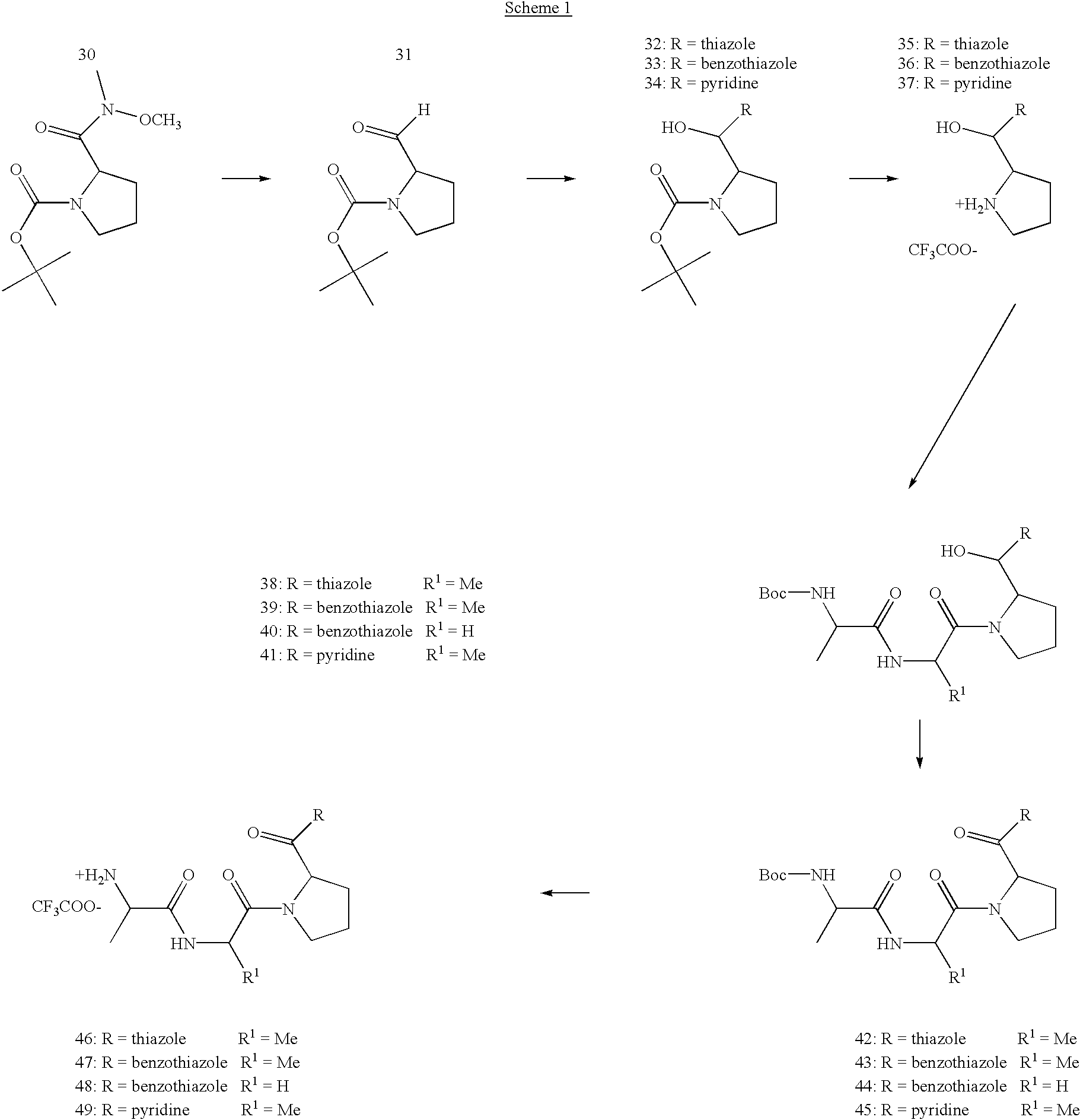
- Boc-Pro-N(Me)OMe 30
- Boc-Prolin (2.00 g, 9.29 mmol) and N,O-Dimethylhydroxylaminhydrochloride (0.91 g 9.29 mmol) where treated as described for 1 using NMM (2 ml, 18.4) and CAIBE (1.47 ml, 9.29 mmol)
- Yield: 2.1 g, 87.5%)
- Boc-Prolinal 31
- 10 mmol of 30 where dissolved in 20 ml of absolute ether at 0° C. 12,5 mmol lithiumalanat where added. After 7 min of stirring 10 ml of a saturated KHSO 4 solution where added drop wise. Then the mixture was diluted by adding 50 ml of ether and the organic layer was separated. This was washed by 1N HCl, water, saturated NaHCO3— solution, brine and dried
- 30 (1.43 g, 5.54 mmol), LiAlH 4 (0.26 g, 6.92 mmol)
- Yield: 0.78 g, 70.8%
- 2-(Heterocyclo-hydroxymethyl-N-Boc-(2S)-pyrrolidines
- 1.1 eq of the heterocycle where dissolved in 5 ml of dry THF under argon atmosphere and brought to −65° C. 1.1 eq of n-Butyllithium (1,6 M in Hexan) where added and the solution was stirred at −65° C. for 1h. 1 eq of 31, dissolved in 2 ml dry THF, was dropped into the stirred solution and the mixture was stirred at −65° C. for 2 h. After that 2 ml of water where added and the solution was extracted three times using methylene chloride. The organic layer was separated, dried and evaporated.
- 2-[([1,3]-Thiazol-2-yl)hydroxymethyl]-1-N-(tert-butoxycarbonyl)-(2S)-pyrrolidine 32
- 31 (1.0 g, 5.02 mmol), thiazole (0.39 ml, 5.52 mmol), n-BuLi (1,6 M) (3.45 ml 5.52 mmol)
- Yield: 1.02 g, 71.0%
- 2-[Benzothiazol-2-yl)hydroxymethyl]-1-N-(tert-butoxycarbonyl)-(2S)-pyrrolidine 33
- 31 (1.0 g, 5.02 mmol), benzothiazole (0.6 ml, 5.52 mmol), n-BuLi (1,6M) (3.45 ml 5.52 mmol)
- Yield: 1.73 g, 78.0%
- 2-[(Pyridin-2-yl)hydroxymethyl]-1-N-(tert-butoxycarbonyl)-(2S)-pyrrolidine 34
- 31: (1.3 g, 6.54 mmol), 2-brompyridine (0.70 ml, 7.19 mmol), n-BuLi (1.6M) (4.5 ml, 7.19 mmol)
- Yield: 1.68 g, 92.2%
- 2-(Heterocyclo-hydroxymethyl-(2S)-pyrrolidines
- 32, 33 and 34 where treated as described for 2.
- 2-[([1,3]-Thiazol-2-yl)hydroxymethyl]-(2S)-pyrrolidine hydrochloride 35
- 32 (0.46 g, 1.62 mmol)
- Yield: 0.34 g, 94.9%
- 2-[(Benzothiazol-2-yl)hydroxymethyl]-(2S)-pyrrolidine hydrochloride 36
- 33 (0.6 g, 1.79 mmol)
- Yield: 0.436 g, 90%
- 2-[(Pyridin-2-yl)hydroxymethyl]-(2S)-pyrrolidine hydrochloride 37
- 34 (0.95 g, 3.41 mmol)
- Yield: 0.71 g, 96.8%
- N protected 2-(Heterocyclo-hydroxymethyl-N-Peptidyl-(2S)-pyrrolidines
- 1 eq of a Boc-Ala-Val-OH or Boc-Ala-Gly-OH and 1 eq of N-hydroxysuccinimide where dissolved in dioxane. At 0° C. 1 eq of dicyclohexylcarbodiimide where added and the solution was stirred for 2 h. After stirring overnight at r.t. the precipitate was removed. The organic phase was washed with a saturated solution of NaHCO 3 and brine. After drying the solvent was removed.
- The active ester was dissolved with 1 eq of 35 in dry THF and brought to 0° C. 1 eq of triethylamin was added and stirred for 2 h at 0° C. The solvent was removed and the resulting oil was dissolved in ethyl acetate. After washing with 1N HCl, water, a saturated solution of NaHCO3 and brine the solvent was removed after drying. The mixture was purified by column chromatography using a heptane/chloroforme gradient
- 2-[([1,3]-Thiazol-2-yl)hydroxymethyl]-1-{N -[N-(tertbutyloxycarbonyl) (L)-Alanyl]-(L)-Valinyl}-(2S)-pyrrolidine 38
- 35 (0.44 g, 1.54 mmol), N-hydroxysuccinimid (0.17 g, 1.54 mmol), DCC (0.32 g, 1.54 mmol), Boc-Ala-Val-OH (0.34 g, 1.54 mmol), TEA (0.22 ml, 1.54 mmol)
- Yield: 0.3 g, 42.9%
- 1 eq of Boc-Ala-Val-OH or Boc-Ala-Gly-OH and 0.9 eq of 36 or 37, 1.1 eq of HOBt, and 1.1 eq of WSCD where dissolved in dry ACN. After addition of 0.9 eq of TEA the mixture was stirred overnight, The solvent was removed and the remaining oil was dissolved in ethyl acetate. The solution was washed with brine and dried.
- 2-[(Benzothiazol-2-yl)hydroxymethyl]-1-{N-[N-(tertbutyloxycarbonyl)-(L)-Alanyl]-(L)-Valinyl}-(2S)-pyrrolidine 39
- 36 (0.43 g, 1.23 mmol), HOBt (0.183 g, 1.35 mmol), WSCD (0.259 g, 1.35 mmol), Boc-Ala-Val-OH (0.35 g, 1.23 mmol), TEA (0.172 ml, 1.54 mmol)
- Yield: 0.3 g, 42.9%
- 2-[(Benzothiazol-2-yl)hydroxymethyl]-1-{N-[N-(tertbutyloxycarbonyl) (L)-Alanyl]-glycyl}-(2S)-pyrrolidin 40
- 36 (0.43 g, 1.23 mmol), HOBt (0.183 g, 1.35 mmol), WSCD (0.259 g, 1.35 mmol), Boc-Ala-Val-OH (0.303 g, 1.23 mmol), TEA (0.172 ml, 1.54 mmol)
- Yield: 0.41 g, 72%
- 2-[(pyridin-2-yl)hydroxymethyl]-1-{N-[N-(tertbutyloxycarbonyl) (L)-Alanyl]-(L)-Valinyl}-(2S)-pyrrolidin 41
- 37 (0.15 g, 0.52 mmol) Boc-AlaVal-OH (0.1 g, 0.47 mmol); HOBT (0.08 g, 0.57 mmol), WSCD (0.11 g, 0.57 mmol), TEA (0.07 ml, 0.47 mmol)
- Yield: 0.22 g, 94.9%
- N protected 2-(Heterocyclo-carbonyl-N -Peptidyl-(2S)-pyrrolidines
- 1.8 eq of oxaylchlorid where dissolved in 5 ml of dry dichlormethane and brought to −78° C. under argon atmosphere. A solution of 2.5 eq of DMSO in 2 ml dichlormethane was added and kept for 20min at −78° C. 1 eq of 38, 39, 40 or 41 where dissolved in 5 ml dichlormethane and added drop wise. The mixture was stirred for 20min at −78° C. After that 4 eq TEA was added and the mixture was brought to r.t. 30 ml of a mixture of hexane/ethyl acetate (2/1, v/v) and 10 ml of a 2% HCl (m/V) where added. The organic layer was separated dried and the solvent was removed. The mixture was purified by column chromatography using a heptane/chloroforme gradient
- 2-[([1,3]-thiazol-2-yl)carbonyl]-1-{N-[N-(tertbutyloxycarbonyl) (L)-Alanyl]-(L)-Valinyl}-(2S)-pyrrolidin 42
- 38: (0.15 g, 0.33 mmol), oxalylchloride (0.05 ml, 0.59 mmol), DMSO (0.06 ml, 0.82 mmol), TEA (0.12 ml, 1.32 mmol)
- Yield: 0.13 g, 89%
- 2-[(Benzothiazol-2-yl)carbonyl]-1-{N-[N-(tertbutyloxycarbonyl)-(L)-Alanyl]-(L)-Valinyl}-(2S)-pyrrolidine 43
- 39: (0.72 g, 0.14 mmol), oxalylchloride (0.221 ml, 2.57 mmol), DMSO (2.53 ml, 3.57 mmol), TEA (0.80 ml, 5.71 mmol)
- Yield: 0.049 g, 70%
- 2-[(Benzothiazol-2-yl)carbonyl]-1-{N-[N -(tertbutyloxycarbonyl)-(L)-Alanyl]-glycyl}-(2S)-pyrrolidine 44
- 40: (0.62 g, 0.134 mmol), oxalylchloride (0.207 ml, 2.41 mmol), DMSO (2.37 ml, 3.35 mmol), TEA (0.75 ml, 5.35 mmol)
- Yield: 0.38 g, 62%
- 2-[(Pyridin-2-yl)carbonyl]-1-{N-[N-(tertbutyloxycarbonyl)(L)-Alanyl]-(L)-Valinyl}-(2S)-pyrrolidine 45
- 41 (0.29 g, 0.64 mmol), oxalylchloride (0.10 ml, 1.15 mmol), DMSO (0.11 ml, 1.59 mmol), TEA (0.36 ml, 2,55 mmol)
- Yield: 0.14 g, 49,2%
- 2-(Heterocyclo-carbonyl-N-Peptidyl-(2S)-pyrrolidines
- 42, 43, 44, 45 where treated as described under deprotection method B.
- 2-[([1,3]-Tthiazol-2-yl)carbonyl]-1-N-[N-{(L)-Alanyl}-(L)-Valinyl]-(2S)-pyrrolidin triflouracetat 46
- 42 (0.13 g, 0.29 mmol)
- Yield: 0.04 g, 30.1%)
- 2-[(Benzothiazolethiazol-2-yl)carbonyl]-1-N -[N-{(L)-Alanyl}-(L)-Valinyl]-(2S)-pyrrolidin trifluoracetat 47
- 43 (0.49 g, 0.97 mmol)
- Yield: 0.24 g, 60.3%)
- 2-[(Benzothiazolethiazol-2-yl)carbonyl]-1-N-[N-{(L)-Alanyl}-Glycyl]-(2S)-pyrrolidine trifluoracetat 48
- 44 (0.38 g, 0.82 mmol)
- Yield: 0.187 g, 60.1%
- 2-[(Pyridin-2-yl)carbonyl]-1-N -[N-{(L)-Alanyl}-(L)-Valinyl]-(2S)-pyrrolidine triflouracetat 49
- 45 (0.14 g, 0.31 mmol)
- yield: 0.054 g, 37.7%
- From the compounds of the present invention biological efficacy data were investigated. The results are described and discussed in the further examples. In particular, these compounds are:
Cpd. no. Short name Full name 24 H-Ala-Val-Pro-Me*HBr 2-Methylcarbonyl-1-N-[(L)-Alanyl-(L)- Valinyl]-(2S)-pyrrolidine hydrobromide 25 H-Val-Pro-Val-Pro- 2-Methyl)carbonyl-1-N-[(L)-Valinyl-(L)- Me*HBr Prolyl-(L)-Valinyl]-(2S)-pyrrolidine hydrobromide 26 H-Ala-Val-Pro-CH2O—CO— 2-[(Acetyl-oxy-methyl)carbonyl]-1-N-[(L)- CH3*HBr Alanyl-(L)-Valinyl]-(2S)-pyrrolidine hydrobromide 27 H-Ala-Val-Pro-CO—CH2O— 2-[Benzoyl-oxy-methyl)carbonyl]-1-N-[{(L)- CO-Ph*HBr Alanyl}-(L)-Valinyl]-(2S)-pyrrolidine hydrobromide 28 H-Ala-Val-Pro-CO—CH2—S— 2-{[(2,6-Dichlorbenzyl)thiomethyl]carbonyl}- CH2-Dichlorphenyl*TFA 1-N-[{(L)-Alanyl}-(L)-Valinyl]-(2S)- pyrrolidine 29 H-Gly-Val-Pro-CO—CH2O— 2-[Benzoy-loxy-methyl)carbonyl]-1-N- CO-Ph*HBr [Glycyl-(L)- Valinyl]-(2S)-pyrrolidine hydrobromide 46 H-Ala Val-Pro-CO- 2-[([1,3]-Thiazolethiazol-2-yl)carbonyl]-1-N- Thiazol*TFA [{(L)-Alanyl}-(L)-Valinyl]-(2S)-pyrrolidine trifluoracetat 47 H-Ala-Val-Pro-CO- 2-[(Benzothiazolethiazol-2-yl)carbonyl]-1-N- Benzothiazole*TFA [N-{(L)-Alanyl}-(L)-Valinyl]-(2S)-pyrrolidin trifluoracetat 48 H-Ala-Gly-Pro-CO- 2-[(-Benzothiazolethiazol-2-yl)carbonyl]-1- Benzothiazol*TFA N-[{(L)-Alanyl}-Glycyl]-(2S)-pyrrolidine trifluoracetat 49 H-Ala-Val-Pro-CO-(2- 2-[(Pyridin-2-yl)carbonyl]-1-N-[N-{(L)- Pyridine)*TFA Alanyl}-(L)- Valinyl]-(2S)-pyrrolidine trifluoracetat - K i-Determination
- For K i determination dipeptidyl peptidase IV from porcine kidney with a specific activity against glycylprolyl-4-nitroaniline of 37.5 U/mg and an enzyme concentration of 1.41 mg/ml in the stock solution was used.
- Assay Mixture:
- 500 μl test compound in a concentration range of 1*10 −5M-1*10−11M were admixed with and 500 μl HEPES buffer (40 mM, pH7.6; ion strength=0.125) and 20 μl of diluted DPIV. Release of the inhibitor from the prodrug as well the monitoring reaction (DPIV-catalyzed hydrolysis of Gly-Pro-pNA) were started by addition of a mixture of 10 μl of APN stock solution (4,9 mg/ml, Sigma, Taufkirchen, Germany) with 250 μl of the substrate (Gly-Pro-pNA, 0.05-4 mM). Development of yellow color due to 4-nitroaniline release were monitored at □=405 nm for up to 180 min using UV1 Spectrometer (ThermoSpectronic).
- The K i-values were calculated by fitting the first derivative of the time-progress curves using Graphit (v.4.0.13, Erithacus Software, Ltd, UK) and a equation for an unstable competitive inhibitor.

- The half-life (t 1/2) was calculated by plotting the enzyme activity versus reaction time.
- 2.1 Results—K i Values of DPIV Inhibition
Compound Ki [M] T1/2 [min] H-Ala-Val-Pro-Me*HBr 4.76*10−8 12.4 H-Val-Pro-Val-Pro-Me*HBr n.d. n.d. H-Ala-Val-Pro-CH2O—CO—CH3Ph*TFA 1.05*10−9 10.8 H-Ala-Val-Pro-CO—CH2O—CO-Ph*TFA 5.36*10−10 15.1 H-Gly-Val-Pro-CO—CH2O—CO-Ph*TFA no inhibition n.d. H-Ala Val-Pro-CO-Benzothiazole*TFA 3.73*10−8 17.0 H-Ala Gly-Pro-CO-Benzothiazole*TFA 1.07*10−7 5.1 H-Ala Val-Pro-CO-Thiazole*TFA 3.32*10−8 15.1 H-Ala Val-Pro-CO-(2-Pyridinyl)*TFA n.d. n.d. H-Ala-Val-Pro-CO—CH2—S—CH2- <1.0*10−7 n.d. Dichlorphenyl*TFA - Determination of IC 50-Values
- 100 μl inhibitor stock solution Were mixed with 100 μl buffer (HEPES pH7.6) and 20 μl diluted porcine DPIV and preincubated at 30° C. Reaction was started by addition of a mixture of 50 μl substrate (Gly-Pro-pNA, final concentration 0.4 mM) and 2 μl APN stock solution. Formation of the product pNA was measured at 405 nm and 30° C. over 10 min using the HTS 7000Plus plate reader (Perkin Elmer) and slopes were calculated. The final inhibitor concentrations ranged between 1 mM and 30 nM. For calculation of IC50 GraFit 4.0.13 (Erithacus Software) was used.
- 3.1 Results—Determination of IC 50 Values
Compound IC50 [M] H-Ala-Val-Pro-Me*HBr 5.79*10−7 H-Val-Pro-Val-Pro-Me*HBr n.d. H-Ala-Val-Pro-CH2O—CO—CH3Ph*TFA 1.02*10−8 H-Ala-Val-Pro-CO—CH2O—CO-Ph*TFA 1.79*10−8 H-Gly-Val-Pro-CO—CH2O—CO-Ph*TFA 4.94*10−6 H-Ala Val-Pro-CO-Benzothiazole*TFA n.d. H-Ala Gly-Pro-CO-Benzothiazole*TFA n.d. H-Ala Val-Pro-CO-Thiazole*TFA no inhibition H-Ala Val-Pro-CO-(2-Pyridinyl)*TFA 1.10*10−3 H-Ala-Val-Pro-CO—CH2—S—CH2-Dichlorphenyl*TFA 7.97*10−5 - Inhibition of DPIV-Like Enzymes—Dipeptidyl Peptidase II (DP II)
- DP II (3.4.14.2) releases N-terminal dipeptides from oligopeptides if the N-terminus is not protonated (McDonald, J. K., Ellis, S. & Reilly, T. J., 1966, J. Biol. Chem., 241, 1494-1501). Pro and Ala in P1-position are preferred residues. The enzyme activity is described as DPIV-like activity, but DP II has an acidic pH-optimum. The enzyme used was purified from porcine kidney.
- Assay:
- 100 μl inhibitor in an concentration range of 1*10 −4M-5*10−8M were admixed with 100 μl μl buffer solution (40 mM HEPES, pH7.6, 0.015% Brij, 1 mM DTT), 50 μl lysylalanylaminomethylcoumarine solution (5 mM) and 20 μl porcine DP II (250fold diluted in buffer solution). Fluorescence measurement was performed at 30° C. and λexcitation=380 nm, λemission=465 nm for 25 min using a plate reader (HTS7000plus, Applied Biosystems, Weiterstadt, Germany). The Ki-values were calculated using Graphit 4.0.15 (Erithacus Software, Ltd., UK).
- Results:
- The compound H-Ala-Val-Pro-CO—CH 2O—CO-Ph*HBr was exemplarily tested against DP II. No inhibition of DP II by H-Ala-Val-Pro-CO—CH2O—CO-Ph*HBr was found.
- Attractin
- 100 μl inhibitor stock solution were mixed with 100 μl buffer (HEPES pH7.6) and 20 μl diluted attractin and preincubated at 30° C. Reaction was started by addition of a mixture of 50 μl substrate (Gly-Pro-pNA, final concentration 0.4 mM) and 2 μl APN stock solution. Formation of the product pNA was measured at 405 nm and 30° C. over 10 min using the HTS 7000Plus plate reader (Perkin Elmer) and slopes were calculated. The final inhibitor concentrations ranged between 1 mM and 30 nM. For calculation of IC 50 values, GraFit 4.0.13 (Erithacus Software) was used.
- Results:
- The compound H-Ala-Val-Pro-Me*HBr was exemplarily tested against attractin. No inhibition of attractin by H-Ala-Val-Pro-Me*HBr was found.
- Cross Reacting Enzymes
- The inhibitors were tested for their cross reacting potency against dipeptidyl peptidase I, prolyl oligopeptidase and Prolidase.
- Dipeptidyl Peptidase I (DP I, Cathepsin C):
- DP I or cathepsin C is a lysosomal cysteine protease which cleaves off dipeptides from the N-terminus of their substrates (Gutman, H. R. & Fruton, J. S., 1948, J. Biol: Chem., 174, 851-858). It is classified as a cysteine protease. The enzyme used was purchased from Qiagen (Qiagen GmbH, Hilden, Germany). In order to get a fully active enzyme, the enzyme was diluted 1000fold in MES buffer pH5,6 (40 mM MES, 4 mM DTT, 4 mM KCl, 2 mM EDTA, 0.015% Brij) and pre-incubated for 30 min at 30° C.
- Assay:
- 50 μl solution with the test compounds in a concentration range of 1*10 −5M-1*10−7 M were admixed with 110 μl buffer-enzyme-mixture. The assay mixture was pre-incubated at 30° C. for 15 min, After pre-incubation, 100 μl histidylseryl-βnitroaniline (2*10−5M) was added and measurement of yellow color development due to β-nitroaniline release was performed at 30° C. and λexcitation=380 nm, λemission=465 nm for 10 min., using a plate reader (HTS7000 plus, Applied Biosystems, Weiterstadt, Germany).
- The IC 50-values were calculated using Graphit 4.0.15 (Erithacus Software, Ltd., UK).
- Prolidase (X-Pro dipeptidase)
- Prolidase (EC 3.4.13.9) was first described by Bergmann & Fruton (Bergmann, M. & Fruton, J S, 1937 , J. Biol. Chem. 189-202). Prolidase releases the N-terminal amino acid from Xaa-Pro dipeptides and has a pH optimum between 6 and 9.
- Prolidase from porcine kidney (ICN Biomedicals, Eschwege, Germany). was solved (1 mg/ml) in assay buffer (20 mM NH 4(CH3COO)2, 3 mM MnCl2, pH 7.6). In order to get a fully active enzyme the solution was incubated for 60 min at room temperature.
- Assay:
- 450 μl solution with the test compounds in an concentration range of 5*10 −3M-5*10−7M were admixed with 500 μl buffer solution (20 mM NH4(CH3COO)2, pH 7.6) and 250 μl Ile-Pro-OH (0.5 mM in the assay mixture). The assay mixture was pre-incubated at 30° C. for 5 min. After pre-incubation, 75 μl Prolidase (1:10 diluted in assay buffer) were added and measurement was performed at 30° C. and λ=220 nm for 20 min using a UV/Vis photometer, UV1 (Thermo Spectronic, Cambridge, UK).
- The IC 50-values were calculated using Graphit 4.0.15 (Erithacus Software, Ltd., UK).
- Angiotensin-I Converting Enzyme (ACE)
- Angiotensin I-converting enzyme (ACE; peptidyl-dipeptidase A) is a zinc metallopeptidase which cleaves the C-terminal dipeptide from angiotensin I to produce the potent vasopressor octapeptide angiotensin II (Skeggs L. T., Kahn, J. R. & Shumway, N. P. (1956) The preparation and function of the hypertensin-converting enzyme. J. Exp. Med. 103, 295-299.) and inactivates bradykinin by the sequential removal of two C-terminal dipeptides (Yang H. Y. T., Erdös, E. G. & Levin, Y. (1970) A dipeptidyl carboxypeptidase that converts angiotensin I and inactivates bradykinin. Biochim. Biophys. Acta 214, 374-376.). In addition to these two main physiological substrates, which are involved in blood pressure regulation and water and salt metabolism, ACE cleaves C-terminal dipeptides from various oligopeptides with a free C-terminus. ACE is also able to cleave a C-terminal dipeptide amide.
- Assay:
- For IC 50 determination of ACE an enzyme produced by Sigma was used (Prod.No. A-6778). The assay procedure and calculation of activity described by the manufacturer was adapted to half of the described volumes.
- The IC 50-values were calculated using Graphit 4.0.15 (Erithacus Software, Ltd., UK).
- Acylamino Acid-Releasing Enzyme (AARE)
- Acylaminoacyl-peptidase (EC 3.4.19.1) has also been referred to by the names acylpeptide hydrolase (Gade W. & Brown, J. L. (1978) Purification and partial characterization of a-N-acylpeptide hydrolase from bovine liver. J. Biol. Chem. 253, 5012-5018.; Jones W. M. & Manning, J. M. (1985) Acylpeptide hydrolase activity from erythrocytes. Biochem. Biophys. Res. Commun. 126, 933-940.; Kobayashi K., Lin, L. W., Yeadon, J. E., Klickstein, L. B. & Smith, J. A. (1989) Cloning and sequence analysis of a rat liver cDNA encoding acylpeptide hydrolase. J. Biol. Chem. 264, 8892-8899), acylamino acid-releasing enzyme (Tsunasawa S., Narita, K. & Ogata, K. (1975) Purification and properties of acylamino acid-releasing enzyme from rat liver. J. Biochem. 77, 89-102.; Mitta M., Asada, K., Uchimura, Y., Kimizuka, F., Kato, I., Sakiyama, F. & Tsunasawa, S. (1989) The primary structure of porcine liver acylamino acid-releasing enzyme deduced from cDNA sequences. J. Biochem. 106, 548-551.) and acylaminoacyl peptide hydrolase (Radhakrishna G. & Wold, F. (1989) Purification and characterization of an N-acylaminoacyl-peptide hydrolase from rabbit muscle. J. Biol. Chem. 264, 11076-11081.). Acylaminoacyl peptidase catalyzes the removal of an N-acylated amino acid from a blocked peptide: Block-Xaa↓Xbb-Xcc . . . The products of the reaction are the free acyl amino acid and a peptide with a free N-terminus shortened by one amino acid. The enzyme acts on a variety of peptides with different N-terminal acyl groups, including acetyl, chloroacetyl, formyl and carbamyl (Jones W. M., Scaloni, A., Bossa, F., Popowicz, A. M., Schneewind, O. & Manning, J. M. (1991) Genetic relationship between acylpeptide hydrolase and acylase, two hydrolytic enzymes with similar binding but different catalytic specificities. Proc. Natl Acad. Sci. USA 88, 2194-2198.).
- Assay:
- 100 μl solution with the inhibitors in an concentration range of 1*10 −4M-5*10−8M were admixed with 100 μl buffer solution (200 mM Natriumphosphat, pH 7.2) and 20 μl AARE solution. The assay mixture was pre-incubated at 30° C. for 15 min. After pre-incubation, 50 μl Acetyl-Met-AMC solution (0.54 mM) was added. Release of the AMC was measured at 30° C. using a Novovostar flourescence microplate reader (BMG) and excitation/emission wavelengths of 380/460 nm.
- The IC 50-values were calculated from the slopes of the progress curves using Graphit 4.0.15 (Erithacus Software, Ltd., UK).
- 5.1 Results—Determination of IC 50 Values against Cross-Reacting Enzymes
DP I Prolidase ACE AARE Compound IC50[M] IC50[M] IC50[M] IC50[M] H-Ala-Val-Pro- no inhibition 4.13*10−4 no inhibition no inhibition Me*HBr H-Ala-Val-Pro- 1.20*10−4 no inhibition no inhibition no inhibition CH2O—CO—CH3*HBr H-Ala-Val-Pro-CO— 3.16*10−4 4.14*10−4 no inhibition no inhibition CH2O—CO-Ph*HBr - Determination of DPIV Inhibiting Activity After Intravasal and Oral Administration to Wistar Rats
- Animals
- Male Wistar rats (Shoe: Wist(Sho)) with a body weight ranging between 250 and 350 g were purchased from Tierzucht Schönwalde (Schönwalde, Germany).
- Housing conditions
- Animals were single-caged under conventional conditions with controlled temperature (22±2° C.) on a 12/12 hours light/dark cycle (light on at 06:00 AM). Standard pelleted chow (ssniff® Soest, Germany) and tap water acidified with HCl were allowed ad libitum.
- Catheter Insertion Into Carotid Artery
- After ≧one week of adaptation at the housing conditions, catheters were implanted into the carotid artery of Wistar rats under general anaesthesia (i.p. injection of 0.25 ml/kg b.w. Rompun® [2%], BayerVital, Germany and 0.5 ml/kg b.w. Ketamin 10, Atarost GmbH & Co., Twistringen, Germany). The animals were allowed to recover for one week. The catheters were flushed with heparin-saline (100 IU/ml) three times per week. In case of catheter dysfunction, a second catheter was inserted into the contra-lateral carotid artery of the respective rat. After one week of recovery from surgery, this animal was reintegrated into the study. In case of dysfunction of the second catheter, the animal was withdrawn from the study. A new animal was recruited and the experiments were continued in the planned sequence, beginning at least 7 days after catheter implantation.
- Experimental Design
- Rats with intact catheter function were administered placebo (1 ml saline, 0.154 mol/l) or test compound via the oral and the intra-vasal (intra-arterial) route. After overnight fasting, 100 μl samples of heparinised arterial blood were collected at −30, −5, and 0 min. The test substance was dissolved freshly in 1.0 ml saline (0.154 mol/l) and was administered at 0 min either orally via a feeding tube (75 mm; Fine Science Tools, Heidelberg, Germany) or via the intra-vasal route. In the case of oral administration, an additional volume of 1 ml saline was injected into the arterial catheter. In the case of intra-arterial administration, the catheter was immediately flushed with 30 μl saline and an additional 1 ml of saline was given orally via the feeding tube.
- After application of placebo or the test substances, arterial blood samples were taken at 2.5, 5, 7.5, 10, 15, 20, 40, 60 and 120 min from the carotid catheter of the conscious unrestrained rats. All blood samples were collected into ice cooled Eppendorf tubes (Eppendorf-Netheler-Hinz, Hamburg, Germany) filled with 10 μl 1M sodium citrate buffer (pH 3.0) for plasma DPIV activity measurement. Eppendorf tubes were centrifuged immediately (12000 rpm for 2 min, Hettich Zentrifuge EBA 12, Tuttlingen; Germany): The plasma fractions were stored on ice until analysis or were frozen at −20° C. until analysis. All plasma samples were labelled with the following data:
- Code number
- Animal Number
- Date of sampling
- Time of sampling
- Analytical Methods
- The assay mixture for determination of plasma DPIV activity consisted of 80 μl reagent and 20 μl plasma sample. Kinetic measurement of the formation of the yellow product 4-nitroaniline from the substrate glycylprolyl-4-nitroaniline was performed at 390 nm for 1 min at 30° C. after 2 min pre-incubation at the same temperature. The DPIV activity was expressed in mU/ml.
- Statistical Methods
- Statistical evaluations and graphics were performed with PRISM® 3.02 (GraphPad Software, Inc.). All parameters were analysed in a descriptive manner including mean and SD.
- 6.1 Results—in vivo DPIV-Inhibition at t max
Dose Compound (mg/kg) i.v. (%) p.o. (%) H-Ala-Val-Pro-CH2O—CO— 100 89 87 CH3*HBr H-Ala-Val-Pro-CO—CH2O—CO- 100 95 68 Ph*HBr - The effect of Substituted Amino Ketones on Glucose Tolerance in Diabetic Zucker Rats
- Study Design
- Animals
- N=30 male Zucker rats (fa/fa), mean age 11 weeks (5-12 weeks), mean body weight 350 g (150-400 g), were purchased from Charles River (Sulzfeld, Germany). They were kept for >12 weeks until all the fatty Zucker rats had the characteristics of manifest Diabetes mellitus.
- Housing Conditions
- Animals were kept single-housed under conventional conditions with controlled temperature (22±2° C.) on a 12/12 hours light/dark cycle (light on at 06:00 a.m.). Standard pellets (ssniff®, Soest, Germany) and tap water acidified with HCl were allowed ad libitum.
- Catheterization of Carotid Artery
- Fatty Zucker rats, 17-24 weeks old, adapted to the housing conditions, were well prepared for the tests. Catheters were implanted into the carotid artery of fatty Zucker rats under general anaesthesia (i.p. injection of 0.25 ml/kg b.w. Rompun® [2%], BayerVital, Germany and 0.5 ml/kg b.w. Ketamin 10, Atarost GmbH & Co., Twistringen, Germany). The animals were allowed to recover for one week. The catheters were flushed with heparin-saline (100 IU/ml) three times per week. In case of catheter dysfunction, a second catheter was inserted into the contra-lateral carotid artery of the respective rat. After one week of recovery from surgery, this animal was reintegrated into the study. In case of dysfunction of the second catheter, the animal was withdrawn from the study. A new animal was recruited and the experiments were continued in the planned sequence, beginning at least 7 days after catheter implantation.
- Experimental Design
- Fatty Zucker rats with intact catheter function were given in random order placebo (1 ml saline, 0.154 mol/l; N=9 animals as control), or test substance, solved in 1 ml saline (N=6 animals in each test group).
- After overnight fasting, the fatty Zucker rats were given placebo and test substance, respectively, via feeding tube orally (15 G, 75 mm; Fine Science Tools, Heidelberg, Germany) at −10 min. An oral glucose tolerance test (OGTT) with 2 g/kg b.w. glucose as a 40% solution (B. Braun Melsungen, Melsungen, Germany) was implemented at ±0 min. The glucose was administered via a second feeding tube. Arterial blood samples from the carotid catheter were collected at −30 min, −15 min, ±0 min and at 5, 10, 15, 20, 30, 40, 60, 90 and 120 min into 20 μl glass capillaries, which were placed in standard tubes filled with 1 ml solution for hemolysis (blood glucose measurement).
- In addition, arterial blood samples were taken at −30 min, at 20, 40 60 and 120 min from the carotid catheter of the conscious unrestrained fatty Zucker rats and given into ice cooled Eppendorf tubes (Eppendorf-Netheler-Hinz, Hamburg, Germany) filled with 10 μl sodium citrate buffer (pH 3.0) for plasma DP activity measurement. Eppendorf tubes were centrifuged immediately (12000 rpm for 2 min, Hettich Zentrifuge EBA 12, Tuttlingen; Germany): The plasma fractions were stored on ice until analysis.
- Analytical Methods
- Blood glucose: Glucose levels were measured using the glucose oxidase procedure (Super G Glukosemeβgerät; Dr. Müller Gerätebau, Freital, Germany).
- The compounds of the present invention, tested in the in vivo assay, improved significantly the glucose tolerance after oral administration during an OGTT in Zucker rats (see 7.1).
- 7.1 Results—Improvement of Glucose Tolerance After Administration of Substituted Amino Ketones During an OGTT in Zucker Rats
Dose AUC test Improve- (mg/kg Route AUC Control compound ment Compound b.w.) of adm. (mmol*min/l) (mmol*min/l) (%) H-Ala-Val-Pro- 100 oral 766.2 394.4 48.5 Me*HBr H-Val-Pro-Val-Pro- 100 oral 118.8 66.4 44.1 Me*HBr1 H-Ala-Val-Pro- 5 oral 561.5 309.1 44.9 CH2O—CO—CH3*HBr H-Ala-Val-Pro- 15 oral 561.5 300.9 46.4 CH2O—CO—CH3*HBr H-Ala-Val-Pro- 50 oral 561.5 254.7 54.6 CH2O—CO—CH3*HBr H-Ala-Val-Pro-CO— 5 oral 517.3 209.1 59.5 CH2O—CO-Ph*HBr H-Ala-Val-Pro-CO— 15 oral 517.3 245.4 52.6 CH2O—CO-Ph*HBr H-Ala-Val-Pro-CO— 50 oral 517.3 160.5 69.0 CH2O—CO-Ph*HBr - It will be readily understood by those skilled in the art that the foregoing are merely exemplary and that numerous departures may be made without departing from the spirit or scope of the present invention.
Claims (14)
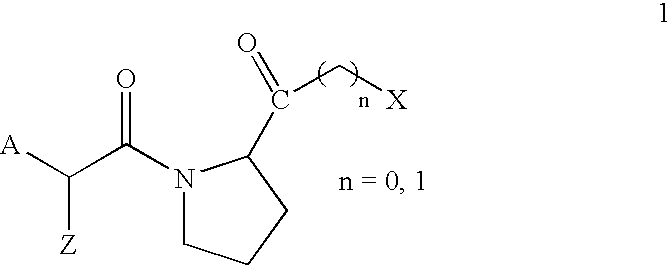


Priority Applications (1)
| Application Number | Priority Date | Filing Date | Title |
|---|---|---|---|
| US10/216,305 US7608577B2 (en) | 2001-10-12 | 2002-08-09 | Peptidyl ketones as inhibitors of DPIV |
Applications Claiming Priority (4)
| Application Number | Priority Date | Filing Date | Title |
|---|---|---|---|
| DE10150203A DE10150203A1 (en) | 2001-10-12 | 2001-10-12 | Use of dipeptidyl peptidase IV inhibitor in treatment of cancer |
| DEDE10150203 | 2001-12-10 | ||
| US34015101P | 2001-12-14 | 2001-12-14 | |
| US10/216,305 US7608577B2 (en) | 2001-10-12 | 2002-08-09 | Peptidyl ketones as inhibitors of DPIV |
Publications (2)
| Publication Number | Publication Date |
|---|---|
| US20030148961A1 true US20030148961A1 (en) | 2003-08-07 |
| US7608577B2 US7608577B2 (en) | 2009-10-27 |
Family
ID=7702178
Family Applications (1)
| Application Number | Title | Priority Date | Filing Date |
|---|---|---|---|
| US10/216,305 Expired - Fee Related US7608577B2 (en) | 2001-10-12 | 2002-08-09 | Peptidyl ketones as inhibitors of DPIV |
Country Status (9)
| Country | Link |
|---|---|
| US (1) | US7608577B2 (en) |
| EP (1) | EP1434792B1 (en) |
| JP (1) | JP2005514336A (en) |
| AT (1) | ATE394413T1 (en) |
| AU (1) | AU2002331224B2 (en) |
| CA (1) | CA2461170A1 (en) |
| DE (2) | DE10150203A1 (en) |
| WO (1) | WO2003033524A2 (en) |
| ZA (1) | ZA200402357B (en) |
Cited By (27)
| Publication number | Priority date | Publication date | Assignee | Title |
|---|---|---|---|---|
| US20040152192A1 (en) * | 1997-09-29 | 2004-08-05 | Point Therapeutics, Inc. | Stimulation of hematopoietic cells in vitro |
| US20050113310A1 (en) * | 2003-08-12 | 2005-05-26 | Frank Striggow | Use of inhibitors of enzymes having activities of amino peptidase N and/or dipeptidyl peptidase IV and of pharmaceutical preparations thereof for a therapy and prevention of chronical neurodegenerative diseases |
| US20060052310A1 (en) * | 1998-08-21 | 2006-03-09 | Point Therapeutics, Inc. | Regulation of substrate activity |
| US20060063719A1 (en) * | 2004-09-21 | 2006-03-23 | Point Therapeutics, Inc. | Methods for treating diabetes |
| US20060287245A1 (en) * | 1999-05-25 | 2006-12-21 | Point Therapeutics, Inc. | Anti-tumor agents |
| US7169926B1 (en) | 2003-08-13 | 2007-01-30 | Takeda Pharmaceutical Company Limited | Dipeptidyl peptidase inhibitors |
| US20070098781A1 (en) * | 2005-08-11 | 2007-05-03 | Loeffler Bernd M | Modified release compositions for DPP-IV inhibitors |
| US20080234292A1 (en) * | 2004-07-23 | 2008-09-25 | Susan Marie Royalty | Peptidase Inhibitors |
| US7470700B2 (en) | 2003-08-13 | 2008-12-30 | Takeda Pharmaceutical Company Limited | Dipeptidyl peptidase inhibitors |
| US7550590B2 (en) | 2003-03-25 | 2009-06-23 | Takeda Pharmaceutical Company Limited | Dipeptidyl peptidase inhibitors |
| US7553861B2 (en) | 2005-04-22 | 2009-06-30 | Alantos Pharmaceuticals Holding, Inc. | Dipeptidyl peptidase-IV inhibitors |
| US7638638B2 (en) | 2003-05-14 | 2009-12-29 | Takeda San Diego, Inc. | Dipeptidyl peptidase inhibitors |
| US7678909B1 (en) | 2003-08-13 | 2010-03-16 | Takeda Pharmaceutical Company Limited | Dipeptidyl peptidase inhibitors |
| US7687638B2 (en) | 2004-06-04 | 2010-03-30 | Takeda San Diego, Inc. | Dipeptidyl peptidase inhibitors |
| US7732446B1 (en) | 2004-03-11 | 2010-06-08 | Takeda Pharmaceutical Company Limited | Dipeptidyl peptidase inhibitors |
| US7781584B2 (en) | 2004-03-15 | 2010-08-24 | Takeda Pharmaceutical Company Limited | Dipeptidyl peptidase inhibitors |
| US7790734B2 (en) | 2003-09-08 | 2010-09-07 | Takeda Pharmaceutical Company Limited | Dipeptidyl peptidase inhibitors |
| US7825242B2 (en) | 2004-07-16 | 2010-11-02 | Takeda Pharmaceutical Company Limted | Dipeptidyl peptidase inhibitors |
| US7872124B2 (en) | 2004-12-21 | 2011-01-18 | Takeda Pharmaceutical Company Limited | Dipeptidyl peptidase inhibitors |
| EP1353684B1 (en) * | 2001-01-02 | 2011-05-04 | KeyNeurotek Pharmaceuticals AG | Use of inhibitors of dipeptidypeptidase iv (ec 3.3.14.5) and aminopeptidase n (ec 3.4.11.2) for the treatment of neurodegeneration induced by ischaemia |
| US7960384B2 (en) | 2006-03-28 | 2011-06-14 | Takeda Pharmaceutical Company Limited | Dipeptidyl peptidase inhibitors |
| US8084605B2 (en) | 2006-11-29 | 2011-12-27 | Kelly Ron C | Polymorphs of succinate salt of 2-[6-(3-amino-piperidin-1-yl)-3-methyl-2,4-dioxo-3,4-dihydro-2H-pyrimidin-1-ylmethy]-4-fluor-benzonitrile and methods of use therefor |
| US8093236B2 (en) | 2007-03-13 | 2012-01-10 | Takeda Pharmaceuticals Company Limited | Weekly administration of dipeptidyl peptidase inhibitors |
| WO2011143521A3 (en) * | 2010-05-13 | 2012-03-01 | Dara Biosciences, Inc. | Enhanced homing and engraftment of hematopoietic stem cells using cd26 inhibitors |
| US8222411B2 (en) | 2005-09-16 | 2012-07-17 | Takeda Pharmaceutical Company Limited | Dipeptidyl peptidase inhibitors |
| US8324383B2 (en) | 2006-09-13 | 2012-12-04 | Takeda Pharmaceutical Company Limited | Methods of making polymorphs of benzoate salt of 2-[[6-[(3R)-3-amino-1-piperidinyl]-3,4-dihydro-3-methyl-2,4-dioxo-1(2H)-pyrimidinyl]methyl]-benzonitrile |
| US8906901B2 (en) | 2005-09-14 | 2014-12-09 | Takeda Pharmaceutical Company Limited | Administration of dipeptidyl peptidase inhibitors |
Families Citing this family (39)
| Publication number | Priority date | Publication date | Assignee | Title |
|---|---|---|---|---|
| US7727964B2 (en) | 2001-11-26 | 2010-06-01 | Trustees Of Tufts College | Peptidomimetic inhibitors of post-proline cleaving enzymes |
| US7772188B2 (en) | 2003-01-28 | 2010-08-10 | Ironwood Pharmaceuticals, Inc. | Methods and compositions for the treatment of gastrointestinal disorders |
| KR20110059664A (en) | 2003-05-05 | 2011-06-02 | 프로비오드룩 아게 | Use of Effectors of Glutaminyl and Glutamate Cycase |
| AU2004237408C9 (en) | 2003-05-05 | 2010-04-15 | Probiodrug Ag | Medical use of inhibitors of glutaminyl and glutamate cyclases |
| US7371871B2 (en) | 2003-05-05 | 2008-05-13 | Probiodrug Ag | Inhibitors of glutaminyl cyclase |
| CN1867324A (en) | 2003-10-15 | 2006-11-22 | 前体生物药物股份公司 | Use of effectors of glutaminyl and glutamate cyclases |
| WO2005049027A2 (en) | 2003-11-03 | 2005-06-02 | Probiodrug Ag | Combinations useful for the treatment of neuronal disorders |
| BRPI0507485A (en) | 2004-02-05 | 2007-07-10 | Probiodrug Ag | new glutaminyl cyclase inhibitors |
| EP1734963A4 (en) | 2004-04-02 | 2008-06-18 | Merck & Co Inc | METHOD FOR TREATING MEN WITH METABOLIC AND ANTHROPOMETRIC DISORDERS |
| GB0526291D0 (en) | 2005-12-23 | 2006-02-01 | Prosidion Ltd | Therapeutic method |
| KR20090004950A (en) | 2006-04-12 | 2009-01-12 | 프로비오드룩 아게 | Enzyme inhibitor |
| WO2008055945A1 (en) | 2006-11-09 | 2008-05-15 | Probiodrug Ag | 3-hydr0xy-1,5-dihydr0-pyrr0l-2-one derivatives as inhibitors of glutaminyl cyclase for the treatment of ulcer, cancer and other diseases |
| ATE554085T1 (en) | 2006-11-30 | 2012-05-15 | Probiodrug Ag | NEW INHIBITORS OF GLUTAMINYL CYCLASE |
| JP5667440B2 (en) | 2007-04-18 | 2015-02-12 | プロビオドルグ エージー | Thiourea derivatives as glutaminyl cyclase inhibitors |
| WO2008151257A2 (en) | 2007-06-04 | 2008-12-11 | Synergy Pharmaceuticals Inc. | Agonists of guanylate cyclase useful for the treatment of gastrointestinal disorders, inflammation, cancer and other disorders |
| US8969514B2 (en) | 2007-06-04 | 2015-03-03 | Synergy Pharmaceuticals, Inc. | Agonists of guanylate cyclase useful for the treatment of hypercholesterolemia, atherosclerosis, coronary heart disease, gallstone, obesity and other cardiovascular diseases |
| WO2009149279A2 (en) | 2008-06-04 | 2009-12-10 | Synergy Pharmaceuticals Inc. | Agonists of guanylate cyclase useful for the treatment of gastrointestinal disorders, inflammation, cancer and other disorders |
| CA2730603C (en) | 2008-07-16 | 2019-09-24 | Synergy Pharmaceuticals Inc. | Agonists of guanylate cyclase useful for the treatment of gastrointestinal disorders, inflammation, cancer and other disorders |
| CA2741125A1 (en) | 2008-10-22 | 2010-04-29 | Merck Sharp & Dohme Corp. | Novel cyclic benzimidazole derivatives useful anti-diabetic agents |
| WO2010051206A1 (en) | 2008-10-31 | 2010-05-06 | Merck Sharp & Dohme Corp. | Novel cyclic benzimidazole derivatives useful anti-diabetic agents |
| CN102695546B (en) | 2009-09-11 | 2014-09-10 | 前体生物药物股份公司 | Heterocylcic derivatives as inhibitors of glutaminyl cyclase |
| US8895596B2 (en) | 2010-02-25 | 2014-11-25 | Merck Sharp & Dohme Corp | Cyclic benzimidazole derivatives useful as anti-diabetic agents |
| US9181233B2 (en) | 2010-03-03 | 2015-11-10 | Probiodrug Ag | Inhibitors of glutaminyl cyclase |
| US8269019B2 (en) | 2010-03-10 | 2012-09-18 | Probiodrug Ag | Inhibitors |
| JP5945532B2 (en) | 2010-04-21 | 2016-07-05 | プロビオドルグ エージー | Benzimidazole derivatives as inhibitors of glutaminyl cyclase |
| US9616097B2 (en) | 2010-09-15 | 2017-04-11 | Synergy Pharmaceuticals, Inc. | Formulations of guanylate cyclase C agonists and methods of use |
| BR112013021236B1 (en) | 2011-02-25 | 2021-05-25 | Merck Sharp & Dohme Corp | benzimidazole derivative compound, and, composition |
| US8530670B2 (en) | 2011-03-16 | 2013-09-10 | Probiodrug Ag | Inhibitors |
| US9527875B2 (en) | 2012-08-02 | 2016-12-27 | Merck Sharp & Dohme Corp. | Antidiabetic tricyclic compounds |
| TWI500613B (en) | 2012-10-17 | 2015-09-21 | Cadila Healthcare Ltd | Novel heterocyclic compounds |
| MX2015010935A (en) | 2013-02-22 | 2015-10-29 | Merck Sharp & Dohme | Antidiabetic bicyclic compounds. |
| US9650375B2 (en) | 2013-03-14 | 2017-05-16 | Merck Sharp & Dohme Corp. | Indole derivatives useful as anti-diabetic agents |
| EP2970384A1 (en) | 2013-03-15 | 2016-01-20 | Synergy Pharmaceuticals Inc. | Agonists of guanylate cyclase and their uses |
| WO2014151200A2 (en) | 2013-03-15 | 2014-09-25 | Synergy Pharmaceuticals Inc. | Compositions useful for the treatment of gastrointestinal disorders |
| AU2014274812B2 (en) | 2013-06-05 | 2018-09-27 | Bausch Health Ireland Limited | Ultra-pure agonists of guanylate cyclase C, method of making and using same |
| WO2015051496A1 (en) | 2013-10-08 | 2015-04-16 | Merck Sharp & Dohme Corp. | Antidiabetic tricyclic compounds |
| EP3551176A4 (en) | 2016-12-06 | 2020-06-24 | Merck Sharp & Dohme Corp. | ANTIDIABETIC HETEROCYCLIC COMPOUNDS |
| WO2018118670A1 (en) | 2016-12-20 | 2018-06-28 | Merck Sharp & Dohme Corp. | Antidiabetic spirochroman compounds |
| PL3461819T3 (en) | 2017-09-29 | 2020-11-30 | Probiodrug Ag | Inhibitors of glutaminyl cyclase |
Citations (20)
| Publication number | Priority date | Publication date | Assignee | Title |
|---|---|---|---|---|
| US2961377A (en) * | 1957-08-05 | 1960-11-22 | Us Vitamin Pharm Corp | Oral anti-diabetic compositions and methods |
| US3174901A (en) * | 1963-01-31 | 1965-03-23 | Jan Marcel Didier Aron Samuel | Process for the oral treatment of diabetes |
| US3879541A (en) * | 1970-03-03 | 1975-04-22 | Bayer Ag | Antihyperglycemic methods and compositions |
| US3960949A (en) * | 1971-04-02 | 1976-06-01 | Schering Aktiengesellschaft | 1,2-Biguanides |
| US4028402A (en) * | 1974-10-11 | 1977-06-07 | Hoffmann-La Roche Inc. | Biguanide salts |
| US4643991A (en) * | 1984-12-18 | 1987-02-17 | The University Of Kentucky Research Foundation | Peptide elastase inhibitors and methods |
| US4935493A (en) * | 1987-10-06 | 1990-06-19 | E. I. Du Pont De Nemours And Company | Protease inhibitors |
| US5008245A (en) * | 1988-10-27 | 1991-04-16 | University Of Kentucky Research Foundation | Novel peptidyl carbamate inhibitors of the enzyme elastase |
| US5162307A (en) * | 1988-09-09 | 1992-11-10 | Board Of Trustees Of The University Of Kentucky | Polymer bound elastase inhibitors |
| US5433955A (en) * | 1989-01-23 | 1995-07-18 | Akzo N.V. | Site specific in vivo activation of therapeutic drugs |
| US5462928A (en) * | 1990-04-14 | 1995-10-31 | New England Medical Center Hospitals, Inc. | Inhibitors of dipeptidyl-aminopeptidase type IV |
| US5512549A (en) * | 1994-10-18 | 1996-04-30 | Eli Lilly And Company | Glucagon-like insulinotropic peptide analogs, compositions, and methods of use |
| US5543396A (en) * | 1994-04-28 | 1996-08-06 | Georgia Tech Research Corp. | Proline phosphonate derivatives |
| US5614379A (en) * | 1995-04-26 | 1997-03-25 | Eli Lilly And Company | Process for preparing anti-obesity protein |
| US5624894A (en) * | 1992-09-17 | 1997-04-29 | University Of Florida | Brain-enhanced delivery of neuroactive peptides by sequential metabolism |
| US5639783A (en) * | 1991-07-01 | 1997-06-17 | Mitsubishi Chemical Corporation | Ketone derivatives |
| US5922319A (en) * | 1989-09-20 | 1999-07-13 | University Of Kentucky Research Foundation | Methods of treating eye conditions with human leukocyte elastase (HLE) inhibitory agents |
| US5939560A (en) * | 1993-12-03 | 1999-08-17 | Ferring B.V. | Inhibitors of DP-mediated processes, compositions and therapeutic methods thereof |
| US6006753A (en) * | 1996-08-30 | 1999-12-28 | Eli Lilly And Company | Use of GLP-1 or analogs to abolish catabolic changes after surgery |
| US20010020006A1 (en) * | 1998-06-24 | 2001-09-06 | Hans-Ulrich Demuth | Compounds of unstable DP IV-inhibitors |
Family Cites Families (39)
| Publication number | Priority date | Publication date | Assignee | Title |
|---|---|---|---|---|
| DE2009743A1 (en) | 1970-03-03 | 1971-09-16 | Farbenfabriken Bayer Ag, 5090 Leverkusen | Substituted biguanides with antihyperglycemic effects |
| US4705778A (en) * | 1985-10-22 | 1987-11-10 | Sri International | Orally active LHRH analogs |
| DD296075A5 (en) | 1989-08-07 | 1991-11-21 | Martin-Luther-Universitaet Halle-Wittenberg,De | PROCESS FOR THE PREPARATION OF NEW INHIBITORS OF DIPEPTIDYL PEPTIDASE IV |
| ATE164852T1 (en) | 1990-01-24 | 1998-04-15 | Douglas I Buckley | GLP-1 ANALOGUE USABLE IN DIABETES TREATMENT |
| DK0528858T3 (en) | 1990-04-14 | 1997-07-28 | Univ Tufts Med | Inhibitors of dipeptidyl aminopeptidase type IV |
| WO1991017767A1 (en) | 1990-05-21 | 1991-11-28 | New England Medical Center Hospitals, Inc. | Method of treating inhibition of dipeptidyl aminopeptidase type iv |
| EP0468469A2 (en) * | 1990-07-27 | 1992-01-29 | Japan Tobacco Inc. | Proline derivatives |
| JPH0819154B2 (en) | 1991-03-14 | 1996-02-28 | 江崎グリコ株式会社 | Peptides that inhibit dipeptidyl carboxypeptidase |
| JPH04334357A (en) | 1991-05-02 | 1992-11-20 | Fujirebio Inc | Acyl derivative having enzyme-inhibiting action |
| CA2121369C (en) | 1991-10-22 | 2003-04-29 | William W. Bachovchin | Inhibitors of dipeptidyl-aminopeptidase type iv |
| FR2696740B1 (en) | 1992-10-13 | 1994-12-30 | Dospharma Sa | Produced derivatives of dimethylbiguanide and applications as medicaments. |
| US5462939A (en) * | 1993-05-07 | 1995-10-31 | Sterling Winthrop Inc. | Peptidic ketones as interleukin-1β-converting enzyme inhibitors |
| WO1995011689A1 (en) | 1993-10-29 | 1995-05-04 | Trustees Of Tufts College | Use of inhibitors of dipeptidyl-aminopeptidase to block entry of hiv into cells |
| US5486623A (en) * | 1993-12-08 | 1996-01-23 | Prototek, Inc. | Cysteine protease inhibitors containing heterocyclic leaving groups |
| EP0658568A1 (en) | 1993-12-09 | 1995-06-21 | Eli Lilly And Company | Glucagon-like insulinotropic peptides, compositions and methods |
| DE122010000020I1 (en) | 1996-04-25 | 2010-07-08 | Prosidion Ltd | Method for lowering the blood glucose level in mammals |
| CA2256669A1 (en) | 1996-05-29 | 1997-12-04 | Prototek, Inc. | Prodrugs of thalidomide and methods for using same as modulators of t-cell function |
| US5786378A (en) * | 1996-09-25 | 1998-07-28 | Gpi Nil Holdings, Inc. | Heterocyclic thioesters |
| US6218424B1 (en) * | 1996-09-25 | 2001-04-17 | Gpi Nil Holdings, Inc. | Heterocyclic ketone and thioester compounds and uses |
| TW492957B (en) | 1996-11-07 | 2002-07-01 | Novartis Ag | N-substituted 2-cyanopyrrolidnes |
| AR016751A1 (en) | 1996-11-22 | 2001-08-01 | Athena Neurosciences Inc | METHOD FOR INHIBITING THE RELEASE OF THE BETA-AMYLOID PEPTIDE IN A CELL, PHARMACEUTICAL COMPOSITION AND USEFUL COMPOUNDS IN THIS METHOD |
| JP2002506075A (en) | 1998-03-09 | 2002-02-26 | フォンダテッヒ・ベネルクス・ナムローゼ・フェンノートシャップ | Serine peptidase modulator |
| DE19823831A1 (en) | 1998-05-28 | 1999-12-02 | Probiodrug Ges Fuer Arzneim | New pharmaceutical use of isoleucyl thiazolidide and its salts |
| ES2189423T3 (en) | 1998-06-05 | 2003-07-01 | Point Therapeutics Inc | BOROPROLINE CYCLING COMPOUNDS. |
| DE19826972A1 (en) | 1998-06-18 | 1999-12-23 | Univ Magdeburg Tech | Inhibiting keratinocyte activation and proliferation, for treatment of dermatological disorders such as psoriasis or actinic precancerous states |
| EP1092046A4 (en) | 1998-07-02 | 2003-02-19 | Invitro Diagnostics Inc | Methods, compositions and apparatus for making nucleic acid molecules having a selected affinity to a target molecule |
| DE19834591A1 (en) | 1998-07-31 | 2000-02-03 | Probiodrug Ges Fuer Arzneim | Use of substances that decrease the activity of dipeptidyl peptidase IV to increase blood sugar levels, e.g. for treating hypoglycemia |
| AU5480199A (en) | 1998-08-21 | 2000-03-14 | Point Therapeutics, Inc. | Regulation of substrate activity |
| AU3960400A (en) | 1999-03-05 | 2000-09-28 | Molteni L. E C. Dei Fratelli Alitti Societa' Di Esercizio S.P.A. | Use of metformin in the preparation of pharmaceutical compositions capable of inhibiting the enzyme dipeptidyl peptidase iv |
| CA2384135A1 (en) | 1999-09-10 | 2001-03-22 | Catherine Anne Abbott | Dipeptidyl peptidases |
| CA2390231A1 (en) | 1999-11-12 | 2001-05-17 | Paul Jackson | Dipeptidyl peptidase iv inhibitors and methods of making and using dipeptidyl peptidase iv inhibitors |
| AU2001233622A1 (en) | 2000-02-25 | 2001-09-03 | Novo-Nordisk A/S | Inhibition of beta cell degeneration |
| US6573096B1 (en) | 2000-04-01 | 2003-06-03 | The Research Foundation At State University Of New York | Compositions and methods for inhibition of cancer invasion and angiogenesis |
| DE10025464A1 (en) | 2000-05-23 | 2001-12-06 | Inst Medizintechnologie Magdeb | Combined use of enzyme inhibitors for the therapy of autoimmune diseases, in transplants and tumor diseases, as well as combinations of pharmaceutical preparations comprising enzyme inhibitors |
| GB0014969D0 (en) | 2000-06-19 | 2000-08-09 | Smithkline Beecham Plc | Novel method of treatment |
| AU2001269123A1 (en) | 2000-07-10 | 2002-01-21 | Bayer Aktiengesellschaft | Regulation of human dipeptidyl-peptidase iv-like enzyme |
| AU8843701A (en) | 2000-09-09 | 2002-03-22 | Univ New York State Res Found | Method and compositions for isolating metastatic cancer cells, and use in measuring metastatic potential of a cancer thereof |
| CZ20031301A3 (en) | 2000-10-12 | 2003-10-15 | Ferring Bv | Isolated nucleic acid, polypeptide, expression vector and antibody |
| AUPR107800A0 (en) | 2000-10-27 | 2000-11-23 | University Of Sydney, The | Peptide and nucleic acid molecule ii |
-
2001
- 2001-10-12 DE DE10150203A patent/DE10150203A1/en not_active Withdrawn
-
2002
- 2002-08-09 JP JP2003536263A patent/JP2005514336A/en active Pending
- 2002-08-09 DE DE60226467T patent/DE60226467D1/en not_active Expired - Lifetime
- 2002-08-09 AU AU2002331224A patent/AU2002331224B2/en not_active Ceased
- 2002-08-09 CA CA002461170A patent/CA2461170A1/en not_active Abandoned
- 2002-08-09 EP EP02767356A patent/EP1434792B1/en not_active Expired - Lifetime
- 2002-08-09 US US10/216,305 patent/US7608577B2/en not_active Expired - Fee Related
- 2002-08-09 AT AT02767356T patent/ATE394413T1/en not_active IP Right Cessation
- 2002-08-09 WO PCT/EP2002/008929 patent/WO2003033524A2/en not_active Ceased
-
2004
- 2004-03-25 ZA ZA200402357A patent/ZA200402357B/en unknown
Patent Citations (21)
| Publication number | Priority date | Publication date | Assignee | Title |
|---|---|---|---|---|
| US2961377A (en) * | 1957-08-05 | 1960-11-22 | Us Vitamin Pharm Corp | Oral anti-diabetic compositions and methods |
| US3174901A (en) * | 1963-01-31 | 1965-03-23 | Jan Marcel Didier Aron Samuel | Process for the oral treatment of diabetes |
| US3879541A (en) * | 1970-03-03 | 1975-04-22 | Bayer Ag | Antihyperglycemic methods and compositions |
| US3960949A (en) * | 1971-04-02 | 1976-06-01 | Schering Aktiengesellschaft | 1,2-Biguanides |
| US4028402A (en) * | 1974-10-11 | 1977-06-07 | Hoffmann-La Roche Inc. | Biguanide salts |
| US4643991A (en) * | 1984-12-18 | 1987-02-17 | The University Of Kentucky Research Foundation | Peptide elastase inhibitors and methods |
| US4935493A (en) * | 1987-10-06 | 1990-06-19 | E. I. Du Pont De Nemours And Company | Protease inhibitors |
| US5162307A (en) * | 1988-09-09 | 1992-11-10 | Board Of Trustees Of The University Of Kentucky | Polymer bound elastase inhibitors |
| US5008245A (en) * | 1988-10-27 | 1991-04-16 | University Of Kentucky Research Foundation | Novel peptidyl carbamate inhibitors of the enzyme elastase |
| US5433955A (en) * | 1989-01-23 | 1995-07-18 | Akzo N.V. | Site specific in vivo activation of therapeutic drugs |
| US5922319A (en) * | 1989-09-20 | 1999-07-13 | University Of Kentucky Research Foundation | Methods of treating eye conditions with human leukocyte elastase (HLE) inhibitory agents |
| US5462928A (en) * | 1990-04-14 | 1995-10-31 | New England Medical Center Hospitals, Inc. | Inhibitors of dipeptidyl-aminopeptidase type IV |
| US5639783A (en) * | 1991-07-01 | 1997-06-17 | Mitsubishi Chemical Corporation | Ketone derivatives |
| US5834508A (en) * | 1991-07-01 | 1998-11-10 | Mitsubishi Chemical Corporation | Ketone derivatives |
| US5624894A (en) * | 1992-09-17 | 1997-04-29 | University Of Florida | Brain-enhanced delivery of neuroactive peptides by sequential metabolism |
| US5939560A (en) * | 1993-12-03 | 1999-08-17 | Ferring B.V. | Inhibitors of DP-mediated processes, compositions and therapeutic methods thereof |
| US5543396A (en) * | 1994-04-28 | 1996-08-06 | Georgia Tech Research Corp. | Proline phosphonate derivatives |
| US5512549A (en) * | 1994-10-18 | 1996-04-30 | Eli Lilly And Company | Glucagon-like insulinotropic peptide analogs, compositions, and methods of use |
| US5614379A (en) * | 1995-04-26 | 1997-03-25 | Eli Lilly And Company | Process for preparing anti-obesity protein |
| US6006753A (en) * | 1996-08-30 | 1999-12-28 | Eli Lilly And Company | Use of GLP-1 or analogs to abolish catabolic changes after surgery |
| US20010020006A1 (en) * | 1998-06-24 | 2001-09-06 | Hans-Ulrich Demuth | Compounds of unstable DP IV-inhibitors |
Cited By (45)
| Publication number | Priority date | Publication date | Assignee | Title |
|---|---|---|---|---|
| US7276371B2 (en) | 1997-09-29 | 2007-10-02 | Point Therapeutics, Inc. | Stimulation of hematopoietic cells in vitro |
| US20040152192A1 (en) * | 1997-09-29 | 2004-08-05 | Point Therapeutics, Inc. | Stimulation of hematopoietic cells in vitro |
| US20060052310A1 (en) * | 1998-08-21 | 2006-03-09 | Point Therapeutics, Inc. | Regulation of substrate activity |
| US7265118B2 (en) | 1998-08-21 | 2007-09-04 | Point Therapeutics, Inc. | Regulation of substrate activity |
| US7259138B2 (en) | 1999-05-25 | 2007-08-21 | Point Therapeutics, Inc. | Anti-tumor agents |
| US7282484B2 (en) | 1999-05-25 | 2007-10-16 | Point Therapeutics, Inc. | Anti-tumor agents |
| US20060287245A1 (en) * | 1999-05-25 | 2006-12-21 | Point Therapeutics, Inc. | Anti-tumor agents |
| EP1353684B1 (en) * | 2001-01-02 | 2011-05-04 | KeyNeurotek Pharmaceuticals AG | Use of inhibitors of dipeptidypeptidase iv (ec 3.3.14.5) and aminopeptidase n (ec 3.4.11.2) for the treatment of neurodegeneration induced by ischaemia |
| US7687625B2 (en) | 2003-03-25 | 2010-03-30 | Takeda Pharmaceutical Company Limited | Dipeptidyl peptidase inhibitors |
| US7550590B2 (en) | 2003-03-25 | 2009-06-23 | Takeda Pharmaceutical Company Limited | Dipeptidyl peptidase inhibitors |
| US7638638B2 (en) | 2003-05-14 | 2009-12-29 | Takeda San Diego, Inc. | Dipeptidyl peptidase inhibitors |
| US20050113310A1 (en) * | 2003-08-12 | 2005-05-26 | Frank Striggow | Use of inhibitors of enzymes having activities of amino peptidase N and/or dipeptidyl peptidase IV and of pharmaceutical preparations thereof for a therapy and prevention of chronical neurodegenerative diseases |
| US7291599B2 (en) | 2003-08-12 | 2007-11-06 | Keyneurotek Ag | Use of inhibitors of enzymes having activities of amino peptidase N and/or dipeptidyl peptidase IV and of pharmaceutical preparations thereof for a therapy and prevention of chronical neurodegenerative diseases |
| US7723344B2 (en) | 2003-08-13 | 2010-05-25 | Takeda San Diego, Inc. | Dipeptidyl peptidase inhibitors |
| US7169926B1 (en) | 2003-08-13 | 2007-01-30 | Takeda Pharmaceutical Company Limited | Dipeptidyl peptidase inhibitors |
| US7470700B2 (en) | 2003-08-13 | 2008-12-30 | Takeda Pharmaceutical Company Limited | Dipeptidyl peptidase inhibitors |
| US7579357B2 (en) | 2003-08-13 | 2009-08-25 | Takeda Pharmaceutical Company Limited | Dipeptidyl peptidase inhibitors |
| US7790736B2 (en) | 2003-08-13 | 2010-09-07 | Takeda Pharmaceutical Company Limited | Dipeptidyl peptidase inhibitors |
| US7678909B1 (en) | 2003-08-13 | 2010-03-16 | Takeda Pharmaceutical Company Limited | Dipeptidyl peptidase inhibitors |
| US7790734B2 (en) | 2003-09-08 | 2010-09-07 | Takeda Pharmaceutical Company Limited | Dipeptidyl peptidase inhibitors |
| US7732446B1 (en) | 2004-03-11 | 2010-06-08 | Takeda Pharmaceutical Company Limited | Dipeptidyl peptidase inhibitors |
| US8173663B2 (en) | 2004-03-15 | 2012-05-08 | Takeda Pharmaceutical Company Limited | Dipeptidyl peptidase inhibitors |
| US7906523B2 (en) | 2004-03-15 | 2011-03-15 | Takeda Pharmaceutical Company Limited | Dipeptidyl peptidase inhibitors |
| US7781584B2 (en) | 2004-03-15 | 2010-08-24 | Takeda Pharmaceutical Company Limited | Dipeptidyl peptidase inhibitors |
| US8188275B2 (en) | 2004-03-15 | 2012-05-29 | Takeda Pharmaceutical Company Limited | Dipeptidyl peptidase inhibitors |
| US8288539B2 (en) | 2004-03-15 | 2012-10-16 | Takeda Pharmaceutical Company Limited | Dipeptidyl peptidase inhibitors |
| US7807689B2 (en) | 2004-03-15 | 2010-10-05 | Takeda Pharmaceutical Company Limited | Dipeptidyl peptidase inhibitors |
| US8329900B2 (en) | 2004-03-15 | 2012-12-11 | Takeda Pharmaceutical Company Limited | Dipeptidyl peptidase inhibitors |
| US7687638B2 (en) | 2004-06-04 | 2010-03-30 | Takeda San Diego, Inc. | Dipeptidyl peptidase inhibitors |
| US7825242B2 (en) | 2004-07-16 | 2010-11-02 | Takeda Pharmaceutical Company Limted | Dipeptidyl peptidase inhibitors |
| US7842707B2 (en) | 2004-07-23 | 2010-11-30 | Nuada, Llc | Peptidase inhibitors |
| US20080234292A1 (en) * | 2004-07-23 | 2008-09-25 | Susan Marie Royalty | Peptidase Inhibitors |
| US20060063719A1 (en) * | 2004-09-21 | 2006-03-23 | Point Therapeutics, Inc. | Methods for treating diabetes |
| US20070072830A1 (en) * | 2004-09-21 | 2007-03-29 | Point Therapeutics, Inc. | Methods for treating diabetes |
| US7872124B2 (en) | 2004-12-21 | 2011-01-18 | Takeda Pharmaceutical Company Limited | Dipeptidyl peptidase inhibitors |
| US8076330B2 (en) | 2005-04-22 | 2011-12-13 | Amgen Inc. | Dipeptidyl peptidase-IV inhibitors |
| US7553861B2 (en) | 2005-04-22 | 2009-06-30 | Alantos Pharmaceuticals Holding, Inc. | Dipeptidyl peptidase-IV inhibitors |
| US20070098781A1 (en) * | 2005-08-11 | 2007-05-03 | Loeffler Bernd M | Modified release compositions for DPP-IV inhibitors |
| US8906901B2 (en) | 2005-09-14 | 2014-12-09 | Takeda Pharmaceutical Company Limited | Administration of dipeptidyl peptidase inhibitors |
| US8222411B2 (en) | 2005-09-16 | 2012-07-17 | Takeda Pharmaceutical Company Limited | Dipeptidyl peptidase inhibitors |
| US7960384B2 (en) | 2006-03-28 | 2011-06-14 | Takeda Pharmaceutical Company Limited | Dipeptidyl peptidase inhibitors |
| US8324383B2 (en) | 2006-09-13 | 2012-12-04 | Takeda Pharmaceutical Company Limited | Methods of making polymorphs of benzoate salt of 2-[[6-[(3R)-3-amino-1-piperidinyl]-3,4-dihydro-3-methyl-2,4-dioxo-1(2H)-pyrimidinyl]methyl]-benzonitrile |
| US8084605B2 (en) | 2006-11-29 | 2011-12-27 | Kelly Ron C | Polymorphs of succinate salt of 2-[6-(3-amino-piperidin-1-yl)-3-methyl-2,4-dioxo-3,4-dihydro-2H-pyrimidin-1-ylmethy]-4-fluor-benzonitrile and methods of use therefor |
| US8093236B2 (en) | 2007-03-13 | 2012-01-10 | Takeda Pharmaceuticals Company Limited | Weekly administration of dipeptidyl peptidase inhibitors |
| WO2011143521A3 (en) * | 2010-05-13 | 2012-03-01 | Dara Biosciences, Inc. | Enhanced homing and engraftment of hematopoietic stem cells using cd26 inhibitors |
Also Published As
| Publication number | Publication date |
|---|---|
| JP2005514336A (en) | 2005-05-19 |
| CA2461170A1 (en) | 2003-04-24 |
| US7608577B2 (en) | 2009-10-27 |
| WO2003033524A2 (en) | 2003-04-24 |
| EP1434792A2 (en) | 2004-07-07 |
| AU2002331224B2 (en) | 2008-01-17 |
| DE10150203A1 (en) | 2003-04-17 |
| WO2003033524A3 (en) | 2004-03-18 |
| ZA200402357B (en) | 2005-03-29 |
| EP1434792B1 (en) | 2008-05-07 |
| ATE394413T1 (en) | 2008-05-15 |
| DE60226467D1 (en) | 2008-06-19 |
Similar Documents
| Publication | Publication Date | Title |
|---|---|---|
| US7608577B2 (en) | Peptidyl ketones as inhibitors of DPIV | |
| US20030125304A1 (en) | Substituted amino ketone compounds | |
| AU2002331224A1 (en) | Peptidyl ketones as inhibitors of DPIV | |
| EP1442049A2 (en) | Substituted amino ketone compounds | |
| JP2005514336A5 (en) | ||
| RU2305553C2 (en) | New dipeptidyl peptidase iv inhibitors and uses thereof as hypotensive agent | |
| US6946480B2 (en) | Glutaminyl based DPIV inhibitors | |
| US20030176357A1 (en) | Dipeptidyl peptidase IV inhibitors and their uses for lowering blood pressure levels | |
| CN1321682C (en) | New dipeptidyl peptidase iv inhibitors and their uses as anti-cancer agents | |
| AU2002321135A1 (en) | Dipepitdyl peptidase IV inhibitors and their uses as anti-cancer agents | |
| AU2002328306A1 (en) | Use of dipeptidyl peptidase IV inhibitors as therapeutics for neurological disorders | |
| US20030135023A1 (en) | Peptide structures useful for competitive modulation of dipeptidyl peptidase IV catalysis | |
| ZA200300833B (en) | Dipeptidyl peptidase IV inhibitors and their uses as anti-cancer agents. | |
| US20060194852A1 (en) | Glutaminyl based DPIV inhibitors | |
| CENTER | Pospisilik et al.(43) Pub. Date: Sep. 18, 2003 | |
| AU2002328305A1 (en) | Peptide structures useful for competitive modulation of dipeptidyl peptidase IV catalysis |
Legal Events
| Date | Code | Title | Description |
|---|---|---|---|
| AS | Assignment |
Owner name: PROBIODRUG AG, GERMANY Free format text: ASSIGNMENT OF ASSIGNORS INTEREST;ASSIGNORS:HEISER, ULRICH;NIESTROJ, ANDRE;HOFFMANN, TORSTEN;AND OTHERS;REEL/FRAME:013332/0380;SIGNING DATES FROM 20020906 TO 20020912 |
|
| AS | Assignment |
Owner name: PROSIDION LIMITED, UNITED KINGDOM Free format text: ASSIGNMENT OF ASSIGNORS INTEREST;ASSIGNOR:PROBIODRUG AG;REEL/FRAME:016536/0107 Effective date: 20050321 |
|
| AS | Assignment |
Owner name: PROSIDION LIMITED, UNITED KINGDOM Free format text: ASSIGNMENT OF ASSIGNORS INTEREST;ASSIGNOR:PROBIODRUG AG;REEL/FRAME:017045/0252 Effective date: 20050321 Owner name: PROSIDION LIMITED, UNITED KINGDOM Free format text: ASSIGNMENT OF ASSIGNORS INTEREST;ASSIGNOR:PROBIODRUG AG;REEL/FRAME:016547/0581 Effective date: 20050321 Owner name: PROSIDION LIMITED, UNITED KINGDOM Free format text: ASSIGNMENT OF ASSIGNORS INTEREST;ASSIGNOR:PROBIODRUG AG;REEL/FRAME:016561/0783 Effective date: 20050321 Owner name: PROSIDION LIMITED, UNITED KINGDOM Free format text: ASSIGNMENT OF ASSIGNORS INTEREST;ASSIGNOR:PROBIODRUG AG;REEL/FRAME:016536/0621 Effective date: 20050321 |
|
| CC | Certificate of correction | ||
| REMI | Maintenance fee reminder mailed | ||
| LAPS | Lapse for failure to pay maintenance fees | ||
| STCH | Information on status: patent discontinuation |
Free format text: PATENT EXPIRED DUE TO NONPAYMENT OF MAINTENANCE FEES UNDER 37 CFR 1.362 |
|
| STCH | Information on status: patent discontinuation |
Free format text: PATENT EXPIRED DUE TO NONPAYMENT OF MAINTENANCE FEES UNDER 37 CFR 1.362 |
|
| FP | Lapsed due to failure to pay maintenance fee |
Effective date: 20131027 |