US20030134973A1 - Waterborne latexes for anti-corrosive and solvent-resistant coating compositions - Google Patents
Waterborne latexes for anti-corrosive and solvent-resistant coating compositions Download PDFInfo
- Publication number
- US20030134973A1 US20030134973A1 US10/186,147 US18614702A US2003134973A1 US 20030134973 A1 US20030134973 A1 US 20030134973A1 US 18614702 A US18614702 A US 18614702A US 2003134973 A1 US2003134973 A1 US 2003134973A1
- Authority
- US
- United States
- Prior art keywords
- acetoacetoxy
- latex composition
- acrylate
- monomer
- functional
- Prior art date
- Legal status (The legal status is an assumption and is not a legal conclusion. Google has not performed a legal analysis and makes no representation as to the accuracy of the status listed.)
- Abandoned
Links
- 239000008199 coating composition Substances 0.000 title claims abstract description 32
- 239000002904 solvent Substances 0.000 title abstract description 15
- 239000000178 monomer Substances 0.000 claims abstract description 126
- 239000000203 mixture Substances 0.000 claims abstract description 90
- 239000004816 latex Substances 0.000 claims abstract description 83
- 229920000126 latex Polymers 0.000 claims abstract description 83
- -1 acetoacetoxy vinyl Chemical group 0.000 claims abstract description 77
- 229920001002 functional polymer Polymers 0.000 claims abstract description 50
- XLYOFNOQVPJJNP-UHFFFAOYSA-N water Substances O XLYOFNOQVPJJNP-UHFFFAOYSA-N 0.000 claims abstract description 49
- 125000000391 vinyl group Chemical group [H]C([*])=C([H])[H] 0.000 claims abstract description 47
- 229920002554 vinyl polymer Polymers 0.000 claims abstract description 44
- 229910052751 metal Inorganic materials 0.000 claims abstract description 27
- 239000002184 metal Substances 0.000 claims abstract description 27
- 238000007720 emulsion polymerization reaction Methods 0.000 claims abstract description 13
- 239000002253 acid Substances 0.000 claims abstract description 12
- 230000000379 polymerizing effect Effects 0.000 claims abstract description 9
- NIXOWILDQLNWCW-UHFFFAOYSA-M Acrylate Chemical compound [O-]C(=O)C=C NIXOWILDQLNWCW-UHFFFAOYSA-M 0.000 claims description 28
- 239000004094 surface-active agent Substances 0.000 claims description 22
- 238000005260 corrosion Methods 0.000 claims description 20
- 239000003795 chemical substances by application Substances 0.000 claims description 19
- 230000007797 corrosion Effects 0.000 claims description 18
- 229910052739 hydrogen Inorganic materials 0.000 claims description 15
- 239000001257 hydrogen Substances 0.000 claims description 15
- IBDVWXAVKPRHCU-UHFFFAOYSA-N 2-(2-methylprop-2-enoyloxy)ethyl 3-oxobutanoate Chemical compound CC(=O)CC(=O)OCCOC(=O)C(C)=C IBDVWXAVKPRHCU-UHFFFAOYSA-N 0.000 claims description 11
- QGZKDVFQNNGYKY-UHFFFAOYSA-N Ammonia Chemical group N QGZKDVFQNNGYKY-UHFFFAOYSA-N 0.000 claims description 10
- 125000004169 (C1-C6) alkyl group Chemical group 0.000 claims description 9
- 239000002245 particle Substances 0.000 claims description 8
- 239000000049 pigment Substances 0.000 claims description 8
- 150000001408 amides Chemical class 0.000 claims description 7
- 150000001412 amines Chemical class 0.000 claims description 7
- 125000004435 hydrogen atom Chemical group [H]* 0.000 claims description 7
- 238000000034 method Methods 0.000 claims description 7
- 150000007530 organic bases Chemical class 0.000 claims description 7
- CERQOIWHTDAKMF-UHFFFAOYSA-N Methacrylic acid Chemical compound CC(=C)C(O)=O CERQOIWHTDAKMF-UHFFFAOYSA-N 0.000 claims description 6
- 229910052736 halogen Chemical group 0.000 claims description 6
- 150000002367 halogens Chemical group 0.000 claims description 6
- 229910052760 oxygen Inorganic materials 0.000 claims description 6
- YHSYGCXKWUUKIK-UHFFFAOYSA-N 2-prop-2-enoyloxyethyl 3-oxobutanoate Chemical compound CC(=O)CC(=O)OCCOC(=O)C=C YHSYGCXKWUUKIK-UHFFFAOYSA-N 0.000 claims description 5
- FJKZPONBPMKPLO-UHFFFAOYSA-N 3-prop-2-enoyloxypropyl 3-oxobutanoate Chemical compound CC(=O)CC(=O)OCCCOC(=O)C=C FJKZPONBPMKPLO-UHFFFAOYSA-N 0.000 claims description 5
- PICTWXAWDCLLKO-UHFFFAOYSA-N 4-prop-2-enoyloxybutyl 3-oxobutanoate Chemical compound CC(=O)CC(=O)OCCCCOC(=O)C=C PICTWXAWDCLLKO-UHFFFAOYSA-N 0.000 claims description 5
- AXLMPTNTPOWPLT-UHFFFAOYSA-N prop-2-enyl 3-oxobutanoate Chemical compound CC(=O)CC(=O)OCC=C AXLMPTNTPOWPLT-UHFFFAOYSA-N 0.000 claims description 5
- 239000004606 Fillers/Extenders Substances 0.000 claims description 4
- 229910021529 ammonia Inorganic materials 0.000 claims description 4
- 239000002518 antifoaming agent Substances 0.000 claims description 4
- 239000002270 dispersing agent Substances 0.000 claims description 4
- 239000004014 plasticizer Substances 0.000 claims description 4
- 239000000080 wetting agent Substances 0.000 claims description 4
- 125000006700 (C1-C6) alkylthio group Chemical group 0.000 claims description 3
- 229920003171 Poly (ethylene oxide) Polymers 0.000 claims description 3
- 125000005037 alkyl phenyl group Chemical group 0.000 claims description 3
- CBTVGIZVANVGBH-UHFFFAOYSA-N aminomethyl propanol Chemical compound CC(C)(N)CO CBTVGIZVANVGBH-UHFFFAOYSA-N 0.000 claims description 3
- RTZKZFJDLAIYFH-UHFFFAOYSA-N ether Substances CCOCC RTZKZFJDLAIYFH-UHFFFAOYSA-N 0.000 claims description 3
- 150000002431 hydrogen Chemical group 0.000 claims description 3
- 125000001400 nonyl group Chemical group [H]C([*])([H])C([H])([H])C([H])([H])C([H])([H])C([H])([H])C([H])([H])C([H])([H])C([H])([H])C([H])([H])[H] 0.000 claims description 3
- 125000002347 octyl group Chemical group [H]C([*])([H])C([H])([H])C([H])([H])C([H])([H])C([H])([H])C([H])([H])C([H])([H])C([H])([H])[H] 0.000 claims description 3
- 229910052717 sulfur Inorganic materials 0.000 claims description 3
- 239000013036 UV Light Stabilizer Substances 0.000 claims description 2
- 239000006096 absorbing agent Substances 0.000 claims description 2
- 239000000417 fungicide Substances 0.000 claims description 2
- 238000000518 rheometry Methods 0.000 claims description 2
- 239000002562 thickening agent Substances 0.000 claims description 2
- NGZDFOYYIXAAPC-UHFFFAOYSA-N 1-prop-2-enoyloxypropan-2-yl 3-oxobutanoate Chemical compound C=CC(=O)OCC(C)OC(=O)CC(C)=O NGZDFOYYIXAAPC-UHFFFAOYSA-N 0.000 claims 4
- 229940058020 2-amino-2-methyl-1-propanol Drugs 0.000 claims 2
- 230000000855 fungicidal effect Effects 0.000 claims 1
- 229920000642 polymer Polymers 0.000 description 28
- ZWEHNKRNPOVVGH-UHFFFAOYSA-N 2-Butanone Chemical compound CCC(C)=O ZWEHNKRNPOVVGH-UHFFFAOYSA-N 0.000 description 27
- 238000000576 coating method Methods 0.000 description 21
- 238000012360 testing method Methods 0.000 description 19
- 239000003973 paint Substances 0.000 description 16
- ROOXNKNUYICQNP-UHFFFAOYSA-N ammonium persulfate Chemical compound [NH4+].[NH4+].[O-]S(=O)(=O)OOS([O-])(=O)=O ROOXNKNUYICQNP-UHFFFAOYSA-N 0.000 description 14
- PPBRXRYQALVLMV-UHFFFAOYSA-N Styrene Chemical class C=CC1=CC=CC=C1 PPBRXRYQALVLMV-UHFFFAOYSA-N 0.000 description 12
- 150000002081 enamines Chemical class 0.000 description 12
- 239000011248 coating agent Substances 0.000 description 11
- 239000000047 product Substances 0.000 description 11
- 238000002360 preparation method Methods 0.000 description 10
- 238000009472 formulation Methods 0.000 description 9
- HRPVXLWXLXDGHG-UHFFFAOYSA-N Acrylamide Chemical compound NC(=O)C=C HRPVXLWXLXDGHG-UHFFFAOYSA-N 0.000 description 8
- 229910000831 Steel Inorganic materials 0.000 description 8
- 238000006243 chemical reaction Methods 0.000 description 8
- 239000010959 steel Substances 0.000 description 8
- NECRQCBKTGZNMH-UHFFFAOYSA-N 3,5-dimethylhex-1-yn-3-ol Chemical compound CC(C)CC(C)(O)C#C NECRQCBKTGZNMH-UHFFFAOYSA-N 0.000 description 7
- 229910001870 ammonium persulfate Inorganic materials 0.000 description 7
- 230000015572 biosynthetic process Effects 0.000 description 7
- 239000007921 spray Substances 0.000 description 7
- VHUUQVKOLVNVRT-UHFFFAOYSA-N Ammonium hydroxide Chemical compound [NH4+].[OH-] VHUUQVKOLVNVRT-UHFFFAOYSA-N 0.000 description 6
- IJGRMHOSHXDMSA-UHFFFAOYSA-N Atomic nitrogen Chemical compound N#N IJGRMHOSHXDMSA-UHFFFAOYSA-N 0.000 description 6
- NOWKCMXCCJGMRR-UHFFFAOYSA-N Aziridine Chemical compound C1CN1 NOWKCMXCCJGMRR-UHFFFAOYSA-N 0.000 description 6
- XEEYBQQBJWHFJM-UHFFFAOYSA-N Iron Chemical compound [Fe] XEEYBQQBJWHFJM-UHFFFAOYSA-N 0.000 description 6
- 235000011114 ammonium hydroxide Nutrition 0.000 description 6
- 239000000839 emulsion Substances 0.000 description 6
- 229920006254 polymer film Polymers 0.000 description 6
- 150000003839 salts Chemical group 0.000 description 6
- 239000000243 solution Substances 0.000 description 6
- 239000000126 substance Substances 0.000 description 6
- RPNUMPOLZDHAAY-UHFFFAOYSA-N Diethylenetriamine Chemical compound NCCNCCN RPNUMPOLZDHAAY-UHFFFAOYSA-N 0.000 description 5
- NIXOWILDQLNWCW-UHFFFAOYSA-N acrylic acid group Chemical class C(C=C)(=O)O NIXOWILDQLNWCW-UHFFFAOYSA-N 0.000 description 5
- 230000000694 effects Effects 0.000 description 5
- 230000014759 maintenance of location Effects 0.000 description 5
- 229910052757 nitrogen Inorganic materials 0.000 description 5
- XHZPRMZZQOIPDS-UHFFFAOYSA-N 2-Methyl-2-[(1-oxo-2-propenyl)amino]-1-propanesulfonic acid Chemical compound OS(=O)(=O)CC(C)(C)NC(=O)C=C XHZPRMZZQOIPDS-UHFFFAOYSA-N 0.000 description 4
- ATRRKUHOCOJYRX-UHFFFAOYSA-N Ammonium bicarbonate Chemical compound [NH4+].OC([O-])=O ATRRKUHOCOJYRX-UHFFFAOYSA-N 0.000 description 4
- GWEVSGVZZGPLCZ-UHFFFAOYSA-N Titan oxide Chemical compound O=[Ti]=O GWEVSGVZZGPLCZ-UHFFFAOYSA-N 0.000 description 4
- 239000000654 additive Substances 0.000 description 4
- 239000001099 ammonium carbonate Substances 0.000 description 4
- 235000012501 ammonium carbonate Nutrition 0.000 description 4
- 239000000908 ammonium hydroxide Substances 0.000 description 4
- 238000004132 cross linking Methods 0.000 description 4
- 239000000463 material Substances 0.000 description 4
- 150000002739 metals Chemical class 0.000 description 4
- 238000002156 mixing Methods 0.000 description 4
- 230000008569 process Effects 0.000 description 4
- 239000000758 substrate Substances 0.000 description 4
- CIHOLLKRGTVIJN-UHFFFAOYSA-N tert‐butyl hydroperoxide Chemical compound CC(C)(C)OO CIHOLLKRGTVIJN-UHFFFAOYSA-N 0.000 description 4
- 0 *c1ccc(C)c(C=CC)c1.*c1ccc(C)c(C=CC)c1.*c1ccc(CCOC/C=C/C)cc1 Chemical compound *c1ccc(C)c(C=CC)c1.*c1ccc(C)c(C=CC)c1.*c1ccc(CCOC/C=C/C)cc1 0.000 description 3
- SMZOUWXMTYCWNB-UHFFFAOYSA-N 2-(2-methoxy-5-methylphenyl)ethanamine Chemical compound COC1=CC=C(C)C=C1CCN SMZOUWXMTYCWNB-UHFFFAOYSA-N 0.000 description 3
- CIWBSHSKHKDKBQ-JLAZNSOCSA-N Ascorbic acid Chemical compound OC[C@H](O)[C@H]1OC(=O)C(O)=C1O CIWBSHSKHKDKBQ-JLAZNSOCSA-N 0.000 description 3
- UFHFLCQGNIYNRP-UHFFFAOYSA-N Hydrogen Chemical compound [H][H] UFHFLCQGNIYNRP-UHFFFAOYSA-N 0.000 description 3
- CERQOIWHTDAKMF-UHFFFAOYSA-M Methacrylate Chemical compound CC(=C)C([O-])=O CERQOIWHTDAKMF-UHFFFAOYSA-M 0.000 description 3
- VVQNEPGJFQJSBK-UHFFFAOYSA-N Methyl methacrylate Chemical compound COC(=O)C(C)=C VVQNEPGJFQJSBK-UHFFFAOYSA-N 0.000 description 3
- 229910019142 PO4 Inorganic materials 0.000 description 3
- 150000001252 acrylic acid derivatives Chemical class 0.000 description 3
- 239000000443 aerosol Substances 0.000 description 3
- 229920000180 alkyd Polymers 0.000 description 3
- QVGXLLKOCUKJST-UHFFFAOYSA-N atomic oxygen Chemical compound [O] QVGXLLKOCUKJST-UHFFFAOYSA-N 0.000 description 3
- DMSMPAJRVJJAGA-UHFFFAOYSA-N benzo[d]isothiazol-3-one Chemical compound C1=CC=C2C(=O)NSC2=C1 DMSMPAJRVJJAGA-UHFFFAOYSA-N 0.000 description 3
- CQEYYJKEWSMYFG-UHFFFAOYSA-N butyl acrylate Chemical compound CCCCOC(=O)C=C CQEYYJKEWSMYFG-UHFFFAOYSA-N 0.000 description 3
- 239000003054 catalyst Substances 0.000 description 3
- 239000007795 chemical reaction product Substances 0.000 description 3
- 229920001577 copolymer Polymers 0.000 description 3
- 239000000945 filler Substances 0.000 description 3
- 239000004615 ingredient Substances 0.000 description 3
- 230000002401 inhibitory effect Effects 0.000 description 3
- 239000003999 initiator Substances 0.000 description 3
- 230000003993 interaction Effects 0.000 description 3
- 229910052742 iron Inorganic materials 0.000 description 3
- 239000010410 layer Substances 0.000 description 3
- SNVLJLYUUXKWOJ-UHFFFAOYSA-N methylidenecarbene Chemical compound C=[C] SNVLJLYUUXKWOJ-UHFFFAOYSA-N 0.000 description 3
- 239000002736 nonionic surfactant Substances 0.000 description 3
- 239000001301 oxygen Substances 0.000 description 3
- 239000010452 phosphate Substances 0.000 description 3
- 238000006116 polymerization reaction Methods 0.000 description 3
- 238000010926 purge Methods 0.000 description 3
- XWGJFPHUCFXLBL-UHFFFAOYSA-M rongalite Chemical compound [Na+].OCS([O-])=O XWGJFPHUCFXLBL-UHFFFAOYSA-M 0.000 description 3
- 238000003756 stirring Methods 0.000 description 3
- 150000003512 tertiary amines Chemical group 0.000 description 3
- DAFHKNAQFPVRKR-UHFFFAOYSA-N (3-hydroxy-2,2,4-trimethylpentyl) 2-methylpropanoate Chemical compound CC(C)C(O)C(C)(C)COC(=O)C(C)C DAFHKNAQFPVRKR-UHFFFAOYSA-N 0.000 description 2
- 125000004178 (C1-C4) alkyl group Chemical group 0.000 description 2
- 229920002818 (Hydroxyethyl)methacrylate Polymers 0.000 description 2
- OVSKIKFHRZPJSS-UHFFFAOYSA-N 2,4-D Chemical compound OC(=O)COC1=CC=C(Cl)C=C1Cl OVSKIKFHRZPJSS-UHFFFAOYSA-N 0.000 description 2
- OZAIFHULBGXAKX-UHFFFAOYSA-N 2-(2-cyanopropan-2-yldiazenyl)-2-methylpropanenitrile Chemical compound N#CC(C)(C)N=NC(C)(C)C#N OZAIFHULBGXAKX-UHFFFAOYSA-N 0.000 description 2
- JAHNSTQSQJOJLO-UHFFFAOYSA-N 2-(3-fluorophenyl)-1h-imidazole Chemical compound FC1=CC=CC(C=2NC=CN=2)=C1 JAHNSTQSQJOJLO-UHFFFAOYSA-N 0.000 description 2
- 125000000022 2-aminoethyl group Chemical group [H]C([*])([H])C([H])([H])N([H])[H] 0.000 description 2
- SUODCTNNAKSRHB-UHFFFAOYSA-N 2-ethylhexyl 3-sulfanylpropanoate Chemical compound CCCCC(CC)COC(=O)CCS SUODCTNNAKSRHB-UHFFFAOYSA-N 0.000 description 2
- ORDRGXFSRBRQQG-UHFFFAOYSA-N 6-methylheptyl 2-sulfanylpropanoate Chemical compound CC(C)CCCCCOC(=O)C(C)S ORDRGXFSRBRQQG-UHFFFAOYSA-N 0.000 description 2
- NLXLAEXVIDQMFP-UHFFFAOYSA-N Ammonium chloride Substances [NH4+].[Cl-] NLXLAEXVIDQMFP-UHFFFAOYSA-N 0.000 description 2
- KAKZBPTYRLMSJV-UHFFFAOYSA-N Butadiene Chemical class C=CC=C KAKZBPTYRLMSJV-UHFFFAOYSA-N 0.000 description 2
- 239000004908 Emulsion polymer Substances 0.000 description 2
- MHAJPDPJQMAIIY-UHFFFAOYSA-N Hydrogen peroxide Chemical compound OO MHAJPDPJQMAIIY-UHFFFAOYSA-N 0.000 description 2
- WOBHKFSMXKNTIM-UHFFFAOYSA-N Hydroxyethyl methacrylate Chemical compound CC(=C)C(=O)OCCO WOBHKFSMXKNTIM-UHFFFAOYSA-N 0.000 description 2
- RRHGJUQNOFWUDK-UHFFFAOYSA-N Isoprene Chemical class CC(=C)C=C RRHGJUQNOFWUDK-UHFFFAOYSA-N 0.000 description 2
- YNAVUWVOSKDBBP-UHFFFAOYSA-N Morpholine Chemical compound C1COCCN1 YNAVUWVOSKDBBP-UHFFFAOYSA-N 0.000 description 2
- 239000002174 Styrene-butadiene Chemical class 0.000 description 2
- XTXRWKRVRITETP-UHFFFAOYSA-N Vinyl acetate Chemical class CC(=O)OC=C XTXRWKRVRITETP-UHFFFAOYSA-N 0.000 description 2
- 125000000217 alkyl group Chemical group 0.000 description 2
- 239000003945 anionic surfactant Substances 0.000 description 2
- 150000001450 anions Chemical class 0.000 description 2
- 230000008901 benefit Effects 0.000 description 2
- 125000001797 benzyl group Chemical group [H]C1=C([H])C([H])=C(C([H])=C1[H])C([H])([H])* 0.000 description 2
- MTAZNLWOLGHBHU-UHFFFAOYSA-N butadiene-styrene rubber Chemical class C=CC=C.C=CC1=CC=CC=C1 MTAZNLWOLGHBHU-UHFFFAOYSA-N 0.000 description 2
- WQAQPCDUOCURKW-UHFFFAOYSA-N butanethiol Chemical compound CCCCS WQAQPCDUOCURKW-UHFFFAOYSA-N 0.000 description 2
- 125000001951 carbamoylamino group Chemical group C(N)(=O)N* 0.000 description 2
- 150000001735 carboxylic acids Chemical class 0.000 description 2
- 230000015556 catabolic process Effects 0.000 description 2
- 239000003638 chemical reducing agent Substances 0.000 description 2
- 239000008139 complexing agent Substances 0.000 description 2
- 150000001875 compounds Chemical class 0.000 description 2
- 238000009833 condensation Methods 0.000 description 2
- 230000005494 condensation Effects 0.000 description 2
- ORTQZVOHEJQUHG-UHFFFAOYSA-L copper(II) chloride Chemical compound Cl[Cu]Cl ORTQZVOHEJQUHG-UHFFFAOYSA-L 0.000 description 2
- 125000001511 cyclopentyl group Chemical group [H]C1([H])C([H])([H])C([H])([H])C([H])(*)C1([H])[H] 0.000 description 2
- 239000013530 defoamer Substances 0.000 description 2
- 238000006731 degradation reaction Methods 0.000 description 2
- 239000006185 dispersion Substances 0.000 description 2
- 125000000524 functional group Chemical group 0.000 description 2
- 125000002541 furyl group Chemical group 0.000 description 2
- 230000009477 glass transition Effects 0.000 description 2
- FPYJFEHAWHCUMM-UHFFFAOYSA-N maleic anhydride Chemical compound O=C1OC(=O)C=C1 FPYJFEHAWHCUMM-UHFFFAOYSA-N 0.000 description 2
- LVHBHZANLOWSRM-UHFFFAOYSA-N methylenebutanedioic acid Natural products OC(=O)CC(=C)C(O)=O LVHBHZANLOWSRM-UHFFFAOYSA-N 0.000 description 2
- DNIAPMSPPWPWGF-UHFFFAOYSA-N monopropylene glycol Natural products CC(O)CO DNIAPMSPPWPWGF-UHFFFAOYSA-N 0.000 description 2
- 229910000069 nitrogen hydride Inorganic materials 0.000 description 2
- 239000003921 oil Substances 0.000 description 2
- 239000012466 permeate Substances 0.000 description 2
- JRKICGRDRMAZLK-UHFFFAOYSA-L peroxydisulfate Chemical compound [O-]S(=O)(=O)OOS([O-])(=O)=O JRKICGRDRMAZLK-UHFFFAOYSA-L 0.000 description 2
- NBIIXXVUZAFLBC-UHFFFAOYSA-K phosphate Chemical compound [O-]P([O-])([O-])=O NBIIXXVUZAFLBC-UHFFFAOYSA-K 0.000 description 2
- 229920000647 polyepoxide Polymers 0.000 description 2
- 229920002635 polyurethane Polymers 0.000 description 2
- 239000004814 polyurethane Substances 0.000 description 2
- 150000003141 primary amines Chemical class 0.000 description 2
- 239000012966 redox initiator Substances 0.000 description 2
- 150000003335 secondary amines Chemical class 0.000 description 2
- HRZFUMHJMZEROT-UHFFFAOYSA-L sodium disulfite Chemical compound [Na+].[Na+].[O-]S(=O)S([O-])(=O)=O HRZFUMHJMZEROT-UHFFFAOYSA-L 0.000 description 2
- 229940001584 sodium metabisulfite Drugs 0.000 description 2
- 235000010262 sodium metabisulphite Nutrition 0.000 description 2
- LPXPTNMVRIOKMN-UHFFFAOYSA-M sodium nitrite Chemical compound [Na+].[O-]N=O LPXPTNMVRIOKMN-UHFFFAOYSA-M 0.000 description 2
- 239000011115 styrene butadiene Chemical class 0.000 description 2
- 229920003048 styrene butadiene rubber Chemical class 0.000 description 2
- 150000003440 styrenes Chemical class 0.000 description 2
- HJUGFYREWKUQJT-UHFFFAOYSA-N tetrabromomethane Chemical compound BrC(Br)(Br)Br HJUGFYREWKUQJT-UHFFFAOYSA-N 0.000 description 2
- 125000003718 tetrahydrofuranyl group Chemical group 0.000 description 2
- CWERGRDVMFNCDR-UHFFFAOYSA-N thioglycolic acid Chemical compound OC(=O)CS CWERGRDVMFNCDR-UHFFFAOYSA-N 0.000 description 2
- 238000012546 transfer Methods 0.000 description 2
- 150000003673 urethanes Chemical class 0.000 description 2
- 229920001567 vinyl ester resin Polymers 0.000 description 2
- DTGKSKDOIYIVQL-WEDXCCLWSA-N (+)-borneol Chemical group C1C[C@@]2(C)[C@@H](O)C[C@@H]1C2(C)C DTGKSKDOIYIVQL-WEDXCCLWSA-N 0.000 description 1
- 125000003837 (C1-C20) alkyl group Chemical group 0.000 description 1
- 125000006273 (C1-C3) alkyl group Chemical group 0.000 description 1
- QLUXVUVEVXYICG-UHFFFAOYSA-N 1,1-dichloroethene;prop-2-enenitrile Chemical class C=CC#N.ClC(Cl)=C QLUXVUVEVXYICG-UHFFFAOYSA-N 0.000 description 1
- RPOTYPSPQZVIJY-UHFFFAOYSA-N 1-aminopentan-3-ol Chemical compound CCC(O)CCN RPOTYPSPQZVIJY-UHFFFAOYSA-N 0.000 description 1
- HXKKHQJGJAFBHI-UHFFFAOYSA-N 1-aminopropan-2-ol Chemical compound CC(O)CN HXKKHQJGJAFBHI-UHFFFAOYSA-N 0.000 description 1
- RMSGQZDGSZOJMU-UHFFFAOYSA-N 1-butyl-2-phenylbenzene Chemical group CCCCC1=CC=CC=C1C1=CC=CC=C1 RMSGQZDGSZOJMU-UHFFFAOYSA-N 0.000 description 1
- LGJCFVYMIJLQJO-UHFFFAOYSA-N 1-dodecylperoxydodecane Chemical compound CCCCCCCCCCCCOOCCCCCCCCCCCC LGJCFVYMIJLQJO-UHFFFAOYSA-N 0.000 description 1
- NVZWEEGUWXZOKI-UHFFFAOYSA-N 1-ethenyl-2-methylbenzene Chemical compound CC1=CC=CC=C1C=C NVZWEEGUWXZOKI-UHFFFAOYSA-N 0.000 description 1
- JZHGRUMIRATHIU-UHFFFAOYSA-N 1-ethenyl-3-methylbenzene Chemical compound CC1=CC=CC(C=C)=C1 JZHGRUMIRATHIU-UHFFFAOYSA-N 0.000 description 1
- MFFHOTWDYMNSLG-UHFFFAOYSA-N 2,3,4-tri(propan-2-yl)phenol Chemical compound CC(C)C1=CC=C(O)C(C(C)C)=C1C(C)C MFFHOTWDYMNSLG-UHFFFAOYSA-N 0.000 description 1
- LXOFYPKXCSULTL-UHFFFAOYSA-N 2,4,7,9-tetramethyldec-5-yne-4,7-diol Chemical compound CC(C)CC(C)(O)C#CC(C)(O)CC(C)C LXOFYPKXCSULTL-UHFFFAOYSA-N 0.000 description 1
- XRIBIDPMFSLGFS-UHFFFAOYSA-N 2-(dimethylamino)-2-methylpropan-1-ol Chemical compound CN(C)C(C)(C)CO XRIBIDPMFSLGFS-UHFFFAOYSA-N 0.000 description 1
- HZAXFHJVJLSVMW-UHFFFAOYSA-N 2-Aminoethan-1-ol Chemical compound NCCO HZAXFHJVJLSVMW-UHFFFAOYSA-N 0.000 description 1
- GOXQRTZXKQZDDN-UHFFFAOYSA-N 2-Ethylhexyl acrylate Chemical compound CCCCC(CC)COC(=O)C=C GOXQRTZXKQZDDN-UHFFFAOYSA-N 0.000 description 1
- TURPNXCLLLFJAP-UHFFFAOYSA-N 2-[2-(2-hydroxyethoxy)ethoxy]ethyl hydrogen sulfate Chemical compound OCCOCCOCCOS(O)(=O)=O TURPNXCLLLFJAP-UHFFFAOYSA-N 0.000 description 1
- BQJLEQAXRYBKPQ-UHFFFAOYSA-N 2-amino-2-methylpropane-1,1-diol Chemical compound CC(C)(N)C(O)O BQJLEQAXRYBKPQ-UHFFFAOYSA-N 0.000 description 1
- QENRKQYUEGJNNZ-UHFFFAOYSA-N 2-methyl-1-(prop-2-enoylamino)propane-1-sulfonic acid Chemical compound CC(C)C(S(O)(=O)=O)NC(=O)C=C QENRKQYUEGJNNZ-UHFFFAOYSA-N 0.000 description 1
- QWYXNPUTSOVWEA-UHFFFAOYSA-N 2-octylphenol;sodium Chemical compound [Na].CCCCCCCCC1=CC=CC=C1O QWYXNPUTSOVWEA-UHFFFAOYSA-N 0.000 description 1
- 125000003903 2-propenyl group Chemical group [H]C([*])([H])C([H])=C([H])[H] 0.000 description 1
- PMNLUUOXGOOLSP-UHFFFAOYSA-M 2-sulfanylpropanoate Chemical compound CC(S)C([O-])=O PMNLUUOXGOOLSP-UHFFFAOYSA-M 0.000 description 1
- FRIBMENBGGCKPD-UHFFFAOYSA-N 3-(2,3-dimethoxyphenyl)prop-2-enal Chemical compound COC1=CC=CC(C=CC=O)=C1OC FRIBMENBGGCKPD-UHFFFAOYSA-N 0.000 description 1
- DKIDEFUBRARXTE-UHFFFAOYSA-N 3-mercaptopropanoic acid Chemical compound OC(=O)CCS DKIDEFUBRARXTE-UHFFFAOYSA-N 0.000 description 1
- AYKYXWQEBUNJCN-UHFFFAOYSA-N 3-methylfuran-2,5-dione Chemical compound CC1=CC(=O)OC1=O AYKYXWQEBUNJCN-UHFFFAOYSA-N 0.000 description 1
- OFNISBHGPNMTMS-UHFFFAOYSA-N 3-methylideneoxolane-2,5-dione Chemical compound C=C1CC(=O)OC1=O OFNISBHGPNMTMS-UHFFFAOYSA-N 0.000 description 1
- JLBJTVDPSNHSKJ-UHFFFAOYSA-N 4-Methylstyrene Chemical compound CC1=CC=C(C=C)C=C1 JLBJTVDPSNHSKJ-UHFFFAOYSA-N 0.000 description 1
- OAOABCKPVCUNKO-UHFFFAOYSA-N 8-methyl Nonanoic acid Chemical compound CC(C)CCCCCCC(O)=O OAOABCKPVCUNKO-UHFFFAOYSA-N 0.000 description 1
- COGACLHOGIPEFQ-UHFFFAOYSA-N 8-methylnonane-1-thiol Chemical compound CC(C)CCCCCCCS COGACLHOGIPEFQ-UHFFFAOYSA-N 0.000 description 1
- NLHHRLWOUZZQLW-UHFFFAOYSA-N Acrylonitrile Chemical compound C=CC#N NLHHRLWOUZZQLW-UHFFFAOYSA-N 0.000 description 1
- OMPJBNCRMGITSC-UHFFFAOYSA-N Benzoylperoxide Chemical compound C=1C=CC=CC=1C(=O)OOC(=O)C1=CC=CC=C1 OMPJBNCRMGITSC-UHFFFAOYSA-N 0.000 description 1
- PYWXRWHIIAEVRI-VGKOASNMSA-N COC1=O[Fe-2]2(O=C(OC)C=C(C)[OH+]2)[OH+]C(C)=C1.P.P Chemical compound COC1=O[Fe-2]2(O=C(OC)C=C(C)[OH+]2)[OH+]C(C)=C1.P.P PYWXRWHIIAEVRI-VGKOASNMSA-N 0.000 description 1
- GAWIXWVDTYZWAW-UHFFFAOYSA-N C[CH]O Chemical group C[CH]O GAWIXWVDTYZWAW-UHFFFAOYSA-N 0.000 description 1
- CIWBSHSKHKDKBQ-DUZGATOHSA-N D-isoascorbic acid Chemical compound OC[C@@H](O)[C@H]1OC(=O)C(O)=C1O CIWBSHSKHKDKBQ-DUZGATOHSA-N 0.000 description 1
- 239000004593 Epoxy Substances 0.000 description 1
- LFQSCWFLJHTTHZ-UHFFFAOYSA-N Ethanol Chemical compound CCO LFQSCWFLJHTTHZ-UHFFFAOYSA-N 0.000 description 1
- PIICEJLVQHRZGT-UHFFFAOYSA-N Ethylenediamine Chemical compound NCCN PIICEJLVQHRZGT-UHFFFAOYSA-N 0.000 description 1
- 244000043261 Hevea brasiliensis Species 0.000 description 1
- DGAQECJNVWCQMB-PUAWFVPOSA-M Ilexoside XXIX Chemical compound C[C@@H]1CC[C@@]2(CC[C@@]3(C(=CC[C@H]4[C@]3(CC[C@@H]5[C@@]4(CC[C@@H](C5(C)C)OS(=O)(=O)[O-])C)C)[C@@H]2[C@]1(C)O)C)C(=O)O[C@H]6[C@@H]([C@H]([C@@H]([C@H](O6)CO)O)O)O.[Na+] DGAQECJNVWCQMB-PUAWFVPOSA-M 0.000 description 1
- CNCOEDDPFOAUMB-UHFFFAOYSA-N N-Methylolacrylamide Chemical compound OCNC(=O)C=C CNCOEDDPFOAUMB-UHFFFAOYSA-N 0.000 description 1
- WHNWPMSKXPGLAX-UHFFFAOYSA-N N-Vinyl-2-pyrrolidone Chemical compound C=CN1CCCC1=O WHNWPMSKXPGLAX-UHFFFAOYSA-N 0.000 description 1
- NSEQHAPSDIEVCD-UHFFFAOYSA-N N.[Zn+2] Chemical compound N.[Zn+2] NSEQHAPSDIEVCD-UHFFFAOYSA-N 0.000 description 1
- IGFHQQFPSIBGKE-UHFFFAOYSA-N Nonylphenol Natural products CCCCCCCCCC1=CC=C(O)C=C1 IGFHQQFPSIBGKE-UHFFFAOYSA-N 0.000 description 1
- 239000004952 Polyamide Substances 0.000 description 1
- 229920002873 Polyethylenimine Polymers 0.000 description 1
- ZLMJMSJWJFRBEC-UHFFFAOYSA-N Potassium Chemical compound [K] ZLMJMSJWJFRBEC-UHFFFAOYSA-N 0.000 description 1
- 241000220010 Rhode Species 0.000 description 1
- DBMJMQXJHONAFJ-UHFFFAOYSA-M Sodium laurylsulphate Chemical compound [Na+].CCCCCCCCCCCCOS([O-])(=O)=O DBMJMQXJHONAFJ-UHFFFAOYSA-M 0.000 description 1
- 229920002125 Sokalan® Polymers 0.000 description 1
- QAOWNCQODCNURD-UHFFFAOYSA-L Sulfate Chemical compound [O-]S([O-])(=O)=O QAOWNCQODCNURD-UHFFFAOYSA-L 0.000 description 1
- GSEJCLTVZPLZKY-UHFFFAOYSA-N Triethanolamine Chemical compound OCCN(CCO)CCO GSEJCLTVZPLZKY-UHFFFAOYSA-N 0.000 description 1
- SLINHMUFWFWBMU-UHFFFAOYSA-N Triisopropanolamine Chemical compound CC(O)CN(CC(C)O)CC(C)O SLINHMUFWFWBMU-UHFFFAOYSA-N 0.000 description 1
- 239000000370 acceptor Substances 0.000 description 1
- 150000008065 acid anhydrides Chemical class 0.000 description 1
- 229920006397 acrylic thermoplastic Polymers 0.000 description 1
- 230000001070 adhesive effect Effects 0.000 description 1
- 125000001931 aliphatic group Chemical group 0.000 description 1
- 125000002947 alkylene group Chemical group 0.000 description 1
- 125000003368 amide group Chemical group 0.000 description 1
- 125000003277 amino group Chemical group 0.000 description 1
- 235000018660 ammonium molybdate Nutrition 0.000 description 1
- 239000011609 ammonium molybdate Substances 0.000 description 1
- 229940010552 ammonium molybdate Drugs 0.000 description 1
- 125000000129 anionic group Chemical group 0.000 description 1
- 238000013459 approach Methods 0.000 description 1
- 239000007864 aqueous solution Substances 0.000 description 1
- 235000010323 ascorbic acid Nutrition 0.000 description 1
- 229960005070 ascorbic acid Drugs 0.000 description 1
- 239000011668 ascorbic acid Substances 0.000 description 1
- CILJKNDUYIFXIY-UHFFFAOYSA-N azane 2,3,4-tritert-butylphenol Chemical compound N.CC(C)(C)C1=CC=C(O)C(C(C)(C)C)=C1C(C)(C)C CILJKNDUYIFXIY-UHFFFAOYSA-N 0.000 description 1
- 230000009286 beneficial effect Effects 0.000 description 1
- 235000019400 benzoyl peroxide Nutrition 0.000 description 1
- 239000011230 binding agent Substances 0.000 description 1
- 235000010290 biphenyl Nutrition 0.000 description 1
- 239000004305 biphenyl Substances 0.000 description 1
- 230000000903 blocking effect Effects 0.000 description 1
- FMWLUWPQPKEARP-UHFFFAOYSA-N bromodichloromethane Chemical compound ClC(Cl)Br FMWLUWPQPKEARP-UHFFFAOYSA-N 0.000 description 1
- 239000000872 buffer Substances 0.000 description 1
- DQXBYHZEEUGOBF-UHFFFAOYSA-N but-3-enoic acid;ethene Chemical group C=C.OC(=O)CC=C DQXBYHZEEUGOBF-UHFFFAOYSA-N 0.000 description 1
- NTXGQCSETZTARF-UHFFFAOYSA-N buta-1,3-diene;prop-2-enenitrile Chemical class C=CC=C.C=CC#N NTXGQCSETZTARF-UHFFFAOYSA-N 0.000 description 1
- MGFFVSDRCRVHLC-UHFFFAOYSA-N butyl 3-sulfanylpropanoate Chemical compound CCCCOC(=O)CCS MGFFVSDRCRVHLC-UHFFFAOYSA-N 0.000 description 1
- 125000000484 butyl group Chemical group [H]C([*])([H])C([H])([H])C([H])([H])C([H])([H])[H] 0.000 description 1
- 229910052799 carbon Inorganic materials 0.000 description 1
- 150000001721 carbon Chemical group 0.000 description 1
- 150000001732 carboxylic acid derivatives Chemical class 0.000 description 1
- 150000001768 cations Chemical class 0.000 description 1
- 229920002678 cellulose Polymers 0.000 description 1
- 239000012986 chain transfer agent Substances 0.000 description 1
- HGAZMNJKRQFZKS-UHFFFAOYSA-N chloroethene;ethenyl acetate Chemical class ClC=C.CC(=O)OC=C HGAZMNJKRQFZKS-UHFFFAOYSA-N 0.000 description 1
- HNEGQIOMVPPMNR-IHWYPQMZSA-N citraconic acid Chemical compound OC(=O)C(/C)=C\C(O)=O HNEGQIOMVPPMNR-IHWYPQMZSA-N 0.000 description 1
- 229940018557 citraconic acid Drugs 0.000 description 1
- 229940011182 cobalt acetate Drugs 0.000 description 1
- KTVIXTQDYHMGHF-UHFFFAOYSA-L cobalt(2+) sulfate Chemical compound [Co+2].[O-]S([O-])(=O)=O KTVIXTQDYHMGHF-UHFFFAOYSA-L 0.000 description 1
- QAHREYKOYSIQPH-UHFFFAOYSA-L cobalt(II) acetate Chemical compound [Co+2].CC([O-])=O.CC([O-])=O QAHREYKOYSIQPH-UHFFFAOYSA-L 0.000 description 1
- 230000000536 complexating effect Effects 0.000 description 1
- 238000007334 copolymerization reaction Methods 0.000 description 1
- ARUVKPQLZAKDPS-UHFFFAOYSA-L copper(II) sulfate Chemical compound [Cu+2].[O-][S+2]([O-])([O-])[O-] ARUVKPQLZAKDPS-UHFFFAOYSA-L 0.000 description 1
- 229910000366 copper(II) sulfate Inorganic materials 0.000 description 1
- 229960003280 cupric chloride Drugs 0.000 description 1
- 125000004122 cyclic group Chemical group 0.000 description 1
- 230000001351 cycling effect Effects 0.000 description 1
- 125000000113 cyclohexyl group Chemical group [H]C1([H])C([H])([H])C([H])([H])C([H])(*)C([H])([H])C1([H])[H] 0.000 description 1
- 238000000354 decomposition reaction Methods 0.000 description 1
- 230000007423 decrease Effects 0.000 description 1
- 230000018044 dehydration Effects 0.000 description 1
- 238000006297 dehydration reaction Methods 0.000 description 1
- 238000011161 development Methods 0.000 description 1
- LSXWFXONGKSEMY-UHFFFAOYSA-N di-tert-butyl peroxide Chemical compound CC(C)(C)OOC(C)(C)C LSXWFXONGKSEMY-UHFFFAOYSA-N 0.000 description 1
- HHICRQHZPBOQPI-UHFFFAOYSA-L diazanium;zinc;dicarbonate Chemical compound [NH4+].[NH4+].[Zn+2].[O-]C([O-])=O.[O-]C([O-])=O HHICRQHZPBOQPI-UHFFFAOYSA-L 0.000 description 1
- ZBCBWPMODOFKDW-UHFFFAOYSA-N diethanolamine Chemical compound OCCNCCO ZBCBWPMODOFKDW-UHFFFAOYSA-N 0.000 description 1
- BXUKAXFDABMVND-UHFFFAOYSA-L disodium;1,2-dihydroxyethane-1,2-disulfonate Chemical compound [Na+].[Na+].[O-]S(=O)(=O)C(O)C(O)S([O-])(=O)=O BXUKAXFDABMVND-UHFFFAOYSA-L 0.000 description 1
- WNAHIZMDSQCWRP-UHFFFAOYSA-N dodecane-1-thiol Chemical compound CCCCCCCCCCCCS WNAHIZMDSQCWRP-UHFFFAOYSA-N 0.000 description 1
- GVGUFUZHNYFZLC-UHFFFAOYSA-N dodecyl benzenesulfonate;sodium Chemical compound [Na].CCCCCCCCCCCCOS(=O)(=O)C1=CC=CC=C1 GVGUFUZHNYFZLC-UHFFFAOYSA-N 0.000 description 1
- 125000003438 dodecyl group Chemical group [H]C([H])([H])C([H])([H])C([H])([H])C([H])([H])C([H])([H])C([H])([H])C([H])([H])C([H])([H])C([H])([H])C([H])([H])C([H])([H])C([H])([H])* 0.000 description 1
- 238000001035 drying Methods 0.000 description 1
- 230000001804 emulsifying effect Effects 0.000 description 1
- 125000001240 enamine group Chemical group 0.000 description 1
- 125000003700 epoxy group Chemical group 0.000 description 1
- 239000003822 epoxy resin Substances 0.000 description 1
- 235000010350 erythorbic acid Nutrition 0.000 description 1
- 150000002148 esters Chemical class 0.000 description 1
- IGBZOHMCHDADGY-UHFFFAOYSA-N ethenyl 2-ethylhexanoate Chemical compound CCCCC(CC)C(=O)OC=C IGBZOHMCHDADGY-UHFFFAOYSA-N 0.000 description 1
- TVFJAZCVMOXQRK-UHFFFAOYSA-N ethenyl 7,7-dimethyloctanoate Chemical compound CC(C)(C)CCCCCC(=O)OC=C TVFJAZCVMOXQRK-UHFFFAOYSA-N 0.000 description 1
- BNKAXGCRDYRABM-UHFFFAOYSA-N ethenyl dihydrogen phosphate Chemical compound OP(O)(=O)OC=C BNKAXGCRDYRABM-UHFFFAOYSA-N 0.000 description 1
- UIWXSTHGICQLQT-UHFFFAOYSA-N ethenyl propanoate Chemical compound CCC(=O)OC=C UIWXSTHGICQLQT-UHFFFAOYSA-N 0.000 description 1
- 150000002170 ethers Chemical class 0.000 description 1
- 125000005448 ethoxyethyl group Chemical group [H]C([H])([H])C([H])([H])OC([H])([H])C([H])([H])* 0.000 description 1
- 238000007046 ethoxylation reaction Methods 0.000 description 1
- 125000001495 ethyl group Chemical group [H]C([H])([H])C([H])([H])* 0.000 description 1
- 229920001038 ethylene copolymer Polymers 0.000 description 1
- LJJVZJSGXHJIPP-UHFFFAOYSA-N ethylpentyl Chemical group [CH2+]CCC[CH]C[CH2-] LJJVZJSGXHJIPP-UHFFFAOYSA-N 0.000 description 1
- 238000011156 evaluation Methods 0.000 description 1
- 238000005562 fading Methods 0.000 description 1
- 229960002089 ferrous chloride Drugs 0.000 description 1
- 150000002334 glycols Chemical class 0.000 description 1
- 125000001188 haloalkyl group Chemical group 0.000 description 1
- LNEPOXFFQSENCJ-UHFFFAOYSA-N haloperidol Chemical compound C1CC(O)(C=2C=CC(Cl)=CC=2)CCN1CCCC(=O)C1=CC=C(F)C=C1 LNEPOXFFQSENCJ-UHFFFAOYSA-N 0.000 description 1
- 238000010438 heat treatment Methods 0.000 description 1
- 125000004051 hexyl group Chemical group [H]C([H])([H])C([H])([H])C([H])([H])C([H])([H])C([H])([H])C([H])([H])* 0.000 description 1
- 229920001519 homopolymer Polymers 0.000 description 1
- 239000000852 hydrogen donor Substances 0.000 description 1
- XLYOFNOQVPJJNP-UHFFFAOYSA-M hydroxide Chemical group [OH-] XLYOFNOQVPJJNP-UHFFFAOYSA-M 0.000 description 1
- 125000002887 hydroxy group Chemical group [H]O* 0.000 description 1
- YAMHXTCMCPHKLN-UHFFFAOYSA-N imidazolidin-2-one Chemical compound O=C1NCCN1 YAMHXTCMCPHKLN-UHFFFAOYSA-N 0.000 description 1
- 150000002505 iron Chemical class 0.000 description 1
- NMCUIPGRVMDVDB-UHFFFAOYSA-L iron dichloride Chemical compound Cl[Fe]Cl NMCUIPGRVMDVDB-UHFFFAOYSA-L 0.000 description 1
- UQSXHKLRYXJYBZ-UHFFFAOYSA-N iron oxide Inorganic materials [Fe]=O UQSXHKLRYXJYBZ-UHFFFAOYSA-N 0.000 description 1
- 235000013980 iron oxide Nutrition 0.000 description 1
- SURQXAFEQWPFPV-UHFFFAOYSA-L iron(2+) sulfate heptahydrate Chemical compound O.O.O.O.O.O.O.[Fe+2].[O-]S([O-])(=O)=O SURQXAFEQWPFPV-UHFFFAOYSA-L 0.000 description 1
- VBMVTYDPPZVILR-UHFFFAOYSA-N iron(2+);oxygen(2-) Chemical class [O-2].[Fe+2] VBMVTYDPPZVILR-UHFFFAOYSA-N 0.000 description 1
- JEIPFZHSYJVQDO-UHFFFAOYSA-N iron(III) oxide Inorganic materials O=[Fe]O[Fe]=O JEIPFZHSYJVQDO-UHFFFAOYSA-N 0.000 description 1
- 229940026239 isoascorbic acid Drugs 0.000 description 1
- 238000012423 maintenance Methods 0.000 description 1
- 125000005395 methacrylic acid group Chemical group 0.000 description 1
- 125000002496 methyl group Chemical group [H]C([H])([H])* 0.000 description 1
- 230000004048 modification Effects 0.000 description 1
- 238000012986 modification Methods 0.000 description 1
- 229940088644 n,n-dimethylacrylamide Drugs 0.000 description 1
- YLGYACDQVQQZSW-UHFFFAOYSA-N n,n-dimethylprop-2-enamide Chemical compound CN(C)C(=O)C=C YLGYACDQVQQZSW-UHFFFAOYSA-N 0.000 description 1
- 229920003052 natural elastomer Polymers 0.000 description 1
- 229920001194 natural rubber Polymers 0.000 description 1
- 230000007935 neutral effect Effects 0.000 description 1
- SNQQPOLDUKLAAF-UHFFFAOYSA-N nonylphenol Chemical compound CCCCCCCCCC1=CC=CC=C1O SNQQPOLDUKLAAF-UHFFFAOYSA-N 0.000 description 1
- QJAOYSPHSNGHNC-UHFFFAOYSA-N octadecane-1-thiol Chemical compound CCCCCCCCCCCCCCCCCCS QJAOYSPHSNGHNC-UHFFFAOYSA-N 0.000 description 1
- KZCOBXFFBQJQHH-UHFFFAOYSA-N octane-1-thiol Chemical compound CCCCCCCCS KZCOBXFFBQJQHH-UHFFFAOYSA-N 0.000 description 1
- 230000003647 oxidation Effects 0.000 description 1
- 238000007254 oxidation reaction Methods 0.000 description 1
- 230000001590 oxidative effect Effects 0.000 description 1
- PNJWIWWMYCMZRO-UHFFFAOYSA-N pent‐4‐en‐2‐one Natural products CC(=O)CC=C PNJWIWWMYCMZRO-UHFFFAOYSA-N 0.000 description 1
- 230000035699 permeability Effects 0.000 description 1
- 150000002978 peroxides Chemical class 0.000 description 1
- 125000001997 phenyl group Chemical group [H]C1=C([H])C([H])=C(*)C([H])=C1[H] 0.000 description 1
- ZUOUZKKEUPVFJK-UHFFFAOYSA-N phenylbenzene Natural products C1=CC=CC=C1C1=CC=CC=C1 ZUOUZKKEUPVFJK-UHFFFAOYSA-N 0.000 description 1
- 150000003009 phosphonic acids Chemical class 0.000 description 1
- 150000003014 phosphoric acid esters Chemical class 0.000 description 1
- 229920003229 poly(methyl methacrylate) Polymers 0.000 description 1
- 229920002647 polyamide Polymers 0.000 description 1
- 229920000728 polyester Polymers 0.000 description 1
- 229920006149 polyester-amide block copolymer Polymers 0.000 description 1
- 229920000151 polyglycol Polymers 0.000 description 1
- 239000010695 polyglycol Substances 0.000 description 1
- 239000002685 polymerization catalyst Substances 0.000 description 1
- 239000003505 polymerization initiator Substances 0.000 description 1
- 229920001296 polysiloxane Polymers 0.000 description 1
- 239000011591 potassium Substances 0.000 description 1
- 229910052939 potassium sulfate Inorganic materials 0.000 description 1
- 239000003755 preservative agent Substances 0.000 description 1
- 230000002335 preservative effect Effects 0.000 description 1
- AZIQALWHRUQPHV-UHFFFAOYSA-N prop-2-eneperoxoic acid Chemical compound OOC(=O)C=C AZIQALWHRUQPHV-UHFFFAOYSA-N 0.000 description 1
- HJWLCRVIBGQPNF-UHFFFAOYSA-N prop-2-enylbenzene Chemical compound C=CCC1=CC=CC=C1 HJWLCRVIBGQPNF-UHFFFAOYSA-N 0.000 description 1
- OLBCVFGFOZPWHH-UHFFFAOYSA-N propofol Chemical compound CC(C)C1=CC=CC(C(C)C)=C1O OLBCVFGFOZPWHH-UHFFFAOYSA-N 0.000 description 1
- 150000003254 radicals Chemical class 0.000 description 1
- 239000002994 raw material Substances 0.000 description 1
- 230000000717 retained effect Effects 0.000 description 1
- 239000012266 salt solution Substances 0.000 description 1
- 239000002356 single layer Substances 0.000 description 1
- 229910052708 sodium Inorganic materials 0.000 description 1
- 239000011734 sodium Substances 0.000 description 1
- 229940080264 sodium dodecylbenzenesulfonate Drugs 0.000 description 1
- 235000019333 sodium laurylsulphate Nutrition 0.000 description 1
- 235000010288 sodium nitrite Nutrition 0.000 description 1
- 239000007787 solid Substances 0.000 description 1
- 238000001179 sorption measurement Methods 0.000 description 1
- 238000005507 spraying Methods 0.000 description 1
- 125000004079 stearyl group Chemical group [H]C([*])([H])C([H])([H])C([H])([H])C([H])([H])C([H])([H])C([H])([H])C([H])([H])C([H])([H])C([H])([H])C([H])([H])C([H])([H])C([H])([H])C([H])([H])C([H])([H])C([H])([H])C([H])([H])C([H])([H])C([H])([H])[H] 0.000 description 1
- 150000003871 sulfonates Chemical class 0.000 description 1
- 229920003051 synthetic elastomer Polymers 0.000 description 1
- 239000005061 synthetic rubber Substances 0.000 description 1
- ISXSCDLOGDJUNJ-UHFFFAOYSA-N tert-butyl prop-2-enoate Chemical compound CC(C)(C)OC(=O)C=C ISXSCDLOGDJUNJ-UHFFFAOYSA-N 0.000 description 1
- WMXCDAVJEZZYLT-UHFFFAOYSA-N tert-butylthiol Chemical compound CC(C)(C)S WMXCDAVJEZZYLT-UHFFFAOYSA-N 0.000 description 1
- 238000010998 test method Methods 0.000 description 1
- CWERGRDVMFNCDR-UHFFFAOYSA-M thioglycolate(1-) Chemical compound [O-]C(=O)CS CWERGRDVMFNCDR-UHFFFAOYSA-M 0.000 description 1
- 239000004408 titanium dioxide Substances 0.000 description 1
- 230000009466 transformation Effects 0.000 description 1
- 150000003623 transition metal compounds Chemical class 0.000 description 1
- 238000009736 wetting Methods 0.000 description 1
Images


Classifications
-
- C—CHEMISTRY; METALLURGY
- C08—ORGANIC MACROMOLECULAR COMPOUNDS; THEIR PREPARATION OR CHEMICAL WORKING-UP; COMPOSITIONS BASED THEREON
- C08F—MACROMOLECULAR COMPOUNDS OBTAINED BY REACTIONS ONLY INVOLVING CARBON-TO-CARBON UNSATURATED BONDS
- C08F246/00—Copolymers in which the nature of only the monomers in minority is defined
-
- C—CHEMISTRY; METALLURGY
- C08—ORGANIC MACROMOLECULAR COMPOUNDS; THEIR PREPARATION OR CHEMICAL WORKING-UP; COMPOSITIONS BASED THEREON
- C08F—MACROMOLECULAR COMPOUNDS OBTAINED BY REACTIONS ONLY INVOLVING CARBON-TO-CARBON UNSATURATED BONDS
- C08F290/00—Macromolecular compounds obtained by polymerising monomers on to polymers modified by introduction of aliphatic unsaturated end or side groups
- C08F290/02—Macromolecular compounds obtained by polymerising monomers on to polymers modified by introduction of aliphatic unsaturated end or side groups on to polymers modified by introduction of unsaturated end groups
- C08F290/06—Polymers provided for in subclass C08G
- C08F290/062—Polyethers
-
- C—CHEMISTRY; METALLURGY
- C08—ORGANIC MACROMOLECULAR COMPOUNDS; THEIR PREPARATION OR CHEMICAL WORKING-UP; COMPOSITIONS BASED THEREON
- C08F—MACROMOLECULAR COMPOUNDS OBTAINED BY REACTIONS ONLY INVOLVING CARBON-TO-CARBON UNSATURATED BONDS
- C08F220/00—Copolymers of compounds having one or more unsaturated aliphatic radicals, each having only one carbon-to-carbon double bond, and only one being terminated by only one carboxyl radical or a salt, anhydride ester, amide, imide or nitrile thereof
- C08F220/02—Monocarboxylic acids having less than ten carbon atoms; Derivatives thereof
- C08F220/10—Esters
- C08F220/26—Esters containing oxygen in addition to the carboxy oxygen
- C08F220/28—Esters containing oxygen in addition to the carboxy oxygen containing no aromatic rings in the alcohol moiety
- C08F220/283—Esters containing oxygen in addition to the carboxy oxygen containing no aromatic rings in the alcohol moiety and containing one or more carboxylic moiety in the chain, e.g. acetoacetoxyethyl(meth)acrylate
Definitions
- the invention relates to waterborne latexes for anti-corrosive and solvent-resistant coating compositions. More particularly, the invention relates to acetoacetoxy-functional polymer latexes and their use in anti-corrosive and solvent-resistant coating compositions.
- the surface of clean steel exists not as iron, but rather, as hydrated iron oxides which are present as a monolayer. Adhesion of polymer coatings to this surface is promoted by the development of hydrogen bond interactions between the polymer and the oxide/hydroxide groups existing on the steel's surface.
- Functional groups that are capable of developing hydrogen bonds include amines (strong hydrogen acceptors), carboxylic acids (strong hydrogen donors), phosphate esters, hydroxyl groups, urethanes, ureido groups, and amides.
- the process of corrosion begins when water and oxygen permeate through a protected metal's coating and displace some of the adsorbed groups of the coating from the metal's surface. Accordingly, adhesion, especially wet adhesion, is important in achieving effective corrosion protection. Adequate wet adhesion is achieved when the adsorbed layer of the coating will not be desorbed from the metal surface when water penetrates the polymer film and approaches the interface between the coating and the metal surface.
- Permeability of water and oxygen through the polymer film is a function of both the glass transition temperature (T g ) of the polymer film and the temperature of the environment. If the environment temperature is higher than the T g of the polymer film, water and oxygen can easily permeate the polymer film through the free-volume of the polymer. However, an emulsion polymer with a high T g may prevent the polymer particles in the coating composition from coalescing and fusing together to form a continuous film.
- Waterborne latexes having various functional groups have been used to impart desired properties to a particular coating composition.
- these latexes include emulsion polymers of vinyl acetate, styrene, butadiene, styrene-butadiene, vinyl acetate-vinyl chloride, acrylonitrile-butadiene, isoprene, vinylidene chloride-acrylonitrile, acrylic esters-methacrylic esters, copolymers of acrylic esters and methacrylic esters with other vinyl monomers, natural rubbers, and carboxylated synthetic rubbers.
- WO 01/19934 describes a method of inhibiting oxidation on a metal surface by application of a coating composition containing at least one surface-active containing macromonomer.
- U.S. Pat. No. 5,973,029 describes core/shell latexes, prepared by emulsion polymerization, that are said to have improved resistance to corrosion.
- the use of the salt form of acrylamido-2-methylpropane sulfonic acid as a monomer is taught to be critical, as is the use of a diphenyl sulfonate surfactant.
- U.S. Pat. No. 5,082,895 describes the use of large particle size latex compositions for corrosion resistant coatings.
- the latexes are prepared from a monomeric mixture of 2-ethylhexyl acrylate, styrene, methyl methacrylate, acrylonitrile, and acrylic or methacrylic acid.
- U.S. Pat. No. 4,108,811 describes water-based latex compositions for coating corrodible metals prepared by first emulsifying, under alkaline conditions, a film-forming oxidative curable oil or alkyd-modified polyurethane, and then blending therewith acrylic or vinyl acetate copolymers or homopolymers.
- U.S. Pat. Nos. 4,243,416 and 4,243,417 describe the combined use of a soluble complex of a polyvalent agent, a volatile complexing agent, and a corrosion inhibiting anion, to provide latex paints with corrosion resistance properties for application on iron or steel structures.
- the complex may be represented by the formula M(Z) x An, where M is the metal cation, An is the corrosion inhibiting anion, Z is the complexing volatile component, and x is the number of moles of volatile complexing agent per mole of M. Examples include zinc ammonium carbonate and zinc ammonium molybdate.
- U.S. Pat. No. 5,783,626 describes allyl-functional polymers having pendant enamine groups that are the reaction products of poly(ethylenimine) (PEI) with acetoacetoxy-functional latexes.
- PEI poly(ethylenimine)
- the polymers of this invention have only limited application in metals coatings.
- JP 2000026762 describes the preparation of an anti-corrosive emulsion composition from copolymerization of a hydroxyacrylate monomer, acetoacetoxyethyl methacrylate, and another ethylenically unsaturated monomer.
- the invention relates to a latex composition
- a latex composition comprising an acetoacetoxy-functional polymer.
- the acetoacetoxy-functional polymer is the emulsion polymerization product of:
- the monomers used to produce the acetoacetoxy-functional polymer may also include one or more non-self polymerizing, surface-active vinyl monomers, and one or more adhesion-promoting monomers.
- the invention also relates to a latex composition containing one or more acetoacetoxy-functional polymers, such as just described, and one or more poly(alkylenimines).
- a preferred poly(alkylenimine) is poly(ethylenimine).
- the invention relates also to water-based coating compositions for use on metal surfaces.
- the water-based coating compositions contain a latex composition of the invention.
- the coating compositions possess anti-corrosive and solvent-resistant properties.
- Another embodiment of the invention provides an anti-corrosive and solvent-resistant film composition
- a polymeric (polyamino) enamine latex wherein the polymeric (polyamino) enamine latex is the reaction product of one or more acetoacetoxy-functional polymers and one or more poly(alkylenimines).
- the acetoacetoxy-functional polymer component of the enamine further comprises about 0.5 to about 5 wt % of one or more non-self polymerizing, surface-active vinyl monomers.
- FIG. ( 1 ) depicts the results of panels coated with paints formulated with latexes of the invention and exposed to 300 hours of exposure to salt fog spray.
- FIG. ( 2 ) depicts the results of Cleveland humidity tests with panels coated with paints formulated with latexes of the invention.
- FIG. ( 3 ) depicts the results of QUV Weathering tests to demonstrate the effect of weathering on gloss at 60° of panels coated with paints formulated with latexes of the invention.
- FIG. ( 4 ) depicts the results of QUV Weathering tests to demonstrate the effect of weathering on gloss at 20° of panels coated with paints formulated with latexes of the invention.
- the invention relates to a latex composition
- a latex composition comprising an acetoacetoxy-functional polymer which is the emulsion polymerization product of:
- the monomers polymerized to produce the acetoacetoxy-functional polymer further comprise (iv) about 0.5 to about 5 wt % of a non-self polymerizing, surface-active vinyl monomer.
- a latex composition of the invention may be used in a water-based, anti-corrosive coating composition for metal surfaces.
- a water-based anti-corrosive composition of the invention demonstrates excellent gloss and resistance to salt fog spray and high humidity conditions.
- the acetoacetoxy-functional polymer has a particle size ranging from about 80 to about 300 nm.
- the T g ranges from about 0° C. to about 80° C., or from about 15° C. to about 60° C.
- Another embodiment of the invention combines a poly(alkylenimine) with the latex composition comprising the acetoacetoxy-functional polymer.
- This combination may also be used in water-based, anti-corrosive coating compositions.
- Blending the acetoacetoxy-functional polymer with a poly(alkylenimine) has the additional advantage of imparting solvent resistance to the water-based coating composition.
- An anti-corrosive and solvent-resistant coating composition containing a blend of an acetoacetoxy-functional polymer latex and a poly(alkylenimine) according to the invention demonstrates excellent hardness, gloss, gloss retention, solvent and chemical resistance, and weathering, without compromising anti-corrosion performance.
- Such a coating composition may be formulated as a one-pack composition containing the blended latex, or as a two-pack system where the latex and the poly(alkylenimine) are blended prior to use.
- An acetoacetoxy-functional polymer of the invention can be the emulsion polymerization product of:
- An acetoacetoxy-functional polymer of the invention may also contain (iv) about 0.5 to about 5 wt % of a non-self polymerizing, surface-active vinyl monomer, preferably about 1.0 to about 3.0 wt %, and (v) about 0.1 to about 10 wt % of an adhesion-promoting monomer.
- the wt % is based on the total amount of monomer.
- An acetoacetoxy moiety is capable of forming a chelating interaction with a metal surface such as steel, an example of which is illustrated below. This interaction promotes adhesion to a metal surface and provides anti-corrosive properties to a latex or coating composition containing an acetoacetoxy-functional polymer according to the invention.
- the number of polar groups may affect the degree of adhesion to the metal surface. If there are large numbers of polar groups present (e.g., acetoacetoxy moieties), the resulting adsorbed polymer layer at equilibrium may be of a less than desirable thickness. This principle can be illustrated by considering a polymer molecule with an aliphatic backbone chain and polar groups substituted on every other carbon atom along the chain. At equilibrium, adsorption of the adjacent polar groups is favored sterically, resulting in a thin adsorbed layer with the polar groups situated on the metal's surface. Accordingly, control of the concentration of the acetoacetoxy-functional monomer directly impacts upon the observed adhesive properties of the latexes of the invention.
- polar groups e.g., acetoacetoxy moieties
- a latex composition of the invention may be prepared by free radical emulsion polymerization of a non-acid vinyl monomer having an acetoacetoxy functionality such as those represented by Formula (1) below, with carboxylic acid-functional vinyl monomers, and with non-acid, non-acetoacetoxy vinyl monomers.
- the polymerization reaction affords a water-based dispersion of polymer particles with the polymer having pendant acetoacetoxy groups.
- a pendant acetoacetoxy group is not limited to those at the termini of the polymer.
- Pendant acetoacetoxy groups also include groups attached to the polymer's backbone and available for further reaction.
- Any vinyl monomer having an acetoacetoxy-type functionality may be used to prepare an acetoacetoxy-functional polymer of the invention.
- preferred monomers are those represented by Formula (I):
- R 1 is a hydrogen or halogen
- R 2 is a hydrogen, halogen, C 1 -C 6 alkylthio group or C 1 -C 6 alkyl group
- R 3 is a C 1 -C 6 alkyl group
- X 1 and X 3 are independently O, S or a group of the formula —N(R′)—, where R′ is hydrogen or a C 1 -C 6 alkyl group
- X 2 is a C 2 -C 12 alkylene group or a C 3 -C 12 cycloalkylene group.
- the alkyl and alkylene groups described here and throughout the specification may be straight or branched groups.
- Preferred monomers of Formula (I) include acetoacetoxyethyl methacrylate, acetoacetoxyethyl acrylate, acetoacetoxy (methyl)ethyl acrylate, acetoacetoxypropyl acrylate, allyl acetoacetate, acetoacetamidoethyl (meth)acrylate, and acetoacetoxybutyl acrylate.
- Acetoacetoxyethyl methacrylate (AAEM) represents a particularly preferred monomer.
- the term “(meth)acrylate” is used here, and throughout the specification, to denote both methacrylate and acrylate monomers.
- Adhesion is enhanced by the use of latex polymers having multiple hydrogen donating and accepting groups.
- Carboxylic acid-functional vinyl monomers for example, function as strong hydrogen-donating groups, which in turn promote adhesion of the coating composition to the metal's surface.
- incorporating an appropriate amount of a carboxylic acid-functional vinyl monomer into an acetoacetoxy-functional polymer, according to the invention improves a latex's or a coating composition's anti-corrosive properties. Too much of a carboxylic acid-functional vinyl monomer increases hydrophilicity, and too little decreases anti-corrosive properties.
- the carboxylic acid-functional vinyl monomer may also aid in the enamine formation step, by acting as a catalyst to facilitate transformation of the acetoacetoxy functionality to an enamine functionality in those compositions containing a blend of an acetoacetoxy functional polymer and a poly(alkylenimine), discussed below.
- the acid-functional vinyl monomer of the invention may be selected broadly from carboxylic acids, phosphonic acids, acid anhydrides, phosphate monomers, and other functionalities which are capable of reacting with a base to form a salt.
- suitable carboxylic acid-functional vinyl monomers, or vinyl monomers capable of providing carboxylic acid-functionality include, but are not limited to, acrylic acid, methacrylic acid, itaconic acid, itaconic anhydride, citraconic acid, citraconic anhydride, and maleic anhydride.
- Acrylic acid, methacrylic acid, itaconic acid and maleic anhydride represent preferred carboxylic acid-functional monomers, or monomers capable of providing carboxylic acid-functionality.
- suitable phosphate monomers include vinyl phosphoric acid, such as Rhodia's DV-6280® product, Sartomer's CD-9050® product, and Hardwick's T-MULZ HP® product.
- the acetoacetoxy-functional polymer in the latex of the invention also contains non-acid, non-acetoacetoxy vinyl monomers.
- non-acid, non-acetoacetoxy vinyl monomer which may be used is represented by the general Formula (II):
- R 1 is hydrogen or a C 1 -C 3 alkyl group
- R 2 is a C 1 -C 20 alkyl, phenyl, benzyl, hydroxy-(C 1 -C 4 )-alkyl, (C 1 -C 4 )-alkoxy-(C 1 -C 4 )-alkyl, cyclopentyl, cyclohexyl, furyl, (C 1 -C 4 )-alkyl-furyl, tetrahydrofuryl, or (C 1 -C 4 )-alkyl-tetrahydrofuryl group, or a combination of two or more of these monomers.
- Variations of R 1 can be used to modify the glass transition temperature (T g ) of the film of the copolymer.
- non-acid, non-acetoacetoxy vinyl monomers include, but are not limited to, methyl (meth)acrylate, ethyl (meth)acrylate, butyl (meth)acrylate, hexyl (methacrylate), isooctyl (methacrylate), isodecyl (meth)acrylate, lauryl (meth)acrylate, stearyl (meth)acrylate, phenoxyethyl (meth)acrylate, methoxyethyl (meth)acrylate, benzyl (meth)acrylate, furyl (meth)acrylate, methylfuryl (meth)acrylate, butylfuryl (meth)acrylate, tetrahydrofuryl (meth)acrylate, ethoxyethyl (meth)acrylate, 2-ethylhexyl (meth)acrylate, cyclopentyl (meth)acrylate, isoborn
- Non-acid, non-acetoacetoxy vinyl monomers that may be used include styrene derivatives and vinyl derivatives.
- suitable styrene derivatives include, but are not limited to, styrene, vinyl toluene, o-methyl styrene, p-methyl styrene and m-methyl styrene.
- Vinyl derivatives include, but are not limited to, vinyl esters such as vinyl acetate, vinyl propionate, vinyl 2-ethylhexanoate, vinyl neononoate, vinyl neodecanoate, and vinyl esters of versatic acid.
- Such monomers are described in The Brandon Worldwide Monomer Reference Guide and Sourcebook, Second Edition, 1992, Brandon Associates, Merrimack, N.H.; and in Polymers and Monomers, the 1996-1997 Catalog from Polyscience, Inc., Warrington, Pa.
- the acetoacetoxy-functional polymer may also contain about 0.5 to about 5.0 wt % of at least one non-self-polymerizable, surface-active vinyl monomer.
- Such monomers are also known as non-self-polymerizable ethylenically-unsaturated surfactants, or reactive surfactants.
- a non-self-polymerizable surfactant monomer, rather than polymerizing with itself to form a separate polymeric surfactant, is substantially (preferably completely) incorporated into the polymer of the invention. Thus, the surfactant becomes part of the polymer.
- Non-self-polymerizing surfactants possessing, for example, propenylphenyl or allyl groups are preferred.
- examples include surface active monomers sold by PPG Industries, Inc., as MAZON® SAM 181, 183, 184 and 211 surfactants, which are anionic sulfates, or sulfonates and MAZON®SAM 185-187 surfactants, which are nonionic surfactants.
- non-self-polymerizing, surface-active vinyl monomers include the macro-monomers sold by Daiichi Kogyo Seiyaku under the names NIOGEN RN, AQUARON, and HITENOL.
- These surfactants include polyoxyethylene alkyl phenyl ether compounds of the general formulae (3), (4) and (5):
- R is nonyl or octyl
- n and m are preferably integers of from 15 to 50 and 15 to 40, respectively. More preferably, n ranges from 20 to 40, and m from 15 to 215.
- HITENOL RN, HITENOL HS-20, HITENOL A-10, and HITENOL BC-20 are particularly preferred non-self-polymerizing surface-active monomers.
- the acetoacetoxy-functional polymer may also comprise about 0.1 to 10 wt % of an adhesion-promoting monomer.
- an adhesion-promoting monomer is an amide-containing vinyl monomer, in which the amide group promotes wet adhesion.
- amide-containing monomers include, but are not limited to, vinyl pyrrolidone, acrylamide, and N-substituted acrylamides.
- N-substituted acrylamides include N-methylol acrylamide, N, N-dimethyl acrylamide, N-ethyl (meth)acrylamide, N-t-butyl (meth)acrylamide, N-t-octyl (meth)acrylamide, N-decyl (meth)acrylamide, N-dodecyl (meth)acrylamide, ethylpentyl (meth)acrylamide, and butylphenyl (meth)acrylamide.
- Another type of adhesion-promoting monomer is an amine-containing vinyl monomer. Amine groups are strongly hydrogen accepting, and are not easily displaced by water on the metal surface.
- Suitable examples of amine-containing monomers include, but are not limited to, t-butylaminoethyl (meth)acrylate, di-(alkyl)aminoethyl (meth)acrylates, N, N-di-(alkyl)aminopropyl (meth)acrylates, 2-t-butylaminoethyl (meth)acrylate, N, N-di-(alkyl)aminoethyl (meth)acrylates, and ureido monomers such as N-(2-methacryloxy-ethyl)ethylene urea.
- a latex composition of the invention containing an acetoacetoxy-functional latex may be prepared using emulsion polymerization techniques such as those known in the art. Chain transfer agents, initiators, reducing agents, buffers, and catalysts, known in the art of emulsion polymerization, may be used to prepare the polymers.
- Exemplary chain transfer agents include, but are not limited to, butyl mercaptan, t-butyl mercaptan, dodecyl mercaptan, mercaptopropionic acid, 2-ethylhexyl 3-mercaptopropionate, n-butyl 3-mercaptopropionate, octyl mercaptan, isodecyl mercaptan, octadecyl mercaptan, mercaptoacetic acid, allyl mercaptopropionate, allyl mercaptoacetate, crotyl mercaptopropionate, crotyl mercaptoacetate, and haloalkyl compounds such as carbon tetrabromide and bromodichloromethane.
- 2-ethylhexyl 3-mercaptopropionate represents a preferred chain transfer agent.
- Typical initiators include hydrogen peroxide, potassium or ammonium persulfate, dibenzoyl peroxide, lauryl peroxide, ditertiary butyl peroxide, 2,2′-azobisisobutyronitrile, t-butyl hydroperoxide, and cumene hydroperoxide.
- a preferred amount of a peroxide or persulfate initiator is about 0.1 to about 2.0 wt %.
- Redox initiators may also be used, and include, but are not limited to, combinations of peroxygen or persulfate compounds with sodium metabisulfite, sodium formaldehyde sulfoxylate, ascorbic acid, isoascorbic acid, glyoxal bisulfite, or divalent iron salt.
- the preferred amount of a redox initiator system is about 0.05 to about 1.5 wt %.
- Polymerization catalysts are those compounds which increase the rate of polymerization and which, in combination with the above described reducing agents, may promote decomposition of the polymerization initiator under the reaction conditions.
- Suitable catalysts include transition metal compounds such as, for example, ferrous sulfate heptahydrate, ferrous chloride, cupric sulfate, cupric chloride, cobalt acetate, cobaltous sulfate, and mixtures thereof.
- the pH of the gel-free emulsion is partially neutralized with a low molecular weight organic base.
- the base may be added to an aqueous dispersion of either the acetoacetoxy-functional polymer latex prior to the addition of a poly(alkylenimine), or to the blend of the acetoacetoxy-functional latex and a poly(alkylenimine). Latexes having pH values in the range of about 7.0 to about 10.5 may be achieved using such bases.
- Low molecular weight organic bases include, for example, ammonia, monoethanolamine, diethanolamine, triethanolamine, 2-methyl-2-amino-1-propanol (AMP), 2-amino-2-methyl propanediol, N, N-dimethyl-2-amino-2-methyl-1-propanol, monoisopropanolamine, triisopropanolamine, morpholine, monoamine glycols, ethylenediamine, diethylenetriamine, and the like. Mixtures of low molecular weight bases may also be used.
- the preferred amount of low molecular weight organic base is in the range of 50 to 80 mole percent, where the mole percent is based on the total number of moles of the acetoacetoxy-functional monomers and the carboxylic acid functional vinyl monomers present in the acetoacetoxy-functional polymer.
- anionic and/or nonionic surfactants may also be used in the latexes of the invention.
- suitable anionic surfactants include, but are not limited to, sodium lauryl sulfate, sodium octylphenol glycolether sulfate, sodium dodecylbenzene sulfonate, sodium lauryl-diglycol sulfate, and ammonium tri-t-butyl phenol.
- Suitable nonionic surfactants include, but are not limited to, alkyl polyglycol ethers such as ethoxylation products of octyl- or nonyl-phenol, diisopropyl phenol, and triisopropyl phenol.
- Another embodiment of the invention is an anti-corrosive and solvent-resistant composition
- addition of the poly(alkylenimine) imparts increased solvent resistance to a coating composition containing a latex/poly(alkylenimine) blend according to the invention.
- Other beneficial properties such as water resistance, and improved mechanical properties such as hardness and blocking resistance, also result from use of the latex/poly(alkylenimine) blend.
- a poly(alkylenimine) contains primary, secondary, and tertiary amine groups.
- Poly(alkylenimines) used in the invention may have a weight average molecular weight of about 400 to about 750,000.
- the poly(alkylenimine) is preferably a poly(ethylenimine) (PEI), and more preferably a low molecular weight PEI having a weight average molecular weight of less than 30,000.
- PEI compounds are commercially available from many sources and include POLYMIN poly(ethylenimine) and LUPASOL poly(ethylenimine) available from BASF Corporation.
- BASF poly(ethylenimine) product literature reports the ratio of primary:secondary:tertiary amine groups to be about 1:2:1.
- a preferred PEI, LUPASOL G35 poly(ethylenimine) has a molecular weight of about 2,000 and a ratio of primary:secondary:tertiary amine groups of about 1.5:1.4:1.
- the latex/poly(alkylenimine) blends are prepared by simple mixing of the acetoacetoxy-functional polymer latex and the poly(alkylenimine).
- the poly(alkylenimine) may be blended with the latex in an amount up to about 30 wt % based on the amount of acetoacetoxy-functional polymer in the latex.
- the concentration of a poly(alkylenimine) used in the mixing reaction is less than about 8.0 wt %, based on the total weight of the monomers, and is preferably less than about 6.0 wt %.
- the primary and secondary amine groups of the poly(alkylenimine) react with the pendant acetoacetoxy groups on the acetoacetoxy-functional polymer to form enamine linkages.
- Enamine formation results in cross-linking of the polymer latex and typically occurs upon film formation, although there may be some enamine formation in the latex blend prior to coating.
- Enamine formation in the latex results in a polymeric (polyamino) enamine latex, wherein the polymeric (polyamino) enamine latex is the reaction product of an acetoacetoxy-functional polymer and a poly(alkylenimine).
- the amount of poly(alkylenimine) added may depend on the molecular weight. Larger amounts of lower molecular weight poly(alkylenimines) are typically added to achieve a desired amount of crosslinking and film properties upon film formation. For higher molecular weight poly(alkylenimines), a smaller amount may be used for the desired crosslinking and film properties.
- the invention relates also to water-based, anti-corrosive coating compositions containing the acetoacetoxy-functional polymer latex composition of the invention.
- the invention also relates to water-based, anti-corrosive and solvent-resistant coating compositions containing an acetoacetoxy-functional latex composition of the invention in combination with a poly(alkylenimine).
- the latter coating composition may be a one-pack or a two-pack system.
- a coating composition according to the invention may comprise a mixture of water-based latexes of the invention, water, a solvent, a pigment (organic or inorganic), a dispersant, a defoamer, a wetting agent, and/or other additives and fillers known in the art.
- a solvent water-immiscible solvents are preferred.
- a coating composition of the invention may comprise a water-based latex of the invention, a pigment, and one or more additives or fillers used in latex paints.
- additives or fillers include, but are not limited to, leveling, rheology and flow control agents such as silicones, fluorocarbons, urethanes or cellulosics; extenders; coalescing aids; reactive coalescing aids such as those described in U.S. Pat. No.
- a water-based latex of the invention can be utilized alone or in conjunction with other conventional waterborne polymers.
- Such polymers include, but are not limited to, water dispersible polymers such as polyesters, polyester-amides, cellulose esters, alkyds, polyurethanes, epoxy resins, polyamides, acrylics, vinyl polymers, styrene-butadiene polymers, vinylacetate-ethylene copolymers, and the like.
- a coating composition containing a water-based latex of the invention may be applied to metal surfaces using means known in the art.
- a coating composition may be applied by spraying or by coating a metal substrate.
- the coating may be dried by heating but preferably is allowed to air dry.
- a coating employing a water-based latex of the invention may be thermally or ambiently cured.
- a water-based coating composition according to the invention may be used on any metal substrate subject to corrosion.
- the coating compositions are particularly suited for maintenance paint applications, such as used with iron or steel industrial and transportation structures.
- HITENOL BC-20 a non-self-polymerizing surfactant, sold by Daiichi Kogyo Seiyaku.
- PROXEL GXL a preservative, sold by Zeneca.
- LUPASOL G35 a poly(ethylenimine), sold by BASF.
- SURFYNOL® DF-210 a defoamer, sold by Air Products and Chemicals, Inc.
- SURFYNOL® 104 DPM a wetting agent, sold by Air Products and Chemicals, Inc.
- MAPHOS 60A a phosphate ester, sold by BASF.
- ABEX 2545 a surfactant, sold by Rhodia.
- AMPS (2-acrylamido-2-methylpropane-1-sulfonic acid), a surfactant, sold by Lubrizol Corporation.
- AEROSOL NPES-2030 a surfactant, sold by Cytec.
- TI-PURE® R-706 a titanium dioxide pigment, sold by E. I. DuPont de Nemours.
- TEXANOL® ester alcohol a coalescing aid, sold by Eastman Chemical Company.
- ACRYSOL® RM-8W sold by Rohm & Haas.
- DPnB di-(propylene glycol)-n-butyl ether
- a mixture of 379 g of styrene, 255 g of butylacrylate, 72 g of 2-acetoacetoxyethyl methacrylate, and 28.8 g of 2-acrylamido-2-methylpropane-1-sulfonic acid (AMPS) surfactant were stirred into 340 g of water containing 2.57 g of ammonium hydroxide (28% NH 3 content) and 4.32 g MAPHOS 60A. Approximately 30.3 g of the monomer mixture was then added to the reactor followed by 1.44 g of ammonium persulfate dissolved in 9.0 g of water.
- AMPS 2-acrylamido-2-methylpropane-1-sulfonic acid
- An emulsion polymerization was conducted in a two-liter reaction kettle equipped with a condenser, a stirring shaft with motor, and a nitrogen purge. Approximately 205 g of DI water and 4.25 g of AEROSOL NPES-2030 (a 30% active surfactant from Cytec) were added. The contents of the reactor were then heated to 85° C.
- the remaining monomer emulsion was then fed into the reactor over a 250 minute period. During the same period, 2.55 g of ammonium persulfate and 1.70 g of ammonium carbonate dissolved in 55.1 g of water was fed into the reactor. After all of the monomer feed was in the reactor, the contents were cooled to 65° C., and 3.64 g of t-butylhydroperoxide in 18.4 g of water and 2.55 g of sodium formaldehyde sulfoxylate in 18.4 g of water were fed into the reactor over 20 minutes. This addition was followed by 36.4 g of a 28% ammonium hydroxide solution and 1.70 g of PROXEL GXL. The latex was filtered through 100 mesh screen and the particle size was measured by DLS to be 138 nm.
- the QUV weathering test assesses anti-corrosion, and reproduces the damage caused by sunlight, rain and dew.
- the QUV tests materials by exposing them to alternating cycles of light and moisture at controlled, elevated temperatures.
- the QUV simulates the effect of sunlight with fluorescent ultraviolet (UV-A or UV-B) lamps while the test simulates dew and rain with condensing humidity and water sprays. Exposure conditions can be varied to simulate various end-use environments.
- the QUV can reproduce damage that occurs over months or years outdoors in only a few weeks. Surface chalking, gloss, and gloss retention are characteristics typically used in assessing weathering.
- a QUV-weathering/corrosion cabinet was used to assess the effect of wet/dry cycles, UV light exposure, and moisture condensation on the coated panels which were placed inside the cabinet.
- Example 1 The results of panels coated with paints formulated with the latexes described in Examples 1, 2, 3, 5, 6 and 7 and exposed to 300 hours of exposure to salt fog spray are depicted in FIG. ( 1 ).
- Examples 1, 2 and 6 demonstrated excellent corrosion resistance, with the Example 2 panel (coated with a surfactant-stabilized acetoacetoxy functional latex formulation) and the Example 6 panel (coated with an acetoacetoxy functional latex formulation lacking any polymerizing surfactant) showing particular resistance to the harsh test conditions employed.
- Example 3 using DETA rather than a PEI
- Example 5 no carboxylic acid-functional vinyl monomer revealed little or no anti-corrosive properties.
- Results of the Cleveland humidity test depicted in FIG. ( 2 ), indicated that the panels coated with formulations of Examples 1, 2, 6 and 7 were resistant to rust and blister and retained a good gloss. Panels coated with formulations of Example 5, and especially Example 3, showed fading and substantial blistering under similar conditions.
- Example 2 demonstrates that MEK double rubs of the paint formulated with Example 7 are above 600, while the results of Examples 2 and 3 exhibit values above 100. This finding is particularly significant since MEK double rubs of most waterborne 1-K coatings are less than 100. TABLE 2 MEK Double Rubs MEK(1)* MEK(2)* Example 1 30 75 Example 2 253 415 Example 3 126 151 Example 5 58 90 Example 6 37 — Example 7 680 —
Landscapes
- Chemical & Material Sciences (AREA)
- Health & Medical Sciences (AREA)
- Chemical Kinetics & Catalysis (AREA)
- Medicinal Chemistry (AREA)
- Polymers & Plastics (AREA)
- Organic Chemistry (AREA)
- Paints Or Removers (AREA)
- Addition Polymer Or Copolymer, Post-Treatments, Or Chemical Modifications (AREA)
Abstract
The specification discloses a latex composition containing an acetoacetoxy-functional polymer which is the emulsion polymerization product of:
(i) about 0.5 to about 30 wt % of at least one acetoacetoxy-functional monomer;
(ii) about 0.3 to about 6 wt % of at least one carboxylic acid-functional vinyl monomer; and
(iii) about 60 to about 99.2 wt % of at least one non-acid, non-acetoacetoxy vinyl monomer. The acetoacetoxy functional polymer may also contain other monomers, such as one or more non-self polymerizing, surface-active vinyl monomers, or one or more adhesion-promoting monomers. The specification also discloses a latex composition containing the acetoacetoxy-functional polymer described above and a poly(alkylenimine), such as poly(ethylenimine). The latex compositions find utility in water-based coating compositions for metal surfaces. The latexes provide anti-corrosive and solvent-resistant properties to the coating compositions.
Description
- This application claims the benefit of U.S. Provisional Application Serial No. 60/348,131 filed Jan. 15, 2002.
- The invention relates to waterborne latexes for anti-corrosive and solvent-resistant coating compositions. More particularly, the invention relates to acetoacetoxy-functional polymer latexes and their use in anti-corrosive and solvent-resistant coating compositions.
- The corrosion of metals is an electrochemical process that degrades a metal's surface. Corrosion of commercially useful metals such as steel results in major economic losses. In an effort to prevent corrosion, polymer-based coatings have been applied to metal surfaces.
- The surface of clean steel exists not as iron, but rather, as hydrated iron oxides which are present as a monolayer. Adhesion of polymer coatings to this surface is promoted by the development of hydrogen bond interactions between the polymer and the oxide/hydroxide groups existing on the steel's surface. Functional groups that are capable of developing hydrogen bonds include amines (strong hydrogen acceptors), carboxylic acids (strong hydrogen donors), phosphate esters, hydroxyl groups, urethanes, ureido groups, and amides.
- The process of corrosion begins when water and oxygen permeate through a protected metal's coating and displace some of the adsorbed groups of the coating from the metal's surface. Accordingly, adhesion, especially wet adhesion, is important in achieving effective corrosion protection. Adequate wet adhesion is achieved when the adsorbed layer of the coating will not be desorbed from the metal surface when water penetrates the polymer film and approaches the interface between the coating and the metal surface.
- Permeability of water and oxygen through the polymer film is a function of both the glass transition temperature (T g) of the polymer film and the temperature of the environment. If the environment temperature is higher than the Tg of the polymer film, water and oxygen can easily permeate the polymer film through the free-volume of the polymer. However, an emulsion polymer with a high Tg may prevent the polymer particles in the coating composition from coalescing and fusing together to form a continuous film.
- Waterborne latexes having various functional groups have been used to impart desired properties to a particular coating composition. Examples of these latexes include emulsion polymers of vinyl acetate, styrene, butadiene, styrene-butadiene, vinyl acetate-vinyl chloride, acrylonitrile-butadiene, isoprene, vinylidene chloride-acrylonitrile, acrylic esters-methacrylic esters, copolymers of acrylic esters and methacrylic esters with other vinyl monomers, natural rubbers, and carboxylated synthetic rubbers. Other well-known waterborne paints include emulsions of epoxies, alkyds, phthalic alkyds, emulsified drying oils, and the like. However, these traditional polymers typically perform only marginally in anti-corrosive coatings formulations.
- WO 01/19934 describes a method of inhibiting oxidation on a metal surface by application of a coating composition containing at least one surface-active containing macromonomer.
- U.S. Pat. No. 5,973,029 describes core/shell latexes, prepared by emulsion polymerization, that are said to have improved resistance to corrosion. The use of the salt form of acrylamido-2-methylpropane sulfonic acid as a monomer is taught to be critical, as is the use of a diphenyl sulfonate surfactant.
- U.S. Pat. No. 5,082,895 describes the use of large particle size latex compositions for corrosion resistant coatings. The latexes are prepared from a monomeric mixture of 2-ethylhexyl acrylate, styrene, methyl methacrylate, acrylonitrile, and acrylic or methacrylic acid.
- U.S. Pat. No. 4,108,811 describes water-based latex compositions for coating corrodible metals prepared by first emulsifying, under alkaline conditions, a film-forming oxidative curable oil or alkyd-modified polyurethane, and then blending therewith acrylic or vinyl acetate copolymers or homopolymers.
- U.S. Pat. Nos. 4,243,416 and 4,243,417 describe the combined use of a soluble complex of a polyvalent agent, a volatile complexing agent, and a corrosion inhibiting anion, to provide latex paints with corrosion resistance properties for application on iron or steel structures. The complex may be represented by the formula M(Z) xAn, where M is the metal cation, An is the corrosion inhibiting anion, Z is the complexing volatile component, and x is the number of moles of volatile complexing agent per mole of M. Examples include zinc ammonium carbonate and zinc ammonium molybdate.
- U.S. Pat. No. 5,783,626 describes allyl-functional polymers having pendant enamine groups that are the reaction products of poly(ethylenimine) (PEI) with acetoacetoxy-functional latexes. The polymers of this invention have only limited application in metals coatings.
- JP 2000026762 describes the preparation of an anti-corrosive emulsion composition from copolymerization of a hydroxyacrylate monomer, acetoacetoxyethyl methacrylate, and another ethylenically unsaturated monomer.
- The invention relates to a latex composition comprising an acetoacetoxy-functional polymer. The acetoacetoxy-functional polymer is the emulsion polymerization product of:
- (i) about 0.5 to about 30 wt % of one or more acetoacetoxy-functional monomers;
- (ii) about 0.3 to about 6 wt % of one or more acid-functional vinyl monomers; and
- (iii) about 60 to about 99.2 wt % of one or more non-acid, non-acetoacetoxy vinyl monomers. The monomers used to produce the acetoacetoxy-functional polymer may also include one or more non-self polymerizing, surface-active vinyl monomers, and one or more adhesion-promoting monomers.
- The invention also relates to a latex composition containing one or more acetoacetoxy-functional polymers, such as just described, and one or more poly(alkylenimines). A preferred poly(alkylenimine) is poly(ethylenimine).
- The invention relates also to water-based coating compositions for use on metal surfaces. The water-based coating compositions contain a latex composition of the invention. The coating compositions possess anti-corrosive and solvent-resistant properties.
- Another embodiment of the invention provides an anti-corrosive and solvent-resistant film composition comprising a polymeric (polyamino) enamine latex wherein the polymeric (polyamino) enamine latex is the reaction product of one or more acetoacetoxy-functional polymers and one or more poly(alkylenimines).
- In another embodiment of the invention, the acetoacetoxy-functional polymer component of the enamine further comprises about 0.5 to about 5 wt % of one or more non-self polymerizing, surface-active vinyl monomers.
- FIG. ( 1) depicts the results of panels coated with paints formulated with latexes of the invention and exposed to 300 hours of exposure to salt fog spray.
- FIG. ( 2) depicts the results of Cleveland humidity tests with panels coated with paints formulated with latexes of the invention.
- FIG. ( 3) depicts the results of QUV Weathering tests to demonstrate the effect of weathering on gloss at 60° of panels coated with paints formulated with latexes of the invention.
- FIG. ( 4) depicts the results of QUV Weathering tests to demonstrate the effect of weathering on gloss at 20° of panels coated with paints formulated with latexes of the invention.
- In the following, the singular forms “a,” “an,” and “the” include the plural, unless the context clearly dictates otherwise. Further, the words “optional” and “optionally” mean that the subsequently described event or circumstance may or may not occur.
- The invention relates to a latex composition comprising an acetoacetoxy-functional polymer which is the emulsion polymerization product of:
- (i) about 0.5 to about 30 wt % of an acetoacetoxy-functional monomer;
- (ii) about 0.3 to about 6 wt % of an acid-functional vinyl monomer, preferably a carboxylic acid-functional vinyl monomer; and
- (iii) about 60 to about 99.2 wt % of a non-acid, non-acetoacetoxy vinyl monomer.
- In a preferred embodiment of the invention, the monomers polymerized to produce the acetoacetoxy-functional polymer further comprise (iv) about 0.5 to about 5 wt % of a non-self polymerizing, surface-active vinyl monomer. A latex composition of the invention may be used in a water-based, anti-corrosive coating composition for metal surfaces. A water-based anti-corrosive composition of the invention demonstrates excellent gloss and resistance to salt fog spray and high humidity conditions.
- In the latex of the invention the acetoacetoxy-functional polymer has a particle size ranging from about 80 to about 300 nm. The T g ranges from about 0° C. to about 80° C., or from about 15° C. to about 60° C.
- Another embodiment of the invention combines a poly(alkylenimine) with the latex composition comprising the acetoacetoxy-functional polymer. This combination may also be used in water-based, anti-corrosive coating compositions. Blending the acetoacetoxy-functional polymer with a poly(alkylenimine) has the additional advantage of imparting solvent resistance to the water-based coating composition. An anti-corrosive and solvent-resistant coating composition containing a blend of an acetoacetoxy-functional polymer latex and a poly(alkylenimine) according to the invention demonstrates excellent hardness, gloss, gloss retention, solvent and chemical resistance, and weathering, without compromising anti-corrosion performance. Application of the coating composition to a substrate prompts crosslinking within the film composition through dehydration and resulting enamine formation through reaction of the acetoacetoxy moieties on the acetoacetoxy-functional polymer with the poly(alkylenimine). Such a coating composition may be formulated as a one-pack composition containing the blended latex, or as a two-pack system where the latex and the poly(alkylenimine) are blended prior to use.
- An acetoacetoxy-functional polymer of the invention can be the emulsion polymerization product of:
- (i) about 0.5 to about 30 wt % of an acetoacetoxy-functional monomer, with a preferred range of about 2 to about 25 wt %, or about 5 to about 20 wt %;
- (ii) about 0.3 to about 6 wt % of a carboxylic acid-functional vinyl monomer, with a preferred range of about 0.5 to about 4 wt %; and
- (iii) about 60 to about 99.2 wt % of a non-acid, non-acetoacetoxy vinyl monomer, with a preferred range of about 70 to about 99.2 wt %.
- An acetoacetoxy-functional polymer of the invention may also contain (iv) about 0.5 to about 5 wt % of a non-self polymerizing, surface-active vinyl monomer, preferably about 1.0 to about 3.0 wt %, and (v) about 0.1 to about 10 wt % of an adhesion-promoting monomer. The wt % is based on the total amount of monomer.
- An acetoacetoxy moiety is capable of forming a chelating interaction with a metal surface such as steel, an example of which is illustrated below. This interaction promotes adhesion to a metal surface and provides anti-corrosive properties to a latex or coating composition containing an acetoacetoxy-functional polymer according to the invention.
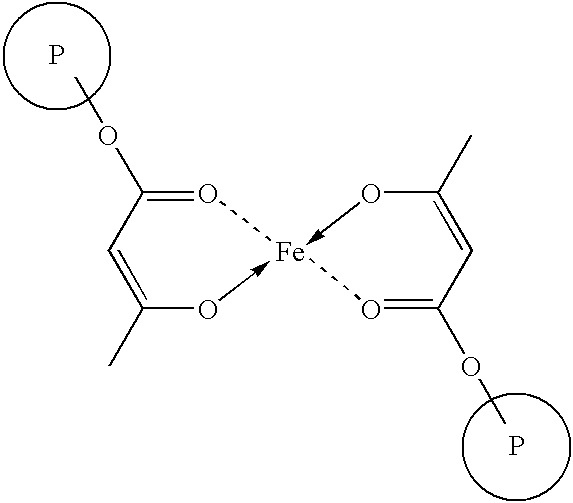
- The number of polar groups, such as an acetoacetoxy group, may affect the degree of adhesion to the metal surface. If there are large numbers of polar groups present (e.g., acetoacetoxy moieties), the resulting adsorbed polymer layer at equilibrium may be of a less than desirable thickness. This principle can be illustrated by considering a polymer molecule with an aliphatic backbone chain and polar groups substituted on every other carbon atom along the chain. At equilibrium, adsorption of the adjacent polar groups is favored sterically, resulting in a thin adsorbed layer with the polar groups situated on the metal's surface. Accordingly, control of the concentration of the acetoacetoxy-functional monomer directly impacts upon the observed adhesive properties of the latexes of the invention.
- A latex composition of the invention may be prepared by free radical emulsion polymerization of a non-acid vinyl monomer having an acetoacetoxy functionality such as those represented by Formula (1) below, with carboxylic acid-functional vinyl monomers, and with non-acid, non-acetoacetoxy vinyl monomers. The polymerization reaction affords a water-based dispersion of polymer particles with the polymer having pendant acetoacetoxy groups. A pendant acetoacetoxy group is not limited to those at the termini of the polymer. Pendant acetoacetoxy groups also include groups attached to the polymer's backbone and available for further reaction.
- Any vinyl monomer having an acetoacetoxy-type functionality may be used to prepare an acetoacetoxy-functional polymer of the invention. Of such monomers, preferred monomers are those represented by Formula (I):
- R1—CH═C(R2)C(O)—X1—X2—X3—C(O)—CH2—C(O)—R3 (I)
- For an acetoacetoxy-type monomer of Formula (I), R 1 is a hydrogen or halogen; R2 is a hydrogen, halogen, C1-C6 alkylthio group or C1-C6 alkyl group; R3 is a C1-C6 alkyl group; X1 and X3 are independently O, S or a group of the formula —N(R′)—, where R′ is hydrogen or a C1-C6 alkyl group; and X2 is a C2-C12 alkylene group or a C3-C12 cycloalkylene group. The alkyl and alkylene groups described here and throughout the specification may be straight or branched groups. Preferred monomers of Formula (I) include acetoacetoxyethyl methacrylate, acetoacetoxyethyl acrylate, acetoacetoxy (methyl)ethyl acrylate, acetoacetoxypropyl acrylate, allyl acetoacetate, acetoacetamidoethyl (meth)acrylate, and acetoacetoxybutyl acrylate. Acetoacetoxyethyl methacrylate (AAEM) represents a particularly preferred monomer. The term “(meth)acrylate” is used here, and throughout the specification, to denote both methacrylate and acrylate monomers.
- Adhesion is enhanced by the use of latex polymers having multiple hydrogen donating and accepting groups. Carboxylic acid-functional vinyl monomers, for example, function as strong hydrogen-donating groups, which in turn promote adhesion of the coating composition to the metal's surface. Hence, incorporating an appropriate amount of a carboxylic acid-functional vinyl monomer into an acetoacetoxy-functional polymer, according to the invention, improves a latex's or a coating composition's anti-corrosive properties. Too much of a carboxylic acid-functional vinyl monomer increases hydrophilicity, and too little decreases anti-corrosive properties. The carboxylic acid-functional vinyl monomer may also aid in the enamine formation step, by acting as a catalyst to facilitate transformation of the acetoacetoxy functionality to an enamine functionality in those compositions containing a blend of an acetoacetoxy functional polymer and a poly(alkylenimine), discussed below.
- The acid-functional vinyl monomer of the invention may be selected broadly from carboxylic acids, phosphonic acids, acid anhydrides, phosphate monomers, and other functionalities which are capable of reacting with a base to form a salt. Examples of suitable carboxylic acid-functional vinyl monomers, or vinyl monomers capable of providing carboxylic acid-functionality, include, but are not limited to, acrylic acid, methacrylic acid, itaconic acid, itaconic anhydride, citraconic acid, citraconic anhydride, and maleic anhydride. Acrylic acid, methacrylic acid, itaconic acid and maleic anhydride represent preferred carboxylic acid-functional monomers, or monomers capable of providing carboxylic acid-functionality. Examples of suitable phosphate monomers include vinyl phosphoric acid, such as Rhodia's DV-6280® product, Sartomer's CD-9050® product, and Hardwick's T-MULZ HP® product.
- The acetoacetoxy-functional polymer in the latex of the invention also contains non-acid, non-acetoacetoxy vinyl monomers. One type of non-acid, non-acetoacetoxy vinyl monomer which may be used is represented by the general Formula (II):
- CH2═C(R1)C(O)O—R2 (II)
- wherein R 1 is hydrogen or a C1-C3 alkyl group, and R2 is a C1-C20 alkyl, phenyl, benzyl, hydroxy-(C1-C4)-alkyl, (C1-C4)-alkoxy-(C1-C4)-alkyl, cyclopentyl, cyclohexyl, furyl, (C1-C4)-alkyl-furyl, tetrahydrofuryl, or (C1-C4)-alkyl-tetrahydrofuryl group, or a combination of two or more of these monomers. Variations of R1 can be used to modify the glass transition temperature (Tg) of the film of the copolymer.
- Specific examples of suitable non-acid, non-acetoacetoxy vinyl monomers include, but are not limited to, methyl (meth)acrylate, ethyl (meth)acrylate, butyl (meth)acrylate, hexyl (methacrylate), isooctyl (methacrylate), isodecyl (meth)acrylate, lauryl (meth)acrylate, stearyl (meth)acrylate, phenoxyethyl (meth)acrylate, methoxyethyl (meth)acrylate, benzyl (meth)acrylate, furyl (meth)acrylate, methylfuryl (meth)acrylate, butylfuryl (meth)acrylate, tetrahydrofuryl (meth)acrylate, ethoxyethyl (meth)acrylate, 2-ethylhexyl (meth)acrylate, cyclopentyl (meth)acrylate, isobornyl (meth)acrylate, hydroxyethyl (meth)acrylate, hydroxypropyl (meth)acrylate, and combinations or mixtures thereof. Other non-acid, non-acetoacetoxy vinyl monomers that may be used include styrene derivatives and vinyl derivatives. Examples of suitable styrene derivatives include, but are not limited to, styrene, vinyl toluene, o-methyl styrene, p-methyl styrene and m-methyl styrene. Vinyl derivatives include, but are not limited to, vinyl esters such as vinyl acetate, vinyl propionate, vinyl 2-ethylhexanoate, vinyl neononoate, vinyl neodecanoate, and vinyl esters of versatic acid. Such monomers are described in The Brandon Worldwide Monomer Reference Guide and Sourcebook, Second Edition, 1992, Brandon Associates, Merrimack, N.H.; and in Polymers and Monomers, the 1996-1997 Catalog from Polyscience, Inc., Warrington, Pa.
- In addition to the monomers discussed above, the acetoacetoxy-functional polymer may also contain about 0.5 to about 5.0 wt % of at least one non-self-polymerizable, surface-active vinyl monomer. Such monomers are also known as non-self-polymerizable ethylenically-unsaturated surfactants, or reactive surfactants. A non-self-polymerizable surfactant monomer, rather than polymerizing with itself to form a separate polymeric surfactant, is substantially (preferably completely) incorporated into the polymer of the invention. Thus, the surfactant becomes part of the polymer. Non-self-polymerizing surfactants possessing, for example, propenylphenyl or allyl groups are preferred. Examples include surface active monomers sold by PPG Industries, Inc., as MAZON® SAM 181, 183, 184 and 211 surfactants, which are anionic sulfates, or sulfonates and MAZON®SAM 185-187 surfactants, which are nonionic surfactants.
- Other non-self-polymerizing, surface-active vinyl monomers include the macro-monomers sold by Daiichi Kogyo Seiyaku under the names NIOGEN RN, AQUARON, and HITENOL. These surfactants include polyoxyethylene alkyl phenyl ether compounds of the general formulae (3), (4) and (5):
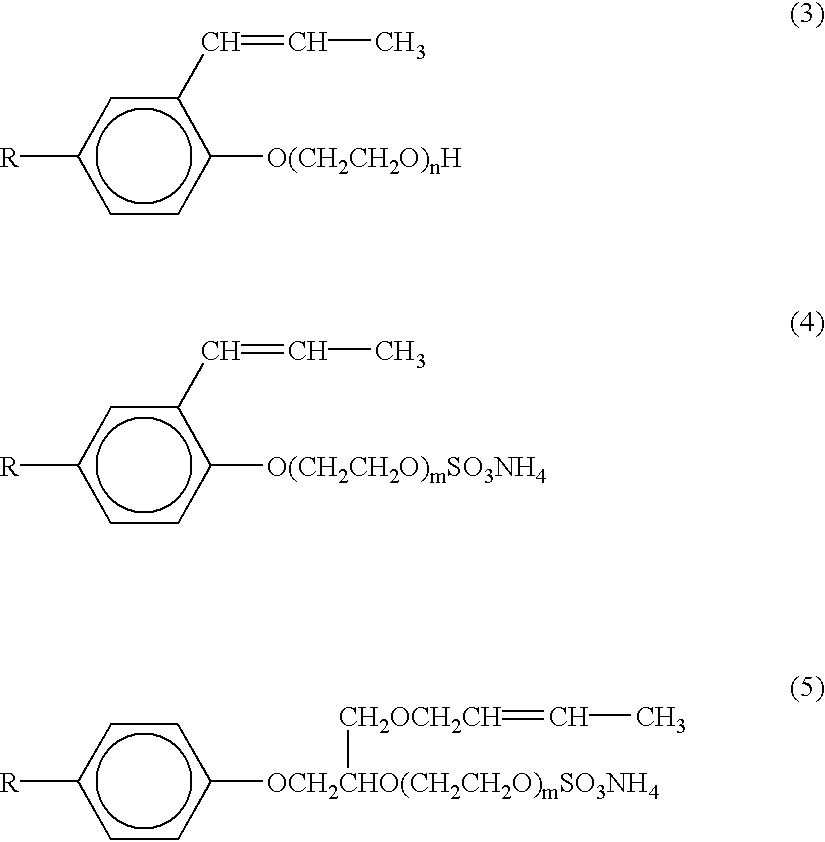
- In Formulae (3), (4) and (5), R is nonyl or octyl, and n and m are preferably integers of from 15 to 50 and 15 to 40, respectively. More preferably, n ranges from 20 to 40, and m from 15 to 215. HITENOL RN, HITENOL HS-20, HITENOL A-10, and HITENOL BC-20 are particularly preferred non-self-polymerizing surface-active monomers.
- In another embodiment of the invention, the acetoacetoxy-functional polymer may also comprise about 0.1 to 10 wt % of an adhesion-promoting monomer. One example of an adhesion-promoting monomer is an amide-containing vinyl monomer, in which the amide group promotes wet adhesion. Examples of such amide-containing monomers include, but are not limited to, vinyl pyrrolidone, acrylamide, and N-substituted acrylamides. Preferred N-substituted acrylamides include N-methylol acrylamide, N, N-dimethyl acrylamide, N-ethyl (meth)acrylamide, N-t-butyl (meth)acrylamide, N-t-octyl (meth)acrylamide, N-decyl (meth)acrylamide, N-dodecyl (meth)acrylamide, ethylpentyl (meth)acrylamide, and butylphenyl (meth)acrylamide. Another type of adhesion-promoting monomer is an amine-containing vinyl monomer. Amine groups are strongly hydrogen accepting, and are not easily displaced by water on the metal surface. Suitable examples of amine-containing monomers include, but are not limited to, t-butylaminoethyl (meth)acrylate, di-(alkyl)aminoethyl (meth)acrylates, N, N-di-(alkyl)aminopropyl (meth)acrylates, 2-t-butylaminoethyl (meth)acrylate, N, N-di-(alkyl)aminoethyl (meth)acrylates, and ureido monomers such as N-(2-methacryloxy-ethyl)ethylene urea.
- A latex composition of the invention containing an acetoacetoxy-functional latex may be prepared using emulsion polymerization techniques such as those known in the art. Chain transfer agents, initiators, reducing agents, buffers, and catalysts, known in the art of emulsion polymerization, may be used to prepare the polymers.
- Exemplary chain transfer agents include, but are not limited to, butyl mercaptan, t-butyl mercaptan, dodecyl mercaptan, mercaptopropionic acid, 2-ethylhexyl 3-mercaptopropionate, n-butyl 3-mercaptopropionate, octyl mercaptan, isodecyl mercaptan, octadecyl mercaptan, mercaptoacetic acid, allyl mercaptopropionate, allyl mercaptoacetate, crotyl mercaptopropionate, crotyl mercaptoacetate, and haloalkyl compounds such as carbon tetrabromide and bromodichloromethane. In particular, 2-ethylhexyl 3-mercaptopropionate represents a preferred chain transfer agent.
- Typical initiators include hydrogen peroxide, potassium or ammonium persulfate, dibenzoyl peroxide, lauryl peroxide, ditertiary butyl peroxide, 2,2′-azobisisobutyronitrile, t-butyl hydroperoxide, and cumene hydroperoxide. A preferred amount of a peroxide or persulfate initiator is about 0.1 to about 2.0 wt %.
- Redox initiators may also be used, and include, but are not limited to, combinations of peroxygen or persulfate compounds with sodium metabisulfite, sodium formaldehyde sulfoxylate, ascorbic acid, isoascorbic acid, glyoxal bisulfite, or divalent iron salt. The preferred amount of a redox initiator system is about 0.05 to about 1.5 wt %.
- Polymerization catalysts are those compounds which increase the rate of polymerization and which, in combination with the above described reducing agents, may promote decomposition of the polymerization initiator under the reaction conditions. Suitable catalysts include transition metal compounds such as, for example, ferrous sulfate heptahydrate, ferrous chloride, cupric sulfate, cupric chloride, cobalt acetate, cobaltous sulfate, and mixtures thereof.
- After polymerization, the pH of the gel-free emulsion is partially neutralized with a low molecular weight organic base. The base may be added to an aqueous dispersion of either the acetoacetoxy-functional polymer latex prior to the addition of a poly(alkylenimine), or to the blend of the acetoacetoxy-functional latex and a poly(alkylenimine). Latexes having pH values in the range of about 7.0 to about 10.5 may be achieved using such bases. Low molecular weight organic bases include, for example, ammonia, monoethanolamine, diethanolamine, triethanolamine, 2-methyl-2-amino-1-propanol (AMP), 2-amino-2-methyl propanediol, N, N-dimethyl-2-amino-2-methyl-1-propanol, monoisopropanolamine, triisopropanolamine, morpholine, monoamine glycols, ethylenediamine, diethylenetriamine, and the like. Mixtures of low molecular weight bases may also be used. The preferred amount of low molecular weight organic base is in the range of 50 to 80 mole percent, where the mole percent is based on the total number of moles of the acetoacetoxy-functional monomers and the carboxylic acid functional vinyl monomers present in the acetoacetoxy-functional polymer.
- In addition to the above discussed non-self-polymerizing, surface-active monomers that may be used in preparing the latexes of the invention, other anionic and/or nonionic surfactants may also be used in the latexes of the invention. Examples of suitable anionic surfactants include, but are not limited to, sodium lauryl sulfate, sodium octylphenol glycolether sulfate, sodium dodecylbenzene sulfonate, sodium lauryl-diglycol sulfate, and ammonium tri-t-butyl phenol. Suitable nonionic surfactants include, but are not limited to, alkyl polyglycol ethers such as ethoxylation products of octyl- or nonyl-phenol, diisopropyl phenol, and triisopropyl phenol.
- Another embodiment of the invention is an anti-corrosive and solvent-resistant composition comprising a blend of the above-described acetoacetoxy-functional polymer latex with a poly(alkylenimine). As discussed above, addition of the poly(alkylenimine) imparts increased solvent resistance to a coating composition containing a latex/poly(alkylenimine) blend according to the invention. Other beneficial properties such as water resistance, and improved mechanical properties such as hardness and blocking resistance, also result from use of the latex/poly(alkylenimine) blend.
- In general, a poly(alkylenimine) contains primary, secondary, and tertiary amine groups. Poly(alkylenimines) used in the invention may have a weight average molecular weight of about 400 to about 750,000. The poly(alkylenimine) is preferably a poly(ethylenimine) (PEI), and more preferably a low molecular weight PEI having a weight average molecular weight of less than 30,000. Such PEI compounds are commercially available from many sources and include POLYMIN poly(ethylenimine) and LUPASOL poly(ethylenimine) available from BASF Corporation. BASF poly(ethylenimine) product literature reports the ratio of primary:secondary:tertiary amine groups to be about 1:2:1. A preferred PEI, LUPASOL G35 poly(ethylenimine), has a molecular weight of about 2,000 and a ratio of primary:secondary:tertiary amine groups of about 1.5:1.4:1.
- The latex/poly(alkylenimine) blends are prepared by simple mixing of the acetoacetoxy-functional polymer latex and the poly(alkylenimine). The poly(alkylenimine) may be blended with the latex in an amount up to about 30 wt % based on the amount of acetoacetoxy-functional polymer in the latex. The concentration of a poly(alkylenimine) used in the mixing reaction is less than about 8.0 wt %, based on the total weight of the monomers, and is preferably less than about 6.0 wt %.
- When coated on a substrate, the primary and secondary amine groups of the poly(alkylenimine) react with the pendant acetoacetoxy groups on the acetoacetoxy-functional polymer to form enamine linkages. Enamine formation results in cross-linking of the polymer latex and typically occurs upon film formation, although there may be some enamine formation in the latex blend prior to coating. Enamine formation in the latex results in a polymeric (polyamino) enamine latex, wherein the polymeric (polyamino) enamine latex is the reaction product of an acetoacetoxy-functional polymer and a poly(alkylenimine). When the poly(alkylenimine) is a polymer such as poly(ethylenimine), the amount of poly(alkylenimine) added may depend on the molecular weight. Larger amounts of lower molecular weight poly(alkylenimines) are typically added to achieve a desired amount of crosslinking and film properties upon film formation. For higher molecular weight poly(alkylenimines), a smaller amount may be used for the desired crosslinking and film properties.
- The invention relates also to water-based, anti-corrosive coating compositions containing the acetoacetoxy-functional polymer latex composition of the invention. The invention also relates to water-based, anti-corrosive and solvent-resistant coating compositions containing an acetoacetoxy-functional latex composition of the invention in combination with a poly(alkylenimine). As discussed above, the latter coating composition may be a one-pack or a two-pack system.
- A coating composition according to the invention may comprise a mixture of water-based latexes of the invention, water, a solvent, a pigment (organic or inorganic), a dispersant, a defoamer, a wetting agent, and/or other additives and fillers known in the art. When a solvent is used, water-immiscible solvents are preferred.
- For example, a coating composition of the invention may comprise a water-based latex of the invention, a pigment, and one or more additives or fillers used in latex paints. Such additives or fillers include, but are not limited to, leveling, rheology and flow control agents such as silicones, fluorocarbons, urethanes or cellulosics; extenders; coalescing aids; reactive coalescing aids such as those described in U.S. Pat. No. 5,349,026; flatting agents; pigment wetting and dispersing agents and surfactants; ultraviolet (UV) absorbers; UV light stabilizers; tinting pigments; extenders; defoaming and antifoaming agents; anti-settling, anti-sag and bodying agents; anti-skinning agents; anti-flooding and anti-floating agents; fungicides and mildewcides; thickening agents; plasticizers; reactive plasticizers; and curing agents. Specific examples of such additives can be found in Raw Materials Index, published by the National Paint & Coatings Association, 1500 Rhode Island Avenue, NW, Washington, D.C. 20005.
- A water-based latex of the invention can be utilized alone or in conjunction with other conventional waterborne polymers. Such polymers include, but are not limited to, water dispersible polymers such as polyesters, polyester-amides, cellulose esters, alkyds, polyurethanes, epoxy resins, polyamides, acrylics, vinyl polymers, styrene-butadiene polymers, vinylacetate-ethylene copolymers, and the like.
- Upon formulation, a coating composition containing a water-based latex of the invention may be applied to metal surfaces using means known in the art. For example, a coating composition may be applied by spraying or by coating a metal substrate. In general, the coating may be dried by heating but preferably is allowed to air dry. Advantageously, a coating employing a water-based latex of the invention may be thermally or ambiently cured.
- A water-based coating composition according to the invention may be used on any metal substrate subject to corrosion. The coating compositions are particularly suited for maintenance paint applications, such as used with iron or steel industrial and transportation structures.
- The following examples below are intended to illustrate, not limit, the invention.
- The examples use the following materials:
- HITENOL BC-20, a non-self-polymerizing surfactant, sold by Daiichi Kogyo Seiyaku.
- PROXEL GXL, a preservative, sold by Zeneca.
- LUPASOL G35, a poly(ethylenimine), sold by BASF.
- SURFYNOL® DF-210, a defoamer, sold by Air Products and Chemicals, Inc.
- SURFYNOL® CT-131, a dispersant, sold by Air Products and Chemicals, Inc.
- SURFYNOL® 104 DPM, a wetting agent, sold by Air Products and Chemicals, Inc.
- MAPHOS 60A, a phosphate ester, sold by BASF.
- ABEX 2545, a surfactant, sold by Rhodia.
- AMPS (2-acrylamido-2-methylpropane-1-sulfonic acid), a surfactant, sold by Lubrizol Corporation.
- AEROSOL NPES-2030, a surfactant, sold by Cytec.
- TI-PURE® R-706, a titanium dioxide pigment, sold by E. I. DuPont de Nemours.
- TEXANOL® ester alcohol, a coalescing aid, sold by Eastman Chemical Company.
- BYK-025, sold by BYK Chemie.
- ACRYSOL® RM-8W, sold by Rohm & Haas.
- DPnB (di-(propylene glycol)-n-butyl ether), sold by Dow Chemical.
- An emulsion polymerization was conducted in a two-liter reaction kettle equipped with a condenser, a stirring shaft with a motor, and a nitrogen purge. To the reaction kettle, 203 g of deionized (DI) water and 7.0 g of an 18 wt % solution of HITENOL BC-20 were added. The contents of the reactor were then heated to 85° C. In a separate flask, a mixture of 301 g of styrene, 83.3 g of methyl methacrylate, 310 g of butylacrylate, 0.4 g of hydroxyethyl methacrylate, 126 g of 2-acetoacetoxyethyl methacrylate, 17.0 g of methacrylic acid, and 2.4 g of isooctylmercaptopropionate were stirred into 500 g of water containing 1.7 g of ammonium carbonate and 75.5 g of a 18 wt % solution of HITENOL BC-20. Approximately 57.3 g of the monomer mixture was then added to the reactor followed by 1.3 g of ammonium persulfate dissolved in 18 g of water. The remaining monomer emulsion was then fed into the reactor over a 250 minute period. During the same period, 2.6 g of ammonium persulfate and 1.7 g of ammonium carbonate dissolved in 55 g of water were fed into the reactor. After all of the monomer feed was in the reactor, the contents were cooled to 65° C., and 3.6 g of t-butylhydroperoxide in 18 g of water and 2.6 g of sodium formaldehyde sulfoxylate in 18 g of water were fed into the reactor over 20 minutes. This was followed by 36.4 g of a 28% aqueous solution of ammonium hydroxide and 1.7 g of PROXEL GXL. The latex was filtered through 100 mesh screen.
- Into the above described kettle containing 2400 g of the surfactant-stabilized acetoacetoxy-functional latex polymer generated in Example 1 was mixed 7.8 g of a 28% ammonia solution, 0.8 g of SURFYNOL® DF-210, and 233 g of a 10% solution of the polyethylenimine LUPASOL G35. Solid content was 45.5%.
- Into the above described kettle containing 2400 g of the surfactant-stabilized acetoacetoxy-functional latex polymer generated in Example 1 was mixed 52 g of diethylenetriamine (DETA).
- An emulsion polymerization was conducted in a two-liter reaction kettle equipped with a condenser, a stirring shaft with motor, and a nitrogen purge. Approximately 557 g of DI water, 7.20 g of MAPHOS 60A, and 2.57 g of ammonium hydroxide (28% NH 3 content) were added to the kettle. The contents of the reactor were then heated to 80° C. In a separate flask, a mixture of 379 g of styrene, 255 g of butylacrylate, 72 g of 2-acetoacetoxyethyl methacrylate, and 28.8 g of 2-acrylamido-2-methylpropane-1-sulfonic acid (AMPS) surfactant were stirred into 340 g of water containing 2.57 g of ammonium hydroxide (28% NH3 content) and 4.32 g MAPHOS 60A. Approximately 30.3 g of the monomer mixture was then added to the reactor followed by 1.44 g of ammonium persulfate dissolved in 9.0 g of water. After a 15 minute hold period, the remaining monomer emulsion was then fed into the reactor over a 180 minute period. During the same period, 1.44 g of ammonium persulfate dissolved in 21.5 g of water was also fed into the reactor. After all of the monomer feed was added to the reactor, the contents were cooled to 65° C. and 0.82 g of t-butylhydroperoxide in 11 g of water and 0.58 g of sodium metabisulfite in 11 g of water were fed into the reactor over 20 minutes. This addition was followed by 72.0 g of ABEX 2545 surfactant.
- Into the above described kettle containing 2400 g of the surfactant-stabilized acetoacetoxy-functional latex polymer generated in Example 4 was mixed 2.73 g of a 95% aminoethyl propanol solution followed by 144 g of LUPASOL G35. The latex was then filtered through 100 mesh screen and the particle size was measured by DLS to be 123 nm.
- An emulsion polymerization was conducted in a two-liter reaction kettle equipped with a condenser, a stirring shaft with motor, and a nitrogen purge. Approximately 205 g of DI water and 4.25 g of AEROSOL NPES-2030 (a 30% active surfactant from Cytec) were added. The contents of the reactor were then heated to 85° C. In a separate flask, a mixture of 306 g of styrene, 84.6 g of methylmethacrylate, 314 g of butylacrylate, 0.42 g of hydroxyethyl methacrylate, 126 g of 2-acetoacetoxyethyl methacrylate, 17.0 g of methacrylic acid, and 3.40 g of iso-octylmercaptopropionate were stirred into 500 g of water containing 1.70 g of ammonium carbonate and 45.3 g of AEROSOL NPES-2030. Approximately 57.2 g of the monomer mixture was then added to the reactor followed by 1.27 g of ammonium persulfate dissolved in 18 g of water. The remaining monomer emulsion was then fed into the reactor over a 250 minute period. During the same period, 2.55 g of ammonium persulfate and 1.70 g of ammonium carbonate dissolved in 55.1 g of water was fed into the reactor. After all of the monomer feed was in the reactor, the contents were cooled to 65° C., and 3.64 g of t-butylhydroperoxide in 18.4 g of water and 2.55 g of sodium formaldehyde sulfoxylate in 18.4 g of water were fed into the reactor over 20 minutes. This addition was followed by 36.4 g of a 28% ammonium hydroxide solution and 1.70 g of PROXEL GXL. The latex was filtered through 100 mesh screen and the particle size was measured by DLS to be 138 nm.
- Into the above described kettle containing 970 g of the acetoacetoxy-functional latex polymer (containing no polymerizable surfactant) generated in Example 6 was mixed 6.0 g of a 28% ammonia solution, followed by 0.4 g of SURFYNOL® DF-210 and 44.0 g of a 20% solution of LUPASOL G35.
- Formulation of the Coatings
- The anti-corrosive performance and application properties of a coating are affected by the choice of paint ingredients. The preferred amount of each ingredient in a sample composition is listed in Table 1.
TABLE 1 Gloss Topcoat for Airless Spray Application INGREDIENTS POUNDS Grind Preparation Water 58.81 28 % Ammonia 0.80 SURFYNOL CT-131 6.07 SURFYNOL 104 DPM 1.49 SURFYNOL DF-210 0.49 BYK-025 1.18 Ti-Pure 706 197.34 20% RM-8W/water 0.19 Grind to 7 Hegman Letdown Preparation Water 20.84 Latex (Examples 1, 2, 3 and 5) 654.62 BYK-025 3.30 15% Sodium Nitrite 7.53 Texanol/DPnB* 11.84/32.41 20% RM-8W/water 3.09 1000.00 - Test Methods
- There has been an increased recognition of the importance of wet/dry cycling, or cyclic stress factors in general, and the influence of weathering factors (e.g., UV light exposure and moisture condensation) in the overall paint degradation and corrosion process. This recognition is due to the fact that corrosion at the paint/metal interface and weathering of paint films are processes occurring simultaneously and may be significantly interrelated. For example, weather-induced degradation of a paint's organic binder may result in a more hydrophilic coating surface which could alter the time-of-wetness and subsequent corrosion characteristics of the system. Accordingly, several varied tests were conducted to evaluate the overall effectiveness of the anti-corrosive capabilities of the invention.
- 1. Salt Fog Spray
- Standards from the American Society for Testing and Materials (ASTM) were employed for this test. The coatings were drawn down onto cold roll steel (R-36) panels and cured in a constant temperature and humidity room for 7 days. The dry film thickness was measured at 3.0+/−0.3 mils. The panels were then exposed to salt fog spray (ASTM B117) to assess their utility in anti-corrosive coatings formulations. In this test, the components to be tested are prepared and suspended in a sealed chamber where they are subjected to a spray or fog of a neutral 5% salt solution which is atomized at a temperature of 95° F. Testing of this type is considered useful when evaluating the behavior of materials subjected to a marine environment. Overall rusting (ASTM D610) and blistering (ASTM D714) were evaluated, as well as rusting and blistering at the scribe (ASTM D1654) after designated time periods.
- 2. Cleveland Humidity Resistance
- Cleveland humidity resistance was also conducted as a primary test and measured humidity resistance under high humidity and high temperature conditions. In the test, steel panels were exposed to 100% relative humidity at 50° C. The panels were then evaluated for rusting and blistering according to ASTM D610 and ASTM D714, respectively. Gloss and gloss retention were also examined.
- 3. QUV Weathering Test (QUV)
- The QUV weathering test assesses anti-corrosion, and reproduces the damage caused by sunlight, rain and dew. The QUV tests materials by exposing them to alternating cycles of light and moisture at controlled, elevated temperatures. The QUV simulates the effect of sunlight with fluorescent ultraviolet (UV-A or UV-B) lamps while the test simulates dew and rain with condensing humidity and water sprays. Exposure conditions can be varied to simulate various end-use environments. The QUV can reproduce damage that occurs over months or years outdoors in only a few weeks. Surface chalking, gloss, and gloss retention are characteristics typically used in assessing weathering. A QUV-weathering/corrosion cabinet was used to assess the effect of wet/dry cycles, UV light exposure, and moisture condensation on the coated panels which were placed inside the cabinet.
- 4. MEK Rubs
- Polymer films dried at specified conditions were constantly soaked with methyl ethyl ketone (MEK). Data was obtained using a crockmeter with a 1 kg weight placed on the arm for a total weight of approximately 1500 g. The test, which measures resistance to MEK, ended when the breakthrough of the film on the panel was first observed. Data were reported as MEK double rubs (one set of back and forth).
- Other tests such as hardness, appearance, gloss and gloss retention were also used to assist in the evaluation.
- Results
- The results of panels coated with paints formulated with the latexes described in Examples 1, 2, 3, 5, 6 and 7 and exposed to 300 hours of exposure to salt fog spray are depicted in FIG. ( 1). Examples 1, 2 and 6 demonstrated excellent corrosion resistance, with the Example 2 panel (coated with a surfactant-stabilized acetoacetoxy functional latex formulation) and the Example 6 panel (coated with an acetoacetoxy functional latex formulation lacking any polymerizing surfactant) showing particular resistance to the harsh test conditions employed. Example 3 (using DETA rather than a PEI) showed substantial corrosion and Example 5 (no carboxylic acid-functional vinyl monomer) revealed little or no anti-corrosive properties.
- Results of the Cleveland humidity test, depicted in FIG. ( 2), indicated that the panels coated with formulations of Examples 1, 2, 6 and 7 were resistant to rust and blister and retained a good gloss. Panels coated with formulations of Example 5, and especially Example 3, showed fading and substantial blistering under similar conditions.
- The results of the QUV tests for Examples 1, 2, 3 and 5 depicted in FIGS. ( 3) and (4) demonstrate the effect of weathering on gloss at 60° and 20° readings, respectively. The panels coated with formulations of Examples 1 and 2 exhibited good gloss retention in contrast to Examples 3 and 5 where the films quickly lost integrity, and gloss, and became chalky in the QUV-weathering cabinet.
- Table 2 demonstrates that MEK double rubs of the paint formulated with Example 7 are above 600, while the results of Examples 2 and 3 exhibit values above 100. This finding is particularly significant since MEK double rubs of most waterborne 1-K coatings are less than 100.
TABLE 2 MEK Double Rubs MEK(1)* MEK(2)* Example 1 30 75 Example 2 253 415 Example 3 126 151 Example 5 58 90 Example 6 37 — Example 7 680 — - It should be understood that the foregoing discussion and examples merely present a detailed description of certain preferred embodiments. It will be apparent to those of ordinary skill in the art that various modifications and equivalents can be made without departing from the spirit and scope of the invention. All the patents, journal articles and other documents discussed or cited above are herein incorporated by reference.
Claims (26)
1. A latex composition comprising an acetoacetoxy-functional polymer which comprises the emulsion polymerization product of:
(i) about 0.5 to about 30 wt % of at least one acetoacetoxy-functional monomer;
(ii) about 0.3 to about 6 wt % of at least one carboxylic acid-functional vinyl monomer; and
(iii) about 60 to about 99.2 wt % of at least one non-acid, non-acetoacetoxy vinyl monomer.
2. The latex composition of claim 1 , wherein the at least one acetoacetoxy-functional monomer includes at least one monomer of Formula (1):
R1—CH═C(R2)C(O)—X1—X2—X3—C(O)—CH2—C(O)—R3 (I)
wherein R1 is a hydrogen or halogen; R2 is a hydrogen, halogen, C1-C6 alkylthio group or C1-C6 alkyl group; R3 is a C1-C6 alkyl group; X1 and X3 are independently O, S or a group of the formula —N(R′)—, in which R′ is hydrogen or a C1-C6 alkyl group; and X2 is a C1-C12 alkylene group or C3-C12 cycloalkylene group.
3. The latex composition of claim 1 , wherein the monomers polymerized to produce the acetoacetoxy-functional polymer further comprise (iv) about 0.5 to about 5 wt % of at least one non-self polymerizing, surface-active vinyl monomer.
4. The latex composition of claim 1 , wherein the monomers polymerized to produce the acetoacetoxy-functional polymer further comprise about 0.1 to about 10 wt % of at least one adhesion-promoting monomer selected from the group consisting of an amine-containing vinyl monomer, an amide-containing vinyl monomer, and mixtures thereof.
5. The latex composition of claim 1 , wherein the at least one carboxylic acid-functional vinyl monomer includes methacrylic acid.
6. The latex composition of claim 2 , wherein the at least one monomer of Formula (I) includess at least one member selected from the group consisting of acetoacetoxyethyl methacrylate, acetoacetoxyethyl acrylate, acetoacetoxy(methyl)ethyl acrylate, acetoacetoxypropyl acrylate, allyl acetoacetate, acetoacetamidoethyl (meth)acrylate, and acetoacetoxybutyl acrylate.
7. The latex composition of claim 3 , wherein the monomers polymerized to produce the acetoacetoxy-functional polymer further comprise about 0.1 to about 10 wt % of at least one adhesion-promoting monomer selected from the group consisting of an amine-containing vinyl monomer, an amide-containing vinyl monomer, and mixtures thereof.
8. The latex composition of claim 3 , wherein the at least one acetoacetoxy-functional monomer includes at least one member selected from the group consisting of acetoacetoxyethyl methacrylate, acetoacetoxyethyl acrylate, acetoacetoxy(methyl)ethyl acrylate, acetoacetoxypropyl acrylate, allyl acetoacetate, acetoacetamidoethyl (meth)acrylate, and acetoacetoxybutyl acrylate; and wherein the non-self-polymerizing, surface-active vinyl monomer includes at least one polyoxyethylene alkyl phenyl ether of formulae (3), (4) or (5):
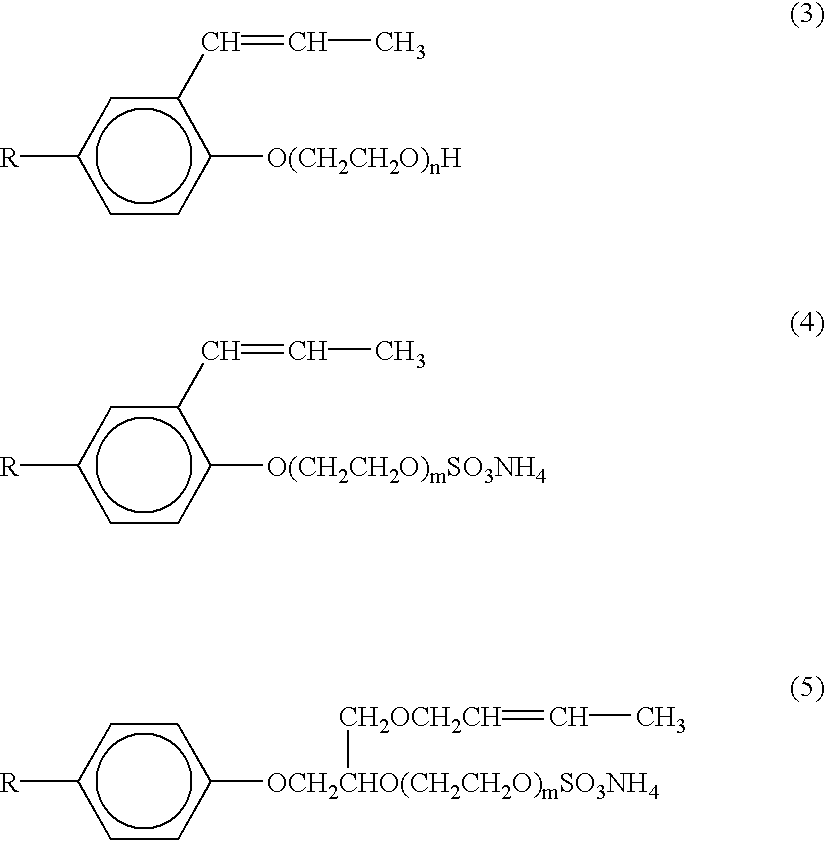
wherein R is nonyl or octyl, n ranges from 15 to 50, and m ranges from 15 to 40.
9. The latex composition of claim 3 , wherein the latex composition is comprised of particles having a size that ranges from about 80 nm to about 300 nm.
10. The latex composition of claim 1 , wherein the pH of the composition ranges from about 7.0 to about 10.5.
11. The latex composition of claim 3 , wherein the pH of the composition ranges from about 7.0 to about 10.5.
12. The latex composition of claim 1 , further comprising a low molecular weight organic base.
13. The latex composition of claim 3 , further comprising a low molecular weight organic base.
14. The latex composition of claim 12 , wherein the low molecular weight organic base is selected from ammonia, 2-amino-2-methyl-1-propanol, and mixtures thereof.
15. The latex composition of claim 13 , wherein the low molecular weight organic base is selected from ammonia, 2-amino-2-methyl-1-propanol, and mixtures thereof.
16. A latex composition comprising:
an acetoacetoxy functional polymer which comprises the emulsion polymerization product of:
(i) about 0.5 to about 30 wt % of at least one acetoacetoxy-functional monomer;
(ii) about 0.3 to about 6 wt % of at least one carboxylic acid-functional vinyl monomer; and
(iii) about 60 to about 99.2 wt % of at least one non-acid, non-acetoacetoxy vinyl monomer; and
at least one poly(alkylenimine).
17. The latex composition of claim 16 , wherein the at least one acetoacetoxy-functional monomer includes at least one monomer of Formula (1):
R1—CH═C(R2)C(O)—X1—X2—X3—C(O)—CH2—C(O)—R3 (I)
wherein R1 is a hydrogen or halogen; R2 is a hydrogen, halogen, C1-C6 alkylthio group or C1-C6 alkyl group; R3 is a C1-C6 alkyl group; X1 and X3 are independently O, S or a group of the formula —N(R′)—, in which R′ is hydrogen or a C1-C6 alkyl group; and X2 is a C1-C12 alkylene group or C3-C12 cycloalkylene group.
18. The latex composition of claim 16 , wherein the monomers polymerized to produce the acetoacetoxy-functional polymer further comprise (iv) about 0.5 to about 5 wt % of at least one non-self polymerizing, surface-active vinyl monomer.
19. The latex composition of claim 16 , wherein the monomers polymerized to produce the acetoacetoxy-functional polymer further comprise about 0.1 to about 10 wt % of at least one adhesion-promoting monomer selected from the group consisting of an amine-containing vinyl monomer, an amide-containing vinyl monomer, and mixtures thereof.
20. The latex composition of claim 16 , wherein the at least one poly(alkylenimine) includes poly(ethylenimine).
21. The latex composition of claim 17 , wherein the at least one monomer of Formula (I) includes a member selected from the group consisting of acetoacetoxyethyl methacrylate, acetoacetoxyethyl acrylate, acetoacetoxy(methyl)ethyl acrylate, acetoacetoxypropyl acrylate, allyl acetoacetate, acetoacetamidoethyl (meth)acrylate, and acetoacetoxybutyl acrylate.
22. The latex composition of claim 21 , wherein the at least one acetoacetoxy-functional monomer includes a member selected from the group consisting of acetoacetoxyethyl methacrylate, acetoacetoxyethyl acrylate, acetoacetoxy(methyl)ethyl acrylate, acetoacetoxypropyl acrylate, allyl acetoacetate, acetoacetamidoethyl (meth)acrylate, and acetoacetoxybutyl acrylate, and wherein the at least one non-self-polymerizing, surface-active vinyl monomer includes at least one polyoxyethylene alkyl phenyl ether of formulae (3), (4) or (5):
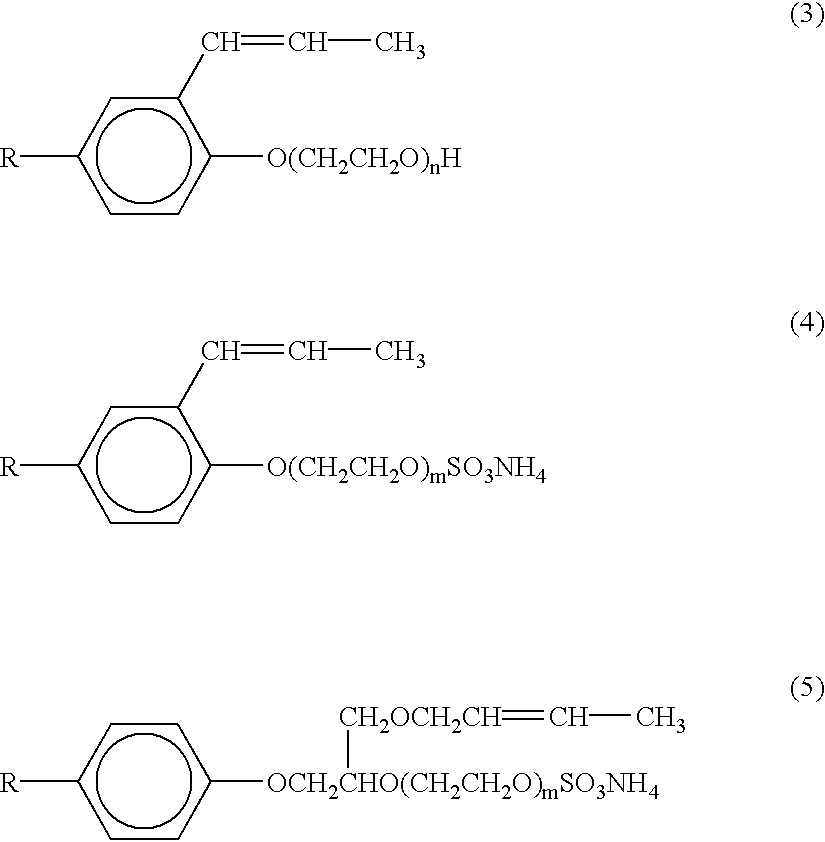
wherein R is nonyl or octyl, n ranges from 15 to 50, and m ranges from 15 to 40.
23. The latex composition of claim 21 , wherein the latex composition comprises particles having a size that ranges from about 80 nm to about 300 nm.
24. The latex composition of claim 21 , wherein the monomers polymerized to produce the acetoacetoxy-functional polymer further comprise about 0.1 to about 10 wt % of at least one adhesion-promoting monomer selected from the group consisting of an amine-containing vinyl monomer, an amide-containing vinyl monomer, and mixtures thereof.
25. A water-based coating composition, comprising the latex composition of claim 1 , and at least one member selected from the group consisting of a pigment, a leveling agent, a rheology agent, a flow control agent, an extender, a coalescing aid, a reactive coalescing aid, a flatting agent; a pigment wetting agent, a dispersing agent, a surfactant; an ultra-violet (UV) absorber; a UV light stabilizers, a tinting pigment, extenders; a defoaming agent, a antifoaming agent; an anti-settling agent, an anti-sag and bodying agent; an anti-skinning agent; an anti-flooding agent; an anti-floating agent; a fungicide; a mildewcide; a thickening agent; a plasticizer; a reactive plasticizer and a curing agent.
26. A method of protecting a metal surface from corrosion, comprising contacting the metal surface with the coating composition of claim 25.
Priority Applications (3)
| Application Number | Priority Date | Filing Date | Title |
|---|---|---|---|
| US10/186,147 US20030134973A1 (en) | 2002-01-15 | 2002-06-27 | Waterborne latexes for anti-corrosive and solvent-resistant coating compositions |
| AU2003209252A AU2003209252A1 (en) | 2002-01-15 | 2003-01-15 | Waterborne latexes for anti-corrosive and solvent-resistant coating compositions |
| PCT/US2003/001183 WO2003059971A1 (en) | 2002-01-15 | 2003-01-15 | Waterborne latexes for anti-corrosive and solvent-resistant coating compositions |
Applications Claiming Priority (2)
| Application Number | Priority Date | Filing Date | Title |
|---|---|---|---|
| US34813102P | 2002-01-15 | 2002-01-15 | |
| US10/186,147 US20030134973A1 (en) | 2002-01-15 | 2002-06-27 | Waterborne latexes for anti-corrosive and solvent-resistant coating compositions |
Publications (1)
| Publication Number | Publication Date |
|---|---|
| US20030134973A1 true US20030134973A1 (en) | 2003-07-17 |
Family
ID=26881815
Family Applications (1)
| Application Number | Title | Priority Date | Filing Date |
|---|---|---|---|
| US10/186,147 Abandoned US20030134973A1 (en) | 2002-01-15 | 2002-06-27 | Waterborne latexes for anti-corrosive and solvent-resistant coating compositions |
Country Status (3)
| Country | Link |
|---|---|
| US (1) | US20030134973A1 (en) |
| AU (1) | AU2003209252A1 (en) |
| WO (1) | WO2003059971A1 (en) |
Cited By (26)
| Publication number | Priority date | Publication date | Assignee | Title |
|---|---|---|---|---|
| EP2297259A1 (en) * | 2008-06-30 | 2011-03-23 | DSM IP Assets B.V. | Adhesion to metal surfaces with block copolymers obtained using raft |
| US20110151266A1 (en) * | 2009-12-03 | 2011-06-23 | Basf Se | Anticorrosion pigments with positive zeta potential |
| WO2012082340A1 (en) | 2010-12-15 | 2012-06-21 | Eastman Chemical Company | Substituted 3-oxopentanoates and their uses in coating compositions |
| WO2012082348A1 (en) | 2010-12-15 | 2012-06-21 | Eastman Chemical Company | Acetoacetate-functional monomers and their uses in coating compositions |
| US8298441B1 (en) * | 2007-05-22 | 2012-10-30 | The Sherwin-Williams Company | Method for incorporating water soluble, reactive, phosphorescent pigments into a stable waterborne coating through pH buffering |
| US8344056B1 (en) | 2007-04-04 | 2013-01-01 | Homax Products, Inc. | Aerosol dispensing systems, methods, and compositions for repairing interior structure surfaces |
| US8342421B2 (en) | 2004-01-28 | 2013-01-01 | Homax Products Inc | Texture material for covering a repaired portion of a textured surface |
| US8561840B2 (en) | 2004-07-02 | 2013-10-22 | Homax Products, Inc. | Aerosol spray texture apparatus for a particulate containing material |
| US8580349B1 (en) | 2007-04-05 | 2013-11-12 | Homax Products, Inc. | Pigmented spray texture material compositions, systems, and methods |
| US8622255B2 (en) | 2004-10-08 | 2014-01-07 | Homax Products, Inc. | Aerosol systems and methods for dispensing texture material |
| US20140296441A1 (en) * | 2011-04-28 | 2014-10-02 | Isp Investments Inc | Lactamic polymer containing an acetoacetate moiety |
| US8985392B2 (en) | 1992-02-24 | 2015-03-24 | Homax Products, Inc. | Systems and methods for applying texture material to ceiling surfaces |
| US9029451B2 (en) | 2010-12-15 | 2015-05-12 | Eastman Chemical Company | Waterborne coating compositions that include 2,2,4-trimethyl-3-oxopentanoate esters as reactive coalescents |
| US9102848B2 (en) | 2011-02-28 | 2015-08-11 | Basf Se | Environmentally friendly, polymer dispersion-based coating formulations and methods of preparing and using same |
| US9132953B2 (en) | 2003-04-10 | 2015-09-15 | Homax Products, Inc. | Dispenser for aerosol systems |
| US9156042B2 (en) | 2011-07-29 | 2015-10-13 | Homax Products, Inc. | Systems and methods for dispensing texture material using dual flow adjustment |
| US9156602B1 (en) | 2012-05-17 | 2015-10-13 | Homax Products, Inc. | Actuators for dispensers for texture material |
| US20160002476A1 (en) * | 2013-03-06 | 2016-01-07 | Vallourec Oil And Gas France | Threaded tubular component protected by a film |
| US9248457B2 (en) | 2011-07-29 | 2016-02-02 | Homax Products, Inc. | Systems and methods for dispensing texture material using dual flow adjustment |
| US9382060B1 (en) | 2007-04-05 | 2016-07-05 | Homax Products, Inc. | Spray texture material compositions, systems, and methods with accelerated dry times |
| US9435120B2 (en) | 2013-03-13 | 2016-09-06 | Homax Products, Inc. | Acoustic ceiling popcorn texture materials, systems, and methods |
| USD787326S1 (en) | 2014-12-09 | 2017-05-23 | Ppg Architectural Finishes, Inc. | Cap with actuator |
| US9776785B2 (en) | 2013-08-19 | 2017-10-03 | Ppg Architectural Finishes, Inc. | Ceiling texture materials, systems, and methods |
| CN109837546A (en) * | 2017-11-24 | 2019-06-04 | 北京蓝星清洗有限公司 | Ammonium persulfate corrosion inhibiter and its application used in a kind of offshore oilfield extraction oil-piping |
| WO2020187964A1 (en) * | 2019-03-19 | 2020-09-24 | Bostik Sa | Two-part curable composition |
| US12018176B2 (en) * | 2018-11-27 | 2024-06-25 | Specialty Operations France | Metal surface treatment |
Families Citing this family (7)
| Publication number | Priority date | Publication date | Assignee | Title |
|---|---|---|---|---|
| DE102005023728A1 (en) | 2005-05-23 | 2006-11-30 | Basf Coatings Ag | Lacquer-layer-forming corrosion inhibitor and method for its current-free application |
| JP2008063471A (en) | 2006-09-08 | 2008-03-21 | Nisshin Chem Ind Co Ltd | Coating material for metal and metal material provided with coating film of the coating material for metal |
| DE102006053291A1 (en) | 2006-11-13 | 2008-05-15 | Basf Coatings Ag | Lacquer-layer-forming corrosion protection agent with good adhesion and method for its current-free application |
| DE102006053292A1 (en) * | 2006-11-13 | 2008-05-15 | Basf Coatings Ag | Lackschichtbildendes corrosion inhibitor with reduced cracking and method for its current-free application |
| DE102009007632A1 (en) | 2009-02-05 | 2010-08-12 | Basf Coatings Ag | Coating agent for corrosion-resistant coatings |
| BR112019011926B1 (en) | 2016-12-22 | 2022-12-13 | Dow Global Technologies Llc | METHODS FOR MAKING AN AQUEOUS POLYMER COMPOSITION AND FOR REDUCING YELLOWING OF AN AQUEOUS POLYMER COMPOSITION, AQUEOUS POLYMER COMPOSITION, AND, COATING COMPOSITION |
| BR112020024159A2 (en) * | 2018-07-04 | 2021-03-02 | Dow Global Technologies Llc | polymeric microspheres coated with polyethyleneimine, process for preparing polymeric microspheres coated with polyethyleneimine, gas filter device, and method for removing aldehydes from the air containing aldehydes |
Citations (11)
| Publication number | Priority date | Publication date | Assignee | Title |
|---|---|---|---|---|
| US4108811A (en) * | 1973-07-23 | 1978-08-22 | International Minerals & Chemical Corp. | Composition process for aqueous base coatings for corrodible metals |
| US4243416A (en) * | 1975-10-08 | 1981-01-06 | Rohm And Haas Company | Corrosion-inhibiting method using latex paints and article |
| US4243417A (en) * | 1975-11-17 | 1981-01-06 | Rohm And Haas Company | Corrosion-inhibiting latex paints |
| US5082895A (en) * | 1988-12-30 | 1992-01-21 | Doris Wolff | High solids, large particle size latex compositions |
| US5349026A (en) * | 1992-11-20 | 1994-09-20 | Rohm And Haas Company | Reactive coalescents |
| US5380784A (en) * | 1991-02-27 | 1995-01-10 | Nippon Paint Co., Ltd. | Water-based resin dispersion and resin composition for coating |
| US5767199A (en) * | 1992-07-29 | 1998-06-16 | Rohm And Hass Company | Shelf stable compositions containing acetoacetate functional polymer and polyformal |
| US5783626A (en) * | 1995-04-12 | 1998-07-21 | Taylor; James Wayne | Waterborne polymers with pendant crosslinkable groups |
| US5798426A (en) * | 1996-05-10 | 1998-08-25 | E. I. Du Pont De Nemours And Company | Acrylic polymer compounds |
| US5973029A (en) * | 1993-10-12 | 1999-10-26 | The Sherwin-Williams Company | Corrosion-resistant waterborne paints |
| US6297320B1 (en) * | 1998-11-20 | 2001-10-02 | The Sherwin-Williams Company | Curable compositions comprising acetoacetoxy and imine functionality |
Family Cites Families (4)
| Publication number | Priority date | Publication date | Assignee | Title |
|---|---|---|---|---|
| ES450388A1 (en) * | 1975-08-08 | 1977-12-01 | Hoechst Ag | PROCEDURE TO OBTAIN PLASTIC DISPERSIONS. |
| ES2122695T3 (en) * | 1994-11-29 | 1998-12-16 | Vianova Kunstharz Ag | PROCEDURE FOR THE PREPARATION IN TWO STAGES OF AQUEOUS, SELF-CROSS-COOLYMER DISPERSIONS AND THE USE OF THE SAME FOR LACQUERES. |
| EP0902800B1 (en) * | 1996-05-28 | 2002-09-11 | Eastman Chemical Company | Surfactant-containing acetoacetoxy-functional and enamine-functional polymers |
| US6201048B1 (en) * | 1997-09-18 | 2001-03-13 | Eastman Chemical Company | Stable waterborne polymer compositions containing poly(alkyleneimines) |
-
2002
- 2002-06-27 US US10/186,147 patent/US20030134973A1/en not_active Abandoned
-
2003
- 2003-01-15 AU AU2003209252A patent/AU2003209252A1/en not_active Abandoned
- 2003-01-15 WO PCT/US2003/001183 patent/WO2003059971A1/en not_active Ceased
Patent Citations (11)
| Publication number | Priority date | Publication date | Assignee | Title |
|---|---|---|---|---|
| US4108811A (en) * | 1973-07-23 | 1978-08-22 | International Minerals & Chemical Corp. | Composition process for aqueous base coatings for corrodible metals |
| US4243416A (en) * | 1975-10-08 | 1981-01-06 | Rohm And Haas Company | Corrosion-inhibiting method using latex paints and article |
| US4243417A (en) * | 1975-11-17 | 1981-01-06 | Rohm And Haas Company | Corrosion-inhibiting latex paints |
| US5082895A (en) * | 1988-12-30 | 1992-01-21 | Doris Wolff | High solids, large particle size latex compositions |
| US5380784A (en) * | 1991-02-27 | 1995-01-10 | Nippon Paint Co., Ltd. | Water-based resin dispersion and resin composition for coating |
| US5767199A (en) * | 1992-07-29 | 1998-06-16 | Rohm And Hass Company | Shelf stable compositions containing acetoacetate functional polymer and polyformal |
| US5349026A (en) * | 1992-11-20 | 1994-09-20 | Rohm And Haas Company | Reactive coalescents |
| US5973029A (en) * | 1993-10-12 | 1999-10-26 | The Sherwin-Williams Company | Corrosion-resistant waterborne paints |
| US5783626A (en) * | 1995-04-12 | 1998-07-21 | Taylor; James Wayne | Waterborne polymers with pendant crosslinkable groups |
| US5798426A (en) * | 1996-05-10 | 1998-08-25 | E. I. Du Pont De Nemours And Company | Acrylic polymer compounds |
| US6297320B1 (en) * | 1998-11-20 | 2001-10-02 | The Sherwin-Williams Company | Curable compositions comprising acetoacetoxy and imine functionality |
Cited By (43)
| Publication number | Priority date | Publication date | Assignee | Title |
|---|---|---|---|---|
| US8985392B2 (en) | 1992-02-24 | 2015-03-24 | Homax Products, Inc. | Systems and methods for applying texture material to ceiling surfaces |
| US9132953B2 (en) | 2003-04-10 | 2015-09-15 | Homax Products, Inc. | Dispenser for aerosol systems |
| US8342421B2 (en) | 2004-01-28 | 2013-01-01 | Homax Products Inc | Texture material for covering a repaired portion of a textured surface |
| US9248951B2 (en) | 2004-01-28 | 2016-02-02 | Homax Products, Inc. | Texture material for covering a repaired portion of a textured surface |
| US9187236B2 (en) | 2004-01-28 | 2015-11-17 | Homax Products, Inc. | Aerosol system for repairing a patched portion of a surface |
| US8561840B2 (en) | 2004-07-02 | 2013-10-22 | Homax Products, Inc. | Aerosol spray texture apparatus for a particulate containing material |
| US9004316B2 (en) | 2004-07-02 | 2015-04-14 | Homax Products, Inc. | Aerosol spray texture apparatus for a particulate containing material |
| US9004323B2 (en) | 2004-10-08 | 2015-04-14 | Homax Products, Inc. | Aerosol systems and methods for dispensing texture material |
| US8622255B2 (en) | 2004-10-08 | 2014-01-07 | Homax Products, Inc. | Aerosol systems and methods for dispensing texture material |
| US8344056B1 (en) | 2007-04-04 | 2013-01-01 | Homax Products, Inc. | Aerosol dispensing systems, methods, and compositions for repairing interior structure surfaces |
| US9415927B2 (en) | 2007-04-04 | 2016-08-16 | Homax Products, Inc. | Spray texture material compositions, systems, and methods with anti-corrosion characteristics |
| US8551572B1 (en) * | 2007-04-04 | 2013-10-08 | Homax Products, Inc. | Spray texture material compositions, systems, and methods with anti-corrosion characteristics |
| US8883902B2 (en) | 2007-04-04 | 2014-11-11 | Homax Products, Inc. | Aerosol dispensing systems and methods and compositions for repairing interior structure surfaces |
| US8784942B2 (en) * | 2007-04-04 | 2014-07-22 | Homax Products, Inc. | Spray texture material compositions, systems, and methods with anti-corrosion characteristics |
| US9580233B2 (en) | 2007-04-04 | 2017-02-28 | Ppg Architectural Finishes, Inc. | Spray texture material compositions, systems, and methods with anti-corrosion characteristics |
| US8580349B1 (en) | 2007-04-05 | 2013-11-12 | Homax Products, Inc. | Pigmented spray texture material compositions, systems, and methods |
| US9382060B1 (en) | 2007-04-05 | 2016-07-05 | Homax Products, Inc. | Spray texture material compositions, systems, and methods with accelerated dry times |
| US9592527B2 (en) | 2007-04-05 | 2017-03-14 | Ppg Architectural Finishes, Inc. | Spray texture material compositions, systems, and methods with accelerated dry times |
| US8298441B1 (en) * | 2007-05-22 | 2012-10-30 | The Sherwin-Williams Company | Method for incorporating water soluble, reactive, phosphorescent pigments into a stable waterborne coating through pH buffering |
| EP2297259A1 (en) * | 2008-06-30 | 2011-03-23 | DSM IP Assets B.V. | Adhesion to metal surfaces with block copolymers obtained using raft |
| US20110151266A1 (en) * | 2009-12-03 | 2011-06-23 | Basf Se | Anticorrosion pigments with positive zeta potential |
| CN102666738A (en) * | 2009-12-03 | 2012-09-12 | 巴斯夫欧洲公司 | Corrosion protection pigments having a positive zeta potential |
| US8809447B2 (en) | 2010-12-15 | 2014-08-19 | Eastman Chemical Company | Acetoacetate-functional monomers and their uses in coating compositions |
| US9029451B2 (en) | 2010-12-15 | 2015-05-12 | Eastman Chemical Company | Waterborne coating compositions that include 2,2,4-trimethyl-3-oxopentanoate esters as reactive coalescents |
| US8809446B2 (en) | 2010-12-15 | 2014-08-19 | Eastman Chemical Company | Substituted 3-oxopentanoates and their uses in coating compositions |
| WO2012082340A1 (en) | 2010-12-15 | 2012-06-21 | Eastman Chemical Company | Substituted 3-oxopentanoates and their uses in coating compositions |
| WO2012082348A1 (en) | 2010-12-15 | 2012-06-21 | Eastman Chemical Company | Acetoacetate-functional monomers and their uses in coating compositions |
| US9102848B2 (en) | 2011-02-28 | 2015-08-11 | Basf Se | Environmentally friendly, polymer dispersion-based coating formulations and methods of preparing and using same |
| US10118981B2 (en) * | 2011-04-28 | 2018-11-06 | Isp Investments Llc | Lactamic polymer containing an acetoacetate moiety |
| US9464151B2 (en) * | 2011-04-28 | 2016-10-11 | Isp Investments Llc | Lactamic polymer containing an acetoacetate moiety |
| US20140296441A1 (en) * | 2011-04-28 | 2014-10-02 | Isp Investments Inc | Lactamic polymer containing an acetoacetate moiety |
| US9156042B2 (en) | 2011-07-29 | 2015-10-13 | Homax Products, Inc. | Systems and methods for dispensing texture material using dual flow adjustment |
| US9248457B2 (en) | 2011-07-29 | 2016-02-02 | Homax Products, Inc. | Systems and methods for dispensing texture material using dual flow adjustment |
| US9156602B1 (en) | 2012-05-17 | 2015-10-13 | Homax Products, Inc. | Actuators for dispensers for texture material |
| US20160002476A1 (en) * | 2013-03-06 | 2016-01-07 | Vallourec Oil And Gas France | Threaded tubular component protected by a film |
| US9435120B2 (en) | 2013-03-13 | 2016-09-06 | Homax Products, Inc. | Acoustic ceiling popcorn texture materials, systems, and methods |
| US9776785B2 (en) | 2013-08-19 | 2017-10-03 | Ppg Architectural Finishes, Inc. | Ceiling texture materials, systems, and methods |
| USD787326S1 (en) | 2014-12-09 | 2017-05-23 | Ppg Architectural Finishes, Inc. | Cap with actuator |
| CN109837546A (en) * | 2017-11-24 | 2019-06-04 | 北京蓝星清洗有限公司 | Ammonium persulfate corrosion inhibiter and its application used in a kind of offshore oilfield extraction oil-piping |
| US12018176B2 (en) * | 2018-11-27 | 2024-06-25 | Specialty Operations France | Metal surface treatment |
| WO2020187964A1 (en) * | 2019-03-19 | 2020-09-24 | Bostik Sa | Two-part curable composition |
| CN113557275A (en) * | 2019-03-19 | 2021-10-26 | 博斯蒂克股份公司 | Two-part curable composition |
| US11939493B2 (en) | 2019-03-19 | 2024-03-26 | Bostik Sa | Two-part curable composition |
Also Published As
| Publication number | Publication date |
|---|---|
| AU2003209252A1 (en) | 2003-07-30 |
| WO2003059971A1 (en) | 2003-07-24 |
Similar Documents
| Publication | Publication Date | Title |
|---|---|---|
| US20030134973A1 (en) | Waterborne latexes for anti-corrosive and solvent-resistant coating compositions | |
| US6297328B1 (en) | Surfactant-containing acetoacetoxy-functional and enamine-functional polymers | |
| US6262169B1 (en) | Protonated amines for controlled crosslinking of latex polymers | |
| EP0983306B1 (en) | Process for preparing reactive latex blends which are chemically and physically stable until film formation | |
| US10597553B2 (en) | Waterborne coating composition | |
| US5998543A (en) | Stable amino-containing polymer latex blends | |
| US6201048B1 (en) | Stable waterborne polymer compositions containing poly(alkyleneimines) | |
| US6028155A (en) | Surfactant-containing acetoacetoxy-functional and enamine-functional polymers | |
| WO1995016749A1 (en) | Aqueous two-part isocyanate-free curable, polyurethane resin systems | |
| CN107001844B (en) | Aqueous coating composition and preparation method thereof | |
| AU2017234180B2 (en) | Finely divided aqueous multistage polymerizate dispersion, method for the production thereof, and use thereof as a binder | |
| CA2961590A1 (en) | Finely divided aqueous emulsion polymers and use thereof for hydrophobic coatings | |
| CN110612335B (en) | Waterborne epoxy coating composition | |
| AU626163B2 (en) | Cationic latex paint compositions | |
| EP3580293B1 (en) | Environmentally friendly aqueous coating composition | |
| KR102742388B1 (en) | Mercury coating composition and method for producing the same | |
| JP2922583B2 (en) | Aqueous aerosol coating composition | |
| WO2024215587A1 (en) | Aqueous compositions with multi-functional, nitrogenous, organic additive | |
| US20030119994A1 (en) | Copolymers and compositions derived from neo vinyl esters, and processes of manufacture and use | |
| JP2922582B2 (en) | Aqueous aerosol coating composition | |
| JP2001089541A (en) | Vinyl-modified epoxy ester resin and method of producing the same, resin composition and coating material | |
| MXPA00011144A (en) | Protonated amines for controlled crosslinking of latex polymers | |
| MXPA00002678A (en) | Stable waterborne polymer compositions containing poly(alkyleneimines) |
Legal Events
| Date | Code | Title | Description |
|---|---|---|---|
| AS | Assignment |
Owner name: EASTMAN CHEMICAL COMPANY, TENNESSEE Free format text: ASSIGNMENT OF ASSIGNORS INTEREST;ASSIGNORS:CHEN, ROBERT GOW-SHENG;MURRAY, DAVID LOGAN;REEL/FRAME:013047/0395;SIGNING DATES FROM 20020821 TO 20020829 |
|
| AS | Assignment |
Owner name: EASTMAN CHEMICAL COMPANY, TENNESSEE Free format text: ASSIGNMENT OF ASSIGNORS INTEREST;ASSIGNORS:CHEN, ROBERT GOW-SHENG;MURRAY, DAVID LOGAN;REEL/FRAME:013267/0528;SIGNING DATES FROM 20021119 TO 20021123 |
|
| STCB | Information on status: application discontinuation |
Free format text: ABANDONED -- FAILURE TO RESPOND TO AN OFFICE ACTION |