US20030104928A1 - Bridged metallocene catalyst compounds for olefin polymerization - Google Patents
Bridged metallocene catalyst compounds for olefin polymerization Download PDFInfo
- Publication number
- US20030104928A1 US20030104928A1 US10/304,032 US30403202A US2003104928A1 US 20030104928 A1 US20030104928 A1 US 20030104928A1 US 30403202 A US30403202 A US 30403202A US 2003104928 A1 US2003104928 A1 US 2003104928A1
- Authority
- US
- United States
- Prior art keywords
- group
- moiety
- heteroatom
- trivalent
- atoms
- Prior art date
- Legal status (The legal status is an assumption and is not a legal conclusion. Google has not performed a legal analysis and makes no representation as to the accuracy of the status listed.)
- Abandoned
Links
- 150000001875 compounds Chemical class 0.000 title claims abstract description 55
- 238000006116 polymerization reaction Methods 0.000 title claims abstract description 54
- 150000001336 alkenes Chemical class 0.000 title claims abstract description 40
- 239000012968 metallocene catalyst Substances 0.000 title claims description 35
- JRZJOMJEPLMPRA-UHFFFAOYSA-N olefin Natural products CCCCCCCC=C JRZJOMJEPLMPRA-UHFFFAOYSA-N 0.000 title abstract description 16
- -1 tetrahydroindenyl Chemical group 0.000 claims abstract description 159
- 239000003054 catalyst Substances 0.000 claims abstract description 106
- 238000000034 method Methods 0.000 claims abstract description 77
- 239000012190 activator Substances 0.000 claims abstract description 76
- ZSWFCLXCOIISFI-UHFFFAOYSA-N endo-cyclopentadiene Natural products C1C=CC=C1 ZSWFCLXCOIISFI-UHFFFAOYSA-N 0.000 claims abstract description 54
- 239000003446 ligand Substances 0.000 claims abstract description 54
- 125000000058 cyclopentadienyl group Chemical group C1(=CC=CC1)* 0.000 claims abstract description 50
- 239000000178 monomer Substances 0.000 claims abstract description 27
- 125000003454 indenyl group Chemical group C1(C=CC2=CC=CC=C12)* 0.000 claims abstract description 23
- YBYIRNPNPLQARY-UHFFFAOYSA-N 1H-indene Natural products C1=CC=C2CC=CC2=C1 YBYIRNPNPLQARY-UHFFFAOYSA-N 0.000 claims abstract description 22
- 230000000379 polymerizing effect Effects 0.000 claims abstract description 13
- 125000000623 heterocyclic group Chemical group 0.000 claims abstract description 12
- 125000004429 atom Chemical group 0.000 claims description 62
- 125000005842 heteroatom Chemical group 0.000 claims description 55
- 239000000126 substance Substances 0.000 claims description 49
- 229930195733 hydrocarbon Natural products 0.000 claims description 38
- 150000002430 hydrocarbons Chemical class 0.000 claims description 35
- VGGSQFUCUMXWEO-UHFFFAOYSA-N Ethene Chemical compound C=C VGGSQFUCUMXWEO-UHFFFAOYSA-N 0.000 claims description 29
- 239000005977 Ethylene Substances 0.000 claims description 29
- 125000000743 hydrocarbylene group Chemical group 0.000 claims description 24
- 229910052736 halogen Inorganic materials 0.000 claims description 23
- 229910052751 metal Inorganic materials 0.000 claims description 22
- 239000002002 slurry Substances 0.000 claims description 21
- 150000004678 hydrides Chemical class 0.000 claims description 19
- 125000004450 alkenylene group Chemical group 0.000 claims description 18
- 125000002947 alkylene group Chemical group 0.000 claims description 18
- 125000004051 hexyl group Chemical group [H]C([H])([H])C([H])([H])C([H])([H])C([H])([H])C([H])([H])C([H])([H])* 0.000 claims description 18
- 239000002184 metal Substances 0.000 claims description 18
- 125000002993 cycloalkylene group Chemical group 0.000 claims description 17
- 229920000098 polyolefin Polymers 0.000 claims description 15
- 125000004956 cyclohexylene group Chemical group 0.000 claims description 11
- 125000004979 cyclopentylene group Chemical group 0.000 claims description 11
- 238000012685 gas phase polymerization Methods 0.000 claims description 8
- 229910052710 silicon Inorganic materials 0.000 abstract description 19
- 239000010703 silicon Substances 0.000 abstract description 18
- 239000000463 material Substances 0.000 abstract description 13
- 229910052796 boron Inorganic materials 0.000 description 34
- RTZKZFJDLAIYFH-UHFFFAOYSA-N Diethyl ether Chemical compound CCOCC RTZKZFJDLAIYFH-UHFFFAOYSA-N 0.000 description 33
- ZOXJGFHDIHLPTG-UHFFFAOYSA-N Boron Chemical compound [B] ZOXJGFHDIHLPTG-UHFFFAOYSA-N 0.000 description 31
- 125000002496 methyl group Chemical group [H]C([H])([H])* 0.000 description 30
- OKTJSMMVPCPJKN-UHFFFAOYSA-N Carbon Chemical compound [C] OKTJSMMVPCPJKN-UHFFFAOYSA-N 0.000 description 28
- IJGRMHOSHXDMSA-UHFFFAOYSA-N Atomic nitrogen Chemical compound N#N IJGRMHOSHXDMSA-UHFFFAOYSA-N 0.000 description 26
- 230000008569 process Effects 0.000 description 26
- 229910052799 carbon Inorganic materials 0.000 description 22
- 125000001997 phenyl group Chemical group [H]C1=C([H])C([H])=C(*)C([H])=C1[H] 0.000 description 22
- 125000001570 methylene group Chemical group [H]C([H])([*:1])[*:2] 0.000 description 20
- 239000007789 gas Substances 0.000 description 19
- 239000004698 Polyethylene Substances 0.000 description 18
- XUIMIQQOPSSXEZ-UHFFFAOYSA-N Silicon Chemical group [Si] XUIMIQQOPSSXEZ-UHFFFAOYSA-N 0.000 description 17
- 229910052782 aluminium Inorganic materials 0.000 description 17
- 125000003118 aryl group Chemical group 0.000 description 17
- 125000000217 alkyl group Chemical group 0.000 description 16
- 229910052739 hydrogen Inorganic materials 0.000 description 16
- 239000001257 hydrogen Substances 0.000 description 16
- YCKRFDGAMUMZLT-UHFFFAOYSA-N Fluorine atom Chemical compound [F] YCKRFDGAMUMZLT-UHFFFAOYSA-N 0.000 description 15
- UFHFLCQGNIYNRP-UHFFFAOYSA-N Hydrogen Chemical compound [H][H] UFHFLCQGNIYNRP-UHFFFAOYSA-N 0.000 description 15
- 229910052731 fluorine Inorganic materials 0.000 description 15
- 229920000642 polymer Polymers 0.000 description 15
- XAGFODPZIPBFFR-UHFFFAOYSA-N aluminium Chemical compound [Al] XAGFODPZIPBFFR-UHFFFAOYSA-N 0.000 description 14
- 125000004432 carbon atom Chemical group C* 0.000 description 14
- 238000006243 chemical reaction Methods 0.000 description 14
- 229910052757 nitrogen Inorganic materials 0.000 description 14
- 0 C[Si]1(c2cccc2[Zr](C)(Cl)Cl)CCCc2cccc21 Chemical compound C[Si]1(c2cccc2[Zr](C)(Cl)Cl)CCCc2cccc21 0.000 description 13
- 230000000694 effects Effects 0.000 description 13
- 239000011737 fluorine Substances 0.000 description 13
- VLKZOEOYAKHREP-UHFFFAOYSA-N n-Hexane Chemical compound CCCCCC VLKZOEOYAKHREP-UHFFFAOYSA-N 0.000 description 13
- YMWUJEATGCHHMB-UHFFFAOYSA-N Dichloromethane Chemical compound ClCCl YMWUJEATGCHHMB-UHFFFAOYSA-N 0.000 description 12
- YXFVVABEGXRONW-UHFFFAOYSA-N Toluene Chemical compound CC1=CC=CC=C1 YXFVVABEGXRONW-UHFFFAOYSA-N 0.000 description 12
- 125000003983 fluorenyl group Chemical group C1(=CC=CC=2C3=CC=CC=C3CC12)* 0.000 description 12
- 239000000047 product Substances 0.000 description 12
- QQONPFPTGQHPMA-UHFFFAOYSA-N propylene Natural products CC=C QQONPFPTGQHPMA-UHFFFAOYSA-N 0.000 description 12
- 239000000243 solution Substances 0.000 description 12
- 239000000203 mixture Substances 0.000 description 11
- 125000001424 substituent group Chemical group 0.000 description 11
- VYPSYNLAJGMNEJ-UHFFFAOYSA-N Silicium dioxide Chemical compound O=[Si]=O VYPSYNLAJGMNEJ-UHFFFAOYSA-N 0.000 description 10
- 125000002877 alkyl aryl group Chemical group 0.000 description 10
- BHEPBYXIRTUNPN-UHFFFAOYSA-N hydridophosphorus(.) (triplet) Chemical compound [PH] BHEPBYXIRTUNPN-UHFFFAOYSA-N 0.000 description 10
- 230000007935 neutral effect Effects 0.000 description 10
- 125000004805 propylene group Chemical group [H]C([H])([H])C([H])([*:1])C([H])([H])[*:2] 0.000 description 10
- 230000015572 biosynthetic process Effects 0.000 description 9
- 239000000460 chlorine Substances 0.000 description 9
- 150000003254 radicals Chemical class 0.000 description 9
- 150000003839 salts Chemical class 0.000 description 9
- VXNZUUAINFGPBY-UHFFFAOYSA-N 1-Butene Chemical group CCC=C VXNZUUAINFGPBY-UHFFFAOYSA-N 0.000 description 8
- MZRVEZGGRBJDDB-UHFFFAOYSA-N N-Butyllithium Chemical compound [Li]CCCC MZRVEZGGRBJDDB-UHFFFAOYSA-N 0.000 description 8
- WYURNTSHIVDZCO-UHFFFAOYSA-N Tetrahydrofuran Chemical compound C1CCOC1 WYURNTSHIVDZCO-UHFFFAOYSA-N 0.000 description 8
- QVGXLLKOCUKJST-UHFFFAOYSA-N atomic oxygen Chemical compound [O] QVGXLLKOCUKJST-UHFFFAOYSA-N 0.000 description 8
- 125000002648 azanetriyl group Chemical group *N(*)* 0.000 description 8
- 229910052794 bromium Inorganic materials 0.000 description 8
- 125000004122 cyclic group Chemical group 0.000 description 8
- 239000003085 diluting agent Substances 0.000 description 8
- 125000001495 ethyl group Chemical group [H]C([H])([H])C([H])([H])* 0.000 description 8
- 239000010439 graphite Substances 0.000 description 8
- 229910002804 graphite Inorganic materials 0.000 description 8
- 150000002391 heterocyclic compounds Chemical class 0.000 description 8
- 229910052760 oxygen Inorganic materials 0.000 description 8
- 239000001301 oxygen Substances 0.000 description 8
- 238000003786 synthesis reaction Methods 0.000 description 8
- WKBOTKDWSSQWDR-UHFFFAOYSA-N Bromine atom Chemical compound [Br] WKBOTKDWSSQWDR-UHFFFAOYSA-N 0.000 description 7
- 125000003342 alkenyl group Chemical group 0.000 description 7
- 230000002950 deficient Effects 0.000 description 7
- 229960004132 diethyl ether Drugs 0.000 description 7
- 239000004215 Carbon black (E152) Substances 0.000 description 6
- 125000005234 alkyl aluminium group Chemical group 0.000 description 6
- GDTBXPJZTBHREO-UHFFFAOYSA-N bromine Substances BrBr GDTBXPJZTBHREO-UHFFFAOYSA-N 0.000 description 6
- 229910052801 chlorine Inorganic materials 0.000 description 6
- 150000002367 halogens Chemical class 0.000 description 6
- 125000001183 hydrocarbyl group Chemical group 0.000 description 6
- 229920000573 polyethylene Polymers 0.000 description 6
- 239000011148 porous material Substances 0.000 description 6
- 239000002904 solvent Substances 0.000 description 6
- ZAMOUSCENKQFHK-UHFFFAOYSA-N Chlorine atom Chemical compound [Cl] ZAMOUSCENKQFHK-UHFFFAOYSA-N 0.000 description 5
- YZCKVEUIGOORGS-IGMARMGPSA-N Protium Chemical compound [1H] YZCKVEUIGOORGS-IGMARMGPSA-N 0.000 description 5
- 229910007928 ZrCl2 Inorganic materials 0.000 description 5
- 125000003545 alkoxy group Chemical group 0.000 description 5
- 125000001797 benzyl group Chemical group [H]C1=C([H])C([H])=C(C([H])=C1[H])C([H])([H])* 0.000 description 5
- 229910052804 chromium Inorganic materials 0.000 description 5
- 239000011651 chromium Substances 0.000 description 5
- 150000002222 fluorine compounds Chemical class 0.000 description 5
- 229910052732 germanium Inorganic materials 0.000 description 5
- GNPVGFCGXDBREM-UHFFFAOYSA-N germanium atom Chemical compound [Ge] GNPVGFCGXDBREM-UHFFFAOYSA-N 0.000 description 5
- 125000004435 hydrogen atom Chemical group [H]* 0.000 description 5
- 125000001624 naphthyl group Chemical group 0.000 description 5
- 239000002245 particle Substances 0.000 description 5
- 239000000377 silicon dioxide Substances 0.000 description 5
- 229910052717 sulfur Inorganic materials 0.000 description 5
- 125000003258 trimethylene group Chemical group [H]C([H])([*:2])C([H])([H])C([H])([H])[*:1] 0.000 description 5
- XLYOFNOQVPJJNP-UHFFFAOYSA-N water Substances O XLYOFNOQVPJJNP-UHFFFAOYSA-N 0.000 description 5
- CPELXLSAUQHCOX-UHFFFAOYSA-M Bromide Chemical compound [Br-] CPELXLSAUQHCOX-UHFFFAOYSA-M 0.000 description 4
- 125000006539 C12 alkyl group Chemical group [H]C([H])([H])C([H])([H])C([H])([H])C([H])([H])C([H])([H])C([H])([H])C([H])([H])C([H])([H])C([H])([H])C([H])([H])C([H])([H])C([H])([H])* 0.000 description 4
- 125000000882 C2-C6 alkenyl group Chemical group 0.000 description 4
- VEXZGXHMUGYJMC-UHFFFAOYSA-M Chloride anion Chemical compound [Cl-] VEXZGXHMUGYJMC-UHFFFAOYSA-M 0.000 description 4
- CPLXHLVBOLITMK-UHFFFAOYSA-N Magnesium oxide Chemical compound [Mg]=O CPLXHLVBOLITMK-UHFFFAOYSA-N 0.000 description 4
- NQRYJNQNLNOLGT-UHFFFAOYSA-N Piperidine Chemical compound C1CCNCC1 NQRYJNQNLNOLGT-UHFFFAOYSA-N 0.000 description 4
- 239000004743 Polypropylene Substances 0.000 description 4
- NINIDFKCEFEMDL-UHFFFAOYSA-N Sulfur Chemical compound [S] NINIDFKCEFEMDL-UHFFFAOYSA-N 0.000 description 4
- MCMNRKCIXSYSNV-UHFFFAOYSA-N Zirconium dioxide Chemical compound O=[Zr]=O MCMNRKCIXSYSNV-UHFFFAOYSA-N 0.000 description 4
- 125000005599 alkyl carboxylate group Chemical group 0.000 description 4
- PNEYBMLMFCGWSK-UHFFFAOYSA-N aluminium oxide Inorganic materials [O-2].[O-2].[O-2].[Al+3].[Al+3] PNEYBMLMFCGWSK-UHFFFAOYSA-N 0.000 description 4
- 125000000484 butyl group Chemical group [H]C([*])([H])C([H])([H])C([H])([H])C([H])([H])[H] 0.000 description 4
- 238000001354 calcination Methods 0.000 description 4
- 239000003153 chemical reaction reagent Substances 0.000 description 4
- WBLIXGSTEMXDSM-UHFFFAOYSA-N chloromethane Chemical compound Cl[CH2] WBLIXGSTEMXDSM-UHFFFAOYSA-N 0.000 description 4
- YMWUJEATGCHHMB-DICFDUPASA-N dichloromethane-d2 Chemical compound [2H]C([2H])(Cl)Cl YMWUJEATGCHHMB-DICFDUPASA-N 0.000 description 4
- 150000001993 dienes Chemical class 0.000 description 4
- 125000004216 fluoromethyl group Chemical group [H]C([H])(F)* 0.000 description 4
- 150000002602 lanthanoids Chemical group 0.000 description 4
- 238000004519 manufacturing process Methods 0.000 description 4
- QIQXTHQIDYTFRH-UHFFFAOYSA-N octadecanoic acid Chemical compound CCCCCCCCCCCCCCCCCC(O)=O QIQXTHQIDYTFRH-UHFFFAOYSA-N 0.000 description 4
- 239000003921 oil Substances 0.000 description 4
- 229920001155 polypropylene Polymers 0.000 description 4
- 125000001436 propyl group Chemical group [H]C([*])([H])C([H])([H])C([H])([H])[H] 0.000 description 4
- 239000011593 sulfur Substances 0.000 description 4
- YLQBMQCUIZJEEH-UHFFFAOYSA-N tetrahydrofuran Natural products C=1C=COC=1 YLQBMQCUIZJEEH-UHFFFAOYSA-N 0.000 description 4
- MCULRUJILOGHCJ-UHFFFAOYSA-N triisobutylaluminium Chemical compound CC(C)C[Al](CC(C)C)CC(C)C MCULRUJILOGHCJ-UHFFFAOYSA-N 0.000 description 4
- 229910052726 zirconium Inorganic materials 0.000 description 4
- UHOVQNZJYSORNB-UHFFFAOYSA-N Benzene Chemical compound C1=CC=CC=C1 UHOVQNZJYSORNB-UHFFFAOYSA-N 0.000 description 3
- VYZAMTAEIAYCRO-UHFFFAOYSA-N Chromium Chemical compound [Cr] VYZAMTAEIAYCRO-UHFFFAOYSA-N 0.000 description 3
- ROSDSFDQCJNGOL-UHFFFAOYSA-N Dimethylamine Chemical compound CNC ROSDSFDQCJNGOL-UHFFFAOYSA-N 0.000 description 3
- ATJFFYVFTNAWJD-UHFFFAOYSA-N Tin Chemical compound [Sn] ATJFFYVFTNAWJD-UHFFFAOYSA-N 0.000 description 3
- GWEVSGVZZGPLCZ-UHFFFAOYSA-N Titan oxide Chemical compound O=[Ti]=O GWEVSGVZZGPLCZ-UHFFFAOYSA-N 0.000 description 3
- 230000003213 activating effect Effects 0.000 description 3
- 125000005115 alkyl carbamoyl group Chemical group 0.000 description 3
- 150000001412 amines Chemical class 0.000 description 3
- 125000004104 aryloxy group Chemical group 0.000 description 3
- 229940006460 bromide ion Drugs 0.000 description 3
- AIXAANGOTKPUOY-UHFFFAOYSA-N carbachol Chemical group [Cl-].C[N+](C)(C)CCOC(N)=O AIXAANGOTKPUOY-UHFFFAOYSA-N 0.000 description 3
- 229920001577 copolymer Polymers 0.000 description 3
- 125000000113 cyclohexyl group Chemical group [H]C1([H])C([H])([H])C([H])([H])C([H])(*)C([H])([H])C1([H])[H] 0.000 description 3
- DWCMDRNGBIZOQL-UHFFFAOYSA-N dimethylazanide;zirconium(4+) Chemical compound [Zr+4].C[N-]C.C[N-]C.C[N-]C.C[N-]C DWCMDRNGBIZOQL-UHFFFAOYSA-N 0.000 description 3
- 150000002170 ethers Chemical class 0.000 description 3
- 229940052303 ethers for general anesthesia Drugs 0.000 description 3
- 229910052735 hafnium Inorganic materials 0.000 description 3
- 125000005843 halogen group Chemical group 0.000 description 3
- 125000004836 hexamethylene group Chemical group [H]C([H])([*:2])C([H])([H])C([H])([H])C([H])([H])C([H])([H])C([H])([H])[*:1] 0.000 description 3
- 238000010348 incorporation Methods 0.000 description 3
- 230000003993 interaction Effects 0.000 description 3
- 125000001449 isopropyl group Chemical group [H]C([H])([H])C([H])(*)C([H])([H])[H] 0.000 description 3
- 239000000155 melt Substances 0.000 description 3
- 125000000538 pentafluorophenyl group Chemical group FC1=C(F)C(F)=C(*)C(F)=C1F 0.000 description 3
- 239000002798 polar solvent Substances 0.000 description 3
- 230000037048 polymerization activity Effects 0.000 description 3
- 239000002685 polymerization catalyst Substances 0.000 description 3
- 125000002211 silanetriyl group Chemical group [H][Si](*)(*)* 0.000 description 3
- 125000000547 substituted alkyl group Chemical group 0.000 description 3
- 229910052718 tin Inorganic materials 0.000 description 3
- 125000003944 tolyl group Chemical group 0.000 description 3
- VOITXYVAKOUIBA-UHFFFAOYSA-N triethylaluminium Chemical compound CC[Al](CC)CC VOITXYVAKOUIBA-UHFFFAOYSA-N 0.000 description 3
- ORYGRKHDLWYTKX-UHFFFAOYSA-N trihexylalumane Chemical compound CCCCCC[Al](CCCCCC)CCCCCC ORYGRKHDLWYTKX-UHFFFAOYSA-N 0.000 description 3
- JLTRXTDYQLMHGR-UHFFFAOYSA-N trimethylaluminium Chemical compound C[Al](C)C JLTRXTDYQLMHGR-UHFFFAOYSA-N 0.000 description 3
- AFFLGGQVNFXPEV-UHFFFAOYSA-N 1-decene Chemical compound CCCCCCCCC=C AFFLGGQVNFXPEV-UHFFFAOYSA-N 0.000 description 2
- LIKMAJRDDDTEIG-UHFFFAOYSA-N 1-hexene Chemical compound CCCCC=C LIKMAJRDDDTEIG-UHFFFAOYSA-N 0.000 description 2
- KWKAKUADMBZCLK-UHFFFAOYSA-N 1-octene Chemical compound CCCCCCC=C KWKAKUADMBZCLK-UHFFFAOYSA-N 0.000 description 2
- 238000005160 1H NMR spectroscopy Methods 0.000 description 2
- CORHDXNAYKUXRI-UHFFFAOYSA-N 1h-cyclopenta[12]annulene Chemical compound C1=CC=CC=CC=CC=CC2=C1CC=C2 CORHDXNAYKUXRI-UHFFFAOYSA-N 0.000 description 2
- WSSSPWUEQFSQQG-UHFFFAOYSA-N 4-methyl-1-pentene Chemical compound CC(C)CC=C WSSSPWUEQFSQQG-UHFFFAOYSA-N 0.000 description 2
- XDTMQSROBMDMFD-UHFFFAOYSA-N Cyclohexane Chemical compound C1CCCCC1 XDTMQSROBMDMFD-UHFFFAOYSA-N 0.000 description 2
- RRHGJUQNOFWUDK-UHFFFAOYSA-N Isoprene Chemical group CC(=C)C=C RRHGJUQNOFWUDK-UHFFFAOYSA-N 0.000 description 2
- 239000002841 Lewis acid Substances 0.000 description 2
- TWRXJAOTZQYOKJ-UHFFFAOYSA-L Magnesium chloride Chemical compound [Mg+2].[Cl-].[Cl-] TWRXJAOTZQYOKJ-UHFFFAOYSA-L 0.000 description 2
- CSNNHWWHGAXBCP-UHFFFAOYSA-L Magnesium sulfate Chemical compound [Mg+2].[O-][S+2]([O-])([O-])[O-] CSNNHWWHGAXBCP-UHFFFAOYSA-L 0.000 description 2
- XLOMVQKBTHCTTD-UHFFFAOYSA-N Zinc monoxide Chemical compound [Zn]=O XLOMVQKBTHCTTD-UHFFFAOYSA-N 0.000 description 2
- 125000004054 acenaphthylenyl group Chemical group C1(=CC2=CC=CC3=CC=CC1=C23)* 0.000 description 2
- 238000001994 activation Methods 0.000 description 2
- 125000005248 alkyl aryloxy group Chemical group 0.000 description 2
- MWPLVEDNUUSJAV-UHFFFAOYSA-N anthracene Chemical compound C1=CC=CC2=CC3=CC=CC=C3C=C21 MWPLVEDNUUSJAV-UHFFFAOYSA-N 0.000 description 2
- QVQLCTNNEUAWMS-UHFFFAOYSA-N barium oxide Chemical compound [Ba]=O QVQLCTNNEUAWMS-UHFFFAOYSA-N 0.000 description 2
- 239000002585 base Substances 0.000 description 2
- 230000008901 benefit Effects 0.000 description 2
- 125000002915 carbonyl group Chemical group [*:2]C([*:1])=O 0.000 description 2
- 125000003178 carboxy group Chemical group [H]OC(*)=O 0.000 description 2
- 150000007942 carboxylates Chemical class 0.000 description 2
- 239000000969 carrier Substances 0.000 description 2
- 125000002091 cationic group Chemical group 0.000 description 2
- 150000001768 cations Chemical class 0.000 description 2
- 239000007795 chemical reaction product Substances 0.000 description 2
- 125000004803 chlorobenzyl group Chemical group 0.000 description 2
- IJOOHPMOJXWVHK-UHFFFAOYSA-N chlorotrimethylsilane Chemical compound C[Si](C)(C)Cl IJOOHPMOJXWVHK-UHFFFAOYSA-N 0.000 description 2
- 238000001816 cooling Methods 0.000 description 2
- LPIQUOYDBNQMRZ-UHFFFAOYSA-N cyclopentene Chemical class C1CC=CC1 LPIQUOYDBNQMRZ-UHFFFAOYSA-N 0.000 description 2
- 125000001511 cyclopentyl group Chemical group [H]C1([H])C([H])([H])C([H])([H])C([H])(*)C1([H])[H] 0.000 description 2
- 230000018044 dehydration Effects 0.000 description 2
- 238000006297 dehydration reaction Methods 0.000 description 2
- 125000006001 difluoroethyl group Chemical group 0.000 description 2
- DMBHHRLKUKUOEG-UHFFFAOYSA-N diphenylamine Chemical compound C=1C=CC=CC=1NC1=CC=CC=C1 DMBHHRLKUKUOEG-UHFFFAOYSA-N 0.000 description 2
- DQYBDCGIPTYXML-UHFFFAOYSA-N ethoxyethane;hydrate Chemical compound O.CCOCC DQYBDCGIPTYXML-UHFFFAOYSA-N 0.000 description 2
- 125000004991 fluoroalkenyl group Chemical group 0.000 description 2
- 125000003709 fluoroalkyl group Chemical group 0.000 description 2
- 125000003784 fluoroethyl group Chemical group [H]C([H])(F)C([H])([H])* 0.000 description 2
- 125000001207 fluorophenyl group Chemical group 0.000 description 2
- 229910052809 inorganic oxide Inorganic materials 0.000 description 2
- 150000002576 ketones Chemical class 0.000 description 2
- 150000007517 lewis acids Chemical class 0.000 description 2
- 125000005647 linker group Chemical group 0.000 description 2
- 239000007788 liquid Substances 0.000 description 2
- DWWZPYPYUFXZTL-UHFFFAOYSA-N lithium;2h-inden-2-ide Chemical compound [Li+].C1=CC=C2[CH-]C=CC2=C1 DWWZPYPYUFXZTL-UHFFFAOYSA-N 0.000 description 2
- 239000000395 magnesium oxide Substances 0.000 description 2
- CPOFMOWDMVWCLF-UHFFFAOYSA-N methyl(oxo)alumane Chemical compound C[Al]=O CPOFMOWDMVWCLF-UHFFFAOYSA-N 0.000 description 2
- 238000002156 mixing Methods 0.000 description 2
- 238000006384 oligomerization reaction Methods 0.000 description 2
- YWAKXRMUMFPDSH-UHFFFAOYSA-N pentene Chemical compound CCCC=C YWAKXRMUMFPDSH-UHFFFAOYSA-N 0.000 description 2
- 125000001147 pentyl group Chemical group C(CCCC)* 0.000 description 2
- 230000000737 periodic effect Effects 0.000 description 2
- YNPNZTXNASCQKK-UHFFFAOYSA-N phenanthrene Chemical compound C1=CC=C2C3=CC=CC=C3C=CC2=C1 YNPNZTXNASCQKK-UHFFFAOYSA-N 0.000 description 2
- 150000003003 phosphines Chemical class 0.000 description 2
- 229920005638 polyethylene monopolymer Polymers 0.000 description 2
- 239000002244 precipitate Substances 0.000 description 2
- 239000002243 precursor Substances 0.000 description 2
- 229920006395 saturated elastomer Polymers 0.000 description 2
- 239000011734 sodium Substances 0.000 description 2
- 229910052708 sodium Inorganic materials 0.000 description 2
- 150000003440 styrenes Chemical group 0.000 description 2
- 238000006467 substitution reaction Methods 0.000 description 2
- 125000000999 tert-butyl group Chemical group [H]C([H])([H])C(*)(C([H])([H])[H])C([H])([H])[H] 0.000 description 2
- 125000000383 tetramethylene group Chemical group [H]C([H])([*:1])C([H])([H])C([H])([H])C([H])([H])[*:2] 0.000 description 2
- 229910052719 titanium Inorganic materials 0.000 description 2
- IMFACGCPASFAPR-UHFFFAOYSA-N tributylamine Chemical compound CCCCN(CCCC)CCCC IMFACGCPASFAPR-UHFFFAOYSA-N 0.000 description 2
- 125000002023 trifluoromethyl group Chemical group FC(F)(F)* 0.000 description 2
- LFXVBWRMVZPLFK-UHFFFAOYSA-N trioctylalumane Chemical compound CCCCCCCC[Al](CCCCCCCC)CCCCCCCC LFXVBWRMVZPLFK-UHFFFAOYSA-N 0.000 description 2
- CHEANNSDVJOIBS-MHZLTWQESA-N (3s)-3-cyclopropyl-3-[3-[[3-(5,5-dimethylcyclopenten-1-yl)-4-(2-fluoro-5-methoxyphenyl)phenyl]methoxy]phenyl]propanoic acid Chemical compound COC1=CC=C(F)C(C=2C(=CC(COC=3C=C(C=CC=3)[C@@H](CC(O)=O)C3CC3)=CC=2)C=2C(CCC=2)(C)C)=C1 CHEANNSDVJOIBS-MHZLTWQESA-N 0.000 description 1
- OJOWICOBYCXEKR-KRXBUXKQSA-N (5e)-5-ethylidenebicyclo[2.2.1]hept-2-ene Chemical class C1C2C(=C/C)/CC1C=C2 OJOWICOBYCXEKR-KRXBUXKQSA-N 0.000 description 1
- 125000000008 (C1-C10) alkyl group Chemical group 0.000 description 1
- 229910019975 (NH4)2SiF6 Inorganic materials 0.000 description 1
- 229910019985 (NH4)2TiF6 Inorganic materials 0.000 description 1
- 229910019979 (NH4)2ZrF6 Inorganic materials 0.000 description 1
- YBCVSZCMASDRCS-UHFFFAOYSA-N 1-[ethoxy-[ethoxy-(2-methoxyphenoxy)-propoxymethyl]sulfanyl-propoxymethoxy]-2-methoxybenzene Chemical compound C=1C=CC=C(OC)C=1OC(OCC)(OCCC)SC(OCC)(OCCC)OC1=CC=CC=C1OC YBCVSZCMASDRCS-UHFFFAOYSA-N 0.000 description 1
- UUFQTNFCRMXOAE-UHFFFAOYSA-N 1-methylmethylene Chemical compound C[CH] UUFQTNFCRMXOAE-UHFFFAOYSA-N 0.000 description 1
- HECLRDQVFMWTQS-RGOKHQFPSA-N 1755-01-7 Chemical class C1[C@H]2[C@@H]3CC=C[C@@H]3[C@@H]1C=C2 HECLRDQVFMWTQS-RGOKHQFPSA-N 0.000 description 1
- KAESVJOAVNADME-UHFFFAOYSA-N 1H-pyrrole Natural products C=1C=CNC=1 KAESVJOAVNADME-UHFFFAOYSA-N 0.000 description 1
- WSNDAYQNZRJGMJ-UHFFFAOYSA-N 2,2,2-trifluoroethanone Chemical compound FC(F)(F)[C]=O WSNDAYQNZRJGMJ-UHFFFAOYSA-N 0.000 description 1
- PAPNRQCYSFBWDI-UHFFFAOYSA-N 2,5-Dimethyl-1H-pyrrole Chemical class CC1=CC=C(C)N1 PAPNRQCYSFBWDI-UHFFFAOYSA-N 0.000 description 1
- KLLLJCACIRKBDT-UHFFFAOYSA-N 2-phenyl-1H-indole Chemical class N1C2=CC=CC=C2C=C1C1=CC=CC=C1 KLLLJCACIRKBDT-UHFFFAOYSA-N 0.000 description 1
- 125000003903 2-propenyl group Chemical group [H]C([*])([H])C([H])=C([H])[H] 0.000 description 1
- BMJOPWQYDZAFDZ-UHFFFAOYSA-N 3,4-difluoro-1h-pyrrole Chemical class FC1=CNC=C1F BMJOPWQYDZAFDZ-UHFFFAOYSA-N 0.000 description 1
- 125000004975 3-butenyl group Chemical group C(CC=C)* 0.000 description 1
- DTNBMVQXEVNTLO-UHFFFAOYSA-N 4,5,6,7-tetrafluoro-1h-indole Chemical compound FC1=C(F)C(F)=C2NC=CC2=C1F DTNBMVQXEVNTLO-UHFFFAOYSA-N 0.000 description 1
- 125000006043 5-hexenyl group Chemical group 0.000 description 1
- OOVQLEHBRDIXDZ-UHFFFAOYSA-N 7-ethenylbicyclo[4.2.0]octa-1,3,5-triene Chemical group C1=CC=C2C(C=C)CC2=C1 OOVQLEHBRDIXDZ-UHFFFAOYSA-N 0.000 description 1
- ZCYVEMRRCGMTRW-UHFFFAOYSA-N 7553-56-2 Chemical compound [I] ZCYVEMRRCGMTRW-UHFFFAOYSA-N 0.000 description 1
- 229910014271 BrF5 Inorganic materials 0.000 description 1
- FINQNXOOIGHRJU-UHFFFAOYSA-N C1(C=CC=C1)C1=C(C=CC=C1)[Zr]C1=CC=CC=2C3=CC=CC=C3CC1=2 Chemical compound C1(C=CC=C1)C1=C(C=CC=C1)[Zr]C1=CC=CC=2C3=CC=CC=C3CC1=2 FINQNXOOIGHRJU-UHFFFAOYSA-N 0.000 description 1
- 229910020323 ClF3 Inorganic materials 0.000 description 1
- KRHYYFGTRYWZRS-UHFFFAOYSA-M Fluoride anion Chemical compound [F-] KRHYYFGTRYWZRS-UHFFFAOYSA-M 0.000 description 1
- 229910005270 GaF3 Inorganic materials 0.000 description 1
- GYHNNYVSQQEPJS-UHFFFAOYSA-N Gallium Chemical compound [Ga] GYHNNYVSQQEPJS-UHFFFAOYSA-N 0.000 description 1
- 229910003865 HfCl4 Inorganic materials 0.000 description 1
- VQTUBCCKSQIDNK-UHFFFAOYSA-N Isobutene Chemical group CC(C)=C VQTUBCCKSQIDNK-UHFFFAOYSA-N 0.000 description 1
- WHXSMMKQMYFTQS-UHFFFAOYSA-N Lithium Chemical compound [Li] WHXSMMKQMYFTQS-UHFFFAOYSA-N 0.000 description 1
- 229910015255 MoF6 Inorganic materials 0.000 description 1
- 229910017971 NH4BF4 Inorganic materials 0.000 description 1
- 229910017665 NH4HF2 Inorganic materials 0.000 description 1
- 229910017673 NH4PF6 Inorganic materials 0.000 description 1
- PGSWPVLIBUQWRE-UHFFFAOYSA-N N[IH]NCCC1CCCC1 Chemical compound N[IH]NCCC1CCCC1 PGSWPVLIBUQWRE-UHFFFAOYSA-N 0.000 description 1
- 239000004793 Polystyrene Substances 0.000 description 1
- 229910019593 ReF6 Inorganic materials 0.000 description 1
- 229910018503 SF6 Inorganic materials 0.000 description 1
- 229910004014 SiF4 Inorganic materials 0.000 description 1
- PPBRXRYQALVLMV-UHFFFAOYSA-N Styrene Natural products C=CC1=CC=CC=C1 PPBRXRYQALVLMV-UHFFFAOYSA-N 0.000 description 1
- 239000007983 Tris buffer Substances 0.000 description 1
- 230000004913 activation Effects 0.000 description 1
- 125000002252 acyl group Chemical group 0.000 description 1
- 125000004442 acylamino group Chemical group 0.000 description 1
- 125000004423 acyloxy group Chemical group 0.000 description 1
- 239000000654 additive Substances 0.000 description 1
- 125000001931 aliphatic group Chemical group 0.000 description 1
- 125000004453 alkoxycarbonyl group Chemical group 0.000 description 1
- 150000001356 alkyl thiols Chemical class 0.000 description 1
- 125000000304 alkynyl group Chemical group 0.000 description 1
- HSFWRNGVRCDJHI-UHFFFAOYSA-N alpha-acetylene Natural products C#C HSFWRNGVRCDJHI-UHFFFAOYSA-N 0.000 description 1
- AZDRQVAHHNSJOQ-UHFFFAOYSA-N alumane Chemical class [AlH3] AZDRQVAHHNSJOQ-UHFFFAOYSA-N 0.000 description 1
- ILRRQNADMUWWFW-UHFFFAOYSA-K aluminium phosphate Chemical compound O1[Al]2OP1(=O)O2 ILRRQNADMUWWFW-UHFFFAOYSA-K 0.000 description 1
- CEGOLXSVJUTHNZ-UHFFFAOYSA-K aluminium tristearate Chemical compound [Al+3].CCCCCCCCCCCCCCCCCC([O-])=O.CCCCCCCCCCCCCCCCCC([O-])=O.CCCCCCCCCCCCCCCCCC([O-])=O CEGOLXSVJUTHNZ-UHFFFAOYSA-K 0.000 description 1
- 229940083916 aluminum distearate Drugs 0.000 description 1
- 229940063655 aluminum stearate Drugs 0.000 description 1
- RDIVANOKKPKCTO-UHFFFAOYSA-K aluminum;octadecanoate;hydroxide Chemical compound [OH-].[Al+3].CCCCCCCCCCCCCCCCCC([O-])=O.CCCCCCCCCCCCCCCCCC([O-])=O RDIVANOKKPKCTO-UHFFFAOYSA-K 0.000 description 1
- 125000003277 amino group Chemical group 0.000 description 1
- LDDQLRUQCUTJBB-UHFFFAOYSA-N ammonium fluoride Chemical compound [NH4+].[F-] LDDQLRUQCUTJBB-UHFFFAOYSA-N 0.000 description 1
- 150000003863 ammonium salts Chemical class 0.000 description 1
- 150000001450 anions Chemical class 0.000 description 1
- 239000002216 antistatic agent Substances 0.000 description 1
- 125000003435 aroyl group Chemical group 0.000 description 1
- 125000005239 aroylamino group Chemical group 0.000 description 1
- 125000003710 aryl alkyl group Chemical group 0.000 description 1
- 150000001502 aryl halides Chemical class 0.000 description 1
- 125000005161 aryl oxy carbonyl group Chemical group 0.000 description 1
- 150000005840 aryl radicals Chemical class 0.000 description 1
- 125000000732 arylene group Chemical group 0.000 description 1
- 239000012298 atmosphere Substances 0.000 description 1
- 150000001639 boron compounds Chemical class 0.000 description 1
- XHVUVQAANZKEKF-UHFFFAOYSA-N bromine pentafluoride Chemical compound FBr(F)(F)(F)F XHVUVQAANZKEKF-UHFFFAOYSA-N 0.000 description 1
- BRPQOXSCLDDYGP-UHFFFAOYSA-N calcium oxide Chemical compound [O-2].[Ca+2] BRPQOXSCLDDYGP-UHFFFAOYSA-N 0.000 description 1
- 239000000292 calcium oxide Substances 0.000 description 1
- ODINCKMPIJJUCX-UHFFFAOYSA-N calcium oxide Inorganic materials [Ca]=O ODINCKMPIJJUCX-UHFFFAOYSA-N 0.000 description 1
- 150000001716 carbazoles Chemical class 0.000 description 1
- 150000001721 carbon Chemical group 0.000 description 1
- 239000012018 catalyst precursor Substances 0.000 description 1
- 239000013626 chemical specie Substances 0.000 description 1
- 239000003795 chemical substances by application Substances 0.000 description 1
- 150000001805 chlorine compounds Chemical class 0.000 description 1
- 125000001309 chloro group Chemical group Cl* 0.000 description 1
- 239000004927 clay Substances 0.000 description 1
- 229910052570 clay Inorganic materials 0.000 description 1
- 210000001072 colon Anatomy 0.000 description 1
- 238000007334 copolymerization reaction Methods 0.000 description 1
- 239000013078 crystal Substances 0.000 description 1
- 230000001351 cycling effect Effects 0.000 description 1
- 125000000753 cycloalkyl group Chemical group 0.000 description 1
- 125000001995 cyclobutyl group Chemical group [H]C1([H])C([H])([H])C([H])(*)C1([H])[H] 0.000 description 1
- IDASTKMEQGPVRR-UHFFFAOYSA-N cyclopenta-1,3-diene;zirconium(2+) Chemical class [Zr+2].C=1C=C[CH-]C=1.C=1C=C[CH-]C=1 IDASTKMEQGPVRR-UHFFFAOYSA-N 0.000 description 1
- 125000005265 dialkylamine group Chemical group 0.000 description 1
- 125000005131 dialkylammonium group Chemical group 0.000 description 1
- 125000005117 dialkylcarbamoyl group Chemical group 0.000 description 1
- GUJOJGAPFQRJSV-UHFFFAOYSA-N dialuminum;dioxosilane;oxygen(2-);hydrate Chemical compound O.[O-2].[O-2].[O-2].[Al+3].[Al+3].O=[Si]=O.O=[Si]=O.O=[Si]=O.O=[Si]=O GUJOJGAPFQRJSV-UHFFFAOYSA-N 0.000 description 1
- NMGYKLMMQCTUGI-UHFFFAOYSA-J diazanium;titanium(4+);hexafluoride Chemical compound [NH4+].[NH4+].[F-].[F-].[F-].[F-].[F-].[F-].[Ti+4] NMGYKLMMQCTUGI-UHFFFAOYSA-J 0.000 description 1
- LJSQFQKUNVCTIA-UHFFFAOYSA-N diethyl sulfide Chemical compound CCSCC LJSQFQKUNVCTIA-UHFFFAOYSA-N 0.000 description 1
- YNLAOSYQHBDIKW-UHFFFAOYSA-M diethylaluminium chloride Chemical compound CC[Al](Cl)CC YNLAOSYQHBDIKW-UHFFFAOYSA-M 0.000 description 1
- UAOMVDZJSHZZME-UHFFFAOYSA-N diisopropylamine Chemical compound CC(C)NC(C)C UAOMVDZJSHZZME-UHFFFAOYSA-N 0.000 description 1
- QKIUAMUSENSFQQ-UHFFFAOYSA-N dimethylazanide Chemical compound C[N-]C QKIUAMUSENSFQQ-UHFFFAOYSA-N 0.000 description 1
- ZTJBELXDHFJJEU-UHFFFAOYSA-N dimethylboron Chemical compound C[B]C ZTJBELXDHFJJEU-UHFFFAOYSA-N 0.000 description 1
- YOTZYFSGUCFUKA-UHFFFAOYSA-N dimethylphosphine Chemical compound CPC YOTZYFSGUCFUKA-UHFFFAOYSA-N 0.000 description 1
- 238000004821 distillation Methods 0.000 description 1
- 238000007580 dry-mixing Methods 0.000 description 1
- 238000006056 electrooxidation reaction Methods 0.000 description 1
- 239000012467 final product Substances 0.000 description 1
- 238000005243 fluidization Methods 0.000 description 1
- 125000001153 fluoro group Chemical group F* 0.000 description 1
- 125000004407 fluoroaryl group Chemical group 0.000 description 1
- 229910052733 gallium Inorganic materials 0.000 description 1
- PDPJQWYGJJBYLF-UHFFFAOYSA-J hafnium tetrachloride Chemical compound Cl[Hf](Cl)(Cl)Cl PDPJQWYGJJBYLF-UHFFFAOYSA-J 0.000 description 1
- 150000004820 halides Chemical class 0.000 description 1
- 150000008282 halocarbons Chemical class 0.000 description 1
- 230000026030 halogenation Effects 0.000 description 1
- 238000005658 halogenation reaction Methods 0.000 description 1
- 125000003187 heptyl group Chemical group [H]C([*])([H])C([H])([H])C([H])([H])C([H])([H])C([H])([H])C([H])([H])C([H])([H])[H] 0.000 description 1
- 150000004677 hydrates Chemical class 0.000 description 1
- 125000002887 hydroxy group Chemical group [H]O* 0.000 description 1
- 150000002460 imidazoles Chemical class 0.000 description 1
- 150000002466 imines Chemical class 0.000 description 1
- 150000002472 indium compounds Chemical class 0.000 description 1
- 150000002475 indoles Chemical class 0.000 description 1
- 239000004615 ingredient Substances 0.000 description 1
- 238000002347 injection Methods 0.000 description 1
- 239000007924 injection Substances 0.000 description 1
- 229910001504 inorganic chloride Inorganic materials 0.000 description 1
- ICIWUVCWSCSTAQ-UHFFFAOYSA-N iodic acid Chemical class OI(=O)=O ICIWUVCWSCSTAQ-UHFFFAOYSA-N 0.000 description 1
- 229910052740 iodine Inorganic materials 0.000 description 1
- 239000011630 iodine Substances 0.000 description 1
- 229910052741 iridium Inorganic materials 0.000 description 1
- 229910052742 iron Inorganic materials 0.000 description 1
- XEEYBQQBJWHFJM-UHFFFAOYSA-N iron Substances [Fe] XEEYBQQBJWHFJM-UHFFFAOYSA-N 0.000 description 1
- UQSXHKLRYXJYBZ-UHFFFAOYSA-N iron oxide Inorganic materials [Fe]=O UQSXHKLRYXJYBZ-UHFFFAOYSA-N 0.000 description 1
- 235000013980 iron oxide Nutrition 0.000 description 1
- VBMVTYDPPZVILR-UHFFFAOYSA-N iron(2+);oxygen(2-) Chemical class [O-2].[Fe+2] VBMVTYDPPZVILR-UHFFFAOYSA-N 0.000 description 1
- 125000000959 isobutyl group Chemical group [H]C([H])([H])C([H])(C([H])([H])[H])C([H])([H])* 0.000 description 1
- 229910052744 lithium Inorganic materials 0.000 description 1
- 229910001629 magnesium chloride Inorganic materials 0.000 description 1
- 229910052943 magnesium sulfate Inorganic materials 0.000 description 1
- 238000005259 measurement Methods 0.000 description 1
- 229910052752 metalloid Inorganic materials 0.000 description 1
- MHERPFVRWOTBSF-UHFFFAOYSA-N methyl(phenyl)phosphane Chemical compound CPC1=CC=CC=C1 MHERPFVRWOTBSF-UHFFFAOYSA-N 0.000 description 1
- 230000004048 modification Effects 0.000 description 1
- 238000012986 modification Methods 0.000 description 1
- RLCOZMCCEKDUPY-UHFFFAOYSA-H molybdenum hexafluoride Chemical compound F[Mo](F)(F)(F)(F)F RLCOZMCCEKDUPY-UHFFFAOYSA-H 0.000 description 1
- 238000012544 monitoring process Methods 0.000 description 1
- 229910052901 montmorillonite Inorganic materials 0.000 description 1
- TVMXDCGIABBOFY-UHFFFAOYSA-N n-Octanol Natural products CCCCCCCC TVMXDCGIABBOFY-UHFFFAOYSA-N 0.000 description 1
- 125000004957 naphthylene group Chemical group 0.000 description 1
- 229910052759 nickel Inorganic materials 0.000 description 1
- 229910052758 niobium Inorganic materials 0.000 description 1
- 125000004433 nitrogen atom Chemical group N* 0.000 description 1
- SJYNFBVQFBRSIB-UHFFFAOYSA-N norbornadiene Chemical group C1=CC2C=CC1C2 SJYNFBVQFBRSIB-UHFFFAOYSA-N 0.000 description 1
- JFNLZVQOOSMTJK-KNVOCYPGSA-N norbornene Chemical group C1[C@@H]2CC[C@H]1C=C2 JFNLZVQOOSMTJK-KNVOCYPGSA-N 0.000 description 1
- 229910052762 osmium Inorganic materials 0.000 description 1
- 230000003647 oxidation Effects 0.000 description 1
- 238000007254 oxidation reaction Methods 0.000 description 1
- NFHFRUOZVGFOOS-UHFFFAOYSA-N palladium;triphenylphosphane Chemical compound [Pd].C1=CC=CC=C1P(C=1C=CC=CC=1)C1=CC=CC=C1.C1=CC=CC=C1P(C=1C=CC=CC=1)C1=CC=CC=C1.C1=CC=CC=C1P(C=1C=CC=CC=1)C1=CC=CC=C1.C1=CC=CC=C1P(C=1C=CC=CC=1)C1=CC=CC=C1 NFHFRUOZVGFOOS-UHFFFAOYSA-N 0.000 description 1
- 239000012188 paraffin wax Substances 0.000 description 1
- RGSFGYAAUTVSQA-UHFFFAOYSA-N pentamethylene Chemical class C1CCCC1 RGSFGYAAUTVSQA-UHFFFAOYSA-N 0.000 description 1
- VLTRZXGMWDSKGL-UHFFFAOYSA-N perchloric acid Chemical class OCl(=O)(=O)=O VLTRZXGMWDSKGL-UHFFFAOYSA-N 0.000 description 1
- KHIWWQKSHDUIBK-UHFFFAOYSA-N periodic acid Chemical class OI(=O)(=O)=O KHIWWQKSHDUIBK-UHFFFAOYSA-N 0.000 description 1
- PAYRUJLWNCNPSJ-UHFFFAOYSA-O phenylazanium Chemical class [NH3+]C1=CC=CC=C1 PAYRUJLWNCNPSJ-UHFFFAOYSA-O 0.000 description 1
- 125000000843 phenylene group Chemical group C1(=C(C=CC=C1)*)* 0.000 description 1
- XYFCBTPGUUZFHI-UHFFFAOYSA-N phosphine group Chemical group P XYFCBTPGUUZFHI-UHFFFAOYSA-N 0.000 description 1
- 150000004714 phosphonium salts Chemical class 0.000 description 1
- 229910052615 phyllosilicate Inorganic materials 0.000 description 1
- 229920000058 polyacrylate Polymers 0.000 description 1
- 150000004291 polyenes Chemical class 0.000 description 1
- 229920005672 polyolefin resin Polymers 0.000 description 1
- 229920005629 polypropylene homopolymer Polymers 0.000 description 1
- 229920002223 polystyrene Polymers 0.000 description 1
- 229920003053 polystyrene-divinylbenzene Polymers 0.000 description 1
- 229920000915 polyvinyl chloride Polymers 0.000 description 1
- 239000004800 polyvinyl chloride Substances 0.000 description 1
- 239000000843 powder Substances 0.000 description 1
- 150000003212 purines Chemical class 0.000 description 1
- 150000003217 pyrazoles Chemical class 0.000 description 1
- 125000004076 pyridyl group Chemical group 0.000 description 1
- 150000003233 pyrroles Chemical class 0.000 description 1
- 150000003235 pyrrolidines Chemical class 0.000 description 1
- 150000003236 pyrrolines Chemical class 0.000 description 1
- 230000005855 radiation Effects 0.000 description 1
- 239000000376 reactant Substances 0.000 description 1
- 239000011541 reaction mixture Substances 0.000 description 1
- 239000012066 reaction slurry Substances 0.000 description 1
- 238000010992 reflux Methods 0.000 description 1
- 238000009877 rendering Methods 0.000 description 1
- 229920005989 resin Polymers 0.000 description 1
- 239000011347 resin Substances 0.000 description 1
- 229910052702 rhenium Inorganic materials 0.000 description 1
- YUCDNKHFHNORTO-UHFFFAOYSA-H rhenium hexafluoride Chemical compound F[Re](F)(F)(F)(F)F YUCDNKHFHNORTO-UHFFFAOYSA-H 0.000 description 1
- 229910052703 rhodium Inorganic materials 0.000 description 1
- 229910052707 ruthenium Inorganic materials 0.000 description 1
- 238000005070 sampling Methods 0.000 description 1
- 229910052706 scandium Inorganic materials 0.000 description 1
- ABTOQLMXBSRXSM-UHFFFAOYSA-N silicon tetrafluoride Chemical compound F[Si](F)(F)F ABTOQLMXBSRXSM-UHFFFAOYSA-N 0.000 description 1
- 125000003808 silyl group Chemical group [H][Si]([H])([H])[*] 0.000 description 1
- SCABQASLNUQUKD-UHFFFAOYSA-N silylium Chemical class [SiH3+] SCABQASLNUQUKD-UHFFFAOYSA-N 0.000 description 1
- 239000007787 solid Substances 0.000 description 1
- 238000003756 stirring Methods 0.000 description 1
- 238000005556 structure-activity relationship Methods 0.000 description 1
- 125000003107 substituted aryl group Chemical group 0.000 description 1
- 125000004434 sulfur atom Chemical group 0.000 description 1
- SFZCNBIFKDRMGX-UHFFFAOYSA-N sulfur hexafluoride Chemical compound FS(F)(F)(F)(F)F SFZCNBIFKDRMGX-UHFFFAOYSA-N 0.000 description 1
- IXPAAHZTOUOJJM-UHFFFAOYSA-N sulfuryl chloride fluoride Chemical compound FS(Cl)(=O)=O IXPAAHZTOUOJJM-UHFFFAOYSA-N 0.000 description 1
- 239000000454 talc Substances 0.000 description 1
- 229910052623 talc Inorganic materials 0.000 description 1
- 229910052714 tellurium Inorganic materials 0.000 description 1
- PORWMNRCUJJQNO-UHFFFAOYSA-N tellurium atom Chemical compound [Te] PORWMNRCUJJQNO-UHFFFAOYSA-N 0.000 description 1
- 229920001897 terpolymer Polymers 0.000 description 1
- 238000012956 testing procedure Methods 0.000 description 1
- 150000003568 thioethers Chemical class 0.000 description 1
- ZCUFMDLYAMJYST-UHFFFAOYSA-N thorium dioxide Chemical compound O=[Th]=O ZCUFMDLYAMJYST-UHFFFAOYSA-N 0.000 description 1
- 239000011135 tin Substances 0.000 description 1
- JOHWNGGYGAVMGU-UHFFFAOYSA-N trifluorochlorine Chemical compound FCl(F)F JOHWNGGYGAVMGU-UHFFFAOYSA-N 0.000 description 1
- 125000000026 trimethylsilyl group Chemical group [H]C([H])([H])[Si]([*])(C([H])([H])[H])C([H])([H])[H] 0.000 description 1
- JQPMDTQDAXRDGS-UHFFFAOYSA-N triphenylalumane Chemical compound C1=CC=CC=C1[Al](C=1C=CC=CC=1)C1=CC=CC=C1 JQPMDTQDAXRDGS-UHFFFAOYSA-N 0.000 description 1
- RKPWAHQNLQXPPH-UHFFFAOYSA-N tris(6-methylheptyl)alumane Chemical compound CC(C)CCCCC[Al](CCCCCC(C)C)CCCCCC(C)C RKPWAHQNLQXPPH-UHFFFAOYSA-N 0.000 description 1
- OBAJXDYVZBHCGT-UHFFFAOYSA-N tris(pentafluorophenyl)borane Chemical compound FC1=C(F)C(F)=C(F)C(F)=C1B(C=1C(=C(F)C(F)=C(F)C=1F)F)C1=C(F)C(F)=C(F)C(F)=C1F OBAJXDYVZBHCGT-UHFFFAOYSA-N 0.000 description 1
- BPKXQSLAVGBZEM-UHFFFAOYSA-N tris[3,5-bis(trifluoromethyl)phenyl]borane Chemical compound FC(F)(F)C1=CC(C(F)(F)F)=CC(B(C=2C=C(C=C(C=2)C(F)(F)F)C(F)(F)F)C=2C=C(C=C(C=2)C(F)(F)F)C(F)(F)F)=C1 BPKXQSLAVGBZEM-UHFFFAOYSA-N 0.000 description 1
- 229910052720 vanadium Inorganic materials 0.000 description 1
- 125000000391 vinyl group Chemical group [H]C([*])=C([H])[H] 0.000 description 1
- 229920002554 vinyl polymer Polymers 0.000 description 1
- 238000010626 work up procedure Methods 0.000 description 1
- 239000011787 zinc oxide Substances 0.000 description 1
- HEPBQSXQJMTVFI-UHFFFAOYSA-N zinc;butane Chemical compound [Zn+2].CCC[CH2-].CCC[CH2-] HEPBQSXQJMTVFI-UHFFFAOYSA-N 0.000 description 1
- 150000003755 zirconium compounds Chemical class 0.000 description 1
- 239000004711 α-olefin Substances 0.000 description 1
Classifications
-
- C—CHEMISTRY; METALLURGY
- C08—ORGANIC MACROMOLECULAR COMPOUNDS; THEIR PREPARATION OR CHEMICAL WORKING-UP; COMPOSITIONS BASED THEREON
- C08F—MACROMOLECULAR COMPOUNDS OBTAINED BY REACTIONS ONLY INVOLVING CARBON-TO-CARBON UNSATURATED BONDS
- C08F10/00—Homopolymers and copolymers of unsaturated aliphatic hydrocarbons having only one carbon-to-carbon double bond
-
- C—CHEMISTRY; METALLURGY
- C08—ORGANIC MACROMOLECULAR COMPOUNDS; THEIR PREPARATION OR CHEMICAL WORKING-UP; COMPOSITIONS BASED THEREON
- C08F—MACROMOLECULAR COMPOUNDS OBTAINED BY REACTIONS ONLY INVOLVING CARBON-TO-CARBON UNSATURATED BONDS
- C08F210/00—Copolymers of unsaturated aliphatic hydrocarbons having only one carbon-to-carbon double bond
- C08F210/16—Copolymers of ethene with alpha-alkenes, e.g. EP rubbers
-
- C—CHEMISTRY; METALLURGY
- C08—ORGANIC MACROMOLECULAR COMPOUNDS; THEIR PREPARATION OR CHEMICAL WORKING-UP; COMPOSITIONS BASED THEREON
- C08F—MACROMOLECULAR COMPOUNDS OBTAINED BY REACTIONS ONLY INVOLVING CARBON-TO-CARBON UNSATURATED BONDS
- C08F2420/00—Metallocene catalysts
- C08F2420/09—Cyclic bridge, i.e. Cp or analog where the bridging unit linking the two Cps or analogs is part of a cyclic group
-
- C—CHEMISTRY; METALLURGY
- C08—ORGANIC MACROMOLECULAR COMPOUNDS; THEIR PREPARATION OR CHEMICAL WORKING-UP; COMPOSITIONS BASED THEREON
- C08F—MACROMOLECULAR COMPOUNDS OBTAINED BY REACTIONS ONLY INVOLVING CARBON-TO-CARBON UNSATURATED BONDS
- C08F4/00—Polymerisation catalysts
- C08F4/42—Metals; Metal hydrides; Metallo-organic compounds; Use thereof as catalyst precursors
- C08F4/44—Metals; Metal hydrides; Metallo-organic compounds; Use thereof as catalyst precursors selected from light metals, zinc, cadmium, mercury, copper, silver, gold, boron, gallium, indium, thallium, rare earths or actinides
- C08F4/60—Metals; Metal hydrides; Metallo-organic compounds; Use thereof as catalyst precursors selected from light metals, zinc, cadmium, mercury, copper, silver, gold, boron, gallium, indium, thallium, rare earths or actinides together with refractory metals, iron group metals, platinum group metals, manganese, rhenium technetium or compounds thereof
- C08F4/62—Refractory metals or compounds thereof
- C08F4/64—Titanium, zirconium, hafnium or compounds thereof
- C08F4/659—Component covered by group C08F4/64 containing a transition metal-carbon bond
- C08F4/65912—Component covered by group C08F4/64 containing a transition metal-carbon bond in combination with an organoaluminium compound
-
- C—CHEMISTRY; METALLURGY
- C08—ORGANIC MACROMOLECULAR COMPOUNDS; THEIR PREPARATION OR CHEMICAL WORKING-UP; COMPOSITIONS BASED THEREON
- C08F—MACROMOLECULAR COMPOUNDS OBTAINED BY REACTIONS ONLY INVOLVING CARBON-TO-CARBON UNSATURATED BONDS
- C08F4/00—Polymerisation catalysts
- C08F4/42—Metals; Metal hydrides; Metallo-organic compounds; Use thereof as catalyst precursors
- C08F4/44—Metals; Metal hydrides; Metallo-organic compounds; Use thereof as catalyst precursors selected from light metals, zinc, cadmium, mercury, copper, silver, gold, boron, gallium, indium, thallium, rare earths or actinides
- C08F4/60—Metals; Metal hydrides; Metallo-organic compounds; Use thereof as catalyst precursors selected from light metals, zinc, cadmium, mercury, copper, silver, gold, boron, gallium, indium, thallium, rare earths or actinides together with refractory metals, iron group metals, platinum group metals, manganese, rhenium technetium or compounds thereof
- C08F4/62—Refractory metals or compounds thereof
- C08F4/64—Titanium, zirconium, hafnium or compounds thereof
- C08F4/659—Component covered by group C08F4/64 containing a transition metal-carbon bond
- C08F4/65916—Component covered by group C08F4/64 containing a transition metal-carbon bond supported on a carrier, e.g. silica, MgCl2, polymer
-
- C—CHEMISTRY; METALLURGY
- C08—ORGANIC MACROMOLECULAR COMPOUNDS; THEIR PREPARATION OR CHEMICAL WORKING-UP; COMPOSITIONS BASED THEREON
- C08F—MACROMOLECULAR COMPOUNDS OBTAINED BY REACTIONS ONLY INVOLVING CARBON-TO-CARBON UNSATURATED BONDS
- C08F4/00—Polymerisation catalysts
- C08F4/42—Metals; Metal hydrides; Metallo-organic compounds; Use thereof as catalyst precursors
- C08F4/44—Metals; Metal hydrides; Metallo-organic compounds; Use thereof as catalyst precursors selected from light metals, zinc, cadmium, mercury, copper, silver, gold, boron, gallium, indium, thallium, rare earths or actinides
- C08F4/60—Metals; Metal hydrides; Metallo-organic compounds; Use thereof as catalyst precursors selected from light metals, zinc, cadmium, mercury, copper, silver, gold, boron, gallium, indium, thallium, rare earths or actinides together with refractory metals, iron group metals, platinum group metals, manganese, rhenium technetium or compounds thereof
- C08F4/62—Refractory metals or compounds thereof
- C08F4/64—Titanium, zirconium, hafnium or compounds thereof
- C08F4/659—Component covered by group C08F4/64 containing a transition metal-carbon bond
- C08F4/6592—Component covered by group C08F4/64 containing a transition metal-carbon bond containing at least one cyclopentadienyl ring, condensed or not, e.g. an indenyl or a fluorenyl ring
- C08F4/65922—Component covered by group C08F4/64 containing a transition metal-carbon bond containing at least one cyclopentadienyl ring, condensed or not, e.g. an indenyl or a fluorenyl ring containing at least two cyclopentadienyl rings, fused or not
- C08F4/65925—Component covered by group C08F4/64 containing a transition metal-carbon bond containing at least one cyclopentadienyl ring, condensed or not, e.g. an indenyl or a fluorenyl ring containing at least two cyclopentadienyl rings, fused or not two cyclopentadienyl rings being mutually non-bridged
Definitions
- the present invention relates to bridged metallocene catalyst compounds, methods of making these compounds, and a method of polymerizing olefins using bridged metallocene compounds, and more particularly to tri-bound bridged metallocenes and their use as olefin polymerization catalyst components.
- One of the advantages of using single-site catalyst components such as metallocenes as part of a catalyst system for olefin polymerization is the ability to tailor the catalyst to fit a particular need.
- Many aspects of the metallocene catalyst component can be varied—its stereochemistry, steric hindrance, electronic effects, and combinations of these. In controlling these variables, the polymerization activity, as well as the end polymer, can be tailored to suit a variety of needs. Thus, there is great interest in tailoring metallocene catalysts for a variety of needs.
- One example of such tailoring is the bridging of the cyclopentadienyl groups of sandwich-type metallocenes.
- “Sandwich-type” metallocenes, or biscyclopentadienyl metallocenes are those comprising at least two cyclopentadienyl ligands or ligands isolobal to cyclopentadienyl that are each bound to a metal center such as a Group 3-10 atom, or lanthanide atom.
- a more particular class of bridged biscyclopentadienyl metallocenes are tri-bound bridged metallocenes, wherein the bridging group comprises a trivalent group that provides for one bond to one cyclopentadienyl ligand, and two bonds to the other cyclopentadienyl.
- the metallocene catalyst component and its use in propylene and ethylene polymerization are described in S. Mansel et al., ansa - Metallocene derivatives XXXII. Zirconocene complexes with a spirosilane bridge: synthesis, crystal structures and properties as olefin polymerization catalysts, 512 J.
- the present invention provides a method of polymerizing olefins, ethylene in particular, and a catalyst system for polymerizing olefins.
- the method of polymerizing olefins comprises combining under polymerization conditions a monomer selected from ethylene and C 3 to C 10 olefins; an activator; and a bridged metallocene compound comprising two Cp groups and a trivalent bridging group (A); the group (A) comprising at least one A moiety and at least three linkages between the A moiety and the two Cp ligands; wherein the Cp groups are independently selected from the group consisting of cyclopentadienyl, tetrahydroindenyl, indenyl, heterocyclic analogues thereof and substituted analogues thereof.
- An example of the bridged metallocene compound is represented in the structure:
- the catalyst system comprises one or more of these bridged metallocenes comprising the trivalent bridging group and one or more activators such as alumoxane, alkylaluminums, tris(pentafluorophenyl)boron (neutral ionizing activators) or tetra(pentafluorophenyl)boron salts (cationic ionizing activators), and may also comprise a support material, wherein the activator and/or the metallocene may be supported on the support material.
- activators such as alumoxane, alkylaluminums, tris(pentafluorophenyl)boron (neutral ionizing activators) or tetra(pentafluorophenyl)boron salts (cationic ionizing activators)
- the phrase “catalyst system” includes at least one “bridged (or “tri-bound bridged”) metallocene catalyst compound” and at least one “activator”, both of which are described further herein.
- the catalyst system may also include other components, such as supports, etc., and is not limited to the catalyst component and/or activator alone or in combination.
- the catalyst system may include any number of catalyst compounds in any combination as described herein, as well as any activator in any combination as described herein.
- the phrase “catalyst compound” includes any compound that, once appropriately activated, is capable of catalyzing the polymerization or oligomerization of olefins, the catalyst compound comprising at least one Group 3 to Group 12 atom or lanthanide atom, and at least one leaving group bound thereto.
- “Metallocene” catalyst compounds are those comprising at least one cyclopentadienyl group or group isolobal to cyclopentadienyl bound to the metal center.
- the phrase “leaving group” refers to one or more chemical moieties bound to the metal center of the catalyst compound that can be abstracted from the catalyst component by an activator, thus producing the species active towards olefin polymerization or oligomerization.
- the activator is described further below.
- hydrocarbyl includes aliphatic, cyclic, olefinic, acetylenic and aromatic radicals (i.e., hydrocarbon radicals) comprising hydrogen and carbon that are deficient by one hydrogen.
- hydrocarbon radicals i.e., hydrocarbon radicals
- a “hydrocarbylene” is deficient by two hydrogens (divalent).
- an “alkyl” includes linear, branched and cyclic paraffin radicals that are deficient by one hydrogen.
- a —CH 3 group (“methyl”) and a CH 3 CH 2 — group (“ethyl”) are examples of alkyls.
- alkenyl includes linear, branched and cyclic olefin radicals that are deficient by one hydrogen; alkynyl radicals include linear, branched and cyclic acetylene radicals deficient by one hydrogen radical.
- aryl groups includes phenyl, naphthyl, pyridyl and other radicals whose molecules have the ring structure characteristic of benzene, naphthylene, phenanthrene, anthracene, etc.
- a C 6 H 5 ⁇ aromatic structure is an “phenyl”
- a C 6 H 4 2 ⁇ aromatic structure is an “phenylene”.
- An “arylalkyl” group is an alkyl group having an aryl group pendant therefrom;
- an “alkylaryl” is an aryl group having one or more alkyl groups pendant therefrom.
- an “alkylene” includes linear, branched and cyclic hydrocarbon radicals deficient by two hydrogens (i.e., divalent).
- —CH 2 — (“methylene”) and —CH 2 CH 2 — or CH 3 CH ⁇ (“ethylene”, wherein “ ⁇ ” represents two separate bonds) are examples of alkylene groups.
- Other groups deficient by two hydrogen radicals include “arylene” and “alkenylene”.
- heteroatom includes any atom other than carbon and hydrogen that can be bound to carbon.
- a “heteroatom-containing group” is a hydrocarbon radical that contains a heteroatom and may contain one or more of the same or different heteroatoms.
- Non-limiting examples of heteroatom-containing groups include radicals of imines, amines, oxides, phosphines, ethers, ketones, oxoazolines heterocyclics, oxoazolines, thioethers, and the like.
- an “alkylcarboxylate”, “arylcarboxylate”, and “alkylarylcarboxylate” is an alkyl, aryl, and alkylaryl, respectively, that possesses a carboxyl group in any position. Examples include C 6 H 5 CH 2 C(O)O ⁇ , CH 3 C(O)O ⁇ , etc.
- substituted means that the group following that term possesses at least one moiety in place of one or more hydrogens in any position, the moieties selected from such groups as halogen radicals (esp., Cl, F, Br), hydroxyl groups, carbonyl groups, carboxyl groups, amine groups, phosphine groups, alkoxy groups, phenyl groups, naphthyl groups, C 1 to C 10 alkyl groups, C 2 to C 10 alkenyl groups, and combinations thereof.
- halogen radicals esp., Cl, F, Br
- hydroxyl groups esp., carbonyl groups, carboxyl groups, amine groups, phosphine groups, alkoxy groups, phenyl groups, naphthyl groups, C 1 to C 10 alkyl groups, C 2 to C 10 alkenyl groups, and combinations thereof.
- substituted alkyls and aryls includes, but are not limited to, acyl radicals, alkylamino radicals, alkoxy radicals, aryloxy radicals, alkylthio radicals, dialkylamino radicals, alkoxycarbonyl radicals, aryloxycarbonyl radicals, carbamoyl radicals, alkyl- and dialkyl-carbamoyl radicals, acyloxy radicals, acylamino radicals, arylamino radicals, and combinations thereof.
- the catalyst system of the present invention includes at least one tri-bound bridged metallocene catalyst compound as described herein.
- the invention also includes the tri-bound bridged metallocene compound itself.
- Metallocene catalyst compounds are generally described throughout in, for example, 1 & 2 METALLOCENE-BASED POLYOLEFINS (John Scheirs & W. Kaminsky eds., John Wiley & Sons, Ltd. 2000).
- the tri-bound bridged metallocene catalyst compounds as described herein include full “sandwich” compounds having at least two Cp (cyclopentadienyl and ligands isolobal to cyclopentadienyl) ligands bound to at least one Group 3 to Group 12 metal atom or lanthanide atom, and include one or more leaving group(s) bound to the at least one metal atom, depending upon the nature of the metal atom.
- the tri-bound bridged metallocenes described herein further include a trivalent bridging group bridging the at least two Cp ligands.
- the metallocene catalyst compound of the present invention is referred to as a “bridged” or “tri-bound bridged” metallocene catalyst compound.
- the Cp ligands are typically ⁇ -bonded and/or fused ring(s) or ring systems.
- the ring(s) or ring system(s) typically comprise atoms selected from Groups 13 to 16 atoms, and more particularly, the atoms that make up the Cp ligands are selected from carbon, nitrogen, oxygen, silicon, sulfur, phosphorous, germanium, boron and aluminum and a combination thereof.
- the Cp ligand(s) are selected from substituted and unsubstituted cyclopentadienyl ligands and ligands isolobal to cyclopentadienyl (including heterocyclic analogues), non-limiting examples of which include cyclopentadienyl, indenyl, fluorenyl, tetrahydroindenyl and their heterocyclic analogs.
- the metal atom “M” of the metallocene catalyst compound may be selected from Groups 3 through 12 atoms and lanthanide atoms in one embodiment; and selected from Groups 3 through 10 atoms in a more particular embodiment, and selected from Sc, Ti, Zr, Hf, Cr, V, Nb, Ta, Mn, Re, Fe, Ru, Os, Co, Rh, Ir, and Ni in yet a more particular embodiment; and selected from Groups 4, 5 and 6 atoms in yet a more particular embodiment, and selected from Ti, Zr, and Hf atoms in yet a more particular embodiment, and selected from Zr and Hf in yet a more particular embodiment.
- the Cp ligand(s) form at least one chemical bond with the metal atom M to form the bridged metallocene catalyst compound.
- the Cp ligands are distinct from the leaving groups bound to the catalyst compound in that they are not highly susceptible to substitution/abstraction reactions.
- the one or more tri-bound bridged metallocene catalyst compounds of the invention are represented by the formula (I):
- each X (a leaving group) and each Cp is chemically bonded to M; and wherein the metallocene catalyst compound of the present invention comprises a trivalent bridging group (A) that comprises at least one A moiety and at least three “linkages”: at least two linkages between the A moiety and one of Cp A or Cp B , and one linkage between the A moiety and the other Cp ligand, the “linkages” selected independently from covalent bonds, C 1 to C 12 hydrocarbylenes and C 1 to C 12 heteroatom-containing hydrocarbylenes.
- A trivalent bridging group
- the ligands represented by Cp A and Cp B in formula (I) may be the same or different cyclopentadienyl ligands or ligands isolobal to cyclopentadienyl, either or both of which may contain heteroatoms and ether or both of which may be substituted by a group R.
- Non-limiting examples of such ligands include cyclopentadienyl, cyclopentaphenanthreneyl, indenyl, benzindenyl, fluorenyl, octahydrofluorenyl, cyclooctatetraenyl, cyclopentacyclododecene, phenanthrindenyl, 3,4-benzofluorenyl, 9-phenylfluorenyl, 8-H-cyclopent[a]acenaphthylenyl, 7H-dibenzofluorenyl, indeno[1,2-9]anthrene, thiophenoindenyl, thiophenofluorenyl, hydrogenated versions thereof (e.g., 4,5,6,7-tetrahydroindenyl, or “H 4 Ind”), substituted versions thereof, and heterocyclic versions thereof.
- Cp A and Cp B are independently selected from the group consisting of
- each Cp A and Cp B of formula (I) may be unsubstituted or substituted with any one or combination of substituent groups R.
- substituent groups R include groups selected from hydrogen radical, alkyls, alkenyls, alkynyls, cycloalkyls, aryls, acyls, aroyls, alkoxys, aryloxys, alkylthiols, dialkylamines, alkylamidos, alkoxycarbonyls, aryloxycarbonyls, carbonyls, alkyl- and dialkyl-carbamoyls, acyloxys, acylaminos, aroylaminos, and combinations thereof.
- substituents R bound to the Cp ligands include methyl, ethyl, propyl, butyl, pentyl, hexyl, cyclopentyl, cyclohexyl, benzyl, phenyl, methylphenyl, and tert-butylphenyl groups and the like, including all their isomers, for example tert-butyl, isopropyl, and the like.
- R groups include substituted alkyls and aryls such as, for example, fluoromethyl, fluoroethyl, difluoroethyl, iodopropyl, bromohexyl, chlorobenzyl and hydrocarbyl substituted organometalloid radicals including trimethylsilyl, trimethylgermyl, methyldiethylsilyl and the like; and halocarbyl-substituted organometalloid radicals including tris(trifluoromethyl)silyl, methylbis(difluoromethyl)silyl, bromomethyldimethylgermyl and the like; and disubstituted boron radicals including dimethylboron for example; and disubstituted Group 15 radicals including dimethylamine, dimethylphosphine, diphenylamine, methylphenylphosphine, Group 16 radicals including methoxy, ethoxy, propoxy, phenoxy, methylsulfide and
- R substituents include olefins such as olefinically unsaturated substituents including vinyl-terminated ligands, for example 3-butenyl, 2-propenyl, 5-hexenyl and the like.
- at least two R groups, two adjacent R groups more particularly, are joined to form a ring structure having from 3 to 20 atoms selected from carbon, nitrogen, oxygen, phosphorous, silicon, germanium, aluminum, boron and combinations thereof.
- a substituent group R group such as 1-butanyl may form a bonding association to the element M.
- the one or more X groups in formula (I) are any desirable leaving groups in one embodiment.
- the value for n is an integer from 0 to 4 in one embodiment, and 0, 1 or 2 in a more particular embodiment.
- Non-limiting examples of X groups in formula (I) include amines, phosphines, ethers, carboxylates, dienes, hydrocarbon radicals having from 1 to 20 carbon atoms, fluorinated hydrocarbon radicals (e.g., —C 6 F 5 (pentafluorophenyl)), fluorinated alkylcarboxylates (e.g., CF 3 C(O)O ⁇ ), hydrides and halogen ions and combinations thereof.
- X ligands include alkyl groups such as cyclobutyl, cyclohexyl, methyl, heptyl, tolyl, trifluoromethyl, tetramethylene, pentamethylene, methylidene, methyoxy, ethyoxy, propoxy, phenoxy, bis(N-methylanilide), dimethylamide, dimethylphosphide radicals and the like.
- two or more X's form a part of a fused ring or ring system.
- the A moiety in formulas/structures (I) to (IV) is any moiety that provides, or is capable of providing, at least three valences or “bridging-bond positions” between at least two Cp ligands.
- Non-limiting examples of A include Group 13, Group 14 or Group 15 atoms, trivalent hydrocarbons (e.g., trivalent cyclohexane, or C 6 H 9 3 ⁇ ), and trivalent heteroatom-containing hydrocarbons (e.g., trivalent piperidine, or C 5 H 11 N 3 ⁇ ); and in a more particular embodiment, A is selected from the group consisting of boron, aluminum, carbon, silicon, tin, nitrogen, phosphorous, trivalent C 2 to C 10 hydrocarbons, and trivalent C 2 to C 10 heteroatom-containing hydrocarbons.
- A is a Group 13, Group 14, or Group 15 atom.
- the A moiety is selected from the group consisting of boron, aluminum, carbon, silicon, germanium, nitrogen, and phosphorous; and selected from the group consisting of carbon and silicon in yet a more particular embodiment; and is silicon in yet a more particular embodiment.
- A is a Group 14 atom
- A is chemically bound to a fourth group selected from: hydride, halogen ion, C 1 to C 6 alkyl, C 6 to C 12 aryl, C 7 to C 15 alkylaryl and C 1 to C 6 heteroatom-containing hydrocarbyls in one embodiment; and hydride, methyl, ethyl, phenyl, benzyl, chloride ion, and bromide ion in a more particular embodiment.
- the “linkages” from A to the Cp ligands are independently selected from: chemical bonds, C 1 to C 12 alkylenes, C 3 to C 10 cycloalkylenes, C 2 to C 10 alkenylenes, C 1 to C] 2 heteroatom-containing hydrocarbylenes in one embodiment; chemical bonds, C 1 to C 6 alkylenes, C 4 to C 6 cycloalkylenes, C 2 to C 6 alkenylenes, C 1 to C 6 heteroatom-containing hydrocarbylenes in a more particular embodiment; and chemical bonds, methylene, ethylene, propylene, butylene, pentylene, and hexylene in yet a more particular embodiment.
- the heteroatoms are selected from Group 13 to Group 16 atoms in one embodiment, and oxygen, boron, nitrogen, sulfur, phosphorous and aluminum in another embodiment.
- one linkage between the A moiety and Cp A is selected from a chemical bond and methylene; and the other two linkages that are bound to the Cp B are selected from a chemical bond, ethylene, propylene, butylene, pentylene, and hexylene.
- the tri-bound bridged metallocene of the present invention can be described more particularly in the structure (II) below:
- A is: selected from Group 13 to Group 15 atoms in one embodiment; selected from the group consisting of boron, aluminum, carbon, silicon, germanium, tin, nitrogen, and phosphorous in a more particular embodiment; selected from the group consisting of carbon and silicon in yet a more particular embodiment; and is silicon in yet a more particular embodiment;
- R ⁇ selected from: hydride, halogen ion, C 1 to C 6 alkyl, C 6 to C 12 aryl, C 7 to C 15 alkylaryl and C 1 to C 6 heteroatom-containing hydrocarbyls; and hydride, methyl, ethyl, phenyl, benzyl, chloride ion, and bromide ion in a more particular embodiment; with the proviso that if A is a Group 13 or Group 15 atom (or other group that forms only three bonds with other moieties), then R ⁇ is absent;
- R 1 , R 2 and R 3 are divalent groups independently selected from: a chemical bond, C 1 to C 6 alkylenes, C 4 to C 6 cycloalkylenes, C 2 to C 8 alkenylenes, C 1 to C 6 heteroatom-containing hydrocarbylenes in one embodiment; a chemical bond, methylene, ethylene, propylene, butylene, pentylene, hexylene, cyclopentylene and cyclohexylene in a more particular embodiment;
- R 1 , R 2 are selected from a chemical bond and methylene and R 3 is selected from ethylene, propylene, butylene, pentylene, and hexylene;
- each R represents a substitution of a hydrogen with a group independently selected from halogen radicals, C 1 to C 6 alkyls, C 6 to C 12 aryls, and C 1 to C 6 heteroatom-containing hydrocarbyls; wherein adjacent R groups may be C 2 to C 6 hydrocarbylene groups bound together to form one or more 4 to 8 member rings, either saturated, partially saturated, or aromatic, thus, together with the cyclopentadienyl ring, forming, for example, indenyl, tetrahydroindenyl, fluorenyl, which may be substituted by groups as defined above for R;
- p is an integer from 0 to 4.
- each X is independently selected from: any leaving group in one embodiment; and more particularly, selected from halogen ions, hydride, C 1 to C 12 alkyls, C 2 to C 12 alkenyls, C 6 to C 12 aryls, C 7 to C 20 alkylaryls, C 1 to C 12 alkoxys, C 6 to C 16 aryloxys, C 7 to C 18 alkylaryloxys, C 1 to C 12 fluoroalkyls, C 6 to C 12 fluoroaryls, and C 1 to C 12 heteroatom-containing hydrocarbons and substituted derivatives thereof; hydride, halogen ions, C 1 to C 6 alkyls, C 2 to C 6 alkenyls, C 7 to C 18 alkylaryls, C 1 to C 6 alkoxys, C 6 to C 14 aryloxys, C 7 to C 16 alkylaryloxys, C 1 to C 6 alkylcarboxylates, C 1 to C 6 fluorinated alky
- n is an integer from 0 to 4; and an integer from 1 to 2 in a more particular embodiment.
- R 4 , R 5 , R 6 , R 7 , R 8 , R 9 , R 10 , R 11 , R 12 , R 13 , and R 14 are groups independently selected from hydrogen radical, halogen radicals, C 1 to C 12 alkyls, C 2 to C 12 alkenyls, C 6 to C 12 aryls, C 7 to C 20 alkylaryls C 1 to C 12 alkoxys, C 1 to C 12 fluoroalkyls, C 6 to C 12 fluoroaryls, and C 1 to C 12 heteroatom-containing hydrocarbons and substituted derivatives thereof in one embodiment; selected from hydrogen radical, fluorine radical, chlorine radical, bromine radical, C 1 to C 6 alkyls, C 2 to C 6 alkenyls, C 7 to C 18 alkylaryls, C 1 to C 6 fluoroalkyls, C 2 to C 6 fluoroalkenyls, C 7 to
- heteroatom-containing hydrocarbons as described herein, the heteroatoms are selected from boron, aluminum, silicon, nitrogen, phosphorous, oxygen and sulfur; and in a more particular embodiment, the heteroatom-containing hydrocarbons contain from 1 to 3 heteroatoms selected from these atoms.
- the trivalent bridging group (A) comprising at least one A moiety and at least three linkages between the A moiety and the two Cp ligands can be described in structure (IV):
- A is a Group 14 atom, and a silicon or carbon in a particular embodiment
- R ⁇ is selected from hydride, halogen radicals, C 1 to C 6 alkyls, C 6 to C 12 aryls, and C 1 to C 6 heteroatom-containing hydrocarbons; and selected from hydride, methyl and phenyl in yet a more particular embodiment;
- R 1 is a divalent group selected from: a chemical bond, C 1 to C 6 alkylenes, C 4 to C 6 cycloalkylenes, C 2 to C 8 alkenylenes, and C 1 to C 6 heteroatom-containing hydrocarbylenes in one embodiment; a chemical bond, methylene, ethylene, propylene, butylene, pentylene, hexylene, cyclopentylene and cyclohexylene in a more particular embodiment; and selected from a chemical bond and methylene in yet a more particular embodiment;
- R 2 is a divalent group selected from: a chemical bond, C 1 to C 6 alkylenes, C 4 to C 6 cycloalkylenes, C 2 to C 8 alkenylenes, and C 1 to C 6 heteroatom-containing hydrocarbylenes in one embodiment; a chemical bond, methylene, ethylene, propylene, butylene, pentylene, hexylene, cyclopentylene and cyclohexylene in a more particular embodiment; and selected from a chemical bond and methylene in yet a more particular embodiment; and
- R 3 is a divalent group selected from: a chemical bond, C 1 to C 6 alkylenes, C 4 to C 6 cycloalkylenes, C 2 to C 8 alkenylenes, and C 1 to C 6 heteroatom-containing hydrocarbylenes in one embodiment; a chemical bond, methylene, ethylene, propylene, butylene, pentylene, hexylene, cyclopentylene and cyclohexylene in a more particular embodiment; and methylene, ethylene, propylene and butylene in yet a more particular embodiment.
- the R 1 group is bound to one Cp of the bridged metallocene compound of the invention, and the R 2 and R 3 groups are bound to another Cp of the bridged metallocene compound of the invention.
- the R 1 , R 2 and R 3 groups can be bound to any position along the Cp ring structure, directly bonding with one carbon each of the ring in place of a hydrogen.
- R 2 and R 3 are bound to adjacent carbon atoms, and in another embodiment, the R 2 and R 3 groups are bound to a first and third carbon (one carbon therebetween), respectively.
- the R 2 and R 3 groups are bound to a first and fourth carbon (two carbons therebetween), respectively.
- Non-limiting examples of the trivalent bridging groups comprising A and at least three linkages include methylsilanetriyl, methylsilanetriylmethylene, methylsilanetriylethylene, methylsilanetriyl(n-propylene), methylsilanetriyl(n-butylene), methylsilanetriyl(n-pentylene), methylsilanetriyl(n-hexylene), methylsilanetriyl(n-cyclohexylene), methylsilanetriyldimethylene, methylsilanetriyl(methylene)ethylene, methylsilanetriyl(methylene)(n-propylene), methylsilanetriyl(methylene)(n-butylene), methylsilanetriyl(methylene)(n-pentylene), methylsilanetriyl(methylene)(n-hexylene), methylsilanetriyl(methylene)(n-
- trivalent bridging groups comprising A and at least three linkages include azanetriyl, azanetriyl(methylene), azanetriyl(dimethylene), azanetriyl(trimethylene), azanetriyl(ethylene), azanetriyl(n-propylene), azanetriyl(n-butylene), azanetriyl(n-pentylene), azanetriyl(methylene)(ethylene), azanetriyl(methylene)(n-propylene), azanetriyl(methylene)(n-butylene), azanetriyl(methylene)(n-pentylene), phosphorous analogs thereof, and the like; wherein “azanetriyl” is the trivalent N, and the divalent group in parenthesis is the linking group bound to the silanetriyl or carbyl at one valent position, the other valent position open
- bridged metallocene catalyst component of the invention as well as the catalyst system of the invention comprising the bridged metallocene catalyst component, can be described by any combination of any embodiment described herein.
- the tri-bound bridged Cps used to form the metallocenes of the present invention are synthesized, in one embodiment, by contacting, under desirable conditions, the desired Cp-salts with the desired bridged structure (“linking reagent”) comprising three dissociable groups (e.g., Br, Cl, etc.) in a polar solvent such as an ether.
- linking reagent comprising three dissociable groups (e.g., Br, Cl, etc.) in a polar solvent such as an ether.
- This is typically a two step process, wherein two linkages are formed in the first step, followed by the formation of the third linkage in the second step.
- the reaction can be represented by the following scheme (a):
- R ⁇ A(R 1 E)(R 2 E)(R 3 E) is the linking reagent that forms the trivalent bridging group (A);
- A is: selected from Group 13 to Group 15 atoms in one embodiment; selected from the group consisting of boron, aluminum, carbon, silicon, germanium, tin, nitrogen, and phosphorous in a more particular embodiment; selected from the group consisting of carbon and silicon in yet a more particular embodiment; and is silicon in yet a more particular embodiment;
- R ⁇ is selected from hydride, halogen radicals, C 1 to C 6 alkyls, C 6 to C 12 aryls, and C 1 to C 6 heteroatom-containing hydrocarbons; and selected from hydride, methyl and phenyl in yet a more particular embodiment; provided that R ⁇ is absent when A is a Group 13 or 15 atom;
- R 1 is a divalent group selected from: a chemical bond, C 1 to C 6 alkylenes, C 4 to C 6 cycloalkylenes, C 2 to C 8 alkenylenes, and C 1 to C 6 heteroatom-containing hydrocarbylenes in one embodiment; a chemical bond, methylene, ethylene, propylene, butylene, pentylene, hexylene, cyclopentylene and cyclohexylene in a more particular embodiment; and selected from a chemical bond and methylene in yet a more particular embodiment;
- R 2 is a divalent group selected from: a chemical bond, C 1 to C 6 alkylenes, C 4 to C 6 cycloalkylenes, C 2 to C 8 alkenylenes, and C 1 to C 6 heteroatom-containing hydrocarbylenes in one embodiment; a chemical bond, methylene, ethylene, propylene, butylene, pentylene, hexylene, cyclopentylene and cyclohexylene in a more particular embodiment; and selected from a chemical bond and methylene in yet a more particular embodiment;
- R 3 is a divalent group selected from: a chemical bond, C 1 to C 6 alkylenes, C 4 to C 6 cycloalkylenes, C 2 to C 8 alkenylenes, and C 1 to C 6 heteroatom-containing hydrocarbylenes in one embodiment; a chemical bond, methylene, ethylene, propylene, butylene, pentylene, hexylene, cyclopentylene and cyclohexylene in a more particular embodiment; and methylene, ethylene, propylene and butylene in yet a more particular embodiment;
- each E is bound to each of R 1 , R 2 and R 3 , and each E is independently selected from any abstractable or substitution-labile group; and selected from silyl groups, chlorine, bromine and iodine in one embodiment; and
- each of Cp A ⁇ and Cp B ⁇ are Cp salts independently selected from cyclopentadienyl ligands or ligands isolobal to cyclopentadienyl, either or both of which may contain heteroatoms and ether or both of which may be substituted by a group R.
- Non-limiting examples of such ligands include cyclopentadienyl, cyclopentaphenanthreneyl, indenyl, benzindenyl, fluorenyl, octahydrofluorenyl, cyclooctatetraenyl, cyclopentacyclododecene, phenanthrindenyl, 3,4-benzofluorenyl, 9-phenylfluorenyl, 8-H-cyclopent[a]acenaphthylenyl, 7H-dibenzofluorenyl, indeno[1,2-9]anthrene, thiophenoindenyl, thiophenofluorenyl, hydrogenated versions thereof (e.g., 4,5,6,7-tetrahydroindenyl, or “H 4 Ind”), substituted versions thereof, and heterocyclic versions thereof
- Cp A ⁇ and Cp B ⁇ salts are independently selected from the group consisting
- the number of equivalents of the desired Cps is represented by Y and Z, both of which can independently be any number, including fractional numbers, between 4 and 0, wherein Y+Z is between 2 and 4, inclusive.
- Y is 3 and Z is 0.
- Non-limiting examples of the linking reagent R ⁇ A(R 1 E)(R 2 E)(R 3 E) include ClCH 2 SiCl 2 (CH 3 ); ClCH 2 CH 2 SiCl 2 (CH 3 ); ClCH 2 CH 2 CH 2 SiCl 2 (CH 3 ); ClCH 2 CH 2 CH 2 SiCl 2 (CH 3 ); ClCH 2 CH 2 CH 2 SiCl(CH 3 )(CH 2 Cl); ClCH 2 CH 2 CH 2 SiCl(CH 3 )(CH 2 CH 2 Cl), ClCH 2 CH 2 CH 2 SiCl 2 (C 6 H 5 ); ClCH 2 CH 2 CH 2 SiCl(C 6 H 5 )(CH 2 Cl); ClCH 2 CCl 2 (CH 3 ); ClCH 2 CH 2 CCl 2 (CH 3 ); ClCH 2 CH 2 CH 2 CCl 2 (CH 3 ); ClCH 2 CH 2 CH 2 CCl 2 (CH 3 ); ClCH 2 CH 2 CH 2 CCl 2 (CH 3 ); ClCH 2 CH 2 CH 2 CCl
- the reaction represented in (a) is carried out in a liquid diluent selected from polar diluents that are liquid at the reaction temperature.
- polar diluents include ethers, ketones, polar halogenated hydrocarbons, and other polar diluents.
- the reaction temperature ranged from ⁇ 50° C. to 50° C. in one embodiment, and from ⁇ 40° C. to 30° C. in a particular embodiment.
- the Cp salts are combined with the R ⁇ A(R 1 E)(R 2 E)(R 3 E) linking reagent, wherein two of the dissociable groups E are replaced by one Cp each.
- one equivalent of a strong base such as n-butyl lithium is added to the ligand to deprotonated one of the Cp rings, thus facilitating formation of the third bridge group.
- the reaction represented in (a) may optionally be carried out in a two stage process, wherein in the first stage the reactants are contacted in the polar solvent such as diethyl ether, and stirred for 8 to 20 hrs, followed by addition of another polar solvent such as tetrahydrofuran in a second stage, wherein the ether is optionally removed from the first reaction product.
- the one equivalent of a strong base such as n-butyl lithium is then added to this second mixture and reacted at a temperature between 0° C. to 100° C.
- reaction product from the one or two step synthesis is isolated by removing the diluent, resulting in the tri-bound bridged ligands Cp A (A)cp A or Cp A (A)Cp B .
- the resultant tri-bound bridged ligands can then be reacted with a desirable Group 4, 5 or 6 metal salt such as, for example, HfCl 4 or Zr(N(CH 3 ) 2 ) 4 in a non-polar diluent such as a hydrocarbon diluent (e.g., hexane, toluene, etc.) to form a metallocene.
- a desirable Group 4, 5 or 6 metal salt such as, for example, HfCl 4 or Zr(N(CH 3 ) 2 ) 4 in a non-polar diluent such as a hydrocarbon diluent (e.g., hexane, toluene, etc.) to form a metallocene.
- a desirable Group 4, 5 or 6 metal salt such as, for example, HfCl 4 or Zr(N(CH 3 ) 2 ) 4 in a non-polar diluent such as a hydrocarbon diluent
- reaction in (a) may be represented by the two step scheme (b) and (c) below:
- each Cp may be the same or different and selected from cyclopentadienyl and ligands isolobal to cyclopentadienyl, and selected from indenyl, tetrahydroindenyl, cyclopentadienyl, substituted analogues thereof and heterocyclic analogues thereof.
- the Cps may be substituted by any group such as described for R 4 through R 14 above (III).
- E is chlorine or bromine.
- Each of R 1 though R 3 are as defined above. Both steps (b) and (c) are desirably carried out in a polar diluent such as diethyl ether and/or tetrahydrofuran.
- the Cp salt is a salt such as, for example, sodium cyclopentadienyl or lithium indenide.
- A is selected from silicon and carbon.
- the catalyst system useful in preparing polyolefin polymers of the invention includes at least one tri-bound bridged metallocene catalyst component, and at least one activator.
- activator is defined to be any compound or combination of compounds, supported or unsupported, which can activate a single-site catalyst compound (e.g., metallocenes, Group 15-containing catalysts, etc.), such as by creating a cationic species from the catalyst component. Typically, this involves the abstraction of at least one leaving group (X group in the formulas/structures above) from the metal center of the catalyst component.
- the catalyst components of the present invention are thus activated towards olefin polymerization using such activators.
- Embodiments of such activators include Lewis acids such as cyclic or oligomeric poly(hydrocarbylaluminum oxides) and so called non-coordinating ionic activators (“NCA”) (alternately, “ionizing activators” or “stoichiometric activators”), or any other compound that can convert a neutral metallocene catalyst component to a metallocene cation that is active with respect to olefin polymerization.
- NCA non-coordinating ionic activators
- Lewis acids such as alumoxane (e.g., “MAO”), modified alumoxane (e.g., “TIBAO”), and alkylaluminum compounds as activators, and/or ionizing activators (neutral or ionic) such as tri (n-butyl)ammonium tetrakis(pentafluorophenyl)boron and/or a trisperfluorophenyl boron metalloid precursors to activate desirable metallocenes described herein.
- MAO and other aluminum-based activators are well known in the art.
- Ionizing activators are well known in the art and are described by, for example, Eugene You-Xian Chen & Tobin J. Marks, Cocatalysts for Metal - Catalyzed Olefin Polymerization: Activators, Activation Processes, and Structure - Activity Relationships 100(4) CHEMICAL REVIEWS 1391-1434 (2000).
- the activators may be associated with or bound to a support, either in association with the catalyst component (e.g., metallocene) or separate from the catalyst component, such as described by Gregory G. Hlatky, Heterogeneous Single - Site Catalysts for Olefin Polymerization 100(4) CHEMICAL REVIEWS 1347-1374 (2000).
- Non-limiting examples of aluminum alkyl compounds which may be utilized as activators for the catalyst precursor compounds for use in the methods of the present invention include trimethylaluminum, triethylaluminum, triisobutylaluminum, tri-n-hexylaluminum, tri-n-octylaluminum and the like.
- Examples of neutral ionizing activators include Group 13 tri-substituted compounds, in particular, tri-substituted boron, tellurium, aluminum, gallium and indium compounds, and mixtures thereof.
- the three substituent groups are each independently selected from alkyls, alkenyls, halogen, substituted alkyls, aryls, arylhalides (esp. fluoroaryls), alkoxy and halides.
- the three groups are independently selected from halogen, mono or multicyclic (including halosubstituted) aryls, alkyls, and alkenyl compounds and mixtures thereof
- the three groups are selected from alkenyl groups having 1 to 20 carbon atoms, alkyl groups having 1 to 20 carbon atoms, alkoxy groups having 1 to 20 carbon atoms and aryl groups having 3 to 20 carbon atoms (including substituted aryls), and combinations thereof.
- the three groups are selected from alkyls having 1 to 4 carbon groups, phenyl, naphthyl and mixtures thereof.
- the three groups are selected from highly halogenated alkyls having 1 to 4 carbon groups, highly halogenated phenyls, and highly halogenated naphthyls and mixtures thereof.
- highly halogenated it is meant that at least 50% of the hydrogens are replaced by a halogen group selected from fluorine, chlorine and bromine.
- the neutral stoichiometric activator is a tri-substituted Group 13 compound comprising highly fluorided aryl groups, the groups being highly fluorided phenyl and highly fluorided naphthyl groups.
- the neutral tri-substituted Group 13 compounds are boron compounds such as a trisperfluorophenyl boron, trisperfluoronaphthylboron, tris(3,5-di(trifluoromethyl)phenyl)boron, tris(di-t-butylmethylsilyl)perfluorophenylboron, and other highly fluorinated trisarylboron compounds and combinations thereof, and their aluminum equivalents.
- boron compounds such as a trisperfluorophenyl boron, trisperfluoronaphthylboron, tris(3,5-di(trifluoromethyl)phenyl)boron, tris(di-t-butylmethylsilyl)perfluorophenylboron, and other highly fluorinated trisarylboron compounds and combinations thereof, and their aluminum equivalents.
- Other suitable neutral ionizing activators are described in U.S. Pat. No. 6,399,53
- Illustrative, not limiting examples of ionic ionizing activators include trialkyl-substituted ammonium salts such as triethylammoniumtetra(phenyl)boron, tripropylammoniumtetra(phenyl)boron, tri(n-butyl)ammoniumtetra(phenyl)boron, trimethylammoniumtetra(p-tolyl)boron, trimethylammoniumtetra(o-tolyl)boron, tributylammoniumtetra(pentafluorophenyl)boron, tripropylammoniumtetra(o,p-dimethylphenyl)boron, tributylammoniumtetra(m,m-dimethylphenyl)boron, tributylammoniumtetra(p-tri-fluoromethylphenyl)boron, tributylammoniumtetra(pentafluor
- an alkylaluminum can be used in conjunction with a heterocyclic compound.
- the ring of the heterocyclic compound may includes at least one nitrogen, oxygen, and/or sulfur atom, and includes at least one nitrogen atom in one embodiment.
- the heterocyclic compound includes 4 or more ring members in one embodiment, and 5 or more ring members in another embodiment.
- the heterocyclic compound for use as an activator with an alkylaluminum may be unsubstituted or substituted with one or a combination of substituent groups.
- suitable substituents include halogen, alkyl, alkenyl or alkynyl radicals, cycloalkyl radicals, aryl radicals, aryl substituted alkyl radicals, acyl radicals, aroyl radicals, alkoxy radicals, aryloxy radicals, alkylthio radicals, dialkylamino radicals, alkoxycarbonyl radicals, aryloxycarbonyl radicals, carbomoyl radicals, alkyl- or dialkyl-carbamoyl radicals, acyloxy radicals, acylamino radicals, aroylamino radicals, straight, branched or cyclic, alkylene radicals, or any combination thereof.
- the substituents groups may also be substituted with halogens, particularly fluorine or bromine
- Non-limiting examples of hydrocarbon substituents include methyl, ethyl, propyl, butyl, pentyl, hexyl, cyclopentyl, cyclohexyl, benzyl or phenyl groups and the like, including all their isomers, for example tertiary butyl, isopropyl, and the like.
- Other examples of substituents include fluoromethyl, fluoroethyl, difluoroethyl, iodopropyl, bromohexyl or chlorobenzyl.
- the heterocyclic compound is unsubstituted.
- one or more positions on the heterocyclic compound are substituted with a halogen atom or a halogen atom containing group, for example a halogenated aryl group.
- the halogen is selected from chlorine, bromine and fluorine, and selected from fluorine and bromine in another embodiment, and the halogen is fluorine in yet another embodiment.
- Non-limiting examples of heterocyclic compounds utilized in the activator of the invention include substituted and unsubstituted pyrroles, imidazoles, pyrazoles, pyrrolines, pyrrolidines, purines, carbazoles, and indoles, phenyl indoles, 2,5-dimethyl pyrroles, 3-pentafluorophenyl pyrrole, 4,5,6,7-tetrafluoroindole or 3,4-difluoropyrroles.
- the heterocyclic compound described above is combined with an alkyl aluminum or an alumoxane to yield an activator compound which, upon reaction with a catalyst component, for example a metallocene, produces an active polymerization catalyst.
- a catalyst component for example a metallocene
- alkylaluminums include trimethylaluminum, triethylaluminum, triisobutylaluminum, tri-n-hexylaluminum, tri-n-octylaluminum, tri-iso-octylaluminum, triphenylaluminum, and combinations thereof.
- activators include those described in WO 98/07515 such as tris(2,2′,2′′-nonafluorobiphenyl)fluoroaluminate. Combinations of activators are also contemplated by the invention, for example, alumoxanes and ionizing activators in combinations. Other activators include aluminum/boron complexes, perchlorates, periodates and iodates including their hydrates; lithium (2,2′-bisphenyl-ditrimethylsilicate)4THF; silylium salts in combination with a non-coordinating compatible anion.
- methods of activation such as using radiation, electro-chemical oxidation, and the like are also contemplated as activating methods for the purposes of rendering the neutral bulky ligand metallocene-type catalyst compound or precursor to a bulky ligand metallocene-type cation capable of polymerizing olefins.
- Other activators or methods for activating a bulky ligand metallocene-type catalyst compound are described in for example, U.S. Pat. Nos. 5,849,852, 5,859,653 and 5,869,723 and WO 98/32775.
- the activator and catalyst component(s) are combined in mole ratios of activator to catalyst component from 1000:1 to 0.1:1, and from 300:1 to 1:1 in another embodiment, and from 150:1 to 1:1 in yet another embodiment, and from 50:1 to 1:1 in yet another embodiment, and from 10:1 to 0.5:1 in yet another embodiment, and from 3:1 to 0.3:1 in yet another embodiment, wherein a desirable range may include any combination of any upper mole ratio limit with any lower mole ratio limit described herein.
- the mole ratio of activator to catalyst component ranges from 2:1 to 100,000:1 in one embodiment, and from 10:1 to 10,000:1 in another embodiment, and from 50:1 to 2,000:1 in yet another embodiment.
- the activator is a neutral or ionic ionizing activator such as a boron alkyl and the ionic salt of a boron alkyl
- the mole ratio of activator to catalyst component ranges from 0.5:1 to 10:1 in one embodiment, and from 1:1 to 5:1 in yet another embodiment.
- a support may also be present as part of the catalyst system of the invention.
- Supports or “carriers” are particularly useful in gas phase polyolefin polymerization processes. Supports, methods of supporting, modifying, and activating supports for single-site catalyst such as metallocenes is discussed in, for example, 1 METALLOCENE-BASED POLYOLEFINS 173-218 (J. Scheirs & W. Kaminsky eds., John Wiley & Sons, Ltd. 2000).
- the terms “support” or “carrier”, as used herein, are used interchangeably and refer to any support material, a porous support material in one embodiment, including inorganic or organic support materials.
- Non-limiting examples of support materials include inorganic oxides and inorganic chlorides, and in particular such materials as talc, clay, silica, alumina, magnesia, zirconia, iron oxides, boria, calcium oxide, zinc oxide, barium oxide, thoria, aluminum phosphate gel, and polymers such as polyvinylchloride and substituted polystyrene, functionalized or crosslinked organic supports such as polystyrene divinyl benzene polyolefins or polymeric compounds, and mixtures thereof, and graphite, in any of its various forms.
- inorganic oxides and inorganic chlorides and in particular such materials as talc, clay, silica, alumina, magnesia, zirconia, iron oxides, boria, calcium oxide, zinc oxide, barium oxide, thoria, aluminum phosphate gel, and polymers such as polyvinylchloride and substituted polystyrene, functionalized or crosslinked organic supports
- the support may be contacted with the other components of the catalyst system in any number of ways.
- the support is contacted with the activator to form an association between the activator and support, or a “bound activator”.
- the catalyst component may be contacted with the support to form a “bound catalyst component”.
- the support may be contacted with the activator and catalyst component together, or with each partially in any order.
- the components may be contacted by any suitable means as in a solution, slurry, or solid form, or some combination thereof, and may be heated when contacted to from 25° C. to 250° C.
- Desirable carriers are inorganic oxides that include Group 2, 3, 4, 5, 13 and 14 oxides and chlorides.
- Support materials include silica, alumina, silica-alumina, magnesium chloride, graphite, and mixtures thereof in one embodiment.
- Other useful supports include magnesia, titania, zirconia, montmorillonite (EP 0 511 665 B1), phyllosilicate, and the like.
- combinations of these support materials may be used, for example, silica-chromium, silica-alumina, silica-titania and the like.
- Additional support materials may include those porous acrylic polymers described in EP 0 767 184 B1.
- the support possess a surface area in the range of from 10 to 700 m 2 /g, pore volume in the range of from 0.1 to 4.0 cm 3 /g and average particle size in the range of from 5 to 500 ⁇ m.
- the surface area of the carrier is in the range of from 50 to 500 m 2 /g, pore volume of from 0.5 to 3.5 cm 3 /g and average particle size of from 10 to 200 ⁇ m.
- the surface area of the carrier is in the range is from 100 to 400 m 2 /g, pore volume from 0.8 to 3.0 cm 3 /g and average particle size is from 5 to 100 ⁇ m.
- the average pore size of the carrier of the invention typically has pore size in the range of from 10 to 1000 ⁇ , from 50 to 500 ⁇ in another embodiment, and from 75 to 350 ⁇ in yet another embodiment.
- graphite is used as the support.
- the graphite is a powder in one embodiment.
- the graphite is flake graphite.
- the graphite and has a particle size of from 1 to 500 microns, from 1 to 400 microns in another embodiment, and from 1 to 200 in yet another embodiment, and from 1 to 100 microns in yet another embodiment.
- the support especially an inorganic support or graphite support, may be pretreated such as by a halogenation process or other suitable process that, for example, associates a chemical species with the support either through chemical bonding, ionic interactions, or other physical or chemical interaction.
- the support is fluorided.
- the fluorine compounds suitable for providing fluorine for the support are desirably inorganic fluorine containing compounds.
- Such inorganic fluorine containing compounds may be any compound containing a fluorine atom as long as it does not contain a carbon atom.
- inorganic fluorine containing compounds selected from the group consisting of NH 4 BF 4 , (NH 4 ) 2 SiF 6 , NH 4 PF 6 , NH 4 F, (NH 4 ) 2 TaF 7 , NH 4 NbF 4 , (NH 4 ) 2 GeF 6 , (NH 4 ) 2 SmF 6 , (NH 4 ) 2 TiF 6 , (NH 4 ) 2 ZrF 6 , MoF 6 , ReF 6 , GaF 3 , SO 2 ClF, F 2 , SiF 4 , SF 6 , ClF 3 , ClF 5 , BrF 5 , IF 7 , NF 3 , HF, BF 3 , NHF 2 and NH 4 HF 2 .
- a desirable method of treating the support with the fluorine compound is to dry mix the two components by simply blending at a concentration of from 0.01 to 10.0 millimole F/g of support in one embodiment, and in the range of from 0.05 to 6.0 millimole F/g of support in another embodiment, and in the range of from 0.1 to 3.0 millimole F/g of support in yet another embodiment.
- the fluorine compound can be dry mixed with the support either before or after charging to the vessel for dehydration or calcining the support. Accordingly, the fluorine concentration present on the support is in the range of from 0.2 to 5 wt % in one embodiment, and from 0.6 to 3.5 wt % of support in another embodiment.
- Another method of treating the support with the fluorine compound is to dissolve the fluorine in a solvent, such as water, and then contact the support with the fluorine containing solution (at the concentration ranges described herein).
- a solvent such as water
- silica is the support
- the support and, for example, fluorine compounds are contacted by any suitable means such as by dry mixing or slurry mixing at a temperature of from 100° C. to 1000° C. in one embodiment, and from 200° C. to 800° C. in another embodiment, and from 300° C. to 600° C. in yet another embodiment, the contacting in any case taking place for between two to eight hours.
- Dehydration or calcining of the support may or may also be carried out.
- the support is calcined prior to reaction with the fluorine or other support-modifying compound.
- the support is calcined and used without further modification, or calcined, followed by contacting with one or more activators and/or catalyst components.
- Suitable calcining temperatures range from 100° C. to 1000° C. in one embodiment, and from 300° C. to 900° C. in another embodiment, and from 400° C. to 850° C. in yet a more particular embodiment. Calcining may take place in the absence of oxygen and moisture by using, for example, an atmosphere of dry nitrogen.
- co-contact or “co-immobilize” more than one catalyst component with a support.
- co-immobilization of catalyst components include two or more of the same or different metallocene catalyst components, one or more metallocene with a Ziegler-Natta type catalyst, one or more metallocene with a chromium or “Phillips” type catalyst, one or more metallocenes with a Group 15 containing catalyst (e.g., zirconium bis-amide compounds such as in U.S. Pat. No. 6,300,438 B1), and any of these combinations with one or more activators.
- a Group 15 containing catalyst e.g., zirconium bis-amide compounds such as in U.S. Pat. No. 6,300,438 B1
- co-supported combinations include metallocene A/metallocene A; metallocene A/metallocene B; metallocene/Ziegler Natta; metallocene/Group 15 containing catalyst; metallocene/chromium catalyst; metallocene/Ziegler Natta/Group 15 containing catalyst; metallocene/chromium catalyst/Group 15 containing catalyst, any of the these with an activator, and combinations thereof.
- the catalyst system of the present invention can include any combination of activators and catalyst components, either supported or not supported, in any number of ways.
- the catalyst component may include any one or both of metallocenes and/or Group 15 containing catalysts components, and may include any combination of activators, any of which may be supported by any number of supports as described herein.
- Non-limiting examples of catalyst system combinations useful in the present invention include MN+NCA; MN:S+NCA; NCA:S+MN; MN:NCA:S; MN+AlA; MN:S+AlA; AlA:S+MN; MN:AlA:S; AlA:S+NCA+MN; NCA:S+MN+AlA; G15+NCA; G15:S+NCA; NCA:S+G15; G15:NCA:S; G15+AlA; AlA:S+G15; G15:AlA:S; AlA:S+NCA+G15; NCA:S+G15+AlA; MN+NCA+G15; MN:S+NCA+G15; MN:S+NCA+G15; NCA:S+MN+G15; MN:S+NCA+G15; MN:S+MN+G15; MN:NCA:S+G15; MN
- the catalyst system described above is suitable for use in any olefin prepolymerization and/or polymerization process over a wide range of temperatures and pressures and other conditions.
- Suitable polymerization processes include solution, gas phase, slurry phase and a high pressure process, or a combination thereof.
- a desirable process is a gas phase or slurry phase polymerization of one or more olefins at least one of which is ethylene or propylene, and more particularly, the process employed to polymerize olefins to form a polyolefin is a gas phase process under the conditions described herein.
- the process of this invention is directed toward a solution, high pressure, slurry or gas phase polymerization process of one or more olefin monomers having from 2 to 30 carbon atoms, from 2 to 12 carbon atoms in another embodiment, and from 2 to 8 carbon atoms in yet another embodiment.
- the invention is particularly well suited to the polymerization of ethylene and at least one other olefin monomer selected from the group consisting of propylene, 1-butene, 1-pentene, 4-methyl-1-pentene, 1-hexene, 1-octene and 1-decene.
- Other monomers useful in the process of the invention include ethylenically unsaturated monomers, diolefins having 4 to 18 carbon atoms, conjugated or nonconjugated dienes, polyenes, vinyl monomers and cyclic olefins.
- Non-limiting monomers useful in the invention may include norbornene, norbornadiene, isobutylene, isoprene, vinylbenzocyclobutane, styrenes, alkyl substituted styrene, ethylidene norbornene, dicyclopentadiene and cyclopentene.
- a copolymer of ethylene derived units is produced in a gas phase process, the comonomer comprising ethylene and ⁇ -olefin derived units having from 3 to 15 carbon atoms in one embodiment, and from 3 to 10 carbon atoms in another embodiment, and from 4 to 8 carbon atoms in yet another embodiment.
- ethylene or propylene is polymerized with at least two different comonomers, optionally one of which may be a diene, to form a terpolymer.
- comonomers may be present in the polymerization reactor.
- the comonomer may be present at any level with the ethylene or propylene monomer that will achieve the desired weight percent incorporation of the comonomer into the finished resin.
- the comonomer is present with ethylene in a mole ratio range of from 0.0001 (comonomer:ethylene) to 50, and from 0.0001 to 5 in another embodiment, and from 0.0005 to 1.0 in yet another embodiment, and from 0.001 to 0.5 in yet another embodiment.
- the amount of ethylene present in the polymerization reactor may range to up to 1000 atmospheres pressure in one embodiment, and up to 500 atmospheres pressure in another embodiment, and up to 200 atmospheres pressure in yet another embodiment, and up to 100 atmospheres in yet another embodiment, and up to 50 atmospheres in yet another embodiment.
- the temperatures at which polymerization takes place may be in the range of from ⁇ 60° C. to 280° C. in one embodiment, and from 0° C. to 200° C. in another embodiment, and more particularly, from 20° C. to 180° C., and even more particularly from 30° C. to 160° C., and even more particularly from 40° C. to 150° C., and even more particularly from 50° C. to 120° C., and even more particularly from 60° C. to 100° C., wherein a desirable range can be any combination of any upper temperature limit with any lower temperature limit described herein.
- the terms “polymerization temperature” and “reactor temperature” are interchangeable.
- the reaction pressure especially for a gas phase polymerization process, ranges from 20 psig (1.36 atm) to 1000 psig (68 atm) in one embodiment, and from 50 psig (3.4 atm) to 500 psig (34 atm) in another embodiment, and from 100 psig (6.8 atm) to 400 psig (27.2 atm) in yet a more particular embodiment.
- Hydrogen gas is often used in olefin polymerization to control the final properties of the polyolefin, such as described in POLYPROPYLENE HANDBOOK 76-78 (Hanser Publishers, 1996).
- MFR melt flow rate
- MI melt index
- the MFR or MI can thus be influenced by the hydrogen concentration.
- the amount of hydrogen in the polymerization can be expressed as a mole ratio relative to the total polymerizable monomer, for example, ethylene, or a blend of ethylene and hexane or propylene.
- the amount of hydrogen used in the polymerization process of the present invention is an amount necessary to achieve the desired MFR or MI of the final polyolefin resin.
- the mole ratio of hydrogen to total monomer (H 2 :monomer) is in a range of from greater than 0.0001 in one embodiment, and from greater than 0.0005 in another embodiment, and from greater than 0.001 in yet another embodiment, and less than 50 in yet another embodiment, and less than 40 in yet another embodiment, and less than 30 in yet another embodiment, and less than 25 in yet another embodiment, wherein a desirable range may comprise any combination of any upper mole ratio limit with any lower mole ratio limit described herein.
- the amount of hydrogen in the reactor at any time may range to up to 5000 ppm (molppm), and up to 4000 ppm in another embodiment, and up to 3000 ppm in yet another embodiment, and between 50 ppm and 5000 ppm in yet another embodiment, and between 200 ppm and 2000 ppm in another embodiment.
- the invention is directed to a polymerization process, particularly a gas phase or slurry phase process, for polymerizing propylene alone or with one or more other monomers including ethylene, and/or other olefins having from 4 to 12 carbon atoms.
- Polypropylene polymers may be produced using any suitable bridged metallocene-type catalysts such as described in, for example, U.S. Pat. No. 6,143,686, U.S. Pat. No. 6,143,911, U.S. Pat. No. 5,296,434 and U.S. Pat. No. 5,278,264.
- a continuous cycle is employed wherein one part of the cycle of a reactor system, a cycling gas stream, otherwise known as a recycle stream or fluidizing medium, is heated in the reactor by the heat of polymerization. This heat is removed from the recycle composition in another part of the cycle by a cooling system external to the reactor.
- a gas fluidized bed process for producing polymers a gaseous stream containing one or more monomers is continuously cycled through a fluidized bed in the presence of a catalyst under reactive conditions. The gaseous stream is withdrawn from the fluidized bed and recycled back into the reactor. Simultaneously, polymer product is withdrawn from the reactor and fresh monomer is added to replace the polymerized monomer.
- staged reactor employing two or more reactors in series, wherein one reactor may produce, for example, a high molecular weight component and another reactor may produce a low molecular weight component.
- the polyolefin is produced using a staged gas phase reactor.
- This and other commercial polymerization systems are described in, for example, 2 METALLOCENE-BASED POLYOLEFINS 366-378 (John Scheirs & W. Kaminsky, eds. John Wiley & Sons, Ltd. 2000).
- gas phase processes contemplated by the invention include those described in U.S. Pat. No. 5,627,242, U.S. Pat. No. 5,665,818 and U.S.
- EP-A- 0 794 200 EP-B1-0 649 992 , EP-A- 0 802 202 and EP-B- 634 421.
- the one or more reactors may be employed, independently, at a temperature or pressure as described above.
- the gas phase reactor employing the catalyst system described herein is capable of producing from 100 lbs of polymer per hour (45.3 Kg/hr) to 200,000 lbs/hr (90,900 Kg/hr), and greater than 300 lbs/hr (136 Kg/hr) in another embodiment, and greater than 400 lbs/hr (181 Kg/hr).
- Another desirable polymerization technique of the invention is referred to as a particle form polymerization, or a slurry process where the temperature is kept below the temperature at which the polymer goes into solution.
- Other slurry processes include those employing a loop reactor and those utilizing a plurality of stirred reactors in series, parallel, or combinations thereof.
- Non-limiting examples of slurry processes include continuous loop or stirred tank processes.
- other examples of slurry processes are described in U.S. Pat. No. 4,613,484 and 2 METALLOCENE-BASED POLYOLEFINS 322-332 (2000).
- the slurry or gas phase process is operated in the presence of a metallocene-type catalyst system of the invention and in the absence of, or essentially free of, any scavengers, such as triethylaluminum, trimethylaluminum, tri-isobutylaluminum and tri-n-hexylaluminum and diethyl aluminum chloride, dibutyl zinc and the like.
- any scavengers such as triethylaluminum, trimethylaluminum, tri-isobutylaluminum and tri-n-hexylaluminum and diethyl aluminum chloride, dibutyl zinc and the like.
- essentially free it is meant that these compounds are not deliberately added to the reactor or any reactor components, and if present, are present to less than 1 ppm in the reactor.
- one or all of the catalysts are combined with up to 10 wt % of a metal stearate, (preferably a aluminum stearate, more preferably aluminum distearate) based upon the weight of the catalyst system (or its components), any support and the stearate.
- a solution of the metal stearate is fed into the reactor.
- the metal stearate is mixed with the catalyst and fed into the reactor separately. These agents may be mixed with the catalyst or may be fed into the reactor in a solution or a slurry with or without the catalyst system or its components.
- the supported catalyst(s) are combined with the activators and are combined, such as by tumbling and other suitable means, with up to 2 wt % of an antistatic agent, such as a methoxylated amine, an example of which is Kemamine AS-990 (ICI Specialties, Bloomington Del.).
- an antistatic agent such as a methoxylated amine, an example of which is Kemamine AS-990 (ICI Specialties, Bloomington Del.).
- additives may be present such as carboxylate metal salts, as disclosed in U.S. Pat. No. 6,300,436.
- the present invention includes a catalyst system and a method of polymerizing olefins using the catalyst system, the method comprising combining under polymerization conditions monomers selected from ethylene and C 3 to C 10 olefins; one or more activators; and one or more bridged metallocene catalyst components comprising two Cp groups and a trivalent bridging group (A); the group (A) comprising at least one A moiety, one A moiety in a particular embodiment, and at least three linkages, three linkages in a particular embodiment, between the A moiety and the two Cp ligands; wherein the Cp groups are independently selected from the group consisting of cyclopentadienyl, tetrahydroindenyl, indenyl, heterocyclic analogues thereof and substituted analogues thereof.
- the method of making polyolefins comprises combining under polymerization conditions monomers selected from ethylene and C 3 to C 10 olefins; one or more activators; a support; and one or more bridged metallocene catalyst components comprising two Cp groups and a trivalent bridging group (A); the group (A) comprising at least one A moiety, one A moiety in a particular embodiment, and at least three linkages, three linkages in a particular embodiment, between the A moiety and the two Cp ligands; wherein the Cp groups are independently selected from cyclopentadienyl, ligands isolobal to cyclopentadienyl, and substituted derivatives thereof.
- the metallocene catalyst compound may be bound to (supported) on the support either alone or with the activator.
- the A moiety is any moiety selected from Group 13, Group 14, Group 15 atoms, trivalent C 2 to C 16 hydrocarbons (e.g., trivalent cyclohexane, or C 6 H 9 3 ⁇ ), and trivalent C 2 to C 16 heteroatom-containing hydrocarbons (e.g., trivalent piperidine, or C 5 H 11 N 3 ⁇ ), wherein the heteroatom is selected from phosphorous, nitrogen, oxygen, silicon, sulfur and boron in a particular embodiment, and wherein there are from 1 to 3 heteroatoms per heteroatom-containing hydrocarbon; and provided that if A is a Group 14 atom, the atom is also bound to a fourth group selected from C 1 to C 10 hydrocarbons and C 1 to C 10 heteroatom-containing hydrocarbons.
- trivalent C 2 to C 16 hydrocarbons e.g., trivalent cyclohexane, or C 6 H 9 3 ⁇
- trivalent C 2 to C 16 heteroatom-containing hydrocarbons e.g., trivalent piperidine, or
- the two Cps that make up the bridged metallocene catalyst component are cyclopentadienyl; and in another embodiment the two Cps are indenyls; and in yet another embodiment, the two Cps are cyclopentadienyl and indenyl; and in yet another embodiment, the two Cps are cyclopentadienyl and tetrahydroindenyl; and in yet another embodiment the two Cps are indenyl and tetrahydroindenyl; and in yet another embodiment the two Cps are cyclopentadienyl and fluorenyl; and in yet another embodiment the two Cps are fluorenyls; and in yet another embodiment the two Cps are fluorenyl and indenyl; and in yet another embodiment the two Cps are fluorenyl and indenyl; and in yet another embodiment the two Cps are fluorenyl and tetrahydroindenyl, wherein any of the C
- the amount of activator, supported or not, and catalyst component used in the method of the invention is that required to obtain at least an activity of greater than 5,000 kg PE/mol Zr.hr, or 8,000 kg PE/mol Zr.hr at a polymerization temperature of from 30° C. to 100° C. in one embodiment using either slurry phase or gas phase conditions, gas phase conditions in a particular embodiment.
- the activity may vary depending upon the presence or absence of a support material, the type and amount of activator used, and the polymerization temperature, among other factors.
- the activator is MAO supported on silica.
- the supported MAO may comprise from 1% to 40% by weight of Al (as part of the MAO) in one embodiment, and from 5% to 30% in another embodiment, and from 6% to 20% in yet a more particular embodiment.
- the weight ratio of metal (e.g., Zr) in the bridged metallocene to aluminum of MAO ranges from 1:5 to 1:100, and from 1:6 to 1:80 in a more particular embodiment, and from 1:8 to 1:60 in a more particular embodiment.
- compositions of the present invention can be described alternately by any of the embodiments disclosed herein, or a combination of any of the embodiments described herein.
- Embodiments of the invention while not meant to be limiting by, may be better understood by reference to the following examples.
- Desirable polymer products using the catalyst system of the invention include polyethylene and polypropylene homopolymer and copolymers, and polyethylene homopolymer and copolymers in a more particular embodiment.
- the polymers resulting from the methods of the present invention have a melt index (MI or I 2 ), measured according to ASTM D1238, Condition E at 190° C. with a load of 2.16 kg. Density of the polymers was measured according to ASTM D 1505.
- MIR (I 21 /I 2 ) is the ratio of I 21 as described in ASTM-D-1238-F and I 2 as described in ASTM-D-1238-E.
- I 2 is well known in the art as the equivalent to Melt Index (MI).
- I 21 is also known as high load melt index (HLMI).
- the polymerization was a gas phase polymerization in a fluidized bed reactor equipped with devices for temperature control, catalyst feeding or injection equipment, GC analyzer for monitoring and controlling monomer and gas feeds and equipment for polymer sampling and collecting.
- the reactor consists of a 6 inch (15.24 cm) diameter bed section increasing to 10 inches (25.4 cm) at the reactor top. Gas comes in through a perforated distributor plate allowing fluidization of the bed contents and polymer sample is discharged at the reactor top.
- the conditions and resulting polymer properties are outlined in Table 1.
- the activity of the catalyst system was 19,150 kg PE/mol Zr.hr.
- the activity of the catalyst system of the invention under gas phase or slurry phase polymerization conditions, gas phase in a particular embodiment, employing the tri-bound bridged metallocenes described herein, is expected to range from greater than 5,000 kg PE/mol Zr.hr at a polymerization temperature of from 30° C. to 100° C., 10,000 kg PE/mol Zr.hr at from 30° C. to 100° C. in a more particular embodiment, and from greater than 14,000 kg PE/mol Zr.hr at from 30° C. to 100° C. in a more particular embodiment, and from greater than 16,000 kg PE/mol Zr.hr at from 30° C. to 100° C. in yet a more particular embodiment.
- the activity of the catalyst system of the invention is greater than 10,000 kg PE/mol Zr.hr at from 40° C. to 90° C., and from greater than 14,000 kg PE/mol Zr.hr at from 40° C. to 90° C. in a more particular embodiment, and from greater than 16,000 kg PE/mol Zr.hr at from 40° C. to 90° C. in yet a more particular embodiment.
- the catalyst system of the invention is expected to have an activity of from greater than 10,000 kg PE/mol Zr.hr at from 60° C. to 90° C.
- the catalyst system of the present invention has an unexpectedly high activity compared to those of the prior art employing a tri-bound (or greater) bridged metallocene.
- the melt index (MI) of the polyethylene copolymer products of the invention are from 1 to 100 dg/min in one embodiment, and from 2 to 80 in another embodiment; and the HLMI of the polyethylene copolymer products of the invention are from 100 to 2000 dg/min in one embodiment, and from 500 to 1000 dg/min in yet another embodiment.
- the density of the polyethylene copolymer products of the invention are from 0.880 to 0.930 g/cm 3 in one embodiment, and from 0.900 to 0.928 g/cm 3 in a more particular embodiment, and from 0.915 to 0.928 g/cm 3 in yet a more particular embodiment.
- the activity of the bridged metallocene catalyst system of the invention is surprising. Given that it is known in the art that metallocene activity tends to decrease upon being supported (See, e.g., METALORGANIC CATALYSTS FOR SYNTHESIS AND POLYMERIZATION 381-405 (Walter Kaminsky, ed. Springer-Verlag 1999)), the activity of the catalysts of the present invention might be expected to be lower than those reported for the tri-bound bridged (cyclopentadienyl-phenyl)(fluorenyl)zirconium compound discussed in the Background, as that compound was used unsupported in polymerizing propylene and ethylene.
- the catalyst system of the present invention thus demonstrates an unexpected advantage over the prior art in demonstrating relatively high polymerization activity.
Landscapes
- Chemical & Material Sciences (AREA)
- Health & Medical Sciences (AREA)
- Chemical Kinetics & Catalysis (AREA)
- Medicinal Chemistry (AREA)
- Polymers & Plastics (AREA)
- Organic Chemistry (AREA)
- Transition And Organic Metals Composition Catalysts For Addition Polymerization (AREA)
Abstract
Provided is a method of polymerizing olefins and a catalyst system for polymerizing olefins. In one embodiment, the method of polymerizing olefins comprises combining under polymerization conditions an olefin monomer; an activator; and a bridged metallocene compound comprising two Cp groups and a trivalent bridging group (A); the group (A) comprising at least one A moiety and at least three linkages between the A moiety and the two Cp ligands; wherein the Cp groups are independently selected from the group consisting of cyclopentadienyl, tetrahydroindenyl, indenyl, heterocyclic analogues thereof and substituted analogues thereof. An example of the bridged metallocene compound is represented in the structure:

wherein the Cp rings may be substituted as described herein; and the A moiety is silicon in this example. The catalyst system also includes one or more activators, and may also include a support material, wherein the activator and/or the metallocene may be supported on the support material.
Description
- The present application is a Continuation-in-Part of, and claims priority to, U.S. Ser. No. 09/747,821, filed Dec. 22, 2000.
- The present invention relates to bridged metallocene catalyst compounds, methods of making these compounds, and a method of polymerizing olefins using bridged metallocene compounds, and more particularly to tri-bound bridged metallocenes and their use as olefin polymerization catalyst components.
- One of the advantages of using single-site catalyst components such as metallocenes as part of a catalyst system for olefin polymerization is the ability to tailor the catalyst to fit a particular need. Many aspects of the metallocene catalyst component can be varied—its stereochemistry, steric hindrance, electronic effects, and combinations of these. In controlling these variables, the polymerization activity, as well as the end polymer, can be tailored to suit a variety of needs. Thus, there is great interest in tailoring metallocene catalysts for a variety of needs.
- One example of such tailoring is the bridging of the cyclopentadienyl groups of sandwich-type metallocenes. “Sandwich-type” metallocenes, or biscyclopentadienyl metallocenes, are those comprising at least two cyclopentadienyl ligands or ligands isolobal to cyclopentadienyl that are each bound to a metal center such as a Group 3-10 atom, or lanthanide atom. While extensive work has shown the utility of bridged biscyclopentadienyl metallocenes comprising divalent bridging groups (single bond to each cyclopentadienyl ligand), most is directed towards propylene polymerization. Such tailoring has been shown to improve isotacticity in polypropylene, as reviewed by L. Resconi et al., Selectivity in Propene Polymerization with Metallocene Catalysts, 100 CHEM. REV. 1253-1345 (2000).
- A more particular class of bridged biscyclopentadienyl metallocenes are tri-bound bridged metallocenes, wherein the bridging group comprises a trivalent group that provides for one bond to one cyclopentadienyl ligand, and two bonds to the other cyclopentadienyl. One such metallocene catalyst component and its use in propylene and ethylene polymerization are described in S. Mansel et al., ansa-Metallocene derivatives XXXII. Zirconocene complexes with a spirosilane bridge: synthesis, crystal structures and properties as olefin polymerization catalysts, 512 J. ORGANOMETALLIC CHEM.225-236 (1996); and in METALORGANIC CATALYSTS FOR SYNTHESIS AND POLYMERIZATION 170-179 (Walter Kaminsky, ed. Springer-Verlag 1999). These particular tri-bound bridged metallocenes tend to show low polymerization activity towards ethylene and propylene, especially at temperatures below about 40 to 50° C. In fact, one tri-bound bridged (Cp-phenyl)(fluorenyl)zirconium compound shows less than 10% the activity towards ethylene homopolymerization at 30° C. relative to its single-bridged analogue. (See R. Werner, Neue C 1-symmetrische Metallocene: Synthese, Charakterisierung und Polymerisationsverhalten (1999) (published Ph.D. Dissertation, Universität Hamburg). What is needed is an improved bridged biscyclopentadienyl metallocene that shows higher activity towards ethylene homopolymerization and copolymerization at a wide range of temperatures, thus offering a wider range of achievable polyolefin product properties.
- The present invention provides a method of polymerizing olefins, ethylene in particular, and a catalyst system for polymerizing olefins. In one embodiment, the method of polymerizing olefins comprises combining under polymerization conditions a monomer selected from ethylene and C 3 to C10 olefins; an activator; and a bridged metallocene compound comprising two Cp groups and a trivalent bridging group (A); the group (A) comprising at least one A moiety and at least three linkages between the A moiety and the two Cp ligands; wherein the Cp groups are independently selected from the group consisting of cyclopentadienyl, tetrahydroindenyl, indenyl, heterocyclic analogues thereof and substituted analogues thereof. An example of the bridged metallocene compound is represented in the structure:
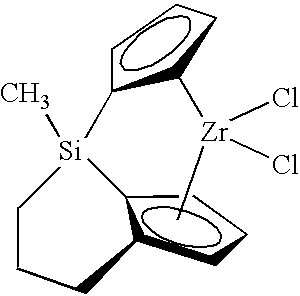
- wherein the Cp rings may be substituted as described herein; and the A moiety is silicon in this example. The catalyst system comprises one or more of these bridged metallocenes comprising the trivalent bridging group and one or more activators such as alumoxane, alkylaluminums, tris(pentafluorophenyl)boron (neutral ionizing activators) or tetra(pentafluorophenyl)boron salts (cationic ionizing activators), and may also comprise a support material, wherein the activator and/or the metallocene may be supported on the support material.
- General Definitions
- As used herein, the phrase “catalyst system” includes at least one “bridged (or “tri-bound bridged”) metallocene catalyst compound” and at least one “activator”, both of which are described further herein. The catalyst system may also include other components, such as supports, etc., and is not limited to the catalyst component and/or activator alone or in combination. The catalyst system may include any number of catalyst compounds in any combination as described herein, as well as any activator in any combination as described herein.
- As used herein, the phrase “catalyst compound” includes any compound that, once appropriately activated, is capable of catalyzing the polymerization or oligomerization of olefins, the catalyst compound comprising at least one Group 3 to Group 12 atom or lanthanide atom, and at least one leaving group bound thereto. “Metallocene” catalyst compounds are those comprising at least one cyclopentadienyl group or group isolobal to cyclopentadienyl bound to the metal center.
- As used herein, the phrase “leaving group” refers to one or more chemical moieties bound to the metal center of the catalyst compound that can be abstracted from the catalyst component by an activator, thus producing the species active towards olefin polymerization or oligomerization. The activator is described further below.
- As used herein, in reference to Periodic Table “Groups” of Elements, the “new” numbering scheme for the Periodic Table Groups are used as in the CRC HANDBOOK OF CHEMISTRY AND PHYSICS (David R. Lide ed., CRC Press 81 st ed. 2000).
- As used herein, a “hydrocarbyl” includes aliphatic, cyclic, olefinic, acetylenic and aromatic radicals (i.e., hydrocarbon radicals) comprising hydrogen and carbon that are deficient by one hydrogen. A “hydrocarbylene” is deficient by two hydrogens (divalent).
- As used herein, an “alkyl” includes linear, branched and cyclic paraffin radicals that are deficient by one hydrogen. Thus, for example, a —CH 3 group (“methyl”) and a CH3CH2— group (“ethyl”) are examples of alkyls.
- As used herein, an “alkenyl” includes linear, branched and cyclic olefin radicals that are deficient by one hydrogen; alkynyl radicals include linear, branched and cyclic acetylene radicals deficient by one hydrogen radical.
- As used herein, “aryl” groups includes phenyl, naphthyl, pyridyl and other radicals whose molecules have the ring structure characteristic of benzene, naphthylene, phenanthrene, anthracene, etc. For example, a C 6H5 − aromatic structure is an “phenyl”, a C6H4 2− aromatic structure is an “phenylene”. An “arylalkyl” group is an alkyl group having an aryl group pendant therefrom; an “alkylaryl” is an aryl group having one or more alkyl groups pendant therefrom.
- As used herein, an “alkylene” includes linear, branched and cyclic hydrocarbon radicals deficient by two hydrogens (i.e., divalent). Thus, —CH 2— (“methylene”) and —CH2CH2— or CH3CH═ (“ethylene”, wherein “═” represents two separate bonds) are examples of alkylene groups. Other groups deficient by two hydrogen radicals include “arylene” and “alkenylene”.
- As used herein, the phrase “heteroatom” includes any atom other than carbon and hydrogen that can be bound to carbon. A “heteroatom-containing group” is a hydrocarbon radical that contains a heteroatom and may contain one or more of the same or different heteroatoms. Non-limiting examples of heteroatom-containing groups include radicals of imines, amines, oxides, phosphines, ethers, ketones, oxoazolines heterocyclics, oxoazolines, thioethers, and the like.
- As used herein, an “alkylcarboxylate”, “arylcarboxylate”, and “alkylarylcarboxylate” is an alkyl, aryl, and alkylaryl, respectively, that possesses a carboxyl group in any position. Examples include C 6H5CH2C(O)O−, CH3C(O)O−, etc.
- As used herein, the term “substituted” means that the group following that term possesses at least one moiety in place of one or more hydrogens in any position, the moieties selected from such groups as halogen radicals (esp., Cl, F, Br), hydroxyl groups, carbonyl groups, carboxyl groups, amine groups, phosphine groups, alkoxy groups, phenyl groups, naphthyl groups, C 1 to C10 alkyl groups, C2 to C10 alkenyl groups, and combinations thereof. Examples of substituted alkyls and aryls includes, but are not limited to, acyl radicals, alkylamino radicals, alkoxy radicals, aryloxy radicals, alkylthio radicals, dialkylamino radicals, alkoxycarbonyl radicals, aryloxycarbonyl radicals, carbamoyl radicals, alkyl- and dialkyl-carbamoyl radicals, acyloxy radicals, acylamino radicals, arylamino radicals, and combinations thereof.
- As used herein, structural formulas are employed as is commonly understood in the chemical arts; lines (“—”) used to represent associations between a metal atom (“M”, Group 3 to Group 12 atoms) and a ligand or ligand atom (e.g., cyclopentadienyl, nitrogen, oxygen, halogen ions, alkyl, etc.), as well as the phrases “associated with”, “bonded to” and “bonding”, are not limited to representing a certain type of chemical bond, as these lines and phrases are meant to represent a “chemical bond”; a “chemical bond” defined as an attractive force between atoms that is strong enough to permit the combined aggregate to function as a unit, or “compound”.
- A certain stereochemistry for a given structure or part of a structure should not be implied unless so stated for a given structure or apparent by use of commonly used bonding symbols such as by dashed lines and/or heavy lines.
- Unless stated otherwise, no embodiment of the present invention is herein limited to the oxidation state of the metal atom “M” as defined below in the individual descriptions and examples that follow.
- Tri-Bound Bridged Metallocene Catalyst Compound
- The catalyst system of the present invention includes at least one tri-bound bridged metallocene catalyst compound as described herein. The invention also includes the tri-bound bridged metallocene compound itself. Metallocene catalyst compounds are generally described throughout in, for example, 1 & 2 METALLOCENE-BASED POLYOLEFINS (John Scheirs & W. Kaminsky eds., John Wiley & Sons, Ltd. 2000). The tri-bound bridged metallocene catalyst compounds as described herein include full “sandwich” compounds having at least two Cp (cyclopentadienyl and ligands isolobal to cyclopentadienyl) ligands bound to at least one Group 3 to Group 12 metal atom or lanthanide atom, and include one or more leaving group(s) bound to the at least one metal atom, depending upon the nature of the metal atom. The tri-bound bridged metallocenes described herein further include a trivalent bridging group bridging the at least two Cp ligands. Hereinafter, the metallocene catalyst compound of the present invention is referred to as a “bridged” or “tri-bound bridged” metallocene catalyst compound.
- The Cp ligands are typically π-bonded and/or fused ring(s) or ring systems. The ring(s) or ring system(s) typically comprise atoms selected from Groups 13 to 16 atoms, and more particularly, the atoms that make up the Cp ligands are selected from carbon, nitrogen, oxygen, silicon, sulfur, phosphorous, germanium, boron and aluminum and a combination thereof. Even more particularly, the Cp ligand(s) are selected from substituted and unsubstituted cyclopentadienyl ligands and ligands isolobal to cyclopentadienyl (including heterocyclic analogues), non-limiting examples of which include cyclopentadienyl, indenyl, fluorenyl, tetrahydroindenyl and their heterocyclic analogs.
- The metal atom “M” of the metallocene catalyst compound, as described throughout the specification and claims, may be selected from Groups 3 through 12 atoms and lanthanide atoms in one embodiment; and selected from Groups 3 through 10 atoms in a more particular embodiment, and selected from Sc, Ti, Zr, Hf, Cr, V, Nb, Ta, Mn, Re, Fe, Ru, Os, Co, Rh, Ir, and Ni in yet a more particular embodiment; and selected from Groups 4, 5 and 6 atoms in yet a more particular embodiment, and selected from Ti, Zr, and Hf atoms in yet a more particular embodiment, and selected from Zr and Hf in yet a more particular embodiment. The Cp ligand(s) form at least one chemical bond with the metal atom M to form the bridged metallocene catalyst compound. The Cp ligands are distinct from the leaving groups bound to the catalyst compound in that they are not highly susceptible to substitution/abstraction reactions.
- In one aspect of the invention, the one or more tri-bound bridged metallocene catalyst compounds of the invention are represented by the formula (I):
- CpA(A)CpBMXn (I)
- wherein M is defined above; where each X (a leaving group) and each Cp is chemically bonded to M; and wherein the metallocene catalyst compound of the present invention comprises a trivalent bridging group (A) that comprises at least one A moiety and at least three “linkages”: at least two linkages between the A moiety and one of Cp A or CpB, and one linkage between the A moiety and the other Cp ligand, the “linkages” selected independently from covalent bonds, C1 to C12 hydrocarbylenes and C1 to C12 heteroatom-containing hydrocarbylenes.
- The ligands represented by Cp A and CpB in formula (I) may be the same or different cyclopentadienyl ligands or ligands isolobal to cyclopentadienyl, either or both of which may contain heteroatoms and ether or both of which may be substituted by a group R. Non-limiting examples of such ligands include cyclopentadienyl, cyclopentaphenanthreneyl, indenyl, benzindenyl, fluorenyl, octahydrofluorenyl, cyclooctatetraenyl, cyclopentacyclododecene, phenanthrindenyl, 3,4-benzofluorenyl, 9-phenylfluorenyl, 8-H-cyclopent[a]acenaphthylenyl, 7H-dibenzofluorenyl, indeno[1,2-9]anthrene, thiophenoindenyl, thiophenofluorenyl, hydrogenated versions thereof (e.g., 4,5,6,7-tetrahydroindenyl, or “H4Ind”), substituted versions thereof, and heterocyclic versions thereof. In one embodiment, CpA and CpB are independently selected from the group consisting of cyclopentadienyl, indenyl, tetrahydroindenyl, fluorenyl, and substituted derivatives of each.
- Independently, each Cp A and CpB of formula (I) may be unsubstituted or substituted with any one or combination of substituent groups R. Non-limiting examples of substituent groups R include groups selected from hydrogen radical, alkyls, alkenyls, alkynyls, cycloalkyls, aryls, acyls, aroyls, alkoxys, aryloxys, alkylthiols, dialkylamines, alkylamidos, alkoxycarbonyls, aryloxycarbonyls, carbonyls, alkyl- and dialkyl-carbamoyls, acyloxys, acylaminos, aroylaminos, and combinations thereof.
- More particular non-limiting examples of substituents R bound to the Cp ligands include methyl, ethyl, propyl, butyl, pentyl, hexyl, cyclopentyl, cyclohexyl, benzyl, phenyl, methylphenyl, and tert-butylphenyl groups and the like, including all their isomers, for example tert-butyl, isopropyl, and the like. Other possible R groups include substituted alkyls and aryls such as, for example, fluoromethyl, fluoroethyl, difluoroethyl, iodopropyl, bromohexyl, chlorobenzyl and hydrocarbyl substituted organometalloid radicals including trimethylsilyl, trimethylgermyl, methyldiethylsilyl and the like; and halocarbyl-substituted organometalloid radicals including tris(trifluoromethyl)silyl, methylbis(difluoromethyl)silyl, bromomethyldimethylgermyl and the like; and disubstituted boron radicals including dimethylboron for example; and disubstituted Group 15 radicals including dimethylamine, dimethylphosphine, diphenylamine, methylphenylphosphine, Group 16 radicals including methoxy, ethoxy, propoxy, phenoxy, methylsulfide and ethylsulfide. Other R substituents include olefins such as olefinically unsaturated substituents including vinyl-terminated ligands, for example 3-butenyl, 2-propenyl, 5-hexenyl and the like. In one embodiment, at least two R groups, two adjacent R groups more particularly, are joined to form a ring structure having from 3 to 20 atoms selected from carbon, nitrogen, oxygen, phosphorous, silicon, germanium, aluminum, boron and combinations thereof. Also, a substituent group R group such as 1-butanyl may form a bonding association to the element M.
- The one or more X groups in formula (I) are any desirable leaving groups in one embodiment. The value for n is an integer from 0 to 4 in one embodiment, and 0, 1 or 2 in a more particular embodiment. Non-limiting examples of X groups in formula (I) include amines, phosphines, ethers, carboxylates, dienes, hydrocarbon radicals having from 1 to 20 carbon atoms, fluorinated hydrocarbon radicals (e.g., —C 6F5 (pentafluorophenyl)), fluorinated alkylcarboxylates (e.g., CF3C(O)O−), hydrides and halogen ions and combinations thereof. Other examples of X ligands include alkyl groups such as cyclobutyl, cyclohexyl, methyl, heptyl, tolyl, trifluoromethyl, tetramethylene, pentamethylene, methylidene, methyoxy, ethyoxy, propoxy, phenoxy, bis(N-methylanilide), dimethylamide, dimethylphosphide radicals and the like. In one embodiment, two or more X's form a part of a fused ring or ring system.
- The A moiety in formulas/structures (I) to (IV) is any moiety that provides, or is capable of providing, at least three valences or “bridging-bond positions” between at least two Cp ligands. Non-limiting examples of A include Group 13, Group 14 or Group 15 atoms, trivalent hydrocarbons (e.g., trivalent cyclohexane, or C 6H9 3−), and trivalent heteroatom-containing hydrocarbons (e.g., trivalent piperidine, or C5H11N3−); and in a more particular embodiment, A is selected from the group consisting of boron, aluminum, carbon, silicon, tin, nitrogen, phosphorous, trivalent C2 to C10 hydrocarbons, and trivalent C2 to C10 heteroatom-containing hydrocarbons.
- In yet a more particular embodiment, A is a Group 13, Group 14, or Group 15 atom. In yet a more particular embodiment, the A moiety is selected from the group consisting of boron, aluminum, carbon, silicon, germanium, nitrogen, and phosphorous; and selected from the group consisting of carbon and silicon in yet a more particular embodiment; and is silicon in yet a more particular embodiment. As a proviso, if A is a Group 14 atom, A is chemically bound to a fourth group selected from: hydride, halogen ion, C 1 to C6 alkyl, C6 to C12 aryl, C7 to C15 alkylaryl and C1 to C6 heteroatom-containing hydrocarbyls in one embodiment; and hydride, methyl, ethyl, phenyl, benzyl, chloride ion, and bromide ion in a more particular embodiment.
- The “linkages” from A to the Cp ligands are independently selected from: chemical bonds, C 1 to C12 alkylenes, C3 to C10 cycloalkylenes, C2 to C10 alkenylenes, C1 to C]2 heteroatom-containing hydrocarbylenes in one embodiment; chemical bonds, C1 to C6 alkylenes, C4 to C6 cycloalkylenes, C2 to C6 alkenylenes, C1 to C6 heteroatom-containing hydrocarbylenes in a more particular embodiment; and chemical bonds, methylene, ethylene, propylene, butylene, pentylene, and hexylene in yet a more particular embodiment. In the case of the heteroatom-containing hydrocarbylenes, the heteroatoms are selected from Group 13 to Group 16 atoms in one embodiment, and oxygen, boron, nitrogen, sulfur, phosphorous and aluminum in another embodiment.
- In a particular embodiment of the trivalent bridging group (A), one linkage between the A moiety and Cp A is selected from a chemical bond and methylene; and the other two linkages that are bound to the CpB are selected from a chemical bond, ethylene, propylene, butylene, pentylene, and hexylene.
- The tri-bound bridged metallocene of the present invention can be described more particularly in the structure (II) below:
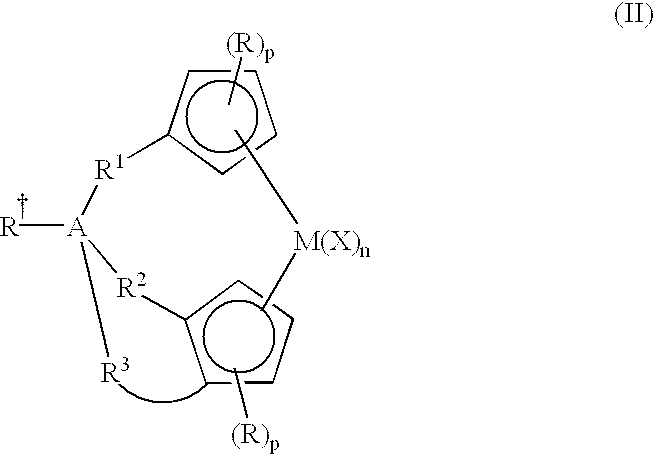
- wherein M as defined above;
- A is: selected from Group 13 to Group 15 atoms in one embodiment; selected from the group consisting of boron, aluminum, carbon, silicon, germanium, tin, nitrogen, and phosphorous in a more particular embodiment; selected from the group consisting of carbon and silicon in yet a more particular embodiment; and is silicon in yet a more particular embodiment;
- R \ selected from: hydride, halogen ion, C1 to C6 alkyl, C6 to C12 aryl, C7 to C15 alkylaryl and C1 to C6 heteroatom-containing hydrocarbyls; and hydride, methyl, ethyl, phenyl, benzyl, chloride ion, and bromide ion in a more particular embodiment; with the proviso that if A is a Group 13 or Group 15 atom (or other group that forms only three bonds with other moieties), then R† is absent;
- R 1, R2 and R3 are divalent groups independently selected from: a chemical bond, C1 to C6 alkylenes, C4 to C6 cycloalkylenes, C2 to C8 alkenylenes, C1 to C6 heteroatom-containing hydrocarbylenes in one embodiment; a chemical bond, methylene, ethylene, propylene, butylene, pentylene, hexylene, cyclopentylene and cyclohexylene in a more particular embodiment;
- wherein in a particular embodiment, R 1, R2 are selected from a chemical bond and methylene and R3 is selected from ethylene, propylene, butylene, pentylene, and hexylene;
- each R (structure (II)) represents a substitution of a hydrogen with a group independently selected from halogen radicals, C 1 to C6 alkyls, C6 to C12 aryls, and C1 to C6 heteroatom-containing hydrocarbyls; wherein adjacent R groups may be C2 to C6 hydrocarbylene groups bound together to form one or more 4 to 8 member rings, either saturated, partially saturated, or aromatic, thus, together with the cyclopentadienyl ring, forming, for example, indenyl, tetrahydroindenyl, fluorenyl, which may be substituted by groups as defined above for R;
- p is an integer from 0 to 4;
- each X is independently selected from: any leaving group in one embodiment; and more particularly, selected from halogen ions, hydride, C 1 to C12 alkyls, C2 to C12 alkenyls, C6 to C12 aryls, C7 to C20 alkylaryls, C1 to C12 alkoxys, C6 to C16 aryloxys, C7 to C18 alkylaryloxys, C1 to C12 fluoroalkyls, C6 to C12 fluoroaryls, and C1 to C12 heteroatom-containing hydrocarbons and substituted derivatives thereof; hydride, halogen ions, C1 to C6 alkyls, C2 to C6 alkenyls, C7 to C18 alkylaryls, C1 to C6 alkoxys, C6 to C14 aryloxys, C7 to C16 alkylaryloxys, C1 to C6 alkylcarboxylates, C1 to C6 fluorinated alkylcarboxylates, C6 to C12 arylcarboxylates, C7 to C18 alkylarylcarboxylates, C1 to C6 fluoroalkyls, C2 to C6 fluoroalkenyls, and C7 to C18 fluoroalkylaryls in yet a more particular embodiment; hydride, methyl, phenyl, phenoxy, benzoxy, tosyl, fluoromethyls and fluorophenyls in yet a more particular embodiment; C1 to C12 alkyls, C2 to C12 alkenyls, C6 to C12 aryls, C7 to C20 alkylaryls, substituted C1 to C12 alkyls, substituted C6 to C12 aryls, substituted C7 to C20 alkylaryls and C1 to C12 heteroatom-containing alkyls, C1 to C12 heteroatom-containing aryls and C1 to C12 heteroatom-containing alkylaryls in yet a more particular embodiment; hydride, halogens ions, C1 to C6 alkyls, C2 to C6 alkenyls, C7 to C18 alkylaryls, halogenated C1 to C6 alkyls, halogenated C2 to C6 alkenyls, and halogenated C7 to C18 alkylaryls in yet a more particular embodiment; and fluoride, chloride, bromide, methyl, ethyl, propyl, phenyl, methylphenyl, dimethylphenyl, trimethylphenyl, fluoromethyls (mono-, di- and trifluoromethyls) and fluorophenyls (mono-, di-, tri-, tetra- and pentafluorophenyls) in yet a more particular embodiment; and
- wherein n is an integer from 0 to 4; and an integer from 1 to 2 in a more particular embodiment.
- A particular embodiment of the tri-bound bridged metallocene catalyst compound of the invention is described in structures (IIIa) and (IIIb):

- wherein M, X, n, and A are defined above; R 4, R5, R6, R7, R8, R9, R10, R11, R12, R13, and R14 are groups independently selected from hydrogen radical, halogen radicals, C1 to C12 alkyls, C2 to C12 alkenyls, C6 to C12 aryls, C7 to C20 alkylaryls C1 to C12 alkoxys, C1 to C12 fluoroalkyls, C6 to C12 fluoroaryls, and C1 to C12 heteroatom-containing hydrocarbons and substituted derivatives thereof in one embodiment; selected from hydrogen radical, fluorine radical, chlorine radical, bromine radical, C1 to C6 alkyls, C2 to C6 alkenyls, C7 to C18 alkylaryls, C1 to C6 fluoroalkyls, C2 to C6 fluoroalkenyls, C7 to C18 fluoroalkylaryls in a more particular embodiment; and hydrogen radical, fluorine radical, chlorine radical, methyl, ethyl, propyl, isopropyl, butyl, isobutyl, tert-butyl, hexyl, phenyl, 2,6-dimethylphenyl, and 4-tert-butylphenyl groups in yet a more particular embodiment; and R†, when present, is selected from: hydride, halogen ion, C1 to C6 alkyl, C6 to C12 aryl, C7 to C15 alkylaryl and C1 to C6 heteroatom-containing hydrocarbyls; and hydride, methyl, ethyl, phenyl, benzyl, chloride ion, and bromide ion in a more particular embodiment; provided that R† is absent if A is a Group 13 or 15 atom.
- In a particular embodiment of heteroatom-containing hydrocarbons as described herein, the heteroatoms are selected from boron, aluminum, silicon, nitrogen, phosphorous, oxygen and sulfur; and in a more particular embodiment, the heteroatom-containing hydrocarbons contain from 1 to 3 heteroatoms selected from these atoms.
- Described more particularly, the trivalent bridging group (A) comprising at least one A moiety and at least three linkages between the A moiety and the two Cp ligands can be described in structure (IV):
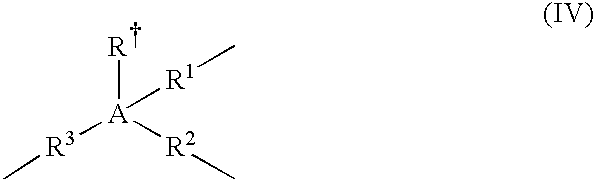
- wherein A is a Group 14 atom, and a silicon or carbon in a particular embodiment;
- R † is selected from hydride, halogen radicals, C1 to C6 alkyls, C6 to C12 aryls, and C1 to C6 heteroatom-containing hydrocarbons; and selected from hydride, methyl and phenyl in yet a more particular embodiment;
- R 1 is a divalent group selected from: a chemical bond, C1 to C6 alkylenes, C4 to C6 cycloalkylenes, C2 to C8 alkenylenes, and C1 to C6 heteroatom-containing hydrocarbylenes in one embodiment; a chemical bond, methylene, ethylene, propylene, butylene, pentylene, hexylene, cyclopentylene and cyclohexylene in a more particular embodiment; and selected from a chemical bond and methylene in yet a more particular embodiment;
- R 2 is a divalent group selected from: a chemical bond, C1 to C6 alkylenes, C4 to C6 cycloalkylenes, C2 to C8 alkenylenes, and C1 to C6 heteroatom-containing hydrocarbylenes in one embodiment; a chemical bond, methylene, ethylene, propylene, butylene, pentylene, hexylene, cyclopentylene and cyclohexylene in a more particular embodiment; and selected from a chemical bond and methylene in yet a more particular embodiment; and
- R 3 is a divalent group selected from: a chemical bond, C1 to C6 alkylenes, C4 to C6 cycloalkylenes, C2 to C8 alkenylenes, and C1 to C6 heteroatom-containing hydrocarbylenes in one embodiment; a chemical bond, methylene, ethylene, propylene, butylene, pentylene, hexylene, cyclopentylene and cyclohexylene in a more particular embodiment; and methylene, ethylene, propylene and butylene in yet a more particular embodiment.
- In one embodiment of the bridging group of (IV), the R 1 group is bound to one Cp of the bridged metallocene compound of the invention, and the R2 and R3 groups are bound to another Cp of the bridged metallocene compound of the invention. The R1, R2 and R3 groups can be bound to any position along the Cp ring structure, directly bonding with one carbon each of the ring in place of a hydrogen. In one embodiment, R2 and R3 are bound to adjacent carbon atoms, and in another embodiment, the R2 and R3 groups are bound to a first and third carbon (one carbon therebetween), respectively. In yet another embodiment, the R2 and R3 groups are bound to a first and fourth carbon (two carbons therebetween), respectively.
- Non-limiting examples of the trivalent bridging groups comprising A and at least three linkages include methylsilanetriyl, methylsilanetriylmethylene, methylsilanetriylethylene, methylsilanetriyl(n-propylene), methylsilanetriyl(n-butylene), methylsilanetriyl(n-pentylene), methylsilanetriyl(n-hexylene), methylsilanetriyl(n-cyclohexylene), methylsilanetriyldimethylene, methylsilanetriyl(methylene)ethylene, methylsilanetriyl(methylene)(n-propylene), methylsilanetriyl(methylene)(n-butylene), methylsilanetriyl(methylene)(n-pentylene), methylsilanetriyl(methylene)(n-hexylene), methylsilanetriyl(methylene)(n-cyclohexylene), methylcarbyl, methylcarbylmethylene, methylcarbylethylene, methylcarbyl(n-propylene), methylcarbyl(n-butylene), methylcarbyl(n-pentylene), methylcarbyl(n-hexylene), methylcarbyl(n-cyclohexylene), methylcarbyldimethylene, methylcarbyl(methylene)ethylene, methylcarbyl(methylene)(n-propylene), methylcarbyl(methylene)(n-butylene), methylcarbyl(methylene)(n-pentylene), methylcarbyl(methylene)(n-hexylene), and methylcarbyl(methylene)(n-cyclohexylene); wherein “silanetriyl” and “carbyl” are the trivalent Si and C groups, respectively, and the divalent group in parenthesis is the linking group bound to the silanetriyl or carbyl at one valent position, the other valent position open for bonding to a cyclopentadienyl carbon.
- Other non-limiting examples of trivalent bridging groups comprising A and at least three linkages include azanetriyl, azanetriyl(methylene), azanetriyl(dimethylene), azanetriyl(trimethylene), azanetriyl(ethylene), azanetriyl(n-propylene), azanetriyl(n-butylene), azanetriyl(n-pentylene), azanetriyl(methylene)(ethylene), azanetriyl(methylene)(n-propylene), azanetriyl(methylene)(n-butylene), azanetriyl(methylene)(n-pentylene), phosphorous analogs thereof, and the like; wherein “azanetriyl” is the trivalent N, and the divalent group in parenthesis is the linking group bound to the silanetriyl or carbyl at one valent position, the other valent position open for bonding to a cyclopentadienyl carbon.
- The bridged metallocene catalyst component of the invention, as well as the catalyst system of the invention comprising the bridged metallocene catalyst component, can be described by any combination of any embodiment described herein.
- Synthesis of the Tri-Bound Bridged Metallocenes
- The tri-bound bridged Cps used to form the metallocenes of the present invention are synthesized, in one embodiment, by contacting, under desirable conditions, the desired Cp-salts with the desired bridged structure (“linking reagent”) comprising three dissociable groups (e.g., Br, Cl, etc.) in a polar solvent such as an ether. This is typically a two step process, wherein two linkages are formed in the first step, followed by the formation of the third linkage in the second step. The reaction can be represented by the following scheme (a):
- R†A(R1E)(R2E)(R3E)+Y CpA−+Z CpB−→CpA(A)CpA or CpA(A)CpB (a)
- wherein R †A(R1E)(R2E)(R3E) is the linking reagent that forms the trivalent bridging group (A);
- wherein A is: selected from Group 13 to Group 15 atoms in one embodiment; selected from the group consisting of boron, aluminum, carbon, silicon, germanium, tin, nitrogen, and phosphorous in a more particular embodiment; selected from the group consisting of carbon and silicon in yet a more particular embodiment; and is silicon in yet a more particular embodiment;
- R † is selected from hydride, halogen radicals, C1 to C6 alkyls, C6 to C12 aryls, and C1 to C6 heteroatom-containing hydrocarbons; and selected from hydride, methyl and phenyl in yet a more particular embodiment; provided that R† is absent when A is a Group 13 or 15 atom;
- R 1 is a divalent group selected from: a chemical bond, C1 to C6 alkylenes, C4 to C6 cycloalkylenes, C2 to C8 alkenylenes, and C1 to C6 heteroatom-containing hydrocarbylenes in one embodiment; a chemical bond, methylene, ethylene, propylene, butylene, pentylene, hexylene, cyclopentylene and cyclohexylene in a more particular embodiment; and selected from a chemical bond and methylene in yet a more particular embodiment;
- R 2 is a divalent group selected from: a chemical bond, C1 to C6 alkylenes, C4 to C6 cycloalkylenes, C2 to C8 alkenylenes, and C1 to C6 heteroatom-containing hydrocarbylenes in one embodiment; a chemical bond, methylene, ethylene, propylene, butylene, pentylene, hexylene, cyclopentylene and cyclohexylene in a more particular embodiment; and selected from a chemical bond and methylene in yet a more particular embodiment;
- R 3 is a divalent group selected from: a chemical bond, C1 to C6 alkylenes, C4 to C6 cycloalkylenes, C2 to C8 alkenylenes, and C1 to C6 heteroatom-containing hydrocarbylenes in one embodiment; a chemical bond, methylene, ethylene, propylene, butylene, pentylene, hexylene, cyclopentylene and cyclohexylene in a more particular embodiment; and methylene, ethylene, propylene and butylene in yet a more particular embodiment;
- each E is bound to each of R 1, R2 and R3, and each E is independently selected from any abstractable or substitution-labile group; and selected from silyl groups, chlorine, bromine and iodine in one embodiment; and
- each of Cp A− and CpB− are Cp salts independently selected from cyclopentadienyl ligands or ligands isolobal to cyclopentadienyl, either or both of which may contain heteroatoms and ether or both of which may be substituted by a group R. Non-limiting examples of such ligands include cyclopentadienyl, cyclopentaphenanthreneyl, indenyl, benzindenyl, fluorenyl, octahydrofluorenyl, cyclooctatetraenyl, cyclopentacyclododecene, phenanthrindenyl, 3,4-benzofluorenyl, 9-phenylfluorenyl, 8-H-cyclopent[a]acenaphthylenyl, 7H-dibenzofluorenyl, indeno[1,2-9]anthrene, thiophenoindenyl, thiophenofluorenyl, hydrogenated versions thereof (e.g., 4,5,6,7-tetrahydroindenyl, or “H4Ind”), substituted versions thereof, and heterocyclic versions thereof In one embodiment, CpA− and CpB− salts are independently selected from the group consisting of cyclopentadienyl, indenyl, tetrahydroindenyl, fluorenyl, and substituted derivatives of each; and in a more particular embodiment, the Cps are independently selected from cyclopentadienyl, tetrahydroindenyl, indenyl, heterocyclic analogues thereof, and substituted analogues thereof.
- In reaction scheme (a), the number of equivalents of the desired Cps is represented by Y and Z, both of which can independently be any number, including fractional numbers, between 4 and 0, wherein Y+Z is between 2 and 4, inclusive. In a particular embodiment, for every equivalent of bridging group R †A(R1E)(R2E)(R3E) there is added from 2 to 3 equivalents of Cp salts. In one embodiment, Y is 3 and Z is 0.
- Non-limiting examples of the linking reagent R †A(R1E)(R2E)(R3E) include ClCH2SiCl2(CH3); ClCH2CH2SiCl2(CH3); ClCH2CH2CH2SiCl2(CH3); ClCH2CH2CH2CH2SiCl2(CH3); ClCH2CH2CH2SiCl(CH3)(CH2Cl); ClCH2CH2CH2SiCl(CH3)(CH2CH2Cl), ClCH2CH2CH2SiCl2(C6H5); ClCH2CH2CH2SiCl(C6H5)(CH2Cl); ClCH2CCl2(CH3); ClCH2CH2CCl2(CH3); ClCH2CH2CH2CCl2(CH3); ClCH2CH2CH2CH2CCl2(CH3); ClCH2CH2CH2CCl(CH3)(CH2Cl); ClCH2CH2CH2CCl(CH3)(CH2CH2Cl); ClCH2CH2CH2CCl2(C6H5); ClCH2CH2CH2CCl(C6H5)(CH2Cl); and derivatives thereof. By “derivatives thereof”, it is meant any of these compounds wherein the Cl is a Br or other highly dissociable moiety, and wherein any hydrogen is substituted with a C1 to C6 alkyl or C6 aryl or C6 heteroatom containing aryl.
- The reaction represented in (a) is carried out in a liquid diluent selected from polar diluents that are liquid at the reaction temperature. Examples of desirable diluents include ethers, ketones, polar halogenated hydrocarbons, and other polar diluents. The reaction temperature ranged from −50° C. to 50° C. in one embodiment, and from −40° C. to 30° C. in a particular embodiment. First, the Cp salts are combined with the R †A(R1E)(R2E)(R3E) linking reagent, wherein two of the dissociable groups E are replaced by one Cp each.
- Next, one equivalent of a strong base such as n-butyl lithium is added to the ligand to deprotonated one of the Cp rings, thus facilitating formation of the third bridge group. The reaction represented in (a) may optionally be carried out in a two stage process, wherein in the first stage the reactants are contacted in the polar solvent such as diethyl ether, and stirred for 8 to 20 hrs, followed by addition of another polar solvent such as tetrahydrofuran in a second stage, wherein the ether is optionally removed from the first reaction product. The one equivalent of a strong base such as n-butyl lithium is then added to this second mixture and reacted at a temperature between 0° C. to 100° C. for 5 to 12 hrs, and reacted at a temperature between 30° C. to 70° C. in another embodiment. In any case, the reaction product from the one or two step synthesis is isolated by removing the diluent, resulting in the tri-bound bridged ligands Cp A(A)cpA or CpA(A)CpB.
- The resultant tri-bound bridged ligands can then be reacted with a desirable Group 4, 5 or 6 metal salt such as, for example, HfCl 4 or Zr(N(CH3)2)4 in a non-polar diluent such as a hydrocarbon diluent (e.g., hexane, toluene, etc.) to form a metallocene. The identity of the metal may vary depending upon the metal salt added, as well as the identity of the leaving group X. This can be altered in the final product by techniques known in the art.
- More particularly, the reaction in (a) may be represented by the two step scheme (b) and (c) below:
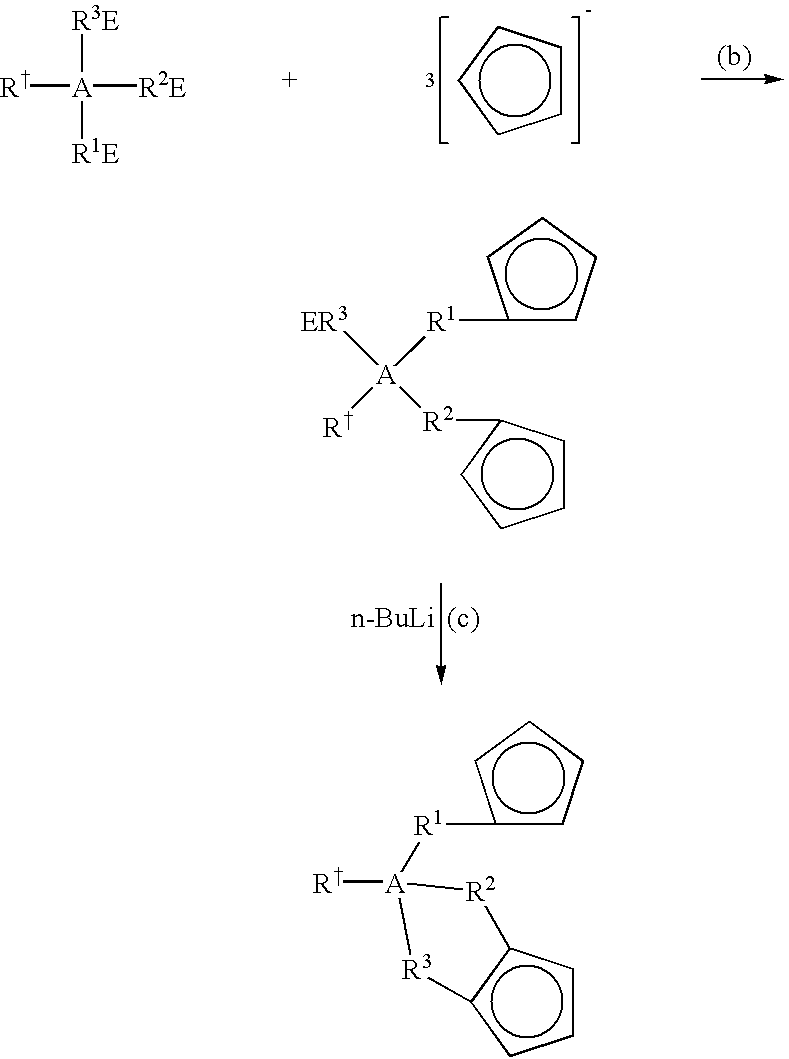
- wherein each Cp may be the same or different and selected from cyclopentadienyl and ligands isolobal to cyclopentadienyl, and selected from indenyl, tetrahydroindenyl, cyclopentadienyl, substituted analogues thereof and heterocyclic analogues thereof. The Cps may be substituted by any group such as described for R 4 through R14 above (III). In a desirable embodiment, E is chlorine or bromine. Each of R1 though R3 are as defined above. Both steps (b) and (c) are desirably carried out in a polar diluent such as diethyl ether and/or tetrahydrofuran. The Cp salt is a salt such as, for example, sodium cyclopentadienyl or lithium indenide. In a particular embodiment, A is selected from silicon and carbon.
- Activators
- The catalyst system useful in preparing polyolefin polymers of the invention includes at least one tri-bound bridged metallocene catalyst component, and at least one activator. As used herein, the term “activator” is defined to be any compound or combination of compounds, supported or unsupported, which can activate a single-site catalyst compound (e.g., metallocenes, Group 15-containing catalysts, etc.), such as by creating a cationic species from the catalyst component. Typically, this involves the abstraction of at least one leaving group (X group in the formulas/structures above) from the metal center of the catalyst component. The catalyst components of the present invention are thus activated towards olefin polymerization using such activators. Embodiments of such activators include Lewis acids such as cyclic or oligomeric poly(hydrocarbylaluminum oxides) and so called non-coordinating ionic activators (“NCA”) (alternately, “ionizing activators” or “stoichiometric activators”), or any other compound that can convert a neutral metallocene catalyst component to a metallocene cation that is active with respect to olefin polymerization.
- More particularly, it is within the scope of this invention to use Lewis acids such as alumoxane (e.g., “MAO”), modified alumoxane (e.g., “TIBAO”), and alkylaluminum compounds as activators, and/or ionizing activators (neutral or ionic) such as tri (n-butyl)ammonium tetrakis(pentafluorophenyl)boron and/or a trisperfluorophenyl boron metalloid precursors to activate desirable metallocenes described herein. MAO and other aluminum-based activators are well known in the art. Ionizing activators are well known in the art and are described by, for example, Eugene You-Xian Chen & Tobin J. Marks, Cocatalysts for Metal-Catalyzed Olefin Polymerization: Activators, Activation Processes, and Structure-Activity Relationships 100(4) CHEMICAL REVIEWS 1391-1434 (2000). The activators may be associated with or bound to a support, either in association with the catalyst component (e.g., metallocene) or separate from the catalyst component, such as described by Gregory G. Hlatky, Heterogeneous Single-Site Catalysts for Olefin Polymerization 100(4) CHEMICAL REVIEWS 1347-1374 (2000).
- Non-limiting examples of aluminum alkyl compounds which may be utilized as activators for the catalyst precursor compounds for use in the methods of the present invention include trimethylaluminum, triethylaluminum, triisobutylaluminum, tri-n-hexylaluminum, tri-n-octylaluminum and the like.
- Examples of neutral ionizing activators include Group 13 tri-substituted compounds, in particular, tri-substituted boron, tellurium, aluminum, gallium and indium compounds, and mixtures thereof. The three substituent groups are each independently selected from alkyls, alkenyls, halogen, substituted alkyls, aryls, arylhalides (esp. fluoroaryls), alkoxy and halides. In one embodiment, the three groups are independently selected from halogen, mono or multicyclic (including halosubstituted) aryls, alkyls, and alkenyl compounds and mixtures thereof In another embodiment, the three groups are selected from alkenyl groups having 1 to 20 carbon atoms, alkyl groups having 1 to 20 carbon atoms, alkoxy groups having 1 to 20 carbon atoms and aryl groups having 3 to 20 carbon atoms (including substituted aryls), and combinations thereof. In yet another embodiment, the three groups are selected from alkyls having 1 to 4 carbon groups, phenyl, naphthyl and mixtures thereof. In yet another embodiment, the three groups are selected from highly halogenated alkyls having 1 to 4 carbon groups, highly halogenated phenyls, and highly halogenated naphthyls and mixtures thereof. By “highly halogenated”, it is meant that at least 50% of the hydrogens are replaced by a halogen group selected from fluorine, chlorine and bromine. In yet another embodiment, the neutral stoichiometric activator is a tri-substituted Group 13 compound comprising highly fluorided aryl groups, the groups being highly fluorided phenyl and highly fluorided naphthyl groups.
- In another embodiment, the neutral tri-substituted Group 13 compounds are boron compounds such as a trisperfluorophenyl boron, trisperfluoronaphthylboron, tris(3,5-di(trifluoromethyl)phenyl)boron, tris(di-t-butylmethylsilyl)perfluorophenylboron, and other highly fluorinated trisarylboron compounds and combinations thereof, and their aluminum equivalents. Other suitable neutral ionizing activators are described in U.S. Pat. No. 6,399,532 B1, U.S. Pat. No. 6,268,445 B1, and in 19 ORGANOMETALLICS 3332-3337 (2000), and in 17 ORGANOMETALLICS 3996-4003 (1998).
- Illustrative, not limiting examples of ionic ionizing activators include trialkyl-substituted ammonium salts such as triethylammoniumtetra(phenyl)boron, tripropylammoniumtetra(phenyl)boron, tri(n-butyl)ammoniumtetra(phenyl)boron, trimethylammoniumtetra(p-tolyl)boron, trimethylammoniumtetra(o-tolyl)boron, tributylammoniumtetra(pentafluorophenyl)boron, tripropylammoniumtetra(o,p-dimethylphenyl)boron, tributylammoniumtetra(m,m-dimethylphenyl)boron, tributylammoniumtetra(p-tri-fluoromethylphenyl)boron, tributylammoniumtetra(pentafluorophenyl)boron, tri(n-butyl)ammonium tetra(o-tolyl)boron and the like; N,N-dialkyl anilinium salts such as N,N-dimethylaniliniumtetra(phenyl)boron, N,N-diethylaniliniumtetra(phenyl)boron, N,N-2,4,6-pentamethylaniliniumtetra(phenyl)boron and the like; dialkyl ammonium salts such as di-(isopropyl)ammonium tetra(pentafluorophenyl)boron, dicyclohexylammoniumtetra(phenyl)boron and the like; and triaryl phosphonium salts such as triphenylphosphoniumtetra(phenyl)boron, tri(methylphenyl)phosphoniumtetra(phenyl)boron, tri(dimethylphenyl)phosphoniumtetra(phenyl)boron and the like, and their aluminum equivalents.
- In yet another embodiment of the activator of the invention, an alkylaluminum can be used in conjunction with a heterocyclic compound. The ring of the heterocyclic compound may includes at least one nitrogen, oxygen, and/or sulfur atom, and includes at least one nitrogen atom in one embodiment. The heterocyclic compound includes 4 or more ring members in one embodiment, and 5 or more ring members in another embodiment.
- The heterocyclic compound for use as an activator with an alkylaluminum may be unsubstituted or substituted with one or a combination of substituent groups. Examples of suitable substituents include halogen, alkyl, alkenyl or alkynyl radicals, cycloalkyl radicals, aryl radicals, aryl substituted alkyl radicals, acyl radicals, aroyl radicals, alkoxy radicals, aryloxy radicals, alkylthio radicals, dialkylamino radicals, alkoxycarbonyl radicals, aryloxycarbonyl radicals, carbomoyl radicals, alkyl- or dialkyl-carbamoyl radicals, acyloxy radicals, acylamino radicals, aroylamino radicals, straight, branched or cyclic, alkylene radicals, or any combination thereof. The substituents groups may also be substituted with halogens, particularly fluorine or bromine, or heteroatoms or the like.
- Non-limiting examples of hydrocarbon substituents include methyl, ethyl, propyl, butyl, pentyl, hexyl, cyclopentyl, cyclohexyl, benzyl or phenyl groups and the like, including all their isomers, for example tertiary butyl, isopropyl, and the like. Other examples of substituents include fluoromethyl, fluoroethyl, difluoroethyl, iodopropyl, bromohexyl or chlorobenzyl.
- In one embodiment, the heterocyclic compound is unsubstituted. In another embodiment one or more positions on the heterocyclic compound are substituted with a halogen atom or a halogen atom containing group, for example a halogenated aryl group. In one embodiment the halogen is selected from chlorine, bromine and fluorine, and selected from fluorine and bromine in another embodiment, and the halogen is fluorine in yet another embodiment.
- Non-limiting examples of heterocyclic compounds utilized in the activator of the invention include substituted and unsubstituted pyrroles, imidazoles, pyrazoles, pyrrolines, pyrrolidines, purines, carbazoles, and indoles, phenyl indoles, 2,5-dimethyl pyrroles, 3-pentafluorophenyl pyrrole, 4,5,6,7-tetrafluoroindole or 3,4-difluoropyrroles.
- In one embodiment, the heterocyclic compound described above is combined with an alkyl aluminum or an alumoxane to yield an activator compound which, upon reaction with a catalyst component, for example a metallocene, produces an active polymerization catalyst. Non-limiting examples of alkylaluminums include trimethylaluminum, triethylaluminum, triisobutylaluminum, tri-n-hexylaluminum, tri-n-octylaluminum, tri-iso-octylaluminum, triphenylaluminum, and combinations thereof.
- Other activators include those described in WO 98/07515 such as tris(2,2′,2″-nonafluorobiphenyl)fluoroaluminate. Combinations of activators are also contemplated by the invention, for example, alumoxanes and ionizing activators in combinations. Other activators include aluminum/boron complexes, perchlorates, periodates and iodates including their hydrates; lithium (2,2′-bisphenyl-ditrimethylsilicate)4THF; silylium salts in combination with a non-coordinating compatible anion. Also, methods of activation such as using radiation, electro-chemical oxidation, and the like are also contemplated as activating methods for the purposes of rendering the neutral bulky ligand metallocene-type catalyst compound or precursor to a bulky ligand metallocene-type cation capable of polymerizing olefins. Other activators or methods for activating a bulky ligand metallocene-type catalyst compound are described in for example, U.S. Pat. Nos. 5,849,852, 5,859,653 and 5,869,723 and WO 98/32775.
- In general, the activator and catalyst component(s) are combined in mole ratios of activator to catalyst component from 1000:1 to 0.1:1, and from 300:1 to 1:1 in another embodiment, and from 150:1 to 1:1 in yet another embodiment, and from 50:1 to 1:1 in yet another embodiment, and from 10:1 to 0.5:1 in yet another embodiment, and from 3:1 to 0.3:1 in yet another embodiment, wherein a desirable range may include any combination of any upper mole ratio limit with any lower mole ratio limit described herein. When the activator is a cyclic or oligomeric poly(hydrocarbylaluminum oxide) (e.g., “MAO”), the mole ratio of activator to catalyst component ranges from 2:1 to 100,000:1 in one embodiment, and from 10:1 to 10,000:1 in another embodiment, and from 50:1 to 2,000:1 in yet another embodiment. When the activator is a neutral or ionic ionizing activator such as a boron alkyl and the ionic salt of a boron alkyl, the mole ratio of activator to catalyst component ranges from 0.5:1 to 10:1 in one embodiment, and from 1:1 to 5:1 in yet another embodiment.
- Supports
- A support may also be present as part of the catalyst system of the invention. Supports (or “carriers”) are particularly useful in gas phase polyolefin polymerization processes. Supports, methods of supporting, modifying, and activating supports for single-site catalyst such as metallocenes is discussed in, for example, 1 METALLOCENE-BASED POLYOLEFINS 173-218 (J. Scheirs & W. Kaminsky eds., John Wiley & Sons, Ltd. 2000). The terms “support” or “carrier”, as used herein, are used interchangeably and refer to any support material, a porous support material in one embodiment, including inorganic or organic support materials. Non-limiting examples of support materials include inorganic oxides and inorganic chlorides, and in particular such materials as talc, clay, silica, alumina, magnesia, zirconia, iron oxides, boria, calcium oxide, zinc oxide, barium oxide, thoria, aluminum phosphate gel, and polymers such as polyvinylchloride and substituted polystyrene, functionalized or crosslinked organic supports such as polystyrene divinyl benzene polyolefins or polymeric compounds, and mixtures thereof, and graphite, in any of its various forms.
- The support may be contacted with the other components of the catalyst system in any number of ways. In one embodiment, the support is contacted with the activator to form an association between the activator and support, or a “bound activator”. In another embodiment, the catalyst component may be contacted with the support to form a “bound catalyst component”. In yet another embodiment, the support may be contacted with the activator and catalyst component together, or with each partially in any order. The components may be contacted by any suitable means as in a solution, slurry, or solid form, or some combination thereof, and may be heated when contacted to from 25° C. to 250° C.
- Desirable carriers are inorganic oxides that include Group 2, 3, 4, 5, 13 and 14 oxides and chlorides. Support materials include silica, alumina, silica-alumina, magnesium chloride, graphite, and mixtures thereof in one embodiment. Other useful supports include magnesia, titania, zirconia, montmorillonite (EP 0 511 665 B1), phyllosilicate, and the like. Also, combinations of these support materials may be used, for example, silica-chromium, silica-alumina, silica-titania and the like. Additional support materials may include those porous acrylic polymers described in EP 0 767 184 B1.
- In one aspect of the support useful in the invention, the support possess a surface area in the range of from 10 to 700 m 2/g, pore volume in the range of from 0.1 to 4.0 cm3/g and average particle size in the range of from 5 to 500 μm. In another embodiment, the surface area of the carrier is in the range of from 50 to 500 m2/g, pore volume of from 0.5 to 3.5 cm3/g and average particle size of from 10 to 200 μm. In yet another embodiment, the surface area of the carrier is in the range is from 100 to 400 m2/g, pore volume from 0.8 to 3.0 cm3/g and average particle size is from 5 to 100 μm. The average pore size of the carrier of the invention typically has pore size in the range of from 10 to 1000Å, from 50 to 500 Å in another embodiment, and from 75 to 350 Å in yet another embodiment.
- In one embodiment of the support, graphite is used as the support. The graphite is a powder in one embodiment. In another embodiment, the graphite is flake graphite. In another embodiment, the graphite and has a particle size of from 1 to 500 microns, from 1 to 400 microns in another embodiment, and from 1 to 200 in yet another embodiment, and from 1 to 100 microns in yet another embodiment.
- The support, especially an inorganic support or graphite support, may be pretreated such as by a halogenation process or other suitable process that, for example, associates a chemical species with the support either through chemical bonding, ionic interactions, or other physical or chemical interaction. In one embodiment, the support is fluorided. The fluorine compounds suitable for providing fluorine for the support are desirably inorganic fluorine containing compounds. Such inorganic fluorine containing compounds may be any compound containing a fluorine atom as long as it does not contain a carbon atom. Particularly desirable are inorganic fluorine containing compounds selected from the group consisting of NH 4BF4, (NH4)2SiF6, NH4PF6, NH4F, (NH4)2TaF7, NH4NbF4, (NH4)2GeF6, (NH4)2SmF6, (NH4)2TiF6, (NH4)2ZrF6, MoF6, ReF6, GaF3, SO2ClF, F2, SiF4, SF6, ClF3, ClF5, BrF5, IF7, NF3, HF, BF3, NHF2 and NH4HF2.
- A desirable method of treating the support with the fluorine compound is to dry mix the two components by simply blending at a concentration of from 0.01 to 10.0 millimole F/g of support in one embodiment, and in the range of from 0.05 to 6.0 millimole F/g of support in another embodiment, and in the range of from 0.1 to 3.0 millimole F/g of support in yet another embodiment. The fluorine compound can be dry mixed with the support either before or after charging to the vessel for dehydration or calcining the support. Accordingly, the fluorine concentration present on the support is in the range of from 0.2 to 5 wt % in one embodiment, and from 0.6 to 3.5 wt % of support in another embodiment.
- Another method of treating the support with the fluorine compound is to dissolve the fluorine in a solvent, such as water, and then contact the support with the fluorine containing solution (at the concentration ranges described herein). When water is used and silica is the support, it is desirable to use a quantity of water that is less than the total pore volume of the support. Desirably, the support and, for example, fluorine compounds are contacted by any suitable means such as by dry mixing or slurry mixing at a temperature of from 100° C. to 1000° C. in one embodiment, and from 200° C. to 800° C. in another embodiment, and from 300° C. to 600° C. in yet another embodiment, the contacting in any case taking place for between two to eight hours.
- Dehydration or calcining of the support may or may also be carried out. In one embodiment, the support is calcined prior to reaction with the fluorine or other support-modifying compound. In another embodiment, the support is calcined and used without further modification, or calcined, followed by contacting with one or more activators and/or catalyst components. Suitable calcining temperatures range from 100° C. to 1000° C. in one embodiment, and from 300° C. to 900° C. in another embodiment, and from 400° C. to 850° C. in yet a more particular embodiment. Calcining may take place in the absence of oxygen and moisture by using, for example, an atmosphere of dry nitrogen.
- It is within the scope of the present invention to co-contact (or “co-immobilize”) more than one catalyst component with a support. Non-limiting examples of co-immobilization of catalyst components include two or more of the same or different metallocene catalyst components, one or more metallocene with a Ziegler-Natta type catalyst, one or more metallocene with a chromium or “Phillips” type catalyst, one or more metallocenes with a Group 15 containing catalyst (e.g., zirconium bis-amide compounds such as in U.S. Pat. No. 6,300,438 B1), and any of these combinations with one or more activators. More particularly, co-supported combinations include metallocene A/metallocene A; metallocene A/metallocene B; metallocene/Ziegler Natta; metallocene/Group 15 containing catalyst; metallocene/chromium catalyst; metallocene/Ziegler Natta/Group 15 containing catalyst; metallocene/chromium catalyst/Group 15 containing catalyst, any of the these with an activator, and combinations thereof.
- Further, the catalyst system of the present invention can include any combination of activators and catalyst components, either supported or not supported, in any number of ways. For example, the catalyst component may include any one or both of metallocenes and/or Group 15 containing catalysts components, and may include any combination of activators, any of which may be supported by any number of supports as described herein. Non-limiting examples of catalyst system combinations useful in the present invention include MN+NCA; MN:S+NCA; NCA:S+MN; MN:NCA:S; MN+AlA; MN:S+AlA; AlA:S+MN; MN:AlA:S; AlA:S+NCA+MN; NCA:S+MN+AlA; G15+NCA; G15:S+NCA; NCA:S+G15; G15:NCA:S; G15+AlA; G15:S+AlA; AlA:S+G15; G15:AlA:S; AlA:S+NCA+G15; NCA:S+G15+AlA; MN+NCA+G15; MN:S+NCA+G15; NCA:S+MN+G15; MN:NCA:S+G15; MN+G15+AlA; MN:S+AlA+G15; AlA:S+MN+G15; MN:AlA:S+G15; AlA:S+NCA+MN+G15; NCA:S+MN+AlA+G15; MN+NCA; G15:MN:S+NCA; G15:NCA:S+MN; G15:MN:NCA:S; G15:MN:S+AlA; G15:AlA:S+MN; G15:MN:AlA:S; G15:AlA:S+NCA+MN; G15:NCA:S+MN+AlA; wherein “MN” is metallocene component, “NCA” is a non-coordinating activator including ionic and neutral boron and aluminum based compounds as described above, “AlA” is an aluminum alkyl and/or alumoxane based activator, “G15” is a Group 15 containing catalyst component as described above, and “S” is a support; and wherein the use of “:” with “S” means that that those groups next to the colon are associated with (“supported by”) the support as by pretreatment and other techniques known in the art, and the “+” sign means that the additional component is not directly bound to the support but present with the support and species bound to the support, such as present in a slurry, solution, gas phase, or another way, but is not meant to be limited to species that have no physico-chemical interaction with the support and/or supported species. Thus, for example, the embodiment “MN:NCA:S+G15” means that a metallocene and NCA activator are bound to a support, and present in, for example, a gas phase polymerization with a Group 15 containing catalyst component.
- Olefin Polymerization Using Tri-Bound Bridged Metallocenes
- The catalyst system described above is suitable for use in any olefin prepolymerization and/or polymerization process over a wide range of temperatures and pressures and other conditions. Suitable polymerization processes include solution, gas phase, slurry phase and a high pressure process, or a combination thereof. A desirable process is a gas phase or slurry phase polymerization of one or more olefins at least one of which is ethylene or propylene, and more particularly, the process employed to polymerize olefins to form a polyolefin is a gas phase process under the conditions described herein.
- The process of this invention is directed toward a solution, high pressure, slurry or gas phase polymerization process of one or more olefin monomers having from 2 to 30 carbon atoms, from 2 to 12 carbon atoms in another embodiment, and from 2 to 8 carbon atoms in yet another embodiment. The invention is particularly well suited to the polymerization of ethylene and at least one other olefin monomer selected from the group consisting of propylene, 1-butene, 1-pentene, 4-methyl-1-pentene, 1-hexene, 1-octene and 1-decene.
- Other monomers useful in the process of the invention include ethylenically unsaturated monomers, diolefins having 4 to 18 carbon atoms, conjugated or nonconjugated dienes, polyenes, vinyl monomers and cyclic olefins. Non-limiting monomers useful in the invention may include norbornene, norbornadiene, isobutylene, isoprene, vinylbenzocyclobutane, styrenes, alkyl substituted styrene, ethylidene norbornene, dicyclopentadiene and cyclopentene.
- In a desirable embodiment of the process of the invention, a copolymer of ethylene derived units is produced in a gas phase process, the comonomer comprising ethylene and α-olefin derived units having from 3 to 15 carbon atoms in one embodiment, and from 3 to 10 carbon atoms in another embodiment, and from 4 to 8 carbon atoms in yet another embodiment.
- In another embodiment of the process of the invention, ethylene or propylene is polymerized with at least two different comonomers, optionally one of which may be a diene, to form a terpolymer.
- In the production of polyethylene or polypropylene, comonomers may be present in the polymerization reactor. When present, the comonomer may be present at any level with the ethylene or propylene monomer that will achieve the desired weight percent incorporation of the comonomer into the finished resin. In one embodiment of polyethylene production, the comonomer is present with ethylene in a mole ratio range of from 0.0001 (comonomer:ethylene) to 50, and from 0.0001 to 5 in another embodiment, and from 0.0005 to 1.0 in yet another embodiment, and from 0.001 to 0.5 in yet another embodiment. Expressed in absolute terms, in making polyethylene, the amount of ethylene present in the polymerization reactor may range to up to 1000 atmospheres pressure in one embodiment, and up to 500 atmospheres pressure in another embodiment, and up to 200 atmospheres pressure in yet another embodiment, and up to 100 atmospheres in yet another embodiment, and up to 50 atmospheres in yet another embodiment.
- The temperatures at which polymerization takes place (polymerization temperature) may be in the range of from −60° C. to 280° C. in one embodiment, and from 0° C. to 200° C. in another embodiment, and more particularly, from 20° C. to 180° C., and even more particularly from 30° C. to 160° C., and even more particularly from 40° C. to 150° C., and even more particularly from 50° C. to 120° C., and even more particularly from 60° C. to 100° C., wherein a desirable range can be any combination of any upper temperature limit with any lower temperature limit described herein. For purposes of this patent specification and appended claims the terms “polymerization temperature” and “reactor temperature” are interchangeable.
- The reaction pressure, especially for a gas phase polymerization process, ranges from 20 psig (1.36 atm) to 1000 psig (68 atm) in one embodiment, and from 50 psig (3.4 atm) to 500 psig (34 atm) in another embodiment, and from 100 psig (6.8 atm) to 400 psig (27.2 atm) in yet a more particular embodiment.
- Hydrogen gas is often used in olefin polymerization to control the final properties of the polyolefin, such as described in POLYPROPYLENE HANDBOOK 76-78 (Hanser Publishers, 1996). Using the catalyst system of the present invention, is known that increasing concentrations (partial pressures) of hydrogen increase the melt flow rate (MFR) and/or melt index (MI) of the polyolefin generated. The MFR or MI can thus be influenced by the hydrogen concentration. The amount of hydrogen in the polymerization can be expressed as a mole ratio relative to the total polymerizable monomer, for example, ethylene, or a blend of ethylene and hexane or propylene. The amount of hydrogen used in the polymerization process of the present invention is an amount necessary to achieve the desired MFR or MI of the final polyolefin resin. In one embodiment, the mole ratio of hydrogen to total monomer (H 2:monomer) is in a range of from greater than 0.0001 in one embodiment, and from greater than 0.0005 in another embodiment, and from greater than 0.001 in yet another embodiment, and less than 50 in yet another embodiment, and less than 40 in yet another embodiment, and less than 30 in yet another embodiment, and less than 25 in yet another embodiment, wherein a desirable range may comprise any combination of any upper mole ratio limit with any lower mole ratio limit described herein. Expressed another way, the amount of hydrogen in the reactor at any time may range to up to 5000 ppm (molppm), and up to 4000 ppm in another embodiment, and up to 3000 ppm in yet another embodiment, and between 50 ppm and 5000 ppm in yet another embodiment, and between 200 ppm and 2000 ppm in another embodiment.
- In another embodiment, the invention is directed to a polymerization process, particularly a gas phase or slurry phase process, for polymerizing propylene alone or with one or more other monomers including ethylene, and/or other olefins having from 4 to 12 carbon atoms. Polypropylene polymers may be produced using any suitable bridged metallocene-type catalysts such as described in, for example, U.S. Pat. No. 6,143,686, U.S. Pat. No. 6,143,911, U.S. Pat. No. 5,296,434 and U.S. Pat. No. 5,278,264.
- Typically, in a gas phase polymerization process a continuous cycle is employed wherein one part of the cycle of a reactor system, a cycling gas stream, otherwise known as a recycle stream or fluidizing medium, is heated in the reactor by the heat of polymerization. This heat is removed from the recycle composition in another part of the cycle by a cooling system external to the reactor. Generally, in a gas fluidized bed process for producing polymers, a gaseous stream containing one or more monomers is continuously cycled through a fluidized bed in the presence of a catalyst under reactive conditions. The gaseous stream is withdrawn from the fluidized bed and recycled back into the reactor. Simultaneously, polymer product is withdrawn from the reactor and fresh monomer is added to replace the polymerized monomer.
- Further, it is common to use a staged reactor employing two or more reactors in series, wherein one reactor may produce, for example, a high molecular weight component and another reactor may produce a low molecular weight component. In one embodiment of the invention, the polyolefin is produced using a staged gas phase reactor. This and other commercial polymerization systems are described in, for example, 2 METALLOCENE-BASED POLYOLEFINS 366-378 (John Scheirs & W. Kaminsky, eds. John Wiley & Sons, Ltd. 2000). Examples of gas phase processes contemplated by the invention include those described in U.S. Pat. No. 5,627,242, U.S. Pat. No. 5,665,818 and U.S. Pat. No. 5,677,375; and EP-A- 0 794 200 EP-B1-0 649 992 , EP-A- 0 802 202 and EP-B- 634 421. The one or more reactors may be employed, independently, at a temperature or pressure as described above.
- The gas phase reactor employing the catalyst system described herein is capable of producing from 100 lbs of polymer per hour (45.3 Kg/hr) to 200,000 lbs/hr (90,900 Kg/hr), and greater than 300 lbs/hr (136 Kg/hr) in another embodiment, and greater than 400 lbs/hr (181 Kg/hr).
- Another desirable polymerization technique of the invention is referred to as a particle form polymerization, or a slurry process where the temperature is kept below the temperature at which the polymer goes into solution. Other slurry processes include those employing a loop reactor and those utilizing a plurality of stirred reactors in series, parallel, or combinations thereof. Non-limiting examples of slurry processes include continuous loop or stirred tank processes. Also, other examples of slurry processes are described in U.S. Pat. No. 4,613,484 and 2 METALLOCENE-BASED POLYOLEFINS 322-332 (2000).
- In one embodiment of the process of the invention, the slurry or gas phase process is operated in the presence of a metallocene-type catalyst system of the invention and in the absence of, or essentially free of, any scavengers, such as triethylaluminum, trimethylaluminum, tri-isobutylaluminum and tri-n-hexylaluminum and diethyl aluminum chloride, dibutyl zinc and the like. By “essentially free”, it is meant that these compounds are not deliberately added to the reactor or any reactor components, and if present, are present to less than 1 ppm in the reactor.
- In another embodiment, one or all of the catalysts are combined with up to 10 wt % of a metal stearate, (preferably a aluminum stearate, more preferably aluminum distearate) based upon the weight of the catalyst system (or its components), any support and the stearate. In an alternate embodiment, a solution of the metal stearate is fed into the reactor. In another embodiment, the metal stearate is mixed with the catalyst and fed into the reactor separately. These agents may be mixed with the catalyst or may be fed into the reactor in a solution or a slurry with or without the catalyst system or its components.
- In another embodiment, the supported catalyst(s) are combined with the activators and are combined, such as by tumbling and other suitable means, with up to 2 wt % of an antistatic agent, such as a methoxylated amine, an example of which is Kemamine AS-990 (ICI Specialties, Bloomington Del.). Further, additives may be present such as carboxylate metal salts, as disclosed in U.S. Pat. No. 6,300,436.
- Thus, the present invention includes a catalyst system and a method of polymerizing olefins using the catalyst system, the method comprising combining under polymerization conditions monomers selected from ethylene and C 3 to C10 olefins; one or more activators; and one or more bridged metallocene catalyst components comprising two Cp groups and a trivalent bridging group (A); the group (A) comprising at least one A moiety, one A moiety in a particular embodiment, and at least three linkages, three linkages in a particular embodiment, between the A moiety and the two Cp ligands; wherein the Cp groups are independently selected from the group consisting of cyclopentadienyl, tetrahydroindenyl, indenyl, heterocyclic analogues thereof and substituted analogues thereof.
- In another embodiment of the invention, the method of making polyolefins comprises combining under polymerization conditions monomers selected from ethylene and C 3 to C10 olefins; one or more activators; a support; and one or more bridged metallocene catalyst components comprising two Cp groups and a trivalent bridging group (A); the group (A) comprising at least one A moiety, one A moiety in a particular embodiment, and at least three linkages, three linkages in a particular embodiment, between the A moiety and the two Cp ligands; wherein the Cp groups are independently selected from cyclopentadienyl, ligands isolobal to cyclopentadienyl, and substituted derivatives thereof. The metallocene catalyst compound may be bound to (supported) on the support either alone or with the activator.
- In one embodiment, the A moiety is any moiety selected from Group 13, Group 14, Group 15 atoms, trivalent C 2 to C16 hydrocarbons (e.g., trivalent cyclohexane, or C6H9 3−), and trivalent C2 to C16 heteroatom-containing hydrocarbons (e.g., trivalent piperidine, or C5H11N3−), wherein the heteroatom is selected from phosphorous, nitrogen, oxygen, silicon, sulfur and boron in a particular embodiment, and wherein there are from 1 to 3 heteroatoms per heteroatom-containing hydrocarbon; and provided that if A is a Group 14 atom, the atom is also bound to a fourth group selected from C1 to C10 hydrocarbons and C1 to C10 heteroatom-containing hydrocarbons.
- In a particular embodiment, the two Cps that make up the bridged metallocene catalyst component are cyclopentadienyl; and in another embodiment the two Cps are indenyls; and in yet another embodiment, the two Cps are cyclopentadienyl and indenyl; and in yet another embodiment, the two Cps are cyclopentadienyl and tetrahydroindenyl; and in yet another embodiment the two Cps are indenyl and tetrahydroindenyl; and in yet another embodiment the two Cps are cyclopentadienyl and fluorenyl; and in yet another embodiment the two Cps are fluorenyls; and in yet another embodiment the two Cps are fluorenyl and indenyl; and in yet another embodiment the two Cps are fluorenyl and tetrahydroindenyl, wherein any of the Cps may be substituted as described above (R 4-R14 in structures IIIa and IIIb). In a particular embodiment, when the two Cps are fluorenyl and cyclopentadienyl, phenyl or other aryl or alkylaryl substituents are absent from the cyclopentadienyl.
- The amount of activator, supported or not, and catalyst component used in the method of the invention is that required to obtain at least an activity of greater than 5,000 kg PE/mol Zr.hr, or 8,000 kg PE/mol Zr.hr at a polymerization temperature of from 30° C. to 100° C. in one embodiment using either slurry phase or gas phase conditions, gas phase conditions in a particular embodiment. The activity may vary depending upon the presence or absence of a support material, the type and amount of activator used, and the polymerization temperature, among other factors. In a particular embodiment, the activator is MAO supported on silica. The supported MAO may comprise from 1% to 40% by weight of Al (as part of the MAO) in one embodiment, and from 5% to 30% in another embodiment, and from 6% to 20% in yet a more particular embodiment. The weight ratio of metal (e.g., Zr) in the bridged metallocene to aluminum of MAO ranges from 1:5 to 1:100, and from 1:6 to 1:80 in a more particular embodiment, and from 1:8 to 1:60 in a more particular embodiment.
- Thus, the compositions of the present invention can be described alternately by any of the embodiments disclosed herein, or a combination of any of the embodiments described herein. Embodiments of the invention, while not meant to be limiting by, may be better understood by reference to the following examples.
- All reactions were performed under nitrogen in dryboxes or connected to Schlenk lines unless stated otherwise. n-Butyl lithium (2.5M in hexanes), and solvents were purchased from Aldrich Chemical Company (Milwaukee, Wis.). 30 wt % methylaluminoxane in toluene was purchased from Albermarle (Baton Rouge, La.) and was used as received. Triisobutylaluminum was purchased from Alczo Nobel (Houston, Tex.) and was used as received. Zr(NMe 2)4 was prepared by the method described by Jordan et al. (14 ORGANOMETALLICS 5 (1995)) and was also purchased from Strem Chemicals (Newburyport, Mass.). ClCH2CH2CH2SiCl2(CH3) was purchased from Gelest (Morrisville, Pa.).
- Desirable polymer products using the catalyst system of the invention include polyethylene and polypropylene homopolymer and copolymers, and polyethylene homopolymer and copolymers in a more particular embodiment. The polymers resulting from the methods of the present invention have a melt index (MI or I 2), measured according to ASTM D1238, Condition E at 190° C. with a load of 2.16 kg. Density of the polymers was measured according to ASTM D 1505. MIR (I21/I2) is the ratio of I21 as described in ASTM-D-1238-F and I2 as described in ASTM-D-1238-E. I2 is well known in the art as the equivalent to Melt Index (MI). I21 is also known as high load melt index (HLMI).
- 15.8 grams of sodium cyclopentadienyl was combined with 12.1 grams of ClCH 2CH2CH2SiCl2(CH3) in diethyl ether. The reaction slurry was stirred for twelve hours at room temperature. 1 equivalent of n-butyl lithium (2.5M in hexanes) was added dropwise to the slurry. The solvent was removed, and tetrahydrofuran was added to the reaction mixture. The slurry was heated to 60 ° C. for three hours. The reaction was cooled to room temperature, combined with water and diethyl ether. The product was extracted with diethyl ether. The ether solution was dried over MgSO4. The ether was removed and the resulting oil was short-path distilled (pot temp. 135° C.; distillation temp. 80° C., 500 mTorr). 3.0 grams product. The product, —CH2CH2CH2-(cyclopentadiene)-Si(CH3)(cyclopentadiene) (2.0 grams), was combined with Zr(NMe2)4 (1 equivalent) in dichloromethane (100 mL). The solution was stirred at room temperature for three hours. The solvent was concentrated removing HNMe2. Trimethylsilylchloride was added in a 10-fold excess to the dichloromethane solution. After several hours a white precipitate forms. The precipitate was filtered and rinsed with dichloromethane cooled to −35° C. 1H NMR (CD2Cl2); δ0.624 (s), 1.72 (m), 1.89 (s), 1.92 (s), 1.98 (s), 2.02 (2), 2.63 (s), 2.66 (s), 3.55(t), 5.64 (m), 6.49 (m).
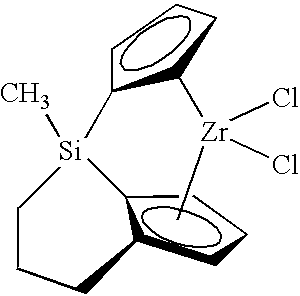
- (CH 2CH2CH2)CH3Si(1,2-cyclopentadienyl)(1-cyclopentadienyl)ZrCl2
- Three equivalents of lithium indenide was combined with ClCH 2CH2CH2SiCl2(CH3) in diethyl ether at −35° C. (dropwise addition of ClCH2CH2CH2SiCl2(CH3) ) and stirred for twelve hours at room temperature. Tetrahydrofuran was added to double the solvent volume and the solution was allowed to stir overnight at room temperature. A golden oil was obtained after a water/diethylether workup. The resulting oil was combined with Zr(NMe2)4 hexane and heated to reflux for twelve hours. The solvent was removed under vacuum and the resulting red oil was heated under vacuum at 135-140° C. for one day. Dichloromethane was added to dissolve product, which was then reacted with a large excess of trimethylsilylchloride and stirred overnight. A yellow crystalline product was obtained after cooling to −35° C. overnight. 1H NMR (CD2Cl2); δ1.5, 2.1, 2.95, 5.96, 6.3, 6.8, 7.2, 7.35, 7.6, 7.85.

- (CH 2CH2CH2)CH3Si(1,2-indenyl)(1-indenyl)ZrCl2
- 0.773 grams of (CH 2CH2CH2)CH3Si(1,2-indenyl)(1-indenyl)ZrCl2 from Example 2 was combined with 42.0 grams of supported methylaluminoxane (600° C. calcined silica, 12 wt % Al) yielding a toluene (180 mL) slurry. The slurry was filtered, rinsed with toluene, and the resulting supported catalyst was dried under vacuum overnight.
- The polymerization was a gas phase polymerization in a fluidized bed reactor equipped with devices for temperature control, catalyst feeding or injection equipment, GC analyzer for monitoring and controlling monomer and gas feeds and equipment for polymer sampling and collecting. The reactor consists of a 6 inch (15.24 cm) diameter bed section increasing to 10 inches (25.4 cm) at the reactor top. Gas comes in through a perforated distributor plate allowing fluidization of the bed contents and polymer sample is discharged at the reactor top. The conditions and resulting polymer properties are outlined in Table 1. The activity of the catalyst system was 19,150 kg PE/mol Zr.hr.
- The activity of the catalyst system of the invention under gas phase or slurry phase polymerization conditions, gas phase in a particular embodiment, employing the tri-bound bridged metallocenes described herein, is expected to range from greater than 5,000 kg PE/mol Zr.hr at a polymerization temperature of from 30° C. to 100° C., 10,000 kg PE/mol Zr.hr at from 30° C. to 100° C. in a more particular embodiment, and from greater than 14,000 kg PE/mol Zr.hr at from 30° C. to 100° C. in a more particular embodiment, and from greater than 16,000 kg PE/mol Zr.hr at from 30° C. to 100° C. in yet a more particular embodiment. In yet a more particular embodiment, the activity of the catalyst system of the invention is greater than 10,000 kg PE/mol Zr.hr at from 40° C. to 90° C., and from greater than 14,000 kg PE/mol Zr.hr at from 40° C. to 90° C. in a more particular embodiment, and from greater than 16,000 kg PE/mol Zr.hr at from 40° C. to 90° C. in yet a more particular embodiment. And in yet a more particular embodiment, the catalyst system of the invention is expected to have an activity of from greater than 10,000 kg PE/mol Zr.hr at from 60° C. to 90° C. Thus, the catalyst system of the present invention has an unexpectedly high activity compared to those of the prior art employing a tri-bound (or greater) bridged metallocene.
- The melt index (MI) of the polyethylene copolymer products of the invention are from 1 to 100 dg/min in one embodiment, and from 2 to 80 in another embodiment; and the HLMI of the polyethylene copolymer products of the invention are from 100 to 2000 dg/min in one embodiment, and from 500 to 1000 dg/min in yet another embodiment. The density of the polyethylene copolymer products of the invention are from 0.880 to 0.930 g/cm 3 in one embodiment, and from 0.900 to 0.928 g/cm3 in a more particular embodiment, and from 0.915 to 0.928 g/cm3 in yet a more particular embodiment.
- The activity of the bridged metallocene catalyst system of the invention is surprising. Given that it is known in the art that metallocene activity tends to decrease upon being supported (See, e.g., METALORGANIC CATALYSTS FOR SYNTHESIS AND POLYMERIZATION 381-405 (Walter Kaminsky, ed. Springer-Verlag 1999)), the activity of the catalysts of the present invention might be expected to be lower than those reported for the tri-bound bridged (cyclopentadienyl-phenyl)(fluorenyl)zirconium compound discussed in the Background, as that compound was used unsupported in polymerizing propylene and ethylene. The catalyst system of the present invention thus demonstrates an unexpected advantage over the prior art in demonstrating relatively high polymerization activity.
- While the present invention has been described and illustrated by reference to particular embodiments, those of ordinary skill in the art will appreciate that the invention lends itself to many different variations not illustrated herein. For these reasons, then, reference should be made solely to the appended claims for purposes of determining the scope of the present invention. Further, certain features of the present invention are described in terms of a set of numerical upper limits and a set of numerical lower limits. It should be appreciated that ranges formed by any combination of these limits are within the scope of the invention unless otherwise indicated.
- Unless otherwise indicated, all numbers expressing quantities of ingredients, properties, reaction conditions, and so forth, used in the specification and claims are to be understood as approximations based on the desired properties sought to be obtained by the present invention, and the error of measurement, etc., and should at least be construed in light of the number of reported significant digits and by applying ordinary rounding techniques. Notwithstanding that the numerical ranges and values setting forth the broad scope of the invention are approximations, the numerical values set forth are reported as precisely as possible.
- All priority documents are herein fully incorporated by reference for all jurisdictions in which such incorporation is permitted. Further, all documents cited herein, including testing procedures, are herein fully incorporated by reference for all jurisdictions in which such incorporation is permitted.
TABLE 1 Catalyst A Polymerization Parameter Value H2 conc. (molppm) 670 Hydrogen flow (sccm) 0.00 Comonomer cone. (mol %) 0.32 C2 conc. (mol %) 35.0 Comonomer/C2 Flow Ratio 0.087 C2 flow (g/hr) 545 H2/C2 Ratio 19.1 Comonomer/C2 ratio 0.009 Rxn. Pressure (psig) 300 Reactor Temp (° C.) 80 Avg. Bed weight (g) 1965 Production (g/hr) 447 Residence Time (hr) 4.4 C2 Utilization (gC2/gC2 poly) 1.22 Avg. Velocity (ft/s) 1.58 Catalyst Timer (minutes) 75.3 Bulk Density (g/cm3) 0.3275 Product Data Melt Index (MI) (dg/min) 39.40 HLMI (dg/min) 876.62 HLMI/MI Ratio 22.25 Density (g/cm3) 0.9232
Claims (44)
1. A method of polymerizing olefins, the method comprising combining under polymerization conditions:
(a) monomers selected from ethylene and C3 to C10 olefins;
(b) an activator; and
(c) a bridged metallocene catalyst component comprising two Cp groups and a trivalent bridging group (A); the group (A) comprising at least one A moiety and at least three linkages between the A moiety and the two Cp ligands; wherein the Cp groups are independently selected from the group consisting of cyclopentadienyl, tetrahydroindenyl, indenyl, heterocyclic analogues thereof and substituted analogues thereof.
2. The method of claim 1 , wherein the A moiety is a moiety selected from Group 13, Group 14, Group 15 atoms, trivalent C2 to C16 hydrocarbons, and trivalent C2 to C16 heteroatom-containing hydrocarbons.
3. The method of claim 1 , wherein the A moiety is selected from Group 13, Group 14 and Group 15 atoms.
4. The method of claim 1 , wherein the linkages are independently selected from chemical bonds, C1 to C6 alkylenes, C4 to C6 cycloalkylenes, C2 to C8 alkenylenes, C1 to C6 heteroatom-containing hydrocarbylenes.
5. The method of claim 1 , wherein the trivalent bridging group (A) is described as:
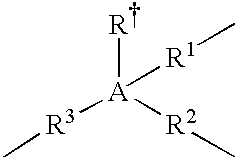
wherein A is a Group 14 atom;
R† is selected from hydride, halogen radicals, C1 to C6 alkyls, C6 to C12 aryls, and C1 to C6 heteroatom-containing hydrocarbons; and
R1, R2 and R3 are divalent groups independently selected from chemical bonds, C1 to C6 alkylenes, C4 to C6 cycloalkylenes, C2 to C8 alkenylenes, and C1 to C6 heteroatom-containing hydrocarbylenes.
6. The method of claim 5 , wherein R1, R2 and R3 are divalent groups independently selected from chemical bonds, methylene, ethylene, propylene, butylene, pentylene, hexylene, cyclopentylene and cyclohexylene.
7. The method of claim 1 , wherein the bridged metallocene catalyst component is represented by the formula:
CpA(A)CpBMXn
wherein M is an atom selected from Group 3 through Group 12 metal atoms; each CpA and CpB are independently selected from substituted cyclopentadienyl or indenyl ligands, and unsubstituted cyclopentadienyl or indenyl ligands; each X is independently selected from any leaving group; n is an integer from 0 to 3; wherein each X, and CpA and CpB are chemically bonded to M;
wherein (A) comprises an A moiety and at least three linkages: at least two linkages between the A moiety and CpA, and one linkage between the A moiety and CpB, the linkages selected independently from covalent bonds, C1 to C12 hydrocarbylenes and C1 to C12 heteroatom-containing hydrocarbylenes; and
wherein the A moiety is selected from Group 13 atoms, Group 14 atoms, Group 15 atoms, trivalent C2 to C10 hydrocarbons, and trivalent C2 to C10 heteroatom-containing hydrocarbons.
8. The method of claim 1 , wherein the monomers are ethylene and a monomer selected from the group consisting of C3 to C10 olefins.
9. The method of claim 8 , wherein the mole ratio of ethylene to the monomer selected from the group consisting of C3 to C10 olefins is greater than 10:1.
10. The method of claim 1 , wherein the polymerization is a gas phase polymerization.
11. The method of claim 1 , wherein the polymerization is a slurry phase polymerization.
12. The method of claim 1 , wherein the polymerization temperature ranges from 10° C. to 150° C.
13. The method of claim 1 , wherein the polymerization temperature ranges from 40° C. to 120° C.
14. A method of polymerizing olefins, the method comprising combining under polymerization conditions:
(a) monomers selected from ethylene and C3 to C10 olefins;
(b) an activator;
(c) a support; and
(d) a bridged metallocene catalyst component comprising two Cp groups and a trivalent bridging group (A); the group (A) comprising at least one A moiety and at least three linkages between the A moiety and the two Cp ligands; wherein the Cp groups are independently selected from cyclopentadienyl, ligands isolobal to cyclopentadienyl, and substituted derivatives thereof.
15. The method of claim 14 , wherein the A moiety is a moiety selected from Group 13, Group 14, Group 15 atoms, trivalent C2 to C16 hydrocarbons, and trivalent C2 to C16heteroatom-containing hydrocarbons.
16. The method of claim 14 , wherein the A moiety is selected from Group 13, Group 14 and Group 15 atoms.
17. The method of claim 14 , wherein the linkages are independently selected from chemical bonds, C1 to C6 alkylenes, C4 to C6 cycloalkylenes, C2 to C8 alkenylenes, C1 to C6 heteroatom-containing hydrocarbylenes.
18. The method of claim 14 , wherein the trivalent bridging group (A) is described as:
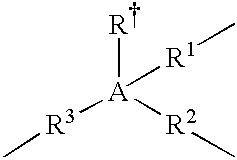
wherein A is a Group 14 atom;
R† is selected from hydride, halogen radicals, C1 to C6 alkyls, C6 to C12 aryls, and C1 to C6 heteroatom-containing hydrocarbons; and
R1, R2 and R3 are divalent groups independently selected from chemical bonds, C1 to C6 alkylenes, C4 to C6 cycloalkylenes, C2 to C8 alkenylenes, and C1 to C6 heteroatom-containing hydrocarbylenes.
19. The method of claim 18 , wherein R1, R2 and R3 are divalent groups independently selected from chemical bonds, methylene, ethylene, propylene, butylene, pentylene, hexylene, cyclopentylene and cyclohexylene.
20. The method of claim 14 , wherein the bridged metallocene compound is bound to the support.
21. The method of claim 20 , wherein the activator is bound to the support.
22. The method of claim 14 , wherein the monomers are ethylene and a monomer selected from the group consisting of C3 to C10 olefins.
23. The method of claim 22 , wherein the mole ratio of ethylene to the monomer selected from the group consisting of C3 to C10 olefins is greater than 10:1.
24. The method of claim 14 , wherein the polymerization is a gas phase polymerization.
25. The method of claim 14 , wherein the polymerization is a slurry phase polymerization.
26. The method of claim 14 , wherein the polymerization temperature ranges from 10° C to 150° C.
27. The method of claim 14 , wherein the polymerization temperature ranges from 40° C. to 120° C.
28. A catalyst system for producing polyolefins comprising an activator; a support; and a bridged metallocene catalyst component comprising two Cp groups and a trivalent bridging group (A); the group (A) comprising at least one A moiety and at least three linkages between the A moiety and the two Cp ligands; wherein the Cp groups are independently selected from cyclopentadienyl, ligands isolobal to cyclopentadienyl, and substituted derivatives thereof.
29. The catalyst system of claim 28 , wherein the A moiety is a moiety selected from Group 13, Group 14, Group 15 atoms, trivalent C2 to C16 hydrocarbons, and trivalent C2 to C16 heteroatom-containing hydrocarbons.
30. The catalyst system of claim 28 , wherein the A moiety is selected from Group 13, Group 14 and Group 15 atoms.
31. The catalyst system of claim 28 , wherein the linkages are independently selected from chemical bonds, C1 to C6 alkylenes, C4 to C6 cycloalkylenes, C2 to C8 alkenylenes, C1 to C6 heteroatom-containing hydrocarbylenes.
32. The catalyst system of claim 28 , wherein the trivalent bridging group (A) is described as:

wherein A is a Group 14 atom;
R† is selected from hydride, halogen radicals, C1 to C6 alkyls, C6 to C12 aryls, and C1 to C6 heteroatom-containing hydrocarbons; and
R1, R2 and R3 are divalent groups independently selected from chemical bonds, C1 to C6 alkylenes, C4 to C6 cycloalkylenes, C2 to C8 alkenylenes, and C1 to C6 heteroatom-containing hydrocarbylenes.
33. The catalyst system of claim 32 , wherein R1, R2 and R3 are divalent groups independently selected from chemical bonds, methylene, ethylene, propylene, butylene, pentylene, hexylene, cyclopentylene and cyclohexylene.
34. The catalyst system of claim 28 , wherein the bridged metallocene catalyst component is represented by the formula:
CpA(A)CpBMXn
wherein M is an atom selected from Group 3 through Group 12 metal atoms; each CpA and CpB are independently selected from substituted cyclopentadienyl or indenyl ligands, and unsubstituted cyclopentadienyl or indenyl ligands; each X is independently selected from any leaving group; n is an integer from 0 to 3; wherein each X, and CpA and CpB are chemically bonded to M;
wherein (A) comprises an A moiety and at least three linkages: at least two linkages between the A moiety and CpA, and one linkage between the A moiety and CpB, the linkages selected independently from covalent bonds, C1 to C12 hydrocarbylenes and C1 to C12 heteroatom-containing hydrocarbylenes; and
wherein the A moiety is selected from Group 13 atoms, Group 14 atoms, Group 15 atoms, trivalent C2 to C10 hydrocarbons, and trivalent C2 to C10 heteroatom-containing hydrocarbons.
35. The catalyst system of claim 28 , also comprising a support.
36. The catalyst system of claim 35 , wherein the support is pretreated with the activator to produce a supported activator.
37. A catalyst system for producing polyolefins comprising an activator; and a bridged metallocene catalyst component comprising two Cp groups and a trivalent bridging group (A); the group (A) comprising at least one A moiety and at least three linkages between the A moiety and the two Cp ligands; wherein the Cp groups are independently selected from the group consisting of cyclopentadienyl, tetrahydroindenyl, indenyl, heterocyclic analogues thereof and substituted analogues thereof.
38. The catalyst system of claim 37 , wherein the A moiety is a moiety selected from Group 13, Group 14, Group 15 atoms, trivalent C2 to C16 hydrocarbons, and trivalent C2 to C16 heteroatom-containing hydrocarbons.
39. The catalyst system of claim 37 , wherein the A moiety is selected from Group 13, Group 14 and Group 15 atoms.
40. The catalyst system of claim 37 , wherein the linkages are independently selected from chemical bonds, C1 to C6 alkylenes, C4 to C6 cycloalkylenes, C2 to C8 alkenylenes, C1 to C6 heteroatom-containing hydrocarbylenes.
41. The catalyst system of claim 37 , wherein the trivalent bridging group (A) is described as:
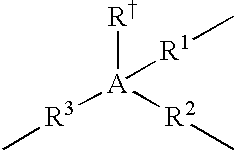
wherein A is a Group 14 atom;
R† is selected from hydride, halogen radicals, C1 to C6 alkyls, C6 to C12 aryls, and C1 to C6 heteroatom-containing hydrocarbons; and
R1, R2 and R3 are divalent groups independently selected from chemical bonds, C1 to C6 alkylenes, C4 to C6 cycloalkylenes, C2 to C8 alkenylenes, and C1 to C6 heteroatom-containing hydrocarbylenes.
42. The catalyst system of claim 41 , wherein R1, R2 and R3 are divalent groups independently selected from chemical bonds, methylene, ethylene, propylene, butylene, pentylene, hexylene, cyclopentylene and cyclohexylene.
43. The catalyst system of claim 37 , wherein the bridged metallocene catalyst component is represented by the formula:
CpA(A)CpBMXn
wherein M is an atom selected from Group 3 through Group 12 metal atoms; each CpA and CpB are independently selected from substituted cyclopentadienyl or indenyl ligands, and unsubstituted cyclopentadienyl or indenyl ligands; each X is independently selected from any leaving group; n is an integer from 0 to 3; wherein each X, and CpA and CpB are chemically bonded to M;
wherein (A) comprises an A moiety and at least three linkages: at least two linkages between the A moiety and CpA, and one linkage between the A moiety and CpB, the linkages selected independently from covalent bonds, C1 to C12 hydrocarbylenes and C1 to C12 heteroatom-containing hydrocarbylenes; and
wherein the A moiety is selected from Group 13 atoms, Group 14 atoms, Group 15 atoms, trivalent C2 to C10 hydrocarbons, and trivalent C2 to C10 heteroatom-containing hydrocarbons.
44. The catalyst system of claim 37 , wherein the support is pretreated with the activator to produce a supported activator.
Priority Applications (2)
| Application Number | Priority Date | Filing Date | Title |
|---|---|---|---|
| US10/304,032 US20030104928A1 (en) | 2000-12-22 | 2002-11-25 | Bridged metallocene catalyst compounds for olefin polymerization |
| PCT/US2003/032528 WO2004047989A1 (en) | 2002-11-25 | 2003-10-15 | Bridged metallocene catalyst compounds for olefin polymerization |
Applications Claiming Priority (2)
| Application Number | Priority Date | Filing Date | Title |
|---|---|---|---|
| US09/747,821 US6632770B2 (en) | 2000-12-22 | 2000-12-22 | Catalyst system and its use in a polymerization process |
| US10/304,032 US20030104928A1 (en) | 2000-12-22 | 2002-11-25 | Bridged metallocene catalyst compounds for olefin polymerization |
Related Parent Applications (1)
| Application Number | Title | Priority Date | Filing Date |
|---|---|---|---|
| US09/747,821 Continuation-In-Part US6632770B2 (en) | 2000-12-22 | 2000-12-22 | Catalyst system and its use in a polymerization process |
Publications (1)
| Publication Number | Publication Date |
|---|---|
| US20030104928A1 true US20030104928A1 (en) | 2003-06-05 |
Family
ID=32392423
Family Applications (1)
| Application Number | Title | Priority Date | Filing Date |
|---|---|---|---|
| US10/304,032 Abandoned US20030104928A1 (en) | 2000-12-22 | 2002-11-25 | Bridged metallocene catalyst compounds for olefin polymerization |
Country Status (2)
| Country | Link |
|---|---|
| US (1) | US20030104928A1 (en) |
| WO (1) | WO2004047989A1 (en) |
Cited By (16)
| Publication number | Priority date | Publication date | Assignee | Title |
|---|---|---|---|---|
| US20070055028A1 (en) * | 2004-01-07 | 2007-03-08 | Casty Gary L | Preparation of polymerization catalyst activators utilizing indole-modified silica supports |
| US7220695B2 (en) | 2004-01-07 | 2007-05-22 | Exxonmobil Chemical Patents Inc. | Supported activator |
| US8022005B2 (en) | 2007-11-08 | 2011-09-20 | Exxonmobil Chemical Patents Inc. | Halogen substituted heterocyclic heteroatom containing ligands-alumoxane activation of metallocenes |
| US9321854B2 (en) | 2013-10-29 | 2016-04-26 | Exxonmobil Chemical Patents Inc. | Aluminum alkyl with C5 cyclic and pendent olefin polymerization catalyst |
| KR101784689B1 (en) | 2015-11-18 | 2017-10-12 | 한화케미칼 주식회사 | Supported metallocene catalyst and method for preparing polyolefin by using the same |
| US10059788B2 (en) | 2016-04-29 | 2018-08-28 | Exxonmobil Chemical Patents Inc. | Organoaluminum activators on clays |
| WO2018185173A1 (en) * | 2017-04-04 | 2018-10-11 | Sabic Global Technologies B.V. | Dimethyl-silyl-bridged-1-substituted-2-indenyl metallocene complexes for olefin polymerization |
| US10351647B2 (en) | 2015-05-29 | 2019-07-16 | Exxonmobil Chemical Patents Inc. | Polymerization process using bridged metallocene compounds supported on organoaluminum treated layered silicate supports |
| WO2019236351A1 (en) * | 2018-06-04 | 2019-12-12 | Exxonmobil Chemical Patents Inc. | Metallocenes with si-si bridges |
| US10562987B2 (en) | 2016-06-30 | 2020-02-18 | Exxonmobil Chemical Patents Inc. | Polymers produced via use of quinolinyldiamido transition metal complexes and vinyl transfer agents |
| US10618988B2 (en) | 2015-08-31 | 2020-04-14 | Exxonmobil Chemical Patents Inc. | Branched propylene polymers produced via use of vinyl transfer agents and processes for production thereof |
| US10626200B2 (en) | 2017-02-28 | 2020-04-21 | Exxonmobil Chemical Patents Inc. | Branched EPDM polymers produced via use of vinyl transfer agents and processes for production thereof |
| US10676551B2 (en) | 2017-03-01 | 2020-06-09 | Exxonmobil Chemical Patents Inc. | Branched ethylene copolymers produced via use of vinyl transfer agents and processes for production thereof |
| US10676547B2 (en) | 2015-08-31 | 2020-06-09 | Exxonmobil Chemical Patents Inc. | Aluminum alkyls with pendant olefins on clays |
| US11041029B2 (en) | 2015-08-31 | 2021-06-22 | Exxonmobil Chemical Patents Inc. | Aluminum alkyls with pendant olefins for polyolefin reactions |
| US11427608B2 (en) | 2017-04-04 | 2022-08-30 | Sabic Global Technologies B.V. | Dihydrocarbyl-silyl-bridged-1,3 disubstituted-2-indenyl metallocene complexes for olefin polymerization |
Citations (1)
| Publication number | Priority date | Publication date | Assignee | Title |
|---|---|---|---|---|
| US6632770B2 (en) * | 2000-12-22 | 2003-10-14 | Univation Technologies, Llc | Catalyst system and its use in a polymerization process |
Family Cites Families (5)
| Publication number | Priority date | Publication date | Assignee | Title |
|---|---|---|---|---|
| FI945958A7 (en) * | 1993-12-21 | 1995-06-22 | Targor Gmbh | Method for producing polyolefins |
| FI945959L (en) * | 1993-12-21 | 1995-06-22 | Hoechst Ag | Metallocenes and their use as catalysts |
| DE19522105A1 (en) * | 1995-06-19 | 1997-01-02 | Hoechst Ag | Stereorigid metallocene compound |
| US6340651B1 (en) * | 1999-04-26 | 2002-01-22 | Phillips Petroleum Company | Multicyclic metallocycle metallocenes and their use |
| JP4931269B2 (en) * | 2000-05-30 | 2012-05-16 | 出光興産株式会社 | Method for producing α-olefin polymer and lubricating oil |
-
2002
- 2002-11-25 US US10/304,032 patent/US20030104928A1/en not_active Abandoned
-
2003
- 2003-10-15 WO PCT/US2003/032528 patent/WO2004047989A1/en not_active Ceased
Patent Citations (1)
| Publication number | Priority date | Publication date | Assignee | Title |
|---|---|---|---|---|
| US6632770B2 (en) * | 2000-12-22 | 2003-10-14 | Univation Technologies, Llc | Catalyst system and its use in a polymerization process |
Cited By (21)
| Publication number | Priority date | Publication date | Assignee | Title |
|---|---|---|---|---|
| US7220695B2 (en) | 2004-01-07 | 2007-05-22 | Exxonmobil Chemical Patents Inc. | Supported activator |
| US7741417B2 (en) | 2004-01-07 | 2010-06-22 | Exxonmobil Chemical Patents Inc. | Preparation of polymerization catalyst activators utilizing indole-modified silica supports |
| US20070055028A1 (en) * | 2004-01-07 | 2007-03-08 | Casty Gary L | Preparation of polymerization catalyst activators utilizing indole-modified silica supports |
| US8022005B2 (en) | 2007-11-08 | 2011-09-20 | Exxonmobil Chemical Patents Inc. | Halogen substituted heterocyclic heteroatom containing ligands-alumoxane activation of metallocenes |
| US9321854B2 (en) | 2013-10-29 | 2016-04-26 | Exxonmobil Chemical Patents Inc. | Aluminum alkyl with C5 cyclic and pendent olefin polymerization catalyst |
| US10351647B2 (en) | 2015-05-29 | 2019-07-16 | Exxonmobil Chemical Patents Inc. | Polymerization process using bridged metallocene compounds supported on organoaluminum treated layered silicate supports |
| US10618988B2 (en) | 2015-08-31 | 2020-04-14 | Exxonmobil Chemical Patents Inc. | Branched propylene polymers produced via use of vinyl transfer agents and processes for production thereof |
| US11041029B2 (en) | 2015-08-31 | 2021-06-22 | Exxonmobil Chemical Patents Inc. | Aluminum alkyls with pendant olefins for polyolefin reactions |
| US10676547B2 (en) | 2015-08-31 | 2020-06-09 | Exxonmobil Chemical Patents Inc. | Aluminum alkyls with pendant olefins on clays |
| KR101784689B1 (en) | 2015-11-18 | 2017-10-12 | 한화케미칼 주식회사 | Supported metallocene catalyst and method for preparing polyolefin by using the same |
| US10059788B2 (en) | 2016-04-29 | 2018-08-28 | Exxonmobil Chemical Patents Inc. | Organoaluminum activators on clays |
| US10562987B2 (en) | 2016-06-30 | 2020-02-18 | Exxonmobil Chemical Patents Inc. | Polymers produced via use of quinolinyldiamido transition metal complexes and vinyl transfer agents |
| US10626200B2 (en) | 2017-02-28 | 2020-04-21 | Exxonmobil Chemical Patents Inc. | Branched EPDM polymers produced via use of vinyl transfer agents and processes for production thereof |
| US10676551B2 (en) | 2017-03-01 | 2020-06-09 | Exxonmobil Chemical Patents Inc. | Branched ethylene copolymers produced via use of vinyl transfer agents and processes for production thereof |
| US10995170B2 (en) | 2017-03-01 | 2021-05-04 | Exxonmobil Chemical Patents Inc. | Branched ethylene copolymers produced via use of vinyl transfer agents and processes for production thereof |
| CN110650978A (en) * | 2017-04-04 | 2020-01-03 | Sabic环球技术有限责任公司 | Dimethyl-silyl-bridged-1-substituted-2-indenyl metallocene complexes for olefin polymerization |
| WO2018185173A1 (en) * | 2017-04-04 | 2018-10-11 | Sabic Global Technologies B.V. | Dimethyl-silyl-bridged-1-substituted-2-indenyl metallocene complexes for olefin polymerization |
| US11155659B2 (en) | 2017-04-04 | 2021-10-26 | Sabic Global Technologies B.V. | Dimethyl-silyl-bridged-1-substituted-2-indenyl metallocene complexes for olefin polymerization |
| US11427608B2 (en) | 2017-04-04 | 2022-08-30 | Sabic Global Technologies B.V. | Dihydrocarbyl-silyl-bridged-1,3 disubstituted-2-indenyl metallocene complexes for olefin polymerization |
| WO2019236351A1 (en) * | 2018-06-04 | 2019-12-12 | Exxonmobil Chemical Patents Inc. | Metallocenes with si-si bridges |
| US11369949B2 (en) | 2018-06-04 | 2022-06-28 | Exxonmobil Chemical Patents Inc. | Metallocenes with Si—Si bridges |
Also Published As
| Publication number | Publication date |
|---|---|
| WO2004047989A1 (en) | 2004-06-10 |
Similar Documents
| Publication | Publication Date | Title |
|---|---|---|
| US8557935B2 (en) | Bimetallic catalyst, method of polymerization and bimodal polyolefins therefrom | |
| US6869903B2 (en) | Synthesis of polymerization catalyst components | |
| US6943134B2 (en) | Bimodal polyolefin production process and films therefrom | |
| US6753390B2 (en) | Gas phase polymerization process | |
| JP4332501B2 (en) | Method for producing fluorination catalyst | |
| US20030104928A1 (en) | Bridged metallocene catalyst compounds for olefin polymerization | |
| US6890876B2 (en) | Processes for producing fluorided catalysts from nitrogenous metallocenes | |
| US7582711B2 (en) | Ziegler-type catalysts having increased productivity | |
| CN101166575A (en) | Bimetallic catalyst, polymerization process and bimodal polyolefins obtained therefrom |
Legal Events
| Date | Code | Title | Description |
|---|---|---|---|
| AS | Assignment |
Owner name: UNIVATION TECHNOLOGIES LLC, TEXAS Free format text: ASSIGNMENT OF ASSIGNORS INTEREST;ASSIGNOR:HOLTCAMP, MATTHEW W.;REEL/FRAME:013544/0834 Effective date: 20021119 |
|
| STCB | Information on status: application discontinuation |
Free format text: ABANDONED -- FAILURE TO RESPOND TO AN OFFICE ACTION |