US20030099659A1 - Antigen delivery system - Google Patents
Antigen delivery system Download PDFInfo
- Publication number
- US20030099659A1 US20030099659A1 US10/195,226 US19522602A US2003099659A1 US 20030099659 A1 US20030099659 A1 US 20030099659A1 US 19522602 A US19522602 A US 19522602A US 2003099659 A1 US2003099659 A1 US 2003099659A1
- Authority
- US
- United States
- Prior art keywords
- antigen
- glycerides
- mixtures
- group
- water soluble
- Prior art date
- Legal status (The legal status is an assumption and is not a legal conclusion. Google has not performed a legal analysis and makes no representation as to the accuracy of the status listed.)
- Abandoned
Links
- 239000000427 antigen Substances 0.000 title claims abstract description 138
- 108091007433 antigens Proteins 0.000 title claims abstract description 138
- 102000036639 antigens Human genes 0.000 title claims abstract description 138
- 239000000203 mixture Substances 0.000 claims abstract description 152
- 239000002671 adjuvant Substances 0.000 claims abstract description 78
- 230000028993 immune response Effects 0.000 claims abstract description 52
- -1 are described Substances 0.000 claims abstract description 38
- 238000000034 method Methods 0.000 claims abstract description 32
- 125000005456 glyceride group Chemical group 0.000 claims description 45
- 229920003169 water-soluble polymer Polymers 0.000 claims description 24
- 150000004665 fatty acids Chemical class 0.000 claims description 23
- 235000014113 dietary fatty acids Nutrition 0.000 claims description 22
- 239000000194 fatty acid Substances 0.000 claims description 22
- 229930195729 fatty acid Natural products 0.000 claims description 22
- WWZKQHOCKIZLMA-UHFFFAOYSA-N Caprylic acid Natural products CCCCCCCC(O)=O WWZKQHOCKIZLMA-UHFFFAOYSA-N 0.000 claims description 21
- GHVNFZFCNZKVNT-UHFFFAOYSA-N decanoic acid Chemical compound CCCCCCCCCC(O)=O GHVNFZFCNZKVNT-UHFFFAOYSA-N 0.000 claims description 20
- OGBUMNBNEWYMNJ-UHFFFAOYSA-N batilol Chemical class CCCCCCCCCCCCCCCCCCOCC(O)CO OGBUMNBNEWYMNJ-UHFFFAOYSA-N 0.000 claims description 17
- 229920006395 saturated elastomer Polymers 0.000 claims description 15
- 239000003795 chemical substances by application Substances 0.000 claims description 14
- 241000124008 Mammalia Species 0.000 claims description 13
- 229920003171 Poly (ethylene oxide) Polymers 0.000 claims description 12
- 229960000814 tetanus toxoid Drugs 0.000 claims description 12
- 241000725643 Respiratory syncytial virus Species 0.000 claims description 11
- 239000005632 Capric acid (CAS 334-48-5) Substances 0.000 claims description 10
- 239000005635 Caprylic acid (CAS 124-07-2) Substances 0.000 claims description 10
- 108010046334 Urease Proteins 0.000 claims description 10
- 108010000916 Fimbriae Proteins Proteins 0.000 claims description 9
- 229920000642 polymer Polymers 0.000 claims description 9
- 239000003755 preservative agent Substances 0.000 claims description 9
- XLYOFNOQVPJJNP-UHFFFAOYSA-N water Substances O XLYOFNOQVPJJNP-UHFFFAOYSA-N 0.000 claims description 9
- LDVVTQMJQSCDMK-UHFFFAOYSA-N 1,3-dihydroxypropan-2-yl formate Chemical compound OCC(CO)OC=O LDVVTQMJQSCDMK-UHFFFAOYSA-N 0.000 claims description 8
- NOESYZHRGYRDHS-UHFFFAOYSA-N insulin Chemical compound N1C(=O)C(NC(=O)C(CCC(N)=O)NC(=O)C(CCC(O)=O)NC(=O)C(C(C)C)NC(=O)C(NC(=O)CN)C(C)CC)CSSCC(C(NC(CO)C(=O)NC(CC(C)C)C(=O)NC(CC=2C=CC(O)=CC=2)C(=O)NC(CCC(N)=O)C(=O)NC(CC(C)C)C(=O)NC(CCC(O)=O)C(=O)NC(CC(N)=O)C(=O)NC(CC=2C=CC(O)=CC=2)C(=O)NC(CSSCC(NC(=O)C(C(C)C)NC(=O)C(CC(C)C)NC(=O)C(CC=2C=CC(O)=CC=2)NC(=O)C(CC(C)C)NC(=O)C(C)NC(=O)C(CCC(O)=O)NC(=O)C(C(C)C)NC(=O)C(CC(C)C)NC(=O)C(CC=2NC=NC=2)NC(=O)C(CO)NC(=O)CNC2=O)C(=O)NCC(=O)NC(CCC(O)=O)C(=O)NC(CCCNC(N)=N)C(=O)NCC(=O)NC(CC=3C=CC=CC=3)C(=O)NC(CC=3C=CC=CC=3)C(=O)NC(CC=3C=CC(O)=CC=3)C(=O)NC(C(C)O)C(=O)N3C(CCC3)C(=O)NC(CCCCN)C(=O)NC(C)C(O)=O)C(=O)NC(CC(N)=O)C(O)=O)=O)NC(=O)C(C(C)CC)NC(=O)C(CO)NC(=O)C(C(C)O)NC(=O)C1CSSCC2NC(=O)C(CC(C)C)NC(=O)C(NC(=O)C(CCC(N)=O)NC(=O)C(CC(N)=O)NC(=O)C(NC(=O)C(N)CC=1C=CC=CC=1)C(C)C)CC1=CN=CN1 NOESYZHRGYRDHS-UHFFFAOYSA-N 0.000 claims description 8
- 241000588650 Neisseria meningitidis Species 0.000 claims description 7
- 210000004877 mucosa Anatomy 0.000 claims description 7
- 101710116435 Outer membrane protein Proteins 0.000 claims description 6
- 210000004072 lung Anatomy 0.000 claims description 6
- 229960003983 diphtheria toxoid Drugs 0.000 claims description 5
- 244000000010 microbial pathogen Species 0.000 claims description 5
- 239000003921 oil Substances 0.000 claims description 5
- 239000000126 substance Substances 0.000 claims description 5
- 239000004094 surface-active agent Substances 0.000 claims description 5
- 108010002231 IgA-specific serine endopeptidase Proteins 0.000 claims description 4
- 102000004877 Insulin Human genes 0.000 claims description 4
- 108090001061 Insulin Proteins 0.000 claims description 4
- 101800005149 Peptide B Proteins 0.000 claims description 4
- 229940125396 insulin Drugs 0.000 claims description 4
- 239000003380 propellant Substances 0.000 claims description 4
- 239000002904 solvent Substances 0.000 claims description 4
- 241000712461 unidentified influenza virus Species 0.000 claims description 4
- 241000606768 Haemophilus influenzae Species 0.000 claims description 3
- 241000590002 Helicobacter pylori Species 0.000 claims description 3
- 241000607142 Salmonella Species 0.000 claims description 3
- 241001219481 Spongospora subterranea Species 0.000 claims description 3
- 206010047400 Vibrio infections Diseases 0.000 claims description 3
- 238000006073 displacement reaction Methods 0.000 claims description 3
- 230000007515 enzymatic degradation Effects 0.000 claims description 3
- 210000001035 gastrointestinal tract Anatomy 0.000 claims description 3
- 229940037467 helicobacter pylori Drugs 0.000 claims description 3
- 239000003381 stabilizer Substances 0.000 claims description 3
- 210000001215 vagina Anatomy 0.000 claims description 3
- SYTBZMRGLBWNTM-SNVBAGLBSA-N (R)-flurbiprofen Chemical compound FC1=CC([C@H](C(O)=O)C)=CC=C1C1=CC=CC=C1 SYTBZMRGLBWNTM-SNVBAGLBSA-N 0.000 claims description 2
- 241000588652 Neisseria gonorrhoeae Species 0.000 claims description 2
- 101710090322 Truncated surface protein Proteins 0.000 claims description 2
- 229940124532 absorption promoter Drugs 0.000 claims description 2
- 239000003570 air Substances 0.000 claims description 2
- 150000001298 alcohols Chemical class 0.000 claims description 2
- 239000003960 organic solvent Substances 0.000 claims description 2
- 230000003204 osmotic effect Effects 0.000 claims description 2
- 210000000664 rectum Anatomy 0.000 claims description 2
- 210000005000 reproductive tract Anatomy 0.000 claims description 2
- 239000008135 aqueous vehicle Substances 0.000 claims 7
- 101710154606 Hemagglutinin Proteins 0.000 claims 1
- 101710093908 Outer capsid protein VP4 Proteins 0.000 claims 1
- 101710135467 Outer capsid protein sigma-1 Proteins 0.000 claims 1
- 101710176177 Protein A56 Proteins 0.000 claims 1
- 239000000185 hemagglutinin Substances 0.000 claims 1
- 230000002708 enhancing effect Effects 0.000 abstract description 3
- 229960005486 vaccine Drugs 0.000 description 71
- 238000009472 formulation Methods 0.000 description 63
- FAPWRFPIFSIZLT-UHFFFAOYSA-M Sodium chloride Chemical compound [Na+].[Cl-] FAPWRFPIFSIZLT-UHFFFAOYSA-M 0.000 description 26
- 241000699670 Mus sp. Species 0.000 description 23
- 230000002163 immunogen Effects 0.000 description 23
- 210000002966 serum Anatomy 0.000 description 19
- 210000004379 membrane Anatomy 0.000 description 17
- 239000012528 membrane Substances 0.000 description 17
- 241000700605 Viruses Species 0.000 description 16
- 239000003981 vehicle Substances 0.000 description 16
- 108010068327 4-hydroxyphenylpyruvate dioxygenase Proteins 0.000 description 15
- DNIAPMSPPWPWGF-UHFFFAOYSA-N Propylene glycol Chemical compound CC(O)CO DNIAPMSPPWPWGF-UHFFFAOYSA-N 0.000 description 15
- 238000002255 vaccination Methods 0.000 description 15
- 241000196324 Embryophyta Species 0.000 description 14
- PEDCQBHIVMGVHV-UHFFFAOYSA-N Glycerine Chemical compound OCC(O)CO PEDCQBHIVMGVHV-UHFFFAOYSA-N 0.000 description 14
- 229920001223 polyethylene glycol Polymers 0.000 description 14
- 239000011780 sodium chloride Substances 0.000 description 14
- 230000001965 increasing effect Effects 0.000 description 12
- 210000003097 mucus Anatomy 0.000 description 12
- 230000004044 response Effects 0.000 description 12
- 238000011282 treatment Methods 0.000 description 12
- 0 [1*]OCC(CO[3*])O[2*] Chemical compound [1*]OCC(CO[3*])O[2*] 0.000 description 11
- 230000000694 effects Effects 0.000 description 11
- 230000007794 irritation Effects 0.000 description 11
- 244000052769 pathogen Species 0.000 description 11
- 230000003053 immunization Effects 0.000 description 9
- 208000015181 infectious disease Diseases 0.000 description 9
- 238000011156 evaluation Methods 0.000 description 8
- 238000002649 immunization Methods 0.000 description 8
- 230000000622 irritating effect Effects 0.000 description 8
- 235000018102 proteins Nutrition 0.000 description 8
- 108090000623 proteins and genes Proteins 0.000 description 8
- 102000004169 proteins and genes Human genes 0.000 description 8
- 210000001519 tissue Anatomy 0.000 description 8
- 241001465754 Metazoa Species 0.000 description 7
- 239000002202 Polyethylene glycol Substances 0.000 description 7
- 210000004369 blood Anatomy 0.000 description 7
- 239000008280 blood Substances 0.000 description 7
- 210000004027 cell Anatomy 0.000 description 7
- 230000001681 protective effect Effects 0.000 description 7
- QTBSBXVTEAMEQO-UHFFFAOYSA-N Acetic acid Chemical compound CC(O)=O QTBSBXVTEAMEQO-UHFFFAOYSA-N 0.000 description 6
- 241000251468 Actinopterygii Species 0.000 description 6
- 230000000240 adjuvant effect Effects 0.000 description 6
- 235000019688 fish Nutrition 0.000 description 6
- 235000011187 glycerol Nutrition 0.000 description 6
- 229960003971 influenza vaccine Drugs 0.000 description 6
- 230000001717 pathogenic effect Effects 0.000 description 6
- 239000000546 pharmaceutical excipient Substances 0.000 description 6
- 229920000136 polysorbate Polymers 0.000 description 6
- 210000003296 saliva Anatomy 0.000 description 6
- 230000003248 secreting effect Effects 0.000 description 6
- 238000011725 BALB/c mouse Methods 0.000 description 5
- 206010028980 Neoplasm Diseases 0.000 description 5
- 230000005875 antibody response Effects 0.000 description 5
- 239000012867 bioactive agent Substances 0.000 description 5
- 238000002474 experimental method Methods 0.000 description 5
- 210000000987 immune system Anatomy 0.000 description 5
- 210000001331 nose Anatomy 0.000 description 5
- 229960004063 propylene glycol Drugs 0.000 description 5
- 235000013772 propylene glycol Nutrition 0.000 description 5
- 210000002345 respiratory system Anatomy 0.000 description 5
- 239000000725 suspension Substances 0.000 description 5
- 150000003626 triacylglycerols Chemical class 0.000 description 5
- NHBKXEKEPDILRR-UHFFFAOYSA-N 2,3-bis(butanoylsulfanyl)propyl butanoate Chemical compound CCCC(=O)OCC(SC(=O)CCC)CSC(=O)CCC NHBKXEKEPDILRR-UHFFFAOYSA-N 0.000 description 4
- 208000023275 Autoimmune disease Diseases 0.000 description 4
- 238000002965 ELISA Methods 0.000 description 4
- LFQSCWFLJHTTHZ-UHFFFAOYSA-N Ethanol Natural products CCO LFQSCWFLJHTTHZ-UHFFFAOYSA-N 0.000 description 4
- 210000001744 T-lymphocyte Anatomy 0.000 description 4
- 241000251539 Vertebrata <Metazoa> Species 0.000 description 4
- 239000013566 allergen Substances 0.000 description 4
- 230000002238 attenuated effect Effects 0.000 description 4
- 210000003719 b-lymphocyte Anatomy 0.000 description 4
- 201000011510 cancer Diseases 0.000 description 4
- 235000010980 cellulose Nutrition 0.000 description 4
- 229920002678 cellulose Polymers 0.000 description 4
- 150000001875 compounds Chemical class 0.000 description 4
- 201000010099 disease Diseases 0.000 description 4
- 208000037265 diseases, disorders, signs and symptoms Diseases 0.000 description 4
- 239000000839 emulsion Substances 0.000 description 4
- 239000003623 enhancer Substances 0.000 description 4
- 230000005847 immunogenicity Effects 0.000 description 4
- 239000007924 injection Substances 0.000 description 4
- 238000002347 injection Methods 0.000 description 4
- 210000003563 lymphoid tissue Anatomy 0.000 description 4
- 210000003928 nasal cavity Anatomy 0.000 description 4
- 210000002850 nasal mucosa Anatomy 0.000 description 4
- 235000019198 oils Nutrition 0.000 description 4
- 238000007911 parenteral administration Methods 0.000 description 4
- 108090000765 processed proteins & peptides Proteins 0.000 description 4
- 229940031626 subunit vaccine Drugs 0.000 description 4
- 241000271566 Aves Species 0.000 description 3
- 241000894006 Bacteria Species 0.000 description 3
- 208000035473 Communicable disease Diseases 0.000 description 3
- IAZDPXIOMUYVGZ-UHFFFAOYSA-N Dimethylsulphoxide Chemical compound CS(C)=O IAZDPXIOMUYVGZ-UHFFFAOYSA-N 0.000 description 3
- 241000282326 Felis catus Species 0.000 description 3
- 241000233866 Fungi Species 0.000 description 3
- 229920000084 Gum arabic Polymers 0.000 description 3
- 241000282412 Homo Species 0.000 description 3
- 229940124873 Influenza virus vaccine Drugs 0.000 description 3
- 206010022998 Irritability Diseases 0.000 description 3
- 239000004367 Lipase Substances 0.000 description 3
- 108090001060 Lipase Proteins 0.000 description 3
- 102000004882 Lipase Human genes 0.000 description 3
- ZMXDDKWLCZADIW-UHFFFAOYSA-N N,N-Dimethylformamide Chemical compound CN(C)C=O ZMXDDKWLCZADIW-UHFFFAOYSA-N 0.000 description 3
- 241000283973 Oryctolagus cuniculus Species 0.000 description 3
- 241001494479 Pecora Species 0.000 description 3
- 241001591005 Siga Species 0.000 description 3
- HEMHJVSKTPXQMS-UHFFFAOYSA-M Sodium hydroxide Chemical compound [OH-].[Na+] HEMHJVSKTPXQMS-UHFFFAOYSA-M 0.000 description 3
- 229920002125 Sokalan® Polymers 0.000 description 3
- 244000061456 Solanum tuberosum Species 0.000 description 3
- GSEJCLTVZPLZKY-UHFFFAOYSA-N Triethanolamine Chemical compound OCCN(CCO)CCO GSEJCLTVZPLZKY-UHFFFAOYSA-N 0.000 description 3
- ZMANZCXQSJIPKH-UHFFFAOYSA-N Triethylamine Chemical compound CCN(CC)CC ZMANZCXQSJIPKH-UHFFFAOYSA-N 0.000 description 3
- 238000010521 absorption reaction Methods 0.000 description 3
- 235000010489 acacia gum Nutrition 0.000 description 3
- 238000004458 analytical method Methods 0.000 description 3
- 210000000612 antigen-presenting cell Anatomy 0.000 description 3
- 238000003556 assay Methods 0.000 description 3
- 239000001913 cellulose Substances 0.000 description 3
- KRKNYBCHXYNGOX-UHFFFAOYSA-N citric acid Chemical compound OC(=O)CC(O)(C(O)=O)CC(O)=O KRKNYBCHXYNGOX-UHFFFAOYSA-N 0.000 description 3
- XBDQKXXYIPTUBI-UHFFFAOYSA-N dimethylselenoniopropionate Natural products CCC(O)=O XBDQKXXYIPTUBI-UHFFFAOYSA-N 0.000 description 3
- 239000003995 emulsifying agent Substances 0.000 description 3
- 229920000159 gelatin Polymers 0.000 description 3
- 235000019322 gelatine Nutrition 0.000 description 3
- 210000002816 gill Anatomy 0.000 description 3
- 150000004676 glycans Chemical class 0.000 description 3
- 230000001939 inductive effect Effects 0.000 description 3
- 206010022000 influenza Diseases 0.000 description 3
- 238000007918 intramuscular administration Methods 0.000 description 3
- 230000021633 leukocyte mediated immunity Effects 0.000 description 3
- 235000019421 lipase Nutrition 0.000 description 3
- 150000002632 lipids Chemical class 0.000 description 3
- 239000007788 liquid Substances 0.000 description 3
- 230000007108 local immune response Effects 0.000 description 3
- 230000001404 mediated effect Effects 0.000 description 3
- 210000002418 meninge Anatomy 0.000 description 3
- 210000000214 mouth Anatomy 0.000 description 3
- 244000045947 parasite Species 0.000 description 3
- 229920001282 polysaccharide Polymers 0.000 description 3
- 239000005017 polysaccharide Substances 0.000 description 3
- 102000004196 processed proteins & peptides Human genes 0.000 description 3
- 238000011084 recovery Methods 0.000 description 3
- 238000011160 research Methods 0.000 description 3
- 210000003491 skin Anatomy 0.000 description 3
- 239000007921 spray Substances 0.000 description 3
- 231100000331 toxic Toxicity 0.000 description 3
- 230000002588 toxic effect Effects 0.000 description 3
- 229960004418 trolamine Drugs 0.000 description 3
- 235000015112 vegetable and seed oil Nutrition 0.000 description 3
- 239000008158 vegetable oil Substances 0.000 description 3
- JNYAEWCLZODPBN-JGWLITMVSA-N (2r,3r,4s)-2-[(1r)-1,2-dihydroxyethyl]oxolane-3,4-diol Chemical class OC[C@@H](O)[C@H]1OC[C@H](O)[C@H]1O JNYAEWCLZODPBN-JGWLITMVSA-N 0.000 description 2
- WRIDQFICGBMAFQ-UHFFFAOYSA-N (E)-8-Octadecenoic acid Natural products CCCCCCCCCC=CCCCCCCC(O)=O WRIDQFICGBMAFQ-UHFFFAOYSA-N 0.000 description 2
- JLPULHDHAOZNQI-ZTIMHPMXSA-N 1-hexadecanoyl-2-(9Z,12Z-octadecadienoyl)-sn-glycero-3-phosphocholine Chemical compound CCCCCCCCCCCCCCCC(=O)OC[C@H](COP([O-])(=O)OCC[N+](C)(C)C)OC(=O)CCCCCCC\C=C/C\C=C/CCCCC JLPULHDHAOZNQI-ZTIMHPMXSA-N 0.000 description 2
- CTPDSKVQLSDPLC-UHFFFAOYSA-N 2-(oxolan-2-ylmethoxy)ethanol Chemical compound OCCOCC1CCCO1 CTPDSKVQLSDPLC-UHFFFAOYSA-N 0.000 description 2
- WRMNZCZEMHIOCP-UHFFFAOYSA-N 2-phenylethanol Chemical compound OCCC1=CC=CC=C1 WRMNZCZEMHIOCP-UHFFFAOYSA-N 0.000 description 2
- LQJBNNIYVWPHFW-UHFFFAOYSA-N 20:1omega9c fatty acid Natural products CCCCCCCCCCC=CCCCCCCCC(O)=O LQJBNNIYVWPHFW-UHFFFAOYSA-N 0.000 description 2
- VHYFNPMBLIVWCW-UHFFFAOYSA-N 4-Dimethylaminopyridine Chemical compound CN(C)C1=CC=NC=C1 VHYFNPMBLIVWCW-UHFFFAOYSA-N 0.000 description 2
- QSBYPNXLFMSGKH-UHFFFAOYSA-N 9-Heptadecensaeure Natural products CCCCCCCC=CCCCCCCCC(O)=O QSBYPNXLFMSGKH-UHFFFAOYSA-N 0.000 description 2
- 235000006491 Acacia senegal Nutrition 0.000 description 2
- QGZKDVFQNNGYKY-UHFFFAOYSA-N Ammonia Chemical compound N QGZKDVFQNNGYKY-UHFFFAOYSA-N 0.000 description 2
- CIWBSHSKHKDKBQ-JLAZNSOCSA-N Ascorbic acid Chemical compound OC[C@H](O)[C@H]1OC(=O)C(O)=C1O CIWBSHSKHKDKBQ-JLAZNSOCSA-N 0.000 description 2
- 241000416162 Astragalus gummifer Species 0.000 description 2
- IJGRMHOSHXDMSA-UHFFFAOYSA-N Atomic nitrogen Chemical compound N#N IJGRMHOSHXDMSA-UHFFFAOYSA-N 0.000 description 2
- 241000972773 Aulopiformes Species 0.000 description 2
- 241000282472 Canis lupus familiaris Species 0.000 description 2
- FBPFZTCFMRRESA-FSIIMWSLSA-N D-Glucitol Natural products OC[C@H](O)[C@H](O)[C@@H](O)[C@H](O)CO FBPFZTCFMRRESA-FSIIMWSLSA-N 0.000 description 2
- FBPFZTCFMRRESA-JGWLITMVSA-N D-glucitol Chemical compound OC[C@H](O)[C@@H](O)[C@H](O)[C@H](O)CO FBPFZTCFMRRESA-JGWLITMVSA-N 0.000 description 2
- 244000025670 Eleusine indica Species 0.000 description 2
- 235000014716 Eleusine indica Nutrition 0.000 description 2
- LYCAIKOWRPUZTN-UHFFFAOYSA-N Ethylene glycol Chemical compound OCCO LYCAIKOWRPUZTN-UHFFFAOYSA-N 0.000 description 2
- IAYPIBMASNFSPL-UHFFFAOYSA-N Ethylene oxide Chemical compound C1CO1 IAYPIBMASNFSPL-UHFFFAOYSA-N 0.000 description 2
- 241000287828 Gallus gallus Species 0.000 description 2
- 108010010803 Gelatin Proteins 0.000 description 2
- WQZGKKKJIJFFOK-GASJEMHNSA-N Glucose Natural products OC[C@H]1OC(O)[C@H](O)[C@@H](O)[C@@H]1O WQZGKKKJIJFFOK-GASJEMHNSA-N 0.000 description 2
- 208000032843 Hemorrhage Diseases 0.000 description 2
- VEXZGXHMUGYJMC-UHFFFAOYSA-N Hydrochloric acid Chemical compound Cl VEXZGXHMUGYJMC-UHFFFAOYSA-N 0.000 description 2
- 206010020751 Hypersensitivity Diseases 0.000 description 2
- 108060003951 Immunoglobulin Proteins 0.000 description 2
- 241000209082 Lolium Species 0.000 description 2
- 241000699666 Mus <mouse, genus> Species 0.000 description 2
- 239000005642 Oleic acid Substances 0.000 description 2
- ZQPPMHVWECSIRJ-UHFFFAOYSA-N Oleic acid Natural products CCCCCCCCC=CCCCCCCCC(O)=O ZQPPMHVWECSIRJ-UHFFFAOYSA-N 0.000 description 2
- 208000002193 Pain Diseases 0.000 description 2
- 235000019483 Peanut oil Nutrition 0.000 description 2
- ISWSIDIOOBJBQZ-UHFFFAOYSA-N Phenol Chemical compound OC1=CC=CC=C1 ISWSIDIOOBJBQZ-UHFFFAOYSA-N 0.000 description 2
- 229920001213 Polysorbate 20 Polymers 0.000 description 2
- 229920001214 Polysorbate 60 Polymers 0.000 description 2
- CDBYLPFSWZWCQE-UHFFFAOYSA-L Sodium Carbonate Chemical compound [Na+].[Na+].[O-]C([O-])=O CDBYLPFSWZWCQE-UHFFFAOYSA-L 0.000 description 2
- 235000019486 Sunflower oil Nutrition 0.000 description 2
- 230000024932 T cell mediated immunity Effects 0.000 description 2
- 229920001615 Tragacanth Polymers 0.000 description 2
- XSQUKJJJFZCRTK-UHFFFAOYSA-N Urea Chemical compound NC(N)=O XSQUKJJJFZCRTK-UHFFFAOYSA-N 0.000 description 2
- 239000013543 active substance Substances 0.000 description 2
- 210000002534 adenoid Anatomy 0.000 description 2
- 239000000443 aerosol Substances 0.000 description 2
- 235000010443 alginic acid Nutrition 0.000 description 2
- 229920000615 alginic acid Polymers 0.000 description 2
- 208000026935 allergic disease Diseases 0.000 description 2
- 230000007815 allergy Effects 0.000 description 2
- 235000001014 amino acid Nutrition 0.000 description 2
- 239000003963 antioxidant agent Substances 0.000 description 2
- 235000006708 antioxidants Nutrition 0.000 description 2
- YZXBAPSDXZZRGB-DOFZRALJSA-N arachidonic acid Chemical compound CCCCC\C=C/C\C=C/C\C=C/C\C=C/CCCC(O)=O YZXBAPSDXZZRGB-DOFZRALJSA-N 0.000 description 2
- 229960000686 benzalkonium chloride Drugs 0.000 description 2
- CADWTSSKOVRVJC-UHFFFAOYSA-N benzyl(dimethyl)azanium;chloride Chemical compound [Cl-].C[NH+](C)CC1=CC=CC=C1 CADWTSSKOVRVJC-UHFFFAOYSA-N 0.000 description 2
- WQZGKKKJIJFFOK-VFUOTHLCSA-N beta-D-glucose Chemical compound OC[C@H]1O[C@@H](O)[C@H](O)[C@@H](O)[C@@H]1O WQZGKKKJIJFFOK-VFUOTHLCSA-N 0.000 description 2
- 230000015572 biosynthetic process Effects 0.000 description 2
- 239000006172 buffering agent Substances 0.000 description 2
- 239000004359 castor oil Substances 0.000 description 2
- 235000019438 castor oil Nutrition 0.000 description 2
- 230000001413 cellular effect Effects 0.000 description 2
- 239000002738 chelating agent Substances 0.000 description 2
- 235000013330 chicken meat Nutrition 0.000 description 2
- OSASVXMJTNOKOY-UHFFFAOYSA-N chlorobutanol Chemical compound CC(C)(O)C(Cl)(Cl)Cl OSASVXMJTNOKOY-UHFFFAOYSA-N 0.000 description 2
- 235000019864 coconut oil Nutrition 0.000 description 2
- 239000003240 coconut oil Substances 0.000 description 2
- 239000007859 condensation product Substances 0.000 description 2
- 235000005687 corn oil Nutrition 0.000 description 2
- 239000008121 dextrose Substances 0.000 description 2
- 239000002270 dispersing agent Substances 0.000 description 2
- POULHZVOKOAJMA-UHFFFAOYSA-N dodecanoic acid Chemical compound CCCCCCCCCCCC(O)=O POULHZVOKOAJMA-UHFFFAOYSA-N 0.000 description 2
- 235000013399 edible fruits Nutrition 0.000 description 2
- 239000002158 endotoxin Substances 0.000 description 2
- 210000004955 epithelial membrane Anatomy 0.000 description 2
- 150000002148 esters Chemical class 0.000 description 2
- 239000000499 gel Substances 0.000 description 2
- 239000008273 gelatin Substances 0.000 description 2
- 235000011852 gelatine desserts Nutrition 0.000 description 2
- ZEMPKEQAKRGZGQ-XOQCFJPHSA-N glycerol triricinoleate Natural products CCCCCC[C@@H](O)CC=CCCCCCCCC(=O)OC[C@@H](COC(=O)CCCCCCCC=CC[C@@H](O)CCCCCC)OC(=O)CCCCCCCC=CC[C@H](O)CCCCCC ZEMPKEQAKRGZGQ-XOQCFJPHSA-N 0.000 description 2
- 239000001963 growth medium Substances 0.000 description 2
- BXWNKGSJHAJOGX-UHFFFAOYSA-N hexadecan-1-ol Chemical compound CCCCCCCCCCCCCCCCO BXWNKGSJHAJOGX-UHFFFAOYSA-N 0.000 description 2
- IPCSVZSSVZVIGE-UHFFFAOYSA-N hexadecanoic acid Chemical compound CCCCCCCCCCCCCCCC(O)=O IPCSVZSSVZVIGE-UHFFFAOYSA-N 0.000 description 2
- FUZZWVXGSFPDMH-UHFFFAOYSA-N hexanoic acid Chemical compound CCCCCC(O)=O FUZZWVXGSFPDMH-UHFFFAOYSA-N 0.000 description 2
- 239000003906 humectant Substances 0.000 description 2
- 230000028996 humoral immune response Effects 0.000 description 2
- 230000002209 hydrophobic effect Effects 0.000 description 2
- 230000036039 immunity Effects 0.000 description 2
- 102000018358 immunoglobulin Human genes 0.000 description 2
- 239000000568 immunological adjuvant Substances 0.000 description 2
- 230000003308 immunostimulating effect Effects 0.000 description 2
- 230000006872 improvement Effects 0.000 description 2
- QXJSBBXBKPUZAA-UHFFFAOYSA-N isooleic acid Natural products CCCCCCCC=CCCCCCCCCC(O)=O QXJSBBXBKPUZAA-UHFFFAOYSA-N 0.000 description 2
- 229920006008 lipopolysaccharide Polymers 0.000 description 2
- 239000002502 liposome Substances 0.000 description 2
- 238000004519 manufacturing process Methods 0.000 description 2
- 239000011159 matrix material Substances 0.000 description 2
- 230000007246 mechanism Effects 0.000 description 2
- 125000002496 methyl group Chemical group [H]C([H])([H])* 0.000 description 2
- 235000010270 methyl p-hydroxybenzoate Nutrition 0.000 description 2
- 239000004292 methyl p-hydroxybenzoate Substances 0.000 description 2
- 244000005700 microbiome Species 0.000 description 2
- 239000007922 nasal spray Substances 0.000 description 2
- 231100000252 nontoxic Toxicity 0.000 description 2
- 230000003000 nontoxic effect Effects 0.000 description 2
- 239000003883 ointment base Substances 0.000 description 2
- ZQPPMHVWECSIRJ-KTKRTIGZSA-N oleic acid Chemical compound CCCCCCCC\C=C/CCCCCCCC(O)=O ZQPPMHVWECSIRJ-KTKRTIGZSA-N 0.000 description 2
- 235000021313 oleic acid Nutrition 0.000 description 2
- 235000008390 olive oil Nutrition 0.000 description 2
- 239000004006 olive oil Substances 0.000 description 2
- 210000002741 palatine tonsil Anatomy 0.000 description 2
- 239000000312 peanut oil Substances 0.000 description 2
- 230000035515 penetration Effects 0.000 description 2
- 239000002953 phosphate buffered saline Substances 0.000 description 2
- 229920005862 polyol Polymers 0.000 description 2
- 239000000256 polyoxyethylene sorbitan monolaurate Substances 0.000 description 2
- 235000010482 polyoxyethylene sorbitan monooleate Nutrition 0.000 description 2
- 239000000244 polyoxyethylene sorbitan monooleate Substances 0.000 description 2
- 229920000053 polysorbate 80 Polymers 0.000 description 2
- 230000003389 potentiating effect Effects 0.000 description 2
- 235000010232 propyl p-hydroxybenzoate Nutrition 0.000 description 2
- 239000004405 propyl p-hydroxybenzoate Substances 0.000 description 2
- QELSKZZBTMNZEB-UHFFFAOYSA-N propylparaben Chemical compound CCCOC(=O)C1=CC=C(O)C=C1 QELSKZZBTMNZEB-UHFFFAOYSA-N 0.000 description 2
- 235000019515 salmon Nutrition 0.000 description 2
- 150000004671 saturated fatty acids Chemical class 0.000 description 2
- 230000028327 secretion Effects 0.000 description 2
- 239000007787 solid Substances 0.000 description 2
- 239000000243 solution Substances 0.000 description 2
- 239000000600 sorbitol Substances 0.000 description 2
- 235000010356 sorbitol Nutrition 0.000 description 2
- 229940083466 soybean lecithin Drugs 0.000 description 2
- 235000012424 soybean oil Nutrition 0.000 description 2
- 239000003549 soybean oil Substances 0.000 description 2
- 230000004936 stimulating effect Effects 0.000 description 2
- 230000000638 stimulation Effects 0.000 description 2
- 238000007920 subcutaneous administration Methods 0.000 description 2
- 239000002600 sunflower oil Substances 0.000 description 2
- 239000000375 suspending agent Substances 0.000 description 2
- 238000003786 synthesis reaction Methods 0.000 description 2
- 230000009885 systemic effect Effects 0.000 description 2
- 238000012360 testing method Methods 0.000 description 2
- 238000011200 topical administration Methods 0.000 description 2
- LWIHDJKSTIGBAC-UHFFFAOYSA-K tripotassium phosphate Chemical compound [K+].[K+].[K+].[O-]P([O-])([O-])=O LWIHDJKSTIGBAC-UHFFFAOYSA-K 0.000 description 2
- 239000000080 wetting agent Substances 0.000 description 2
- 229920001285 xanthan gum Polymers 0.000 description 2
- 235000010493 xanthan gum Nutrition 0.000 description 2
- 239000000230 xanthan gum Substances 0.000 description 2
- 229940082509 xanthan gum Drugs 0.000 description 2
- ASWBNKHCZGQVJV-UHFFFAOYSA-N (3-hexadecanoyloxy-2-hydroxypropyl) 2-(trimethylazaniumyl)ethyl phosphate Chemical compound CCCCCCCCCCCCCCCC(=O)OCC(O)COP([O-])(=O)OCC[N+](C)(C)C ASWBNKHCZGQVJV-UHFFFAOYSA-N 0.000 description 1
- DNIAPMSPPWPWGF-GSVOUGTGSA-N (R)-(-)-Propylene glycol Chemical compound C[C@@H](O)CO DNIAPMSPPWPWGF-GSVOUGTGSA-N 0.000 description 1
- ZORQXIQZAOLNGE-UHFFFAOYSA-N 1,1-difluorocyclohexane Chemical class FC1(F)CCCCC1 ZORQXIQZAOLNGE-UHFFFAOYSA-N 0.000 description 1
- DDMOUSALMHHKOS-UHFFFAOYSA-N 1,2-dichloro-1,1,2,2-tetrafluoroethane Chemical compound FC(F)(Cl)C(F)(F)Cl DDMOUSALMHHKOS-UHFFFAOYSA-N 0.000 description 1
- FJLUATLTXUNBOT-UHFFFAOYSA-N 1-Hexadecylamine Chemical compound CCCCCCCCCCCCCCCCN FJLUATLTXUNBOT-UHFFFAOYSA-N 0.000 description 1
- AXTGDCSMTYGJND-UHFFFAOYSA-N 1-dodecylazepan-2-one Chemical compound CCCCCCCCCCCCN1CCCCCC1=O AXTGDCSMTYGJND-UHFFFAOYSA-N 0.000 description 1
- IXPNQXFRVYWDDI-UHFFFAOYSA-N 1-methyl-2,4-dioxo-1,3-diazinane-5-carboximidamide Chemical compound CN1CC(C(N)=N)C(=O)NC1=O IXPNQXFRVYWDDI-UHFFFAOYSA-N 0.000 description 1
- IIZPXYDJLKNOIY-JXPKJXOSSA-N 1-palmitoyl-2-arachidonoyl-sn-glycero-3-phosphocholine Chemical compound CCCCCCCCCCCCCCCC(=O)OC[C@H](COP([O-])(=O)OCC[N+](C)(C)C)OC(=O)CCC\C=C/C\C=C/C\C=C/C\C=C/CCCCC IIZPXYDJLKNOIY-JXPKJXOSSA-N 0.000 description 1
- PYAFUXYGTYWWBP-UHFFFAOYSA-N 19-methoxynonadecane-1,2,3-triol Chemical compound COCCCCCCCCCCCCCCCCC(O)C(O)CO PYAFUXYGTYWWBP-UHFFFAOYSA-N 0.000 description 1
- FLPJVCMIKUWSDR-UHFFFAOYSA-N 2-(4-formylphenoxy)acetamide Chemical compound NC(=O)COC1=CC=C(C=O)C=C1 FLPJVCMIKUWSDR-UHFFFAOYSA-N 0.000 description 1
- MGADZUXDNSDTHW-UHFFFAOYSA-N 2H-pyran Chemical compound C1OC=CC=C1 MGADZUXDNSDTHW-UHFFFAOYSA-N 0.000 description 1
- HVCOBJNICQPDBP-UHFFFAOYSA-N 3-[3-[3,5-dihydroxy-6-methyl-4-(3,4,5-trihydroxy-6-methyloxan-2-yl)oxyoxan-2-yl]oxydecanoyloxy]decanoic acid;hydrate Chemical compound O.OC1C(OC(CC(=O)OC(CCCCCCC)CC(O)=O)CCCCCCC)OC(C)C(O)C1OC1C(O)C(O)C(O)C(C)O1 HVCOBJNICQPDBP-UHFFFAOYSA-N 0.000 description 1
- QCVGEOXPDFCNHA-UHFFFAOYSA-N 5,5-dimethyl-2,4-dioxo-1,3-oxazolidine-3-carboxamide Chemical compound CC1(C)OC(=O)N(C(N)=O)C1=O QCVGEOXPDFCNHA-UHFFFAOYSA-N 0.000 description 1
- XZIIFPSPUDAGJM-UHFFFAOYSA-N 6-chloro-2-n,2-n-diethylpyrimidine-2,4-diamine Chemical compound CCN(CC)C1=NC(N)=CC(Cl)=N1 XZIIFPSPUDAGJM-UHFFFAOYSA-N 0.000 description 1
- 244000215068 Acacia senegal Species 0.000 description 1
- 108010042708 Acetylmuramyl-Alanyl-Isoglutamine Proteins 0.000 description 1
- 241000606750 Actinobacillus Species 0.000 description 1
- 229920000936 Agarose Polymers 0.000 description 1
- 108010088751 Albumins Proteins 0.000 description 1
- 102000009027 Albumins Human genes 0.000 description 1
- 235000019489 Almond oil Nutrition 0.000 description 1
- 241001621841 Alopecurus myosuroides Species 0.000 description 1
- 244000036975 Ambrosia artemisiifolia Species 0.000 description 1
- 235000003129 Ambrosia artemisiifolia var elatior Nutrition 0.000 description 1
- 241000272517 Anseriformes Species 0.000 description 1
- 108010039627 Aprotinin Proteins 0.000 description 1
- 101100515516 Arabidopsis thaliana XI-H gene Proteins 0.000 description 1
- 208000031504 Asymptomatic Infections Diseases 0.000 description 1
- 235000007319 Avena orientalis Nutrition 0.000 description 1
- 244000075850 Avena orientalis Species 0.000 description 1
- 231100000699 Bacterial toxin Toxicity 0.000 description 1
- 241000219310 Beta vulgaris subsp. vulgaris Species 0.000 description 1
- 241000283690 Bos taurus Species 0.000 description 1
- 235000014698 Brassica juncea var multisecta Nutrition 0.000 description 1
- 235000006008 Brassica napus var napus Nutrition 0.000 description 1
- 235000006618 Brassica rapa subsp oleifera Nutrition 0.000 description 1
- 244000188595 Brassica sinapistrum Species 0.000 description 1
- 235000004977 Brassica sinapistrum Nutrition 0.000 description 1
- 241001148727 Bromus tectorum Species 0.000 description 1
- 239000004255 Butylated hydroxyanisole Substances 0.000 description 1
- 241000222120 Candida <Saccharomycetales> Species 0.000 description 1
- 244000025254 Cannabis sativa Species 0.000 description 1
- 241000283707 Capra Species 0.000 description 1
- 235000002566 Capsicum Nutrition 0.000 description 1
- 241000700198 Cavia Species 0.000 description 1
- 241000282693 Cercopithecidae Species 0.000 description 1
- 241000256135 Chironomus thummi Species 0.000 description 1
- 241000606161 Chlamydia Species 0.000 description 1
- VEXZGXHMUGYJMC-UHFFFAOYSA-M Chloride anion Chemical compound [Cl-] VEXZGXHMUGYJMC-UHFFFAOYSA-M 0.000 description 1
- HEDRZPFGACZZDS-UHFFFAOYSA-N Chloroform Chemical compound ClC(Cl)Cl HEDRZPFGACZZDS-UHFFFAOYSA-N 0.000 description 1
- 229920000742 Cotton Polymers 0.000 description 1
- 241000699800 Cricetinae Species 0.000 description 1
- 241000219112 Cucumis Species 0.000 description 1
- 235000015510 Cucumis melo subsp melo Nutrition 0.000 description 1
- 240000008067 Cucumis sativus Species 0.000 description 1
- 235000010799 Cucumis sativus var sativus Nutrition 0.000 description 1
- 229920000858 Cyclodextrin Polymers 0.000 description 1
- FBPFZTCFMRRESA-KVTDHHQDSA-N D-Mannitol Chemical compound OC[C@@H](O)[C@@H](O)[C@H](O)[C@H](O)CO FBPFZTCFMRRESA-KVTDHHQDSA-N 0.000 description 1
- 229920002307 Dextran Polymers 0.000 description 1
- 239000004338 Dichlorodifluoromethane Substances 0.000 description 1
- 235000001602 Digitaria X umfolozi Nutrition 0.000 description 1
- 235000017898 Digitaria ciliaris Nutrition 0.000 description 1
- 235000005476 Digitaria cruciata Nutrition 0.000 description 1
- 235000006830 Digitaria didactyla Nutrition 0.000 description 1
- 235000005804 Digitaria eriantha ssp. eriantha Nutrition 0.000 description 1
- 235000010823 Digitaria sanguinalis Nutrition 0.000 description 1
- 238000012286 ELISA Assay Methods 0.000 description 1
- 244000058871 Echinochloa crus-galli Species 0.000 description 1
- 108010000912 Egg Proteins Proteins 0.000 description 1
- 102000002322 Egg Proteins Human genes 0.000 description 1
- 241000223924 Eimeria Species 0.000 description 1
- 241000792859 Enema Species 0.000 description 1
- 108090000790 Enzymes Proteins 0.000 description 1
- 102000004190 Enzymes Human genes 0.000 description 1
- 241000701081 Equid alphaherpesvirus 1 Species 0.000 description 1
- 241000283086 Equidae Species 0.000 description 1
- 101001056496 Escherichia coli (strain K12) Enterobactin exporter EntS Proteins 0.000 description 1
- 108090000371 Esterases Proteins 0.000 description 1
- 244000165918 Eucalyptus papuana Species 0.000 description 1
- IECPWNUMDGFDKC-UHFFFAOYSA-N Fusicsaeure Natural products C12C(O)CC3C(=C(CCC=C(C)C)C(O)=O)C(OC(C)=O)CC3(C)C1(C)CCC1C2(C)CCC(O)C1C IECPWNUMDGFDKC-UHFFFAOYSA-N 0.000 description 1
- 235000014820 Galium aparine Nutrition 0.000 description 1
- 239000001828 Gelatine Substances 0.000 description 1
- 244000068988 Glycine max Species 0.000 description 1
- 235000010469 Glycine max Nutrition 0.000 description 1
- AEMRFAOFKBGASW-UHFFFAOYSA-N Glycolic acid Polymers OCC(O)=O AEMRFAOFKBGASW-UHFFFAOYSA-N 0.000 description 1
- 229930186217 Glycolipid Natural products 0.000 description 1
- 102000003886 Glycoproteins Human genes 0.000 description 1
- 108090000288 Glycoproteins Proteins 0.000 description 1
- 241000219146 Gossypium Species 0.000 description 1
- 108010017213 Granulocyte-Macrophage Colony-Stimulating Factor Proteins 0.000 description 1
- 102000004457 Granulocyte-Macrophage Colony-Stimulating Factor Human genes 0.000 description 1
- 229940033330 HIV vaccine Drugs 0.000 description 1
- 241000606790 Haemophilus Species 0.000 description 1
- 108010003272 Hyaluronate lyase Proteins 0.000 description 1
- 229920002153 Hydroxypropyl cellulose Polymers 0.000 description 1
- 206010020850 Hyperthyroidism Diseases 0.000 description 1
- XQFRJNBWHJMXHO-RRKCRQDMSA-N IDUR Chemical compound C1[C@H](O)[C@@H](CO)O[C@H]1N1C(=O)NC(=O)C(I)=C1 XQFRJNBWHJMXHO-RRKCRQDMSA-N 0.000 description 1
- DGAQECJNVWCQMB-PUAWFVPOSA-M Ilexoside XXIX Chemical compound C[C@@H]1CC[C@@]2(CC[C@@]3(C(=CC[C@H]4[C@]3(CC[C@@H]5[C@@]4(CC[C@@H](C5(C)C)OS(=O)(=O)[O-])C)C)[C@@H]2[C@]1(C)O)C)C(=O)O[C@H]6[C@@H]([C@H]([C@@H]([C@H](O6)CO)O)O)O.[Na+] DGAQECJNVWCQMB-PUAWFVPOSA-M 0.000 description 1
- 102100037850 Interferon gamma Human genes 0.000 description 1
- 108010074328 Interferon-gamma Proteins 0.000 description 1
- 102000000588 Interleukin-2 Human genes 0.000 description 1
- 108010002350 Interleukin-2 Proteins 0.000 description 1
- XUJNEKJLAYXESH-REOHCLBHSA-N L-Cysteine Chemical compound SC[C@H](N)C(O)=O XUJNEKJLAYXESH-REOHCLBHSA-N 0.000 description 1
- 239000005639 Lauric acid Substances 0.000 description 1
- 240000007472 Leucaena leucocephala Species 0.000 description 1
- 235000010643 Leucaena leucocephala Nutrition 0.000 description 1
- OYHQOLUKZRVURQ-HZJYTTRNSA-N Linoleic acid Chemical compound CCCCC\C=C/C\C=C/CCCCCCCC(O)=O OYHQOLUKZRVURQ-HZJYTTRNSA-N 0.000 description 1
- 229920000161 Locust bean gum Polymers 0.000 description 1
- 235000007688 Lycopersicon esculentum Nutrition 0.000 description 1
- 108010074338 Lymphokines Proteins 0.000 description 1
- 102000008072 Lymphokines Human genes 0.000 description 1
- 229930195725 Mannitol Natural products 0.000 description 1
- BZLVMXJERCGZMT-UHFFFAOYSA-N Methyl tert-butyl ether Chemical compound COC(C)(C)C BZLVMXJERCGZMT-UHFFFAOYSA-N 0.000 description 1
- 229920000168 Microcrystalline cellulose Polymers 0.000 description 1
- 108010011756 Milk Proteins Proteins 0.000 description 1
- 102000014171 Milk Proteins Human genes 0.000 description 1
- 241001430197 Mollicutes Species 0.000 description 1
- 241000588621 Moraxella Species 0.000 description 1
- 240000005561 Musa balbisiana Species 0.000 description 1
- 235000018290 Musa x paradisiaca Nutrition 0.000 description 1
- 102000006386 Myelin Proteins Human genes 0.000 description 1
- 108010083674 Myelin Proteins Proteins 0.000 description 1
- FXHOOIRPVKKKFG-UHFFFAOYSA-N N,N-Dimethylacetamide Chemical compound CN(C)C(C)=O FXHOOIRPVKKKFG-UHFFFAOYSA-N 0.000 description 1
- FFDGPVCHZBVARC-UHFFFAOYSA-N N,N-dimethylglycine Chemical compound CN(C)CC(O)=O FFDGPVCHZBVARC-UHFFFAOYSA-N 0.000 description 1
- AMQJEAYHLZJPGS-UHFFFAOYSA-N N-Pentanol Chemical compound CCCCCO AMQJEAYHLZJPGS-UHFFFAOYSA-N 0.000 description 1
- 229910002651 NO3 Inorganic materials 0.000 description 1
- 241000588653 Neisseria Species 0.000 description 1
- 244000061176 Nicotiana tabacum Species 0.000 description 1
- 235000002637 Nicotiana tabacum Nutrition 0.000 description 1
- NHNBFGGVMKEFGY-UHFFFAOYSA-N Nitrate Chemical compound [O-][N+]([O-])=O NHNBFGGVMKEFGY-UHFFFAOYSA-N 0.000 description 1
- GRYLNZFGIOXLOG-UHFFFAOYSA-N Nitric acid Chemical compound O[N+]([O-])=O GRYLNZFGIOXLOG-UHFFFAOYSA-N 0.000 description 1
- REYJJPSVUYRZGE-UHFFFAOYSA-N Octadecylamine Chemical compound CCCCCCCCCCCCCCCCCCN REYJJPSVUYRZGE-UHFFFAOYSA-N 0.000 description 1
- 108091034117 Oligonucleotide Proteins 0.000 description 1
- 108010058846 Ovalbumin Proteins 0.000 description 1
- CBENFWSGALASAD-UHFFFAOYSA-N Ozone Chemical compound [O-][O+]=O CBENFWSGALASAD-UHFFFAOYSA-N 0.000 description 1
- 235000019482 Palm oil Nutrition 0.000 description 1
- 235000021314 Palmitic acid Nutrition 0.000 description 1
- 208000002606 Paramyxoviridae Infections Diseases 0.000 description 1
- 241000606860 Pasteurella Species 0.000 description 1
- 102100029251 Phagocytosis-stimulating peptide Human genes 0.000 description 1
- 235000010627 Phaseolus vulgaris Nutrition 0.000 description 1
- 244000046052 Phaseolus vulgaris Species 0.000 description 1
- 241000286209 Phasianidae Species 0.000 description 1
- 241000709664 Picornaviridae Species 0.000 description 1
- 241000758706 Piperaceae Species 0.000 description 1
- 241000209504 Poaceae Species 0.000 description 1
- 241000288906 Primates Species 0.000 description 1
- 241000125945 Protoparvovirus Species 0.000 description 1
- 201000004681 Psoriasis Diseases 0.000 description 1
- 241000711798 Rabies lyssavirus Species 0.000 description 1
- 235000019484 Rapeseed oil Nutrition 0.000 description 1
- 241000700159 Rattus Species 0.000 description 1
- 241000303962 Rhizopus delemar Species 0.000 description 1
- 241000702670 Rotavirus Species 0.000 description 1
- 229940124842 Salmonella vaccine Drugs 0.000 description 1
- 229920002684 Sepharose Polymers 0.000 description 1
- VYPSYNLAJGMNEJ-UHFFFAOYSA-N Silicium dioxide Chemical compound O=[Si]=O VYPSYNLAJGMNEJ-UHFFFAOYSA-N 0.000 description 1
- 241000580858 Simian-Human immunodeficiency virus Species 0.000 description 1
- VMHLLURERBWHNL-UHFFFAOYSA-M Sodium acetate Chemical compound [Na+].CC([O-])=O VMHLLURERBWHNL-UHFFFAOYSA-M 0.000 description 1
- DBMJMQXJHONAFJ-UHFFFAOYSA-M Sodium laurylsulphate Chemical compound [Na+].CCCCCCCCCCCCOS([O-])(=O)=O DBMJMQXJHONAFJ-UHFFFAOYSA-M 0.000 description 1
- 240000003768 Solanum lycopersicum Species 0.000 description 1
- 235000002595 Solanum tuberosum Nutrition 0.000 description 1
- IYFATESGLOUGBX-YVNJGZBMSA-N Sorbitan monopalmitate Chemical compound CCCCCCCCCCCCCCCC(=O)OC[C@@H](O)[C@H]1OC[C@H](O)[C@H]1O IYFATESGLOUGBX-YVNJGZBMSA-N 0.000 description 1
- 240000003829 Sorghum propinquum Species 0.000 description 1
- 235000011684 Sorghum saccharatum Nutrition 0.000 description 1
- 241000194017 Streptococcus Species 0.000 description 1
- 241000272534 Struthio camelus Species 0.000 description 1
- 235000021536 Sugar beet Nutrition 0.000 description 1
- 241000701093 Suid alphaherpesvirus 1 Species 0.000 description 1
- 241000282887 Suidae Species 0.000 description 1
- 108010055044 Tetanus Toxin Proteins 0.000 description 1
- 244000299461 Theobroma cacao Species 0.000 description 1
- 235000005764 Theobroma cacao ssp. cacao Nutrition 0.000 description 1
- 235000005767 Theobroma cacao ssp. sphaerocarpum Nutrition 0.000 description 1
- 235000021307 Triticum Nutrition 0.000 description 1
- 244000098338 Triticum aestivum Species 0.000 description 1
- 108010084754 Tuftsin Proteins 0.000 description 1
- 206010053613 Type IV hypersensitivity reaction Diseases 0.000 description 1
- 241000256856 Vespidae Species 0.000 description 1
- 240000008042 Zea mays Species 0.000 description 1
- 235000005824 Zea mays ssp. parviglumis Nutrition 0.000 description 1
- 235000002017 Zea mays subsp mays Nutrition 0.000 description 1
- 239000001089 [(2R)-oxolan-2-yl]methanol Substances 0.000 description 1
- WERKSKAQRVDLDW-ANOHMWSOSA-N [(2s,3r,4r,5r)-2,3,4,5,6-pentahydroxyhexyl] (z)-octadec-9-enoate Chemical compound CCCCCCCC\C=C/CCCCCCCC(=O)OC[C@H](O)[C@@H](O)[C@H](O)[C@H](O)CO WERKSKAQRVDLDW-ANOHMWSOSA-N 0.000 description 1
- JLCPHMBAVCMARE-UHFFFAOYSA-N [3-[[3-[[3-[[3-[[3-[[3-[[3-[[3-[[3-[[3-[[3-[[5-(2-amino-6-oxo-1H-purin-9-yl)-3-[[3-[[3-[[3-[[3-[[3-[[5-(2-amino-6-oxo-1H-purin-9-yl)-3-[[5-(2-amino-6-oxo-1H-purin-9-yl)-3-hydroxyoxolan-2-yl]methoxy-hydroxyphosphoryl]oxyoxolan-2-yl]methoxy-hydroxyphosphoryl]oxy-5-(5-methyl-2,4-dioxopyrimidin-1-yl)oxolan-2-yl]methoxy-hydroxyphosphoryl]oxy-5-(6-aminopurin-9-yl)oxolan-2-yl]methoxy-hydroxyphosphoryl]oxy-5-(6-aminopurin-9-yl)oxolan-2-yl]methoxy-hydroxyphosphoryl]oxy-5-(6-aminopurin-9-yl)oxolan-2-yl]methoxy-hydroxyphosphoryl]oxy-5-(6-aminopurin-9-yl)oxolan-2-yl]methoxy-hydroxyphosphoryl]oxyoxolan-2-yl]methoxy-hydroxyphosphoryl]oxy-5-(5-methyl-2,4-dioxopyrimidin-1-yl)oxolan-2-yl]methoxy-hydroxyphosphoryl]oxy-5-(4-amino-2-oxopyrimidin-1-yl)oxolan-2-yl]methoxy-hydroxyphosphoryl]oxy-5-(5-methyl-2,4-dioxopyrimidin-1-yl)oxolan-2-yl]methoxy-hydroxyphosphoryl]oxy-5-(5-methyl-2,4-dioxopyrimidin-1-yl)oxolan-2-yl]methoxy-hydroxyphosphoryl]oxy-5-(6-aminopurin-9-yl)oxolan-2-yl]methoxy-hydroxyphosphoryl]oxy-5-(6-aminopurin-9-yl)oxolan-2-yl]methoxy-hydroxyphosphoryl]oxy-5-(4-amino-2-oxopyrimidin-1-yl)oxolan-2-yl]methoxy-hydroxyphosphoryl]oxy-5-(4-amino-2-oxopyrimidin-1-yl)oxolan-2-yl]methoxy-hydroxyphosphoryl]oxy-5-(4-amino-2-oxopyrimidin-1-yl)oxolan-2-yl]methoxy-hydroxyphosphoryl]oxy-5-(6-aminopurin-9-yl)oxolan-2-yl]methoxy-hydroxyphosphoryl]oxy-5-(4-amino-2-oxopyrimidin-1-yl)oxolan-2-yl]methyl [5-(6-aminopurin-9-yl)-2-(hydroxymethyl)oxolan-3-yl] hydrogen phosphate Polymers Cc1cn(C2CC(OP(O)(=O)OCC3OC(CC3OP(O)(=O)OCC3OC(CC3O)n3cnc4c3nc(N)[nH]c4=O)n3cnc4c3nc(N)[nH]c4=O)C(COP(O)(=O)OC3CC(OC3COP(O)(=O)OC3CC(OC3COP(O)(=O)OC3CC(OC3COP(O)(=O)OC3CC(OC3COP(O)(=O)OC3CC(OC3COP(O)(=O)OC3CC(OC3COP(O)(=O)OC3CC(OC3COP(O)(=O)OC3CC(OC3COP(O)(=O)OC3CC(OC3COP(O)(=O)OC3CC(OC3COP(O)(=O)OC3CC(OC3COP(O)(=O)OC3CC(OC3COP(O)(=O)OC3CC(OC3COP(O)(=O)OC3CC(OC3COP(O)(=O)OC3CC(OC3COP(O)(=O)OC3CC(OC3COP(O)(=O)OC3CC(OC3CO)n3cnc4c(N)ncnc34)n3ccc(N)nc3=O)n3cnc4c(N)ncnc34)n3ccc(N)nc3=O)n3ccc(N)nc3=O)n3ccc(N)nc3=O)n3cnc4c(N)ncnc34)n3cnc4c(N)ncnc34)n3cc(C)c(=O)[nH]c3=O)n3cc(C)c(=O)[nH]c3=O)n3ccc(N)nc3=O)n3cc(C)c(=O)[nH]c3=O)n3cnc4c3nc(N)[nH]c4=O)n3cnc4c(N)ncnc34)n3cnc4c(N)ncnc34)n3cnc4c(N)ncnc34)n3cnc4c(N)ncnc34)O2)c(=O)[nH]c1=O JLCPHMBAVCMARE-UHFFFAOYSA-N 0.000 description 1
- 239000000205 acacia gum Substances 0.000 description 1
- DPXJVFZANSGRMM-UHFFFAOYSA-N acetic acid;2,3,4,5,6-pentahydroxyhexanal;sodium Chemical compound [Na].CC(O)=O.OCC(O)C(O)C(O)C(O)C=O DPXJVFZANSGRMM-UHFFFAOYSA-N 0.000 description 1
- 239000002253 acid Substances 0.000 description 1
- 230000009471 action Effects 0.000 description 1
- 230000004913 activation Effects 0.000 description 1
- 239000004480 active ingredient Substances 0.000 description 1
- 230000006978 adaptation Effects 0.000 description 1
- 239000000654 additive Substances 0.000 description 1
- 229960004784 allergens Drugs 0.000 description 1
- 239000008168 almond oil Substances 0.000 description 1
- DTOSIQBPPRVQHS-PDBXOOCHSA-N alpha-linolenic acid Chemical compound CC\C=C/C\C=C/C\C=C/CCCCCCCC(O)=O DTOSIQBPPRVQHS-PDBXOOCHSA-N 0.000 description 1
- 235000020661 alpha-linolenic acid Nutrition 0.000 description 1
- 229940037003 alum Drugs 0.000 description 1
- 229910021529 ammonia Inorganic materials 0.000 description 1
- 238000010171 animal model Methods 0.000 description 1
- 230000000844 anti-bacterial effect Effects 0.000 description 1
- 230000000843 anti-fungal effect Effects 0.000 description 1
- 229940124599 anti-inflammatory drug Drugs 0.000 description 1
- 230000002141 anti-parasite Effects 0.000 description 1
- 230000000389 anti-prion effect Effects 0.000 description 1
- 230000000840 anti-viral effect Effects 0.000 description 1
- 239000000924 antiasthmatic agent Substances 0.000 description 1
- 230000000890 antigenic effect Effects 0.000 description 1
- 239000002246 antineoplastic agent Substances 0.000 description 1
- 229940041181 antineoplastic drug Drugs 0.000 description 1
- 239000003096 antiparasitic agent Substances 0.000 description 1
- 229960004405 aprotinin Drugs 0.000 description 1
- 239000007864 aqueous solution Substances 0.000 description 1
- 235000021342 arachidonic acid Nutrition 0.000 description 1
- 229940114079 arachidonic acid Drugs 0.000 description 1
- 206010003246 arthritis Diseases 0.000 description 1
- 235000010323 ascorbic acid Nutrition 0.000 description 1
- 229960005070 ascorbic acid Drugs 0.000 description 1
- 239000011668 ascorbic acid Substances 0.000 description 1
- 230000001580 bacterial effect Effects 0.000 description 1
- 239000000688 bacterial toxin Substances 0.000 description 1
- 239000003659 bee venom Substances 0.000 description 1
- 235000013871 bee wax Nutrition 0.000 description 1
- 239000012166 beeswax Substances 0.000 description 1
- 125000005501 benzalkonium group Chemical class 0.000 description 1
- 239000003833 bile salt Substances 0.000 description 1
- 229940093761 bile salts Drugs 0.000 description 1
- 230000000975 bioactive effect Effects 0.000 description 1
- 229920002988 biodegradable polymer Polymers 0.000 description 1
- 239000004621 biodegradable polymer Substances 0.000 description 1
- 230000000740 bleeding effect Effects 0.000 description 1
- 229910021538 borax Inorganic materials 0.000 description 1
- 239000001273 butane Substances 0.000 description 1
- 235000014121 butter Nutrition 0.000 description 1
- 235000019282 butylated hydroxyanisole Nutrition 0.000 description 1
- 229940043253 butylated hydroxyanisole Drugs 0.000 description 1
- CZBZUDVBLSSABA-UHFFFAOYSA-N butylated hydroxyanisole Chemical compound COC1=CC=C(O)C(C(C)(C)C)=C1.COC1=CC=C(O)C=C1C(C)(C)C CZBZUDVBLSSABA-UHFFFAOYSA-N 0.000 description 1
- 235000001046 cacaotero Nutrition 0.000 description 1
- 239000010495 camellia oil Substances 0.000 description 1
- 239000004202 carbamide Substances 0.000 description 1
- 235000013877 carbamide Nutrition 0.000 description 1
- 150000001720 carbohydrates Chemical class 0.000 description 1
- 239000001768 carboxy methyl cellulose Substances 0.000 description 1
- 239000003054 catalyst Substances 0.000 description 1
- 230000020411 cell activation Effects 0.000 description 1
- 230000024245 cell differentiation Effects 0.000 description 1
- 230000010261 cell growth Effects 0.000 description 1
- 229960000541 cetyl alcohol Drugs 0.000 description 1
- 229940074979 cetyl palmitate Drugs 0.000 description 1
- 238000006243 chemical reaction Methods 0.000 description 1
- 238000000546 chi-square test Methods 0.000 description 1
- 229960004926 chlorobutanol Drugs 0.000 description 1
- 229960001701 chloroform Drugs 0.000 description 1
- 210000004081 cilia Anatomy 0.000 description 1
- 229940110456 cocoa butter Drugs 0.000 description 1
- 235000019868 cocoa butter Nutrition 0.000 description 1
- 229920001577 copolymer Polymers 0.000 description 1
- 235000005822 corn Nutrition 0.000 description 1
- 239000002285 corn oil Substances 0.000 description 1
- 235000012343 cottonseed oil Nutrition 0.000 description 1
- 239000002385 cottonseed oil Substances 0.000 description 1
- 239000006071 cream Substances 0.000 description 1
- 244000038559 crop plants Species 0.000 description 1
- 235000018417 cysteine Nutrition 0.000 description 1
- XUJNEKJLAYXESH-UHFFFAOYSA-N cysteine Natural products SCC(N)C(O)=O XUJNEKJLAYXESH-UHFFFAOYSA-N 0.000 description 1
- 210000001151 cytotoxic T lymphocyte Anatomy 0.000 description 1
- GVJHHUAWPYXKBD-UHFFFAOYSA-N d-alpha-tocopherol Natural products OC1=C(C)C(C)=C2OC(CCCC(C)CCCC(C)CCCC(C)C)(C)CCC2=C1C GVJHHUAWPYXKBD-UHFFFAOYSA-N 0.000 description 1
- 230000034994 death Effects 0.000 description 1
- 210000004443 dendritic cell Anatomy 0.000 description 1
- 230000001419 dependent effect Effects 0.000 description 1
- 229960000633 dextran sulfate Drugs 0.000 description 1
- 206010012601 diabetes mellitus Diseases 0.000 description 1
- PXBRQCKWGAHEHS-UHFFFAOYSA-N dichlorodifluoromethane Chemical compound FC(F)(Cl)Cl PXBRQCKWGAHEHS-UHFFFAOYSA-N 0.000 description 1
- 235000019404 dichlorodifluoromethane Nutrition 0.000 description 1
- 229940042935 dichlorodifluoromethane Drugs 0.000 description 1
- 229940087091 dichlorotetrafluoroethane Drugs 0.000 description 1
- 239000003085 diluting agent Substances 0.000 description 1
- PSLWZOIUBRXAQW-UHFFFAOYSA-M dimethyl(dioctadecyl)azanium;bromide Chemical compound [Br-].CCCCCCCCCCCCCCCCCC[N+](C)(C)CCCCCCCCCCCCCCCCCC PSLWZOIUBRXAQW-UHFFFAOYSA-M 0.000 description 1
- 108700003601 dimethylglycine Proteins 0.000 description 1
- LOKCTEFSRHRXRJ-UHFFFAOYSA-I dipotassium trisodium dihydrogen phosphate hydrogen phosphate dichloride Chemical compound P(=O)(O)(O)[O-].[K+].P(=O)(O)([O-])[O-].[Na+].[Na+].[Cl-].[K+].[Cl-].[Na+] LOKCTEFSRHRXRJ-UHFFFAOYSA-I 0.000 description 1
- 239000006185 dispersion Substances 0.000 description 1
- 229940079593 drug Drugs 0.000 description 1
- 239000003814 drug Substances 0.000 description 1
- 239000003937 drug carrier Substances 0.000 description 1
- 239000000428 dust Substances 0.000 description 1
- 239000008157 edible vegetable oil Substances 0.000 description 1
- 235000014103 egg white Nutrition 0.000 description 1
- 210000000969 egg white Anatomy 0.000 description 1
- 239000007920 enema Substances 0.000 description 1
- 229940079360 enema for constipation Drugs 0.000 description 1
- 238000003114 enzyme-linked immunosorbent spot assay Methods 0.000 description 1
- 210000002919 epithelial cell Anatomy 0.000 description 1
- 210000000981 epithelium Anatomy 0.000 description 1
- QBDADGJLZNIRFQ-UHFFFAOYSA-N ethenyl octanoate Chemical compound CCCCCCCC(=O)OC=C QBDADGJLZNIRFQ-UHFFFAOYSA-N 0.000 description 1
- 238000001704 evaporation Methods 0.000 description 1
- 230000008020 evaporation Effects 0.000 description 1
- 210000001508 eye Anatomy 0.000 description 1
- 239000003889 eye drop Substances 0.000 description 1
- 229940012356 eye drops Drugs 0.000 description 1
- 239000003925 fat Substances 0.000 description 1
- 235000019197 fats Nutrition 0.000 description 1
- 239000003337 fertilizer Substances 0.000 description 1
- 238000001914 filtration Methods 0.000 description 1
- 239000000796 flavoring agent Substances 0.000 description 1
- 238000005189 flocculation Methods 0.000 description 1
- 230000016615 flocculation Effects 0.000 description 1
- 239000006260 foam Substances 0.000 description 1
- 235000013355 food flavoring agent Nutrition 0.000 description 1
- 239000000417 fungicide Substances 0.000 description 1
- IECPWNUMDGFDKC-MZJAQBGESA-N fusidic acid Chemical compound O[C@@H]([C@@H]12)C[C@H]3\C(=C(/CCC=C(C)C)C(O)=O)[C@@H](OC(C)=O)C[C@]3(C)[C@@]2(C)CC[C@@H]2[C@]1(C)CC[C@@H](O)[C@H]2C IECPWNUMDGFDKC-MZJAQBGESA-N 0.000 description 1
- 229960004675 fusidic acid Drugs 0.000 description 1
- 150000002270 gangliosides Chemical class 0.000 description 1
- 239000007903 gelatin capsule Substances 0.000 description 1
- 238000001415 gene therapy Methods 0.000 description 1
- 229940046528 grass pollen Drugs 0.000 description 1
- LHGVFZTZFXWLCP-UHFFFAOYSA-N guaiacol Chemical compound COC1=CC=CC=C1O LHGVFZTZFXWLCP-UHFFFAOYSA-N 0.000 description 1
- 230000035931 haemagglutination Effects 0.000 description 1
- 229940047650 haemophilus influenzae Drugs 0.000 description 1
- 238000010438 heat treatment Methods 0.000 description 1
- 238000010211 hemagglutination inhibition (HI) assay Methods 0.000 description 1
- 208000006454 hepatitis Diseases 0.000 description 1
- 231100000283 hepatitis Toxicity 0.000 description 1
- 239000004009 herbicide Substances 0.000 description 1
- PXDJXZJSCPSGGI-UHFFFAOYSA-N hexadecanoic acid hexadecyl ester Natural products CCCCCCCCCCCCCCCCOC(=O)CCCCCCCCCCCCCCC PXDJXZJSCPSGGI-UHFFFAOYSA-N 0.000 description 1
- FBPFZTCFMRRESA-UHFFFAOYSA-N hexane-1,2,3,4,5,6-hexol Chemical compound OCC(O)C(O)C(O)C(O)CO FBPFZTCFMRRESA-UHFFFAOYSA-N 0.000 description 1
- YWGHUJQYGPDNKT-UHFFFAOYSA-N hexanoyl chloride Chemical compound CCCCCC(Cl)=O YWGHUJQYGPDNKT-UHFFFAOYSA-N 0.000 description 1
- 229940088597 hormone Drugs 0.000 description 1
- 239000005556 hormone Substances 0.000 description 1
- 239000003668 hormone analog Substances 0.000 description 1
- 230000004727 humoral immunity Effects 0.000 description 1
- 230000008348 humoral response Effects 0.000 description 1
- 239000000017 hydrogel Substances 0.000 description 1
- WGCNASOHLSPBMP-UHFFFAOYSA-N hydroxyacetaldehyde Natural products OCC=O WGCNASOHLSPBMP-UHFFFAOYSA-N 0.000 description 1
- 235000010977 hydroxypropyl cellulose Nutrition 0.000 description 1
- 239000001863 hydroxypropyl cellulose Substances 0.000 description 1
- 235000010979 hydroxypropyl methyl cellulose Nutrition 0.000 description 1
- 239000001866 hydroxypropyl methyl cellulose Substances 0.000 description 1
- 229920003088 hydroxypropyl methyl cellulose Polymers 0.000 description 1
- UFVKGYZPFZQRLF-UHFFFAOYSA-N hydroxypropyl methyl cellulose Chemical compound OC1C(O)C(OC)OC(CO)C1OC1C(O)C(O)C(OC2C(C(O)C(OC3C(C(O)C(O)C(CO)O3)O)C(CO)O2)O)C(CO)O1 UFVKGYZPFZQRLF-UHFFFAOYSA-N 0.000 description 1
- 208000003532 hypothyroidism Diseases 0.000 description 1
- 230000007124 immune defense Effects 0.000 description 1
- 230000001900 immune effect Effects 0.000 description 1
- 238000003018 immunoassay Methods 0.000 description 1
- 238000001727 in vivo Methods 0.000 description 1
- 230000002458 infectious effect Effects 0.000 description 1
- 239000004615 ingredient Substances 0.000 description 1
- ZPNFWUPYTFPOJU-LPYSRVMUSA-N iniprol Chemical compound C([C@H]1C(=O)NCC(=O)NCC(=O)N[C@H]2CSSC[C@H]3C(=O)N[C@@H](CCCCN)C(=O)N[C@@H](C)C(=O)N[C@@H](CCCNC(N)=N)C(=O)N[C@H](C(N[C@H](C(=O)N[C@@H](CCCNC(N)=N)C(=O)N[C@@H](CC=4C=CC(O)=CC=4)C(=O)N[C@@H](CC=4C=CC=CC=4)C(=O)N[C@@H](CC=4C=CC(O)=CC=4)C(=O)N[C@@H](CC(N)=O)C(=O)N[C@@H](C)C(=O)N[C@@H](CCCCN)C(=O)N[C@@H](C)C(=O)NCC(=O)N[C@@H](CC(C)C)C(=O)N[C@@H](CSSC[C@H](NC(=O)[C@H](CC(O)=O)NC(=O)[C@H](CCC(O)=O)NC(=O)[C@H](C)NC(=O)[C@H](CO)NC(=O)[C@H](CCCCN)NC(=O)[C@H](CC=4C=CC=CC=4)NC(=O)[C@H](CC(N)=O)NC(=O)[C@H](CC(N)=O)NC(=O)[C@H](CCCNC(N)=N)NC(=O)[C@H](CCCCN)NC(=O)[C@H](C)NC(=O)[C@H](CCCNC(N)=N)NC2=O)C(=O)N[C@@H](CCSC)C(=O)N[C@@H](CCCNC(N)=N)C(=O)N[C@@H]([C@@H](C)O)C(=O)N[C@@H](CSSC[C@H](NC(=O)[C@H](CC=2C=CC=CC=2)NC(=O)[C@H](CC(O)=O)NC(=O)[C@H]2N(CCC2)C(=O)[C@@H](N)CCCNC(N)=N)C(=O)N[C@@H](CC(C)C)C(=O)N[C@@H](CCC(O)=O)C(=O)N2[C@@H](CCC2)C(=O)N2[C@@H](CCC2)C(=O)N[C@@H](CC=2C=CC(O)=CC=2)C(=O)N[C@@H]([C@@H](C)O)C(=O)NCC(=O)N2[C@@H](CCC2)C(=O)N3)C(=O)NCC(=O)NCC(=O)N[C@@H](C)C(O)=O)C(=O)N[C@@H](CCC(N)=O)C(=O)N[C@H](C(=O)N[C@@H](CC=2C=CC=CC=2)C(=O)N[C@H](C(=O)N1)C(C)C)[C@@H](C)O)[C@@H](C)CC)=O)[C@@H](C)CC)C1=CC=C(O)C=C1 ZPNFWUPYTFPOJU-LPYSRVMUSA-N 0.000 description 1
- 229910052500 inorganic mineral Inorganic materials 0.000 description 1
- 239000002917 insecticide Substances 0.000 description 1
- 238000001361 intraarterial administration Methods 0.000 description 1
- 239000007927 intramuscular injection Substances 0.000 description 1
- 238000010255 intramuscular injection Methods 0.000 description 1
- 238000007912 intraperitoneal administration Methods 0.000 description 1
- 238000001990 intravenous administration Methods 0.000 description 1
- 108010045069 keyhole-limpet hemocyanin Proteins 0.000 description 1
- JJTUDXZGHPGLLC-UHFFFAOYSA-N lactide Chemical compound CC1OC(=O)C(C)OC1=O JJTUDXZGHPGLLC-UHFFFAOYSA-N 0.000 description 1
- 235000010445 lecithin Nutrition 0.000 description 1
- 239000000787 lecithin Substances 0.000 description 1
- 229940067606 lecithin Drugs 0.000 description 1
- 239000000865 liniment Substances 0.000 description 1
- 235000020778 linoleic acid Nutrition 0.000 description 1
- OYHQOLUKZRVURQ-IXWMQOLASA-N linoleic acid Natural products CCCCC\C=C/C\C=C\CCCCCCCC(O)=O OYHQOLUKZRVURQ-IXWMQOLASA-N 0.000 description 1
- 229960004488 linolenic acid Drugs 0.000 description 1
- KQQKGWQCNNTQJW-UHFFFAOYSA-N linolenic acid Natural products CC=CCCC=CCC=CCCCCCCCC(O)=O KQQKGWQCNNTQJW-UHFFFAOYSA-N 0.000 description 1
- 235000021388 linseed oil Nutrition 0.000 description 1
- 239000000944 linseed oil Substances 0.000 description 1
- 235000010420 locust bean gum Nutrition 0.000 description 1
- 239000000711 locust bean gum Substances 0.000 description 1
- 239000006210 lotion Substances 0.000 description 1
- 210000004698 lymphocyte Anatomy 0.000 description 1
- 210000005210 lymphoid organ Anatomy 0.000 description 1
- 239000000594 mannitol Substances 0.000 description 1
- 235000010355 mannitol Nutrition 0.000 description 1
- 239000000463 material Substances 0.000 description 1
- 229920000609 methyl cellulose Polymers 0.000 description 1
- 239000001923 methylcellulose Substances 0.000 description 1
- 229940016286 microcrystalline cellulose Drugs 0.000 description 1
- 239000008108 microcrystalline cellulose Substances 0.000 description 1
- 235000019813 microcrystalline cellulose Nutrition 0.000 description 1
- 239000004005 microsphere Substances 0.000 description 1
- 235000021239 milk protein Nutrition 0.000 description 1
- 239000011707 mineral Substances 0.000 description 1
- 229940035032 monophosphoryl lipid a Drugs 0.000 description 1
- 201000006417 multiple sclerosis Diseases 0.000 description 1
- BSOQXXWZTUDTEL-ZUYCGGNHSA-N muramyl dipeptide Chemical compound OC(=O)CC[C@H](C(N)=O)NC(=O)[C@H](C)NC(=O)[C@@H](C)O[C@H]1[C@H](O)[C@@H](CO)O[C@@H](O)[C@@H]1NC(C)=O BSOQXXWZTUDTEL-ZUYCGGNHSA-N 0.000 description 1
- 210000005012 myelin Anatomy 0.000 description 1
- WQEPLUUGTLDZJY-UHFFFAOYSA-N n-Pentadecanoic acid Natural products CCCCCCCCCCCCCCC(O)=O WQEPLUUGTLDZJY-UHFFFAOYSA-N 0.000 description 1
- IJDNQMDRQITEOD-UHFFFAOYSA-N n-butane Chemical compound CCCC IJDNQMDRQITEOD-UHFFFAOYSA-N 0.000 description 1
- OFBQJSOFQDEBGM-UHFFFAOYSA-N n-pentane Natural products CCCCC OFBQJSOFQDEBGM-UHFFFAOYSA-N 0.000 description 1
- 239000007923 nasal drop Substances 0.000 description 1
- 229940100662 nasal drops Drugs 0.000 description 1
- 229940100657 nasal ointment Drugs 0.000 description 1
- 229940052404 nasal powder Drugs 0.000 description 1
- 229940097496 nasal spray Drugs 0.000 description 1
- 230000017074 necrotic cell death Effects 0.000 description 1
- 238000006386 neutralization reaction Methods 0.000 description 1
- 229910017604 nitric acid Inorganic materials 0.000 description 1
- 229910052757 nitrogen Inorganic materials 0.000 description 1
- 229920000847 nonoxynol Polymers 0.000 description 1
- 229960002446 octanoic acid Drugs 0.000 description 1
- 229940066429 octoxynol Drugs 0.000 description 1
- 229920002113 octoxynol Polymers 0.000 description 1
- 239000002674 ointment Substances 0.000 description 1
- 229940098462 oral drops Drugs 0.000 description 1
- 229940042127 oral foam Drugs 0.000 description 1
- 229940042125 oral ointment Drugs 0.000 description 1
- 229940042126 oral powder Drugs 0.000 description 1
- 229940041678 oral spray Drugs 0.000 description 1
- 239000000668 oral spray Substances 0.000 description 1
- 229940092253 ovalbumin Drugs 0.000 description 1
- 108010068338 p38 Mitogen-Activated Protein Kinases Proteins 0.000 description 1
- 239000002540 palm oil Substances 0.000 description 1
- 239000012188 paraffin wax Substances 0.000 description 1
- 239000002245 particle Substances 0.000 description 1
- 230000007170 pathology Effects 0.000 description 1
- 239000003415 peat Substances 0.000 description 1
- 229920001277 pectin Polymers 0.000 description 1
- 235000010987 pectin Nutrition 0.000 description 1
- 239000001814 pectin Substances 0.000 description 1
- 239000003961 penetration enhancing agent Substances 0.000 description 1
- 239000002304 perfume Substances 0.000 description 1
- 230000035699 permeability Effects 0.000 description 1
- 239000000825 pharmaceutical preparation Substances 0.000 description 1
- 210000003800 pharynx Anatomy 0.000 description 1
- WVDDGKGOMKODPV-ZQBYOMGUSA-N phenyl(114C)methanol Chemical compound O[14CH2]C1=CC=CC=C1 WVDDGKGOMKODPV-ZQBYOMGUSA-N 0.000 description 1
- 229940067107 phenylethyl alcohol Drugs 0.000 description 1
- 239000002504 physiological saline solution Substances 0.000 description 1
- 230000008635 plant growth Effects 0.000 description 1
- 239000005648 plant growth regulator Substances 0.000 description 1
- 229920001983 poloxamer Polymers 0.000 description 1
- 239000004584 polyacrylic acid Substances 0.000 description 1
- 229920000768 polyamine Polymers 0.000 description 1
- 150000003077 polyols Chemical class 0.000 description 1
- 235000010486 polyoxyethylene sorbitan monolaurate Nutrition 0.000 description 1
- 229940068977 polysorbate 20 Drugs 0.000 description 1
- 239000001267 polyvinylpyrrolidone Substances 0.000 description 1
- 229920000036 polyvinylpyrrolidone Polymers 0.000 description 1
- 235000013855 polyvinylpyrrolidone Nutrition 0.000 description 1
- 239000010491 poppyseed oil Substances 0.000 description 1
- OQZCJRJRGMMSGK-UHFFFAOYSA-M potassium metaphosphate Chemical compound [K+].[O-]P(=O)=O OQZCJRJRGMMSGK-UHFFFAOYSA-M 0.000 description 1
- 229940099402 potassium metaphosphate Drugs 0.000 description 1
- 229910000160 potassium phosphate Inorganic materials 0.000 description 1
- 235000011009 potassium phosphates Nutrition 0.000 description 1
- 238000002360 preparation method Methods 0.000 description 1
- 230000037452 priming Effects 0.000 description 1
- 230000035755 proliferation Effects 0.000 description 1
- 235000019260 propionic acid Nutrition 0.000 description 1
- 230000002685 pulmonary effect Effects 0.000 description 1
- HNJBEVLQSNELDL-UHFFFAOYSA-N pyrrolidin-2-one Chemical compound O=C1CCCN1 HNJBEVLQSNELDL-UHFFFAOYSA-N 0.000 description 1
- IUVKMZGDUIUOCP-BTNSXGMBSA-N quinbolone Chemical compound O([C@H]1CC[C@H]2[C@H]3[C@@H]([C@]4(C=CC(=O)C=C4CC3)C)CC[C@@]21C)C1=CCCC1 IUVKMZGDUIUOCP-BTNSXGMBSA-N 0.000 description 1
- 238000003127 radioimmunoassay Methods 0.000 description 1
- 239000009342 ragweed pollen Substances 0.000 description 1
- 239000011541 reaction mixture Substances 0.000 description 1
- 230000009467 reduction Effects 0.000 description 1
- 235000003441 saturated fatty acids Nutrition 0.000 description 1
- 230000035807 sensation Effects 0.000 description 1
- 230000000405 serological effect Effects 0.000 description 1
- 239000008159 sesame oil Substances 0.000 description 1
- 235000011803 sesame oil Nutrition 0.000 description 1
- 239000000741 silica gel Substances 0.000 description 1
- 229910002027 silica gel Inorganic materials 0.000 description 1
- 239000002356 single layer Substances 0.000 description 1
- 239000003009 skin protective agent Substances 0.000 description 1
- 239000011734 sodium Substances 0.000 description 1
- 229910052708 sodium Inorganic materials 0.000 description 1
- 239000001632 sodium acetate Substances 0.000 description 1
- 235000017281 sodium acetate Nutrition 0.000 description 1
- 235000010413 sodium alginate Nutrition 0.000 description 1
- 239000000661 sodium alginate Substances 0.000 description 1
- 229940005550 sodium alginate Drugs 0.000 description 1
- 229910000029 sodium carbonate Inorganic materials 0.000 description 1
- 235000019812 sodium carboxymethyl cellulose Nutrition 0.000 description 1
- 229920001027 sodium carboxymethylcellulose Polymers 0.000 description 1
- 235000019333 sodium laurylsulphate Nutrition 0.000 description 1
- 235000010339 sodium tetraborate Nutrition 0.000 description 1
- 239000002689 soil Substances 0.000 description 1
- RNVYQYLELCKWAN-UHFFFAOYSA-N solketal Chemical compound CC1(C)OCC(CO)O1 RNVYQYLELCKWAN-UHFFFAOYSA-N 0.000 description 1
- 229940035044 sorbitan monolaurate Drugs 0.000 description 1
- 235000011071 sorbitan monopalmitate Nutrition 0.000 description 1
- 239000001570 sorbitan monopalmitate Substances 0.000 description 1
- 229940031953 sorbitan monopalmitate Drugs 0.000 description 1
- 238000001179 sorption measurement Methods 0.000 description 1
- 150000003408 sphingolipids Chemical class 0.000 description 1
- 238000007619 statistical method Methods 0.000 description 1
- 210000002784 stomach Anatomy 0.000 description 1
- 229960002317 succinimide Drugs 0.000 description 1
- 239000000829 suppository Substances 0.000 description 1
- 239000002511 suppository base Substances 0.000 description 1
- 230000021918 systemic acquired resistance Effects 0.000 description 1
- 229940118376 tetanus toxin Drugs 0.000 description 1
- TUNFSRHWOTWDNC-HKGQFRNVSA-N tetradecanoic acid Chemical compound CCCCCCCCCCCCC[14C](O)=O TUNFSRHWOTWDNC-HKGQFRNVSA-N 0.000 description 1
- BSYVTEYKTMYBMK-UHFFFAOYSA-N tetrahydrofurfuryl alcohol Chemical compound OCC1CCCO1 BSYVTEYKTMYBMK-UHFFFAOYSA-N 0.000 description 1
- UEUXEKPTXMALOB-UHFFFAOYSA-J tetrasodium;2-[2-[bis(carboxylatomethyl)amino]ethyl-(carboxylatomethyl)amino]acetate Chemical compound [Na+].[Na+].[Na+].[Na+].[O-]C(=O)CN(CC([O-])=O)CCN(CC([O-])=O)CC([O-])=O UEUXEKPTXMALOB-UHFFFAOYSA-J 0.000 description 1
- RTKIYNMVFMVABJ-UHFFFAOYSA-L thimerosal Chemical compound [Na+].CC[Hg]SC1=CC=CC=C1C([O-])=O RTKIYNMVFMVABJ-UHFFFAOYSA-L 0.000 description 1
- 229940033663 thimerosal Drugs 0.000 description 1
- 235000010384 tocopherol Nutrition 0.000 description 1
- 229960001295 tocopherol Drugs 0.000 description 1
- 229930003799 tocopherol Natural products 0.000 description 1
- 239000011732 tocopherol Substances 0.000 description 1
- 231100000027 toxicology Toxicity 0.000 description 1
- 238000013271 transdermal drug delivery Methods 0.000 description 1
- 230000032258 transport Effects 0.000 description 1
- CYRMSUTZVYGINF-UHFFFAOYSA-N trichlorofluoromethane Chemical compound FC(Cl)(Cl)Cl CYRMSUTZVYGINF-UHFFFAOYSA-N 0.000 description 1
- 229940029284 trichlorofluoromethane Drugs 0.000 description 1
- UFTFJSFQGQCHQW-UHFFFAOYSA-N triformin Chemical compound O=COCC(OC=O)COC=O UFTFJSFQGQCHQW-UHFFFAOYSA-N 0.000 description 1
- BSVBQGMMJUBVOD-UHFFFAOYSA-N trisodium borate Chemical compound [Na+].[Na+].[Na+].[O-]B([O-])[O-] BSVBQGMMJUBVOD-UHFFFAOYSA-N 0.000 description 1
- IESDGNYHXIOKRW-LEOABGAYSA-N tuftsin Chemical compound C[C@@H](O)[C@H](N)C(=O)N[C@@H](CCCCN)C(=O)N1CCC[C@H]1C(=O)N[C@H](CCCNC(N)=N)C(O)=O IESDGNYHXIOKRW-LEOABGAYSA-N 0.000 description 1
- 229940035670 tuftsin Drugs 0.000 description 1
- 230000005951 type IV hypersensitivity Effects 0.000 description 1
- 208000027930 type IV hypersensitivity disease Diseases 0.000 description 1
- 241001529453 unidentified herpesvirus Species 0.000 description 1
- 235000021122 unsaturated fatty acids Nutrition 0.000 description 1
- 150000004670 unsaturated fatty acids Chemical class 0.000 description 1
- 230000003612 virological effect Effects 0.000 description 1
- 230000003442 weekly effect Effects 0.000 description 1
- 244000000057 wild-type pathogen Species 0.000 description 1
- 239000002023 wood Substances 0.000 description 1
- GVJHHUAWPYXKBD-IEOSBIPESA-N α-tocopherol Chemical compound OC1=C(C)C(C)=C2O[C@@](CCC[C@H](C)CCC[C@H](C)CCCC(C)C)(C)CCC2=C1C GVJHHUAWPYXKBD-IEOSBIPESA-N 0.000 description 1
Classifications
-
- A—HUMAN NECESSITIES
- A61—MEDICAL OR VETERINARY SCIENCE; HYGIENE
- A61K—PREPARATIONS FOR MEDICAL, DENTAL OR TOILETRY PURPOSES
- A61K9/00—Medicinal preparations characterised by special physical form
- A61K9/0012—Galenical forms characterised by the site of application
- A61K9/0043—Nose
-
- A—HUMAN NECESSITIES
- A61—MEDICAL OR VETERINARY SCIENCE; HYGIENE
- A61K—PREPARATIONS FOR MEDICAL, DENTAL OR TOILETRY PURPOSES
- A61K39/00—Medicinal preparations containing antigens or antibodies
- A61K39/39—Medicinal preparations containing antigens or antibodies characterised by the immunostimulating additives, e.g. chemical adjuvants
-
- A—HUMAN NECESSITIES
- A61—MEDICAL OR VETERINARY SCIENCE; HYGIENE
- A61P—SPECIFIC THERAPEUTIC ACTIVITY OF CHEMICAL COMPOUNDS OR MEDICINAL PREPARATIONS
- A61P37/00—Drugs for immunological or allergic disorders
-
- A—HUMAN NECESSITIES
- A61—MEDICAL OR VETERINARY SCIENCE; HYGIENE
- A61K—PREPARATIONS FOR MEDICAL, DENTAL OR TOILETRY PURPOSES
- A61K39/00—Medicinal preparations containing antigens or antibodies
- A61K2039/54—Medicinal preparations containing antigens or antibodies characterised by the route of administration
- A61K2039/541—Mucosal route
-
- A—HUMAN NECESSITIES
- A61—MEDICAL OR VETERINARY SCIENCE; HYGIENE
- A61K—PREPARATIONS FOR MEDICAL, DENTAL OR TOILETRY PURPOSES
- A61K39/00—Medicinal preparations containing antigens or antibodies
- A61K2039/555—Medicinal preparations containing antigens or antibodies characterised by a specific combination antigen/adjuvant
- A61K2039/55511—Organic adjuvants
-
- A—HUMAN NECESSITIES
- A61—MEDICAL OR VETERINARY SCIENCE; HYGIENE
- A61K—PREPARATIONS FOR MEDICAL, DENTAL OR TOILETRY PURPOSES
- A61K39/00—Medicinal preparations containing antigens or antibodies
- A61K2039/555—Medicinal preparations containing antigens or antibodies characterised by a specific combination antigen/adjuvant
- A61K2039/55511—Organic adjuvants
- A61K2039/55555—Liposomes; Vesicles, e.g. nanoparticles; Spheres, e.g. nanospheres; Polymers
Definitions
- mucosal administration can typically be performed by an untrained person, including the individual to be treated, and young children are typically not as averse to mucosal administration as to parenteral administration. Due to the risk associated with administration of live, attenuated, modified pathogens, it is often desirable to utilize a subunit vaccine. However, the mucosal administration of purified antigens in a subunit vaccine is normally associated with a poor immune response.
- EP Pat. No. 0544612A2 discloses a composition comprising an immunogen and a triglyceride that can be orally or nasally administered.
- the composition can enhance the effect of the immunogen.
- a lipid matrix carrier for parenteral administration of drugs.
- This system requires a lipid matrix carrier comprising a hydrophobic compound, an amphipathic compound and a bioactive agent with a globular structure with 500-100000 nm in diameter.
- the hydrophobic compound may comprise a mixture of glycerides
- the amphipathic compound may comprise a sphingolipid.
- this formulation may be administered into the nasal area.
- This system may not be acceptable as nasal formulation, due to the rapid clearance inside the nose and the large globular structure. Therefore, this system will be removed, into the stomach, by the cilia before the bioactive agent is released.
- This patent does not describe the use of the adjuvant substance according to the invention.
- an orally or nasally administered immunogen composition comprising an immunogen capable of immunizing mammals using an adjuvant comprising of triglycerides with C 6-26 residue of saturated or unsaturated fatty acid.
- an adjuvant comprising of triglycerides with C 6-26 residue of saturated or unsaturated fatty acid.
- saturated fatty acids does not induce the immune response according to the invention, and the use of triglycerides does not give the possibilities of having one hydrophilic group able to solubilize the adjuvant or having the possibility to connect the antigen to the adjuvant.
- the present invention provides a composition which can be used as an adjuvant for the administration of antigens and vaccines, particularly for mucosal administration.
- the compositions of the present invention provide enhanced adhesion of the antigen to the mucosal membrane, as well as enhanced absorption of the antigen through the mucus membrane.
- Use of the compositions of the invention provides the ability to elicit both a systemic (e.g., antibodies of the IgG isotype) and a local (e.g., secretory antibodies of the IgA isotype) immune response in the recipients of the composition without causing unacceptable irritation of the epithelial membrane.
- the compositions of the invention can also be used in plants as an adjuvant to stimulate the plant immune defense system.
- the invention also provides a controlled delivery system for intranasal application, which is biocompatible with the mucus membrane and which is capable of administering required amounts of antigens in small volumes.
- compositions which comprise an antigen and an adjuvant containing 0.01-70% v/v of glycerides selected from the group consisting of monoglycerides, diglycerides, and mixtures thereof, said glycerides having the formula (I):
- R 1 , and R 2 are defined above.
- R 1 , R 2 , and R 3 are selected from saturated C 6-14 fatty acids, more preferably saturated C 8-10 fatty acids.
- compositions of the invention modulate the immune response to the antigen; that is, the immunogenic or vaccine composition is capable of quantitatively and/or qualitatively improving the vaccinated host's antibody response. This can be accomplished, for example, by increasing the numbers of antibodies produced upon immunization with the antigen (e.g., a quantitative improvement), or by altering the profile of the immune response, such as from a Th1 response to a Th2 response (e.g., a qualitative improvement).
- the invention also pertains to methods for eliciting or increasing a host's humoral and/or cell-mediated immune response, comprising administering to a vertebrate host an effective amount of an immunogenic composition comprising an antigen and an adjuvant containing 0.01-70% v/v of glycerides selected from the group consisting of monoglycerides, diglycerides, and mixtures thereof, said glycerides having the formulas (I) to (V) as described above.
- the immune response is elicited by mucosal administration of the composition.
- the invention also pertains to methods for eliciting or increasing a vaccinate's humoral and/or cell-mediated immunity, for a protective immune response, comprising administering to a vertebrate host an effective amount of a vaccine composition comprising an antigen and an adjuvant containing 0.01-70% v/v of glycerides selected from the group consisting of monoglycerides, diglycerides, and mixtures thereof, said glycerides having the formulas (I) to (V) as described above.
- the immune response is elicited by mucosal administration of the composition.
- adjuvant in relation to the compositions of the invention is intended to encompass compositions having a traditional adjuvant effect (e.g., enhancing the immunogenicity of an antigen by increasing or altering the antibody response thereto), as well as compositions which enhance the presentation of the antigen to the appropriate tissue or cells (e.g., an antigen delivery vehicle).
- an antigen For intranasal administration, an antigen must be applied to the mucosa in such a manner that it is able to penetrate or be absorbed through the mucosa or the lymphoid tissue to the immunocompetent cells, and such that it is not washed away by the nasal secretions.
- the antigen should also be administered onto the nasal mucosa in such a way that the antigen-presenting cells absorb the antigen and transport it to the local lymphoid system.
- the delivery vehicle In order to penetrate the mucus, the delivery vehicle must have a certain degree of biocompatibility with the mucus membrane and hence have a certain degree of hydrophilicity and hydrophobicity.
- compositions described herein relate to the utility of compositions described herein as mucosal adjuvants. Accordingly, this invention pertains to compositions, e.g., immunogenic or vaccine compositions, comprising an antigen and an adjuvant containing 0.01-70% v/v of glycerides selected from the group consisting of monoglycerides, diglycerides, and mixtures thereof. For example, the monoglycerides and/or diglycerides may be substituted.
- Monoglycerides and diglycerides that are incorporated into the compositions of this invention are represented by the general formula (I):
- R 1 , R 2 , and R 3 are independently selected from the group consisting of saturated or unsaturated C 6-24 fatty acids, water soluble polymers , and mixtures thereof; provided that the glyceride contains at least one water soluble polymer.
- the adjuvant can also contain small amounts of substituted or unsubstituted triglycerides.
- Any saturated or unsaturated C 6-24 fatty acid can be selected, including, but not limited to, fatty acid residues derived from caproic acid, capric acid, caprylic acid, arachidonic acid, propionic acid, lauric acid, myristic acid, palmitic acid, oleic acid, linoleic acid and linolenic acid.
- the fatty acid residues may be a single residue or a mixture of two or more residues. They can be derived from natural or synthetic sources, such as fats and oils.
- glycerides can be used or they can be synthesized enzymatically by means of lipases, including both specific and non-specific lipases, which place the fatty acids on specific places such as 1; 2; 1,2; 1,3; and specific racemic structures as well, etc.
- lipases including both specific and non-specific lipases, which place the fatty acids on specific places such as 1; 2; 1,2; 1,3; and specific racemic structures as well, etc.
- glycerol 0.92 g
- Vinyl caprylate (3.4 g) and lipase (50 mg) from Rhizopus delemar were added to the suspension. The mixture was stirred at room temperature for 96 hours and the reaction progress was monitored by means of TLC. After removal of the solid components by filtration and evaporation of the solvent, a crude reaction mixture was obtained which contained about 91% of 1,3 dicaprylin glyceride.
- the water soluble polymer can be one which renders the glyceride more hydrophilic (preferably fully soluble without the use of surfactant) in aqueous solutions, particularly physiologically acceptable vehicles for vaccine administration.
- a desirable water soluble polymer is one that is biocompatible with the tissue to which it is administered, particularly the mucus membranes.
- Suitable water soluble polymers having these properties include but are not limited to, polyethyleneglycol, polyethyleneglycol derivatives (including, but not limited to, amino-PEG, nucleophilic-PEG, PEG-thiol, PEG-succinate, PEG-succinimide, PEG-tresylate, carboxymethylated-PEG, PEG-propionic acid, PEG-silanes, PEG-phospholipids, biotin-PEG and PEG-orthopyridyl-disulfide), glycofurol, propyleneglycol, dextrans and saccharides.
- polyethyleneglycol polyethyleneglycol derivatives (including, but not limited to, amino-PEG, nucleophilic-PEG, PEG-thiol, PEG-succinate, PEG-succinimide, PEG-tresylate, carboxymethylated-PEG, PEG-propionic acid, PEG-silanes, PEG-phospholipids,
- PEG 2-30 polyethyleneglycol units
- PEG 3-6 polyethyleneglycol units
- One or two PEG moieties, other water soluble polymers or combinations can be incorporated into the glyceride formula.
- the water soluble moiety can reside at any one of the R 1 , R 2 , or R 3 positions of the glyceride.
- the polymers can be attached to the glyceride via covalent bonds formed chemically or enzymatically.
- the polymers may be acylated to the glyceride or linked using ester bonds such as, for example, by esterase-mediated synthesis.
- solketal can be mixed with polymerchloride in triethanolamine and trichloromethane, whereafter the free glycerol bonds are deprotected by heating in dilute aqueous acetic acid. With excess of caproyl chloride in the presence of triethylamine and 4-dimethylaminopyridine as catalyst, the fatty acids are linked to the free glycerol bonds. The results of this synthesis will be a caproyl/polymer glyceride.
- the composition comprises a mixture of monoglycerides and diglycerides such that the v/v-% ratio of monoglycerides to diglycerides is in the range of 0.1:99.9 to 99.9:0.1, and preferably in the range of 5:95 to 95:5.
- the water soluble polymer is a PEG 3-6 residue of polyoxyethylene having 3 to 6 polyoxyethylene units.
- R 1 , and R 2 are defined above.
- the adjuvant compositions of the invention modulate the immune response to one or more antigens; that is, the immunogenic or vaccine composition is capable of eliciting a vaccinated host's cell-mediated immunity to generate an immune response, e.g., a protective immune response, to at least one pathogenic antigen.
- portions of a given antigen to stimulate an immune response can be assessed by art-recognized methods, such as enzyme immunoassay against specific peptides within a portion to detect antibodies that recognize that particular portion (humoral response) or a delayed-type hypersensitivity assay against specific peptides in that portion to detect a cell-mediated immune response thereto.
- the term “antigen” is intended to include a molecule which contains one or more epitopes which stimulate a host's immune system to produce a humoral, cellular and/or secretory immunological response.
- the antigen of the invention can be a subunit antigen, as well as killed, attenuated or inactivated bacteria, viruses, protozoa, fungi, parasites or other microbes.
- the antigen can be, for example, a protein, peptide, polysaccharide, lipid or DNA antigen.
- Suitable antigens can be derived from, for example, Pasteurella, Actinobacillus, Chlamydia, Moraxella, Neisseria, Streptococcus, Haemophilus, Salmonella and Eimeria species, as well as rotaviruses, herpes viruses (e.g., BHV-1, EHV-1), PRV, parvovirus, rabiesvirus, influenza viruses, parainfluenza viruses, hepatitis viruses, HIV, picornaviruses, tumor antigens, hormones, hormone analogs and the like.
- herpes viruses e.g., BHV-1, EHV-1
- PRV parvovirus
- rabiesvirus e.g., influenza viruses, parainfluenza viruses, hepatitis viruses, HIV, picornaviruses, tumor antigens, hormones, hormone analogs and the like.
- the antigen in the formulation according to the invention is suitable for inducing vaccination, immunization, treatment of allergy, treatment of cancer, treatment of infectious disease, treatment of an autoimmune disease or the treatment of a disease which is affected by the immune system.
- the antigen may, therefore, be a vaccine such as anti-bacterial, anti-viral, anti-fungal, anti-prion, anti-parasitic vaccine or components produced by micro-organisms such as IgA-proteases, Protein p38, Protein p43 or mucinase.
- the antigen may also be an allergen such as house dust mite, domestic cat allergen, rye grass pollen, short ragweed pollen, midge, egg white, milk protein, bee venom, white faced hornet allergen etc. or components responsible for inducing autoimmune diseases such as myelin, insulin peptide B and the like.
- the antigen can also be used as a vaccine for the treatment of infectious diseases, such as herpes, HIV, pappiloma, candida, multiple sclerosis, treatment of autoimmune diseases such as diabetes, hypo- and hyperthyroidism, psoriasis, arthritis or the treatment of cancer.
- Suitable antigens for the vaccine compositions of the present invention include any entity capable of producing antibody or cell-mediated immunological response directed specifically against that entity in a vertebrate exposed to the antigen.
- One or more antigens may be employed,
- the antigen or antigens may be derived from pathogenic microorganisms including viruses, bacteria, mycoplasmas, fungi, protozoa and other parasites. Further, the antigen or antigens may be derived from sources other than microorganism, for example, cancer cells or allergens.
- the antigen or antigens may be all or part of a pathogenic microorganism, or all or part of a protein, glycoprotein, glycolipid, polysaccharide or lipopolysaccharide which is associated with the organism.
- the antigen may be used in a particulate form or dissolved.
- the formulation is especially suitable for dissolved antigens, however, particulate forms are also easy to prepare into the formulation.
- the particulate form has often been advantageous but for inducing tolerance, e.g., for the treatment of allergy or autoimmune diseases, a dissolved antigen is preferred.
- immunological adjuvant activity of an adjuvant according to the invention can be assessed using methods known in the art, such as ELISAs, hemagglutination assays and neutralization assays.
- immunological adjuvant activity is intended to mean the ability to potentiate an immunological response in a host to which the adjuvant and antigen are administered.
- the adjuvant will be administered with the antigen, either in the same admixture or composition (see, for example, International Publication No. WO 93/05789), or at the same time but in a separate composition or formulation.
- the antigen can be bound to the adjuvant (e.g., covalently) or merely admixed therewith.
- the adjuvant can also be administered prior to or subsequent to the administration of the antigen.
- Adjuvant activity includes, but is not limited to, the ability to enhance the immunological response to the antigen by increasing the immunogenicity of the antigen or by reducing the dose or level of antigen required to produce an immune response.
- an “immune response” or “immunological response” to a particular antigen is intended to include the production of a secretory, cellular, humoral or antibody-mediated response to the antigen (or a generalized response).
- the manifestation of the response in the immunized host can include the production of antibodies (e.g., IgA, IgD, IgE, IgG or IgM antibodies), proliferation of B and/or T lymphocytes, stimulation of cytotoxic T lymphocytes that recognize antigen-presenting cells, expansion of T cell populations and the potentiation of signals which cause differentiation, activation or growth of cells of the immune system.
- the administration of the adjuvants of the invention will cause or result in an enhanced immune response to an antigen of interest.
- “enhanced” is intended to mean that the immune response to the antigen is quantitatively greater and/or qualitatively better in the presence of the adjuvant than in the absence of the adjuvant. Comparisons of immune responses in the presence and absence of the adjuvants can be performed by routine methods, such as antibody titer comparisons by radioimmunoassay or ELISA of formulations comprising adjuvant and antigen, and appropriate controls.
- the enhanced immune response can be a result of a direct effect on the immune system of the individual (e.g., a priming of T and B cells to increase the response to the antigen) or can result from a more advantageous presentation of the antigen to the mucus membrane (e.g., by providing better adhesion to the mucus membrane to allow a longer period of contact between the antigen and the mucus membrane, or by enhancing the absorption of the antigen across the mucus membrane, for example by increasing the permeability of the mucus membrane).
- a direct effect on the immune system of the individual e.g., a priming of T and B cells to increase the response to the antigen
- a more advantageous presentation of the antigen to the mucus membrane e.g., by providing better adhesion to the mucus membrane to allow a longer period of contact between the antigen and the mucus membrane, or by enhancing the absorption of the antigen across the mucus membrane, for example by increasing the permeability of the mucu
- Adjuvants of the invention can be used as described herein as adjuvants to enhance the immunological response to an antigen.
- the adjuvant is a mucosal adjuvant.
- the adjuvant can be used in a composition to immunize a mammal against a particular pathogen or subunit antigen, or to prime an immune response to a particular antigen.
- the method of the present invention comprises administering to a mammal, particularly a human or other primate, an immunologically effective dose of an immunogenic or vaccine composition comprising an antigen and an adjuvant amount of an adjuvant of the invention.
- an “adjuvant amount” or an “effective amount” of the adjuvant is intended to mean an amount which enhances an immune response to a coadministered antigen.
- doses of from about 0.01% to about 40%, and more particularly from about 0.1% to about 20% will typically be effective to provide an adjuvant effect; however, variations in these dosage ranges will occur depending upon the particular adjuvant.
- the particular dosage will depend upon the age, weight and medical condition of the mammal to be treated, as well as on the method of administration. Suitable doses will be readily determined by the skilled artisan.
- the vaccine or immunogenic composition can be optionally administered in a pharmaceutically or physiologically acceptable vehicle, such as physiological or phosphate buffered saline, water, dextrose, ethanol polyols (such as glycerol or propylene glycol), and combinations thereof.
- a pharmaceutically or physiologically acceptable vehicle such as physiological or phosphate buffered saline, water, dextrose, ethanol polyols (such as glycerol or propylene glycol), and combinations thereof.
- the formulation according to the invention can be a suspension, an emulsion or a dispersion and can provide the adjuvant in admixture with a dispersing or wetting agent, suspending agent, and/or one or more preservatives.
- Suitable dispersing or wetting agents are, for example, naturally occurring phosphatides, e.g., lecithin, or soybean lecithin; condensation products of ethylene oxide with e.g.
- Suitable suspending agents are, e.g., naturally occurring gums such as, e.g., gum acacia, xanthan gum, or gum tragacanth; celluloses such as, e.g., sodium carboxymethylcellulose, microcrystalline cellulose (e.g. Avicel® RC 591), methylcellulose; alginates such as, e.g., sodium alginate, etc.
- Suitable examples of preservatives for use in formulations according to the invention are parabens, such as methyl or propyl p-hydroxybenzoate, and benzalkonium chloride.
- suitable formulations for use according to the invention include suppositories (emulsion or suspension type), enemas, and rectal gelatin capsules (solutions or suspensions).
- Appropriate pharmaceutically acceptable suppository bases include cocoa butter, esterified fatty acids, glycerinated gelatin, and various water-soluble or dispersible bases like polyethylene glycols and polyoxyethylene sorbitan fatty acid esters.
- Various additives, e.g., enhancers or surfactants, can also be incorporated.
- nasal sprays and aerosols for inhalation are suitable compositions for use according to the invention.
- the active substance is present in the form of a particulate formulation optionally dispersed in a suitable vehicle.
- suitable vehicles and excipients and optional other pharmaceutically acceptable materials present in the composition such as diluents, enhancers, flavouring agents, preservatives and the like are all selected in accordance with conventional pharmaceutical practice in a manner understood by the persons skilled in the art.
- the antigen may be adsorbed onto the nasal mucosa.
- mucosa The adsorption to the mucosa is believed to lead to a less irritating effect than when, e.g., a liquid vehicle such as one containing a penetration enhancer or promoter is employed.
- a liquid vehicle such as one containing a penetration enhancer or promoter.
- Other mucosal surfaces which are suitable for the administration of formulations of the invention are the nose, lungs, mouth, eye, ear, gastrointestinal tract, genital tract, vagina, rectum or skin, or in fish to the gills. Such formulations may also be suitable for application to seeds or leaves of plants.
- the formulations according to the invention may contain conventional non-toxic pharmaceutically acceptable carriers and excipients including micro-spheres and liposomes.
- the formulations include creams, ointments, lotions, liniments, gels, hydrogels, solutions, suspensions, sticks, sprays, pastes, plasters, and other kind of transdermal drug delivery systems.
- the formulation can be administered as nasal spray, nasal drops, nasal powder, nasal foam or as nasal ointment to the mucosal surface or the adenoids of the nose or as oral spray, oral drops, oral powder, oral foam or as oral ointment especially directed to the buccal area or to the tonsils of the mouth.
- the formulation can also be in the form of eye drops.
- Pharmaceutically acceptable excipients may include emulsifying agents, antioxidants, buffering agents, preservatives, humectants, penetration enhancers, chelating agents, gelforming agents, ointment bases, perfumes, and skin protective agents.
- emulsifying agents are naturally occurring gums, e.g. gum acacia or gum tragacanth, naturally occurring phosphatides, e.g. soybean lecithin, and sorbitan monooleate derivatives.
- antioxidants are burylated hydroxy anisole (BHA), ascorbic acid and derivatives thereof, tocopherol and derivatives thereof, butylated hydroxy anisole, and cysteine.
- preservatives are parabens, such as methyl or propyl p-hydroxybenzoate, and benzalkonium chloride.
- humectants are glycerin, propylene glycol, sorbitol, and urea.
- penetration enhancers are propylene glycol, DMSO, triethanolamine, N,N-dimethylacetamide, N,N-dimethylformamide, 2-pyrrolidone and derivatives thereof, tetrahydrofurfuryl alcohol, and Azone®.
- chelating agents are sodium EDTA citric acid, and phosporic acid.
- excipients are edible oils like almond oil, castor oil, cacao butter, coconut oil, corn oil, cottonseed oil, linseed oil, olive oil, palm oil, peanut oil, poppyseed oil, rapeseed oil, sesame oil, soybean oil, sunflower oil, and teaseed oil; and of polymers such as carmelose, sodium carmelose, hydroxypropylmethylcellulose, hydroxyethylcellylose, hydroxypropylcellulose, chitosane, pectin, xanthan gum, carragenan, locust bean gum, acacia gum, gelatin, and alginates.
- edible oils like almond oil, castor oil, cacao butter, coconut oil, corn oil, cottonseed oil, linseed oil, olive oil, palm oil, peanut oil, poppyseed oil, rapeseed oil, sesame oil, soybean oil, sunflower oil, and teaseed oil
- polymers such as carmelose, sodium carmelose, hydroxypropylmethylcellulose, hydroxy
- ointment bases are beeswax, paraffin, cetyl palmitate, vegetable oils, sorbitan esters of fatty acids (Span), polyethylene glycols, and condensation products between sorbitan esters of fatty acids and ethylene oxide, e.g. polyoxyethylene sorbitan monooleate (Tween®).
- the formulations mentioned above for topical administration may also be applied to the skin, the gills of fish or to the outer surface or seeds of plants.
- Formulations of the invention may also be suitable for direct application or for introduction into relevant orifice(s) of the body, e.g. the rectal, urethral, vaginal or oral orifices.
- the formulation may simply be applied directly on the part to be immunized such as, e.g., the mucosa.
- many mucosal formulations need some specialized mixture of excipients. Therefore many formulations may comprise one or more surfactants and/or absorption promoters and/or water absorbing polymers and/or substances which inhibit enzymatic degradation and/or alcohols, organic solvents, oils, pH-controlling agents, solubilizers, stabilisers, HLB-controlling agents, viscosity controlling agents, preservatives, ormotic pressure controlling agents, propellants, air displacement, water and mixture thereof.
- surfactants and/or absorption promoters and/or water absorbing polymers and/or substances which inhibit enzymatic degradation and/or alcohols, organic solvents, oils, pH-controlling agents, solubilizers, stabilisers, HLB-controlling agents, viscosity controlling agents, preservatives, ormotic pressure controlling agents, propellants, air displacement, water and mixture thereof.
- the surfactants may be selected from nonoxynol, octoxynol, tweens, spans sodium lauryl sulfate, sorbitan monopalmitate; absorbing promoters may be selected from polyoxyethylene alcohol ethers, bile salts and derivatives thereof, fusidic acid and derivatives thereof, oleic acid, lecitin, lysolechitins, Tween® 20-85, mono-/di- and triglycerides, shitosan, cyclodextriner, water absorbing polymers may be selected from glycofurols and derivatives thereof, polyethyleneglycol 200-7500 and derivatives thereof, polyvinylpyrrolidone, polyacrylic acid, propyleneglycol, gelatine, cellulose and derivatives thereof, substances which inhibit enzymatic degradation may be selected from aprotinin, DFP, carbopol; oils may be selected from vegetable oil, soybean oil, peanut oil, coconut oil, maize oil,
- the effective amount of the antigen can be administered in an appropriate volume.
- the volume should not exceed about 300 ⁇ l for a human subjects. A larger volume can be disagreeable to the patient and will drain out anteriorly through the nostrils or posteriorly toward the pharynx. The result is that a part of the antigen and/or the vaccine is lost from the absorption site.
- the volume is preferably from about 20 ⁇ l to about 125 ⁇ l and preferably administered into one nostril.
- a volume not exceeding 10 ml should be used.
- For the administration to the eye and the ear a volume not exceeding 300 ⁇ l should be used.
- a volume not exceeding 2 ml should be used.
- a volume not exceeding 30 ml should be used for administration to the gastrointestinal tract a volume not exceeding 100 ml should be used.
- the vaccine composition may optionally comprise additional components, such as buffering agents, preservatives, emulsifying agents and adjuvants, such as vegetable oils or emulsions thereof, surface active substances, e.g., hexadecylamin, octadecyl amino acid esters, octadecylamine, lysolecithin, dimethyl-dioctadecylammonium bromide, N,N-dicoctadecyl-N′-N′bis (2-hydroxyethyl-propane diamine), methoxyhexadecylglycerol, and pluronic polyols; polyamines, e.g., pyran, dextransulfate, poly IC, carbopol; peptides, e.g., muramyl dipeptide, dimethylglycine, tuftsin; immune stimulating complexes; oil emulsions; lipopoly
- the antigens of this invention can also be incorporated into liposomes, cochleates, biodegradable polymers such as poly-lactide, poly-glycolide and poly-lactide-co-glycolides, or ISCOMS (immunostimulating complexes), and supplementary active ingredients may also be employed.
- Antigens of the present invention can also be administered in combination with bacterial toxins and their attenuated derivatives as additional adjuvants or carrier molecules.
- suitable carrier molecules include serum albumins, keyhole limpet hemocyanin, immunoglobulin molecules, immunoglobulin, ovalbumin, polysaccharides (e.g., sepharose, agarose, cellulose), inactive virus particles, and amino acid copolymers.
- the antigens of the invention can also be administered in combination with lymphokines including, but not limited to, interleukin-2, IFN- ⁇ and GM-CSF.
- the antigens of the invention can also be expressed in vivo after administration of DNA encoding these antigens.
- the vaccines can be administered to a human or animal by a variety of routes, including but not limited to parenteral, intraarterial, intradermal, transdermal (such as by the use of slow release polymers), intramuscular, intraperitoneal, intraoccular, sublingual, intravenous, subcutaneous, oral and intranasal routes of administration.
- the composition is administered through a mucus membrane.
- the amount of antigen employed in such vaccines will vary depending upon the identity of the antigen. Adjustment and manipulation of established dosage ranges used with traditional carrier antigens for adaptation to the present vaccine is well within the ability of those skilled in the art.
- the vaccines of the present invention are intended for use in the treatment of both immature and adult warm-blooded animals, and, in particular, humans.
- Administration of the immunogenic or vaccine compositions of the invention can also be accomplished using gene therapy methods (see, e.g., U.S. Pat. No. 5,580,859 and published PCT application publication nos. WO 93/19183 to Robinson et al. and WO 97/44446 to Malone et al.)
- the mucosal adjuvant action of adjuvants of the invention has a number of important implications.
- the mucosal adjuvanticity can increase the concentration of protective antibodies produced against a mucosally-administered antigen in the vaccinated organism. As a result, effective vaccination can be achieved with a smaller quantity of antigen than would be normally required. This reduction in the required amount of antigen may lead to more widespread use of vaccines which are difficult and costly to prepare.
- the use of adjuvants of the invention can enhance the ability of antigens which are weakly antigenic or poorly immunogenic, particularly when administered mucosally, to elicit an immune response.
- vaccination regimens call for the administration of antigen over a period of weeks or months in order to stimulate a “protective” immune response.
- a protective immune response is an immune response sufficient to prevent infection or reduce the severity of infection (compared with severity of infection in the absence of the elicited immune response) caused by a particular pathogen or pathogens to which the vaccine is directed.
- the use of adjuvants of the invention may reduce the time course of effective vaccination regimens. In some instances, it may result in the generation of a protective response in a single dose.
- the vaccine compositions of this invention are also useful therapeutically, to reduce the number and severity of symptomatic episodes in subjects already infected with the antigen.
- the vaccine compositions may also be used as an oral booster immunization for parenterally administered antigens.
- the formulation according to the invention is especially suitable for humans, including toddlers, adolescents, teenagers, adults and elderly.
- the nature of the formulation provides the ability to enhance the immune response to a variety of pathogens, and therefore the formulation may be used for subjects with various conditions such as humans with disease, e.g., splenectomized subjects, subjects with cancer, subjects using anticancer drugs, subjects using antiasthmatic drugs, subjects using antiinflammatory drugs, subjects with hyper- and hypothyroidea.
- the formulation according to the invention is also suitable for administration to animals such as horses, sheep, dogs, cats, cows, pigs, goats, rabbits, wild animals and laboratory animals such as mice, rats, guinea pigs, hamsters, rabbits, dogs, cats or monkeys; to birds such as chickens, turkeys, ducks, ostrich, tropical birds or wild birds; or to fish such as farm fish, e.g., salmon or aquarium fish.
- the concentration of each component may need to be adjusted.
- the nasal cavity has extremely high humidity, which may require addition of water absorbing excipients to the formulation, and for fish, the formulation may need to be microencapsulated or in such a form that the formulation will be absorbed to the gills.
- the adjuvant compositions of the invention can also be used to enhance the bioactivity (e.g., immunogenicity) and/or uptake of bioactive agents (e.g., antigens) in plants.
- bioactive agents e.g., antigens
- Bioactive agents which can be used in conjunction with the adjuvant compositions of the invention can be, e.g., herbicides, insecticides, fungicides, plant growth regulators, fertilizers and vaccines. Many appropriate bioactive agents are commercially available and can generally be applied at rates recommended by the supplier.
- bioactive ingredient for use in formulations of the invention will vary with the specific plant or plant growth medium with which it is to be contacted, the general location of an application, i.e., sheltered areas such as greenhouses as compared with exposed areas such as fields, and the type of formulation (e.g., aerosol, liquid, solid).
- the formulation can be used on any type of plant, including, but not limited to, grasses (e.g., blackgrass, cheat grass, crabgrass, barnyard grass, goosegrass, ryegrass, Italian grass), crop plants (e.g., wheat, oats, sorghum, corn, sugarbeets, canola, soybean, cotton, tobacco, potato, fruit trees, cucumber, tomato, banana, beans, peppers, melons) and ornamental plants (shrubs, trees, flowers).
- grasses e.g., blackgrass, cheat grass, crabgrass, barnyard grass, goosegrass, ryegrass, Italian grass
- crop plants e.g., wheat, oats, sorghum, corn, sugarbeets, canola, soybean, cotton, tobacco, potato, fruit trees, cucumber, tomato, banana, beans, peppers, melons
- ornamental plants e.g., s, trees, flowers.
- the formulation can be applied to the leaves, seeds, fruits, bark or wood, or can be
- the formulation can be applied to plants individually (e.g., with a spray applicator) or en masse (e.g., from an aircraft).
- the delivery of antigens to a plant using the adjuvant compositions of the invention can be used to immunize plants against pathogens (e.g., by the generation of plantibodies or by the activation of local and systemic acquired resistance (see, for example, Agrios, Plant Pathology, fourth edition (Academic Press, 1997), pages 108-114, and references cited therein).
- mice are intranasally administered a 5 ⁇ l formulation containing 1.5 ⁇ l tetanus toxoid vaccine (Lyfjathroun, Reykjavik, Iceland) in the following formulations: (I) isotonic saline; (II) 20% PEG 6 -CCG (Softigen®; Hüls A G, Witten, Germany) which is a monoglyceride/diglyceride mixture of caprylic and capric acid containing 6 polyoxyethylene (PEG 6 ) units in isotonic saline; and (III) 20% mixture of monoglyceride/diglyceride mixture of caprylic and capric acid (Imwitor®) solubilized with Tween® 20 (sorbitan monolaurate polyoxyalkylene) (22:78) in isotonic saline (CCG-polysorbate 20 (CCG-PS); WO 94/17827).
- mice are intranasally administered a 5 ⁇ l formulation containing
- mice Twenty Balb/c mice were immunized with influenza virus vaccine (HA molecules from strain Harbin). The influenza HA molecules were formulated with 0%, 1%, 5% and 20% PEG6-CCG according to the invention. Four weeks post primary immunization the mice received a booster containing the same formulations. One week post booster administration, the following results were achieved: % Adjuvant Conc. IgG (Serum) 0% 1.1 1% 4.2 5% 6.8 20% 8.4
- mice (BALB/c) are intranasally administered a 5 ⁇ l formulation containing 20% PEG 6 -CCG, which is a monoglyceride/diglyceride mixture of caprylic and capric acid containing 6 polyoxyethylene (PEG 6 ) units, in isotonic saline, with the addition of the following antigens: (I) 1 ⁇ g HA influenza virus vaccine per mouse; (II) 1.5 Lf (limit of flocculation) tetanus toxoid vaccine; (II) 1.5 Lf diphtheria toxoid vaccine; (IV) 1 ⁇ g rgp120 HIV vaccine; (V) 1 ⁇ g IgA-protease as vaccine and (VI) 1 ⁇ g insulin peptide B.
- PEG 6 -CCG which is a monoglyceride/diglyceride mixture of caprylic and capric acid containing 6 polyoxyethylene (PEG 6 ) units, in isotonic saline, with the addition
- mice (BALB/c) are given 1.5 Lf tetanus toxoid vaccine in 20% PEG 6 -CCG, which is a monoglyceride/diglyceride of caprylic and capric acid containing 6 polyoxyethylene (PEG 6 ) units, in isotonic saline.
- the formulation is administered (I) 5 ⁇ l intranasally; (II) 5 ⁇ l orally into the mucosa of the mouth; (III) 5 ⁇ l vaginally; (IV) 5 ⁇ l rectally; and (V) 5 ⁇ l dermally.
- the mice received a booster containing the same vaccines.
- blood samples were drawn.
- mice Fifteen Balb/c mice were immunized with influenza virus vaccine (HA molecules from strain Nanchang). The influenza HA molecules were formulated with 5% PEG6-CCG according to the invention and administered intranasally, buccally and rectally. Four weeks post primary immunization the mice received a booster containing the same formulations by the same route. One week post booster administration, the following results were achieved: Route Adsorbance (OD 492 nm) Nasal 0.300 Buccal 0.334 Rectal 0.155
- a formulation containing 10% PEG 6 -CCG, which is a monoglyceride/diglyceride of caprylic and capric acid containing 6 polyoxyethylene (PEG 6 ) units, in isotonic saline and a selected vaccine composition is administered as follows: (I) 1.5 Lf tetanus toxoid to mice; (II) 6 Lf tetanus toxoid to rabbits; (III) 20 Lf tetanus toxoid to sheep; (IV) 12 Lf tetanus toxoid to human volunteers; (V) 3 ⁇ g vibriose vaccine to salmon; (VI) 3 ⁇ g salmonella vaccine to chicken; and (VII) 3 ⁇ g Spongospora subterranea antigen to potato plants.
- a booster containing the same vaccines was administered. One week later, blood samples were withdrawn (except for the plant in (VII)). For the plant in (VII)).
- mice (BALB/c) are intranasally administered 5 ⁇ l formulation, containing (I) tetanus toxoid or (II) pneumococcus, coupled to monoglycerides and diglycerides of caprylic and capric acid. This pro-vaccine is administered in 20% concentration.
- mice received a booster containing the same vaccines. One week later, blood samples were drawn.
- ELISPOT data confirm that ability of PEG 6 -CCG, like the first generation CCG-PS formulation, to heighten the local immune response to influenza vaccine, as demonstrated by the increased number of IgA-secreting B cells found in the nasal lymphoid tissues compared to that elicited by intranasal administration of vaccine alone. Vaccine administered via the intramuscular route did not result in a local response above the background found in naive mice. TABLE 3 The PEG 6 -CCG formulation facilitates humoral antibody responses to nasal administered influenza vaccine.
- mice previously exposed to infectious virus are completely protected from subsequent challenge with the homologous virus.
- Virus was not recoverable from pulmonary or nasal tissue.
- naive mice are readily infected with the A/Udorn virus, both in the lung and nasal tissues.
- Virus was also recovered from the nasal tissue of all mice which received parenteral or non-adjuvanted intranasal vaccine.
- F protein-specific serum antibody responses Intranasal vaccination with F protein/PBS elicited a circulating IgG anti-F response with a titer of approximately 26,000. However, by combining F protein with either CCG-PS or PEG 6 -CCG, statistically elevated titers (p ⁇ 0.05) of total IgG, IgG1 and IgG2a were obtained (see Table 6). In addition, a significant serum IgA titer was only elicited by the vaccine formulated with PEG 6 -CCG. This observation has been made consistently and may be the result of different immunological properties of PEG 6 -CCG.
- NHi Non-Typeable Haemophilus Influenzae
- OMP Outer Membrane Protein
- Vaccines were administered intranasally on days 0 and 21 in a total volume of 5 ⁇ l. Mice were bled on days 0, 21 and 28. Bronchoalveolar washes (BAW) and vaginal washes (VW) were performed and saliva samples collected on day 28.
- BAW Bronchoalveolar washes
- VW vaginal washes
- Vaccines were administered on days 0 and 21. Mice were bled on days 0, 21 and 28. Bronchoalveolar washes (BAW) and vaginal washes (VW) were performed and saliva samples collected on day 28.
- BAW Bronchoalveolar washes
- VW vaginal washes
- the mucosal adjuvant activity of PEG 6 -CCG was studied using recombinant N. meningitidis pilin as a vaccine antigen.
- mice Groups of 5 BALB/c mice were immunized intranasally in 10 ⁇ l volume with 5 ⁇ g recombinant N. meningitidis pilin (rPilin) delivered in 20% CCG-PS, 5% PEG 6 -CCG or in saline on days 0, 14 and 21 were bled on day 28. Bronchoalveolar washes (BAW), vaginal washes (VW) were performed and saliva samples collected on day 30.
- rPilin meningitidis pilin
- BAW Bronchoalveolar washes
- VW vaginal washes
- mice Groups of 5 BALB/c mice were immunized intranasally in 10 ⁇ l volume with 10 ⁇ g recombinant GC pilin (rPilin) with or without 5% PEG 6 -CCG on days 0 and 14 and were bled on day 28. Vaginal washes were collected on day 29.
- rPilin recombinant GC pilin
- CCG-PS mucosal adjuvants
- PEG 6 -CCG mucosal adjuvants
- the treatment consisted of five intranasal spray doses.
- the first two doses containing isotonic saline were unblinded to the investigator and the subjects. These two doses of saline were given simultaneously into both nostrils, serving as the comparison bases for the subjects and the investigator to evaluate the testing adjuvants.
- the subjects' evaluations were given by the subjects for irritability contrasting with the unblinded saline at 0, 5, 10, 20 and 30 minutes after each dosing of the adjuvants.
- the subjects also ranked the relative degree of irritation associated with each treatment.
- the investigator's evaluation scores were summarized for each adjuvant.
- the irritability scores by the subjects were summarized at each time point for each adjuvant, and the subjects' evaluation scores at each time point were summed to represent the total irritability scored by the subjects.
- the statistical method was the Mantel-Haenszel Chi-square test (MH).
- the statistical significance level was 0.05 in the analysis.
- CCG-PS was the most irritating adjuvant.
- CCG-PS was the most irritating adjuvant according to 76% of the subjects (22/29).
- TABLE 15 Acceptability - Subjects' Evaluation Differ- Saline CCG-PS Softigen ence 0 1 2 sum 0 1 2 sum 0 1 2 sum All Min. 0 26 3 3 1 5 23 51 1 16 12 40 5 28 1 1 2 13 14 41 7 20 2 24 10 28 1 1 9 13 7 27 9 18 2 22 20 28 1 1 19 7 3 13 12 14 3 20 30 28 22 4 3 10 17 8 4 16
Landscapes
- Health & Medical Sciences (AREA)
- Life Sciences & Earth Sciences (AREA)
- Chemical & Material Sciences (AREA)
- Medicinal Chemistry (AREA)
- Pharmacology & Pharmacy (AREA)
- Animal Behavior & Ethology (AREA)
- General Health & Medical Sciences (AREA)
- Public Health (AREA)
- Veterinary Medicine (AREA)
- Epidemiology (AREA)
- Immunology (AREA)
- General Chemical & Material Sciences (AREA)
- Chemical Kinetics & Catalysis (AREA)
- Microbiology (AREA)
- Mycology (AREA)
- Otolaryngology (AREA)
- Medicines Containing Antibodies Or Antigens For Use As Internal Diagnostic Agents (AREA)
- Organic Chemistry (AREA)
- Nuclear Medicine, Radiotherapy & Molecular Imaging (AREA)
- Engineering & Computer Science (AREA)
- Bioinformatics & Cheminformatics (AREA)
- Medicinal Preparation (AREA)
- Breeding Of Plants And Reproduction By Means Of Culturing (AREA)
- Agricultural Chemicals And Associated Chemicals (AREA)
- Cultivation Of Plants (AREA)
- Peptides Or Proteins (AREA)
- Medicines Containing Plant Substances (AREA)
Abstract
Adjuvants for administration, particularly for mucosal administration, of an antigen, are described, as well as compositions comprising the described adjuvant in combination with an antigen and a physiologicially acceptable vehicle. Methods of eliciting and enhancing an immune response utilizing the adjuvant compositions of the invention are also described.
Description
- This application is a continuation of U.S. application No.: 09/112,684, filed Jul. 9, 1998, which is a continuation-in-part of Icelandic patent application 4518, filed Jul. 9, 1997; the entire teachings of which are incorporated herein by reference.
- Parenteral administration (intramuscular and subcutaneous) of antigens or vaccines is normally regarded as the most effective route of administration. However, administration by injection has a number of disadvantages. Injection of an antigen or vaccine requires the use of sterile syringes and administration by trained personnel, and may cause pain and irritation, particularly in the case of repeated injections. This route of administration also poses a risk of infection. More significantly, intramuscular injections are often poorly tolerated by the individual, and may possibly cause an induration (hardening of tissue), hemorrhage (bleeding) and/or necrosis (local death of tissue) at the injection site.
- The mucosal membrane contains numerous dendritic cells which are excellent antigen-presenting cells. The mucosal membranes are also connected to lymphoid organs, called mucosal-associated lymphoid tissue, which are able to potentiate an immune response to other mucosal areas. One example of such a mucosal membrane is the nasal epithelial membrane, which consists essentially of a single layer of epithelial cells (pseudostratified epithelium); the mucosal membrane is connected to two lymphoid tissues, the adenoids and the tonsils. The extensive network of blood capillaries under the nasal mucosa and the high density of T and B cells are particularly suited to provide rapid recognition of the antigen and to provide a quick immunological response.
- Intranasal administration of attenuated viruses, bacteria and parasites has been attempted, along with administration through other mucosal surfaces, for particular pathogens which normally infect a host by this route. The elicitation of an immune response by these antigens through mucosal surfaces is expected in such cases, because the modified live pathogen of the vaccine is following the natural route of infection of the wild-type pathogen, creating immunity through a sub-clinical infection. Mucosal administration of immunogenic compositions is of particular interest since this route is able to stimulate locally-produced antibodies (secretory IgA antibodies) and avoids the problems caused by parenteral administration. Furthermore, mucosal administration can typically be performed by an untrained person, including the individual to be treated, and young children are typically not as averse to mucosal administration as to parenteral administration. Due to the risk associated with administration of live, attenuated, modified pathogens, it is often desirable to utilize a subunit vaccine. However, the mucosal administration of purified antigens in a subunit vaccine is normally associated with a poor immune response.
- A variety of vehicle systems for the delivery of antigens have been developed. One of the problems encountered in using such vehicle systems, e.g., for intranasal or mucosal administration, is that the antigen and/or the vaccine is absorbed and degraded without recognition and, therefore, without stimulating an immunological response, partially due to the short contact-time inside the nasal cavity. A mixture of polyethylene glycol substituted caprylic/capric acid glycerides and Tween 20® has been described for use as a mucosal adjuvant (Gizurarson et al., Toxicology 107:61-68 (1996); Gizurarson et al., Vaccine Research 5:69-75 (1996); Gizurarson et al., Vaccine Research 6:41-47 (1997)); however, this formulation produces an uncomfortable stinging sensation in the recipient at the site of administration. Thus, there is a need for an effective formulation for mucosal administration of antigens to produce an acceptable immune response.
- EP Pat. No. 0544612A2 discloses a composition comprising an immunogen and a triglyceride that can be orally or nasally administered. The composition can enhance the effect of the immunogen.
- In one reference (U.S. Pat. No. 4,610,868; issued Sep. 9, 1986) a lipid matrix carrier is described for parenteral administration of drugs. This system requires a lipid matrix carrier comprising a hydrophobic compound, an amphipathic compound and a bioactive agent with a globular structure with 500-100000 nm in diameter. Here the hydrophobic compound may comprise a mixture of glycerides, and the amphipathic compound may comprise a sphingolipid. Furthermore, this formulation may be administered into the nasal area. This system may not be acceptable as nasal formulation, due to the rapid clearance inside the nose and the large globular structure. Therefore, this system will be removed, into the stomach, by the cilia before the bioactive agent is released. This patent does not describe the use of the adjuvant substance according to the invention.
- In JP 309347/91 (priority Nov. 25, 1991) an orally or nasally administered immunogen composition comprising an immunogen capable of immunizing mammals using an adjuvant comprising of triglycerides with C 6-26 residue of saturated or unsaturated fatty acid. The use of saturated fatty acids does not induce the immune response according to the invention, and the use of triglycerides does not give the possibilities of having one hydrophilic group able to solubilize the adjuvant or having the possibility to connect the antigen to the adjuvant.
- WO 94/17827 (priority Feb. 15, 1993) describes a pharmaceutical preparation for topical administration of antigens to mammals via mucosal membranes. The adjuvant/vehicle preparation is selected from (a) polyoxyethylene sorbitan monoesters, (b) polyoxyethylene castor oil, (c) caprylic/capric glycerides, and (d) gangliosides.
- The present invention provides a composition which can be used as an adjuvant for the administration of antigens and vaccines, particularly for mucosal administration. The compositions of the present invention provide enhanced adhesion of the antigen to the mucosal membrane, as well as enhanced absorption of the antigen through the mucus membrane. Use of the compositions of the invention provides the ability to elicit both a systemic (e.g., antibodies of the IgG isotype) and a local (e.g., secretory antibodies of the IgA isotype) immune response in the recipients of the composition without causing unacceptable irritation of the epithelial membrane. The compositions of the invention can also be used in plants as an adjuvant to stimulate the plant immune defense system. The invention also provides a controlled delivery system for intranasal application, which is biocompatible with the mucus membrane and which is capable of administering required amounts of antigens in small volumes.
- The present invention pertains to compositions which comprise an antigen and an adjuvant containing 0.01-70% v/v of glycerides selected from the group consisting of monoglycerides, diglycerides, and mixtures thereof, said glycerides having the formula (I):

- wherein R 1, R2, and R3 are independently selected from the group consisting of saturated or unsaturated C6-24 fatty acids, water soluble polymers, and mixtures thereof; provided that the glyceride contains at least one water soluble polymer at R1, R2, or R3 . The adjuvant can also contain small amounts of triglycerides. In a particular embodiment, the water soluble polymers consist of PEG2-30 residues of polyoxyethylene, or derivatives thereof, having 2-30 polyoxyethylene units. In another embodiment, one or two of the groups R1, R2, and R3 are replaced by bound antigen.
- In a further embodiment of the invention, the water soluble polymer is a PEG 3-6 residue of polyoxyethylene having 3 to 6 polyoxyethylene units. In another embodiment of the invention, the glycerides have a structure selected from the group consisting of:
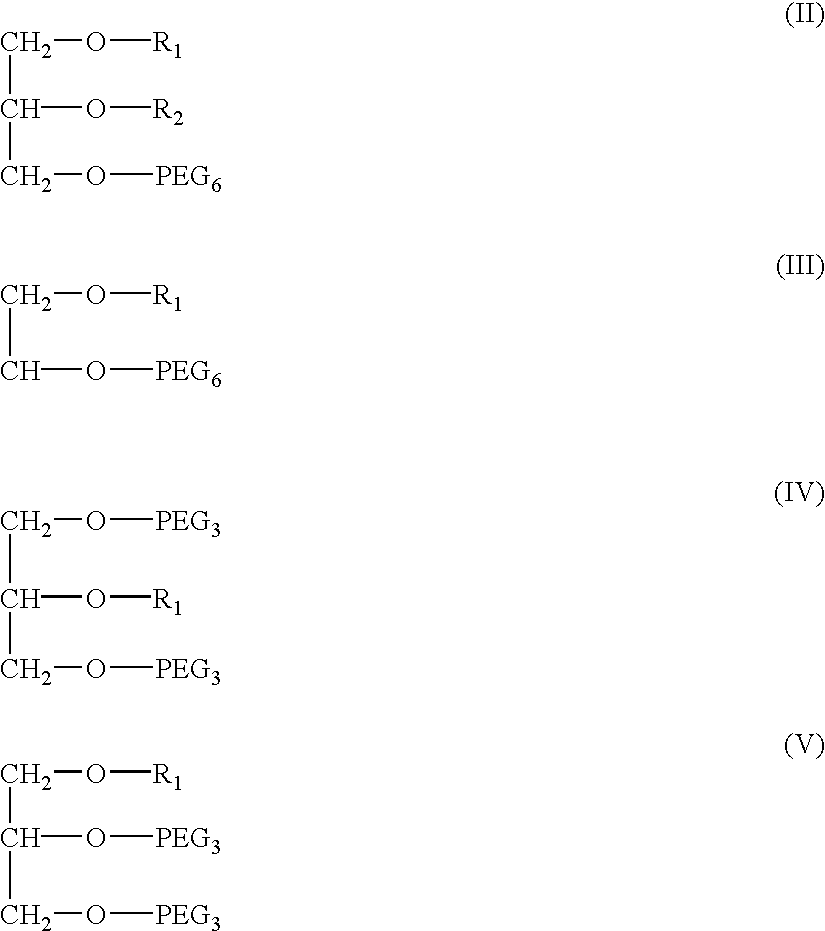
- wherein in each formula, R 1, and R2 are defined above.
- In particular embodiments of the invention, R 1, R2, and R3 are selected from saturated C6-14 fatty acids, more preferably saturated C8-10 fatty acids.
- The compositions of the invention modulate the immune response to the antigen; that is, the immunogenic or vaccine composition is capable of quantitatively and/or qualitatively improving the vaccinated host's antibody response. This can be accomplished, for example, by increasing the numbers of antibodies produced upon immunization with the antigen (e.g., a quantitative improvement), or by altering the profile of the immune response, such as from a Th1 response to a Th2 response (e.g., a qualitative improvement).
- The invention also pertains to methods for eliciting or increasing a host's humoral and/or cell-mediated immune response, comprising administering to a vertebrate host an effective amount of an immunogenic composition comprising an antigen and an adjuvant containing 0.01-70% v/v of glycerides selected from the group consisting of monoglycerides, diglycerides, and mixtures thereof, said glycerides having the formulas (I) to (V) as described above. In a particular embodiment, the immune response is elicited by mucosal administration of the composition.
- The invention also pertains to methods for eliciting or increasing a vaccinate's humoral and/or cell-mediated immunity, for a protective immune response, comprising administering to a vertebrate host an effective amount of a vaccine composition comprising an antigen and an adjuvant containing 0.01-70% v/v of glycerides selected from the group consisting of monoglycerides, diglycerides, and mixtures thereof, said glycerides having the formulas (I) to (V) as described above. In a particular embodiment, the immune response is elicited by mucosal administration of the composition.
- The immune system uses many mechanisms for attacking pathogens; however, not all of these mechanisms are necessarily activated after immunization. Protective immunity induced by vaccination is dependent on the capacity of the vaccine to elicit the appropriate immune response to resist or eliminate the pathogen. Depending on the pathogen, this may require a cell-mediated and/or humoral immune response. It is often desirable to enhance the immunogenic potency of an antigen in order to obtain a stronger immune response in the organism being immunized and to strengthen host resistance to the antigen-bearing agent. Generally, a substance that enhances the immunogenicity of an antigen with which it is administered (either simultaneously or close in time) is known as an adjuvant. As used herein, the term “adjuvant” in relation to the compositions of the invention is intended to encompass compositions having a traditional adjuvant effect (e.g., enhancing the immunogenicity of an antigen by increasing or altering the antibody response thereto), as well as compositions which enhance the presentation of the antigen to the appropriate tissue or cells (e.g., an antigen delivery vehicle).
- For intranasal administration, an antigen must be applied to the mucosa in such a manner that it is able to penetrate or be absorbed through the mucosa or the lymphoid tissue to the immunocompetent cells, and such that it is not washed away by the nasal secretions. The antigen should also be administered onto the nasal mucosa in such a way that the antigen-presenting cells absorb the antigen and transport it to the local lymphoid system. In order to penetrate the mucus, the delivery vehicle must have a certain degree of biocompatibility with the mucus membrane and hence have a certain degree of hydrophilicity and hydrophobicity.
- Work described herein relates to the utility of compositions described herein as mucosal adjuvants. Accordingly, this invention pertains to compositions, e.g., immunogenic or vaccine compositions, comprising an antigen and an adjuvant containing 0.01-70% v/v of glycerides selected from the group consisting of monoglycerides, diglycerides, and mixtures thereof. For example, the monoglycerides and/or diglycerides may be substituted. Monoglycerides and diglycerides that are incorporated into the compositions of this invention are represented by the general formula (I):

- wherein R 1, R2, and R3 are independently selected from the group consisting of saturated or unsaturated C6-24 fatty acids, water soluble polymers , and mixtures thereof; provided that the glyceride contains at least one water soluble polymer. The adjuvant can also contain small amounts of substituted or unsubstituted triglycerides.
- Any saturated or unsaturated C 6-24 fatty acid can be selected, including, but not limited to, fatty acid residues derived from caproic acid, capric acid, caprylic acid, arachidonic acid, propionic acid, lauric acid, myristic acid, palmitic acid, oleic acid, linoleic acid and linolenic acid. The fatty acid residues may be a single residue or a mixture of two or more residues. They can be derived from natural or synthetic sources, such as fats and oils. Commercially available glycerides can be used or they can be synthesized enzymatically by means of lipases, including both specific and non-specific lipases, which place the fatty acids on specific places such as 1; 2; 1,2; 1,3; and specific racemic structures as well, etc. For example, glycerol (0.92 g) adsorbed onto 1 g silica gel is suspended with 20 ml tBuOMe. Vinyl caprylate (3.4 g) and lipase (50 mg) from Rhizopus delemar were added to the suspension. The mixture was stirred at room temperature for 96 hours and the reaction progress was monitored by means of TLC. After removal of the solid components by filtration and evaporation of the solvent, a crude reaction mixture was obtained which contained about 91% of 1,3 dicaprylin glyceride.
- The water soluble polymer can be one which renders the glyceride more hydrophilic (preferably fully soluble without the use of surfactant) in aqueous solutions, particularly physiologically acceptable vehicles for vaccine administration. A desirable water soluble polymer is one that is biocompatible with the tissue to which it is administered, particularly the mucus membranes. Suitable water soluble polymers having these properties, include but are not limited to, polyethyleneglycol, polyethyleneglycol derivatives (including, but not limited to, amino-PEG, nucleophilic-PEG, PEG-thiol, PEG-succinate, PEG-succinimide, PEG-tresylate, carboxymethylated-PEG, PEG-propionic acid, PEG-silanes, PEG-phospholipids, biotin-PEG and PEG-orthopyridyl-disulfide), glycofurol, propyleneglycol, dextrans and saccharides.
- Preferred are polyethylene glycol polymers having from about 2 to about 30 polyethyleneglycol units (PEG 2-30), with from about 3 to about 6 polyethyleneglycol units (PEG3-6) being most preferable. One or two PEG moieties, other water soluble polymers or combinations can be incorporated into the glyceride formula. The water soluble moiety can reside at any one of the R1, R2, or R3 positions of the glyceride.
- The polymers can be attached to the glyceride via covalent bonds formed chemically or enzymatically. The polymers may be acylated to the glyceride or linked using ester bonds such as, for example, by esterase-mediated synthesis. For example, solketal can be mixed with polymerchloride in triethanolamine and trichloromethane, whereafter the free glycerol bonds are deprotected by heating in dilute aqueous acetic acid. With excess of caproyl chloride in the presence of triethylamine and 4-dimethylaminopyridine as catalyst, the fatty acids are linked to the free glycerol bonds. The results of this synthesis will be a caproyl/polymer glyceride.
- In one embodiment of the invention, one or two of the groups R 1, R2, and R3 are replaced by bound antigen. The antigen can be bound to the glyceride moiety by covalent attachment. In another embodiment of the invention, the composition comprises a mixture of monoglycerides and diglycerides such that the v/v-% ratio of monoglycerides to diglycerides is in the range of 0.1:99.9 to 99.9:0.1, and preferably in the range of 5:95 to 95:5. In a further embodiment of the invention, the water soluble polymer is a PEG3-6 residue of polyoxyethylene having 3 to 6 polyoxyethylene units. The invention further relates to the described compositions wherein the glycerides have a structure selected from the group consisting of:

- wherein R 1, and R2 are defined above.
- In one embodiment of the invention, R 1, R2, and R3 are selected from saturated C6-14 fatty acids, more preferably saturated C8-10 fatty acids. In another embodiment of the invention, the glycerides have a concentration from about 0.1% to about 99%, preferably from about 0.5 to about 20%, and more preferably from about 1 to about 15% by weight. In particular embodiments of the invention, chiral carbons in the glyceride are either S- or R-form.
- The adjuvant compositions of the invention modulate the immune response to one or more antigens; that is, the immunogenic or vaccine composition is capable of eliciting a vaccinated host's cell-mediated immunity to generate an immune response, e.g., a protective immune response, to at least one pathogenic antigen.
- The antigen of this invention can be combined with one or more of the adjuvant compositions according to the invention, and this formulation can be used to elicit an immune response to the antigen in a vertebrate such as a mammalian host. For example, the antigen can be selected from the group including, but not limited to, tetanus toxin, influenza virus, diphtheria toxoid, HIV gp120, IgA-protease, insulin peptide B, vibriose, salmonella, Spongospora subterranea, respiratory syncytial virus (RSV) (e.g., an RSV subunit vaccine), Haemophilus influenza outer membrane proteins, Helicobacter pylori urease and recombinant pilins of Neisseria meningitidis and N. gonorrohoeae, or a portion thereof which retains the ability to stimulate an immune response. The ability of portions of a given antigen to stimulate an immune response can be assessed by art-recognized methods, such as enzyme immunoassay against specific peptides within a portion to detect antibodies that recognize that particular portion (humoral response) or a delayed-type hypersensitivity assay against specific peptides in that portion to detect a cell-mediated immune response thereto.
- The term “antigen” is intended to include a molecule which contains one or more epitopes which stimulate a host's immune system to produce a humoral, cellular and/or secretory immunological response. The antigen of the invention can be a subunit antigen, as well as killed, attenuated or inactivated bacteria, viruses, protozoa, fungi, parasites or other microbes. The antigen can be, for example, a protein, peptide, polysaccharide, lipid or DNA antigen. Suitable antigens can be derived from, for example, Pasteurella, Actinobacillus, Chlamydia, Moraxella, Neisseria, Streptococcus, Haemophilus, Salmonella and Eimeria species, as well as rotaviruses, herpes viruses (e.g., BHV-1, EHV-1), PRV, parvovirus, rabiesvirus, influenza viruses, parainfluenza viruses, hepatitis viruses, HIV, picornaviruses, tumor antigens, hormones, hormone analogs and the like.
- The antigen in the formulation according to the invention is suitable for inducing vaccination, immunization, treatment of allergy, treatment of cancer, treatment of infectious disease, treatment of an autoimmune disease or the treatment of a disease which is affected by the immune system. The antigen may, therefore, be a vaccine such as anti-bacterial, anti-viral, anti-fungal, anti-prion, anti-parasitic vaccine or components produced by micro-organisms such as IgA-proteases, Protein p38, Protein p43 or mucinase. The antigen may also be an allergen such as house dust mite, domestic cat allergen, rye grass pollen, short ragweed pollen, midge, egg white, milk protein, bee venom, white faced hornet allergen etc. or components responsible for inducing autoimmune diseases such as myelin, insulin peptide B and the like. The antigen can also be used as a vaccine for the treatment of infectious diseases, such as herpes, HIV, pappiloma, candida, multiple sclerosis, treatment of autoimmune diseases such as diabetes, hypo- and hyperthyroidism, psoriasis, arthritis or the treatment of cancer.
- Suitable antigens for the vaccine compositions of the present invention include any entity capable of producing antibody or cell-mediated immunological response directed specifically against that entity in a vertebrate exposed to the antigen. One or more antigens may be employed, The antigen or antigens may be derived from pathogenic microorganisms including viruses, bacteria, mycoplasmas, fungi, protozoa and other parasites. Further, the antigen or antigens may be derived from sources other than microorganism, for example, cancer cells or allergens. The antigen or antigens may be all or part of a pathogenic microorganism, or all or part of a protein, glycoprotein, glycolipid, polysaccharide or lipopolysaccharide which is associated with the organism.
- Pathogenic microorganism from which antigens may be derived or produced for vaccine purposes are well known in the field of infectious diseases, as listed in, for example, Medical Microbiology, Second Edition, (1990) J. C. Sherris (ed.), Elsevier Science Publishing Co., Inc., New York.
- The antigen may be used in a particulate form or dissolved. The formulation is especially suitable for dissolved antigens, however, particulate forms are also easy to prepare into the formulation. For vaccination and immunization, the particulate form has often been advantageous but for inducing tolerance, e.g., for the treatment of allergy or autoimmune diseases, a dissolved antigen is preferred.
- The immunological adjuvant activity of an adjuvant according to the invention, either alone or with a particular antigen, can be assessed using methods known in the art, such as ELISAs, hemagglutination assays and neutralization assays. As used herein, “immunological adjuvant activity” is intended to mean the ability to potentiate an immunological response in a host to which the adjuvant and antigen are administered. Typically the adjuvant will be administered with the antigen, either in the same admixture or composition (see, for example, International Publication No. WO 93/05789), or at the same time but in a separate composition or formulation. The antigen can be bound to the adjuvant (e.g., covalently) or merely admixed therewith. The adjuvant can also be administered prior to or subsequent to the administration of the antigen. Adjuvant activity includes, but is not limited to, the ability to enhance the immunological response to the antigen by increasing the immunogenicity of the antigen or by reducing the dose or level of antigen required to produce an immune response.
- As used herein, an “immune response” or “immunological response” to a particular antigen is intended to include the production of a secretory, cellular, humoral or antibody-mediated response to the antigen (or a generalized response). The manifestation of the response in the immunized host can include the production of antibodies (e.g., IgA, IgD, IgE, IgG or IgM antibodies), proliferation of B and/or T lymphocytes, stimulation of cytotoxic T lymphocytes that recognize antigen-presenting cells, expansion of T cell populations and the potentiation of signals which cause differentiation, activation or growth of cells of the immune system.
- Typically the administration of the adjuvants of the invention will cause or result in an enhanced immune response to an antigen of interest. In this context, “enhanced” is intended to mean that the immune response to the antigen is quantitatively greater and/or qualitatively better in the presence of the adjuvant than in the absence of the adjuvant. Comparisons of immune responses in the presence and absence of the adjuvants can be performed by routine methods, such as antibody titer comparisons by radioimmunoassay or ELISA of formulations comprising adjuvant and antigen, and appropriate controls. The enhanced immune response can be a result of a direct effect on the immune system of the individual (e.g., a priming of T and B cells to increase the response to the antigen) or can result from a more advantageous presentation of the antigen to the mucus membrane (e.g., by providing better adhesion to the mucus membrane to allow a longer period of contact between the antigen and the mucus membrane, or by enhancing the absorption of the antigen across the mucus membrane, for example by increasing the permeability of the mucus membrane).
- Adjuvants of the invention can be used as described herein as adjuvants to enhance the immunological response to an antigen. In a particular embodiment the adjuvant is a mucosal adjuvant. For example, the adjuvant can be used in a composition to immunize a mammal against a particular pathogen or subunit antigen, or to prime an immune response to a particular antigen.
- The method of the present invention comprises administering to a mammal, particularly a human or other primate, an immunologically effective dose of an immunogenic or vaccine composition comprising an antigen and an adjuvant amount of an adjuvant of the invention. As used herein, an “adjuvant amount” or an “effective amount” of the adjuvant is intended to mean an amount which enhances an immune response to a coadministered antigen. For example, doses of from about 0.01% to about 40%, and more particularly from about 0.1% to about 20% will typically be effective to provide an adjuvant effect; however, variations in these dosage ranges will occur depending upon the particular adjuvant. Moreover, the particular dosage will depend upon the age, weight and medical condition of the mammal to be treated, as well as on the method of administration. Suitable doses will be readily determined by the skilled artisan.
- The vaccine or immunogenic composition can be optionally administered in a pharmaceutically or physiologically acceptable vehicle, such as physiological or phosphate buffered saline, water, dextrose, ethanol polyols (such as glycerol or propylene glycol), and combinations thereof. The formulation according to the invention can be a suspension, an emulsion or a dispersion and can provide the adjuvant in admixture with a dispersing or wetting agent, suspending agent, and/or one or more preservatives. Suitable dispersing or wetting agents are, for example, naturally occurring phosphatides, e.g., lecithin, or soybean lecithin; condensation products of ethylene oxide with e.g. a fatty acid, a long chain aliphatic alcohol, or a partial ester derived from fatty acids and a hexitol or a hexitol anhydride, for example polyoxyethylene stearate, polyoxyethylene sorbitol monooleate, polyoxyethylene sorbitan monooleate etc. Suitable suspending agents are, e.g., naturally occurring gums such as, e.g., gum acacia, xanthan gum, or gum tragacanth; celluloses such as, e.g., sodium carboxymethylcellulose, microcrystalline cellulose (e.g. Avicel® RC 591), methylcellulose; alginates such as, e.g., sodium alginate, etc. Suitable examples of preservatives for use in formulations according to the invention are parabens, such as methyl or propyl p-hydroxybenzoate, and benzalkonium chloride.
- For application to the rectal or vaginal mucosa, suitable formulations for use according to the invention include suppositories (emulsion or suspension type), enemas, and rectal gelatin capsules (solutions or suspensions). Appropriate pharmaceutically acceptable suppository bases include cocoa butter, esterified fatty acids, glycerinated gelatin, and various water-soluble or dispersible bases like polyethylene glycols and polyoxyethylene sorbitan fatty acid esters. Various additives, e.g., enhancers or surfactants, can also be incorporated.
- For application to the nasal mucosa, nasal sprays and aerosols for inhalation are suitable compositions for use according to the invention. In a typical nasal formulation, the active substance is present in the form of a particulate formulation optionally dispersed in a suitable vehicle. The pharmaceutically acceptable vehicles and excipients and optional other pharmaceutically acceptable materials present in the composition such as diluents, enhancers, flavouring agents, preservatives and the like are all selected in accordance with conventional pharmaceutical practice in a manner understood by the persons skilled in the art. After administration of a nasal formulation according to the invention, the antigen may be adsorbed onto the nasal mucosa. The adsorption to the mucosa is believed to lead to a less irritating effect than when, e.g., a liquid vehicle such as one containing a penetration enhancer or promoter is employed. Other mucosal surfaces which are suitable for the administration of formulations of the invention are the nose, lungs, mouth, eye, ear, gastrointestinal tract, genital tract, vagina, rectum or skin, or in fish to the gills. Such formulations may also be suitable for application to seeds or leaves of plants.
- For application to the skin, the formulations according to the invention may contain conventional non-toxic pharmaceutically acceptable carriers and excipients including micro-spheres and liposomes. The formulations include creams, ointments, lotions, liniments, gels, hydrogels, solutions, suspensions, sticks, sprays, pastes, plasters, and other kind of transdermal drug delivery systems. In one embodiment, the formulation can be administered as nasal spray, nasal drops, nasal powder, nasal foam or as nasal ointment to the mucosal surface or the adenoids of the nose or as oral spray, oral drops, oral powder, oral foam or as oral ointment especially directed to the buccal area or to the tonsils of the mouth. The formulation can also be in the form of eye drops.
- Pharmaceutically acceptable excipients may include emulsifying agents, antioxidants, buffering agents, preservatives, humectants, penetration enhancers, chelating agents, gelforming agents, ointment bases, perfumes, and skin protective agents. Examples of emulsifying agents are naturally occurring gums, e.g. gum acacia or gum tragacanth, naturally occurring phosphatides, e.g. soybean lecithin, and sorbitan monooleate derivatives. Examples of antioxidants are burylated hydroxy anisole (BHA), ascorbic acid and derivatives thereof, tocopherol and derivatives thereof, butylated hydroxy anisole, and cysteine. Examples of preservatives are parabens, such as methyl or propyl p-hydroxybenzoate, and benzalkonium chloride. Examples of humectants are glycerin, propylene glycol, sorbitol, and urea. Examples of penetration enhancers are propylene glycol, DMSO, triethanolamine, N,N-dimethylacetamide, N,N-dimethylformamide, 2-pyrrolidone and derivatives thereof, tetrahydrofurfuryl alcohol, and Azone®. Examples of chelating agents are sodium EDTA citric acid, and phosporic acid. Examples of other excipients are edible oils like almond oil, castor oil, cacao butter, coconut oil, corn oil, cottonseed oil, linseed oil, olive oil, palm oil, peanut oil, poppyseed oil, rapeseed oil, sesame oil, soybean oil, sunflower oil, and teaseed oil; and of polymers such as carmelose, sodium carmelose, hydroxypropylmethylcellulose, hydroxyethylcellylose, hydroxypropylcellulose, chitosane, pectin, xanthan gum, carragenan, locust bean gum, acacia gum, gelatin, and alginates. Examples of ointment bases are beeswax, paraffin, cetyl palmitate, vegetable oils, sorbitan esters of fatty acids (Span), polyethylene glycols, and condensation products between sorbitan esters of fatty acids and ethylene oxide, e.g. polyoxyethylene sorbitan monooleate (Tween®). The formulations mentioned above for topical administration may also be applied to the skin, the gills of fish or to the outer surface or seeds of plants. Formulations of the invention may also be suitable for direct application or for introduction into relevant orifice(s) of the body, e.g. the rectal, urethral, vaginal or oral orifices. The formulation may simply be applied directly on the part to be immunized such as, e.g., the mucosa.
- Many mucosal formulations need some specialized mixture of excipients. Therefore many formulations may comprise one or more surfactants and/or absorption promoters and/or water absorbing polymers and/or substances which inhibit enzymatic degradation and/or alcohols, organic solvents, oils, pH-controlling agents, solubilizers, stabilisers, HLB-controlling agents, viscosity controlling agents, preservatives, ormotic pressure controlling agents, propellants, air displacement, water and mixture thereof. The surfactants may be selected from nonoxynol, octoxynol, tweens, spans sodium lauryl sulfate, sorbitan monopalmitate; absorbing promoters may be selected from polyoxyethylene alcohol ethers, bile salts and derivatives thereof, fusidic acid and derivatives thereof, oleic acid, lecitin, lysolechitins, Tween® 20-85, mono-/di- and triglycerides, shitosan, cyclodextriner, water absorbing polymers may be selected from glycofurols and derivatives thereof, polyethyleneglycol 200-7500 and derivatives thereof, polyvinylpyrrolidone, polyacrylic acid, propyleneglycol, gelatine, cellulose and derivatives thereof, substances which inhibit enzymatic degradation may be selected from aprotinin, DFP, carbopol; oils may be selected from vegetable oil, soybean oil, peanut oil, coconut oil, maize oil, olive oil, sunflower oil, Miglyols; pH-controlling agents may be selected from acetic acid, hydrochloric acid, nitric acid, potassium metaphosphate, potassium phosphate, sodium acetate, ammonia, sodium carbonate, sodium hydroxide, sodium borate, trolamine; solubilizers may be selected from alcohol, isoporpyl alcohol, water glycofurol, polyethyleneglycole 200-7500; stabilisers such as cyclodextrines; HLB controlling agents may be selected from Tween® 20-85, Span 20-80, Brij 30-98, acacia; viscosity controlling agents may be selected from cellulose and derivatives thereof, Tween® and derivatives thereof, polyethyleneglycole and derivatives thereof, cetyl alcohol, glycerine, porpylene glycol, sorbitol, gelating; preservatives may be selected from benzalkonium salt, benzyl alcohol, phenol, thimerosal, pnenylmercuric nitrate, phenylethyl alcohol, chlorobutanol, cetypyridinium chloride; osmotic pressure controlling agents may be selected from dextrose, sodium chloride, mannitol; and propellants may be selected from dichlorodifluoromethane, dichlorotetrafluoroethane, trichloromonofluoromethane and other non-ozone damaging propellants such as butane; air displacement may be nitrogen.
- For liquid compositions it is essential that the effective amount of the antigen can be administered in an appropriate volume. For nasal administration the volume should not exceed about 300 μl for a human subjects. A larger volume can be disagreeable to the patient and will drain out anteriorly through the nostrils or posteriorly toward the pharynx. The result is that a part of the antigen and/or the vaccine is lost from the absorption site. The volume is preferably from about 20 μl to about 125 μl and preferably administered into one nostril. For the administration to the buccal and rectal area, a volume not exceeding 10 ml should be used. For the administration to the eye and the ear a volume not exceeding 300 μl should be used. For the administration to the lungs, a volume not exceeding 2 ml should be used. For the administration to the vagina, a volume not exceeding 30 ml should be used. For administration to the gastrointestinal tract a volume not exceeding 100 ml should be used.
- The vaccine composition may optionally comprise additional components, such as buffering agents, preservatives, emulsifying agents and adjuvants, such as vegetable oils or emulsions thereof, surface active substances, e.g., hexadecylamin, octadecyl amino acid esters, octadecylamine, lysolecithin, dimethyl-dioctadecylammonium bromide, N,N-dicoctadecyl-N′-N′bis (2-hydroxyethyl-propane diamine), methoxyhexadecylglycerol, and pluronic polyols; polyamines, e.g., pyran, dextransulfate, poly IC, carbopol; peptides, e.g., muramyl dipeptide, dimethylglycine, tuftsin; immune stimulating complexes; oil emulsions; lipopolysaccharides such as MPL® (3-O-deacylated monophosphoryl lipid A (RIBI ImmunoChem Research, Inc., Hamilton, Mont.); mineral gels, and immunostimulating oligonucleotides. The antigens of this invention can also be incorporated into liposomes, cochleates, biodegradable polymers such as poly-lactide, poly-glycolide and poly-lactide-co-glycolides, or ISCOMS (immunostimulating complexes), and supplementary active ingredients may also be employed.
- Antigens of the present invention can also be administered in combination with bacterial toxins and their attenuated derivatives as additional adjuvants or carrier molecules. Other suitable carrier molecules include serum albumins, keyhole limpet hemocyanin, immunoglobulin molecules, immunoglobulin, ovalbumin, polysaccharides (e.g., sepharose, agarose, cellulose), inactive virus particles, and amino acid copolymers. The antigens of the invention can also be administered in combination with lymphokines including, but not limited to, interleukin-2, IFN-γ and GM-CSF. The antigens of the invention can also be expressed in vivo after administration of DNA encoding these antigens.
- The vaccines can be administered to a human or animal by a variety of routes, including but not limited to parenteral, intraarterial, intradermal, transdermal (such as by the use of slow release polymers), intramuscular, intraperitoneal, intraoccular, sublingual, intravenous, subcutaneous, oral and intranasal routes of administration. In a preferred embodiment, the composition is administered through a mucus membrane. The amount of antigen employed in such vaccines will vary depending upon the identity of the antigen. Adjustment and manipulation of established dosage ranges used with traditional carrier antigens for adaptation to the present vaccine is well within the ability of those skilled in the art. The vaccines of the present invention are intended for use in the treatment of both immature and adult warm-blooded animals, and, in particular, humans. Administration of the immunogenic or vaccine compositions of the invention can also be accomplished using gene therapy methods (see, e.g., U.S. Pat. No. 5,580,859 and published PCT application publication nos. WO 93/19183 to Robinson et al. and WO 97/44446 to Malone et al.)
- The mucosal adjuvant action of adjuvants of the invention has a number of important implications. The mucosal adjuvanticity can increase the concentration of protective antibodies produced against a mucosally-administered antigen in the vaccinated organism. As a result, effective vaccination can be achieved with a smaller quantity of antigen than would be normally required. This reduction in the required amount of antigen may lead to more widespread use of vaccines which are difficult and costly to prepare. Additionally, the use of adjuvants of the invention can enhance the ability of antigens which are weakly antigenic or poorly immunogenic, particularly when administered mucosally, to elicit an immune response. It may also provide for safer vaccination when the antigen is toxic at the concentration normally required for effective mucosal immunization. By reducing the amount of antigen, the risk of toxic reaction is reduced. It may also provide for safer vaccination by enabling the use of an antigen or vaccine formulation which is safe by mucosal route but toxic by parenteral route.
- Typically, vaccination regimens call for the administration of antigen over a period of weeks or months in order to stimulate a “protective” immune response. A protective immune response is an immune response sufficient to prevent infection or reduce the severity of infection (compared with severity of infection in the absence of the elicited immune response) caused by a particular pathogen or pathogens to which the vaccine is directed. The use of adjuvants of the invention may reduce the time course of effective vaccination regimens. In some instances, it may result in the generation of a protective response in a single dose. The vaccine compositions of this invention are also useful therapeutically, to reduce the number and severity of symptomatic episodes in subjects already infected with the antigen. The vaccine compositions may also be used as an oral booster immunization for parenterally administered antigens.
- The formulation according to the invention is especially suitable for humans, including toddlers, adolescents, teenagers, adults and elderly. The nature of the formulation provides the ability to enhance the immune response to a variety of pathogens, and therefore the formulation may be used for subjects with various conditions such as humans with disease, e.g., splenectomized subjects, subjects with cancer, subjects using anticancer drugs, subjects using antiasthmatic drugs, subjects using antiinflammatory drugs, subjects with hyper- and hypothyroidea.
- The formulation according to the invention is also suitable for administration to animals such as horses, sheep, dogs, cats, cows, pigs, goats, rabbits, wild animals and laboratory animals such as mice, rats, guinea pigs, hamsters, rabbits, dogs, cats or monkeys; to birds such as chickens, turkeys, ducks, ostrich, tropical birds or wild birds; or to fish such as farm fish, e.g., salmon or aquarium fish. For animals, the concentration of each component may need to be adjusted. For example for sheep, the nasal cavity has extremely high humidity, which may require addition of water absorbing excipients to the formulation, and for fish, the formulation may need to be microencapsulated or in such a form that the formulation will be absorbed to the gills.
- The adjuvant compositions of the invention can also be used to enhance the bioactivity (e.g., immunogenicity) and/or uptake of bioactive agents (e.g., antigens) in plants. Bioactive agents which can be used in conjunction with the adjuvant compositions of the invention can be, e.g., herbicides, insecticides, fungicides, plant growth regulators, fertilizers and vaccines. Many appropriate bioactive agents are commercially available and can generally be applied at rates recommended by the supplier. The particular amount of bioactive ingredient for use in formulations of the invention will vary with the specific plant or plant growth medium with which it is to be contacted, the general location of an application, i.e., sheltered areas such as greenhouses as compared with exposed areas such as fields, and the type of formulation (e.g., aerosol, liquid, solid). The formulation can be used on any type of plant, including, but not limited to, grasses (e.g., blackgrass, cheat grass, crabgrass, barnyard grass, goosegrass, ryegrass, Italian grass), crop plants (e.g., wheat, oats, sorghum, corn, sugarbeets, canola, soybean, cotton, tobacco, potato, fruit trees, cucumber, tomato, banana, beans, peppers, melons) and ornamental plants (shrubs, trees, flowers). The formulation can be applied to the leaves, seeds, fruits, bark or wood, or can be admixed with the growth medium (e.g., peat or soil). The formulation can be applied to plants individually (e.g., with a spray applicator) or en masse (e.g., from an aircraft). The delivery of antigens to a plant using the adjuvant compositions of the invention can be used to immunize plants against pathogens (e.g., by the generation of plantibodies or by the activation of local and systemic acquired resistance (see, for example, Agrios, Plant Pathology, fourth edition (Academic Press, 1997), pages 108-114, and references cited therein).
- The following Examples are offered for the purpose of illustrating the present invention and are not to be construed to limit the scope of this invention. The contents of all references, patents and published patent applications cited throughout this application are hereby incorporated by reference.
- Mice (BALB/c) are intranasally administered a 5 μl formulation containing 1.5 μl tetanus toxoid vaccine (Lyfjathroun, Reykjavik, Iceland) in the following formulations: (I) isotonic saline; (II) 20% PEG 6-CCG (Softigen®; Hüls A G, Witten, Germany) which is a monoglyceride/diglyceride mixture of caprylic and capric acid containing 6 polyoxyethylene (PEG6) units in isotonic saline; and (III) 20% mixture of monoglyceride/diglyceride mixture of caprylic and capric acid (Imwitor®) solubilized with Tween® 20 (sorbitan monolaurate polyoxyalkylene) (22:78) in isotonic saline (CCG-polysorbate 20 (CCG-PS); WO 94/17827). Four weeks after the first vaccination, the mice received a booster containing the same vaccines. One week later, blood samples were drawn, and the following serum IgG responses were obtained:
TABLE 1 Formulation Serum IgG response I 0.01 II 2.1 III 0.65 - These results show that the non-toxic PEG6-CCG (formulation II) produces a significantly enhanced IgG response compared to a vaccine formulation as described in WO 94/17827 (formulation III).
- Twenty Balb/c mice were immunized with influenza virus vaccine (HA molecules from strain Harbin). The influenza HA molecules were formulated with 0%, 1%, 5% and 20% PEG6-CCG according to the invention. Four weeks post primary immunization the mice received a booster containing the same formulations. One week post booster administration, the following results were achieved:
% Adjuvant Conc. IgG (Serum) 0% 1.1 1% 4.2 5% 6.8 20% 8.4 - Mice (BALB/c) are intranasally administered a 5 μl formulation containing 20% PEG 6-CCG, which is a monoglyceride/diglyceride mixture of caprylic and capric acid containing 6 polyoxyethylene (PEG6) units, in isotonic saline, with the addition of the following antigens: (I) 1 μg HA influenza virus vaccine per mouse; (II) 1.5 Lf (limit of flocculation) tetanus toxoid vaccine; (II) 1.5 Lf diphtheria toxoid vaccine; (IV) 1 μg rgp120 HIV vaccine; (V) 1 μg IgA-protease as vaccine and (VI) 1 μg insulin peptide B. Four weeks after the first vaccination, the mice received a booster containing the same vaccines. One week later, blood samples were drawn and analyzed.
- Human volunteers are intranasally administered a 100 μl formulation containing 12 Lf tetanus toxoid and 12 Lf diphtheria toxoid vaccine in following formulations: (I) isotonic saline; (II) PEG 6-CCG, which is a monoglyceride/diglyceride mixture of caprylic and capric acid containing 6 polyoxyethylene (PEG6) units, in isotonic saline; (III) 5% PEG6-CCG in isotonic saline; and (IV) 1% PEG6-CCG in isotonic saline. Four weeks after the first vaccination, the participants received a booster containing the same vaccines. During the study each volunteer is sampled (blood and saliva sample) weekly for IgG and IgA analysis.
- Mice (BALB/c) are given 1.5 Lf tetanus toxoid vaccine in 20% PEG 6-CCG, which is a monoglyceride/diglyceride of caprylic and capric acid containing 6 polyoxyethylene (PEG6) units, in isotonic saline. The formulation is administered (I) 5 μl intranasally; (II) 5 μl orally into the mucosa of the mouth; (III) 5 μl vaginally; (IV) 5 μl rectally; and (V) 5 μl dermally. Four weeks after the first vaccination, the mice received a booster containing the same vaccines. One week later, blood samples were drawn.
- Fifteen Balb/c mice were immunized with influenza virus vaccine (HA molecules from strain Nanchang). The influenza HA molecules were formulated with 5% PEG6-CCG according to the invention and administered intranasally, buccally and rectally. Four weeks post primary immunization the mice received a booster containing the same formulations by the same route. One week post booster administration, the following results were achieved:
Route Adsorbance (OD 492 nm) Nasal 0.300 Buccal 0.334 Rectal 0.155 - A formulation containing 10% PEG 6-CCG, which is a monoglyceride/diglyceride of caprylic and capric acid containing 6 polyoxyethylene (PEG6) units, in isotonic saline and a selected vaccine composition is administered as follows: (I) 1.5 Lf tetanus toxoid to mice; (II) 6 Lf tetanus toxoid to rabbits; (III) 20 Lf tetanus toxoid to sheep; (IV) 12 Lf tetanus toxoid to human volunteers; (V) 3 μg vibriose vaccine to salmon; (VI) 3 μg salmonella vaccine to chicken; and (VII) 3 μg Spongospora subterranea antigen to potato plants. Four weeks after the first vaccination, a booster containing the same vaccines was administered. One week later, blood samples were withdrawn (except for the plant in (VII)). For the plant in (VII) the potato plant was challenged with the fungi one month after booster administration.
- Mice (BALB/c) are intranasally administered 5 μl formulation, containing (I) tetanus toxoid or (II) pneumococcus, coupled to monoglycerides and diglycerides of caprylic and capric acid. This pro-vaccine is administered in 20% concentration. Four weeks after the first vaccination, the mice received a booster containing the same vaccines. One week later, blood samples were drawn.
- To evaluate the effects of PEG 6-CCG on vaccine antigens following intranasal administration, experiments were carried out using a number of viral and bacterial antigens, including influenza vaccine, respiratory syncytial virus (RSV) subunit vaccine, non-typeable Hemophilus influenza outer membrane proteins (OMPs), Helicobacter pylori urease, recombinant pilins of Neisseria meningitidis and N. gonorrhoeae. The results of this analysis are set forth in the following examples.
- This example summarizes the evaluation of the adjuvant effects of CCG-PS and PEG-CCG on the immune response to A/Udorn vaccine (a monopool split Influenza vaccine; Wyeth Lederle Vaccines and Pediatrics, West Henrietta, N.Y.) and the contribution of the local immune response to protection of the respiratory tract from descending disease.
TABLE 2 Group Immunogen Dose/Route/Volume A A/Udorn/307072(H3N2) 1.8 × 10⁵ TCID50/IN/5 μl B none None C A/Udorn vaccine 1.0 μg HA/IM/50 μl D A/Udorn vaccine 1.0 μg HA/IN/5 μl E A/Udorn vaccine in 10% CCG-PS 1.0 μg HA/IN/5μl F A/Udorn vaccine in 5% PEG6-CCG 1.0 μg HA/IN/5 μl - Serological data both from ELISA and hemagglutination inhibition (HI) assays indicated that the PEG 6-CCG formulation induced higher serum IgGI and HI titers than did the CCG-PS formulation. The intranasally-introduced PEG6-CCG formulation generated systemic antibody response comparable to that elicited by parenterally administered standard vaccine.
- ELISPOT data confirm that ability of PEG 6-CCG, like the first generation CCG-PS formulation, to heighten the local immune response to influenza vaccine, as demonstrated by the increased number of IgA-secreting B cells found in the nasal lymphoid tissues compared to that elicited by intranasal administration of vaccine alone. Vaccine administered via the intramuscular route did not result in a local response above the background found in naive mice.
TABLE 3 The PEG6-CCG formulation facilitates humoral antibody responses to nasal administered influenza vaccine. IgA secreting HI IgG1 IgG2a cells/106 nasal Immunogen/Route GMT GMT GMT lymphoid cells A/Udorn/IN 512 19,426 436,556 463 none 8 13 13 1 A/Udorn vax/IM 215 48,537 1,254 6 A/Udorn vax/IN 25 732 73 22 A/Udorn vax/CCG-PS/IN 181 20,556 228 150 A/Udornvax/PEG6- 512 88,533 173 73 CCG/IN - As shown in the table below, mice previously exposed to infectious virus are completely protected from subsequent challenge with the homologous virus. Virus was not recoverable from pulmonary or nasal tissue. In contrast, naive mice are readily infected with the A/Udorn virus, both in the lung and nasal tissues. Virus was also recovered from the nasal tissue of all mice which received parenteral or non-adjuvanted intranasal vaccine. These data suggest that the immune responses elicited with CCG-PS or PEG 6-CCG adjuvanted vaccine protect the upper respiratory tract from virus challenge. Virus recovery from the nasal tissue was significantly reduced in those animals receiving intranasal vaccine adjuvanted with either CCG-PS or PEG6-CCG. Some protection of the lower respiratory tract is evident independent of vaccine formulation or route of delivery.
TABLE 4 Immune responses elicited by CCG-PS or PEG6-CCG adjuvanted intranasal influenza vaccine protect the respiratory tract from virus challenge. % % Virus recovery Virus recovery positive positive from nose from lung Immunogen/Route nose lung GMT GMT A/Udorn/IN 0 0 200 200 none 100 75 53,724 40,788 A/Udorn vax/IM 100 0 30,211 200 A/Udorn vax/IN 100 25 6,324 563 A/Udorn vax/CCG- 75 0 2,081 200 PS/IN A/Udorn vax PEG6- 25 25 621 1002 CCG/IN - This example summarizes the evaluation of the adjuvant effects of CCG-PS and PEG 6-CCG on the immune response to RSV F protein, and the contribution of the local immune response to protection of the respiratory tract from descending disease.
TABLE 5 Vax Group Immunogen Dose/Route/Volume schedule A F protein 3 μg/IN/5 μl Days 0, 7 14 B F protein in 20% CCG-PS 3 μg/IN/5 μl Days 0, 7 14 C F protein in 5% PEG6-CCG 3 μg/IN/5 μl Days 0, 7 14 D F protein on Alum 3 μg/IM/100 μl Day 0 E RSV A2 2 × 10⁶pfu/IN/50 μl Day 0 - F protein-specific serum antibody responses—Intranasal vaccination with F protein/PBS elicited a circulating IgG anti-F response with a titer of approximately 26,000. However, by combining F protein with either CCG-PS or PEG 6-CCG, statistically elevated titers (p<0.05) of total IgG, IgG1 and IgG2a were obtained (see Table 6). In addition, a significant serum IgA titer was only elicited by the vaccine formulated with PEG6-CCG. This observation has been made consistently and may be the result of different immunological properties of PEG6-CCG.
- F protein-specific mucosal Ig responses—IgA was observed in the nasal and vaginal washes of mice vaccinated with F/PEG 6-CCG, which reflects the stimulation of serum IgA by this vaccine combination (see Table 6). In this experiment, the level of IgA in the nasal washes was found to be higher than that present in mice recovering from infection with live RSV.
TABLE 6 The immune response of BALB/c mice vaccinated intranasally with combinations of F protein and CCG-PS or PEG6-CCG. sera GMT NW VW Immunogen IgG IgG1 IgG2a IgA IgG IgA IgG IgA F protein 26,322 +/− 2,909 +/− <100 <100 <25 <25 <25 <25 51,020 5,770 F protein 115,336 +/− 14,423 +/− 254 +/− <100 <25 <25 223 261 CCG-PS 32,747 5,079 457 F protein 111,761 +/− 9,218 +/− 626 +/− 381 +/− <25 103 <25 443 PEG6-CCG 108,591 7,565 665 50 F protein 71,756 +/− 43,136 +/− 1,553 +/− <100 <25 <25 258 <25 AlOH 36,340 19,917 1,099 RSV A2 79,236 +/− 5,962 +/− 20,819 +/− 752 +/− <25 <25 <25 594 32,310 5,251 7,258 50 - This experiment compared the mucosal adjuvant activities of CCG-PS and PEG 6-CCG for NTHi recombinant P4 protein following intranasal administration in BALB/c mice.
- Vaccines were administered intranasally on days 0 and 21 in a total volume of 5 μl. Mice were bled on days 0, 21 and 28. Bronchoalveolar washes (BAW) and vaginal washes (VW) were performed and saliva samples collected on day 28.
- Recombinant NTHi outer membrane P4 protein delivered in either CCG-PS or PEG 6-CCG significantly enhanced serum IgG antibody titers to recombinant P4 protein. There was no significant difference in serum IgA and IgG titers to recombinant P4 protein between the two delivery vehicles (P, 0.05 on day 28). Furthermore, 1 μg of recombinant P4 protein delivered in CCG-PS or PEG6-CCG induced good titers of IgA antibodies to recombinant P4 in saliva and vaginal washes.
- It appears that PEG 6-CCG was equivalent to CCG-PS in terms of specific serum antibody titers. However, it is noteworthy that only the PEG6-CCG formulation induced a demonstrable rP4-specific nasal IgA antibody response.
TABLE 7 Day 28 Anti-rP4 ELISA Titer Serum Serum Nasal Saliva Vaginal Immunogen IgG IgA IgA IgA IgA NTHi rP4 in 207 79 <10 <10 <10 Saline NTHi rP4 in 16,635 1,295 <10 128 125 20% CCG-PS NTHi rP4 in 14,336 830 52 164 92 PEG6-CCG - Furthermore, 1 μg of recombinant P4 protein delivered in CCG-PS or PEG 6-CCG significantly enhanced the numbers of responder mice as compared to that delivered in saline alone.
TABLE 8 Mouse# Saline CCG-PS PEG6-CCG 1 3,840 25,946 22,654 2 3,042 23,280 20,768 3 297 19,540 13,034 4 109 14,192 10,166 5 1 7,606 9,628 Geometric mean ± 207 ± 16,635 ± 14,336 ± SD 1,835 7,346 6,136 - This experiment compared the mucosal adjuvant activities of CCG-PS and PEG 6-CCG on recombinant H. pylori urease following intranasal administration in 10 μl volume in BALB/c mice.
- Vaccines were administered on days 0 and 21. Mice were bled on days 0, 21 and 28. Bronchoalveolar washes (BAW) and vaginal washes (VW) were performed and saliva samples collected on day 28.
- Recombinant H. pylori urease protein delivered in either PEG 6-CCG or CCG-PS vehicle significantly enhanced secondary serum IgG antibody titers to recombinant urease protein. There was no significant difference in serum IgG titers to recombinant urease protein. There was no significant difference in serum IgG titers to recombinant urease protein between the two delivery vehicles (P>0.05). However, 5 μg of recombinant urease protein delivered in CCG-PS and PEG6-CCG did not induce detectable IgA antibodies to recombinant urease in any of the mucosal secretions analyzed in this experiment.
TABLE 9 Immunogen Serum IgG H. pylori rUrease 5 μg in saline <100 H. pylori rUrease 5 μg in 20% CCG-PS 64,787 ± 45,033 H. pylori rUrease 5 μg in 5% PEG6-CCG 40,489 ± 28,674 - In this example, the mucosal adjuvant activity of PEG 6-CCG was studied using recombinant N. meningitidis pilin as a vaccine antigen.
- Groups of 5 BALB/c mice were immunized intranasally in 10 μl volume with 5 μg recombinant N. meningitidis pilin (rPilin) delivered in 20% CCG-PS, 5% PEG 6-CCG or in saline on days 0, 14 and 21 were bled on day 28. Bronchoalveolar washes (BAW), vaginal washes (VW) were performed and saliva samples collected on day 30.
- A significant mucosal adjuvant effect is demonstrated when vaccine is administered IN in the PEG 6-CCG vehicle. With 5 μg of rPilin delivered in PEG6-CCG, sIgA in nasal and vaginal washes increased 16- and 32-fold in comparison to the saline control group on day 28. In contrast to PEG6-CCG formulation, CCG-PS formulation showed only a 2-fold increase of sIgA titers in nasal washes and 11-fold increase in vaginal washes. These data suggested that PEG6-CCG maybe an improved delivery vehicle for recombinant N. meningitidis pilin protein.
TABLE 10 Serum Nasal Vaginal Immunogen IgA IgA IgA N.mening rPilin in saline 6,168 12 15 N.mening rPilin in 20% CCG-PS 178,867 26 166 N.mening rPilin in 5% PEG6-CCG 135,994 194 482 - In this example, the mucosal adjuvant activity of PEG 6-CCG was investigated using recombinant GC pilin as a vaccine antigen.
- Groups of 5 BALB/c mice were immunized intranasally in 10 μl volume with 10 μg recombinant GC pilin (rPilin) with or without 5% PEG 6-CCG on days 0 and 14 and were bled on day 28. Vaginal washes were collected on day 29.
- A significant adjuvant effect is demonstrated when vaccine is administered IN in the PEG 6-CCG vehicle. With 10 μg of rPilin delivered in PEG6-CCG, serum anti-rpilin IgA and IgG antibody titers increased 2- and 5-fold on day 28, respectively. Whole cell ELISA titers also slightly increased (10,570 vs. 6,843). sIgA in vaginal washes increased more than 4-fold.
TABLE 11 Serum Serum Whole Cell Vaginal wash Immunogen IgA IgG IgG IgA rPilin in saline 301 6,422 6,843 351 rPilin in 5% 609 34,358 10,570 1,517 PEG6-CCG - The acceptability and tolerability of two mucosal adjuvants (CCG-PS and PEG 6-CCG) were assessed in a clinical study. Twenty-nine healthy individuals (15 males and 14 females), 18 years old or older, were enrolled in the study.
- The treatment consisted of five intranasal spray doses. The first two doses containing isotonic saline were unblinded to the investigator and the subjects. These two doses of saline were given simultaneously into both nostrils, serving as the comparison bases for the subjects and the investigator to evaluate the testing adjuvants. The other doses, containing saline (NS), CCG-PS (RV) and PEG 6-CCG (SG), were blinded to both the investigator and the subjects. The three testing doses were administered intranasally, each dose being separated by a thirty-minute interval, and administered according to the following regimen:
TABLE 12 Dose 1 - Dose 2 - Dose 3 Nostril Sequence Adjuvant Sequence # Subjects right - left - right (RLR) NS - RV - SG 5 NS - SG - RV 4 RV - SG - NS 3 SG - RV - NS 5 left - right - left (LRL) NS - RV - SG 3 NS - SG - RV 2 RV - SG - NS 3 SG - RV - NS 4 - Both the investigator's and the subjects' evaluations of the adjuvants were collected. The investigator's evaluations were scored by the investigator for the nasal cavity thirty minutes after each dosing, and was an overall judgment of the redness, increased secretion and macroscopic side effects of the nasal cavity.
- The subjects' evaluations were given by the subjects for irritability contrasting with the unblinded saline at 0, 5, 10, 20 and 30 minutes after each dosing of the adjuvants. The subjects also ranked the relative degree of irritation associated with each treatment.
- The investigator's evaluation scores were summarized for each adjuvant. The irritability scores by the subjects were summarized at each time point for each adjuvant, and the subjects' evaluation scores at each time point were summed to represent the total irritability scored by the subjects. The statistical method was the Mantel-Haenszel Chi-square test (MH). The statistical significance level was 0.05 in the analysis.
- Twenty-three subjects scored CCG-PS as “definitely much more irritating or uncomfortable than saline” immediately after dosing (Table 13). Within 20 minutes, the apparent irritation reduced to at most slightly or not irritating for 20 of the 23 subjects. The remaining 3 subjects still felt strong irritation 30 minutes after dosing. Meanwhile, the investigator reported a minor (⅔) or major (⅓) irritation associated with CCG-PS to these 3 subjects.
- In contrast, twelve subjects (a statistically-significant difference from CCG-PS) scored PEG 6-CCG as “definitely much more irritating or uncomfortable than saline” immediately after dosing (Table 13). Within 5 minutes, the strong irritation was reduced to slightly irritating for 9 of the 12 subjects. The remaining 3 of the 12 subjects plus an additional subject felt strong irritation associated with PEG6-CCG at the end of the 30 minute follow-up period after dosing.
- The irritation scores were summed at each time point by adjuvant. CCG-PS was significantly more irritating than PEG 6-CCG at the 0 and 5 minute time points (p<0.01, Table 13). The irritation scores for the two adjuvants were not statistically different at the later time points.
- In a direct comparison of the irritation associated with all 3 of the blinded doses received (i.e., compared to each other, not by comparison to saline), CCG-PS was the most irritating adjuvant. CCG-PS was the most irritating adjuvant according to 76% of the subjects (22/29).
TABLE 15 Acceptability - Subjects' Evaluation Differ- Saline CCG-PS Softigen ence 0 1 2 sum 0 1 2 sum 0 1 2 sum All Min. 0 26 3 3 1 5 23 51 1 16 12 40 5 28 1 1 2 13 14 41 7 20 2 24 10 28 1 1 9 13 7 27 9 18 2 22 20 28 1 1 19 7 3 13 12 14 3 20 30 28 22 4 3 10 17 8 4 16 - While this invention has been particularly shown and described with reference to preferred embodiments thereof, it will be understood by those skilled in the art that various changes in form and details may be made therein without departing from the spirit and scope of the invention as defined by the appended claims.
Claims (23)
1. A method of eliciting an immune response to an antigen in a mammal, comprising administering to a mammalian host an effective amount of a composition comprising:
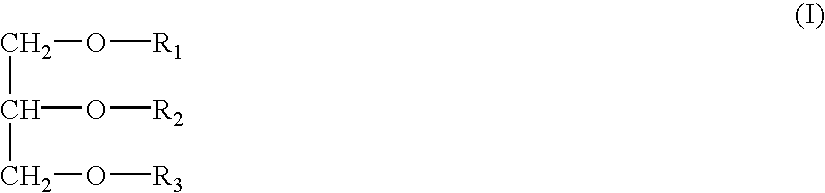
i) an adjuvant containing 0.01-70% v/v of glycerides selected from the group consisting of monoglycerides, diglycerides, and mixtures thereof, said glycerides having the formula (I):
wherein R1, R2, and R3 are independently selected from the group consisting of
saturated or unsaturated C6-24 fatty acids, water soluble polymers, and mixtures thereof, provided that the glyceride contains at least one water soluble polymer;
ii) at least one antigen; and
iii) a physiologically acceptable aqueous vehicle.
2. The method according to claim 1 , wherein the water soluble polymers consist of PEG2-30 residues of polyoxyethylene, or derivatives thereof, having 2-30 polyoxyethylene units.
3. The method according to claim 1 , wherein the v/v-% ratio of monoglycerides to diglycerides is from about 0.1:99.9 to about 99.9:0.1.
4. The method according to claim 1 , wherein the glycerides have a structure selected from the group consisting of:
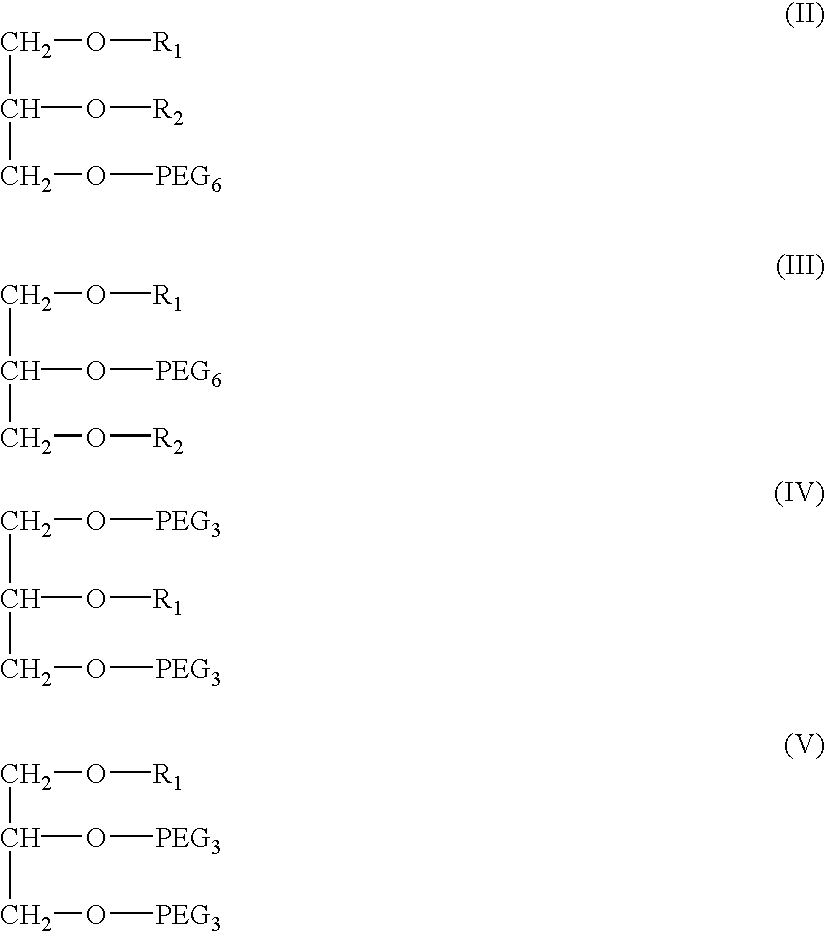
and the mixtures of II-V.
5. The method according to claim 1 , wherein R1, R2, and R3 are saturated C6-14 fatty acids.
6. The method according to claim 1 , wherein the glycerides have a concentration of from about 0.1% to about 99% by weight.
7. The method according to claim 1 , wherein chiral carbons in the glyceride are either S- or R-form.
8. The method according to claim 1 , wherein the antigen is in a particulate form.
9. The method according to claim 1 , further comprising one or more components selected from the group consisting of: surfactants, absorption promoters, water absorbing polymers, substances which inhibit enzymatic degradation, alcohols, organic solvents, oils, pH-controlling agents, solubilizers, stabilizers, HLB-controlling agents, viscosity controlling agents, preservatives, osmotic pressure controlling agents, propellants, air displacement, water, and mixtures thereof.
10. The method according to claim 1 , wherein the antigen is selected from the group consisting of tetanus toxoid, hemagglutinin molecules from influenza virus, diphtheria toxoid, HIV gp120, IgA protease, insulin peptide B, Spongospora subterranea antigen, vibriose antigens, Salmonella antigens, pneumococcus antigens, respiratory syncytial virus antigens, Haemophilus influenza outer membrane proteins, Helicobacterpylori urease, Neisseria meningitidis pilins and N. gonorrhoeae pilins.
11. The method according to claim 6 , wherein the glycerides have a concentration of about 1 to about 15% by weight.
12. The method according to claim 1 , wherein (i) is a monoglyceride and diglyceride mixture of caprylic and capric acid containing 3 to 6 polyoxyethylene units.
13. The method according to claim 1 , wherein said mammal is a human.
14. A method of eliciting an immune response to an antigen in a mammal, comprising administering to a mammalian host an effective amount of a composition comprising:

i) an adjuvant containing 0.01-70% v/v of glycerides selected from the group consisting of monoglycerides, diglycerides, and mixtures thereof, said glycerides having the formula (I):
wherein R1, R2, and R3 are independently selected from the group consisting of
saturated or unsaturated C6-24 fatty acids, water soluble polymers, and mixtures thereof, provided that the glyceride contains at least one water soluble polymer and provided that one of the groups R1, R2 and R3 is replaced by bound antigen; and
ii) a physiologically acceptable aqueous vehicle.
15. The method according to claim 14 , wherein the antigen is in a dissolved form.
16. A method of eliciting an immune response to an antigen in a mammal, comprising administering to a mammalian host an effective amount of a composition comprising:
i) an adjuvant containing 0.01-70% v/v of a monoglyceride and diglyceride mixture of caprylic and capric acid containing polyoxyethylene units;
ii) at least one antigen of a pathogenic microorganism; and
iii) a physiologically acceptable aqueous vehicle.
17. A method according to claim 16 , wherein the adjuvant contains three to six polyoxyethylene units.
18. A method of eliciting an immune response to an antigen in a mammal, comprising administering to a mammalian host an effective amount of a composition comprising:

i) an adjuvant containing 0.01-70% v/v of glycerides selected from the group consisting of monoglycerides, diglycerides, and mixtures thereof, said glycerides having the formula (I):
wherein R1, R2, and R3 are independently selected from the group consisting of saturated or unsaturated C6-24 fatty acids, water soluble polymers, and mixtures thereof, provided that the glyceride contains at least one water soluble polymer;
ii) at least one antigen of a pathogenic microorganism; and
iii) a physiologically acceptable aqueous vehicle.
19. A method of eliciting an immune response to an antigen in a mammal, comprising administering to a mammalian host an effective amount of a composition comprising:

i) an adjuvant containing 0.01-70% v/v of glycerides selected from the group consisting of monoglycerides, diglycerides, and mixtures thereof, wherein the v/v% ratio of monoglycerides to diglycerides is from about 5:95 to about 95:5, said glycerides having the formula (I):
wherein R1, R2, and R3 are independently selected from the group consisting of saturated or unsaturated C6-24 fatty acids, water soluble polymers, and mixtures thereof, provided that the glyceride contains at least one water soluble polymer;
ii) at least one antigen; and
iii) a physiologically acceptable aqueous vehicle.
20. A method of delivering an antigen to a mucosal surface of a mammal, comprising administering to a mammalian host an effective amount of a composition comprising:
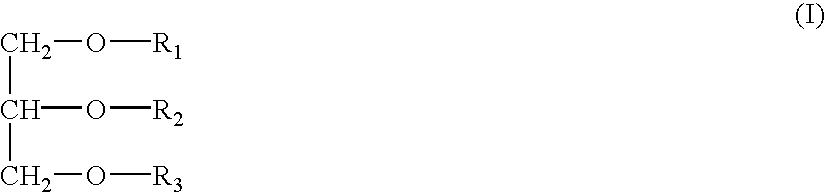
i) an adjuvant containing 0.01-70% v/v of glycerides selected from the group consisting of monoglycerides, diglycerides, and mixtures thereof, said glycerides having the formula (I):
wherein R1, R2, and R3 are independently selected from the group consisting of saturated or unsaturated C6-24 fatty acids, water soluble polymers, and mixtures thereof, provided that the glyceride contains at least one water soluble polymer;
ii) at least one antigen; and
iii) a physiologically acceptable aqueous vehicle.
21. A method of delivering an antigen to a mucosal surface of a mammal, comprising administering to a mammalian host an effective amount of a composition comprising:

i) an adjuvant containing 0.01-70% v/v of glycerides selected from the group consisting of monoglycerides, diglycerides, and mixtures thereof, said glycerides having the formula (I):
wherein R1, R2, and R3 are independently selected from the group consisting of
saturated or unsaturated C6-24 fatty acids, water soluble polymers, and mixtures thereof, provided that the glyceride contains at least one water soluble polymer and provided that one of the groups R1, R2 and R3 is replaced by bound antigen; and
ii) a physiologically acceptable aqueous vehicle.
22. The method according to claim 21 wherein said mucosal surface is a mucosal surface of the nose, lungs, mouth, eye, ear, gastrointestinal tract, genital tract, vagina or rectum.
23. The method according to claim 22 wherein said mucosa surface is that of the nose.
Priority Applications (1)
| Application Number | Priority Date | Filing Date | Title |
|---|---|---|---|
| US10/195,226 US20030099659A1 (en) | 1997-07-09 | 2002-07-12 | Antigen delivery system |
Applications Claiming Priority (4)
| Application Number | Priority Date | Filing Date | Title |
|---|---|---|---|
| IS4518A IS4518A (en) | 1997-07-09 | 1997-07-09 | New vaccine formulation |
| IS4.518 | 1997-07-09 | ||
| US09/112,684 US6514503B1 (en) | 1997-07-09 | 1998-07-09 | Antigen delivery system |
| US10/195,226 US20030099659A1 (en) | 1997-07-09 | 2002-07-12 | Antigen delivery system |
Related Parent Applications (1)
| Application Number | Title | Priority Date | Filing Date |
|---|---|---|---|
| US09/112,684 Continuation US6514503B1 (en) | 1997-07-09 | 1998-07-09 | Antigen delivery system |
Publications (1)
| Publication Number | Publication Date |
|---|---|
| US20030099659A1 true US20030099659A1 (en) | 2003-05-29 |
Family
ID=36699745
Family Applications (2)
| Application Number | Title | Priority Date | Filing Date |
|---|---|---|---|
| US09/112,684 Expired - Fee Related US6514503B1 (en) | 1997-07-09 | 1998-07-09 | Antigen delivery system |
| US10/195,226 Abandoned US20030099659A1 (en) | 1997-07-09 | 2002-07-12 | Antigen delivery system |
Family Applications Before (1)
| Application Number | Title | Priority Date | Filing Date |
|---|---|---|---|
| US09/112,684 Expired - Fee Related US6514503B1 (en) | 1997-07-09 | 1998-07-09 | Antigen delivery system |
Country Status (13)
| Country | Link |
|---|---|
| US (2) | US6514503B1 (en) |
| EP (1) | EP1003551B1 (en) |
| JP (1) | JP2001509491A (en) |
| KR (1) | KR20010021622A (en) |
| CN (1) | CN1202863C (en) |
| AT (1) | ATE329617T1 (en) |
| AU (1) | AU745849B2 (en) |
| BR (1) | BR9810568A (en) |
| CA (1) | CA2295237A1 (en) |
| DE (1) | DE69834921T2 (en) |
| ES (1) | ES2267189T3 (en) |
| IS (2) | IS4518A (en) |
| WO (1) | WO1999002186A2 (en) |
Cited By (7)
| Publication number | Priority date | Publication date | Assignee | Title |
|---|---|---|---|---|
| US20040241310A1 (en) * | 2001-08-16 | 2004-12-02 | Sveibjorn Gizurarson | Method of producing antibodies ex-vivo |
| US20050063940A1 (en) * | 2002-02-25 | 2005-03-24 | Sveinbjorn Gizurarson | Bioadhesive agent |
| US20100047327A1 (en) * | 2007-01-31 | 2010-02-25 | Tetsuji Kuwahara | Adjuvant for Transdermal or Transmucosal Administration and Pharmaceutical Preparation Containing the Same |
| WO2010041143A3 (en) * | 2008-10-08 | 2010-07-08 | Immune Solutions Limited | Oral vaccines for producing mucosal immunity |
| US20120082697A1 (en) * | 2009-03-31 | 2012-04-05 | Japan As Represented By The Director General Of Natl. Inst. Of Infect Diseases | Method for prophylaxis of influenza using vaccine for intranasal administration |
| US8858962B2 (en) | 2005-08-01 | 2014-10-14 | Hisamitsu Pharmaceutical Co., Inc. | Adjuvant or pharmaceutical preparation for transdermal or transmucosal administration |
| US9993549B2 (en) | 2013-10-31 | 2018-06-12 | Hisamitsu Pharmaceutical Co., Inc. | Adjuvant composition, adjuvant preparation containing same, and kit |
Families Citing this family (33)
| Publication number | Priority date | Publication date | Assignee | Title |
|---|---|---|---|---|
| IS4518A (en) * | 1997-07-09 | 1999-01-10 | Lyfjathroun Hf, The Icelandic Bio Pharmaceutical Group | New vaccine formulation |
| DK1075276T3 (en) * | 1998-05-07 | 2008-02-11 | Corixa Corp | Adjuvant composition and methods for its use |
| BR0010539A (en) * | 1999-05-13 | 2002-02-19 | American Cyanamid Co | Antigenic composition, and method to increase the capacity of an antigenic composition |
| DE69937580D1 (en) * | 1999-08-18 | 2007-12-27 | Ind Academic Coop | AGENT FOR INDUCING AN IMMUNOLOGICAL TOLERANCE |
| US7384640B1 (en) * | 1999-09-30 | 2008-06-10 | Wyeth Holdings Corporation | Mutant cholera holotoxin as an adjuvant |
| GB0007465D0 (en) | 2000-03-29 | 2000-05-17 | Amersham Pharm Biotech Uk Ltd | Substrate for a lipase enzyme assay |
| CA2409406C (en) * | 2000-06-22 | 2010-09-14 | American Cyanamid Company | Qs-21 and il-12 as an adjuvant combination |
| WO2002038177A2 (en) * | 2000-11-10 | 2002-05-16 | Wyeth Holdings Corporation | Adjuvant combination formulations |
| CA2449670A1 (en) * | 2001-06-07 | 2002-12-12 | Wyeth Holdings Corporation | Mutant forms of cholera holotoxin as an adjuvant |
| EP1404368B1 (en) * | 2001-06-07 | 2009-12-09 | Wyeth Holdings Corporation | Mutant forms of cholera holotoxin as an adjuvant |
| EP1460992B1 (en) * | 2001-12-03 | 2009-03-11 | Dor Biopharma, Inc. | Stabilized reverse micelle compositions and uses thereof |
| AU2003205979A1 (en) * | 2002-02-25 | 2003-09-09 | Lyfjathroun Hf, Biopharmaceutical Research | An immunological adjuvant |
| US6855332B2 (en) | 2002-07-03 | 2005-02-15 | Lyfjathroun Hf. | Absorption promoting agent |
| WO2004046693A1 (en) * | 2002-11-21 | 2004-06-03 | Sapporo Immuno Diagnostic Laboratory | Instrument for collecting and recovering saliva |
| BR0316685A (en) * | 2002-12-17 | 2005-11-01 | Nastech Pharm Co | Compositions and methods for the improved mucosal administration of γ2 receptor-fixing peptides and methods for treating and preventing obesity |
| WO2005019412A2 (en) | 2003-05-20 | 2005-03-03 | New York University | Mucosal immunization to prevent prion infection |
| US8685718B2 (en) * | 2003-05-20 | 2014-04-01 | New York University | Mucosal immunization to prevent prion infection |
| US20050100621A1 (en) * | 2003-11-07 | 2005-05-12 | Popp Karl F. | Dermatological compositions |
| US20060264505A1 (en) * | 2003-11-07 | 2006-11-23 | Stiefel Laboratories, Inc. | Dermatological compositions |
| WO2005046721A2 (en) * | 2003-11-10 | 2005-05-26 | Uab Research Foundation | Compositions for reducing bacterial carriage and cns invasion and methods of using same |
| JP2010501012A (en) * | 2006-08-17 | 2010-01-14 | ザ ユーエービー リサーチ ファウンデーション | Immunogenic PcpA polypeptides and uses thereof |
| WO2008143676A1 (en) * | 2007-05-23 | 2008-11-27 | The Uab Research Foundation | Detoxified pneumococcal neuraminidase and uses thereof |
| RU2543281C2 (en) * | 2009-03-11 | 2015-02-27 | Акцо Нобель Н.В. | Composition of herbicide, containing glyphosphate and alkoxylated glycerides (versions) and method of fighting undesired vegetation |
| ES2625406T3 (en) | 2010-03-25 | 2017-07-19 | Oregon Health & Science University | CMV glycoproteins and recombinant vectors |
| SMT201800284T1 (en) | 2011-06-10 | 2018-07-17 | Univ Oregon Health & Science | Cmv glycoproteins and recombinant vectors |
| CA2789539A1 (en) | 2011-09-12 | 2013-03-12 | International Aids Vaccine Initiative | Immunoselection of recombinant vesicular stomatitis virus expressing hiv-1 proteins by broadly neutralizing antibodies |
| EP2586461A1 (en) | 2011-10-27 | 2013-05-01 | Christopher L. Parks | Viral particles derived from an enveloped virus |
| ES2631608T3 (en) | 2012-06-27 | 2017-09-01 | International Aids Vaccine Initiative | Env-glycoprotein variant of HIV-1 |
| EP2848937A1 (en) | 2013-09-05 | 2015-03-18 | International Aids Vaccine Initiative | Methods of identifying novel HIV-1 immunogens |
| US10058604B2 (en) | 2013-10-07 | 2018-08-28 | International Aids Vaccine Initiative | Soluble HIV-1 envelope glycoprotein trimers |
| US10174292B2 (en) | 2015-03-20 | 2019-01-08 | International Aids Vaccine Initiative | Soluble HIV-1 envelope glycoprotein trimers |
| EP3072901A1 (en) | 2015-03-23 | 2016-09-28 | International Aids Vaccine Initiative | Soluble hiv-1 envelope glycoprotein trimers |
| CU24534B1 (en) * | 2017-11-06 | 2021-07-02 | Ct Inmunologia Molecular | NANO-PARTICULATE ADJUVANTS CONTAINING SYNTHETIC VARIANTS OF GM3 GANGLIOSIDE |
Citations (26)
| Publication number | Priority date | Publication date | Assignee | Title |
|---|---|---|---|---|
| US4349540A (en) * | 1973-12-10 | 1982-09-14 | Pierre Fabre S.A. | Process for preparing vaccines based on antigenic ribosomal fractions |
| US4567161A (en) * | 1982-07-09 | 1986-01-28 | A. Natterman & Cie Gmbh | Liquid active ingredient concentrates for preparation of microemulsions |
| US4610868A (en) * | 1984-03-20 | 1986-09-09 | The Liposome Company, Inc. | Lipid matrix carriers for use in drug delivery systems |
| US4681900A (en) * | 1984-01-13 | 1987-07-21 | Kao Corporation | Biocide activator |
| US4911928A (en) * | 1987-03-13 | 1990-03-27 | Micro-Pak, Inc. | Paucilamellar lipid vesicles |
| US5177091A (en) * | 1990-12-06 | 1993-01-05 | Ciba-Geigy Corporation | Use of carbazones as novel active ingredients in medicaments |
| US5190748A (en) * | 1988-11-22 | 1993-03-02 | Hoffmann-La Roche Inc. | Absorption enhancement of antibiotics |
| US5561062A (en) * | 1993-01-15 | 1996-10-01 | Micro-Pak, Inc. | Method of inhibiting viral reproduction using non-phospholipid, paucilamellar liposomes |
| US5633226A (en) * | 1991-04-19 | 1997-05-27 | Lds Technologies, Inc. | Convertible microemulsion formulations |
| US5719122A (en) * | 1992-10-20 | 1998-02-17 | Smithkline Beecham Farmaceutici S.P.A. | Pharmaceutical compositions containing a calcitonin |
| US5942237A (en) * | 1993-02-15 | 1999-08-24 | Lyfjathroun H.F. | Pharmaceutical preparation for topical administration of antigens and/or vaccines to mammals via a mucosal membrane |
| US6008228A (en) * | 1995-06-06 | 1999-12-28 | Hoffman-La Roche Inc. | Pharmaceutical compositions containing proteinase inhibitors |
| US6013277A (en) * | 1994-08-05 | 2000-01-11 | Inpharma S.A. | Compositions for topical treatment of erectile impotence |
| US6096338A (en) * | 1994-03-16 | 2000-08-01 | R. P. Scherer Corporation | Delivery systems for hydrophobic drugs |
| US6103770A (en) * | 1995-01-18 | 2000-08-15 | Societe D'exploitation De Pruduits Pour Les Industries Chimiques - Seppic | Utilization of ethoxylated fatty acid esters as self-emulsifiable compounds |
| US6190695B1 (en) * | 1919-04-09 | 2001-02-20 | Takeda Chemical Industries, Ltd. | Pharmaceutical composition containing osteogenesis-promoting substance |
| US6217902B1 (en) * | 1995-06-09 | 2001-04-17 | R. P. Scheier Company | Soft gelatin capsules containing particulate material |
| US6294192B1 (en) * | 1999-02-26 | 2001-09-25 | Lipocine, Inc. | Triglyceride-free compositions and methods for improved delivery of hydrophobic therapeutic agents |
| US6326401B1 (en) * | 1998-01-15 | 2001-12-04 | Immunotech | Formulation for the oromucosal, in particular pernasal, route |
| US20020012673A1 (en) * | 1996-06-10 | 2002-01-31 | Ulf Schroder | Immunstimulating lipid formulation |
| US20020094338A1 (en) * | 1999-03-11 | 2002-07-18 | Ingileif Jonsdottir | Intranasal delivery of pneumococcal polysaccharide vaccines |
| US6458383B2 (en) * | 1999-08-17 | 2002-10-01 | Lipocine, Inc. | Pharmaceutical dosage form for oral administration of hydrophilic drugs, particularly low molecular weight heparin |
| US6468559B1 (en) * | 2000-04-28 | 2002-10-22 | Lipocine, Inc. | Enteric coated formulation of bishosphonic acid compounds and associated therapeutic methods |
| US6495596B1 (en) * | 2001-03-23 | 2002-12-17 | Biozibe Laboratories, Inc. | Compounds and methods for inhibition of phospholipase A2 and cyclooxygenase-2 |
| US6514503B1 (en) * | 1997-07-09 | 2003-02-04 | Lyfjathoun Hf | Antigen delivery system |
| US20040005275A1 (en) * | 2002-07-03 | 2004-01-08 | Lyfjathroun Hf. | Absorption promoting agent |
Family Cites Families (12)
| Publication number | Priority date | Publication date | Assignee | Title |
|---|---|---|---|---|
| BE545978A (en) | 1955-03-11 | |||
| US4420484A (en) | 1979-08-13 | 1983-12-13 | Sterling Drug Inc. | Basic amino or ammonium antimicrobial agent-polyethylene glycol ester surfactant-betaine and/or amine oxide surfactant compositions and method of use therof |
| US4771571A (en) | 1986-12-31 | 1988-09-20 | Nabisco Brands, Inc. | Method for treating pineapple to prevent pineapple fruit diseases |
| EP0324455A3 (en) * | 1988-01-15 | 1991-03-27 | Hans O. Ribi | Novel polymeric immunological adjuvants |
| DE69233069T2 (en) * | 1991-03-15 | 2003-11-27 | Amgen Inc., Thousand Oaks | PEGYLATION OF POLYPEPTIDES |
| CA2083553A1 (en) | 1991-11-25 | 1993-05-26 | Kuniharu Seki | Immunogen composition |
| GB9207799D0 (en) | 1992-04-09 | 1992-05-27 | Procter & Gamble | Aqueous compositions |
| US5314685A (en) * | 1992-05-11 | 1994-05-24 | Agouron Pharmaceuticals, Inc. | Anhydrous formulations for administering lipophilic agents |
| EP0746331B1 (en) | 1992-10-16 | 2000-09-13 | IBAH, Inc. | Convertible microemulsion formulations |
| US5359030A (en) * | 1993-05-10 | 1994-10-25 | Protein Delivery, Inc. | Conjugation-stabilized polypeptide compositions, therapeutic delivery and diagnostic formulations comprising same, and method of making and using the same |
| US5744137A (en) | 1995-02-06 | 1998-04-28 | The United States Of America As Represented By The Secretary Of The Agriculture | Oil emulsion vaccines prepared with animal, vegetable, and synthetic oils using a mixture of nonionic surfactants |
| DE69636889T2 (en) * | 1995-11-30 | 2007-12-06 | Nof Corp. | Oil-filled vaccine and process for its preparation |
-
1997
- 1997-07-09 IS IS4518A patent/IS4518A/en unknown
-
1998
- 1998-07-09 WO PCT/IS1998/000006 patent/WO1999002186A2/en not_active Ceased
- 1998-07-09 CA CA002295237A patent/CA2295237A1/en not_active Abandoned
- 1998-07-09 EP EP98935262A patent/EP1003551B1/en not_active Expired - Lifetime
- 1998-07-09 AU AU84598/98A patent/AU745849B2/en not_active Ceased
- 1998-07-09 BR BR9810568-0A patent/BR9810568A/en not_active Application Discontinuation
- 1998-07-09 JP JP2000501776A patent/JP2001509491A/en active Pending
- 1998-07-09 CN CNB988069660A patent/CN1202863C/en not_active Expired - Fee Related
- 1998-07-09 ES ES98935262T patent/ES2267189T3/en not_active Expired - Lifetime
- 1998-07-09 US US09/112,684 patent/US6514503B1/en not_active Expired - Fee Related
- 1998-07-09 KR KR1020007000180A patent/KR20010021622A/en not_active Ceased
- 1998-07-09 AT AT98935262T patent/ATE329617T1/en not_active IP Right Cessation
- 1998-07-09 DE DE69834921T patent/DE69834921T2/en not_active Expired - Fee Related
-
1999
- 1999-12-29 IS IS5329A patent/IS5329A/en unknown
-
2002
- 2002-07-12 US US10/195,226 patent/US20030099659A1/en not_active Abandoned
Patent Citations (28)
| Publication number | Priority date | Publication date | Assignee | Title |
|---|---|---|---|---|
| US6190695B1 (en) * | 1919-04-09 | 2001-02-20 | Takeda Chemical Industries, Ltd. | Pharmaceutical composition containing osteogenesis-promoting substance |
| US4349540A (en) * | 1973-12-10 | 1982-09-14 | Pierre Fabre S.A. | Process for preparing vaccines based on antigenic ribosomal fractions |
| US4567161A (en) * | 1982-07-09 | 1986-01-28 | A. Natterman & Cie Gmbh | Liquid active ingredient concentrates for preparation of microemulsions |
| US4681900A (en) * | 1984-01-13 | 1987-07-21 | Kao Corporation | Biocide activator |
| US4610868A (en) * | 1984-03-20 | 1986-09-09 | The Liposome Company, Inc. | Lipid matrix carriers for use in drug delivery systems |
| US4911928A (en) * | 1987-03-13 | 1990-03-27 | Micro-Pak, Inc. | Paucilamellar lipid vesicles |
| US5190748A (en) * | 1988-11-22 | 1993-03-02 | Hoffmann-La Roche Inc. | Absorption enhancement of antibiotics |
| US5177091A (en) * | 1990-12-06 | 1993-01-05 | Ciba-Geigy Corporation | Use of carbazones as novel active ingredients in medicaments |
| US5633226A (en) * | 1991-04-19 | 1997-05-27 | Lds Technologies, Inc. | Convertible microemulsion formulations |
| US5719122A (en) * | 1992-10-20 | 1998-02-17 | Smithkline Beecham Farmaceutici S.P.A. | Pharmaceutical compositions containing a calcitonin |
| US5561062A (en) * | 1993-01-15 | 1996-10-01 | Micro-Pak, Inc. | Method of inhibiting viral reproduction using non-phospholipid, paucilamellar liposomes |
| US5942237A (en) * | 1993-02-15 | 1999-08-24 | Lyfjathroun H.F. | Pharmaceutical preparation for topical administration of antigens and/or vaccines to mammals via a mucosal membrane |
| US6096338A (en) * | 1994-03-16 | 2000-08-01 | R. P. Scherer Corporation | Delivery systems for hydrophobic drugs |
| US6013277A (en) * | 1994-08-05 | 2000-01-11 | Inpharma S.A. | Compositions for topical treatment of erectile impotence |
| US6103770A (en) * | 1995-01-18 | 2000-08-15 | Societe D'exploitation De Pruduits Pour Les Industries Chimiques - Seppic | Utilization of ethoxylated fatty acid esters as self-emulsifiable compounds |
| US6008228A (en) * | 1995-06-06 | 1999-12-28 | Hoffman-La Roche Inc. | Pharmaceutical compositions containing proteinase inhibitors |
| US6217902B1 (en) * | 1995-06-09 | 2001-04-17 | R. P. Scheier Company | Soft gelatin capsules containing particulate material |
| US20020012673A1 (en) * | 1996-06-10 | 2002-01-31 | Ulf Schroder | Immunstimulating lipid formulation |
| US6514503B1 (en) * | 1997-07-09 | 2003-02-04 | Lyfjathoun Hf | Antigen delivery system |
| US6326401B1 (en) * | 1998-01-15 | 2001-12-04 | Immunotech | Formulation for the oromucosal, in particular pernasal, route |
| US6451339B2 (en) * | 1999-02-26 | 2002-09-17 | Lipocine, Inc. | Compositions and methods for improved delivery of hydrophobic agents |
| US6294192B1 (en) * | 1999-02-26 | 2001-09-25 | Lipocine, Inc. | Triglyceride-free compositions and methods for improved delivery of hydrophobic therapeutic agents |
| US20020094338A1 (en) * | 1999-03-11 | 2002-07-18 | Ingileif Jonsdottir | Intranasal delivery of pneumococcal polysaccharide vaccines |
| US6458383B2 (en) * | 1999-08-17 | 2002-10-01 | Lipocine, Inc. | Pharmaceutical dosage form for oral administration of hydrophilic drugs, particularly low molecular weight heparin |
| US6468559B1 (en) * | 2000-04-28 | 2002-10-22 | Lipocine, Inc. | Enteric coated formulation of bishosphonic acid compounds and associated therapeutic methods |
| US6495596B1 (en) * | 2001-03-23 | 2002-12-17 | Biozibe Laboratories, Inc. | Compounds and methods for inhibition of phospholipase A2 and cyclooxygenase-2 |
| US20040005275A1 (en) * | 2002-07-03 | 2004-01-08 | Lyfjathroun Hf. | Absorption promoting agent |
| US6855332B2 (en) * | 2002-07-03 | 2005-02-15 | Lyfjathroun Hf. | Absorption promoting agent |
Cited By (9)
| Publication number | Priority date | Publication date | Assignee | Title |
|---|---|---|---|---|
| US20040241310A1 (en) * | 2001-08-16 | 2004-12-02 | Sveibjorn Gizurarson | Method of producing antibodies ex-vivo |
| US20050063940A1 (en) * | 2002-02-25 | 2005-03-24 | Sveinbjorn Gizurarson | Bioadhesive agent |
| US20050106122A1 (en) * | 2002-02-25 | 2005-05-19 | Sveinbjorn Gizurarson | Absorption enhancing agent |
| US8858962B2 (en) | 2005-08-01 | 2014-10-14 | Hisamitsu Pharmaceutical Co., Inc. | Adjuvant or pharmaceutical preparation for transdermal or transmucosal administration |
| US20100047327A1 (en) * | 2007-01-31 | 2010-02-25 | Tetsuji Kuwahara | Adjuvant for Transdermal or Transmucosal Administration and Pharmaceutical Preparation Containing the Same |
| WO2010041143A3 (en) * | 2008-10-08 | 2010-07-08 | Immune Solutions Limited | Oral vaccines for producing mucosal immunity |
| US20120082697A1 (en) * | 2009-03-31 | 2012-04-05 | Japan As Represented By The Director General Of Natl. Inst. Of Infect Diseases | Method for prophylaxis of influenza using vaccine for intranasal administration |
| US9603919B2 (en) * | 2009-03-31 | 2017-03-28 | Japan As Represented By The Director-General Of National Institute Of Infectious Diseases | Method for prophylaxis of influenza using vaccine for intranasal administration |
| US9993549B2 (en) | 2013-10-31 | 2018-06-12 | Hisamitsu Pharmaceutical Co., Inc. | Adjuvant composition, adjuvant preparation containing same, and kit |
Also Published As
| Publication number | Publication date |
|---|---|
| CN1202863C (en) | 2005-05-25 |
| IS4518A (en) | 1999-01-10 |
| WO1999002186A2 (en) | 1999-01-21 |
| ES2267189T3 (en) | 2007-03-01 |
| IS5329A (en) | 1999-12-29 |
| ATE329617T1 (en) | 2006-07-15 |
| WO1999002186A3 (en) | 1999-04-01 |
| CA2295237A1 (en) | 1999-01-21 |
| AU745849B2 (en) | 2002-04-11 |
| JP2001509491A (en) | 2001-07-24 |
| AU8459898A (en) | 1999-02-08 |
| BR9810568A (en) | 2000-09-19 |
| KR20010021622A (en) | 2001-03-15 |
| EP1003551A2 (en) | 2000-05-31 |
| DE69834921T2 (en) | 2007-01-18 |
| EP1003551B1 (en) | 2006-06-14 |
| DE69834921D1 (en) | 2006-07-27 |
| US6514503B1 (en) | 2003-02-04 |
| CN1262626A (en) | 2000-08-09 |
Similar Documents
| Publication | Publication Date | Title |
|---|---|---|
| US6514503B1 (en) | Antigen delivery system | |
| JP3485184B2 (en) | Interleukin-containing stable vaccine composition | |
| CZ20021045A3 (en) | Auxiliary preparation | |
| EP0988053A1 (en) | Purified saponins as oral adjuvants | |
| WO1994017827A1 (en) | A pharmaceutical preparation for topical administration of antigens and/or vaccines to mammals via a mucosal membrane | |
| US20020009463A1 (en) | Novel, non-antigenic, mucosal adjuvant formulation which enhances the effects of substances, including vaccine antigens, in contact with mucosal body surfaces | |
| US6890540B1 (en) | Vaccine formulation | |
| US20070116719A1 (en) | Vaccine delivery | |
| US20050063940A1 (en) | Bioadhesive agent | |
| Thapar et al. | The effect of adjuvants on antibody titers in mouse vaginal fluid after intravaginal immunization | |
| Vogel | The role of adjuvants in retroviral vaccines | |
| AU2002333194B2 (en) | A method of producing antibodies ex-vivo | |
| US20050163787A1 (en) | Immunological adjuvant | |
| Morein et al. | New ISCOMs meet unsettled vaccine demands | |
| AU2002333194A1 (en) | A method of producing antibodies ex-vivo | |
| WO1998039032A1 (en) | Immunopotentiating formulations for vaccinal use | |
| Mohammad Pour-dounighi et al. | Humoral immune response to Diphtheria and Tetanus toxoids by intranasal administration | |
| Pour-Dounighi et al. | Humoral immune response to Diphtheria and Tetanus toxoids by intranasal administration. |
Legal Events
| Date | Code | Title | Description |
|---|---|---|---|
| STCB | Information on status: application discontinuation |
Free format text: ABANDONED -- FAILURE TO RESPOND TO AN OFFICE ACTION |