US20030018061A1 - Novel remedies with the use of beta 3 agonist - Google Patents
Novel remedies with the use of beta 3 agonist Download PDFInfo
- Publication number
- US20030018061A1 US20030018061A1 US10/182,375 US18237502A US2003018061A1 US 20030018061 A1 US20030018061 A1 US 20030018061A1 US 18237502 A US18237502 A US 18237502A US 2003018061 A1 US2003018061 A1 US 2003018061A1
- Authority
- US
- United States
- Prior art keywords
- group
- compound
- hydrogen atom
- therapeutic agent
- atom
- Prior art date
- Legal status (The legal status is an assumption and is not a legal conclusion. Google has not performed a legal analysis and makes no representation as to the accuracy of the status listed.)
- Abandoned
Links
- 239000000556 agonist Substances 0.000 title claims abstract description 61
- 150000001875 compounds Chemical class 0.000 claims abstract description 409
- 239000003814 drug Substances 0.000 claims abstract description 126
- 229940124597 therapeutic agent Drugs 0.000 claims abstract description 78
- 230000000694 effects Effects 0.000 claims abstract description 75
- 229940079593 drug Drugs 0.000 claims abstract description 41
- PVNIIMVLHYAWGP-UHFFFAOYSA-N Niacin Chemical compound OC(=O)C1=CC=CN=C1 PVNIIMVLHYAWGP-UHFFFAOYSA-N 0.000 claims abstract description 30
- NOESYZHRGYRDHS-UHFFFAOYSA-N insulin Chemical compound N1C(=O)C(NC(=O)C(CCC(N)=O)NC(=O)C(CCC(O)=O)NC(=O)C(C(C)C)NC(=O)C(NC(=O)CN)C(C)CC)CSSCC(C(NC(CO)C(=O)NC(CC(C)C)C(=O)NC(CC=2C=CC(O)=CC=2)C(=O)NC(CCC(N)=O)C(=O)NC(CC(C)C)C(=O)NC(CCC(O)=O)C(=O)NC(CC(N)=O)C(=O)NC(CC=2C=CC(O)=CC=2)C(=O)NC(CSSCC(NC(=O)C(C(C)C)NC(=O)C(CC(C)C)NC(=O)C(CC=2C=CC(O)=CC=2)NC(=O)C(CC(C)C)NC(=O)C(C)NC(=O)C(CCC(O)=O)NC(=O)C(C(C)C)NC(=O)C(CC(C)C)NC(=O)C(CC=2NC=NC=2)NC(=O)C(CO)NC(=O)CNC2=O)C(=O)NCC(=O)NC(CCC(O)=O)C(=O)NC(CCCNC(N)=N)C(=O)NCC(=O)NC(CC=3C=CC=CC=3)C(=O)NC(CC=3C=CC=CC=3)C(=O)NC(CC=3C=CC(O)=CC=3)C(=O)NC(C(C)O)C(=O)N3C(CCC3)C(=O)NC(CCCCN)C(=O)NC(C)C(O)=O)C(=O)NC(CC(N)=O)C(O)=O)=O)NC(=O)C(C(C)CC)NC(=O)C(CO)NC(=O)C(C(C)O)NC(=O)C1CSSCC2NC(=O)C(CC(C)C)NC(=O)C(NC(=O)C(CCC(N)=O)NC(=O)C(CC(N)=O)NC(=O)C(NC(=O)C(N)CC=1C=CC=CC=1)C(C)C)CC1=CN=CN1 NOESYZHRGYRDHS-UHFFFAOYSA-N 0.000 claims abstract description 28
- 208000001072 type 2 diabetes mellitus Diseases 0.000 claims abstract description 26
- 239000003795 chemical substances by application Substances 0.000 claims abstract description 24
- 206010022489 Insulin Resistance Diseases 0.000 claims abstract description 20
- 229940121710 HMGCoA reductase inhibitor Drugs 0.000 claims abstract description 17
- 229960001214 clofibrate Drugs 0.000 claims abstract description 17
- KNHUKKLJHYUCFP-UHFFFAOYSA-N clofibrate Chemical compound CCOC(=O)C(C)(C)OC1=CC=C(Cl)C=C1 KNHUKKLJHYUCFP-UHFFFAOYSA-N 0.000 claims abstract description 17
- 239000002471 hydroxymethylglutaryl coenzyme A reductase inhibitor Substances 0.000 claims abstract description 17
- 229940077274 Alpha glucosidase inhibitor Drugs 0.000 claims abstract description 16
- 229940122199 Insulin secretagogue Drugs 0.000 claims abstract description 16
- 239000003888 alpha glucosidase inhibitor Substances 0.000 claims abstract description 16
- AHLBNYSZXLDEJQ-FWEHEUNISA-N orlistat Chemical compound CCCCCCCCCCC[C@H](OC(=O)[C@H](CC(C)C)NC=O)C[C@@H]1OC(=O)[C@H]1CCCCCC AHLBNYSZXLDEJQ-FWEHEUNISA-N 0.000 claims abstract description 16
- 229960001243 orlistat Drugs 0.000 claims abstract description 16
- 229960003512 nicotinic acid Drugs 0.000 claims abstract description 15
- 239000011664 nicotinic acid Substances 0.000 claims abstract description 15
- 235000001968 nicotinic acid Nutrition 0.000 claims abstract description 15
- 102000004877 Insulin Human genes 0.000 claims abstract description 14
- 108090001061 Insulin Proteins 0.000 claims abstract description 14
- YASAKCUCGLMORW-UHFFFAOYSA-N Rosiglitazone Chemical compound C=1C=CC=NC=1N(C)CCOC(C=C1)=CC=C1CC1SC(=O)NC1=O YASAKCUCGLMORW-UHFFFAOYSA-N 0.000 claims abstract description 14
- 239000003957 anion exchange resin Substances 0.000 claims abstract description 14
- 229940125396 insulin Drugs 0.000 claims abstract description 14
- 229940123208 Biguanide Drugs 0.000 claims abstract description 13
- XNCOSPRUTUOJCJ-UHFFFAOYSA-N Biguanide Chemical compound NC(N)=NC(N)=N XNCOSPRUTUOJCJ-UHFFFAOYSA-N 0.000 claims abstract description 13
- 229940126403 monoamine reuptake inhibitor Drugs 0.000 claims abstract description 13
- 229940121948 Muscarinic receptor antagonist Drugs 0.000 claims abstract description 12
- 239000000812 cholinergic antagonist Substances 0.000 claims abstract description 12
- 229940124834 selective serotonin reuptake inhibitor Drugs 0.000 claims abstract description 12
- 239000012896 selective serotonin reuptake inhibitor Substances 0.000 claims abstract description 12
- 229940086609 Lipase inhibitor Drugs 0.000 claims abstract description 11
- UNAANXDKBXWMLN-UHFFFAOYSA-N sibutramine Chemical compound C=1C=C(Cl)C=CC=1C1(C(N(C)C)CC(C)C)CCC1 UNAANXDKBXWMLN-UHFFFAOYSA-N 0.000 claims abstract description 11
- 229960004425 sibutramine Drugs 0.000 claims abstract description 11
- XIQVNETUBQGFHX-UHFFFAOYSA-N Ditropan Chemical compound C=1C=CC=CC=1C(O)(C(=O)OCC#CCN(CC)CC)C1CCCCC1 XIQVNETUBQGFHX-UHFFFAOYSA-N 0.000 claims abstract description 10
- TUZYXOIXSAXUGO-UHFFFAOYSA-N Pravastatin Natural products C1=CC(C)C(CCC(O)CC(O)CC(O)=O)C2C(OC(=O)C(C)CC)CC(O)C=C21 TUZYXOIXSAXUGO-UHFFFAOYSA-N 0.000 claims abstract description 10
- 229960005434 oxybutynin Drugs 0.000 claims abstract description 10
- 229960002965 pravastatin Drugs 0.000 claims abstract description 10
- TUZYXOIXSAXUGO-PZAWKZKUSA-N pravastatin Chemical compound C1=C[C@H](C)[C@H](CC[C@@H](O)C[C@@H](O)CC(O)=O)[C@H]2[C@@H](OC(=O)[C@@H](C)CC)C[C@H](O)C=C21 TUZYXOIXSAXUGO-PZAWKZKUSA-N 0.000 claims abstract description 10
- OOGJQPCLVADCPB-HXUWFJFHSA-N tolterodine Chemical compound C1([C@@H](CCN(C(C)C)C(C)C)C=2C(=CC=C(C)C=2)O)=CC=CC=C1 OOGJQPCLVADCPB-HXUWFJFHSA-N 0.000 claims abstract description 10
- 229960004045 tolterodine Drugs 0.000 claims abstract description 10
- BDIAUFOIMFAIPU-UHFFFAOYSA-N valepotriate Natural products CC(C)CC(=O)OC1C=C(C(=COC2OC(=O)CC(C)C)COC(C)=O)C2C11CO1 BDIAUFOIMFAIPU-UHFFFAOYSA-N 0.000 claims abstract description 10
- XUFXOAAUWZOOIT-SXARVLRPSA-N (2R,3R,4R,5S,6R)-5-[[(2R,3R,4R,5S,6R)-5-[[(2R,3R,4S,5S,6R)-3,4-dihydroxy-6-methyl-5-[[(1S,4R,5S,6S)-4,5,6-trihydroxy-3-(hydroxymethyl)-1-cyclohex-2-enyl]amino]-2-oxanyl]oxy]-3,4-dihydroxy-6-(hydroxymethyl)-2-oxanyl]oxy]-6-(hydroxymethyl)oxane-2,3,4-triol Chemical compound O([C@H]1O[C@H](CO)[C@H]([C@@H]([C@H]1O)O)O[C@H]1O[C@@H]([C@H]([C@H](O)[C@H]1O)N[C@@H]1[C@@H]([C@@H](O)[C@H](O)C(CO)=C1)O)C)[C@@H]1[C@@H](CO)O[C@@H](O)[C@H](O)[C@H]1O XUFXOAAUWZOOIT-SXARVLRPSA-N 0.000 claims abstract description 8
- 229960002632 acarbose Drugs 0.000 claims abstract description 8
- XUFXOAAUWZOOIT-UHFFFAOYSA-N acarviostatin I01 Natural products OC1C(O)C(NC2C(C(O)C(O)C(CO)=C2)O)C(C)OC1OC(C(C1O)O)C(CO)OC1OC1C(CO)OC(O)C(O)C1O XUFXOAAUWZOOIT-UHFFFAOYSA-N 0.000 claims abstract description 8
- 229960004580 glibenclamide Drugs 0.000 claims abstract description 8
- ZNNLBTZKUZBEKO-UHFFFAOYSA-N glyburide Chemical compound COC1=CC=C(Cl)C=C1C(=O)NCCC1=CC=C(S(=O)(=O)NC(=O)NC2CCCCC2)C=C1 ZNNLBTZKUZBEKO-UHFFFAOYSA-N 0.000 claims abstract description 8
- 229960000516 bezafibrate Drugs 0.000 claims abstract description 7
- IIBYAHWJQTYFKB-UHFFFAOYSA-N bezafibrate Chemical compound C1=CC(OC(C)(C)C(O)=O)=CC=C1CCNC(=O)C1=CC=C(Cl)C=C1 IIBYAHWJQTYFKB-UHFFFAOYSA-N 0.000 claims abstract description 7
- 229960004586 rosiglitazone Drugs 0.000 claims abstract description 7
- 125000004435 hydrogen atom Chemical group [H]* 0.000 claims description 115
- 125000000217 alkyl group Chemical group 0.000 claims description 71
- 238000000034 method Methods 0.000 claims description 66
- 125000001797 benzyl group Chemical group [H]C1=C([H])C([H])=C(C([H])=C1[H])C([H])([H])* 0.000 claims description 55
- 125000002887 hydroxy group Chemical group [H]O* 0.000 claims description 52
- 125000002252 acyl group Chemical group 0.000 claims description 32
- 125000005843 halogen group Chemical group 0.000 claims description 25
- 206010012601 diabetes mellitus Diseases 0.000 claims description 24
- 125000003277 amino group Chemical group 0.000 claims description 21
- 229910052799 carbon Inorganic materials 0.000 claims description 21
- 150000003839 salts Chemical class 0.000 claims description 20
- 125000001424 substituent group Chemical group 0.000 claims description 20
- 125000002496 methyl group Chemical group [H]C([H])([H])* 0.000 claims description 18
- 125000000449 nitro group Chemical group [O-][N+](*)=O 0.000 claims description 18
- 229910052757 nitrogen Inorganic materials 0.000 claims description 18
- 125000004433 nitrogen atom Chemical group N* 0.000 claims description 18
- 125000004430 oxygen atom Chemical group O* 0.000 claims description 16
- 229910052717 sulfur Inorganic materials 0.000 claims description 16
- 125000004434 sulfur atom Chemical group 0.000 claims description 16
- 125000004029 hydroxymethyl group Chemical group [H]OC([H])([H])* 0.000 claims description 12
- 125000000738 acetamido group Chemical group [H]C([H])([H])C(=O)N([H])[*] 0.000 claims description 11
- 208000008589 Obesity Diseases 0.000 claims description 10
- 125000004093 cyano group Chemical group *C#N 0.000 claims description 10
- 235000020824 obesity Nutrition 0.000 claims description 10
- 125000002023 trifluoromethyl group Chemical group FC(F)(F)* 0.000 claims description 9
- 206010036018 Pollakiuria Diseases 0.000 claims description 8
- 206010046543 Urinary incontinence Diseases 0.000 claims description 8
- 125000000051 benzyloxy group Chemical group [H]C1=C([H])C([H])=C(C([H])=C1[H])C([H])([H])O* 0.000 claims description 7
- 201000005577 familial hyperlipidemia Diseases 0.000 claims description 7
- 125000002485 formyl group Chemical group [H]C(*)=O 0.000 claims description 7
- 125000001570 methylene group Chemical group [H]C([H])([*:1])[*:2] 0.000 claims description 6
- HYAFETHFCAUJAY-UHFFFAOYSA-N pioglitazone Chemical compound N1=CC(CC)=CC=C1CCOC(C=C1)=CC=C1CC1C(=O)NC(=O)S1 HYAFETHFCAUJAY-UHFFFAOYSA-N 0.000 claims description 6
- QBQLYIISSRXYKL-UHFFFAOYSA-N 4-[[4-[2-(5-methyl-2-phenyl-1,3-oxazol-4-yl)ethoxy]phenyl]methyl]-1,2-oxazolidine-3,5-dione Chemical compound CC=1OC(C=2C=CC=CC=2)=NC=1CCOC(C=C1)=CC=C1CC1C(=O)NOC1=O QBQLYIISSRXYKL-UHFFFAOYSA-N 0.000 claims description 5
- FAEKWTJYAYMJKF-QHCPKHFHSA-N GlucoNorm Chemical compound C1=C(C(O)=O)C(OCC)=CC(CC(=O)N[C@@H](CC(C)C)C=2C(=CC=CC=2)N2CCCCC2)=C1 FAEKWTJYAYMJKF-QHCPKHFHSA-N 0.000 claims description 5
- ZZCHHVUQYRMYLW-HKBQPEDESA-N farglitazar Chemical compound N([C@@H](CC1=CC=C(C=C1)OCCC=1N=C(OC=1C)C=1C=CC=CC=1)C(O)=O)C1=CC=CC=C1C(=O)C1=CC=CC=C1 ZZCHHVUQYRMYLW-HKBQPEDESA-N 0.000 claims description 5
- 229960003365 mitiglinide Drugs 0.000 claims description 5
- WPGGHFDDFPHPOB-BBWFWOEESA-N mitiglinide Chemical compound C([C@@H](CC(=O)N1C[C@@H]2CCCC[C@@H]2C1)C(=O)O)C1=CC=CC=C1 WPGGHFDDFPHPOB-BBWFWOEESA-N 0.000 claims description 5
- HWMFFWCDLWDYGX-UHFFFAOYSA-N n-(4-aminophenyl)furan-2-carboxamide Chemical compound C1=CC(N)=CC=C1NC(=O)C1=CC=CO1 HWMFFWCDLWDYGX-UHFFFAOYSA-N 0.000 claims description 5
- OELFLUMRDSZNSF-BRWVUGGUSA-N nateglinide Chemical compound C1C[C@@H](C(C)C)CC[C@@H]1C(=O)N[C@@H](C(O)=O)CC1=CC=CC=C1 OELFLUMRDSZNSF-BRWVUGGUSA-N 0.000 claims description 5
- 229960000698 nateglinide Drugs 0.000 claims description 5
- PKWDZWYVIHVNKS-UHFFFAOYSA-N netoglitazone Chemical compound FC1=CC=CC=C1COC1=CC=C(C=C(CC2C(NC(=O)S2)=O)C=C2)C2=C1 PKWDZWYVIHVNKS-UHFFFAOYSA-N 0.000 claims description 5
- 229960001187 propiverine hydrochloride Drugs 0.000 claims description 5
- 229960002354 repaglinide Drugs 0.000 claims description 5
- ZGGHKIMDNBDHJB-NRFPMOEYSA-M (3R,5S)-fluvastatin sodium Chemical compound [Na+].C12=CC=CC=C2N(C(C)C)C(\C=C\[C@@H](O)C[C@@H](O)CC([O-])=O)=C1C1=CC=C(F)C=C1 ZGGHKIMDNBDHJB-NRFPMOEYSA-M 0.000 claims description 4
- NFFXEUUOMTXWCX-UHFFFAOYSA-N 5-[(2,4-dioxo-1,3-thiazolidin-5-yl)methyl]-2-methoxy-n-[[4-(trifluoromethyl)phenyl]methyl]benzamide Chemical compound C1=C(C(=O)NCC=2C=CC(=CC=2)C(F)(F)F)C(OC)=CC=C1CC1SC(=O)NC1=O NFFXEUUOMTXWCX-UHFFFAOYSA-N 0.000 claims description 4
- XUKUURHRXDUEBC-KAYWLYCHSA-N Atorvastatin Chemical compound C=1C=CC=CC=1C1=C(C=2C=CC(F)=CC=2)N(CC[C@@H](O)C[C@@H](O)CC(O)=O)C(C(C)C)=C1C(=O)NC1=CC=CC=C1 XUKUURHRXDUEBC-KAYWLYCHSA-N 0.000 claims description 4
- XUKUURHRXDUEBC-UHFFFAOYSA-N Atorvastatin Natural products C=1C=CC=CC=1C1=C(C=2C=CC(F)=CC=2)N(CCC(O)CC(O)CC(O)=O)C(C(C)C)=C1C(=O)NC1=CC=CC=C1 XUKUURHRXDUEBC-UHFFFAOYSA-N 0.000 claims description 4
- RYMZZMVNJRMUDD-UHFFFAOYSA-N SJ000286063 Natural products C12C(OC(=O)C(C)(C)CC)CC(C)C=C2C=CC(C)C1CCC1CC(O)CC(=O)O1 RYMZZMVNJRMUDD-UHFFFAOYSA-N 0.000 claims description 4
- FZNCGRZWXLXZSZ-CIQUZCHMSA-N Voglibose Chemical compound OCC(CO)N[C@H]1C[C@](O)(CO)[C@@H](O)[C@H](O)[C@H]1O FZNCGRZWXLXZSZ-CIQUZCHMSA-N 0.000 claims description 4
- 229960005370 atorvastatin Drugs 0.000 claims description 4
- 229960005110 cerivastatin Drugs 0.000 claims description 4
- SEERZIQQUAZTOL-ANMDKAQQSA-N cerivastatin Chemical compound COCC1=C(C(C)C)N=C(C(C)C)C(\C=C\[C@@H](O)C[C@@H](O)CC(O)=O)=C1C1=CC=C(F)C=C1 SEERZIQQUAZTOL-ANMDKAQQSA-N 0.000 claims description 4
- 229960003765 fluvastatin Drugs 0.000 claims description 4
- 229960002797 pitavastatin Drugs 0.000 claims description 4
- RHGYHLPFVJEAOC-FFNUKLMVSA-L pitavastatin calcium Chemical compound [Ca+2].[O-]C(=O)C[C@H](O)C[C@H](O)\C=C\C1=C(C2CC2)N=C2C=CC=CC2=C1C1=CC=C(F)C=C1.[O-]C(=O)C[C@H](O)C[C@H](O)\C=C\C1=C(C2CC2)N=C2C=CC=CC2=C1C1=CC=C(F)C=C1 RHGYHLPFVJEAOC-FFNUKLMVSA-L 0.000 claims description 4
- 229960002855 simvastatin Drugs 0.000 claims description 4
- RYMZZMVNJRMUDD-HGQWONQESA-N simvastatin Chemical compound C([C@H]1[C@@H](C)C=CC2=C[C@H](C)C[C@@H]([C@H]12)OC(=O)C(C)(C)CC)C[C@@H]1C[C@@H](O)CC(=O)O1 RYMZZMVNJRMUDD-HGQWONQESA-N 0.000 claims description 4
- 229960001729 voglibose Drugs 0.000 claims description 4
- AHOUBRCZNHFOSL-YOEHRIQHSA-N (+)-Casbol Chemical compound C1=CC(F)=CC=C1[C@H]1[C@H](COC=2C=C3OCOC3=CC=2)CNCC1 AHOUBRCZNHFOSL-YOEHRIQHSA-N 0.000 claims description 3
- GJJFMKBJSRMPLA-HIFRSBDPSA-N (1R,2S)-2-(aminomethyl)-N,N-diethyl-1-phenyl-1-cyclopropanecarboxamide Chemical compound C=1C=CC=CC=1[C@@]1(C(=O)N(CC)CC)C[C@@H]1CN GJJFMKBJSRMPLA-HIFRSBDPSA-N 0.000 claims description 3
- RTHCYVBBDHJXIQ-MRXNPFEDSA-N (R)-fluoxetine Chemical compound O([C@H](CCNC)C=1C=CC=CC=1)C1=CC=C(C(F)(F)F)C=C1 RTHCYVBBDHJXIQ-MRXNPFEDSA-N 0.000 claims description 3
- ZEUITGRIYCTCEM-KRWDZBQOSA-N (S)-duloxetine Chemical compound C1([C@@H](OC=2C3=CC=CC=C3C=CC=2)CCNC)=CC=CS1 ZEUITGRIYCTCEM-KRWDZBQOSA-N 0.000 claims description 3
- BOVGTQGAOIONJV-BETUJISGSA-N 1-[(3ar,6as)-3,3a,4,5,6,6a-hexahydro-1h-cyclopenta[c]pyrrol-2-yl]-3-(4-methylphenyl)sulfonylurea Chemical compound C1=CC(C)=CC=C1S(=O)(=O)NC(=O)NN1C[C@H]2CCC[C@H]2C1 BOVGTQGAOIONJV-BETUJISGSA-N 0.000 claims description 3
- SWLAMJPTOQZTAE-UHFFFAOYSA-N 4-[2-[(5-chloro-2-methoxybenzoyl)amino]ethyl]benzoic acid Chemical compound COC1=CC=C(Cl)C=C1C(=O)NCCC1=CC=C(C(O)=O)C=C1 SWLAMJPTOQZTAE-UHFFFAOYSA-N 0.000 claims description 3
- RKWGIWYCVPQPMF-UHFFFAOYSA-N Chloropropamide Chemical compound CCCNC(=O)NS(=O)(=O)C1=CC=C(Cl)C=C1 RKWGIWYCVPQPMF-UHFFFAOYSA-N 0.000 claims description 3
- 229920001268 Cholestyramine Polymers 0.000 claims description 3
- KPSRODZRAIWAKH-JTQLQIEISA-N Ciprofibrate Natural products C1=CC(OC(C)(C)C(O)=O)=CC=C1[C@H]1C(Cl)(Cl)C1 KPSRODZRAIWAKH-JTQLQIEISA-N 0.000 claims description 3
- BMOVQUBVGICXQN-UHFFFAOYSA-N Clinofibrate Chemical compound C1=CC(OC(C)(CC)C(O)=O)=CC=C1C1(C=2C=CC(OC(C)(CC)C(O)=O)=CC=2)CCCCC1 BMOVQUBVGICXQN-UHFFFAOYSA-N 0.000 claims description 3
- HEMJJKBWTPKOJG-UHFFFAOYSA-N Gemfibrozil Chemical compound CC1=CC=C(C)C(OCCCC(C)(C)C(O)=O)=C1 HEMJJKBWTPKOJG-UHFFFAOYSA-N 0.000 claims description 3
- HNSCCNJWTJUGNQ-UHFFFAOYSA-N Glyclopyramide Chemical compound C1=CC(Cl)=CC=C1S(=O)(=O)NC(=O)NN1CCCC1 HNSCCNJWTJUGNQ-UHFFFAOYSA-N 0.000 claims description 3
- KUEUWHJGRZKESU-UHFFFAOYSA-N Niceritrol Chemical compound C=1C=CN=CC=1C(=O)OCC(COC(=O)C=1C=NC=CC=1)(COC(=O)C=1C=NC=CC=1)COC(=O)C1=CC=CN=C1 KUEUWHJGRZKESU-UHFFFAOYSA-N 0.000 claims description 3
- VRAHPESAMYMDQI-UHFFFAOYSA-N Nicomol Chemical compound C1CCC(COC(=O)C=2C=NC=CC=2)(COC(=O)C=2C=NC=CC=2)C(O)C1(COC(=O)C=1C=NC=CC=1)COC(=O)C1=CC=CN=C1 VRAHPESAMYMDQI-UHFFFAOYSA-N 0.000 claims description 3
- AHOUBRCZNHFOSL-UHFFFAOYSA-N Paroxetine hydrochloride Natural products C1=CC(F)=CC=C1C1C(COC=2C=C3OCOC3=CC=2)CNCC1 AHOUBRCZNHFOSL-UHFFFAOYSA-N 0.000 claims description 3
- JLRNKCZRCMIVKA-UHFFFAOYSA-N Simfibrate Chemical compound C=1C=C(Cl)C=CC=1OC(C)(C)C(=O)OCCCOC(=O)C(C)(C)OC1=CC=C(Cl)C=C1 JLRNKCZRCMIVKA-UHFFFAOYSA-N 0.000 claims description 3
- MSCCTZZBYHQMQJ-AZAGJHQNSA-N Tocopheryl nicotinate Chemical compound C([C@@](OC1=C(C)C=2C)(C)CCC[C@H](C)CCC[C@H](C)CCCC(C)C)CC1=C(C)C=2OC(=O)C1=CC=CN=C1 MSCCTZZBYHQMQJ-AZAGJHQNSA-N 0.000 claims description 3
- JLRGJRBPOGGCBT-UHFFFAOYSA-N Tolbutamide Chemical compound CCCCNC(=O)NS(=O)(=O)C1=CC=C(C)C=C1 JLRGJRBPOGGCBT-UHFFFAOYSA-N 0.000 claims description 3
- 229960001466 acetohexamide Drugs 0.000 claims description 3
- VGZSUPCWNCWDAN-UHFFFAOYSA-N acetohexamide Chemical compound C1=CC(C(=O)C)=CC=C1S(=O)(=O)NC(=O)NC1CCCCC1 VGZSUPCWNCWDAN-UHFFFAOYSA-N 0.000 claims description 3
- 229960004111 buformin Drugs 0.000 claims description 3
- XSEUMFJMFFMCIU-UHFFFAOYSA-N buformin Chemical compound CCCC\N=C(/N)N=C(N)N XSEUMFJMFFMCIU-UHFFFAOYSA-N 0.000 claims description 3
- 229960001761 chlorpropamide Drugs 0.000 claims description 3
- 229960002174 ciprofibrate Drugs 0.000 claims description 3
- KPSRODZRAIWAKH-UHFFFAOYSA-N ciprofibrate Chemical compound C1=CC(OC(C)(C)C(O)=O)=CC=C1C1C(Cl)(Cl)C1 KPSRODZRAIWAKH-UHFFFAOYSA-N 0.000 claims description 3
- 229950003072 clinofibrate Drugs 0.000 claims description 3
- 229960002866 duloxetine Drugs 0.000 claims description 3
- 229950000269 emiglitate Drugs 0.000 claims description 3
- NWWORXYTJRPSMC-QKPAOTATSA-N ethyl 4-[2-[(2r,3r,4r,5s)-3,4,5-trihydroxy-2-(hydroxymethyl)piperidin-1-yl]ethoxy]benzoate Chemical compound C1=CC(C(=O)OCC)=CC=C1OCCN1[C@H](CO)[C@@H](O)[C@H](O)[C@@H](O)C1 NWWORXYTJRPSMC-QKPAOTATSA-N 0.000 claims description 3
- 229960002297 fenofibrate Drugs 0.000 claims description 3
- YMTINGFKWWXKFG-UHFFFAOYSA-N fenofibrate Chemical compound C1=CC(OC(C)(C)C(=O)OC(C)C)=CC=C1C(=O)C1=CC=C(Cl)C=C1 YMTINGFKWWXKFG-UHFFFAOYSA-N 0.000 claims description 3
- XOEVKNFZUQEERE-UHFFFAOYSA-N flavoxate hydrochloride Chemical compound Cl.C1=CC=C2C(=O)C(C)=C(C=3C=CC=CC=3)OC2=C1C(=O)OCCN1CCCCC1 XOEVKNFZUQEERE-UHFFFAOYSA-N 0.000 claims description 3
- 229960003064 flavoxate hydrochloride Drugs 0.000 claims description 3
- 229960002464 fluoxetine Drugs 0.000 claims description 3
- 229960004038 fluvoxamine Drugs 0.000 claims description 3
- CJOFXWAVKWHTFT-XSFVSMFZSA-N fluvoxamine Chemical compound COCCCC\C(=N/OCCN)C1=CC=C(C(F)(F)F)C=C1 CJOFXWAVKWHTFT-XSFVSMFZSA-N 0.000 claims description 3
- 229960003627 gemfibrozil Drugs 0.000 claims description 3
- 229960000346 gliclazide Drugs 0.000 claims description 3
- 229960004346 glimepiride Drugs 0.000 claims description 3
- WIGIZIANZCJQQY-RUCARUNLSA-N glimepiride Chemical compound O=C1C(CC)=C(C)CN1C(=O)NCCC1=CC=C(S(=O)(=O)NC(=O)N[C@@H]2CC[C@@H](C)CC2)C=C1 WIGIZIANZCJQQY-RUCARUNLSA-N 0.000 claims description 3
- 229960001381 glipizide Drugs 0.000 claims description 3
- ZJJXGWJIGJFDTL-UHFFFAOYSA-N glipizide Chemical compound C1=NC(C)=CN=C1C(=O)NCCC1=CC=C(S(=O)(=O)NC(=O)NC2CCCCC2)C=C1 ZJJXGWJIGJFDTL-UHFFFAOYSA-N 0.000 claims description 3
- 229950002888 glyclopyramide Drugs 0.000 claims description 3
- 229950004994 meglitinide Drugs 0.000 claims description 3
- 229960003105 metformin Drugs 0.000 claims description 3
- XZWYZXLIPXDOLR-UHFFFAOYSA-N metformin Chemical group CN(C)C(=N)NC(N)=N XZWYZXLIPXDOLR-UHFFFAOYSA-N 0.000 claims description 3
- 229960000600 milnacipran Drugs 0.000 claims description 3
- 229960000827 niceritrol Drugs 0.000 claims description 3
- 229950001071 nicomol Drugs 0.000 claims description 3
- 229960002296 paroxetine Drugs 0.000 claims description 3
- 229960005095 pioglitazone Drugs 0.000 claims description 3
- 229960002073 sertraline Drugs 0.000 claims description 3
- VGKDLMBJGBXTGI-SJCJKPOMSA-N sertraline Chemical compound C1([C@@H]2CC[C@@H](C3=CC=CC=C32)NC)=CC=C(Cl)C(Cl)=C1 VGKDLMBJGBXTGI-SJCJKPOMSA-N 0.000 claims description 3
- 229960004058 simfibrate Drugs 0.000 claims description 3
- 229950009883 tocopheryl nicotinate Drugs 0.000 claims description 3
- 229960002277 tolazamide Drugs 0.000 claims description 3
- OUDSBRTVNLOZBN-UHFFFAOYSA-N tolazamide Chemical compound C1=CC(C)=CC=C1S(=O)(=O)NC(=O)NN1CCCCCC1 OUDSBRTVNLOZBN-UHFFFAOYSA-N 0.000 claims description 3
- 229960005371 tolbutamide Drugs 0.000 claims description 3
- 229960001641 troglitazone Drugs 0.000 claims description 3
- GXPHKUHSUJUWKP-UHFFFAOYSA-N troglitazone Chemical group C1CC=2C(C)=C(O)C(C)=C(C)C=2OC1(C)COC(C=C1)=CC=C1CC1SC(=O)NC1=O GXPHKUHSUJUWKP-UHFFFAOYSA-N 0.000 claims description 3
- GXPHKUHSUJUWKP-NTKDMRAZSA-N troglitazone Natural products C([C@@]1(OC=2C(C)=C(C(=C(C)C=2CC1)O)C)C)OC(C=C1)=CC=C1C[C@H]1SC(=O)NC1=O GXPHKUHSUJUWKP-NTKDMRAZSA-N 0.000 claims description 3
- PNVNVHUZROJLTJ-UHFFFAOYSA-N venlafaxine Chemical compound C1=CC(OC)=CC=C1C(CN(C)C)C1(O)CCCCC1 PNVNVHUZROJLTJ-UHFFFAOYSA-N 0.000 claims description 3
- 229960004688 venlafaxine Drugs 0.000 claims description 3
- DEMLYXMVPJAVFU-UHFFFAOYSA-N 2-(chloromethyl)oxirane;2-methyl-1h-imidazole Chemical compound ClCC1CO1.CC1=NC=CN1 DEMLYXMVPJAVFU-UHFFFAOYSA-N 0.000 claims description 2
- 125000004432 carbon atom Chemical group C* 0.000 claims 10
- 230000003178 anti-diabetic effect Effects 0.000 abstract description 11
- 230000002402 anti-lipaemic effect Effects 0.000 abstract description 8
- 206010013990 dysuria Diseases 0.000 abstract description 8
- QPCVHQBVMYCJOM-UHFFFAOYSA-N Propiverine Chemical compound C=1C=CC=CC=1C(C=1C=CC=CC=1)(OCCC)C(=O)OC1CCN(C)CC1 QPCVHQBVMYCJOM-UHFFFAOYSA-N 0.000 abstract description 6
- 229960003510 propiverine Drugs 0.000 abstract description 6
- 239000003524 antilipemic agent Substances 0.000 abstract description 3
- 230000002401 inhibitory effect Effects 0.000 abstract description 3
- 229940125708 antidiabetic agent Drugs 0.000 abstract description 2
- 239000003472 antidiabetic agent Substances 0.000 abstract description 2
- 125000006239 protecting group Chemical group 0.000 description 47
- 0 [1*]C1=CC=C(C(O)CNCCOC2=C/C3=C(\C=C/2)C2=C(C=C([3*])C=C2)[W]3)C=C1C Chemical compound [1*]C1=CC=C(C(O)CNCCOC2=C/C3=C(\C=C/2)C2=C(C=C([3*])C=C2)[W]3)C=C1C 0.000 description 37
- 238000006243 chemical reaction Methods 0.000 description 34
- OKKJLVBELUTLKV-UHFFFAOYSA-N Methanol Chemical compound OC OKKJLVBELUTLKV-UHFFFAOYSA-N 0.000 description 33
- 150000001412 amines Chemical class 0.000 description 26
- LFQSCWFLJHTTHZ-UHFFFAOYSA-N Ethanol Chemical compound CCO LFQSCWFLJHTTHZ-UHFFFAOYSA-N 0.000 description 24
- 239000002904 solvent Substances 0.000 description 22
- YMWUJEATGCHHMB-UHFFFAOYSA-N Dichloromethane Chemical compound ClCCl YMWUJEATGCHHMB-UHFFFAOYSA-N 0.000 description 21
- 210000004369 blood Anatomy 0.000 description 21
- 239000008280 blood Substances 0.000 description 21
- WEVYAHXRMPXWCK-UHFFFAOYSA-N Acetonitrile Chemical compound CC#N WEVYAHXRMPXWCK-UHFFFAOYSA-N 0.000 description 18
- WQZGKKKJIJFFOK-GASJEMHNSA-N Glucose Natural products OC[C@H]1OC(O)[C@H](O)[C@@H](O)[C@@H]1O WQZGKKKJIJFFOK-GASJEMHNSA-N 0.000 description 18
- ZMXDDKWLCZADIW-UHFFFAOYSA-N N,N-Dimethylformamide Chemical compound CN(C)C=O ZMXDDKWLCZADIW-UHFFFAOYSA-N 0.000 description 18
- WYURNTSHIVDZCO-UHFFFAOYSA-N Tetrahydrofuran Chemical compound C1CCOC1 WYURNTSHIVDZCO-UHFFFAOYSA-N 0.000 description 18
- ZMANZCXQSJIPKH-UHFFFAOYSA-N Triethylamine Chemical compound CCN(CC)CC ZMANZCXQSJIPKH-UHFFFAOYSA-N 0.000 description 18
- 239000008103 glucose Substances 0.000 description 18
- WKBOTKDWSSQWDR-UHFFFAOYSA-N Bromine atom Chemical group [Br] WKBOTKDWSSQWDR-UHFFFAOYSA-N 0.000 description 16
- 125000001309 chloro group Chemical group Cl* 0.000 description 15
- JUJWROOIHBZHMG-UHFFFAOYSA-N Pyridine Chemical compound C1=CC=NC=C1 JUJWROOIHBZHMG-UHFFFAOYSA-N 0.000 description 14
- 229910052801 chlorine Inorganic materials 0.000 description 14
- -1 isobutyryl Chemical group 0.000 description 14
- 239000002253 acid Substances 0.000 description 12
- ZCYVEMRRCGMTRW-UHFFFAOYSA-N 7553-56-2 Chemical group [I] ZCYVEMRRCGMTRW-UHFFFAOYSA-N 0.000 description 11
- 230000007160 gastrointestinal dysfunction Effects 0.000 description 11
- 229910052740 iodine Inorganic materials 0.000 description 11
- 210000003205 muscle Anatomy 0.000 description 11
- 102100023915 Insulin Human genes 0.000 description 10
- 125000000031 ethylamino group Chemical group [H]C([H])([H])C([H])([H])N([H])[*] 0.000 description 10
- 239000000203 mixture Substances 0.000 description 10
- 230000037396 body weight Effects 0.000 description 9
- HVYWMOMLDIMFJA-DPAQBDIFSA-N cholesterol Chemical compound C1C=C2C[C@@H](O)CC[C@]2(C)[C@@H]2[C@@H]1[C@@H]1CC[C@H]([C@H](C)CCCC(C)C)[C@@]1(C)CC2 HVYWMOMLDIMFJA-DPAQBDIFSA-N 0.000 description 9
- 239000002516 radical scavenger Substances 0.000 description 9
- YLQBMQCUIZJEEH-UHFFFAOYSA-N tetrahydrofuran Natural products C=1C=COC=1 YLQBMQCUIZJEEH-UHFFFAOYSA-N 0.000 description 9
- 231100000419 toxicity Toxicity 0.000 description 9
- 230000001988 toxicity Effects 0.000 description 9
- 241000699670 Mus sp. Species 0.000 description 8
- 239000002585 base Substances 0.000 description 8
- HNQIVZYLYMDVSB-UHFFFAOYSA-N methanesulfonimidic acid Chemical compound CS(N)(=O)=O HNQIVZYLYMDVSB-UHFFFAOYSA-N 0.000 description 8
- 230000003287 optical effect Effects 0.000 description 8
- 230000015572 biosynthetic process Effects 0.000 description 7
- 239000003054 catalyst Substances 0.000 description 7
- UMJSCPRVCHMLSP-UHFFFAOYSA-N pyridine Natural products COC1=CC=CN=C1 UMJSCPRVCHMLSP-UHFFFAOYSA-N 0.000 description 7
- 238000006722 reduction reaction Methods 0.000 description 7
- 238000003786 synthesis reaction Methods 0.000 description 7
- VEXZGXHMUGYJMC-UHFFFAOYSA-N Hydrochloric acid Chemical compound Cl VEXZGXHMUGYJMC-UHFFFAOYSA-N 0.000 description 6
- JGFZNNIVVJXRND-UHFFFAOYSA-N N,N-Diisopropylethylamine (DIPEA) Chemical compound CCN(C(C)C)C(C)C JGFZNNIVVJXRND-UHFFFAOYSA-N 0.000 description 6
- HEMHJVSKTPXQMS-UHFFFAOYSA-M Sodium hydroxide Chemical compound [OH-].[Na+] HEMHJVSKTPXQMS-UHFFFAOYSA-M 0.000 description 6
- 208000005946 Xerostomia Diseases 0.000 description 6
- 239000003513 alkali Substances 0.000 description 6
- 230000036772 blood pressure Effects 0.000 description 6
- 150000001721 carbon Chemical group 0.000 description 6
- 238000007796 conventional method Methods 0.000 description 6
- NNICRUQPODTGRU-UHFFFAOYSA-N mandelonitrile Chemical group N#CC(O)C1=CC=CC=C1 NNICRUQPODTGRU-UHFFFAOYSA-N 0.000 description 6
- 230000009467 reduction Effects 0.000 description 6
- OKTJSMMVPCPJKN-UHFFFAOYSA-N Carbon Chemical compound [C] OKTJSMMVPCPJKN-UHFFFAOYSA-N 0.000 description 5
- PXHVJJICTQNCMI-UHFFFAOYSA-N Nickel Chemical compound [Ni] PXHVJJICTQNCMI-UHFFFAOYSA-N 0.000 description 5
- 125000002777 acetyl group Chemical group [H]C([H])([H])C(*)=O 0.000 description 5
- 230000006835 compression Effects 0.000 description 5
- 238000007906 compression Methods 0.000 description 5
- 230000003247 decreasing effect Effects 0.000 description 5
- 210000002381 plasma Anatomy 0.000 description 5
- 238000010992 reflux Methods 0.000 description 5
- 239000000126 substance Substances 0.000 description 5
- 238000012360 testing method Methods 0.000 description 5
- UFTFJSFQGQCHQW-UHFFFAOYSA-N triformin Chemical compound O=COCC(OC=O)COC=O UFTFJSFQGQCHQW-UHFFFAOYSA-N 0.000 description 5
- 229910052721 tungsten Inorganic materials 0.000 description 5
- 210000003932 urinary bladder Anatomy 0.000 description 5
- PAYRUJLWNCNPSJ-UHFFFAOYSA-N Aniline Chemical compound NC1=CC=CC=C1 PAYRUJLWNCNPSJ-UHFFFAOYSA-N 0.000 description 4
- ZOXJGFHDIHLPTG-UHFFFAOYSA-N Boron Chemical compound [B] ZOXJGFHDIHLPTG-UHFFFAOYSA-N 0.000 description 4
- HEDRZPFGACZZDS-UHFFFAOYSA-N Chloroform Chemical compound ClC(Cl)Cl HEDRZPFGACZZDS-UHFFFAOYSA-N 0.000 description 4
- IAZDPXIOMUYVGZ-UHFFFAOYSA-N Dimethylsulphoxide Chemical compound CS(C)=O IAZDPXIOMUYVGZ-UHFFFAOYSA-N 0.000 description 4
- KDLHZDBZIXYQEI-UHFFFAOYSA-N Palladium Chemical compound [Pd] KDLHZDBZIXYQEI-UHFFFAOYSA-N 0.000 description 4
- 244000184734 Pyrus japonica Species 0.000 description 4
- 125000003710 aryl alkyl group Chemical group 0.000 description 4
- 229910052796 boron Inorganic materials 0.000 description 4
- 125000002915 carbonyl group Chemical group [*:2]C([*:1])=O 0.000 description 4
- 230000008859 change Effects 0.000 description 4
- 239000003638 chemical reducing agent Substances 0.000 description 4
- 238000001816 cooling Methods 0.000 description 4
- 238000010511 deprotection reaction Methods 0.000 description 4
- 125000004170 methylsulfonyl group Chemical group [H]C([H])([H])S(*)(=O)=O 0.000 description 4
- 239000003960 organic solvent Substances 0.000 description 4
- 125000001997 phenyl group Chemical group [H]C1=C([H])C([H])=C(*)C([H])=C1[H] 0.000 description 4
- BWHMMNNQKKPAPP-UHFFFAOYSA-L potassium carbonate Chemical compound [K+].[K+].[O-]C([O-])=O BWHMMNNQKKPAPP-UHFFFAOYSA-L 0.000 description 4
- 230000035484 reaction time Effects 0.000 description 4
- 230000002829 reductive effect Effects 0.000 description 4
- QZAYGJVTTNCVMB-UHFFFAOYSA-N serotonin Chemical compound C1=C(O)C=C2C(CCN)=CNC2=C1 QZAYGJVTTNCVMB-UHFFFAOYSA-N 0.000 description 4
- BDHFUVZGWQCTTF-UHFFFAOYSA-M sulfonate Chemical compound [O-]S(=O)=O BDHFUVZGWQCTTF-UHFFFAOYSA-M 0.000 description 4
- 125000002088 tosyl group Chemical group [H]C1=C([H])C(=C([H])C([H])=C1C([H])([H])[H])S(*)(=O)=O 0.000 description 4
- 235000019786 weight gain Nutrition 0.000 description 4
- 208000004998 Abdominal Pain Diseases 0.000 description 3
- QTBSBXVTEAMEQO-UHFFFAOYSA-N Acetic acid Chemical compound CC(O)=O QTBSBXVTEAMEQO-UHFFFAOYSA-N 0.000 description 3
- WFDIJRYMOXRFFG-UHFFFAOYSA-N Acetic anhydride Chemical compound CC(=O)OC(C)=O WFDIJRYMOXRFFG-UHFFFAOYSA-N 0.000 description 3
- CSCPPACGZOOCGX-UHFFFAOYSA-N Acetone Chemical compound CC(C)=O CSCPPACGZOOCGX-UHFFFAOYSA-N 0.000 description 3
- 206010010774 Constipation Diseases 0.000 description 3
- 206010012110 Defaecation urgency Diseases 0.000 description 3
- 239000004129 EU approved improving agent Substances 0.000 description 3
- 208000013016 Hypoglycemia Diseases 0.000 description 3
- KFZMGEQAYNKOFK-UHFFFAOYSA-N Isopropanol Chemical compound CC(C)O KFZMGEQAYNKOFK-UHFFFAOYSA-N 0.000 description 3
- 241001465754 Metazoa Species 0.000 description 3
- FXHOOIRPVKKKFG-UHFFFAOYSA-N N,N-Dimethylacetamide Chemical compound CN(C)C(C)=O FXHOOIRPVKKKFG-UHFFFAOYSA-N 0.000 description 3
- KWYUFKZDYYNOTN-UHFFFAOYSA-M Potassium hydroxide Chemical compound [OH-].[K+] KWYUFKZDYYNOTN-UHFFFAOYSA-M 0.000 description 3
- 239000002671 adjuvant Substances 0.000 description 3
- 238000004458 analytical method Methods 0.000 description 3
- 230000036528 appetite Effects 0.000 description 3
- 235000019789 appetite Nutrition 0.000 description 3
- BTANRVKWQNVYAZ-UHFFFAOYSA-N butan-2-ol Chemical compound CCC(C)O BTANRVKWQNVYAZ-UHFFFAOYSA-N 0.000 description 3
- 239000003153 chemical reaction reagent Substances 0.000 description 3
- 230000013872 defecation Effects 0.000 description 3
- 229910052731 fluorine Inorganic materials 0.000 description 3
- 125000001153 fluoro group Chemical group F* 0.000 description 3
- 238000010438 heat treatment Methods 0.000 description 3
- 238000007327 hydrogenolysis reaction Methods 0.000 description 3
- 230000002218 hypoglycaemic effect Effects 0.000 description 3
- RAXXELZNTBOGNW-UHFFFAOYSA-N imidazole Natural products C1=CNC=N1 RAXXELZNTBOGNW-UHFFFAOYSA-N 0.000 description 3
- 238000005259 measurement Methods 0.000 description 3
- PSHKMPUSSFXUIA-UHFFFAOYSA-N n,n-dimethylpyridin-2-amine Chemical compound CN(C)C1=CC=CC=N1 PSHKMPUSSFXUIA-UHFFFAOYSA-N 0.000 description 3
- 229940096701 plain lipid modifying drug hmg coa reductase inhibitors Drugs 0.000 description 3
- NLKNQRATVPKPDG-UHFFFAOYSA-M potassium iodide Chemical compound [K+].[I-] NLKNQRATVPKPDG-UHFFFAOYSA-M 0.000 description 3
- 102000005962 receptors Human genes 0.000 description 3
- 108020003175 receptors Proteins 0.000 description 3
- 239000012279 sodium borohydride Substances 0.000 description 3
- 229910000033 sodium borohydride Inorganic materials 0.000 description 3
- FVAUCKIRQBBSSJ-UHFFFAOYSA-M sodium iodide Chemical compound [Na+].[I-] FVAUCKIRQBBSSJ-UHFFFAOYSA-M 0.000 description 3
- 208000001162 steatorrhea Diseases 0.000 description 3
- 239000003981 vehicle Substances 0.000 description 3
- 239000013585 weight reducing agent Substances 0.000 description 3
- SFLSHLFXELFNJZ-QMMMGPOBSA-N (-)-norepinephrine Chemical compound NC[C@H](O)C1=CC=C(O)C(O)=C1 SFLSHLFXELFNJZ-QMMMGPOBSA-N 0.000 description 2
- QBYIENPQHBMVBV-HFEGYEGKSA-N (2R)-2-hydroxy-2-phenylacetic acid Chemical compound O[C@@H](C(O)=O)c1ccccc1.O[C@@H](C(O)=O)c1ccccc1 QBYIENPQHBMVBV-HFEGYEGKSA-N 0.000 description 2
- RYHBNJHYFVUHQT-UHFFFAOYSA-N 1,4-Dioxane Chemical compound C1COCCO1 RYHBNJHYFVUHQT-UHFFFAOYSA-N 0.000 description 2
- 206010000060 Abdominal distension Diseases 0.000 description 2
- KWOLFJPFCHCOCG-UHFFFAOYSA-N Acetophenone Chemical group CC(=O)C1=CC=CC=C1 KWOLFJPFCHCOCG-UHFFFAOYSA-N 0.000 description 2
- UCTWMZQNUQWSLP-UHFFFAOYSA-N Adrenaline Natural products CNCC(O)C1=CC=C(O)C(O)=C1 UCTWMZQNUQWSLP-UHFFFAOYSA-N 0.000 description 2
- QGZKDVFQNNGYKY-UHFFFAOYSA-N Ammonia Chemical compound N QGZKDVFQNNGYKY-UHFFFAOYSA-N 0.000 description 2
- 201000001320 Atherosclerosis Diseases 0.000 description 2
- 206010012735 Diarrhoea Diseases 0.000 description 2
- 102000004190 Enzymes Human genes 0.000 description 2
- 108090000790 Enzymes Proteins 0.000 description 2
- QUSNBJAOOMFDIB-UHFFFAOYSA-N Ethylamine Chemical compound CCN QUSNBJAOOMFDIB-UHFFFAOYSA-N 0.000 description 2
- 102000015779 HDL Lipoproteins Human genes 0.000 description 2
- 108010010234 HDL Lipoproteins Proteins 0.000 description 2
- 206010019851 Hepatotoxicity Diseases 0.000 description 2
- 208000035150 Hypercholesterolemia Diseases 0.000 description 2
- 208000031226 Hyperlipidaemia Diseases 0.000 description 2
- IBAQFPQHRJAVAV-ULAWRXDQSA-N Miglitol Chemical compound OCCN1C[C@H](O)[C@@H](O)[C@H](O)[C@H]1CO IBAQFPQHRJAVAV-ULAWRXDQSA-N 0.000 description 2
- 208000021642 Muscular disease Diseases 0.000 description 2
- 201000009623 Myopathy Diseases 0.000 description 2
- LRHPLDYGYMQRHN-UHFFFAOYSA-N N-Butanol Chemical compound CCCCO LRHPLDYGYMQRHN-UHFFFAOYSA-N 0.000 description 2
- 102000007399 Nuclear hormone receptor Human genes 0.000 description 2
- 108020005497 Nuclear hormone receptor Proteins 0.000 description 2
- IWYDHOAUDWTVEP-UHFFFAOYSA-N R-2-phenyl-2-hydroxyacetic acid Natural products OC(=O)C(O)C1=CC=CC=C1 IWYDHOAUDWTVEP-UHFFFAOYSA-N 0.000 description 2
- 206010039424 Salivary hypersecretion Diseases 0.000 description 2
- 239000002262 Schiff base Substances 0.000 description 2
- 150000004753 Schiff bases Chemical class 0.000 description 2
- CDBYLPFSWZWCQE-UHFFFAOYSA-L Sodium Carbonate Chemical compound [Na+].[Na+].[O-]C([O-])=O CDBYLPFSWZWCQE-UHFFFAOYSA-L 0.000 description 2
- WQDUMFSSJAZKTM-UHFFFAOYSA-N Sodium methoxide Chemical compound [Na+].[O-]C WQDUMFSSJAZKTM-UHFFFAOYSA-N 0.000 description 2
- PPBRXRYQALVLMV-UHFFFAOYSA-N Styrene Chemical compound C=CC1=CC=CC=C1 PPBRXRYQALVLMV-UHFFFAOYSA-N 0.000 description 2
- 238000006069 Suzuki reaction reaction Methods 0.000 description 2
- 239000012345 acetylating agent Substances 0.000 description 2
- 239000013543 active substance Substances 0.000 description 2
- 125000003545 alkoxy group Chemical group 0.000 description 2
- WGQKYBSKWIADBV-UHFFFAOYSA-N benzylamine Chemical compound NCC1=CC=CC=C1 WGQKYBSKWIADBV-UHFFFAOYSA-N 0.000 description 2
- 125000001584 benzyloxycarbonyl group Chemical group C(=O)(OCC1=CC=CC=C1)* 0.000 description 2
- ILAHWRKJUDSMFH-UHFFFAOYSA-N boron tribromide Chemical compound BrB(Br)Br ILAHWRKJUDSMFH-UHFFFAOYSA-N 0.000 description 2
- GDTBXPJZTBHREO-UHFFFAOYSA-N bromine Substances BrBr GDTBXPJZTBHREO-UHFFFAOYSA-N 0.000 description 2
- 229910052794 bromium Inorganic materials 0.000 description 2
- 244000309464 bull Species 0.000 description 2
- LADPCMZCENPFGV-UHFFFAOYSA-N chloromethoxymethylbenzene Chemical compound ClCOCC1=CC=CC=C1 LADPCMZCENPFGV-UHFFFAOYSA-N 0.000 description 2
- 238000004587 chromatography analysis Methods 0.000 description 2
- 238000005859 coupling reaction Methods 0.000 description 2
- 150000004292 cyclic ethers Chemical class 0.000 description 2
- VYFYYTLLBUKUHU-UHFFFAOYSA-N dopamine Chemical compound NCCC1=CC=C(O)C(O)=C1 VYFYYTLLBUKUHU-UHFFFAOYSA-N 0.000 description 2
- 239000003937 drug carrier Substances 0.000 description 2
- 125000001495 ethyl group Chemical group [H]C([H])([H])C([H])([H])* 0.000 description 2
- 238000001640 fractional crystallisation Methods 0.000 description 2
- 231100000304 hepatotoxicity Toxicity 0.000 description 2
- 230000007686 hepatotoxicity Effects 0.000 description 2
- FFUAGWLWBBFQJT-UHFFFAOYSA-N hexamethyldisilazane Chemical compound C[Si](C)(C)N[Si](C)(C)C FFUAGWLWBBFQJT-UHFFFAOYSA-N 0.000 description 2
- 235000009200 high fat diet Nutrition 0.000 description 2
- LELOWRISYMNNSU-UHFFFAOYSA-N hydrogen cyanide Chemical class N#C LELOWRISYMNNSU-UHFFFAOYSA-N 0.000 description 2
- 239000003112 inhibitor Substances 0.000 description 2
- 230000003914 insulin secretion Effects 0.000 description 2
- 239000011630 iodine Substances 0.000 description 2
- 125000000959 isobutyl group Chemical group [H]C([H])([H])C([H])(C([H])([H])[H])C([H])([H])* 0.000 description 2
- 125000001449 isopropyl group Chemical group [H]C([H])([H])C([H])(*)C([H])([H])[H] 0.000 description 2
- 229960002510 mandelic acid Drugs 0.000 description 2
- 238000004519 manufacturing process Methods 0.000 description 2
- 230000027939 micturition Effects 0.000 description 2
- 229960001110 miglitol Drugs 0.000 description 2
- 125000004108 n-butyl group Chemical group [H]C([H])([H])C([H])([H])C([H])([H])C([H])([H])* 0.000 description 2
- 125000004123 n-propyl group Chemical group [H]C([H])([H])C([H])([H])C([H])([H])* 0.000 description 2
- LWFWUJCJKPUZLV-UHFFFAOYSA-N n-trimethylsilylacetamide Chemical compound CC(=O)N[Si](C)(C)C LWFWUJCJKPUZLV-UHFFFAOYSA-N 0.000 description 2
- 125000004923 naphthylmethyl group Chemical group C1(=CC=CC2=CC=CC=C12)C* 0.000 description 2
- 229910052759 nickel Inorganic materials 0.000 description 2
- 229960002748 norepinephrine Drugs 0.000 description 2
- SFLSHLFXELFNJZ-UHFFFAOYSA-N norepinephrine Natural products NCC(O)C1=CC=C(O)C(O)=C1 SFLSHLFXELFNJZ-UHFFFAOYSA-N 0.000 description 2
- 239000007800 oxidant agent Substances 0.000 description 2
- 230000003647 oxidation Effects 0.000 description 2
- 238000007254 oxidation reaction Methods 0.000 description 2
- 229910052763 palladium Inorganic materials 0.000 description 2
- 230000000144 pharmacologic effect Effects 0.000 description 2
- OJUGVDODNPJEEC-UHFFFAOYSA-N phenylglyoxal Chemical compound O=CC(=O)C1=CC=CC=C1 OJUGVDODNPJEEC-UHFFFAOYSA-N 0.000 description 2
- OJMIONKXNSYLSR-UHFFFAOYSA-N phosphorous acid Chemical compound OP(O)O OJMIONKXNSYLSR-UHFFFAOYSA-N 0.000 description 2
- 229910000027 potassium carbonate Inorganic materials 0.000 description 2
- 230000002265 prevention Effects 0.000 description 2
- 238000006476 reductive cyclization reaction Methods 0.000 description 2
- 208000026451 salivation Diseases 0.000 description 2
- 125000002914 sec-butyl group Chemical group [H]C([H])([H])C([H])([H])C([H])(*)C([H])([H])[H] 0.000 description 2
- JPJALAQPGMAKDF-UHFFFAOYSA-N selenium dioxide Chemical compound O=[Se]=O JPJALAQPGMAKDF-UHFFFAOYSA-N 0.000 description 2
- 230000035807 sensation Effects 0.000 description 2
- 229940076279 serotonin Drugs 0.000 description 2
- BEOOHQFXGBMRKU-UHFFFAOYSA-N sodium cyanoborohydride Chemical compound [Na+].[B-]C#N BEOOHQFXGBMRKU-UHFFFAOYSA-N 0.000 description 2
- 239000000243 solution Substances 0.000 description 2
- 230000000638 stimulation Effects 0.000 description 2
- 229940124530 sulfonamide Drugs 0.000 description 2
- 238000006277 sulfonation reaction Methods 0.000 description 2
- 230000001629 suppression Effects 0.000 description 2
- 208000024891 symptom Diseases 0.000 description 2
- 230000002195 synergetic effect Effects 0.000 description 2
- 125000000999 tert-butyl group Chemical group [H]C([H])([H])C(*)(C([H])([H])[H])C([H])([H])[H] 0.000 description 2
- FPGGTKZVZWFYPV-UHFFFAOYSA-M tetrabutylammonium fluoride Chemical compound [F-].CCCC[N+](CCCC)(CCCC)CCCC FPGGTKZVZWFYPV-UHFFFAOYSA-M 0.000 description 2
- 125000004044 trifluoroacetyl group Chemical group FC(C(=O)*)(F)F 0.000 description 2
- HVLLSGMXQDNUAL-UHFFFAOYSA-N triphenyl phosphite Chemical compound C=1C=CC=CC=1OP(OC=1C=CC=CC=1)OC1=CC=CC=C1 HVLLSGMXQDNUAL-UHFFFAOYSA-N 0.000 description 2
- RIOQSEWOXXDEQQ-UHFFFAOYSA-N triphenylphosphine Chemical compound C1=CC=CC=C1P(C=1C=CC=CC=1)C1=CC=CC=C1 RIOQSEWOXXDEQQ-UHFFFAOYSA-N 0.000 description 2
- XLYOFNOQVPJJNP-UHFFFAOYSA-N water Substances O XLYOFNOQVPJJNP-UHFFFAOYSA-N 0.000 description 2
- 230000004584 weight gain Effects 0.000 description 2
- QCHFTSOMWOSFHM-WPRPVWTQSA-N (+)-Pilocarpine Chemical compound C1OC(=O)[C@@H](CC)[C@H]1CC1=CN=CN1C QCHFTSOMWOSFHM-WPRPVWTQSA-N 0.000 description 1
- HSINOMROUCMIEA-FGVHQWLLSA-N (2s,4r)-4-[(3r,5s,6r,7r,8s,9s,10s,13r,14s,17r)-6-ethyl-3,7-dihydroxy-10,13-dimethyl-2,3,4,5,6,7,8,9,11,12,14,15,16,17-tetradecahydro-1h-cyclopenta[a]phenanthren-17-yl]-2-methylpentanoic acid Chemical compound C([C@@]12C)C[C@@H](O)C[C@H]1[C@@H](CC)[C@@H](O)[C@@H]1[C@@H]2CC[C@]2(C)[C@@H]([C@H](C)C[C@H](C)C(O)=O)CC[C@H]21 HSINOMROUCMIEA-FGVHQWLLSA-N 0.000 description 1
- MIOPJNTWMNEORI-GMSGAONNSA-N (S)-camphorsulfonic acid Chemical compound C1C[C@@]2(CS(O)(=O)=O)C(=O)C[C@@H]1C2(C)C MIOPJNTWMNEORI-GMSGAONNSA-N 0.000 description 1
- APQIUTYORBAGEZ-UHFFFAOYSA-N 1,1-dibromoethane Chemical compound CC(Br)Br APQIUTYORBAGEZ-UHFFFAOYSA-N 0.000 description 1
- MASDFXZJIDNRTR-UHFFFAOYSA-N 1,3-bis(trimethylsilyl)urea Chemical compound C[Si](C)(C)NC(=O)N[Si](C)(C)C MASDFXZJIDNRTR-UHFFFAOYSA-N 0.000 description 1
- YQTCQNIPQMJNTI-UHFFFAOYSA-N 2,2-dimethylpropan-1-one Chemical group CC(C)(C)[C]=O YQTCQNIPQMJNTI-UHFFFAOYSA-N 0.000 description 1
- 125000003163 2-(2-naphthyl)ethyl group Chemical group [H]C1=C([H])C([H])=C2C([H])=C(C([H])=C([H])C2=C1[H])C([H])([H])C([H])([H])* 0.000 description 1
- XNIOWJUQPMKCIJ-UHFFFAOYSA-N 2-(benzylamino)ethanol Chemical compound OCCNCC1=CC=CC=C1 XNIOWJUQPMKCIJ-UHFFFAOYSA-N 0.000 description 1
- WJAXXWSZNSFVNG-UHFFFAOYSA-N 2-bromoethanamine;hydron;bromide Chemical compound [Br-].[NH3+]CCBr WJAXXWSZNSFVNG-UHFFFAOYSA-N 0.000 description 1
- 125000000094 2-phenylethyl group Chemical group [H]C1=C([H])C([H])=C(C([H])=C1[H])C([H])([H])C([H])([H])* 0.000 description 1
- JCJMSTHACAMTFA-UHFFFAOYSA-N 3,7-dimethoxydibenzofuran Chemical compound COC1=CC=C2C3=CC=C(OC)C=C3OC2=C1 JCJMSTHACAMTFA-UHFFFAOYSA-N 0.000 description 1
- NHQDETIJWKXCTC-UHFFFAOYSA-N 3-chloroperbenzoic acid Chemical compound OOC(=O)C1=CC=CC(Cl)=C1 NHQDETIJWKXCTC-UHFFFAOYSA-N 0.000 description 1
- 125000006201 3-phenylpropyl group Chemical group [H]C1=C([H])C([H])=C(C([H])=C1[H])C([H])([H])C([H])([H])C([H])([H])* 0.000 description 1
- XBFYNXRMGOVHFX-UHFFFAOYSA-N 5,5-dioxodibenzothiophene-3,7-diol Chemical compound C1=C(O)C=C2S(=O)(=O)C3=CC(O)=CC=C3C2=C1 XBFYNXRMGOVHFX-UHFFFAOYSA-N 0.000 description 1
- HBAQYPYDRFILMT-UHFFFAOYSA-N 8-[3-(1-cyclopropylpyrazol-4-yl)-1H-pyrazolo[4,3-d]pyrimidin-5-yl]-3-methyl-3,8-diazabicyclo[3.2.1]octan-2-one Chemical class C1(CC1)N1N=CC(=C1)C1=NNC2=C1N=C(N=C2)N1C2C(N(CC1CC2)C)=O HBAQYPYDRFILMT-UHFFFAOYSA-N 0.000 description 1
- 206010003210 Arteriosclerosis Diseases 0.000 description 1
- 210000002237 B-cell of pancreatic islet Anatomy 0.000 description 1
- QVUWCAKECDDLIR-QAOGLABXSA-N CB1OC(C2=CC=CC=C2)(C2=CC=CC=C2)[C@@H]2CCCN12.CB1OC(C2=CC=CC=C2)(C2=CC=CC=C2)[C@H]2CCCN12 Chemical compound CB1OC(C2=CC=CC=C2)(C2=CC=CC=C2)[C@@H]2CCCN12.CB1OC(C2=CC=CC=C2)(C2=CC=CC=C2)[C@H]2CCCN12 QVUWCAKECDDLIR-QAOGLABXSA-N 0.000 description 1
- IJDNQMDRQITEOD-UHFFFAOYSA-N CCCC Chemical compound CCCC IJDNQMDRQITEOD-UHFFFAOYSA-N 0.000 description 1
- SPGFGPASXGRLTQ-UHFFFAOYSA-N CCCN[Y] Chemical compound CCCN[Y] SPGFGPASXGRLTQ-UHFFFAOYSA-N 0.000 description 1
- 229920002134 Carboxymethyl cellulose Polymers 0.000 description 1
- LCGLNKUTAGEVQW-UHFFFAOYSA-N Dimethyl ether Chemical compound COC LCGLNKUTAGEVQW-UHFFFAOYSA-N 0.000 description 1
- 102000004286 Hydroxymethylglutaryl CoA Reductases Human genes 0.000 description 1
- 108090000895 Hydroxymethylglutaryl CoA Reductases Proteins 0.000 description 1
- 206010020772 Hypertension Diseases 0.000 description 1
- 201000001431 Hyperuricemia Diseases 0.000 description 1
- XEEYBQQBJWHFJM-UHFFFAOYSA-N Iron Chemical compound [Fe] XEEYBQQBJWHFJM-UHFFFAOYSA-N 0.000 description 1
- 239000002841 Lewis acid Substances 0.000 description 1
- 102000004882 Lipase Human genes 0.000 description 1
- 108090001060 Lipase Proteins 0.000 description 1
- 239000004367 Lipase Substances 0.000 description 1
- 102100024295 Maltase-glucoamylase Human genes 0.000 description 1
- 208000001940 Massive Hepatic Necrosis Diseases 0.000 description 1
- 238000006751 Mitsunobu reaction Methods 0.000 description 1
- 102000014415 Muscarinic acetylcholine receptor Human genes 0.000 description 1
- 108050003473 Muscarinic acetylcholine receptor Proteins 0.000 description 1
- 102000003728 Peroxisome Proliferator-Activated Receptors Human genes 0.000 description 1
- 108090000029 Peroxisome Proliferator-Activated Receptors Proteins 0.000 description 1
- 229940080774 Peroxisome proliferator-activated receptor gamma agonist Drugs 0.000 description 1
- ZLMJMSJWJFRBEC-UHFFFAOYSA-N Potassium Chemical compound [K] ZLMJMSJWJFRBEC-UHFFFAOYSA-N 0.000 description 1
- 239000007868 Raney catalyst Substances 0.000 description 1
- 229910000564 Raney nickel Inorganic materials 0.000 description 1
- QCHFTSOMWOSFHM-UHFFFAOYSA-N SJ000285536 Natural products C1OC(=O)C(CC)C1CC1=CN=CN1C QCHFTSOMWOSFHM-UHFFFAOYSA-N 0.000 description 1
- KEAYESYHFKHZAL-UHFFFAOYSA-N Sodium Chemical compound [Na] KEAYESYHFKHZAL-UHFFFAOYSA-N 0.000 description 1
- DWAQJAXMDSEUJJ-UHFFFAOYSA-M Sodium bisulfite Chemical class [Na+].OS([O-])=O DWAQJAXMDSEUJJ-UHFFFAOYSA-M 0.000 description 1
- ATJFFYVFTNAWJD-UHFFFAOYSA-N Tin Chemical compound [Sn] ATJFFYVFTNAWJD-UHFFFAOYSA-N 0.000 description 1
- 206010067584 Type 1 diabetes mellitus Diseases 0.000 description 1
- 206010049040 Weight fluctuation Diseases 0.000 description 1
- WLLIXJBWWFGEHT-UHFFFAOYSA-N [tert-butyl(dimethyl)silyl] trifluoromethanesulfonate Chemical compound CC(C)(C)[Si](C)(C)OS(=O)(=O)C(F)(F)F WLLIXJBWWFGEHT-UHFFFAOYSA-N 0.000 description 1
- 238000010521 absorption reaction Methods 0.000 description 1
- MNZMECMQTYGSOI-UHFFFAOYSA-N acetic acid;hydron;bromide Chemical compound Br.CC(O)=O MNZMECMQTYGSOI-UHFFFAOYSA-N 0.000 description 1
- WETWJCDKMRHUPV-UHFFFAOYSA-N acetyl chloride Chemical compound CC(Cl)=O WETWJCDKMRHUPV-UHFFFAOYSA-N 0.000 description 1
- 239000012346 acetyl chloride Substances 0.000 description 1
- 230000009471 action Effects 0.000 description 1
- 125000004423 acyloxy group Chemical group 0.000 description 1
- 239000000654 additive Substances 0.000 description 1
- 230000000996 additive effect Effects 0.000 description 1
- 210000001789 adipocyte Anatomy 0.000 description 1
- 230000001270 agonistic effect Effects 0.000 description 1
- 150000001298 alcohols Chemical class 0.000 description 1
- 125000004183 alkoxy alkyl group Chemical group 0.000 description 1
- 150000001350 alkyl halides Chemical class 0.000 description 1
- 230000002152 alkylating effect Effects 0.000 description 1
- 108010028144 alpha-Glucosidases Proteins 0.000 description 1
- PNEYBMLMFCGWSK-UHFFFAOYSA-N aluminium oxide Inorganic materials [O-2].[O-2].[O-2].[Al+3].[Al+3] PNEYBMLMFCGWSK-UHFFFAOYSA-N 0.000 description 1
- 150000001414 amino alcohols Chemical class 0.000 description 1
- 229910021529 ammonia Inorganic materials 0.000 description 1
- 239000005557 antagonist Substances 0.000 description 1
- 208000011775 arteriosclerosis disease Diseases 0.000 description 1
- 210000000227 basophil cell of anterior lobe of hypophysis Anatomy 0.000 description 1
- 230000009286 beneficial effect Effects 0.000 description 1
- 150000003935 benzaldehydes Chemical class 0.000 description 1
- HUMNYLRZRPPJDN-UHFFFAOYSA-N benzenecarboxaldehyde Natural products O=CC1=CC=CC=C1 HUMNYLRZRPPJDN-UHFFFAOYSA-N 0.000 description 1
- HSDAJNMJOMSNEV-UHFFFAOYSA-N benzyl chloroformate Chemical compound ClC(=O)OCC1=CC=CC=C1 HSDAJNMJOMSNEV-UHFFFAOYSA-N 0.000 description 1
- 239000003613 bile acid Substances 0.000 description 1
- 230000006696 biosynthetic metabolic pathway Effects 0.000 description 1
- 208000024330 bloating Diseases 0.000 description 1
- 239000007767 bonding agent Substances 0.000 description 1
- 150000001639 boron compounds Chemical class 0.000 description 1
- FNXLCIKXHOPCKH-UHFFFAOYSA-N bromamine Chemical compound BrN FNXLCIKXHOPCKH-UHFFFAOYSA-N 0.000 description 1
- 125000004063 butyryl group Chemical group O=C([*])C([H])([H])C([H])([H])C([H])([H])[H] 0.000 description 1
- 239000002775 capsule Substances 0.000 description 1
- AIXAANGOTKPUOY-UHFFFAOYSA-N carbachol Chemical compound [Cl-].C[N+](C)(C)CCOC(N)=O AIXAANGOTKPUOY-UHFFFAOYSA-N 0.000 description 1
- 229960004484 carbachol Drugs 0.000 description 1
- 125000000609 carbazolyl group Chemical class C1(=CC=CC=2C3=CC=CC=C3NC12)* 0.000 description 1
- 239000001768 carboxy methyl cellulose Substances 0.000 description 1
- 235000010948 carboxy methyl cellulose Nutrition 0.000 description 1
- 150000001732 carboxylic acid derivatives Chemical class 0.000 description 1
- 239000008112 carboxymethyl-cellulose Substances 0.000 description 1
- KXZJHVJKXJLBKO-UHFFFAOYSA-N chembl1408157 Chemical class N=1C2=CC=CC=C2C(C(=O)O)=CC=1C1=CC=C(O)C=C1 KXZJHVJKXJLBKO-UHFFFAOYSA-N 0.000 description 1
- 235000012000 cholesterol Nutrition 0.000 description 1
- 238000006482 condensation reaction Methods 0.000 description 1
- 230000008602 contraction Effects 0.000 description 1
- 230000008878 coupling Effects 0.000 description 1
- 238000010168 coupling process Methods 0.000 description 1
- 238000000354 decomposition reaction Methods 0.000 description 1
- JZBUJZNASUVLPF-UHFFFAOYSA-N dibenzothiophene-3,7-diol Chemical compound OC1=CC=C2C3=CC=C(O)C=C3SC2=C1 JZBUJZNASUVLPF-UHFFFAOYSA-N 0.000 description 1
- 235000014113 dietary fatty acids Nutrition 0.000 description 1
- SBZXBUIDTXKZTM-UHFFFAOYSA-N diglyme Chemical compound COCCOCCOC SBZXBUIDTXKZTM-UHFFFAOYSA-N 0.000 description 1
- 238000010494 dissociation reaction Methods 0.000 description 1
- 230000005593 dissociations Effects 0.000 description 1
- 229960003638 dopamine Drugs 0.000 description 1
- 239000008298 dragée Substances 0.000 description 1
- 238000009509 drug development Methods 0.000 description 1
- 210000000981 epithelium Anatomy 0.000 description 1
- 150000002148 esters Chemical class 0.000 description 1
- FAMRKDQNMBBFBR-UHFFFAOYSA-N ethyl n-ethoxycarbonyliminocarbamate Chemical group CCOC(=O)N=NC(=O)OCC FAMRKDQNMBBFBR-UHFFFAOYSA-N 0.000 description 1
- 239000000194 fatty acid Substances 0.000 description 1
- 229930195729 fatty acid Natural products 0.000 description 1
- 150000004665 fatty acids Chemical class 0.000 description 1
- 210000003608 fece Anatomy 0.000 description 1
- 206010016766 flatulence Diseases 0.000 description 1
- 235000013305 food Nutrition 0.000 description 1
- 208000001130 gallstones Diseases 0.000 description 1
- 238000007446 glucose tolerance test Methods 0.000 description 1
- 239000008187 granular material Substances 0.000 description 1
- 125000000623 heterocyclic group Chemical group 0.000 description 1
- 125000003104 hexanoyl group Chemical group O=C([*])C([H])([H])C([H])([H])C([H])([H])C([H])([H])C([H])([H])[H] 0.000 description 1
- 150000003840 hydrochlorides Chemical class 0.000 description 1
- 239000000852 hydrogen donor Substances 0.000 description 1
- 239000012433 hydrogen halide Substances 0.000 description 1
- 229910000039 hydrogen halide Inorganic materials 0.000 description 1
- 238000005984 hydrogenation reaction Methods 0.000 description 1
- 230000007062 hydrolysis Effects 0.000 description 1
- 238000006460 hydrolysis reaction Methods 0.000 description 1
- 230000003301 hydrolyzing effect Effects 0.000 description 1
- 208000006575 hypertriglyceridemia Diseases 0.000 description 1
- 239000007924 injection Substances 0.000 description 1
- 238000002347 injection Methods 0.000 description 1
- 239000007928 intraperitoneal injection Substances 0.000 description 1
- 230000002083 iodinating effect Effects 0.000 description 1
- 230000026045 iodination Effects 0.000 description 1
- 238000006192 iodination reaction Methods 0.000 description 1
- 208000006443 lactic acidosis Diseases 0.000 description 1
- 150000007517 lewis acids Chemical class 0.000 description 1
- 235000019421 lipase Nutrition 0.000 description 1
- 230000004130 lipolysis Effects 0.000 description 1
- 239000007788 liquid Substances 0.000 description 1
- 239000012280 lithium aluminium hydride Substances 0.000 description 1
- 210000004185 liver Anatomy 0.000 description 1
- 208000019423 liver disease Diseases 0.000 description 1
- 238000011068 loading method Methods 0.000 description 1
- 231100000053 low toxicity Toxicity 0.000 description 1
- 239000000314 lubricant Substances 0.000 description 1
- 230000007246 mechanism Effects 0.000 description 1
- 238000003328 mesylation reaction Methods 0.000 description 1
- UKVIEHSSVKSQBA-UHFFFAOYSA-N methane;palladium Chemical compound C.[Pd] UKVIEHSSVKSQBA-UHFFFAOYSA-N 0.000 description 1
- 230000004048 modification Effects 0.000 description 1
- 238000012986 modification Methods 0.000 description 1
- JJTBQANQYALZLG-UHFFFAOYSA-N n-ethoxy-1-methyl-3-[[3-(trifluoromethyl)phenyl]methoxy]pyrazole-4-carboxamide Chemical compound CCONC(=O)C1=CN(C)N=C1OCC1=CC=CC(C(F)(F)F)=C1 JJTBQANQYALZLG-UHFFFAOYSA-N 0.000 description 1
- 125000001624 naphthyl group Chemical group 0.000 description 1
- 230000001590 oxidative effect Effects 0.000 description 1
- MUMZUERVLWJKNR-UHFFFAOYSA-N oxoplatinum Chemical compound [Pt]=O MUMZUERVLWJKNR-UHFFFAOYSA-N 0.000 description 1
- 210000000496 pancreas Anatomy 0.000 description 1
- QNGNSVIICDLXHT-UHFFFAOYSA-N para-ethylbenzaldehyde Natural products CCC1=CC=C(C=O)C=C1 QNGNSVIICDLXHT-UHFFFAOYSA-N 0.000 description 1
- 238000007911 parenteral administration Methods 0.000 description 1
- 239000000546 pharmaceutical excipient Substances 0.000 description 1
- 229960001416 pilocarpine Drugs 0.000 description 1
- 229910003446 platinum oxide Inorganic materials 0.000 description 1
- 239000002798 polar solvent Substances 0.000 description 1
- 239000011591 potassium Substances 0.000 description 1
- 229910052700 potassium Inorganic materials 0.000 description 1
- FCTRVTQZOUKUIV-MCDZGGTQSA-M potassium;[[[(2r,3s,4r,5r)-5-(6-aminopurin-9-yl)-3,4-dihydroxyoxolan-2-yl]methoxy-hydroxyphosphoryl]oxy-hydroxyphosphoryl] hydrogen phosphate Chemical compound [K+].C1=NC=2C(N)=NC=NC=2N1[C@@H]1O[C@H](COP(O)(=O)OP(O)(=O)OP(O)([O-])=O)[C@@H](O)[C@H]1O FCTRVTQZOUKUIV-MCDZGGTQSA-M 0.000 description 1
- 239000000843 powder Substances 0.000 description 1
- 238000002360 preparation method Methods 0.000 description 1
- 125000001501 propionyl group Chemical group O=C([*])C([H])([H])C([H])([H])[H] 0.000 description 1
- 230000004648 relaxation of smooth muscle Effects 0.000 description 1
- 238000011160 research Methods 0.000 description 1
- 230000000717 retained effect Effects 0.000 description 1
- 229930195734 saturated hydrocarbon Natural products 0.000 description 1
- 238000000926 separation method Methods 0.000 description 1
- 210000000813 small intestine Anatomy 0.000 description 1
- 229910000029 sodium carbonate Inorganic materials 0.000 description 1
- 239000012312 sodium hydride Substances 0.000 description 1
- 229910000104 sodium hydride Inorganic materials 0.000 description 1
- 229940079827 sodium hydrogen sulfite Drugs 0.000 description 1
- 235000010267 sodium hydrogen sulphite Nutrition 0.000 description 1
- 235000009518 sodium iodide Nutrition 0.000 description 1
- 239000007858 starting material Substances 0.000 description 1
- 230000004936 stimulating effect Effects 0.000 description 1
- 210000002784 stomach Anatomy 0.000 description 1
- 239000007929 subcutaneous injection Substances 0.000 description 1
- 238000010254 subcutaneous injection Methods 0.000 description 1
- 238000006467 substitution reaction Methods 0.000 description 1
- 239000007940 sugar coated tablet Substances 0.000 description 1
- 239000006188 syrup Substances 0.000 description 1
- 235000020357 syrup Nutrition 0.000 description 1
- 239000003826 tablet Substances 0.000 description 1
- ILMRJRBKQSSXGY-UHFFFAOYSA-N tert-butyl(dimethyl)silicon Chemical group C[Si](C)C(C)(C)C ILMRJRBKQSSXGY-UHFFFAOYSA-N 0.000 description 1
- BCNZYOJHNLTNEZ-UHFFFAOYSA-N tert-butyldimethylsilyl chloride Chemical compound CC(C)(C)[Si](C)(C)Cl BCNZYOJHNLTNEZ-UHFFFAOYSA-N 0.000 description 1
- 150000003512 tertiary amines Chemical class 0.000 description 1
- 230000001225 therapeutic effect Effects 0.000 description 1
- 230000035924 thermogenesis Effects 0.000 description 1
- 150000001467 thiazolidinediones Chemical class 0.000 description 1
- 210000001519 tissue Anatomy 0.000 description 1
- 125000004665 trialkylsilyl group Chemical group 0.000 description 1
- BDZBKCUKTQZUTL-UHFFFAOYSA-N triethyl phosphite Chemical compound CCOP(OCC)OCC BDZBKCUKTQZUTL-UHFFFAOYSA-N 0.000 description 1
- 125000005457 triglyceride group Chemical group 0.000 description 1
- SIOVKLKJSOKLIF-HJWRWDBZSA-N trimethylsilyl (1z)-n-trimethylsilylethanimidate Chemical compound C[Si](C)(C)OC(/C)=N\[Si](C)(C)C SIOVKLKJSOKLIF-HJWRWDBZSA-N 0.000 description 1
- 210000002700 urine Anatomy 0.000 description 1
- 125000003774 valeryl group Chemical group O=C([*])C([H])([H])C([H])([H])C([H])([H])C([H])([H])[H] 0.000 description 1
Classifications
-
- A—HUMAN NECESSITIES
- A61—MEDICAL OR VETERINARY SCIENCE; HYGIENE
- A61K—PREPARATIONS FOR MEDICAL, DENTAL OR TOILETRY PURPOSES
- A61K45/00—Medicinal preparations containing active ingredients not provided for in groups A61K31/00 - A61K41/00
- A61K45/06—Mixtures of active ingredients without chemical characterisation, e.g. antiphlogistics and cardiaca
-
- A—HUMAN NECESSITIES
- A61—MEDICAL OR VETERINARY SCIENCE; HYGIENE
- A61K—PREPARATIONS FOR MEDICAL, DENTAL OR TOILETRY PURPOSES
- A61K31/00—Medicinal preparations containing organic active ingredients
- A61K31/16—Amides, e.g. hydroxamic acids
- A61K31/18—Sulfonamides
-
- A—HUMAN NECESSITIES
- A61—MEDICAL OR VETERINARY SCIENCE; HYGIENE
- A61K—PREPARATIONS FOR MEDICAL, DENTAL OR TOILETRY PURPOSES
- A61K31/00—Medicinal preparations containing organic active ingredients
- A61K31/185—Acids; Anhydrides, halides or salts thereof, e.g. sulfur acids, imidic, hydrazonic or hydroximic acids
- A61K31/19—Carboxylic acids, e.g. valproic acid
- A61K31/195—Carboxylic acids, e.g. valproic acid having an amino group
-
- A—HUMAN NECESSITIES
- A61—MEDICAL OR VETERINARY SCIENCE; HYGIENE
- A61K—PREPARATIONS FOR MEDICAL, DENTAL OR TOILETRY PURPOSES
- A61K31/00—Medicinal preparations containing organic active ingredients
- A61K31/21—Esters, e.g. nitroglycerine, selenocyanates
- A61K31/215—Esters, e.g. nitroglycerine, selenocyanates of carboxylic acids
- A61K31/216—Esters, e.g. nitroglycerine, selenocyanates of carboxylic acids of acids having aromatic rings, e.g. benactizyne, clofibrate
-
- A—HUMAN NECESSITIES
- A61—MEDICAL OR VETERINARY SCIENCE; HYGIENE
- A61K—PREPARATIONS FOR MEDICAL, DENTAL OR TOILETRY PURPOSES
- A61K31/00—Medicinal preparations containing organic active ingredients
- A61K31/21—Esters, e.g. nitroglycerine, selenocyanates
- A61K31/215—Esters, e.g. nitroglycerine, selenocyanates of carboxylic acids
- A61K31/22—Esters, e.g. nitroglycerine, selenocyanates of carboxylic acids of acyclic acids, e.g. pravastatin
-
- A—HUMAN NECESSITIES
- A61—MEDICAL OR VETERINARY SCIENCE; HYGIENE
- A61K—PREPARATIONS FOR MEDICAL, DENTAL OR TOILETRY PURPOSES
- A61K31/00—Medicinal preparations containing organic active ingredients
- A61K31/33—Heterocyclic compounds
- A61K31/335—Heterocyclic compounds having oxygen as the only ring hetero atom, e.g. fungichromin
- A61K31/337—Heterocyclic compounds having oxygen as the only ring hetero atom, e.g. fungichromin having four-membered rings, e.g. taxol
-
- A—HUMAN NECESSITIES
- A61—MEDICAL OR VETERINARY SCIENCE; HYGIENE
- A61K—PREPARATIONS FOR MEDICAL, DENTAL OR TOILETRY PURPOSES
- A61K31/00—Medicinal preparations containing organic active ingredients
- A61K31/33—Heterocyclic compounds
- A61K31/335—Heterocyclic compounds having oxygen as the only ring hetero atom, e.g. fungichromin
- A61K31/34—Heterocyclic compounds having oxygen as the only ring hetero atom, e.g. fungichromin having five-membered rings with one oxygen as the only ring hetero atom, e.g. isosorbide
- A61K31/343—Heterocyclic compounds having oxygen as the only ring hetero atom, e.g. fungichromin having five-membered rings with one oxygen as the only ring hetero atom, e.g. isosorbide condensed with a carbocyclic ring, e.g. coumaran, bufuralol, befunolol, clobenfurol, amiodarone
-
- A—HUMAN NECESSITIES
- A61—MEDICAL OR VETERINARY SCIENCE; HYGIENE
- A61K—PREPARATIONS FOR MEDICAL, DENTAL OR TOILETRY PURPOSES
- A61K31/00—Medicinal preparations containing organic active ingredients
- A61K31/33—Heterocyclic compounds
- A61K31/38—Heterocyclic compounds having sulfur as a ring hetero atom
- A61K31/381—Heterocyclic compounds having sulfur as a ring hetero atom having five-membered rings
-
- A—HUMAN NECESSITIES
- A61—MEDICAL OR VETERINARY SCIENCE; HYGIENE
- A61K—PREPARATIONS FOR MEDICAL, DENTAL OR TOILETRY PURPOSES
- A61K31/00—Medicinal preparations containing organic active ingredients
- A61K31/33—Heterocyclic compounds
- A61K31/395—Heterocyclic compounds having nitrogen as a ring hetero atom, e.g. guanethidine or rifamycins
- A61K31/40—Heterocyclic compounds having nitrogen as a ring hetero atom, e.g. guanethidine or rifamycins having five-membered rings with one nitrogen as the only ring hetero atom, e.g. sulpiride, succinimide, tolmetin, buflomedil
- A61K31/403—Heterocyclic compounds having nitrogen as a ring hetero atom, e.g. guanethidine or rifamycins having five-membered rings with one nitrogen as the only ring hetero atom, e.g. sulpiride, succinimide, tolmetin, buflomedil condensed with carbocyclic rings, e.g. carbazole
-
- A—HUMAN NECESSITIES
- A61—MEDICAL OR VETERINARY SCIENCE; HYGIENE
- A61K—PREPARATIONS FOR MEDICAL, DENTAL OR TOILETRY PURPOSES
- A61K31/00—Medicinal preparations containing organic active ingredients
- A61K31/33—Heterocyclic compounds
- A61K31/395—Heterocyclic compounds having nitrogen as a ring hetero atom, e.g. guanethidine or rifamycins
- A61K31/41—Heterocyclic compounds having nitrogen as a ring hetero atom, e.g. guanethidine or rifamycins having five-membered rings with two or more ring hetero atoms, at least one of which being nitrogen, e.g. tetrazole
- A61K31/425—Thiazoles
- A61K31/426—1,3-Thiazoles
-
- A—HUMAN NECESSITIES
- A61—MEDICAL OR VETERINARY SCIENCE; HYGIENE
- A61K—PREPARATIONS FOR MEDICAL, DENTAL OR TOILETRY PURPOSES
- A61K31/00—Medicinal preparations containing organic active ingredients
- A61K31/33—Heterocyclic compounds
- A61K31/395—Heterocyclic compounds having nitrogen as a ring hetero atom, e.g. guanethidine or rifamycins
- A61K31/435—Heterocyclic compounds having nitrogen as a ring hetero atom, e.g. guanethidine or rifamycins having six-membered rings with one nitrogen as the only ring hetero atom
- A61K31/44—Non condensed pyridines; Hydrogenated derivatives thereof
- A61K31/445—Non condensed piperidines, e.g. piperocaine
-
- A—HUMAN NECESSITIES
- A61—MEDICAL OR VETERINARY SCIENCE; HYGIENE
- A61K—PREPARATIONS FOR MEDICAL, DENTAL OR TOILETRY PURPOSES
- A61K31/00—Medicinal preparations containing organic active ingredients
- A61K31/70—Carbohydrates; Sugars; Derivatives thereof
- A61K31/702—Oligosaccharides, i.e. having three to five saccharide radicals attached to each other by glycosidic linkages
-
- A—HUMAN NECESSITIES
- A61—MEDICAL OR VETERINARY SCIENCE; HYGIENE
- A61K—PREPARATIONS FOR MEDICAL, DENTAL OR TOILETRY PURPOSES
- A61K38/00—Medicinal preparations containing peptides
- A61K38/16—Peptides having more than 20 amino acids; Gastrins; Somatostatins; Melanotropins; Derivatives thereof
- A61K38/17—Peptides having more than 20 amino acids; Gastrins; Somatostatins; Melanotropins; Derivatives thereof from animals; from humans
- A61K38/22—Hormones
- A61K38/28—Insulins
-
- A—HUMAN NECESSITIES
- A61—MEDICAL OR VETERINARY SCIENCE; HYGIENE
- A61P—SPECIFIC THERAPEUTIC ACTIVITY OF CHEMICAL COMPOUNDS OR MEDICINAL PREPARATIONS
- A61P13/00—Drugs for disorders of the urinary system
- A61P13/02—Drugs for disorders of the urinary system of urine or of the urinary tract, e.g. urine acidifiers
-
- A—HUMAN NECESSITIES
- A61—MEDICAL OR VETERINARY SCIENCE; HYGIENE
- A61P—SPECIFIC THERAPEUTIC ACTIVITY OF CHEMICAL COMPOUNDS OR MEDICINAL PREPARATIONS
- A61P3/00—Drugs for disorders of the metabolism
- A61P3/06—Antihyperlipidemics
-
- A—HUMAN NECESSITIES
- A61—MEDICAL OR VETERINARY SCIENCE; HYGIENE
- A61P—SPECIFIC THERAPEUTIC ACTIVITY OF CHEMICAL COMPOUNDS OR MEDICINAL PREPARATIONS
- A61P3/00—Drugs for disorders of the metabolism
- A61P3/08—Drugs for disorders of the metabolism for glucose homeostasis
- A61P3/10—Drugs for disorders of the metabolism for glucose homeostasis for hyperglycaemia, e.g. antidiabetics
-
- A—HUMAN NECESSITIES
- A61—MEDICAL OR VETERINARY SCIENCE; HYGIENE
- A61P—SPECIFIC THERAPEUTIC ACTIVITY OF CHEMICAL COMPOUNDS OR MEDICINAL PREPARATIONS
- A61P43/00—Drugs for specific purposes, not provided for in groups A61P1/00-A61P41/00
Definitions
- the present invention relates to novel therapeutic agents that use a ⁇ 3 agonist.
- ⁇ adrenaline receptors are classified into ⁇ 1, ⁇ 2, and ⁇ 3. It is considered that ⁇ 1 stimulation increases the pulse rate, ⁇ 2 stimulation induces relaxation of smooth muscle tissue and reduces the blood pressure, and ⁇ 3 promotes lipolysis of adipose cells and increases thermogenesis. Accordingly, it is shown that a ⁇ 3 agonist is useful as a therapeutic agent for diabetes, obesity and prevention of hyperlipidemia (Nature 309, p163-165 (1984); Int. J. Obes. Relat. Metab. Disord. 20, p191-199 (1996); Drug Development Research 32, p69-76 (1994); J. Clin. Invest. 101, p2387-2393 (1998)).
- sibutramine is used as an antiobestic agent, its side effects have been reported to include elevation of blood pressure, mouth dryness and constipation (Int. J. Obesity, 21, S30-36 (1997)).
- Sibutramine is a monoamine reuptake inhibitor, and examples of other drugs belonging to this group include milnacipran, duloxetine, and venlafaxine (Medicine and Drug Journal, Vol. 36, No. 2, p151-157 (2000)).
- fluoxetine Am. J. Clin. Nutr. 64, p267-273 (1996)
- sertraline J. Endocrinol. Invest.
- insulin As therapeutic agents for type II diabetes mellitus, insulin, an insulin secretagogue, a biguanide, an ⁇ -glucosidase inhibitor, and an insulin resistance improving agent are used.
- glibenclamide As compounds having an effect that promotes insulin secretion, glibenclamide, glipizide, gliclazide, glimepiride, tolazamide, tolbutamide, acetohexamide, chlorpropamide, glyclopyramide, and meglitinide are used.
- repaglinide and nateglinide have begun to be used, while compounds in clinical testing include mitiglinide (NIPPONRINSHO (an extra issue), Diabetes Mellitus 2, p147-185 (1997)); IGAKU NO AYUMI, Diabetes Mellitus, Vol. 188, p491-495 (1999)).
- mitiglinide NIPPONRINSHO (an extra issue), Diabetes Mellitus 2, p147-185 (1997)
- IGAKU NO AYUMI Diabetes Mellitus, Vol. 188, p491-495 (1999)
- these insulin secretagogues have side effects of appetite promotion and hypoglycemia, and the situation is not necessarily a satisfactory one.
- metformin and buformin are used, and they are known to cause lactic acidosis (IGAKU NO AYUMI, Diabetes Mellitus, Vol. 188, p504-509 (1999)).
- ⁇ -glucosidase inhibitors As ⁇ -glucosidase inhibitors, acarbose (Ann. Pharmacother. 30, p1255-1262 (1996) and voglibose (NIPPONRINSHO, Vol. 55 (Suppl.), p114-119 (1997)) are used clinically, and miglitol (Pharmacology, 43, p318-328 (1991)) and emiglitate (Eur. J. Clin. Pharmacol. 41, p561-567 (1991)) are in clinical testing. These ⁇ -glucosidase inhibitors have side effects of abdominal distension, flatus increase, loose passage and diarrhea (IGAKU NO AYUMI, Diabetes Mellitus, Vol. 188, p496-499 (1999)).
- the thiazolidinedione derivatives troglitazone, peoglitazone and rhodiglitazone are used clinically.
- compounds in clinical testing include MCC-555 (Br.
- a side effect of insulin resistance improving agents is weight gain, and for some insulin resistance improving agents a side effect of fulminant hepatitis has been cited although the frequency is low (IGAKU NO AYUMI, Diabetes Mellitus, Vol. 188, p500-503 (1999)).
- Antilipemic drugs include HMG-CoA reductase inhibitors, anion exchange resins, clofibrate type drugs and nicotinic acid type drugs.
- HMG-CoA reductase inhibitors As HMG-CoA reductase inhibitors, pravastatin (YAKUGAKU JOURNAL, Vol. 111, p469-487 (1991); U.S. Pat. No. 4346227), simvastatin (Atherosclerosis 101, p117-125 (1993); U.S. Pat. No. 4,444,784), fluvastatin (Journal of clinical therapeutics & medicine, Vol. II (Suppl. 1), p153-180 (1995)); atorvastatin (Am. J. Cardiol.
- HMG-CoA reductase inhibitors include gastrointestinal dysfunction, liver enzyme increase, CPK increase, and myopathy (Mol. Med. 31, p544-549 (1994)).
- Anion exchange resins include cholestyramine (KISO TO RINSHOU (The clinical report), Vol.
- Clofibrate-base drugs include clofibrate, simfibrate, clinofibrate, bezafibrate, fenofibrate, ciprofibrate and gemfibrozil, and their side effects include gastrointestinal dysfunction, hepatopathy, gallstone, lowering of libido, CPK increase and myopathy.
- Nicotinic acid-base drugs include nicotinic acid, nicomol, niceritrol and tocopherol nicotinate, and their side effects include a heat sensation, blushing, mouth dryness, lowering of glucose tolerance, gastrointestinal dysfunction and hyperuricemia (Mol. Med. 31, p544-549 (1994)).
- clofibrate type drugs and statine-base compounds is a contraindication because of hepatotoxicity.
- ⁇ 3-agonist has an activity that inhibits dysuria. Further, we discovered that when used together with a therapeutic agent for dysuria such as propiverine, oxybutynin hydrochloride or tolterodine, the ⁇ 3-agonist exerts an enhanced antidysuric effect, when used together with an antiobestic agent such as sibutramine or orlistat, it exerts an enhanced antiobestic effect, when used together with an antidiabetic agent such as insulin, glibenclamide, acarbose or rosiglitazone, it exerts an enhanced antidiabetic effect, and when used together with an antilipemic agent such as bezafibrate or pravastatin, it exerts an enhanced antilipemic effect.
- a therapeutic agent for dysuria such as propiverine, oxybutynin hydrochloride or tolterodine
- the ⁇ 3-agonist exerts an enhanced antidysuric effect, when used together with an antiobestic agent
- the present invention provides a therapeutic agent characterized by containing at least one member selected from the group consisting of an anticholinergic agent, a monoamine reuptake inhibitor, a lipase inhibitor, a selective serotonin reuptake inhibitor, insulin, an insulin secretagogue, biguanide, an ⁇ -glucosidase inhibitor, an insulin resistance improving agent, a HMG-CoA reductase inhibitor, an anion exchange resin, a clofibrate type drug and a nicotinic acid type drug, and a compound having a ⁇ 3 agonist activity, or a treatment method characterized by administration of the therapeutic agent.
- an anticholinergic agent characterized by containing at least one member selected from the group consisting of an anticholinergic agent, a monoamine reuptake inhibitor, a lipase inhibitor, a selective serotonin reuptake inhibitor, insulin, an insulin secretagogue, biguanide, an ⁇ -glucosidase inhibitor, an
- the present invention provides a therapeutic agent for pollakiuria and incontinence of urine characterized by comprising at least an anticholinergic agent and a compound having a ⁇ 3 agonist activity, as well as a treatment method for pollakiuria and incontinence of urine characterized by administration of the therapeutic agent.
- the present invention provides a therapeutic agent for obesity characterized by comprising at least one member selected from the group consisting of a monoamine reuptake inhibitor, a lipase inhibitor and a selective serotonin reuptake inhibitor, and a compound having a ⁇ 3 agonist activity, as well as a treatment method for obesity characterized by administration of the therapeutic agent.
- the present invention provides a therapeutic agent for diabetes mellitus characterized by comprising at least one member selected from the group consisting of insulin, an insulin secretagogue, biguanide, an ⁇ -glucosidase inhibitor and an insulin resistance improving agent, and a compound having a ⁇ 3 agonist activity, as well as a treatment method for diabetes mellitus characterized by administration of the therapeutic agent.
- the present invention provides a therapeutic agent for hyperlipemia characterized by comprising at least one member selected from the group consisting of a HMG-CoA reductase inhibitor, an anion exchange resin, a clofibrate type drug and a nicotinic acid type drug, and a compound having a ⁇ 3 agonist activity, as well as a treatment method for hyperlipemia characterized by administration of the therapeutic agent.
- the ⁇ 3-agonist of the present invention is, for example, a compound shown by any one of the following general formula (I), general formula (II), general formula (III) and a salt thereof.
- R 1 represents a hydrogen atom, a halogen atom or a hydroxyl group
- R 2 represents a lower alkyl group or a benzyl group
- R 3 represents OR, a halogen atom, a trifluoromethyl group, a lower alkyl group, a lower acyl group, NR 4 R 4′ , a nitro group or a cyano group.
- R represents a hydrogen atom, a lower alkyl group, a benzyl group or a lower acyl group which may have a substituent
- R 4 and R 4′ represents a hydrogen atom, a lower alkyl group, a lower acyl group, a benzyl group or SO 2 R 5 , where R 4 and R 4′ may be same or different each other.
- R 5 represents a lower alkyl group or a benzyl group.
- W represents an oxygen atom, a secondary nitrogen atom (NH) or a sulfur atom. * means an asymmetric carbon atom.], or a salt thereof.
- R 6 represents a hydrogen atom or a methyl group
- R 7 represents a hydrogen atom, a halogen atom, a hydroxyl group, a benzyloxy group, an amino group or a hydroxymethyl group
- R 8 represents a hydrogen atom, a hydroxymethyl group, NHR 9 , SO 2 NR 10 R 10′ or a nitro group.
- R 9 represents a hydrogen atom, a methyl group, SO 2 R 11 , a formyl group or CONHR 12′ and R 11 represents a lower alkyl group, a benzyl group or NR 1 R 10′ .
- R 10 and R 10′ represents a hydrogen atom, a lower alkyl group or a benzyl group, where R 10 and R 10′ may be same or different each other.
- R 12′ represents a hydrogen atom or a lower alkyl group.
- R 12 represents a hydrogen atom or a lower alkyl group.
- n represents 1 or 2
- W represents a secondary nitrogen atom, an oxygen atom or a sulfur atom.
- one of R 13 and R 14 represents a hydrogen atom and the other represents a hydrogen atom, an amino group, an acetylamino group or a hydroxyl group.
- R 14 represents a hydrogen atom and R 13 represents a hydrogen atom, an amino group, an acetylamino group or a hydroxyl group.
- *1 represents an asymmetric carbon atom, and when neither R 12 nor R 14 is a hydrogen atom, *2 and *3 mean an asymmetric carbon atom.], or a salt thereof.
- R 6 represents a hydrogen atom or a methyl group
- R 7 represents a hydrogen atom, a halogen atom, a hydroxyl group, a benzyloxy group, an amino group or a hydroxymethyl group
- R 8 represents a hydrogen atom, a hydroxymethyl group, NHR 9 , SO 2 NR 10 R 10′ or a nitro group.
- R 9 represents a hydrogen atom, a methyl group, SO 2 R 11 , a formyl group or CONHR 12′
- R 11 represents a lower alkyl group, a benzyl group or NR 10 R 10′ .
- R 10 and R 10′ represents a hydrogen atom, a lower alkyl group or a benzyl group, where R 10 and R 10′ may be same or different each other.
- R 12′ represents a hydrogen atom or a lower alkyl group.
- R 12 represents a hydrogen atom or a lower alkyl group.
- W′ represents a secondary nitrogen atom, an oxygen atom, a sulfur atom or a methylene group; and when W′ is a secondary nitrogen atom, an oxygen atom or a sulfur atom, R 17 represents a hydrogen atom and one of R 15 and R 16 represents a hydrogen atom and the other represents a hydrogen atom, an amino group, an acetylamino group or a hydroxyl group.
- R 15 and R 16 each represent a hydrogen atom and R 17 represents a hydrogen atom, an amino group, an acetylamino group or a hydroxyl group.
- *1 represents an asymmetric carbon atom
- R 12 is a lower alkyl group *2 means an asymmetric carbon atom.]
- the compound of the above general formula (I) and a pharmaceutically acceptable salt thereof are, for example, a novel compound prepared by a method described hereinafter. Further, the compound of general formula (II) and a pharmaceutically acceptable salt thereof are, for example, as described in WO99/01431. Further, the compound shown by general formula (III) and a pharmaceutically acceptable salt thereof are, for example, as described in Japanese Patent Application Laying-Open (kokai) No. 9-249623. In addition, as the p ⁇ 3-agonist of the present invention, any compound having a ⁇ 3 agonist activity may be used, and examples include compounds described in U.S. Pat. No. 5,786,356 and WO98/43953.
- examples of a hydrogen atom include a fluorine atom, a chlorine atom, a bromine atom and an iodine atom, and of these a fluorine atom, a chlorine atom and a bromine atom are preferred.
- the term “lower” of the term “lower alkyl group” means a straight or branched saturated hydrocarbon having 1-4 carbons, and examples thereof include methyl, ethyl, n-propyl, i-propyl, n-butyl, i-butyl, s-butyl and t-butyl.
- lower of the term “lower acyl group” means a linear or branched acyl group having 1-6 carbons, and examples thereof include formyl, acetyl, propionyl, butyryl, isobutyryl, valeryl, isovaleryl, pivaloyl and hexanoyl.
- R 1 represents a hydrogen atom, a halogen atom or a hydroxyl group, and preferred examples thereof include a hydrogen atom, a fluorine atom, a chlorine atom, a bromine atom and a hydroxyl group.
- R 2 represents a lower alkyl group or a benzyl group, and specific examples thereof include a methyl group, an ethyl group, a benzyl group, an n-propyl group, an i-propyl group, an n-butyl group, an i-butyl group, an s- butyl group and a t-butyl group, and, in particular, a methyl group and a benzyl group are preferred.
- R 3 represents OR, a halogen atom, a trifluoromethyl group, a lower alkyl group, a lower acyl group, NR 4 R 4′ , a nitro group or a cyano group
- R means a hydrogen atom, a lower alkyl group, a benzyl group or a lower acyl group which may have a substituent.
- R 4 and R 4′ each independently represents a hydrogen atom, a lower alkyl group, a lower acyl group, a benzyl group or SO 2 R 5 , where R 4 and R 4′ may be same or different.
- R 5 represents a lower alkyl group or a benzyl group.), and of these OR is a preferred example.
- NR 4 R 4′ is also a preferred example.
- a preferred example of R is a hydrogen atom, a lower alkyl group, or a lower acyl group which may have a substituent. More preferred examples for R 4 and R 4′ include a hydrogen atom, a lower acyl group or SO 2 R 5 .
- W represents an oxygen atom, a secondary nitrogen atom (NH) or a sulfur atom, and of these a secondary nitrogen atom is exemplified as a preferred example.
- a substituent of a lower acyl group which may have a substituent any substituent for a lower acyl group in a commercially available reagent may be used, and the substituent is not particularly limited, and an amino group that may be substituted with a lower alkyl group, a hydroxyl group or a lower alkoxy group are exemplified as preferred substituents.
- leaving group means a chlorine atom, a bromine atom or an iodine atom, or a group that is eliminated such as a sulfonate such as a mesyl group or a tosyl group.
- * means an asymmetric carbon atom, and it can be present as 2 enantiomers, R and S. Not only an optically pure isomer, but also a mixture of 2 isomers of an arbitrary ratio is included within the scope of present invention.
- a preferred configuration of an ethanolamino chain asymmetric carbon * is absolute configuration R.
- an asymmetric carbon * of N-[3-[2-[2-(7-hydroxy-9H-carbazole-2-iloxy)ethylamino]-1-hydroxyethyl]phenyl]methanesulfonamide in particular, a preferred example is a R-hydroxy form.
- preferred examples include a compound in which a combination of all substituents is [R 1 represents a hydrogen atom, a halogen atom or a hydroxyl group.
- R 3 represents OR, a halogen atom, a trifluoromethyl group, a lower alkyl group, a lower acyl group, NR 4 R 4 , a nitro group or a cyano group.
- R represents a hydrogen atom, a lower alkyl group, a benzyl group or a lower acyl group which may have a substituent
- R 4 and R 4′ each independently represents a hydrogen atom, a lower alkyl group, a lower acyl group, a benzyl group or SO 2 R 4 , where R 4 and R 4′ may be same or different
- R 5 represents a lower alkyl group or a benzyl group.], or a salt thereof.
- preferred examples include a compound in which a combination of all substituents of general formula (I) described above is
- R 1 represents a hydrogen atom, a halogen atom or a hydroxyl group.
- R 3 represents OR, a halogen atom, a trifluoromethyl group, a lower alkyl group, NR 4 R 4′ , a nitro group or a cyano group.
- R represents a hydrogen atom, a lower alkyl group or a benzyl group
- R 4 and R 4′ each independently represents a hydrogen atom, a lower alkyl group or a benzyl group, where R 4 and R 4′ may be same or different.
- R 4 and R 4′ may be same or different.
- the compound of general formula (I) can, for example, be produced according to the following method.
- R 1 represents a hydrogen atom, a halogen atom or a protected hydroxyl group, and * means an asymmetric carbon
- W represents an oxygen atom, a secondary nitrogen atom (NH) or a sulfur atom.
- Y means a hydrogen atom or a protecting group for an amine, and R 3 represents OR′, a halogen atom, a trifluoromethyl group, a lower alkyl group, a lower acyl group, NR 4 R 4′ , a nitro group or a cyano group.
- R′ represents a lower alkyl group, a lower acyl group which may have a substituent, a benzyl group or a protecting group for a hydroxyl group
- R 4 and R 4′ each independently represents a hydrogen atom, a lower alkyl group, a lower acyl group, a benzyl group, a protecting group for an amine or SO 2 R 5 , where R 4 and R 4′ may be same or different.
- R 5 represents a lower alkyl group or a benzyl group.], to form the compound represented by general formula (VI)
- R 2 represents a lower alkyl group or a benzyl group
- X represents a leaving group.
- a leaving group means a chlorine atom, a bromine atom or an iodine atom, or a group that is eliminated, such as a sulfonate such as a mesyl group or a tosyl group.
- R 1 represents a hydrogen atom, a halogen atom or a hydroxyl group
- R 3 represents OR, a halogen atom, a trifluoromethyl group, a lower alkyl group, a lower acyl group, NR 4 R 4′ , a nitro group or a cyano group.
- R represents a hydrogen atom, a lower alkyl group, a benzyl group or a lower acyl group which may have a substituent
- R 4 and R 4′ each independently represents a hydrogen atom, a lower alkyl group, a lower acyl group, a benzyl group or SO 2 R 5 , where R 4 and R 4′ may be same or different.
- R 2 , R 5 , W and * have the same meaning as described above, respectively.
- any normally used group may be used as a protecting group for a hydroxyl group, and a protecting group is not particularly limited, and for example, as a protecting group which normally can be easily and selectively deprotected, a trialkylsilyl group, an alkoxyalkyl group and an acyl group are exemplified as preferred examples.
- a known method described in a book for example, Greene, T. W., Wuts, P. G. M., et al. Protective Groups in Organic Synthesis, Wiley-Interscience Publication
- a sililation reagent such as t-butyldimethylchlorosilane or t-butyldimethylsilyl-trifluoromethanesulfonate is allowed to act in alcohol in the presence of an acid scavenger.
- the added amount of sililation reagent is exemplified as normally around 1 ⁇ 1.5 ⁇ mol with respect to alcohol.
- this reaction is normally carried out in an inactive medium.
- Examples of an inactive medium include dichloromethane, tetrahydrofuran, acetonitrile, pyridine and the like, and N,N-dimethylformamide is exemplified as a preferred example.
- a usage amount of an inactive medium is exemplified as around 1 ⁇ 5 ml per 1 g of alcohol.
- Examples of an acid scavenger include triethylamine, N,N-diisopropyl ethylamine, pyridine and N,N-dimethylaminopyridine, and imidazole is exemplified as a preferred example.
- An added amount of the acid scavenger is exemplified as normally around 1 ⁇ 3 ⁇ mol with respect to alcohol. This reaction is normally carried out at ⁇ 20 ⁇ 80° C., and in particular, at 0° C. to room temperature is preferable, and for example, reaction for 1 to 5 hours is preferred.
- Introduction of a benzyloxymethyl (BOM) group can be conducted by allowing chloromethyl-benzyl ether to act in alcohol in the presence of an acid scavenger.
- the added amount of chloromethyl-benzyl ether is exemplified as normally around 1 ⁇ 1.5 ⁇ mol with respect to alcohol.
- this reaction is normally carried out in an inactive medium.
- an inactive medium include tetrahydrofuran, acetonitrile, N,N-dimethylformamide and the like, and dichloromethane is exemplified as a preferred example.
- a usage amount of an inactive medium is exemplified as around 1 ⁇ 5 ml per 1 g of alcohol.
- Examples of an acid scavenger include triethylamine, pyridine and N,N-dimethylaminopyridine, and N,N-diisopropyl ethylamine is exemplified as a preferred example.
- An added amount of the acid scavenger is exemplified as normally around 1 ⁇ 3 ⁇ mol with respect to alcohol. This reaction is normally carried out at ⁇ 20 ⁇ 80° C., and in particular, at 0° C. to room temperature is preferable, and for example, reaction for 1 to 5 hours is preferred.
- introduction of an acetyl (Ac) group can be conducted by allowing an acetylating agent such as acetic anhydride or acetyl chloride to act in alcohol in the presence of an acid scavenger.
- the added amount of the acetylating agent is exemplified as normally around 1 ⁇ 3 ⁇ mol with respect to alcohol.
- this reaction is normally carried out in an inactive medium.
- Preferred examples of an inactive medium include tetrahydrofuran, acetonitrile, dichloromethane, pyridine and the like.
- a usage amount of an inactive medium is exemplified as around 1 ⁇ 5 ml per 1 g of alcohol.
- an acid scavenger examples include triethylamine, N,N-diisopropyl ethylamine, pyridine, N,N-dimethylaminopyridine and the like.
- An added amount of the acid scavenger is exemplified as normally around 1 ⁇ 3 ⁇ mol with respect to alcohol. This reaction is normally carried out at ⁇ 20 ⁇ 80° C., and in particular, at 0° C. to room temperature is preferable, and for example, reaction for 1 to 5 hours is preferred.
- a protecting group is exemplified as an acyl group or an acyloxy group, or an easily deprotectable aralkyl group or the like.
- an easily deprotectable aralkyl group include a benzyl group, a substituted benzyl group, a naphthylmethyl group, a substituted naphthylmethyl group and the like, and a benzyl group is exemplified as a particularly preferred example.
- an aralkyl group for example, an aralkyl group having 7-16 carbons or the like can be used, and specific examples include a benzyl group, a phenethyl group, a 3-phenylpropyl group, a 4-phenylbutyl group or the like, as well as a (1-naphthyl)methyl group, a 2-(1-naphthyl)ethyl group, a 2-(2-naphthyl)ethyl group or the like, and on a phenyl group and a naphthyl group, for example, a suitable substituent such as an alkyl group, an alkoxy group or a halogen atom may be present in a suitable position.
- a suitable substituent such as an alkyl group, an alkoxy group or a halogen atom may be present in a suitable position.
- the compound of general formula (VI) is a novel substance, and is characteristic as an important intermediate in synthesis of the compound represented by general formula (I).
- the compound of general formula (VI) can be obtained by reacting the compound represented by general formula (IV) and the compound represented by general formula (V) in a normal medium, for example, an alcohol organic solvent such as dimethylsulfoxide, straight chain or cyclic ether, dimethylformamide, dimethylacetamide or 2-butanol. While equimolar usage of the compound represented by general formula (IV) and the compound represented by general formula (V) is frequent, preferably the compound represented by general formula (V) is used in excess.
- a reaction temperature may be selected arbitrarily, and is exemplified as normally from room temperature to a reflux temperature of a selected solvent.
- a reaction tine can be arbitrarily selected according to the reaction conditions, and normally the reaction may be terminated at the time of maximum yield. Further, it is reported (Tetrahedron Lett., (1986), Vol. 27, p2451) that addition of trimethylsilylacetamide (TMSA), N,O-bis-(trimethylsilyl)acetamide, hexamethyidisilazane (HMDS) and bis-(trimethylsilyl)urea at time of reaction reduces the reaction time and increases the yield, and this method can be arbitrarily selected.
- TMSA trimethylsilylacetamide
- HMDS hexamethyidisilazane
- bis-(trimethylsilyl)urea at time of reaction reduces the reaction time and increases the yield, and this method can be arbitrarily selected.
- the compound of general formula (VII) is also a novel substance, and is characteristic as an important intermediate in synthesis of the compound represented by general formula (I), and can be obtained by reducing the nitro group of general formula (VI) to form an amine (aniline).
- substituent Y of general formula (VI) is a hydrogen atom
- the reducing reaction can then be conducted, for example, in a solvent such as methanol, by hydrogenating in the presence of a platinum oxide catalyst or, alternatively, in the presence of iron powder or bivalent tin, by using hydrochloric acid or the like.
- the compound of general formula (IX) is also a novel substance, and is characteristic as an important intermediate in synthesis of the compound represented by general formula (I), and the compound represented by general formula (IX) can be obtained by converting various substituents at R 2 and conducting sulfonation of the amine (aniline) of the compound of general formula (VII) with the compound represented by general formula (VIII) using a method described in the literature (Kaiser C., et al., J. Med. Chem., (1974) Vol. 17, p.49). Further, of the protecting groups for a hydroxyl group or an amine at R 1′ , R 3′ , and Y, deprotect an existing protecting group by a method for deprotecting described hereunder to thereby obtain a compound represented by general formula (I).
- Examples of the above sulfonation include reacting a known or commercially available compound of general formula (VIII) and a compound of general formula (VII) in a solvent such as pyridine at ice-cooling to room temperature.
- Deprotecting may be performed in sequence or in one batch, and preferably the sequence is such that a protecting group for a hydroxyl group at R 1′ or R 3′ is deprotected and then a protecting group for an amino group at Y or R 3′ is deprotected.
- a benzyl group that is a protecting group for a hydroxyl group at R 1′ and R 3′ can be deprotected by hydrogenolysis in a solvent such as methanol, using a catalyst such as palladium or nickel.
- a benzyl group or a methyl group or the like that is a protecting group for a hydroxyl group at R 1′ or R 3′ can be deprotected by treating with a Lewis acid such as boron tribromide in a solvent such as methylene chloride.
- deprotection of an acetyl-protected hydroxyl group at R 1′ and R 3′ can be performed according to known conditions for hydrolysis of ester.
- Specific examples include a method in which, using alkali in alcohol, heating is performed at room temperature to the reflux temperature of the solvent.
- a triethylsilyl group or the like that is a protecting group for a hydroxyl group at R 1′ or R 3′ can be deprotected by treating in tetrahydrofuran containing acetic acid added with 3 ⁇ 5 ⁇ mol of tetrabutylammonium fluoride, at room temperature for 30 min to 5 hours.
- a benzyl group that is a protecting group for an amino group at Y or R 3′ can be deprotected by hydrogenolysis in a solvent such as methanol, using a catalyst such as palladium or nickel.
- deprotection can be performed by treating with hydrochloric acid at room temperature in a solvent such as methanol, or by heating with alkali in water or a solvent such as methanol.
- the compound represented by general formula (IV) is known, and a racemic body can be obtained, for example, by oxidation of a known corresponding styrene with an oxidizing agent such as m-chloroperbenzoic acid at 0° C. to room temperature in a solvent such as dichloromethane.
- R 1′ and * represent the same meanings as described above, and A represents a hydrogen atom, and B represents a chlorine atom, a bromine atom or an iodine atom.
- A represents a hydrogen atom
- B represents a chlorine atom, a bromine atom or an iodine atom.
- [0055] (where B represents a boron atom) may be used. That is, a compound represented by general formula (X) can be obtained by reducing with boron in the presence of the aforementioned chiral adjuvant. Preferably, the aforementioned reduction reaction is performed in a solvent such as tetrahydrofuran. Preparation of these chiral adjuvants and the reaction may be performed in accordance with a method described in the literature (E. J. Corey et al., J. Org. Chem., (1991), Vol. 56, p.442).
- the compound of general formula (V) is a novel substance and is characteristic as an important intermediate in synthesis of a compound represented by general formula (I).
- the compound of general formula (V) can be obtained by reacting the compound of general formula (XIII)
- W represents an oxygen atom, a secondary nitrogen atom (NH) or a sulfur atom.
- R 3′ represents OR′, a halogen atom, a trifluoromethyl group, a lower alkyl group, a lower acyl group, NR 4 R 4′ , a nitro group or a cyano group.
- R′ represents a lower alkyl group, a lower acyl group which may have a substituent, a benzyl group or a protecting group for a hydroxyl group
- R 4 and R 4′ each independently represents a hydrogen atom, a lower alkyl group, a lower acyl group, a benzyl group, a protecting group for an amine or SO 2 R 5 , where R 4 and R 4′ may be same or different.
- R 5 represents a lower alkyl group or a benzyl group.].
- Y, R 4 or R 4′ is a protecting group for an amine
- a protecting group for an amine is not particularly restricted as long as it is a group that is normally used, and examples include a benzyl group, a benzyloxycarbonyl group, a substituted benzyloxycarbonyl group or a t-butoxycarbonyl group, for which, normally, deprotection can be easily performed, or an acetyl group or trifluoroacetyl group or the like.
- reaction of the compounds of general formula (XIII) and general formula (XIV) may be conducted, for example, in an organic solvent, in the presence of a base, from room temperature to a reflux temperature of a selected solvent.
- a solvent include dimethylformamide, dimethylacetamide, acetonitrile, diglyme and tetrahydrofuran.
- a base use of potassium carbonate, sodium carbonate, sodium hydroxide, potassium hydroxide, triethylamine, pyridine, sodium hydride, sodium methoxide or the like, at 1 ⁇ 10 ⁇ mol with respect to general formula (XIV), is preferred.
- the compound of general formula (V) [Y means a protecting group for an amine] can be synthesized according to a method described in the literature (Bull. Chem. Soc. Jpn., (1982), Vol. 55, p.2504), or using a modified method thereof.
- a method described in the literature (Bull. Chem. Soc. Jpn., (1982), Vol. 55, p.2504), or using a modified method thereof.
- dimethylformamide or acetonitrile with respect to the compound of general formula (XIV), add 2 ⁇ 5 ⁇ mol of the compound of general formula (XIII), 5 ⁇ 10 ⁇ mol of 40% potassium fluoride-alumina, and as a modified method, further add potassium iodide of 0.1 ⁇ 0.5 equivalent weight, and react at room temperature to 90° C.
- the amine compound of general formula (V) [Y means a hydrogen atom] can be obtained.
- deprotecting can be performed by, for example, in a solvent such as methanol, performing hydrogenolysis with palladium-carbon as a catalyst, or treating with hydrogen bromide-acetic acid.
- protecting group Y is an acetyl group or a trifluoroacetyl group
- the compound of general formula (V) [Y means a hydrogen atom] can be obtained.
- synthesis can be performed by conducting a Mitsunobu reaction with the compound of general formula (XIV). Specifically, reaction in a solvent such as tetrahydrofuran at 0° C. to room temperature, in the presence of triphenylphosphine of 1 ⁇ 10 equivalent weight and azodicarboxylic acid diethyl of 1 ⁇ 10 equivalent weight, is exemplified.
- the compound of general formula (V) can also be obtained by the following method. That is, react the compound of general formula (XIV) with the compound of general formula (XV)
- Z represents a leaving group and X means a halogen atom.
- a leaving group means a chlorine atom, a bromine atom or an iodine atom, or a group that is eliminated, such as a sulfonate such as a mesyl group or a tosyl group.
- a compound other than a compound in which R 3′ is a hydroxyl group, chloro or a methyl group is a novel compound, and it can be synthesized by the following method.
- a compound in which R 3′ is a hydroxyl group can be synthesized by a method described in the literature (Popri, S. P., Indian J. Chem. Sect. B, 1976, Vol 14B, p.371). By reacting this with alkyl halide in the presence of a base such as potassium carbonate, a compound can be synthesized in which arbitrary R 3′ is OR′.
- a protecting group can be introduced by the aforementioned method for introducing a protecting group.
- a compound in which R 3′ is a bromine atom or a cyano group can be synthesized by deprotecting a compound described in the literature (Tidwell, R. R. et al. Eur. J. Med. Chem., 1997, Vol 32, p.781) in accordance with conventional conditions for deprotecting methyl ether.
- a compound in which R 3′ is a chlorine atom can be synthesized by deprotecting a compound described in the literature (Popri, S. P. et al. J. Med. Chem., 1976, Vol 16, p.425) in the same manner as described above.
- a compound in which R 3′ is a lower alkyl group can be synthesized by deprotecting, in the same manner as described above, a compound synthesized in accordance with a method described in the literature (Kapil, R. S. et al., Indian J. Chem. Sect. B, 1984, Vol 23B, p.296). Furthermore, as an alternative method, by performing coupling of the boron compound represented by general formula (XVIII)
- R 6 means a protecting group for a hydroxyl group.
- B means a boron atom.
- the compounds of general formula (XVIII) and general formula (XIX) can be obtained by procuring a commercially available product or by adding a protecting group to a commercially available product.
- Suzuki reaction may be conducted in accordance with a method described in a journal (Miyaura, Norio and Suzuki, Akira, YUKI GOSEI KAGAKU KYOUKAISHI, Vol. 46, 848 (1988)) or a method described in the literature (Holzapfel, C. W. et al. Heterocycles, Vol. 48, No. 8, 1513-18 (1998)).
- the compound of general formula (XXI) can be synthesized by application of a method described in the literature (Cadogan, J. I. G., et al. J. Chem. Soc., 1965, 4831). Specifically, by heating the compound of general formula (XX) in the presence of trialkyl phosphite or triphenyl phosphite and conducting a reductive cyclization reaction, the carbazole derivative of general formula (XXI) can be obtained.
- the phosphite used in the reaction triethyl phosphite is preferred, and a usage amount is exemplified as 2 ⁇ 10 equivalent weight, and use of 2 ⁇ 4 equivalent weight is preferable.
- a reaction temperature is exemplified as from 80 to 180° C., and more preferably from 130 to 170° C.
- a reaction time is exemplified as from 1 to 24 hours, and more preferably from 3 to 10 hours.
- a target compound when W is an oxygen atom, a target compound can be obtained by deprotecting a methyl group of 3,7-dimethoxydibenzofuran described in the literature (Stransky, P. O. et al. J. Chem. Soc. Perkin Trans. 1, 1982, p.1605) according to a conventional method, and then protecting or realkylating one group only.
- W when W is a sulfur atom, a target compound can be obtained by reducing 3,7-dihydroxydibenzothiophene-5,5-dioxide described in the literature (Joullie, M. M. et al. J. Med. Chem., 1978, Vol. 21, p.1084) with lithium aluminium hydride to form 3,7-dihydroxydibenzothiophene, and then protecting or alkylating in the same manner as described above.
- Reaction of the compound of general formula (X) with the compound of general formula (V) can be conducted by modification of a method described in the literature (Larsen, A. A. et al. J. Med. Chem., 1967, Vol. 10, p. 462), whereby, in a polar solvent such as acetonitrile, dimethylformamide, dimethylacetamide or dimethylsulfoxide, in the presence or absence of an amine as an acid trapping agent, reaction is conducted at ice-cooling to 60° C., and subsequently the carbonyl group is reduced with a reducing agent such as sodium borohydride or sodium cyanoborohydride at ice-cooling to room temperature, and then the protecting group is deprotected.
- a polar solvent such as acetonitrile, dimethylformamide, dimethylacetamide or dimethylsulfoxide
- reaction is conducted at ice-cooling to 60° C., and subsequently the carbonyl group is reduced with a reducing agent such as
- optical resolution may be conducted by the method described hereinafter, or asymmetric reduction may be conducted together with a hydrogen donor compound in the presence of a catalyst described above, or in the presence of a known catalyst of asymmetric reduction, such as one described in various literature (for example, Achiwa, K. et al. Chem. Pharm. Bull., 1995, Vol. 43, p.748; or Noyori, R. et al. J. Am. Chem. Soc., 1996, Vol. 118, p.2521), at the time of reduction.
- This reaction is normally conducted in a medium, and is performed in the presence of a suitable reducing agent that can first further reduce the Schiff base obtained by condensation reaction and, at the same time, reduce the carbonyl group to a hydroxy group.
- a suitable reducing agent include sodium borohydride, sodium cyanoborohydride and lithium cyanoborohydride.
- the amount of phenylglyoxal used is, with respect to the amine, 1-3 ⁇ mol, and preferably 1-1.5 ⁇ mol.
- As a reaction temperature an arbitrary temperature can be selected, and it is exemplified as normally from room temperature to a reflux temperature of a selected solvent.
- a reaction time can be arbitrarily selected according to the reaction conditions, and normally reaction may be terminated at a time of maximum yield. For example, these reactions can be conducted in an alcohol solvent such as methanol or ethanol, preferably at a low temperature in the presence of sodium borohydride.
- optical resolution may be conducted by a method described hereinafter.
- the compound of general formula (XXIII) can be readily obtained by oxidizing, with an oxidizing agent such as selenium dioxide, an acetophenone substituted in R 1′ in water or, for example, an organic solvent such as a cyclic ether such as dioxane or tetrahydrofuran. Further, as an alternative method, it can be produced in accordance with a method described in the literature (J. Am. Chem. Soc., 1957, Vol. 79. p. 6562).
- the coupling reaction with the amine is conducted in an organic solvent, if necessary in the presence of a proton receptor such as a tertiary amine (for example, triethylamine or the like), to thus obtain the compound of general formula (VI) [provided, Y represents a hydrogen atom].
- a proton receptor such as a tertiary amine (for example, triethylamine or the like)
- Y represents a hydrogen atom.
- the term “leaving group” means a chlorine atom, a bromine atom or an iodine atom, or a group that is eliminated at the time of the aforementioned reaction, such as a sulfonate such as a mesyl group or a tosyl group.
- the usage amount of the amine of general formula (XXIV) is 1-10 ⁇ mol with respect to the compound represented by general formula (XVI).
- reaction temperature is, in general, 10 ⁇ 150° C., and preferably 70-130° C.
- Reaction time is, in general, 5 ⁇ 100 hours.
- the compound of general formula (XXIV) can be obtained by hydrogenation of substituted mandelonitrile substituted at R 1′ , for example, by reacting in the presence of a catalyst such as Raney nickel.
- Substituted mandelonitrile can be obtained as a racemic compound from reaction of substituted benzaldehyde and hydrogen cyanide or sodium cyanide and sodium hydrogen sulfite, and by forming a salt of an arbitrarily selected optically active acid and a diastereoisomer, in accordance with a normally performed method and technique, it can be readily isolated into an optically active isomer.
- optically active compound of general formula (XXIV) can be obtained by reacting optically active carboxylic acid obtained by hydrolyzing optically active substituted mandelonitrile with ammonia in the presence of a normally used condensing agent, and subsequently reducing.
- the various compounds described in the present application may, as necessary, be purified, which can be conducted using conventional known types of chromatography (column, flash column, thin layer, and high performance liquid), for example, employing the Rf value of the present specification as an index.
- chromatography column, flash column, thin layer, and high performance liquid
- the compound of general formula (I) can exist as 2 different optical isomers. Further, the compound of general formula (II) can exist as a maximum of 8 optical isomers, and the compound of general formula (III) can exist as a maximum of 4 optical isomers.
- the method of the present invention can provide both a pure optical isomer and a racemic mixture. The reactions described above do not change the relevant stereochemistry.
- separation can be conducted by a suitable method such as fractional crystallization as a salt added with an optically active acid such as camphor sulfonic acid, mandelic acid or substituted mandelic acid.
- Fractional crystallization can be conducted using a suitable solvent, preferably a lower alkanol (for example, ethanol, isopropyl alcohol, or a mixture thereof).
- Each group of enantiomer can be isolated into a pure isomer by formation of diastereomeric salt, chromatography using an optically active column, or another means.
- one of the starting materials is optically active
- a diastereomeric mixture obtained in this manner is isolated into a pure isomer by the aforementioned technique.
- these compounds are, as necessary, added to a pharmaceutically acceptable carrier to form a medical compound useful as a medicament.
- a pharmaceutically acceptable carrier include an excipient, a bonding agent, such as carboxymethylcellulose, a disintegrating agent, a lubricant, an additive, and the like.
- a pharmaceutically acceptable carrier include an excipient, a bonding agent, such as carboxymethylcellulose, a disintegrating agent, a lubricant, an additive, and the like.
- a pharmaceutically acceptable carrier include an excipient, a bonding agent, such as carboxymethylcellulose, a disintegrating agent, a lubricant, an additive, and the like.
- parenteral administration such as an injection is also possible.
- the dosage will differ according to the age, body weight, and degree of symptoms of a patient, however, in general, an amount of 0.01 ⁇ 2000 mg is administered to one adult per day, and may be administered at one time or divided into several administrations.
- a dosing period generally consists of consecutive daily administration for several weeks to several months, however, the daily dosage and the dosing period can be increased or reduced depending on the symptoms of the patient.
- the substances may be mixed in one container, however, depending on the case, they may be stored in separate containers, and at the time of administration, administered to the same patient at substantially the same time.
- “Urinary incontinence” is generally understood as “objectively verifiable involuntary urine leakage, which causes a hindrance in living respects and sanitary respects in daily life”, and “pollakiuria” is generally understood as “frequently having a micturition desire, and furthermore, feeling it is not possible to be patient before urination” (New Current 10(18), p2-7 (1999)). Obesity normally indicates a person whose BMI (Body Mass Index) is 25 or more, and it is reported that the ratio of people in this condition who develop hypertension, hyperlipemia or diabetes mellitus is high compared to people whose BMI is under 25 (Nature 404, p635-643 (2000)).
- Diabetes mellitus is classified into type I diabetes mellitus and type II diabetes mellitus, and in the present invention, type II diabetes mellitus is a more preferable object of treatment.
- Type II diabetes mellitus is characterized by insulin resistance and insulin hyposecretion.
- the gauge of diabetes mellitus is generally considered to be a fasting blood glucose level of 140 mg/dl or more, and a level of 200 mg/dl or more 2 hours after a 75 g glucose tolerance test (NIPPONRINSHO, Diabetes Mellitus 1, Vol. 55, p247-253 (1997)).
- Hyperlipemia consists of hypercholesterolemia and hypertriglyceridemia, and hypercholesterolemia, in particular, is a risk factor of arteriosclerosis.
- the diagnostic criteria of hyperlipemia is described (Molecular Medicine, Vol. 31, p544-550) as a serum cholesterol level of 220 mg/dl or more, a triglyceride level of 150 mg/dl or more, and a HDL (high density lipoprotein)-cholesterol level of 40 mg/dl or under.
- an anticholinergic agent is an antagonist of a muscarinic receptor, and is as described in RINPI, Vol. 52, No. 5, p277-287 (1998), and specific examples include flavoxate hydrochloride, oxybutynin hydrochloride, propiverine hydrochloride, and tolterodine (Folia Pharmacologica Japonica, Vol. 113, p157-166 (1999); Eur. J. Pharmaco. 349, p285-292 (1998)).
- preferred examples are oxybutynin hydrochloride, propiverine hydrochloride, and tolterodine.
- a monoamine reuptake inhibitor inhibits reuptake of serotonin and noradrenaline and increases monoamine concentration.
- Specific examples thereof include sibutramine, milnacipran, duloxetine, and venlafaxine, and in particular, sibutramine is a preferred example.
- SSRI serotonin reuptake inhibitor
- a lipase inhibitor is an inhibitor of lipase of the stomach or pancreas, and inhibits decomposition of triglyceride in food.
- orlistat is a preferred example thereof.
- an insulin secretagogue promotes insulin secretion from ⁇ cells by stimulating K ATP channels of pancreatic ⁇ -cells.
- specific examples thereof include glibenclamide, glipizide, gliclazide, glimepiride, tolazamide, tolbutamide, acetohexamide, chlorpropamide, glyclopyramide, meglitinide, repaglinide, nateglinide and mitiglinide, and in particular, repaglinide, nateglinide and mitiglinide are preferred examples.
- Examples of a Biguanide include Metformin, and Buformin
- an ⁇ -glucosidase inhibitor prevents absorption of sugar from the ciliated epithelium by inhibiting ⁇ -glucosidase of the small intestine.
- Specific examples thereof include acarbose, voglibose, miglitol and emiglitate, and in particular, acarbose and voglibose are preferred examples.
- An insulin resistance improving agent is a medicament for ameliorating insulin resistance, which is one of the causes of type II diabetes mellitus, and at the present time a PPAR ⁇ -agonist corresponds to this (Diabetes Mellitus 188, p500-503 (1999)).
- a PPAR ⁇ -agonist corresponds to this (Diabetes Mellitus 188, p500-503 (1999)).
- Specific examples thereof include troglitazone, pioglitazone, rosiglitazone, MCC-555, GI-262570, JTT-501 and KRP-297, and in particular, pioglitazone, rosiglitazone, MCC-555, GI-262570, JTT-501, and KPP-297 are preferred examples.
- HMG-CoA reductase inhibitor is an inhibitor of HMG-CoA reductase, a rate-limiting enzyme of the cholesterol biosynthetic pathway, and it leads to a reduction in blood cholesterol (Mol. Med. 31, p544-549 (1994)). Specific examples thereof include pravastatin, simvastatin, fluvastatin, atorvastatin, cerivastatin, nisvastatin and S-4522.
- Clofibrate-base drugs have PPAR a agonistic activity and promote fatty acid oxidation (Mol. Med. 37, p83-90 (2000)). Specific examples thereof include clofibrate, simfibrate, clinofibrate, bezafibrate, fenofibrate, ciprofibrate and gemfibrozil.
- nicotinic acid type drugs include nicotinic acid, nicomol, niceritrol and tocopherol nicotinate.
- the therapeutic agent of the present invention has low toxicity, and therefore a larger amount thereof can be administered.
- Employing as an index the ratios of beneficial effect (for example, effective dose of ⁇ 3 activity or the like) in each application with various toxicities, comparison of the indexes for use of a ⁇ 3 agonist by itself and of each drug by itself, and for combined use of a ⁇ 3 agonist and each drug showed that, by combined use in the present invention each index at the time of treatment was high, and the safety and high level of effectiveness were readily understood.
- Examples of a selectable index of toxicity include mouth dryness, which is cited as a side effect of anticholinergic agents. Such mouth dryness can be measured by evaluating suppression of salivation induced with pilocarpine in accordance with the method of Nagao et al. (Folia Pharmacologica Japonica, Vol. 113, p156-166 (1999)). Further, elevation of blood pressure that is cited as a side effect of sibutramine can also be employed as an index of toxicity. Such elevation of blood pressure can be determined through use of a pressure transducer.
- Gastrointestinal dysfunction (fatty stool, defecation increase, abdominal pain, impending defecation desire) that is cited as a side effect of orlistat can also be employed as an index of toxicity.
- Such gastrointestinal dysfunction can be examined by analyzing the stool amount and the stool composition.
- Promotion of appetite that is cited as a side effect of insulin secretagogue can also be employed as an index of toxicity.
- Such promotion of appetite can be determined by observing body weight fluctuations using an animal, and hypoglycemia can be determined by investigating the concentration of glucose in blood.
- Loose passage that is cited as a side effect of ⁇ -glucosidase inhibitor can also be employed as an index of toxicity.
- Such loose passage and diarrhea can be investigated by, in the case of administration to animal, external observation of stool, or by analysis of stool amount and stool composition.
- Body weight gain that is cited as a side effect of insulin resistance improving agent can also be employed as an index of toxicity.
- Such body weight gain can be investigated by measurement of body weight after administration to animal.
- Gastrointestinal dysfunction that is cited as a side effect of HMG-CoA reductase inhibitor can also be employed as an index of toxicity.
- Such gastrointestinal dysfunction can be investigated by analysis of stool amount and stool composition.
- Gastrointestinal dysfunction that is cited as a side effect of clofibrate type drugs can also be employed as an index of toxicity.
- Such gastrointestinal dysfunction can be investigated by analysis of stool amount and stool composition.
- compound b is (R)-N-[5-[2-[2-(5,6,7,8-tetrahydro-9H-carbazole-2-iloxy)ethylamino]-1-hydroxyethyl]-2-hydroxyphenyl]methanesulfonamide
- compound c is (R)-N-[5-[2-[2-(dibenzothiophene-3-iloxy)ethylamino]-1-hydroxyethyl]-2-hydroxyphenyl]methanesulfonamide
- compound d is (R)-N-[5-[2-[2-(9H-carbazole-2-iloxy)ethylamino]-1-hydroxyethyl]-2-hydroxyphenyl]methanesulfonamide
- compound e is (R)-N-[3-[2-[2-(9H-carbazole-2-iloxy)ethylamino]-1-hydroxyethyl]phenyl]methanesulf
- compound b is disclosed in the specification of WO99/01431, and compounds c ⁇ i are disclosed in the specification of Japanese Patent Application Laying-Open (kokai) No. 9-249623.
- hydrochloride When examining the pharmacological effects for the above-described compounds a ⁇ i, use a hydrochloride as these compounds.
- Such hydrochlorides can be prepared by a conventional method.
- the therapeutic agent used in combination of the present invention exhibited a strong synergistic effect in therapeutic effects for pollakiuria and incontinence of urine, and it was confirmed that it is useful as a therapeutic agent for pollakiuria and incontinence of urine.
- mice induced with obesity by feeding with a high fat diet for 2 months were orally administered with sibutramine (SIB: 1 mg/kg), a ⁇ 3 agonist (compound c: 0.3 mg/kg; compound d: 0.3 mg/kg; compound e: 3 mg/kg; compound g: 3 mg/kg; compound h: 1 mg/kg; compound i: 1 mg/kg), or SIB and a ⁇ 3 agonist (compound c, compound d, compound e, compound g, compound h, and compound i) in combination (each dosage was the same as the aforementioned) for 2 weeks and bred, and body weight was measured.
- SIB sibutramine
- a ⁇ 3 agonist compound c: 0.3 mg/kg
- compound d 0.3 mg/kg
- compound e 3 mg/kg
- compound g 3 mg/kg
- compound h 1 mg/kg
- compound i 1 mg/kg
- SIB and a ⁇ 3 agonist compound c
- the therapeutic agent of the present case possesses a superior antiobestic effect.
- mice induced with obesity by feeding with a high fat diet for 2 months were orally administered with orlistat (1 mg/kg), a ⁇ 3 agonist (compound c: 0.3 mg/kg; compound d: 0.3 mg/kg; compound e: 3 mg/kg; compound g: 3 mg/kg; compound h: 1 mg/kg; compound i: 1 mg/kg), or orlistat and a ⁇ 3 agonist (compound c, compound d, compound e, compound g, compound h, and compound i) in combination (each dosage was the same as the aforementioned) for 2 weeks and bred, and body weight was measured.
- the therapeutic agent of the present case possesses a superior antiobestic effect
- Gastrointestinal dysfunction fatty stool, defecation increase, abdominal pain, impending defecation desire
- orlistat fatty stool, defecation increase, abdominal pain, impending defecation desire
- mice were administered with insulin (INS: 0.2 U/kg, intraperitoneal injection), a ⁇ 3 agonist (oral administration of compound a: 10 mg/kg; compound c: 0.3 mg/kg; compound d: 0.3 mg/kg; compound e: 3 mg/kg; compound g: 3 mg/kg; compound h: 1 mg/kg; compound i: 1 mg/kg, respectively), or INS and a ⁇ 3 agonist (compound a, compound c, compound d, compound e, compound g, compound h, and compound i) in combination (each dosage and administration route was the same as the aforementioned), blood was collected after 30 min, and the amount of glucose contained in blood plasma was measured.
- INS insulin
- a ⁇ 3 agonist oral administration of compound a: 10 mg/kg; compound c: 0.3 mg/kg; compound d: 0.3 mg/kg; compound e: 3 mg/kg; compound g: 3 mg/kg; compound h: 1 mg/kg; compound i:
- the therapeutic agent of the present case possesses a superior antidiabetic effect.
- mice fasted overnight were orally administered with glibenclamide (GLI: 10 mg/kg), a ⁇ 3 agonist (compound a: 10 mg/kg; compound c: 0.3 mg/kg; compound d: 0.3 mg/kg; compound e: 3 mg/kg; compound g: 3 mg/kg; compound h: 1 mg/kg; compound i: 1 mg/kg), or GLI and a ⁇ 3 agonist (compound a, compound c, compound d, compound e, compound g, compound h, and compound i) in combination (each dosage was the same as the aforementioned), and immediately glucose (1 g/kg, subcutaneous injection) was loaded.
- glibenclamide (GLI: 10 mg/kg)
- a ⁇ 3 agonist compound a: 10 mg/kg
- compound c 0.3 mg/kg
- compound d 0.3 mg/kg
- compound e 3 mg/kg
- compound h 1 mg/kg
- the therapeutic agent of the present case possesses a superior antidiabetic effect.
- hypoglycemia which is a side effect of glibenclamide, was not observed.
- the therapeutic agent of the present case possesses a superior antidiabetic effect.
- ACA acarbose
- a ⁇ 3 agonist compound c: 0.3 mg/kg; compound d: 0.3 mg/kg; compound e: 3 mg/kg; compound g: 3 mg/kg; compound h: 1 mg/kg; compound i: 1 mg/kg
- ACA and a ⁇ 3 agonist compound c, compound d, compound e, compound g, compound h, and compound i
- each dosage was the same as the aforementioned
- the therapeutic agent of this case possesses an excellent antidiabetic effect.
- the therapeutic agent of this case possesses an excellent antilipemic effect.
- mice were orally administered with bezafibrate (BEZ: 3 mg/kg), a ⁇ 3 agonist (compound c: 0.3 mg/kg; compound d: 0.3 mg/kg; compound e: 3 mg/kg; compound g: 3 mg/kg; compound h: 1 mg/kg; compound i: 1 mg/kg), or BEZ and a ⁇ 3 agonist (compound c, compound d, compound e, compound g, compound h, and compound i) in combination (each dosage was the same as the aforementioned) for 2 weeks. Blood was collected thereafter, and the amount of triglyceride contained in blood plasma was measured.
- BEZ bezafibrate
- the therapeutic agent of this case possesses an excellent antilipemic effect.
- the present invention provides a therapeutic agent comprising at least one member selected from the group consisting of an anticholinergic agent, a monoamine reuptake inhibitor, a lipase inhibitor, a selective serotonin reuptake inhibitor, insulin, an insulin secretagogue, biguanide, an ⁇ -glucosidase inhibitor, an insulin resistance improving agent, a HMG-CoA reductase inhibitor, an anion exchange resin, a clofibrate type drug and a nicotinic acid type drug, and a compound having a ⁇ 3 agonist activity.
- the therapeutic agent of the present invention has a dysuria treatment effect, an antiobestic effect, an antidiabetic effect, and an antilipemic effect.
Landscapes
- Health & Medical Sciences (AREA)
- Life Sciences & Earth Sciences (AREA)
- Medicinal Chemistry (AREA)
- Chemical & Material Sciences (AREA)
- Veterinary Medicine (AREA)
- Animal Behavior & Ethology (AREA)
- Public Health (AREA)
- General Health & Medical Sciences (AREA)
- Pharmacology & Pharmacy (AREA)
- Epidemiology (AREA)
- Diabetes (AREA)
- Bioinformatics & Cheminformatics (AREA)
- Engineering & Computer Science (AREA)
- Emergency Medicine (AREA)
- Chemical Kinetics & Catalysis (AREA)
- Nuclear Medicine, Radiotherapy & Molecular Imaging (AREA)
- General Chemical & Material Sciences (AREA)
- Organic Chemistry (AREA)
- Endocrinology (AREA)
- Molecular Biology (AREA)
- Hematology (AREA)
- Obesity (AREA)
- Zoology (AREA)
- Gastroenterology & Hepatology (AREA)
- Immunology (AREA)
- Proteomics, Peptides & Aminoacids (AREA)
- Urology & Nephrology (AREA)
- Acyclic And Carbocyclic Compounds In Medicinal Compositions (AREA)
- Pharmaceuticals Containing Other Organic And Inorganic Compounds (AREA)
Abstract
Provided is a therapeutic agent comprising at least one member selected from the group consisting of an anticholinergic agent, a monoamine reuptake inhibitor, a lipase inhibitor, a selective serotonin reuptake inhibitor, insulin, an insulin secretagogue, biguanide, an α-glucosidase inhibitor, an insulin resistance improving agent, a HMG-CoA reductase inhibitor, an anion exchange resin, a clofibrate type drug and a nicotinic acid type drug, and a compound having a β3 agonist activity. The β3-agonist has an activity of inhibiting dysuria. Further, when used together with a remedy for dysuria such as propiverine, oxybutynin hydrochloride or tolterodine, it exerts an enhanced anti-dysuria effect. When used together with an antiobestic agent such as sibutramine or orlistat, it exerts an enhanced antiobestic effect. When used together with an antidiabetic agent such as insulin, glibenclamide, acarbose or rosiglitazone, it exerts an enhanced antidiabetic effect. When used together with an antilipemic agent such as bezafibrate or pravastatin, it exerts an enhanced antilipemic effect.
Description
- The present invention relates to novel therapeutic agents that use a β3 agonist.
- β adrenaline receptors are classified into β1, β2, and β3. It is considered that β1 stimulation increases the pulse rate, β2 stimulation induces relaxation of smooth muscle tissue and reduces the blood pressure, and β3 promotes lipolysis of adipose cells and increases thermogenesis. Accordingly, it is shown that a β3 agonist is useful as a therapeutic agent for diabetes, obesity and prevention of hyperlipidemia (Nature 309, p163-165 (1984); Int. J. Obes. Relat. Metab. Disord. 20, p191-199 (1996); Drug Development Research 32, p69-76 (1994); J. Clin. Invest. 101, p2387-2393 (1998)).
- Recently, it has been shown that β adrenaline receptors are expressed in the detrusor muscle, and that the detrusor muscle relaxes with a β3-agonist (J. Urinol. 161, p680-685 (1999); J. Pharmacol. Exp. Ther. 288, p1367-1373 (1999)). On the other hand, while flavoxate hydrochloride, oxybutynin hydrochloride, propiverine hydrochloride and tolterodine have been used in treatment of patients affected by pollakiuria or incontinence of urine up to now (Folia Pharmacologica Japonica, Vol. 113, p157-166 (1999); Eur. J. Pharmaco. 349, p285-292 (1998)), their side effects include mouth dryness, difficulty in urinating, and constipation (RINSHOU HINYOUKIKA, Vol. 52, p277-285 (1998)), and the situation can not be considered satisfactory.
- Further, while sibutramine is used as an antiobestic agent, its side effects have been reported to include elevation of blood pressure, mouth dryness and constipation (Int. J. Obesity, 21, S30-36 (1997)). Sibutramine is a monoamine reuptake inhibitor, and examples of other drugs belonging to this group include milnacipran, duloxetine, and venlafaxine (Medicine and Drug Journal, Vol. 36, No. 2, p151-157 (2000)). In addition, fluoxetine (Am. J. Clin. Nutr. 64, p267-273 (1996)), sertraline (J. Endocrinol. Invest. 19, p727-733 (1996)), paroxetine (Drugs 55, p85-120 (1998)) and fluvoxamine (J. Clin. Psychiatry 57, p346-348 (1996)) are considered useful as antiobestic agents. Further, orlistat has also begun to be used as an antiobestic agent, however, although the number of cases is small, gastrointestinal dysfunction side effects (fatty stool, defecation increase, abdominal pain, and impending defecation desire) have been reported (J. Clin. Pharmacology 37, p453-473 (1997)).
- As therapeutic agents for type II diabetes mellitus, insulin, an insulin secretagogue, a biguanide, an α-glucosidase inhibitor, and an insulin resistance improving agent are used. As compounds having an effect that promotes insulin secretion, glibenclamide, glipizide, gliclazide, glimepiride, tolazamide, tolbutamide, acetohexamide, chlorpropamide, glyclopyramide, and meglitinide are used. Further, compounds called repaglinide and nateglinide have begun to be used, while compounds in clinical testing include mitiglinide (NIPPONRINSHO (an extra issue), Diabetes Mellitus 2, p147-185 (1997)); IGAKU NO AYUMI, Diabetes Mellitus, Vol. 188, p491-495 (1999)). However, these insulin secretagogues have side effects of appetite promotion and hypoglycemia, and the situation is not necessarily a satisfactory one. As biguanide, metformin and buformin are used, and they are known to cause lactic acidosis (IGAKU NO AYUMI, Diabetes Mellitus, Vol. 188, p504-509 (1999)). As α-glucosidase inhibitors, acarbose (Ann. Pharmacother. 30, p1255-1262 (1996) and voglibose (NIPPONRINSHO, Vol. 55 (Suppl.), p114-119 (1997)) are used clinically, and miglitol (Pharmacology, 43, p318-328 (1991)) and emiglitate (Eur. J. Clin. Pharmacol. 41, p561-567 (1991)) are in clinical testing. These α-glucosidase inhibitors have side effects of abdominal distension, flatus increase, loose passage and diarrhea (IGAKU NO AYUMI, Diabetes Mellitus, Vol. 188, p496-499 (1999)). As insulin resistance improving agents, the thiazolidinedione derivatives troglitazone, peoglitazone and rhodiglitazone (Japanese Patent Application Laying-Open (kokai) No. 55-22636; Japanese Patent Application Laying-Open (kokai) No. 60-51189; Japanese Patent Application Laying-Open (kokai) 6-157522; European Patent No. 0306228; Diabetes 37, p1549-1558 (1988); Diabetes 43, p1203-1210 (1994); Diabetes 41, p476-483 (1992); IGAKU NO AYUMI, Diabetes Mellitus, Vol. 188, p500-503 (1999)) are used clinically. Further, compounds in clinical testing include MCC-555 (Br. J. Pharmacol. 125, p767-770 (1998)), GI-262570 (WO97/31907), JTT-501 (Diabetologia 42, p151-159 (1999)), and KRP-297 (Diabetes 47, p1841-1847 (1998)). A side effect of insulin resistance improving agents is weight gain, and for some insulin resistance improving agents a side effect of fulminant hepatitis has been cited although the frequency is low (IGAKU NO AYUMI, Diabetes Mellitus, Vol. 188, p500-503 (1999)).
- Antilipemic drugs include HMG-CoA reductase inhibitors, anion exchange resins, clofibrate type drugs and nicotinic acid type drugs. As HMG-CoA reductase inhibitors, pravastatin (YAKUGAKU JOURNAL, Vol. 111, p469-487 (1991); U.S. Pat. No. 4346227), simvastatin (Atherosclerosis 101, p117-125 (1993); U.S. Pat. No. 4,444,784), fluvastatin (Journal of clinical therapeutics & medicine, Vol. II (Suppl. 1), p153-180 (1995)); atorvastatin (Am. J. Cardiol. 79, p1248-1252 (1997)), and cerivastatin (Atherosclerosis, 135, p119-130 (1997)) are used clinically, and nisvastatin (Life Sci. 65, p1493-1502 (1999)) and S-4522 (Bioorg. Med. Chem. 5, p437-444 (1997)) are in clinical testing. Side effects of HMG-CoA reductase inhibitors include gastrointestinal dysfunction, liver enzyme increase, CPK increase, and myopathy (Mol. Med. 31, p544-549 (1994)). Anion exchange resins include cholestyramine (KISO TO RINSHOU (The clinical report), Vol. 16, p150-169 (1982)) and cholesthimide (Journal of clinical therapeutics & medicine, Vol. 12, p1263-1304 (1996)), and their side effects include a bloating sensation, constipation, hard stool and hepatotoxicity. Clofibrate-base drugs include clofibrate, simfibrate, clinofibrate, bezafibrate, fenofibrate, ciprofibrate and gemfibrozil, and their side effects include gastrointestinal dysfunction, hepatopathy, gallstone, lowering of libido, CPK increase and myopathy. Nicotinic acid-base drugs include nicotinic acid, nicomol, niceritrol and tocopherol nicotinate, and their side effects include a heat sensation, blushing, mouth dryness, lowering of glucose tolerance, gastrointestinal dysfunction and hyperuricemia (Mol. Med. 31, p544-549 (1994)). In addition, combined use of clofibrate type drugs and statine-base compounds is a contraindication because of hepatotoxicity.
- As described above, the situation regarding these drugs is not yet satisfactory. The provision of a novel, useful and superior remedy than can be used in treatment and prevention of dysuria, obesity, diabetes mellitus, hyperlipidemia and the like has been long awaited.
- In order to solve the above problems, the present inventors have confirmed that β3-agonist has an activity that inhibits dysuria. Further, we discovered that when used together with a therapeutic agent for dysuria such as propiverine, oxybutynin hydrochloride or tolterodine, the β3-agonist exerts an enhanced antidysuric effect, when used together with an antiobestic agent such as sibutramine or orlistat, it exerts an enhanced antiobestic effect, when used together with an antidiabetic agent such as insulin, glibenclamide, acarbose or rosiglitazone, it exerts an enhanced antidiabetic effect, and when used together with an antilipemic agent such as bezafibrate or pravastatin, it exerts an enhanced antilipemic effect. Thus, we succeeded in completing the present invention.
- That is, the present invention provides a therapeutic agent characterized by containing at least one member selected from the group consisting of an anticholinergic agent, a monoamine reuptake inhibitor, a lipase inhibitor, a selective serotonin reuptake inhibitor, insulin, an insulin secretagogue, biguanide, an α-glucosidase inhibitor, an insulin resistance improving agent, a HMG-CoA reductase inhibitor, an anion exchange resin, a clofibrate type drug and a nicotinic acid type drug, and a compound having a β3 agonist activity, or a treatment method characterized by administration of the therapeutic agent.
- More specifically, the present invention provides a therapeutic agent for pollakiuria and incontinence of urine characterized by comprising at least an anticholinergic agent and a compound having a β3 agonist activity, as well as a treatment method for pollakiuria and incontinence of urine characterized by administration of the therapeutic agent.
- Further, the present invention provides a therapeutic agent for obesity characterized by comprising at least one member selected from the group consisting of a monoamine reuptake inhibitor, a lipase inhibitor and a selective serotonin reuptake inhibitor, and a compound having a β3 agonist activity, as well as a treatment method for obesity characterized by administration of the therapeutic agent.
- In addition, the present invention provides a therapeutic agent for diabetes mellitus characterized by comprising at least one member selected from the group consisting of insulin, an insulin secretagogue, biguanide, an α-glucosidase inhibitor and an insulin resistance improving agent, and a compound having a β3 agonist activity, as well as a treatment method for diabetes mellitus characterized by administration of the therapeutic agent.
- Further, the present invention provides a therapeutic agent for hyperlipemia characterized by comprising at least one member selected from the group consisting of a HMG-CoA reductase inhibitor, an anion exchange resin, a clofibrate type drug and a nicotinic acid type drug, and a compound having a β3 agonist activity, as well as a treatment method for hyperlipemia characterized by administration of the therapeutic agent.
- This specification includes part or all of the contents as disclosed in the specification of Japanese Patent Application No. 2000-20733, which is a priority document of the present application.
- Preferably, the β3-agonist of the present invention is, for example, a compound shown by any one of the following general formula (I), general formula (II), general formula (III) and a salt thereof.
- A compound of the formula (I):

- [wherein, R 1 represents a hydrogen atom, a halogen atom or a hydroxyl group, and R2 represents a lower alkyl group or a benzyl group. R3 represents OR, a halogen atom, a trifluoromethyl group, a lower alkyl group, a lower acyl group, NR4R4′, a nitro group or a cyano group. Further, R represents a hydrogen atom, a lower alkyl group, a benzyl group or a lower acyl group which may have a substituent, and R4 and R4′ represents a hydrogen atom, a lower alkyl group, a lower acyl group, a benzyl group or SO2R5, where R4 and R4′ may be same or different each other. R5 represents a lower alkyl group or a benzyl group. W represents an oxygen atom, a secondary nitrogen atom (NH) or a sulfur atom. * means an asymmetric carbon atom.], or a salt thereof.
- A compound of the formula (II):

- [wherein, R 6 represents a hydrogen atom or a methyl group; R7 represents a hydrogen atom, a halogen atom, a hydroxyl group, a benzyloxy group, an amino group or a hydroxymethyl group; and R8 represents a hydrogen atom, a hydroxymethyl group, NHR9, SO2NR10R10′ or a nitro group. Provided that R9 represents a hydrogen atom, a methyl group, SO2R11, a formyl group or CONHR12′ and R11 represents a lower alkyl group, a benzyl group or NR1R10′. Further, R10 and R10′ represents a hydrogen atom, a lower alkyl group or a benzyl group, where R10 and R10′ may be same or different each other. R12′ represents a hydrogen atom or a lower alkyl group. Further, R12 represents a hydrogen atom or a lower alkyl group. n represents 1 or 2, and W represents a secondary nitrogen atom, an oxygen atom or a sulfur atom. When n is 1, one of R13 and R14 represents a hydrogen atom and the other represents a hydrogen atom, an amino group, an acetylamino group or a hydroxyl group. When n represents 2, R14 represents a hydrogen atom and R13 represents a hydrogen atom, an amino group, an acetylamino group or a hydroxyl group. *1 represents an asymmetric carbon atom, and when neither R12 nor R14 is a hydrogen atom, *2 and *3 mean an asymmetric carbon atom.], or a salt thereof.
- A compound of the formula (III):

- [wherein, R 6 represents a hydrogen atom or a methyl group; R7 represents a hydrogen atom, a halogen atom, a hydroxyl group, a benzyloxy group, an amino group or a hydroxymethyl group; and R8 represents a hydrogen atom, a hydroxymethyl group, NHR9, SO2NR10R10′ or a nitro group. Provided that R9 represents a hydrogen atom, a methyl group, SO2R11, a formyl group or CONHR12′, and R11 represents a lower alkyl group, a benzyl group or NR10R10′. Further, R10 and R10′ represents a hydrogen atom, a lower alkyl group or a benzyl group, where R10 and R10′ may be same or different each other. R12′ represents a hydrogen atom or a lower alkyl group. Further, R12 represents a hydrogen atom or a lower alkyl group. W′ represents a secondary nitrogen atom, an oxygen atom, a sulfur atom or a methylene group; and when W′ is a secondary nitrogen atom, an oxygen atom or a sulfur atom, R17 represents a hydrogen atom and one of R15 and R16 represents a hydrogen atom and the other represents a hydrogen atom, an amino group, an acetylamino group or a hydroxyl group. Further, when W′ is a methylene group, R15 and R16 each represent a hydrogen atom and R17 represents a hydrogen atom, an amino group, an acetylamino group or a hydroxyl group. *1 represents an asymmetric carbon atom, and when R12 is a lower alkyl group *2 means an asymmetric carbon atom.], or a salt thereof.
- The compound of the above general formula (I) and a pharmaceutically acceptable salt thereof are, for example, a novel compound prepared by a method described hereinafter. Further, the compound of general formula (II) and a pharmaceutically acceptable salt thereof are, for example, as described in WO99/01431. Further, the compound shown by general formula (III) and a pharmaceutically acceptable salt thereof are, for example, as described in Japanese Patent Application Laying-Open (kokai) No. 9-249623. In addition, as the pβ3-agonist of the present invention, any compound having a β3 agonist activity may be used, and examples include compounds described in U.S. Pat. No. 5,786,356 and WO98/43953.
- In general formula (I), examples of a hydrogen atom include a fluorine atom, a chlorine atom, a bromine atom and an iodine atom, and of these a fluorine atom, a chlorine atom and a bromine atom are preferred. Further, the term “lower” of the term “lower alkyl group” means a straight or branched saturated hydrocarbon having 1-4 carbons, and examples thereof include methyl, ethyl, n-propyl, i-propyl, n-butyl, i-butyl, s-butyl and t-butyl. Further, the term “lower” of the term “lower acyl group” means a linear or branched acyl group having 1-6 carbons, and examples thereof include formyl, acetyl, propionyl, butyryl, isobutyryl, valeryl, isovaleryl, pivaloyl and hexanoyl.
- R 1 represents a hydrogen atom, a halogen atom or a hydroxyl group, and preferred examples thereof include a hydrogen atom, a fluorine atom, a chlorine atom, a bromine atom and a hydroxyl group.
- Further, R 2 represents a lower alkyl group or a benzyl group, and specific examples thereof include a methyl group, an ethyl group, a benzyl group, an n-propyl group, an i-propyl group, an n-butyl group, an i-butyl group, an s- butyl group and a t-butyl group, and, in particular, a methyl group and a benzyl group are preferred.
- Further, R 3 represents OR, a halogen atom, a trifluoromethyl group, a lower alkyl group, a lower acyl group, NR4R4′, a nitro group or a cyano group (Provided, R means a hydrogen atom, a lower alkyl group, a benzyl group or a lower acyl group which may have a substituent. R4 and R4′ each independently represents a hydrogen atom, a lower alkyl group, a lower acyl group, a benzyl group or SO2R5, where R4 and R4′ may be same or different. R5 represents a lower alkyl group or a benzyl group.), and of these OR is a preferred example. In addition, NR4R4′ is also a preferred example. A preferred example of R is a hydrogen atom, a lower alkyl group, or a lower acyl group which may have a substituent. More preferred examples for R4 and R4′ include a hydrogen atom, a lower acyl group or SO2R5.
- W represents an oxygen atom, a secondary nitrogen atom (NH) or a sulfur atom, and of these a secondary nitrogen atom is exemplified as a preferred example. As a substituent of a lower acyl group which may have a substituent, any substituent for a lower acyl group in a commercially available reagent may be used, and the substituent is not particularly limited, and an amino group that may be substituted with a lower alkyl group, a hydroxyl group or a lower alkoxy group are exemplified as preferred substituents.
- The term “leaving group” described below means a chlorine atom, a bromine atom or an iodine atom, or a group that is eliminated such as a sulfonate such as a mesyl group or a tosyl group.
- In general formula (I) described above, * means an asymmetric carbon atom, and it can be present as 2 enantiomers, R and S. Not only an optically pure isomer, but also a mixture of 2 isomers of an arbitrary ratio is included within the scope of present invention. From the viewpoint of expression of pharmacological activity, a preferred configuration of an ethanolamino chain asymmetric carbon * is absolute configuration R. Regarding an asymmetric carbon * of N-[3-[2-[2-(7-hydroxy-9H-carbazole-2-iloxy)ethylamino]-1-hydroxyethyl]phenyl]methanesulfonamide, in particular, a preferred example is a R-hydroxy form.
- For the compounds of the present invention represented by general formula (I), preferred examples include a compound in which a combination of all substituents is [R 1 represents a hydrogen atom, a halogen atom or a hydroxyl group. R3 represents OR, a halogen atom, a trifluoromethyl group, a lower alkyl group, a lower acyl group, NR4R4, a nitro group or a cyano group. Further, R represents a hydrogen atom, a lower alkyl group, a benzyl group or a lower acyl group which may have a substituent, and R4 and R4′ each independently represents a hydrogen atom, a lower alkyl group, a lower acyl group, a benzyl group or SO2R4, where R4 and R4′ may be same or different. R5 represents a lower alkyl group or a benzyl group.], or a salt thereof.
- Further, in the present invention, preferred examples include a compound in which a combination of all substituents of general formula (I) described above is [R 1 represents a hydrogen atom, a halogen atom or a hydroxyl group. R3 represents OR, a halogen atom, a trifluoromethyl group, a lower alkyl group, NR4R4′, a nitro group or a cyano group. Further, R represents a hydrogen atom, a lower alkyl group or a benzyl group, and R4 and R4′ each independently represents a hydrogen atom, a lower alkyl group or a benzyl group, where R4 and R4′ may be same or different.], or a salt thereof.
- The compound of general formula (I) can, for example, be produced according to the following method.
- (Production Method)
- React a compound represented by general formula (IV)

- [wherein, R 1 represents a hydrogen atom, a halogen atom or a protected hydroxyl group, and * means an asymmetric carbon] with a compound represented by general formula (V)

- [wherein, W represents an oxygen atom, a secondary nitrogen atom (NH) or a sulfur atom. Y means a hydrogen atom or a protecting group for an amine, and R 3 represents OR′, a halogen atom, a trifluoromethyl group, a lower alkyl group, a lower acyl group, NR4R4′, a nitro group or a cyano group. Further, R′ represents a lower alkyl group, a lower acyl group which may have a substituent, a benzyl group or a protecting group for a hydroxyl group, and R4 and R4′ each independently represents a hydrogen atom, a lower alkyl group, a lower acyl group, a benzyl group, a protecting group for an amine or SO2R5, where R4 and R4′ may be same or different. R5 represents a lower alkyl group or a benzyl group.], to form the compound represented by general formula (VI)

- [wherein, A represents a hydrogen atom, and R 1′, R3′, W, Y and * have the same meaning as described above, respectively.], and when Y is a hydrogen atom, convert it into a protecting group for an amine in advance, and then further reduce to form a compound represented by general formula (VII)

- [wherein, Y represents a protecting group for an amine, and A, R 1′, R3′, W and * have the same meaning as described above, respectively.]. Next, react the obtained compound with a compound represented by general formula (VIII)
- XSO2R2 (VIII)
- [wherein, R 2 represents a lower alkyl group or a benzyl group, and X represents a leaving group. A leaving group means a chlorine atom, a bromine atom or an iodine atom, or a group that is eliminated, such as a sulfonate such as a mesyl group or a tosyl group.] in the presence of alkali, to form a compound represented by general formula

- [wherein, A, R 1′, R2, R3′, W, Y and * have the same meaning as described above, respectively.], and when a protecting group is present at R1′, R3′and Y, by deprotecting these in one batch or in stages, a compound represented by general formula (I)

- [wherein, R 1 represents a hydrogen atom, a halogen atom or a hydroxyl group, and R3 represents OR, a halogen atom, a trifluoromethyl group, a lower alkyl group, a lower acyl group, NR4R4′, a nitro group or a cyano group. Further, R represents a hydrogen atom, a lower alkyl group, a benzyl group or a lower acyl group which may have a substituent, and R4 and R4′ each independently represents a hydrogen atom, a lower alkyl group, a lower acyl group, a benzyl group or SO2R5, where R4 and R4′ may be same or different. R2, R5, W and * have the same meaning as described above, respectively.] is obtained.
- When including a protecting group for a hydroxyl group at R 1′ or R3′, any normally used group may be used as a protecting group for a hydroxyl group, and a protecting group is not particularly limited, and for example, as a protecting group which normally can be easily and selectively deprotected, a trialkylsilyl group, an alkoxyalkyl group and an acyl group are exemplified as preferred examples. When introducing or deprotecting these protecting groups for a hydroxyl group, a known method described in a book (for example, Greene, T. W., Wuts, P. G. M., et al. Protective Groups in Organic Synthesis, Wiley-Interscience Publication) can be used. For example, as exemplified by an example in which in the introduction of a t-butyl dimethyl silyl (TBDMS) group, a sililation reagent such as t-butyldimethylchlorosilane or t-butyldimethylsilyl-trifluoromethanesulfonate is allowed to act in alcohol in the presence of an acid scavenger. The added amount of sililation reagent is exemplified as normally around 1˜1.5×mol with respect to alcohol. Preferably, this reaction is normally carried out in an inactive medium. Examples of an inactive medium include dichloromethane, tetrahydrofuran, acetonitrile, pyridine and the like, and N,N-dimethylformamide is exemplified as a preferred example. A usage amount of an inactive medium is exemplified as around 1˜5 ml per 1 g of alcohol. Examples of an acid scavenger include triethylamine, N,N-diisopropyl ethylamine, pyridine and N,N-dimethylaminopyridine, and imidazole is exemplified as a preferred example. An added amount of the acid scavenger is exemplified as normally around 1˜3×mol with respect to alcohol. This reaction is normally carried out at −20˜80° C., and in particular, at 0° C. to room temperature is preferable, and for example, reaction for 1 to 5 hours is preferred.
- Introduction of a benzyloxymethyl (BOM) group can be conducted by allowing chloromethyl-benzyl ether to act in alcohol in the presence of an acid scavenger. The added amount of chloromethyl-benzyl ether is exemplified as normally around 1˜1.5×mol with respect to alcohol. Preferably, this reaction is normally carried out in an inactive medium. Examples of an inactive medium include tetrahydrofuran, acetonitrile, N,N-dimethylformamide and the like, and dichloromethane is exemplified as a preferred example. A usage amount of an inactive medium is exemplified as around 1˜5 ml per 1 g of alcohol. Examples of an acid scavenger include triethylamine, pyridine and N,N-dimethylaminopyridine, and N,N-diisopropyl ethylamine is exemplified as a preferred example. An added amount of the acid scavenger is exemplified as normally around 1˜3×mol with respect to alcohol. This reaction is normally carried out at −20˜80° C., and in particular, at 0° C. to room temperature is preferable, and for example, reaction for 1 to 5 hours is preferred.
- Further, introduction of an acetyl (Ac) group can be conducted by allowing an acetylating agent such as acetic anhydride or acetyl chloride to act in alcohol in the presence of an acid scavenger. The added amount of the acetylating agent is exemplified as normally around 1˜3×mol with respect to alcohol. Preferably, this reaction is normally carried out in an inactive medium. Preferred examples of an inactive medium include tetrahydrofuran, acetonitrile, dichloromethane, pyridine and the like. A usage amount of an inactive medium is exemplified as around 1˜5 ml per 1 g of alcohol. Preferred examples of an acid scavenger include triethylamine, N,N-diisopropyl ethylamine, pyridine, N,N-dimethylaminopyridine and the like. An added amount of the acid scavenger is exemplified as normally around 1˜3×mol with respect to alcohol. This reaction is normally carried out at −20˜80° C., and in particular, at 0° C. to room temperature is preferable, and for example, reaction for 1 to 5 hours is preferred.
- Further, when including a protecting group for an amine at Y, R 4, or R4′, a protecting group is exemplified as an acyl group or an acyloxy group, or an easily deprotectable aralkyl group or the like. Examples of an easily deprotectable aralkyl group include a benzyl group, a substituted benzyl group, a naphthylmethyl group, a substituted naphthylmethyl group and the like, and a benzyl group is exemplified as a particularly preferred example. As an aralkyl group, for example, an aralkyl group having 7-16 carbons or the like can be used, and specific examples include a benzyl group, a phenethyl group, a 3-phenylpropyl group, a 4-phenylbutyl group or the like, as well as a (1-naphthyl)methyl group, a 2-(1-naphthyl)ethyl group, a 2-(2-naphthyl)ethyl group or the like, and on a phenyl group and a naphthyl group, for example, a suitable substituent such as an alkyl group, an alkoxy group or a halogen atom may be present in a suitable position. Introduction of these protecting groups may be conducted by a known method described in the aforementioned book.
- The compound of general formula (VI) is a novel substance, and is characteristic as an important intermediate in synthesis of the compound represented by general formula (I). The compound of general formula (VI) can be obtained by reacting the compound represented by general formula (IV) and the compound represented by general formula (V) in a normal medium, for example, an alcohol organic solvent such as dimethylsulfoxide, straight chain or cyclic ether, dimethylformamide, dimethylacetamide or 2-butanol. While equimolar usage of the compound represented by general formula (IV) and the compound represented by general formula (V) is frequent, preferably the compound represented by general formula (V) is used in excess. A reaction temperature may be selected arbitrarily, and is exemplified as normally from room temperature to a reflux temperature of a selected solvent. A reaction tine can be arbitrarily selected according to the reaction conditions, and normally the reaction may be terminated at the time of maximum yield. Further, it is reported (Tetrahedron Lett., (1986), Vol. 27, p2451) that addition of trimethylsilylacetamide (TMSA), N,O-bis-(trimethylsilyl)acetamide, hexamethyidisilazane (HMDS) and bis-(trimethylsilyl)urea at time of reaction reduces the reaction time and increases the yield, and this method can be arbitrarily selected.
- Further, the compound of general formula (VII) is also a novel substance, and is characteristic as an important intermediate in synthesis of the compound represented by general formula (I), and can be obtained by reducing the nitro group of general formula (VI) to form an amine (aniline). At the time of this reduction, in a case where substituent Y of general formula (VI) is a hydrogen atom, convert it into a protecting group for an amine in advance, and the reducing reaction can then be conducted, for example, in a solvent such as methanol, by hydrogenating in the presence of a platinum oxide catalyst or, alternatively, in the presence of iron powder or bivalent tin, by using hydrochloric acid or the like.
- Further, the compound of general formula (IX) is also a novel substance, and is characteristic as an important intermediate in synthesis of the compound represented by general formula (I), and the compound represented by general formula (IX) can be obtained by converting various substituents at R 2 and conducting sulfonation of the amine (aniline) of the compound of general formula (VII) with the compound represented by general formula (VIII) using a method described in the literature (Kaiser C., et al., J. Med. Chem., (1974) Vol. 17, p.49). Further, of the protecting groups for a hydroxyl group or an amine at R1′, R3′, and Y, deprotect an existing protecting group by a method for deprotecting described hereunder to thereby obtain a compound represented by general formula (I).
- Examples of the above sulfonation include reacting a known or commercially available compound of general formula (VIII) and a compound of general formula (VII) in a solvent such as pyridine at ice-cooling to room temperature. Deprotecting may be performed in sequence or in one batch, and preferably the sequence is such that a protecting group for a hydroxyl group at R 1′ or R3′ is deprotected and then a protecting group for an amino group at Y or R3′ is deprotected. As the deprotecting conditions, a benzyl group that is a protecting group for a hydroxyl group at R1′ and R3′ can be deprotected by hydrogenolysis in a solvent such as methanol, using a catalyst such as palladium or nickel. Alternatively, a benzyl group or a methyl group or the like that is a protecting group for a hydroxyl group at R1′ or R3′ can be deprotected by treating with a Lewis acid such as boron tribromide in a solvent such as methylene chloride. Further, deprotection of an acetyl-protected hydroxyl group at R1′ and R3′ can be performed according to known conditions for hydrolysis of ester. Specific examples include a method in which, using alkali in alcohol, heating is performed at room temperature to the reflux temperature of the solvent. A triethylsilyl group or the like that is a protecting group for a hydroxyl group at R1′ or R3′ can be deprotected by treating in tetrahydrofuran containing acetic acid added with 3˜5×mol of tetrabutylammonium fluoride, at room temperature for 30 min to 5 hours. A benzyl group that is a protecting group for an amino group at Y or R3′ can be deprotected by hydrogenolysis in a solvent such as methanol, using a catalyst such as palladium or nickel. Further, in the case of an acetyl group being a protecting group for an amine at Y or R3′, deprotection can be performed by treating with hydrochloric acid at room temperature in a solvent such as methanol, or by heating with alkali in water or a solvent such as methanol.
- The compound represented by general formula (IV) is known, and a racemic body can be obtained, for example, by oxidation of a known corresponding styrene with an oxidizing agent such as m-chloroperbenzoic acid at 0° C. to room temperature in a solvent such as dichloromethane.
- Furthermore, as an alternative method, a compound represented by general formula (X)

- [wherein, R 1′ represents the same meaning as described above, and B represents a chlorine atom, a bromine atom or an iodine atom.] is reduced by the method described below, or the like, to obtain general formula (XI)

- [wherein, R 1′ and * represent the same meanings as described above, and A represents a hydrogen atom, and B represents a chlorine atom, a bromine atom or an iodine atom.], and when, as necessary, employing an iodine atom as substituent B, it can also be obtained by substituting iodine for a chlorine atom or a bromine atom and then epoxidizing by treating with alkali. That is, reduction of a compound represented by general formula (X), in a case where a * of a hydroxyl group of a compound represented by general formula (XI) is racemic, can be obtained by use of a reducing agent such as boron.
- Further, regarding * in general formula (XI), when attempting to obtain an optical isomer of R or S, a chiral adjuvant such as shown by general formula (XII)

- (where B represents a boron atom) may be used. That is, a compound represented by general formula (X) can be obtained by reducing with boron in the presence of the aforementioned chiral adjuvant. Preferably, the aforementioned reduction reaction is performed in a solvent such as tetrahydrofuran. Preparation of these chiral adjuvants and the reaction may be performed in accordance with a method described in the literature (E. J. Corey et al., J. Org. Chem., (1991), Vol. 56, p.442).
- After reducing the compound represented by general formula (X) to obtain general formula (XI), in a case where substitution from a chlorine atom or bromine atom to an iodine atom is required, a method is exemplified in which the compound obtained by reducing as described above is further heated, in a solvent such as acetone, for 1 to 3 hours at reflux temperature with an iodination agent such as sodium iodide of 3˜10×mol with respect to the bromine body. Thereafter, by epoxidizing in the presence of an alkali such as sodium hydroxide solution of 1˜2 equivalence at 0° C. to room temperature, in a solvent such as methanol, the compound of general formula (IV) can be obtained. When obtaining general formula (IV) from general formula (XI), with regard to an asymmetric carbon *, the configuration thereof is retained. That is, an R body is obtained from an R body, and an S body is obtained from an S body.
- The compound represented by general formula (X) is known, and a commercially available product can be utilized or the compound can be synthesized in accordance with a method described in the literature (for example, Larsen, A. A., et al. J. Med. Chem., (1967) Vol. 10, p.462; or Kaiser, C., et al. J. Med. Chem., (1974) Vol. 17, p.49).
- On the other hand, the compound of general formula (V) is a novel substance and is characteristic as an important intermediate in synthesis of a compound represented by general formula (I).
- The compound of general formula (V) can be obtained by reacting the compound of general formula (XIII)

- [wherein, Y means a protecting group for an amine, and X′ represents a chlorine atom, a bromine atom or a hydroxyl group] with the compound represented by general formula (XIV)

- [wherein, W represents an oxygen atom, a secondary nitrogen atom (NH) or a sulfur atom. R 3′ represents OR′, a halogen atom, a trifluoromethyl group, a lower alkyl group, a lower acyl group, NR4R4′, a nitro group or a cyano group. Further, R′ represents a lower alkyl group, a lower acyl group which may have a substituent, a benzyl group or a protecting group for a hydroxyl group, and R4 and R4′ each independently represents a hydrogen atom, a lower alkyl group, a lower acyl group, a benzyl group, a protecting group for an amine or SO2R5, where R4 and R4′ may be same or different. R5 represents a lower alkyl group or a benzyl group.]. Y, R4 or R4′ is a protecting group for an amine, and a protecting group for an amine is not particularly restricted as long as it is a group that is normally used, and examples include a benzyl group, a benzyloxycarbonyl group, a substituted benzyloxycarbonyl group or a t-butoxycarbonyl group, for which, normally, deprotection can be easily performed, or an acetyl group or trifluoroacetyl group or the like.
- In a case where X′ is a chlorine atom or a bromine atom, reaction of the compounds of general formula (XIII) and general formula (XIV) may be conducted, for example, in an organic solvent, in the presence of a base, from room temperature to a reflux temperature of a selected solvent. Examples of a solvent include dimethylformamide, dimethylacetamide, acetonitrile, diglyme and tetrahydrofuran. As a base, use of potassium carbonate, sodium carbonate, sodium hydroxide, potassium hydroxide, triethylamine, pyridine, sodium hydride, sodium methoxide or the like, at 1˜10×mol with respect to general formula (XIV), is preferred.
- In the case of a slow reaction, the compound of general formula (V) [Y means a protecting group for an amine] can be synthesized according to a method described in the literature (Bull. Chem. Soc. Jpn., (1982), Vol. 55, p.2504), or using a modified method thereof. For example, in dimethylformamide or acetonitrile, with respect to the compound of general formula (XIV), add 2˜5×mol of the compound of general formula (XIII), 5˜10×mol of 40% potassium fluoride-alumina, and as a modified method, further add potassium iodide of 0.1˜0.5 equivalent weight, and react at room temperature to 90° C.
- In addition, by deprotecting protecting group Y for an amine, the amine compound of general formula (V) [Y means a hydrogen atom] can be obtained. In a case when deprotecting is for a benzyl group, deprotecting can be performed by, for example, in a solvent such as methanol, performing hydrogenolysis with palladium-carbon as a catalyst, or treating with hydrogen bromide-acetic acid. Further, in a case where protecting group Y is an acetyl group or a trifluoroacetyl group, by treating with alkali in a solvent such as methanol, the compound of general formula (V) [Y means a hydrogen atom] can be obtained.
- Further, in a case where X′ in the compound of general formula (XIII) is a hydroxyl group, synthesis can be performed by conducting a Mitsunobu reaction with the compound of general formula (XIV). Specifically, reaction in a solvent such as tetrahydrofuran at 0° C. to room temperature, in the presence of triphenylphosphine of 1˜10 equivalent weight and azodicarboxylic acid diethyl of 1˜10 equivalent weight, is exemplified.
- For the compound of general formula (XIII), first, using a commercially available amino alcohol, by protecting the amine with a protecting group Y a compound in which X′ is a hydroxyl group can be obtained. Next, a corresponding bromine body or iodine body can be synthesized by brominating or iodinating the hydroxyl group by a conventional method. Further, when Y is a benzyl group, it can be readily obtained by brominating a commercially available benzylaminoethanol, which is preferred. Further, if aminobromine body is easily available, it can be obtained by protecting the amine with protecting group Y. For example, under ice-cooling, react commercially available 2-bromoethylamine hydrobromide in methylene chloride in the presence of triethylamine with benzyloxycarbonyl chloride.
- Further, the compound of general formula (V) can also be obtained by the following method. That is, react the compound of general formula (XIV) with the compound of general formula (XV)

- [wherein, Z represents a leaving group and X means a halogen atom. A leaving group means a chlorine atom, a bromine atom or an iodine atom, or a group that is eliminated, such as a sulfonate such as a mesyl group or a tosyl group.] to form the compound represented by general formula (XVI)

- [wherein, W, Z and R 3′ represent the same meaning as described above, respectively.]. Then, by substituting the compound represented by general formula (XVII)
- YNH2 (XVII)
- [wherein, Y means a hydrogen atom or a protecting group for an amine.] for Z, the compound of general formula (V) can be obtained.
- Of the compounds represented by general formula (XIV), when W is a secondary nitrogen atom, a compound other than a compound in which R 3′ is a hydroxyl group, chloro or a methyl group is a novel compound, and it can be synthesized by the following method. Specifically, a compound in which R3′ is a hydroxyl group can be synthesized by a method described in the literature (Popri, S. P., Indian J. Chem. Sect. B, 1976, Vol 14B, p.371). By reacting this with alkyl halide in the presence of a base such as potassium carbonate, a compound can be synthesized in which arbitrary R3′ is OR′. Further, a protecting group can be introduced by the aforementioned method for introducing a protecting group. In addition, a compound in which R3′ is a bromine atom or a cyano group can be synthesized by deprotecting a compound described in the literature (Tidwell, R. R. et al. Eur. J. Med. Chem., 1997, Vol 32, p.781) in accordance with conventional conditions for deprotecting methyl ether. Further, a compound in which R3′ is a chlorine atom can be synthesized by deprotecting a compound described in the literature (Popri, S. P. et al. J. Med. Chem., 1976, Vol 16, p.425) in the same manner as described above. Further, a compound in which R3′ is a lower alkyl group can be synthesized by deprotecting, in the same manner as described above, a compound synthesized in accordance with a method described in the literature (Kapil, R. S. et al., Indian J. Chem. Sect. B, 1984, Vol 23B, p.296). Furthermore, as an alternative method, by performing coupling of the boron compound represented by general formula (XVIII)

- [wherein, R 6 means a protecting group for a hydroxyl group. Further, B means a boron atom.] and the compound represented by general formula (XIX)

- [wherein, X is a leaving group, and R 3′ represents the same meaning as described above.] by means of a Suzuki reaction, the compound represented by general formula (XX)

- [wherein, R 6 and R3′ represent the same meaning as described above, respectively.] can be formed. Then, by conducting a reductive cyclization reaction, the compound represented by general formula (XXI)

- [wherein, R 6 and R3′ represent the same meaning as described above, respectively.] is obtained, and by subsequently deprotecting R6, the compound of general formula (XIV) is obtained.
- The compounds of general formula (XVIII) and general formula (XIX) can be obtained by procuring a commercially available product or by adding a protecting group to a commercially available product. Suzuki reaction may be conducted in accordance with a method described in a journal (Miyaura, Norio and Suzuki, Akira, YUKI GOSEI KAGAKU KYOUKAISHI, Vol. 46, 848 (1988)) or a method described in the literature (Holzapfel, C. W. et al. Heterocycles, Vol. 48, No. 8, 1513-18 (1998)).
- The compound of general formula (XXI) can be synthesized by application of a method described in the literature (Cadogan, J. I. G., et al. J. Chem. Soc., 1965, 4831). Specifically, by heating the compound of general formula (XX) in the presence of trialkyl phosphite or triphenyl phosphite and conducting a reductive cyclization reaction, the carbazole derivative of general formula (XXI) can be obtained. As the phosphite used in the reaction, triethyl phosphite is preferred, and a usage amount is exemplified as 2˜10 equivalent weight, and use of 2˜4 equivalent weight is preferable. A reaction temperature is exemplified as from 80 to 180° C., and more preferably from 130 to 170° C. A reaction time is exemplified as from 1 to 24 hours, and more preferably from 3 to 10 hours. Thereafter, by selectively deprotecting R 6 according to a conventional technique, the compound represented by general formula (XIV) can be obtained.
- Further, for a compound of general formula (XIV), when W is an oxygen atom, a target compound can be obtained by deprotecting a methyl group of 3,7-dimethoxydibenzofuran described in the literature (Stransky, P. O. et al. J. Chem. Soc. Perkin Trans. 1, 1982, p.1605) according to a conventional method, and then protecting or realkylating one group only. Further, when W is a sulfur atom, a target compound can be obtained by reducing 3,7-dihydroxydibenzothiophene-5,5-dioxide described in the literature (Joullie, M. M. et al. J. Med. Chem., 1978, Vol. 21, p.1084) with lithium aluminium hydride to form 3,7-dihydroxydibenzothiophene, and then protecting or alkylating in the same manner as described above.
- Further, as an alternative method, by reacting the compound represented by general formula (XI)

- [wherein, A represents a protecting group for a hydroxyl group, and B represents a leaving group as described above. Further, R 1′ and * represent the same meaning as described above, respectively.] with the compound represented by general formula (V)

- [wherein, Y represents a hydrogen atom or a protecting group for an amine, and W and R 3′ represent the same meaning as described above, respectively.], the compound represented by general formula (VI) [wherein, A represents a protecting group for a hydroxyl group, and R1′, R3′, W, Y and * represent the same meaning as described above, respectively.] is obtained. Thereafter, the compound of general formula (I) can be obtained by the same method as described above.
- Introduction and deprotection of protecting group A can be conducted in accordance with the method described above.
- In addition, as a further alternative method, react the compound represented by general formula (X)

- [wherein, R 1′ represents the same meaning as described above. Also, B represents a leaving group as described above.] with the compound represented by general formula (V) [wherein, W, Y and R3′ represent the same meaning as described above, respectively.], to form the compound represented by general formula (XXII)

- [wherein, R 1′, W, Y and R3′ represent the same meaning as described above, respectively.]. Then, by reducing the carbonyl group of this compound by the same method as described above, the compound of general formula (VI) [A represents a hydrogen atom] can be obtained. Thereafter, the compound of general formula (I) can be obtained by the same method as described above.
- Reaction of the compound of general formula (X) with the compound of general formula (V) can be conducted by modification of a method described in the literature (Larsen, A. A. et al. J. Med. Chem., 1967, Vol. 10, p. 462), whereby, in a polar solvent such as acetonitrile, dimethylformamide, dimethylacetamide or dimethylsulfoxide, in the presence or absence of an amine as an acid trapping agent, reaction is conducted at ice-cooling to 60° C., and subsequently the carbonyl group is reduced with a reducing agent such as sodium borohydride or sodium cyanoborohydride at ice-cooling to room temperature, and then the protecting group is deprotected. In order to obtain an optically active substance, optical resolution may be conducted by the method described hereinafter, or asymmetric reduction may be conducted together with a hydrogen donor compound in the presence of a catalyst described above, or in the presence of a known catalyst of asymmetric reduction, such as one described in various literature (for example, Achiwa, K. et al. Chem. Pharm. Bull., 1995, Vol. 43, p.748; or Noyori, R. et al. J. Am. Chem. Soc., 1996, Vol. 118, p.2521), at the time of reduction.
- Further, as a still further alternative method, react the compound represented by general formula (XXIII)

- [wherein, R 1′ represents the same meaning as described above.] with the compound represented by general formula (V) [wherein, Y represents a hydrogen atom, and W and R3′ represent the same meaning as described above, respectively.], and by further reducing the obtained Schiff base and carbonyl group, form the compound represented by general formula (VI) [wherein, A and Y represent a hydrogen atom, and R1′, R3′ and W represent the same meaning as described above, respectively.]. Then after, as necessary, protecting A and Y in accordance with a conventional method, reduce a nitro base of this compound by the same method as described above, to thus obtain a compound of general formula (VII). Thereafter, the compound of general formula (I) can be obtained by the same method as described above.
- This reaction is normally conducted in a medium, and is performed in the presence of a suitable reducing agent that can first further reduce the Schiff base obtained by condensation reaction and, at the same time, reduce the carbonyl group to a hydroxy group. Examples of the reducing agent include sodium borohydride, sodium cyanoborohydride and lithium cyanoborohydride. The amount of phenylglyoxal used is, with respect to the amine, 1-3×mol, and preferably 1-1.5×mol. As a reaction temperature, an arbitrary temperature can be selected, and it is exemplified as normally from room temperature to a reflux temperature of a selected solvent. A reaction time can be arbitrarily selected according to the reaction conditions, and normally reaction may be terminated at a time of maximum yield. For example, these reactions can be conducted in an alcohol solvent such as methanol or ethanol, preferably at a low temperature in the presence of sodium borohydride. To obtain an optically active substance, optical resolution may be conducted by a method described hereinafter.
- The compound of general formula (XXIII) can be readily obtained by oxidizing, with an oxidizing agent such as selenium dioxide, an acetophenone substituted in R 1′ in water or, for example, an organic solvent such as a cyclic ether such as dioxane or tetrahydrofuran. Further, as an alternative method, it can be produced in accordance with a method described in the literature (J. Am. Chem. Soc., 1957, Vol. 79. p. 6562).
- Further, as a still further alternative method, react the amine represented by general formula (XXIV)

- [wherein, A represents a protecting group for a hydroxyl group, and R 1′ and * represent the same meaning as described above, respectively.], and the compound represented by general formula (XVI)
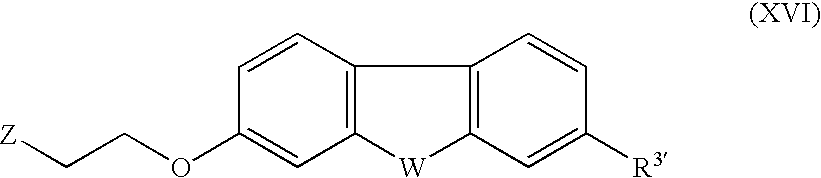
- [wherein, W, R 3′ and Z represent the same meaning as described above, respectively.] to obtain the compound represented by general formula (VI) [wherein, Y represents a hydrogen atom, A represents a protecting group for a hydroxyl group, and R1′, R3′ and W represent the same meaning as described above, respectively.]. Then, after protecting the formed amine, the compound of general formula (I) can be synthesized by the same method as described above.
- The coupling reaction with the amine is conducted in an organic solvent, if necessary in the presence of a proton receptor such as a tertiary amine (for example, triethylamine or the like), to thus obtain the compound of general formula (VI) [provided, Y represents a hydrogen atom]. The term “leaving group” means a chlorine atom, a bromine atom or an iodine atom, or a group that is eliminated at the time of the aforementioned reaction, such as a sulfonate such as a mesyl group or a tosyl group. As one example of a reaction condition, the usage amount of the amine of general formula (XXIV) is 1-10×mol with respect to the compound represented by general formula (XVI).
- Since this reaction is slow, it is preferable to conduct it in an autoclave, and examples of a solvent to be used include alcohols such as methanol, ethanol or butanol, or a hydrogen halide such as methylene chloride or chloroform, tetrahydrofuran, dioxane or the like. A reaction temperature is, in general, 10˜150° C., and preferably 70-130° C. Reaction time is, in general, 5˜100 hours.
- The compound of general formula (XXIV) can be obtained by hydrogenation of substituted mandelonitrile substituted at R 1′, for example, by reacting in the presence of a catalyst such as Raney nickel. Substituted mandelonitrile can be obtained as a racemic compound from reaction of substituted benzaldehyde and hydrogen cyanide or sodium cyanide and sodium hydrogen sulfite, and by forming a salt of an arbitrarily selected optically active acid and a diastereoisomer, in accordance with a normally performed method and technique, it can be readily isolated into an optically active isomer. Further, the optically active compound of general formula (XXIV) can be obtained by reacting optically active carboxylic acid obtained by hydrolyzing optically active substituted mandelonitrile with ammonia in the presence of a normally used condensing agent, and subsequently reducing.
- The various compounds described in the present application, may, as necessary, be purified, which can be conducted using conventional known types of chromatography (column, flash column, thin layer, and high performance liquid), for example, employing the Rf value of the present specification as an index.
- As mentioned above, the compound of general formula (I) can exist as 2 different optical isomers. Further, the compound of general formula (II) can exist as a maximum of 8 optical isomers, and the compound of general formula (III) can exist as a maximum of 4 optical isomers. The method of the present invention can provide both a pure optical isomer and a racemic mixture. The reactions described above do not change the relevant stereochemistry.
- Accordingly, by starting from the compound of general formula (X) or (XXIII) which do not have an asymmetric carbon, or by starting from the compound of general formula (IV), (XI) or (XXIV) as a racemic compound, a racemic body can be obtained. Likewise, by starting from a pure optical isomer of the compound of general formula (IV), (XI) or (XXIV), for example an R isomer of general formula (IV), an R isomer only can be obtained. Further, when using an optically active isomer of the compound of general formula (IV), (XI) or (XXIV), a pure isomer can be obtained.
- In a case where a mixture (racemic body) of 2 kinds of enantiomer is obtained, separation can be conducted by a suitable method such as fractional crystallization as a salt added with an optically active acid such as camphor sulfonic acid, mandelic acid or substituted mandelic acid. Fractional crystallization can be conducted using a suitable solvent, preferably a lower alkanol (for example, ethanol, isopropyl alcohol, or a mixture thereof).
- Each group of enantiomer can be isolated into a pure isomer by formation of diastereomeric salt, chromatography using an optically active column, or another means. In a case where one of the starting materials is optically active, a diastereomeric mixture obtained in this manner is isolated into a pure isomer by the aforementioned technique. By isolating and purifying into an optically active isomer, since an isomer of higher activity only is used, enhancement of effects or dissociation of side effects or the like is possible, which is preferable for a medicament.
- Preferably these compounds are, as necessary, added to a pharmaceutically acceptable carrier to form a medical compound useful as a medicament. Examples of a pharmaceutically acceptable carrier include an excipient, a bonding agent, such as carboxymethylcellulose, a disintegrating agent, a lubricant, an additive, and the like. When administering these compounds to humans, they can be administered orally in the form of a tablet, a powder, a granule, a capsule, a sugarcoated tablet, a solution, a syrup or the like. In addition, parenteral administration such as an injection is also possible. The dosage will differ according to the age, body weight, and degree of symptoms of a patient, however, in general, an amount of 0.01˜2000 mg is administered to one adult per day, and may be administered at one time or divided into several administrations. A dosing period generally consists of consecutive daily administration for several weeks to several months, however, the daily dosage and the dosing period can be increased or reduced depending on the symptoms of the patient. When concomitantly administering the therapeutic agent of the present invention, the substances may be mixed in one container, however, depending on the case, they may be stored in separate containers, and at the time of administration, administered to the same patient at substantially the same time.
- “Urinary incontinence” is generally understood as “objectively verifiable involuntary urine leakage, which causes a hindrance in living respects and sanitary respects in daily life”, and “pollakiuria” is generally understood as “frequently having a micturition desire, and furthermore, feeling it is not possible to be patient before urination” (New Current 10(18), p2-7 (1999)). Obesity normally indicates a person whose BMI (Body Mass Index) is 25 or more, and it is reported that the ratio of people in this condition who develop hypertension, hyperlipemia or diabetes mellitus is high compared to people whose BMI is under 25 (Nature 404, p635-643 (2000)). Diabetes mellitus is classified into type I diabetes mellitus and type II diabetes mellitus, and in the present invention, type II diabetes mellitus is a more preferable object of treatment. Type II diabetes mellitus is characterized by insulin resistance and insulin hyposecretion. The gauge of diabetes mellitus is generally considered to be a fasting blood glucose level of 140 mg/dl or more, and a level of 200 mg/dl or more 2 hours after a 75 g glucose tolerance test (NIPPONRINSHO, Diabetes Mellitus 1, Vol. 55, p247-253 (1997)). Hyperlipemia consists of hypercholesterolemia and hypertriglyceridemia, and hypercholesterolemia, in particular, is a risk factor of arteriosclerosis. The diagnostic criteria of hyperlipemia is described (Molecular Medicine, Vol. 31, p544-550) as a serum cholesterol level of 220 mg/dl or more, a triglyceride level of 150 mg/dl or more, and a HDL (high density lipoprotein)-cholesterol level of 40 mg/dl or under.
- In the present invention, an anticholinergic agent is an antagonist of a muscarinic receptor, and is as described in RINPI, Vol. 52, No. 5, p277-287 (1998), and specific examples include flavoxate hydrochloride, oxybutynin hydrochloride, propiverine hydrochloride, and tolterodine (Folia Pharmacologica Japonica, Vol. 113, p157-166 (1999); Eur. J. Pharmaco. 349, p285-292 (1998)). In particular, preferred examples are oxybutynin hydrochloride, propiverine hydrochloride, and tolterodine.
- It is described in Medicine and Drug Journal, Vol. 36, No. 2, p151-157 (2000) that a monoamine reuptake inhibitor inhibits reuptake of serotonin and noradrenaline and increases monoamine concentration. Specific examples thereof include sibutramine, milnacipran, duloxetine, and venlafaxine, and in particular, sibutramine is a preferred example.
- It is described in IYAKU JOURNAL, Vol. 36, No. 2, p137-140 (2000) that a selective serotonin reuptake inhibitor (SSRI) is capable of inhibiting only reuptake of serotonin, and is not capable of reuptake of noradrenaline or dopamine. Specific examples thereof include fluoxetine, sertraline, paroxetine, and fluvoxamine.
- Further, it is described in J. Clin. Pharmacology 37, p453-473 (1997) that a lipase inhibitor is an inhibitor of lipase of the stomach or pancreas, and inhibits decomposition of triglyceride in food. In particular, orlistat is a preferred example thereof.
- It is described in IGAKU NO AYUMI, Diabetes Mellitus 188, p309-313 (1999) that an insulin secretagogue promotes insulin secretion from β cells by stimulating K ATP channels of pancreatic β-cells. Specific examples thereof include glibenclamide, glipizide, gliclazide, glimepiride, tolazamide, tolbutamide, acetohexamide, chlorpropamide, glyclopyramide, meglitinide, repaglinide, nateglinide and mitiglinide, and in particular, repaglinide, nateglinide and mitiglinide are preferred examples.
- Examples of a Biguanide Include Metformin, and Buformin
- It is described in IGAKU NO AYUMI, Diabetes Mellitus 188, p496-499 (1999) that an α-glucosidase inhibitor prevents absorption of sugar from the ciliated epithelium by inhibiting α-glucosidase of the small intestine. Specific examples thereof include acarbose, voglibose, miglitol and emiglitate, and in particular, acarbose and voglibose are preferred examples.
- An insulin resistance improving agent is a medicament for ameliorating insulin resistance, which is one of the causes of type II diabetes mellitus, and at the present time a PPAR γ-agonist corresponds to this (Diabetes Mellitus 188, p500-503 (1999)). Specific examples thereof include troglitazone, pioglitazone, rosiglitazone, MCC-555, GI-262570, JTT-501 and KRP-297, and in particular, pioglitazone, rosiglitazone, MCC-555, GI-262570, JTT-501, and KPP-297 are preferred examples.
- An HMG-CoA reductase inhibitor is an inhibitor of HMG-CoA reductase, a rate-limiting enzyme of the cholesterol biosynthetic pathway, and it leads to a reduction in blood cholesterol (Mol. Med. 31, p544-549 (1994)). Specific examples thereof include pravastatin, simvastatin, fluvastatin, atorvastatin, cerivastatin, nisvastatin and S-4522.
- It is described in KISO TO RINSHOU (The clinical report), Vol. 16, p150-169 (1982) that an anion exchange resin binds to bile acid at a basic anion exchange resin and is excreted in feces, and specific examples thereof include cholestyramine and colestimide.
- Clofibrate-base drugs have PPAR a agonistic activity and promote fatty acid oxidation (Mol. Med. 37, p83-90 (2000)). Specific examples thereof include clofibrate, simfibrate, clinofibrate, bezafibrate, fenofibrate, ciprofibrate and gemfibrozil.
- Specific examples of nicotinic acid type drugs include nicotinic acid, nicomol, niceritrol and tocopherol nicotinate.
- The therapeutic agent of the present invention has low toxicity, and therefore a larger amount thereof can be administered. Employing as an index the ratios of beneficial effect (for example, effective dose of β3 activity or the like) in each application with various toxicities, comparison of the indexes for use of a β3 agonist by itself and of each drug by itself, and for combined use of a β3 agonist and each drug showed that, by combined use in the present invention each index at the time of treatment was high, and the safety and high level of effectiveness were readily understood.
- Examples of a selectable index of toxicity include mouth dryness, which is cited as a side effect of anticholinergic agents. Such mouth dryness can be measured by evaluating suppression of salivation induced with pilocarpine in accordance with the method of Nagao et al. (Folia Pharmacologica Japonica, Vol. 113, p156-166 (1999)). Further, elevation of blood pressure that is cited as a side effect of sibutramine can also be employed as an index of toxicity. Such elevation of blood pressure can be determined through use of a pressure transducer. Gastrointestinal dysfunction (fatty stool, defecation increase, abdominal pain, impending defecation desire) that is cited as a side effect of orlistat can also be employed as an index of toxicity. Such gastrointestinal dysfunction can be examined by analyzing the stool amount and the stool composition. Promotion of appetite that is cited as a side effect of insulin secretagogue can also be employed as an index of toxicity. Such promotion of appetite can be determined by observing body weight fluctuations using an animal, and hypoglycemia can be determined by investigating the concentration of glucose in blood. Loose passage that is cited as a side effect of α-glucosidase inhibitor can also be employed as an index of toxicity. Such loose passage and diarrhea can be investigated by, in the case of administration to animal, external observation of stool, or by analysis of stool amount and stool composition. Body weight gain that is cited as a side effect of insulin resistance improving agent can also be employed as an index of toxicity. Such body weight gain can be investigated by measurement of body weight after administration to animal. Gastrointestinal dysfunction that is cited as a side effect of HMG-CoA reductase inhibitor can also be employed as an index of toxicity. Such gastrointestinal dysfunction can be investigated by analysis of stool amount and stool composition. Gastrointestinal dysfunction that is cited as a side effect of clofibrate type drugs can also be employed as an index of toxicity. Such gastrointestinal dysfunction can be investigated by analysis of stool amount and stool composition.
- The present invention is further described in the following examples, however, the examples are not intended to limit the scope of the present invention. Compound a, which is a β3 agonist, used in these examples is (R)-N-[3-[2-[2-(7-hydroxy-9H-carbazole-2-iloxy)ethylamino]-1-hydroxyethyl]phenyl]methanesulfonamide. Hereinafter, similarly compound b is (R)-N-[5-[2-[2-(5,6,7,8-tetrahydro-9H-carbazole-2-iloxy)ethylamino]-1-hydroxyethyl]-2-hydroxyphenyl]methanesulfonamide, compound c is (R)-N-[5-[2-[2-(dibenzothiophene-3-iloxy)ethylamino]-1-hydroxyethyl]-2-hydroxyphenyl]methanesulfonamide, compound d is (R)-N-[5-[2-[2-(9H-carbazole-2-iloxy)ethylamino]-1-hydroxyethyl]-2-hydroxyphenyl]methanesulfonamide, compound e is (R)-N-[3-[2-[2-(9H-carbazole-2-iloxy)ethylamino]-1-hydroxyethyl]phenyl]methanesulfonamide, compound f is (R)-N′-[5-[2-[2-(9H-carbazole-2-iloxy)ethylamino]-1-hydroxyethyl]-2-hydroxyphenyl]-N,N-dimethyl sulfonyl amide, compound g is (R)-N′-[5-[2-[2-(dibenzofuran-3-iloxy)ethylamino]-1-hydroxyethyl]-2-hydroxyphenyl]-N,N-dimethyl sulfonyl amide, compound h is (R)-N-[5-[2-[2-(9H-carbazole-2-iloxy)ethylamino]-1-hydroxyethyl]-2-chlorophenyl]methanesulfonamide, and compound i is (R)-N-[5-[2-[2-(9H-carbazole-2-iloxy)ethylamino]-1-hydroxyethyl]-2-bromophenyl]methanesulfonamide.
- Synthesis of Compound a
- In accordance with a method described in the above-described production method, react a compound in which, in general formula (XIV), R 3′ is a benzyloxy group and W is a secondary nitrogen atom with dibromoethane represented by general formula (XV), and further react with benzylamine to thereby obtain N-benzyl-2-(7-benzyloxy-9H-carbazole-2-iloxy)ethylamine represented by general formula (V). React this compound with a compound in which, in general formula (IV), R1′ is a hydrogen atom, and subsequently reduce the nitro group. Then, after mesylation compound a can be obtained by deprotecting the benzyl protecting group. Employ a hydrochloride according to a conventional method.
- Rf=0.8 (chloroform/methanol=4/1 (free body));
- Mass (m/e) 456 (MH+)
- Further, compound b is disclosed in the specification of WO99/01431, and compounds c˜i are disclosed in the specification of Japanese Patent Application Laying-Open (kokai) No. 9-249623.
- When examining the pharmacological effects for the above-described compounds a˜i, use a hydrochloride as these compounds. Such hydrochlorides can be prepared by a conventional method.
- Measurement of the contractive force of human urinary bladder compression muscle was conducted in accordance with the method of Takeda, M. et al. (J. Pharm. Exp. Ther. 288, p1367-1373 (1999). Specifically, contraction was provoked by carbachol (0.5×10 −6 M), and a relaxation effect of compounds a, b, c, d, e, f, g, h, and i, and propiverine was investigated. Compounds a, b, c, d, e, f, g, h, i, propiverine, oxybutynin, and tolterodine significantly relaxed the bladder compression muscle at 10−7, 10−7, 10−8, 10−8, 10−6, 10−7, 10−7, 10−6, 10−6, 10−5, 10−8 and 10−8 M, respectively, however at 10−9, 10−9, 10−10, 10−10, 10−8, 10−9, 10−9, 10−8, 10−8, 10−6, 10−9 and 10−9 M, respectively, they did not relax the muscle significantly. When compounds consisting of a combination of 10−6 M of propiverine and each of 10−9 M of compound a, 10−9 M of compound b, 10−10 M of compound c, 10−10 M of compound d, 10−8 M of compound e, 10−9 M of compound f, 10−9M of compound g, 10−8 M of compound h, and 10−8 M compound i, respectively, were administered to the bladder compression muscle, the muscle was relaxed significantly in comparison with administration of each compound alone. Further, when compounds consisting of a combination of 10−9 M of oxybutynin and each of 10−9 M of compound a, 10−9 M of compound b, 10−10 M of compound c, 10− M of compound d, 10−8 M of compound e, 10−9 M of compound f, 10−9 M of compound g, 10−8 M of compound h and 10−8 M of compound i, respectively, were administered to the bladder compression muscle, the muscle was relaxed significantly in comparison with administration of each compound alone. Further, when a compound consisting of a combination of 10−9 M of tolterodine and each of 10−9 M of compound a, 10−9 M of compound b, 1010 M of compound c, 10−10 M of compound d, 10−8 M of compound e, 10−9 M of compound f, 10−9 M of compound g, 10−8 M of compound h and 10−8 M of compound i, respectively, were administered to the bladder compression muscle, the muscle was relaxed significantly in comparison with administration of each compound alone.
- Therefore, the therapeutic agent used in combination of the present invention exhibited a strong synergistic effect in therapeutic effects for pollakiuria and incontinence of urine, and it was confirmed that it is useful as a therapeutic agent for pollakiuria and incontinence of urine.
- Regarding mouth dryness as a side effect often observed in administration of propiverine, oxybutynin, or tolterodine, measurement was conducted in accordance with the method of Nagao et al., (Folia Pharmacologica Japonica, Vol. 113, p156-166 (1999)), and suppression of salivation in the condition of a reduced dosage was observed.
- Mice induced with obesity by feeding with a high fat diet for 2 months were orally administered with sibutramine (SIB: 1 mg/kg), a β3 agonist (compound c: 0.3 mg/kg; compound d: 0.3 mg/kg; compound e: 3 mg/kg; compound g: 3 mg/kg; compound h: 1 mg/kg; compound i: 1 mg/kg), or SIB and a β3 agonist (compound c, compound d, compound e, compound g, compound h, and compound i) in combination (each dosage was the same as the aforementioned) for 2 weeks and bred, and body weight was measured. For the groups administered solely with SIB, compound c, compound d, compound e, compound g, compound h, or compound i, respectively, almost no change in body weight was observed. In contrast, for the groups administered with a combination of SIB and compound c, SIB and compound d, SIB and compound e, SIB and compound g, SIB and compound h, or SIB and compound i, respectively, a significant weight reduction was observed.
- Therefore, it was confirmed that the therapeutic agent of the present case possesses a superior antiobestic effect.
- Regarding elevation of blood pressure as a side effect of sibutramine, after administration of the drug, it was determined by use of a pressure transducer that elevation of blood pressure was alleviated to a greater extent.
- Mice induced with obesity by feeding with a high fat diet for 2 months were orally administered with orlistat (1 mg/kg), a β3 agonist (compound c: 0.3 mg/kg; compound d: 0.3 mg/kg; compound e: 3 mg/kg; compound g: 3 mg/kg; compound h: 1 mg/kg; compound i: 1 mg/kg), or orlistat and a β3 agonist (compound c, compound d, compound e, compound g, compound h, and compound i) in combination (each dosage was the same as the aforementioned) for 2 weeks and bred, and body weight was measured. For the groups administered solely with orlistat, compound c, compound d, compound e, compound g, compound h, or compound i, respectively, almost no change in body weight was observed. In contrast, for the groups administered with a combination of orlistat and compound c, orlistat and compound d, orlistat and compound e, orlistat and compound g, orlistat and compound h, or orlistat and compound i, respectively, a weight reduction was observed.
- Therefore, it was confirmed that the therapeutic agent of the present case possesses a superior antiobestic effect
- Gastrointestinal dysfunction (fatty stool, defecation increase, abdominal pain, impending defecation desire) as a side effect of orlistat, can be investigated, after administration of the drug, by analyzing stool amount and stool composition.
- Mice were administered with insulin (INS: 0.2 U/kg, intraperitoneal injection), a β3 agonist (oral administration of compound a: 10 mg/kg; compound c: 0.3 mg/kg; compound d: 0.3 mg/kg; compound e: 3 mg/kg; compound g: 3 mg/kg; compound h: 1 mg/kg; compound i: 1 mg/kg, respectively), or INS and a β3 agonist (compound a, compound c, compound d, compound e, compound g, compound h, and compound i) in combination (each dosage and administration route was the same as the aforementioned), blood was collected after 30 min, and the amount of glucose contained in blood plasma was measured. The results showed that for the groups administered only with INS, compound a, compound c, compound d, compound e, compound g, compound h, or compound i, respectively, no change in blood glucose level was observed. In contrast, for the groups administered with a combination of INS and compound a, INS and compound c, INS and compound d, INS and compound e, INS and compound g, INS and compound h, or INS and compound i, respectively, the blood glucose level decreased significantly.
- Therefore, it was confirmed that the therapeutic agent of the present case possesses a superior antidiabetic effect.
- Mice fasted overnight were orally administered with glibenclamide (GLI: 10 mg/kg), a β3 agonist (compound a: 10 mg/kg; compound c: 0.3 mg/kg; compound d: 0.3 mg/kg; compound e: 3 mg/kg; compound g: 3 mg/kg; compound h: 1 mg/kg; compound i: 1 mg/kg), or GLI and a β3 agonist (compound a, compound c, compound d, compound e, compound g, compound h, and compound i) in combination (each dosage was the same as the aforementioned), and immediately glucose (1 g/kg, subcutaneous injection) was loaded. Blood was collected after 1 hour, and the amount of glucose contained in blood plasma was measured. In the groups administered solely with GLI, compound a, compound c, compound d, compound e, compound g, compound h, or compound i, there was almost no difference in the blood glucose level compared to mice not administered with a compound and for which only glucose loading was carried out. In contrast, in the groups administered with a combination of GLI and compound a, GLI and compound c, GLI and compound d, GLI and compound e, GLI and compound g, GLI and compound h, or GLI and compound i, respectively, the blood glucose level decreased significantly.
- Therefore, it was confirmed that the therapeutic agent of the present case possesses a superior antidiabetic effect.
- In this combined use, hypoglycemia, which is a side effect of glibenclamide, was not observed.
- Genetically diabetic mice were orally administered with rosiglitazone (ROS: 1 mg/kg), a β3 agonist (compound c: 0.3 mg/kg; compound d: 0.3 mg/kg; compound e: 3 mg/kg; compound g: 3 mg/kg; compound h: 1 mg/kg; compound i: 1 mg/kg), or ROS and a β3 agonist (compound c, compound d, compound e, compound g, compound h, and compound i) in combination (each dosage was the same as the aforementioned) for 2 weeks. Blood was collected thereafter, and the amount of glucose contained in blood plasma was measured. For the groups administered solely with ROS, compound c, compound d, compound e, compound g, compound h, or compound i, no difference in the blood glucose level was observed. In contrast, in the groups administered with a combination of ROS and compound c, ROS and compound d, ROS and compound e, ROS and compound g, ROS and compound h, or ROS and compound i, respectively, the blood glucose level decreased significantly.
- Therefore, it was confirmed that the therapeutic agent of the present case possesses a superior antidiabetic effect.
- Further, in comparison with the group administered only ROS, weight reduction was observed in the groups administered with ROS and a compound in combination, and thus it was found that weight gain that is a side effect of ROS administration disappeared.
- Genetically diabetic mice were orally administered with acarbose (ACA: 1 mg/kg), a β3 agonist (compound c: 0.3 mg/kg; compound d: 0.3 mg/kg; compound e: 3 mg/kg; compound g: 3 mg/kg; compound h: 1 mg/kg; compound i: 1 mg/kg), or ACA and a β3 agonist (compound c, compound d, compound e, compound g, compound h, and compound i) in combination (each dosage was the same as the aforementioned) for 2 weeks. Blood was collected thereafter, and the amount of glucose contained in blood plasma was measured. For the groups administered solely with ACA, compound c, compound d, compound e, compound g, compound h, or compound i, respectively, no difference was observed in the blood glucose level. In contrast, in the groups administered with a combination of ACA and compound c, ACA and compound d, ACA and compound e, ACA and compound g, ACA and compound h, or ACA and compound i, respectively, the blood glucose level decreased.
- Accordingly, it was confirmed that the therapeutic agent of this case possesses an excellent antidiabetic effect.
- By testing using a vehicle dog, it is possible to observe enhancement of antilipemic effect by combined use of pravastatin (PRA) and a β3 agonist. For example, according to the method of Tsujita, T. et al. (Biochim. Biophys. Acta, 877, p50-60 (1986)), it is shown that by administration to a vehicle dog of PRA: 0.625˜1.25 mg/kg, the blood cholesterol level and level of triglyceride in blood decrease. Further, since it is shown that a β3 agonist acts in a vehicle dog (KACHIKU SEIKAGAKU, Vol. 33, p13-18 (1996)), it is expected that compound a, b, c, d, e, f, g, h, and i also act therein. By combined use of pravastatin and a β3 agonist, which have different action mechanisms to each other, a synergistic decrease in the blood cholesterol level and level of triglyceride in blood can be acknowledged.
- Accordingly, it was confirmed that the therapeutic agent of this case possesses an excellent antilipemic effect.
- Mice were orally administered with bezafibrate (BEZ: 3 mg/kg), a β3 agonist (compound c: 0.3 mg/kg; compound d: 0.3 mg/kg; compound e: 3 mg/kg; compound g: 3 mg/kg; compound h: 1 mg/kg; compound i: 1 mg/kg), or BEZ and a β3 agonist (compound c, compound d, compound e, compound g, compound h, and compound i) in combination (each dosage was the same as the aforementioned) for 2 weeks. Blood was collected thereafter, and the amount of triglyceride contained in blood plasma was measured. For the groups administered solely with BEZ, compound c, compound d, compound e, compound g, compound h, or compound i, respectively, no difference was observed in the blood glucose level. In contrast, for the groups administered with a combination of BEZ and compound c, BEZ and compound d, BEZ and compound e, BEZ and compound g, BEZ and compound h, or BEZ and compound i, respectively, triglyceride decreased.
- Accordingly, it is expected that the therapeutic agent of this case possesses an excellent antilipemic effect.
- All publications, patents and patent applications cited herein are incorporated herein by reference in their entirety.
- The present invention provides a therapeutic agent comprising at least one member selected from the group consisting of an anticholinergic agent, a monoamine reuptake inhibitor, a lipase inhibitor, a selective serotonin reuptake inhibitor, insulin, an insulin secretagogue, biguanide, an α-glucosidase inhibitor, an insulin resistance improving agent, a HMG-CoA reductase inhibitor, an anion exchange resin, a clofibrate type drug and a nicotinic acid type drug, and a compound having a β3 agonist activity. The therapeutic agent of the present invention has a dysuria treatment effect, an antiobestic effect, an antidiabetic effect, and an antilipemic effect.
Claims (46)
1. A therapeutic agent comprising at least one member selected from the group consisting of an anticholinergic agent, a monoamine reuptake inhibitor, a lipase inhibitor, a selective serotonin reuptake inhibitor, insulin, an insulin secretagogue, biguanide, an α-glucosidase inhibitor, an insulin resistance improving agent, a HMG-CoA reductase inhibitor, an anion exchange resin, a clofibrate type drug and a nicotinic acid type drug, and a compound having a β3 agonist activity.
2. The therapeutic agent of claim 1 , wherein the compound having a β3 agonist activity is a compound represented by any one of the following general formula (I), general formula (II), general formula (III) and a salt thereof.


A compound of the formula (I):
[wherein, R1 represents a hydrogen atom, a halogen atom or a hydroxyl group, and R2 represents a lower alkyl group or a benzyl group. R3 represents OR, a halogen atom, a trifluoromethyl group, a lower alkyl group, a lower acyl group, NR4R4′, a nitro group or a cyano group. Further, R represents a hydrogen atom, a lower alkyl group, a benzyl group or a lower acyl group which may have a substituent, and R4 and R4′ represents a hydrogen atom, a lower alkyl group, a lower acyl group, a benzyl group or SO2R5, where R4 and R4′ may be same or different each other. R5 represents a lower alkyl group or a benzyl group. W represents an oxygen atom, a secondary nitrogen atom (NH) or a sulfur atom. * means an asymmetric carbon atom. ], or a salt thereof.
A compound of the formula (II):
[wherein, R6 represents a hydrogen atom or a methyl group; R7 represents a hydrogen atom, a halogen atom, a hydroxyl group, a benzyloxy group, an amino group or a hydroxymethyl group; and R8 represents a hydrogen atom, a hydroxymethyl group, NHR9, SO2NR10R10′ or a nitro group. Provided that R9 represents a hydrogen atom, a methyl group, SO2R11, a formyl group or CONHR12′, and R11 represents a lower alkyl group, a benzyl group or NR10R10′. Further, R10 and R10′ represents a hydrogen atom, a lower alkyl group or a benzyl group, where R10 and R10′ may be same or different each other. R12′ represents a hydrogen atom or a lower alkyl group. Further, R12 represents a hydrogen atom or a lower alkyl group. n represents 1 or 2, and W represents a secondary nitrogen atom, an oxygen atom or a sulfur atom. When n is 1, one of R13 and R14 represents a hydrogen atom and the other represents a hydrogen atom, an amino group, an acetylamino group or a hydroxyl group. When n represents 2, R14 represents a hydrogen atom and R13 represents a hydrogen atom, an amino group, an acetylamino group or a hydroxyl group. *1 represents an asymmetric carbon atom, and when neither R12 nor R14 is a hydrogen atom, *2 and *3 mean an asymmetric carbon atom.], or a salt thereof.
A compound of the formula (III):
[wherein, R6 represents a hydrogen atom or a methyl group; R7 represents a hydrogen atom, a halogen atom, a hydroxyl group, a benzyloxy group, an amino group or a hydroxymethyl group; and R8 represents a hydrogen atom, a hydroxymethyl group, NHR9, SO2NR10R10′ or a nitro group. Provided that R9 represents a hydrogen atom, a methyl group, SO2R11, a formyl group or CONHR 12′, and R11 represents a lower alkyl group, a benzyl group or NR10R10′. Further, R10 and R10′ represents a hydrogen atom, a lower alkyl group or a benzyl group, where R10and R10′ may be same or different each other. R12′ represents a hydrogen atom or a lower alkyl group. Further, R12 represents a hydrogen atom or a lower alkyl group. W′ represents a secondary nitrogen atom, an oxygen atom, a sulfur atom or a methylene group; and when W′ is a secondary nitrogen atom, an oxygen atom or a sulfur atom, R17 represents a hydrogen atom and one of R15 and R16 represents a hydrogen atom and the other represents a hydrogen atom, an amino group, an acetylamino group or a hydroxyl group. Further, when W′ is a methylene group, R15 and R16 each represent a hydrogen atom and R17 represents a hydrogen atom, an amino group, an acetylamino group or a hydroxyl group. *1 represents an asymmetric carbon atom, and when R12 is a lower alkyl group *2 means an asymmetric carbon atom.], or a salt thereof.
3. The therapeutic agent of claim 1 or 2, which is a therapeutic agent for pollakiuria and incontinence of urine, comprising at least an anticholinergic agent and a compound having a β3 agonist activity.
4. The therapeutic agent of claim 3 , wherein the anticholinergic agent is any one of flavoxate hydrochloride, oxybutynin hydrochloride, propiverine hydrochloride and tolterodine.
5. The therapeutic agent of claim 3 , wherein the anticholinergic agent is any one of oxybutynin hydrochloride, propiverine hydrochloride and tolterodine.
6. The therapeutic agent of claim 1 or 2, which is a therapeutic agent for obesity, comprising at least one member selected from the group consisting of a monoamine reuptake inhibitor, a lipase inhibitor and a selective serotonin reuptake inhibitor, and a compound having a β3 agonist activity.
7. The therapeutic agent of claim 6 , comprising at least a monoamine reuptake inhibitor and a compound having a β3 agonist activity.
8. The therapeutic agent of claim 6 or 7, wherein the monoamine reuptake inhibitor is any one of sibutramine, milnacipran, duloxetine and venlafaxine.
9. The therapeutic agent of claim 6 or 7, wherein monoamine reuptake inhibitor is sibutramine.
10. The therapeutic agent of claim 6 , comprising at least a lipase inhibitor and a compound having a β3 agonist activity.
11. The therapeutic agent of claim 6 or 10, wherein the lipase inhibitor is orlistat.
12. The therapeutic agent of claim 6 , comprising at least a selective serotonin reuptake inhibitor and a compound having a β3 agonist activity.
13. The therapeutic agent of claim 6 or 12, wherein the selective serotonin reuptake inhibitor is fluoxetine, sertraline, paroxetine or fluvoxamine.
14. The therapeutic agent of claim 1 or 2, which is a therapeutic agent for type II diabetes mellitus, comprising at least one member selected from the group consisting of insulin, an insulin secretagogue, biguanide, an α-glucosidase inhibitor and an insulin resistance improving agent, and a compound having a β3 agonist activity.
15. The therapeutic agent of claim 14 , comprising at least insulin and a compound having a β3 agonist activity.
16. The therapeutic agent of claim 14 , comprising at least an insulin secretagogue and a compound having a β3 agonist activity.
17. The therapeutic agent of claim 14 or 16, wherein the insulin secretagogue is glibenclamide, glipizide, gliclazide, glimepiride, tolazamide, tolbutamide, acetohexamide, chlorpropamide, glyclopyramide, meglitinide, repaglinide, nateglinide or mitiglinide.
18. The therapeutic agent of claim 14 or 16, wherein the insulin secretagogue is glibenclamide.
19. The therapeutic agent of claim 14 or 16, wherein the insulin secretagogue is repaglinide, nateglinide or mitiglinide.
20. The therapeutic agent of claim 14 , comprising at least biguanide and a compound having a β3 agonist activity.
21. The therapeutic agent of claim 14 or 20, wherein the biguanide is metformin or buformin.
22. The therapeutic agent of claim 14 , comprising at least an α-glucosidase inhibitor and a compound having a β3 agonist activity.
23. The therapeutic agent of claim 14 or 22, wherein the α-glucosidase inhibitor is acarbose, voglibose, iniglitol or emiglitate.
24. The therapeutic agent of claim 14 or 22, wherein the α-glucosidase inhibitor is acarbose.
25. The therapeutic agent of claim 14 , comprising at least an insulin resistance improving agent and a compound having a β3 agonist activity.
26. The therapeutic agent of claim 14 or 25, wherein the insulin resistance improving agent is troglitazone, pioglitazone, rosiglitazone, MCC-555, GI-262570, JTT-501 or KRP-297.
27. The therapeutic agent of claim 14 or 25, wherein the insulin resistance improving agent is rosiglitazone.
28. The therapeutic agent of claim 14 or 25, wherein the insulin resistance improving agent is MCC-555, GI-262570, JTT-501 or KRP-297.
29. The therapeutic agent of claim 1 or 2, which is a therapeutic agent for hyperlipemia, comprising at least one member selected from the group consisting of a HMG-CoA reductase inhibitor, an anion exchange resin, a clofibrate type drug and a nicotinic acid type drug, and a compound having a β3 agonist activity.
30. The therapeutic agent of claim 29 , comprising at least a HMG-CoA reductase inhibitor and a compound having a β3 agonist activity.
31. The therapeutic agent of claim 29 or 30, wherein the HMG-CoA reductase inhibitor is pravastatin, simvastatin, fluvastatin, atorvastatin, cerivastatin, nisvastatin or S-4522.
32. The therapeutic agent of claim 29 or 30, wherein the HMG-CoA reductase inhibitor is pravastatin.
33. The therapeutic agent of claim 29 or 30, wherein the HMG-CoA reductase inhibitor is simvastatin, fluvastatin, atorvastatin, cerivastatin, nisvastatin or S-4522.
34. The therapeutic agent of claim 29 , comprising at least an anion exchange resin and a compound having a β3 agonist activity.
35. The therapeutic agent of claim 29 or 34, wherein the anion exchange resin is cholestyramine or colestimide.
36. The therapeutic agent of claim 29 , comprising at least a clofibrate type drug and a compound having a β3 agonist activity.
37. The therapeutic agent of claim 29 or 36, wherein the clofibrate type drug is clofibrate, simfibrate, clinofibrate, bezafibrate, fenofibrate, ciprofibrate or gemfibrozil.
38. The therapeutic agent of claim 29 or 36, wherein the clofibrate type drug is bezafibrate.
39. The therapeutic agent of claim 29 , comprising at least a nicotinic acid type drug and a compound having a β3 agonist activity.
40. The therapeutic agent of claim 29 or 39, wherein the nicotinic acid type drug is nicotinic acid, nicomol, niceritrol or tocopherol nicotinate.
41. A treatment method which comprises administration of a therapeutic agent comprising at least one member selected from the group consisting of an anticholinergic agent, a monoamine reuptake inhibitor, a lipase inhibitor, a selective serotonin reuptake inhibitor, insulin, an insulin secretagogue, biguanide, an α-glucosidase inhibitor, an insulin resistance improving agent, a HMG-CoA reductase inhibitor, an anion exchange resin, a clofibrate type drug and a nicotinic acid type drug, and a compound having a β3 agonist activity.
42. The treatment method of claim 41 , wherein the compound having a β3 agonist activity is a compound represented by any one of the following general formula (I), general formula (II), general formula (III) and a salt thereof.


A compound represented by the general formula (I):
[wherein, R1 represents a hydrogen atom, a halogen atom or a hydroxyl group, and R2 represents a lower alkyl group or a benzyl group. R3 represents OR, a halogen atom, a trifluoromethyl group, a lower alkyl group, a lower acyl group, NR4R4′, a nitro group or a cyano group. Further, R represents a hydrogen atom, a lower alkyl group, a benzyl group or a lower acyl group which may have a substituent, and R4 and R4 represents a hydrogen atom, a lower alkyl group, a lower acyl group, a benzyl group or SO2R5, where R4 and R4′ may be same or different each other. R5 represents a lower alkyl group or a benzyl group. W represents an oxygen atom, a secondary nitrogen atom (NH) or a sulfur atom. * means an asymmetric carbon atom. ], or a salt thereof.
A compound represented by the general formula (II):
[wherein, R6 represents a hydrogen atom or a methyl group; R7 represents a hydrogen atom, a halogen atom, a hydroxyl group, a benzyloxy group, an amino group or a hydroxymethyl group; and R8 represents a hydrogen atom, a hydroxymethyl group, NHR9, SO2NR10R10′ or a nitro group. Provided that R9 represents a hydrogen atom, a methyl group, SO2R11, a formyl group or CONHR12′, and R11 represents a lower alkyl group, a benzyl group or NR10R10′. Further, R10 and R10′, represents a hydrogen atom, a lower alkyl group or a benzyl group, where R10 and R10′ may be same or different each other. R12′ represents a hydrogen atom or a lower alkyl group. Further, R12 represents a hydrogen atom or a lower alkyl group. n represents 1 or 2, and W represents a secondary nitrogen atom, an oxygen atom or a sulfur atom. When n is 1, one of R13 and R14 represents a hydrogen atom and the other represents a hydrogen atom, an amino group, an acetylamino group or a hydroxyl group. When n represents 2, R14 represents a hydrogen atom and R13 represents a hydrogen atom, an amino group, an acetylamino group or a hydroxyl group. * 1 represents an asymmetric carbon atom, and when neither R12 nor R14 is a hydrogen atom, *2 and *3 mean an asymmetric carbon atom.], or a salt thereof.
A compound represented by the general formula (III):
[wherein, R6 represents a hydrogen atom or a methyl group; R7 represents a hydrogen atom, a halogen atom, a hydroxyl group, a benzyloxy group, an amino group or a hydroxymethyl group; and R8 represents a hydrogen atom, a hydroxymethyl group, NHR9, SO2NR10R10′ or a nitro group. Provided that R9 represents a hydrogen atom, a methyl group, SO2R11, a formyl group or CONHR12′ and R11 represents a lower alkyl group, a benzyl group or NR10R10′. Further, R10 and R10′ represents a hydrogen atom, a lower alkyl group or a benzyl group, where R10 and R10′ may be same or different each other. R12′ represents a hydrogen atom or a lower alkyl group. Further, R12 represents a hydrogen atom or a lower alkyl group. W′ represents a secondary nitrogen atom, an oxygen atom, a sulfur atom or a methylene group; and when W′ is a secondary nitrogen atom, an oxygen atom or a sulfur atom, R17 represents a hydrogen atom and one of R15 and R16 represents a hydrogen atom and the other represents a hydrogen atom, an amino group, an acetylainino group or a hydroxyl group. Further, when W′ is a methylene group, R15 and R16 each independently represent a hydrogen atom and R17 represents a hydrogen atom, an amino group, an acetylamino group or a hydroxyl group. *1 represents an asymmetric carbon atom, and when R12 is a lower alkyl group *2 means an asymmetric carbon atom.], or a salt thereof.
43. The treatment method of claim 41 or 42, which is a treatment method for pollakiuria and incontinence of urine, comprising administration of a therapeutic agent comprising at least an anticholinergic agent and a compound having a β3 agonist activity.
44. The treatment method of claim 41 or 42, which is a treatment method for obesity, comprising administration of a therapeutic agent comprising at least one member selected from the group consisting of a monoamine reuptake inhibitor, a lipase inhibitor and a selective serotonin reuptake inhibitor, and a compound having a β3 agonist activity.
45. The treatment method of claim 41 or 42, which is a treatment method for diabetes mellitus, comprising administration of a therapeutic agent comprising at least one member selected from the group consisting of insulin, an insulin secretagogue, biguanide, an α-glucosidase inhibitor and an insulin resistance improving agent, and a compound having a β3 agonist activity.
46. The treatment method of claim 41 or 42, which is a treatment method for hyperlipemia, comprising administration of a therapeutic agent comprising at least one member selected from the group consisting of a HMG-CoA reductase inhibitor, an anion exchange resin, a clofibrate type drug and a nicotinic acid type drug, and a compound having a β3 agonist activity.
Applications Claiming Priority (2)
| Application Number | Priority Date | Filing Date | Title |
|---|---|---|---|
| JP2000020733 | 2000-01-28 | ||
| JP2000-20733 | 2000-01-28 |
Publications (1)
| Publication Number | Publication Date |
|---|---|
| US20030018061A1 true US20030018061A1 (en) | 2003-01-23 |
Family
ID=18547251
Family Applications (1)
| Application Number | Title | Priority Date | Filing Date |
|---|---|---|---|
| US10/182,375 Abandoned US20030018061A1 (en) | 2000-01-28 | 2001-01-26 | Novel remedies with the use of beta 3 agonist |
Country Status (5)
| Country | Link |
|---|---|
| US (1) | US20030018061A1 (en) |
| EP (1) | EP1258253A1 (en) |
| AU (1) | AU2710301A (en) |
| CA (1) | CA2398199A1 (en) |
| WO (1) | WO2001054728A1 (en) |
Cited By (21)
| Publication number | Priority date | Publication date | Assignee | Title |
|---|---|---|---|---|
| US20040197397A1 (en) * | 2002-08-30 | 2004-10-07 | Watson Pharmaceuticals, Inc. | Drug delivery system for treatment of urinary incontinence |
| US20040198822A1 (en) * | 2003-03-21 | 2004-10-07 | Dynogen Pharmacueticals, Inc. | Methods for treating lower urinary tract disorders using alpha2delta subunit calcium channel modulators with smooth muscle modulators |
| US20040248979A1 (en) * | 2003-06-03 | 2004-12-09 | Dynogen Pharmaceuticals, Inc. | Method of treating lower urinary tract disorders |
| US20050054725A1 (en) * | 2002-12-20 | 2005-03-10 | Dynogen Pharmaceuticals, Inc. | Methods of treating non-painful bladder disorders using alpha2delta subunit calcium channel modulators |
| US20060189651A1 (en) * | 2004-05-31 | 2006-08-24 | Jordi Gras Escardo | Combinations comprising antimuscarinic agents and beta-adrenergic agonists |
| US20080081067A1 (en) * | 2006-10-03 | 2008-04-03 | Gupta Manishkumar | Sustained release pharmaceutical compositions of venlafaxine and process for preparation thereof |
| US20080255084A1 (en) * | 2005-10-21 | 2008-10-16 | Randy Lee Webb | Combination of Organic Compounds |
| US20090285891A1 (en) * | 2006-07-10 | 2009-11-19 | Dr. R. Pfleger Chemische Fabrik Gmbh | Pharmaceutical preparation for oral administration with controlled active ingredient release in the small intestine and method for its production |
| US20110230530A1 (en) * | 2002-11-07 | 2011-09-22 | Astellas Pharma Inc. | Remedy for overactive bladder comprising acetic acid anilide derivative as the active ingredient |
| US8513279B2 (en) | 1999-07-14 | 2013-08-20 | Almirall, S.A. | Quinuclidine derivatives and medicinal compositions containing the same |
| US8871275B2 (en) | 2007-08-08 | 2014-10-28 | Inventia Healthcare Private Limited | Extended release compositions comprising tolterodine |
| US9254262B2 (en) | 2008-03-13 | 2016-02-09 | Almirall, S.A. | Dosage and formulation |
| US9737520B2 (en) | 2011-04-15 | 2017-08-22 | Almirall, S.A. | Aclidinium for use in improving the quality of sleep in respiratory patients |
| US10085974B2 (en) | 2008-03-13 | 2018-10-02 | Almirall, S.A. | Dosage and formulation |
| US10288602B2 (en) | 2013-01-08 | 2019-05-14 | Atrogi Ab | Screening method, a kit, a method of treatment and a compound for use in a method of treatement |
| US11357757B2 (en) | 2017-09-13 | 2022-06-14 | Atrogi Ab | Heteroaryl substituted beta-hydroxyethylamines for use in treating hyperglycaemia |
| US11427539B2 (en) | 2017-09-13 | 2022-08-30 | Atrogi Ab | Beta-hydroxy heterocyclic amines and their use in the treatment of hyperglycaemia |
| US11648216B2 (en) | 2017-09-13 | 2023-05-16 | Atrogi Ab | Fluorophenyl beta-hydroxyethylamines and their use in the treatment of hyperglycaemia |
| US11793774B2 (en) | 2017-09-13 | 2023-10-24 | Atrogi Ab | Chiral beta-hydroxyethylamines and their use in the treatment of hyperglycemia |
| WO2023203223A1 (en) | 2022-04-22 | 2023-10-26 | Atrogi Ab | Combinations of beta 2-adrenergic receptor agonists and beta 3-adrenergic receptor agonists, and medical uses thereof |
| US12378216B2 (en) | 2019-03-20 | 2025-08-05 | Atrogi Ab | Heteroaryl(heterocyclyl)methanol compounds useful in the treatment of hyperglycaemia |
Families Citing this family (14)
| Publication number | Priority date | Publication date | Assignee | Title |
|---|---|---|---|---|
| WO2002074306A1 (en) * | 2001-03-19 | 2002-09-26 | Asahi Kasei Kabushiki Kaisha | Remedies for fatty liver |
| EP1424079A1 (en) * | 2002-11-27 | 2004-06-02 | Boehringer Ingelheim International GmbH | Combination of a beta-3-receptor agonist and of a reuptake inhibitor of serotonin and/or norepinephrine |
| EP1651224B1 (en) * | 2003-07-31 | 2011-10-05 | Boehringer Ingelheim International GmbH | Medicaments for inhalation comprising an anticholinergic and a betamimetic |
| EP1722780A4 (en) * | 2003-11-26 | 2008-12-17 | Univ Duke | TECHNIQUE FOR PREVENTING OR TREATING GLAUCOMA |
| WO2006132196A1 (en) * | 2005-06-08 | 2006-12-14 | Asahi Kasei Pharma Corporation | NOVEL PHARMACEUTICAL COMPRISING β3 AGONIST |
| CN103142586A (en) * | 2005-09-02 | 2013-06-12 | 塞拉维达公司 | Therapy for the treatment of disease |
| SG174658A1 (en) | 2010-04-01 | 2011-10-28 | Theravida Inc | Pharmaceutical formulations for the treatment of overactive bladder |
| AU2011285928B9 (en) * | 2010-08-03 | 2018-08-02 | B3Ar Therapeutics, Inc. | Combinations of beta - 3 adrenergic receptor agonists and muscarinic receptor antagonists for treating overactive bladder |
| US9907767B2 (en) | 2010-08-03 | 2018-03-06 | Velicept Therapeutics, Inc. | Pharmaceutical compositions and the treatment of overactive bladder |
| US9522129B2 (en) | 2010-08-03 | 2016-12-20 | Velicept Therapeutics, Inc. | Pharmaceutical Combination |
| WO2012154774A1 (en) | 2011-05-10 | 2012-11-15 | Theravida, Inc. | Combinations of solifenacin and salivary stimulants for the treatment of overactive bladder |
| EP3226849A4 (en) | 2014-12-03 | 2018-05-09 | Velicept Therapeutics, Inc. | Compositions and methods of using modified release solabegron for lower urinary tract symptoms |
| US10065922B2 (en) | 2015-10-23 | 2018-09-04 | Velicept Therapeutics, Inc. | Solabegron zwitterion and uses thereof |
| JP6841834B2 (en) | 2016-01-20 | 2021-03-10 | テラヴィダ, インコーポレイテッドTheraVida, Inc. | Methods and compositions for the treatment of hyperhidrosis |
Citations (16)
| Publication number | Priority date | Publication date | Assignee | Title |
|---|---|---|---|---|
| US4346227A (en) * | 1980-06-06 | 1982-08-24 | Sankyo Company, Limited | ML-236B Derivatives and their preparation |
| US4444784A (en) * | 1980-08-05 | 1984-04-24 | Merck & Co., Inc. | Antihypercholesterolemic compounds |
| US5561142A (en) * | 1994-04-26 | 1996-10-01 | Merck & Co., Inc. | Substituted sulfonamides as selective β3 agonists for the treatment of diabetes and obesity |
| US5705515A (en) * | 1994-04-26 | 1998-01-06 | Merck & Co., Inc. | Substituted sulfonamides as selective β-3 agonists for the treatment of diabetes and obesity |
| US5770615A (en) * | 1996-04-04 | 1998-06-23 | Bristol-Myers Squibb Company | Catecholamine surrogates useful as β3 agonists |
| US5908830A (en) * | 1996-10-31 | 1999-06-01 | Merck & Co., Inc. | Combination therapy for the treatment of diabetes and obesity |
| US6011048A (en) * | 1997-01-28 | 2000-01-04 | Merck & Co., Inc. | Thiazole benzenesulfonamides as β3 agonists for treatment of diabetes and obesity |
| US6034106A (en) * | 1996-06-07 | 2000-03-07 | Merck & Co., Inc. | Oxadiazole benzenesulfonamides as selective β3 Agonist for the treatment of Diabetes and Obesity |
| US6037362A (en) * | 1996-01-10 | 2000-03-14 | Asahi Kasei Kogyo Kabushiki Kaisha | Tricyclic compounds and drug compositions containing the same |
| US6069176A (en) * | 1995-10-26 | 2000-05-30 | Mitsubishi-Tokyo Pharmaceuticals, Inc. | Phenylethanolamine compounds useful as β 3 agonists, process for producing the same, and intermediates in the production of the same |
| US6140352A (en) * | 1996-09-05 | 2000-10-31 | Eli Lilly And Company | Carbazolyl-substituted ethanolamines as selective β-3 agonists |
| US6172099B1 (en) * | 1997-07-03 | 2001-01-09 | Asahi Kasei Kogyo Kabushiki Kaisha | Tricyclic compounds having saturated rings and medicinal compositions containing the same |
| US6294850B1 (en) * | 1999-01-29 | 2001-09-25 | Mabuchi Motor Co., Ltd. | Small-sized motor |
| US6310050B1 (en) * | 1998-10-14 | 2001-10-30 | Sanofi-Synthelabo | Therapeutic use of compounds with β3-agonist activity |
| US6344474B1 (en) * | 1997-01-28 | 2002-02-05 | Sanofi-Synthelabo | Use of central cannabinoid receptor antagonists for regulating appetence |
| US6353025B1 (en) * | 1997-12-18 | 2002-03-05 | Kissei Pharmaceutical Co., Ltd. | Phenylaminoalkylcarboxylic acid derivatives and pharmaceutical compositions comprising the same |
Family Cites Families (10)
| Publication number | Priority date | Publication date | Assignee | Title |
|---|---|---|---|---|
| GB9111426D0 (en) * | 1991-05-28 | 1991-07-17 | Ici Plc | Chemical compounds |
| GB9111425D0 (en) * | 1991-05-28 | 1991-07-17 | Ici Plc | Chemical compounds |
| GB9207964D0 (en) * | 1992-04-10 | 1992-05-27 | Ici Plc | Chemical compounds |
| GB9209076D0 (en) * | 1992-04-27 | 1992-06-10 | Ici Plc | Chemical compounds |
| JP3124242B2 (en) * | 1996-01-10 | 2001-01-15 | 旭化成工業株式会社 | New tricyclic compounds |
| AU712057B2 (en) * | 1996-06-07 | 1999-10-28 | Merck & Co., Inc. | Oxadiazole benzenesulfonamides as selective beta3 agonists for the treatment of diabetes and obesity |
| EP0969852A4 (en) * | 1996-10-31 | 2004-05-06 | Merck & Co Inc | COMBINATION THERAPY OF AGENTS FOR THE TREATMENT OF DIABETES AND OBESITY |
| CA2278739A1 (en) * | 1997-01-28 | 1998-07-30 | Emma R. Parmee | Thiazole benzenesulfonamides as .beta.3 agonists for the treatment of diabetes and obesity |
| DE69940484D1 (en) * | 1998-04-06 | 2009-04-09 | Astellas Pharma Inc | Use of beta-3 adrenergic receptor agonists in the treatment of dysuria |
| PL348154A1 (en) * | 1998-11-11 | 2002-05-06 | Smithkline Beecham Plc | Combinations comprising a beta-agonist and a further antidiabetic agent |
-
2001
- 2001-01-26 US US10/182,375 patent/US20030018061A1/en not_active Abandoned
- 2001-01-26 AU AU27103/01A patent/AU2710301A/en not_active Abandoned
- 2001-01-26 WO PCT/JP2001/000553 patent/WO2001054728A1/en not_active Ceased
- 2001-01-26 EP EP01901552A patent/EP1258253A1/en not_active Withdrawn
- 2001-01-26 CA CA002398199A patent/CA2398199A1/en not_active Abandoned
Patent Citations (17)
| Publication number | Priority date | Publication date | Assignee | Title |
|---|---|---|---|---|
| US4346227A (en) * | 1980-06-06 | 1982-08-24 | Sankyo Company, Limited | ML-236B Derivatives and their preparation |
| US4444784A (en) * | 1980-08-05 | 1984-04-24 | Merck & Co., Inc. | Antihypercholesterolemic compounds |
| US5561142A (en) * | 1994-04-26 | 1996-10-01 | Merck & Co., Inc. | Substituted sulfonamides as selective β3 agonists for the treatment of diabetes and obesity |
| US5705515A (en) * | 1994-04-26 | 1998-01-06 | Merck & Co., Inc. | Substituted sulfonamides as selective β-3 agonists for the treatment of diabetes and obesity |
| US6069176A (en) * | 1995-10-26 | 2000-05-30 | Mitsubishi-Tokyo Pharmaceuticals, Inc. | Phenylethanolamine compounds useful as β 3 agonists, process for producing the same, and intermediates in the production of the same |
| US6187809B1 (en) * | 1996-01-10 | 2001-02-13 | Asahi Kasei Kogyo Kabushiki Kaisha | Tricyclic compounds and drug compositions containing the same |
| US6037362A (en) * | 1996-01-10 | 2000-03-14 | Asahi Kasei Kogyo Kabushiki Kaisha | Tricyclic compounds and drug compositions containing the same |
| US5770615A (en) * | 1996-04-04 | 1998-06-23 | Bristol-Myers Squibb Company | Catecholamine surrogates useful as β3 agonists |
| US6034106A (en) * | 1996-06-07 | 2000-03-07 | Merck & Co., Inc. | Oxadiazole benzenesulfonamides as selective β3 Agonist for the treatment of Diabetes and Obesity |
| US6140352A (en) * | 1996-09-05 | 2000-10-31 | Eli Lilly And Company | Carbazolyl-substituted ethanolamines as selective β-3 agonists |
| US5908830A (en) * | 1996-10-31 | 1999-06-01 | Merck & Co., Inc. | Combination therapy for the treatment of diabetes and obesity |
| US6011048A (en) * | 1997-01-28 | 2000-01-04 | Merck & Co., Inc. | Thiazole benzenesulfonamides as β3 agonists for treatment of diabetes and obesity |
| US6344474B1 (en) * | 1997-01-28 | 2002-02-05 | Sanofi-Synthelabo | Use of central cannabinoid receptor antagonists for regulating appetence |
| US6172099B1 (en) * | 1997-07-03 | 2001-01-09 | Asahi Kasei Kogyo Kabushiki Kaisha | Tricyclic compounds having saturated rings and medicinal compositions containing the same |
| US6353025B1 (en) * | 1997-12-18 | 2002-03-05 | Kissei Pharmaceutical Co., Ltd. | Phenylaminoalkylcarboxylic acid derivatives and pharmaceutical compositions comprising the same |
| US6310050B1 (en) * | 1998-10-14 | 2001-10-30 | Sanofi-Synthelabo | Therapeutic use of compounds with β3-agonist activity |
| US6294850B1 (en) * | 1999-01-29 | 2001-09-25 | Mabuchi Motor Co., Ltd. | Small-sized motor |
Cited By (45)
| Publication number | Priority date | Publication date | Assignee | Title |
|---|---|---|---|---|
| US8802699B2 (en) | 1999-07-14 | 2014-08-12 | Almirall, S.A. | Quinuclidine derivatives and medicinal compositions containing the same |
| US8513279B2 (en) | 1999-07-14 | 2013-08-20 | Almirall, S.A. | Quinuclidine derivatives and medicinal compositions containing the same |
| US10034867B2 (en) | 1999-07-14 | 2018-07-31 | Almirall, S.A. | Quinuclidine derivatives and medicinal compositions containing the same |
| US10588895B2 (en) | 1999-07-14 | 2020-03-17 | Almirall, S.A. | Quinuclidine derivatives and medicinal compositions containing the same |
| US9056100B2 (en) | 1999-07-14 | 2015-06-16 | Almirall, S.A. | Quinuclidine derivatives and medicinal compositions containing the same |
| US9687478B2 (en) | 1999-07-14 | 2017-06-27 | Almirall, S.A. | Quinuclidine derivatives and medicinal compositions containing the same |
| US9333195B2 (en) | 1999-07-14 | 2016-05-10 | Almirall, S.A. | Quinuclidine derivatives and medicinal compositions containing the same |
| US20040197397A1 (en) * | 2002-08-30 | 2004-10-07 | Watson Pharmaceuticals, Inc. | Drug delivery system for treatment of urinary incontinence |
| US8835474B2 (en) | 2002-11-07 | 2014-09-16 | Astellas Pharma Inc. | Remedy for overactive bladder comprising acetic acid anilide derivative as the active ingredient |
| US20110230530A1 (en) * | 2002-11-07 | 2011-09-22 | Astellas Pharma Inc. | Remedy for overactive bladder comprising acetic acid anilide derivative as the active ingredient |
| USRE44872E1 (en) | 2002-11-07 | 2014-04-29 | Astellas Pharma Inc. | Remedy for overactive bladder comprising acetic acid anilide derivative as the active ingredient |
| US20050228049A1 (en) * | 2002-12-20 | 2005-10-13 | Dynogen Pharmaceuticals, Inc. | Methods for decreasing detrusor |
| US20090203792A1 (en) * | 2002-12-20 | 2009-08-13 | Dynogen Pharmaceuticals, Inc. | Methods of treating non-painful bladder disorders using alpha2delta subunit calcium channel modulators |
| US20060188575A1 (en) * | 2002-12-20 | 2006-08-24 | Dynogen Pharmaceuticals, Inc. | Methods of treating non-painful bladder disorders using alpha2delta subunit calcium channel modulators |
| US20050054725A1 (en) * | 2002-12-20 | 2005-03-10 | Dynogen Pharmaceuticals, Inc. | Methods of treating non-painful bladder disorders using alpha2delta subunit calcium channel modulators |
| US20050239890A1 (en) * | 2003-03-21 | 2005-10-27 | Dynogen Pharmaceuticals, Inc. | Methods for decreasing detrusor muscle overactivity |
| US20080275080A1 (en) * | 2003-03-21 | 2008-11-06 | Dynogen Pharmacueticals, Inc. | Methods for treating lower urinary tract disorders using alpha2delta subunit channel modulators with smooth muscle modulators |
| US20040198822A1 (en) * | 2003-03-21 | 2004-10-07 | Dynogen Pharmacueticals, Inc. | Methods for treating lower urinary tract disorders using alpha2delta subunit calcium channel modulators with smooth muscle modulators |
| US20060247311A1 (en) * | 2003-03-21 | 2006-11-02 | Dynogen Pharmaceuticals, Inc. | Methods for treating lower urinary tract disorders using alpha2delta subunit calcium channel modulators with smooth muscle modulators |
| US20040248979A1 (en) * | 2003-06-03 | 2004-12-09 | Dynogen Pharmaceuticals, Inc. | Method of treating lower urinary tract disorders |
| US20080045565A1 (en) * | 2004-05-31 | 2008-02-21 | Jordi Gras Escardo | Combinations Comprising Antimuscarinic Agents and Beta-Adrenergic Agonists |
| US20060205702A1 (en) * | 2004-05-31 | 2006-09-14 | Escardo Jordi G | Combinations comprising antimuscarinic agents and corticosteroids |
| US20090111785A1 (en) * | 2004-05-31 | 2009-04-30 | Jordi Gras Escardo | Combinations comprising antimuscarinic agents and corticosteroids |
| US20080146603A1 (en) * | 2004-05-31 | 2008-06-19 | Jordi Gras Escardo | Combinations comprising antimuscarinic agents and beta-adrenergic agonists |
| US20060189651A1 (en) * | 2004-05-31 | 2006-08-24 | Jordi Gras Escardo | Combinations comprising antimuscarinic agents and beta-adrenergic agonists |
| US20080051378A1 (en) * | 2004-05-31 | 2008-02-28 | Jordi Gras Escardo | Combinations Comprising Antimuscarinic Agents and Corticosteroids |
| US20070232637A1 (en) * | 2004-05-31 | 2007-10-04 | Jordi Gras Escardo | Combinations Comprising Antimuscarinic Agents and Pde4 Inhibitors |
| US20100056486A1 (en) * | 2004-05-31 | 2010-03-04 | Jordi Gras Escardo | Combinations comprising antimuscarinic agents and corticosteroids |
| US20080255084A1 (en) * | 2005-10-21 | 2008-10-16 | Randy Lee Webb | Combination of Organic Compounds |
| US20090285891A1 (en) * | 2006-07-10 | 2009-11-19 | Dr. R. Pfleger Chemische Fabrik Gmbh | Pharmaceutical preparation for oral administration with controlled active ingredient release in the small intestine and method for its production |
| US20080081067A1 (en) * | 2006-10-03 | 2008-04-03 | Gupta Manishkumar | Sustained release pharmaceutical compositions of venlafaxine and process for preparation thereof |
| US8871275B2 (en) | 2007-08-08 | 2014-10-28 | Inventia Healthcare Private Limited | Extended release compositions comprising tolterodine |
| US10085974B2 (en) | 2008-03-13 | 2018-10-02 | Almirall, S.A. | Dosage and formulation |
| US9254262B2 (en) | 2008-03-13 | 2016-02-09 | Almirall, S.A. | Dosage and formulation |
| US11000517B2 (en) | 2008-03-13 | 2021-05-11 | Almirall, S.A. | Dosage and formulation |
| US9737520B2 (en) | 2011-04-15 | 2017-08-22 | Almirall, S.A. | Aclidinium for use in improving the quality of sleep in respiratory patients |
| US10288602B2 (en) | 2013-01-08 | 2019-05-14 | Atrogi Ab | Screening method, a kit, a method of treatment and a compound for use in a method of treatement |
| US11357757B2 (en) | 2017-09-13 | 2022-06-14 | Atrogi Ab | Heteroaryl substituted beta-hydroxyethylamines for use in treating hyperglycaemia |
| US11427539B2 (en) | 2017-09-13 | 2022-08-30 | Atrogi Ab | Beta-hydroxy heterocyclic amines and their use in the treatment of hyperglycaemia |
| US11648216B2 (en) | 2017-09-13 | 2023-05-16 | Atrogi Ab | Fluorophenyl beta-hydroxyethylamines and their use in the treatment of hyperglycaemia |
| US11793774B2 (en) | 2017-09-13 | 2023-10-24 | Atrogi Ab | Chiral beta-hydroxyethylamines and their use in the treatment of hyperglycemia |
| US12036210B2 (en) | 2017-09-13 | 2024-07-16 | Atrogi Ab | Heteroaryl substituted beta-hydroxyethylamines for use in treating hyperglycaemia |
| US12280023B2 (en) | 2017-09-13 | 2025-04-22 | Atrogi Ab | Fluorophenyl beta-hydroxyethylamines and their use in the treatment of hyperglycaemia |
| US12378216B2 (en) | 2019-03-20 | 2025-08-05 | Atrogi Ab | Heteroaryl(heterocyclyl)methanol compounds useful in the treatment of hyperglycaemia |
| WO2023203223A1 (en) | 2022-04-22 | 2023-10-26 | Atrogi Ab | Combinations of beta 2-adrenergic receptor agonists and beta 3-adrenergic receptor agonists, and medical uses thereof |
Also Published As
| Publication number | Publication date |
|---|---|
| CA2398199A1 (en) | 2001-08-02 |
| WO2001054728A1 (en) | 2001-08-02 |
| EP1258253A1 (en) | 2002-11-20 |
| AU2710301A (en) | 2001-08-07 |
Similar Documents
| Publication | Publication Date | Title |
|---|---|---|
| US20030018061A1 (en) | Novel remedies with the use of beta 3 agonist | |
| ES2197945T3 (en) | ACTIVE COMPOUNDS IN NEW SITES OF CALCIUM CHANNELS ACTIVATED BY USEFUL RECEIVERS FOR THE TREATMENT OF NEUROLOGICAL DISORDERS. | |
| JP3232337B2 (en) | 4- [2- (2-Hydroxy-2-phenyl-ethylamino) ethoxy] phenylacetic acid and bioprecursor thereof, process for producing the same, and pharmaceutical composition containing the same | |
| USRE40259E1 (en) | Alpha-aminoamide derivatives useful as analgesic agents | |
| CA2807135C (en) | Combinations of beta - 3 adrenergic receptor agonists and muscarinic receptor antagonists for treating overactive bladder | |
| JP4766693B2 (en) | Compounds for the treatment of metabolic disorders | |
| JP6078059B2 (en) | Substituted cinnamamide derivatives, methods for their production and use | |
| CN1349423A (en) | Composition comprising tramadol aterial and a selective cox-2 inhibitor drug | |
| TW201904967A (en) | Method for treating metabolic diseases by fused bicyclic pyrazole | |
| TW201904968A (en) | Method for treating RBP4-related diseases with triazolopyridine | |
| KR20050003464A (en) | Methods of treating gastrointestinal and genitourinary pain disorders using vinlafaxin and derivatives | |
| JP4703563B2 (en) | Compounds for treating metabolic disorders | |
| CA2554047A1 (en) | Alpha-aminoamide derivatives useful in the treatment of lower urinary tract disorders | |
| ES2556937T3 (en) | 2-Phenylethylamino derivatives as modulators of calcium and / or sodium channels | |
| WO2011037833A2 (en) | Novel n-benzylamide substituted derivatives of 2-(acylamido)acetic acid and 2-(acylamido)propionic acids: potent neurological agents | |
| US20070225351A1 (en) | Methods and compositions for controlling body weight and appetite | |
| JP5252585B2 (en) | Compounds for the treatment of metabolic disorders | |
| US20070276046A1 (en) | Alpha-Aminoamide Derivatives Useful as Anti-Inflammatory Agents | |
| US11730714B2 (en) | Compounds for the treatment of neuromuscular disorders | |
| WO2006132196A1 (en) | NOVEL PHARMACEUTICAL COMPRISING β3 AGONIST | |
| JPWO2001054728A1 (en) | New therapeutic drugs using β3 agonists | |
| JPWO2004106290A1 (en) | Aminoalcohol derivatives, pharmaceutical compositions containing them, and uses thereof | |
| CN100371319C (en) | N-[2-(aryloxy)ethyl]-2-(arylthio)benzylamine derivative and its preparation method and application | |
| US20090176835A1 (en) | Pharmaceutical composition for suppression of the expression of atp citrate lyase and use thereof | |
| KR102078433B1 (en) | Prophylactic or therapeutic drug for constipation |
Legal Events
| Date | Code | Title | Description |
|---|---|---|---|
| AS | Assignment |
Owner name: ASAHI KASEI KABUSHIKI KAISHA, JAPAN Free format text: ASSIGNMENT OF ASSIGNORS INTEREST;ASSIGNORS:OGAWA, KOHEI;UMENO, HIROSHI;REEL/FRAME:013284/0391 Effective date: 20020717 |
|
| STCB | Information on status: application discontinuation |
Free format text: ABANDONED -- FAILURE TO RESPOND TO AN OFFICE ACTION |