US20020193394A1 - Compounds for treating inflammatory diseases - Google Patents
Compounds for treating inflammatory diseases Download PDFInfo
- Publication number
- US20020193394A1 US20020193394A1 US10/096,810 US9681002A US2002193394A1 US 20020193394 A1 US20020193394 A1 US 20020193394A1 US 9681002 A US9681002 A US 9681002A US 2002193394 A1 US2002193394 A1 US 2002193394A1
- Authority
- US
- United States
- Prior art keywords
- tiotropium
- recited
- propellant
- inhalable
- bromide
- Prior art date
- Legal status (The legal status is an assumption and is not a legal conclusion. Google has not performed a legal analysis and makes no representation as to the accuracy of the status listed.)
- Abandoned
Links
- 150000001875 compounds Chemical class 0.000 title description 6
- 208000027866 inflammatory disease Diseases 0.000 title 1
- 201000010099 disease Diseases 0.000 claims abstract description 12
- 208000037265 diseases, disorders, signs and symptoms Diseases 0.000 claims abstract description 12
- 230000004054 inflammatory process Effects 0.000 claims abstract description 5
- LERNTVKEWCAPOY-DZZGSBJMSA-N tiotropium Chemical compound O([C@H]1C[C@@H]2[N+]([C@H](C1)[C@@H]1[C@H]2O1)(C)C)C(=O)C(O)(C=1SC=CC=1)C1=CC=CS1 LERNTVKEWCAPOY-DZZGSBJMSA-N 0.000 claims description 31
- 238000000034 method Methods 0.000 claims description 16
- CPELXLSAUQHCOX-UHFFFAOYSA-M Bromide Chemical compound [Br-] CPELXLSAUQHCOX-UHFFFAOYSA-M 0.000 claims description 7
- 229940110309 tiotropium Drugs 0.000 claims description 7
- AFVFQIVMOAPDHO-UHFFFAOYSA-M Methanesulfonate Chemical compound CS([O-])(=O)=O AFVFQIVMOAPDHO-UHFFFAOYSA-M 0.000 claims description 6
- 150000003839 salts Chemical class 0.000 claims description 6
- 208000006545 Chronic Obstructive Pulmonary Disease Diseases 0.000 claims description 5
- 208000006673 asthma Diseases 0.000 claims description 5
- 208000005069 pulmonary fibrosis Diseases 0.000 claims description 5
- XMBWDFGMSWQBCA-UHFFFAOYSA-N hydrogen iodide Chemical compound I XMBWDFGMSWQBCA-UHFFFAOYSA-N 0.000 claims description 4
- VEXZGXHMUGYJMC-UHFFFAOYSA-M Chloride anion Chemical compound [Cl-] VEXZGXHMUGYJMC-UHFFFAOYSA-M 0.000 claims description 3
- 201000003883 Cystic fibrosis Diseases 0.000 claims description 3
- 201000009794 Idiopathic Pulmonary Fibrosis Diseases 0.000 claims description 3
- 201000009267 bronchiectasis Diseases 0.000 claims description 3
- 201000004624 Dermatitis Diseases 0.000 claims description 2
- 208000022559 Inflammatory bowel disease Diseases 0.000 claims description 2
- 206010039085 Rhinitis allergic Diseases 0.000 claims description 2
- 208000024780 Urticaria Diseases 0.000 claims description 2
- 201000010105 allergic rhinitis Diseases 0.000 claims description 2
- 201000009151 chronic rhinitis Diseases 0.000 claims description 2
- JZMJDSHXVKJFKW-UHFFFAOYSA-M methyl sulfate(1-) Chemical compound COS([O-])(=O)=O JZMJDSHXVKJFKW-UHFFFAOYSA-M 0.000 claims description 2
- 208000037916 non-allergic rhinitis Diseases 0.000 claims description 2
- 210000000056 organ Anatomy 0.000 claims description 2
- 230000000241 respiratory effect Effects 0.000 claims description 2
- 206010039083 rhinitis Diseases 0.000 claims description 2
- JOXIMZWYDAKGHI-UHFFFAOYSA-M toluene-4-sulfonate Chemical compound CC1=CC=C(S([O-])(=O)=O)C=C1 JOXIMZWYDAKGHI-UHFFFAOYSA-M 0.000 claims description 2
- 150000001805 chlorine compounds Chemical group 0.000 claims 1
- 239000008194 pharmaceutical composition Substances 0.000 abstract description 10
- -1 hydroxydi-2-thienylacetyl Chemical group 0.000 abstract description 7
- 206010061218 Inflammation Diseases 0.000 abstract description 4
- 230000002265 prevention Effects 0.000 abstract description 2
- BKIMMITUMNQMOS-UHFFFAOYSA-N nonane Chemical class CCCCCCCCC BKIMMITUMNQMOS-UHFFFAOYSA-N 0.000 abstract 1
- 239000000243 solution Substances 0.000 description 37
- LERNTVKEWCAPOY-VOGVJGKGSA-N C[N+]1(C)[C@H]2C[C@H](C[C@@H]1[C@H]1O[C@@H]21)OC(=O)C(O)(c1cccs1)c1cccs1 Chemical compound C[N+]1(C)[C@H]2C[C@H](C[C@@H]1[C@H]1O[C@@H]21)OC(=O)C(O)(c1cccs1)c1cccs1 LERNTVKEWCAPOY-VOGVJGKGSA-N 0.000 description 36
- 229960000257 tiotropium bromide Drugs 0.000 description 36
- 239000000443 aerosol Substances 0.000 description 31
- 239000000203 mixture Substances 0.000 description 24
- XLYOFNOQVPJJNP-UHFFFAOYSA-N water Substances O XLYOFNOQVPJJNP-UHFFFAOYSA-N 0.000 description 22
- VEXZGXHMUGYJMC-UHFFFAOYSA-N Hydrochloric acid Chemical compound Cl VEXZGXHMUGYJMC-UHFFFAOYSA-N 0.000 description 20
- 239000000546 pharmaceutical excipient Substances 0.000 description 19
- 239000013543 active substance Substances 0.000 description 18
- 239000004615 ingredient Substances 0.000 description 17
- 239000000843 powder Substances 0.000 description 17
- 239000003380 propellant Substances 0.000 description 17
- 238000009472 formulation Methods 0.000 description 12
- OVBJJZOQPCKUOR-UHFFFAOYSA-L EDTA disodium salt dihydrate Chemical compound O.O.[Na+].[Na+].[O-]C(=O)C[NH+](CC([O-])=O)CC[NH+](CC([O-])=O)CC([O-])=O OVBJJZOQPCKUOR-UHFFFAOYSA-L 0.000 description 11
- KRKNYBCHXYNGOX-UHFFFAOYSA-N citric acid Chemical compound OC(=O)CC(O)(C(O)=O)CC(O)=O KRKNYBCHXYNGOX-UHFFFAOYSA-N 0.000 description 11
- 235000011167 hydrochloric acid Nutrition 0.000 description 11
- 229940037001 sodium edetate Drugs 0.000 description 11
- 239000000725 suspension Substances 0.000 description 11
- 229960000686 benzalkonium chloride Drugs 0.000 description 10
- CADWTSSKOVRVJC-UHFFFAOYSA-N benzyl(dimethyl)azanium;chloride Chemical compound [Cl-].C[NH+](C)CC1=CC=CC=C1 CADWTSSKOVRVJC-UHFFFAOYSA-N 0.000 description 10
- 239000002775 capsule Substances 0.000 description 10
- 239000007789 gas Substances 0.000 description 10
- CIWBSHSKHKDKBQ-JLAZNSOCSA-N Ascorbic acid Chemical compound OC[C@H](O)[C@H]1OC(=O)C(O)=C1O CIWBSHSKHKDKBQ-JLAZNSOCSA-N 0.000 description 8
- LFQSCWFLJHTTHZ-UHFFFAOYSA-N Ethanol Chemical compound CCO LFQSCWFLJHTTHZ-UHFFFAOYSA-N 0.000 description 8
- 239000002245 particle Substances 0.000 description 8
- 239000002253 acid Substances 0.000 description 7
- 239000012530 fluid Substances 0.000 description 7
- 239000002904 solvent Substances 0.000 description 7
- GUBGYTABKSRVRQ-QKKXKWKRSA-N Lactose Natural products OC[C@H]1O[C@@H](O[C@H]2[C@H](O)[C@@H](O)C(O)O[C@@H]2CO)[C@H](O)[C@@H](O)[C@H]1O GUBGYTABKSRVRQ-QKKXKWKRSA-N 0.000 description 6
- 229960001375 lactose Drugs 0.000 description 6
- 239000008101 lactose Substances 0.000 description 6
- FAPWRFPIFSIZLT-UHFFFAOYSA-M Sodium chloride Chemical compound [Na+].[Cl-] FAPWRFPIFSIZLT-UHFFFAOYSA-M 0.000 description 5
- 150000007513 acids Chemical class 0.000 description 5
- 238000002360 preparation method Methods 0.000 description 5
- MQLXPRBEAHBZTK-SEINRUQRSA-M tiotropium bromide hydrate Chemical compound O.[Br-].C[N+]1(C)[C@H]2C[C@@H](C[C@@H]1[C@H]1O[C@@H]21)OC(=O)C(O)(c1cccs1)c1cccs1 MQLXPRBEAHBZTK-SEINRUQRSA-M 0.000 description 5
- VZCYOOQTPOCHFL-OWOJBTEDSA-N Fumaric acid Chemical compound OC(=O)\C=C\C(O)=O VZCYOOQTPOCHFL-OWOJBTEDSA-N 0.000 description 4
- ATUOYWHBWRKTHZ-UHFFFAOYSA-N Propane Chemical compound CCC ATUOYWHBWRKTHZ-UHFFFAOYSA-N 0.000 description 4
- 239000000654 additive Substances 0.000 description 4
- 239000003963 antioxidant agent Substances 0.000 description 4
- 235000006708 antioxidants Nutrition 0.000 description 4
- 235000010323 ascorbic acid Nutrition 0.000 description 4
- 239000011668 ascorbic acid Substances 0.000 description 4
- 229960005070 ascorbic acid Drugs 0.000 description 4
- 239000012141 concentrate Substances 0.000 description 4
- 239000003755 preservative agent Substances 0.000 description 4
- 239000007921 spray Substances 0.000 description 4
- 239000000126 substance Substances 0.000 description 4
- LVGUZGTVOIAKKC-UHFFFAOYSA-N 1,1,1,2-tetrafluoroethane Chemical compound FCC(F)(F)F LVGUZGTVOIAKKC-UHFFFAOYSA-N 0.000 description 3
- QTBSBXVTEAMEQO-UHFFFAOYSA-N Acetic acid Chemical compound CC(O)=O QTBSBXVTEAMEQO-UHFFFAOYSA-N 0.000 description 3
- CSCPPACGZOOCGX-UHFFFAOYSA-N Acetone Chemical compound CC(C)=O CSCPPACGZOOCGX-UHFFFAOYSA-N 0.000 description 3
- PEDCQBHIVMGVHV-UHFFFAOYSA-N Glycerine Chemical compound OCC(O)CO PEDCQBHIVMGVHV-UHFFFAOYSA-N 0.000 description 3
- KFZMGEQAYNKOFK-UHFFFAOYSA-N Isopropanol Chemical compound CC(C)O KFZMGEQAYNKOFK-UHFFFAOYSA-N 0.000 description 3
- DNIAPMSPPWPWGF-UHFFFAOYSA-N Propylene glycol Chemical compound CC(O)CO DNIAPMSPPWPWGF-UHFFFAOYSA-N 0.000 description 3
- 206010006451 bronchitis Diseases 0.000 description 3
- 229940124630 bronchodilator Drugs 0.000 description 3
- 229960004106 citric acid Drugs 0.000 description 3
- 235000015165 citric acid Nutrition 0.000 description 3
- 239000008139 complexing agent Substances 0.000 description 3
- 239000013078 crystal Substances 0.000 description 3
- 229940093915 gynecological organic acid Drugs 0.000 description 3
- 150000004677 hydrates Chemical class 0.000 description 3
- 230000002757 inflammatory effect Effects 0.000 description 3
- 150000007522 mineralic acids Chemical class 0.000 description 3
- 150000007524 organic acids Chemical class 0.000 description 3
- 235000005985 organic acids Nutrition 0.000 description 3
- 238000005507 spraying Methods 0.000 description 3
- 239000003381 stabilizer Substances 0.000 description 3
- VZCYOOQTPOCHFL-UHFFFAOYSA-N trans-butenedioic acid Natural products OC(=O)C=CC(O)=O VZCYOOQTPOCHFL-UHFFFAOYSA-N 0.000 description 3
- GVJHHUAWPYXKBD-UHFFFAOYSA-N (±)-α-Tocopherol Chemical compound OC1=C(C)C(C)=C2OC(CCCC(C)CCCC(C)CCCC(C)C)(C)CCC2=C1C GVJHHUAWPYXKBD-UHFFFAOYSA-N 0.000 description 2
- YFMFNYKEUDLDTL-UHFFFAOYSA-N 1,1,1,2,3,3,3-heptafluoropropane Chemical compound FC(F)(F)C(F)C(F)(F)F YFMFNYKEUDLDTL-UHFFFAOYSA-N 0.000 description 2
- GUBGYTABKSRVRQ-XLOQQCSPSA-N Alpha-Lactose Chemical compound O[C@@H]1[C@@H](O)[C@@H](O)[C@@H](CO)O[C@H]1O[C@@H]1[C@@H](CO)O[C@H](O)[C@H](O)[C@H]1O GUBGYTABKSRVRQ-XLOQQCSPSA-N 0.000 description 2
- IJGRMHOSHXDMSA-UHFFFAOYSA-N Atomic nitrogen Chemical compound N#N IJGRMHOSHXDMSA-UHFFFAOYSA-N 0.000 description 2
- VTYYLEPIZMXCLO-UHFFFAOYSA-L Calcium carbonate Chemical compound [Ca+2].[O-]C([O-])=O VTYYLEPIZMXCLO-UHFFFAOYSA-L 0.000 description 2
- OKTJSMMVPCPJKN-UHFFFAOYSA-N Carbon Chemical compound [C] OKTJSMMVPCPJKN-UHFFFAOYSA-N 0.000 description 2
- 206010014561 Emphysema Diseases 0.000 description 2
- WQZGKKKJIJFFOK-GASJEMHNSA-N Glucose Natural products OC[C@H]1OC(O)[C@H](O)[C@@H](O)[C@@H]1O WQZGKKKJIJFFOK-GASJEMHNSA-N 0.000 description 2
- NTYJJOPFIAHURM-UHFFFAOYSA-N Histamine Chemical compound NCCC1=CN=CN1 NTYJJOPFIAHURM-UHFFFAOYSA-N 0.000 description 2
- NBIIXXVUZAFLBC-UHFFFAOYSA-N Phosphoric acid Chemical compound OP(O)(O)=O NBIIXXVUZAFLBC-UHFFFAOYSA-N 0.000 description 2
- 229920003171 Poly (ethylene oxide) Polymers 0.000 description 2
- QAOWNCQODCNURD-UHFFFAOYSA-N Sulfuric acid Chemical compound OS(O)(=O)=O QAOWNCQODCNURD-UHFFFAOYSA-N 0.000 description 2
- 230000001022 anti-muscarinic effect Effects 0.000 description 2
- 229940065524 anticholinergics inhalants for obstructive airway diseases Drugs 0.000 description 2
- WPYMKLBDIGXBTP-UHFFFAOYSA-N benzoic acid Chemical compound OC(=O)C1=CC=CC=C1 WPYMKLBDIGXBTP-UHFFFAOYSA-N 0.000 description 2
- WQZGKKKJIJFFOK-VFUOTHLCSA-N beta-D-glucose Chemical compound OC[C@H]1O[C@@H](O)[C@H](O)[C@@H](O)[C@@H]1O WQZGKKKJIJFFOK-VFUOTHLCSA-N 0.000 description 2
- 239000000168 bronchodilator agent Substances 0.000 description 2
- 230000003399 chemotactic effect Effects 0.000 description 2
- 239000000812 cholinergic antagonist Substances 0.000 description 2
- 230000001684 chronic effect Effects 0.000 description 2
- 238000007906 compression Methods 0.000 description 2
- 230000006835 compression Effects 0.000 description 2
- 238000010276 construction Methods 0.000 description 2
- XBDQKXXYIPTUBI-UHFFFAOYSA-N dimethylselenoniopropionate Natural products CCC(O)=O XBDQKXXYIPTUBI-UHFFFAOYSA-N 0.000 description 2
- 150000002016 disaccharides Chemical class 0.000 description 2
- 239000000796 flavoring agent Substances 0.000 description 2
- 239000001530 fumaric acid Substances 0.000 description 2
- 239000008103 glucose Substances 0.000 description 2
- NNPPMTNAJDCUHE-UHFFFAOYSA-N isobutane Chemical compound CC(C)C NNPPMTNAJDCUHE-UHFFFAOYSA-N 0.000 description 2
- 239000007788 liquid Substances 0.000 description 2
- 239000000463 material Substances 0.000 description 2
- BDAGIHXWWSANSR-UHFFFAOYSA-N methanoic acid Natural products OC=O BDAGIHXWWSANSR-UHFFFAOYSA-N 0.000 description 2
- 150000004682 monohydrates Chemical class 0.000 description 2
- 150000002772 monosaccharides Chemical class 0.000 description 2
- IJDNQMDRQITEOD-UHFFFAOYSA-N n-butane Chemical compound CCCC IJDNQMDRQITEOD-UHFFFAOYSA-N 0.000 description 2
- 239000000825 pharmaceutical preparation Substances 0.000 description 2
- 230000000144 pharmacologic effect Effects 0.000 description 2
- 239000004033 plastic Substances 0.000 description 2
- 229920003023 plastic Polymers 0.000 description 2
- 239000011780 sodium chloride Substances 0.000 description 2
- 239000008347 soybean phospholipid Substances 0.000 description 2
- 235000011149 sulphuric acid Nutrition 0.000 description 2
- 239000004094 surface-active agent Substances 0.000 description 2
- 230000001225 therapeutic effect Effects 0.000 description 2
- 238000002604 ultrasonography Methods 0.000 description 2
- 229930003231 vitamin Natural products 0.000 description 2
- 239000011782 vitamin Substances 0.000 description 2
- 235000013343 vitamin Nutrition 0.000 description 2
- 229940088594 vitamin Drugs 0.000 description 2
- JNYAEWCLZODPBN-JGWLITMVSA-N (2r,3r,4s)-2-[(1r)-1,2-dihydroxyethyl]oxolane-3,4-diol Chemical class OC[C@@H](O)[C@H]1OC[C@H](O)[C@H]1O JNYAEWCLZODPBN-JGWLITMVSA-N 0.000 description 1
- WRIDQFICGBMAFQ-UHFFFAOYSA-N (E)-8-Octadecenoic acid Natural products CCCCCCCCCC=CCCCCCCC(O)=O WRIDQFICGBMAFQ-UHFFFAOYSA-N 0.000 description 1
- BJEPYKJPYRNKOW-REOHCLBHSA-N (S)-malic acid Chemical compound OC(=O)[C@@H](O)CC(O)=O BJEPYKJPYRNKOW-REOHCLBHSA-N 0.000 description 1
- OWEGMIWEEQEYGQ-UHFFFAOYSA-N 100676-05-9 Natural products OC1C(O)C(O)C(CO)OC1OCC1C(O)C(O)C(O)C(OC2C(OC(O)C(O)C2O)CO)O1 OWEGMIWEEQEYGQ-UHFFFAOYSA-N 0.000 description 1
- FPIPGXGPPPQFEQ-UHFFFAOYSA-N 13-cis retinol Natural products OCC=C(C)C=CC=C(C)C=CC1=C(C)CCCC1(C)C FPIPGXGPPPQFEQ-UHFFFAOYSA-N 0.000 description 1
- JSFATNQSLKRBCI-VAEKSGALSA-N 15-HETE Natural products CCCCC[C@H](O)\C=C\C=C/C\C=C/C\C=C/CCCC(O)=O JSFATNQSLKRBCI-VAEKSGALSA-N 0.000 description 1
- JSFATNQSLKRBCI-UHFFFAOYSA-N 15-Hydroxyeicosatetraenoic acid Chemical compound CCCCCC(O)C=CC=CCC=CCC=CCCCC(O)=O JSFATNQSLKRBCI-UHFFFAOYSA-N 0.000 description 1
- LQJBNNIYVWPHFW-UHFFFAOYSA-N 20:1omega9c fatty acid Natural products CCCCCCCCCCC=CCCCCCCCC(O)=O LQJBNNIYVWPHFW-UHFFFAOYSA-N 0.000 description 1
- BMYNFMYTOJXKLE-UHFFFAOYSA-N 3-azaniumyl-2-hydroxypropanoate Chemical compound NCC(O)C(O)=O BMYNFMYTOJXKLE-UHFFFAOYSA-N 0.000 description 1
- OSWFIVFLDKOXQC-UHFFFAOYSA-N 4-(3-methoxyphenyl)aniline Chemical compound COC1=CC=CC(C=2C=CC(N)=CC=2)=C1 OSWFIVFLDKOXQC-UHFFFAOYSA-N 0.000 description 1
- HIQIXEFWDLTDED-UHFFFAOYSA-N 4-hydroxy-1-piperidin-4-ylpyrrolidin-2-one Chemical compound O=C1CC(O)CN1C1CCNCC1 HIQIXEFWDLTDED-UHFFFAOYSA-N 0.000 description 1
- QSBYPNXLFMSGKH-UHFFFAOYSA-N 9-Heptadecensaeure Natural products CCCCCCCC=CCCCCCCCC(O)=O QSBYPNXLFMSGKH-UHFFFAOYSA-N 0.000 description 1
- WSVLPVUVIUVCRA-KPKNDVKVSA-N Alpha-lactose monohydrate Chemical compound O.O[C@@H]1[C@@H](O)[C@@H](O)[C@@H](CO)O[C@H]1O[C@@H]1[C@@H](CO)O[C@H](O)[C@H](O)[C@H]1O WSVLPVUVIUVCRA-KPKNDVKVSA-N 0.000 description 1
- 239000005711 Benzoic acid Substances 0.000 description 1
- 206010006458 Bronchitis chronic Diseases 0.000 description 1
- GGYKULUEBTTWRE-CUPJBXHVSA-N C.[H][C@]1(OC(=O)C(O)(C2=CC=CS2)C2=CC=CS2)CC2C3O[C@@H]3[C@H](C1)[N+]2(C)C Chemical compound C.[H][C@]1(OC(=O)C(O)(C2=CC=CS2)C2=CC=CS2)CC2C3O[C@@H]3[C@H](C1)[N+]2(C)C GGYKULUEBTTWRE-CUPJBXHVSA-N 0.000 description 1
- PMPVIKIVABFJJI-UHFFFAOYSA-N Cyclobutane Chemical class C1CCC1 PMPVIKIVABFJJI-UHFFFAOYSA-N 0.000 description 1
- LVZWSLJZHVFIQJ-UHFFFAOYSA-N Cyclopropane Chemical class C1CC1 LVZWSLJZHVFIQJ-UHFFFAOYSA-N 0.000 description 1
- FBPFZTCFMRRESA-FSIIMWSLSA-N D-Glucitol Natural products OC[C@H](O)[C@H](O)[C@@H](O)[C@H](O)CO FBPFZTCFMRRESA-FSIIMWSLSA-N 0.000 description 1
- FBPFZTCFMRRESA-KVTDHHQDSA-N D-Mannitol Chemical compound OC[C@@H](O)[C@@H](O)[C@H](O)[C@H](O)CO FBPFZTCFMRRESA-KVTDHHQDSA-N 0.000 description 1
- FBPFZTCFMRRESA-JGWLITMVSA-N D-glucitol Chemical compound OC[C@H](O)[C@@H](O)[C@H](O)[C@H](O)CO FBPFZTCFMRRESA-JGWLITMVSA-N 0.000 description 1
- FEWJPZIEWOKRBE-JCYAYHJZSA-N Dextrotartaric acid Chemical compound OC(=O)[C@H](O)[C@@H](O)C(O)=O FEWJPZIEWOKRBE-JCYAYHJZSA-N 0.000 description 1
- OTMSDBZUPAUEDD-UHFFFAOYSA-N Ethane Chemical class CC OTMSDBZUPAUEDD-UHFFFAOYSA-N 0.000 description 1
- 208000019693 Lung disease Diseases 0.000 description 1
- GUBGYTABKSRVRQ-PICCSMPSSA-N Maltose Natural products O[C@@H]1[C@@H](O)[C@H](O)[C@@H](CO)O[C@@H]1O[C@@H]1[C@@H](CO)OC(O)[C@H](O)[C@H]1O GUBGYTABKSRVRQ-PICCSMPSSA-N 0.000 description 1
- 229930195725 Mannitol Natural products 0.000 description 1
- GRYLNZFGIOXLOG-UHFFFAOYSA-N Nitric acid Chemical compound O[N+]([O-])=O GRYLNZFGIOXLOG-UHFFFAOYSA-N 0.000 description 1
- 239000005642 Oleic acid Substances 0.000 description 1
- ZQPPMHVWECSIRJ-UHFFFAOYSA-N Oleic acid Natural products CCCCCCCCC=CCCCCCCCC(O)=O ZQPPMHVWECSIRJ-UHFFFAOYSA-N 0.000 description 1
- 239000002202 Polyethylene glycol Substances 0.000 description 1
- OFOBLEOULBTSOW-UHFFFAOYSA-N Propanedioic acid Natural products OC(=O)CC(O)=O OFOBLEOULBTSOW-UHFFFAOYSA-N 0.000 description 1
- XUIMIQQOPSSXEZ-UHFFFAOYSA-N Silicon Chemical compound [Si] XUIMIQQOPSSXEZ-UHFFFAOYSA-N 0.000 description 1
- KDYFGRWQOYBRFD-UHFFFAOYSA-N Succinic acid Natural products OC(=O)CCC(O)=O KDYFGRWQOYBRFD-UHFFFAOYSA-N 0.000 description 1
- 229930006000 Sucrose Natural products 0.000 description 1
- CZMRCDWAGMRECN-UGDNZRGBSA-N Sucrose Chemical compound O[C@H]1[C@H](O)[C@@H](CO)O[C@@]1(CO)O[C@@H]1[C@H](O)[C@@H](O)[C@H](O)[C@@H](CO)O1 CZMRCDWAGMRECN-UGDNZRGBSA-N 0.000 description 1
- FEWJPZIEWOKRBE-UHFFFAOYSA-N Tartaric acid Natural products [H+].[H+].[O-]C(=O)C(O)C(O)C([O-])=O FEWJPZIEWOKRBE-UHFFFAOYSA-N 0.000 description 1
- 102000001400 Tryptase Human genes 0.000 description 1
- 108060005989 Tryptase Proteins 0.000 description 1
- FPIPGXGPPPQFEQ-BOOMUCAASA-N Vitamin A Natural products OC/C=C(/C)\C=C\C=C(\C)/C=C/C1=C(C)CCCC1(C)C FPIPGXGPPPQFEQ-BOOMUCAASA-N 0.000 description 1
- 229930003427 Vitamin E Natural products 0.000 description 1
- TVXBFESIOXBWNM-UHFFFAOYSA-N Xylitol Natural products OCCC(O)C(O)C(O)CCO TVXBFESIOXBWNM-UHFFFAOYSA-N 0.000 description 1
- OIPILFWXSMYKGL-UHFFFAOYSA-N acetylcholine Chemical compound CC(=O)OCC[N+](C)(C)C OIPILFWXSMYKGL-UHFFFAOYSA-N 0.000 description 1
- 229960004373 acetylcholine Drugs 0.000 description 1
- 230000001476 alcoholic effect Effects 0.000 description 1
- 150000001298 alcohols Chemical class 0.000 description 1
- 150000001335 aliphatic alkanes Chemical class 0.000 description 1
- FPIPGXGPPPQFEQ-OVSJKPMPSA-N all-trans-retinol Chemical compound OC\C=C(/C)\C=C\C=C(/C)\C=C\C1=C(C)CCCC1(C)C FPIPGXGPPPQFEQ-OVSJKPMPSA-N 0.000 description 1
- 230000000172 allergic effect Effects 0.000 description 1
- BJEPYKJPYRNKOW-UHFFFAOYSA-N alpha-hydroxysuccinic acid Natural products OC(=O)C(O)CC(O)=O BJEPYKJPYRNKOW-UHFFFAOYSA-N 0.000 description 1
- 229910000147 aluminium phosphate Inorganic materials 0.000 description 1
- 210000001132 alveolar macrophage Anatomy 0.000 description 1
- 229960004543 anhydrous citric acid Drugs 0.000 description 1
- 150000001450 anions Chemical class 0.000 description 1
- 230000001078 anti-cholinergic effect Effects 0.000 description 1
- 230000003110 anti-inflammatory effect Effects 0.000 description 1
- PYMYPHUHKUWMLA-WDCZJNDASA-N arabinose Chemical compound OC[C@@H](O)[C@@H](O)[C@H](O)C=O PYMYPHUHKUWMLA-WDCZJNDASA-N 0.000 description 1
- PYMYPHUHKUWMLA-UHFFFAOYSA-N arabinose Natural products OCC(O)C(O)C(O)C=O PYMYPHUHKUWMLA-UHFFFAOYSA-N 0.000 description 1
- 229940098165 atrovent Drugs 0.000 description 1
- 235000010233 benzoic acid Nutrition 0.000 description 1
- 229960004365 benzoic acid Drugs 0.000 description 1
- 150000001558 benzoic acid derivatives Chemical class 0.000 description 1
- SRBFZHDQGSBBOR-UHFFFAOYSA-N beta-D-Pyranose-Lyxose Natural products OC1COC(O)C(O)C1O SRBFZHDQGSBBOR-UHFFFAOYSA-N 0.000 description 1
- GUBGYTABKSRVRQ-QUYVBRFLSA-N beta-maltose Chemical compound OC[C@H]1O[C@H](O[C@H]2[C@H](O)[C@@H](O)[C@H](O)O[C@@H]2CO)[C@H](O)[C@@H](O)[C@@H]1O GUBGYTABKSRVRQ-QUYVBRFLSA-N 0.000 description 1
- 230000003182 bronchodilatating effect Effects 0.000 description 1
- 239000001273 butane Chemical class 0.000 description 1
- KDYFGRWQOYBRFD-NUQCWPJISA-N butanedioic acid Chemical compound O[14C](=O)CC[14C](O)=O KDYFGRWQOYBRFD-NUQCWPJISA-N 0.000 description 1
- 229910000019 calcium carbonate Inorganic materials 0.000 description 1
- 150000001768 cations Chemical class 0.000 description 1
- YMKDRGPMQRFJGP-UHFFFAOYSA-M cetylpyridinium chloride Chemical compound [Cl-].CCCCCCCCCCCCCCCC[N+]1=CC=CC=C1 YMKDRGPMQRFJGP-UHFFFAOYSA-M 0.000 description 1
- 229960001927 cetylpyridinium chloride Drugs 0.000 description 1
- KEWHKYJURDBRMN-XSAPEOHZSA-M chembl2134724 Chemical compound O.[Br-].O([C@H]1C[C@H]2CC[C@@H](C1)[N+]2(C)C(C)C)C(=O)C(CO)C1=CC=CC=C1 KEWHKYJURDBRMN-XSAPEOHZSA-M 0.000 description 1
- 208000007451 chronic bronchitis Diseases 0.000 description 1
- 238000011109 contamination Methods 0.000 description 1
- 238000002425 crystallisation Methods 0.000 description 1
- 235000014113 dietary fatty acids Nutrition 0.000 description 1
- 235000013681 dietary sucrose Nutrition 0.000 description 1
- MTHSVFCYNBDYFN-UHFFFAOYSA-N diethylene glycol Chemical compound OCCOCCO MTHSVFCYNBDYFN-UHFFFAOYSA-N 0.000 description 1
- 210000000222 eosinocyte Anatomy 0.000 description 1
- 210000002919 epithelial cell Anatomy 0.000 description 1
- 229930195729 fatty acid Natural products 0.000 description 1
- 239000000194 fatty acid Substances 0.000 description 1
- 238000011049 filling Methods 0.000 description 1
- 235000019253 formic acid Nutrition 0.000 description 1
- 229960002598 fumaric acid Drugs 0.000 description 1
- 235000011087 fumaric acid Nutrition 0.000 description 1
- WIGCFUFOHFEKBI-UHFFFAOYSA-N gamma-tocopherol Natural products CC(C)CCCC(C)CCCC(C)CCCC1CCC2C(C)C(O)C(C)C(C)C2O1 WIGCFUFOHFEKBI-UHFFFAOYSA-N 0.000 description 1
- 239000011521 glass Substances 0.000 description 1
- 150000004676 glycans Chemical class 0.000 description 1
- 210000003714 granulocyte Anatomy 0.000 description 1
- 238000000227 grinding Methods 0.000 description 1
- 150000005826 halohydrocarbons Chemical class 0.000 description 1
- 229960001340 histamine Drugs 0.000 description 1
- 210000003630 histaminocyte Anatomy 0.000 description 1
- 229930195733 hydrocarbon Natural products 0.000 description 1
- 150000002430 hydrocarbons Chemical class 0.000 description 1
- 125000002887 hydroxy group Chemical group [H]O* 0.000 description 1
- 238000001746 injection moulding Methods 0.000 description 1
- 229960001361 ipratropium bromide Drugs 0.000 description 1
- KEWHKYJURDBRMN-ZEODDXGYSA-M ipratropium bromide hydrate Chemical compound O.[Br-].O([C@H]1C[C@H]2CC[C@@H](C1)[N@@+]2(C)C(C)C)C(=O)C(CO)C1=CC=CC=C1 KEWHKYJURDBRMN-ZEODDXGYSA-M 0.000 description 1
- 239000001282 iso-butane Substances 0.000 description 1
- QXJSBBXBKPUZAA-UHFFFAOYSA-N isooleic acid Natural products CCCCCCCC=CCCCCCCCCC(O)=O QXJSBBXBKPUZAA-UHFFFAOYSA-N 0.000 description 1
- 239000007951 isotonicity adjuster Substances 0.000 description 1
- 229960001021 lactose monohydrate Drugs 0.000 description 1
- VNYSSYRCGWBHLG-AMOLWHMGSA-N leukotriene B4 Chemical compound CCCCC\C=C/C[C@@H](O)\C=C\C=C\C=C/[C@@H](O)CCCC(O)=O VNYSSYRCGWBHLG-AMOLWHMGSA-N 0.000 description 1
- 150000002617 leukotrienes Chemical class 0.000 description 1
- 239000012669 liquid formulation Substances 0.000 description 1
- 239000000314 lubricant Substances 0.000 description 1
- 210000004072 lung Anatomy 0.000 description 1
- 210000002540 macrophage Anatomy 0.000 description 1
- VZCYOOQTPOCHFL-UPHRSURJSA-N maleic acid Chemical compound OC(=O)\C=C/C(O)=O VZCYOOQTPOCHFL-UPHRSURJSA-N 0.000 description 1
- 239000011976 maleic acid Substances 0.000 description 1
- 239000001630 malic acid Substances 0.000 description 1
- 235000011090 malic acid Nutrition 0.000 description 1
- 229960002160 maltose Drugs 0.000 description 1
- 239000000594 mannitol Substances 0.000 description 1
- 235000010355 mannitol Nutrition 0.000 description 1
- HEBKCHPVOIAQTA-UHFFFAOYSA-N meso ribitol Natural products OCC(O)C(O)C(O)CO HEBKCHPVOIAQTA-UHFFFAOYSA-N 0.000 description 1
- 229910052751 metal Inorganic materials 0.000 description 1
- 239000002184 metal Substances 0.000 description 1
- VNWKTOKETHGBQD-UHFFFAOYSA-N methane Chemical class C VNWKTOKETHGBQD-UHFFFAOYSA-N 0.000 description 1
- 238000002156 mixing Methods 0.000 description 1
- 239000003149 muscarinic antagonist Substances 0.000 description 1
- OFBQJSOFQDEBGM-UHFFFAOYSA-N n-pentane Chemical class CCCCC OFBQJSOFQDEBGM-UHFFFAOYSA-N 0.000 description 1
- 230000003448 neutrophilic effect Effects 0.000 description 1
- 229910017604 nitric acid Inorganic materials 0.000 description 1
- 229910052757 nitrogen Inorganic materials 0.000 description 1
- 230000000414 obstructive effect Effects 0.000 description 1
- ZQPPMHVWECSIRJ-KTKRTIGZSA-N oleic acid Chemical compound CCCCCCCC\C=C/CCCCCCCC(O)=O ZQPPMHVWECSIRJ-KTKRTIGZSA-N 0.000 description 1
- 150000002482 oligosaccharides Polymers 0.000 description 1
- 244000052769 pathogen Species 0.000 description 1
- 229920001223 polyethylene glycol Polymers 0.000 description 1
- 229920001451 polypropylene glycol Polymers 0.000 description 1
- 229920001282 polysaccharide Polymers 0.000 description 1
- 239000005017 polysaccharide Substances 0.000 description 1
- 229920000136 polysorbate Polymers 0.000 description 1
- 229940068965 polysorbates Drugs 0.000 description 1
- 238000003825 pressing Methods 0.000 description 1
- 239000001294 propane Chemical class 0.000 description 1
- 235000019260 propionic acid Nutrition 0.000 description 1
- 229960004063 propylene glycol Drugs 0.000 description 1
- 235000013772 propylene glycol Nutrition 0.000 description 1
- 230000001681 protective effect Effects 0.000 description 1
- 239000008213 purified water Substances 0.000 description 1
- IUVKMZGDUIUOCP-BTNSXGMBSA-N quinbolone Chemical compound O([C@H]1CC[C@H]2[C@H]3[C@@H]([C@]4(C=CC(=O)C=C4CC3)C)CC[C@@]21C)C1=CCCC1 IUVKMZGDUIUOCP-BTNSXGMBSA-N 0.000 description 1
- 230000002040 relaxant effect Effects 0.000 description 1
- 210000002345 respiratory system Anatomy 0.000 description 1
- 229910052710 silicon Inorganic materials 0.000 description 1
- 239000010703 silicon Substances 0.000 description 1
- 208000017520 skin disease Diseases 0.000 description 1
- 239000002002 slurry Substances 0.000 description 1
- WXMKPNITSTVMEF-UHFFFAOYSA-M sodium benzoate Chemical compound [Na+].[O-]C(=O)C1=CC=CC=C1 WXMKPNITSTVMEF-UHFFFAOYSA-M 0.000 description 1
- 239000004299 sodium benzoate Substances 0.000 description 1
- 235000010234 sodium benzoate Nutrition 0.000 description 1
- 239000012453 solvate Substances 0.000 description 1
- 239000000600 sorbitol Substances 0.000 description 1
- 235000010356 sorbitol Nutrition 0.000 description 1
- 239000007858 starting material Substances 0.000 description 1
- 238000003756 stirring Methods 0.000 description 1
- 229960004793 sucrose Drugs 0.000 description 1
- 150000005846 sugar alcohols Polymers 0.000 description 1
- 239000001117 sulphuric acid Substances 0.000 description 1
- 208000011580 syndromic disease Diseases 0.000 description 1
- 239000011975 tartaric acid Substances 0.000 description 1
- 235000002906 tartaric acid Nutrition 0.000 description 1
- 238000011287 therapeutic dose Methods 0.000 description 1
- 238000002560 therapeutic procedure Methods 0.000 description 1
- 229930003799 tocopherol Natural products 0.000 description 1
- 239000011732 tocopherol Substances 0.000 description 1
- 235000019149 tocopherols Nutrition 0.000 description 1
- 235000019155 vitamin A Nutrition 0.000 description 1
- 239000011719 vitamin A Substances 0.000 description 1
- 235000019165 vitamin E Nutrition 0.000 description 1
- 239000011709 vitamin E Substances 0.000 description 1
- 229940046009 vitamin E Drugs 0.000 description 1
- 229940045997 vitamin a Drugs 0.000 description 1
- 239000000811 xylitol Substances 0.000 description 1
- HEBKCHPVOIAQTA-SCDXWVJYSA-N xylitol Chemical compound OC[C@H](O)[C@@H](O)[C@H](O)CO HEBKCHPVOIAQTA-SCDXWVJYSA-N 0.000 description 1
- 235000010447 xylitol Nutrition 0.000 description 1
- 229960002675 xylitol Drugs 0.000 description 1
- QUEDXNHFTDJVIY-UHFFFAOYSA-N γ-tocopherol Chemical class OC1=C(C)C(C)=C2OC(CCCC(C)CCCC(C)CCCC(C)C)(C)CCC2=C1 QUEDXNHFTDJVIY-UHFFFAOYSA-N 0.000 description 1
Images


Classifications
-
- A—HUMAN NECESSITIES
- A61—MEDICAL OR VETERINARY SCIENCE; HYGIENE
- A61K—PREPARATIONS FOR MEDICAL, DENTAL OR TOILETRY PURPOSES
- A61K31/00—Medicinal preparations containing organic active ingredients
- A61K31/33—Heterocyclic compounds
- A61K31/395—Heterocyclic compounds having nitrogen as a ring hetero atom, e.g. guanethidine or rifamycins
- A61K31/535—Heterocyclic compounds having nitrogen as a ring hetero atom, e.g. guanethidine or rifamycins having six-membered rings with at least one nitrogen and one oxygen as the ring hetero atoms, e.g. 1,2-oxazines
- A61K31/5375—1,4-Oxazines, e.g. morpholine
- A61K31/5377—1,4-Oxazines, e.g. morpholine not condensed and containing further heterocyclic rings, e.g. timolol
Definitions
- the invention relates to the use of (1 ⁇ ,2 ⁇ ,4 ⁇ ,5 ⁇ ,7 ⁇ )-7-[(hydroxydi-2-thienylacetyl)oxy]-9,9-dimethyl-3-oxa-9-azoniatricyclo[3.3.1.0 2,4 ] nonane salts for preparing a pharmaceutical composition for the prevention and treatment of diseases associated with inflammation.
- Antimuscarinics which are also often referred to in clinical practice as anticholinergics are firmly established in the treatment of diseases of the respiratory tract.
- the administration of ipratropium bromide by inhalation (Atrovent®) as a bronchodilator is frequently a fixed part of the treatment for COPD, a term used hereinafter to refer to the related syndromes of chronic bronchitis, chronic obstructive bronchitis and pulmonary emphysema.
- Anticholinergics are also used to treat asthma on account of their bronchodilatory effect.
- X denotes bromide.
- tiotropium should be taken as being a reference to the free cation (1′) within the scope of the present invention.
- Tiotropium bromide as well as other salts of tiotropium, are known as highly effective anticholinergic bronchodilators and can therefore provide therapeutic benefit in the treatment of asthma or COPD.
- Tiotropium salts 1 are preferably administered by inhalation. Suitable inhalable powders packed into appropriate capsules (inhalettes) and administered using suitable powder inhalers may be used. Alternatively, they may be administered by the use of suitable inhalable aerosols. These also include powdered inhalable aerosols which contain, for example, HFA134a, HFA227 or mixtures thereof as propellant gas. The preparations may also be inhaled in the form of suitable solutions of the tiotropium salt 1.
- the antimuscarinically active tiotropium salts 1 can not only be used effectively as bronchodilators in diseases such as COPD for example, but are also characterised by an anti-inflammatory activity.
- inflammatory mediators such as 15-HETE from epithelial cells such as histamine, leukotrienes and tryptase from mast cells
- chemotactic activity for neutrophilic granulocytes, eosinophilic granulocytes and macrophages
- LTB4 and Interieukin 8 from alveolar macrophages is brought about or promoted by acetylcholine and inhibited by tiotropium.
- the invention therefore relates to the use of tiotropium salts 1 for preparing a pharmaceutical composition for preventing or treating diseases associated with inflammation.
- the present invention relates to the use of tiotropium salts 1 for preparing a pharmaceutical composition for treating the inflammatory component in diseases of the upper and lower respiratory organs including the lungs, such as for example allergic or non-allergic rhinitis, chronic rhinitis, bronchiectasis, cystic fibrosis, asthma, COPD, idiopathic lung fibrosis, fibrosing alveolitis, skin diseases such as atopical dermatitis and urticaria as well as inflammatory bowel diseases.
- diseases of the upper and lower respiratory organs including the lungs such as for example allergic or non-allergic rhinitis, chronic rhinitis, bronchiectasis, cystic fibrosis, asthma, COPD, idiopathic lung fibrosis, fibrosing alveolitis, skin diseases such as atopical dermatitis and urticaria as well as inflammatory bowel diseases.
- tiotropium salts 1 are used to treat inflammation in conjunction with other pulmonary diseases such as, for example, asthma and chronic (obstructive) bronchitis with and without emphysema, bronchiectasis, cystic fibrosis and fibrosing alveolitis.
- pulmonary diseases such as, for example, asthma and chronic (obstructive) bronchitis with and without emphysema, bronchiectasis, cystic fibrosis and fibrosing alveolitis.
- tiotropium salts 1 which may be used within the scope of the present invention are meant the compounds which contain, in addition to tiotropium as counter-ion (anion), chloride, bromide, iodide, methanesulphonate, para-toluenesulphonate or methylsulphate.
- tiotropium salts 1 which may be used within the scope of the present invention are meant the compounds which contain, in addition to tiotropium as counter-ion (anion), chloride, bromide, iodide, methanesulphonate, para-toluenesulphonate or methylsulphate.
- the methanesulphonate, chloride, bromide and iodide are preferred of all the tiotropium salts, the methanesulphonate and bromide being of particular importance.
- Tiotropium bromide is of outstanding importance according to the invention.
- the present invention relates to pharmaceutical preparations for treating the abovementioned diseases.
- these may contain tiotropium 1′ in amounts such that each individual dose contains 0.1-80 ⁇ g, preferably 0.5-60 ⁇ g, most preferably about 1-50 ⁇ g.
- 2.5 ⁇ g, 5 ⁇ g, 10 ⁇ g, 18 ⁇ g, 20 ⁇ g, 36 ⁇ g or 40 ⁇ g of 1′ may be administered per single dose.
- the amounts of active substance 1′ administered per single dose as specified hereinbefore by way of example correspond to the following amounts of 1 administered per single dose: 3 ⁇ g, 6 ⁇ g, 12 ⁇ g, 21.7 ⁇ g, 24.1 ⁇ g, 43.3 ⁇ g and 48.1 ⁇ g 1.
- Use of tiotropium salts 1 according to the invention includes the use of the solvates and hydrates thus formed, preferably the hydrates, most preferably the monohydrates.
- the amounts of active substance 1′ administered per single dose as specified hereinbefore by way of example correspond to the following amounts of 1 (monohydrate) administered per single dose: 3.1 ⁇ g, 6.2 ⁇ g, 12.5 ⁇ g, 22.5 ⁇ g, 25 ⁇ g, 45 ⁇ g and 50 ⁇ g.
- the tiotropium salts 1 are preferably administered according to the invention by inhalation.
- the tiotropium salts 1 have to be prepared in inhalable forms.
- Inhalable preparations include inhalable powders, propellant-containing metering aerosols or propellant-free inhalable solutions.
- Inhalable powders according to the invention containing the tiotropium salts 1 optionally mixed with physiologically acceptable excipients.
- propellant-free inhalable solutions also includes concentrates or sterile inhalable solutions ready for use. The formulations which may be used within the scope of the present invention are described in more detail in the next part of the specification.
- the inhalable powders which may be used according to the invention may contain 1 either on its own or in admixture with suitable physiologically acceptable excipients.
- the tiotropium salts 1 are present in admixture with physiologically acceptable excipients
- physiologically acceptable excipients may be used to prepare these inhalable powders according to the invention: monosaccharides (e.g. glucose or arabinose), disaccharides (e.g. lactose, saccharose, maltose), oligo- and polysaccharides (e.g. dextrane), polyalcohols (e.g. sorbitol, mannitol, xylitol), salts (e.g. sodium chloride, calcium carbonate) or mixtures of these excipients with one another.
- monosaccharides e.g. glucose or arabinose
- disaccharides e.g. lactose, saccharose, maltose
- oligo- and polysaccharides e.g. dextrane
- polyalcohols e.g. sorbitol, mannitol, x
- lactose is the particularly preferred excipient, while lactose monohydrate is most particularly preferred.
- the excipients have a maximum average particle size of up to 250 ⁇ m, preferably between 10 and 150 ⁇ m, most preferably between 15 and 80 ⁇ m. It may sometimes seem appropriate to add finer excipient fractions with an average particle size of 1 to 9 ⁇ m to the excipients mentioned above. These finer excipients are also selected from the group of possible excipients listed hereinbefore. Finally, in order to prepare the inhalable powders according to the invention, micronised active substance 1, preferably with an average particle size of 0.5 to 10 ⁇ m, more preferably from 1 to 6 ⁇ m, is added to the excipient mixture. Processes for producing the inhalable powders according to the invention by grinding and micronising and by finally mixing the ingredients together are known from the prior art.
- Inhalable powders according to the invention which contain a physiologically acceptable excipient in addition to 1 may be administered, for example, by means of inhalers which deliver a single dose from a supply using a measuring chamber as described in U.S. Pat. No. 4,570,630A, or by other means as described in DE 36 25 685 A.
- the inhalable powders according to the invention which contain 1 optionally in conjunction with a physiologically acceptable excipient may be administered for example using an inhaler known by the name Turbuhaler® or using inhalers as disclosed for example in EP 237507 A.
- the inhalable powders according to the invention which contain physiologically acceptable excipient in addition to 1 are packed into capsules (to produce so-called inhalettes) which are used in inhalers as described, for example, in WO 94/28958.
- FIG. 1 A particularly preferred inhaler for administering the pharmaceutical combination according to the invention in inhalettes is shown in FIG. 1.
- This inhaler for inhaling powdered pharmaceutical compositions from capsules is characterised by a housing 1 containing two windows 2 , a deck 3 in which there are air inlet ports and which is provided with a screen 5 secured via a screen housing 4 , an inhalation chamber 6 connected to the deck 3 on which there is a push button 8 [sic] provided with two sharpened pins 7 and movable counter to a spring 8 , and a mouthpiece 12 which is connected to the housing 1 , the deck 3 and a cover 11 via a spindle 10 to enable it to be flipped open or shut.
- the quantities packed into each capsule should be 1 to 30 mg, preferably 3 to 20 mg, more particularly 5 to 10 mg of inhalable powder per capsule.
- These capsules contain, according to the invention, either together or separately, the doses of 1′ mentioned hereinbefore for each single dose.
- Inhalation aerosols containing propellant gas which may be used according to the invention may contain substances 1 dissolved in the propellant gas or in dispersed form.
- the propellant gases which may be used to prepare the inhalation aerosols are known from the prior art. Suitable propellant gases are selected from among hydrocarbons such as n-propane, n-butane or isobutane and halohydrocarbons such as preferably fluorinated derivatives of methane, ethane, propane, butane, cyclopropane or cyclobutane.
- the propellant gases mentioned above may be used on their own or in mixtures thereof.
- Particularly preferred propellant gases are fluorinated alkane derivatives selected from TG134a (1,1,1,2-tetrafluoroethane), TG227 (1,1,1,2,3,3,3-heptafluoropropane) and mixtures thereof.
- the propellant-driven inhalation aerosols which may be used according to the invention may also contain other ingredients such as co-solvents, stabilisers, surfactants, antioxidants, lubricants and pH adjusters. All these ingredients are known in the art.
- the propellant-driven inhalation aerosols which may be used according to the invention may contain up to 5 wt. % of active substance 1.
- the propellant-driven inhalation aerosols which may be used according to the invention contain, for example, 0.002 to 5 wt. %, 0.01 to 3 wt. %, 0.015 to 2 wt. % of active substance 1.
- the particles of active substance preferably have an average particle size of up to 10 ⁇ m, preferably from 0.1 to 5 ⁇ m, more preferably from 1 to 5 ⁇ m.
- the present invention relates to the use of 1 according to the invention to prepare cartridges which when fitted with a suitable valve can be used in a suitable inhaler and which contain one of the above-mentioned propellant gas-containing inhalation aerosols according to the invention.
- Suitable cartridges and methods of filling these cartridges with the inhalable aerosols containing propellant gas according to the invention are known from the prior art.
- the solvent used may be an aqueous or alcoholic, preferably an ethanolic solution.
- the solvent may be water on its own or a mixture of water and ethanol.
- the relative proportion of ethanol compared with water is not limited but the maximum is up to 70 percent by volume, more particularly up to 60 percent by volume and most preferably up to 30 percent by volume.
- the remainder of the volume is made up of water.
- the solutions or suspensions containing 1 are adjusted to a pH of 2 to 7, preferably 2 to 5, using suitable acids.
- the pH may be adjusted using acids selected from inorganic or organic acids.
- Examples of particularly suitable inorganic acids include hydrochloric acid, hydrobromic acid, nitric acid, sulphuric acid and/or phosphoric acid.
- Examples of particularly suitable organic acids include ascorbic acid, citric acid, malic acid, tartaric acid, maleic acid, succinic acid, fumaric acid, acetic acid, formic acid and/or propionic acid etc.
- Preferred inorganic acids are hydrochloric and sulphuric acids. It is also possible to use the acids which have already formed an acid addition salt with one of the active substances. Of the organic acids, ascorbic acid, fumaric acid and citric acid are preferred.
- mixtures of the above acids may be used, particularly in the case of acids which have other properties in addition to their acidifying qualities, e.g. as flavourings, antioxidants or complexing agents, such as citric acid or ascorbic acid, for example.
- the addition of editic acid (EDTA) or one of the known salts thereof, sodium edetate, as stabiliser or complexing agent is unnecessary in the present formulation.
- Other embodiments may contain this compound or these compounds.
- the content based on sodium edetate is less than 100 mg/100 ml, preferably less than 50 mg/100 ml, more preferably less than 20 mg/100 ml.
- inhalable solutions in which the content of sodium edetate is from 0 to 10 mg/100 ml are preferred.
- Co-solvents and/or other excipients may be added to the propellant-free inhalable solutions which may be used according to the invention.
- Preferred co-solvents are those which contain hydroxyl groups or other polar groups, e.g. alcohols—particularly isopropyl alcohol, glycols—particularly propyleneglycol, polyethyleneglycol, polypropyleneglycol, glycolether, glycerol, polyoxyethylene alcohols and polyoxyethylene fatty acid esters.
- excipients and additives in this context denote any pharmacologically acceptable substance which is not an active substance but which can be formulated with the active substance or substances in the pharmacologically suitable solvent in order to improve the qualitative properties of the active substance formulation.
- these substances have no pharmacological effect or, in connection with the desired therapy, no appreciable or at least no undesirable pharmacological effect.
- the excipients and additives include, for example, surfactants such as soya lecithin, oleic acid, sorbitan esters, such as polysorbates, polyinylpyrrolidone, other stabilisers, complexing agents, antioxidants and/or preservatives which guarantee or prolong the shelf life of the finished pharmaceutical formulation, flavourings, vitamins and/or other additives known in the art.
- the additives also include pharmacologically acceptable salts such as sodium chloride as isotonic agents.
- the preferred excipients include antioxidants such as ascorbic acid, for example, provided that it has not already been used to adjust the pH, vitamin A, vitamin E, tocopherols and similar vitamins and provitamins occurring in the human body.
- Preservatives may be used to protect the formulation from contamination with pathogens. Suitable preservatives are those which are known in the art, particularly cetyl pyridinium chloride, benzalkonium chloride or benzoic acid or benzoates such as sodium benzoate in the concentration known from the prior art.
- the preservatives mentioned above are preferably present in concentrations of up to 50 mg/100 ml, more preferably between 5 and 20 mg/100 ml.
- Preferred formulations contain, in addition to the solvent water and the tiotropium salts 1, only benzalkonium chloride and sodium edetate. In another preferred embodiment, no sodium edetate is present.
- the propellant-free inhalable solutions which may be used within the scope of the invention are administered in particular using inhalers of the kind which are capable of nebulising a small amount of a liquid formulation in the therapeutic dose within a few seconds to produce an aerosol suitable for therapeutic inhalation.
- preferred inhalers are those in which a quantity of less than 100 ⁇ L, preferably less than 50 ⁇ L, more preferably between 10 and 30 ⁇ L of active substance solution can be nebulised in preferably one spray action to form an aerosol with an average particle size of less than 20 ⁇ m, preferably less than 10 ⁇ m, in such a way that the inhalable part of the aerosol corresponds to the therapeutically effective quantity.
- This nebuliser can advantageously be used to produce the inhalable aerosols according to the invention containing the tiotropium salts 1. Because of its cylindrical shape and handy size of less than 9 to 15 cm long and 2 to 4 cm wide, this device can be carried at all times by the patient. The nebuliser sprays a defined volume of pharmaceutical formulation using high pressures through small nozzles so as to produce inhalable aerosols.
- the preferred atomiser essentially consists of an upper housing part, a pump housing, a nozzle, a locking mechanism, a spring housing, a spring and a storage container, characterised by
- a pump housing which is secured in the upper housing part and which comprises at one end a nozzle body with the nozzle or nozzle arrangement,
- a spring housing with the spring contained therein which is rotatably mounted on the upper housing part by means of a rotary bearing,
- the hollow plunger with valve body corresponds to a device disclosed in WO 97/12687. It projects partially into the cylinder of the pump housing and is axially movable within the cylinder. Reference is made in particular to FIGS. 1 to 4 , especially FIG. 3, and the relevant parts of the description.
- the hollow plunger with valve body exerts a pressure of 5 to 60 Mpa (about 50 to 600 bar), preferably 10 to 60 Mpa (about 100 to 600 bar) on the fluid, the measured amount of active substance solution, at its high pressure end at the moment when the spring is actuated. Volumes of 10 to 50 microliters are preferred, while volumes of 10 to 20 microliters are particularly preferred and a volume of 15 microliters per spray is most particularly preferred.
- valve body is preferably mounted at the end of the hollow plunger facing the valve body.
- the nozzle in the nozzle body is preferably microstructured, i.e. produced by microtechnology.
- Microstructured valve bodies are disclosed for example in WO-94/07607; reference is hereby made to the contents of this specification, particularly FIG. 1 therein and the associated description.
- the valve body consists for example of two sheets of glass and/or silicon firmly joined together, at least one of which has one or more microstructured channels which connect the nozzle inlet end to the nozzle outlet end.
- the directions of spraying of the nozzles in the nozzle body may extend parallel to one another or may be inclined relative to one another in the direction of the nozzle opening.
- the directions of spraying may be at an angle of 20 to 1600 to one another, preferably 60 to 1500, most preferably 80 to 1000.
- the nozzle openings are preferably arranged at a spacing of 10 to 200 microns, more preferably at a spacing of 10 to 100 microns, most preferably 30 to 70 microns. Spacings of 50 microns are most preferred.
- the directions of spraying will therefore meet in the vicinity of the nozzle openings.
- the liquid pharmaceutical preparation strikes the nozzle body with an entry pressure of up to 600 bar, preferably 200 to 300 bar, and is atomised into an inhalable aerosol through the nozzle openings.
- the preferred particle or droplet sizes of the aerosol are up to 20 microns, preferably 3 to 10 microns.
- the locking mechanism contains a spring, preferably a cylindrical helical compression spring, as a store for the mechanical energy.
- the spring acts on the power takeoff flange as an actuating member the movement of which is determined by the position of a locking member.
- the travel of the power takeoff flange is precisely limited by an upper and lower stop.
- the spring is preferably biased, via a power step-up gear, e.g. a helical thrust gear, by an external torque which is produced when the upper housing part is rotated counter to the spring housing in the lower housing part.
- the upper housing part and the power takeoff flange have a single or multiple V-shaped gear.
- the locking member with engaging locking surfaces is arranged in a ring around the power takeoff flange. It consists, for example, of a ring of plastic or metal which is inherently radially elastically deformable.
- the ring is arranged in a plane at right angles to the atomiser axis. After the biasing of the spring, the locking surfaces of the locking member move into the path of the power takeoff flange and prevent the spring from relaxing.
- the locking member is actuated by means of a button.
- the actuating button is connected or coupled to the locking member. In order to actuate the locking mechanism, the actuating button is moved parallel to the annular plane, preferably into the atomiser; this causes the deformable ring to deform in the annual plane. Details of the construction of the locking mechanism are given in WO 97/20590.
- the lower housing part is pushed axially over the spring housing and covers the mounting, the drive of the spindle and the storage container for the fluid.
- the upper housing part When the atomiser is actuated the upper housing part is rotated relative to the lower housing part, the lower housing part taking the spring housing with it.
- the spring is thereby compressed and biased by means of the helical thrust gear and the locking mechanism engages automatically.
- the angle of rotation is preferably a whole-number fraction of 360 degrees, e.g. 180 degrees.
- the power takeoff part in the upper housing part is moved along by a given distance, the hollow plunger is withdrawn inside the cylinder in the pump housing, as a result of which some of the fluid is sucked out of the storage container and into the high pressure chamber in front of the nozzle.
- a number of exchangeable storage containers which contain the fluid to be atomised may be pushed into the atomiser one after another and used in succession.
- the storage container contains the aqueous aerosol preparation according to the invention.
- the atomising process is initiated by pressing gently on the actuating button.
- the locking mechanism opens up the path for the power takeoff member.
- the biased spring pushes the plunger into the cylinder of the pump housing.
- the fluid leaves the nozzle of the atomiser in atomised form.
- the components of the atomiser are made of a material which is suitable for its purpose.
- the housing of the atomiser and—if its operation permits—other parts as well are preferably made of plastics, e.g. by injection moulding.
- FIGS. 2 a/b attached to this patent application which are identical to FIGS. 6 a/b of WO 97/12687, show the nebuliser (Respimat®) which can advantageously be used for inhaling the aqueous aerosol preparations according to the invention.
- FIG. 2 a shows a longitudinal section through the atomiser with the spring biased while FIG. 2 b shows a longitudinal section through the atomiser with the spring relaxed.
- the upper housing part ( 51 ) contains the pump housing ( 52 ) on the end of which is mounted the holder ( 53 ) for the atomiser nozzle.
- the holder In the holder is the nozzle body ( 54 ) and a filter ( 55 ).
- the hollow plunger ( 57 ) fixed in the power takeoff flange ( 56 ) of the locking mechanism projects partially into the cylinder of the pump housing.
- the hollow plunger At its end the hollow plunger carries the valve body ( 58 ).
- the hollow plunger is sealed off by means of the seal ( 59 ).
- the stop ( 60 ) Inside the upper housing part is the stop ( 60 ) on which the power takeoff flange abuts when the spring is relaxed.
- the locking member ( 62 ) moves between the stop ( 61 ) and a support ( 63 ) in the upper housing part.
- the actuating button ( 64 ) is connected to the locking member.
- the upper housing part ends in the mouthpiece ( 65 ) and is sealed off by means of the protective cover ( 66 ) which can be placed thereon.
- the spring housing ( 67 ) with compression spring ( 68 ) is rotatably mounted on the upper housing part by means of the snap-in lugs ( 69 ) and rotary bearing.
- the lower housing part ( 70 ) is pushed over the spring housing.
- Inside the spring housing is the exchangeable storage container ( 71 ) for the fluid ( 72 ) which is to be atomised.
- the storage container is sealed off by the stopper ( 73 ) through which the hollow plunger projects into the storage container and is immersed at its end in the fluid (supply of active substance solution).
- the spindle ( 74 ) for the mechanical counter is mounted in the covering of the spring housing. At the end of the spindle facing the upper housing part is the drive pinion ( 75 ). The slider ( 76 ) sits on the spindle.
- the nebuliser described above is suitable for nebulising the aerosol preparations which may be used according to the invention to produce an aerosol suitable for inhalation.
- the quantity delivered should correspond to a defined quantity with a tolerance of not more than 25%, preferably 20% of this amount in at least 97%, preferably at least 98% of all operations of the inhaler (spray actuations).
- a tolerance of not more than 25% preferably 20% of this amount in at least 97%, preferably at least 98% of all operations of the inhaler (spray actuations).
- spray actuations Preferably, between 5 and 30 mg of formulation, most preferably between 5 and 20 mg of formulation are delivered as a defined mass on each actuation.
- propellant-free inhalable solutions which may be used according to the invention may also be nebulised by means of inhalers other than those described above, e.g. jet stream inhalers or other stationary nebulisers.
- the invention relates to the use according to the invention of tiotropium salts 1 for preparing a pharmaceutical formulation in the form of propellant-free inhalable solutions or suspensions as described above combined with a device suitable for administering these formulations, preferably in conjunction with the Respimat®.
- the invention relates to the use according to the invention of compounds 1 for preparing propellant-free inhalable solutions or suspensions characterised in that they contain 1 in conjunction with the device known by the name Respimat®.
- the present invention relates to the use according to the invention of the above-mentioned devices for inhalation, preferably the Respimat®, characterised in that they contain the propellant-free inhalable solutions or suspensions according to the invention as described hereinbefore.
- the propellant-free inhalable solutions or suspensions which may be used within the scope of the invention may take the form of concentrates or sterile inhalable solutions or suspensions ready for use, as well as the above-mentioned solutions and suspensions designed for use in a Respimat®.
- Formulations ready for use may be produced from the concentrates, for example, by the addition of isotonic saline solutions.
- Sterile formulations ready for use may be administered using energy-operated fixed or portable nebulisers which produce inhalable aerosols by means of ultrasound or compressed air by the Venturi principle or other principles.
- the present invention relates to the use according to the invention of 1 in the form of propellant-free inhalable solutions or suspensions as described hereinbefore which take the form of concentrates or sterile formulations ready for use, combined with a device suitable for administering these solutions, characterised in that the device is an energy-operated free-standing or portable nebuliser which produces inhalable aerosols by means of ultrasound or compressed air by the Venturi principle or other methods.
- crystalline tiotropium bromide monohydrate may also be used. This crystalline tiotropium bromide monohydrate may be obtained by the method described below.
- the apparatus is cooled further to 10-15° C. using cold water and crystallisation is completed by stirring for at least another hour.
- the crystals are isolated using a suction filter dryer, the crystal slurry isolated is washed with 9 liters of cold water (10-15° C.) and cold acetone (10-15° C.).
- the crystals obtained are dried at 25° C. in a nitrogen current over a period of 2 hours.
- the crystalline tiotropium bromide monohydrate thus obtained is micronised by known methods in order to prepare the active substance in the form of the average particle size corresponding to the specifications according to the invention.
- A) Inhalable powders 1) Ingredients ⁇ g per capsule tiotropium bromide 10.8 lactose 4989.2 Total 5000 2) Ingredients ⁇ g per capsule tiotropium bromide 21.7 lactose 4978.3 Total 5000 3) Ingredients ⁇ g per capsule tiotropium bromide ⁇ H 2 O 22.5 lactose 4977.5 Total 5000
- C) Propellant-free inhalable solutions 1) Solution for use in the Respimat ®: Ingredients mg/100 mL tiotropium bromide 148.5 benzalkonium chloride 10 sodium edetate 10 hydrochloric acid (ag) ad pH 2,9 water ad 100 mL 2) Solution for use in the Respimat ®: Ingredients mg/100 mL tiotropium bromide 148.5 benzalkonium chloride 10 hydrochloric acid (ag) ad pH 2,9 water ad 100 mL 3) Solution for use in the Respimat ®: Ingredients mg/100 mL tiotropium bromide 297.1 benzalkonium chloride 10 sodium edetate 10 hydrochloric acid (ag) ad pH 2,9 water ad 100 mL 4) Solution for use in the Respimat ®: Ingredients mg/100 mL tiotropium bromide 297.1 benzalkonium chloride 10 sodium ede
Landscapes
- Health & Medical Sciences (AREA)
- Chemical & Material Sciences (AREA)
- Medicinal Chemistry (AREA)
- Pharmacology & Pharmacy (AREA)
- Epidemiology (AREA)
- Life Sciences & Earth Sciences (AREA)
- Animal Behavior & Ethology (AREA)
- General Health & Medical Sciences (AREA)
- Public Health (AREA)
- Veterinary Medicine (AREA)
- Pharmaceuticals Containing Other Organic And Inorganic Compounds (AREA)
Abstract
Description
- The invention relates to the use of (1α,2β,4β,5α,7β)-7-[(hydroxydi-2-thienylacetyl)oxy]-9,9-dimethyl-3-oxa-9-azoniatricyclo[3.3.1.0 2,4] nonane salts for preparing a pharmaceutical composition for the prevention and treatment of diseases associated with inflammation.
- Antimuscarinics which are also often referred to in clinical practice as anticholinergics are firmly established in the treatment of diseases of the respiratory tract. For example, the administration of ipratropium bromide by inhalation (Atrovent®) as a bronchodilator is frequently a fixed part of the treatment for COPD, a term used hereinafter to refer to the related syndromes of chronic bronchitis, chronic obstructive bronchitis and pulmonary emphysema. Anticholinergics are also used to treat asthma on account of their bronchodilatory effect.
- The compound (1α,2β,4β,5α,7β)-7-[(hydroxydi-2-thienylacetyl)oxy]-9,9-dimethyl-3-oxa-9-azoniatricyclo[3.3.1.0 2,4]nonane-bromide is known from European Patent Application EP 418 716 A1 and has the following chemical structure:
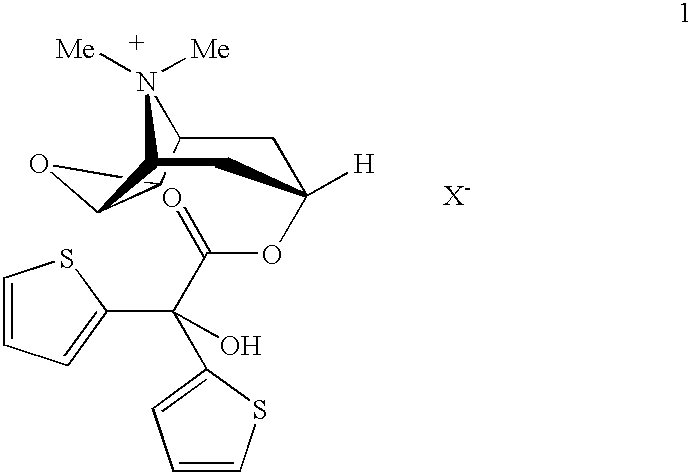
- where X denotes bromide. The term tiotropium should be taken as being a reference to the free cation (1′) within the scope of the present invention.
- Tiotropium bromide, as well as other salts of tiotropium, are known as highly effective anticholinergic bronchodilators and can therefore provide therapeutic benefit in the treatment of asthma or COPD.
-
Tiotropium salts 1 are preferably administered by inhalation. Suitable inhalable powders packed into appropriate capsules (inhalettes) and administered using suitable powder inhalers may be used. Alternatively, they may be administered by the use of suitable inhalable aerosols. These also include powdered inhalable aerosols which contain, for example, HFA134a, HFA227 or mixtures thereof as propellant gas. The preparations may also be inhaled in the form of suitable solutions of thetiotropium salt 1. - Surprisingly, it has now been found that the antimuscarinically
active tiotropium salts 1 can not only be used effectively as bronchodilators in diseases such as COPD for example, but are also characterised by an anti-inflammatory activity. This is due to the fact that the release of inflammatory mediators such as 15-HETE from epithelial cells such as histamine, leukotrienes and tryptase from mast cells, chemotactic activity (for neutrophilic granulocytes, eosinophilic granulocytes and macrophages) such as LTB4 and Interieukin 8 from alveolar macrophages is brought about or promoted by acetylcholine and inhibited by tiotropium. Surprisingly, it has been found that this potential, which can theoretically be attributed to all antimuscarinic active substances, comes into play only in conjunction with an active substance like tiotropium which dissociates itself from the receptor very slowly, as chemotactic and inflammatory activity has to be switched off permanently and not just intermittently in order to be biologically and clinically effective. - The invention therefore relates to the use of
tiotropium salts 1 for preparing a pharmaceutical composition for preventing or treating diseases associated with inflammation. - Preferably, the present invention relates to the use of
tiotropium salts 1 for preparing a pharmaceutical composition for treating the inflammatory component in diseases of the upper and lower respiratory organs including the lungs, such as for example allergic or non-allergic rhinitis, chronic rhinitis, bronchiectasis, cystic fibrosis, asthma, COPD, idiopathic lung fibrosis, fibrosing alveolitis, skin diseases such as atopical dermatitis and urticaria as well as inflammatory bowel diseases. - Preferably,
tiotropium salts 1 are used to treat inflammation in conjunction with other pulmonary diseases such as, for example, asthma and chronic (obstructive) bronchitis with and without emphysema, bronchiectasis, cystic fibrosis and fibrosing alveolitis. - By the
tiotropium salts 1 which may be used within the scope of the present invention are meant the compounds which contain, in addition to tiotropium as counter-ion (anion), chloride, bromide, iodide, methanesulphonate, para-toluenesulphonate or methylsulphate. Within the scope of the present invention, the methanesulphonate, chloride, bromide and iodide are preferred of all the tiotropium salts, the methanesulphonate and bromide being of particular importance. Tiotropium bromide is of outstanding importance according to the invention. - In another aspect the present invention relates to pharmaceutical preparations for treating the abovementioned diseases. Without restricting the scope of the invention thereto, these may contain
tiotropium 1′ in amounts such that each individual dose contains 0.1-80 μg, preferably 0.5-60 μg, most preferably about 1-50 μg. For example, and without restricting the scope of the invention thereto, 2.5 μg, 5 μg, 10 μg, 18 μg, 20 μg, 36 μg or 40 μg of 1′ may be administered per single dose. - If tiotropium bromide is used as the
preferred tiotropium salt 1 according to the invention, the amounts ofactive substance 1′ administered per single dose as specified hereinbefore by way of example correspond to the following amounts of 1 administered per single dose: 3 μg, 6 μg, 12 μg, 21.7 μg, 24.1 μg, 43.3 μg and 48.1μg 1. - Use of
tiotropium salts 1 according to the invention includes the use of the solvates and hydrates thus formed, preferably the hydrates, most preferably the monohydrates. - If for example tiotropium bromide monohydrate is used as the
preferred tiotropium salt 1 according to the invention, the amounts ofactive substance 1′ administered per single dose as specified hereinbefore by way of example correspond to the following amounts of 1 (monohydrate) administered per single dose: 3.1 μg, 6.2 μg, 12.5 μg, 22.5 μg, 25 μg, 45 μg and 50 μg. - The
tiotropium salts 1 are preferably administered according to the invention by inhalation. For this purpose, thetiotropium salts 1 have to be prepared in inhalable forms. Inhalable preparations include inhalable powders, propellant-containing metering aerosols or propellant-free inhalable solutions. Inhalable powders according to the invention containing thetiotropium salts 1 optionally mixed with physiologically acceptable excipients. Within the scope of the present invention, the term propellant-free inhalable solutions also includes concentrates or sterile inhalable solutions ready for use. The formulations which may be used within the scope of the present invention are described in more detail in the next part of the specification. - A) Inhalable Powder:
- The inhalable powders which may be used according to the invention may contain 1 either on its own or in admixture with suitable physiologically acceptable excipients.
- If the
tiotropium salts 1 are present in admixture with physiologically acceptable excipients, the following physiologically acceptable excipients may be used to prepare these inhalable powders according to the invention: monosaccharides (e.g. glucose or arabinose), disaccharides (e.g. lactose, saccharose, maltose), oligo- and polysaccharides (e.g. dextrane), polyalcohols (e.g. sorbitol, mannitol, xylitol), salts (e.g. sodium chloride, calcium carbonate) or mixtures of these excipients with one another. Preferably, mono- or disaccharides are used, while the use of lactose or glucose is preferred, particularly, but not exclusively, in the form of their hydrates. For the purposes of the invention, lactose is the particularly preferred excipient, while lactose monohydrate is most particularly preferred. - Within the scope of the inhalable powders according to the invention the excipients have a maximum average particle size of up to 250 μm, preferably between 10 and 150 μm, most preferably between 15 and 80 μm. It may sometimes seem appropriate to add finer excipient fractions with an average particle size of 1 to 9 μm to the excipients mentioned above. These finer excipients are also selected from the group of possible excipients listed hereinbefore. Finally, in order to prepare the inhalable powders according to the invention, micronised
active substance 1, preferably with an average particle size of 0.5 to 10 μm, more preferably from 1 to 6 μm, is added to the excipient mixture. Processes for producing the inhalable powders according to the invention by grinding and micronising and by finally mixing the ingredients together are known from the prior art. - Inhalable powders according to the invention which contain a physiologically acceptable excipient in addition to 1 may be administered, for example, by means of inhalers which deliver a single dose from a supply using a measuring chamber as described in U.S. Pat. No. 4,570,630A, or by other means as described in DE 36 25 685 A. The inhalable powders according to the invention which contain 1 optionally in conjunction with a physiologically acceptable excipient may be administered for example using an inhaler known by the name Turbuhaler® or using inhalers as disclosed for example in EP 237507 A. Preferably, the inhalable powders according to the invention which contain physiologically acceptable excipient in addition to 1 are packed into capsules (to produce so-called inhalettes) which are used in inhalers as described, for example, in WO 94/28958.
- A particularly preferred inhaler for administering the pharmaceutical combination according to the invention in inhalettes is shown in FIG. 1.
- This inhaler (Handyhaler) for inhaling powdered pharmaceutical compositions from capsules is characterised by a
housing 1 containing twowindows 2, adeck 3 in which there are air inlet ports and which is provided with ascreen 5 secured via ascreen housing 4, aninhalation chamber 6 connected to thedeck 3 on which there is a push button 8 [sic] provided with two sharpenedpins 7 and movable counter to aspring 8, and amouthpiece 12 which is connected to thehousing 1, thedeck 3 and acover 11 via aspindle 10 to enable it to be flipped open or shut. - If the inhalable powders according to the invention are packed into capsules (inhalers) for the preferred use described above, the quantities packed into each capsule should be 1 to 30 mg, preferably 3 to 20 mg, more particularly 5 to 10 mg of inhalable powder per capsule. These capsules contain, according to the invention, either together or separately, the doses of 1′ mentioned hereinbefore for each single dose.
- B) Propellant Gas-Driven Inhalation Aerosols:
- Inhalation aerosols containing propellant gas which may be used according to the invention may contain
substances 1 dissolved in the propellant gas or in dispersed form. The propellant gases which may be used to prepare the inhalation aerosols are known from the prior art. Suitable propellant gases are selected from among hydrocarbons such as n-propane, n-butane or isobutane and halohydrocarbons such as preferably fluorinated derivatives of methane, ethane, propane, butane, cyclopropane or cyclobutane. The propellant gases mentioned above may be used on their own or in mixtures thereof. Particularly preferred propellant gases are fluorinated alkane derivatives selected from TG134a (1,1,1,2-tetrafluoroethane), TG227 (1,1,1,2,3,3,3-heptafluoropropane) and mixtures thereof. - The propellant-driven inhalation aerosols which may be used according to the invention may also contain other ingredients such as co-solvents, stabilisers, surfactants, antioxidants, lubricants and pH adjusters. All these ingredients are known in the art.
- The propellant-driven inhalation aerosols which may be used according to the invention may contain up to 5 wt. % of
active substance 1. The propellant-driven inhalation aerosols which may be used according to the invention contain, for example, 0.002 to 5 wt. %, 0.01 to 3 wt. %, 0.015 to 2 wt. % ofactive substance 1. - If the
active substances 1 are present in dispersed form, the particles of active substance preferably have an average particle size of up to 10 μm, preferably from 0.1 to 5 μm, more preferably from 1 to 5 μm. - The propellant-driven inhalation aerosols according to the invention which may be used according to the invention may be administered using inhalers known in the art (MDIs=metered dose inhalers). Accordingly, in another aspect, the present invention relates to the use of 1 according to the invention to prepare pharmaceutical compositions in the form of propellant-driven aerosols as hereinbefore described combined with one or more inhalers suitable for administering these aerosols.
- In addition, the present invention relates to the use of 1 according to the invention to prepare cartridges which when fitted with a suitable valve can be used in a suitable inhaler and which contain one of the above-mentioned propellant gas-containing inhalation aerosols according to the invention. Suitable cartridges and methods of filling these cartridges with the inhalable aerosols containing propellant gas according to the invention are known from the prior art.
- C) Propellant-Free Inhalable Solutions:
- It is particularly preferred to use the
tiotropium salts 1 according to the invention to prepare propellant-free inhalable solutions and suspensions. The solvent used may be an aqueous or alcoholic, preferably an ethanolic solution. The solvent may be water on its own or a mixture of water and ethanol. The relative proportion of ethanol compared with water is not limited but the maximum is up to 70 percent by volume, more particularly up to 60 percent by volume and most preferably up to 30 percent by volume. The remainder of the volume is made up of water. The solutions or suspensions containing 1 are adjusted to a pH of 2 to 7, preferably 2 to 5, using suitable acids. The pH may be adjusted using acids selected from inorganic or organic acids. Examples of particularly suitable inorganic acids include hydrochloric acid, hydrobromic acid, nitric acid, sulphuric acid and/or phosphoric acid. Examples of particularly suitable organic acids include ascorbic acid, citric acid, malic acid, tartaric acid, maleic acid, succinic acid, fumaric acid, acetic acid, formic acid and/or propionic acid etc. Preferred inorganic acids are hydrochloric and sulphuric acids. It is also possible to use the acids which have already formed an acid addition salt with one of the active substances. Of the organic acids, ascorbic acid, fumaric acid and citric acid are preferred. If desired, mixtures of the above acids may be used, particularly in the case of acids which have other properties in addition to their acidifying qualities, e.g. as flavourings, antioxidants or complexing agents, such as citric acid or ascorbic acid, for example. According to the invention, it is particularly preferred to use hydrochloric acid to adjust the pH. - According to the invention, the addition of editic acid (EDTA) or one of the known salts thereof, sodium edetate, as stabiliser or complexing agent is unnecessary in the present formulation. Other embodiments may contain this compound or these compounds. In a preferred embodiment the content based on sodium edetate is less than 100 mg/100 ml, preferably less than 50 mg/100 ml, more preferably less than 20 mg/100 ml. Generally, inhalable solutions in which the content of sodium edetate is from 0 to 10 mg/100 ml are preferred.
- Co-solvents and/or other excipients may be added to the propellant-free inhalable solutions which may be used according to the invention. Preferred co-solvents are those which contain hydroxyl groups or other polar groups, e.g. alcohols—particularly isopropyl alcohol, glycols—particularly propyleneglycol, polyethyleneglycol, polypropyleneglycol, glycolether, glycerol, polyoxyethylene alcohols and polyoxyethylene fatty acid esters. The terms excipients and additives in this context denote any pharmacologically acceptable substance which is not an active substance but which can be formulated with the active substance or substances in the pharmacologically suitable solvent in order to improve the qualitative properties of the active substance formulation. Preferably, these substances have no pharmacological effect or, in connection with the desired therapy, no appreciable or at least no undesirable pharmacological effect. The excipients and additives include, for example, surfactants such as soya lecithin, oleic acid, sorbitan esters, such as polysorbates, polyinylpyrrolidone, other stabilisers, complexing agents, antioxidants and/or preservatives which guarantee or prolong the shelf life of the finished pharmaceutical formulation, flavourings, vitamins and/or other additives known in the art. The additives also include pharmacologically acceptable salts such as sodium chloride as isotonic agents.
- The preferred excipients include antioxidants such as ascorbic acid, for example, provided that it has not already been used to adjust the pH, vitamin A, vitamin E, tocopherols and similar vitamins and provitamins occurring in the human body. Preservatives may be used to protect the formulation from contamination with pathogens. Suitable preservatives are those which are known in the art, particularly cetyl pyridinium chloride, benzalkonium chloride or benzoic acid or benzoates such as sodium benzoate in the concentration known from the prior art. The preservatives mentioned above are preferably present in concentrations of up to 50 mg/100 ml, more preferably between 5 and 20 mg/100 ml.
- Preferred formulations contain, in addition to the solvent water and the
tiotropium salts 1, only benzalkonium chloride and sodium edetate. In another preferred embodiment, no sodium edetate is present. - The propellant-free inhalable solutions which may be used within the scope of the invention are administered in particular using inhalers of the kind which are capable of nebulising a small amount of a liquid formulation in the therapeutic dose within a few seconds to produce an aerosol suitable for therapeutic inhalation. Within the scope of the present invention, preferred inhalers are those in which a quantity of less than 100 μL, preferably less than 50 μL, more preferably between 10 and 30 μL of active substance solution can be nebulised in preferably one spray action to form an aerosol with an average particle size of less than 20 μm, preferably less than 10 μm, in such a way that the inhalable part of the aerosol corresponds to the therapeutically effective quantity.
- An apparatus of this kind for propellant-free delivery of a metered quantity of a liquid pharmaceutical composition for inhalation is described for example in International Patent Application WO 91/14468 and also in WO 97/12687 (cf. in particular FIGS. 6 a and 6 b). The nebulisers (devices) described therein are also known by the name Respimat®.
- This nebuliser (Respimat®) can advantageously be used to produce the inhalable aerosols according to the invention containing the
tiotropium salts 1. Because of its cylindrical shape and handy size of less than 9 to 15 cm long and 2 to 4 cm wide, this device can be carried at all times by the patient. The nebuliser sprays a defined volume of pharmaceutical formulation using high pressures through small nozzles so as to produce inhalable aerosols. - The preferred atomiser essentially consists of an upper housing part, a pump housing, a nozzle, a locking mechanism, a spring housing, a spring and a storage container, characterised by
- a pump housing which is secured in the upper housing part and which comprises at one end a nozzle body with the nozzle or nozzle arrangement,
- a hollow plunger with valve body,
- a power takeoff flange in which the hollow plunger is secured and which is located in the upper housing part,
- a locking mechanism situated in the upper housing part,
- a spring housing with the spring contained therein, which is rotatably mounted on the upper housing part by means of a rotary bearing,
- a lower housing part which is fitted onto the spring housing in the axial direction.
- The hollow plunger with valve body corresponds to a device disclosed in WO 97/12687. It projects partially into the cylinder of the pump housing and is axially movable within the cylinder. Reference is made in particular to FIGS. 1 to 4, especially FIG. 3, and the relevant parts of the description. The hollow plunger with valve body exerts a pressure of 5 to 60 Mpa (about 50 to 600 bar), preferably 10 to 60 Mpa (about 100 to 600 bar) on the fluid, the measured amount of active substance solution, at its high pressure end at the moment when the spring is actuated. Volumes of 10 to 50 microliters are preferred, while volumes of 10 to 20 microliters are particularly preferred and a volume of 15 microliters per spray is most particularly preferred.
- The valve body is preferably mounted at the end of the hollow plunger facing the valve body.
- The nozzle in the nozzle body is preferably microstructured, i.e. produced by microtechnology. Microstructured valve bodies are disclosed for example in WO-94/07607; reference is hereby made to the contents of this specification, particularly FIG. 1 therein and the associated description.
- The valve body consists for example of two sheets of glass and/or silicon firmly joined together, at least one of which has one or more microstructured channels which connect the nozzle inlet end to the nozzle outlet end. At the nozzle outlet end there is at least one round or
non-round opening 2 to 10 microns deep and 5 to 15 microns wide, the depth preferably being 4.5 to 6.5 microns while the length is preferably 7 to 9 microns. - In the case of a plurality of nozzle openings, preferably two, the directions of spraying of the nozzles in the nozzle body may extend parallel to one another or may be inclined relative to one another in the direction of the nozzle opening. In a nozzle body with at least two nozzle openings at the outlet end the directions of spraying may be at an angle of 20 to 1600 to one another, preferably 60 to 1500, most preferably 80 to 1000. The nozzle openings are preferably arranged at a spacing of 10 to 200 microns, more preferably at a spacing of 10 to 100 microns, most preferably 30 to 70 microns. Spacings of 50 microns are most preferred. The directions of spraying will therefore meet in the vicinity of the nozzle openings.
- The liquid pharmaceutical preparation strikes the nozzle body with an entry pressure of up to 600 bar, preferably 200 to 300 bar, and is atomised into an inhalable aerosol through the nozzle openings. The preferred particle or droplet sizes of the aerosol are up to 20 microns, preferably 3 to 10 microns.
- The locking mechanism contains a spring, preferably a cylindrical helical compression spring, as a store for the mechanical energy. The spring acts on the power takeoff flange as an actuating member the movement of which is determined by the position of a locking member. The travel of the power takeoff flange is precisely limited by an upper and lower stop. The spring is preferably biased, via a power step-up gear, e.g. a helical thrust gear, by an external torque which is produced when the upper housing part is rotated counter to the spring housing in the lower housing part. In this case, the upper housing part and the power takeoff flange have a single or multiple V-shaped gear.
- The locking member with engaging locking surfaces is arranged in a ring around the power takeoff flange. It consists, for example, of a ring of plastic or metal which is inherently radially elastically deformable. The ring is arranged in a plane at right angles to the atomiser axis. After the biasing of the spring, the locking surfaces of the locking member move into the path of the power takeoff flange and prevent the spring from relaxing. The locking member is actuated by means of a button. The actuating button is connected or coupled to the locking member. In order to actuate the locking mechanism, the actuating button is moved parallel to the annular plane, preferably into the atomiser; this causes the deformable ring to deform in the annual plane. Details of the construction of the locking mechanism are given in WO 97/20590.
- The lower housing part is pushed axially over the spring housing and covers the mounting, the drive of the spindle and the storage container for the fluid.
- When the atomiser is actuated the upper housing part is rotated relative to the lower housing part, the lower housing part taking the spring housing with it. The spring is thereby compressed and biased by means of the helical thrust gear and the locking mechanism engages automatically. The angle of rotation is preferably a whole-number fraction of 360 degrees, e.g. 180 degrees. At the same time as the spring is biased, the power takeoff part in the upper housing part is moved along by a given distance, the hollow plunger is withdrawn inside the cylinder in the pump housing, as a result of which some of the fluid is sucked out of the storage container and into the high pressure chamber in front of the nozzle.
- If desired, a number of exchangeable storage containers which contain the fluid to be atomised may be pushed into the atomiser one after another and used in succession. The storage container contains the aqueous aerosol preparation according to the invention.
- The atomising process is initiated by pressing gently on the actuating button. As a result, the locking mechanism opens up the path for the power takeoff member. The biased spring pushes the plunger into the cylinder of the pump housing. The fluid leaves the nozzle of the atomiser in atomised form.
- Further details of construction are disclosed in PCT Applications WO 97/12683 and WO 97/20590, to which reference is hereby made.
- The components of the atomiser (nebuliser) are made of a material which is suitable for its purpose. The housing of the atomiser and—if its operation permits—other parts as well are preferably made of plastics, e.g. by injection moulding.
- For medicinal purposes, physiologically safe materials are used. FIGS. 2 a/b attached to this patent application, which are identical to FIGS. 6a/b of WO 97/12687, show the nebuliser (Respimat®) which can advantageously be used for inhaling the aqueous aerosol preparations according to the invention. FIG. 2a shows a longitudinal section through the atomiser with the spring biased while FIG. 2b shows a longitudinal section through the atomiser with the spring relaxed.
- The upper housing part ( 51) contains the pump housing (52) on the end of which is mounted the holder (53) for the atomiser nozzle. In the holder is the nozzle body (54) and a filter (55). The hollow plunger (57) fixed in the power takeoff flange (56) of the locking mechanism projects partially into the cylinder of the pump housing. At its end the hollow plunger carries the valve body (58). The hollow plunger is sealed off by means of the seal (59). Inside the upper housing part is the stop (60) on which the power takeoff flange abuts when the spring is relaxed. On the power takeoff flange is the stop (61) on which the power takeoff flange abuts when the spring is biased. After the biasing of the spring the locking member (62) moves between the stop (61) and a support (63) in the upper housing part. The actuating button (64) is connected to the locking member. The upper housing part ends in the mouthpiece (65) and is sealed off by means of the protective cover (66) which can be placed thereon.
- The spring housing ( 67) with compression spring (68) is rotatably mounted on the upper housing part by means of the snap-in lugs (69) and rotary bearing. The lower housing part (70) is pushed over the spring housing. Inside the spring housing is the exchangeable storage container (71) for the fluid (72) which is to be atomised. The storage container is sealed off by the stopper (73) through which the hollow plunger projects into the storage container and is immersed at its end in the fluid (supply of active substance solution).
- The spindle ( 74) for the mechanical counter is mounted in the covering of the spring housing. At the end of the spindle facing the upper housing part is the drive pinion (75). The slider (76) sits on the spindle.
- The nebuliser described above is suitable for nebulising the aerosol preparations which may be used according to the invention to produce an aerosol suitable for inhalation.
- If the propellant-free inhalable solutions which may be used according to the invention are nebulised using the method described above (Respimat®) the quantity delivered should correspond to a defined quantity with a tolerance of not more than 25%, preferably 20% of this amount in at least 97%, preferably at least 98% of all operations of the inhaler (spray actuations). Preferably, between 5 and 30 mg of formulation, most preferably between 5 and 20 mg of formulation are delivered as a defined mass on each actuation.
- However, the propellant-free inhalable solutions which may be used according to the invention may also be nebulised by means of inhalers other than those described above, e.g. jet stream inhalers or other stationary nebulisers.
- Accordingly, in a further aspect, the invention relates to the use according to the invention of
tiotropium salts 1 for preparing a pharmaceutical formulation in the form of propellant-free inhalable solutions or suspensions as described above combined with a device suitable for administering these formulations, preferably in conjunction with the Respimat®. Preferably, the invention relates to the use according to the invention ofcompounds 1 for preparing propellant-free inhalable solutions or suspensions characterised in that they contain 1 in conjunction with the device known by the name Respimat®. In addition, the present invention relates to the use according to the invention of the above-mentioned devices for inhalation, preferably the Respimat®, characterised in that they contain the propellant-free inhalable solutions or suspensions according to the invention as described hereinbefore. - The propellant-free inhalable solutions or suspensions which may be used within the scope of the invention may take the form of concentrates or sterile inhalable solutions or suspensions ready for use, as well as the above-mentioned solutions and suspensions designed for use in a Respimat®. Formulations ready for use may be produced from the concentrates, for example, by the addition of isotonic saline solutions. Sterile formulations ready for use may be administered using energy-operated fixed or portable nebulisers which produce inhalable aerosols by means of ultrasound or compressed air by the Venturi principle or other principles.
- Accordingly, in another aspect, the present invention relates to the use according to the invention of 1 in the form of propellant-free inhalable solutions or suspensions as described hereinbefore which take the form of concentrates or sterile formulations ready for use, combined with a device suitable for administering these solutions, characterised in that the device is an energy-operated free-standing or portable nebuliser which produces inhalable aerosols by means of ultrasound or compressed air by the Venturi principle or other methods.
- The Examples which follow serve to illustrate the present invention in more detail without restricting the scope of the invention to the following embodiments by way of example.
- Starting Materials
- Tiotropium Bromide:
- The tiotropium bromide used in the following formulation examples may be obtained as described in European Patent Application EP 418 716 A1.
- In order to prepare the inhalable powders according to the invention, crystalline tiotropium bromide monohydrate may also be used. This crystalline tiotropium bromide monohydrate may be obtained by the method described below.
- 15.0 kg of tiotropium bromide are placed in 25.7 kg of water in a suitable reaction vessel. The mixture is heated to 80-90° C. and stirred at constant temperature until a clear solution is formed. Activated charcoal (0.8 kg) moistened with water is suspended in 4.4 kg of water, this mixture is added to the solution containing the tiotropium bromide and the resulting mixture is rinsed with 4.3 kg of water. The mixture thus obtained is stirred for at least 15 minutes at 80-90° C. and then filtered through a heated filter into an apparatus preheated to an external temperature of 70° C. The filter is rinsed with 8.6 kg of water. The contents of the apparatus are cooled at 3-5° C. for every 20 minutes to a temperature of 20-25° C. The apparatus is cooled further to 10-15° C. using cold water and crystallisation is completed by stirring for at least another hour. The crystals are isolated using a suction filter dryer, the crystal slurry isolated is washed with 9 liters of cold water (10-15° C.) and cold acetone (10-15° C.). The crystals obtained are dried at 25° C. in a nitrogen current over a period of 2 hours.
- Yield: 13.4 kg of tiotropium bromide monohydrate (86% of theory).
- The crystalline tiotropium bromide monohydrate thus obtained is micronised by known methods in order to prepare the active substance in the form of the average particle size corresponding to the specifications according to the invention.
-
A) Inhalable powders: 1) Ingredients μg per capsule tiotropium bromide 10.8 lactose 4989.2 Total 5000 2) Ingredients μg per capsule tiotropium bromide 21.7 lactose 4978.3 Total 5000 3) Ingredients μg per capsule tiotropium bromide × H2O 22.5 lactose 4977.5 Total 5000 -
B) Inhalable aerosols containing propellant gas: 1) Suspension aerosol: Ingredients wt. % tiotropium bromide 0.015 soya lecithin 0.2 TG 134a : TG227 = 2:3 ad 100 2) Suspension aerosol: Ingredients wt. % tiotropium bromide 0.029 absolute ethanol 0.5 isopropyl myristate 0.1 TG 227 ad 100 3) Solution aerosol: Ingredients wt. % tiotropium bromide 0.042 absolute ethanol 30 purified water 1.5 anhydrous citric acid 0.002 TG 134a ad 100 -
C) Propellant-free inhalable solutions: 1) Solution for use in the Respimat ®: Ingredients mg/100 mL tiotropium bromide 148.5 benzalkonium chloride 10 sodium edetate 10 hydrochloric acid (ag) ad pH 2,9 water ad 100 mL 2) Solution for use in the Respimat ®: Ingredients mg/100 mL tiotropium bromide 148.5 benzalkonium chloride 10 hydrochloric acid (ag) ad pH 2,9 water ad 100 mL 3) Solution for use in the Respimat ®: Ingredients mg/100 mL tiotropium bromide 297.1 benzalkonium chloride 10 sodium edetate 10 hydrochloric acid (ag) ad pH 2,9 water ad 100 mL 4) Solution for use in the Respimat ®: Ingredients mg/100 mL tiotropium bromide 297.1 benzalkonium chloride 10 hydrochloric acid (ag) ad pH 2,9 water ad 100 mL 5) Solution for use in the Respimat ®: Ingredients mg/100 mL tiotropium bromide 148.5 benzalkonium chloride 8 sodium edetate 50 hydrochloric acid (ag) ad pH 2.5 water ad 100 mL 6) Solution for use in the Respimat ®: Ingredients mg/100 mL tiotropium bromide 1.5 benzalkonium chloride 8 sodium edetate 10 hydrochloric acid (ag) ad pH 2.5 water ad 100 mL 7) Solution for use in the Respimat ®: Ingredients mg/100 mL tiotropium bromide 14,9 benzalkonium chloride 10 sodium edetate 50 hydrochloric acid (ag) ad pH 3.5 water ad 100 mL 8) Concentrated solution: Ingredients mg/100 mL tiotropium bromide 1486.1 benzalkonium chloride 20 sodium edetate 100 hydrochloric acid (ag) ad pH 3.5 water ad 100 mL
Claims (8)
Priority Applications (3)
| Application Number | Priority Date | Filing Date | Title |
|---|---|---|---|
| US10/096,810 US20020193394A1 (en) | 2001-03-13 | 2002-03-13 | Compounds for treating inflammatory diseases |
| US10/644,333 US7994188B2 (en) | 2001-03-13 | 2003-08-20 | Compounds for treating inflammatory diseases |
| US11/624,354 US20070208060A1 (en) | 2001-03-13 | 2007-01-18 | Compounds for treating inflammatory diseases |
Applications Claiming Priority (4)
| Application Number | Priority Date | Filing Date | Title |
|---|---|---|---|
| DE10111843.0 | 2001-03-13 | ||
| DE10111843A DE10111843A1 (en) | 2001-03-13 | 2001-03-13 | Compounds for the treatment of inflammatory diseases |
| US28187601P | 2001-04-05 | 2001-04-05 | |
| US10/096,810 US20020193394A1 (en) | 2001-03-13 | 2002-03-13 | Compounds for treating inflammatory diseases |
Related Child Applications (1)
| Application Number | Title | Priority Date | Filing Date |
|---|---|---|---|
| US10/644,333 Continuation US7994188B2 (en) | 2001-03-13 | 2003-08-20 | Compounds for treating inflammatory diseases |
Publications (1)
| Publication Number | Publication Date |
|---|---|
| US20020193394A1 true US20020193394A1 (en) | 2002-12-19 |
Family
ID=27214336
Family Applications (1)
| Application Number | Title | Priority Date | Filing Date |
|---|---|---|---|
| US10/096,810 Abandoned US20020193394A1 (en) | 2001-03-13 | 2002-03-13 | Compounds for treating inflammatory diseases |
Country Status (1)
| Country | Link |
|---|---|
| US (1) | US20020193394A1 (en) |
Cited By (13)
| Publication number | Priority date | Publication date | Assignee | Title |
|---|---|---|---|---|
| US20040039011A1 (en) * | 2001-03-13 | 2004-02-26 | Boehringer Ingelheim Pharma Kg | Compounds for treating inflammatory diseases |
| US20040102469A1 (en) * | 2002-09-13 | 2004-05-27 | Boehringer Ingelheim Pharma Gmbh & Co. Kg | Method for reducing the mortality rate |
| US20040132759A1 (en) * | 2002-11-29 | 2004-07-08 | Boehringer Ingelheim Pharma Gmbh & Co. Kg | Tiotropium-containing pharmaceutical combination for inhalation |
| US20050096341A1 (en) * | 2003-11-03 | 2005-05-05 | Boehringer Ingelheim International Gmbh | Novel tiotropium salts, process for the preparation and pharmaceutical compositions thereof |
| US20050131007A1 (en) * | 2003-11-03 | 2005-06-16 | Boehringer Ingelheim International Gmbh | Process for preparing new tiotropium salts, new tiotropium salts as such and pharmaceutical compositions thereof |
| US20050187157A1 (en) * | 2004-02-20 | 2005-08-25 | Boehringer Ingelheim International Gmbh | Pharmaceutical compositions based on anticholinergics and pegsunercept |
| EP1651222A1 (en) | 2003-07-29 | 2006-05-03 | Boehringer Ingelheim International Gmbh | Medicaments comprising pde iv inhibitors and an anticholinergic for treating respiratory disorders |
| US20060287530A1 (en) * | 2005-06-15 | 2006-12-21 | Boehringer Ingelheim International Gmbh | Process For Preparing New Tiotropium Salts, New Tiotropium Salts As Such and Pharmaceutical Compositions Thereof |
| US20070021333A1 (en) * | 2003-02-11 | 2007-01-25 | Boehringer Ingelheim International Gmbh | Pharmaceutical compositions based on anticholinergics and soluble tnf receptor fusion proteins |
| US20070092453A1 (en) * | 2005-05-02 | 2007-04-26 | Boehringer Ingelheim International Gmbh | Novel Crystalline Forms of Tiotropium Bromide |
| US20070099949A1 (en) * | 2002-09-13 | 2007-05-03 | Boehringer Ingelheim Pharma Gmbh & Co. Kg | Method for Improving the Ability of Patients Suffering from Lung Diseases to Participate In and Benefit from Pulmonary Rehabilitation Programs |
| US20070128123A1 (en) * | 2002-12-16 | 2007-06-07 | Sabine Six | Tiotropium containing hfc solution formulations |
| US20100055193A1 (en) * | 2006-11-22 | 2010-03-04 | Boehringer Ingelheim International Gmbh | Stable powder formulation containing an anticholinergic agent |
Citations (1)
| Publication number | Priority date | Publication date | Assignee | Title |
|---|---|---|---|---|
| US6150418A (en) * | 1998-10-17 | 2000-11-21 | Boehringer Ingelheim Pharma Kg | Active substance concentrate with formoterol, suitable for storage |
-
2002
- 2002-03-13 US US10/096,810 patent/US20020193394A1/en not_active Abandoned
Patent Citations (1)
| Publication number | Priority date | Publication date | Assignee | Title |
|---|---|---|---|---|
| US6150418A (en) * | 1998-10-17 | 2000-11-21 | Boehringer Ingelheim Pharma Kg | Active substance concentrate with formoterol, suitable for storage |
Cited By (23)
| Publication number | Priority date | Publication date | Assignee | Title |
|---|---|---|---|---|
| US7994188B2 (en) * | 2001-03-13 | 2011-08-09 | Boehringer Ingelheim Pharma Gmbh & Co. Kg | Compounds for treating inflammatory diseases |
| US20040039011A1 (en) * | 2001-03-13 | 2004-02-26 | Boehringer Ingelheim Pharma Kg | Compounds for treating inflammatory diseases |
| US20070099949A1 (en) * | 2002-09-13 | 2007-05-03 | Boehringer Ingelheim Pharma Gmbh & Co. Kg | Method for Improving the Ability of Patients Suffering from Lung Diseases to Participate In and Benefit from Pulmonary Rehabilitation Programs |
| US20040102469A1 (en) * | 2002-09-13 | 2004-05-27 | Boehringer Ingelheim Pharma Gmbh & Co. Kg | Method for reducing the mortality rate |
| US20060205758A1 (en) * | 2002-09-13 | 2006-09-14 | Boehringer Ingelheim Pharma Gmbh & Co. Kg | Method for reducing the mortality rate |
| US20040132759A1 (en) * | 2002-11-29 | 2004-07-08 | Boehringer Ingelheim Pharma Gmbh & Co. Kg | Tiotropium-containing pharmaceutical combination for inhalation |
| US7250426B2 (en) | 2002-11-29 | 2007-07-31 | Boehringer Ingelheim Pharma Gmbh & Co Kg | Tiotropium-containing pharmaceutical combination for inhalation |
| US20090175802A1 (en) * | 2002-12-16 | 2009-07-09 | Sabine Six | Tiotropium containing hfc solution formulations |
| US20070128123A1 (en) * | 2002-12-16 | 2007-06-07 | Sabine Six | Tiotropium containing hfc solution formulations |
| US20070021333A1 (en) * | 2003-02-11 | 2007-01-25 | Boehringer Ingelheim International Gmbh | Pharmaceutical compositions based on anticholinergics and soluble tnf receptor fusion proteins |
| EP1651222A1 (en) | 2003-07-29 | 2006-05-03 | Boehringer Ingelheim International Gmbh | Medicaments comprising pde iv inhibitors and an anticholinergic for treating respiratory disorders |
| US20050131007A1 (en) * | 2003-11-03 | 2005-06-16 | Boehringer Ingelheim International Gmbh | Process for preparing new tiotropium salts, new tiotropium salts as such and pharmaceutical compositions thereof |
| US8686148B2 (en) | 2003-11-03 | 2014-04-01 | Boehringer Ingelheim International Gmbh | Process for preparing new tiotropium salts, new tiotropium salts as such and pharmaceutical compositions thereof |
| AU2004285683B2 (en) * | 2003-11-03 | 2011-04-21 | Boehringer Ingelheim International Gmbh | Method for producing tiotropium salts, tiotropium salts and pharmaceutical formulations, containing the same |
| AU2004285683C1 (en) * | 2003-11-03 | 2011-09-08 | Boehringer Ingelheim International Gmbh | Method for producing tiotropium salts, tiotropium salts and pharmaceutical formulations, containing the same |
| US20050096341A1 (en) * | 2003-11-03 | 2005-05-05 | Boehringer Ingelheim International Gmbh | Novel tiotropium salts, process for the preparation and pharmaceutical compositions thereof |
| AU2004285685B2 (en) * | 2003-11-03 | 2011-03-24 | Boehringer Ingelheim International Gmbh | Novel tiotropium salts, methods for the production thereof, and pharmaceutical formulations containing the same |
| US20050187157A1 (en) * | 2004-02-20 | 2005-08-25 | Boehringer Ingelheim International Gmbh | Pharmaceutical compositions based on anticholinergics and pegsunercept |
| US20070092453A1 (en) * | 2005-05-02 | 2007-04-26 | Boehringer Ingelheim International Gmbh | Novel Crystalline Forms of Tiotropium Bromide |
| US7879871B2 (en) | 2005-05-02 | 2011-02-01 | Boehringer Ingelheim International Gmbh | Crystalline forms of tiotropium bromide |
| AU2006259202B2 (en) * | 2005-06-15 | 2012-05-10 | Boehringer Ingelheim International Gmbh | Process for preparing tiotropium salts, tiotropium salts as such and pharmaceutical compositions thereof |
| US20060287530A1 (en) * | 2005-06-15 | 2006-12-21 | Boehringer Ingelheim International Gmbh | Process For Preparing New Tiotropium Salts, New Tiotropium Salts As Such and Pharmaceutical Compositions Thereof |
| US20100055193A1 (en) * | 2006-11-22 | 2010-03-04 | Boehringer Ingelheim International Gmbh | Stable powder formulation containing an anticholinergic agent |
Similar Documents
| Publication | Publication Date | Title |
|---|---|---|
| US7994188B2 (en) | Compounds for treating inflammatory diseases | |
| CA2431565C (en) | Pharmaceutical compositions based on anticholinergics and ciclesonide | |
| US6608054B2 (en) | Pharmaceutical compositions based on anticholinergics and endothelin antagonists | |
| AU2007202303B2 (en) | Novel medicament compositions based on tiotropium salts and on salmeterol salts | |
| CA2733294C (en) | Pharmaceutical combination of a tiotropium salt and ciclesonide | |
| US20020183292A1 (en) | Pharmaceutical compositions based on anticholinergics and corticosteroids | |
| US20020193392A1 (en) | Pharmaceutical compositions based on tiotropium salts of salts of salmeterol | |
| US20020193393A1 (en) | Pharmaceutical compositions based on anticholinergics and PDE-IV inhibitors | |
| US20030018019A1 (en) | Pharmaceutical compositions based on anticholinergics, corticosteroids and betamimetics | |
| US20090088408A1 (en) | Pharmaceutical compositions on anticholinergics, corticosteroids and betamimetics | |
| US20040010003A1 (en) | Medicaments comprising betamimetics and a novel anticholinergic | |
| US7084153B2 (en) | Medicaments comprising steroids and a novel anticholinergic | |
| US20040102469A1 (en) | Method for reducing the mortality rate | |
| CA2498727C (en) | Method for improving the ability of patients suffering from lung diseases to participate in and benefit from pulmonary rehabilitation programs | |
| US20040161386A1 (en) | Pharmaceutical compositions based on anticholinergic and dopamine agonists | |
| US20020193394A1 (en) | Compounds for treating inflammatory diseases | |
| US20030203918A1 (en) | Pharmaceutical composition comprising an anticholinergic and a heterocyclic compound | |
| CA2481268C (en) | Medicaments comprising steroids and a novel anticholinergic | |
| CA2582207A1 (en) | Inhalation medicament containing an anticholinesterase drug, salmeterol and a steroid selected from the ciclesonide or mometasone furoate group | |
| CA2441964C (en) | New pharmaceutical compositions based on anticholinergics and endothelin antagonists | |
| CA2436537C (en) | Pharmaceutical compositions comprising tiotropium salts and antihistamines | |
| US20100015061A1 (en) | Pharmaceutical Compositions Based on Anticholinergics and Andolast | |
| CA2582153A1 (en) | Inhalation medicament containing a novel anticholinesterase drug, formoterol and a steroid | |
| CA2430592C (en) | New pharmaceutical compositions based on anticholinergics and dopamine agonists | |
| CA2614631C (en) | Pharmaceutical compositions based on anticholinergics and corticosteroids in the form of an inhalable solution or suspension |
Legal Events
| Date | Code | Title | Description |
|---|---|---|---|
| AS | Assignment |
Owner name: BOEHRINGER INGELHEIM PHARMA KG, GERMANY Free format text: ASSIGNMENT OF ASSIGNORS INTEREST;ASSIGNOR:DISSE, DERND;REEL/FRAME:012948/0558 Effective date: 20020506 |
|
| AS | Assignment |
Owner name: BOEHRINGER INGELHEIM PHARMA KG, GERMANY Free format text: CORRECTIVE ASSIGNMENT TO CORRECT NAME OF ASSIGNOR PREVIOUSLY RECORDED AT REEL 012948 FRAME 0558;ASSIGNOR:DISSE, BERND;REEL/FRAME:013220/0938 Effective date: 20020506 |
|
| STCB | Information on status: application discontinuation |
Free format text: ABANDONED -- FAILURE TO RESPOND TO AN OFFICE ACTION |