US20020051823A1 - Nanosilver-containing antibacterial and antifungal granules and methods for preparing and using the same - Google Patents
Nanosilver-containing antibacterial and antifungal granules and methods for preparing and using the same Download PDFInfo
- Publication number
- US20020051823A1 US20020051823A1 US09/840,906 US84090601A US2002051823A1 US 20020051823 A1 US20020051823 A1 US 20020051823A1 US 84090601 A US84090601 A US 84090601A US 2002051823 A1 US2002051823 A1 US 2002051823A1
- Authority
- US
- United States
- Prior art keywords
- solution
- nag
- nags
- nanosilver particles
- nanosilver
- Prior art date
- Legal status (The legal status is an assumption and is not a legal conclusion. Google has not performed a legal analysis and makes no representation as to the accuracy of the status listed.)
- Granted
Links
- BQCADISMDOOEFD-UHFFFAOYSA-N Silver Chemical compound [Ag] BQCADISMDOOEFD-UHFFFAOYSA-N 0.000 title claims abstract description 94
- 238000000034 method Methods 0.000 title claims abstract description 38
- 230000000844 anti-bacterial effect Effects 0.000 title claims abstract description 37
- 239000008187 granular material Substances 0.000 title claims abstract description 8
- 230000000843 anti-fungal effect Effects 0.000 title abstract description 9
- 229940121375 antifungal agent Drugs 0.000 title abstract description 5
- 239000002245 particle Substances 0.000 claims abstract description 54
- 241000894006 Bacteria Species 0.000 claims abstract description 35
- 241000191967 Staphylococcus aureus Species 0.000 claims abstract description 18
- 241000588724 Escherichia coli Species 0.000 claims abstract description 17
- 241000193830 Bacillus <bacterium> Species 0.000 claims abstract description 16
- NDVLTYZPCACLMA-UHFFFAOYSA-N silver oxide Chemical compound [O-2].[Ag+].[Ag+] NDVLTYZPCACLMA-UHFFFAOYSA-N 0.000 claims abstract description 12
- 241000735470 Juncus Species 0.000 claims abstract description 11
- 239000000463 material Substances 0.000 claims abstract description 11
- 241000589517 Pseudomonas aeruginosa Species 0.000 claims abstract description 8
- 238000002791 soaking Methods 0.000 claims abstract description 8
- 208000014674 injury Diseases 0.000 claims abstract description 6
- 229910001923 silver oxide Inorganic materials 0.000 claims abstract description 6
- 244000063299 Bacillus subtilis Species 0.000 claims abstract description 5
- 235000014469 Bacillus subtilis Nutrition 0.000 claims abstract description 5
- 241000233866 Fungi Species 0.000 claims abstract description 5
- 230000015572 biosynthetic process Effects 0.000 claims abstract description 5
- 238000010276 construction Methods 0.000 claims abstract description 5
- 208000030533 eye disease Diseases 0.000 claims abstract description 5
- 238000011049 filling Methods 0.000 claims abstract description 5
- 230000008733 trauma Effects 0.000 claims abstract description 5
- 241000222122 Candida albicans Species 0.000 claims abstract description 4
- 241000606153 Chlamydia trachomatis Species 0.000 claims abstract description 4
- 241000588923 Citrobacter Species 0.000 claims abstract description 4
- 241000588697 Enterobacter cloacae Species 0.000 claims abstract description 4
- RJQXTJLFIWVMTO-TYNCELHUSA-N Methicillin Chemical compound COC1=CC=CC(OC)=C1C(=O)N[C@@H]1C(=O)N2[C@@H](C(O)=O)C(C)(C)S[C@@H]21 RJQXTJLFIWVMTO-TYNCELHUSA-N 0.000 claims abstract description 4
- 241000588772 Morganella morganii Species 0.000 claims abstract description 4
- 241000588652 Neisseria gonorrhoeae Species 0.000 claims abstract description 4
- 241000588778 Providencia stuartii Species 0.000 claims abstract description 4
- 241000577475 Salmonella enterica subsp. enterica serovar Paratyphi C Species 0.000 claims abstract description 4
- 241000193996 Streptococcus pyogenes Species 0.000 claims abstract description 4
- 241000607265 Vibrio vulnificus Species 0.000 claims abstract description 4
- 229940095731 candida albicans Drugs 0.000 claims abstract description 4
- 229940038705 chlamydia trachomatis Drugs 0.000 claims abstract description 4
- 229960003085 meticillin Drugs 0.000 claims abstract description 4
- 241000122973 Stenotrophomonas maltophilia Species 0.000 claims abstract description 3
- 239000000243 solution Substances 0.000 claims description 109
- SQGYOTSLMSWVJD-UHFFFAOYSA-N silver(1+) nitrate Chemical compound [Ag+].[O-]N(=O)=O SQGYOTSLMSWVJD-UHFFFAOYSA-N 0.000 claims description 33
- 239000007800 oxidant agent Substances 0.000 claims description 13
- HEMHJVSKTPXQMS-UHFFFAOYSA-M Sodium hydroxide Chemical compound [OH-].[Na+] HEMHJVSKTPXQMS-UHFFFAOYSA-M 0.000 claims description 12
- CIWBSHSKHKDKBQ-JLAZNSOCSA-N Ascorbic acid Chemical compound OC[C@H](O)[C@H]1OC(=O)C(O)=C1O CIWBSHSKHKDKBQ-JLAZNSOCSA-N 0.000 claims description 10
- MHAJPDPJQMAIIY-UHFFFAOYSA-N Hydrogen peroxide Chemical group OO MHAJPDPJQMAIIY-UHFFFAOYSA-N 0.000 claims description 9
- 238000001035 drying Methods 0.000 claims description 9
- 238000005406 washing Methods 0.000 claims description 9
- LFQSCWFLJHTTHZ-UHFFFAOYSA-N Ethanol Chemical compound CCO LFQSCWFLJHTTHZ-UHFFFAOYSA-N 0.000 claims description 8
- 238000005507 spraying Methods 0.000 claims description 8
- WQZGKKKJIJFFOK-GASJEMHNSA-N Glucose Natural products OC[C@H]1OC(O)[C@H](O)[C@@H](O)[C@@H]1O WQZGKKKJIJFFOK-GASJEMHNSA-N 0.000 claims description 7
- 206010000496 acne Diseases 0.000 claims description 7
- 239000008103 glucose Substances 0.000 claims description 7
- 238000000227 grinding Methods 0.000 claims description 7
- VHUUQVKOLVNVRT-UHFFFAOYSA-N Ammonium hydroxide Chemical compound [NH4+].[OH-] VHUUQVKOLVNVRT-UHFFFAOYSA-N 0.000 claims description 6
- 235000011114 ammonium hydroxide Nutrition 0.000 claims description 6
- 229910001961 silver nitrate Inorganic materials 0.000 claims description 6
- 239000011668 ascorbic acid Substances 0.000 claims description 5
- 235000010323 ascorbic acid Nutrition 0.000 claims description 5
- 229960005070 ascorbic acid Drugs 0.000 claims description 5
- WQZGKKKJIJFFOK-VFUOTHLCSA-N beta-D-glucose Chemical compound OC[C@H]1O[C@@H](O)[C@H](O)[C@@H](O)[C@@H]1O WQZGKKKJIJFFOK-VFUOTHLCSA-N 0.000 claims description 5
- 238000005520 cutting process Methods 0.000 claims description 5
- 235000013305 food Nutrition 0.000 claims description 5
- 208000002874 Acne Vulgaris Diseases 0.000 claims description 4
- 241000112876 Junicus Species 0.000 claims description 4
- 230000012010 growth Effects 0.000 claims description 4
- 208000035143 Bacterial infection Diseases 0.000 claims description 3
- 206010017533 Fungal infection Diseases 0.000 claims description 3
- 241001465754 Metazoa Species 0.000 claims description 3
- 208000031888 Mycoses Diseases 0.000 claims description 3
- 208000027418 Wounds and injury Diseases 0.000 claims description 3
- 208000022362 bacterial infectious disease Diseases 0.000 claims description 3
- 235000020188 drinking water Nutrition 0.000 claims description 3
- 239000003651 drinking water Substances 0.000 claims description 3
- 235000012055 fruits and vegetables Nutrition 0.000 claims description 3
- 238000002156 mixing Methods 0.000 claims description 3
- 206010068306 Gastrointestinal bacterial infection Diseases 0.000 claims description 2
- 208000019802 Sexually transmitted disease Diseases 0.000 claims description 2
- 206010052428 Wound Diseases 0.000 claims description 2
- 239000013078 crystal Substances 0.000 claims description 2
- 239000003889 eye drop Substances 0.000 claims description 2
- 230000001815 facial effect Effects 0.000 claims description 2
- 238000010438 heat treatment Methods 0.000 claims description 2
- 230000000249 desinfective effect Effects 0.000 claims 2
- XLYOFNOQVPJJNP-UHFFFAOYSA-N water Substances O XLYOFNOQVPJJNP-UHFFFAOYSA-N 0.000 abstract description 27
- 230000002401 inhibitory effect Effects 0.000 abstract description 8
- 230000008569 process Effects 0.000 abstract description 8
- 239000000645 desinfectant Substances 0.000 abstract description 7
- 229940079593 drug Drugs 0.000 abstract description 3
- 239000003814 drug Substances 0.000 abstract description 3
- 235000019249 food preservative Nutrition 0.000 abstract description 3
- 239000005452 food preservative Substances 0.000 abstract description 3
- 239000006210 lotion Substances 0.000 abstract description 3
- 239000002674 ointment Substances 0.000 abstract description 3
- 230000005923 long-lasting effect Effects 0.000 abstract description 2
- NHNBFGGVMKEFGY-UHFFFAOYSA-N Nitrate Chemical compound [O-][N+]([O-])=O NHNBFGGVMKEFGY-UHFFFAOYSA-N 0.000 abstract 1
- 201000010099 disease Diseases 0.000 abstract 1
- 208000037265 diseases, disorders, signs and symptoms Diseases 0.000 abstract 1
- 230000002496 gastric effect Effects 0.000 abstract 1
- 208000015181 infectious disease Diseases 0.000 abstract 1
- 238000002483 medication Methods 0.000 abstract 1
- 230000001568 sexual effect Effects 0.000 abstract 1
- 229910052709 silver Inorganic materials 0.000 description 30
- 239000004332 silver Substances 0.000 description 30
- 230000001580 bacterial effect Effects 0.000 description 13
- 238000006243 chemical reaction Methods 0.000 description 13
- 239000001963 growth medium Substances 0.000 description 10
- -1 silver ions Chemical class 0.000 description 10
- GRYLNZFGIOXLOG-UHFFFAOYSA-N Nitric acid Chemical compound O[N+]([O-])=O GRYLNZFGIOXLOG-UHFFFAOYSA-N 0.000 description 7
- SOIFLUNRINLCBN-UHFFFAOYSA-N ammonium thiocyanate Chemical compound [NH4+].[S-]C#N SOIFLUNRINLCBN-UHFFFAOYSA-N 0.000 description 7
- 230000000694 effects Effects 0.000 description 7
- 229910017604 nitric acid Inorganic materials 0.000 description 7
- 239000007787 solid Substances 0.000 description 7
- 238000011081 inoculation Methods 0.000 description 6
- 238000009630 liquid culture Methods 0.000 description 6
- 241000700159 Rattus Species 0.000 description 5
- FOIXSVOLVBLSDH-UHFFFAOYSA-N Silver ion Chemical compound [Ag+] FOIXSVOLVBLSDH-UHFFFAOYSA-N 0.000 description 5
- 239000000835 fiber Substances 0.000 description 5
- 229910052751 metal Inorganic materials 0.000 description 5
- 239000002184 metal Substances 0.000 description 5
- 238000002360 preparation method Methods 0.000 description 5
- 241000283973 Oryctolagus cuniculus Species 0.000 description 4
- 238000004458 analytical method Methods 0.000 description 4
- 239000003638 chemical reducing agent Substances 0.000 description 4
- 239000007788 liquid Substances 0.000 description 4
- 150000002739 metals Chemical class 0.000 description 4
- 238000011160 research Methods 0.000 description 4
- 238000012360 testing method Methods 0.000 description 4
- 238000004448 titration Methods 0.000 description 4
- RYGMFSIKBFXOCR-UHFFFAOYSA-N Copper Chemical compound [Cu] RYGMFSIKBFXOCR-UHFFFAOYSA-N 0.000 description 3
- 230000004913 activation Effects 0.000 description 3
- 230000001332 colony forming effect Effects 0.000 description 3
- 229910052802 copper Inorganic materials 0.000 description 3
- 239000010949 copper Substances 0.000 description 3
- 230000002070 germicidal effect Effects 0.000 description 3
- 238000011534 incubation Methods 0.000 description 3
- 238000004519 manufacturing process Methods 0.000 description 3
- 230000002829 reductive effect Effects 0.000 description 3
- 238000000926 separation method Methods 0.000 description 3
- 239000000126 substance Substances 0.000 description 3
- 241000196324 Embryophyta Species 0.000 description 2
- 102000004190 Enzymes Human genes 0.000 description 2
- 108090000790 Enzymes Proteins 0.000 description 2
- 206010061977 Genital infection female Diseases 0.000 description 2
- 235000018625 Helichrysum angustifolium Nutrition 0.000 description 2
- 244000292571 Helichrysum italicum Species 0.000 description 2
- 206010020751 Hypersensitivity Diseases 0.000 description 2
- 229910017626 NH4Fe(SO4)2 Inorganic materials 0.000 description 2
- FAPWRFPIFSIZLT-UHFFFAOYSA-M Sodium chloride Chemical compound [Na+].[Cl-] FAPWRFPIFSIZLT-UHFFFAOYSA-M 0.000 description 2
- 206010046914 Vaginal infection Diseases 0.000 description 2
- 201000008100 Vaginitis Diseases 0.000 description 2
- 230000000172 allergic effect Effects 0.000 description 2
- XGGLLRJQCZROSE-UHFFFAOYSA-K ammonium iron(iii) sulfate Chemical compound [NH4+].[Fe+3].[O-]S([O-])(=O)=O.[O-]S([O-])(=O)=O XGGLLRJQCZROSE-UHFFFAOYSA-K 0.000 description 2
- 239000003242 anti bacterial agent Substances 0.000 description 2
- 229940088710 antibiotic agent Drugs 0.000 description 2
- 239000007864 aqueous solution Substances 0.000 description 2
- 208000010668 atopic eczema Diseases 0.000 description 2
- 244000052616 bacterial pathogen Species 0.000 description 2
- 239000010953 base metal Substances 0.000 description 2
- 238000009835 boiling Methods 0.000 description 2
- 210000004027 cell Anatomy 0.000 description 2
- 239000000919 ceramic Substances 0.000 description 2
- 150000001875 compounds Chemical class 0.000 description 2
- 238000004132 cross linking Methods 0.000 description 2
- 239000003599 detergent Substances 0.000 description 2
- 239000004744 fabric Substances 0.000 description 2
- 230000000855 fungicidal effect Effects 0.000 description 2
- 238000009776 industrial production Methods 0.000 description 2
- 239000004615 ingredient Substances 0.000 description 2
- 230000000813 microbial effect Effects 0.000 description 2
- 239000000203 mixture Substances 0.000 description 2
- 238000012986 modification Methods 0.000 description 2
- 230000004048 modification Effects 0.000 description 2
- 150000002823 nitrates Chemical class 0.000 description 2
- 231100000252 nontoxic Toxicity 0.000 description 2
- 230000003000 nontoxic effect Effects 0.000 description 2
- 230000003647 oxidation Effects 0.000 description 2
- 238000007254 oxidation reaction Methods 0.000 description 2
- 239000011148 porous material Substances 0.000 description 2
- 229910000108 silver(I,III) oxide Inorganic materials 0.000 description 2
- 239000002195 soluble material Substances 0.000 description 2
- 125000003396 thiol group Chemical group [H]S* 0.000 description 2
- IIZPXYDJLKNOIY-JXPKJXOSSA-N 1-palmitoyl-2-arachidonoyl-sn-glycero-3-phosphocholine Chemical compound CCCCCCCCCCCCCCCC(=O)OC[C@H](COP([O-])(=O)OCC[N+](C)(C)C)OC(=O)CCC\C=C/C\C=C/C\C=C/C\C=C/CCCCC IIZPXYDJLKNOIY-JXPKJXOSSA-N 0.000 description 1
- 239000005995 Aluminium silicate Substances 0.000 description 1
- 208000022844 Bacterial Sexually Transmitted disease Diseases 0.000 description 1
- KKQGDMYVCFYDAO-UHFFFAOYSA-N C.C.C.C.SCS.[Ag]=[SH]C[SH]=[Ag] Chemical compound C.C.C.C.SCS.[Ag]=[SH]C[SH]=[Ag] KKQGDMYVCFYDAO-UHFFFAOYSA-N 0.000 description 1
- 229920002134 Carboxymethyl cellulose Polymers 0.000 description 1
- 208000034656 Contusions Diseases 0.000 description 1
- 208000010201 Exanthema Diseases 0.000 description 1
- 206010017964 Gastrointestinal infection Diseases 0.000 description 1
- 235000013530 Helichrysum italicum Nutrition 0.000 description 1
- 241000731961 Juncaceae Species 0.000 description 1
- 244000003187 Juncus effusus Species 0.000 description 1
- 241000589516 Pseudomonas Species 0.000 description 1
- 206010041925 Staphylococcal infections Diseases 0.000 description 1
- 241000191940 Staphylococcus Species 0.000 description 1
- 241000194017 Streptococcus Species 0.000 description 1
- 229910021536 Zeolite Inorganic materials 0.000 description 1
- HCHKCACWOHOZIP-UHFFFAOYSA-N Zinc Chemical compound [Zn] HCHKCACWOHOZIP-UHFFFAOYSA-N 0.000 description 1
- 230000002378 acidificating effect Effects 0.000 description 1
- 239000004480 active ingredient Substances 0.000 description 1
- 230000002411 adverse Effects 0.000 description 1
- 208000030961 allergic reaction Diseases 0.000 description 1
- 235000012211 aluminium silicate Nutrition 0.000 description 1
- 230000000845 anti-microbial effect Effects 0.000 description 1
- 230000002421 anti-septic effect Effects 0.000 description 1
- 239000004599 antimicrobial Substances 0.000 description 1
- QVGXLLKOCUKJST-UHFFFAOYSA-N atomic oxygen Chemical compound [O] QVGXLLKOCUKJST-UHFFFAOYSA-N 0.000 description 1
- 239000003899 bactericide agent Substances 0.000 description 1
- 230000003385 bacteriostatic effect Effects 0.000 description 1
- 230000003115 biocidal effect Effects 0.000 description 1
- 230000037396 body weight Effects 0.000 description 1
- 210000000481 breast Anatomy 0.000 description 1
- 208000034526 bruise Diseases 0.000 description 1
- 238000004364 calculation method Methods 0.000 description 1
- 239000001768 carboxy methyl cellulose Substances 0.000 description 1
- 235000010948 carboxy methyl cellulose Nutrition 0.000 description 1
- 125000002057 carboxymethyl group Chemical class [H]OC(=O)C([H])([H])[*] 0.000 description 1
- 239000008112 carboxymethyl-cellulose Substances 0.000 description 1
- 230000010261 cell growth Effects 0.000 description 1
- 210000000170 cell membrane Anatomy 0.000 description 1
- 230000019522 cellular metabolic process Effects 0.000 description 1
- 238000001311 chemical methods and process Methods 0.000 description 1
- 239000003795 chemical substances by application Substances 0.000 description 1
- 150000001879 copper Chemical class 0.000 description 1
- 230000006378 damage Effects 0.000 description 1
- 208000019836 digestive system infectious disease Diseases 0.000 description 1
- HNPSIPDUKPIQMN-UHFFFAOYSA-N dioxosilane;oxo(oxoalumanyloxy)alumane Chemical class O=[Si]=O.O=[Al]O[Al]=O HNPSIPDUKPIQMN-UHFFFAOYSA-N 0.000 description 1
- 239000012153 distilled water Substances 0.000 description 1
- 201000005884 exanthem Diseases 0.000 description 1
- 238000002474 experimental method Methods 0.000 description 1
- 239000000945 filler Substances 0.000 description 1
- 235000001727 glucose Nutrition 0.000 description 1
- 235000012907 honey Nutrition 0.000 description 1
- 230000006872 improvement Effects 0.000 description 1
- NLYAJNPCOHFWQQ-UHFFFAOYSA-N kaolin Chemical compound O.O.O=[Al]O[Si](=O)O[Si](=O)O[Al]=O NLYAJNPCOHFWQQ-UHFFFAOYSA-N 0.000 description 1
- 235000010445 lecithin Nutrition 0.000 description 1
- 239000000787 lecithin Substances 0.000 description 1
- 229940067606 lecithin Drugs 0.000 description 1
- 230000000670 limiting effect Effects 0.000 description 1
- 229940126601 medicinal product Drugs 0.000 description 1
- 239000002609 medium Substances 0.000 description 1
- QSHDDOUJBYECFT-UHFFFAOYSA-N mercury Chemical compound [Hg] QSHDDOUJBYECFT-UHFFFAOYSA-N 0.000 description 1
- 229910052753 mercury Inorganic materials 0.000 description 1
- 230000004060 metabolic process Effects 0.000 description 1
- 239000002923 metal particle Substances 0.000 description 1
- 208000015688 methicillin-resistant staphylococcus aureus infectious disease Diseases 0.000 description 1
- 244000005700 microbiome Species 0.000 description 1
- 239000008267 milk Substances 0.000 description 1
- 210000004080 milk Anatomy 0.000 description 1
- 235000013336 milk Nutrition 0.000 description 1
- 239000004745 nonwoven fabric Substances 0.000 description 1
- 229910052760 oxygen Inorganic materials 0.000 description 1
- 239000001301 oxygen Substances 0.000 description 1
- 244000052769 pathogen Species 0.000 description 1
- 229920003023 plastic Polymers 0.000 description 1
- 239000004033 plastic Substances 0.000 description 1
- 229920002239 polyacrylonitrile Polymers 0.000 description 1
- 229920000642 polymer Polymers 0.000 description 1
- 239000002861 polymer material Substances 0.000 description 1
- 239000000843 powder Substances 0.000 description 1
- 238000004321 preservation Methods 0.000 description 1
- 230000002035 prolonged effect Effects 0.000 description 1
- 206010037844 rash Diseases 0.000 description 1
- 230000027756 respiratory electron transport chain Effects 0.000 description 1
- 230000029058 respiratory gaseous exchange Effects 0.000 description 1
- 150000003839 salts Chemical class 0.000 description 1
- RHUVFRWZKMEWNS-UHFFFAOYSA-M silver thiocyanate Chemical compound [Ag+].[S-]C#N RHUVFRWZKMEWNS-UHFFFAOYSA-M 0.000 description 1
- VFWRGKJLLYDFBY-UHFFFAOYSA-N silver;hydrate Chemical compound O.[Ag].[Ag] VFWRGKJLLYDFBY-UHFFFAOYSA-N 0.000 description 1
- ONVGIJBNBDUBCM-UHFFFAOYSA-N silver;silver Chemical compound [Ag].[Ag+] ONVGIJBNBDUBCM-UHFFFAOYSA-N 0.000 description 1
- 206010040882 skin lesion Diseases 0.000 description 1
- 231100000444 skin lesion Toxicity 0.000 description 1
- GGCZERPQGJTIQP-UHFFFAOYSA-N sodium;9,10-dioxoanthracene-2-sulfonic acid Chemical compound [Na+].C1=CC=C2C(=O)C3=CC(S(=O)(=O)O)=CC=C3C(=O)C2=C1 GGCZERPQGJTIQP-UHFFFAOYSA-N 0.000 description 1
- 239000002904 solvent Substances 0.000 description 1
- 239000012086 standard solution Substances 0.000 description 1
- 230000004936 stimulating effect Effects 0.000 description 1
- 238000006467 substitution reaction Methods 0.000 description 1
- 239000000758 substrate Substances 0.000 description 1
- 150000003463 sulfur Chemical class 0.000 description 1
- 230000002459 sustained effect Effects 0.000 description 1
- 229920001059 synthetic polymer Polymers 0.000 description 1
- 239000000454 talc Substances 0.000 description 1
- 229910052623 talc Inorganic materials 0.000 description 1
- 239000004753 textile Substances 0.000 description 1
- 231100000419 toxicity Toxicity 0.000 description 1
- 230000001988 toxicity Effects 0.000 description 1
- 239000010457 zeolite Substances 0.000 description 1
- 229910052725 zinc Inorganic materials 0.000 description 1
- 239000011701 zinc Substances 0.000 description 1
Images


Classifications
-
- A—HUMAN NECESSITIES
- A61—MEDICAL OR VETERINARY SCIENCE; HYGIENE
- A61K—PREPARATIONS FOR MEDICAL, DENTAL OR TOILETRY PURPOSES
- A61K33/00—Medicinal preparations containing inorganic active ingredients
- A61K33/24—Heavy metals; Compounds thereof
- A61K33/38—Silver; Compounds thereof
-
- Y—GENERAL TAGGING OF NEW TECHNOLOGICAL DEVELOPMENTS; GENERAL TAGGING OF CROSS-SECTIONAL TECHNOLOGIES SPANNING OVER SEVERAL SECTIONS OF THE IPC; TECHNICAL SUBJECTS COVERED BY FORMER USPC CROSS-REFERENCE ART COLLECTIONS [XRACs] AND DIGESTS
- Y02—TECHNOLOGIES OR APPLICATIONS FOR MITIGATION OR ADAPTATION AGAINST CLIMATE CHANGE
- Y02A—TECHNOLOGIES FOR ADAPTATION TO CLIMATE CHANGE
- Y02A50/00—TECHNOLOGIES FOR ADAPTATION TO CLIMATE CHANGE in human health protection, e.g. against extreme weather
- Y02A50/30—Against vector-borne diseases, e.g. mosquito-borne, fly-borne, tick-borne or waterborne diseases whose impact is exacerbated by climate change
Definitions
- the present invention relates to nanosilver particles-containing antibacterial and antifungal granules (NAGs).
- the nanosilver particles are attached to the surfaces and pores of stalk marrow of Juncus effuses L , which acts as an inert carrier for nanosilver.
- Each of the nanosilver particles contains a metallic silver core which is surrounded by silver oxide.
- the size of the nanosilver particle is between 1-100 nm in diameter.
- the present invention also relates to methods for preparing the NAGs and for using the NAGs.
- the NAGs can be used in a variety of healthcare, medicinal and industrial products.
- Silver is generally a safe and effective antimicrobial metal.
- Silver ions function in adversely affecting cellular metabolism to inhibit bacterial cell growth. When silver ions are absorbed into bacterial cells, silver ions suppress respiration, basal metabolism of the electron transfer system, and transport of substrate in the microbial cell membrane. Silver ions also inhibit bacterial growth by producing active oxygen on the surface of silver powder and silver-plated articles. Silver has been studied for antibacterial purposes in the form of powder, metal-substituted zeolite, metal-plated non-woven fabric, and crosslinked compound.
- U.S. Pat. No. 5,785,972 discloses a therapeutically active composition
- a therapeutically active composition comprising a solution of colloidal silver, helichrysum angustifolium or helichrysum italicum oil, and raw honey emulsified with water soluble lecithin.
- the contact between microbial cells and silver ions is not ensured as the silver ions quickly become eluted in the solution.
- Silver ions in solution are difficult to handle and therefore of limited use.
- U.S. Pat. No. 5,709,870 discloses a silver-containing antimicrobial agent comprising a silver salt of carboxymethylcellulose and having a degree of substitution of carboxymethyl group of not less than 0.4.
- Chinese Patent No. 87100231A discloses an antibacterial dressing made from nitrilon crosslinked with copper salts in alkaline medium. The resulted cloth shows antibacterial activity on ten (10) bacteria including Staphylococcus aureus (MRSA).
- MRSA Staphylococcus aureus
- Japan Process Technique Vol. 17, No. 7, teaches a nitrilon fiber manufactured from copper and sulfur salts.
- the fiber has bacteriostatic effects on Escherichia coli, Staphylococcus aureus, Bacillus subtilis , and Epidennophyton.
- Japanese Patent No. 3-136649 discloses an anti-bacterial cloth used for washing breasts of milk cow.
- the Ag + ions in AgNO 3 were crosslinked with polyacrylonitrile and it had anti-bacterial activity on six (6) bacteria including Streptococcus and Staphylococcus.
- Japanese Patent No. 54-151669 discloses a fiber treated with a solution of a compound of copper and silver. The solution is evenly distributed on the fiber. The fiber is used as an anti-bacterial lining inside boots, shoes, and pants.
- U.S. Pat. No. 4,828,832 discloses a composition for treating skin lesions which is made up of metallic silver particles having a diameter of 1 to 10 ⁇ m and an optional oxidizing agent randomly disbursed within a carrier of inert filler such as kaolin or talc.
- U.S. Pat. No. 5,824,267 discloses a plastic material having a bactericidal surface on which a number of ceramic or base metal particles of a mean diameter of 0.01 to 0.5 ⁇ m are embedded under the condition that a portion of each particle is exposed over the surface, and the ceramic or base metal particles have bactericidal metal particles of mean diameter of 0.0001 to 0.1 ⁇ m dispersively fixed thereon.
- Such solid supports using synthetic polymer materials have been not widely adapted for medical and healthcare purposes. These materials usually require bonding or cross-linking of the silver or silver ions to the polymers. Such bonding or cross-linking may invoke allergic reactions in patients. These materials also do not have sufficiently high antibacterial activity due to the lack of sufficient surface contact with the bacteria. Additionally, the bactericidal activity of these materials rapidly diminishes as the silver ions become separated from the solid supports, thus, these materials do not show bactericidal activity over a prolonged period of time. Lastly, the processes for making these materials are complicated and time-consuming.
- the present invention provides nanosilver-containing antibacterial and antifungal granules (NAGs).
- the NAGs are made of stalk marrow of Juncus effuses L. (as a carrier) with nanosilver particles evenly dispersed on the surfaces and pores of the stalk marrow. These NAGs display longlasting bactericidal and fungicidal activities.
- the NAGs of the present invention are safe to use for medical and healthcare purposes as well as used in industrial products.
- the present invention also provides a method for making the NAG which is suitable and feasible for large scale industrial production.
- the present invention is an improvement over Chinese Patent Nos. CN 1034090, CN 1093004, and CN 1123665, which are herein incorporated by reference.
- CN 1034090 discloses a method of attaching nanosilver particles to textile.
- CN 1093004 discloses a suture or medical thread containing nanosilver particles.
- CN 1123665 discloses a granule containing nanosilver particles attached to stalk marrow which can be used to disinfect tooth brush, for treatment of acne and pimples, and as cleansing agents to prevent gynecological infections such as vaginitis.
- the method for making the NAGs and the utility of using the NAGs described in the present invention are different from those described in CN 1034090, CN 1093004, and CN 1123665.
- the present invention provides nanosilver-containing antibacterial and antifiungal granules (NAGS) which comprise nano silver particles which are firmly and evenly attached to stalk marrow of Juncus effuses L .
- the nanosilver particles are about 1-100 nm in diameter.
- the individual nanosilver particle has a metallic silver core surrounded by silver oxide.
- the NAGs display longstanding inhibitory effect on a broad spectrum of bacteria and fungi.
- bacteria and fungi include, but are not limited to, Escherichia coli, Methicillin resistant Staphylococcus aureus, Chlamydia trachomatis, Providencia stuartii, Vibrio vulnificus , Pneumobacillus, Nitrate-negative bacillus, Staphylococcus aureus, Candida albicans, Bacillus cloacae, Bacillus allantoides, Morgan's bacillus ( Salmonella morgani ), Pseudomonas maltophila, Pseudomonas aeruginosa, Neisseria gonorrhoeae, Bacillus subtilis, Bacillus foecalis alkaligenes, Streptococcus hemolyticus B , Citrobacter, and Salmonella paratyphi C.
- the NAGs are produced by (1) cutting the stalk marrow of Junicus effuses L . into pieces; (2) immersing the cut stalk marrow in a solution containing nanosilver particles to allow the attachment of the nanosilver particles to the cut stalk marrow; (3) after the attachment, drying the nanosilver particles-attached stalk marrow; and (4) grinding the nanosilver particles-containing stalk marrow to appropriate size to produce the NAGs. Before drying the nanosilver particles-containing stalk marrow, the stalk marrow is optionally washed with hot and cold water.
- the nanosilver particles are made by dissolving silver nitrate in a solution containing concentrated ammonia water, glucose or ascorbic acid (as reducing agent), and an oxidizing agent.
- a solution containing concentrated ammonia water, glucose or ascorbic acid (as reducing agent), and an oxidizing agent can be added to the solution to adjust the pH, and ethanol can be added to the solution to improve the solubility of the solution.
- the preferred oxidizing agent is hydrogen peroxide (H 2 O 2 ).
- the present invention also provides a method for preparing the NAGs.
- the method comprises the following steps: (1) cutting the stalk marrow of Junicus effuses L , into pieces (about 0.5 to 2 cm at length); (2) preparing a nanosilver particles-containing solution; (3) immersing and thoroughly mixing the cut stalk marrow pieces in the nanosilver particles-containing solution to allow the attachment of the nanosilver particles to the cut stalk marrow pieces; (4) washing the cut stalk marrow pieces (preferably first with hot water, then with cold water); (5) drying the cut stalk marrow pieces; and (6) grinding the dried cut stalk marrow pieces to the desirable size(s) of the NAGs.
- the NAGs have a size which is capable of passing through a No. 200 sieve. It is preferred to boil the cut stalk marrow pieces to remove unwanted water-soluble materials, followed by heat drying the boiled stalk marrow pieces, before soaking the stalk marrow pieces in the nanosilver particle-containing solution. It is also preferred to treat the nanosilver soaked stalk marrow pieces with heat until the stalk marrow pieces turn brown, before washing the stalk marrow pieces with hot and cold water.
- the nanosilver solution is prepared by the following step-wise procedure: (1) dissolving silver nitrate (AgNO 3 ) crystal in a concentrated ammonia water solution; (2) adding glucose or ascorbic acid (as reducing agent) to the solution; and (3) adding an oxidizing agent to the solution.
- the preferred oxidizing agent is hydrogen peroxide (H 2 O 2 ).
- NaOH and ethanol can be added to the nanosilver solution to adjust the pH and improve the solubility of the nanosilver solution, respectively.
- the present invention provides methods of using the NAGs.
- the NAGs can be used in a variety of healthcare, medicinal, and industrial products.
- the NAGs can be added to ointments, lotions, and/or solutions for treating humans or animals with skin trauma, such as acne or pimples, wound, burns, skin with bacterial or fungal infections.
- the NAGs can be used in hygiene products, such as women gynecological washing solution, tooth brush soaking solution, or facial cleansing solution.
- the NAGs can also be used as food preservatives (e.g., for preserving fruits and vegetables), water disinfectants, paper disinfectants (e.g., for preventing mold build-up in book, newspaper, certificate, envelope, stationary, money, paper food containers, etc.), and in construction filling materials to prevent mold formation.
- food preservatives e.g., for preserving fruits and vegetables
- paper disinfectants e.g., for preventing mold build-up in book, newspaper, certificate, envelope, stationary, money, paper food containers, etc.
- construction filling materials to prevent mold formation.
- the NAGs can be used as medicines to treat patients with gastrointestinal infection, sexually transmitted diseases, and eye diseases.
- FIG. 1 shows the inhibitory effect of the NAGs on Staphylococcus aureus .
- the horizontal axis of the curve is the treatment time, the vertical axis is the amount of the bacteria remained (measured by CFU (colony forming units)) after being immersed in the NAGs-containing solution.
- Open circle indicates no NAGs. Close circle indicates with NAGs.
- FIG. 2 shows the inhibitory effect of the NAGs on Escherichia coli .
- the horizontal axis of the curve is the treatment time, the vertical axis is the amount of the bacteria remained (measured by CFU (colony forming units)) after being immersed in the NAGs-containing solution. Open circle indicates no NAGs. Close circle indicates with NAGs.
- FIG. 3 shows the inhibitory effect of the NAGs on Pseudomonas aeruginosa .
- the horizontal axis of the curve is the treatment time, the vertical axis is the amount of the bacteria remained (measured by CFU (colony forming units)) after being immersed in the NAGs-containing solution. Open circle indicates no NAGs. Close circle indicates with NAGs.
- FIG. 4 is a flow chart indicating the process for making the NAGs in an industrial scale manufacturing.
- chambers which are: (1) selection chamber; (2) separation chamber; (3) spraying chamber; (4) water removal chamber; (5) heat reaction chamber; (6) washing and soaking chamber; (7) drying chamber; and (8) grinding chamber.
- the function of each chamber will be described in the following section (infra).
- the present invention is directed to sustained-effect, broad-spectrum nanosilver containing antibacterial and antifungal granules (NAGs) and the process of manufacturing and using NAGs.
- the NAGs of the present invention are made by attaching nanosilver particles to small pieces of stalk marrow of the plant Juncus effuses L .
- the attachment of nanosilver particles to the NAGs have been confirmed by scanning electromicroscopy using AMRAY1910FE and TN-8502, which shows that the nanosilver particles on the NAGs were about 25 nm in diameter.
- the nanosilver particles were shown evenly distributed on the NAGs.
- the content of the nanosilver particles in the NAGs were analyzed by silver titrimetric method (see infra) to contain about 20-100 mg of silver per g of the NAGs. Also, due to the fact that the surface of the nanosilver particles was dark brown, which is a characteristic of silver oxidation, the surface of the nanosilver particles were identified to be silver oxide.
- Juncus or rush pith “Deng Xin Cao” in Chinese, has the pharmaceutical name Medulla Junci effusi , botanical name Juncus effusus L . var. decipiens Buchen .
- the plant belongs to the family of Juncaceae and is grown in the provinces of Jiangsu, Sichuan, Yunnan, and Guizhou in China. Juncus is harvested at the end of summer through autumn. There is no known major active ingredients in the plant. Because of its inert characteristics, the stalk marrow of Juncus is suitable for use as a carrier for nanosilver particles.
- the NAGs of the present invention have demonstrated high antibacterial and antifungal effects. They are also non-toxic, non-stimulative, and non-allergic, so that they can be safely used in a large variety of healthcare, medicinal, and industrial products.
- AgNO3+reducing agent Glucose or Ascorbic Acid
- Silver ion is an effective antiseptic and germicide, and its organic salts, particularly in the form of nitrates, are commonly used with furazolidones and antibiotics in the treatment of bums.
- Silver nitrate is one of the most powerful chemical germicides and is widely used as a local astringent and germicide. However, the nitrates irritate the skin.
- the metallic silver as demonstrated in the second (2) reaction, is then undergone an oxidation to produce silver oxide (Ag 2 O) in the presence of an oxidizing agent.
- the NAGs has a broad spectrum of antibacterial and antifungal activity.
- the NAGs of the present invention had bactericidal and fungicidal effects on more than twenty (20) common pathogens, which include, but are not limited to, Escherichia coli, Methicillin resistant Staphylococcus aureus, Chlamydia trachomatis, Providencia stuartii, Vibrio vulnificus , Pneumobacillus, Nitrate-negative bacillus, Staphylococcus aureus, Candida albicans, Bacillus cloacae, Bacillus allantoides, Morgan's bacillus ( Salmonella morgani ), Pseudomonas altophila , Arizona, Pseudomonas aeruginosa, Neisseria gonorrhoeae, Bacillus subtilis, Bacillus foecalis alkaligenes, Streptococcus hemolyticus B
- FIGS. 1 - 3 Examples of the antibacterial activity of the NAGs were demonstrated in FIGS. 1 - 3 .
- FIG. 1 shows the effect of the NAGs on Staphylococcus aureus . The data demonstrate that within 8 hours of treatment with the NAGs, all of the S. aureus were killed.
- FIG. 2 shows the effect of the NAGs on Escherichia coli . The data also demonstrate that within 8 hours of treatment with the NAGs, all of the E. coli were killed.
- FIG. 3 shows the effect of the NAGs on Pseudomonas aeruginosa . The data show that within 12 hours of treatment with the NAGs, all of the P. aeruginosa were killed.
- the NAGs were prepared by first cutting the stalk marrow of Juncus effuses L . into pieces of 0.5 to 2 cm at length. These small pieces of stalk marrow were washed, followed by boiling in water to remove any unwanted water soluble materials. The boiled stalk marrow pieces were than dried for later use.
- a nanosilver particles-containing solution was prepared by first dissolving AgNO 3 in ammonia water, followed by adding glucose (as reducing agent) to the reaction solution. An oxidizing agent, preferably H 2 O 2 , was then added to the reaction solution.
- the quantity or volume of each of the ingredients used in the nanosilver particle-containing solution is listed in Table 1.
- Nanosilver Particles-Containing Solution Ingredients Quantity or Volume AgNO 3 15 Kg Ammonia Water 15 L Glucose 3 Kg Ethanol (95%) 5 L NaOH 0.5 Kg Oxidizing Agent (e.g., H 2 O 2 ) 100 ml Distilled Water up to 1000 L
- FIG. 4 shows a flow chart of industrial production of the NAGs. The process was operated in the following chambers: (1) selection chamber; (2) separation chamber; (3) spraying chamber; (4) water removal chamber; (5) heat reaction chamber; (6) washing and soaking chamber; (7) drying chamber; and (8) grinding chamber.
- stalk marrow of Juncus effuses L were cut into pieces, preferably at a length of about 0.5 to 2 cm.
- the small pieces of stalk marrow were sieved through a selection process and transferred to the “separation” chamber, where the stalk marrow pieces were boiled and dried.
- the small pieces of dried stalk marrow were then transferred to the “spraying” chamber where the nanosilver particles-containing solution was evenly sprayed and dispersed onto the small pieces of dried stalk marrow.
- the small pieces of stalk marrow were further soaked with the nanosilver particles-containing solution in the “spraying” chamber for an adequate amount of time.
- the small pieces of stalk marrow with attached nanosilver particles were then transferred to the “water removal” chamber where excess solution was removed from the pieces.
- the heat-reacted stalk marrow pieces were transferred to the “soaking and washing” chamber, where the pieces were soaked and washed first with hot water, then with cold water, to remove any unattached nanosilver particles and water-soluble substances.
- the washed nanosilver particles-attached stalk marrow pieces were then dried under heat in the “drying” chamber, and finally transferred to the “grinding” chamber to be ground to proper NAG sizes.
- the final NAGs should contain no water-soluble substances other than silver.
- Examples of the NAGs used in healthcare products include, but are not limited to, ointments, lotions, or spraying solutions for treating all kinds of injuries and/or bums, bacterial and fungal infections (including gynecological infections such as vaginitis), cleansing agents for clothing, women hygiene, acne or pimples, and soaking solution for tooth brush.
- Examples of the NAGs used in medicinal products include, but are not limited to, internal medicines for treating gastrointestinal bacterial infection, sexually transmitted diseases, or as an eye drop for treating eye diseases.
- Examples of the NAGs used in industrial products include, but are not limited to, food preservatives especially for fruits and vegetables, drinking water disinfectants, paper and construction filling materials preservation (especially to prevent mold formation).
- Solvent HNO 3 solution.
- the solution was prepared by mixing nitric acid with water at ratio 1:1 (v/v).
- the concentration of nitric acid in the solution was 6N.
- T Ag Ag amount in Ag standard solution/[(mean volume of the triplicates)-blank](The unit for T Ag is mg/ml.)
- V was the volume of the NH 4 SCN solution added to the titration flask after the blank was deducted.
- T Ag was in the unit of mg Ag/ml.
- W was the weight of the NAG sample in mg.
- the silver content of the NAGs was about 2-8%.
- NAGs-containing solution Five (5) g of the NAGs were suspended in 500 ml of water and stayed in the solution for 24 hrs to obtain an NAGs-containing solution.
- M-H liquid and solid culture media were used for activation and culture of the bacteria.
- Staphylococcus aureus stock M120, Escherichia coli stock E109, and Pseudomonas aeruginosa stock PS208 were used for the testing. These stocks were provided by the Microbiology Teaching and Research Section at Henan Medical University.
- the frozen stocks of bacteria were seeded onto solid culture media. Single colonies were picked and inoculated respectively in 2 ml liquid culture medium and cultured at 37° C. for eight (8) hours. Then, the liquid culture medium was diluted at 1:1000 and stored in refrigerator (around 0° C.) until ready for use. The solution contained about 10 5 CFU/ml bacterial stock.
- the NAGs-containing solution was added to three (3) flasks, each containing 100 ml of the solution.
- One (1) ml of the bacterial stocks of E. coli, S. aureus , or P. aeruginosa was then added to the three flasks, respectively.
- the control was prepared by adding the bacterial stocks in the flasks containing water.
- the inhibitory effect of the NAGs on the three different bacteria was conducted over a period of eight (8) hours.
- the solution was diluted and plated on a culture plate to measure the number of remaining bacteria.
- the solution containing the NAGs more than 99% of all the tested bacteria were killed, which demonstrated that the NAGs-containing solution was very effective as bactericide and could be used as disinfectant.
- M-H liquid and solid culture media were used for activation and culture of the bacteria.
- Staphylococcus aureus stock M120, Escherichia coli stock E109, and Pseudomonas aeruginosa stock PS208 were provided by the Microbiology Teaching and Research Section at Henan Medical University. The stocks were cultured in an incubator at 37° C. for 24 hours.
- the frozen stocks of bacteria were seeded to a culture plate. Single colonies were chosen and inoculated in 2 ml liquid culture medium, respectively, where they were cultured at 37° C. for eight (8) hours. Then, the liquid culture medium was diluted at 1:1000 and stored in the refrigerator (around 0° C.) until ready for use. The solution contained about 10 5 CFU/ml bacterial stock.
- Staphylococcus aureus stock M120 was provided by the Microbiology Teaching and Research Section at Henan Medical University. The stock was cultured in an incubator at 37° C. for 24 hours.
- the frozen stock of bacteria was seeded to a culture plate. A single colony was chosen and inoculated in 2 ml liquid culture medium, respectively, where the bacteria were cultured at 37° C. for eight (8) hours. Then, the liquid culture medium was diluted at 1:1000 and stored in the refrigerator (around 0° C.) until ready for use. The solution contained about 10 5 CFU/ml bacterial stock.
- a half of a toothbrush was immersed in 30 ml of a solution containing the NAGs for eight (8) hours.
- the other half of the toothbrush was immersed in 30 ml of saline solution.
- One (1) ml of each of the solutions was taken out after the 8 hours incubation, diluted, and tested for bacteria counts on plate. This method tested the natural existence of germs on the toothbrush and the effect of the NAGs on inhibiting the growth of the germs.
- a half of the toothbrush was immersed in 30 ml solution containing the NAGs.
- One (1) ml of the bacterial stock containing Staphylococcus aureus was added to the solution. At the end of the 8 hours incubation, 1 ml of the solution was taken out and tested for bacteria counts on plate.
- the other half of the toothbrush was immersed in 30 ml of saline solution.
- One (1) ml of each of the solutions was taken out after the 8 hours incubation, diluted, and tested for bacteria counts on plate. This method tested the bactericidal effect of the NAGs on toothbrush where known amount of S. aureus was inoculated in the solution
- the bactericidal efficiency for the NAGs was about 95%.
- the bactericidal efficiency for the NAGs was about 98%.
- the NAGs were given to normal, healthy rats in a dose of 925 mg/kg of body weight per day for fourteen (14) days. This dose was more than 4,625 fold of the dose generally recommended to humans. The activities of rats were monitored. At the end of the 14 days period, no rats were dead or sick, which indicated that the NAGs were safe and non-toxic to rats.
- a 5% (w/v) NAGs-containing solution was applied to the skin of the rabbits.
- the rabbits were monitored at 1 hr, 24 hrs, and 48 hrs intervals. No rash, bruise, or any irritating reaction was observed on the rabbit skins, which indicated that the NAGs were safe and not creating any allergic reaction on the skins.
Landscapes
- Health & Medical Sciences (AREA)
- Chemical & Material Sciences (AREA)
- Inorganic Chemistry (AREA)
- Medicinal Chemistry (AREA)
- Pharmacology & Pharmacy (AREA)
- Epidemiology (AREA)
- Life Sciences & Earth Sciences (AREA)
- Animal Behavior & Ethology (AREA)
- General Health & Medical Sciences (AREA)
- Public Health (AREA)
- Veterinary Medicine (AREA)
- Pharmaceuticals Containing Other Organic And Inorganic Compounds (AREA)
- Agricultural Chemicals And Associated Chemicals (AREA)
Abstract
Description
- This application claims the priority of U.S. Provisional Application No. 60/230,925, filed on Sep. 13, 2000, which is herein incorporated by reference.
- The present invention relates to nanosilver particles-containing antibacterial and antifungal granules (NAGs). The nanosilver particles are attached to the surfaces and pores of stalk marrow of Juncus effuses L, which acts as an inert carrier for nanosilver. Each of the nanosilver particles contains a metallic silver core which is surrounded by silver oxide. The size of the nanosilver particle is between 1-100 nm in diameter. The present invention also relates to methods for preparing the NAGs and for using the NAGs. The NAGs can be used in a variety of healthcare, medicinal and industrial products.
- Metals including silver, copper, mercury, and zinc are known for anti-bacterial properties. Bacteria treated by these metals do not acquire resistance to the metals. Therefore, the bactericidal metals have advantages over the conventional antibiotics which often cause the selection of antibiotic-resistant microorganism.
- Silver is generally a safe and effective antimicrobial metal. Silver ions function in adversely affecting cellular metabolism to inhibit bacterial cell growth. When silver ions are absorbed into bacterial cells, silver ions suppress respiration, basal metabolism of the electron transfer system, and transport of substrate in the microbial cell membrane. Silver ions also inhibit bacterial growth by producing active oxygen on the surface of silver powder and silver-plated articles. Silver has been studied for antibacterial purposes in the form of powder, metal-substituted zeolite, metal-plated non-woven fabric, and crosslinked compound.
- U.S. Pat. No. 5,785,972 discloses a therapeutically active composition comprising a solution of colloidal silver, helichrysum angustifolium or helichrysum italicum oil, and raw honey emulsified with water soluble lecithin. However, the contact between microbial cells and silver ions is not ensured as the silver ions quickly become eluted in the solution. Silver ions in solution are difficult to handle and therefore of limited use.
- To solve the problem in liquid state, various crosslinked agents and solid supports for silver ions have been developed. For example, U.S. Pat. No. 5,709,870 discloses a silver-containing antimicrobial agent comprising a silver salt of carboxymethylcellulose and having a degree of substitution of carboxymethyl group of not less than 0.4.
- Chinese Patent No. 87100231A discloses an antibacterial dressing made from nitrilon crosslinked with copper salts in alkaline medium. The resulted cloth shows antibacterial activity on ten (10) bacteria including Staphylococcus aureus (MRSA).
- Japan Process Technique, Vol. 17, No. 7, teaches a nitrilon fiber manufactured from copper and sulfur salts. The fiber has bacteriostatic effects on Escherichia coli, Staphylococcus aureus, Bacillus subtilis, and Epidennophyton.
- Japanese Patent No. 3-136649 discloses an anti-bacterial cloth used for washing breasts of milk cow. The Ag + ions in AgNO3 were crosslinked with polyacrylonitrile and it had anti-bacterial activity on six (6) bacteria including Streptococcus and Staphylococcus.
- Japanese Patent No. 54-151669 discloses a fiber treated with a solution of a compound of copper and silver. The solution is evenly distributed on the fiber. The fiber is used as an anti-bacterial lining inside boots, shoes, and pants.
- U.S. Pat. No. 4,828,832 discloses a composition for treating skin lesions which is made up of metallic silver particles having a diameter of 1 to 10 μm and an optional oxidizing agent randomly disbursed within a carrier of inert filler such as kaolin or talc.
- U.S. Pat. No. 5,824,267 discloses a plastic material having a bactericidal surface on which a number of ceramic or base metal particles of a mean diameter of 0.01 to 0.5 μm are embedded under the condition that a portion of each particle is exposed over the surface, and the ceramic or base metal particles have bactericidal metal particles of mean diameter of 0.0001 to 0.1 μm dispersively fixed thereon.
- Such solid supports using synthetic polymer materials have been not widely adapted for medical and healthcare purposes. These materials usually require bonding or cross-linking of the silver or silver ions to the polymers. Such bonding or cross-linking may invoke allergic reactions in patients. These materials also do not have sufficiently high antibacterial activity due to the lack of sufficient surface contact with the bacteria. Additionally, the bactericidal activity of these materials rapidly diminishes as the silver ions become separated from the solid supports, thus, these materials do not show bactericidal activity over a prolonged period of time. Lastly, the processes for making these materials are complicated and time-consuming.
- The present invention provides nanosilver-containing antibacterial and antifungal granules (NAGs). The NAGs are made of stalk marrow of Juncus effuses L. (as a carrier) with nanosilver particles evenly dispersed on the surfaces and pores of the stalk marrow. These NAGs display longlasting bactericidal and fungicidal activities. The NAGs of the present invention are safe to use for medical and healthcare purposes as well as used in industrial products.
- The present invention also provides a method for making the NAG which is suitable and feasible for large scale industrial production. The present invention is an improvement over Chinese Patent Nos. CN 1034090, CN 1093004, and CN 1123665, which are herein incorporated by reference. CN 1034090 discloses a method of attaching nanosilver particles to textile. CN 1093004 discloses a suture or medical thread containing nanosilver particles. CN 1123665 discloses a granule containing nanosilver particles attached to stalk marrow which can be used to disinfect tooth brush, for treatment of acne and pimples, and as cleansing agents to prevent gynecological infections such as vaginitis. The method for making the NAGs and the utility of using the NAGs described in the present invention are different from those described in CN 1034090, CN 1093004, and CN 1123665.
- The present invention provides nanosilver-containing antibacterial and antifiungal granules (NAGS) which comprise nano silver particles which are firmly and evenly attached to stalk marrow of Juncus effuses L. The nanosilver particles are about 1-100 nm in diameter. The individual nanosilver particle has a metallic silver core surrounded by silver oxide.
- The NAGs display longstanding inhibitory effect on a broad spectrum of bacteria and fungi. Examples of the bacteria and fungi include, but are not limited to, Escherichia coli, Methicillin resistant Staphylococcus aureus, Chlamydia trachomatis, Providencia stuartii, Vibrio vulnificus, Pneumobacillus, Nitrate-negative bacillus, Staphylococcus aureus, Candida albicans, Bacillus cloacae, Bacillus allantoides, Morgan's bacillus (Salmonella morgani), Pseudomonas maltophila, Pseudomonas aeruginosa, Neisseria gonorrhoeae, Bacillus subtilis, Bacillus foecalis alkaligenes, Streptococcus hemolyticus B, Citrobacter, and Salmonella paratyphi C.
- The NAGs are produced by (1) cutting the stalk marrow of Junicus effuses L. into pieces; (2) immersing the cut stalk marrow in a solution containing nanosilver particles to allow the attachment of the nanosilver particles to the cut stalk marrow; (3) after the attachment, drying the nanosilver particles-attached stalk marrow; and (4) grinding the nanosilver particles-containing stalk marrow to appropriate size to produce the NAGs. Before drying the nanosilver particles-containing stalk marrow, the stalk marrow is optionally washed with hot and cold water.
- The nanosilver particles are made by dissolving silver nitrate in a solution containing concentrated ammonia water, glucose or ascorbic acid (as reducing agent), and an oxidizing agent. Optionally, NaOH can be added to the solution to adjust the pH, and ethanol can be added to the solution to improve the solubility of the solution. The preferred oxidizing agent is hydrogen peroxide (H 2O2).
- The present invention also provides a method for preparing the NAGs. The method comprises the following steps: (1) cutting the stalk marrow of Junicus effuses L, into pieces (about 0.5 to 2 cm at length); (2) preparing a nanosilver particles-containing solution; (3) immersing and thoroughly mixing the cut stalk marrow pieces in the nanosilver particles-containing solution to allow the attachment of the nanosilver particles to the cut stalk marrow pieces; (4) washing the cut stalk marrow pieces (preferably first with hot water, then with cold water); (5) drying the cut stalk marrow pieces; and (6) grinding the dried cut stalk marrow pieces to the desirable size(s) of the NAGs. It is preferred that the NAGs have a size which is capable of passing through a No. 200 sieve. It is preferred to boil the cut stalk marrow pieces to remove unwanted water-soluble materials, followed by heat drying the boiled stalk marrow pieces, before soaking the stalk marrow pieces in the nanosilver particle-containing solution. It is also preferred to treat the nanosilver soaked stalk marrow pieces with heat until the stalk marrow pieces turn brown, before washing the stalk marrow pieces with hot and cold water.
- The nanosilver solution is prepared by the following step-wise procedure: (1) dissolving silver nitrate (AgNO 3) crystal in a concentrated ammonia water solution; (2) adding glucose or ascorbic acid (as reducing agent) to the solution; and (3) adding an oxidizing agent to the solution. The preferred oxidizing agent is hydrogen peroxide (H2O2). Optionally, NaOH and ethanol can be added to the nanosilver solution to adjust the pH and improve the solubility of the nanosilver solution, respectively.
- Additionally, the present invention provides methods of using the NAGs. The NAGs can be used in a variety of healthcare, medicinal, and industrial products. The NAGs can be added to ointments, lotions, and/or solutions for treating humans or animals with skin trauma, such as acne or pimples, wound, burns, skin with bacterial or fungal infections. In addition, the NAGs can be used in hygiene products, such as women gynecological washing solution, tooth brush soaking solution, or facial cleansing solution. The NAGs can also be used as food preservatives (e.g., for preserving fruits and vegetables), water disinfectants, paper disinfectants (e.g., for preventing mold build-up in book, newspaper, certificate, envelope, stationary, money, paper food containers, etc.), and in construction filling materials to prevent mold formation. Finally, the NAGs can be used as medicines to treat patients with gastrointestinal infection, sexually transmitted diseases, and eye diseases.
- FIG. 1 shows the inhibitory effect of the NAGs on Staphylococcus aureus. The horizontal axis of the curve is the treatment time, the vertical axis is the amount of the bacteria remained (measured by CFU (colony forming units)) after being immersed in the NAGs-containing solution. Open circle indicates no NAGs. Close circle indicates with NAGs.
- FIG. 2 shows the inhibitory effect of the NAGs on Escherichia coli. The horizontal axis of the curve is the treatment time, the vertical axis is the amount of the bacteria remained (measured by CFU (colony forming units)) after being immersed in the NAGs-containing solution. Open circle indicates no NAGs. Close circle indicates with NAGs.
- FIG. 3 shows the inhibitory effect of the NAGs on Pseudomonas aeruginosa. The horizontal axis of the curve is the treatment time, the vertical axis is the amount of the bacteria remained (measured by CFU (colony forming units)) after being immersed in the NAGs-containing solution. Open circle indicates no NAGs. Close circle indicates with NAGs.
- FIG. 4 is a flow chart indicating the process for making the NAGs in an industrial scale manufacturing. There are eight (8) chambers associated with the process, which are: (1) selection chamber; (2) separation chamber; (3) spraying chamber; (4) water removal chamber; (5) heat reaction chamber; (6) washing and soaking chamber; (7) drying chamber; and (8) grinding chamber. The function of each chamber will be described in the following section (infra).
- The present invention is directed to sustained-effect, broad-spectrum nanosilver containing antibacterial and antifungal granules (NAGs) and the process of manufacturing and using NAGs. The NAGs of the present invention are made by attaching nanosilver particles to small pieces of stalk marrow of the plant Juncus effuses L. The attachment of nanosilver particles to the NAGs have been confirmed by scanning electromicroscopy using AMRAY1910FE and TN-8502, which shows that the nanosilver particles on the NAGs were about 25 nm in diameter. The nanosilver particles were shown evenly distributed on the NAGs. The content of the nanosilver particles in the NAGs were analyzed by silver titrimetric method (see infra) to contain about 20-100 mg of silver per g of the NAGs. Also, due to the fact that the surface of the nanosilver particles was dark brown, which is a characteristic of silver oxidation, the surface of the nanosilver particles were identified to be silver oxide.
- Juncus or rush pith, “Deng Xin Cao” in Chinese, has the pharmaceutical name Medulla Junci effusi, botanical name Juncus effusus L. var.decipiens Buchen. The plant belongs to the family of Juncaceae and is grown in the provinces of Jiangsu, Sichuan, Yunnan, and Guizhou in China. Juncus is harvested at the end of summer through autumn. There is no known major active ingredients in the plant. Because of its inert characteristics, the stalk marrow of Juncus is suitable for use as a carrier for nanosilver particles.
- The NAGs of the present invention have demonstrated high antibacterial and antifungal effects. They are also non-toxic, non-stimulative, and non-allergic, so that they can be safely used in a large variety of healthcare, medicinal, and industrial products.
- The antibactial and antifungal effects of the NAGs can be explained in the following four (4) chemical process:
- (1) AgNO3+reducing agent (Glucose or Ascorbic Acid)→Ag;
- (2) Ag+O 2 (oxidizing agent) Ag2O;
- (3) Ag 2O (at the surface of the particles)+H2O→2Ag++2OH−;
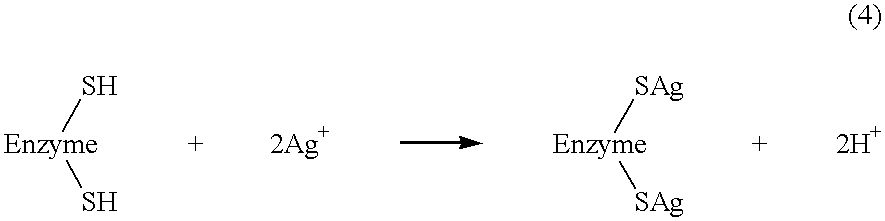
- Silver ion is an effective antiseptic and germicide, and its organic salts, particularly in the form of nitrates, are commonly used with furazolidones and antibiotics in the treatment of bums. Silver nitrate is one of the most powerful chemical germicides and is widely used as a local astringent and germicide. However, the nitrates irritate the skin. Thus, it is preferable to reduce the silver nitrate to metallic silver in the first (1) reaction. The metallic silver, as demonstrated in the second (2) reaction, is then undergone an oxidation to produce silver oxide (Ag 2O) in the presence of an oxidizing agent. When silver oxide is interacted with water, as shown in the third (3) reaction, it undergoes ionization to produce silver ion (Ag+). Finally, as shown in the fourth reaction (4), when the silver ion interacts with the sulfhydryl group (−SH) of an enzyme, it forms a -SAg linkage, which effectively blocks the enzyme activity. Therefore, the antibacterial and antifungal activity of the NAGs appears to be even more prominent when the NAGs are in contact with water.
- The NAGs has a broad spectrum of antibacterial and antifungal activity. The NAGs of the present invention had bactericidal and fungicidal effects on more than twenty (20) common pathogens, which include, but are not limited to, Escherichia coli, Methicillin resistant Staphylococcus aureus, Chlamydia trachomatis, Providencia stuartii, Vibrio vulnificus, Pneumobacillus, Nitrate-negative bacillus, Staphylococcus aureus, Candida albicans, Bacillus cloacae, Bacillus allantoides, Morgan's bacillus (Salmonella morgani), Pseudomonas altophila, Arizona, Pseudomonas aeruginosa, Neisseria gonorrhoeae, Bacillus subtilis, Bacillus foecalis alkaligenes, Streptococcus hemolyticus B, Citrobacter, Salmonella paratyphi C.
- Examples of the antibacterial activity of the NAGs were demonstrated in FIGS. 1-3. FIG. 1 shows the effect of the NAGs on Staphylococcus aureus. The data demonstrate that within 8 hours of treatment with the NAGs, all of the S. aureus were killed. FIG. 2 shows the effect of the NAGs on Escherichia coli. The data also demonstrate that within 8 hours of treatment with the NAGs, all of the E. coli were killed. FIG. 3 shows the effect of the NAGs on Pseudomonas aeruginosa. The data show that within 12 hours of treatment with the NAGs, all of the P. aeruginosa were killed.
- The NAGs were prepared by first cutting the stalk marrow of Juncus effuses L. into pieces of 0.5 to 2 cm at length. These small pieces of stalk marrow were washed, followed by boiling in water to remove any unwanted water soluble materials. The boiled stalk marrow pieces were than dried for later use. In the meantime, a nanosilver particles-containing solution was prepared by first dissolving AgNO3 in ammonia water, followed by adding glucose (as reducing agent) to the reaction solution. An oxidizing agent, preferably H2O2, was then added to the reaction solution. The quantity or volume of each of the ingredients used in the nanosilver particle-containing solution is listed in Table 1.
TABLE 1 The Nanosilver Particles-Containing Solution Ingredients Quantity or Volume AgNO3 15 Kg Ammonia Water 15 L Glucose 3 Kg Ethanol (95%) 5 L NaOH 0.5 Kg Oxidizing Agent (e.g., H2O2) 100 ml Distilled Water up to 1000 L - The above quantity of the nanosilver particles-containing solution was aimed at large scale industrial manufacturing use. The quantity could be scaled down proportionally for research and laboratory testing.
- FIG. 4 shows a flow chart of industrial production of the NAGs. The process was operated in the following chambers: (1) selection chamber; (2) separation chamber; (3) spraying chamber; (4) water removal chamber; (5) heat reaction chamber; (6) washing and soaking chamber; (7) drying chamber; and (8) grinding chamber.
- As shown in FIG. 4, in the “selection” chamber, stalk marrow of Juncus effuses L. were cut into pieces, preferably at a length of about 0.5 to 2 cm. The small pieces of stalk marrow were sieved through a selection process and transferred to the “separation” chamber, where the stalk marrow pieces were boiled and dried. The small pieces of dried stalk marrow were then transferred to the “spraying” chamber where the nanosilver particles-containing solution was evenly sprayed and dispersed onto the small pieces of dried stalk marrow. The small pieces of stalk marrow were further soaked with the nanosilver particles-containing solution in the “spraying” chamber for an adequate amount of time. The small pieces of stalk marrow with attached nanosilver particles were then transferred to the “water removal” chamber where excess solution was removed from the pieces.
- The small pieces of stalk marrow were then transferred to the “heat reaction” chamber, where the nanosilver-attached stalk marrow pieces were treated with heat.
- The heat-reacted stalk marrow pieces were transferred to the “soaking and washing” chamber, where the pieces were soaked and washed first with hot water, then with cold water, to remove any unattached nanosilver particles and water-soluble substances. The washed nanosilver particles-attached stalk marrow pieces were then dried under heat in the “drying” chamber, and finally transferred to the “grinding” chamber to be ground to proper NAG sizes. The final NAGs should contain no water-soluble substances other than silver. These NAGs could be used in various healthcare, medicinal and industrial products to disinfect, inhibit the growth of bacteria or fungi, and/or prevent mold formation.
- Examples of the NAGs used in healthcare products include, but are not limited to, ointments, lotions, or spraying solutions for treating all kinds of injuries and/or bums, bacterial and fungal infections (including gynecological infections such as vaginitis), cleansing agents for clothing, women hygiene, acne or pimples, and soaking solution for tooth brush. Examples of the NAGs used in medicinal products include, but are not limited to, internal medicines for treating gastrointestinal bacterial infection, sexually transmitted diseases, or as an eye drop for treating eye diseases. Examples of the NAGs used in industrial products include, but are not limited to, food preservatives especially for fruits and vegetables, drinking water disinfectants, paper and construction filling materials preservation (especially to prevent mold formation).
- The following examples are illustrative, but not limiting the scope of the present invention. Reasonable variations, such as those occur to reasonable artisan, can be made herein without departing from the scope of the present invention.
- The content of the silver in the NAGs was analyzed by a titrimetric analysis as follows:
- A. Basic chemical reactions
- The basic chemical reactions involved in the volumetric analysis were:
- Ag++SCN−→AgSCN↓
- Fe+3+6SCN−→Fe(SCN)6 −3 (light brownish red)(end point)
- B. Preparation of solutions
- (1). Solvent: HNO 3 solution. The solution was prepared by mixing nitric acid with water at ratio 1:1 (v/v). The concentration of nitric acid in the solution was 6N.
- (2). Indicator: 10% NH 4Fe(SO4)2 aqueous solution (w/v).
- (3). Titrant: NH 4SCN standardized solution.
- 0.75 g NH 4SCN was weighed and dissolved in 1000 ml water in a volumetric flask. The flask was gently shaken to evenly distribute NH4SCN in the solution. The solution was standardized by a standard Ag solution.
- (4). Standard Ag solution:
- 1.0000 g of clean and dry silver shreds or flakes was weighed and cut into small pieces. The pieces were placed in a 1000 ml brown volumetric flask and completely dissolved in 100 ml 6 N HNO 3 by heat in water bath. The flask was covered with filter paper during the heating process. After the flask cooled down, the volume of solution was brought up to 1000 ml by water. The flask was shaken to disperse the solute. The final concentration of the solution was 1 mg/ml.
- C. Standardizing NH 4SCN solution
- Ten (10) ml of standard Ag solution (1 mg/ml) as shown in B(4) was measured and poured into a 200 ml volumetric flask. For the blank control, 10 ml of water was poured into the 200 ml volumetric flask. Then, 6N HNO 3 was added to the flask (the acidic level of nitric acid was between 1-10%), followed by adding 1-2 ml of 10% NH4Fe(SO4)2 aqueous solution to the flask as the indicator. Water was then added along the wall of the flask until the volume was kept at 80-100 ml. NH4SCN solution prepared in B(3) was used as titrant to react with silver solution until a stable light brownish red appeared, which signaled the end of the reaction. The titrimetric analysis was conducted in triplicates to get a mean value. The standard deviation (SD) of the mean values should be less than 0.10 ml. The silver titer value, TAg, was calculated:
- T Ag=Ag amount in Ag standard solution/[(mean volume of the triplicates)-blank](The unit for TAg is mg/ml.)
- D. Titrimetric analysis of the NAGs
- 100.0 mg of the NAGs, after being dried in a desiccator for 2 to 4 hours, was precisely measured and placed in a 200 ml flask. Then, 20-30 ml of 6N HNO 3 were added into the flask, and the flask was placed on a low-heat thermoelectrical plate until the solution was slightly boiling, where the solution was maintained at this stage until the solution became colorless. Then, the flask was cooled down and diluted to 100 ml. 1-2 ml indicator was added to the solution. The solution was analyzed by titration using the standardized NH4SCN solution. When the solution was stable in a color of light brownish red, it was the end point of the titration.
- E. Results
- The content of the silver in the NAGs was calculated by the following equation.
- Ag% in the NAGs=(V×T Ag /W)×100%
- Where V was the volume of the NH 4SCN solution added to the titration flask after the blank was deducted. TAg was in the unit of mg Ag/ml. W was the weight of the NAG sample in mg.
- From the above calculation, the silver content of the NAGs was about 2-8%.
- The antibacterial effect of the NAGs in the solution was tested as follows:
- A. Preparation of the NAGs solution
- Five (5) g of the NAGs were suspended in 500 ml of water and stayed in the solution for 24 hrs to obtain an NAGs-containing solution.
- B. Preparation of bacteria
- M-H liquid and solid culture media were used for activation and culture of the bacteria. Staphylococcus aureus stock M120, Escherichia coli stock E109, and Pseudomonas aeruginosa stock PS208 were used for the testing. These stocks were provided by the Microbiology Teaching and Research Section at Henan Medical University.
- The frozen stocks of bacteria were seeded onto solid culture media. Single colonies were picked and inoculated respectively in 2 ml liquid culture medium and cultured at 37° C. for eight (8) hours. Then, the liquid culture medium was diluted at 1:1000 and stored in refrigerator (around 0° C.) until ready for use. The solution contained about 10 5 CFU/ml bacterial stock.
- C. Treatment of bacterial stocks in the solution
- Under sterile condition, the NAGs-containing solution was added to three (3) flasks, each containing 100 ml of the solution. One (1) ml of the bacterial stocks of E. coli, S. aureus, or P. aeruginosa was then added to the three flasks, respectively. The control was prepared by adding the bacterial stocks in the flasks containing water. The inhibitory effect of the NAGs on the three different bacteria was conducted over a period of eight (8) hours.
- D. Results of the experiment
- At the end of the eight hours study, the solution was diluted and plated on a culture plate to measure the number of remaining bacteria. In the solution containing the NAGs, more than 99% of all the tested bacteria were killed, which demonstrated that the NAGs-containing solution was very effective as bactericide and could be used as disinfectant.
- A time course study of the antibacterial effects of the NAGs in a solution was conducted as follows:
- A. Preparation of bacterial stocks
- M-H liquid and solid culture media were used for activation and culture of the bacteria. Staphylococcus aureus stock M120, Escherichia coli stock E109, and Pseudomonas aeruginosa stock PS208 were provided by the Microbiology Teaching and Research Section at Henan Medical University. The stocks were cultured in an incubator at 37° C. for 24 hours.
- The frozen stocks of bacteria were seeded to a culture plate. Single colonies were chosen and inoculated in 2 ml liquid culture medium, respectively, where they were cultured at 37° C. for eight (8) hours. Then, the liquid culture medium was diluted at 1:1000 and stored in the refrigerator (around 0° C.) until ready for use. The solution contained about 10 5 CFU/ml bacterial stock.
- B. The effect of the NAGs on E. coli, S. aureus, and P. aeruginosa
- Under sterile condition, three (3) flasks, which contained 100 ml of the NAGs-containing solution in each flask, were inoculated with E. coli, S. aureus, or P. aeruginosa, respectively, with about 104-105 bacteria per ml in the solution. A time course was studied at 2, 4, 8, 12, and 24 hours intervals, each with 0.5 ml of sample. The viable number of the bacteria was counted. The control study was conducted with the same number of bacteria incubated at the same condition in a 100 ml of water rather than the NAGs-containing solution.
- C. Results
- As shown in FIG. 1, after inoculating S. aureus in a solution containing the NAGs, the number of S. aureus reduced to 0.01% of the starting number during the first two hours after the inoculation. Eight (8) hours after the inoculation, all of the bacteria were killed.
- As shown in FIG. 2, after inoculating E. coli in a solution containing the NAGs, the number of E. coli reduced to 0.1% of the starting number during the first two hours after the inoculation. Eight (8) hours after the inoculation, all of the bacteria were killed.
- As shown in FIG. 3, after inoculating P. aeruginosai in a solution containing the NAGs, the number of E. coli reduced to 1% of the starting number during the first two hours after the inoculation. Twelve (12) hours after the inoculation, all of the bacteria were killed
- The results of this study indicate that the NAGs had inhibitory effects on E. coli, S. aureus, and P. aeruginosa.
- The antibacterial effect of the NAGs was tested on toothbrush as follows:
- A. Preparation of bacteria
- M-H liquid and solid culture media were used for activation and culture of the bacteria. Staphylococcus aureus stock M120 was provided by the Microbiology Teaching and Research Section at Henan Medical University. The stock was cultured in an incubator at 37° C. for 24 hours.
- The frozen stock of bacteria was seeded to a culture plate. A single colony was chosen and inoculated in 2 ml liquid culture medium, respectively, where the bacteria were cultured at 37° C. for eight (8) hours. Then, the liquid culture medium was diluted at 1:1000 and stored in the refrigerator (around 0° C.) until ready for use. The solution contained about 10 5 CFU/ml bacterial stock.
- B. Treatment of toothbrush
- The bactericidal activity of the NAGs on toothbrush was tested by two (2) methods:
- (1). Treatment of toothbrush in its natural state
- A half of a toothbrush was immersed in 30 ml of a solution containing the NAGs for eight (8) hours. The other half of the toothbrush was immersed in 30 ml of saline solution. One (1) ml of each of the solutions was taken out after the 8 hours incubation, diluted, and tested for bacteria counts on plate. This method tested the natural existence of germs on the toothbrush and the effect of the NAGs on inhibiting the growth of the germs.
- (2). Treatment of toothbrush in use with added Staphylococcus aureus
- A half of the toothbrush was immersed in 30 ml solution containing the NAGs. One (1) ml of the bacterial stock containing Staphylococcus aureus was added to the solution. At the end of the 8 hours incubation, 1 ml of the solution was taken out and tested for bacteria counts on plate. The other half of the toothbrush was immersed in 30 ml of saline solution. One (1) ml of each of the solutions was taken out after the 8 hours incubation, diluted, and tested for bacteria counts on plate. This method tested the bactericidal effect of the NAGs on toothbrush where known amount of S. aureus was inoculated in the solution
- C. Results
- (1). Treatment of toothbrush in its natural state
- The bactericidal efficiency for the NAGs was about 95%.
- (2). Treatment of toothbrush in use with added Staphylococcus aureus
- The bactericidal efficiency for the NAGs was about 98%.
- The results show that the NAGs were effective against bacteria which were grown on the toothbrush. Therefore, the NAGs could be effectively used as a disinfectant for toothbrush.
- The NAGs were given to normal, healthy rats in a dose of 925 mg/kg of body weight per day for fourteen (14) days. This dose was more than 4,625 fold of the dose generally recommended to humans. The activities of rats were monitored. At the end of the 14 days period, no rats were dead or sick, which indicated that the NAGs were safe and non-toxic to rats.
- A 5% (w/v) NAGs-containing solution was applied to the skin of the rabbits. The rabbits were monitored at 1 hr, 24 hrs, and 48 hrs intervals. No rash, bruise, or any irritating reaction was observed on the rabbit skins, which indicated that the NAGs were safe and not creating any allergic reaction on the skins.
- While the invention has been described by way of examples and in terms of the preferred embodiments, it is to be understood that the invention is not limited to the disclosed embodiments. On the contrary, it is intended to cover various modifications as would be apparent to those skilled in the art. Therefore, the scope of the appended claims should be accorded the broadest interpretation so as to encompass all such modifications.
Claims (23)
Priority Applications (1)
| Application Number | Priority Date | Filing Date | Title |
|---|---|---|---|
| US09/840,906 US6379712B1 (en) | 2000-09-13 | 2001-04-25 | Nanosilver-containing antibacterial and antifungal granules and methods for preparing and using the same |
Applications Claiming Priority (2)
| Application Number | Priority Date | Filing Date | Title |
|---|---|---|---|
| US23092500P | 2000-09-13 | 2000-09-13 | |
| US09/840,906 US6379712B1 (en) | 2000-09-13 | 2001-04-25 | Nanosilver-containing antibacterial and antifungal granules and methods for preparing and using the same |
Publications (2)
| Publication Number | Publication Date |
|---|---|
| US6379712B1 US6379712B1 (en) | 2002-04-30 |
| US20020051823A1 true US20020051823A1 (en) | 2002-05-02 |
Family
ID=26924689
Family Applications (1)
| Application Number | Title | Priority Date | Filing Date |
|---|---|---|---|
| US09/840,906 Expired - Lifetime US6379712B1 (en) | 2000-09-13 | 2001-04-25 | Nanosilver-containing antibacterial and antifungal granules and methods for preparing and using the same |
Country Status (1)
| Country | Link |
|---|---|
| US (1) | US6379712B1 (en) |
Cited By (38)
| Publication number | Priority date | Publication date | Assignee | Title |
|---|---|---|---|---|
| US20030203046A1 (en) * | 2000-07-27 | 2003-10-30 | Burrell Robert E. | Solutions and aerosols of metal-containing compounds |
| WO2004074388A1 (en) * | 2003-02-18 | 2004-09-02 | Otto Schildhauer | Method for treating tubular goods |
| US20040180093A1 (en) * | 2003-03-12 | 2004-09-16 | 3M Innovative Properties Company | Polymer compositions with bioactive agent, medical articles, and methods |
| US20040191329A1 (en) * | 2000-07-27 | 2004-09-30 | Burrell Robert E. | Compositions and methods of metal-containing materials |
| US20040239004A1 (en) * | 2003-05-31 | 2004-12-02 | Kim Jin Soo | Method for producing an injection-molded material with an antibacterial function |
| WO2005000324A3 (en) * | 2003-06-03 | 2005-03-24 | American Biotech Labs | Colloidal silver composition having antimicrobial properties |
| US20050061678A1 (en) * | 1999-06-01 | 2005-03-24 | American Biotech Labs | Treatment of humans with colloidal silver composition |
| US20050123621A1 (en) * | 2003-12-05 | 2005-06-09 | 3M Innovative Properties Company | Silver coatings and methods of manufacture |
| US20050124724A1 (en) * | 2003-12-05 | 2005-06-09 | 3M Innovative Properties Company | Polymer compositions with bioactive agent, medical articles, and methods |
| US20060035039A1 (en) * | 2004-08-12 | 2006-02-16 | 3M Innovative Properties Company | Silver-releasing articles and methods of manufacture |
| US20060034899A1 (en) * | 2004-08-12 | 2006-02-16 | Ylitalo Caroline M | Biologically-active adhesive articles and methods of manufacture |
| US20060147502A1 (en) * | 2004-12-30 | 2006-07-06 | Kimberly-Clark Worldwide, Inc. | Methods for controlling microbial pathogens on currency and mail |
| US20060233889A1 (en) * | 2005-04-14 | 2006-10-19 | 3M Innovative Properties Company | Silver coatings and methods of manufacture |
| EP1779855A1 (en) * | 2005-10-28 | 2007-05-02 | Abdula Kurkayev | Nanoparticles of a heterocrystal mineral for use as a medicament and method of producing the same |
| US20070098806A1 (en) * | 2002-05-02 | 2007-05-03 | Ismail Ashraf A | Polymer-Based Antimicrobial Agents, Methods of Making Said Agents, and Products Incorporating Said Agents |
| US20070166399A1 (en) * | 2006-01-13 | 2007-07-19 | 3M Innovative Properties Company | Silver-containing antimicrobial articles and methods of manufacture |
| US20070190174A1 (en) * | 1999-06-01 | 2007-08-16 | American Silver Llc | Antiviral Colloidal Silver Composition |
| US20080085326A1 (en) * | 2006-10-04 | 2008-04-10 | Hai Xiong Ruan | Antimicrobial material compositions enriched with different active oxygen species |
| US20080213328A1 (en) * | 2007-03-02 | 2008-09-04 | Yao-Nien Chung | Nanosilver-containing preservation articles, and the preparation process and the uses thereof |
| US7445799B1 (en) | 2000-06-21 | 2008-11-04 | Icet, Inc. | Compositions for microbial and chemical protection |
| US20090047475A1 (en) * | 2007-08-17 | 2009-02-19 | Sun Mi Jeon | Composition for coating wiper blade rubbers, coating method using the same, and wiper blade rubbers made therefrom |
| US20090130161A1 (en) * | 2000-06-21 | 2009-05-21 | Icet, Inc. | Material compositions for microbial and chemical protection |
| US20100098949A1 (en) * | 2006-10-18 | 2010-04-22 | Burton Scott A | Antimicrobial articles and method of manufacture |
| US20100137822A1 (en) * | 2007-02-15 | 2010-06-03 | Huaide Chen | Far infrared anion complex sanitary napkin/pad |
| EP1880213A4 (en) * | 2005-01-05 | 2010-06-23 | Robert Holladay | Silver/water, silver gels and silver-based compositions; and methods for making and using the same |
| US20110123578A1 (en) * | 2009-11-20 | 2011-05-26 | Wenzel Scott W | Cooling Substrates With Hydrophilic Containment Layer and Method of Making |
| US20110123584A1 (en) * | 2009-11-20 | 2011-05-26 | Jeffery Richard Seidling | Temperature Change Compositions and Tissue Products Providing a Cooling Sensation |
| US8795717B2 (en) | 2009-11-20 | 2014-08-05 | Kimberly-Clark Worldwide, Inc. | Tissue products including a temperature change composition containing phase change components within a non-interfering molecular scaffold |
| WO2016161348A1 (en) * | 2015-04-01 | 2016-10-06 | Attostat, Inc. | Nanoparticle compositions and methods for treating or preventing tissue infections and diseases |
| US10137503B2 (en) | 2011-07-01 | 2018-11-27 | Attostat, Inc. | Method and apparatus for production of uniformly sized nanoparticles |
| US10201571B2 (en) | 2016-01-25 | 2019-02-12 | Attostat, Inc. | Nanoparticle compositions and methods for treating onychomychosis |
| US10774429B2 (en) | 2015-04-13 | 2020-09-15 | Attostat, Inc. | Anti-corrosion nanoparticle compositions |
| US11018376B2 (en) | 2017-11-28 | 2021-05-25 | Attostat, Inc. | Nanoparticle compositions and methods for enhancing lead-acid batteries |
| US11473202B2 (en) | 2015-04-13 | 2022-10-18 | Attostat, Inc. | Anti-corrosion nanoparticle compositions |
| CN115227718A (en) * | 2022-08-04 | 2022-10-25 | 广东省农业科学院动物卫生研究所 | Application of nano-silver in inhibiting streptococcus suis |
| US11646453B2 (en) | 2017-11-28 | 2023-05-09 | Attostat, Inc. | Nanoparticle compositions and methods for enhancing lead-acid batteries |
| US12115250B2 (en) | 2019-07-12 | 2024-10-15 | Evoq Nano, Inc. | Use of nanoparticles for treating respiratory infections associated with cystic fibrosis |
| US12456759B2 (en) | 2021-03-30 | 2025-10-28 | Evoq Nano, Inc. | Nanoparticle-enhanced lead-acid electrode paste and improved lead-acid batteries made therefrom |
Families Citing this family (47)
| Publication number | Priority date | Publication date | Assignee | Title |
|---|---|---|---|---|
| US20030185889A1 (en) * | 2002-03-27 | 2003-10-02 | Jixiong Yan | Colloidal nanosilver solution and method for making the same |
| US6979491B2 (en) * | 2002-03-27 | 2005-12-27 | Cc Technology Investment Co., Ltd. | Antimicrobial yarn having nanosilver particles and methods for manufacturing the same |
| US6924325B2 (en) * | 2002-06-21 | 2005-08-02 | Kerr Corporation | Silver-containing dental composition |
| KR100656169B1 (en) * | 2002-12-23 | 2006-12-12 | 삼성전자주식회사 | Method to give antimicrobial property to the surface of object using nano sized metal particles |
| CA2460585A1 (en) * | 2003-05-16 | 2004-11-16 | Exciton Technologies Inc. | Deposition products, composite materials and processes for the production thereof |
| RU2248941C1 (en) * | 2004-01-08 | 2005-03-27 | Каркищенко Николай Николаевич | Method for production of silver ion-containing disinfectant solution |
| US7507701B2 (en) | 2005-02-25 | 2009-03-24 | Solutions Biomed, Llc | Aqueous disinfectants and sterilants including transition metals |
| US7473675B2 (en) * | 2005-02-25 | 2009-01-06 | Solutions Biomed, Llc | Disinfectant systems and methods comprising a peracid, alcohol, and transition metal |
| US7553805B2 (en) * | 2005-02-25 | 2009-06-30 | Solutions Biomed, Llc | Methods and compositions for treating viral, fungal, and bacterial infections |
| US7534756B2 (en) * | 2005-02-25 | 2009-05-19 | Solutions Biomed, Llc | Devices, systems, and methods for dispensing disinfectant solutions comprising a peroxygen and transition metal |
| US7511007B2 (en) * | 2005-02-25 | 2009-03-31 | Solutions Biomed, Llc | Aqueous sanitizers, disinfectants, and/or sterilants with low peroxygen content |
| US7504369B2 (en) * | 2005-02-25 | 2009-03-17 | Solutions Biomed, Llc | Methods and compositions for decontaminating surfaces exposed to chemical and/or biological warfare compounds |
| MX2008015347A (en) | 2005-02-25 | 2008-12-16 | Solutions Biomed Llc | Aqueous disinfectants and sterilants. |
| US7462590B2 (en) * | 2005-02-25 | 2008-12-09 | Solutions Biomed, Llc | Aqueous disinfectants and sterilants comprising a peroxide/peracid/transition metal mixture |
| KR100767714B1 (en) | 2005-04-19 | 2007-10-19 | 양원동 | Silver Nano Metal Tooth Restorative |
| US7381686B2 (en) * | 2005-04-27 | 2008-06-03 | Taikong Corp. | Composite for inhibiting algae growth and use therof |
| US20060254988A1 (en) * | 2005-05-10 | 2006-11-16 | Confirm Monitoring Systems, Inc. | Methods and compositions for the treatment of water |
| US8119548B2 (en) * | 2005-05-18 | 2012-02-21 | Building Materials Investment Corporation | Nanosilver as a biocide in building materials |
| TWM286648U (en) * | 2005-10-06 | 2006-02-01 | Wu-Lang Jang | Toothbrush receptacle with disinfection function |
| US20070154505A1 (en) * | 2005-12-30 | 2007-07-05 | Manico Joseph A | Antimicrobial agent to inhibit the growth of microorganisms on building materials |
| US20070154506A1 (en) * | 2005-12-30 | 2007-07-05 | Patton David L | Antimicrobial agent to inhibit the growth of microorganisms on disposable products |
| US20070161936A1 (en) * | 2006-01-06 | 2007-07-12 | Svetlik Harvey E | Wound treatment-dressing and method of manufacture |
| KR100788997B1 (en) | 2006-03-10 | 2007-12-28 | 김주영 | Process for producing antimicrobial wet dressing material chemically bonded with silver and its wet dressing material |
| WO2007140573A1 (en) * | 2006-04-24 | 2007-12-13 | Axcelon Biopolymers Corporation | Nanosilver coated bacterial cellulose |
| US7661430B2 (en) * | 2006-05-19 | 2010-02-16 | Richard Mason | Antimicrobial dental appliances including mouthguards and mouthpieces |
| US20070286878A1 (en) * | 2006-06-07 | 2007-12-13 | Harruna Issifu I | Removable films for sanitizing substrates and methods of use thereof |
| US8455226B2 (en) * | 2006-07-05 | 2013-06-04 | Janssen Pharmaceutica N.V. | Method for producing metal nanoparticles |
| US7635552B2 (en) * | 2006-07-25 | 2009-12-22 | Endicott Interconnect Technologies, Inc. | Photoresist composition with antibacterial agent |
| WO2008036225A2 (en) | 2006-09-20 | 2008-03-27 | Entek Manufacturing, Inc. | Conformable structured therapeutic dressing |
| BRPI0719208A2 (en) | 2006-10-12 | 2017-09-26 | C 3 Int Llc | methods for obtaining prophylactic surface treatment for fluid processing systems and components thereof. |
| US7892317B2 (en) * | 2007-07-11 | 2011-02-22 | Jafar Rahman Nia | Preparation of colloidal nanosilver |
| WO2009032203A1 (en) * | 2007-08-30 | 2009-03-12 | Solutions Biomed, Llc | Colloidal metal-containing skin sanitizer |
| GB0800081D0 (en) * | 2008-01-04 | 2008-02-13 | Univ Gent | Silver nanoparticles with specific surface area and/or isoelectric point and a method for producing them |
| WO2009114754A1 (en) * | 2008-03-14 | 2009-09-17 | Solutions Biomed, Llc | Multi-chamber container system for storing and mixing fluids |
| US8623301B1 (en) | 2008-04-09 | 2014-01-07 | C3 International, Llc | Solid oxide fuel cells, electrolyzers, and sensors, and methods of making and using the same |
| WO2010056881A1 (en) * | 2008-11-12 | 2010-05-20 | Solutions Biomed, Llc | Multi-chamber container system for storing and mixing liquids |
| WO2010056871A2 (en) | 2008-11-12 | 2010-05-20 | Solutions Biomed, Llc | Two-part disinfectant system and related methods |
| US20100120913A1 (en) * | 2008-11-12 | 2010-05-13 | Larson Brian G | Resin catalyzed and stabilized peracid compositions and associated methods |
| US20120195838A1 (en) * | 2009-09-04 | 2012-08-02 | National University Corporation Kumamoto University | Oral composition for denture wearers |
| CA2789281C (en) | 2010-02-10 | 2015-11-24 | C3 International, Llc | Low temperature electrolytes for solid oxide cells having high ionic conductivity |
| CN102895315B (en) * | 2012-09-28 | 2014-02-26 | 南昌大学 | A nano-silver antibacterial composition containing forsythia extract |
| CN103044611B (en) * | 2012-12-17 | 2015-06-10 | 上海师范大学 | Preparation of polymer antibacterial nano-particles and magnetic antibacterial nano-particles containing halamine functional groups |
| US9446079B2 (en) | 2013-07-11 | 2016-09-20 | Links Medical Products, Incorporated | Honey and silver nitrate composition, composition dressing and methods of making same |
| US9905871B2 (en) | 2013-07-15 | 2018-02-27 | Fcet, Inc. | Low temperature solid oxide cells |
| TWI551739B (en) | 2015-05-11 | 2016-10-01 | Acelon Chem & Fiber Corp | Method for preparing nano silver blended natural cellulose spunbonded non-woven fabric |
| TWI565853B (en) | 2015-05-11 | 2017-01-11 | Acelon Chem & Fiber Corp | Preparation of nano - silver blended natural cellulose melt - blown non - woven |
| TWI565852B (en) | 2015-05-11 | 2017-01-11 | Acelon Chem & Fiber Corp | Preparation of Nano silver blended natural cellulose fibers method |
Family Cites Families (5)
| Publication number | Priority date | Publication date | Assignee | Title |
|---|---|---|---|---|
| US4828832A (en) | 1983-09-07 | 1989-05-09 | Laboratorios Biochemie De Mexico | Method of manufacturing a composition for treating skin lesions |
| US5824267A (en) | 1994-08-01 | 1998-10-20 | Kawasumi Laboritories, Inc. | Metallic bactericidal agent |
| JP3121503B2 (en) | 1994-10-18 | 2001-01-09 | レンゴー株式会社 | Antibacterial agent |
| US5973050A (en) | 1996-07-01 | 1999-10-26 | Integrated Cryoelectronic Inc. | Composite thermoelectric material |
| US5785972A (en) | 1997-01-10 | 1998-07-28 | Tyler; Kathleen A. | Colloidal silver, honey, and helichrysum oil antiseptic composition and method of application |
-
2001
- 2001-04-25 US US09/840,906 patent/US6379712B1/en not_active Expired - Lifetime
Cited By (68)
| Publication number | Priority date | Publication date | Assignee | Title |
|---|---|---|---|---|
| US20060182813A1 (en) * | 1999-06-01 | 2006-08-17 | Holladay Robert J | Colloidal silver composition having microbial properties |
| US8535728B2 (en) * | 1999-06-01 | 2013-09-17 | American Silver, Llc | Colloidal silver composition having antimicrobial properties |
| US8753691B2 (en) * | 1999-06-01 | 2014-06-17 | American Silver, Llc | Antiviral colloidal silver composition |
| US20070190174A1 (en) * | 1999-06-01 | 2007-08-16 | American Silver Llc | Antiviral Colloidal Silver Composition |
| US7135195B2 (en) * | 1999-06-01 | 2006-11-14 | American Silver, Llc | Treatment of humans with colloidal silver composition |
| US20050061678A1 (en) * | 1999-06-01 | 2005-03-24 | American Biotech Labs | Treatment of humans with colloidal silver composition |
| US7445799B1 (en) | 2000-06-21 | 2008-11-04 | Icet, Inc. | Compositions for microbial and chemical protection |
| US8192765B2 (en) | 2000-06-21 | 2012-06-05 | Icet, Inc. | Material compositions for microbial and chemical protection |
| US20090130161A1 (en) * | 2000-06-21 | 2009-05-21 | Icet, Inc. | Material compositions for microbial and chemical protection |
| US7078060B2 (en) | 2000-07-27 | 2006-07-18 | Nucryst Pharmaceuticals Corp. | Solutions and aerosols of metal-containing compounds |
| US20030203046A1 (en) * | 2000-07-27 | 2003-10-30 | Burrell Robert E. | Solutions and aerosols of metal-containing compounds |
| US20040191329A1 (en) * | 2000-07-27 | 2004-09-30 | Burrell Robert E. | Compositions and methods of metal-containing materials |
| US20070098806A1 (en) * | 2002-05-02 | 2007-05-03 | Ismail Ashraf A | Polymer-Based Antimicrobial Agents, Methods of Making Said Agents, and Products Incorporating Said Agents |
| US7951853B2 (en) | 2002-05-02 | 2011-05-31 | Smart Anti-Microbial Solutions, Llc | Polymer-based antimicrobial agents, methods of making said agents, and products incorporating said agents |
| US20060018967A1 (en) * | 2003-02-18 | 2006-01-26 | Otto Schildhauer | Method for treating pipelines |
| WO2004074388A1 (en) * | 2003-02-18 | 2004-09-02 | Otto Schildhauer | Method for treating tubular goods |
| US20040180093A1 (en) * | 2003-03-12 | 2004-09-16 | 3M Innovative Properties Company | Polymer compositions with bioactive agent, medical articles, and methods |
| EP1481783A3 (en) * | 2003-05-31 | 2005-11-23 | Daewoo Electronics Corporation | Method for producing an injection-molded material with an antibacterial function |
| US20040239004A1 (en) * | 2003-05-31 | 2004-12-02 | Kim Jin Soo | Method for producing an injection-molded material with an antibacterial function |
| WO2005000324A3 (en) * | 2003-06-03 | 2005-03-24 | American Biotech Labs | Colloidal silver composition having antimicrobial properties |
| US20050123621A1 (en) * | 2003-12-05 | 2005-06-09 | 3M Innovative Properties Company | Silver coatings and methods of manufacture |
| US8193267B2 (en) | 2003-12-05 | 2012-06-05 | 3M Innovative Properties Company | Polymer compositions with bioactive agent, medical articles, and methods |
| EP1689456B1 (en) * | 2003-12-05 | 2012-02-22 | 3M Innovative Properties Company | Polymer compositions with bioactive agent, medical articles, and methods |
| US20050124724A1 (en) * | 2003-12-05 | 2005-06-09 | 3M Innovative Properties Company | Polymer compositions with bioactive agent, medical articles, and methods |
| US20100233273A1 (en) * | 2003-12-05 | 2010-09-16 | 3M Innovative Properties Company | Polymer compositions with bioactive agent, medical articles, and methods |
| US7745509B2 (en) | 2003-12-05 | 2010-06-29 | 3M Innovative Properties Company | Polymer compositions with bioactive agent, medical articles, and methods |
| US20060034899A1 (en) * | 2004-08-12 | 2006-02-16 | Ylitalo Caroline M | Biologically-active adhesive articles and methods of manufacture |
| US20060035039A1 (en) * | 2004-08-12 | 2006-02-16 | 3M Innovative Properties Company | Silver-releasing articles and methods of manufacture |
| US20060147502A1 (en) * | 2004-12-30 | 2006-07-06 | Kimberly-Clark Worldwide, Inc. | Methods for controlling microbial pathogens on currency and mail |
| EP1880213A4 (en) * | 2005-01-05 | 2010-06-23 | Robert Holladay | Silver/water, silver gels and silver-based compositions; and methods for making and using the same |
| US20060233889A1 (en) * | 2005-04-14 | 2006-10-19 | 3M Innovative Properties Company | Silver coatings and methods of manufacture |
| US8399027B2 (en) | 2005-04-14 | 2013-03-19 | 3M Innovative Properties Company | Silver coatings and methods of manufacture |
| WO2007048634A3 (en) * | 2005-10-28 | 2007-12-06 | Abdula Kurkayev | Nanoparticles of a heterocrystal mineral for use as a medicament and method of producing the same |
| EP1779855A1 (en) * | 2005-10-28 | 2007-05-02 | Abdula Kurkayev | Nanoparticles of a heterocrystal mineral for use as a medicament and method of producing the same |
| US20090226526A1 (en) * | 2005-10-28 | 2009-09-10 | Abdula Kurkayev | Nanoparticles of a heterocrystal mineral for use as a medicament and method of producing the same |
| WO2007048634A2 (en) | 2005-10-28 | 2007-05-03 | Abdula Kurkayev | Nanoparticles of a heterocrystal mineral for use as a medicament and method of producing the same |
| US8192764B2 (en) | 2006-01-13 | 2012-06-05 | 3M Innovative Properties Company | Silver-containing antimicrobial articles and methods of manufacture |
| US9289450B2 (en) | 2006-01-13 | 2016-03-22 | 3M Innovative Properties Company | Silver-containing antimicrobial articles and methods of manufacture |
| US20070166399A1 (en) * | 2006-01-13 | 2007-07-19 | 3M Innovative Properties Company | Silver-containing antimicrobial articles and methods of manufacture |
| US20080279960A1 (en) * | 2006-01-13 | 2008-11-13 | Burton Scott A | Silver-Containing Antimicrobial Articles and Methods of Manufacture |
| US20080085326A1 (en) * | 2006-10-04 | 2008-04-10 | Hai Xiong Ruan | Antimicrobial material compositions enriched with different active oxygen species |
| US20100098949A1 (en) * | 2006-10-18 | 2010-04-22 | Burton Scott A | Antimicrobial articles and method of manufacture |
| AU2008215041B9 (en) * | 2007-02-15 | 2014-01-16 | Shenzhen Yuelang Techno-Industrial Co., Ltd. | A far-infrared anion compound sanitary napkin and pad |
| US20100137822A1 (en) * | 2007-02-15 | 2010-06-03 | Huaide Chen | Far infrared anion complex sanitary napkin/pad |
| AU2008215041B2 (en) * | 2007-02-15 | 2013-09-12 | Shenzhen Yuelang Techno-Industrial Co., Ltd. | A far-infrared anion compound sanitary napkin and pad |
| US20080213328A1 (en) * | 2007-03-02 | 2008-09-04 | Yao-Nien Chung | Nanosilver-containing preservation articles, and the preparation process and the uses thereof |
| US8304068B2 (en) * | 2007-08-17 | 2012-11-06 | Adm21 Co., Ltd. | Composition for coating wiper blade rubbers, coating method using the same, and wiper blade rubbers made therefrom |
| US20090047475A1 (en) * | 2007-08-17 | 2009-02-19 | Sun Mi Jeon | Composition for coating wiper blade rubbers, coating method using the same, and wiper blade rubbers made therefrom |
| US8894814B2 (en) | 2009-11-20 | 2014-11-25 | Kimberly-Clark Worldwide, Inc. | Cooling substrates with hydrophilic containment layer and method of making |
| US8795717B2 (en) | 2009-11-20 | 2014-08-05 | Kimberly-Clark Worldwide, Inc. | Tissue products including a temperature change composition containing phase change components within a non-interfering molecular scaffold |
| US20110123584A1 (en) * | 2009-11-20 | 2011-05-26 | Jeffery Richard Seidling | Temperature Change Compositions and Tissue Products Providing a Cooling Sensation |
| US9181465B2 (en) | 2009-11-20 | 2015-11-10 | Kimberly-Clark Worldwide, Inc. | Temperature change compositions and tissue products providing a cooling sensation |
| US20110123578A1 (en) * | 2009-11-20 | 2011-05-26 | Wenzel Scott W | Cooling Substrates With Hydrophilic Containment Layer and Method of Making |
| US9545365B2 (en) | 2009-11-20 | 2017-01-17 | Kimberly-Clark Worldwide, Inc. | Temperature change compositions and tissue products providing a cooling sensation |
| US8480852B2 (en) | 2009-11-20 | 2013-07-09 | Kimberly-Clark Worldwide, Inc. | Cooling substrates with hydrophilic containment layer and method of making |
| US10137503B2 (en) | 2011-07-01 | 2018-11-27 | Attostat, Inc. | Method and apparatus for production of uniformly sized nanoparticles |
| US10610934B2 (en) | 2011-07-01 | 2020-04-07 | Attostat, Inc. | Method and apparatus for production of uniformly sized nanoparticles |
| WO2016161348A1 (en) * | 2015-04-01 | 2016-10-06 | Attostat, Inc. | Nanoparticle compositions and methods for treating or preventing tissue infections and diseases |
| US10953043B2 (en) | 2015-04-01 | 2021-03-23 | Attostat, Inc. | Nanoparticle compositions and methods for treating or preventing tissue infections and diseases |
| US11473202B2 (en) | 2015-04-13 | 2022-10-18 | Attostat, Inc. | Anti-corrosion nanoparticle compositions |
| US10774429B2 (en) | 2015-04-13 | 2020-09-15 | Attostat, Inc. | Anti-corrosion nanoparticle compositions |
| US10201571B2 (en) | 2016-01-25 | 2019-02-12 | Attostat, Inc. | Nanoparticle compositions and methods for treating onychomychosis |
| US11018376B2 (en) | 2017-11-28 | 2021-05-25 | Attostat, Inc. | Nanoparticle compositions and methods for enhancing lead-acid batteries |
| US11646453B2 (en) | 2017-11-28 | 2023-05-09 | Attostat, Inc. | Nanoparticle compositions and methods for enhancing lead-acid batteries |
| US12119456B2 (en) | 2017-11-28 | 2024-10-15 | Evoq Nano, Inc. | Nanoparticle compositions and methods for enhancing lead-acid batteries |
| US12115250B2 (en) | 2019-07-12 | 2024-10-15 | Evoq Nano, Inc. | Use of nanoparticles for treating respiratory infections associated with cystic fibrosis |
| US12456759B2 (en) | 2021-03-30 | 2025-10-28 | Evoq Nano, Inc. | Nanoparticle-enhanced lead-acid electrode paste and improved lead-acid batteries made therefrom |
| CN115227718A (en) * | 2022-08-04 | 2022-10-25 | 广东省农业科学院动物卫生研究所 | Application of nano-silver in inhibiting streptococcus suis |
Also Published As
| Publication number | Publication date |
|---|---|
| US6379712B1 (en) | 2002-04-30 |
Similar Documents
| Publication | Publication Date | Title |
|---|---|---|
| US6379712B1 (en) | Nanosilver-containing antibacterial and antifungal granules and methods for preparing and using the same | |
| RU2422137C1 (en) | Method of obtaining biocidal polyguanidine and biocidal polyguanidine | |
| EP1490543B1 (en) | Antimicrobial yarn having nanosilver particles and methods for manufacturing the same | |
| CN101389221B (en) | Silver/water, silver gel and silver-based compositions and methods for making and using same | |
| US20100003296A1 (en) | Manufacturing methods and applications of antimicrobial plant fibers having silver particles | |
| RU2407289C1 (en) | Nanostructured biocide composition | |
| US20180168165A1 (en) | Silver iodate compounds having antimicrobial properties | |
| EP2874671A1 (en) | Anti-microbial gel formulations containing a silver (i) periodate | |
| WO2003080231A1 (en) | Colloidal nanosilver solution and method for making the same | |
| KR20130010880A (en) | Antiseptic ointment comprising bentonite intercalated with silver, copper or zinc for external application | |
| WO2001072642A1 (en) | Silver ion-containing solution and use thereof | |
| US9723843B2 (en) | Family of silver (I) periodate compounds having broad microbial properties | |
| CN1082645A (en) | Long-acting broad-spectrum antiseptic fabric and preparation method thereof | |
| RU2408755C1 (en) | Composition for antiseptic treatment of woven materials | |
| EP2170081B1 (en) | Antimicrobial compositions | |
| US11000502B2 (en) | Antimicrobial compositions comprising copper-hydroxypyrone complexes | |
| RU2525545C2 (en) | Method of production of antimicrobial argentiferous cellulosic material | |
| CN108938559B (en) | A kind of DNA gel sterilization material and preparation method thereof and application as sterilization material | |
| CN1177092C (en) | A kind of preparation method of metal complex type antibacterial fiber | |
| CN110974776A (en) | Iodine-starch aerogel and preparation method and application thereof | |
| JP2005002033A (en) | Antimicrobial and degerming agent | |
| KR200391561Y1 (en) | Silver Nano Banban Line | |
| CN118286324A (en) | Antibacterial agent for animal cultivation and preparation method and application thereof | |
| WO2023131855A1 (en) | Antimicrobial composition | |
| HK1207528A1 (en) | Information medium with biocidal properties and method for manufacturing the same |
Legal Events
| Date | Code | Title | Description |
|---|---|---|---|
| AS | Assignment |
Owner name: GLOBOASIA L.L.C., MARYLAND Free format text: ASSIGNMENT OF ASSIGNORS INTEREST;ASSIGNORS:YAN, JIXIONG;CHENG, JIACHONG;REEL/FRAME:011738/0953 Effective date: 20010420 |
|
| STCF | Information on status: patent grant |
Free format text: PATENTED CASE |
|
| AS | Assignment |
Owner name: LEGEND WIN FINANCE CORPORATION, VIRGIN ISLANDS, BR Free format text: ASSIGNMENT OF ASSIGNORS INTEREST;ASSIGNOR:GLOBOASIA, LLC;REEL/FRAME:013531/0503 Effective date: 20021125 |
|
| REMI | Maintenance fee reminder mailed | ||
| FPAY | Fee payment |
Year of fee payment: 4 |
|
| SULP | Surcharge for late payment | ||
| REMI | Maintenance fee reminder mailed | ||
| FPAY | Fee payment |
Year of fee payment: 8 |
|
| SULP | Surcharge for late payment |
Year of fee payment: 7 |
|
| FPAY | Fee payment |
Year of fee payment: 12 |