US20020007022A1 - Epoxy resin composition for fiber-reinforced composite material, prepreg, and fiber-reinforced composite material - Google Patents
Epoxy resin composition for fiber-reinforced composite material, prepreg, and fiber-reinforced composite material Download PDFInfo
- Publication number
- US20020007022A1 US20020007022A1 US09/319,902 US31990299A US2002007022A1 US 20020007022 A1 US20020007022 A1 US 20020007022A1 US 31990299 A US31990299 A US 31990299A US 2002007022 A1 US2002007022 A1 US 2002007022A1
- Authority
- US
- United States
- Prior art keywords
- resin composition
- reinforced composite
- carbon fiber
- fiber reinforced
- thermosetting resin
- Prior art date
- Legal status (The legal status is an assumption and is not a legal conclusion. Google has not performed a legal analysis and makes no representation as to the accuracy of the status listed.)
- Granted
Links
- 239000000463 material Substances 0.000 title claims abstract description 63
- 229920000647 polyepoxide Polymers 0.000 title claims description 90
- 239000003822 epoxy resin Substances 0.000 title claims description 88
- 239000003733 fiber-reinforced composite Substances 0.000 title description 35
- -1 prepreg Substances 0.000 title description 23
- 239000000203 mixture Substances 0.000 title description 18
- 239000011342 resin composition Substances 0.000 claims abstract description 115
- 229920005989 resin Polymers 0.000 claims abstract description 106
- 239000011347 resin Substances 0.000 claims abstract description 106
- 229920001187 thermosetting polymer Polymers 0.000 claims abstract description 75
- 150000001875 compounds Chemical class 0.000 claims abstract description 61
- 229920000049 Carbon (fiber) Polymers 0.000 claims abstract description 56
- 239000004917 carbon fiber Substances 0.000 claims abstract description 56
- VNWKTOKETHGBQD-UHFFFAOYSA-N methane Chemical compound C VNWKTOKETHGBQD-UHFFFAOYSA-N 0.000 claims abstract description 56
- 239000011208 reinforced composite material Substances 0.000 claims abstract description 33
- 125000000524 functional group Chemical group 0.000 claims abstract description 24
- 239000003795 chemical substances by application Substances 0.000 claims abstract description 22
- 239000002131 composite material Substances 0.000 claims description 90
- 238000005259 measurement Methods 0.000 claims description 51
- 239000001257 hydrogen Substances 0.000 claims description 31
- 229910052739 hydrogen Inorganic materials 0.000 claims description 31
- 229920001567 vinyl ester resin Polymers 0.000 claims description 21
- 229920005992 thermoplastic resin Polymers 0.000 claims description 17
- 239000003505 polymerization initiator Substances 0.000 claims description 12
- 150000002148 esters Chemical class 0.000 claims description 11
- 125000002887 hydroxy group Chemical group [H]O* 0.000 claims description 10
- ISWSIDIOOBJBQZ-UHFFFAOYSA-N phenol group Chemical group C1(=CC=CC=C1)O ISWSIDIOOBJBQZ-UHFFFAOYSA-N 0.000 claims description 10
- 125000003277 amino group Chemical group 0.000 claims description 8
- 125000002915 carbonyl group Chemical group [*:2]C([*:1])=O 0.000 claims description 8
- 125000003700 epoxy group Chemical group 0.000 claims description 8
- 229920006337 unsaturated polyester resin Polymers 0.000 claims description 8
- 125000003178 carboxy group Chemical group [H]OC(*)=O 0.000 claims description 7
- 125000003396 thiol group Chemical group [H]S* 0.000 claims description 7
- 239000000178 monomer Substances 0.000 claims description 6
- 150000001451 organic peroxides Chemical class 0.000 claims description 5
- 125000003903 2-propenyl group Chemical group [H]C([*])([H])C([H])=C([H])[H] 0.000 claims description 4
- 125000000467 secondary amino group Chemical group [H]N([*:1])[*:2] 0.000 claims 1
- 238000005979 thermal decomposition reaction Methods 0.000 claims 1
- 239000012783 reinforcing fiber Substances 0.000 abstract description 41
- 239000004593 Epoxy Substances 0.000 description 149
- IISBACLAFKSPIT-UHFFFAOYSA-N bisphenol A Chemical compound C=1C=C(O)C=CC=1C(C)(C)C1=CC=C(O)C=C1 IISBACLAFKSPIT-UHFFFAOYSA-N 0.000 description 81
- 238000000034 method Methods 0.000 description 73
- 125000000217 alkyl group Chemical group 0.000 description 52
- 125000003118 aryl group Chemical group 0.000 description 51
- PPBRXRYQALVLMV-UHFFFAOYSA-N Styrene Chemical compound C=CC1=CC=CC=C1 PPBRXRYQALVLMV-UHFFFAOYSA-N 0.000 description 35
- 239000002994 raw material Substances 0.000 description 30
- 239000000126 substance Substances 0.000 description 26
- 238000012360 testing method Methods 0.000 description 22
- 150000002431 hydrogen Chemical class 0.000 description 21
- 229920002554 vinyl polymer Polymers 0.000 description 21
- ZUOUZKKEUPVFJK-UHFFFAOYSA-N diphenyl Chemical compound C1=CC=CC=C1C1=CC=CC=C1 ZUOUZKKEUPVFJK-UHFFFAOYSA-N 0.000 description 20
- 239000000835 fiber Substances 0.000 description 20
- QGBSISYHAICWAH-UHFFFAOYSA-N dicyandiamide Chemical compound NC(N)=NC#N QGBSISYHAICWAH-UHFFFAOYSA-N 0.000 description 19
- 230000000694 effects Effects 0.000 description 19
- 229940088644 n,n-dimethylacrylamide Drugs 0.000 description 18
- YLGYACDQVQQZSW-UHFFFAOYSA-N n,n-dimethylprop-2-enamide Chemical compound CN(C)C(=O)C=C YLGYACDQVQQZSW-UHFFFAOYSA-N 0.000 description 18
- XMTQQYYKAHVGBJ-UHFFFAOYSA-N 3-(3,4-DICHLOROPHENYL)-1,1-DIMETHYLUREA Chemical compound CN(C)C(=O)NC1=CC=C(Cl)C(Cl)=C1 XMTQQYYKAHVGBJ-UHFFFAOYSA-N 0.000 description 17
- FVCSARBUZVPSQF-UHFFFAOYSA-N 5-(2,4-dioxooxolan-3-yl)-7-methyl-3a,4,5,7a-tetrahydro-2-benzofuran-1,3-dione Chemical compound C1C(C(OC2=O)=O)C2C(C)=CC1C1C(=O)COC1=O FVCSARBUZVPSQF-UHFFFAOYSA-N 0.000 description 16
- IGALFTFNPPBUDN-UHFFFAOYSA-N phenyl-[2,3,4,5-tetrakis(oxiran-2-ylmethyl)phenyl]methanediamine Chemical compound C=1C(CC2OC2)=C(CC2OC2)C(CC2OC2)=C(CC2OC2)C=1C(N)(N)C1=CC=CC=C1 IGALFTFNPPBUDN-UHFFFAOYSA-N 0.000 description 16
- 238000000465 moulding Methods 0.000 description 15
- LNEPOXFFQSENCJ-UHFFFAOYSA-N haloperidol Chemical compound C1CC(O)(C=2C=CC(Cl)=CC=2)CCN1CCCC(=O)C1=CC=C(F)C=C1 LNEPOXFFQSENCJ-UHFFFAOYSA-N 0.000 description 14
- 239000002253 acid Substances 0.000 description 13
- 239000011159 matrix material Substances 0.000 description 13
- 239000002245 particle Substances 0.000 description 13
- 239000000047 product Substances 0.000 description 13
- LCFVJGUPQDGYKZ-UHFFFAOYSA-N Bisphenol A diglycidyl ether Chemical compound C=1C=C(OCC2OC2)C=CC=1C(C)(C)C(C=C1)=CC=C1OCC1CO1 LCFVJGUPQDGYKZ-UHFFFAOYSA-N 0.000 description 11
- 238000005470 impregnation Methods 0.000 description 11
- 239000004305 biphenyl Substances 0.000 description 10
- 235000010290 biphenyl Nutrition 0.000 description 10
- 230000000052 comparative effect Effects 0.000 description 10
- HRPVXLWXLXDGHG-UHFFFAOYSA-N Acrylamide Chemical compound NC(=O)C=C HRPVXLWXLXDGHG-UHFFFAOYSA-N 0.000 description 9
- 238000006243 chemical reaction Methods 0.000 description 9
- GEMHFKXPOCTAIP-UHFFFAOYSA-N n,n-dimethyl-n'-phenylcarbamimidoyl chloride Chemical compound CN(C)C(Cl)=NC1=CC=CC=C1 GEMHFKXPOCTAIP-UHFFFAOYSA-N 0.000 description 9
- 238000002360 preparation method Methods 0.000 description 9
- 125000001424 substituent group Chemical group 0.000 description 9
- YBPAYPRLUDCSEY-UHFFFAOYSA-N 2-(4-hydroxyphenyl)acetamide Chemical compound NC(=O)CC1=CC=C(O)C=C1 YBPAYPRLUDCSEY-UHFFFAOYSA-N 0.000 description 8
- CERQOIWHTDAKMF-UHFFFAOYSA-M Methacrylate Chemical compound CC(=C)C([O-])=O CERQOIWHTDAKMF-UHFFFAOYSA-M 0.000 description 8
- 229910017052 cobalt Inorganic materials 0.000 description 8
- 239000010941 cobalt Substances 0.000 description 8
- GUTLYIVDDKVIGB-UHFFFAOYSA-N cobalt atom Chemical compound [Co] GUTLYIVDDKVIGB-UHFFFAOYSA-N 0.000 description 8
- GYZLOYUZLJXAJU-UHFFFAOYSA-N diglycidyl ether Chemical compound C1OC1COCC1CO1 GYZLOYUZLJXAJU-UHFFFAOYSA-N 0.000 description 8
- 239000003921 oil Substances 0.000 description 8
- 235000019198 oils Nutrition 0.000 description 8
- 235000013824 polyphenols Nutrition 0.000 description 8
- 238000010521 absorption reaction Methods 0.000 description 7
- 229920001971 elastomer Polymers 0.000 description 7
- 239000007788 liquid Substances 0.000 description 7
- 229920003986 novolac Polymers 0.000 description 7
- 239000005060 rubber Substances 0.000 description 7
- WPPOGHDFAVQKLN-UHFFFAOYSA-N N-Octyl-2-pyrrolidone Chemical compound CCCCCCCCN1CCCC1=O WPPOGHDFAVQKLN-UHFFFAOYSA-N 0.000 description 6
- 125000003545 alkoxy group Chemical group 0.000 description 6
- PXKLMJQFEQBVLD-UHFFFAOYSA-N bisphenol F Chemical compound C1=CC(O)=CC=C1CC1=CC=C(O)C=C1 PXKLMJQFEQBVLD-UHFFFAOYSA-N 0.000 description 6
- 229910052736 halogen Inorganic materials 0.000 description 6
- 150000002367 halogens Chemical class 0.000 description 6
- 229920000642 polymer Polymers 0.000 description 6
- 239000000243 solution Substances 0.000 description 6
- 0 *CC*N(C)C Chemical compound *CC*N(C)C 0.000 description 5
- XLPJNCYCZORXHG-UHFFFAOYSA-N 1-morpholin-4-ylprop-2-en-1-one Chemical compound C=CC(=O)N1CCOCC1 XLPJNCYCZORXHG-UHFFFAOYSA-N 0.000 description 5
- ZRHHQHAXUKCNIY-UHFFFAOYSA-N C.C.CC(C)=O.CP(C)(C)=O.CS(C)(=O)=O Chemical compound C.C.CC(C)=O.CP(C)(C)=O.CS(C)(=O)=O ZRHHQHAXUKCNIY-UHFFFAOYSA-N 0.000 description 5
- RTZKZFJDLAIYFH-UHFFFAOYSA-N Diethyl ether Chemical compound CCOCC RTZKZFJDLAIYFH-UHFFFAOYSA-N 0.000 description 5
- WHNWPMSKXPGLAX-UHFFFAOYSA-N N-Vinyl-2-pyrrolidone Chemical compound C=CN1CCCC1=O WHNWPMSKXPGLAX-UHFFFAOYSA-N 0.000 description 5
- 239000000853 adhesive Substances 0.000 description 5
- 150000001408 amides Chemical class 0.000 description 5
- 238000010030 laminating Methods 0.000 description 5
- 229920001568 phenolic resin Polymers 0.000 description 5
- 239000005011 phenolic resin Substances 0.000 description 5
- 238000013001 point bending Methods 0.000 description 5
- VEORPZCZECFIRK-UHFFFAOYSA-N 3,3',5,5'-tetrabromobisphenol A Chemical compound C=1C(Br)=C(O)C(Br)=CC=1C(C)(C)C1=CC(Br)=C(O)C(Br)=C1 VEORPZCZECFIRK-UHFFFAOYSA-N 0.000 description 4
- QXSAKPUBHTZHKW-UHFFFAOYSA-N 4-hydroxybenzamide Chemical compound NC(=O)C1=CC=C(O)C=C1 QXSAKPUBHTZHKW-UHFFFAOYSA-N 0.000 description 4
- 239000004215 Carbon black (E152) Substances 0.000 description 4
- UFHFLCQGNIYNRP-UHFFFAOYSA-N Hydrogen Chemical compound [H][H] UFHFLCQGNIYNRP-UHFFFAOYSA-N 0.000 description 4
- PEEHTFAAVSWFBL-UHFFFAOYSA-N Maleimide Chemical compound O=C1NC(=O)C=C1 PEEHTFAAVSWFBL-UHFFFAOYSA-N 0.000 description 4
- RZVAJINKPMORJF-UHFFFAOYSA-N N-acetyl-para-amino-phenol Natural products CC(=O)NC1=CC=C(O)C=C1 RZVAJINKPMORJF-UHFFFAOYSA-N 0.000 description 4
- ATDWJOOPFDQZNK-UHFFFAOYSA-N N-acetyltyramine Chemical compound CC(=O)NCCC1=CC=C(O)C=C1 ATDWJOOPFDQZNK-UHFFFAOYSA-N 0.000 description 4
- 239000004952 Polyamide Substances 0.000 description 4
- 239000004642 Polyimide Substances 0.000 description 4
- 230000001070 adhesive effect Effects 0.000 description 4
- 229920001577 copolymer Polymers 0.000 description 4
- 230000002708 enhancing effect Effects 0.000 description 4
- 238000010438 heat treatment Methods 0.000 description 4
- 229930195733 hydrocarbon Natural products 0.000 description 4
- 150000002430 hydrocarbons Chemical class 0.000 description 4
- 239000010954 inorganic particle Substances 0.000 description 4
- QQVIHTHCMHWDBS-UHFFFAOYSA-N isophthalic acid Chemical compound OC(=O)C1=CC=CC(C(O)=O)=C1 QQVIHTHCMHWDBS-UHFFFAOYSA-N 0.000 description 4
- 238000011068 loading method Methods 0.000 description 4
- 230000003647 oxidation Effects 0.000 description 4
- 238000007254 oxidation reaction Methods 0.000 description 4
- XNGIFLGASWRNHJ-UHFFFAOYSA-N phthalic acid Chemical compound OC(=O)C1=CC=CC=C1C(O)=O XNGIFLGASWRNHJ-UHFFFAOYSA-N 0.000 description 4
- 229920002647 polyamide Polymers 0.000 description 4
- 229920001721 polyimide Polymers 0.000 description 4
- 229920005862 polyol Polymers 0.000 description 4
- 150000003077 polyols Chemical class 0.000 description 4
- 150000003335 secondary amines Chemical group 0.000 description 4
- 125000000391 vinyl group Chemical group [H]C([*])=C([H])[H] 0.000 description 4
- NAWXUBYGYWOOIX-SFHVURJKSA-N (2s)-2-[[4-[2-(2,4-diaminoquinazolin-6-yl)ethyl]benzoyl]amino]-4-methylidenepentanedioic acid Chemical compound C1=CC2=NC(N)=NC(N)=C2C=C1CCC1=CC=C(C(=O)N[C@@H](CC(=C)C(O)=O)C(O)=O)C=C1 NAWXUBYGYWOOIX-SFHVURJKSA-N 0.000 description 3
- 150000003923 2,5-pyrrolediones Chemical class 0.000 description 3
- DUILGEYLVHGSEE-UHFFFAOYSA-N 2-(oxiran-2-ylmethyl)isoindole-1,3-dione Chemical group O=C1C2=CC=CC=C2C(=O)N1CC1CO1 DUILGEYLVHGSEE-UHFFFAOYSA-N 0.000 description 3
- ZWEHNKRNPOVVGH-UHFFFAOYSA-N 2-Butanone Chemical compound CCC(C)=O ZWEHNKRNPOVVGH-UHFFFAOYSA-N 0.000 description 3
- CCJAYIGMMRQRAO-UHFFFAOYSA-N 2-[4-[(2-hydroxyphenyl)methylideneamino]butyliminomethyl]phenol Chemical compound OC1=CC=CC=C1C=NCCCCN=CC1=CC=CC=C1O CCJAYIGMMRQRAO-UHFFFAOYSA-N 0.000 description 3
- VPWNQTHUCYMVMZ-UHFFFAOYSA-N 4,4'-sulfonyldiphenol Chemical compound C1=CC(O)=CC=C1S(=O)(=O)C1=CC=C(O)C=C1 VPWNQTHUCYMVMZ-UHFFFAOYSA-N 0.000 description 3
- SCEVBRBKKQZTKM-UHFFFAOYSA-N 5-[[6-chloro-5-(1-methylindol-5-yl)-1H-benzimidazol-2-yl]oxy]-N-hydroxy-2-methylbenzamide Chemical compound ClC=1C(=CC2=C(NC(=N2)OC=2C=CC(=C(C(=O)NO)C=2)C)C=1)C=1C=C2C=CN(C2=CC=1)C SCEVBRBKKQZTKM-UHFFFAOYSA-N 0.000 description 3
- 229920003319 Araldite® Polymers 0.000 description 3
- IZHBYIAZXCYIMS-UHFFFAOYSA-N CC(=O)C(C)=C(C)C Chemical compound CC(=O)C(C)=C(C)C IZHBYIAZXCYIMS-UHFFFAOYSA-N 0.000 description 3
- VXXPRCUDKGUAFK-UHFFFAOYSA-N CC(=O)N(C)C.CC(=S)N(C)C.CN(C)P(C)(C)=O.CN(C)S(C)(=O)=O Chemical compound CC(=O)N(C)C.CC(=S)N(C)C.CN(C)P(C)(C)=O.CN(C)S(C)(=O)=O VXXPRCUDKGUAFK-UHFFFAOYSA-N 0.000 description 3
- LYCAIKOWRPUZTN-UHFFFAOYSA-N Ethylene glycol Chemical compound OCCO LYCAIKOWRPUZTN-UHFFFAOYSA-N 0.000 description 3
- OKKJLVBELUTLKV-UHFFFAOYSA-N Methanol Chemical compound OC OKKJLVBELUTLKV-UHFFFAOYSA-N 0.000 description 3
- DNIAPMSPPWPWGF-UHFFFAOYSA-N Propylene glycol Chemical compound CC(O)CO DNIAPMSPPWPWGF-UHFFFAOYSA-N 0.000 description 3
- VYPSYNLAJGMNEJ-UHFFFAOYSA-N Silicium dioxide Chemical compound O=[Si]=O VYPSYNLAJGMNEJ-UHFFFAOYSA-N 0.000 description 3
- XSQUKJJJFZCRTK-UHFFFAOYSA-N Urea Chemical compound NC(N)=O XSQUKJJJFZCRTK-UHFFFAOYSA-N 0.000 description 3
- NFGODEMQGQNUKK-UHFFFAOYSA-M [6-(diethylamino)-9-(2-octadecoxycarbonylphenyl)xanthen-3-ylidene]-diethylazanium;chloride Chemical compound [Cl-].CCCCCCCCCCCCCCCCCCOC(=O)C1=CC=CC=C1C1=C2C=CC(=[N+](CC)CC)C=C2OC2=CC(N(CC)CC)=CC=C21 NFGODEMQGQNUKK-UHFFFAOYSA-M 0.000 description 3
- YRKCREAYFQTBPV-UHFFFAOYSA-N acetylacetone Natural products CC(=O)CC(C)=O YRKCREAYFQTBPV-UHFFFAOYSA-N 0.000 description 3
- 150000001412 amines Chemical class 0.000 description 3
- CJDPJFRMHVXWPT-UHFFFAOYSA-N barium sulfide Chemical compound [S-2].[Ba+2] CJDPJFRMHVXWPT-UHFFFAOYSA-N 0.000 description 3
- XLJMAIOERFSOGZ-UHFFFAOYSA-M cyanate Chemical compound [O-]C#N XLJMAIOERFSOGZ-UHFFFAOYSA-M 0.000 description 3
- MTHSVFCYNBDYFN-UHFFFAOYSA-N diethylene glycol Chemical compound OCCOCCO MTHSVFCYNBDYFN-UHFFFAOYSA-N 0.000 description 3
- 239000003365 glass fiber Substances 0.000 description 3
- 239000012943 hotmelt Substances 0.000 description 3
- 238000002347 injection Methods 0.000 description 3
- 239000007924 injection Substances 0.000 description 3
- OVHHHVAVHBHXAK-UHFFFAOYSA-N n,n-diethylprop-2-enamide Chemical compound CCN(CC)C(=O)C=C OVHHHVAVHBHXAK-UHFFFAOYSA-N 0.000 description 3
- ULYOZOPEFCQZHH-UHFFFAOYSA-N n-(methoxymethyl)prop-2-enamide Chemical compound COCNC(=O)C=C ULYOZOPEFCQZHH-UHFFFAOYSA-N 0.000 description 3
- QNILTEGFHQSKFF-UHFFFAOYSA-N n-propan-2-ylprop-2-enamide Chemical compound CC(C)NC(=O)C=C QNILTEGFHQSKFF-UHFFFAOYSA-N 0.000 description 3
- 239000011146 organic particle Substances 0.000 description 3
- 229920003023 plastic Polymers 0.000 description 3
- 239000004033 plastic Substances 0.000 description 3
- 229920002492 poly(sulfone) Polymers 0.000 description 3
- 238000006116 polymerization reaction Methods 0.000 description 3
- PUPZLCDOIYMWBV-UHFFFAOYSA-N (+/-)-1,3-Butanediol Chemical compound CC(O)CCO PUPZLCDOIYMWBV-UHFFFAOYSA-N 0.000 description 2
- QEQBMZQFDDDTPN-UHFFFAOYSA-N (2-methylpropan-2-yl)oxy benzenecarboperoxoate Chemical compound CC(C)(C)OOOC(=O)C1=CC=CC=C1 QEQBMZQFDDDTPN-UHFFFAOYSA-N 0.000 description 2
- MYRTYDVEIRVNKP-UHFFFAOYSA-N 1,2-Divinylbenzene Chemical compound C=CC1=CC=CC=C1C=C MYRTYDVEIRVNKP-UHFFFAOYSA-N 0.000 description 2
- AZQWKYJCGOJGHM-UHFFFAOYSA-N 1,4-benzoquinone Chemical compound O=C1C=CC(=O)C=C1 AZQWKYJCGOJGHM-UHFFFAOYSA-N 0.000 description 2
- FRZNJFWQVYAVCE-UHFFFAOYSA-N 1-[5-tert-butyl-2-(4-methylphenyl)pyrazol-3-yl]-3-[4-(2-morpholin-4-ylethoxy)phenyl]urea Chemical compound C1=CC(C)=CC=C1N1C(NC(=O)NC=2C=CC(OCCN3CCOCC3)=CC=2)=CC(C(C)(C)C)=N1 FRZNJFWQVYAVCE-UHFFFAOYSA-N 0.000 description 2
- OZAIFHULBGXAKX-UHFFFAOYSA-N 2-(2-cyanopropan-2-yldiazenyl)-2-methylpropanenitrile Chemical compound N#CC(C)(C)N=NC(C)(C)C#N OZAIFHULBGXAKX-UHFFFAOYSA-N 0.000 description 2
- ZJRAAAWYHORFHN-UHFFFAOYSA-N 2-[[2,6-dibromo-4-[2-[3,5-dibromo-4-(oxiran-2-ylmethoxy)phenyl]propan-2-yl]phenoxy]methyl]oxirane Chemical compound C=1C(Br)=C(OCC2OC2)C(Br)=CC=1C(C)(C)C(C=C1Br)=CC(Br)=C1OCC1CO1 ZJRAAAWYHORFHN-UHFFFAOYSA-N 0.000 description 2
- UUODQIKUTGWMPT-UHFFFAOYSA-N 2-fluoro-5-(trifluoromethyl)pyridine Chemical compound FC1=CC=C(C(F)(F)F)C=N1 UUODQIKUTGWMPT-UHFFFAOYSA-N 0.000 description 2
- BVCOHOSEBKQIQD-UHFFFAOYSA-N 2-tert-butyl-6-methoxyphenol Chemical compound COC1=CC=CC(C(C)(C)C)=C1O BVCOHOSEBKQIQD-UHFFFAOYSA-N 0.000 description 2
- CIFFBTOJCKSRJY-UHFFFAOYSA-N 3α,4,7,7α-tetrahydro-1h-isoindole-1,3(2h)-dione Chemical compound C1C=CCC2C(=O)NC(=O)C21 CIFFBTOJCKSRJY-UHFFFAOYSA-N 0.000 description 2
- QCXJEYYXVJIFCE-UHFFFAOYSA-N 4-acetamidobenzoic acid Chemical compound CC(=O)NC1=CC=C(C(O)=O)C=C1 QCXJEYYXVJIFCE-UHFFFAOYSA-N 0.000 description 2
- NLHHRLWOUZZQLW-UHFFFAOYSA-N Acrylonitrile Chemical compound C=CC#N NLHHRLWOUZZQLW-UHFFFAOYSA-N 0.000 description 2
- KAKZBPTYRLMSJV-UHFFFAOYSA-N Butadiene Chemical compound C=CC=C KAKZBPTYRLMSJV-UHFFFAOYSA-N 0.000 description 2
- SOGAXMICEFXMKE-UHFFFAOYSA-N Butylmethacrylate Chemical compound CCCCOC(=O)C(C)=C SOGAXMICEFXMKE-UHFFFAOYSA-N 0.000 description 2
- QGICXZOAWMMOMU-UHFFFAOYSA-N CC1(C)OC1(C)C.CCC Chemical compound CC1(C)OC1(C)C.CCC QGICXZOAWMMOMU-UHFFFAOYSA-N 0.000 description 2
- OKTJSMMVPCPJKN-UHFFFAOYSA-N Carbon Chemical compound [C] OKTJSMMVPCPJKN-UHFFFAOYSA-N 0.000 description 2
- 239000004641 Diallyl-phthalate Substances 0.000 description 2
- VZCYOOQTPOCHFL-OWOJBTEDSA-N Fumaric acid Chemical compound OC(=O)\C=C\C(O)=O VZCYOOQTPOCHFL-OWOJBTEDSA-N 0.000 description 2
- QIGBRXMKCJKVMJ-UHFFFAOYSA-N Hydroquinone Chemical compound OC1=CC=C(O)C=C1 QIGBRXMKCJKVMJ-UHFFFAOYSA-N 0.000 description 2
- CERQOIWHTDAKMF-UHFFFAOYSA-N Methacrylic acid Chemical compound CC(=C)C(O)=O CERQOIWHTDAKMF-UHFFFAOYSA-N 0.000 description 2
- VVQNEPGJFQJSBK-UHFFFAOYSA-N Methyl methacrylate Chemical compound COC(=O)C(C)=C VVQNEPGJFQJSBK-UHFFFAOYSA-N 0.000 description 2
- JLTDJTHDQAWBAV-UHFFFAOYSA-N N,N-dimethylaniline Chemical compound CN(C)C1=CC=CC=C1 JLTDJTHDQAWBAV-UHFFFAOYSA-N 0.000 description 2
- OKJIRPAQVSHGFK-UHFFFAOYSA-N N-acetylglycine Chemical compound CC(=O)NCC(O)=O OKJIRPAQVSHGFK-UHFFFAOYSA-N 0.000 description 2
- QIAFMBKCNZACKA-UHFFFAOYSA-N N-benzoylglycine Chemical compound OC(=O)CNC(=O)C1=CC=CC=C1 QIAFMBKCNZACKA-UHFFFAOYSA-N 0.000 description 2
- SKZKKFZAGNVIMN-UHFFFAOYSA-N Salicilamide Chemical compound NC(=O)C1=CC=CC=C1O SKZKKFZAGNVIMN-UHFFFAOYSA-N 0.000 description 2
- KKEYFWRCBNTPAC-UHFFFAOYSA-N Terephthalic acid Chemical compound OC(=O)C1=CC=C(C(O)=O)C=C1 KKEYFWRCBNTPAC-UHFFFAOYSA-N 0.000 description 2
- FDLQZKYLHJJBHD-UHFFFAOYSA-N [3-(aminomethyl)phenyl]methanamine Chemical compound NCC1=CC=CC(CN)=C1 FDLQZKYLHJJBHD-UHFFFAOYSA-N 0.000 description 2
- 239000011354 acetal resin Substances 0.000 description 2
- 150000007513 acids Chemical class 0.000 description 2
- 125000002252 acyl group Chemical group 0.000 description 2
- WNLRTRBMVRJNCN-UHFFFAOYSA-N adipic acid Chemical compound OC(=O)CCCCC(O)=O WNLRTRBMVRJNCN-UHFFFAOYSA-N 0.000 description 2
- 230000001476 alcoholic effect Effects 0.000 description 2
- PNEYBMLMFCGWSK-UHFFFAOYSA-N aluminium oxide Inorganic materials [O-2].[O-2].[O-2].[Al+3].[Al+3] PNEYBMLMFCGWSK-UHFFFAOYSA-N 0.000 description 2
- 125000003368 amide group Chemical group 0.000 description 2
- 229920006231 aramid fiber Polymers 0.000 description 2
- JRPRCOLKIYRSNH-UHFFFAOYSA-N bis(oxiran-2-ylmethyl) benzene-1,2-dicarboxylate Chemical compound C=1C=CC=C(C(=O)OCC2OC2)C=1C(=O)OCC1CO1 JRPRCOLKIYRSNH-UHFFFAOYSA-N 0.000 description 2
- QUDWYFHPNIMBFC-UHFFFAOYSA-N bis(prop-2-enyl) benzene-1,2-dicarboxylate Chemical compound C=CCOC(=O)C1=CC=CC=C1C(=O)OCC=C QUDWYFHPNIMBFC-UHFFFAOYSA-N 0.000 description 2
- 239000004566 building material Substances 0.000 description 2
- 229910052799 carbon Inorganic materials 0.000 description 2
- 150000001244 carboxylic acid anhydrides Chemical class 0.000 description 2
- 150000001732 carboxylic acid derivatives Chemical class 0.000 description 2
- 239000007795 chemical reaction product Substances 0.000 description 2
- APEJMQOBVMLION-UHFFFAOYSA-N cinnamamide Chemical compound NC(=O)C=CC1=CC=CC=C1 APEJMQOBVMLION-UHFFFAOYSA-N 0.000 description 2
- 238000012790 confirmation Methods 0.000 description 2
- 239000011258 core-shell material Substances 0.000 description 2
- 238000000354 decomposition reaction Methods 0.000 description 2
- 239000000539 dimer Substances 0.000 description 2
- 238000009730 filament winding Methods 0.000 description 2
- 239000007789 gas Substances 0.000 description 2
- 125000003055 glycidyl group Chemical group C(C1CO1)* 0.000 description 2
- VOZRXNHHFUQHIL-UHFFFAOYSA-N glycidyl methacrylate Chemical compound CC(=C)C(=O)OCC1CO1 VOZRXNHHFUQHIL-UHFFFAOYSA-N 0.000 description 2
- 238000009787 hand lay-up Methods 0.000 description 2
- 229940042795 hydrazides for tuberculosis treatment Drugs 0.000 description 2
- 230000006872 improvement Effects 0.000 description 2
- 238000010348 incorporation Methods 0.000 description 2
- 239000003112 inhibitor Substances 0.000 description 2
- 125000005647 linker group Chemical group 0.000 description 2
- 229940018564 m-phenylenediamine Drugs 0.000 description 2
- 238000004519 manufacturing process Methods 0.000 description 2
- QLNWXBAGRTUKKI-UHFFFAOYSA-N metacetamol Chemical compound CC(=O)NC1=CC=CC(O)=C1 QLNWXBAGRTUKKI-UHFFFAOYSA-N 0.000 description 2
- 150000002762 monocarboxylic acid derivatives Chemical class 0.000 description 2
- SOWBFZRMHSNYGE-UHFFFAOYSA-N oxamic acid Chemical compound NC(=O)C(O)=O SOWBFZRMHSNYGE-UHFFFAOYSA-N 0.000 description 2
- AFEQENGXSMURHA-UHFFFAOYSA-N oxiran-2-ylmethanamine Chemical compound NCC1CO1 AFEQENGXSMURHA-UHFFFAOYSA-N 0.000 description 2
- 150000002989 phenols Chemical class 0.000 description 2
- 239000013034 phenoxy resin Substances 0.000 description 2
- 229920006287 phenoxy resin Polymers 0.000 description 2
- 229920006324 polyoxymethylene Polymers 0.000 description 2
- 238000003825 pressing Methods 0.000 description 2
- 238000012797 qualification Methods 0.000 description 2
- 229920003987 resole Polymers 0.000 description 2
- 229960000581 salicylamide Drugs 0.000 description 2
- CXMXRPHRNRROMY-UHFFFAOYSA-N sebacic acid Chemical compound OC(=O)CCCCCCCCC(O)=O CXMXRPHRNRROMY-UHFFFAOYSA-N 0.000 description 2
- 238000000926 separation method Methods 0.000 description 2
- 229910021647 smectite Inorganic materials 0.000 description 2
- 239000002904 solvent Substances 0.000 description 2
- 125000006850 spacer group Chemical group 0.000 description 2
- 229910001220 stainless steel Inorganic materials 0.000 description 2
- 239000010935 stainless steel Substances 0.000 description 2
- 150000003512 tertiary amines Chemical class 0.000 description 2
- UMGDCJDMYOKAJW-UHFFFAOYSA-N thiourea Chemical compound NC(N)=S UMGDCJDMYOKAJW-UHFFFAOYSA-N 0.000 description 2
- VZCYOOQTPOCHFL-UHFFFAOYSA-N trans-butenedioic acid Natural products OC(=O)C=CC(O)=O VZCYOOQTPOCHFL-UHFFFAOYSA-N 0.000 description 2
- RIOQSEWOXXDEQQ-UHFFFAOYSA-N triphenylphosphine Chemical compound C1=CC=CC=C1P(C=1C=CC=CC=1)C1=CC=CC=C1 RIOQSEWOXXDEQQ-UHFFFAOYSA-N 0.000 description 2
- KZAWUKUTYRDRCQ-UHFFFAOYSA-N (1-amino-1-oxopropan-2-yl) 2-methylprop-2-enoate Chemical compound NC(=O)C(C)OC(=O)C(C)=C KZAWUKUTYRDRCQ-UHFFFAOYSA-N 0.000 description 1
- FVQMJJQUGGVLEP-UHFFFAOYSA-N (2-methylpropan-2-yl)oxy 2-ethylhexaneperoxoate Chemical compound CCCCC(CC)C(=O)OOOC(C)(C)C FVQMJJQUGGVLEP-UHFFFAOYSA-N 0.000 description 1
- RBIIKVXVYVANCQ-CUWPLCDZSA-N (2s,4s,5s)-5-amino-n-(3-amino-2,2-dimethyl-3-oxopropyl)-6-[4-(2-chlorophenyl)-2,2-dimethyl-5-oxopiperazin-1-yl]-4-hydroxy-2-propan-2-ylhexanamide Chemical compound C1C(C)(C)N(C[C@H](N)[C@@H](O)C[C@@H](C(C)C)C(=O)NCC(C)(C)C(N)=O)CC(=O)N1C1=CC=CC=C1Cl RBIIKVXVYVANCQ-CUWPLCDZSA-N 0.000 description 1
- LTVUCOSIZFEASK-MPXCPUAZSA-N (3ar,4s,7r,7as)-3a-methyl-3a,4,7,7a-tetrahydro-4,7-methano-2-benzofuran-1,3-dione Chemical compound C([C@H]1C=C2)[C@H]2[C@H]2[C@]1(C)C(=O)OC2=O LTVUCOSIZFEASK-MPXCPUAZSA-N 0.000 description 1
- MUTGBJKUEZFXGO-OLQVQODUSA-N (3as,7ar)-3a,4,5,6,7,7a-hexahydro-2-benzofuran-1,3-dione Chemical compound C1CCC[C@@H]2C(=O)OC(=O)[C@@H]21 MUTGBJKUEZFXGO-OLQVQODUSA-N 0.000 description 1
- KMOUUZVZFBCRAM-OLQVQODUSA-N (3as,7ar)-3a,4,7,7a-tetrahydro-2-benzofuran-1,3-dione Chemical compound C1C=CC[C@@H]2C(=O)OC(=O)[C@@H]21 KMOUUZVZFBCRAM-OLQVQODUSA-N 0.000 description 1
- SOIIHESTBYNJRH-PMPSAXMXSA-N (3r,6r,8as)-6-(benzylsulfonylamino)-n-[3-(diaminomethylideneamino)propyl]-5-oxo-2,3,6,7,8,8a-hexahydro-[1,3]thiazolo[3,2-a]pyridine-3-carboxamide Chemical compound N([C@@H]1CC[C@@H]2SC[C@H](N2C1=O)C(=O)NCCCN=C(N)N)S(=O)(=O)CC1=CC=CC=C1 SOIIHESTBYNJRH-PMPSAXMXSA-N 0.000 description 1
- NOBYOEQUFMGXBP-UHFFFAOYSA-N (4-tert-butylcyclohexyl) (4-tert-butylcyclohexyl)oxycarbonyloxy carbonate Chemical compound C1CC(C(C)(C)C)CCC1OC(=O)OOC(=O)OC1CCC(C(C)(C)C)CC1 NOBYOEQUFMGXBP-UHFFFAOYSA-N 0.000 description 1
- VIAJZQVTVDANQC-UHFFFAOYSA-N (5-amino-1-butylcyclohexa-2,4-dien-1-yl)sulfonylurea Chemical compound CCCCC1(S(=O)(=O)NC(N)=O)CC(N)=CC=C1 VIAJZQVTVDANQC-UHFFFAOYSA-N 0.000 description 1
- JINIFJVTIITOJT-UHFFFAOYSA-N (prop-2-enylideneamino)urea Chemical compound NC(=O)NN=CC=C JINIFJVTIITOJT-UHFFFAOYSA-N 0.000 description 1
- KYVBNYUBXIEUFW-UHFFFAOYSA-N 1,1,3,3-tetramethylguanidine Chemical compound CN(C)C(=N)N(C)C KYVBNYUBXIEUFW-UHFFFAOYSA-N 0.000 description 1
- NALFRYPTRXKZPN-UHFFFAOYSA-N 1,1-bis(tert-butylperoxy)-3,3,5-trimethylcyclohexane Chemical compound CC1CC(C)(C)CC(OOC(C)(C)C)(OOC(C)(C)C)C1 NALFRYPTRXKZPN-UHFFFAOYSA-N 0.000 description 1
- ROLAGNYPWIVYTG-UHFFFAOYSA-N 1,2-bis(4-methoxyphenyl)ethanamine;hydrochloride Chemical compound Cl.C1=CC(OC)=CC=C1CC(N)C1=CC=C(OC)C=C1 ROLAGNYPWIVYTG-UHFFFAOYSA-N 0.000 description 1
- OUPZKGBUJRBPGC-UHFFFAOYSA-N 1,3,5-tris(oxiran-2-ylmethyl)-1,3,5-triazinane-2,4,6-trione Chemical group O=C1N(CC2OC2)C(=O)N(CC2OC2)C(=O)N1CC1CO1 OUPZKGBUJRBPGC-UHFFFAOYSA-N 0.000 description 1
- KOMNUTZXSVSERR-UHFFFAOYSA-N 1,3,5-tris(prop-2-enyl)-1,3,5-triazinane-2,4,6-trione Chemical compound C=CCN1C(=O)N(CC=C)C(=O)N(CC=C)C1=O KOMNUTZXSVSERR-UHFFFAOYSA-N 0.000 description 1
- WZCQRUWWHSTZEM-UHFFFAOYSA-N 1,3-phenylenediamine Chemical compound NC1=CC=CC(N)=C1 WZCQRUWWHSTZEM-UHFFFAOYSA-N 0.000 description 1
- UICXTANXZJJIBC-UHFFFAOYSA-N 1-(1-hydroperoxycyclohexyl)peroxycyclohexan-1-ol Chemical compound C1CCCCC1(O)OOC1(OO)CCCCC1 UICXTANXZJJIBC-UHFFFAOYSA-N 0.000 description 1
- VHFDYFUMWJSVCA-UHFFFAOYSA-N 1-(4-methylphenyl)sulfonylpiperazine Chemical compound C1=CC(C)=CC=C1S(=O)(=O)N1CCNCC1 VHFDYFUMWJSVCA-UHFFFAOYSA-N 0.000 description 1
- IVYDZBRMECSWSH-UHFFFAOYSA-N 1-(hydrazinecarbonyl)naphthalene-2-carboxylic acid Chemical compound C1=CC=C2C(C(=O)NN)=C(C(O)=O)C=CC2=C1 IVYDZBRMECSWSH-UHFFFAOYSA-N 0.000 description 1
- MLSKUXJIZZNRSU-UHFFFAOYSA-N 1-phenyl-3-prop-2-enylurea Chemical compound C=CCNC(=O)NC1=CC=CC=C1 MLSKUXJIZZNRSU-UHFFFAOYSA-N 0.000 description 1
- HIDBROSJWZYGSZ-UHFFFAOYSA-N 1-phenylpyrrole-2,5-dione Chemical compound O=C1C=CC(=O)N1C1=CC=CC=C1 HIDBROSJWZYGSZ-UHFFFAOYSA-N 0.000 description 1
- PKDPUENCROCRCH-UHFFFAOYSA-N 1-piperazin-1-ylethanone Chemical compound CC(=O)N1CCNCC1 PKDPUENCROCRCH-UHFFFAOYSA-N 0.000 description 1
- KPDTTZWHFZUVCL-UHFFFAOYSA-N 1-prop-2-enylimidazolidine-2,4-dione Chemical compound C=CCN1CC(=O)NC1=O KPDTTZWHFZUVCL-UHFFFAOYSA-N 0.000 description 1
- AXEUBXNTRJZUKG-UHFFFAOYSA-N 1-prop-2-enylpyrrolidine-2,5-dione Chemical compound C=CCN1C(=O)CCC1=O AXEUBXNTRJZUKG-UHFFFAOYSA-N 0.000 description 1
- NQDOCLXQTQYUDH-UHFFFAOYSA-N 1-propan-2-ylpyrrole-2,5-dione Chemical compound CC(C)N1C(=O)C=CC1=O NQDOCLXQTQYUDH-UHFFFAOYSA-N 0.000 description 1
- VILCJCGEZXAXTO-UHFFFAOYSA-N 2,2,2-tetramine Chemical compound NCCNCCNCCN VILCJCGEZXAXTO-UHFFFAOYSA-N 0.000 description 1
- CHUGKEQJSLOLHL-UHFFFAOYSA-N 2,2-Bis(bromomethyl)propane-1,3-diol Chemical compound OCC(CO)(CBr)CBr CHUGKEQJSLOLHL-UHFFFAOYSA-N 0.000 description 1
- JHSWSKVODYPNDV-UHFFFAOYSA-N 2,2-bis(prop-2-enoxymethyl)propane-1,3-diol Chemical compound C=CCOCC(CO)(CO)COCC=C JHSWSKVODYPNDV-UHFFFAOYSA-N 0.000 description 1
- AUFZRCJENRSRLY-UHFFFAOYSA-N 2,3,5-trimethylhydroquinone Chemical compound CC1=CC(O)=C(C)C(C)=C1O AUFZRCJENRSRLY-UHFFFAOYSA-N 0.000 description 1
- BHKAWXZKFKVZLK-UHFFFAOYSA-N 2,3-ditert-butyl-6-methylphenol Chemical compound CC1=CC=C(C(C)(C)C)C(C(C)(C)C)=C1O BHKAWXZKFKVZLK-UHFFFAOYSA-N 0.000 description 1
- AHDSRXYHVZECER-UHFFFAOYSA-N 2,4,6-tris[(dimethylamino)methyl]phenol Chemical compound CN(C)CC1=CC(CN(C)C)=C(O)C(CN(C)C)=C1 AHDSRXYHVZECER-UHFFFAOYSA-N 0.000 description 1
- JZODKRWQWUWGCD-UHFFFAOYSA-N 2,5-di-tert-butylbenzene-1,4-diol Chemical compound CC(C)(C)C1=CC(O)=C(C(C)(C)C)C=C1O JZODKRWQWUWGCD-UHFFFAOYSA-N 0.000 description 1
- QYXHDJJYVDLECA-UHFFFAOYSA-N 2,5-diphenylcyclohexa-2,5-diene-1,4-dione Chemical compound O=C1C=C(C=2C=CC=CC=2)C(=O)C=C1C1=CC=CC=C1 QYXHDJJYVDLECA-UHFFFAOYSA-N 0.000 description 1
- DQQLZADYSWBCOX-UHFFFAOYSA-N 2-(2,5-dioxoimidazolidin-4-yl)acetic acid Chemical compound OC(=O)CC1NC(=O)NC1=O DQQLZADYSWBCOX-UHFFFAOYSA-N 0.000 description 1
- SMZOUWXMTYCWNB-UHFFFAOYSA-N 2-(2-methoxy-5-methylphenyl)ethanamine Chemical compound COC1=CC=C(C)C=C1CCN SMZOUWXMTYCWNB-UHFFFAOYSA-N 0.000 description 1
- XMNIXWIUMCBBBL-UHFFFAOYSA-N 2-(2-phenylpropan-2-ylperoxy)propan-2-ylbenzene Chemical compound C=1C=CC=CC=1C(C)(C)OOC(C)(C)C1=CC=CC=C1 XMNIXWIUMCBBBL-UHFFFAOYSA-N 0.000 description 1
- JAHNSTQSQJOJLO-UHFFFAOYSA-N 2-(3-fluorophenyl)-1h-imidazole Chemical compound FC1=CC=CC(C=2NC=CN=2)=C1 JAHNSTQSQJOJLO-UHFFFAOYSA-N 0.000 description 1
- KUBDPQJOLOUJRM-UHFFFAOYSA-N 2-(chloromethyl)oxirane;4-[2-(4-hydroxyphenyl)propan-2-yl]phenol Chemical compound ClCC1CO1.C=1C=C(O)C=CC=1C(C)(C)C1=CC=C(O)C=C1 KUBDPQJOLOUJRM-UHFFFAOYSA-N 0.000 description 1
- WGQMFNPYMRTHCU-UHFFFAOYSA-N 2-(dimethylcarbamothioyloxy)ethyl 2-methylprop-2-enoate Chemical compound CN(C)C(=S)OCCOC(=O)C(C)=C WGQMFNPYMRTHCU-UHFFFAOYSA-N 0.000 description 1
- OORGRUUMFSAYQX-UHFFFAOYSA-N 2-(dimethylphosphorylamino)acetic acid Chemical compound CP(C)(=O)NCC(O)=O OORGRUUMFSAYQX-UHFFFAOYSA-N 0.000 description 1
- YDQFDRNHMJQOCA-UHFFFAOYSA-N 2-(methoxycarbonylamino)ethyl 2-methylprop-2-enoate Chemical compound COC(=O)NCCOC(=O)C(C)=C YDQFDRNHMJQOCA-UHFFFAOYSA-N 0.000 description 1
- QLKWVJRDAAZNBA-UHFFFAOYSA-N 2-(phenoxycarbonylamino)ethyl 2-methylprop-2-enoate Chemical compound CC(=C)C(=O)OCCNC(=O)OC1=CC=CC=C1 QLKWVJRDAAZNBA-UHFFFAOYSA-N 0.000 description 1
- UZCJDYNSUCOXRR-UHFFFAOYSA-N 2-(phenylcarbamoylamino)ethyl 2-methylprop-2-enoate Chemical compound CC(=C)C(=O)OCCNC(=O)NC1=CC=CC=C1 UZCJDYNSUCOXRR-UHFFFAOYSA-N 0.000 description 1
- UQFMGLLQCSSNQM-UHFFFAOYSA-N 2-(phenylcarbamoyloxy)ethyl 2-methylprop-2-enoate Chemical compound CC(=C)C(=O)OCCOC(=O)NC1=CC=CC=C1 UQFMGLLQCSSNQM-UHFFFAOYSA-N 0.000 description 1
- HYIHYWQSOXTJFS-UHFFFAOYSA-N 2-(phenylcarbamoyloxy)propanoic acid Chemical compound OC(=O)C(C)OC(=O)NC1=CC=CC=C1 HYIHYWQSOXTJFS-UHFFFAOYSA-N 0.000 description 1
- IZXIZTKNFFYFOF-UHFFFAOYSA-N 2-Oxazolidone Chemical compound O=C1NCCO1 IZXIZTKNFFYFOF-UHFFFAOYSA-N 0.000 description 1
- IMSODMZESSGVBE-UHFFFAOYSA-N 2-Oxazoline Chemical compound C1CN=CO1 IMSODMZESSGVBE-UHFFFAOYSA-N 0.000 description 1
- NIXOWILDQLNWCW-UHFFFAOYSA-N 2-Propenoic acid Natural products OC(=O)C=C NIXOWILDQLNWCW-UHFFFAOYSA-N 0.000 description 1
- VDKFCCZUCXYILI-UHFFFAOYSA-N 2-[(4-methylphenyl)sulfonylamino]acetic acid Chemical compound CC1=CC=C(S(=O)(=O)NCC(O)=O)C=C1 VDKFCCZUCXYILI-UHFFFAOYSA-N 0.000 description 1
- HUTIVNWEVADKFQ-UHFFFAOYSA-N 2-[(4-methylphenyl)sulfonylcarbamoyloxy]ethyl 2-methylprop-2-enoate Chemical compound CC(=C)C(=O)OCCOC(=O)NS(=O)(=O)C1=CC=C(C)C=C1 HUTIVNWEVADKFQ-UHFFFAOYSA-N 0.000 description 1
- SYEWHONLFGZGLK-UHFFFAOYSA-N 2-[1,3-bis(oxiran-2-ylmethoxy)propan-2-yloxymethyl]oxirane Chemical compound C1OC1COCC(OCC1OC1)COCC1CO1 SYEWHONLFGZGLK-UHFFFAOYSA-N 0.000 description 1
- PLDLPVSQYMQDBL-UHFFFAOYSA-N 2-[[3-(oxiran-2-ylmethoxy)-2,2-bis(oxiran-2-ylmethoxymethyl)propoxy]methyl]oxirane Chemical compound C1OC1COCC(COCC1OC1)(COCC1OC1)COCC1CO1 PLDLPVSQYMQDBL-UHFFFAOYSA-N 0.000 description 1
- FSYPIGPPWAJCJG-UHFFFAOYSA-N 2-[[4-(oxiran-2-ylmethoxy)phenoxy]methyl]oxirane Chemical compound C1OC1COC(C=C1)=CC=C1OCC1CO1 FSYPIGPPWAJCJG-UHFFFAOYSA-N 0.000 description 1
- OSWDNIFICGLKEE-UHFFFAOYSA-N 2-acetylcyclopentan-1-one Chemical compound CC(=O)C1CCCC1=O OSWDNIFICGLKEE-UHFFFAOYSA-N 0.000 description 1
- OXZNTECZWGFYMM-UHFFFAOYSA-N 2-amino-n-ethyl-n-phenylbenzenesulfonamide Chemical compound C=1C=CC=C(N)C=1S(=O)(=O)N(CC)C1=CC=CC=C1 OXZNTECZWGFYMM-UHFFFAOYSA-N 0.000 description 1
- SBYMUDUGTIKLCR-UHFFFAOYSA-N 2-chloroethenylbenzene Chemical compound ClC=CC1=CC=CC=C1 SBYMUDUGTIKLCR-UHFFFAOYSA-N 0.000 description 1
- WFUGQJXVXHBTEM-UHFFFAOYSA-N 2-hydroperoxy-2-(2-hydroperoxybutan-2-ylperoxy)butane Chemical compound CCC(C)(OO)OOC(C)(CC)OO WFUGQJXVXHBTEM-UHFFFAOYSA-N 0.000 description 1
- NEAQRZUHTPSBBM-UHFFFAOYSA-N 2-hydroxy-3,3-dimethyl-7-nitro-4h-isoquinolin-1-one Chemical compound C1=C([N+]([O-])=O)C=C2C(=O)N(O)C(C)(C)CC2=C1 NEAQRZUHTPSBBM-UHFFFAOYSA-N 0.000 description 1
- XDSYWGVBOWUSSB-UHFFFAOYSA-N 2-hydroxypropanamide;2-methylprop-2-enoic acid Chemical compound CC(O)C(N)=O.CC(=C)C(O)=O XDSYWGVBOWUSSB-UHFFFAOYSA-N 0.000 description 1
- LPBULZWAQIWPNO-UHFFFAOYSA-N 2-hydroxypropanamide;prop-2-enoic acid Chemical compound OC(=O)C=C.CC(O)C(N)=O LPBULZWAQIWPNO-UHFFFAOYSA-N 0.000 description 1
- ODGCZQFTJDEYNI-UHFFFAOYSA-N 2-methylcyclohex-3-ene-1,2-dicarboxylic acid Chemical compound OC(=O)C1(C)C=CCCC1C(O)=O ODGCZQFTJDEYNI-UHFFFAOYSA-N 0.000 description 1
- PDVDUMUGNNQALL-UHFFFAOYSA-N 2-methyloxirane-2-carboxamide Chemical compound NC(=O)C1(C)CO1 PDVDUMUGNNQALL-UHFFFAOYSA-N 0.000 description 1
- CMLFRMDBDNHMRA-UHFFFAOYSA-N 2h-1,2-benzoxazine Chemical compound C1=CC=C2C=CNOC2=C1 CMLFRMDBDNHMRA-UHFFFAOYSA-N 0.000 description 1
- VHQRLFJQBSEHIY-UHFFFAOYSA-N 3,3-dimethyloxirane-2-carboxamide Chemical compound CC1(C)OC1C(N)=O VHQRLFJQBSEHIY-UHFFFAOYSA-N 0.000 description 1
- XIRDTMSOGDWMOX-UHFFFAOYSA-N 3,4,5,6-tetrabromophthalic acid Chemical compound OC(=O)C1=C(Br)C(Br)=C(Br)C(Br)=C1C(O)=O XIRDTMSOGDWMOX-UHFFFAOYSA-N 0.000 description 1
- FRIBMENBGGCKPD-UHFFFAOYSA-N 3-(2,3-dimethoxyphenyl)prop-2-enal Chemical compound COC1=CC=CC(C=CC=O)=C1OC FRIBMENBGGCKPD-UHFFFAOYSA-N 0.000 description 1
- LJGHYPLBDBRCRZ-UHFFFAOYSA-N 3-(3-aminophenyl)sulfonylaniline Chemical compound NC1=CC=CC(S(=O)(=O)C=2C=C(N)C=CC=2)=C1 LJGHYPLBDBRCRZ-UHFFFAOYSA-N 0.000 description 1
- RNLHGQLZWXBQNY-UHFFFAOYSA-N 3-(aminomethyl)-3,5,5-trimethylcyclohexan-1-amine Chemical compound CC1(C)CC(N)CC(C)(CN)C1 RNLHGQLZWXBQNY-UHFFFAOYSA-N 0.000 description 1
- JKKOLPWDKQDVJE-UHFFFAOYSA-N 3-[(3-fluoro-4-methoxyphenyl)methylamino]-6-(trifluoromethyl)quinoxaline-2-carboxylic acid Chemical compound C1=C(F)C(OC)=CC=C1CNC1=NC2=CC(C(F)(F)F)=CC=C2N=C1C(O)=O JKKOLPWDKQDVJE-UHFFFAOYSA-N 0.000 description 1
- KDQTUCKOAOGTLT-UHFFFAOYSA-N 3-[3-(dimethylcarbamoylamino)-4-methylphenyl]-1,1-dimethylurea Chemical compound CN(C)C(=O)NC1=CC=C(C)C(NC(=O)N(C)C)=C1 KDQTUCKOAOGTLT-UHFFFAOYSA-N 0.000 description 1
- RDIGYBZNNOGMHU-UHFFFAOYSA-N 3-amino-2,4,5-tris(oxiran-2-ylmethyl)phenol Chemical compound OC1=CC(CC2OC2)=C(CC2OC2)C(N)=C1CC1CO1 RDIGYBZNNOGMHU-UHFFFAOYSA-N 0.000 description 1
- ZBUUHLDYMKTVLT-UHFFFAOYSA-N 3-amino-2-sulfanylidene-1,3-thiazolidin-4-one Chemical compound NN1C(=O)CSC1=S ZBUUHLDYMKTVLT-UHFFFAOYSA-N 0.000 description 1
- WBGVVXSCGNGJFL-UHFFFAOYSA-N 3-amino-n,n-diethyl-4-methoxybenzenesulfonamide Chemical compound CCN(CC)S(=O)(=O)C1=CC=C(OC)C(N)=C1 WBGVVXSCGNGJFL-UHFFFAOYSA-N 0.000 description 1
- GSCPDZHWVNUUFI-UHFFFAOYSA-N 3-aminobenzamide Chemical compound NC(=O)C1=CC=CC(N)=C1 GSCPDZHWVNUUFI-UHFFFAOYSA-N 0.000 description 1
- YBRVSVVVWCFQMG-UHFFFAOYSA-N 4,4'-diaminodiphenylmethane Chemical compound C1=CC(N)=CC=C1CC1=CC=C(N)C=C1 YBRVSVVVWCFQMG-UHFFFAOYSA-N 0.000 description 1
- GIXNHONPKYUROG-UHFFFAOYSA-N 4-(9h-fluoren-1-yl)phenol Chemical compound C1=CC(O)=CC=C1C1=CC=CC2=C1CC1=CC=CC=C12 GIXNHONPKYUROG-UHFFFAOYSA-N 0.000 description 1
- QIKYZXDTTPVVAC-UHFFFAOYSA-N 4-Aminobenzamide Chemical compound NC(=O)C1=CC=C(N)C=C1 QIKYZXDTTPVVAC-UHFFFAOYSA-N 0.000 description 1
- DPBWFNDFMCCGGJ-UHFFFAOYSA-N 4-Piperidine carboxamide Chemical compound NC(=O)C1CCNCC1 DPBWFNDFMCCGGJ-UHFFFAOYSA-N 0.000 description 1
- DZIHTWJGPDVSGE-UHFFFAOYSA-N 4-[(4-aminocyclohexyl)methyl]cyclohexan-1-amine Chemical class C1CC(N)CCC1CC1CCC(N)CC1 DZIHTWJGPDVSGE-UHFFFAOYSA-N 0.000 description 1
- UHUUGQDYCYKQTC-UHFFFAOYSA-N 4-[2,2,2-tris(4-hydroxyphenyl)ethyl]phenol Chemical compound C1=CC(O)=CC=C1CC(C=1C=CC(O)=CC=1)(C=1C=CC(O)=CC=1)C1=CC=C(O)C=C1 UHUUGQDYCYKQTC-UHFFFAOYSA-N 0.000 description 1
- WFCQTAXSWSWIHS-UHFFFAOYSA-N 4-[bis(4-hydroxyphenyl)methyl]phenol Chemical compound C1=CC(O)=CC=C1C(C=1C=CC(O)=CC=1)C1=CC=C(O)C=C1 WFCQTAXSWSWIHS-UHFFFAOYSA-N 0.000 description 1
- UZTFMUBKZQVKLK-UHFFFAOYSA-N 4-acetamidobutanoic acid Chemical compound CC(=O)NCCCC(O)=O UZTFMUBKZQVKLK-UHFFFAOYSA-N 0.000 description 1
- CXXSQMDHHYTRKY-UHFFFAOYSA-N 4-amino-2,3,5-tris(oxiran-2-ylmethyl)phenol Chemical compound C1=C(O)C(CC2OC2)=C(CC2OC2)C(N)=C1CC1CO1 CXXSQMDHHYTRKY-UHFFFAOYSA-N 0.000 description 1
- WCVPFJVXEXJFLB-UHFFFAOYSA-N 4-aminobutanamide Chemical compound NCCCC(N)=O WCVPFJVXEXJFLB-UHFFFAOYSA-N 0.000 description 1
- GQBONCZDJQXPLV-UHFFFAOYSA-N 4-aminoisoindole-1,3-dione Chemical compound NC1=CC=CC2=C1C(=O)NC2=O GQBONCZDJQXPLV-UHFFFAOYSA-N 0.000 description 1
- RTANHMOFHGSZQO-UHFFFAOYSA-N 4-methoxy-2,4-dimethylpentanenitrile Chemical compound COC(C)(C)CC(C)C#N RTANHMOFHGSZQO-UHFFFAOYSA-N 0.000 description 1
- XESZUVZBAMCAEJ-UHFFFAOYSA-N 4-tert-butylcatechol Chemical compound CC(C)(C)C1=CC=C(O)C(O)=C1 XESZUVZBAMCAEJ-UHFFFAOYSA-N 0.000 description 1
- OECTYKWYRCHAKR-UHFFFAOYSA-N 4-vinylcyclohexene dioxide Chemical compound C1OC1C1CC2OC2CC1 OECTYKWYRCHAKR-UHFFFAOYSA-N 0.000 description 1
- PXRKCOCTEMYUEG-UHFFFAOYSA-N 5-aminoisoindole-1,3-dione Chemical compound NC1=CC=C2C(=O)NC(=O)C2=C1 PXRKCOCTEMYUEG-UHFFFAOYSA-N 0.000 description 1
- TYSZXBYTBZUZQB-UHFFFAOYSA-N 5-chloro-2-fluoropyridine-3-carboxylic acid Chemical compound OC(=O)C1=CC(Cl)=CN=C1F TYSZXBYTBZUZQB-UHFFFAOYSA-N 0.000 description 1
- ODHCTXKNWHHXJC-VKHMYHEASA-N 5-oxo-L-proline Chemical compound OC(=O)[C@@H]1CCC(=O)N1 ODHCTXKNWHHXJC-VKHMYHEASA-N 0.000 description 1
- ALEBYBVYXQTORU-UHFFFAOYSA-N 6-hydrazinyl-6-oxohexanoic acid Chemical compound NNC(=O)CCCCC(O)=O ALEBYBVYXQTORU-UHFFFAOYSA-N 0.000 description 1
- FIHBHSQYSYVZQE-UHFFFAOYSA-N 6-prop-2-enoyloxyhexyl prop-2-enoate Chemical compound C=CC(=O)OCCCCCCOC(=O)C=C FIHBHSQYSYVZQE-UHFFFAOYSA-N 0.000 description 1
- YXALYBMHAYZKAP-UHFFFAOYSA-N 7-oxabicyclo[4.1.0]heptan-4-ylmethyl 7-oxabicyclo[4.1.0]heptane-4-carboxylate Chemical compound C1CC2OC2CC1C(=O)OCC1CC2OC2CC1 YXALYBMHAYZKAP-UHFFFAOYSA-N 0.000 description 1
- PIBPDMARGRAGIJ-UHFFFAOYSA-N 8-(3-octyloxiran-2-yl)octanamide Chemical compound CCCCCCCCC1OC1CCCCCCCC(N)=O PIBPDMARGRAGIJ-UHFFFAOYSA-N 0.000 description 1
- 239000004342 Benzoyl peroxide Substances 0.000 description 1
- OMPJBNCRMGITSC-UHFFFAOYSA-N Benzoylperoxide Chemical compound C=1C=CC=CC=1C(=O)OOC(=O)C1=CC=CC=C1 OMPJBNCRMGITSC-UHFFFAOYSA-N 0.000 description 1
- 229930185605 Bisphenol Natural products 0.000 description 1
- ZOXJGFHDIHLPTG-UHFFFAOYSA-N Boron Chemical compound [B] ZOXJGFHDIHLPTG-UHFFFAOYSA-N 0.000 description 1
- WKBOTKDWSSQWDR-UHFFFAOYSA-N Bromine atom Chemical compound [Br] WKBOTKDWSSQWDR-UHFFFAOYSA-N 0.000 description 1
- OVFUDUAQVKXXRX-UHFFFAOYSA-N CC(C)=C(C)C(=O)N(C)C Chemical compound CC(C)=C(C)C(=O)N(C)C OVFUDUAQVKXXRX-UHFFFAOYSA-N 0.000 description 1
- NXCQOOVBEUMTGD-UHFFFAOYSA-N CC(C)=O.CC(C)=S.CC=O.CS(C)(=O)=O Chemical compound CC(C)=O.CC(C)=S.CC=O.CS(C)(=O)=O NXCQOOVBEUMTGD-UHFFFAOYSA-N 0.000 description 1
- OYPRJOBELJOOCE-UHFFFAOYSA-N Calcium Chemical compound [Ca] OYPRJOBELJOOCE-UHFFFAOYSA-N 0.000 description 1
- 241000288673 Chiroptera Species 0.000 description 1
- 240000004244 Cucurbita moschata Species 0.000 description 1
- 235000009854 Cucurbita moschata Nutrition 0.000 description 1
- 235000009852 Cucurbita pepo Nutrition 0.000 description 1
- 229920001651 Cyanoacrylate Polymers 0.000 description 1
- MQJKPEGWNLWLTK-UHFFFAOYSA-N Dapsone Chemical compound C1=CC(N)=CC=C1S(=O)(=O)C1=CC=C(N)C=C1 MQJKPEGWNLWLTK-UHFFFAOYSA-N 0.000 description 1
- RPNUMPOLZDHAAY-UHFFFAOYSA-N Diethylenetriamine Chemical compound NCCNCCN RPNUMPOLZDHAAY-UHFFFAOYSA-N 0.000 description 1
- JOYRKODLDBILNP-UHFFFAOYSA-N Ethyl urethane Chemical compound CCOC(N)=O JOYRKODLDBILNP-UHFFFAOYSA-N 0.000 description 1
- 229920002430 Fibre-reinforced plastic Polymers 0.000 description 1
- FMAZQSYXRGRESX-UHFFFAOYSA-N Glycidamide Chemical compound NC(=O)C1CO1 FMAZQSYXRGRESX-UHFFFAOYSA-N 0.000 description 1
- 239000002841 Lewis acid Chemical class 0.000 description 1
- 229920000877 Melamine resin Polymers 0.000 description 1
- MWCLLHOVUTZFKS-UHFFFAOYSA-N Methyl cyanoacrylate Chemical compound COC(=O)C(=C)C#N MWCLLHOVUTZFKS-UHFFFAOYSA-N 0.000 description 1
- MGJKQDOBUOMPEZ-UHFFFAOYSA-N N,N'-dimethylurea Chemical compound CNC(=O)NC MGJKQDOBUOMPEZ-UHFFFAOYSA-N 0.000 description 1
- KTHDTJVBEPMMGL-VKHMYHEASA-N N-acetyl-L-alanine Chemical compound OC(=O)[C@H](C)NC(C)=O KTHDTJVBEPMMGL-VKHMYHEASA-N 0.000 description 1
- QSACCXVHEVWNMX-UHFFFAOYSA-N N-acetylanthranilic acid Chemical compound CC(=O)NC1=CC=CC=C1C(O)=O QSACCXVHEVWNMX-UHFFFAOYSA-N 0.000 description 1
- AXFZADXWLMXITO-UHFFFAOYSA-N N-acetylcysteamine Chemical compound CC(=O)NCCS AXFZADXWLMXITO-UHFFFAOYSA-N 0.000 description 1
- GHAZCVNUKKZTLG-UHFFFAOYSA-N N-ethyl-succinimide Natural products CCN1C(=O)CCC1=O GHAZCVNUKKZTLG-UHFFFAOYSA-N 0.000 description 1
- HDFGOPSGAURCEO-UHFFFAOYSA-N N-ethylmaleimide Chemical compound CCN1C(=O)C=CC1=O HDFGOPSGAURCEO-UHFFFAOYSA-N 0.000 description 1
- LOLNJMWXTGVKCN-UHFFFAOYSA-N OC=1C2(C(C(=CC1C)C1=CC(=C(C(=C1)C)O)C)C1C(COCC3C2O3)O1)C Chemical compound OC=1C2(C(C(=CC1C)C1=CC(=C(C(=C1)C)O)C)C1C(COCC3C2O3)O1)C LOLNJMWXTGVKCN-UHFFFAOYSA-N 0.000 description 1
- 229920004552 POLYLITE® Polymers 0.000 description 1
- 239000004962 Polyamide-imide Substances 0.000 description 1
- 229920002873 Polyethylenimine Chemical class 0.000 description 1
- 239000004372 Polyvinyl alcohol Substances 0.000 description 1
- OFOBLEOULBTSOW-UHFFFAOYSA-N Propanedioic acid Natural products OC(=O)CC(O)=O OFOBLEOULBTSOW-UHFFFAOYSA-N 0.000 description 1
- GOOHAUXETOMSMM-UHFFFAOYSA-N Propylene oxide Chemical compound CC1CO1 GOOHAUXETOMSMM-UHFFFAOYSA-N 0.000 description 1
- ODHCTXKNWHHXJC-GSVOUGTGSA-N Pyroglutamic acid Natural products OC(=O)[C@H]1CCC(=O)N1 ODHCTXKNWHHXJC-GSVOUGTGSA-N 0.000 description 1
- 239000006087 Silane Coupling Agent Substances 0.000 description 1
- BGNXCDMCOKJUMV-UHFFFAOYSA-N Tert-Butylhydroquinone Chemical compound CC(C)(C)C1=CC(O)=CC=C1O BGNXCDMCOKJUMV-UHFFFAOYSA-N 0.000 description 1
- DAKWPKUUDNSNPN-UHFFFAOYSA-N Trimethylolpropane triacrylate Chemical compound C=CC(=O)OCC(CC)(COC(=O)C=C)COC(=O)C=C DAKWPKUUDNSNPN-UHFFFAOYSA-N 0.000 description 1
- 229920004738 ULTEM® Polymers 0.000 description 1
- 229920001807 Urea-formaldehyde Polymers 0.000 description 1
- 229920004695 VICTREX™ PEEK Polymers 0.000 description 1
- XTXRWKRVRITETP-UHFFFAOYSA-N Vinyl acetate Chemical compound CC(=O)OC=C XTXRWKRVRITETP-UHFFFAOYSA-N 0.000 description 1
- RJDOZRNNYVAULJ-UHFFFAOYSA-L [O--].[O--].[O--].[O--].[O--].[O--].[O--].[O--].[O--].[O--].[F-].[F-].[Mg++].[Mg++].[Mg++].[Al+3].[Si+4].[Si+4].[Si+4].[K+] Chemical compound [O--].[O--].[O--].[O--].[O--].[O--].[O--].[O--].[O--].[O--].[F-].[F-].[Mg++].[Mg++].[Mg++].[Al+3].[Si+4].[Si+4].[Si+4].[K+] RJDOZRNNYVAULJ-UHFFFAOYSA-L 0.000 description 1
- 230000001133 acceleration Effects 0.000 description 1
- OFLXLNCGODUUOT-UHFFFAOYSA-N acetohydrazide Chemical compound C\C(O)=N\N OFLXLNCGODUUOT-UHFFFAOYSA-N 0.000 description 1
- WDSCBUNMANHPFH-UHFFFAOYSA-N acexamic acid Chemical compound CC(=O)NCCCCCC(O)=O WDSCBUNMANHPFH-UHFFFAOYSA-N 0.000 description 1
- 229960004582 acexamic acid Drugs 0.000 description 1
- ODHCTXKNWHHXJC-UHFFFAOYSA-N acide pyroglutamique Natural products OC(=O)C1CCC(=O)N1 ODHCTXKNWHHXJC-UHFFFAOYSA-N 0.000 description 1
- 229920000800 acrylic rubber Polymers 0.000 description 1
- 230000009471 action Effects 0.000 description 1
- 238000007259 addition reaction Methods 0.000 description 1
- 239000001361 adipic acid Substances 0.000 description 1
- 235000011037 adipic acid Nutrition 0.000 description 1
- 125000003342 alkenyl group Chemical group 0.000 description 1
- 125000002947 alkylene group Chemical group 0.000 description 1
- HTKFORQRBXIQHD-UHFFFAOYSA-N allylthiourea Chemical compound NC(=S)NCC=C HTKFORQRBXIQHD-UHFFFAOYSA-N 0.000 description 1
- 229960001748 allylthiourea Drugs 0.000 description 1
- 150000008064 anhydrides Chemical class 0.000 description 1
- 150000004982 aromatic amines Chemical class 0.000 description 1
- VGPYEHKOIGNJKV-UHFFFAOYSA-N asulam Chemical compound COC(=O)NS(=O)(=O)C1=CC=C(N)C=C1 VGPYEHKOIGNJKV-UHFFFAOYSA-N 0.000 description 1
- 238000011074 autoclave method Methods 0.000 description 1
- 229910052788 barium Inorganic materials 0.000 description 1
- DSAJWYNOEDNPEQ-UHFFFAOYSA-N barium atom Chemical compound [Ba] DSAJWYNOEDNPEQ-UHFFFAOYSA-N 0.000 description 1
- WARCRYXKINZHGQ-UHFFFAOYSA-N benzohydrazide Chemical compound NNC(=O)C1=CC=CC=C1 WARCRYXKINZHGQ-UHFFFAOYSA-N 0.000 description 1
- 235000019400 benzoyl peroxide Nutrition 0.000 description 1
- NIDNOXCRFUCAKQ-UHFFFAOYSA-N bicyclo[2.2.1]hept-5-ene-2,3-dicarboxylic acid Chemical compound C1C2C=CC1C(C(=O)O)C2C(O)=O NIDNOXCRFUCAKQ-UHFFFAOYSA-N 0.000 description 1
- 230000001588 bifunctional effect Effects 0.000 description 1
- 230000015572 biosynthetic process Effects 0.000 description 1
- NEPKLUNSRVEBIX-UHFFFAOYSA-N bis(oxiran-2-ylmethyl) benzene-1,4-dicarboxylate Chemical compound C=1C=C(C(=O)OCC2OC2)C=CC=1C(=O)OCC1CO1 NEPKLUNSRVEBIX-UHFFFAOYSA-N 0.000 description 1
- OHJMTUPIZMNBFR-UHFFFAOYSA-N biuret Chemical compound NC(=O)NC(N)=O OHJMTUPIZMNBFR-UHFFFAOYSA-N 0.000 description 1
- 229910052796 boron Inorganic materials 0.000 description 1
- GDTBXPJZTBHREO-UHFFFAOYSA-N bromine Substances BrBr GDTBXPJZTBHREO-UHFFFAOYSA-N 0.000 description 1
- 229910052794 bromium Inorganic materials 0.000 description 1
- ABBZJHFBQXYTLU-UHFFFAOYSA-N but-3-enamide Chemical compound NC(=O)CC=C ABBZJHFBQXYTLU-UHFFFAOYSA-N 0.000 description 1
- NTXGQCSETZTARF-UHFFFAOYSA-N buta-1,3-diene;prop-2-enenitrile Chemical class C=CC=C.C=CC#N NTXGQCSETZTARF-UHFFFAOYSA-N 0.000 description 1
- CQEYYJKEWSMYFG-UHFFFAOYSA-N butyl acrylate Chemical compound CCCCOC(=O)C=C CQEYYJKEWSMYFG-UHFFFAOYSA-N 0.000 description 1
- 229910052791 calcium Inorganic materials 0.000 description 1
- 239000011575 calcium Substances 0.000 description 1
- 239000004202 carbamide Substances 0.000 description 1
- 239000006229 carbon black Substances 0.000 description 1
- 150000003857 carboxamides Chemical class 0.000 description 1
- DJKGDNKYTKCJKD-UHFFFAOYSA-N chlorendic acid Chemical compound ClC1=C(Cl)C2(Cl)C(C(=O)O)C(C(O)=O)C1(Cl)C2(Cl)Cl DJKGDNKYTKCJKD-UHFFFAOYSA-N 0.000 description 1
- JXCGFZXSOMJFOA-UHFFFAOYSA-N chlorotoluron Chemical compound CN(C)C(=O)NC1=CC=C(C)C(Cl)=C1 JXCGFZXSOMJFOA-UHFFFAOYSA-N 0.000 description 1
- 150000001868 cobalt Chemical class 0.000 description 1
- AMFIJXSMYBKJQV-UHFFFAOYSA-L cobalt(2+);octadecanoate Chemical compound [Co+2].CCCCCCCCCCCCCCCCCC([O-])=O.CCCCCCCCCCCCCCCCCC([O-])=O AMFIJXSMYBKJQV-UHFFFAOYSA-L 0.000 description 1
- HWVKIRQMNIWOLT-UHFFFAOYSA-L cobalt(2+);octanoate Chemical compound [Co+2].CCCCCCCC([O-])=O.CCCCCCCC([O-])=O HWVKIRQMNIWOLT-UHFFFAOYSA-L 0.000 description 1
- 239000013065 commercial product Substances 0.000 description 1
- 238000007906 compression Methods 0.000 description 1
- 230000006835 compression Effects 0.000 description 1
- IFDVQVHZEKPUSC-UHFFFAOYSA-N cyclohex-3-ene-1,2-dicarboxylic acid Chemical compound OC(=O)C1CCC=CC1C(O)=O IFDVQVHZEKPUSC-UHFFFAOYSA-N 0.000 description 1
- ZWAJLVLEBYIOTI-UHFFFAOYSA-N cyclohexene oxide Chemical group C1CCCC2OC21 ZWAJLVLEBYIOTI-UHFFFAOYSA-N 0.000 description 1
- 230000001419 dependent effect Effects 0.000 description 1
- 238000010586 diagram Methods 0.000 description 1
- NZZIMKJIVMHWJC-UHFFFAOYSA-N dibenzoylmethane Chemical compound C=1C=CC=CC=1C(=O)CC(=O)C1=CC=CC=C1 NZZIMKJIVMHWJC-UHFFFAOYSA-N 0.000 description 1
- 239000003085 diluting agent Substances 0.000 description 1
- BADXJIPKFRBFOT-UHFFFAOYSA-N dimedone Chemical compound CC1(C)CC(=O)CC(=O)C1 BADXJIPKFRBFOT-UHFFFAOYSA-N 0.000 description 1
- XXBDWLFCJWSEKW-UHFFFAOYSA-N dimethylbenzylamine Chemical compound CN(C)CC1=CC=CC=C1 XXBDWLFCJWSEKW-UHFFFAOYSA-N 0.000 description 1
- SZXQTJUDPRGNJN-UHFFFAOYSA-N dipropylene glycol Chemical compound OCCCOCCCO SZXQTJUDPRGNJN-UHFFFAOYSA-N 0.000 description 1
- 239000000975 dye Substances 0.000 description 1
- 238000005516 engineering process Methods 0.000 description 1
- 229920006241 epoxy vinyl ester resin Polymers 0.000 description 1
- ZLHYDRXTDZFRDZ-UHFFFAOYSA-N epsilon-aminocaproamide Chemical compound NCCCCCC(N)=O ZLHYDRXTDZFRDZ-UHFFFAOYSA-N 0.000 description 1
- JDVIRCVIXCMTPU-UHFFFAOYSA-N ethanamine;trifluoroborane Chemical compound CCN.FB(F)F JDVIRCVIXCMTPU-UHFFFAOYSA-N 0.000 description 1
- 125000001033 ether group Chemical group 0.000 description 1
- XYIBRDXRRQCHLP-UHFFFAOYSA-N ethyl acetoacetate Chemical compound CCOC(=O)CC(C)=O XYIBRDXRRQCHLP-UHFFFAOYSA-N 0.000 description 1
- XXOYNJXVWVNOOJ-UHFFFAOYSA-N fenuron Chemical compound CN(C)C(=O)NC1=CC=CC=C1 XXOYNJXVWVNOOJ-UHFFFAOYSA-N 0.000 description 1
- 239000010419 fine particle Substances 0.000 description 1
- 239000012530 fluid Substances 0.000 description 1
- 238000009472 formulation Methods 0.000 description 1
- 239000001530 fumaric acid Substances 0.000 description 1
- 229910021485 fumed silica Inorganic materials 0.000 description 1
- XXMIOPMDWAUFGU-UHFFFAOYSA-N hexane-1,6-diol Chemical compound OCCCCCCO XXMIOPMDWAUFGU-UHFFFAOYSA-N 0.000 description 1
- WJRBRSLFGCUECM-UHFFFAOYSA-N hydantoin Chemical compound O=C1CNC(=O)N1 WJRBRSLFGCUECM-UHFFFAOYSA-N 0.000 description 1
- 229940091173 hydantoin Drugs 0.000 description 1
- 125000004435 hydrogen atom Chemical group [H]* 0.000 description 1
- 125000004029 hydroxymethyl group Chemical group [H]OC([H])([H])* 0.000 description 1
- 150000003949 imides Chemical class 0.000 description 1
- 238000009863 impact test Methods 0.000 description 1
- 230000001771 impaired effect Effects 0.000 description 1
- 230000000977 initiatory effect Effects 0.000 description 1
- 230000003993 interaction Effects 0.000 description 1
- 239000011229 interlayer Substances 0.000 description 1
- 239000012948 isocyanate Substances 0.000 description 1
- 150000002513 isocyanates Chemical class 0.000 description 1
- 239000002648 laminated material Substances 0.000 description 1
- 239000010410 layer Substances 0.000 description 1
- 150000007517 lewis acids Chemical class 0.000 description 1
- 230000014759 maintenance of location Effects 0.000 description 1
- VZCYOOQTPOCHFL-UPHRSURJSA-N maleic acid Chemical compound OC(=O)\C=C/C(O)=O VZCYOOQTPOCHFL-UPHRSURJSA-N 0.000 description 1
- 239000011976 maleic acid Substances 0.000 description 1
- 150000002696 manganese Chemical class 0.000 description 1
- 229910052751 metal Inorganic materials 0.000 description 1
- 239000002184 metal Substances 0.000 description 1
- FQPSGWSUVKBHSU-UHFFFAOYSA-N methacrylamide Chemical compound CC(=C)C(N)=O FQPSGWSUVKBHSU-UHFFFAOYSA-N 0.000 description 1
- XNEFVTBPCXGIRX-UHFFFAOYSA-N methanesulfinic acid Chemical compound CS(O)=O XNEFVTBPCXGIRX-UHFFFAOYSA-N 0.000 description 1
- WSFSSNUMVMOOMR-NJFSPNSNSA-N methanone Chemical compound O=[14CH2] WSFSSNUMVMOOMR-NJFSPNSNSA-N 0.000 description 1
- LVHBHZANLOWSRM-UHFFFAOYSA-N methylenebutanedioic acid Natural products OC(=O)CC(=C)C(O)=O LVHBHZANLOWSRM-UHFFFAOYSA-N 0.000 description 1
- VYKXQOYUCMREIS-UHFFFAOYSA-N methylhexahydrophthalic anhydride Chemical compound C1CCCC2C(=O)OC(=O)C21C VYKXQOYUCMREIS-UHFFFAOYSA-N 0.000 description 1
- 238000002156 mixing Methods 0.000 description 1
- JAYXSROKFZAHRQ-UHFFFAOYSA-N n,n-bis(oxiran-2-ylmethyl)aniline Chemical compound C1OC1CN(C=1C=CC=CC=1)CC1CO1 JAYXSROKFZAHRQ-UHFFFAOYSA-N 0.000 description 1
- FGZZHEYJWWJQLG-UHFFFAOYSA-N n,n-diethyloxirane-2-carboxamide Chemical compound CCN(CC)C(=O)C1CO1 FGZZHEYJWWJQLG-UHFFFAOYSA-N 0.000 description 1
- ZXQKYQVJDRTTLZ-UHFFFAOYSA-N n,n-diethylpiperidine-3-carboxamide Chemical compound CCN(CC)C(=O)C1CCCNC1 ZXQKYQVJDRTTLZ-UHFFFAOYSA-N 0.000 description 1
- YPEWWOUWRRQBAX-UHFFFAOYSA-N n,n-dimethyl-3-oxobutanamide Chemical compound CN(C)C(=O)CC(C)=O YPEWWOUWRRQBAX-UHFFFAOYSA-N 0.000 description 1
- OMNKZBIFPJNNIO-UHFFFAOYSA-N n-(2-methyl-4-oxopentan-2-yl)prop-2-enamide Chemical compound CC(=O)CC(C)(C)NC(=O)C=C OMNKZBIFPJNNIO-UHFFFAOYSA-N 0.000 description 1
- VGDKCRMZIWPMPW-UHFFFAOYSA-N n-(3-aminophenyl)propanamide Chemical compound CCC(=O)NC1=CC=CC(N)=C1 VGDKCRMZIWPMPW-UHFFFAOYSA-N 0.000 description 1
- QFELUFGHFLYZEZ-UHFFFAOYSA-N n-(4-aminophenyl)-n-methylacetamide Chemical compound CC(=O)N(C)C1=CC=C(N)C=C1 QFELUFGHFLYZEZ-UHFFFAOYSA-N 0.000 description 1
- CHMBIJAOCISYEW-UHFFFAOYSA-N n-(4-aminophenyl)acetamide Chemical compound CC(=O)NC1=CC=C(N)C=C1 CHMBIJAOCISYEW-UHFFFAOYSA-N 0.000 description 1
- AYEQJLOHMLYKAV-UHFFFAOYSA-N n-(4-sulfanylphenyl)acetamide Chemical compound CC(=O)NC1=CC=C(S)C=C1 AYEQJLOHMLYKAV-UHFFFAOYSA-N 0.000 description 1
- YQJPOLDDGABQSE-UHFFFAOYSA-N n-(hydroxymethyl)oxirane-2-carboxamide Chemical compound OCNC(=O)C1CO1 YQJPOLDDGABQSE-UHFFFAOYSA-N 0.000 description 1
- ZSZOEPKBDKDJPX-UHFFFAOYSA-N n-(methoxymethyl)oxirane-2-carboxamide Chemical compound COCNC(=O)C1CO1 ZSZOEPKBDKDJPX-UHFFFAOYSA-N 0.000 description 1
- YRVUCYWJQFRCOB-UHFFFAOYSA-N n-butylprop-2-enamide Chemical compound CCCCNC(=O)C=C YRVUCYWJQFRCOB-UHFFFAOYSA-N 0.000 description 1
- SVTVTMBNDSAORT-UHFFFAOYSA-N n-phenyloxirane-2-carboxamide Chemical compound C1OC1C(=O)NC1=CC=CC=C1 SVTVTMBNDSAORT-UHFFFAOYSA-N 0.000 description 1
- DVQCXAUFUOFSDW-UHFFFAOYSA-N n-prop-2-enylacetamide Chemical compound CC(=O)NCC=C DVQCXAUFUOFSDW-UHFFFAOYSA-N 0.000 description 1
- KJVRLFWTIGWXFK-UHFFFAOYSA-N n-prop-2-enylbenzamide Chemical compound C=CCNC(=O)C1=CC=CC=C1 KJVRLFWTIGWXFK-UHFFFAOYSA-N 0.000 description 1
- XFHJDMUEHUHAJW-UHFFFAOYSA-N n-tert-butylprop-2-enamide Chemical compound CC(C)(C)NC(=O)C=C XFHJDMUEHUHAJW-UHFFFAOYSA-N 0.000 description 1
- FZZQNEVOYIYFPF-UHFFFAOYSA-N naphthalene-1,6-diol Chemical compound OC1=CC=CC2=CC(O)=CC=C21 FZZQNEVOYIYFPF-UHFFFAOYSA-N 0.000 description 1
- SLCVBVWXLSEKPL-UHFFFAOYSA-N neopentyl glycol Chemical compound OCC(C)(C)CO SLCVBVWXLSEKPL-UHFFFAOYSA-N 0.000 description 1
- BVOCPVIXARZNQN-UHFFFAOYSA-N nipecotamide Chemical compound NC(=O)C1CCCNC1 BVOCPVIXARZNQN-UHFFFAOYSA-N 0.000 description 1
- 229910052757 nitrogen Inorganic materials 0.000 description 1
- 150000002894 organic compounds Chemical class 0.000 description 1
- RPQRDASANLAFCM-UHFFFAOYSA-N oxiran-2-ylmethyl prop-2-enoate Chemical compound C=CC(=O)OCC1CO1 RPQRDASANLAFCM-UHFFFAOYSA-N 0.000 description 1
- 125000001997 phenyl group Chemical group [H]C1=C([H])C([H])=C(*)C([H])=C1[H] 0.000 description 1
- 230000000704 physical effect Effects 0.000 description 1
- 229920002037 poly(vinyl butyral) polymer Polymers 0.000 description 1
- 229920000058 polyacrylate Polymers 0.000 description 1
- 229920006122 polyamide resin Polymers 0.000 description 1
- 229920002312 polyamide-imide Polymers 0.000 description 1
- 229920000728 polyester Polymers 0.000 description 1
- 150000008442 polyphenolic compounds Chemical class 0.000 description 1
- 229920005749 polyurethane resin Polymers 0.000 description 1
- 229920002451 polyvinyl alcohol Polymers 0.000 description 1
- 238000011417 postcuring Methods 0.000 description 1
- 239000002243 precursor Substances 0.000 description 1
- 125000002924 primary amino group Chemical group [H]N([H])* 0.000 description 1
- 230000008569 process Effects 0.000 description 1
- MBCXUBLHAFVAFS-UHFFFAOYSA-N prop-2-enyl n-phenylcarbamate Chemical compound C=CCOC(=O)NC1=CC=CC=C1 MBCXUBLHAFVAFS-UHFFFAOYSA-N 0.000 description 1
- HJWLCRVIBGQPNF-UHFFFAOYSA-N prop-2-enylbenzene Chemical compound C=CCC1=CC=CC=C1 HJWLCRVIBGQPNF-UHFFFAOYSA-N 0.000 description 1
- VPJDULFXCAQHRC-UHFFFAOYSA-N prop-2-enylurea Chemical compound NC(=O)NCC=C VPJDULFXCAQHRC-UHFFFAOYSA-N 0.000 description 1
- 238000010526 radical polymerization reaction Methods 0.000 description 1
- 230000009257 reactivity Effects 0.000 description 1
- 230000002787 reinforcement Effects 0.000 description 1
- 230000003014 reinforcing effect Effects 0.000 description 1
- 239000013557 residual solvent Substances 0.000 description 1
- 238000009420 retrofitting Methods 0.000 description 1
- 238000000518 rheometry Methods 0.000 description 1
- DUIOPKIIICUYRZ-UHFFFAOYSA-N semicarbazide Chemical compound NNC(N)=O DUIOPKIIICUYRZ-UHFFFAOYSA-N 0.000 description 1
- 150000007659 semicarbazones Chemical class 0.000 description 1
- HBMJWWWQQXIZIP-UHFFFAOYSA-N silicon carbide Chemical compound [Si+]#[C-] HBMJWWWQQXIZIP-UHFFFAOYSA-N 0.000 description 1
- 229910010271 silicon carbide Inorganic materials 0.000 description 1
- 239000000377 silicon dioxide Substances 0.000 description 1
- 235000012424 soybean oil Nutrition 0.000 description 1
- 239000003549 soybean oil Substances 0.000 description 1
- 235000020354 squash Nutrition 0.000 description 1
- 238000003860 storage Methods 0.000 description 1
- 229910052712 strontium Inorganic materials 0.000 description 1
- CIOAGBVUUVVLOB-UHFFFAOYSA-N strontium atom Chemical compound [Sr] CIOAGBVUUVVLOB-UHFFFAOYSA-N 0.000 description 1
- JDVPQXZIJDEHAN-UHFFFAOYSA-N succinamic acid Chemical compound NC(=O)CCC(O)=O JDVPQXZIJDEHAN-UHFFFAOYSA-N 0.000 description 1
- FDDDEECHVMSUSB-UHFFFAOYSA-N sulfanilamide Chemical compound NC1=CC=C(S(N)(=O)=O)C=C1 FDDDEECHVMSUSB-UHFFFAOYSA-N 0.000 description 1
- 229940124530 sulfonamide Drugs 0.000 description 1
- 238000004381 surface treatment Methods 0.000 description 1
- 239000004094 surface-active agent Substances 0.000 description 1
- 230000002195 synergetic effect Effects 0.000 description 1
- 238000003786 synthesis reaction Methods 0.000 description 1
- 229920003051 synthetic elastomer Polymers 0.000 description 1
- 238000009864 tensile test Methods 0.000 description 1
- OPQYOFWUFGEMRZ-UHFFFAOYSA-N tert-butyl 2,2-dimethylpropaneperoxoate Chemical compound CC(C)(C)OOC(=O)C(C)(C)C OPQYOFWUFGEMRZ-UHFFFAOYSA-N 0.000 description 1
- CIHOLLKRGTVIJN-UHFFFAOYSA-N tert‐butyl hydroperoxide Chemical compound CC(C)(C)OO CIHOLLKRGTVIJN-UHFFFAOYSA-N 0.000 description 1
- UFDHBDMSHIXOKF-UHFFFAOYSA-N tetrahydrophthalic acid Natural products OC(=O)C1=C(C(O)=O)CCCC1 UFDHBDMSHIXOKF-UHFFFAOYSA-N 0.000 description 1
- 229920001169 thermoplastic Polymers 0.000 description 1
- 239000004416 thermosoftening plastic Substances 0.000 description 1
- 150000003672 ureas Chemical class 0.000 description 1
- 239000001993 wax Substances 0.000 description 1
- 238000004804 winding Methods 0.000 description 1
- 239000002759 woven fabric Substances 0.000 description 1
Images


Classifications
-
- C—CHEMISTRY; METALLURGY
- C08—ORGANIC MACROMOLECULAR COMPOUNDS; THEIR PREPARATION OR CHEMICAL WORKING-UP; COMPOSITIONS BASED THEREON
- C08L—COMPOSITIONS OF MACROMOLECULAR COMPOUNDS
- C08L63/00—Compositions of epoxy resins; Compositions of derivatives of epoxy resins
-
- C—CHEMISTRY; METALLURGY
- C08—ORGANIC MACROMOLECULAR COMPOUNDS; THEIR PREPARATION OR CHEMICAL WORKING-UP; COMPOSITIONS BASED THEREON
- C08G—MACROMOLECULAR COMPOUNDS OBTAINED OTHERWISE THAN BY REACTIONS ONLY INVOLVING UNSATURATED CARBON-TO-CARBON BONDS
- C08G59/00—Polycondensates containing more than one epoxy group per molecule; Macromolecules obtained by polymerising compounds containing more than one epoxy group per molecule using curing agents or catalysts which react with the epoxy groups
- C08G59/18—Macromolecules obtained by polymerising compounds containing more than one epoxy group per molecule using curing agents or catalysts which react with the epoxy groups ; e.g. general methods of curing
- C08G59/40—Macromolecules obtained by polymerising compounds containing more than one epoxy group per molecule using curing agents or catalysts which react with the epoxy groups ; e.g. general methods of curing characterised by the curing agents used
-
- C—CHEMISTRY; METALLURGY
- C08—ORGANIC MACROMOLECULAR COMPOUNDS; THEIR PREPARATION OR CHEMICAL WORKING-UP; COMPOSITIONS BASED THEREON
- C08G—MACROMOLECULAR COMPOUNDS OBTAINED OTHERWISE THAN BY REACTIONS ONLY INVOLVING UNSATURATED CARBON-TO-CARBON BONDS
- C08G59/00—Polycondensates containing more than one epoxy group per molecule; Macromolecules obtained by polymerising compounds containing more than one epoxy group per molecule using curing agents or catalysts which react with the epoxy groups
- C08G59/18—Macromolecules obtained by polymerising compounds containing more than one epoxy group per molecule using curing agents or catalysts which react with the epoxy groups ; e.g. general methods of curing
- C08G59/40—Macromolecules obtained by polymerising compounds containing more than one epoxy group per molecule using curing agents or catalysts which react with the epoxy groups ; e.g. general methods of curing characterised by the curing agents used
- C08G59/4007—Curing agents not provided for by the groups C08G59/42 - C08G59/66
- C08G59/4064—Curing agents not provided for by the groups C08G59/42 - C08G59/66 sulfur containing compounds
-
- C—CHEMISTRY; METALLURGY
- C08—ORGANIC MACROMOLECULAR COMPOUNDS; THEIR PREPARATION OR CHEMICAL WORKING-UP; COMPOSITIONS BASED THEREON
- C08G—MACROMOLECULAR COMPOUNDS OBTAINED OTHERWISE THAN BY REACTIONS ONLY INVOLVING UNSATURATED CARBON-TO-CARBON BONDS
- C08G59/00—Polycondensates containing more than one epoxy group per molecule; Macromolecules obtained by polymerising compounds containing more than one epoxy group per molecule using curing agents or catalysts which react with the epoxy groups
- C08G59/18—Macromolecules obtained by polymerising compounds containing more than one epoxy group per molecule using curing agents or catalysts which react with the epoxy groups ; e.g. general methods of curing
- C08G59/40—Macromolecules obtained by polymerising compounds containing more than one epoxy group per molecule using curing agents or catalysts which react with the epoxy groups ; e.g. general methods of curing characterised by the curing agents used
- C08G59/4007—Curing agents not provided for by the groups C08G59/42 - C08G59/66
- C08G59/4071—Curing agents not provided for by the groups C08G59/42 - C08G59/66 phosphorus containing compounds
-
- C—CHEMISTRY; METALLURGY
- C08—ORGANIC MACROMOLECULAR COMPOUNDS; THEIR PREPARATION OR CHEMICAL WORKING-UP; COMPOSITIONS BASED THEREON
- C08J—WORKING-UP; GENERAL PROCESSES OF COMPOUNDING; AFTER-TREATMENT NOT COVERED BY SUBCLASSES C08B, C08C, C08F, C08G or C08H
- C08J5/00—Manufacture of articles or shaped materials containing macromolecular substances
- C08J5/04—Reinforcing macromolecular compounds with loose or coherent fibrous material
- C08J5/0405—Reinforcing macromolecular compounds with loose or coherent fibrous material with inorganic fibres
- C08J5/042—Reinforcing macromolecular compounds with loose or coherent fibrous material with inorganic fibres with carbon fibres
-
- C—CHEMISTRY; METALLURGY
- C08—ORGANIC MACROMOLECULAR COMPOUNDS; THEIR PREPARATION OR CHEMICAL WORKING-UP; COMPOSITIONS BASED THEREON
- C08J—WORKING-UP; GENERAL PROCESSES OF COMPOUNDING; AFTER-TREATMENT NOT COVERED BY SUBCLASSES C08B, C08C, C08F, C08G or C08H
- C08J5/00—Manufacture of articles or shaped materials containing macromolecular substances
- C08J5/24—Impregnating materials with prepolymers which can be polymerised in situ, e.g. manufacture of prepregs
- C08J5/241—Impregnating materials with prepolymers which can be polymerised in situ, e.g. manufacture of prepregs using inorganic fibres
- C08J5/243—Impregnating materials with prepolymers which can be polymerised in situ, e.g. manufacture of prepregs using inorganic fibres using carbon fibres
-
- C—CHEMISTRY; METALLURGY
- C08—ORGANIC MACROMOLECULAR COMPOUNDS; THEIR PREPARATION OR CHEMICAL WORKING-UP; COMPOSITIONS BASED THEREON
- C08J—WORKING-UP; GENERAL PROCESSES OF COMPOUNDING; AFTER-TREATMENT NOT COVERED BY SUBCLASSES C08B, C08C, C08F, C08G or C08H
- C08J5/00—Manufacture of articles or shaped materials containing macromolecular substances
- C08J5/24—Impregnating materials with prepolymers which can be polymerised in situ, e.g. manufacture of prepregs
- C08J5/249—Impregnating materials with prepolymers which can be polymerised in situ, e.g. manufacture of prepregs characterised by the additives used in the prepolymer mixture
-
- C—CHEMISTRY; METALLURGY
- C08—ORGANIC MACROMOLECULAR COMPOUNDS; THEIR PREPARATION OR CHEMICAL WORKING-UP; COMPOSITIONS BASED THEREON
- C08K—Use of inorganic or non-macromolecular organic substances as compounding ingredients
- C08K5/00—Use of organic ingredients
- C08K5/0008—Organic ingredients according to more than one of the "one dot" groups of C08K5/01 - C08K5/59
- C08K5/0033—Additives activating the degradation of the macromolecular compound
-
- C—CHEMISTRY; METALLURGY
- C08—ORGANIC MACROMOLECULAR COMPOUNDS; THEIR PREPARATION OR CHEMICAL WORKING-UP; COMPOSITIONS BASED THEREON
- C08K—Use of inorganic or non-macromolecular organic substances as compounding ingredients
- C08K5/00—Use of organic ingredients
- C08K5/04—Oxygen-containing compounds
- C08K5/14—Peroxides
-
- C—CHEMISTRY; METALLURGY
- C08—ORGANIC MACROMOLECULAR COMPOUNDS; THEIR PREPARATION OR CHEMICAL WORKING-UP; COMPOSITIONS BASED THEREON
- C08K—Use of inorganic or non-macromolecular organic substances as compounding ingredients
- C08K7/00—Use of ingredients characterised by shape
- C08K7/02—Fibres or whiskers
- C08K7/04—Fibres or whiskers inorganic
- C08K7/06—Elements
-
- C—CHEMISTRY; METALLURGY
- C08—ORGANIC MACROMOLECULAR COMPOUNDS; THEIR PREPARATION OR CHEMICAL WORKING-UP; COMPOSITIONS BASED THEREON
- C08L—COMPOSITIONS OF MACROMOLECULAR COMPOUNDS
- C08L67/00—Compositions of polyesters obtained by reactions forming a carboxylic ester link in the main chain; Compositions of derivatives of such polymers
- C08L67/06—Unsaturated polyesters
-
- C—CHEMISTRY; METALLURGY
- C08—ORGANIC MACROMOLECULAR COMPOUNDS; THEIR PREPARATION OR CHEMICAL WORKING-UP; COMPOSITIONS BASED THEREON
- C08J—WORKING-UP; GENERAL PROCESSES OF COMPOUNDING; AFTER-TREATMENT NOT COVERED BY SUBCLASSES C08B, C08C, C08F, C08G or C08H
- C08J2363/00—Characterised by the use of epoxy resins; Derivatives of epoxy resins
-
- Y—GENERAL TAGGING OF NEW TECHNOLOGICAL DEVELOPMENTS; GENERAL TAGGING OF CROSS-SECTIONAL TECHNOLOGIES SPANNING OVER SEVERAL SECTIONS OF THE IPC; TECHNICAL SUBJECTS COVERED BY FORMER USPC CROSS-REFERENCE ART COLLECTIONS [XRACs] AND DIGESTS
- Y10—TECHNICAL SUBJECTS COVERED BY FORMER USPC
- Y10T—TECHNICAL SUBJECTS COVERED BY FORMER US CLASSIFICATION
- Y10T428/00—Stock material or miscellaneous articles
- Y10T428/249921—Web or sheet containing structurally defined element or component
- Y10T428/249924—Noninterengaged fiber-containing paper-free web or sheet which is not of specified porosity
- Y10T428/24994—Fiber embedded in or on the surface of a polymeric matrix
-
- Y—GENERAL TAGGING OF NEW TECHNOLOGICAL DEVELOPMENTS; GENERAL TAGGING OF CROSS-SECTIONAL TECHNOLOGIES SPANNING OVER SEVERAL SECTIONS OF THE IPC; TECHNICAL SUBJECTS COVERED BY FORMER USPC CROSS-REFERENCE ART COLLECTIONS [XRACs] AND DIGESTS
- Y10—TECHNICAL SUBJECTS COVERED BY FORMER USPC
- Y10T—TECHNICAL SUBJECTS COVERED BY FORMER US CLASSIFICATION
- Y10T428/00—Stock material or miscellaneous articles
- Y10T428/249921—Web or sheet containing structurally defined element or component
- Y10T428/249924—Noninterengaged fiber-containing paper-free web or sheet which is not of specified porosity
- Y10T428/24994—Fiber embedded in or on the surface of a polymeric matrix
- Y10T428/24995—Two or more layers
- Y10T428/249952—At least one thermosetting synthetic polymeric material layer
Definitions
- the present invention relates to fiber reinforced composite materials suitable for sports applications, aerospace applications and general industrial applications, and to a thermosetting resin composition and a prepreg for obtaining these composite materials.
- fiber reinforced composite materials comprising reinforcing fiber and a matrix resin are widely employed in sports applications, aerospace applications and general industrial applications.
- carbon fiber, aramid fiber and glass fiber are chiefly employed as the reinforcing fiber.
- carbon fiber is outstanding in its specific strength and specific modulus and it is particularly important in that high performance composite materials can be obtained.
- thermoplastic resins and thermosetting resins are used as the matrix resin, but thermosetting resins are most often employed because of their excellent impregnation of the reinforcing fiber.
- thermosetting resins epoxy resins, resins with a plurality of polymerizable unsaturated bonds in the molecule (vinyl ester resins, unsaturated polyester resins and the like), phenolic resins and cyanate resins are chiefly used.
- Fiber reinforced composite materials are heterogeneous materials comprising the aforesaid reinforcing fiber and matrix resin, and the adhesion between them has a considerable influence on the properties, as described below.
- a known means for improving the adhesion between the reinforcing fiber and the matrix resin is surface treatment of the reinforcing fiber, for example the silane coupling agent treatment of glass fiber and the electrolytic oxidation of carbon fiber, but hardly any effective methods are known for improving the adhesion based on resin technology.
- surface treatment of the reinforcing fiber for example the silane coupling agent treatment of glass fiber and the electrolytic oxidation of carbon fiber
- any effective methods are known for improving the adhesion based on resin technology.
- carbon fiber when adhesion is improved by electrolytic oxidation, this is at the expense of the fiber strength so that there are limits thereto, and while there has been a strong demand for alternative means for improving the adhesion, no effective means has hitherto be found.
- the objective of the present invention is to offer a thermosetting resin composition for fiber reinforced composite materials where the cured product thereof shows outstanding adhesion to the reinforcing fiber, in particular carbon fiber, together with a prepreg employing said resin composition and carbon fiber reinforced composite materials of outstanding properties obtained using same.
- thermosetting resin composition for carbon fiber reinforced composite materials of the present invention comprises the following components.
- thermosetting resin (A) thermosetting resin (A), or its curing agent, and which contains a moiety selected from the following formulae (1) to (4)
- the prepreg of the present invention is a prepreg formed by the impregnation of reinforcing fiber with the aforesaid resin composition
- the carbon fiber reinforced composite materials of the present invention are carbon fiber reinforced composite materials comprising cured aforesaid thermosetting resin composition and reinforcing fiber.
- FIG. 1 is a schematic diagram of a polymer network.
- FIG. 2 shows the state of carbon fiber strands wound by means of a drum winder.
- FIG. 3 shows equipment employed in the preparation of a unidirectional composite material.
- thermosetting resin or its curing agent 2 a moiety represented by any of formulae (1) to (4) 3: polymer network 4: drum 5: release paper 6: carbon fibre strands 7: adhesive agent 8: cut line 9: carbon fibre sheet material 10: fixed chuck 11: moveable chuck 12: screw 13: knob 14: lower mould 15: spacer 16: upper mould
- thermosetting resin which is component (A) in the epoxy resin composition used for fiber reinforced composite materials of the present invention, means a precursor which is thermally cured, that is to say which reacts thermally to produce a polymer with a network structure.
- thermosetting resins are epoxy resins, resins with a plurality of polymerizable unsaturated bonds in the molecule (vinyl ester resins, unsaturated polyester resins, diallyl phthalate resins, maleimide resins), phenolic resins, cyanate resins, melamine resins, urea resins, polyurethane resins, benzoxazine resins, oxazoline resins and the like.
- epoxy resins are suitable for general applications.
- Phenolic resins are suitable for applications where flame retardancy is demanded, for example as building materials and aircraft interior trim materials.
- Cyanate resins and maleimide resins are suitable for applications where heat resistance is demanded, for example structural materials for artificial satellites.
- Component (B) is a compound which contains one functional group which can react with thermosetting resin (A) or with its curing agent, and a moiety selected from the following formulae (1) to (4).
- the structures represented by formulae (1) to (4) may also be one part of a still more complex structure.
- typical compounds with the amide linkage represented by general formula (1) are carboxamides but, besides these, the compound may also have the amide linkage as part of a ring or more complex structure, for example it may be an imide, urethane, urea, biuret, hydantoin, carboxylic acid hydrazide, hydroxamic acid, semicarbazide, semicarbazone or the like.
- Component (B) is a compound incorporated in order to raise the adhesion to the reinforcing fiber. This component (B) reacts with the thermosetting resin or with its curing agent, so that the cured matrix resin has structures selected from general formulae (1) to (4).
- the first is hydrogen bonding. This is effective in cases where there are functional groups with, for example, OH or NH structures present at the reinforcing fiber surface.
- the second is electrical attraction between dipoles.
- the structures selected from general formulae (1) to (4) are strong permanent dipoles. Induced dipoles are produced by permanent dipoles and then electrical attraction occurs between the two.
- the electrical attraction between dipoles is particularly important in terms of reinforcing fibers such as carbon fiber where there are few surface functional groups and where there has been no effective means hitherto for improving adhesion.
- component (B) has one functional group which can react with the thermosetting resin or with its curing agent. Where it has a plurality of functional groups which can react with the thermosetting resin or with its curing agent, the structures selected from general formulae (1) to (4) are readily incorporated into the interior of the network structure so that they do not readily contact the reinforcing fiber surface (FIG. 1A). Where there is one reactable functional group, the structures selected from general formulae (1) to (4) are not bound within the network and so readily contact the reinforcing fiber surface (FIG. 1B).
- the functional group in component (B) which can react with the thermosetting resin or with its curing agent is selected according to the particular thermosetting resin employed, but it is preferred that it has relatively slow reactivity compared to the reaction of the thermosetting resin, which is the chief reaction, or compared to the reaction between the thermosetting resin and its curing agent. This is because, in such circumstances, the rate of consumption of component (B) in the initial period of the reaction is low, so that it mainly reacts in the latter period of the curing reaction, with the result that the structures selected from general formulae (1) to (4) are mostly present at the terminal regions of the network polymer, and so a considerable effect is readily obtained with just a low level of addition.
- component (B) does not merely improve the adhesion, but also has the effect of raising the elastic modulus of the cured thermosetting resin composition. This is thought to be because the structures selected from general formulae (1) to (4) produce powerful hydrogen bonding with structures such as OH and NH present in the cured material and so restrict molecular motion.
- Epoxy resins are preferably used as the thermosetting resin employed in the thermosetting resin composition for fiber reinforced composite materials of the present invention.
- Epoxy resin means a compound having two or more epoxy groups in the molecule.
- a glycidyl ether obtained from a polyol a glycidyl amine obtained from an amine with a plurality of active hydrogens, a glycidyl ester obtained from a polycarboxylic acid, a polyepoxide obtained by the oxidation of a compound with a plurality of double bonds in the molecule, or the like.
- bisphenol type epoxy resins such as the bisphenol A type epoxy resins obtained from bisphenol A, the bisphenol F type epoxy resins obtained from bisphenol F, the bisphenol S type epoxy resins obtained from bisphenol S and the tetrabromobisphenol A type epoxy resins obtained from tetrabromobisphenol A.
- Examples of bisphenol A type epoxy resin commercial products are “Epikote” 825 (epoxy equivalent 172-178), “Epikote” 828 (epoxy equivalent 184-194), “Epikote” 834 (epoxy equivalent 230-270), “Epikote” 1001 (epoxy equivalent 450-500), “Epikote” 1002 (epoxy equivalent 600-700), “Epikote” 1003 (epoxy equivalent 670-770), “Epikote” 1004 (epoxy equivalent 875-975), “Epikote” 1007 (epoxy equivalent 1750-2200), “Epikote” 1009 (epoxy equivalent 2400-3300), “Epikote” 1010 (epoxy equivalent 3000-5000) (the above are made by Yuka Shell Epoxy K.K.), “Epotohto” YD-128 (epoxy equivalent 184-194), “Epotohto” YD-011 (epoxy equivalent
- Examples of bisphenol F type epoxy resin commercial products are “Epikote” 806 (average epoxy equivalent 160-170), “Epikote” 807 (epoxy equivalent 160-175), “Epikote” E4002P (epoxy equivalent 610), “Epikote” E4003P (epoxy equivalent 800), “Epikote” E4004P (epoxy equivalent 930), “Epikote” E4007P (epoxy equivalent 2060), “Epikote” E4009P (epoxy equivalent 3030), “Epikote” E4010P (epoxy equivalent 4400) (the above are made by Shell Yuka Epoxy K.K.), “Epiclon” 830 (epoxy equivalent 165-180, made by Dainippon Ink and Chemicals Inc.), “Epotohto” YDF-2001 (epoxy equivalent 450-500) and “Epotohto” YDF-2004 (epoxy equivalent 900-1000) (the
- An example of a bisphenol S type epoxy resin commercial product is “Denacol” EX-251 (made by Nagase Chemicals Ltd., epoxy equivalent 189).
- Examples of tetrabromobisphenol A type epoxy resin commercial products are “Epikote” 5050 (made by Yuka Shell Epoxy K.K., epoxy equivalent 380-410), “Epiclon” 152 (made by Dainippon Ink & Chemicals Inc., epoxy equivalent 340-380), “Sumi-epoxy” ESB-400T (made by the Sumitomo Chemical Co., epoxy equivalent 380-420) and “Epotohto” YBD-360 (made by Tohto Kasei Co., epoxy equivalent 350-370).
- novolak type epoxy resins which are the glycidyl ethers of novolaks obtained from phenol or phenol derivatives such as alkylphenols, halophenols and the like.
- novolak type epoxy resin commercial products there are “Epikote” 152 (epoxy equivalent 172-179), “Epikote” 154 (epoxy equivalent 176-181) (these are made by Yuka Shell Epoxy K.K.), DER438 (epoxy equivalent 176-181, made by the Dow Chemical Co.), “Araldite” EPN1138 (epoxy equivalent 176-181, made by Ciba), “Araldite” EPN1139 (epoxy equivalent 172-179, made by Ciba), “Epotohto” YCPN-702 (epoxy equivalent 200-230, made by the Tohto Kasei Co.) and Bren-105 (epoxy equivalent 262-278, made by the Nippon Kayaku Co.).
- glycidyl amines are diglycidylaniline, the tetraglycidyldiaminodiphenylmethane “Sumi-epoxy” ELM434 (made by the Sumitomo Chemical Co., epoxy equivalent 110-130), and the tetraglycidyl m-xylylenediamine TETRAD-X (made by Mitsubishi Gas Chemical Co., epoxy equivalent 90-105).
- epoxy resins which combine both glycidyl ether and glycidyl amine structures
- glycidyl esters are diglycidyl phthalate, diglycidyl terephthalate and the diglycidyl ester of dimer acid.
- polyepoxides obtained by the oxidation of compounds with a plurality of double bonds in the molecule there are epoxy resins with an epoxycyclohexane ring, specific example of which are Union Carbide's ERL-4206 (epoxy equivalent 70-74), ERL-4221 (epoxy equivalent 131-143) and ERL-4234 (epoxy equivalent 133-154).
- ERL-4206 epoxy equivalent 70-74
- ERL-4221 epoxy equivalent 131-143
- ERL-4234 epoxy equivalent 133-154
- Another example is epoxidized soybean oil.
- the epoxy resin is used in combination with a curing agent.
- a curing agent there are aromatic amines with active hydrogen such as 4,4′-diaminodiphenylmethane, 4,4′-diaminodiphenylsulphone, 3,3′-diaminodiphenylsulphone, m-phenylenediamine, m-xylylenediamine and the like, aliphatic amines with active hydrogen such as diethylenetriamine, triethylenetetramine, isophoronediamine, bis(aminomethyl)norbomane, bis(4- aminocyclohexyl)methane, polyethyleneimine dimer acid ester and the like, modified amines obtained by the reaction of these active hydrogen-containing amines with an epoxy compound, acrylonitrile, phenol and formaldehyde, thiourea and the like, tertiary amines without active hydrogen such as dimethylaniline, dimethylbenzyl
- curing agents can be combined with suitable curing auxiliaries to increase the curing activity.
- suitable curing auxiliaries Preferred examples thereof are the combination of a urea derivative such as 3-phenyl-1,1-dimethylurea, 3-(3,4-dichlorophenyl)-1,1-dimethylurea (DCMU), 3-(3-chloro-4-methylphenyl)-1,1-dimethylurea or 2,4-bis(3,3-dimethylureido)toluene as a curing auxiliary with dicyandiamide, and the combination of a tertiary amine as a curing auxiliary with a carboxylic acid anhydride or novolak resin.
- the compounds used as curing auxiliaries often have the capacity to cure epoxy resins by themselves.
- component (A) is an epoxy resin
- the following are preferred examples of the functional group in component (B) which can react with (A) or with its curing agent. They include functional groups which can react with the epoxy resin such as the carboxyl group, phenolic hydroxyl group, amino group, secondary amine structure, mercapto group and epoxy group.
- R 4 represents an alkyl group or aryl group.
- Y represents —O— or —NR 5 —, where R 5 represents an alkyl group or aryl group, and n represents 0 or 1.
- R 1 represents a divalent group derived from a hydrocarbon, and m represents 0 or 1.
- Z represents a carboxyl group, phenolic hydroxyl group, amino group, mercapto group, —NHR 6 or
- R 6 , R 7 , R 8 and R 9 each represent hydrogen, an alkyl group or an aryl group.
- R 2 represents hydrogen, an alkyl group or an aryl group
- R 3 represents hydrogen, an alkyl group, aryl group, —WR 10 , —W—OR 11 or —W—NR 12 R 13
- R 10 and R 11 each represent an alkyl group or an aryl group
- R 12 and R 13 each represent hydrogen, an alkyl group or an aryl group
- W represents —CO— or —SO 2 —.
- alkyl groups, aryl groups and R 1 may also have substituent groups selected from alkyl groups, aryl groups, halogens and alkoxy groups.
- any two of R 1 , R 2 , R 3 , R 5 and R 6 may form a ring.
- R 17 represents an alkyl group or aryl group
- n represents 0 or 1.
- R 14 represents a divalent group derived from a hydrocarbon, and m represents 0 or 1.
- Z represents a carboxyl group, phenolic hydroxyl group, amino group, mercapto group , —NHR 18 or
- R 18 , R 19 , R 20 and R 21 each represent hydrogen, an alkyl group or an aryl group.
- R 15 represents an alkyl group or an aryl group, and
- R 16 represents hydrogen, an alkyl group, aryl group or acyl group.
- alkyl groups, aryl groups and R 14 may also have substituent groups selected from alkyl groups, aryl groups, halogens and alkoxy groups.
- any two of R 14 , R 15 , R 16 and R 18 may form a ring.
- N-acetylglycine N-acetylalanine
- 4-acetamidobenzoic acid N-acetylanthranilic acid
- 4-acetamidobutyric acid 6-acetamidohexanoic acid
- hippuric acid pyroglutamic acid
- N-tosylglycine N-dimethylphosphinoylglycine.
- hydrazides As well as the compounds represented by general formulae (6) and (7) above, as compounds with one amino group there are hydrazides, specific examples of which are acetohydrazide, benzohydrazide, 3-aminorhodanine and benzenesulphohydrazide.
- a double bond conjugated with a carbonyl group is an example of a functional group which can react with the curing agent.
- the carbonyl group and conjugated double bond undergo a Michael type addition reaction with amino or mercapto groups in the curing agent.
- R 28 represents an alkyl group or aryl group.
- Y represents —O— or —NR 29 —, where R 29 represents an alkyl group or aryl group, and n is 0 or 1.
- R 22 represents a divalent group derived from a hydrocarbon
- R 23 , R 24 and R 25 each represent hydrogen, an alkyl group or an aryl group
- R 26 represents hydrogen, an alkyl group or an aryl group
- R 27 represents hydrogen, an alkyl group, an aryl group, —WR 30 , —W—OR 31 or —W—NR 32 R 33
- R 30 and R 31 represent an alkyl group or aryl group
- R 32 and R 33 represent hydrogen, an alkyl group or aryl group
- W represents —CO— or —SO 2 —.
- alkyl groups, aryl groups and R 18 may also have substituent groups selected from alkyl groups, aryl groups, halogens and alkoxy groups.
- any two of R 22 , R 23 , R 24 , R 25 , R 26 , R 27 , and R 29 may form a ring.
- R 40 represents an alkyl group or aryl group
- n represents 0 or 1.
- R 34 represents a divalent group derived from a hydrocarbon.
- R 35 , R 36 and R 37 each represent hydrogen, an alkyl group or an aryl group.
- R 38 represents an alkyl group or aryl group
- R 39 represents hydrogen, an alkyl group, an aryl group or an acyl group.
- alkyl groups, aryl groups and R 34 may also have substituent groups selected from alkyl groups, aryl groups, halogens and alkoxy groups.
- any two of R 34 , R 35 , R 36 , R 37 , R 38 and R 39 may form a ring.
- the carbonyl group conjugated with the double bond may also be the same as the carbonyl group of the structure represented by general formula (1). That is to say, the compound may also have a moiety represented by formula (5).
- R 41 , R 42 and R 43 each represent hydrogen, an alkyl group or an aryl group.
- R 44 represents hydrogen, an alkyl group or an aryl group
- R 45 represents hydrogen, an alkyl group, an aryl group, —WR 46 , —W—OR 47 or —W—NR 48 R 49
- R 46 and R 47 each represent an alkyl group or aryl group
- R 48 and R 49 each represent hydrogen, an alkyl group or an aryl group
- W represents —CO— or —SO2—.
- alkyl groups and aryl groups may also have substituent groups selected from alkyl groups, aryl groups, halogens and alkoxy groups.
- any two of R 41 , R 42 , R 43 , R 44 and R 45 may form a ring.
- Specific examples of the compounds represented by general formula (8) are 2-(phenylcarbamoyloxy)ethyl methacrylate, 2-(methacryloyloxy)propionamide, 2-(phenylureido)ethyl methacrylate, lactamide acrylate, lactamide methacrylate, 2-(dimethylthiocarbamoyloxy)ethyl methacrylate and 2-(tosylcarbamoyloxy)ethyl methacrylate.
- Specific examples of the compounds represented by general formula (9) are 2-(methoxycarbonylamino)ethyl methacrylate and 2-(phenoxycarbonylamino)ethyl methacrylate.
- Specific examples of the compounds represented by general formula (10) are acrylamide, methacrylamide, crotonamide, cinnamamide, N,N-dimethylacrylamide, N,N-diethylacrylamide, N-tert-butylacrylamide, N-isopropylacrylamide, N-butylacrylamide, N-hydroxymethylacrylamide, N-methoxymethylacrylamide, diacetone acrylamide, 1-acryloylmorpholine, 1,2,3,6-tetrahydrophthalimide and nadimide.
- maleimide derivatives with an alkyl or aryl substituent group there are N-ethylmaleimide, N-isopropylmaleimide and N-phenylmaleimide.
- component (B) is an epoxy resin
- the blended proportion of component (B), per 100 parts by weight of the epoxy resin which constitutes component (A) needs to be from 0.5 to 20 parts by weight, with the range 0.5 to 15 parts by weight being preferred and 0.5 to 5 parts by weight being further preferred.
- thermosetting resin used in the thermosetting resin composition for fiber reinforced composite materials of the present invention.
- a compound with ester linkages is preferably used as this compound with a plurality of polymerizable unsaturated bonds in the molecule.
- a first specific example of such a component (A) having ester linkages is an unsaturated polyester resin.
- Unsaturated polyester resins are polyesters based on a polycarboxylic acid with a polymerizable unsaturated bond or derivative thereof (an ester or anhydride) as the raw material. They are obtained, for example, by the polymerization of the polycarboxylic acid with a polymerizable unsaturated bond, or derivative thereof, and a polyol, in certain cases with the addition of a polycarboxylic acid which does not have a polymerizable unsaturated bond or derivative thereof.
- polycarboxylic acid with a polymerizable unsaturated bond there can be used one or more of maleic acid, fumaric acid, itaconic acid, tetrahydrophthalic acid, methyltetrahydrophthalic acid, nadic acid and HET acid.
- polycarboxylic acid without a polymerizable unsaturated bond there can be used, for example, phthalic acid, isophthalic acid, terephthalic acid, adipic acid, sebacic acid or a derivative of these.
- the polyol raw material of the unsaturated polyester resin there can be used ethylene glycol, propylene glycol, diethylene glycol, dipropylene glycol, neopentyl glycol, 1,3-butanediol, 1,6-hexanediol, bisphenol A, tetrabromobisphenol A, hydrogenated bisphenol A, dibromoneopentylglycol, bisphenol A/propylene oxide adduct, pentaerythritol diallyl ether and the like.
- Unsaturated polyester resins are marketed as a pure product or as a solution diluted with styrene or the like.
- a second specific example of a component (A) with ester linkages is a vinyl ester resin.
- vinyl ester resins there can be used the ester compounds obtained by the addition of a monocarboxylic acid with a polymerizable unsaturated bond to a compound with a plurality of epoxy groups (an epoxy resin).
- epoxy resin raw material of the vinyl ester resin there can be used bisphenol A diglycidyl ether, tetrabromobisphenol A diglycidyl ether, resorcinol diglycidyl ether, novolak diglycidyl ether, phthalic acid diglycidyl ester, tetraglycidyl-m-phenylenediamine or the like.
- the monocarboxylic acid with a polymerizable unsaturated bond which comprises a raw material for the vinyl ester resin there can be used acrylic acid or methacrylic acid.
- An alternative known method for the synthesis of a vinyl ester resin is the method of reacting glycidyl acrylate or glycidyl methacrylate with a polyphenol or amine compound. For example, if glycidyl methacrylate is reacted with bisphenol A, there is obtained the same reaction product as the reaction product of bisphenol A diglycidyl ether and methacrylic acid.
- Vinyl ester resins are marketed as pure products or as solutions diluted with styrene or the like.
- vinyl esters based on bisphenol A diglycidyl ether as the raw material there are the pure products “Epoxyester” 3000A and “Epoxyester” 3000M (made by the Kyoeisha Chemical Co.) and the styrene solutions “Ripoxy” R-803 (made by the Showa Highpolymer Co.), “Neopol” 8250 (made by Nippon Upica), “Estar” H6700 (made by Mitsui Toatsu Chemicals Inc.) and “Derakane” 411-45 (made by Dow Plastics).
- styrene solutions of vinyl esters based on a novolak glycidyl ether as raw material there can be used “Ripoxy” H-600 (made by the Showa Highpolymer Co.), “Neopol” 8411 (made by Nippon Upica), “Estar” H8100 (made by Mitsui Toatsu Chemicals Inc.) and “Derakane” 470-300 (made by Dow Plastics).
- a third specific example of component (A) with ester linkages is an allyl resin.
- Allyl resins are allyl esters of polycarboxylic acids or oligomers thereof.
- the polycarboxylic acid there is used phthalic acid, isophthalic acid, tetrabromophthalic acid or the like.
- Diallyl phthalate and diallyl isophthalate are marketed by the Osaka Soda Co.
- 1,6-hexanediol diacrylate, trimethylolpropane triacrylate and the like can also be used as component (A) with ester linkages.
- component (A) without ester linkages there can be used triallyl isocyanurate, divinylbenzene and the like.
- compositional element (A) is a compound with a plurality of polymerizable unsaturated bonds in the molecule
- component (B) a compound having one polymerizable unsaturated bond and one or more moiety selected from formulae (1) to (4) in the molecule.
- a compound with a structure represented by formula (5) is preferably used as said component (B).
- R 53 represents an alkyl group or aryl group.
- R 50 represents an alkenyl group
- R 51 represents hydrogen, an alkyl group, an aryl group, —WR 54 , —W—OR 55 or —W—NR 56 R 57 , where R 54 and R 55 each represent an alkyl group or aryl group, R 56 and R 57 each represent hydrogen, an alkyl group or an aryl group, and W represents —CO— or —SO 2 —.
- R 52 represents an alkyl group, an aryl group, —OR 58 or —NR 59 R 60 .
- R 58 represents an alkyl group or an aryl group
- R 59 represents hydrogen, an alkyl group or an aryl group
- R 60 represents hydrogen, an alkyl group, an aryl group, —VR 61 , —V—OR 62 or —V—NR 63 R 64 , where R 61 and R 62 each represent an alkyl group or aryl group, R 63 and R 64 each represent hydrogen, an alkyl group or aryl group, and V represents —CO— or —SO 2 —.
- alkyl groups, aryl groups and alkylene groups may also have substituent groups selected from alkyl groups, aryl groups, halogens and alkoxy groups.
- any two of R 50 , R 51 and R 52 may form a ring.
- component (B) There can also be used, as component (B), allyl phenylcarbamate, acrolein semicarbazone and the like
- the thermoplastic resin composition for fiber reinforced composite materials of the present invention can contain a component (F), which is a polymerizable monomer having one polymerizable unsaturated bond in the molecule but which, unlike component (B), does not contain a structure selected from the formulae (1) to (4).
- Said component (F) is a useful component for adjustment of the viscosity.
- component (F) there are styrene, vinyltoluene, chlorostyrene, methyl methacrylate, butyl methacrylate and the like. Of these, styrene is preferably employed.
- the thermosetting resin composition for fiber reinforced composite materials of the present invention will contain a component (D), namely a thermolytic polymerization initiator. This undergoes decomposition by thermal reaction, generating radicals, and has the function of initiating the radical polymerization of components (A), (B) and (F).
- Organic peroxides are preferably used as said component (D). Reference here to an organic peroxide is to an organic compound having an oxygen-oxygen bond.
- organic peroxide for example, benzoyl peroxide, methyl ethyl ketone peroxide, cyclohexanone peroxide, methyl acetoacetate peroxide, acetylacetone peroxide, cumene hydroperoxide, dicumyl peroxide, 1,1-bis(t-butylperoxy)-3,3,5-trimethylcyclohexane, bis(4-t-butylcyclohexyl)peroxydicarbonate, t-butyl peroxybenzoate, t-butyl peroxybenzoate, t-butyl peroxypivalate, t-butyl-peroxy-2-ethylhexanoate or t-butylhydroperoxide.
- benzoyl peroxide methyl ethyl ketone peroxide
- cyclohexanone peroxide methyl acetoacetate peroxide
- acetylacetone peroxide cumene
- azo compounds such as azobisisobutyronitrile and 2,2-azobis(4-methoxy-2,4-dimethylvaleronitrile) can also be used as said component (D).
- component (E) which is an accelerator therefor.
- This component (E) is not an essential component but, when said component (E) is also present, the rate of decomposition of component (F) is considerably increased compared to when it is used alone.
- a formulation employing both component (D), which has comparatively good thermal stability, and component (E) is useful.
- cobalt salt for example cobalt naphthenate, cobalt octanoate or cobalt stearate.
- an accelerator auxiliary for controlling the acceleration action of component (E).
- this accelerator auxiliary there can be used acetylacetone, N,N-dimethylacetoacetamide, dimedone, dibenzoylmethane, 2-acetylcyclopentanone, ethyl acetoacetate or other such 1,3-dicarbonyl compound, dimethylaniline or other such aromatic tertiary amine, triphenylphosphine or a metal (e.g. calcium, strontium, barium or manganese) salt of carboxylic acid.
- acetylacetone N,N-dimethylacetoacetamide, dimedone, dibenzoylmethane, 2-acetylcyclopentanone, ethyl acetoacetate or other such 1,3-dicarbonyl compound, dimethylaniline or other such aromatic tertiary amine, triphenylphosphine or a metal (e.g. calcium, strontium, barium or
- component (A) is a compound with a plurality of polymerizable unsaturated groups in the molecule
- a polymerization inhibitor into the thermosetting resin composition of the present invention for the purposes of enhancing the storage stability and the period of possible use.
- polymerization inhibitor there can be used, for example, p-benzoquinone, 2,5-diphenyl-p-benzoquinone, hydroquinone, t-butylhydroquinone, trimethylhydroquinone, 2,5-di-t-butylhydroquinone, p-t-butylcatechol, t-butylhydroxyanisole (BHA) or di-t-butylhydroxytoluene (BHT).
- p-benzoquinone 2,5-diphenyl-p-benzoquinone
- hydroquinone t-butylhydroquinone
- trimethylhydroquinone 2,5-di-t-butylhydroquinone
- p-t-butylcatechol t-butylhydroxyanisole
- BHA t-butylhydroxyanisole
- BHT di-t-butylhydroxytoluene
- Phenolic resins can also be used as component (A).
- the phenolic resins those with a hydroxymethyl group, that is to say resol resins, are preferably employed.
- component (B) there is preferably used a phenol derivative having a structure selected from formulae (1) to (4) in a substituent group.
- the benzene ring with a hydroxyl group corresponds to the functional group which reacts with the resol resin.
- thermosetting resin composition of the present invention It is also possible to incorporate other components such as polymer compounds, organic or inorganic particles, dyes, surfactants, release agents, waxes and the like as optional components in the thermosetting resin composition of the present invention.
- thermoplastic resins are desirably used as polymer compounds.
- resin viscosity control, prepreg workability control, and the adhesion improving effect between matrix resin and reinforcing fiber are promoted.
- thermoplastic resin employed here has functional groups which undergo hydrogen bonding, in that there can be expected a synergistic effect in terms of the improvement in adhesion to the reinforcing fiber, which is the objective of the invention.
- Examples of hydrogen bonding groups are the alcoholic hydroxyl group, the amide linkage and the sulphonyl group.
- thermoplastic resins with alcoholic hydroxyl groups there are polyvinyl acetal resins such as polyvinyl formal and polyvinyl butyral, polyvinyl alcohol and phenoxy resins; as examples of thermoplastic resins with amide linkages, there are polyamides and polyimides; and as an example of thermoplastic resins with sulphonyl groups, there are polysulphones.
- the polyamides, polyimides and polysulphones may also have functional groups such as ether linkages and carbonyl groups in the main chain.
- the amide group nitrogen atom may have a substituent group.
- thermoplastic resin products which are epoxy resin-soluble and which have hydrogen bonding groups
- polyvinyl acetal resins “Denka Butyrai” and “Denka Formal” (made by Denki Kagaku Kogyo K.K.) and “Vinylek” (made by the Chisso Corp.); in the case of phenoxy resins, “UCAR” PKHP (made by Union Carbide); in the case of polyamide resins, “Macromelt” (made by the Henkel Hakusui Corp.) and “Amilan” CM4000 (made by Toray Industries); in the case of polyimides, “Ultem” (made by General Electric) and “Matrimid” 5218 (made by Ciba); and in the case of polysulphones, “Victrex” (made by Mitsui Toatsu Chemicals Inc.) and “Udel” (made by Union Carbide).
- thermoplastic resin using from 1 to 20 parts by weight thereof per 100 parts by weight of the thermosetting resin (A) is preferred in terms of providing suitable viscoelasticity and obtaining good composite material properties.
- Rubber particles and thermoplastic resin particles are used as the organic particles incorporated into the thermosetting resin composition of the present invention. These particles have the effect of enhancing the resin toughness and raising the impact resistance of the fiber reinforced composite material.
- Crosslinked rubber particles, and core-shell rubber particles in which some other polymer has been graft polymerized to the surface of crosslinked rubber particles are preferably used as the rubber particles.
- XER-91 made by the Japan Synthetic Rubber Co.
- CX-MN series made by Nippon Shokubai Co.
- YR-500 series made by the Tohto Kasei Co.
- Paraloid EXL-2655 (made by the Kureha Chemical Industry Co.) which comprises a butadiene/alkyl methacrylate/styrene copolymer
- Staphyloid AC-3355 and TR-2122 (made by Takeda Chemical Industries) which are acrylate ester/methacrylate ester copolymers
- Paraloid EXL-2611 and EXL-3387 (made by Rohm & Haas) which comprise a butyl acrylate/methyl methacrylate copolymer.
- Polyamide or polyimide particle are preferably used as the thermoplastic resin particles.
- thermoplastic resin particles there are SP-500 made by Toray and “Orgasol” made by Atochem.
- inorganic particles there can be incorporated silica, alumina, smectite, synthetic mica and the like. These inorganic particle are incorporated primarily for the purpose of rheology control, that is to say for raising the viscosity or conferring plasticity or thixotropy.
- Organic and inorganic particles are also incorporated for the purposes of coloration.
- the elastic modulus and tensile elongation of the cured resin composition also be high.
- the flexural modulus of the cured material is preferably at least 3.2 GPa, with at least 3.5 GPa being still further preferred.
- the tensile elongation of the cured material is preferably at least 8%, with at least 10% being still further preferred.
- Carbon fiber is used as the reinforcing fiber in the fiber reinforced composite materials of the present invention but there is no objection to using a mixture with glass fiber, aramid fiber, boron fiber, alumina fiber, silicon carbide fiber or the like, or a mixture with more than one type of these.
- the reinforcing fiber be mainly carbon fiber in order to obtain molded articles of lower weight and higher durability.
- a high modulus carbon fiber be used in the prepreg so that sufficient product stiffness is achieved with a small amount of the material.
- the elastic modulus of such carbon fiber be at least 200 GPa, with from 210 to 800 GPa being still further preferred.
- the form and the arrangement of the reinforcing fiber used in the prepreg is not particularly restricted and there can be used, for example, unidirectionally collimated continuous fiber, single tow, woven fabric, mat, knit, braid or the like.
- the prepreg can be produced by, for example, the wet method in which the thermosetting resin composition is dissolved in a solvent such as methyl ethyl ketone or methanol, to lower the viscosity, after which impregnation is effected, or by the hot melt method in which the viscosity of the resin is lowered by heating and then impregnation effected.
- a solvent such as methyl ethyl ketone or methanol
- the wet method is a method in which, following the impregnation of the reinforcing fiber with the epoxy resin of reduced viscosity, it is withdrawn and the solvent evaporated off using an oven or the like.
- the prepreg is produced either by directly impregnating the reinforcing fiber with the epoxy resin composition which has been heated to reduce its viscosity, or alternatively coated film of the epoxy resin composition is firstly produced on release paper or the like, and then said film placed on one or both sides of the reinforcing fiber and heat and pressure applied to effect impregnation of the resin.
- the hot melt method is preferred in that there is no residual solvent in the prepreg.
- the molding of the composite using the prepreg can be carried out for example by laminating of the prepreg, after which the resin is heated and cured while applying pressure to the laminated material.
- the press method for the purposes of applying heat and pressure, there can be used the press method, autoclave method, bagging method, wrapping tape method or internal pressure method, with the wrapping tape method and the internal pressure method being particularly preferred for sports equipment.
- the wrapping tape method is a method in which the prepreg is wound onto a mandrel or the like, to form a cylindrically shaped article, and this method is preferably used when producing rod-shaped bodies such as a golf shaft or fishing rod.
- the prepreg is wound around the mandrel and then, in order to fix the prepreg and apply pressure, wrapping tape comprising a thermoplastic film is wound around the outside of the prepreg. After heating and curing the resin in an oven, the mandrel is removed and a cylindrically-shaped molded body obtained.
- the internal pressure method is a method in which a preform, produced by winding a prepreg onto a bladder comprising a thermoplastic resin tube or the like, is set in a mold and then, at the same time as applying pressure by the introduction of a high pressure gas into the bladder, the mold is heated and molding performed.
- This method is suitably used for the molding of complex shaped articles such as golf shafts, bats, and tennis, badminton and other types of racket.
- thermosetting resin composition of the present invention for a prepreg, if the viscosity is low then prepreg shape retention is difficult or suitable tackiness is not obtained.
- the viscosity is high, the complex viscosity in the case where dynamic viscoelasticity measurement is carried out at 25° C. and 0.5 Hz is preferably from 10,000 to 300,000 Pa.s, with the range from 50,000 to 300,000 being still further preferred.
- fiber reinforced composite materials can also be prepared by methods which do not employ a prepreg, whereby the reinforcing fiber is directly impregnated with the thermosetting resin composition of the present invention and then heating and curing performed, for example by means of a molding method such as a hand lay-up method, filament winding method, pultrusion method or liquid composite molding method.
- a molding method such as a hand lay-up method, filament winding method, pultrusion method or liquid composite molding method.
- the thermosetting resin composition can be prepared directly before use.
- Liquid composite molding methods are methods for producing a fiber reinforced composite material by injecting the thermosetting resin composition in the liquid state into a preform comprising the reinforcing fiber. On account of their good productivity and the fact that it is possible to mold complex-shaped members, these are important molding methods industrially. Liquid composite molding methods include the RTM method, the SRIM method, the VaRTM method and the SCRIMP method, etc.
- thermosetting resin composition of the present invention is used in a liquid composite molding method
- a low viscosity is preferred. This is because, if the viscosity is high, the injection takes time and productivity is lowered. Moreover, if the injection takes too long a time, the resin viscosity increases due to thermal reaction during the injection process and the resin fluidity is impaired, so that the molding itself becomes impossible.
- a rotational viscometer In the measurement of the viscosity of such low viscosity resins, it is appropriate to use a rotational viscometer. Specifically, the viscosity measured at 25° C. and 60 rpm using a rotational viscometer is preferably from 0.01 to 1.0 Pa.s and more preferably from 0.01 to 0.7 Pa.s.
- thermosetting resin composition of the present invention is used in a liquid composite molding method
- the thixotropy that is to say the property whereby the apparent viscosity depends on the shear rate history, be low. Consequently, it is preferred that it does not contain particles such as fumed silica, smectite or carbon black which enhance thixotropy. This is because resins of the kind where the apparent viscosity is markedly dependent on the shear rate or shear rate history take time to impregnate the preform, so unimpregnated regions are readily produced.
- the ratio of the apparent viscosity measured using a rotational viscometer at 6 rpm to the apparent viscosity measured at 60 rpm is preferably no more than 2.0 and still more preferably no more than 1.4.
- the viscosity measured at 25° C. and 60 rpm using a rotational viscometer is preferably from 0.01 to 1.0 Pa.s and more preferably from 0.01 to 0.7 Pa.s.
- the fiber reinforced composite materials of the present invention are outstanding in their various properties, as described below.
- the fiber reinforced composite materials of the present invention are outstanding in the 0° tensile strength of a unidirectional fiber reinforced composite material using continuous fiber. This effect is marked in the case where the elongation of the matrix resin is high. This is because of the effect of preventing the propagation of microcracks due to local fiber fracture.
- the fiber reinforced composite materials of the present invention are outstanding in the 0° compressive strength and 0° flexural strength of a unidirectional fiber reinforced composite material using continuous fiber. This effect is marked in the case where the modulus of the matrix resin is high. This is because of the effect of preventing Euler buckling of the reinforcing fiber.
- the fiber reinforced composite materials of the present invention are outstanding in the 90° tensile strength and 90° flexural strength of a unidirectional fiber reinforced composite material using continuous fiber. This effect is marked in the case where the elongation of the matrix resin is high. This is because of the effect of preventing separation between the reinforcing fiber and matrix.
- the fiber reinforced composite materials of the present invention are outstanding in their shear strength, for example in their interlaminar shear strength and in-plane shear strength. This is because of the effect of preventing separation between the reinforcing fiber and matrix. For the same reason, the mode II interlayer fracture toughness measured by the end notched flexure method is also excellent.
- the fiber reinforced composite materials of the present invention have a structure other than that of a unidirectional fiber reinforced composite material, or in the case of reinforcement with short fiber, they are generally outstanding in their tensile, compression, flexural and shear strengths.
- hollow cylindrically-shaped composite materials are often employed, and for these too striking effects are to be seen in their torsional strength and radial compressive strength.
- the fiber reinforced composite materials of the present invention are also outstanding in their impact resistance, for example in their Charpy impact strength and in their compressive strength after impact (CAI).
- the fiber reinforced composite materials of the present invention are favourably employed in sports applications as golf shafts, fishing rods, tennis, badminton, squash and other rackets, hockey and other sticks, ski poles and the like.
- aircraft primary structural materials main wings, tail wing, floor beam, etc
- secondary structural materials flap, aileron, cowl, fairing, interior trim, etc
- rocket motor cases structural materials for artificial satellites, and the like.
- the resin composition was heated to 80° C., poured into a mold, and then subjected to thermosetting for 2 hours in a hot air dryer at 135° C. to prepare a cured resin sheet of thickness 2 mm.
- Type 1 (1 ⁇ 2) small-size test pieces were cut out from the cured resin sheet and the tensile elongation determined.
- test pieces of width 10 mm and length 60 mm were cut out.
- a three-point bending test was carried out at a testing rate of 2.5 mm and a span length of 32 mm, and the flexural modulus determined in accordance with JIS-K7203.
- the resin composition was applied onto release paper using a reverse roll coater, to prepare resin film.
- carbon fiber “Torayca” T800HB-12K-40B (made by Toray Industries Inc.) which had been unidrectionally arranged in the form of a sheet was interposed between two layers of the resin film, and then heat and pressure applied to effect impregnation of the resin composition. In this way, there was prepared a unidirectional prepreg of carbon fiber aerial weight 125 g/m 2 and resin content by weight 24%.
- Test pieces of width 12.7 mm and length 79.4 mm were prepared from a unidirectional composite material obtained by the laminating of 11 sheets of the unidirectional prepreg, and then the 0° compressive strength measured, in accordance with ASTM D690.
- Test pieces of width 25.4 mm and length 38.1 mm were prepared from a unidirectional composite material obtained by the laminating of 22 sheets of the unidirectional prepreg. Then, tensile testing was carried out and the 90° tensile elongation and the 90° tensile strength measured, in accordance with ASTM D3039.
- Test pieces of width 6.4 mm and length 14 mm were prepared from a unidirectional composite material obtained by the laminating of 22 sheets of the unidirectional prepreg. Then, a three-point bending test was carried out and measurement performed of the 0° interlaminar shear strength (ILSS), in accordance with ASTM D2344.
- ILSS 0° interlaminar shear strength
- prepreg which had been cut (with the direction of the fiber lying in the lengthwise direction) to a rectangular shape of 800 mm length ⁇ 77 mm width in the case of the mandrel of diameter 6.3 mm, and 800 mm length ⁇ 112 mm width in the case of the mandrel of diameter 10 mm, was wound around in such a way that prepreg lengthwise direction matched the mandrel axial direction.
- the flexural failure load was measured based on the three-point bending test described in “Qualification Standards and Standard Confirmation Methods for Shafts for Golf Clubs” (Ed. by the Consumer Product Safety Committee, Minister for International Trade and Industry, Approval No. 5-SAN-2087, 1993).
- the span length was 300 mm and the testing rate was 5 mm/min.
- Test pieces of length 400 mm were cut from the cylindrical composite material of internal diameter 10 mm, and torsional testing carried out in accordance with the method described in “Qualification Standards and Standard Confirmation Methods for Shafts for Golf Clubs” (Ed. by the Consumer Product Safety Committee, Minister for International Trade and Industry, Approval No. 5-SAN-2087, 1993).
- the test piece gauge length was made 300 mm, with 50 mm at each end of the test piece being gripped by the clamping jigs.
- the torsional strength was calculated from the following formula.
- a test piece of length 15 mm was cut out from the cylindrical composite material of internal diameter 10 mm, then a compressive load applied in the radial direction of the cylinder via a flat stainless steel plate until failure occurred. The load at the time of failure was taken as the compressive failure load. The testing rate was 5 mm/min.
- Charpy impact testing was conducted by the method described in JIS-K7077, excepting that there was used a cylindrical composite material as the test piece.
- a test piece of length 90 mm was cut from the cylindrical composite material of internal diameter 6.3 mm and then, using a span length of 40 mm, a hammer swing angle of 135° and a capacity 300 kg.cm, an impact was applied from a direction perpendicular to the cylinder axis direction and the absorbed energy measured.
- Example 1 Example 2 Example 3 Example 1 Example 2 Component (A) “Epikote” 828 40 40 40 40 40 “Epikote” 1001 40 40 40 40 40 “Epiclon” 152 10 10 10 10 10 “Sumi-epoxy” ELM434 10 10 10 10 “Epikote” YX4000H — — — — — — Component (B) dicyandiamide (curing auxiliary) 5 5 5 5 5 5 5 5 3-(3,4-dichlorophenyl-1,1- 3 3 3 3 3 3 dimethylurea) Component (C) N,N-dimethylacrylamide 5 3 2 — — acrylamide — — — — — acryloylmorpholine — — — — — N-hydroxymethylacrylamide — — — — — N-glycidylphthalimide — — — — — p-hydroxyphenylacetamide — — —
- Example 6 Component (A) “Epikote” 828 15 15 15 “Epikote” 1001 30 30 30 “Epiclon” 152 — — — “Sumi-epoxy” ELM434 10 10 “Epikote” YX4000H 45 45 45 Component (B) dicyandiamide 5 5 5 (curing auxiliary) 3-(3,4-dichlorophenyl-1,1-dimethylurca) 3 3 3 3 3 3 3 3 3 3 Component (C) N,N-dimethylacrylamide 5 — — acrylamide — 5 — acryloylmorpholine — — — N-hydroxymethylacrylamide — — — N-glycidylphthalimide — — — p-hydroxyphenylacetamide — — — (compound with an amide group but no reactive functional group) N-octylpyrrolidone — — — Thermoplastic resin (polyvin
- Example 7 Example 8
- Example 9 Example 10
- Example 11 Example 3
- Example 4 15 15 15 15 15 15 15 15 15 15 15 15 15 30 30 30 30 30 30 — — — — — — 10 10 10 10 10 10 45 45 45 45 45 45 5 5 5 5 5 5 5 5 3 3 3 3 3 3 3 — 3 — — — — — 2 — — — — — — 3 — — — — — — — — — 5 — — — — — — — — — 5 — — — — — — — — — 5 7 7 7 7 7 7 7 7 7 7 5.5 ⁇ 10 4 3.7 ⁇ 10 4 2.1 ⁇ 10 4 6.9 ⁇ 10 4 1.3 ⁇ 10 5 7.2 ⁇ 10 4 2.4 ⁇ 10 4 3.6 3.7 3.6 3.6 3.6 3.4 3.1 10.5 10.4 9.8 9.0 9.6 10.2 5.9 1880 1910 1890 1880 1870 1800 1640
- thermolytic polymerization initiator and the accelerator were heated and mixed at 60° C. to produce a uniform liquid. This was cooled to 25° C., after which the thermolytic polymerization initiator and the accelerator were mixed in and the resin composition obtained.
- the viscosity of the resin composition was measured at 25° C. using a B-type viscometer (made by Tokyo Keiki) at 6 rpm and again at 60 rpm.
- release paper 2 was stuck to the drum 1 of a drum winder, and then carbon fiber strands 3 (T700SC-12K-50C, made by Toray Industries Inc.) were wound around.
- the wound width was 80 mm and the weight per unit area of fiber was 540 g/m2.
- the release paper 2 was removed, and epoxy resin applied to the ends of four of these carbon fiber unidirectional sheet materials, after which they were superimposed and the ends stuck together.
- the ends of sheet material 6 were secured in the fixed chuck 7 and moveable chuck 8 of a frame, and the moveable chuck moved using knob 10 so that tension was applied to the sheet material 6.
- the tensioned sheet material 6 was arranged in the hollow (width 80 mm and length 200 mm) of a lower mold 11, then a vinyl ester resin composition poured in and impregnation of the resin effected under reduced pressure.
- Test pieces of width 12.7 mm and length 85 mm were cut from the unidirectional composite material, and then the 0° flexural strength measured by performing a 3-point bending test under the following conditions.
- loading nose diameter upper side 10 mm, lower side 4 mm
- Test pieces of width 6 mm and length 20 mm were cut from the unidirectional composite material, and then the interlaminar shear strength measured by performing a 3-point bending test under the following conditions.
- loading nose diameter upper side 10 mm, lower side 4 mm
- the viscosity of the resin composition was 0.30 Pa.s at 6 rpm and 0.15 Pa.s at 60 rpm.
- the viscosity of the resin composition was 0.060 Pa.s at 6 rpm and 0.061 Pa.s at 60 rpm.
- the viscosity of the resin composition was 0.11 Pa.s at 6 rpm and 0.11 Pa.s at 60 rpm.
- the viscosity of the resin composition was 0.070 Pa.s at 6 rpm and 0.073 Pa.s at 60 rpm.
- the viscosity of the resin composition was 0.10 Pa.s at 6 rpm and 0.10 Pa.s at 60 rpm.
- the viscosity of the resin composition was 0.11 Pa.s at 6 rpm and 0.12 Pa.s at 60 rpm.
- the viscosity of the resin composition was 0.72 Pa.s at 6 rpm and 0.74 Pa.s at 60 rpm.
- the viscosity of the resin composition was 0.045 Pa.s at 6 rpm and 0.047 Pa.s at 60 rpm.
- thermosetting resin composition which shows excellent adhesion between the cured material and reinforcing fiber, and which is outstanding in the elastic modulus of the cured material.
- fiber reinforced composite materials which are outstanding in their 0° compressive strength, 90° tensile strength and interlaminar shear strength, and which are also outstanding in their impact resistance.
Landscapes
- Chemical & Material Sciences (AREA)
- Health & Medical Sciences (AREA)
- Chemical Kinetics & Catalysis (AREA)
- Medicinal Chemistry (AREA)
- Polymers & Plastics (AREA)
- Organic Chemistry (AREA)
- Engineering & Computer Science (AREA)
- Materials Engineering (AREA)
- Manufacturing & Machinery (AREA)
- Inorganic Chemistry (AREA)
- Reinforced Plastic Materials (AREA)
- Epoxy Resins (AREA)
Abstract
In order to realize the objectives stated above, the thermosetting resin composition for carbon fiber reinforced composite materials of the present invention chiefly comprises the following components.
(A) Thermosetting resin
(B) Compound containing one functional group which can react with thermosetting resin (A) or its curing agent, and a moiety selected from the following formulae (1) to (4)
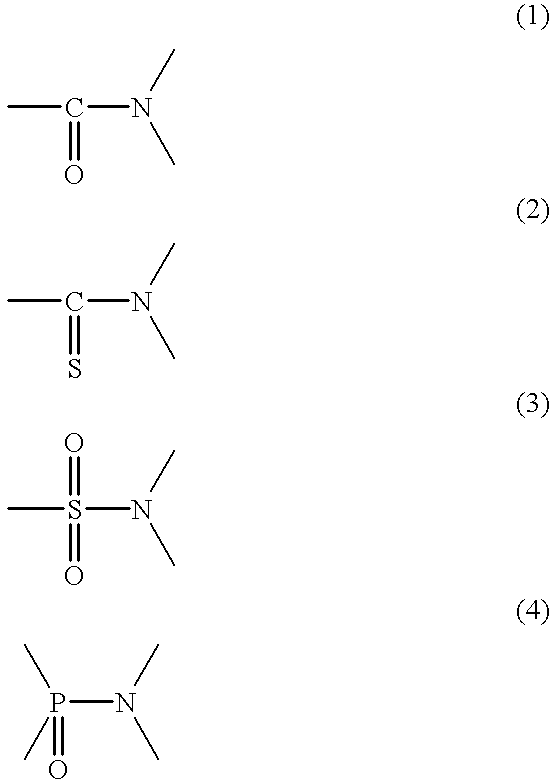
Furthermore, the present invention also relates to a prepreg formed by impregnating reinforcing fiber with the aforesaid resin composition and to carbon fiber reinforced composite materials comprising reinforcing fiber and a cured aforesaid thermosetting resin composition.
In accordance with the present invention, there can be obtained a thermosetting resin composition where the adhesion to reinforcing fiber by the cured material and the elastic modulus of the cured material are excellent, and by using this resin composition there can be obtained carbon fiber reinforced composite materials which are excellent in their 0° compressive strength, 90° tensile strength and interlaminar shear strength, and which also have outstanding impact resistance.
Description
- The present invention relates to fiber reinforced composite materials suitable for sports applications, aerospace applications and general industrial applications, and to a thermosetting resin composition and a prepreg for obtaining these composite materials.
- On account, in particular, of their outstanding mechanical properties, fiber reinforced composite materials comprising reinforcing fiber and a matrix resin are widely employed in sports applications, aerospace applications and general industrial applications.
- In these applications, carbon fiber, aramid fiber and glass fiber are chiefly employed as the reinforcing fiber. Of these, carbon fiber is outstanding in its specific strength and specific modulus and it is particularly important in that high performance composite materials can be obtained.
- Both thermoplastic resins and thermosetting resins are used as the matrix resin, but thermosetting resins are most often employed because of their excellent impregnation of the reinforcing fiber.
- As thermosetting resins, epoxy resins, resins with a plurality of polymerizable unsaturated bonds in the molecule (vinyl ester resins, unsaturated polyester resins and the like), phenolic resins and cyanate resins are chiefly used.
- Fiber reinforced composite materials are heterogeneous materials comprising the aforesaid reinforcing fiber and matrix resin, and the adhesion between them has a considerable influence on the properties, as described below.
- In general, with a fiber reinforced composite material, the strength in the direction of the fiber orientation is high, reflecting the properties of the reinforcing fiber, but the strength in directions in which there is no fiber orientation and the shear strength are not necessarily excellent, and indeed not uncommonly they are the weak points in terms of the performance of a fiber reinforced composite material.
- Improving the adhesion between the reinforcing fiber and the matrix resin is effective in raising the strength in directions in which there is no fiber orientation and the shear strength. A known means for improving the adhesion between the reinforcing fiber and the matrix resin is surface treatment of the reinforcing fiber, for example the silane coupling agent treatment of glass fiber and the electrolytic oxidation of carbon fiber, but hardly any effective methods are known for improving the adhesion based on resin technology. In particular, in the case of carbon fiber, when adhesion is improved by electrolytic oxidation, this is at the expense of the fiber strength so that there are limits thereto, and while there has been a strong demand for alternative means for improving the adhesion, no effective means has hitherto be found.
- In U.S. Pat. No. 4,873,309, there is disclosed a resin composition comprising (a) an epoxy resin containing bromine, (b) its curing agent, and (c) monomer having at least one vinyl unsaturated bond. Specific examples here of (c), along with styrene, methyl methacrylate, acrylonitrile, vinyl acetate and many other general monomers, include acrylamide and its derivatives, and there is also mention of carbon fiber but unrelated to these. The function of (c) in that invention is as a diluent for achieving a lower viscosity, and there is no suggestion at all of combining a specific amount of acrylamide or derivative thereof and carbon fiber, nor that the combination thereof differs from combinations of carbon fiber and other general monomers in that a dramatic effect is shown in terms of improving adhesion and enhancing the elastic modulus, and so the invention in no way relates to the concept of the present invention. Again, the fact that a comparatively large amount of (c) is added in that invention differs from the incorporation of a relatively small amount of component (B) in the present invention.
- On the other hand, in U.S. Pat. No. 4,230,766, there is described an example in which a composition comprising thermosetting resin and vinyl pyrrolidone is used to impregnate carbon fiber, then the composition partially cured by light irradiation, after which hot curing is performed and a fiber reinforced composite material obtained. However, in that example, the amount of vinyl pyrrolidone added is excessive, and there is absolutely no suggestion that by adding a specific amount there is a dramatic effect in terms of improving the adhesion and enhancing the elastic modulus without impairing other physical properties.
- The objective of the present invention is to offer a thermosetting resin composition for fiber reinforced composite materials where the cured product thereof shows outstanding adhesion to the reinforcing fiber, in particular carbon fiber, together with a prepreg employing said resin composition and carbon fiber reinforced composite materials of outstanding properties obtained using same.
- In order to realise these objectives, the thermosetting resin composition for carbon fiber reinforced composite materials of the present invention comprises the following components.
- (A) Thermosetting resin
- (B) Compound having one functional group which can react with thermosetting resin (A), or its curing agent, and which contains a moiety selected from the following formulae (1) to (4)

- Furthermore, the prepreg of the present invention is a prepreg formed by the impregnation of reinforcing fiber with the aforesaid resin composition, and the carbon fiber reinforced composite materials of the present invention are carbon fiber reinforced composite materials comprising cured aforesaid thermosetting resin composition and reinforcing fiber.
- FIG. 1 is a schematic diagram of a polymer network.
- FIG. 2 shows the state of carbon fiber strands wound by means of a drum winder.
- FIG. 3 shows equipment employed in the preparation of a unidirectional composite material.
-
1: a functional group which reacts with the thermosetting resin or its curing agent 2: a moiety represented by any of formulae (1) to (4) 3: polymer network 4: drum 5: release paper 6: carbon fibre strands 7: adhesive agent 8: cut line 9: carbon fibre sheet material 10: fixed chuck 11: moveable chuck 12: screw 13: knob 14: lower mould 15: spacer 16: upper mould - Reference to the thermosetting resin, which is component (A) in the epoxy resin composition used for fiber reinforced composite materials of the present invention, means a precursor which is thermally cured, that is to say which reacts thermally to produce a polymer with a network structure. Specific examples of thermosetting resins are epoxy resins, resins with a plurality of polymerizable unsaturated bonds in the molecule (vinyl ester resins, unsaturated polyester resins, diallyl phthalate resins, maleimide resins), phenolic resins, cyanate resins, melamine resins, urea resins, polyurethane resins, benzoxazine resins, oxazoline resins and the like.
- Of these, the epoxy resins, vinyl ester resins and unsaturated polyester resins are suitable for general applications. Phenolic resins are suitable for applications where flame retardancy is demanded, for example as building materials and aircraft interior trim materials. Cyanate resins and maleimide resins are suitable for applications where heat resistance is demanded, for example structural materials for artificial satellites.
- Component (B) is a compound which contains one functional group which can react with thermosetting resin (A) or with its curing agent, and a moiety selected from the following formulae (1) to (4).

- The structures represented by formulae (1) to (4) may also be one part of a still more complex structure. For example, typical compounds with the amide linkage represented by general formula (1) are carboxamides but, besides these, the compound may also have the amide linkage as part of a ring or more complex structure, for example it may be an imide, urethane, urea, biuret, hydantoin, carboxylic acid hydrazide, hydroxamic acid, semicarbazide, semicarbazone or the like.
- Component (B) is a compound incorporated in order to raise the adhesion to the reinforcing fiber. This component (B) reacts with the thermosetting resin or with its curing agent, so that the cured matrix resin has structures selected from general formulae (1) to (4).
- The structures selected from general formulae (1) to (4) strongly interact with the reinforcing fiber, and improve the adhesion. Effective interactions comprise the following two types.
- The first is hydrogen bonding. This is effective in cases where there are functional groups with, for example, OH or NH structures present at the reinforcing fiber surface.
- The second is electrical attraction between dipoles. The structures selected from general formulae (1) to (4) are strong permanent dipoles. Induced dipoles are produced by permanent dipoles and then electrical attraction occurs between the two. The electrical attraction between dipoles is particularly important in terms of reinforcing fibers such as carbon fiber where there are few surface functional groups and where there has been no effective means hitherto for improving adhesion.
- In order that the structures selected from general formulae (1) to (4) interact effectively with the reinforcing fiber, it is necessary to bring them into contact with the reinforcing fiber surface. Hence, component (B) has one functional group which can react with the thermosetting resin or with its curing agent. Where it has a plurality of functional groups which can react with the thermosetting resin or with its curing agent, the structures selected from general formulae (1) to (4) are readily incorporated into the interior of the network structure so that they do not readily contact the reinforcing fiber surface (FIG. 1A). Where there is one reactable functional group, the structures selected from general formulae (1) to (4) are not bound within the network and so readily contact the reinforcing fiber surface (FIG. 1B).
- The functional group in component (B) which can react with the thermosetting resin or with its curing agent is selected according to the particular thermosetting resin employed, but it is preferred that it has relatively slow reactivity compared to the reaction of the thermosetting resin, which is the chief reaction, or compared to the reaction between the thermosetting resin and its curing agent. This is because, in such circumstances, the rate of consumption of component (B) in the initial period of the reaction is low, so that it mainly reacts in the latter period of the curing reaction, with the result that the structures selected from general formulae (1) to (4) are mostly present at the terminal regions of the network polymer, and so a considerable effect is readily obtained with just a low level of addition.
- Moreover, the incorporation of component (B) does not merely improve the adhesion, but also has the effect of raising the elastic modulus of the cured thermosetting resin composition. This is thought to be because the structures selected from general formulae (1) to (4) produce powerful hydrogen bonding with structures such as OH and NH present in the cured material and so restrict molecular motion.
- Epoxy resins are preferably used as the thermosetting resin employed in the thermosetting resin composition for fiber reinforced composite materials of the present invention. Epoxy resin means a compound having two or more epoxy groups in the molecule.
- Specifically, there may be used a glycidyl ether obtained from a polyol, a glycidyl amine obtained from an amine with a plurality of active hydrogens, a glycidyl ester obtained from a polycarboxylic acid, a polyepoxide obtained by the oxidation of a compound with a plurality of double bonds in the molecule, or the like.
- As specific examples of glycidyl ethers, there are the following.
- Firstly, there are bisphenol type epoxy resins such as the bisphenol A type epoxy resins obtained from bisphenol A, the bisphenol F type epoxy resins obtained from bisphenol F, the bisphenol S type epoxy resins obtained from bisphenol S and the tetrabromobisphenol A type epoxy resins obtained from tetrabromobisphenol A. Examples of bisphenol A type epoxy resin commercial products are “Epikote” 825 (epoxy equivalent 172-178), “Epikote” 828 (epoxy equivalent 184-194), “Epikote” 834 (epoxy equivalent 230-270), “Epikote” 1001 (epoxy equivalent 450-500), “Epikote” 1002 (epoxy equivalent 600-700), “Epikote” 1003 (epoxy equivalent 670-770), “Epikote” 1004 (epoxy equivalent 875-975), “Epikote” 1007 (epoxy equivalent 1750-2200), “Epikote” 1009 (epoxy equivalent 2400-3300), “Epikote” 1010 (epoxy equivalent 3000-5000) (the above are made by Yuka Shell Epoxy K.K.), “Epotohto” YD-128 (epoxy equivalent 184-194), “Epotohto” YD-011 (epoxy equivalent 450-500), “Epotohto” YD-014 (epoxy equivalent 900-1000), “Epotohto” YD-017 (epoxy equivalent 1750-2100), “Epotohto” YD-019 (epoxy equivalent 2400-3000), “Epotohto” YD-022 (epoxy equivalent 4000-6000) (the above are made by the Tohto Kasei Co.), “Epiclon” 840 (epoxy equivalent 180-190), “Epiclon” 850 (epoxy equivalent 184-194), “Epiclon” 830 (epoxy equivalent 165-185), “Epiclon” 1050 (epoxy equivalent 450-500), “Epiclon” 3050 (epoxy equivalent 740-860), “Epiclon” HM-101 (epoxy equivalent 3200-3900) (the above are made by Dainippon Ink & Chemicals Inc.), “Sumi-epoxy” ELA-128 (epoxy equivalent 184-194, made by the Sumitomo Chemical Co.) and DER331 (epoxy equivalent 182-192, made by the Dow Chemical Co.). Examples of bisphenol F type epoxy resin commercial products are “Epikote” 806 (average epoxy equivalent 160-170), “Epikote” 807 (epoxy equivalent 160-175), “Epikote” E4002P (epoxy equivalent 610), “Epikote” E4003P (epoxy equivalent 800), “Epikote” E4004P (epoxy equivalent 930), “Epikote” E4007P (epoxy equivalent 2060), “Epikote” E4009P (epoxy equivalent 3030), “Epikote” E4010P (epoxy equivalent 4400) (the above are made by Shell Yuka Epoxy K.K.), “Epiclon” 830 (epoxy equivalent 165-180, made by Dainippon Ink and Chemicals Inc.), “Epotohto” YDF-2001 (epoxy equivalent 450-500) and “Epotohto” YDF-2004 (epoxy equivalent 900-1000) (the above are made by the Tohto Kasei Co.). An example of a bisphenol S type epoxy resin commercial product is “Denacol” EX-251 (made by Nagase Chemicals Ltd., epoxy equivalent 189). Examples of tetrabromobisphenol A type epoxy resin commercial products are “Epikote” 5050 (made by Yuka Shell Epoxy K.K., epoxy equivalent 380-410), “Epiclon” 152 (made by Dainippon Ink & Chemicals Inc., epoxy equivalent 340-380), “Sumi-epoxy” ESB-400T (made by the Sumitomo Chemical Co., epoxy equivalent 380-420) and “Epotohto” YBD-360 (made by Tohto Kasei Co., epoxy equivalent 350-370).
- Again, there are the novolak type epoxy resins which are the glycidyl ethers of novolaks obtained from phenol or phenol derivatives such as alkylphenols, halophenols and the like. As examples of novolak type epoxy resin commercial products, there are “Epikote” 152 (epoxy equivalent 172-179), “Epikote” 154 (epoxy equivalent 176-181) (these are made by Yuka Shell Epoxy K.K.), DER438 (epoxy equivalent 176-181, made by the Dow Chemical Co.), “Araldite” EPN1138 (epoxy equivalent 176-181, made by Ciba), “Araldite” EPN1139 (epoxy equivalent 172-179, made by Ciba), “Epotohto” YCPN-702 (epoxy equivalent 200-230, made by the Tohto Kasei Co.) and Bren-105 (epoxy equivalent 262-278, made by the Nippon Kayaku Co.).
- Additionally, there are the resorcinol diglycidyl ether “Denacol” EX-201 (made by Nagase Chemicals Ltd., epoxy equivalent 118), the hydroquinone diglycidyl ether “Denacol” EX-203 (made by Nagase Chemicals Ltd., epoxy equivalent 112), the 4,4′dihydroxy-3,3′,5,5′-tetramethylbiphenyldiglycidyl ether “Epikote” YX4000 (made by Yuka Shell Epoxy, epoxy equivalent 180-192), the 1,6-dihydroxynaphthalene diglycidyl ether “Epiclon” HP-4032H (made by Dainippon Ink & Chemicals Inc., epoxy equivalent 250), the 9,9-bis(4-hydroxyphenylfluorene diglycidyl ether “Epon” HPT Resin 1079 (made by Shell, epoxy equivalent 250-260), the tris(p-hydroxyphenyl)methane triglycidyl ether TACTIX 74 (made by the Dow Chemical Co., epoxy equivalent 150-157), the tetrakis(p-hydroxyphenyl)ethane tetraglycidyl ether “Epikote” 1031S (made by Yuka Shell Epoxy K.K., epoxy equivalent 196), the glycerol triglycidyl ether “Denacol” EX-314 (made by Nagase Chemicals Ltd., epoxy equivalent 145), the pentaerythritol tetraglycidyl ether “Denacol” EX-411 (made by Nagase Chemicals Ltd., epoxy equivalent 231), and the oxazolidone type epoxy resins XAC4151 (made by Asahi-CIBA Ltd., epoxy equivalent 412) and XAC4152 (made by Asahi-CIBA Ltd., epoxy equivalent 338) which are obtained by the reaction between a bisphenol A type epoxy resin and a bifunctional isocyanate.
- Specific examples of the glycidyl amines are diglycidylaniline, the tetraglycidyldiaminodiphenylmethane “Sumi-epoxy” ELM434 (made by the Sumitomo Chemical Co., epoxy equivalent 110-130), and the tetraglycidyl m-xylylenediamine TETRAD-X (made by Mitsubishi Gas Chemical Co., epoxy equivalent 90-105).
- Furthermore, as examples of epoxy resins which combine both glycidyl ether and glycidyl amine structures, there are the triglycidyl-m-aminophenol “Sumi-epoxy” ELM120 (epoxy equivalent 118, made by the Sumitomo Chemical Co.) and the triglycidyl-p-aminophenol “Araldite” MY0510 (made by Ciba-Geigy, epoxy equivalent 94-107).
- Specific examples of glycidyl esters are diglycidyl phthalate, diglycidyl terephthalate and the diglycidyl ester of dimer acid.
- Moreover, as an example of an epoxy resin with glycidyl groups other than these, there is triglycidylisocyanurate.
- As examples of polyepoxides obtained by the oxidation of compounds with a plurality of double bonds in the molecule, there are epoxy resins with an epoxycyclohexane ring, specific example of which are Union Carbide's ERL-4206 (epoxy equivalent 70-74), ERL-4221 (epoxy equivalent 131-143) and ERL-4234 (epoxy equivalent 133-154). Another example is epoxidized soybean oil.
- The epoxy resin is used in combination with a curing agent. As examples of the curing agent, there are aromatic amines with active hydrogen such as 4,4′-diaminodiphenylmethane, 4,4′-diaminodiphenylsulphone, 3,3′-diaminodiphenylsulphone, m-phenylenediamine, m-xylylenediamine and the like, aliphatic amines with active hydrogen such as diethylenetriamine, triethylenetetramine, isophoronediamine, bis(aminomethyl)norbomane, bis(4- aminocyclohexyl)methane, polyethyleneimine dimer acid ester and the like, modified amines obtained by the reaction of these active hydrogen-containing amines with an epoxy compound, acrylonitrile, phenol and formaldehyde, thiourea and the like, tertiary amines without active hydrogen such as dimethylaniline, dimethylbenzylamine, 2,4,6-tris(dimethylaminomethyl)phenol and 1-substituted imidazole, dicyandiamide, tetramethylguanidine, carboxylic acid anhydrides such as hexahydrophthalic anhydride, tetrahydrophthalic anhydride, methylhexahydrophthalic anhydride, methylnadic anhydride and the like, polycarboxylic acid hydrazides such as adipic acid hydrazide and naphthalenedicarboxylic acid hydrazide, polyphenol compounds such as novolak resins, polymercaptans such as the esters of thioglycolic acids and polyols, Lewis acid complexes such as boron trifluoride ethylamine complex, and aromatic sulphonium salts.
- These curing agents can be combined with suitable curing auxiliaries to increase the curing activity. Preferred examples thereof are the combination of a urea derivative such as 3-phenyl-1,1-dimethylurea, 3-(3,4-dichlorophenyl)-1,1-dimethylurea (DCMU), 3-(3-chloro-4-methylphenyl)-1,1-dimethylurea or 2,4-bis(3,3-dimethylureido)toluene as a curing auxiliary with dicyandiamide, and the combination of a tertiary amine as a curing auxiliary with a carboxylic acid anhydride or novolak resin. The compounds used as curing auxiliaries often have the capacity to cure epoxy resins by themselves.
- Where component (A) is an epoxy resin, the following are preferred examples of the functional group in component (B) which can react with (A) or with its curing agent. They include functional groups which can react with the epoxy resin such as the carboxyl group, phenolic hydroxyl group, amino group, secondary amine structure, mercapto group and epoxy group.
- As compounds with one group selected from the carboxyl group, phenolic hydroxyl group, amino group, secondary amine structure, mercapto group and epoxy group, there can be used those represented by general formula (6) or (7) below.

- (Here, X represents one of the following,

- where R 4 represents an alkyl group or aryl group.
- Y represents —O— or —NR 5—, where R5 represents an alkyl group or aryl group, and n represents 0 or 1.
- R 1 represents a divalent group derived from a hydrocarbon, and m represents 0 or 1. Z represents a carboxyl group, phenolic hydroxyl group, amino group, mercapto group, —NHR 6 or

- where R 6, R7, R8 and R9 each represent hydrogen, an alkyl group or an aryl group.
- R 2 represents hydrogen, an alkyl group or an aryl group, R3 represents hydrogen, an alkyl group, aryl group, —WR10, —W—OR11 or —W—NR12R13, where R10 and R11 each represent an alkyl group or an aryl group, R12 and R13 each represent hydrogen, an alkyl group or an aryl group, and W represents —CO— or —SO2—.
- The aforesaid alkyl groups, aryl groups and R 1 may also have substituent groups selected from alkyl groups, aryl groups, halogens and alkoxy groups. In addition, any two of R1, R2, R3, R5 and R6 may form a ring.)

- (Here, X represents one of the following,

- where R 17 represents an alkyl group or aryl group, and n represents 0 or 1.
- R 14 represents a divalent group derived from a hydrocarbon, and m represents 0 or 1.
- Z represents a carboxyl group, phenolic hydroxyl group, amino group, mercapto group , —NHR 18 or

- where R 18, R19, R20 and R21 each represent hydrogen, an alkyl group or an aryl group. R15 represents an alkyl group or an aryl group, and R16 represents hydrogen, an alkyl group, aryl group or acyl group.
- The aforesaid alkyl groups, aryl groups and R 14 may also have substituent groups selected from alkyl groups, aryl groups, halogens and alkoxy groups. In addition, any two of R14, R15, R16 and R18 may form a ring.)
- As specific examples of the compounds represented by general formula (6) having one carboxyl group, there are oxamic acid, succinamidic acid, 2-(phenylcarbamoyloxy)propionic acid and 5-hydantoinacetic acid.
- As specific examples of the compounds represented by general formula (7) having one carboxyl group, there are N-acetylglycine, N-acetylalanine, 4-acetamidobenzoic acid, N-acetylanthranilic acid, 4-acetamidobutyric acid, 6-acetamidohexanoic acid, hippuric acid, pyroglutamic acid, N-tosylglycine and N-dimethylphosphinoylglycine.
- As specific examples of the compounds represented by general formula (6) having one phenolic hydroxyl group, there are salicylamide, 4-hydroxybenzamide and 4-hydroxyphenylacetamide.
- As specific examples of the compounds represented by general formula (7) having one phenolic hydroxyl group, there are 4-hydroxyacetanilide, 3-hydroxyacetanilide and N-acetyltyramine.
- As specific examples of the compounds represented by general formula (6) having one amino group, there are 4-aminobenzamide, 3-aminobenzamide, 4-aminobutyramide, 6-aminohexanoamide, 3-aminophthalimide, 4-aminophthalimide, sulphanilamide, 1-butyl-3-sulphanilylurea, asulam, Fast Red ITR base, FGL base and 2-amino-N-ethyl-N-phenylbenzenesulphonamide.
- As specific examples of the compounds represented by general formula (7) having one amino group, there are 4′-aminoacetanilide, 4′-amino-N-methylacetanilide and 3′-aminopropionanilide.
- As specific examples of the compounds represented by general formula (6) having one secondary amine structure, there are nipecotamide, N,N-diethylnipecotamide and isonipecotamide.
- As specific examples of the compounds represented by general formula (7) having one secondary amine structure, there are 1-acetylpiperazine and 1-tosylpiperazine.
- As specific examples of the compounds represented by general formula (7) having one mercapto group, there are 4-acetamidothiophenol and N-(2-mercaptoethyl)acetamide.
- As specific examples of the compounds represented by general formula (6) having one epoxy group, there are glycidamide, N-phenylglycidamide, N,N-diethylglycidamide, N-methoxymethylglycidamide, N-hydroxymethylglycidamide, 2,3 -epoxy-3-methylbutyramide, 2,3-epoxy-2-methylpropionamide and 9,10-epoxystearamide.
- As a specific example of the compounds represented by general formula (7) having one epoxy group, there is N-glycidylphthalimide.
- As well as the compounds represented by general formulae (6) and (7) above, as compounds with one amino group there are hydrazides, specific examples of which are acetohydrazide, benzohydrazide, 3-aminorhodanine and benzenesulphohydrazide.
- A double bond conjugated with a carbonyl group is an example of a functional group which can react with the curing agent. The carbonyl group and conjugated double bond undergo a Michael type addition reaction with amino or mercapto groups in the curing agent.
- As compounds with one double bond conjugated with a carbonyl group, there are the compounds represented by general formulae (8) or (9).

- (Here, X represents one of the following

- where R 28 represents an alkyl group or aryl group.
- Y represents —O— or —NR 29—, where R29 represents an alkyl group or aryl group, and n is 0 or 1.
- R 22 represents a divalent group derived from a hydrocarbon, R23, R24 and R25 each represent hydrogen, an alkyl group or an aryl group, R26 represents hydrogen, an alkyl group or an aryl group, R27 represents hydrogen, an alkyl group, an aryl group, —WR30, —W—OR31 or —W—NR32R33, where R30 and R31 represent an alkyl group or aryl group, R32 and R33 represent hydrogen, an alkyl group or aryl group, and W represents —CO— or —SO2—.
- The aforesaid alkyl groups, aryl groups and R 18 may also have substituent groups selected from alkyl groups, aryl groups, halogens and alkoxy groups. In addition, any two of R22, R23, R24, R25, R26, R27, and R29 may form a ring.)

- (Here, X represents any of the following,

- where R 40 represents an alkyl group or aryl group, and n represents 0 or 1.
- R 34 represents a divalent group derived from a hydrocarbon.
- R 35, R36 and R37 each represent hydrogen, an alkyl group or an aryl group.
- R 38 represents an alkyl group or aryl group, and R39 represents hydrogen, an alkyl group, an aryl group or an acyl group.
- The aforesaid alkyl groups, aryl groups and R 34 may also have substituent groups selected from alkyl groups, aryl groups, halogens and alkoxy groups. In addition, any two of R34, R35, R36, R37, R38 and R39 may form a ring.)
- Furthermore, in the compound with one double bond conjugated with a carbonyl group, the carbonyl group conjugated with the double bond may also be the same as the carbonyl group of the structure represented by general formula (1). That is to say, the compound may also have a moiety represented by formula (5).
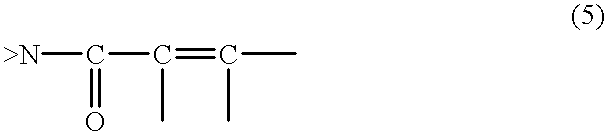
- As a compound with a moiety represented by formula (5), there can be used a compound represented by general formula (10).
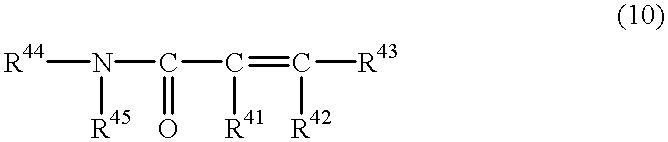
- (Here, R 41, R42 and R43 each represent hydrogen, an alkyl group or an aryl group.
- R 44 represents hydrogen, an alkyl group or an aryl group, and R45 represents hydrogen, an alkyl group, an aryl group, —WR46, —W—OR47 or —W—NR48R49, where R46 and R47 each represent an alkyl group or aryl group, R48 and R49 each represent hydrogen, an alkyl group or an aryl group, and W represents —CO— or —SO2—.
- The aforesaid alkyl groups and aryl groups may also have substituent groups selected from alkyl groups, aryl groups, halogens and alkoxy groups. In addition, any two of R 41, R42, R43, R44 and R45 may form a ring.)
- As the compound with a moiety represented by formula (5), it is also possible to use maleimide or a maleimide derivative having an alkyl group or aryl group as a substituent.
- Specific examples of the compounds represented by general formula (8) are 2-(phenylcarbamoyloxy)ethyl methacrylate, 2-(methacryloyloxy)propionamide, 2-(phenylureido)ethyl methacrylate, lactamide acrylate, lactamide methacrylate, 2-(dimethylthiocarbamoyloxy)ethyl methacrylate and 2-(tosylcarbamoyloxy)ethyl methacrylate.
- Specific examples of the compounds represented by general formula (9) are 2-(methoxycarbonylamino)ethyl methacrylate and 2-(phenoxycarbonylamino)ethyl methacrylate.
- Specific examples of the compounds represented by general formula (10) are acrylamide, methacrylamide, crotonamide, cinnamamide, N,N-dimethylacrylamide, N,N-diethylacrylamide, N-tert-butylacrylamide, N-isopropylacrylamide, N-butylacrylamide, N-hydroxymethylacrylamide, N-methoxymethylacrylamide, diacetone acrylamide, 1-acryloylmorpholine, 1,2,3,6-tetrahydrophthalimide and nadimide.
- As maleimide derivatives with an alkyl or aryl substituent group, there are N-ethylmaleimide, N-isopropylmaleimide and N-phenylmaleimide.
- Where there is a low blended amount of component (B) in the case where component (A) is an epoxy resin, there is little adhesion improvement effect, while if the amount is high then the heat resistance of the cured material is reduced. Thus, the blended proportion of component (B), per 100 parts by weight of the epoxy resin which constitutes component (A), needs to be from 0.5 to 20 parts by weight, with the range 0.5 to 15 parts by weight being preferred and 0.5 to 5 parts by weight being further preferred.
- A compound with a plurality of polymerizable unsaturated bonds is also favourably employed as the thermosetting resin used in the thermosetting resin composition for fiber reinforced composite materials of the present invention. A compound with ester linkages is preferably used as this compound with a plurality of polymerizable unsaturated bonds in the molecule.
- A first specific example of such a component (A) having ester linkages is an unsaturated polyester resin. Unsaturated polyester resins are polyesters based on a polycarboxylic acid with a polymerizable unsaturated bond or derivative thereof (an ester or anhydride) as the raw material. They are obtained, for example, by the polymerization of the polycarboxylic acid with a polymerizable unsaturated bond, or derivative thereof, and a polyol, in certain cases with the addition of a polycarboxylic acid which does not have a polymerizable unsaturated bond or derivative thereof.
- As the polycarboxylic acid with a polymerizable unsaturated bond referred to here, there can be used one or more of maleic acid, fumaric acid, itaconic acid, tetrahydrophthalic acid, methyltetrahydrophthalic acid, nadic acid and HET acid.
- As the polycarboxylic acid without a polymerizable unsaturated bond, there can be used, for example, phthalic acid, isophthalic acid, terephthalic acid, adipic acid, sebacic acid or a derivative of these.
- As the polyol raw material of the unsaturated polyester resin, there can be used ethylene glycol, propylene glycol, diethylene glycol, dipropylene glycol, neopentyl glycol, 1,3-butanediol, 1,6-hexanediol, bisphenol A, tetrabromobisphenol A, hydrogenated bisphenol A, dibromoneopentylglycol, bisphenol A/propylene oxide adduct, pentaerythritol diallyl ether and the like.
- Unsaturated polyester resins are marketed as a pure product or as a solution diluted with styrene or the like.
- As examples of commercially available pure products, there can be used “Atlac” 382E, “Dion” 6694G, and “Atlac” 711A (made by Reichold Chemicals Inc.) and, as examples of styrene solutions, there can be used “Upica” 5524P (made by Nippon Upica), “Polylite” FG-104 (made by Dainippon Ink & Chemicals Inc.), “Estar” R2110 (made by Mitsui Toatsu Chemicals Inc.), “Epolac” G-110AL (made by the Nippon Shokubai Co.), “Polymal” P-503 (made by Takeda Chemical Industries Ltd.), “Rigolac” 1557 (made by the Showa Highpolymer Co.) and “Polyset” 6120 (made by Hitachi Chemical Co. Ltd.).
- A second specific example of a component (A) with ester linkages is a vinyl ester resin. As vinyl ester resins, there can be used the ester compounds obtained by the addition of a monocarboxylic acid with a polymerizable unsaturated bond to a compound with a plurality of epoxy groups (an epoxy resin).
- As the epoxy resin raw material of the vinyl ester resin, there can be used bisphenol A diglycidyl ether, tetrabromobisphenol A diglycidyl ether, resorcinol diglycidyl ether, novolak diglycidyl ether, phthalic acid diglycidyl ester, tetraglycidyl-m-phenylenediamine or the like.
- As the monocarboxylic acid with a polymerizable unsaturated bond which comprises a raw material for the vinyl ester resin, there can be used acrylic acid or methacrylic acid.
- An alternative known method for the synthesis of a vinyl ester resin is the method of reacting glycidyl acrylate or glycidyl methacrylate with a polyphenol or amine compound. For example, if glycidyl methacrylate is reacted with bisphenol A, there is obtained the same reaction product as the reaction product of bisphenol A diglycidyl ether and methacrylic acid.
- Vinyl ester resins are marketed as pure products or as solutions diluted with styrene or the like. As examples of vinyl esters based on bisphenol A diglycidyl ether as the raw material, there are the pure products “Epoxyester” 3000A and “Epoxyester” 3000M (made by the Kyoeisha Chemical Co.) and the styrene solutions “Ripoxy” R-803 (made by the Showa Highpolymer Co.), “Neopol” 8250 (made by Nippon Upica), “Estar” H6700 (made by Mitsui Toatsu Chemicals Inc.) and “Derakane” 411-45 (made by Dow Plastics).
- As examples of styrene solutions of vinyl esters based on a novolak glycidyl ether as raw material, there can be used “Ripoxy” H-600 (made by the Showa Highpolymer Co.), “Neopol” 8411 (made by Nippon Upica), “Estar” H8100 (made by Mitsui Toatsu Chemicals Inc.) and “Derakane” 470-300 (made by Dow Plastics).
- As examples of styrene solutions of vinyl esters based on tetrabromobisphenol A diglycidyl ether as raw material, there can be used “Ripoxy” S-510 (made by the Showa Highpolymer Co.), “Neopol” 8190 (made by Nippon Upica) and “Derakane” 510A-40 (made by Dow Plastics).
- A third specific example of component (A) with ester linkages is an allyl resin. Allyl resins are allyl esters of polycarboxylic acids or oligomers thereof. As the polycarboxylic acid, there is used phthalic acid, isophthalic acid, tetrabromophthalic acid or the like. Diallyl phthalate and diallyl isophthalate are marketed by the Osaka Soda Co.
- Besides these, 1,6-hexanediol diacrylate, trimethylolpropane triacrylate and the like can also be used as component (A) with ester linkages.
- Furthermore, as component (A) without ester linkages, there can be used triallyl isocyanurate, divinylbenzene and the like.
- In the case where compositional element (A) is a compound with a plurality of polymerizable unsaturated bonds in the molecule, there is used as component (B) a compound having one polymerizable unsaturated bond and one or more moiety selected from formulae (1) to (4) in the molecule.
- A compound with a structure represented by formula (5) is preferably used as said component (B).
- As the compound with a structure represented by formula (5), there can be used a compound represented by general formula (10), or maleimide or a maleimide derivative having an alkyl group or aryl group substituent.
- As said component (B), there can also be used the compounds represented by general formulae (8), (9) and (11).

- (Here, X represents one of the following,

- where R 53 represents an alkyl group or aryl group.
- R 50 represents an alkenyl group,
- R 51 represents hydrogen, an alkyl group, an aryl group, —WR54, —W—OR55 or —W—NR56R57, where R54 and R55 each represent an alkyl group or aryl group, R56 and R57 each represent hydrogen, an alkyl group or an aryl group, and W represents —CO— or —SO2—.
- R 52 represents an alkyl group, an aryl group, —OR58 or —NR59R60. R58 represents an alkyl group or an aryl group, R59 represents hydrogen, an alkyl group or an aryl group, R60 represents hydrogen, an alkyl group, an aryl group, —VR61, —V—OR62 or —V—NR63R64, where R61 and R62 each represent an alkyl group or aryl group, R63 and R64 each represent hydrogen, an alkyl group or aryl group, and V represents —CO— or —SO2—.
- The aforesaid alkyl groups, aryl groups and alkylene groups may also have substituent groups selected from alkyl groups, aryl groups, halogens and alkoxy groups. In addition, any two of R 50, R51 and R52 may form a ring.)
- As specific examples of the compounds represented by general formula (11), there are N-allylacetamide, N-allylbenzamide, N-vinylpyrrolidone, N-allylsuccinimide, allylurea, 1-allyl-3-phenylurea, 1-allylhydantoin, phenyl allylcarbamate, allylthiourea, N-allyltoluenesulphonamide, methanesulphinic acid allyl amide.
- There can also be used, as component (B), allyl phenylcarbamate, acrolein semicarbazone and the like
- In the case where component (A) is a compound with a plurality of polymerizable unsaturated bonds in the molecule, the thermoplastic resin composition for fiber reinforced composite materials of the present invention can contain a component (F), which is a polymerizable monomer having one polymerizable unsaturated bond in the molecule but which, unlike component (B), does not contain a structure selected from the formulae (1) to (4). Said component (F) is a useful component for adjustment of the viscosity. As specific examples of component (F), there are styrene, vinyltoluene, chlorostyrene, methyl methacrylate, butyl methacrylate and the like. Of these, styrene is preferably employed.
- The preferred blending ratios of components (A), (B) and (E) in the thermosetting resin composition in the case where component (F) is employed are as follows.
- (A)/[(A)(B)+(F)]=0.3 to 0.8
- (B)/[(A)(B)+(F)]=0.05 to 0.4
- (E)/[(A)(B)+(F)]=0 to 0.6
- In the case where component (A) is a compound containing a plurality of polymerizable unsaturated bonds in the molecule, the thermosetting resin composition for fiber reinforced composite materials of the present invention will contain a component (D), namely a thermolytic polymerization initiator. This undergoes decomposition by thermal reaction, generating radicals, and has the function of initiating the radical polymerization of components (A), (B) and (F). Organic peroxides are preferably used as said component (D). Reference here to an organic peroxide is to an organic compound having an oxygen-oxygen bond.
- There can be used as said organic peroxide, for example, benzoyl peroxide, methyl ethyl ketone peroxide, cyclohexanone peroxide, methyl acetoacetate peroxide, acetylacetone peroxide, cumene hydroperoxide, dicumyl peroxide, 1,1-bis(t-butylperoxy)-3,3,5-trimethylcyclohexane, bis(4-t-butylcyclohexyl)peroxydicarbonate, t-butyl peroxybenzoate, t-butyl peroxybenzoate, t-butyl peroxypivalate, t-butyl-peroxy-2-ethylhexanoate or t-butylhydroperoxide.
- As well as the aforesaid organic peroxides, azo compounds such as azobisisobutyronitrile and 2,2-azobis(4-methoxy-2,4-dimethylvaleronitrile) can also be used as said component (D).
- In the thermosetting resin composition of the present invention, along with component (D), there may be included component (E), which is an accelerator therefor. This component (E) is not an essential component but, when said component (E) is also present, the rate of decomposition of component (F) is considerably increased compared to when it is used alone. For example, in the case where the thermosetting resin composition is to be cured at a temperature of 80° C. or below, a formulation employing both component (D), which has comparatively good thermal stability, and component (E) is useful.
- As said component (E), there is preferably used a cobalt salt, for example cobalt naphthenate, cobalt octanoate or cobalt stearate.
- There can also be incorporated into the thermosetting resin composition of the present invention an accelerator auxiliary for controlling the acceleration action of component (E). As this accelerator auxiliary, there can be used acetylacetone, N,N-dimethylacetoacetamide, dimedone, dibenzoylmethane, 2-acetylcyclopentanone, ethyl acetoacetate or other such 1,3-dicarbonyl compound, dimethylaniline or other such aromatic tertiary amine, triphenylphosphine or a metal (e.g. calcium, strontium, barium or manganese) salt of carboxylic acid.
- In the case where component (A) is a compound with a plurality of polymerizable unsaturated groups in the molecule, there can also be incorporated a polymerization inhibitor into the thermosetting resin composition of the present invention for the purposes of enhancing the storage stability and the period of possible use. As said polymerization inhibitor, there can be used, for example, p-benzoquinone, 2,5-diphenyl-p-benzoquinone, hydroquinone, t-butylhydroquinone, trimethylhydroquinone, 2,5-di-t-butylhydroquinone, p-t-butylcatechol, t-butylhydroxyanisole (BHA) or di-t-butylhydroxytoluene (BHT).
- Phenolic resins can also be used as component (A). As the phenolic resins, those with a hydroxymethyl group, that is to say resol resins, are preferably employed. In such circumstances, as component (B) there is preferably used a phenol derivative having a structure selected from formulae (1) to (4) in a substituent group. In this case, the benzene ring with a hydroxyl group corresponds to the functional group which reacts with the resol resin. Specifically, there can be used salicylamide, 4-hydroxybenzamide, 4-hydroxyphenylacetamide, 4-hydroxyacetanilide, 3-hydroxyacetanilide, N-acetyltyramine and the like.
- It is also possible to incorporate other components such as polymer compounds, organic or inorganic particles, dyes, surfactants, release agents, waxes and the like as optional components in the thermosetting resin composition of the present invention.
- As polymer compounds, thermoplastic resins are desirably used. By incorporating a thermoplastic resin, resin viscosity control, prepreg workability control, and the adhesion improving effect between matrix resin and reinforcing fiber are promoted.
- It is particularly preferred that the thermoplastic resin employed here has functional groups which undergo hydrogen bonding, in that there can be expected a synergistic effect in terms of the improvement in adhesion to the reinforcing fiber, which is the objective of the invention.
- Examples of hydrogen bonding groups are the alcoholic hydroxyl group, the amide linkage and the sulphonyl group.
- As examples of thermoplastic resins with alcoholic hydroxyl groups, there are polyvinyl acetal resins such as polyvinyl formal and polyvinyl butyral, polyvinyl alcohol and phenoxy resins; as examples of thermoplastic resins with amide linkages, there are polyamides and polyimides; and as an example of thermoplastic resins with sulphonyl groups, there are polysulphones. The polyamides, polyimides and polysulphones may also have functional groups such as ether linkages and carbonyl groups in the main chain. In the case of polyamides, the amide group nitrogen atom may have a substituent group.
- As examples of commercial thermoplastic resin products which are epoxy resin-soluble and which have hydrogen bonding groups, there are, in the case of the polyvinyl acetal resins, “Denka Butyrai” and “Denka Formal” (made by Denki Kagaku Kogyo K.K.) and “Vinylek” (made by the Chisso Corp.); in the case of phenoxy resins, “UCAR” PKHP (made by Union Carbide); in the case of polyamide resins, “Macromelt” (made by the Henkel Hakusui Corp.) and “Amilan” CM4000 (made by Toray Industries); in the case of polyimides, “Ultem” (made by General Electric) and “Matrimid” 5218 (made by Ciba); and in the case of polysulphones, “Victrex” (made by Mitsui Toatsu Chemicals Inc.) and “Udel” (made by Union Carbide).
- Where there is included a thermoplastic resin, using from 1 to 20 parts by weight thereof per 100 parts by weight of the thermosetting resin (A) is preferred in terms of providing suitable viscoelasticity and obtaining good composite material properties.
- Rubber particles and thermoplastic resin particles are used as the organic particles incorporated into the thermosetting resin composition of the present invention. These particles have the effect of enhancing the resin toughness and raising the impact resistance of the fiber reinforced composite material.
- Crosslinked rubber particles, and core-shell rubber particles in which some other polymer has been graft polymerized to the surface of crosslinked rubber particles, are preferably used as the rubber particles.
- As examples of commercial crosslinked rubber particles, there are XER-91 (made by the Japan Synthetic Rubber Co.) which comprises a carboxyl-modified butadiene-acrylonitrile crosslinked copolymer, and the CX-MN series (made by Nippon Shokubai Co.) and the YR-500 series (made by the Tohto Kasei Co.) which comprise acrylic rubber fine particles.
- As examples of commercial core-shell rubber particles, there are “Paraloid” EXL-2655 (made by the Kureha Chemical Industry Co.) which comprises a butadiene/alkyl methacrylate/styrene copolymer, “Staphyloid” AC-3355 and TR-2122 (made by Takeda Chemical Industries) which are acrylate ester/methacrylate ester copolymers, and “Paraloid” EXL-2611 and EXL-3387 (made by Rohm & Haas) which comprise a butyl acrylate/methyl methacrylate copolymer.
- Polyamide or polyimide particle are preferably used as the thermoplastic resin particles. As examples of commercial polyamide particles, there are SP-500 made by Toray and “Orgasol” made by Atochem.
- As inorganic particles, there can be incorporated silica, alumina, smectite, synthetic mica and the like. These inorganic particle are incorporated primarily for the purpose of rheology control, that is to say for raising the viscosity or conferring plasticity or thixotropy.
- Organic and inorganic particles are also incorporated for the purposes of coloration.
- In order to raise the 0° compressive strength or the 90° tensile strength of the fiber reinforced composite material, it is preferred that, as well as raising the viscosity between the resin and reinforcing fiber, the elastic modulus and tensile elongation of the cured resin composition also be high. The flexural modulus of the cured material is preferably at least 3.2 GPa, with at least 3.5 GPa being still further preferred. Again, the tensile elongation of the cured material is preferably at least 8%, with at least 10% being still further preferred.
- Carbon fiber is used as the reinforcing fiber in the fiber reinforced composite materials of the present invention but there is no objection to using a mixture with glass fiber, aramid fiber, boron fiber, alumina fiber, silicon carbide fiber or the like, or a mixture with more than one type of these. However, it is preferred that the reinforcing fiber be mainly carbon fiber in order to obtain molded articles of lower weight and higher durability. Moreover, in order to produce still lighter sports equipment such as golf shafts and fishing rods, it is preferred that a high modulus carbon fiber be used in the prepreg so that sufficient product stiffness is achieved with a small amount of the material. It is preferred that the elastic modulus of such carbon fiber be at least 200 GPa, with from 210 to 800 GPa being still further preferred.
- Various known methods are used in the production of the fiber reinforced composite materials of the present invention.
- As a method which is suitable for the production of sports equipment such as golf shafts, fishing rods, rackets and the like, or for the component parts of aircraft and artificial satellites, there is the method of preparing a prepreg by the impregnation of the reinforcing fiber with the epoxy resin composition, then laminating this prepreg and heating and curing, to obtain the fiber reinforced composite material.
- The form and the arrangement of the reinforcing fiber used in the prepreg is not particularly restricted and there can be used, for example, unidirectionally collimated continuous fiber, single tow, woven fabric, mat, knit, braid or the like.
- The prepreg can be produced by, for example, the wet method in which the thermosetting resin composition is dissolved in a solvent such as methyl ethyl ketone or methanol, to lower the viscosity, after which impregnation is effected, or by the hot melt method in which the viscosity of the resin is lowered by heating and then impregnation effected.
- The wet method is a method in which, following the impregnation of the reinforcing fiber with the epoxy resin of reduced viscosity, it is withdrawn and the solvent evaporated off using an oven or the like.
- In the hot melt method, the prepreg is produced either by directly impregnating the reinforcing fiber with the epoxy resin composition which has been heated to reduce its viscosity, or alternatively coated film of the epoxy resin composition is firstly produced on release paper or the like, and then said film placed on one or both sides of the reinforcing fiber and heat and pressure applied to effect impregnation of the resin. The hot melt method is preferred in that there is no residual solvent in the prepreg.
- The molding of the composite using the prepreg can be carried out for example by laminating of the prepreg, after which the resin is heated and cured while applying pressure to the laminated material.
- For the purposes of applying heat and pressure, there can be used the press method, autoclave method, bagging method, wrapping tape method or internal pressure method, with the wrapping tape method and the internal pressure method being particularly preferred for sports equipment.
- The wrapping tape method is a method in which the prepreg is wound onto a mandrel or the like, to form a cylindrically shaped article, and this method is preferably used when producing rod-shaped bodies such as a golf shaft or fishing rod. Specifically, the prepreg is wound around the mandrel and then, in order to fix the prepreg and apply pressure, wrapping tape comprising a thermoplastic film is wound around the outside of the prepreg. After heating and curing the resin in an oven, the mandrel is removed and a cylindrically-shaped molded body obtained.
- The internal pressure method is a method in which a preform, produced by winding a prepreg onto a bladder comprising a thermoplastic resin tube or the like, is set in a mold and then, at the same time as applying pressure by the introduction of a high pressure gas into the bladder, the mold is heated and molding performed. This method is suitably used for the molding of complex shaped articles such as golf shafts, bats, and tennis, badminton and other types of racket.
- When using the thermosetting resin composition of the present invention for a prepreg, if the viscosity is low then prepreg shape retention is difficult or suitable tackiness is not obtained. Again, if the viscosity is high, the complex viscosity in the case where dynamic viscoelasticity measurement is carried out at 25° C. and 0.5 Hz is preferably from 10,000 to 300,000 Pa.s, with the range from 50,000 to 300,000 being still further preferred.
- Furthermore, fiber reinforced composite materials can also be prepared by methods which do not employ a prepreg, whereby the reinforcing fiber is directly impregnated with the thermosetting resin composition of the present invention and then heating and curing performed, for example by means of a molding method such as a hand lay-up method, filament winding method, pultrusion method or liquid composite molding method. With these, the thermosetting resin composition can be prepared directly before use.
- Liquid composite molding methods are methods for producing a fiber reinforced composite material by injecting the thermosetting resin composition in the liquid state into a preform comprising the reinforcing fiber. On account of their good productivity and the fact that it is possible to mold complex-shaped members, these are important molding methods industrially. Liquid composite molding methods include the RTM method, the SRIM method, the VaRTM method and the SCRIMP method, etc.
- In cases where the thermosetting resin composition of the present invention is used in a liquid composite molding method, a low viscosity is preferred. This is because, if the viscosity is high, the injection takes time and productivity is lowered. Moreover, if the injection takes too long a time, the resin viscosity increases due to thermal reaction during the injection process and the resin fluidity is impaired, so that the molding itself becomes impossible. In the measurement of the viscosity of such low viscosity resins, it is appropriate to use a rotational viscometer. Specifically, the viscosity measured at 25° C. and 60 rpm using a rotational viscometer is preferably from 0.01 to 1.0 Pa.s and more preferably from 0.01 to 0.7 Pa.s.
- Again, in the case where the thermosetting resin composition of the present invention is used in a liquid composite molding method, ideally it is a Newtonian fluid and it is preferred that the shear rate dependency of the apparent viscosity be low. Moreover, it is also preferred that the thixotropy, that is to say the property whereby the apparent viscosity depends on the shear rate history, be low. Consequently, it is preferred that it does not contain particles such as fumed silica, smectite or carbon black which enhance thixotropy. This is because resins of the kind where the apparent viscosity is markedly dependent on the shear rate or shear rate history take time to impregnate the preform, so unimpregnated regions are readily produced. With regard to the shear rate dependency of the apparent viscosity, the ratio of the apparent viscosity measured using a rotational viscometer at 6 rpm to the apparent viscosity measured at 60 rpm is preferably no more than 2.0 and still more preferably no more than 1.4.
- Moreover, in the case of the filament winding method and hand lay up method, impregnation is mostly carried out at room temperature so, in the same way, the viscosity measured at 25° C. and 60 rpm using a rotational viscometer is preferably from 0.01 to 1.0 Pa.s and more preferably from 0.01 to 0.7 Pa.s.
- Since there is outstanding adhesion between the reinforcing fiber and the matrix resin, the fiber reinforced composite materials of the present invention are outstanding in their various properties, as described below.
- The fiber reinforced composite materials of the present invention are outstanding in the 0° tensile strength of a unidirectional fiber reinforced composite material using continuous fiber. This effect is marked in the case where the elongation of the matrix resin is high. This is because of the effect of preventing the propagation of microcracks due to local fiber fracture.
- The fiber reinforced composite materials of the present invention are outstanding in the 0° compressive strength and 0° flexural strength of a unidirectional fiber reinforced composite material using continuous fiber. This effect is marked in the case where the modulus of the matrix resin is high. This is because of the effect of preventing Euler buckling of the reinforcing fiber.
- The fiber reinforced composite materials of the present invention are outstanding in the 90° tensile strength and 90° flexural strength of a unidirectional fiber reinforced composite material using continuous fiber. This effect is marked in the case where the elongation of the matrix resin is high. This is because of the effect of preventing separation between the reinforcing fiber and matrix.
- The fiber reinforced composite materials of the present invention are outstanding in their shear strength, for example in their interlaminar shear strength and in-plane shear strength. This is because of the effect of preventing separation between the reinforcing fiber and matrix. For the same reason, the mode II interlayer fracture toughness measured by the end notched flexure method is also excellent.
- Even where the fiber reinforced composite materials of the present invention have a structure other than that of a unidirectional fiber reinforced composite material, or in the case of reinforcement with short fiber, they are generally outstanding in their tensile, compression, flexural and shear strengths.
- In sports applications or general industrial applications, hollow cylindrically-shaped composite materials are often employed, and for these too striking effects are to be seen in their torsional strength and radial compressive strength.
- In the case of a fiber reinforced composite material in which the reinforcing fiber is short fiber, there is also the effect that, in addition to strength, the stiffness is improved.
- The fiber reinforced composite materials of the present invention are also outstanding in their impact resistance, for example in their Charpy impact strength and in their compressive strength after impact (CAI).
- The fiber reinforced composite materials of the present invention are favourably employed in sports applications as golf shafts, fishing rods, tennis, badminton, squash and other rackets, hockey and other sticks, ski poles and the like.
- In aerospace applications, they are favourably employed as aircraft primary structural materials (main wings, tail wing, floor beam, etc), secondary structural materials (flap, aileron, cowl, fairing, interior trim, etc), rocket motor cases, structural materials for artificial satellites, and the like.
- In general industrial applications, they are favourably employed as structural materials for moving bodies such as cars, boats and railway carriages, drive shafts, plate springs, wind turbine blades, pressure vessels, fly-wheels, papermaking rollers, civil engineering and building materials (roofing materials, cables, reinforcing bars, retrofitting materials) and the like.
- Below, the present invention is explained in detail by means of examples.
- In Examples 1 to 11 and Comparative Examples 1 to 7, the measurement of the resin viscoelasticity and of the properties of the cured resin, the preparation of the prepreg, the preparation of the unidirectional composite material, the measurement of the properties of the unidirectional composite material, the preparation of the cylindrical composite material, and the measurement of the properties of the cylindrical composite material, were carried out as follows. Now, the measurements of the mechanical properties were all carried out in an environment of temperature 23° C. and relative humidity 50%.
- (1) Dynamic Viscoelasticity Measurement of the Resin
- Using a Rheometrix Scientific Co. viscoelasticity measurement instrument ARES, the complex viscosity η* was determined at a temperature of 25° C. and at a frequency of 0.5 Hz.
- (2) Measurement of the Properties of the Cured Resin
- A. Measurement of the tensile elongation
- The resin composition was heated to 80° C., poured into a mold, and then subjected to thermosetting for 2 hours in a hot air dryer at 135° C. to prepare a cured resin sheet of
thickness 2 mm. Next, in accordance with JIS-K7113, Type 1 (½) small-size test pieces were cut out from the cured resin sheet and the tensile elongation determined. - B. Measurement of the Flexural Modulus
- From a cured resin sheet prepared in the same way as in A, test pieces of
width 10 mm and length 60 mm were cut out. A three-point bending test was carried out at a testing rate of 2.5 mm and a span length of 32 mm, and the flexural modulus determined in accordance with JIS-K7203. - (3) Preparation of the Prepreg
- The resin composition was applied onto release paper using a reverse roll coater, to prepare resin film. Next, carbon fiber “Torayca” T800HB-12K-40B (made by Toray Industries Inc.) which had been unidrectionally arranged in the form of a sheet was interposed between two layers of the resin film, and then heat and pressure applied to effect impregnation of the resin composition. In this way, there was prepared a unidirectional prepreg of carbon fiber aerial weight 125 g/m 2 and resin content by weight 24%.
- (4) Preparation of the Unidirectional Composite Material
- A specified number of sheets of the unidirectional prepreg were superimposed with the reinforcing fiber direction the same in each case, and then curing carried out by applying heat and pressure for 2 hours in an autoclave at a temperature of 135° C. and a pressure of 290 Pa, to produce a unidirectional composite material.
- (5) Measurement of the Properties of the Unidirectional Composite Material
- A. Measurement of the 0° Compressive Strength
- Test pieces of width 12.7 mm and length 79.4 mm were prepared from a unidirectional composite material obtained by the laminating of 11 sheets of the unidirectional prepreg, and then the 0° compressive strength measured, in accordance with ASTM D690.
- B. Measurement of the 90° Tensile Strength and the 90° Elongation
- Test pieces of width 25.4 mm and length 38.1 mm were prepared from a unidirectional composite material obtained by the laminating of 22 sheets of the unidirectional prepreg. Then, tensile testing was carried out and the 90° tensile elongation and the 90° tensile strength measured, in accordance with ASTM D3039.
- C. Measurement of the 0° Interlaminar Shear Strength (ILSS)
- Test pieces of width 6.4 mm and
length 14 mm were prepared from a unidirectional composite material obtained by the laminating of 22 sheets of the unidirectional prepreg. Then, a three-point bending test was carried out and measurement performed of the 0° interlaminar shear strength (ILSS), in accordance with ASTM D2344. - (6) Preparation of a Cylindrical Composite Material
- By the procedure described in (a) to (e) below, two types of cylindrical composite material of internal diameter 6.3 mm and 10 mm respectively, and having a [0 3/±453] laminate structure in terms of the cylinder axis direction, were prepared. As mandrels, there were used stainless steel round rods of diameter 6.3 mm and 10 mm (both of length 1000 mm).
- (a) From the unidirectional prepreg, two rectangular sheets were cut out of size 800 mm length×68 mm width in the case of the mandrel of diameter 6.3 mm, and size 800 mm length×103 mm width in the case of the mandrel of
diameter 10 mm, such that the direction of the carbon fiber was at 45° to the mandrel axis direction. These two sheets were stuck together in such a way that the fiber direction mutually crossed, but staggered in the widthwise direction at 10 mm in the case of the mandrel of diameter 6.3 mm and at 16 mm in the case of the mandrel ofdiameter 10 mm (corresponding in each case to half the mandrel circumference). - (b) The mutually stuck-together prepreg was then wound onto the release-treated mandrel in such a way that the lengthwise direction of the prepreg matched the mandrel axial direction.
- (c) On top of this, prepreg which had been cut (with the direction of the fiber lying in the lengthwise direction) to a rectangular shape of 800 mm length×77 mm width in the case of the mandrel of diameter 6.3 mm, and 800 mm length×112 mm width in the case of the mandrel of
diameter 10 mm, was wound around in such a way that prepreg lengthwise direction matched the mandrel axial direction. - (d) Wrapping tape (heat resistant film tape) was then wound round and hot molding carried out for 2 hours at 130° C. in a curing oven.
- (e) After molding, the mandrel was extracted, then the wrapping tape removed, and the cylindrical composite material obtained.
- (7) Measurement of the Properties of the Cylindrical Composite Material
- A. Measurement of the Flexural Failure Load
- Using the cylindrical composite material of
internal diameter 10 mm, the flexural failure load was measured based on the three-point bending test described in “Qualification Standards and Standard Confirmation Methods for Shafts for Golf Clubs” (Ed. by the Consumer Product Safety Committee, Minister for International Trade and Industry, Approval No. 5-SAN-2087, 1993). The span length was 300 mm and the testing rate was 5 mm/min. - B. Measurement of the Torsional Strength
- Test pieces of length 400 mm were cut from the cylindrical composite material of
internal diameter 10 mm, and torsional testing carried out in accordance with the method described in “Qualification Standards and Standard Confirmation Methods for Shafts for Golf Clubs” (Ed. by the Consumer Product Safety Committee, Minister for International Trade and Industry, Approval No. 5-SAN-2087, 1993). The test piece gauge length was made 300 mm, with 50 mm at each end of the test piece being gripped by the clamping jigs. The torsional strength was calculated from the following formula. - torsional strength (N.m.deg)=failure torque (N.m)×angle of torsion at failure (deg)
- C. Measurement of the Radial Compressive Failure Load
- A test piece of
length 15 mm was cut out from the cylindrical composite material ofinternal diameter 10 mm, then a compressive load applied in the radial direction of the cylinder via a flat stainless steel plate until failure occurred. The load at the time of failure was taken as the compressive failure load. The testing rate was 5 mm/min. - D. Measurement of the Charpy Impact Absorption Energy
- Charpy impact testing was conducted by the method described in JIS-K7077, excepting that there was used a cylindrical composite material as the test piece. A test piece of length 90 mm was cut from the cylindrical composite material of internal diameter 6.3 mm and then, using a span length of 40 mm, a hammer swing angle of 135° and a capacity 300 kg.cm, an impact was applied from a direction perpendicular to the cylinder axis direction and the absorbed energy measured.
- Some examples and comparative examples will now be explained. References to ‘parts’ in these examples and comparative examples all denote ‘parts by weight’. The examples and comparative examples are shown together in Table 1 and Table 2.
- This shows an example of the use of N,N-dimethylacrylamide as component (B). The following raw materials were mixed together in a kneader and a resin composition obtained.
bisphenol A type epoxy resin 40 parts (“Epikote” 828, made by Yuka Shell Epoxy K.K.) bisphenol A type epoxy resin 40 parts (“Epikote” 1001, made by Yuka Shell Epoxy K.K.) brominated bisphenol A type epoxy resin 10 parts (“Epiclon” 152, made by Dainippon Ink & Chemicals Inc.) tetraglycidyldiaminodiphenylmethane 10 parts (“Sumi-epoxy” ELM434, made by the Sumitomo Chemical Co.) dicyandiamide 5 parts (DICY7, made by Yuka Shell Epoxy K.K.) 3-(3,4-dichlorophenyl)-1,1- dimethylurea 3 parts(DCMU99, made by the Hodogaya Chemical Co.) N,N- dimethylacrylamide 5 parts (made by the Kohjin Co.) polyvinyl formal 7 parts (“Vinylek” K, made by the Chisso Corp.) - Using this resin composition, and employing the methods described above, cured resin, unidirectional composite material and cylindrical composite material were prepared and their properties measured. The measurement results are shown in Table 1.
- The following raw materials were mixed together in a kneader and a resin composition obtained.
bisphenol A type epoxy resin 40 parts (“Epikote” 828, made by Yuka Shell Epoxy K.K.) bisphenol A type epoxy resin 40 parts (“Epikote” 1001, made by Yuka Shell Epoxy K.K.) brominated bisphenol A type epoxy resin 10 parts (“Epiclon” 152, made by Dainippon Ink & Chemicals Inc.) tetraglycidyldiaminodiphenylmethane 10 parts (“Sumi-epoxy” ELM434, made by the Sumitomo Chemical Co.) dicyandiamide 5 parts (DICY7, made by Yuka Shell Epoxy K.K.) 3-(3,4-dichlorophenyl)-1,1- dimethylurea 3 parts(DCMU99, made by the Hodogaya Chemical Co.) N,N- dimethylacrylamide 3 parts (made by the Kohjin Co.) polyvinyl formal 7 parts (“Vinylek” K, made by Chisso Corp.) - Using this resin composition, and employing the methods described above, cured resin, unidirectional composite material and cylindrical composite material were prepared and their properties measured. The measurement results are shown in Table 1.
- The following raw materials were mixed together in a kneader and a resin composition obtained.
bisphenol A type epoxy resin 40 parts (“Epikote” 828, made by Yuka Shell Epoxy K.K.) bisphenol A type epoxy resin 40 parts (“Epikote” 1001, made by Yuka Shell Epoxy K.K.) brominated bisphenol A type epoxy resin 10 parts (“Epiclon” 152, made by Dainippon Ink & Chemicals Inc.) tetraglycidyldiaminodiphenylmethane 10 parts (“Sumi-epoxy” ELM434, made by the Sumitomo Chemical Co.) dicyandiamide 5 parts (DICY7, made by Yuka Shell Epoxy K.K.) 3-(3,4-dichlorophenyl)-1,1- dimethylurea 3 parts(DCMU99, made by the Hodogaya Chemical Co.) N,N- dimethylacrylamide 2 parts (made by the Kohjin Co.) polyvinyl formal 7 parts (“Vinylek” K, made by Chisso Corp.) - Using this resin composition, and employing the methods described above, cured resin, unidirectional composite material and cylindrical composite material were prepared and their properties measured. The measurement results are shown in Table 1.
- This shows an example where there was used a resin composition comprising the components of the resin compositions in Examples 1 to 3 but with component (C) removed.
- The following raw materials were mixed together in a kneader and a resin composition obtained.
bisphenol A type epoxy resin 40 parts (“Epikote” 828, made by Yuka Shell Epoxy K.K.) bisphenol A type epoxy resin 40 parts (“Epikote” 1001, made by Yuka Shell Epoxy K.K.) brominated bisphenol A type epoxy resin 10 parts (“Epiclon” 152, made by Dainippon Ink & Chemicals Inc.) tetraglycidyldiaminodiphenylmethane 10 parts (“Sumi-epoxy” ELM434, made by the Sumitomo Chemical Co.) dicyandiamide 5 parts (DICY7, made by Yuka Shell Epoxy K.K.) 3-(3,4-dichlorophenyl)-1,1- dimethylurea 3 parts(DCMU99, made by the Hodogaya Chemical Co.) polyvinyl formal 7 parts (“Vinylek” K, made by Chisso Corp.) - Using this resin composition, and employing the methods described above, cured resin, unidirectional composite material and cylindrical composite material were prepared and their properties measured. The measurement results are shown in Table 1. The unidirectional composite material 0° compressive strength, 90° tensile strength, 90° tensile elongation and 0° interlaminar shear strength, and the cylindrical composite material flexural failure load, torsional strength, compressive failure load and Charpy impact absorption energy were all inferior when compared to Examples 1 to 3.
- This shows an example where, instead of component (B) in Examples 1 to 3, there was used a compound (N-octylpyrrolidone) containing an amide linkage but which does not contain a functional group which can react with the epoxy resin or its curing agent.
- The following raw materials were mixed together in a kneader and a resin composition obtained.
bisphenol A type epoxy resin 40 parts (“Epikote” 828, made by Yuka Shell Epoxy K.K.) bisphenol A type epoxy resin 40 parts (“Epikote” 1001, made by Yuka Shell Epoxy K.K.) brominated bisphenol A type epoxy resin 10 parts (“Epiclon” 152, made by Dainippon Ink & Chemicals Inc.) tetraglycidyldiaminodiphenylmethane 10 parts (“Sumi-epoxy” ELM434, made by the Sumitomo Chemical Co.) dicyandiamide 5 parts (DICY7, made by Yuka Shell Epoxy K.K.) 3-(3,4-dichlorophenyl)-1,1- dimethylurea 3 parts(DCMU99, made by the Hodogaya Chemical Co.) N- octylpyrrolidone 5 parts (Aldrich Chemical Co.) polyvinyl formal 7 parts (“Vinylek” K, made by the Chisso Corp.) - Using this resin composition, and employing the methods described above, cured resin, unidirectional composite material and cylindrical composite material were prepared and their properties measured. The measurement results are shown in Table 1. The flexural modulus and tensile elongation of the cured resin, the 0° compressive strength, 90° tensile strength, 90° tensile elongation and 0° interlaminar shear strength of the unidirectional composite material, and the flexural failure load, torsional strength, compressive failure load and Charpy impact absorption energy of the cylindrical composite material were all inferior when compared to Examples 1 to 3.
TABLE 1 Comp. Comp. Example 1 Example 2 Example 3 Example 1 Example 2 Component (A) “Epikote” 828 40 40 40 40 40 “Epikote” 1001 40 40 40 40 40 “Epiclon” 152 10 10 10 10 10 “Sumi-epoxy” ELM434 10 10 10 10 10 “Epikote” YX4000H — — — — — Component (B) dicyandiamide (curing auxiliary) 5 5 5 5 5 3-(3,4-dichlorophenyl-1,1- 3 3 3 3 3 dimethylurea) Component (C) N,N-dimethylacrylamide 5 3 2 — — acrylamide — — — — — acryloylmorpholine — — — — — N-hydroxymethylacrylamide — — — — — N-glycidylphthalimide — — — — — p-hydroxyphenylacetamide — — — — — Compound with an amide group but no reactive functional group N-octylpyrrolidone — — — — 5 Thermoplastic resin (polyvinyl formal) 7 7 7 7 7 “Vinylek” K Complex viscosity of resin (Pa.s) 1.2 × 10⁴ 1.0 × 10⁵ 1.9 × 10⁴ 2.7 × 10⁵ 5.3 × 10⁴ Properties of the cured resin flexural modulus (GPa) 3.6 3.5 3.4 3.2 3.0 tensile elongation (%) 10.0 10.5 10.3 10.5 5.3 Properties of the unidirectional composite 0° compressive strength (MPa) 1890 1870 1840 1760 1620 90° tensile strength (MPa) 90 87 85 81 58 90° tensile elongation (%) 1.3 1.3 1.2 0.9 0.6 0° interlaminar shear strength (MPa) 103 100 97 90 89 Properties of the cylindrical composite flexural failure load (N) 1280 1230 1210 1150 990 torsional strength (N.m.deg) 2830 2770 2500 2300 1790 compressive failure load (N) 710 680 660 490 510 Charpy impact absorption energy (J) 10.6 10.3 10.3 8.1 7.2 - This shows an example of the use of N,N-dimethylacrylamide as component (B).
- The following raw materials were mixed together in a kneader and a resin composition obtained.
bisphenol A type epoxy resin 15 parts (“Epikote” 828, made by Yuka Shell Epoxy K.K.) bisphenol A type epoxy resin 30 parts (“Epikote” 1001, made by Yuka Shell Epoxy K.K.) tetraglycidyldiaminodiphenylmethane 10 parts (“Sumi-epoxy” ELM434, made by the Sumitomo Chemical Co.) biphenyl type epoxy resin 45 parts (“Epikote” YX4000H, made by Yuka Shell Epoxy K.K.) dicyandiamide 5 parts (“DICY7”, made by Yuka Shell Epoxy K.K.) 3-(3,4-dichlorophenyl)-1,1- dimethylurea 3 parts(“DCMU99”, made by the Hodogaya Chemical Co.) N,N- dimethylacrylamide 5 parts (made by the Kohjin Co.) polyvinyl formal 7 parts (“Vinylek” K, made by the Chisso Corp.) - Using this resin composition, and employing the methods described above, cured resin, unidirectional composite material and cylindrical composite material were prepared and their properties measured. The measurement results are shown in Table 2.
- This shows an example of the use of acrylamide, instead of the N,N-dimethylacrylamide employed in Example 4, as component (B).
- The following raw materials were mixed together in a kneader and a resin composition obtained.
bisphenol A type epoxy resin 15 parts (“Epikote” 828, made by Yuka Shell Epoxy K.K.) bisphenol A type epoxy resin 30 parts (“Epikote” 1001, made by Yuka Shell Epoxy K.K.) tetraglycidyldiaminodiphenylmethane 10 parts (“Sumi-epoxy” ELM434, made by the Sumitomo Chemical Co.) biphenyl type epoxy resin 45 parts (“Epikote” YX4000H, made by Yuka Shell Epoxy K.K.) dicyandiamide 5 parts (“DICY7”, made by Yuka Shell Epoxy K.K.) 3-(3,4-dichlorophenyl)-1,1- dimethylurea 3 parts(“DCMU99”, made by the Hodogaya Chemical Co.) acrylamide 5 parts (made by Nacalai Tesque Inc.) polyvinyl formal 7 parts (“Vinylek” K, made by Chisso Corp.) - Using this resin composition, and employing the methods described above, cured resin, unidirectional composite material and cylindrical composite material were prepared and their properties measured. The measurement results are shown in Table 2.
- This shows an example of the use of acryloylmorpholine, instead of the N,N-dimethylacrylamide in Example 4, as component (B).
- The following raw materials were mixed together in a kneader and a resin composition obtained.
bisphenol A type epoxy resin 15 parts (“Epikote” 828, made by Yuka Shell Epoxy K.K.) bisphenol A type epoxy resin 30 parts (“Epikote” 1001, made by Yuka Shell Epoxy K.K.) tetraglycidyldiaminodiphenylmethane 10 parts (“Sumi-epoxy” ELM434, made by the Sumitomo Chemical Co.) biphenyl type epoxy resin 45 parts (“Epikote” YX4000H, made by Yuka Shell Epoxy K.K.) dicyandiamide 5 parts (“DICY7”, made by Yuka Shell Epoxy K.K.) 3-(3,4-dichlorophenyl)-1,1- dimethylurea 3 parts(“DCMU99”, made by the Hodogaya Chemical Co.) acryloylmorpholine 5 parts (made by the Kohjin Co.) polyvinyl formal 7 parts (“Vinylek” K, made by Chisso Corp.) - Using this resin composition, and employing the methods described above, cured resin, unidirectional composite material and cylindrical composite material were prepared and their properties measured. The measurement results are shown in Table 2.
- The following raw materials were mixed together in a kneader and a resin composition obtained.
bisphenol A type epoxy resin 15 parts (“Epikote” 828, made by Yuka Shell Epoxy K.K.) bisphenol A type epoxy resin 30 parts (“Epikote” 1001, made by Yuka Shell Epoxy K.K.) tetraglycidyldiaminodiphenylmethane 10 parts (“Sumi-epoxy” ELM434, made by the Sumitomo Chemical Co.) biphenyl type epoxy resin 45 parts (“Epikote” YX4000H, made by Yuka Shell Epoxy K.K.) dicyandiamide 5 parts (“DICY7”, made by Yuka Shell Epoxy K.K.) 3-(3,4-dichlorophenyl)-1,1- dimethylurea 3 parts (“DCMU99”, made by the Hodogaya Chemical Co.) acryloylmorpholine 3 parts (made by the Kohjin Co.) polyvinyl formal 7 parts (“Vinylek” K, made by the Chisso Corp.) - Using this resin composition, and employing the methods described above, cured resin, unidirectional composite material and cylindrical composite material were prepared and their properties measured. The measurement results are shown in Table 2.
- This shows an example of the combined use of N,N-dimethylacrylamide and acrylamide as component (B).
- The following raw materials were mixed together in a kneader and a resin composition obtained.
bisphenol A type epoxy resin 15 parts (“Epikote” 828, made by Yuka Shell Epoxy K.K.) bisphenol A type epoxy resin 30 parts (“Epikote” 1001, made by Yuka Shell Epoxy K.K.) tetraglycidyldiaminodiphenylmethane 10 parts (“Sumi-epoxy” ELM434, made by the Sumitomo Chemical Co.) biphenyl type epoxy resin 45 parts (“Epikote” YX4000H, made by Yuka Shell Epoxy K.K.) dicyandiamide 5 parts (“DICY7”, made by Yuka Shell Epoxy K.K.) 3-(3,4-dichlorophenyl)-1,1- dimethylurea 3 parts (“DCMU99”, made by the Hodogaya Chemical Co.) N,N- dimethylacrylamide 3 parts (made by the Kohjin Co.) acrylamide 2 parts (made by Nacalai Tesque Inc.) polyvinyl formal 7 parts (“Vinylek” K, made by Chisso Corp.) - Using this resin composition, and employing the methods described above, cured resin, unidirectional composite material and cylindrical composite material were prepared and their properties measured. The measurement results are shown in Table 2.
- This shows an example of the use of N-hydroxymethylacrylamide instead of the N,N-dimethylacrylamide in Example 4, as component (B).
- The following raw materials were mixed together in a kneader and a resin composition obtained.
bisphenol A type epoxy resin 15 parts (“Epikote” 828, made by Yuka Shell Epoxy K.K.) bisphenol A type epoxy resin 30 parts (“Epikote” 1001, made by Yuka Shell Epoxy K.K.) tetraglycidyldiaminodiphenylmethane 10 parts (“Sumi-epoxy” ELM434, made by the Sumitomo Chemical Co.) biphenyl type epoxy resin 45 parts (“Epikote” YX4000H, made by Yuka Shell Epoxy K.K.) dicyandiamide 5 parts (“DICY7”, made by Yuka Shell Epoxy K.K.) 3-(3,4-dichlorophenyl)-1,1- dimethylurea 3 parts (“DCMU99”, made by the Hodogaya Chemical Co.) N- hydroxymethylacrylamide 5 parts (made by the Nitto Chemical Industry Co.) polyvinyl formal 7 parts (“Vinylek” K, made by Chisso Corp.) - Using this resin composition, and employing the methods described above, cured resin, unidirectional composite material and cylindrical composite material were prepared and their properties measured. The measurement results are shown in Table 2.
- This shows an example of the use of N-glycidylphthalimide instead of the N,N-dimethylacrylamide in Example 4, as component (B).
- The following raw materials were mixed together in a kneader and a resin composition obtained.
bisphenol A type epoxy resin 15 parts (“Epikote” 828, made by Yuka Shell Epoxy K.K.) bisphenol A type epoxy resin 30 parts (“Epikote” 1001, made by Yuka Shell Epoxy K.K.) tetraglycidyldiaminodiphenylmethane 10 parts (“Sumi-epoxy” ELM434, made by the Sumitomo Chemical Co.) biphenyl type epoxy resin 45 parts (“Epikote” YX4000H, made by Yuka Shell Epoxy K.K.) dicyandiamide 5 parts (“DICY7”, made by Yuka Shell Epoxy K.K.) 3-(3,4-dichlorophenyl)-1,1- dimethylurea 3 parts (“DCMU99”, made by the Hodogaya Chemical Co.) N- glycidylphthalimide 5 parts (“Denacol” EX731, made by Nagase Chemicals Ltd.) polyvinyl formal 7 parts (“Vinylek” K, made by Chisso Corp.) - Using this resin composition, and employing the methods described above, cured resin, unidirectional composite material and cylindrical composite material were prepared and their properties measured. The measurement results are shown in Table 2.
- This shows an example of the use of p-hydroxyphenylacetamide instead of the N,N- dimethylacrylamide in Example 4, as component (B).
- The following raw materials were mixed together in a kneader and a resin composition obtained.
bisphenol A type epoxy resin 15 parts (“Epikote” 828, made by Yuka Shell Epoxy K.K.) bisphenol A type epoxy resin 30 parts (“Epikote” 1001, made by Yuka Shell Epoxy K.K.) tetraglycidyldiaminodiphenylmethane 10 parts (“Sumi-epoxy” ELM434, made by the Sumitomo Chemical Co.) biphenyl type epoxy resin 45 parts (“Epikote” YX4000H, made by Yuka Shell Epoxy K.K.) dicyandiamide 5 parts (“DICY7”, made by Yuka Shell Epoxy K.K.) 3-(3,4-dichlorophenyl)-1,1- dimethylurea 3 parts (“DCMU99”, made by the Hodogaya Chemical Co.) p- hydroxyphenylacetamide 5 parts (made by the Otsuka Chemical Co.) polyvinyl formal 7 parts (“Vinylek” K, made by Chisso Corp.) - Using this resin composition, and employing the methods described above, cured resin, unidirectional composite material and cylindrical composite material were prepared and their properties measured. The measurement results are shown in Table 2.
- This shows an example where there was used a resin composition comprising the components of the resin compositions in Examples 4 to 11 but with component (C) excluded.
- The following raw materials were mixed together in a kneader and a resin composition obtained.
bisphenol A type epoxy resin 15 parts (“Epikote” 828, made by Yuka Shell Epoxy K.K.) bisphenol A type epoxy resin 30 parts (“Epikote” 1001, made by Yuka Shell Epoxy K.K.) tetraglycidyldiaminodiphenylmethane 10 parts (“Sumi-epoxy” ELM434, made by the Sumitomo Chemical Co.) biphenyl type epoxy resin 45 parts (“Epikote” YX4000H, made by Yuka Shell Epoxy K.K.) dicyandiamide 5 parts (“DICY7”, made by Yuka Shell Epoxy K.K.) 3-(3,4-dichlorophenyl)-1,1- dimethylurea 3 parts (“DCMU99”, made by the Hodogaya Chemical Co.) polyvinyl formal 7 parts (“Vinylek” K, made by the Chisso Corp.) - Using this resin composition, and employing the methods described above, cured resin, unidirectional composite material and cylindrical composite material were prepared and their properties measured. The measurement results are shown in Table 2. The 0° compressive strength, 90° tensile strength, 90° tensile elongation and 0° interlaminar shear strength of the unidirectional composite material, and the flexural failure load, torsional strength, compressive failure load and Charpy impact absorption energy of the cylindrical composite material were all inferior when compared to Examples 4 to 11.
- This shows an example where, instead of the component (B) in Examples 4 to 11, there was used a compound (N-octylpyrrolidone) containing an amide bond but which does not contain a functional group which can react with the epoxy resin or curing agent.
- The following raw materials were mixed together in a kneader and a resin composition obtained.
bisphenol A type epoxy resin 15 parts (“Epikote” 828, made by Yuka Shell Epoxy K.K.) bisphenol A type epoxy resin 30 parts (“Epikote” 1001, made by Yuka Shell Epoxy K.K.) tetraglycidyldiaminodiphenylmethane 10 parts (“Sumi-epoxy” ELM434, made by the Sumitomo Chemical Co.) biphenyl type epoxy resin 45 parts (“Epikote” YX4000H, made by Yuka Shell Epoxy K.K.) dicyandiamide 5 parts (“DICY7”, made by Yuka Shell Epoxy K.K.) 3-(3,4-dichlorophenyl)-1,1- dimethylurea 3 parts (“DCMU99”, made by the Hodogaya Chemical Co.) N- octylpyrrolidone 5 parts (made by the Aldrich Chemical Co.) polyvinyl formal 7 parts (“Vinylek” K, made by Chisso Corp.) - Using this resin composition, and employing the methods described above, cured resin, unidirectional composite material and cylindrical composite material were prepared and their properties measured. The measurement results are shown in Table 2. The flexural modulus and tensile elongation of the cured resin material, the 0° compressive strength, 90° tensile strength, 90° tensile elongation and 0° interlaminar shear strength of the unidirectional composite material, and the flexural failure load, torsional strength, compressive failure load and Charpy impact absorption energy of the cylindrical composite material were all inferior when compared to Examples 4 to 11.
TABLE 2 Example 4 Example 5 Example 6 Component (A) “Epikote” 828 15 15 15 “Epikote” 1001 30 30 30 “Epiclon” 152 — — — “Sumi-epoxy” ELM434 10 10 10 “Epikote” YX4000H 45 45 45 Component (B) dicyandiamide 5 5 5 (curing auxiliary) 3-(3,4-dichlorophenyl-1,1-dimethylurca) 3 3 3 Component (C) N,N-dimethylacrylamide 5 — — acrylamide — 5 — acryloylmorpholine — — — N-hydroxymethylacrylamide — — — N-glycidylphthalimide — — — p-hydroxyphenylacetamide — — — (compound with an amide group but no reactive functional group) N-octylpyrrolidone — — — Thermoplastic resin (polyvinyl formal) “Vinylek” K 7 7 7 Complex viscosity of resin (Pa.s) 3.6 × 10⁴ 5.0 × 10⁴ 3.9 × 10⁴ Properties of the cured resin flexural modulus (GPa) 3.7 3.7 3.7 tensile elongation (%) 10.7 9.5 10.4 Properties of the unidirectional composite 0° compressive strength (MPa) 1910 1890 1900 90° tensile strength (MPa) 95 89 93 90° tensile elongation (%) 1.3 1.1 1.2 0° interlaminar shear strength (MPa) 101 99 97 Properties of the cylindrical composite flexural failure load (N) 1340 1270 1340 torsional strength (N.m.deg) 2970 2900 2950 compressive failure load (N) 700 680 710 Charpy impact absorption energy (J) 11.9 10.5 11.8 Comp. Comp. Example 7 Example 8 Example 9 Example 10 Example 11 Example 3 Example 4 15 15 15 15 15 15 15 30 30 30 30 30 30 30 — — — — — — — 10 10 10 10 10 10 10 45 45 45 45 45 45 45 5 5 5 5 5 5 5 3 3 3 3 3 3 3 — 3 — — — — — — 2 — — — — — 3 — — — — — — — — 5 — — — — — — — 5 — — — — — — — 5 — — — — — — — — 5 7 7 7 7 7 7 7 5.5 × 10⁴ 3.7 × 10⁴ 2.1 × 10⁴ 6.9 × 10⁴ 1.3 × 10⁵ 7.2 × 10⁴ 2.4 × 10⁴ 3.6 3.7 3.6 3.6 3.6 3.4 3.1 10.5 10.4 9.8 9.0 9.6 10.2 5.9 1880 1910 1890 1880 1870 1800 1640 90 93 91 87 89 84 65 1.1 1.2 1.1 1.1 1.1 0.9 0.6 94 100 99 98 98 89 88 1260 1330 1280 1250 1270 1180 1000 2710 2910 2770 2800 2820 2400 1800 680 690 670 660 670 450 500 10.3 11.5 10.5 10.2 10.7 8.5 6.5 - In Examples 12 to 18 and in the Comparative Example below, the preparation of the resin composition, the molding of the unidirectional composite material and the measurement of the 0° flexural strength and the interlaminar shear strength of the unidirectional material were carried out by the following methods.
- (1) Preparation of the Resin Composition and the Measurement of the Viscosity
- The components other than the thermolytic polymerization initiator and the accelerator were heated and mixed at 60° C. to produce a uniform liquid. This was cooled to 25° C., after which the thermolytic polymerization initiator and the accelerator were mixed in and the resin composition obtained.
- The viscosity of the resin composition was measured at 25° C. using a B-type viscometer (made by Tokyo Keiki) at 6 rpm and again at 60 rpm.
- (2) Molding of the Unidirectional Composite
- Firstly, as shown in FIG. 2,
release paper 2 was stuck to thedrum 1 of a drum winder, and then carbon fiber strands 3 (T700SC-12K-50C, made by Toray Industries Inc.) were wound around. The wound width was 80 mm and the weight per unit area of fiber was 540 g/m2. - Next, around the wound body of strands there was applied, at 35 cm spacings, a cyanoacrylate resin type
instant adhesive 4, and impregnation and curing effected. Cutlines 5 were introduced into the regions where the adhesive had been applied, and the strands removed from thedrum 1. In this way carbon fiberunidirectional sheet materials 6, the two ends of which were fixed with adhesive, were obtained. - Then, the
release paper 2 was removed, and epoxy resin applied to the ends of four of these carbon fiber unidirectional sheet materials, after which they were superimposed and the ends stuck together. After curing the adhesive, the ends ofsheet material 6 were secured in the fixedchuck 7 and moveable chuck 8 of a frame, and the moveable chuck moved usingknob 10 so that tension was applied to thesheet material 6. Thetensioned sheet material 6 was arranged in the hollow (width 80 mm and length 200 mm) of alower mold 11, then a vinyl ester resin composition poured in and impregnation of the resin effected under reduced pressure. Subsequently, 2 mmthick spacers 12 and theupper mold 13 were set in place, and pressure applied using a mechanical press at a face pressure of 3 MPa. Curing was carried out by holding for 24 hours at 25° C. in this state, and a unidirectional composite ofthickness 2 mm obtained. The volume content of fiber in this unidirectional composite material was 60%. - Next, the unidirectional composite was removed from the mold and heated for 2 hours at 120° C., so that post-curing was effected.
- (3) Measurement of the 0° Flexural Strength
- Test pieces of width 12.7 mm and length 85 mm were cut from the unidirectional composite material, and then the 0° flexural strength measured by performing a 3-point bending test under the following conditions.
- span length: 64 mm
- loading rate: 2.0 mm/min
- loading nose diameter:
upper side 10 mm,lower side 4 mm - measurement temperature: 25° C.
- (4) Measurement of the Interlaminar Shear Strength
- Test pieces of
width 6 mm and length 20 mm were cut from the unidirectional composite material, and then the interlaminar shear strength measured by performing a 3-point bending test under the following conditions. - span length: 10 mm
- loading rate: 1.3 mm/min
- loading nose diameter:
upper side 10 mm,lower side 4 mm - measurement temperature: 25° C.
- This shows an example of the use of acrylamide as component (B).
- The following raw materials were mixed together and a vinyl ester resin composition obtained.
bisphenol A diglycidyl ether/methacrylate adduct 60.0 parts (“Epoxyester” 3000M, made by the Kyoeisha Chemical Co.) styrene 30.0 parts (made by Nacalai Tesque Inc.) acrylamide 10.0 parts (made by Nacalai Tesque Inc.) thermolytic polymerization initiator 1.5 part (“Percure” VL, made by the Nippon Oil & Fats Co.) cobalt naphthenate 0.5 part (“Rigolac” Cobalt N, made by the Showa Highpolymer Co.) - The viscosity of the resin composition was 0.30 Pa.s at 6 rpm and 0.15 Pa.s at 60 rpm.
- Using this resin composition, a unidirectional composite material was molded, and the 0° flexural strength and the interlaminar shear strength measured, by the methods described above. The measurement results were as follows.
0° flexural strength: 1830 MPa interlaminar shear strength: 85.5 MPa - This shows an example of the use of N,N-dimethylacrylamide as component (B).
- The following raw materials were mixed together and a vinyl ester resin composition obtained.
bisphenol A diglycidyl ether/methacrylate adduct 60.0 parts (“Epoxyester” 3000M, made by the Kyoeisha Chemical Co.) styrene 30.0 parts (made by Nacalai Tesque Inc.) N,N-dimethylacrylamide 10.0 parts (made by the Kohjin Co.) thermolytic polymerization initiator 1.5 part (“Percure” VL, made by the Nippon Oil & Fats Co.) cobalt naphthenate 0.5 part (“Rigolac” Cobalt N, made by the Showa Highpolymer Co.) - The viscosity of the resin composition was 0.060 Pa.s at 6 rpm and 0.061 Pa.s at 60 rpm.
- Using this composition, a unidirectional composite was molded, and the 0° flexural strength and the interlaminar shear strength measured, by the methods described above. The measurement results were as follows.
0° flexural strength: 1890 MPa interlaminar shear strength: 86.5 MPa - This shows an example of the use of acryloylmorpholine as component (B).
- The following raw materials were mixed together and a vinyl ester resin composition obtained.
bisphenol A diglycidyl ether/methacrylate adduct 60.0 parts (“Epoxyester” 3000M, made by the Kyoeisha Chemical Co.) styrene 30.0 parts (made by Nacalai Tesque Inc.) acryloylmorpholine 10.0 parts (made by the Kohjin Co.) thermolytic polymerization initiator 1.5 part (“Percure” VL, made by the Nippon Oil & Fats Co.) cobalt naphthenate 0.5 part (“Rigolac” Cobalt N, made by the Showa Highpolymer Co.) - The viscosity of the resin composition was 0.11 Pa.s at 6 rpm and 0.11 Pa.s at 60 rpm.
- Using this composition, a unidirectional composite was molded, and the 0° flexural strength and the interlaminar shear strength measured, by the methods described above. The measurement results were as follows.
0° flexural strength: 1800 MPa interlaminar shear strength: 84.2 MPa - This shows an example of the use of N-vinylpyrrolidone as (B).
- The following raw materials were mixed together and a vinyl ester resin composition obtained.
bisphenol A diglycidyl ether/methacrylate adduct 60.0 parts (“Epoxyester” 3000M, made by the Kyoeisha Chemical Co.) styrene 30.0 parts (made by Nacalai Tesque Inc.) N-vinylpyrrolidone 10.0 parts (made by Nacalai Tesque Inc.) thermolytic polymerization initiator 1.5 part (“Percure” VL, made by the Nippon Oil & Fats Co.) cobalt naphthenate 0.5 part (“Rigolac” Cobalt N, made by the Showa Highpolymer Co.) - The viscosity of the resin composition was 0.070 Pa.s at 6 rpm and 0.073 Pa.s at 60 rpm.
- Using this composition, a unidirectional composite material was molded, and the 0° flexural strength and the interlaminar shear strength measured, by the methods described above. The measurement results were as follows.
0° flexural strength: 1760 MPa interlaminar shear strength: 81.5 MPa - This shows an example of the use of N-methoxymethylacrylamide as component (B).
- The following raw materials were mixed together and a vinyl ester resin composition obtained.
bisphenol A diglycidyl ether/methacrylate adduct 60.0 parts (“Epoxyester” 3000M, made by the Kyoeisha Chemical Co.) styrene 30.0 parts (made by Nacalai Tesque Inc.) N-methoxymethylacrylamide 10.0 parts (made by Nitto Chemical Industry Co.) thermolytic polymerization initiator (“Percure” VL, made by the Nippon Oil & Fats Co.) 1.5 part cobalt naphthenate 0.5 part (“Rigolac” Cobalt N, made by the Showa Highpolymer Co.) - The viscosity of the resin composition was 0.10 Pa.s at 6 rpm and 0.10 Pa.s at 60 rpm.
- Using this composition, a unidirectional composite material was molded, and the 0° flexural strength and the interlaminar shear strength measured, by the methods described above. The measurement results were as follows.
0° flexural strength: 1750 MPa interlaminar shear strength: 80.8 MPa - This shows an example of the use of N-isopropylacrylamide as component (B).
- The following raw materials were mixed together and a vinyl ester resin composition obtained.
bisphenol A diglycidyl ether/methacrylate adduct 60.0 parts (“Epoxyester” 3000M, made by the Kyoeisha Chemical Co.) styrene 30.0 parts (made by Nacalai Tesque Inc.) N-isopropylacrylamide 10.0 parts (made by the Kohjin Co.) thermolytic polymerization initiator 1.5 part (“Percure” VL, made by Nippon Oil & Fats Co.) cobalt naphthenate 0.5 part (“Rigolac” Cobalt N, made by the Showa Highpolymer Co.) - The viscosity of the resin composition was 0.11 Pa.s at 6 rpm and 0.12 Pa.s at 60 rpm.
- Using this composition, a unidirectional composite was molded, and the 90 flexural strength and the interlaminar shear strength measured, by the methods described above. The measurement results were as follows.
0° flexural strength: 1810 MPa interlaminar shear strength: 84.2 MPa - This shows an example of the use of N,N-diethylacrylamide as component (B).
- The following raw materials were mixed together and a vinyl ester resin composition obtained.
bisphenol A diglycidyl ether/methacrylate adduct 60.0 parts (“Epoxyester” 3000M, made by the Kyoeisha Chemical Co.) styrene 30.0 parts (made by Nacalai Tesque Inc.) N,N-diethylacrylamide 10.0 parts (made by the Kohjin Co.) thermolytic polymerization initiator 1.5 part (“Percure” VL, made by Nippon Oil & Fats Co.) cobalt naphthenate 0.5 part (“Rigolac” Cobalt N, made by the Showa Highpolymer Co.) - The viscosity of the resin composition was 0.72 Pa.s at 6 rpm and 0.74 Pa.s at 60 rpm.
- Using this composition, a unidirectional composite was molded, and the 0° flexural strength and the interlaminar shear strength measured, by the methods described above. The measurement results were as follows.
0° flexural strength: 1830 MPa interlaminar shear strength: 85.7 MPa - This shows an example in which no component (B) was employed.
- The following raw materials were mixed together and a vinyl ester resin composition obtained.
bisphenol A diglycidyl ether/methacrylate adduct 60.0 parts (“Epoxyester” 3000M, made by the Kyoeisha Chemical Co.) styrene 40.0 parts (made by Nacalai Tesque Inc.) thermolytic polymerization initiator 1.5 part (“Percure” VL, made by Nippon Oil & Fats Co.) cobalt naphthenate 0.5 part (“Rigolac” Cobalt N, made by the Showa Highpolymer Co.) - The viscosity of the resin composition was 0.045 Pa.s at 6 rpm and 0.047 Pa.s at 60 rpm.
- Using this composition, a unidirectional composite was molded, and the 0° flexural strength and the interlaminar shear strength measured, by the methods described above. The measurement results were as follows.
0° flexural strength: 1640 MPa interlaminar shear strength: 77.0 MPa - As is clear from these results, there is obtained a composite material in which the 0° flexural strength and the interlaminar shear strength are both considerably lower than in Examples 1 to 8.
- Industrial Utilization Potential
- In accordance with the present invention there is obtained a thermosetting resin composition which shows excellent adhesion between the cured material and reinforcing fiber, and which is outstanding in the elastic modulus of the cured material. Using this composition, there can be obtained fiber reinforced composite materials which are outstanding in their 0° compressive strength, 90° tensile strength and interlaminar shear strength, and which are also outstanding in their impact resistance.
Claims (25)
1. A thermosetting resin composition for carbon fiber reinforced composite materials which chiefly comprises the following component (A) and from 0.5 to 20 parts by weight of component (B) per 100 parts by weight of component (A).
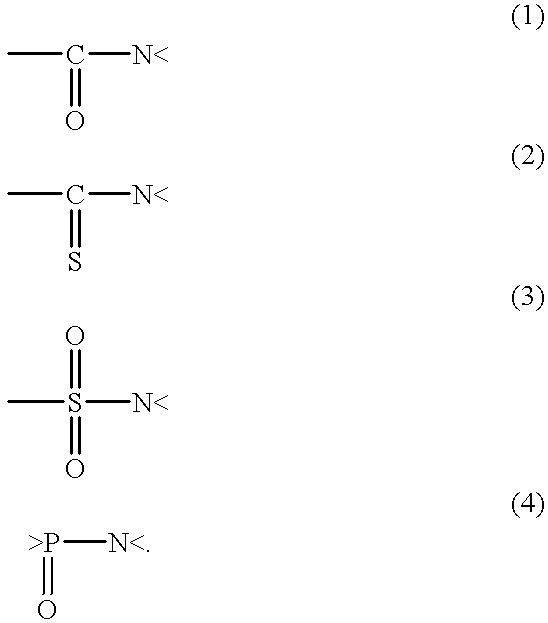
(A) Thermosetting resin
(B) Compound having one functional group which can react with thermosetting resin (A) or its curing agent, and which contains a moiety selected from the following formulae (1) to (4)
2. A thermosetting resin composition for carbon fiber reinforced composite materials according to claim 7 where the amount of component (B) incorporated is from 0.5 to 5 parts by weight per 100 parts by weight of component (A).
3. A thermosetting resin composition for carbon fiber reinforced composite materials according to claim 1 where the component (A) is a compound with a plurality of epoxy groups in the molecule (namely an epoxy resin) or a compound with a plurality of polymerizable unsaturated bonds in the molecule.
4. A thermosetting resin composition for carbon fiber reinforced composite materials according to claim 3 where component (A) is an epoxy resin and it includes an epoxy resin curing agent (C).
5. A thermosetting resin composition for carbon fiber reinforced composite materials according to claim 4 where component (B) is a compound having a structure represented by general formula (1).
6. A thermosetting resin composition for carbon fiber reinforced composite materials according to claim 4 where the functional group in (B) which can react with the epoxy resin or its curing agent is a functional group selected from the carboxyl group, phenolic hydroxyl group, amino group, secondary amine structure, mercapto group, epoxy group, and double bond conjugated with a carbonyl group.
7. A thermosetting resin composition for carbon fiber reinforced composite materials according to claim 6 where component (B) is a compound having one moiety represented by formula (5) in the molecule.

8. A thermosetting resin composition for carbon fiber reinforced composite materials according to claim 3 where component (A) is a compound with a plurality of polymerizable unsaturated bonds in the molecule, and component (B) has a polymerizable unsaturated bond in the molecule and, furthermore, it contains a thermolytic polymerization initiator (D).
9. A thermosetting resin composition for carbon fiber reinforced composite materials according to claim 8 where component (B) is a polymerizable monomer which contains a moiety represented by general formula (1).
10. A thermosetting resin composition for carbon fiber reinforced composite materials according to claim 8 where component (D) is an organic peroxide.
11. A thermosetting resin composition for carbon fiber reinforced composite materials according to claim 10 where there is included a thermal decomposition accelerator (E) for component (D)
12. A thermosetting resin composition for carbon fiber reinforced composite materials according to claim 8 where component (A) has a plurality of ester linkages.
13. A thermosetting resin composition for carbon fiber reinforced composite materials according to claim 12 where the component (A) is of at least one type selected from unsaturated polyester resins, vinyl ester resins and allyl resins.
14. A thermosetting resin composition for carbon fiber reinforced composite materials according to claim 8 where component (B) is a compound with one moiety represented by formula (5) in the molecule.

15. A thermosetting resin composition for carbon fiber reinforced composite materials according to claim 8 which includes a polymerizable monomer (F) having one polymerizable unsaturated bond in the molecule and which does not have any structures of formula (1) to (4).
16. A thermosetting resin composition for carbon fiber reinforced composite materials according to claim 1 which is characterized in that the flexural modulus of the cured material is at least 3.2 GPa.
17. A thermosetting resin composition for carbon fiber reinforced composite materials according to claim 1 which is characterized in that the elongation at break of the cured material is at least 8%.
18. A thermosetting resin composition for carbon fiber reinforced composite materials according to claim 1 which is characterized in that there is contained from 1 to 20 parts by weight of thermoplastic resin per 100 parts by weight of component (A).
19. A thermosetting resin composition for carbon fiber reinforced composite materials according to claim 18 which is characterized in that it contains a thermoplastic resin with hydrogen bonding functional groups.
20. A thermosetting resin composition for carbon fiber reinforced composite materials according to claim 1 where the complex viscosity obtained by carrying out dynamic viscoelasticity measurement at 0.5 Hz and 25° C. is 10,000 to 300,000 Pa.s.
21. A thermosetting resin composition for carbon fiber reinforced composite materials according to claim 1 where the viscosity measured by means of a rotational viscometer at 60 rpm and 25° C. is from 0.01 to 1.0 Pa.s.
22. A prepreg formed by impregnating carbon fiber with a thermosetting resin composition according to claims 1 to 21 .
23. Carbon fiber reinforced composite materials comprising carbon fiber and a cured thermosetting resin composition according to any of claims 1 to 21 .
24. Carbon fiber reinforced composite materials according to claim 23 where the carbon fiber reinforced composite material has an interlaminar shear strength as a unidirectional composite material of over 77.0 MPa.
25. Carbon fiber reinforced composite materials according to claim 23 where the carbon fiber reinforced composite material has a 0° flexural strength as a unidirectional composite material of at least 1700 MPa and an interlaminar shear strength of over 77.0 MPa.
Applications Claiming Priority (7)
| Application Number | Priority Date | Filing Date | Title |
|---|---|---|---|
| JP280351/97 | 1997-10-14 | ||
| JP28035197 | 1997-10-14 | ||
| JP9-280351 | 1997-10-14 | ||
| JP339731/97 | 1997-12-10 | ||
| JP9-339731 | 1997-12-10 | ||
| JP33973197 | 1997-12-10 | ||
| PCT/JP1998/004650 WO1999019407A1 (en) | 1997-10-14 | 1998-10-14 | Epoxy resin composition for fiber-reinforced composite material, prepreg, and fiber-reinforced composite material |
Related Child Applications (1)
| Application Number | Title | Priority Date | Filing Date |
|---|---|---|---|
| US47284699A Continuation-In-Part | 1999-12-28 | 1999-12-28 |
Publications (2)
| Publication Number | Publication Date |
|---|---|
| US20020007022A1 true US20020007022A1 (en) | 2002-01-17 |
| US6515081B2 US6515081B2 (en) | 2003-02-04 |
Family
ID=26553735
Family Applications (1)
| Application Number | Title | Priority Date | Filing Date |
|---|---|---|---|
| US09/319,902 Expired - Fee Related US6515081B2 (en) | 1997-10-14 | 1998-10-14 | Composition of epoxy resin, curing agent and reactive compound |
Country Status (6)
| Country | Link |
|---|---|
| US (1) | US6515081B2 (en) |
| EP (1) | EP0947562A4 (en) |
| KR (1) | KR100554589B1 (en) |
| CN (1) | CN1242792A (en) |
| TW (1) | TW467940B (en) |
| WO (1) | WO1999019407A1 (en) |
Cited By (37)
| Publication number | Priority date | Publication date | Assignee | Title |
|---|---|---|---|---|
| US20040092330A1 (en) * | 2002-11-12 | 2004-05-13 | Meyer Jeffrey W. | Hybrid golf club shaft |
| US20040180228A1 (en) * | 2003-03-13 | 2004-09-16 | Anderson David Wayne | Inorganic sheet laminate |
| US20040198538A1 (en) * | 2000-09-15 | 2004-10-07 | Jas. D. Easton | Hockey stick |
| US20040235592A1 (en) * | 2000-09-15 | 2004-11-25 | Mcgrath Michael J. | Hockey stick |
| US20060035088A1 (en) * | 2002-11-28 | 2006-02-16 | Mitsubishi Rayon Co., Ltd. | Epoxy resin for prepreg, prepreg, fiber-reinforced composite material, and processes for producing these |
| US20060035548A1 (en) * | 2002-07-18 | 2006-02-16 | Mitsubishi Rayon Co., Ltd. | Prepreg, intermediate material for forming frp, and method for production thereof and method for production of fiber-reinforced composite material |
| US20060154039A1 (en) * | 2003-01-30 | 2006-07-13 | Toho Tenax Co., Ltd | Carbon fiber-reinforced resin composite materials |
| US20070100465A1 (en) * | 2003-06-25 | 2007-05-03 | Egan Joseph S | Method of construction of moulded products |
| US7232386B2 (en) | 2003-05-15 | 2007-06-19 | Easton Sports, Inc. | Hockey stick |
| US20070155548A1 (en) * | 2005-11-16 | 2007-07-05 | Easton Sports, Inc. | Hockey stick |
| US20080160860A1 (en) * | 2004-03-02 | 2008-07-03 | Toray Industries, Inc. | Epoxy Resin Composition for Fiber-Reinforced Composite Material, Prepreg, and Fiber-Reinforced Composite Material |
| US7422532B2 (en) | 2000-01-07 | 2008-09-09 | Easton Sports, Inc. | Hockey stick |
| WO2009135772A1 (en) * | 2008-05-09 | 2009-11-12 | Henkel Ag & Co. Kgaa | Polymerizable composition |
| US20090297788A1 (en) * | 2007-08-02 | 2009-12-03 | Dull Kenneth M | Method and apparatus for minimizing inconsistencies appearing on a surface of a composite component |
| US20100035708A1 (en) * | 2008-08-06 | 2010-02-11 | Easton Sports, Inc. | Hockey stick |
| WO2010111700A1 (en) * | 2009-03-27 | 2010-09-30 | Cutting Dynamics, Inc. | System and method for forming thermoplastic-composite tubing |
| US20100260967A1 (en) * | 2007-09-14 | 2010-10-14 | Societe De Technologie Michelin | Composite Laminated Product |
| US20100307653A1 (en) * | 2007-09-14 | 2010-12-09 | Societe De Technologie Michelin | Non-Pneumatic Elastic Wheel |
| US20110104428A1 (en) * | 2008-03-19 | 2011-05-05 | Societe De Technologie Michelin | Composite Laminate Product |
| US20110163275A1 (en) * | 2008-06-07 | 2011-07-07 | Hexcel Composites, Ltd. | Conductivity of resin materials and composite materials |
| DE102010020882A1 (en) * | 2010-05-18 | 2011-11-24 | Alzchem Trostberg Gmbh | Semicarbazone for curing epoxy resins |
| US20130233458A1 (en) * | 2010-09-09 | 2013-09-12 | Jean-Paul Meraldi | Multi-Stage Non-Pneumatic Resilient Wheel |
| US20140087178A1 (en) * | 2011-03-30 | 2014-03-27 | Toray Industries, Inc. | Prepreg, fiber reinforced composite material, and manufacturing method for fiber reinforced composite material |
| US20140303315A1 (en) * | 2013-04-05 | 2014-10-09 | Reichhold, Inc. | Curing of liquid thermosetting resins |
| US20140309336A1 (en) * | 2011-12-23 | 2014-10-16 | Toray Industries. Inc | Prepreg, fiber reinforced composite material, and manufacturing method for fiber reinforced composite material |
| US8962120B2 (en) | 2008-03-19 | 2015-02-24 | Michelin Recherche Et Technique S.A. | Non-pneumatic resilient tire |
| JP5810916B2 (en) * | 2010-07-26 | 2015-11-11 | 三菱レイヨン株式会社 | Resin composition, prepreg using the same, and fiber reinforced composite material |
| US20160311986A1 (en) * | 2012-02-28 | 2016-10-27 | Ut-Battelle, Llc | Method of improving adhesion of carbon fibers with a polymeric matrix |
| US9499684B2 (en) | 2011-11-15 | 2016-11-22 | Alzchem Ag | Alkyl or dialkyl-semicarbazone as a hardener for epoxy resin |
| US9663609B2 (en) | 2011-11-15 | 2017-05-30 | Alzchem Ag | Use of N,N′-(dimethyl) urones and method for curing epoxy resin compositions |
| US20170204325A1 (en) * | 2014-08-23 | 2017-07-20 | Halliburton Energy Services, Inc. | Strength-enhancing resin for proppant |
| US20180030228A1 (en) * | 2015-07-08 | 2018-02-01 | Johns Manville | System for producing a fully impregnated thermoplastic prepreg |
| US10000602B2 (en) | 2014-10-02 | 2018-06-19 | Reichhold Llc 2 | Curable compositions |
| US10273349B2 (en) | 2013-03-12 | 2019-04-30 | Kurashiki Boseki Kabushiki Kaisha | Fibers for use in fiber-reinforced resin, and production method thereof |
| US20210122088A1 (en) * | 2015-12-22 | 2021-04-29 | Cytec Industries Inc. | Mold-releasable surfacing materials for composite parts |
| US20230242704A1 (en) * | 2022-01-31 | 2023-08-03 | United States Of America As Represented By The Administrator Of Nasa | Low Creep Low Relaxation Fiber Reinforced Polymer Composites |
| US11772336B2 (en) | 2013-11-22 | 2023-10-03 | Johns Manville | System for producing a fully impregnated thermoplastic prepreg |
Families Citing this family (42)
| Publication number | Priority date | Publication date | Assignee | Title |
|---|---|---|---|---|
| DE60022957T2 (en) * | 1999-08-04 | 2006-07-20 | Conception Et Development Michelin S.A. | Process for the production of highly stressed composite parts |
| KR20030097392A (en) * | 2002-06-20 | 2003-12-31 | 건설화학공업(주) | Composition of vinylester resin for fiber reinforced composite and method for preparing the same |
| US20040052997A1 (en) * | 2002-09-17 | 2004-03-18 | Ietsugu Santo | Composite pressure container or tubular body and composite intermediate |
| CN1944528B (en) * | 2002-11-28 | 2011-06-22 | 三菱丽阳株式会社 | Epoxy resin for prepreg, prepreg, fiber reinforced composite material and manufacturing method thereof |
| US7514147B2 (en) * | 2003-01-14 | 2009-04-07 | Sabic Innovative Plastics Ip B.V. | Formable thermoplastic multi-layer laminate, a formed multi-layer laminate, an article, and a method of making an article |
| US7270882B2 (en) | 2003-02-21 | 2007-09-18 | General Electric Company | Weatherable multilayer articles and method for their preparation |
| KR20050106447A (en) * | 2003-02-21 | 2005-11-09 | 제너럴 일렉트릭 캄파니 | Weatherable multilayer articles and method for their preparation |
| FR2862655B1 (en) * | 2003-11-25 | 2007-01-05 | Arkema | ORGANIC FIBER BASED ON EPOXY RESIN AND RHEOLOGY REGULATING AGENT AND CORRESPONDING FABRICS |
| US20050144309A1 (en) * | 2003-12-16 | 2005-06-30 | Intel Corporation, A Delaware Corporation | Systems and methods for controlling congestion using a time-stamp |
| RU2255097C1 (en) * | 2004-03-16 | 2005-06-27 | Научно-производственное предприятие "ПРИКЛАДНЫЕ ПЕРСПЕКТИВНЫЕ ТЕХНОЛОГИИ-АпАТэК" | Composition material |
| RU2264295C1 (en) * | 2004-06-25 | 2005-11-20 | Федеральное государственное унитарное предприятие "Всероссийский научно-исследовательский институт авиационных материалов" (ФГУП "ВИАМ") | Prepreg |
| FR2886644B1 (en) * | 2005-06-01 | 2008-04-18 | Arkema Sa | USE OF A PARTICULAR COMPOSITION FOR THE MANUFACTURE OF PARTS THROUGH FILAMENT WINDING |
| KR100645065B1 (en) * | 2005-06-23 | 2006-11-10 | 삼성전자주식회사 | Fin Field Effect Transistor, Nonvolatile Memory Device Having Same and Forming Method Thereof |
| EP1928952B1 (en) * | 2005-09-28 | 2014-07-09 | Entrotech Composites, LLC. | Braid-reinforced composites and processes for their preparation |
| US20070261329A1 (en) * | 2005-12-16 | 2007-11-15 | Jack Rigsby | Inorganic Composite Building Panel |
| CN101346320A (en) * | 2005-12-16 | 2009-01-14 | 21世纪结构有限责任公司 | Inorganic composite material and manufacturing method |
| US8446734B2 (en) * | 2006-03-30 | 2013-05-21 | Kyocera Corporation | Circuit board and mounting structure |
| JP4231916B2 (en) * | 2006-04-28 | 2009-03-04 | 日信工業株式会社 | Method for producing carbon fiber composite resin material |
| EP2016220B1 (en) * | 2006-04-28 | 2012-10-03 | Toho Tenax Europe GmbH | Carbon fiber |
| GB0619401D0 (en) * | 2006-10-02 | 2006-11-08 | Hexcel Composites Ltd | Composite materials with improved performance |
| US7537827B1 (en) * | 2006-12-13 | 2009-05-26 | Henkel Corporation | Prepreg laminates |
| CA2708261C (en) * | 2007-12-06 | 2016-02-02 | Stefan Kreiling | Curable compositions containing isocyanate-based tougheners |
| US20100009207A1 (en) * | 2008-07-10 | 2010-01-14 | Sabic Innovative Plastics Ip B.V. | Formable thermoplastic multi-layer article, a formed multi-layer article, an article, and a method of making an article |
| EP2479217B1 (en) * | 2009-09-16 | 2019-08-28 | Toray Industries, Inc. | Binder composition, reinforcing-fiber base material, preform, fiber-reinforced composite material, and manufacturing method therefor |
| CN101947859B (en) * | 2010-09-20 | 2015-03-04 | 威海光威复合材料有限公司 | Periodic prepreg production method |
| US8309644B1 (en) | 2011-08-29 | 2012-11-13 | GM Global Technology Operations LLC | Methods of treating carbon fibers, fiber-reinforced resins, and methods of making the fiber-reinforced resins |
| CN104349821B (en) * | 2012-05-29 | 2016-08-31 | 三菱丽阳株式会社 | Wood golf shaft |
| US9187636B2 (en) | 2012-08-26 | 2015-11-17 | Hexcel Corporation | Composite material with polyamide particle mixtures |
| US20150240042A1 (en) * | 2012-10-15 | 2015-08-27 | Toray Industries, Inc. | High modulus fiber reinforced polymer composite |
| JP6354763B2 (en) | 2012-10-15 | 2018-07-11 | 東レ株式会社 | Fiber reinforced high modulus polymer composite with reinforced interfacial phase |
| JPWO2017033683A1 (en) * | 2015-08-21 | 2018-07-05 | 国立大学法人九州大学 | Composition for forming composite material, method for producing composite material, and composite material |
| MX393946B (en) * | 2015-12-21 | 2025-03-24 | Dainippon Ink & Chemicals | PREPREG MATERIAL AND MOLDED ARTICLE. |
| RU2620806C1 (en) * | 2016-02-18 | 2017-05-29 | Акционерное Общество "Тверьстеклопластик" | Polymeric composition for drinks for the manufacture of glass - organo - carbon fiber reinforced plastic (cfrp) |
| KR101790112B1 (en) * | 2016-03-29 | 2017-10-26 | 주식회사 한국카본 | Resin composition for high speed curing prepreg for car body parts through press method and a prepreg product containing the same |
| WO2018078997A1 (en) * | 2016-10-26 | 2018-05-03 | 昭和電工株式会社 | Radical-polymerizable resin composition |
| CN106633741B (en) * | 2016-12-29 | 2018-07-03 | 哈尔滨工业大学 | A kind of interface modification method of carbon fiber/unsaturated-resin |
| JP7687824B2 (en) * | 2017-11-08 | 2025-06-03 | サイテック インダストリーズ インコーポレイテッド | Composites with interlaminar reinforcement particles and methods for making the composites |
| JP7238259B2 (en) * | 2018-03-16 | 2023-03-14 | 三菱ケミカル株式会社 | Prepreg |
| WO2022118827A1 (en) * | 2020-12-02 | 2022-06-09 | 東レ株式会社 | Fiber-reinforced pultrusion-molded article |
| JP7707805B2 (en) * | 2021-09-29 | 2025-07-15 | 東レ株式会社 | Prepregs and Fiber Reinforced Composites |
| CN114163670B (en) * | 2021-11-16 | 2023-12-01 | 武汉航威新材料科技有限公司 | Energy-saving environment-friendly epoxy vinyl ester resin prepreg, and preparation method and curing method thereof |
| CN120504938A (en) * | 2025-07-17 | 2025-08-19 | 泰山体育产业集团有限公司 | Thermosetting epoxy resin for carbon fiber composite material |
Family Cites Families (13)
| Publication number | Priority date | Publication date | Assignee | Title |
|---|---|---|---|---|
| FR2403364A1 (en) * | 1977-09-16 | 1979-04-13 | Commissariat Energie Atomique | COMPOSITE MATERIAL BASED ON FIBERS PRESENTING A HIGH TRACTION MODULE |
| JPS5690827A (en) * | 1979-12-26 | 1981-07-23 | Toshiba Corp | Heat-resistant resin composition |
| US4487863A (en) * | 1982-11-22 | 1984-12-11 | Great Lakes Carbon Corporation | Reinforced polyester based resin system and method of fabrication |
| EP0256130B1 (en) * | 1986-01-21 | 1993-03-31 | Toray Industries, Inc. | Prepreg and its composite |
| US4873309A (en) * | 1987-06-08 | 1989-10-10 | Shell Oil Company | Stabilized flame-retardant epoxy resin composition from a brominated epoxy resin and a vinyl monomer diluent |
| US4956411A (en) * | 1988-02-05 | 1990-09-11 | Mitsubishi Rayon Company, Ltd. | Epoxy resin composition for composite material from m- or o-substituted triglycidylaminophenols, diaminodiphenylsulfone and latent curing agents |
| US4874833A (en) * | 1988-08-22 | 1989-10-17 | Shell Oil Company | Composition containing epoxy resin and alkyl hindered polyaromatic diamine and monoaromatic amine curing agents |
| JP2736443B2 (en) * | 1989-06-22 | 1998-04-02 | 三菱レイヨン株式会社 | Epoxy resin composition for composite materials |
| JPH05320480A (en) * | 1992-05-25 | 1993-12-03 | Toray Ind Inc | Epoxy resin composition and epoxy resin composition for resin transfer molding |
| JPH0776616A (en) * | 1993-07-15 | 1995-03-20 | Toray Ind Inc | Epoxy resin composition for prepreg and prepreg |
| JPH0741650A (en) * | 1993-07-29 | 1995-02-10 | Mitsubishi Rayon Co Ltd | Thermoplastic polyester resin composition |
| JPH09255800A (en) * | 1996-03-25 | 1997-09-30 | Toray Ind Inc | Prepreg and fiber-reinforced resin molding |
| CA2230151A1 (en) * | 1997-02-28 | 1998-08-28 | Mitsuhiro Yada | Method for reinforcing structures |
-
1998
- 1998-10-13 TW TW87116955A patent/TW467940B/en not_active IP Right Cessation
- 1998-10-14 KR KR1019997005276A patent/KR100554589B1/en not_active Expired - Fee Related
- 1998-10-14 WO PCT/JP1998/004650 patent/WO1999019407A1/en not_active Ceased
- 1998-10-14 EP EP98947875A patent/EP0947562A4/en not_active Withdrawn
- 1998-10-14 CN CN98801525A patent/CN1242792A/en active Pending
- 1998-10-14 US US09/319,902 patent/US6515081B2/en not_active Expired - Fee Related
Cited By (86)
| Publication number | Priority date | Publication date | Assignee | Title |
|---|---|---|---|---|
| US7422532B2 (en) | 2000-01-07 | 2008-09-09 | Easton Sports, Inc. | Hockey stick |
| US8517868B2 (en) | 2000-09-15 | 2013-08-27 | Easton Sports, Inc. | Hockey stick |
| US20110237365A1 (en) * | 2000-09-15 | 2011-09-29 | Mcgrath Michael J | Hockey stick |
| US20040235592A1 (en) * | 2000-09-15 | 2004-11-25 | Mcgrath Michael J. | Hockey stick |
| US7963868B2 (en) | 2000-09-15 | 2011-06-21 | Easton Sports, Inc. | Hockey stick |
| US20040198538A1 (en) * | 2000-09-15 | 2004-10-07 | Jas. D. Easton | Hockey stick |
| US20090093326A1 (en) * | 2000-09-15 | 2009-04-09 | Goldsmith Edward M | Hockey Stick |
| US7789778B2 (en) | 2000-09-15 | 2010-09-07 | Easton Sports, Inc. | Hockey stick |
| US8216096B2 (en) | 2000-09-15 | 2012-07-10 | Easton Sports, Inc. | Hockey stick |
| US7097577B2 (en) | 2000-09-15 | 2006-08-29 | Jas. D. Easton, Inc. | Hockey stick |
| US20060281592A1 (en) * | 2000-09-15 | 2006-12-14 | Jas D. Easton, Inc. | Hockey Stick |
| US7850553B2 (en) | 2000-09-15 | 2010-12-14 | Easton Sports, Inc. | Hockey stick |
| US20110151206A1 (en) * | 2002-07-18 | 2011-06-23 | Mitsubishi Rayon Co., Ltd. | Prepreg, intermediate material for forming frp, and method for production thereof and method for production of fiber-reinforced composite material |
| US8679991B2 (en) | 2002-07-18 | 2014-03-25 | Mitsubishi Rayon Co., Ltd. | Prepreg, intermediate material for forming FRP, and method for production thereof and method for production of fiber-reinforced composite material |
| US20090123717A1 (en) * | 2002-07-18 | 2009-05-14 | Mitsubishi Rayon Co., Ltd. | Prepreg, intermediate material for forming frp, and method for production thereof and method for production of fiber-reinforced composite material |
| US20060035548A1 (en) * | 2002-07-18 | 2006-02-16 | Mitsubishi Rayon Co., Ltd. | Prepreg, intermediate material for forming frp, and method for production thereof and method for production of fiber-reinforced composite material |
| US20040092330A1 (en) * | 2002-11-12 | 2004-05-13 | Meyer Jeffrey W. | Hybrid golf club shaft |
| US20080187718A1 (en) * | 2002-11-28 | 2008-08-07 | Mitsubishi Rayon Co., Ltd. | Epoxy resin for prepreg, prepreg, fiber-reinforced composite material, and processes for producing these |
| US20080185753A1 (en) * | 2002-11-28 | 2008-08-07 | Mitsubishi Rayon Co., Ltd. | Epoxy resin for prepreg, prepreg, fiber-reinforced composite material, and processes for producing these |
| US20080185757A1 (en) * | 2002-11-28 | 2008-08-07 | Mitsubishi Rayon Co., Ltd. | Epoxy resin for prepreg, prepreg, fiber-reinforced composite material, and processes for producing these |
| US7959838B2 (en) | 2002-11-28 | 2011-06-14 | Mitsubishi Rayon Co., Ltd. | Epoxy resin for prepreg, prepreg, fiber-reinforced composite material and methods for production thereof |
| US20060035088A1 (en) * | 2002-11-28 | 2006-02-16 | Mitsubishi Rayon Co., Ltd. | Epoxy resin for prepreg, prepreg, fiber-reinforced composite material, and processes for producing these |
| US8486518B2 (en) | 2002-11-28 | 2013-07-16 | Mitsubishi Rayon Co., Ltd. | Epoxy resin for prepreg, prepreg, and fiber-reinforced composite material and methods for production thereof |
| US8470435B2 (en) | 2002-11-28 | 2013-06-25 | Mitsubishi Rayon Co., Ltd. | Epdxy resin for prepreg, prepreg, fiber-reinforced composite material, and methods for production thereof |
| US7591973B2 (en) | 2002-11-28 | 2009-09-22 | Mitsubishi Rayon Co., Ltd. | Method for producing a fiber-reinforced composite material plate |
| US7585558B2 (en) * | 2003-01-30 | 2009-09-08 | Toho Tenax Co., Ltd. | Carbon fiber-reinforced resin composite materials |
| US20060154039A1 (en) * | 2003-01-30 | 2006-07-13 | Toho Tenax Co., Ltd | Carbon fiber-reinforced resin composite materials |
| US20040180228A1 (en) * | 2003-03-13 | 2004-09-16 | Anderson David Wayne | Inorganic sheet laminate |
| US7335275B2 (en) | 2003-03-13 | 2008-02-26 | E.I. Du Pont De Nemours And Company | Method of making an inorganic sheet laminate |
| US6855404B2 (en) * | 2003-03-13 | 2005-02-15 | E. I. Du Pont De Nemours And Company | Inorganic sheet laminate |
| US20050028939A1 (en) * | 2003-03-13 | 2005-02-10 | Anderson David Wayne | Inorganic sheet laminate |
| US20070249437A1 (en) * | 2003-05-15 | 2007-10-25 | Jas. D. Easton, Inc. | Hockey stick |
| US7232386B2 (en) | 2003-05-15 | 2007-06-19 | Easton Sports, Inc. | Hockey stick |
| US7862456B2 (en) | 2003-05-15 | 2011-01-04 | Easton Sports, Inc. | Hockey stick |
| US20070100465A1 (en) * | 2003-06-25 | 2007-05-03 | Egan Joseph S | Method of construction of moulded products |
| US20080160860A1 (en) * | 2004-03-02 | 2008-07-03 | Toray Industries, Inc. | Epoxy Resin Composition for Fiber-Reinforced Composite Material, Prepreg, and Fiber-Reinforced Composite Material |
| EP1724306A4 (en) * | 2004-03-02 | 2009-04-01 | Toray Industries | Epoxy resin composition for fiber-reinforced composite material, prepreg and fiber-reinforced composite material |
| US20070155548A1 (en) * | 2005-11-16 | 2007-07-05 | Easton Sports, Inc. | Hockey stick |
| US20110195232A1 (en) * | 2007-08-02 | 2011-08-11 | The Boeing Company | Composite Strip |
| US9039858B2 (en) | 2007-08-02 | 2015-05-26 | The Boeing Company | Composite strip |
| US20090297788A1 (en) * | 2007-08-02 | 2009-12-03 | Dull Kenneth M | Method and apparatus for minimizing inconsistencies appearing on a surface of a composite component |
| US8016970B2 (en) * | 2007-08-02 | 2011-09-13 | The Boeing Company | Method for applying a pre-cured composite strip to a composite component to minimize inconsistencies appearing on a surface of the composite component |
| US20100260967A1 (en) * | 2007-09-14 | 2010-10-14 | Societe De Technologie Michelin | Composite Laminated Product |
| US8517068B2 (en) * | 2007-09-14 | 2013-08-27 | Compagnie Generale Des Etablissements Michelin | Non-pneumatic elastic wheel |
| US8491981B2 (en) * | 2007-09-14 | 2013-07-23 | Michelin Recherche Et Technique S.A. | Composite laminated product |
| US20100307653A1 (en) * | 2007-09-14 | 2010-12-09 | Societe De Technologie Michelin | Non-Pneumatic Elastic Wheel |
| US8962120B2 (en) | 2008-03-19 | 2015-02-24 | Michelin Recherche Et Technique S.A. | Non-pneumatic resilient tire |
| US20110104428A1 (en) * | 2008-03-19 | 2011-05-05 | Societe De Technologie Michelin | Composite Laminate Product |
| US8883283B2 (en) | 2008-03-19 | 2014-11-11 | Michelin Recherche Et Techniques S.A | Composite laminate product |
| US20110112235A1 (en) * | 2008-05-09 | 2011-05-12 | Henkel Ag & Co. Kgaa | Polymerizable composition |
| WO2009135772A1 (en) * | 2008-05-09 | 2009-11-12 | Henkel Ag & Co. Kgaa | Polymerizable composition |
| US8716377B2 (en) | 2008-05-09 | 2014-05-06 | Henkel Ag & Co. Kgaa | Polymerizable composition |
| US20150060738A1 (en) * | 2008-06-07 | 2015-03-05 | Hexcel Composites Limited | Conductivity of Resin Materials and Composite Materials |
| US20110163275A1 (en) * | 2008-06-07 | 2011-07-07 | Hexcel Composites, Ltd. | Conductivity of resin materials and composite materials |
| US8900486B2 (en) * | 2008-06-07 | 2014-12-02 | Hexcel Composites Limited | Conductivity of resin materials and composite materials |
| US9202607B2 (en) * | 2008-06-07 | 2015-12-01 | Hexcel Composites Limited | Conductivity of resin materials and composite materials |
| US20100035708A1 (en) * | 2008-08-06 | 2010-02-11 | Easton Sports, Inc. | Hockey stick |
| US7914403B2 (en) | 2008-08-06 | 2011-03-29 | Easton Sports, Inc. | Hockey stick |
| US20110039047A1 (en) * | 2009-03-27 | 2011-02-17 | Carson William V | System and method for forming thermoplastic-composite tubing |
| WO2010111700A1 (en) * | 2009-03-27 | 2010-09-30 | Cutting Dynamics, Inc. | System and method for forming thermoplastic-composite tubing |
| DE102010020882A1 (en) * | 2010-05-18 | 2011-11-24 | Alzchem Trostberg Gmbh | Semicarbazone for curing epoxy resins |
| US9403976B2 (en) | 2010-05-18 | 2016-08-02 | Alzchem Ag | Semicarbazones as accelerators for curing epoxy resins |
| JP5810916B2 (en) * | 2010-07-26 | 2015-11-11 | 三菱レイヨン株式会社 | Resin composition, prepreg using the same, and fiber reinforced composite material |
| US20130233458A1 (en) * | 2010-09-09 | 2013-09-12 | Jean-Paul Meraldi | Multi-Stage Non-Pneumatic Resilient Wheel |
| US20140087178A1 (en) * | 2011-03-30 | 2014-03-27 | Toray Industries, Inc. | Prepreg, fiber reinforced composite material, and manufacturing method for fiber reinforced composite material |
| US9499684B2 (en) | 2011-11-15 | 2016-11-22 | Alzchem Ag | Alkyl or dialkyl-semicarbazone as a hardener for epoxy resin |
| US9663609B2 (en) | 2011-11-15 | 2017-05-30 | Alzchem Ag | Use of N,N′-(dimethyl) urones and method for curing epoxy resin compositions |
| US9963586B2 (en) * | 2011-12-23 | 2018-05-08 | Toray Industries, Inc. | Prepreg, fiber reinforced composite material, and manufacturing method for fiber reinforced composite material |
| US20140309336A1 (en) * | 2011-12-23 | 2014-10-16 | Toray Industries. Inc | Prepreg, fiber reinforced composite material, and manufacturing method for fiber reinforced composite material |
| US20160311986A1 (en) * | 2012-02-28 | 2016-10-27 | Ut-Battelle, Llc | Method of improving adhesion of carbon fibers with a polymeric matrix |
| US10501590B2 (en) | 2012-02-28 | 2019-12-10 | Ut-Battelle, Llc | Solid composites containing polymeric matrix with carbon fibers embedded therein |
| US10351683B2 (en) | 2012-02-28 | 2019-07-16 | Ut-Battelle, Llc | Method of improving adhesion of carbon fibers with a polymeric matrix |
| US10457785B2 (en) * | 2012-02-28 | 2019-10-29 | Ut-Battelle, Llc | Method of improving adhesion of carbon fibers with a polymeric matrix |
| US10273349B2 (en) | 2013-03-12 | 2019-04-30 | Kurashiki Boseki Kabushiki Kaisha | Fibers for use in fiber-reinforced resin, and production method thereof |
| US9068045B2 (en) * | 2013-04-05 | 2015-06-30 | Reichhold, Inc. | Curing of liquid thermosetting resins |
| US20140303315A1 (en) * | 2013-04-05 | 2014-10-09 | Reichhold, Inc. | Curing of liquid thermosetting resins |
| US11772336B2 (en) | 2013-11-22 | 2023-10-03 | Johns Manville | System for producing a fully impregnated thermoplastic prepreg |
| US20170204325A1 (en) * | 2014-08-23 | 2017-07-20 | Halliburton Energy Services, Inc. | Strength-enhancing resin for proppant |
| US10113106B2 (en) * | 2014-08-23 | 2018-10-30 | Halliburton Energy Services, Inc. | Strength-enhancing resin for proppant |
| US10000602B2 (en) | 2014-10-02 | 2018-06-19 | Reichhold Llc 2 | Curable compositions |
| US10683406B2 (en) * | 2015-07-08 | 2020-06-16 | Johns Manville | System for producing a fully impregnated thermoplastic prepreg |
| US11091598B2 (en) | 2015-07-08 | 2021-08-17 | Johns Manville | System for producing a fully impregnated thermoplastic prepreg |
| US20180030228A1 (en) * | 2015-07-08 | 2018-02-01 | Johns Manville | System for producing a fully impregnated thermoplastic prepreg |
| US20210122088A1 (en) * | 2015-12-22 | 2021-04-29 | Cytec Industries Inc. | Mold-releasable surfacing materials for composite parts |
| US11833718B2 (en) * | 2015-12-22 | 2023-12-05 | Cytec Industries Inc. | Mold-releasable surfacing materials for composite parts |
| US20230242704A1 (en) * | 2022-01-31 | 2023-08-03 | United States Of America As Represented By The Administrator Of Nasa | Low Creep Low Relaxation Fiber Reinforced Polymer Composites |
Also Published As
| Publication number | Publication date |
|---|---|
| CN1242792A (en) | 2000-01-26 |
| KR100554589B1 (en) | 2006-03-03 |
| KR20000069453A (en) | 2000-11-25 |
| TW467940B (en) | 2001-12-11 |
| US6515081B2 (en) | 2003-02-04 |
| WO1999019407A1 (en) | 1999-04-22 |
| EP0947562A4 (en) | 2001-01-03 |
| EP0947562A1 (en) | 1999-10-06 |
Similar Documents
| Publication | Publication Date | Title |
|---|---|---|
| US6515081B2 (en) | Composition of epoxy resin, curing agent and reactive compound | |
| US6063839A (en) | Prepreg of reinforcing fibers, epoxy resins, crosslinked rubber particles and curing agent | |
| US6399199B1 (en) | Prepeg and carbon fiber reinforced composite materials | |
| US6287696B1 (en) | Resin composition for a fiber reinforced composite, a prepreg and a fiber reinforced composite | |
| JP2019526650A (en) | Epoxy resin composition, prepreg, and fiber reinforced plastic material | |
| JP3796953B2 (en) | Resin composition for fiber reinforced composite material, prepreg and fiber reinforced composite material | |
| JP2014167103A (en) | Epoxy resin composition, prepreg and fiber-reinforced composite material | |
| JP2014167102A (en) | Epoxy resin composition, prepreg and fiber-reinforced composite material | |
| JPH11172076A (en) | Epoxy resin composition for fiber-reinforced composite material, prepreg, and fiber-reinforced composite material | |
| JPH11171974A (en) | Epoxy resin composition for fiber-reinforced composite material, prepreg and fiber-reinforced composite material | |
| JP2000336191A (en) | Prepreg and fiber-reinforced composite material | |
| JP4687224B2 (en) | Epoxy resin composition, prepreg and fiber reinforced composite material | |
| JP2003277471A (en) | Epoxy resin composition, prepreg and carbon fiber- reinforced composite material | |
| JP2011057851A (en) | Epoxy resin composition, prepreg and fiber-reinforced composite material | |
| US5128425A (en) | Epoxy resin composition for use in carbon fiber reinforced plastics, containing amine or amide based fortifiers | |
| JPH11171972A (en) | Epoxy resin composition for fiber-reinforced composite material, prepreg and fiber-reinforced composite material | |
| JPH08337707A (en) | Epoxy resin composition, prepreg and fiber-reinforced composite material | |
| JP2004027043A (en) | Epoxy resin composition for fiber-reinforced composite material and the resulting fiber-reinforced composite material | |
| JP2001040122A (en) | Prepreg and fiber reinforced composite material | |
| JPH08301982A (en) | Epoxy resin composition for fiber-reinforced composite, prepreg, and composite | |
| JP2000239417A (en) | Cloth prepreg and fiber-reinforced composite material | |
| JP2000344870A (en) | Epoxy resin composition, prepreg, and fiber-reinforced composite material | |
| JP4144136B2 (en) | Prepreg and carbon fiber reinforced composite materials | |
| JP2000355649A (en) | Epoxy resin composition for fiber-reinforced composite material, prepreg, and fiber-reinforced composite material | |
| JPH1036532A (en) | Resin composition for fiber-reinforced composite material, prepreg and fiber-reinforced composite material |
Legal Events
| Date | Code | Title | Description |
|---|---|---|---|
| AS | Assignment |
Owner name: TORAY INDUSTRIES, INC., JAPAN Free format text: ASSIGNMENT OF ASSIGNORS INTEREST;ASSIGNORS:OOSEDO, HIROKI;SAWAOKA, RYUJI;NODA, SHUNSAKU;AND OTHERS;REEL/FRAME:010132/0837 Effective date: 19990602 |
|
| FEPP | Fee payment procedure |
Free format text: PAYOR NUMBER ASSIGNED (ORIGINAL EVENT CODE: ASPN); ENTITY STATUS OF PATENT OWNER: LARGE ENTITY |
|
| FPAY | Fee payment |
Year of fee payment: 4 |
|
| REMI | Maintenance fee reminder mailed | ||
| LAPS | Lapse for failure to pay maintenance fees | ||
| STCH | Information on status: patent discontinuation |
Free format text: PATENT EXPIRED DUE TO NONPAYMENT OF MAINTENANCE FEES UNDER 37 CFR 1.362 |
|
| FP | Lapsed due to failure to pay maintenance fee |
Effective date: 20110204 |