US12351688B2 - Hydrophilized polydiorganosiloxane vinylic crosslinkers - Google Patents
Hydrophilized polydiorganosiloxane vinylic crosslinkers Download PDFInfo
- Publication number
- US12351688B2 US12351688B2 US17/666,601 US202217666601A US12351688B2 US 12351688 B2 US12351688 B2 US 12351688B2 US 202217666601 A US202217666601 A US 202217666601A US 12351688 B2 US12351688 B2 US 12351688B2
- Authority
- US
- United States
- Prior art keywords
- hydrophilized
- meth
- vinylic crosslinker
- polydiorganosiloxane vinylic
- divalent radical
- Prior art date
- Legal status (The legal status is an assumption and is not a legal conclusion. Google has not performed a legal analysis and makes no representation as to the accuracy of the status listed.)
- Active, expires
Links
Classifications
-
- C—CHEMISTRY; METALLURGY
- C08—ORGANIC MACROMOLECULAR COMPOUNDS; THEIR PREPARATION OR CHEMICAL WORKING-UP; COMPOSITIONS BASED THEREON
- C08G—MACROMOLECULAR COMPOUNDS OBTAINED OTHERWISE THAN BY REACTIONS ONLY INVOLVING UNSATURATED CARBON-TO-CARBON BONDS
- C08G77/00—Macromolecular compounds obtained by reactions forming a linkage containing silicon with or without sulfur, nitrogen, oxygen or carbon in the main chain of the macromolecule
- C08G77/04—Polysiloxanes
- C08G77/20—Polysiloxanes containing silicon bound to unsaturated aliphatic groups
-
- C—CHEMISTRY; METALLURGY
- C08—ORGANIC MACROMOLECULAR COMPOUNDS; THEIR PREPARATION OR CHEMICAL WORKING-UP; COMPOSITIONS BASED THEREON
- C08G—MACROMOLECULAR COMPOUNDS OBTAINED OTHERWISE THAN BY REACTIONS ONLY INVOLVING UNSATURATED CARBON-TO-CARBON BONDS
- C08G77/00—Macromolecular compounds obtained by reactions forming a linkage containing silicon with or without sulfur, nitrogen, oxygen or carbon in the main chain of the macromolecule
- C08G77/04—Polysiloxanes
-
- C—CHEMISTRY; METALLURGY
- C08—ORGANIC MACROMOLECULAR COMPOUNDS; THEIR PREPARATION OR CHEMICAL WORKING-UP; COMPOSITIONS BASED THEREON
- C08G—MACROMOLECULAR COMPOUNDS OBTAINED OTHERWISE THAN BY REACTIONS ONLY INVOLVING UNSATURATED CARBON-TO-CARBON BONDS
- C08G77/00—Macromolecular compounds obtained by reactions forming a linkage containing silicon with or without sulfur, nitrogen, oxygen or carbon in the main chain of the macromolecule
- C08G77/04—Polysiloxanes
- C08G77/38—Polysiloxanes modified by chemical after-treatment
- C08G77/382—Polysiloxanes modified by chemical after-treatment containing atoms other than carbon, hydrogen, oxygen or silicon
- C08G77/388—Polysiloxanes modified by chemical after-treatment containing atoms other than carbon, hydrogen, oxygen or silicon containing nitrogen
-
- C—CHEMISTRY; METALLURGY
- C08—ORGANIC MACROMOLECULAR COMPOUNDS; THEIR PREPARATION OR CHEMICAL WORKING-UP; COMPOSITIONS BASED THEREON
- C08G—MACROMOLECULAR COMPOUNDS OBTAINED OTHERWISE THAN BY REACTIONS ONLY INVOLVING UNSATURATED CARBON-TO-CARBON BONDS
- C08G77/00—Macromolecular compounds obtained by reactions forming a linkage containing silicon with or without sulfur, nitrogen, oxygen or carbon in the main chain of the macromolecule
- C08G77/04—Polysiloxanes
- C08G77/38—Polysiloxanes modified by chemical after-treatment
- C08G77/382—Polysiloxanes modified by chemical after-treatment containing atoms other than carbon, hydrogen, oxygen or silicon
- C08G77/395—Polysiloxanes modified by chemical after-treatment containing atoms other than carbon, hydrogen, oxygen or silicon containing phosphorus
-
- C—CHEMISTRY; METALLURGY
- C08—ORGANIC MACROMOLECULAR COMPOUNDS; THEIR PREPARATION OR CHEMICAL WORKING-UP; COMPOSITIONS BASED THEREON
- C08L—COMPOSITIONS OF MACROMOLECULAR COMPOUNDS
- C08L83/00—Compositions of macromolecular compounds obtained by reactions forming in the main chain of the macromolecule a linkage containing silicon with or without sulfur, nitrogen, oxygen or carbon only; Compositions of derivatives of such polymers
- C08L83/04—Polysiloxanes
- C08L83/08—Polysiloxanes containing silicon bound to organic groups containing atoms other than carbon, hydrogen and oxygen
-
- G—PHYSICS
- G02—OPTICS
- G02C—SPECTACLES; SUNGLASSES OR GOGGLES INSOFAR AS THEY HAVE THE SAME FEATURES AS SPECTACLES; CONTACT LENSES
- G02C7/00—Optical parts
- G02C7/02—Lenses; Lens systems ; Methods of designing lenses
- G02C7/04—Contact lenses for the eyes
Definitions
- the present invention relates to hydrophilized polydiorganosiloxane vinylic crosslinkers each having one or more hydrophilized siloxane units having one methyl substituent and one organic substituent having one phosphorylcholine moiety and their uses in making silicone hydrogel contact lenses.
- Soft silicone hydrogel contact lenses become more and more popular because of their high oxygen permeability and comfort.
- Soft contact lenses can conform closely to the shape of the eye, so oxygen cannot easily circumvent the lens.
- Soft contact lenses must allow oxygen from the surrounding air (i.e., oxygen) to reach the cornea because the cornea does not receive oxygen from the blood supply like other tissues. If sufficient oxygen does not reach the cornea, corneal swelling occurs. Extended periods of oxygen deprivation cause the undesirable growth of blood vessels in the cornea.
- a silicone hydrogel contact lens allows sufficient oxygen permeate through the lens to the cornea and to have minimal adverse effects on corneal health.
- One of lens forming materials widely used in making silicone hydrogel contact lenses is a polydiorganosiloxane (e.g., polydimethylsiloxane) vinylic crosslinker which can provide high oxygen permeability to resultant contact lenses.
- a polydimethylsiloxane vinylic crosslinker can affect the mechanical properties, e.g., elastic modulus, of the resultant contact lenses.
- a low molecular weight polydimethylsiloxane vinylic crosslinker ( ⁇ 2,000 g/mol) may provide a resultant contact lens with a relatively high elastic modulus in order to achieve a desired oxygen permeability.
- a relative high molecular weight polydimethylsiloxane vinylic crosslinker is typically used in achieve both the high oxygen permeability and the low elastic modulus.
- a polydimethylsiloxane vinylic crosslinker especially one with high molecular weight, is not compatible with hydrophilic components in a lens formulation, including, e.g., N,N-dimethylacrylamide (DMA), N-vinylpyrrolidone (NVP), N-vinyl-N-methylacetamide (VMA), or an internal wetting agent. It would be difficult to obtain homogeneous lens formulations (i.e., clear lens formulations) from use of such a polydimethylsiloxane vinylic crosslinker.
- incorporación of silicone in a contact lens material also has undesirable effects on the biocompatibility of the contact lens, because silicone is hydrophobic and has great tendency to migrate onto the lens surface being exposed to air.
- a silicone hydrogel contact lens will generally require a surface modification process to eliminate or minimize the exposure of silicone of the contact lens and to maintain a biocompatible surface.
- the present invention in one aspect, provides a polysiloxane vinylic crosslinker.
- the polydiorganosiloxane vinylic crosslinker of the invention comprises a polydiorganosiloxane segment comprising dimethylsiloxane units and hydrophilized siloxane unit having one methyl substituent and one organic substituent having a phosphorylcholine moiety and ethylenically-unsaturated groups.
- the invention provides a soft contact lens comprising a crosslinked polymeric material comprising units of a polydiorganosiloxane vinylic crosslinker of the invention (described above).
- Contact Lens refers to a structure that can be placed on or within a wearer's eye. A contact lens can correct, improve, or alter a user's eyesight, but that need not be the case.
- a “silicone hydrogel contact lens” refers to a contact lens comprising a silicone hydrogel material as bulk material.
- hydrogel or “hydrogel material” refers to a crosslinked polymeric material which has three-dimensional polymer networks (i.e., polymer matrix), is insoluble in water, but can hold at least 10% by weight of water in its polymer matrix when it is fully hydrated (or equilibrated).
- a “silicone hydrogel” refers to a silicone-containing hydrogel comprising repeating units of at least one silicone-containing monomer and/or silicone-containing vinylic crosslinker and repeating units of at least hydrophilic vinylic monomer. It is typically formed by copolymerization of a polymerizable composition comprising at least one silicone-containing monomer and/or silicone-containing vinylic crosslinker and at least one hydrophilic vinylic monomer.
- non-silicone hydrogel refers to a hydrogel that is theoretically free of silicon.
- Hydrophilic describes a material or portion thereof that will more readily associate with water than with lipids.
- a “vinylic monomer” refers to a compound that has one sole ethylenically unsaturated group, is soluble in a solvent, and can be polymerized actinically or thermally.
- soluble in reference to a compound or material in a solvent, means that the compound or material can be dissolved in the solvent to give a solution with a concentration of at least about 0.5% by weight at room temperature (i.e., a temperature of about 21° C. to about 27° C.).
- insoluble in reference to a compound or material in a solvent, means that the compound or material can be dissolved in the solvent to give a solution with a concentration of less than 0.01% by weight at room temperature (as defined above).
- ethylenically unsaturated group is employed herein in a broad sense and is intended to encompass any groups containing at least one >C ⁇ C ⁇ group.
- exemplary ethylenically unsaturated groups include without limitation (meth)acryloyl
- actinically in reference to curing, crosslinking or polymerizing of a polymerizable composition, a prepolymer or a material means that the curing (e.g., crosslinked and/or polymerized) is performed by actinic irradiation, such as, for example, UV irradiation, ionizing radiation (e.g. gamma ray or X-ray irradiation), microwave irradiation, and the like.
- actinic irradiation such as, for example, UV irradiation, ionizing radiation (e.g. gamma ray or X-ray irradiation), microwave irradiation, and the like.
- an “acrylic monomer” refers to a vinylic monomer having one sole (meth)acryloyl group.
- acrylic monomrs includes (meth)acryloxy [or(meth)acryloyloxy] monomers and (meth)acrylamido monomers.
- (meth)acrylamide refers to methacrylamide and/or acrylamide.
- (meth)acrylate refers to methacrylate and/or acrylate.
- N-vinyl amide monomer refers to an amide compound having a vinyl group (—CH ⁇ CH 2 ) that is directly attached to the nitrogen atom of the amide group.
- ene group refers to a monovalent radical of CH 2 ⁇ CH— or CH 2 ⁇ CCH 3 — that is not covalently attached to an oxygen or nitrogen atom or a carbonyl group.
- an “ene monomer” refers to a vinylic monomer having one sole ene group.
- vinyl crosslinker refers to an organic compound having at least two ethylenically unsaturated groups.
- a “vinylic crosslinking agent” refers to a vinylic crosslinker having a molecular weight of 700 Daltons or less.
- a siloxane which often also described as a silicone, refers to a molecule having at least one moiety of —Si—O—Si— where each Si atom carries two organic groups as substituents.
- polysiloxane segment or “polydiorganosiloxane segment” interchangeably refers to a polymer chain segment (i.e., a divalent radical) of
- each of R S1 and R S2 independent of one another are selected from the group consisting of: C 1 -C 10 alkyl; phenyl; C 1 -C 4 -alkyl-substituted phenyl; C 1 -C 4 -alkoxy-substituted phenyl; phenyl-C 1 -C 6 -alkyl; C 1 -C 10 fluoroalkyl; C 1 -C 10 fluoroether; aryl; aryl C 1 -C 18 alkyl; -alk-(OC 2 H 4 ) ⁇ 1 —OR 0 (in which alk is C 1 -C 6 alkylene diradical, R 0 is H or C 1 -C 4 alkyl and ⁇ 1 is an integer from 1 to 10); a C 2 -C 40 organic radical having at least one functional group selected from the group consisting of hydroxyl group (—OH), carboxyl group (—CO)
- phosphorylcholine moiety refers to a zwitterionic moiety of
- n is an integer of 1 to 5 and R′ and R′′ independently of each other are C 1 -C 8 alkyl or C 1 -C 8 hydroxyalkyl, R′′′′ is a C 1 -C 8 alkylene divalent radical, and T o is hydrogen, a hydroxyl group, a C 1 -C 4 alkoxy, or a covalent bond.
- fluid indicates that a material is capable of flowing like a liquid.
- the term “clear” in reference to a polymerizable composition means that the polymerizable composition is a transparent solution or liquid mixture having a light transmissibility of 85% or greater (preferably 90% or greater) in the range between 400 to 700 nm.
- polymer means a material formed by polymerizing/crosslinking one or more monomers or macromers or prepolymers or combinations thereof.
- a “macromer” or “prepolymer” refers to a compound or polymer that contains ethylenically unsaturated groups and has a number average molecular weight of greater than 700 Daltons.
- the term “molecular weight” of a polymeric material refers to the number-average molecular weight unless otherwise specifically noted or unless testing conditions indicate otherwise.
- GPC gel permeation chromatochraphy
- a refractive index detector e.g., a refractive index detector, a low-angle laser light scattering detector, a multi-angle laser light scattering detector, a differential viscometry detector, a UV detector, and an infrared (IR) detector
- MALDI-TOF MS matrix-assisted laser desorption/ionization time-of-flight mass spectroscopy
- 1 H NMR Proton nuclear magnetic resonance
- the term “monovalent radical” refers to an organic radical that is obtained by removing a hydrogen atom from an organic compound and that forms one bond with one other group in an organic compound.
- Examples include without limitation, alkyl (by removal of a hydrogen atom from an alkane), alkoxy (or alkoxyl) (by removal of one hydrogen atom from the hydroxyl group of an alkyl alcohol), thiyl (by removal of one hydrogen atom from the thiol group of an alkylthiol), cycloalkyl (by removal of a hydrogen atom from a cycloalkane), cycloheteroalkyl (by removal of a hydrogen atom from a cycloheteroalkane), aryl (by removal of a hydrogen atom from an aromatic ring of the aromatic hydrocarbon), heteroaryl (by removal of a hydrogen atom from any ring atom), amino (by removal of one hydrogel atom from an amine), etc.
- divalent radical refers to an organic radical that is obtained by removing two hydrogen atoms from an organic compound and that forms two bonds with other two groups in an organic compound.
- an alkylene divalent radical i.e., alkylenyl
- a cycloalkylene divalent radical i.e., cycloalkylenyl
- cyclic ring is obtained by removal of two hydrogen atoms from the cyclic ring.
- substituted in reference to an alkyl or an alkylenyl means that the alkyl or the alkylenyl comprises at least one substituent which replaces one hydrogen atom of the alkyl or the alkylenyl and is selected from the group consisting of hydroxyl (—OH), carboxyl (—COOH), —NH 2 , sulfhydryl (—SH), C 1 -C 4 alkyl, C 1 -C 4 alkoxy, C 1 -C 4 alkylthio (alkyl sulfide), C 1 -C 4 acylamino, C 1 -C 4 alkylamino, di-C 1 -C 4 alkylamino, and combinations thereof.
- terminal ethylenically-unsaturated group refers to one ethylenically-unsaturated group at one of the two ends of the main chain (or backbone) of an organic compound as known to a person skilled in the art.
- a “blending vinylic monomer” refers to a vinylic monomer capable of dissolving both hydrophilic and hydrophobic components of a polymerizable composition to form a solution.
- a free radical initiator can be either a photoinitiator or a thermal initiator.
- a “photoinitiator” refers to a chemical that initiates free radical crosslinking/polymerizing reaction by the use of light.
- a “thermal initiator” refers to a chemical that initiates radical crosslinking/polymerizing reaction by the use of heat energy.
- Post-curing surface treatment in reference to a silicone hydrogel bulk material or a SiHy contact lens, means a surface treatment process that is performed after the silicone hydrogel bulk material or the SiHy contact lens is formed by curing (i.e., thermally or actinically polymerizing) a SiHy lens formulation.
- silicon hydrogel lens formulation or “SiHy lens formulation” interchangeably refers to a polymerizable composition that comprises all necessary polymerizable components for producing a silicone hydrogel (SiHy) contact lens or a SiHy lens bulk material as well known to a person skilled in the art.
- the invention is directed to a class of hydrophilized polydiorganosiloxane vinylic crosslinkers which each comprise (1) a polydiorganosiloxane segment comprising dimethylsiloxane units and hydrophilized siloxane unit having one methyl substituent and one organic substituent having a phosphorylcholine moiety; (2) ethylenically-unsaturated groups.
- hydrophilized polydiorganosiloxane vinylic crosslinkers of the invention in making silicone hydrogel contact lenses.
- a hydrophilized polydiorganosiloxane vinylic crosslinker of the invention is more compatible with other polymerizable components in a typical polymerizable composition (i.e., a lens formulation) for making contact lenses, because a hydrophilic ionic phosphorylcholine moiety is incorporated as one of the two substituents of each hydrophilized siloxane unit in a polydiorganosiloxane vinylic crosslinker. It is suitable for preparing various solvent-containing or solventless lens formulations.
- a hdyrophilized polydiorganosiloxane vinylic crosslinker of the invention still comprises dimethylsiloxane units, it can provide a relatively high oxygen permeability to resultant contact lenses, like other polydimethylsiloxane vinylic crosslinkers currently used in making silicone hydrogel contact lenses. It is believed that in order to achieve a higher oxygen permeabily, a polydiorganosiloxane should have at least 5 dimethylsiloxane units in a consecutive sequence.
- a hydrophilized polydiorganosiloxane vinylic crosslinker of the invention By controlling ratio of hydrophilized siloxane units over dimethylsiloxane units in a hydrophilized polydiorganosiloxane vinylic crosslinker of the invention to be sufficient low, one can ensure that a resultant polydiorganosiloxane vinylic crosslinker can have sufficient siloxane segments consisting of more than 5 consecutive dimethylsiloxane units.
- Such a polydiorganosiloxane vinylic crosslinker may be used to efficiently provide relatively-high oxygen permeability per siloxane unit without adversely affecting its compatibility with other polymerizable components.
- Phosphorylcholine is commonly used in medical devices to improve biocompatibility, reduce protein adsorption, and reduce inflammatory response.
- the surfaces containing phospholipids have been shown to possess antifouling properties (see, Goda, T.; Ishihara, K.; Expert Review of Medical Devices 2006, 3(2), 167-174).
- phosphorylcholine also helps to maintain hydration while preventing deposition of lipids and proteins. Because of these observations, monomers or polymers containing the phosphorylcholine group have been added into contact lens formulations (see, e.g., Liu, Y. Polymerizable contact lens formulations and contact lenses obtained therefrom.
- the molar ratio of the hydrophilized siloxane units to the dimethylsiloxane units is from about 0.002 to about 0.50 (preferably from about 0.002 to about 0.20, more preferably from about 0.004 to about 0.1, even more preferably from about 0.004 to about 0.05).
- a hydrophilized polydiorganosiloxane vinylic crosslinker of the invention can have a number average molecular weight of at least 1000 Daltons (preferably from 1500 Daltons to 80000 Daltons, more preferably from 2000 to 50000 Daltons, even more preferably from 2500 to 25000 Dalton).
- al is zero and then E 1 is a monovalent radical of
- ⁇ 1/ ⁇ 1 is from about 0.002 to about 0.50 (preferably from about 0.002 to about 0.20, more preferably from about about 0.004 to about 0.1, even more preferably from about 0.004 to about 0.05).
- a hydrophilized polydiorganosiloxane vinylic crosslinker of formula (1) can be prepared in a three-step process.
- a hydrosiloxane-containing polydiorganosiloxane of formula (3) is reacted with an ene monomer containing a hydroxy group in a platinum-catalyzed hydrosilylation reaction as known to a person skilled in the art, to form a polydiorganosiloxane vinylic crosslinker having pendant reactive functional groups as represented by formula (4)
- Hydrosiloxane-containing polydiorganosiloxane of formula (3) can be prepared according to any methods known to a person skilled in the art.
- a hydrosiloxane-containing polydiorganosiloxane of formula (3) can be prepared from polymerization of a mixture of octamethylcyclotetrasiloxane (D4) and 1,3,5,7-tetramethylcyclotetrasiloxane (H4) in presence of 1,3-bis(E1 group)-terminated tetramethyldisiloxane (e.g., 1,3-bis[3-(meth)acryloxypropyl] tetramethyldisiloxane, 1,3-bis[3-(meth)acrylamidopropyl] tetramethyldisiloxane, or the like) as a chain end block and in the presence of a catalyst.
- 1,3-bis(E1 group)-terminated tetramethyldisiloxane e.g., 1,3-bis[3-(meth)acryloxypropyl] tetramethyldisiloxane, 1,3-bis[3-(
- 1,3-bis(E1 group)-terminated tetramethyldisiloxane can be prepared from 1,3-bis(hydroxyalkyl)tetramethyldisloxane (e.g., 1,3-bis(hydroxypropyl)tetramethyldisloxane) or 1,3-bis(aminoalkyl)tetramethyldisloxane (e.g., 1,3-bis(aminopropyl)tetramethyldisloxane).
- Any ene monomers can be used in preparing a polydiorganosiloxane vinylic crosslinker of formula (4), so long as the ene monomers comprise one sole hydroxyl group.
- Various ene monomers having one sole hydroxyl group can be obtained from commercial suppliers or prepared according to known methods.
- Examples of commercially available hydroxyl-containing ene monomers include without limitation allyl alcohol, 2-methyl-2-propen-1-ol, 3-buten-1-ol, 3-buten-2-ol, 3-methyl-3-buten-1-ol, 2-methyl-3-buten-2-ol, 2-methyl-3-buten-1-ol, 1-penten-3-ol, 4-penten-1-ol, 4-penten-2-ol, 1-hexen-3-ol, 5-hexen-1-ol, 5-hexen-2-ol, 3-methyl-1-hexen-3-ol, 5-methyl-1-hexen-3-ol, 1-hepten-3-ol, allyloxyethanol, di(ethylene glycol) monoallyl ether, poly(ethylene glycol) monoallyl ether, poly(propylen glycol) monoallyl ether, allyloxypropanol, 1-allyloxy-2-propanol, 4-allyloxy-1-butanol, 1-vinyl cyclohexano
- a polydiorganosiloxane vinylic crosslinker of formula (4) is reacted with ethylenephosphorochloride (i.e., 2-chloro-2-oxo-1,3,2-dioxaphospholane) in the presence of a base (e.g., triethylamine) to attach ethylene phosphate groups
- ethylenephosphorochloride i.e., 2-chloro-2-oxo-1,3,2-dioxaphospholane
- a polydiorganosiloxane vinylic crosslinker of formula (4) can be reacted with a bromoalkylphosphorylchloridate (which can be obtained by reacting phosphorus oxychloride with a bromoalcohol, HO—(CH2) n Br), in the presence of a base (e.g., triethylamine), followed by acid hydrolysis to attach one or more bromoalkylphosphate groups
- the resultant polydiorganosiloxane vinylic crosslinker comprising pendant ethylene phosphate groups or bromoalkylphosphate groups can be in turn treated with a tertiary amine, NR 1 ′R 2 ′R 3 ′, to be converted into phosphorylcholine groups, i.e., forming a hydrophilized polydiorganosiloxane vinylic crosslinker of formula (1).
- hydrophilized polydiorganosiloxane vinylic crosslinker of formula (2) can be prepared in a three-step process.
- a hydrosiloxane-containing polydiorganosiloxane of formula (5) is reacted with an ene monomer containing a hydroxy group in a platinum-catalyzed hydrosilylation reaction as known to a person skilled in the art, to form a polydiorganosiloxane vinylic crosslinker having pendant reactive functional groups as represented by formula (5)
- Hydrosiloxane-containing polydiorganosiloxane of formula (5) can be prepared according to any methods known to a person skilled in the art.
- a hydrosiloxane-containing polydiorganosiloxane of formula (5) can be prepared from polymerization of a mixture of octamethylcyclotetrasiloxane (D4) and 1,3,5,7-tetramethylcyclotetrasiloxane (H4) in presence of 1,3-bis(T 2 group)-terminated tetramethyldisiloxane (e.g., 1,3-bis(3-hydroxyethoxypropyl) tetramethyldisiloxane, or the like) as a chain end block and in the presence of a catalyst.
- D4 octamethylcyclotetrasiloxane
- H4 1,3,5,7-tetramethylcyclotetrasiloxane
- 1,3-bis(T 2 group)-terminated tetramethyldisiloxane e.g., 1,3-bis(3-hydroxyethoxypropyl) tetramethyldisiloxane, or
- a polydiorganosiloxane vinylic crosslinker of formula (6) is reacted with ethylenephosphorochloride (i.e., 2-chloro-2-oxo-1,3,2-dioxaphospholane) in the presence of a base (e.g., triethylamine) to attach ethylene phosphate groups
- ethylenephosphorochloride i.e., 2-chloro-2-oxo-1,3,2-dioxaphospholane
- a polydiorganosiloxane vinylic crosslinker of formula (6) can be reacted with a bromoalkylphosphorylchloridate (which can be obtained by reacting phosphorus oxychloride with a bromoalcohol, HO—(CH2) n Br), in the presence of a base (e.g., triethylamine), followed by acid hydrolysis to attach one or more bromoalkylphophate groups
- the resultant polydiorganosiloxane vinylic crosslinker comprising pendant ethylene phosphate groups or bromoalkylphosphate groups can be in turn treated with a tertiary amine, NR 1 ′R 2 ′R 3 ′, to be converted into phosphorylcholine groups, i.e., forming a hydrophilized polydiorganosiloxane vinylic crosslinker of formula (2).
- a hydrophilized polydiorganosiloxane vinylic crosslinker of the invention (formula (1) or (2) as defined above) can find particular use in preparing a polymer, preferably a silicone hydrogel polymeric material, which is another aspect of the invention.
- a person skilled in the art knows how to prepare a polymer or a silicone hydrogel polymeric material from a polymerizable composition according to any known polymerization mechanism.
- the invention provides a silicone hydrogel contact lens comprising a crosslinked polymeric material comprising: repeating units of a hydrophilized polydiorganosiloxane vinylic crosslinker of the invention (as described above).
- a silicone hydrogel contact lens of the invention when being fully hydrated, has an oxygen permeability (Dk) of at least about 40 barrers (preferably at least about 60 barrers, more preferably at least about 70 barrers, even more preferably at least about 80 barrers), a water content of from about 15% to about 70% by weight (preferably from about 20% to about 70% by weight, more preferably from about 25% to about 65% by weight, even more preferably from about 30% to about 60% by weight), an elastic modulus of from about 0.20 MPa to about 1.8 MPa (preferably from about 0.25 MPa to about 1.5 MPa, more preferably from about 0.3 MPa to about 1.2 MPa, even more preferably from about 0.4 MPa to about 1.0 MPa).
- Dk oxygen permeability
- a silicone hydrogel contact lens of the invention also comprises units of at least one silicone-containing polymerizable component and units of at least one hydrophilic vinylic monomer.
- the silicone-containing polymerizable component other than a hydrophilized polydiorganosiloxane vinylic crosslinker of the invention can be a silicone-containing vinylic monomer, a polysiloxane vinylic crosslinker, or combinations thereof.
- a silicone-containing vinylic monomer can be any silicone-containing vinylic monomer known to a person skilled in the art.
- preferred silicone-containing vinylic monomers include without limitation vinylic monomers each having a bis(trialkylsilyloxy)alkylsilyl group or a tris(trialkylsilyloxy)silyl group, polysiloxane vinylic monomers, 3-methacryloxy propylpentamethyldisiloxane, t-butyldimethyl-siloxyethyl vinyl carbonate, trimethylsilylethyl vinyl carbonate, and trimethylsilylmethyl vinyl carbonate, and combinations thereof.
- Preferred polysiloxanes vinylic monomers including those of formula (M1) are described later in this application and can be obtained from commercial suppliers (e.g., Shin-Etsu, Gelest, etc.); prepared according to procedures described in patents, e.g., U.S. Pat. Nos.
- Preferred silicone-containing vinylic monomers each having a bis(trialkylsilyloxy)alkylsilyl group or a tris(trialkylsilyloxy)silyl group, including those of formula (M2), are described later in this application and can be obtained from commercial suppliers (e.g., Shin-Etsu, Gelest, etc.) or can be prepared according to procedures described in U.S. Pat. Nos. 5,070,215, 6,166,236, 7,214,809, 8,475,529, 8,658,748, 9,097,840, 9,103,965, and 9,475,827.
- any suitable polysiloxane vinylic crosslinkers can be used in the invention.
- preferred polysiloxane vinylic crosslinkers are di-(meth)acryloyl-terminated polydimethylsiloxanes; di-vinyl carbonate-terminated polydimethylsiloxanes; di-vinyl carbamate-terminated polydimethylsiloxane; N,N,N′,N′-tetrakis(3-methacryloxy-2-hydroxypropyl)-alpha,omega-bis-3-aminopropyl-polydimethylsiloxane; polysiloxane-containing macromer selected from the group consisting of Macromer A, Macromer B, Macromer C, and Macromer D described in U.S.
- One class of preferred polysiloxane vinylic crosslinkers are di-(meth)acryloyloxy-terminated polysiloxane vinylic crosslinkers each having dimethylsiloxane units and hydrophilized siloxane units each having one methyl substituent and one monovalent C 4 -C 40 organic radical substituent having 2 to 6 hydroxyl groups, more preferably a polysiloxane vinylic crosslinker of formula (I), are described later in this application and can be prepared according to the procedures disclosed in U.S. Pat. No. 10,081,697.
- vinylic crosslinkers each of which comprises one sole polydiorganosiloxane segment and two terminal (meth)acryloyl groups, which can be obtained from commercial suppliers; prepared by reacting glycidyl (meth)acrylate (meth)acryloyl chloride with a di-amino-terminated polydimethylsiloxane or a di-hydroxyl-terminated polydimethylsiloxane; prepared by reacting isocyantoethyl (meth)acrylate with di-hydroxyl-terminated polydimethylsiloxanes prepared by reacting an amino-containing acrylic monomer with di-carboxyl-terminated polydimethylsiloxane in the presence of a coupling agent (a carbodiimide); prepared by reacting a carboxyl-containing acrylic monomer with di-amino-terminated polydimethylsiloxane in the presence of a coupling agent (a carbodiimide
- polysiloxane vinylic crosslinkers are chain-extended polysiloxane vinylic crosslinkers each of which has at least two polydiorganosiloxane segments linked by a linker between each pair of polydiorganosiloxane segments and two terminal ethylenically unsaturated groups, which can be prepared according to the procedures described in U.S. Pat. Nos. 5,034,461, 5,416,132, 5,449,729, 5,760,100, 7,423,074, 8,529,057, 8,835,525, 8,993,651, 10,301,451, and 10,465,047.
- hydrophilic vinylic monomers can be used in the invention.
- preferred hydrophilic vinylic monomers are alkyl (meth)acrylamides (as described later in this application), hydroxyl-containing acrylic monomers (as described below), amino-containing acrylic monomers (as described later in this application), carboxyl-containing acrylic monomers (as described later in this application), N-vinyl amide monomers (as described later in this application), methylene-containing pyrrolidone monomers (i.e., pyrrolidone derivatives each having a methylene group connected to the pyrrolidone ring at 3- or 5-position) (as described later in this application), acrylic monomers having a C 1 -C 4 alkoxyethoxy group (as described later in this application), vinyl ether monomers (as described later in this application), allyl ether monomers (as described later in this application), phosphorylcholine-containing vinylic monomers(as described later in this application), N-2-hydroxyethy
- a silicone hydrogel contact lens of the invention can also further comprise units of at least one hydrophobic vinylic monomer, at least one non-silicone vinylic crosslinker, or combinations thereof.
- any hydrophobic vinylic monomers can be in this invention.
- preferred hydrophobic vinylic monomers include methyl (meth)acrylate, ethyl (meth)acrylate, propyl (meth)acrylate, isopropyl (meth)acrylate, cyclohexyl (meth)acrylate, 2-ethylhexyl (meth)acrylate, vinyl acetate, vinyl propionate, vinyl butyrate, vinyl valerate, styrene, chloroprene, vinyl chloride, vinylidene chloride, (meth)acrylonitrile, 1-butene, butadiene, vinyl toluene, vinyl ethyl ether, perfluorohexylethyl-thio-carbonyl-aminoethyl-methacrylate, isobornyl (meth)acrylate, trifluoroethyl (meth)acrylate, hexafluoro-isopropy
- Virtually all materials known in the art for making molds can be used to make molds for making contact lenses.
- polymeric materials such as polyethylene, polypropylene, polystyrene, PMMA, Topas® COC grade 8007-S10 (clear amorphous copolymer of ethylene and norbornene, from Ticona GmbH of Frankfurt, Germany and Summit, New Jersey), or the like can be used.
- Other materials that allow UV light transmission could be used, such as quartz glass and sapphire.
- the polymerizable composition can be introduced (dispensed) into a cavity formed by a mold according to any known methods.
- the polymerizable composition After the polymerizable composition is dispensed into the mold, it is polymerized to produce a SiHy contact lens.
- Crosslinking may be initiated thermally or actinically, preferably by exposing the polymerizable composition in the mold to a spatial limitation of actinic radiation to crosslink the polymerizable components in the polymerizable composition.
- the molded SiHy contact lenses can be subject to lens extraction with a liquid extraction medium to remove unpolymerized polymerizable components and formed oligomers.
- the extraction liquid medium is any solvent capable of dissolving the organic solvent, unpolymerized polymerizable materials, and oligomers in the dry contact lens.
- Water, any organic solvents known to a person skilled in the art, or a mixture thereof can be used in the invention.
- the organic solvents used extraction liquid medium are water, a buffered saline, a C 1 -C 3 alkyl alcohol, 1,2-propylene glycol, a polyethyleneglycol having a number average molecular weight of about 400 Daltons or less, a C 1 -C 6 alkylalcohol, or combinations thereof.
- the hydrated silicone hydrogel contact lens can further subject to further processes, such as, for example, surface treatment, packaging in lens packages with a packaging solution which is well known to a person skilled in the art; sterilization such as autoclave at from 118 to 124° C. for at least about 30 minutes; and the like.
- Lens packages are well known to a person skilled in the art for autoclaving and storing a soft contact lens. Any lens packages can be used in the invention.
- a lens package is a blister package which comprises a base and a cover, wherein the cover is detachably sealed to the base, wherein the base includes a cavity for receiving a sterile packaging solution and the contact lens.
- Lenses are packaged in individual packages, sealed, and sterilized (e.g., by autoclave at about 120° C. or higher for at least 30 minutes under pressure) prior to dispensing to users.
- autoclave at about 120° C. or higher for at least 30 minutes under pressure
- a person skilled in the art will understand well how to seal and sterilize lens packages.
- a SiHy contact lens formulation can also comprise other necessary components known to a person skilled in the art, such as, for example, free-radical initiators (e.g., thermal polymerization initiators, photoinitiators), a UV-absorbing vinylic monomer, a high-energy-violet-light (“HEVL”) absorbing vinylic monomer, a visibility tinting agent (e.g., reactive dyes, polymerizable dyes, pigments, antimicrobial agents (e.g., preferably silver nanoparticles), a bioactive agent, leachable polymeric wetting agents (e.g., non-polymerizable hydrophilic polymers, etc.), leachable tear-stabilizing agents (e.g., phospholipids, monoglycerides, diglycerides, triglycerides, glycolipids, glyceroglycolipids, sphingolipids, sphingo-glycolipids, etc.), and mixtures thereof, as known to a person skilled in the art
- thermal polymerization initiators can be used in the invention.
- Suitable thermal polymerization initiators are known to the skilled artisan and comprise, for example peroxides, hydroperoxides, azo-bis(alkyl- or cycloalkylnitriles), persulfates, percarbonates, or mixtures thereof.
- thermal polymerization initiators include without limitation benzoyl peroxide, t-butyl peroxide, t-amyl peroxybenzoate, 2,2-bis(tert-butylperoxy)butane, 1,1-bis(tert-butylperoxy)cyclohexane, 2,5-Bis(tert-butylperoxy)-2,5-dimethylhexane, 2,5-bis(tert-butylperoxy)-2,5- dimethyl-3-hexyne, bis(1-(tert-butylperoxy)-1-methylethyl)benzene, 1,1-bis(tert-butylperoxy)-3,3,5-trimethylcyclohexane, di-t-butyl-diperoxyphthalate, t-butyl hydroperoxide, t-butyl peracetate, t-butyl peroxybenzoate, t-butylperoxy isopropyl carbonate, acet-but
- Suitable photoinitiators are benzoin methyl ether, diethoxyacetophenone, a benzoylphosphine oxide, 1-hydroxycyclohexyl phenyl ketone and Darocur and Irgacur types, preferably Darocur 1173® and Darocur 2959®, Germanium-based Norrish Type I photoinitiators (e.g., those described in U.S. Pat. No. 7,605,190).
- benzoylphosphine initiators include 2,4,6-trimethylbenzoyldiphenylophosphine oxide; bis-(2,6-dichlorobenzoyl)-4-N-propylphenylphosphine oxide; and bis-(2,6-dichlorobenzoyl)-4-N-butylphenylphosphine oxide.
- Reactive photoinitiators which can be incorporated, for example, into a macromer or can be used as a special monomer are also suitable. Examples of reactive photoinitiators are those disclosed in EP 632 329.
- a SiHy lens formulation for making a SiHy contact lenses comprises at least one photoinitiator which can be initiated by visible lights, such as, benzoylphosphine oxide photoinitiators, Germanium-based Norrish Type I photoinitiators, or combinations thereof.
- a polymerizable composition can be a solventless clear liquid prepared by mixing all polymerizable components and other necessary component or a solution prepared by dissolving all of the desirable components in any suitable solvent, such as, a mixture of water and one or more organic solvents miscible with water, an organic solvent, or a mixture of one or more organic solvents, as known to a person skilled in the art.
- suitable solvent such as, a mixture of water and one or more organic solvents miscible with water, an organic solvent, or a mixture of one or more organic solvents, as known to a person skilled in the art.
- solvent refers to a chemical that cannot participate in free-radical polymerization reaction.
- a solventless lens SiHy lens formulation typically comprises at least one blending vinylic monomer as a reactive solvent for dissolving all other polymerizable components of the solventless SiHy lens formulation.
- blending vinylic monomers are described later in this application.
- methyl methacrylate is used as a blending vinylic monomer in preparing a solventless SiHy lens formulation.
- Example of preferred organic solvents includes without limitation, tetrahydrofuran, tripropylene glycol methyl ether, dipropylene glycol methyl ether, ethylene glycol n-butyl ether, ketones (e.g., acetone, methyl ethyl ketone, etc.), diethylene glycol n-butyl ether, diethylene glycol methyl ether, ethylene glycol phenyl ether, propylene glycol methyl ether, propylene glycol methyl ether acetate, dipropylene glycol methyl ether acetate, propylene glycol n-propyl ether, dipropylene glycol n-propyl ether, tripropylene glycol n-butyl ether, propylene glycol n-butyl ether, dipropylene glycol n-butyl ether, tripropylene glycol n-butyl ether, propylene glycol n-butyl ether, diprop
- a SiHy lens formulation i.e., polymerizable composition
- the thermal polymerization is carried out conveniently, for example at a temperature of from 25 to 120° C. and preferably 40 to 100° C.
- the reaction time may vary within wide limits, but is conveniently, for example, from 1 to 24 hours or preferably from 2 to 12 hours. It is advantageous to previously degas the components and solvents used in the polymerization reaction and to carry out said copolymerization reaction under an inert atmosphere, for example under a nitrogen or argon atmosphere.
- actinic polymerization can then be triggered off by actinic radiation, for example light, in particular UV light or visible light of a suitable wavelength.
- actinic radiation for example light, in particular UV light or visible light of a suitable wavelength.
- the spectral requirements can be controlled accordingly, if appropriate, by addition of suitable photosensitizers.
- the elastic modulus of a contact lens is determined using a MTS insight instrument.
- the contact lens is first cut into a 3.12 mm wide strip using Precision Concept two stage cutter. Five thickness values are measured within 6.5 mm gauge length.
- the strip is mounted on the instrument grips and submerged in PBS (phosphate buffered saline) with the temperature controlled at 21 ⁇ 2° C. Typically 5N Load cell is used for the test. Constant force and speed is applied to the sample until the sample breaks. Force and displacement data are collected by the TestWorks software.
- the elastic modulus value is calculated by the TestWorks software which is the slope or tangent of the stress vs. strain curve near zero elongation, in the elastic deformation region.
- a polydiorganosiloxane vinylic crosslinker having pendant reactive functional groups e.g., primary hydroxyl groups
- pendant reactive functional groups e.g., primary hydroxyl groups
- Anhydrous THF (75 mL) is cannulated to the flask through the septum.
- the contents of the flask are allowed to stir at room temperature until all polymer dissolved, then it is cannulated into the reactor.
- Triethylamine (1.45 g, 14.33 mmol) is added to the reactor via syringe.
- Solution of the COP in THF is added via syringe pump over the course of 50 minutes, during this time the temperature of the reactor is maintained between ⁇ 10° C. and ⁇ 8° C.
- the reaction mixture is additionally stirred for 2 h at around ⁇ 8° C. to form a ethylene cyclic phosphate-containing PDMS 3-A. During this time significant amount of triethylammonium hydrochloride precipitates out.
- the temperature of the reaction is increased to 25° C. and dimethylaminopropyl methacrylamide (0.45 g, 2.64 mmol) in 20 mL of THF is added to the reactor. Temperature of the reaction is increased to 50° C.
- reaction mixture is cooled down to 0° C. and solution of trimethylamine in THF (1.0 M in THF, 20 mL, 20 mmol) is added via syringe. It is allowed to stir at 50° C. for 6 hours, then temperature of the reactor is lowered to 0° C. and an additional amount of trimethylamine solution in THF is added (10 mL). Temperature of the reaction is increased to 50° C. and it is allowed to stir for additional 23 hours.
- THF trimethylamine in THF
- Triethylammonium hydrochloride which precipitated in first step is filtered off and is washed with THF.
- 1-propanol is added the filtrate and it is subjected to rotary evaporation. Evaporation and gradual addition of 1-propanol continued until all THF is evaporated.
- Modified polymer in 1-propanol is purified by dialysis in 1 kDa MWCO Regenerated Cellulose Membrane. Dialysis starts in 50:50 1-propanol/water solvent system and gradually is switched to pure DI water. After dialysis, 436 g of aqueous polymer solution is collected. The solution is filtered through Porosity 3 Schott funnel and concentrates on rotary evaporator until reaching 1.8% solids. Total of 250 g of 1.8% solution is obtained after evaporation.
Landscapes
- Chemical & Material Sciences (AREA)
- Health & Medical Sciences (AREA)
- Polymers & Plastics (AREA)
- Chemical Kinetics & Catalysis (AREA)
- Medicinal Chemistry (AREA)
- Organic Chemistry (AREA)
- Physics & Mathematics (AREA)
- Ophthalmology & Optometry (AREA)
- General Chemical & Material Sciences (AREA)
- General Physics & Mathematics (AREA)
- Optics & Photonics (AREA)
- General Health & Medical Sciences (AREA)
- Silicon Polymers (AREA)
- Eyeglasses (AREA)
- Macromonomer-Based Addition Polymer (AREA)
Abstract
Description

allyl, vinyl, styrenyl, or other C═C containing groups.


in which R0 is H or C1-C4 alkyl.

in which SN is an integer of 3 or larger and each of RS1 and RS2 independent of one another are selected from the group consisting of: C1-C10 alkyl; phenyl; C1-C4-alkyl-substituted phenyl; C1-C4-alkoxy-substituted phenyl; phenyl-C1-C6-alkyl; C1-C10 fluoroalkyl; C1-C10 fluoroether; aryl; aryl C1-C18 alkyl; -alk-(OC2H4)γ1—OR0 (in which alk is C1-C6 alkylene diradical, R0 is H or C1-C4 alkyl and γ1 is an integer from 1 to 10); a C2-C40 organic radical having at least one functional group selected from the group consisting of hydroxyl group (—OH), carboxyl group (—COOH), amino group (—NRN1RN1′), amino linkages of —NRN1—, amide linkages of —CONRN1—, amide of —CONRN1RN1 ′, urethane linkages of —OCONH—, and C1-C4 alkoxy group, or a linear hydrophilic polymer chain, in which RN1 and RN1′ independent of each other are hydrogen or a C1-C15 alkyl; and an organic radical having a phosphorylcholine moiety.
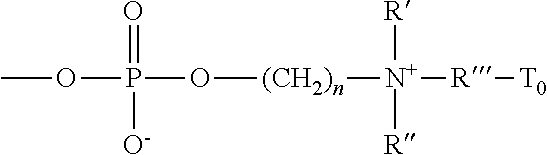
in which n is an integer of 1 to 5 and R′ and R″ independently of each other are C1-C8 alkyl or C1-C8 hydroxyalkyl, R″″ is a C1-C8 alkylene divalent radical, and To is hydrogen, a hydroxyl group, a C1-C4 alkoxy, or a covalent bond.
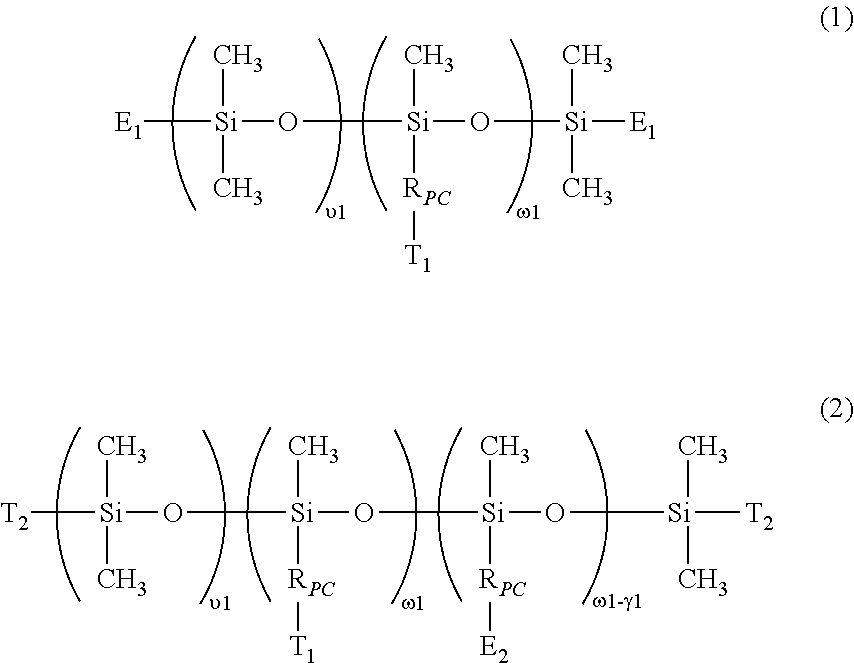
in which:
-
- υ1 is an integer of from 6 to 500 (preferably from 10 to 450, more preferably from 15 to 400, even more preferably from 20 to 350);
- ω1 is an integer of from 3 to 80 (preferably from 5 to 70, more preferably from 7 to 60, even more preferably from 9 to 50);
- γ1 is an integer of from 1 to 78 (preferably from 3 to 68, more preferably from 5 to 58, even more preferably from 7 to 48);

-
- E1 is a monovalent radical of
- E2 is a monovalent radical of

-
- R0 is hydrogen or methyl;
- a1 is zero or 1;
- X0 is O or NRN1;
- RN1 is hydrogen or a C1-C6 alkyl;
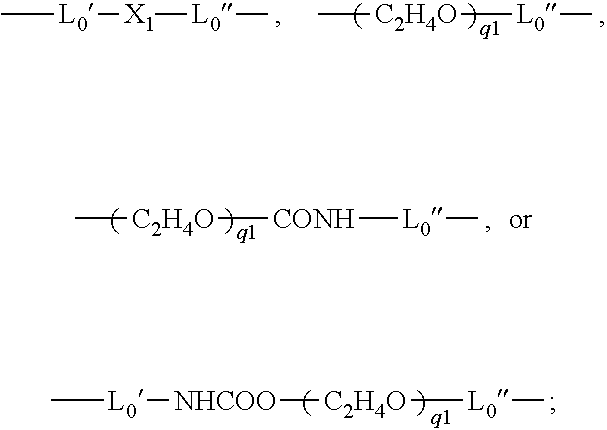
- L0 is a C2-C8 alkylene divalent radical or a divalent radical of
-
- L0′ is a C2-C8 alkylene divalent radical;
- L0″ is C3-C8 alkylene divalent radical;
- X1 is —O—, —NRN1—, —NHCOO—, —OCONH—, —CONRN1—, or —NRN1CO—;
- q1 is an integer of 1 to 20;
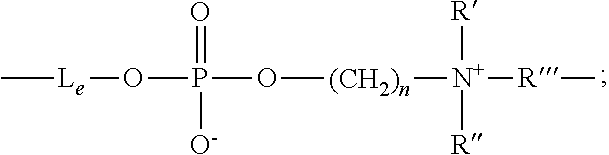
- RPC is a monovalent radical of
-
- Le is a divalent radical of

-
- R1 is a linear or branched C1-C10 alkylene divalent radical;
- R2 is a linear or branched C3-C10 alkylene divalent radical;
- R3 is a direct bond or a linear or branched C1-C4 alkylene divalent radical;
- n is an integer of 1 to 5;
- R′ and R″ independently of each other are C1-C8 alkyl or C1-C8 hydroxyalkyl;
- R″′ is a C1-C8 alkylene divalent radical;
- T1 is hydrogen, a hydroxyl group or a C1-C4 alkoxy; and
- T2 is a C1-C8 alkyl, a C1-C8 hydroxyalkyl, R4—O—R5—, or —RPC—T1;
- R4 is a C1-C4 alkyl; and
- R5 is a C2-C8 alkylene divalent radical.


in which E1, υ1, ω1, and Le are as defined above for formula (1).

(i.e., 2-oxo-1,3,2-dioxaphosphoroyloxy group(s)) onto each of the pendant groups Le of the polydiorganosiloxane vinylic crosslinker of formula (4).

onto each of the pendant groups Le of the polydiorganosiloxane vinylic crosslinker of formula (4).
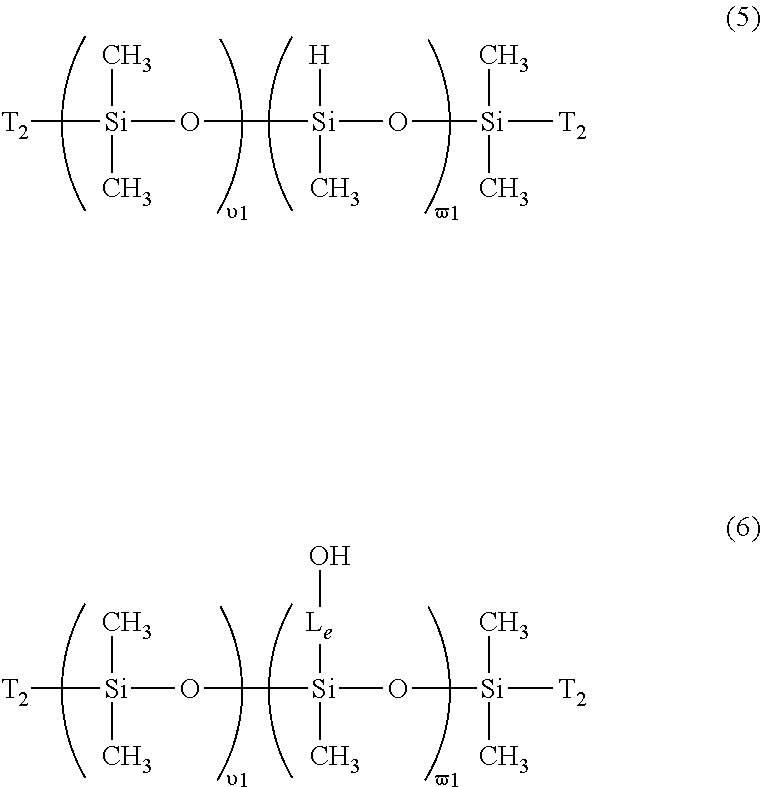

(i.e., 2-oxo-1,3,2-dioxaphsphoroyloxy group(s)) onto each of the pendant groups Le of the polydiorganosiloxane vinylic crosslinker of formula (6).

onto each of the pendant groups Le of the polydiorganosiloxane vinylic crosslinker of formula (6).
-
- 1. A hydrophilized polydiorganosiloxane vinylic crosslinker, comprising:
- (1) a polydiorganosiloxane segment comprising dimethylsiloxane units and at least one hydrophilized siloxane unit having one methyl substituent and one organic substituent having one phosphorylcholine moiety; and
- (2) ethylenically-unsaturated groups.
- 2. The hydrophilized polydiorganosiloxane vinylic crosslinker of embodiment 1, wherein the polydiorganosiloxane segment comprises from 6 to 500 dimethylsiloxane units.
- 3. The hydrophilized polydiorganosiloxane vinylic crosslinker of embodiment 1, wherein the polydiorganosiloxane segment comprises from 10 to 450 dimethylsiloxane units.
- 4. The hydrophilized polydiorganosiloxane vinylic crosslinker of embodiment 1, wherein the polydiorganosiloxane segment comprises from 15 to 400 dimethylsiloxane units.
- 5. The hydrophilized polydiorganosiloxane vinylic crosslinker of embodiment 1, wherein the polydiorganosiloxane segment comprises from 20 to 350 dimethylsiloxane units.
- 6. The hydrophilized polydiorganosiloxane vinylic crosslinker of any one of embodiments 1 to 5, wherein the polydiorganosiloxane segment comprises from 3 to 80 hydrophilized siloxane units.
- 7. The hydrophilized polydiorganosiloxane vinylic crosslinker of any one of embodiments 1 to 5, wherein the polydiorganosiloxane segment comprises from 5 to 70 hydrophilized siloxane units.
- 8. The hydrophilized polydiorganosiloxane vinylic crosslinker of any one of embodiments 1 to 5, wherein the polydiorganosiloxane segment comprises from 7 to 60 hydrophilized siloxane units.
- 9. The hydrophilized polydiorganosiloxane vinylic crosslinker of any one of embodiments 1 to 5, wherein the polydiorganosiloxane segment comprises from 9 to 50 hydrophilized siloxane units.
- 10. The hydrophilized polydiorganosiloxane vinylic crosslinker of any one of embodiments 1 to 9, wherein the ethylenically unsaturated groups are (meth)acryloyl groups.
- 11. The hydrophilized polydiorganosiloxane vinylic crosslinker of any one of embodiments 1 to 10, wherein the molar ratio of the hydrophilized siloxane units to the dimethylsiloxane units is from about 0.002 to about 0.50.
- 12. The hydrophilized polydiorganosiloxane vinylic crosslinker of any one of embodiments 1 to 10, wherein the molar ratio of the hydrophilized siloxane units to the dimethylsiloxane units is from about 0.002 to about 0.20.
- 13. The hydrophilized polydiorganosiloxane vinylic crosslinker of any one of embodiments 1 to 10, wherein the molar ratio of the hydrophilized siloxane units to the dimethylsiloxane units is from about 0.004 to about 0.1.
- 14. The hydrophilized polydiorganosiloxane vinylic crosslinker of any one of embodiments 1 to 10, wherein the molar ratio of the hydrophilized siloxane units to the dimethylsiloxane units is from about 0.004 to about 0.05.
- 15. The hydrophilized polydiorganosiloxane vinylic crosslinker of any one of embodiments 1 to 14, wherein the hydrophilized polydiorganosiloxane vinylic crosslinker has a number average molecular weight of at least 1000 Daltons.
- 16. The hydrophilized polydiorganosiloxane vinylic crosslinker of any one of embodiments 1 to 14, wherein the hydrophilized polydiorganosiloxane vinylic crosslinker has a number average molecular weight of from 1500 Daltons to 80000 Daltons.
- 17. The hydrophilized polydiorganosiloxane vinylic crosslinker of any one of embodiments 1 to 14, wherein the hydrophilized polydiorganosiloxane vinylic crosslinker has a number average molecular weight of from 2000 to 50000 Daltons.
- 18. The hydrophilized polydiorganosiloxane vinylic crosslinker of any one of embodiments 1 to 14, wherein the hydrophilized polydiorganosiloxane vinylic crosslinker has a number average molecular weight of from 2500 to 25000 Dalton.
- 19. The hydrophilized polydiorganosiloxane vinylic crosslinker of any one of embodiments 1 to 18, wherein the hydrophilized polydiorganosiloxane vinylic crosslinker is defined by formula (1) or (2)
- 1. A hydrophilized polydiorganosiloxane vinylic crosslinker, comprising:

in which:
-
- υ1 is an integer of from 6 to 500;
- ω1 is an integer of from 3 to 80;
- γ1 is an integer of from 1 to 78;
- E1 is a monovalent radical of

-
- E2 is a monovalent radical of

-
- R0 is hydrogen or methyl;
- a1 is zero or 1;
- X0 is O or NRN1;
- RN1 is hydrogen or a C1-C6 alkyl;
- L0 is a C2-C8 alkylene divalent radical or a divalent radical of
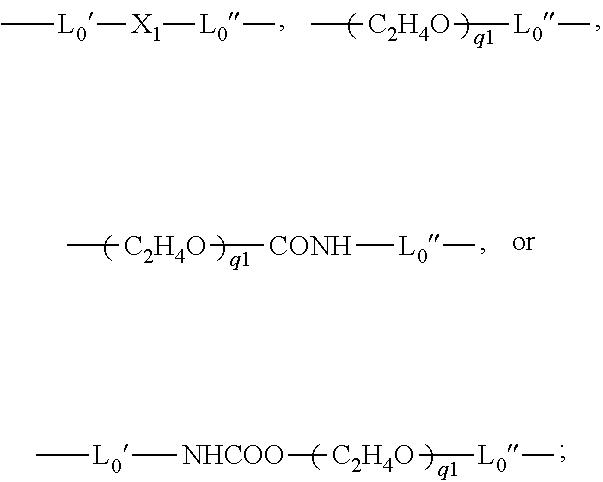
-
- L0′ is a C2-C8 alkylene divalent radical;
- L0″ is C3-C8 alkylene divalent radical;
- X1 is —O—, —NRN1—, —NHCCO—, —OCONH—, —CONRN1—, or —NRN1CO—;
- q1 is an integer of 1 to 20;
- RPC is a monovalent radical of

-
- Le is a divalent radical of
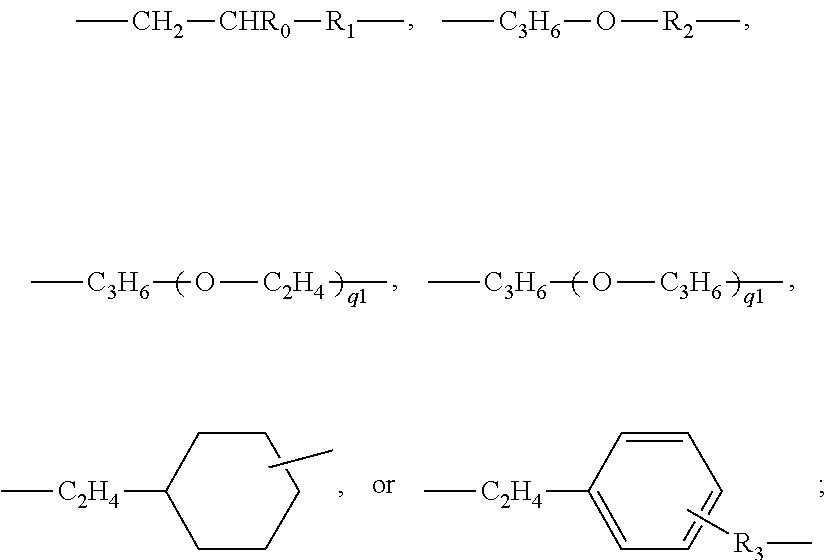
-
- R1 is a linear or branched C1-C10 alkylene divalent radical;
- R2 is a linear or branched C3-C10 alkylene divalent radical;
- R3 is a direct bond or a linear or branched C1-C4 alkylene divalent radical;
- n is an integer of 1 to 5;
- R′ and R″ independently of each other are C1-C8 alkyl or C1-C8 hydroxyalkyl;
- R″′ is a C1-C8 alkylene divalent radical;
- T1 is hydrogen, a hydroxyl group or a C1-C4 alkoxy; and
- T2 is a C1-C8 alkyl, a C1-C8 hydroxyalkyl, R4—O—R5—, or —RPC—T1;
- R4 is a C1-C4 alkyl; and
- R5 is a C2-C8 alkylene divalent radical.
- 20. The hydrophilized polydiorganosiloxane vinylic crosslinker of embodiment 19, wherein in formula (1) or (2) υ1 is an integer of from 10 to 450.
- 21. The hydrophilized polydiorganosiloxane vinylic crosslinker of embodiment 19, wherein in formula (1) or (2) υ1 is an integer of from 15 to 400.
- 22. The hydrophilized polydiorganosiloxane vinylic crosslinker of embodiment 19, wherein in formula (1) or (2) υ1 is an integer of from 20 to 350.
- 23. The hydrophilized polydiorganosiloxane vinylic crosslinker of any one of embodiments 19 to 22, wherein in formula (1) or (2) ω1 is an integer of from 5 to 70.
- 24. The hydrophilized polydiorganosiloxane vinylic crosslinker of any one of embodiments 19 to 22, wherein in formula (1) or (2) ω1 is an integer of from 7 to 60.
- 25. The hydrophilized polydiorganosiloxane vinylic crosslinker of any one of embodiments 19 to 22, wherein in formula (1) or (2) ω1 is an integer of from 9 to 50.
- 26. The hydrophilized polydiorganosiloxane vinylic crosslinker of any one of embodiments 19 to 25, wherein the hydrophilized polydiorganosiloxane vinylic crosslinker is represented by formula (1).
- 27. The hydrophilized polydiorganosiloxane vinylic crosslinker of embodiment 26, wherein in formula (1) a1 is zero.
- 28. The hydrophilized polydiorganosiloxane vinylic crosslinker of embodiment 27, wherein in formula (1) X0 is O.
- 29. The hydrophilized polydiorganosiloxane vinylic crosslinker of embodiment 27, wherein in formula (1) X0 is NRN1.
- 30. The hydrophilized polydiorganosiloxane vinylic crosslinker of any one of embodiments 19 to 25, wherein the hydrophilized polydiorganosiloxane vinylic crosslinker is represented by formula (2).
- 31. The hydrophilized polydiorganosiloxane vinylic crosslinker of embodiment 30, wherein in formula (2) X0 is O.
- 32. The hydrophilized polydiorganosiloxane vinylic crosslinker of embodiment 30, wherein in formula (2) X0 is NRN1.
- 33. A silicone hydrogel contact lens, comprising a crosslinked polymeric material that comprises units of a hydrophilized polydiorganosiloxane vinylic crosslinker of any one of embodiments 1 to 32.
- 34. The silicone hydrogel contact lens of embodiment 33, wherein the silicone hydrogel contact lens, when being fully hydrated, has an oxygen permeability (Dk) of at least about 40 barrers, a water content of from about 15% to about 70% by weight, and an elastic modulus of from about 0.20 MPa to about 1.8 MPa.
- 35. The silicone hydrogel contact lens of embodiment 33 or 34, wherein the silicone hydrogel contact lens, when being fully hydrated, has an oxygen permeability (Dk) of at least about 60 barrers.
- 36. The silicone hydrogel contact lens of embodiment 33 or 34, wherein the silicone hydrogel contact lens, when being fully hydrated, has an oxygen permeability (Dk) of at least about 70 barrers.
- 37. The silicone hydrogel contact lens of embodiment 33 or 34, wherein the silicone hydrogel contact lens, when being fully hydrated, has an oxygen permeability (Dk) of at least about 80 barrers.
- 38. The silicone hydrogel contact lens of any one of embodiments 33 to 37, wherein the silicone hydrogel contact lens, when being fully hydrated, has a water content of from about 20% to about 70% by weight.
- 39. The silicone hydrogel contact lens of any one of embodiments 33 to 38, wherein the silicone hydrogel contact lens, when being fully hydrated, has a water content of from about 25% to about 65% by weight.
- 40. The silicone hydrogel contact lens of any one of embodiments 33 to 38, wherein the silicone hydrogel contact lens, when being fully hydrated, has a water content of from about 30% to about 60% by weight.
- 41. The silicone hydrogel contact lens of any one of embodiments 33 to 40, wherein the hydrophilized silicone hydrogel contact lens, when being fully hydrated, has an elastic modulus of from about 0.25 MPa to about 1.5 MPa.
- 42. The silicone hydrogel contact lens of any one of embodiments 33 to 40, wherein the hydrophilized silicone hydrogel contact lens, when being fully hydrated, has an elastic modulus of from about 0.3 MPa to about 1.2 MPa.
- 43. The silicone hydrogel contact lens of any one of embodiments 33 to 40, wherein the hydrophilized silicone hydrogel contact lens, when being fully hydrated, has an elastic modulus of from about 0.4 MPa to about 1.0 MPa.
- 44. The silicone hydrogel contact lens of any one of embodiments 33 to 43, wherein the silicone hydrogel contact lens comprises units of at least one silicone-containing polymerizable component and units of at least one hydrophilic vinylic monomer.
- 45. The silicone hydrogel contact lens of any one of embodiments 33 to 44, wherein the silicone hydrogel contact material comprises repeating units of at least one silicone-containing vinylic monomer selected from the group consisting of a vinylic monomer having a bis(trialkylsilyloxy)alkylsilyl group, a vinylic monomer having a tris(trialkylsilyloxy)silyl group, a polysiloxane vinylic monomer, 3-methacryloxy propylpentamethyldisiloxane, t-butyldimethyl-siloxyethyl vinyl carbonate, trimethylsilylethyl vinyl carbonate, and trimethylsilylmethyl vinyl carbonate, and combinations thereof.
- 46. The silicone hydrogel contact lens of any one of embodiments 33 to 44, wherein the silicone hydrogel contact material comprises repeating units of at least one silicone-containing vinylic monomer of formula (M1) or (M2)

in which: aM1 is zero or 1; RM0 is H or methyl; XM0 is O or NRM1; LM1 is a C2-C8 alkylene divalent radical or a divalent radical of
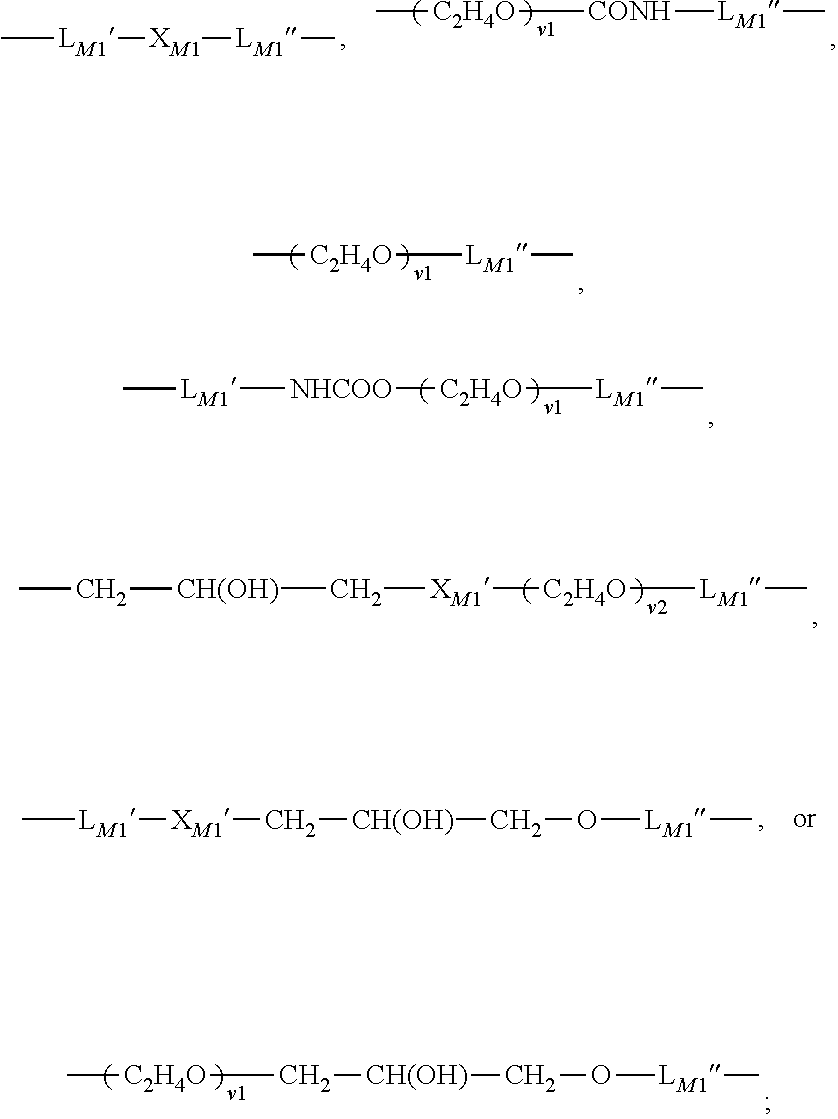
LM1′ is a C2-C8 alkylene divalent radical which has zero or one hydroxyl group; LM1″ is C3-C8 alkylene divalent radical which has zero or one hydroxyl group; XM1 is O, NRM1, NHCOO, OCONH, CONRM1, or NRM1CO; RM1 is H or a C1-C4 alkyl having 0 to 2 hydroxyl group; Rt1 and Rt2 independent of each other are a C1-C6 alkyl; XM1′ is O or NR1; v1 is an integer of 1 to 30; v2 is an integer of 0 to 30; n1 is an integer of 3 to 40; and r1 is an integer of 2 or 3.
-
- 47. The silicone hydrogel contact lens of embodiment 45 or 46, wherein said at least one silicone-containing vinylic monomer comprises tris(trimethylsilyloxy)silylpropyl (meth)acrylate, [3-(meth)acryloxy-2-hydroxypropyloxy]propylbis(trimethylsiloxy)methylsilane, [3-(meth)acryloxy-2-hydroxypropyloxy]propylbis(trimethylsiloxy)butylsilane, 3-(meth)acryloxy-2-(2-hydroxyethoxy)-propyloxy)propylbis(trimethylsiloxy)methylsilane, 3-(meth)acryloxy-2-hydroxypropyloxy)propyltris(trimethylsiloxy)silane, N-[tris(trimethylsiloxy)silylpropyl]-(meth)acrylamide, N-(2-hydroxy-3-(3-(bis(trimethylsilyloxy)methylsilyl)propyloxy)propyl)-2-methyl (meth)acrylamide, N-(2-hydroxy-3-(3-(bis(trimethylsilyloxy)methylsilyl)propyloxy)-propyl) (meth)acrylamide, N-(2-hydroxy-3-(3-(tris(trimethylsilyloxy)silyl)propyloxy)propyl)-2-methyl acrylamide, N-(2-hydroxy-3-(3-(tris(trimethylsilyloxy)silyl)propyloxy)propyl) (meth)acrylamide, N-[tris(dimethylpropylsiloxy)silylpropyl]-(meth)acrylamide, N-[tris(dimethylphenylsiloxy)-silylpropyl](meth)acrylamide, N-[tris(dimethylethylsiloxy)-silylpropyl](meth)acrylamide, N,N-bis[2-hydroxy-3-(3-(bis(trimethylsilyloxy)methylsilyl)-propyloxy)propyl]-2-methyl (meth)acrylamide, N,N-bis[2-hydroxy-3-(3-(bis(trimethylsilyloxy)methylsilyl)propyloxy)-propyl](meth)acrylamide, N,N-bis[2-hydroxy-3-(3-(tris(trimethylsilyloxy)silyl)propyloxy)-propyl]-2-methyl (meth)acrylamide, N,N-bis[2-hydroxy-3-(3-(tris(trimethylsilyloxy)silyl)-propyloxy)propyl](meth)acrylamide, N-[2-hydroxy-3-(3-(t-butyldimethylsilyl)propyloxy)-propyl]-2-methyl (meth)acrylamide, N-[2-hydroxy-3-(3-(t-butyldimethylsilyl)propyloxy)-propyl](meth)acrylamide, N,N-bis[2-hydroxy-3-(3-(t-butyldimethylsilyl)propyloxy)propyl]-2-methyl (meth)acrylamide, N-2-(meth)acryloxyethyl-O-(methyl-bis-trimethylsiloxy-3-propyl)silylcarbamate, 3-(trimethylsilyl)propylvinyl carbonate, 3-(vinyloxycarbonylthio)-propyl-tris(trimethyl-siloxy)silane, 3-[tris(trimethylsiloxy)silyl]propylvinyl carbamate, 3-[tris(trimethylsiloxy)silyl] propyl allyl carbamate, 3-[tris(trimethylsiloxy)silyl]propyl vinyl carbonate, or a combination thereof.
- 48. The silicone hydrogel contact lens of any one of embodiments 45 to 47, wherein said at least one silicone-containing vinylic monomer comprises α-(meth)acryloxypropyl terminated ω-C1-C4-alkyl terminated polydimethylsiloxane, α-(meth)acryloxy-2-hydroxypropyloxypropyl terminated ω-C1-C4-alkyl terminated polydimethylsiloxane, α-(2-hydroxyl-methacryloxypropyloxypropyl)-ω-C1-C4-alkyl-decamethylpentasiloxane, α-[3-(meth)acryloxyethoxy-2-hydroxypropyloxypropyl]-terminated ω-C1-C4-alkyl terminated polydimethylsiloxane, α-[3-(meth)acryloxy-propyloxy-2-hydroxypropyloxypropyl]-terminated ω-C1-C4-alkyl terminated polydimethylsiloxane, α-[3-(meth)acryloxyisopropyloxy-2-hydroxypropyloxypropyl]-terminated ω-C1-C4-alkyl terminated polydimethylsiloxane, α-[3-(meth)acryloxybutyloxy-2-hydroxypropyloxypropyl]-terminated ω-C1-C4-alkyl terminated polydimethylsiloxane, α-[3-(meth)acryloxyethylamino-2-hydroxypropyloxypropyl]-terminated ω-C1-C4-alkyl terminated polydimethylsiloxane, α-[3-(meth)acryloxypropylamino-2-hydroxypropyloxypropyl]-terminated ω-C1-C4-alkyl terminated polydimethylsiloxane, α-[3-(meth)acryloxy-butylamino-2-hydroxypropyloxypropyl]-terminated ω-C1-C4-alkyl terminated polydimethylsiloxane, α-(meth)acryloxy(polyethylenoxy)-2-hydroxypropyloxypropyl]-terminated ω-C1-C4-alkyl terminated polydimethylsiloxane, α-[(meth)acryloxy-2-hydroxypropyloxy-ethoxypropyl]-terminated ω-C1-C4-alkyl terminated polydimethylsiloxane, α-[(meth)acryloxy-2-hydroxypropyl-N-ethylaminopropyl]-terminated ω-C1-C4-alkyl terminated polydimethylsiloxane, α-[(meth)acryloxy-2-hydroxypropyl-aminopropyl]-terminated ω-C1-C4-alkyl terminated polydimethylsiloxane, α-[(metyl)acryloxy-2-hydroxypropyloxy-(polyethylenoxy)propyl]-terminated ω-C1-C4-alkyl terminated polydimethylsiloxane, α-(meth)acryloylamidopropyloxypropyl terminated ω-C1-C4-alkyl terminated polydimethylsiloxane, α-N-methyl-(meth)acryloylamidopropyloxypropyl terminated ω-C1-C4-alkyl terminated polydimethylsiloxane, α-[3-(meth)acrylamidoethoxy-2-hydroxypropyloxy-propyl]-terminated ω-C1-C4-alkyl polydimethylsiloxane, α-[3-(meth)acrylamidopropyloxy-2-hydroxypropyloxypropyl]-terminated ω-C1-C4-alkyl terminated polydimethylsiloxane, α-[3-(meth)acrylamidoisopropyloxy-2-hydroxypropyloxypropyl]-terminated ω-C1-C4-alkyl terminated polydimethylsiloxane, α-[3-(meth)acrylamidobutyloxy-2-hydroxypropyloxypropyl]-terminated ω-C1-C4-alkyl terminated polydimethylsiloxane, α-[3-(meth)acryloylamido-2-hydroxypropyloxypropyl]terminated ω-C1-C4-alkyl polydimethylsiloxane, α-[3-[N-methyl-(meth)acryloylamido]-2-hydroxypropyloxypropyl] terminated ω-C1-C4-alkyl terminated polydimethylsiloxane, N-methyl-N′-(propyltetra(dimethylsiloxy)dimethylbutylsilane) (meth)acrylamide, N-(2,3-dihydroxypropane)-N′-(propyltetra(dimethylsiloxy)dimethylbutylsilane) (meth)acrylamide, (meth)acryloylamidopropyltetra(dimethylsiloxy)dimethylbutylsilane, α-vinyl carbonate-terminated ω-C1-C4-alkyl-terminated polydimethylsiloxanes, α-vinyl carbamate-terminated ω-C1-C4-alkyl-terminated polydimethylsiloxane, or a mixture thereof.
- 49. The silicone hydrogel contact lens of any one of embodiments 33 to 48, wherein the silicone hydrogel material comprises repeating units of at least one polysiloxane vinylic crosslinker.
- 50. The silicone hydrogel contact lens of embodiment 49, wherein said at least one polysiloxane vinylic crosslinker comprises a di-(meth)acryloyl-terminated polydimethylsiloxane, a di-vinyl carbonate-terminated polydimethylsiloxane; a di-vinyl carbamate-terminated polydimethylsiloxane; N, N, N′, N′-tetrakis(3-methacryloxy-2-hydroxypropyl)-alpha,omega-bis-3-aminopropyl-polydimethylsiloxane, or a combination thereof.
- 51. The silicone hydrogel contact lens of embodiment 49 or 50, wherein said at least one polysiloxane vinylic crosslinker comprises a vinylic crosslinker of formula (I)

in which:
-
- d1 is an integer of from 30 to 500 and d2 is an integer of from 1 to 75, provided that
- d2/d1 is from about 0.035 to about 0.15 (preferably from about 0.040 to about 0.12, even more preferably from about 0.045 to about 0.10);
- X01 is O or NRIN in which RIN is hydrogen or C1-C10-alkyl;
- RI0 is hydrogen or methyl;
- RI1 and RI2 independently of each other are a substituted or unsubstituted C1-C10 alkylene divalent radical or a divalent radical of —RI4—O—RI5— in which RI4 and RI5 independently of each other are a substituted or unsubstituted C1-C10 alkylene divalent radical;
- RI3 is a monovalent radical of any one of formula (Ia) to (Ie)

-
- k1 is zero or 1; m1 is an integer of 2 to 4; m2 is an integer of 1 to 5; m3 is an integer of 3 to 6; m4 is an integer of 2 to 5;
- RI6 is hydrogen or methyl;
- RI7 is a C2-C6 hydrocarbon radical having (m2+1) valencies;
- RI8 is a C2-C6 hydrocarbon radical having (m4+1) valencies;
- RI9 is ethyl or hydroxymethyl;
- RI10 is methyl or hydroxymethyl;
- RI11 is hydroxyl or methoxy;
- XI1 is a sulfur linkage of —S— or a teriary amino linkage of —NRI12— in which RI12 is C1-C1 alkyl, hydroxyethyl, hydroxypropyl, or 2,3-dihydroxypropyl; and
- XI2 is an amide linkage of

in which RI13 is hydrogen or C1-C10 alkyl.
-
- 52. The silicone hydrogel contact lens of any one embodiments 49 to 51, wherein said at least one polysiloxane vinylic crosslinker comprises: (1) a vinylic crosslinker which comprises one sole polydiorganosiloxane segment and two terminal ethylenically-unsaturated groups selected from the group consisting of (meth)acryloyloxy groups, (meth)acryloylamino groups, vinyl carbonate groups, vinylcarbamate groups; and/or (2) a chain-extended polysiloxane vinylic crosslinker which comprises at least two polydiorganosiloxane segment and a covalent linker between each pair of polydiorganosiloxane segments and two two terminal ethylenically-unsaturated groups selected from the group consisting of (meth)acryloyloxy groups, (meth)acryloylamino groups, vinyl carbonate groups, vinylcarbamate groups.
- 53. The silicone hydrogel contact lens of any one embodiments 49 to 52, wherein said at least one polysiloxane vinylic crosslinker comprises α,ω-bis[3-(meth)acrylamidopropyl]-terminated polydimethylsiloxane, α,ω-bis[3-(meth)acryloxypropyl]-terminated polydimethylsiloxane, α,ω-bis[3-(meth)acryloxy-2-hydroxypropyloxypropyl]-terminated polydimethylsiloxane, α,ω-bis[3-(meth)acryloxyethoxy-2-hydroxypropyloxypropyl]-terminated polydimethylsiloxane, α,ω-bis[3-(meth)acryloxypropyloxy-2-hydroxypropyloxypropyl]-terminated polydimethylsiloxane, α,ω-bis[3-(meth)acryloxy-isopropyloxy-2-hydroxypropyloxypropyl]-terminated polydimethylsiloxane, α,ω-bis[3-(meth)acryloxybutyloxy-2-hydroxypropyloxypropyl]-terminated polydimethylsiloxane, α,ω-bis[3-(meth)acrylamidoethoxy-2-hydroxypropyloxypropyl]-terminated polydimethylsiloxane, α,ω-bis[3-(meth)acrylamidopropyloxy-2-hydroxypropyloxypropyl]-terminated polydimethylsiloxane, α,ω-bis[3-(meth)acrylamidoisopropyloxy-2-hydroxypropyloxypropyl]-terminated polydimethylsiloxane, α,ω-bis[3-(meth)acrylamidobutyloxy-2-hydroxypropyloxypropyl]-terminated polydimethylsiloxane, α,ω-bis[3-(meth)acryloxyethylamino-2-hydroxypropyloxypropyl]-terminated polydimethylsiloxane, α,ω-bis[3-(meth)acryloxypropylamino-2-hydroxypropyloxypropyl]-terminated polydimethylsiloxane, α,ω-bis[3-(meth)acryloxybutylamino-2-hydroxypropyloxypropyl]-terminated polydimethylsiloxane, α,ω-bis[(meth)acrylamidoethylamino-2-hydroxypropyloxy-propyl]-terminated polydimethylsiloxane, α,ω-bis[3-(meth)acrylamidopropylamino-2-hydroxypropyloxypropyl]-terminated polydimethylsiloxane, α,ω-bis[3-(meth)acrylamide-butylamino-2-hydroxypropyloxypropyl]-terminated polydimethylsiloxane, α,ω-bis[(meth)acryloxy-2-hydroxypropyloxy-ethoxypropyl]-terminated polydimethylsiloxane, α,ω-bis[(meth)acryloxy-2-hydroxypropyl-N-ethylaminopropyl]-terminated polydimethylsiloxane, α,ω-bis[(meth)acryloxy-2-hydroxypropyl-aminopropyl]-polydimethylsiloxane, α,ω-bisRmeth)acryloxy-2-hydroxypropyloxy-(polyethylenoxy)propyl]-terminated polydimethylsiloxane, α,ω-bis[(meth)acryloxyethylamino-carbonyloxy-ethoxypropyl]-terminated polydimethylsiloxane, α,ω-bis[(meth)acryloxyethylamino-carbonyloxy-(polyethylenoxy)propyl]-terminated polydimethylsiloxane, or combinations thereof.
- 54. The silicone hydrogel contact lens of any one embodiments 33 to 53, wherein the silicone hydrogel material comprises repeating units of at least one hydrophilic vinylic monomer.
- 55. The silicone hydrogel contact lens of embodiment 54, wherein said at least one hydrophilic vinylic monomer comprises: (1) an alkyl (meth)acrylamide selected from the group consisting of (meth)acrylamide, N,N-dimethyl (meth)acrylamide, N-ethyl (meth)acrylamide, N,N-diethyl (meth)acrylamide, N-propyl (meth)acrylamide, N-isopropyl (meth)acrylamide, N-3-methoxypropyl (meth)acrylamide, and combinations thereof; (2) a hydroxyl-containing acrylic monomer selected from the group consisting of N-2-hydroxylethyl (meth)acrylamide, N,N-bis(hydroxyethyl) (meth)acrylamide, N-3-hydroxypropyl (meth)acrylamide, N-2-hydroxypropyl (meth)acrylamide, N-2,3-dihydroxypropyl (meth)acrylamide, N-tris(hydroxymethyl)methyl (meth)acrylamide, 2-hydroxyethyl (meth)acrylate, 3-hydroxypropyl (meth)acrylate, 2-hydroxypropyl (meth)acrylate, glycerol methacrylate (GMA), di(ethylene glycol) (meth)acrylate, tri(ethylene glycol) (meth)acrylate, tetra(ethylene glycol) (meth)acrylate, poly(ethylene glycol) (meth)acrylate having a number average molecular weight of up to 1500, poly(ethylene glycol)ethyl (meth)acrylamide having a number average molecular weight of up to 1500, and combinations thereof; (3) a carboxyl-containing acrylic monomer selected from the group consisting of 2-(meth)acrylamidoglycolic acid, (meth)acrylic acid, ethylacrylic acid, 3-(emth)acrylamidopropionic acid, 5-(meth)acrylamidopentanoic acid, 4-(meth)acrylamidobutanoic acid, 3-(meth)acrylamido-2-methylbutanoic acid, 3-(meth)acrylamido-3-methylbutanoic acid, 2-(emth)acrylamido-2methyl-3,3-dimethyl butanoic acid, 3-(meth)acrylamidohaxanoic acid, 4-(meth)acrylamido-3,3-dimethylhexanoic acid, and combinations thereof; (4) an amino-containing acrylic monomer selected from the group consisting of N-2-aminoethyl (meth)acrylamide, N-2-methylaminoethyl (meth)acrylamide, N-2-ethylaminoethyl (meth)acrylamide, N-2-dimethylaminoethyl (meth)acrylamide, N-3-aminopropyl (meth)acrylamide, N-3-methylaminopropyl (meth)acrylamide, N-3-dimethylaminopropyl (meth)acrylamide, 2-aminoethyl (meth)acrylate, 2-methylaminoethyl (meth)acrylate, 2-ethylaminoethyl (meth)acrylate, 3-aminopropyl (meth)acrylate, 3-methylaminopropyl (meth)acrylate, 3-ethylaminopropyl (meth)acrylate, 3-amino-2-hydroxypropyl (meth)acrylate, trimethylammonium 2-hydroxy propyl (meth)acrylate hydrochloride, dimethylaminoethyl (meth)acrylate, and combinations thereof; (5) an N-vinyl amide monomer selected from the group consisting of N-vinylpyrrolidone (aka, N-vinyl-2-pyrrolidone), N-vinyl-3-methyl-2-pyrrolidone, N-vinyl-4-methyl-2-pyrrolidone, N-vinyl-5-methyl-2-pyrrolidone, N-vinyl-6-methyl-2-pyrrolidone, N-vinyl-3-ethyl-2-pyrrolidone, N-vinyl-4,5-dimethyl-2-pyrrolidone, N-vinyl-5,5-dimethyl-2-pyrrolidone, N-vinyl-3,3,5-trimethyl-2-pyrrolidone, N-vinyl piperidone (aka, N-vinyl-2-piperidone), N-vinyl-3-methyl-2-piperidone, N-vinyl-4-methyl-2-piperidone, N-vinyl-5-methyl-2-piperidone, N-vinyl-6-methyl-2-piperidone, N-vinyl-6-ethyl-2-piperidone, N-vinyl-3,5-dimethyl-2-piperidone, N-vinyl-4,4-dimethyl-2-piperidone, N-vinyl caprolactam (aka, N-vinyl-2-caprolactam), N-vinyl-3-methyl-2-caprolactam, N-vinyl-4-methyl-2-caprolactam, N-vinyl-7-methyl-2-caprolactam, N-vinyl-7-ethyl-2-caprolactam, N-vinyl-3,5-dimethyl-2-caprolactam, N-vinyl-4,6-dimethyl-2-caprolactam, N-vinyl-3,5,7-trimethyl-2-caprolactam, N-vinyl-N-methyl acetamide, N-vinyl formamide, N-vinyl acetamide, N-vinyl isopropylamide, N-vinyl-N-ethyl acetamide, N-vinyl-N-ethyl formamide, and mixtures thereof; (6) a methylene-containing pyrrolidone monomer selected from the group consisting of 1-methyl-3-methylene-2-pyrrolidone, 1-ethyl-3-methylene-2-pyrrolidone, 1-methyl-5-methylene-2-pyrrolidone, 1-ethyl-5-methylene-2-pyrrolidone, 5-methyl-3-methylene-2-pyrrolidone, 5-ethyl-3-methylene-2-pyrrolidone, 1-n-propyl-3-methylene-2-pyrrolidone, 1-n-propyl-5-methylene-2-pyrrolidone, 1-isopropyl-3-methylene-2-pyrrolidone, 1-isopropyl-5-methylene-2-pyrrolidone, 1-n-butyl-3-methylene-2-pyrrolidone, 1-tert-butyl-3-methylene-2-pyrrolidone, and combinations thereof; (7) an acrylic monomer having a C1-C4 alkoxyethoxy group and selected from the group consisting of ethylene glycol methyl ether (meth)acrylate, di(ethylene glycol) methyl ether (meth)acrylate, tri(ethylene glycol) methyl ether (meth)acrylate, tetra(ethylene glycol) methyl ether (meth)acrylate, C1-C4-alkoxy poly(ethylene glycol) (meth)acrylate having a number average molecular weight of up to 1500, methoxy-poly(ethylene glycol)ethyl (meth)acrylamide having a number average molecular weight of up to 1500, and combinations thereof; (8) a vinyl ether monomer selected from the group consisting of ethylene glycol monovinyl ether, di(ethylene glycol) monovinyl ether, tri(ethylene glycol) monovinyl ether, tetra(ethylene glycol) monovinyl ether, poly(ethylene glycol) monovinyl ether, ethylene glycol methyl vinyl ether, di(ethylene glycol) methyl vinyl ether, tri(ethylene glycol) methyl vinyl ether, tetra(ethylene glycol) methyl vinyl ether, poly(ethylene glycol) methyl vinyl ether, and combinations thereof; (9) an allyl ether monomer selected from the group consisting of ethylene glycol monoallyl ether, di(ethylene glycol) monoallyl ether, tri(ethylene glycol) monoallyl ether, tetra(ethylene glycol) monoallyl ether, poly(ethylene glycol) monoallyl ether, ethylene glycol methyl allyl ether, di(ethylene glycol) methyl allyl ether, tri(ethylene glycol) methyl allyl ether, tetra(ethylene glycol) methyl allyl ether, poly(ethylene glycol) methyl allyl ether, and combinations thereof; (10) a phosphorylcholine-containing vinylic monomer selected from the group consisting of (meth)acryloyloxyethyl phosphorylcholine, (meth)acryloyloxypropyl phosphorylcholine, 4-((meth)acryloyloxy)butyl-2′-(trimethylammonio)ethylphosphate, 2-[(meth)acryloylamino]ethyl-2′-(trimethylammonio)-ethylphosphate, 3-[(meth)acryloylamino]propyl-2′-(trimethylammonio)ethylphosphate, 4-[(meth)acryloylamino]butyl-2′-(trimethylammonio)ethylphosphate, 5-((meth)acryloyloxy)pentyl-2′-(triimethylammonio)ethyl phosphate, 6-((meth)acryloyloxy)hexyl-2-(trimethylammonio)-ethylphosphate, 2-((meth)acryloyloxy)ethyl-2′-(trimethylammonio)ethylphosphate, 2-((meth)acryloyloxy)ethyl-2′-(tripropylammonio)ethylphosphate, 2-((meth)acryloyloxy)ethyl-2′-(tributylammonio)ethylphosphate, 2-((meth)acryloyloxy)propyl-2′-(trimethylammonio)-ethylphosphate, 2-((meth)acryloyloxy)butyl-2′-(thmethylammonio)ethylphosphate, 2-((meth)acryloyloxy)pentyl-2′-(trimethylammonio)ethylphosphate, 2-((rneth)acryloyloxy)hexyl-2′-(trimethylammonio)ethyl phosphate, 2-(vinyloxy)ethyl-2″-(trimethylammonio)ethylphosphate, 2-(allyloxy)ethyl-2′-(trimethylammonio)ethylphosphate, 2-(vinyloxycarbonyl)ethyl-2′-(trimethylammonio)ethyl phosphate, 2-(allyloxycarbonyl)ethyl-2′-(trimethylammonio)-ethylphosphate, 2-(vinylcarbonylamino)ethyl-2′-(trimethylammonio)ethylphosphate, 2-(allyloxycarbonylamino)ethyl-2′-(trimethylammonio)ethyl phosphate, 2-(butenoyloxy)ethyl-2′-(trimethylammonio)ethylphosphate, and combinations thereof; (11) allyl alcohol; (12) N-2-hydroxyethyl vinyl carbamate; (13) N-carboxyvinyl-β-alanine (VINAL); (14) N-carboxyvinyl-α-alanine; (15) or combinations thereof.
- 56. The silicone hydrogel contact lens of embodiment 54 or 55, wherein said at least one hydrophilic vinylic monomer comprises N-vinylpyrrolidone, N-vinyl-N-methyl acetamide, or combinations thereof.
- 57. The silicone hydrogel contact lens of any one of embodiments 54 to 56, wherein said at least one hydrophilic vinylic monomer comprises N,N-dimethyl (meth)acrylamide.
- 58. The silicone hydrogel contact lens of any one of embodiments 54 to 57, wherein said at least one hydrophilic vinylic monomer comprises N-2-hydroxylethyl (meth)acrylamide, N,N-bis(hydroxyethyl) (meth)acrylamide, N-3-hydroxypropyl (meth)acrylamide, N-2-hydroxypropyl (meth)acrylamide, N-2,3-dihydroxypropyl (meth)acrylamide, N-tris(hydroxymethyl)methyl (meth)acrylamide, 2-hydroxyethyl (meth)acrylate, 3-hydroxypropyl (meth)acrylate, 2-hydroxypropyl (meth)acrylate, glycerol methacrylate (GMA), di(ethylene glycol) (meth)acrylate, tri(ethylene glycol) (meth)acrylate, tetra(ethylene glycol) (meth)acrylate, poly(ethylene glycol) (meth)acrylate having a number average molecular weight of up to 1500, poly(ethylene glycol)ethyl (meth)acrylamide having a number average molecular weight of up to 1500, or combinations thereof.
- 59. The silicone hydrogel contact lens of any one of embodiments 33 to 58, wherein the silicone hydrogel material comprises repeating units of at least one non-silicone vinylic cross-linking agent.
- 60. The silicone hydrogel contact lens of embodiment 59, wherein said at least one non-silicone vinylic crossling agent comprises ethyleneglycol di-(meth)acrylate, diethyleneglycol di-(meth)acrylate, triethyleneglycol di-(meth)acrylate, tetraethyleneglycol di-(meth)acrylate, glycerol di-(meth)acrylate, 1,3-propanediol di-(meth)acrylate, 1,3-butanediol di-(meth)acrylate, 1,4-butanediol di-(meth)acrylate, glycerol 1,3-diglycerolate di-(meth)acrylate, ethylenebis[oxy(2-hydroxypropane-1,3-diyl)] di-(meth)acrylate, bis[2-(meth)acryloxyethyl] phosphate, trimethylolpropane di-(meth)acrylate, and 3,4-bis[(meth)acryloyl]tetrahydrofuan, diacrylamide, dimethacrylamide, N,N-di(meth)acryloyl-N-methylamine, N, N-di(meth)acryloyl-N-ethylamine, N,N′-methylene bis(meth)acrylamide, N,N′-ethylene bis(meth)acrylamide, N,N′-dihydroxyethylene bis(meth)acrylamide, N,N′-propylene bis(meth)acrylamide, N,N′-2-hydroxypropylene bis(meth)acrylamide, N,N′-2,3-dihydroxybutylene bis(meth)acrylamide, 1,3-bis(meth)acrylamidepropane-2-yl dihydrogen phosphate, piperazine diacrylamide, tetraethyleneglycol divinyl ether, triethyleneglycol divinyl ether, diethyleneglycol divinyl ether, ethyleneglycol divinyl ether, triallyl isocyanurate, triallyl cyanurate, trimethylopropane trimethacrylate, pentaerythritol tetramethacrylate, bisphenol A dimethacrylate, allylmethacrylate, allylacrylate, N-allyl-methacrylamide, N-allyl-acrylamide, or combinations thereof.
- 61. The silicone hydrogel contact lens of any one of embodiments 33 to 60, wherein the silicone hydrogel material comprises repeating units of at least one blending vinylic monomer.
- 62. The silicone hydrogel contact lens of embodiment 61, wherein said at least one blending vinylic monomer comprises Ci-Cio alkyl (meth)acrylate, cyclopentylacrylate, cyclohexylmethacrylate, cyclohexylacrylate, isobornyl (meth)acrylate, styrene, 4,6-trimethylstyrene (TMS), t-butyl styrene (TBS), trifluoroethyl (meth)acrylate, hexafluoro-isopropyl (meth)acrylate, hexafluorobutyl (meth)acrylate, or combinations thereof.
- 63. The silicone hydrogel contact lens of embodiment 61 or 62, wherein said at least one blending vinylic monomer comprises methyl methacrylate.

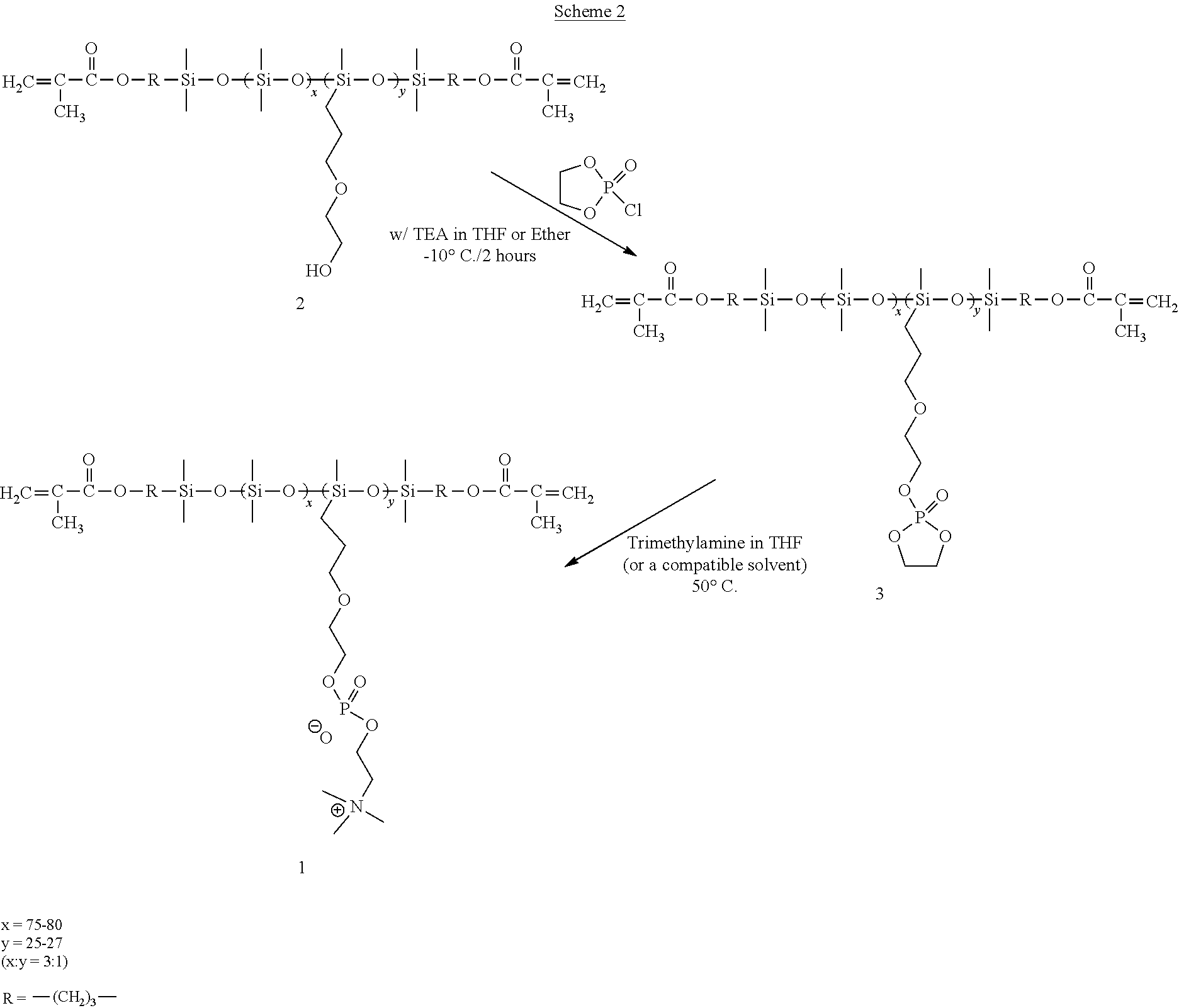
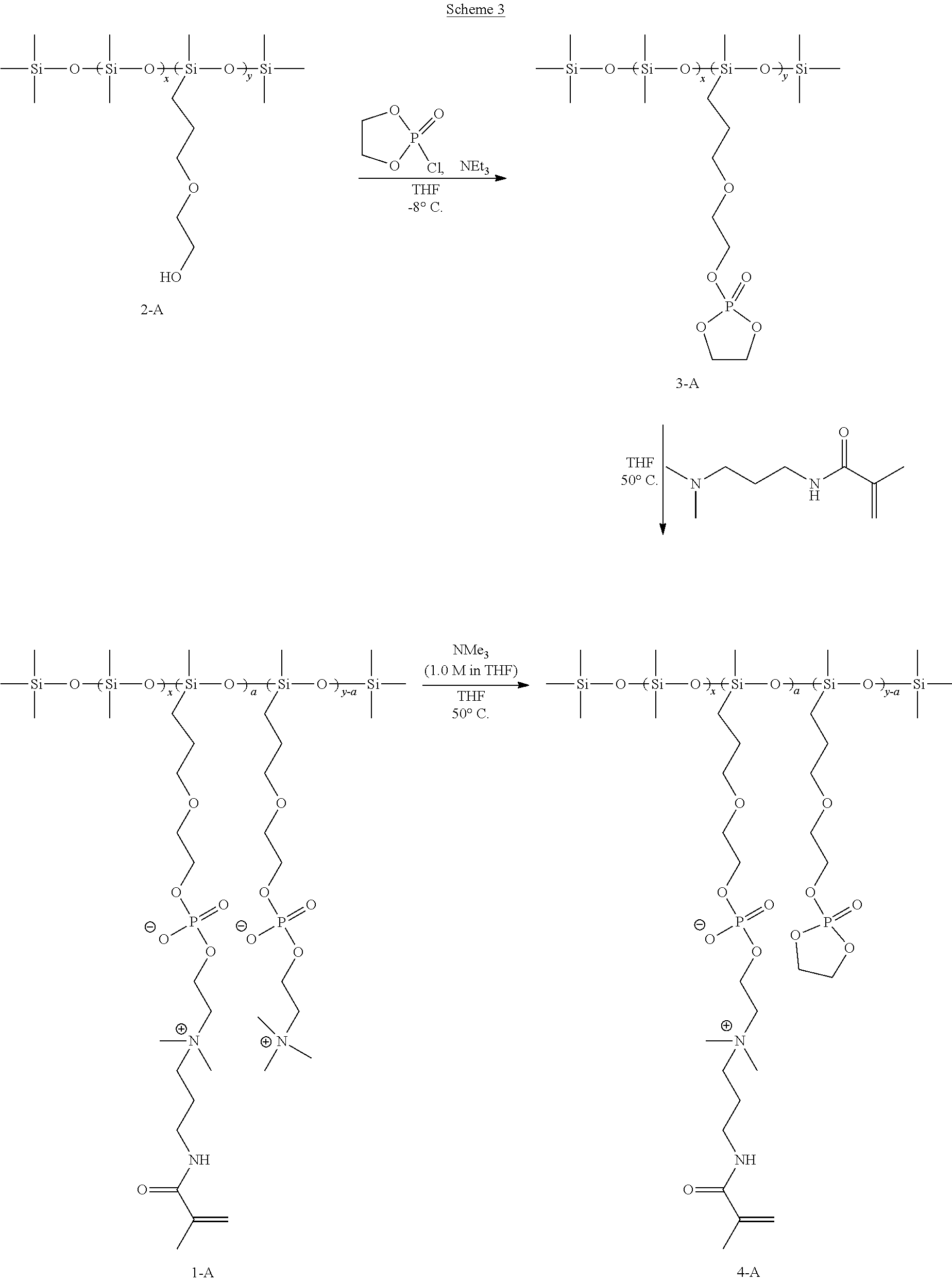
Claims (23)
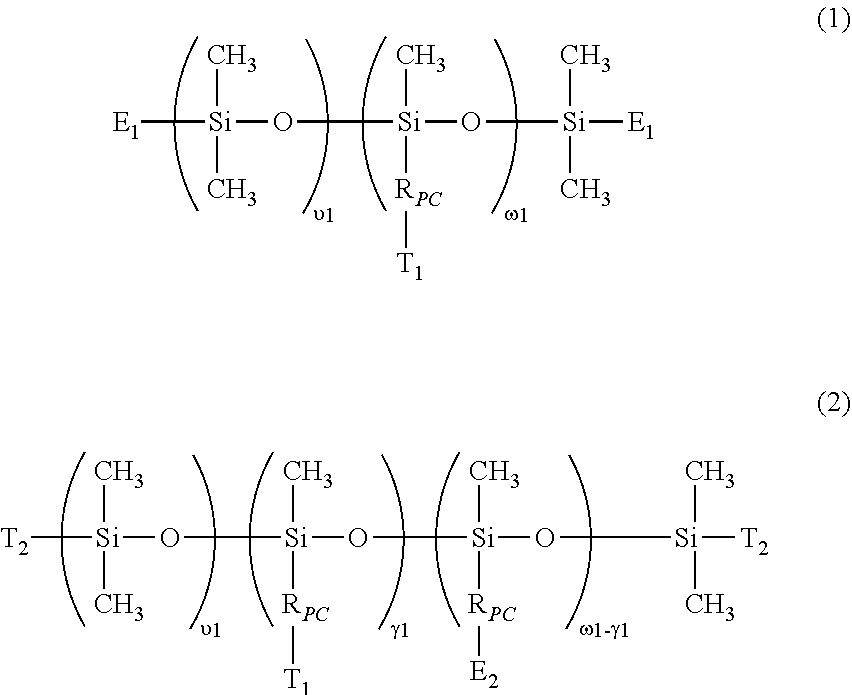


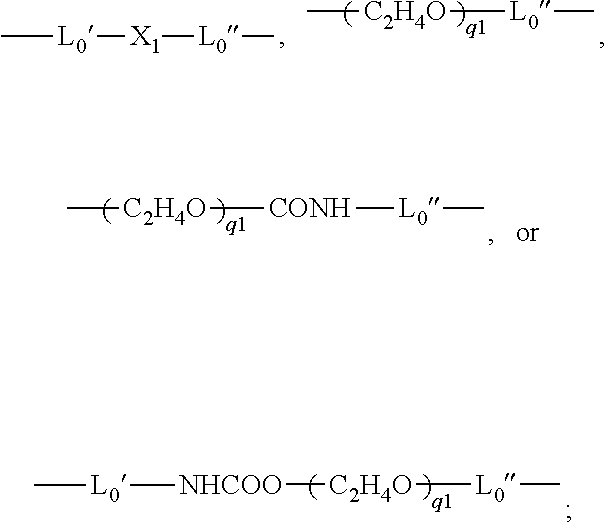

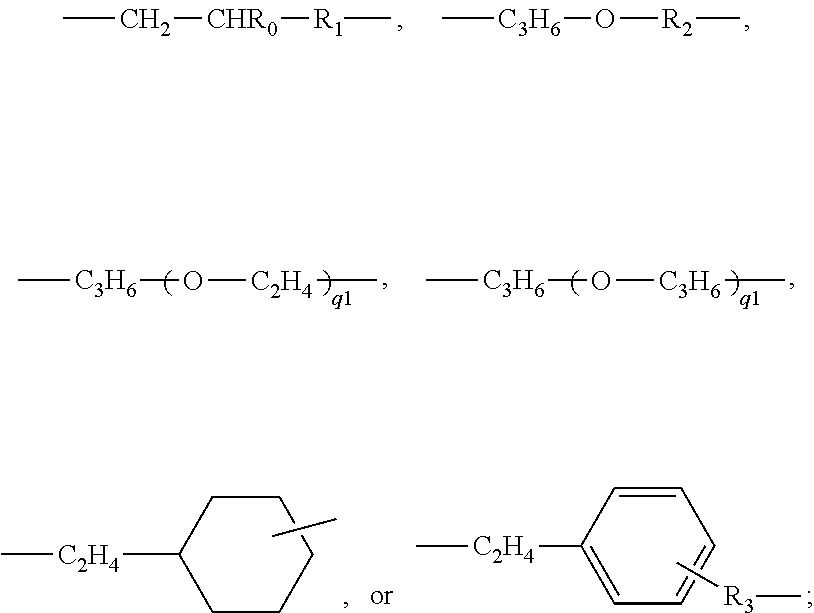
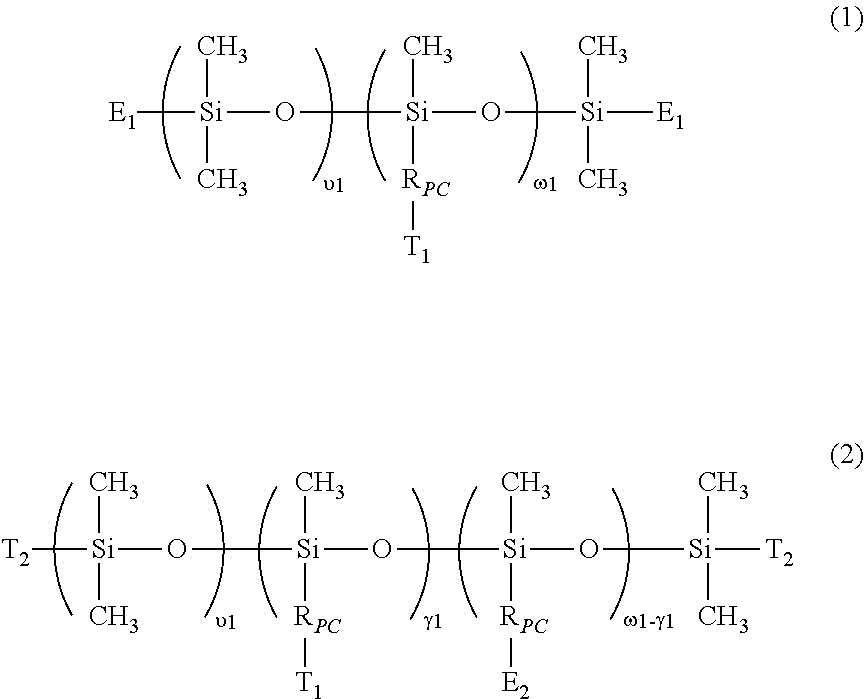


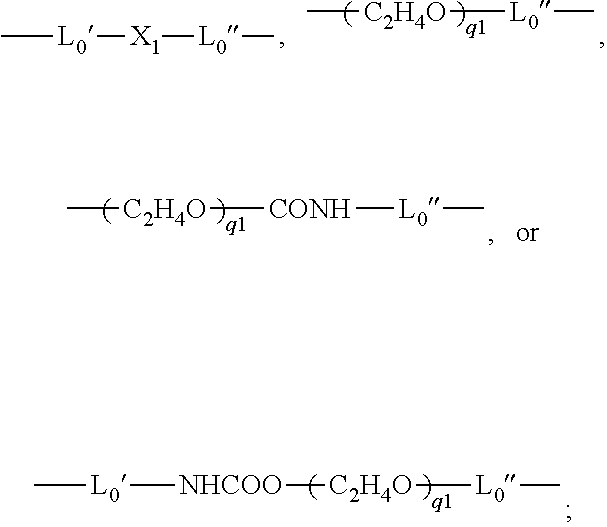


Priority Applications (1)
| Application Number | Priority Date | Filing Date | Title |
|---|---|---|---|
| US17/666,601 US12351688B2 (en) | 2021-02-09 | 2022-02-08 | Hydrophilized polydiorganosiloxane vinylic crosslinkers |
Applications Claiming Priority (2)
| Application Number | Priority Date | Filing Date | Title |
|---|---|---|---|
| US202163147624P | 2021-02-09 | 2021-02-09 | |
| US17/666,601 US12351688B2 (en) | 2021-02-09 | 2022-02-08 | Hydrophilized polydiorganosiloxane vinylic crosslinkers |
Publications (2)
| Publication Number | Publication Date |
|---|---|
| US20220251302A1 US20220251302A1 (en) | 2022-08-11 |
| US12351688B2 true US12351688B2 (en) | 2025-07-08 |
Family
ID=80446541
Family Applications (1)
| Application Number | Title | Priority Date | Filing Date |
|---|---|---|---|
| US17/666,601 Active 2044-05-11 US12351688B2 (en) | 2021-02-09 | 2022-02-08 | Hydrophilized polydiorganosiloxane vinylic crosslinkers |
Country Status (5)
| Country | Link |
|---|---|
| US (1) | US12351688B2 (en) |
| EP (1) | EP4291601A1 (en) |
| JP (1) | JP7690041B2 (en) |
| CN (1) | CN116867836A (en) |
| WO (1) | WO2022172154A1 (en) |
Families Citing this family (7)
| Publication number | Priority date | Publication date | Assignee | Title |
|---|---|---|---|---|
| JP7692112B2 (en) | 2021-09-01 | 2025-06-12 | アルコン インク. | Method for producing wettable silicone hydrogel contact lenses - Patents.com |
| US20240280834A1 (en) | 2023-02-02 | 2024-08-22 | Alcon Inc. | Water gradient silicone hydrogel contact lenses |
| TW202441215A (en) | 2023-02-27 | 2024-10-16 | 瑞士商愛爾康公司 | A method for producing wettable silicone hydrogel contact lenses |
| US20240316886A1 (en) | 2023-03-22 | 2024-09-26 | Alcon Inc. | Method for making embedded hydrogel contact lenses |
| WO2024241239A1 (en) | 2023-05-25 | 2024-11-28 | Alcon Inc. | Coated silicone hydrogel contact lenses and method for making the same |
| US20240399627A1 (en) | 2023-06-01 | 2024-12-05 | Alcon Inc. | Method for making embedded hydrogel contact lenses |
| CN117264492A (en) * | 2023-11-21 | 2023-12-22 | 成都虹润制漆有限公司 | Indoor expansion type steel structure fireproof coating and preparation method thereof |
Citations (87)
| Publication number | Priority date | Publication date | Assignee | Title |
|---|---|---|---|---|
| US3408429A (en) | 1963-09-11 | 1968-10-29 | Ceskoslovenska Akademie Ved | Method for centrifugal casting a contact lens |
| US4136250A (en) | 1977-07-20 | 1979-01-23 | Ciba-Geigy Corporation | Polysiloxane hydrogels |
| US4153641A (en) | 1977-07-25 | 1979-05-08 | Bausch & Lomb Incorporated | Polysiloxane composition and contact lens |
| US4182822A (en) | 1976-11-08 | 1980-01-08 | Chang Sing Hsiung | Hydrophilic, soft and oxygen permeable copolymer composition |
| US4189546A (en) | 1977-07-25 | 1980-02-19 | Bausch & Lomb Incorporated | Polysiloxane shaped article for use in biomedical applications |
| US4254248A (en) | 1979-09-13 | 1981-03-03 | Bausch & Lomb Incorporated | Contact lens made from polymers of polysiloxane and polycyclic esters of acrylic acid or methacrylic acid |
| US4259467A (en) | 1979-12-10 | 1981-03-31 | Bausch & Lomb Incorporated | Hydrophilic contact lens made from polysiloxanes containing hydrophilic sidechains |
| US4260725A (en) | 1979-12-10 | 1981-04-07 | Bausch & Lomb Incorporated | Hydrophilic contact lens made from polysiloxanes which are thermally bonded to polymerizable groups and which contain hydrophilic sidechains |
| US4261875A (en) | 1979-01-31 | 1981-04-14 | American Optical Corporation | Contact lenses containing hydrophilic silicone polymers |
| US4276402A (en) | 1979-09-13 | 1981-06-30 | Bausch & Lomb Incorporated | Polysiloxane/acrylic acid/polcyclic esters of methacrylic acid polymer contact lens |
| US4327203A (en) | 1981-02-26 | 1982-04-27 | Bausch & Lomb Incorporated | Polysiloxane with cycloalkyl modifier composition and biomedical devices |
| US4341889A (en) | 1981-02-26 | 1982-07-27 | Bausch & Lomb Incorporated | Polysiloxane composition and biomedical devices |
| US4343927A (en) | 1976-11-08 | 1982-08-10 | Chang Sing Hsiung | Hydrophilic, soft and oxygen permeable copolymer compositions |
| US4347198A (en) | 1977-09-12 | 1982-08-31 | Toray Industries, Ltd. | Producing soft contact lenses |
| US4355147A (en) | 1981-02-26 | 1982-10-19 | Bausch & Lomb Incorporated | Polysiloxane with polycyclic modifier composition and biomedical devices |
| US4444711A (en) | 1981-12-21 | 1984-04-24 | Husky Injection Molding Systems Ltd. | Method of operating a two-shot injection-molding machine |
| US4460534A (en) | 1982-09-07 | 1984-07-17 | International Business Machines Corporation | Two-shot injection molding |
| US4486577A (en) | 1982-10-12 | 1984-12-04 | Ciba-Geigy Corporation | Strong, silicone containing polymers with high oxygen permeability |
| US4543398A (en) | 1983-04-28 | 1985-09-24 | Minnesota Mining And Manufacturing Company | Ophthalmic devices fabricated from urethane acrylates of polysiloxane alcohols |
| US4605712A (en) | 1984-09-24 | 1986-08-12 | Ciba-Geigy Corporation | Unsaturated polysiloxanes and polymers thereof |
| US4661575A (en) | 1982-01-25 | 1987-04-28 | Hercules Incorporated | Dicyclopentadiene polymer product |
| US4684538A (en) | 1986-02-21 | 1987-08-04 | Loctite Corporation | Polysiloxane urethane compounds and adhesive compositions, and method of making and using the same |
| US4703097A (en) | 1986-04-10 | 1987-10-27 | Bayer Aktiengesellschaft | Optical contact objects |
| US4833218A (en) | 1984-12-18 | 1989-05-23 | Dow Corning Corporation | Hydrophilic silicone-organic copolymer elastomers containing bioactine agent |
| US4837289A (en) | 1987-04-30 | 1989-06-06 | Ciba-Geigy Corporation | UV- and heat curable terminal polyvinyl functional macromers and polymers thereof |
| US4954586A (en) | 1989-01-17 | 1990-09-04 | Menicon Co., Ltd | Soft ocular lens material |
| US4954587A (en) | 1988-07-05 | 1990-09-04 | Ciba-Geigy Corporation | Dimethylacrylamide-copolymer hydrogels with high oxygen permeability |
| US5010141A (en) | 1989-10-25 | 1991-04-23 | Ciba-Geigy Corporation | Reactive silicone and/or fluorine containing hydrophilic prepolymers and polymers thereof |
| US5034461A (en) | 1989-06-07 | 1991-07-23 | Bausch & Lomb Incorporated | Novel prepolymers useful in biomedical devices |
| US5039761A (en) | 1988-09-16 | 1991-08-13 | Shin-Etsu Chemical Co., Ltd. | Methacryl function dimethylpolysiloxanes and graft copolymers thereof |
| US5070170A (en) | 1988-02-26 | 1991-12-03 | Ciba-Geigy Corporation | Wettable, rigid gas permeable, substantially non-swellable contact lens containing block copolymer polysiloxane-polyoxyalkylene backbone units, and use thereof |
| US5070215A (en) | 1989-05-02 | 1991-12-03 | Bausch & Lomb Incorporated | Novel vinyl carbonate and vinyl carbamate contact lens material monomers |
| US5079319A (en) | 1989-10-25 | 1992-01-07 | Ciba-Geigy Corporation | Reactive silicone and/or fluorine containing hydrophilic prepolymers and polymers thereof |
| US5346946A (en) | 1992-08-26 | 1994-09-13 | Menicon Co., Ltd | Ocular lens material |
| US5358995A (en) | 1992-05-15 | 1994-10-25 | Bausch & Lomb Incorporated | Surface wettable silicone hydrogels |
| EP0632329A1 (en) | 1993-07-02 | 1995-01-04 | Ciba-Geigy Ag | Functionalised photoinitiator, macromeres and their use |
| US5416132A (en) | 1992-08-24 | 1995-05-16 | Menicon Co., Ltd. | Ocular lens material |
| US5449729A (en) | 1991-11-05 | 1995-09-12 | Bausch & Lomb Incorporated | UV curable crosslinking agents useful in copolymerization |
| US5451617A (en) | 1991-09-12 | 1995-09-19 | Bausch & Lomb Incorporated | Wettable silicone hydrogel compositions and methods for their manufacture |
| US5486579A (en) | 1991-11-05 | 1996-01-23 | Bausch & Lomb Incorporated | Wettable silicone hydrogel compositions and methods for their manufacture |
| US5508317A (en) | 1993-08-06 | 1996-04-16 | Ciba-Geigy Corporation | Photocrosslinked polymers |
| US5760100A (en) | 1994-09-06 | 1998-06-02 | Ciba Vision Corporation | Extended wear ophthalmic lens |
| US5843346A (en) | 1994-06-30 | 1998-12-01 | Polymer Technology Corporation | Method of cast molding contact lenses |
| US5894002A (en) | 1993-12-13 | 1999-04-13 | Ciba Vision Corporation | Process and apparatus for the manufacture of a contact lens |
| US5962548A (en) | 1998-03-02 | 1999-10-05 | Johnson & Johnson Vision Products, Inc. | Silicone hydrogel polymers |
| US5981675A (en) | 1998-12-07 | 1999-11-09 | Bausch & Lomb Incorporated | Silicone-containing macromonomers and low water materials |
| US5994488A (en) | 1996-12-06 | 1999-11-30 | Toray Industries, Inc. | Plastic articles for medical use |
| US6039913A (en) | 1998-08-27 | 2000-03-21 | Novartis Ag | Process for the manufacture of an ophthalmic molding |
| US6762264B2 (en) | 1999-07-27 | 2004-07-13 | Bausch & Lomb Incorporated | Contact lens material |
| US6867245B2 (en) | 1999-12-16 | 2005-03-15 | Asahikasei Aime Co., Ltd. | Long wearable soft contact lens |
| US7214809B2 (en) | 2004-02-11 | 2007-05-08 | Johnson & Johnson Vision Care, Inc. | (Meth)acrylamide monomers containing hydroxy and silicone functionalities |
| US7423074B2 (en) | 2004-12-29 | 2008-09-09 | Bausch & Lomb Incorporated | Polysiloxane prepolymers for biomedical devices |
| US20090182067A1 (en) | 2008-01-14 | 2009-07-16 | Yuwen Liu | Polymerizable Contact Lens Formulations and Contact Lenses Obtained Therefrom |
| US7605190B2 (en) | 2006-09-27 | 2009-10-20 | Ivoclar Vivadent Ag | Polymerizable compositions with acylgermanium compounds |
| US7671156B2 (en) | 2005-08-10 | 2010-03-02 | Novartis Ag | Silicone hydrogels |
| US7744785B2 (en) | 2005-12-14 | 2010-06-29 | Novartis Ag | Method for preparing silicone hydrogels |
| WO2010147779A2 (en) | 2009-06-15 | 2010-12-23 | Dsm Ip Assets B.V. | Phosphorylcholine-based amphiphilic silicones for medical applications |
| US8129442B2 (en) | 2008-02-08 | 2012-03-06 | Coopervision International Holding Company, Lp | Hydrophilic polysiloxane macromonomer, and production and use of the same |
| US8163206B2 (en) | 2008-12-18 | 2012-04-24 | Novartis Ag | Method for making silicone hydrogel contact lenses |
| US20130059926A1 (en) | 2011-09-01 | 2013-03-07 | Michael Driver | Methods for producing biocompatible materials |
| US8415405B2 (en) | 2010-03-18 | 2013-04-09 | Johnson & Johnson Vision Care, Inc. | Silicone (meth)acrylamide monomer, polymer, ophthalmic lens, and contact lens |
| WO2013070306A1 (en) | 2011-11-10 | 2013-05-16 | Vertellus Specialties Inc. | Polymerisable material |
| US8475529B2 (en) | 2005-07-19 | 2013-07-02 | Gerald P. Clarke | Accommodating intraocular lens |
| US20130172574A1 (en) * | 2011-12-29 | 2013-07-04 | Pegavision Corporation | Method for manufacturing hydrophilic silicone macromer |
| US8513325B2 (en) | 2011-02-28 | 2013-08-20 | Coopervision International Holding Company, Lp | Silicone hydrogel contact lenses and related compositions and methods |
| US8529057B2 (en) | 2010-07-30 | 2013-09-10 | Novartis Ag | Silicone hydrogel lens with a crosslinked hydrophilic coating |
| US8614261B2 (en) | 2004-08-27 | 2013-12-24 | Coopervision International Holding Company Lp | Silicone hydrogel contact lens |
| US8658748B2 (en) | 2011-02-28 | 2014-02-25 | Coopervision International Holding Company, Lp | Silicone hydrogel contact lenses having acceptable levels of energy loss |
| US8835525B2 (en) | 2010-10-06 | 2014-09-16 | Novartis Ag | Chain-extended polysiloxane crosslinkers with dangling hydrophilic polymer chains |
| US8993651B2 (en) | 2010-10-06 | 2015-03-31 | Novartis Ag | Polymerizable chain-extended polysiloxanes with pendant hydrophilic groups |
| US9097840B2 (en) | 2012-12-14 | 2015-08-04 | Novartis Ag | Amphiphilic siloxane-containing (meth)acrylamides and uses thereof |
| US9103965B2 (en) | 2012-12-14 | 2015-08-11 | Novartis Ag | Amphiphilic siloxane-containing vinylic monomers and uses thereof |
| US9187601B2 (en) | 2010-10-06 | 2015-11-17 | Novartis Ag | Water-processable silicone-containing prepolymers and uses thereof |
| US9217813B2 (en) | 2011-02-28 | 2015-12-22 | Coopervision International Holding Company, Lp | Silicone hydrogel contact lenses |
| WO2016140242A1 (en) | 2015-03-03 | 2016-09-09 | 日油株式会社 | Eyedrops |
| US9475827B2 (en) | 2012-12-14 | 2016-10-25 | Shin-Etsu Chemical Company, Ltd. | Tris(trimethyl siloxyl)silane vinylic monomers and uses thereof |
| JP2017146334A (en) | 2016-02-15 | 2017-08-24 | 日油株式会社 | Contact lens having phosphorylcholine group-containing hydrophilic polymer on surface thereof |
| JP2017151437A (en) | 2016-02-23 | 2017-08-31 | 日油株式会社 | Soft contact lens solution |
| JP2017197614A (en) | 2016-04-26 | 2017-11-02 | 東レ株式会社 | Copolymer, medical device and manufacturing method therefor, humectant and compound for medical device |
| US10081697B2 (en) | 2015-12-15 | 2018-09-25 | Novartis Ag | Hydrophilized polydiorganosiloxane vinylic crosslinkers and uses thereof |
| US10301451B2 (en) | 2016-10-11 | 2019-05-28 | Novartis Ag | Chain-extended polydimethylsiloxane vinylic crosslinkers and uses thereof |
| WO2019194264A1 (en) | 2018-04-05 | 2019-10-10 | 日油株式会社 | Phosphorylcholine group-containing polysiloxane monomer |
| US10449740B2 (en) | 2015-12-15 | 2019-10-22 | Novartis Ag | Method for applying stable coating on silicone hydrogel contact lenses |
| US10465047B2 (en) | 2016-10-11 | 2019-11-05 | Novartis Ag | Polymerizable polydimethylsiloxane-polyoxyalkylene block copolymers |
| WO2020218220A1 (en) | 2019-04-25 | 2020-10-29 | 日油株式会社 | Monomer composition for contact lenses, polymer for contact lenses and method for producing same, and contact lens and method for producing same |
| US10866344B2 (en) | 2017-06-07 | 2020-12-15 | Alcon Inc. | Silicone hydrogel contact lenses |
| US10875967B2 (en) | 2017-06-07 | 2020-12-29 | Alcon Inc. | Silicone hydrogel contact lenses |
Family Cites Families (2)
| Publication number | Priority date | Publication date | Assignee | Title |
|---|---|---|---|---|
| US5583463A (en) | 1995-05-30 | 1996-12-10 | Micron Technology, Inc. | Redundant row fuse bank circuit |
| CN105601930B (en) * | 2010-07-30 | 2018-09-18 | 诺华股份有限公司 | Amphipathic siloxane prepolymer and application thereof |
-
2022
- 2022-02-08 EP EP22704003.7A patent/EP4291601A1/en active Pending
- 2022-02-08 JP JP2023546044A patent/JP7690041B2/en active Active
- 2022-02-08 WO PCT/IB2022/051112 patent/WO2022172154A1/en not_active Ceased
- 2022-02-08 US US17/666,601 patent/US12351688B2/en active Active
- 2022-02-08 CN CN202280013861.6A patent/CN116867836A/en active Pending
Patent Citations (105)
| Publication number | Priority date | Publication date | Assignee | Title |
|---|---|---|---|---|
| US3408429A (en) | 1963-09-11 | 1968-10-29 | Ceskoslovenska Akademie Ved | Method for centrifugal casting a contact lens |
| US4343927A (en) | 1976-11-08 | 1982-08-10 | Chang Sing Hsiung | Hydrophilic, soft and oxygen permeable copolymer compositions |
| US4182822A (en) | 1976-11-08 | 1980-01-08 | Chang Sing Hsiung | Hydrophilic, soft and oxygen permeable copolymer composition |
| US4136250A (en) | 1977-07-20 | 1979-01-23 | Ciba-Geigy Corporation | Polysiloxane hydrogels |
| US4153641A (en) | 1977-07-25 | 1979-05-08 | Bausch & Lomb Incorporated | Polysiloxane composition and contact lens |
| US4189546A (en) | 1977-07-25 | 1980-02-19 | Bausch & Lomb Incorporated | Polysiloxane shaped article for use in biomedical applications |
| US4347198A (en) | 1977-09-12 | 1982-08-31 | Toray Industries, Ltd. | Producing soft contact lenses |
| US4261875A (en) | 1979-01-31 | 1981-04-14 | American Optical Corporation | Contact lenses containing hydrophilic silicone polymers |
| US4254248A (en) | 1979-09-13 | 1981-03-03 | Bausch & Lomb Incorporated | Contact lens made from polymers of polysiloxane and polycyclic esters of acrylic acid or methacrylic acid |
| US4276402A (en) | 1979-09-13 | 1981-06-30 | Bausch & Lomb Incorporated | Polysiloxane/acrylic acid/polcyclic esters of methacrylic acid polymer contact lens |
| US4259467A (en) | 1979-12-10 | 1981-03-31 | Bausch & Lomb Incorporated | Hydrophilic contact lens made from polysiloxanes containing hydrophilic sidechains |
| US4260725A (en) | 1979-12-10 | 1981-04-07 | Bausch & Lomb Incorporated | Hydrophilic contact lens made from polysiloxanes which are thermally bonded to polymerizable groups and which contain hydrophilic sidechains |
| US4355147A (en) | 1981-02-26 | 1982-10-19 | Bausch & Lomb Incorporated | Polysiloxane with polycyclic modifier composition and biomedical devices |
| US4327203A (en) | 1981-02-26 | 1982-04-27 | Bausch & Lomb Incorporated | Polysiloxane with cycloalkyl modifier composition and biomedical devices |
| US4341889A (en) | 1981-02-26 | 1982-07-27 | Bausch & Lomb Incorporated | Polysiloxane composition and biomedical devices |
| US4444711A (en) | 1981-12-21 | 1984-04-24 | Husky Injection Molding Systems Ltd. | Method of operating a two-shot injection-molding machine |
| US4661575A (en) | 1982-01-25 | 1987-04-28 | Hercules Incorporated | Dicyclopentadiene polymer product |
| US4460534A (en) | 1982-09-07 | 1984-07-17 | International Business Machines Corporation | Two-shot injection molding |
| US4486577A (en) | 1982-10-12 | 1984-12-04 | Ciba-Geigy Corporation | Strong, silicone containing polymers with high oxygen permeability |
| US4543398A (en) | 1983-04-28 | 1985-09-24 | Minnesota Mining And Manufacturing Company | Ophthalmic devices fabricated from urethane acrylates of polysiloxane alcohols |
| US4605712A (en) | 1984-09-24 | 1986-08-12 | Ciba-Geigy Corporation | Unsaturated polysiloxanes and polymers thereof |
| US4833218A (en) | 1984-12-18 | 1989-05-23 | Dow Corning Corporation | Hydrophilic silicone-organic copolymer elastomers containing bioactine agent |
| US4684538A (en) | 1986-02-21 | 1987-08-04 | Loctite Corporation | Polysiloxane urethane compounds and adhesive compositions, and method of making and using the same |
| US4703097A (en) | 1986-04-10 | 1987-10-27 | Bayer Aktiengesellschaft | Optical contact objects |
| US4837289A (en) | 1987-04-30 | 1989-06-06 | Ciba-Geigy Corporation | UV- and heat curable terminal polyvinyl functional macromers and polymers thereof |
| US5070170A (en) | 1988-02-26 | 1991-12-03 | Ciba-Geigy Corporation | Wettable, rigid gas permeable, substantially non-swellable contact lens containing block copolymer polysiloxane-polyoxyalkylene backbone units, and use thereof |
| US4954587A (en) | 1988-07-05 | 1990-09-04 | Ciba-Geigy Corporation | Dimethylacrylamide-copolymer hydrogels with high oxygen permeability |
| US5039761A (en) | 1988-09-16 | 1991-08-13 | Shin-Etsu Chemical Co., Ltd. | Methacryl function dimethylpolysiloxanes and graft copolymers thereof |
| US4954586A (en) | 1989-01-17 | 1990-09-04 | Menicon Co., Ltd | Soft ocular lens material |
| US5070215A (en) | 1989-05-02 | 1991-12-03 | Bausch & Lomb Incorporated | Novel vinyl carbonate and vinyl carbamate contact lens material monomers |
| US6166236A (en) | 1989-05-02 | 2000-12-26 | Bausch & Lomb Incorporated | Vinyl carbonate and vinyl carbamate contact lens material monomers |
| US5034461A (en) | 1989-06-07 | 1991-07-23 | Bausch & Lomb Incorporated | Novel prepolymers useful in biomedical devices |
| US6858218B2 (en) | 1989-06-07 | 2005-02-22 | Bausch & Lomb Incorporated | Hydrogel from polysiloxane-containing urethane prepolymer, tris (trimethylsiloxy) silylpropyl methacrylate, and a hydrophilic comonomer |
| US5010141A (en) | 1989-10-25 | 1991-04-23 | Ciba-Geigy Corporation | Reactive silicone and/or fluorine containing hydrophilic prepolymers and polymers thereof |
| US5079319A (en) | 1989-10-25 | 1992-01-07 | Ciba-Geigy Corporation | Reactive silicone and/or fluorine containing hydrophilic prepolymers and polymers thereof |
| US5451617A (en) | 1991-09-12 | 1995-09-19 | Bausch & Lomb Incorporated | Wettable silicone hydrogel compositions and methods for their manufacture |
| US5512205A (en) | 1991-11-05 | 1996-04-30 | Bausch & Lomb Incorporated | UV curable crosslinking agents useful in copolymerization |
| US5486579A (en) | 1991-11-05 | 1996-01-23 | Bausch & Lomb Incorporated | Wettable silicone hydrogel compositions and methods for their manufacture |
| US5449729A (en) | 1991-11-05 | 1995-09-12 | Bausch & Lomb Incorporated | UV curable crosslinking agents useful in copolymerization |
| US5358995A (en) | 1992-05-15 | 1994-10-25 | Bausch & Lomb Incorporated | Surface wettable silicone hydrogels |
| US5387632A (en) | 1992-05-15 | 1995-02-07 | Bausch & Lomb Incorporated | Surface wettable silicone hydrogels |
| US5416132A (en) | 1992-08-24 | 1995-05-16 | Menicon Co., Ltd. | Ocular lens material |
| US5346946A (en) | 1992-08-26 | 1994-09-13 | Menicon Co., Ltd | Ocular lens material |
| EP0632329A1 (en) | 1993-07-02 | 1995-01-04 | Ciba-Geigy Ag | Functionalised photoinitiator, macromeres and their use |
| US5508317A (en) | 1993-08-06 | 1996-04-16 | Ciba-Geigy Corporation | Photocrosslinked polymers |
| US5583163A (en) | 1993-08-06 | 1996-12-10 | Ciba Geigy Corporation | Photocrosslinked polymers |
| US5789464A (en) | 1993-08-06 | 1998-08-04 | Ciba Vision Corporation | Photocrosslinked polymers |
| US5849810A (en) | 1993-08-06 | 1998-12-15 | Ciba Vision Corporation | Photocrosslinked polymers |
| US5894002A (en) | 1993-12-13 | 1999-04-13 | Ciba Vision Corporation | Process and apparatus for the manufacture of a contact lens |
| US5843346A (en) | 1994-06-30 | 1998-12-01 | Polymer Technology Corporation | Method of cast molding contact lenses |
| US5760100A (en) | 1994-09-06 | 1998-06-02 | Ciba Vision Corporation | Extended wear ophthalmic lens |
| US5760100B1 (en) | 1994-09-06 | 2000-11-14 | Ciba Vision Corp | Extended wear ophthalmic lens |
| US5994488A (en) | 1996-12-06 | 1999-11-30 | Toray Industries, Inc. | Plastic articles for medical use |
| US5962548A (en) | 1998-03-02 | 1999-10-05 | Johnson & Johnson Vision Products, Inc. | Silicone hydrogel polymers |
| US6039913A (en) | 1998-08-27 | 2000-03-21 | Novartis Ag | Process for the manufacture of an ophthalmic molding |
| US5981675A (en) | 1998-12-07 | 1999-11-09 | Bausch & Lomb Incorporated | Silicone-containing macromonomers and low water materials |
| US6762264B2 (en) | 1999-07-27 | 2004-07-13 | Bausch & Lomb Incorporated | Contact lens material |
| US6867245B2 (en) | 1999-12-16 | 2005-03-15 | Asahikasei Aime Co., Ltd. | Long wearable soft contact lens |
| US7214809B2 (en) | 2004-02-11 | 2007-05-08 | Johnson & Johnson Vision Care, Inc. | (Meth)acrylamide monomers containing hydroxy and silicone functionalities |
| US8614261B2 (en) | 2004-08-27 | 2013-12-24 | Coopervision International Holding Company Lp | Silicone hydrogel contact lens |
| US7423074B2 (en) | 2004-12-29 | 2008-09-09 | Bausch & Lomb Incorporated | Polysiloxane prepolymers for biomedical devices |
| US8475529B2 (en) | 2005-07-19 | 2013-07-02 | Gerald P. Clarke | Accommodating intraocular lens |
| US7671156B2 (en) | 2005-08-10 | 2010-03-02 | Novartis Ag | Silicone hydrogels |
| US8501833B2 (en) | 2005-12-14 | 2013-08-06 | Novartis Ag | Method for preparing silicone hydrogels |
| US7744785B2 (en) | 2005-12-14 | 2010-06-29 | Novartis Ag | Method for preparing silicone hydrogels |
| US7605190B2 (en) | 2006-09-27 | 2009-10-20 | Ivoclar Vivadent Ag | Polymerizable compositions with acylgermanium compounds |
| US20090182067A1 (en) | 2008-01-14 | 2009-07-16 | Yuwen Liu | Polymerizable Contact Lens Formulations and Contact Lenses Obtained Therefrom |
| US8129442B2 (en) | 2008-02-08 | 2012-03-06 | Coopervision International Holding Company, Lp | Hydrophilic polysiloxane macromonomer, and production and use of the same |
| US8524850B2 (en) | 2008-02-08 | 2013-09-03 | Coopervision International Holding Company, Lp | Hydrophilic polysiloxane macromonomer, and production and use of the same |
| US8163206B2 (en) | 2008-12-18 | 2012-04-24 | Novartis Ag | Method for making silicone hydrogel contact lenses |
| WO2010147779A2 (en) | 2009-06-15 | 2010-12-23 | Dsm Ip Assets B.V. | Phosphorylcholine-based amphiphilic silicones for medical applications |
| JP2012530052A (en) | 2009-06-15 | 2012-11-29 | ディーエスエム アイピー アセッツ ビー.ブイ. | Medical amphiphilic silicones based on phosphorylcholine |
| US8415405B2 (en) | 2010-03-18 | 2013-04-09 | Johnson & Johnson Vision Care, Inc. | Silicone (meth)acrylamide monomer, polymer, ophthalmic lens, and contact lens |
| US8529057B2 (en) | 2010-07-30 | 2013-09-10 | Novartis Ag | Silicone hydrogel lens with a crosslinked hydrophilic coating |
| US8835525B2 (en) | 2010-10-06 | 2014-09-16 | Novartis Ag | Chain-extended polysiloxane crosslinkers with dangling hydrophilic polymer chains |
| US9187601B2 (en) | 2010-10-06 | 2015-11-17 | Novartis Ag | Water-processable silicone-containing prepolymers and uses thereof |
| US8993651B2 (en) | 2010-10-06 | 2015-03-31 | Novartis Ag | Polymerizable chain-extended polysiloxanes with pendant hydrophilic groups |
| US8658748B2 (en) | 2011-02-28 | 2014-02-25 | Coopervision International Holding Company, Lp | Silicone hydrogel contact lenses having acceptable levels of energy loss |
| US8513325B2 (en) | 2011-02-28 | 2013-08-20 | Coopervision International Holding Company, Lp | Silicone hydrogel contact lenses and related compositions and methods |
| US9217813B2 (en) | 2011-02-28 | 2015-12-22 | Coopervision International Holding Company, Lp | Silicone hydrogel contact lenses |
| US20130059926A1 (en) | 2011-09-01 | 2013-03-07 | Michael Driver | Methods for producing biocompatible materials |
| WO2013070306A1 (en) | 2011-11-10 | 2013-05-16 | Vertellus Specialties Inc. | Polymerisable material |
| JP2014533314A (en) | 2011-11-10 | 2014-12-11 | ヴァーテラス・スペシャリティーズ・インコーポレーテッドReilly Industries,Inc. | Polymerizable material |
| JP2013139567A (en) | 2011-12-29 | 2013-07-18 | Pegavision Corp | Method for manufacturing hydrophilic silicone macromer |
| US20130172574A1 (en) * | 2011-12-29 | 2013-07-04 | Pegavision Corporation | Method for manufacturing hydrophilic silicone macromer |
| US20140364624A1 (en) | 2011-12-29 | 2014-12-11 | Pegavision Corporation | Method for manufacturing hydrophilic silicone macromer |
| US9475827B2 (en) | 2012-12-14 | 2016-10-25 | Shin-Etsu Chemical Company, Ltd. | Tris(trimethyl siloxyl)silane vinylic monomers and uses thereof |
| US9097840B2 (en) | 2012-12-14 | 2015-08-04 | Novartis Ag | Amphiphilic siloxane-containing (meth)acrylamides and uses thereof |
| US9103965B2 (en) | 2012-12-14 | 2015-08-11 | Novartis Ag | Amphiphilic siloxane-containing vinylic monomers and uses thereof |
| WO2016140242A1 (en) | 2015-03-03 | 2016-09-09 | 日油株式会社 | Eyedrops |
| US20180043024A1 (en) | 2015-03-03 | 2018-02-15 | Nof Corporation | Eyedrops |
| US10449740B2 (en) | 2015-12-15 | 2019-10-22 | Novartis Ag | Method for applying stable coating on silicone hydrogel contact lenses |
| US10081697B2 (en) | 2015-12-15 | 2018-09-25 | Novartis Ag | Hydrophilized polydiorganosiloxane vinylic crosslinkers and uses thereof |
| JP2017146334A (en) | 2016-02-15 | 2017-08-24 | 日油株式会社 | Contact lens having phosphorylcholine group-containing hydrophilic polymer on surface thereof |
| JP2017151437A (en) | 2016-02-23 | 2017-08-31 | 日油株式会社 | Soft contact lens solution |
| JP2017197614A (en) | 2016-04-26 | 2017-11-02 | 東レ株式会社 | Copolymer, medical device and manufacturing method therefor, humectant and compound for medical device |
| US10301451B2 (en) | 2016-10-11 | 2019-05-28 | Novartis Ag | Chain-extended polydimethylsiloxane vinylic crosslinkers and uses thereof |
| US10465047B2 (en) | 2016-10-11 | 2019-11-05 | Novartis Ag | Polymerizable polydimethylsiloxane-polyoxyalkylene block copolymers |
| US10866344B2 (en) | 2017-06-07 | 2020-12-15 | Alcon Inc. | Silicone hydrogel contact lenses |
| US10875967B2 (en) | 2017-06-07 | 2020-12-29 | Alcon Inc. | Silicone hydrogel contact lenses |
| WO2019194264A1 (en) | 2018-04-05 | 2019-10-10 | 日油株式会社 | Phosphorylcholine group-containing polysiloxane monomer |
| EP3778713A1 (en) | 2018-04-05 | 2021-02-17 | NOF Corporation | Phosphorylcholine group-containing polysiloxane monomer |
| US20210189044A1 (en) | 2018-04-05 | 2021-06-24 | Nof Corporation | Phosphorylcholine group-containing polysiloxane monomer |
| WO2020218220A1 (en) | 2019-04-25 | 2020-10-29 | 日油株式会社 | Monomer composition for contact lenses, polymer for contact lenses and method for producing same, and contact lens and method for producing same |
| US20220227911A1 (en) | 2019-04-25 | 2022-07-21 | Nof Corporation | Monomer composition for contact lenses, polymer for contact lenses and method for producing same, and contact lens and method for producing the same |
Non-Patent Citations (4)
| Title |
|---|
| Goda, T.; Ishihara, K., "Soft contact lens biomaterials from bioinspired phospholipid polymers", Expert Review of Medical Devices, 2006, 3(2), pp. 167-174. |
| Huth W. Stanley, Wagner G. Hali: "Identification and Removal of Deposits on Polydimethylsiloxane Silicone Elastomer Lenses", Int Contact Lens Clin, 1981, pp. 19-26. |
| Kazuhiko Ishihara et al., "Preparation of Phospholipid Polymers and Their Properties as Polymer Hydrogel Membranes", Polymer Journal, 1990, vol. 22, No. 5, pp. 355-360. |
| Umeda, et al.; "Polymeric phospholipid analogues, 14. The convenient preparation of a vinyl monomer containing a phospholipid analogue"; Macromolecular Rapid Communications; Jul. 1982; vol. 3, Issue 7, pp. 457-459. |
Also Published As
| Publication number | Publication date |
|---|---|
| WO2022172154A1 (en) | 2022-08-18 |
| US20220251302A1 (en) | 2022-08-11 |
| EP4291601A1 (en) | 2023-12-20 |
| CN116867836A (en) | 2023-10-10 |
| JP2024505928A (en) | 2024-02-08 |
| JP7690041B2 (en) | 2025-06-09 |
Similar Documents
| Publication | Publication Date | Title |
|---|---|---|
| US12351688B2 (en) | Hydrophilized polydiorganosiloxane vinylic crosslinkers | |
| US10465047B2 (en) | Polymerizable polydimethylsiloxane-polyoxyalkylene block copolymers | |
| US8263679B2 (en) | Prepolymers with dangling polysiloxane-containing polymer chains | |
| CA2771138C (en) | Prepolymers suitable for making ultra-violet absorbing contact lenses | |
| KR102790644B1 (en) | Embedded silicone hydrogel contact lenses | |
| US11618823B2 (en) | High refractive index siloxane insert materials for embedded contact lenses | |
| EP3634732B1 (en) | Method for producing silicone hydrogel contact lenses | |
| US11867874B2 (en) | Insert materials with high oxygen permeability and high refractive index | |
| WO2021186380A1 (en) | Method for producing embedded or hybrid hydrogel contact lenses | |
| US20240052109A1 (en) | Polysiloxane vinylic monomers and uses thereof | |
| KR20230169343A (en) | Multifocal diffractive silicone hydrogel contact lenses |
Legal Events
| Date | Code | Title | Description |
|---|---|---|---|
| FEPP | Fee payment procedure |
Free format text: ENTITY STATUS SET TO UNDISCOUNTED (ORIGINAL EVENT CODE: BIG.); ENTITY STATUS OF PATENT OWNER: LARGE ENTITY |
|
| AS | Assignment |
Owner name: ALCON INC., SWITZERLAND Free format text: ASSIGNMENT OF ASSIGNORS INTEREST;ASSIGNOR:ALCON RESEARCH, LLC;REEL/FRAME:059065/0866 Effective date: 20210309 Owner name: ALCON RESEARCH, LLC, TEXAS Free format text: ASSIGNMENT OF ASSIGNORS INTEREST;ASSIGNORS:CHANG, FRANK;HOLLAND, TROY VERNON;TANG, HOULIANG;AND OTHERS;REEL/FRAME:059065/0825 Effective date: 20210303 |
|
| STPP | Information on status: patent application and granting procedure in general |
Free format text: DOCKETED NEW CASE - READY FOR EXAMINATION |
|
| STPP | Information on status: patent application and granting procedure in general |
Free format text: NOTICE OF ALLOWANCE MAILED -- APPLICATION RECEIVED IN OFFICE OF PUBLICATIONS |
|
| STCF | Information on status: patent grant |
Free format text: PATENTED CASE |