US12343105B2 - Robotic surgical instruments with rotary shaft power transmission - Google Patents
Robotic surgical instruments with rotary shaft power transmission Download PDFInfo
- Publication number
- US12343105B2 US12343105B2 US17/173,278 US202117173278A US12343105B2 US 12343105 B2 US12343105 B2 US 12343105B2 US 202117173278 A US202117173278 A US 202117173278A US 12343105 B2 US12343105 B2 US 12343105B2
- Authority
- US
- United States
- Prior art keywords
- shaft
- distal
- inner spline
- surgical tool
- drive
- Prior art date
- Legal status (The legal status is an assumption and is not a legal conclusion. Google has not performed a legal analysis and makes no representation as to the accuracy of the status listed.)
- Active, expires
Links
Images




Classifications
-
- A—HUMAN NECESSITIES
- A61—MEDICAL OR VETERINARY SCIENCE; HYGIENE
- A61B—DIAGNOSIS; SURGERY; IDENTIFICATION
- A61B34/00—Computer-aided surgery; Manipulators or robots specially adapted for use in surgery
- A61B34/70—Manipulators specially adapted for use in surgery
- A61B34/74—Manipulators with manual electric input means
-
- A—HUMAN NECESSITIES
- A61—MEDICAL OR VETERINARY SCIENCE; HYGIENE
- A61B—DIAGNOSIS; SURGERY; IDENTIFICATION
- A61B34/00—Computer-aided surgery; Manipulators or robots specially adapted for use in surgery
- A61B34/70—Manipulators specially adapted for use in surgery
- A61B34/71—Manipulators operated by drive cable mechanisms
-
- A—HUMAN NECESSITIES
- A61—MEDICAL OR VETERINARY SCIENCE; HYGIENE
- A61B—DIAGNOSIS; SURGERY; IDENTIFICATION
- A61B17/00—Surgical instruments, devices or methods
-
- A—HUMAN NECESSITIES
- A61—MEDICAL OR VETERINARY SCIENCE; HYGIENE
- A61B—DIAGNOSIS; SURGERY; IDENTIFICATION
- A61B17/00—Surgical instruments, devices or methods
- A61B17/068—Surgical staplers, e.g. containing multiple staples or clamps
- A61B17/072—Surgical staplers, e.g. containing multiple staples or clamps for applying a row of staples in a single action, e.g. the staples being applied simultaneously
- A61B17/07207—Surgical staplers, e.g. containing multiple staples or clamps for applying a row of staples in a single action, e.g. the staples being applied simultaneously the staples being applied sequentially
-
- A—HUMAN NECESSITIES
- A61—MEDICAL OR VETERINARY SCIENCE; HYGIENE
- A61B—DIAGNOSIS; SURGERY; IDENTIFICATION
- A61B34/00—Computer-aided surgery; Manipulators or robots specially adapted for use in surgery
- A61B34/30—Surgical robots
-
- A—HUMAN NECESSITIES
- A61—MEDICAL OR VETERINARY SCIENCE; HYGIENE
- A61B—DIAGNOSIS; SURGERY; IDENTIFICATION
- A61B34/00—Computer-aided surgery; Manipulators or robots specially adapted for use in surgery
- A61B34/70—Manipulators specially adapted for use in surgery
-
- A—HUMAN NECESSITIES
- A61—MEDICAL OR VETERINARY SCIENCE; HYGIENE
- A61B—DIAGNOSIS; SURGERY; IDENTIFICATION
- A61B17/00—Surgical instruments, devices or methods
- A61B17/068—Surgical staplers, e.g. containing multiple staples or clamps
-
- A—HUMAN NECESSITIES
- A61—MEDICAL OR VETERINARY SCIENCE; HYGIENE
- A61B—DIAGNOSIS; SURGERY; IDENTIFICATION
- A61B17/00—Surgical instruments, devices or methods
- A61B17/28—Surgical forceps
- A61B17/29—Forceps for use in minimally invasive surgery
-
- A—HUMAN NECESSITIES
- A61—MEDICAL OR VETERINARY SCIENCE; HYGIENE
- A61B—DIAGNOSIS; SURGERY; IDENTIFICATION
- A61B17/00—Surgical instruments, devices or methods
- A61B17/32—Surgical cutting instruments
- A61B17/3201—Scissors
-
- A—HUMAN NECESSITIES
- A61—MEDICAL OR VETERINARY SCIENCE; HYGIENE
- A61B—DIAGNOSIS; SURGERY; IDENTIFICATION
- A61B18/00—Surgical instruments, devices or methods for transferring non-mechanical forms of energy to or from the body
- A61B18/04—Surgical instruments, devices or methods for transferring non-mechanical forms of energy to or from the body by heating
- A61B18/12—Surgical instruments, devices or methods for transferring non-mechanical forms of energy to or from the body by heating by passing a current through the tissue to be heated, e.g. high-frequency current
- A61B18/14—Probes or electrodes therefor
- A61B18/1442—Probes having pivoting end effectors, e.g. forceps
- A61B18/1445—Probes having pivoting end effectors, e.g. forceps at the distal end of a shaft, e.g. forceps or scissors at the end of a rigid rod
-
- A—HUMAN NECESSITIES
- A61—MEDICAL OR VETERINARY SCIENCE; HYGIENE
- A61B—DIAGNOSIS; SURGERY; IDENTIFICATION
- A61B17/00—Surgical instruments, devices or methods
- A61B2017/00477—Coupling
-
- A—HUMAN NECESSITIES
- A61—MEDICAL OR VETERINARY SCIENCE; HYGIENE
- A61B—DIAGNOSIS; SURGERY; IDENTIFICATION
- A61B17/00—Surgical instruments, devices or methods
- A61B17/068—Surgical staplers, e.g. containing multiple staples or clamps
- A61B17/072—Surgical staplers, e.g. containing multiple staples or clamps for applying a row of staples in a single action, e.g. the staples being applied simultaneously
- A61B2017/07214—Stapler heads
- A61B2017/07285—Stapler heads characterised by its cutter
-
- A—HUMAN NECESSITIES
- A61—MEDICAL OR VETERINARY SCIENCE; HYGIENE
- A61B—DIAGNOSIS; SURGERY; IDENTIFICATION
- A61B34/00—Computer-aided surgery; Manipulators or robots specially adapted for use in surgery
- A61B34/30—Surgical robots
- A61B2034/301—Surgical robots for introducing or steering flexible instruments inserted into the body, e.g. catheters or endoscopes
-
- A—HUMAN NECESSITIES
- A61—MEDICAL OR VETERINARY SCIENCE; HYGIENE
- A61B—DIAGNOSIS; SURGERY; IDENTIFICATION
- A61B34/00—Computer-aided surgery; Manipulators or robots specially adapted for use in surgery
- A61B34/30—Surgical robots
- A61B2034/302—Surgical robots specifically adapted for manipulations within body cavities, e.g. within abdominal or thoracic cavities
-
- A—HUMAN NECESSITIES
- A61—MEDICAL OR VETERINARY SCIENCE; HYGIENE
- A61B—DIAGNOSIS; SURGERY; IDENTIFICATION
- A61B34/00—Computer-aided surgery; Manipulators or robots specially adapted for use in surgery
- A61B34/30—Surgical robots
- A61B2034/303—Surgical robots specifically adapted for manipulations within body lumens, e.g. within lumen of gut, spine, or blood vessels
-
- A—HUMAN NECESSITIES
- A61—MEDICAL OR VETERINARY SCIENCE; HYGIENE
- A61B—DIAGNOSIS; SURGERY; IDENTIFICATION
- A61B34/00—Computer-aided surgery; Manipulators or robots specially adapted for use in surgery
- A61B34/70—Manipulators specially adapted for use in surgery
- A61B34/71—Manipulators operated by drive cable mechanisms
- A61B2034/715—Cable tensioning mechanisms for removing slack
-
- A—HUMAN NECESSITIES
- A61—MEDICAL OR VETERINARY SCIENCE; HYGIENE
- A61B—DIAGNOSIS; SURGERY; IDENTIFICATION
- A61B34/00—Computer-aided surgery; Manipulators or robots specially adapted for use in surgery
- A61B34/70—Manipulators specially adapted for use in surgery
- A61B34/74—Manipulators with manual electric input means
- A61B2034/743—Keyboards
-
- A—HUMAN NECESSITIES
- A61—MEDICAL OR VETERINARY SCIENCE; HYGIENE
- A61B—DIAGNOSIS; SURGERY; IDENTIFICATION
- A61B2217/00—General characteristics of surgical instruments
- A61B2217/002—Auxiliary appliance
-
- A—HUMAN NECESSITIES
- A61—MEDICAL OR VETERINARY SCIENCE; HYGIENE
- A61B—DIAGNOSIS; SURGERY; IDENTIFICATION
- A61B2217/00—General characteristics of surgical instruments
- A61B2217/002—Auxiliary appliance
- A61B2217/005—Auxiliary appliance with suction drainage system
-
- A—HUMAN NECESSITIES
- A61—MEDICAL OR VETERINARY SCIENCE; HYGIENE
- A61B—DIAGNOSIS; SURGERY; IDENTIFICATION
- A61B2217/00—General characteristics of surgical instruments
- A61B2217/002—Auxiliary appliance
- A61B2217/007—Auxiliary appliance with irrigation system
-
- A—HUMAN NECESSITIES
- A61—MEDICAL OR VETERINARY SCIENCE; HYGIENE
- A61B—DIAGNOSIS; SURGERY; IDENTIFICATION
- A61B34/00—Computer-aided surgery; Manipulators or robots specially adapted for use in surgery
- A61B34/25—User interfaces for surgical systems
-
- A—HUMAN NECESSITIES
- A61—MEDICAL OR VETERINARY SCIENCE; HYGIENE
- A61B—DIAGNOSIS; SURGERY; IDENTIFICATION
- A61B34/00—Computer-aided surgery; Manipulators or robots specially adapted for use in surgery
- A61B34/30—Surgical robots
- A61B34/37—Leader-follower robots
Definitions
- the systems and methods disclosed herein are directed to robotic surgical tools and, more particularly to, robotic surgical instruments that incorporate a rack-based translation and torque transmission system.
- the robotic surgical tool further includes a flow control system arranged at a proximal end of the shaft and including a valve operatively coupled to the inner spline such that rotation of the inner spline actuates the valve, a first conduit in fluid communication with the valve to convey a liquid into the first and second lumens to be discharged at the distal tip, and a second conduit in fluid communication with the valve to draw fluids into the first and second lumens at the distal tip.
- the robotic surgical tool further includes a third conduit in fluid communication with the valve to convey a compressed gas into the first and second lumens to be discharged at the distal tip.
- the robotic surgical tool further includes an end effector arranged at a distal end of the shaft, wherein the torque transferred by the inner spline causes actuation of the end effector.
- the inner spline defines a lumen and the robotic surgical tool further comprises an electrical conductor extending within the lumen to the end effector.
- the end effector includes opposing jaws and rotation of the inner spline moves the jaws between open and closed positions.
- Embodiments disclosed herein further include a method of operating a robotic surgical tool, the method including arranging a robotic surgical tool adjacent a patient, the robotic surgical tool including an elongate shaft extending through a handle and including an outer proximal tube and an inner spline rotatably received within the outer proximal tube, operating a first actuation system housed within the handle to rotate the inner spline relative to the outer proximal tube and thereby transferring torque to a proximal or distal end of the shaft, and operating a second actuation system housed within the handle to drive the outer proximal tube and thereby advance or retract the elongate shaft in z-axis translation through the handle.
- the outer proximal tube and the inner spline comprise a proximal shaft assembly and the shaft further includes a distal shaft assembly coupled to the proximal shaft assembly at a connector, the distal shaft assembly including an outer distal tube extending distally from the connector, an inner distal tube arranged within the outer distal tube and extending distally from the connector, and a distal tip arranged at a distal end of the shaft and fixed to the outer and inner distal tubes, wherein the inner distal tube defines a first lumen and the inner spline defines a second lumen in fluid communication with the first lumen via the connector, the method further comprising flowing a fluid along a length of the shaft within the first and second lumens.
- operating the first actuation system comprises operating a first drive input mounted to the handle and thereby actuating a first drive mechanism to engage and drive longitudinally-extending gear teeth defined on the inner spline
- operating the second actuation system comprises operating a second drive input mounted to the handle and thereby actuating a second drive mechanism to engage and drive a rack provided on the outer proximal tube to advance or retract the shaft in z-axis translation
- the first actuation system includes a drive gear engageable with the longitudinally-extending gear teeth, the method further comprising sliding the drive gear along the longitudinally-extending gear teeth as the shaft moves in z-axis translation.
- the robotic surgical tool further comprises an end effector arranged at a distal end of the shaft, and wherein operating the first actuation system comprises transferring the torque to the end effector via rotation of the inner spline, and actuating the end effector with the torque.
- the inner spline defines a lumen and the robotic surgical tool further includes an electrical conductor extending within the lumen to the end effector, the method further comprising providing electrical current to the end effector via the electrical conductor.
- FIG. 1 illustrates an embodiment of a cart-based robotic system arranged for diagnostic and/or therapeutic bronchoscopy procedure(s).
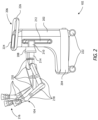
- FIG. 2 depicts further aspects of the robotic system of FIG. 1 .
- FIG. 3 A illustrates an embodiment of the robotic system of FIG. 1 arranged for ureteroscopy.
- FIG. 3 B illustrates an embodiment of the robotic system of FIG. 1 arranged for a vascular procedure.
- FIG. 4 illustrates an embodiment of a table-based robotic system arranged for a bronchoscopy procedure.
- FIG. 5 provides an alternative view of the robotic system of FIG. 4 .
- FIG. 6 illustrates an example system configured to stow robotic arm(s).
- FIG. 7 B illustrates an embodiment of a table-based robotic system configured for a laparoscopic procedure.
- FIG. 10 illustrates an exemplary instrument driver.
- FIG. 11 illustrates an exemplary medical instrument with a paired instrument driver.
- FIG. 14 illustrates an exemplary controller
- FIG. 16 is an isometric side view of an example surgical tool that may incorporate some or all of the principles of the present disclosure.
- FIG. 22 is an enlarged isometric view of the end effector and the wrist of FIG. 21 , according to one or more embodiments.
- the cart 102 may be positioned proximate to the patient's upper torso in order to provide access to the access point.
- the robotic arms 104 may be actuated to position the bronchoscope relative to the access point.
- the arrangement in FIG. 1 may also be utilized when performing a gastro-intestinal (GI) procedure with a gastroscope, a specialized endoscope for GI procedures.
- GI gastro-intestinal
- the steerable endoscope 106 may comprise at least two telescoping parts, such as an inner leader portion and an outer sheath portion, where each portion is coupled to a separate instrument driver of a set of instrument drivers 108 . As illustrated, each instrument driver 108 is coupled to the distal end of a corresponding one of the robotic arms 104 .
- This linear arrangement of the instrument drivers 108 which facilitates coaxially aligning the leader portion with the sheath portion, creates a “virtual rail” 110 that may be repositioned in space by manipulating the robotic arms 104 into different angles and/or positions. Translation of the instrument drivers 108 along the virtual rail 110 telescopes the inner leader portion relative to the outer sheath portion, thus effectively advancing or retracting the endoscope 106 relative to the patient.
- the endoscope 106 may be directed to deliver a biopsy needle to a target, such as, for example, a lesion or nodule within the lungs of a patient.
- the needle may be deployed down a working channel that runs the length of the endoscope 106 to obtain a tissue sample to be analyzed by a pathologist.
- additional tools may be deployed down the working channel of the endoscope for additional biopsies.
- the endoscope 106 may endoscopically deliver tools to resect the potentially cancerous tissue.
- diagnostic and therapeutic treatments can be delivered in separate procedures.
- the endoscope 106 may also be used to deliver a fiducial marker to “mark” the location of a target nodule as well. In other instances, diagnostic and therapeutic treatments may be delivered during the same procedure.
- the system 100 may also include a movable tower 112 , which may be connected via support cables to the cart 102 to provide support for controls, electronics, fluidics, optics, sensors, and/or power to the cart 102 . Placing such functionality in the tower 112 allows for a smaller form factor cart 102 that may be more easily adjusted and/or repositioned by an operating physician and his/her staff. Additionally, the division of functionality between the cart/table and the support tower 112 reduces operating room clutter and facilitates improving clinical workflow. While the cart 102 may be positioned close to the patient, the tower 112 may alternatively be stowed in a remote location to stay out of the way during a procedure.
- the tower 112 may include component(s) of a computer-based control system that stores computer program instructions, for example, within a non-transitory computer-readable storage medium such as a persistent magnetic storage drive, solid state drive, etc.
- the execution of those instructions may control the entire system or sub-system(s) thereof.
- the instructions when executed by a processor of the computer system, the instructions may cause the components of the robotics system to actuate the relevant carriages and arm mounts, actuate the robotics arms, and control the medical instruments.
- motors in the joints of the robotic arms 104 may position the arms into a certain posture or angular orientation.
- the tower 112 may also include one or more of a pump, flow meter, valve control, and/or fluid access in order to provide controlled irrigation and aspiration capabilities to the system 100 that may be deployed through the endoscope 106 . These components may also be controlled using the computer system of the tower 112 . In some embodiments, irrigation and aspiration capabilities may be delivered directly to the endoscope 106 through separate cable(s).
- the tower 112 may include a voltage and surge protector designed to provide filtered and protected electrical power to the cart 102 , thereby avoiding placement of a power transformer and other auxiliary power components in the cart 102 , resulting in a smaller, more moveable cart 102 .
- the tower 112 may also include support equipment for sensors deployed throughout the robotic system 100 .
- the tower 112 may include opto-electronics equipment for detecting, receiving, and processing data received from optical sensors or cameras throughout the robotic system 100 . In combination with the control system, such opto-electronics equipment may be used to generate real-time images for display in any number of consoles deployed throughout the system, including in the tower 112 .
- the tower 112 may also include an electronic subsystem for receiving and processing signals received from deployed electromagnetic (EM) sensors.
- EM electromagnetic
- the tower 112 may also be used to house and position an EM field generator for detection by EM sensors in or on the medical instrument.
- the tower 112 may also include a console 114 in addition to other consoles available in the rest of the system, e.g., a console mounted to the cart 102 .
- the console 114 may include a user interface and a display screen (e.g., a touchscreen) for the physician operator.
- Consoles in the system 100 are generally designed to provide both robotic controls as well as pre-operative and real-time information of the procedure, such as navigational and localization information of the endoscope 106 .
- the console 114 may be used by a second operator, such as a nurse, to monitor the health or vitals of the patient and the operation of system, as well as provide procedure-specific data, such as navigational and localization information.
- the console 114 may be housed in a body separate from the tower 112 .
- the tower 112 may be coupled to the cart 102 and endoscope 106 through one or more cables 116 connections.
- support functionality from the tower 112 may be provided through a single cable 116 extending to the cart 102 , thus simplifying and de-cluttering the operating room.
- specific functionality may be coupled in separate cabling and connections. For example, while power may be provided through a single power cable to the cart 102 , support for controls, optics, fluidics, and/or navigation may be provided through one or more separate cables.
- the slot 212 may be supplemented with slot covers (not shown) that are flush and parallel to the slot surface to prevent dirt and fluid ingress into the internal chambers of the column 202 and the vertical translation interface as the carriage 208 vertically translates.
- the slot covers may be deployed through pairs of spring spools positioned near the vertical top and bottom of the slot 212 .
- the covers are coiled within the spools until deployed to extend and retract from their coiled state as the carriage 208 vertically translates up and down.
- the spring-loading of the spools provides force to retract the cover into a spool when carriage 208 translates towards the spool, while also maintaining a tight seal when the carriage 208 translates away from the spool.
- the covers may be connected to the carriage 208 using, for example, brackets in the carriage interface 210 to ensure proper extension and retraction of the cover as the carriage 208 translates.
- the cart base 204 balances the weight of the column 202 , the carriage 208 , and the arms 104 over the floor. Accordingly, the cart base 204 houses heavier components, such as electronics, motors, power supply, as well as components that either enable movement and/or immobilize the cart.
- the cart base 204 includes rolling casters 222 that allow for the cart to easily move around the room prior to a procedure. After reaching an appropriate position, the casters 222 may be immobilized using wheel locks to hold the cart 102 in place during the procedure.
- the console 206 allows for both a user interface for receiving user input and a display screen (or a dual-purpose device such as, for example, a touchscreen 224 ) to provide the physician user with both pre-operative and intra-operative data.
- Potential pre-operative data on the touchscreen 224 may include pre-operative plans, navigation and mapping data derived from pre-operative computerized tomography (CT) scans, and/or notes from pre-operative patient interviews.
- Intra-operative data on the touchscreen 224 may include optical information provided from the tool, sensor and coordinate information from sensors, as well as vital patient statistics, such as respiration, heart rate, and/or pulse.
- the ureteroscope 302 may be navigated into the bladder, ureters, and/or kidneys for diagnostic and/or therapeutic applications.
- the ureteroscope 302 may be directed into the ureter and kidneys to break up kidney stone build-up using a laser or ultrasonic lithotripsy device deployed down a working channel of the ureteroscope 302 .
- the resulting stone fragments may be removed using baskets deployed down the working channel of the ureteroscope 302 .
- FIG. 3 B illustrates another embodiment of the system 100 of FIG. 1 arranged for a vascular procedure.
- the system 100 may be configured such that the cart 102 may deliver a medical instrument 306 , such as a steerable catheter, to an access point in the femoral artery in the patient's leg.
- the femoral artery presents both a larger diameter for navigation as well as a relatively less circuitous and tortuous path to the patient's heart, which simplifies navigation.
- the cart 102 may be positioned towards the patient's legs and lower abdomen to allow the robotic arms 104 to provide a virtual rail 308 with direct linear access to the femoral artery access point in the patient's thigh/hip region.
- the medical instrument 306 may be directed and advanced by translating the instrument drivers 108 .
- the cart 102 may be positioned around the patient's upper abdomen in order to reach alternative vascular access points, such as, for example, the carotid and brachial arteries near the patient's shoulder and wrist.
- Embodiments of the robotically-enabled medical system may also incorporate the patient's table. Incorporation of the table reduces the amount of capital equipment within the operating room by removing the cart, which allows greater access to the patient.
- FIG. 4 illustrates an embodiment of such a robotically-enabled system 400 arranged for a bronchoscopy procedure. As illustrated, the system 400 includes a support structure or column 402 for supporting platform 404 (shown as a “table” or “bed”) over the floor.
- the end effectors of the robotic arms 406 of the system 400 comprise instrument drivers 408 that are designed to manipulate an elongated medical instrument, such as a bronchoscope 410 , through or along a virtual rail 412 formed from the linear alignment of the instrument drivers 408 .
- a C-arm for providing fluoroscopic imaging may be positioned over the patient's upper abdominal area by placing the emitter and detector around the table 404 .
- FIG. 5 provides an alternative view of the system 400 without the patient and medical instrument for discussion purposes.
- the column 402 may include one or more carriages 502 shown as ring-shaped in the system 400 , from which the one or more robotic arms 406 may be based.
- the carriages 502 may translate along a vertical column interface 504 that runs the length (height) of the column 402 to provide different vantage points from which the robotic arms 406 may be positioned to reach the patient.
- the carriage(s) 502 may rotate around the column 402 using a mechanical motor positioned within the column 402 to allow the robotic arms 406 to have access to multiples sides of the table 404 , such as, for example, both sides of the patient.
- the carriages 502 may be individually positioned on the column 402 and may translate and/or rotate independent of the other carriages 502 . While carriages 502 need not surround the column 402 or even be circular, the ring-shape as shown facilitates rotation of the carriages 502 around the column 402 while maintaining structural balance. Rotation and translation of the carriages 502 allows the system 400 to align medical instruments, such as endoscopes and laparoscopes, into different access points on the patient.
- medical instruments such as endoscopes and laparoscopes
- the system 400 can include a patient table or bed with adjustable arm supports in the form of bars or rails extending alongside it.
- One or more robotic arms 406 e.g., via a shoulder with an elbow joint
- the robotic arms 406 are advantageously capable of being stowed compactly beneath the patient table or bed, and subsequently raised during a procedure.
- the arms 406 may be mounted on the carriages 502 through a set of arm mounts 506 comprising a series of joints that may individually rotate and/or telescopically extend to provide additional configurability to the robotic arms 406 . Additionally, the arm mounts 506 may be positioned on the carriages 502 such that when the carriages 502 are appropriately rotated, the arm mounts 506 may be positioned on either the same side of the table 404 (as shown in FIG. 5 ), on opposite sides of table 404 (as shown in FIG. 7 B ), or on adjacent sides of the table 404 (not shown).
- the column 402 structurally provides support for the table 404 , and a path for vertical translation of the carriages 502 . Internally, the column 402 may be equipped with lead screws for guiding vertical translation of the carriages, and motors to mechanize the translation of said carriages based the lead screws. The column 402 may also convey power and control signals to the carriage 502 and robotic arms 406 mounted thereon.
- a table base 508 serves a similar function as the cart base 204 of the cart 102 shown in FIG. 2 , housing heavier components to balance the table/bed 404 , the column 402 , the carriages 502 , and the robotic arms 406 .
- the table base 508 may also incorporate rigid casters to provide stability during procedures. Deployed from the bottom of the table base 508 , the casters may extend in opposite directions on both sides of the base 508 and retract when the system 400 needs to be moved.
- the system 400 may also include a tower (not shown) that divides the functionality of system 400 between table and tower to reduce the form factor and bulk of the table 404 .
- the tower may provide a variety of support functionalities to the table 404 , such as processing, computing, and control capabilities, power, fluidics, and/or optical and sensor processing.
- the tower may also be movable to be positioned away from the patient to improve physician access and de-clutter the operating room. Additionally, placing components in the tower allows for more storage space in the table base 508 for potential stowage of the robotic arms 406 .
- the tower may also include a master controller or console that provides both a user interface for user input, such as keyboard and/or pendant, as well as a display screen (or touchscreen) for pre-operative and intra-operative information, such as real-time imaging, navigation, and tracking information.
- the tower may also contain holders for gas tanks to be used for insufflation.
- FIG. 7 A illustrates an embodiment of the robotically-enabled table-based system 400 configured for a ureteroscopy procedure.
- the table 404 may include a swivel portion 702 for positioning a patient off-angle from the column 402 and the table base 508 .
- the swivel portion 702 may rotate or pivot around a pivot point (e.g., located below the patient's head) in order to position the bottom portion of the swivel portion 702 away from the column 402 .
- the pivoting of the swivel portion 702 allows a C-arm (not shown) to be positioned over the patient's lower abdomen without competing for space with the column (not shown) below table 404 .
- FIG. 8 provides a detailed illustration of the interface between the table 404 and the column 402 .
- Pitch rotation mechanism 802 may be configured to alter the pitch angle of the table 404 relative to the column 402 in multiple degrees of freedom.
- the pitch rotation mechanism 802 may be enabled by the positioning of orthogonal axes A and B at the column-table interface, each axis actuated by a separate motor 804 a and 804 b responsive to an electrical pitch angle command. Rotation along one screw 806 a would enable tilt adjustments in one axis A, while rotation along another screw 806 b would enable tilt adjustments along the other axis B.
- a ball joint can be used to alter the pitch angle of the table 404 relative to the column 402 in multiple degrees of freedom.
- the sterile drape comprised of a thin, flexible material such as transparent or translucent plastic, is designed to cover the capital equipment, such as the instrument driver, robotic arm, and cart (in a cart-based system) or table (in a table-based system).
- the capital equipment such as the instrument driver, robotic arm, and cart (in a cart-based system) or table (in a table-based system).
- Use of the drape would allow the capital equipment to be positioned proximate to the patient while still being located in an area not requiring sterilization (i.e., non-sterile field).
- the medical instrument may interface with the patient in an area requiring sterilization (i.e., sterile field).
- the distal end of the shaft 1104 may be connected to an end effector extending from a jointed wrist formed from a clevis with at least one degree of freedom and a surgical tool or medical instrument, such as, for example, a grasper or scissors, that may be actuated based on force from the tendons as the drive inputs 1008 rotate in response to torque received from the drive outputs 1110 of the instrument driver 1102 .
- a surgical tool or medical instrument such as, for example, a grasper or scissors
- the distal end of the flexible elongated shaft 1104 may include a steerable or controllable bending section that may be articulated and bent based on torque received from the drive outputs 1110 of the instrument driver 1102 .
- the tendon may cause a joint to rotate about an axis, thereby causing the end effector to move in one direction or another.
- the tendon may be connected to one or more jaws of a grasper at distal end of the elongated shaft 1104 , where tension from the tendon cause the grasper to close.
- the tendons may be coupled to a bending or articulating section positioned along the elongated shaft 1104 (e.g., at the distal end) via adhesive, control ring, or other mechanical fixation.
- a bending or articulating section positioned along the elongated shaft 1104 (e.g., at the distal end) via adhesive, control ring, or other mechanical fixation.
- torque exerted on drive inputs 1108 would be transmitted down the tendons, causing the softer, bending section (sometimes referred to as the articulable section or region) to bend or articulate.
- the angle of the spiraling and/or spacing there between may be altered or engineered for specific purposes, wherein tighter spiraling exhibits lesser shaft compression under load forces, while lower amounts of spiraling results in greater shaft compression under load forces, but also exhibits limits bending.
- the pull lumens may be directed parallel to the longitudinal axis of the elongated shaft 1104 to allow for controlled articulation in the desired bending or articulable sections.
- the elongated shaft 1104 houses a number of components to assist with the robotic procedure.
- the shaft may comprise a working channel for deploying surgical tools (or medical instruments), irrigation, and/or aspiration to the operative region at the distal end of the shaft 1104 .
- the shaft 1104 may also accommodate wires and/or optical fibers to transfer signals to/from an optical assembly at the distal tip, which may include of an optical camera.
- the shaft 1104 may also accommodate optical fibers to carry light from proximally-located light sources, such as light emitting diodes, to the distal end of the shaft.
- the distal tip may also comprise the opening of a working channel for delivering tools for diagnostic and/or therapy, irrigation, and aspiration to an operative site.
- the distal tip may also include a port for a camera, such as a fiberscope or a digital camera, to capture images of an internal anatomical space.
- the distal tip may also include ports for light sources for illuminating the anatomical space when using the camera.
- the drive shaft axes and thus the drive input axes, are orthogonal to the axis of the elongated shaft.
- This arrangement complicates roll capabilities for the elongated shaft 1104 .
- Rolling the elongated shaft 1104 along its axis while keeping the drive inputs 1108 static results in undesirable tangling of the tendons as they extend off the drive inputs 1108 and enter pull lumens within the elongated shaft 1104 .
- the resulting entanglement of such tendons may disrupt any control algorithms intended to predict movement of the flexible elongated shaft during an endoscopic procedure.
- FIG. 12 illustrates an alternative design for a circular instrument driver 1200 and corresponding instrument 1202 (alternately referred to as a “surgical tool”) where the axes of the drive units are parallel to the axis of the elongated shaft 1206 of the instrument 1202 .
- the instrument driver 1200 comprises four drive units with corresponding drive outputs 1208 aligned in parallel at the end of a robotic arm 1210 .
- the drive units and their respective drive outputs 1208 are housed in a rotational assembly 1212 of the instrument driver 1200 that is driven by one of the drive units within the assembly 1212 .
- the rotational assembly 1212 In response to torque provided by the rotational drive unit, the rotational assembly 1212 rotates along a circular bearing that connects the rotational assembly 1212 to a non-rotational portion 1214 of the instrument driver 1200 .
- Power and control signals may be communicated from the non-rotational portion 1214 of the instrument driver 1200 to the rotational assembly 1212 through electrical contacts maintained through rotation by a brushed slip ring connection (not shown).
- the rotational assembly 1212 may be responsive to a separate drive unit that is integrated into the non-rotatable portion 1214 , and thus not in parallel with the other drive units.
- the rotational assembly 1212 allows the instrument driver 1200 to rotate the drive units and their respective drive outputs 1208 as a single unit around an instrument driver axis 1216 .
- the instrument 1202 may include an elongated shaft 1206 and an instrument base 1218 (shown in phantom) including a plurality of drive inputs 1220 (such as receptacles, pulleys, and spools) that are configured to mate with the drive outputs 1208 of the instrument driver 1200 .
- the instrument shaft 1206 extends from the center of the instrument base 1218 with an axis substantially parallel to the axes of the drive inputs 1220 , rather than orthogonal as in the design of FIG. 11 .
- the medical instrument 1202 When coupled to the rotational assembly 1212 of the instrument driver 1200 , the medical instrument 1202 , comprising instrument base 1218 and instrument shaft 1206 , rotates in combination with the rotational assembly 1212 about the instrument driver axis 1216 . Since the instrument shaft 1206 is positioned at the center of the instrument base 1218 , the instrument shaft 1206 is coaxial with the instrument driver axis 1216 when attached. Thus, rotation of the rotational assembly 1212 causes the instrument shaft 1206 to rotate about its own longitudinal axis. Moreover, as the instrument base 1218 rotates with the instrument shaft 1206 , any tendons connected to the drive inputs 1220 in the instrument base 1218 are not tangled during rotation. Accordingly, the parallelism of the axes of the drive outputs 1208 , the drive inputs 1220 , and the instrument shaft 1206 allows for the shaft rotation without tangling any control tendons.
- FIG. 13 illustrates a medical instrument 1300 having an instrument based insertion architecture in accordance with some embodiments.
- the instrument 1300 (alternately referred to as a “surgical tool”) can be coupled to any of the instrument drivers discussed herein above and, as illustrated, can include an elongated shaft 1302 , an end effector 1304 connected to the shaft 1302 , and a handle 1306 coupled to the shaft 1302 .
- the elongated shaft 1302 comprises a tubular member having a proximal portion 1308 a and a distal portion 1308 b .
- the elongated shaft 1302 comprises one or more channels or grooves 1310 along its outer surface and configured to receive one or more wires or cables 1312 therethrough.
- One or more cables 1312 thus run along an outer surface of the elongated shaft 1302 .
- the cables 1312 can also run through the elongated shaft 1302 .
- Manipulation of the cables 1312 results in actuation of the end effector 1304 .
- the instrument handle 1306 which may also be referred to as an instrument base, may generally comprise an attachment interface 1314 having one or more mechanical inputs 1316 , e.g., receptacles, pulleys or spools, that are designed to be reciprocally mated with one or more drive outputs on an attachment surface of an instrument driver.
- mechanical inputs 1316 e.g., receptacles, pulleys or spools
- the instrument 1300 comprises a series of pulleys or cables that enable the elongated shaft 1302 to translate relative to the handle 1306 .
- the instrument 1300 itself comprises an instrument-based insertion architecture that accommodates insertion of the instrument 1300 , thereby minimizing the reliance on a robot arm to provide insertion of the instrument 1300 .
- a robotic arm can be largely responsible for instrument insertion.
- FIG. 14 is a perspective view of an embodiment of a controller 1400 .
- the controller 1400 comprises a hybrid controller that can have both impedance and admittance control.
- the controller 1400 can utilize just impedance or passive control.
- the controller 1400 can utilize just admittance control.
- the controller 1400 advantageously can have a lower perceived inertia while in use.
- the controller 1400 is configured to allow manipulation of two medical instruments, and includes two handles 1402 .
- Each of the handles 1402 is connected to a gimbal 1404
- each gimbal 1404 is connected to a positioning platform 1406 .
- each positioning platform 1406 includes a selective compliance assembly robot arm (SCARA) 1408 coupled to a column 1410 by a prismatic joint 1412 .
- the prismatic joints 1412 are configured to translate along the column 1410 (e.g., along rails 1414 ) to allow each of the handles 1402 to be translated in the z-direction, providing a first degree of freedom.
- the SCARA arm 1408 is configured to allow motion of the handle 1402 in an x-y plane, providing two additional degrees of freedom.
- one or more load cells are positioned in the controller 1400 .
- a load cell (not shown) is positioned in the body of each of the gimbals 1404 .
- the positioning platform 1406 is configured for admittance control, while the gimbal 1404 is configured for impedance control.
- the gimbal 1404 is configured for admittance control, while the positioning platform 1406 is configured for impedance control. Accordingly, for some embodiments, the translational or positional degrees of freedom of the positioning platform 1406 can rely on admittance control, while the rotational degrees of freedom of the gimbal 1404 rely on impedance control.
- the robotic systems contemplated by this disclosure can provide for non-radiation-based navigational and localization means to reduce physician exposure to radiation and reduce the amount of equipment within the operating room.
- the term “localization” may refer to determining and/or monitoring the position of objects in a reference coordinate system. Technologies such as pre-operative mapping, computer vision, real-time EM tracking, and robot command data may be used individually or in combination to achieve a radiation-free operating environment. In other cases, where radiation-based imaging modalities are still used, the pre-operative mapping, computer vision, real-time EM tracking, and robot command data may be used individually or in combination to improve upon the information obtained solely through radiation-based imaging modalities.
- FIG. 15 is a block diagram illustrating a localization system 1500 that estimates a location of one or more elements of the robotic system, such as the location of the instrument, in accordance to an example embodiment.
- the localization system 1500 may be a set of one or more computer devices configured to execute one or more instructions.
- the computer devices may be embodied by a processor (or processors) and computer-readable memory in one or more components discussed above.
- the computer devices may be in the tower 112 shown in FIG. 1 , the cart 102 shown in FIGS. 1 - 3 B , the beds shown in FIGS. 4 - 9 , etc.
- the localization system 1500 may include a localization module 1502 that processes input data 1504 a , 1504 b , 1504 c , and 1504 d to generate location data 1506 for the distal tip of a medical instrument.
- the location data 1506 may be data or logic that represents a location and/or orientation of the distal end of the instrument relative to a frame of reference.
- the frame of reference can be a frame of reference relative to the anatomy of the patient or to a known object, such as an EM field generator (see discussion below for the EM field generator).
- Pre-operative mapping may be accomplished through the use of the collection of low dose CT scans.
- Pre-operative CT scans are reconstructed into three-dimensional images, which are visualized, e.g. as “slices” of a cutaway view of the patient's internal anatomy.
- image-based models for anatomical cavities, spaces and structures of the patient's anatomy, such as a patient lung network may be generated.
- Techniques such as center-line geometry may be determined and approximated from the CT images to develop a three-dimensional volume of the patient's anatomy, referred to as model data 1504 a (also referred to as “preoperative model data” when generated using only preoperative CT scans).
- Network topological models may also be derived from the CT-images, and are particularly appropriate for bronchoscopy.
- the instrument may be equipped with a camera to provide vision data 1504 b .
- the localization module 1502 may process the vision data 1504 b to enable one or more vision-based location tracking.
- the preoperative model data may be used in conjunction with the vision data 1504 b to enable computer vision-based tracking of the medical instrument (e.g., an endoscope or an instrument advance through a working channel of the endoscope).
- the robotic system may generate a library of expected endoscopic images from the model based on the expected path of travel of the endoscope, each image linked to a location within the model. Intra-operatively, this library may be referenced by the robotic system in order to compare real-time images captured at the camera (e.g., a camera at a distal end of the endoscope) to those in the image library to assist localization.
- Other computer vision-based tracking techniques use feature tracking to determine motion of the camera, and thus the endoscope.
- Some features of the localization module 1502 may identify circular geometries in the preoperative model data 1504 a that correspond to anatomical lumens and track the change of those geometries to determine which anatomical lumen was selected, as well as the relative rotational and/or translational motion of the camera.
- Use of a topological map may further enhance vision-based algorithms or techniques.
- Optical flow another computer vision-based technique, may analyze the displacement and translation of image pixels in a video sequence in the vision data 1504 b to infer camera movement.
- optical flow techniques may include motion detection, object segmentation calculations, luminance, motion compensated encoding, stereo disparity measurement, etc. Through the comparison of multiple frames over multiple iterations, movement and location of the camera (and thus the endoscope) may be determined.
- the localization module 1502 may use real-time EM tracking to generate a real-time location of the endoscope in a global coordinate system that may be registered to the patient's anatomy, represented by the preoperative model.
- EM tracking an EM sensor (or tracker) comprising of one or more sensor coils embedded in one or more locations and orientations in a medical instrument (e.g., an endoscopic tool) measures the variation in the EM field created by one or more static EM field generators positioned at a known location.
- the location information detected by the EM sensors is stored as EM data 1504 c .
- the EM field generator (or transmitter), may be placed close to the patient to create a low intensity magnetic field that the embedded sensor may detect.
- the magnetic field induces small currents in the sensor coils of the EM sensor, which may be analyzed to determine the distance and angle between the EM sensor and the EM field generator.
- These distances and orientations may be intra-operatively “registered” to the patient anatomy (e.g., the preoperative model) in order to determine the geometric transformation that aligns a single location in the coordinate system with a position in the pre-operative model of the patient's anatomy.
- an embedded EM tracker in one or more positions of the medical instrument e.g., the distal tip of an endoscope
- a drive interface 1810 is provided at the first end 1804 a of the instrument driver 1632 and is matable with a driven interface 1812 provided on the distal end of the handle 1630 .
- the drive and driven interfaces 1810 , 1812 may be configured to mechanically, magnetically, and/or electrically couple the handle 1630 to the instrument driver 1632 .
- the drive and driven interfaces 1810 , 1812 may provide one or more matable locating features configured to secure the handle 1630 to the instrument driver 1632 .
- FIG. 19 is an enlarged schematic side view of one example of the handle 1630 of FIGS. 16 and 18 , according to one or more embodiments of the present disclosure.
- the outer body of the handle 1630 is shown in phantom (dashed lines) to enable viewing of the internal space and component parts within the handle 1630 . It should be noted that various actuation systems and component parts of the handle 1630 are omitted in FIG. 19 for simplicity.
- the shaft 1602 is able to extend through the handle 1630 .
- the proximal shaft assembly 1604 a including the outer proximal tube 1606 and the inner spline 1608 , may extend longitudinally through the handle 1630 .
- the longitudinal slot 1610 defined along the outer proximal tube 1606 exposes the inner spline 1608 and thereby allows the inner spline 1608 to be driven in rotation relative to the outer proximal tube 1606 .
- rotation of the inner spline 1608 may actuate the valve(s) 1626 ( FIG. 16 ) included in the tailpiece 1622 ( FIG. 16 ), but could alternatively actuate or operate a variety of other mechanisms or devices.
- the rack 1710 is depicted on the outer proximal tube 1606 and thereby provides a series of gear teeth configured to be engaged and driven to cause the shaft 1602 to move in z-axis translation relative to the handle 1630 .
- the handle 1630 may include a first actuation system 1902 a and a second actuation system 1902 b .
- the actuation systems 1902 a,b may be operable (actuatable) to carry out a variety of functions (operations) of the surgical tool 1600 ( FIG. 16 ).
- the first actuation system 1902 a may be designed and otherwise configured to drive the inner spline 1608 in rotation, and thereby actuate the valve(s) 1626 ( FIG. 16 ).
- the second actuation system 1902 b may be operable to cause the shaft 1602 to move relative to the handle 1630 and thereby longitudinally advance or retract the distal tip 1616 ( FIGS. 16 and 18 ) in z-axis translation.
- the first actuation system 1902 a includes a first drive shaft 1904 a coupled to or forming part of the first drive input 1634 a such that rotation of the first drive input 1634 a correspondingly rotates the first drive shaft 1904 a in the same direction.
- Rotating the first drive input 1634 a may operate or actuate a first drive mechanism 1906 a that may include any of a variety of interconnected gears, belts, chains, sprockets, etc. configured to ultimately drive the inner spline 1608 in rotation.
- the first drive mechanism 1906 a comprises a gear train that includes an input gear 1908 a and a drive gear 1908 b .
- first drive mechanism 1906 a depicted in FIG. 19 includes two geared components to drive the inner spline 1608
- the first drive mechanism 1906 a may alternatively include more or less than two geared components.
- the depicted first drive mechanism 1906 a is but one example of a geared system or arrangement designed to drive the inner spline 1608
- various other designs or configurations of the first drive mechanism 1906 a may alternatively be incorporated into the first actuation system 1902 a to drive (rotate) the inner spline 1608 , without departing from the scope of the disclosure.
- the second actuation system 1902 b includes a second drive shaft 1904 b coupled to or forming part of the second drive input 1634 b such that rotation of the second drive input 1634 b correspondingly rotates the second drive shaft 1904 b in the same direction.
- Rotating the second drive input 1634 a may operate or actuate a second drive mechanism 1906 b that ultimately engages and drives the rack 1710 provided on the outer proximal tube 1606 .
- the second drive mechanism 1906 b may include any of a variety of interconnected gears, belts, chains, sprockets, etc.
- the second drive mechanism 1906 b comprises a gear train that includes at least an input gear 1910 a and a pinion gear 1910 b .
- the input gear 1910 a may be driven by rotation of the second drive shaft 1904 b and may be arranged to drive the pinion gear 1910 b
- the pinion gear 1910 b may intermesh with the rack 1710 provided on the outer proximal tube 1606 .
- operating the second actuation system 1902 b may cause the shaft 1602 to move relative to the handle 1630 and thereby longitudinally advance or retract the distal tip 1616 ( FIGS. 16 and 18 ) in z-axis translation.
- the drive gear 1908 b of the first drive mechanism 1906 a may be capable of sliding along the longitudinally-extending gear teeth 1706 defined on the inner spline 1608 , thus allowing both actuation systems 1902 a,b to operate simultaneously.
- the second drive mechanism 1906 b depicted in FIG. 19 includes two geared components to drive the outer proximal tube 1606
- the second drive mechanism 1906 b may alternatively include more or less than two geared components.
- the depicted second drive mechanism 1906 b is but one example of a geared system or arrangement designed to drive the outer proximal tube 1606
- various other designs or configurations of the second drive mechanism 1906 b may alternatively be incorporated into the second actuation system 1902 b , without departing from the scope of the disclosure.
- FIGS. 20 A and 20 B are schematic side views of examples of the surgical tool 1600 , according various embodiments of the present disclosure. More specifically, FIGS. 20 A- 20 B illustrate the shaft 1602 with the distal tip 1616 arranged at its distal end, and the tailpiece 1622 arranged at its proximal end.
- the flow control system 1624 provided within the tailpiece 1622 may include the valve 1626 , which may comprise a rotary valve providing one or more of a vertical, axial, or horizontal stopcock.
- the valve 1626 may be actuatable (operable) to control the flow of fluids between a surgical site and the shaft 1602 , or vice versa.
- the adapter 1708 of the inner spline 1608 may be configured to mate with the valve 1626 such that rotation of the inner spline 1608 causes the valve 1626 to actuate and thereby alter the type and/or amount of fluid conveyed through the shaft 1602 . Accordingly, actuation of the valve 1626 may provide irrigation, suction, blowing, or any combination thereof within a surgical site. Moreover, the shaft 1602 may be moved distally or proximally as the valve operates, as generally described above.
- the flow control system 1624 is configured to provide irrigation or aspiration capabilities. More specifically, the flow control system 1624 includes the first and second conduits 1628 a,b , where the first conduit 1628 a is configured to convey a liquid (e.g., water) through the shaft 1602 to be discharged at the distal tip 1616 for irrigation purposes, and the second conduit 1628 b is configured to draw fluids (e.g., blood, water, air, etc.) through the shaft 1602 from the surgical site in suction.
- the flow control system 1624 in FIG. 20 A incorporates a single valve 1626 , which may comprise a three-way valve with three ports connecting the lumen 1714 defined within the inner spline 1608 , the first conduit 1628 a , and the second conduit 1628 b.
- the valve 1626 has three positions of operation, and rotation of the inner spline 1608 may selectively place the valve 1626 in any of these positions.
- a first or closed position the valve 1626 is completely shut off so that no fluid flows through the shaft 1602 in either direction.
- flow through the first conduit 1628 a is allowed while flow through the second conduit 1628 b is prevented thereby allowing the surgical site to be irrigated by a liquid flowing through the valve 1626 and into the shaft 1602 .
- flow through the second conduit 1628 b is allowed while flow through the first conduit 1628 a is prevented thereby creating a vacuum or a suction through the valve 1626 that aspirates the surgical site at the distal tip 1616 .
- the flow control system 1624 is configured to provide irrigation, aspiration, or blowing, depending on the operable position of the valve 1626 .
- the flow control system 1624 includes the first, second, and third conduits 1628 a - c , where the first conduit 1628 a is configured to convey a liquid (e.g., water) through the shaft 1602 to be discharged at the distal tip 1616 for irrigation purposes, the second conduit 1628 b is configured to draw fluids (e.g., blood, water, air, etc.) through the shaft 1602 from the surgical site, and the third conduit 1628 c provides a pressurized gas for blowing at the surgical site.
- the flow control system 1624 again incorporates a single valve 1626 , but the valve 1626 in this embodiment may comprise a four-way valve with four ports connecting the lumen 1714 and the conduits 1628 a - c.
- FIG. 21 is an isometric side view of another example surgical tool 2100 that may incorporate some or all of the principles of the present disclosure.
- the surgical tool 2100 may be similar in some respects to the surgical tool 1600 of FIGS. 16 and 18 , and therefore may be best understood with reference thereto, where like numerals will correspond to like components not described again in detail.
- the surgical tool 2100 may include an elongated shaft 2102 extendable through the handle 1630 .
- the shaft 2102 may include an outer tube 2104 and an inner spline 2106 rotatably received within the outer tube 2104 .
- the inner spline 2106 may be similar to the inner spline 1608 of FIGS.
- 16 and 17 A- 17 B may comprise a length of pinion wirestock defining longitudinally-extending gear teeth.
- the outer tube 2104 may define a longitudinal slot 2108 that enables engagement with the gear teeth of the inner spline 2106 in order to drive the inner spline 2106 in rotation.
- the end effector 2110 may comprise other types of instruments with opposing jaws such as, but not limited to, other types of surgical staplers (e.g., circular and linear staplers), tissue graspers, surgical scissors, advanced energy vessel sealers, clip appliers, needle drivers, a babcock including a pair of opposed grasping jaws, bipolar jaws (e.g., bipolar Maryland grasper, forceps, a fenestrated grasper, etc.), etc.
- other types of surgical staplers e.g., circular and linear staplers
- tissue graspers e.g., surgical scissors, advanced energy vessel sealers, clip appliers, needle drivers, a babcock including a pair of opposed grasping jaws, bipolar jaws (e.g., bipolar Maryland grasper, forceps, a fenestrated grasper, etc.), etc.
- bipolar jaws e.g., bipolar Maryland grasper, forceps, a fenestrated grasper, etc.
- the inner spline 2106 may be electrically isolated from the outer tube 2104 , and the distal geometry of the surgical tool 1600 may be configured as a tube within a tube, also electrically isolated. Consequently, monopolar energy may be delivered to the end effector 2110 .
- the inner spline 2106 (shown in dashed lines) extends distally within the outer tube 2104 toward the end effector 2110 .
- a distal end 2210 of the inner spline 2106 may be threadably engaged to the closure tube 2206 such that rotating the inner spline 2106 causes the closure tube 2206 to advance or retract longitudinally, as shown by the arrow D, and depending on the rotation direction of the inner spline 2106 .
- Axial movement of the closure tube 2206 along the longitudinal axis C, as acted upon by the threaded engagement with the inner spline 2106 correspondingly moves the proximal clevis 2202 a in the same axial direction.
- the closure link 2204 may be configured to transmit an axial load through (across) the wrist 2112 to close the jaws 2114 , 2116 of the end effector 2110 . More specifically, the closure link 2204 defines a pair of pins 2012 configured to mate with corresponding apertures 2014 defined in each of the proximal and distal devises 2202 a,b . The closure link 2204 may transmit the closure load or translation movement of the closure tube 2206 from the distal clevis 2202 b to the proximal clevis 2202 a and the closure ring 2208 will correspondingly push or pull on the upper jaw 2116 to close or open the upper jaw 2116 .
- the closure ring 2208 is forced distally against a shoulder 2216 at or near the back of the upper jaw 2116 , which urges the upper jaw 2116 to pivot down and to the closed position.
- the closure ring 2208 is retracted proximally away from the shoulder 2014 by retracting the closure tube 2206 through reverse rotation of the inner spline 2106 .
- proximal movement of the closure ring 2208 helps pull the upper jaw 2116 back toward the open position.
- the upper jaw 2116 may be spring loaded and biased to the open position.
- an electrical conductor 2218 may extend distally to the end effector 2110 within a lumen 2220 defined by the inner spline 2106 .
- the electrical conductor 2218 may provide monopolar (or bipolar) electrical current to the jaws 2114 , 2116 for electrocautery purposes.
- the term “plurality” denotes two or more. For example, a plurality of components indicates two or more components.
- the term “determining” encompasses a wide variety of actions and, therefore, “determining” can include calculating, computing, processing, deriving, investigating, looking up (e.g., looking up in a table, a database or another data structure), ascertaining and the like. Also, “determining” can include receiving (e.g., receiving information), accessing (e.g., accessing data in a memory) and the like. Also, “determining” can include resolving, selecting, choosing, establishing and the like.
Landscapes
- Health & Medical Sciences (AREA)
- Surgery (AREA)
- Life Sciences & Earth Sciences (AREA)
- Engineering & Computer Science (AREA)
- Heart & Thoracic Surgery (AREA)
- Biomedical Technology (AREA)
- Nuclear Medicine, Radiotherapy & Molecular Imaging (AREA)
- Medical Informatics (AREA)
- Molecular Biology (AREA)
- Animal Behavior & Ethology (AREA)
- General Health & Medical Sciences (AREA)
- Public Health (AREA)
- Veterinary Medicine (AREA)
- Robotics (AREA)
- Manipulator (AREA)
Abstract
Description
Claims (20)
Priority Applications (1)
| Application Number | Priority Date | Filing Date | Title |
|---|---|---|---|
| US17/173,278 US12343105B2 (en) | 2021-02-11 | 2021-02-11 | Robotic surgical instruments with rotary shaft power transmission |
Applications Claiming Priority (1)
| Application Number | Priority Date | Filing Date | Title |
|---|---|---|---|
| US17/173,278 US12343105B2 (en) | 2021-02-11 | 2021-02-11 | Robotic surgical instruments with rotary shaft power transmission |
Publications (2)
| Publication Number | Publication Date |
|---|---|
| US20220249187A1 US20220249187A1 (en) | 2022-08-11 |
| US12343105B2 true US12343105B2 (en) | 2025-07-01 |
Family
ID=82704317
Family Applications (1)
| Application Number | Title | Priority Date | Filing Date |
|---|---|---|---|
| US17/173,278 Active 2044-05-04 US12343105B2 (en) | 2021-02-11 | 2021-02-11 | Robotic surgical instruments with rotary shaft power transmission |
Country Status (1)
| Country | Link |
|---|---|
| US (1) | US12343105B2 (en) |
Cited By (1)
| Publication number | Priority date | Publication date | Assignee | Title |
|---|---|---|---|---|
| US20240366319A1 (en) * | 2023-05-04 | 2024-11-07 | Perceptive Technologies, Inc. | Robotic Dental System and Method of Preparing for a Robotic Dental Procedure |
Families Citing this family (1)
| Publication number | Priority date | Publication date | Assignee | Title |
|---|---|---|---|---|
| US20240358453A1 (en) * | 2023-04-27 | 2024-10-31 | Orthosoft Ulc | Electrical interface for surgical robot arm |
Citations (4)
| Publication number | Priority date | Publication date | Assignee | Title |
|---|---|---|---|---|
| US20070005002A1 (en) * | 2005-06-30 | 2007-01-04 | Intuitive Surgical Inc. | Robotic surgical instruments for irrigation, aspiration, and blowing |
| US8915842B2 (en) | 2008-07-14 | 2014-12-23 | Ethicon Endo-Surgery, Inc. | Methods and devices for maintaining visibility and providing irrigation and/or suction during surgical procedures |
| US20170105751A1 (en) * | 2015-10-16 | 2017-04-20 | Ethicon Endo-Surgery, Llc | Ultrasonic surgical instrument with removable shaft assembly portion |
| US20210393341A1 (en) * | 2020-06-18 | 2021-12-23 | Auris Health, Inc. | Translating robotic surgical tools with integrated firing mechanisms |
-
2021
- 2021-02-11 US US17/173,278 patent/US12343105B2/en active Active
Patent Citations (5)
| Publication number | Priority date | Publication date | Assignee | Title |
|---|---|---|---|---|
| US20070005002A1 (en) * | 2005-06-30 | 2007-01-04 | Intuitive Surgical Inc. | Robotic surgical instruments for irrigation, aspiration, and blowing |
| US9446177B2 (en) | 2005-06-30 | 2016-09-20 | Intuitive Surgical Operations, Inc. | Surgical instrument with robotic and manual actuation features |
| US8915842B2 (en) | 2008-07-14 | 2014-12-23 | Ethicon Endo-Surgery, Inc. | Methods and devices for maintaining visibility and providing irrigation and/or suction during surgical procedures |
| US20170105751A1 (en) * | 2015-10-16 | 2017-04-20 | Ethicon Endo-Surgery, Llc | Ultrasonic surgical instrument with removable shaft assembly portion |
| US20210393341A1 (en) * | 2020-06-18 | 2021-12-23 | Auris Health, Inc. | Translating robotic surgical tools with integrated firing mechanisms |
Cited By (1)
| Publication number | Priority date | Publication date | Assignee | Title |
|---|---|---|---|---|
| US20240366319A1 (en) * | 2023-05-04 | 2024-11-07 | Perceptive Technologies, Inc. | Robotic Dental System and Method of Preparing for a Robotic Dental Procedure |
Also Published As
| Publication number | Publication date |
|---|---|
| US20220249187A1 (en) | 2022-08-11 |
Similar Documents
| Publication | Publication Date | Title |
|---|---|---|
| US12285229B2 (en) | Medical systems incorporating pulley sharing | |
| US11957428B2 (en) | Medical instruments including wrists with hybrid redirect surfaces | |
| US20230121364A1 (en) | Systems and methods for medical stapling | |
| US12138003B2 (en) | Medical instruments including wrists with hybrid redirect surfaces | |
| US11864849B2 (en) | Systems and instruments for suction and irrigation | |
| US11638618B2 (en) | Systems and methods for aligning inputs on medical instruments | |
| US12357405B2 (en) | Systems and methods for kinematic optimization with shared robotic degrees-of-freedom | |
| US20220015840A1 (en) | Modular robotic surgical systems | |
| US11723737B2 (en) | Surgical tools with proximally mounted, cable based actuation systems | |
| US20240081933A1 (en) | Robotic surgical tool with motor mounted to translating carriage | |
| US12029515B2 (en) | Surgical tools with proximally mounted, cable based actuation systems | |
| US12343105B2 (en) | Robotic surgical instruments with rotary shaft power transmission | |
| US11766302B2 (en) | Robotic surgical tool with pivotable transmission linkage on translating carriage | |
| US20230240770A1 (en) | Endoscope and mounting system for a robotic surgical system | |
| US12285230B2 (en) | Surgical tool end effectors with alignment arms | |
| US20230301682A1 (en) | Cannula reducer | |
| US20210030501A1 (en) | Systems and methods for adjusting remote center distances in medical procedures |
Legal Events
| Date | Code | Title | Description |
|---|---|---|---|
| FEPP | Fee payment procedure |
Free format text: ENTITY STATUS SET TO UNDISCOUNTED (ORIGINAL EVENT CODE: BIG.); ENTITY STATUS OF PATENT OWNER: LARGE ENTITY |
|
| AS | Assignment |
Owner name: ETHICON LLC, PUERTO RICO Free format text: ASSIGNMENT OF ASSIGNORS INTEREST;ASSIGNOR:KALLENBERGER, KRIS EREN;REEL/FRAME:055722/0964 Effective date: 20210305 |
|
| AS | Assignment |
Owner name: CILAG GMBH INTERNATIONAL, SWITZERLAND Free format text: ASSIGNMENT OF ASSIGNORS INTEREST;ASSIGNOR:ETHICON LLC;REEL/FRAME:056601/0339 Effective date: 20210405 Owner name: CILAG GMBH INTERNATIONAL, SWITZERLAND Free format text: ASSIGNMENT OF ASSIGNOR'S INTEREST;ASSIGNOR:ETHICON LLC;REEL/FRAME:056601/0339 Effective date: 20210405 |
|
| STPP | Information on status: patent application and granting procedure in general |
Free format text: DOCKETED NEW CASE - READY FOR EXAMINATION |
|
| STPP | Information on status: patent application and granting procedure in general |
Free format text: NON FINAL ACTION MAILED |
|
| STPP | Information on status: patent application and granting procedure in general |
Free format text: RESPONSE TO NON-FINAL OFFICE ACTION ENTERED AND FORWARDED TO EXAMINER |
|
| STPP | Information on status: patent application and granting procedure in general |
Free format text: NON FINAL ACTION MAILED |
|
| STPP | Information on status: patent application and granting procedure in general |
Free format text: RESPONSE TO NON-FINAL OFFICE ACTION ENTERED AND FORWARDED TO EXAMINER |
|
| STPP | Information on status: patent application and granting procedure in general |
Free format text: FINAL REJECTION MAILED |
|
| STPP | Information on status: patent application and granting procedure in general |
Free format text: RESPONSE AFTER FINAL ACTION FORWARDED TO EXAMINER |
|
| STCF | Information on status: patent grant |
Free format text: PATENTED CASE |