US12339024B2 - Efficiently routing excess air flow - Google Patents
Efficiently routing excess air flow Download PDFInfo
- Publication number
- US12339024B2 US12339024B2 US16/561,247 US201916561247A US12339024B2 US 12339024 B2 US12339024 B2 US 12339024B2 US 201916561247 A US201916561247 A US 201916561247A US 12339024 B2 US12339024 B2 US 12339024B2
- Authority
- US
- United States
- Prior art keywords
- zone
- excess
- volume
- unoccupied
- conditioned air
- Prior art date
- Legal status (The legal status is an assumption and is not a legal conclusion. Google has not performed a legal analysis and makes no representation as to the accuracy of the status listed.)
- Active, expires
Links
Images



Classifications
-
- F—MECHANICAL ENGINEERING; LIGHTING; HEATING; WEAPONS; BLASTING
- F24—HEATING; RANGES; VENTILATING
- F24F—AIR-CONDITIONING; AIR-HUMIDIFICATION; VENTILATION; USE OF AIR CURRENTS FOR SCREENING
- F24F11/00—Control or safety arrangements
- F24F11/30—Control or safety arrangements for purposes related to the operation of the system, e.g. for safety or monitoring
-
- F—MECHANICAL ENGINEERING; LIGHTING; HEATING; WEAPONS; BLASTING
- F24—HEATING; RANGES; VENTILATING
- F24F—AIR-CONDITIONING; AIR-HUMIDIFICATION; VENTILATION; USE OF AIR CURRENTS FOR SCREENING
- F24F11/00—Control or safety arrangements
- F24F11/62—Control or safety arrangements characterised by the type of control or by internal processing, e.g. using fuzzy logic, adaptive control or estimation of values
- F24F11/63—Electronic processing
- F24F11/64—Electronic processing using pre-stored data
-
- F—MECHANICAL ENGINEERING; LIGHTING; HEATING; WEAPONS; BLASTING
- F24—HEATING; RANGES; VENTILATING
- F24F—AIR-CONDITIONING; AIR-HUMIDIFICATION; VENTILATION; USE OF AIR CURRENTS FOR SCREENING
- F24F11/00—Control or safety arrangements
- F24F11/70—Control systems characterised by their outputs; Constructional details thereof
- F24F11/72—Control systems characterised by their outputs; Constructional details thereof for controlling the supply of treated air, e.g. its pressure
-
- F—MECHANICAL ENGINEERING; LIGHTING; HEATING; WEAPONS; BLASTING
- F24—HEATING; RANGES; VENTILATING
- F24F—AIR-CONDITIONING; AIR-HUMIDIFICATION; VENTILATION; USE OF AIR CURRENTS FOR SCREENING
- F24F3/00—Air-conditioning systems in which conditioned primary air is supplied from one or more central stations to distributing units in the rooms or spaces where it may receive secondary treatment; Apparatus specially designed for such systems
- F24F3/044—Systems in which all treatment is given in the central station, i.e. all-air systems
-
- F—MECHANICAL ENGINEERING; LIGHTING; HEATING; WEAPONS; BLASTING
- F24—HEATING; RANGES; VENTILATING
- F24F—AIR-CONDITIONING; AIR-HUMIDIFICATION; VENTILATION; USE OF AIR CURRENTS FOR SCREENING
- F24F2110/00—Control inputs relating to air properties
- F24F2110/10—Temperature
-
- F—MECHANICAL ENGINEERING; LIGHTING; HEATING; WEAPONS; BLASTING
- F24—HEATING; RANGES; VENTILATING
- F24F—AIR-CONDITIONING; AIR-HUMIDIFICATION; VENTILATION; USE OF AIR CURRENTS FOR SCREENING
- F24F2110/00—Control inputs relating to air properties
- F24F2110/30—Velocity
-
- F—MECHANICAL ENGINEERING; LIGHTING; HEATING; WEAPONS; BLASTING
- F24—HEATING; RANGES; VENTILATING
- F24F—AIR-CONDITIONING; AIR-HUMIDIFICATION; VENTILATION; USE OF AIR CURRENTS FOR SCREENING
- F24F2120/00—Control inputs relating to users or occupants
- F24F2120/10—Occupancy
-
- F—MECHANICAL ENGINEERING; LIGHTING; HEATING; WEAPONS; BLASTING
- F24—HEATING; RANGES; VENTILATING
- F24F—AIR-CONDITIONING; AIR-HUMIDIFICATION; VENTILATION; USE OF AIR CURRENTS FOR SCREENING
- F24F2130/00—Control inputs relating to environmental factors not covered by group F24F2110/00
- F24F2130/10—Weather information or forecasts
Definitions
- the present disclosure is directed to systems, apparatuses, and methods for determining which zone(s) are to receive excess air flow, and more particularly to determining the zones in a manner that is efficient.
- HVAC heating, ventilation, and air conditioning
- the HVAC system is designed to be capable to meet the needs of the entire group.
- one of the HVAC devices such as an air handler or the like, when activated at a minimum setting, will provide more tempered air than is necessary to serve any one zone.
- a single zone from among the group to meet conditions such as a set point criterion that will cause the HVAC device to activate while the remainder of the zones do not meet any such conditions, and therefore do not need and/or do not trigger the HVAC device.
- the HVAC device is activated at a minimum setting (e.g., 750 cubic feet per minute (CFM)), that still provides more airflow than is needed to meet the demands of the signaling zone (e.g., 100 CFM).
- a device can comprise a processor and a memory that stores executable instructions that, when executed by the processor, facilitate performance of operations.
- the computer executable instructions can comprise determining that a heating, ventilation, and air conditioning (HVAC) device, configured to provide a defined volume of air, is indicated to activate in response to an activation condition being satisfied with respect to a first zone of a group of zones.
- HVAC heating, ventilation, and air conditioning
- the computer executable instructions can comprise determining an excess volume of air representative of the defined volume of air provided by the HVAC device less a first zone volume that is delivered to the first zone.
- the computer executable instructions can comprise, performing an excess routing procedure that identifies a second zone of the group of zones to which to route at least a portion of the excess volume.
- the performing the excess routing procedure can comprise identifying the second zone based on a determination that the second zone is most likely, from among the group of zones, to be a next zone to be occupied.
- FIG. 2 B illustrates a block diagram depicting non-limiting examples of a determination of a zone most likely to trigger a subsequent activation condition in accordance with one or more embodiments of the disclosed subject matter
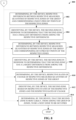
- FIG. 8 illustrates a flow diagram of an example, non-limiting computer-implemented method providing additional aspects or elements in connection with efficiently routing excess airflow in accordance with one or more embodiments of the disclosed subject matter.
- an HVAC device e.g., a fan, blower, air handler, etc.
- an HVAC device e.g., a fan, blower, air handler, etc.
- an activation condition e.g., a set point
- the HVAC device can be sized to serve many zones, but only one zone or a few zones may be in a state to meet activation conditions, activating the HVAC device can be inefficient.
- the HVAC device provides, at a minimum setting, 750 CFM, whereas the zone that triggered the activation is supplied only 100 CFM. It is appreciated that if one or more zones collectively call for more than is provided by the minimum setting, say 800 CFM, the HVAC device might be activated at an intermediate setting that may provide, for example, 1000 CFM, causing an excess of 200 CFM. In either case, it is appreciated that excess air flow will exist, and the disclosed techniques are equally applicable to either scenario.
- the excess air flow is 650 CFM (e.g., 750 CFM provided by HVAC device less 100 CFM allocated to the activating zone)
- Known approaches to allocating and/or routing the excess air flow are not satisfactory.
- other systems that at least attempt to make use of the excess air flow tend take one of the two following approaches: (1) distribute the excess air flow among all zones or some predetermined subset of the zones; or (2) distribute the excess air flow to a predetermined specific class of zones.
- An example is common areas, such as bathrooms, conference rooms, or the like. Both approaches tend to be wasteful.
- the disclosed subject matter introduces better intelligence in determining where to route excess air flow, which can be more efficient in terms of energy consumption. Furthermore, the disclosed techniques can reduce the duty cycle of HVAC equipment, which can extend the life of certain HVAC equipment. As one illustrative example, the disclosed subject matter can intelligently determine to route excess air flow to zones that are determined to be more likely to trigger a subsequent activation condition. Such can extend the time between the subsequent activation condition being triggered and/or reduce the load when the subsequent activation condition is triggered.
- System 100 can further comprise a heating, ventilation, and air conditioning (HVAC) device 102 , which can be for example, a fan, blower, air handler, and so forth.
- HVAC device 102 can be configured to provide a defined volume of air 104 (also referred to herein as defined volume 104 and airflow 104 ) upon activation.
- defined volume 104 can be representative of a volume of air that is provided by HVAC device 102 based on a setting, typically, but not necessarily, a minimum setting for the HVAC device 102 .
- second zone 106 2 can be selected due to the amount of CFM required. For example, of the two candidates, the zone that has a CFM requirement that is closest to using up the excess routing procedure without going under can be selected.
- excess routing procedure 114 can be performed iteratively to identify additional zone(s) of group of zones 106 to which to route the excess volume until no excess volume remains.
- activation condition 110 can be the result of manual input or signal, while in other embodiments, activation condition 110 can be satisfied in response to a determination that a first measured quantity meets a first value designated by a set point.
- Examples 202 - 206 represent examples of an occupancy set point, a temperature set point, a humidity set point, etc. being met or satisfied.
- a given zone 106 can have multiple set points, for example, an occupied set point and an unoccupied set point.
- the unoccupied set point is typically not as comfortable to occupants as the occupied set point, but rather is selected to reduce the demands on the HVAC system.
- group of zones 106 can operate according to comfort settings associated with occupied set points.
- group of zones 106 can operate according to the unoccupied set points in which comfort settings and other thresholds can be greatly relaxed.
- FIG. 2 B illustrates a block diagram 200 B depicting non-limiting examples of determination 116 in accordance with one or more embodiments of the disclosed subject matter.
- determination 116 can rely on knowledge of zone 106 state data and other information, which is described in more detail with reference to FIGS. 3 and 4 .
- determination 116 can depend on whether zones 106 are occupied or unoccupied as well as the respective set points for both and current physical conditions of the group of zones 106 . The inventors have observed that in the case of an unoccupied building it can be more efficient to reduce the number of times HVAC device 102 cycles on.
- device 101 can determine respective differences between respective measured quantities (e.g., occupancy, temperature, humidity, etc.) of respective zones 106 and corresponding unoccupied set points of the respective zones 106 .
- device 101 can identify second zone 106 2 in response to determining that second zone 106 2 has the smallest difference from among the respective differences. As a result, the physical state of second zone 106 2 will move away from the unoccupied set point, and thus be less likely to trigger a subsequent activation condition.
- respective measured quantities e.g., occupancy, temperature, humidity, etc.
- the inventors have observed that in the case of a very large difference from an occupied set point, when the second zone 106 2 does become occupied, it can take a long time to correct the temperature or other physical conditions of second zone 106 2 , which can also be inefficient or less desirable.
- determination 116 can identify second zone 106 2 as most likely to trigger a subsequent activation condition based on a rate of change of a physical quantity.
- device 101 can determine respective rates of change of respective measured quantities of respective zones 106 .
- device 101 can identify second zone 106 2 in response to determining that second zone 106 2 has the highest rate of change either away from an occupied set point or toward an unoccupied set point. It is understood that having a greater rate of change can be another indicator in determining zones 106 that are most likely to trigger a subsequent activation condition.
- System 300 illustrates in more detail an example of determination 116 in accordance with one or more embodiments of the disclosed subject matter.
- determination 116 of a zone 106 most likely to trigger a subsequent activation condition is made according to smallest difference from unoccupied set point 212 discussed in connection with FIG. 2 B .
- System 300 can include device 101 that can perform determination 116 as well as other determinations detailed herein, and HVAC device 102 that, when activated, can provide the defined volume 104 of air, illustrated here as airflow 104 , which, in this example is 750 CFM. HVAC device 102 serves ten different zones, each of which can be individually controlled and thus maintain individual set points.
- Device 101 can include or be communicatively coupled to data store 302 that can store various data sets 304 that can be employed to determine excess volume 112 or perform excess routing procedure 114 .
- data set 304 can include information about various settings for HVAC device and the defined volume 104 .
- Data set 304 can further include various zone state data 306 indicative of a states (e.g., physical conditions) of the various zones, corresponding set point, both occupied and unoccupied, and so forth.
- the present example is directed to a non-limiting cooling example.
- zone 1 has a current temperature of 80° that is above the unoccupied cooling set point of 78°, which causes activation request 108 .
- No other zones meet conditions that would trigger HVAC device 102 activation.
- Device 101 can determine that HVAC device 102 is being activated and further determine the excess volume.
- the defined volume 104 is 750 CFM (e.g., a minimum setting for HVAC device 102 ) while the airflow demand of zone 1 is 100 CFM.
- Excess routing procedure 114 can identify a current deviation or difference from the corresponding unoccupied set point.
- zone 4 In order of smallest to largest zone 4 is only 1° away from the unoccupied set point and therefore can be considered to be most likely to trigger a subsequent activation condition that will activate HVAC device 102 .
- zone 3 Next is zone 3, which is 2° away from the respective unoccupied set point, followed by zone 7 (3° away), zones 1 and 10 (4° away), zone 6 (5° away) zones 5 and 9 (6° away), and zone 8 (8° away).
- the zones can be chosen to meet defined volume 104 .
- zone 10 the application can select the zone resulting in the closest total to defined volume 104 without going under.
- data set 304 can include zone state data 306 indicative of current, historical, or predicted states of group of zones 106 .
- data set 304 can include schedule data 402 that can be indicative of expected changes to states of group of zones 106 or to a state of HVAC device 102 or another HVAC device.
- data set 304 can include historical data 404 that can be indicative of past changes to states of group of zones 106 or changes to a state of HVAC device 102 or another HVAC device.
- data set 304 can include weather data 406 that can be indicative of past or expected changes to states of group of zones 106 or changes to a state of HVAC device 102 or another HVAC device.
- data set 304 can include location data 408 that can be indicative of a physical location of group of zones 106 , such as, for example, whether a zone is interior to the building or has exterior exposure, a salient direction of the exterior exposure (e.g., facing north, east, south, west, etc.) and so forth.
- data set 304 can include thermal mass data 410 that can be indicative of a time or an energy metric to change the states of group of zones 106 .
- Device 101 can include or be coupled to damper controller device 503 that can control, e.g., via an actuator or motor, various dampers of a variable air volume (VAV) device 502 , including inlet damper 504 and one or more outlet dampers 506 , 510 , and 514 .
- VAV variable air volume
- zone 1 triggers activation of HVAC device 102 , causing defined volume 104 to be provided.
- inlet damper 504 and outlet damper 506 can be opened, at least partially, and the airflow demand of zone 1 provided, illustrated here as first zone volume 508 .
- Device 101 can perform excess routing procedure 114 to determine that the excess volume should be routed to zone 2 and possible other zones (not shown).
- outlet damper 510 can be at least partially opened to allow second zone volume 512 to reach zone 2.
- Zone not selected by excess routing procedure 114 such as zone N, can have associated dampers (e.g., outlet damper 514 ) closed.
- FIGS. 6 A- 6 C various block diagrams 600 A- 600 C of example architectural implementations are illustrated in accordance with one or more embodiments of the disclosed subject matter.
- block diagram 600 A depicts an example architectural design in which device 101 is situated in a remote system such as a cloud system 602 .
- Device 101 can be representative of a device that performs excess volume determination 112 , excess routing procedure 114 as illustrated in connection with FIG. 1 .
- device 101 can be remote from HVAC device 102 and/or group of zones 106 .
- Block diagram 600 B depicts an example architectural design in which data store 302 is in a remote system such as a cloud system 602 .
- device 101 can be situated at a user site and communicate with the cloud to make various determinations.
- both device 101 and data store 302 can be situated in cloud system 602 and communicate with HVAC device 102 and/or group of zones 106 and associated devices.
- Block diagram 600 C depicts an example architectural design in which one or both user device 101 and data store 302 are components of HVAC device 102 , which can be situated at the user site.
- FIGS. 7 and 8 illustrate various methodologies in accordance with the disclosed subject matter. While, for purposes of simplicity of explanation, the methodologies are shown and described as a series of acts, it is to be understood and appreciated that the disclosed subject matter is not limited by the order of acts, as some acts can occur in different orders and/or concurrently with other acts from that shown and described herein. For example, those skilled in the art will understand and appreciate that a methodology could alternatively be represented as a series of interrelated states or events, such as in a state diagram. Moreover, not all illustrated acts can be required to implement a methodology in accordance with the disclosed subject matter. Additionally, it should be further appreciated that the methodologies disclosed hereinafter and throughout this specification are capable of being stored on an article of manufacture to facilitate transporting and transferring such methodologies to computers.
- the device can determine that the second zone is most likely to trigger the subsequent activation condition based on a determination, by the device, that the second zone is most likely, from among the group of zones, to be a next zone to be occupied.
- FIG. 9 and the following discussion are intended to provide a brief, general description of a suitable computing environment 900 in which the various embodiments of the embodiment described herein can be implemented. While the embodiments have been described above in the general context of computer-executable instructions that can run on one or more computers, those skilled in the art will recognize that the embodiments can be also implemented in combination with other program modules and/or as a combination of hardware and software.
- program modules include routines, programs, components, data structures, etc., that perform particular tasks or implement particular abstract data types.
- inventive methods can be practiced with other computer system configurations, including single-processor or multiprocessor computer systems, minicomputers, mainframe computers, Internet of Things (IoT) devices, distributed computing systems, as well as personal computers, hand-held computing devices, microprocessor-based or programmable consumer electronics, and the like, each of which can be operatively coupled to one or more associated devices.
- IoT Internet of Things
- the illustrated embodiments of the embodiments herein can be also practiced in distributed computing environments where certain tasks are performed by remote processing devices that are linked through a communications network.
- program modules can be located in both local and remote memory storage devices.
- Computer-readable storage media or machine-readable storage media can be any available storage media that can be accessed by the computer and includes both volatile and nonvolatile media, removable and non-removable media.
- Computer-readable storage media or machine-readable storage media can be implemented in connection with any method or technology for storage of information such as computer-readable or machine-readable instructions, program modules, structured data or unstructured data.
- Computer-readable storage media can include, but are not limited to, random access memory (RAM), read only memory (ROM), electrically erasable programmable read only memory (EEPROM), flash memory or other memory technology, compact disk read only memory (CD-ROM), digital versatile disk (DVD), Blu-ray disc (BD) or other optical disk storage, magnetic cassettes, magnetic tape, magnetic disk storage or other magnetic storage devices, solid state drives or other solid state storage devices, or other tangible and/or non-transitory media which can be used to store desired information.
- RAM random access memory
- ROM read only memory
- EEPROM electrically erasable programmable read only memory
- flash memory or other memory technology
- CD-ROM compact disk read only memory
- DVD digital versatile disk
- Blu-ray disc (BD) or other optical disk storage magnetic cassettes, magnetic tape, magnetic disk storage or other magnetic storage devices, solid state drives or other solid state storage devices, or other tangible and/or non-transitory media which can be used to store desired information.
- tangible or “non-transitory” herein as applied to storage, memory or computer-readable media, are to be understood to exclude only propagating transitory signals per se as modifiers and do not relinquish rights to all standard storage, memory or computer-readable media that are not only propagating transitory signals per se.
- Computer-readable storage media can be accessed by one or more local or remote computing devices, e.g., via access requests, queries or other data retrieval protocols, for a variety of operations with respect to the information stored by the medium.
- Communications media typically embody computer-readable instructions, data structures, program modules or other structured or unstructured data in a data signal such as a modulated data signal, e.g., a carrier wave or other transport mechanism, and includes any information delivery or transport media.
- modulated data signal or signals refers to a signal that has one or more of its characteristics set or changed in such a manner as to encode information in one or more signals.
- communication media include wired media, such as a wired network or direct-wired connection, and wireless media such as acoustic, RF, infrared and other wireless media.
- the example environment 900 for implementing various embodiments of the aspects described herein includes a computer 902 , the computer 902 including a processing unit 904 , a system memory 906 and a system bus 908 .
- the system bus 908 couples system components including, but not limited to, the system memory 906 to the processing unit 904 .
- the processing unit 904 can be any of various commercially available processors. Dual microprocessors and other multi-processor architectures can also be employed as the processing unit 904 .
- the computer 902 further includes an internal hard disk drive (HDD) 914 (e.g., EIDE, SATA), one or more external storage devices 916 (e.g., a magnetic floppy disk drive (FDD) 916 , a memory stick or flash drive reader, a memory card reader, etc.) and an optical disk drive 920 (e.g., which can read or write from a CD-ROM disc, a DVD, a BD, etc.). While the internal HDD 914 is illustrated as located within the computer 902 , the internal HDD 914 can also be configured for external use in a suitable chassis (not shown).
- HDD hard disk drive
- FDD magnetic floppy disk drive
- 920 e.g., which can read or write from a CD-ROM disc, a DVD, a BD, etc.
- a solid state drive could be used in addition to, or in place of, an HDD 914 .
- the HDD 914 , external storage device(s) 916 and optical disk drive 920 can be connected to the system bus 908 by an HDD interface 924 , an external storage interface 926 and an optical drive interface 928 , respectively.
- the interface 924 for external drive implementations can include at least one or both of Universal Serial Bus (USB) and Institute of Electrical and Electronics Engineers (IEEE) 994 interface technologies. Other external drive connection technologies are within contemplation of the embodiments described herein.
- the drives and their associated computer-readable storage media provide nonvolatile storage of data, data structures, computer-executable instructions, and so forth.
- the drives and storage media accommodate the storage of any data in a suitable digital format.
- computer-readable storage media refers to respective types of storage devices, it should be appreciated by those skilled in the art that other types of storage media which are readable by a computer, whether presently existing or developed in the future, could also be used in the example operating environment, and further, that any such storage media can contain computer-executable instructions for performing the methods described herein.
- Computer 902 can optionally comprise emulation technologies.
- a hypervisor (not shown) or other intermediary can emulate a hardware environment for operating system 930 , and the emulated hardware can optionally be different from the hardware illustrated in FIG. 9 .
- operating system 930 can comprise one virtual machine (VM) of multiple VMs hosted at computer 902 .
- VM virtual machine
- operating system 930 can provide runtime environments, such as the Java runtime environment or the .NET framework, for applications 932 . Runtime environments are consistent execution environments that allow applications 932 to run on any operating system that includes the runtime environment.
- operating system 930 can support containers, and applications 932 can be in the form of containers, which are lightweight, standalone, executable packages of software that include, e.g., code, runtime, system tools, system libraries and settings for an application.
- a user can enter commands and information into the computer 902 through one or more wired/wireless input devices, e.g., a keyboard 938 , a touch screen 940 , and a pointing device, such as a mouse 942 .
- Other input devices can include a microphone, an infrared (IR) remote control, a radio frequency (RF) remote control, or other remote control, a joystick, a virtual reality controller and/or virtual reality headset, a game pad, a stylus pen, an image input device, e.g., camera(s), a gesture sensor input device, a vision movement sensor input device, an emotion or facial detection device, a biometric input device, e.g., fingerprint or iris scanner, or the like.
- IR infrared
- RF radio frequency
- a monitor 946 or other type of display device can be also connected to the system bus 908 via an interface, such as a video adapter 948 .
- a computer typically includes other peripheral output devices (not shown), such as speakers, printers, etc.
- the computer 902 can operate in a networked environment using logical connections via wired and/or wireless communications to one or more remote computers, such as a remote computer(s) 950 .
- the remote computer(s) 950 can be a workstation, a server computer, a router, a personal computer, portable computer, microprocessor-based entertainment appliance, a peer device or other common network node, and typically includes many or all of the elements described relative to the computer 902 , although, for purposes of brevity, only a memory/storage device 952 is illustrated.
- the logical connections depicted include wired/wireless connectivity to a local area network (LAN) 954 and/or larger networks, e.g., a wide area network (WAN) 956 .
- LAN and WAN networking environments are commonplace in offices and companies, and facilitate enterprise-wide computer networks, such as intranets, all of which can connect to a global communications network, e.g., the Internet.
- the computer 902 can be connected to the local network 954 through a wired and/or wireless communication network interface or adapter 958 .
- the adapter 958 can facilitate wired or wireless communication to the LAN 954 , which can also include a wireless access point (AP) disposed thereon for communicating with the adapter 958 in a wireless mode.
- AP wireless access point
- the computer 902 can include a modem 960 or can be connected to a communications server on the WAN 956 via other means for establishing communications over the WAN 956 , such as by way of the Internet.
- the modem 960 which can be internal or external and a wired or wireless device, can be connected to the system bus 908 via the input device interface 944 .
- program modules depicted relative to the computer 902 or portions thereof can be stored in the remote memory/storage device 952 . It will be appreciated that the network connections shown are example and other means of establishing a communications link between the computers can be used.
- the computer 902 can access cloud storage systems or other network-based storage systems in addition to, or in place of, external storage devices 916 as described above.
- a connection between the computer 902 and a cloud storage system can be established over a LAN 954 or WAN 956 e.g., by the adapter 958 or modem 960 , respectively.
- the external storage interface 926 can, with the aid of the adapter 958 and/or modem 960 , manage storage provided by the cloud storage system as it would other types of external storage.
- the external storage interface 926 can be configured to provide access to cloud storage sources as if those sources were physically connected to the computer 902 .
- the computer 902 can be operable to communicate with any wireless devices or entities operatively disposed in wireless communication, e.g., a printer, scanner, desktop and/or portable computer, portable data assistant, communications satellite, any piece of equipment or location associated with a wirelessly detectable tag (e.g., a kiosk, news stand, store shelf, etc.), and telephone.
- any wireless devices or entities operatively disposed in wireless communication e.g., a printer, scanner, desktop and/or portable computer, portable data assistant, communications satellite, any piece of equipment or location associated with a wirelessly detectable tag (e.g., a kiosk, news stand, store shelf, etc.), and telephone.
- This can include Wireless Fidelity (Wi-Fi) and Bluetooth® wireless technologies.
- Wi-Fi Wireless Fidelity
- Bluetooth® wireless technologies
- ком ⁇ онент can refer to and/or can include a computer-related entity or an entity related to an operational machine with one or more specific functionalities.
- the entities disclosed herein can be either hardware, a combination of hardware and software, software, or software in execution.
- a component can be, but is not limited to being, a process running on a processor, a processor, an object, an executable, a thread of execution, a program, and/or a computer.
- an application running on a server and the server can be a component.
- One or more components can reside within a process and/or thread of execution and a component can be localized on one computer and/or distributed between two or more computers.
- respective components can execute from various computer readable media having various data structures stored thereon.
- the components can communicate via local and/or remote processes such as in accordance with a signal having one or more data packets (e.g., data from one component interacting with another component in a local system, distributed system, and/or across a network such as the Internet with other systems via the signal).
- a component can be an apparatus with specific functionality provided by mechanical parts operated by electric or electronic circuitry, which is operated by a software or firmware application executed by a processor.
- a component can be an apparatus that provides specific functionality through electronic components without mechanical parts, wherein the electronic components can include a processor or other means to execute software or firmware that confers at least in part the functionality of the electronic components.
- a component can emulate an electronic component via a virtual machine, e.g., within a cloud computing system.
- example and/or “exemplary” are utilized to mean serving as an example, instance, or illustration and are intended to be non-limiting. For the avoidance of doubt, the subject matter disclosed herein is not limited by such examples.
- any aspect or design described herein as an “example” and/or “exemplary” is not necessarily to be construed as preferred or advantageous over other aspects or designs, nor is it meant to preclude equivalent exemplary structures and techniques known to those of ordinary skill in the art.
- processor can refer to substantially any computing processing unit or device comprising, but not limited to, single-core processors; single-processors with software multithread execution capability; multi-core processors; multi-core processors with software multithread execution capability; multi-core processors with hardware multithread technology; parallel platforms; and parallel platforms with distributed shared memory.
- a processor can refer to an integrated circuit, an application specific integrated circuit (ASIC), a digital signal processor (DSP), a field programmable gate array (FPGA), a programmable logic controller (PLC), a complex programmable logic device (CPLD), a discrete gate or transistor logic, discrete hardware components, or any combination thereof designed to perform the functions described herein.
- ASIC application specific integrated circuit
- DSP digital signal processor
- FPGA field programmable gate array
- PLC programmable logic controller
- CPLD complex programmable logic device
- processors can exploit nano-scale architectures such as, but not limited to, molecular and quantum-dot based transistors, switches and gates, in order to optimize space usage or enhance performance of user equipment.
- a processor can also be implemented as a combination of computing processing units.
- terms such as “store,” “storage,” “data store,” data storage,” “database,” and substantially any other information storage component relevant to operation and functionality of a component are utilized to refer to “memory components,” entities embodied in a “memory,” or components comprising a memory. It is to be appreciated that memory and/or memory components described herein can be either volatile memory or nonvolatile memory or can include both volatile and nonvolatile memory.
- nonvolatile memory can include read only memory (ROM), programmable ROM (PROM), electrically programmable ROM (EPROM), electrically erasable ROM (EEPROM), flash memory, or nonvolatile random-access memory (RAM) (e.g., ferroelectric RAM (FeRAM).
- Volatile memory can include RAM, which can act as external cache memory, for example.
- RAM is available in many forms such as synchronous RAM (SRAM), dynamic RAM (DRAM), synchronous DRAM (SDRAM), double data rate SDRAM (DDR SDRAM), enhanced SDRAM (ESDRAM), Synchlink DRAM (SLDRAM), direct Rambus RAM (DRRAM), direct Rambus dynamic RAM (DRDRAM), and Rambus dynamic RAM (RDRAM).
- SRAM synchronous RAM
- DRAM dynamic RAM
- SDRAM synchronous DRAM
- DDR SDRAM double data rate SDRAM
- ESDRAM enhanced SDRAM
- SLDRAM Synchlink DRAM
- DRRAM direct Rambus RAM
- DRAM direct Rambus dynamic RAM
- RDRAM Rambus dynamic RAM
Landscapes
- Engineering & Computer Science (AREA)
- Chemical & Material Sciences (AREA)
- Combustion & Propulsion (AREA)
- Mechanical Engineering (AREA)
- General Engineering & Computer Science (AREA)
- Signal Processing (AREA)
- Physics & Mathematics (AREA)
- Fuzzy Systems (AREA)
- Mathematical Physics (AREA)
- Air Conditioning Control Device (AREA)
- Selective Calling Equipment (AREA)
Abstract
Description
Claims (19)
Priority Applications (2)
| Application Number | Priority Date | Filing Date | Title |
|---|---|---|---|
| US16/561,247 US12339024B2 (en) | 2019-09-05 | 2019-09-05 | Efficiently routing excess air flow |
| US19/214,103 US20250283630A1 (en) | 2019-09-05 | 2025-05-21 | Efficiently routing excess air flow |
Applications Claiming Priority (1)
| Application Number | Priority Date | Filing Date | Title |
|---|---|---|---|
| US16/561,247 US12339024B2 (en) | 2019-09-05 | 2019-09-05 | Efficiently routing excess air flow |
Related Child Applications (1)
| Application Number | Title | Priority Date | Filing Date |
|---|---|---|---|
| US19/214,103 Continuation US20250283630A1 (en) | 2019-09-05 | 2025-05-21 | Efficiently routing excess air flow |
Publications (2)
| Publication Number | Publication Date |
|---|---|
| US20210071899A1 US20210071899A1 (en) | 2021-03-11 |
| US12339024B2 true US12339024B2 (en) | 2025-06-24 |
Family
ID=74850446
Family Applications (2)
| Application Number | Title | Priority Date | Filing Date |
|---|---|---|---|
| US16/561,247 Active 2042-01-04 US12339024B2 (en) | 2019-09-05 | 2019-09-05 | Efficiently routing excess air flow |
| US19/214,103 Pending US20250283630A1 (en) | 2019-09-05 | 2025-05-21 | Efficiently routing excess air flow |
Family Applications After (1)
| Application Number | Title | Priority Date | Filing Date |
|---|---|---|---|
| US19/214,103 Pending US20250283630A1 (en) | 2019-09-05 | 2025-05-21 | Efficiently routing excess air flow |
Country Status (1)
| Country | Link |
|---|---|
| US (2) | US12339024B2 (en) |
Families Citing this family (1)
| Publication number | Priority date | Publication date | Assignee | Title |
|---|---|---|---|---|
| US11719459B2 (en) * | 2020-01-14 | 2023-08-08 | Carrier Corporation | HVAC control system and method |
Citations (55)
| Publication number | Priority date | Publication date | Assignee | Title |
|---|---|---|---|---|
| US3305001A (en) | 1964-10-26 | 1967-02-21 | Itt | Plural zone heating and cooling system |
| US4024728A (en) | 1975-02-18 | 1977-05-24 | Projectus Industriprodukter Ab | Method of and an installation for controlling the temperature of a plurality of rooms having mutually differing and varying heating requirements, among which rooms there is normally a cooling requirement |
| US4034801A (en) | 1975-04-14 | 1977-07-12 | Robert J. Sigel, Inc. | Optimum environmental control system for a building |
| US4495986A (en) | 1982-06-21 | 1985-01-29 | Carrier Corporation | Method of operating a variable volume multizone air conditioning unit |
| US4549601A (en) | 1982-06-21 | 1985-10-29 | Carrier Corporation | Variable volume multizone system |
| US6240326B1 (en) | 1998-04-03 | 2001-05-29 | Johnson Controls Technology Co. | Language independent building automation architecture for worldwide system deployment |
| US6241156B1 (en) | 1999-05-13 | 2001-06-05 | Acutherm L.P. | Process and apparatus for individual adjustment of an operating parameter of a plurality of environmental control devices through a global computer network |
| US6250560B1 (en) | 1998-12-21 | 2001-06-26 | Acutherm L.P. | Variable-air-volume diffuser actuator assembly and method |
| US6381970B1 (en) | 1999-03-05 | 2002-05-07 | American Standard International Inc. | Refrigeration circuit with reheat coil |
| US6487457B1 (en) | 1999-02-12 | 2002-11-26 | Honeywell International, Inc. | Database for a remotely accessible building information system |
| US6919809B2 (en) | 2003-11-03 | 2005-07-19 | American Standard International Inc. | Optimization of building ventilation by system and zone level action |
| US20050284622A1 (en) * | 2004-06-28 | 2005-12-29 | Nichols Steven C | Dynamic fluid delivery system with compensation |
| US6991177B2 (en) | 2004-02-06 | 2006-01-31 | Fred George | Multi-valve damper for controlling airflow and method for controlling airflow |
| US20060091227A1 (en) | 2003-10-17 | 2006-05-04 | Attridge Russell G Jr | Variable air volume system including BTU control function |
| US20060234621A1 (en) | 2005-03-10 | 2006-10-19 | Desrochers Eric M | Multipoint air sampling system having common sensors to provide blended air quality parameter information for monitoring and building control |
| US7168627B2 (en) | 2004-10-06 | 2007-01-30 | Lawrence Kates | Electronically-controlled register vent for zone heating and cooling |
| US20070023533A1 (en) | 2005-07-22 | 2007-02-01 | Mingsheng Liu | Variable air volume terminal control systems and methods |
| US7188779B2 (en) * | 2003-03-21 | 2007-03-13 | Home Comfort Zones | Zone climate control |
| US7341201B2 (en) | 2003-07-08 | 2008-03-11 | Daniel Stanimirovic | Fully articulated and comprehensive air and fluid distribution, metering, and control method and apparatus for primary movers, heat exchangers, and terminal flow devices |
| US20080209342A1 (en) | 2007-01-29 | 2008-08-28 | Johnson Controls Technology Company | System and method for filter creation and use for building automation systems |
| US20080277486A1 (en) | 2007-05-09 | 2008-11-13 | Johnson Controls Technology Company | HVAC control system and method |
| US20080307803A1 (en) | 2007-06-12 | 2008-12-18 | Nordyne Inc. | Humidity control and air conditioning |
| US20090057424A1 (en) | 2007-08-27 | 2009-03-05 | Honeywell International Inc. | Remote hvac control with user privilege setup |
| US7702421B2 (en) | 2007-08-27 | 2010-04-20 | Honeywell International Inc. | Remote HVAC control with building floor plan tool |
| US20100102135A1 (en) * | 2008-10-23 | 2010-04-29 | Harold Gene Alles | Method for Controlling a Multi-Zone Forced Air HVAC System To Reduce Energy Use |
| US20100242509A1 (en) | 2007-12-07 | 2010-09-30 | Alexander Lifson | Air routing for simultaneous heating and cooling |
| US20100286937A1 (en) | 2009-05-08 | 2010-11-11 | Jay Hedley | Building energy consumption analysis system |
| US20100307733A1 (en) | 2005-05-06 | 2010-12-09 | HVAC MFG, Inc. | Hvac system and zone control unit |
| US7963454B2 (en) | 2007-08-27 | 2011-06-21 | Honeywell International Inc. | Remote HVAC control with remote sensor wiring diagram generation |
| US20110213502A1 (en) | 2010-02-26 | 2011-09-01 | Uden David J | Automated air source and vav box association |
| US20120031984A1 (en) | 2010-08-03 | 2012-02-09 | Massachusetts Institute Of Technology | Personalized Building Comfort Control |
| US20120072030A1 (en) | 2007-10-04 | 2012-03-22 | Mountainlogic, Inc. | System and method of predictive occupancy room conditioning |
| US8180493B1 (en) * | 2009-09-04 | 2012-05-15 | Paul Ira Laskow | Method and apparatus for effecting temperature difference in a respective zone |
| US8196185B2 (en) | 2007-08-27 | 2012-06-05 | Honeywell International Inc. | Remote HVAC control with a customizable overview display |
| US8695888B2 (en) | 2004-10-06 | 2014-04-15 | Nest Labs, Inc. | Electronically-controlled register vent for zone heating and cooling |
| US20140131009A1 (en) | 2012-11-09 | 2014-05-15 | Trane International Inc. | Methods of controlling fan capacity and coil capacity in hvac systems |
| US8755943B2 (en) | 2011-09-30 | 2014-06-17 | Johnson Controls Technology Company | Systems and methods for controlling energy use in a building management system using energy budgets |
| US8830267B2 (en) | 2009-11-16 | 2014-09-09 | Alliance For Sustainable Energy, Llc | Augmented reality building operations tool |
| US20140277765A1 (en) | 2013-03-15 | 2014-09-18 | University Of Southern California | Human-building interaction framework for personalized comfort driven system operations in buildings |
| US8843238B2 (en) | 2011-09-30 | 2014-09-23 | Johnson Controls Technology Company | Systems and methods for controlling energy use in a building management system using energy budgets |
| US20150204551A1 (en) | 2013-12-30 | 2015-07-23 | Degree Controls, Inc. | Energy saving method for room level heating and cooling system |
| US20150247646A1 (en) | 2012-09-13 | 2015-09-03 | Siemens Corporation | Social Learning SoftThermostat for Commercial Buildings |
| US20150253027A1 (en) | 2012-10-11 | 2015-09-10 | Siemens Corporation | On-line optimization scheme for hvac demand response |
| US9152153B2 (en) | 2007-08-27 | 2015-10-06 | Honeywell International Inc. | Remote HVAC control with universal engineering tool |
| US20160146522A1 (en) | 2014-11-25 | 2016-05-26 | Lennox Industries Inc. | Methods and systems for operating hvac systems in low load conditions |
| US20160210569A1 (en) | 2015-01-19 | 2016-07-21 | Harry Jay Enck | Systems and methods for building performance improvement |
| US20160377305A1 (en) * | 2015-06-24 | 2016-12-29 | Dunan Sensing Llc | Systems and methods for controlling an environment based on occupancy |
| US20170023269A1 (en) | 2015-07-24 | 2017-01-26 | Aeolus Building Efficiency | Integrated airflow control for variable air volume and air handler hvac systems to reduce building hvac energy use |
| US20170052536A1 (en) | 2014-05-28 | 2017-02-23 | Siemens Schweiz Ag | System and method for fault analysis and prioritization |
| US20170115021A1 (en) * | 2015-10-26 | 2017-04-27 | Wenzhou MTLC Electric Co., Ltd. | Monitoring circuit and monitoring apparatus including the monitoring circuit |
| US20170206615A1 (en) * | 2012-01-23 | 2017-07-20 | Earth Networks, Inc. | Optimizing and controlling the energy consumption of a building |
| US9971363B2 (en) | 2015-04-21 | 2018-05-15 | Honeywell International Inc. | HVAC controller for a variable air volume (VAV) box |
| US9976763B2 (en) | 2015-04-21 | 2018-05-22 | Honeywell International Inc. | HVAC controller for a variable air volume (VAV) box |
| US20180372363A1 (en) * | 2017-06-21 | 2018-12-27 | Johnson Controls Technology Company | Building management system with simulation and user action reinforcement machine learning |
| US10359202B1 (en) * | 2018-10-30 | 2019-07-23 | Donald B. Prather | Air conditioning/heating airflow control method and system |
-
2019
- 2019-09-05 US US16/561,247 patent/US12339024B2/en active Active
-
2025
- 2025-05-21 US US19/214,103 patent/US20250283630A1/en active Pending
Patent Citations (63)
| Publication number | Priority date | Publication date | Assignee | Title |
|---|---|---|---|---|
| US3305001A (en) | 1964-10-26 | 1967-02-21 | Itt | Plural zone heating and cooling system |
| US4024728A (en) | 1975-02-18 | 1977-05-24 | Projectus Industriprodukter Ab | Method of and an installation for controlling the temperature of a plurality of rooms having mutually differing and varying heating requirements, among which rooms there is normally a cooling requirement |
| US4034801A (en) | 1975-04-14 | 1977-07-12 | Robert J. Sigel, Inc. | Optimum environmental control system for a building |
| US4495986A (en) | 1982-06-21 | 1985-01-29 | Carrier Corporation | Method of operating a variable volume multizone air conditioning unit |
| US4549601A (en) | 1982-06-21 | 1985-10-29 | Carrier Corporation | Variable volume multizone system |
| US6240326B1 (en) | 1998-04-03 | 2001-05-29 | Johnson Controls Technology Co. | Language independent building automation architecture for worldwide system deployment |
| US6250560B1 (en) | 1998-12-21 | 2001-06-26 | Acutherm L.P. | Variable-air-volume diffuser actuator assembly and method |
| US6487457B1 (en) | 1999-02-12 | 2002-11-26 | Honeywell International, Inc. | Database for a remotely accessible building information system |
| US6381970B1 (en) | 1999-03-05 | 2002-05-07 | American Standard International Inc. | Refrigeration circuit with reheat coil |
| US6241156B1 (en) | 1999-05-13 | 2001-06-05 | Acutherm L.P. | Process and apparatus for individual adjustment of an operating parameter of a plurality of environmental control devices through a global computer network |
| US7188779B2 (en) * | 2003-03-21 | 2007-03-13 | Home Comfort Zones | Zone climate control |
| US7341201B2 (en) | 2003-07-08 | 2008-03-11 | Daniel Stanimirovic | Fully articulated and comprehensive air and fluid distribution, metering, and control method and apparatus for primary movers, heat exchangers, and terminal flow devices |
| US20060091227A1 (en) | 2003-10-17 | 2006-05-04 | Attridge Russell G Jr | Variable air volume system including BTU control function |
| US6919809B2 (en) | 2003-11-03 | 2005-07-19 | American Standard International Inc. | Optimization of building ventilation by system and zone level action |
| US6991177B2 (en) | 2004-02-06 | 2006-01-31 | Fred George | Multi-valve damper for controlling airflow and method for controlling airflow |
| US20050284622A1 (en) * | 2004-06-28 | 2005-12-29 | Nichols Steven C | Dynamic fluid delivery system with compensation |
| US8695888B2 (en) | 2004-10-06 | 2014-04-15 | Nest Labs, Inc. | Electronically-controlled register vent for zone heating and cooling |
| US7168627B2 (en) | 2004-10-06 | 2007-01-30 | Lawrence Kates | Electronically-controlled register vent for zone heating and cooling |
| US9182140B2 (en) | 2004-10-06 | 2015-11-10 | Google Inc. | Battery-operated wireless zone controllers having multiple states of power-related operation |
| US8147302B2 (en) | 2005-03-10 | 2012-04-03 | Aircuity, Inc. | Multipoint air sampling system having common sensors to provide blended air quality parameter information for monitoring and building control |
| US20060234621A1 (en) | 2005-03-10 | 2006-10-19 | Desrochers Eric M | Multipoint air sampling system having common sensors to provide blended air quality parameter information for monitoring and building control |
| US20100307733A1 (en) | 2005-05-06 | 2010-12-09 | HVAC MFG, Inc. | Hvac system and zone control unit |
| US20070023533A1 (en) | 2005-07-22 | 2007-02-01 | Mingsheng Liu | Variable air volume terminal control systems and methods |
| US20080222565A1 (en) | 2007-01-29 | 2008-09-11 | Johnson Controls Technology Company | Task focused user interface systems and methods for building automation systems |
| US20080209342A1 (en) | 2007-01-29 | 2008-08-28 | Johnson Controls Technology Company | System and method for filter creation and use for building automation systems |
| US20080277486A1 (en) | 2007-05-09 | 2008-11-13 | Johnson Controls Technology Company | HVAC control system and method |
| US20080307803A1 (en) | 2007-06-12 | 2008-12-18 | Nordyne Inc. | Humidity control and air conditioning |
| US7702421B2 (en) | 2007-08-27 | 2010-04-20 | Honeywell International Inc. | Remote HVAC control with building floor plan tool |
| US9152153B2 (en) | 2007-08-27 | 2015-10-06 | Honeywell International Inc. | Remote HVAC control with universal engineering tool |
| US7963454B2 (en) | 2007-08-27 | 2011-06-21 | Honeywell International Inc. | Remote HVAC control with remote sensor wiring diagram generation |
| US8239922B2 (en) | 2007-08-27 | 2012-08-07 | Honeywell International Inc. | Remote HVAC control with user privilege setup |
| US9134715B2 (en) | 2007-08-27 | 2015-09-15 | Honeywell International Inc. | Remote HVAC control with a customizable overview display |
| US8196185B2 (en) | 2007-08-27 | 2012-06-05 | Honeywell International Inc. | Remote HVAC control with a customizable overview display |
| US20090057424A1 (en) | 2007-08-27 | 2009-03-05 | Honeywell International Inc. | Remote hvac control with user privilege setup |
| US20120072030A1 (en) | 2007-10-04 | 2012-03-22 | Mountainlogic, Inc. | System and method of predictive occupancy room conditioning |
| US20100242509A1 (en) | 2007-12-07 | 2010-09-30 | Alexander Lifson | Air routing for simultaneous heating and cooling |
| US20100102135A1 (en) * | 2008-10-23 | 2010-04-29 | Harold Gene Alles | Method for Controlling a Multi-Zone Forced Air HVAC System To Reduce Energy Use |
| US20100286937A1 (en) | 2009-05-08 | 2010-11-11 | Jay Hedley | Building energy consumption analysis system |
| US8180493B1 (en) * | 2009-09-04 | 2012-05-15 | Paul Ira Laskow | Method and apparatus for effecting temperature difference in a respective zone |
| US8830267B2 (en) | 2009-11-16 | 2014-09-09 | Alliance For Sustainable Energy, Llc | Augmented reality building operations tool |
| US20110213502A1 (en) | 2010-02-26 | 2011-09-01 | Uden David J | Automated air source and vav box association |
| US8793022B2 (en) | 2010-02-26 | 2014-07-29 | Trane International, Inc. | Automated air source and VAV box association |
| US20120031984A1 (en) | 2010-08-03 | 2012-02-09 | Massachusetts Institute Of Technology | Personalized Building Comfort Control |
| US8843238B2 (en) | 2011-09-30 | 2014-09-23 | Johnson Controls Technology Company | Systems and methods for controlling energy use in a building management system using energy budgets |
| US8755943B2 (en) | 2011-09-30 | 2014-06-17 | Johnson Controls Technology Company | Systems and methods for controlling energy use in a building management system using energy budgets |
| US20140249680A1 (en) | 2011-09-30 | 2014-09-04 | Johnson Controls Technology Company | Systems and methods for controlling energy use in a building management system using energy budgets |
| US20170206615A1 (en) * | 2012-01-23 | 2017-07-20 | Earth Networks, Inc. | Optimizing and controlling the energy consumption of a building |
| US20150247646A1 (en) | 2012-09-13 | 2015-09-03 | Siemens Corporation | Social Learning SoftThermostat for Commercial Buildings |
| US20150253027A1 (en) | 2012-10-11 | 2015-09-10 | Siemens Corporation | On-line optimization scheme for hvac demand response |
| US20140131009A1 (en) | 2012-11-09 | 2014-05-15 | Trane International Inc. | Methods of controlling fan capacity and coil capacity in hvac systems |
| US20140277765A1 (en) | 2013-03-15 | 2014-09-18 | University Of Southern California | Human-building interaction framework for personalized comfort driven system operations in buildings |
| US20150204551A1 (en) | 2013-12-30 | 2015-07-23 | Degree Controls, Inc. | Energy saving method for room level heating and cooling system |
| US20170052536A1 (en) | 2014-05-28 | 2017-02-23 | Siemens Schweiz Ag | System and method for fault analysis and prioritization |
| US20160146522A1 (en) | 2014-11-25 | 2016-05-26 | Lennox Industries Inc. | Methods and systems for operating hvac systems in low load conditions |
| US20160210569A1 (en) | 2015-01-19 | 2016-07-21 | Harry Jay Enck | Systems and methods for building performance improvement |
| US9971363B2 (en) | 2015-04-21 | 2018-05-15 | Honeywell International Inc. | HVAC controller for a variable air volume (VAV) box |
| US9976763B2 (en) | 2015-04-21 | 2018-05-22 | Honeywell International Inc. | HVAC controller for a variable air volume (VAV) box |
| US20180238576A1 (en) | 2015-04-21 | 2018-08-23 | Honeywell International Inc. | Hvac controller for a variable air volume (vav) box |
| US20160377305A1 (en) * | 2015-06-24 | 2016-12-29 | Dunan Sensing Llc | Systems and methods for controlling an environment based on occupancy |
| US20170023269A1 (en) | 2015-07-24 | 2017-01-26 | Aeolus Building Efficiency | Integrated airflow control for variable air volume and air handler hvac systems to reduce building hvac energy use |
| US20170115021A1 (en) * | 2015-10-26 | 2017-04-27 | Wenzhou MTLC Electric Co., Ltd. | Monitoring circuit and monitoring apparatus including the monitoring circuit |
| US20180372363A1 (en) * | 2017-06-21 | 2018-12-27 | Johnson Controls Technology Company | Building management system with simulation and user action reinforcement machine learning |
| US10359202B1 (en) * | 2018-10-30 | 2019-07-23 | Donald B. Prather | Air conditioning/heating airflow control method and system |
Also Published As
| Publication number | Publication date |
|---|---|
| US20250283630A1 (en) | 2025-09-11 |
| US20210071899A1 (en) | 2021-03-11 |
Similar Documents
| Publication | Publication Date | Title |
|---|---|---|
| EP4290336B1 (en) | Power throttle for network switches | |
| US10678589B2 (en) | Leveraging directed acyclic graph (DAG) information to group tasks for execution | |
| US9417684B2 (en) | Mechanism for facilitating power and performance management of non-volatile memory in computing devices | |
| CN115599512B (en) | Scheduling jobs on a graphics processing unit | |
| US20250283630A1 (en) | Efficiently routing excess air flow | |
| US11537022B1 (en) | Dynamic tenancy | |
| US11169846B2 (en) | System and method for managing tasks and task workload items between address spaces and logical partitions | |
| US11669324B2 (en) | Safe window for creating a firmware update package | |
| CN107025223B (en) | A multi-tenant-oriented buffer management method and server | |
| US10108236B2 (en) | System and method for adjusting cooling fan control settings based on identification of a module | |
| US11916965B2 (en) | Platform framework policy management | |
| US11907701B2 (en) | Deploying software updates in hybrid workspace environments | |
| US11068614B2 (en) | System-level data security based on environmental properties | |
| US20230072152A1 (en) | Management of workspaces across multiple clients | |
| US12117919B2 (en) | Global automated data center expansion | |
| US11848987B2 (en) | Sharded database leader replica distributor | |
| US11983565B2 (en) | Platform framework configuration state management | |
| US20160282916A1 (en) | System and Method for Providing Cooling Support of Cards in an Information Handling System | |
| US9936614B2 (en) | System and method for automated open loop fan control | |
| US20230314029A1 (en) | Integrated hvac control system for hybrid hvac systems having ducted and/or ductless hvac systems | |
| US11977898B2 (en) | Mitigating information handling system (IHS) startup latency in hoteling environments due to driver and firmware updates | |
| US11308028B2 (en) | Predicting and deleting idle remote sessions in a distributed file system | |
| US20210157584A1 (en) | Moving files between storage devices based on analysis of file operations | |
| US10779443B2 (en) | System and method of utilizing information handling systems in a chamber | |
| EP4657199A1 (en) | System and method for managing cooling load within a building |
Legal Events
| Date | Code | Title | Description |
|---|---|---|---|
| AS | Assignment |
Owner name: TRANE INTERNATIONAL INC., NORTH CAROLINA Free format text: ASSIGNMENT OF ASSIGNORS INTEREST;ASSIGNORS:BRUNO, ANTHONY W.;OPATZ, AARON E.;VAUSE, CHRISTOPHER R.;REEL/FRAME:050278/0641 Effective date: 20190904 |
|
| FEPP | Fee payment procedure |
Free format text: ENTITY STATUS SET TO UNDISCOUNTED (ORIGINAL EVENT CODE: BIG.); ENTITY STATUS OF PATENT OWNER: LARGE ENTITY |
|
| STPP | Information on status: patent application and granting procedure in general |
Free format text: NON FINAL ACTION MAILED |
|
| STPP | Information on status: patent application and granting procedure in general |
Free format text: RESPONSE TO NON-FINAL OFFICE ACTION ENTERED AND FORWARDED TO EXAMINER |
|
| STPP | Information on status: patent application and granting procedure in general |
Free format text: FINAL REJECTION MAILED |
|
| STPP | Information on status: patent application and granting procedure in general |
Free format text: DOCKETED NEW CASE - READY FOR EXAMINATION |
|
| STPP | Information on status: patent application and granting procedure in general |
Free format text: NON FINAL ACTION MAILED |
|
| STPP | Information on status: patent application and granting procedure in general |
Free format text: RESPONSE TO NON-FINAL OFFICE ACTION ENTERED AND FORWARDED TO EXAMINER |
|
| STPP | Information on status: patent application and granting procedure in general |
Free format text: FINAL REJECTION MAILED |
|
| STPP | Information on status: patent application and granting procedure in general |
Free format text: RESPONSE AFTER FINAL ACTION FORWARDED TO EXAMINER |
|
| STPP | Information on status: patent application and granting procedure in general |
Free format text: ADVISORY ACTION MAILED |
|
| STPP | Information on status: patent application and granting procedure in general |
Free format text: DOCKETED NEW CASE - READY FOR EXAMINATION |
|
| STPP | Information on status: patent application and granting procedure in general |
Free format text: NON FINAL ACTION MAILED |
|
| STPP | Information on status: patent application and granting procedure in general |
Free format text: RESPONSE TO NON-FINAL OFFICE ACTION ENTERED AND FORWARDED TO EXAMINER |
|
| STPP | Information on status: patent application and granting procedure in general |
Free format text: NOTICE OF ALLOWANCE MAILED -- APPLICATION RECEIVED IN OFFICE OF PUBLICATIONS |
|
| STCF | Information on status: patent grant |
Free format text: PATENTED CASE |