US12338412B2 - Low pH detergent composition - Google Patents
Low pH detergent composition Download PDFInfo
- Publication number
- US12338412B2 US12338412B2 US16/683,493 US201916683493A US12338412B2 US 12338412 B2 US12338412 B2 US 12338412B2 US 201916683493 A US201916683493 A US 201916683493A US 12338412 B2 US12338412 B2 US 12338412B2
- Authority
- US
- United States
- Prior art keywords
- composition
- units
- surfactants
- aspects
- alkyl
- Prior art date
- Legal status (The legal status is an assumption and is not a legal conclusion. Google has not performed a legal analysis and makes no representation as to the accuracy of the status listed.)
- Active, expires
Links
Classifications
-
- C—CHEMISTRY; METALLURGY
- C11—ANIMAL OR VEGETABLE OILS, FATS, FATTY SUBSTANCES OR WAXES; FATTY ACIDS THEREFROM; DETERGENTS; CANDLES
- C11D—DETERGENT COMPOSITIONS; USE OF SINGLE SUBSTANCES AS DETERGENTS; SOAP OR SOAP-MAKING; RESIN SOAPS; RECOVERY OF GLYCEROL
- C11D1/00—Detergent compositions based essentially on surface-active compounds; Use of these compounds as a detergent
- C11D1/002—Surface-active compounds containing sulfur
-
- C—CHEMISTRY; METALLURGY
- C11—ANIMAL OR VEGETABLE OILS, FATS, FATTY SUBSTANCES OR WAXES; FATTY ACIDS THEREFROM; DETERGENTS; CANDLES
- C11D—DETERGENT COMPOSITIONS; USE OF SINGLE SUBSTANCES AS DETERGENTS; SOAP OR SOAP-MAKING; RESIN SOAPS; RECOVERY OF GLYCEROL
- C11D3/00—Other compounding ingredients of detergent compositions covered in group C11D1/00
- C11D3/16—Organic compounds
- C11D3/20—Organic compounds containing oxygen
- C11D3/2075—Carboxylic acids-salts thereof
-
- C—CHEMISTRY; METALLURGY
- C11—ANIMAL OR VEGETABLE OILS, FATS, FATTY SUBSTANCES OR WAXES; FATTY ACIDS THEREFROM; DETERGENTS; CANDLES
- C11D—DETERGENT COMPOSITIONS; USE OF SINGLE SUBSTANCES AS DETERGENTS; SOAP OR SOAP-MAKING; RESIN SOAPS; RECOVERY OF GLYCEROL
- C11D3/00—Other compounding ingredients of detergent compositions covered in group C11D1/00
- C11D3/16—Organic compounds
- C11D3/26—Organic compounds containing nitrogen
- C11D3/30—Amines; Substituted amines ; Quaternized amines
-
- C—CHEMISTRY; METALLURGY
- C11—ANIMAL OR VEGETABLE OILS, FATS, FATTY SUBSTANCES OR WAXES; FATTY ACIDS THEREFROM; DETERGENTS; CANDLES
- C11D—DETERGENT COMPOSITIONS; USE OF SINGLE SUBSTANCES AS DETERGENTS; SOAP OR SOAP-MAKING; RESIN SOAPS; RECOVERY OF GLYCEROL
- C11D3/00—Other compounding ingredients of detergent compositions covered in group C11D1/00
- C11D3/16—Organic compounds
- C11D3/37—Polymers
- C11D3/3703—Macromolecular compounds obtained otherwise than by reactions only involving carbon-to-carbon unsaturated bonds
- C11D3/3723—Polyamines or polyalkyleneimines
-
- C—CHEMISTRY; METALLURGY
- C11—ANIMAL OR VEGETABLE OILS, FATS, FATTY SUBSTANCES OR WAXES; FATTY ACIDS THEREFROM; DETERGENTS; CANDLES
- C11D—DETERGENT COMPOSITIONS; USE OF SINGLE SUBSTANCES AS DETERGENTS; SOAP OR SOAP-MAKING; RESIN SOAPS; RECOVERY OF GLYCEROL
- C11D3/00—Other compounding ingredients of detergent compositions covered in group C11D1/00
- C11D3/16—Organic compounds
- C11D3/37—Polymers
- C11D3/3796—Amphoteric polymers or zwitterionic polymers
-
- C—CHEMISTRY; METALLURGY
- C11—ANIMAL OR VEGETABLE OILS, FATS, FATTY SUBSTANCES OR WAXES; FATTY ACIDS THEREFROM; DETERGENTS; CANDLES
- C11D—DETERGENT COMPOSITIONS; USE OF SINGLE SUBSTANCES AS DETERGENTS; SOAP OR SOAP-MAKING; RESIN SOAPS; RECOVERY OF GLYCEROL
- C11D1/00—Detergent compositions based essentially on surface-active compounds; Use of these compounds as a detergent
- C11D1/02—Anionic compounds
- C11D1/12—Sulfonic acids or sulfuric acid esters; Salts thereof
- C11D1/14—Sulfonic acids or sulfuric acid esters; Salts thereof derived from aliphatic hydrocarbons or mono-alcohols
- C11D1/146—Sulfuric acid esters
-
- C—CHEMISTRY; METALLURGY
- C11—ANIMAL OR VEGETABLE OILS, FATS, FATTY SUBSTANCES OR WAXES; FATTY ACIDS THEREFROM; DETERGENTS; CANDLES
- C11D—DETERGENT COMPOSITIONS; USE OF SINGLE SUBSTANCES AS DETERGENTS; SOAP OR SOAP-MAKING; RESIN SOAPS; RECOVERY OF GLYCEROL
- C11D1/00—Detergent compositions based essentially on surface-active compounds; Use of these compounds as a detergent
- C11D1/02—Anionic compounds
- C11D1/12—Sulfonic acids or sulfuric acid esters; Salts thereof
- C11D1/29—Sulfates of polyoxyalkylene ethers
Definitions
- the present disclosure relates to detergent compositions and, more specifically, to low pH detergent compositions comprising sulfated surfactant.
- the present disclosure also relates to methods of making and using the same.
- detergent compositions have been formulated to a composition pH of greater than about 7.
- a basic pH helps to ensure that the surfactant systems, enzymes, or other organic solvents remain solubilized in the wash water.
- a basic pH helps to ensure that greasy or oily stains removed from soiled clothing are dispersed in the wash water.
- acidic detergents may provide benefits, such as improved removal of residues from fabrics and associated improvement in whiteness, improved bleachable stain removal, and self-preservation benefits.
- Such acidic detergents have often employed surfactants such as linear alkyl benzene sulfonates (LAS), which remain stable at low pHs.
- LAS linear alkyl benzene sulfonates
- sulfated surfactants such as alkyl sulfate (AS) and alkyl ethoxylated sulfate (AES) have generally been avoided in low pH detergents because sulfated surfactants are known to be susceptible to hydrolysis, particularly at acidic pHs.
- sulfated surfactants are desirable, however, because sulfated surfactants may provide benefits, such as cleaning performance and sudsing capabilities. There exists a need, therefore, for sulfated surfactant compositions with improved chemical stability at acidic pHs.
- Bleach is capable of delivering whiteness benefits but presents formulation challenges in liquid compositions. It is known that certain performance polymers, such as polyamine compounds, may be used to provide cleaning and/or whiteness benefits as an alternative to bleach.
- the present disclosure relates to a detergent composition
- a detergent composition comprising: from about 1% to about 50% of a sulfated surfactant; an organic acid; and from about 0.25% to about 10% of an alkalizing agent, where the composition has a pH of from about 2 to about 6 when measured neat; and where the composition is substantially free of peroxide bleach.
- the present disclosure also relates to a method of treating a surface comprising the step of contacting the surface with the compositions described in this disclosure.
- Molecular weights of polymers are number average molecular weights unless otherwise specifically indicated.
- compositions of the present invention can comprise, consist essentially of, or consist of, the components of the present disclosure.
- component or composition levels are in reference to the active portion of that component or composition, and are exclusive of impurities, for example, residual solvents or by-products, which may be present in commercially available sources of such components or compositions.
- the detergent compositions disclosed herein are low pH detergent compositions comprising sulfated surfactants, organic acid, and alkoxylated polyamine compounds.
- Sulfated surfactants provide, for example, cleaning benefits in compositions suitable for cleaning hard surfaces and/or laundry.
- the sulfated surfactants In order to provide effective cleaning, especially for laundry, it is desirable for the sulfated surfactants to have alkyl groups of certain chain lengths, for example, at least 10 carbons, or at least 12 carbons, or at least 14 carbons. However, it is believed that longer alkyl chains tend to lead to more interfaces forming between the sulfated surfactants.
- detergent composition includes compositions and formulations designed for cleaning soiled material.
- Such compositions include but are not limited to, laundry cleaning compositions and detergents, fabric softening compositions, fabric enhancing compositions, fabric freshening compositions, laundry prewash, laundry pretreat, laundry additives, spray products, dry cleaning agent or composition, laundry rinse additive, wash additive, post-rinse fabric treatment, ironing aid, dish washing compositions, hard surface cleaning compositions, unit dose formulation, delayed delivery formulation, detergent contained on or in a porous substrate or nonwoven sheet, and other suitable forms that may be apparent to one skilled in the art in view of the teachings herein.
- compositions may be used as a pre-laundering treatment, a post-laundering treatment, or may be added during the rinse or wash cycle of the laundering operation.
- the cleaning compositions may have a form selected from liquid, single-phase or multi-phase unit dose, pouch, gel, or paste.
- the compositions When the compositions are in a unit dose form, the composition may be encapsulated in a water-soluble film or pouch; the water-soluble film or pouch may comprise polyvinyl alcohol, polyvinyl acetate, or mixtures thereof.
- the unit dose form may comprise at least two compartments, or at least three compartments. At least one compartment may be superimposed on another compartment.
- the compositions comprise from about 50% to about 95%, or from about 60% to about 90%, or from about 65% to about 81%, by weight of the composition, water. In some aspects, the compositions comprise at least about 50%, or at least about 60%, or at least about 70%, or at least about 75%, or at least about 80%, or at least about 85% water. When the composition is in concentrated or unit dose form, the composition may comprise less than about 50% water, or less than about 30% water, or less than about 20% water, or less than about 10% water, or less than about 5% water.
- compositions are present in a single phase.
- the disclosed compositions are isotropic at 22° C.
- isotropic means a clear mixture, having a % transmittance of greater than 50% at a wavelength of 570 nm measured via a standard 10 mm pathlength cuvette with a Beckman DU spectrophotometer, in the absence of dyes and/or opacifiers.
- the detergent compositions of the present invention comprise a detersive surfactant.
- the detergent composition may comprise from about 1% to about 50%, or from about 5% to about 20%, or from about 8% to about 18%, or from about 10% to about 15%, by weight of the composition, of detersive surfactant.
- the detersive surfactant comprises at least one sulfated surfactant.
- the surfactant comprises a sulfated surfactant and a non-sulfated surfactant.
- the non-sulfated surfactant may be selected from anionic surfactants, nonionic surfactants, cationic surfactants, zwitterionic surfactants, amphoteric surfactants, ampholytic surfactants, or mixtures thereof.
- a detersive surfactant encompasses any surfactant or mixture of surfactants that provide cleaning, stain removing, or laundering benefit to soiled material.
- the detergent compositions of the present invention comprise a sulfated surfactant.
- the sulfated surfactant may be selected from alkyl sulfate, alkyl alkoxylated sulfate, or mixtures thereof.
- the detergent compositions of the present invention comprise from about 0.1% to about 50%, or from about 5% to about 35%, or from about 8% to about 20%, or from about 10% to about 15%, or from about 0.5% to about 10%, or from about 1% to about 8%, by weight of the composition, of sulfated surfactant.
- the sulfated surfactant comprises alkyl alkoxylated sulfate.
- the alkyl alkoxylated sulfate may be ethoxylated, propoxylated, or a mixture thereof.
- the sulfated surfactant comprises alkyl ethoxylated sulfate (“AES”).
- AES alkyl ethoxylated sulfate
- Such materials also known as alkyl ether sulfate or alkyl polyethoxylate sulfate, typically correspond to the formula: R′—O—(C 2 H 4 O) n —SO 3 M, where R′ is a C 8 -C 20 alkyl group, n is from about 1 to about 30, and M is a salt-forming cation.
- R′ is C 10 -C 18 alkyl, n is from about 1 to about 15, and M is sodium, potassium, ammonium, alkylammonium, or alkanolammonium. In some aspects, R′ is a C 12 -C 16 alkyl, n is from about 1 to about 6, and M is sodium. In some aspects, R′ is a C 14 -C 20 alkyl group. In some aspects, the composition is substantially free of AES surfactants that comprise alkyl groups of fewer than 14 carbon atoms, or fewer than 13 carbon atoms, or fewer than 11 carbon atoms.
- the sulfated surfactant comprises alkyl sulfate (“AS”).
- AS alkyl sulfate
- Non-ethoxylated alkyl sulfates may also be added separately to the compositions of this invention.
- alkyl sulfate surfactants are those produced by the sulfation of higher C 5 -C 20 fatty alcohols.
- Conventional primary alkyl sulfate surfactants have the general formula: ROSO 3 ⁇ M + , where R is a C 8 -C 20 alkyl group, which may be straight chain, and M is a water-solubilizing cation.
- R is a C 10 -C 16 alkyl group and M is alkali metal, more typically R is C 12 -C 14 alkyl and M is sodium.
- the composition is substantially free of AS surfactants comprising alkyl groups having fewer than 14 carbons atoms, or fewer than 13 carbon atoms, or fewer than 11 carbon atoms.
- the sulfated surfactant comprises an AS surfactant where R is a C 14 -C 20 alkyl group.
- the sulfated surfactant may be linear, branched, or a mixture thereof. Branched surfactants are described in more detail below.
- the detergent composition comprises a non-sulfated surfactant.
- non-sulfated surfactants may include non-sulfated anionic surfactants, such as sulfonic detersive surfactants, e.g., alkyl benzene sulfonates as well as nonionic surfactants, cationic surfactants, zwitterionic surfactants, amphoteric surfactants, ampholytic surfactants, or mixtures thereof.
- the composition may comprise from about 1% to about 50%, or from about 5% to about 35%, or from about 8% to about 20%, or from about 10% to about 15%, by weight of the composition, of a non-sulfated surfactant. In some aspects, the composition is substantially free of non-sulfated surfactant.
- the non-sulfated surfactant may be a non-sulfated anionic surfactant.
- the composition may comprise from about 0.1% to about 20%, or from 1% to about 15%, by weight of the composition, of non-sulfated anionic surfactant.
- Useful non-sulfated anionic surfactants are disclosed in, for example, U.S. Pat. No. 4,285,841, Barrat et al., issued Aug. 25, 1981, and in U.S. Pat. No. 3,919,678, Laughlin, et al., issued Dec. 30, 1975.
- Suitable non-sulfated anionic surfactants include alkyl benzene sulfonic acids and their salts.
- Exemplary anionic surfactants are the alkali metal salts of C 10-16 alkyl benzene sulfonic acids, particularly C 11-14 alkyl benzene sulfonic acids.
- the alkyl group is linear; such linear alkyl benzene sulfonates are known as “LAS”.
- Alkyl benzene sulfonates, and particularly LAS are well known in the art.
- Such surfactants and their preparation are described in, for example, U.S. Pat. Nos. 2,220,099 and 2,477,383.
- the alkyl benzene sulfonate surfactant is selected from sodium and potassium linear straight chain alkylbenzene sulfonates in which the average number of carbon atoms in the alkyl group is from about 11 to about 14 (Sodium C 11 -C 14 ).
- C 12 LAS is a specific example of such surfactant.
- the non-sulfated anionic surfactant comprises the water-soluble salts, particularly the alkali metal, ammonium, and alkylolammonium (e.g., monoethanolammonium or triethanolammonium) salts, of organic sulfuric reaction products having in their molecular structure an alkyl group containing from about 10 to about 20 carbon atoms and a sulfonic acid group.
- alkali metal, ammonium, and alkylolammonium (e.g., monoethanolammonium or triethanolammonium) salts of organic sulfuric reaction products having in their molecular structure an alkyl group containing from about 10 to about 20 carbon atoms and a sulfonic acid group.
- alkyl is the alkyl portion of aryl groups.
- Other anionic surfactants useful herein are the water-soluble salts of: paraffin sulfonates and secondary alkane sulfonates containing from about 8 to about 24 (typically about 12 to about 18) carbon atoms and alkyl glyceryl ether sulfonates, especially those ethers of C 8-18 alcohols (e.g., those derived from tallow and coconut oil).
- alkylbenzene sulfonates Mixtures of the alkylbenzene sulfonates with the above-described paraffin sulfonates, secondary alkane sulfonates and alkyl glyceryl ether sulfonates are also useful.
- the non-sulfated anionic surfactant comprises fatty acid.
- fatty acids include saturated and mono- and polyunsaturated carboxylic acids having from about 8 to about 28, or from about 12 to about 26, or from about 12 to about 22 carbon atoms and their salts.
- the fatty acid may be selected from caprylic acid, perlargonic acid, capric acid, undecanoic acid, lauric acid, tridecanoic acid, myritic acid, petadecanoic acid, palmitic acid, margaric acid, stearic acid, nonadecanoic acid, arachic acid, behenic acid saturated fatty acids, palmitoelic acid, oleic acid, erucic acid, linoleic acid, linolenic acid, or mixtures thereof.
- the detergent compositions are substantially free of fatty acids.
- non-sulfated anionic surfactants useful herein include: a) C 10 -C 18 alkyl benzene sulfonates (LAS), including those in which the alkyl groups have a bio-based content of at least 5% (Bio-LAS and/or Bio-MLAS) b) C 10 -C 18 alkyl alkoxy carboxylates in one aspect, comprising 1-5 ethoxy units; c) modified alkylbenzene sulfonate (MLAS) as discussed in WO 99/05243, WO 99/05242, WO 99/05244, WO 99/05082, WO 99/05084, WO 99/05241, WO 99/07656, WO 00/23549, and WO 00/23548; d) methyl ester sulfonate (MES); and e) alpha-olefin sulfonate (AOS).
- LAS alkyl benzene sulfonates
- MES
- the non-sulfated surfactant may be a nonionic surfactant.
- Nonionic surfactants may provide chemical stability benefits to sulfated surfactant compositions. It is believed that ethoxylated nonionic surfactant may provide physical stability benefits to the detergent composition, e.g., preventing phase splits and precipitation. This may be particularly true for compositions containing high levels of quaternary ammonium agent and/or low levels of anionic surfactant. Therefore, in some aspects, the detergent compositions comprise at least about 0.1%, or from about 1% to about 20%, or from about 1.5% to about 15%, or from about 2% to about 12%, by weight of the detergent composition, of a nonionic surfactant. In other aspects, the detergent compositions are substantially free of nonionic surfactant.
- Suitable nonionic surfactants useful herein can comprise any conventional nonionic surfactant used in detergent products. These include alkoxylated fatty alcohols and amine oxide surfactants. Generally, the nonionic surfactants are liquid.
- Suitable nonionic surfactants for use herein include the alcohol alkoxylate nonionic surfactants.
- Alcohol alkoxylates are materials which correspond to the general formula: R 1 (C m H 2m O) n OH where R 1 is a C 8 -C 16 alkyl group, m is from 2 to 4, and n ranges from about 2 to about 12.
- R 1 is an alkyl group, which may be primary or secondary, that contains from about 9 to about 18 carbon atoms, more typically from about 10 to about 14 carbon atoms.
- the alkoxylated fatty alcohols are ethoxylated materials that contain from about 2 to about 12 ethylene oxide moieties per molecule, alternatively from about 3 to about 10 ethylene oxide moieties per molecule.
- the alkoxylated fatty alcohol materials useful in the detergent compositions herein frequently have a hydrophilic-lipophilic balance (HLB) ranging from about about 3 to about 17, or about 6 to about 15, or about 8 to about 15.
- HLB hydrophilic-lipophilic balance
- Alkoxylated fatty alcohol nonionic surfactants have been marketed under the tradenames NEODOL and DOBANOL by the Shell Chemical Company.
- amine oxide Another suitable type of nonionic surfactant is amine oxide.
- Amine oxides are often referred to in the art as “semi-polar” nonionics.
- Amine oxides have the formula: R(EO) x (PO) y (BO) z N(O)(CH 2 R′) 2 ⁇ qH 2 O.
- R is a relatively long-chain hydrocarbyl moiety which can be saturated or unsaturated, linear or branched, and can contain from 8 to 20, or from 10 to 16 carbon atoms, and is alternatively a C 12 -C 16 primary alkyl.
- R′ is a short-chain moiety, and may be selected from hydrogen, methyl or —CH 2 OH.
- EO is ethyleneoxy
- PO propyleneneoxy
- BO butyleneoxy.
- Amine oxide surfactants are illustrated by C 12-14 alkyldimethyl amine oxide.
- Non-limiting examples of nonionic surfactants useful herein include: a) C 12 -C 18 alkyl ethoxylates, such as, NEODOL® nonionic surfactants from Shell; b) C 6 -C 12 alkyl phenol alkoxylates where the alkoxylate units are a mixture of ethyleneoxy and propyleneoxy units; c) C 12 -C 18 alcohol and C 6 -C 12 alkyl phenol condensates with ethylene oxide/propylene oxide block polymers such as Pluronic® from BASF; d) alkylpolysaccharides as discussed in U.S. Pat. No. 4,565,647 to Llenado, issued Jan.
- the composition comprises cationic surfactant.
- Cationic surfactants are well known in the art, and non-limiting examples include quaternary ammonium surfactants, which can have up to about 26 carbon atoms. Additional examples include a) alkoxylate quaternary ammonium (AQA) surfactants as discussed in U.S. Pat. No.
- the componsision may comprise from about 0.1% to about 2%, or from about 0.2% to about 1%, by weight of the composition, cationic surfactant.
- zwitterionic surfactants include: derivatives of secondary and tertiary amines, derivatives of heterocyclic secondary and tertiary amines, or derivatives of quaternary ammonium, quaternary phosphonium or tertiary sulfonium compounds. See U.S. Pat. No.
- betaines including alkyl dimethyl betaine and cocodimethyl amidopropyl betaine, C 8 to C 18 (for example from C 12 to C 18 ) amine oxides and sulfo and hydroxy betaines, such as N-alkyl-N,N-dimethylammino-1-propane sulfonate where the alkyl group can be C 8 to C 18 and in certain embodiments from C 10 to C 14 .
- ampholytic surfactants include: aliphatic derivatives of secondary or tertiary amines, or aliphatic derivatives of heterocyclic secondary and tertiary amines in which the aliphatic radical can be straight- or branched-chain.
- One of the aliphatic substituents may contain at least about 8 carbon atoms, for example from about 8 to about 18 carbon atoms, and at least one contains an anionic water-solubilizing group, e.g. carboxy, sulfonate, sulfate. See U.S. Pat. No. 3,929,678 at column 19, lines 18-35, for suitable examples of ampholytic surfactants.
- Examples of compounds falling within this definition are sodium 3-(dodecylamino)propionate, sodium 3-(dodecylamino) propane-1-sulfonate, sodium 2-(dodecylamino)ethyl sulfate, sodium 2-(dimethylamino) octadecanoate, disodium 3-(N-carboxymethyldodecylamino)propane 1-sulfonate, disodium octadecyl-imminodiacetate, sodium 1-carboxymethyl-2-undecylimidazole, and sodium N,N-bis (2-hydroxyethyl)-2-sulfato-3-dodecoxypropylamine. See U.S. Pat. No. 3,929,678 to Laughlin et al., issued Dec. 30, 1975 at column 19, lines 18-35, for examples of amphoteric surfactants.
- Suitable branched detersive surfactants include anionic branched surfactants selected from branched sulphate or branched sulphonate surfactants, e.g., branched alkyl sulphate, branched alkyl alkoxylated sulphate, and branched alkyl benzene sulphonates, comprising one or more random alkyl branches, e.g., C 1-4 alkyl groups, typically methyl and/or ethyl groups.
- anionic branched surfactants selected from branched sulphate or branched sulphonate surfactants, e.g., branched alkyl sulphate, branched alkyl alkoxylated sulphate, and branched alkyl benzene sulphonates, comprising one or more random alkyl branches, e.g., C 1-4 alkyl groups, typically methyl and/or ethyl groups.
- the branched detersive surfactant is a mid-chain branched detersive surfactant, typically, a mid-chain branched anionic detersive surfactant, for example, a mid-chain branched alkyl sulphate and/or a mid-chain branched alkyl benzene sulphonate.
- the detersive surfactant is a mid-chain branched alkyl sulphate.
- the mid-chain branches are C 1-4 alkyl groups, typically methyl and/or ethyl groups.
- the branched surfactant comprises a longer alkyl chain, mid-chain branched surfactant compound of the formula: A b -X—B
- the A b moiety does not have any quaternary substituted carbon atoms (i.e., 4 carbon atoms directly attached to one carbon atom).
- the resultant surfactant may be anionic, nonionic, cationic, zwitterionic, amphoteric, or ampholytic.
- B is sulfate and the resultant surfactant is anionic.
- the branched surfactant comprises a longer alkyl chain, mid-chain branched surfactant compound of the above formula wherein the A b moiety is a branched primary alkyl moiety having the formula:
- the branched surfactant comprises a longer alkyl chain, mid-chain branched surfactant compound of the above formula wherein the A b moiety is a branched primary alkyl moiety having the formula selected from:
- mid-chain branched surfactant compounds described above, certain points of branching (e.g., the location along the chain of the R, R 1 , and/or R 2 moieties in the above formula) are preferred over other points of branching along the backbone of the surfactant.
- the formula below illustrates the mid-chain branching range (i.e., where points of branching occur), preferred mid-chain branching range, and more preferred mid-chain branching range for mono-methyl branched alkyl A b moieties.
- branched surfactants are disclosed in U.S. Pat. Nos. 6,008,181, 6,060,443, 6,020,303, 6,153,577, 6,093,856, 6,015,781, 6,133,222, 6,326,348, 6,482,789, 6,677,289, 6,903,059, 6,660,711, 6,335,312, and WO 9918929.
- suitable branched surfactants include those described in WO9738956, WO9738957, and WO0102451.
- the branched anionic surfactant comprises a branched modified alkylbenzene sulfonate (MLAS), as discussed in WO 99/05243, WO 99/05242, WO 99/05244, WO 99/05082, WO 99/05084, WO 99/05241, WO 99/07656, WO 00/23549, and WO 00/23548.
- MLAS branched modified alkylbenzene sulfonate
- the branched anionic surfactant comprises a C12/13 alcohol-based surfactant comprising a methyl branch randomly distributed along the hydrophobe chain, e.g., Safol®, Marlipal® available from Sasol.
- branched anionic detersive surfactants include surfactants derived from alcohols branched in the 2-alkyl position, such as those sold under the trade names Isalchem®123, Isalchem®125, Isalchem®145, Isalchem®167, which are derived from the oxo process. Due to the oxo process, the branching is situated in the 2-alkyl position.
- These 2-alkyl branched alcohols are typically in the range of C11 to C14/C15 in length and comprise structural isomers that are all branched in the 2-alkyl position. These branched alcohols and surfactants are described in US20110033413.
- Suitable branched surfactants include those disclosed in U.S. Pat. No. 6,037,313 (P&G), WO9521233 (P&G), U.S. Pat. No. 3,480,556 (Atlantic Richfield), U.S. Pat. No. 6,683,224 (Cognis), US20030225304A1 (Kao), US2004236158A1 (R&H), U.S. Pat. No. 6,818,700 (Atofina), US2004154640 (Smith et al), EP1280746 (Shell), EP1025839 (L'Oreal), U.S. Pat. No. 6,765,119 (BASF), EP1080084 (Dow), U.S. Pat. No.
- branched anionic detersive surfactants include surfactant derivatives of isoprenoid-based polybranched detergent alcohols, as described in US 2010/0137649. Isoprenoid-based surfactants and isoprenoid derivatives are also described in the book entitled “Comprehensive Natural Products Chemistry: Isoprenoids Including Carotenoids and Steroids (Vol. two)”, Barton and Nakanishi, ⁇ 1999, Elsevier Science Ltd and are included in the structure E, and are hereby incorporated by reference.
- branched anionic detersive surfactants include those derived from anteiso- and iso-alcohols. Such surfactants are disclosed in WO2012009525. Additional suitable branched anionic detersive surfactants include those described in US Patent Application Nos. 2011/0171155A1 and 2011/0166370A1.
- Suitable branched anionic surfactants also include Guerbet-alcohol-based surfactants.
- Guerbet alcohols are branched, primary monofunctional alcohols that have two linear carbon chains with the branch point always at the second carbon position. Guerbet alcohols are chemically described as 2-alkyl-1-alkanols. Guerbet alcohols generally have from 12 carbon atoms to 36 carbon atoms.
- the Guerbet alcohols may be represented by the following formula: (R1)(R2)CHCH2OH, where R1 is a linear alkyl group, R2 is a linear alkyl group, the sum of the carbon atoms in R1 and R2 is 10 to 34, and both R1 and R2 are present. Guerbet alcohols are commercially available from Sasol as Isofol® alcohols and from Cognis as Guerbetol.
- the surfactant system disclosed herein may comprise any of the branched surfactants described above individually or the surfactant system may comprise a mixture of the branched surfactants described above. Furthermore, each of the branched surfactants described above may include a bio-based content. In some aspects, the branched surfactant has a bio-based content of at least about 50%, at least about 60%, at least about 70%, at least about 80%, at least about 90%, at least about 95%, at least about 97%, or about 100%.
- the detergent compositions of the present invention comprise an organic acid. It is believed that organic acids help to provide buffering capacity to the composition, thereby inhibiting the autocatalytic hydrolysis of sulfated surfactants.
- the organic acid may be in the form of an organic carboxylic acid or polycarboxylic acid.
- the pKa of the organic acid (or, in the case of polyprotic organic acids, the lowest pKa) is generally greater than or equal to about 2.5 or greater than or equal to about 3.
- organic acids examples include: acetic, adipic, aspartic, carboxymethyloxymalonic, carboxymethyloxysuccinic, citric, formic, glutaric, glycolic, hydroxyethyliminodiacetic, iminodiacetic, itaconic, lactic, maleic, malic, malonic, oxydiacetic, oxydisuccinic, succinic, sulfamic, tartaric, tartaric-disuccinic, tartaric-monosuccinic, or mixtures thereof.
- Particularly suitable are acids that can also serve as detergent builders, such as citric acid.
- the organic acid is selected from the group consisting of citric acid, lactic acid, maleic acid, acetic acid, and mixtures thereof.
- the organic acid is a water-soluble or water-miscible organic acid.
- the organic acid comprises fewer than 10 carbon atoms, or fewer than 7 carbon atoms, or fewer than 4 carbon atoms, or fewer than 2 carbon atoms.
- the organic acid may have a molecular weight of about 210 or less.
- the detergent compositions of the present disclosure contain from about 0.1% to about 25%, or from about 0.2% to about 20%, or from about 0.3% to about 15%, by weight of the composition, of the organic acid. In some aspects, the detergent compositions comprise from about 1% to about 12%, alternatively from about 5% to about 10% or to about 12% or to about 15%, by weight of the composition, of the organic acid.
- the detergent compositions of the present invention comprise alkoxylated polyamine compounds.
- Alkoxylated polyamine compounds are known to deliver cleaning and/or whitening benefits, for example soil anti-redeposition benefits.
- alkoxylated polyamine compounds may also operate synergistically with sulfated surfactants at acidic pHs to provide surfactant stability benefits. It is believed that the polyamines inhibit the rate of sulfated surfactant hydrolysis in low pH systems by interrupting H + access to the interfaces and/or by interrupting interaction between the sulfated surfactants. Additionally, some polyamines may provide suds collapsing benefits.
- polyamine is not meant to include polypeptides or proteins, such as enzymes.
- the polyamines of the present disclosure are suitable for use in liquid and gel laundry detergent compositions, including heavy duty liquid (HDL) laundry compositions.
- the detergent compositions of the present disclosure may comprise from about 0.01%, or from about 0.05%, or from about 0.1%, or from about 0.5%, or from about 0.8%, or from about 1.0%, or from about 1.5%, to about 2%, or to about 2.5%, or to about 3%, or to about 5%, or to about 10%, or to about 15%, or to about 20%, by weight of the composition of alkoxylated polyamines.
- the detergent compositions may comprise from about 0.1% to about 2%, or from about 0.2% to about 1.5%, or from about 0.4% to about 1.2%, or from about 0.5% to about 1%, by weight of the composition of alkoxylated polyamines.
- the detergent compositions may comprise mixtures of alkoxylated polyamine compounds.
- the alkoxylated polyamine compound may have a weight average molecular weight of from about 200 to about 60,000, or to about 20,000, or to about 10,000. In some aspects, the weight average molecular weight is from about 350 to about 5000, or to about 2000, or to about 1000.
- the alkoxylated polyamine compound comprises one or more alkoxylated amine groups.
- alkoxylated amine groups includes alkoxylated amine, imine, amide, and/or imide groups, unless otherwise indicated.
- the alkoxylated polyamine groups typically comprise at least two, or at least four, or at least seven, or at least ten, or at least sixteen alkoxylated amine groups.
- Each alkoxylated amine group may independently have one or more alkoxylates. When a alkoxylated amine group has more than one alkoxylate, a chain of alkoxylates is formed. Each alkoxylated amine group may independently have at least about five, or at least about eight, or at least about twelve alkoxylates, and each alkoxylated amine group may independently have up to about eighty, or up to about fifty, or up to about twenty-five alkoxylates.
- the alkoxylates may be independently selected from ethoxylate (EO) groups, propoxylate (PO) groups, or mixtures thereof.
- the alkoxylated polyamine compounds are polymers.
- a polymer is a compound having two or more repeating monomer units forming a backbone.
- the alkoxylated polyamines of the present invention are typically such that the alkoxylate chains are not part of the backbone of the polymer, but are alkoxylate chains of the amine, imine, amide, or imide groups in the units forming the backbone, or are alkoxylate chains of other side-groups chemically bound to the backbone.
- the alkoxylated polyamine compound is typically a polyamide, a polyimide, a polyamine, or polyimine, or combinations thereof, or more typically a polyamine or a polyimine compound, whereby the amide, imide, amine, or imine units are present as backbone of the polymer, forming the chain of repeating units.
- these polyamines have at least two or at least three or at least four or at least five amide, imide, amine, or imine units. It may be that only some of the amines, imines, amides, or imides are alkoxylated.
- the backbone may also have side-chains containing amide, imide, amine, or imine groups, which may be alkoxylated.
- the polyamine comprises a polyalkylamine backbone.
- the polyalkylamine may comprise C2 alkyl groups, C3 alkyl groups, or mixtures thereof.
- the polyamine has a polyethyleneimine (PEI) backbone.
- the PEI backbone has a weight average molecular weight of from about 200 to about 1500, or of about 400 to about 1000, or of about 500 to about 800, or of about 600.
- the PEI backbones of the polyamines described herein, prior to alkoxylation, may have the general empirical formula:
- Suitable polyamines include low molecular weight, water soluble, and lightly alkoxylated ethoxylated/propoxylated polyalkyleneamine polymers, such as those described in U.S. Pat. No. 5,565,145, incorporated herein by reference.
- lightly alkoxylated it is meant the polymers of this invention average from about 0.5 to about 20, or from 0.5 to about 10, alkoxylations per nitrogen.
- the polyamines may be “substantially noncharged,” meaning that there are no more than about 2 positive charges for every about 40 nitrogens present in the backbone of the polyalkyleneamine polymer at pH 10, or at pH 7; it is recognized, however, that the charge density of the polymers may vary with pH.
- the alkoxylated polyamines may be ethoxylated polyalkyleneamines, ethoxylated polyalkyleneimines, or mixtures thereof.
- the alkyl group of the polyalkyleneamine or polyalkyleneimine may be a C2 group, a C3 group, or mixtures thereof.
- Suitable polyamines include ethoxylated polyethyleneamines (PEAs) and ethoxylated polyethyleneimines (PEIs).
- PEAs polyethyleneamines
- PEIs ethoxylated polyethyleneimines
- each hydrogen atom attached to each nitrogen atom represents an active site for possible subsequent ethoxylation.
- the PEIs used in preparing some suitable compounds can have a weight average molecular weight of at least about 600 prior to ethoxylation, which represents at least about 14 ethyleneimine units.
- the polyamine may be an ethoxylated polyethyleneimine, typically having an average ethoxylation degree per ethoxylation chain of from about 15 to about 25, and further having a weight average molecular weight of from about 1000 to about 2000; examples include PEI 600 E20 and PEI 182 E15.
- the polyamine may also be an ethoxylated tetraethylene pentaimine.
- the molecular average molecular weight of the ethoxylated PEAs and/or the ethoxylated PEIs is from about 8000 g/mol to about 25,000 g/mol, or from about 10,000 g/mol to about 20,000 g/mol, or from about 12,000 g/mol to about 15,000 g/mol, or about 14,000 g/mol.
- the alkoxylated polyamine compounds may be ethoxylated polyamine compounds of the following structures:
- alkoxylated polyamine compounds include amphiphilic water-soluble alkoxylated polyalkylenimine polymers, such as those described in U.S. Pat. No. 8,097,579, incorporated herein by reference.
- the alkoxylated polyalkylenimine polymers of this type comprise, in condensed form, repeating units of formulae (I), (II), (III) and (IV)
- Suitable alkoxylated polyamine compounds include alkoxylated polyalkylenimine polymers are that are propoxylated polyamines.
- the propoxylated polyamines are also ethoxylated.
- the propoxylated polyamines have inner polyethylene oxide blocks and outer polypropylene oxide blocks, the degree of ethoxylation and the degree of propoxylation not going above or below specific limiting values.
- the propoxylated polyalkylenimines according to the present invention have a minimum ratio of polyethylene blocks to polypropylene blocks (n/p) of about 0.6 and a maximum of about 1.5(x+2y+1) 1/2 .
- Propoxylated polyalkyenimines having an n/p ratio of from about 0.8 to about 1.2(x+2y+1) 1/2 have been found to have especially beneficial properties.
- the ratio of polyethylene blocks to polypropylene blocks (n/p) is from about 0.6 to a maximum of about 10, or a maximum of about 5, or a maximum of about 3.
- the n/p ratio may be about 2.
- the propoxylated polyalkylenimines have PEI backbones having molecular weights of from about 200 g/mol to about 1200 g/mol, or from about 400 g/mol to about 800 g/mol, or about 600 g/mol.
- the molecular weight of the propoxylated polyalkylenimine is from about 8,000 to about 20,000 g/mol, or from about 10,000 to about 15,000 g/mol, or about 12,000 g/mol.
- Suitable propoxylated polyamine compounds are of the following structure:
- alkoxylated polyamine compounds include zwitterionic polyamines, such as those described in U.S. Pat. No. 6,525,012, incorporated herein by reference. At least two of the nitrogens of the polyamine backbones may be quaternized.
- cationic units are defined as “units which are capable of having a positive charge”.
- the cationic units are the quaternary ammonium nitrogens of the polyamine backbones.
- anionic units are defined as “units which are capable of having a negative charge”.
- the anionic units are “units which alone, or as a part of another unit, substitute for hydrogen atoms of the backbone nitrogens along the polyamine backbone,” a non-limiting example of which is a —(CH 2 CH 2 O) 20 SO 3 Na which is capable of replacing a backbone hydrogen on a nitrogen atom.
- charge ratio is defined herein as “the quotient derived from dividing the sum of the number of anionic units present excluding counter ions by the sum of the number of quaternary ammonium backbone units”.
- the charge ratio is defined by the expression:
- degree of quaternization is defined herein as “the number of backbone units which are quaternized divided by the number of backbone units which comprise the polyamine backbone”.
- degree of quaternization, Q(+) is defined by the expression:
- anionic character is defined herein as “the sum of the number of anionic units which comprise the zwitterionic polymer minus the number of quaternary ammonium backbone units”. The greater the excess number of anionic units, the greater the anionic character of the zwitterionic polymer. It will be recognized by the formulator that some anionic units may have more than one unit which has a negative charge. For the purposes of the present invention units having more than one negatively charged moiety, such as —CH 2 CH(SO 3 M)CH 2 SO 3 M, will have each moiety capable of having a negative charge counted toward the sum of anionic units.
- the zwitterionic polyamines of the present invention have the formula: [J-R] n -J
- J units are the backbone amino units, said units are selected from the group consisting of:
- the backbone amino units of the zwitterionic polymers are connected by one or more R units, said R units are selected from the group consisting of:
- Q may be a quaternizing unit selected from the group consisting of C 1 -C 4 linear alkyl, benzyl, and mixtures thereof; in some aspects, Q is methyl. As described herein above, Q may be the same as R 1 when R 1 comprises an alkyl unit. For each backbone N + unit (quaternary nitrogen) there will be an anion to provide charge neutrality.
- the anionic groups of the present invention include both units which are covalently attached to the polymer, as well as, external anions which are present to achieve charge neutrality.
- Non-limiting examples of anions suitable for use include halogen, for example, chloride; methyl sulfate; hydrogen sulfate; and sulfate.
- the formulator will recognize by the herein described examples that the anion will typically be a unit that is part of the quaternizing reagent, for example, methyl chloride, dimethyl sulfate, and/or benzyl bromide.
- X is oxygen, —NR 4 —, or mixtures thereof; in some aspects, X is oxygen.
- Y is hydrogen, or an anionic unit.
- Anionic units are defined herein as “units or moieties which are capable of having a negative charge”. For example, a carboxylic acid unit, —CO 2 H, is neutral, however upon de-protonation the unit becomes an anionic unit, —CO 2 , the unit is therefore, “capable of having a negative charge.
- anionic Y units include —(CH 2 ) f CO 2 M, —C(O)(CH 2 ) t CO 2 M, —(CH 2 ) f PO 3 M, —(CH 2 ) f OPO 3 M, —(CH 2 ) f SO 3 M, —(CH 2 ) f OSO 3 M, —CH 2 (CHSO 3 M)(CH 2 ) f SO 3 M, —CH 2 (CHSO 2 M)(CH 2 ) f OSO 3 M, —CH 2 (CHOSO 3 M)(CH 2 ) f OSO 3 M, —CH 2 (CHSO 2 M)(CH 2 ) f SO 3 M, —C(O)CH 2 CH(SO 3 M), —CO 2 M, —C(O)CH 2 CH(CO 2 M)NHCH(CO 2 M)CH 2 CO 2 M, —C(O)CH 2 CH(CO 2 M)NHCH 2 CO 2 M, —CH 2 CH(CO 2 M,
- Y units may also be oligomeric or polymeric, for example, the anionic Y unit having the formula:
- Y units which can be suitably oligomerized or polymerized include:
- Y units may be that less than about 90%, or less than 75%, or less than 50%, or less than 40% of said Y units comprise an anionic moiety, for example, —SO 3 M comprising units.
- the number of Y units which comprise an anionic unit may vary from aspect to aspect.
- M is hydrogen, a water soluble cation, or mixtures thereof; the index f is from 0 to 6.
- the index n represents the number of backbone units where the number of amino units in the backbone is equal to n+1.
- the index n is from 1 to about 99.
- Branching units B are included in the total number of backbone units.
- Suitable zwitterionic polymers of the present invention may have the formula:
- Suitable backbone units are the units from (i). Further suitable aspects are polyamines which comprise units from (i) which are combined with R units of types (iii), (iv), and (v), an non-limiting example of which includes the epihalohydrin condensate having the formula:
- the ethoxylated hexamethyldiamine may have the following formula:
- compositions of the present disclosure are acidic and have a pH less than about 7, when measured in a neat solution of the composition at 20 ⁇ 2° C.
- the pH of the composition is from about 2 to about 6.9, or from about 2 to about 6, or from about 2 to about 5, or from about 2.1 to about 4, or about 2.5.
- an alkalizing agent is added to the composition in order to obtain the desirable neat pH of the composition.
- Suitable alkalizing agents include hydroxides of alkali metals or alkali earth metals, such as sodium hydroxide, or alkanolamines, such as methanolamine (MEA) or triethanolamine (TEA) or mixtures thereof.
- the composition from about 0.25%, or from about 0.0.3%, or from about 0.35%, or from about 0.4% to about 10%, or to about 5% or to about 2%, or to about 1%, by weight of the composition, of an alkalizing agent, preferably of an alkanolamine.
- an alkalizing agent that provides buffering capacity to the composition may be particularly useful in helping to stabilize the sulfated surfactant.
- an acidic pH must be maintained in the final product.
- the pH of the composition is defined as the neat pH of the composition at 20 ⁇ 2° C. Any meter capable of measuring pH to ⁇ 0.01 pH units is suitable. Orion meters (Thermo Scientific, Clintinpark-Keppekouter, Ninovesteenweg 198, 9320 Erembodegem-Aalst, Belgium) or equivalent are acceptable instruments.
- the pH meter should be equipped with a suitable glass electrode with calomel or silver/silver chloride reference. An example includes Mettler DB 115.
- the electrode should be stored in the manufacturer's recommended electrolyte solution.
- the pH is measured according to the standard procedure of the pH meter manufacturer. Furthermore, the manufacturer's instructions to set up and calibrate the pH assembly should be followed.
- the detergent compositions of the present invention have a reserve acidity to pH 7.00 of at least about 1, or at least about 3, or at least about 5. In some aspects, the compositions herein have a reserve acidity to pH 7.00 of from about 3 to about 10, or from about 4 to about 7.
- reserve acidity refers to the grams of NaOH per 100 g of product required to attain a pH of 7.00. The reserve acidity measurement as used herein is based upon titration (at standard temperature and pressure) of a 1% product solution in distilled water to an end point of pH 7.00, using standardized NaOH solution.
- the reserve acidity measurement is found to be the best measure of the acidifying power of a composition, or the ability of a composition to provide a target acidic wash pH when added at high dilution into tap water as opposed to pure or distilled water.
- the reserve acidity is controlled by the level of formulated organic acid along with the neat product pH as well as, in some aspects, other buffers, such as alkalizing agents, for example, alkanolamines.
- compositions of the present disclosure may comprise a fluorescent whitening agent or a brightner.
- fluorescent whitening agents useful herein include those that are compatible with an acidic environment, such as Tinopal CBS-X.
- compositions of the present disclosure may contain a soil suspension polymer; as described above, some polyamine soil suspension polymers may contribute to chemical stability of the composition or suds benefits in addition to offering cleaning benefits.
- the soil suspension polymer is selected from PEI ethoxylates, HMDA diquaternized ethoxylates, sulfonated derivatives thereof, hydrophobically modified anionic copolymers, amphiphilic graft polymers, or mixtures thereof.
- hydrophobically modified anionic copolymers useful herein include Acusol 480 ®, commercially available from Rohm and Haas and Alcosperse® 725 and 747 and Alcogum L520, commercially available from Alco Chemical. Suitable polymers are described in, for example, U.S. Pat. No. 7,951,768, incorporated herein by reference.
- compositions of the present disclosure may contain a soil release polymer.
- the soil release polymer is a PET alkoxylate short block copolymer, anionic derivatives thereof, or mixtures thereof.
- compositions of the present disclosure may contain dye transfer inhibitors and/or dye fixatives.
- dye transfer inhibitors useful herein include polyvinylpyrrolidone, poly-4-vinylpyridine-N-oxide, copolymers of N-vinyl-2-pyrrolidone and N-vinylimidazole, or mixtures thereof.
- Useful dye fixatives are disclosed in U.S. Pat. No. 6,753,307.
- compositions of the present disclosure comprise a fabric softening additive.
- fabric softening additives useful herein include alkyl quaternary ammonium compounds, ester quaternary ammonium compounds, silicones, cationic silicones, or mixtures thereof.
Landscapes
- Chemical & Material Sciences (AREA)
- Life Sciences & Earth Sciences (AREA)
- Engineering & Computer Science (AREA)
- Chemical Kinetics & Catalysis (AREA)
- Oil, Petroleum & Natural Gas (AREA)
- Wood Science & Technology (AREA)
- Organic Chemistry (AREA)
- Health & Medical Sciences (AREA)
- Emergency Medicine (AREA)
- Detergent Compositions (AREA)
Abstract
Description
Ab-X—B
-
- where:
- (a) Ab is a hydrophobic C9 to C22 (total carbons in the moiety), typically from about C12 to about C18, mid-chain branched alkyl moiety having: (1) a longest linear carbon chain attached to the —X—B moiety in the range of from 8 to 21 carbon atoms; (2) one or more C1-C3 alkyl moieties branching from this longest linear carbon chain; (3) at least one of the branching alkyl moieties is attached directly to a carbon of the longest linear carbon chain at a position within the range of position 2 carbon (counting from carbon #1 which is attached to the —X—B moiety) to position ω-2 carbon (the terminal carbon minus 2 carbons, i.e., the third carbon from the end of the longest linear carbon chain); and (4) the surfactant composition has an average total number of carbon atoms in the Ab-X moiety in the above formula within the range of greater than 14.5 to about 17.5 (typically from about 15 to about 17);
- b) B is a hydrophilic moiety selected from sulfates, sulfonates, amine oxides, polyoxyalkylene (such as polyoxyethylene and polyoxypropylene), alkoxylated sulfates, polyhydroxy moieties, phosphate esters, glycerol sulfonates, polygluconates, polyphosphate esters, phosphonates, sulfosuccinates, sulfosuccaminates, polyalkoxylated carboxylates, glucamides, taurinates, sarcosinates, glycinates, isethionates, dialkanolamides, monoalkanolamides, monoalkanolamide sulfates, diglycolamides, diglycolamide sulfates, glycerol esters, glycerol ester sulfates, glycerol ethers, glycerol ether sulfates, polyglycerol ethers, polyglycerol ether sulfates, sorbitan esters, polyalkoxylated sorbitan esters, ammonioalkanesulfonates, amidopropyl betaines, alkylated quats, alkylated/polyhydroxyalkylated quats, alkylated/polyhydroxylated oxypropyl quats, imidazolines, 2-yl-succinates, sulfonated alkyl esters, and sulfonated fatty acids (it is to be noted that more than one hydrophobic moiety may be attached to B, for example as in (Ab-X)z—B to give dimethyl quats); and
- (c) X is selected from —CH2- and —C(O)—.
- where:

-
- wherein the total number of carbon atoms in the branched primary alkyl moiety of this formula (including the R, R1, and R2 branching) is from 13 to 19; R, R1, and R2 are each independently selected from hydrogen and C1-C3 alkyl (typically methyl), provided R, R1, and R2 are not all hydrogen and, when z is 0, at least R or R1 is not hydrogen; w is an integer from 0 to 13; x is an integer from 0 to 13; y is an integer from 0 to 13; z is an integer from 0 to 13; and w+x+y+z is from 7 to 13.

-
- or mixtures thereof; wherein a, b, d, and e are integers, a+b is from 10 to 16, d+e is from 8 to 14 and wherein further
- when a+b=10, a is an integer from 2 to 9 and b is an integer from 1 to 8;
- when a+b=11, a is an integer from 2 to 10 and b is an integer from 1 to 9;
- when a+b=12, a is an integer from 2 to 11 and b is an integer from 1 to 10;
- when a+b=13, a is an integer from 2 to 12 and b is an integer from 1 to 11;
- when a+b=14, a is an integer from 2 to 13 and b is an integer from 1 to 12;
- when a+b=15, a is an integer from 2 to 14 and b is an integer from 1 to 13;
- when a+b=16, a is an integer from 2 to 15 and b is an integer from 1 to 14;
- when d+e=8, d is an integer from 2 to 7 and e is an integer from 1 to 6;
- when d+e=9, d is an integer from 2 to 8 and e is an integer from 1 to 7;
- when d+e=10, d is an integer from 2 to 9 and e is an integer from 1 to 8;
- when d+e=11, d is an integer from 2 to 10 and e is an integer from 1 to 9;
- when d+e=12, d is an integer from 2 to 11 and e is an integer from 1 to 10;
- when d+e=13, d is an integer from 2 to 12 and e is an integer from 1 to 11;
- when d+e=14, d is an integer from 2 to 13 and e is an integer from 1 to 12.


-
- where B represents a continuation of this structure by branching. In some aspects, n+m is equal to or greater than 8, or 10, or 12, or 14, or 18, or 22.

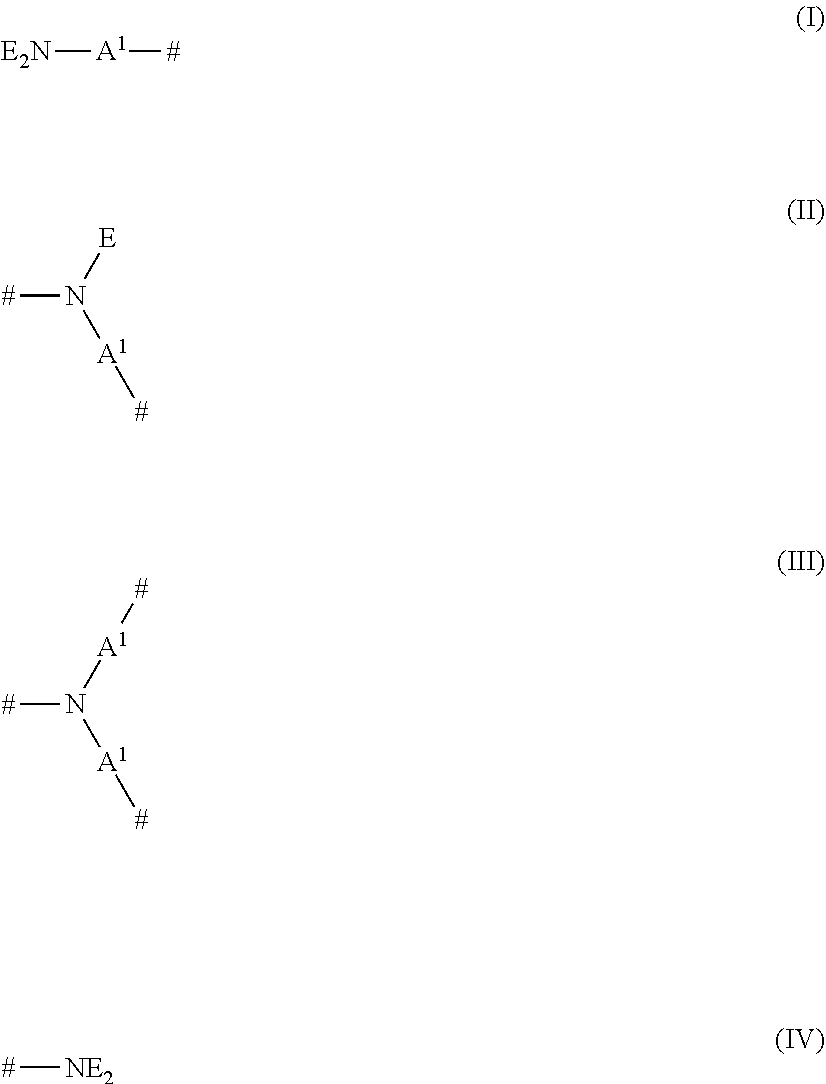
-
- where # in each case denotes one-half of a bond between a nitrogen atom and the free binding position of a group A1 of two adjacent repeating units of formulae (I), (II), (III) or (IV); A1 is independently selected from linear or branched C2-C6-alkylene; E is independently selected from alkylenoxy units of the formula (V)

-
- where * in each case denotes one-half of a bond to the nitrogen atom of the repeating unit of formula (I), (II) or (IV); A2 is in each case independently selected from 1,2-propylene, 1,2-butylene and 1,2-isobutylene; A3 is 1,2-propylene; R is in each case independently selected from hydrogen and C1-C4-alkyl; m has an average value in the range of from 0 to about 2; n has an average value in the range of from about 20 to about 50; and p has an average value in the range of from about 10 to about 50; where the individual alkoxylated polyalkylenimines consisting of 1 repeating unit of formula (I), x repeating units of formula (II), y repeating units of formula (III) and y+1 repeating units of formula (IV), where x and y in each case have a value in the range of from 0 to about 150; and the polymer having a backbone comprising the combined repeating units of formulae (I), (II), (III) and (IV) excluding the alkylenoxy units E, where the average molecular weight, Mw, of the polyalkylenimine backbone in each case having a value in the range of from about 60 g/mol to about 10,000 g/mol, or from about 100 g/mol to about 8,000 g/mol, or from about 500 g/mol to about 6,000 g/mol; and the polymer comprises a degree of quaternization ranging from 0 to about 50.

-
- where EOs are ethoxylate groups and POs are propoxylate groups.
-
- where qanionic is an anionic unit, inter alia, —SO3M, as defined herein below and qcationic represents a quaternized backbone nitrogen.
-
- where a polyamine having all of the quaternizable backbone nitrogens quaternized will have a Q(+) equal to 1. For the purposes of the present invention the term “quaternizable nitrogen” refers to nitrogen atoms in the polyamine backbone which are capable of forming quaternary ammonium ions. This excludes nitrogens not capable of ammonium ion formation, such as amides.
ΔQ=Σq anionic −Σq cationic
-
- where qanionic and qcationic are the same as defined herein above.
[J-R]n-J
-
- where the [J-R] units represent the amino units which comprise the main backbone and any branching chains. The zwitterionic polyamines prior to modification, for example, quatemization and/or substitution of a backbone unit hydrogen with an alkyleneoxy unit, may have backbones that comprise from 2 to about 100 amino units. The index n which describes the number of backbone units present is further described herein below.
(R1)2N;
—R1N;


[J-R]—
-
- represent a continuation of the zwitterionic polyamine backbone by branching. The number of B units present, as well as, any further amino units which comprise the branches are reflected in the total value of the index n.
-
- i) C2-C12 linear alkylene, C3-C12 branched alkylene, or mixtures thereof, more typically C3-C6 alkylene. When two adjacent nitrogens of the polyamine backbone are N-oxides, typically the alkylene backbone unit which separates said units are C4 units or greater.
- ii) alkyleneoxyalkylene units having the formula:
—(R2O)w(R3)—- where R2 is selected from the group consisting of ethylene, 1,2-propylene, 1,3-propylene, 1,2-butylene, 1,4-butylene, and mixtures thereof; R3 is C2-C8 linear alkylene, C3-C8 branched alkylene, phenylene, substituted phenylene, and mixtures thereof; the index w is from 0 to about 25. R2 and R3 units may also comprise other backbone units. When comprising alkyleneoxyalkylene units R2 and R3 units may be mixtures of ethylene, propylene and butylene and the index w is from 1, or from about 2, to about 10, or to about 6.
- iii) hydroxyalkylene units having the formula:

-
-
- where R4 is hydrogen, C1-C4 alkyl, —(R2O)tY, and mixtures thereof. When R units comprise hydroxyalkylene units, R4 may be hydrogen or —(R2O)tY where the index t is greater than 0, or from about 10 to about 30, and Y is hydrogen or an anionic unit, for example —SO3M. The indices x, y, and z are each independently from 1 to 6; the indices may be each equal to 1 and R4 is hydrogen (2-hydroxypropylene unit) or (R2O)tY, or for polyhydroxy units y is preferably 2 or 3. A suitable hydroxyalkylene unit is the 2-hydroxypropylene unit which can, for example, be suitably formed from glycidyl ether forming reagents, for example, epihalohydrin.
- iv) hydroxyalkylene/oxyalkylene units having the formula:
-

-
-
- where R2, R4, and the indices w, x, y, and z are the same as defined herein above. X is oxygen or the amino unit —NR4—, the index r is 0 or 1. The indices j and k are each independently from 1 to 20. When alkyleneoxy units are absent the index w is 0. Non-limiting examples of preferred hydroxyalkylene/oxyalkylene units have the formula:
-

-
- v) carboxyalkyleneoxy units having the formula:

-
-
- where R2, R3, X, r, and w are the same as defined herein above. Non-limiting examples of preferred carboxyalkyleneoxy units include:
-

-
- vi) backbone branching units having the formula:

-
-
- where R4 is hydrogen, C1-C6 alkyl, —(CH2)u(R2O)t(CH2)uY, and mixtures thereof. When R units comprise backbone branching units, R4 may be hydrogen or —(CH2)u(R2O)t—(CH2)uY where the index t is greater than 0, or is from about 10 to about 30; the index u is from 0 to 6; and Y is hydrogen, C1-C4 linear alkyl, —N(R1)2, an anionic unit, and mixtures thereof; Y may be hydrogen, or —N(R1)2. A preferred aspect of backbone branching units comprises R4 equal to —(R2O)tH. The indices x, y, and z are each independently from 0 to 6.
- vii) The formulator may suitably combine any of the above described R units to make a zwitterionic polyamine having a greater or lesser degree of hydrophilic character.
-
-
- i) hydrogen; which is the unit typically present prior to any backbone modification.
- ii) C1-C22 alkyl, or C1-C4 alkyl, or methyl or ethyl, or methyl. When R1 units are attached to quaternary units (iv) or (v), R1 may be the same unit as quaternizing unit Q. For example, a J unit having the formula:

-
- iii) C7-C22 arylalkyl, or benzyl.
- iv) —[CH2CH(OR4)CH2O]s(R2O)tY; where R2 and R4 are the same as defined herein above; in some aspects, when R1 units comprise R2 units, R2 may be ethylene. The value of the index s is from 0 to 5. For the purposes of the present invention the index t is expressed as an average value, said average value from about 0.5 to about 100. The formulator may lightly alkyleneoxylate the backbone nitrogens in a manner where not every nitrogen atom comprises an R1 unit which is an alkyleneoxy unit thereby rendering the value of the index t less than 1.
- v) Anionic units as described herein below.
- vi) The formulator may suitably combine one or more of the above described R1 units when substituting the backbone of the zwitterionic polymers of the present invention.

-
- may be oligomerized or polymerized to form units having the general formula:

-
- where the index n represents a number greater than 1.


-
- has an index n equal to 4. The following is a non-limiting example of a polyamine backbone which is fully quaternized.


-
- where R units have the formula —(R2O)wR3— where R2 and R3 are each independently selected from the group consisting of C2-C8 linear alkylene, C3-C8 branched alkylene, phenylene, substituted phenylene, and mixtures thereof. The R2 units of the formula above, which comprise —(R2O)tY units, are each ethylene; Y is hydrogen, —SO3M, or mixtures thereof; the index t is from 15 to 25; the index m is from 0 to about 20, or from 0 to about 10, or from 0 to about 4, or from 0 to about 3, or from 0 to 2; the index w is from 1, or from about 2, to about 10, or to about 6.
-
- i) normal oligomers which comprise R units of type (i), which may be polyamines having the formula:
[H2N—(CH2)x]n+1—[NH—(CH2)x]m—(NB—(CH2)x]n—NH2- where B is a continuation of the polyamine chain by branching; n may be 0; m is from 0 to 3; x is 2 to 8, or from 3 to 6; and
- ii) hydrophilic oligomers which comprise R units of type (ii), which may be polyamines having the formula:
H2N—[(CH2)xO]y(CH2)x]—[NH—[(CH2)xO]y(CH2)x]m—NH2- where m is from 0 to 3; each x is independently from 2 to 8, or from 2 to 6; y may be from 1 to 8.
- i) normal oligomers which comprise R units of type (i), which may be polyamines having the formula:


-
- where R is a 1,5-hexamethylene; w is 2; R1 is —(R2O)tY; where R2 is ethylene; Y is hydrogen or —SO3M; Q is methyl; m is 1; and t is 20. For zwitterionic polyamines of the present invention, it will be recognized by the formulator that not every R1 unit will have a —SO3 moiety capping said R1 unit. For the above example, the final zwitterionic polyamine mixture comprises at least about 40% Y units which are —SO3 − units.

-
- where EO represents an ethoxylate group.
pH
- where EO represents an ethoxylate group.
| TABLE 1 | |||
| Example 1 | |||
| Ingredients | (nil-polyamine) | Example 2 | Example 3 |
| AES | 10.50% | 10.50% | 10.50% |
| HLAS | 1.00% | ||
| Nonionic surfactant | 2.00% | 2.00% | |
| (C12-14 EO9) | |||
| Alkoxylated | — | 1.87% | 1.87% |
| Polyamine* | |||
| Citric Acid | 8.43% | 8.43% | 8.43% |
| MEA | 0.28% | 0.28% | 0.93% |
| Solvent (ethanol, | 3.82% | 3.82% | 3.82% |
| pdiol, DEG) | |||
| NaOH | 0.12% | 0.12% | 0.12% |
| Softening agent** | 0.08% | ||
| DTPA | 0.3% | ||
| NaCl | 2.00% | ||
| Brightener*** | 0.12% |
| Water | To balance |
| pH (neat) | 2.5 | 2.5 | 2.5 |
| Chemical stability | 11000 ppm | 8000 ppm | 800 ppm |
| measure (change in | |||
| ppm of sulfate) | |||
| *PEI 600 E20, available from BASF | |||
| **Lauryl trimethyl ammonium chloride, available from Akso-Nobel | |||
| ***Disodium 4,4′-bis-(2-sulfostryl)biphenyl, available from Ciba Specialty Chemicals as BR49 | |||
| TABLE 2 | |||
| Example 4 | |||
| Ingredients | (nil-polyamine) | Example 5 | Example 6 |
| AES | 10.50% | 10.50% | 10.50% |
| HLAS | 1.00% | ||
| Nonionic surfactant | 2.00% | 2.00% | |
| (C12-14 EO9) | |||
| Alkoxylated | — | 3.00% | |
| Polyamine (2) | |||
| Alkoxylated | 3.00% | ||
| Polyamine (3) | |||
| Citric Acid | 8.43% | 8.43% | 8.43% |
| MEA | 0.41% | 0.48% | 0.42% |
| Solvent (ethanol, | 3.82% | 3.82% | 3.82% |
| pdiol, DEG) | |||
| NaOH | 0.12% | 0.12% | 0.12% |
| pH (neat) | 2.5 | 2.5 | 2.5 |
| Chemical stability | 5798 | 4220 | 4287 |
| measure (change in | |||
| ppm of sulfate) | |||
| *Alkoxylated Polyamine (2): zwitterionic ethoxylated quatemized sulfated hexamethylene diamine, as described in WO 01/05874 and available from BASF | |||
| *Alkoxylated Polyamine (3): polymer having a 600 g/mol molecular weight polyethylenimine core with 24 ethoxylate groups per —NH and 16 propoxylate groups per —NH (PEI 600 EO24 PO6); available from BASF | |||
Claims (12)
Priority Applications (1)
| Application Number | Priority Date | Filing Date | Title |
|---|---|---|---|
| US16/683,493 US12338412B2 (en) | 2013-05-24 | 2019-11-14 | Low pH detergent composition |
Applications Claiming Priority (3)
| Application Number | Priority Date | Filing Date | Title |
|---|---|---|---|
| US201361827147P | 2013-05-24 | 2013-05-24 | |
| US14/284,419 US10519400B2 (en) | 2013-05-24 | 2014-05-22 | Low PH detergent composition |
| US16/683,493 US12338412B2 (en) | 2013-05-24 | 2019-11-14 | Low pH detergent composition |
Related Parent Applications (1)
| Application Number | Title | Priority Date | Filing Date |
|---|---|---|---|
| US14/284,419 Continuation US10519400B2 (en) | 2013-05-24 | 2014-05-22 | Low PH detergent composition |
Publications (2)
| Publication Number | Publication Date |
|---|---|
| US20200109350A1 US20200109350A1 (en) | 2020-04-09 |
| US12338412B2 true US12338412B2 (en) | 2025-06-24 |
Family
ID=50943626
Family Applications (2)
| Application Number | Title | Priority Date | Filing Date |
|---|---|---|---|
| US14/284,419 Active 2037-05-12 US10519400B2 (en) | 2013-05-24 | 2014-05-22 | Low PH detergent composition |
| US16/683,493 Active 2034-12-17 US12338412B2 (en) | 2013-05-24 | 2019-11-14 | Low pH detergent composition |
Family Applications Before (1)
| Application Number | Title | Priority Date | Filing Date |
|---|---|---|---|
| US14/284,419 Active 2037-05-12 US10519400B2 (en) | 2013-05-24 | 2014-05-22 | Low PH detergent composition |
Country Status (7)
| Country | Link |
|---|---|
| US (2) | US10519400B2 (en) |
| EP (1) | EP3004310B1 (en) |
| JP (1) | JP6122214B2 (en) |
| CN (1) | CN105431515A (en) |
| BR (1) | BR112015028853A2 (en) |
| CA (1) | CA2910875C (en) |
| WO (1) | WO2014190129A1 (en) |
Families Citing this family (23)
| Publication number | Priority date | Publication date | Assignee | Title |
|---|---|---|---|---|
| JP6122214B2 (en) | 2013-05-24 | 2017-04-26 | ザ プロクター アンド ギャンブル カンパニー | Low pH detergent composition |
| CN107001985A (en) * | 2014-12-12 | 2017-08-01 | 宝洁公司 | Liquid cleansing composition |
| EP3109306A1 (en) * | 2015-06-22 | 2016-12-28 | The Procter and Gamble Company | Low solvent liquid detergent compositions |
| US10457900B2 (en) * | 2016-05-20 | 2019-10-29 | The Proctor & Gamble Company | Detergent composition comprising an alkyl ether sulfate-rich surfactant system and coated encapsulates |
| US10494592B2 (en) * | 2016-05-20 | 2019-12-03 | The Procter & Gamble Company | Detergent composition comprising anionic/nonionic/cationic surfactant system and encapsulates |
| EP3301158B1 (en) * | 2016-10-03 | 2023-01-25 | The Procter & Gamble Company | Laundry detergent composition |
| EP3301159B1 (en) * | 2016-10-03 | 2023-08-02 | The Procter & Gamble Company | Laundry detergent composition |
| EP3342847B1 (en) * | 2016-12-28 | 2022-03-23 | The Procter & Gamble Company | Water-soluble unit dose article comprising zwitterionic polyamine |
| US10087403B2 (en) | 2017-01-11 | 2018-10-02 | The Procter & Gamble Company | Detergent compositions having surfactant systems |
| US10731107B2 (en) * | 2017-06-30 | 2020-08-04 | The Procter & Gamble Company | Detergent compositions comprising AES surfactant having alkyl chain lengths of fourteen total carbons |
| CN111479911A (en) | 2017-12-12 | 2020-07-31 | 荷兰联合利华有限公司 | Foamable cleaning composition |
| CA3086412C (en) | 2018-01-19 | 2023-02-28 | The Procter & Gamble Company | Liquid detergent compositions comprising alkyl ethoxylated sulfate surfactant |
| US11466122B2 (en) * | 2018-10-18 | 2022-10-11 | Milliken & Company | Polyethyleneimine compounds containing N-halamine and derivatives thereof |
| US11299591B2 (en) | 2018-10-18 | 2022-04-12 | Milliken & Company | Polyethyleneimine compounds containing N-halamine and derivatives thereof |
| US11732218B2 (en) | 2018-10-18 | 2023-08-22 | Milliken & Company | Polyethyleneimine compounds containing N-halamine and derivatives thereof |
| US20200123319A1 (en) * | 2018-10-18 | 2020-04-23 | Milliken & Company | Polyethyleneimine compounds containing n-halamine and derivatives thereof |
| US20200123472A1 (en) * | 2018-10-18 | 2020-04-23 | Milliken & Company | Polyethyleneimine compounds containing n-halamine and derivatives thereof |
| US11518963B2 (en) * | 2018-10-18 | 2022-12-06 | Milliken & Company | Polyethyleneimine compounds containing N-halamine and derivatives thereof |
| US11655432B2 (en) * | 2019-08-22 | 2023-05-23 | Henkel Ag & Co. Kgaa | Liquid detergent compositions that include a mixture of ecologically-responsible surfactants |
| AR119899A1 (en) * | 2019-09-27 | 2022-01-19 | Dow Global Technologies Llc | LIQUID LAUNDRY DETERGENT WITH CLEANING REINFORCEMENT |
| CA3167586A1 (en) * | 2020-02-21 | 2021-08-26 | Sophia Ebert | Alkoxylated polyamines with improved biodegradability |
| EP4112707A1 (en) * | 2021-06-30 | 2023-01-04 | The Procter & Gamble Company | Fabric treatment |
| AU2021221648B1 (en) * | 2021-08-24 | 2022-06-02 | Bayer Australia Limited | Laundry additive |
Citations (109)
| Publication number | Priority date | Publication date | Assignee | Title |
|---|---|---|---|---|
| US2493445A (en) | 1946-07-01 | 1950-01-03 | Colgate Palmolive Peet Co | Method for stabilizing sulfated products |
| US3600318A (en) | 1969-06-02 | 1971-08-17 | Procter & Gamble | Enzyme-containing detergent compositions for neutral washing |
| US3650968A (en) | 1968-04-30 | 1972-03-21 | Paul Hoffman | Fisherman's soap |
| GB1489694A (en) | 1974-01-28 | 1977-10-26 | Procter & Gamble | Nonionic detergent composition |
| EP0019315A1 (en) | 1979-05-16 | 1980-11-26 | Procter & Gamble European Technical Center | Highly concentrated fatty acid containing liquid detergent compositions |
| US4242215A (en) | 1972-06-13 | 1980-12-30 | Chem-Y, Fabriek Van Chemische Produkten B.V. | Substantially environmental-pollution-free laundry detergent composition |
| US4486195A (en) | 1984-03-05 | 1984-12-04 | Millmaster Onyx Group Inc. | Laundering compositions |
| US4529525A (en) | 1982-08-30 | 1985-07-16 | Colgate-Palmolive Co. | Stabilized enzyme-containing detergent compositions |
| US4737314A (en) | 1985-02-08 | 1988-04-12 | Nippon Shokubai Kagaku Kogyo Co., Ltd. | Stabilized alkylene oxide adduct containing lactic acid or a lactate |
| GB2205578A (en) | 1987-05-08 | 1988-12-14 | Kao Corp | Liquid detergent |
| US5057246A (en) | 1986-07-25 | 1991-10-15 | Cotelle S.A. | Viscous detergent composition capable of being diluted and process for producing it |
| WO1991016409A1 (en) | 1990-04-25 | 1991-10-31 | Unilever N.V. | Liquid detergent compositions |
| EP0518401A1 (en) | 1991-06-14 | 1992-12-16 | The Procter & Gamble Company | Self-thickened cleaning compositions |
| WO1994001520A1 (en) | 1992-07-03 | 1994-01-20 | The Procter & Gamble Company | Concentrated aqueous liquid detergent comprising polyvinylpyrrolidone |
| EP0619366A1 (en) | 1993-04-05 | 1994-10-12 | The Procter & Gamble Company | Lavatory blocks containing active oxygen |
| WO1995009225A1 (en) | 1993-09-27 | 1995-04-06 | Novo Nordisk A/S | A composition and a method for the treatment of dyed fabric |
| EP0666308A2 (en) | 1994-02-03 | 1995-08-09 | The Procter & Gamble Company | Multi-purpose liquid cleaning compositions |
| US5466851A (en) | 1992-12-14 | 1995-11-14 | Lever Brothers Company, Division Of Conopco, Inc. | Detergent production |
| US5484555A (en) | 1992-09-15 | 1996-01-16 | Lever Brothers Company, Division Of Conopco, Inc. | Method for creating a pH jump system |
| US5536438A (en) | 1992-11-26 | 1996-07-16 | The Procter & Gamble Company | Multi-purpose liquid cleaning composition comprising nonionic surfactants of different HLB values |
| US5559090A (en) | 1991-06-14 | 1996-09-24 | The Procter & Gamble Company | Stable, hydrogen peroxide-containing bleaching compositions |
| US5565145A (en) | 1994-05-25 | 1996-10-15 | The Procter & Gamble Company | Compositions comprising ethoxylated/propoxylated polyalkyleneamine polymers as soil dispersing agents |
| US5641739A (en) | 1995-05-01 | 1997-06-24 | The Procter & Gamble Company | Aqueous detergent compositions containing chelants which remain undissolved under acidic conditions |
| EP0781836A1 (en) | 1995-12-29 | 1997-07-02 | Colgate-Palmolive Company | Detergent composition having improved cleaning power in neutral or acidic medium |
| EP0839903A1 (en) | 1996-10-31 | 1998-05-06 | The Procter & Gamble Company | Liquid aqueous bleaching compositions and pretreatment process |
| US5759989A (en) | 1993-07-12 | 1998-06-02 | The Procter & Gamble Company | Stable aqueous emulsions of nonionic surfactants with a viscosity controlling agent |
| WO1998027189A1 (en) | 1996-12-17 | 1998-06-25 | Colgate-Palmolive Company | Mildly acidic laundry detergent composition |
| US5858948A (en) * | 1996-05-03 | 1999-01-12 | Procter & Gamble Company | Liquid laundry detergent compositions comprising cotton soil release polymers and protease enzymes |
| WO1999010457A1 (en) | 1997-08-25 | 1999-03-04 | Cognis Deutschland Gmbh | Method for stabilising aqueous ester sulphate tensides |
| WO1999009944A1 (en) | 1997-08-25 | 1999-03-04 | Cognis Deutschland Gmbh | Aqueous nacreous lustre dispersions |
| US5880079A (en) | 1994-06-17 | 1999-03-09 | The Procter & Gamble Company | Bleaching compositions |
| EP0908511A1 (en) | 1997-10-08 | 1999-04-14 | The Procter & Gamble Company | Liquid multipurpose-cleaning compositions with effective foam control |
| US5928384A (en) | 1994-11-10 | 1999-07-27 | The Procter & Gamble Company | Method of cleaning carpets |
| DE19822688A1 (en) | 1998-05-20 | 1999-11-25 | Henkel Kgaa | Stabilisation of aqueous ester sulfate surfactants |
| US6037317A (en) | 1994-02-03 | 2000-03-14 | The Procter & Gamble Company | Aqueous cleaning compositions containing a 2-alkyl alkanol, H2 . O.sub2, an anionic and a low HLB nonionic |
| US6054424A (en) | 1998-04-15 | 2000-04-25 | Church & Dwight Co., Inc. | Process for the production of a liquid laundry detergent composition of desired viscosity containing nonionic and anionic surfactants |
| US6060443A (en) | 1996-04-16 | 2000-05-09 | The Procter & Gamble Company | Mid-chain branched alkyl sulfate surfactants |
| US6066610A (en) | 1997-09-19 | 2000-05-23 | S. C. Johnson & Son, Inc. | Low pH amphoteric fabric cleaning solution |
| US6069123A (en) | 1995-06-30 | 2000-05-30 | Procter & Gamble Company | Peroxygen bleach-containing prespotting compositions with polyamine stabilizers providing improved fabric/color safety |
| JP2000192092A (en) | 1998-12-28 | 2000-07-11 | Asahi Gosei Kagaku Kk | Production of acidic liquid detergent composition |
| WO2000071667A1 (en) | 1999-05-21 | 2000-11-30 | Colgate-Palmolive Company | Acidic light duty liquid cleaning compositions |
| US6159925A (en) | 2000-04-06 | 2000-12-12 | Colgate-Palmolive Co. | Acidic liquid crystal compositions |
| WO2001000758A2 (en) | 1999-06-30 | 2001-01-04 | Huntsman Petrochemical Corporation | Concentrated surfactant blends |
| WO2001005874A1 (en) | 1999-07-16 | 2001-01-25 | Basf Aktiengesellschaft | Zwitterionic polyamines and a process for their production |
| US6183757B1 (en) * | 1997-06-04 | 2001-02-06 | Procter & Gamble Company | Mild, rinse-off antimicrobial cleansing compositions which provide improved immediate germ reduction during washing |
| US6239092B1 (en) | 1997-09-30 | 2001-05-29 | Reckitt Benckiser Inc. | Thickened acidic, hard surface cleaning and disinfecting compositions particularly useful for ceramic surfaces |
| US6262007B1 (en) | 1991-06-14 | 2001-07-17 | The Procter & Gamble Company | Self-thickened cleaning compositions |
| US6303556B1 (en) | 1999-01-20 | 2001-10-16 | The Procter & Gamble Company | Hard surface cleaning compositions comprising modified alkybenzene sulfonates |
| US6313085B1 (en) | 1999-06-29 | 2001-11-06 | Cognis Deutschland Gmbh | High-concentration flowable anionic surfactant mixtures containing alkyl ether sulfates and alkyl sulfates |
| DE10032588A1 (en) | 2000-07-07 | 2002-01-24 | Henkel Kgaa | Increasing viscosity stability of thickened aqueous liquid bleach or prewash compositions based on hydrogen peroxide comprises increasing the pH |
| JP2002053894A (en) | 2000-08-09 | 2002-02-19 | Kao Corp | Liquid detergent composition |
| US6376449B2 (en) | 1993-03-27 | 2002-04-23 | Novozymes A/S | Acidic cleaning composition comprising an acidic protease I |
| WO2002050225A1 (en) | 2000-12-21 | 2002-06-27 | Unilever Plc | Antimicrobial cleaning compositions |
| US20020107167A1 (en) | 2000-10-23 | 2002-08-08 | Kazunori Aizawa | Anionic surfactant powder |
| US6521577B1 (en) | 1999-02-08 | 2003-02-18 | The Procter & Gamble Company | Hand washing detergent compositions |
| US6525012B2 (en) | 2000-02-23 | 2003-02-25 | The Procter & Gamble Company | Liquid laundry detergent compositions having enhanced clay removal benefits |
| US6627590B1 (en) | 1998-05-22 | 2003-09-30 | The Procter & Gamble Company | Acidic cleaning compositions with C10 alkyl sulfate detergent surfactant |
| US20030185783A1 (en) * | 2002-03-01 | 2003-10-02 | Kao Corporation | Hair cleansing compositions |
| US6630435B1 (en) | 1999-06-29 | 2003-10-07 | Procter & Gamble | Bleaching compositions |
| US20040072718A1 (en) | 1999-07-16 | 2004-04-15 | The Procter & Gamble Company | Laundry detergent compositions comprising zwitterionic polyamines and mid-chain branched surfactants |
| US20040092413A1 (en) | 2002-07-29 | 2004-05-13 | Synergylabs | Concentrated liquid compositions and methods of providing the same |
| US20040092422A1 (en) | 2002-09-03 | 2004-05-13 | Carr Charles D. | Alkylaryl-o-ethoxylate blends with their respective sulfates |
| US6740630B2 (en) | 2001-07-24 | 2004-05-25 | The Procter & Gamble Company | Processes for making substantially anhydrous structured surfactant pastes and other detergent ingredients and compositions employing same |
| US6797685B2 (en) | 2002-04-26 | 2004-09-28 | Unilever Home & Personal Care Usa, Division Of Conopco, Inc. | Liquid laundry detergent with emulsion layer |
| US20060040837A1 (en) | 2004-08-17 | 2006-02-23 | Seren Frantz | Low pH structured surfactant compositions |
| US20060111261A1 (en) | 2004-11-19 | 2006-05-25 | The Procter & Gamble Company | Acidic laundry detergent compositions |
| US20060234898A1 (en) * | 2005-04-15 | 2006-10-19 | Eva Schneiderman | Liquid laundry detergent compositions with improved stability and transparency |
| US20060251605A1 (en) | 2003-03-12 | 2006-11-09 | Belmar Maria T | Method to prepare personal care composition from a concentrate |
| US7148187B1 (en) | 2005-06-28 | 2006-12-12 | The Clorox Company | Low residue cleaning composition comprising lactic acid, nonionic surfactant and solvent mixture |
| WO2007107191A1 (en) | 2006-03-20 | 2007-09-27 | Henkel Ag & Co. Kgaa | Multiphase laundry detergent, dishwasher detergent or cleaning composition with vertical phase boundaries |
| JP2007308592A (en) | 2006-05-18 | 2007-11-29 | Kao Corp | Liquid detergent composition |
| US20080015135A1 (en) | 2006-05-05 | 2008-01-17 | De Buzzaccarini Francesco | Compact fluid laundry detergent composition |
| EP1696023B1 (en) | 2005-02-28 | 2008-04-16 | Kao Corporation | Surfactant composition |
| WO2008068222A1 (en) | 2006-12-08 | 2008-06-12 | Unilever Plc | Concentrated surfactant compositions |
| US20080178396A1 (en) | 2006-10-06 | 2008-07-31 | Van Der Linden Josephus Hendri | Rinse-cleaning laundry washing machine method |
| US20080248988A1 (en) | 2006-04-07 | 2008-10-09 | Colgate-Palmolive | Liquid Cleaning Composition Having Low Viscosity |
| WO2009095823A1 (en) | 2008-02-01 | 2009-08-06 | The Procter & Gamble Company | Fabric softening laundry detergent |
| US20090215854A1 (en) | 2003-06-20 | 2009-08-27 | The Procter & Gamble Company | Antimicrobial compositions, products and methods employing same |
| US20090298739A1 (en) * | 2008-06-02 | 2009-12-03 | Florence Catherine Courchay | Surfactant Concentrate |
| US20090312227A1 (en) | 2008-06-17 | 2009-12-17 | Colgate-Palmolive | Light duty liquid cleaning compositions and methods of manufacture and use thereof |
| US20100003198A1 (en) * | 2008-07-07 | 2010-01-07 | Patrick John Stolmeier | Antimicrobial Topical and Other Preparations Containing Fluorescent or Illumination Dye and Tracer Agents or Compounds |
| US20100093595A1 (en) | 2008-10-15 | 2010-04-15 | Holzhauer Frederick W | Liquid cleaning compositions |
| US7820610B2 (en) | 2008-04-07 | 2010-10-26 | The Procter & Gamble Company | Laundry detergent containing polyethyleneimine suds collapser |
| US20100303739A1 (en) | 2007-09-14 | 2010-12-02 | Cognis Ip Management Gmbh | Highly Concentrated Fatty Alcohol Sulfate Preparation |
| WO2011027721A1 (en) | 2009-09-02 | 2011-03-10 | ライオン株式会社 | Detergent composition |
| US20110061174A1 (en) * | 2009-09-14 | 2011-03-17 | Jean-Pol Boutique | Compact fluid laundry detergent composition |
| US20110075466A1 (en) | 2007-01-31 | 2011-03-31 | Tyler Thorp | Methods and apparatus for using a configuration array similar to an associated data array |
| WO2011075556A1 (en) | 2009-12-18 | 2011-06-23 | The Procter & Gamble Company | Composition comprising encapsulates, and process for making them |
| US20110146725A1 (en) | 2009-12-17 | 2011-06-23 | Ricky Ah-Man Woo | Hard Surface Cleaning Composition Having A Malodor Control Component And Methods Of Cleaning Hard Surfaces |
| US20110146707A1 (en) * | 2009-12-17 | 2011-06-23 | Laura Cermenati | Liquid acidic hard surface cleaning composition |
| WO2011098356A1 (en) | 2010-02-12 | 2011-08-18 | Unilever Plc | Laundry treatment composition comprising bis-azo shading dyes |
| US20110220536A1 (en) | 2010-03-12 | 2011-09-15 | Fernandez-Prieto Susana | Fluid Detergent Compositions Comprising a Di-Amido Gellant, and Processes for Making |
| WO2011161618A1 (en) | 2010-06-25 | 2011-12-29 | Firmenich Sa | Stable formaldehyde-free microcapsules |
| US8097579B2 (en) | 2007-11-09 | 2012-01-17 | The Procter & Gamble Company | Cleaning compositions with amphiphilic water-soluble polyalkylenimines having an inner polyethylene oxide block and an outer polypropylene oxide block |
| JP2012092163A (en) | 2010-10-25 | 2012-05-17 | Kao Corp | Anionic surfactant composition |
| WO2012122232A1 (en) | 2011-03-07 | 2012-09-13 | The Procter & Gamble Company | Multipurpose detergent compositions |
| EP2522714A1 (en) | 2011-05-13 | 2012-11-14 | Unilever Plc, A Company Registered In England And Wales under company no. 41424 of Unilever House | Aqueous concentrated laundry detergent compositions |
| WO2013041832A1 (en) | 2011-03-09 | 2013-03-28 | Reckitt Benckiser N.V. | Liquid detergent composition |
| WO2013092049A1 (en) | 2011-12-20 | 2013-06-27 | Unilever Plc | Isotropic aqueous liquid laundry detergent comprising sequestrant |
| US20130184195A1 (en) | 2012-01-18 | 2013-07-18 | The Procter & Gamble Company | Acidic laundry detergent compositions |
| WO2013142486A1 (en) | 2012-03-19 | 2013-09-26 | The Procter & Gamble Company | Laundry care compositions containing dyes |
| US20130267451A1 (en) | 2010-12-13 | 2013-10-10 | Colgate-Palmolive Company | Dilutable Concentrated Cleaning Composition |
| US20130281344A1 (en) | 2010-12-13 | 2013-10-24 | Colgate-Palmolive Company | Dilutable Concentrated Cleaning Composition |
| US20130305461A1 (en) | 2011-05-18 | 2013-11-21 | Margherita Scartozzi | Fabric cleaning composition comprising hueing agent |
| WO2014018309A1 (en) | 2012-07-26 | 2014-01-30 | The Procter & Gamble Company | Low ph liquid cleaning compositions with enzymes |
| US20140148372A1 (en) * | 2012-11-28 | 2014-05-29 | Ecolab Usa Inc. | Acidic viscoelastic surfactant based cleaning compositions |
| US20140349908A1 (en) | 2013-05-24 | 2014-11-27 | The Procter & Gamble Company | Low ph detergent composition comprising nonionic surfactants |
| US20140349913A1 (en) | 2013-05-24 | 2014-11-27 | The Procter & Gamble Company | Low ph detergent composition |
| US10149985B2 (en) | 2008-11-07 | 2018-12-11 | Klox Technologies Inc. | Methods and compositions for treating rosacea |
Family Cites Families (3)
| Publication number | Priority date | Publication date | Assignee | Title |
|---|---|---|---|---|
| JPH10509191A (en) * | 1994-11-10 | 1998-09-08 | ザ、プロクター、エンド、ギャンブル、カンパニー | Carpet cleaning methods |
| EP0751214A1 (en) * | 1995-06-30 | 1997-01-02 | The Procter & Gamble Company | Stable peroxygen bleach-containing compositions |
| WO2000043478A1 (en) * | 1999-01-20 | 2000-07-27 | The Procter & Gamble Company | Aqueous heavy duty liquid detergent compositions comprising modified alkylbenzene sulfonates |
-
2014
- 2014-05-22 JP JP2016515069A patent/JP6122214B2/en active Active
- 2014-05-22 BR BR112015028853A patent/BR112015028853A2/en not_active Application Discontinuation
- 2014-05-22 CA CA2910875A patent/CA2910875C/en active Active
- 2014-05-22 EP EP14730720.1A patent/EP3004310B1/en active Active
- 2014-05-22 CN CN201480029962.8A patent/CN105431515A/en active Pending
- 2014-05-22 US US14/284,419 patent/US10519400B2/en active Active
- 2014-05-22 WO PCT/US2014/039098 patent/WO2014190129A1/en not_active Ceased
-
2019
- 2019-11-14 US US16/683,493 patent/US12338412B2/en active Active
Patent Citations (125)
| Publication number | Priority date | Publication date | Assignee | Title |
|---|---|---|---|---|
| US2493445A (en) | 1946-07-01 | 1950-01-03 | Colgate Palmolive Peet Co | Method for stabilizing sulfated products |
| US3650968A (en) | 1968-04-30 | 1972-03-21 | Paul Hoffman | Fisherman's soap |
| US3600318A (en) | 1969-06-02 | 1971-08-17 | Procter & Gamble | Enzyme-containing detergent compositions for neutral washing |
| US4242215A (en) | 1972-06-13 | 1980-12-30 | Chem-Y, Fabriek Van Chemische Produkten B.V. | Substantially environmental-pollution-free laundry detergent composition |
| GB1489694A (en) | 1974-01-28 | 1977-10-26 | Procter & Gamble | Nonionic detergent composition |
| EP0019315A1 (en) | 1979-05-16 | 1980-11-26 | Procter & Gamble European Technical Center | Highly concentrated fatty acid containing liquid detergent compositions |
| US4285841A (en) | 1979-05-16 | 1981-08-25 | The Procter & Gamble Company | Highly concentrated fatty acid containing liquid detergent compositions |
| US4529525A (en) | 1982-08-30 | 1985-07-16 | Colgate-Palmolive Co. | Stabilized enzyme-containing detergent compositions |
| US4486195A (en) | 1984-03-05 | 1984-12-04 | Millmaster Onyx Group Inc. | Laundering compositions |
| US4737314A (en) | 1985-02-08 | 1988-04-12 | Nippon Shokubai Kagaku Kogyo Co., Ltd. | Stabilized alkylene oxide adduct containing lactic acid or a lactate |
| US5057246A (en) | 1986-07-25 | 1991-10-15 | Cotelle S.A. | Viscous detergent composition capable of being diluted and process for producing it |
| GB2205578A (en) | 1987-05-08 | 1988-12-14 | Kao Corp | Liquid detergent |
| WO1991016409A1 (en) | 1990-04-25 | 1991-10-31 | Unilever N.V. | Liquid detergent compositions |
| EP0518401A1 (en) | 1991-06-14 | 1992-12-16 | The Procter & Gamble Company | Self-thickened cleaning compositions |
| US6262007B1 (en) | 1991-06-14 | 2001-07-17 | The Procter & Gamble Company | Self-thickened cleaning compositions |
| US5559090A (en) | 1991-06-14 | 1996-09-24 | The Procter & Gamble Company | Stable, hydrogen peroxide-containing bleaching compositions |
| WO1994001520A1 (en) | 1992-07-03 | 1994-01-20 | The Procter & Gamble Company | Concentrated aqueous liquid detergent comprising polyvinylpyrrolidone |
| US5484555A (en) | 1992-09-15 | 1996-01-16 | Lever Brothers Company, Division Of Conopco, Inc. | Method for creating a pH jump system |
| US5536438A (en) | 1992-11-26 | 1996-07-16 | The Procter & Gamble Company | Multi-purpose liquid cleaning composition comprising nonionic surfactants of different HLB values |
| US5466851A (en) | 1992-12-14 | 1995-11-14 | Lever Brothers Company, Division Of Conopco, Inc. | Detergent production |
| US6376449B2 (en) | 1993-03-27 | 2002-04-23 | Novozymes A/S | Acidic cleaning composition comprising an acidic protease I |
| EP0619366A1 (en) | 1993-04-05 | 1994-10-12 | The Procter & Gamble Company | Lavatory blocks containing active oxygen |
| US5759989A (en) | 1993-07-12 | 1998-06-02 | The Procter & Gamble Company | Stable aqueous emulsions of nonionic surfactants with a viscosity controlling agent |
| WO1995009225A1 (en) | 1993-09-27 | 1995-04-06 | Novo Nordisk A/S | A composition and a method for the treatment of dyed fabric |
| EP0666308A3 (en) | 1994-02-03 | 1996-06-05 | Procter & Gamble | Liquid cleaning compositions for all uses. |
| EP0666308A2 (en) | 1994-02-03 | 1995-08-09 | The Procter & Gamble Company | Multi-purpose liquid cleaning compositions |
| US6037317A (en) | 1994-02-03 | 2000-03-14 | The Procter & Gamble Company | Aqueous cleaning compositions containing a 2-alkyl alkanol, H2 . O.sub2, an anionic and a low HLB nonionic |
| US5565145A (en) | 1994-05-25 | 1996-10-15 | The Procter & Gamble Company | Compositions comprising ethoxylated/propoxylated polyalkyleneamine polymers as soil dispersing agents |
| US5880079A (en) | 1994-06-17 | 1999-03-09 | The Procter & Gamble Company | Bleaching compositions |
| US5928384A (en) | 1994-11-10 | 1999-07-27 | The Procter & Gamble Company | Method of cleaning carpets |
| US5641739A (en) | 1995-05-01 | 1997-06-24 | The Procter & Gamble Company | Aqueous detergent compositions containing chelants which remain undissolved under acidic conditions |
| US6069123A (en) | 1995-06-30 | 2000-05-30 | Procter & Gamble Company | Peroxygen bleach-containing prespotting compositions with polyamine stabilizers providing improved fabric/color safety |
| EP0781836A1 (en) | 1995-12-29 | 1997-07-02 | Colgate-Palmolive Company | Detergent composition having improved cleaning power in neutral or acidic medium |
| US6060443A (en) | 1996-04-16 | 2000-05-09 | The Procter & Gamble Company | Mid-chain branched alkyl sulfate surfactants |
| US5858948A (en) * | 1996-05-03 | 1999-01-12 | Procter & Gamble Company | Liquid laundry detergent compositions comprising cotton soil release polymers and protease enzymes |
| EP0839903A1 (en) | 1996-10-31 | 1998-05-06 | The Procter & Gamble Company | Liquid aqueous bleaching compositions and pretreatment process |
| US5972869A (en) | 1996-12-17 | 1999-10-26 | Colgate-Palmolive Co | Mildly acidic laundry detergent composition providing improved protection of fine fabrics during washing and enhanced rinsing in hand wash |
| WO1998027189A1 (en) | 1996-12-17 | 1998-06-25 | Colgate-Palmolive Company | Mildly acidic laundry detergent composition |
| US6183757B1 (en) * | 1997-06-04 | 2001-02-06 | Procter & Gamble Company | Mild, rinse-off antimicrobial cleansing compositions which provide improved immediate germ reduction during washing |
| WO1999009944A1 (en) | 1997-08-25 | 1999-03-04 | Cognis Deutschland Gmbh | Aqueous nacreous lustre dispersions |
| WO1999010457A1 (en) | 1997-08-25 | 1999-03-04 | Cognis Deutschland Gmbh | Method for stabilising aqueous ester sulphate tensides |
| US6066610A (en) | 1997-09-19 | 2000-05-23 | S. C. Johnson & Son, Inc. | Low pH amphoteric fabric cleaning solution |
| US6239092B1 (en) | 1997-09-30 | 2001-05-29 | Reckitt Benckiser Inc. | Thickened acidic, hard surface cleaning and disinfecting compositions particularly useful for ceramic surfaces |
| US6451064B1 (en) | 1997-10-08 | 2002-09-17 | Procter & Gamble | Liquid multipurpose-cleaning compositions with effective foam control |
| EP0908511A1 (en) | 1997-10-08 | 1999-04-14 | The Procter & Gamble Company | Liquid multipurpose-cleaning compositions with effective foam control |
| US6054424A (en) | 1998-04-15 | 2000-04-25 | Church & Dwight Co., Inc. | Process for the production of a liquid laundry detergent composition of desired viscosity containing nonionic and anionic surfactants |
| DE19822688A1 (en) | 1998-05-20 | 1999-11-25 | Henkel Kgaa | Stabilisation of aqueous ester sulfate surfactants |
| US6627590B1 (en) | 1998-05-22 | 2003-09-30 | The Procter & Gamble Company | Acidic cleaning compositions with C10 alkyl sulfate detergent surfactant |
| JP2000192092A (en) | 1998-12-28 | 2000-07-11 | Asahi Gosei Kagaku Kk | Production of acidic liquid detergent composition |
| US6303556B1 (en) | 1999-01-20 | 2001-10-16 | The Procter & Gamble Company | Hard surface cleaning compositions comprising modified alkybenzene sulfonates |
| US6521577B1 (en) | 1999-02-08 | 2003-02-18 | The Procter & Gamble Company | Hand washing detergent compositions |
| WO2000071667A1 (en) | 1999-05-21 | 2000-11-30 | Colgate-Palmolive Company | Acidic light duty liquid cleaning compositions |
| US6251844B1 (en) | 1999-05-21 | 2001-06-26 | Colgate-Palmolive Co. | Hydroxy aliphatic acidic microemulsion liquid cleaning compositions |
| US6630435B1 (en) | 1999-06-29 | 2003-10-07 | Procter & Gamble | Bleaching compositions |
| US6313085B1 (en) | 1999-06-29 | 2001-11-06 | Cognis Deutschland Gmbh | High-concentration flowable anionic surfactant mixtures containing alkyl ether sulfates and alkyl sulfates |
| WO2001000758A2 (en) | 1999-06-30 | 2001-01-04 | Huntsman Petrochemical Corporation | Concentrated surfactant blends |
| US20040072718A1 (en) | 1999-07-16 | 2004-04-15 | The Procter & Gamble Company | Laundry detergent compositions comprising zwitterionic polyamines and mid-chain branched surfactants |
| WO2001005874A1 (en) | 1999-07-16 | 2001-01-25 | Basf Aktiengesellschaft | Zwitterionic polyamines and a process for their production |
| US6525012B2 (en) | 2000-02-23 | 2003-02-25 | The Procter & Gamble Company | Liquid laundry detergent compositions having enhanced clay removal benefits |
| US6159925A (en) | 2000-04-06 | 2000-12-12 | Colgate-Palmolive Co. | Acidic liquid crystal compositions |
| DE10032588A1 (en) | 2000-07-07 | 2002-01-24 | Henkel Kgaa | Increasing viscosity stability of thickened aqueous liquid bleach or prewash compositions based on hydrogen peroxide comprises increasing the pH |
| JP2002053894A (en) | 2000-08-09 | 2002-02-19 | Kao Corp | Liquid detergent composition |
| US20020107167A1 (en) | 2000-10-23 | 2002-08-08 | Kazunori Aizawa | Anionic surfactant powder |
| WO2002050225A1 (en) | 2000-12-21 | 2002-06-27 | Unilever Plc | Antimicrobial cleaning compositions |
| US6740630B2 (en) | 2001-07-24 | 2004-05-25 | The Procter & Gamble Company | Processes for making substantially anhydrous structured surfactant pastes and other detergent ingredients and compositions employing same |
| US20030185783A1 (en) * | 2002-03-01 | 2003-10-02 | Kao Corporation | Hair cleansing compositions |
| US6797685B2 (en) | 2002-04-26 | 2004-09-28 | Unilever Home & Personal Care Usa, Division Of Conopco, Inc. | Liquid laundry detergent with emulsion layer |
| US20040092413A1 (en) | 2002-07-29 | 2004-05-13 | Synergylabs | Concentrated liquid compositions and methods of providing the same |
| US20040092422A1 (en) | 2002-09-03 | 2004-05-13 | Carr Charles D. | Alkylaryl-o-ethoxylate blends with their respective sulfates |
| US20060251605A1 (en) | 2003-03-12 | 2006-11-09 | Belmar Maria T | Method to prepare personal care composition from a concentrate |
| US20090215854A1 (en) | 2003-06-20 | 2009-08-27 | The Procter & Gamble Company | Antimicrobial compositions, products and methods employing same |
| US20060040837A1 (en) | 2004-08-17 | 2006-02-23 | Seren Frantz | Low pH structured surfactant compositions |
| US20060111261A1 (en) | 2004-11-19 | 2006-05-25 | The Procter & Gamble Company | Acidic laundry detergent compositions |
| WO2006055788A1 (en) | 2004-11-19 | 2006-05-26 | The Procter & Gamble Company | Acidic laundry detergent compositions |
| EP1696023B1 (en) | 2005-02-28 | 2008-04-16 | Kao Corporation | Surfactant composition |
| US20060234898A1 (en) * | 2005-04-15 | 2006-10-19 | Eva Schneiderman | Liquid laundry detergent compositions with improved stability and transparency |
| US7148187B1 (en) | 2005-06-28 | 2006-12-12 | The Clorox Company | Low residue cleaning composition comprising lactic acid, nonionic surfactant and solvent mixture |
| WO2007107191A1 (en) | 2006-03-20 | 2007-09-27 | Henkel Ag & Co. Kgaa | Multiphase laundry detergent, dishwasher detergent or cleaning composition with vertical phase boundaries |
| US20080248988A1 (en) | 2006-04-07 | 2008-10-09 | Colgate-Palmolive | Liquid Cleaning Composition Having Low Viscosity |
| US20080015135A1 (en) | 2006-05-05 | 2008-01-17 | De Buzzaccarini Francesco | Compact fluid laundry detergent composition |
| JP2007308592A (en) | 2006-05-18 | 2007-11-29 | Kao Corp | Liquid detergent composition |
| US20080178396A1 (en) | 2006-10-06 | 2008-07-31 | Van Der Linden Josephus Hendri | Rinse-cleaning laundry washing machine method |
| US20080139434A1 (en) | 2006-12-08 | 2008-06-12 | Conopco Inc, D/B/A Unilever | Concentrated surfactant compositions |
| WO2008068222A1 (en) | 2006-12-08 | 2008-06-12 | Unilever Plc | Concentrated surfactant compositions |
| US20110075466A1 (en) | 2007-01-31 | 2011-03-31 | Tyler Thorp | Methods and apparatus for using a configuration array similar to an associated data array |
| US20100303739A1 (en) | 2007-09-14 | 2010-12-02 | Cognis Ip Management Gmbh | Highly Concentrated Fatty Alcohol Sulfate Preparation |
| US8097579B2 (en) | 2007-11-09 | 2012-01-17 | The Procter & Gamble Company | Cleaning compositions with amphiphilic water-soluble polyalkylenimines having an inner polyethylene oxide block and an outer polypropylene oxide block |
| WO2009095823A1 (en) | 2008-02-01 | 2009-08-06 | The Procter & Gamble Company | Fabric softening laundry detergent |
| US7820610B2 (en) | 2008-04-07 | 2010-10-26 | The Procter & Gamble Company | Laundry detergent containing polyethyleneimine suds collapser |
| US20090298739A1 (en) * | 2008-06-02 | 2009-12-03 | Florence Catherine Courchay | Surfactant Concentrate |
| WO2009148914A1 (en) | 2008-06-02 | 2009-12-10 | The Procter & Gamble Company | Surfactant concentrate |
| US8026203B2 (en) | 2008-06-02 | 2011-09-27 | The Procter & Gamble Company | Surfactant concentrate |
| US20090312227A1 (en) | 2008-06-17 | 2009-12-17 | Colgate-Palmolive | Light duty liquid cleaning compositions and methods of manufacture and use thereof |
| US20100003198A1 (en) * | 2008-07-07 | 2010-01-07 | Patrick John Stolmeier | Antimicrobial Topical and Other Preparations Containing Fluorescent or Illumination Dye and Tracer Agents or Compounds |
| US20100093595A1 (en) | 2008-10-15 | 2010-04-15 | Holzhauer Frederick W | Liquid cleaning compositions |
| US10149985B2 (en) | 2008-11-07 | 2018-12-11 | Klox Technologies Inc. | Methods and compositions for treating rosacea |
| WO2011027721A1 (en) | 2009-09-02 | 2011-03-10 | ライオン株式会社 | Detergent composition |
| US20110061174A1 (en) * | 2009-09-14 | 2011-03-17 | Jean-Pol Boutique | Compact fluid laundry detergent composition |
| WO2011032138A2 (en) | 2009-09-14 | 2011-03-17 | The Procter & Gamble Company | Compact fluid laundry detergent composition |
| WO2011032138A3 (en) | 2009-09-14 | 2014-03-20 | The Procter & Gamble Company | Compact fluid laundry detergent composition |
| US20110146725A1 (en) | 2009-12-17 | 2011-06-23 | Ricky Ah-Man Woo | Hard Surface Cleaning Composition Having A Malodor Control Component And Methods Of Cleaning Hard Surfaces |
| US20110146707A1 (en) * | 2009-12-17 | 2011-06-23 | Laura Cermenati | Liquid acidic hard surface cleaning composition |
| WO2011075556A1 (en) | 2009-12-18 | 2011-06-23 | The Procter & Gamble Company | Composition comprising encapsulates, and process for making them |
| WO2011098356A1 (en) | 2010-02-12 | 2011-08-18 | Unilever Plc | Laundry treatment composition comprising bis-azo shading dyes |
| US20110220536A1 (en) | 2010-03-12 | 2011-09-15 | Fernandez-Prieto Susana | Fluid Detergent Compositions Comprising a Di-Amido Gellant, and Processes for Making |
| WO2011161618A1 (en) | 2010-06-25 | 2011-12-29 | Firmenich Sa | Stable formaldehyde-free microcapsules |
| JP2012092163A (en) | 2010-10-25 | 2012-05-17 | Kao Corp | Anionic surfactant composition |
| US20130267451A1 (en) | 2010-12-13 | 2013-10-10 | Colgate-Palmolive Company | Dilutable Concentrated Cleaning Composition |
| US20130281344A1 (en) | 2010-12-13 | 2013-10-24 | Colgate-Palmolive Company | Dilutable Concentrated Cleaning Composition |
| US20130061402A1 (en) | 2011-03-07 | 2013-03-14 | Gayle Marie Frankenbach | Multipurpose detergent compositions |
| WO2012122232A4 (en) | 2011-03-07 | 2012-11-01 | The Procter & Gamble Company | Multipurpose detergent compositions |
| WO2012122232A1 (en) | 2011-03-07 | 2012-09-13 | The Procter & Gamble Company | Multipurpose detergent compositions |
| WO2013041832A1 (en) | 2011-03-09 | 2013-03-28 | Reckitt Benckiser N.V. | Liquid detergent composition |
| EP2522714A1 (en) | 2011-05-13 | 2012-11-14 | Unilever Plc, A Company Registered In England And Wales under company no. 41424 of Unilever House | Aqueous concentrated laundry detergent compositions |
| US20130305461A1 (en) | 2011-05-18 | 2013-11-21 | Margherita Scartozzi | Fabric cleaning composition comprising hueing agent |
| WO2013092049A1 (en) | 2011-12-20 | 2013-06-27 | Unilever Plc | Isotropic aqueous liquid laundry detergent comprising sequestrant |
| US8729007B2 (en) | 2012-01-18 | 2014-05-20 | The Procter & Gamble Company | Acidic laundry detergent compositions comprising alkyl benzene sulfonate |
| US20130184195A1 (en) | 2012-01-18 | 2013-07-18 | The Procter & Gamble Company | Acidic laundry detergent compositions |
| WO2013142486A1 (en) | 2012-03-19 | 2013-09-26 | The Procter & Gamble Company | Laundry care compositions containing dyes |
| US20140026331A1 (en) | 2012-07-26 | 2014-01-30 | The Procter & Gamble Company | Liquid cleaning compositions |
| WO2014018309A1 (en) | 2012-07-26 | 2014-01-30 | The Procter & Gamble Company | Low ph liquid cleaning compositions with enzymes |
| US20140148372A1 (en) * | 2012-11-28 | 2014-05-29 | Ecolab Usa Inc. | Acidic viscoelastic surfactant based cleaning compositions |
| US20140349908A1 (en) | 2013-05-24 | 2014-11-27 | The Procter & Gamble Company | Low ph detergent composition comprising nonionic surfactants |
| US20140349913A1 (en) | 2013-05-24 | 2014-11-27 | The Procter & Gamble Company | Low ph detergent composition |
| US10519400B2 (en) | 2013-05-24 | 2019-12-31 | The Procter & Gamble Company | Low PH detergent composition |
Non-Patent Citations (6)
| Title |
|---|
| All Office Actions; U.S. Appl. No. 14/284,418. |
| All Office Actions; U.S. Appl. No. 14/284,419. |
| International Search Report and Written Opinion; Application Ser. No. PCT/US2014/039098; dated Sep. 26, 2014, 12 pages. |
| J. Chem. Soc., Faraday Trans. I, 1983, 79, 953-964; "Kinetics of the Acid-catalysed Hydrolysis of Dodecylsulphate and Dodecyldiethoxysulphate Surfactantsin Concentrated Micellar Solutions"; Christopher J. Garnet. |
| J. Chem. Soc., Perkin Trans. 2, 2001, 1489-1495; "The hydrolysis of C12 primary alkyl sulfates in concentratedaqueous solutions. Part 1. General features, kinetic form andmode of catalysis in sodium dodecyl sulfate hydrolysis"; Donald Bethell. |
| Third Party Opposition filed for European Patent Application Ser. No. 14730720.1, Dated Apr. 20, 2022; 13 pages. |
Also Published As
| Publication number | Publication date |
|---|---|
| CA2910875C (en) | 2018-11-06 |
| CA2910875A1 (en) | 2014-11-27 |
| US20140349913A1 (en) | 2014-11-27 |
| EP3004310B1 (en) | 2021-07-14 |
| US10519400B2 (en) | 2019-12-31 |
| EP3004310A1 (en) | 2016-04-13 |
| WO2014190129A1 (en) | 2014-11-27 |
| JP2016527332A (en) | 2016-09-08 |
| US20200109350A1 (en) | 2020-04-09 |
| CN105431515A (en) | 2016-03-23 |
| BR112015028853A2 (en) | 2017-08-29 |
| JP6122214B2 (en) | 2017-04-26 |
Similar Documents
| Publication | Publication Date | Title |
|---|---|---|
| US12338412B2 (en) | Low pH detergent composition | |
| EP3298120B1 (en) | Surfactant and detergent compositions containing propoxylated glycerine | |
| EP3298119B2 (en) | Surfactant and detergent compositions containing ethoxylated glycerine | |
| US9850452B2 (en) | Fabric care compositions containing a polyetheramine | |
| CA2769440C (en) | Compact fluid laundry detergent composition | |
| US9840681B2 (en) | Concentrated surfactant composition | |
| CN105874046B (en) | Liquid laundry detergent with improved sudsing profile | |
| US20190390141A1 (en) | Liquid laundry detergent composition | |
| EP3574068B1 (en) | Concentrated surfactant composition | |
| US9790454B2 (en) | Compositions containing alkyl sulfates and/or alkoxylated alkyl sulfates and a solvent comprising a diol | |
| WO2014190128A1 (en) | Low ph multipurpose cleaning composition | |
| CA2800522C (en) | Process for making a liquid detergent composition | |
| US20200407664A1 (en) | Laundry composition | |
| US9856440B2 (en) | Compositions containing anionic surfactant and a solvent comprising butanediol | |
| JP2020519754A (en) | Detergent composition containing an AES surfactant having an alkyl chain length of 14 carbon atoms |
Legal Events
| Date | Code | Title | Description |
|---|---|---|---|
| FEPP | Fee payment procedure |
Free format text: ENTITY STATUS SET TO UNDISCOUNTED (ORIGINAL EVENT CODE: BIG.); ENTITY STATUS OF PATENT OWNER: LARGE ENTITY |
|
| STPP | Information on status: patent application and granting procedure in general |
Free format text: DOCKETED NEW CASE - READY FOR EXAMINATION |
|
| STPP | Information on status: patent application and granting procedure in general |
Free format text: NON FINAL ACTION MAILED |
|
| STPP | Information on status: patent application and granting procedure in general |
Free format text: RESPONSE TO NON-FINAL OFFICE ACTION ENTERED AND FORWARDED TO EXAMINER |
|
| STPP | Information on status: patent application and granting procedure in general |
Free format text: FINAL REJECTION MAILED |
|
| STCV | Information on status: appeal procedure |
Free format text: NOTICE OF APPEAL FILED |
|
| STPP | Information on status: patent application and granting procedure in general |
Free format text: DOCKETED NEW CASE - READY FOR EXAMINATION |
|
| STPP | Information on status: patent application and granting procedure in general |
Free format text: RESPONSE TO NON-FINAL OFFICE ACTION ENTERED AND FORWARDED TO EXAMINER |
|
| STPP | Information on status: patent application and granting procedure in general |
Free format text: FINAL REJECTION MAILED |
|
| STPP | Information on status: patent application and granting procedure in general |
Free format text: DOCKETED NEW CASE - READY FOR EXAMINATION |
|
| STPP | Information on status: patent application and granting procedure in general |
Free format text: NON FINAL ACTION MAILED |
|
| STPP | Information on status: patent application and granting procedure in general |
Free format text: RESPONSE TO NON-FINAL OFFICE ACTION ENTERED AND FORWARDED TO EXAMINER |
|
| STPP | Information on status: patent application and granting procedure in general |
Free format text: FINAL REJECTION MAILED |
|
| STPP | Information on status: patent application and granting procedure in general |
Free format text: DOCKETED NEW CASE - READY FOR EXAMINATION |
|
| STPP | Information on status: patent application and granting procedure in general |
Free format text: NON FINAL ACTION MAILED |
|
| STPP | Information on status: patent application and granting procedure in general |
Free format text: RESPONSE TO NON-FINAL OFFICE ACTION ENTERED AND FORWARDED TO EXAMINER |
|
| STPP | Information on status: patent application and granting procedure in general |
Free format text: FINAL REJECTION MAILED |
|
| STPP | Information on status: patent application and granting procedure in general |
Free format text: DOCKETED NEW CASE - READY FOR EXAMINATION |
|
| STPP | Information on status: patent application and granting procedure in general |
Free format text: NOTICE OF ALLOWANCE MAILED -- APPLICATION RECEIVED IN OFFICE OF PUBLICATIONS |
|
| STPP | Information on status: patent application and granting procedure in general |
Free format text: NOTICE OF ALLOWANCE MAILED -- APPLICATION RECEIVED IN OFFICE OF PUBLICATIONS |
|
| STCF | Information on status: patent grant |
Free format text: PATENTED CASE |