US12337291B2 - Guide RNA synthesis system and method - Google Patents
Guide RNA synthesis system and method Download PDFInfo
- Publication number
- US12337291B2 US12337291B2 US16/989,593 US202016989593A US12337291B2 US 12337291 B2 US12337291 B2 US 12337291B2 US 202016989593 A US202016989593 A US 202016989593A US 12337291 B2 US12337291 B2 US 12337291B2
- Authority
- US
- United States
- Prior art keywords
- reaction
- reagent
- reaction vessels
- synthesizer
- synthesis
- Prior art date
- Legal status (The legal status is an assumption and is not a legal conclusion. Google has not performed a legal analysis and makes no representation as to the accuracy of the status listed.)
- Active
Links
Images


Classifications
-
- B—PERFORMING OPERATIONS; TRANSPORTING
- B01—PHYSICAL OR CHEMICAL PROCESSES OR APPARATUS IN GENERAL
- B01J—CHEMICAL OR PHYSICAL PROCESSES, e.g. CATALYSIS OR COLLOID CHEMISTRY; THEIR RELEVANT APPARATUS
- B01J19/00—Chemical, physical or physico-chemical processes in general; Their relevant apparatus
- B01J19/0046—Sequential or parallel reactions, e.g. for the synthesis of polypeptides or polynucleotides; Apparatus and devices for combinatorial chemistry or for making molecular arrays
-
- B—PERFORMING OPERATIONS; TRANSPORTING
- B01—PHYSICAL OR CHEMICAL PROCESSES OR APPARATUS IN GENERAL
- B01L—CHEMICAL OR PHYSICAL LABORATORY APPARATUS FOR GENERAL USE
- B01L7/00—Heating or cooling apparatus; Heat insulating devices
- B01L7/52—Heating or cooling apparatus; Heat insulating devices with provision for submitting samples to a predetermined sequence of different temperatures, e.g. for treating nucleic acid samples
-
- C—CHEMISTRY; METALLURGY
- C07—ORGANIC CHEMISTRY
- C07H—SUGARS; DERIVATIVES THEREOF; NUCLEOSIDES; NUCLEOTIDES; NUCLEIC ACIDS
- C07H1/00—Processes for the preparation of sugar derivatives
-
- C—CHEMISTRY; METALLURGY
- C07—ORGANIC CHEMISTRY
- C07K—PEPTIDES
- C07K1/00—General methods for the preparation of peptides, i.e. processes for the organic chemical preparation of peptides or proteins of any length
- C07K1/04—General methods for the preparation of peptides, i.e. processes for the organic chemical preparation of peptides or proteins of any length on carriers
- C07K1/045—General methods for the preparation of peptides, i.e. processes for the organic chemical preparation of peptides or proteins of any length on carriers using devices to improve synthesis, e.g. reactors, special vessels
-
- C—CHEMISTRY; METALLURGY
- C07—ORGANIC CHEMISTRY
- C07K—PEPTIDES
- C07K1/00—General methods for the preparation of peptides, i.e. processes for the organic chemical preparation of peptides or proteins of any length
- C07K1/04—General methods for the preparation of peptides, i.e. processes for the organic chemical preparation of peptides or proteins of any length on carriers
- C07K1/047—Simultaneous synthesis of different peptide species; Peptide libraries
-
- C—CHEMISTRY; METALLURGY
- C12—BIOCHEMISTRY; BEER; SPIRITS; WINE; VINEGAR; MICROBIOLOGY; ENZYMOLOGY; MUTATION OR GENETIC ENGINEERING
- C12N—MICROORGANISMS OR ENZYMES; COMPOSITIONS THEREOF; PROPAGATING, PRESERVING, OR MAINTAINING MICROORGANISMS; MUTATION OR GENETIC ENGINEERING; CULTURE MEDIA
- C12N15/00—Mutation or genetic engineering; DNA or RNA concerning genetic engineering, vectors, e.g. plasmids, or their isolation, preparation or purification; Use of hosts therefor
- C12N15/09—Recombinant DNA-technology
- C12N15/10—Processes for the isolation, preparation or purification of DNA or RNA
-
- C—CHEMISTRY; METALLURGY
- C12—BIOCHEMISTRY; BEER; SPIRITS; WINE; VINEGAR; MICROBIOLOGY; ENZYMOLOGY; MUTATION OR GENETIC ENGINEERING
- C12N—MICROORGANISMS OR ENZYMES; COMPOSITIONS THEREOF; PROPAGATING, PRESERVING, OR MAINTAINING MICROORGANISMS; MUTATION OR GENETIC ENGINEERING; CULTURE MEDIA
- C12N15/00—Mutation or genetic engineering; DNA or RNA concerning genetic engineering, vectors, e.g. plasmids, or their isolation, preparation or purification; Use of hosts therefor
- C12N15/09—Recombinant DNA-technology
- C12N15/10—Processes for the isolation, preparation or purification of DNA or RNA
- C12N15/1034—Isolating an individual clone by screening libraries
- C12N15/1093—General methods of preparing gene libraries, not provided for in other subgroups
-
- C—CHEMISTRY; METALLURGY
- C40—COMBINATORIAL TECHNOLOGY
- C40B—COMBINATORIAL CHEMISTRY; LIBRARIES, e.g. CHEMICAL LIBRARIES
- C40B50/00—Methods of creating libraries, e.g. combinatorial synthesis
- C40B50/14—Solid phase synthesis, i.e. wherein one or more library building blocks are bound to a solid support during library creation; Particular methods of cleavage from the solid support
-
- B—PERFORMING OPERATIONS; TRANSPORTING
- B01—PHYSICAL OR CHEMICAL PROCESSES OR APPARATUS IN GENERAL
- B01J—CHEMICAL OR PHYSICAL PROCESSES, e.g. CATALYSIS OR COLLOID CHEMISTRY; THEIR RELEVANT APPARATUS
- B01J2219/00—Chemical, physical or physico-chemical processes in general; Their relevant apparatus
- B01J2219/00274—Sequential or parallel reactions; Apparatus and devices for combinatorial chemistry or for making arrays; Chemical library technology
- B01J2219/00277—Apparatus
- B01J2219/00279—Features relating to reactor vessels
- B01J2219/00306—Reactor vessels in a multiple arrangement
-
- B—PERFORMING OPERATIONS; TRANSPORTING
- B01—PHYSICAL OR CHEMICAL PROCESSES OR APPARATUS IN GENERAL
- B01J—CHEMICAL OR PHYSICAL PROCESSES, e.g. CATALYSIS OR COLLOID CHEMISTRY; THEIR RELEVANT APPARATUS
- B01J2219/00—Chemical, physical or physico-chemical processes in general; Their relevant apparatus
- B01J2219/00274—Sequential or parallel reactions; Apparatus and devices for combinatorial chemistry or for making arrays; Chemical library technology
- B01J2219/00277—Apparatus
- B01J2219/00351—Means for dispensing and evacuation of reagents
-
- B—PERFORMING OPERATIONS; TRANSPORTING
- B01—PHYSICAL OR CHEMICAL PROCESSES OR APPARATUS IN GENERAL
- B01J—CHEMICAL OR PHYSICAL PROCESSES, e.g. CATALYSIS OR COLLOID CHEMISTRY; THEIR RELEVANT APPARATUS
- B01J2219/00—Chemical, physical or physico-chemical processes in general; Their relevant apparatus
- B01J2219/00274—Sequential or parallel reactions; Apparatus and devices for combinatorial chemistry or for making arrays; Chemical library technology
- B01J2219/00277—Apparatus
- B01J2219/00351—Means for dispensing and evacuation of reagents
- B01J2219/00418—Means for dispensing and evacuation of reagents using pressure
-
- B—PERFORMING OPERATIONS; TRANSPORTING
- B01—PHYSICAL OR CHEMICAL PROCESSES OR APPARATUS IN GENERAL
- B01J—CHEMICAL OR PHYSICAL PROCESSES, e.g. CATALYSIS OR COLLOID CHEMISTRY; THEIR RELEVANT APPARATUS
- B01J2219/00—Chemical, physical or physico-chemical processes in general; Their relevant apparatus
- B01J2219/00274—Sequential or parallel reactions; Apparatus and devices for combinatorial chemistry or for making arrays; Chemical library technology
- B01J2219/00277—Apparatus
- B01J2219/00351—Means for dispensing and evacuation of reagents
- B01J2219/00423—Means for dispensing and evacuation of reagents using filtration, e.g. through porous frits
-
- B—PERFORMING OPERATIONS; TRANSPORTING
- B01—PHYSICAL OR CHEMICAL PROCESSES OR APPARATUS IN GENERAL
- B01J—CHEMICAL OR PHYSICAL PROCESSES, e.g. CATALYSIS OR COLLOID CHEMISTRY; THEIR RELEVANT APPARATUS
- B01J2219/00—Chemical, physical or physico-chemical processes in general; Their relevant apparatus
- B01J2219/00274—Sequential or parallel reactions; Apparatus and devices for combinatorial chemistry or for making arrays; Chemical library technology
- B01J2219/00277—Apparatus
- B01J2219/00452—Means for the recovery of reactants or products
- B01J2219/00454—Means for the recovery of reactants or products by chemical cleavage from the solid support
-
- B—PERFORMING OPERATIONS; TRANSPORTING
- B01—PHYSICAL OR CHEMICAL PROCESSES OR APPARATUS IN GENERAL
- B01J—CHEMICAL OR PHYSICAL PROCESSES, e.g. CATALYSIS OR COLLOID CHEMISTRY; THEIR RELEVANT APPARATUS
- B01J2219/00—Chemical, physical or physico-chemical processes in general; Their relevant apparatus
- B01J2219/00274—Sequential or parallel reactions; Apparatus and devices for combinatorial chemistry or for making arrays; Chemical library technology
- B01J2219/00277—Apparatus
- B01J2219/00495—Means for heating or cooling the reaction vessels
-
- B—PERFORMING OPERATIONS; TRANSPORTING
- B01—PHYSICAL OR CHEMICAL PROCESSES OR APPARATUS IN GENERAL
- B01J—CHEMICAL OR PHYSICAL PROCESSES, e.g. CATALYSIS OR COLLOID CHEMISTRY; THEIR RELEVANT APPARATUS
- B01J2219/00—Chemical, physical or physico-chemical processes in general; Their relevant apparatus
- B01J2219/00274—Sequential or parallel reactions; Apparatus and devices for combinatorial chemistry or for making arrays; Chemical library technology
- B01J2219/00583—Features relative to the processes being carried out
- B01J2219/00596—Solid-phase processes
-
- B—PERFORMING OPERATIONS; TRANSPORTING
- B01—PHYSICAL OR CHEMICAL PROCESSES OR APPARATUS IN GENERAL
- B01J—CHEMICAL OR PHYSICAL PROCESSES, e.g. CATALYSIS OR COLLOID CHEMISTRY; THEIR RELEVANT APPARATUS
- B01J2219/00—Chemical, physical or physico-chemical processes in general; Their relevant apparatus
- B01J2219/00274—Sequential or parallel reactions; Apparatus and devices for combinatorial chemistry or for making arrays; Chemical library technology
- B01J2219/0068—Means for controlling the apparatus of the process
- B01J2219/00695—Synthesis control routines, e.g. using computer programs
-
- B—PERFORMING OPERATIONS; TRANSPORTING
- B01—PHYSICAL OR CHEMICAL PROCESSES OR APPARATUS IN GENERAL
- B01J—CHEMICAL OR PHYSICAL PROCESSES, e.g. CATALYSIS OR COLLOID CHEMISTRY; THEIR RELEVANT APPARATUS
- B01J2219/00—Chemical, physical or physico-chemical processes in general; Their relevant apparatus
- B01J2219/00274—Sequential or parallel reactions; Apparatus and devices for combinatorial chemistry or for making arrays; Chemical library technology
- B01J2219/00718—Type of compounds synthesised
- B01J2219/0072—Organic compounds
- B01J2219/00722—Nucleotides
-
- B—PERFORMING OPERATIONS; TRANSPORTING
- B01—PHYSICAL OR CHEMICAL PROCESSES OR APPARATUS IN GENERAL
- B01J—CHEMICAL OR PHYSICAL PROCESSES, e.g. CATALYSIS OR COLLOID CHEMISTRY; THEIR RELEVANT APPARATUS
- B01J2219/00—Chemical, physical or physico-chemical processes in general; Their relevant apparatus
- B01J2219/00274—Sequential or parallel reactions; Apparatus and devices for combinatorial chemistry or for making arrays; Chemical library technology
- B01J2219/00718—Type of compounds synthesised
- B01J2219/0072—Organic compounds
- B01J2219/00725—Peptides
Definitions
- Polymer synthesis requires a complex sequence of synthesis steps.
- Chemical synthesis of polymers such as DNA and RNA is typically performed on solid support medium (SSM), wherein a series of repetitive steps deblock and couple (and in the case of oligonucleotides, also oxidize and cap) the growing polymer chain attached to the SSM.
- SSM solid support medium
- Single channel automated synthesis systems e.g. oligosynthesizers
- Multi-channel synthesizers for the simultaneous synthesis of multiple different polymers e.g. multiple different DNA or RNA oligonucleotide sequences
- multiple different polymers e.g. multiple different DNA or RNA oligonucleotide sequences
- such systems utilize open microplates to provide multiple vessels in which polymers are synthesized.
- a delivery head under computer control moves over the reaction plate to deliver the required reagents to each vessel sequentially.
- Different activated monomer (e.g. phosphoramidite) reagents may be delivered to different vessels.
- suction is applied to all of the reaction vessels at the same time to draw the reagent through the SSM reaction media.
- the polymer chain of desired length is cleaved from its chemical attachment to the SSM reaction medium
- the present invention relates to systems and methods for biopolymer synthesis.
- the present invention relates to systems and methods for synthesis of DNA, RNA, and peptides.
- the synthesis systems and methods described herein are particularly applicable to the synthesis of DNA and RNA, the systems and method may be readily adapted by substitution or addition of various reagents to the synthesis of a wide range of organic polymers or biopolymers where it is necessary or desirable to synthesize a large number of different compounds in an automated and efficient manner.
- DNA and RNA synthesis requires a complex sequence of synthesis steps.
- Chemical synthesis of DNA and RNA is typically performed on solid support medium (SSM) such as polystyrene beads or controlled pore glass (CPG).
- SSM solid support medium
- CPG controlled pore glass
- the SSM is chemically treated (derivatized) to feature a very large number of accessible free hydroxyl groups which are employed as a collective solid support for oligonucleotide synthesis.
- the first 3′ nucleotide is added to the SSM by reacting the corresponding phosphoramidite with a free hydroxyl group extending from the solid support.
- a monomer-addition cycle is performed for each sequential addition of a monomer to the oligonucleotides already bound to the solid support.
- the monomer-addition cycle comprises four basic steps. In a deblocking step a blocking group is removed from the 5′ hydroxyl of the last-added nucleotide to produce an oligonucleotide with a free 5′ hydroxyl group. Then, in the chain elongation step, a next appropriate phosphoramidite is added to the free 5′ hydroxyl group, resulting in the nascent oligonucleotide growing by one nucleotide subunit at the 5′ end.
- the phosphite link is oxidized to produce a phosphate linkage.
- capping agents are added to render any unreacted substrate hydroxyls or unreacted 5′ hydroxyls of nascent oligonucleotides unreactive towards subsequent phosphoramidite additions. Sequential repetition of these four steps using the selected phosphoramidite reagents allows the desired oligonucleotide sequence to be synthesized.
- each chain elongation step of the monomer addition cycle a small fraction of the available 5′ hydroxyl group reactive sites on the oligonucleotides fail to react with the phosphoramidite reagent. These oligonucleotides are capped in the capping step such that they are unreactive in subsequent chain elongation steps.
- the result is a mixture of the desired oligonucleotide n nucleotides in length with various truncated oligonucleotides less than n nucleotides in length—these oligonucleotides having failed to react in some chain elongation step and having been capped.
- the full length oligonucleotides can be separated from the truncated oligonucleotides in a purification step using high pressure liquid phase chromatography.
- Peptide synthesis is similar, except that it does not require the capping and oxidation steps. Like oligonucleotide synthesis, it occurs counter to the in vivo direction of synthesis (in this case, C-terminus to N-terminus, rather than the reverse). Like oligonucleotide synthesis, it can be performed on beads with similar chemical properties. It begins with an initial amino-protected (typically Fmoc or Boc group protected) amino acid attached via its carboxyl terminus to the resin via an amide linkage (the resin may be supplied with the amino acid already attached, or it may be supplied as an amino derivatized resin to which the carboxyl terminus of an amino acid can be coupled).
- an initial amino-protected (typically Fmoc or Boc group protected) amino acid attached via its carboxyl terminus to the resin via an amide linkage (the resin may be supplied with the amino acid already attached, or it may be supplied as an amino derivatized resin to which the carboxyl terminus of an amino acid can be
- Single channel automated synthesis systems e.g. oligosynthesizers
- the single channel synthesizers add reagents to a single column of SSM in a closed system and perform the four steps for stepwise addition of activated monomers (e.g. phosphoramidite nucleotides) under computer control to generate polymers (e.g. oligonucleotides) having a desired sequence.
- activated monomers e.g. phosphoramidite nucleotides
- polymers e.g. oligonucleotides
- multi-channel synthesizers for the simultaneous synthesis of multiple different polymers e.g. DNA or RNA sequences
- Present multiplex synthesis systems and methods also typically perform reactions in microplates which are exposed to the environment.
- the open environment allows for introduction of contaminants and reduces the ability of the system to maintain uniformity of reaction parameters such as time of reagent exposure, temperature and mixing.
- reaction parameters such as time of reagent exposure, temperature and mixing.
- conventional systems and methods utilize a significant excess of reaction time and reagent.
- the present disclosure describes an oligosynthesizer system and method for controlling temperature of multi-channel reaction plate during oligonucleotide synthesis.
- the system and method allows for heating the multiple channels of the multi-reaction plate to a selectable temperature.
- Such temperature control allows for improved reaction kinetics, and uniformity between reaction vessels and monomer addition cycles.
- Temperature control allows for a reduction in the time taken for each monomer addition step thereby reducing total time for synthesizing a desired oligonucleotide and improving oligosynthesizer throughput.
- the present invention provides improved oligosynthesizer systems and methods.
- the particular synthesis system described in the detailed description below is directed to the synthesis of DNA and RNA, the system and method may be readily adapted by substitution of different reagents to the production of other biopolymers where it is necessary or desirable to produce a large number of different compounds in an automated and efficient manner.
- Other objects, features and advantages of the invention will be apparent from the drawings and detailed description.
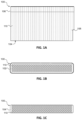
- FIGS. 1 A, 1 B, and 1 C show side, top, and bottom views of a reaction plate for synthesizing oligonucleotides according to an embodiment of the present invention.
- FIG. 2 B shows a particular embodiment of the improved method for synthesizing oligonucleotides.
- FIGS. 3 A and 3 B show views of a multi-channel oligonucleotide synthesizer.
- FIG. 3 C shows a general method of operating the multi-channel oligonucleotide synthesizer of FIGS. 3 A and 3 B .
- FIG. 3 D shows one embodiment of a portion of an oligonucleotide synthesizer.
- Embodiment 1 A multiplex biopolymer synthesizer comprising a reagent supply system, a multi-vessel reaction plate, and a reagent control system, wherein the reagent supply system, the multi-vessel reaction plate, and the reagent control system form a closed system during biopolymer elongation.
- Embodiment 2 The synthesizer of embodiment 1, wherein the reagent supply system is pressurized and the reagent control system comprises a vacuum system and/or pressurized gas.
- Embodiment 4 The system of embodiment 3, wherein the system is configured to prevent a first reagent of the one or more reagents from contact with moisture from the external environment prior to expulsion of the reagent from the system.
- Embodiment 5 The system of embodiment 3 or embodiment 4, wherein one or more reagents comprises a plurality of reagents, and wherein the system is configured to prevent each of the plurality of reagents from contact with moisture from an external environment prior to expulsion of the reagent from the system.
- Embodiment 6 The system of any one of embodiments 3-5, wherein the system is configured such that the water content of a first reagent of the one or more reagents never exceeds 10 ppm by weight until at least expulsion of the first reagent from the system.
- Embodiment 7 The system of any one of embodiments 3-6, wherein the system is configured to pneumatically:
- Embodiment 8 The system of embodiment 7, wherein the system is configured to pneumatically deliver the first reagent to a subset of the reaction vessels without entering into reaction vessels that are not within the subset.
- Embodiment 9 A method for synthesizing a plurality of biopolymers, the method comprising:
- Embodiment 10 The method of embodiment 9, further comprising selectively delivering a second solution into a second subset of the plurality of reaction vessels such that the second solution contacts solid phase resin disposed therein, wherein the second subset of the plurality of reactions vessels differs from the first subset of the plurality of reaction vessels.
- Embodiment 11 The method of embodiment 9 or embodiment 10, wherein the first solution is simultaneously delivered into each of the reaction vessels of the first subset of the plurality of reaction vessels.
- Embodiment 12 The method of any one of embodiments 9-11, wherein each of the plurality of reaction vessels comprises a first porous surface and a second porous surface, wherein the first solution is initially delivered through the first porous surface and ejected through the first porous surface.
- Embodiment 13 The method of any one of embodiments 9-12, wherein the first solution comprises a phosphoramidite.
- Embodiment 14 The method of any one of embodiments 9-13, further comprising washing the plurality of reactions vessels with a wash fluid (e.g., dry acetonitrile).
- a wash fluid e.g., dry acetonitrile
- Embodiment 15 The method of any one of embodiments 9-14, further comprising flushing the plurality of reaction vessels with a dry inert gas.
- Embodiment 16 The method of any one of embodiments 9-15, wherein the method is executed by a computer.
- Embodiment 17 The method of any one of embodiments 9-16, wherein more than two biopolymers are synthesized in parallel.
- Embodiment 18 The method of any one of embodiments 9-17, wherein at least 96 biopolymers are synthesized in parallel.
- Embodiment 19 The method of any one of embodiments 9-18, wherein at least 128 biopolymers are synthesized in parallel.
- Embodiment 20 The method of any one of embodiments 9-19, wherein at least 1000 biopolymers are synthesized in parallel.
- Embodiment 47 The biopolymer synthesizer of any one of embodiments 32-46, wherein the SSM comprise controlled pore glass (CPG) or polystyrene.
- CPG controlled pore glass
- polystyrene any one of embodiments 32-46, wherein the SSM comprise controlled pore glass (CPG) or polystyrene.
- Embodiment 60 The system any one of embodiments 56-59, wherein the system is configured to result in a decrease of process variability relative to an embodiment that uses an XY stage for delivery of reagent to a plurality of reaction vessels.
- Embodiment 65 The multiplex biopolymer synthesizer of embodiment 64, wherein the multi-vessel reaction plate is configured to heat up to at least 35° C., 40° C., 50° C., or 55° C. (e.g., a multi-vessel reaction plate configured to heat from room temperature up to 80° C.).
- Embodiment 66 A multiplex biopolymer synthesizer configured for synthesizing a plurality of different 20-mer biopolymers (e.g., RNA polymers) in less than 250, less than 200, or less than 160 minutes with a yield of at least 90%, at least 92%, or at least 95%.
- 20-mer biopolymers e.g., RNA polymers
- Embodiment 70 The system of any one of embodiments 67-69, wherein the temperature-controlled reaction plate is a metal plate.
- Embodiment 73 A method for simultaneously synthesizing a plurality of different polymers in parallel with increased speed comprising:
- Embodiment 75 The synthesizer of embodiment 74, wherein the reagent control system results in fluid delivery in an upwards vertical direction.
- Embodiment 76 The synthesizer of embodiment 74 or embodiment 75, wherein the reagent control system is configured to deliver a fluid column to the reaction vessel.
- Embodiment 77 The synthesizer of any one of embodiments 74-76, wherein the fluid column contacts all reactants within the reaction vessel such that no gas is in contact with any of the reactants.
- Embodiment 78 The synthesizer of embodiment 77, wherein the reactants are loaded upon a SSM.
- Embodiment 79 A system for performing a plurality of different reactions in parallel, each in a separate reaction vessel, wherein the system is configured to pneumatically deliver a first reagent in a solution to each of the plurality of reaction vessels such that each reaction vessel is completely filled with the solution.
- Embodiment 80 The system of embodiment 79, wherein the first reagent is initially delivered into each of the separate reaction vessels in a direction that opposes the net gravitational force on solid phase media disposed within each of the plurality of reaction vessels.
- Embodiment 81 The system of embodiment 79 or embodiment 80, wherein the system is configured to fully displace, with liquid, all gas within a solid support media that is disposed within each reaction vessel.
- Embodiment 82 The system of any one of embodiments 79-81, wherein the system is configured to fully displace, with gas, all liquid within each reaction vessel.
- Embodiment 83 A pneumatically actuatable multiplex synthesizer configured for providing pressure differentials to selectively agitate fluid in a plurality of reaction vessels without displacing the reaction vessels.
- Embodiment 84 The synthesizer of embodiment 83, wherein the plurality of reaction vessels agitated comprise all of the reaction vessels in a multi-vessel reaction plate situated between the reagent activation system and the reagent supply system.
- Embodiment 85 The synthesizer of embodiment 83, wherein the plurality of reaction vessels agitated comprise a subset of the reaction vessels in a multi-vessel reaction plate situated between the reagent activation system and the reagent supply system.
- Embodiment 90 The system of embodiment 86, wherein the system is configured to alternate the direction of fluid flow at least two, at least three, at least four, or at least 5 times.
- Embodiment 91 The system of any one of embodiments 86-89, a first direction of fluid flow is upward, and a second direction of fluid flow is downward.
- Embodiment 93 A method for flushing out a plurality of reaction channels simultaneously comprising: using a pressure differential to deliver a fluid column of a solvent to each of a plurality of reaction volumes, wherein each of the reaction volumes is positioned in one of the plurality of reaction channels, and
- Embodiment 94 The method of embodiment 93, wherein the fluid column is delivered without the use of gravity.
- Embodiment 95 The method of embodiment 93 or embodiment 94, wherein the solvent is acetonitrile.
- Embodiment 96 The method of any one of embodiments 93-95, wherein the removing is performed by delivering pressurized nitrogen to the reaction vessel.
- Embodiment 97 A computer-controlled system for performing a plurality of different reactions in parallel, each in a separate reaction vessel, wherein the system comprises:
- Embodiment 98 The system of embodiment 97, wherein the wash system is configured to simultaneously deliver wash fluid to each of the reaction vessels.
- Embodiment 99 The system of embodiment 97 or embodiment 98, wherein the wash fluid is pneumatically delivered through the reaction vessels.
- Embodiment 100 A system for synthesizing a polymer, the system comprising:
- Embodiment 101 The system of embodiment 100, further comprising a wash system coupled to the plurality of reaction vessels, wherein the wash system is configured to deliver wash fluid through each of the plurality of reaction vessels to exit from the outlet port.
- Embodiment 102 The system of embodiment 101, wherein wash fluid from the wash system enters into the reaction vessel through the second porous membrane and the first reagent initially enters into the reaction vessel through the first porous membrane.
- Embodiment 103 The system of any one of embodiments 100-102, wherein each reaction vessel of the plurality of reaction vessels is orientated such that the first porous membrane is disposed below the second porous membrane.
- Embodiment 104 The system of any one of embodiments 100-103, further comprising a plurality of branched connectors, wherein each branched connector couples a reaction vessel of the plurality of reaction vessels to the wash system and reagent control system.
- Embodiment 105 The system of any one of embodiment 100-104, further comprising a second manifold that includes the branched connector.
- Embodiment 106 The system of any one of embodiments 100-105, wherein the wash system further comprises a compressed inert gas, and wherein the wash system is configured to cause the flow of inert gas through each of the plurality of reaction vessels to exit from the outlet port.
- Embodiment 107 The system of any one of embodiments 100-106, wherein the system is configured such that, in operation, the system carries out a reagent delivery step, a reaction step, and a reagent wash step.
- Embodiment 108 The system of embodiment 107, wherein the reagent delivery step comprises:
- Embodiment 115 The system of embodiment 113 or embodiment 114, wherein the reaction plate comprises a keyed registration feature.
- Embodiment 119 The system of any one of embodiments 100-118, wherein the system is configured to pneumatically drive all reagents from the reagent supply system to the subset of reaction vessels of the plurality of reaction vessels and then expel the reagents from the system through the outlet port.
- Embodiment 121 A computer program product configured to operate the system or carry out the method of any of embodiments 1-120.
- Embodiment 124 The method of embodiment 122 or embodiment 123, further comprising, prior to transferring different portions of the single source of solid-phase media to each of the plurality of reaction vessels, synthesizing a first oligonucleotide segment on solid-phase media.
- Embodiment 126 The method of any one of embodiments 122-125, wherein the plurality of reaction vessels are formed from a single reaction plate.
- Embodiment 128 The method of any one of embodiments 122-127, wherein the second oligonucleotide segment is synthesized onto the first oligonucleotide segment via phosphoramidite chemistry.
- Embodiment 129 The method of any one of embodiments 122-128, wherein the plurality of oligonucleotides comprise CRISPR guide RNAs.
- Embodiment 130 The method of any one of embodiments 122-129, wherein synthesizing the second oligonucleotide segment onto the first oligonucleotide segment comprises adding phosphoramidite monomers to the first oligonucleotide to form the second oligonucleotide segment.
- Embodiment 131 The method of any one of embodiments 122-130, wherein synthesizing the second oligonucleotide segment onto the first oligonucleotide segment comprises conjugating an oligomer comprising the second oligonucleotide segment to the first oligonucleotide segment.
- Embodiment 132 The method of embodiment 131, wherein conjugating the oligomer to the first oligonucleotide segment does not involve phosphoramidite chemistry.
- Embodiment 133 The method of any one of embodiments 122-132, wherein the second oligonucleotide segment is between 2 and 150 nucleotides in length.
- Embodiment 134 The method of any one of embodiments 122-133, wherein the second oligonucleotide segment is between 17 and 22 nucleotides in length.
- Embodiment 135. The method of any one of embodiments 122-134, wherein the second oligonucleotide segment is 20 nucleotides in length.
- Embodiment 136 The method of any one of embodiments 122-135, further comprising cleaving the plurality of oligonucleotides from the solid-phase media.
- Embodiment 137 A method for synthesizing a plurality of different oligonucleotides that each comprise a first oligonucleotide segment and a second oligonucleotide segment, the method comprising:
- Embodiment 138 The method of embodiment 137, wherein the second oligonucleotide segment is positioned 5′ to the first oligonucleotide segment.
- Embodiment 139 The method of embodiment 137 or embodiment 138, wherein synthesizing the second oligonucleotide segment onto the first oligonucleotide segment comprises adding phosphoramidite monomers to the first oligonucleotide to form the second oligonucleotide segment.
- Embodiment 140 The method of any one of embodiments 137-139, wherein synthesizing the second oligonucleotide segment onto the first oligonucleotide segment comprises conjugating an oligomer comprising the second oligonucleotide segment to the first oligonucleotide segment.
- Embodiment 141 The method of embodiment 140, wherein conjugating the oligomer to the first oligonucleotide segment does not involve phosphoramidite chemistry.
- Embodiment 142 The method of any one of embodiments 137-141, further comprising cleaving the plurality of oligonucleotides from the solid-phase media.
- Embodiment 143 The method of any one of embodiments 137-142, wherein the second oligonucleotide segment is positioned 3′ to the first oligonucleotide segment.
- Embodiment 144 The method of embodiment 143, wherein the plurality of different oligonucleotides are formed from 5′ to 3′ phosphoramidites.
- the reaction plate 100 is thermally conductive and provided with temperature control to accelerate the rate of reaction of molecules attached to SSM within the channels/reaction vessels 110 of the reaction plate 100 with reagent. This is illustrated in FIG. 3 B by the provision of a heater actuator 356 and a temperature control system 354 which are both in thermal communication with the reaction plate 100 .
- the channels/reaction vessels of the reaction plate are individually actuatable, and can be used to synthesize a different or unique biopolymer in each of the channels/reaction vessels of the reaction plate.
- the drain system 318 is configured to supply variable backpressure opposing the flow from the wash system 390 /reagent control system 310 to allow for agitation and/or pneumatic displacement of reagent or wash solution within the channels/reaction vessels of the reaction plate. Backpressure from the drain system 318 allows for agitation/mixing of reagents saturating the SSM within the channels/reaction vessels 110 by exploiting a pressure differential between it and the reagent control system.
- this agitation can be accomplished via alternating cycles of: a) providing positive flow or inert gas pressure from the wash system 390 with the drain system 318 open to displace solution within the channels/reaction vessels of the reaction plate in a first direction; and b) providing backpressure via the drain system 318 and negative pressure via the reagent control system 310 to displace solution within the channels/reaction vessels of the reaction plate in a second direction.
- alternating cycles serve to alternate the direction of flow through the channels/reaction vessels of the reaction plate, and can be repeated multiple times (in various embodiments, at least two, at least three, at least four, or at least five times).
- variable negative/positive pressure at each channel can be provided via the reagent control system 310 .
- agitation can be accomplished at one, a subset, or all channels/reaction vessels of the reaction plate.
- Such agitation can be useful for mixing reagents/solvents with the SSM during deprotection, coupling, and washing steps, or for providing a saturating excess of reagent during the coupling step (in various embodiments, this allows for e.g. between 1.3-fold and 20-fold, 5-fold and 15 fold, or 5-fold and 10-fold excess activated monomer relative to the sites of elongation on the solid phase medium to be provided).
- this method of agitation allows for agitation without exposure of the SSM or any of the reagents to the ambient environment.
- This pressure-driven pneumatic agitation method also allows for several independent agitation parameters to be varied: the stroke (e.g. volume of wash or reagent liquid drawn through the reaction vessels and the SSM therein), the speed (e.g. the flow rate of wash or reagent liquid through the reaction vessels and the SSM therein), and the frequency (e.g. the time in between reversals of the direction of flow of the wash or reagent liquid drawn through the reaction vessels).
- the reagent supply system 316 is configured to supply all of the necessary reagents and reagent mixes for the individual synthetic steps of the synthesizer, in such a way that all the reagents/reagent reservoirs are isolated from the external/ambient environment.
- all the reagents are supplied via reagent bottles pressurized by an inert gas source.
- the reagents typically involve at least a reaction solvent (e.g. in the case of nucleotides, anhydrous acetonitrile), a plurality of monomers (e.g. in the case of nucleotides phosphoramidites), and an activation reagent (e.g. in the case of nucleotides, a tetrazole).
- the individual reagents needed for any given elongation step are typically the same with just the monomer solution changing.
- the monomers may be supplied by a first plurality of inert-gas pressurized reagent bottles each with an influent line connecting them to a first common multi-way selection valve having a first outlet line.
- the first plurality of inert-gas pressurized reagent bottles may also include a bottle of the reaction solvent (e.g. acetonitrile) so that the system can be cleaned between delivery of different monomers.
- Mixing of the monomers with activator may be accomplished by connecting the first outlet line and a second outlet line being fed from a pressurized bottle of activator solution to separate pump systems connected to a common mixer with an outlet valve which feeds the lower manifold 314 .
- other solutions deblocking, oxidation, capping
- the reagent supply system 316 may additionally comprise a pressure selector, which in some cases can serve to modulate pump flow rate, to maintain integrity of the solid phase, or to prevent pressure deviations which may compromise the closed architecture of the system.
- the reagent supply system is configured to supply monomers, activation solution, coupling solution, and any other synthetic step-required reagent both separately and in combination with reaction solvent.
- the relevant reagents may include 2′-protected phosphoramidites such as dT-CE Phosphoramidite (5′-Dimethoxytrityl-2′-deoxythymidine, 3′-[(2-cyanoethyl)-(N,N-diisopropyl)]-phosphoramidite), iBu-dG-CE Phosphoramidite (5′-(4,4′-Dimethoxytrityl)-N-isobutyryl-2′-deoxyguanosine, 3′-[(2-cyanoethyl)-N,N-diisopropyl]-phosphoramidite), Bz-dA-CE Phosphoramidite (5′-(4,4′-Dimethoxytrityl)-N
- tetrazole etrazole
- solvent e.g. acetonitrile
- deblocking solution e.g. 3% TCA in dichloromethane
- oxidizing solution e.g. I 2 in THF/pyridine
- capping solution e.g. acetic anhydride/pyridine/THF
- the relevant reagents may include DMT-2′O-TC-rC(ac) Phosphoramidite (N4-Acetyl-O5′-(4,4′-dimethoxytrityl)-O2′-(1,1-dioxothiomorpholine-4-thiocarbonyl)cytidine O3′-(O-(2-cyanoethyl)-N,N-diisopropylphosphoramidite)), DMT-2′O-TC-rU Phosphoramidite (O5′-(4,4′-dimethoxytrityl)-O2′-(1,1-dioxothiomorpholine-4-thiocarbonyl)uridine O3′-(O-(2-cyanoethyl)-N,N-diisopropylphosphoramidite)), DMT-2′O-TC-rG(ib) Phosphoramidite (N2-Isobutyryl
- the reagents may include the 21 natural amino acids protected by Fmoc groups (e.g. Fmoc-Ala-OH, Fmoc-Gly-OH), activator solution (e.g. HBTU with DIEA), solvent (e.g. DMF and optionally DCM), and deblocking solution (e.g. piperidine in DMF).
- Fmoc groups e.g. Fmoc-Ala-OH, Fmoc-Gly-OH
- activator solution e.g. HBTU with DIEA
- solvent e.g. DMF and optionally DCM
- deblocking solution e.g. piperidine in DMF.
- FIGS. 1 A through 1 E show views of a reaction plate 100 (also known as a cartridge) for synthesizing oligonucleotides according to an embodiment of the present invention.
- FIG. 1 A shows a side view of reaction plate 100 .
- Reaction plate 100 has a top surface 102 (see FIG. 1 B ) and bottom surface 104 (see FIG. 1 C ).
- a flange 106 is provided adjacent top surface 102 .
- reaction plate 100 is keyed by the use of step 108 such that it is not symmetrical. This keying ensures that the reaction plate, when mounted to an oligosynthesizer can only be mounted in one orientation.
- the reaction plate 100 contains and/or defines the plurality of reaction vessels, which are provided as cylindrical lumens (e.g. channels with open tops and bottoms) within the reaction plate.
- reaction plate 100 includes at least 2, at least 64, at least 96, at least 128, at least 254, at least 384, at least 512, at least 1056, at least 1536, at least 2112, or at least 4224 vessels 110 in the form of cylindrical lumens (e.g. channels with open tops and bottoms) which pass from top surface 102 to the bottom surface 104 .
- reaction plate 100 includes 64, 96, 128, 254, 384, 512, 1056, 1536, 2112, 4224 vessels 110 in the form of cylindrical lumens which pass from top surface 102 to the bottom surface 104 .
- Such a design allows for the synthesis of at least 2, at least 64, at least 96, at least 128, at least 254, at least 384, at least 512, at least 1056, at least 1536, at least 2112, or at least 4224 polymers in parallel using the automated system described herein.
- Reaction plate 100 is designed for high-density synthesis of polymers. Different configurations of reaction plates can be used, however, in preferred embodiment the reaction vessels have a spacing compatible with standard (e.g. 96-, 384-, 1536-well) microplates to facilitate eluting completed polymers from the reaction plate into the standard microplates for subsequent purification and processing.
- the lumens forming the reaction vessels pass through the full height of the reaction plate.
- the reaction plate is approximately three inches wide, one and half inches tall, and less than a half an inch thick. In some embodiments, the full height of the reaction plate is one and a half inches.
- the reaction vessels are spaced at approximately 0.09 inches center-to-center and have a diameter of less than 0.09 inches.
- FIG. 1 B and FIG. 1 C show one embodiment of a reaction plate, wherein the plate is configured for 128 channels.
- the 128 reaction vessels 110 are shown arranged in four lines of 32 reaction vessels. The reaction vessels are packed at more than seventy reaction vessels per square inch of surface.
- the bottom surface 106 of the reaction plate 100 is shown in FIG. 1 C , likewise with 128 reaction vessels 110 . Both top surface 102 and bottom surface 104 are machined flat such that they form a seal when clamped into the oligonucleotide synthesizer.
- FIG. 1 D shows a sectional view through one embodiment of the reaction plate 100 .
- FIG. 1 D better illustrates flange 106 adjacent top surface 102 of reaction plate 100 .
- the section passes through four reaction vessels 110 in the form of lumens which pass from top surface 102 to bottom surface 104 of reaction plate 100 .
- the lumens shown in FIG. 1 D are cylindrical, lumens of different shapes may be used.
- FIG. 1 E shows a section view through the reaction plate 100 when prepared for synthesis of polymers.
- automated polymer synthesis methods typically employ a solid support media (SSM), such as polystyrene beads or controlled pore glass, to which starting monomers are covalently bound and then grown by repeating a cycle of monomer-addition reaction steps.
- SSM solid support media
- the SSM allows the reagents used during a reaction step to be easily rinsed from the oligonucleotides to prepare for each subsequent reaction step.
- a column comprising a porous SSM 120 is packed into all of the reaction vessels 110 .
- the SSM is held in place by first and second porous surfaces (e.g.
- Frits 122 and 124 are polyethylene frits. In alternative embodiments, glass frits may be utilized.
- the SSM and frits are sufficiently porous to allow reagents to pass through the reaction vessels during oligonucleotide synthesis under the control of the synthesizer and/or the computer system attached thereto.
- the two frits (top and bottom) separate a reaction volume that may be between 15 and 25, 15 and 50, 15 and 100, 15 and 200, or 15 and 300 microliters.
- the two frits separate a reaction volume of about 15, 25, 50, 75, 100, 150, 200, 250, or 300 microliters. In some embodiments, the two frits separate a reaction volume of less than about 25, 50, 75, 100, 150, 200, 250, or 300 microliters.
- the SSM is controlled pore glass (CPG). In some embodiments, the SSM is polystyrene. In some embodiments the beads have a loading capability of from about 100 ⁇ mol per gram of bead to about 350 ⁇ mol per gram of beads. In some embodiments, the beads have an average particle size of from about 5 ⁇ m to about 500 ⁇ m, from about 10 ⁇ m to about 300 ⁇ m, from about 20 ⁇ m to about 100 nm, or about 50 ⁇ m to about 200 ⁇ m in diameter. In some embodiments, the beads have a specific surface area of from about 5 to about 200 m 2 /g, from about 10 to about 100 m 2 /g, or from about 20 to about 70 m 2 /g.
- the SSM is packed in to the reaction plate 100 after synthesis of common polymers on the SSM in a different synthesizer. Moreover, as described below, a sample of the polymers may be analyzed such that each reaction vessel 110 is loaded with a quantified amount of the common polymers (e.g. oligonucleotides, peptides) on the SSM.
- the common polymers e.g. oligonucleotides, peptides
- the SSM with the partial oligonucleotides (or partial polymer) attached is removed from the reaction vessel of the single column synthesizer.
- the SSM and partial oligonucleotides (or polymer) are then loaded into a multi-vessel reaction plate (e.g. the reaction plate of FIGS. 1 A to 1 E , or a conventional microplate).
- a multi-vessel reaction plate e.g. the reaction plate of FIGS. 1 A to 1 E , or a conventional microplate.
- independent stepwise synthesis or the remaining portion of the oligonucleotides (or polymer) is performed in each vessel of the multi-vessel reaction plate.
- Multi-channel synthesizer 300 comprises a plurality of channels, each of which allows for independent synthesis of a polymer by stepwise extension of the polymer (in the embodiment shown, the synthesizer contains 128 channels).
- the synthesizer independently controls which activated monomer (e.g. nucleotide phosphoramidite) reagents are added to each reaction vessel of the reaction plate 100 .
- reaction plate 100 includes a plurality of separate reaction vessels such that a different polymer can be synthesized in each vessel of the reaction plate.
- reaction plate 100 is scaled to include at least 128, at least 384, at least 1536, at least 3456, or at least 9600 reaction vessels.
- reaction plate 100 is scaled to include 128, 384, 1536, 3456, or 9600 reaction vessels.
- the embodiment shown has 128 vessels, the inventions described herein can be applied to reaction plates having thousands of reaction vessels.
- Reaction plate 100 is mounted in synthesizer 300 by being clamped between upper manifold 312 and lower manifold 314 .
- a clamp actuator 304 under control of computer control 302 moves upper manifold 312 towards lower manifold 314 after loading of reaction plate 100 .
- the clamp actuator pushes the sealing surfaces of the reaction plate into contact with the mating surfaces of the upper and lower manifold forming a seal.
- Both upper manifold 312 and lower manifold 314 include on their surface a set of apertures which align with the vessels of reaction plate 100 .
- the surfaces of the manifolds create a seal which prevents leakage of reagents from between the manifolds and the reaction plates and also seals each reaction vessel from the adjacent reaction vessels thereby providing a plurality of closed reaction vessels.
- This sealing enables the supply system to control entry of reagents into the vessels and also prevents entry of contaminants (e.g. water molecules) during the monomer addition cycle in a manner that is superior to the open reagent delivery mechanisms of prior systems.
- Lower manifold 341 also includes registration features 320 which engage the keying feature of reaction plate 100 to ensure that the reaction plate is loaded in the correct orientation. This prevents user error in loading the reaction plate 100 into synthesizer 300 .
- Upper manifold 312 connects the vessels of reaction plate 100 to the reagent control system 310 .
- Lower manifold 314 connects the vessels of reaction plate 100 to reagent supply system 316 and drain system 318 .
- FIG. 3 B shows a sectional view of reaction plate 100 clamped between upper manifold 312 and lower manifold 314 .
- lower manifold 314 includes a common interior lumen 340 with which all the reaction vessels 110 of the reaction plate 100 are in fluid communication.
- upper manifold 312 includes a separate lumen 332 for each of the reaction vessels 110 .
- Each separate lumen 332 connects each reaction vessel 332 to its own subsystem 330 on the reagent control system 310 .
- the subsystems 330 (in one embodiment, 128 total) allow for individual control and selective delivery of reagent to the 128 reaction vessels 110 in reaction plate 100 .
- a reagent control system may comprise a pressure selector 394 .
- the pressure selector 394 may be configured to alternatively (1) “pull” (exert negative pressure) to draw fluid into reaction vessels 110 and (2) “push” (exert positive pressure) to expel fluid from the reaction vessels 110 .
- Valves (e.g., solenoid valves) 395 may be used to selectively draw and/or expel liquid into and from individual reaction vessels 110 .
- reagent control system 310 may be configured to allow for reagent delivery to a selected subset of the plurality of reaction vessels under computer control 302 .
- the selected subset can include between one of and all of the reaction vessels simultaneously.
- valves 395 may be under control of computer 302 .
- selectable reagent supply 316 is configured to introduce reagents into lower manifold 314 under computer control 302 .
- Selectable reagent supply 316 comprises a set of valves and pumps which can introduce one or more selected reagents or cleaning solvents into manifold 314 .
- Selectable reagent supply 316 can be configured to provide standard phosphoramidite reagents as well as modified/labelled phosphoramidite reagents and acetonitrile (ACN) as specified by computer control 302 .
- ACN acetonitrile
- One reagent at a time is provided to lower manifold 314 with reagents cleaned and purged from lower manifold 314 between synthesis steps.
- Anhydrous ACN e.g.
- computer control system 302 can control which reagent is present in lower manifold 314 (by means of selectable reagent supply 316 ) at any point in a reaction process and also control which reaction vessels receive the reagent present in lower manifold (by means of reagent control system 310 ). Accordingly computer control system 302 can selectively deliver each of the reagents available from selectable reagent supply 316 to particular vessels of the reaction plate.
- Drain system 318 is configured for drainage of reagents and/or cleaning solvents from the lower manifold 314 under control of computer control 302 .
- Drain system 318 comprises a set of valves which can remove reagents or cleaning solvents from manifold 314 to either a common drain or separate drains for different reagents/solvents.
- the vacuum supply can also be used to apply negative pressure to the lower manifold 314 (e.g. in order to promote removal of reagents from the reaction plate 100 ) as well as positive pressure to the lower manifold 314 (e.g. to promote agitation/mixing of reagents or wash solutions with the solid phase in the channels/reaction vessels 110 ).
- reaction plate 100 is clamped into place between upper manifold 312 and lower manifold 314 .
- Mating surfaces of upper manifold 312 and lower manifold 314 ensure sealing at the top surface 102 and bottom surface 104 of the reaction plate 100 each of the reaction vessels is sealed from each other.
- a computer control system 302 controls reagent control system 310 , reagent supply system 316 and drain system 318 to cause manifold 314 to contain the appropriate reagent at a particular point in time.
- the computer control system then operates reagent control system 310 to deliver reagent to a selected subset of the plurality of reaction vessels wherein the selected subset can include between one of and all of the reaction vessels simultaneously.
- Computer control system 302 then controls reagent supply system 316 and drain system 318 to cause lower manifold 314 to be cleaned and then filled with the next required reagent. This process repeats stepwise until the desired reagents are added and removed stepwise to all the reaction vessels 110 as required for the particular synthesis.
- the system of FIGS. 3 A- 3 B is advantageous in that the reaction plate 100 is not required to be moved during use but instead remains clamped in place throughout the reaction.
- the reaction vessels are also sealed from the environment to prevent entry of contaminates.
- the supply system for changing the reagents in manifold is relatively compact compared to prior systems. Accordingly, a system can provide a larger number of selectable reagents and/or be constructed in a more compact manner.
- multi-channel oligonucleotide synthesizer 300 is capable of synthesizing different oligonucleotides in each vessel of reaction plate 100 .
- One important factor in maintaining efficiency and consistency is ensuring that reactions take place at a consistent temperature from reaction to reaction and vessel to vessel.
- reaction plate 110 is machined from a thermally conductive material such as stainless steel. This ensures that there is little variation in temperature between each of the reaction vessels 110 .
- multi-channel oligonucleotide synthesizer 300 includes a temperature control system including a temperature control block 350 which is pushed into thermal contact with the rear side of reaction plate 100 by a heater actuator 356 after reaction plate has been clamped into the synthesizer 300 .
- Temperature control block 350 includes heating and/or cooling elements 358 which can be used to maintain the temperature of block 350 and consequently reaction plate 100 at a set point desired for any given reaction.
- a temperature sensor 352 such as a thermocouple, monitors the temperature of reaction plate 100 .
- a temperature control system 354 connected to temperature sensor 352 controls the heating or cooling of temperature control block 350 to increase or decrease the temperature of reaction plate 100 as required to achieve the desired set point temperature. The temperature control system is monitored and controlled by computer control 302 .
- multi-channel oligonucleotide synthesizer 300 ensures consistency of temperature between reaction vessels and sequential reaction steps.
- the temperature control system can be used to heat reaction plate 100 to above ambient temperature. Heating of the reaction plate increases the rate of reaction for the various steps of the synthesis thereby reducing the amount of time required for the reactions to complete. Because synthesis of oligonucleotides requires a large number of sequential reaction steps, even a small reduction in time required for each step can significantly reduce the amount of time necessary for the full synthesis and thereby increase the throughput of the synthesizer in terms of number of different oligonucleotides synthesized per day. Accordingly use of a thermally conductive reaction plate in combination with temperature control system can dramatically increase system throughput for synthesis as compared to prior systems.
- FIG. 3 C shows a general method 360 of operating the multi-channel oligonucleotide synthesizer of FIGS. 3 A and 3 B .
- the reaction plate is loaded into the synthesizer.
- the clamp actuator is operated to clamp the reaction plate between the upper and lower manifolds forming seal between the manifolds and the reaction plate.
- the heater actuator is operated to push the heater block into thermal contact with the reaction plate.
- the temperature controller measures the temperature of the heater block and reaction block and applies heat and/or cooling to bring the reaction plate to the desired temperature (the temperature controller continues this process throughout the reaction cycle of steps 370 - 378 ).
- the cycle for each reaction step is shown in general terms in steps 370 to 378 .
- the reagent supply system in cooperation with the drain system introduces a volume of a selected reagent into the lower manifold.
- the reagent control system is operated to deliver the required reagent into a selected set of the reaction vessels of the reaction plate.
- the reagent control system and drain system are operated to expel the reagent from the selected set of reaction vessels through the lower manifold and into the drain system for disposal or recycling.
- a cleaning cycle is performed to flush the reagent from the reaction vessels and clean all wetted surfaces.
- step 378 if the synthesis is not complete the method repeats steps 370 to 376 with the next reagent. At step 378 , if the synthesis is complete, the method progresses to step 380 where the heater actuator withdraws the heater block and the clamp actuator unclamps the reaction plate thereby allowing the reaction plate to be unloaded from the synthesizer.
- the monomer-addition cycle for synthesis of oligonucleotides comprises four basic steps: 1) a deblocking step using a deblocking reagent to remove a blocking group is removed from the 5′ hydroxyl of the last-added nucleotide to produce an oligonucleotide with a free 5′ hydroxyl group; 2) a chain elongation step in which a next appropriate phosphoramidite reagent is used to add one nucleotide subunit at the 5′ end; 3) an oxidation step in which an oxidation reagent is used to oxidize the phosphite to produce a phosphate linkage; and 4) a capping step in which capping reagents are added to render any unreacted substrate hydroxyls or unreacted 5′ hydroxyls of nascent oligonucleotides unreactive towards subsequent phosphoramidite additions.
- each monomer addition cycle requires four steps and consequently four repetitions of steps 370 to 378 of FIG. 3 C each with a different reagent (deblocking reagent, phosphoramidite reagent, oxidation reagent, and capping reagent).
- a different reagent deblocking reagent, phosphoramidite reagent, oxidation reagent, and capping reagent.
- the monomer addition cycle for peptides is similar, only omitting the capping and oxidation steps.
- the monomer addition cycle for peptides comprises two basic steps: a) a deblocking step using a deblocking reagent in which blocking group (e.g. Fmoc, Boc) is removed from the N-terminus of the last added nucleotide to produce a peptide with a free N-terminal amine group; and b) a chain elongation step in which a next appropriate activated blocked amino acid is used to add one amino acid subunit at the N-terminus.
- blocking group e.g. Fmoc, Boc
- each monomer addition cycle requires 2 steps and consequently four repetitions of steps 370 to 378 of FIG. 3 C each with a different reagent (deblocking reagent, amino acid/coupling reagent).
- the polymers are peptides
- the peptides are cleaved from the SSM via saturation of the SSM with a cleavage cocktail (e.g. TFA/H 2 O/phenol/TIPS 8.5/0.5/0.5/0.5) and incubation at room temperature for a period of time (e.g. between 30 minutes and 3 hours).
- a cleavage cocktail e.g. TFA/H 2 O/phenol/TIPS 8.5/0.5/0.5/0.5
- Peptides in the cleavage solution can be collected from the SSM by filtration, and the cleavage cocktail evaporated or lyophilized to yield the peptides.
- the present disclosure provides an (optionally automated and computer-controlled) multiplex solid-phase polymer synthesizer for the stepwise production of a polymer in improved yield to existing multiplex solid-phase synthesizer systems.
- the synthesizer produces an oligonucleotide of at least 100 nucleotides in length with an average stepwise yield (ASWY) for the oligonucleotide greater than 98%, 98.5%, 99%, 99.2%, 99.5%, 99.6%, or 99.8%.
- the synthesizer produces a DNA oligonucleotide of at least 100 nucleotides in length with an average stepwise yield (ASWY) for the oligonucleotide greater than 98%, 98.5%, 99%, 99.2%, 99.5%, 99.6%, or 99.8%.
- the synthesizer produces an RNA oligonucleotide of at least 100 nucleotides in length with an average stepwise yield (ASWY) for the oligonucleotide greater than 98%, 98.5%, 99%, 99.2%, 99.5%, 99.6%, or 99.8%.
- the present disclosure provides an (optionally automated and computer-controlled) multiplex solid-phase polymer synthesizer for the stepwise production of a polymer with increased speed of parallel synthesis compared to existing multiplex solid-phase synthesizer systems. Because the system depends on simultaneous pneumatic delivery of reagents to multiple channels/reaction vessels rather than one-by-one delivery, the synthesizer system is able to provide faster parallel synthesis (whether measured in total time for synthesis of each complete polymer in the multiplex system, or the monomer addition cycle time for each polymer in the multiplex system) relative to an embodiment that uses an XY stage for delivery of reagent to a plurality of reaction vessels. Further, because of the faster parallel synthesis, the synthesizer system is able to provide process variability relative to an embodiment that uses an XY stage for delivery of reagent to a plurality of reaction vessels.
- each monomer addition cycle comprises a deprotection step, four coupling steps (e.g., one for each phosphoramidite monomer), a capping step, and an oxidation step.
- each coupling step in which phosphoramidite plus activator is supplied through the lower manifold
- solvent purge step e.g. a flow of acetonitrile through the lower manifold to the drain/outlet
- each synthetic step is separated by a solvent purge step.
- the monomer addition cycle may be less than about 60 minutes, less than about 45 minutes, less than about 30 minutes, less than about 15 minutes, less than about 10 minutes, or less than about 8 minutes.
- just the coupling step is accomplished in less than about three minutes, less than about two minutes, less than about 1.5 minutes, less than about one minute, less than about 0.5 minutes, or less than about 0.25 minutes.
- the system when configured for oligonucleotide synthesis, is able to supply a plurality of different 20-mer oligonucleotides (e.g. RNA or DNA oligonucleotides) in less than about 250, less than about 200, or less than about 160 minutes with a yield of at least 90%, at least 92%, or at least 95%.
- each monomer addition cycle comprises a deprotection step, 21 coupling steps (e.g. one for each naturally-occurring amino acid), and a wash step.
- each coupling step in which activated amino acid is supplied through the lower manifold
- solvent purge step e.g. a flow of DMF through the lower manifold to the drain/outlet
- the monomer addition cycle may be less than about 3 hours, less than about 2 hours, less than about 1 hour, or less than about 30 minutes.
- just the coupling step is accomplished in less than about 2 hours, less than about 1 hour, less than about 45 minutes, less than about 30 minutes, less than about 15 minutes, or less than about 5 minutes.
- guide RNA (gRNA) constructs with identical ⁇ 80-mer scaffold sequences with 96 different 17-22 nucleotide protospacer domains (e.g. to target 128 distinct genomic regions) on their 5′ end can be synthesized in a single batch via a two-phase process. In this process, the scaffold is first synthesized, and then the pool is split to further add the protospacer domains separately.
- Such guide RNAs can be used in transfection/microinjection experiments along with plasmid or mRNA-driven CRISPR enzyme constructs to introduce targeted genome insertions/deletions in eukaryotic or bacterial cells.
- the gRNA constructs can be synthesized as DNA complementary to the desired scaffold+protospacer sequence and cloned into a vector with e.g. an SP6 RNA polymerase promoter to drive cell-directed expression of the desired gRNA.
- a desired scaffold sequence is selected, which drives association between the guide RNA and the CRISPR enzyme.
- Such a scaffold sequence is generally a fusion of tracrRNA ( ⁇ 64 nt) and crRNA repeat sequence ( ⁇ 12 nt) joined by a loop sequence (4 nt), to which a targeting/protospacer sequence is attached to the 5′ terminus.
- guide RNAs are uniquely amenable to solid-phase oligonucleotide synthesis, as the common domain (the scaffold/crRNA/tracrRNA/loop) is on the 3′ terminus and the “variable” region (the protospacer domain/target region) is on the 5′ terminus. Since solid-phase oligonucleotide synthesis proceeds 3′ to 5′, the guide RNA can be synthesized on the beads first, and then the pool of beads split into different reactions to synthesize the different protospacer domains.
- the length of the gRNAs ( ⁇ 100 nt) is challenging to synthesize in high yield by traditional means; using a split procedure where the first and largest ( ⁇ 80 nt) part of the synthesis can be done in batch and scaled up as necessary makes it easier to ensure the final oligonucleotides are available in usable yield.
- the gRNA scaffold is synthesized from 3′ to 5′ using 2′-O-thionocarbamate-protected adenine, uracil, cytosine, and guanine nucleoside phosphoramidites on a suitable solid support such as polystyrene resin using a single-column synthesizer such as the AKTA Oligo Pilot 100 plus or loading/washing using a fritted container (e.g. fritted filter funnel) and vacuum manifold on a nanomole to millimole scale.
- a suitable solid support such as polystyrene resin
- a single-column synthesizer such as the AKTA Oligo Pilot 100 plus or loading/washing using a fritted container (e.g. fritted filter funnel) and vacuum manifold on a nanomole to millimole scale.
- the resin After coupling with the 5′ most nucleotide phosphoramidite, the resin is capped using acetic anhydride/pyridine/THF 1/1/8 and 17.6% w/v N-methyl imidazole in acetonitrile. The resin is then washed with acetonitrile and flushed with argon.
- the resin (now bound to the 3′ terminus of the 80 nt gRNA scaffold) is split into 96 equal portions and loaded into each reaction vessel/channel of a 96 channel/vessel reaction plate of the multichannel synthesizer described above.
- the reaction plate is aligned with the registration features of the synthesizer and the clamp actuator seals the upper and lower face contacts of the reaction plate to the upper and lower manifolds of the synthesizer.
- the preloaded resin contained in the reaction vessels/channels of the reaction plate is swelled via flow of anhydrous acetonitrile from the wash system or the reagent delivery system.
- the remaining 17-20 nucleotides of the gRNA are then coupled to the 5′ of the gRNA scaffold attached to the resin by successive detritylation/deblocking (trichloroacetic acid in dichloromethane), chain elongation/coupling (phosphoramidite monomer/tetrazole in acetonitrile), capping (acetic anhydride/pyridine/THF and N-methylimidazole in acetonitrile), and oxidation (iodine in pyridine/THF) using 2′-O-thionocarbamate-protected A, C, U, and G nucleotide phosphoramidites.
- detritylation/deblocking trichloroacetic acid in dichloromethane
- chain elongation/coupling phosphoramidite monomer/tetrazole in acetonitrile
- capping acetic anhydride/pyridine/THF and N-methylimidazole in acetonitrile
- the reagent control system is used to draw the phosphoramidite solution selectively into only the reaction vessels where that nucleotide is desired to be added.
- the resin is washed with acetonitrile and flushed with nitrogen, and then the reaction plate is removed from the synthesizer system.
- the reaction plate is placed in register with a 96-well deepwell or microwell polystyrene plate, and three resin volumes of concentrated aqueous ammonium hydroxide is added to the top frit of each channel/reaction vessel of the reaction plate to cleave the nucleotides from the resin.
- the plate is allowed to sit one hour at room temperature, and then the entire apparatus is placed in a centrifuge with a swinging bucket rotor and spun to elute the ammonium hydroxide solution into the deepwell/microwell plate.
- the deepwell/microwell plate containing the cleaved nucleotides is then frozen and placed in a lyophilizer to remove the ammonium hydroxide solution.
- the resultant lyophilized oligonucleotides are either desalted before use, or purified using reversed phase high-performance liquid chromatography (HPLC) before use.
- this strand is synthesized via a one-step procedure in individual wells in the multichannel reaction plate of the multichannel synthesizer on polystyrene resin.
- the first 17-20 nucleotides of the protospacer domains are first synthesized in individual channels by successive detritylation/deblocking (trichloroacetic acid in dichloromethane), chain elongation/coupling (phosphoramidite monomer/tetrazole in acetonitrile), capping (acetic anhydride/pyridine/THF and N-methylimidazole in acetonitrile), and oxidation (iodine in water/pyridine/THF) using A, C, T, and G traditional 2′deoxyribonucleotide phosphoramidites.
- detritylation/deblocking trichloroacetic acid in dichloromethane
- chain elongation/coupling phosphoramidite monomer/tetrazole in acetonitrile
- capping acetic anhydride/pyridine/THF and N-methylimidazole in acetonitrile
- oxidation iodine in water/
- the reagent control system is used to draw the phosphoramidite solution selectively into only the reaction vessels where that nucleotide is desired to be added.
- the nucleotides encoding the scaffold are added by simultaneous delivery to all the wells of the reaction plate (optionally followed by nucleotides encoding a restriction site either the same as or different to the optional restriction site added to the 3′ terminus).
- the resin is washed with acetonitrile and flushed with nitrogen, and then the reaction plate is removed from the synthesizer system.
- the reaction plate is placed in register with a 96-well deepwell or microwell polystyrene plate, and greater than three resin volumes of concentrated aqueous ammonium hydroxide is added to the top frit of each channel/reaction vessel of the reaction plate to cleave the nucleotides from the resin.
- the plate is allowed to sit one hour at room temperature, and then the entire apparatus is placed in a centrifuge with a swinging bucket rotor and spun to elute the ammonium hydroxide solution into the deepwell/microwell plate.
- the deepwell/microwell plate containing the cleaved nucleotides is then frozen and placed in a lyophilizer to remove the ammonium hydroxide solution.
- the resultant lyophilized oligonucleotides are either desalted or purified using reversed phase high-performance liquid chromatography (HPLC).
- the sense strand (identical sequence) to the gRNA is synthesized using either the same procedure as the antisense strand, or using a two-step procedure similar to A above (except that A, C, T, and G deoxyribonucleotide phosphoramidites are used in place of 2′-O-thionocarbamate-protected A, C, U, and G nucleotide phosphoramidites). If used, the same restriction site sequences as the antisense strand are added to the synthetic nucleotide. The resultant lyophilized oligonucleotides are either desalted or purified using reversed phase high-performance liquid chromatography (HPLC).
- HPLC reversed phase high-performance liquid chromatography
- both nucleotides for each gRNA sequence are combined in equal amounts (e.g. in a multiwell PCR plate) in a suitable aqueous buffer (e.g. Tris pH 8.0), the strands are denatured by heating at 95 degrees Celsius, and annealed by slow cooling to room temperature.
- a suitable aqueous buffer e.g. Tris pH 8.0
- a common approach in development of therapeutic peptides is the addition of a cell-penetrating peptide sequence (e.g. penetratin, TAT peptide, pVEC, transportan, MPG, Pep-1, MAP, R 6 W 3 ) to the N- or C-terminus of the desired therapeutic sequence to improve access of the sequence to intracellular proteins (e.g. for protein-protein interaction inhibition or enzyme inhibition).
- a cell-penetrating peptide sequence e.g. penetratin, TAT peptide, pVEC, transportan, MPG, Pep-1, MAP, R 6 W 3
- the addition of additional peptide sequences to the therapeutic peptides complicates synthesis, as the addition of more amino acids lowers the overall yield of the peptide synthesis.
- the cell penetrating peptide (RQIKIWFQNRRMKWKK (SEQ ID NO: 1), for example) is first synthesized attached to beads, and then the pool is split to further synthesize the individual targeting/therapeutic moieties from the nascent cell-penetrating peptide.
- the cell-penetrating peptide RQIKIWFQNRRMKWKK (SEQ ID NO: 1) is synthesized from C- to N-terminus using Fmoc protected amino acids and standard coupling conditions using HBTU/N,N-diisopropylethylamine (see e.g. Coin et al. Nat Protoc. 2007; 2(12):3247-56) on a suitable solid support such as polystyrene resin (e.g. Wang resin or resin preloaded with Fmoc-L-Arg) using a single-column synthesizer or loading/washing using a fritted container (e.g.
- the resin is washed with solvent (e.g. DMF, DCM, or both) and dried under air or inert gas.
- solvent e.g. DMF, DCM, or both
- the resin (now bound to the C-terminus of the cell-penetrating peptide RQIKIWFQNRRMKWKK (SEQ ID NO: 1)) is split into 96 equal portions and loaded into each reaction vessel/channel of a 96 channel/vessel reaction plate of the multichannel synthesizer described above.
- the reaction plate is aligned with the registration features of the synthesizer and the clamp actuator seals the upper and lower face contacts of the reaction plate to the upper and lower manifolds of the synthesizer.
- the preloaded resin contained in the reaction vessels/channels of the reaction plate is swelled via flow of anhydrous DMF from the wash system or the reagent delivery system.
- the remaining 20 amino acids of the peptide are then coupled to the N-terminus of the cell-penetrating peptide attached to the resin by successive deprotection (piperidine in DMF), chain elongation/coupling (Fmoc-protected amino acid with HBTU and DIEA in DMF), and washing (DMF) using Fmoc-protected amino acids.
- deprotection piperidine in DMF
- chain elongation/coupling Fmoc-protected amino acid with HBTU and DIEA in DMF
- DMF washing
- the reagent control system is used to draw the activated Fmoc-amino acid solution into only the reaction vessels where that amino acid is desired to be added.
- the N-terminal Fmoc group is removed using piperidine in DMF, the resin is washed with DMF and/or DCM, and the resin is flushed with inert gas/argon to dry.
- the reaction plate is then removed from the synthesizer system.
- the reaction plate is sealed on the bottom and greater than three resin volumes of cleavage solution (e.g. TFA/H 2 O/phenol/TIPS 8.5/0.5/0.5/0.5) is added to each channel/reaction vessel of the reaction plate.
- the reaction plate is agitated and allowed to sit 3 hours at room temperature, after which the bottom seal is removed, the plate is placed in register with a 96-well polypropylene or polystyrene microwell/deepwell plate containing cold ether, and the cleavage solution is eluted (e.g. via centrifugation) into each well of the 96-well polypropylene or polystyrene microwell/deepwell plate to precipitate the peptide. Centrifugation and decanting is then used to isolate the precipitated peptide, which is washed with ether and dried overnight, after which each of the 96 peptides can be purified by reversed phase high-performance liquid chromatography (HPLC).
- HPLC reversed phase high-performance liquid chromatography
Landscapes
- Chemical & Material Sciences (AREA)
- Organic Chemistry (AREA)
- Health & Medical Sciences (AREA)
- Life Sciences & Earth Sciences (AREA)
- Genetics & Genomics (AREA)
- Molecular Biology (AREA)
- Engineering & Computer Science (AREA)
- Biochemistry (AREA)
- General Health & Medical Sciences (AREA)
- Biophysics (AREA)
- Biotechnology (AREA)
- Wood Science & Technology (AREA)
- Zoology (AREA)
- Bioinformatics & Cheminformatics (AREA)
- General Engineering & Computer Science (AREA)
- Medicinal Chemistry (AREA)
- Biomedical Technology (AREA)
- Chemical Kinetics & Catalysis (AREA)
- Proteomics, Peptides & Aminoacids (AREA)
- Analytical Chemistry (AREA)
- Microbiology (AREA)
- Physics & Mathematics (AREA)
- Crystallography & Structural Chemistry (AREA)
- Plant Pathology (AREA)
- General Chemical & Material Sciences (AREA)
- Bioinformatics & Computational Biology (AREA)
- Clinical Laboratory Science (AREA)
- Structural Engineering (AREA)
- Saccharide Compounds (AREA)
- Apparatus Associated With Microorganisms And Enzymes (AREA)
Abstract
Description
-
- (a) deliver the first reagent to each of (or a subset of) the reaction vessels;
- (b) agitate the first reagent in each of (or a subset of) the reaction vessels to promote mixing within each of the reaction vessels; and
- (c) expel the first reagent from each of (or a subset of) the reaction vessels; wherein (a), (b), and (c) occur without the first reagent contacting moisture from an external environment.
-
- obtaining a reaction plate comprising a plurality of reaction vessels, wherein each reaction vessel of the plurality of vessels has a solid phase resin disposed therein;
- selectively delivering a first solution from a source that is sealed off from ambient air to a first subset of the plurality of reaction vessels such that the first solution contacts the solid phase resin disposed therein but does not enter into reaction vessels of the plurality of reaction vessels that are not within the first subset; and
- ejecting the first solution from the first subset of reaction vessels to an outlet port, wherein the first solution is not exposed to ambient moisture prior to ejection from the outlet port.
-
- pneumatically displace, in each of the plurality of reaction vessels, the first reagent of the plurality of reagents in both a first direction and a second direction that is opposite the first direction, thereby promoting mixing within each of the plurality of reaction vessels; and expel the first reagent from the system.
-
- pneumatically deliver each of the plurality of reagents to the plurality of reaction vessels, wherein each reagent is delivered in or as a liquid; and
- pneumatically displace, in each of the reaction vessels, each reagent of the plurality of reagents to promote mixing within each of the plurality of reaction vessels.
-
- simultaneously deliver one or more reagents to each of the reaction vessels; and
- simultaneously remove the one or more reagents from each of the reaction vessels.
-
- pneumatically and simultaneously, delivering reagents to selective subsets of reaction vessels of a multi-vessel cartridge in a cyclic fashion such that at each successive cycle any of the following parameters is adjustable:
- (i) the reagent delivered;
- (ii) the subset of reaction vessels the reagent is delivered to;
- (iii) the amount of time the reagent is permitted to incubate in the reaction vessel;
- (iv) the amount of reagent delivered; and/or
- (v) the temperature of the multi-vessel cartridge;
- wherein the multi-vessel cartridge comprises at least 96 reaction vessels.
-
- providing a plurality of SSM in each of a plurality of reaction vessels;
- selectively introducing a first solution comprising a first monomer into a subset of the plurality of reaction vessels, thereby reacting the first monomer with an active moiety attached to the SSM; and
- adjusting temperature of the plurality of reaction vessels, thereby increasing reaction rate within each of said plurality of reaction vessels.
-
- providing a plurality of SSM in each of a plurality of reaction vessels;
- synthesizing a different oligomer in each of the plurality of reaction vessels by performing cycles of extension reactions, wherein each cycle:
- (i) comprises a deprotection step, four coupling steps (e.g., one for each phosphoramidite monomer), a capping step, and an oxidation step; and
- (ii) has a cycle time of less than one hour, less than 45 minutes, less than 30 minutes, less than 15 minutes, or less than 8 minutes.
-
- a reagent supply system for delivering a plurality of reagents to a plurality of reaction vessels that contain solid support media disposed therein; and
- a wash system for delivering a wash fluid to the plurality of reaction vessels, wherein the wash system is configured to fill the reaction vessels with wash fluid.
-
- a reagent supply system;
- a first manifold coupled to the reagent supply system;
- a plurality of reaction vessels coupled to the first manifold, wherein each reaction vessel of the plurality of reaction vessels comprises a first porous membrane, a second porous membrane, and a region disposed between the first porous membrane and second porous membrane for containing a solid support medium;
- a reagent control system coupled to the plurality of vessels, wherein the reagent control system is configured to selectively deliver reagent originating from the reagent supply system to a first subset of the plurality of reaction vessels; and
- an outlet port coupled to the first manifold;
- wherein the system is configured such that reagent from the reagent supply system passes through the system to the outlet port without contacting the ambient environment.
-
- flowing reagent from the reagent supply system through the first manifold; and
- drawing the first reagent through the first porous membrane of the subset of the plurality of reaction vessels into the region for containing the solid support medium.
-
- synthesizing, on a first oligonucleotide synthesizer, a first oligonucleotide segment on solid-phase media within each of a plurality of reaction vessels of a reaction plate;
- transferring the reaction plate to a second oligonucleotide synthesizer; and
- synthesizing, in each of the plurality of reaction vessels, a second oligonucleotide segment onto the first oligonucleotide segment;
- wherein first oligonucleotide segment differs between each of the plurality of different oligonucleotides, and the second oligonucleotide segment is identical between each of the plurality of different oligonucleotides.
-
- synthesizing, with a first oligonucleotide synthesizer, a first oligonucleotide segment on solid-phase media within each of a plurality of reaction vessels of a reaction plate;
- transferring the reaction plate to a second oligonucleotide synthesizer; and
- synthesizing, in each of the plurality of reaction vessels, a second oligonucleotide segment onto the first oligonucleotide segment;
- wherein either the first segment or the second segment comprises one or more modified or labelled nucleotides, and the other segment lacks both modified and labelled nucleotides.
-
- a) a reagent supply system (316),
- wherein the reagent supply system (316) is configured to deliver a plurality of reagents to the multi-vessel reaction plate (100);
- b) a multi-vessel reaction plate (100),
- wherein each vessel of the multi-vessel reaction plate (100) comprises solid support media (SSM);
- wherein each vessel of the multi-vessel reaction plate (100) is independently and pneumatically actuatable;
- c) a reagent control system (310) comprising a pressure selector system (394) and a wash system (390);
- wherein the pressure selector system (394) is configured to effect variable pressure either with or against the direction of flow from the reagent supply system (316) at each of the reaction vessels (110) of the reaction plate (100) thereby selectively agitating fluid in each of the reaction vessels (110) independently, without displacing the reaction vessels (110);
- wherein the wash system (390) is configured to deliver (optionally in a simultaneous manner) wash fluid to each of the reaction vessels (110) (optionally independently), thereby expelling the reagents from the reaction vessels (110); and
- d) a drain system (318) having an outlet port configured to remove reagents from the synthesizer;
- wherein the reagent supply system (316), the multi-vessel reaction plate (100), and the reagent control system (310) form a closed system during biopolymer elongation.
- a) a reagent supply system (316),
-
- a) a plurality of independently and pneumatically actuatable vessels (110), wherein each or most of the vessels (110) comprise solid support media and optionally one or more filters,
- b) a first surface (102)
- c) a second surface (104),
- d) a flange (106),
- e) optionally a step (108) configured to be keyed into the multiplex biopolymer synthesizer of any one of the preceding embodiments;
- where said plurality of vessels (110) are provided as cylindrical lumens within the reaction plate (100) which pass from the first surface (102) to the second surface (104).
-
- obtaining the multiplex biopolymer synthesizer according to any one of embodiments 154-162;
- selectively delivering a first solution to a first subset of the plurality of reaction vessels such that the first solution contacts the solid phase resin disposed therein but does not enter into reaction vessels of the plurality of reaction vessels that are not within the first subset; and
- ejecting the first solution from the first subset of reaction vessels to an outlet port, wherein the first solution is not exposed to ambient moisture prior to ejection from the outlet port.
-
- (i) the reagent delivered;
- (ii) the subset of reaction vessels the reagent is delivered to;
- (iii) the amount of time the reagent is permitted to incubate in the reaction vessel;
- (iv) the amount of reagent delivered; and/or
- (v) the temperature of the multi-vessel cartridge.
Claims (15)
Priority Applications (1)
| Application Number | Priority Date | Filing Date | Title |
|---|---|---|---|
| US16/989,593 US12337291B2 (en) | 2017-09-11 | 2020-08-10 | Guide RNA synthesis system and method |
Applications Claiming Priority (4)
| Application Number | Priority Date | Filing Date | Title |
|---|---|---|---|
| US201762556791P | 2017-09-11 | 2017-09-11 | |
| PCT/US2018/050306 WO2019051430A1 (en) | 2017-09-11 | 2018-09-10 | Biopolymer synthesis system and method |
| US16/130,901 US20190076814A1 (en) | 2017-09-11 | 2018-09-13 | Biopolymer synthesis system and method |
| US16/989,593 US12337291B2 (en) | 2017-09-11 | 2020-08-10 | Guide RNA synthesis system and method |
Related Parent Applications (1)
| Application Number | Title | Priority Date | Filing Date |
|---|---|---|---|
| US16/130,901 Continuation US20190076814A1 (en) | 2017-09-11 | 2018-09-13 | Biopolymer synthesis system and method |
Publications (2)
| Publication Number | Publication Date |
|---|---|
| US20210047668A1 US20210047668A1 (en) | 2021-02-18 |
| US12337291B2 true US12337291B2 (en) | 2025-06-24 |
Family
ID=65630306
Family Applications (2)
| Application Number | Title | Priority Date | Filing Date |
|---|---|---|---|
| US16/130,901 Abandoned US20190076814A1 (en) | 2017-09-11 | 2018-09-13 | Biopolymer synthesis system and method |
| US16/989,593 Active US12337291B2 (en) | 2017-09-11 | 2020-08-10 | Guide RNA synthesis system and method |
Family Applications Before (1)
| Application Number | Title | Priority Date | Filing Date |
|---|---|---|---|
| US16/130,901 Abandoned US20190076814A1 (en) | 2017-09-11 | 2018-09-13 | Biopolymer synthesis system and method |
Country Status (1)
| Country | Link |
|---|---|
| US (2) | US20190076814A1 (en) |
Families Citing this family (17)
| Publication number | Priority date | Publication date | Assignee | Title |
|---|---|---|---|---|
| US10040048B1 (en) | 2014-09-25 | 2018-08-07 | Synthego Corporation | Automated modular system and method for production of biopolymers |
| US20190076814A1 (en) | 2017-09-11 | 2019-03-14 | Synthego Corporation | Biopolymer synthesis system and method |
| JP7522099B2 (en) * | 2019-03-29 | 2024-07-24 | 住友化学株式会社 | Method for Producing RNA |
| WO2021030245A1 (en) * | 2019-08-12 | 2021-02-18 | Waters Technologies Corporation | Mixer for chromatography system |
| WO2021183687A2 (en) | 2020-03-10 | 2021-09-16 | Cellares Corporation | Systems, devices, and methods for cell processing |
| US11666882B2 (en) * | 2020-06-26 | 2023-06-06 | Biolytic Lab Performance, Inc. | Bidirectional flow reaction system for solid phase synthesis |
| SE546008C2 (en) * | 2021-09-16 | 2024-04-09 | Peptisystems Ab | Processes and systems for flow-through oligonucleotide synthesis |
| US20250026783A1 (en) * | 2021-10-18 | 2025-01-23 | Polypeptide Laboratories Holding (Ppl) Ab | Intermittent Percolation Washing |
| WO2023165898A1 (en) * | 2022-03-03 | 2023-09-07 | Cytiva Sweden Ab | Method and device for synthesizing molecules |
| WO2024197093A2 (en) | 2023-03-21 | 2024-09-26 | Cellares Corporation | Systems, devices, and methods for electroporation within a cell processing system |
| CN121443623A (en) * | 2023-05-01 | 2026-01-30 | 株式会社纳蒂亚斯 | Oligonucleotide continuous synthesis apparatus and method for synthesizing oligonucleotides using the same. |
| US12399193B2 (en) | 2023-05-05 | 2025-08-26 | Cellares Corporation | Systems, devices, and methods for combined cell processes |
| WO2025041047A1 (en) | 2023-08-21 | 2025-02-27 | Cellares Corporation | Bioreactors and methods of their use in automatic cell processing systems |
| US12305156B2 (en) | 2023-08-21 | 2025-05-20 | Cellares Corporation | Systems, devices, and methods for fluid control in a cell processing system |
| WO2025041064A2 (en) | 2023-08-21 | 2025-02-27 | Cellares Corporation | Systems, devices, and methods for automatic cell sorting |
| US12492368B2 (en) | 2024-03-11 | 2025-12-09 | Cellares Corporation | Monitoring air pressure within a cell processing system |
| USD1109621S1 (en) | 2024-04-15 | 2026-01-20 | Cellares Corporation | Analytical platform for biological material testing |
Citations (158)
| Publication number | Priority date | Publication date | Assignee | Title |
|---|---|---|---|---|
| US4517338A (en) | 1983-06-20 | 1985-05-14 | Chiron Corporation | Multiple reactor system and method for polynucleotide synthesis |
| US4598049A (en) | 1983-08-31 | 1986-07-01 | Systec Inc. | General purpose gene synthesizer |
| WO1990002605A1 (en) | 1988-09-02 | 1990-03-22 | Meldal Morten | An apparatus and a method for the synthesis of peptides |
| US5175209A (en) | 1987-01-06 | 1992-12-29 | Baylor College Of Medicine | Porous wafer for segmented synthesis of biopolymers |
| US5368823A (en) | 1993-02-11 | 1994-11-29 | University Of Georgia Research Foundation, Inc. | Automated synthesis of oligonucleotides |
| US5429807A (en) | 1993-10-28 | 1995-07-04 | Beckman Instruments, Inc. | Method and apparatus for creating biopolymer arrays on a solid support surface |
| US5447692A (en) | 1992-07-06 | 1995-09-05 | Beckman Instruments, Inc. | On-line process flow and reaction monitor |
| US5472672A (en) | 1993-10-22 | 1995-12-05 | The Board Of Trustees Of The Leland Stanford Junior University | Apparatus and method for polymer synthesis using arrays |
| US5474796A (en) | 1991-09-04 | 1995-12-12 | Protogene Laboratories, Inc. | Method and apparatus for conducting an array of chemical reactions on a support surface |
| EP0688008A1 (en) | 1994-06-14 | 1995-12-20 | LINTEC Corporation | Printed label, method and apparatus for manufacturing printed labels, and method and apparatus for attaching printed labels |
| US5554501A (en) | 1992-10-29 | 1996-09-10 | Beckman Instruments, Inc. | Biopolymer synthesis using surface activated biaxially oriented polypropylene |
| US5604097A (en) | 1994-10-13 | 1997-02-18 | Spectragen, Inc. | Methods for sorting polynucleotides using oligonucleotide tags |
| US5614608A (en) | 1995-01-20 | 1997-03-25 | Selectide Corporation | Apparatus and method for multiple synthesis of organic compounds on polymer support |
| US5643738A (en) | 1994-11-10 | 1997-07-01 | David Sarnoff Research Center, Inc. | Method of synthesis of plurality of compounds in parallel using a partitioned solid support |
| US5681534A (en) | 1995-07-20 | 1997-10-28 | Neves; Richard S. | High throughput oligonucleotide synthesizer |
| US5716584A (en) | 1995-09-07 | 1998-02-10 | Pathogenesis Corporation | Device for the synthesis of compounds in an array |
| US5750672A (en) | 1996-11-22 | 1998-05-12 | Barrskogen, Inc. | Anhydrous amine cleavage of oligonucleotides |
| US5750341A (en) | 1995-04-17 | 1998-05-12 | Lynx Therapeutics, Inc. | DNA sequencing by parallel oligonucleotide extensions |
| US5766556A (en) | 1992-10-08 | 1998-06-16 | Warner-Lambert Company | Apparatus and method for multiple simultaneous synthesis |
| US5770157A (en) | 1995-04-17 | 1998-06-23 | Ontogen Corporation | Methods and apparatus for the generation of chemical libraries |
| WO1998033586A1 (en) | 1997-02-05 | 1998-08-06 | Protogene Laboratories, Inc. | Apparatus and method for diverse chemical synthesis using multi-dimension movable arrays |
| US5846719A (en) | 1994-10-13 | 1998-12-08 | Lynx Therapeutics, Inc. | Oligonucleotide tags for sorting and identification |
| US5865224A (en) | 1996-12-20 | 1999-02-02 | Life Technologies, Inc. | Method and apparatus for automated dispensing |
| US5888830A (en) | 1995-09-22 | 1999-03-30 | Berlex Laboratories, Inc. | Apparatus and process for multiple chemical reactions |
| US5981733A (en) | 1996-09-16 | 1999-11-09 | Incyte Pharmaceuticals, Inc. | Apparatus for the chemical synthesis of molecular arrays |
| US6013445A (en) | 1996-06-06 | 2000-01-11 | Lynx Therapeutics, Inc. | Massively parallel signature sequencing by ligation of encoded adaptors |
| US6022963A (en) | 1995-12-15 | 2000-02-08 | Affymetrix, Inc. | Synthesis of oligonucleotide arrays using photocleavable protecting groups |
| US6024925A (en) | 1997-01-23 | 2000-02-15 | Sequenom, Inc. | Systems and methods for preparing low volume analyte array elements |
| US6033631A (en) | 1997-04-28 | 2000-03-07 | Chiron Corporation | Synthesizer with reagent recycling |
| US6040193A (en) | 1991-11-22 | 2000-03-21 | Affymetrix, Inc. | Combinatorial strategies for polymer synthesis |
| US6042789A (en) | 1996-10-23 | 2000-03-28 | Glaxo Group Limited | System for parallel synthesis of organic compounds |
| US6045755A (en) | 1997-03-10 | 2000-04-04 | Trega Biosciences,, Inc. | Apparatus and method for combinatorial chemistry synthesis |
| US6054325A (en) | 1996-12-02 | 2000-04-25 | Glaxo Wellcom Inc. | Method and apparatus for transferring and combining distinct chemical compositions with reagents |
| US6069243A (en) | 1998-10-06 | 2000-05-30 | Isis Pharmaceuticals, Inc. | Process for oligonucleotide synthesis |
| US6080318A (en) | 1996-09-25 | 2000-06-27 | Analyticon Ag Biotechnologie Pharmazie | HPLC-based device and method for separating high complex substance mixtures |
| US6083682A (en) | 1997-12-19 | 2000-07-04 | Glaxo Group Limited | System and method for solid-phase parallel synthesis of a combinatorial collection of compounds |
| US6121054A (en) | 1997-11-19 | 2000-09-19 | Trega Biosciences, Inc. | Method for separation of liquid and solid phases for solid phase organic syntheses |
| WO2000056445A1 (en) | 1999-03-19 | 2000-09-28 | Genomic Instrumentation Services, Inc. | Polymer synthesizer |
| US6126904A (en) | 1997-03-07 | 2000-10-03 | Argonaut Technologies, Inc. | Apparatus and methods for the preparation of chemical compounds |
| US6143252A (en) | 1999-04-12 | 2000-11-07 | The Perkin-Elmer Corporation | Pipetting device with pipette tip for solid phase reactions |
| US6149869A (en) | 1996-10-23 | 2000-11-21 | Glaxo Wellcome Inc. | Chemical synthesizers |
| US6171797B1 (en) | 1999-10-20 | 2001-01-09 | Agilent Technologies Inc. | Methods of making polymeric arrays |
| US6267930B1 (en) | 1997-09-22 | 2001-07-31 | Waldemar Ruediger | Apparatus for synthesis of multiple organic compounds with pinch valve block |
| US6270730B1 (en) | 1998-06-16 | 2001-08-07 | Northwest Engineering Inc. | Multi-well rotary synthesizer |
| US20010028866A1 (en) | 1994-09-21 | 2001-10-11 | Isis Pharmaceuticals, Inc. | Chemical synthesis apparatus employing a droplet generator |
| US6329210B1 (en) | 1999-10-29 | 2001-12-11 | Agilent Technologies, Inc. | Method and apparatus for high volume polymer synthesis |
| US6346423B1 (en) | 1999-07-16 | 2002-02-12 | Agilent Technologies, Inc. | Methods and compositions for producing biopolymeric arrays |
| US20020028159A1 (en) | 1999-12-13 | 2002-03-07 | Michal Lebl | Oligonucleotide synthesizer |
| US20020031833A1 (en) | 1998-12-22 | 2002-03-14 | Herbert Heyneker | Apparatus and method for concurrent chemical synthesis |
| US20020044894A1 (en) | 1999-12-13 | 2002-04-18 | Michal Lebl | Oligonucleotide synthesizer |
| US20020048536A1 (en) | 1999-03-03 | 2002-04-25 | Bergh H. Sam | Parallel flow process optimization reactors |
| US20020123133A1 (en) | 1998-06-08 | 2002-09-05 | Caliper Technologies Corporation | Microfluidic matrix localization apparatus and methods |
| US20020142454A1 (en) | 2001-01-26 | 2002-10-03 | Third Wave Technologies, Inc. | Nucleic acid synthesizers |
| US20020142341A1 (en) | 2001-03-28 | 2002-10-03 | Makoto Kameyama | Method and apparatus for producing probe carrier |
| US20020176811A1 (en) | 2001-05-16 | 2002-11-28 | Konan Peck | Apparatus and methods for chemical synthesis |
| US6518067B1 (en) | 1997-02-17 | 2003-02-11 | Gesellschaft Fuer Biotechnologische Forschung Mbh (Gbf) | Automated chemical synthesis apparatus |
| US6532978B1 (en) | 1998-11-20 | 2003-03-18 | Sepiatec Gmbh | Method and device for regulating individual sub-flows of a system for conveying fluid media |
| US20030072689A1 (en) | 2001-08-15 | 2003-04-17 | Third Wave Technologies, Inc. | Polymer synthesizer |
| US20030086829A1 (en) | 2001-10-24 | 2003-05-08 | Livesay Eric A. | High throughput chemical synthesizer |
| US20030113237A1 (en) | 2001-08-15 | 2003-06-19 | Third Wave Technologies, Inc. | Polymer synthesizer |
| US20030118717A1 (en) | 2001-12-24 | 2003-06-26 | Peck Bill J. | Fluid exit in reaction chambers |
| US20030182068A1 (en) | 2001-10-30 | 2003-09-25 | Battersby Bronwyn J. | Device and methods for directed synthesis of chemical libraries |
| US20030223909A1 (en) | 2000-02-03 | 2003-12-04 | Cellular Process Chemistry, Inc. | Scalable continuous production system |
| US6693187B1 (en) | 2000-10-17 | 2004-02-17 | Lievre Cornu Llc | Phosphinoamidite carboxlates and analogs thereof in the synthesis of oligonucleotides having reduced internucleotide charge |
| WO2004029223A2 (en) | 2002-09-30 | 2004-04-08 | Parallele Bioscience, Inc. | Polynucleotide synthesis and labeling by kinetic sampling ligation |
| US20040132040A1 (en) | 2000-11-16 | 2004-07-08 | Hamill Brendan James | Polynucleotide analysis using combinatorial pcr |
| US6768005B2 (en) | 2000-12-20 | 2004-07-27 | Avecia Limited | Process |
| US20040151628A1 (en) | 2001-05-03 | 2004-08-05 | Honkanen Peter D | High throughput microarray spotting system and method |
| US20040223885A1 (en) | 2003-05-06 | 2004-11-11 | Keen Randy E. | Apparatus for the automated synthesis of polynucleotides |
| US20040241998A1 (en) | 1999-01-22 | 2004-12-02 | Hanson Kyle M. | System for processing a workpiece |
| US6911151B1 (en) | 1998-11-20 | 2005-06-28 | Sepiatec Gmbh | Device and method for the parallel separation of substances by liquid chromatography |
| US20050169816A1 (en) | 2003-12-15 | 2005-08-04 | Kirshner Brian M. | Automated oligomer synthesis |
| US6932943B1 (en) | 2001-01-26 | 2005-08-23 | Third Wave Technologies | Nucleic acid synthesizers |
| US20050244885A1 (en) | 2000-07-31 | 2005-11-03 | Wolber Paul K | Array based methods for synthesizing nucleic acid mixtures |
| US20060019264A1 (en) | 2003-12-01 | 2006-01-26 | Said Attiya | Method for isolation of independent, parallel chemical micro-reactions using a porous filter |
| WO2006044956A1 (en) | 2004-10-18 | 2006-04-27 | Codon Devices, Inc. | Methods for assembly of high fidelity synthetic polynucleotides |
| US20060182609A1 (en) | 2004-11-23 | 2006-08-17 | Guerra Lawrence E | Robotic arm for use with pharmaceutical unit of use transport and storage system |
| US7115400B1 (en) | 1998-09-30 | 2006-10-03 | Solexa Ltd. | Methods of nucleic acid amplification and sequencing |
| US20070096674A1 (en) | 2005-10-28 | 2007-05-03 | Fanuc Ltd | Robot control device |
| US20070110638A1 (en) | 2005-09-14 | 2007-05-17 | Heiner David L | Continuous polymer synthesizer |
| US20070117109A1 (en) | 2005-06-14 | 2007-05-24 | California Institute Of Technology | Nanostructures, methods of making and using the same |
| US20070128084A1 (en) | 1996-01-16 | 2007-06-07 | Affymetrix, Inc. | Analytical Biochemistry System with Robotically Carried Bioarray |
| US7249529B2 (en) | 2003-03-28 | 2007-07-31 | Protedyne Corporation | Robotically manipulable sample handling tool |
| US20070184546A1 (en) | 2005-12-02 | 2007-08-09 | Hudson Control Group, Inc. | Systems and methods for automated proteomics research |
| US7273933B1 (en) | 1998-02-26 | 2007-09-25 | Isis Pharmaceuticals, Inc. | Methods for synthesis of oligonucleotides |
| US20070276965A1 (en) | 2006-05-03 | 2007-11-29 | Data I/O Corporation | Automated programming system employing smart interfaces |
| US7321828B2 (en) | 1998-04-13 | 2008-01-22 | Isis Pharmaceuticals, Inc. | System of components for preparing oligonucleotides |
| US20080026096A1 (en) | 2006-07-26 | 2008-01-31 | Stackteck Systems Limited | Modular injection mold and manifold arrangement |
| US20080038724A9 (en) | 2002-03-01 | 2008-02-14 | Integrated Dna Technologies, Inc. | Methods for amplifying polymeric nucleic acids |
| US20080058511A1 (en) | 2006-08-31 | 2008-03-06 | John Hargreaves | Methods and compositions useful in the preparation of oligonucleotides |
| US20080058512A1 (en) | 2006-08-31 | 2008-03-06 | Leproust Eric M | Apparatuses and methods for oligonucleotide preparation |
| US7378259B2 (en) | 2004-07-15 | 2008-05-27 | Applera Corporation | Fluid processing device |
| US7411061B2 (en) | 2001-10-31 | 2008-08-12 | Agilent Technologies, Inc. | Method of synthesizing polynucleotides using ionic liquids |
| US7413714B1 (en) | 2000-07-16 | 2008-08-19 | Ymc Co. Ltd. | Sequential reaction system |
| US20080261220A1 (en) | 2000-11-30 | 2008-10-23 | Third Wave Technologies, Inc. | Nucleic Acid Detection Assays |
| US20090148353A1 (en) | 2007-12-07 | 2009-06-11 | Thomas Downing | Polymer Synthesizer |
| US7576037B2 (en) | 2005-11-18 | 2009-08-18 | Mei Technologies, Inc. | Process and apparatus for combinatorial synthesis |
| US7604996B1 (en) | 1999-08-18 | 2009-10-20 | Illumina, Inc. | Compositions and methods for preparing oligonucleotide solutions |
| US7647186B2 (en) | 2004-12-07 | 2010-01-12 | Illumina, Inc. | Oligonucleotide ordering system |
| US20100248981A1 (en) | 2009-03-27 | 2010-09-30 | Affymetrix, Inc. | System and methods for processing microarrays |
| US20100273264A1 (en) | 2007-09-24 | 2010-10-28 | Timothy Stout | Apparatus for and method of preparing plant tissue for plant production |
| US20110021749A1 (en) | 2009-07-27 | 2011-01-27 | Demmitt Thomas J | Chemical Plugs used with Automated Organic Polymer Synthesizers |
| US20110123411A1 (en) | 2004-06-30 | 2011-05-26 | Life Technologies Corporation | Synthesis of oligomers in arrays |
| EP2332896A2 (en) | 2001-03-19 | 2011-06-15 | President and Fellows of Harvard College | Evolving new molecular function |
| US20110172127A1 (en) | 2008-08-27 | 2011-07-14 | Westemd Asset Clearinghouse Company, LLC | Methods and Devices for High Fidelity Polynucleotide Synthesis |
| US20110177514A1 (en) | 2008-01-23 | 2011-07-21 | Roche Diagnostics Operations, Inc. | Integrated instrument performing synthesis and amplification, and a system and method thereof |
| USRE43097E1 (en) | 1994-10-13 | 2012-01-10 | Illumina, Inc. | Massively parallel signature sequencing by ligation of encoded adaptors |
| US20120022966A1 (en) | 2007-10-09 | 2012-01-26 | Life Technologies Corporation | Method and system for providing a custom biopolymer to a customer |
| US20120141797A1 (en) * | 2010-04-21 | 2012-06-07 | Brookhaven Science Associates, Llc | Zwitterion-Linker Coatings for Nano-objects in Solutions of Multivalent Counterions |
| US8198028B2 (en) | 2008-07-02 | 2012-06-12 | Illumina Cambridge Limited | Using populations of beads for the fabrication of arrays on surfaces |
| US20120220497A1 (en) | 2009-11-03 | 2012-08-30 | Gen 9, Inc. | Methods and Microfluidic Devices for the Manipulation of Droplets in High Fidelity Polynucleotide Assembly |
| US20120308346A1 (en) | 2011-06-03 | 2012-12-06 | Arthur Keigler | Parallel single substrate processing system loader |
| US8450107B1 (en) | 2011-11-30 | 2013-05-28 | The Broad Institute Inc. | Nucleotide-specific recognition sequences for designer TAL effectors |
| US8575071B2 (en) | 2010-11-03 | 2013-11-05 | Illumina, Inc. | Reducing adapter dimer formation |
| US20130296192A1 (en) | 2010-11-12 | 2013-11-07 | Gen9, Inc. | Protein Arrays and Methods of Using and Making the Same |
| US8586728B2 (en) | 2006-12-12 | 2013-11-19 | Cytos Biotechnology Ag | Oligonucleotides containing high concentrations of guanine monomers |
| US8642354B2 (en) | 2005-01-11 | 2014-02-04 | Applied Biosystems, Llc | Fluid processing device for oligonucleotide synthesis and analysis |
| US8697359B1 (en) | 2012-12-12 | 2014-04-15 | The Broad Institute, Inc. | CRISPR-Cas systems and methods for altering expression of gene products |
| US8784745B2 (en) | 2007-06-21 | 2014-07-22 | Gen-Probe Incorporated | Methods for manipulating liquid substances in multi-chambered receptacles |
| US8795965B2 (en) | 2012-12-12 | 2014-08-05 | The Broad Institute, Inc. | CRISPR-Cas component systems, methods and compositions for sequence manipulation |
| WO2014131833A1 (en) | 2013-02-27 | 2014-09-04 | Helmholtz Zentrum München Deutsches Forschungszentrum Für Gesundheit Und Umwelt (Gmbh) | Gene editing in the oocyte by cas9 nucleases |
| US20140274809A1 (en) | 2013-03-15 | 2014-09-18 | Integrated Dna Technologies, Inc. | Multi-well manifold assembly system for oligonucleotide synthesis |
| US20140273233A1 (en) | 2013-03-15 | 2014-09-18 | Sigma-Aldrich Co., Llc | Crispr-based genome modification and regulation |
| US20140273037A1 (en) | 2013-03-15 | 2014-09-18 | System Biosciences, Llc | Compositions and methods directed to crispr/cas genomic engineering systems |
| US8865406B2 (en) | 2012-12-12 | 2014-10-21 | The Broad Institute Inc. | Engineering and optimization of improved systems, methods and enzyme compositions for sequence manipulation |
| US8889356B2 (en) | 2012-12-12 | 2014-11-18 | The Broad Institute Inc. | CRISPR-Cas nickase systems, methods and compositions for sequence manipulation in eukaryotes |
| US20140357530A1 (en) | 2012-12-12 | 2014-12-04 | The Broad Institute Inc. | Functional genomics using crispr-cas systems, compositions, methods, knock out libraries and applications thereof |
| US8906616B2 (en) | 2012-12-12 | 2014-12-09 | The Broad Institute Inc. | Engineering of systems, methods and optimized guide compositions for sequence manipulation |
| US20150038373A1 (en) | 2013-08-05 | 2015-02-05 | Twist Bioscience Corporation | De novo synthesized gene libraries |
| US20150071889A1 (en) | 2013-04-04 | 2015-03-12 | President And Fellows Of Harvard College | THERAPEUTIC USES OF GENOME EDITING WITH CRISPR/Cas SYSTEMS |
| US8993233B2 (en) | 2012-12-12 | 2015-03-31 | The Broad Institute Inc. | Engineering and optimization of systems, methods and compositions for sequence manipulation with functional domains |
| US9040678B2 (en) | 2011-08-05 | 2015-05-26 | Illumina, Inc. | Functionalization and purification of molecules by reversible group exchange |
| US9069358B2 (en) | 2013-06-24 | 2015-06-30 | Biolytic Lab Performance, Inc. | System for controlling and optimizing reactions in solid phase synthesis of small molecules |
| US9073033B2 (en) | 2010-01-19 | 2015-07-07 | Illumina, Inc. | Methods and compositions for processing chemical reactions |
| US9115348B2 (en) | 2010-05-10 | 2015-08-25 | The Regents Of The University Of California | Endoribonuclease compositions and methods of use thereof |
| US9150896B2 (en) | 2012-09-06 | 2015-10-06 | Illumina, Inc. | Nucleotides and primers with removable blocking groups |
| US20150369267A1 (en) | 2010-10-08 | 2015-12-24 | Integrated Dna Technologies, Inc. | Well drain system for use with multi-well synthesizer |
| US9238671B2 (en) | 2011-01-28 | 2016-01-19 | Illumina, Inc. | Oligonucleotide replacement for di-tagged and directional libraries |
| US20160068864A1 (en) * | 2012-05-25 | 2016-03-10 | The Regents Of The University Of California | Methods and compositions for rna-directed target dna modification and for rna-directed modulation of transcription |
| US9322063B2 (en) | 2007-01-26 | 2016-04-26 | Illumina, Inc. | Efficient biomolecule recycling method and system |
| US9370551B2 (en) | 2011-07-27 | 2016-06-21 | The Broad Institute, Inc. | Compositions and methods of treating head and neck cancer |
| US20160177304A1 (en) * | 2014-12-18 | 2016-06-23 | Integrated Dna Technologies, Inc. | Crispr-based compositions and methods of use |
| US20160194629A1 (en) | 2009-05-29 | 2016-07-07 | Life Technologies Corporation | Scaffolded nucleic acid polymer particles and methods of making and using |
| US9492820B2 (en) | 2003-09-19 | 2016-11-15 | Applied Biosystems, Llc | High density plate filler |
| US20170204407A1 (en) * | 2014-07-14 | 2017-07-20 | The Regents Of The University Of California | Crispr/cas transcriptional modulation |
| US20170355985A1 (en) * | 2016-06-08 | 2017-12-14 | Agilent Technologies, Inc. | High Specificity Genome Editing Using Chemically Modified Guide RNAs |
| US9981239B2 (en) | 2015-04-21 | 2018-05-29 | Twist Bioscience Corporation | Devices and methods for oligonucleic acid library synthesis |
| JP2018513682A (en) | 2015-04-06 | 2018-05-31 | ザ ボード オブ トラスティーズ オブ ザ レランド スタンフォード ジュニア ユニバーシティー | Chemically modified guide RNA for CRISPR / Cas mediated gene regulation |
| WO2018126176A1 (en) | 2016-12-30 | 2018-07-05 | Editas Medicine, Inc. | Synthetic guide molecules, compositions and methods relating thereto |
| US20180194795A1 (en) | 2015-07-08 | 2018-07-12 | Kuros Biosciences Ag | Guanine-rich oligonucleotides |
| US10040048B1 (en) | 2014-09-25 | 2018-08-07 | Synthego Corporation | Automated modular system and method for production of biopolymers |
| US20180237818A1 (en) | 2012-12-10 | 2018-08-23 | Agilent Technologies, Inc. | Pairing code directed assembly |
| EP2331558B1 (en) | 2008-09-22 | 2018-09-12 | Agilent Technologies, Inc. | Protected monomers and methods of deprotection for rna synthesis |
| WO2018201086A1 (en) | 2017-04-28 | 2018-11-01 | Editas Medicine, Inc. | Methods and systems for analyzing guide rna molecules |
| US20190076814A1 (en) | 2017-09-11 | 2019-03-14 | Synthego Corporation | Biopolymer synthesis system and method |
| WO2019051430A1 (en) | 2017-09-11 | 2019-03-14 | Synthego Corporation | Biopolymer synthesis system and method |
| WO2020009700A1 (en) | 2018-07-05 | 2020-01-09 | Synthego Corporation | Automated modular system and method for production of biopolymers |
| US10851367B2 (en) * | 2015-11-12 | 2020-12-01 | Pfizer Inc. | Tissue-specific genome engineering using CRISPR-Cas9 |
-
2018
- 2018-09-13 US US16/130,901 patent/US20190076814A1/en not_active Abandoned
-
2020
- 2020-08-10 US US16/989,593 patent/US12337291B2/en active Active
Patent Citations (236)
| Publication number | Priority date | Publication date | Assignee | Title |
|---|---|---|---|---|
| US4517338A (en) | 1983-06-20 | 1985-05-14 | Chiron Corporation | Multiple reactor system and method for polynucleotide synthesis |
| US4598049A (en) | 1983-08-31 | 1986-07-01 | Systec Inc. | General purpose gene synthesizer |
| US5175209A (en) | 1987-01-06 | 1992-12-29 | Baylor College Of Medicine | Porous wafer for segmented synthesis of biopolymers |
| WO1990002605A1 (en) | 1988-09-02 | 1990-03-22 | Meldal Morten | An apparatus and a method for the synthesis of peptides |
| US5474796A (en) | 1991-09-04 | 1995-12-12 | Protogene Laboratories, Inc. | Method and apparatus for conducting an array of chemical reactions on a support surface |
| US6040193A (en) | 1991-11-22 | 2000-03-21 | Affymetrix, Inc. | Combinatorial strategies for polymer synthesis |
| US5447692A (en) | 1992-07-06 | 1995-09-05 | Beckman Instruments, Inc. | On-line process flow and reaction monitor |
| US5766556A (en) | 1992-10-08 | 1998-06-16 | Warner-Lambert Company | Apparatus and method for multiple simultaneous synthesis |
| US5554501A (en) | 1992-10-29 | 1996-09-10 | Beckman Instruments, Inc. | Biopolymer synthesis using surface activated biaxially oriented polypropylene |
| US5368823A (en) | 1993-02-11 | 1994-11-29 | University Of Georgia Research Foundation, Inc. | Automated synthesis of oligonucleotides |
| US7858364B2 (en) | 1993-10-22 | 2010-12-28 | The Board Of Trustees Of Leland Junior Stanford University | Apparatus and method for polymer synthesis using arrays |
| US20090054605A1 (en) | 1993-10-22 | 2009-02-26 | The Board Of Trustees Of The Leland Stanford Junior University | Apparatus and Method for Polymer Synthesis Using Arrays |
| US5529756A (en) | 1993-10-22 | 1996-06-25 | The Board Of Trustees Of The Leland Stanford Junior University | Apparatus and method for polymer synthesis using arrays |
| US20050281719A1 (en) | 1993-10-22 | 2005-12-22 | Brennan Thomas M | Apparatus and method for polymer synthesis using arrays |
| US20110124529A1 (en) | 1993-10-22 | 2011-05-26 | The Board Of Trustees Of The Leland Stanford Junior University | Apparatus and Method for Polymer Synthesis Using Arrays |
| US20030069411A1 (en) | 1993-10-22 | 2003-04-10 | Brennan Thomas M. | Apparatus and method for polymer synthesis using arrays |
| US5814700A (en) | 1993-10-22 | 1998-09-29 | The Board Of Trustees Of The Leland Stanford Junior University | Method for polymer synthesis in a reaction well |
| US5472672A (en) | 1993-10-22 | 1995-12-05 | The Board Of Trustees Of The Leland Stanford Junior University | Apparatus and method for polymer synthesis using arrays |
| US8084245B2 (en) | 1993-10-22 | 2011-12-27 | The Board Of Trustees Of The Leland Stanford Junior University | Apparatus and method for polymer synthesis using arrays |
| US5429807A (en) | 1993-10-28 | 1995-07-04 | Beckman Instruments, Inc. | Method and apparatus for creating biopolymer arrays on a solid support surface |
| EP0688008A1 (en) | 1994-06-14 | 1995-12-20 | LINTEC Corporation | Printed label, method and apparatus for manufacturing printed labels, and method and apparatus for attaching printed labels |
| US20010028866A1 (en) | 1994-09-21 | 2001-10-11 | Isis Pharmaceuticals, Inc. | Chemical synthesis apparatus employing a droplet generator |
| USRE43097E1 (en) | 1994-10-13 | 2012-01-10 | Illumina, Inc. | Massively parallel signature sequencing by ligation of encoded adaptors |
| US5846719A (en) | 1994-10-13 | 1998-12-08 | Lynx Therapeutics, Inc. | Oligonucleotide tags for sorting and identification |
| US5604097A (en) | 1994-10-13 | 1997-02-18 | Spectragen, Inc. | Methods for sorting polynucleotides using oligonucleotide tags |
| US5643738A (en) | 1994-11-10 | 1997-07-01 | David Sarnoff Research Center, Inc. | Method of synthesis of plurality of compounds in parallel using a partitioned solid support |
| US5614608A (en) | 1995-01-20 | 1997-03-25 | Selectide Corporation | Apparatus and method for multiple synthesis of organic compounds on polymer support |
| US5969119A (en) | 1995-04-17 | 1999-10-19 | Lynx Therapeutics, Inc. | DNA sequencing by parallel olgonucleotide extensions |
| US5770157A (en) | 1995-04-17 | 1998-06-23 | Ontogen Corporation | Methods and apparatus for the generation of chemical libraries |
| US5750341A (en) | 1995-04-17 | 1998-05-12 | Lynx Therapeutics, Inc. | DNA sequencing by parallel oligonucleotide extensions |
| US6306597B1 (en) | 1995-04-17 | 2001-10-23 | Lynx Therapeutics, Inc. | DNA sequencing by parallel oligonucleotide extensions |
| US5681534A (en) | 1995-07-20 | 1997-10-28 | Neves; Richard S. | High throughput oligonucleotide synthesizer |
| US5716584A (en) | 1995-09-07 | 1998-02-10 | Pathogenesis Corporation | Device for the synthesis of compounds in an array |
| US5888830A (en) | 1995-09-22 | 1999-03-30 | Berlex Laboratories, Inc. | Apparatus and process for multiple chemical reactions |
| US6274091B1 (en) | 1995-09-22 | 2001-08-14 | Berlex Laboratories, Inc. | Apparatus and process for multiple chemical reactions |
| US6022963A (en) | 1995-12-15 | 2000-02-08 | Affymetrix, Inc. | Synthesis of oligonucleotide arrays using photocleavable protecting groups |
| US20070128084A1 (en) | 1996-01-16 | 2007-06-07 | Affymetrix, Inc. | Analytical Biochemistry System with Robotically Carried Bioarray |
| US6013445A (en) | 1996-06-06 | 2000-01-11 | Lynx Therapeutics, Inc. | Massively parallel signature sequencing by ligation of encoded adaptors |
| US5981733A (en) | 1996-09-16 | 1999-11-09 | Incyte Pharmaceuticals, Inc. | Apparatus for the chemical synthesis of molecular arrays |
| US6080318A (en) | 1996-09-25 | 2000-06-27 | Analyticon Ag Biotechnologie Pharmazie | HPLC-based device and method for separating high complex substance mixtures |
| US6042789A (en) | 1996-10-23 | 2000-03-28 | Glaxo Group Limited | System for parallel synthesis of organic compounds |
| US6117397A (en) | 1996-10-23 | 2000-09-12 | Glaxo Group Limited | System and methods for parallel synthesis of organic compounds |
| US6051439A (en) | 1996-10-23 | 2000-04-18 | Glaxo Wellcome Inc. | Methods for parallel synthesis of organic compounds |
| US6149869A (en) | 1996-10-23 | 2000-11-21 | Glaxo Wellcome Inc. | Chemical synthesizers |
| US5750672A (en) | 1996-11-22 | 1998-05-12 | Barrskogen, Inc. | Anhydrous amine cleavage of oligonucleotides |
| US6054325A (en) | 1996-12-02 | 2000-04-25 | Glaxo Wellcom Inc. | Method and apparatus for transferring and combining distinct chemical compositions with reagents |
| US5865224A (en) | 1996-12-20 | 1999-02-02 | Life Technologies, Inc. | Method and apparatus for automated dispensing |
| US6024925A (en) | 1997-01-23 | 2000-02-15 | Sequenom, Inc. | Systems and methods for preparing low volume analyte array elements |
| US6001311A (en) | 1997-02-05 | 1999-12-14 | Protogene Laboratories, Inc. | Apparatus for diverse chemical synthesis using two-dimensional array |
| WO1998033586A1 (en) | 1997-02-05 | 1998-08-06 | Protogene Laboratories, Inc. | Apparatus and method for diverse chemical synthesis using multi-dimension movable arrays |
| US6518067B1 (en) | 1997-02-17 | 2003-02-11 | Gesellschaft Fuer Biotechnologische Forschung Mbh (Gbf) | Automated chemical synthesis apparatus |
| US6126904A (en) | 1997-03-07 | 2000-10-03 | Argonaut Technologies, Inc. | Apparatus and methods for the preparation of chemical compounds |
| US6045755A (en) | 1997-03-10 | 2000-04-04 | Trega Biosciences,, Inc. | Apparatus and method for combinatorial chemistry synthesis |
| US6033631A (en) | 1997-04-28 | 2000-03-07 | Chiron Corporation | Synthesizer with reagent recycling |
| US6267930B1 (en) | 1997-09-22 | 2001-07-31 | Waldemar Ruediger | Apparatus for synthesis of multiple organic compounds with pinch valve block |
| US6121054A (en) | 1997-11-19 | 2000-09-19 | Trega Biosciences, Inc. | Method for separation of liquid and solid phases for solid phase organic syntheses |
| US6083682A (en) | 1997-12-19 | 2000-07-04 | Glaxo Group Limited | System and method for solid-phase parallel synthesis of a combinatorial collection of compounds |
| US6168914B1 (en) | 1997-12-19 | 2001-01-02 | Glaxo Wellcome Inc. | System and method for solid-phase parallel synthesis of a combinatorial collection of compounds |
| US7273933B1 (en) | 1998-02-26 | 2007-09-25 | Isis Pharmaceuticals, Inc. | Methods for synthesis of oligonucleotides |
| US7321828B2 (en) | 1998-04-13 | 2008-01-22 | Isis Pharmaceuticals, Inc. | System of components for preparing oligonucleotides |
| US20020123133A1 (en) | 1998-06-08 | 2002-09-05 | Caliper Technologies Corporation | Microfluidic matrix localization apparatus and methods |
| US7192558B2 (en) | 1998-06-16 | 2007-03-20 | Mcluen Design, Inc. | Multi-well rotary synthesizer |
| US6270730B1 (en) | 1998-06-16 | 2001-08-07 | Northwest Engineering Inc. | Multi-well rotary synthesizer |
| US6811755B2 (en) | 1998-06-16 | 2004-11-02 | Mcluen Design, Inc. | Multi-well rotary synthesizer |
| US8147776B2 (en) | 1998-06-16 | 2012-04-03 | Mcluen Design, Inc. | Multi-well rotary synthesizer |
| US7150998B2 (en) | 1998-06-16 | 2006-12-19 | Mcluen Design, Inc. | Multi-well rotary synthesizer |
| US8158085B2 (en) | 1998-06-16 | 2012-04-17 | Mcluen Design, Inc. | Multi-well rotary synthesizer |
| US20010051114A1 (en) | 1998-06-16 | 2001-12-13 | Mcluen Gary R. | Multi-well rotary synthesizer |
| US8404196B2 (en) | 1998-06-16 | 2013-03-26 | Mcluen Design, Inc. | Multi-well rotary synthesizer |
| US8747780B2 (en) | 1998-06-16 | 2014-06-10 | Mcluen Design, Inc. | Multi-well rotary synthesizer |
| US8652810B2 (en) | 1998-09-30 | 2014-02-18 | Illumina, Inc. | Methods of nucleic acid amplification and sequencing |
| US7115400B1 (en) | 1998-09-30 | 2006-10-03 | Solexa Ltd. | Methods of nucleic acid amplification and sequencing |
| US9297006B2 (en) | 1998-09-30 | 2016-03-29 | Illumina, Inc. | Methods of nucleic acid amplification and sequencing |
| US6069243A (en) | 1998-10-06 | 2000-05-30 | Isis Pharmaceuticals, Inc. | Process for oligonucleotide synthesis |
| EP1119578B1 (en) | 1998-10-06 | 2004-06-16 | Isis Pharmaceuticals, Inc. | Improved process for oligonucleotide synthesis |
| US6532978B1 (en) | 1998-11-20 | 2003-03-18 | Sepiatec Gmbh | Method and device for regulating individual sub-flows of a system for conveying fluid media |
| US6911151B1 (en) | 1998-11-20 | 2005-06-28 | Sepiatec Gmbh | Device and method for the parallel separation of substances by liquid chromatography |
| US20020031833A1 (en) | 1998-12-22 | 2002-03-14 | Herbert Heyneker | Apparatus and method for concurrent chemical synthesis |
| US20040241998A1 (en) | 1999-01-22 | 2004-12-02 | Hanson Kyle M. | System for processing a workpiece |
| US20020048536A1 (en) | 1999-03-03 | 2002-04-25 | Bergh H. Sam | Parallel flow process optimization reactors |
| WO2000056445A1 (en) | 1999-03-19 | 2000-09-28 | Genomic Instrumentation Services, Inc. | Polymer synthesizer |
| US6143252A (en) | 1999-04-12 | 2000-11-07 | The Perkin-Elmer Corporation | Pipetting device with pipette tip for solid phase reactions |
| US6346423B1 (en) | 1999-07-16 | 2002-02-12 | Agilent Technologies, Inc. | Methods and compositions for producing biopolymeric arrays |
| US6887715B2 (en) | 1999-07-16 | 2005-05-03 | Agilent Technologies, Inc. | Methods and compositions for producing biopolymeric arrays |
| US8669053B2 (en) | 1999-08-18 | 2014-03-11 | Illumina, Inc. | Compositions and methods for preparing oligonucleotide solutions |
| US9416411B2 (en) | 1999-08-18 | 2016-08-16 | Illumina, Inc. | Compositions and methods for preparing oligonucleotide solutions |
| US9745573B2 (en) | 1999-08-18 | 2017-08-29 | Illumina, Inc. | Compositions and methods for preparing oligonucleotide solutions |
| US7604996B1 (en) | 1999-08-18 | 2009-10-20 | Illumina, Inc. | Compositions and methods for preparing oligonucleotide solutions |
| US6171797B1 (en) | 1999-10-20 | 2001-01-09 | Agilent Technologies Inc. | Methods of making polymeric arrays |
| US6329210B1 (en) | 1999-10-29 | 2001-12-11 | Agilent Technologies, Inc. | Method and apparatus for high volume polymer synthesis |
| US6663832B2 (en) | 1999-12-13 | 2003-12-16 | Illumina, Inc. | Oligonucleotide synthesizer |
| US8465694B2 (en) | 1999-12-13 | 2013-06-18 | Illumina, Inc. | Oligonucleotide synthesizer |
| US20020028159A1 (en) | 1999-12-13 | 2002-03-07 | Michal Lebl | Oligonucleotide synthesizer |
| US7390459B2 (en) | 1999-12-13 | 2008-06-24 | Illumina, Inc. | Oligonucleotide synthesizer |
| US20020044894A1 (en) | 1999-12-13 | 2002-04-18 | Michal Lebl | Oligonucleotide synthesizer |
| US20110143965A1 (en) | 1999-12-13 | 2011-06-16 | Michal Lebl | Oligonucleotide synthesizer |
| US20090023605A1 (en) | 1999-12-13 | 2009-01-22 | Michal Lebl | Oligonucleotide synthesizer |
| US20030223909A1 (en) | 2000-02-03 | 2003-12-04 | Cellular Process Chemistry, Inc. | Scalable continuous production system |
| US7435392B2 (en) | 2000-02-03 | 2008-10-14 | Acclavis, Llc | Scalable continuous production system |
| US7413714B1 (en) | 2000-07-16 | 2008-08-19 | Ymc Co. Ltd. | Sequential reaction system |
| US20050244885A1 (en) | 2000-07-31 | 2005-11-03 | Wolber Paul K | Array based methods for synthesizing nucleic acid mixtures |
| US7067641B2 (en) | 2000-10-17 | 2006-06-27 | Lievre Cornu Llc | Phosphinoamidite carboxylates and analogs thereof in the synthesis of oligonucleotides having reduced internucleotide charge |
| US6693187B1 (en) | 2000-10-17 | 2004-02-17 | Lievre Cornu Llc | Phosphinoamidite carboxlates and analogs thereof in the synthesis of oligonucleotides having reduced internucleotide charge |
| US8846898B2 (en) | 2000-10-17 | 2014-09-30 | Lieure Cornu LLC | Phosphinoamidite carboxylates and analogs thereof in the synthesis of oligonucleotide having reduced internucleotide charge |
| US7745591B2 (en) | 2000-10-17 | 2010-06-29 | Lievre Cornu, LLC | Phosphinoamidite carboxylates and analogs thereof in the synthesis of oligonucleotides having reduced internucleotide charge |
| US20040132040A1 (en) | 2000-11-16 | 2004-07-08 | Hamill Brendan James | Polynucleotide analysis using combinatorial pcr |
| US20110028340A1 (en) | 2000-11-16 | 2011-02-03 | Point-2-Point Genomics Limited | Polynucleotide analysis using combinatorial pcr |
| US20080261220A1 (en) | 2000-11-30 | 2008-10-23 | Third Wave Technologies, Inc. | Nucleic Acid Detection Assays |
| US6768005B2 (en) | 2000-12-20 | 2004-07-27 | Avecia Limited | Process |
| US20020142454A1 (en) | 2001-01-26 | 2002-10-03 | Third Wave Technologies, Inc. | Nucleic acid synthesizers |
| US7435390B2 (en) | 2001-01-26 | 2008-10-14 | Third Wave Technologies, Inc. | Nucleic acid synthesizers |
| US20090041634A1 (en) | 2001-01-26 | 2009-02-12 | Third Wave Technologies, Inc. | Nucleic Acid Synthesizers |
| US6932943B1 (en) | 2001-01-26 | 2005-08-23 | Third Wave Technologies | Nucleic acid synthesizers |
| EP2332896A2 (en) | 2001-03-19 | 2011-06-15 | President and Fellows of Harvard College | Evolving new molecular function |
| US20020142341A1 (en) | 2001-03-28 | 2002-10-03 | Makoto Kameyama | Method and apparatus for producing probe carrier |
| US20040151628A1 (en) | 2001-05-03 | 2004-08-05 | Honkanen Peter D | High throughput microarray spotting system and method |
| US6867050B2 (en) | 2001-05-16 | 2005-03-15 | Academia Sinica | Apparatus and methods for chemical synthesis |
| US20020176811A1 (en) | 2001-05-16 | 2002-11-28 | Konan Peck | Apparatus and methods for chemical synthesis |
| US20030113237A1 (en) | 2001-08-15 | 2003-06-19 | Third Wave Technologies, Inc. | Polymer synthesizer |
| US20030072689A1 (en) | 2001-08-15 | 2003-04-17 | Third Wave Technologies, Inc. | Polymer synthesizer |
| US20030086829A1 (en) | 2001-10-24 | 2003-05-08 | Livesay Eric A. | High throughput chemical synthesizer |
| US20030182068A1 (en) | 2001-10-30 | 2003-09-25 | Battersby Bronwyn J. | Device and methods for directed synthesis of chemical libraries |
| US7411061B2 (en) | 2001-10-31 | 2008-08-12 | Agilent Technologies, Inc. | Method of synthesizing polynucleotides using ionic liquids |
| US20030118717A1 (en) | 2001-12-24 | 2003-06-26 | Peck Bill J. | Fluid exit in reaction chambers |
| US6846454B2 (en) | 2001-12-24 | 2005-01-25 | Agilent Technologies, Inc. | Fluid exit in reaction chambers |
| US20080038724A9 (en) | 2002-03-01 | 2008-02-14 | Integrated Dna Technologies, Inc. | Methods for amplifying polymeric nucleic acids |
| WO2004029223A2 (en) | 2002-09-30 | 2004-04-08 | Parallele Bioscience, Inc. | Polynucleotide synthesis and labeling by kinetic sampling ligation |
| US7249529B2 (en) | 2003-03-28 | 2007-07-31 | Protedyne Corporation | Robotically manipulable sample handling tool |
| US20040223885A1 (en) | 2003-05-06 | 2004-11-11 | Keen Randy E. | Apparatus for the automated synthesis of polynucleotides |
| US9492820B2 (en) | 2003-09-19 | 2016-11-15 | Applied Biosystems, Llc | High density plate filler |
| US20060019264A1 (en) | 2003-12-01 | 2006-01-26 | Said Attiya | Method for isolation of independent, parallel chemical micro-reactions using a porous filter |
| US20050169816A1 (en) | 2003-12-15 | 2005-08-04 | Kirshner Brian M. | Automated oligomer synthesis |
| US9283535B2 (en) | 2004-06-30 | 2016-03-15 | Applied Biosystems, Llc | Synthesis of oligomers in arrays |
| US20130165349A1 (en) | 2004-06-30 | 2013-06-27 | Life Technologies Corporation | Synthesis of oligomers in arrays |
| US20110123411A1 (en) | 2004-06-30 | 2011-05-26 | Life Technologies Corporation | Synthesis of oligomers in arrays |
| US20160256844A1 (en) | 2004-06-30 | 2016-09-08 | Applied Biosystems, Llc | Synthesis of oligomers in arrays |
| US7378259B2 (en) | 2004-07-15 | 2008-05-27 | Applera Corporation | Fluid processing device |
| WO2006044956A1 (en) | 2004-10-18 | 2006-04-27 | Codon Devices, Inc. | Methods for assembly of high fidelity synthetic polynucleotides |
| US20060182609A1 (en) | 2004-11-23 | 2006-08-17 | Guerra Lawrence E | Robotic arm for use with pharmaceutical unit of use transport and storage system |
| US7647186B2 (en) | 2004-12-07 | 2010-01-12 | Illumina, Inc. | Oligonucleotide ordering system |
| US8073666B2 (en) | 2004-12-07 | 2011-12-06 | Illumina, Inc. | Systems and methods for ordering oligonucleotides |
| US8642354B2 (en) | 2005-01-11 | 2014-02-04 | Applied Biosystems, Llc | Fluid processing device for oligonucleotide synthesis and analysis |
| US20070117109A1 (en) | 2005-06-14 | 2007-05-24 | California Institute Of Technology | Nanostructures, methods of making and using the same |
| US20070110638A1 (en) | 2005-09-14 | 2007-05-17 | Heiner David L | Continuous polymer synthesizer |
| US8731721B2 (en) | 2005-09-14 | 2014-05-20 | Illumina, Inc. | Continuous polymer synthesizer |
| US20070117178A1 (en) | 2005-09-14 | 2007-05-24 | Heiner David L | Continuous polymer synthesizer |
| US20110136696A1 (en) | 2005-09-14 | 2011-06-09 | Illumina, Inc. | Continuous polymer synthesizer |
| US7914739B2 (en) | 2005-09-14 | 2011-03-29 | Illumina, Inc. | Continuous polymer synthesizer |
| US20070096674A1 (en) | 2005-10-28 | 2007-05-03 | Fanuc Ltd | Robot control device |
| US7576037B2 (en) | 2005-11-18 | 2009-08-18 | Mei Technologies, Inc. | Process and apparatus for combinatorial synthesis |
| US20070184546A1 (en) | 2005-12-02 | 2007-08-09 | Hudson Control Group, Inc. | Systems and methods for automated proteomics research |
| US20070276965A1 (en) | 2006-05-03 | 2007-11-29 | Data I/O Corporation | Automated programming system employing smart interfaces |
| US20080026096A1 (en) | 2006-07-26 | 2008-01-31 | Stackteck Systems Limited | Modular injection mold and manifold arrangement |
| US20080058512A1 (en) | 2006-08-31 | 2008-03-06 | Leproust Eric M | Apparatuses and methods for oligonucleotide preparation |
| US20080058511A1 (en) | 2006-08-31 | 2008-03-06 | John Hargreaves | Methods and compositions useful in the preparation of oligonucleotides |
| US8415138B2 (en) | 2006-08-31 | 2013-04-09 | Agilent Technologies, Inc. | Apparatuses and methods for oligonucleotide preparation |
| US8586728B2 (en) | 2006-12-12 | 2013-11-19 | Cytos Biotechnology Ag | Oligonucleotides containing high concentrations of guanine monomers |
| US9322063B2 (en) | 2007-01-26 | 2016-04-26 | Illumina, Inc. | Efficient biomolecule recycling method and system |
| US9765396B2 (en) | 2007-01-26 | 2017-09-19 | Illumina, Inc. | Efficient biomolecule recycling method and system |
| US8784745B2 (en) | 2007-06-21 | 2014-07-22 | Gen-Probe Incorporated | Methods for manipulating liquid substances in multi-chambered receptacles |
| US20100273264A1 (en) | 2007-09-24 | 2010-10-28 | Timothy Stout | Apparatus for and method of preparing plant tissue for plant production |
| US20120022966A1 (en) | 2007-10-09 | 2012-01-26 | Life Technologies Corporation | Method and system for providing a custom biopolymer to a customer |
| US8211370B2 (en) | 2007-12-07 | 2012-07-03 | Thomas Downing | Polymer synthesizer |
| US20090148353A1 (en) | 2007-12-07 | 2009-06-11 | Thomas Downing | Polymer Synthesizer |
| US20110177514A1 (en) | 2008-01-23 | 2011-07-21 | Roche Diagnostics Operations, Inc. | Integrated instrument performing synthesis and amplification, and a system and method thereof |
| US9079148B2 (en) | 2008-07-02 | 2015-07-14 | Illumina Cambridge Limited | Using populations of beads for the fabrication of arrays on surfaces |
| US9677069B2 (en) | 2008-07-02 | 2017-06-13 | Illumina Cambridge Limited | Nucleic acid arrays of spatially discrete features on a surface |
| US8198028B2 (en) | 2008-07-02 | 2012-06-12 | Illumina Cambridge Limited | Using populations of beads for the fabrication of arrays on surfaces |
| US8808986B2 (en) | 2008-08-27 | 2014-08-19 | Gen9, Inc. | Methods and devices for high fidelity polynucleotide synthesis |
| US20110172127A1 (en) | 2008-08-27 | 2011-07-14 | Westemd Asset Clearinghouse Company, LLC | Methods and Devices for High Fidelity Polynucleotide Synthesis |
| US9856471B2 (en) | 2008-08-27 | 2018-01-02 | Gen9, Inc. | Methods and devices for high fidelity polynucleotide synthesis |
| US20140309119A1 (en) | 2008-08-27 | 2014-10-16 | Gen9, Inc. | Methods and Devices for High Fidelity Polynucleotide Synthesis |
| EP2331558B1 (en) | 2008-09-22 | 2018-09-12 | Agilent Technologies, Inc. | Protected monomers and methods of deprotection for rna synthesis |
| US20100248981A1 (en) | 2009-03-27 | 2010-09-30 | Affymetrix, Inc. | System and methods for processing microarrays |
| US20160194629A1 (en) | 2009-05-29 | 2016-07-07 | Life Technologies Corporation | Scaffolded nucleic acid polymer particles and methods of making and using |
| US20110021749A1 (en) | 2009-07-27 | 2011-01-27 | Demmitt Thomas J | Chemical Plugs used with Automated Organic Polymer Synthesizers |
| US20120220497A1 (en) | 2009-11-03 | 2012-08-30 | Gen 9, Inc. | Methods and Microfluidic Devices for the Manipulation of Droplets in High Fidelity Polynucleotide Assembly |
| US9073033B2 (en) | 2010-01-19 | 2015-07-07 | Illumina, Inc. | Methods and compositions for processing chemical reactions |
| US20120141797A1 (en) * | 2010-04-21 | 2012-06-07 | Brookhaven Science Associates, Llc | Zwitterion-Linker Coatings for Nano-objects in Solutions of Multivalent Counterions |
| US9115348B2 (en) | 2010-05-10 | 2015-08-25 | The Regents Of The University Of California | Endoribonuclease compositions and methods of use thereof |
| US20150369267A1 (en) | 2010-10-08 | 2015-12-24 | Integrated Dna Technologies, Inc. | Well drain system for use with multi-well synthesizer |
| US9506055B2 (en) | 2010-11-03 | 2016-11-29 | Illumina, Inc. | Reducing adapter dimer formation |
| US8575071B2 (en) | 2010-11-03 | 2013-11-05 | Illumina, Inc. | Reducing adapter dimer formation |
| US20130296192A1 (en) | 2010-11-12 | 2013-11-07 | Gen9, Inc. | Protein Arrays and Methods of Using and Making the Same |
| US9238671B2 (en) | 2011-01-28 | 2016-01-19 | Illumina, Inc. | Oligonucleotide replacement for di-tagged and directional libraries |
| US20120308346A1 (en) | 2011-06-03 | 2012-12-06 | Arthur Keigler | Parallel single substrate processing system loader |
| US9370551B2 (en) | 2011-07-27 | 2016-06-21 | The Broad Institute, Inc. | Compositions and methods of treating head and neck cancer |
| US9040678B2 (en) | 2011-08-05 | 2015-05-26 | Illumina, Inc. | Functionalization and purification of molecules by reversible group exchange |
| US9598453B2 (en) | 2011-08-05 | 2017-03-21 | Illumina, Inc. | Functionalization and purification of molecules by reversible group exchange |
| US8450107B1 (en) | 2011-11-30 | 2013-05-28 | The Broad Institute Inc. | Nucleotide-specific recognition sequences for designer TAL effectors |
| US8481309B2 (en) | 2011-11-30 | 2013-07-09 | The Broad Institute Inc. | Nucleotide-specific recognition sequences for designer TAL effectors |
| US8507272B2 (en) | 2011-11-30 | 2013-08-13 | The Broad Institute Inc. | Nucleotide-specific recognition sequences for designer TAL effectors |
| US8614092B2 (en) | 2011-11-30 | 2013-12-24 | The Broad Institute Inc. | Nucleotide-specific recognition sequences for designer TAL effectors |
| US20160068864A1 (en) * | 2012-05-25 | 2016-03-10 | The Regents Of The University Of California | Methods and compositions for rna-directed target dna modification and for rna-directed modulation of transcription |
| US9150896B2 (en) | 2012-09-06 | 2015-10-06 | Illumina, Inc. | Nucleotides and primers with removable blocking groups |
| US20180237818A1 (en) | 2012-12-10 | 2018-08-23 | Agilent Technologies, Inc. | Pairing code directed assembly |
| US8771945B1 (en) | 2012-12-12 | 2014-07-08 | The Broad Institute, Inc. | CRISPR-Cas systems and methods for altering expression of gene products |
| US8865406B2 (en) | 2012-12-12 | 2014-10-21 | The Broad Institute Inc. | Engineering and optimization of improved systems, methods and enzyme compositions for sequence manipulation |
| US8895308B1 (en) | 2012-12-12 | 2014-11-25 | The Broad Institute Inc. | Engineering and optimization of improved systems, methods and enzyme compositions for sequence manipulation |
| US8889418B2 (en) | 2012-12-12 | 2014-11-18 | The Broad Institute Inc. | Engineering and optimization of improved systems, methods and enzyme compositions for sequence manipulation |
| US8932814B2 (en) | 2012-12-12 | 2015-01-13 | The Broad Institute Inc. | CRISPR-Cas nickase systems, methods and compositions for sequence manipulation in eukaryotes |
| US8889356B2 (en) | 2012-12-12 | 2014-11-18 | The Broad Institute Inc. | CRISPR-Cas nickase systems, methods and compositions for sequence manipulation in eukaryotes |
| US8871445B2 (en) | 2012-12-12 | 2014-10-28 | The Broad Institute Inc. | CRISPR-Cas component systems, methods and compositions for sequence manipulation |
| US8697359B1 (en) | 2012-12-12 | 2014-04-15 | The Broad Institute, Inc. | CRISPR-Cas systems and methods for altering expression of gene products |
| US20140357530A1 (en) | 2012-12-12 | 2014-12-04 | The Broad Institute Inc. | Functional genomics using crispr-cas systems, compositions, methods, knock out libraries and applications thereof |
| US8945839B2 (en) | 2012-12-12 | 2015-02-03 | The Broad Institute Inc. | CRISPR-Cas systems and methods for altering expression of gene products |
| US8993233B2 (en) | 2012-12-12 | 2015-03-31 | The Broad Institute Inc. | Engineering and optimization of systems, methods and compositions for sequence manipulation with functional domains |
| US8999641B2 (en) | 2012-12-12 | 2015-04-07 | The Broad Institute Inc. | Engineering and optimization of systems, methods and compositions for sequence manipulation with functional domains |
| US8906616B2 (en) | 2012-12-12 | 2014-12-09 | The Broad Institute Inc. | Engineering of systems, methods and optimized guide compositions for sequence manipulation |
| US8795965B2 (en) | 2012-12-12 | 2014-08-05 | The Broad Institute, Inc. | CRISPR-Cas component systems, methods and compositions for sequence manipulation |
| WO2014131833A1 (en) | 2013-02-27 | 2014-09-04 | Helmholtz Zentrum München Deutsches Forschungszentrum Für Gesundheit Und Umwelt (Gmbh) | Gene editing in the oocyte by cas9 nucleases |
| US20140273037A1 (en) | 2013-03-15 | 2014-09-18 | System Biosciences, Llc | Compositions and methods directed to crispr/cas genomic engineering systems |
| US20140274809A1 (en) | 2013-03-15 | 2014-09-18 | Integrated Dna Technologies, Inc. | Multi-well manifold assembly system for oligonucleotide synthesis |
| US20140273233A1 (en) | 2013-03-15 | 2014-09-18 | Sigma-Aldrich Co., Llc | Crispr-based genome modification and regulation |
| US20150071889A1 (en) | 2013-04-04 | 2015-03-12 | President And Fellows Of Harvard College | THERAPEUTIC USES OF GENOME EDITING WITH CRISPR/Cas SYSTEMS |
| US9069358B2 (en) | 2013-06-24 | 2015-06-30 | Biolytic Lab Performance, Inc. | System for controlling and optimizing reactions in solid phase synthesis of small molecules |
| US20190366293A1 (en) | 2013-08-05 | 2019-12-05 | Twist Bioscience Corporation | De novo synthesized gene libraries |
| US20180264428A1 (en) | 2013-08-05 | 2018-09-20 | Twist Bioscience Corporation | De novo synthesized gene libraries |
| US20150038373A1 (en) | 2013-08-05 | 2015-02-05 | Twist Bioscience Corporation | De novo synthesized gene libraries |
| US20170204407A1 (en) * | 2014-07-14 | 2017-07-20 | The Regents Of The University Of California | Crispr/cas transcriptional modulation |
| US10569249B2 (en) | 2014-09-25 | 2020-02-25 | Synthego Corporation | Automated modular system and method for production of biopolymers |
| US10040048B1 (en) | 2014-09-25 | 2018-08-07 | Synthego Corporation | Automated modular system and method for production of biopolymers |
| US10814300B2 (en) | 2014-09-25 | 2020-10-27 | Synthego Corporation | Automated modular system and method for production of biopolymers |
| US20160177304A1 (en) * | 2014-12-18 | 2016-06-23 | Integrated Dna Technologies, Inc. | Crispr-based compositions and methods of use |
| JP2018513682A (en) | 2015-04-06 | 2018-05-31 | ザ ボード オブ トラスティーズ オブ ザ レランド スタンフォード ジュニア ユニバーシティー | Chemically modified guide RNA for CRISPR / Cas mediated gene regulation |
| US10744477B2 (en) | 2015-04-21 | 2020-08-18 | Twist Bioscience Corporation | Devices and methods for oligonucleic acid library synthesis |
| US9981239B2 (en) | 2015-04-21 | 2018-05-29 | Twist Bioscience Corporation | Devices and methods for oligonucleic acid library synthesis |
| JP2018527311A (en) | 2015-07-08 | 2018-09-20 | クロス バイオサイエンシズ アーゲー | Guanine-rich oligonucleotide |
| US20180194795A1 (en) | 2015-07-08 | 2018-07-12 | Kuros Biosciences Ag | Guanine-rich oligonucleotides |
| US10851367B2 (en) * | 2015-11-12 | 2020-12-01 | Pfizer Inc. | Tissue-specific genome engineering using CRISPR-Cas9 |
| US20170355985A1 (en) * | 2016-06-08 | 2017-12-14 | Agilent Technologies, Inc. | High Specificity Genome Editing Using Chemically Modified Guide RNAs |
| WO2018126176A1 (en) | 2016-12-30 | 2018-07-05 | Editas Medicine, Inc. | Synthetic guide molecules, compositions and methods relating thereto |
| WO2018201086A1 (en) | 2017-04-28 | 2018-11-01 | Editas Medicine, Inc. | Methods and systems for analyzing guide rna molecules |
| US20190076814A1 (en) | 2017-09-11 | 2019-03-14 | Synthego Corporation | Biopolymer synthesis system and method |
| WO2019051430A1 (en) | 2017-09-11 | 2019-03-14 | Synthego Corporation | Biopolymer synthesis system and method |
| WO2020009700A1 (en) | 2018-07-05 | 2020-01-09 | Synthego Corporation | Automated modular system and method for production of biopolymers |
Non-Patent Citations (45)
| Title |
|---|
| Advanced Analytical®, Oligo Pro™ Automated Purity Analyzers, 2016, 4 pages. |
| Applied Biosystems, Applied Biosystems 3400 DNA Synthesizer, © 2007, 4 pages. |
| Asahi Kasei Bioprocess, Oligonucleotide Synthesizers,© 2014 Asahi Kasei Bioprocess—All rights reserved, 4 pages. |
| Beckman Instruments Inc., Oligo Series 1000 DNA Synthesis Systems, BR-8046A, © 1996 Beckman Instruments Inc., 12 Pages. |
| Briner et al. Guide RNA functional modules direct Cas9 activity and orthogonality. Mol Cell 56(2):333-339 (2014). |
| Cheng, et al. High throughput parallel synthesis of oligonucleotides with 1536 channel synthesizer. Nucleic Acids Res. 30(18):e93, 2002. |
| Coin et al. Solid-phase peptide synthesis: from standard procedures to the synthesis of difficult sequences. Nature Protocols 2(12):3247-3256 (Dec. 13, 2007). doi: 10.1038/nprot.2007.454. |
| Co-pending U.S. Appl. No. 17/021,616, inventors Dabrowski; Paul et al., filed on Sep. 15, 2020. |
| CTc Analytics, HPLC Pal Systems, Front-End Automation for LC/LC-MS Systems, © 2017, 8 pages. |
| Dellinger et al. (JACS, 2011, 133, 11540-11556). (Year: 2011). * |
| Dellinger et al., Streamlined Process for the Chemical Synthesis of RNA Using 2′-O-Thionocarbamate-Protected Nucleoside Phosphoramidites in the Solid Phase, Journal of American Chemical Society, 2011, 133, 11540-11556. (Year: 2011). * |
| Dellinger et al., Streamlined Process for the Chemical Synthesis of RNA Using 2′-O-thionocarbamate-protected Nucleoside Phosphoramidites in the Solid Phase, Journal of the American Chemical Society, 2011, 133, 11540-11556. (Year: 2011). * |
| Dr.Oligo®, AZCO BioTech, Inc.,—96/192 DNA/RNA High throughput Synthesizer, 2014, 24 pages. |
| EP18853902.7 Extended European Search Report dated May 4, 2021. |
| GB2004065.5 Office Action dated Aug. 10, 2020. |
| GB2004065.5 Office Action dated Feb. 26, 2021. |
| General Electric Company © 2006, AKTA oligopilot plus, Oligonucleotide synthesis, Data File 18-1144-66 AD, Mar. 2006, 8 pages. |
| Houghten, R., General Method for the Rapid Solid-Phase Synthesis of Large Nos. of Peptides: Specificity of Antigen-Antibody Interaction at the Level of Individual Amino Acids, Proc. Natl. Acad. Sci., 1985, 82, 5131-5135. (Year: 1985). * |
| J. Karafilidis, Oligonucleotide Synthesis. Acros Organics Part of Thermo Fisher Scientific, 2008, 8 pages. |
| Jensen et al., Next generation 1536-well oligonucleotide synthesizer with on-the-fly dispense. Journal of Biotechnology 171 (2014) 76-81. |
| Kosuri and Church, "Large-scale de novo DNA synthesis: technologies and applications," Nature Methods, 11:499-507, 2014. Available at: http://www.nature.com/nmeth/journal/v11/n5/full/nmeth.2918.html. |
| Lashkari, et al. An automated multiplex oligonucleotide synthesizer: development of high-throughput, low-cost DNA synthesis. Proc Natl Acad Sci U S A. Aug. 15, 1995;92(17):7912-5. |
| Linda E Sindelar et al, High-throughput DNA synthesis in a multichannel format. Nucleic Acids Research,23.6 ( 1995): 982-987, © 1995 Oxford University Press. |
| Marco Karsten et al., Increasing Throughput in LC and LC-MS with a Parallel HPLC System, PITTCON 2006 Presentation, Dionex Corporation, © 2006, 5 pages. |
| PCT/US2018/040906 International Preliminary Report on Patentability dated Jan. 5, 2021. |
| PCT/US2018/040906 International Search Report and Written Opinion dated Oct. 29, 2018. |
| PCT/US2018/050306 International Preliminary Report on Patentability dated Mar. 17, 2020. |
| PCT/US2018/050306 International Search Report and Written Opinion dated Dec. 24, 2018. |
| Richard C King et al, Description and validation of a staggered parallel high performance liquid chromatography system for good laboratory practice level quantitative analysis by liquid chromatography/tandem mass spectrometry. Rapid Commun_ Mass Spectrum_ 2002; 16: 43-52, Copyright © 2001 John Wiley & Sons, Ltd. |
| Sepiatec GmbH, Technical Data Sepmatix 8x HPLC, © copyright 2012 Sepiatec GmbH, 4 pages. |
| Simon Rayner et al., MerMade: An Oligodeoxyribonucleotide Synthesizer for High Throughput Oligonucleotide Production in Duai96-Well Plates. Genome Research, 8:741-747 © 1998 by Cold Spring Harbor Laboratory Press ISSN 1054-9803/98, 7 Pages. |
| Solid-Phase Oligonucleotide Synthesis. Part of the Nucleic Acids Book (http://www.atdbio.com/nucleic-acids-book). Copyright ATDBio Ltd. 2005-2018. 18 pages. Retrieved May 1, 2018 at URL: http://www.atdbio.com/nucleic-acids-book. |
| Teledyne Isco, A Teledyne Technologies Company, CombiFiash® Optix 10 Installation and Operation Guide, Copyright © 2000, Teledyne Isco, Inc., Revision F, May 1, 2007, 82 pages. |
| Thermo Fisher Scientific Inc., Multiplexing Technology Thermo Scientific Transcend LX System, Product Specifications, © 2010, 2 Pages. |
| U.S. Appl. No. 14/866,091 Non Final Office Action dated Dec. 18, 2017. |
| U.S. Appl. No. 14/866,091 Notice of Allowance dated May 9, 2018. |
| U.S. Appl. No. 16/027,982 Notice of Allowance dated Nov. 27, 2019. |
| U.S. Appl. No. 16/027,982 Notice of Allowance dated Oct. 21, 2019. |
| U.S. Appl. No. 16/027,982 Office Action dated Jun. 27, 2019. |
| U.S. Appl. No. 16/130,901 Office Action dated Aug. 14, 2020. |
| U.S. Appl. No. 16/130,901 Office Action dated Jun. 10, 2020. |
| U.S. Appl. No. 16/746,729 Notice of Allowance dated Aug. 28, 2020. |
| U.S. Appl. No. 16/746,729 Office Action dated Mar. 9, 2020. |
| U.S. Appl. No. 16/746,729Notice of Allowance dated Jul. 8, 2020. |
| Waters the Science of What's Possible™, Alliance HPLC High Through System, © Oct. 2008, 7 pages. |
Also Published As
| Publication number | Publication date |
|---|---|
| US20210047668A1 (en) | 2021-02-18 |
| US20190076814A1 (en) | 2019-03-14 |
Similar Documents
| Publication | Publication Date | Title |
|---|---|---|
| US12337291B2 (en) | Guide RNA synthesis system and method | |
| EP3681637A1 (en) | Biopolymer synthesis system and method | |
| US5175209A (en) | Porous wafer for segmented synthesis of biopolymers | |
| US9644225B2 (en) | Programmable oligonucleotide synthesis | |
| US6264891B1 (en) | Apparatus and method for concurrent chemical synthesis | |
| US10876110B2 (en) | Synthesis of sequence-verified nucleic acids | |
| CA2362939C (en) | Method for producing polymers | |
| US6395559B1 (en) | Multiple fluid sample processor with single well addressability | |
| US5750672A (en) | Anhydrous amine cleavage of oligonucleotides | |
| US4483964A (en) | Reactor system and method for polynucleotide synthesis | |
| WO2004033619A2 (en) | Method for assembly of a polynucleotide encoding a target polypeptide | |
| AU602753B2 (en) | Porous wafer for segmented synthesis of biopolymers | |
| US20250177945A1 (en) | Process and apparatus for sequential synthesis of biological polymers | |
| US6518067B1 (en) | Automated chemical synthesis apparatus | |
| US7955798B2 (en) | Reusable substrate for DNA microarray production | |
| US20130184436A1 (en) | Apparatus and method for semi-automated parallel synthesis of peptides | |
| EP1218180A1 (en) | Multiple fluid sample processor with single well addressability | |
| US20240417769A1 (en) | Polynucleotide synthesis method and system therefor | |
| Bagno et al. | Automation of the liquid‐phase synthesis of biopolymers | |
| AU2004202302A1 (en) | Apparatus and Method for Concurrent Chemical Synthesis |
Legal Events
| Date | Code | Title | Description |
|---|---|---|---|
| FEPP | Fee payment procedure |
Free format text: ENTITY STATUS SET TO UNDISCOUNTED (ORIGINAL EVENT CODE: BIG.); ENTITY STATUS OF PATENT OWNER: SMALL ENTITY |
|
| FEPP | Fee payment procedure |
Free format text: ENTITY STATUS SET TO SMALL (ORIGINAL EVENT CODE: SMAL); ENTITY STATUS OF PATENT OWNER: SMALL ENTITY |
|
| AS | Assignment |
Owner name: SYNTHEGO CORPORATION, CALIFORNIA Free format text: ASSIGNMENT OF ASSIGNORS INTEREST;ASSIGNORS:GERLINGHAUS, FABIAN;KELSO, REED JOSEPH;WALKER, JOHN ANDREW, II;AND OTHERS;REEL/FRAME:054671/0848 Effective date: 20180928 |
|
| STPP | Information on status: patent application and granting procedure in general |
Free format text: NON FINAL ACTION MAILED |
|
| STPP | Information on status: patent application and granting procedure in general |
Free format text: RESPONSE TO NON-FINAL OFFICE ACTION ENTERED AND FORWARDED TO EXAMINER |
|
| STPP | Information on status: patent application and granting procedure in general |
Free format text: FINAL REJECTION MAILED |
|
| STPP | Information on status: patent application and granting procedure in general |
Free format text: DOCKETED NEW CASE - READY FOR EXAMINATION |
|
| STPP | Information on status: patent application and granting procedure in general |
Free format text: NON FINAL ACTION MAILED |
|
| AS | Assignment |
Owner name: PERCEPTIVE CREDIT HOLDINGS III, LP, NEW YORK Free format text: PATENT SECURITY AGREEMENT;ASSIGNOR:SYNTHEGO CORPORATION;REEL/FRAME:058829/0401 Effective date: 20220124 |
|
| STPP | Information on status: patent application and granting procedure in general |
Free format text: FINAL REJECTION MAILED |
|
| STPP | Information on status: patent application and granting procedure in general |
Free format text: ADVISORY ACTION MAILED |
|
| STPP | Information on status: patent application and granting procedure in general |
Free format text: DOCKETED NEW CASE - READY FOR EXAMINATION |
|
| STPP | Information on status: patent application and granting procedure in general |
Free format text: NON FINAL ACTION MAILED |
|
| STPP | Information on status: patent application and granting procedure in general |
Free format text: RESPONSE TO NON-FINAL OFFICE ACTION ENTERED AND FORWARDED TO EXAMINER |
|
| STPP | Information on status: patent application and granting procedure in general |
Free format text: FINAL REJECTION MAILED |
|
| STPP | Information on status: patent application and granting procedure in general |
Free format text: NON FINAL ACTION MAILED |
|
| STPP | Information on status: patent application and granting procedure in general |
Free format text: RESPONSE TO NON-FINAL OFFICE ACTION ENTERED AND FORWARDED TO EXAMINER |
|
| STPP | Information on status: patent application and granting procedure in general |
Free format text: NON FINAL ACTION MAILED |
|
| STPP | Information on status: patent application and granting procedure in general |
Free format text: RESPONSE TO NON-FINAL OFFICE ACTION ENTERED AND FORWARDED TO EXAMINER |
|
| STPP | Information on status: patent application and granting procedure in general |
Free format text: FINAL REJECTION MAILED |
|
| STPP | Information on status: patent application and granting procedure in general |
Free format text: DOCKETED NEW CASE - READY FOR EXAMINATION |
|
| STPP | Information on status: patent application and granting procedure in general |
Free format text: NOTICE OF ALLOWANCE MAILED -- APPLICATION RECEIVED IN OFFICE OF PUBLICATIONS |
|
| STPP | Information on status: patent application and granting procedure in general |
Free format text: AWAITING TC RESP., ISSUE FEE NOT PAID |
|
| STPP | Information on status: patent application and granting procedure in general |
Free format text: NOTICE OF ALLOWANCE MAILED -- APPLICATION RECEIVED IN OFFICE OF PUBLICATIONS |
|
| STCF | Information on status: patent grant |
Free format text: PATENTED CASE |