[go: up one dir, main page]

US12329369B2 - Tissue closure device - Google Patents

Tissue closure device Download PDF

Info

Publication number
US12329369B2
US12329369B2 US18/538,926 US202318538926A US12329369B2 US 12329369 B2 US12329369 B2 US 12329369B2 US 202318538926 A US202318538926 A US 202318538926A US 12329369 B2 US12329369 B2 US 12329369B2
Authority
US
United States
Prior art keywords
tissue layer
tissue
anchors
anchor
housing
Prior art date
Legal status (The legal status is an assumption and is not a legal conclusion. Google has not performed a legal analysis and makes no representation as to the accuracy of the status listed.)
Active
Application number
US18/538,926
Other versions
US20240108321A1 (en
Inventor
Henrik NYMAN
Robert G. Whirley
Cecilia LARZON
Joseph W. Humphrey
Current Assignee (The listed assignees may be inaccurate. Google has not performed a legal analysis and makes no representation or warranty as to the accuracy of the list.)
Arterica Inc
Original Assignee
Arterica Inc
Priority date (The priority date is an assumption and is not a legal conclusion. Google has not performed a legal analysis and makes no representation as to the accuracy of the date listed.)
Filing date
Publication date
Application filed by Arterica Inc filed Critical Arterica Inc
Priority to US18/538,926 priority Critical patent/US12329369B2/en
Assigned to Arterica Inc. reassignment Arterica Inc. ASSIGNMENT OF ASSIGNORS INTEREST (SEE DOCUMENT FOR DETAILS). Assignors: M-V Arterica AB
Assigned to M-V Arterica AB reassignment M-V Arterica AB ASSIGNMENT OF ASSIGNORS INTEREST (SEE DOCUMENT FOR DETAILS). Assignors: NYMAN, HENRIK, HUMPHREY, JOSEPH W., LARZON, CECILIA, WHIRLEY, ROBERT G.
Publication of US20240108321A1 publication Critical patent/US20240108321A1/en
Application granted granted Critical
Publication of US12329369B2 publication Critical patent/US12329369B2/en
Active legal-status Critical Current
Anticipated expiration legal-status Critical

Links

Images

Classifications

    • AHUMAN NECESSITIES
    • A61MEDICAL OR VETERINARY SCIENCE; HYGIENE
    • A61BDIAGNOSIS; SURGERY; IDENTIFICATION
    • A61B17/00Surgical instruments, devices or methods
    • A61B17/0057Implements for plugging an opening in the wall of a hollow or tubular organ, e.g. for sealing a vessel puncture or closing a cardiac septal defect
    • AHUMAN NECESSITIES
    • A61MEDICAL OR VETERINARY SCIENCE; HYGIENE
    • A61BDIAGNOSIS; SURGERY; IDENTIFICATION
    • A61B17/00Surgical instruments, devices or methods
    • A61B17/04Surgical instruments, devices or methods for suturing wounds; Holders or packages for needles or suture materials
    • A61B17/0401Suture anchors, buttons or pledgets, i.e. means for attaching sutures to bone, cartilage or soft tissue; Instruments for applying or removing suture anchors
    • AHUMAN NECESSITIES
    • A61MEDICAL OR VETERINARY SCIENCE; HYGIENE
    • A61BDIAGNOSIS; SURGERY; IDENTIFICATION
    • A61B17/00Surgical instruments, devices or methods
    • A61B17/12Surgical instruments, devices or methods for ligaturing or otherwise compressing tubular parts of the body, e.g. blood vessels or umbilical cord
    • A61B17/12022Occluding by internal devices, e.g. balloons or releasable wires
    • A61B17/12099Occluding by internal devices, e.g. balloons or releasable wires characterised by the location of the occluder
    • A61B17/12109Occluding by internal devices, e.g. balloons or releasable wires characterised by the location of the occluder in a blood vessel
    • AHUMAN NECESSITIES
    • A61MEDICAL OR VETERINARY SCIENCE; HYGIENE
    • A61BDIAGNOSIS; SURGERY; IDENTIFICATION
    • A61B17/00Surgical instruments, devices or methods
    • A61B17/12Surgical instruments, devices or methods for ligaturing or otherwise compressing tubular parts of the body, e.g. blood vessels or umbilical cord
    • A61B17/12009Implements for ligaturing other than by clamps or clips, e.g. using a loop with a slip knot
    • A61B17/12013Implements for ligaturing other than by clamps or clips, e.g. using a loop with a slip knot for use in minimally invasive surgery, e.g. endoscopic surgery
    • AHUMAN NECESSITIES
    • A61MEDICAL OR VETERINARY SCIENCE; HYGIENE
    • A61BDIAGNOSIS; SURGERY; IDENTIFICATION
    • A61B17/00Surgical instruments, devices or methods
    • A61B17/12Surgical instruments, devices or methods for ligaturing or otherwise compressing tubular parts of the body, e.g. blood vessels or umbilical cord
    • A61B17/122Clamps or clips, e.g. for the umbilical cord
    • A61B17/1227Spring clips
    • AHUMAN NECESSITIES
    • A61MEDICAL OR VETERINARY SCIENCE; HYGIENE
    • A61BDIAGNOSIS; SURGERY; IDENTIFICATION
    • A61B17/00Surgical instruments, devices or methods
    • A61B17/00234Surgical instruments, devices or methods for minimally invasive surgery
    • A61B2017/00349Needle-like instruments having hook or barb-like gripping means, e.g. for grasping suture or tissue
    • AHUMAN NECESSITIES
    • A61MEDICAL OR VETERINARY SCIENCE; HYGIENE
    • A61BDIAGNOSIS; SURGERY; IDENTIFICATION
    • A61B17/00Surgical instruments, devices or methods
    • A61B17/0057Implements for plugging an opening in the wall of a hollow or tubular organ, e.g. for sealing a vessel puncture or closing a cardiac septal defect
    • A61B2017/00575Implements for plugging an opening in the wall of a hollow or tubular organ, e.g. for sealing a vessel puncture or closing a cardiac septal defect for closure at remote site, e.g. closing atrial septum defects
    • AHUMAN NECESSITIES
    • A61MEDICAL OR VETERINARY SCIENCE; HYGIENE
    • A61BDIAGNOSIS; SURGERY; IDENTIFICATION
    • A61B17/00Surgical instruments, devices or methods
    • A61B17/0057Implements for plugging an opening in the wall of a hollow or tubular organ, e.g. for sealing a vessel puncture or closing a cardiac septal defect
    • A61B2017/00646Type of implements
    • A61B2017/0065Type of implements the implement being an adhesive
    • AHUMAN NECESSITIES
    • A61MEDICAL OR VETERINARY SCIENCE; HYGIENE
    • A61BDIAGNOSIS; SURGERY; IDENTIFICATION
    • A61B17/00Surgical instruments, devices or methods
    • A61B17/0057Implements for plugging an opening in the wall of a hollow or tubular organ, e.g. for sealing a vessel puncture or closing a cardiac septal defect
    • A61B2017/00646Type of implements
    • A61B2017/00663Type of implements the implement being a suture
    • AHUMAN NECESSITIES
    • A61MEDICAL OR VETERINARY SCIENCE; HYGIENE
    • A61BDIAGNOSIS; SURGERY; IDENTIFICATION
    • A61B17/00Surgical instruments, devices or methods
    • A61B17/0057Implements for plugging an opening in the wall of a hollow or tubular organ, e.g. for sealing a vessel puncture or closing a cardiac septal defect
    • A61B2017/00646Type of implements
    • A61B2017/00668Type of implements the implement being a tack or a staple
    • AHUMAN NECESSITIES
    • A61MEDICAL OR VETERINARY SCIENCE; HYGIENE
    • A61BDIAGNOSIS; SURGERY; IDENTIFICATION
    • A61B17/00Surgical instruments, devices or methods
    • A61B17/0057Implements for plugging an opening in the wall of a hollow or tubular organ, e.g. for sealing a vessel puncture or closing a cardiac septal defect
    • A61B2017/00672Locating means therefor, e.g. bleed back lumen
    • AHUMAN NECESSITIES
    • A61MEDICAL OR VETERINARY SCIENCE; HYGIENE
    • A61BDIAGNOSIS; SURGERY; IDENTIFICATION
    • A61B17/00Surgical instruments, devices or methods
    • A61B17/0057Implements for plugging an opening in the wall of a hollow or tubular organ, e.g. for sealing a vessel puncture or closing a cardiac septal defect
    • A61B2017/00676Implements for plugging an opening in the wall of a hollow or tubular organ, e.g. for sealing a vessel puncture or closing a cardiac septal defect promotion of self-sealing of the puncture
    • AHUMAN NECESSITIES
    • A61MEDICAL OR VETERINARY SCIENCE; HYGIENE
    • A61BDIAGNOSIS; SURGERY; IDENTIFICATION
    • A61B17/00Surgical instruments, devices or methods
    • A61B2017/00743Type of operation; Specification of treatment sites
    • A61B2017/00778Operations on blood vessels
    • AHUMAN NECESSITIES
    • A61MEDICAL OR VETERINARY SCIENCE; HYGIENE
    • A61BDIAGNOSIS; SURGERY; IDENTIFICATION
    • A61B17/00Surgical instruments, devices or methods
    • A61B2017/00831Material properties
    • A61B2017/00862Material properties elastic or resilient
    • AHUMAN NECESSITIES
    • A61MEDICAL OR VETERINARY SCIENCE; HYGIENE
    • A61BDIAGNOSIS; SURGERY; IDENTIFICATION
    • A61B17/00Surgical instruments, devices or methods
    • A61B2017/00831Material properties
    • A61B2017/00867Material properties shape memory effect
    • AHUMAN NECESSITIES
    • A61MEDICAL OR VETERINARY SCIENCE; HYGIENE
    • A61BDIAGNOSIS; SURGERY; IDENTIFICATION
    • A61B17/00Surgical instruments, devices or methods
    • A61B17/04Surgical instruments, devices or methods for suturing wounds; Holders or packages for needles or suture materials
    • A61B17/0401Suture anchors, buttons or pledgets, i.e. means for attaching sutures to bone, cartilage or soft tissue; Instruments for applying or removing suture anchors
    • A61B2017/0409Instruments for applying suture anchors
    • AHUMAN NECESSITIES
    • A61MEDICAL OR VETERINARY SCIENCE; HYGIENE
    • A61BDIAGNOSIS; SURGERY; IDENTIFICATION
    • A61B17/00Surgical instruments, devices or methods
    • A61B17/04Surgical instruments, devices or methods for suturing wounds; Holders or packages for needles or suture materials
    • A61B17/0401Suture anchors, buttons or pledgets, i.e. means for attaching sutures to bone, cartilage or soft tissue; Instruments for applying or removing suture anchors
    • A61B2017/0427Suture anchors, buttons or pledgets, i.e. means for attaching sutures to bone, cartilage or soft tissue; Instruments for applying or removing suture anchors having anchoring barbs or pins extending outwardly from the anchor body
    • AHUMAN NECESSITIES
    • A61MEDICAL OR VETERINARY SCIENCE; HYGIENE
    • A61BDIAGNOSIS; SURGERY; IDENTIFICATION
    • A61B17/00Surgical instruments, devices or methods
    • A61B17/04Surgical instruments, devices or methods for suturing wounds; Holders or packages for needles or suture materials
    • A61B17/06Needles ; Sutures; Needle-suture combinations; Holders or packages for needles or suture materials
    • A61B17/06166Sutures
    • A61B2017/0619Sutures thermoplastic, e.g. for bonding, welding, fusing or cutting the suture by melting it
    • AHUMAN NECESSITIES
    • A61MEDICAL OR VETERINARY SCIENCE; HYGIENE
    • A61BDIAGNOSIS; SURGERY; IDENTIFICATION
    • A61B17/00Surgical instruments, devices or methods
    • A61B17/12Surgical instruments, devices or methods for ligaturing or otherwise compressing tubular parts of the body, e.g. blood vessels or umbilical cord
    • A61B2017/12004Surgical instruments, devices or methods for ligaturing or otherwise compressing tubular parts of the body, e.g. blood vessels or umbilical cord for haemostasis, for prevention of bleeding
    • AHUMAN NECESSITIES
    • A61MEDICAL OR VETERINARY SCIENCE; HYGIENE
    • A61BDIAGNOSIS; SURGERY; IDENTIFICATION
    • A61B17/00Surgical instruments, devices or methods
    • A61B17/28Surgical forceps
    • A61B17/29Forceps for use in minimally invasive surgery
    • A61B2017/2901Details of shaft
    • A61B2017/2906Multiple forceps

Definitions

  • a catheter In many percutaneous cardiovascular procedures, a catheter is inserted into an artery, such as the femoral artery, through a percutaneous vascular access.
  • the catheter may be inserted, typically over a guidewire, directly into an artery (a “bareback” procedure), or the catheter may be inserted through a vascular introducer.
  • the physician removes the catheter and then removes the introducer from the vessel (if one was used). The physician then must prevent or limit the amount of blood that leaks through the vascular access.
  • Physicians currently use a number of methods to close the vascular access, such as localized external compression, suture-mediated closure devices, plugs, gels, foams and similar materials.
  • closure procedures may be time consuming, and may consume a significant portion of the time of the procedure.
  • existing methods are associated with complications such as hematoma or thromboses.
  • some of such procedures, particularly suture-mediated closure devices are known to have high failure rates in the presence of common vascular disease such as atherosclerosis and calcification.
  • a vascular closure device may include a housing having an elongate configuration with an axial length greater than a transverse dimension thereof. Such a housing may further include a proximal end, a distal end and a distal section.
  • a plurality of anchor deployers are slidably disposed within the housing adjacent each other at the distal section of the housing and are configured to extend and spread from the distal section of the housing.
  • Each of the anchor deployers may include a deployment rod which is slidably disposed relative to the housing and which includes an elongate resilient configuration.
  • Each deployment rod may also include a distal end that extends distally and radially from the distal section of the housing so as to spread out from other deployment rod distal ends.
  • each anchor deployer may also include an anchor which is secured to the distal end of the deployment rod and which is configured to grip tissue such as the tissue of a fascia tissue layer.
  • the vascular closure device embodiment may further include a tissue grip which is deployable from the distal end of the housing.
  • Some embodiments of a method for vascular closure may include disposing a distal end of the housing of the vascular closure device to a position adjacent the passage in the tissue layer and deploying a plurality of anchor deployers from a distal section of the housing.
  • the anchor deployers may be so deployed by distally advancing deployment rods of the anchor deployers in a distal and radially outward direction from the housing into the tissue layer in positions disposed about the passage in the tissue layer.
  • Respective anchors of the anchor deployers may then be secured to the tissue layer in positions disposed about the passage in the tissue layer.
  • the deployment rods may then be proximally retracted back into the distal section of the housing so as to draw the anchors and respective tissue layer portions secured thereto together adjacent the distal section of the housing to gather the tissue and close the passage in the tissue layer. Thereafter, a tissue grip may be deployed over the anchors and onto the tissue layer portions gathered and secured to the anchors so as to secure the tissue layer portions together with the access hole closed or reduced. The anchors may then be released from the tissue layer portions which are secured together.
  • Some embodiments of a method for vascular closure may include disposing a distal end of the housing of the vascular closure device to a position adjacent the passage in the tissue layer and deploying a plurality of anchor deployers from a distal section of the housing.
  • the anchor deployers may be so deployed by distally advancing deployment rods of the anchor deployers in a distal and radially outward direction from the housing into the tissue layer in positions disposed about the passage in the tissue layer.
  • Respective anchors of the anchor deployers may then be secured to the tissue layer in positions disposed about the passage in the tissue layer.
  • the deployment rods may then be proximally retracted back into the distal section of the housing so as to draw the anchors and respective tissue layer portions secured thereto together adjacent the distal section of the housing to gather the tissue and close the passage in the tissue layer. Thereafter, a tissue grip may be deployed over the anchors and onto the tissue layer portions gathered and secured to the anchors so as to secure the tissue layer portions together with the access hole closed or reduced. The anchors may then be detached from each of the respective deployment rods secured thereto and left in the patient secured to the tissue layer.
  • Some embodiments of a method for vascular closure may include disposing a vascular closure device adjacent a passage in a tissue layer which is disposed above and adjacent an access hole in a blood vessel of a patient and deploying a plurality of anchors from a distal section of the vascular closure device in a distal and radially outward direction therefrom.
  • the method may also include engaging the tissue layer in positions disposed about the passage in the tissue layer with the anchors and securing the anchors to the tissue layer in the positions disposed about the passage in the tissue layer. Thereafter, the anchors may be proximally retracted closer together so as to draw the anchors and respective tissue layer portions secured thereto together thereby closing the passage in the tissue layer.
  • a tissue grip may then be deployed onto the tissue layer portions drawn together by the anchors so as to secure the drawn together tissue layer portions thereby closing the passage in the tissue layer and achieving vascular closure of the access hole in the blood vessel.
  • FIG. 1 schematically exemplifies a first embodiment of a vascular closure device according to a possible embodiment of the present disclosure.
  • FIGS. 2 A and 2 B show a detailed view of the creation of a tissue lock using the vascular closure device.
  • FIGS. 2 C and 2 D illustrate a closure sequence for treatment of an unwanted passage through a wall of a blood vessel without directly engaging the blood vessel.
  • FIGS. 3 A and 3 B conceptually illustrate an engagement member, exemplified as an anchor element.
  • FIGS. 4 A and 4 B illustrate the operation of an anvil member that functions as a deployable positioning feature.
  • FIG. 5 is an elevation view of a vascular closure device embodiment.
  • FIG. 6 is an enlarged view of the encircled portion 6 - 6 of the vascular closure device embodiment of FIG. 5 .
  • FIG. 6 A is a front view of the vascular closure device embodiment of FIG. 5 .
  • FIG. 7 A is an elevation view of a lock ring embodiment.
  • FIG. 7 B is a top view of the lock ring embodiment of FIG. 7 A .
  • FIG. 7 C shows a top view of the lock ring embodiment of FIG. 7 A in a radially expanded state.
  • FIG. 7 D is a transverse cross section of the lock ring embodiment of FIG. 7 B taken along lines 7 D- 7 D of FIG. 7 B .
  • FIG. 8 A is an elevation view of a lock ring embodiment.
  • FIG. 8 B is a top view of the lock ring embodiment of FIG. 8 A .
  • FIG. 8 C is a top view of the lock ring embodiment of FIG. 8 A in a radially expanded state.
  • FIG. 9 is an elevation view of a releasable anchor embodiment in a closed state.
  • FIG. 10 is an elevation view of the releasable anchor embodiment of FIG. 9 in an open state.
  • FIG. 10 A is a transverse cross section of the deployment rod of FIG. 10 taken along lines 10 A- 10 A of FIG. 10 .
  • FIG. 11 is an elevation view of a releasable anchor embodiment in a straightened state.
  • FIG. 12 is an elevation view of the releasable anchor embodiment of FIG. 11 in a curved, tissue gripping state.
  • FIG. 12 A is a transverse cross section of a deployment rod embodiment of FIG. 12 taken along lines 12 A- 12 A of FIG. 12 .
  • FIG. 13 is an elevation view of a detachable anchor embodiment.
  • FIG. 13 A is an enlarged view of the encircled portion 13 A- 13 A of the detachable anchor embodiment of FIG. 13 .
  • FIG. 13 B is a transverse cross section of the deployment rod embodiment of FIG. 13 taken along lines 13 B- 13 B of FIG. 13 .
  • FIG. 14 is an elevation view of a detachable anchor embodiment.
  • FIG. 14 A is a transverse cross section of the deployment rod embodiment of FIG. 14 taken along lines 14 A- 14 A of FIG. 14 .
  • FIG. 15 is an elevation view in partial section of a distal section of a housing of a vascular closure device disposed adjacent an access hole of a fascia tissue layer.
  • FIG. 16 shows the vascular closure device of FIG. 15 with the anchor deployers distally extended and with anchors thereof secured to the fascia tissue layer.
  • FIG. 16 A shows the releasable anchor embodiment of FIG. 9 in a closed state and secured to fascia tissue.
  • FIG. 16 B shows the releasable anchor embodiment of FIG. 11 in a curved tissue gripping state secured to fascia tissue.
  • FIG. 16 C shows the detachable anchor embodiment of FIG. 14 disposed in and secured to fascia tissue.
  • FIG. 16 D shows the detachable anchor embodiment of FIG. 13 disposed in and secured to fascia tissue.
  • FIG. 17 shows the anchor deployers of the vascular closure device of FIG. 16 being proximally retracted and closing the access passage in the fascia tissue layer.
  • FIG. 18 is an elevation view in partial section showing the lock ring being deployed from the distal end of the housing of the vascular closure device of FIG. 5 .
  • FIG. 19 shows the lock ring of FIG. 18 disposed around and securing portions of the fascia tissue layer gathered by the anchors of the vascular closure device of FIG. 5 .
  • FIG. 20 shows portions of the fascia tissue layer disposed about the access hole in a gathered and secured state with the lock ring and tissue adhesive disposed thereon.
  • FIG. 21 shows portions of the fascia tissue layer disposed about the access hole in a gathered and secured state with tissue adhesive only disposed thereon.
  • FIG. 22 shows portions of the fascia tissue layer disposed about the access hole in a gathered and secured state with the lock ring disposed thereon, the lock ring being further secured in fixed relation to the portions of fascia tissue by detachable anchors which are secured to the fascia tissue above the lock ring which may be mechanically captured by the deployed detachable tissue anchors.
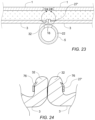
  • FIG. 23 shows a lock ring embodiment in a relaxed self-constrained state disposed about and securing portions of gathered fascia tissue layer.
  • FIG. 24 shows upward and inward facing barb embodiments of the lock ring embodiment of FIG. 23 penetrating into gathered tissue of the portions of fascia tissue layer and mechanically preventing upward movement of the lock ring relative to the fascia tissue.
  • a hole in the form of an access passage or the like may be left in a major vessel at an access site that must be closed.
  • Methods for percutaneous closure of such a hole may include remote suturing of the vessel, plugging the hole, and remote suturing of the fascia adjacent to the vessel.
  • Certain device and method embodiments discussed herein are directed to mechanical closure of an access passage in the fascia tissue layer adjacent to an access hole in a vessel such as an artery or vein of a patient. Some of these embodiments may also be applicable to direct closure of an arterial wall in some instances.
  • Some vascular closure device and method embodiments discussed herein may provide a robust and easy-to-use device for closing a vascular access hole after a minimally invasive procedure.
  • vascular closure device embodiments discussed herein may be useful for closing large vascular access holes.
  • certain vascular closure device and method embodiments are discussed in U.S. patent application Ser. No. 15/277,542, filed Sep. 27, 2016, by Thomas Larzon, et al., entitled VASCULAR CLOSURE DEVICE, which is incorporated by reference in its entirety.
  • FIGS. 1 - 4 B The following discussion of the device and method embodiments of FIGS. 1 - 4 B is directed generally to closure of a vascular access passage as well as axial positioning of certain portions of vascular closure device embodiments during such a closure procedure. Such axial positioning devices and methods may be applied to and used with any appropriate vascular closure device or method of embodiment discussed herein.
  • a vascular closure device 10 is introduced percutaneously over a guide wire 8 into a blood vessel/artery 5 , through the skin 1 and the fascia lata 2 of a patient.
  • An optional anvil member 9 may be arranged inside the blood vessel 5 to create a reference point along an axial orientation to the engagement members 11 and/or for controlling bleeding from an inner lumen of the artery 5 .
  • the engagement members 11 may then be placed and released through the vascular closure device 10 and may attach to fascia tissue 3 proximate to the blood vessel 5 and may involve the fascia membrane 3 (fascia iliacus), but, in some instances, not a wall 22 of the blood vessel 5 .
  • the engagement members 11 may for example be pushed out of the vascular closure device 10 and into the fascia membrane 3 using deployment members provided as pusher rods 12 arranged in independent lumens provided with the vascular closure device 10 , for example through a pusher assembly in a common lumen that simultaneously deploys all engagement members 11 , through a spring-loaded mechanism or the like.
  • the engagement members 11 may be connected with a single filament such as a suture or a plurality of filaments or sutures 13 .
  • FIG. 1 there is further shown a femoral vein 4 , a femoral nerve 6 and adjacent/interstitial tissues 7 .
  • the suture 13 may for example be routed through each of the engagement members 11 in sequence.
  • one suture 13 may be looped through each of the engagement members 11 in sequence, or a separate suture 13 may be attached to each engagement member 11 .
  • the tissue e.g. fascia membrane 3
  • the tissue may then pulled together in a radially inward direction towards an access passage in the fascia layer 3 with the suture 13 connected to the engagement members 11 .
  • the tissue/fascia membrane 3 is tightened towards the center and the access passage therethrough and may then create a tissue lock, thereby indirectly sealing the access hole 16 in the artery 5 .
  • the anvil member 9 may be removed from the artery 5 .
  • FIGS. 2 C and 2 D an embodiment of a vascular closure sequence is shown whereby a passage 16 through a wall 22 of the vessel 5 such as the blood vessel shown is treated such that leakage of blood from the interior volume of the blood vessel (not shown) is slowed or stopped to a clinically acceptable degree.
  • the passage 16 in the wall of the blood vessel specifically, the femoral artery 5
  • the passage 25 through the fascia tissue layer 3 disposed proximate to an outer surface of the femoral artery 5 is disposed in general alignment with a passage 25 through the fascia tissue layer 3 disposed proximate to an outer surface of the femoral artery 5 .
  • the tissue layer disposed outside of and proximate to the outer surface of the femoral artery 5 is the fascia iliacus 3 .
  • the phrase “in general alignment” as applied to the respective passages 16 , 25 may mean at least that an appropriately sized elongate device such as a catheter or sheath may pass through both passages 16 , 25 without significant relative lateral displacement between the tissue 3 and artery 5 .
  • the tissue layer 3 may be disposed sufficiently proximate the outside surface of the blood vessel 5 such that gathering and approximation of the fascia tissue 3 which is disposed about the passage 25 through the tissue 3 so as to close the passage 25 through the tissue/fascia membrane 3 and form a tissue lock is sufficient to tighten and displace the closed gathered tissue/fascia membrane 3 against the outer surface of the artery 5 which is adjacent the passage 16 through the artery 5 as shown in FIG. 2 D .
  • an inner surface of the tissue layer 3 disposed proximate to the outer surface of the blood vessel 5 may be separated from the outer surface of the blood vessel in the region of the respective passages therethrough by a distance of up to about 10 mm, more specifically, up to about 5 mm.
  • FIGS. 3 A and 3 B there is conceptually illustrated an engagement member, exemplified as an anchor element 15 .
  • the anchor element 15 is shown as initially deployed, so that it slides easily in the direction away from a deployment point.
  • the deployment point may optionally be deflected toward the tissue/fascia membrane 3 to promote engagement.
  • FIG. 3 B shows the anchor element 15 after motion has been reversed toward the deployment point, and the anchor element 15 has embedded into the tissue/fascia membrane 3 . That is, a tip 17 of the anchors element 15 is in one embodiment hook-shaped, so that it easily slides outward without engaging the tissue/fascia membrane 3 .
  • the tip 17 of the anchor element 15 is adapted to mechanically engage with the tissue/fascia membrane 3 .
  • FIGS. 4 A and 4 B conceptually illustrate the operation of an anvil member exemplified as a deployable positioning feature 20 .
  • deployable positioning feature 20 may be inserted through the wall 22 and into the interior volume of the blood vessel, such as the femoral artery 5 .
  • the deployable positioning feature 20 may be structured similar to an umbrella (using a mesh material), where the deployable positioning feature 20 in a radially collapsed form may be inserted into the artery 5 .
  • the deployable positioning feature 20 Once within the artery 5 , with further reference to FIG.
  • the deployable positioning feature 20 may be “unfolded” and radially expanded from the collapsed form such that a total surface area proximate to the longitudinal axis of the deployable positioning feature 20 is increased and thus may be retracted towards the interior wall of the artery 5 . Accordingly, a reference point may be thereby established for further operation of the vascular closure device 10 .
  • a mechanical “grabber” type device may be used to grab the fascia tissue layer 3 around an access hole 25 in the fascia (see FIG. 15 ), pull it together, and apply a tissue grip type of device such as lock ring 27 or other tissue grip type retention mechanism such as a tissue adhesive 30 directly to the tissue of the fascia 3 to secure the gathered fascia tissue 32 disposed around the access hole 25 in the closed position to form a tissue lock and achieve vascular closure of an access hole 16 in the adjacent vessel 5 .
  • FIGS. 5 - 24 illustrate embodiments of such grabber-type vascular closure devices 24 .
  • the arms also referred to herein as anchor deployers 26 , may be initially retracted into a housing 28 to achieve a low profile. Once placed above the fascia tissue layer 3 , the arms 26 may be extended distally and radially outward. Due to their preformed curved shape formed from an elastic resilient material (such as stainless steel or nitinol), the arms 26 may be configured to spread out into a radially dispersed pattern disposed around the access hole 25 in the fascia tissue layer 3 .
  • an elastic resilient material such as stainless steel or nitinol
  • the arms 26 may then engage the fascia tissue layer 3 at two or more points around the access hole 25 .
  • This engagement may be accomplished by an anchor 31 such as a small jaw 34 or the like mounted on the distal end 36 of a deployment rod 38 of each arm 26 and adapted to grab the fascia 3 , or a small hook 15 , 40 (see FIGS. 3 A and 12 ) could be used to engage the fascia 3 .
  • Other similar mechanisms may also be used.
  • the housing 28 may be advanced down over the arms 26 , or the arms retracted proximally into the housing 28 , thereby pulling the distal ends 36 of the arms 26 together in a radially inward and proximal direction, approximating the edges of the fascia tissue layer 3 disposed about the access hole 25 therein, and closing or minimizing the access hole 25 .
  • the retention mechanism such as a tissue grip mechanism that holds the approximated edges of the gathered fascia tissue 32 in this gathered configuration, such as the ring or clip 27 , may then be deployed onto the gathered tissue 32 . Thereafter, the arms 26 or anchors 31 disposed thereon may be disengaged from the fascia tissue layer 3 and the vascular closure device 24 withdrawn from the patient. Suitable tissue retention may be accomplished in some cases by use of the elastic resilient coil in the form of a lock ring 27 that is stretched onto the outside of the housing 28 about an outside circumference of the arms 26 or outside of a translation track of the arms 26 .
  • the lock ring 27 which may include an elastic and resilient self-contracting lock ring 27 , may be pushed off of the housing 28 by a distal end 42 of a larger, concentric outer tube 44 that lies more proximal over an inner tube 46 of the housing 28 .
  • the outer tube 44 may be actuated to advance distally relative to the inside tube 46 and deploy the lock ring 27 by advancing a lock ring actuator lever 47 which may be operatively coupled to the outer tube 44 .
  • such an elastic coil 27 may self-contract to circumferentially compress the gathered tissue 32 and brought together by the arms 26 in an inner radial direction and retain the gathered tissue 32 in a bunched or gathered configuration, thereby closing or reducing the access hole 25 .
  • Such elastic coil embodiments 27 may be made from high strength resilient materials such as stainless steel, nitinol, or the like. Some elastic coil embodiments 27 may also be made from or include bioresorbable and/or biodegradable materials.
  • the gathered tissue 32 may be held together by a biocompatible, rapidly curing tissue adhesive, such as cyanoacrylate, dispensed from a distal section 48 of the housing 28 .
  • tissue adhesive 30 may be dispensed as the gathered tissue of the fascia tissue layer 3 is coming together, to facilitate the apposition of surfaces containing tissue adhesive 30 , or the tissue adhesive 30 may be dispensed onto the gathered tissue 32 once the tissue is bunched together.
  • some embodiments of the vascular closure device 24 may include the housing 28 having an elongate configuration with an axial length greater than a transverse dimension thereof.
  • a housing 28 may further include a proximal end 50 , a distal end 52 and a distal section 48 .
  • a plurality of anchor deployers 26 are slidably disposed within the housing 28 adjacent each other at the distal section 48 of the housing 28 and are configured to extend and spread from the distal section 48 of the housing 28 .
  • Each of the anchor deployers 26 may include the deployment rod 38 which is slidably disposed relative to the housing 28 and which includes an elongate resilient configuration.
  • Each deployment rod 38 may also include the distal end 36 that extends distally and radially outward from the distal section 48 of the housing 28 so as to spread out from other the distal ends 36 of the deployment rods 38 . In some cases, the deployment rods 38 may be configured to extend distally at the same time or simultaneously.
  • Each anchor deployer 26 may also include the anchor 31 which is secured to the distal end 36 of the deployment rod 38 and which is configured to grip tissue such as the tissue of a fascia tissue layer 3 .
  • the vascular closure device embodiment 24 may further include the lock ring 27 which may be deployable from the distal end 52 of the housing 28 .
  • the vascular closure device of FIG. 5 includes 4 anchor deployers 26 , however any suitable number of anchor deployers 26 may be used.
  • vascular closure device embodiments 24 may include about 2 anchor deployers 26 to about 8 anchor deployers 26 , more specifically, about 3 anchor deployers 26 to about 5 anchor deployers 26 .
  • the deployment rod embodiments 38 may have a generally flattened cross section profile with a radial transverse dimension that is less than a circumferentially oriented transverse dimension.
  • the housing 28 may further include a guidewire lumen 54 extending an axial length thereof and a handle 56 secured to the proximal end 50 of the housing 28 .
  • a deployment rod pusher 58 which may optionally be spring loaded with a resilient member such as a spring 60 in either a distally biased or proximally biased direction may be operatively coupled to the deployment rods 38 for actuation thereof.
  • a resilient member such as a spring 60 in either a distally biased or proximally biased direction
  • the spring such as spring 60 shown in FIG.
  • the deployment rod pusher 58 is operatively coupled to respective proximal ends of the deployment rods 38 and optionally configured to extend the deployment rods 38 simultaneously in a distal direction upon actuation.
  • a tissue grip mechanism may be disposed on the distal end 52 of the housing 28 around the anchor deployers 26 but generally not in contact with the anchor deployers 26 when in an undeployed state.
  • the tissue grip mechanism may be configured to compress and secure gathered tissue portions 32 relative to each other in some cases. For such embodiments, once the tissue grip is deployed from the distal end 52 of the housing 28 over the anchor deployers 26 and respective anchors 31 thereof and onto the tissue which has been gathered and bunched by the proximally retracted anchor deployers 26 , different portions of the gathered tissue are secured in a fixed position relative to each other to form a tissue lock and, in some instances, vascular closure.
  • the tissue grip mechanism may include the lock ring 27 disposed about the anchor deployers 26 in the form of a self-retracting coil 27 with a central lumen 62 which may be sized to allow movement of the gathered tissue portions 32 disposed therein while the self-retracting coil 27 is in an expanded state as shown in FIG. 7 C .
  • the interior surface 64 of the central lumen 62 may be configured to compress and secure the gathered tissue portions 32 relative to each other when in a retracted compressed state as shown in FIGS. 7 A, 7 B, 20 , and 22 .
  • embodiments of the tissue grip may include the tissue adhesive 30 that may be dispensed from an outlet port, such as a distal port 66 of the guidewire lumen 54 , in the distal end 52 of the housing 28 as shown in FIGS. 20 and 21 .
  • tissue adhesive 30 may include cyanoacrylate, fibrin glue, PEG-based polymers or the like.
  • the tissue grip embodiments such as lock ring 27 and tissue adhesive 30 may optionally include a tissue engagement feature that is configured to stick to a surface of the gathered tissue 32 such as with the tissue adhesive 30 forming a bond with the gathered tissue 32 or sharp inner edge 64 of the diamond profiled lock ring 27 mechanically impinging the gathered tissue 32 so as to effectively secure the tissue portions together.
  • tissue engagement features may further include features which may be mechanically captured within the gathered tissue 32 such as the barbs 76 of the “castle shaped” lock ring 27 ′ shown in FIG. 8 A .
  • the barbs 76 are configured to penetrate the gathered tissue 32 and be mechanically captured thereby as shown in FIG. 24 . All of these tissue engagement feature embodiments may generally be used to keep the tissue grip embodiments from slipping off of the gathered tissue 32 once deployed.
  • the anchors 31 may include releasable anchors.
  • some releasable anchor embodiments may include the jaw 34 that can be moved between an open state and a closed state, each jaw 34 further including an opposed pair of tissue gripping teeth 68 as shown in the anchor embodiment 31 of FIGS. 9 - 10 A and 16 A .
  • Such anchors 31 that include a jaw 34 may be actuated by a pull wire 69 or the like that may apply tension to a hinged lever 71 at a proximal end of a hinged jaw portion 73 of the jaw 34 as shown in FIG. 10 .
  • the pull wire 69 or any other suitable actuation mechanism may be actuated by an actuation lever 59 which may optionally be disposed on the deployment rod pusher 58 shown in FIG. 5 .
  • each of the releasable anchors may have a shaft 70 with an elongate configuration having an axial length greater than an outer transverse dimension of the shaft 70 .
  • the releasable anchor 31 may be configured to be actuated between a curved tissue gripping state having the curved distal end 40 as shown in FIG. 12 and a straightened state as shown in FIG. 11 .
  • the shaft 70 of the releasable anchor 31 may further include a sharpened distal end 72 which is configured to penetrate tissue such as the fascia tissue layer 3 when pushed distally, sharpened distal end 72 first, into the fascia tissue layer 3 .
  • the shaft 70 may be made from or include an optional shape memory metal that can be actuated between the curved tissue gripping state shown in FIG. 16 B and the straightened state shown in FIG. 11 .
  • the shape memory metal of the shaft 70 may include nickel titanium alloy.
  • the shaft 70 may include an optional a bi-metal structure that can be actuated between the curved tissue gripping state and the straightened state.
  • detachable anchors at the distal ends 36 of the deployment rods 38 and anchor deployers 26 .
  • detachable anchor embodiments 31 are shown wherein the anchor deployers 26 include releasable junctions 74 disposed between each such detachable anchor 31 and respective deployment rod 38 which is secured thereto.
  • the detachable anchor embodiments 31 may include a proximally oriented barb 76 , and in some cases, a plurality of proximally oriented barbs 76 .
  • the releasable junctions 74 used to detach such detachable anchors 31 may include a releasable junction 74 released by thermal detachment, mechanical detachment or any other suitable detachment mechanism.
  • the releasable junction embodiment 74 shown in FIG. 13 A includes a tether 78 which secured between the distal end 36 of the deployment rod 38 and anchor 31 and which may be melted by a heater element 80 disposed about the tether 78 .
  • the heater element 80 may be actuated by applying electrical power from a power source 82 to the heater element 80 through a first electrically conducting wire 84 and a second electrically conducting wire 86 in electrical communication between the power source 82 and the heater element 80 .
  • Some embodiments of the vascular closure devices discussed herein may include a lateral surface configured to extend radially from a distal extension of the housing 28 while the lateral surface is disposed within a blood vessel 5 such as the anvil 9 shown in FIG. 1 and the deployable positioning feature 20 shown in FIGS. 4 A and 4 B and discussed above.
  • a lateral surface 9 , 20 that extends radially may be used to provide a reference point between relative axial positions of the wall 22 of the blood vessel 5 and the anchors 31 prior to deployment of the anchors 31 .
  • embodiments of the anchors 31 may be deployed a predetermined axial distance from the wall 22 of the blood vessel 5 as measured from the lateral surface 9 , 20 which is disposed against the wall 22 of the blood vessel 5 .
  • some embodiments of a method for vascular closure may include disposing the distal end 52 of the housing 28 of the vascular closure device 24 to a position adjacent the passage 25 in the tissue layer 3 and deploying a plurality of anchor deployers 26 from a distal section 48 of the housing 28 .
  • the anchor deployers 26 may be so deployed by distally advancing deployment rods 38 of the anchor deployers 26 in a distal and radially outward direction from the housing 28 into the tissue layer 3 in positions disposed about the passage 25 in the tissue layer 3 .
  • Respective anchors 31 of the anchor deployers 26 may then be secured to the tissue layer 3 in positions disposed about the passage 25 in the tissue layer 3 as shown in FIGS. 16 A- 16 B .
  • the deployment rods 38 may then be proximally retracted back into the distal section 48 of the housing 28 so as to draw the anchors 31 and respective tissue layer portions secured thereto together adjacent the distal section 48 of the housing 28 to gather the tissue 3 and close the passage 25 in the tissue layer 3 .
  • the deployment rods may be withdrawn with a spring or similar mechanism to apply a desired tension, or alternatively may be withdrawn with a lead screw, cam or similar mechanism to withdraw the deployment rods a desired distance independent of required tension.
  • a tissue grip mechanism may be deployed over the anchors 31 and onto the tissue layer portions 32 gathered and secured to the anchors 31 so as to secure the tissue layer portions together with the access hole 25 closed or reduced.
  • the anchors 31 may then be released from the tissue layer portions which are secured together as shown in FIGS. 20 and 21 . Thereafter, the deployment rods 38 and anchors 31 of each of the plurality of anchor deployers 26 may be proximally withdrawn into the distal section 48 of the housing 28 .
  • This may be particularly useful when the operator is not satisfied with the initial placement of the anchors 31 about the access hole 25 in the tissue layer 3 .
  • Such repositioning of the anchors 31 may be repeated as many times as is practical by the operator of the vascular closure device 24 .
  • the anchors 31 may include the jaws 34 that can be moved between an open state and a closed state as shown in FIGS. 9 - 10 A .
  • securing the jaws 34 of the respective anchors 31 to the tissue layer 3 may include inserting tissue of the tissue layer 3 into the jaws 34 while the jaws 34 are in an open state and then closing the jaws 34 to the closed state to grip the tissue layer between the opposed surfaces of the jaws 34 as shown in FIG. 16 A .
  • the jaws 34 may include the tissue gripping teeth 68 on the opposed surfaces of the jaws 34 and gripping the tissue 3 between the opposed surfaces of the jaws 34 may include engaging and partially penetrating the tissue layer with the tissue gripping teeth 68 .
  • releasing the anchors 31 from the tissue layer portions may include moving the jaws 34 from the closed state to the open state such that the tissue is no longer gripped by the opposed surfaces of the jaws 34 or tissue gripping teeth 68 thereof.
  • the anchors 31 may include the shaft 70 which has the sharpened distal end 72 and which has an elongate configuration with an axial length greater than an outer transverse dimension as shown in FIG. 11 .
  • the shaft 70 may be configured to be actuated between the curved tissue gripping state as shown in FIG. 12 and the straightened state as shown in FIG. 11 .
  • securing such respective anchors 31 to the tissue layer 3 may include inserting the sharpened distal ends 72 of the shaft 70 into the tissue layer 3 with the shaft 70 in a straightened state and actuating the shaft 70 to move the shaft 70 into a curved tissue gripping state about tissue of the fascia tissue layer 3 as shown in FIG. 16 B .
  • releasing the anchors 31 from the tissue layer portions may include actuating the shafts 70 from the curved tissue gripping state to the straightened state and thereafter proximally retracting the shafts 70 from the tissue layer portions.
  • deploying the tissue grip mechanism onto the tissue layer portions may include sliding the self-contracting ring 27 in an expanded state from the distal end 52 of the housing 28 and allowing the self-contracting ring 27 to contract to the relaxed state over the tissue layer portions 3 as shown in FIGS. 20 and 22 .
  • the self-contracting ring 27 may optionally include a non-circular cross section, such as a diamond-shaped cross section, to increase friction with the tissue bundle 32 .
  • Such a self-contracting ring 27 may also include a self-contracting ring embodiment 27 ′ that includes barbs 76 which point upward and radially inward towards a longitudinal axis 88 of the self-contracting ring 27 ′ as shown in FIGS. 8 A- 8 c .
  • deploying the tissue grip mechanism onto the gathered tissue 32 of the tissue layer portions 3 may include applying the tissue adhesive 30 , such as cyanoacrylate to the gathered tissue 32 of the tissue layer portions as shown in FIGS. 20 and 21 .
  • FIG. 20 shows a tissue grip mechanism combination of the self-contracting ring 27 disposed over the gathered tissue 32 as well as the tissue adhesive 30 disposed thereon and in between different portions of the fascia tissue layer 3 .
  • some embodiments of a method for vascular closure may include disposing a distal end 52 of the housing 28 of the vascular closure device 24 to a position adjacent the access passage 25 in the tissue layer 3 and deploying a plurality of anchor deployers 26 from a distal section 52 of the housing 28 .
  • the anchor deployers 26 may be so deployed by distally advancing deployment rods 38 of the anchor deployers 26 in a distal and radially outward direction from the housing 28 into the tissue layer in positions disposed about the passage 25 in the tissue layer 3 .
  • Respective anchors 31 of the anchor deployers 26 may then be secured to the tissue layer 3 in positions disposed about the passage 25 in the tissue layer 3 as shown in FIGS. 16 C- 16 D .
  • the deployment rods 38 may then be proximally retracted back into the distal section 48 of the housing 28 so as to draw the anchors 31 and respective tissue layer portions secured thereto together adjacent the distal section 48 of the housing 28 to gather the tissue 3 and close the passage 25 in the tissue layer 3 .
  • the tissue grip embodiment may be deployed over the anchors 31 and onto the tissue layer portions 3 gathered and secured to the anchors 31 so as to secure the tissue layer portions together with the access hole 25 closed or reduced.
  • the anchors 31 may then be detached from each of the respective deployment rods 38 secured thereto and left in the patient secured to the tissue layer 3 .
  • the anchor deployers 26 may include the releasable junctions 74 disposed between each respective deployment rod 38 and anchor 31 thereof.
  • detaching each anchor 31 from the respective deployment rod 38 secured thereto may include heating a tether 78 of the releasable junction 74 until it melts.
  • the anchor deployers 26 may be mechanically attached to the anchors 31 via a quarter-turn lock.
  • a cam or similar mechanism in the handle 56 may be used to rotate each of the deployment rods 38 a quarter turn or other suitable angular displacement to disengage the deployment rods 38 from their respective anchors 31 .
  • Embodiments illustratively described herein suitably may be practiced in the absence of any element(s) not specifically disclosed herein.
  • any of the terms “comprising,” “consisting essentially of,” and “consisting of” may be replaced with either of the other two terms.
  • the terms and expressions which have been employed are used as terms of description and not of limitation and use of such terms and expressions do not exclude any equivalents of the features shown and described or portions thereof, and various modifications are possible.
  • a or “an” can refer to one of or a plurality of the elements it modifies (e.g., “a reagent” can mean one or more reagents) unless it is contextually clear either one of the elements or more than one of the elements is described.

Landscapes

  • Health & Medical Sciences (AREA)
  • Surgery (AREA)
  • Life Sciences & Earth Sciences (AREA)
  • Medical Informatics (AREA)
  • Animal Behavior & Ethology (AREA)
  • Engineering & Computer Science (AREA)
  • Biomedical Technology (AREA)
  • Heart & Thoracic Surgery (AREA)
  • Veterinary Medicine (AREA)
  • Molecular Biology (AREA)
  • Nuclear Medicine, Radiotherapy & Molecular Imaging (AREA)
  • General Health & Medical Sciences (AREA)
  • Public Health (AREA)
  • Rheumatology (AREA)
  • Cardiology (AREA)
  • Reproductive Health (AREA)
  • Vascular Medicine (AREA)
  • Surgical Instruments (AREA)

Abstract

Device and method embodiments discussed herein are directed to mechanical closure of an access passage in a tissue layer adjacent to an access hole in a vessel such as an artery or vein of a patient. Some of these embodiments may also be applicable to direct closure of a vessel wall in some instances.

Description

RELATED APPLICATIONS
The present application is a divisional of co-pending U.S. patent application Ser. No. 16/190,694, filed Nov. 14, 2018, by Henrik NYMAN et al. titled “TISSUE CLOSURE DEVICE”, which claims priority from U.S. Provisional Patent Application Ser. No. 62/587,353, filed Nov. 16, 2017, by Henrik NYMAN et al. titled “Device for Mechanical Approximation of Fascia”, each of which is incorporated by reference herein in its entirety.
BACKGROUND
In many percutaneous cardiovascular procedures, a catheter is inserted into an artery, such as the femoral artery, through a percutaneous vascular access. The catheter may be inserted, typically over a guidewire, directly into an artery (a “bareback” procedure), or the catheter may be inserted through a vascular introducer. When the procedure is complete, the physician removes the catheter and then removes the introducer from the vessel (if one was used). The physician then must prevent or limit the amount of blood that leaks through the vascular access. Physicians currently use a number of methods to close the vascular access, such as localized external compression, suture-mediated closure devices, plugs, gels, foams and similar materials.
However, such closure procedures may be time consuming, and may consume a significant portion of the time of the procedure. In addition, existing methods are associated with complications such as hematoma or thromboses. Still further, some of such procedures, particularly suture-mediated closure devices, are known to have high failure rates in the presence of common vascular disease such as atherosclerosis and calcification.
SUMMARY
Some embodiments of a vascular closure device may include a housing having an elongate configuration with an axial length greater than a transverse dimension thereof. Such a housing may further include a proximal end, a distal end and a distal section. A plurality of anchor deployers are slidably disposed within the housing adjacent each other at the distal section of the housing and are configured to extend and spread from the distal section of the housing. Each of the anchor deployers may include a deployment rod which is slidably disposed relative to the housing and which includes an elongate resilient configuration. Each deployment rod may also include a distal end that extends distally and radially from the distal section of the housing so as to spread out from other deployment rod distal ends. In some cases, the deployment rods may be configured to extend distally at the same time or simultaneously. Each anchor deployer may also include an anchor which is secured to the distal end of the deployment rod and which is configured to grip tissue such as the tissue of a fascia tissue layer. The vascular closure device embodiment may further include a tissue grip which is deployable from the distal end of the housing.
Some embodiments of a method for vascular closure may include disposing a distal end of the housing of the vascular closure device to a position adjacent the passage in the tissue layer and deploying a plurality of anchor deployers from a distal section of the housing. The anchor deployers may be so deployed by distally advancing deployment rods of the anchor deployers in a distal and radially outward direction from the housing into the tissue layer in positions disposed about the passage in the tissue layer. Respective anchors of the anchor deployers may then be secured to the tissue layer in positions disposed about the passage in the tissue layer. The deployment rods may then be proximally retracted back into the distal section of the housing so as to draw the anchors and respective tissue layer portions secured thereto together adjacent the distal section of the housing to gather the tissue and close the passage in the tissue layer. Thereafter, a tissue grip may be deployed over the anchors and onto the tissue layer portions gathered and secured to the anchors so as to secure the tissue layer portions together with the access hole closed or reduced. The anchors may then be released from the tissue layer portions which are secured together.
Some embodiments of a method for vascular closure may include disposing a distal end of the housing of the vascular closure device to a position adjacent the passage in the tissue layer and deploying a plurality of anchor deployers from a distal section of the housing. The anchor deployers may be so deployed by distally advancing deployment rods of the anchor deployers in a distal and radially outward direction from the housing into the tissue layer in positions disposed about the passage in the tissue layer. Respective anchors of the anchor deployers may then be secured to the tissue layer in positions disposed about the passage in the tissue layer. The deployment rods may then be proximally retracted back into the distal section of the housing so as to draw the anchors and respective tissue layer portions secured thereto together adjacent the distal section of the housing to gather the tissue and close the passage in the tissue layer. Thereafter, a tissue grip may be deployed over the anchors and onto the tissue layer portions gathered and secured to the anchors so as to secure the tissue layer portions together with the access hole closed or reduced. The anchors may then be detached from each of the respective deployment rods secured thereto and left in the patient secured to the tissue layer.
Some embodiments of a method for vascular closure may include disposing a vascular closure device adjacent a passage in a tissue layer which is disposed above and adjacent an access hole in a blood vessel of a patient and deploying a plurality of anchors from a distal section of the vascular closure device in a distal and radially outward direction therefrom. The method may also include engaging the tissue layer in positions disposed about the passage in the tissue layer with the anchors and securing the anchors to the tissue layer in the positions disposed about the passage in the tissue layer. Thereafter, the anchors may be proximally retracted closer together so as to draw the anchors and respective tissue layer portions secured thereto together thereby closing the passage in the tissue layer. A tissue grip may then be deployed onto the tissue layer portions drawn together by the anchors so as to secure the drawn together tissue layer portions thereby closing the passage in the tissue layer and achieving vascular closure of the access hole in the blood vessel.
Certain embodiments are described further in the following description, examples, claims and drawings. These features of embodiments will become more apparent from the following detailed description when taken in conjunction with the accompanying exemplary drawings.
BRIEF DESCRIPTION OF THE DRAWINGS
FIG. 1 schematically exemplifies a first embodiment of a vascular closure device according to a possible embodiment of the present disclosure.
FIGS. 2A and 2B show a detailed view of the creation of a tissue lock using the vascular closure device.
FIGS. 2C and 2D illustrate a closure sequence for treatment of an unwanted passage through a wall of a blood vessel without directly engaging the blood vessel.
FIGS. 3A and 3B conceptually illustrate an engagement member, exemplified as an anchor element.
FIGS. 4A and 4B illustrate the operation of an anvil member that functions as a deployable positioning feature.
FIG. 5 is an elevation view of a vascular closure device embodiment.
FIG. 6 is an enlarged view of the encircled portion 6-6 of the vascular closure device embodiment of FIG. 5 .
FIG. 6A is a front view of the vascular closure device embodiment of FIG. 5 .
FIG. 7A is an elevation view of a lock ring embodiment.
FIG. 7B is a top view of the lock ring embodiment of FIG. 7A.
FIG. 7C shows a top view of the lock ring embodiment of FIG. 7A in a radially expanded state.
FIG. 7D is a transverse cross section of the lock ring embodiment of FIG. 7B taken along lines 7D-7D of FIG. 7B.
FIG. 8A is an elevation view of a lock ring embodiment.
FIG. 8B is a top view of the lock ring embodiment of FIG. 8A.
FIG. 8C is a top view of the lock ring embodiment of FIG. 8A in a radially expanded state.
FIG. 9 is an elevation view of a releasable anchor embodiment in a closed state.
FIG. 10 is an elevation view of the releasable anchor embodiment of FIG. 9 in an open state.
FIG. 10A is a transverse cross section of the deployment rod of FIG. 10 taken along lines 10A-10A of FIG. 10 .
FIG. 11 is an elevation view of a releasable anchor embodiment in a straightened state.
FIG. 12 is an elevation view of the releasable anchor embodiment of FIG. 11 in a curved, tissue gripping state.
FIG. 12A is a transverse cross section of a deployment rod embodiment of FIG. 12 taken along lines 12A-12A of FIG. 12 .
FIG. 13 is an elevation view of a detachable anchor embodiment.
FIG. 13A is an enlarged view of the encircled portion 13A-13A of the detachable anchor embodiment of FIG. 13 .
FIG. 13B is a transverse cross section of the deployment rod embodiment of FIG. 13 taken along lines 13B-13B of FIG. 13 .
FIG. 14 is an elevation view of a detachable anchor embodiment.
FIG. 14A is a transverse cross section of the deployment rod embodiment of FIG. 14 taken along lines 14A-14A of FIG. 14 .
FIG. 15 is an elevation view in partial section of a distal section of a housing of a vascular closure device disposed adjacent an access hole of a fascia tissue layer.
FIG. 16 shows the vascular closure device of FIG. 15 with the anchor deployers distally extended and with anchors thereof secured to the fascia tissue layer.
FIG. 16A shows the releasable anchor embodiment of FIG. 9 in a closed state and secured to fascia tissue.
FIG. 16B shows the releasable anchor embodiment of FIG. 11 in a curved tissue gripping state secured to fascia tissue.
FIG. 16C shows the detachable anchor embodiment of FIG. 14 disposed in and secured to fascia tissue.
FIG. 16D shows the detachable anchor embodiment of FIG. 13 disposed in and secured to fascia tissue.
FIG. 17 shows the anchor deployers of the vascular closure device of FIG. 16 being proximally retracted and closing the access passage in the fascia tissue layer.
FIG. 18 is an elevation view in partial section showing the lock ring being deployed from the distal end of the housing of the vascular closure device of FIG. 5 .
FIG. 19 shows the lock ring of FIG. 18 disposed around and securing portions of the fascia tissue layer gathered by the anchors of the vascular closure device of FIG. 5 .
FIG. 20 shows portions of the fascia tissue layer disposed about the access hole in a gathered and secured state with the lock ring and tissue adhesive disposed thereon.
FIG. 21 shows portions of the fascia tissue layer disposed about the access hole in a gathered and secured state with tissue adhesive only disposed thereon.
FIG. 22 shows portions of the fascia tissue layer disposed about the access hole in a gathered and secured state with the lock ring disposed thereon, the lock ring being further secured in fixed relation to the portions of fascia tissue by detachable anchors which are secured to the fascia tissue above the lock ring which may be mechanically captured by the deployed detachable tissue anchors.
FIG. 23 shows a lock ring embodiment in a relaxed self-constrained state disposed about and securing portions of gathered fascia tissue layer.
FIG. 24 shows upward and inward facing barb embodiments of the lock ring embodiment of FIG. 23 penetrating into gathered tissue of the portions of fascia tissue layer and mechanically preventing upward movement of the lock ring relative to the fascia tissue.
The drawings are intended to illustrate certain exemplary embodiments and are not limiting. For clarity and ease of illustration, the drawings may not be made to scale, and in some instances, various aspects may be shown exaggerated or enlarged to facilitate an understanding of particular embodiments.
DETAILED DESCRIPTION
After a minimally invasive vascular procedure, a hole in the form of an access passage or the like may be left in a major vessel at an access site that must be closed. Methods for percutaneous closure of such a hole may include remote suturing of the vessel, plugging the hole, and remote suturing of the fascia adjacent to the vessel. Certain device and method embodiments discussed herein are directed to mechanical closure of an access passage in the fascia tissue layer adjacent to an access hole in a vessel such as an artery or vein of a patient. Some of these embodiments may also be applicable to direct closure of an arterial wall in some instances. Some vascular closure device and method embodiments discussed herein may provide a robust and easy-to-use device for closing a vascular access hole after a minimally invasive procedure. In some cases, vascular closure device embodiments discussed herein may be useful for closing large vascular access holes. In addition, certain vascular closure device and method embodiments are discussed in U.S. patent application Ser. No. 15/277,542, filed Sep. 27, 2016, by Thomas Larzon, et al., entitled VASCULAR CLOSURE DEVICE, which is incorporated by reference in its entirety.
The following discussion of the device and method embodiments of FIGS. 1-4B is directed generally to closure of a vascular access passage as well as axial positioning of certain portions of vascular closure device embodiments during such a closure procedure. Such axial positioning devices and methods may be applied to and used with any appropriate vascular closure device or method of embodiment discussed herein. Turning now to the drawings, and to FIG. 1 in particular, an embodiment of a vascular closure device 10 is introduced percutaneously over a guide wire 8 into a blood vessel/artery 5, through the skin 1 and the fascia lata 2 of a patient. An optional anvil member 9 may be arranged inside the blood vessel 5 to create a reference point along an axial orientation to the engagement members 11 and/or for controlling bleeding from an inner lumen of the artery 5. The engagement members 11 may then be placed and released through the vascular closure device 10 and may attach to fascia tissue 3 proximate to the blood vessel 5 and may involve the fascia membrane 3 (fascia iliacus), but, in some instances, not a wall 22 of the blood vessel 5. The engagement members 11 may for example be pushed out of the vascular closure device 10 and into the fascia membrane 3 using deployment members provided as pusher rods 12 arranged in independent lumens provided with the vascular closure device 10, for example through a pusher assembly in a common lumen that simultaneously deploys all engagement members 11, through a spring-loaded mechanism or the like. For some embodiments, the engagement members 11 may be connected with a single filament such as a suture or a plurality of filaments or sutures 13. In FIG. 1 there is further shown a femoral vein 4, a femoral nerve 6 and adjacent/interstitial tissues 7.
With further reference to FIGS. 2A and 2B, the suture 13 may for example be routed through each of the engagement members 11 in sequence. In particular, one suture 13 may be looped through each of the engagement members 11 in sequence, or a separate suture 13 may be attached to each engagement member 11. The tissue, e.g. fascia membrane 3, may then pulled together in a radially inward direction towards an access passage in the fascia layer 3 with the suture 13 connected to the engagement members 11. When pulled together, the tissue/fascia membrane 3 is tightened towards the center and the access passage therethrough and may then create a tissue lock, thereby indirectly sealing the access hole 16 in the artery 5. That is, a distance between the initial position of the engagement members 11 and a distance between the engagement members once the engagement members 11 have been moved radially inward towards each other is thereby reduced. When tightening the fascia membrane 3 the anvil member 9 may be removed from the artery 5.
Referring to FIGS. 2C and 2D, an embodiment of a vascular closure sequence is shown whereby a passage 16 through a wall 22 of the vessel 5 such as the blood vessel shown is treated such that leakage of blood from the interior volume of the blood vessel (not shown) is slowed or stopped to a clinically acceptable degree. As seen in FIG. 2C, the passage 16 in the wall of the blood vessel, specifically, the femoral artery 5, is disposed in general alignment with a passage 25 through the fascia tissue layer 3 disposed proximate to an outer surface of the femoral artery 5. For this particular exemplary embodiment, the tissue layer disposed outside of and proximate to the outer surface of the femoral artery 5 is the fascia iliacus 3. For purposes of this general discussion, the phrase “in general alignment” as applied to the respective passages 16, 25 may mean at least that an appropriately sized elongate device such as a catheter or sheath may pass through both passages 16, 25 without significant relative lateral displacement between the tissue 3 and artery 5.
In addition, in some cases, the tissue layer 3 may be disposed sufficiently proximate the outside surface of the blood vessel 5 such that gathering and approximation of the fascia tissue 3 which is disposed about the passage 25 through the tissue 3 so as to close the passage 25 through the tissue/fascia membrane 3 and form a tissue lock is sufficient to tighten and displace the closed gathered tissue/fascia membrane 3 against the outer surface of the artery 5 which is adjacent the passage 16 through the artery 5 as shown in FIG. 2D.
When the gathered tissue 3 has been displaced and deflected so as to be disposed against the passage 16 of the artery 5 and wall of the artery 5 disposed about the passage 16 in the artery 5, this mechanical approximation will typically be sufficient in order to achieve a clinically sufficient slowing or stoppage of blood leakage from the passage 16 in the artery 5 in order to permit closure of an access site through the patient's skin 1 adjacent the passages. In some instances, an inner surface of the tissue layer 3 disposed proximate to the outer surface of the blood vessel 5 may be separated from the outer surface of the blood vessel in the region of the respective passages therethrough by a distance of up to about 10 mm, more specifically, up to about 5 mm.
With further reference to FIGS. 3A and 3B, there is conceptually illustrated an engagement member, exemplified as an anchor element 15. In FIG. 3A, the anchor element 15 is shown as initially deployed, so that it slides easily in the direction away from a deployment point. Note that the deployment point may optionally be deflected toward the tissue/fascia membrane 3 to promote engagement. FIG. 3B shows the anchor element 15 after motion has been reversed toward the deployment point, and the anchor element 15 has embedded into the tissue/fascia membrane 3. That is, a tip 17 of the anchors element 15 is in one embodiment hook-shaped, so that it easily slides outward without engaging the tissue/fascia membrane 3. However, once the anchor element 15 is retracted, at least the tip 17 of the anchor element 15 is adapted to mechanically engage with the tissue/fascia membrane 3.
FIGS. 4A and 4B conceptually illustrate the operation of an anvil member exemplified as a deployable positioning feature 20. In FIG. 4A, deployable positioning feature 20 may be inserted through the wall 22 and into the interior volume of the blood vessel, such as the femoral artery 5. The deployable positioning feature 20 may be structured similar to an umbrella (using a mesh material), where the deployable positioning feature 20 in a radially collapsed form may be inserted into the artery 5. Once within the artery 5, with further reference to FIG. 4B, the deployable positioning feature 20 may be “unfolded” and radially expanded from the collapsed form such that a total surface area proximate to the longitudinal axis of the deployable positioning feature 20 is increased and thus may be retracted towards the interior wall of the artery 5. Accordingly, a reference point may be thereby established for further operation of the vascular closure device 10.
For the vascular closure device embodiments 24 shown in FIGS. 5-24 , a mechanical “grabber” type device may be used to grab the fascia tissue layer 3 around an access hole 25 in the fascia (see FIG. 15 ), pull it together, and apply a tissue grip type of device such as lock ring 27 or other tissue grip type retention mechanism such as a tissue adhesive 30 directly to the tissue of the fascia 3 to secure the gathered fascia tissue 32 disposed around the access hole 25 in the closed position to form a tissue lock and achieve vascular closure of an access hole 16 in the adjacent vessel 5. FIGS. 5-24 illustrate embodiments of such grabber-type vascular closure devices 24. The arms, also referred to herein as anchor deployers 26, may be initially retracted into a housing 28 to achieve a low profile. Once placed above the fascia tissue layer 3, the arms 26 may be extended distally and radially outward. Due to their preformed curved shape formed from an elastic resilient material (such as stainless steel or nitinol), the arms 26 may be configured to spread out into a radially dispersed pattern disposed around the access hole 25 in the fascia tissue layer 3.
The arms 26 may then engage the fascia tissue layer 3 at two or more points around the access hole 25. This engagement may be accomplished by an anchor 31 such as a small jaw 34 or the like mounted on the distal end 36 of a deployment rod 38 of each arm 26 and adapted to grab the fascia 3, or a small hook 15, 40 (see FIGS. 3A and 12 ) could be used to engage the fascia 3. Other similar mechanisms may also be used. Once each arm 26 of the vascular closure device 24 has secured the fascia 3, the housing 28 may be advanced down over the arms 26, or the arms retracted proximally into the housing 28, thereby pulling the distal ends 36 of the arms 26 together in a radially inward and proximal direction, approximating the edges of the fascia tissue layer 3 disposed about the access hole 25 therein, and closing or minimizing the access hole 25.
In addition, the retention mechanism, such as a tissue grip mechanism that holds the approximated edges of the gathered fascia tissue 32 in this gathered configuration, such as the ring or clip 27, may then be deployed onto the gathered tissue 32. Thereafter, the arms 26 or anchors 31 disposed thereon may be disengaged from the fascia tissue layer 3 and the vascular closure device 24 withdrawn from the patient. Suitable tissue retention may be accomplished in some cases by use of the elastic resilient coil in the form of a lock ring 27 that is stretched onto the outside of the housing 28 about an outside circumference of the arms 26 or outside of a translation track of the arms 26. The lock ring 27, which may include an elastic and resilient self-contracting lock ring 27, may be pushed off of the housing 28 by a distal end 42 of a larger, concentric outer tube 44 that lies more proximal over an inner tube 46 of the housing 28. In some cases, the outer tube 44 may be actuated to advance distally relative to the inside tube 46 and deploy the lock ring 27 by advancing a lock ring actuator lever 47 which may be operatively coupled to the outer tube 44. Once pushed off the inside tube 46 of the housing 28 and onto the gathered tissue 32, such an elastic coil 27 may self-contract to circumferentially compress the gathered tissue 32 and brought together by the arms 26 in an inner radial direction and retain the gathered tissue 32 in a bunched or gathered configuration, thereby closing or reducing the access hole 25.
Such elastic coil embodiments 27 may be made from high strength resilient materials such as stainless steel, nitinol, or the like. Some elastic coil embodiments 27 may also be made from or include bioresorbable and/or biodegradable materials. In some embodiments, the gathered tissue 32 may be held together by a biocompatible, rapidly curing tissue adhesive, such as cyanoacrylate, dispensed from a distal section 48 of the housing 28. Such a tissue adhesive 30 may be dispensed as the gathered tissue of the fascia tissue layer 3 is coming together, to facilitate the apposition of surfaces containing tissue adhesive 30, or the tissue adhesive 30 may be dispensed onto the gathered tissue 32 once the tissue is bunched together.
Referring to FIGS. 5 and 6 , some embodiments of the vascular closure device 24 may include the housing 28 having an elongate configuration with an axial length greater than a transverse dimension thereof. Such a housing 28 may further include a proximal end 50, a distal end 52 and a distal section 48. A plurality of anchor deployers 26 are slidably disposed within the housing 28 adjacent each other at the distal section 48 of the housing 28 and are configured to extend and spread from the distal section 48 of the housing 28. Each of the anchor deployers 26 may include the deployment rod 38 which is slidably disposed relative to the housing 28 and which includes an elongate resilient configuration. Each deployment rod 38 may also include the distal end 36 that extends distally and radially outward from the distal section 48 of the housing 28 so as to spread out from other the distal ends 36 of the deployment rods 38. In some cases, the deployment rods 38 may be configured to extend distally at the same time or simultaneously. Each anchor deployer 26 may also include the anchor 31 which is secured to the distal end 36 of the deployment rod 38 and which is configured to grip tissue such as the tissue of a fascia tissue layer 3. The vascular closure device embodiment 24 may further include the lock ring 27 which may be deployable from the distal end 52 of the housing 28. The vascular closure device of FIG. 5 includes 4 anchor deployers 26, however any suitable number of anchor deployers 26 may be used. Some such vascular closure device embodiments 24 may include about 2 anchor deployers 26 to about 8 anchor deployers 26, more specifically, about 3 anchor deployers 26 to about 5 anchor deployers 26. For some embodiments, it may be desirable for the deployment rods 38 to have a rectangular transverse cross section profile to facilitate distal and radially outward extension while maintaining lateral stability. In some instances, the deployment rod embodiments 38 may have a generally flattened cross section profile with a radial transverse dimension that is less than a circumferentially oriented transverse dimension.
In some cases, the housing 28 may further include a guidewire lumen 54 extending an axial length thereof and a handle 56 secured to the proximal end 50 of the housing 28. A deployment rod pusher 58 which may optionally be spring loaded with a resilient member such as a spring 60 in either a distally biased or proximally biased direction may be operatively coupled to the deployment rods 38 for actuation thereof. For deployment rod pusher embodiments 58 which are proximally biased this may correspond to a bias with the deployment rods 38 biased towards a retracted position which may be overcome by manual pressure in a distal direction against the deployment rod pusher 58. The spring, such as spring 60 shown in FIG. 1 , may be used to provide such a resilient biasing force on the deployment rod pusher 58. As shown, the deployment rod pusher 58 is operatively coupled to respective proximal ends of the deployment rods 38 and optionally configured to extend the deployment rods 38 simultaneously in a distal direction upon actuation.
In some instances, embodiments of a tissue grip mechanism may be disposed on the distal end 52 of the housing 28 around the anchor deployers 26 but generally not in contact with the anchor deployers 26 when in an undeployed state. The tissue grip mechanism may be configured to compress and secure gathered tissue portions 32 relative to each other in some cases. For such embodiments, once the tissue grip is deployed from the distal end 52 of the housing 28 over the anchor deployers 26 and respective anchors 31 thereof and onto the tissue which has been gathered and bunched by the proximally retracted anchor deployers 26, different portions of the gathered tissue are secured in a fixed position relative to each other to form a tissue lock and, in some instances, vascular closure. In some cases, the tissue grip mechanism may include the lock ring 27 disposed about the anchor deployers 26 in the form of a self-retracting coil 27 with a central lumen 62 which may be sized to allow movement of the gathered tissue portions 32 disposed therein while the self-retracting coil 27 is in an expanded state as shown in FIG. 7C. The interior surface 64 of the central lumen 62 may be configured to compress and secure the gathered tissue portions 32 relative to each other when in a retracted compressed state as shown in FIGS. 7A, 7B, 20, and 22 . In some cases, embodiments of the tissue grip may include the tissue adhesive 30 that may be dispensed from an outlet port, such as a distal port 66 of the guidewire lumen 54, in the distal end 52 of the housing 28 as shown in FIGS. 20 and 21 . For some embodiments, such as the tissue adhesive 30 may include cyanoacrylate, fibrin glue, PEG-based polymers or the like.
In general, the tissue grip embodiments such as lock ring 27 and tissue adhesive 30 may optionally include a tissue engagement feature that is configured to stick to a surface of the gathered tissue 32 such as with the tissue adhesive 30 forming a bond with the gathered tissue 32 or sharp inner edge 64 of the diamond profiled lock ring 27 mechanically impinging the gathered tissue 32 so as to effectively secure the tissue portions together. Such tissue engagement features may further include features which may be mechanically captured within the gathered tissue 32 such as the barbs 76 of the “castle shaped” lock ring 27′ shown in FIG. 8A. The barbs 76 are configured to penetrate the gathered tissue 32 and be mechanically captured thereby as shown in FIG. 24 . All of these tissue engagement feature embodiments may generally be used to keep the tissue grip embodiments from slipping off of the gathered tissue 32 once deployed.
For some embodiments of vascular closure devices 24 discussed herein, the anchors 31 may include releasable anchors. For example, some releasable anchor embodiments may include the jaw 34 that can be moved between an open state and a closed state, each jaw 34 further including an opposed pair of tissue gripping teeth 68 as shown in the anchor embodiment 31 of FIGS. 9-10A and 16A. Such anchors 31 that include a jaw 34, may be actuated by a pull wire 69 or the like that may apply tension to a hinged lever 71 at a proximal end of a hinged jaw portion 73 of the jaw 34 as shown in FIG. 10 . In some instances, the pull wire 69 or any other suitable actuation mechanism may be actuated by an actuation lever 59 which may optionally be disposed on the deployment rod pusher 58 shown in FIG. 5 .
For some releasable anchor embodiments 31, each of the releasable anchors may have a shaft 70 with an elongate configuration having an axial length greater than an outer transverse dimension of the shaft 70. The releasable anchor 31 may be configured to be actuated between a curved tissue gripping state having the curved distal end 40 as shown in FIG. 12 and a straightened state as shown in FIG. 11 . In some cases, the shaft 70 of the releasable anchor 31 may further include a sharpened distal end 72 which is configured to penetrate tissue such as the fascia tissue layer 3 when pushed distally, sharpened distal end 72 first, into the fascia tissue layer 3. For some embodiments, the shaft 70 may be made from or include an optional shape memory metal that can be actuated between the curved tissue gripping state shown in FIG. 16B and the straightened state shown in FIG. 11 . For such embodiments, the shape memory metal of the shaft 70 may include nickel titanium alloy. For other such embodiments, the shaft 70 may include an optional a bi-metal structure that can be actuated between the curved tissue gripping state and the straightened state.
In some cases, it may be desirable to use detachable anchors at the distal ends 36 of the deployment rods 38 and anchor deployers 26. Referring to FIGS. 13-14A, detachable anchor embodiments 31 are shown wherein the anchor deployers 26 include releasable junctions 74 disposed between each such detachable anchor 31 and respective deployment rod 38 which is secured thereto. In some cases, the detachable anchor embodiments 31 may include a proximally oriented barb 76, and in some cases, a plurality of proximally oriented barbs 76. For some embodiments, the releasable junctions 74 used to detach such detachable anchors 31 may include a releasable junction 74 released by thermal detachment, mechanical detachment or any other suitable detachment mechanism. The releasable junction embodiment 74 shown in FIG. 13A includes a tether 78 which secured between the distal end 36 of the deployment rod 38 and anchor 31 and which may be melted by a heater element 80 disposed about the tether 78. The heater element 80 may be actuated by applying electrical power from a power source 82 to the heater element 80 through a first electrically conducting wire 84 and a second electrically conducting wire 86 in electrical communication between the power source 82 and the heater element 80.
Some embodiments of the vascular closure devices discussed herein may include a lateral surface configured to extend radially from a distal extension of the housing 28 while the lateral surface is disposed within a blood vessel 5 such as the anvil 9 shown in FIG. 1 and the deployable positioning feature 20 shown in FIGS. 4A and 4B and discussed above. Such a lateral surface 9, 20 that extends radially may be used to provide a reference point between relative axial positions of the wall 22 of the blood vessel 5 and the anchors 31 prior to deployment of the anchors 31. In some cases, embodiments of the anchors 31 may be deployed a predetermined axial distance from the wall 22 of the blood vessel 5 as measured from the lateral surface 9, 20 which is disposed against the wall 22 of the blood vessel 5.
Referring generally to FIGS. 15-24 , some embodiments of a method for vascular closure may include disposing the distal end 52 of the housing 28 of the vascular closure device 24 to a position adjacent the passage 25 in the tissue layer 3 and deploying a plurality of anchor deployers 26 from a distal section 48 of the housing 28. The anchor deployers 26 may be so deployed by distally advancing deployment rods 38 of the anchor deployers 26 in a distal and radially outward direction from the housing 28 into the tissue layer 3 in positions disposed about the passage 25 in the tissue layer 3. Respective anchors 31 of the anchor deployers 26 may then be secured to the tissue layer 3 in positions disposed about the passage 25 in the tissue layer 3 as shown in FIGS. 16A-16B. The deployment rods 38 may then be proximally retracted back into the distal section 48 of the housing 28 so as to draw the anchors 31 and respective tissue layer portions secured thereto together adjacent the distal section 48 of the housing 28 to gather the tissue 3 and close the passage 25 in the tissue layer 3. The deployment rods may be withdrawn with a spring or similar mechanism to apply a desired tension, or alternatively may be withdrawn with a lead screw, cam or similar mechanism to withdraw the deployment rods a desired distance independent of required tension. Thereafter, a tissue grip mechanism may be deployed over the anchors 31 and onto the tissue layer portions 32 gathered and secured to the anchors 31 so as to secure the tissue layer portions together with the access hole 25 closed or reduced. The anchors 31 may then be released from the tissue layer portions which are secured together as shown in FIGS. 20 and 21 . Thereafter, the deployment rods 38 and anchors 31 of each of the plurality of anchor deployers 26 may be proximally withdrawn into the distal section 48 of the housing 28.
In some cases, for such method embodiments, it may be desirable after proximally retracting the anchors 31 and deployment rods 38 and gathering tissue of the tissue layer 3 and prior to deploying the tissue grip, to release the tissue layer 3 from the anchors 31 and re-deploy the anchor deployers 26 by re-extending the deployment rods 38 in a distal and radially outward direction and re-gripping the tissue layer 3 about the access passage 25 to reset the orientation and/or position of the anchors with respect to the access hole 25 before proximally retracting the anchors 31 and deployment rods 38 back into the housing 28. This may be particularly useful when the operator is not satisfied with the initial placement of the anchors 31 about the access hole 25 in the tissue layer 3. Such repositioning of the anchors 31 may be repeated as many times as is practical by the operator of the vascular closure device 24.
In some instances, the anchors 31 may include the jaws 34 that can be moved between an open state and a closed state as shown in FIGS. 9-10A. In such cases, securing the jaws 34 of the respective anchors 31 to the tissue layer 3 may include inserting tissue of the tissue layer 3 into the jaws 34 while the jaws 34 are in an open state and then closing the jaws 34 to the closed state to grip the tissue layer between the opposed surfaces of the jaws 34 as shown in FIG. 16A. In some cases, the jaws 34 may include the tissue gripping teeth 68 on the opposed surfaces of the jaws 34 and gripping the tissue 3 between the opposed surfaces of the jaws 34 may include engaging and partially penetrating the tissue layer with the tissue gripping teeth 68. In addition, for such embodiments, releasing the anchors 31 from the tissue layer portions may include moving the jaws 34 from the closed state to the open state such that the tissue is no longer gripped by the opposed surfaces of the jaws 34 or tissue gripping teeth 68 thereof.
For some embodiments of the vascular closure device 24, the anchors 31 may include the shaft 70 which has the sharpened distal end 72 and which has an elongate configuration with an axial length greater than an outer transverse dimension as shown in FIG. 11 . The shaft 70 may be configured to be actuated between the curved tissue gripping state as shown in FIG. 12 and the straightened state as shown in FIG. 11 . For such embodiments, securing such respective anchors 31 to the tissue layer 3 may include inserting the sharpened distal ends 72 of the shaft 70 into the tissue layer 3 with the shaft 70 in a straightened state and actuating the shaft 70 to move the shaft 70 into a curved tissue gripping state about tissue of the fascia tissue layer 3 as shown in FIG. 16B. For some such embodiments, releasing the anchors 31 from the tissue layer portions may include actuating the shafts 70 from the curved tissue gripping state to the straightened state and thereafter proximally retracting the shafts 70 from the tissue layer portions.
In some instances, deploying the tissue grip mechanism onto the tissue layer portions may include sliding the self-contracting ring 27 in an expanded state from the distal end 52 of the housing 28 and allowing the self-contracting ring 27 to contract to the relaxed state over the tissue layer portions 3 as shown in FIGS. 20 and 22 . The self-contracting ring 27 may optionally include a non-circular cross section, such as a diamond-shaped cross section, to increase friction with the tissue bundle 32. Such a self-contracting ring 27 may also include a self-contracting ring embodiment 27′ that includes barbs 76 which point upward and radially inward towards a longitudinal axis 88 of the self-contracting ring 27′ as shown in FIGS. 8A-8 c. Once deployed over tissue 32 and allowed to self-contract to a relaxed constrained state, as shown in FIGS. 8A and 8B, the barbs 76 may penetrate into the gathered tissue 32 and prevent the lock ring 27′ from sliding off of the gathered tissue 32 as shown in FIGS. 23 and 24 . In some instances, deploying the tissue grip mechanism onto the gathered tissue 32 of the tissue layer portions 3 may include applying the tissue adhesive 30, such as cyanoacrylate to the gathered tissue 32 of the tissue layer portions as shown in FIGS. 20 and 21 . FIG. 20 shows a tissue grip mechanism combination of the self-contracting ring 27 disposed over the gathered tissue 32 as well as the tissue adhesive 30 disposed thereon and in between different portions of the fascia tissue layer 3.
Referring again to FIGS. 15-24 , some embodiments of a method for vascular closure may include disposing a distal end 52 of the housing 28 of the vascular closure device 24 to a position adjacent the access passage 25 in the tissue layer 3 and deploying a plurality of anchor deployers 26 from a distal section 52 of the housing 28. The anchor deployers 26 may be so deployed by distally advancing deployment rods 38 of the anchor deployers 26 in a distal and radially outward direction from the housing 28 into the tissue layer in positions disposed about the passage 25 in the tissue layer 3. Respective anchors 31 of the anchor deployers 26 may then be secured to the tissue layer 3 in positions disposed about the passage 25 in the tissue layer 3 as shown in FIGS. 16C-16D. The deployment rods 38 may then be proximally retracted back into the distal section 48 of the housing 28 so as to draw the anchors 31 and respective tissue layer portions secured thereto together adjacent the distal section 48 of the housing 28 to gather the tissue 3 and close the passage 25 in the tissue layer 3. Thereafter, the tissue grip embodiment may be deployed over the anchors 31 and onto the tissue layer portions 3 gathered and secured to the anchors 31 so as to secure the tissue layer portions together with the access hole 25 closed or reduced. The anchors 31 may then be detached from each of the respective deployment rods 38 secured thereto and left in the patient secured to the tissue layer 3. In some cases, the anchor deployers 26 may include the releasable junctions 74 disposed between each respective deployment rod 38 and anchor 31 thereof. In such cases, detaching each anchor 31 from the respective deployment rod 38 secured thereto may include heating a tether 78 of the releasable junction 74 until it melts. In some instances, the anchor deployers 26 may be mechanically attached to the anchors 31 via a quarter-turn lock. In such cases, a cam or similar mechanism in the handle 56 may be used to rotate each of the deployment rods 38 a quarter turn or other suitable angular displacement to disengage the deployment rods 38 from their respective anchors 31.
Embodiments illustratively described herein suitably may be practiced in the absence of any element(s) not specifically disclosed herein. Thus, for example, in each instance herein any of the terms “comprising,” “consisting essentially of,” and “consisting of” may be replaced with either of the other two terms. The terms and expressions which have been employed are used as terms of description and not of limitation and use of such terms and expressions do not exclude any equivalents of the features shown and described or portions thereof, and various modifications are possible. The term “a” or “an” can refer to one of or a plurality of the elements it modifies (e.g., “a reagent” can mean one or more reagents) unless it is contextually clear either one of the elements or more than one of the elements is described. Thus, it should be understood that although embodiments have been specifically disclosed by representative embodiments and optional features, modification and variation of the concepts herein disclosed may be resorted to by those skilled in the art, and such modifications and variations are considered within the scope of this disclosure.
With regard to the above detailed description, like reference numerals used therein refer to like elements that may have the same or similar dimensions, materials and configurations. While particular forms of embodiments have been illustrated and described, it will be apparent that various modifications can be made without departing from the spirit and scope of the embodiments of the invention. Accordingly, it is not intended that the invention be limited by the forgoing detailed description.

Claims (16)

What is claimed is:
1. A method for vascular closure, comprising:
disposing a distal end of a housing of a vascular closure device to a position above and adjacent a passage in a tissue layer while the tissue layer is disposed above and adjacent an access hole in a wall of a blood vessel;
deploying a plurality of anchor deployers from a distal section of the housing by distally advancing deployment rods of the anchor deployers in a distal and radially outward direction from the housing into the tissue layer in positions disposed about the passage in the tissue layer;
securing respective anchors of the anchor deployers to the tissue layer in the positions disposed about the passage in the tissue layer;
proximally retracting the deployment rods back into the distal section of the housing so as to draw the anchors and respective tissue layer portions secured thereto together adjacent the distal section of the housing thereby closing the passage in the tissue layer and achieving a tissue lock indirectly sealing the access hole in the blood vessel while the tissue layer is disposed above and adjacent the access hole in the wall of the blood vessel;
deploying a tissue grip over the anchors and onto the tissue layer portions secured to the anchors so as to secure the tissue layer portions together; and
actuating the anchors to release them from the tissue layer portions prior to withdrawal of the anchors into the distal section of the housing.
2. The method of claim 1 further comprising releasing the anchors from the tissue layer portions prior to deploying the tissue grip and re-deploying the plurality of anchor deployers from the distal section of the housing by distally advancing the deployment rods of the anchor deployers in the distal and radially outward direction from the housing into the tissue layer in the positions disposed about the passage in the tissue layer, re-securing the respective anchors of the anchor deployers to the tissue layer in the positions disposed about the passage in the tissue layer; and proximally retracting the deployment rods back into the distal section of the housing a second time so as to draw the anchors and respective tissue layer portions secured thereto together adjacent the distal section of the housing.
3. The method of claim 1 wherein the anchors comprise jaws that can be moved between an open state and a closed state, wherein securing the respective anchors to the tissue layer comprises inserting tissue of the tissue layer into the jaws while in the open state and then closing the jaws to the closed state to grip the tissue layer.
4. The method of claim 3 wherein releasing the anchors from the tissue layer portions comprises moving the jaws from the closed state to the open state.
5. The method of claim 1 wherein each of the anchors comprise a shaft including a sharpened distal end and having an elongate configuration with an axial length greater than an outer transverse dimension, the shafts being configured to be actuated between a curved tissue gripping state and a straightened state, and wherein securing the respective anchors to the tissue layer comprises inserting the sharpened distal ends of the shafts into the tissue layer with the shafts in the straightened state and actuating the shafts to move the shafts into the curved tissue gripping state.
6. The method of claim 5 wherein releasing the anchors from the tissue layer portions comprises actuating the shafts from the curved tissue gripping state to the straightened state and proximally retracting the shafts from the tissue layer portions.
7. The method of claim 1 further comprising proximally withdrawing the deployment rods and the anchors of each of the plurality of anchor deployers into the distal section of the housing.
8. The method of claim 1 wherein deploying the tissue grip onto the tissue layer portions comprises sliding a self-contracting ring in an expanded state from the distal end of the housing and allowing the self-contracting ring to contract to a relaxed state over the tissue layer portions.
9. The method of claim 1 wherein deploying the tissue grip onto the tissue layer portions comprises applying a tissue adhesive to the tissue layer portions.
10. The method of claim 9 wherein applying the tissue adhesive to the tissue layer portions comprises applying cyanoacrylate adhesive to the tissue layer portions.
11. A method for vascular closure, comprising:
disposing a distal end of a housing of a vascular closure device to a position above and adjacent a passage in a tissue layer while the tissue layer is disposed above and adjacent an access hole in a wall of a blood vessel;
deploying a plurality of anchor deployers from a distal section of the housing by distally advancing deployment rods of the anchor deployers in a distal and radially outward direction from the housing into the tissue layer in positions disposed about the passage in the tissue layer;
securing respective anchors of the anchor deployers to the tissue layer in the positions disposed about the passage in the tissue layer;
proximally retracting the deployment rods back into the distal section of the housing so as to draw the anchors and respective tissue layer portions secured thereto together adjacent the distal section of the housing thereby closing the passage in the tissue layer and achieving a tissue lock indirectly sealing the access hole in the blood vessel while the tissue layer is disposed above and adjacent the access hole in the wall of the blood vessel;
deploying a tissue grip over the anchors and onto the tissue layer portions secured to the anchors so as to secure the tissue layer portions together; and
detaching each anchor from the respective deployment rod secured thereto.
12. The method of claim 11 wherein the anchor deployers comprise releasable junctions disposed between each respective deployment rod and anchor thereof, and wherein detaching each anchor from the respective deployment rod secured thereto comprises heating a tether of the releasable junction until the releasable junction melts.
13. A method for vascular closure, comprising:
disposing a vascular closure device adjacent a passage in a tissue layer while the tissue layer is disposed above and adjacent an access hole in a wall of a blood vessel of a patient;
deploying a plurality of anchors from a distal section of the vascular closure device in a distal and radially outward direction therefrom and engaging the tissue layer in positions disposed about the passage in the tissue layer with the anchors while the tissue layer is disposed above and adjacent the access hole in the wall of the blood vessel;
securing the anchors to the tissue layer in the positions disposed about the passage in the tissue layer;
proximally retracting the anchors closer together so as to draw the anchors and respective tissue layer portions secured thereto together thereby closing the passage in the tissue layer and achieving a tissue lock indirectly sealing the access hole in the blood vessel while the tissue layer is disposed above and adjacent the access hole in the wall of the blood vessel; and
deploying a tissue grip onto the tissue layer portions drawn together by the anchors so as to secure the drawn together tissue layer portions.
14. The method of claim 13 wherein deploying the tissue grip onto the tissue layer portions drawn together by the anchors comprises deploying a lock ring onto the drawn together tissue layer portions.
15. The method of claim 13 wherein deploying the tissue grip onto the tissue layer portions drawn together by the anchors comprises deploying a tissue adhesive onto the drawn together tissue layer portions.
16. The method of claim 13 wherein the tissue layer comprises a facia layer, and wherein disposing the vascular closure device adjacent the passage in the tissue layer while the tissue layer is disposed above and adjacent the access hole in the wall of the blood vessel comprises disposing the vascular closure device adjacent the passage in the fascia layer while the fascia layer is disposed above and adjacent the access hole in the wall of the blood vessel.
US18/538,926 2017-11-16 2023-12-13 Tissue closure device Active US12329369B2 (en)

Priority Applications (1)

Application Number Priority Date Filing Date Title
US18/538,926 US12329369B2 (en) 2017-11-16 2023-12-13 Tissue closure device

Applications Claiming Priority (3)

Application Number Priority Date Filing Date Title
US201762587353P 2017-11-16 2017-11-16
US16/190,694 US20190142403A1 (en) 2017-11-16 2018-11-14 Tissue closure device
US18/538,926 US12329369B2 (en) 2017-11-16 2023-12-13 Tissue closure device

Related Parent Applications (1)

Application Number Title Priority Date Filing Date
US16/190,694 Division US20190142403A1 (en) 2017-11-16 2018-11-14 Tissue closure device

Publications (2)

Publication Number Publication Date
US20240108321A1 US20240108321A1 (en) 2024-04-04
US12329369B2 true US12329369B2 (en) 2025-06-17

Family

ID=66432918

Family Applications (3)

Application Number Title Priority Date Filing Date
US16/190,694 Abandoned US20190142403A1 (en) 2017-11-16 2018-11-14 Tissue closure device
US18/538,926 Active US12329369B2 (en) 2017-11-16 2023-12-13 Tissue closure device
US19/220,002 Pending US20250281168A1 (en) 2017-11-16 2025-05-27 Tissue closure device

Family Applications Before (1)

Application Number Title Priority Date Filing Date
US16/190,694 Abandoned US20190142403A1 (en) 2017-11-16 2018-11-14 Tissue closure device

Family Applications After (1)

Application Number Title Priority Date Filing Date
US19/220,002 Pending US20250281168A1 (en) 2017-11-16 2025-05-27 Tissue closure device

Country Status (2)

Country Link
US (3) US20190142403A1 (en)
WO (1) WO2019098922A1 (en)

Families Citing this family (6)

* Cited by examiner, † Cited by third party
Publication number Priority date Publication date Assignee Title
EP3355803B1 (en) 2015-09-28 2025-06-25 Arterica Inc. Vascular closure device
WO2019098921A1 (en) 2017-11-16 2019-05-23 M-V Arterica AB Vascular closure device, a hemostasis device comprising collapsible tubes adjacent anchors, and methods for using the devices.
WO2019098922A1 (en) 2017-11-16 2019-05-23 M-V Arterica AB Tissue closure device
WO2020085983A1 (en) 2018-10-24 2020-04-30 M-V Arterica AB Self-expanding hemostatic devices and methods for fascia and vessel passages
WO2021102044A1 (en) 2019-11-19 2021-05-27 Arterica Inc. Vascular closure devices and methods
IT202000020383A1 (en) * 2020-08-25 2022-02-25 Biodismed S R L MEDICAL DEVICE FOR MECHANICAL HEMOSTASIS OF BLOOD VESSELS IN VIDEO-ASSISTED EMERGENCY SURGERY

Citations (111)

* Cited by examiner, † Cited by third party
Publication number Priority date Publication date Assignee Title
US5364408A (en) 1992-09-04 1994-11-15 Laurus Medical Corporation Endoscopic suture system
US5417699A (en) 1992-12-10 1995-05-23 Perclose Incorporated Device and method for the percutaneous suturing of a vascular puncture site
US5507755A (en) 1993-08-03 1996-04-16 Origin Medsystems, Inc. Apparatus and method for closing puncture wounds
US5540704A (en) 1992-09-04 1996-07-30 Laurus Medical Corporation Endoscopic suture system
WO1996024291A1 (en) 1995-02-07 1996-08-15 Cardiovascular Ventures, Inc. Puncture sealing system
WO1997003613A1 (en) 1995-07-14 1997-02-06 Abacus Design & Development, Inc. Wound closure apparatus and method
US5716375A (en) 1990-10-01 1998-02-10 Quinton Instrument Company Insertion assembly and method of inserting a vessel plug into the body of a patient
US5807326A (en) 1992-04-27 1998-09-15 Minnesota Mining And Manufacturing Company Retrograde coronary sinus catheter
US5836913A (en) 1997-05-02 1998-11-17 Innerdyne, Inc. Device and method for accessing a body cavity
US5860990A (en) 1995-08-24 1999-01-19 Nr Medical, Inc. Method and apparatus for suturing
US5868762A (en) 1997-09-25 1999-02-09 Sub-Q, Inc. Percutaneous hemostatic suturing device and method
US6048357A (en) 1998-07-09 2000-04-11 X-Site, L.L.C. Anchoring device and method for sealing punctures in vessels
US6059800A (en) 1997-09-10 2000-05-09 Applied Medical Resources Corporation Suturing apparatus and method
US6077279A (en) 1998-05-08 2000-06-20 X-Site L.L.C. Device and method employing adhesive for sealing blood vessels and the like
US6110184A (en) 1999-08-04 2000-08-29 Weadock; Kevin S. Introducer with vascular sealing mechanism
US6231561B1 (en) 1999-09-20 2001-05-15 Appriva Medical, Inc. Method and apparatus for closing a body lumen
US6238412B1 (en) 1997-11-12 2001-05-29 William Dubrul Biological passageway occlusion removal
US6328758B1 (en) 1998-04-21 2001-12-11 Tornier Sa Suture anchor with reversible expansion
GB2365342A (en) 2000-08-02 2002-02-20 Christopher Leonard Watts Self-inflating medical apparatus
US20020026208A1 (en) 2000-01-05 2002-02-28 Medical Technology Group, Inc. Apparatus and methods for delivering a closure device
US20020045908A1 (en) * 1995-08-24 2002-04-18 Nobles Anthony A. Suturing device and method
US6461366B1 (en) 1997-09-12 2002-10-08 Evalve, Inc. Surgical device for connecting soft tissue
US6626918B1 (en) 2000-10-06 2003-09-30 Medical Technology Group Apparatus and methods for positioning a vascular sheath
US20030233120A1 (en) 2002-06-12 2003-12-18 Radi Medical Systems Ab Closure device
US6669719B2 (en) 1996-12-09 2003-12-30 Microtherapeutics, Inc. Intracranial stent and method of use
US20040087967A1 (en) * 2002-11-06 2004-05-06 Israel Schur Device and method for withdrawing a tubular body part
US20040097978A1 (en) 1999-03-04 2004-05-20 Modesitt D. Bruce Articulating suturing device and method
US20040220522A1 (en) 1996-04-01 2004-11-04 Medtronic, Inc. Catheter with autoinflating, autoregulating balloon
JP2005511130A (en) 2001-11-30 2005-04-28 インテグレイテッド・バスキュラー・システムズ・インコーポレイテッド Apparatus and method for providing tactile feedback while delivering a closure
US20050121042A1 (en) 2003-12-03 2005-06-09 Belhe Kedar R. Suture based vascular closure apparatus and method incorporating a pre-tied knot
US20050149066A1 (en) 2003-12-23 2005-07-07 Joshua Stafford Suturing device with split arm and method of suturing tissue
US20050155608A1 (en) 2001-07-26 2005-07-21 Cook Incorporated Bodily lumen closure apparatus and method
US20050251155A1 (en) 2002-06-19 2005-11-10 Orban Joseph P Iii Method and apparatus for anastomosis
US20050267528A1 (en) 2000-12-14 2005-12-01 Ensure Medical, Inc. Vascular plug having composite construction
US20060069397A1 (en) 2004-09-27 2006-03-30 Nobles Anthony A Handle for suturing apparatus
US20060089627A1 (en) 2004-10-26 2006-04-27 Polymorfix, Inc. Medical device delivery catheter
US20060135991A1 (en) 2004-12-17 2006-06-22 Terumo Kabushiki Kaisha Tissue closure and tissue closing device
US20060142784A1 (en) 2004-12-28 2006-06-29 Stavros Kontos Device and method for suturing internal structures puncture wounds
US20070049967A1 (en) * 2005-08-24 2007-03-01 Sibbitt Wilmer L Jr Vascular closure methods and apparatuses
US20070083231A1 (en) 2005-10-07 2007-04-12 Benjamin Lee Vascular closure
US20070112425A1 (en) 2005-04-22 2007-05-17 Laurent Schaller Catheter-based tissue remodeling devices and methods
US20070203507A1 (en) 2005-08-26 2007-08-30 G-Surge Medical Solutions, Inc. Suturing apparatus and methods
US20070203506A1 (en) 2005-08-24 2007-08-30 Sibbitt Wilmer L Jr Vascular closure methods and apparatuses
US20070213616A1 (en) 2005-10-20 2007-09-13 Thomas Anderson Systems and methods for arteriotomy localization
US20080082122A1 (en) 2006-09-13 2008-04-03 Farhad Khosravi Apparatus and methods for sealing a vascular puncture
US20080147112A1 (en) 2006-10-20 2008-06-19 John Wesley Sheets Stomach invagination method and apparatus
US20080154303A1 (en) 2006-12-21 2008-06-26 Cardiva Medical, Inc. Hemostasis-enhancing device and method for its use
US20080177288A1 (en) 2007-01-19 2008-07-24 Carlson Mark A Remote Suturing Device
US20080287988A1 (en) 2007-05-17 2008-11-20 Smith Paul J Tissue aperture securing and sealing apparatuses and related methods of use
US20080294001A1 (en) 2007-05-25 2008-11-27 Wilson-Cook Medical Inc. Medical devices, systems and methods for closing perforations
US7458978B1 (en) 2005-03-28 2008-12-02 Cardica, Inc. Vascular closure system utilizing a staple
US20080300629A1 (en) 2007-05-31 2008-12-04 Wilson-Cook Medical Inc. Suture lock
US20090143808A1 (en) * 2001-04-24 2009-06-04 Houser Russell A Guided Tissue Cutting Device, Method of Use and Kits Therefor
US20090248056A1 (en) 2008-03-28 2009-10-01 Ethicon, Inc. Applicator instruments for controlling bleeding at surgical sites and methods therefor
US20090254119A1 (en) 2005-08-24 2009-10-08 Avasca Medical Inc. Vascular Closure Methods and Apparatuses
US20090254110A1 (en) 2008-04-04 2009-10-08 Accessclosure, Inc. Apparatus and Methods for Sealing a Vascular Puncture
US20090264922A1 (en) 2008-04-22 2009-10-22 Medtronic Vascular, Inc. Device and Method for Effecting Hemostasis about a Blood Vessel Puncture
US20090306685A1 (en) 2008-06-10 2009-12-10 Ension, Inc. Noninvasive trans-catheter method and apparatus for remote suture placement such as for septal defect repair, left atrial appendage closure, pacemaker electrode placement, mitral valve repair, and other inner-cardiac and inner-arterial applications
US20090318936A1 (en) * 2007-03-13 2009-12-24 Longevity Surgical, Inc. Methods, devices and systems for approximation and fastening of soft tissue
WO2010081103A1 (en) 2009-01-09 2010-07-15 Abbott Vascular Inc. Vessel closure devices and methods
US20100179572A1 (en) 2009-01-09 2010-07-15 Abbott Vascular Inc. Closure devices, systems, and methods
US20100217312A1 (en) 2009-02-20 2010-08-26 Boston Scientific Scimed, Inc. Composite plug for arteriotomy closure and method of use
US20100217311A1 (en) 2009-02-20 2010-08-26 Boston Scientific Scimed, Inc. Tissue puncture closure device
US20100217308A1 (en) 2009-02-20 2010-08-26 Boston Scientific Scimed, Inc. Locking element for vascular closure device
US20100262166A1 (en) 2009-04-10 2010-10-14 Gordian Surgical, LLC Systems and methods for suture anchor deployment
US20110077668A1 (en) * 2009-09-25 2011-03-31 Lindsay Gordon Devices for approximating tissue and related methods of use
EP2308521A1 (en) 2009-10-08 2011-04-13 Tyco Healthcare Group LP Shape memory surgical fasteners
US20110218568A1 (en) 2009-01-09 2011-09-08 Voss Laveille K Vessel closure devices, systems, and methods
US20110238090A1 (en) 2008-07-22 2011-09-29 Spirx Closure, Llc Methods and devices for delivering sutures in tissue
US20110301619A1 (en) 2010-06-08 2011-12-08 Walters Greg A Deployment instrument for closure device for percutaneously sealing punctures
US20120010633A1 (en) * 2007-10-23 2012-01-12 Noda Wayne A Devices and methods for securing tissue
US20120158045A1 (en) 2009-07-28 2012-06-21 St. Jude Medical Puerto Rico Llc Vascular closure device with automatic suture cutter
US20120290001A1 (en) 2011-05-11 2012-11-15 Accessclosure, Inc. Apparatus and methods for sealing a vascular puncture
US20120296373A1 (en) 2011-05-19 2012-11-22 Abbott Cardiovascular Systems, Inc. Closure devices and methods
US20130006297A1 (en) * 2011-06-30 2013-01-03 William Joseph Drasler Large Vessel Closure Sheath
US8414528B2 (en) 2011-05-27 2013-04-09 Abbott Cardiovascular Systems Inc. Polymer scaffold sheaths
US20130123844A1 (en) 2011-11-16 2013-05-16 St. Jude Medical Puerto Rico Llc Large bore closure device with inner and outer seals
US20130123812A1 (en) 2011-11-16 2013-05-16 St. Jude Medical Puerto Rico Llc Large bore location device and methods
US20130190812A1 (en) 2012-01-24 2013-07-25 St. Jude Medical Puerto Rico Llc Bioresorbable tip with low force release and methods
US20130231701A1 (en) 2012-03-02 2013-09-05 Abbott Cardiovascular Systems, Inc. Suture securing systems, devices and methods
EP2656816A1 (en) 2012-04-26 2013-10-30 Rex Medical, L.P. Vascular device and method for valve leaflet apposition
US20140039547A1 (en) 2011-04-20 2014-02-06 St. Jude Medical Puerto Rico Llc Tissue puncture closure device with limited force auto compaction
US20140076955A1 (en) 2012-09-17 2014-03-20 The Cleveland Clinic Foundation Endoscopic stapler
US20140214079A1 (en) 2013-01-31 2014-07-31 Richard C. Ewers Percutaneous hernia repair
US8821532B2 (en) 2009-01-30 2014-09-02 Cook Medical Technologies Llc Vascular closure device
WO2014169215A2 (en) 2013-04-11 2014-10-16 University Of Utah Research Foundation Self-closing laparoscopic port
US8920442B2 (en) 2005-08-24 2014-12-30 Abbott Vascular Inc. Vascular opening edge eversion methods and apparatuses
US20150005810A1 (en) 2013-06-26 2015-01-01 W. L. Gore & Associates, Inc. Space filling devices
US20150105805A1 (en) 2013-10-11 2015-04-16 Abbott Cardiovascular Systems, Inc. Suture-based closure with hemostatic tract plug
US9017374B2 (en) 2004-04-09 2015-04-28 Cardiva Medical, Inc. Device and method for sealing blood vessels
US20150142049A1 (en) 2013-11-21 2015-05-21 Edwards Lifesciences Corporation Sealing devices, related delivery apparatuses, and uses thereof
US20150265350A1 (en) 2014-03-24 2015-09-24 Terumo Kabushiki Kaisha Treatment device
US20150289861A1 (en) 2014-03-12 2015-10-15 Stb, Ltd. Devices for use with hemostatic materials
US20160228109A1 (en) 2015-02-10 2016-08-11 Vascular Solution, Inc. Closure device for sealing percutaneous opening in a vessel
US20160242793A1 (en) 2015-02-24 2016-08-25 Biomet Sports Medicine, Llc Anatomic Soft Tissue Repair
WO2017019525A1 (en) 2015-07-24 2017-02-02 The Johns Hopkins University Method and device for tissue acquisition or closure
US20170049426A1 (en) 2009-01-09 2017-02-23 Abbott Vascular Inc. Closure devices and methods
US20170086804A1 (en) 2015-09-28 2017-03-30 M-V Arterica AB Vascular closure device
US20170203082A1 (en) 2015-08-11 2017-07-20 The Spectranetics Corporation Temporary occlusion balloon devices and methods for preventing blood flow through a vascular perforation
US20180049731A1 (en) 2010-04-29 2018-02-22 Muffin Incorporated Closing device for tissue openings
WO2018195274A1 (en) 2017-04-19 2018-10-25 The Board Of Trustees Of The Leland Stanford Junior University Device for suturing tissue to close defects
US20190142402A1 (en) 2017-11-16 2019-05-16 M-V Arterica AB Collapsible tube for hemostasis
US20190142403A1 (en) 2017-11-16 2019-05-16 M-V Arterica AB Tissue closure device
WO2019157022A1 (en) 2018-02-09 2019-08-15 LK Innovations, LLC Anal and perianal therapeutic substance delivery device
US20200046343A1 (en) 2017-04-19 2020-02-13 The Board of Trustees of the Leland Stanfjord Junior University Interlocking Shelf and Fascia Release Mechanism
WO2020081864A1 (en) 2018-10-18 2020-04-23 The Board Of Trustees Of The Leland Stanford Junior University Interlocking shelf and fascia release mechanism
WO2020085983A1 (en) 2018-10-24 2020-04-30 M-V Arterica AB Self-expanding hemostatic devices and methods for fascia and vessel passages
WO2021102044A1 (en) 2019-11-19 2021-05-27 Arterica Inc. Vascular closure devices and methods
EP4169453A1 (en) 2021-10-25 2023-04-26 SpioRAD Medical Limited Large bore vascular closure system
US20230309979A1 (en) 2020-12-03 2023-10-05 Xdot Medical Inc. Access site management system for percutaneous vascular access
WO2024092233A2 (en) 2022-10-28 2024-05-02 Arterica Inc. Vascular closure devices and methods

Patent Citations (126)

* Cited by examiner, † Cited by third party
Publication number Priority date Publication date Assignee Title
US5716375A (en) 1990-10-01 1998-02-10 Quinton Instrument Company Insertion assembly and method of inserting a vessel plug into the body of a patient
US5807326A (en) 1992-04-27 1998-09-15 Minnesota Mining And Manufacturing Company Retrograde coronary sinus catheter
US5364408A (en) 1992-09-04 1994-11-15 Laurus Medical Corporation Endoscopic suture system
US5540704A (en) 1992-09-04 1996-07-30 Laurus Medical Corporation Endoscopic suture system
US5417699A (en) 1992-12-10 1995-05-23 Perclose Incorporated Device and method for the percutaneous suturing of a vascular puncture site
US5507755A (en) 1993-08-03 1996-04-16 Origin Medsystems, Inc. Apparatus and method for closing puncture wounds
WO1996024291A1 (en) 1995-02-07 1996-08-15 Cardiovascular Ventures, Inc. Puncture sealing system
WO1997003613A1 (en) 1995-07-14 1997-02-06 Abacus Design & Development, Inc. Wound closure apparatus and method
US5700273A (en) 1995-07-14 1997-12-23 C.R. Bard, Inc. Wound closure apparatus and method
US20020045908A1 (en) * 1995-08-24 2002-04-18 Nobles Anthony A. Suturing device and method
US5860990A (en) 1995-08-24 1999-01-19 Nr Medical, Inc. Method and apparatus for suturing
US20070276413A1 (en) 1995-08-24 2007-11-29 Nobles Anthony A Suturing device and method
US20040220522A1 (en) 1996-04-01 2004-11-04 Medtronic, Inc. Catheter with autoinflating, autoregulating balloon
US6669719B2 (en) 1996-12-09 2003-12-30 Microtherapeutics, Inc. Intracranial stent and method of use
US5836913A (en) 1997-05-02 1998-11-17 Innerdyne, Inc. Device and method for accessing a body cavity
US6059800A (en) 1997-09-10 2000-05-09 Applied Medical Resources Corporation Suturing apparatus and method
US6461366B1 (en) 1997-09-12 2002-10-08 Evalve, Inc. Surgical device for connecting soft tissue
US5868762A (en) 1997-09-25 1999-02-09 Sub-Q, Inc. Percutaneous hemostatic suturing device and method
US6238412B1 (en) 1997-11-12 2001-05-29 William Dubrul Biological passageway occlusion removal
US6328758B1 (en) 1998-04-21 2001-12-11 Tornier Sa Suture anchor with reversible expansion
US6077279A (en) 1998-05-08 2000-06-20 X-Site L.L.C. Device and method employing adhesive for sealing blood vessels and the like
US6048357A (en) 1998-07-09 2000-04-11 X-Site, L.L.C. Anchoring device and method for sealing punctures in vessels
US20040097978A1 (en) 1999-03-04 2004-05-20 Modesitt D. Bruce Articulating suturing device and method
US6110184A (en) 1999-08-04 2000-08-29 Weadock; Kevin S. Introducer with vascular sealing mechanism
US6231561B1 (en) 1999-09-20 2001-05-15 Appriva Medical, Inc. Method and apparatus for closing a body lumen
US20020026208A1 (en) 2000-01-05 2002-02-28 Medical Technology Group, Inc. Apparatus and methods for delivering a closure device
GB2365342A (en) 2000-08-02 2002-02-20 Christopher Leonard Watts Self-inflating medical apparatus
US6626918B1 (en) 2000-10-06 2003-09-30 Medical Technology Group Apparatus and methods for positioning a vascular sheath
EP2095774A2 (en) 2000-12-07 2009-09-02 Integrated Vascular Systems, Inc. Apparatus and methods for delivering a closure device
US20050267528A1 (en) 2000-12-14 2005-12-01 Ensure Medical, Inc. Vascular plug having composite construction
US20090143808A1 (en) * 2001-04-24 2009-06-04 Houser Russell A Guided Tissue Cutting Device, Method of Use and Kits Therefor
US20050155608A1 (en) 2001-07-26 2005-07-21 Cook Incorporated Bodily lumen closure apparatus and method
JP2005511130A (en) 2001-11-30 2005-04-28 インテグレイテッド・バスキュラー・システムズ・インコーポレイテッド Apparatus and method for providing tactile feedback while delivering a closure
US20030233120A1 (en) 2002-06-12 2003-12-18 Radi Medical Systems Ab Closure device
US20050251155A1 (en) 2002-06-19 2005-11-10 Orban Joseph P Iii Method and apparatus for anastomosis
US20040087967A1 (en) * 2002-11-06 2004-05-06 Israel Schur Device and method for withdrawing a tubular body part
US20050121042A1 (en) 2003-12-03 2005-06-09 Belhe Kedar R. Suture based vascular closure apparatus and method incorporating a pre-tied knot
US20050149066A1 (en) 2003-12-23 2005-07-07 Joshua Stafford Suturing device with split arm and method of suturing tissue
US9017374B2 (en) 2004-04-09 2015-04-28 Cardiva Medical, Inc. Device and method for sealing blood vessels
US20060069397A1 (en) 2004-09-27 2006-03-30 Nobles Anthony A Handle for suturing apparatus
US20060089627A1 (en) 2004-10-26 2006-04-27 Polymorfix, Inc. Medical device delivery catheter
US20060135991A1 (en) 2004-12-17 2006-06-22 Terumo Kabushiki Kaisha Tissue closure and tissue closing device
US20060142784A1 (en) 2004-12-28 2006-06-29 Stavros Kontos Device and method for suturing internal structures puncture wounds
US7458978B1 (en) 2005-03-28 2008-12-02 Cardica, Inc. Vascular closure system utilizing a staple
US20070112425A1 (en) 2005-04-22 2007-05-17 Laurent Schaller Catheter-based tissue remodeling devices and methods
US20150066055A1 (en) 2005-08-24 2015-03-05 Abbott Vascular Inc. Redundant tissue closure methods and apparatuses
US8920442B2 (en) 2005-08-24 2014-12-30 Abbott Vascular Inc. Vascular opening edge eversion methods and apparatuses
US20090254119A1 (en) 2005-08-24 2009-10-08 Avasca Medical Inc. Vascular Closure Methods and Apparatuses
US20070203506A1 (en) 2005-08-24 2007-08-30 Sibbitt Wilmer L Jr Vascular closure methods and apparatuses
US20070049967A1 (en) * 2005-08-24 2007-03-01 Sibbitt Wilmer L Jr Vascular closure methods and apparatuses
US20070203507A1 (en) 2005-08-26 2007-08-30 G-Surge Medical Solutions, Inc. Suturing apparatus and methods
US20070083231A1 (en) 2005-10-07 2007-04-12 Benjamin Lee Vascular closure
US20070213616A1 (en) 2005-10-20 2007-09-13 Thomas Anderson Systems and methods for arteriotomy localization
US8617204B2 (en) 2006-09-13 2013-12-31 Accessclosure, Inc. Apparatus and methods for sealing a vascular puncture
US20080082122A1 (en) 2006-09-13 2008-04-03 Farhad Khosravi Apparatus and methods for sealing a vascular puncture
US20080147112A1 (en) 2006-10-20 2008-06-19 John Wesley Sheets Stomach invagination method and apparatus
US20080154303A1 (en) 2006-12-21 2008-06-26 Cardiva Medical, Inc. Hemostasis-enhancing device and method for its use
US20080177288A1 (en) 2007-01-19 2008-07-24 Carlson Mark A Remote Suturing Device
US20090318936A1 (en) * 2007-03-13 2009-12-24 Longevity Surgical, Inc. Methods, devices and systems for approximation and fastening of soft tissue
US20080287988A1 (en) 2007-05-17 2008-11-20 Smith Paul J Tissue aperture securing and sealing apparatuses and related methods of use
US20080294001A1 (en) 2007-05-25 2008-11-27 Wilson-Cook Medical Inc. Medical devices, systems and methods for closing perforations
US20080300629A1 (en) 2007-05-31 2008-12-04 Wilson-Cook Medical Inc. Suture lock
US20120010633A1 (en) * 2007-10-23 2012-01-12 Noda Wayne A Devices and methods for securing tissue
US20090248056A1 (en) 2008-03-28 2009-10-01 Ethicon, Inc. Applicator instruments for controlling bleeding at surgical sites and methods therefor
US20090254110A1 (en) 2008-04-04 2009-10-08 Accessclosure, Inc. Apparatus and Methods for Sealing a Vascular Puncture
US20090264922A1 (en) 2008-04-22 2009-10-22 Medtronic Vascular, Inc. Device and Method for Effecting Hemostasis about a Blood Vessel Puncture
US20090306685A1 (en) 2008-06-10 2009-12-10 Ension, Inc. Noninvasive trans-catheter method and apparatus for remote suture placement such as for septal defect repair, left atrial appendage closure, pacemaker electrode placement, mitral valve repair, and other inner-cardiac and inner-arterial applications
US20110238090A1 (en) 2008-07-22 2011-09-29 Spirx Closure, Llc Methods and devices for delivering sutures in tissue
US20100179572A1 (en) 2009-01-09 2010-07-15 Abbott Vascular Inc. Closure devices, systems, and methods
US20170049426A1 (en) 2009-01-09 2017-02-23 Abbott Vascular Inc. Closure devices and methods
WO2010081103A1 (en) 2009-01-09 2010-07-15 Abbott Vascular Inc. Vessel closure devices and methods
US20110218568A1 (en) 2009-01-09 2011-09-08 Voss Laveille K Vessel closure devices, systems, and methods
US20100179590A1 (en) * 2009-01-09 2010-07-15 Abbott Vascular Inc. Vessel closure devices and methods
US8821532B2 (en) 2009-01-30 2014-09-02 Cook Medical Technologies Llc Vascular closure device
US20100217308A1 (en) 2009-02-20 2010-08-26 Boston Scientific Scimed, Inc. Locking element for vascular closure device
US20100217312A1 (en) 2009-02-20 2010-08-26 Boston Scientific Scimed, Inc. Composite plug for arteriotomy closure and method of use
US20100217311A1 (en) 2009-02-20 2010-08-26 Boston Scientific Scimed, Inc. Tissue puncture closure device
US20100262166A1 (en) 2009-04-10 2010-10-14 Gordian Surgical, LLC Systems and methods for suture anchor deployment
US20120158045A1 (en) 2009-07-28 2012-06-21 St. Jude Medical Puerto Rico Llc Vascular closure device with automatic suture cutter
US20110077668A1 (en) * 2009-09-25 2011-03-31 Lindsay Gordon Devices for approximating tissue and related methods of use
EP2308521A1 (en) 2009-10-08 2011-04-13 Tyco Healthcare Group LP Shape memory surgical fasteners
US20180049731A1 (en) 2010-04-29 2018-02-22 Muffin Incorporated Closing device for tissue openings
US20110301619A1 (en) 2010-06-08 2011-12-08 Walters Greg A Deployment instrument for closure device for percutaneously sealing punctures
US20140039547A1 (en) 2011-04-20 2014-02-06 St. Jude Medical Puerto Rico Llc Tissue puncture closure device with limited force auto compaction
US20120290001A1 (en) 2011-05-11 2012-11-15 Accessclosure, Inc. Apparatus and methods for sealing a vascular puncture
US20120296373A1 (en) 2011-05-19 2012-11-22 Abbott Cardiovascular Systems, Inc. Closure devices and methods
US8414528B2 (en) 2011-05-27 2013-04-09 Abbott Cardiovascular Systems Inc. Polymer scaffold sheaths
US20130006297A1 (en) * 2011-06-30 2013-01-03 William Joseph Drasler Large Vessel Closure Sheath
US20130123812A1 (en) 2011-11-16 2013-05-16 St. Jude Medical Puerto Rico Llc Large bore location device and methods
US20130123844A1 (en) 2011-11-16 2013-05-16 St. Jude Medical Puerto Rico Llc Large bore closure device with inner and outer seals
US20130190812A1 (en) 2012-01-24 2013-07-25 St. Jude Medical Puerto Rico Llc Bioresorbable tip with low force release and methods
US20130231701A1 (en) 2012-03-02 2013-09-05 Abbott Cardiovascular Systems, Inc. Suture securing systems, devices and methods
JP2013226414A (en) 2012-04-26 2013-11-07 Rex Medical Lp Vascular device and method for valve leaflet apposition
EP2656816A1 (en) 2012-04-26 2013-10-30 Rex Medical, L.P. Vascular device and method for valve leaflet apposition
US20140076955A1 (en) 2012-09-17 2014-03-20 The Cleveland Clinic Foundation Endoscopic stapler
US20140214079A1 (en) 2013-01-31 2014-07-31 Richard C. Ewers Percutaneous hernia repair
WO2014169215A2 (en) 2013-04-11 2014-10-16 University Of Utah Research Foundation Self-closing laparoscopic port
US20160228107A1 (en) 2013-04-11 2016-08-11 Spencer Madsen Self-contained port closure trocar and method of use
US20150005810A1 (en) 2013-06-26 2015-01-01 W. L. Gore & Associates, Inc. Space filling devices
US20150105805A1 (en) 2013-10-11 2015-04-16 Abbott Cardiovascular Systems, Inc. Suture-based closure with hemostatic tract plug
US20150142049A1 (en) 2013-11-21 2015-05-21 Edwards Lifesciences Corporation Sealing devices, related delivery apparatuses, and uses thereof
US20150289861A1 (en) 2014-03-12 2015-10-15 Stb, Ltd. Devices for use with hemostatic materials
US20150265350A1 (en) 2014-03-24 2015-09-24 Terumo Kabushiki Kaisha Treatment device
US20160228109A1 (en) 2015-02-10 2016-08-11 Vascular Solution, Inc. Closure device for sealing percutaneous opening in a vessel
US20160242793A1 (en) 2015-02-24 2016-08-25 Biomet Sports Medicine, Llc Anatomic Soft Tissue Repair
WO2017019525A1 (en) 2015-07-24 2017-02-02 The Johns Hopkins University Method and device for tissue acquisition or closure
US20170203082A1 (en) 2015-08-11 2017-07-20 The Spectranetics Corporation Temporary occlusion balloon devices and methods for preventing blood flow through a vascular perforation
US9782156B2 (en) 2015-09-28 2017-10-10 M-V Arterica AB Vascular closure device
US20170086804A1 (en) 2015-09-28 2017-03-30 M-V Arterica AB Vascular closure device
US20170086807A1 (en) 2015-09-28 2017-03-30 M-V Arterica AB Vascular closure device
US20200046343A1 (en) 2017-04-19 2020-02-13 The Board of Trustees of the Leland Stanfjord Junior University Interlocking Shelf and Fascia Release Mechanism
WO2018195274A1 (en) 2017-04-19 2018-10-25 The Board Of Trustees Of The Leland Stanford Junior University Device for suturing tissue to close defects
WO2019098922A1 (en) 2017-11-16 2019-05-23 M-V Arterica AB Tissue closure device
WO2019098921A1 (en) 2017-11-16 2019-05-23 M-V Arterica AB Vascular closure device, a hemostasis device comprising collapsible tubes adjacent anchors, and methods for using the devices.
US20190142403A1 (en) 2017-11-16 2019-05-16 M-V Arterica AB Tissue closure device
US20190142402A1 (en) 2017-11-16 2019-05-16 M-V Arterica AB Collapsible tube for hemostasis
WO2019157022A1 (en) 2018-02-09 2019-08-15 LK Innovations, LLC Anal and perianal therapeutic substance delivery device
WO2020081864A1 (en) 2018-10-18 2020-04-23 The Board Of Trustees Of The Leland Stanford Junior University Interlocking shelf and fascia release mechanism
US20200129164A1 (en) 2018-10-24 2020-04-30 M-V Arterica AB Self-expanding hemostatic devices and methods for fascia and vessel passages
WO2020085983A1 (en) 2018-10-24 2020-04-30 M-V Arterica AB Self-expanding hemostatic devices and methods for fascia and vessel passages
WO2021102044A1 (en) 2019-11-19 2021-05-27 Arterica Inc. Vascular closure devices and methods
US20230309979A1 (en) 2020-12-03 2023-10-05 Xdot Medical Inc. Access site management system for percutaneous vascular access
EP4169453A1 (en) 2021-10-25 2023-04-26 SpioRAD Medical Limited Large bore vascular closure system
WO2023072972A1 (en) 2021-10-25 2023-05-04 SpioRAD Medical Limited Large bore vascular closure system
WO2024092233A2 (en) 2022-10-28 2024-05-02 Arterica Inc. Vascular closure devices and methods
US20240138824A1 (en) 2022-10-28 2024-05-02 Arterica Inc. Vascular closure devices and methods

Non-Patent Citations (52)

* Cited by examiner, † Cited by third party
Title
Bountouris et al., "Endovascular aneurysm repair with Fascia suture technique: short and mid-term results," Int Angiol, Epub Nov. 10, 2015.
Extended European Search Report dated May 22, 2024 in European Patent Application No. 20891101.6 filed: Nov. 18, 2020.
Extended European Search Report dated: Jul. 11, 2022 in European Patent Application No. EP19875930.0 filed as: PCT/SE2019/051041 on: Oct. 23, 2019.
Extended European Search Report dated: May 13, 2019 in European Patent Application No. EP16850451.2 based on International Patent Application PCT/IB2016/001498 filed: Sep. 27, 2016 and published as: EP3355803 on Aug. 8, 2018.
Final Office Action dated: Apr. 24, 2019 in U.S. Appl. No. 15/277,542, filed Sep. 27, 2016 published as 2017-0086804 on Mar. 30, 2017.
Final Office Action dated: Aug. 4, 2021 in U.S. Appl. No. 16/190,694, filed Nov. 14, 2018 and published as: 2019/0142403 on: May 16, 2019.
Final Office Action dated: Jan. 10, 2018 in U.S. Appl. No. 15/611,665, filed Jun. 1, 2017, published as: 2017-0265848 on Sep. 21, 2017.
Final Office Action dated: Mar. 1, 2022 in U.S. Appl. No. 16/190,694, filed Nov. 14, 2018 and published as: 2019/0142403 on: May 16, 2019.
Final Office Action dated: Nov. 8, 2022 in U.S. Appl. No. 16/190,694, filed Nov. 14, 2018 and published as: 2019/0142403 on: May 16, 2019.
Final Office Action dated: Oct. 3, 2019 in U.S. Appl. No. 15/277,542, filed Sep. 27, 2016 published as 2017-0086804 on Mar. 30, 2017.
Final Office Action dated: Sep. 13, 2023 in U.S. Appl. No. 16/661,261, filed Oct. 23, 2019 and published as: 2020/0129164 on: Apr. 30, 2020.
Final Office Action dated: Sep. 7, 2022 in U.S. Appl. No. 16/661,261, filed Oct. 23, 2019 and published as: 2020/0129164 on: Apr. 30, 2020.
Fisher, "The Fascia Suture Technique: This Late Bloomer Could Become a Winner," J. Endovasc Ther, 2012, 19:397-399.
Freitas et al., "The use of closure devices in peripheral endovascular interventions: The Leipzig real-world report," Journal of The American College of Cardiology, TCT Abstracts/Vascular Access and Intervention—Femoral (includes closure devices) Abstract TCT-842, p. B245, Saturday, Sep. 13, 2014, 5:00 PM-7:00 PM.
Harrison et al., "Fascial Closure Following Percutaneous Endovascular Aneurysm Repair," Eur J Vasc Endovasc Surg (2011) 41, 346-349.
International Preliminary Report on Patentability dated: Jun. 2, 2022 in International Application No. PCT/US2020/061117 filed: Nov. 18, 2020 and published as: WO/2021/102044 on May 27, 2021.
International Search Report and Written Opinion dated: Apr. 10, 2024 in International Application No. PCT/US2023/078087 filed: Oct. 27, 2023 and published as: WO/2024/092233 on May 2, 2024.
International Search Report and Written Opinion dated: Feb. 12, 2019 in International Application No. PCT/SE2018/051172 filed: Nov. 14, 2018.
International Search Report and Written Opinion dated: Feb. 13, 2019 in International Application No. PCT/SE2018/051173 filed: Nov. 14, 2018.
International Search Report and Written Opinion dated: Jan. 28, 2020 in International Application No. PCT/SE2018/051041 filed: Oct. 23, 2019.
International Search Report and Written Opinion dated: Jan. 31, 2017 in International Application No. PCT/IB2016/001498 filed: Sep. 27, 2016.
International Search Report and Written Opinion dated: Mar. 26, 2021 in International Application No. PCT/US2020/061117 filed: Nov. 18, 2020.
Invitation to Pay Additional Fees dated: Feb. 20, 2024 in International Application No. PCT/US2023/078087 filed: Oct. 27, 2023.
Invitation to Pay Additional Fees dated: Jan. 25, 2021 in International Application No. PCT/US2020/061117 filed: Nov. 18, 2020.
Larzon et al., "Editor's Choice—A Randomized Controlled Trial of the Fascia Suture Technique Compared with a Suture-mediated Closure Device for Femoral Arterial Closure after Endovascular Aortic Repair," Eur J Vasc Endovasc Surg (Feb. 2015) 49, 166-173.
Larzon et al., "Fascia Suturing of Large Access Sites After Endovascular Treatment of Aortic Aneurysms and Dissections," J Endovasc Ther, 2006, 13:152-157.
Lee et al., "Midterm outcomes of femoral arteries after percutaneous endovascular aortic repair using the Preclose technique," J Vasc Surg, 2008: 47:919-923.
Mathisen et al., "Complication Rate of the Fascia Closure Technique in Endovascular Aneurysm Repair," J Endovasc Ther 2012; 19:392-396.
Montan et al., "Short- and Midterm Results of the Fascia Suture Technique for Closure of Femoral Artery Access Sites After Endovascular Aneurysm Repair," J Endovasc Ther, 2011; 18:789-796.
Nelson, "Closure and Arterial Access Conundrums" Presentat+A25ion, Saturday Jun. 7, 2014, Society for Vascular Surgery, 2014 Vascular Annual Meeting, Boston, Jun. 5-7.
Non Final Office Action dated: Dec. 15, 2016 in U.S. Appl. No. 15/291,991, filed Oct. 12, 2016, published as US-2017/0086807 on Mar. 30, 2017.
Non-Final Office Action dated: Aug. 16, 2022 in U.S. Appl. No. 16/836,609, filed Mar. 31, 2020, published as: 2020-0245987 on Aug. 6, 2020.
Non-Final Office Action dated: Aug. 30, 2018 in U.S. Appl. No. 15/277,542, filed Sep. 27, 2016 published as 2017-0086804 on Mar. 30, 2017.
Non-Final Office Action dated: Aug. 9, 2017 in U.S. Appl. No. 15/611,665, filed Jun. 1, 2017, published as: 2017-0265848 on Sep. 21, 2017.
Non-Final Office Action dated: Feb. 8, 2021 in U.S. Appl. No. 16/190,694, filed Nov. 14, 2018 published as: 2019-0142403 on: May 16, 2019.
Non-Final Office Action dated: Jan. 31, 2024 in U.S. Appl. No. 16/661,261, filed Oct. 23, 2019 and published as: 2020/0129164 on: Apr. 30, 2020.
Non-Final Office Action dated: Jan. 4, 2023 in U.S. Appl. No. 16/661,261, filed Oct. 23, 2019 and published as: 2020/0129164 on: Apr. 30, 2020.
Non-Final Office Action dated: Mar. 15, 2022 in U.S. Appl. No. 16/661,261, filed Oct. 23, 2019 and published as: 2020/0129164 on: Apr. 30, 2020.
Non-Final Office Action Dated: Mar. 17, 2021 in U.S. Appl. No. 16/190,654, filed Nov. 14, 2018 and published as: 2019-0142402 on May 16, 2019.
Non-Final Office Action Dated: May 22, 2024 in U.S. Appl. No. 17/507,640, filed Oct. 21, 2021 and published as: 2022-0039781 on Feb. 10, 2022.
Non-Final Office Action dated: Nov. 18, 2021 in U.S. Appl. No. 16/190,694, filed Nov. 14, 2018 and published as: 2019/0142403 on: May 16, 2019.
Non-Final Office Action dated: Sep. 13, 2023 in U.S. Appl. No. 16/190,694, filed Nov. 14, 2018 and published as: 2019/0142403 on: May 16, 2019.
Non-Office Action dated: Jul. 13, 2022 in U.S. Appl. No. 16/190,694, filed Nov. 14, 2018 and published as: 2019/0142403 on: May 16, 2019.
Notice of Allowance and Corrected Notice of Allowability Dated: Aug. 30, 2021 in U.S. Appl. No. 16/190,654, filed Nov. 14, 2018 and published as: 2019-0142402 on May 16, 2019.
Notice of Allowance dated: Jan. 2, 2020 in U.S. Appl. No. 15/277,542, filed Sep. 27, 2016 published as 2017-0086804 on Mar. 30, 2017.
Notice of Allowance dated: Jun. 12, 2024 in U.S. Appl. No. 16/661,261, filed Oct. 23, 2019 and published as: 2020/0129164 on: Apr. 30, 2020.
Notice of Allowance dated: Mar. 24, 2023, in U.S. Appl. No. 16/836,609, filed Mar. 31, 2020, published as: 2020-0245987 on Aug. 6, 2020.
Notice of Allowance dated: May 12, 2017 in U.S. Appl. No. 15/291,991, filed Oct. 12, 2016, published as US-2017/0086807 on Mar. 30, 2017.
Notice of Allowance dated: Nov. 14, 2023 in U.S. Appl. No. 16/951,886, filed Nov. 18, 2020 and published as: 2021/0145421 on May 20, 2021.
Notice of Allowance dated: Nov. 20, 2018 in U.S. Appl. No. 15/611,665, filed Jun. 1, 2017, published as: 2017-0265848 on Sep. 21, 2017.
Notice of Allowance dated: Sep. 19, 2018 in U.S. Appl. No. 15/611,665, filed Jun. 1, 2017, published as: 2017-0265848 on Sep. 21, 2017.
Wanhainen, A., "Invited Commentary, Commentary on ‘A Randomized Controlled Trial of the Fascia Suture Technique Compared with a Suture-mediated Closure Device for Femoral Arterial Closure After Endovascular Aortic Repair’" Eur J Vasc Endovasc Surg (Feb. 2015) 49, 174-174.

Also Published As

Publication number Publication date
US20190142403A1 (en) 2019-05-16
US20250281168A1 (en) 2025-09-11
WO2019098922A1 (en) 2019-05-23
US20240108321A1 (en) 2024-04-04

Similar Documents

Publication Publication Date Title
US12329369B2 (en) Tissue closure device
JP7198876B2 (en) Systems, devices and related methods for retracting tissue
US11266389B2 (en) Body part repositioning apparatus and method
US12508011B2 (en) Vascular closure device
EP1463451B1 (en) Device for endoscopic suturing
JP5103465B2 (en) Method and apparatus for termination
US8162959B2 (en) Single stage hemostasis clipping device
CN101361667B (en) Tissue closure and tissue closing device
JP4660714B2 (en) Endoscopic tissue acquisition system
EP4458276A1 (en) Catheter devices and methods of closing openings in tissue

Legal Events

Date Code Title Description
FEPP Fee payment procedure

Free format text: ENTITY STATUS SET TO UNDISCOUNTED (ORIGINAL EVENT CODE: BIG.); ENTITY STATUS OF PATENT OWNER: SMALL ENTITY

FEPP Fee payment procedure

Free format text: ENTITY STATUS SET TO SMALL (ORIGINAL EVENT CODE: SMAL); ENTITY STATUS OF PATENT OWNER: SMALL ENTITY

STPP Information on status: patent application and granting procedure in general

Free format text: DOCKETED NEW CASE - READY FOR EXAMINATION

AS Assignment

Owner name: ARTERICA INC., CALIFORNIA

Free format text: ASSIGNMENT OF ASSIGNORS INTEREST;ASSIGNOR:M-V ARTERICA AB;REEL/FRAME:066485/0314

Effective date: 20211228

Owner name: M-V ARTERICA AB, SWEDEN

Free format text: ASSIGNMENT OF ASSIGNORS INTEREST;ASSIGNORS:NYMAN, HENRIK;WHIRLEY, ROBERT G.;LARZON, CECILIA;AND OTHERS;SIGNING DATES FROM 20190220 TO 20190513;REEL/FRAME:066485/0291

STPP Information on status: patent application and granting procedure in general

Free format text: NON FINAL ACTION MAILED

STPP Information on status: patent application and granting procedure in general

Free format text: RESPONSE TO NON-FINAL OFFICE ACTION ENTERED AND FORWARDED TO EXAMINER

STPP Information on status: patent application and granting procedure in general

Free format text: NOTICE OF ALLOWANCE MAILED -- APPLICATION RECEIVED IN OFFICE OF PUBLICATIONS

STPP Information on status: patent application and granting procedure in general

Free format text: AWAITING TC RESP., ISSUE FEE NOT PAID

STPP Information on status: patent application and granting procedure in general

Free format text: NOTICE OF ALLOWANCE MAILED -- APPLICATION RECEIVED IN OFFICE OF PUBLICATIONS

STCF Information on status: patent grant

Free format text: PATENTED CASE