US12292665B2 - Bistable liquid crystal dispersion devices comprising metal-organic mesogens and applications thereof - Google Patents
Bistable liquid crystal dispersion devices comprising metal-organic mesogens and applications thereof Download PDFInfo
- Publication number
- US12292665B2 US12292665B2 US17/498,958 US202117498958A US12292665B2 US 12292665 B2 US12292665 B2 US 12292665B2 US 202117498958 A US202117498958 A US 202117498958A US 12292665 B2 US12292665 B2 US 12292665B2
- Authority
- US
- United States
- Prior art keywords
- liquid crystal
- ionic
- bistable
- mesogen
- crystal film
- Prior art date
- Legal status (The legal status is an assumption and is not a legal conclusion. Google has not performed a legal analysis and makes no representation as to the accuracy of the status listed.)
- Active
Links
Images


Classifications
-
- G—PHYSICS
- G02—OPTICS
- G02F—OPTICAL DEVICES OR ARRANGEMENTS FOR THE CONTROL OF LIGHT BY MODIFICATION OF THE OPTICAL PROPERTIES OF THE MEDIA OF THE ELEMENTS INVOLVED THEREIN; NON-LINEAR OPTICS; FREQUENCY-CHANGING OF LIGHT; OPTICAL LOGIC ELEMENTS; OPTICAL ANALOGUE/DIGITAL CONVERTERS
- G02F1/00—Devices or arrangements for the control of the intensity, colour, phase, polarisation or direction of light arriving from an independent light source, e.g. switching, gating or modulating; Non-linear optics
- G02F1/01—Devices or arrangements for the control of the intensity, colour, phase, polarisation or direction of light arriving from an independent light source, e.g. switching, gating or modulating; Non-linear optics for the control of the intensity, phase, polarisation or colour
- G02F1/13—Devices or arrangements for the control of the intensity, colour, phase, polarisation or direction of light arriving from an independent light source, e.g. switching, gating or modulating; Non-linear optics for the control of the intensity, phase, polarisation or colour based on liquid crystals, e.g. single liquid crystal display cells
- G02F1/137—Devices or arrangements for the control of the intensity, colour, phase, polarisation or direction of light arriving from an independent light source, e.g. switching, gating or modulating; Non-linear optics for the control of the intensity, phase, polarisation or colour based on liquid crystals, e.g. single liquid crystal display cells characterised by the electro-optical or magneto-optical effect, e.g. field-induced phase transition, orientation effect, guest-host interaction or dynamic scattering
- G02F1/139—Devices or arrangements for the control of the intensity, colour, phase, polarisation or direction of light arriving from an independent light source, e.g. switching, gating or modulating; Non-linear optics for the control of the intensity, phase, polarisation or colour based on liquid crystals, e.g. single liquid crystal display cells characterised by the electro-optical or magneto-optical effect, e.g. field-induced phase transition, orientation effect, guest-host interaction or dynamic scattering based on orientation effects in which the liquid crystal remains transparent
- G02F1/1391—Bistable or multi-stable liquid crystal cells
-
- C—CHEMISTRY; METALLURGY
- C09—DYES; PAINTS; POLISHES; NATURAL RESINS; ADHESIVES; COMPOSITIONS NOT OTHERWISE PROVIDED FOR; APPLICATIONS OF MATERIALS NOT OTHERWISE PROVIDED FOR
- C09K—MATERIALS FOR MISCELLANEOUS APPLICATIONS, NOT PROVIDED FOR ELSEWHERE
- C09K19/00—Liquid crystal materials
- C09K19/04—Liquid crystal materials characterised by the chemical structure of the liquid crystal components, e.g. by a specific unit
- C09K19/40—Liquid crystal materials characterised by the chemical structure of the liquid crystal components, e.g. by a specific unit containing elements other than carbon, hydrogen, halogen, oxygen, nitrogen or sulfur, e.g. silicon, metals
-
- G—PHYSICS
- G02—OPTICS
- G02F—OPTICAL DEVICES OR ARRANGEMENTS FOR THE CONTROL OF LIGHT BY MODIFICATION OF THE OPTICAL PROPERTIES OF THE MEDIA OF THE ELEMENTS INVOLVED THEREIN; NON-LINEAR OPTICS; FREQUENCY-CHANGING OF LIGHT; OPTICAL LOGIC ELEMENTS; OPTICAL ANALOGUE/DIGITAL CONVERTERS
- G02F1/00—Devices or arrangements for the control of the intensity, colour, phase, polarisation or direction of light arriving from an independent light source, e.g. switching, gating or modulating; Non-linear optics
- G02F1/01—Devices or arrangements for the control of the intensity, colour, phase, polarisation or direction of light arriving from an independent light source, e.g. switching, gating or modulating; Non-linear optics for the control of the intensity, phase, polarisation or colour
- G02F1/13—Devices or arrangements for the control of the intensity, colour, phase, polarisation or direction of light arriving from an independent light source, e.g. switching, gating or modulating; Non-linear optics for the control of the intensity, phase, polarisation or colour based on liquid crystals, e.g. single liquid crystal display cells
- G02F1/1306—Details
-
- G—PHYSICS
- G02—OPTICS
- G02F—OPTICAL DEVICES OR ARRANGEMENTS FOR THE CONTROL OF LIGHT BY MODIFICATION OF THE OPTICAL PROPERTIES OF THE MEDIA OF THE ELEMENTS INVOLVED THEREIN; NON-LINEAR OPTICS; FREQUENCY-CHANGING OF LIGHT; OPTICAL LOGIC ELEMENTS; OPTICAL ANALOGUE/DIGITAL CONVERTERS
- G02F1/00—Devices or arrangements for the control of the intensity, colour, phase, polarisation or direction of light arriving from an independent light source, e.g. switching, gating or modulating; Non-linear optics
- G02F1/01—Devices or arrangements for the control of the intensity, colour, phase, polarisation or direction of light arriving from an independent light source, e.g. switching, gating or modulating; Non-linear optics for the control of the intensity, phase, polarisation or colour
- G02F1/13—Devices or arrangements for the control of the intensity, colour, phase, polarisation or direction of light arriving from an independent light source, e.g. switching, gating or modulating; Non-linear optics for the control of the intensity, phase, polarisation or colour based on liquid crystals, e.g. single liquid crystal display cells
- G02F1/1323—Arrangements for providing a switchable viewing angle
-
- G—PHYSICS
- G02—OPTICS
- G02F—OPTICAL DEVICES OR ARRANGEMENTS FOR THE CONTROL OF LIGHT BY MODIFICATION OF THE OPTICAL PROPERTIES OF THE MEDIA OF THE ELEMENTS INVOLVED THEREIN; NON-LINEAR OPTICS; FREQUENCY-CHANGING OF LIGHT; OPTICAL LOGIC ELEMENTS; OPTICAL ANALOGUE/DIGITAL CONVERTERS
- G02F1/00—Devices or arrangements for the control of the intensity, colour, phase, polarisation or direction of light arriving from an independent light source, e.g. switching, gating or modulating; Non-linear optics
- G02F1/01—Devices or arrangements for the control of the intensity, colour, phase, polarisation or direction of light arriving from an independent light source, e.g. switching, gating or modulating; Non-linear optics for the control of the intensity, phase, polarisation or colour
- G02F1/13—Devices or arrangements for the control of the intensity, colour, phase, polarisation or direction of light arriving from an independent light source, e.g. switching, gating or modulating; Non-linear optics for the control of the intensity, phase, polarisation or colour based on liquid crystals, e.g. single liquid crystal display cells
- G02F1/133—Constructional arrangements; Operation of liquid crystal cells; Circuit arrangements
- G02F1/1333—Constructional arrangements; Manufacturing methods
- G02F1/133305—Flexible substrates, e.g. plastics, organic film
-
- G—PHYSICS
- G02—OPTICS
- G02F—OPTICAL DEVICES OR ARRANGEMENTS FOR THE CONTROL OF LIGHT BY MODIFICATION OF THE OPTICAL PROPERTIES OF THE MEDIA OF THE ELEMENTS INVOLVED THEREIN; NON-LINEAR OPTICS; FREQUENCY-CHANGING OF LIGHT; OPTICAL LOGIC ELEMENTS; OPTICAL ANALOGUE/DIGITAL CONVERTERS
- G02F1/00—Devices or arrangements for the control of the intensity, colour, phase, polarisation or direction of light arriving from an independent light source, e.g. switching, gating or modulating; Non-linear optics
- G02F1/01—Devices or arrangements for the control of the intensity, colour, phase, polarisation or direction of light arriving from an independent light source, e.g. switching, gating or modulating; Non-linear optics for the control of the intensity, phase, polarisation or colour
- G02F1/13—Devices or arrangements for the control of the intensity, colour, phase, polarisation or direction of light arriving from an independent light source, e.g. switching, gating or modulating; Non-linear optics for the control of the intensity, phase, polarisation or colour based on liquid crystals, e.g. single liquid crystal display cells
- G02F1/133—Constructional arrangements; Operation of liquid crystal cells; Circuit arrangements
- G02F1/1333—Constructional arrangements; Manufacturing methods
- G02F1/1334—Constructional arrangements; Manufacturing methods based on polymer dispersed liquid crystals, e.g. microencapsulated liquid crystals
-
- C—CHEMISTRY; METALLURGY
- C09—DYES; PAINTS; POLISHES; NATURAL RESINS; ADHESIVES; COMPOSITIONS NOT OTHERWISE PROVIDED FOR; APPLICATIONS OF MATERIALS NOT OTHERWISE PROVIDED FOR
- C09K—MATERIALS FOR MISCELLANEOUS APPLICATIONS, NOT PROVIDED FOR ELSEWHERE
- C09K19/00—Liquid crystal materials
- C09K19/04—Liquid crystal materials characterised by the chemical structure of the liquid crystal components, e.g. by a specific unit
- C09K2019/0444—Liquid crystal materials characterised by the chemical structure of the liquid crystal components, e.g. by a specific unit characterized by a linking chain between rings or ring systems, a bridging chain between extensive mesogenic moieties or an end chain group
- C09K2019/0448—Liquid crystal materials characterised by the chemical structure of the liquid crystal components, e.g. by a specific unit characterized by a linking chain between rings or ring systems, a bridging chain between extensive mesogenic moieties or an end chain group the end chain group being a polymerizable end group, e.g. -Sp-P or acrylate
Definitions
- the present invention relates to liquid crystal devices in general and, more specifically, to bistable liquid crystal devices that comprise ionic mesogens, preferably ionic metal-organic mesogens and eutectic mixtures thereof, as ionic dopants.
- U.S. Pat. No. 8,107,050 discloses a display material and method and device thereof are provided.
- the display material is first formed by evenly mixing appropriate weight ratios of DFLCs, incurable nanoparticles, curable nanoparticles, and a photoinitiator.
- the evenly mixed mixture is disposed between two parallel conducting transparent substrates, wherein an electrical field is conducted thereto and the DFLCs therein aligned to the direction of the applied electrical field.
- some curable nanoparticles within the evenly mixed mixture form short nano chains, initiating the photo initiator.
- the frame structure of short nano chains stabilize both the clear and scattering states, thereby the bistable characteristic was improved and the contrast ratio was enhanced as applied to bistable displays.
- the well dispersed mixtures with photo initiator 1369, commercially available from Ciba
- U.S. Pat. No. 7,238,397 discloses a cholesteric display that includes a bistable liquid crystalline mixture contained between a first substrate and a second substrate of a liquid crystal (LC) cell, and a polymer network orthogonally oriented with respect to the substrates, thereby defining liquid crystal domains, with a dipolar dopant dissolved in the liquid crystalline mixture.
- a process for producing a cholesteric display is also provided. Also in this patent the following is mentioned: “The resulting cholesteric mixture is sandwiched between two indium-tin-oxide (ITO) coated glass slides for the substrates”.
- ITO indium-tin-oxide
- U.S. Pat. Appl. Pub. No. 20130342773 discloses liquid crystal compositions having a smectic structure, cells containing such a composition sandwiched between a pair of electrodes, an optical device containing one or more multiple cells and a method of switching the optical properties of the composition by applying an electric field thereto.
- the following is described: “The application of wires to contact the conducting glass allows a field to be applied across the liquid crystal layer.”
- Efforts have been made to optimize the manner in which one can control electromagnetic radiation passing through a window, e.g., in residences, commercial buildings, automobiles, etc. Such control may be to provide privacy, reduce glare from ambient sunlight, or to control harmful effects of ultraviolet light. Technology associated with such light control has evolved significantly over the conventional window shade or blind.
- One approach to electromagnetic radiation control uses passive films, such as high reflectivity films, heat saving films, and fade-protection films. However, such films generally result in a constant reduction in interior light and loss in visibility.
- Another approach uses glass panels having radiation transmission characteristics that absorb infrared and ultraviolet wavelengths, while transmitting visible wavelengths.
- chromogenic switchable glazings There are two general categories of chromogenic switchable glazing or smart windows, namely: non-electrically activated switchable glazings and electrically activated switchable glazings.
- the non-electrically activated types of chromogenic switchable glazing are based on photochromies, thermochromics and thermotropics.
- the most common electrically activated types of chromogenic switchable glazing are based on polymer dispersed liquid crystals (PDLC), dispersed particle systems (DPS) and electrochromics.
- PDLC polymer dispersed liquid crystals
- DPS dispersed particle systems
- electrochromics electrochromics
- PDLC technology involves phase separation of nematic liquid crystal from a homogeneous liquid crystal containing droplets in a polymer matrix.
- the phase separation can be realized by polymerization of the polymer.
- the phase separated nematic liquid crystal forms micro-sized droplets dispersed in the polymer bed.
- the liquid crystal molecules within the droplets are randomly oriented, resulting in mismatching of the refractive indexes between the polymer bed and the liquid crystal droplets and hence a translucent or light scattering state.
- a suitable electric field is applied, the liquid crystal orients such that the refractive indexes between the polymer bed and the liquid crystal droplets are oriented such that a transparent state results.
- the main disadvantage of the PDLC technology is the inherent haze caused by the optical index mismatching, particularly at large viewing angles. The application of an applied voltage is also necessary to resistance stability.
- Electro-optical laminate structures having total-reflection, semi-transparent and totally transparent modes of operation for improved control over the flow of electromagnetic radiation have been developed.
- Such structures comprise one or more cholesteric liquid crystal (CLC) electromagnetic radiation polarizing panels, also known as polymer stabilized cholesteric texture (PSCT) liquid crystal technology.
- CLC cholesteric liquid crystal
- PSCT polymer stabilized cholesteric texture
- PSCT polarizers are used in light valves and electro-optical glazing, or smart window constructions to control light.
- Such constructions typically comprise two rigid sheets of glass on either side of the CLC layer.
- the CLC layer comprises crosslinkable or polymerizable material mixed with non-crosslinkable liquid crystals and chiral dopants.
- Each sheet of glass is covered with a transparent, electrically conductive coating to which electrical connections are attached.
- the structure is typically mounted within a frame.
- PSCT generally may be formed in “normal” mode, “reverse” mode, or bistable mode.
- the liquid crystals are in a focal conic state and scatter light. If an electric field is applied to the PSCT device, it reorient themselves parallel to each other along with the electric field and the panel appears transparent, allowing light to pass through the device without scattering of the light.
- Reverse mode PSCT is similar to the normal mode PSCT product, but with some key differences.
- the PSCT panel is transparent at zero field and scattering/opaque when a sufficiently high field is applied. Further, an additional orientation layer is generally applied to the substrates before lamination of the liquid crystal mixture. During curing of the panel, which is typically slower than for normal mode product, no electric field is applied to the mixture.
- the formulation is a modified liquid crystal mixture, and includes higher polymer concentration. Reverse mode PSCT are particularly suitable for automotive type applications when a fail-safe state must be transparent. It is also preferred for use when the main duty of the glazing structure is to act as a transparent window.
- bistable liquid crystal devices have been the use of ion-doped smectic-A devices.
- West and coworkers (Büyüktanir, E. A.; Mitrokhin, M.; Holter, B.; Glushchenko, A.; West, J. L. Jpn. J. Appl. Phys. 2006, 45, 4146-4151) have disclosed a bistable PDLC device that incorporates an ion-doped smectic-A liquid crystal/polymer composite. Neither the identities nor the concentrations of the ion dopants used in the devices were described in detail.
- bistable LC device with improved optical properties and that uses less energy than those known in the art thus remains a long-felt, but as yet unmet, need.
- the instant invention is designed to meet this long-felt need. It is therefore an object of the present invention to disclose a bistable liquid crystal film, comprising: (a) at least one first transparent flexible film coated with conductive material; (b) at least one second transparent flexible conductive film; (c) at least one layer of liquid crystal dispersions disposed between said at least one first transparent flexible transparent conductive film and said at least one second transparent flexible conductive film; and, (d) an ionic dopant disposed within said at least one layer of liquid crystal dispersions, wherein: said bistable liquid crystal film is characterized by two modes, (i) scattering mode-A; and (ii) transparent mode-B; switching from one mode to the other is achieved upon application of a voltage pulse, and no further application of voltage is required in order to maintain said layer of liquid crystal dispersions in either said two modes; and, said ionic dopant comprises at least one ionic mesogen.
- liquid crystal dispersion is selected from the group consisting of a smectic A composition; a nematic composition; a cholesteric composition; and, any combination thereof.
- bistable liquid crystal film as defined in any of the above, wherein at least one of the following is true: (a) switching from said mode-A to said mode-B is achieved upon application of a high frequency voltage pulse; and, (b) switching from said mode-B to said mode-A is achieved upon application of a low frequency voltage pulse.
- bistable liquid crystal film as defined in any of the above, wherein said bistable liquid crystal film comprises electrical connections attached to said each of said transparent films.
- bistable liquid crystal film as defined in any of the above, wherein said liquid crystal dispersion is characterized by a liquid crystal dispersion morphology in polymer matrix selected from the group consisting of nano-droplets, micro-droplets, macro-droplets and polymer network.
- bistable liquid crystal film as defined in any of the above, wherein said bistable liquid crystal film comprises a liquid crystal composition selected from the group consisting of Polymer Dispersed Liquid Crystal (PDLC), Polymer Stabilized Liquid Crystal (PSLC), Polymer Network Liquid Crystal (PNLC), and Polymer Stabilized cholesteric Texture (PSCT).
- PDLC Polymer Dispersed Liquid Crystal
- PSLC Polymer Stabilized Liquid Crystal
- PNLC Polymer Network Liquid Crystal
- PSCT Polymer Stabilized cholesteric Texture
- bistable liquid crystal film as defined in any of the above, wherein aid bistable liquid crystal film comprises a figure selected from the group consisting of patterns, a low-definition displays, and signage.
- bistable liquid crystal film as defined in any of the above, wherein said liquid crystal film comprises at least one component selected from the group consisting of dichroic organic dyes, dichroic metal-organic dyes, and dichroic organic dyes.
- bistable liquid crystal film as defined in any of the above, wherein said bistable liquid crystal film comprises a component selected from the group consisting of (a) metallized films adapted for use in a static solar-reflection mode; and (b) broad-band cholesteric materials adapted for use in a dynamic solar-reflection mode.
- bistable liquid crystal film as defined in any of the above, wherein said ionic dopant is present in a concentration of 1-10-% (w/w) relative to said liquid crystal dispersion.
- said ionic mesogen is a metal-organic mesogen; said metal-organic mesogen comprises at least one chromophoric group and is characterized by at least one absorption band in the visible spectrum; and, said metal-organic mesogen acts as both an ionic dopant and as a dye.
- said at least one ionic mesogen comprises a eutectic mixture selected from the group consisting of eutectic mixtures of ionic mesogens; eutectic mixtures of ionic organometallic liquid crystals; eutectic mixtures of ionic organometallic liquid crystals and their ligands; and eutectic mixtures of ionic organometallic mesogens and conventional liquid crystals.
- bistable liquid crystal film as defined in any of the above, wherein said flexible transparent conductive film is coated with a reflectivity enhancer.
- said method comprises connecting said bistable liquid crystal film to a controller, said controller configured to be connected to a device selected from the group consisting of smart home systems, wireless devices, and personal computers.
- the bistable liquid crystal film can be made by the following compositions: smectic, nematic or cholesteric.
- the bistable liquid crystal film is characterized by having a reverse morphology.
- the bistable liquid crystal film is characterized by having or not having a memory effect. In case the film has memory effect, then the film is periodically subjected to an electrical impulse from the source to maintain the transparency or opacity of the film.
- the bistable liquid crystal film switch from mode A to mode B is achieved upon application of a high frequency voltage pulse; and from said mode B to said mode A is achieved upon application of a low frequency voltage pulse. Also, no further amount of voltage to the device is required in order to maintain either said mode A nor said mode B.
- the bistable liquid crystal film is characterized by a liquid crystal dispersion morphology in polymer matrix of nano-droplets, micro-droplets, macro-droplets or network gel.
- the bistable liquid crystal film could be made by phase separation methods or by micro-encapsulation methods.
- the bistable liquid crystal film comprises spacers.
- the bistable liquid crystal film may comprise one flexible transparent conductive support that contains a pattern or signage.
- the bistable liquid crystal film is characterized by the possibility of containing dichroic organic and metal-organic dye.
- the bistable liquid crystal film is characterized by the possibility of containing nematic mixtures for static solar-reflection mode.
- the bistable liquid crystal film is characterized by the possibility of containing broad-band cholesteric materials for dynamic solar-reflection mode.
- the bistable liquid crystal composition can be PDLC, PNLC, PSCT or other.
- the bistable liquid crystal film is a flexible electrooptical liquid crystal device.
- the flexible transparent conductive film can be coated with a reflectivity enhancer.
- the bistable liquid crystal film comprises a pattern or a low-definition display or signage.
- a method of preparing a bistable switchable liquid crystal device comprising the steps of: providing a dispersion comprising at least one liquid crystal material; introducing said mixture into a cell comprising a first and second transparent flexible films coated with conductive material, and curing the cell to form a polymer matrix in the presence of a UV or electron-beam radiation, heat or by solvent evaporation; wherein said step (a) further comprises introducing metal-organic mesogens into the liquid crystal dispersion.
- FIG. 1 presents a schematic representation of a device known in the prior art
- FIG. 2 presents a schematic representation of one embodiment of the present invention.
- FIG. 3 presents schematic representations of the transparent state and the opaque state of one embodiment of the present invention.
- compositions or methods comprising or comprising a set of steps or components (i.e. contains at least the listed steps or components), it is to be understood that embodiments that “consist of” the listed steps or components (i.e. contain those steps or components and no others) are considered by the inventors to be within the scope of the invention.
- invention or a component or method step thereof is described in terms of selection from a group of alternatives, any subset of that group is considered by the inventor to be within the scope of the invention.
- metal-organic mesogen As used herein, the terms “metal-organic mesogen,” “metallomesogen,” and “MOM” are used interchangeably to describe a mesogenic compound or composition that contains at least one metal atom or ion.
- the term “retrofit (ting)” refers to the modification of a conventional window or surface by combining the same in some manner with an enhancement, i.e., a switchable glazing, non-switchable light modulating device, etc.
- the structure of the organometallic liquid crystal compound comprise a metal bonded multi-aromatic unit of at least two aromatic groups covalently joined, either directly or through other polyvalent organic or inorganic connecting groups. Generally, there are at least two multi-aromatic units bonded to the metal. Illustrative of such a structure is the following: R 1 —R 2 —R 3 (1) where R 1 and R 3 are the same or different moieties, each of which provides at least one covalently joined aromatic group (aromatic groups include the unsaturated heterocyclic structures), and R 2 contains a polyvalent metal, bonded to R 1 and R 3 by covalent, ionic or weaker bonding forces. R 2 may contain a ring atom of a saturated structure or an unsaturated heterocyclic structure and thus constitutes part of the aromaticity of the composition.
- the metals included are vanadium, niobium, tantalum, chromium, molybdenum, tungsten, manganese, technetium, rhenium, iron, ruthenium, osmium, cobalt, rhodium, iridium, nickel, palladium, platinum, copper, silver, gold, rare earth metals, or uranium, and the like.
- the compound (1) may be an anionic or cationic component of a salt in which the counter-ion is a structure that does not adversely affect the liquid crystal properties of compound (1) or combines with compound (1) to provide the liquid crystal properties.
- n and m are positive numbers such that compound (2) is a liquid crystal, and preferably nematogenic.
- n and m each have a value of 2 to about 15, sufficient that the compound is mesogenic, preferably such that the compound possesses enantiotropic, monotropic, smectic, nematic and/or cholesteric phases.
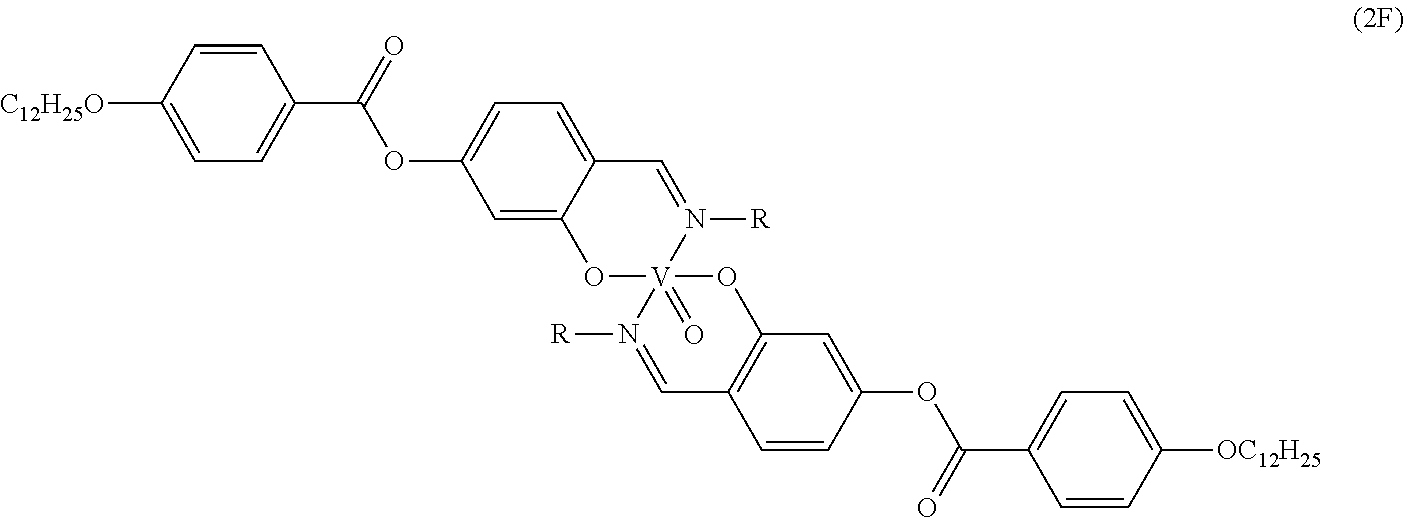
- n is defined above, and M′ is oxyvanadium and platinum. See Sadashiva, et al., Abstract, International LCC, Pisa, Italy, 1992, A-P16, p. 38.
- R is organo such as aryl, alkyl, alkoxyaryl and the like, and n is defined above. Mis defined above, and is preferably copper.
- R is alkyl (C 1-20 ))
- m is 1-20
- X is alkyl (C 1-4 ).
- Similar compounds are described by Giroud-Godquin and Maitlis, supra, at pages 395-396, of the formulae:
- M is copper, nickel, vanadyl oxide and palladium and n and m are positive numbers of a value such that the compound is a liquid crystal, M′ is oxyvanadium and platinum, R is aryl, alkyl and alkoxyaryl and X is alkyl.
- Another preferred organometallic liquid crystal compositions useable in the practice of this invention relates to a class of liquid crystal compounds formed by ionic interaction of mesogenic cations with mesogenic anions. Either may contain a metal.
- One type can be represented by the general formula (3): L 2 MX 2 (3) where L represents an organo-nitrogen mesogen, M is defined above, X represents halide. (See Maitliss, et al. WO87/02693, Publ'd: May 7, 1987) Preferred embodiments of compounds (3) are obtained when the metal is palladium or platinum.
- organometallic mesogens suitable in practicing the invention are those represented by the general formulae (4) and (5): LRh(CO) 2 X (4) LAuX (5) where L and X are defined above (see Bruce, et al., J. Chem. Soc, Chem. Comm., 1985, 581; Adams, et al., Liquid Crystal, 1987, 2, 38).
- Suitable ionic mesogens are encompassed by the formulae (6)-(8): [L 2 Ag] + BF 4 ⁇ (6) [L 2 Ag] + Y ⁇ (7) X + Y ⁇ (8) where L is as defined above, Y ⁇ is a mesogenic anion and X + is a mesogenic cation.
- Another class of organometallic mesomorphic compound is represented by the formula (9): [(R 4 COO) 4 M 2 ] (9) where R 4 represents an alkyl or aryl group, for example C 11 H 2 3 and M is as defined above. Methods for making these organometallic mesogens are described by Maitliss, et al. WO87/02693, published May 7, 1987.
- An additional class of preferred organometallic liquid crystal compounds is complexes of the formula:
- R 1-4 are the same or different alkyl (C 1-30 ), alkoxy (C 1-30 ), aryloxy or cyano groups, and M is described above. A description of these compounds is set forth in, Chemical Abstracts, 97:6461k and by Giroud-Godquin in French Patent 2,486,946.
- R 1,4 are the same or different alkyl (C 1-14 ), alkoxy (C 1-14 ) or aryl groups
- R 2,3 are hydrogen or the same or different alkyl (C 1-4 ) groups and M is described above where R is alkyl, alkoxy or aryl, R′ is H or alkyl, M is described above, preferably platinum, cobalt or vanadium.
- R 1,4 are the same or different alkyl (C 1-14 ), alkoxy (C 1-14 ) or aryl groups
- R 2,3 are hydrogen or the same or different alkyl (C 1-4 ) groups
- M is described above where R is alkyl, alkoxy or aryl, R′ is H or alkyl, M is described above, preferably platinum, cobalt or vanadium.
- R 1,4 and M are defined above. See Bruce, et al., J. Mater. Chem., 1991, 1 (5), 857-861.
- Another class of desirable organometallic mesogens for use in the practice of the invention disclosed herein has the formula:
- Y is halogen, preferably chlorine
- X is hydrogen, alkyl (C 1-14 ), alkoxy (C 1-14 ), halogen (preferably chlorine, bromine or iodine), cyano, nitro, and the like
- X′ is alkyl (C 1-14 ) or alkoxy (C 1-14 ).
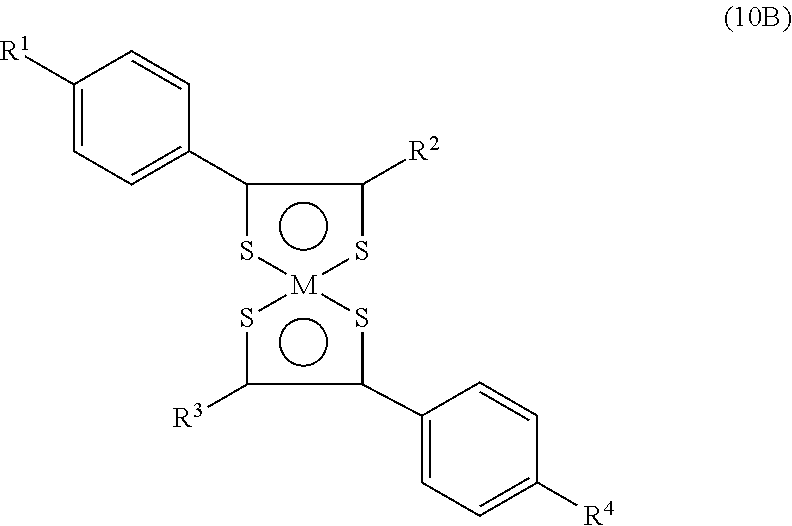
- benzenedithiol metal complex of the formula which can act as IR-absorptive structures:
- M is Ni, Pd or Pt
- X is Cl or Br
- X ⁇ and X 2 are H or Cl when X is Cl and H ⁇ or Br when X is Br
- R is C 1-14 alkyl.
- n and m are whole numbers having a value of 1-20.
- MOMs copper complexes of phenacyl pyridines having the formula:
- R and R 1 may be the same or different, and each of R and R 1 may be H, —OC 8 H 17 , or —OC 6 H 13 .
- the resultant copper (II) complex is Copper (II) 2 (phenacyl pyridine).
- the resultant complex is Copper (II) 2-phenacyl-5-octyloxypyridine.
- the resultant complex is Copper (II) 2-(4-octyloxyphenacyl)-5-octyloxypyridine.
- the resultant complex is Copper (II) 2-(4-hexyloxyphenacyl)-5-hexyloxypyridine.
- Mixtures of these copper complexes of phenacyl pyridines may be prepared for use in the polymer dispersed liquid crystal composites of the present invention.
- the mixtures may comprise up to 100% of the liquid crystal discontinuous phase of the polymer dispersed liquid crystal composite, such mixtures containing no non-metallic organo liquid crystal.
- Mixtures of these copper complexes may also be prepared which include non-copper complexed ligands. The presence of the non-complexed ligands in such mixtures increases markedly the solubility of the copper complexes.
- the copper complex/ligand mixtures may comprise up to 100% of the discontinuous liquid crystal phase of the polymer composites of the present invention. Eutectic mixtures of these complexes may be prepared (see Example 21).
- MOMs suitable for use in the polymer dispersed liquid crystal composite of the present invention are these of Cholesteric (chiral nematics) where the aliphatic group(s) of the chemical structures contain one or more asymmetric carbons.
- the existence of a chiral group in the nematic forming compounds can result in a helicoidal structure in the mesophase.
- This helicoidal long range effect is identified with a twist or “pitch” factor, which can be measured optically or spectroscopically. If the “pitch” of the cholesteric structure falls within the visible range of the wavelength of light, it reflects the color associated with the “pitch” length, and the phase will be colored.
- the “pitch” is affected by a number of factors; mostly the “concentration” and the temperature. Addition of cither cholesteric (chiral nematic) MOMs, their ligands or other non-mesogenic solutes with chiral group to a nematic liquid crystal compound or mixture (including nematic MOMs) may create a “cholesteric” phase with a reflective color associated with the “pitch” of the cholesteric mixtures.
- cholesteric MOMs can provide the possibility of color matching in the mixtures of MOMs or with liquid crystals, where the “absorption” colors due to the metal-complex can be combined and/or matched with that of the “reflection” colors due to cholesteric pitch for a vast range of application in liquid crystal display technology.
- Descriptions of such cholesteric/chiral nematic MOMs may be found in M. Ghedini et al., Liq. Cryst., Vol. 15, 33 1 (1993); and M. Ghedini et al., Chem. Mater. 5, 883 (1993).
- Such cholesteric/chiral nematic compounds may be compounds of the following formulae:
- metal-organic liquid crystal compounds suitable for use in the present invention include compounds of the formulae:
- CuLCl may be synthesized as follows. 3.92 g of the following compound,
- Another metal-organic mesogen suitable for use in the polymer dispersed liquid crystal composites of the present invention includes compounds having the formula:
- the invention also contemplates the use of polymeric forms of the aforementioned types of MOMs, such as characterized by Giroud-Godquin and Maitlis, supra, at page 396 (section 7.3).
- the difference in physical properties of the MOMs as compared to the non-metal containing liquid crystal traditionally used in polymer dispersed liquid crystal composites provides a mechanism of control over the kinetics of phase separation and resin curing to vary and particularly to improve the contrast ratio (transparency/opacity) of polymer dispersed liquid crystal films by controlling (i) the solubility of liquid crystal in the resin, (ii) the rate of droplet formation, (iii) controlling the rate of polymer solidification, and (iv) controlling the liquid crystal droplet morphology (size, density). This is especially the case where MOMs are used in conjunction with conventional, non-metallic liquid crystals in the polymer dispersed liquid crystal composite.
- the organometallic liquid crystal is used in combination with another compatible liquid crystal composition that is non-metallic.
- these other liquid crystals are of the nematic form or operationally nematic which means that, in the absence of external fields, structural distortion of the liquid crystal is dominated by the orientation of the liquid crystal at its boundaries rather than by bulk effects, such as very strong twists (as in cholesteric material) or layering (as in smectic material).
- a liquid crystal material including chiral ingredients which induce a tendency to twist but which cannot overcome the effects of the boundary alignment of the liquid crystal material would be considered to be operationally nematic. More preferably, they also have a positive dielectric anisotropy.
- the organometallic liquid crystal comprises 100% of the liquid crystal discontinuous phase.
- mixtures of compatible organometallic liquid crystals are employed. Such mixtures may be eutectic mixtures of organometallic liquid crystals.
- mixtures (including eutectic mixtures) of organometallic liquid crystals and their ligands are employed. The inclusion of the ligands of the organometallic liquid crystals in mixtures of the organometallic liquid crystals may improve the solubility of the organometallic liquid crystals.
- the organometallic liquid crystals should be compatible with the non-organometallic liquid crystals.
- the organometallic liquid crystals should be soluble in the non-organometallic liquid crystals.
- the combination of the metallo organic mesogens and the conventional liquid crystals generally form a eutectic melting mixture. This is noted by the increase of the liquid crystal mixture's increase in T ni .
- Suitable nematic liquid crystals in compositions typically contain a linear chain of at least one, preferably at least two, aromatic group preferably phenylene or heterocyclic aromatic groups, connected to a linking group such as a covalent bond, a carbonyloxy group, a vinylene group (—CH ⁇ CH—), a carbonylimino group, an ethynylene group (—C ⁇ C—), an azomethine group (—CH—N—), an azo group (—N ⁇ N—), an azoxy group, and the like.
- Preferred non-metallic liquid crystals comprise cyanobiphenyls, and may be mixed with cyanoterphenyls and with various esters.
- Typical organic classes of liquid crystal forming materials contemplated comprise both aromatic and aliphatic organic compounds such as benzylideneanilines generally prepared from the reaction of para-substituted benzaldehyde and parasubstituted aniline; N-(p-alkoxybenzylidene)-p-aminostyrenes prepared from the reaction of the appropriate aldehyde with p-aminostyrene; derivatives of beta sitosterol; active amyl ester of cyano benzylidene amino-cinnamate; p-phenylene containing compounds such as p-phenylene p-alkoxybenzoates; aminoacetophenones; aminopropiophenones; phenylenediamines; chlorophenylenediamines; terephthals; p,p′-disubstituted bibenzyls; p,p′-disubstituted stilbenes; p,p′-disubsti
- liquid-crystal compounds include ethyl p-4-ethoxy-benzylideneaminocinnamate; p,p′-azoxybenzoic acid diethyl ester; N-(p-methoxybenzylidene)-p-aminostyrene; N-(p-butoxybenzylidene)-p-aminostyrene; p-azoxyanisole; p-hexyloxybenzalazine; p-azoxy-phenetole; p-anisylidene-p-biphenylamine; p-ethoxy-benzylindene-p-biphenylamine; p-anisylidene-p-aminophenyl acetate; p-ethoxybenzylidene-p-aminophenyl acetate; p-n-hexyloxybenzylidene-p-aminophenyl acetate; p-n-he
- Nematic liquid crystalline materials suitable for use with the organometallic liquid crystals include: p-azoxyanisole, p-azoxyphenetole, p-butoxybenzoic acid, p-methoxy-cinnamic acid, butyl-p-anisylidene-p-aminocinnamate, anisylidene p-amino-phenylacetate, p-ethoxy-benzalamino- ⁇ -methyl-cinnamic acid, 1,4-bis (p-ethoxybenzylidene) cyclohexanone, 4,4′-dihexyloxybenzene, 4,4′-diheptyloxybenzene, anisal-p-aminoazo-benzene, anisaldazine, ⁇ -benzene-azo-(anisal- ⁇ ′-naphthylamine), n,n′-nonoxybenzetoluidine; anilines of the generic group (p
- Conjugated cyano-organic compounds that are useful are 7, 7′, 8, 8′-tetracyanoquinodimethane (TCNQ), (2,4, 7,-trinitro-9-fluorenylidene)-malono-nitrile (TFM), p-[N-(p′-methoxybenzylidene) amino]-n-butylbenzene (MBBA), p-[N-(p′-ethoxybenzylidene) amino]-butylbenzene (EBBA), p-[N-(p′-methoxybenzylidene) amino]phenylbutyrate-n-butyl-p-(p′-4-nonyloxybenzylidene-4′-aminopropiophenone; ethoxyphenoxycarbonyl) phenylcarbonate, p-methoxy-p′-n-butylazoxybenzene, p-ethoxy-p′-n-butylazobenzene,
- Desirable nematic liquid crystals frequently comprise cyanobiphenyls, and may be mixed with cyanoterphenyls and with various esters.
- nematic type liquid crystal mixtures such as liquid crystal mixture “E7” (Licrilite® BL001 from E. Merck, Darmstadt, Germany, or its subsidiaries such as EM Industries, Hawthorne, N.Y.
- E-31 is a proprietary mixture of cyanobiphenyls and a non-cyano biphenyl ester available from E. Merck, supra, and having a crystal to nematic crystal phase transition temperature of ⁇ 9° C. and a liquid crystal to isotropic phase transition temperature of 61.5° C.
- E-44 is a proprietary mixture of cyanobiphenyls, a cyanoterphenyl and a non-cyano biphenyl ester available from E. Merck, supra, and having a crystal to nematic liquid crystal phase transition temperature of ⁇ 60° C. and a liquid crystal to isotropic phase transition temperature of 100° C. E63, from E.
- K-12 is 4-cyano-4′-butylbiphenyl and has a crystal to nematic liquid crystal phase transition temperature of 48° C.
- K-18 is 4-cyano-4′-hexylbiphenyl and has a crystal to nematic liquid crystal phase transition temperature of 14.5° C. and a liquid crystal to isotropic phase transition temperature of 29° C.
- K-21 is 4-cyano-4′-heptylbiphenyl and has a crystal to nematic liquid crystal phase transition temperature of 30° C.
- K-24 is 4-cyano-4′-octylbiphenyl and has a crystal to smectic A liquid crystal phase transition temperature of 21.5° C., a smectic C to nematic liquid crystal phase transition temperature of 33.5° C. and a nematic liquid crystal to isotropic phase transition temperature of 40.5° C.
- M-15 is 4-cyano-4′-pentoxybiphenyl and has a crystal to nematic liquid crystal phase transition temperature of 48° C. and a liquid crystal to isotropic phase transition temperature of 68° C.
- M-18 is 4-cyano-4′-hexoxybiphenyl and has a crystal to nematic liquid crystal phase transition temperature of 57° C.
- M-24 is 4-cyano-4′-octoxybiphenyl and has a crystal to smectic A liquid crystal phase transition temperature of 54.5° C., a smectic A to nematic liquid crystal phase transition temperature of 67.0° C. and a nematic to isotropic phase transition temperature of 80.0° C.
- Licrilite® liquid crystal mixtures include BL003, BL004, BL009, BL011, BL012, BL032, BL036, BL037, BL045, BL046, ML-1001, ML-1002, as well as TL202, TL203, TL204 and TL205, all obtainable from E. Merck, supra.
- TOTN404 available from Hoffman-LaRoche, Basel, Switzerland and Nutley, N.J., is a liquid crystal mixture similar to E7 but with added pyrimidines. It contains approximately 30 weight percent of 4-carbonitrile,4′-pentyloxy-1,1-biphenyl commonly known as 50CB, 15 weight percent of 4-carbonitrile,4′-octyloxy-1, 1-Biphenyl, commonly known as 80CB, 10 weight percent of 4-carbonitrile-4′′-pentyl-1, 1′, 4′, 1′′-terphenyl, commonly known as 5CT, 10 weight percent of 4-(5-pentyl-2-pyrimidimyl)-benzonitrile, commonly known as RO-CP-7035, 20 weight percent of 4-(5-heptyl-2-pyrimidimyl)-benzonitrile, commonly known as RO-CP-7037, and 15 weight percent of 4-[5-(4-butylphenyl)-2-pyrimidinyl] benzonit
- ROTN-570 available from Hoffman-LaRoche is a cyanobiphenyl liquid crystal mixture comprises 51 weight percent of 4-cyano-4′-pentyiuiphenyl, 25 weight percent of 4-cyano-4′-heptylbiphenyl, 16 weight percent of 4-cyano-4′-octyloxybiphenyl, and 8 weight percent of 4-cyano-4′-pentyl-p-terphenyl.
- Another desirable liquid crystal mixture from Hoffman-LaRoche is TNO623.
- the invention encompasses non-homogeneous mixtures of the metallo organic mesogen and the conventional liquid crystals (the non-organometallic liquid crystals). This is accomplished by keeping the different liquid crystals in separate phases. Such phase distinction can be effected by encapsulating either or both of the types of liquid crystals (organometallic liquid crystals vs. non-organometallic liquid crystals) in a polymeric medium. A convenient way of doing this is to encapsulate the liquid crystals, one type or the other, or both types, by NCAP techniques, such as those described above.
- the NCAP′d liquid crystals can be mixed with the non-encapsulated liquid crystals and the combination, or the NCAP′d mixture alone, can be conventionally polymer dispersed.
- metallo-organic mesogen dye formulas are:
- the metal-organic mesogens have been modified by the addition of chromophore groups, thus providing a dichroic dye composition comprising metallomesogen (MOM) molecules.
- MOM metallomesogen
- This composition is added to liquid crystal devices, thereby providing a film with the following properties: switchable UV and IR transmittance and absorption.
- the chromophore groups absorb certain wavelengths of and transmit or reflect others.
- the chromophore groups have two molecular orbitals differing from each other by photon energy within the range of the UV-visible-near IR spectrum.
- an ionic mesogen or mixture of ionic mesogens is incorporated into the LC/polymer layer of the device as an ionic dopant.
- the concentration of ionic mesogen is 1-10% (w/w relative to the weight of the LC+polymer in the layer).
- the ionic mesogen or mixture comprises ionic MOMs. Any ionic mesogen, particularly ionic metal-organic mesogen that is suitable for use as an ionic dopant in an LC device may be used.
- the inventors have found that while metal-organic mesogens tend to be only sparingly soluble in the polymer/LC device such as a PDLC, PNLC, or PSLC, eutectic mixtures of MOMs tend to be much more soluble.
- the ionic mesogens used as the ionic dopant comprise a eutectic mixture of MOMs.
- Ionic MOMs characterized by the general formula L 2 Ag + .
- Neve Nave, F. Adv. Mater. 1996, 8, 277
- L 2 Ag + MOMs L 2 Ag + MOMs
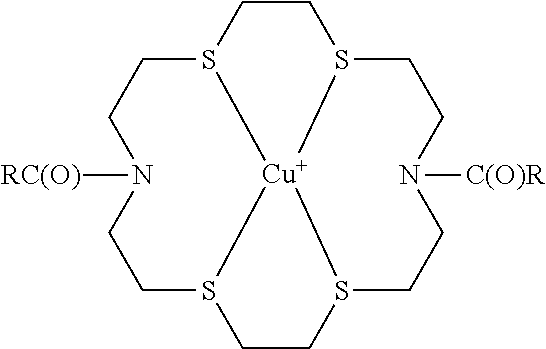
- Examples include complexes of transition metal cations such as Cu + , Ag + , and Pd 2+ complexed to macrocyclic ligands such as N 2 S 4 macrocycles and thioether crowns.
- Typical structures include the following:
- n 6, 10, 11, or 12.
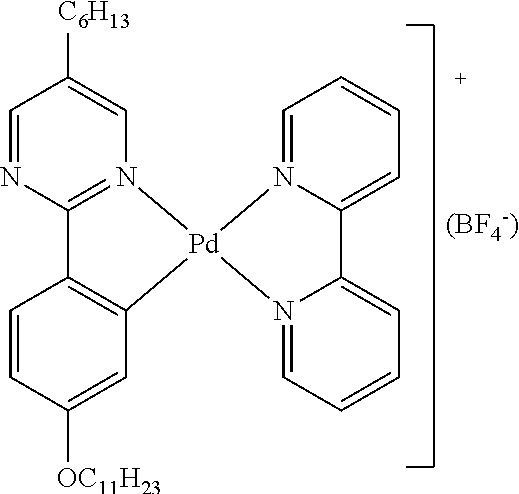
- Neve also discloses ionic MOMs in which a transition metal is complexed to pyridynyl-type ligands, such as is found in the following complex:
- Neve further discloses a series of anionic MOMs that contain a vanadyl moiety. These MOMs have the following structure:
- MOMs in this family include complexes of the form R 1 ⁇ R 2 ⁇ C 18 H 37 ; R 1 ⁇ R 2 ⁇ C 10 H 21 ; R 1 ⁇ CH 3 , R 2 ⁇ C 12 H 25 ; and R 1 ⁇ CH 3 , R 2 ⁇ C 16 H 33 .
- thermotropic ionic liquid crystals (Axenov, K. V.; Laschat, S. Materials 2011, 4, 206).
- a bistable switchable nematic liquid crystal device such as may be used in a window type of application, is disclosed that can be switched between a transparent state and a light scattered state by a voltage pulse and/or frequency. No further amount of voltage to the device is required in order to maintain either the transparent state or the light scattering state. Therefore, the device is energy-saving and efficient and effective in use.
- the device includes structures that are electrically switched between an opaque state and a transparent state.
- the liquid crystal molecules scatter light because nematic molecules are randomly oriented and is known as random micro-domain state.
- the liquid crystal molecules are aligned perpendicular to the substrate. No reflecting or scattering of light in the visible spectrum occurs. This is known as homeotropic state or texture.
- a prior art liquid crystal device is shown in FIG. 1 .
- the liquid crystal molecules are switched from the random micro-domains texture to homeotropic texture by applying an electric field to the liquid crystal molecules.
- the homeotropic structure could be stable or metastable and could return to random opaque state when the electric field is removed.
- an electric pulse or/and frequency to the liquid crystal molecules in the homeotropic texture, the liquid crystal molecules are switched back to the random micro-domains texture.
- the electro-optical structure 200 generally comprises a liquid crystal dispersion material 23 interposed between a pair of optically-transparent electrically-conductive layers 22 and 22 ′ supported upon a pair of spaced-apart transparent substrates 21 and 21 ′, each substrate having an interior and exterior surface, respectively, the perimeter edges of which are sealed, and across which a voltage 24 is applied under the control of a microcontroller (not shown).
- transparent means that the film does not absorb a significant amount visible radiation and does not reflect a significant amount of visible radiation, rather, it is transparent to visible radiation.
- the liquid crystal material 23 further comprises the liquid crystal dispersions 23 a and the ionic mesogens 23 b .
- the ionic mesogens are ionic MOMs; in especially preferred embodiments of the invention, the ionic mesogens comprise a eutectic mixture.
- the ionic mesogens act as ionic dopants, and in cases in which the MOMs comprise chromophoric groups, they can act as dyes as well.
- the transparent electrically conductive layers 22 and 22 ′ may comprise indium tin oxide (ITO), silver, zinc oxide or other optically transparent conductive polymer or like film coating.
- Chemical vacuum deposition, evaporation, sputtering, or other suitable coating techniques may be used for applying the conductive layers 22 and 22 ′ to the transparent substrates 21 and 21 ′. In some examples, providing a conductive layer on at least one of the substrates may be sufficient.
- Examples of transparent substrates 21 and 21 ′ include polymer films.
- the polymer films include films made of polyolefin, polyester, polyvinyl chloride, polyvinyl fluoride, polyvinylidene difluoride, polyvinylidene chloride, polyacrylate, polycarbonate, polyurethane, etc., and combinations thereof.
- the flexible films comprise PET films.
- the transparent substrates 21 and 21 ′ may also include glass panels and rigid polymeric films, such as polycarbonate, plexiglass, etc.
- a voltage source 24 is shown connected to the conductive layers in order to switch the liquid crystal dispersion layer between different optical states by application of an electric field pulse and/or frequency.
- the voltage source may be an AC voltage source or a DC-AC inverter and a battery.
- the switching power may be supplied by a photovoltaic device that converts solar power to electrical power.
- the liquid crystal material 23 comprises nematic liquid crystals.
- the liquid crystal material may also include a polymer matrix formed from at least one polymerizable monomer and a photo-initiator.
- the polymer matrix stabilizes or supports the nematic liquid crystals. Due to strong anchoring of nematic molecules, the polymer matrix facilitates to maintain the stability of both light transmitting and light scattering states without a field applied after switching between the states.
- the characteristics relate to forming polymer networks where micro-domains of liquid crystal material are dispersed between the networks or into micro-droplet domains. The micro-domains liquid crystals tend to be aligned with the polymer networks through strong surface molecular anchoring, extending between the substrates 21 and 21 ′ as shown.
- the liquid crystal material 23 comprises a polymer matrix having nematic liquid crystals stabilized or supported therein.
- the polymer matrix is generally formed by polymerization or crosslinking of at least one polymerizable monomer or crosslinkable polymer with non-reactive nematic liquid crystals, and a chiral additive. Polymerization of the liquid crystal mixture is initialized in any suitable manner, as by UV radiation, heating, cooling or solvent evaporation, depending upon the polymer used.
- the smectic-A liquid crystal phase is a material with molecular layered structure, in which the rod-shaped molecules are aligned normal to the layer planes, having a well-defined interlayer distance.
- all smectics are more ordered and viscous than nematic LCs and, in some thermotropic LCs, the smectic phases occur below the nematic phase in the phase diagram.
- the well-known structural defects in smectic-A are called “focal conic” domains (FCDs). These defects are energetically very stable defects. Therefore, once FCDs and aligned state are formed they can preserve their static defect structures indefinitely until thermal energy or electromagnetic fields are applied.
- This state of smectic-A is also known as the light scattering or the opaque state.
- the other optically stable state of the Sm-A is the transparent state, in which the unperturbed smectic layers are uniformly parallel to the substrate surfaces.
- the nucleation of FCDs from the transparent state is highly hindered by the high-energy barrier.
- surface alignment layers or bulk irregularities were used to nucleate FCD defects, the reversible bi-stability was not reported in these studies.
- bistable Sm-A structures require greater energy input to create changes in the molecular order.
- high transparency in homeotropic state and higher scattering density in the focal-conic texture in opaque state are far better than a cholesteric phase.
- higher-resolution bistable devices have been designed by using the Sm-A phase of LCs.
- the inherent bistability in smectic-A displays can potentially provide excellent viewing angle characteristics, sunlight readability, and low power consumption at both of the stable states.
- reversible and controlled switching between two optically stable states of smectic-A liquid crystals have been explored in several ways to realize a Sm-A based bistable LC devices.
- the bistable liquid crystal film is composed by smectic liquid crystal that preserves their orientation after an electrical impulse has been applied.
- bistable switchable liquid crystal window as described herein will carry out the objects set forth hereinabove. It is, therefore, to be understood that any variations evident fall within the scope of the claimed invention and thus, the selection of specific component elements can be determined without departing from the spirit of the invention herein disclosed and described.
- This invention can be used in a wide variety of applications including, but not limited to: advertising, store windows, blinds, decorative glass, and architectural and automotive display, privacy and solar windows.
- the process for manufacture of the bistable switchable liquid crystal device disclosed herein comprises as its first step providing two transparent substrates each of which is coated with a transparent conductive layer.
- the transparent substrates are separated by spacers that create a volume therebetween.
- a dispersion comprising at least one liquid crystal, a polymerizable monomer, and an ionic dopant that comprises at least one ionic mesogen is then deposited into the volume between the substrates.
- the ionic mesogen is an ionic MOM or eutectic mixture of MOMs.
- the perimeter of the transparent substrates is sealed in order to contain the dispersion.
- the dispersion is then cured in order to polymerize the monomer.
- the polymer matrix is formed by preparing a mixture containing one or more crosslinkable monomers, one or more preferably non-crosslinkable liquid crystals (which may be nematic, smectic, or cholesteric) and one or more ionic mesogen dopants, and then crosslinking the monomers to form a liquid crystal matrix.
- the ionic mesogens are preferably chiral.
- a liquid crystal polymer stabilized cholesteric texture is formed when a small amount of a UV crosslinkable polymer in its liquid crystal phase and a photo-initiator are mixed with a cholesteric liquid crystal and/or a mixture of nematic or smectic liquid crystals with a chiral dopant the pitch of which is tuned to the UV, visible or infrared region.
- the crosslinkable monomer concentration is typically greater than about 5.0% by weight of the total liquid crystal mixture.
- the mixture is then cured by exposure to UV light, electron beam radiation, heating, cooling or solvent evaporation, depending upon the polymer used, while an electric field, a magnetic field or surface alignment is applied to align the liquid crystal molecules in either homeotropic (perpendicular) or homogeneous (planar) alignments, or forming the poly-domain structure of focal conic alignment in the absence of external fields. With the field applied during curing, the liquid crystal molecules are aligned in a planar texture (transparent) after the curing.
- Particularly useful polymerizable materials include acrylate and methacrylate monomers.
- suitable photo-polymerizable monomers include acrylic acid and methacrylic acid, esters thereof, each of which contains an alkyl group, an aryl group, or a cyclo-alkyl group including three or more carbon atoms, and halides thereof.
- photo-curable monomers are, for example, isobutyl acrylate, stearyl acrylate, lauryl acrylate, isoamyl acrylate, 2-ethylhexyl acrylate, n-butyl methacrylate, n-lauryl methacrylate, tri-decyl methacrylate; n-stearyl methacrylate, n-cyclohexyl methacrylate, benzyl methacrylate, isobornyl methacrylate, 2-phenoxyethyl methacrylate, 2,2,3,4,4,4-hexafluorobutyl methacrylate, 2,2,3,4,4,4-hexachlorobutyl methacrylate, 2,2,3,3-tetrachloropropyl methacrylate, 2,2,3,3-tetrachloropropyl methacrylate, perfluorooctylethyl methacrylate, perfluorooctylethyl
- Polyfunctional compounds may also be used.
- Polyfunctional compounds are, for example, ethylene glycol dimethacrylate, bisphenol-A diacrylate, bisphenol-A dimethacrylate, 1,4-butanediol dimethacrylate, 1,6-hexanediol dimethacrylate, trimethylolpropane triacrylate, and tetramethylolmethane tetraacrylate.
- Other monomers include mono-functional monomer and bi-functional monomer LCI-KSU (Liquid Crystal Institute, Kent State University, USA). Such monomers and polyfunctional compounds may be used independently or in a combination of two or more.
- Useful photo-initiators include benzoin methyl ether, as well as other photo-initiators known to those in art.
- transparent substrates 21 and 21 ′ are coated with ITO and heated to remove moisture.
- the liquid crystal-monomer-mesogen mixture is then deposited onto at least one of the substrates.
- the second transparent substrate is contacted with the first substrate so that the liquid crystal-monomer mixture contacts conductive layer 22 and/or 22 ′ on each of transparent substrate 21 and 21 ′.
- the liquid crystal material can be coated onto the conductive film by any known method suitable for coating liquid materials.
- the liquid crystal-monomer mixture may be applied to the conductive film by in-situ coating-lamination, gravure coating, curtain coating, dip-coating, die-extrusion coating, printing and screen printing.
- the matrix 23 is prepared by polymerizing the reactive monomer either in zero electric field or in an electric field effective to align the liquid crystal pitch axis (e.g. the liquid crystal helix pitch axis of cholesteric liquid crystals).
- matrix 23 is prepared by mixing a liquid crystal with an amount of a reactive monomer. Next, a thin film of the mixture is placed between a pair of conducting layers, wherein the monomer is then allowed to react while an applied electric field is supplied.
- the transparent state is the perpendicular state where the smectic-A liquid crystal molecules are aligned perpendicular to cell surface direction (“parallel smectic-A layer”), as shown in FIG. 3 .
- the scattering (opaque) state is the focal conic state where the randomly oriented liquid crystal exists in polymer domains, as also shown in FIG. 3 . With proper polymer networks, both perpendicular and focal conic states are stabilized at zero field.
- the liquid crystal material exhibits a focal conic texture and becomes opaque by an Electro Hydro Dynamic Instability (EHDI) mechanism in the presence of a low frequency (100 Hz) AC electric field pulse.
- EHDI Electro Hydro Dynamic Instability
- the smectic-A liquid crystal texture tends to align in the direction of the electric field and becomes transparent. Therefore, application or removal of an electric field switches the bistable smectic-A polymer stabilized liquid crystal (PSLC) device disclosed herein from the scattering state to the transparent state or vice-versa via a zero-field mechanism.
- PSLC bistable smectic-A polymer stabilized liquid crystal
- the transparent state is the planar state where the liquid crystal molecules are aligned parallel to cell surface direction (perpendicular helix pitch axis), as shown in FIG. 3 .
- the scattering (opaque) state is the focal conic state where the liquid crystal exists in randomly oriented polymer domains, as also shown in FIG. 3 . With proper polymer networks, both planar and focal conic states are stabilized at zero field.
- the nematic or cholesteric liquid crystal materials used can also exhibit dual dielectric anisotropies, whereby when a low-frequency ( ⁇ 100 Hz) AC electric field is applied, the molecular dielectric anisotropy is positive and the cholesteric or nematic liquid crystal texture tends to align in the direction of the electric field. In contrast, when exposed to a high frequency AC electric field (10 kHz or higher), the nematic or cholesteric liquid crystal molecules exhibit negative dielectric anisotropy and tend to align perpendicular to the applied field. Therefore, application or removal of the electric field switches the bistable polymer stabilized cholesteric texture (PSCT) from the scattering (opaque) state to the transparent state or vice-versa via a zero-field mechanism.
- PSCT bistable polymer stabilized cholesteric texture
- the liquid crystal and pre-polymer mixture is then introduced into a 10-30 micron thickness film that includes two parallel flexible films substrates with ITO electrodes.
- the mixture in the cell is cured under UV irradiation or electron beam to form the bistable switchable liquid crystal film device.
- the combination of metallomesogens and/or ligand and metallomesogen, as well as their eutectic mixtures in the bistable LC dispersion provide an improvement in the electrooptics of the device.
- V fc the voltage needed to activate the focal conic state
- the voltage needed decreases from 18V (of the ligand alone) to 12V (of the compound at 10%)
- the voltage needed decreases from 33V (of the ligand alone) to 26V (of the compound at 10%).
- the solubility of the metallomesogen materials is exhibited either nematic, cholesteric or smectic mesophases.
- the mixtures show large mesomorphic range and lower transition temperatures than those of the single-components metallomesogens. In most cases, the materials do not crystallize upon super-cooling or quenching and maintained their mesomorphism even below 0° C.
- Eutectic mixtures of metallomesogens homologues per se and metallomesogens homologues, also with their parent ligands in the bistable LC dispersion are in the scope of the present invention.
- Metallomesogen-chromophore compositions in particular, eutectic mixtures thereof, are generally highly soluble (>5% w/w) in liquid crystal hosts. These highly soluble eutectic dye mixtures can be used in manufacturing highly stable colored switchable glazing and displays.
- the metallomesogen-chromophore compositions can provide a mesogenic phase in wide temperature range which is very important for exploiting switching bistable polymer dispersed liquid crystal devices in different climatic zones.
- a black color of the bipolar polymer dispersed liquid crystal film can be achieved both a single dye and by means of additive synthesis of RGB dye components.
- High absorption in the UV and near IR spectral ranges provided by both metallomesogen metal complexation and chromophore compositions is characterized by a combination of strong metal complex bond and strong chomophore absorption wavelengths.
- MOM-chromophore compositions described herein can be added to liquid crystal guest host solutions used in LCD devices.
- Large area smart polymer dispersed film or glasses can be used as switchable windows in architecture and automotive industry.
- the bistable LC dispersion device can be enclosed between two glasses or may be retrofitted on existing interior and exterior architectural glazing, automotive windows, and other interior glazing.
- a transparent adhesive may be used to stick the panel to the window, which may be integrated with the panel or separately provided.
- the panel may also be applied to original windows before installation.
- ionic mesogens preferably ionic MOMs, and/or eutectic mixtures thereof are incorporated into the LC layer as ionic dopants.
- Ionic mesogens and eutectic mixtures thereof have several advantages over the ionic dopants used in similar devices known in the art.
- LC devices disclosed herein can incorporate as the ionic dopant up to 10% ionic mesogen (w/w relative to the weight of the weight of the LC dispersion).
- This concentration is approximately an order of magnitude greater than that in LC devices known in the art, in which the ionic dopant is typically a long-chain ammonium salt, the concentration of which is generally limited to ⁇ 1% (w/w) of the layer comprising the LC dispersion, and is more typically on the order of 0.1%-0.5%; see, for example, Coates, D.; Devey, A. B.; Walker, C. J., Proc. Eurodisplay London, 1987, 96, and Büyüktanir, E. A., Electro-Optical Characterization of Bistable Smectic A Liquid Crystal Displays. Ph. D. Thesis, Kent State University: Kent, Ohio, 2008, pp. 58-63.
- ionic mesogens improve the thermal stability and increase the mesogenic range of the smectic phase in a bistable device.
- the LC device that incorporates them will have a higher opacity in the opaque state than a similar device that incorporates an ionic dopant of a type known in the art.
- the ionic mesogen molecules can insert themselves into the smectic layers of the LC device, in contrast to ionic dopants known in the art, the transparency of the transparent state will be higher in an LC device disclosed herein than in similar devices known in the art. The improvement in the optical qualities in both states of the LC device thus yields a superior device for such uses as “smart windows.”
- MOMs typically incorporate chromophoric groups and are generally in the form of transition metal complexes with low-lying electronic transitions
- MOMs typically have strong absorptions in particular bands in the visible spectrum. Ionic MOMs can therefore be used not only as ionic dopants, but as dyes as well, and by proper choice of the MOM, both the color and the intensity of the color of the LC device in the opaque state can readily be controlled.
- the film is provided with a unique controller.
- the controller is connected to a system or device such as a Smart home system, a wireless device, a PC, etc.
Landscapes
- Physics & Mathematics (AREA)
- Chemical & Material Sciences (AREA)
- Nonlinear Science (AREA)
- Crystallography & Structural Chemistry (AREA)
- General Physics & Mathematics (AREA)
- Optics & Photonics (AREA)
- Engineering & Computer Science (AREA)
- Materials Engineering (AREA)
- Organic Chemistry (AREA)
- Mathematical Physics (AREA)
- Dispersion Chemistry (AREA)
- Liquid Crystal Substances (AREA)
Abstract
Description
-
- providing two transparent flexible substrates, each of which is coated with a transparent conductive layer;
- placing said two transparent flexible substrates opposite one another;
- optionally, separating said two transparent flexible substrates, thereby creating a volume therebetween;
- preparing a dispersion comprising at least one liquid crystal material, a monomer that is polymerizable on irradiation or heating, and at least one ionic mesogen;
- introducing said dispersion between said substrates; and,
- polymerizing said polymerizable monomer in the presence of an external electric field, thereby forming a polymer matrix.
R1—R2—R3 (1)
where R1 and R3 are the same or different moieties, each of which provides at least one covalently joined aromatic group (aromatic groups include the unsaturated heterocyclic structures), and R2 contains a polyvalent metal, bonded to R1 and R3 by covalent, ionic or weaker bonding forces. R2 may contain a ring atom of a saturated structure or an unsaturated heterocyclic structure and thus constitutes part of the aromaticity of the composition.

in which M is copper, nickel, vanadyl oxide and palladium and n and m are positive numbers such that compound (2) is a liquid crystal, and preferably nematogenic. In general, n and m each have a value of 2 to about 15, sufficient that the compound is mesogenic, preferably such that the compound possesses enantiotropic, monotropic, smectic, nematic and/or cholesteric phases. These compositions are described by Caruso, et al., Liquid Crystals, 1990, vol. 7, no. 3, pp. 421-430 and Liquid Crystals, 1991, vol. 10, no. 1, pp. 85-93.

where n is defined above, and M′ is oxyvanadium and platinum. See Sadashiva, et al., Abstract, International LCC, Pisa, Italy, 1992, A-P16, p. 38.
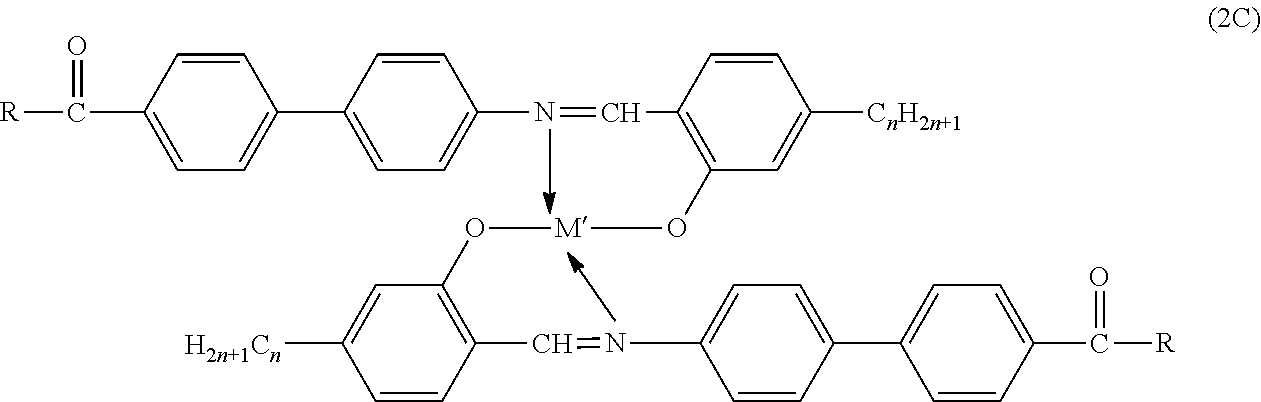
where R is organo such as aryl, alkyl, alkoxyaryl and the like, and n is defined above. Mis defined above, and is preferably copper.


where R is alkyl (C1-20)) m is 1-20, and X is alkyl (C1-4). Similar compounds are described by Giroud-Godquin and Maitlis, supra, at pages 395-396, of the formulae:
and

L2MX2 (3)
where L represents an organo-nitrogen mesogen, M is defined above, X represents halide. (See Maitliss, et al. WO87/02693, Publ'd: May 7, 1987) Preferred embodiments of compounds (3) are obtained when the metal is palladium or platinum. Other organometallic mesogens suitable in practicing the invention are those represented by the general formulae (4) and (5):
LRh(CO)2X (4)
LAuX (5)
where L and X are defined above (see Bruce, et al., J. Chem. Soc, Chem. Comm., 1985, 581; Adams, et al., Liquid Crystal, 1987, 2, 38).
[L2Ag]+BF4 − (6)
[L2Ag]+Y− (7)
X+Y− (8)
where L is as defined above, Y− is a mesogenic anion and X+ is a mesogenic cation. Another class of organometallic mesomorphic compound is represented by the formula (9):
[(R4COO)4M2] (9)
where R4 represents an alkyl or aryl group, for example C11H23 and M is as defined above. Methods for making these organometallic mesogens are described by Maitliss, et al. WO87/02693, published May 7, 1987.
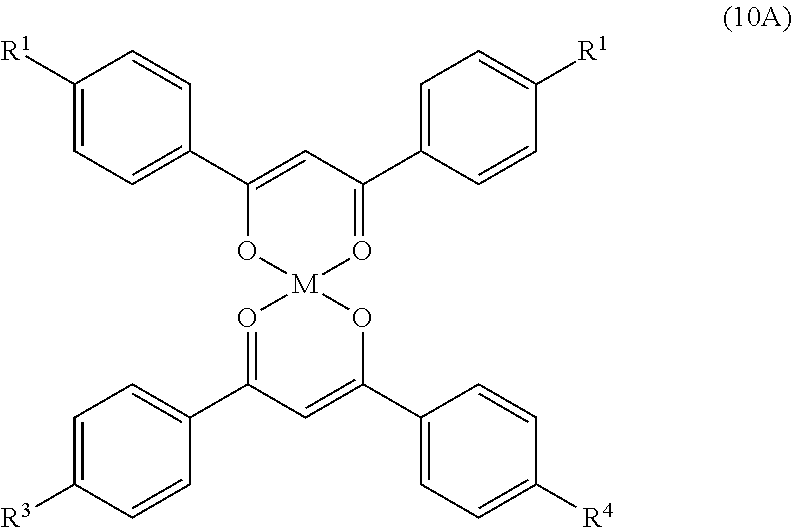
where R1-4 are the same or different alkyl (C1-30), alkoxy (C1-30), aryloxy or cyano groups, and M is described above. A description of these compounds is set forth in, Chemical Abstracts, 97:6461k and by Giroud-Godquin in French Patent 2,486,946.
where R1,4 are the same or different alkyl (C1-14), alkoxy (C1-14) or aryl groups, R2,3 are hydrogen or the same or different alkyl (C1-4) groups and M is described above where R is alkyl, alkoxy or aryl, R′ is H or alkyl, M is described above, preferably platinum, cobalt or vanadium. In that same family of compounds is the mesomorphic transition metal complexes of the formulae:
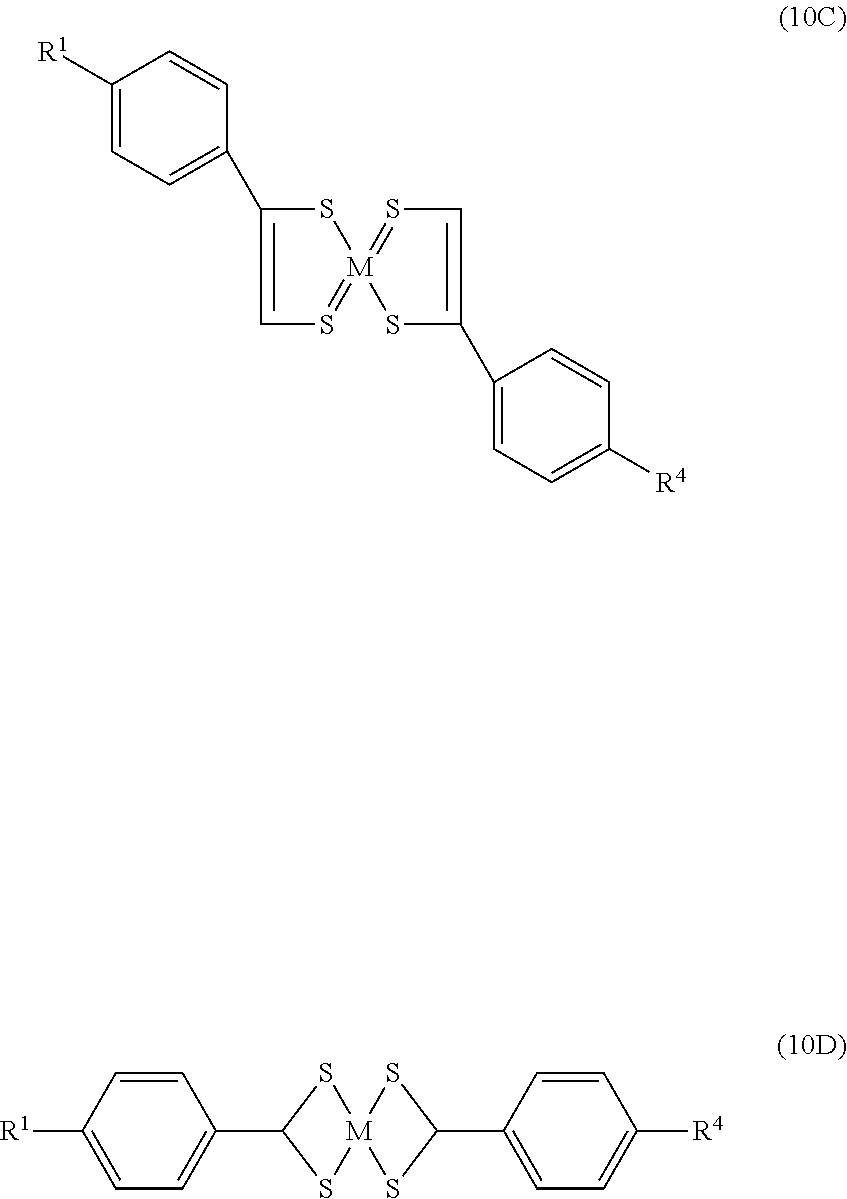
where R1,4 and M are defined above. See Bruce, et al., J. Mater. Chem., 1991, 1 (5), 857-861.
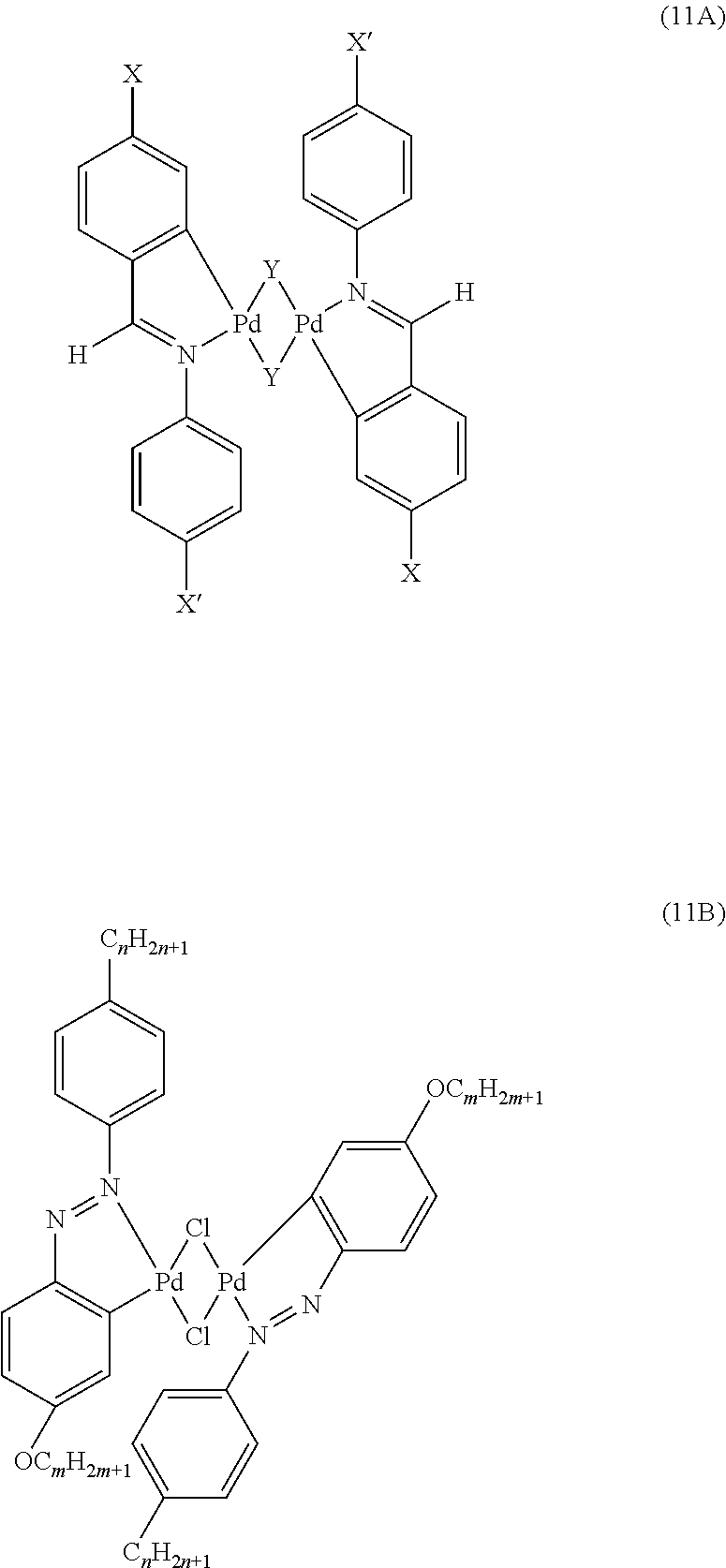
where Y is halogen, preferably chlorine, X is hydrogen, alkyl (C1-14), alkoxy (C1-14), halogen (preferably chlorine, bromine or iodine), cyano, nitro, and the like, and X′ is alkyl (C1-14) or alkoxy (C1-14). These compounds are generally described in Ros, et al., Liquid Crystal, 1991, vol. 9, no. 1, 77-86, and Ghedini, et al., Materials, 1992, 4, pp. 1119-1123.
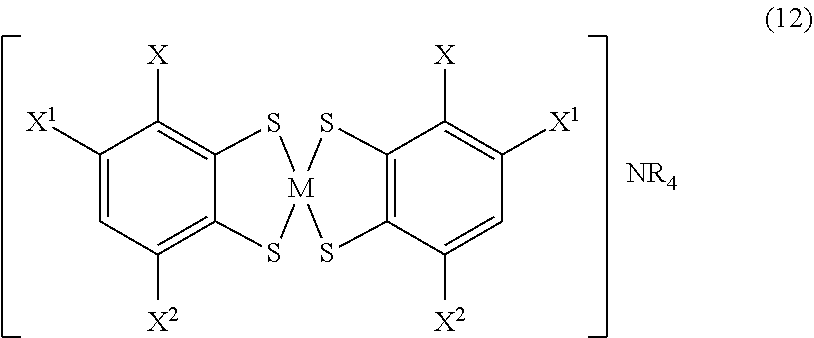
where M is Ni, Pd or Pt, X is Cl or Br, X− and X2 are H or Cl when X is Cl and H· or Br when X is Br, and R is C1-14 alkyl. See Saito, et al., CA, 105: 2168 Hz and U.S. Pat. No. 4,508,655.
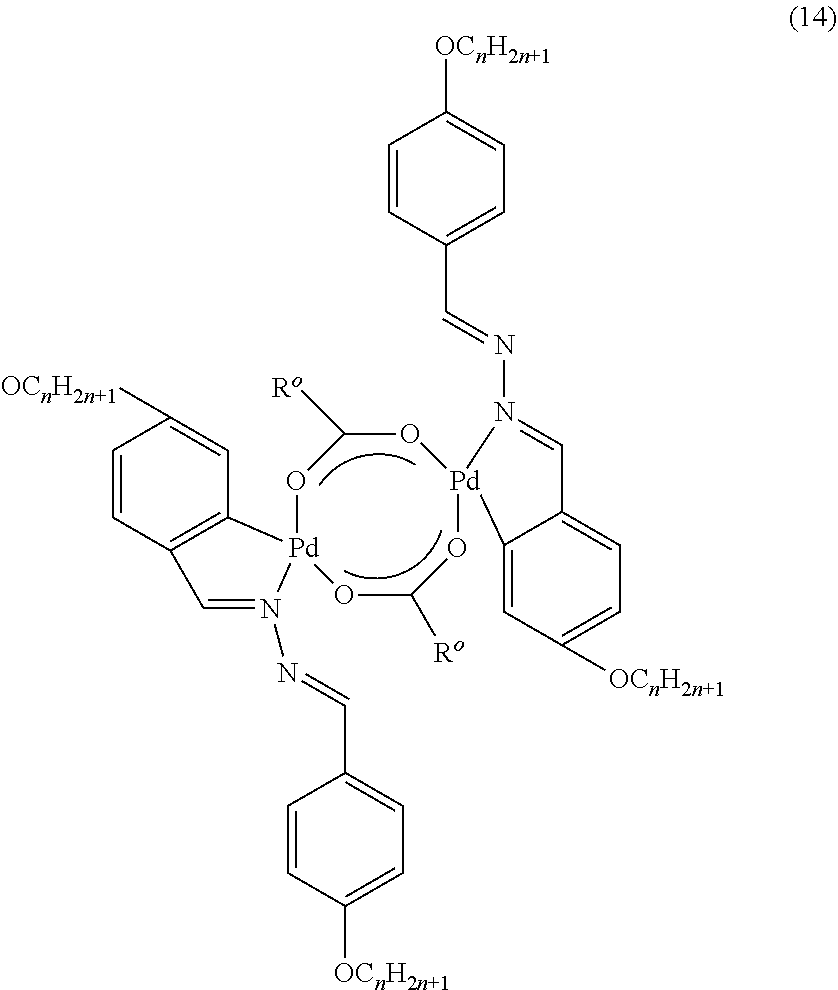
where Ro is

or OCmH2m+1, and m is 1 through 20.

where n and m are whole numbers having a value of 1-20.
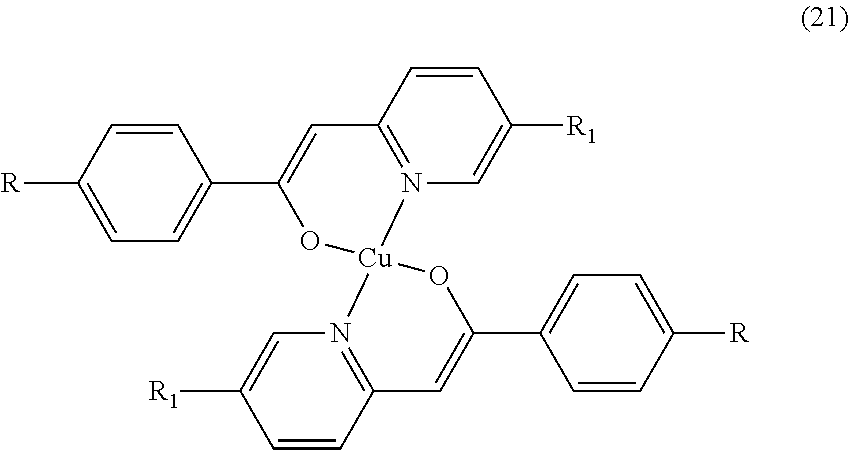
where R and R1 may be the same or different, and each of R and R1 may be H, —OC8H17, or —OC6H13.
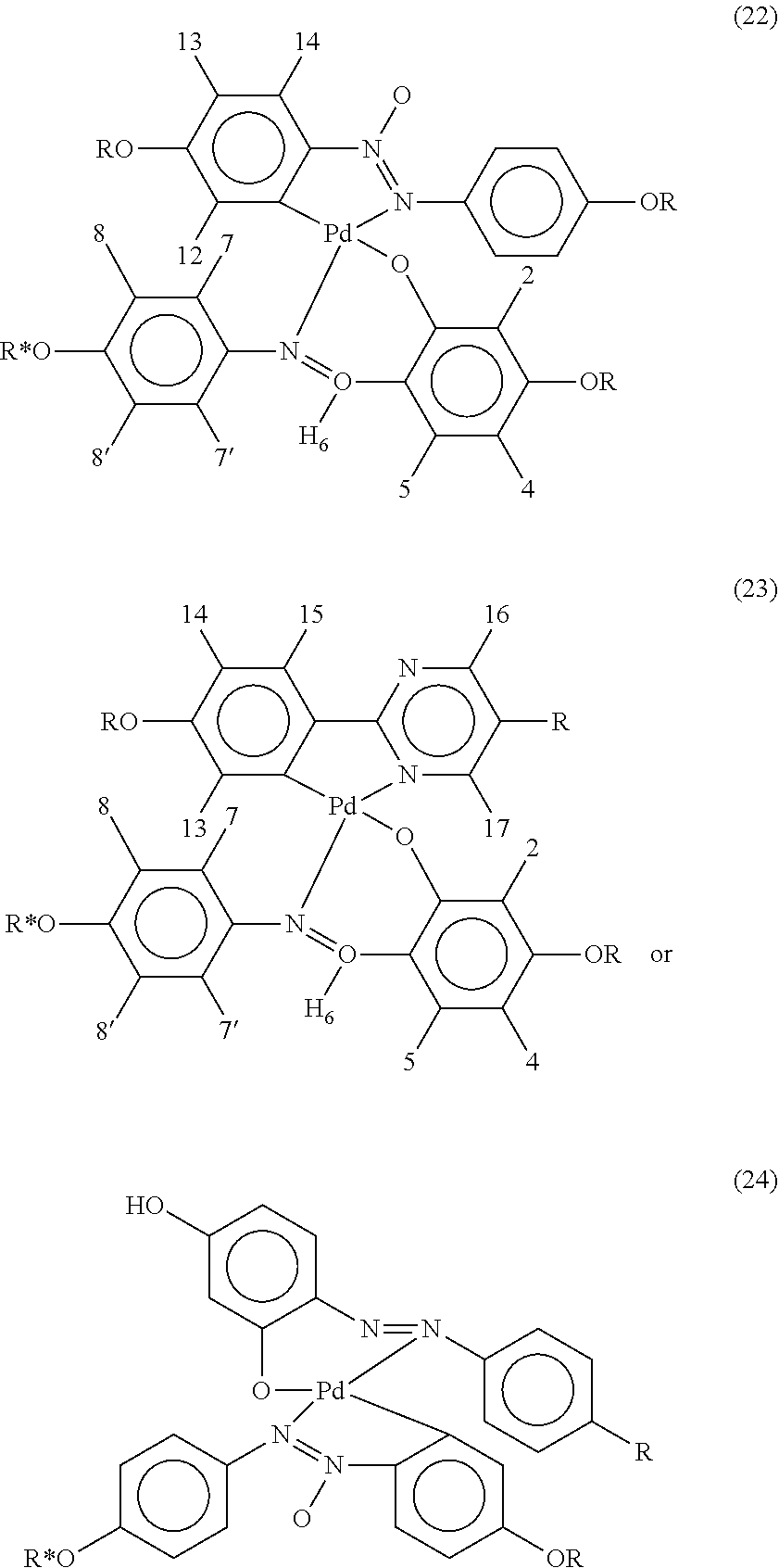
where R is CH3(CH2)m—, where m=1-20, and where R* is

where n and p=1-10.
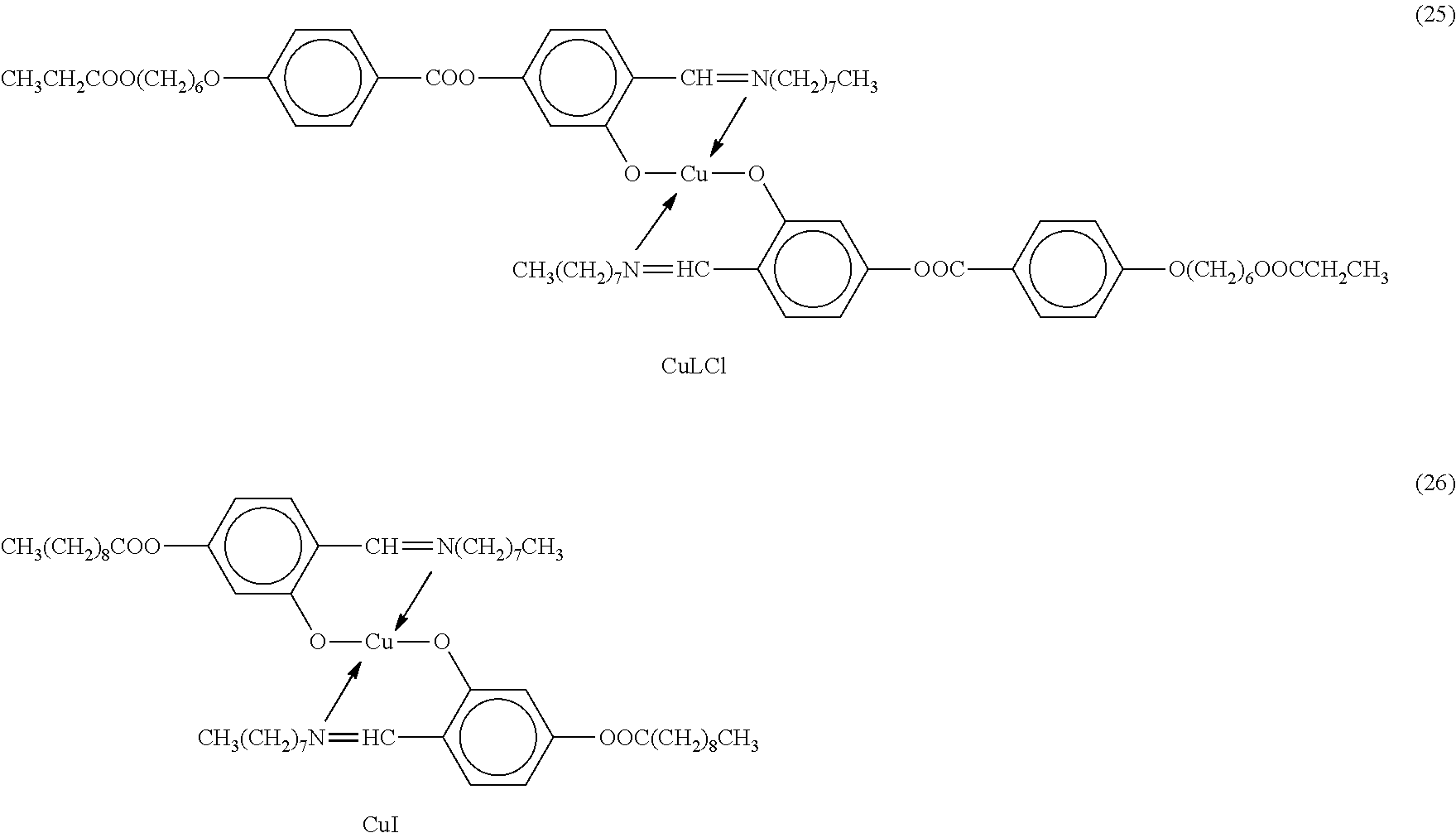
The synthesis of Cu-1 is described in Caruso et al., Macromolecules 24, p. 2606 (1991). CuLCl may be synthesized as follows. 3.92 g of the following compound,

the synthesis of which is described in Caruso et al., Macromolecules 24, p. 2606 (1991), are dissolved in 80 mL dehydrated chloroform and reacted with 3.33 g of the following compound, also described in the above reference:

together with 1.92 g of tetrabutylammonium hydrogen sulphate and 1.24 g KOH dissolved in 150 mL water. The reaction is performed in a blender for 10 min. The chloroformic phase is then treated several times with water, dried and evaporated to 30 mL volume. Crystallization of CuLCl is obtained after addition of 150 mL ethanol. Yield: 4.49 g (90%).

where R is CH3(CH2)m—, where m=1-20. These compounds are described in Italian patent application VE92A00003.
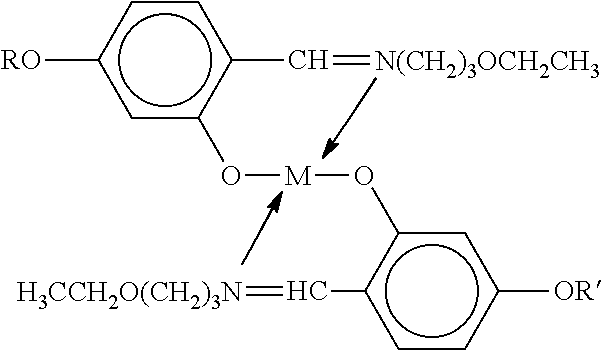
| TABLE 1 | |||||
| Component-1 | Component-2 | Component-3 | |||
| MOM | R | R′ | R | R′ | R | R′ | Metal | Color |
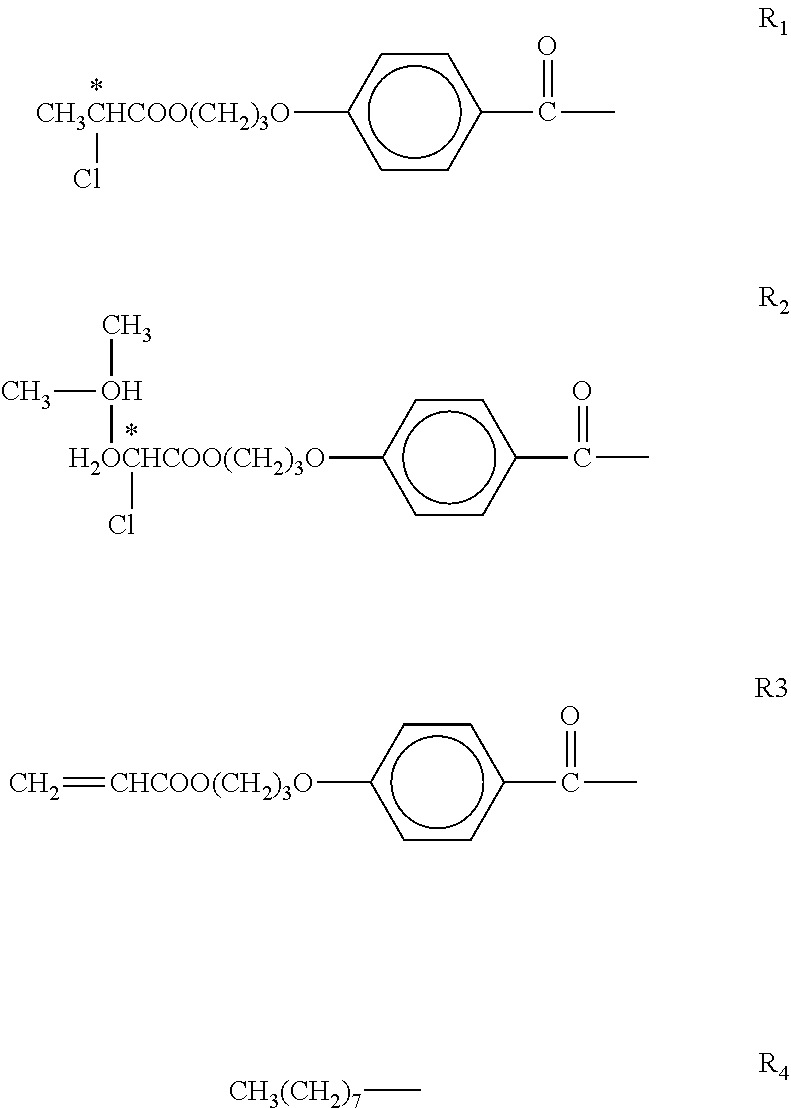
| Gauzy-1 | R4 | R3 | R4 | R4 | R3 | R3 | Ni2+ | Pale |
| Green | ||||||||
| Gauzy-2 | R4 | R3 | R4 | R4 | R3 | R3 | VO2+ | Pink |
Formula of the Metallomesogen Chemical Mixtures:
-
- Gauzy-1 & Gauzy-2:
- 25% R+25% R′: —(CH2)—CH3;
- 25% R+25% R′: —C6H5—O—(CH2)6—OOC—CH═CH2;
- 50% R: —(CH2)7—CH3; R′: —C6H5—O—(CH2)6—OOC═CH—CH2.
where

n=6, 10, 11, or 12.

where M=Rh (m=3, n=19) or Ru (m=2, n=19 or 31).
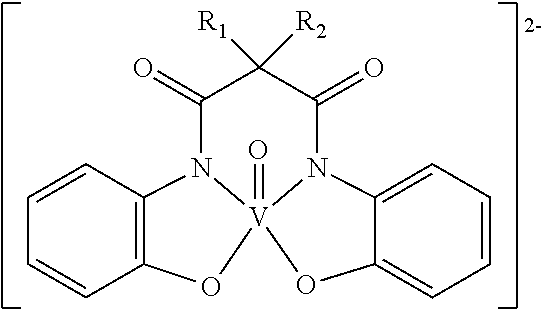
MOMs in this family include complexes of the form R1═R2═C18H37; R1═R2═C10H21; R1═CH3, R2═C12H25; and R1═CH3, R2═C16H33.
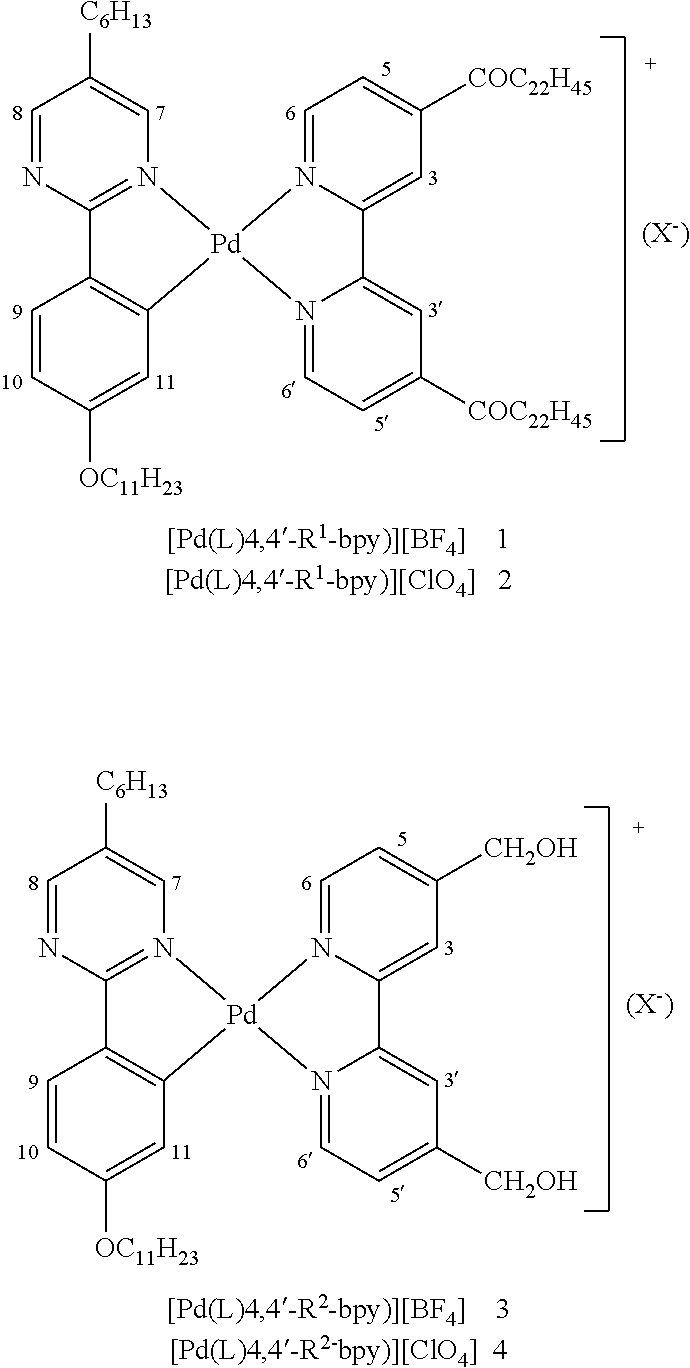
Claims (23)
Priority Applications (1)
| Application Number | Priority Date | Filing Date | Title |
|---|---|---|---|
| US17/498,958 US12292665B2 (en) | 2014-11-06 | 2021-10-12 | Bistable liquid crystal dispersion devices comprising metal-organic mesogens and applications thereof |
Applications Claiming Priority (4)
| Application Number | Priority Date | Filing Date | Title |
|---|---|---|---|
| US201462076002P | 2014-11-06 | 2014-11-06 | |
| PCT/IL2015/051069 WO2016071908A1 (en) | 2014-11-06 | 2015-11-05 | Bistable liquid crystal dispersion devices comprising metal-organic mesogens and applications thereof |
| US201715524297A | 2017-05-04 | 2017-05-04 | |
| US17/498,958 US12292665B2 (en) | 2014-11-06 | 2021-10-12 | Bistable liquid crystal dispersion devices comprising metal-organic mesogens and applications thereof |
Related Parent Applications (2)
| Application Number | Title | Priority Date | Filing Date |
|---|---|---|---|
| PCT/IL2015/051069 Continuation-In-Part WO2016071908A1 (en) | 2014-11-06 | 2015-11-05 | Bistable liquid crystal dispersion devices comprising metal-organic mesogens and applications thereof |
| US15/524,297 Continuation-In-Part US20170336663A1 (en) | 2014-11-06 | 2015-11-05 | Bistable liquid crystal dispersion devices comprising metal-organic mesogens and applications thereof |
Publications (2)
| Publication Number | Publication Date |
|---|---|
| US20220050316A1 US20220050316A1 (en) | 2022-02-17 |
| US12292665B2 true US12292665B2 (en) | 2025-05-06 |
Family
ID=80224207
Family Applications (1)
| Application Number | Title | Priority Date | Filing Date |
|---|---|---|---|
| US17/498,958 Active US12292665B2 (en) | 2014-11-06 | 2021-10-12 | Bistable liquid crystal dispersion devices comprising metal-organic mesogens and applications thereof |
Country Status (1)
| Country | Link |
|---|---|
| US (1) | US12292665B2 (en) |
Families Citing this family (2)
| Publication number | Priority date | Publication date | Assignee | Title |
|---|---|---|---|---|
| TWI737540B (en) * | 2020-11-11 | 2021-08-21 | 國立中山大學 | Smart window and method for switching the same |
| CN116088214B (en) * | 2022-12-23 | 2025-05-30 | 苏州科技大学 | A polymer dispersed liquid crystal device and preparation method thereof |
Citations (53)
| Publication number | Priority date | Publication date | Assignee | Title |
|---|---|---|---|---|
| US4423191A (en) | 1981-05-01 | 1983-12-27 | Massachusetts Institute Of Technology | High frequency electric field curing of polymeric composites |
| JPS6068704A (en) | 1983-09-24 | 1985-04-19 | Nec Ic Microcomput Syst Ltd | Current source circuit |
| WO1987002693A1 (en) * | 1985-10-26 | 1987-05-07 | The University Of Sheffield | Liquid crystal compounds |
| US4934423A (en) | 1988-07-13 | 1990-06-19 | John Withrow | Extension table for work tables |
| US4938568A (en) | 1988-01-05 | 1990-07-03 | Hughes Aircraft Company | Polymer dispersed liquid crystal film devices, and method of forming the same |
| US5459594A (en) | 1994-06-01 | 1995-10-17 | Mitsubishi Denki Kabushiki Kaisha | Apparatus for inspecting on-off states of a scattering-type liquid crystal display panel |
| EP0747461A1 (en) | 1995-06-09 | 1996-12-11 | Sniaricerche S.C.P.A. | Polymer stabilized liquid crystals and flexible devices thereof |
| US5631665A (en) | 1992-11-13 | 1997-05-20 | Nippon Hoso Kyokai | Liquid crystal device, driving method thereof, liquid crystal apparatus, and illumination apparatus |
| FR2749450A1 (en) | 1996-06-03 | 1997-12-05 | Berque Emmanuel | Optoelectronic power supply device for liquid crystal display |
| US5712692A (en) | 1994-11-30 | 1998-01-27 | Kabushiki Kaisha Pilot | Driving power unit for driving liquid crystal display element and liquid crystal light-modulating device |
| US5843333A (en) | 1993-06-30 | 1998-12-01 | Sniaricerche S.C.P.A | Metallo organo liquid crystals in a polymer matrix |
| US6275208B1 (en) | 1997-08-08 | 2001-08-14 | Samsung Electronics Co., Ltd. | Multiple output DC/DC voltage converter and liquid crystal display using thereof |
| US6323929B1 (en) | 1997-04-24 | 2001-11-27 | Semiconductor Energy Laboratory Co., Ltd. | Liquid crystal panel comprising an active matrix circuit and a peripheral circuit |
| US20020158228A1 (en) | 2001-02-22 | 2002-10-31 | Jsr Corporation | Liquid crystal composition, liquid crystal display device and liquid crystal displaying method |
| EP1372023A2 (en) | 2002-06-13 | 2003-12-17 | Ergom Automotive S.p.a. | Electro-optically concealable vehicle instrument panel and method of constructing the same |
| US6722142B1 (en) | 2003-02-07 | 2004-04-20 | Sub-Zero Freezer Company, Inc. | Refrigerated enclosure |
| US6741239B2 (en) | 2001-03-07 | 2004-05-25 | Ricoh Company, Ltd. | LCD power source control method and control circuit thereof and image forming apparatus having the control circuit |
| US20040222814A1 (en) | 2003-05-06 | 2004-11-11 | Kim Jong Dam | Method and apparatus for inspecting flat panel display |
| US6819367B1 (en) | 2001-10-19 | 2004-11-16 | Frank James Cava | Shade-free light control system and method |
| US20050001954A1 (en) | 2001-03-16 | 2005-01-06 | Stephenson Stanley W. | Polymer-dispersed liquid-crystal display comprising an ultraviolet blocking layer and methods for making the same |
| US6982178B2 (en) | 2002-06-10 | 2006-01-03 | E Ink Corporation | Components and methods for use in electro-optic displays |
| WO2006014041A1 (en) | 2004-08-02 | 2006-02-09 | Samsung Fine Chemicals Co.,Ltd | Broadband reflective polarizer for liquid crystal display using overcoating method |
| US20060046017A1 (en) | 2004-09-01 | 2006-03-02 | 3Form | Architectural glass panels with embedded objects and methods for making the same |
| US20060122532A1 (en) | 2004-12-08 | 2006-06-08 | Tatung Co., Ltd. | Refrigerator with body fat meter |
| US7091351B2 (en) | 1998-01-20 | 2006-08-15 | Parker Hughes Institute | Vanadium compounds for treating cancer |
| US7238397B2 (en) | 2004-12-03 | 2007-07-03 | Xerox Corporation | Black/white cholesteric bistable display with increased white reflectivity |
| US20070205394A1 (en) | 2006-03-06 | 2007-09-06 | Furman Benjamin R | Nanocomposites and methods for synthesis and use thereof |
| US20080187687A1 (en) | 2007-02-05 | 2008-08-07 | Fuji Xerox Co., Ltd. | Liquid crystal-containing composition, method of producing the same, and liquid crystal display device including the same |
| US20080218752A1 (en) | 2002-03-06 | 2008-09-11 | Aspectrics, Inc. | Chemometric Analyzer with a Spatial Radiation Modulator Having a Plurality of Radiation Filters |
| US20080263963A1 (en) | 2005-04-08 | 2008-10-30 | Lg Electronics Inc. | Sealing Structure of Refrigerator |
| US20090151606A1 (en) | 2002-12-27 | 2009-06-18 | Jeffrey Korber | Method and apparatus for retrofitting a flat panel workstation system to existing desk tops and other like structures |
| US20090273737A1 (en) | 2004-06-11 | 2009-11-05 | Pelikon Ltd | Electroluminescent Displays |
| US20100025641A1 (en) | 2008-08-04 | 2010-02-04 | Fujifilm Corporation | Infrared region selective reflection coat and infrared region selective reflection film |
| US20100073605A1 (en) | 2006-11-30 | 2010-03-25 | Sony Deutschland Gmbh | Method of preparing a polymer dispersed liquid crystal |
| US20100245321A1 (en) | 2009-03-27 | 2010-09-30 | Sony Ericsson Mobile Communications Japan, Inc. | Display device and portable terminal |
| US20110109824A1 (en) | 2008-06-21 | 2011-05-12 | Lensvector, Inc. | Electro-optical devices using dynamic reconfiguration of effective electrode structures |
| US8107050B2 (en) | 2009-06-19 | 2012-01-31 | Industrial Technology Research Institute | Bistable display materials and methods and devices thereof |
| US20120068951A1 (en) | 2010-09-20 | 2012-03-22 | Bombardier Transportation Gmbh | Dynamic door display system and method |
| WO2012042518A1 (en) | 2010-09-27 | 2012-04-05 | Gauzy Ltd. | Dimmer and switch suitable for driving a capacitive or complex capacitive-resistive load such as liquid crystal film |
| US20120105424A1 (en) | 2010-10-28 | 2012-05-03 | Samsung Electronics Co., Ltd. | Display module and display system |
| US20120169987A1 (en) | 2010-12-31 | 2012-07-05 | Boe Technology Group Co., Ltd. | Polymer dispersed liquid crystal film and method for manufacturing the same |
| US20120307337A1 (en) | 2011-05-06 | 2012-12-06 | Pittsburgh Glass Works, Llc | Switchable automotive glazing |
| US20130053468A1 (en) | 2009-10-07 | 2013-02-28 | Lg Chem, Ltd. | Composition for liquid crystal film, liquid crystal film using composition, and method of manfacturing liquid crystal film |
| US20130272833A1 (en) | 2012-04-16 | 2013-10-17 | Komax Holding Ag | Solar cell string layup system and method |
| US20130321744A1 (en) | 2012-05-30 | 2013-12-05 | Sipix Imaging, Inc. | Display device with watermark |
| US20130342773A1 (en) | 2011-01-10 | 2013-12-26 | Daping Chu | Smectic A Compositions For Use in Optical Devices |
| US20140132909A1 (en) | 2012-11-13 | 2014-05-15 | 3M Innovative Properties Company | Switchable transparent display |
| US20140313105A1 (en) | 2013-04-19 | 2014-10-23 | Gauzy Ltd. | Means and methods for superimposing at least one first projected image over at least one second real image |
| WO2015170318A2 (en) | 2014-05-08 | 2015-11-12 | Gauzy Ltd | Device for producing and testing electrical switchable glasses and method of doing the same |
| US20150338715A1 (en) | 2012-07-09 | 2015-11-26 | Red Bull Gmbh | Transparent display device |
| WO2016063277A2 (en) | 2014-10-20 | 2016-04-28 | Gauzy Ltd. | Dynamic signage, glazed and patterned pdlc devices and methods for creating thereof |
| WO2016063273A1 (en) | 2014-10-20 | 2016-04-28 | Gauzy Ltd. | Metal organic liquid crystal dyes |
| WO2016071908A1 (en) | 2014-11-06 | 2016-05-12 | Gauzy Ltd. | Bistable liquid crystal dispersion devices comprising metal-organic mesogens and applications thereof |
-
2021
- 2021-10-12 US US17/498,958 patent/US12292665B2/en active Active
Patent Citations (56)
| Publication number | Priority date | Publication date | Assignee | Title |
|---|---|---|---|---|
| US4423191A (en) | 1981-05-01 | 1983-12-27 | Massachusetts Institute Of Technology | High frequency electric field curing of polymeric composites |
| JPS6068704A (en) | 1983-09-24 | 1985-04-19 | Nec Ic Microcomput Syst Ltd | Current source circuit |
| WO1987002693A1 (en) * | 1985-10-26 | 1987-05-07 | The University Of Sheffield | Liquid crystal compounds |
| US4938568A (en) | 1988-01-05 | 1990-07-03 | Hughes Aircraft Company | Polymer dispersed liquid crystal film devices, and method of forming the same |
| US4934423A (en) | 1988-07-13 | 1990-06-19 | John Withrow | Extension table for work tables |
| US5631665A (en) | 1992-11-13 | 1997-05-20 | Nippon Hoso Kyokai | Liquid crystal device, driving method thereof, liquid crystal apparatus, and illumination apparatus |
| US5843333A (en) | 1993-06-30 | 1998-12-01 | Sniaricerche S.C.P.A | Metallo organo liquid crystals in a polymer matrix |
| US5459594A (en) | 1994-06-01 | 1995-10-17 | Mitsubishi Denki Kabushiki Kaisha | Apparatus for inspecting on-off states of a scattering-type liquid crystal display panel |
| US5712692A (en) | 1994-11-30 | 1998-01-27 | Kabushiki Kaisha Pilot | Driving power unit for driving liquid crystal display element and liquid crystal light-modulating device |
| US6049366A (en) | 1995-06-09 | 2000-04-11 | Sniaricerche S.C.P.A. | Polymer stabilized liquid crystals and flexible devices thereof |
| EP0747461A1 (en) | 1995-06-09 | 1996-12-11 | Sniaricerche S.C.P.A. | Polymer stabilized liquid crystals and flexible devices thereof |
| FR2749450A1 (en) | 1996-06-03 | 1997-12-05 | Berque Emmanuel | Optoelectronic power supply device for liquid crystal display |
| US6323929B1 (en) | 1997-04-24 | 2001-11-27 | Semiconductor Energy Laboratory Co., Ltd. | Liquid crystal panel comprising an active matrix circuit and a peripheral circuit |
| US6275208B1 (en) | 1997-08-08 | 2001-08-14 | Samsung Electronics Co., Ltd. | Multiple output DC/DC voltage converter and liquid crystal display using thereof |
| US7091351B2 (en) | 1998-01-20 | 2006-08-15 | Parker Hughes Institute | Vanadium compounds for treating cancer |
| US20020158228A1 (en) | 2001-02-22 | 2002-10-31 | Jsr Corporation | Liquid crystal composition, liquid crystal display device and liquid crystal displaying method |
| US6741239B2 (en) | 2001-03-07 | 2004-05-25 | Ricoh Company, Ltd. | LCD power source control method and control circuit thereof and image forming apparatus having the control circuit |
| US20050001954A1 (en) | 2001-03-16 | 2005-01-06 | Stephenson Stanley W. | Polymer-dispersed liquid-crystal display comprising an ultraviolet blocking layer and methods for making the same |
| US6819367B1 (en) | 2001-10-19 | 2004-11-16 | Frank James Cava | Shade-free light control system and method |
| US20080218752A1 (en) | 2002-03-06 | 2008-09-11 | Aspectrics, Inc. | Chemometric Analyzer with a Spatial Radiation Modulator Having a Plurality of Radiation Filters |
| US6982178B2 (en) | 2002-06-10 | 2006-01-03 | E Ink Corporation | Components and methods for use in electro-optic displays |
| EP1372023A2 (en) | 2002-06-13 | 2003-12-17 | Ergom Automotive S.p.a. | Electro-optically concealable vehicle instrument panel and method of constructing the same |
| US20090151606A1 (en) | 2002-12-27 | 2009-06-18 | Jeffrey Korber | Method and apparatus for retrofitting a flat panel workstation system to existing desk tops and other like structures |
| US6722142B1 (en) | 2003-02-07 | 2004-04-20 | Sub-Zero Freezer Company, Inc. | Refrigerated enclosure |
| US20040222814A1 (en) | 2003-05-06 | 2004-11-11 | Kim Jong Dam | Method and apparatus for inspecting flat panel display |
| US20090273737A1 (en) | 2004-06-11 | 2009-11-05 | Pelikon Ltd | Electroluminescent Displays |
| WO2006014041A1 (en) | 2004-08-02 | 2006-02-09 | Samsung Fine Chemicals Co.,Ltd | Broadband reflective polarizer for liquid crystal display using overcoating method |
| US20060046017A1 (en) | 2004-09-01 | 2006-03-02 | 3Form | Architectural glass panels with embedded objects and methods for making the same |
| US7238397B2 (en) | 2004-12-03 | 2007-07-03 | Xerox Corporation | Black/white cholesteric bistable display with increased white reflectivity |
| US20060122532A1 (en) | 2004-12-08 | 2006-06-08 | Tatung Co., Ltd. | Refrigerator with body fat meter |
| US20080263963A1 (en) | 2005-04-08 | 2008-10-30 | Lg Electronics Inc. | Sealing Structure of Refrigerator |
| US20070205394A1 (en) | 2006-03-06 | 2007-09-06 | Furman Benjamin R | Nanocomposites and methods for synthesis and use thereof |
| US20100073605A1 (en) | 2006-11-30 | 2010-03-25 | Sony Deutschland Gmbh | Method of preparing a polymer dispersed liquid crystal |
| US20080187687A1 (en) | 2007-02-05 | 2008-08-07 | Fuji Xerox Co., Ltd. | Liquid crystal-containing composition, method of producing the same, and liquid crystal display device including the same |
| US20110109824A1 (en) | 2008-06-21 | 2011-05-12 | Lensvector, Inc. | Electro-optical devices using dynamic reconfiguration of effective electrode structures |
| US20100025641A1 (en) | 2008-08-04 | 2010-02-04 | Fujifilm Corporation | Infrared region selective reflection coat and infrared region selective reflection film |
| US20100245321A1 (en) | 2009-03-27 | 2010-09-30 | Sony Ericsson Mobile Communications Japan, Inc. | Display device and portable terminal |
| US8107050B2 (en) | 2009-06-19 | 2012-01-31 | Industrial Technology Research Institute | Bistable display materials and methods and devices thereof |
| US20130053468A1 (en) | 2009-10-07 | 2013-02-28 | Lg Chem, Ltd. | Composition for liquid crystal film, liquid crystal film using composition, and method of manfacturing liquid crystal film |
| US20120068951A1 (en) | 2010-09-20 | 2012-03-22 | Bombardier Transportation Gmbh | Dynamic door display system and method |
| US20130188105A1 (en) | 2010-09-27 | 2013-07-25 | Gauzy Ltd. | Dimmer and switch suitable for driving a capacitive or complex capacitive-resistive load such as liquid crystal film |
| WO2012042518A1 (en) | 2010-09-27 | 2012-04-05 | Gauzy Ltd. | Dimmer and switch suitable for driving a capacitive or complex capacitive-resistive load such as liquid crystal film |
| US20120105424A1 (en) | 2010-10-28 | 2012-05-03 | Samsung Electronics Co., Ltd. | Display module and display system |
| US20120169987A1 (en) | 2010-12-31 | 2012-07-05 | Boe Technology Group Co., Ltd. | Polymer dispersed liquid crystal film and method for manufacturing the same |
| US20130342773A1 (en) | 2011-01-10 | 2013-12-26 | Daping Chu | Smectic A Compositions For Use in Optical Devices |
| US20120307337A1 (en) | 2011-05-06 | 2012-12-06 | Pittsburgh Glass Works, Llc | Switchable automotive glazing |
| US20130272833A1 (en) | 2012-04-16 | 2013-10-17 | Komax Holding Ag | Solar cell string layup system and method |
| US20130321744A1 (en) | 2012-05-30 | 2013-12-05 | Sipix Imaging, Inc. | Display device with watermark |
| US20150338715A1 (en) | 2012-07-09 | 2015-11-26 | Red Bull Gmbh | Transparent display device |
| US20140132909A1 (en) | 2012-11-13 | 2014-05-15 | 3M Innovative Properties Company | Switchable transparent display |
| US20140313105A1 (en) | 2013-04-19 | 2014-10-23 | Gauzy Ltd. | Means and methods for superimposing at least one first projected image over at least one second real image |
| WO2015170318A2 (en) | 2014-05-08 | 2015-11-12 | Gauzy Ltd | Device for producing and testing electrical switchable glasses and method of doing the same |
| US20170075152A1 (en) | 2014-05-08 | 2017-03-16 | Gauzy Ltd. | Device for producing and testing electrical switchable glasses and method of doing the same |
| WO2016063277A2 (en) | 2014-10-20 | 2016-04-28 | Gauzy Ltd. | Dynamic signage, glazed and patterned pdlc devices and methods for creating thereof |
| WO2016063273A1 (en) | 2014-10-20 | 2016-04-28 | Gauzy Ltd. | Metal organic liquid crystal dyes |
| WO2016071908A1 (en) | 2014-11-06 | 2016-05-12 | Gauzy Ltd. | Bistable liquid crystal dispersion devices comprising metal-organic mesogens and applications thereof |
Non-Patent Citations (22)
| Title |
|---|
| Axenov, K. V.; Laschat, S. Thermotropic Ionic Liquid Crystals. Materials 2011, 4, 206-259: MDPI, Basel, Switzerland. |
| Bruce, D. W. Calamitics, Cubics, and Columnars—Liquid-Crystalline Complexes of Silver(I). Acc. Chem. Res. 2000, 33, 831-840: American Chemical Society, Washington, DC. |
| Buyuktani et al., Flexible Bistable Smectic—A Polymer Dispersed Liquid Crystal Display, Japanese Journal of Applied Physics, vol. 45, No. 5A, 2006, pp. 4146-4151; Retrieved Oct. 12, 2021; doi:10.1143/jjap.45.4146. |
| Büyüktanir, E.A. Electro-Optical Characterization of Bistable Smectic A Liquid Crystal Displays. Ph. D. Thesis, Kent State University, Kent, OH, May 2008. |
| Büyüktanir, E.A. et al. Flexible Bistable Smectic-A Polymer Dispersed Liquid Crystal Display. Jpn. J. Appl. Phys. 2006, 45, 4146-4151: IOP Publishing Ltd., Tokyo, Japan. |
| Cuerva De Alaíz, C. Advanced molecular materials based on novel Pd(II) and Pt(II) metallomesogens for technological applications. Ph. D. Thesis, Universidad Complutense de Madrid: Madrid, Spain, 2018. |
| Dierking, I. Polymer Network-Stabilized Liquid Crystals. Adv. Mater. 2000, 12, 167-181: Wiley-VCH Verlag GmbH, Weinheim, Germany. |
| Donnio, B.; Bruce, D. W. Metallomesogens. Struct. Bond. 1999, 95, 194-247: Springer Verlag, Berlin, Germany. |
| Dozov, I. et al. Fast Bistable Nematic Display Using Monostable Surface Switching. Appl. Phys. Lett. 1997, 70, 1179-1181: AIP Publishing, Melville, NY. |
| Flexible Bistable Smectic-A Liquid Crystal Device Using Photolithography and Photoinduced Phase Separation Advances in Condensed Matter Physics, vol. 2012, Article ID 843264, 9 pages; Retrieved Oct. 12, 2021; doi:10.1155/2012/843264. |
| Hao Wang et al., Information Recording Materials, "Research progress of bistable liquid crystal display technology" vol. 12 Issue 6, pp. 26, published on Dec. 15, 2011. |
| Jess, F.M. Halo- and Organogold(I) Complexes as Potential Metallomesogens. M. Sc. Thesis, University of Cape Town: Rondebosch, South Africa, 1999. |
| Marshall, K. L. et al. Transition Metal Dithiolene Near-IR Dyes and Their Applications in Liquid Crystal Devices. LLE Rev. 2006, 106, 112-128: University of Rochester Laboratory for Laser Energetics, Rochester, NY. |
| Neve, F. Transition Metal Based Ionic Mesogens. Adv. Mater. 1996, 8, 277-289: Wiley-VCH Verlag GmbH, Weinheim, Germany. |
| Okatani T. et al., "Study of image quality of superimposed projection using multiple projectors", IEEE Trans Image Process, vol. 18(2), Feb. 2009. |
| PCT International Search Report for International Application No. PCT/IL2015/051069, dated Apr. 7, 2016, 4pp. |
| PCT Written Opinion for International Application No. PCT/IL2015/051069, completed Feb. 11, 2016, 6pp. |
| Pucci, D., et al. Tailoring ‘Non Conventional’ Ionic Metallomesogens Around an Ortho-Palladated Fragment. J. Organomet. Chem. 2006, 691, 1138-1142: Elsevier BV, Amsterdam, The Netherlands. |
| Supplementary European Search report for European Application No. 15857433.5 completed Apr. 25, 2018, 12pp. |
| Wikipedia, "Dimmer", https://en.wikipedia.org/wiki/Dimmer, last edited Mar. 11, 2017. |
| Yang, D.-K. et al. Control of Reflectivity and Bistability in Displays Using Cholesteric Liquid Crystals. J. Appl. Phys. 1994, 76, 1331-1333: AIP Publishing, Melville, NY. |
| Yazaki, S. et al. Nanostructured Liquid Crystals Combining Ionic and Electronic Functions. J. Am. Chem. Soc. 2010, 132, 7702-7708: American Chemical Society, Washington, DC. |
Also Published As
| Publication number | Publication date |
|---|---|
| US20220050316A1 (en) | 2022-02-17 |
Similar Documents
| Publication | Publication Date | Title |
|---|---|---|
| EP3215587B1 (en) | Bistable liquid crystal dispersion devices comprising metal-organic mesogens and applications thereof | |
| US6049366A (en) | Polymer stabilized liquid crystals and flexible devices thereof | |
| US5843333A (en) | Metallo organo liquid crystals in a polymer matrix | |
| KR101905448B1 (en) | Smectic a compositions for use in optical devices | |
| JP5761244B2 (en) | Liquid crystal composition | |
| JP6106084B2 (en) | Switch element including liquid crystal medium | |
| CN108351447B (en) | Solar Reflection and Absorption Electric Conversion Film and Glass | |
| JP6166656B2 (en) | Optical switch element including liquid crystal medium | |
| JP7796050B2 (en) | Light-modulating liquid crystal composition containing anthraquinone compound, photocured product thereof, and light-modulating element | |
| EP4403989A1 (en) | Liquid crystal dimming device | |
| JP2013541600A (en) | Switch element including liquid crystal medium | |
| US12292665B2 (en) | Bistable liquid crystal dispersion devices comprising metal-organic mesogens and applications thereof | |
| Zhang et al. | Research progress of cholesteric liquid crystals with broadband reflection characteristics in application of intelligent optical modulation materials | |
| JP7654655B2 (en) | Anthraquinone compound, light-adjusting liquid crystal composition containing said compound and light-adjusting element | |
| JP2013530419A (en) | Optical switch element including liquid crystal medium | |
| JP7723078B2 (en) | Anthraquinone compound, liquid crystal composition containing the compound and light-adjusting element | |
| US10851302B2 (en) | Metal organic liquid crystal dyes | |
| EP4428118A1 (en) | Anthraquinone compound, liquid crystal composition containing said compound, and light-controlling element | |
| WO2012051127A2 (en) | A liquid crystal composition containing chiral dopant, device thereof, and methods thereof | |
| JP7796048B2 (en) | Light-modulating liquid crystal composition containing anthraquinone compound, photocured product thereof, and light-modulating element | |
| EP1372023A2 (en) | Electro-optically concealable vehicle instrument panel and method of constructing the same | |
| JPH05502263A (en) | liquid crystal mixture | |
| EP0803525A2 (en) | Chiral anisotropic thermosets (cat) in polymer stabilized liquid crystals | |
| JP2010144041A (en) | Liquid crystal composition and light modulating material | |
| JP2025133093A (en) | Liquid crystal composition containing anthraquinone compound and light-modulating element |
Legal Events
| Date | Code | Title | Description |
|---|---|---|---|
| FEPP | Fee payment procedure |
Free format text: ENTITY STATUS SET TO UNDISCOUNTED (ORIGINAL EVENT CODE: BIG.); ENTITY STATUS OF PATENT OWNER: SMALL ENTITY |
|
| FEPP | Fee payment procedure |
Free format text: ENTITY STATUS SET TO SMALL (ORIGINAL EVENT CODE: SMAL); ENTITY STATUS OF PATENT OWNER: SMALL ENTITY |
|
| AS | Assignment |
Owner name: GAUZY LTD., ISRAEL Free format text: ASSIGNMENT OF ASSIGNORS INTEREST;ASSIGNORS:HAKEMI, HASSAN-ALI;LOFER, ADRIAN;PESO, EYAL;AND OTHERS;SIGNING DATES FROM 20211212 TO 20211213;REEL/FRAME:058438/0898 |
|
| STPP | Information on status: patent application and granting procedure in general |
Free format text: DOCKETED NEW CASE - READY FOR EXAMINATION |
|
| STPP | Information on status: patent application and granting procedure in general |
Free format text: NON FINAL ACTION MAILED |
|
| STPP | Information on status: patent application and granting procedure in general |
Free format text: FINAL REJECTION MAILED |
|
| STPP | Information on status: patent application and granting procedure in general |
Free format text: NON FINAL ACTION MAILED |
|
| STPP | Information on status: patent application and granting procedure in general |
Free format text: RESPONSE TO NON-FINAL OFFICE ACTION ENTERED AND FORWARDED TO EXAMINER |
|
| STPP | Information on status: patent application and granting procedure in general |
Free format text: FINAL REJECTION MAILED |
|
| STPP | Information on status: patent application and granting procedure in general |
Free format text: DOCKETED NEW CASE - READY FOR EXAMINATION |
|
| STPP | Information on status: patent application and granting procedure in general |
Free format text: NOTICE OF ALLOWANCE MAILED -- APPLICATION RECEIVED IN OFFICE OF PUBLICATIONS |
|
| STPP | Information on status: patent application and granting procedure in general |
Free format text: PUBLICATIONS -- ISSUE FEE PAYMENT RECEIVED |
|
| STPP | Information on status: patent application and granting procedure in general |
Free format text: PUBLICATIONS -- ISSUE FEE PAYMENT VERIFIED |
|
| STPP | Information on status: patent application and granting procedure in general |
Free format text: AWAITING TC RESP, ISSUE FEE PAYMENT VERIFIED |
|
| STPP | Information on status: patent application and granting procedure in general |
Free format text: AWAITING TC RESP, ISSUE FEE PAYMENT VERIFIED |
|
| STPP | Information on status: patent application and granting procedure in general |
Free format text: PUBLICATIONS -- ISSUE FEE PAYMENT VERIFIED |
|
| STPP | Information on status: patent application and granting procedure in general |
Free format text: PUBLICATIONS -- ISSUE FEE PAYMENT VERIFIED |
|
| STCF | Information on status: patent grant |
Free format text: PATENTED CASE |