US12277716B2 - Cooperative aircraft navigation - Google Patents
Cooperative aircraft navigation Download PDFInfo
- Publication number
- US12277716B2 US12277716B2 US17/228,697 US202117228697A US12277716B2 US 12277716 B2 US12277716 B2 US 12277716B2 US 202117228697 A US202117228697 A US 202117228697A US 12277716 B2 US12277716 B2 US 12277716B2
- Authority
- US
- United States
- Prior art keywords
- global
- odometry
- pose
- relative
- model
- Prior art date
- Legal status (The legal status is an assumption and is not a legal conclusion. Google has not performed a legal analysis and makes no representation as to the accuracy of the status listed.)
- Active, expires
Links
Images



Classifications
-
- G—PHYSICS
- G06—COMPUTING OR CALCULATING; COUNTING
- G06T—IMAGE DATA PROCESSING OR GENERATION, IN GENERAL
- G06T7/00—Image analysis
- G06T7/20—Analysis of motion
- G06T7/246—Analysis of motion using feature-based methods, e.g. the tracking of corners or segments
- G06T7/248—Analysis of motion using feature-based methods, e.g. the tracking of corners or segments involving reference images or patches
-
- G—PHYSICS
- G05—CONTROLLING; REGULATING
- G05D—SYSTEMS FOR CONTROLLING OR REGULATING NON-ELECTRIC VARIABLES
- G05D1/00—Control of position, course, altitude or attitude of land, water, air or space vehicles, e.g. using automatic pilots
- G05D1/02—Control of position or course in two dimensions
- G05D1/0202—Control of position or course in two dimensions specially adapted to aircraft
-
- B—PERFORMING OPERATIONS; TRANSPORTING
- B64—AIRCRAFT; AVIATION; COSMONAUTICS
- B64D—EQUIPMENT FOR FITTING IN OR TO AIRCRAFT; FLIGHT SUITS; PARACHUTES; ARRANGEMENT OR MOUNTING OF POWER PLANTS OR PROPULSION TRANSMISSIONS IN AIRCRAFT
- B64D47/00—Equipment not otherwise provided for
- B64D47/08—Arrangements of cameras
-
- B—PERFORMING OPERATIONS; TRANSPORTING
- B64—AIRCRAFT; AVIATION; COSMONAUTICS
- B64U—UNMANNED AERIAL VEHICLES [UAV]; EQUIPMENT THEREFOR
- B64U20/00—Constructional aspects of UAVs
- B64U20/80—Arrangement of on-board electronics, e.g. avionics systems or wiring
- B64U20/87—Mounting of imaging devices, e.g. mounting of gimbals
-
- G—PHYSICS
- G01—MEASURING; TESTING
- G01C—MEASURING DISTANCES, LEVELS OR BEARINGS; SURVEYING; NAVIGATION; GYROSCOPIC INSTRUMENTS; PHOTOGRAMMETRY OR VIDEOGRAMMETRY
- G01C21/00—Navigation; Navigational instruments not provided for in groups G01C1/00 - G01C19/00
- G01C21/20—Instruments for performing navigational calculations
-
- G—PHYSICS
- G05—CONTROLLING; REGULATING
- G05D—SYSTEMS FOR CONTROLLING OR REGULATING NON-ELECTRIC VARIABLES
- G05D1/00—Control of position, course, altitude or attitude of land, water, air or space vehicles, e.g. using automatic pilots
- G05D1/10—Simultaneous control of position or course in three dimensions
- G05D1/101—Simultaneous control of position or course in three dimensions specially adapted for aircraft
-
- G—PHYSICS
- G05—CONTROLLING; REGULATING
- G05D—SYSTEMS FOR CONTROLLING OR REGULATING NON-ELECTRIC VARIABLES
- G05D1/00—Control of position, course, altitude or attitude of land, water, air or space vehicles, e.g. using automatic pilots
- G05D1/40—Control within particular dimensions
- G05D1/46—Control of position or course in three dimensions
-
- G—PHYSICS
- G06—COMPUTING OR CALCULATING; COUNTING
- G06T—IMAGE DATA PROCESSING OR GENERATION, IN GENERAL
- G06T7/00—Image analysis
- G06T7/20—Analysis of motion
- G06T7/246—Analysis of motion using feature-based methods, e.g. the tracking of corners or segments
- G06T7/251—Analysis of motion using feature-based methods, e.g. the tracking of corners or segments involving models
-
- G—PHYSICS
- G06—COMPUTING OR CALCULATING; COUNTING
- G06T—IMAGE DATA PROCESSING OR GENERATION, IN GENERAL
- G06T7/00—Image analysis
- G06T7/20—Analysis of motion
- G06T7/277—Analysis of motion involving stochastic approaches, e.g. using Kalman filters
-
- G—PHYSICS
- G06—COMPUTING OR CALCULATING; COUNTING
- G06T—IMAGE DATA PROCESSING OR GENERATION, IN GENERAL
- G06T7/00—Image analysis
- G06T7/70—Determining position or orientation of objects or cameras
- G06T7/73—Determining position or orientation of objects or cameras using feature-based methods
-
- G08G5/0008—
-
- G08G5/0069—
-
- G—PHYSICS
- G08—SIGNALLING
- G08G—TRAFFIC CONTROL SYSTEMS
- G08G5/00—Traffic control systems for aircraft
- G08G5/20—Arrangements for acquiring, generating, sharing or displaying traffic information
- G08G5/25—Transmission of traffic-related information between aircraft
-
- G—PHYSICS
- G08—SIGNALLING
- G08G—TRAFFIC CONTROL SYSTEMS
- G08G5/00—Traffic control systems for aircraft
- G08G5/50—Navigation or guidance aids
- G08G5/55—Navigation or guidance aids for a single aircraft
-
- G—PHYSICS
- G08—SIGNALLING
- G08G—TRAFFIC CONTROL SYSTEMS
- G08G5/00—Traffic control systems for aircraft
- G08G5/50—Navigation or guidance aids
- G08G5/57—Navigation or guidance aids for unmanned aircraft
-
- G—PHYSICS
- G05—CONTROLLING; REGULATING
- G05D—SYSTEMS FOR CONTROLLING OR REGULATING NON-ELECTRIC VARIABLES
- G05D2109/00—Types of controlled vehicles
- G05D2109/20—Aircraft, e.g. drones
-
- G—PHYSICS
- G06—COMPUTING OR CALCULATING; COUNTING
- G06T—IMAGE DATA PROCESSING OR GENERATION, IN GENERAL
- G06T2207/00—Indexing scheme for image analysis or image enhancement
- G06T2207/10—Image acquisition modality
- G06T2207/10032—Satellite or aerial image; Remote sensing
-
- G—PHYSICS
- G06—COMPUTING OR CALCULATING; COUNTING
- G06T—IMAGE DATA PROCESSING OR GENERATION, IN GENERAL
- G06T2207/00—Indexing scheme for image analysis or image enhancement
- G06T2207/20—Special algorithmic details
- G06T2207/20072—Graph-based image processing
-
- G—PHYSICS
- G06—COMPUTING OR CALCULATING; COUNTING
- G06T—IMAGE DATA PROCESSING OR GENERATION, IN GENERAL
- G06T2207/00—Indexing scheme for image analysis or image enhancement
- G06T2207/30—Subject of image; Context of image processing
- G06T2207/30181—Earth observation
Definitions
- UAS unmanned aircraft systems
- UAS technologies have also continued to develop.
- One difficulty that has been encountered is navigation of fixed-wing UASs in environments where absolute location information (e.g., GPS) is unavailable, partially unavailable, or degraded.
- absolute location information e.g., GPS
- What is needed is an improved system and method for navigation of fixed-wing UASs in a GPS-denied GPS degraded environment.
- a UAS may use a front-end nodule to estimate relative pose change, and may periodically publish the relative pose change to a back-end module for use in generating, modifying, updating, and optimizing a global pose model.
- the front-end relative pose model may be an extended Kalman filter that may be iteratively updated based on ground features identified and tracked by the front end. Based on a reset criteria (e.g. time, accumulated covariance, etc.), the front end may periodically determine to reset by publishing the relative pose model's delta pose and associated covariance to the back end for incorporation into the global pose model as a pose graph edge, and additionally zeroing out its delta pose and covariance.
- Two UASs may share range information to improve back-end pose graph optimization.
- a first UAS may obtain a range measurement to a second UAS, may share the range measurement with the second UAS, and both UASs may then perform a coordinated reset as described above.
- each UAS may add an edge and node to incorporate the range measurement as a constraint.
- each UAS may add at least as much of the other UAS's pose graph is may be necessary to provide an global anchor/linking point. Sharing range information may improve pose graph optimization and associated global pose estimates.
- FIG. 1 shows a conceptual view of an exemplary UAS as described herein.
- FIG. 2 a shows several time points for front-end feature tracking and resetting.
- FIG. 2 a shows several time points for front-end feature tracking and resetting.
- FIG. 2 a shows several time points for front-end feature tracking and resetting.
- FIG. 2 b shows several time points for front-end feature tracking and resetting.
- FIG. 2 c shows several time points for front-end feature tracking and resetting.
- FIG. 3 shows coordinated resets for the flight paths of two UASs.
- FIG. 4 shows an aggregate pose graph for two UASs engaged to range sharing and coordinated resets.
- FIG. 5 shows the evolution of a first UAS's aggregate pose graph for a flight using coordinated resets and range sharing.
- FIG. 6 shows the evolution of a second UAS's aggregate pose graph for a flight using coordinated resets and range sharing.
- FIG. 7 shows the front-end delta poses (and covariances) for two UASs, as well as the edges generated by each UAS.
- FIG. 8 a shows a segment of a pose graph that does not implement bias scale correction.
- FIG. 8 b shows a segment of a pose graph that in bias scale correction.
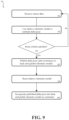
- FIG. 9 shows a flow chart for an exemplary embodiment of performing a relative reset.
- FIG. 10 shows a flow chart for an exemplary embodiment of range sharing and coordinated reset.
- UAS unmanned aircraft system
- FIG. 1 shows a conceptual view of an exemplary UAS 100 , which may include “back end” 110 , “front end” 120 , sensor module 130 , and control module 140 .
- Back end may comprise optimization module 112 , global-constraint module 114 , pose-graph map 116 , and global planning module 118 .
- Front-end system 120 may comprise visual inertial module 122 and control module 124 .
- Sensors 130 may comprise camera 132 and ITU 134 .
- Sensor module 130 may comprise a camera 132 and inertial measurement unit (“IMU”) 134 .
- IMUs for aircraft are known in the art.
- IMU 134 may comprise several inertial measurement sensors, e.g., accelerometers and/or rate gyroscopes.
- Camera 132 may supplement IMU 134 by measuring motion of UAS 100 relative to UAS 100 's surroundings usually features on the ground. Even using IMU 134 in conjunction with camera 132 , global position and yaw angle are unobservable, and UAS 100 's estimate of global position will therefore eventually diverge from its actual global position.
- Relative navigation is an approach that uses a combination of local estimation and global estimation.
- Local estimation may be referred to as “front-end,” and global estimation may be referred to as “back-end.”
- an exemplary relative navigation scheme may comprise an extended Kalman filter (“EKF”) for front-end estimation relative to the local environment and a back-end optimization that incorporates the relative front-end information to estimate global position/variables.
- EKF extended Kalman filter
- the front-end system estimates changes in position and attitude with respect to a local frame where the states can remain observable and the Gaussian distribution can accurately represent uncertainty, thus enabling the computational advantage of an EKF to be utilized.
- the back-end system uses a pose graph (or other modeling paradigm known in the art, e.g., nonlinear unconstrained optimization problem) that can accurately represent nonlinearities in position and heading and can be robustly optimized when given additional constraints.
- the front-end system may be EKF, MSCKF (as described herein below), or any batch or similar system that delivers estimates of pose change and associated uncertainty to a back end.
- the front-end data is packaged as a small (amount of data) estimate of pose change and covariance, which is then more easily shared (because of the modest bandwidth requirements) to various components, modules, or across networks.
- Extended Kalman filters are well-known the art for navigation of robots and other autonomous or partially autonomous vehicles.
- FIG. 1 shows a conceptual block diagram of an exemplary UAS 100 , its back-end system 110 , front-end system 120 , sensors 130 , and control system 140 .
- Back-end system 110 may comprise optimization module 102 , global-constraint module 114 , pose-graph map 116 , and global planning module 118 .
- Front-end system 120 may comprise visual-inertial-odometry module 122 and relative control module 124 .
- Sensors 130 may comprise camera 132 and IMU 134 .
- camera 132 may be a monocular camera that provides no direct information about the distance to observed features.
- Many cameras are known in the art and may be capable of taking and provide a visual image capture as described herein below.
- Non-visual cameras could also be used.
- a thermal (infrared IR)) or depth (e.g., lidar) imager could be used.
- the relative pose (i.e., change in x position, change in y position, and yaw angle) of a UAS may be updated using an extended Kalman filter (“EKF”) approach.
- EKF extended Kalman filter
- MSCKF is one example of such a system/approach.
- the EKF may be a Multi-State Constraint Kalman Filter (“MSCKF”), which is a visual-intertial navigation approach that blends traditional filtering with a batch-like optimization.
- MSCKF Multi-State Constraint Kalman Filter
- the Kalman filter tracks visual features as they move through the camera's field of view, adding as states the vehicle or camera pose when each image is taken. MSCKF and then uses the time history of images to the saline feature to improve estimates of the vehicle's current pose. As each feature is lost from view, all prior observations and vehicle/camera pose estimates at that time are used in a least-squares fashion to solve for an estimated feature position.
- the expected camera measurements to the feature at each of the prior poses is calculated and the differences between expected and actual image measurements to the feature are then used in a specialized Kalman update (one that uses a null space approach to avoid double counting information) to improve current state estimates. If the past state/camera poses no longer have active features remaining, features still in the current field of view, those poses are then removed from the state vector.
- the Filter continues to propagate state estimates, add new features, track the other features, add pose states to the filter each time a new image is taken, and update filter states whenever another feature exits the field of view. In this way the MSCKF significantly bounds the error growth in the filter's position and attitude.
- navigation system 110 may use a visual-intertial-odometry (“VIO”) approach to estimate motion of UAS 100 .
- VIO visual-intertial-odometry
- a VIO approach is well known in the art and is described in detail in many sources. E.g., M. Li, A. Mourikis, High-precision consistent EKF-based visual-inertial odometry, The International Journal of Robotics Research , vol. 32, no. 6, 2013, pp. 690-711; Forster C. Zhang Z, Gassner M, Werlberger M, and Scaramuzza D, SVO:Semidirect Visual Odometry for Monocular and Multicamera Systems, IEEE Transactions on Robotics , vol. 33, no. 2, 2017, pp. 249-265.
- Relative VIO module 122 may receive image data from camera 132 and may process the received image data to identity features on the ground.
- Image data received from camera 132 may comprise a time-sequence set of images frames, wherein one frame comprises the visual data captured by camera 132 at a specific time, i.e., an image snapshot.
- relative VIO module 122 may track that feature in subsequently received image frames. By tracking the pixel position (position within the frame capture) of one or more features over subsequent image capture frames, and by combining the change in pixel position with IMU data (e.g., accelerations, angular rates), relative VIO module 122 may be able to estimate relative movement over a time period.
- IMU data e.g., accelerations, angular rates
- some image capture frames may be characterized as “keyframes.”
- keyframes When a feature is identified in a keyframe, and its location within and relative to that keyframe has been determined, the feature's position within subsequent image frames leading up to a subsequent keyframe may be used, in conjunction with other inputs, to estimate the UAS's relative pose change (change in x position, change in y position in yaw angle) from the first keyframe to the second keyframe.
- a given feature is tracked across a sequence of images and, once it leaves the camera field of view, the feature track is residualized as a single measurement-update step.
- relative VIO module 122 may determine that UAS 100 has moved, during the 3.0 second period, to a location that is 150.0 feet to the north and 30.0 feet to the east of UAS 100 's location at the beginning of the 3.0 second period, and that, at the end of the 3.0 second period, UAS 100 is moving in a direction described as 45 degrees to the east of direct north.
- Relative VIO module 122 may make this determination using an extended Kalman filter (“EKF”).
- EKF extended Kalman filter
- EKFs utilize a linear Gaussian representation of the state belief to take advantage of the computational convenience of a Kalman update but maintain the nonlinearity of the process propagation. This combination of properties performs well when errors remain small, such as when the availability of GPS measurements is used to regularly remove drift errors, or when the EKF is periodically reset.
- the nonlinear nature of the process causes the Gaussian representation of the belief to become inconsistent when errors are large due to estimates drifting from the true value.
- the front-end EKF resets the EKF origin by setting the EKF origin (change in x position, change in y position, change in yaw, covariance) to zeros, where the reset coincides with the declaration of a keyframe image.
- the front-end states then continue to evolve with respect to the newly-declared reference frame.
- the state from just prior to the reset then forms a transformation from one reset to the next and, together with the associated covariance, is provided to the back end.
- the transformations form a directed pose graph, where each reset origin is a node (or node frame) and each transformation is an edge.
- the EKF operates only with respect to a local origin, it is observable, as well as consistent, by construction. The uncertainty is regularly removed from the filter while a Gaussian is still able to accurately represent it, and no linearities are handled appropriately in the back-end graph.
- the determination of when to do a reset may depend on the number of features in the current frame that are persistent since the most recent keyframe. For example, when a threshold number of features identified in the most recent keyframe are no longer identified in the current frame, then front-end 120 may determine to do a reset step and mark the current frame as a keyframe. In one embodiment, the threshold number may be nine, and front-end 120 may be configured to perform a reset step when the number of common features in the current frame are common with the number of features in the most recent keyframe drops below nine.
- the following table provides an example of the frames at which an example front-end 120 may declare a key frame and perform a reset step.
- the captured frame F n at time n may be a keyframe at which front-end 120 may perform a reset step.
- Front-end 120 may identify 11 features (f 1 , f 2 , f 3 , f 4 , f 5 , f 6 , f 7 , f 8 , f 9 , f 10 , f 11 ) in F n .
- front-end 120 may identify the same 11 features in F n+1 as in F n .
- front-end 120 may identify new feature f 12 .
- front-end is still tracking 11 features that were identified in keyframe F n .
- front-end 120 is no longer able to identify f 6 , and is therefore tracking only 10 features that were also identified in keyframe F n .
- front-end 120 may identify new feature f 13 .
- front-end 120 may identify the same features as at time n+4.
- front-end 120 is no longer able to identify f 9 , and is therefore tracking only nine features that were also identified in keyframe F n .
- front-end 120 may identify the same features as at time n+7.
- front-end 120 may identify new feature f 14 in F n+10 .
- front-end 120 may identify the same features as at time n+10. At time n+12, front-end 120 is no longer able to identify f 2 , and is therefore tracking only eight features that were also identified in keyframe F n . Because the number of features in common with the most recent keyframe F n has dropped below the threshold of nine, front-end 120 declares F n+12 as a keyframe and performs a reset step. At times n+13 and n+14, front-end 120 may identify the same features as at time n+12. At both n+13 and n+14, frames F n+13 and F n+14 each share 11 features in common with the most recent keyframe F n+12 . At time n+15, front-end 120 may identify new feature f 15 in F n+15 .
- Determining a good common feature threshold may require trial and error, tuning, and/or problem domain knowledge (e.g., distinctness and identifiability of features, ground topography, etc.).
- problem domain knowledge e.g., distinctness and identifiability of features, ground topography, etc.
- the common feature threshold may be a percentage of the nominal number of good features in the image, e.g., 20 percent.
- the back-end accounts for and is responsible for the global pose estimate.
- the back-end calculates global pose estimates by using the keyframe-to-keyframe transformations as edges in a pose graph or analogous data structure or model.
- the global pose which is necessary for accomplishing a mission with a global goal, can be produced by combining, or composing, the transforms. This process may be referred to pose graph optimization.
- the back-end may be able to opportunistically improve optimization of the pose graph by incorporating constraints such as opportunistic FPS measurements and/or place-recognition loop closures. Using these techniques, relative navigation deliberately avoids global updates to the rout-end filter and thereby increases EKF robustness.
- the division of the front end and back end also provides additional benefits for scalable UAS operations.
- the front-end EKF may implicitly draw on the Markov assumption (i.e., the current state and covariance completely represent the previous sequence of events and measurements), it essentially compresses the high-rate sensor information into edges that are published at a low frequency. This compression, effectively pre-marginalization of the graph factors, helms to make the back-end scale for long-duration flights.
- the decoupling of the front end allows the graph optimization to be completed slower than real-time if needed, while the front end is still providing full-rate state estimates necessary for vehicle control.
- Relative VIO module 122 may periodically send estimates of relative pose change (and associated covariance) relative movement information to back-end module 110 . Such estimates of relative pose change may be referred to as “delta pose.”
- Back-end module 110 may use this received delta pose (with associated covariance) model and estimate UAS 100 's global path and pose.
- global may refer to a measurement relative to a fixed point on the ground, e.g., a starting point.
- back-end module 110 may use a pose graph to model and estimate global path and pose.
- Back-end module 110 may use relative delta pose information (and associated covariance) from front-end 120 to generate and/or update edges in a pose graph.
- Publishing odometry estimates which may be referred to as a change in pose or “delta pose,” along with a corresponding covariance matrix (or the diagonal from a covariance matrix) allows for back-end pose graph optimization (for estimating global pose) using a very small amount of data that is orders of magnitude smaller than the data being collected in the VIO module.
- FIGS. 2 a - 2 c provide an example of an exemplary system and method for implementing a relative reset step for UAS navigation.
- FIGS. 2 a - 2 c show frame features, front-end relative EKF values for delta pose and covariance, and the associated back-end pose graph.
- FIGS. 2 a - c are organized as three running columns: camera frame column 202 , EKF column 204 , and pose graph column 206 .
- Each row 230 - 44 in FIGS. 2 a - c is a different time point at which the camera capture Frame (with identified features) is shown in column 202 , the EKF values are shown in column 204 , and the pose graph is shown in column 206 .
- the criteria for declaring a keyframe and performing a reset is a common feature threshold of 2.
- a common feature threshold of 2 is likely too tow, but is used here for the sake of simplicity in demonstrating the system and process.
- front end 120 has identified four visual features: 220 a , 220 b , 220 c , and 220 d . Because the flight/path has just begin, the EKF values are 0 s and the only node in the pose graph is the origin node N t .
- front end 120 has identified the same four features ( 220 a , 220 b , 220 c , and 220 d ) identified in the previous capture. Because the number of common features with the most recent keyframe) is not less than the threshold (2), front end 120 does not do a reset.
- the EKF values are non-zero because image processing of the features in the frame captures shows movement.
- the EKF values are non zero because image processing of the features in the frame captures shows movement.
- the EKF values are non-zero because image processing of the features in the frame captures shows movement.
- the EKF values are non-zero because image processing of the features in the frame captures shows movement.
- the EKF values are non-zero because image processing of the features in the frame captures shows movement.
- the EKF values are non-zero because image processing of the features in the frame captures shows movement.
- the EKF values are non-zero because image processing of the features in the frame captures shows movement.
- the EKF values are non-zero because image processing of the features in the frame captures shows movement.
- the EKF values are non-zero because image processing of the features in the frame captures shows movement.
- FIG. 9 is a flowchart showing an exemplary embodiment of a method for performing a relative reset as described herein.
- a front end may receive sensor data.
- the front end may use a Kalman filter to estimate delta pose and develop a covariance model.
- front end may determine, based on the reset criteria, whether to perform a reset. If the reset criteria is not satisfied, then the front end may again receive sensor data at step 910 . If the reset criteria is satisfied, then the front end may proceed to step 940 and publish the delta pose and associated covariance to the back end.
- the front end may reset the relative odometry model (e.g., extended Kalman Filter).
- the back end may incorporated the published delta pose and covariance as a pose graph edge.
- an opportunistic GPS measurement may be incorporated into a UAS's back-end pose graph as a factor by performing an EKF reset and inserting the GPS or other (global frame) measurement factor into the pose graph connected to the associated global-pose-estimate node or delta-pose edge created in conjunction with the EKF reset, thereby adding an additional constraint to improve pose-graph optimization.
- back-end module 110 may use a scale-bias model to account for correction of scale bias errors between edges in a pose graph or other representation of global location.
- Scale errors may arise from potentially unobservable velocity associated with straight-and-level flight and from the correlation from one graph edge to the next.
- the bias error may be removed from an edge by scaling the edge's ⁇ x (change x position) and ⁇ y (change in y position) components. Modeling the correlation of of the velocity error between back-end pose graph edges improves the ability of the back-end optimization scheme/algorithm to remove bias error when intermittent global measurements of other loop-closure-lie constraints are available.
- the bias error for edges in the back-end pose graph may be modeled as a slowly varying random process where the bias in successive edges is not independent. This may be done by adding a cost proportional to the change in scale between successive edges.
- the scale bias error is removed in the back-end optimization when global measurements are available to remove the bias errors.
- this approach spreads out the global pose correction resulting from an intermittent GPS or other global measurement over multiple delta-pose edges, instead of concentrating the correction at or near the delta-pose edges adjacent to or near the graph edge or node to which the GPS or other global measurement is connected in the pose graph.
- This scale bias correction approach may be implemented numerous ways. In one embodiment, this scale bias correction approach may be implemented by adding trinary bias correction factors for front-end delta-pose edges to the pose graph.
- FIGS. 8 a and 8 b show an exemplary implementation.
- FIG. 8 a shows a section from an exemplary pose graph 800 without scale bias correction.
- Edges 810 a - e are odometry edges (delta pose and associated covariance) created at edge resets.
- Nodes 820 a - d are the global-pose-estimate nodes associated with edges 810 a - d respectively.
- Global constraint 830 may be an intermittent GPS measurement or any other global measurement or constraint.
- FIG. 8 b shows a section from an exemplary pose graph 850 with scale bias correction.
- Trinary scale bias factors 860 a - d are implemented in pose graph 850 as factors defined by a loss function that adjusts an associated global pose node.
- the loss function is defined as:
- Binary factor L ( 870 a - d ) is a covariance between respective bias variables (e.g., factor L 870 a is a covariance between bias variable B n+3 860 a and B n ⁇ 2 860 b ).
- L may be 0.0001I 2 ⁇ 2 , where I is 2 ⁇ 2 identity matrix. In practice L may be hand-tuned.
- scale bias may by distributed across multiple (possibly all) affected delta pose edges (and associated global pose estimates), thereby improving the accuracy of the pose graph's estimated global pose values between intermittent GPS measurements or other global measurements/constraints.
- a UAS may benefit from sharing (sending and receiving) constraint information with another UAS.
- Constraint information may refer to any information that may constrain, guide, or direct optimization of the back-end model of the UAS's global pose.
- a pose graph is one model that may be used to store and optimize information about global pose.
- Information that may be shared between two UASs includes but is not limited to odometry measurements (e.g., x,y position changes, yaw angle changes) EKF information (e.g., uncertainties, uncertainty matrices, covariance matrices), intervehicle range measurements/information, and any other constraint information
- two UASs may share a range measurement (distance between the two UASs) and, in conjunction (i.e., substantially simultaneously) with sharing a range measurement, the UASs may perform a coordinated/simultaneous reset step.
- Performing a coordinated/simultaneous reset at a first UAS provides a node in the first UAS's back-end pose graph—the new global-pose-estimate node at the end of the newly added delta-pose edge—to which a new binary range edge may be added and connected as a constraint.
- the binary range edge is the range distance (and variance) to a second UAS at (or substantially near) the time of performing the reset.
- the new range edge connects the first UAS's new global-pose-estimate node with the second UAS's global-pose-estimate node created by the second UAS in conjunction with measuring the distance between the first and second UASs and simultaneously performing a reset (at both the first UAS and the second UAS).
- each UAS involved in an information-sharing communication/conversation performs a reset by publishing delta-pose (and associated uncertainty information, e.g., a covariance matrix information to its respective back-end
- each respective back-end creates a new a delta-pose edge (relative odometry information) and covariance matrix and a new global pose estimate node at the end of the new delta-pose edge, the new node representing a global pose variable.
- a set or swarm of two or more UASs may be involved in a coordinated/simultaneous reset as long as all of the UASs in the set become aware of the range measurements between between all pairs or UASs in the set simultaneously (or sufficiently simultaneously so that any error from non-simultaneity is inconsequential relative to the flight time).
- UASs when multiple UASs are using the potential reset criteria described herein above, e.g., change in position, change in yaw angle, time since previous reset, accumulated uncertainty, time since previous global constraint input, and/or number of persistent visual feature tracks, the UASs will likely perform at least some asynchronous resets.
- UASs may perform synchronous resets when sharing information with each other, e.g., distance between UASs or other information.
- Such a synchronous reset e.g., when multiple UASs are sharing information with each other, may be referred to as a “coordinated reset.”
- UASs may enable UASs to generate or obtain inter-UAS range measurements, i.e., the distance from a first UAS to a second UAS.
- the distance from first UAS to a second UAS may be defined as the distance between a fixed point, e.g., a defined center, on each UAS.
- These technologies include but are not limited to ranging radios, specialized radios that produce distance measurements using time-of-flight, received-signal-strength-indicator (RSSI), radio-frequency identification (RFID), carrier frequency signals carrying additional information, range measurement to a fixed ground-based range station using a distance-measuring-equipment (DME) transponder, and/or real-time location services (RTLS).
- RSSI received-signal-strength-indicator
- RFID radio-frequency identification
- DME distance-measuring-equipment
- RTLS real-time location services
- a first UAS may share some or all of the following information with a second UAS in the same swarm: edge information and range measurement information.
- edge information may comprise pose change and pose change uncertainty.
- UAS's may share with each other any information a UAS may have about any other UAS's pose graphs, thereby helping each other to build and maintain, or at least attempt to build and maintain, a complete copy of all pose graphs for an entire swarm.
- a first UAS's edge uncertainty information that is shared with a second UAS may be represented using only the diagonal elements of the first UAS's covariance matrix from its front-end EKE.
- this simplification is a slight mismodeling of odometry uncertainty
- the decreased communication data may be justified because, in general, the off-diagonal cross correlation terms remain small due to relatively frequent resets in the front-end estimator.
- a UAS may determine to share non-diagonal elements based on, e.g., time between resets or some other metric or heuristic that may justify or necessitate such additional co variance information. Additionally, various constraints or problem domain characteristics may make it beneficial to include some or all non-diagonal elements.
- each UAS in a UAS swarm or group may be uniquely identified by a UAS-id, which may be an 8-bit character or other identifier as may be known in the art. Because a UAS may add an edge to its pose graph for both delta pose and range measurements, a UAS's pose graph may have at least two different types of edges: delta-pose edges and range measurement edges.
- a unique identifier may be assigned to each delta-pose edge, and that unique edge identifier may additionally additional uniquely identify the node to which the delta pose edge points, i.e., the node at the end of (i.e., created in conjunction with) delta-pose edge.
- a UAS may use incremental integers to identify delta pose edges in its back-end pose graph, assigning incremental integers to delta-pose edges acid delta-pose nodes as delta-pose edges are added to the pose graph.
- a first UAS identified as U 1 may have back-end pose graph delta-pose edges E 1-1 , E 1-2 , E 1-3 , E 1-4 , E 1-5 , E 1-6 , E 1-7 , and E 1-8 after U 1 has added eight edges to its back-end pose graph, and the next edge added may be identified as E 1-9 .
- a delta-pose edge may comprise values for the change in x,y position, change in yaw angle, and a variance/uncertainty element.
- Change in z positron i.e., elevation/altitude, may also be used, but may be unnecessary because a UAS may be able to determine absolute a position through use of an altimeter device, many of which are known in the art.
- a delta-pose edge may additionally include a time stamp t.
- a unique identifier may be assigned to each range edge, and that unique range edge identifier nay additionally uniquely identify the global-pose-estimate node and delta-pose edge associated with the range edge.
- a UAS may use incremental integers to identify range edges in its back-end pose graph, assigning incremental integers to range edges and range nodes as range edges are added to the pose graph.
- a first UAS identified as U 1 may have back-end pose graph range edges R 1-1 , R 1-2 , R 1-3 , R 1-4 , R 1-5 , R 1-6 , R 1-7 , and R 1-8 after U 1 has added eight range edges to its back-end pose graph, and the next range edge added may be identified as R 1-9 .
- a range edge may comprise a distance to another UAS, identifier for the other UAS, and a variance for the distance.
- a range measurement may additionally comprise a time stamp.
- determining a range measurement may occur in various ways. Some technologies use a short message exchange/conversation between two UAS, e.g., a first UAS sends a message to a second UAS, which responds to the first UAS and, based on the response from the second UAS, the first UAS is able to determine the distance to the second UAS. The first UAS may then transmit the range to the second UAS.
- the time for such actions is orders of magnitude smaller than the magnitude of pose change that may occur during the time required to take a range measurement and/or transmit a range measurement of message to another UAS. Because of this order-of-magnitude disparity, the time necessary to tale a range measurement and/or transmit a message may be inconsequential and may be ignored, thereby allowing for treating such actions as instantaneous relative to back-end pose graph optimization.
- a UAS U p may obtain the distance for a range measurement d to UAS U q using any one of the methods disclosed herein.
- U p may determine the current edge index (i.e., the highest edge index) for U q , e.g., by sending a message to U q to request the index of U q 's current edge index.
- U p may send a range message ⁇ p,e+1,q,f+1 to U q .
- U p may perform a reset operation by adding an delta pose edge E p ⁇ e+1 (and associated node) to its back-end pose graph, where ⁇ comprises U n 's change in x position, change in y position, and change in yaw angle ⁇ since E p ⁇ e ; and ⁇ 2 is the respective variances for the three components of ⁇ .
- U p may use ⁇ p,e+1,q,f+1 to add a range edge R p ⁇ e+1 to its back-end pose graph. This added range edge provides another constraint to improve pose graph optimization.
- variance ⁇ 2 in range edge R p ⁇ e+1 is dependant on the range hardware (and/or other aspects of the range technology) and will be small relative to the range distance d.
- U q Whep U q receives ⁇ p,e+1,q,f+1 from U p , U q will perform a reset operation similar to U p 's reset operation.
- U q may add edge E q ⁇ f+1 (and associated node) to its back-end pose graph, where ⁇ comprises U q 's change in x position, change in y position, and change in yaw angle ⁇ since E q ⁇ f ′; and ⁇ 2 is the respective variances for the three components of ⁇ .
- U q may use ⁇ p,e+1,q,f+1 to add a range edge R q ⁇ f+1 to its back-end for use in optimizing U q 's back-end pose graph.
- each UAS may iteratively (or according to some other pattern) exchange range and edge information with each other UAS in the swarm.
- a UAS U p may send a request message to U q , requesting for U q to send to U p any edge and/or range information that U q has but U p does not have. This may be accomplished, for example, by U p sending to U q , in U p 's request, the highest edge index of which U p is aware for each UAS in the swarm (assuming that U p has a lower-indexed edges).
- U q may check its records and, upon a determination that U q has edge information that U p does not have, U q may respond by sending to U p the edge information that U p does not have.
- U p may send to U m a list or summary of all the range measurements of which U p is aware for any pair of UASs in the swarm, and U q may respond by sending to U p any range measurements of which U q is aware but U p is not.
- UASs may attempt communications with each other on a set schedule, e.g., with a frequency of at least one range measurement between each unique pair of UASs per time period. For example, the UASs in a swarm may attempt, for each unique paid of UASs, to share a range measurement and performed a coordinated reset at least once every 10.0 seconds.
- UASs may be configured to share information and perform coordinated resets as frequently as possible, although this may be limited by the available communications bandwidth.
- the frequency with which UASs share range measurements and perform coordinated resets may depend on perceived pose graph accuracy, known environmental conditions, or on any other factor that may affect the need or ability to share edge and/or range measurement information.
- information about a swarm's edges and range measurements may be shared in conjunction with sharing of a new range measurement (and associated coordinated reset) between two UASs.
- information about a swarm's edges and range measurements may be shared independent of sharing of a new range measurement (and associated coordinated reset) between two UASs.
- communications may be broadcast instead of limited to pairs of UASs in a swarm.
- each UAS may maintain or attempt to maintain, for each other UAS in a swarm, a complete knowledge of every other UAS's back-end pose graph, as well as a complete knowledge of all range measurements between swarm members.
- UAS communications may comprise sharing edge and range measurement information, and updating when new (or previously not received) edge and/or range measurement information is received.
- UASs in a swarm may each attempt to obtain a complete knowledge of all edges and range measurements for the entire swarm, this system may be de-centralized because all UAS perform similar behaviors and have similar roles.
- centralized or partially centralized implementations may also be designed and implemented.
- each UAS may perform its own pose graph (global pose) optimization.
- one or more designated UASs may perform some pose graph optimization on behalf of one or more other UASs in the swarm.
- FIGS. 3 - 7 show show an exemplary embodiment of cooperative navigation through range sharing as described herein above. Although the example in FIGS. 3 - 7 is limited to two UASs for the sake of simplicity, cooperative navigations easily scales to more than two UASs as described herein above.
- FIG. 3 shows the general flight paths 306 and 307 of two UASs U 1 305 and U 2 310 , respectively.
- FIG. 3 assumes that both U 1 305 and U 2 310 begin their respective flights along paths 306 and 307 at a time prior to t 1 —but not necessarily the same time.
- the times t 1 -t 12 are not intended to indicate uniformly spaced time points (i.e., that same amount of time elapsed between t 1 and t 2 as between t 2 and t 3 , etc.), but are instead intended only to indicate a sequential relationship, i.e., a higher time index occurred after a lower time index (i.e., t n+1 is later than t n ).
- the time points t 1 -t 12 ( 321 - 32 ) in the respective flights paths 306 and 307 of UAS U 1 305 and UAS U 2 310 show the times at which the respective UASs performed reset steps, i.e., passing delta pose and associated covariance to the back end and zeroing out the front end's delta pose and covariance.
- U 1 and U 2 share measured range distances ⁇ 1,2,2,3,d ( 341 ), ⁇ 1,5,2,4d ( 342 ), and ⁇ 1,8,2,7,d ( 343 ), respectively.
- FIG. 4 shows a combined pose graph 400 at time t 12 for the flights of U 1 and U 2 in FIG. 3 .
- U 1 and U 2 performed resets as shown in FIG. 3
- U 1 and U 2 had performed coordinated resets at t 4 , t 7 , and t 12 as shown in FIG. 3
- U 1 and U 2 had shared all of each's pose graph with the other
- the respective back ends of U 1 and U 2 would have the pose graph shown in FIG. 4 , except that U 1 would have range edges 411 a , 412 a , and 413 a
- U 2 would instead have range edges 411 b , 412 b , and 413 b .
- the counterpart range edges 411 a and 411 b , 412 a and 412 b , and 413 a and 413 b are essentially identical, except that 411 a , 412 a , and 413 a are formatted from U 1 's perspective, and 411 b , 412 b , and 413 b are formatted from U 2 's perspective.
- U 1 created delta pose edges E 1-1 , E 1-3 , E 1-4 , E 1-6 , and E 1-7 by performing asynchronous resets independent of U 2 .
- U 2 created delta-pose edges E 2-1 , E 2-2 , E 1-4 , E 2-5 , and E 2-6 by performing asynchronous resets independent of U 1 .
- U 1 created delta-pose edges E 1-2 , E 1-5 , and E 1-8 , as well as range edges R 1-2 ( 411 a ), R 1-5 ( 412 a ), and R 1-8 ( 413 a ) by performing coordinated resets with U 2 in response to sharing a range distance with U 2 .
- U 2 created delta-pose edges E 2-3 , E 2-4 and E 2-7 , as well as range edges R 2-4 ( 411 b ), R 2-4 ( 412 b ), and R 2-7 ( 413 c ) by performing coordinated resets with U 2 in response to sharing a range distance with U 2 .
- FIG. 3 shows U 1 's pose graph just before and after each coordinated reset.
- Subgraph 420 is U 1 's pose graph just before the first coordinated reset at t 4 .
- Subgraph 421 is U 1 's pose graph just after the coordinate reset at t 4 .
- Subgraph 422 is U 1 's pose graph just before the coordinated reset at t 7 .
- Subgraph 423 is U 1 's pose graph just after the coordinated reset at t 7 .
- Subgraph 424 is U 1 's pose graph just before the coordinated reset at t 12 .
- Subgraph 425 is U 1 's pose graph just after the coordinated reset at t 12 .
- FIG. 6 shows U 2 's pose graph just before and after each coordinated reset.
- Subgraph 430 is U 2 's pose graph just before the first coordinated reset at t 4 .
- Subgraph 431 is U 2 's pose graph just after the coordinates reset at t 4 , and just just before the coordinated reset at t 7 .
- Subgraph 432 is U 2 's pose graph just after the coordinated reset at t 7 .
- Subgraph 433 is U 2 's pose graph just before the coordinated reset at t 12 .
- Subgraph 434 is U 2 's pose graph just after the coordinated reset at t 12 .
- FIG. 7 shows the front-end delta poses (and covariances) for U 1 and U 2 at times t 1 -t 12 for the flight paths and pose graphs in FIG. 3 - 6 .
- FIG. 7 also shows the edges created by U 1 and U 2 at each time t 1 -t 12 .
- the notation “( ⁇ , ⁇ , ⁇ , [ ⁇ ])” indicates a non-zero delta-pose and associated covariance.
- the notation “( ⁇ , ⁇ , ⁇ , [ ⁇ ]) ⁇ (0,0,0, [0])” indicates a reset step, i.e., the nonzero delta pose and covariance ( ⁇ x , ⁇ y, ⁇ ⁇ , ⁇ 2 ) were published as an edge to the back-end pose graph and then zeroed out.
- first UAS may improve its back-end global pose-graph optimization by receiving a range distance measurement to a second UAS, receiving a relative anchor from the second UAS, and incorporating this formation as a constraint into the first UAS's pose graph.
- a relative anchor may be any node from the second UAS's pose graph, e.g., an origin indicating a starting position relative to the first UAS's starting position.
- FIG. 10 is a flow chart showing an exemplary method for cooperative navigation through range sharing as described herein.
- a UAS maintains a global odometry model, e.g., a pose graph.
- the UAS obtains a range to a second UAS.
- the UAS shares the range with the second UAS.
- the DAS and second UAS perform a coordinated reset and add an edge to their respective global pose models (e.g., pose graphs).
- the UAS receives linking/anchor information from the second UAS's global odometry model.
- the UAS adjusts its global odometry model.
- U 1 may use a range measurement to a second UAS U 2 for optimization of U 1 's back-end pose graph. It is necessary for U 1 to have knowledge (or at least an estimate) of the relative spatial relationship between at least one node in U 1 's pose graph and one node on U 2 's pose graph. This may be referred to as an “anchor.” U 2 may provide this information to U 1 through the inter-UAS message-sharing communications described herein.
- a UAS may be configured to optimize its pose graph to improve its accuracy and the accuracy of the UAS's estimated global pose.
- back-end information e.g., global pose
- a pose graph optimization model or algorithm the accuracy of the pose graph's estimated global pose improves.
- optimizing a pose graph is a nonlinear unconstrained optimization problem.
- Pose graph optimization is one type of nonlinear unconstrained optimization, with features specific to a pose graph.
- GTSAM a software library that includes tools and solutions for pose graph optimization.
- GTSAM is one tool that may be used to optimize the pose graph as described herein. As of Apr. 7, 2021, GTSAM is available at leat at https://gtsamorg. See also https://roboticsconference.org/docs/keynote-TestOfTime-DellaertKaess.pdf.
- global pose may be modeled, predicted, and optimized using a model or approach other than a pose graph.
- this type of problem is known as a nonlinear unconstrained optimization problem.
- This genre of problems and models are well-known and researched.
- General nonlinear unconstrained optimization solvers include, but are not limited to, Levenberg-Marquardt, Google's ceres solver, and many others.
Landscapes
- Engineering & Computer Science (AREA)
- Physics & Mathematics (AREA)
- General Physics & Mathematics (AREA)
- Remote Sensing (AREA)
- Radar, Positioning & Navigation (AREA)
- Aviation & Aerospace Engineering (AREA)
- Computer Vision & Pattern Recognition (AREA)
- Theoretical Computer Science (AREA)
- Automation & Control Theory (AREA)
- Multimedia (AREA)
- Mechanical Engineering (AREA)
- Microelectronics & Electronic Packaging (AREA)
- Navigation (AREA)
- Position Fixing By Use Of Radio Waves (AREA)
Abstract
Description
| Reference | ||
| Number | Description | |
| 100 | UAS (unmanned aircraft system) | |
| 110 | Block diagram of | |
| 120 | | |
| 122 | | |
| 124 | | |
| 130 | | |
| 202 | | |
| 204 | | |
| 206 | | |
| 220a-n | Identified | |
| 230 | Row for t = 0.0 | |
| 231 | Row for t = 1.0 s | |
| 232 | Row tor t = 2.0 | |
| 233 | Row for t = 3.0 | |
| 234 | Row for t = 4.0 | |
| 235 | Row for t = 5.0 s | |
| 236 | Row for t = 6.0 | |
| 237 | Row for t = 7.0 | |
| 238 | Row for t = 8.0 | |
| 239 | Row tor t = 9.0 | |
| 240 | Row for t = 10.0 | |
| 241 | Row for t = 11.0 s | |
| 242 | Row for t = 12.0 | |
| 243 | Row for t = 13.0 | |
| 244 | Row for t = 14.0 s | |
| 305 | | |
| 306 | Flight path of | |
| 307 | Flight path of U2 | |
| 310 | UAS U2 | |
| 311 | Pose graph origin node for U1 | |
| 312 | Pose graph origin node for U2 | |
| 321 | t1 | |
| 322 | t2 | |
| 323 | t3 | |
| 324 | t4 | |
| 325 | t5 | |
| 326 | t6 | |
| 327 | t7 | |
| 328 | t8 | |
| 329 | t9 | |
| 330 | t10 | |
| 331 | t11 | |
| 332 | | |
| 340 | Measured Distance from U1 to U2 at | |
| 341 | measured distance from U1 to U2 at | |
| 342 | measured distance from U1 to U2 at | |
| 400 | Combined pose graph | |
| 411a | | |
| 411b | | |
| 412a | | |
| | Range edge | |
| 413a | | |
| 413b | Range edge | |
| 420 | U1 pose graph at t1 | |
| 421 | U1 pose graph at t4 | |
| 422 | U1 pose graph at t6 | |
| 423 | U1 pose graph at t7 | |
| 424 | U1 pose graph at t11 | |
| 425 | U1 pose graph at t12 | |
| 430 | U2 pose graph at t3 | |
| 431 | U2 pose graph at t4 | |
| 432 | U2 pose graph at t7 | |
| 433 | U2 pose graph at t10 | |
| 434 | U2 pose graph at | |
| 800 | Pose graph without | |
| 810a-e | Edges from | |
| 820a-d | Global pose nodes from | |
| 830 | GPS measurement associated with Node n-2 | |
| 831 | GPS measurement associated with | |
| 850 | Pose graph with | |
| 860a-d | Trinary | |
| 870a-d | Binary factor R | |
Relative Navigation
| Changes from Previous | |||
| Time | Key Frame? | Identified Features | Frame |
| n | Yes | f1, f2, f3, f4, f5, f6, f7, f8, f9, f10, f11 | — |
| n + 1 | f1, f2, f3, f4, f5, f6, f7, f8, f9, f10, f11 | — | |
| n + 2 | f1, f2, f3, f4, f5, f6, f7, f8, f9, f10, f11, f12 | added f12 | |
| n + 3 | f1, f2, f3, f4, f5, f7, f8, f9, f10, f11, f12 | lost f6 | |
| n + 4 | f1, f2, f3, f4, f5, f7, f8, f9, f10, f11, f12, f13 | added f13 | |
| n + 5 | f1, f2, f3, f4, f5, f7, f8, f9, f10, f11, f12, f13 | — | |
| n + 6 | f1, f2, f3, f4, f5, f7, f8, f9, f10, f11, f12, f13 | — | |
| n + 7 | f1, f2, f3, f4, f5, f7, f8, f10, f11, f12, f13 | lost f9 | |
| n + 8 | f1, f2, f3, f4, f5, f7, f8, f10, f11, f12, f13 | — | |
| n + 9 | f1, f2, f3, f4, f5, f7, f8, f10, f11, f12, f13 | — | |
| n + 10 | f1, f2, f3, f4, f5, f7, f8, f10, f11, f12, f13, f14 | added f14 | |
| n + 11 | f1, f2, f3, f4, f5, f7, f8, f10, f11, f12, f13, f14 | — | |
| n + 12 | Yes | f1, f3, f4, f5, f7, f8, f10, f11, f12, f13, f14 | lost f2 |
| n + 13 | f1, f3, f4, f5, f7, f8, f10, f11, f12, f13, f14 | — | |
| n + 14 | f1, f3, f4, f5, f7, f8, f10, f11, f12, f13, f14 | — | |
| n + 15 | f1, f3, f4, f5, f7, f8, f10, f11, f12, f13, f14, f15 | added f15 | |

where xk and yk are the x and y coordinates, respectively, of the global pose estimate at Nk; xk+1 and yk+1 are the x and y coordinates, respectively, of the global pose estimate at Nk+1; bx and by are the x and y scale bias (i.e., x and y scaling coefficients, calculated as bx=(Gn x−Gh x)/(mx−Gh x) and by=(Gn y−Gh y), where Gn x is the x coordinate of a GPS measurement associated with global pose estimate node n, Gn y is a the y coordinate of a GPS measurement associated with global pose estimate node n, Gh x is the x coordinate of a GPS measurement associated with global pose estimate node b where b<n, Gn y is a the y coordinate of a GPS measurement associated with global pose estimate node b where b<n and mx and my are the Δx and Δy components of Ek. This output of the
Claims (5)
Priority Applications (1)
| Application Number | Priority Date | Filing Date | Title |
|---|---|---|---|
| US17/228,697 US12277716B2 (en) | 2020-04-10 | 2021-04-12 | Cooperative aircraft navigation |
Applications Claiming Priority (2)
| Application Number | Priority Date | Filing Date | Title |
|---|---|---|---|
| US202063008462P | 2020-04-10 | 2020-04-10 | |
| US17/228,697 US12277716B2 (en) | 2020-04-10 | 2021-04-12 | Cooperative aircraft navigation |
Publications (2)
| Publication Number | Publication Date |
|---|---|
| US20210319568A1 US20210319568A1 (en) | 2021-10-14 |
| US12277716B2 true US12277716B2 (en) | 2025-04-15 |
Family
ID=78006999
Family Applications (1)
| Application Number | Title | Priority Date | Filing Date |
|---|---|---|---|
| US17/228,697 Active 2042-02-20 US12277716B2 (en) | 2020-04-10 | 2021-04-12 | Cooperative aircraft navigation |
Country Status (1)
| Country | Link |
|---|---|
| US (1) | US12277716B2 (en) |
Families Citing this family (3)
| Publication number | Priority date | Publication date | Assignee | Title |
|---|---|---|---|---|
| US11940277B2 (en) * | 2018-05-29 | 2024-03-26 | Regents Of The University Of Minnesota | Vision-aided inertial navigation system for ground vehicle localization |
| CN115235475B (en) * | 2022-09-23 | 2023-01-03 | 成都凯天电子股份有限公司 | MCC-based EKF-SLAM back-end navigation path optimization method |
| CN119573741B (en) * | 2025-02-06 | 2025-04-08 | 西北工业大学 | Unmanned aerial vehicle autonomous tracking track planning method |
Citations (5)
| Publication number | Priority date | Publication date | Assignee | Title |
|---|---|---|---|---|
| WO2014190208A2 (en) * | 2013-05-22 | 2014-11-27 | Neurala, Inc. | Methods and apparatus for early sensory integration and robust acquisition of real world knowledge |
| US20140375493A1 (en) * | 2012-12-28 | 2014-12-25 | Trimble Navigation Limited | Locally measured movement smoothing of gnss position fixes |
| US20190026943A1 (en) * | 2017-07-20 | 2019-01-24 | Robert Bosch Gmbh | Dense visual slam with probabilistic surfel map |
| US20200356096A1 (en) * | 2019-05-02 | 2020-11-12 | Horsch Leeb Application Systems Gmbh | Autonomous agricultural working machine and method of operation |
| US20220377261A1 (en) * | 2020-01-28 | 2022-11-24 | Teledyne Flir, Llc | Real-time thermal camera based odometry and navigation systems and methods |
-
2021
- 2021-04-12 US US17/228,697 patent/US12277716B2/en active Active
Patent Citations (5)
| Publication number | Priority date | Publication date | Assignee | Title |
|---|---|---|---|---|
| US20140375493A1 (en) * | 2012-12-28 | 2014-12-25 | Trimble Navigation Limited | Locally measured movement smoothing of gnss position fixes |
| WO2014190208A2 (en) * | 2013-05-22 | 2014-11-27 | Neurala, Inc. | Methods and apparatus for early sensory integration and robust acquisition of real world knowledge |
| US20190026943A1 (en) * | 2017-07-20 | 2019-01-24 | Robert Bosch Gmbh | Dense visual slam with probabilistic surfel map |
| US20200356096A1 (en) * | 2019-05-02 | 2020-11-12 | Horsch Leeb Application Systems Gmbh | Autonomous agricultural working machine and method of operation |
| US20220377261A1 (en) * | 2020-01-28 | 2022-11-24 | Teledyne Flir, Llc | Real-time thermal camera based odometry and navigation systems and methods |
Non-Patent Citations (4)
| Title |
|---|
| "Relative navigation of fixed-wing aircraft in GPS-denied environments" by Gary Ellingson, Kevin Brink and Tim McLain, Navigation: Journal of the Institute of Navigation Jun. 2020, 67 (2) 255-273; DOI: https://doi.org/10.1002/navi.364 (Year: 2020). * |
| Holsinger, S., "Multiple Target Tracking Via Dynamic Point Clustering on a UAV Platform" (Nov. 18, 2018) (M. Sc. thesis, University of Cincinnati) (on file with the Harvard University Library), retrieved Mar. 8, 2023. (Year: 2018). * |
| Multiplicative Extended Kalman Filter for Relative Rotorcraft Navigation Robert C. Leishman and Timothy W. McLain Journal of Aerospace Information Systems 2015 12:12, 728-744. (Year: 2015). * |
| Shrit Omar Shrit, Steven Martin, Khaldoun Al Agha, Guy Pujolle. A new approach to realize drone swarm using ad-hoc network. 2017 16th Annual Mediterranean Ad Hoc Networking Workshop (Med-HocNet), Jun. 2017, Budva, Montenegro. 10.1109/MedHocNet.2017.8001645 . hal-01696735 (Year: 2017). * |
Also Published As
| Publication number | Publication date |
|---|---|
| US20210319568A1 (en) | 2021-10-14 |
Similar Documents
| Publication | Publication Date | Title |
|---|---|---|
| US11994392B2 (en) | Square-root multi-state constraint Kalman filter for vision-aided inertial navigation system | |
| Song et al. | UWB/LiDAR fusion for cooperative range-only SLAM | |
| Indelman et al. | Factor graph based incremental smoothing in inertial navigation systems | |
| US20160305784A1 (en) | Iterative kalman smoother for robust 3d localization for vision-aided inertial navigation | |
| Güler et al. | Peer-to-peer relative localization of aerial robots with ultrawideband sensors | |
| Nguyen et al. | Robust target-relative localization with ultra-wideband ranging and communication | |
| US8868323B2 (en) | Collaborative navigation using conditional updates | |
| US12277716B2 (en) | Cooperative aircraft navigation | |
| US20230314548A1 (en) | Unmanned aerial vehicle and localization method for unmanned aerial vehicle | |
| García et al. | Augmented state Kalman filtering for AUV navigation | |
| CN112229405A (en) | Unmanned aerial vehicle target motion estimation method based on image tracking and laser ranging | |
| EP2730887B1 (en) | Shared state selection and data exchange for collaborative navigation using conditionally independent parallel filters | |
| Ellingson et al. | Relative navigation of fixed‐wing aircraft in GPS‐denied environments | |
| Doer et al. | x-rio: Radar inertial odometry with multiple radar sensors and yaw aiding | |
| CN112985391A (en) | Multi-unmanned aerial vehicle collaborative navigation method and device based on inertia and binocular vision | |
| Hu et al. | Cooperative space object tracking via universal Kalman consensus filter | |
| CN118936478A (en) | Multi-source data fusion positioning and attitude determination method, device and inspection system | |
| Shin et al. | Multi-robot relative pose estimation in SE (2) with observability analysis: A comparison of extended Kalman filtering and robust pose graph optimization | |
| Qi et al. | A multi-AUV collaborative mapping system with bathymetric cooperative active SLAM algorithm | |
| CN119374593B (en) | Pepper field navigation control method, device, equipment and medium | |
| Lu et al. | GRVINS: tightly coupled GNSS-range-visual-inertial system | |
| Madeiras et al. | Vision-aided complementary filter for attitude and position estimation: Design, analysis and experimental validation | |
| Jung et al. | Modular meshed ultra-wideband aided inertial navigation with robust anchor calibration | |
| CN118548881A (en) | Multi-sensor fusion real-time positioning method for perception degradation scene | |
| Liu et al. | Semi-dense visual-inertial odometry and mapping for computationally constrained platforms |
Legal Events
| Date | Code | Title | Description |
|---|---|---|---|
| FEPP | Fee payment procedure |
Free format text: ENTITY STATUS SET TO UNDISCOUNTED (ORIGINAL EVENT CODE: BIG.); ENTITY STATUS OF PATENT OWNER: SMALL ENTITY |
|
| FEPP | Fee payment procedure |
Free format text: ENTITY STATUS SET TO SMALL (ORIGINAL EVENT CODE: SMAL); ENTITY STATUS OF PATENT OWNER: SMALL ENTITY |
|
| STPP | Information on status: patent application and granting procedure in general |
Free format text: DOCKETED NEW CASE - READY FOR EXAMINATION |
|
| STPP | Information on status: patent application and granting procedure in general |
Free format text: NON FINAL ACTION MAILED |
|
| STPP | Information on status: patent application and granting procedure in general |
Free format text: RESPONSE TO NON-FINAL OFFICE ACTION ENTERED AND FORWARDED TO EXAMINER |
|
| STPP | Information on status: patent application and granting procedure in general |
Free format text: NON FINAL ACTION MAILED |
|
| STPP | Information on status: patent application and granting procedure in general |
Free format text: RESPONSE TO NON-FINAL OFFICE ACTION ENTERED AND FORWARDED TO EXAMINER |
|
| STPP | Information on status: patent application and granting procedure in general |
Free format text: FINAL REJECTION MAILED |
|
| STPP | Information on status: patent application and granting procedure in general |
Free format text: DOCKETED NEW CASE - READY FOR EXAMINATION |
|
| STPP | Information on status: patent application and granting procedure in general |
Free format text: NOTICE OF ALLOWANCE MAILED -- APPLICATION RECEIVED IN OFFICE OF PUBLICATIONS |
|
| STPP | Information on status: patent application and granting procedure in general |
Free format text: NOTICE OF ALLOWANCE MAILED -- APPLICATION RECEIVED IN OFFICE OF PUBLICATIONS |
|
| STPP | Information on status: patent application and granting procedure in general |
Free format text: PUBLICATIONS -- ISSUE FEE PAYMENT VERIFIED |
|
| STCF | Information on status: patent grant |
Free format text: PATENTED CASE |