US12239713B2 - Degradable polyethylene glycol conjugate - Google Patents
Degradable polyethylene glycol conjugate Download PDFInfo
- Publication number
- US12239713B2 US12239713B2 US17/042,039 US201917042039A US12239713B2 US 12239713 B2 US12239713 B2 US 12239713B2 US 201917042039 A US201917042039 A US 201917042039A US 12239713 B2 US12239713 B2 US 12239713B2
- Authority
- US
- United States
- Prior art keywords
- ppm
- group
- polyethylene glycol
- bio
- glycol derivative
- Prior art date
- Legal status (The legal status is an assumption and is not a legal conclusion. Google has not performed a legal analysis and makes no representation as to the accuracy of the status listed.)
- Active, expires
Links
- 229920001223 polyethylene glycol Polymers 0.000 title claims abstract description 472
- 239000002202 Polyethylene glycol Substances 0.000 title claims abstract description 444
- 150000002334 glycols Chemical class 0.000 claims abstract description 343
- 239000000126 substance Substances 0.000 claims abstract description 242
- 108090000790 Enzymes Proteins 0.000 claims description 28
- 102000004190 Enzymes Human genes 0.000 claims description 28
- 102000004127 Cytokines Human genes 0.000 claims description 16
- 108090000695 Cytokines Proteins 0.000 claims description 16
- 229940088597 hormone Drugs 0.000 claims description 16
- 239000005556 hormone Substances 0.000 claims description 16
- 108091023037 Aptamer Proteins 0.000 claims description 15
- 108010038807 Oligopeptides Proteins 0.000 abstract description 188
- 102000015636 Oligopeptides Human genes 0.000 abstract description 188
- 150000001875 compounds Chemical class 0.000 abstract description 84
- 150000001413 amino acids Chemical class 0.000 abstract description 82
- 235000001014 amino acid Nutrition 0.000 abstract description 78
- 230000007935 neutral effect Effects 0.000 abstract description 64
- 235000018417 cysteine Nutrition 0.000 abstract description 41
- XUJNEKJLAYXESH-UHFFFAOYSA-N cysteine Natural products SCC(N)C(O)=O XUJNEKJLAYXESH-UHFFFAOYSA-N 0.000 abstract description 41
- 125000006850 spacer group Chemical group 0.000 abstract description 38
- 125000004432 carbon atom Chemical group C* 0.000 abstract description 29
- 125000004435 hydrogen atom Chemical group [H]* 0.000 abstract description 29
- 125000000217 alkyl group Chemical group 0.000 abstract description 24
- 239000004705 High-molecular-weight polyethylene Substances 0.000 abstract description 7
- 230000002477 vacuolizing effect Effects 0.000 abstract description 3
- VLKZOEOYAKHREP-UHFFFAOYSA-N n-Hexane Chemical compound CCCCCC VLKZOEOYAKHREP-UHFFFAOYSA-N 0.000 description 225
- 239000000203 mixture Substances 0.000 description 183
- XEKOWRVHYACXOJ-UHFFFAOYSA-N Ethyl acetate Chemical compound CCOC(C)=O XEKOWRVHYACXOJ-UHFFFAOYSA-N 0.000 description 159
- 238000006243 chemical reaction Methods 0.000 description 157
- 125000002496 methyl group Chemical group [H]C([H])([H])* 0.000 description 153
- 238000000034 method Methods 0.000 description 120
- 230000008569 process Effects 0.000 description 86
- 238000010511 deprotection reaction Methods 0.000 description 81
- 229940024606 amino acid Drugs 0.000 description 77
- HEDRZPFGACZZDS-UHFFFAOYSA-N Chloroform Chemical compound ClC(Cl)Cl HEDRZPFGACZZDS-UHFFFAOYSA-N 0.000 description 74
- 239000000047 product Substances 0.000 description 74
- BBBFJLBPOGFECG-VJVYQDLKSA-N calcitonin Chemical compound N([C@H](C(=O)N[C@@H](CC(C)C)C(=O)NCC(=O)N[C@@H](CCCCN)C(=O)N[C@@H](CC(C)C)C(=O)N[C@@H](CO)C(=O)N[C@@H](CCC(N)=O)C(=O)N[C@@H](CCC(O)=O)C(=O)N[C@@H](CC(C)C)C(=O)N[C@@H](CC=1NC=NC=1)C(=O)N[C@@H](CCCCN)C(=O)N[C@@H](CC(C)C)C(=O)N[C@@H](CCC(N)=O)C(=O)N[C@@H]([C@@H](C)O)C(=O)N[C@@H](CC=1C=CC(O)=CC=1)C(=O)N1[C@@H](CCC1)C(=O)N[C@@H](CCCNC(N)=N)C(=O)N[C@@H]([C@@H](C)O)C(=O)N[C@@H](CC(N)=O)C(=O)N[C@@H]([C@@H](C)O)C(=O)NCC(=O)N[C@@H](CO)C(=O)NCC(=O)N[C@@H]([C@@H](C)O)C(=O)N1[C@@H](CCC1)C(N)=O)C(C)C)C(=O)[C@@H]1CSSC[C@H](N)C(=O)N[C@@H](CO)C(=O)N[C@@H](CC(N)=O)C(=O)N[C@@H](CC(C)C)C(=O)N[C@@H](CO)C(=O)N[C@@H]([C@@H](C)O)C(=O)N1 BBBFJLBPOGFECG-VJVYQDLKSA-N 0.000 description 67
- 125000006239 protecting group Chemical group 0.000 description 67
- HEDRZPFGACZZDS-MICDWDOJSA-N Trichloro(2H)methane Chemical compound [2H]C(Cl)(Cl)Cl HEDRZPFGACZZDS-MICDWDOJSA-N 0.000 description 66
- 239000000243 solution Substances 0.000 description 65
- LYCAIKOWRPUZTN-UHFFFAOYSA-N Ethylene glycol Chemical compound OCCO LYCAIKOWRPUZTN-UHFFFAOYSA-N 0.000 description 64
- 239000012044 organic layer Substances 0.000 description 64
- 239000010410 layer Substances 0.000 description 60
- 125000003277 amino group Chemical group 0.000 description 57
- 125000000524 functional group Chemical group 0.000 description 57
- YXFVVABEGXRONW-UHFFFAOYSA-N Toluene Chemical compound CC1=CC=CC=C1 YXFVVABEGXRONW-UHFFFAOYSA-N 0.000 description 51
- 229920001427 mPEG Polymers 0.000 description 51
- -1 polyethylene Polymers 0.000 description 50
- 125000002947 alkylene group Chemical group 0.000 description 45
- YMWUJEATGCHHMB-UHFFFAOYSA-N Dichloromethane Chemical compound ClCCl YMWUJEATGCHHMB-UHFFFAOYSA-N 0.000 description 43
- 210000004369 blood Anatomy 0.000 description 43
- 239000008280 blood Substances 0.000 description 43
- 239000002244 precipitate Substances 0.000 description 43
- 239000004471 Glycine Substances 0.000 description 42
- 238000005481 NMR spectroscopy Methods 0.000 description 42
- XUJNEKJLAYXESH-REOHCLBHSA-N L-Cysteine Chemical compound SC[C@H](N)C(O)=O XUJNEKJLAYXESH-REOHCLBHSA-N 0.000 description 41
- 229960003773 calcitonin (salmon synthetic) Drugs 0.000 description 40
- 230000015556 catabolic process Effects 0.000 description 40
- 210000004027 cell Anatomy 0.000 description 40
- 238000006731 degradation reaction Methods 0.000 description 40
- 238000000746 purification Methods 0.000 description 40
- 108010068072 salmon calcitonin Proteins 0.000 description 40
- 102000002265 Human Growth Hormone Human genes 0.000 description 39
- 108010000521 Human Growth Hormone Proteins 0.000 description 39
- 239000000854 Human Growth Hormone Substances 0.000 description 39
- 108010017080 Granulocyte Colony-Stimulating Factor Proteins 0.000 description 36
- 102000004269 Granulocyte Colony-Stimulating Factor Human genes 0.000 description 36
- ZMANZCXQSJIPKH-UHFFFAOYSA-N Triethylamine Chemical compound CCN(CC)CC ZMANZCXQSJIPKH-UHFFFAOYSA-N 0.000 description 36
- 125000003178 carboxy group Chemical group [H]OC(*)=O 0.000 description 34
- HEMHJVSKTPXQMS-UHFFFAOYSA-M Sodium hydroxide Chemical compound [OH-].[Na+] HEMHJVSKTPXQMS-UHFFFAOYSA-M 0.000 description 33
- 239000012299 nitrogen atmosphere Substances 0.000 description 33
- RTZKZFJDLAIYFH-UHFFFAOYSA-N ether Substances CCOCC RTZKZFJDLAIYFH-UHFFFAOYSA-N 0.000 description 32
- PEDCQBHIVMGVHV-UHFFFAOYSA-N Glycerine Chemical compound OCC(O)CO PEDCQBHIVMGVHV-UHFFFAOYSA-N 0.000 description 31
- PVVTWNMXEHROIA-UHFFFAOYSA-N 2-(3-hydroxypropyl)-1h-quinazolin-4-one Chemical compound C1=CC=C2NC(CCCO)=NC(=O)C2=C1 PVVTWNMXEHROIA-UHFFFAOYSA-N 0.000 description 30
- 238000004458 analytical method Methods 0.000 description 30
- 125000002915 carbonyl group Chemical group [*:2]C([*:1])=O 0.000 description 30
- KDXKERNSBIXSRK-UHFFFAOYSA-N lysine Chemical compound NCCCCC(N)C(O)=O KDXKERNSBIXSRK-UHFFFAOYSA-N 0.000 description 30
- 238000000967 suction filtration Methods 0.000 description 30
- 108090000765 processed proteins & peptides Proteins 0.000 description 29
- FAPWRFPIFSIZLT-UHFFFAOYSA-M Sodium chloride Chemical compound [Na+].[Cl-] FAPWRFPIFSIZLT-UHFFFAOYSA-M 0.000 description 28
- 230000015572 biosynthetic process Effects 0.000 description 27
- 125000003827 glycol group Chemical group 0.000 description 27
- 239000004472 Lysine Substances 0.000 description 26
- 239000012141 concentrate Substances 0.000 description 26
- 239000000706 filtrate Substances 0.000 description 26
- 235000018977 lysine Nutrition 0.000 description 26
- 102000055006 Calcitonin Human genes 0.000 description 25
- 108060001064 Calcitonin Proteins 0.000 description 25
- 229960004015 calcitonin Drugs 0.000 description 25
- 210000003934 vacuole Anatomy 0.000 description 25
- NOESYZHRGYRDHS-UHFFFAOYSA-N insulin Chemical compound N1C(=O)C(NC(=O)C(CCC(N)=O)NC(=O)C(CCC(O)=O)NC(=O)C(C(C)C)NC(=O)C(NC(=O)CN)C(C)CC)CSSCC(C(NC(CO)C(=O)NC(CC(C)C)C(=O)NC(CC=2C=CC(O)=CC=2)C(=O)NC(CCC(N)=O)C(=O)NC(CC(C)C)C(=O)NC(CCC(O)=O)C(=O)NC(CC(N)=O)C(=O)NC(CC=2C=CC(O)=CC=2)C(=O)NC(CSSCC(NC(=O)C(C(C)C)NC(=O)C(CC(C)C)NC(=O)C(CC=2C=CC(O)=CC=2)NC(=O)C(CC(C)C)NC(=O)C(C)NC(=O)C(CCC(O)=O)NC(=O)C(C(C)C)NC(=O)C(CC(C)C)NC(=O)C(CC=2NC=NC=2)NC(=O)C(CO)NC(=O)CNC2=O)C(=O)NCC(=O)NC(CCC(O)=O)C(=O)NC(CCCNC(N)=N)C(=O)NCC(=O)NC(CC=3C=CC=CC=3)C(=O)NC(CC=3C=CC=CC=3)C(=O)NC(CC=3C=CC(O)=CC=3)C(=O)NC(C(C)O)C(=O)N3C(CCC3)C(=O)NC(CCCCN)C(=O)NC(C)C(O)=O)C(=O)NC(CC(N)=O)C(O)=O)=O)NC(=O)C(C(C)CC)NC(=O)C(CO)NC(=O)C(C(C)O)NC(=O)C1CSSCC2NC(=O)C(CC(C)C)NC(=O)C(NC(=O)C(CCC(N)=O)NC(=O)C(CC(N)=O)NC(=O)C(NC(=O)C(N)CC=1C=CC=CC=1)C(C)C)CC1=CN=CN1 NOESYZHRGYRDHS-UHFFFAOYSA-N 0.000 description 24
- 125000000467 secondary amino group Chemical group [H]N([*:1])[*:2] 0.000 description 23
- KDXKERNSBIXSRK-YFKPBYRVSA-N L-lysine Chemical compound NCCCC[C@H](N)C(O)=O KDXKERNSBIXSRK-YFKPBYRVSA-N 0.000 description 22
- 125000000999 tert-butyl group Chemical group [H]C([H])([H])C(*)(C([H])([H])[H])C([H])([H])[H] 0.000 description 22
- 238000003786 synthesis reaction Methods 0.000 description 21
- 238000012360 testing method Methods 0.000 description 21
- DHMQDGOQFOQNFH-UHFFFAOYSA-N Glycine Chemical compound NCC(O)=O DHMQDGOQFOQNFH-UHFFFAOYSA-N 0.000 description 20
- UIIMBOGNXHQVGW-UHFFFAOYSA-M Sodium bicarbonate Chemical compound [Na+].OC([O-])=O UIIMBOGNXHQVGW-UHFFFAOYSA-M 0.000 description 20
- 238000005227 gel permeation chromatography Methods 0.000 description 20
- 230000002209 hydrophobic effect Effects 0.000 description 20
- DQSIXGDDUJJEQH-QRPNPIFTSA-N 2-aminoacetic acid;(2s)-2-amino-3-phenylpropanoic acid Chemical compound NCC(O)=O.OC(=O)[C@@H](N)CC1=CC=CC=C1 DQSIXGDDUJJEQH-QRPNPIFTSA-N 0.000 description 19
- WHUUTDBJXJRKMK-UHFFFAOYSA-N Glutamic acid Natural products OC(=O)C(N)CCC(O)=O WHUUTDBJXJRKMK-UHFFFAOYSA-N 0.000 description 19
- 101150004094 PRO2 gene Proteins 0.000 description 19
- 238000000605 extraction Methods 0.000 description 19
- 235000013922 glutamic acid Nutrition 0.000 description 19
- 239000004220 glutamic acid Substances 0.000 description 19
- WHUUTDBJXJRKMK-VKHMYHEASA-N L-glutamic acid Chemical compound OC(=O)[C@@H](N)CCC(O)=O WHUUTDBJXJRKMK-VKHMYHEASA-N 0.000 description 18
- CSNNHWWHGAXBCP-UHFFFAOYSA-L Magnesium sulfate Chemical compound [Mg+2].[O-][S+2]([O-])([O-])[O-] CSNNHWWHGAXBCP-UHFFFAOYSA-L 0.000 description 18
- 238000009825 accumulation Methods 0.000 description 18
- 238000002169 hydrotherapy Methods 0.000 description 18
- 239000012535 impurity Substances 0.000 description 18
- 239000011541 reaction mixture Substances 0.000 description 18
- VVMAJDPAVPIJGJ-JZGIKJSDSA-N 2-aminoacetic acid;(2s)-2-amino-3-phenylpropanoic acid Chemical compound NCC(O)=O.NCC(O)=O.OC(=O)[C@@H](N)CC1=CC=CC=C1 VVMAJDPAVPIJGJ-JZGIKJSDSA-N 0.000 description 17
- COLNVLDHVKWLRT-QMMMGPOBSA-N L-phenylalanine Chemical compound OC(=O)[C@@H](N)CC1=CC=CC=C1 COLNVLDHVKWLRT-QMMMGPOBSA-N 0.000 description 17
- 238000004519 manufacturing process Methods 0.000 description 17
- 239000007858 starting material Substances 0.000 description 17
- AFVFQIVMOAPDHO-UHFFFAOYSA-N Methanesulfonic acid Chemical compound CS(O)(=O)=O AFVFQIVMOAPDHO-UHFFFAOYSA-N 0.000 description 16
- 238000004128 high performance liquid chromatography Methods 0.000 description 16
- 229960005190 phenylalanine Drugs 0.000 description 16
- 239000011780 sodium chloride Substances 0.000 description 16
- CKLJMWTZIZZHCS-REOHCLBHSA-N L-aspartic acid Chemical compound OC(=O)[C@@H](N)CC(O)=O CKLJMWTZIZZHCS-REOHCLBHSA-N 0.000 description 15
- 235000003704 aspartic acid Nutrition 0.000 description 15
- OQFSQFPPLPISGP-UHFFFAOYSA-N beta-carboxyaspartic acid Natural products OC(=O)C(N)C(C(O)=O)C(O)=O OQFSQFPPLPISGP-UHFFFAOYSA-N 0.000 description 15
- COLNVLDHVKWLRT-UHFFFAOYSA-N phenylalanine Natural products OC(=O)C(N)CC1=CC=CC=C1 COLNVLDHVKWLRT-UHFFFAOYSA-N 0.000 description 15
- 150000001412 amines Chemical class 0.000 description 14
- 125000004185 ester group Chemical group 0.000 description 14
- 235000018102 proteins Nutrition 0.000 description 14
- 102000004169 proteins and genes Human genes 0.000 description 14
- 108090000623 proteins and genes Proteins 0.000 description 14
- 238000004366 reverse phase liquid chromatography Methods 0.000 description 14
- 241001662443 Phemeranthus parviflorus Species 0.000 description 13
- 125000005587 carbonate group Chemical group 0.000 description 13
- 125000006308 propyl amino group Chemical group 0.000 description 13
- XCDJMQRPMLFIHY-PZMMFNHRSA-N 2-aminoacetic acid;(2s)-2-amino-4-methylpentanoic acid;(2s)-2-amino-3-phenylpropanoic acid Chemical compound NCC(O)=O.CC(C)C[C@H](N)C(O)=O.OC(=O)[C@@H](N)CC1=CC=CC=C1 XCDJMQRPMLFIHY-PZMMFNHRSA-N 0.000 description 12
- 102000004877 Insulin Human genes 0.000 description 12
- 108090001061 Insulin Proteins 0.000 description 12
- ROHFNLRQFUQHCH-YFKPBYRVSA-N L-leucine Chemical compound CC(C)C[C@H](N)C(O)=O ROHFNLRQFUQHCH-YFKPBYRVSA-N 0.000 description 12
- ROHFNLRQFUQHCH-UHFFFAOYSA-N Leucine Natural products CC(C)CC(N)C(O)=O ROHFNLRQFUQHCH-UHFFFAOYSA-N 0.000 description 12
- 210000002987 choroid plexus Anatomy 0.000 description 12
- 229960002173 citrulline Drugs 0.000 description 12
- 229940125396 insulin Drugs 0.000 description 12
- 229960003136 leucine Drugs 0.000 description 12
- 238000010186 staining Methods 0.000 description 12
- XLYOFNOQVPJJNP-UHFFFAOYSA-N water Substances O XLYOFNOQVPJJNP-UHFFFAOYSA-N 0.000 description 12
- 241001465754 Metazoa Species 0.000 description 11
- ZMXDDKWLCZADIW-UHFFFAOYSA-N N,N-Dimethylformamide Chemical class CN(C)C=O ZMXDDKWLCZADIW-UHFFFAOYSA-N 0.000 description 11
- 150000001299 aldehydes Chemical class 0.000 description 11
- 238000011156 evaluation Methods 0.000 description 11
- 125000005931 tert-butyloxycarbonyl group Chemical group [H]C([H])([H])C(OC(*)=O)(C([H])([H])[H])C([H])([H])[H] 0.000 description 11
- 238000005406 washing Methods 0.000 description 11
- IAZDPXIOMUYVGZ-WFGJKAKNSA-N Dimethyl sulfoxide Chemical compound [2H]C([2H])([2H])S(=O)C([2H])([2H])[2H] IAZDPXIOMUYVGZ-WFGJKAKNSA-N 0.000 description 10
- PEEHTFAAVSWFBL-UHFFFAOYSA-N Maleimide Chemical compound O=C1NC(=O)C=C1 PEEHTFAAVSWFBL-UHFFFAOYSA-N 0.000 description 10
- 241000699666 Mus <mouse, genus> Species 0.000 description 10
- GICLSALZHXCILJ-UHFFFAOYSA-N ctk5a5089 Chemical compound NCC(O)=O.NCC(O)=O GICLSALZHXCILJ-UHFFFAOYSA-N 0.000 description 10
- 235000011187 glycerol Nutrition 0.000 description 10
- 229910052740 iodine Inorganic materials 0.000 description 10
- 210000003734 kidney Anatomy 0.000 description 10
- 125000005439 maleimidyl group Chemical group C1(C=CC(N1*)=O)=O 0.000 description 10
- 235000017557 sodium bicarbonate Nutrition 0.000 description 10
- 229910000030 sodium bicarbonate Inorganic materials 0.000 description 10
- 238000011282 treatment Methods 0.000 description 10
- JYEUMXHLPRZUAT-UHFFFAOYSA-N 1,2,3-triazine Chemical group C1=CN=NN=C1 JYEUMXHLPRZUAT-UHFFFAOYSA-N 0.000 description 9
- ZCYVEMRRCGMTRW-UHFFFAOYSA-N 7553-56-2 Chemical compound [I] ZCYVEMRRCGMTRW-UHFFFAOYSA-N 0.000 description 9
- WEVYAHXRMPXWCK-UHFFFAOYSA-N Acetonitrile Chemical compound CC#N WEVYAHXRMPXWCK-UHFFFAOYSA-N 0.000 description 9
- 125000001433 C-terminal amino-acid group Chemical group 0.000 description 9
- OYPRJOBELJOOCE-UHFFFAOYSA-N Calcium Chemical compound [Ca] OYPRJOBELJOOCE-UHFFFAOYSA-N 0.000 description 9
- 102000003951 Erythropoietin Human genes 0.000 description 9
- 108090000394 Erythropoietin Proteins 0.000 description 9
- LFQSCWFLJHTTHZ-UHFFFAOYSA-N Ethanol Chemical compound CCO LFQSCWFLJHTTHZ-UHFFFAOYSA-N 0.000 description 9
- VEXZGXHMUGYJMC-UHFFFAOYSA-N Hydrochloric acid Chemical compound Cl VEXZGXHMUGYJMC-UHFFFAOYSA-N 0.000 description 9
- 102000008394 Immunoglobulin Fragments Human genes 0.000 description 9
- 108010021625 Immunoglobulin Fragments Proteins 0.000 description 9
- TVXBFESIOXBWNM-UHFFFAOYSA-N Xylitol Natural products OCCC(O)C(O)C(O)CCO TVXBFESIOXBWNM-UHFFFAOYSA-N 0.000 description 9
- GPDHNZNLPKYHCN-DZOOLQPHSA-N [[(z)-(1-cyano-2-ethoxy-2-oxoethylidene)amino]oxy-morpholin-4-ylmethylidene]-dimethylazanium;hexafluorophosphate Chemical compound F[P-](F)(F)(F)(F)F.CCOC(=O)C(\C#N)=N/OC(=[N+](C)C)N1CCOCC1 GPDHNZNLPKYHCN-DZOOLQPHSA-N 0.000 description 9
- 125000000484 butyl group Chemical group [H]C([*])([H])C([H])([H])C([H])([H])C([H])([H])[H] 0.000 description 9
- 239000011575 calcium Substances 0.000 description 9
- 229910052791 calcium Inorganic materials 0.000 description 9
- 239000003795 chemical substances by application Substances 0.000 description 9
- GPLRAVKSCUXZTP-UHFFFAOYSA-N diglycerol Chemical compound OCC(O)COCC(O)CO GPLRAVKSCUXZTP-UHFFFAOYSA-N 0.000 description 9
- 229940105423 erythropoietin Drugs 0.000 description 9
- 238000005342 ion exchange Methods 0.000 description 9
- 229910052943 magnesium sulfate Inorganic materials 0.000 description 9
- 235000019341 magnesium sulphate Nutrition 0.000 description 9
- 238000005259 measurement Methods 0.000 description 9
- HEBKCHPVOIAQTA-UHFFFAOYSA-N meso ribitol Natural products OCC(O)C(O)C(O)CO HEBKCHPVOIAQTA-UHFFFAOYSA-N 0.000 description 9
- WXZMFSXDPGVJKK-UHFFFAOYSA-N pentaerythritol Chemical compound OCC(CO)(CO)CO WXZMFSXDPGVJKK-UHFFFAOYSA-N 0.000 description 9
- OXCMYAYHXIHQOA-UHFFFAOYSA-N potassium;[2-butyl-5-chloro-3-[[4-[2-(1,2,4-triaza-3-azanidacyclopenta-1,4-dien-5-yl)phenyl]phenyl]methyl]imidazol-4-yl]methanol Chemical compound [K+].CCCCC1=NC(Cl)=C(CO)N1CC1=CC=C(C=2C(=CC=CC=2)C2=N[N-]N=N2)C=C1 OXCMYAYHXIHQOA-UHFFFAOYSA-N 0.000 description 9
- 150000003573 thiols Chemical class 0.000 description 9
- 239000000811 xylitol Substances 0.000 description 9
- HEBKCHPVOIAQTA-SCDXWVJYSA-N xylitol Chemical compound OC[C@H](O)[C@@H](O)[C@H](O)CO HEBKCHPVOIAQTA-SCDXWVJYSA-N 0.000 description 9
- 229960002675 xylitol Drugs 0.000 description 9
- 235000010447 xylitol Nutrition 0.000 description 9
- QPNKJVQPJFVKBC-BKQBYRTQSA-N 2-aminoacetic acid (2S)-2-amino-4-methylpentanoic acid (2S)-2-amino-3-phenylpropanoic acid Chemical compound NCC(O)=O.NCC(O)=O.CC(C)C[C@H](N)C(O)=O.OC(=O)[C@@H](N)CC1=CC=CC=C1 QPNKJVQPJFVKBC-BKQBYRTQSA-N 0.000 description 8
- NLZUEZXRPGMBCV-UHFFFAOYSA-N Butylhydroxytoluene Chemical compound CC1=CC(C(C)(C)C)=C(O)C(C(C)(C)C)=C1 NLZUEZXRPGMBCV-UHFFFAOYSA-N 0.000 description 8
- 101000629400 Homo sapiens Mesoderm-specific transcript homolog protein Proteins 0.000 description 8
- 102000014150 Interferons Human genes 0.000 description 8
- 108010050904 Interferons Proteins 0.000 description 8
- 102100026821 Mesoderm-specific transcript homolog protein Human genes 0.000 description 8
- 241000699670 Mus sp. Species 0.000 description 8
- JGFZNNIVVJXRND-UHFFFAOYSA-N N,N-Diisopropylethylamine (DIPEA) Chemical compound CCN(C(C)C)C(C)C JGFZNNIVVJXRND-UHFFFAOYSA-N 0.000 description 8
- NQTADLQHYWFPDB-UHFFFAOYSA-N N-Hydroxysuccinimide Chemical compound ON1C(=O)CCC1=O NQTADLQHYWFPDB-UHFFFAOYSA-N 0.000 description 8
- PMZURENOXWZQFD-UHFFFAOYSA-L Sodium Sulfate Chemical compound [Na+].[Na+].[O-]S([O-])(=O)=O PMZURENOXWZQFD-UHFFFAOYSA-L 0.000 description 8
- 125000003172 aldehyde group Chemical group 0.000 description 8
- 125000003545 alkoxy group Chemical group 0.000 description 8
- 235000010354 butylated hydroxytoluene Nutrition 0.000 description 8
- 239000004202 carbamide Substances 0.000 description 8
- 238000006482 condensation reaction Methods 0.000 description 8
- 230000000694 effects Effects 0.000 description 8
- 125000001495 ethyl group Chemical group [H]C([H])([H])C([H])([H])* 0.000 description 8
- 238000002474 experimental method Methods 0.000 description 8
- 238000010438 heat treatment Methods 0.000 description 8
- 150000002430 hydrocarbons Chemical group 0.000 description 8
- 229940079322 interferon Drugs 0.000 description 8
- 239000011630 iodine Substances 0.000 description 8
- 239000002609 medium Substances 0.000 description 8
- 229940098779 methanesulfonic acid Drugs 0.000 description 8
- 125000000843 phenylene group Chemical group C1(=C(C=CC=C1)*)* 0.000 description 8
- 229920006395 saturated elastomer Polymers 0.000 description 8
- 210000002966 serum Anatomy 0.000 description 8
- 229910052938 sodium sulfate Inorganic materials 0.000 description 8
- 235000011152 sodium sulphate Nutrition 0.000 description 8
- 125000003396 thiol group Chemical group [H]S* 0.000 description 8
- 210000001519 tissue Anatomy 0.000 description 8
- 125000003088 (fluoren-9-ylmethoxy)carbonyl group Chemical group 0.000 description 7
- QOSSAOTZNIDXMA-UHFFFAOYSA-N Dicylcohexylcarbodiimide Chemical compound C1CCCCC1N=C=NC1CCCCC1 QOSSAOTZNIDXMA-UHFFFAOYSA-N 0.000 description 7
- 239000003153 chemical reaction reagent Substances 0.000 description 7
- 238000004440 column chromatography Methods 0.000 description 7
- 125000001449 isopropyl group Chemical group [H]C([H])([H])C([H])(*)C([H])([H])[H] 0.000 description 7
- 239000011159 matrix material Substances 0.000 description 7
- 238000001953 recrystallisation Methods 0.000 description 7
- 238000001226 reprecipitation Methods 0.000 description 7
- 238000001179 sorption measurement Methods 0.000 description 7
- 238000000194 supercritical-fluid extraction Methods 0.000 description 7
- XXMFJKNOJSDQBM-UHFFFAOYSA-N 2,2,2-trifluoroacetic acid;hydrate Chemical compound [OH3+].[O-]C(=O)C(F)(F)F XXMFJKNOJSDQBM-UHFFFAOYSA-N 0.000 description 6
- OBVVKJDJORDBCH-CZDIJEQGSA-N 2-aminoacetic acid (2S)-2-amino-3-phenylpropanoic acid Chemical compound NCC(O)=O.NCC(O)=O.NCC(O)=O.OC(=O)[C@@H](N)CC1=CC=CC=C1 OBVVKJDJORDBCH-CZDIJEQGSA-N 0.000 description 6
- BMUXBWLKTHLRQC-UHFFFAOYSA-N 2-azanylethanoic acid Chemical compound NCC(O)=O.NCC(O)=O.NCC(O)=O BMUXBWLKTHLRQC-UHFFFAOYSA-N 0.000 description 6
- NBIIXXVUZAFLBC-UHFFFAOYSA-N Phosphoric acid Chemical compound OP(O)(O)=O NBIIXXVUZAFLBC-UHFFFAOYSA-N 0.000 description 6
- NQRYJNQNLNOLGT-UHFFFAOYSA-N Piperidine Chemical compound C1CCNCC1 NQRYJNQNLNOLGT-UHFFFAOYSA-N 0.000 description 6
- 210000004899 c-terminal region Anatomy 0.000 description 6
- 230000000052 comparative effect Effects 0.000 description 6
- 239000000499 gel Substances 0.000 description 6
- 229910052739 hydrogen Inorganic materials 0.000 description 6
- 239000001257 hydrogen Substances 0.000 description 6
- 238000004255 ion exchange chromatography Methods 0.000 description 6
- 230000014759 maintenance of location Effects 0.000 description 6
- 239000011259 mixed solution Substances 0.000 description 6
- 210000000056 organ Anatomy 0.000 description 6
- 229910052760 oxygen Inorganic materials 0.000 description 6
- 239000007974 sodium acetate buffer Substances 0.000 description 6
- 210000000952 spleen Anatomy 0.000 description 6
- 238000013112 stability test Methods 0.000 description 6
- 239000012192 staining solution Substances 0.000 description 6
- 125000000391 vinyl group Chemical group [H]C([*])=C([H])[H] 0.000 description 6
- 241000282414 Homo sapiens Species 0.000 description 5
- UFHFLCQGNIYNRP-UHFFFAOYSA-N Hydrogen Chemical compound [H][H] UFHFLCQGNIYNRP-UHFFFAOYSA-N 0.000 description 5
- 150000001408 amides Chemical class 0.000 description 5
- 210000004556 brain Anatomy 0.000 description 5
- 230000007423 decrease Effects 0.000 description 5
- 230000029142 excretion Effects 0.000 description 5
- 230000001766 physiological effect Effects 0.000 description 5
- 125000001436 propyl group Chemical group [H]C([*])([H])C([H])([H])C([H])([H])[H] 0.000 description 5
- 238000010998 test method Methods 0.000 description 5
- 239000003643 water by type Substances 0.000 description 5
- 125000004206 2,2,2-trifluoroethyl group Chemical group [H]C([H])(*)C(F)(F)F 0.000 description 4
- KXSKAZFMTGADIV-UHFFFAOYSA-N 2-[3-(2-hydroxyethoxy)propoxy]ethanol Chemical compound OCCOCCCOCCO KXSKAZFMTGADIV-UHFFFAOYSA-N 0.000 description 4
- 125000000590 4-methylphenyl group Chemical group [H]C1=C([H])C(=C([H])C([H])=C1*)C([H])([H])[H] 0.000 description 4
- 101000693243 Homo sapiens Paternally-expressed gene 3 protein Proteins 0.000 description 4
- 241000581650 Ivesia Species 0.000 description 4
- AFCARXCZXQIEQB-UHFFFAOYSA-N N-[3-oxo-3-(2,4,6,7-tetrahydrotriazolo[4,5-c]pyridin-5-yl)propyl]-2-[[3-(trifluoromethoxy)phenyl]methylamino]pyrimidine-5-carboxamide Chemical compound O=C(CCNC(=O)C=1C=NC(=NC=1)NCC1=CC(=CC=C1)OC(F)(F)F)N1CC2=C(CC1)NN=N2 AFCARXCZXQIEQB-UHFFFAOYSA-N 0.000 description 4
- 102100025757 Paternally-expressed gene 3 protein Human genes 0.000 description 4
- JUJWROOIHBZHMG-UHFFFAOYSA-N Pyridine Chemical compound C1=CC=NC=C1 JUJWROOIHBZHMG-UHFFFAOYSA-N 0.000 description 4
- IVRMZWNICZWHMI-UHFFFAOYSA-N azide group Chemical group [N-]=[N+]=[N-] IVRMZWNICZWHMI-UHFFFAOYSA-N 0.000 description 4
- 239000003638 chemical reducing agent Substances 0.000 description 4
- 230000018044 dehydration Effects 0.000 description 4
- 238000006297 dehydration reaction Methods 0.000 description 4
- 229940079593 drug Drugs 0.000 description 4
- 239000003814 drug Substances 0.000 description 4
- 230000008030 elimination Effects 0.000 description 4
- 238000003379 elimination reaction Methods 0.000 description 4
- 239000000017 hydrogel Substances 0.000 description 4
- 125000002887 hydroxy group Chemical group [H]O* 0.000 description 4
- 238000012744 immunostaining Methods 0.000 description 4
- 238000001727 in vivo Methods 0.000 description 4
- 230000003834 intracellular effect Effects 0.000 description 4
- 210000004185 liver Anatomy 0.000 description 4
- 230000007774 longterm Effects 0.000 description 4
- PSHKMPUSSFXUIA-UHFFFAOYSA-N n,n-dimethylpyridin-2-amine Chemical compound CN(C)C1=CC=CC=N1 PSHKMPUSSFXUIA-UHFFFAOYSA-N 0.000 description 4
- 230000006320 pegylation Effects 0.000 description 4
- 238000002360 preparation method Methods 0.000 description 4
- 102000004196 processed proteins & peptides Human genes 0.000 description 4
- 125000001273 sulfonato group Chemical group [O-]S(*)(=O)=O 0.000 description 4
- 238000001308 synthesis method Methods 0.000 description 4
- DYHSDKLCOJIUFX-UHFFFAOYSA-N tert-butoxycarbonyl anhydride Chemical compound CC(C)(C)OC(=O)OC(=O)OC(C)(C)C DYHSDKLCOJIUFX-UHFFFAOYSA-N 0.000 description 4
- 125000004044 trifluoroacetyl group Chemical group FC(C(=O)*)(F)F 0.000 description 4
- 210000003462 vein Anatomy 0.000 description 4
- 238000005160 1H NMR spectroscopy Methods 0.000 description 3
- LDXJRKWFNNFDSA-UHFFFAOYSA-N 2-(2,4,6,7-tetrahydrotriazolo[4,5-c]pyridin-5-yl)-1-[4-[2-[[3-(trifluoromethoxy)phenyl]methylamino]pyrimidin-5-yl]piperazin-1-yl]ethanone Chemical compound C1CN(CC2=NNN=C21)CC(=O)N3CCN(CC3)C4=CN=C(N=C4)NCC5=CC(=CC=C5)OC(F)(F)F LDXJRKWFNNFDSA-UHFFFAOYSA-N 0.000 description 3
- IQUPABOKLQSFBK-UHFFFAOYSA-N 2-nitrophenol Chemical compound OC1=CC=CC=C1[N+]([O-])=O IQUPABOKLQSFBK-UHFFFAOYSA-N 0.000 description 3
- KXDHJXZQYSOELW-UHFFFAOYSA-N Carbamic acid Chemical group NC(O)=O KXDHJXZQYSOELW-UHFFFAOYSA-N 0.000 description 3
- AGPKZVBTJJNPAG-WHFBIAKZSA-N L-isoleucine Chemical compound CC[C@H](C)[C@H](N)C(O)=O AGPKZVBTJJNPAG-WHFBIAKZSA-N 0.000 description 3
- KZSNJWFQEVHDMF-BYPYZUCNSA-N L-valine Chemical compound CC(C)[C@H](N)C(O)=O KZSNJWFQEVHDMF-BYPYZUCNSA-N 0.000 description 3
- SJRJJKPEHAURKC-UHFFFAOYSA-N N-Methylmorpholine Chemical compound CN1CCOCC1 SJRJJKPEHAURKC-UHFFFAOYSA-N 0.000 description 3
- NIPNSKYNPDTRPC-UHFFFAOYSA-N N-[2-oxo-2-(2,4,6,7-tetrahydrotriazolo[4,5-c]pyridin-5-yl)ethyl]-2-[[3-(trifluoromethoxy)phenyl]methylamino]pyrimidine-5-carboxamide Chemical compound O=C(CNC(=O)C=1C=NC(=NC=1)NCC1=CC(=CC=C1)OC(F)(F)F)N1CC2=C(CC1)NN=N2 NIPNSKYNPDTRPC-UHFFFAOYSA-N 0.000 description 3
- 239000004698 Polyethylene Substances 0.000 description 3
- 241000700159 Rattus Species 0.000 description 3
- KZSNJWFQEVHDMF-UHFFFAOYSA-N Valine Natural products CC(C)C(N)C(O)=O KZSNJWFQEVHDMF-UHFFFAOYSA-N 0.000 description 3
- PMZXXNPJQYDFJX-UHFFFAOYSA-N acetonitrile;2,2,2-trifluoroacetic acid Chemical compound CC#N.OC(=O)C(F)(F)F PMZXXNPJQYDFJX-UHFFFAOYSA-N 0.000 description 3
- 125000002252 acyl group Chemical group 0.000 description 3
- 229910000147 aluminium phosphate Inorganic materials 0.000 description 3
- 239000002246 antineoplastic agent Substances 0.000 description 3
- WDIHJSXYQDMJHN-UHFFFAOYSA-L barium chloride Chemical compound [Cl-].[Cl-].[Ba+2] WDIHJSXYQDMJHN-UHFFFAOYSA-L 0.000 description 3
- 229910001626 barium chloride Inorganic materials 0.000 description 3
- PFYXSUNOLOJMDX-UHFFFAOYSA-N bis(2,5-dioxopyrrolidin-1-yl) carbonate Chemical compound O=C1CCC(=O)N1OC(=O)ON1C(=O)CCC1=O PFYXSUNOLOJMDX-UHFFFAOYSA-N 0.000 description 3
- OWMVSZAMULFTJU-UHFFFAOYSA-N bis-tris Chemical compound OCCN(CCO)C(CO)(CO)CO OWMVSZAMULFTJU-UHFFFAOYSA-N 0.000 description 3
- 230000002490 cerebral effect Effects 0.000 description 3
- NKLPQNGYXWVELD-UHFFFAOYSA-M coomassie brilliant blue Chemical compound [Na+].C1=CC(OCC)=CC=C1NC1=CC=C(C(=C2C=CC(C=C2)=[N+](CC)CC=2C=C(C=CC=2)S([O-])(=O)=O)C=2C=CC(=CC=2)N(CC)CC=2C=C(C=CC=2)S([O-])(=O)=O)C=C1 NKLPQNGYXWVELD-UHFFFAOYSA-M 0.000 description 3
- 238000004090 dissolution Methods 0.000 description 3
- 238000009826 distribution Methods 0.000 description 3
- 229910052731 fluorine Inorganic materials 0.000 description 3
- 125000001153 fluoro group Chemical group F* 0.000 description 3
- 229960000310 isoleucine Drugs 0.000 description 3
- AGPKZVBTJJNPAG-UHFFFAOYSA-N isoleucine Natural products CCC(C)C(N)C(O)=O AGPKZVBTJJNPAG-UHFFFAOYSA-N 0.000 description 3
- 125000005647 linker group Chemical group 0.000 description 3
- 210000004072 lung Anatomy 0.000 description 3
- 239000012188 paraffin wax Substances 0.000 description 3
- 239000002504 physiological saline solution Substances 0.000 description 3
- 229920000573 polyethylene Polymers 0.000 description 3
- 238000001556 precipitation Methods 0.000 description 3
- 230000001629 suppression Effects 0.000 description 3
- 230000008685 targeting Effects 0.000 description 3
- 239000004474 valine Substances 0.000 description 3
- 229960004295 valine Drugs 0.000 description 3
- OHVLMTFVQDZYHP-UHFFFAOYSA-N 1-(2,4,6,7-tetrahydrotriazolo[4,5-c]pyridin-5-yl)-2-[4-[2-[[3-(trifluoromethoxy)phenyl]methylamino]pyrimidin-5-yl]piperazin-1-yl]ethanone Chemical compound N1N=NC=2CN(CCC=21)C(CN1CCN(CC1)C=1C=NC(=NC=1)NCC1=CC(=CC=C1)OC(F)(F)F)=O OHVLMTFVQDZYHP-UHFFFAOYSA-N 0.000 description 2
- KZEVSDGEBAJOTK-UHFFFAOYSA-N 1-(2,4,6,7-tetrahydrotriazolo[4,5-c]pyridin-5-yl)-2-[5-[2-[[3-(trifluoromethoxy)phenyl]methylamino]pyrimidin-5-yl]-1,3,4-oxadiazol-2-yl]ethanone Chemical compound N1N=NC=2CN(CCC=21)C(CC=1OC(=NN=1)C=1C=NC(=NC=1)NCC1=CC(=CC=C1)OC(F)(F)F)=O KZEVSDGEBAJOTK-UHFFFAOYSA-N 0.000 description 2
- LMDZBCPBFSXMTL-UHFFFAOYSA-N 1-Ethyl-3-(3-dimethylaminopropyl)carbodiimide Substances CCN=C=NCCCN(C)C LMDZBCPBFSXMTL-UHFFFAOYSA-N 0.000 description 2
- HMUNWXXNJPVALC-UHFFFAOYSA-N 1-[4-[2-(2,3-dihydro-1H-inden-2-ylamino)pyrimidin-5-yl]piperazin-1-yl]-2-(2,4,6,7-tetrahydrotriazolo[4,5-c]pyridin-5-yl)ethanone Chemical compound C1C(CC2=CC=CC=C12)NC1=NC=C(C=N1)N1CCN(CC1)C(CN1CC2=C(CC1)NN=N2)=O HMUNWXXNJPVALC-UHFFFAOYSA-N 0.000 description 2
- FPIRBHDGWMWJEP-UHFFFAOYSA-N 1-hydroxy-7-azabenzotriazole Chemical compound C1=CN=C2N(O)N=NC2=C1 FPIRBHDGWMWJEP-UHFFFAOYSA-N 0.000 description 2
- XBNGYFFABRKICK-UHFFFAOYSA-N 2,3,4,5,6-pentafluorophenol Chemical compound OC1=C(F)C(F)=C(F)C(F)=C1F XBNGYFFABRKICK-UHFFFAOYSA-N 0.000 description 2
- VZSRBBMJRBPUNF-UHFFFAOYSA-N 2-(2,3-dihydro-1H-inden-2-ylamino)-N-[3-oxo-3-(2,4,6,7-tetrahydrotriazolo[4,5-c]pyridin-5-yl)propyl]pyrimidine-5-carboxamide Chemical compound C1C(CC2=CC=CC=C12)NC1=NC=C(C=N1)C(=O)NCCC(N1CC2=C(CC1)NN=N2)=O VZSRBBMJRBPUNF-UHFFFAOYSA-N 0.000 description 2
- SXAMGRAIZSSWIH-UHFFFAOYSA-N 2-[3-[2-(2,3-dihydro-1H-inden-2-ylamino)pyrimidin-5-yl]-1,2,4-oxadiazol-5-yl]-1-(2,4,6,7-tetrahydrotriazolo[4,5-c]pyridin-5-yl)ethanone Chemical compound C1C(CC2=CC=CC=C12)NC1=NC=C(C=N1)C1=NOC(=N1)CC(=O)N1CC2=C(CC1)NN=N2 SXAMGRAIZSSWIH-UHFFFAOYSA-N 0.000 description 2
- WZFUQSJFWNHZHM-UHFFFAOYSA-N 2-[4-[2-(2,3-dihydro-1H-inden-2-ylamino)pyrimidin-5-yl]piperazin-1-yl]-1-(2,4,6,7-tetrahydrotriazolo[4,5-c]pyridin-5-yl)ethanone Chemical compound C1C(CC2=CC=CC=C12)NC1=NC=C(C=N1)N1CCN(CC1)CC(=O)N1CC2=C(CC1)NN=N2 WZFUQSJFWNHZHM-UHFFFAOYSA-N 0.000 description 2
- IHCCLXNEEPMSIO-UHFFFAOYSA-N 2-[4-[2-(2,3-dihydro-1H-inden-2-ylamino)pyrimidin-5-yl]piperidin-1-yl]-1-(2,4,6,7-tetrahydrotriazolo[4,5-c]pyridin-5-yl)ethanone Chemical compound C1C(CC2=CC=CC=C12)NC1=NC=C(C=N1)C1CCN(CC1)CC(=O)N1CC2=C(CC1)NN=N2 IHCCLXNEEPMSIO-UHFFFAOYSA-N 0.000 description 2
- WJQWIPAQNBOEBX-QHCPKHFHSA-N 2-[[(2s)-2-(9h-fluoren-9-ylmethoxycarbonylamino)-3-phenylpropanoyl]amino]acetic acid Chemical compound C([C@@H](C(=O)NCC(=O)O)NC(=O)OCC1C2=CC=CC=C2C2=CC=CC=C21)C1=CC=CC=C1 WJQWIPAQNBOEBX-QHCPKHFHSA-N 0.000 description 2
- GHONIQQBOSTHSL-UHFFFAOYSA-N 2-[[2-[[2-[(2-methylpropan-2-yl)oxycarbonylamino]acetyl]amino]acetyl]amino]acetic acid Chemical compound CC(C)(C)OC(=O)NCC(=O)NCC(=O)NCC(O)=O GHONIQQBOSTHSL-UHFFFAOYSA-N 0.000 description 2
- 125000003903 2-propenyl group Chemical group [H]C([*])([H])C([H])=C([H])[H] 0.000 description 2
- YLZOPXRUQYQQID-UHFFFAOYSA-N 3-(2,4,6,7-tetrahydrotriazolo[4,5-c]pyridin-5-yl)-1-[4-[2-[[3-(trifluoromethoxy)phenyl]methylamino]pyrimidin-5-yl]piperazin-1-yl]propan-1-one Chemical compound N1N=NC=2CN(CCC=21)CCC(=O)N1CCN(CC1)C=1C=NC(=NC=1)NCC1=CC(=CC=C1)OC(F)(F)F YLZOPXRUQYQQID-UHFFFAOYSA-N 0.000 description 2
- FPQQSJJWHUJYPU-UHFFFAOYSA-N 3-(dimethylamino)propyliminomethylidene-ethylazanium;chloride Chemical compound Cl.CCN=C=NCCCN(C)C FPQQSJJWHUJYPU-UHFFFAOYSA-N 0.000 description 2
- 102100033806 Alpha-protein kinase 3 Human genes 0.000 description 2
- 101710082399 Alpha-protein kinase 3 Proteins 0.000 description 2
- 102100022641 Coagulation factor IX Human genes 0.000 description 2
- 108010076282 Factor IX Proteins 0.000 description 2
- 108010054218 Factor VIII Proteins 0.000 description 2
- 102000001690 Factor VIII Human genes 0.000 description 2
- WQZGKKKJIJFFOK-GASJEMHNSA-N Glucose Natural products OC[C@H]1OC(O)[C@H](O)[C@@H](O)[C@@H]1O WQZGKKKJIJFFOK-GASJEMHNSA-N 0.000 description 2
- 108010063738 Interleukins Proteins 0.000 description 2
- 102000015696 Interleukins Human genes 0.000 description 2
- 101150068888 MET3 gene Proteins 0.000 description 2
- MKYBYDHXWVHEJW-UHFFFAOYSA-N N-[1-oxo-1-(2,4,6,7-tetrahydrotriazolo[4,5-c]pyridin-5-yl)propan-2-yl]-2-[[3-(trifluoromethoxy)phenyl]methylamino]pyrimidine-5-carboxamide Chemical compound O=C(C(C)NC(=O)C=1C=NC(=NC=1)NCC1=CC(=CC=C1)OC(F)(F)F)N1CC2=C(CC1)NN=N2 MKYBYDHXWVHEJW-UHFFFAOYSA-N 0.000 description 2
- 229930040373 Paraformaldehyde Natural products 0.000 description 2
- GLUBLISJVJFHQS-VIFPVBQESA-N Phe-Gly Chemical compound OC(=O)CNC(=O)[C@@H](N)CC1=CC=CC=C1 GLUBLISJVJFHQS-VIFPVBQESA-N 0.000 description 2
- 239000012980 RPMI-1640 medium Substances 0.000 description 2
- PXIPVTKHYLBLMZ-UHFFFAOYSA-N Sodium azide Chemical compound [Na+].[N-]=[N+]=[N-] PXIPVTKHYLBLMZ-UHFFFAOYSA-N 0.000 description 2
- WYURNTSHIVDZCO-UHFFFAOYSA-N Tetrahydrofuran Chemical compound C1CCOC1 WYURNTSHIVDZCO-UHFFFAOYSA-N 0.000 description 2
- 125000004036 acetal group Chemical group 0.000 description 2
- NIXOWILDQLNWCW-UHFFFAOYSA-N acrylic acid group Chemical group C(C=C)(=O)O NIXOWILDQLNWCW-UHFFFAOYSA-N 0.000 description 2
- 125000000304 alkynyl group Chemical group 0.000 description 2
- 125000001797 benzyl group Chemical group [H]C1=C([H])C([H])=C(C([H])=C1[H])C([H])([H])* 0.000 description 2
- 238000004364 calculation method Methods 0.000 description 2
- 238000005119 centrifugation Methods 0.000 description 2
- 150000001851 cinnamic acid derivatives Chemical class 0.000 description 2
- 238000004132 cross linking Methods 0.000 description 2
- 238000002425 crystallisation Methods 0.000 description 2
- 230000008025 crystallization Effects 0.000 description 2
- 238000012258 culturing Methods 0.000 description 2
- 125000000151 cysteine group Chemical group N[C@@H](CS)C(=O)* 0.000 description 2
- 235000014113 dietary fatty acids Nutrition 0.000 description 2
- 201000010099 disease Diseases 0.000 description 2
- 208000037265 diseases, disorders, signs and symptoms Diseases 0.000 description 2
- 125000005414 dithiopyridyl group Chemical group 0.000 description 2
- AFOSIXZFDONLBT-UHFFFAOYSA-N divinyl sulfone Chemical group C=CS(=O)(=O)C=C AFOSIXZFDONLBT-UHFFFAOYSA-N 0.000 description 2
- 210000002919 epithelial cell Anatomy 0.000 description 2
- 125000003700 epoxy group Chemical group 0.000 description 2
- 229960004222 factor ix Drugs 0.000 description 2
- 229960000301 factor viii Drugs 0.000 description 2
- 229930195729 fatty acid Natural products 0.000 description 2
- 239000000194 fatty acid Substances 0.000 description 2
- 150000004665 fatty acids Chemical class 0.000 description 2
- 230000024924 glomerular filtration Effects 0.000 description 2
- 239000008103 glucose Substances 0.000 description 2
- 125000003630 glycyl group Chemical group [H]N([H])C([H])([H])C(*)=O 0.000 description 2
- XKUKSGPZAADMRA-UHFFFAOYSA-N glycyl-glycyl-glycine Chemical compound NCC(=O)NCC(=O)NCC(O)=O XKUKSGPZAADMRA-UHFFFAOYSA-N 0.000 description 2
- 125000004051 hexyl group Chemical group [H]C([H])([H])C([H])([H])C([H])([H])C([H])([H])C([H])([H])C([H])([H])* 0.000 description 2
- 230000036571 hydration Effects 0.000 description 2
- 238000006703 hydration reaction Methods 0.000 description 2
- PGLTVOMIXTUURA-UHFFFAOYSA-N iodoacetamide Chemical group NC(=O)CI PGLTVOMIXTUURA-UHFFFAOYSA-N 0.000 description 2
- IQPQWNKOIGAROB-UHFFFAOYSA-N isocyanate group Chemical group [N-]=C=O IQPQWNKOIGAROB-UHFFFAOYSA-N 0.000 description 2
- ZBKFYXZXZJPWNQ-UHFFFAOYSA-N isothiocyanate group Chemical group [N-]=C=S ZBKFYXZXZJPWNQ-UHFFFAOYSA-N 0.000 description 2
- 239000007788 liquid Substances 0.000 description 2
- 238000004811 liquid chromatography Methods 0.000 description 2
- 210000002540 macrophage Anatomy 0.000 description 2
- 239000000463 material Substances 0.000 description 2
- 125000001400 nonyl group Chemical group [H]C([*])([H])C([H])([H])C([H])([H])C([H])([H])C([H])([H])C([H])([H])C([H])([H])C([H])([H])C([H])([H])[H] 0.000 description 2
- 108020004707 nucleic acids Proteins 0.000 description 2
- 102000039446 nucleic acids Human genes 0.000 description 2
- 150000007523 nucleic acids Chemical class 0.000 description 2
- 229920002866 paraformaldehyde Polymers 0.000 description 2
- 230000001575 pathological effect Effects 0.000 description 2
- IZUPBVBPLAPZRR-UHFFFAOYSA-N pentachloro-phenol Natural products OC1=C(Cl)C(Cl)=C(Cl)C(Cl)=C1Cl IZUPBVBPLAPZRR-UHFFFAOYSA-N 0.000 description 2
- 125000001997 phenyl group Chemical group [H]C1=C([H])C([H])=C(*)C([H])=C1[H] 0.000 description 2
- 108010036504 phenylalanylglycine Proteins 0.000 description 2
- 238000002264 polyacrylamide gel electrophoresis Methods 0.000 description 2
- 239000002243 precursor Substances 0.000 description 2
- UMJSCPRVCHMLSP-UHFFFAOYSA-N pyridine Natural products COC1=CC=CN=C1 UMJSCPRVCHMLSP-UHFFFAOYSA-N 0.000 description 2
- BEOOHQFXGBMRKU-UHFFFAOYSA-N sodium cyanoborohydride Chemical compound [Na+].[B-]C#N BEOOHQFXGBMRKU-UHFFFAOYSA-N 0.000 description 2
- 229960002317 succinimide Drugs 0.000 description 2
- 239000006228 supernatant Substances 0.000 description 2
- 125000002023 trifluoromethyl group Chemical group FC(F)(F)* 0.000 description 2
- AFVLVVWMAFSXCK-UHFFFAOYSA-N α-cyano-4-hydroxycinnamic acid Chemical class OC(=O)C(C#N)=CC1=CC=C(O)C=C1 AFVLVVWMAFSXCK-UHFFFAOYSA-N 0.000 description 2
- JKHVDAUOODACDU-UHFFFAOYSA-N (2,5-dioxopyrrolidin-1-yl) 3-(2,5-dioxopyrrol-1-yl)propanoate Chemical compound O=C1CCC(=O)N1OC(=O)CCN1C(=O)C=CC1=O JKHVDAUOODACDU-UHFFFAOYSA-N 0.000 description 1
- NWUYHJFMYQTDRP-UHFFFAOYSA-N 1,2-bis(ethenyl)benzene;1-ethenyl-2-ethylbenzene;styrene Chemical compound C=CC1=CC=CC=C1.CCC1=CC=CC=C1C=C.C=CC1=CC=CC=C1C=C NWUYHJFMYQTDRP-UHFFFAOYSA-N 0.000 description 1
- ASOKPJOREAFHNY-UHFFFAOYSA-N 1-Hydroxybenzotriazole Chemical compound C1=CC=C2N(O)N=NC2=C1 ASOKPJOREAFHNY-UHFFFAOYSA-N 0.000 description 1
- GNENVASJJIUNER-UHFFFAOYSA-N 2,4,6-tricyclohexyloxy-1,3,5,2,4,6-trioxatriborinane Chemical compound C1CCCCC1OB1OB(OC2CCCCC2)OB(OC2CCCCC2)O1 GNENVASJJIUNER-UHFFFAOYSA-N 0.000 description 1
- FALRKNHUBBKYCC-UHFFFAOYSA-N 2-(chloromethyl)pyridine-3-carbonitrile Chemical compound ClCC1=NC=CC=C1C#N FALRKNHUBBKYCC-UHFFFAOYSA-N 0.000 description 1
- NGNBDVOYPDDBFK-UHFFFAOYSA-N 2-[2,4-di(pentan-2-yl)phenoxy]acetyl chloride Chemical compound CCCC(C)C1=CC=C(OCC(Cl)=O)C(C(C)CCC)=C1 NGNBDVOYPDDBFK-UHFFFAOYSA-N 0.000 description 1
- YJLUBHOZZTYQIP-UHFFFAOYSA-N 2-[5-[2-(2,3-dihydro-1H-inden-2-ylamino)pyrimidin-5-yl]-1,3,4-oxadiazol-2-yl]-1-(2,4,6,7-tetrahydrotriazolo[4,5-c]pyridin-5-yl)ethanone Chemical compound C1C(CC2=CC=CC=C12)NC1=NC=C(C=N1)C1=NN=C(O1)CC(=O)N1CC2=C(CC1)NN=N2 YJLUBHOZZTYQIP-UHFFFAOYSA-N 0.000 description 1
- XCUIYLAGBSVUCN-XRIGFGBMSA-N 2-aminoacetic acid;(2s)-2-amino-4-methylpentanoic acid Chemical compound NCC(O)=O.NCC(O)=O.CC(C)C[C@H](N)C(O)=O XCUIYLAGBSVUCN-XRIGFGBMSA-N 0.000 description 1
- BMTZEAOGFDXDAD-UHFFFAOYSA-M 4-(4,6-dimethoxy-1,3,5-triazin-2-yl)-4-methylmorpholin-4-ium;chloride Chemical compound [Cl-].COC1=NC(OC)=NC([N+]2(C)CCOCC2)=N1 BMTZEAOGFDXDAD-UHFFFAOYSA-M 0.000 description 1
- FWMNVWWHGCHHJJ-SKKKGAJSSA-N 4-amino-1-[(2r)-6-amino-2-[[(2r)-2-[[(2r)-2-[[(2r)-2-amino-3-phenylpropanoyl]amino]-3-phenylpropanoyl]amino]-4-methylpentanoyl]amino]hexanoyl]piperidine-4-carboxylic acid Chemical compound C([C@H](C(=O)N[C@H](CC(C)C)C(=O)N[C@H](CCCCN)C(=O)N1CCC(N)(CC1)C(O)=O)NC(=O)[C@H](N)CC=1C=CC=CC=1)C1=CC=CC=C1 FWMNVWWHGCHHJJ-SKKKGAJSSA-N 0.000 description 1
- 108010088751 Albumins Proteins 0.000 description 1
- 102000009027 Albumins Human genes 0.000 description 1
- JRQXXYMQPNKKHN-UHFFFAOYSA-N BCC1=NC=CC=C1 Chemical compound BCC1=NC=CC=C1 JRQXXYMQPNKKHN-UHFFFAOYSA-N 0.000 description 1
- 108010039209 Blood Coagulation Factors Proteins 0.000 description 1
- 102000015081 Blood Coagulation Factors Human genes 0.000 description 1
- WKBOTKDWSSQWDR-UHFFFAOYSA-N Bromine atom Chemical group [Br] WKBOTKDWSSQWDR-UHFFFAOYSA-N 0.000 description 1
- 102100023804 Coagulation factor VII Human genes 0.000 description 1
- FBPFZTCFMRRESA-FSIIMWSLSA-N D-Glucitol Natural products OC[C@H](O)[C@H](O)[C@@H](O)[C@H](O)CO FBPFZTCFMRRESA-FSIIMWSLSA-N 0.000 description 1
- 108091008102 DNA aptamers Proteins 0.000 description 1
- 206010013883 Dwarfism Diseases 0.000 description 1
- 108010014172 Factor V Proteins 0.000 description 1
- 108010023321 Factor VII Proteins 0.000 description 1
- 108010014173 Factor X Proteins 0.000 description 1
- 108010080865 Factor XII Proteins 0.000 description 1
- 102000000429 Factor XII Human genes 0.000 description 1
- 101710198884 GATA-type zinc finger protein 1 Proteins 0.000 description 1
- DTHNMHAUYICORS-KTKZVXAJSA-N Glucagon-like peptide 1 Chemical compound C([C@@H](C(=O)N[C@@H]([C@@H](C)CC)C(=O)N[C@@H](C)C(=O)N[C@@H](CC=1C2=CC=CC=C2NC=1)C(=O)N[C@@H](CC(C)C)C(=O)N[C@@H](C(C)C)C(=O)N[C@@H](CCCCN)C(=O)NCC(=O)N[C@@H](CCCNC(N)=N)C(N)=O)NC(=O)[C@H](CCC(O)=O)NC(=O)[C@H](CCCCN)NC(=O)[C@H](C)NC(=O)[C@H](C)NC(=O)[C@H](CCC(N)=O)NC(=O)CNC(=O)[C@H](CCC(O)=O)NC(=O)[C@H](CC(C)C)NC(=O)[C@H](CC=1C=CC(O)=CC=1)NC(=O)[C@H](CO)NC(=O)[C@H](CO)NC(=O)[C@@H](NC(=O)[C@H](CC(O)=O)NC(=O)[C@H](CO)NC(=O)[C@@H](NC(=O)[C@H](CC=1C=CC=CC=1)NC(=O)[C@@H](NC(=O)CNC(=O)[C@H](CCC(O)=O)NC(=O)[C@H](C)NC(=O)[C@@H](N)CC=1N=CNC=1)[C@@H](C)O)[C@@H](C)O)C(C)C)C1=CC=CC=C1 DTHNMHAUYICORS-KTKZVXAJSA-N 0.000 description 1
- 102400000322 Glucagon-like peptide 1 Human genes 0.000 description 1
- 239000007821 HATU Substances 0.000 description 1
- XLYOFNOQVPJJNP-ZSJDYOACSA-N Heavy water Chemical compound [2H]O[2H] XLYOFNOQVPJJNP-ZSJDYOACSA-N 0.000 description 1
- 102000002227 Interferon Type I Human genes 0.000 description 1
- 108010014726 Interferon Type I Proteins 0.000 description 1
- VUJWULPQFZVVEI-PXLRFQPPSA-N NCC(=O)O.N[C@@H](CC(C)C)C(=O)O.N[C@@H](CC1=CC=CC=C1)C(=O)O.N[C@@H](CCC(=O)O)C(=O)O.NCC(=O)O Chemical compound NCC(=O)O.N[C@@H](CC(C)C)C(=O)O.N[C@@H](CC1=CC=CC=C1)C(=O)O.N[C@@H](CCC(=O)O)C(=O)O.NCC(=O)O VUJWULPQFZVVEI-PXLRFQPPSA-N 0.000 description 1
- QPNKJVQPJFVKBC-HVHAUHQJSA-N NCC(=O)O.N[C@H](CC(C)C)C(=O)O.N[C@H](CC1=CC=CC=C1)C(=O)O.NCC(=O)O Chemical compound NCC(=O)O.N[C@H](CC(C)C)C(=O)O.N[C@H](CC1=CC=CC=C1)C(=O)O.NCC(=O)O QPNKJVQPJFVKBC-HVHAUHQJSA-N 0.000 description 1
- 206010028980 Neoplasm Diseases 0.000 description 1
- 108700022034 Opsonin Proteins Proteins 0.000 description 1
- 108091006006 PEGylated Proteins Proteins 0.000 description 1
- 108091008103 RNA aptamers Proteins 0.000 description 1
- 229920002684 Sepharose Polymers 0.000 description 1
- 102000005157 Somatostatin Human genes 0.000 description 1
- 108010056088 Somatostatin Proteins 0.000 description 1
- 102000019197 Superoxide Dismutase Human genes 0.000 description 1
- 108010012715 Superoxide dismutase Proteins 0.000 description 1
- 239000012317 TBTU Substances 0.000 description 1
- 108060008682 Tumor Necrosis Factor Proteins 0.000 description 1
- 108010092464 Urate Oxidase Proteins 0.000 description 1
- 241000700605 Viruses Species 0.000 description 1
- 241000289690 Xenarthra Species 0.000 description 1
- CLZISMQKJZCZDN-UHFFFAOYSA-N [benzotriazol-1-yloxy(dimethylamino)methylidene]-dimethylazanium Chemical compound C1=CC=C2N(OC(N(C)C)=[N+](C)C)N=NC2=C1 CLZISMQKJZCZDN-UHFFFAOYSA-N 0.000 description 1
- DHKHKXVYLBGOIT-UHFFFAOYSA-N acetaldehyde Diethyl Acetal Natural products CCOC(C)OCC DHKHKXVYLBGOIT-UHFFFAOYSA-N 0.000 description 1
- 239000008351 acetate buffer Substances 0.000 description 1
- 125000002777 acetyl group Chemical class [H]C([H])([H])C(*)=O 0.000 description 1
- 150000008065 acid anhydrides Chemical class 0.000 description 1
- 150000007513 acids Chemical class 0.000 description 1
- 230000004913 activation Effects 0.000 description 1
- 230000002411 adverse Effects 0.000 description 1
- 125000003342 alkenyl group Chemical group 0.000 description 1
- 125000004448 alkyl carbonyl group Chemical group 0.000 description 1
- 125000005907 alkyl ester group Chemical group 0.000 description 1
- 150000001371 alpha-amino acids Chemical class 0.000 description 1
- 235000008206 alpha-amino acids Nutrition 0.000 description 1
- SOIFLUNRINLCBN-UHFFFAOYSA-N ammonium thiocyanate Chemical compound [NH4+].[S-]C#N SOIFLUNRINLCBN-UHFFFAOYSA-N 0.000 description 1
- 230000008901 benefit Effects 0.000 description 1
- 239000003114 blood coagulation factor Substances 0.000 description 1
- 229940019700 blood coagulation factors Drugs 0.000 description 1
- 239000012267 brine Substances 0.000 description 1
- 229910052794 bromium Inorganic materials 0.000 description 1
- 239000007853 buffer solution Substances 0.000 description 1
- 150000001718 carbodiimides Chemical class 0.000 description 1
- 229910052799 carbon Inorganic materials 0.000 description 1
- 239000003729 cation exchange resin Substances 0.000 description 1
- 238000004113 cell culture Methods 0.000 description 1
- 239000013592 cell lysate Substances 0.000 description 1
- 230000008859 change Effects 0.000 description 1
- 239000000460 chlorine Substances 0.000 description 1
- 229910052801 chlorine Inorganic materials 0.000 description 1
- 125000001309 chloro group Chemical group Cl* 0.000 description 1
- UFMZWBIQTDUYBN-UHFFFAOYSA-N cobalt dinitrate Chemical compound [Co+2].[O-][N+]([O-])=O.[O-][N+]([O-])=O UFMZWBIQTDUYBN-UHFFFAOYSA-N 0.000 description 1
- 229910001981 cobalt nitrate Inorganic materials 0.000 description 1
- 239000012043 crude product Substances 0.000 description 1
- 230000000593 degrading effect Effects 0.000 description 1
- 238000003795 desorption Methods 0.000 description 1
- 238000001514 detection method Methods 0.000 description 1
- 238000011161 development Methods 0.000 description 1
- 238000003745 diagnosis Methods 0.000 description 1
- 238000000502 dialysis Methods 0.000 description 1
- 238000007865 diluting Methods 0.000 description 1
- 239000012153 distilled water Substances 0.000 description 1
- 238000006345 epimerization reaction Methods 0.000 description 1
- 150000002148 esters Chemical class 0.000 description 1
- CZEPJJXZASVXQF-ZETCQYMHSA-N ethyl (2s)-2,6-diaminohexanoate Chemical compound CCOC(=O)[C@@H](N)CCCCN CZEPJJXZASVXQF-ZETCQYMHSA-N 0.000 description 1
- 229940012413 factor vii Drugs 0.000 description 1
- 229940012426 factor x Drugs 0.000 description 1
- 238000009472 formulation Methods 0.000 description 1
- 238000007429 general method Methods 0.000 description 1
- 238000010353 genetic engineering Methods 0.000 description 1
- 150000002306 glutamic acid derivatives Chemical class 0.000 description 1
- 125000000291 glutamic acid group Chemical group N[C@@H](CCC(O)=O)C(=O)* 0.000 description 1
- VANNPISTIUFMLH-UHFFFAOYSA-N glutaric anhydride Chemical compound O=C1CCCC(=O)O1 VANNPISTIUFMLH-UHFFFAOYSA-N 0.000 description 1
- 108010067216 glycyl-glycyl-glycine Proteins 0.000 description 1
- 239000003102 growth factor Substances 0.000 description 1
- 230000003394 haemopoietic effect Effects 0.000 description 1
- 125000005843 halogen group Chemical group 0.000 description 1
- 210000002216 heart Anatomy 0.000 description 1
- 238000007490 hematoxylin and eosin (H&E) staining Methods 0.000 description 1
- FUZZWVXGSFPDMH-UHFFFAOYSA-N hexanoic acid Chemical compound CCCCCC(O)=O FUZZWVXGSFPDMH-UHFFFAOYSA-N 0.000 description 1
- 229920001477 hydrophilic polymer Polymers 0.000 description 1
- NPZTUJOABDZTLV-UHFFFAOYSA-N hydroxybenzotriazole Substances O=C1C=CC=C2NNN=C12 NPZTUJOABDZTLV-UHFFFAOYSA-N 0.000 description 1
- 238000010191 image analysis Methods 0.000 description 1
- 230000036039 immunity Effects 0.000 description 1
- 230000006872 improvement Effects 0.000 description 1
- 238000010348 incorporation Methods 0.000 description 1
- 238000011534 incubation Methods 0.000 description 1
- 239000007924 injection Substances 0.000 description 1
- 238000002347 injection Methods 0.000 description 1
- 230000003993 interaction Effects 0.000 description 1
- 239000000543 intermediate Substances 0.000 description 1
- 210000000936 intestine Anatomy 0.000 description 1
- 238000002372 labelling Methods 0.000 description 1
- 125000003588 lysine group Chemical group [H]N([H])C([H])([H])C([H])([H])C([H])([H])C([H])([H])C([H])(N([H])[H])C(*)=O 0.000 description 1
- 150000004702 methyl esters Chemical class 0.000 description 1
- 238000000386 microscopy Methods 0.000 description 1
- 238000013508 migration Methods 0.000 description 1
- 230000005012 migration Effects 0.000 description 1
- 230000004048 modification Effects 0.000 description 1
- 238000012986 modification Methods 0.000 description 1
- 239000003607 modifier Substances 0.000 description 1
- 238000012544 monitoring process Methods 0.000 description 1
- 239000002773 nucleotide Substances 0.000 description 1
- 125000003729 nucleotide group Chemical group 0.000 description 1
- 230000003287 optical effect Effects 0.000 description 1
- 210000000496 pancreas Anatomy 0.000 description 1
- 239000000825 pharmaceutical preparation Substances 0.000 description 1
- 229940127557 pharmaceutical product Drugs 0.000 description 1
- 230000000144 pharmacologic effect Effects 0.000 description 1
- 229920000642 polymer Polymers 0.000 description 1
- 125000002924 primary amino group Chemical group [H]N([H])* 0.000 description 1
- 230000002035 prolonged effect Effects 0.000 description 1
- 230000001737 promoting effect Effects 0.000 description 1
- 238000011321 prophylaxis Methods 0.000 description 1
- 238000011002 quantification Methods 0.000 description 1
- 230000005855 radiation Effects 0.000 description 1
- 230000002285 radioactive effect Effects 0.000 description 1
- 230000009257 reactivity Effects 0.000 description 1
- 239000002464 receptor antagonist Substances 0.000 description 1
- 229940044551 receptor antagonist Drugs 0.000 description 1
- 230000009467 reduction Effects 0.000 description 1
- 239000001509 sodium citrate Substances 0.000 description 1
- NLJMYIDDQXHKNR-UHFFFAOYSA-K sodium citrate Chemical compound O.O.[Na+].[Na+].[Na+].[O-]C(=O)CC(O)(CC([O-])=O)C([O-])=O NLJMYIDDQXHKNR-UHFFFAOYSA-K 0.000 description 1
- 239000012064 sodium phosphate buffer Substances 0.000 description 1
- HPALAKNZSZLMCH-UHFFFAOYSA-M sodium;chloride;hydrate Chemical compound O.[Na+].[Cl-] HPALAKNZSZLMCH-UHFFFAOYSA-M 0.000 description 1
- 239000002904 solvent Substances 0.000 description 1
- NHXLMOGPVYXJNR-ATOGVRKGSA-N somatostatin Chemical compound C([C@H]1C(=O)N[C@H](C(N[C@@H](CO)C(=O)N[C@@H](CSSC[C@@H](C(=O)N[C@@H](CCCCN)C(=O)N[C@@H](CC(N)=O)C(=O)N[C@@H](CC=2C=CC=CC=2)C(=O)N[C@@H](CC=2C=CC=CC=2)C(=O)N[C@@H](CC=2C3=CC=CC=C3NC=2)C(=O)N[C@@H](CCCCN)C(=O)N[C@H](C(=O)N1)[C@@H](C)O)NC(=O)CNC(=O)[C@H](C)N)C(O)=O)=O)[C@H](O)C)C1=CC=CC=C1 NHXLMOGPVYXJNR-ATOGVRKGSA-N 0.000 description 1
- 229960000553 somatostatin Drugs 0.000 description 1
- 239000000600 sorbitol Substances 0.000 description 1
- 230000004936 stimulating effect Effects 0.000 description 1
- 210000002784 stomach Anatomy 0.000 description 1
- 229940014800 succinic anhydride Drugs 0.000 description 1
- 229910052717 sulfur Inorganic materials 0.000 description 1
- 125000004434 sulfur atom Chemical group 0.000 description 1
- POHWAQLZBIMPRN-UHFFFAOYSA-N tert-butyl n-(3-aminopropyl)carbamate Chemical compound CC(C)(C)OC(=O)NCCCN POHWAQLZBIMPRN-UHFFFAOYSA-N 0.000 description 1
- 210000001550 testis Anatomy 0.000 description 1
- YLQBMQCUIZJEEH-UHFFFAOYSA-N tetrahydrofuran Natural products C=1C=COC=1 YLQBMQCUIZJEEH-UHFFFAOYSA-N 0.000 description 1
- 125000001412 tetrahydropyranyl group Chemical group 0.000 description 1
- CZDYPVPMEAXLPK-UHFFFAOYSA-N tetramethylsilane Chemical compound C[Si](C)(C)C CZDYPVPMEAXLPK-UHFFFAOYSA-N 0.000 description 1
- 230000001225 therapeutic effect Effects 0.000 description 1
- 210000001685 thyroid gland Anatomy 0.000 description 1
- 230000001988 toxicity Effects 0.000 description 1
- 231100000419 toxicity Toxicity 0.000 description 1
- 102000003390 tumor necrosis factor Human genes 0.000 description 1
- 210000001835 viscera Anatomy 0.000 description 1
Images


Classifications
-
- C—CHEMISTRY; METALLURGY
- C08—ORGANIC MACROMOLECULAR COMPOUNDS; THEIR PREPARATION OR CHEMICAL WORKING-UP; COMPOSITIONS BASED THEREON
- C08G—MACROMOLECULAR COMPOUNDS OBTAINED OTHERWISE THAN BY REACTIONS ONLY INVOLVING UNSATURATED CARBON-TO-CARBON BONDS
- C08G65/00—Macromolecular compounds obtained by reactions forming an ether link in the main chain of the macromolecule
- C08G65/02—Macromolecular compounds obtained by reactions forming an ether link in the main chain of the macromolecule from cyclic ethers by opening of the heterocyclic ring
- C08G65/32—Polymers modified by chemical after-treatment
- C08G65/329—Polymers modified by chemical after-treatment with organic compounds
- C08G65/333—Polymers modified by chemical after-treatment with organic compounds containing nitrogen
- C08G65/3332—Polymers modified by chemical after-treatment with organic compounds containing nitrogen containing carboxamide group
-
- A—HUMAN NECESSITIES
- A61—MEDICAL OR VETERINARY SCIENCE; HYGIENE
- A61K—PREPARATIONS FOR MEDICAL, DENTAL OR TOILETRY PURPOSES
- A61K47/00—Medicinal preparations characterised by the non-active ingredients used, e.g. carriers or inert additives; Targeting or modifying agents chemically bound to the active ingredient
- A61K47/50—Medicinal preparations characterised by the non-active ingredients used, e.g. carriers or inert additives; Targeting or modifying agents chemically bound to the active ingredient the non-active ingredient being chemically bound to the active ingredient, e.g. polymer-drug conjugates
- A61K47/51—Medicinal preparations characterised by the non-active ingredients used, e.g. carriers or inert additives; Targeting or modifying agents chemically bound to the active ingredient the non-active ingredient being chemically bound to the active ingredient, e.g. polymer-drug conjugates the non-active ingredient being a modifying agent
- A61K47/62—Medicinal preparations characterised by the non-active ingredients used, e.g. carriers or inert additives; Targeting or modifying agents chemically bound to the active ingredient the non-active ingredient being chemically bound to the active ingredient, e.g. polymer-drug conjugates the non-active ingredient being a modifying agent the modifying agent being a protein, peptide or polyamino acid
- A61K47/65—Peptidic linkers, binders or spacers, e.g. peptidic enzyme-labile linkers
-
- A—HUMAN NECESSITIES
- A61—MEDICAL OR VETERINARY SCIENCE; HYGIENE
- A61K—PREPARATIONS FOR MEDICAL, DENTAL OR TOILETRY PURPOSES
- A61K31/00—Medicinal preparations containing organic active ingredients
- A61K31/70—Carbohydrates; Sugars; Derivatives thereof
- A61K31/7088—Compounds having three or more nucleosides or nucleotides
-
- A—HUMAN NECESSITIES
- A61—MEDICAL OR VETERINARY SCIENCE; HYGIENE
- A61K—PREPARATIONS FOR MEDICAL, DENTAL OR TOILETRY PURPOSES
- A61K38/00—Medicinal preparations containing peptides
- A61K38/16—Peptides having more than 20 amino acids; Gastrins; Somatostatins; Melanotropins; Derivatives thereof
- A61K38/17—Peptides having more than 20 amino acids; Gastrins; Somatostatins; Melanotropins; Derivatives thereof from animals; from humans
- A61K38/19—Cytokines; Lymphokines; Interferons
-
- A—HUMAN NECESSITIES
- A61—MEDICAL OR VETERINARY SCIENCE; HYGIENE
- A61K—PREPARATIONS FOR MEDICAL, DENTAL OR TOILETRY PURPOSES
- A61K38/00—Medicinal preparations containing peptides
- A61K38/16—Peptides having more than 20 amino acids; Gastrins; Somatostatins; Melanotropins; Derivatives thereof
- A61K38/17—Peptides having more than 20 amino acids; Gastrins; Somatostatins; Melanotropins; Derivatives thereof from animals; from humans
- A61K38/19—Cytokines; Lymphokines; Interferons
- A61K38/193—Colony stimulating factors [CSF]
-
- A—HUMAN NECESSITIES
- A61—MEDICAL OR VETERINARY SCIENCE; HYGIENE
- A61K—PREPARATIONS FOR MEDICAL, DENTAL OR TOILETRY PURPOSES
- A61K38/00—Medicinal preparations containing peptides
- A61K38/16—Peptides having more than 20 amino acids; Gastrins; Somatostatins; Melanotropins; Derivatives thereof
- A61K38/17—Peptides having more than 20 amino acids; Gastrins; Somatostatins; Melanotropins; Derivatives thereof from animals; from humans
- A61K38/22—Hormones
-
- A—HUMAN NECESSITIES
- A61—MEDICAL OR VETERINARY SCIENCE; HYGIENE
- A61K—PREPARATIONS FOR MEDICAL, DENTAL OR TOILETRY PURPOSES
- A61K38/00—Medicinal preparations containing peptides
- A61K38/16—Peptides having more than 20 amino acids; Gastrins; Somatostatins; Melanotropins; Derivatives thereof
- A61K38/17—Peptides having more than 20 amino acids; Gastrins; Somatostatins; Melanotropins; Derivatives thereof from animals; from humans
- A61K38/22—Hormones
- A61K38/23—Calcitonins
-
- A—HUMAN NECESSITIES
- A61—MEDICAL OR VETERINARY SCIENCE; HYGIENE
- A61K—PREPARATIONS FOR MEDICAL, DENTAL OR TOILETRY PURPOSES
- A61K38/00—Medicinal preparations containing peptides
- A61K38/16—Peptides having more than 20 amino acids; Gastrins; Somatostatins; Melanotropins; Derivatives thereof
- A61K38/17—Peptides having more than 20 amino acids; Gastrins; Somatostatins; Melanotropins; Derivatives thereof from animals; from humans
- A61K38/22—Hormones
- A61K38/27—Growth hormone [GH], i.e. somatotropin
-
- A—HUMAN NECESSITIES
- A61—MEDICAL OR VETERINARY SCIENCE; HYGIENE
- A61K—PREPARATIONS FOR MEDICAL, DENTAL OR TOILETRY PURPOSES
- A61K38/00—Medicinal preparations containing peptides
- A61K38/16—Peptides having more than 20 amino acids; Gastrins; Somatostatins; Melanotropins; Derivatives thereof
- A61K38/43—Enzymes; Proenzymes; Derivatives thereof
-
- A—HUMAN NECESSITIES
- A61—MEDICAL OR VETERINARY SCIENCE; HYGIENE
- A61K—PREPARATIONS FOR MEDICAL, DENTAL OR TOILETRY PURPOSES
- A61K39/00—Medicinal preparations containing antigens or antibodies
- A61K39/395—Antibodies; Immunoglobulins; Immune serum, e.g. antilymphocytic serum
- A61K39/44—Antibodies bound to carriers
-
- A—HUMAN NECESSITIES
- A61—MEDICAL OR VETERINARY SCIENCE; HYGIENE
- A61K—PREPARATIONS FOR MEDICAL, DENTAL OR TOILETRY PURPOSES
- A61K47/00—Medicinal preparations characterised by the non-active ingredients used, e.g. carriers or inert additives; Targeting or modifying agents chemically bound to the active ingredient
- A61K47/50—Medicinal preparations characterised by the non-active ingredients used, e.g. carriers or inert additives; Targeting or modifying agents chemically bound to the active ingredient the non-active ingredient being chemically bound to the active ingredient, e.g. polymer-drug conjugates
- A61K47/51—Medicinal preparations characterised by the non-active ingredients used, e.g. carriers or inert additives; Targeting or modifying agents chemically bound to the active ingredient the non-active ingredient being chemically bound to the active ingredient, e.g. polymer-drug conjugates the non-active ingredient being a modifying agent
- A61K47/56—Medicinal preparations characterised by the non-active ingredients used, e.g. carriers or inert additives; Targeting or modifying agents chemically bound to the active ingredient the non-active ingredient being chemically bound to the active ingredient, e.g. polymer-drug conjugates the non-active ingredient being a modifying agent the modifying agent being an organic macromolecular compound, e.g. an oligomeric, polymeric or dendrimeric molecule
- A61K47/59—Medicinal preparations characterised by the non-active ingredients used, e.g. carriers or inert additives; Targeting or modifying agents chemically bound to the active ingredient the non-active ingredient being chemically bound to the active ingredient, e.g. polymer-drug conjugates the non-active ingredient being a modifying agent the modifying agent being an organic macromolecular compound, e.g. an oligomeric, polymeric or dendrimeric molecule obtained otherwise than by reactions only involving carbon-to-carbon unsaturated bonds, e.g. polyureas or polyurethanes
- A61K47/60—Medicinal preparations characterised by the non-active ingredients used, e.g. carriers or inert additives; Targeting or modifying agents chemically bound to the active ingredient the non-active ingredient being chemically bound to the active ingredient, e.g. polymer-drug conjugates the non-active ingredient being a modifying agent the modifying agent being an organic macromolecular compound, e.g. an oligomeric, polymeric or dendrimeric molecule obtained otherwise than by reactions only involving carbon-to-carbon unsaturated bonds, e.g. polyureas or polyurethanes the organic macromolecular compound being a polyoxyalkylene oligomer, polymer or dendrimer, e.g. PEG, PPG, PEO or polyglycerol
-
- A—HUMAN NECESSITIES
- A61—MEDICAL OR VETERINARY SCIENCE; HYGIENE
- A61K—PREPARATIONS FOR MEDICAL, DENTAL OR TOILETRY PURPOSES
- A61K48/00—Medicinal preparations containing genetic material which is inserted into cells of the living body to treat genetic diseases; Gene therapy
-
- A—HUMAN NECESSITIES
- A61—MEDICAL OR VETERINARY SCIENCE; HYGIENE
- A61P—SPECIFIC THERAPEUTIC ACTIVITY OF CHEMICAL COMPOUNDS OR MEDICINAL PREPARATIONS
- A61P43/00—Drugs for specific purposes, not provided for in groups A61P1/00-A61P41/00
-
- A—HUMAN NECESSITIES
- A61—MEDICAL OR VETERINARY SCIENCE; HYGIENE
- A61P—SPECIFIC THERAPEUTIC ACTIVITY OF CHEMICAL COMPOUNDS OR MEDICINAL PREPARATIONS
- A61P5/00—Drugs for disorders of the endocrine system
-
- C—CHEMISTRY; METALLURGY
- C07—ORGANIC CHEMISTRY
- C07K—PEPTIDES
- C07K14/00—Peptides having more than 20 amino acids; Gastrins; Somatostatins; Melanotropins; Derivatives thereof
- C07K14/435—Peptides having more than 20 amino acids; Gastrins; Somatostatins; Melanotropins; Derivatives thereof from animals; from humans
- C07K14/52—Cytokines; Lymphokines; Interferons
- C07K14/53—Colony-stimulating factor [CSF]
- C07K14/535—Granulocyte CSF; Granulocyte-macrophage CSF
-
- C—CHEMISTRY; METALLURGY
- C07—ORGANIC CHEMISTRY
- C07K—PEPTIDES
- C07K14/00—Peptides having more than 20 amino acids; Gastrins; Somatostatins; Melanotropins; Derivatives thereof
- C07K14/435—Peptides having more than 20 amino acids; Gastrins; Somatostatins; Melanotropins; Derivatives thereof from animals; from humans
- C07K14/575—Hormones
- C07K14/585—Calcitonins
-
- C—CHEMISTRY; METALLURGY
- C07—ORGANIC CHEMISTRY
- C07K—PEPTIDES
- C07K14/00—Peptides having more than 20 amino acids; Gastrins; Somatostatins; Melanotropins; Derivatives thereof
- C07K14/435—Peptides having more than 20 amino acids; Gastrins; Somatostatins; Melanotropins; Derivatives thereof from animals; from humans
- C07K14/575—Hormones
- C07K14/61—Growth hormone [GH], i.e. somatotropin
-
- C—CHEMISTRY; METALLURGY
- C07—ORGANIC CHEMISTRY
- C07K—PEPTIDES
- C07K17/00—Carrier-bound or immobilised peptides; Preparation thereof
- C07K17/02—Peptides being immobilised on, or in, an organic carrier
-
- C—CHEMISTRY; METALLURGY
- C07—ORGANIC CHEMISTRY
- C07K—PEPTIDES
- C07K19/00—Hybrid peptides, i.e. peptides covalently bound to nucleic acids, or non-covalently bound protein-protein complexes
-
- C—CHEMISTRY; METALLURGY
- C07—ORGANIC CHEMISTRY
- C07K—PEPTIDES
- C07K5/00—Peptides containing up to four amino acids in a fully defined sequence; Derivatives thereof
- C07K5/04—Peptides containing up to four amino acids in a fully defined sequence; Derivatives thereof containing only normal peptide links
-
- C—CHEMISTRY; METALLURGY
- C07—ORGANIC CHEMISTRY
- C07K—PEPTIDES
- C07K5/00—Peptides containing up to four amino acids in a fully defined sequence; Derivatives thereof
- C07K5/04—Peptides containing up to four amino acids in a fully defined sequence; Derivatives thereof containing only normal peptide links
- C07K5/06—Dipeptides
- C07K5/06008—Dipeptides with the first amino acid being neutral
- C07K5/06078—Dipeptides with the first amino acid being neutral and aromatic or cycloaliphatic
-
- C—CHEMISTRY; METALLURGY
- C07—ORGANIC CHEMISTRY
- C07K—PEPTIDES
- C07K5/00—Peptides containing up to four amino acids in a fully defined sequence; Derivatives thereof
- C07K5/04—Peptides containing up to four amino acids in a fully defined sequence; Derivatives thereof containing only normal peptide links
- C07K5/08—Tripeptides
- C07K5/0802—Tripeptides with the first amino acid being neutral
- C07K5/0804—Tripeptides with the first amino acid being neutral and aliphatic
- C07K5/0806—Tripeptides with the first amino acid being neutral and aliphatic the side chain containing 0 or 1 carbon atoms, i.e. Gly, Ala
-
- C—CHEMISTRY; METALLURGY
- C07—ORGANIC CHEMISTRY
- C07K—PEPTIDES
- C07K5/00—Peptides containing up to four amino acids in a fully defined sequence; Derivatives thereof
- C07K5/04—Peptides containing up to four amino acids in a fully defined sequence; Derivatives thereof containing only normal peptide links
- C07K5/08—Tripeptides
- C07K5/0802—Tripeptides with the first amino acid being neutral
- C07K5/0804—Tripeptides with the first amino acid being neutral and aliphatic
- C07K5/0808—Tripeptides with the first amino acid being neutral and aliphatic the side chain containing 2 to 4 carbon atoms, e.g. Val, Ile, Leu
-
- C—CHEMISTRY; METALLURGY
- C07—ORGANIC CHEMISTRY
- C07K—PEPTIDES
- C07K5/00—Peptides containing up to four amino acids in a fully defined sequence; Derivatives thereof
- C07K5/04—Peptides containing up to four amino acids in a fully defined sequence; Derivatives thereof containing only normal peptide links
- C07K5/10—Tetrapeptides
- C07K5/1002—Tetrapeptides with the first amino acid being neutral
- C07K5/1005—Tetrapeptides with the first amino acid being neutral and aliphatic
- C07K5/1008—Tetrapeptides with the first amino acid being neutral and aliphatic the side chain containing 0 or 1 carbon atoms, i.e. Gly, Ala
-
- C—CHEMISTRY; METALLURGY
- C07—ORGANIC CHEMISTRY
- C07K—PEPTIDES
- C07K7/00—Peptides having 5 to 20 amino acids in a fully defined sequence; Derivatives thereof
- C07K7/04—Linear peptides containing only normal peptide links
- C07K7/06—Linear peptides containing only normal peptide links having 5 to 11 amino acids
-
- C—CHEMISTRY; METALLURGY
- C08—ORGANIC MACROMOLECULAR COMPOUNDS; THEIR PREPARATION OR CHEMICAL WORKING-UP; COMPOSITIONS BASED THEREON
- C08G—MACROMOLECULAR COMPOUNDS OBTAINED OTHERWISE THAN BY REACTIONS ONLY INVOLVING UNSATURATED CARBON-TO-CARBON BONDS
- C08G65/00—Macromolecular compounds obtained by reactions forming an ether link in the main chain of the macromolecule
- C08G65/02—Macromolecular compounds obtained by reactions forming an ether link in the main chain of the macromolecule from cyclic ethers by opening of the heterocyclic ring
- C08G65/32—Polymers modified by chemical after-treatment
- C08G65/329—Polymers modified by chemical after-treatment with organic compounds
-
- C—CHEMISTRY; METALLURGY
- C08—ORGANIC MACROMOLECULAR COMPOUNDS; THEIR PREPARATION OR CHEMICAL WORKING-UP; COMPOSITIONS BASED THEREON
- C08G—MACROMOLECULAR COMPOUNDS OBTAINED OTHERWISE THAN BY REACTIONS ONLY INVOLVING UNSATURATED CARBON-TO-CARBON BONDS
- C08G65/00—Macromolecular compounds obtained by reactions forming an ether link in the main chain of the macromolecule
- C08G65/02—Macromolecular compounds obtained by reactions forming an ether link in the main chain of the macromolecule from cyclic ethers by opening of the heterocyclic ring
- C08G65/32—Polymers modified by chemical after-treatment
- C08G65/329—Polymers modified by chemical after-treatment with organic compounds
- C08G65/333—Polymers modified by chemical after-treatment with organic compounds containing nitrogen
- C08G65/33331—Polymers modified by chemical after-treatment with organic compounds containing nitrogen containing imide group
- C08G65/33337—Polymers modified by chemical after-treatment with organic compounds containing nitrogen containing imide group cyclic
-
- C—CHEMISTRY; METALLURGY
- C08—ORGANIC MACROMOLECULAR COMPOUNDS; THEIR PREPARATION OR CHEMICAL WORKING-UP; COMPOSITIONS BASED THEREON
- C08G—MACROMOLECULAR COMPOUNDS OBTAINED OTHERWISE THAN BY REACTIONS ONLY INVOLVING UNSATURATED CARBON-TO-CARBON BONDS
- C08G65/00—Macromolecular compounds obtained by reactions forming an ether link in the main chain of the macromolecule
- C08G65/02—Macromolecular compounds obtained by reactions forming an ether link in the main chain of the macromolecule from cyclic ethers by opening of the heterocyclic ring
- C08G65/32—Polymers modified by chemical after-treatment
- C08G65/329—Polymers modified by chemical after-treatment with organic compounds
- C08G65/333—Polymers modified by chemical after-treatment with organic compounds containing nitrogen
- C08G65/33396—Polymers modified by chemical after-treatment with organic compounds containing nitrogen having oxygen in addition to nitrogen
Definitions
- the present invention relates to a bio-related substance bonded to a degradable polyethylene glycol derivative that is degraded in the cells.
- bio-related substances such as hormone, cytokine, antibody, and enzyme are generally rapidly discharged from the body after administration to the body due to glomerular filtration in the kidney and uptake by macrophages in the liver and spleen. Therefore, the half-life in blood is short, and it is often difficult to obtain a sufficient pharmacological effect.
- attempts have been made to chemically modify bio-related substances with sugar chain, hydrophilic polymers such as polyethylene glycol, albumin and the like. As a result, it becomes possible to prolong the blood half-life of bio-related substances by increasing the molecular weight, forming a hydration layer, and the like.
- modification with polyethylene glycol provides effects such as reduction of toxicity and antigenicity of bio-related substances, and improvement of solubility of hardly water-soluble drugs.
- the bio-related substances modified with polyethylene glycol are covered with a hydration layer formed by an ether bond of polyethylene glycol and a hydrogen bond with water molecule, has an increased molecular size, and thus can avoid glomerular filtration in the kidney. Furthermore, it is known that the interaction with opsonin and the cell surface that constitutes each tissue decreases, and the migration to each tissue decreases.
- Polyethylene glycol is a superior material that extends the blood half-life of bio-related substances, and it has been found as regards the property thereof that a higher effect is obtained when the molecular weight is higher. Many studies have been made on bio-related substances modified with high-molecular-weight polyethylene glycol with a molecular weight of not less than 40,000, and the results show that the half-life in blood thereof can be significantly extended.
- Polyethylene glycol is regarded as the optimum standard among the modifiers used for improving the property of bio-related substances. At present, a plurality of polyethylene glycol modified formulations are placed on the market and are used in medical sites.
- EMA European Medicines Agency
- the European Medicines Agency (EMA) reported in 2012 that administration of a bio-related substance modified with high-molecular-weight polyethylene glycol with a molecular weight of 40,000 or more to an animal for a long time at a certain dose or above led to a phenomenon of the generation of vacuoles in the cells of a part of the tissues (non-patent document 1).
- non-patent document 2 a large excess of polyethylene glycol alone was administered to animals for a long term compared to the dose of general polyethylene glycol-modified preparations. As a result, vacuole was not seen at a molecular weight of 20,000, and the generation of vacuole was confirmed at a molecular weight of 40,000.
- One of the means to suppress vacuoles is to reduce the molecular weight of polyethylene glycol. However, reducing the molecular weight causes a problem that the half-life in blood of bio-related substances cannot be improved sufficiently.
- Patent document 1 describes a polyethylene glycol derivative having a sulfide bond or peptide binding site that is cleaved in vivo. It is described that the polyethylene glycol derivative is degraded in vivo to a molecular weight suitable for excretion from the kidney. However, no specific data relating to the degradation is shown, nor is there any data on enhanced excretion from the kidney. Furthermore, there is no description about the vacuoles in cells.
- Patent document 2 describes a polyethylene glycol derivative having an acetal site that can be hydrolyzed under low pH environment in the body. It is described that the polyethylene glycol derivative is degraded in vivo to a molecular weight suitable for excretion from the kidney. However, no specific data on enhanced excretion from the kidney is shown. Furthermore, there is no description about the vacuoles in cells. In addition, the hydrolyzable acetal moiety is known to gradually degrade also in blood, and it is expected that the half-life in blood of modified bio-related substances cannot be improved sufficiently.
- Non-patent document 3 describes a polyethylene glycol derivative having an oligopeptide moiety that is degraded by enzymes.
- the oligopeptide was introduced as a linker between an anticancer agent and polyethylene glycol, and it has been reported that the oligopeptide is degraded by the enzyme specifically expressed around the tumor, and the anticancer agent is efficiently released.
- the purpose is release of an anticancer agent, and the degradability is not imparted to polyethylene glycol for the purpose of suppressing cell vacuoles.
- Non-patent document 4 describes hydrogels using cross-linking molecules having an oligopeptide moiety that is degraded by enzymes and a multi-branched polyethylene glycol derivative.
- the oligopeptide is used as a cross-linking molecule that connects the multi-branched polyethylene glycol derivative, and can further impart degradability by enzymes to the hydrogel. It aims to prepare a degradable hydrogel, where the degradability is not imparted to polyethylene glycol for the purpose of suppressing cell vacuoles.
- Patent document 3 describes a branched polyethylene glycol derivative with oligopeptide as the skeleton.
- oligopeptide is used as the basic skeleton of polyethylene glycol derivatives and does not impart degradability by enzymes. It is characterized by containing amino acids having an amino group or a carboxyl group in the side chain, such as lysine and aspartic acid, in the oligopeptide, and aims to synthesize a branched polyethylene glycol derivative by utilizing them in the reaction.
- Patent document 3 is not directed to a polyethylene glycol derivative for the purpose of suppressing cell vacuoles.
- the problem of the present invention is to provide a bio-related substance bonded to a high-molecular-weight polyethylene glycol derivative that does not cause vacuolation of cells. More specifically, it is to provide a bio-related substance with sufficiently improved half-life in blood that is stable in the blood of living organisms, and modified by a degradable polyethylene glycol derivative that is degraded in cells.
- the present inventors have conducted intensive studies in an attempt to solve the aforementioned problems and invented a bio-related substance bonded to a degradable polyethylene glycol derivative having an oligopeptide that degrades in cells.
- the present invention provides the following.
- n1 and n2 are each independently 45-682, p is 1-4, R is an alkyl group having 1-4 carbon atoms, Z is an oligopeptide with 2-8 residues composed of neutral amino acids excluding cysteine, Q is a residue of a compound having 2-5 active hydrogens, D is the bio-related substance, L 1 , L 2 , L 3 , L 4 and L 5 are each independently a single bond or a divalent spacer, and y is 1-40.
- n1 and n2 are each independently 45-682, p is 1-4, R is an alkyl group having 1-4 carbon atoms, Z is an oligopeptide with 2-8 residues composed of neutral amino acids excluding cysteine, Q is a residue of a compound having 2-5 active hydrogens, D is the bio-related substance, and L 1 , L 2 , L 3 , L 4 and L 5 are each independently a single bond or a divalent spacer.
- L 1 , L 2 , L 3 , L 4 and L 5 are each independently a single bond, a phenylene group, an amide bond, an ether bond, a thioether bond, a urethane bond, a secondary amino group, a carbonyl group, a urea bond, a triazine group, a bond of maleimide and thiol, an oxime bond, or an alkylene group optionally comprising such bond or group.
- bio-related substance of any one of [1] to [10], wherein the bio-related substance for D is a hormone, a cytokine, an antibody, an aptamer or an enzyme.
- bio-related substance of any one of [1] to [11], wherein the bio-related substance for D is an insulin, a calcitonin, a human growth hormone, an interferon, a granulocyte colony stimulating factor, an erythropoietin or an antibody fragment.
- m is 1-7, n1 and n2 are each independently 45-682, p is 1-4, R is an alkyl group having 1-4 carbon atoms, Z 1 is an oligopeptide with 2-6 residues composed of neutral amino acids excluding cysteine, A is a neutral amino acid excluding cysteine, a and b are each independently 0 or 1, and (a+b) ⁇ 1, Q is a residue of a compound having 2-5 active hydrogens, D is the bio-related substance, and L 1 , L 2 , L 3 , L 4 and L 5 are each independently a single bond or a divalent spacer.
- L 1 , L 2 , L 3 , L 4 and L 5 are each independently a single bond, a phenylene group, an amide bond, an ether bond, a thioether bond, a urethane bond, a secondary amino group, a carbonyl group, a urea bond, a triazine group, a bond of maleimide and thiol, an oxime bond, or an alkylene group optionally comprising such bond or group.
- bio-related substance of any one of [13] to [21], wherein the bio-related substance for D is a hormone, a cytokine, an antibody, an aptamer or an enzyme.
- bio-related substance of any one of [13] to [22], wherein the bio-related substance for D is an insulin, a calcitonin, a human growth hormone, an interferon, a granulocyte colony stimulating factor, an erythropoietin or an antibody fragment.
- n3 and n4 are each independently 45-682, p is 1-4, R is an alkyl group having 1-4 carbon atoms, Z 1 is an oligopeptide with 2-6 residues composed of neutral amino acids excluding cysteine, A is a neutral amino acid excluding cysteine, a and b are each independently 0 or 1, and (a+b) ⁇ 1, Q is a residue of a compound having 2-5 active hydrogens, D is the bio-related substance, and L 1 , L 2 , L 3 , L 4 and L 5 are each independently a single bond or a divalent spacer.
- L 1 , L 2 , L 3 , L 4 and L 5 are each independently a single bond, a phenylene group, an amide bond, an ether bond, a thioether bond, a urethane bond, a secondary amino group, a carbonyl group, a urea bond, a triazine group, a bond of maleimide and thiol, an oxime bond, or an alkylene group optionally comprising such bond or group.
- bio-related substance of any one of [24] to [32], wherein the bio-related substance for D is a hormone, a cytokine, an antibody, an aptamer or an enzyme.
- n5 and n6 are each independently 113-682
- R is an alkyl group having 1-4 carbon atoms
- Z is an oligopeptide with 2-8 residues composed of neutral amino acids excluding cysteine
- D is the bio-related substance
- L 2 , L 3 , L 4 and L 5 are each independently a single bond or a divalent spacer.
- bio-related substance of any one of [35] to [39], wherein the bio-related substance for D is a hormone, a cytokine, an antibody, an aptamer or an enzyme.
- bio-related substance of any one of [35] to [40], wherein the bio-related substance for D is an insulin, a calcitonin, a human growth hormone, an interferon, a granulocyte colony stimulating factor, an erythropoietin or an antibody fragment.
- m is 1-7, n5 and n6 are each independently 113-682, R is an alkyl group having 1-4 carbon atoms, Z 1 is an oligopeptide with 2-6 residues composed of neutral amino acids excluding cysteine, A is a neutral amino acid excluding cysteine, a and b are each independently 0 or 1, and (a+b) ⁇ 1, D is the bio-related substance, L 2 , L 3 , L 4 and L 5 are each independently a single bond or a divalent spacer.
- bio-related substance of any one of [42] to [44], wherein the degradable polyethylene glycol derivative bonded to D has a molecular weight per one molecule of not less than 30,000.
- L 2 , L 3 , L 4 and L 5 are each independently a single bond, a phenylene group, an amide bond, an ether bond, a thioether bond, a urethane bond, a secondary amino group, a carbonyl group, a urea bond, a triazine group, a bond of maleimide and thiol, an oxime bond, or an alkylene group optionally comprising such bond or group.
- bio-related substance of any one of [42] to [47], wherein the bio-related substance for D is an insulin, a calcitonin, a human growth hormone, an interferon, a granulocyte colony stimulating factor, an erythropoietin or an antibody fragment.
- n7 and n8 are each independently 226-682, R is an alkyl group having 1-4 carbon atoms, Z 1 is an oligopeptide with 2-6 residues composed of neutral amino acids excluding cysteine, A is a neutral amino acid excluding cysteine, a and b are each independently 0 or 1, and (a+b) ⁇ 1, D is the bio-related substance, L 2 , L 3 , L 4 and L 5 are each independently a single bond or a divalent spacer.
- bio-related substance of any one of [49] to [51], wherein the degradable polyethylene glycol derivative bonded to D has a molecular weight per one molecule of not less than 30,000.
- L 2 , L 3 , L 4 and L 5 are each independently a single bond, a phenylene group, an amide bond, an ether bond, a thioether bond, a urethane bond, a secondary amino group, a carbonyl group, a urea bond, a triazine group, a bond of maleimide and thiol, an oxime bond, or an alkylene group optionally comprising such bond or group.
- bio-related substance of any one of [49] to [52], wherein the bio-related substance for D is a hormone, a cytokine, an antibody, an aptamer or an enzyme.
- bio-related substance of any one of [49] to [54], wherein the bio-related substance for D is an insulin, a calcitonin, a human growth hormone, an interferon, a granulocyte colony stimulating factor, an erythropoietin or an antibody fragment.
- the degradable polyethylene glycol derivative is stable in blood in the body because it has an oligopeptide between the polyethylene glycol chains which is degraded by intracellular enzymes and can impart, to the bio-related substance, a half-life in blood that is equivalent to that of conventional polyethylene glycol derivatives without degradability.
- the oligopeptide moiety between the polyethylene glycol chains is rapidly degraded, thus suppressing the generation of vacuoles in cells which has been a problem to date.
- FIG. 1 shows GPC analysis results of ME-200GLFG (SEQ ID NO: 4) (L)-200PA of Example 1.
- FIG. 2 shows GPC analysis results of ME-200GLFG (SEQ ID NO: 4) (L)-200PA recovered from inside of cells in the degradability test using the cells in Example 15.
- FIG. 3 shows RPLC analysis results of the conjugate of salmon calcitonin and ME-200GLFG (SEQ ID NO: 4) (L)-200AL, and the conjugate of salmon calcitonin and methoxy PEG aldehyde 40 kDa in Example 16.
- FIG. 4 shows MALDI-TOF-MS analysis results of ME-200GLFG (SEQ ID NO: 4) (L)-200AL obtained in Example 2 and ME-200GLFG (SEQ ID NO: 4) (L)-200-sCT obtained in Example 16.
- FIG. 5 shows MALDI-TOF-MS analysis results of methoxy PEG aldehyde 40 kDa and methoxy PEG 40 kDa-sCT obtained in Example 16.
- FIG. 6 shows SDS-PAGE analysis results of the conjugate of salmon calcitonin and ME-200GLFG (SEQ ID NO: 4) (L)-200AL, and the conjugate of salmon calcitonin and methoxy PEG aldehyde 40 kDa in Example 16 (left figure: CBB staining, right figure: iodine staining).
- FIG. 7 shows MALDI-TOF-MS analysis results of the conjugate of human growth hormone and ME-200GLFG (SEQ ID NO: 4) (L)-200AL in Example 17.
- FIG. 8 shows MALDI-TOF-MS analysis results of the conjugate of human growth hormone and methoxy PEG aldehyde 40 kDa in Example 17.
- FIG. 9 shows SDS-PAGE analysis results of the conjugate of human growth hormone and ME-200GLFG (SEQ ID NO: 4) (L)-200AL, and the conjugate of human growth hormone and methoxy PEG aldehyde 40 kDa in Example 17 (left figure: CBB staining, right figure: iodine staining).
- FIG. 10 shows evaluation results of the physiological activity (blood calcium concentration) of salmon calcitonin and PEGylated salmon calcitonin in Example 19.
- FIG. 11 shows evaluation results of pharmacokinetics (blood concentration) of radioisotope-labeled salmon calcitonin, radioisotope-labeled ME-200GLFG (SEQ ID NO: 4) (L)-200-sCT, and radioisotope-labeled methoxy PEG 40 kDa-sCT in Example 20.
- FIG. 12 shows amounts of retention of radioisotope-labeled salmon calcitonin, radioisotope-labeled ME-200GLFG (SEQ ID NO: 4) (L)-200-sCT, and radioisotope-labeled methoxy PEG 40 kDa-sCT in the liver in Example 20.
- FIG. 13 shows amounts of retention of radioisotope-labeled salmon calcitonin, radioisotope-labeled ME-200GLFG (SEQ ID NO: 4) (L)-200-sCT, and radioisotope-labeled methoxy PEG 40 kDa-sCT in the kidney in Example 20.
- FIG. 14 shows amounts of retention of radioisotope-labeled salmon calcitonin, radioisotope-labeled ME-200GLFG (SEQ ID NO: 4) (L)-200-sCT, and radioisotope-labeled methoxy PEG 40 kDa-sCT in the spleen in Example 20.
- FIG. 15 shows amounts of retention of radioisotope-labeled salmon calcitonin, radioisotope-labeled ME-200GLFG (SEQ ID NO: 4) (L)-200-sCT, and radioisotope-labeled methoxy PEG 40 kDa-sCT in the lung in Example 20.
- FIG. 16 shows an image of a section of cerebral choroid plexus of a mouse that received long-term administration of methoxy PEG amine 40 kDa in Example 21 (arrows show vacuoles).
- FIG. 17 shows an image of a section of cerebral choroid plexus of a mouse that received long-term administration of ME-200GLFG (SEQ ID NO: 4) (L)-200PA in Example 21.
- FIG. 18 shows images of sections of cerebral choroid plexus of mice that received long-term administration of PBS, methoxy PEG amine 40 kDa, methoxy PEG amine 20 kDa, and ME-200GLFG (SEQ ID NO: 4) (L)-200PA in Example 22 (part stained in brown shows accumulation of PEG).
- bio-related substance bonded to a degradable polyethylene glycol derivative of the present invention is represented by the following formula (A):
- n1 and n2 are each independently 45-682, p is 1-4, R is an alkyl group having 1-4 carbon atoms, Z is an oligopeptide with 2-8 residues composed of neutral amino acids excluding cysteine, Q is a residue of a compound having 2-5 active hydrogens, D is the bio-related substance, L 1 , L 2 , L 3 , L 4 and L 5 are each independently a single bond or a divalent spacer, and y is 1-40.
- the number of molecules of a degradable polyethylene glycol derivative bonded to a bio-related substance in the present invention is shown by y in the formula (A), and is generally 1-40, preferably 1-20, more preferably 1-10, particularly preferably 1.
- the effects afforded by increasing the number of molecules of the degradable polyethylene glycol derivative bonded to a bio-related substance include extended half-life in blood, reduced antigenicity and the like. However, the activity may be reduced depending on the bio-related substance. It is known that the activity of a bio-related substance such as an enzyme does not decrease even when a plurality of polyethylene glycol derivatives are bonded.
- a degradable polyethylene glycol derivative bonded to a bio-related substance and having the number of molecules of 1, that is, the formula (A) wherein y is 1 is explained below.
- the bio-related substance bonded to a degradable polyethylene glycol derivative of the present invention is shown by the following formula (1):
- n1 and n2 are each independently 45-682, p is 1-4, R is an alkyl group having 1-4 carbon atoms, Z is an oligopeptide with 2-8 residues composed of neutral amino acids excluding cysteine, Q is a residue of a compound having 2-5 active hydrogens, D is the bio-related substance, and L 1 , L 2 , L 3 , L 4 and L 5 are each independently a bond or a divalent spacer.
- the molecular weight per one molecule of the polyethylene glycol derivative of the formula (1) of the present invention, which is bonded to bio-related substance D, is generally 4,000-160,000, preferably 10,000-120,000, further preferably 30,000-80,000. In one preferred embodiment of the present invention, the molecular weight per one molecule of the polyethylene glycol derivative of the formula (1) of the present invention is not less than 30,000.
- the molecular weight here is a number average molecular weight (Mn).
- n1 and n2 are each a repeating unit number of polyethylene glycol. Generally, they are each independently 45-682, preferably each independently 113-568, further preferably each independently 180-525. n1 and n2 may be different or the same.
- p is 1-4.
- the polyethylene glycol derivative moiety in the formula (1) is a straight chain type, and when p is 2-4, the polyethylene glycol derivative moiety in the formula (1) is a branched type.
- R is an alkyl group having 1-4 carbon atoms, and specific examples include a methyl group, an ethyl group, a propyl group, an isopropyl group, a butyl group, a t-butyl group and the like. It is preferably an alkyl group having 1-3 carbon atoms, more preferably a methyl group or an ethyl group, further preferably a methyl group.
- Z is not particularly limited as long as it is an oligopeptide stable in the blood of living organisms, and degraded by enzyme in cells. It is preferably an oligopeptide with 2-8 residues composed of neutral amino acids excluding cysteine, more preferably an oligopeptide with 2-6 residues composed of neutral amino acids excluding cysteine, further preferably an oligopeptide with 2-4 residues composed of neutral amino acids excluding cysteine.
- Z is preferably an oligopeptide composed of an amino acid having an amino group and a carboxyl group in the side chain, specifically, neutral amino acids not including lysine, aspartic acid, or glutamic acid.
- the N-terminal amino group or the C-terminal carboxyl group of oligopeptide is used for the reaction with the polyethylene glycol derivative when introducing the oligopeptide into the polyethylene glycol derivative.
- an amino acid having an amino group and a carboxyl group in the side chain is contained in the oligopeptide, impurity in which the polyethylene glycol derivative is introduced into not only the intended N-terminal amino group or C-terminal carboxyl group, but also amino group or carboxyl group in the side chain are generated. Since this impurity is difficult to remove by a purification step such as general extraction or crystallization, to obtain the desired product with high purity, it is desirable to use an oligopeptide composed of amino acids having no amino group or carboxyl group in the side chain.
- the amino acids to be used here are ⁇ -amino acids and are basically in the L form.
- Cysteine which is a neutral amino acid, has a thiol group and forms a disulfide bond with other thiol groups.
- Z is desirably an oligopeptide composed of neutral amino acids not including cysteine.
- Z is preferably an oligopeptide having glycine as the C-terminal amino acid.
- a C-terminal carboxyl group is reacted with a polyethylene glycol derivative, it is basically necessary to activate the C-terminal carboxyl group with a condensing agent and the like. It is known that epimerization tends to occur in amino acids other than glycine and stereoisomer is by-produced in this activation step.
- an achiral glycine as the C-terminal amino acid of the oligopeptide, a highly pure target product free from by-production of stereoisomer can be obtained.
- Z is preferably a hydrophobic neutral amino acid having a hydropathy index of not less than 2.5, specifically, an oligopeptide having at least one of phenylalanine, leucine, valine, and isoleucine, more preferably an oligopeptide having phenylalanine.
- the hydropathic index created by Kyte and Doolittle that quantitatively indicates the hydrophobicity of amino acid shows that the larger the value, the more hydrophobic the amino acid (Kyte J & Doolittle R F, 1982, J Mol Biol, 157:105-132.).
- Z is not particularly limited as long as it is an oligopeptide with 2-8 residues composed of neutral amino acids excluding cysteine which is stable in the blood of living organisms, and has property of degradation by an enzyme in cells.
- Specific examples include glycine-phenylalanine-leucine-glycine (SEQ ID NO: 4), glycine-glycine-phenylalanine-glycine (SEQ ID NO: 5), glycine-phenylalanine-glycine, glycine-leucine-glycine, valine-citrulline-glycine, valine-alanine-glycine, glycine-glycine-glycine, phenylalanine-glycine and the like.
- glycine-phenylalanine-leucine-glycine SEQ ID NO: 4
- glycine-glycine-phenylalanine-glycine SEQ ID NO: 5
- glycine-phenylalanine-glycine glycine-glycine-glycine, valine-citrulline-glycine, valine-alanine-glycine, phenylalanine-glycine, more preferably glycine-phenylalanine-leucine-glycine (SEQ ID NO: 4), glycine-phenylalanine-glycine, valine-citrulline-glycine, valine-alanine-glycine, or phenylalanine-glycine, further more preferably glycine-phenylalanine-leucine-glycine (SEQ ID NO: 4), valine-citrulline-glycine, or phenylalanine-glycine.
- Q is a residue of a compound having 2-5 active hydrogens.
- the active hydrogen is, for example, hydrogen of hydroxyl group, carboxyl group, amino group or the like (in the present invention, active hydrogen is counted as one in the case of primary amino group (—NH 2 )).
- residues such as ethylene glycol and the like can be mentioned; as the “residue of a compound having three active hydrogens”, residues such as oligopeptide, lysine, aspartic acid, glutamic acid, glycerol and the like can be mentioned; as the “residue of a compound having four active hydrogens”, residues such as pentaerythritol, diglycerol and the like can be mentioned; as the “residue of a compound having five active hydrogens”, residues such as xylitol and the like can be mentioned.
- a residue of ethylene glycol, lysine, aspartic acid, glutamic acid, glycerol, pentaerythritol, diglycerol or xylitol, or a residue of oligopeptide is preferable, a residue of ethylene glycol, lysine, glutamic acid, glycerol, oligopeptide is more preferable, and a residue of ethylene glycol, lysine is particularly preferable.
- the oligopeptide is not particularly limited as long as it is an oligopeptide with 4-8 residues containing any one of lysine, aspartic acid and glutamic acid, and composed of neutral amino acids excluding cysteineit as the other amino acids which is stable in the blood of living organisms and has property of degradation by an enzyme in cells.
- glutamic acid-glycine-phenylalanine-leucine-glycine SEQ ID NO: 6
- glycine-glutamic acid-phenylalanine-leucine-glycine SEQ ID NO: 7
- glutamic acid-glycine-glycine-phenylalanine-glycine SEQ ID NO: 8
- glutamic acid-phenylalanine-glycine glutamic acid-glycine-phenylalanine-glycine
- glutamic acid-glycine-phenylalanine-glycine SEQ ID NO: 9
- glutamic acid-glycine-leucine-glycine SEQ ID NO: 10
- glutamic acid-valine-citrulline-glycine SEQ ID NO: 11
- glutamic acid-valine-alanine-glycine SEQ ID NO: 12
- glutamic acid-phenylalanine-glycine glutamic acid-phenylalanine-glycine and the like.
- the oligopeptide is preferably an oligopeptide having glycine as C-terminal amino acid.
- the oligopeptide is further preferably an oligopeptide having at least one hydrophobic neutral amino acid having a hydropathy index of not less than 2.5.
- oligopeptide refers to the above-mentioned explanation of the oligopeptide for Z.
- L 1 , L 2 , L 3 , L 4 and L 5 are each independently a single bond or a divalent spacer. These spacers are not particularly limited as long as they are groups capable of forming a covalent bond. Preferably, they are each a single bond, a phenylene group, an amide bond, an ether bond, a thioether bond, a urethane bond, a secondary amino group, a carbonyl group, a urea bond, a triazine group, a bond of maleimide and thiol, an oxime bond, or an alkylene group optionally containing these bonds and groups, more preferably, a single bond, an amide bond, an ether bond, a thioether bond, a urethane bond, a secondary amino group, a carbonyl group, a triazine group, a bond of maleimide and thiol, an oxime bond, or a group formed by binding these bonds and groups
- s is an integer of 0-10, preferably an integer of 0-6, further preferably an integer of 0-3.
- s in the number of 2-3 may be the same or different.
- L 1 , L 2 , L 3 and L 4 in the formula (1) are preferably each independently (z1), (z2), (z3), (z4), (z5), (z6), (z7), (z8), or (z11), more preferably (z1), (z2), (z3), (z4), (z5), or (z6), in the above-mentioned group (I).
- (z1), (z2), (z3), (z4), (z5), (z6), (z7), (z8), (z9), (z10), (z12), or (z13) in the above-mentioned group (I) is preferable, (z2), (z3), (z4), (z5), (z6), (z7), (z10), (z12), or (z13) is more preferable, and (z3), (z5), or (z12) is particularly preferable.
- L 1 , L 2 , L 3 , L 4 and L 5 are each independently a single bond, a phenylene group, a urethane bond, amide bond, ether bond, a thioether bond, a secondary amino group, a carbonyl group, a urea bond, a triazine group, a bond of maleimide and thiol, an oxime bond, or an alkylene group optionally containing such bond or group.
- L 1 , L 2 , L 3 , L 4 and L 5 are each independently a single bond, an amide bond, an ether bond, a secondary amino group, a carbonyl group, or an alkylene group optionally containing these bonds and groups (e.g., a single bond, —O—, —(CH 2 ) 2 —, —(CH 2 ) 3 —, —(CH 2 ) 2 —O—, —(CH 2 ) 3 —O—, —(CH 2 ) 2 —CO—NH—, —(CH 2 ) 2 —CO—NH—(CH 2 ) 3 —, —CO—, —(CH 2 ) 5 —CO—, —NH—), more preferably, L 1 is a single bond, an ether bond or an alkylene group optionally containing an ether bond (e.g., a single bond, —O—, —(CH 2 ) 2 —O—),
- m is the number of repeating units in which a bond of polyethylene glycol chain and oligopeptide is one constitutional unit. It is preferably 1-7, more preferably 1-5, further preferably 1-3.
- D in the formula (1) is a bio-related substance and is not particularly limited. It is a substance related to diagnosis, cure, alleviation, treatment or prophylaxis of diseases in human or other animals. Specifically, it includes proteins, peptides, nucleic acids, cells, viruses and the like, and suitable protein or peptide includes hormones, cytokines, antibodies, aptamers, enzymes and the like.
- cytokine includes interferon type I, type II, type III, interleukin, tumor necrosis factor, receptor antagonist thereof, and the like that regulate immunity.
- the growth factor includes erythropoietin, which is a hematopoietic factor, granulocyte colony-stimulating factor (GCSF), which is a stimulating factor, and the like.
- the blood coagulation factor includes factor V, factor VII, factor VIII, factor IX, factor X, factor XII and the like.
- the hormone includes calcitonin, insulin, analog thereof, exendin, GLP-1, somatostatin, human growth hormone, and the like.
- the antibody includes Fab and svFV as antibody fragments; the aptamer includes DNA aptamer, RNA aptamer and the like; and the enzyme so includes superoxide dismutase, uricase and the like.
- These proteins have low stability in blood and are desirably modified with polyethylene glycol to prolong their half-life in blood.
- the protein preferably includes interferon, interleukin, erythropoietin, GCSF, factor VIII, factor IX, calcitonin, insulin, exendin, human growth hormone, and antibody fragment, more preferably insulin, calcitonin, human growth hormone, interferon, GCSF, erythropoietin, and antibody fragment (particularly Fab), further preferably calcitonin (particularly salmon calcitonin), insulin, human growth hormone, and GCSF, particularly preferably calcitonin (particularly salmon calcitonin), human growth hormone, and GCSF.
- the following formula (2) is a bio-related substance bonded to the polyethylene glycol derivative of the formula (1) wherein the oligopeptide for Z is an oligopeptide having glycine as the C-terminal amino acid, that is, a preferable embodiment of a bio-related substance bonded to the polyethylene glycol derivative wherein, in the formula (1), Z is composed of Z 1 , A and a glycine residue.
- Z 1 is an oligopeptide with 2-6 residues composed of neutral amino acids excluding cysteine
- A is a neutral amino acid excluding cysteine
- a and b are each independently 0 or 1
- m, n1 and n2, p, R, Q, D, L 1 , L 2 , L 3 , L 4 and L 5 are as defined above.
- the molecular weight per one molecule of the polyethylene glycol derivative bonded to bio-related substance D of the formula (2) of the present invention is generally 4,000-160,000, preferably 10,000-120,000, further preferably 30,000-80,000. In one preferred embodiment of the present invention, the molecular weight per one molecule of the polyethylene glycol derivative of the formula (2) of the present invention is not less than 30,000.
- the molecular weight here is a number average molecular weight (Mn).
- Z 1 is an oligopeptide with 2-6 residues composed of neutral amino acids excluding cysteine.
- An oligopeptide with 2-4 residues composed of neutral amino acids excluding cysteine is preferable, oligopeptide with 2-3 residues composed of neutral amino acids excluding cysteine is more preferable, and an oligopeptide having a hydrophobic neutral amino acid having a hydropathy index of not less than 2.5, specifically, at least one of phenylalanine, leucine, valine, and isoleucine is preferable, and an oligopeptide having phenylalanine is further preferable.
- Z 1 is an oligopeptide that is stable in the blood of living organisms, and has property of degradation by an enzyme in cells.
- Specific examples include glycine-phenylalanine-leucine, glycine-glycine-phenylalanine, glycine-phenylalanine, valine-citrulline, valine-alanine, and glycine-glycine.
- glycine-phenylalanine-leucine glycine-glycine-phenylalanine, glycine-phenylalanine, glycine-glycine, valine-citrulline, or valine-alanine
- A is a neutral amino acid excluding cysteine, preferably a hydrophobic neutral amino acid having a hydropathy index of not less than 2.5, specifically phenylalanine, leucine, valine, or isoleucine, more preferably phenylalanine, or leucine.
- n3 and n4 are each independently 45-682, and p, R, Z 1 , A, a, b, Q, D, L 1 , L 2 , L 3 , L 4 and L 5 are as defined above.
- the molecular weight per one molecule of the polyethylene glycol derivative bonded to bio-related substance D in the formula (3) of the present invention is generally 4,000-160,000, preferably 10,000-120,000, further preferably 30,000-80,000. In one preferred embodiment of the present invention, the molecular weight per one molecule of the polyethylene glycol derivative of the formula (3) of the present invention is not less than 30,000.
- the molecular weight here is a number average molecular weight (Mn).
- R, Z 1 , A, Q, D, L 1 , L 2 , L 3 , L 4 and L 5 are as explained as regards the above-mentioned formulas (1) and (2).
- the following formula (4) shows a preferable embodiment of a bio-related substance bonded to a straight chain polyethylene glycol derivative, wherein, in the formula (1), Q is a residue of ethylene glycol, L 1 is CH 2 CH 2 O, and p is 1.
- n5 and n6 are each independently 113-682, and m, R, Z, D, L 2 , L 3 , L 4 and L 5 are as defined above.
- the molecular weight per one molecule of the polyethylene glycol derivative bonded to bio-related substance D in the formula (4) of the present invention is generally 20,000-120,000, preferably 25,000-80,000, further preferably 30,000-60,000. In one preferred embodiment of the present invention, the molecular weight per one molecule of the polyethylene glycol derivative of the formula (1) of the present invention is not less than 30,000.
- the molecular weight here is a number average molecular weight (Mn).
- n5 and n6 are each a repeating unit number of polyethylene glycol. Generally, they are each independently 113-682, preferably 180-525. n5 and n6 may be different or the same.
- the following formula (5) shows a preferable embodiment of a bio-related substance bonded to a straight chain polyethylene glycol derivative, wherein, in the formula (2), Q is a residue of ethylene glycol, L 1 is CH 2 CH 2 O, and p is 1.
- n5 and n6 are each independently 113-682, and m, R, Z 1 , A, a, b, D, L 2 , L 3 , L 4 and L 5 are as defined above.
- n5 and n6 are each a repeating unit number of polyethylene glycol. Generally, they are each independently 113-682, preferably each independently 180-525. n5 and n6 may be different or the same.
- the molecular weight per one molecule of the polyethylene glycol derivative bonded to bio-related substance D in the formula (5) of the present invention is generally 20,000-60,000, preferably 25,000-55,000, further preferably 30,000-50,000. In one preferred embodiment of the present invention, the molecular weight per one molecule of the polyethylene glycol derivative of the formula (5) of the present invention is not less than 30,000.
- the molecular weight here is a number average molecular weight (Mn).
- the following formula (6) shows a preferable embodiment of a bio-related substance bonded to a straight chain polyethylene glycol derivative, wherein, in the formula (3), Q is a residue of ethylene glycol, L 1 is CH 2 CH 2 O, and p is 1.
- n7 and n8 are each independently 226-682, and R, Z 1 , A, a, b, D, L 2 , L 3 , L 4 and L 5 are as defined above.
- the molecular weight per one molecule of the polyethylene glycol derivative bonded to bio-related substance D in the formula (6) of the present invention is generally 20,000-60,000, preferably 25,000-55,000, further preferably 30,000-50,000.
- the molecular weight per one molecule of the polyethylene glycol derivative of the formula (3) of the present invention is not less than 30,000.
- the molecular weight here is a number average molecular weight (Mn).
- n7 and n8 are each a repeating unit number of polyethylene glycol. Generally, they are each independently 226-682, preferably each independently 340-568. n7 and n8 may be different or the same.
- R, Z 1 , A, D, L 2 , L 3 , L 4 and L 5 are as explained as regards the above-mentioned formulas (1) and (2).
- a bio-related substances bonded to the polyethylene glycol derivatives of the formula (1) a bio-related substances bonded to a polyethylene glycol derivative wherein p is 2-4, and Q is a residue of a compound having 3-5 active hydrogens is a preferable embodiment of a bio-related substances bonded to a branched type polyethylene glycol derivative.
- the residue of a compound having 3-5 active hydrogens for Q is preferably a residue of lysine, aspartic acid, glutamic acid, glycerol, pentaerythritol, diglycerol or xylitol, or a residue of oligopeptide, particularly preferably a residue of lysine or glutamic acid.
- Preferred embodiments of the oligopeptide are as explained as regards the above-mentioned formula (1).
- bio-related substances bonded to the polyethylene glycol derivatives of the formula (2) a bio-related substances bonded to a polyethylene glycol derivative wherein p is 2-4, and Q is a residue of a compound having 3-5 active hydrogens is a preferable embodiment of a bio-related substances bonded to a branched type polyethylene glycol derivative.
- the residue of a compound having 3-5 active hydrogens for Q is preferably a residue of lysine, aspartic acid, glutamic acid, glycerol, pentaerythritol, diglycerol or xylitol, or a residue of oligopeptide, particularly preferably a residue of lysine or glutamic acid.
- Preferred embodiments of the oligopeptide are as explained as regards the above-mentioned formula (1).
- a bio-related substances bonded to a polyethylene glycol derivative wherein n3 and n4 are each independently 113-682, p is 2-4, and Q is a residue of a compound having 3-5 active hydrogens is a preferable embodiment of a bio-related substances bonded to a branched type polyethylene glycol derivative.
- n3 and n4 are each a repeating unit number of polyethylene glycol. Preferably, they are each independently 226-455. n3 and n4 may be different or the same.
- the residue of a compound having 3-5 active hydrogens for Q is preferably a residue of lysine, aspartic acid, glutamic acid, glycerol, pentaerythritol, diglycerol or xylitol, or a residue of oligopeptide, particularly preferably a residue of lysine or glutamic acid.
- Preferred embodiments of the oligopeptide are as explained as regards the above-mentioned formula (1).
- R, Z 1 , A, D, L 1 , L 2 , L 3 , L 4 and L 5 are as explained as regards the above-mentioned formulas (1) and (2).
- bio-related substance bonded to the polyethylene glycol derivative of the formula (1) of the present invention include the following polyethylene glycol derivatives.
- s is an integer of 0-6, and s in the number of 2 in (z2), (z3), (z5) and (z6) may be the same or different](e.g., a single bond, —O—, —(CH 2 ) 2 —, —(CH 2 ) 3 —, —(CH 2 ) 2 —O—, —(CH 2 ) 3 —O—, —(CH 2 ) 2 —CO—NH—, —(CH 2 ) 2 —CO—NH—(CH 2 ) 3 —, —CO—, —(CH 2 ) 5 —CO—, —NH—).
- s is an integer of 0-6, s in the number of 2 in (z2) may be the same or different](e.g., a single bond, —O—, —(CH 2 ) 2 —O—);
- L 2 is a carbonyl group or an alkylene group optionally containing a carbonyl group [preferably,
- s in the number of 2 may be the same or different and are each an integer of 0-6](e.g., —CO—, —(CH 2 ) 5 —CO—);
- s in the number of 2 may be the same or different and are each an integer of 0-6](e.g., —(CH 2 ) 3 —O—);
- L 5 is a single bond or an alkylene group optionally containing an amide bond [preferably,
- s is an integer of 0-6, and s in the number of 2 in (z3) may be the same or different](e.g., a single bond, —(CH 2 ) 2 —, —(CH 2 ) 3 —, —(CH 2 ) 2 —CO—NH—, —(CH 2 ) 2 —CO—NH—(CH 2 ) 3 —).
- bio-related substance bonded to the polyethylene glycol derivative of the formula (2) of the present invention include the following bio-related substances bonded to polyethylene glycol derivatives.
- s in the number of 2 may be the same or different and are each an integer of 0-6](e.g., —(CH 2 ) 3 —O—);
- s is an integer of 0-6, and s in the number of 2 in (z3) may be the same or different](e.g., a single bond, —(CH 2 ) 2 —, —(CH 2 ) 3 —, —(CH 2 ) 2 —CO—NH—, —(CH 2 ) 2 —CO—NH—(CH 2 ) 3 —).
- bio-related substance bonded to the polyethylene glycol derivative of the formula (3) of the present invention include the following bio-related substances bonded to polyethylene glycol derivatives.
- s is an integer of 0-6, and s in the number of 2 in (z2), (z3), (z5) and (z6) may be the same or different](e.g., a single bond, —O—, —(CH 2 ) 2 —, —(CH 2 ) 3 —, —(CH 2 ) 2 —O—, —(CH 2 ) 3 —O—, —(CH 2 ) 2 —CO—NH—, —(CH 2 ) 2 —CO—NH—(CH 2 ) 3 —, —CO—, —(CH 2 ) 5 —CO—, —NH—).
- s is an integer of 0-6, and s in the number of 2 in (z2) may be the same or different](e.g., a single bond, —O—, —(CH 2 ) 2 —O—);
- s in the number of 2 may be the same or different and are each an integer of 0-6](e.g., —CO—, —(CH 2 ) 5 —CO—);
- s is an integer of 0-6, and s in the number of 2 in (z3) may be the same or different](e.g., a single bond, —(CH 2 ) 2 —, —(CH 2 ) 3 —, —(CH 2 ) 2 —CO—NH—, —(CH 2 ) 2 —CO—NH—(CH 2 ) 3 —).
- bio-related substance bonded to the polyethylene glycol derivative of the formula (4) of the present invention include the following bio-related substances bonded to polyethylene glycol derivatives.
- s is an integer of 0-6, and s in the number of 2 in (z2), (z3), (z5) and (z6) may be the same or different](e.g., a single bond, —O—, —(CH 2 ) 2 —, —(CH 2 ) 3 —, —(CH 2 ) 2 —O—, —(CH 2 ) 3 —O—, —(CH 2 ) 2 —CO—NH—, —(CH 2 ) 2 —CO—NH—(CH 2 ) 3 —, —CO—, —(CH 2 ) 5 —CO—, —NH—).
- s in the number of 2 may be the same or different and are each an integer of 0-6](e.g., —CO—, —(CH 2 ) 5 —CO—);
- s is an integer of 0-6, and s in the number of 2 in (z3) may be the same or different](e.g., a single bond, —(CH 2 ) 2 —, —(CH 2 ) 3 —, —(CH 2 ) 2 —CO—NH—, —(CH 2 ) 2 —CO—NH—(CH 2 ) 3 —).
- bio-related substance bonded to the polyethylene glycol derivative of the formula (5) of the present invention include the following bio-related substances bonded to polyethylene glycol derivatives.
- s in the number of 2 may be the same or different and are each an integer of 0-6](e.g., —CO—, —(CH 2 ) 5 —CO—);
- s in the number of 2 may be the same or different and are each an integer of 0-6](e.g., —(CH 2 ) 3 —O—);
- s is an integer of 0-6, and s in the number of 2 in (z3) may be the same or different](e.g., a single bond, —(CH 2 ) 2 —, —(CH 2 ) 3 —, —(CH 2 ) 2 —CO—NH—, —(CH 2 ) 2 —CO—NH—(CH 2 ) 3 —).
- bio-related substance bonded to the polyethylene glycol derivative of the formula (6) of the present invention include the following bio-related substances bonded to polyethylene glycol derivatives.
- s is an integer of 0-6, and s in the number of 2 in (z2), (z3), (z5) and (z6) may be the same or different](e.g., a single bond, —O—, —(CH 2 ) 2 —, —(CH 2 ) 3 —, —(CH 2 ) 2 —O—, —(CH 2 ) 3 —O—, —(CH 2 ) 2 —CO—NH—, —(CH 2 ) 2 —CO—NH—(CH 2 ) 3 —, —CO—, —(CH 2 ) 5 —CO—, —NH—).
- s in the number of 2 may be the same or different and are each an integer of 0-6](e.g., —CO—, —(CH 2 ) 5 —CO—);
- s in the number of 2 may be the same or different and are each an integer of 0-6](e.g., —(CH 2 ) 3 —O—);
- s is an integer of 0-6, and s in the number of 2 in (z3) may be the same or different](e.g., a single bond, —(CH 2 ) 2 —, —(CH 2 ) 3 —, —(CH 2 ) 2 —CO—NH—, —(CH 2 ) 2 —CO—NH—(CH 2 ) 3 —).
- the bio-related substance bonded to a polyethylene glycol derivative of the formula (1) of the present invention can be obtained by reacting a degradable polyethylene glycol derivative represented by the following formula (7) and a bio-related substance.
- X is a functional group capable of reacting with a bio-related substance
- m, n1 and n2, p, R, Z, Q, L 1 , L 2 , L 3 , L 4 and L 5 are as defined above.
- the “functional group capable of reacting with a bio-related substance” for X is not particularly limited as long as it is a functional group that can be chemically bonded to a functional group of a bio-related substance such as amino group, mercapto group, aldehyde group, carboxyl group, unsaturated bond or azide group and the like.
- active ester group active carbonate group, aldehyde group, isocyanate group, isothiocyanate group, epoxide group, carboxyl group, thiol group, maleimide group, substituted maleimide group, hydrazide group, dithiopyridyl group, substituted sulfonate group, vinylsulfone group, amino group, oxyamino group, iodoacetamide group, alkylcarbonyl group, alkenyl group, alkynyl group, azide group, acrylic group, sulfonyloxy group, ⁇ -haloacetyl group, allyl group, vinyl group and the like, preferably, active ester group, active carbonate group, aldehyde group, isocyanate group, isothiocyanate group, epoxide group, maleimide group, vinylsulfone group, acrylic group, sulfonyloxy group, carboxyl group,
- Y 1 and Y 3 are each independently a hydrogen atom or a hydrocarbon group having 1 to 5 carbon atoms, preferably a hydrocarbon group having 1 to 5 carbon atoms.
- the hydrocarbon group having 1 to 5 carbon atoms include a methyl group, an ethyl group, a propyl group, an isopropyl group, a butyl group, a tertiary butyl group and the like, preferably a methyl group or an ethyl group.
- the active ester group is an ester group having an alkoxy group with high elimination ability.
- the alkoxy group with high elimination ability an alkoxy group induced from nitrophenol, N-hydroxysuccinimide, pentafluorophenol and the like can be mentioned.
- the active ester group is preferably an ester group having an alkoxy group induced from N-hydroxysuccinimide.
- the active carbonate group is a carbonate group having an alkoxy group with high elimination ability.
- an alkoxy group induced from nitrophenol, N-hydroxysuccinimide, pentafluorophenol and the like can be mentioned.
- the active carbonate group is preferably a carbonate group having an alkoxy group induced from nitrophenol or N-hydroxysuccinimide.
- the substituted maleimide group is a maleimide group in which a hydrocarbon group is bonded to one carbon atom of the double bond of the maleimide group.
- the hydrocarbon group is specifically a methyl group, an ethyl group, a propyl group, an isopropyl group, a butyl group, a tertiary butyl group and the like, preferably a methyl group or an ethyl group.
- a degradable polyethylene glycol derivative used for the bio-related substance bonded to the polyethylene glycol derivative of the present invention in, for example, a straight chain type can be produced by the route shown in the following process drawing (Process drawing (I)).
- PEG1, PEG2 are polyethylene glycol derivatives
- Peptide is oligopeptide
- X1, X2, X3 are functional groups capable of reacting with oligopeptide of a polyethylene glycol derivative
- Pro is a protecting group
- R is as defined above.
- PEG1, PEG2 are polyethylene glycol derivatives, and the molecular weight of each is as defined for the aforementioned n1, n2 as the number of repeating units of polyethylene glycol, namely, since n is 113-682, the molecular weight thereof is within the range of 5000-30000.
- Peptide in Process drawing (I) is an oligopeptide defined for the aforementioned Z.
- an oligopeptide having the N-terminal amino group protected by a protecting group, or an oligopeptide having the C terminal carboxyl group protected by a protecting group is used.
- X1, X2, X3 are each a functional group of a polyethylene glycol derivative capable of reacting with a carboxyl group or an amino group of Peptide.
- Pro is a protecting group.
- a protecting group is a component that prevents or inhibits the reaction of a particular chemically reactive functional group in a molecule under certain reaction conditions.
- Protecting groups vary depending on the kind of chemically reactive functional group to be protected, the conditions to be used and the presence of other functional group or protecting group in the molecule. Specific examples of the protecting group can be found in many general books, and they are described in, for example, “Wuts, P. G. M.; Greene, T. W. Protective Groups in Organic Synthesis, 4th ed.; Wiley-Interscience: New York, 2007”.
- the functional group protected by a protecting group can be deprotected, that is, chemically reacted, using a reaction condition suitable for each protecting group, whereby the original functional group can be regenerated.
- Representative deprotection conditions for protecting groups are described in the aforementioned literature.
- the reaction of the polyethylene glycol derivative and oligopeptide in Process drawing (I) is not particularly limited, and the polyethylene glycol derivative and oligopeptide are bonded by a covalent bond by a chemical reaction.
- the bond between the oligopeptide and polyethylene glycol is determined by the combination of the functional group to be used for the reaction. Basically, a bond formed by an alkylene group containing a urethane bond and an amide bond which is a divalent spacer shown by the aforementioned L 1 , L 2 , L 3 , L 4 , L 5 and the like is used.
- reaction A-1 is a reaction between an oligopeptide having one terminal protected by a protecting group and a polyethylene glycol derivative in which one terminal is R.
- a polyethylene glycol derivative having R on one terminal and oligopeptide on one terminal can be obtained.
- reaction C-1 is a reaction between a polyethylene glycol derivative having one terminal protected by a protecting group and a polyethylene glycol derivative having an oligopeptide at the terminal, which is obtained in deprotection B-1.
- deprotection D-1 a polyethylene glycol derivative in which two polyethylene glycol chains and one oligopeptide are linked can be obtained.
- reaction A-2 is a reaction between an oligopeptide with one terminal protected by a protecting group and a polyethylene glycol derivative in which two polyethylene glycol chains and one oligopeptide are linked, which is obtained in deprotection D-1.
- deprotection D-1 a polyethylene glycol derivative having oligopeptide on the terminal can be obtained.
- reaction C-2 is a reaction between a polyethylene glycol derivative having one terminal protected by a protecting group and the polyethylene glycol derivative with oligopeptide on the terminal and obtained in deprotection B-2.
- deprotection D-2 a polyethylene glycol derivative in which 3 polyethylene glycol chains and 2 oligopeptides are linked can be obtained.
- the terminal functional group can be chemically converted as necessary.
- conventionally known methods can be used for the reaction used for the functional group conversion. It is necessary to appropriately select conditions that do not cause degradation of oligopeptides and the aforementioned divalent spacers.
- Reaction A-1 is a process for binding a carboxyl group of oligopeptide with the N-terminal amino group protected by a protecting group with an amino group of a polyethylene glycol derivative (4) having R at one terminal by a condensation reaction to give polyethylene glycol derivative (5).
- the protecting group of the N-terminal amino group of oligopeptide is not particularly limited.
- acyl protecting group and carbamate protecting group can be mentioned, and a trifluoroacetyl group, a 9-fluorenylmethyloxycarbonyl group, a t-butyloxycarbonyl group and the like can be specifically mentioned.
- the condensation reaction is not particularly limited, and a reaction using a condensing agent is desirable.
- a carbodiimide condensing agent such as dicyclohexylcarbodiimide (DCC), 1-ethyl-3-(3-dimethylaminopropyl)carbodiimide hydrochloride (EDC) or the like may be used alone, or it may be used in combination with a reagent such as N-hydroxysuccinimide (NHS), 1-hydroxybenzotriazole (HOBt), 1-hydroxy-7-azabenzotriazole (HOAt) and the like.
- NHS N-hydroxysuccinimide
- HOBt 1-hydroxybenzotriazole
- HOAt 1-hydroxy-7-azabenzotriazole
- a condensing agent with high reactivity such as HATU, HBTU, TATU, TBTU, COMU, DMT-MM and the like may be used.
- a base such as triethylamine, dimethylaminopyridine and the like may also be used.
- Impurities by-produced in the reaction, or oligopeptides and condensing agents which were not consumed and remain in the reaction are preferably removed by purification.
- the purification is not particularly limited, and extraction, recrystallization, adsorption treatment, reprecipitation, column chromatography, supercritical extraction, and the like can be used for purification.
- Deprotection B-1 is a process for removing the protecting group of polyethylene glycol derivative (5) obtained in reaction A-1 to give polyethylene glycol derivative (6).
- a conventionally-known method can be used for the deprotection reaction. It is necessary to use conditions that do not cause degradation of oligopeptide and divalent spacer for L 6 .
- Impurities and the like by-produced in the deprotection reaction are preferably removed by purification.
- the purification is not particularly limited, and extraction, recrystallization, adsorption treatment, reprecipitation, column chromatography, supercritical extraction, and the like can be used for purification.
- Reaction C-1 is a process for binding an amino group of polyethylene glycol derivative (6) obtained in deprotection B-1 with an active ester group or active carbonate group of polyethylene glycol derivative (7) by reaction to give polyethylene glycol derivative (8) having a structure in which two polyethylene glycol chains are linked by oligopeptide.
- the polyethylene glycol derivative (7) has an amino group protected by a protecting group at one terminal, and an active ester group or active carbonate group and the like at the other terminal.
- an active ester group or active carbonate group and the like As the leaving group for the active ester group and active carbonate group, a succinimidyloxy group, a phthalimidyloxy group, a 4-nitrophenoxy group, a 1-imidazolyl group, a pentafluorophenoxy group, a benzotriazol-1-yloxy group, a 7-azabenzotriazol-1-yloxy group and the like can be mentioned.
- the polyethylene glycol derivative (7) does not necessarily have an activated functional group.
- Impurities by-produced in the reaction, or polyethylene glycol derivative and the like which were not consumed and remain in the reaction are preferably removed by purification.
- the purification is not particularly limited, and extraction, recrystallization, adsorption treatment, reprecipitation, column chromatography, supercritical extraction, and the like can be used for purification.
- Deprotection D-1 is a process for removing the protecting group of polyethylene glycol derivative (8) obtained in reaction C-1 to give polyethylene glycol derivative (9).
- a conventionally-known method can be used for the deprotection reaction. It is necessary to use conditions that do not cause degradation of oligopeptide and divalent spacer for L 6 , L 7 , L 8 .
- Impurities and the like by-produced in the deprotection reaction are preferably removed by purification.
- the purification is not particularly limited, and extraction, recrystallization, adsorption treatment, reprecipitation, column chromatography, supercritical extraction, and the like can be used for purification.
- Reaction A-2 is a process for binding a carboxyl group of oligopeptide with the N-terminal amino group protected by a protecting group with an amino group of a polyethylene glycol derivative (9) obtained in deprotection B-1 by a condensation reaction to give polyethylene glycol derivative (10).
- the reaction and purification can be performed under the same conditions as in the aforementioned reaction A-1.
- Deprotection B-2 is a process for removing the protecting group of polyethylene glycol derivative (10) obtained in reaction A-2 to give polyethylene glycol derivative (11).
- a conventionally-known method can be used for the deprotection reaction. It is necessary to use conditions that do not cause degradation of oligopeptide and divalent spacer for L 6 , L 7 , L 8 .
- the reaction and purification can be performed under the same conditions as in the aforementioned deprotection B-1.
- Reaction C-2 is a process for binding an amino group of polyethylene glycol derivative (11) obtained in deprotection B-2 with an active ester group or active carbonate group of polyethylene glycol derivative (7) by reaction to give polyethylene glycol derivative (12) having a structure in which three polyethylene glycol chains are linked by two oligopeptides.
- the reaction and purification can be performed under the same conditions as in the aforementioned reaction C-1.
- Deprotection D-2 is a process for removing the protecting group of polyethylene glycol derivative (12) obtained in reaction C-2 to give polyethylene glycol derivative (13).
- a conventionally-known method can be used for the deprotection reaction. It is necessary to use conditions that do not cause degradation of oligopeptide and divalent spacer for L 6 , L 7 , L 8 .
- the reaction and purification can be performed under the same conditions as in the aforementioned deprotection D-1.
- the obtained degradable polyethylene glycol derivatives of (9), (13), (14), (15) have an amino group at the terminal. Utilizing this, conversion to various functional groups is possible. The reaction thereof is described below.
- a degradable polyethylene glycol derivative having a different functional group can be obtained by changing the protecting group of the amino group of the polyethylene glycol derivative (7) used in reaction C-1, reaction C-2, reaction C-3, reaction C-4 in Process drawing (II) to, for example, an acetal group (specifically, 3,3-diethoxypropyl group etc.) which is a protecting group of aldehyde group, an alkyl ester protecting group (specifically, methyl ester, t-butyl ester, benzyl ester etc.) which is a protecting group of carboxyl group, or the like.
- the target product can be obtained by performing deprotection by a conventionally-known method suitable for each protecting group in deprotection D-1, deprotection D-2, deprotection D-3, deprotection D-4.
- Examples of the polyethylene glycol derivative replacing polyethylene glycol derivative (7) include those having the following structures.
- PEG1, PEG2, PEG3 are polyethylene glycol derivatives
- Peptide is oligopeptide
- X1, X2, X3, X4, X5 are functional groups of a polyethylene glycol derivative
- Pro, Pro2, Pro3 are each a protecting group
- R is as defined above.
- PEG1, PEG2, PEG3 are polyethylene glycol derivatives, and the molecular weight of each is as defined for the aforementioned n1, n2 as the number of repeating units of polyethylene glycol, namely, since n is 113-682, the molecular weight thereof is within the range of 5000-30000.
- Peptide in Process drawing (III) is an oligopeptide defined for the aforementioned Z.
- an oligopeptide having the N-terminal amino group protected by a protecting group, or an oligopeptide having the C terminal carboxyl group protected by a protecting group is used.
- X1, X2, X3, X4, X5 are each a carboxyl group of Peptide, or a functional group of a polyethylene glycol derivative capable of reacting with an amino group.
- the reaction of the polyethylene glycol derivative and oligopeptide in Process drawing (III) is not particularly limited, and the polyethylene glycol derivative and oligopeptide are bonded by a covalent bond by a chemical reaction.
- the bond between the oligopeptide and polyethylene glycol is determined by the combination of the functional group to be used for the reaction. Basically, a bond formed by an alkylene group containing a urethane bond and an amide bond which is a divalent spacer shown by the aforementioned L 1 , L 2 , L 3 , L 4 , L 5 and the like is used.
- reaction E is a reaction between an oligopeptide having one terminal protected by protecting group Pro3 and a polyethylene glycol derivative having one terminal protected by protecting group Pro2.
- subsequent deprotection F only the protecting group Pro3 on the peptide side is deprotected, whereby a polyethylene glycol derivative having oligopeptide at one terminal and protecting group Pro2 at one terminal can be obtained.
- reaction G-1 is a reaction between a polyethylene glycol derivative having one terminal protected by a protecting group Pro and a polyethylene glycol derivative having an oligopeptide at one terminal and a protecting group Pro2 at one terminal which is obtained in deprotection F.
- the protecting group Pro2 alone at one terminal of the polyethylene glycol derivative is deprotected to give a polyethylene glycol derivative in which two polyethylene glycol chains and one oligopeptide are linked.
- reaction G-2 is a reaction between a polyethylene glycol derivative having one terminal protected by a protecting group Pro and obtained in deprotection H-1 and a polyethylene glycol derivative having an oligopeptide at one terminal and a protecting group Pro2 at one terminal which is obtained in deprotection F.
- the protecting group Pro2 alone at one terminal of the polyethylene glycol derivative is deprotected to give a polyethylene glycol derivative in which three polyethylene glycol chains and two oligopeptides are linked.
- the protecting group Pro3 of the N-terminal amino group of oligopeptide is not particularly limited.
- acyl protecting group and carbamate protecting group can be mentioned, and a trifluoroacetyl group, a 9-fluorenylmethyloxycarbonyl group, and the like can be specifically mentioned.
- the protecting group Pro2 of the carboxyl group of polyethylene glycol derivative (16) is not particularly limited, and a t-butyl group and the like can be mentioned.
- Reaction G-1 is a process for binding an amino group of polyethylene glycol derivative (18) obtained in deprotection F with an active ester group or active carbonate group of polyethylene glycol derivative (7) by reaction to give polyethylene glycol derivative (19) having a structure in which two polyethylene glycol chains are linked by one oligopeptide.
- Polyethylene glycol derivative (7) is as described above. The reaction and purification can be performed under the same conditions as in the aforementioned reaction C-1.
- Deprotection H-1 is a process for removing the protecting group Pro2 of carboxyl group of polyethylene glycol derivative (19) obtained in reaction G-1 to give polyethylene glycol derivative (20).
- a conventionally-known method can be used for the deprotection reaction. It is necessary to use conditions that do not cause degradation of protecting group Pro, oligopeptide and divalent spacers for L 7 , L 8 , L 9 , L 10 .
- Pro2 can be selectively deprotected under conditions using an appropriate acidic compound.
- Impurities and the like by-produced in the deprotection reaction are preferably removed by purification.
- the purification is not particularly limited, and extraction, recrystallization, adsorption treatment, reprecipitation, column chromatography, supercritical extraction, and the like can be used for purification.
- Reaction G-2 is a process for binding an amino group of polyethylene glycol derivative (18) obtained in deprotection F with a carboxyl group of polyethylene glycol derivative (20) obtained in deprotection H-1 by a condensation reaction to give polyethylene glycol derivative (21) having a structure in which three polyethylene glycol chains are linked by two oligopeptides.
- the reaction and purification can be performed under the same conditions as in the aforementioned reaction C-1.
- a reaction using a condensing agent is desirable.
- a base such as triethylamine, dimethylaminopyridine and the like may also be used.
- Impurities by-produced in the reaction, or polyethylene glycol derivative and the like which were not consumed and remain in the reaction are preferably removed by purification.
- the purification is not particularly limited, and extraction, recrystallization, adsorption treatment, reprecipitation, column chromatography, supercritical extraction, and the like can be used for purification.
- Deprotection H-2 is a process for removing the protecting group Pro2 of carboxyl group of polyethylene glycol derivative (21) obtained in reaction G-2 to give polyethylene glycol derivative (22).
- a conventionally-known method can be used for the deprotection reaction. It is necessary to use conditions that do not cause degradation of protecting group Pro, oligopeptide and divalent spacer for L 7 , L 8 , L 9 , L 10 .
- polyethylene glycol derivatives of (20), (22), (23) and (24) obtained in Process drawing (IV) specifically correspond to the following.
- a degradable polyethylene glycol derivative can be obtained by performing the following reaction J and deprotection K using polyethylene glycol derivatives (20), (22), (23), (24) obtained in Process drawing (IV) as starting materials.
- the following process shows when polyethylene glycol derivative (24) was used.
- Reaction J is a process for a condensation reaction of an amino group of polyethylene glycol derivative (6) obtained in the aforementioned deprotection B-1 and a carboxyl group of polyethylene glycol derivative (24) obtained in deprotection H-4 to give polyethylene glycol derivative (25) having a structure in which six polyethylene glycol chains are linked by five oligopeptides.
- the reaction and purification can be performed under the same conditions as in the aforementioned reaction C-1.
- a reaction using a condensing agent is desirable.
- a base such as triethylamine, dimethylaminopyridine and the like may also be used.
- Impurities by-produced in the reaction, or polyethylene glycol derivative and the like which were not consumed and remain in the reaction are preferably removed by purification.
- the purification is not particularly limited, and extraction, recrystallization, adsorption treatment, reprecipitation, column chromatography, supercritical extraction, and the like can be used for purification.
- Deprotection K is a process for removing the protecting group of polyethylene glycol derivative (25) obtained in reaction J to give polyethylene glycol derivative (26).
- a conventionally-known method can be used for the deprotection reaction. It is necessary to use conditions that do not cause degradation of oligopeptide and divalent spacer for L 6 , L 7 , L 8 , L 9 , L 10 .
- the reaction and purification can be performed under the same conditions as in the aforementioned deprotection D-1.
- a branched degradable polyethylene glycol is obtained by a reaction between a degradable polyethylene glycol obtained in process (I) or process (III) and Q which is a residue of a compound having 3-5 active hydrogens.
- PEG1, PEG2 are polyethylene glycol derivatives
- Peptide is oligopeptide
- Q is a residue of a compound having 3-5 active hydrogens
- X6 and X7 are functional groups
- Pro is a protecting group
- p is 2-4
- R is as defined above.
- PEG1, PEG2 are polyethylene glycol derivatives, and the molecular weight of each is as defined for the aforementioned n1, n2 as the number of repeating units of polyethylene glycol, namely, since n is 45-682, the molecular weight thereof is within the range of 2000-30000.
- Peptide in Process drawing (V) is an oligopeptide defined for the aforementioned Z.
- Q is a residue of a compound having 3-5 active hydrogens as defined for the aforementioned Q.
- X6 is a functional group of a polyethylene glycol derivative capable of reacting with a hydroxyl group, a carboxyl group, an amino group and the like which are functional groups having active hydrogen for Q
- X7 is a functional group capable of reacting with a bio-related substance bonded to Q.
- the reaction of Q and the degradable polyethylene glycol derivative in Process drawing (V) is not particularly limited, and Q and the degradable polyethylene glycol derivative are bonded by a covalent bond by a chemical reaction.
- the bond between Q and the degradable polyethylene glycol derivative is determined by the combination of the functional group to be used for the reaction. Basically, a bond formed by an alkylene group containing a urethane bond and an amide bond which is a divalent spacer shown by the aforementioned L 1 , L 2 , L 3 , L 4 , L 5 and the like is used.
- Deprotection M is a process for removing the protecting group of polyethylene glycol derivative (27) obtained in reaction L to give polyethylene glycol derivative (28).
- a conventionally-known method can be used for the deprotection reaction. It is necessary to use conditions that do not cause degradation of oligopeptide and divalent spacer for L 6 , L 7 , L 8 .
- the reaction and purification can be performed under the same conditions as in the aforementioned deprotection D-1.
- branched degradable polyethylene glycol derivative of the present invention can also be produced by the route shown in the following Process drawing (Process drawing (VI)).
- a branched degradable polyethylene glycol is obtained by a reaction between a polyethylene glycol derivative having peptide at one terminal which is obtained in process (I) and process (III), and a branched polyethylene glycol derivative wherein polyethylene glycol is bonded to Q which is a residue of a compound having 3-5 active hydrogens.
- Peptide is an oligopeptide defined for the aforementioned Z.
- the reaction between polyethylene glycol derivative having peptide at one terminal and a branched polyethylene glycol derivative in which polyethylene glycol is bonded to Q which is a residue of a compound having 3-5 active hydrogens is not particularly limited, and these polyethylene glycol derivatives are bonded by a covalent bond by a chemical reaction.
- the bond between the branched polyethylene glycol derivative and the degradable polyethylene glycol derivative is determined by the combination of the functional group to be used for the reaction. Basically, a bond formed by an alkylene group containing a urethane bond and an amide bond which is a divalent spacer shown by the aforementioned L 1 , L 2 , L 3 , L 4 , L 5 and the like is used.
- Reaction N is a process for binding two carboxyl groups of branched polyethylene glycol derivative (29) obtained according to, for example, the Examples of patent document JP-A-2012-25932 with an amino group of a polyethylene glycol derivative (6) obtained in deprotection B-1 by a condensation reaction to give branched polyethylene glycol derivative (30).
- the reaction and purification can be performed under the same conditions as in the aforementioned reaction G-2.
- Deprotection P is a process for removing the protecting group of polyethylene glycol derivative (30) obtained in reaction N to give polyethylene glycol derivative (31).
- a conventionally-known method can be used for the deprotection reaction. It is necessary to use conditions that do not cause degradation of oligopeptide and divalent spacer for L 6 , L 11 , L 12 .
- the reaction and purification can be performed under the same conditions as in the aforementioned deprotection D-1.
- the polyethylene glycol derivatives obtained in deprotection D, deprotection K, deprotection M, deprotection P have an amino group at the terminal. Utilizing this, conversion to various functional groups is possible.
- the step of converting the terminal amino group of the polyethylene glycol derivative into another functional group is not particularly limited. Basically, conversion to various functional groups can be easily performed using a compound having an active ester group capable of reacting with an amino group, or a general reaction reagent such as acid anhydride, acid chloride, or the like.
- the desired product can be obtained by reacting with the following reagents.
- the desired product when conversion of the terminal amino group of a polyethylene glycol derivative to a carboxyl group is desired, the desired product can be obtained by reacting with succinic anhydride or glutaric anhydride.
- reaction reagents are low-molecular-weight reagents and have solubility vastly differences from that of polyethylene glycol derivatives, they can be easily removed by general purification methods such as extraction and crystallization.
- the degradable polyethylene glycol obtained through the above steps is required to be stable in blood and have the property of being degraded only in cells.
- the following test is performed, based on which the stability in blood and degradability in cells of the degradable polyethylene glycol can be evaluated.
- the test method for evaluating the stability of degradable polyethylene glycol derivative in blood is not particularly limited.
- a test using serum of mouse, rat, human or the like can be mentioned.
- a polyethylene glycol derivative is dissolved in serum to a concentration of 1-10 mg/mL, incubated at 37° C. for 96 hr, the polyethylene glycol derivative contained in the serum is recovered and GPC is measured to evaluate the degradation rate.
- the degradation rate after 96 hr is preferably not more than 10%, more preferably not more than 5%.
- the test method for evaluating the intracellular degradability of the degradable polyethylene glycol derivative is not particularly limited.
- a test including culturing cells in a medium containing a degradable polyethylene glycol derivative and the like can be mentioned.
- the cells and medium to be used here are not particularly limited.
- a polyethylene glycol derivative is dissolved in RPMI-1640 medium to a concentration of 1-20 mg/mL
- macrophage cells RAW264.7 are cultured in the medium at 37° C. for 96 hr
- the polyethylene glycol derivative in the cells is recovered, and GPC is measured to evaluate the degradation rate.
- the degradation rate is calculated using the peak area % of the GPC main fraction of the polyethylene glycol derivative before and after the test.
- the degradation rate after 96 hr is preferably not less than 90%, more preferably not less than 95%.
- the method for binding the obtained degradable polyethylene glycol derivative to a bio-related substance is not particularly limited, and for example, the methods described in “Hermanson, G. T. Bioconjugate Techniques, 3rd ed.; Academic Press: San Diego, CA, 2013” and “Mark, Sonny S. Bioconjugate protocols, strategies and methods; 2011” can be used. Among them, for example, when targeting an amino group of a lysine residue of a protein or peptide, which is a bio-related substance, a polyethylene glycol derivative having an activated ester group or an activated carbonate group is used.
- a polyethylene glycol derivative having a maleimide group or an iodoacetamide group is used. Since the number of free cysteine residues contained in a natural bio-related substance is extremely small, polyethylene glycol can be more selectively bound to the bio-related substance by this method. Furthermore, as a method of generating or introducing a thiol group, a method of cleaving a disulfide bond of a bio-related substance, a method of modifying a bio-related substance by genetic engineering to introduce a cysteine residue, and the like are available. It is known that, by combining with these techniques, a desired number of polyethylene glycol derivatives can be bonded to a desired site of a bio-related substance.
- a polyethylene glycol derivative having an aldehyde group when targeting the N-terminal amino group of a protein or peptide, which is a bio-related substance, a polyethylene glycol derivative having an aldehyde group is used. Specifically, a polyethylene glycol derivative can be selectively bonded to the N-terminal amino group of a protein or peptide by using a polyethylene glycol derivative having an aldehyde group and a suitable reducing agent in a low pH buffer solution.
- Bio-related substances bonded to these polyethylene glycol derivatives can be purified by dialysis, gel permeation chromatography (GPC), ion exchange chromatography (IEC), and the like, which are known as general methods.
- the obtained bio-related substances can be generally evaluated by analytical methods such as matrix-assisted laser desorption/ionization time-of-flight mass spectrometer (MALDI-TOF-MS), polyacrylamide gel electrophoresis (SDS-PAGE), reverse phase chromatography (RPLC) and the like.
- MALDI-TOF-MS matrix-assisted laser desorption/ionization time-of-flight mass spectrometer
- SDS-PAGE polyacrylamide gel electrophoresis
- RPLC reverse phase chromatography
- the method for evaluating the physiological activity of a bio-related substance bonded to a degradable polyethylene glycol derivative is not particular limited.
- the bio-related substance is insulin
- blood sugar concentration is measured
- it is calcitonin blood calcium concentration is measured, by periodically collecting blood from the animal that received administration and measuring the substance in the blood by using an appropriate analytical instrument, and the like, based on which the evaluation can be performed.
- a glucose measurement kit is used to monitor a decrease in glucose concentration after administration and, in the case of calcitonin, a decrease in calcium concentration after administration is monitored using a calcium measurement kit, based on which the evaluation can be performed.
- test method for evaluating the half-life in blood and distribution in vivo of a bio-related substance bonded to a degradable polyethylene glycol derivative is not particularly limited.
- a test including labeling with radioactive isotope or fluorescent substance, administering to mice and rats, followed by monitoring and the like can be mentioned.
- a degradable peptide introduced into a polyethylene glycol derivative imparts intracellular degradability to polyethylene glycol.
- the peptide structure thereof may change the pharmacokinetics of a bio-related substance bonded to polyethylene glycol.
- it is necessary to compare the blood half-life and distribution thereof in the body with those of a bio-related substance modified with a polyethylene glycol derivative with the same molecular weight and free of degradability.
- radioisotope-labeled bio-related substances are respectively bonded with a nondegradable polyethylene glycol derivative and a degradable polyethylene glycol derivative, the obtained two kinds of bio-related substances are administered to mice, the radiation dose of blood and each organ is measured at plural time points, and quantification measurement can be performed.
- the test method for evaluating suppression of cell vacuoles by a degradable polyethylene glycol derivative is not particularly limited.
- a test including continuing administration to mice and rats at high frequency and high dose for a long period of time and confirming images of the sections of organ and internal organ that are said to be susceptible to vacuole formation can be mentioned.
- a polyethylene glycol derivative is dissolved in saline to a concentration of 10-250 mg/mL, 20-100 ⁇ L thereof is continuously administered from the mouse tail vein 3 times per week for 4 weeks or longer, paraffin sections of choroid plexus, spleen, and the like that are organs said to be susceptible to vacuole formation are prepared and stained, and the images of the sections are confirmed by a pathological method to evaluate suppression of vacuoles.
- the dose of polyethylene glycol needs to be in large excess compared to the dose of polyethylene glycol that is generally used in the art.
- Non-patent document 2 describes that vacuolization of cells by high-molecular-weight polyethylene glycol is related to accumulation of polyethylene glycol in tissue.
- the test method for evaluating accumulation of a degradable polyethylene glycol derivative in cells is not particularly limited, and evaluation can be made using section images prepared by the same method as the above-mentioned evaluation of vacuole. Stained section images of choroid plexus, spleen, and the like that are organs said to be susceptible to polyethylene glycol accumulation are confirmed by a pathological method, and accumulation of polyethylene glycol can be evaluated.
- the dose of polyethylene glycol needs to be in large excess compared to the dose of polyethylene glycol that is generally used in the art.
- Glycyl-L-phenylalanyl-L-leucyl-glycine (SEQ ID NO: 4) with N-terminal protected by a tert-butoxycarbonyl group (Boc group) (Boc-Gly-Phe-Leu-Gly (SEQ ID NO: 4)) (0.197 g, 4.0 ⁇ 10 ⁇ 4 mol, manufactured by GenScript Biotech) and N-hydroxysuccinimide (57.5 mg, 5.0 ⁇ 10 ⁇ 4 mol, manufactured by Midori Kagaku Co., Ltd.) were dissolved in dehydrated N,N′-dimethylformamide (1.0 g), N,N′-dicyclohexylcarbodiimide (0.103 g, 5.0 ⁇ 10 ⁇ 4 mol, manufactured by Tama Kagaku Kogyo Co., Ltd.) was added, and the mixture was reacted at room temperature under a nitrogen atmosphere for 1 hr.
- Boc group Boc-Gly-Phe-Leu
- ME-200GLFG (SEQ ID NO: 4) (L)-NH 2 (1.2 g, 5.7 ⁇ 10 ⁇ 5 mol) obtained in Example 1-2 was dissolved in chloroform (14.4 g), triethylamine (10 ⁇ L, 7.1 ⁇ 10 ⁇ 5 mol, KANTO CHEMICAL CO., INC.), and heterobifunctional PEG having a propylamino group protected by a tert-butoxycarbonyl group at one terminal and a carbonate succinimidyl group at the other terminal (1.3 g, 6.2 ⁇ 10 ⁇ 5 mol, average molecular weight about 19,000, “SUNBRIGHT BO-200TS” manufactured by NOF CORPORATION) were added, and the mixture was reacted at room temperature under a nitrogen atmosphere for 2 hr.
- the mixture was concentrated at 40° C., the obtained concentrate was dissolved in ethyl acetate (48 g), hexane (24 g) was added, and the mixture was stirred at room temperature for 15 min. The resultant product was precipitated and suction filtered using 5A filter paper. The obtained precipitate was dissolved again in ethyl acetate (48 g), hexane (24 g) was added, and the mixture was stirred at room temperature for 15 min. The resultant product was precipitated and suction filtered using 5A filter paper.
- the pH of the aqueous layer was adjusted to 2.0 with 1 mol/L hydrochloric acid, the aqueous layer was washed with a mixed solution of toluene and chloroform, whereby polyethylene glycol impurity without an amino group was removed. Successively, the aqueous layer was adjusted to pH 12 by adding an appropriate amount of 1 mol/L aqueous sodium hydroxide solution, and sodium chloride (4.5 g) was dissolved. Chloroform (18 g) was added thereto, the mixture was stirred at room temperature for 15 min, and the resultant product was extracted into the organic layer.
- the resultant product was precipitated and suction filtered using 5A filter paper. A similar operation was performed 4 times, and the obtained precipitate was washed with hexane (90 g). After suction filtration using 5A filter paper, the precipitate was dried in vacuo to give the above-mentioned compound (p6). yield 11.8 g.
- the obtained concentrate was dissolved in a mixed solution of toluene and chloroform, the organic layer was washed with 5% brine, and polyethylene glycol impurity with a molecular weight of about 21,000 was removed.
- the organic layer was concentrated at 40° C., the obtained concentrate was dissolved in ethyl acetate (60 g), hexane (30 g) was added and the mixture was stirred at room temperature for 15 min. The resultant product was precipitated and suction filtered using 5A filter paper.
- ME-200GLFG (SEQ ID NO: 4) (L)-200DE (1.0 g, 2.4 ⁇ 10 ⁇ 5 mol) obtained in Example 2-2 was dissolved in injectable distilled water (20 g), the pH was adjusted to 1.50 with 85% phosphoric acid (0.46 g), and the mixture was reacted at 20-25° C. for 2 hr. After the reaction, 400 g/L aqueous sodium hydroxide solution (0.69 g) was added to adjust the pH to 6.70, and sodium chloride (4.0 g) was dissolved.
- the precipitate was washed with hexane (10 g) in which 2,6-di-tert-butyl-p-cresol (1.0 mg) was dissolved in advance, suction filtered using 5A filter paper, and dried in vacuo to give the above-mentioned compound (p5) ( ME-200GLFG (SEQ ID NO: 4) (L)-200AL ). yield 0.65 g.
- the molecular weight is shown in Table 1.
- the aldehyde purity was 86% ( 1 H-NMR).
- diisopropylethylamine (65 ⁇ L, 3.8 ⁇ 10 ⁇ 4 mol, manufactured by KANTO CHEMICAL CO., INC.) and (1-cyano-2-ethoxy-2-oxoethylideneaminooxy)dimethylamino-morpholino-carbenium hexafluorophosphate (COMU) (0.106 g, 2.5 ⁇ 10 ⁇ 4 mol, manufactured by Sigma Ltd. Aldrich) were added, and the mixture was reacted at room temperature under a nitrogen atmosphere for 1 hr.
- diisopropylethylamine (65 ⁇ L, 3.8 ⁇ 10 ⁇ 4 mol, manufactured by KANTO CHEMICAL CO., INC.)
- (1-cyano-2-ethoxy-2-oxoethylideneaminooxy)dimethylamino-morpholino-carbenium hexafluorophosphate (COMU) (0.106 g, 2.5 ⁇ 10 ⁇ 4 mol,
- the mixture was diluted with chloroform (100 g), saturated aqueous sodium hydrogen carbonate solution (50 g) was added, and the mixture was stirred at room temperature for 15 min for washing. The aqueous layer and the organic layer were separated, saturated aqueous sodium hydrogen carbonate solution (50 g) was added again to the organic layer, the mixture was stirred at room temperature for 15 min for washing, and the organic layer was recovered.
- Magnesium sulfate (1.0 g) was added to the obtained organic layer, and the mixture was stirred for 30 min for dehydration, and suction filtration was performed using a Kiriyama funnel lined with Oplite on 5A filter paper.
- the obtained filtrate was concentrated at 40° C., ethyl acetate (50 g) was added to the concentrate and the mixture was stirred to uniformity. Hexane (25 g) was added, and the mixture was stirred at room temperature for 15 min. The resultant product was precipitated and suction filtered using 5A filter paper. The precipitate was recovered, dissolved again in ethyl acetate (50 g). Hexane (25 g) was added at room temperature, and the mixture was stirred at room temperature for 15 min. The resultant product was precipitated and suction filtered using 5A filter paper.
- Example 3-2 By the same production method as in Example 1-2, ME-100GLFG (SEQ ID NO: 4) (L)-100GLFG (SEQ ID NO: 4) (L)-Boc (0.9 g, 4.5 ⁇ 10 ⁇ 5 mol) obtained in Example 3-2 was subjected to deprotection of Boc group to give the above-mentioned compound (p11) ( ME-100GLFG (SEQ ID NO: 4) (L)-100GLFG (SEQ ID NO: 4) (L)-NH 2 ). yield 0.8 g.
- Example 3-5 Using ME-100GLFG (SEQ ID NO: 4) (L)-100GLFG (SEQ ID NO: 4) (L)-100PA (0.8 g, 2.7 ⁇ 10 ⁇ 5 mol) obtained in Example 3-5 as a starting material, the reaction was repeated in the order of Example 3-2, Example 3-3, Example 3-4, Example 3-5 by the same production methods to give the above-mentioned compound (p8) ( ME-100GLFG (SEQ ID NO: 4) (L)-100GLFG (SEQ ID NO: 4) (L)-100GLFG (SEQ ID NO: 4) (L)-100PA ). yield 0.4 g.
- the molecular weight is shown in Table 1.
- HPLC amine purity 90%.
- diisopropylethylamine 172 ⁇ L, 1.0 ⁇ 10 ⁇ 3 mol, manufactured by KANTO CHEMICAL CO., INC.
- (1-cyano-2-ethoxy-2-oxoethylideneaminooxy)dimethylamino-morpholino-carbenium hexafluorophosphate COMP
- 0.289 g, 6.810-4 mol, manufactured by Sigma Ltd. Aldrich were added, and the mixture was reacted at room temperature under a nitrogen atmosphere for 1 hr.
- the mixture was diluted with chloroform (270 g), saturated aqueous sodium hydrogen carbonate solution (108 g) was added, and the mixture was stirred at room temperature for 15 min for washing. The aqueous layer and the organic layer were separated, saturated aqueous sodium hydrogen carbonate solution (108 g) was added again to the organic layer, the mixture was stirred at room temperature for 15 min for washing, and the organic layer was recovered.
- Magnesium sulfate (2.7 g) was added to the obtained organic layer, and the mixture was stirred for 30 min for dehydration, and suction filtration was performed using a Kiriyama funnel lined with Oplite on 5A filter paper.
- the obtained filtrate was concentrated at 40° C., ethyl acetate (108 g) was added to the concentrate and the mixture was stirred to uniformity. Hexane (54 g) was added, and the mixture was stirred at room temperature for 15 min. The resultant product was precipitated and suction filtered using 5A filter paper. The precipitate was recovered, dissolved again in ethyl acetate (108 g), hexane (54 g) was added at room temperature, and the mixture was stirred at room temperature for 15 min. The resultant product was precipitated and suction filtered using 5A filter paper.
- Example 4-1 To ME-200G(Cit)V-Fmoc (2.1 g, 1.0 ⁇ 10 ⁇ 4 mol) obtained in Example 4-1 was added N,N′-dimethylformamide (12.6 g), and the mixture was dissolved by heating at 30° C. Piperidine (0.66 g, 7.8 ⁇ 10 ⁇ 3 mol, manufactured by Wako Pure Chemical Industries, Ltd.) was added, and the mixture was reacted at room temperature under a nitrogen atmosphere for 2 hr. After completion of the reaction, ethyl acetate (150 g) was added, and the mixture was stirred to uniformity. Hexane (75 g) was added, and the mixture was stirred at room temperature for 15 min.
- the resultant product was precipitated and suction filtered using 5A filter paper.
- the precipitate was recovered, dissolved again in ethyl acetate (150 g), hexane (75 g) was added, and the mixture was stirred at room temperature for 15 min.
- the resultant product was precipitated and suction filtered using 5A filter paper.
- the precipitate was recovered, washed with hexane (75 g), suction filtered using 5A filter paper, and dried in vacuo to give the above-mentioned compound (p16) ( ME-200G(Cit)V-NH 2 ). yield 1.8 g.
- ME-200G(Cit)V-200Boc (2.0 g, 4.5 ⁇ 10 ⁇ 5 mol) obtained in Example 4-3 was dissolved in dichloromethane (10 g), methanesulfonic acid (291 ⁇ L, 4.5 ⁇ 10 ⁇ 3 mol, manufactured by KANTO CHEMICAL CO., INC.) was added, and the mixture was reacted at room temperature under a nitrogen atmosphere for 2 hr. Thereafter, the reaction mixture was diluted with toluene (20 g), ion exchange water (20 g) was added, and the mixture was stirred at room temperature for 15 min. The resultant product was extracted into the aqueous layer.
- the pH of the aqueous layer was adjusted to 2.0 with 1 mol/L hydrochloric acid, the aqueous layer was washed with a mixed solution of toluene and chloroform, whereby polyethylene glycol impurity without an amino group was removed. Successively, the aqueous layer was adjusted to pH 12 by adding an appropriate amount of 1 mol/L aqueous sodium hydroxide solution, sodium chloride (5.0 g) was dissolved. Chloroform (10 g) was added, and the mixture was stirred at room temperature for 15 min. The resultant product was extracted into the organic layer.
- Example 4-4 To ME-200G(Cit)V-200PA (0.2 g, 4.5 ⁇ 10 ⁇ 6 mol) obtained in Example 4-4 were added toluene (1.1 g) and acetonitrile (0.16 g) and the mixture was dissolved by heating at 40° C. To the obtained solution were added N-methylmorpholine (2.5 ⁇ L, 2.2 ⁇ 10 ⁇ 5 mol, manufactured by KANTO CHEMICAL CO., INC.) and N-succinimidyl-3-maleimidopropionate (1.8 mg, 6.8 ⁇ 10 ⁇ 6 mol, manufactured by Osaka Synthetic Chemical Laboratories, Inc.), and the mixture was reacted at 40° C. under a nitrogen atmosphere for 1 hr.
- N-methylmorpholine 2.5 ⁇ L, 2.2 ⁇ 10 ⁇ 5 mol, manufactured by KANTO CHEMICAL CO., INC.
- N-succinimidyl-3-maleimidopropionate 1.8 mg, 6.8 ⁇ 10
- diisopropylethylamine (191 ⁇ L, 1.1 ⁇ 10 ⁇ 3 mol, manufactured by KANTO CHEMICAL CO., INC.
- (1-cyano-2-ethoxy-2-oxoethylideneaminooxy)dimethylamino-morpholino-carbenium hexafluorophosphate (COMU) (0.321 g, 7.5 ⁇ 10 ⁇ 4 mol, manufactured by Sigma Ltd. Aldrich) were added, and the mixture was reacted at room temperature under a nitrogen atmosphere for 1 hr.
- the mixture was diluted with chloroform (300 g), saturated aqueous sodium hydrogen carbonate solution (120 g) was added, and the mixture was stirred at room temperature for 15 min for washing. The aqueous layer and the organic layer were separated, saturated aqueous sodium hydrogen carbonate solution (120 g) was added again to the organic layer, the mixture was stirred at room temperature for 15 min for washing, and the organic layer was recovered. Magnesium sulfate (3.0 g) was added to the obtained chloroform solution. The mixture was stirred for 30 min for dehydration, and suction filtration was performed using a Kiriyama funnel lined with Oplite on 5A filter paper.
- the obtained filtrate was concentrated at 40° C., ethyl acetate (120 g) was added to the concentrate and the mixture was stirred to uniformity. Hexane (60 g) was added, and the mixture was stirred at room temperature for 15 min. The resultant product was precipitated and suction filtered using 5A filter paper. The precipitate was recovered, dissolved again in ethyl acetate (120 g), hexane (60 g) was added, and the mixture was stirred at room temperature for 15 min. The resultant product was precipitated and suction filtered using 5A filter paper.
- ME-200GGG-Boc (2.4 g, 1.1 ⁇ 10 ⁇ 4 mol) obtained in Example 6-2 was dissolved in dichloromethane (12 g), methanesulfonic acid (723 ⁇ L, 1.1 ⁇ 10 ⁇ 2 mol, manufactured by KANTO CHEMICAL CO., INC.) was added, and the mixture was reacted at room temperature under a nitrogen atmosphere for 2 hr. Thereafter, the reaction mixture was diluted with toluene (24 g), ion exchange water (24 g) was added, and the mixture was stirred at room temperature for 15 min. The resultant product was extracted into the aqueous layer.
- aqueous sodium hydroxide solution 1 mol/L aqueous sodium hydroxide solution to adjust the pH to 12, and sodium chloride (6.0 g) was dissolved.
- Chloroform (12 g) was added thereto, and the mixture was stirred at room temperature for 15 min.
- the resultant product was extracted into the organic layer.
- the aqueous layer and the organic layer were separated, chloroform (12 g) was added again to the aqueous layer, and the mixture was stirred at room temperature for 15 min.
- the resultant product was extracted into the organic layer.
- the organic layer obtained by the first and the second extraction was concentrated at 40° C., and ethyl acetate (120 g) was added to the obtained concentrate.
- ME-200GGG-200Boc (2.5 g, 5.8 ⁇ 10 ⁇ 5 mol) obtained in Example 6-4 was dissolved in dichloromethane (12.5 g), methanesulfonic acid (365 ⁇ L, 5.6 ⁇ 10 ⁇ 3 mol, manufactured by KANTO CHEMICAL CO., INC.) was added, and the mixture was reacted at room temperature under a nitrogen atmosphere for 2 hr. Thereafter, the reaction mixture was diluted with toluene (25 g), ion exchange water (25 g) was added, and the mixture was stirred at room temperature for 15 min. The resultant product was extracted into the aqueous layer.
- the pH of the aqueous layer was adjusted to 2.0 with 1 mol/L hydrochloric acid, and the aqueous layer was washed with a mixed solution of toluene and chloroform, whereby polyethylene glycol impurity without an amino group was removed.
- the aqueous layer was adjusted to pH 12 by adding an appropriate amount of 1 mol/L aqueous sodium hydroxide solution, and sodium chloride (6.3 g) was dissolved.
- Chloroform (12.5 g) was added thereto, and the mixture was stirred at room temperature for 15 min. The resultant product was extracted into the organic layer.
- diisopropylethylamine (383 ⁇ L, 2.3 ⁇ 10 ⁇ 3 mol, manufactured by KANTO CHEMICAL CO., INC.
- (1-cyano-2-ethoxy-2-oxoethylideneaminooxy)dimethylamino-morpholino-carbenium hexafluorophosphate (0.642 g, 1.5 ⁇ 10 ⁇ 3 mol, manufactured by Sigma Ltd. Aldrich) were added, and the mixture was reacted at room temperature under a nitrogen atmosphere for 1 hr.
- the mixture was diluted with chloroform (600 g), saturated aqueous sodium hydrogen carbonate solution (240 g) was added, and the mixture was stirred at room temperature for 15 min for washing. The aqueous layer and the organic layer were separated, saturated aqueous sodium hydrogen carbonate solution (240 g) was added again to the organic layer, the mixture was stirred at room temperature for 15 min for washing, and the organic layer was recovered. To the obtained chloroform solution was added magnesium sulfate (2.4 g), and the mixture was stirred for 30 min for dehydration, and suction filtration was performed using a Kiriyama funnel lined with Oplite on 5A filter paper.
- the obtained filtrate was concentrated at 40° C., ethyl acetate (240 g) was added to the concentrate, and the mixture was stirred to uniformity. Hexane (120 g) was added, and the mixture was stirred at room temperature for 15 min. The resultant product was precipitated and suction filtered using 5A filter paper. The precipitate was recovered, dissolved again in ethyl acetate (240 g), hexane (120 g) was added, and the mixture was stirred at room temperature for 15 min. The resultant product was precipitated and suction filtered using 5A filter paper.
- Example 7-1 To ME-200GF-Fmoc (4.9 g, 2.3 ⁇ 10 ⁇ 4 mol) obtained in Example 7-1 was added N,N′-dimethylformamide (29.4 g), and the mixture was dissolved by heating at 30° C. Piperidine (1.55 g, 1.8 ⁇ 10 ⁇ 2 mol, manufactured by Wako Pure Chemical Industries, Ltd.) was added, and the mixture was reacted at room temperature under a nitrogen atmosphere for 2 hr. After completion of the reaction, ethyl acetate (300 g) was added and the mixture was stirred to uniformity. Hexane (150 g) was added, and the mixture was stirred at room temperature for 15 min. The resultant product was precipitated and suction filtered using 5A filter paper.
- ME-200GF-200Boc (1.8 g, 4.1 ⁇ 10 ⁇ 5 mol) obtained in Example 7-3 was dissolved in dichloromethane (9.0 g), methanesulfonic acid (262 ⁇ L, 4.3 ⁇ 10 ⁇ 3 mol, manufactured by KANTO CHEMICAL CO., INC.) was added, and the mixture was reacted at room temperature under a nitrogen atmosphere for 2 hr. Thereafter, the reaction mixture was diluted with toluene (18 g), ion exchange water (18 g) was added, and the mixture was stirred at room temperature for 15 min. The resultant product was extracted into the aqueous layer.
- the pH of the aqueous layer was adjusted to 2.0 with 1 mol/L hydrochloric acid, the aqueous layer was washed with a mixed solution of toluene and chloroform, whereby polyethylene glycol impurity without an amino group was removed. Successively, the aqueous layer was adjusted to pH 12 by adding an appropriate amount of 1 mol/L aqueous sodium hydroxide solution, and sodium chloride (4.5 g) was dissolved. Chloroform (18 g) was added thereto, and the mixture was stirred at room temperature for 15 min. The resultant product was extracted into the organic layer.
- Glycyl-L-phenylalanyl-L-leucyl-glycine (SEQ ID NO: 4) with the N terminal protected by a tert-butoxycarbonyl group (Boc group) (Boc-Gly-Phe-Leu-Gly (SEQ ID NO: 4)) (0.438 g, 8.8 ⁇ 10 ⁇ 4 mol, manufactured by GenScript Biotech) and N-hydroxysuccinimide (0.128 g, 1.1 ⁇ 10 ⁇ 3 mol, manufactured by Midori Kagaku Co., Ltd.) were dissolved in dehydrated N,N′-dimethylformamide (1.0 g), N,N′-dicyclohexylcarbodiimide (0.229 g, 1.1 ⁇ 10 ⁇ 3 mol, manufactured by Tama Kagaku Kogyo Co., Ltd.) was added, and the mixture was reacted at room temperature under a nitrogen atmosphere for 1 hr.
- Boc group Boc-Gly-Phe-Le
- the molecular weight of PEGylated hGH was measured under the above-mentioned MALDI-TOF-MS analysis conditions. The results are shown in FIG. 7 and FIG. 8 .
- FIG. 11 shows blood concentration
- FIGS. 12 - 15 show retention amounts in liver, kidney, spleen, and lung as representative organs.
- mice were perfused and fixed with a 4% aqueous paraformaldehyde solution to prepare paraffin sections.
- HE staining and immunostaining with anti-PEG antibody were performed to evaluate vacuole formation in choroid plexus epithelial cells of the brain. Immunostaining was performed using an immunostaining kit (BOND Refine Polymer Detection Kit, manufactured by Leica) and an anti-PEG antibody (B-47 antibody, manufactured by Abcam). Images of choroid plexus sections of the brain immunostained with anti-PEG antibody are shown in FIG. 16 and FIG. 17 .
- ME-200GLFG (SEQ ID NO: 4) (L)-200PA which is a degradable polyethylene glycol significantly suppressed vacuole formation as compared with methoxy PEG amine 40 kDa.
- the amount of polyethylene glycol administered in this Example is an amount optimized to evaluate vacuolation, and extremely large compared with the dose of polyethylene glycol that is generally used in the art.
- mice were perfused and fixed with a 4% aqueous paraformaldehyde solution to prepare paraffin sections. Immunostaining with anti-PEG antibody was performed to evaluate accumulation in choroid plexus epithelial cells of the brain. Images of each immunostained choroid plexus section of the brain are shown in FIG. 18 .
- degradable polyethylene glycol can significantly suppress the accumulation of polyethylene glycol in tissues.
- the amount of polyethylene glycol administered in this Example is an amount optimized to evaluate accumulation, and extremely large compared with the dose of polyethylene glycol that is generally used in the art.
- the degradable polyethylene glycol derivative is stable in blood in the body because it has an oligopeptide between the polyethylene glycol chains which is degraded by intracellular enzymes and can impart, to the bio-related substance, a half-life in blood that is equivalent to that of conventional polyethylene glycol derivatives without degradability.
- the oligopeptide moiety between the polyethylene glycol chains is rapidly degraded, thus suppressing the generation of vacuoles in cells which has been a problem to date.
Landscapes
- Health & Medical Sciences (AREA)
- Chemical & Material Sciences (AREA)
- Life Sciences & Earth Sciences (AREA)
- Medicinal Chemistry (AREA)
- Organic Chemistry (AREA)
- General Health & Medical Sciences (AREA)
- Proteomics, Peptides & Aminoacids (AREA)
- Animal Behavior & Ethology (AREA)
- Public Health (AREA)
- Veterinary Medicine (AREA)
- Pharmacology & Pharmacy (AREA)
- Engineering & Computer Science (AREA)
- Bioinformatics & Cheminformatics (AREA)
- Epidemiology (AREA)
- Molecular Biology (AREA)
- Biochemistry (AREA)
- Genetics & Genomics (AREA)
- Biophysics (AREA)
- Endocrinology (AREA)
- Gastroenterology & Hepatology (AREA)
- Zoology (AREA)
- Immunology (AREA)
- Chemical Kinetics & Catalysis (AREA)
- General Chemical & Material Sciences (AREA)
- Polymers & Plastics (AREA)
- Toxicology (AREA)
- Nuclear Medicine, Radiotherapy & Molecular Imaging (AREA)
- Diabetes (AREA)
- Mycology (AREA)
- Microbiology (AREA)
- Biotechnology (AREA)
- Peptides Or Proteins (AREA)
- Medicinal Preparation (AREA)
- Medicines That Contain Protein Lipid Enzymes And Other Medicines (AREA)
- Polyethers (AREA)
- Enzymes And Modification Thereof (AREA)
- Medicines Containing Antibodies Or Antigens For Use As Internal Diagnostic Agents (AREA)
- Pharmaceuticals Containing Other Organic And Inorganic Compounds (AREA)
Abstract

wherein m is 1-7, n1 and n2 are each independently 45-682, p is 1-4, R is an alkyl group having 1-4 carbon atoms, Z is an oligopeptide with 2-8 residues composed of neutral amino acids excluding cysteine, Q is a residue of a compound having 2-5 active hydrogens, D is the bio-related substance, L1, L2, L3, L4 and L5 are each independently a single bond or a divalent spacer, and y is 1-40.
Description
-
- patent document 1: National Publication of International Patent Application No. 2009-527581
- patent document 2: WO 2005/108463
- patent document 3: WO 2006/088248
-
- non-patent document 1: EMA/CHMP/SWP/647258/2012
- non-patent document 2: Daniel G. Rudmann, et al., Toxicol. Pathol., 41, 970-983(2013)
- non-patent document 3: Francesco M Veronese, et al., Bioconjugate Chem., 16, 775-784(2005)
- non-patent document 4: Jiyuan Yang, et al., Marcomol. Biosci., 10(4), 445-454(2010)

wherein m is 1-7, n1 and n2 are each independently 45-682, p is 1-4, R is an alkyl group having 1-4 carbon atoms, Z is an oligopeptide with 2-8 residues composed of neutral amino acids excluding cysteine, Q is a residue of a compound having 2-5 active hydrogens, D is the bio-related substance, L1, L2, L3, L4 and L5 are each independently a single bond or a divalent spacer, and y is 1-40.

wherein m is 1-7, n1 and n2 are each independently 45-682, p is 1-4, R is an alkyl group having 1-4 carbon atoms, Z is an oligopeptide with 2-8 residues composed of neutral amino acids excluding cysteine, Q is a residue of a compound having 2-5 active hydrogens, D is the bio-related substance, and L1, L2, L3, L4 and L5 are each independently a single bond or a divalent spacer.

wherein m is 1-7, n1 and n2 are each independently 45-682, p is 1-4, R is an alkyl group having 1-4 carbon atoms, Z1 is an oligopeptide with 2-6 residues composed of neutral amino acids excluding cysteine, A is a neutral amino acid excluding cysteine, a and b are each independently 0 or 1, and (a+b)≥1, Q is a residue of a compound having 2-5 active hydrogens, D is the bio-related substance, and L1, L2, L3, L4 and L5 are each independently a single bond or a divalent spacer.

wherein n3 and n4 are each independently 45-682, p is 1-4, R is an alkyl group having 1-4 carbon atoms, Z1 is an oligopeptide with 2-6 residues composed of neutral amino acids excluding cysteine, A is a neutral amino acid excluding cysteine, a and b are each independently 0 or 1, and (a+b)≥1, Q is a residue of a compound having 2-5 active hydrogens, D is the bio-related substance, and L1, L2, L3, L4 and L5 are each independently a single bond or a divalent spacer.

wherein m is 1-7, n5 and n6 are each independently 113-682, R is an alkyl group having 1-4 carbon atoms, Z is an oligopeptide with 2-8 residues composed of neutral amino acids excluding cysteine, D is the bio-related substance, L2, L3, L4 and L5 are each independently a single bond or a divalent spacer.

wherein m is 1-7, n5 and n6 are each independently 113-682, R is an alkyl group having 1-4 carbon atoms, Z1 is an oligopeptide with 2-6 residues composed of neutral amino acids excluding cysteine, A is a neutral amino acid excluding cysteine, a and b are each independently 0 or 1, and (a+b)≥1, D is the bio-related substance, L2, L3, L4 and L5 are each independently a single bond or a divalent spacer.

wherein n7 and n8 are each independently 226-682, R is an alkyl group having 1-4 carbon atoms, Z1 is an oligopeptide with 2-6 residues composed of neutral amino acids excluding cysteine, A is a neutral amino acid excluding cysteine, a and b are each independently 0 or 1, and (a+b)≥1, D is the bio-related substance, L2, L3, L4 and L5 are each independently a single bond or a divalent spacer.

wherein m is 1-7, n1 and n2 are each independently 45-682, p is 1-4, R is an alkyl group having 1-4 carbon atoms, Z is an oligopeptide with 2-8 residues composed of neutral amino acids excluding cysteine, Q is a residue of a compound having 2-5 active hydrogens, D is the bio-related substance, L1, L2, L3, L4 and L5 are each independently a single bond or a divalent spacer, and y is 1-40.

wherein m is 1-7, n1 and n2 are each independently 45-682, p is 1-4, R is an alkyl group having 1-4 carbon atoms, Z is an oligopeptide with 2-8 residues composed of neutral amino acids excluding cysteine, Q is a residue of a compound having 2-5 active hydrogens, D is the bio-related substance, and L1, L2, L3, L4 and L5 are each independently a bond or a divalent spacer.


wherein Z1 is an oligopeptide with 2-6 residues composed of neutral amino acids excluding cysteine, A is a neutral amino acid excluding cysteine, a and b are each independently 0 or 1, and (a+b)≥1, and m, n1 and n2, p, R, Q, D, L1, L2, L3, L4 and L5 are as defined above.

wherein n3 and n4 are each independently 45-682, and p, R, Z1, A, a, b, Q, D, L1, L2, L3, L4 and L5 are as defined above.

wherein n5 and n6 are each independently 113-682, and m, R, Z, D, L2, L3, L4 and L5 are as defined above.

wherein n5 and n6 are each independently 113-682, and m, R, Z1, A, a, b, D, L2, L3, L4 and L5 are as defined above.

wherein n7 and n8 are each independently 226-682, and R, Z1, A, a, b, D, L2, L3, L4 and L5 are as defined above.
-
- m is 1-3;
- n1 and n2 are each independently 113-568;
- p is 1 or 2;
- R is an alkyl group having 1-3 carbon atoms (e.g., a methyl group);
- Z is an oligopeptide with 2-4 residues composed of neutral amino acids excluding cysteine (e.g., glycine-phenylalanine-leucine-glycine (SEQ ID NO: 4), glycine-glycine-phenylalanine-glycine (SEQ ID NO: 5), glycine-phenylalanine-glycine, glycine-glycine-glycine, valine-citrulline-glycine, valine-alanine-glycine, phenylalanine-glycine);
- Q is a residue of ethylene glycol or a residue of lysine;
- D is a calcitonin, a human growth hormone or a granulocyte colony stimulating factor;
- L1, L2, L3, L4 and L5 are each independently a single bond, an amide bond, an ether bond, a secondary amino group, a carbonyl group, or an alkylene group optionally comprising such bond or group [preferably, each independently a spacer selected from

wherein s is an integer of 0-6, and s in the number of 2 in (z2), (z3), (z5) and (z6) may be the same or different](e.g., a single bond, —O—, —(CH2)2—, —(CH2)3—, —(CH2)2—O—, —(CH2)3—O—, —(CH2)2—CO—NH—, —(CH2)2—CO—NH—(CH2)3—, —CO—, —(CH2)5—CO—, —NH—).
[Bio-Related Substance Bonded to Polyethylene Glycol Derivative (1-2)]
-
- m is 1-3;
- n1 and n2 are each independently 113-568;
- p is 1 or 2;
- R is an alkyl group having 1-3 carbon atoms (e.g., a methyl group);
- Z is an oligopeptide with 2-4 residues composed of neutral amino acids excluding cysteine (e.g., glycine-phenylalanine-leucine-glycine (SEQ ID NO: 4), glycine-glycine-phenylalanine-glycine (SEQ ID NO: 5), glycine-phenylalanine-glycine, glycine-glycine-glycine, valine-citrulline-glycine, valine-alanine-glycine, phenylalanine-glycine);
- Q is a residue of ethylene glycol or a residue of lysine;
- D is a calcitonin, a human growth hormone or a granulocyte colony stimulating factor;
- L1 is a single bond, an ether bond or an alkylene group optionally containing an ether bond [preferably,
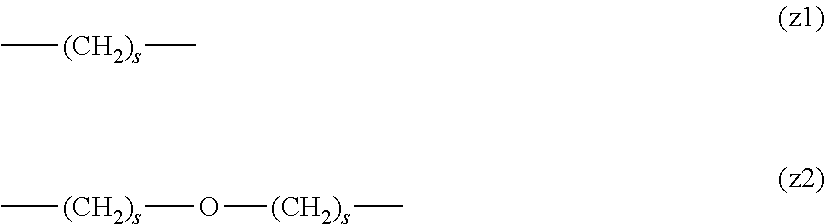
wherein s is an integer of 0-6, s in the number of 2 in (z2) may be the same or different](e.g., a single bond, —O—, —(CH2)2—O—);

wherein s in the number of 2 may be the same or different and are each an integer of 0-6](e.g., —CO—, —(CH2)5—CO—);
-
- L3 is a secondary amino group (—NH—);
- L4 is an alkylene group optionally containing an ether bond [preferably,

wherein s in the number of 2 may be the same or different and are each an integer of 0-6](e.g., —(CH2)3—O—);
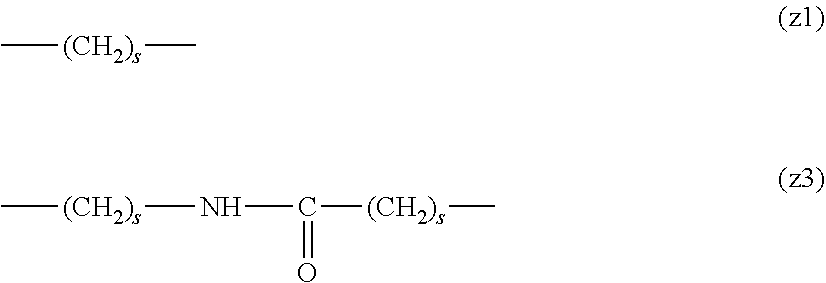
wherein s is an integer of 0-6, and s in the number of 2 in (z3) may be the same or different](e.g., a single bond, —(CH2)2—, —(CH2)3—, —(CH2)2—CO—NH—, —(CH2)2—CO—NH—(CH2)3—).
-
- m is 1-3;
- p is 1 or 2;
- n1 and n2 are each independently 113-568;
- R is an alkyl group having 1-3 carbon atoms (e.g., a methyl group);
- Z1 is an oligopeptide with 2-3 residues composed of neutral amino acids excluding cysteine (e.g., glycine-phenylalanine-leucine, glycine-glycine-phenylalanine, glycine-phenylalanine, glycine-glycine, valine-citrulline, valine-alanine);
- A is phenylalanine or leucine;
- a and b are each independently 0 or 1, and (a+b)≥1;
- Q is a residue of ethylene glycol or a residue of lysine;
- D is a calcitonin, a human growth hormone or a granulocyte colony stimulating factor;
- L1, L2, L3, L4 and L5 are each independently a single bond, an amide bond, an ether bond, a secondary amino group, a carbonyl group, or an alkylene group optionally comprising such bond or group [preferably, each independently a spacer selected from
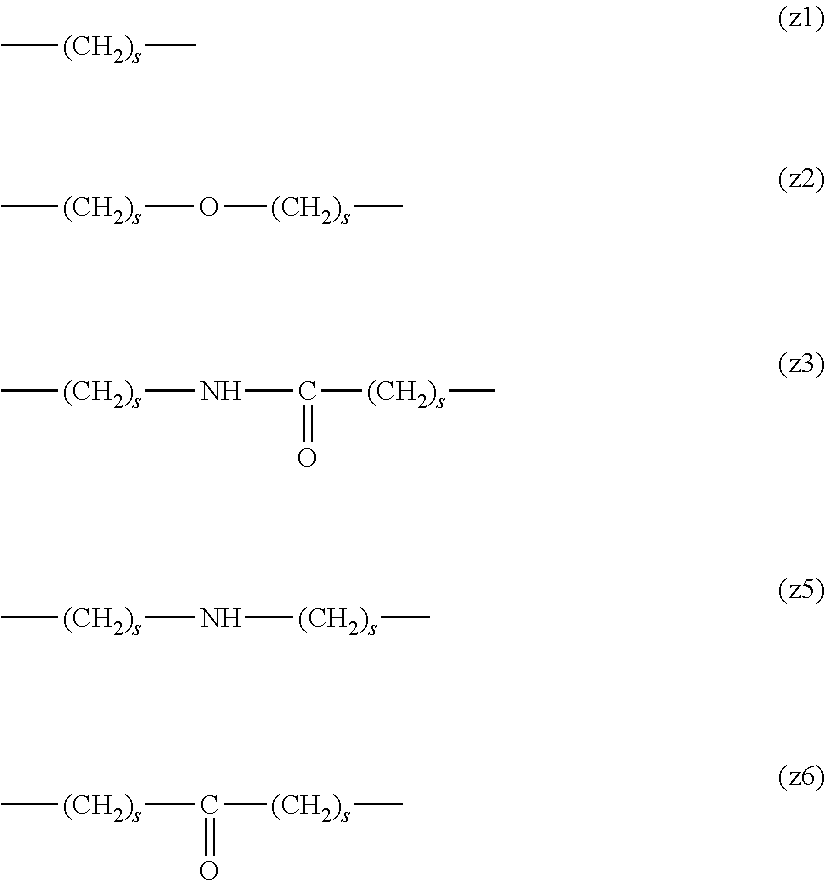
wherein s is an integer of 0-6, s in the number of 2 in (z2), (z3), (z5) and (z6) may be the same or different](e.g., a single bond, —O—, —(CH2)2—, —(CH2)3—, —(CH2)2—O—, —(CH2)3—O—, —(CH2)2—CO—NH—, —(CH2)2—CO—NH—(CH2)3—, —CO—, —(CH2)5—CO—, —NH—).
[Bio-Related Substance Bonded to Polyethylene Glycol Derivative (2-2)]
-
- m is 1-3;
- p is 1 or 2;
- n1 and n2 are each independently 113-568;
- R is an alkyl group having 1-3 carbon atoms (e.g., a methyl group);
- Z1 is an oligopeptide with 2-3 residues composed of neutral amino acids excluding cysteine (e.g., glycine-phenylalanine-leucine, glycine-glycine-phenylalanine, glycine-phenylalanine, glycine-glycine, valine-citrulline, valine-alanine);
- A is phenylalanine or leucine;
- a and b are each independently 0 or 1, and (a+b)≥1;
- Q is a residue of ethylene glycol or a residue of lysine;
- D is a calcitonin, a human growth hormone or a granulocyte colony stimulating factor;
- L1 is a single bond, an ether bond or an alkylene group optionally containing an ether bond [preferably,

wherein s is an integer of 0-6, s in the number of 2 in (z2) may be the same or different](e.g., a single bond, —O—, —(CH2)2—O—);
-
- L2 is a carbonyl group or an alkylene group optionally containing a carbonyl group [preferably,

wherein s in the number of 2 may be the same or different and are each an integer of 0-6](e.g., —CO—, —(CH2)5—CO—);
-
- L3 is a secondary amino group (—NH—);
- L4 is an alkylene group optionally containing an ether bond [preferably,

wherein s in the number of 2 may be the same or different and are each an integer of 0-6](e.g., —(CH2)3—O—);
-
- L5 is a single bond or an alkylene group optionally containing an amide bond [preferably,
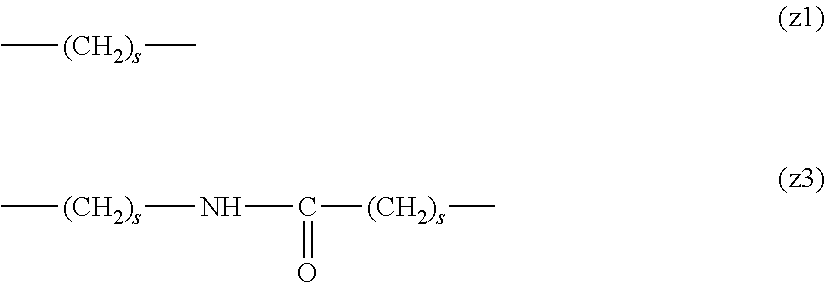
wherein s is an integer of 0-6, and s in the number of 2 in (z3) may be the same or different](e.g., a single bond, —(CH2)2—, —(CH2)3—, —(CH2)2—CO—NH—, —(CH2)2—CO—NH—(CH2)3—).
-
- p is 1 or 2;
- n3 and n4 are each independently 340-568;
- R is an alkyl group having 1-3 carbon atoms (e.g., a methyl group);
- Z1 is an oligopeptide with 2-3 residues composed of neutral amino acids excluding cysteine (e.g., glycine-phenylalanine-leucine, glycine-glycine-phenylalanine, glycine-phenylalanine, glycine-glycine, valine-citrulline, valine-alanine);
- A is phenylalanine or leucine;
- a and b are each independently 0 or 1, and (a+b)≥1;
- Q is a residue of ethylene glycol or a residue of lysine;
- D is a calcitonin, a human growth hormone or a granulocyte colony stimulating factor;
- L1, L2, L3, L4 and L5 are each independently a single bond, an amide bond, an ether bond, a secondary amino group, a carbonyl group, or an alkylene group optionally comprising such bond or group [preferably, each independently a spacer selected from

wherein s is an integer of 0-6, and s in the number of 2 in (z2), (z3), (z5) and (z6) may be the same or different](e.g., a single bond, —O—, —(CH2)2—, —(CH2)3—, —(CH2)2—O—, —(CH2)3—O—, —(CH2)2—CO—NH—, —(CH2)2—CO—NH—(CH2)3—, —CO—, —(CH2)5—CO—, —NH—).
[Bio-Related Substance Bonded to Polyethylene Glycol Derivative (3-2)]
-
- p is 1 or 2;
- n3 and n4 are each independently 340-568;
- R is an alkyl group having 1-3 carbon atoms (e.g., a methyl group);
- Z1 is an oligopeptide with 2-3 residues composed of neutral amino acids excluding cysteine (e.g., glycine-phenylalanine-leucine, glycine-glycine-phenylalanine, glycine-phenylalanine, glycine-glycine, valine-citrulline, valine-alanine);
- A is phenylalanine or leucine;
- a and b are each independently 0 or 1, and (a+b)≥1;
- Q is a residue of ethylene glycol or a residue of lysine;
- D is a calcitonin, a human growth hormone or a granulocyte colony stimulating factor;
- L1 is a single bond, an ether bond or an alkylene group optionally containing an ether bond [preferably,

wherein s is an integer of 0-6, and s in the number of 2 in (z2) may be the same or different](e.g., a single bond, —O—, —(CH2)2—O—);
-
- L2 is a carbonyl group or an alkylene group optionally containing a carbonyl group [preferably,

wherein s in the number of 2 may be the same or different and are each an integer of 0-6](e.g., —CO—, —(CH2)5—CO—);
-
- L3 is a secondary amino group (—NH—);
- L4 is an alkylene group optionally containing an ether bond [preferably,

wherein s in the number of 2 may be the same or different and are each an integer of 0-6](e.g., —(CH2)3—O—);
-
- L5 is a single bond or an alkylene group optionally containing an amide bond [preferably,
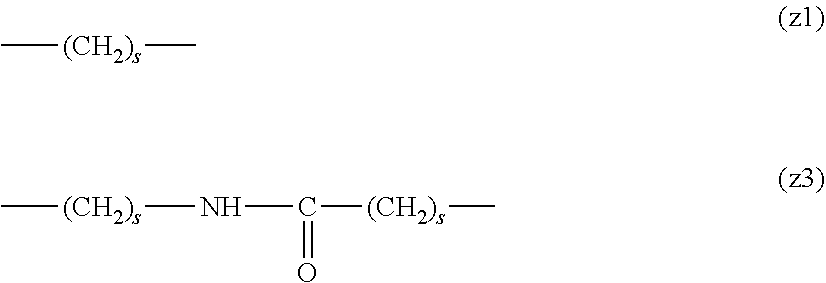
wherein s is an integer of 0-6, and s in the number of 2 in (z3) may be the same or different](e.g., a single bond, —(CH2)2—, —(CH2)3—, —(CH2)2—CO—NH—, —(CH2)2—CO—NH—(CH2)3—).
-
- m is 1-3;
- n5 and n6 are each independently 180-525;
- R is an alkyl group having 1-3 carbon atoms (e.g., a methyl group);
- Z is an oligopeptide with 2-4 residues composed of neutral amino acids excluding cysteine (e.g., glycine-phenylalanine-leucine-glycine (SEQ ID NO: 4), glycine-glycine-phenylalanine-glycine (SEQ ID NO: 5), glycine-phenylalanine-glycine, glycine-glycine-glycine, valine-citrulline-glycine, valine-alanine-glycine, phenylalanine-glycine);
- D is a calcitonin, a human growth hormone or a granulocyte colony stimulating factor;
- L2, L3, L4 and L5 are each independently a single bond, an amide bond, an ether bond, a secondary amino group, a carbonyl group, or an alkylene group optionally comprising such bond or group [preferably, each independently a spacer selected from
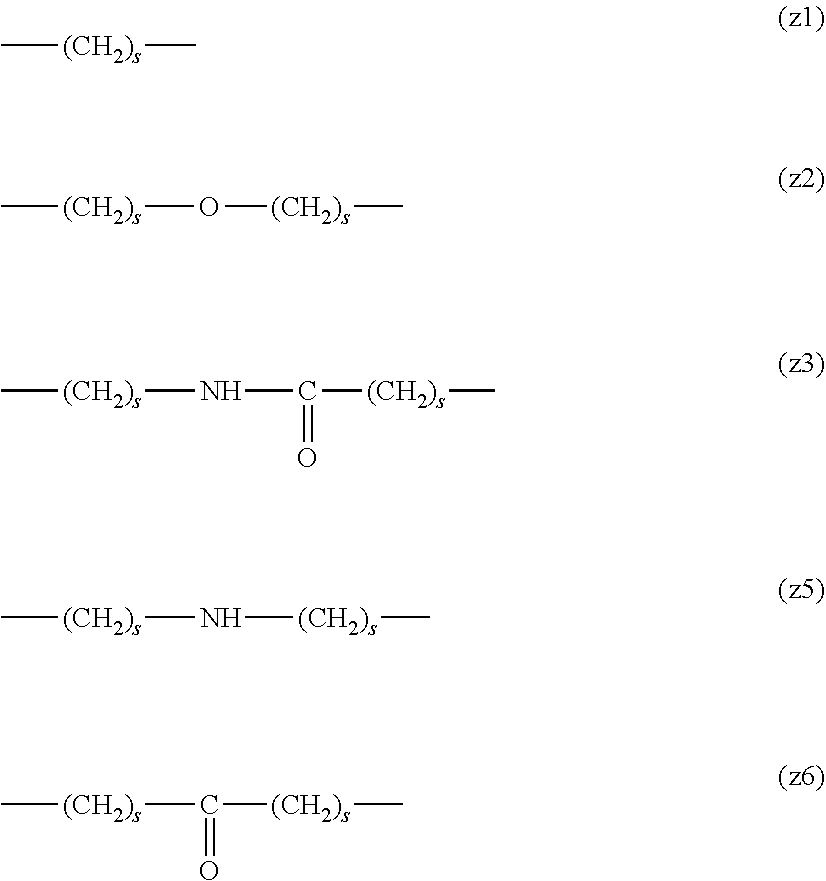
wherein s is an integer of 0-6, and s in the number of 2 in (z2), (z3), (z5) and (z6) may be the same or different](e.g., a single bond, —O—, —(CH2)2—, —(CH2)3—, —(CH2)2—O—, —(CH2)3—O—, —(CH2)2—CO—NH—, —(CH2)2—CO—NH—(CH2)3—, —CO—, —(CH2)5—CO—, —NH—).
[Bio-Related Substance Bonded to Polyethylene Glycol Derivative (4-2)]
-
- m is 1-3;
- n5 and n6 are each independently 180-525;
- R is an alkyl group having 1-3 carbon atoms (e.g., a methyl group);
- Z is an oligopeptide with 2-4 residues composed of neutral amino acids excluding cysteine (e.g., glycine-phenylalanine-leucine-glycine (SEQ ID NO: 4), glycine-glycine-phenylalanine-glycine (SEQ ID NO: 5), glycine-phenylalanine-glycine, glycine-glycine-glycine, valine-citrulline-glycine, valine-alanine-glycine, phenylalanine-glycine);
- D is a calcitonin, a human growth hormone or a granulocyte colony stimulating factor;
- L2 is a carbonyl group or an alkylene group optionally containing a carbonyl group [preferably,

wherein s in the number of 2 may be the same or different and are each an integer of 0-6](e.g., —CO—, —(CH2)5—CO—);
-
- L3 is a secondary amino group (—NH—);
- L4 is an alkylene group optionally containing an ether bond [preferably,

wherein s in the number of 2 may be the same or different and are each an integer of 0-6](e.g., —(CH2)3—O—);
-
- L5 is a single bond or an alkylene group optionally containing an amide bond [preferably,

wherein s is an integer of 0-6, and s in the number of 2 in (z3) may be the same or different](e.g., a single bond, —(CH2)2—, —(CH2)3—, —(CH2)2—CO—NH—, —(CH2)2—CO—NH—(CH2)3—).
-
- m is 1-3;
- n5 and n6 are each independently 180-525;
- R is an alkyl group having 1-3 carbon atoms (e.g., a methyl group);
- Z1 is an oligopeptide with 2-3 residues composed of neutral amino acids excluding cysteine (e.g., glycine-phenylalanine-leucine, glycine-glycine-phenylalanine, glycine-phenylalanine, glycine-glycine, valine-citrulline, valine-alanine);
- A is phenylalanine or leucine;
- a and b are each independently 0 or 1, and (a+b)≥1;
- D is a calcitonin, a human growth hormone or a granulocyte colony stimulating factor;
- L2, L3, L4 and L5 are each independently a single bond, an amide bond, an ether bond, a secondary amino group, a carbonyl group, or an alkylene group optionally comprising such bond or group [preferably, each independently a spacer selected from
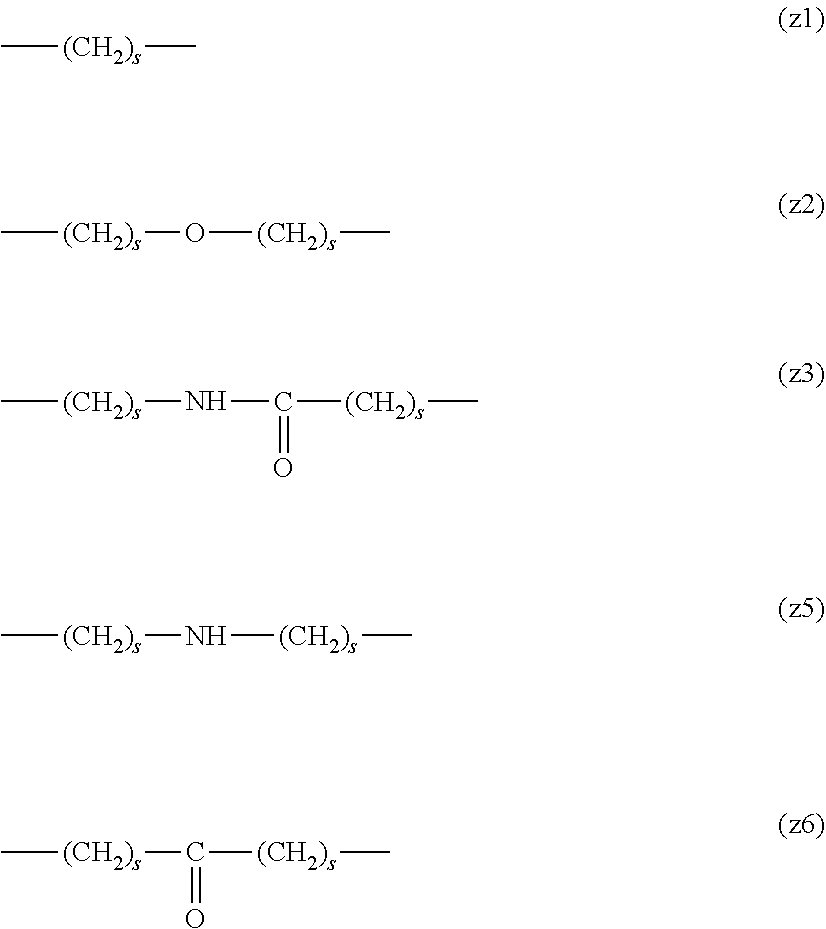
wherein s is an integer of 0-6, and s in the number of 2 in (z2), (z3), (z5) and (z6) may be the same or different](e.g., a single bond, —O—, —(CH2)2—, —(CH2)3—, —(CH2)2—O—, —(CH2)3—O—, —(CH2)2—CO—NH—, —(CH2)2—CO—NH—(CH2)3—, —CO—, —(CH2)5—CO—, —NH—).
[Bio-Related Substance Bonded to Polyethylene Glycol Derivative (5-2)]
-
- m is 1-3;
- n5 and n6 are each independently 180-525;
- R is an alkyl group having 1-3 carbon atoms (e.g., a methyl group);
- Z1 is an oligopeptide with 2-3 residues composed of neutral amino acids excluding cysteine (e.g., glycine-phenylalanine-leucine, glycine-glycine-phenylalanine, glycine-phenylalanine, glycine-glycine, valine-citrulline, valine-alanine);
- A is phenylalanine or leucine;
- a and b are each independently 0 or 1, and (a+b)≥1;
- D is a calcitonin, a human growth hormone or a granulocyte colony stimulating factor;
- L2 is a carbonyl group or an alkylene group optionally containing a carbonyl group [preferably,

wherein s in the number of 2 may be the same or different and are each an integer of 0-6](e.g., —CO—, —(CH2)5—CO—);
-
- L3 is a secondary amino group (—NH—);
- L4 is an alkylene group optionally containing an ether bond [preferably,

wherein s in the number of 2 may be the same or different and are each an integer of 0-6](e.g., —(CH2)3—O—);
-
- L5 is a single bond or an alkylene group optionally containing an amide bond [preferably,

wherein s is an integer of 0-6, and s in the number of 2 in (z3) may be the same or different](e.g., a single bond, —(CH2)2—, —(CH2)3—, —(CH2)2—CO—NH—, —(CH2)2—CO—NH—(CH2)3—).
-
- n7 and n8 are each independently 340-568;
- R is an alkyl group having 1-3 carbon atoms (e.g., a methyl group);
- Z1 is an oligopeptide with 2-3 residues composed of neutral amino acids excluding cysteine (e.g., glycine-phenylalanine-leucine, glycine-glycine-phenylalanine, glycine-phenylalanine, glycine-glycine, valine-citrulline, valine-alanine);
- A is phenylalanine or leucine;
- a and b are each independently 0 or 1, and (a+b)≥1;
- D is a calcitonin, a human growth hormone or a granulocyte colony stimulating factor;
- L2, L3, L4 and L5 are each independently a single bond, an amide bond, an ether bond, a secondary amino group, a carbonyl group, or an alkylene group optionally comprising such bond or group [preferably, each independently a spacer selected from
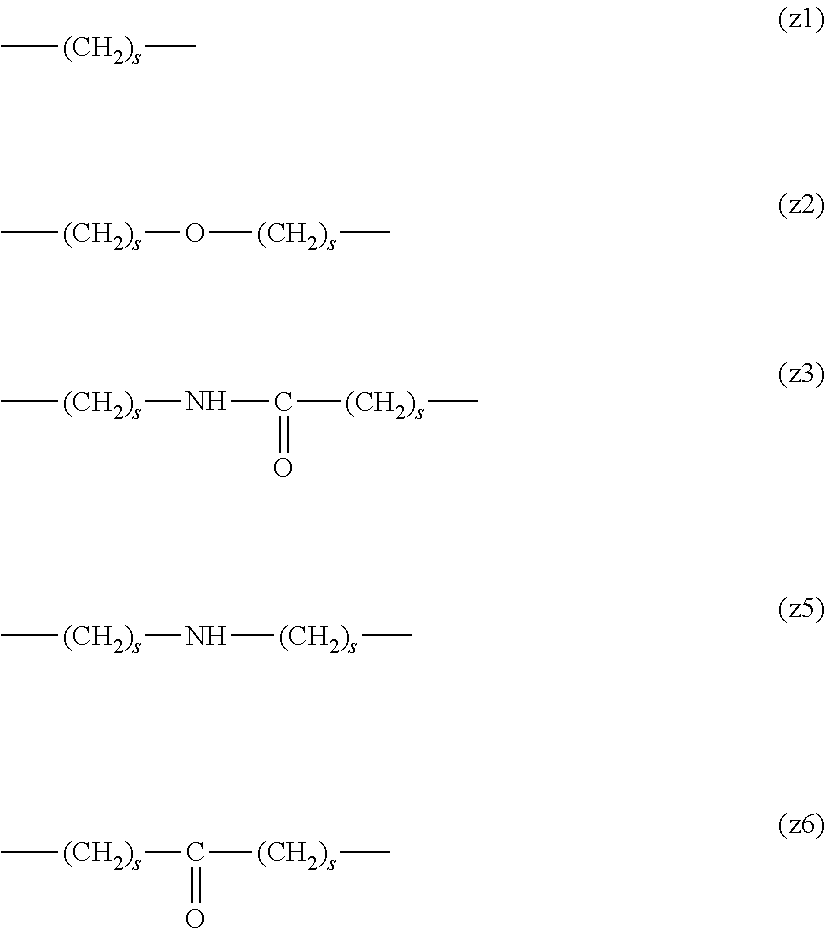
wherein s is an integer of 0-6, and s in the number of 2 in (z2), (z3), (z5) and (z6) may be the same or different](e.g., a single bond, —O—, —(CH2)2—, —(CH2)3—, —(CH2)2—O—, —(CH2)3—O—, —(CH2)2—CO—NH—, —(CH2)2—CO—NH—(CH2)3—, —CO—, —(CH2)5—CO—, —NH—).
[Bio-Related Substance Bonded to Polyethylene Glycol Derivative (6-2)]
-
- n7 and n8 are each independently 340-568;
- R is an alkyl group having 1-3 carbon atoms (e.g., a methyl group);
- Z1 is an oligopeptide with 2-3 residues composed of neutral amino acids excluding cysteine (e.g., glycine-phenylalanine-leucine, glycine-glycine-phenylalanine, glycine-phenylalanine, glycine-glycine, valine-citrulline, valine-alanine);
- A is phenylalanine or leucine;
- a and b are each independently 0 or 1, and (a+b)≥1;
- D is a calcitonin, a human growth hormone or a granulocyte colony stimulating factor;
- L2 is a carbonyl group or an alkylene group optionally containing a carbonyl group [preferably,

wherein s in the number of 2 may be the same or different and are each an integer of 0-6](e.g., —CO—, —(CH2)5—CO—);
-
- L3 is a secondary amino group (—NH—);
- L4 is an alkylene group optionally containing an ether bond [preferably,

wherein s in the number of 2 may be the same or different and are each an integer of 0-6](e.g., —(CH2)3—O—);
-
- L5 is a single bond or an alkylene group optionally containing an amide bond [preferably,

wherein s is an integer of 0-6, and s in the number of 2 in (z3) may be the same or different](e.g., a single bond, —(CH2)2—, —(CH2)3—, —(CH2)2—CO—NH—, —(CH2)2—CO—NH—(CH2)3—).

wherein X is a functional group capable of reacting with a bio-related substance, and m, n1 and n2, p, R, Z, Q, L1, L2, L3, L4 and L5 are as defined above.
-
- group (II): functional group capable of reacting with amino group of bio-related substance
- (a), (b), (c), (d), (e), (f), (g), (j), (k) below
- group (III): functional group capable of reacting with mercapto group of bio-related substance
- (a), (b), (c), (d), (e), (f), (g), (h), (i), (j), (k), (l) below
- group (IV): functional group capable of reacting with aldehyde of bio-related substance
- (h), (m), (n), (p) below
- group (V): functional group capable of reacting with carboxyl group of bio-related substance
- (h), (m), (n), (p) below
- group (VI): functional group capable of reacting with unsaturated bond of bio-related substance
- (h), (m), (o) below
- group (VII): functional group capable of reacting with azide group of bio-related substance
- the following (l)
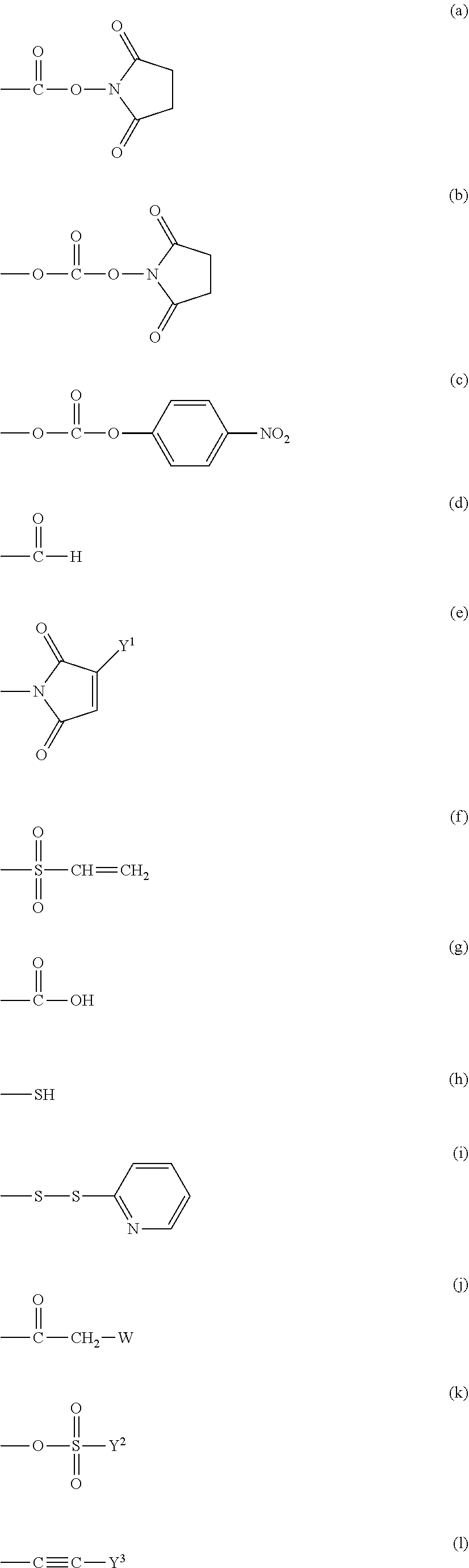


wherein PEG1, PEG2 are polyethylene glycol derivatives, Peptide is oligopeptide, X1, X2, X3 are functional groups capable of reacting with oligopeptide of a polyethylene glycol derivative, Pro is a protecting group, and R is as defined above.





-
- Polyethylene glycol derivative (9): a polyethylene glycol derivative having a structure in which two polyethylene glycol chains are linked by one oligopeptide
- Polyethylene glycol derivative (13): a polyethylene glycol derivative having a structure in which three polyethylene glycol chains are linked by two oligopeptides
- Polyethylene glycol derivative (14): a polyethylene glycol derivative having a structure in which four polyethylene glycol chains are linked by three oligopeptides
- Polyethylene glycol derivative (15): a polyethylene glycol derivative having a structure in which five polyethylene glycol chains are linked by four oligopeptides
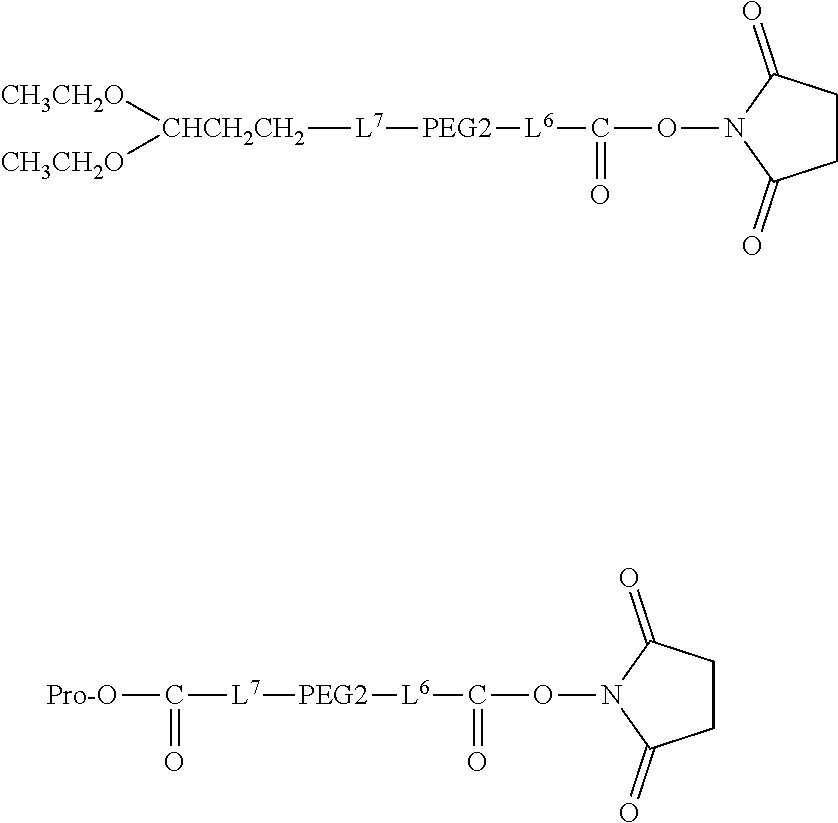
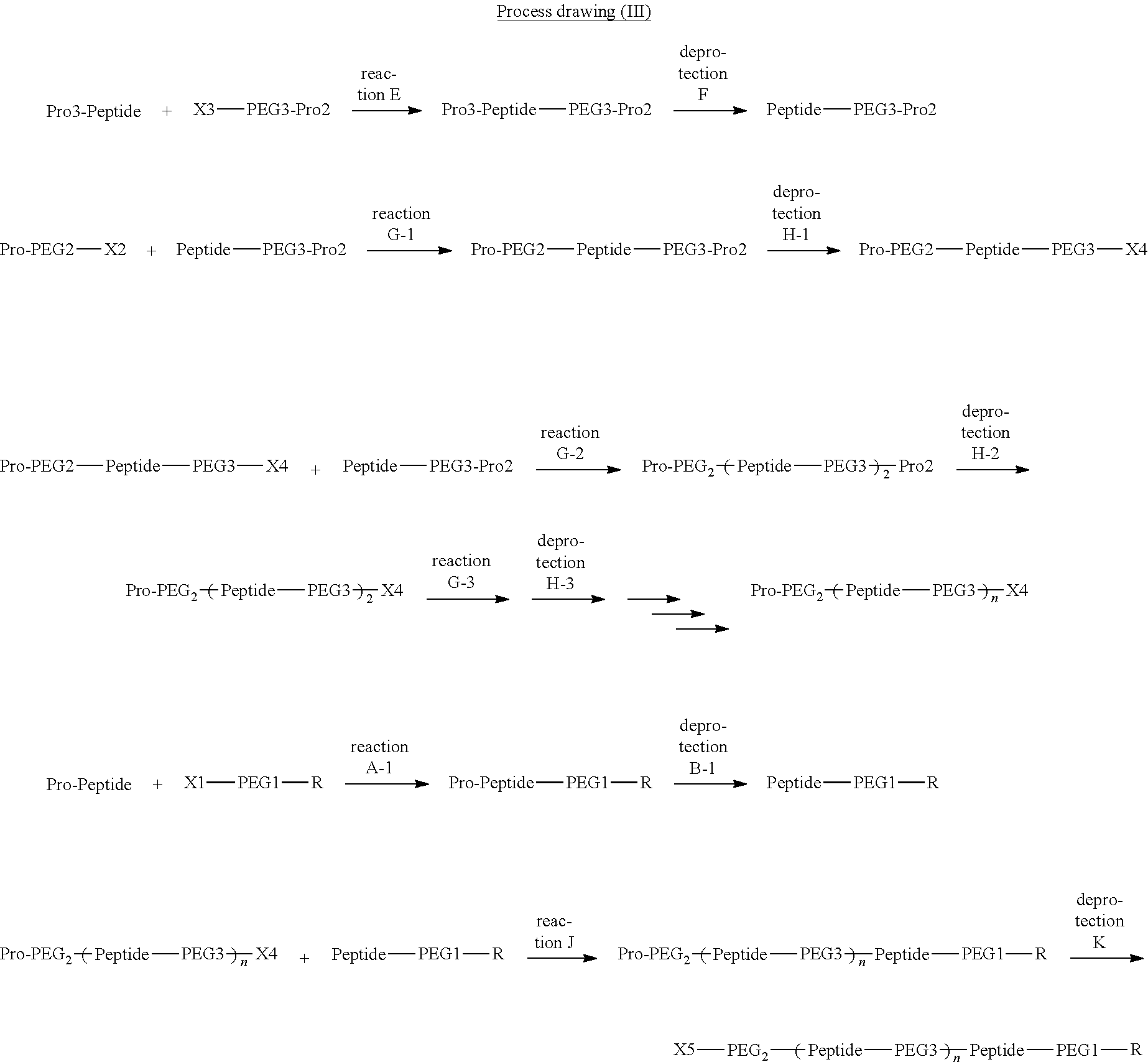
wherein PEG1, PEG2, PEG3 are polyethylene glycol derivatives, Peptide is oligopeptide, X1, X2, X3, X4, X5 are functional groups of a polyethylene glycol derivative, Pro, Pro2, Pro3 are each a protecting group, and R is as defined above.
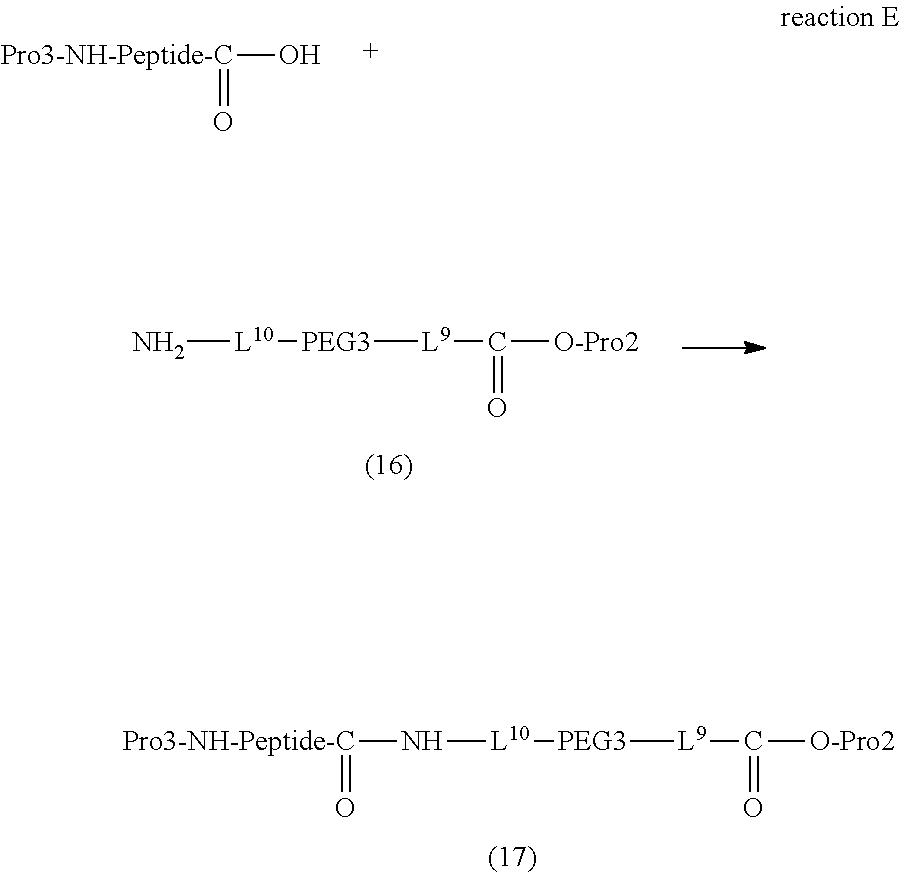

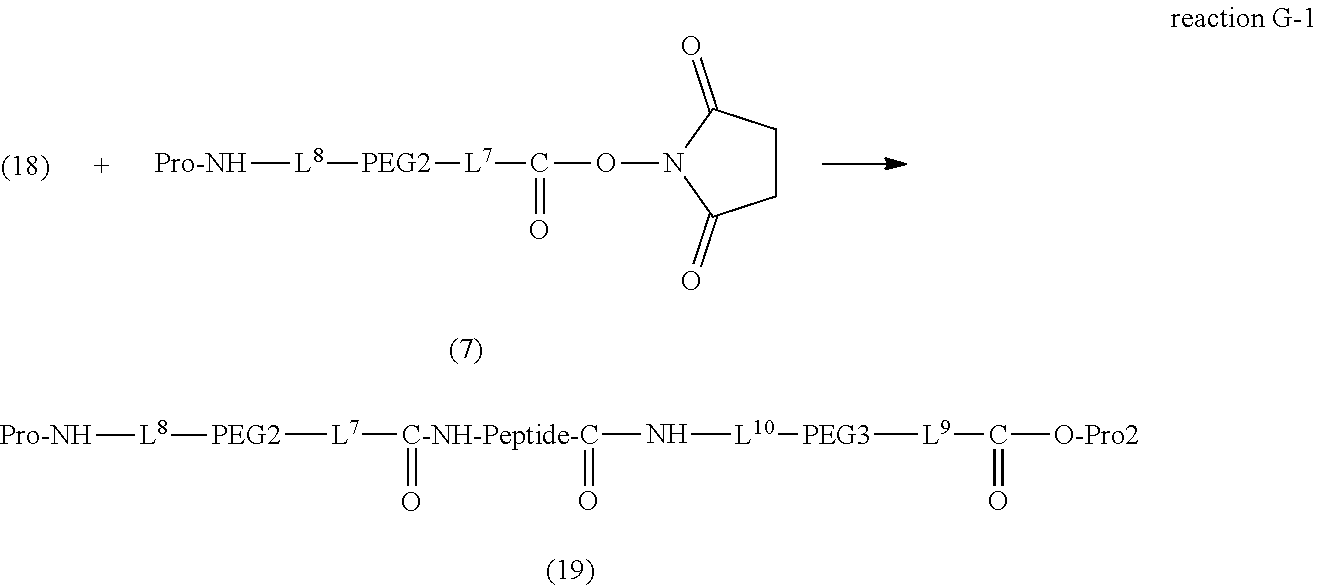


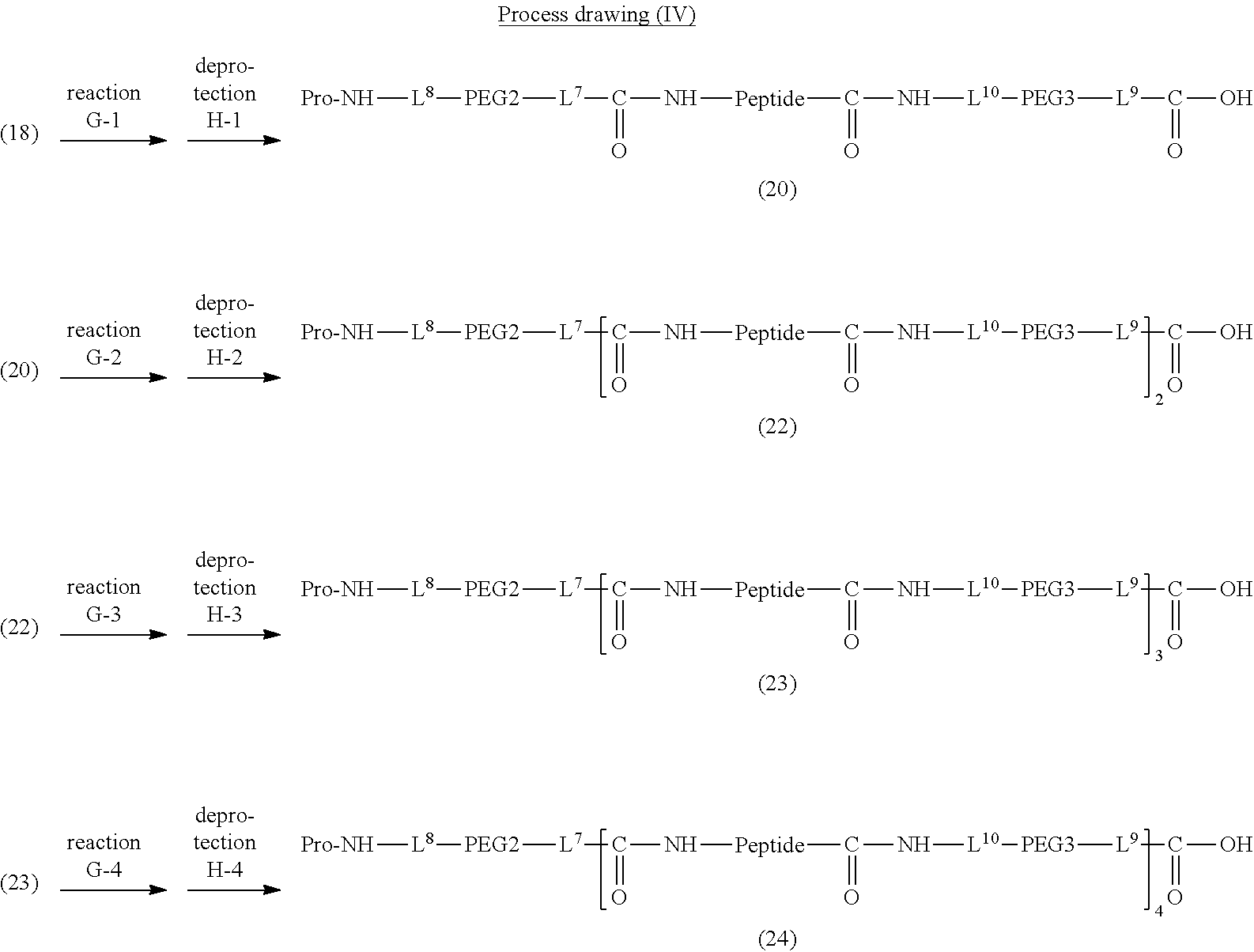
-
- Polyethylene glycol derivative (20): a polyethylene glycol derivative having a structure in which two polyethylene glycol chains are linked by one oligopeptide
- Polyethylene glycol derivative (22): a polyethylene glycol derivative having a structure in which three polyethylene glycol chains are linked by two oligopeptides
- Polyethylene glycol derivative (23): a polyethylene glycol derivative having a structure in which four polyethylene glycol chains are linked by three oligopeptides
- Polyethylene glycol derivative (24): a polyethylene glycol derivative having a structure in which five polyethylene glycol chains are linked by four oligopeptides


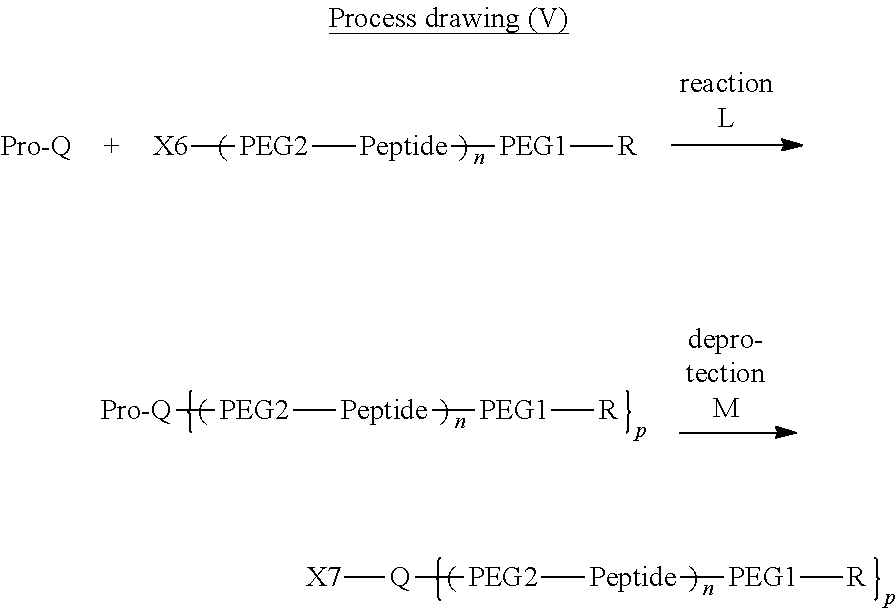
wherein PEG1, PEG2 are polyethylene glycol derivatives, Peptide is oligopeptide, Q is a residue of a compound having 3-5 active hydrogens, X6 and X7 are functional groups, Pro is a protecting group, p is 2-4, and R is as defined above.
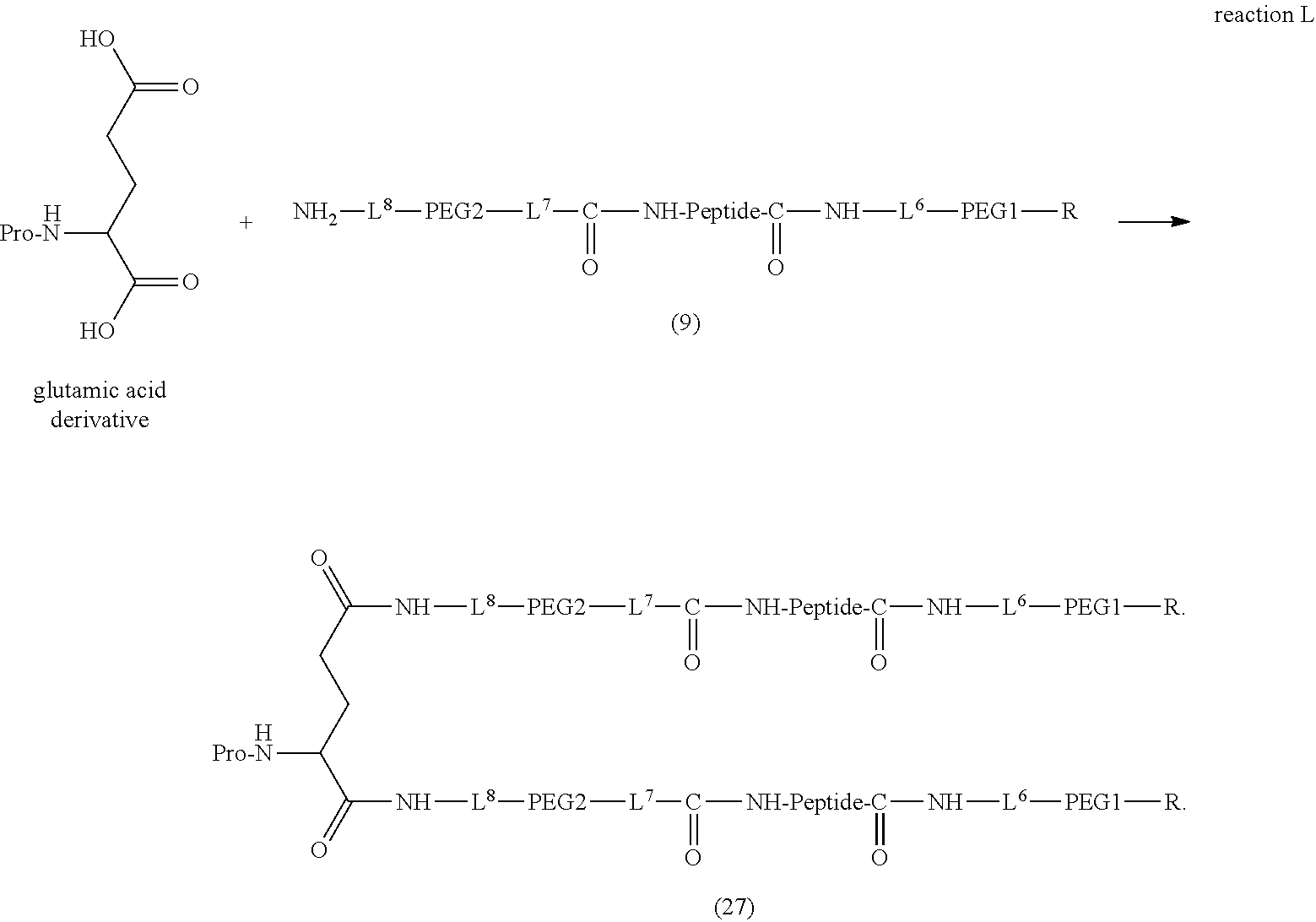


wherein PEG1, PEG2, PEG3 are polyethylene glycol derivatives, Peptide is oligopeptide, Q is a residue of a compound having 3-5 active hydrogens, X8 and X9 are functional groups, Pro is a protecting group, p is 2-4, and R is as defined above.

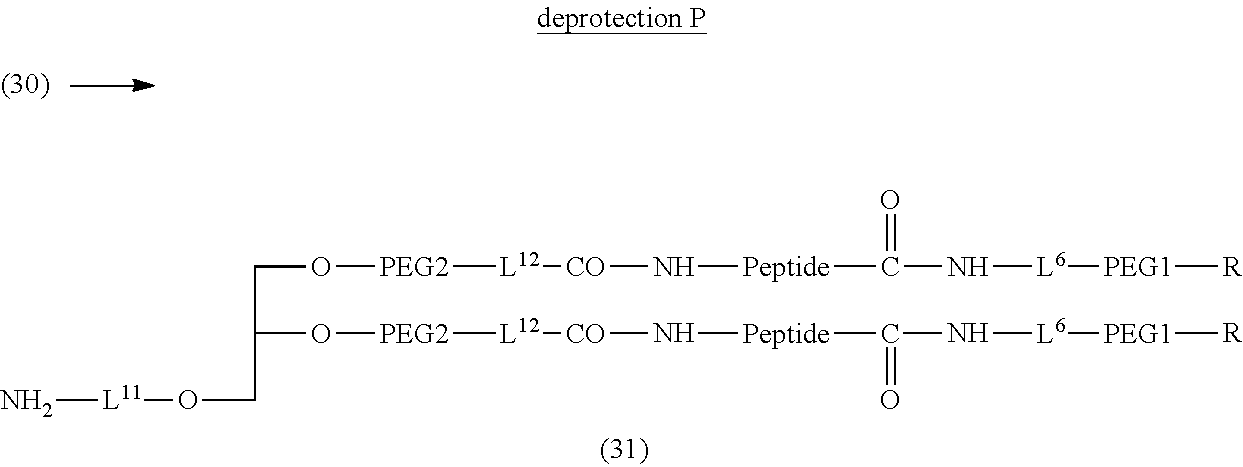

degradation rate=(peak area % before test−peak area % after test)−peak area % before test×100
degradation rate=(95−90)+95×100=5.26(%)
degradation rate=(95−5)+95×100=94.7(%)
-
- detector: differential refractometer
- column:
ultrahydrogel 500 and ultrahydrogel 250 (WATERS) - mobile phase: 100 mM Acetate buffer+0.02% NaN3 (pH 5.2)
- flow rate: 0.5 mL/min
- sample volume: 5 mg/mL, 20 μL
- column temperature: 30° C.
HPLC Analysis (Amine Purity Measurement) - detector: differential refractometer
- column: TSKgel SP-5PW (Tosoh Corporation)
- mobile phase: 1 mM Sodium phosphate buffer (pH 6.5)
- flow rate: 0.5 mL/min
- injection volume: 5 mg/mL, 20 μL
- column temperature: 40° C.

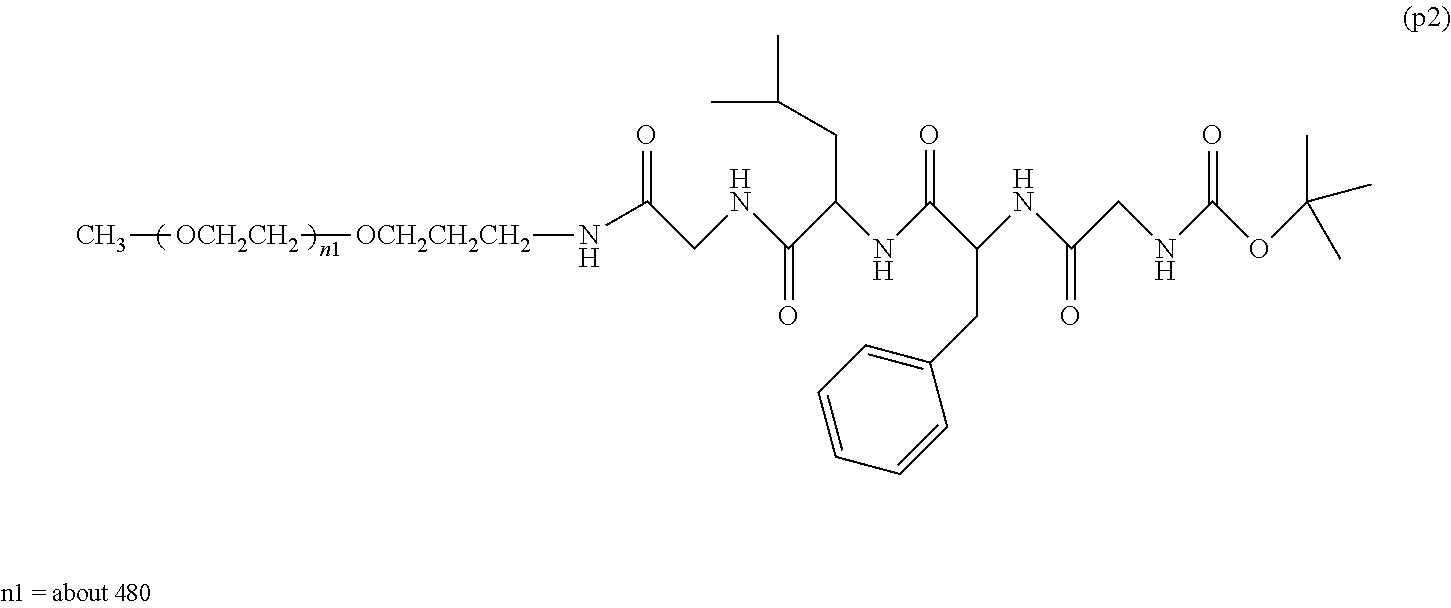
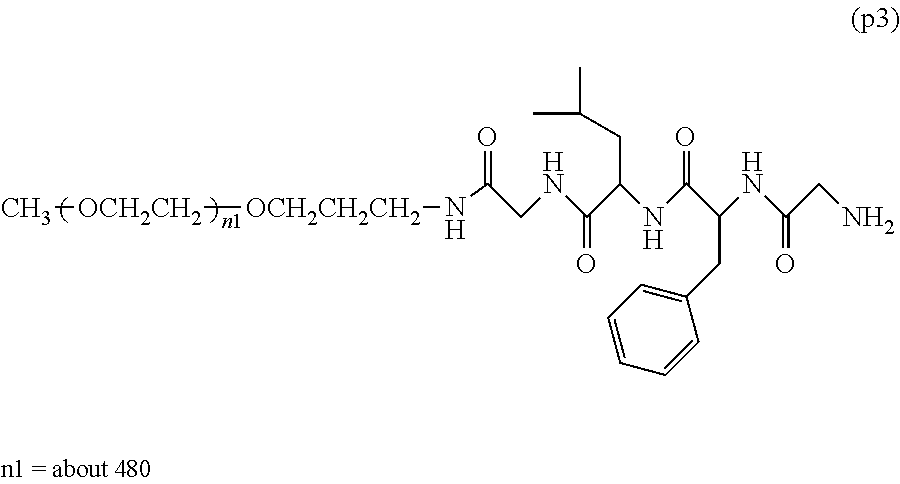


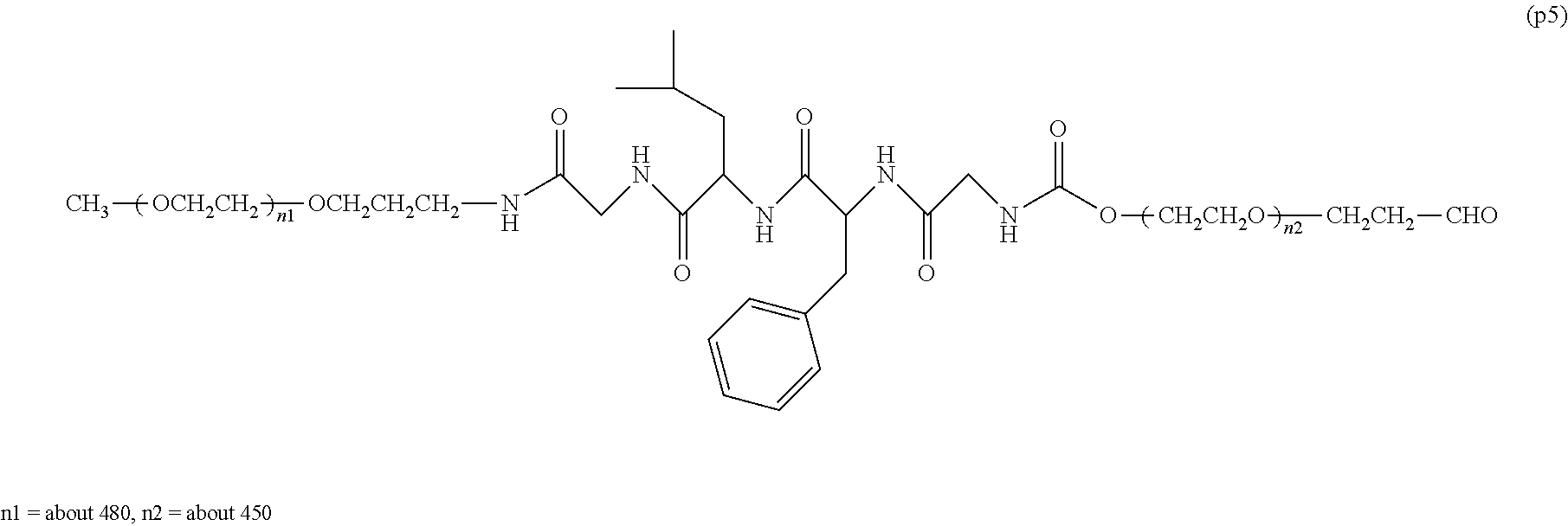
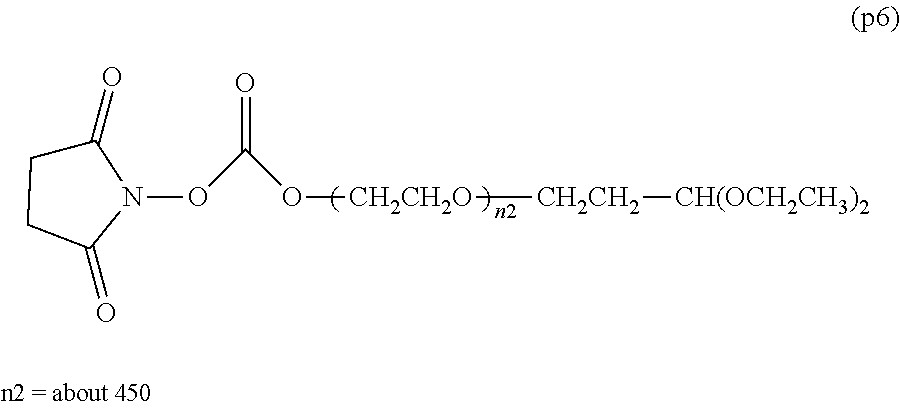

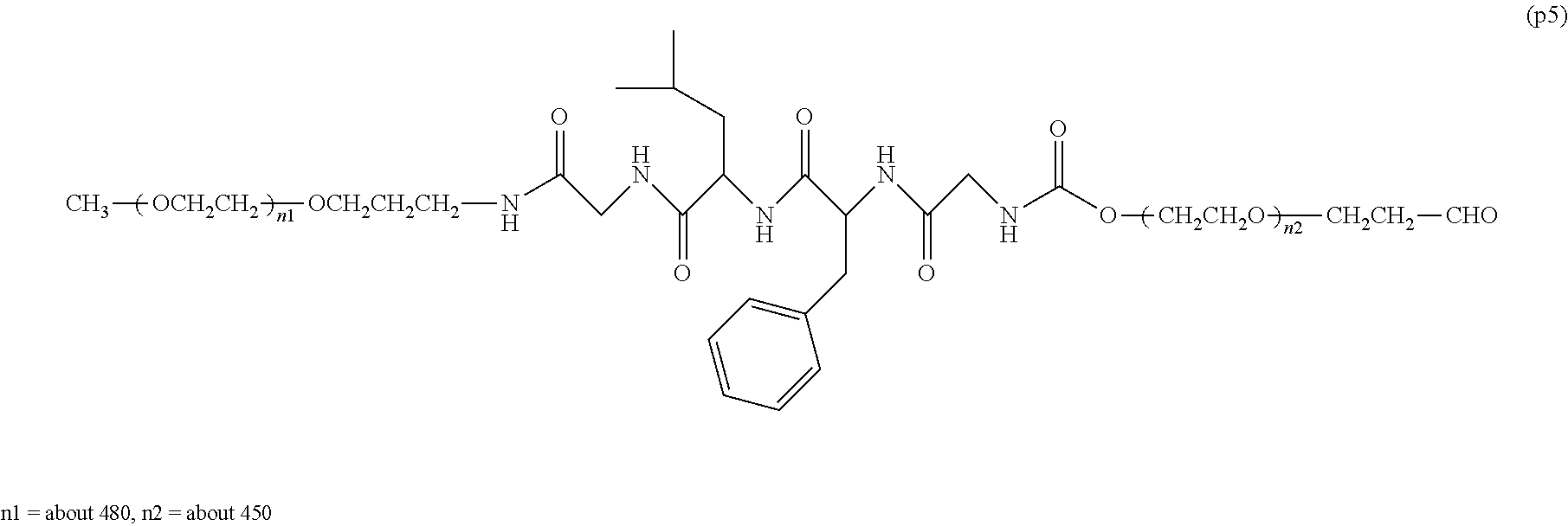


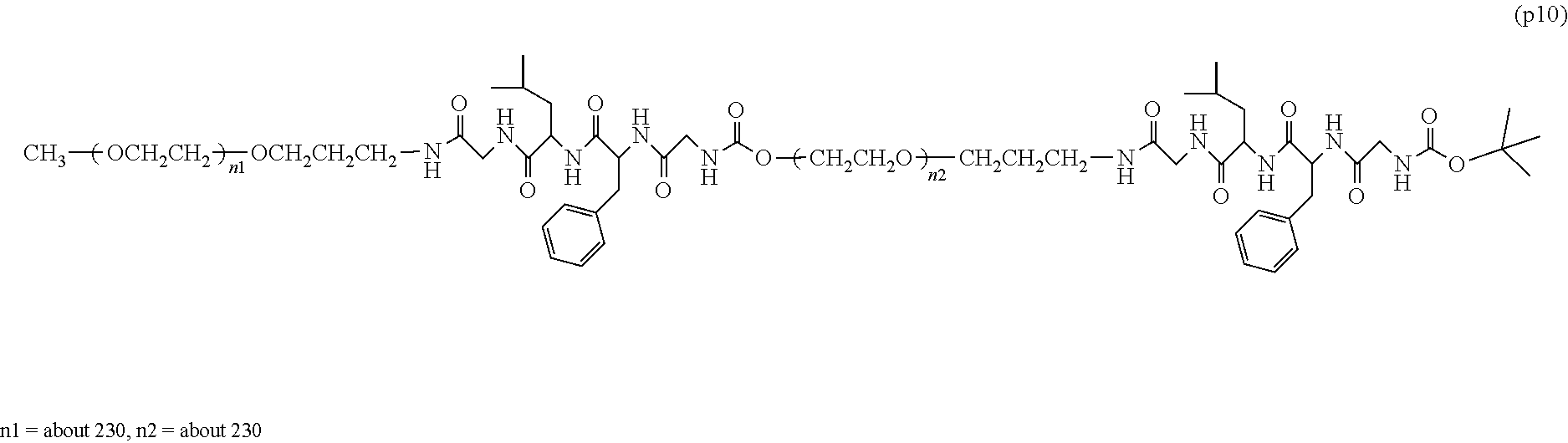

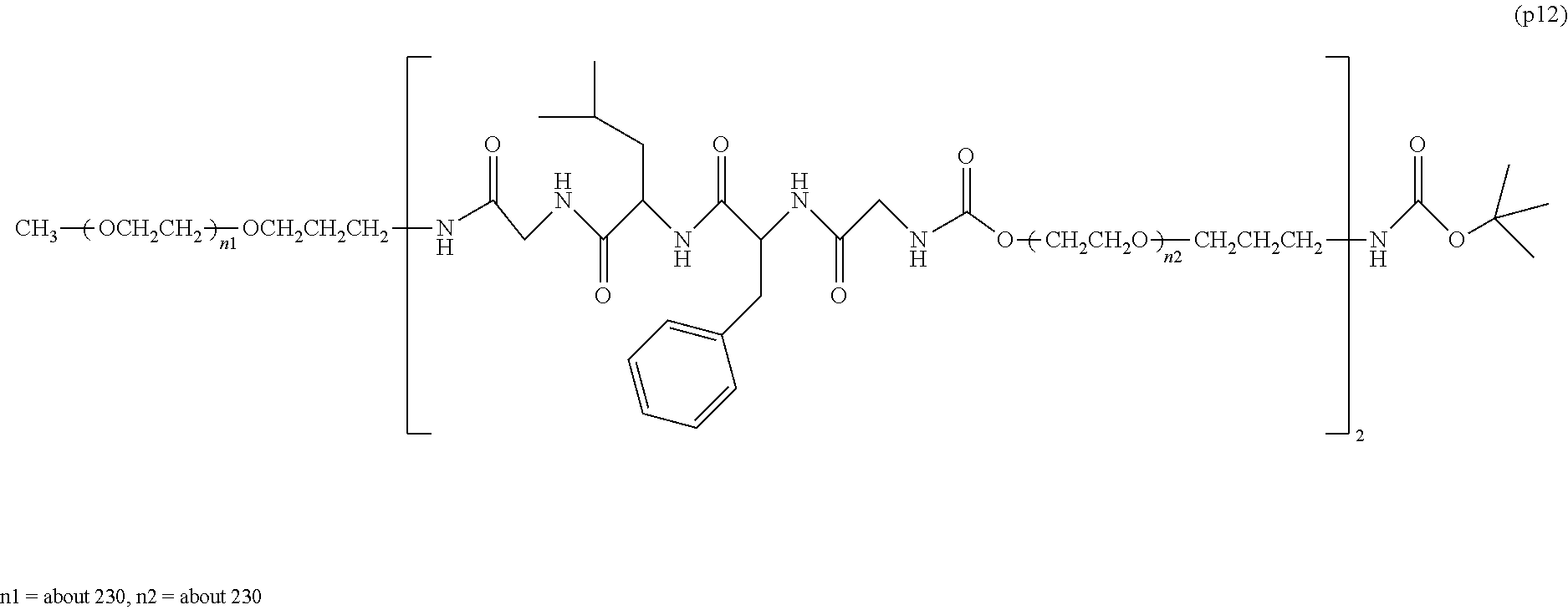


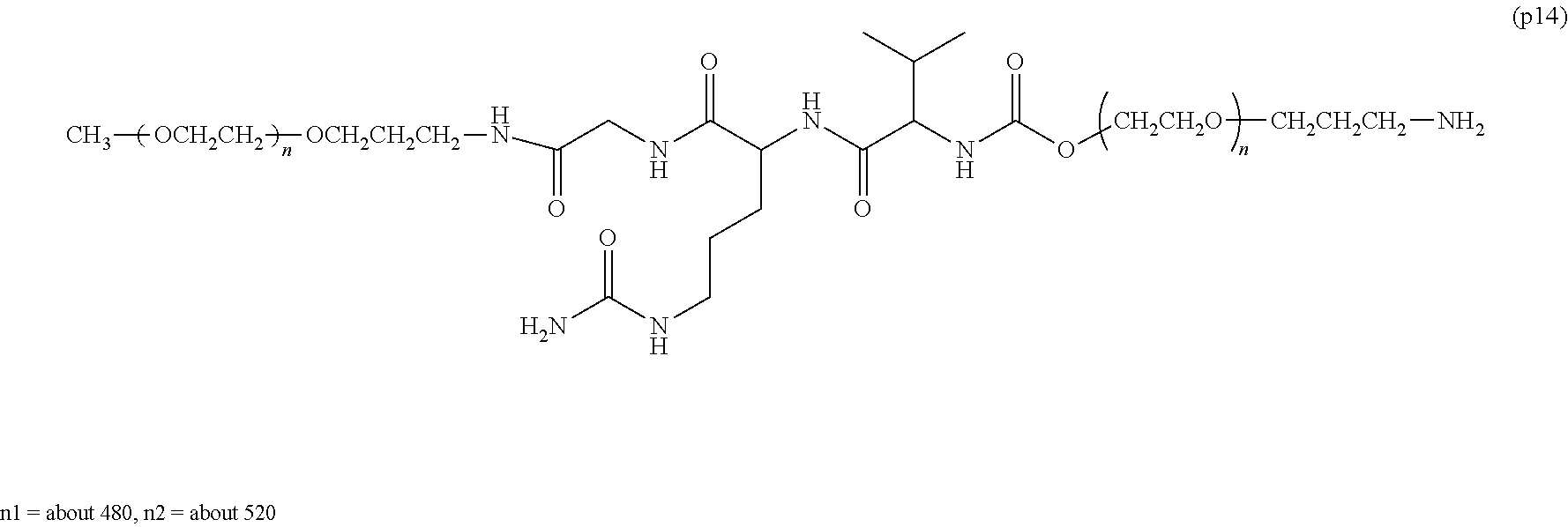

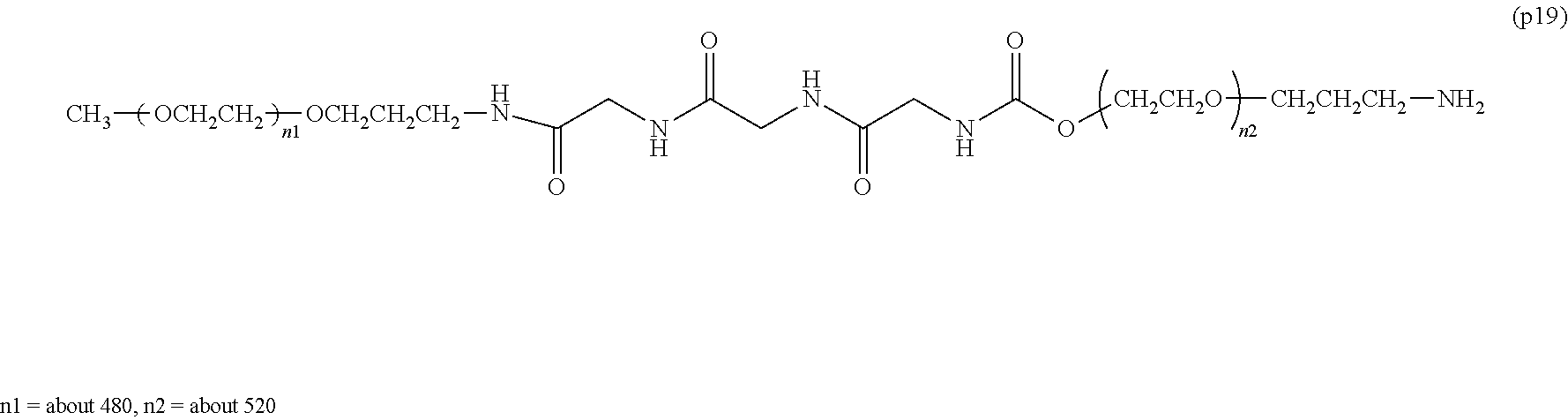


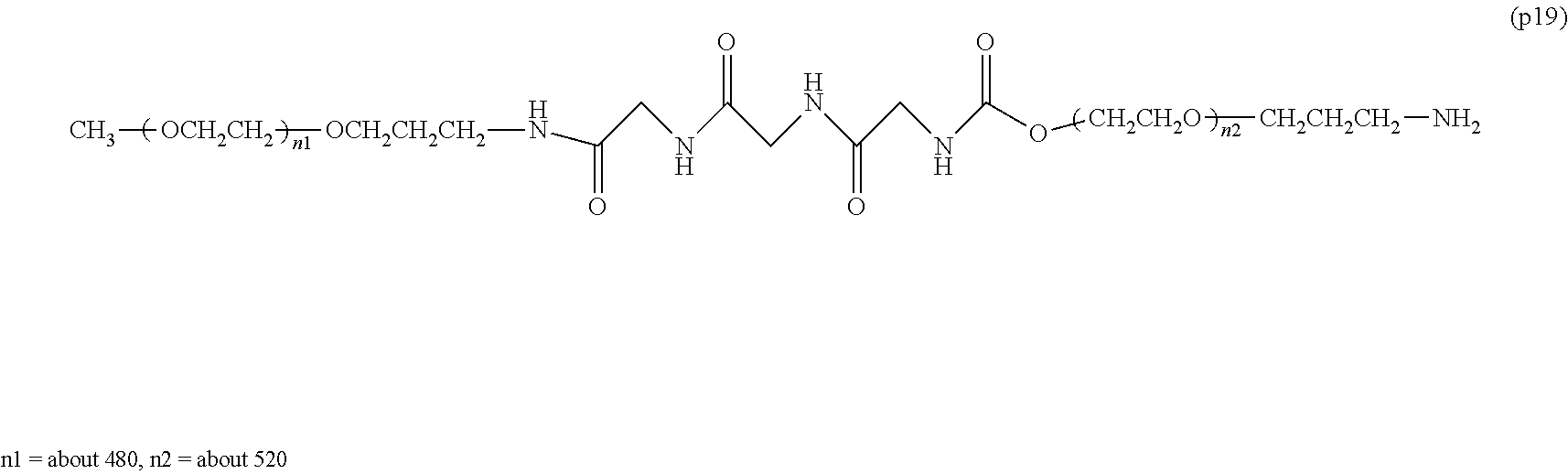


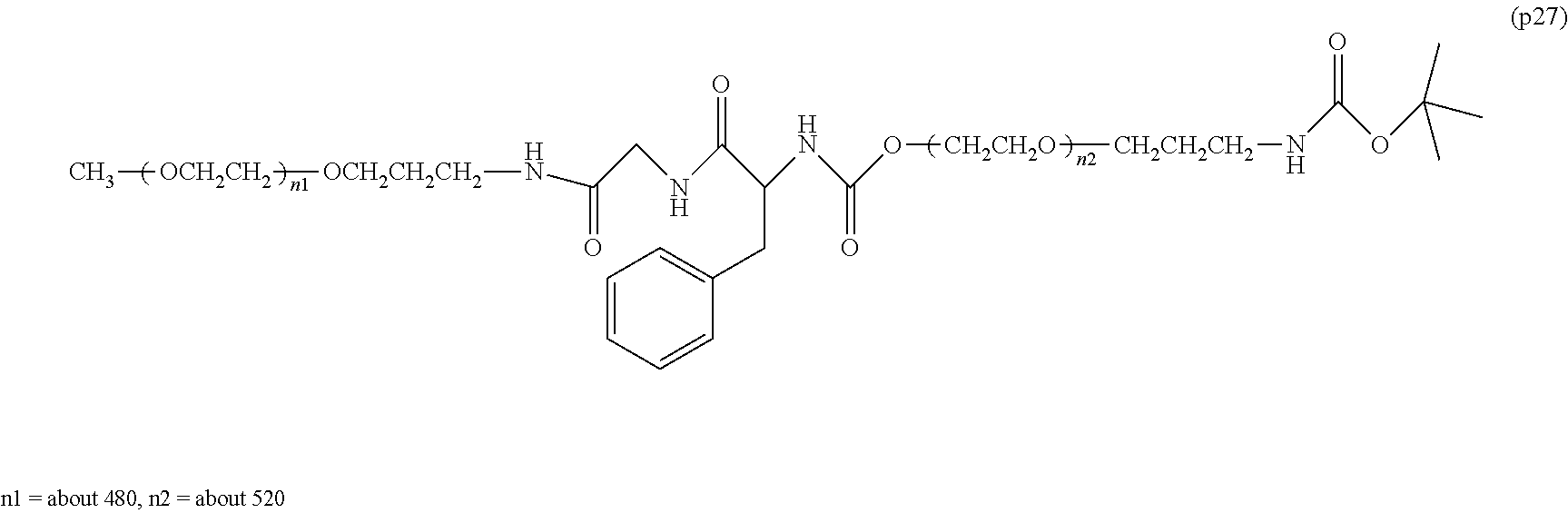


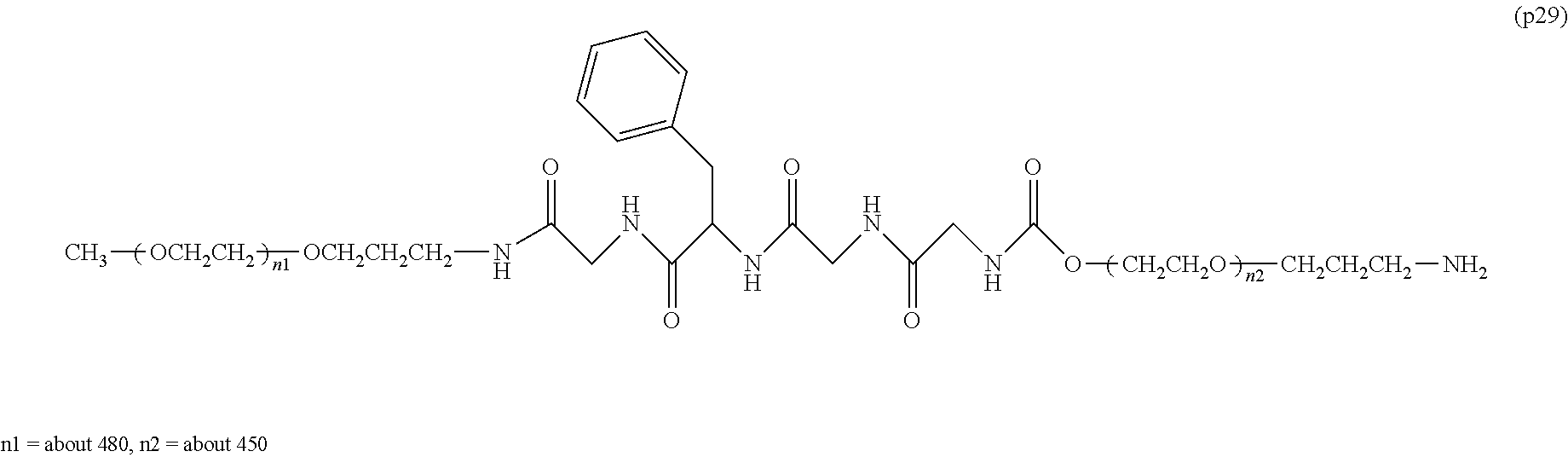
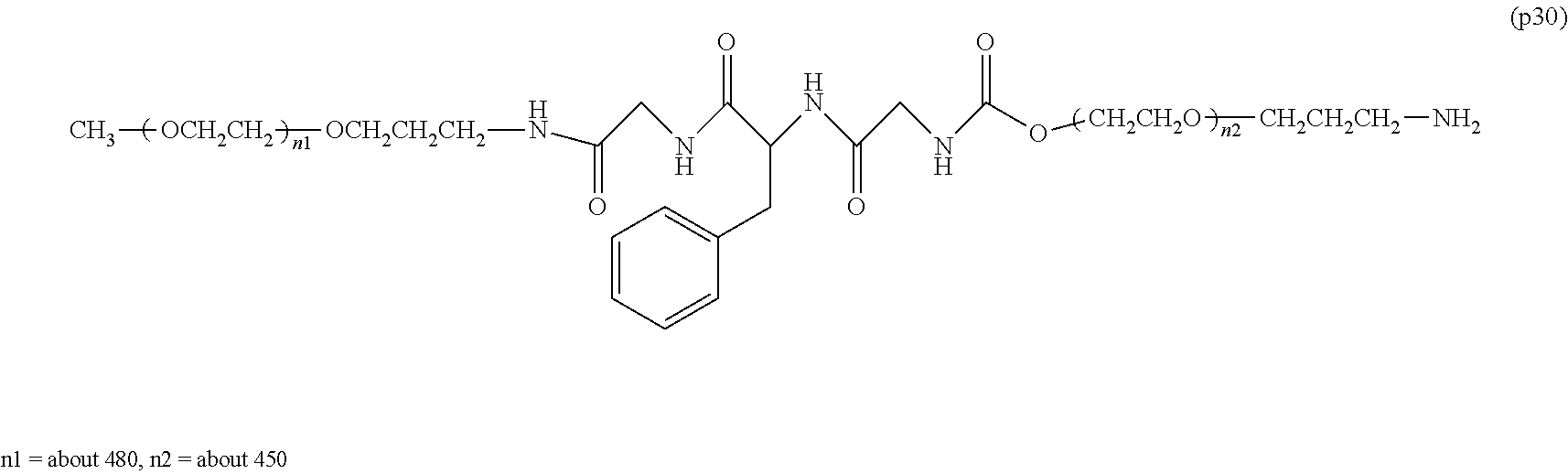


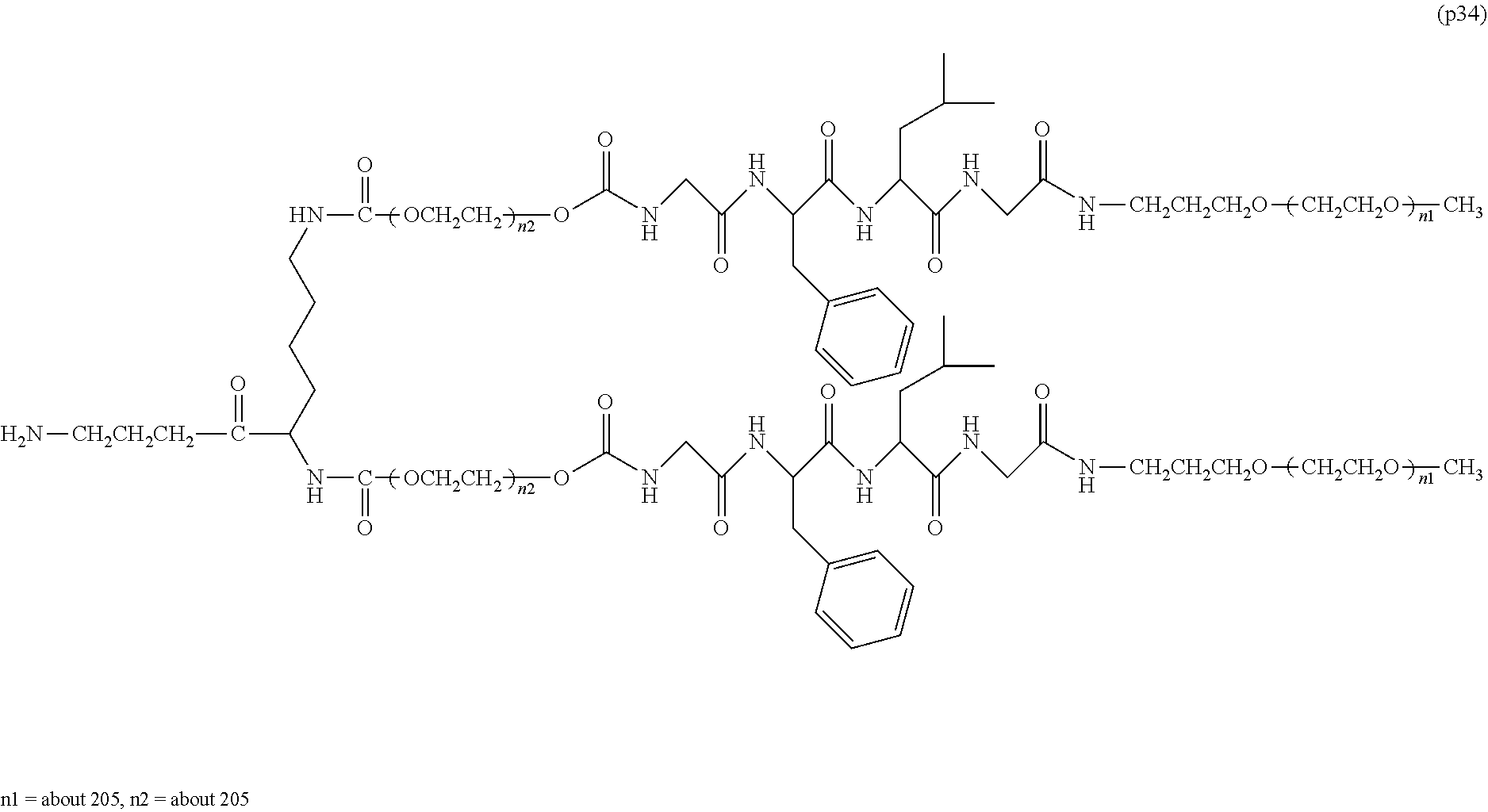

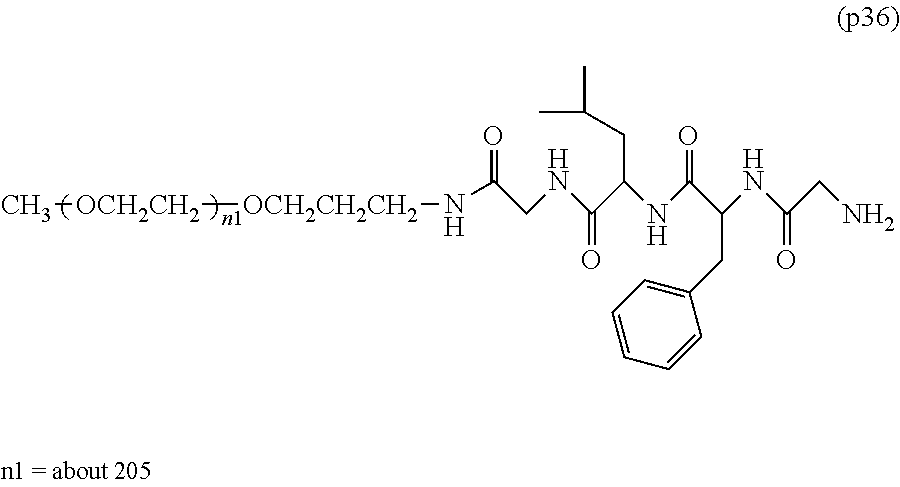


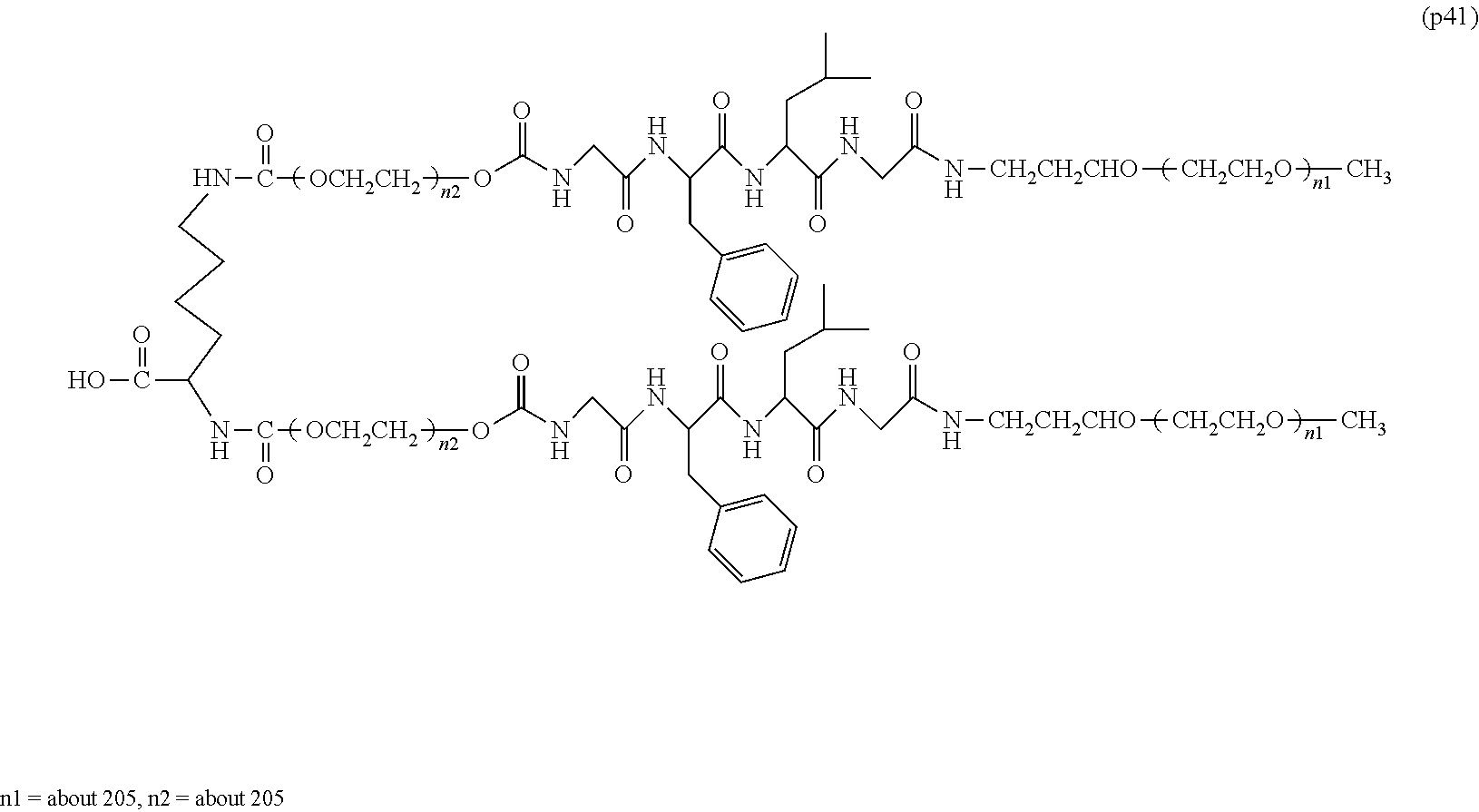


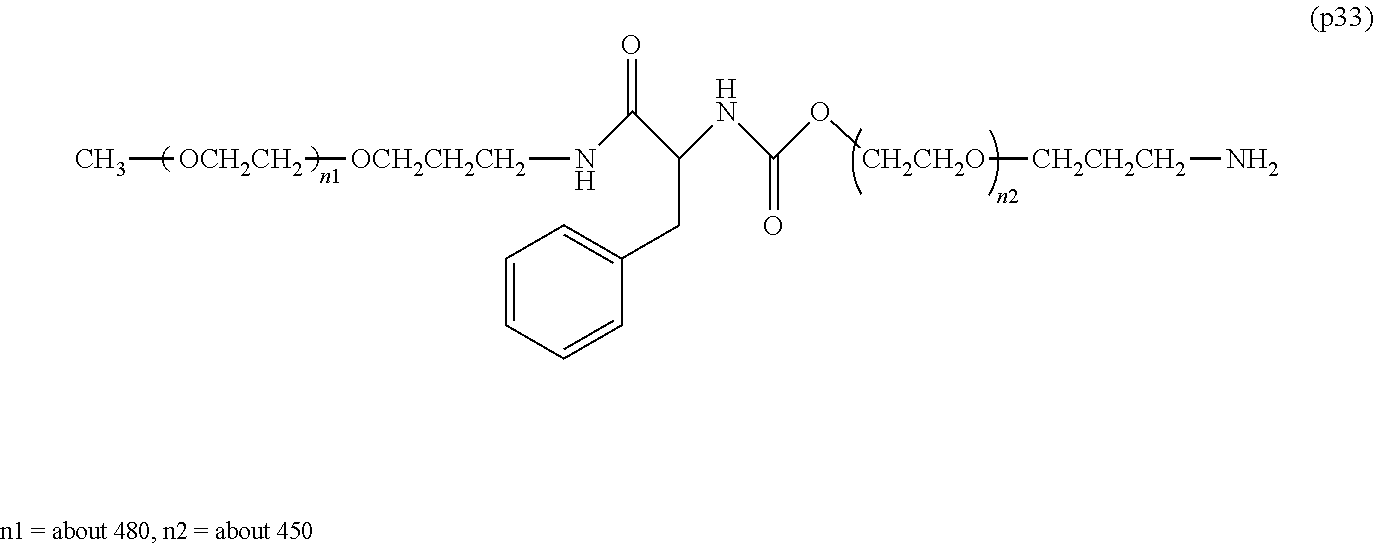
| TABLE 1 | ||
| sample name | molecular weight (Mn) | |
| Example 1 | ME-200GLFG | 39,991 |
| (SEQ ID NO: 4) (L)-2002A | ||
| Example 2 | ME-200GLFG | 41,395 |
| (SEQ ID NO: 4) (L)-200AL | ||
| Example 3 | ME-100GLFG (SEQ ID NO: 4) | 41,050 |
| (L)-100GLFG (SEQ ID NO: 4) | ||
| (L)-100GLFG (SEQ ID NO: 4) | ||
| (L)-100PA | ||
| Example 4 | ME-200G(Cit)V-200PA | 44,624 |
| Example 5 | ME-200G(Cit)V-200MA | 44,843 |
| Example 6 | ME-200GGG-200PA | 45,362 |
| Example 7 | ME-200GF-200PA | 45,055 |
| Example 8 | ME-200GAV-200PA | 41,692 |
| Example 9 | ME-200GFGG (SEQ ID NO: 5)- | 41,661 |
| 200PA | ||
| Example 10 | ME-200GFG-200PA | 41,640 |
| Example 11 | ME-200GF-200PA(amide) | 41,395 |
| Example 12 | ME-200GLFG (SEQ ID NO: 4) | 41,084 |
| (D)-200PA | ||
| Example 13 | LY-(ME-100GLFG (SEQ ID NO: 4) | 38,037 |
| (L)-100)2-PA | ||
| Comparative | ME-200F-200PA | 41,352 |
| Example 1 | ||
degradation rate=(peak area % at 40 kDa before test−peak area % at 40 kDa after test)−(peak area % at 40 kDa before test)×100
| TABLE 2 | |||
| degrada- | degrada- | ||
| tion rate | tion rate | ||
| in mouse | in human | ||
| sample name | serum | serum | |
| Example 1 | ME-200GLFG (SEQ ID NO: 4) | 2% | 1% |
| (L)-200PA | |||
| Example 4 | ME-200G(cit)V- |
0% | 1% |
| Example 6 | ME-200GGG- |
3% | 10% |
| Example 7 | ME-200GF- |
10% | 17% |
| Example 8 | ME-200GAV- |
1% | 1% |
| Example 9 | ME-200GFGG (SEQ ID NO: 5)- | 4% | 7% |
| 200PA | |||
| Example 10 | ME-200GFG- |
2% | 2% |
| Example 11 | ME-200GF-200PA(amide) | 0% | 0% |
| Example 12 | ME-200GLFG (SEQ ID NO: 4) | 0% | 1% |
| (D)-200PA | |||
| Example 13 | LY-(ME-100GLFG (SEQ ID NO: 4) | 1% | 1% |
| (L)-100)2-PA | |||
| Comparative | ME-200F- |
0% | 0% |
| Example 1 | |||
| non- | |
0% | 0% |
| degradable | |||
| TABLE 3 | |||
| degrada- | degrada- | ||
| tion rate | tion rate | ||
| sample name | in medium | in cell | |
| Example 1 | ME-200GLFG (SEQ ID NO: 4) | 2% | 98% |
| (L)-200PA | |||
| Example 4 | ME-200G(cit)V- |
0% | 99% |
| Example 6 | ME-200GGG- |
2% | 78% |
| Example 7 | ME-200GF- |
3% | 99% |
| Example 8 | ME-200GAV- |
1% | 99% |
| Example 9 | ME-200GFGG (SEQ ID NO: 5)- | 1% | 99% |
| 200PA | |||
| Example 10 | ME-200GFG- |
0% | 99% |
| Example 11 | ME-200GF-200PA(amide) | 0% | 96% |
| Example 12 | ME-200GLFG (SEQ ID NO: 4) | 1% | 66% |
| (D)-200PA | |||
| Example 13 | LY-(ME-100GLFG (SEQ ID NO: 4) | 2% | 99% |
| (L)-100)2-PA | |||
| Comparative | ME-200F- |
0% | 0% |
| Example 1 | |||
| non- | |
0% | 0% |
| degradable | |||
-
- apparatus: “ALLIANCE” manufactured by WATERS
- detector: UV (280 nm)
- column: Inertsil WP300 C18 (GL Science)
- mobile phase A: 0.05% TFA-H2O
- mobile phase B: 0.05% TFA-ACN
- gradient: B30% (0 min)→B40% (5 min)→B50% (15 min)→B100% (16 min)→B100% (20 min)
- flow rate: 1.0 mL/min
- column temperature: 40° C.
-
- RPLC purity of ME-200GLFG (SEQ ID NO: 4) (L)-200-sCT 99%
- RPLC purity of
methoxy PEG 40 kDa-sCT 99%
MALDI-TOF-MS Analysis - apparatus: “autoflex3” manufactured by Bruker
- sample: 0.5 mg/mL, PBS solution
- matrix: saturated α-cyano-4-hydroxycinnamic acid (CHCA) solution (0.01% TFA-H2O:ACN=2:1)
-
- molecular weight of ME-200GLFG (SEQ ID NO: 4) (L)-200-sCT 46,289
- molecular weight of ME-200GLFG (SEQ ID NO: 4) (L)-200AL 43,210
-
- molecular weight of
methoxy PEG 40 kDa-sCT 46,427 - molecular weight of methoxy PEG aldehyde 40 kDa 43,303
- molecular weight of
-
- kit: NuPAGE (registered trade mark) Bis-Tris Precast Gel (gel concentration 4-12%) manufactured by Thermo Fisher Scientific
- staining solution: Coomassie brilliant blue solution (CBB solution) or iodine staining solution (BaCl2+I2 solution)
| (SEQ ID NO: 2) | |
| MFPTIPLSRL FDNAMLRAHR LHQLAFDTYQ EFEEAYIPKE | |
| QKYSFLQNPQ TSLCFSESIP TPSNREETQQ KSNLELLRIS | |
| LLLIQSWLEP VQFLRSVFAN SLVYGASDSN VYDLLKDLEE | |
| GIQTLMGRLE DGSPRTGQIF KQTYSKFDTN SHNDDALLKN | |
| YGLLYCFRKD MDKVETFLRI VQCRSVEGSC GF |
(4 mg, 1.8×10⁻⁷ mol, manufactured by Shenandoah Biotechnology) was dissolved in 100 mM sodium acetate buffer (pH 5.5), ME-200GLFG (SEQ ID NO: 4) (L)-200AL obtained in Example 2 or methoxy PEG aldehyde 40 kDa (36 mg, 9.0×10⁻⁷ mol), and a reducing agent, sodium cyanoborohydride (9.0×10⁻⁶ mol) were added, hGH concentration was adjusted to 1.0 mg/mL, and the mixture was reacted at 25° C. for 24 hr. Thereafter, the reaction mixture was dialyzed against 10 mM sodium acetate buffer (pH 4.7), and purified by ion exchange chromatography using HiTrap SP HP (5 mL, manufactured by GE Healthcare) to give ME-200GLFG (SEQ ID NO: 4) (L)-200-hGH or
RPLC Analysis
-
- apparatus: “ALLIANCE” manufactured by WATERS
- detector: UV (280 nm)
- column: Inertsil WP300 C18 (GL Science)
- mobile phase A: 0.05% TFA-H2O
- mobile phase B: 0.05% TFA-ACN
- gradient: B40% (0 min)→B80% (25 min)→B90% (27 min)→B40% (27.1 min)
- flow rate: 1.0 mL/min
- column temperature: 40° C.
-
- RPLC purity of ME-200GLFG (SEQ ID NO: 4) (L)-200-
hGH 90% - RPLC purity of
methoxy PEG 40 kDa-hGH 97%
MALDI-TOF-MS Analysis - apparatus: “autoflex3” manufactured by Bruker
- sample: 0.5 mg/mL, PBS solution
- matrix: saturated cinnamic acid (SA) solution (0.01% TFA-H2O:ACN=2:1)
- RPLC purity of ME-200GLFG (SEQ ID NO: 4) (L)-200-
-
- molecular weight of ME-200GLFG (SEQ ID NO: 4) (L)-200-hGH 65,153
- molecular weight of
methoxy PEG 40 kDa-hGH 65,263
-
- kit: NuPAGE (registered trade mark) Bis-Tris Precast Gel (gel concentration 4-12%) manufactured by Thermo Fisher Scientific
- staining solution: Coomassie brilliant blue solution (CBB solution) or iodine staining solution (BaCl2+I2 solution)
-
- apparatus: “ALLIANCE” manufactured by WATERS
- detector: UV (280 nm)
- column: Inertsil WP300 C18 (GL Science)
- mobile phase A: 0.1% TFA-H2O
- mobile phase B: 0.1% TFA-ACN
- gradient: B40% (0 min)→B70% (25 min)→B90% (27 min)→B40% (29 min)
- flow rate: 1.0 mL/min
- column temperature: 40° C.
-
- RPLC purity of ME-200GLFG (SEQ ID NO: 4) (L)-200-GCSF 97%
MALDI-TOF-MS Analysis - apparatus: “autoflex3” manufactured by Bruker
- sample: 0.5 mg/mL, PBS solution
- matrix: saturated cinnamic acid (SA) solution (0.01% TFA-H2O:ACN=2:1)
- RPLC purity of ME-200GLFG (SEQ ID NO: 4) (L)-200-GCSF 97%
-
- S-PAGE Analysis
- kit: NuPAGE (registered trade mark) Bis-Tris Precast Gel (gel concentration 4-12%) manufactured by Thermo Fisher Scientific
- staining solution: Coomassie brilliant blue solution (CBB solution) or iodine staining solution (BaCl2+I2 solution)
-
- apparatus: All in one microscopy BZ-X710
- analysis soft: BZ-X Analyzer
accumulation rate=area of brown stained portion/area of choroid plexus tissue
score=accumulation rate/accumulation rate of PBS
| TABLE 4 | |||
| score | |||
| PBS | 1.0 | ||
| |
35.9 | ||
| |
2.3 | ||
| ME-200GLFG (SEQ ID NO: 4) | 4.2 | ||
| (L)-200PA | |||
Claims (14)





Applications Claiming Priority (3)
| Application Number | Priority Date | Filing Date | Title |
|---|---|---|---|
| JP2018-064306 | 2018-03-29 | ||
| JP2018064306 | 2018-03-29 | ||
| PCT/JP2019/014245 WO2019189853A1 (en) | 2018-03-29 | 2019-03-29 | Degradable polyethylene glycol conjugate |
Publications (2)
| Publication Number | Publication Date |
|---|---|
| US20210023231A1 US20210023231A1 (en) | 2021-01-28 |
| US12239713B2 true US12239713B2 (en) | 2025-03-04 |
Family
ID=68058410
Family Applications (1)
| Application Number | Title | Priority Date | Filing Date |
|---|---|---|---|
| US17/042,039 Active 2040-09-03 US12239713B2 (en) | 2018-03-29 | 2019-03-29 | Degradable polyethylene glycol conjugate |
Country Status (7)
| Country | Link |
|---|---|
| US (1) | US12239713B2 (en) |
| EP (1) | EP3778628A4 (en) |
| JP (1) | JP7249591B2 (en) |
| KR (1) | KR102668425B1 (en) |
| CN (1) | CN112135838B (en) |
| CA (1) | CA3095644A1 (en) |
| WO (1) | WO2019189853A1 (en) |
Families Citing this family (3)
| Publication number | Priority date | Publication date | Assignee | Title |
|---|---|---|---|---|
| US12403199B2 (en) | 2019-09-26 | 2025-09-02 | Nof Corporation | Asymmetrically branched degradable polyethylene glycol derivative |
| CN112843242B (en) * | 2019-11-28 | 2024-03-01 | 重庆阿普格雷生物科技有限公司 | Polyethylene glycol coupling drug, preparation method and application thereof |
| CN114042148B (en) * | 2022-01-13 | 2022-04-15 | 浙江湃肽生物有限公司深圳分公司 | Etecatide hydrochloride stabilizer |
Citations (8)
| Publication number | Priority date | Publication date | Assignee | Title |
|---|---|---|---|---|
| WO2000066091A1 (en) | 1999-05-04 | 2000-11-09 | Biotech Australia Pty Limited | Amplification of folate-mediated targeting to tumor cells using polymers |
| US20030228275A1 (en) | 2001-06-04 | 2003-12-11 | Ekwuribe Nnochiri N. | Mixtures of drug-oligomer conjugates comprising polyalkylene glycol, uses thereof, and methods of making same |
| US6828412B1 (en) | 1999-09-03 | 2004-12-07 | School Of Pharmacy, University Of London | Degradable polymers |
| WO2005108463A2 (en) | 2004-05-03 | 2005-11-17 | Nektar Therapeutics Al, Corporation | Branched polyethylen glycol derivates comprising an acetal or ketal branching point |
| JP2007112924A (en) | 2005-10-21 | 2007-05-10 | National Institute For Materials Science | Polymer cross-linking agent and liposome or cell cross-linked product using this cross-linking agent |
| US20090023859A1 (en) | 2005-02-18 | 2009-01-22 | Nof Corporation | Polyoxyalkylene derivative |
| JP2009527581A (en) | 2006-02-21 | 2009-07-30 | ネクター セラピューティックス エイエル,コーポレイション | Split-type degradable polymers and composites produced therefrom |
| US8088365B2 (en) * | 1996-09-26 | 2012-01-03 | Nektar Therapeutics | Soluble, degradable poly(ethylene glycol) derivatives for controllable release of bound molecules into solution |
Family Cites Families (16)
| Publication number | Priority date | Publication date | Assignee | Title |
|---|---|---|---|---|
| US3514017A (en) | 1969-03-03 | 1970-05-26 | Afa Corp | Pressure regulating structure for piston pump |
| JP2003528939A (en) * | 1999-09-03 | 2003-09-30 | スクール オブ ファーマシー, ユニヴァーシティ オブ ロンドン | Degradable polymer |
| US7060498B1 (en) * | 2001-11-28 | 2006-06-13 | Genta Salus Llc | Polycationic water soluble copolymer and method for transferring polyanionic macromolecules across biological barriers |
| EP1744786A2 (en) | 2004-03-23 | 2007-01-24 | Amgen Inc. | Chemically modified protein compositions and methods |
| WO2006121819A1 (en) * | 2005-05-06 | 2006-11-16 | Board Of Regents, The University Of Texas System | Methods for fabricating nano and microparticles for drug delivery |
| ES2937113T3 (en) * | 2006-01-20 | 2023-03-24 | Starpharma Pty Ltd | modified macromolecule |
| JP5618248B2 (en) | 2009-10-06 | 2014-11-05 | 日油株式会社 | Method for purifying carboxyl group-containing polyoxyethylene derivatives |
| JP5825507B2 (en) | 2010-06-25 | 2015-12-02 | 日油株式会社 | Branched heteropolyethylene glycol |
| JP5949037B2 (en) * | 2011-03-30 | 2016-07-06 | 日油株式会社 | Polyoxyethylene derivatives having multiple hydroxyl groups at the ends |
| WO2012142659A1 (en) * | 2011-04-19 | 2012-10-26 | Baker Idi Heart And Diabetes Institute Holdings Limited | Site-selective modification of proteins |
| US9744246B2 (en) * | 2011-06-06 | 2017-08-29 | Starpharma Pty Ltd | Macromolecules |
| WO2014157117A1 (en) | 2013-03-27 | 2014-10-02 | 日油株式会社 | Purification method for polyethylene glycol having a single amino group |
| US20170165334A1 (en) | 2015-12-11 | 2017-06-15 | Tianxin Wang | Methods to Treat Diseases with Protein, Peptide, Antigen Modification and Hemopurification |
| CN106421806B (en) * | 2016-11-14 | 2019-10-18 | 四川大学 | A kind of step-by-step response nanometer self-assembled dendritic prodrug and preparation method and application |
| JP6475374B2 (en) | 2018-01-30 | 2019-02-27 | 日本電気株式会社 | Signal configuration apparatus, signal configuration system, signal configuration method, and signal configuration program |
| KR102668424B1 (en) * | 2018-03-29 | 2024-05-23 | 니치유 가부시키가이샤 | Degradable polyethylene glycol derivatives |
-
2019
- 2019-03-29 JP JP2019068351A patent/JP7249591B2/en active Active
- 2019-03-29 WO PCT/JP2019/014245 patent/WO2019189853A1/en not_active Ceased
- 2019-03-29 US US17/042,039 patent/US12239713B2/en active Active
- 2019-03-29 KR KR1020207031141A patent/KR102668425B1/en active Active
- 2019-03-29 EP EP19776122.4A patent/EP3778628A4/en active Pending
- 2019-03-29 CA CA3095644A patent/CA3095644A1/en active Pending
- 2019-03-29 CN CN201980023380.1A patent/CN112135838B/en active Active
Patent Citations (12)
| Publication number | Priority date | Publication date | Assignee | Title |
|---|---|---|---|---|
| US8088365B2 (en) * | 1996-09-26 | 2012-01-03 | Nektar Therapeutics | Soluble, degradable poly(ethylene glycol) derivatives for controllable release of bound molecules into solution |
| WO2000066091A1 (en) | 1999-05-04 | 2000-11-09 | Biotech Australia Pty Limited | Amplification of folate-mediated targeting to tumor cells using polymers |
| US6828412B1 (en) | 1999-09-03 | 2004-12-07 | School Of Pharmacy, University Of London | Degradable polymers |
| US20030228275A1 (en) | 2001-06-04 | 2003-12-11 | Ekwuribe Nnochiri N. | Mixtures of drug-oligomer conjugates comprising polyalkylene glycol, uses thereof, and methods of making same |
| WO2005108463A2 (en) | 2004-05-03 | 2005-11-17 | Nektar Therapeutics Al, Corporation | Branched polyethylen glycol derivates comprising an acetal or ketal branching point |
| US20090023859A1 (en) | 2005-02-18 | 2009-01-22 | Nof Corporation | Polyoxyalkylene derivative |
| JP2007112924A (en) | 2005-10-21 | 2007-05-10 | National Institute For Materials Science | Polymer cross-linking agent and liposome or cell cross-linked product using this cross-linking agent |
| JP2009527581A (en) | 2006-02-21 | 2009-07-30 | ネクター セラピューティックス エイエル,コーポレイション | Split-type degradable polymers and composites produced therefrom |
| US20100010158A1 (en) | 2006-02-21 | 2010-01-14 | Mcmanus Samuel P | Segmented Degradable Polymers and Conjugates Made Therefrom |
| US8309680B2 (en) | 2006-02-21 | 2012-11-13 | Nektar Therapeutics | Segmented degradable polymers and conjugates made therefrom |
| US20130072709A1 (en) | 2006-02-21 | 2013-03-21 | Nektar Therapeutics | Segmented Degradable Polymers and Conjugates Made Therefrom |
| US8835599B2 (en) | 2006-02-21 | 2014-09-16 | Nektar Therapeutics | Segmented degradable polymers and conjugates made therefrom |
Non-Patent Citations (5)
| Title |
|---|
| European Medicines Agency, "Chmp Safety Working Party's Response to PDCO regarding the use of PEGylated drug products in the paediatric population," EMA/CHMP/SWP/647258/2012 (Nov. 16, 2012). |
| Japanese Patent Office, International Search Report in International Patent Application No. PCT/JP2019/014245 (Jul. 2, 2019). |
| Rudmann et al., "High Molecular Weight Polyethylene Glycol Cellular Distribution and PEG-associated Cytoplasmic Vacuolation is Molecular Weight Dependent and Does Not Require Conjugation to Proteins," Toxicol. Pathol., 41(7): 970-983 (2013). |
| Veronese et al., "PEG-Doxorubicin Conjugates: Influence of Polymer Structure on Drug Release, in Vitro Cytotoxicity, Biodistribution, and Antitumor Activity," Bioconjug. Chem., 16: 775-784 (2005). |
| Yang et al., "Synthesis and Characterization of Enzymatically Degradable PEG-Based Peptide-Containing Hydrogels," Macromol. Biosci., 10(4): 445-454 (2010). |
Also Published As
| Publication number | Publication date |
|---|---|
| CA3095644A1 (en) | 2019-10-03 |
| US20210023231A1 (en) | 2021-01-28 |
| JP2019172673A (en) | 2019-10-10 |
| CN112135838A (en) | 2020-12-25 |
| KR20200138788A (en) | 2020-12-10 |
| CN112135838B (en) | 2025-01-28 |
| KR102668425B1 (en) | 2024-05-29 |
| JP7249591B2 (en) | 2023-03-31 |
| EP3778628A1 (en) | 2021-02-17 |
| WO2019189853A1 (en) | 2019-10-03 |
| EP3778628A4 (en) | 2021-11-24 |
Similar Documents
| Publication | Publication Date | Title |
|---|---|---|
| US12239713B2 (en) | Degradable polyethylene glycol conjugate | |
| US12390534B2 (en) | Branched degradable polyethylene glycol binder | |
| US12187846B2 (en) | Degradable polyethylene glycol derivative | |
| US12404367B2 (en) | Degradable multi-arm polyethylene glycol derivative | |
| US12497508B2 (en) | Branched and degradable polyethylene glycol derivative | |
| US12403199B2 (en) | Asymmetrically branched degradable polyethylene glycol derivative | |
| KR102923259B1 (en) | Asymmetric branched decomposable polyethylene glycol derivatives |
Legal Events
| Date | Code | Title | Description |
|---|---|---|---|
| FEPP | Fee payment procedure |
Free format text: ENTITY STATUS SET TO UNDISCOUNTED (ORIGINAL EVENT CODE: BIG.); ENTITY STATUS OF PATENT OWNER: LARGE ENTITY |
|
| AS | Assignment |
Owner name: NOF CORPORATION, JAPAN Free format text: ASSIGNMENT OF ASSIGNORS INTEREST;ASSIGNORS:YOSHIOKA, HIROKI;KAMIYA, MASAKI;YAMAMOTO, YUJI;AND OTHERS;SIGNING DATES FROM 20200722 TO 20200807;REEL/FRAME:053903/0227 Owner name: TOKYO INSTITUTE OF TECHNOLOGY, JAPAN Free format text: ASSIGNMENT OF ASSIGNORS INTEREST;ASSIGNORS:YOSHIOKA, HIROKI;KAMIYA, MASAKI;YAMAMOTO, YUJI;AND OTHERS;SIGNING DATES FROM 20200722 TO 20200807;REEL/FRAME:053903/0227 |
|
| STPP | Information on status: patent application and granting procedure in general |
Free format text: APPLICATION DISPATCHED FROM PREEXAM, NOT YET DOCKETED |
|
| STPP | Information on status: patent application and granting procedure in general |
Free format text: DOCKETED NEW CASE - READY FOR EXAMINATION |
|
| STPP | Information on status: patent application and granting procedure in general |
Free format text: NON FINAL ACTION MAILED |
|
| STPP | Information on status: patent application and granting procedure in general |
Free format text: RESPONSE TO NON-FINAL OFFICE ACTION ENTERED AND FORWARDED TO EXAMINER |
|
| STPP | Information on status: patent application and granting procedure in general |
Free format text: FINAL REJECTION MAILED |
|
| STPP | Information on status: patent application and granting procedure in general |
Free format text: RESPONSE AFTER FINAL ACTION FORWARDED TO EXAMINER |
|
| STPP | Information on status: patent application and granting procedure in general |
Free format text: ADVISORY ACTION MAILED |
|
| STPP | Information on status: patent application and granting procedure in general |
Free format text: DOCKETED NEW CASE - READY FOR EXAMINATION |
|
| STPP | Information on status: patent application and granting procedure in general |
Free format text: NON FINAL ACTION MAILED |
|
| STPP | Information on status: patent application and granting procedure in general |
Free format text: RESPONSE TO NON-FINAL OFFICE ACTION ENTERED AND FORWARDED TO EXAMINER |
|
| STPP | Information on status: patent application and granting procedure in general |
Free format text: NOTICE OF ALLOWANCE MAILED -- APPLICATION RECEIVED IN OFFICE OF PUBLICATIONS |
|
| STPP | Information on status: patent application and granting procedure in general |
Free format text: PUBLICATIONS -- ISSUE FEE PAYMENT VERIFIED |
|
| STCF | Information on status: patent grant |
Free format text: PATENTED CASE |