US12233165B2 - Microsphere formulations comprising ketamine and methods for making and using the same - Google Patents
Microsphere formulations comprising ketamine and methods for making and using the same Download PDFInfo
- Publication number
- US12233165B2 US12233165B2 US17/404,128 US202117404128A US12233165B2 US 12233165 B2 US12233165 B2 US 12233165B2 US 202117404128 A US202117404128 A US 202117404128A US 12233165 B2 US12233165 B2 US 12233165B2
- Authority
- US
- United States
- Prior art keywords
- polymer
- microspheres
- microsphere
- ketamine
- batch
- Prior art date
- Legal status (The legal status is an assumption and is not a legal conclusion. Google has not performed a legal analysis and makes no representation as to the accuracy of the status listed.)
- Active, expires
Links
- 239000004005 microsphere Substances 0.000 title claims abstract description 189
- 239000000203 mixture Substances 0.000 title claims abstract description 68
- 238000009472 formulation Methods 0.000 title claims abstract description 62
- 238000000034 method Methods 0.000 title claims abstract description 38
- YQEZLKZALYSWHR-UHFFFAOYSA-N Ketamine Chemical compound C=1C=CC=C(Cl)C=1C1(NC)CCCCC1=O YQEZLKZALYSWHR-UHFFFAOYSA-N 0.000 title abstract description 73
- 229960003299 ketamine Drugs 0.000 title abstract description 73
- 229920000642 polymer Polymers 0.000 claims description 113
- XLYOFNOQVPJJNP-UHFFFAOYSA-N water Substances O XLYOFNOQVPJJNP-UHFFFAOYSA-N 0.000 claims description 79
- 239000000839 emulsion Substances 0.000 claims description 56
- YQEZLKZALYSWHR-ZDUSSCGKSA-N (S)-ketamine Chemical compound C=1C=CC=C(Cl)C=1[C@@]1(NC)CCCCC1=O YQEZLKZALYSWHR-ZDUSSCGKSA-N 0.000 claims description 36
- 239000002904 solvent Substances 0.000 claims description 35
- 229960000450 esketamine Drugs 0.000 claims description 32
- 239000002245 particle Substances 0.000 claims description 29
- 229920000747 poly(lactic acid) Polymers 0.000 claims description 26
- 230000018044 dehydration Effects 0.000 claims description 11
- 238000006297 dehydration reaction Methods 0.000 claims description 11
- 229940065514 poly(lactide) Drugs 0.000 claims description 6
- -1 poly(lactide) Polymers 0.000 claims description 6
- 238000002347 injection Methods 0.000 claims description 3
- 239000007924 injection Substances 0.000 claims description 3
- 230000001804 emulsifying effect Effects 0.000 claims 2
- 239000008194 pharmaceutical composition Substances 0.000 claims 1
- 239000003361 porogen Substances 0.000 claims 1
- 238000013265 extended release Methods 0.000 abstract description 3
- 239000003814 drug Substances 0.000 description 76
- 229940079593 drug Drugs 0.000 description 72
- YMWUJEATGCHHMB-UHFFFAOYSA-N Dichloromethane Chemical compound ClCCl YMWUJEATGCHHMB-UHFFFAOYSA-N 0.000 description 42
- LFQSCWFLJHTTHZ-UHFFFAOYSA-N Ethanol Chemical compound CCO LFQSCWFLJHTTHZ-UHFFFAOYSA-N 0.000 description 36
- 239000004372 Polyvinyl alcohol Substances 0.000 description 33
- 229920002451 polyvinyl alcohol Polymers 0.000 description 33
- 239000013256 coordination polymer Substances 0.000 description 29
- 239000000725 suspension Substances 0.000 description 24
- 229920002988 biodegradable polymer Polymers 0.000 description 22
- 239000004621 biodegradable polymer Substances 0.000 description 22
- 238000001914 filtration Methods 0.000 description 22
- 239000000843 powder Substances 0.000 description 20
- 238000005406 washing Methods 0.000 description 19
- XEKOWRVHYACXOJ-UHFFFAOYSA-N Ethyl acetate Chemical compound CCOC(C)=O XEKOWRVHYACXOJ-UHFFFAOYSA-N 0.000 description 18
- 238000005538 encapsulation Methods 0.000 description 18
- 238000007792 addition Methods 0.000 description 17
- 238000002156 mixing Methods 0.000 description 16
- 239000008367 deionised water Substances 0.000 description 15
- 239000012510 hollow fiber Substances 0.000 description 15
- 229910021641 deionized water Inorganic materials 0.000 description 14
- 150000002148 esters Chemical class 0.000 description 14
- 238000000099 in vitro assay Methods 0.000 description 14
- 230000004962 physiological condition Effects 0.000 description 14
- 229920001606 poly(lactic acid-co-glycolic acid) Polymers 0.000 description 14
- 239000004094 surface-active agent Substances 0.000 description 13
- 230000001186 cumulative effect Effects 0.000 description 11
- 239000008186 active pharmaceutical agent Substances 0.000 description 10
- 238000004945 emulsification Methods 0.000 description 10
- 238000000338 in vitro Methods 0.000 description 8
- 238000002360 preparation method Methods 0.000 description 7
- 230000015572 biosynthetic process Effects 0.000 description 6
- 230000000694 effects Effects 0.000 description 6
- 238000010255 intramuscular injection Methods 0.000 description 6
- 239000007927 intramuscular injection Substances 0.000 description 6
- 208000024714 major depressive disease Diseases 0.000 description 6
- 239000000243 solution Substances 0.000 description 6
- 238000010254 subcutaneous injection Methods 0.000 description 6
- 239000007929 subcutaneous injection Substances 0.000 description 6
- YQEZLKZALYSWHR-CYBMUJFWSA-N (R)-(+)-ketamine Chemical compound C=1C=CC=C(Cl)C=1[C@]1(NC)CCCCC1=O YQEZLKZALYSWHR-CYBMUJFWSA-N 0.000 description 5
- 208000020401 Depressive disease Diseases 0.000 description 5
- 239000000178 monomer Substances 0.000 description 5
- 208000002193 Pain Diseases 0.000 description 4
- 241000700159 Rattus Species 0.000 description 4
- 230000007717 exclusion Effects 0.000 description 4
- OISVCGZHLKNMSJ-UHFFFAOYSA-N 2,6-dimethylpyridine Chemical compound CC1=CC=CC(C)=N1 OISVCGZHLKNMSJ-UHFFFAOYSA-N 0.000 description 3
- ZWEHNKRNPOVVGH-UHFFFAOYSA-N 2-Butanone Chemical compound CCC(C)=O ZWEHNKRNPOVVGH-UHFFFAOYSA-N 0.000 description 3
- HBAQYPYDRFILMT-UHFFFAOYSA-N 8-[3-(1-cyclopropylpyrazol-4-yl)-1H-pyrazolo[4,3-d]pyrimidin-5-yl]-3-methyl-3,8-diazabicyclo[3.2.1]octan-2-one Chemical class C1(CC1)N1N=CC(=C1)C1=NNC2=C1N=C(N=C2)N1C2C(N(CC1CC2)C)=O HBAQYPYDRFILMT-UHFFFAOYSA-N 0.000 description 3
- QTBSBXVTEAMEQO-UHFFFAOYSA-N Acetic acid Chemical compound CC(O)=O QTBSBXVTEAMEQO-UHFFFAOYSA-N 0.000 description 3
- CSCPPACGZOOCGX-UHFFFAOYSA-N Acetone Chemical compound CC(C)=O CSCPPACGZOOCGX-UHFFFAOYSA-N 0.000 description 3
- WEVYAHXRMPXWCK-UHFFFAOYSA-N Acetonitrile Chemical compound CC#N WEVYAHXRMPXWCK-UHFFFAOYSA-N 0.000 description 3
- ZTQSAGDEMFDKMZ-UHFFFAOYSA-N Butyraldehyde Chemical compound CCCC=O ZTQSAGDEMFDKMZ-UHFFFAOYSA-N 0.000 description 3
- KFZMGEQAYNKOFK-UHFFFAOYSA-N Isopropanol Chemical compound CC(C)O KFZMGEQAYNKOFK-UHFFFAOYSA-N 0.000 description 3
- ZMXDDKWLCZADIW-UHFFFAOYSA-N N,N-Dimethylformamide Chemical compound CN(C)C=O ZMXDDKWLCZADIW-UHFFFAOYSA-N 0.000 description 3
- LRHPLDYGYMQRHN-UHFFFAOYSA-N N-Butanol Chemical compound CCCCO LRHPLDYGYMQRHN-UHFFFAOYSA-N 0.000 description 3
- RWRDLPDLKQPQOW-UHFFFAOYSA-N Pyrrolidine Chemical compound C1CCNC1 RWRDLPDLKQPQOW-UHFFFAOYSA-N 0.000 description 3
- BTANRVKWQNVYAZ-UHFFFAOYSA-N butan-2-ol Chemical compound CCC(C)O BTANRVKWQNVYAZ-UHFFFAOYSA-N 0.000 description 3
- 238000011156 evaluation Methods 0.000 description 3
- 238000004108 freeze drying Methods 0.000 description 3
- 238000000265 homogenisation Methods 0.000 description 3
- 239000012528 membrane Substances 0.000 description 3
- 230000036407 pain Effects 0.000 description 3
- 238000012545 processing Methods 0.000 description 3
- BDERNNFJNOPAEC-UHFFFAOYSA-N propan-1-ol Chemical compound CCCO BDERNNFJNOPAEC-UHFFFAOYSA-N 0.000 description 3
- 150000003839 salts Chemical group 0.000 description 3
- 230000003442 weekly effect Effects 0.000 description 3
- PUPZLCDOIYMWBV-UHFFFAOYSA-N (+/-)-1,3-Butanediol Chemical compound CC(O)CCO PUPZLCDOIYMWBV-UHFFFAOYSA-N 0.000 description 2
- RKDVKSZUMVYZHH-UHFFFAOYSA-N 1,4-dioxane-2,5-dione Chemical compound O=C1COC(=O)CO1 RKDVKSZUMVYZHH-UHFFFAOYSA-N 0.000 description 2
- XLLIQLLCWZCATF-UHFFFAOYSA-N 2-methoxyethyl acetate Chemical compound COCCOC(C)=O XLLIQLLCWZCATF-UHFFFAOYSA-N 0.000 description 2
- SVTBMSDMJJWYQN-UHFFFAOYSA-N 2-methylpentane-2,4-diol Chemical compound CC(O)CC(C)(C)O SVTBMSDMJJWYQN-UHFFFAOYSA-N 0.000 description 2
- BSKHPKMHTQYZBB-UHFFFAOYSA-N 2-methylpyridine Chemical compound CC1=CC=CC=N1 BSKHPKMHTQYZBB-UHFFFAOYSA-N 0.000 description 2
- SYBYTAAJFKOIEJ-UHFFFAOYSA-N 3-Methylbutan-2-one Chemical compound CC(C)C(C)=O SYBYTAAJFKOIEJ-UHFFFAOYSA-N 0.000 description 2
- ITQTTZVARXURQS-UHFFFAOYSA-N 3-methylpyridine Chemical compound CC1=CC=CN=C1 ITQTTZVARXURQS-UHFFFAOYSA-N 0.000 description 2
- FKNQCJSGGFJEIZ-UHFFFAOYSA-N 4-methylpyridine Chemical compound CC1=CC=NC=C1 FKNQCJSGGFJEIZ-UHFFFAOYSA-N 0.000 description 2
- QTBSBXVTEAMEQO-UHFFFAOYSA-M Acetate Chemical compound CC([O-])=O QTBSBXVTEAMEQO-UHFFFAOYSA-M 0.000 description 2
- HGINCPLSRVDWNT-UHFFFAOYSA-N Acrolein Chemical compound C=CC=O HGINCPLSRVDWNT-UHFFFAOYSA-N 0.000 description 2
- FERIUCNNQQJTOY-UHFFFAOYSA-N Butyric acid Chemical compound CCCC(O)=O FERIUCNNQQJTOY-UHFFFAOYSA-N 0.000 description 2
- IAZDPXIOMUYVGZ-UHFFFAOYSA-N Dimethylsulphoxide Chemical compound CS(C)=O IAZDPXIOMUYVGZ-UHFFFAOYSA-N 0.000 description 2
- YNAVUWVOSKDBBP-UHFFFAOYSA-N Morpholine Chemical compound C1COCCN1 YNAVUWVOSKDBBP-UHFFFAOYSA-N 0.000 description 2
- HOKKHZGPKSLGJE-GSVOUGTGSA-N N-Methyl-D-aspartic acid Chemical compound CN[C@@H](C(O)=O)CC(O)=O HOKKHZGPKSLGJE-GSVOUGTGSA-N 0.000 description 2
- NQRYJNQNLNOLGT-UHFFFAOYSA-N Piperidine Chemical compound C1CCNCC1 NQRYJNQNLNOLGT-UHFFFAOYSA-N 0.000 description 2
- XBDQKXXYIPTUBI-UHFFFAOYSA-M Propionate Chemical compound CCC([O-])=O XBDQKXXYIPTUBI-UHFFFAOYSA-M 0.000 description 2
- NBBJYMSMWIIQGU-UHFFFAOYSA-N Propionic aldehyde Chemical compound CCC=O NBBJYMSMWIIQGU-UHFFFAOYSA-N 0.000 description 2
- JUJWROOIHBZHMG-UHFFFAOYSA-N Pyridine Chemical compound C1=CC=NC=C1 JUJWROOIHBZHMG-UHFFFAOYSA-N 0.000 description 2
- DKGAVHZHDRPRBM-UHFFFAOYSA-N Tert-Butanol Chemical compound CC(C)(C)O DKGAVHZHDRPRBM-UHFFFAOYSA-N 0.000 description 2
- WYURNTSHIVDZCO-UHFFFAOYSA-N Tetrahydrofuran Chemical compound C1CCOC1 WYURNTSHIVDZCO-UHFFFAOYSA-N 0.000 description 2
- YRKCREAYFQTBPV-UHFFFAOYSA-N acetylacetone Chemical compound CC(=O)CC(C)=O YRKCREAYFQTBPV-UHFFFAOYSA-N 0.000 description 2
- XXROGKLTLUQVRX-UHFFFAOYSA-N allyl alcohol Chemical compound OCC=C XXROGKLTLUQVRX-UHFFFAOYSA-N 0.000 description 2
- 239000002585 base Substances 0.000 description 2
- WPYMKLBDIGXBTP-UHFFFAOYSA-N benzoic acid Chemical compound OC(=O)C1=CC=CC=C1 WPYMKLBDIGXBTP-UHFFFAOYSA-N 0.000 description 2
- 239000008280 blood Substances 0.000 description 2
- 210000004369 blood Anatomy 0.000 description 2
- WERYXYBDKMZEQL-UHFFFAOYSA-N butane-1,4-diol Chemical compound OCCCCO WERYXYBDKMZEQL-UHFFFAOYSA-N 0.000 description 2
- 239000000599 controlled substance Substances 0.000 description 2
- 229920001577 copolymer Polymers 0.000 description 2
- 230000002950 deficient Effects 0.000 description 2
- SWXVUIWOUIDPGS-UHFFFAOYSA-N diacetone alcohol Chemical compound CC(=O)CC(C)(C)O SWXVUIWOUIDPGS-UHFFFAOYSA-N 0.000 description 2
- 239000003995 emulsifying agent Substances 0.000 description 2
- HYBBIBNJHNGZAN-UHFFFAOYSA-N furfural Chemical compound O=CC1=CC=CO1 HYBBIBNJHNGZAN-UHFFFAOYSA-N 0.000 description 2
- 238000001727 in vivo Methods 0.000 description 2
- 239000004615 ingredient Substances 0.000 description 2
- 239000007972 injectable composition Substances 0.000 description 2
- ZXEKIIBDNHEJCQ-UHFFFAOYSA-N isobutanol Chemical compound CC(C)CO ZXEKIIBDNHEJCQ-UHFFFAOYSA-N 0.000 description 2
- JJTUDXZGHPGLLC-UHFFFAOYSA-N lactide Chemical compound CC1OC(=O)C(C)OC1=O JJTUDXZGHPGLLC-UHFFFAOYSA-N 0.000 description 2
- 238000004519 manufacturing process Methods 0.000 description 2
- BDAGIHXWWSANSR-UHFFFAOYSA-N methanoic acid Natural products OC=O BDAGIHXWWSANSR-UHFFFAOYSA-N 0.000 description 2
- 229940097496 nasal spray Drugs 0.000 description 2
- 239000007922 nasal spray Substances 0.000 description 2
- 239000003960 organic solvent Substances 0.000 description 2
- 238000012360 testing method Methods 0.000 description 2
- URAYPUMNDPQOKB-UHFFFAOYSA-N triacetin Chemical compound CC(=O)OCC(OC(C)=O)COC(C)=O URAYPUMNDPQOKB-UHFFFAOYSA-N 0.000 description 2
- MIOPJNTWMNEORI-GMSGAONNSA-N (S)-camphorsulfonic acid Chemical compound C1C[C@@]2(CS(O)(=O)=O)C(=O)C[C@@H]1C2(C)C MIOPJNTWMNEORI-GMSGAONNSA-N 0.000 description 1
- AVQQQNCBBIEMEU-UHFFFAOYSA-N 1,1,3,3-tetramethylurea Chemical compound CN(C)C(=O)N(C)C AVQQQNCBBIEMEU-UHFFFAOYSA-N 0.000 description 1
- RYHBNJHYFVUHQT-UHFFFAOYSA-N 1,4-Dioxane Chemical compound C1COCCO1 RYHBNJHYFVUHQT-UHFFFAOYSA-N 0.000 description 1
- RRQYJINTUHWNHW-UHFFFAOYSA-N 1-ethoxy-2-(2-ethoxyethoxy)ethane Chemical compound CCOCCOCCOCC RRQYJINTUHWNHW-UHFFFAOYSA-N 0.000 description 1
- SVUOLADPCWQTTE-UHFFFAOYSA-N 1h-1,2-benzodiazepine Chemical compound N1N=CC=CC2=CC=CC=C12 SVUOLADPCWQTTE-UHFFFAOYSA-N 0.000 description 1
- OAYXUHPQHDHDDZ-UHFFFAOYSA-N 2-(2-butoxyethoxy)ethanol Chemical compound CCCCOCCOCCO OAYXUHPQHDHDDZ-UHFFFAOYSA-N 0.000 description 1
- VXQBJTKSVGFQOL-UHFFFAOYSA-N 2-(2-butoxyethoxy)ethyl acetate Chemical compound CCCCOCCOCCOC(C)=O VXQBJTKSVGFQOL-UHFFFAOYSA-N 0.000 description 1
- FPZWZCWUIYYYBU-UHFFFAOYSA-N 2-(2-ethoxyethoxy)ethyl acetate Chemical compound CCOCCOCCOC(C)=O FPZWZCWUIYYYBU-UHFFFAOYSA-N 0.000 description 1
- SBASXUCJHJRPEV-UHFFFAOYSA-N 2-(2-methoxyethoxy)ethanol Chemical compound COCCOCCO SBASXUCJHJRPEV-UHFFFAOYSA-N 0.000 description 1
- CTPDSKVQLSDPLC-UHFFFAOYSA-N 2-(oxolan-2-ylmethoxy)ethanol Chemical compound OCCOCC1CCCO1 CTPDSKVQLSDPLC-UHFFFAOYSA-N 0.000 description 1
- POAOYUHQDCAZBD-UHFFFAOYSA-N 2-butoxyethanol Chemical compound CCCCOCCO POAOYUHQDCAZBD-UHFFFAOYSA-N 0.000 description 1
- SZIFAVKTNFCBPC-UHFFFAOYSA-N 2-chloroethanol Chemical compound OCCCl SZIFAVKTNFCBPC-UHFFFAOYSA-N 0.000 description 1
- ZNQVEEAIQZEUHB-UHFFFAOYSA-N 2-ethoxyethanol Chemical compound CCOCCO ZNQVEEAIQZEUHB-UHFFFAOYSA-N 0.000 description 1
- 229940093475 2-ethoxyethanol Drugs 0.000 description 1
- SVONRAPFKPVNKG-UHFFFAOYSA-N 2-ethoxyethyl acetate Chemical compound CCOCCOC(C)=O SVONRAPFKPVNKG-UHFFFAOYSA-N 0.000 description 1
- XWKFPIODWVPXLX-UHFFFAOYSA-N 2-methyl-5-methylpyridine Natural products CC1=CC=C(C)N=C1 XWKFPIODWVPXLX-UHFFFAOYSA-N 0.000 description 1
- MSXVEPNJUHWQHW-UHFFFAOYSA-N 2-methylbutan-2-ol Chemical compound CCC(C)(C)O MSXVEPNJUHWQHW-UHFFFAOYSA-N 0.000 description 1
- OSWFIVFLDKOXQC-UHFFFAOYSA-N 4-(3-methoxyphenyl)aniline Chemical compound COC1=CC=CC(C=2C=CC(N)=CC=2)=C1 OSWFIVFLDKOXQC-UHFFFAOYSA-N 0.000 description 1
- NLHHRLWOUZZQLW-UHFFFAOYSA-N Acrylonitrile Chemical compound C=CC#N NLHHRLWOUZZQLW-UHFFFAOYSA-N 0.000 description 1
- 206010002091 Anaesthesia Diseases 0.000 description 1
- 239000005711 Benzoic acid Substances 0.000 description 1
- VEXZGXHMUGYJMC-UHFFFAOYSA-M Chloride anion Chemical compound [Cl-] VEXZGXHMUGYJMC-UHFFFAOYSA-M 0.000 description 1
- 208000000094 Chronic Pain Diseases 0.000 description 1
- KRKNYBCHXYNGOX-UHFFFAOYSA-K Citrate Chemical compound [O-]C(=O)CC(O)(CC([O-])=O)C([O-])=O KRKNYBCHXYNGOX-UHFFFAOYSA-K 0.000 description 1
- FBPFZTCFMRRESA-KVTDHHQDSA-N D-Mannitol Chemical compound OC[C@@H](O)[C@@H](O)[C@H](O)[C@H](O)CO FBPFZTCFMRRESA-KVTDHHQDSA-N 0.000 description 1
- RGHNJXZEOKUKBD-SQOUGZDYSA-M D-gluconate Chemical compound OC[C@@H](O)[C@@H](O)[C@H](O)[C@@H](O)C([O-])=O RGHNJXZEOKUKBD-SQOUGZDYSA-M 0.000 description 1
- FEWJPZIEWOKRBE-JCYAYHJZSA-N Dextrotartaric acid Chemical compound OC(=O)[C@H](O)[C@@H](O)C(O)=O FEWJPZIEWOKRBE-JCYAYHJZSA-N 0.000 description 1
- QSJXEFYPDANLFS-UHFFFAOYSA-N Diacetyl Chemical group CC(=O)C(C)=O QSJXEFYPDANLFS-UHFFFAOYSA-N 0.000 description 1
- VEXZGXHMUGYJMC-UHFFFAOYSA-N Hydrochloric acid Chemical compound Cl VEXZGXHMUGYJMC-UHFFFAOYSA-N 0.000 description 1
- 229930195725 Mannitol Natural products 0.000 description 1
- 241001465754 Metazoa Species 0.000 description 1
- AFVFQIVMOAPDHO-UHFFFAOYSA-N Methanesulfonic acid Chemical compound CS(O)(=O)=O AFVFQIVMOAPDHO-UHFFFAOYSA-N 0.000 description 1
- RJUFJBKOKNCXHH-UHFFFAOYSA-N Methyl propionate Chemical compound CCC(=O)OC RJUFJBKOKNCXHH-UHFFFAOYSA-N 0.000 description 1
- FXHOOIRPVKKKFG-UHFFFAOYSA-N N,N-Dimethylacetamide Chemical compound CN(C)C(C)=O FXHOOIRPVKKKFG-UHFFFAOYSA-N 0.000 description 1
- 102000004868 N-Methyl-D-Aspartate Receptors Human genes 0.000 description 1
- 108090001041 N-Methyl-D-Aspartate Receptors Proteins 0.000 description 1
- SECXISVLQFMRJM-UHFFFAOYSA-N N-Methylpyrrolidone Chemical compound CN1CCCC1=O SECXISVLQFMRJM-UHFFFAOYSA-N 0.000 description 1
- 229940099433 NMDA receptor antagonist Drugs 0.000 description 1
- 229910002651 NO3 Inorganic materials 0.000 description 1
- NHNBFGGVMKEFGY-UHFFFAOYSA-N Nitrate Chemical compound [O-][N+]([O-])=O NHNBFGGVMKEFGY-UHFFFAOYSA-N 0.000 description 1
- 229910019142 PO4 Inorganic materials 0.000 description 1
- 239000002033 PVDF binder Substances 0.000 description 1
- 229920002732 Polyanhydride Polymers 0.000 description 1
- GOOHAUXETOMSMM-UHFFFAOYSA-N Propylene oxide Chemical compound CC1CO1 GOOHAUXETOMSMM-UHFFFAOYSA-N 0.000 description 1
- CZPWVGJYEJSRLH-UHFFFAOYSA-N Pyrimidine Chemical compound C1=CN=CN=C1 CZPWVGJYEJSRLH-UHFFFAOYSA-N 0.000 description 1
- 206010039897 Sedation Diseases 0.000 description 1
- QAOWNCQODCNURD-UHFFFAOYSA-L Sulfate Chemical compound [O-]S([O-])(=O)=O QAOWNCQODCNURD-UHFFFAOYSA-L 0.000 description 1
- 208000028552 Treatment-Resistant Depressive disease Diseases 0.000 description 1
- KXKVLQRXCPHEJC-UHFFFAOYSA-N acetic acid trimethyl ester Natural products COC(C)=O KXKVLQRXCPHEJC-UHFFFAOYSA-N 0.000 description 1
- DPXJVFZANSGRMM-UHFFFAOYSA-N acetic acid;2,3,4,5,6-pentahydroxyhexanal;sodium Chemical compound [Na].CC(O)=O.OCC(O)C(O)C(O)C(O)C=O DPXJVFZANSGRMM-UHFFFAOYSA-N 0.000 description 1
- 239000002253 acid Substances 0.000 description 1
- 230000009471 action Effects 0.000 description 1
- 230000037005 anaesthesia Effects 0.000 description 1
- 230000003444 anaesthetic effect Effects 0.000 description 1
- 230000001430 anti-depressive effect Effects 0.000 description 1
- 239000000935 antidepressant agent Substances 0.000 description 1
- 229940005513 antidepressants Drugs 0.000 description 1
- 239000012736 aqueous medium Substances 0.000 description 1
- 229940049706 benzodiazepine Drugs 0.000 description 1
- 235000010233 benzoic acid Nutrition 0.000 description 1
- HQABUPZFAYXKJW-UHFFFAOYSA-N butan-1-amine Chemical compound CCCCN HQABUPZFAYXKJW-UHFFFAOYSA-N 0.000 description 1
- 239000001768 carboxy methyl cellulose Substances 0.000 description 1
- 229940125368 controlled substance Drugs 0.000 description 1
- HPNMFZURTQLUMO-UHFFFAOYSA-N diethylamine Chemical compound CCNCC HPNMFZURTQLUMO-UHFFFAOYSA-N 0.000 description 1
- 229940019778 diethylene glycol diethyl ether Drugs 0.000 description 1
- 229940028356 diethylene glycol monobutyl ether Drugs 0.000 description 1
- XXJWXESWEXIICW-UHFFFAOYSA-N diethylene glycol monoethyl ether Chemical compound CCOCCOCCO XXJWXESWEXIICW-UHFFFAOYSA-N 0.000 description 1
- 229940075557 diethylene glycol monoethyl ether Drugs 0.000 description 1
- SBZXBUIDTXKZTM-UHFFFAOYSA-N diglyme Chemical compound COCCOCCOC SBZXBUIDTXKZTM-UHFFFAOYSA-N 0.000 description 1
- 239000001177 diphosphate Substances 0.000 description 1
- XPPKVPWEQAFLFU-UHFFFAOYSA-J diphosphate(4-) Chemical compound [O-]P([O-])(=O)OP([O-])([O-])=O XPPKVPWEQAFLFU-UHFFFAOYSA-J 0.000 description 1
- 235000011180 diphosphates Nutrition 0.000 description 1
- 201000010099 disease Diseases 0.000 description 1
- 208000037265 diseases, disorders, signs and symptoms Diseases 0.000 description 1
- 238000009826 distribution Methods 0.000 description 1
- 230000003492 excitotoxic effect Effects 0.000 description 1
- 231100000063 excitotoxicity Toxicity 0.000 description 1
- 235000019253 formic acid Nutrition 0.000 description 1
- WBJINCZRORDGAQ-UHFFFAOYSA-N formic acid ethyl ester Natural products CCOC=O WBJINCZRORDGAQ-UHFFFAOYSA-N 0.000 description 1
- 239000012458 free base Chemical group 0.000 description 1
- 238000007710 freezing Methods 0.000 description 1
- 230000008014 freezing Effects 0.000 description 1
- 229940050410 gluconate Drugs 0.000 description 1
- 239000001087 glyceryl triacetate Substances 0.000 description 1
- 235000013773 glyceryl triacetate Nutrition 0.000 description 1
- IPCSVZSSVZVIGE-UHFFFAOYSA-M hexadecanoate Chemical compound CCCCCCCCCCCCCCCC([O-])=O IPCSVZSSVZVIGE-UHFFFAOYSA-M 0.000 description 1
- 229940051250 hexylene glycol Drugs 0.000 description 1
- WVLOADHCBXTIJK-YNHQPCIGSA-N hydromorphone Chemical compound O([C@H]1C(CC[C@H]23)=O)C4=C5[C@@]12CCN(C)[C@@H]3CC5=CC=C4O WVLOADHCBXTIJK-YNHQPCIGSA-N 0.000 description 1
- 229960001410 hydromorphone Drugs 0.000 description 1
- 230000005764 inhibitory process Effects 0.000 description 1
- 239000007788 liquid Substances 0.000 description 1
- VZCYOOQTPOCHFL-UPHRSURJSA-N maleic acid Chemical compound OC(=O)\C=C/C(O)=O VZCYOOQTPOCHFL-UPHRSURJSA-N 0.000 description 1
- 239000000594 mannitol Substances 0.000 description 1
- 235000010355 mannitol Nutrition 0.000 description 1
- 239000011159 matrix material Substances 0.000 description 1
- 229940017219 methyl propionate Drugs 0.000 description 1
- 230000004048 modification Effects 0.000 description 1
- 238000012986 modification Methods 0.000 description 1
- 239000003703 n methyl dextro aspartic acid receptor blocking agent Substances 0.000 description 1
- 230000004770 neurodegeneration Effects 0.000 description 1
- 208000015122 neurodegenerative disease Diseases 0.000 description 1
- NCYVXEGFNDZQCU-UHFFFAOYSA-N nikethamide Chemical compound CCN(CC)C(=O)C1=CC=CN=C1 NCYVXEGFNDZQCU-UHFFFAOYSA-N 0.000 description 1
- JCGNDDUYTRNOFT-UHFFFAOYSA-N oxolane-2,4-dione Chemical compound O=C1COC(=O)C1 JCGNDDUYTRNOFT-UHFFFAOYSA-N 0.000 description 1
- 239000010452 phosphate Substances 0.000 description 1
- NBIIXXVUZAFLBC-UHFFFAOYSA-K phosphate Chemical compound [O-]P([O-])([O-])=O NBIIXXVUZAFLBC-UHFFFAOYSA-K 0.000 description 1
- 229920001610 polycaprolactone Polymers 0.000 description 1
- 229920000515 polycarbonate Polymers 0.000 description 1
- 239000004417 polycarbonate Substances 0.000 description 1
- 229920006149 polyester-amide block copolymer Polymers 0.000 description 1
- 235000010482 polyoxyethylene sorbitan monooleate Nutrition 0.000 description 1
- 229920006324 polyoxymethylene Polymers 0.000 description 1
- 229920000053 polysorbate 80 Polymers 0.000 description 1
- 239000004810 polytetrafluoroethylene Substances 0.000 description 1
- 229920001343 polytetrafluoroethylene Polymers 0.000 description 1
- 229920002981 polyvinylidene fluoride Polymers 0.000 description 1
- 230000003389 potentiating effect Effects 0.000 description 1
- 230000008569 process Effects 0.000 description 1
- UMJSCPRVCHMLSP-UHFFFAOYSA-N pyridine Natural products COC1=CC=CN=C1 UMJSCPRVCHMLSP-UHFFFAOYSA-N 0.000 description 1
- 229940044551 receptor antagonist Drugs 0.000 description 1
- 239000002464 receptor antagonist Substances 0.000 description 1
- 239000003237 recreational drug Substances 0.000 description 1
- 239000000523 sample Substances 0.000 description 1
- 230000036280 sedation Effects 0.000 description 1
- 235000019812 sodium carboxymethyl cellulose Nutrition 0.000 description 1
- 229920001027 sodium carboxymethylcellulose Polymers 0.000 description 1
- 239000011877 solvent mixture Substances 0.000 description 1
- 230000001954 sterilising effect Effects 0.000 description 1
- 238000000859 sublimation Methods 0.000 description 1
- 230000008022 sublimation Effects 0.000 description 1
- 239000000126 substance Substances 0.000 description 1
- 229940095064 tartrate Drugs 0.000 description 1
- YLQBMQCUIZJEEH-UHFFFAOYSA-N tetrahydrofuran Natural products C=1C=COC=1 YLQBMQCUIZJEEH-UHFFFAOYSA-N 0.000 description 1
- 230000001225 therapeutic effect Effects 0.000 description 1
- JOXIMZWYDAKGHI-UHFFFAOYSA-N toluene-4-sulfonic acid Chemical compound CC1=CC=C(S(O)(=O)=O)C=C1 JOXIMZWYDAKGHI-UHFFFAOYSA-N 0.000 description 1
- VZCYOOQTPOCHFL-UHFFFAOYSA-N trans-butenedioic acid Natural products OC(=O)C=CC(O)=O VZCYOOQTPOCHFL-UHFFFAOYSA-N 0.000 description 1
- 229960002622 triacetin Drugs 0.000 description 1
- ZIBGPFATKBEMQZ-UHFFFAOYSA-N triethylene glycol Chemical compound OCCOCCOCCO ZIBGPFATKBEMQZ-UHFFFAOYSA-N 0.000 description 1
- WVLBCYQITXONBZ-UHFFFAOYSA-N trimethyl phosphate Chemical compound COP(=O)(OC)OC WVLBCYQITXONBZ-UHFFFAOYSA-N 0.000 description 1
- 238000011144 upstream manufacturing Methods 0.000 description 1
- HGBOYTHUEUWSSQ-UHFFFAOYSA-N valeric aldehyde Natural products CCCCC=O HGBOYTHUEUWSSQ-UHFFFAOYSA-N 0.000 description 1
Images


Classifications
-
- A—HUMAN NECESSITIES
- A61—MEDICAL OR VETERINARY SCIENCE; HYGIENE
- A61K—PREPARATIONS FOR MEDICAL, DENTAL OR TOILETRY PURPOSES
- A61K31/00—Medicinal preparations containing organic active ingredients
- A61K31/13—Amines
- A61K31/135—Amines having aromatic rings, e.g. ketamine, nortriptyline
-
- A—HUMAN NECESSITIES
- A61—MEDICAL OR VETERINARY SCIENCE; HYGIENE
- A61K—PREPARATIONS FOR MEDICAL, DENTAL OR TOILETRY PURPOSES
- A61K9/00—Medicinal preparations characterised by special physical form
- A61K9/14—Particulate form, e.g. powders, Processes for size reducing of pure drugs or the resulting products, Pure drug nanoparticles
- A61K9/16—Agglomerates; Granulates; Microbeadlets ; Microspheres; Pellets; Solid products obtained by spray drying, spray freeze drying, spray congealing,(multiple) emulsion solvent evaporation or extraction
- A61K9/1605—Excipients; Inactive ingredients
- A61K9/1629—Organic macromolecular compounds
- A61K9/1641—Organic macromolecular compounds obtained otherwise than by reactions only involving carbon-to-carbon unsaturated bonds, e.g. polyethylene glycol, poloxamers
- A61K9/1647—Polyesters, e.g. poly(lactide-co-glycolide)
-
- A—HUMAN NECESSITIES
- A61—MEDICAL OR VETERINARY SCIENCE; HYGIENE
- A61K—PREPARATIONS FOR MEDICAL, DENTAL OR TOILETRY PURPOSES
- A61K9/00—Medicinal preparations characterised by special physical form
- A61K9/14—Particulate form, e.g. powders, Processes for size reducing of pure drugs or the resulting products, Pure drug nanoparticles
- A61K9/16—Agglomerates; Granulates; Microbeadlets ; Microspheres; Pellets; Solid products obtained by spray drying, spray freeze drying, spray congealing,(multiple) emulsion solvent evaporation or extraction
- A61K9/1682—Processes
-
- A—HUMAN NECESSITIES
- A61—MEDICAL OR VETERINARY SCIENCE; HYGIENE
- A61P—SPECIFIC THERAPEUTIC ACTIVITY OF CHEMICAL COMPOUNDS OR MEDICINAL PREPARATIONS
- A61P25/00—Drugs for disorders of the nervous system
- A61P25/24—Antidepressants
-
- A—HUMAN NECESSITIES
- A61—MEDICAL OR VETERINARY SCIENCE; HYGIENE
- A61K—PREPARATIONS FOR MEDICAL, DENTAL OR TOILETRY PURPOSES
- A61K9/00—Medicinal preparations characterised by special physical form
- A61K9/0012—Galenical forms characterised by the site of application
- A61K9/0019—Injectable compositions; Intramuscular, intravenous, arterial, subcutaneous administration; Compositions to be administered through the skin in an invasive manner
Definitions
- Ketamine (chemical formula C 13 H 16 ClNO, IUPAC name 2-(2-chlorophenyl)-2-(methylamino)cyclohexan-1-one), characterized by the general structure:
- Ketamine is a racemic mixture of two enantiomers, (S)-(+)-ketamine and (R)-( ⁇ )-ketamine.
- the (S)-(+) enantiomer also known as esketamine, is significantly more potent as an NMDA receptor antagonist and anesthetic than is the (R)-( ⁇ ) enantiomer, also known as arketamine.
- Ketamine is also used by recreational drug users and abusers. Ketamine is a Schedule III drug under the U.S. Drug Enforcement Agency's controlled substance classifications under the Controlled Substances Act. In part because of the significant possibility for diversion, Spravato® nasal spray is approved only for administration under the direct supervision of a healthcare provider. This requires a patient to make multiple trips per week to a doctor's office or hospital for the first four weeks, then weekly visits thereafter, making treatment inconvenient for the patient. Patients are also required to stay in the doctor's office or hospital for at least two hours after administration, adding to the patient's inconvenience.
- Microsphere formulations comprising ketamine are provided.
- the microsphere formulations comprise polymer microspheres, each polymer microsphere comprising: (i) an active pharmaceutical ingredient (“API”) comprising, consisting essentially of, or consisting of ketamine; and (ii) a biodegradable polymer comprising, consisting essentially of, or consisting of a poly(lactide) (“PLA”) polymer.
- Each polymer microsphere may comprise a drug load of between about 10 wt/wt % to about 30 wt/wt %, and the polymer microspheres may have an average particle size of greater than 60 ⁇ m (D 50 ), including from about 80 ⁇ m (D 50 ) to about 110 ⁇ m (D 50 ).
- the polymer microspheres are characterized by a plurality of internal emulsions, each emulsion comprising water and a surfactant.
- the polymer microspheres may be subjected to dehydration, in which case the polymer microspheres are characterized by a plurality of internal macrovoids.
- the polymer microspheres are double emulsified.
- a method for making double emulsified polymer microspheres comprising: (i) contacting ketamine with a biodegradable PLA polymer in the presence of a solvent to form an organic component and providing the organic component to a first homogenizer; (ii) providing an inner aqueous component comprising water and a first surfactant to the first homogenizer; (iii) homogenizing the organic component with the inner aqueous component to form a primary emulsion; (iv) providing the primary emulsion to a second homogenizer at a first flow rate; (v) providing a continuous phase comprising water and a second surfactant to the second homogenizer at a second flow rate; (vi) homogenizing the primary emulsion and the continuous phase; and (iv) removing the solvent to form the polymer microspheres, wherein each of the formed polymer microspheres incorporates at least a portion of the inner
- a method for treating depression including TRD and/or MDD.
- the method may comprise administering to a patient in need thereof a microsphere formulation, the microsphere formulation comprising: polymer microspheres, each polymer microsphere comprising: (i) an API comprising, consisting essentially of, or consisting of ketamine; and (ii) a biodegradable polymer comprising, consisting essentially of, or consisting of a PLA polymer.
- Each polymer microsphere may comprise a drug load of between about 10 wt/wt % to about 30 wt/wt %, and the polymer microspheres may have an average particle size of greater than 60 ⁇ m (D 50 ), including from about 80 ⁇ m (D 50 ) to about 110 ⁇ m (D 50 ).
- the microsphere formulation is administered to the patient by intramuscular or subcutaneous injection with a dosing schedule of about every thirty days.
- a method for treating pain may comprise administering by intramuscular or subcutaneous injection to a patient in need thereof a microsphere formulation made according to the methods described herein.
- a microsphere formulation comprising polymer microspheres, each polymer microsphere comprising: (i) an API comprising, consisting essentially of, or consisting of ketamine; and (ii) a biodegradable polymer comprising, consisting essentially of, or consisting of a PLA polymer, wherein each polymer microsphere may comprise a drug load of between about 10 wt/wt % to about 30 wt/wt %, and the polymer microspheres may have an average particle size of greater than 60 ⁇ m (D 50 ), including from about 80 ⁇ m (D 50 ) to about 110 ⁇ m (D 50 ), in the manufacture of a medicament for the treatment of depression.
- a microsphere formulation comprising polymer microspheres, each polymer microsphere comprising: (i) an API comprising, consisting essentially of, or consisting of ketamine; and (ii) a biodegradable polymer comprising, consisting essentially of, or consisting of a PLA polymer, wherein each polymer microsphere may comprise a drug load of between about 10 wt/wt % to about 30 wt/wt %, and the polymer microspheres may have an average particle size of greater than 60 ⁇ m (D 50 ), including from about 80 ⁇ m (D 50 ) to about 110 ⁇ m (D 50 ), is provided for use as a medicament for the treatment of depression.
- FIG. 1 is a flow chart illustrating an example method for making a single-emulsified microsphere formulation.
- FIG. 2 is a graph showing an example effect of drug load on the amount of ketamine released in vitro over time from a microsphere formulation prepared using a single emulsification technique.
- FIG. 3 is a graph showing an example effect of co-monomer ratio of the biodegradable polymer on the amount of ketamine released in vitro over time from a microsphere formulation prepared using a single emulsification technique.
- FIG. 4 is a graph showing the effect of average polymer microsphere size on the amount of ketamine released in vitro over time from a microsphere formulation prepared using a single emulsification technique.
- FIG. 5 is a graph showing an example effect of the inherent viscosity of the biodegradable polymer and/or choice of solvent on the release of ketamine in vitro over time from three example double emulsified microsphere formulations and one example single emulsified formulation.
- FIG. 6 is a flow chart illustrating an example method for making a double-emulsified microsphere formulation.
- FIG. 7 is a graph showing an amount of ketamine released in vitro over time from an example double emulsified microsphere formulation.
- FIG. 8 is a graph showing example results of a pharmacokinetics study in rats using microsphere formulations as described herein.
- FIG. 9 is a graph showing an amount of ketamine release in vitro over time from several microsphere formulations prepared using a double emulsification technique.
- FIG. 10 is a graph showing an amount of ketamine release in vitro over time versus a linear 30 day release from a microsphere formulation prepared using a double emulsification technique.
- FIGS. 11 A and 11 B are two photographs showing a comparison between polymer microspheres prepared using a double emulsion technique ( FIG. 11 A ) and a single emulsion technique ( FIG. 11 B ), each prior to dehydration.
- Microsphere formulations comprising ketamine are provided.
- the microsphere formulations comprise polymer microspheres, each polymer microsphere comprising: (i) an API comprising, consisting essentially of, or consisting of ketamine; and (ii) a biodegradable polymer comprising, consisting essentially of, or consisting of a PLA polymer.
- Each polymer microsphere may comprise a drug load of between about 10 wt/wt % to about 30 wt/wt %, and the polymer microspheres may have an average particle size of greater than 60 ⁇ m (D 50 ), including from about 80 ⁇ m (D 50 ) to about 110 ⁇ m (D 50 ).
- the polymer microspheres are characterized by a plurality of internal emulsions, each emulsion comprising water and a surfactant.
- the polymer microspheres may be subjected to dehydration, in which case the polymer microspheres are characterized by a plurality of internal macrovoids.
- the polymer microspheres are double emulsified.
- a method for making double-emulsified polymer microspheres comprising: (i) contacting ketamine with a biodegradable PLA polymer in the presence of a solvent to form an organic component and providing the organic component to a first homogenizer; (ii) providing an inner aqueous component comprising water and a first surfactant to the first homogenizer; (iii) homogenizing the organic component with the inner aqueous component to form a primary emulsion; (iv) providing the primary emulsion to a second homogenizer at a first flow rate; (v) providing a continuous phase comprising water and a second surfactant to the second homogenizer at a second flow rate; (vi) homogenizing the primary emulsion and the continuous phase; and (iv) removing the solvent to form the polymer microspheres, wherein each of the formed polymer microspheres incorporates at least a portion of the inner ketamine with a bio
- the ketamine comprises a racemic mixture.
- the ketamine may comprise esketamine to the exclusion of arketamine.
- the ketamine may comprise arketamine to the exclusion of esketamine.
- the term “ketamine” is intended to include the racemic mixture as well as both of its individual enantiomers.
- the ketamine may be used in its racemic form.
- the ketamine may be used in its enantiomeric forms, such as in its “S” or “R” forms.
- An aspect may also include purified forms of the enantiomeric forms.
- the “S” enantiomer to “R” enantiomer ratio may be from 51:49 up to 100:0 and every range included therein.
- Alternative aspects may comprise more purified forms of the “R” enantiomer over the “S” enantiomer.
- the dispersed phase or the primary emulsion may be homogenized with a continuous phase comprising water and, optionally, a surfactant, such as PVA, to form a secondary emulsion.
- the surfactant component may be present in the continuous phase in an amount of about 0.35% to about 1.0% by weight in water.
- the surfactant component comprises PVA in an amount of about 0.35% by weight in water.
- the surfactant component comprises PVA in an amount of about 1.0% by weight in water.
- the secondary emulsion may be subjected to solvent removal and washing processes to form the double emulsified polymer microspheres.
- microsphere formulations are characterized in that they have an in vitro (under physiologically relevant conditions) and an in vivo duration of ketamine release of about 30 days.
- the microsphere formulations are characterized in that the ketamine is released from the polymer microspheres at an average rate of about 2.5% to about 3.5% per day over a 30-day period.
- a microsphere formulation comprising polymer microspheres, each polymer microsphere comprising: (i) an API comprising, consisting essentially of, or consisting of ketamine; and (ii) a biodegradable polymer comprising, consisting essentially of, or consisting of a PLA polymer, wherein each polymer microsphere may comprise a drug load of between about 10 wt/wt % to about 30 wt/wt %, and the polymer microspheres may have an average particle size of greater than 60 ⁇ m (D 50 ), including from about 80 ⁇ m (D 50 ) to about 110 ⁇ m (D 50 ), in the manufacture of a medicament for the treatment of depression.
- a microsphere formulation comprising polymer microspheres, each polymer microsphere comprising: (i) an API comprising, consisting essentially of, or consisting of ketamine; and (ii) a biodegradable polymer comprising, consisting essentially of, or consisting of a PLA polymer, wherein each polymer microsphere may comprise a drug load of between about 10 wt/wt % to about 30 wt/wt %, and the polymer microspheres may have an average particle size of greater than 60 ⁇ m (D 50 ), including from about 80 ⁇ m (D 50 ) to about 110 ⁇ m (D 50 ), is provided for use as a medicament for the treatment of depression.
- the microsphere formulations are extended-release, injectable formulations for administration via intramuscular or subcutaneous injection and not intrathecally.
- the intramuscularly or subcutaneously injectable formulation may further include sodium carboxymethylcellulose, tween 80, and mannitol.
- Example 1 General Preparation of Polymer Microspheres Comprising Ketamine Via a Single Emulsion Method
- a dispersed phase (“DP”) 10 is formed by dissolving a polymer matrix (such as a PLA or PLGA polymer) in an organic solvent (such as DMC or ethyl acetate), followed by the addition of ketamine with mixing until completely dissolved.
- the DP 10 is filtered using a 0.2 ⁇ m sterilizing PTFE or PVDF membrane filter (such as EMFLON, commercially available from Pall or SartoriousAG) and pumped into a homogenizer 30 , such as an in-line Silverson Homogenizer (commercially available from Silverson Machines, Waterside UK) or a Levitronix i100 (as described in US20210001290), at a defined flow rate.
- a homogenizer 30 such as an in-line Silverson Homogenizer (commercially available from Silverson Machines, Waterside UK) or a Levitronix i100 (as described in US20210001290), at a defined flow rate.
- Microsphere Processing Phase The formed or forming microspheres exit the homogenizer 30 and enter a solvent removal vessel (“SRV”) 40 . Water may be added to the SRV 40 during microsphere formation to minimize the solvent level in the aqueous medium. After the DP 10 has been exhausted, the CP and water flow rates are stopped, and the washing steps are initiated. Solvent removal is achieved using water washing and a hollow fiber filter (commercially available as HFF from GE Healthcare) 50 .
- a representative “downstream” microsphere processing phase is described in U.S. Pat. No. 6,270,802, which is incorporated by reference herein in its entirety.
- the DP was filtered and pumped at 30 mL/minute into a Silverson L4RT in-line homogenizer operating at 2,000 rpm.
- a CP comprising water and 0.35% PVA was simultaneously pumped into the homogenizer at 2 L/min to form the single emulsion.
- Batch No. 3 was tested in an in vitro assay mimicking physiological conditions and resulted in esketamine release over a period of >60 days, which was beyond the desired release profile of 30 days. See FIG. 2 .
- Batch No. 4 To test the effect of drug load on ketamine release in PLGA-based single emulsion microsphere formulations, another batch (Batch No. 4) was prepared with a 75 wt/wt % target drug load.
- the DP was formed by dissolving 2.5 g of the same 85:15 PLGA as was used in Batch No. 3 in 51.0 g DCM, followed by the addition of esketamine (7.5 g) with mixing until completely dissolved.
- the DP was filtered and pumped at 30 mL/minute into a Silverson L4RT in-line homogenizer operating at 1,500 rpm.
- a CP comprising water and 0.35% PVA was simultaneously pumped into the homogenizer at 2 L/min to form the single emulsion.
- the formed or forming microspheres exited the homogenizer and entered the SRV.
- Deionized water was added to the SRV at 2 L/min. Solvent removal was achieved using water washing and a hollow fiber filter.
- the bulk suspension was collected via filtration and lyophilized to obtain a free-flowing powder with a yield of about 34%.
- the drug load was 48.2 wt/wt % (64% drug encapsulation efficiency based on a target drug load of 75 wt/wt %).
- Batch No. 4 was tested in an in vitro assay mimicking physiological conditions. The cumulative percent release of ketamine over time is shown in FIG. 2 . Batch No. 4 experienced an unacceptable substantial “burst,” with >60% release in the first five days and continued to release ketamine beyond the desired 30 day release profile. See FIG. 2 .
- Batch No. 5 To test the effect of co-monomer ratio, another batch (Batch No. 5) with a 75% drug load was prepared, this time using a PLA polymer.
- the DP was filtered and pumped at 30 mL/minute into a Silverson L4RT in-line homogenizer operating at 2,000 rpm.
- a CP comprising water and 0.35% PVA was simultaneously pumped into the homogenizer at 2 L/min to form the single emulsion.
- the formed or forming microspheres exited the homogenizer and entered the SRV.
- Deionized water was added to the SRV at 2 L/min. Solvent removal was achieved using water washing and a hollow fiber filter.
- the bulk suspension was collected via filtration and lyophilized to obtain a free-flowing powder with a yield of about 46%.
- the drug load was 76.0 wt/wt % (101% drug encapsulation efficiency based on a target drug load of 75 wt/wt %).
- Polymer microspheres in Batch No. 5 had an average particle size of 52 ⁇ m (D 10 ), 108 ⁇ m (D 50 ), 184 ⁇ m (D 90 ).
- Batch Nos. 6 and 6A The DP for each batch was formed by dissolving 12.75 g of the same 85:15 PLGA polymer as used in Batch Nos. 3 and 4 in 255.0 g DCM, followed by the addition of esketamine (37.5 g) with mixing until completely dissolved.
- the DP was filtered and pumped at 30 mL/minute into a Silverson L4RT in-line homogenizer.
- the homogenizer operated at 4,000 rpm.
- the homogenizer operated at 3,000 rpm.
- a CP comprising water and 0.35% PVA was simultaneously pumped into the homogenizer at 2 L/min to form the single emulsion.
- the formed or forming microspheres exited the homogenizer and entered the SRV.
- Deionized water was added to the SRV at 2 L/min. Solvent removal was achieved using water washing and a hollow fiber filter. The bulk suspension was collected via filtration and lyophilized to obtain a free-flowing powder.
- Batch No. 6 resulted in a yield of about 23%.
- the drug load was 17.0 wt/wt % (23% drug encapsulation efficiency based on a target drug load of 75 wt/wt %).
- the particle size was 8 ⁇ m (D 10 ), 27 ⁇ m (D 50 ), 57 ⁇ m (D 90 ).
- Batch Nos. 6 and 6A were tested in an in vitro assay mimicking physiological conditions. The cumulative percent release of ketamine over time as a function of particle size is shown in FIG. 4 . Batch Nos. 6 and 6A were ultimately deemed deficient because the yields and encapsulation efficiencies were insufficient.
- the DP was filtered and pumped at 30 mL/minute into a Levitronix i100 (as described in US20210001290) operating at 1,600 rpm.
- a CP comprising water and 0.35% PVA was simultaneously pumped into the homogenizer at 2 L/min to form the single emulsion.
- the formed or forming microspheres exited the homogenizer and entered the SRV.
- Deionized water was added to the SRV at 2 L/min. Solvent removal was achieved using water washing and a tangential flow filter. The bulk suspension was collected via filtration and lyophilized to obtain a free-flowing powder.
- Batch No. 7 resulted in a yield of about 70%.
- the drug load was 25.6 wt/wt % (85% drug encapsulation efficiency based on a target drug load of 30 wt/wt %).
- Batch No. 7 was tested in an in vitro assay mimicking physiological conditions. The cumulative percent release of ketamine over time is shown in FIG. 5 . Batch No. 7 was ultimately deemed deficient because of an unacceptably large burst (which is even more evident in vivo, as shown in FIG. 8 ).
- Example 8 General Preparation of Microsphere Formulations Comprising Ketamine Via a Double Emulsion Method
- an organic component 12 is formed by dissolving a biodegradable polymer (such as a PLA polymer) in an organic solvent (such as DCM, ethanol, or a combination thereof), followed by the addition of ketamine with mixing until completely dissolved.
- a biodegradable polymer such as a PLA polymer
- an organic solvent such as DCM, ethanol, or a combination thereof
- the organic component 12 is homogenized with an inner aqueous component (“IA component”) 14 comprising water and, optionally, PVA, in a high-speed homogenizer probe (such as a T25 Ultra-turrax, sonicator, or magic Lab® DISPAX-REACTOR®) 16 to form a primary emulsion (“PE”) in place of DP 10 .
- the PE is pumped into a homogenizer 30 , such as an in-line Silverson Homogenizer or a Levitronix i100 (as described in US20210001290), at a defined flow rate.
- the CP 20 comprising water and, optionally, PVA, is also pumped into the homogenizer 30 at a defined flow rate.
- Microsphere Processing Phase The formed or forming microspheres exit the homogenizer 30 and enter an SRV 40 .
- Water 22 is added to the SRV 40 during microsphere formation to minimize the solvent level.
- the resulting suspension is mixed in the SRV 40 during the microsphere formation period. After the PE is exhausted, the CP and water flow additions are stopped, and the washing steps are initiated.
- Solvent removal is achieved by washing the microspheres with ambient water 24 (i.e. 25° C.) and hot water (35-39° C.) and filtering them through a hollow fiber filter 50 (commercially available as HFF from GE Healthcare). Excess solvent is removed and discarded, and the filtered microspheres are returned to the SRV until the desired level of solvent is removed from the microsphere formulation.
- ambient water 24 i.e. 25° C.
- hot water 35-39° C.
- the washed microspheres are collected on a filter membrane and freeze-dried overnight in a lyophilizer (Virtis) to remove moisture.
- the resulting microspheres are a free-flowing off-white bulk powder.
- the double emulsification method consistently resulted in surprisingly high yields compared to the single emulsification method.
- Example 9 Preparation and Evaluation of a Low Inherent Viscosity (0.66 dL/g) PLA-Based Double Emulsion Microsphere Formulation
- the organic component was homogenized with an IA component consisting of 1 mL of de-ionized water in a T25 Ultra-turrax high-speed homogenizer operating at 21,500 rpm for 30 seconds to form the PE.
- the PE was pumped into a Levitronix i100 (as described in US20210001290) operating at 1,600 rpm at a rate of 30 mL/minute, along with a CP comprising water and 0.35% PVA, which was pumped at a rate of 2 L/min, for a CP:PE ratio of 66:1.
- the formed or forming microspheres exited the homogenizer and entered an SRV.
- Deionized water was added to the SRV at 2 L/min. Solvent removal was achieved by washing the microspheres with ambient water (i.e., 25° C.) and hot water (35-39° C.) and filtering them through a hollow fiber filter.
- the bulk suspension was collected via filtration and lyophilized to obtain a free-flowing powder with a yield of about 59%.
- the drug load was 16.5 wt/wt % (55% drug encapsulation efficiency based on a target drug load of 30 wt/wt %).
- the average particle size was 47 ⁇ m (D 10 ), 82 ⁇ m (D 50 ), 132 ⁇ m (D 90 ).
- Example 10 Preparation and Evaluation of a Low Inherent Viscosity (0.66 dL/g) PLA-Based Double Emulsion Microsphere Formulation, Comprising PVA in the IA Component
- the organic component was homogenized with an IA component consisting of 11 mL of a 0.35% PVA solution in a T25 Ultra-turrax high-speed homogenizer operating at 21,500 rpm for 45 seconds to form the PE.
- the PE was pumped into a Levitronix i100 (as described in US20210001290) operating at 1,600 rpm at a rate of 30 mL/minute, along with the CP comprising water and 0.35% PVA, which was pumped at a rate of 2 L/min, for a CP:PE ratio of 66:1.
- the formed or forming microspheres exited the homogenizer and entered an SRV.
- Deionized water was added to the SRV at 2 L/min. Solvent removal was achieved by washing the microspheres with ambient water (i.e., 25° C.) and hot water (35-39° C.) and filtering them through a hollow fiber filter.
- the bulk suspension was collected via filtration and lyophilized to obtain a free-flowing powder with a yield of about 72%.
- the drug load was 14.6 wt/wt % (49% drug encapsulation efficiency based on a target drug load of 30 wt/wt %).
- the average particle size was 38 ⁇ m (D 10 ), 75 ⁇ m (D 50 ), 123 ⁇ m (D 90 ).
- Example 11 Preparation and Evaluation of a Higher Inherent Viscosity (1.80 dL/g) PLA-Based Double Emulsion Microsphere Formulation
- the organic component was homogenized with an IA component consisting of 1 mL of a 0.35% PVA solution in a T25 Ultra-turrax high-speed homogenizer operating at 21,500 rpm for 30 seconds to form the PE.
- the PE was pumped into a Levitronix i100 (as described in US20210001290) operating at 1,600 rpm at a rate of 30 mL/minute, along with the CP comprising water and 0.35% PVA, which was pumped at a rate of 2 L/min, for a CP:DP ratio of 66:1.
- the formed or forming microspheres exited the homogenizer and entered an SRV.
- Deionized water was added to the SRV at 2 L/min. Solvent removal was achieved by washing the microspheres with ambient water (i.e., 25° C.) and hot water (35-39° C.) and filtering them through a hollow fiber filter.
- the bulk suspension was collected via filtration and lyophilized to obtain a free-flowing powder with a yield of about 56%.
- the drug load was 17.4 wt/wt % (58% drug encapsulation efficiency based on a target drug load of 30 wt/wt %).
- the average particle size was 27 ⁇ m (D 10 ), 67 ⁇ m (D 50 ), 136 ⁇ m (D 90 ).
- FIG. 8 is a graph showing the measured mean blood concentration (ng/mL) of ketamine as a function of time for Batches Nos. 7 (Example 7), 9 (Example 10), and 10 (Example 11).
- Example 13 Liquid Inherent Viscosity (0.67 dL/g) PLA-Based Double Emulsion Microsphere Formulations, with a CP:PE Ratio of 100:1
- the organic component was homogenized with an IA component consisting of 2.18 g of 0.35% PVA solution in a T25 Ultra-turrax high-speed homogenizer operating at 21,500 rpm for 30 seconds to form the PE having an organic:IA component ratio of about 49:1 (on a mass basis).
- the primary emulsion was pumped into a Levitronix i100 (as described in US20210001290) operating at 1,600 rpm at a rate of 20 mL/minute, along with a CP comprising water and 0.35% PVA, which was pumped at a rate of 2 L/min, for a CP:PE ratio of 100:1.
- the average particle size was 53 ⁇ m (D 10 ), 94 ⁇ m (D 50 ), 152 m (D 90 ).
- a second portion of the suspension (Batch No. 11B) entered a second SRV, wherein it was held for four hours.
- the microspheres were washed, filtered, and lyophilized as described with respect to Batch No. 11A to yield 6.7 g of a free-flowing powder.
- the drug load was 9.2 wt/wt % (31% drug encapsulation efficiency based on a target drug load of 30 wt/wt %).
- the mean particle size was 50 ⁇ m (D 10 ), 90 ⁇ m (D 50 ), 143 ⁇ m (D 90 ).
- the total yield of Batch Nos. 11A and 11B was 66.3%.
- Example 14 Liquid Inherent Viscosity (0.67 dL/g) PLA-Based Double Emulsion Microsphere Formulations, with a CP:PE Ratio of 80:1
- the organic component was homogenized with an IA component consisting of 1.64 g of 0.35% PVA solution in a T25 Ultra-turrax high-speed homogenizer operating at 21,500 rpm for 30 seconds to form the PE having an organic:IA component ratio of about 49:1 (on a mass basis).
- the PE was pumped into a Levitronix i100 (as described in US20210001290) operating at 1,600 rpm at a rate of 25 mL/minute, along with a CP comprising water and 0.35% PVA, which was pumped at a rate of 2 L/min, for a CP:PE ratio of 80:1.
- the bulk suspension was collected via filtration and lyophilized to yield 0.89 g of a free-flowing powder.
- the drug load was 24.8 wt/wt % (83% drug encapsulation efficiency based on a target drug load of 30 wt/wt %).
- the mean particle size was 57 ⁇ m (D 10 ), 111 ⁇ m (D 50 ), 189 ⁇ m (D 90 ).
- a second portion (Batch No. 12B) of the suspension entered a second SRV, wherein it was held for four hours.
- the microspheres were washed, filtered, and lyophilized as described with respect to Batch No. 12A to yield 7.2 g of a free-flowing powder.
- the drug load was 17.4 wt/wt % (58% drug encapsulation efficiency based on a target drug load of 30 wt/wt %).
- the mean particle size was 54 ⁇ m (D 10 ), 99 ⁇ m (D 50 ), 161 ⁇ m (D 90 ).
- the total yield of Batch Nos. 12A and 12B was 54%.
- Example 15 Liquid Inherent Viscosity (0.67 dL/g) PLA-Based Double Emulsion Microsphere Formulations, with a CP:PE Ratio of 80:1
- the organic component was homogenized with an IA component consisting of 1.64 g of 0.35% PVA solution in a T25 Ultra-turrax high-speed homogenizer operating at 21,500 rpm for 30 seconds to form the PE having an organic:IA component ratio of about 49:1 (on a mass basis).
- the PE was pumped into a Levitronix i100 (as described in US20210001290) operating at 1,600 rpm at a rate of 25 mL/minute, along with a CP comprising water and 0.35% PVA, which was pumped at a rate of 2 L/min, for a CP:DP ratio of 80:1.
- the bulk suspension was collected via filtration and lyophilized to yield 2.99 g of a free-flowing powder.
- the drug load was 29.4 wt/wt % (98% drug encapsulation efficiency based on a target drug load of 30 wt/wt %).
- the mean particle size was 46 ⁇ m (D 10 ), 104 ⁇ m (D 50 ), 190 ⁇ m (D 90 ).
- the drug load was 26.4 wt/wt % (88% drug encapsulation efficiency based on a target drug load of 30 wt/wt %).
- the mean particle size was 52 ⁇ m (D 10 ), 99 ⁇ m (D 50 ), 162 m (D 90 ).
- the total yield of Batch Nos. 13A and 13B was 67%.
- Example 16 Liquid Inherent Viscosity (0.67 dL/g) PLA-Based Double Emulsion Microsphere Formulations, with CP (1.0% PVA) and a CP:PE Ratio of 80:1
- the organic component was homogenized with an IA component consisting of 1.64 g of 0.35% PVA solution in a T25 Ultra-turrax high-speed homogenizer operating at 21,500 rpm for 30 seconds to form the PE having an organic:IA component ratio of about 57:1 (on a mass basis).
- the PE was pumped into a Levitronix i100 (as described in US20210001290) operating at 1,600 rpm at a rate of 25 mL/minute, along with a CP comprising water and 1.0% PVA, which was pumped at a rate of 2 L/min, for a CP:PE ratio of 80:1.
- the formed or forming microspheres exited the homogenizer and a portion (Batch No. 14A) of the suspension entered a first SRV, wherein the microspheres were subjected immediately to deionized water at 2 L/min. Solvent removal was achieved by washing the microspheres with ambient water (i.e., 25° C.) and hot water (35-39° C.) and filtering them through a hollow fiber filter.
- the bulk suspension was collected via filtration and lyophilized to yield 2.99 g of a free-flowing powder.
- the drug load was 14.5 wt/wt % (85% drug encapsulation efficiency based on a target drug load of 17 wt/wt %).
- the mean particle size was 32 ⁇ m (D 10 ), 87 ⁇ m (D 50 ), 149 ⁇ m (D 90 ).
- a second portion (Batch No. 14B) of the suspension entered a second SRV, wherein it was held for four hours.
- the microspheres were washed, filtered, and lyophilized as described with respect to Batch No. 14A to yield 6.95 g of a free-flowing powder.
- the drug load was 13.7 wt/wt % (81% drug encapsulation efficiency based on a target drug load of 17 wt/wt %).
- the mean particle size was 37 ⁇ m (D 10 ), 88 ⁇ m (D 50 ), 148 ⁇ m (D 90 ).
- the total yield of Batch Nos. 14A and 14B was 75%.
- each it is not meant to mean “each and every, without exception.”
- microsphere formulation comprising polymer microspheres, and “each polymer microsphere” is said to have a particular ketamine content, if there are 10 polymer microspheres, and two or more of the polymer microspheres have the particular ketamine content, then that subset of two or more polymer microspheres is intended to meet the limitation.
Landscapes
- Health & Medical Sciences (AREA)
- Engineering & Computer Science (AREA)
- Bioinformatics & Cheminformatics (AREA)
- Chemical & Material Sciences (AREA)
- Medicinal Chemistry (AREA)
- Pharmacology & Pharmacy (AREA)
- Life Sciences & Earth Sciences (AREA)
- Animal Behavior & Ethology (AREA)
- General Health & Medical Sciences (AREA)
- Public Health (AREA)
- Veterinary Medicine (AREA)
- Epidemiology (AREA)
- Pain & Pain Management (AREA)
- Psychiatry (AREA)
- Biomedical Technology (AREA)
- Neurology (AREA)
- Neurosurgery (AREA)
- Chemical Kinetics & Catalysis (AREA)
- General Chemical & Material Sciences (AREA)
- Nuclear Medicine, Radiotherapy & Molecular Imaging (AREA)
- Organic Chemistry (AREA)
- Medicinal Preparation (AREA)
- Acyclic And Carbocyclic Compounds In Medicinal Compositions (AREA)
- Dermatology (AREA)
Abstract
Description
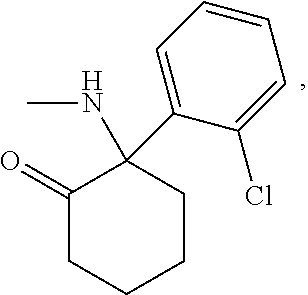
is an N-methyl-D-aspartate (“NMDA”) receptor antagonist. Ketamine has primarily been used for anesthesia in humans and animals, as well as for chronic pain and sedation. Ketamine is typically available commercially in liquid form for use as an immediate-acting injection.
Claims (6)
Priority Applications (3)
| Application Number | Priority Date | Filing Date | Title |
|---|---|---|---|
| US17/404,128 US12233165B2 (en) | 2020-08-18 | 2021-08-17 | Microsphere formulations comprising ketamine and methods for making and using the same |
| US18/151,928 US20230225993A1 (en) | 2020-08-18 | 2023-01-09 | Microsphere formulations comprising ketamine and methods for making and using the same |
| US18/756,907 US20240342115A1 (en) | 2020-08-18 | 2024-06-27 | Microsphere formulations comprising ketamine and methods formaking and using the same |
Applications Claiming Priority (3)
| Application Number | Priority Date | Filing Date | Title |
|---|---|---|---|
| US202063067068P | 2020-08-18 | 2020-08-18 | |
| US202163149911P | 2021-02-16 | 2021-02-16 | |
| US17/404,128 US12233165B2 (en) | 2020-08-18 | 2021-08-17 | Microsphere formulations comprising ketamine and methods for making and using the same |
Related Child Applications (2)
| Application Number | Title | Priority Date | Filing Date |
|---|---|---|---|
| US18/151,928 Continuation-In-Part US20230225993A1 (en) | 2020-08-18 | 2023-01-09 | Microsphere formulations comprising ketamine and methods for making and using the same |
| US18/756,907 Continuation-In-Part US20240342115A1 (en) | 2020-08-18 | 2024-06-27 | Microsphere formulations comprising ketamine and methods formaking and using the same |
Publications (2)
| Publication Number | Publication Date |
|---|---|
| US20220054420A1 US20220054420A1 (en) | 2022-02-24 |
| US12233165B2 true US12233165B2 (en) | 2025-02-25 |
Family
ID=80270269
Family Applications (1)
| Application Number | Title | Priority Date | Filing Date |
|---|---|---|---|
| US17/404,128 Active 2042-10-02 US12233165B2 (en) | 2020-08-18 | 2021-08-17 | Microsphere formulations comprising ketamine and methods for making and using the same |
Country Status (9)
| Country | Link |
|---|---|
| US (1) | US12233165B2 (en) |
| EP (1) | EP4199917B1 (en) |
| JP (1) | JP2023538901A (en) |
| KR (1) | KR20230052915A (en) |
| CN (1) | CN115942935B (en) |
| AU (1) | AU2021329820A1 (en) |
| CA (1) | CA3191160A1 (en) |
| IL (1) | IL300547A (en) |
| WO (1) | WO2022040130A1 (en) |
Families Citing this family (2)
| Publication number | Priority date | Publication date | Assignee | Title |
|---|---|---|---|---|
| EP3505157B1 (en) | 2017-12-29 | 2021-12-08 | Celon Pharma S.A. | Dry powder ketamine composition for pulmonary administration in treatment-resistant depression |
| WO2024097696A1 (en) * | 2022-10-31 | 2024-05-10 | Oakwood Laboratories, Llc | Mixed release profile polymer microsphere formulations comprising octreotide and methods for making and using the same |
Citations (17)
| Publication number | Priority date | Publication date | Assignee | Title |
|---|---|---|---|---|
| WO2001010414A1 (en) | 1999-08-04 | 2001-02-15 | Oakwood Laboratories L.L.C. | Slow release microspheres |
| US6291013B1 (en) | 1999-05-03 | 2001-09-18 | Southern Biosystems, Inc. | Emulsion-based processes for making microparticles |
| US6479007B1 (en) | 1999-09-16 | 2002-11-12 | University Technology Corporation | Apparatus and method for controlling pore size in polymeric membranes and thin films |
| WO2002089767A1 (en) | 2001-05-03 | 2002-11-14 | Massachusetts Eye And Ear Infirmary | Implantable drug delivery device and use thereof |
| WO2005107706A2 (en) | 2004-04-30 | 2005-11-17 | Allergan, Inc. | Biodegradable intravitreal tyrosine kinase inhibitors implants |
| US20050260272A1 (en) | 2004-05-05 | 2005-11-24 | Alkermes Controlled Therapeutics, Inc. | Method of forming microparticles that include a bisphosphonate and a polymer |
| WO2007082061A2 (en) | 2006-01-11 | 2007-07-19 | Hyperbranch Medical Technology, Inc. | Crosslinked gels comprising polyalkyleneimines, and their uses as medical devices |
| US20110027331A1 (en) | 2009-07-29 | 2011-02-03 | Warsaw Orthopedic, Inc. | An implantable drug depot having a reversible phase transition material for treatment of pain and/or inflammation |
| WO2013119183A1 (en) | 2012-02-06 | 2013-08-15 | Nanyang Technological University | Methods of manufacturing core-shell microparticles, and microparticles formed thereof |
| US20130236573A1 (en) | 2012-03-12 | 2013-09-12 | Janssen Pharmaceutica Nv | Esketamine for the treatment of treatment-refractory or treatment-resistant depression |
| US20150250719A1 (en) | 2005-09-28 | 2015-09-10 | Auris Medical Ag | Pharmaceutical compositions for the treatment of inner ear disorders |
| US20180326080A1 (en) | 2015-10-27 | 2018-11-15 | Purdue Research Foundation | Polymer-based therapeutics for inductive browning of fat |
| WO2019054948A1 (en) | 2017-09-14 | 2019-03-21 | Agency For Science, Technology And Research | Emulsions, methods and uses thereof |
| US10973780B2 (en) | 2019-05-15 | 2021-04-13 | Bexson Biomedical, Inc. | Ketamine formulation for subcutaneous injection |
| WO2021108801A2 (en) | 2019-11-15 | 2021-06-03 | Consegna Pharma, Inc. | Long acting nmda antagonists |
| WO2021121366A1 (en) | 2019-12-20 | 2021-06-24 | Alar Pharmaceuticals Inc. | Long-acting injectable formulations of ketamine pamoate salts |
| US20210361578A1 (en) | 2020-04-03 | 2021-11-25 | University Of Iowa Research Foundation | Mek1/2 inhibitor-loaded microparticle formulation |
Family Cites Families (8)
| Publication number | Priority date | Publication date | Assignee | Title |
|---|---|---|---|---|
| JPH0720859B2 (en) * | 1985-02-07 | 1995-03-08 | 武田薬品工業株式会社 | Microcapsule manufacturing method |
| US6902743B1 (en) * | 1995-05-22 | 2005-06-07 | The United States Of America As Represented By The Secretary Of The Army | Therapeutic treatment and prevention of infections with a bioactive material(s) encapuslated within a biodegradable-bio-compatable polymeric matrix |
| US5945126A (en) | 1997-02-13 | 1999-08-31 | Oakwood Laboratories L.L.C. | Continuous microsphere process |
| US6270802B1 (en) | 1998-10-28 | 2001-08-07 | Oakwood Laboratories L.L.C. | Method and apparatus for formulating microspheres and microcapsules |
| KR100392501B1 (en) * | 2000-06-28 | 2003-07-22 | 동국제약 주식회사 | Preparation Method for Sustained Release Microparticles by Multiple Emulsion Method and Micropartic les Thereof |
| US20070292521A1 (en) * | 2006-06-20 | 2007-12-20 | Schwitzer Co., Ltd | Oral Encapsulated Preparation for Aquatic Animals |
| CN112423789A (en) * | 2017-12-22 | 2021-02-26 | 詹森药业有限公司 | Esketamine for the treatment of depression |
| CA3144281C (en) | 2019-07-01 | 2023-08-22 | Oakwood Laboratories, Llc | System and method for making microspheres and emulsions |
-
2021
- 2021-08-17 JP JP2023511830A patent/JP2023538901A/en active Pending
- 2021-08-17 CA CA3191160A patent/CA3191160A1/en active Pending
- 2021-08-17 AU AU2021329820A patent/AU2021329820A1/en active Pending
- 2021-08-17 IL IL300547A patent/IL300547A/en unknown
- 2021-08-17 KR KR1020237008093A patent/KR20230052915A/en active Pending
- 2021-08-17 EP EP21858931.5A patent/EP4199917B1/en active Active
- 2021-08-17 WO PCT/US2021/046220 patent/WO2022040130A1/en not_active Ceased
- 2021-08-17 US US17/404,128 patent/US12233165B2/en active Active
- 2021-08-17 CN CN202180050934.4A patent/CN115942935B/en active Active
Patent Citations (17)
| Publication number | Priority date | Publication date | Assignee | Title |
|---|---|---|---|---|
| US6291013B1 (en) | 1999-05-03 | 2001-09-18 | Southern Biosystems, Inc. | Emulsion-based processes for making microparticles |
| WO2001010414A1 (en) | 1999-08-04 | 2001-02-15 | Oakwood Laboratories L.L.C. | Slow release microspheres |
| US6479007B1 (en) | 1999-09-16 | 2002-11-12 | University Technology Corporation | Apparatus and method for controlling pore size in polymeric membranes and thin films |
| WO2002089767A1 (en) | 2001-05-03 | 2002-11-14 | Massachusetts Eye And Ear Infirmary | Implantable drug delivery device and use thereof |
| WO2005107706A2 (en) | 2004-04-30 | 2005-11-17 | Allergan, Inc. | Biodegradable intravitreal tyrosine kinase inhibitors implants |
| US20050260272A1 (en) | 2004-05-05 | 2005-11-24 | Alkermes Controlled Therapeutics, Inc. | Method of forming microparticles that include a bisphosphonate and a polymer |
| US20150250719A1 (en) | 2005-09-28 | 2015-09-10 | Auris Medical Ag | Pharmaceutical compositions for the treatment of inner ear disorders |
| WO2007082061A2 (en) | 2006-01-11 | 2007-07-19 | Hyperbranch Medical Technology, Inc. | Crosslinked gels comprising polyalkyleneimines, and their uses as medical devices |
| US20110027331A1 (en) | 2009-07-29 | 2011-02-03 | Warsaw Orthopedic, Inc. | An implantable drug depot having a reversible phase transition material for treatment of pain and/or inflammation |
| WO2013119183A1 (en) | 2012-02-06 | 2013-08-15 | Nanyang Technological University | Methods of manufacturing core-shell microparticles, and microparticles formed thereof |
| US20130236573A1 (en) | 2012-03-12 | 2013-09-12 | Janssen Pharmaceutica Nv | Esketamine for the treatment of treatment-refractory or treatment-resistant depression |
| US20180326080A1 (en) | 2015-10-27 | 2018-11-15 | Purdue Research Foundation | Polymer-based therapeutics for inductive browning of fat |
| WO2019054948A1 (en) | 2017-09-14 | 2019-03-21 | Agency For Science, Technology And Research | Emulsions, methods and uses thereof |
| US10973780B2 (en) | 2019-05-15 | 2021-04-13 | Bexson Biomedical, Inc. | Ketamine formulation for subcutaneous injection |
| WO2021108801A2 (en) | 2019-11-15 | 2021-06-03 | Consegna Pharma, Inc. | Long acting nmda antagonists |
| WO2021121366A1 (en) | 2019-12-20 | 2021-06-24 | Alar Pharmaceuticals Inc. | Long-acting injectable formulations of ketamine pamoate salts |
| US20210361578A1 (en) | 2020-04-03 | 2021-11-25 | University Of Iowa Research Foundation | Mek1/2 inhibitor-loaded microparticle formulation |
Non-Patent Citations (11)
| Title |
|---|
| China National Intellectual Property Administration, First Office Action issued in Chinese Patent Application No. 202180050934.4, dated Nov. 9, 2024 (3 pages). |
| Extended European search report issued on Sep. 26, 2024 in EP21858931.5. |
| Han et al., "Formulation of Bioerodible Ketamine Microparticles as an Analgesic Adjuvant Treatment Produced by Supercritical Fluid Polymer Encapsulation", Pharmaceutics 2018, 10, 264. |
| Han, et al. "Formulation of Bioderable Ketamine Microparticles as an Analgesic Adjuvant Treatment Produced by Supercritical Fluid Polymer Encapsulation". Pharmac. vol. 10, No. 264, Dec. 6, 2018 (Dec. 6, 2018)—entire document especially p. 3, 8, Table 1, 2 and Abstract. |
| Han, et al., "Novel Polymeric Bioerodable Microparticles for Prolonged-Release Intrathecal Delivery of Analgesic Agents for Relief of Intractable Cancer-Related Pain", Journal of Pharmaceutical Sciences 104:2334-2344, 2015. |
| Hirano et al, "Ketamine nano-delivery based on poly-lactic-co-glycolic acid (PLGA) nanoparticles", Applied Nanoscienc, vol. 8, Apr. 11, 2018. |
| International Preliminary Report on Patentability issued in PCT/US2021/046200, mailing date Feb. 21, 2023. |
| International Preliminary Report on Patentability issued in PCT/US23/60315, dated Jun. 20, 2024 (9 pages). |
| International Search Report and Written Opinion issued in PCT/US2021/046200, mailing date Jan. 5, 2022. |
| International Search Report and Written Opinion issued in PCT/US23/60315, mailing date Jul. 13, 2023. |
| Zhu et al., "Bioerodable Ketamine-Loaded Microparticles Fabricated Using Dissolvable Hydrogel Template Technology", Journal of Pharmaceutical Sciences, 108 (2019) 1220-1226. |
Also Published As
| Publication number | Publication date |
|---|---|
| CN115942935A (en) | 2023-04-07 |
| IL300547A (en) | 2023-04-01 |
| WO2022040130A1 (en) | 2022-02-24 |
| US20220054420A1 (en) | 2022-02-24 |
| JP2023538901A (en) | 2023-09-12 |
| AU2021329820A1 (en) | 2023-03-09 |
| EP4199917A1 (en) | 2023-06-28 |
| CN115942935B (en) | 2025-09-05 |
| KR20230052915A (en) | 2023-04-20 |
| EP4199917B1 (en) | 2026-01-07 |
| TW202227044A (en) | 2022-07-16 |
| CA3191160A1 (en) | 2022-02-24 |
| EP4199917A4 (en) | 2024-10-30 |
Similar Documents
| Publication | Publication Date | Title |
|---|---|---|
| US9393211B2 (en) | High drug load buprenorphine microspheres and method of producing same | |
| US12233165B2 (en) | Microsphere formulations comprising ketamine and methods for making and using the same | |
| US20220183976A1 (en) | Compositions of dispersed phase for preparation of apixaban-loaded microspheres and biocompatible polymer-based apixaban-loaded microspheres prepared therefrom | |
| WO2022198167A1 (en) | Microsphere formulations comprising naltrexone and methods for making and using the same | |
| US20240342115A1 (en) | Microsphere formulations comprising ketamine and methods formaking and using the same | |
| US11992559B2 (en) | Microsphere formulations comprising lurasidone and methods for making and using the same | |
| US20230225993A1 (en) | Microsphere formulations comprising ketamine and methods for making and using the same | |
| TWI906350B (en) | Microsphere formulations comprising ketamine, methods for making the same and compositions for use in a method | |
| US20240216280A1 (en) | Microsphere formulations comprising nalmefene andmethods for making and using the same | |
| WO2023133554A2 (en) | Microsphere formulations comprising ketamine and methods for making and using the same | |
| US20240000772A1 (en) | Microsphere formulations comprising naltrexone and methods for making and using the same | |
| US20240307381A1 (en) | Microsphere formulations comprising lurasidone and methods for making and using the same | |
| US20230404922A1 (en) | Microsphere formulations comprising btk inhibitors and methods for making and using the same | |
| US20250032451A1 (en) | Microsphere formulations comprising asenapine and methods for making and using the same | |
| KR20230154222A (en) | Microsphere preparations containing BTK inhibitors and methods for making and using the same | |
| WO2024163997A1 (en) | Microsphere formulations comprising naltrexone and methods for making and using the same | |
| WO2025117624A1 (en) | Microsphere formulations comprising brexpiprazole and methods for making and using the same | |
| WO2024097696A1 (en) | Mixed release profile polymer microsphere formulations comprising octreotide and methods for making and using the same |
Legal Events
| Date | Code | Title | Description |
|---|---|---|---|
| FEPP | Fee payment procedure |
Free format text: ENTITY STATUS SET TO UNDISCOUNTED (ORIGINAL EVENT CODE: BIG.); ENTITY STATUS OF PATENT OWNER: SMALL ENTITY |
|
| FEPP | Fee payment procedure |
Free format text: ENTITY STATUS SET TO SMALL (ORIGINAL EVENT CODE: SMAL); ENTITY STATUS OF PATENT OWNER: SMALL ENTITY |
|
| STPP | Information on status: patent application and granting procedure in general |
Free format text: DOCKETED NEW CASE - READY FOR EXAMINATION |
|
| AS | Assignment |
Owner name: OAKWOOD LABORATORIES LLC, OHIO Free format text: ASSIGNMENT OF ASSIGNORS INTEREST;ASSIGNORS:GALASKA, RACHEL;RICHEY, TRACY;KAHT, KELSEY;AND OTHERS;SIGNING DATES FROM 20011025 TO 20220726;REEL/FRAME:062307/0104 |
|
| STPP | Information on status: patent application and granting procedure in general |
Free format text: NON FINAL ACTION MAILED |
|
| STPP | Information on status: patent application and granting procedure in general |
Free format text: RESPONSE TO NON-FINAL OFFICE ACTION ENTERED AND FORWARDED TO EXAMINER |
|
| STPP | Information on status: patent application and granting procedure in general |
Free format text: NON FINAL ACTION MAILED |
|
| STPP | Information on status: patent application and granting procedure in general |
Free format text: RESPONSE TO NON-FINAL OFFICE ACTION ENTERED AND FORWARDED TO EXAMINER |
|
| STPP | Information on status: patent application and granting procedure in general |
Free format text: FINAL REJECTION MAILED |
|
| STPP | Information on status: patent application and granting procedure in general |
Free format text: RESPONSE AFTER FINAL ACTION FORWARDED TO EXAMINER |
|
| STPP | Information on status: patent application and granting procedure in general |
Free format text: ADVISORY ACTION MAILED |
|
| STPP | Information on status: patent application and granting procedure in general |
Free format text: DOCKETED NEW CASE - READY FOR EXAMINATION |
|
| STPP | Information on status: patent application and granting procedure in general |
Free format text: NOTICE OF ALLOWANCE MAILED -- APPLICATION RECEIVED IN OFFICE OF PUBLICATIONS |
|
| STPP | Information on status: patent application and granting procedure in general |
Free format text: PUBLICATIONS -- ISSUE FEE PAYMENT RECEIVED |
|
| ZAAB | Notice of allowance mailed |
Free format text: ORIGINAL CODE: MN/=. |
|
| STPP | Information on status: patent application and granting procedure in general |
Free format text: PUBLICATIONS -- ISSUE FEE PAYMENT VERIFIED |
|
| STCF | Information on status: patent grant |
Free format text: PATENTED CASE |