US12228481B2 - Expansion microscopy compatible anchorable HandE staining for histopathology - Google Patents
Expansion microscopy compatible anchorable HandE staining for histopathology Download PDFInfo
- Publication number
- US12228481B2 US12228481B2 US17/419,545 US201917419545A US12228481B2 US 12228481 B2 US12228481 B2 US 12228481B2 US 201917419545 A US201917419545 A US 201917419545A US 12228481 B2 US12228481 B2 US 12228481B2
- Authority
- US
- United States
- Prior art keywords
- anchorable
- sample
- hematoxylin
- eosin
- derivative
- Prior art date
- Legal status (The legal status is an assumption and is not a legal conclusion. Google has not performed a legal analysis and makes no representation as to the accuracy of the status listed.)
- Active, expires
Links
- 238000000386 microscopy Methods 0.000 title claims abstract description 29
- 238000010186 staining Methods 0.000 title abstract description 33
- WZUVPPKBWHMQCE-UHFFFAOYSA-N Haematoxylin Chemical class C12=CC(O)=C(O)C=C2CC2(O)C1C1=CC=C(O)C(O)=C1OC2 WZUVPPKBWHMQCE-UHFFFAOYSA-N 0.000 claims abstract description 279
- YQGOJNYOYNNSMM-UHFFFAOYSA-N eosin Chemical compound [Na+].OC(=O)C1=CC=CC=C1C1=C2C=C(Br)C(=O)C(Br)=C2OC2=C(Br)C(O)=C(Br)C=C21 YQGOJNYOYNNSMM-UHFFFAOYSA-N 0.000 claims abstract description 100
- 238000000034 method Methods 0.000 claims abstract description 89
- 239000000017 hydrogel Substances 0.000 claims abstract description 44
- 239000011159 matrix material Substances 0.000 claims abstract description 29
- 238000001514 detection method Methods 0.000 claims abstract description 8
- 239000000523 sample Substances 0.000 claims description 158
- 239000000463 material Substances 0.000 claims description 93
- 102000004169 proteins and genes Human genes 0.000 claims description 57
- 108090000623 proteins and genes Proteins 0.000 claims description 55
- -1 isopropanoyl Chemical group 0.000 claims description 51
- 150000001875 compounds Chemical class 0.000 claims description 49
- 102000039446 nucleic acids Human genes 0.000 claims description 47
- 108020004707 nucleic acids Proteins 0.000 claims description 47
- 150000007523 nucleic acids Chemical class 0.000 claims description 47
- 239000004971 Cross linker Substances 0.000 claims description 30
- 125000006850 spacer group Chemical group 0.000 claims description 30
- HRPVXLWXLXDGHG-UHFFFAOYSA-N Acrylamide Chemical compound NC(=O)C=C HRPVXLWXLXDGHG-UHFFFAOYSA-N 0.000 claims description 26
- HLUCICHZHWJHLL-UHFFFAOYSA-N hematein Chemical compound C12=CC=C(O)C(O)=C2OCC2(O)C1=C1C=C(O)C(=O)C=C1C2 HLUCICHZHWJHLL-UHFFFAOYSA-N 0.000 claims description 25
- VVJKKWFAADXIJK-UHFFFAOYSA-N Allylamine Chemical compound NCC=C VVJKKWFAADXIJK-UHFFFAOYSA-N 0.000 claims description 22
- 238000004132 cross linking Methods 0.000 claims description 19
- 125000002252 acyl group Chemical group 0.000 claims description 16
- 125000000217 alkyl group Chemical group 0.000 claims description 16
- NIXOWILDQLNWCW-UHFFFAOYSA-M Acrylate Chemical compound [O-]C(=O)C=C NIXOWILDQLNWCW-UHFFFAOYSA-M 0.000 claims description 14
- 239000012472 biological sample Substances 0.000 claims description 14
- IMROMDMJAWUWLK-UHFFFAOYSA-N Ethenol Chemical compound OC=C IMROMDMJAWUWLK-UHFFFAOYSA-N 0.000 claims description 13
- CERQOIWHTDAKMF-UHFFFAOYSA-M Methacrylate Chemical compound CC(=C)C([O-])=O CERQOIWHTDAKMF-UHFFFAOYSA-M 0.000 claims description 13
- UYMKPFRHYYNDTL-UHFFFAOYSA-N ethenamine Chemical compound NC=C UYMKPFRHYYNDTL-UHFFFAOYSA-N 0.000 claims description 13
- 238000002372 labelling Methods 0.000 claims description 13
- 229910052760 oxygen Inorganic materials 0.000 claims description 11
- 229910052717 sulfur Inorganic materials 0.000 claims description 11
- SXRSQZLOMIGNAQ-UHFFFAOYSA-N Glutaraldehyde Chemical group O=CCCCC=O SXRSQZLOMIGNAQ-UHFFFAOYSA-N 0.000 claims description 10
- 239000007788 liquid Substances 0.000 claims description 10
- 230000000379 polymerizing effect Effects 0.000 claims description 9
- 125000004169 (C1-C6) alkyl group Chemical group 0.000 claims description 8
- 125000002777 acetyl group Chemical group [H]C([H])([H])C(*)=O 0.000 claims description 8
- 125000003236 benzoyl group Chemical group [H]C1=C([H])C([H])=C(C([H])=C1[H])C(*)=O 0.000 claims description 8
- 125000004063 butyryl group Chemical group O=C([*])C([H])([H])C([H])([H])C([H])([H])[H] 0.000 claims description 8
- 125000002485 formyl group Chemical group [H]C(*)=O 0.000 claims description 8
- 150000002825 nitriles Chemical class 0.000 claims description 8
- 125000001325 propanoyl group Chemical group O=C([*])C([H])([H])C([H])([H])[H] 0.000 claims description 8
- 125000003774 valeryl group Chemical group O=C([*])C([H])([H])C([H])([H])C([H])([H])C([H])([H])[H] 0.000 claims description 8
- 239000003125 aqueous solvent Substances 0.000 claims description 7
- 238000004519 manufacturing process Methods 0.000 claims description 2
- XXROGKLTLUQVRX-UHFFFAOYSA-N allyl alcohol Chemical group OCC=C XXROGKLTLUQVRX-UHFFFAOYSA-N 0.000 claims 2
- 206010028980 Neoplasm Diseases 0.000 abstract description 8
- 201000010099 disease Diseases 0.000 abstract description 7
- 208000037265 diseases, disorders, signs and symptoms Diseases 0.000 abstract description 7
- 238000003745 diagnosis Methods 0.000 abstract description 5
- 230000000877 morphologic effect Effects 0.000 abstract description 5
- 239000000975 dye Substances 0.000 description 64
- LFQSCWFLJHTTHZ-UHFFFAOYSA-N Ethanol Chemical compound CCO LFQSCWFLJHTTHZ-UHFFFAOYSA-N 0.000 description 60
- 239000000243 solution Substances 0.000 description 54
- 239000000203 mixture Substances 0.000 description 51
- 239000003431 cross linking reagent Substances 0.000 description 44
- 210000001519 tissue Anatomy 0.000 description 33
- 239000000499 gel Substances 0.000 description 32
- 230000015572 biosynthetic process Effects 0.000 description 31
- 238000003786 synthesis reaction Methods 0.000 description 31
- 238000004873 anchoring Methods 0.000 description 30
- XLYOFNOQVPJJNP-UHFFFAOYSA-N water Substances O XLYOFNOQVPJJNP-UHFFFAOYSA-N 0.000 description 30
- XEKOWRVHYACXOJ-UHFFFAOYSA-N Ethyl acetate Chemical compound CCOC(C)=O XEKOWRVHYACXOJ-UHFFFAOYSA-N 0.000 description 29
- 239000000178 monomer Substances 0.000 description 28
- VYPSYNLAJGMNEJ-UHFFFAOYSA-N Silicium dioxide Chemical compound O=[Si]=O VYPSYNLAJGMNEJ-UHFFFAOYSA-N 0.000 description 27
- 238000006116 polymerization reaction Methods 0.000 description 25
- ROOXNKNUYICQNP-UHFFFAOYSA-N ammonium persulfate Chemical compound [NH4+].[NH4+].[O-]S(=O)(=O)OOS([O-])(=O)=O ROOXNKNUYICQNP-UHFFFAOYSA-N 0.000 description 24
- 229920000642 polymer Polymers 0.000 description 24
- KIDHWZJUCRJVML-UHFFFAOYSA-N putrescine Chemical compound NCCCCN KIDHWZJUCRJVML-UHFFFAOYSA-N 0.000 description 24
- 239000003153 chemical reaction reagent Substances 0.000 description 21
- 230000008569 process Effects 0.000 description 20
- 230000029087 digestion Effects 0.000 description 18
- 239000002243 precursor Substances 0.000 description 15
- 239000000047 product Substances 0.000 description 14
- PQUXFUBNSYCQAL-UHFFFAOYSA-N 1-(2,3-difluorophenyl)ethanone Chemical compound CC(=O)C1=CC=CC(F)=C1F PQUXFUBNSYCQAL-UHFFFAOYSA-N 0.000 description 13
- FAPWRFPIFSIZLT-UHFFFAOYSA-M Sodium chloride Chemical compound [Na+].[Cl-] FAPWRFPIFSIZLT-UHFFFAOYSA-M 0.000 description 13
- 239000011521 glass Substances 0.000 description 13
- 229940047670 sodium acrylate Drugs 0.000 description 13
- 239000007787 solid Substances 0.000 description 13
- OKKJLVBELUTLKV-UHFFFAOYSA-N Methanol Chemical compound OC OKKJLVBELUTLKV-UHFFFAOYSA-N 0.000 description 12
- 229910001870 ammonium persulfate Inorganic materials 0.000 description 12
- 239000000872 buffer Substances 0.000 description 12
- 235000019439 ethyl acetate Nutrition 0.000 description 12
- 238000003384 imaging method Methods 0.000 description 12
- 150000004808 allyl alcohols Chemical group 0.000 description 11
- 238000004440 column chromatography Methods 0.000 description 11
- 239000000377 silicon dioxide Substances 0.000 description 11
- RTZKZFJDLAIYFH-UHFFFAOYSA-N Diethyl ether Chemical compound CCOCC RTZKZFJDLAIYFH-UHFFFAOYSA-N 0.000 description 10
- 229940048053 acrylate Drugs 0.000 description 10
- 210000004027 cell Anatomy 0.000 description 10
- SEACYXSIPDVVMV-UHFFFAOYSA-L eosin Y Chemical compound [Na+].[Na+].[O-]C(=O)C1=CC=CC=C1C1=C2C=C(Br)C(=O)C(Br)=C2OC2=C(Br)C([O-])=C(Br)C=C21 SEACYXSIPDVVMV-UHFFFAOYSA-L 0.000 description 10
- 238000007490 hematoxylin and eosin (H&E) staining Methods 0.000 description 10
- 239000002904 solvent Substances 0.000 description 10
- 125000001495 ethyl group Chemical group [H]C([H])([H])C([H])([H])* 0.000 description 9
- 238000004895 liquid chromatography mass spectrometry Methods 0.000 description 9
- 125000002496 methyl group Chemical group [H]C([H])([H])* 0.000 description 9
- 239000004698 Polyethylene Substances 0.000 description 8
- 239000002131 composite material Substances 0.000 description 8
- 239000000539 dimer Substances 0.000 description 8
- 230000003287 optical effect Effects 0.000 description 8
- 230000008961 swelling Effects 0.000 description 8
- QTBSBXVTEAMEQO-UHFFFAOYSA-N Acetic acid Chemical compound CC(O)=O QTBSBXVTEAMEQO-UHFFFAOYSA-N 0.000 description 7
- ZMANZCXQSJIPKH-UHFFFAOYSA-N Triethylamine Chemical compound CCN(CC)CC ZMANZCXQSJIPKH-UHFFFAOYSA-N 0.000 description 7
- 238000006243 chemical reaction Methods 0.000 description 7
- 239000003921 oil Substances 0.000 description 7
- 239000011780 sodium chloride Substances 0.000 description 7
- 238000005160 1H NMR spectroscopy Methods 0.000 description 6
- UVQFOOUAADWZHI-UHFFFAOYSA-N 3,4,9,10-tetrakis(phenylmethoxy)-7,11b-dihydro-6H-indeno[2,1-c]chromen-6a-ol Chemical compound C=1C=CC=CC=1COC=1C=C2C(C=3C(=C(OCC=4C=CC=CC=4)C(OCC=4C=CC=CC=4)=CC=3)OC3)C3(O)CC2=CC=1OCC1=CC=CC=C1 UVQFOOUAADWZHI-UHFFFAOYSA-N 0.000 description 6
- 230000003321 amplification Effects 0.000 description 6
- 238000001493 electron microscopy Methods 0.000 description 6
- 238000011065 in-situ storage Methods 0.000 description 6
- 238000003199 nucleic acid amplification method Methods 0.000 description 6
- 239000011541 reaction mixture Substances 0.000 description 6
- 239000000126 substance Substances 0.000 description 6
- 238000001644 13C nuclear magnetic resonance spectroscopy Methods 0.000 description 5
- 238000003820 Medium-pressure liquid chromatography Methods 0.000 description 5
- 230000002378 acidificating effect Effects 0.000 description 5
- 125000003647 acryloyl group Chemical group O=C([*])C([H])=C([H])[H] 0.000 description 5
- QGAYMQGSQUXCQO-UHFFFAOYSA-L eosin b Chemical compound [Na+].[Na+].O1C(=O)C2=CC=CC=C2C21C1=CC([N+]([O-])=O)=C([O-])C(Br)=C1OC1=C2C=C([N+]([O-])=O)C([O-])=C1Br QGAYMQGSQUXCQO-UHFFFAOYSA-L 0.000 description 5
- 238000003818 flash chromatography Methods 0.000 description 5
- 238000001879 gelation Methods 0.000 description 5
- QNILTEGFHQSKFF-UHFFFAOYSA-N n-propan-2-ylprop-2-enamide Chemical compound CC(C)NC(=O)C=C QNILTEGFHQSKFF-UHFFFAOYSA-N 0.000 description 5
- 210000004940 nucleus Anatomy 0.000 description 5
- 239000012188 paraffin wax Substances 0.000 description 5
- 239000003208 petroleum Substances 0.000 description 5
- 238000012545 processing Methods 0.000 description 5
- 125000001436 propyl group Chemical group [H]C([*])([H])C([H])([H])C([H])([H])[H] 0.000 description 5
- 238000000746 purification Methods 0.000 description 5
- 239000000741 silica gel Substances 0.000 description 5
- 229910002027 silica gel Inorganic materials 0.000 description 5
- 239000008399 tap water Substances 0.000 description 5
- AQKLDBRFLGEHCJ-UHFFFAOYSA-N (2,5-dioxopyrrolidin-1-yl) 6-(prop-2-enoylamino)hexanoate Chemical compound C=CC(=O)NCCCCCC(=O)ON1C(=O)CCC1=O AQKLDBRFLGEHCJ-UHFFFAOYSA-N 0.000 description 4
- RTWQWXUVDCSRIR-UHFFFAOYSA-N 2-[2-[2-[[3,4,9,10-tetrakis(phenylmethoxy)-7,11b-dihydro-6H-indeno[2,1-c]chromen-6a-yl]oxy]ethoxy]ethoxy]ethanamine Chemical compound C(C1=CC=CC=C1)OC1=CC=C2C3C(COC2=C1OCC1=CC=CC=C1)(CC1=CC(=C(C=C13)OCC1=CC=CC=C1)OCC1=CC=CC=C1)OCCOCCOCCN RTWQWXUVDCSRIR-UHFFFAOYSA-N 0.000 description 4
- YYKQMAZNZZKRBY-UHFFFAOYSA-N 2-[[3,4,9,10-tetrakis(phenylmethoxy)-7,11b-dihydro-6H-indeno[2,1-c]chromen-6a-yl]oxy]ethanol Chemical compound C(C1=CC=CC=C1)OC1=CC=C2C3C(COC2=C1OCC1=CC=CC=C1)(CC1=CC(=C(C=C13)OCC1=CC=CC=C1)OCC1=CC=CC=C1)OCCO YYKQMAZNZZKRBY-UHFFFAOYSA-N 0.000 description 4
- 125000003903 2-propenyl group Chemical group [H]C([*])([H])C([H])=C([H])[H] 0.000 description 4
- WHNPOQXWAMXPTA-UHFFFAOYSA-N 3-methylbut-2-enamide Chemical compound CC(C)=CC(N)=O WHNPOQXWAMXPTA-UHFFFAOYSA-N 0.000 description 4
- CKAHTDFADQDCCC-UHFFFAOYSA-N 6a-[2-[2-(2-aminoethoxy)ethoxy]ethoxy]-7,11b-dihydro-6H-indeno[2,1-c]chromene-3,4,9,10-tetrol hydrochloride Chemical compound Cl.NCCOCCOCCOC12COC3=C(C(=CC=C3C1C1=CC(=C(C=C1C2)O)O)O)O CKAHTDFADQDCCC-UHFFFAOYSA-N 0.000 description 4
- WSFSSNUMVMOOMR-UHFFFAOYSA-N Formaldehyde Chemical compound O=C WSFSSNUMVMOOMR-UHFFFAOYSA-N 0.000 description 4
- 239000007832 Na2SO4 Substances 0.000 description 4
- 239000002202 Polyethylene glycol Substances 0.000 description 4
- PMZURENOXWZQFD-UHFFFAOYSA-L Sodium Sulfate Chemical compound [Na+].[Na+].[O-]S([O-])(=O)=O PMZURENOXWZQFD-UHFFFAOYSA-L 0.000 description 4
- 238000004458 analytical method Methods 0.000 description 4
- 238000001574 biopsy Methods 0.000 description 4
- 238000012512 characterization method Methods 0.000 description 4
- 239000000834 fixative Substances 0.000 description 4
- 239000003999 initiator Substances 0.000 description 4
- 125000000959 isobutyl group Chemical group [H]C([H])([H])C([H])(C([H])([H])[H])C([H])([H])* 0.000 description 4
- 125000001972 isopentyl group Chemical group [H]C([H])([H])C([H])(C([H])([H])[H])C([H])([H])C([H])([H])* 0.000 description 4
- 125000001449 isopropyl group Chemical group [H]C([H])([H])C([H])(*)C([H])([H])[H] 0.000 description 4
- ZIUHHBKFKCYYJD-UHFFFAOYSA-N n,n'-methylenebisacrylamide Chemical compound C=CC(=O)NCNC(=O)C=C ZIUHHBKFKCYYJD-UHFFFAOYSA-N 0.000 description 4
- 125000004108 n-butyl group Chemical group [H]C([H])([H])C([H])([H])C([H])([H])C([H])([H])* 0.000 description 4
- 125000001280 n-hexyl group Chemical group C(CCCCC)* 0.000 description 4
- 125000004123 n-propyl group Chemical group [H]C([H])([H])C([H])([H])C([H])([H])* 0.000 description 4
- 239000012044 organic layer Substances 0.000 description 4
- 229920001223 polyethylene glycol Polymers 0.000 description 4
- BWHMMNNQKKPAPP-UHFFFAOYSA-L potassium carbonate Chemical compound [K+].[K+].[O-]C([O-])=O BWHMMNNQKKPAPP-UHFFFAOYSA-L 0.000 description 4
- 125000002914 sec-butyl group Chemical group [H]C([H])([H])C([H])([H])C([H])(*)C([H])([H])[H] 0.000 description 4
- 125000003548 sec-pentyl group Chemical group [H]C([H])([H])C([H])([H])C([H])([H])C([H])(*)C([H])([H])[H] 0.000 description 4
- 229910052938 sodium sulfate Inorganic materials 0.000 description 4
- DYHSDKLCOJIUFX-UHFFFAOYSA-N tert-butoxycarbonyl anhydride Chemical compound CC(C)(C)OC(=O)OC(=O)OC(C)(C)C DYHSDKLCOJIUFX-UHFFFAOYSA-N 0.000 description 4
- 125000000999 tert-butyl group Chemical group [H]C([H])([H])C(*)(C([H])([H])[H])C([H])([H])[H] 0.000 description 4
- 125000001973 tert-pentyl group Chemical group [H]C([H])([H])C([H])([H])C(*)(C([H])([H])[H])C([H])([H])[H] 0.000 description 4
- JOXIMZWYDAKGHI-UHFFFAOYSA-N toluene-4-sulfonic acid Chemical compound CC1=CC=C(S(O)(=O)=O)C=C1 JOXIMZWYDAKGHI-UHFFFAOYSA-N 0.000 description 4
- RIOQSEWOXXDEQQ-UHFFFAOYSA-N triphenylphosphine Chemical compound C1=CC=CC=C1P(C=1C=CC=CC=1)C1=CC=CC=C1 RIOQSEWOXXDEQQ-UHFFFAOYSA-N 0.000 description 4
- 239000008096 xylene Substances 0.000 description 4
- 150000003738 xylenes Chemical class 0.000 description 4
- WYQQNBDHHGZSDQ-UHFFFAOYSA-N 2-[2-[2-[2-[[3,4,9,10-tetrakis(phenylmethoxy)-7,11b-dihydro-6H-indeno[2,1-c]chromen-6a-yl]oxy]ethoxy]ethoxy]ethyl]isoindole-1,3-dione Chemical compound C(C1=CC=CC=C1)OC1=CC=C2C3C(COC2=C1OCC1=CC=CC=C1)(CC1=CC(=C(C=C13)OCC1=CC=CC=C1)OCC1=CC=CC=C1)OCCOCCOCCN1C(C2=CC=CC=C2C1=O)=O WYQQNBDHHGZSDQ-UHFFFAOYSA-N 0.000 description 3
- GLQKDCSIMVCSKE-UHFFFAOYSA-N 2-[2-[2-[[3,4,9,10-tetrakis(phenylmethoxy)-7,11b-dihydro-6H-indeno[2,1-c]chromen-6a-yl]oxy]ethoxy]ethoxy]ethanol Chemical compound C(C1=CC=CC=C1)OC1=CC=C2C3C(COC2=C1OCC1=CC=CC=C1)(CC1=CC(=C(C=C13)OCC1=CC=CC=C1)OCC1=CC=CC=C1)OCCOCCOCCO GLQKDCSIMVCSKE-UHFFFAOYSA-N 0.000 description 3
- FWNYEKWZLYEMDG-UHFFFAOYSA-N 2-[[3,4,9,10-tetrakis(phenylmethoxy)-7,11b-dihydro-6H-indeno[2,1-c]chromen-6a-yl]oxy]ethyl methanesulfonate Chemical compound CS(=O)(=O)OCCOC12COC3=C(C(=CC=C3C1C1=CC(=C(C=C1C2)OCC1=CC=CC=C1)OCC1=CC=CC=C1)OCC1=CC=CC=C1)OCC1=CC=CC=C1 FWNYEKWZLYEMDG-UHFFFAOYSA-N 0.000 description 3
- OBOVLYIJSBNCJH-UHFFFAOYSA-N 3',6'-bis[(4-methoxyphenyl)methoxy]-5-(4,4,5,5-tetramethyl-1,3,2-dioxaborolan-2-yl)spiro[2-benzofuran-3,9'-xanthene]-1-one Chemical compound COC1=CC=C(COC=2C=CC=3C4(C5=CC=C(C=C5OC=3C=2)OCC2=CC=C(C=C2)OC)OC(C2=CC=C(C=C24)B2OC(C(O2)(C)C)(C)C)=O)C=C1 OBOVLYIJSBNCJH-UHFFFAOYSA-N 0.000 description 3
- WTHAHECLVNEODL-UHFFFAOYSA-N 5-[2-[2-(2-aminoethoxy)ethoxy]ethoxy]-3',6'-dihydroxyspiro[2-benzofuran-3,9'-xanthene]-1-one Chemical compound NCCOCCOCCOC1=CC=C2C(OC3(C4=CC=C(C=C4OC=4C=C(C=CC3=4)O)O)C2=C1)=O WTHAHECLVNEODL-UHFFFAOYSA-N 0.000 description 3
- RYSWUAIQNXVEIJ-UHFFFAOYSA-N 5-bromo-3',6'-bis[(4-methoxyphenyl)methoxy]spiro[2-benzofuran-3,9'-xanthene]-1-one Chemical compound BrC1=CC=C2C(OC3(C4=CC=C(C=C4OC=4C=C(C=CC3=4)OCC3=CC=C(C=C3)OC)OCC3=CC=C(C=C3)OC)C2=C1)=O RYSWUAIQNXVEIJ-UHFFFAOYSA-N 0.000 description 3
- IZGIYOJOKIBFBI-UHFFFAOYSA-N 6-[2-[2-(2-aminoethoxy)ethoxy]ethoxy]-3',6'-dihydroxyspiro[2-benzofuran-3,9'-xanthene]-1-one Chemical compound NCCOCCOCCOC=1C=C2C(OC3(C4=CC=C(C=C4OC=4C=C(C=CC3=4)O)O)C2=CC=1)=O IZGIYOJOKIBFBI-UHFFFAOYSA-N 0.000 description 3
- CSCPPACGZOOCGX-UHFFFAOYSA-N Acetone Chemical compound CC(C)=O CSCPPACGZOOCGX-UHFFFAOYSA-N 0.000 description 3
- QWOJMRHUQHTCJG-UHFFFAOYSA-N CC([CH2-])=O Chemical group CC([CH2-])=O QWOJMRHUQHTCJG-UHFFFAOYSA-N 0.000 description 3
- KCXVZYZYPLLWCC-UHFFFAOYSA-N EDTA Chemical compound OC(=O)CN(CC(O)=O)CCN(CC(O)=O)CC(O)=O KCXVZYZYPLLWCC-UHFFFAOYSA-N 0.000 description 3
- 108010067770 Endopeptidase K Proteins 0.000 description 3
- PEDCQBHIVMGVHV-UHFFFAOYSA-N Glycerine Chemical compound OCC(O)CO PEDCQBHIVMGVHV-UHFFFAOYSA-N 0.000 description 3
- 239000011837 N,N-methylenebisacrylamide Substances 0.000 description 3
- HEMHJVSKTPXQMS-UHFFFAOYSA-M Sodium hydroxide Chemical compound [OH-].[Na+] HEMHJVSKTPXQMS-UHFFFAOYSA-M 0.000 description 3
- 239000007983 Tris buffer Substances 0.000 description 3
- 229920004890 Triton X-100 Polymers 0.000 description 3
- 239000012043 crude product Substances 0.000 description 3
- 210000004748 cultured cell Anatomy 0.000 description 3
- IINNWAYUJNWZRM-UHFFFAOYSA-L erythrosin B Chemical compound [Na+].[Na+].[O-]C(=O)C1=CC=CC=C1C1=C2C=C(I)C(=O)C(I)=C2OC2=C(I)C([O-])=C(I)C=C21 IINNWAYUJNWZRM-UHFFFAOYSA-L 0.000 description 3
- 238000002474 experimental method Methods 0.000 description 3
- 238000007431 microscopic evaluation Methods 0.000 description 3
- 238000012634 optical imaging Methods 0.000 description 3
- 230000007170 pathology Effects 0.000 description 3
- 125000001147 pentyl group Chemical group C(CCCC)* 0.000 description 3
- GVKCHTBDSMQENH-UHFFFAOYSA-L phloxine B Chemical compound [Na+].[Na+].[O-]C(=O)C1=C(Cl)C(Cl)=C(Cl)C(Cl)=C1C1=C2C=C(Br)C(=O)C(Br)=C2OC2=C(Br)C([O-])=C(Br)C=C21 GVKCHTBDSMQENH-UHFFFAOYSA-L 0.000 description 3
- 239000012266 salt solution Substances 0.000 description 3
- 150000003839 salts Chemical class 0.000 description 3
- 229910000104 sodium hydride Inorganic materials 0.000 description 3
- 235000020679 tap water Nutrition 0.000 description 3
- QVMNNPVQOLMKJL-UHFFFAOYSA-N tert-butyl 2-[[3,4,9,10-tetrakis(phenylmethoxy)-7,11b-dihydro-6H-indeno[2,1-c]chromen-6a-yl]oxy]acetate Chemical compound C(C1=CC=CC=C1)OC1=CC=C2C3C(COC2=C1OCC1=CC=CC=C1)(CC1=CC(=C(C=C13)OCC1=CC=CC=C1)OCC1=CC=CC=C1)OCC(=O)OC(C)(C)C QVMNNPVQOLMKJL-UHFFFAOYSA-N 0.000 description 3
- YGUKEIAYZCYYSU-UHFFFAOYSA-N tert-butyl N-[2-[2-[2-[(3,4,9,10-tetrahydroxy-7,11b-dihydro-6H-indeno[2,1-c]chromen-6a-yl)oxy]ethoxy]ethoxy]ethyl]carbamate Chemical compound OC1=CC=C2C3C(COC2=C1O)(CC1=CC(=C(C=C13)O)O)OCCOCCOCCNC(OC(C)(C)C)=O YGUKEIAYZCYYSU-UHFFFAOYSA-N 0.000 description 3
- ZTULYDXBEFKXAA-UHFFFAOYSA-N tert-butyl N-[2-[2-[2-[[3,4,9,10-tetrakis(phenylmethoxy)-7,11b-dihydro-6H-indeno[2,1-c]chromen-6a-yl]oxy]ethoxy]ethoxy]ethyl]carbamate Chemical compound C(C1=CC=CC=C1)OC1=CC=C2C3C(COC2=C1OCC1=CC=CC=C1)(CC1=CC(=C(C=C13)OCC1=CC=CC=C1)OCC1=CC=CC=C1)OCCOCCOCCNC(OC(C)(C)C)=O ZTULYDXBEFKXAA-UHFFFAOYSA-N 0.000 description 3
- LENZDBCJOHFCAS-UHFFFAOYSA-N tris Chemical compound OCC(N)(CO)CO LENZDBCJOHFCAS-UHFFFAOYSA-N 0.000 description 3
- 238000005406 washing Methods 0.000 description 3
- RYHBNJHYFVUHQT-UHFFFAOYSA-N 1,4-Dioxane Chemical compound C1COCCO1 RYHBNJHYFVUHQT-UHFFFAOYSA-N 0.000 description 2
- HEWZVZIVELJPQZ-UHFFFAOYSA-N 2,2-dimethoxypropane Chemical compound COC(C)(C)OC HEWZVZIVELJPQZ-UHFFFAOYSA-N 0.000 description 2
- CLRCPTSJJJLMHL-UHFFFAOYSA-N 2-methyl-N-[2-[2-[2-[(3,4,9,10-tetrahydroxy-7,11b-dihydro-6H-indeno[2,1-c]chromen-6a-yl)oxy]ethoxy]ethoxy]ethyl]prop-2-enamide Chemical compound OC1=CC=C2C3C(COC2=C1O)(CC1=CC(=C(C=C13)O)O)OCCOCCOCCNC(C(=C)C)=O CLRCPTSJJJLMHL-UHFFFAOYSA-N 0.000 description 2
- AMUZAMTYUBHSHY-UHFFFAOYSA-N 3',6'-bis[(4-methoxyphenyl)methoxy]-6-(4,4,5,5-tetramethyl-1,3,2-dioxaborolan-2-yl)spiro[2-benzofuran-3,9'-xanthene]-1-one Chemical compound COC1=CC=C(COC=2C=CC=3C4(C5=CC=C(C=C5OC=3C=2)OCC2=CC=C(C=C2)OC)OC(C2=CC(=CC=C24)B2OC(C(O2)(C)C)(C)C)=O)C=C1 AMUZAMTYUBHSHY-UHFFFAOYSA-N 0.000 description 2
- ZWXBMUPCDGPXPU-UHFFFAOYSA-N 5-[2-[2-(2-aminoethoxy)ethoxy]ethoxy]-2',4',5',7'-tetrabromo-3',6'-dihydroxyspiro[2-benzofuran-3,9'-xanthene]-1-one Chemical compound NCCOCCOCCOC1=CC=C2C(OC3(C4=CC(=C(C(=C4OC=4C(=C(C(=CC3=4)Br)O)Br)Br)O)Br)C2=C1)=O ZWXBMUPCDGPXPU-UHFFFAOYSA-N 0.000 description 2
- UXPUDFZHDKATKI-UHFFFAOYSA-N 5-[2-[2-[2-(2-methylprop-2-enoylamino)ethoxy]ethoxy]ethoxy]-2-(2,4,5,7-tetrabromo-3-hydroxy-6-oxoxanthen-9-yl)benzoic acid Chemical compound C(C(=C)C)(=O)NCCOCCOCCOC=1C=CC(=C(C(=O)O)C=1)C=1C2=CC(=C(C(=C2OC2=C(C(C(=CC=12)Br)=O)Br)Br)O)Br UXPUDFZHDKATKI-UHFFFAOYSA-N 0.000 description 2
- WCIJPZYFLBZIKZ-UHFFFAOYSA-N 5-hydroxy-3',6'-bis[(4-methoxyphenyl)methoxy]spiro[2-benzofuran-3,9'-xanthene]-1-one 6-hydroxy-3',6'-bis[(4-methoxyphenyl)methoxy]spiro[2-benzofuran-3,9'-xanthene]-1-one Chemical compound OC1=CC=C2C(OC3(C4=CC=C(C=C4OC=4C=C(C=CC34)OCC3=CC=C(C=C3)OC)OCC3=CC=C(C=C3)OC)C2=C1)=O.OC=1C=C2C(OC3(C4=CC=C(C=C4OC=4C=C(C=CC34)OCC3=CC=C(C=C3)OC)OCC3=CC=C(C=C3)OC)C2=CC1)=O WCIJPZYFLBZIKZ-UHFFFAOYSA-N 0.000 description 2
- GDVHIVYFWWTQQS-UHFFFAOYSA-N 6-[2-[2-(2-aminoethoxy)ethoxy]ethoxy]-2',4',5',7'-tetrabromo-3',6'-dihydroxyspiro[2-benzofuran-3,9'-xanthene]-1-one Chemical compound NCCOCCOCCOC=1C=C2C(OC3(C4=CC(=C(C(=C4OC=4C(=C(C(=CC3=4)Br)O)Br)Br)O)Br)C2=CC=1)=O GDVHIVYFWWTQQS-UHFFFAOYSA-N 0.000 description 2
- NOVNUIBUUPOMNQ-UHFFFAOYSA-N 6-bromo-3',6'-bis[(4-methoxyphenyl)methoxy]spiro[2-benzofuran-3,9'-xanthene]-1-one Chemical compound BrC=1C=C2C(OC3(C4=CC=C(C=C4OC=4C=C(C=CC3=4)OCC3=CC=C(C=C3)OC)OCC3=CC=C(C=C3)OC)C2=CC=1)=O NOVNUIBUUPOMNQ-UHFFFAOYSA-N 0.000 description 2
- UDBMWRBIRIAGIK-UHFFFAOYSA-N 6-bromo-3',6'-dihydroxyspiro[2-benzofuran-3,9'-xanthene]-1-one Chemical compound O1C(=O)C2=CC(Br)=CC=C2C21C1=CC=C(O)C=C1OC1=CC(O)=CC=C21 UDBMWRBIRIAGIK-UHFFFAOYSA-N 0.000 description 2
- NLXLAEXVIDQMFP-UHFFFAOYSA-N Ammonia chloride Chemical class [NH4+].[Cl-] NLXLAEXVIDQMFP-UHFFFAOYSA-N 0.000 description 2
- VHUUQVKOLVNVRT-UHFFFAOYSA-N Ammonium hydroxide Chemical compound [NH4+].[OH-] VHUUQVKOLVNVRT-UHFFFAOYSA-N 0.000 description 2
- 239000004475 Arginine Substances 0.000 description 2
- IJGRMHOSHXDMSA-UHFFFAOYSA-N Atomic nitrogen Chemical compound N#N IJGRMHOSHXDMSA-UHFFFAOYSA-N 0.000 description 2
- HEDRZPFGACZZDS-UHFFFAOYSA-N Chloroform Chemical compound ClC(Cl)Cl HEDRZPFGACZZDS-UHFFFAOYSA-N 0.000 description 2
- IAZDPXIOMUYVGZ-WFGJKAKNSA-N Dimethyl sulfoxide Chemical compound [2H]C([2H])([2H])S(=O)C([2H])([2H])[2H] IAZDPXIOMUYVGZ-WFGJKAKNSA-N 0.000 description 2
- 108090000790 Enzymes Proteins 0.000 description 2
- 102000004190 Enzymes Human genes 0.000 description 2
- LYCAIKOWRPUZTN-UHFFFAOYSA-N Ethylene glycol Chemical group OCCO LYCAIKOWRPUZTN-UHFFFAOYSA-N 0.000 description 2
- 239000007821 HATU Substances 0.000 description 2
- XEEYBQQBJWHFJM-UHFFFAOYSA-N Iron Chemical compound [Fe] XEEYBQQBJWHFJM-UHFFFAOYSA-N 0.000 description 2
- KDXKERNSBIXSRK-UHFFFAOYSA-N Lysine Natural products NCCCCC(N)C(O)=O KDXKERNSBIXSRK-UHFFFAOYSA-N 0.000 description 2
- 239000004472 Lysine Substances 0.000 description 2
- CERQOIWHTDAKMF-UHFFFAOYSA-N Methacrylic acid Chemical compound CC(=C)C(O)=O CERQOIWHTDAKMF-UHFFFAOYSA-N 0.000 description 2
- JGFZNNIVVJXRND-UHFFFAOYSA-N N,N-Diisopropylethylamine (DIPEA) Chemical compound CCN(C(C)C)C(C)C JGFZNNIVVJXRND-UHFFFAOYSA-N 0.000 description 2
- 108091005461 Nucleic proteins Proteins 0.000 description 2
- VGLCZVIAIBZYPX-UHFFFAOYSA-N O1C(=O)C2=CC=C(Br)C=C2C21C1=CC=C(O)C=C1OC1=CC(O)=CC=C21 Chemical compound O1C(=O)C2=CC=C(Br)C=C2C21C1=CC=C(O)C=C1OC1=CC(O)=CC=C21 VGLCZVIAIBZYPX-UHFFFAOYSA-N 0.000 description 2
- 108091005804 Peptidases Proteins 0.000 description 2
- JUJWROOIHBZHMG-UHFFFAOYSA-N Pyridine Chemical compound C1=CC=NC=C1 JUJWROOIHBZHMG-UHFFFAOYSA-N 0.000 description 2
- 102100037486 Reverse transcriptase/ribonuclease H Human genes 0.000 description 2
- 238000010870 STED microscopy Methods 0.000 description 2
- 229960000583 acetic acid Drugs 0.000 description 2
- 150000003926 acrylamides Chemical class 0.000 description 2
- 150000001252 acrylic acid derivatives Chemical class 0.000 description 2
- 150000001413 amino acids Chemical group 0.000 description 2
- 235000011114 ammonium hydroxide Nutrition 0.000 description 2
- ODKSFYDXXFIFQN-UHFFFAOYSA-N arginine Natural products OC(=O)C(N)CCCNC(N)=N ODKSFYDXXFIFQN-UHFFFAOYSA-N 0.000 description 2
- 230000008901 benefit Effects 0.000 description 2
- WPYMKLBDIGXBTP-UHFFFAOYSA-N benzoic acid Chemical compound OC(=O)C1=CC=CC=C1 WPYMKLBDIGXBTP-UHFFFAOYSA-N 0.000 description 2
- 239000011230 binding agent Substances 0.000 description 2
- 239000012620 biological material Substances 0.000 description 2
- 239000012267 brine Substances 0.000 description 2
- 230000003197 catalytic effect Effects 0.000 description 2
- 229920001577 copolymer Polymers 0.000 description 2
- 230000008878 coupling Effects 0.000 description 2
- 238000010168 coupling process Methods 0.000 description 2
- 238000005859 coupling reaction Methods 0.000 description 2
- 230000003247 decreasing effect Effects 0.000 description 2
- 239000008367 deionised water Substances 0.000 description 2
- 239000003599 detergent Substances 0.000 description 2
- 238000010790 dilution Methods 0.000 description 2
- 239000012895 dilution Substances 0.000 description 2
- 239000012153 distilled water Substances 0.000 description 2
- 230000006862 enzymatic digestion Effects 0.000 description 2
- ZBQZBWKNGDEDOA-UHFFFAOYSA-N eosin B Chemical compound O1C(=O)C2=CC=CC=C2C21C1=CC([N+]([O-])=O)=C(O)C(Br)=C1OC1=C2C=C([N+]([O-])=O)C(O)=C1Br ZBQZBWKNGDEDOA-UHFFFAOYSA-N 0.000 description 2
- 229940011411 erythrosine Drugs 0.000 description 2
- 235000012732 erythrosine Nutrition 0.000 description 2
- 239000004174 erythrosine Substances 0.000 description 2
- 239000000706 filtrate Substances 0.000 description 2
- 238000001914 filtration Methods 0.000 description 2
- 239000007850 fluorescent dye Substances 0.000 description 2
- 102000034287 fluorescent proteins Human genes 0.000 description 2
- 108091006047 fluorescent proteins Proteins 0.000 description 2
- 229960004198 guanidine Drugs 0.000 description 2
- PJJJBBJSCAKJQF-UHFFFAOYSA-N guanidinium chloride Chemical compound [Cl-].NC(N)=[NH2+] PJJJBBJSCAKJQF-UHFFFAOYSA-N 0.000 description 2
- 125000005647 linker group Chemical group 0.000 description 2
- 150000002734 metacrylic acid derivatives Chemical class 0.000 description 2
- 229910021645 metal ion Inorganic materials 0.000 description 2
- 239000002480 mineral oil Substances 0.000 description 2
- 235000010446 mineral oil Nutrition 0.000 description 2
- 238000012986 modification Methods 0.000 description 2
- 230000004048 modification Effects 0.000 description 2
- ISWSIDIOOBJBQZ-UHFFFAOYSA-N phenol group Chemical group C1(=CC=CC=C1)O ISWSIDIOOBJBQZ-UHFFFAOYSA-N 0.000 description 2
- 229920001495 poly(sodium acrylate) polymer Polymers 0.000 description 2
- 229910000027 potassium carbonate Inorganic materials 0.000 description 2
- 239000002244 precipitate Substances 0.000 description 2
- 230000002028 premature Effects 0.000 description 2
- 238000002953 preparative HPLC Methods 0.000 description 2
- GHMLBKRAJCXXBS-UHFFFAOYSA-N resorcinol Chemical compound OC1=CC=CC(O)=C1 GHMLBKRAJCXXBS-UHFFFAOYSA-N 0.000 description 2
- 238000007789 sealing Methods 0.000 description 2
- 230000035945 sensitivity Effects 0.000 description 2
- NNMHYFLPFNGQFZ-UHFFFAOYSA-M sodium polyacrylate Chemical compound [Na+].[O-]C(=O)C=C NNMHYFLPFNGQFZ-UHFFFAOYSA-M 0.000 description 2
- HPALAKNZSZLMCH-UHFFFAOYSA-M sodium;chloride;hydrate Chemical compound O.[Na+].[Cl-] HPALAKNZSZLMCH-UHFFFAOYSA-M 0.000 description 2
- 238000009987 spinning Methods 0.000 description 2
- 239000012192 staining solution Substances 0.000 description 2
- 238000003756 stirring Methods 0.000 description 2
- 239000000758 substrate Substances 0.000 description 2
- YZKGMINZRXQQOY-UHFFFAOYSA-N tert-butyl N-[2-[2-[2-[3',6'-bis[(4-methoxyphenyl)methoxy]-1-oxospiro[2-benzofuran-3,9'-xanthene]-5-yl]oxyethoxy]ethoxy]ethyl]carbamate Chemical compound COC1=CC=C(COC=2C=CC=3C4(C5=CC=C(C=C5OC=3C=2)OCC2=CC=C(C=C2)OC)OC(C2=CC=C(C=C24)OCCOCCOCCNC(OC(C)(C)C)=O)=O)C=C1 YZKGMINZRXQQOY-UHFFFAOYSA-N 0.000 description 2
- FMLOTGGIHAYZLW-UHFFFAOYSA-N tert-butyl n-[2-[2-(2-hydroxyethoxy)ethoxy]ethyl]carbamate Chemical compound CC(C)(C)OC(=O)NCCOCCOCCO FMLOTGGIHAYZLW-UHFFFAOYSA-N 0.000 description 2
- 238000012800 visualization Methods 0.000 description 2
- WZUVPPKBWHMQCE-XJKSGUPXSA-N (+)-haematoxylin Chemical compound C12=CC(O)=C(O)C=C2C[C@]2(O)[C@H]1C1=CC=C(O)C(O)=C1OC2 WZUVPPKBWHMQCE-XJKSGUPXSA-N 0.000 description 1
- YTLYLLTVENPWFT-UPHRSURJSA-N (Z)-3-aminoacrylic acid Chemical compound N\C=C/C(O)=O YTLYLLTVENPWFT-UPHRSURJSA-N 0.000 description 1
- KZPYGQFFRCFCPP-UHFFFAOYSA-N 1,1'-bis(diphenylphosphino)ferrocene Chemical compound [Fe+2].C1=CC=C[C-]1P(C=1C=CC=CC=1)C1=CC=CC=C1.C1=CC=C[C-]1P(C=1C=CC=CC=1)C1=CC=CC=C1 KZPYGQFFRCFCPP-UHFFFAOYSA-N 0.000 description 1
- MOHYOXXOKFQHDC-UHFFFAOYSA-N 1-(chloromethyl)-4-methoxybenzene Chemical compound COC1=CC=C(CCl)C=C1 MOHYOXXOKFQHDC-UHFFFAOYSA-N 0.000 description 1
- ASDQMECUMYIVBG-UHFFFAOYSA-N 2-[2-(2-aminoethoxy)ethoxy]ethanol Chemical compound NCCOCCOCCO ASDQMECUMYIVBG-UHFFFAOYSA-N 0.000 description 1
- UVRCNEIYXSRHNT-UHFFFAOYSA-N 3-ethylpent-2-enamide Chemical compound CCC(CC)=CC(N)=O UVRCNEIYXSRHNT-UHFFFAOYSA-N 0.000 description 1
- BCKVHOUUJMYIAN-UHFFFAOYSA-N 5-bromo-2-benzofuran-1,3-dione Chemical compound BrC1=CC=C2C(=O)OC(=O)C2=C1 BCKVHOUUJMYIAN-UHFFFAOYSA-N 0.000 description 1
- KFRNJPOBQVOCKG-UHFFFAOYSA-N 5-hydroxy-3',6'-bis[(4-methoxyphenyl)methoxy]spiro[2-benzofuran-3,9'-xanthene]-1-one Chemical compound OC1=CC=C2C(OC3(C4=CC=C(C=C4OC=4C=C(C=CC3=4)OCC3=CC=C(C=C3)OC)OCC3=CC=C(C=C3)OC)C2=C1)=O KFRNJPOBQVOCKG-UHFFFAOYSA-N 0.000 description 1
- TVFZGTXTTZYJRR-UHFFFAOYSA-N 6-hydroxy-3',6'-bis[(4-methoxyphenyl)methoxy]spiro[2-benzofuran-3,9'-xanthene]-1-one Chemical compound OC=1C=C2C(OC3(C4=CC=C(C=C4OC=4C=C(C=CC3=4)OCC3=CC=C(C=C3)OC)OCC3=CC=C(C=C3)OC)C2=CC=1)=O TVFZGTXTTZYJRR-UHFFFAOYSA-N 0.000 description 1
- 239000005711 Benzoic acid Substances 0.000 description 1
- VYZAMTAEIAYCRO-UHFFFAOYSA-N Chromium Chemical compound [Cr] VYZAMTAEIAYCRO-UHFFFAOYSA-N 0.000 description 1
- 102000010834 Extracellular Matrix Proteins Human genes 0.000 description 1
- 108010037362 Extracellular Matrix Proteins Proteins 0.000 description 1
- 240000007829 Haematoxylum campechianum Species 0.000 description 1
- OAKJQQAXSVQMHS-UHFFFAOYSA-N Hydrazine Chemical compound NN OAKJQQAXSVQMHS-UHFFFAOYSA-N 0.000 description 1
- 229910010084 LiAlH4 Inorganic materials 0.000 description 1
- AFVFQIVMOAPDHO-UHFFFAOYSA-N Methanesulfonic acid Chemical compound CS(O)(=O)=O AFVFQIVMOAPDHO-UHFFFAOYSA-N 0.000 description 1
- KWYHDKDOAIKMQN-UHFFFAOYSA-N N,N,N',N'-tetramethylethylenediamine Chemical compound CN(C)CCN(C)C KWYHDKDOAIKMQN-UHFFFAOYSA-N 0.000 description 1
- 229910017852 NH2NH2 Inorganic materials 0.000 description 1
- KDLHZDBZIXYQEI-UHFFFAOYSA-N Palladium on carbon Substances [Pd] KDLHZDBZIXYQEI-UHFFFAOYSA-N 0.000 description 1
- SJEYSFABYSGQBG-UHFFFAOYSA-M Patent blue Chemical compound [Na+].C1=CC(N(CC)CC)=CC=C1C(C=1C(=CC(=CC=1)S([O-])(=O)=O)S([O-])(=O)=O)=C1C=CC(=[N+](CC)CC)C=C1 SJEYSFABYSGQBG-UHFFFAOYSA-M 0.000 description 1
- 239000004365 Protease Substances 0.000 description 1
- KEAYESYHFKHZAL-UHFFFAOYSA-N Sodium Chemical compound [Na] KEAYESYHFKHZAL-UHFFFAOYSA-N 0.000 description 1
- 108010090804 Streptavidin Proteins 0.000 description 1
- 239000013504 Triton X-100 Substances 0.000 description 1
- 101150044878 US18 gene Proteins 0.000 description 1
- PSLUFJFHTBIXMW-WYEYVKMPSA-N [(3r,4ar,5s,6s,6as,10s,10ar,10bs)-3-ethenyl-10,10b-dihydroxy-3,4a,7,7,10a-pentamethyl-1-oxo-6-(2-pyridin-2-ylethylcarbamoyloxy)-5,6,6a,8,9,10-hexahydro-2h-benzo[f]chromen-5-yl] acetate Chemical compound O([C@@H]1[C@@H]([C@]2(O[C@](C)(CC(=O)[C@]2(O)[C@@]2(C)[C@@H](O)CCC(C)(C)[C@@H]21)C=C)C)OC(=O)C)C(=O)NCCC1=CC=CC=N1 PSLUFJFHTBIXMW-WYEYVKMPSA-N 0.000 description 1
- 239000002253 acid Substances 0.000 description 1
- 239000000980 acid dye Substances 0.000 description 1
- 238000009098 adjuvant therapy Methods 0.000 description 1
- 229910052782 aluminium Inorganic materials 0.000 description 1
- XAGFODPZIPBFFR-UHFFFAOYSA-N aluminium Chemical compound [Al] XAGFODPZIPBFFR-UHFFFAOYSA-N 0.000 description 1
- 235000011124 aluminium ammonium sulphate Nutrition 0.000 description 1
- 150000001412 amines Chemical class 0.000 description 1
- 125000003277 amino group Chemical group 0.000 description 1
- LCQXXBOSCBRNNT-UHFFFAOYSA-K ammonium aluminium sulfate Chemical compound [NH4+].[Al+3].[O-]S([O-])(=O)=O.[O-]S([O-])(=O)=O LCQXXBOSCBRNNT-UHFFFAOYSA-K 0.000 description 1
- 239000007864 aqueous solution Substances 0.000 description 1
- 238000011888 autopsy Methods 0.000 description 1
- 239000000981 basic dye Substances 0.000 description 1
- 235000010233 benzoic acid Nutrition 0.000 description 1
- AGEZXYOZHKGVCM-UHFFFAOYSA-N benzyl bromide Chemical compound BrCC1=CC=CC=C1 AGEZXYOZHKGVCM-UHFFFAOYSA-N 0.000 description 1
- 239000000090 biomarker Substances 0.000 description 1
- 210000004556 brain Anatomy 0.000 description 1
- 201000011510 cancer Diseases 0.000 description 1
- 210000003855 cell nucleus Anatomy 0.000 description 1
- 239000002738 chelating agent Substances 0.000 description 1
- 238000007385 chemical modification Methods 0.000 description 1
- 229910052804 chromium Inorganic materials 0.000 description 1
- 239000011651 chromium Substances 0.000 description 1
- 239000012230 colorless oil Substances 0.000 description 1
- 239000002537 cosmetic Substances 0.000 description 1
- 210000000805 cytoplasm Anatomy 0.000 description 1
- 210000004292 cytoskeleton Anatomy 0.000 description 1
- 230000001086 cytosolic effect Effects 0.000 description 1
- 230000001934 delay Effects 0.000 description 1
- MTHSVFCYNBDYFN-UHFFFAOYSA-N diethylene glycol Chemical compound OCCOCCO MTHSVFCYNBDYFN-UHFFFAOYSA-N 0.000 description 1
- 238000009826 distribution Methods 0.000 description 1
- 239000003814 drug Substances 0.000 description 1
- 238000001035 drying Methods 0.000 description 1
- 238000005516 engineering process Methods 0.000 description 1
- 230000002255 enzymatic effect Effects 0.000 description 1
- 229960001483 eosin Drugs 0.000 description 1
- XHXYXYGSUXANME-UHFFFAOYSA-N eosin 5-isothiocyanate Chemical compound O1C(=O)C2=CC(N=C=S)=CC=C2C21C1=CC(Br)=C(O)C(Br)=C1OC1=C(Br)C(O)=C(Br)C=C21 XHXYXYGSUXANME-UHFFFAOYSA-N 0.000 description 1
- 229940057841 eosine yellowish Drugs 0.000 description 1
- 150000002148 esters Chemical class 0.000 description 1
- 238000011156 evaluation Methods 0.000 description 1
- 230000005284 excitation Effects 0.000 description 1
- 210000002744 extracellular matrix Anatomy 0.000 description 1
- 239000000835 fiber Substances 0.000 description 1
- 238000007710 freezing Methods 0.000 description 1
- 230000008014 freezing Effects 0.000 description 1
- 239000012520 frozen sample Substances 0.000 description 1
- 239000012362 glacial acetic acid Substances 0.000 description 1
- PCHJSUWPFVWCPO-UHFFFAOYSA-N gold Chemical compound [Au] PCHJSUWPFVWCPO-UHFFFAOYSA-N 0.000 description 1
- 230000002962 histologic effect Effects 0.000 description 1
- 229910052739 hydrogen Inorganic materials 0.000 description 1
- 239000001257 hydrogen Substances 0.000 description 1
- 125000002887 hydroxy group Chemical group [H]O* 0.000 description 1
- 238000005286 illumination Methods 0.000 description 1
- 238000010191 image analysis Methods 0.000 description 1
- 238000012760 immunocytochemical staining Methods 0.000 description 1
- 238000010166 immunofluorescence Methods 0.000 description 1
- 238000003125 immunofluorescent labeling Methods 0.000 description 1
- 230000002055 immunohistochemical effect Effects 0.000 description 1
- 238000011532 immunohistochemical staining Methods 0.000 description 1
- 230000006872 improvement Effects 0.000 description 1
- 238000010952 in-situ formation Methods 0.000 description 1
- 210000004020 intracellular membrane Anatomy 0.000 description 1
- 229910052742 iron Inorganic materials 0.000 description 1
- 238000012804 iterative process Methods 0.000 description 1
- 239000012280 lithium aluminium hydride Substances 0.000 description 1
- XGZVUEUWXADBQD-UHFFFAOYSA-L lithium carbonate Chemical class [Li+].[Li+].[O-]C([O-])=O XGZVUEUWXADBQD-UHFFFAOYSA-L 0.000 description 1
- 230000004807 localization Effects 0.000 description 1
- 230000010874 maintenance of protein location Effects 0.000 description 1
- 238000013507 mapping Methods 0.000 description 1
- 150000001455 metallic ions Chemical class 0.000 description 1
- FQPSGWSUVKBHSU-UHFFFAOYSA-N methacrylamide Chemical class CC(=C)C(N)=O FQPSGWSUVKBHSU-UHFFFAOYSA-N 0.000 description 1
- MYWUZJCMWCOHBA-VIFPVBQESA-N methamphetamine Chemical compound CN[C@@H](C)CC1=CC=CC=C1 MYWUZJCMWCOHBA-VIFPVBQESA-N 0.000 description 1
- QARBMVPHQWIHKH-UHFFFAOYSA-N methanesulfonyl chloride Chemical compound CS(Cl)(=O)=O QARBMVPHQWIHKH-UHFFFAOYSA-N 0.000 description 1
- VDCLSGXZVUDARN-UHFFFAOYSA-N molecular bromine;pyridine;hydrobromide Chemical compound Br.BrBr.C1=CC=NC=C1 VDCLSGXZVUDARN-UHFFFAOYSA-N 0.000 description 1
- 210000000663 muscle cell Anatomy 0.000 description 1
- XHIRWEVPYCTARV-UHFFFAOYSA-N n-(3-aminopropyl)-2-methylprop-2-enamide;hydrochloride Chemical compound Cl.CC(=C)C(=O)NCCCN XHIRWEVPYCTARV-UHFFFAOYSA-N 0.000 description 1
- SYSQUGFVNFXIIT-UHFFFAOYSA-N n-[4-(1,3-benzoxazol-2-yl)phenyl]-4-nitrobenzenesulfonamide Chemical class C1=CC([N+](=O)[O-])=CC=C1S(=O)(=O)NC1=CC=C(C=2OC3=CC=CC=C3N=2)C=C1 SYSQUGFVNFXIIT-UHFFFAOYSA-N 0.000 description 1
- 125000000740 n-pentyl group Chemical group [H]C([H])([H])C([H])([H])C([H])([H])C([H])([H])C([H])([H])* 0.000 description 1
- 229930014626 natural product Natural products 0.000 description 1
- 229910052757 nitrogen Inorganic materials 0.000 description 1
- 239000002736 nonionic surfactant Substances 0.000 description 1
- 230000003647 oxidation Effects 0.000 description 1
- 238000007254 oxidation reaction Methods 0.000 description 1
- 230000008506 pathogenesis Effects 0.000 description 1
- 230000001575 pathological effect Effects 0.000 description 1
- 239000012466 permeate Substances 0.000 description 1
- 125000002467 phosphate group Chemical group [H]OP(=O)(O[H])O[*] 0.000 description 1
- XKJCHHZQLQNZHY-UHFFFAOYSA-N phthalimide Chemical compound C1=CC=C2C(=O)NC(=O)C2=C1 XKJCHHZQLQNZHY-UHFFFAOYSA-N 0.000 description 1
- 229920000058 polyacrylate Polymers 0.000 description 1
- 229920000867 polyelectrolyte Polymers 0.000 description 1
- 239000003505 polymerization initiator Substances 0.000 description 1
- SCVFZCLFOSHCOH-UHFFFAOYSA-M potassium acetate Chemical compound [K+].CC([O-])=O SCVFZCLFOSHCOH-UHFFFAOYSA-M 0.000 description 1
- 238000001556 precipitation Methods 0.000 description 1
- 238000002360 preparation method Methods 0.000 description 1
- 238000004321 preservation Methods 0.000 description 1
- 230000000750 progressive effect Effects 0.000 description 1
- 235000019419 proteases Nutrition 0.000 description 1
- 125000006239 protecting group Chemical group 0.000 description 1
- 230000002797 proteolythic effect Effects 0.000 description 1
- UMJSCPRVCHMLSP-UHFFFAOYSA-N pyridine Natural products COC1=CC=CN=C1 UMJSCPRVCHMLSP-UHFFFAOYSA-N 0.000 description 1
- 238000009877 rendering Methods 0.000 description 1
- 238000002271 resection Methods 0.000 description 1
- 239000011347 resin Substances 0.000 description 1
- 229920005989 resin Polymers 0.000 description 1
- 210000003705 ribosome Anatomy 0.000 description 1
- 210000003935 rough endoplasmic reticulum Anatomy 0.000 description 1
- 238000005070 sampling Methods 0.000 description 1
- RCTGMCJBQGBLKT-PAMTUDGESA-N scarlet red Chemical compound CC1=CC=CC=C1\N=N\C(C=C1C)=CC=C1\N=N\C1=C(O)C=CC2=CC=CC=C12 RCTGMCJBQGBLKT-PAMTUDGESA-N 0.000 description 1
- 238000000926 separation method Methods 0.000 description 1
- 150000003384 small molecules Chemical class 0.000 description 1
- 238000002791 soaking Methods 0.000 description 1
- 239000012312 sodium hydride Substances 0.000 description 1
- 235000011152 sodium sulphate Nutrition 0.000 description 1
- 238000004611 spectroscopical analysis Methods 0.000 description 1
- 210000004895 subcellular structure Anatomy 0.000 description 1
- 125000001424 substituent group Chemical group 0.000 description 1
- 238000006467 substitution reaction Methods 0.000 description 1
- 238000010869 super-resolution microscopy Methods 0.000 description 1
- 238000001356 surgical procedure Methods 0.000 description 1
- 230000002194 synthesizing effect Effects 0.000 description 1
- 238000010189 synthetic method Methods 0.000 description 1
- BNWCETAHAJSBFG-UHFFFAOYSA-N tert-butyl 2-bromoacetate Chemical compound CC(C)(C)OC(=O)CBr BNWCETAHAJSBFG-UHFFFAOYSA-N 0.000 description 1
- GCRBKCZVTQEXEN-UHFFFAOYSA-N tert-butyl N-[2-[2-[2-[3',6'-bis[(4-methoxyphenyl)methoxy]-3-oxospiro[2-benzofuran-1,9'-xanthene]-5-yl]oxyethoxy]ethoxy]ethyl]carbamate Chemical compound COC1=CC=C(COC=2C=CC=3C4(C5=CC=C(C=C5OC=3C=2)OCC2=CC=C(C=C2)OC)OC(C2=CC(=CC=C24)OCCOCCOCCNC(OC(C)(C)C)=O)=O)C=C1 GCRBKCZVTQEXEN-UHFFFAOYSA-N 0.000 description 1
- 150000003573 thiols Chemical class 0.000 description 1
- 230000003442 weekly effect Effects 0.000 description 1
Images


Classifications
-
- G—PHYSICS
- G01—MEASURING; TESTING
- G01N—INVESTIGATING OR ANALYSING MATERIALS BY DETERMINING THEIR CHEMICAL OR PHYSICAL PROPERTIES
- G01N1/00—Sampling; Preparing specimens for investigation
- G01N1/28—Preparing specimens for investigation including physical details of (bio-)chemical methods covered elsewhere, e.g. G01N33/50, C12Q
- G01N1/30—Staining; Impregnating ; Fixation; Dehydration; Multistep processes for preparing samples of tissue, cell or nucleic acid material and the like for analysis
-
- C—CHEMISTRY; METALLURGY
- C09—DYES; PAINTS; POLISHES; NATURAL RESINS; ADHESIVES; COMPOSITIONS NOT OTHERWISE PROVIDED FOR; APPLICATIONS OF MATERIALS NOT OTHERWISE PROVIDED FOR
- C09B—ORGANIC DYES OR CLOSELY-RELATED COMPOUNDS FOR PRODUCING DYES, e.g. PIGMENTS; MORDANTS; LAKES
- C09B11/00—Diaryl- or thriarylmethane dyes
- C09B11/04—Diaryl- or thriarylmethane dyes derived from triarylmethanes, i.e. central C-atom is substituted by amino, cyano, alkyl
- C09B11/06—Hydroxy derivatives of triarylmethanes in which at least one OH group is bound to an aryl nucleus and their ethers or esters
- C09B11/08—Phthaleins; Phenolphthaleins; Fluorescein
-
- C—CHEMISTRY; METALLURGY
- C09—DYES; PAINTS; POLISHES; NATURAL RESINS; ADHESIVES; COMPOSITIONS NOT OTHERWISE PROVIDED FOR; APPLICATIONS OF MATERIALS NOT OTHERWISE PROVIDED FOR
- C09B—ORGANIC DYES OR CLOSELY-RELATED COMPOUNDS FOR PRODUCING DYES, e.g. PIGMENTS; MORDANTS; LAKES
- C09B61/00—Dyes of natural origin prepared from natural sources, e.g. vegetable sources
-
- G—PHYSICS
- G01—MEASURING; TESTING
- G01N—INVESTIGATING OR ANALYSING MATERIALS BY DETERMINING THEIR CHEMICAL OR PHYSICAL PROPERTIES
- G01N33/00—Investigating or analysing materials by specific methods not covered by groups G01N1/00 - G01N31/00
- G01N33/48—Biological material, e.g. blood, urine; Haemocytometers
- G01N33/50—Chemical analysis of biological material, e.g. blood, urine; Testing involving biospecific ligand binding methods; Immunological testing
- G01N33/58—Chemical analysis of biological material, e.g. blood, urine; Testing involving biospecific ligand binding methods; Immunological testing involving labelled substances
- G01N33/582—Chemical analysis of biological material, e.g. blood, urine; Testing involving biospecific ligand binding methods; Immunological testing involving labelled substances with fluorescent label
-
- G—PHYSICS
- G01—MEASURING; TESTING
- G01N—INVESTIGATING OR ANALYSING MATERIALS BY DETERMINING THEIR CHEMICAL OR PHYSICAL PROPERTIES
- G01N1/00—Sampling; Preparing specimens for investigation
- G01N1/28—Preparing specimens for investigation including physical details of (bio-)chemical methods covered elsewhere, e.g. G01N33/50, C12Q
- G01N1/30—Staining; Impregnating ; Fixation; Dehydration; Multistep processes for preparing samples of tissue, cell or nucleic acid material and the like for analysis
- G01N2001/302—Stain compositions
-
- G—PHYSICS
- G02—OPTICS
- G02B—OPTICAL ELEMENTS, SYSTEMS OR APPARATUS
- G02B21/00—Microscopes
- G02B21/06—Means for illuminating specimens
-
- G—PHYSICS
- G02—OPTICS
- G02B—OPTICAL ELEMENTS, SYSTEMS OR APPARATUS
- G02B21/00—Microscopes
- G02B21/36—Microscopes arranged for photographic purposes or projection purposes or digital imaging or video purposes including associated control and data processing arrangements
Definitions
- Histopathology is the gold standard for clinical evaluation of many diseases including various cancers.
- chemically fixed surgical biopsy/autopsy tissue sections either embedded in paraffin or frozen will be stained with molecularly-specific absorptive dyes and then visualized using in a bright-field light microscope.
- the most commonly used dyes in this method are hematoxylin and cosin (H&E) that work well with a variety of fixatives and displays a broad range of cytoplasmic, extracellular matrix features in pink and cell nuclei in purple.
- H&E hematoxylin and cosin
- Multiple specialized pathologists analyze abundance and morphological features of cells and nuclei of these specimens for disease diagnosis including various cancers.
- this method often leads to only 50% agreement between pathologists for accurate cancer diagnosis.
- Electron microscopy has become an essential tool in histopathology to analyze the pathogenesis of diseases.
- EM overcomes the resolution issues and provides accurate diagnosis pathology
- facilities for EM are scarce in community hospitals because they are expensive to establish and maintain and sample submission, processing, and analysis is time-consuming (several weeks to months).
- EM analysis represents a major bottleneck and often delays disease diagnoses and timely intervention.
- other super-resolution microscopy techniques such as structured illumination microscopy (SIM), stochastic optical reconstruction microscopy (STORM), stimulated emission depletion microscopy (STED), and photoactivated localization microscopy (PALM) may address the resolution issues.
- SIM structured illumination microscopy
- PROM stochastic optical reconstruction microscopy
- STED stimulated emission depletion microscopy
- PAM photoactivated localization microscopy
- these techniques also encounter the same issues that EM has.
- they are not suitable to scan H&E stained specimens but only compatible with specialized fluorescence dyes and immunofluorescence
- Expansion microscopy a novel, super-resolution technique that physically expands the sample 100 to 1000 fold while maintaining the relative spatial integrity of the components of the specimen, allowing nano-scale resolution of subcellular structures using light microscopic methods.
- the ExM method involves synthesizing a swellable polymer network within a specimen, then physically expanding it. By covalently anchoring specific labels located within the specimen directly to the polymer network, labels located closer than the optical diffraction limit can be isotropically expanded and resolved.
- a method for the high resolution detection of biomolecules in a biological sample comprising the steps of:
- a protein cross-linker and a nucleic acid cross-linker are used for anchoring in step (b).
- a protein cross-linker is used for anchoring in step (b) but a nucleic acid cross-linker is not used.
- the protein cross-linker is glutaraldehyde or AcX.
- the nucleic acid cross-linker is NucliX. In one embodiment, when both cross-linkers are used, they may be used simultaneously or successively. In one embodiment, the sample is isotropically expanded.
- a method for the high resolution detection of biomolecules in a biological sample comprising the steps of:
- the labeling step using hematoxylin and eosin, or labeling step using anchorable hematoxylin and anchorable eosin are performed simultaneously or successively.
- hematoxylin and an anchorable eosin are used; in one embodiment, an anchorable hematoxylin and eosin are used.
- the sample is isotropically expanded.
- a protein cross-linker or a nucleic acid cross-linker may be used for anchoring in step (b) if an anchorable eosin or anchorable hematoxylin is not used, respectively.
- a protein cross-linking agent such as but not limited to AcX is also used, such that nucleic acids in the specimen are stained and cross-linked into the hydrogel via the anchorable hematoxylin, and proteins in the sample are cross-linked into the hydrogel matrix via AcX.
- the proteins may be stained with a non-anchorable dye.
- nucleic acid cross-linking agent such as but not limited to NucliX is also used, such that proteins in the specimen are stained and cross-linked into the hydrogel via the anchorable eosin, and nucleic acids in the sample are cross-linked into the hydrogel matrix via NucliX.
- nucleic acids may be stained with a non-anchorable dye.
- non-anchorable dyes such as hematoxylin or eosin or their combination are also used in any of the foregoing embodiments.
- a protein cross-linker is used for anchoring in step (b) but a nucleic acid cross-linker is not used.
- the protein cross-linker is glutaraldehyde or AcX.
- the nucleic acid cross-linker is NucliX. In one embodiment, when both cross-linkers are used, they may be used simultaneously or successively.
- the protein cross-linking agent is used before or after the anchorable eosin is used. In one embodiment, the nucleic acid cross-linking agent is used before or after the anchorable hematoxylin is used. In one embodiment, the protein cross-linking agent is used before or after the anchorable hematoxylin, anchorable eosin, or both are used. In one embodiment, the nucleic acid cross-linking agent is used before or after the anchorable hematoxylin, anchorable eosin, or both are used. In one embodiment, the protein cross-linking agent and the nucleic cross-linking agent are used before, simultaneously, or after the anchorable or non-anchorable dyes are used in any combination and in any order.
- the protein cross-linking agent, the nucleic acid cross-linking agent, the anchorable hematoxylin, the anchorable eosin, hematoxylin and eosin may be used in any combination and in any order.
- the sample is isotropically expanded.
- high resolution is nanoscale resolution.
- the sample if attached to a substrate is detached before swelling.
- the sample-swellable material complex is swelled isotropically when the aqueous solvent or liquid is added, thereby maintaining the relative spatial relationship of the labeled biomolecules.
- permeating the sample with a swellable, polymerizable material comprises permeating the sample with a composition comprising precursors of a swellable polymer and forming a swellable polymer in situ.
- the polymerizable material comprises sodium acrylate, acrylamide and N,N-methylenebisacrylamide or dimethylacrylamide.
- an initiator and accelerator or polymerization are added to the polymerizable material to initiate and accelerate polymerization thereof.
- the anchorable hematoxylin comprises a moiety capable of anchoring to the polymer.
- the anchorable hematoxylin is a compound of formula (II)
- S is selected from
- A is selected from a methacrylate, an acrylate, an acrylamide, a monoalkylacrylamide, a vinylalcohol, a vinylamine, an allylamine or an allylalcohol moiety.
- A is selected from:
- the alkyl is a C 1-6 alkyl group, such as but not limited to methyl, ethyl, n-propyl, isopropyl, allyl, n-butyl, sec-butyl, isobutyl, tert-butyl, n-pentyl, sec-pentyl, isopentyl, tert-pentyl, n-hexyl or sec-hexyl.
- the acyl is selected from methanoyl, ethanoyl, propanoyl, isopropanoyl, butanoyl, isobutanoyl, t-butanoyl, pentanoyl, isopentanoyl, neopentanoyl or benzoyl.
- the anchorable hematoxylin has the structure IIA, IIB, IIC, IID or IE:
- the structure of any of the hematoxylin structures herein and the anchorable derivatives thereof comprise the oxidized form of hematoxylin, called hematein.
- the anchorable cosin comprises eosin with a moiety capable of anchoring to the polymer.
- the anchorable cosin is a compound of formula (III) or (IV)
- S is selected from
- A is selected from a methacrylate, an acrylate, an acrylamide, a monoalkylacrylamide, a vinylalcohol, a vinylamine, an allylamine or an allylalcohol moiety.
- A is selected from:
- the alkyl is a C 1-6 alkyl group, such as but not limited to methyl, ethyl, n-propyl, isopropyl, allyl, n-butyl, sec-butyl, isobutyl, tert-butyl, n pentyl, sec-pentyl, isopentyl, tert-pentyl, n-hexyl or sec-hexyl.
- the acyl is selected from methanoyl, ethanoyl, propanoyl, isopropanoyl, butanoyl, isobutanoyl, t-butanoyl, pentanoyl, isopentanoyl, neopentanoyl or benzoyl.
- the anchorable eosin has formula IIIA, IIIB, IIIC, IVA or IVB:
- the biological sample is a fresh frozen sample.
- the biological sample is a formalin-fixed, paraffin embedded sample, and the sample is deparaffinized before step (a).
- the sample is swelled isotropically by adding water or low ionic strength salt solution, resulting in an enlarged sample.
- a microscopy method for producing a high-resolution image of a sample, the method comprising enlarging a sample of interest in accordance with any of the foregoing embodiments, and viewing the enlarged sample under a light microscope.
- enlarging the sample of interest comprises embedding a sample of interest in a swellable material and swelling the material.
- a method for optical imaging using light microscopy of a sample of interest with resolution better than the classical light microscopy diffraction limit based on physically expanding the sample itself, the method comprising the steps of the foregoing embodiments, and viewing the sample under a microscope.
- a method for the high resolution detection of biomolecules in a biological sample comprising the steps of:
- the labeling step using hematoxylin and eosin, or labeling step using anchorable hematoxylin and anchorable eosin are performed simultaneously or successively.
- hematoxylin and an anchorable cosin are used; in one embodiment, an anchorable hematoxylin and eosin are used.
- the sample is isotropically expanded.
- the protein cross-linking agent is used before or after the anchorable eosin is used. In one embodiment, the nucleic acid cross-linking agent is used before or after the anchorable hematoxylin is used. In one embodiment, the protein cross-linking agent is used before or after the anchorable hematoxylin, anchorable eosin, or both are used. In one embodiment, the nucleic acid cross-linking agent is used before or after the anchorable hematoxylin, anchorable eosin, or both are used.
- the protein cross-linking agent and the nucleic cross-linking agent are used before, simultaneously, or after the anchorable or non-anchorable dyes are used in any combination and in any order
- the protein cross-linking agent, the nucleic acid cross-linking agent, the anchorable hematoxylin, the anchorable cosin, hematoxylin and eosin may be used in any combination and in any order.
- high resolution is nanoscale resolution.
- the sample if attached to a substrate is detached before swelling.
- the sample-swellable material complex is swelled isotropically when the aqueous solvent or liquid is added, thereby maintaining the relative spatial relationship of the labeled biomolecules.
- permeating the sample with a swellable, polymerizable material comprises permeating the sample with a composition comprising precursors of a swellable polymer and forming a swellable polymer in situ.
- the polymerizable material comprises sodium acrylate, acrylamide and N,N-methylenebisacrylamide or dimethylacrylamide.
- an initiator and accelerator or polymerization are added to the polymerizable material to initiate and accelerate polymerization thereof.
- the anchorable hematoxylin comprises a moiety capable of anchoring to the polymer.
- the anchorable hematoxylin is a compound of formula (II)
- S is selected from
- A is selected from a methacrylate, an acrylate, an acrylamide, a monoalkylacrylamide, a vinylalcohol, a vinylamine, an allylamine or an allylalcohol moiety.
- A is selected from:
- the alkyl is a C 1-6 alkyl group, such as but not limited to methyl, ethyl, n-propyl, isopropyl, allyl, n-butyl, sec-butyl, isobutyl, tert-butyl, n pentyl, sec-pentyl, isopentyl, tert-pentyl, n-hexyl or sec-hexyl.
- the acyl is selected from methanoyl, ethanoyl, propanoyl, isopropanoyl, butanoyl, isobutanoyl, t-butanoyl, pentanoyl, isopentanoyl, neopentanoyl or benzoyl.
- the anchorable hematoxylin has the structure IIA, IIB, IIC, IID or IIE:
- the structure of any of the hematoxylin structures herein and the anchorable derivatives thereof comprise the oxidized form of hematoxylin, called hematein.
- the anchorable cosin comprises cosin with a moiety capable of anchoring to the polymer.
- the anchorable cosin is a compound of formula (III) or (IV):
- S is selected from
- A is selected from a methacrylate, an acrylate, an acrylamide, a monoalkylacrylamide, a vinylalcohol, a vinylamine, an allylamine or an allylalcohol moiety.
- A is selected from:
- the alkyl is a C 1-6 alkyl group, such as but not limited to methyl, ethyl, n-propyl, isopropyl, allyl, n-butyl, sec-butyl, isobutyl, tert-butyl, n pentyl, sec-pentyl, isopentyl, tert-pentyl, n-hexyl or sec-hexyl.
- the acyl is selected from methanoyl, ethanoyl, propanoyl, isopropanoyl, butanoyl, isobutanoyl, t-butanoyl, pentanoyl, isopentanoyl, neopentanoyl or benzoyl.
- the anchorable eosin has formula IIIA, IIIB, IIIC, IVA or IVB:
- an enlargeable sample of interest produced by the method of any of the foregoing embodiments.
- the sample is embedded in a swellable material characterized by the isotropic expansion of the sample in 3-dimensions.
- FIG. 1 is a schematic representation use of a protocol for hematoxylin and cosin labels of specimens in expansion microscopy
- FIG. 2 is a schematic representation of a protocol for expansion microscopy utilizing derivatives of hematoxylin and eosin that can be cross-linked into the hydrogel matrix.
- the present invention employs the technique of expansion microscopy (ExM) in combination with hematoxylin and cosin (H&E) staining of tissue specimens within tissue samples, in order to achieve using light microscopic methods high resolution detection of biomolecules with precise morphological features of cells and nuclei, which in turn, allows for effective for accurate early stage disease diagnosis of various conditions and diseases, including various cancers.
- ExM expansion microscopy
- H&E hematoxylin and cosin
- Anchor reagents such as 6-((acryloyl) amino) hexanoic acid succinimidyl ester (“Acryloyl-X”, “AcX” or “Ac-X”) for proteins, and NucliX (3-acrylamide-N-(3-((4-((2-chloroethyl)(methyl)amino)benzyl)amino)propyl)-N,N-dimethylpropan-1-ammonium 2,2,2-salt) for nucleic acids, may be used in the ExM process to affix the biomolecules in the specimen to the hydrogel before expansion.
- anchorable hematoxylin and cosin derivatives may be used to both stain and anchor to the hydrogel.
- AcX is also used, but NucliX is not.
- the expanded hydrogel specimens are then transferred onto a slide and imaged. These tissue specimens can be re-stained if desired for signal amplification.
- the biological specimen is stained with conventional H&E dyes before being subjected to the ExM procedure.
- anchorable derivatives of hematoxylin and cosin are provided that stain the specimen as well as having an anchor moiety that can be polymerized in the hydrogel.
- Such derivatives comprise the dye moiety and a polymerizable moiety.
- anchorable hematoxylin and eosin derivatives comprise an acryloyl moiety and may be referred to herein as AcH and AcE, respectively.
- Other anchorable derivatives of these dyes are also embodied within the invention.
- the present invention is an expansion upon a method for optical imaging of biological specimens with resolution better than the classical microscopy diffraction limit, based on physically expanding the specimen itself.
- cultured cells, fixed tissue, or in principle any other type of sample of interest, including biological materials are infused with a composition, or chemical cocktail, that results in it becoming embedded in the sample material, and then the composition can be expanded isotropically, preferably with nanoscale precision, in three dimensions.
- Fresh, frozen, formalin-fixed, or formalin-fixed and paraffin embedded specimens can be utilized in the process, among others. Such specimens can be prepared, thawed, deparaffinized, and any other treatment to render the sample ready for the ExM process.
- the composition comprises a polyelectrolyte hydrogel (or the components thereof), which can swell macroscopically, for example, in low-salt (low ionic strength) water.
- the composition can comprise a tag or other feature of interest (for example, labeled antibody staining, or the H&E staining described herein) which can be anchored (e.g., chemically) into the hydrogel before expansion.
- the specimen is subjected to an enzymatic (or other) digestion means to disrupt the underlying network of biological molecules, leaving the tags of interest (e.g., labeled antibody, stain) intact and anchored to the gel.
- the mechanical properties of the gel-biomolecule hybrid material are rendered more spatially uniform, allowing isotropic expansion with minimal artifacts.
- the swollen material with its embedded biological specimen can be imaged on any optical microscope, allowing effective imaging of features below the classical diffraction limit. Since the resultant specimen can be transparent, custom microscopes capable of large volume, wide field of view, fast 3-D scanning may also be used in conjunction with the expanded sample.
- This ExM technology enables new kinds of scientific exploration, such as mapping the brain, discovering the tumor heterogeneity in tumor microenvironment, as well as new diagnostic, personalized medicine, histopathological, and other medical capabilities.
- the invention provides a microscopy method for producing a high-resolution image of a sample, the method comprising enlarging a sample of interest and viewing the enlarged sample under a microscope.
- enlarging the sample of interest comprises embedding a sample of interest in a swellable material and then swelling the material.
- the sample of interest is labeled.
- the invention provides a method for the optical imaging of a sample of interest with resolution better than the classical microscopy diffraction limit, based on physically expanding the sample itself.
- the method comprises embedding a sample of interest in a swellable material and then swelling the material.
- the sample of interest is labeled.
- sample of interest generally refers to, but not limited to, a biological, chemical or biochemical sample, such as a cell, array of cells, tumor, tissue, cell isolate, biochemical assembly, or a distribution of molecules suitable for microscopic analysis.
- the sample may be a thin section of a frozen or paraffin embedded tissue or other biological specimen section, and may be attached to a microscope slide.
- the specimen may have been previously preserver in formalin, alcohol, or another fixative.
- the term “swellable material” generally refers to a material that expands when contacted with a liquid, such as water or other solvent. Preferably, the swellable material uniformly expands equally in 3 dimensions (i.e., isotropically). Additionally or alternatively, the material is transparent such that, upon expansion, light can pass through the sample.
- the swellable material is a swellable polymer or hydrogel.
- the swellable material is formed in situ from precursors thereof.
- one or more polymerizable materials, monomers or oligomers can be used, such as monomers selected from the group consisting of water soluble groups containing a polymerizable ethylenically unsaturated group.
- Monomers or oligomers can comprise one or more substituted or unsubstituted methacrylates, acrylates, acrylamides, monoalkylacrylamide including but not limited to methyl, ethyl, propyl or isopropyl acrylamide, dialkylacrylamides such as dimethylacrylamide and diethylacrylamide, vinylalcohols, vinylamines, allylamines, allylalcohols, including divinylic crosslinkers thereof (e.g., N,N-alkylene bisacrylamides).
- Precursors can also comprise polymerization initiators and crosslinkers.
- the swellable polymer is polyacrylate and copolymers or crosslinked copolymers thereof.
- the swellable material can be formed in situ by chemically crosslinking water soluble oligomers or polymers.
- the invention envisions adding precursors (such as water soluble precursors) of the swellable material to the sample and rendering the precursors swellable in situ.
- embedding the sample in a swellable material comprises permeating (such as, perfusing, infusing, soaking, adding or other intermixing) the sample with the swellable material, preferably by adding precursors thereof.
- embedding the sample in a swellable material comprises permeating one or more monomers or other precursors throughout the sample and polymerizing and/or crosslinking the monomers or precursors to form the swellable material or polymer. In this manner the sample of interest is embedded in the swellable material.
- a sample of interest is permeated with a composition comprising water soluble precursors of a water swellable material and reacting the precursors to form the water swellable material in situ.
- the sample of interest can, optionally, be treated with a detergent prior to being contacted with the one or more swellable material precursors.
- a detergent can improve the wettability of the sample or disrupt the sample to allow the one or more swellable monomer precursors to permeate throughout sample.
- the sample is permeated with one or more monomers or a solution comprising one or more monomers or precursors which are then reacted to form a swellable polymer.
- a solution comprising the monomers sodium acrylate and acrylamide, and the cross-linker N,N-methylenebisacrylamide or dimethylacrylamide are perfused throughout the sample.
- the proportion of these components in the embedding solution are provided to result in a polymer that is optimally swellable.
- the solution is activated to form sodium polyacrylate.
- the monomer solution may also include accelerators of the polymerization process.
- the solution comprising the monomers is aqueous.
- the solution is preferably at high concentration, such as about 50% or more saturation (defined herein as the percentage of solids present in the aqueous solvent in the same ratio as would result in precipitation under the conditions of permeation).
- the solution is preferably at high concentration, such as about 75% or more saturation, more preferably 90% or more saturation.
- the sample e.g., a labeled sample
- the sample is anchored and crosslinked to the swellable material before expansion. This can preferably be accomplished by chemically crosslinking a tag or label with the swellable material, such as during or after the polymerization or in situ formation of the swellable material.
- the crosslinking is achieved using a reagent such as glutaraldehyde or AcX, and NucliX, as described herein for protein and nucleic acid crosslinking, respectively.
- the dyes or stains used to label biomolecules of interest have the ability to crosslink the biomolecule of interest to the swellable material by means of an anchorable moiety on the dye or stain (for example, the anchorable hematoxylin and eosin derivatives described herein).
- anchorable dyes are used and a protein cross-linking agent is used, but an additional nucleic acid cross-linking agent such as NucliX is not used.
- the sample is, optionally, subjected to a disruption of the endogenous biological molecules (or the physical structure of the sample of interest, where the sample is other than a biological material), leaving the tags or fluorescent dye molecules intact and anchored to the swellable material.
- the mechanical properties of the sample-swellable material complex are rendered more spatially uniform, allowing isotropic expansion with minimal artifacts.
- Anchorable with respect to hematoxylin, eosin, or any derivative thereof refers to a property of the dye after chemical modification as described herein, wherein a moiety is appended to the dye molecule making the dye capable of being polymerized into a hydrogel of the expansion microscope (ExM) procedure.
- the anchorable moiety is an acryloyl moiety, enabling the anchorable dye to be polymerized into an acrylate hydrogel during the embedding and polymerization process.
- Other anchorable moieties may be used to incorporate the dye into the same or different hydrogels. As described herein, these dyes, which have particular affinities to nucleic acids and proteins in biological specimens, by using their anchorable versions, improves the inclusion of the dyes in the expansion microscopy procedure.
- a combination of an anchorable and non-anchorable dye is used, with or without cross-linking agents.
- a protein cross-linker e.g., glutaraldehyde, AcX
- non-anchorable refers to the native dyes described here that are not derivatized via the -Q-S-A group.
- a protein cross-linking agent is used (e.g., glutaraldehyde, AcX).
- a protein cross-linking agent e.g., glutaraldehyde, AcX
- a nucleic acid cross-linking agent e.g., NucliX
- no cross-linking agents are used.
- a nucleic acid cross-linking agent e.g., NucliX
- a protein cross-linking agent e.g., glutaraldehyde, AcX
- a nucleic acid cross-linking agent e.g., NucliX
- staining and re-staining may be performed with anchorable followed by non-anchorable dyes, or non-anchorable dye followed by anchorable dye, and in other embodiments, any of the combinations described above in any order.
- anchorable dyes are used first and non-anchorable dyes are used for restaining.
- the non-anchorable hematoxylin provides adequate cross-linking of nucleic acids to the hydrogel matrix or to other biomolecules in the sample to not require the use of a separate nucleic acid cross-linker (e.g., NucliX).
- the anchorable eosin provides adequate cross-linking of proteins to the matrix or other biomolecules in the sample to not require the use of a separate protein cross-linker (e.g., glutaraldehyde or AcX).
- the protein cross-linking agent is used before or after the anchorable cosin is used. In one embodiment, the nucleic acid cross-linking agent is used before or after the anchorable hematoxylin is used. In one embodiment, the protein cross-linking agent is used before or after the anchorable hematoxylin, anchorable eosin, or both are used. In one embodiment, the nucleic acid cross-linking agent is used before or after the anchorable hematoxylin, anchorable eosin, or both are used. In one embodiment, the protein cross-linking agent and the nucleic cross-linking agent are used before, simultaneously, or after the anchorable or non-anchorable dyes are used in any combination and in any order.
- the protein cross-linking agent, the nucleic acid cross-linking agent, the anchorable hematoxylin, the anchorable eosin, hematoxylin and eosin may be used in any combination and in any order.
- the staining or labeling step may be performed with both dyes simultaneously, or they may be used successively, and in any order.
- both a protein and a nucleic acid cross-linker are used, they may be used simultaneously or successively, and in any order.
- both an anchorable and non-anchorable dye i.e., either form of hematoxylin or either form of eosin
- an anchorable and non-anchorable dye may be used, with one or both of the other dyes.
- any combination of hematoxylin, anchorable hematoxylin, eosin and anchorable eosin are used, together or successively in any combination, provided that at least one anchorable form of hematoxylin or one form of anchorable eosin is employed.
- the “disruption of the endogenous biological molecules” of the sample of interest generally refers to the mechanical, physical, chemical, biochemical or, preferably, enzymatic digestion, disruption or break up of the sample so that it will not resist expansion.
- a protease enzyme is used to homogenize the sample-swellable material complex. Disruption may be partial. It is preferable that the disruption does not impact the structure of the swellable material but disrupts the structure of the sample. Thus, the sample disruption should be substantially inert to the swellable material. The degree of digestion can be sufficient to compromise the integrity of the mechanical structure of the sample or it can be complete to the extent that the sample-swellable material complex is rendered substantially free of the sample.
- sample-swellable material complex is then isotropically expanded.
- a solvent or liquid is added to the complex which is then absorbed by the swellable material and causes swelling.
- a solvent or liquid is added to the complex which is then absorbed by the swellable material and causes swelling.
- the swellable material is water swellable
- an aqueous solution can be used.
- a low ionic strength salt solution is used.
- the addition of water allows for the embedded sample to expand 4 ⁇ to 5 ⁇ (e.g., 4.5 ⁇ ) or more its original size in 3-dimensions.
- the sample can be increased 100-fold or more in volume. This is because the polymer is embedded throughout the sample, therefore, as the polymer swells (grows) it expands the tissue as well. Thus, the tissue sample itself becomes bigger.
- the anchored tags maintain their relative spatial relationship.
- the swollen material with the embedded sample of interest can be imaged on any optical microscope, allowing effective imaging of features below the classical diffraction limit. Since the resultant specimen is preferably transparent, custom microscopes capable of large volume, wide field of view, 3-D scanning may also be used in conjunction with the expanded sample.
- the enzymatic digestion is achieved using conditions described in WO2017/147435, incorporated herein by reference.
- the sample is incubated with 1-100 U/ml of a non-specific protease in a buffer having a pH between about 4 and about 12, the buffer comprising about 5 mM to about 100 mM metal ion chelator, about 0.1% to about 1.0% non-ionic surfactant, and about 0.05 M to about 1 M monovalent salt.
- the expandable biological specimen can be expanded by contacting the swellable polymer with a solvent or liquid to cause the swellable polymer to swell.
- the sample prior to the treating step (a), the sample is heat treated.
- the samples are digested with 8 units/mL proteinase K solution containing 25 mM Tris (pH 8), 1 mM EDTA, 0.25% Triton X-100, and 0.4 M NaCl
- the aforementioned expansion process may be repeated to achieve even further enlargement of the specimen.
- the process of iteratively expanding the samples can be applied to samples that have been already expanded using ExM techniques one or more additional times to iteratively expand them such that, for example, a 5-fold expanded specimen can be expanded again 3- to 4-fold, resulting in as much as a 17- to 19-fold or more linear expansion.
- the process of protein retention expansion microscopy can be carried out on a biological sample to be stained using the H&E or derivatives of the invention.
- proteins, rather than labels are anchored to the swellable gel, using a cross-linking molecule.
- This proExM strategy can be used to perform nanoscale imaging of immunostained cells and tissues as well as samples expressing various fluorescent proteins as fluorescent signals from genetically encoded fluorescent proteins and/or conventional fluorescently labeled secondary antibodies and streptavidin that are directly anchored to the gel are preserved even when subjected to the nonspecific proteolytic digestion.
- H&E staining is used to label biomolecules in the specimen before the specimen undergoes the ExM process.
- the H&E staining comprises overstaining, such that after expansion of the sample the labeled biomolecules are detectable.
- overstaining comprises exposing the sample to the dye or stain at a higher concentration, for a longer period, at an elevated temperature, or any combination thereof.
- other components to enhance the extent of staining may be included, such a concentration or higher concentration of a solvent, a lower of higher ionic strength, by ways of nonlimiting examples.
- the biological sample can be stained in accordance with the teachings herein after expansion, or both before and after expansion.
- the biomolecules in the specimen can be stained with derivatives of hematoxylin and eosin that contain moieties that can be polymerized into the hydrogel, thus retaining their label function and also their spatial location function. Use of such derivatives facilitates staining and preservation of detectable staining after specimen expansion.
- the sample of interest in addition to the H&E staining by any of the herein described methods and reagents, can be labeled or tagged to identify other biomolecules or structures of interest therein.
- the label or tag will bind chemically (e.g., covalently, hydrogen bonding or ionic bonding) to the sample, or a component thereof.
- the tag can be selective for a specific target (e.g., a biomarker or class of molecule), as can be accomplished with an antibody or other target specific binder.
- the tag preferably comprises a visible component, as is typical of a dye or fluorescent molecule.
- a fluorescently labeled sample of interest is a sample of interest labeled through techniques such as, but not limited to, immunofluorescence, immunohistochemical or immunocytochemical staining to assist in microscopic analysis.
- the label or tag is preferably chemically attached to the sample of interest, or a targeted component thereof.
- the label or tag e.g., the antibody and/or fluorescent dye, further comprises a physical, biological, or chemical anchor or moiety that attaches or crosslinks the sample to the composition, hydrogel or other swellable material.
- the labeled sample may furthermore include more than one label.
- each label can have a particular or distinguishable fluorescent property, e.g., distinguishable excitation and emission wavelengths.
- each label can have a different target specific binder that is selective for a specific and distinguishable target in, or component of the sample.
- Descriptions of other labeling methods can be found in, as well as a description of the ExM process and variations thereupon, in for example, Chen et al., Science (January 2015), Expansion Microscopy, v347 (6221), pp. 543-548, U.S. Ser. No. 15/446,005, published as US 2017-0253918; U.S. Ser. No. 15/592,221, published as US 2018-0052081; International Application No.
- derivatives of histological stains that comprise a moiety capable of being polymerized into the hydrogel matrix during the ExM process is an embodiment of the invention.
- Moieties on dyes such as but not limited to an ethylenically unsaturated group are embodied herein.
- Other moieties on the dye molecule include one or more substituted or unsubstituted methacrylates, acrylates, acrylamides, methacrylamides, vinylalcohols, vinylamines, allylamines, allylalcohols, including divinylic crosslinkers thereof (e.g., N,N-alkylene bisacrylamides).
- H&E staining is a well-established procedure for staining histologic specimens, and except for the variations described herein applicable to expansion microscopy and the use of anchorable derivatives of hematoxylin and eosin, the same methods and reagents are used.
- Guidance for H&E staining can be found in numerous sources well known to one of skill in the art. The staining solutions, clearing steps and process, bluing solution and process, and sample handling, washing, etc. are based on established reagents and procedures.
- the ExM process is carried out on samples stained with derivatives of hematoxylin and eosin that comprise an anchorable group, such that these dyes, in addition to staining the biomolecules in the sample, are also capable of being covalently bound to the hydrogel matrix in the ExM process, anchoring the biomolecule to the dye to the polymer matrix.
- anchorable hematoxylin and anchorable eosin derivatives is provided below.
- the dye phloxine or erythrosine is used together with or in place of eosin.
- Anchorable phloxine and erythrosine derivatives are also embodied herein. As noted above, in other embodiment, anchorable derivatives of other dyes are also useful for the purposes herein.
- Hematoxylin is a natural product extracted from the heartwood of the logwood tree ( Haematoxylin campechianum ). Hematoxylin is relatively colorless and without further modifications has little or no value as a biological stain. The use of the word “hematoxylin” to describe a staining solution is somewhat misleading but continues to be used as a term of convenience. To produce a functional dye, hematoxylin is oxidized to hematein as shown below
- hematoxylin and hematoxylin derivatives are intended to describe both forms of the molecule, derived from either hematoxylin or hematein, and structure of the oxidation product is incorporated into the structures throughout the descriptions herein.
- the compounds described herein are synthesized as anchorable hematoxylins and are subsequently oxidized (ripened) to the hematein analogues after synthesis.
- the hematein analogue of hematoxylin is derivatized to the anchorable form of hematein by the synthetic methods described herein applied to a derivatizable hematein as the starting reagent.
- Hematoxylin is a dark blue or violet stain that is basic/positive. It binds to basophilic substances (such as DNA and RNA, which are acidic and negatively charged). DNA/RNA in the nucleus, and RNA in ribosomes in the rough endoplasmic reticulum are both acidic because the phosphate backbones of nucleic acids are negatively charged. These backbones form salts with basic dyes containing positive charges. Therefore, dyes like hematoxylin bind to DNA and RNA and stain them violet.
- basophilic substances such as DNA and RNA, which are acidic and negatively charged.
- DNA/RNA in the nucleus, and RNA in ribosomes in the rough endoplasmic reticulum are both acidic because the phosphate backbones of nucleic acids are negatively charged. These backbones form salts with basic dyes containing positive charges. Therefore, dyes like hematoxylin bind to DNA and RNA and stain them violet.
- anchorable hematoxylin derivatives are prepared that are capable of being polymerized into the hydrogel matrix central to ExM.
- a hematoxylin derivative is provided comprising at least one anchorable moiety, shown as the -Q-S-A moiety on the hematoxylin structure shown in formula (II), wherein Q is O or NH, S is a spacer and A is an anchorable moiety.
- Q is O or NH
- S is a spacer
- A is an anchorable moiety.
- the —OH moiety to which the S-A moiety is attached is replace with an NH (herein depicted as Q).
- anchorable moieties on the hematoxylin molecule capable of participating in the polymerization are embodied herein, such as but not limited to a methacrylate, an acrylate, an acrylamide, a monoalkylacrylamide including but not limited to methyl, ethyl, propyl or isopropyl acrylamide, a vinylalcohol, a vinylamine, an allylamine or an allylalcohol moiety.
- the spacer may be absent, i.e., a bond, or may be present.
- the anchorable moiety comprises an acryloyl moiety.
- a spacer may be provided between the hematoxylin and the anchorable moiety, to facilitate synthesis or to provide a distance between the anchorable moiety and the hematoxylin molecule. It may also improve solubility.
- the anchorable hematoxylin comprises a moiety capable of anchoring to the polymer.
- the anchorable hematoxylin is a compound of formula (II):
- S is selected from
- n is an integer from 1 to 5. In one embodiment, n is 1, 2, 3, 4, 5, 6, 7, 8, 9, or 10.
- A is selected from a methacrylate, an acrylate, an acrylamide, a monoalkylacrylamide, a vinylalcohol, a vinylamine, an allylamine or an allylalcohol moiety.
- A is selected from:
- the alkyl is a C 1-6 alkyl group.
- the acyl is selected from methanoyl, ethanoyl, propanoyl, isopropanoyl, butanoyl, isobutanoyl, t-butanoyl, pentanoyl, isopentanoyl, neopentanoyl or benzoyl.
- the anchorable moiety is a methacrylate.
- the methacrylate moiety of the anchorable hematoxylin may be polymerized into a hydrogel matrix comprising monomers such as sodium acrylate, acrylamide, and dimer N′,N′-methylene bisacrylamide, in which, in one embodiment, polymerization may be initiated using ammonium persulfate and accelerated using TEMED.
- the anchorable moiety is an acrylate.
- the acrylate moiety of the anchorable hematoxylin may be polymerized into a hydrogel matrix comprising monomers such as sodium acrylate, acrylamide, and dimer N′,N′-methylene bisacrylamide, in which, in one embodiment, polymerization may be initiated using ammonium persulfate and accelerated using TEMED.
- the anchorable moiety is an acrylamide.
- the acrylamide moiety of the anchorable hematoxylin may be polymerized into a hydrogel matrix comprising monomers such as sodium acrylate, acrylamide, and dimer N′,N′-methylene bisacrylamide, in which, in one embodiment, polymerization may be initiated using ammonium persulfate and accelerated using TEMED.
- the anchorable moiety is a monoalkylacrylamide, such as but not limited to methyl, ethyl, propyl or isopropyl acrylamide.
- the monoalkylacrylamide moiety of the anchorable hematoxylin may be polymerized into a hydrogel matrix comprising monomers such as sodium acrylate, acrylamide, and dimer N′,N′-methylene bisacrylamide, in which, in one embodiment, polymerization may be initiated using ammonium persulfate and accelerated using TEMED.
- the anchorable moiety is a vinylalcohol.
- the anchorable moiety is a vinylamine.
- the anchorable moiety is an allylamine.
- the anchorable moiety is an allylalcohol moiety.
- a spacer may be interposed between the anchorable moiety and the hematoxylin.
- spacers are described below.
- the spacer may be selected for optimal coupling of the hematoxylin to the anchorable moiety, or may be selected to optimally separate the distance between the hematoxylin and the anchorable moiety for facile polymerization into the hydrogel matrix, or for improved solubility.
- the spacer is a polyethylene glycol spacer.
- the polyethylene glycol spacer comprises 1, 2, 3, 4, 5, 6, 7, 8, 9, or 10 ethylene glycol units.
- the spacer is
- the spacer is absent, and the anchorable moiety is directly bound to the hematoxylin molecule.
- the spacer is referred to as a bond.
- the structure (II) and the anchorable derivatives thereof comprises the oxidized form of hematoxylin, called hematein and comprises a moiety capable of anchoring to the polymer.
- the anchorable hematein is a compound of formula (V)
- anchorable hematoxylin and anchorable hematein compounds of the invention may be synthesized by any number of synthetic schemes.
- the anchorable hematoxylin of the invention is made by steps shown in Example 1.
- the compound is purified by silica column chromatography eluting either with individual or mixture of petroleum ether and ethyl acetate. Characterization is done by LCMS and proton NMR spectroscopy. In one embodiment, the compound is >98%, or is obtained by additional purification with preparative MPLC. Compounds are characterized by LCMS, HNMR, 13CNMR and HRMS.
- the anchorable hematoxylin has the structure IIA, IIB, IIC, IID or IIE:
- Eosin is a red or pink stain that is acidic and negative. It binds to acidophilic substances such as positively charged amino-acid side chains (e.g., lysine, arginine). Most proteins in the cytoplasm of some cells are basic because they are positively charged due to the arginine and lysine amino-acid residues. These form salts with acid dyes containing negative charges, like eosin. Therefore, eosin binds to these amino acids/proteins and stains them pink. This includes cytoplasmic filaments in muscle cells, intracellular membranes, and extracellular fibers.
- Eosin Y also known as eosin Y ws, eosin yellowish, Acid Red 87, C.I. 45380, bromoeosine, bromofluoresceic acid, D&C Red No. 22
- eosin B eosin bluish, Acid Red 91, C.I. 45400, Saffrosine, Eosin Scarlet, or imperial red
- the two dyes are interchangeable, and the use of one or the other is a matter of preference and tradition.
- the related dyes phloxine and erythrosine are also derivatizable to anchorable dyes and are incorporated herein as well.
- the anchorable eosin comprises eosin with a moiety capable of anchoring to the polymer.
- the anchorable eosin is a compound of formula (III) or (IV)
- cosin may be any of the various related dyes with different substituents on the X, Y and/or Z groups on the structure of formula (III) or (IV).
- two isomers of anchorable eosin are embodied herein, wherein the -Q-S-A are at one of two positions.
- a spacer may be interposed between the anchorable moiety and the eosin molecule.
- spacers are described below.
- the spacer may be selected for optimal coupling of the eosin to the anchorable moiety, or may be selected to optimally separate the distance between the eosin and the anchorable moiety for facile polymerization into the hydrogel matrix, or to improve solubility.
- the spacer is a polyethylene glycol spacer.
- the polyethylene glycol spacer comprises 1, 2, 3, 4, 5, 6, 7, 8, 9, or 10 ethylene glycol units.
- S is selected from
- n is an integer from 1 to 5. In some embodiments n is 1, 2, 3, 4, 5, 6, 7, 8, 9 or 10.
- the spacer is absent, and the anchorable moiety is directly bound to Q.
- the spacer is referred to as a bond.
- anchorable moieties on the eosin molecule capable of participating in the polymerization are embodied herein, such as but not limited to a methacrylate, an acrylate, an acrylamide, a monoalkylacrylamide including but not limited to methyl, ethyl, propyl or isopropyl acrylamide, a vinylalcohol, a vinylamine, an allylamine or an allylalcohol moiety.
- the spacer may be absent, i.e., a bond, or may be present.
- A is selected from:
- the alkyl is a C 1-6 alkyl group.
- the acyl is selected from methanoyl, ethanoyl, propanoyl, isopropanoyl, butanoyl, isobutanoyl, t-butanoyl, pentanoyl, isopentanoyl, neopentanoyl or benzoyl.
- the anchorable moiety comprises an acryloyl moiety.
- the anchorable moiety is a methacrylate.
- the methacrylate moiety of the anchorable eosin may be polymerized into a hydrogel matrix comprising monomers such as sodium acrylate, acrylamide, and dimer N′,N′-methylene bisacrylamide, in which, in one embodiment, polymerization may be initiated using ammonium persulfate and accelerated using TEMED.
- the anchorable moiety is an acrylate.
- the acrylate moiety of the anchorable eosin may be polymerized into a hydrogel matrix comprising monomers such as sodium acrylate, acrylamide, and dimer N′,N′-methylene bisacrylamide, in which, in one embodiment, polymerization may be initiated using ammonium persulfate and accelerated using TEMED.
- the anchorable moiety is an acrylamide.
- the acrylamide moiety of the anchorable eosin may be polymerized into a hydrogel matrix comprising monomers such as sodium acrylate, acrylamide, and dimer N′,N′-methylene bisacrylamide, in which, in one embodiment, polymerization may be initiated using ammonium persulfate and accelerated using TEMED.
- the anchorable moiety is a monoalkylacrylamide, such as but not limited to methyl, ethyl, propyl or isopropyl acrylamide.
- the monoalkylacrylamide moiety of the anchorable eosin may be polymerized into a hydrogel matrix comprising monomers such as sodium acrylate, acrylamide, and dimer N′,N′-methylene bisacrylamide, in which, in one embodiment, polymerization may be initiated using ammonium persulfate and accelerated using TEMED.
- the anchorable moiety is a vinylalcohol.
- the anchorable moiety is a vinylamine.
- the anchorable moiety is an allylamine.
- the anchorable moiety is an allylalcohol moiety.
- anchorable eosin and its other dye relatives of the invention may be synthesized by any number of synthetic schemes.
- the anchorable eosin of the invention is made by steps shown in Example 2.
- the compound is purified by silica column chromatography eluting either with individual or mixture of petroleum ether and ethyl acetate. Characterization is done by LCMS and proton NMR spectroscopy. In one embodiment, the compound is >98%, or is obtained by additional purification with preparative MPLC. Compounds are characterized by LCMS, HNMR, 13CNMR and HRMS.
- the anchorable eosin is:
- the sample may be, by way of non-limiting examples, fresh, formalin-fixed, alcohol-fixed, frozen, and fixed and paraffinized.
- the sample is readied for the ensuing steps by providing the sample in an aqueous environment.
- a fixed sample is washed in water or saline to remove fixative before carrying out the ensuing steps.
- an alcohol-preserved sample is transferred to an aqueous environment by progressive washing in a series of decreasing alcohol concentrations.
- a paraffinized sample is deparaffinized by washing with 100% xylenes, then with a mixture of xylenes and 100% ethanol, then with 100% ethanol, followed by decreasing concentrations of ethanol in water from 95%, 70%, 50% then water.
- the sample is a thin section of a biological specimen, and may be mounted on a microscope slide.
- the specimen is a pathology specimen in formalin or alcohol fixative, or a frozen or fresh frozen biopsy specimen.
- the specimen is a thin section of a fresh frozen specimen.
- the specimen is a cleared specimen. In the instances where the specimen to be stained and expanded by the methods herein is a thin section adhered to a microscope slide, before expansion the thin section must be detached from the slide to allow for isotropic expansion; this step is included in the description below.
- the sample is stained first with anchorable hematoxylin, then with anchorable eosin.
- the sample is stained with anchorable hematoxylin (0.01% to 10%), for 10-12 minutes, washed in running tap water, clarified with, for example, 1% acid alcohol, washed, incubated in bluing solution (for example, 0.2% ammonia water or saturated lithium carbonate solution) then washed.
- the sample is then washed with 95% ethanol, and stained with anchorable cosin Y (0.01% to 10%). Staining may be from 15 minutes to overnight, the sample is then washed with 95% ethanol, then proceed to polymerization.
- the concentration of the dye solutions, the duration of staining, the temperature of staining, or any combination of any of the foregoing, as well as the ensuing steps in the staining process are typically higher or longer than that used for conventional H&E staining.
- the sample is overstained as compared to that typically performed in conventional H&E staining.
- one anchorable and one non-anchorable dye may be used, such as anchorable hematoxylin and eosin, or hematoxylin and anchorable eosin.
- anchorable hematoxylin and eosin or hematoxylin and anchorable eosin.
- the anchorable dyes provide the necessary anchoring and no separate protein and nucleic acid anchoring reagents are used. In some embodiments, both anchorable dyes and protein and nucleic acid anchors are used. In some embodiments, anchorable hematoxylin and (nonanchorable) eosin along with a protein anchoring reagent are used. In some embodiments, a (nonanchorable) hematoxylin, nucleic acid anchoring reagent, and anchorable eosin are used. In some embodiments the combination of anchorable or non-anchorable dyes, and protein or nucleic anchors will be selected to provide optimal staining of the specimen.
- the protein cross-linking agent is used before or after the anchorable eosin is used. In one embodiment, the nucleic acid cross-linking agent is before or used after the anchorable hematoxylin is used. In one embodiment, the protein cross-linking agent is used before or after the anchorable hematoxylin, anchorable eosin, or both are used. In one embodiment, the nucleic acid cross-linking agent is used before or after the anchorable hematoxylin, anchorable eosin, or both are used. In one embodiment, the protein cross-linking agent and the nucleic cross-linking agent are used before, simultaneous, or after the anchorable or non-anchorable dyes are used in any combination and in any order.
- the protein cross-linking agent, the nucleic acid cross-linking agent, the anchorable hematoxylin, the anchorable eosin, hematoxylin and eosin may be used in any combination and in any order.
- the sample is incubated in 0.100-100 mg/ml, each of Protein anchoring reagent and Nucleic acid anchoring reagent.
- the protein anchoring reagent is glutaraldehyde.
- the protein anchoring reagent is 6-((acryloyl)amino)hexanoic acid succinimidyl ester (“Acryloyl-X”, “AcX” or “Ac-X”; see, for example, Tillberg et al., Nat. Biotech. 34 (9): 987 [2016]).
- nucleic acid anchoring reagent is NucliX (3-acrylamide-N-(3-((4-((2-chloroethyl)(methyl)amino)benzyl)amino)propyl)-N,N-dimethylpropan-1-ammonium 2,2,2-salt), as described in PCT/US2018/055; PCT/US2018/055254, published as WO2019/075091, incorporated herein by reference.
- nucleic acid anchoring reagent is LabelX, as described in Chen et al., Nat. Meth 13:679 [2016]). Other examples of suitable anchoring reagents are described in PCT/US2018/055254.
- the sample is permeated with hydrogel embedding monomer solution, such as 8.625% (w/w) sodium acrylate, 2.5% (w/w) acrylamide, 0.15% (w/w) N,N′′-methylene bisacrylamide and 2 M NaCl in 1 ⁇ PBS (prepared fresh weekly).
- hydrogel embedding monomer solution such as 8.625% (w/w) sodium acrylate, 2.5% (w/w) acrylamide, 0.15% (w/w) N,N′′-methylene bisacrylamide and 2 M NaCl in 1 ⁇ PBS (prepared fresh weekly).
- the monomer solution Prior to embedding, the monomer solution is cooled to prevent premature gelation.
- Concentrated stocks of 10% (w/v) ammonium persulfate initiator and 10% (w/v) tetramethylenediamine (TEMED) accelerator are added to the monomer solution up to 0.2% (w/w) each.
- the sample is incubated at refrigerator temperature in the resulting solution for approximately two minutes for cultured cells or ten minutes for tissue slices, then transferred to a room temperature incubator for an hour.
- the aforementioned specific conditions and concentrations are merely guidelines that may be varied without deviating from the spirit of the invention. As noted above, these steps are well known in the ExM field.
- proteinase K (New England Biolabs) is used and is prepared at 200 ⁇ g/mL in digestion buffer (50 mM Tris pH 8, 1 mM EDTA, 0.5% Triton-X100, 1M NaCl, 0.8M guanidine HCl) and applied directly to gels in at least ten times volume excess. Gels can be formed in a gelation chamber, and the gel then transferred into a well of glass bottom 6 well plate before adding digestion buffer in order to improve access of enzyme to the embedded tissue.
- digestion buffer 50 mM Tris pH 8, 1 mM EDTA, 0.5% Triton-X100, 1M NaCl, 0.8M guanidine HCl
- FFPE paraffin-embedded
- any additional staining or amplification of existing staining can be performed on the specimens.
- the additional staining or amplification may be performed after expansion. Additional staining by anchorable dyes or unanchorable dyes or any combination thereof is embodied herein.
- Digested gels are next placed in excess volume of doubly de-ionized or distilled water for several hours to expanded to ensure the gel reaches equilibrium.
- the expanded gel is transferred into a specifically designed imaging chamber on a glass slide, water added and sealed the chamber which can be imaged on a standard optical microscope, though high light gathering and detector sensitivity are useful due to the volumetric dilution of bound dye molecules.
- any additional staining or amplification of existing staining can be performed on the specimens, as noted above.
- the specimens may be restained using the same or different protocol as described here, or further stained with other reagents in order to identify other biomolecules in the specimen.
- Post-expansion imaging can be performed on any suitable instrument, such as but not limited to a Nikon Ti bright field optical microscope, Perkin Elmer Spinning disk confocal or a Zeiss Laser Scanning Confocal (LSM 710).
- the sample may be further processed such as by freezing and sectioning, embedding in a resin and sectioning, shrinking using a high salt solution (e.g., 1-10 M NaCl) or any other tissue handling or processing procedure in order to obtain information about the specimen.
- a high salt solution e.g., 1-10 M NaCl
- the reaction mixture was stirred for 16 h at 60° C.
- the reaction was quenched with saturated NH 4 Cl aqueous (50 mL) at 0° C. and extracted with EtOAc (100 mL ⁇ 3).
- the combined organic layer was dried over Na 2 SO 4 and concentrated in vacuo.
- the crude product was purified by silica gel flash column chromatography eluted with PE/EtOAc (2/1) to afford the title product (7.2 g, 53.2% yield) as a white solid.
- Phenolic hydroxy groups of hematoxylin are protected as acetonide group using dimethoxypropane and catalytic amount of para toluenesulphonic acid in DMF solvent.
- Protected hematoxylin will be coupled with BOC protected amine group using sodium hydride in THF solvent. Then protecting groups will be removed in mild acidic conditions to obtain aminated hematoxylin which will be further reacted with 6-((acryloyl) amino) hexanoic acid succinimidyl ester (AcX) to yield the final anchorable hematoxylin AcH molecule.
- Phenolic hydroxy groups of hematoxylin are protected as acetonide group using dimethoxypropane and catalytic amount of para toluenesulphonic acid (PTSA) in DMF solvent.
- PTSA para toluenesulphonic acid
- Protected hematoxylin will be tosylated using PTSA in pyridine.
- resulting tosylated hematoxylin will be reacted with either acrylated amine or acrylated thiol to produce anchorable hematoxylin with acetonide protected hydroxyls which is further deprotected in mild acidic conditions to obtain the final compound.
- the hematein analogue of derivatizable hematoxylin may be used for the synthesis of the anchorable hemateins corresponding to the examples above.
- the anchorable hematoxylins described above oxidize (ripens to the anchorable hematein analogue).
- Compound IIIB can be prepared from compound IIIA by one of the following schemes in which the benzoic acid is modified to an NHS ester.
- compound IVB can be prepared from compound IVA. In one embodiment, such compound generates a covalent link between proteins in the tissue and the dye.
- FIG. 1 is a flowchart depicting steps in an exemplary embodiment of the method of the invention wherein the biological sample is stained with H&E before the ExM process is carried out.
- FFPE formalin-fixed, paraffin embedded specimens
- FrFz refers to fresh frozen specimens.
- Anchorable hematoxylin, anchorable eosin, or both, may be used to enhance the staining of the specimen, as shown in FIG. 2 .
- FFPE tissue sections were used as the sample and were first deparaffinized before staining with H&E and undergoing the ExM procedure, using the following protocol. For fresh frozen tissue sections, deparaffinization is not necessary and sample processing can start from step 7.
- Anchorable hematoxylin is provided as a 6.4% solution in 6% ammonium alum and 16% glycerol in 20% ethanol.
- Anchorable eosin is 0.05% diluted from a 0.1% stock in 0.5% glacial acetic acid in 70% ethanol.
- Clarifier is 1% acetic acid in 100% ethanol.
- Bluing solution is 0.2% ammonia water.
- the sample is then permeated with hydrogel embedding monomer solution.
- Monomer solution (1 ⁇ PBS, 2M NaCl, 8.625% (w/w) sodium acrylate, 2.5% (w/w) acrylamide, 0.15% (w/w) N,N′-methylenebisacrylamide is prepared fresh every week.
- monomer solution Prior to embedding, monomer solution is cooled to 4° C. to prevent premature gelation.
- Concentrated stocks (10% w/v) of ammonium persulfate (APS) initiator and tetramethylethylenediamine (TEMED) accelerator are added to the monomer solution up to 0.2% (w/w) each.
- Stained cells, tissue slices or any other stained samples were incubated with the monomer solution plus APS/TEMED at 4° C. for two minutes (cultured cells) or ten minutes (tissue slices), and then incubated at room temperature for one hour. Gels can be formed in a gelation chamber.
- Proteinase K (New England Biolabs) is diluted to 200 ⁇ g/mL in digestion buffer (50 mM Tris pH 8, 1 mM EDTA, 0.5% Triton-X100, 1M NaCl, 0.8M guanidine HCl) and applied directly to gels in at least ten times volume excess.
- Gels can be formed in a gelation chamber placed upon the slide over the specimen to confine the reagents to surround and include the specimen, and the chamber removed, the gel is transferred into a well in the glass bottom of a 6 well plate before adding digestion buffer in order to improve access of enzyme to the embedded tissue.
- Digested gels are next placed in excess volume of doubly de-ionized or distilled water for several hours to expanded to ensure the gel reaches equilibrium.
- the expanded gel is transferred into a specifically designed imaging chamber on glass slide, water is added water and the chamber is sealed which can be imaged on a standard optical microscope, though high light gathering and detector sensitivity are useful due to the volumetric dilution of bound dye molecules.
- any additional staining or amplification of existing staining can be performed on the specimens, such as using other dyes or stains, antibody-based methods including visible or fluorescently labeled primary or secondary antibodies. Amplification of existing detection may also be performed.
- Post-expansion imaging can be performed on a Nikon Ti bright field optical microscope, Perkin Elmer Spinning disk confocal or a Zeiss Laser Scanning Confocal (LSM 710). Briefly, expanded gels were transferred into a specifically designed imaging chamber on glass slide, added water and sealed the chamber before proceeding for imaging. If fluorescent or other labels were used in the process, other microscopic or detection methods may be performed then combined or overlaid with the light microscopic images to interpret the results.
Landscapes
- Health & Medical Sciences (AREA)
- Life Sciences & Earth Sciences (AREA)
- Chemical & Material Sciences (AREA)
- Engineering & Computer Science (AREA)
- Molecular Biology (AREA)
- Immunology (AREA)
- Biomedical Technology (AREA)
- General Physics & Mathematics (AREA)
- General Health & Medical Sciences (AREA)
- Biochemistry (AREA)
- Physics & Mathematics (AREA)
- Pathology (AREA)
- Analytical Chemistry (AREA)
- Urology & Nephrology (AREA)
- Hematology (AREA)
- Organic Chemistry (AREA)
- Medicinal Chemistry (AREA)
- Food Science & Technology (AREA)
- Microbiology (AREA)
- Cell Biology (AREA)
- Biotechnology (AREA)
- Sampling And Sample Adjustment (AREA)
Abstract
Description
-
- a. labeling biomolecules in the sample with hematoxylin, eosin, or the combination thereof;
- b. anchoring biomolecules in the sample using a cross-linker, wherein the cross-linker comprises an anchor capable of polymerization;
- c. permeating the sample with a swellable, polymerizable material and polymerizing the material, wherein the polymerizing results in covalent crosslinking of the anchor to the swellable material to form a sample-swellable material complex;
- d. digesting the sample-swellable material complex;
- e. enlarging the sample-swellable material complex by adding an aqueous solvent or liquid to cause the sample to swell, thereby physically expanding the sample-swellable material complex resulting in an enlarged biological sample; and
- f. detecting the biomolecules in the biological sample under high resolution using conventional diffraction limited light microscopy.
-
- a. labeling biomolecules in the sample with an anchorable hematoxylin, an anchorable eosin, or the combination thereof, wherein the anchorable hematoxylin, anchorable eosin, or combination thereof comprise an anchor moiety capable of polymerization;
- b. permeating the sample with a swellable, polymerizable material and polymerizing the material, wherein the polymerizing of the sample results in covalent crosslinking of the anchor of the anchorable hematoxylin or anchorable eosin to the polymerizable material to form a sample-swellable material complex;
- c. digesting the sample-swellable material complex;
- d. enlarging the sample-swellable material complex by adding an aqueous solvent or liquid to cause the sample to swell, thereby physically expanding the sample-swellable material complex resulting in an enlarged biological sample; and
- e. detecting the biomolecules in the sample under high resolution using conventional diffraction limited light microscopy.
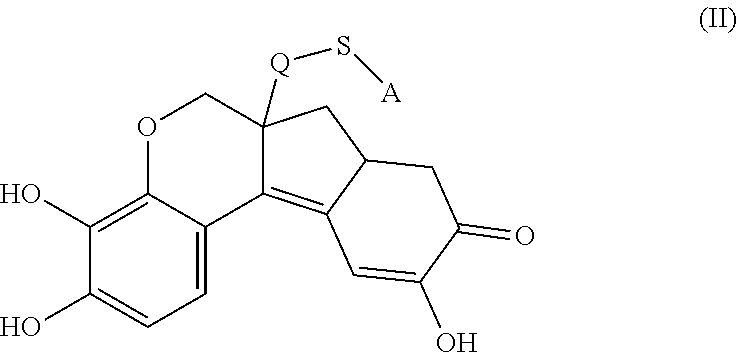
-
- wherein Q is O or NH, S is a spacer or a bond, and A is an anchorable moiety capable of being polymerized into a hydrogel matrix.

-
- wherein n is an integer from 1 to 10.
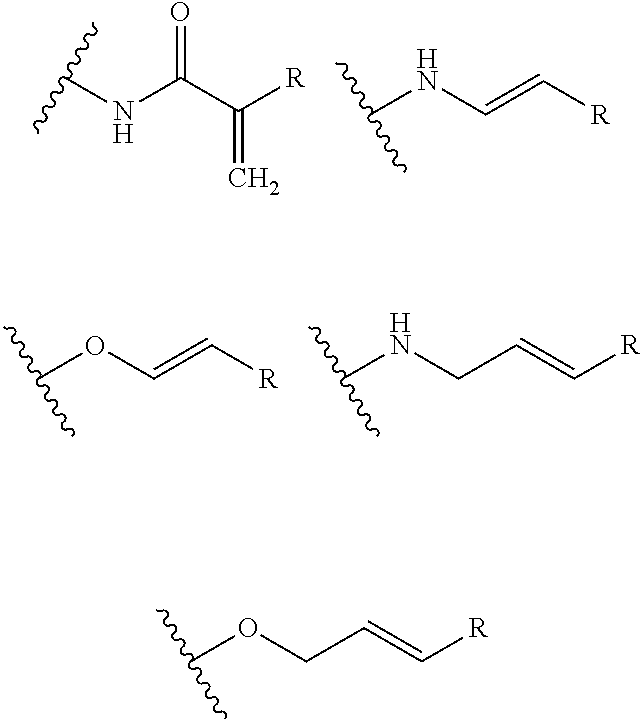
-
- wherein R is H, alkyl, acyl, or nitrile.
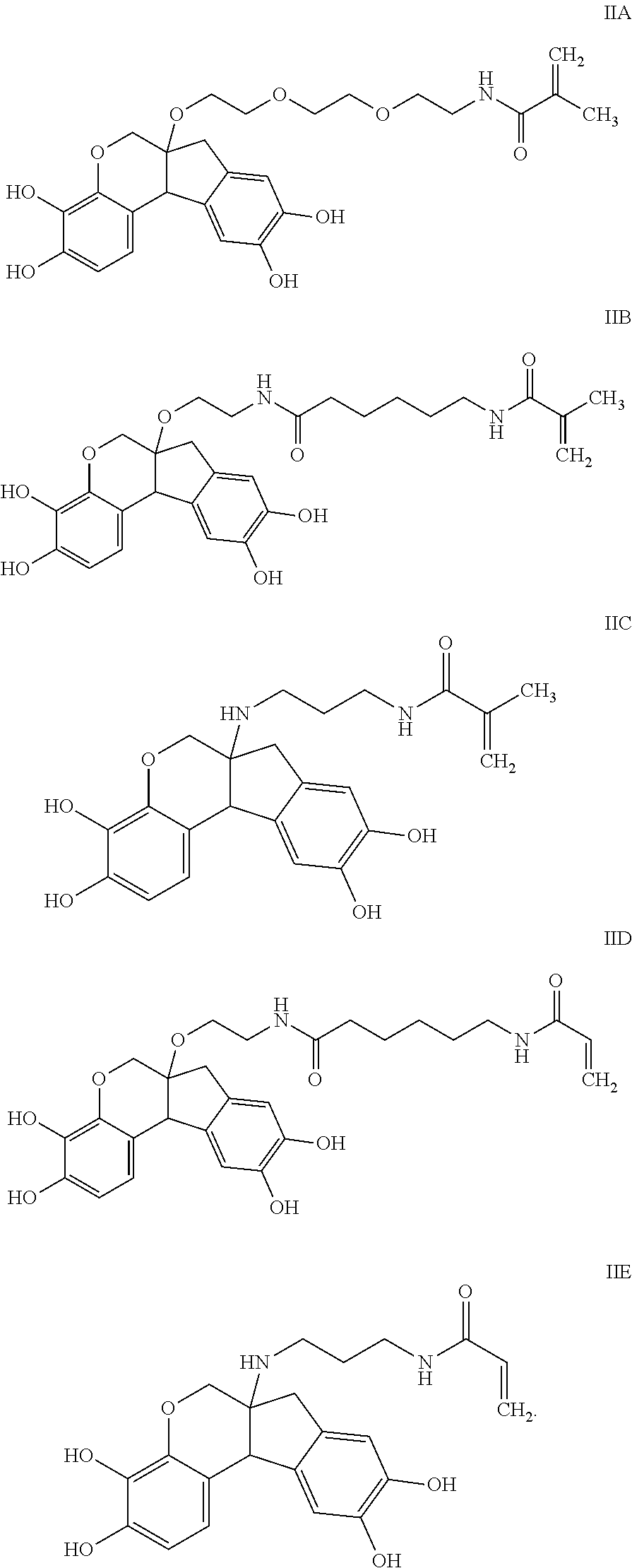
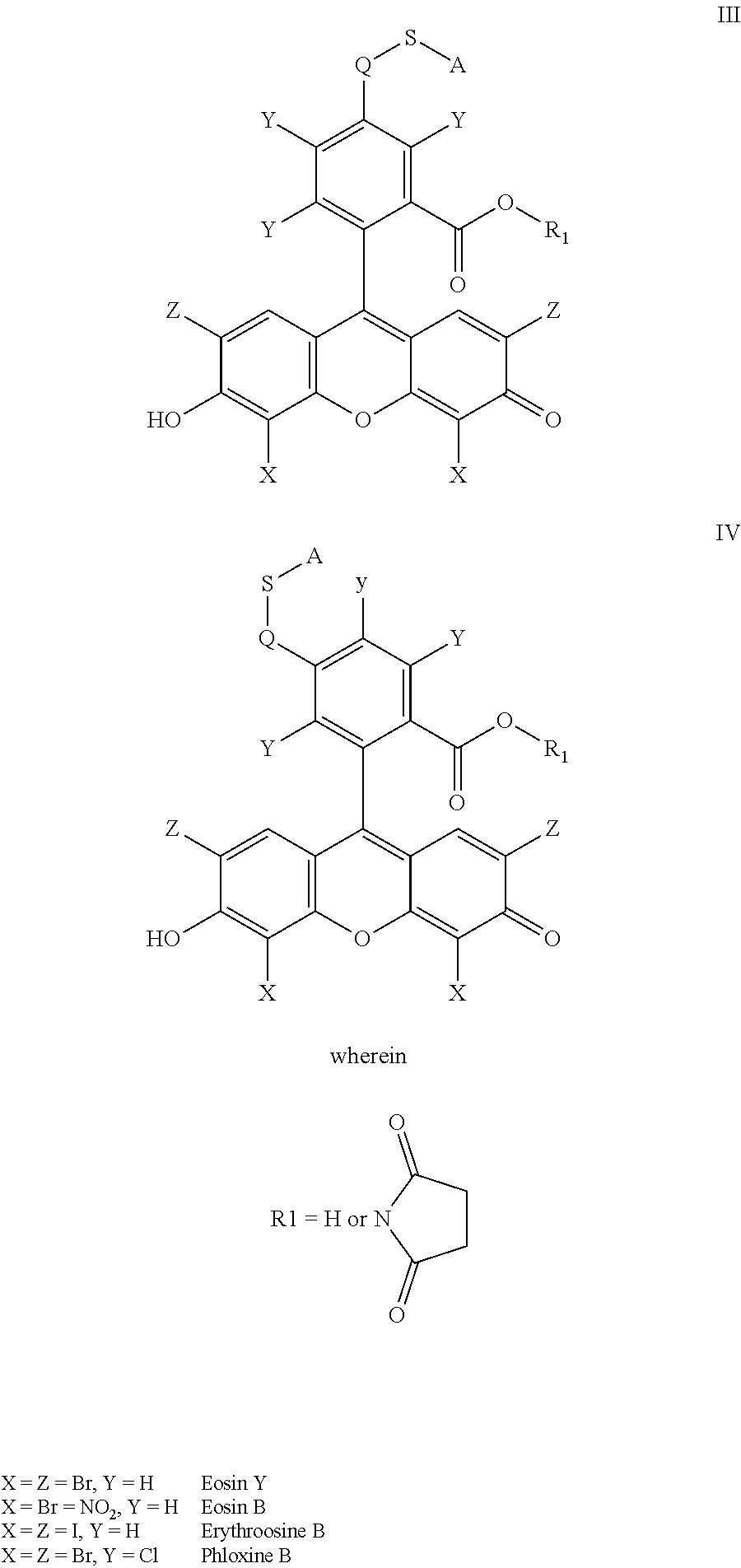
-
- and wherein Q is O or NH, S is a spacer or a bond, and A is an anchorable moiety capable of being polymerized into a hydrogel matrix.
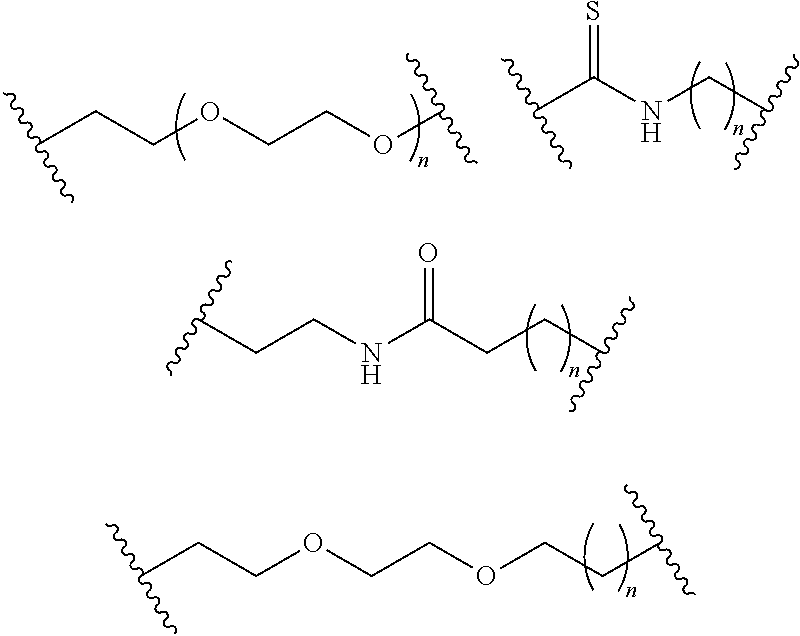
-
- wherein n is an integer from 1 to 10.

-
- wherein R is H, alkyl, acyl, or nitrile.
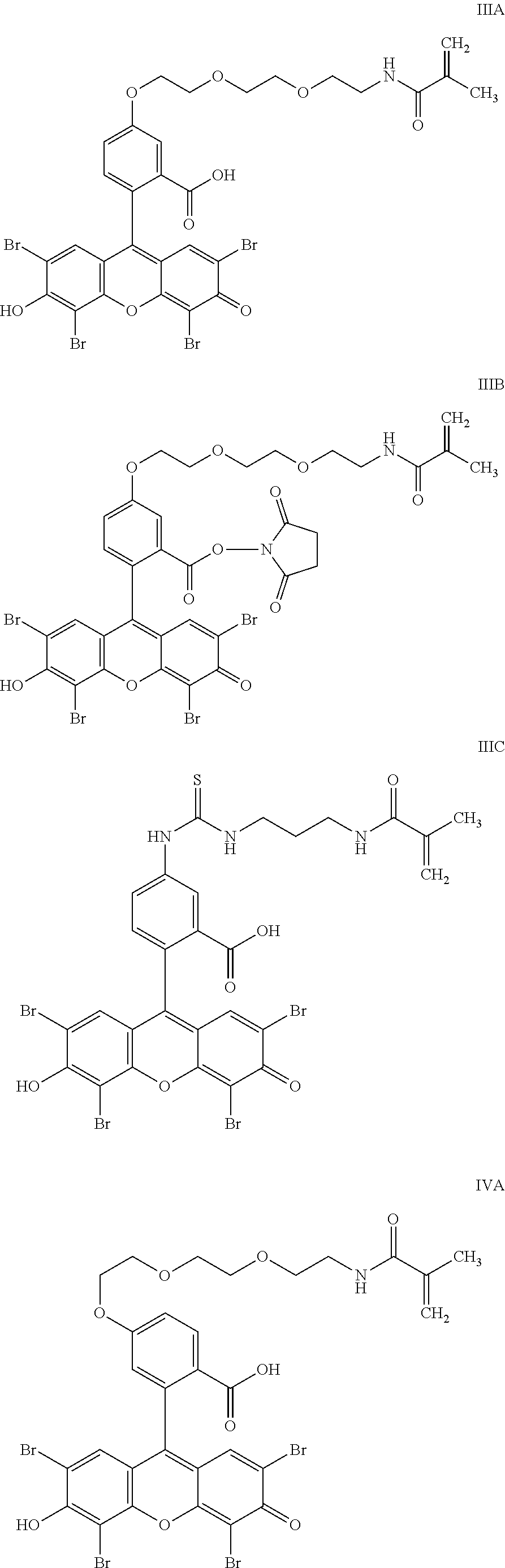

-
- labeling biomolecules in the sample with an anchorable hematoxylin as depicted in formula (II), an anchorable eosin as depicted in formula (III) or/and (IV), or any combination thereof, in succession or simultaneously:
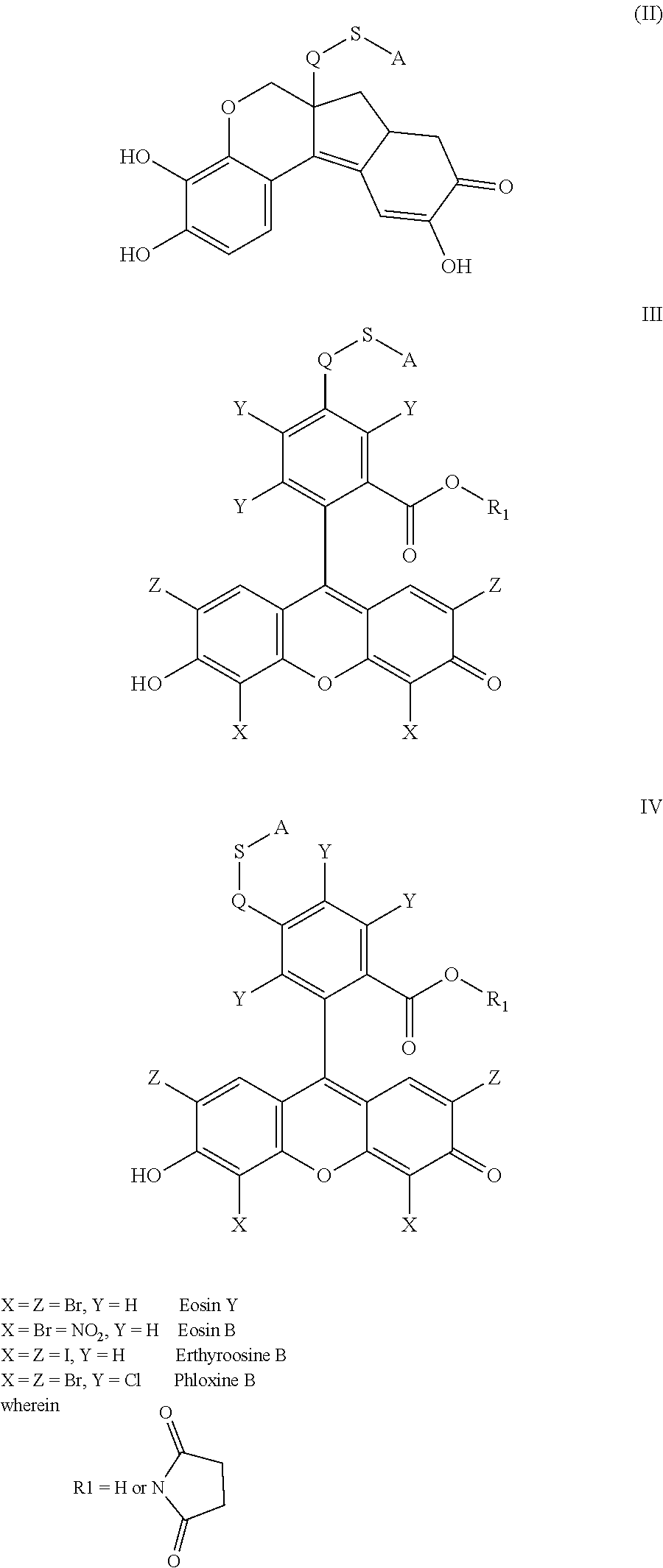
-
- or any combination thereof,
- wherein Q is O or NH, S is a spacer or a bond as described herein, and A is a moiety capable of being polymerized into a hydrogel matrix as described herein;
- a. permeating the sample with a swellable, polymerizable material and polymerizing the material, wherein the polymerizing of the sample results in covalent crosslinking of the anchor of the anchorable hematoxylin or anchorable eosin to the polymerizable material to form a sample-swellable material complex;
- b. digesting the sample-swellable material complex;
- c. enlarging the sample-swellable material complex by adding an aqueous solvent or liquid to cause the sample to swell, thereby physically expanding the sample-swellable material complex resulting in an enlarged biological sample; and
- d. detecting the biomolecules in the sample under high resolution using conventional diffraction limited light microscopy.

-
- wherein Q is O or NH, S is a spacer or a bond, and A is an anchorable moiety capable of being polymerized into a hydrogel matrix.
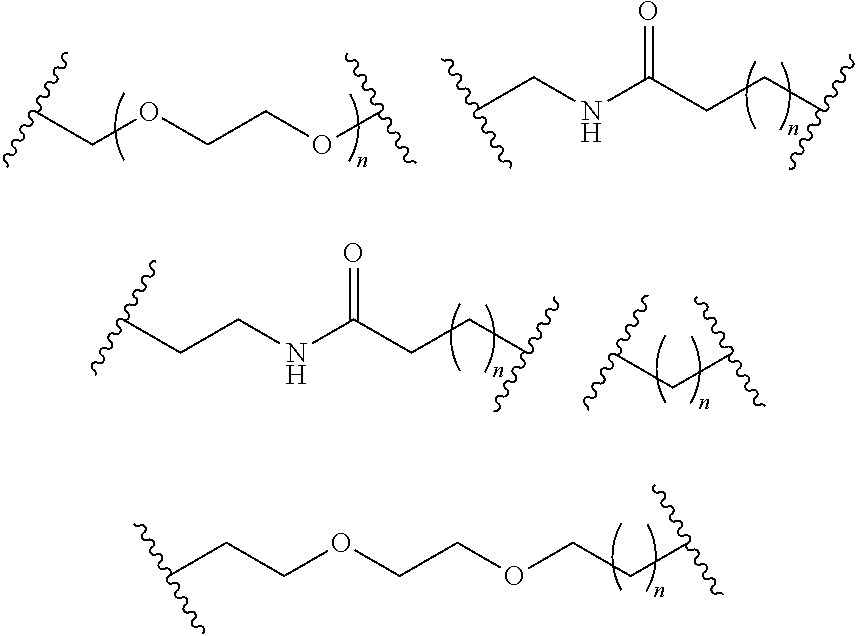
-
- wherein n is an integer from 1 to 10.

-
- wherein R is H, alkyl, acyl, or nitrile.

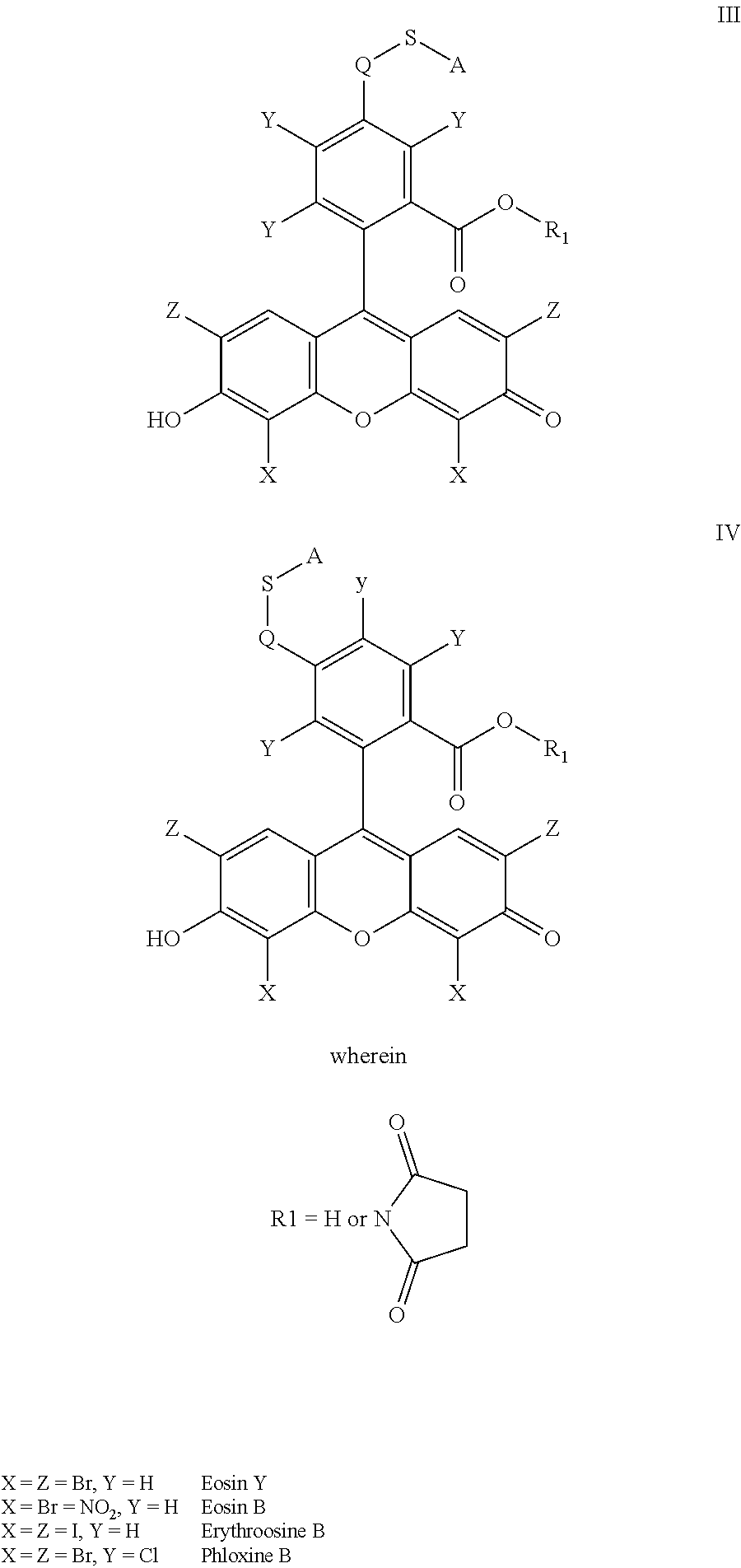
-
- and wherein Q is O or NH, S is a spacer or a bond, and A is an anchorable moiety capable of being polymerized into a hydrogel matrix.

-
- wherein n is an integer from 1 to 10.
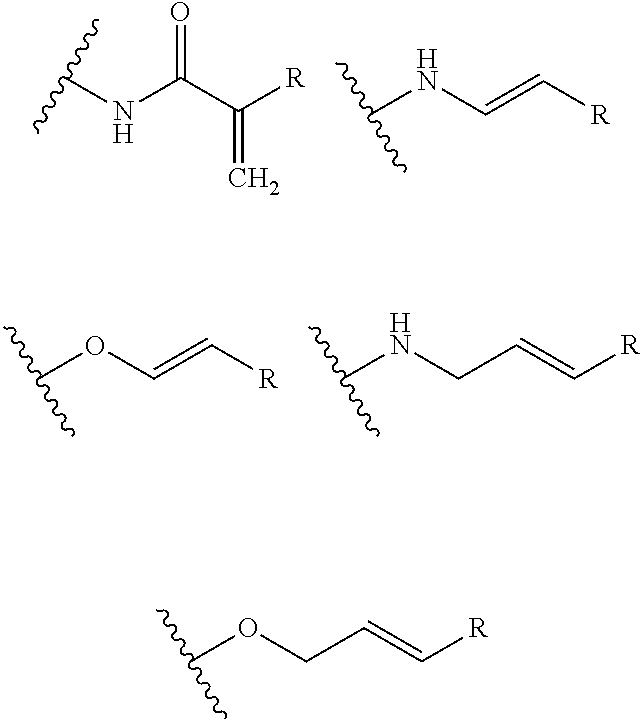
-
- wherein R is H, alkyl, acyl, or nitrile.


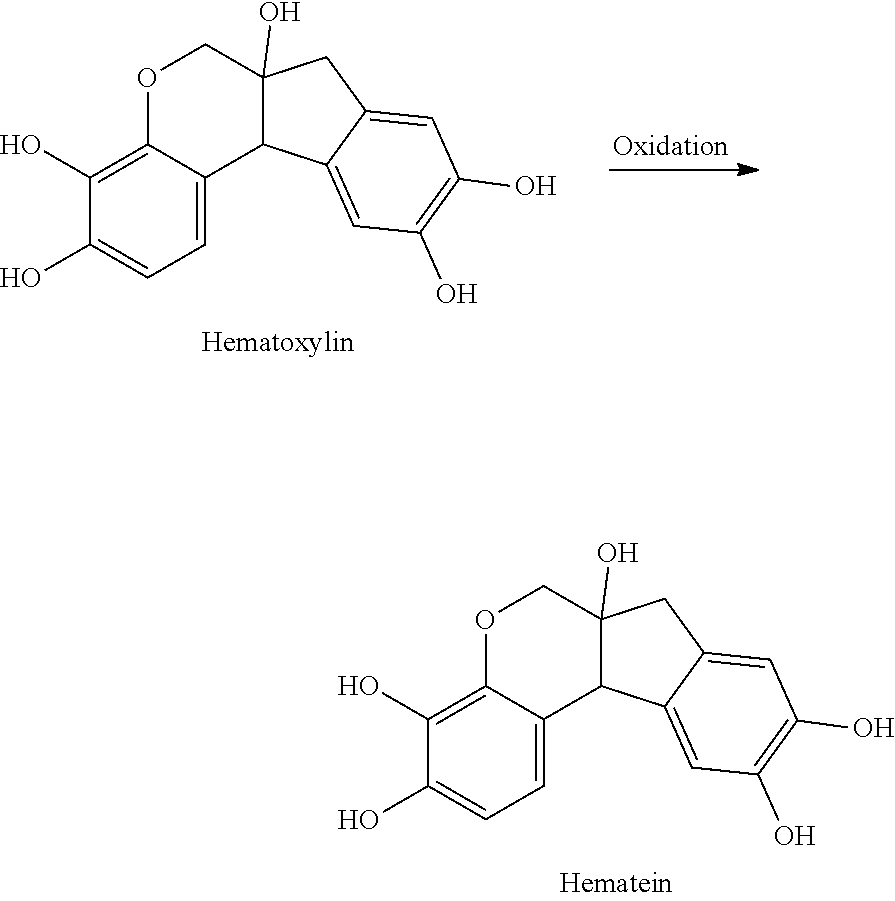
and subsequently is bound to one of several metal ions including aluminum (Al+3), iron (Fe+3) and chromium (Cr+3). A metallic ion bound to a dye that is involved in the binding of the dye to tissue is referred to as a mordant. Herein, hematoxylin and hematoxylin derivatives are intended to describe both forms of the molecule, derived from either hematoxylin or hematein, and structure of the oxidation product is incorporated into the structures throughout the descriptions herein. In one embodiment, the compounds described herein are synthesized as anchorable hematoxylins and are subsequently oxidized (ripened) to the hematein analogues after synthesis. In one embodiment the hematein analogue of hematoxylin is derivatized to the anchorable form of hematein by the synthetic methods described herein applied to a derivatizable hematein as the starting reagent.
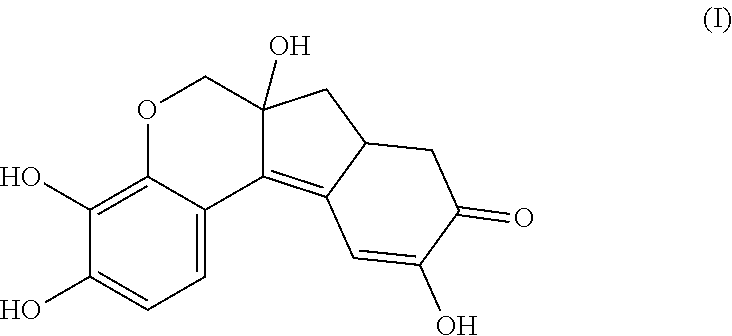
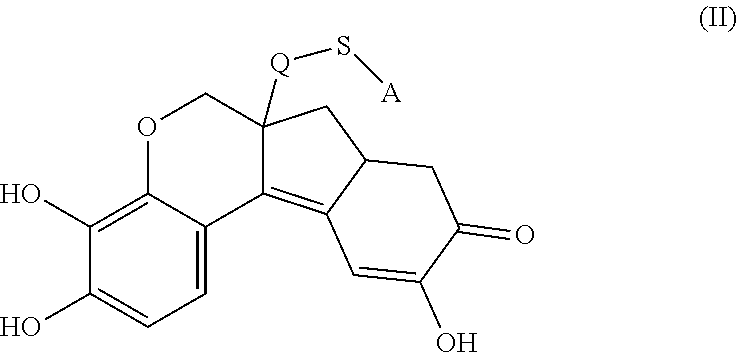
-
- wherein Q is O or NH, S is a spacer or a bond, and A is an anchorable moiety capable of being polymerized into a hydrogel matrix.
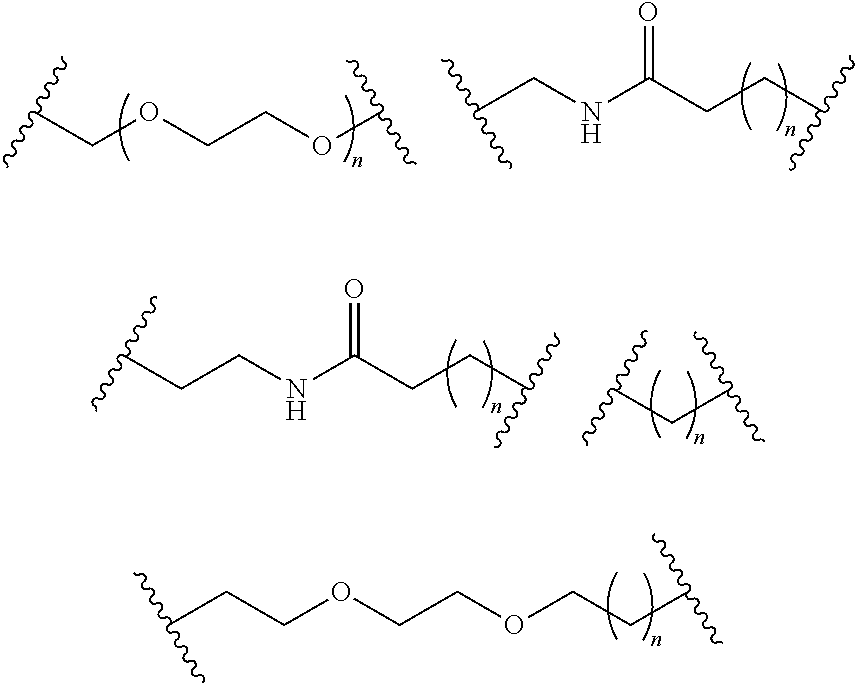
-
- wherein n is an integer from 1 to 10.
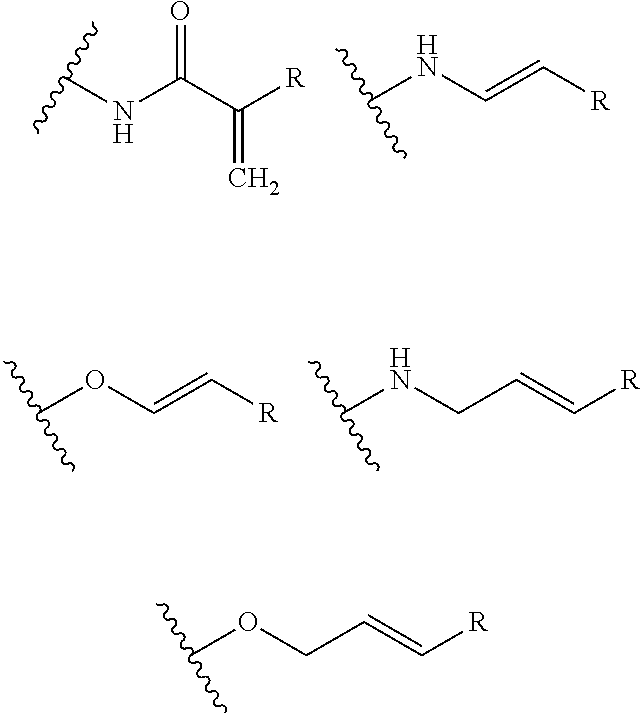
-
- wherein R is H, alkyl, acyl, or nitrile.
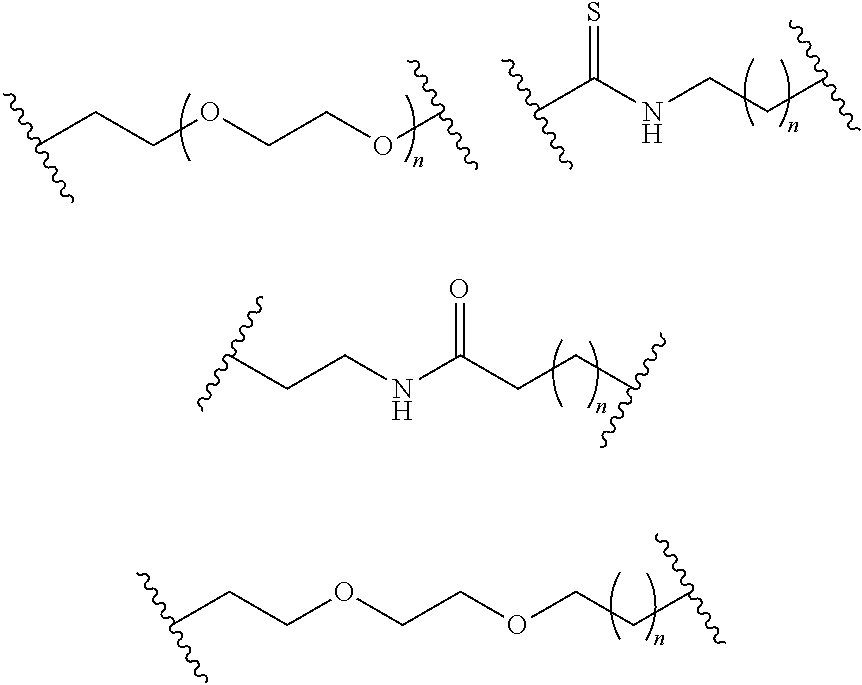
-
- wherein is an integer from 1 to 5.
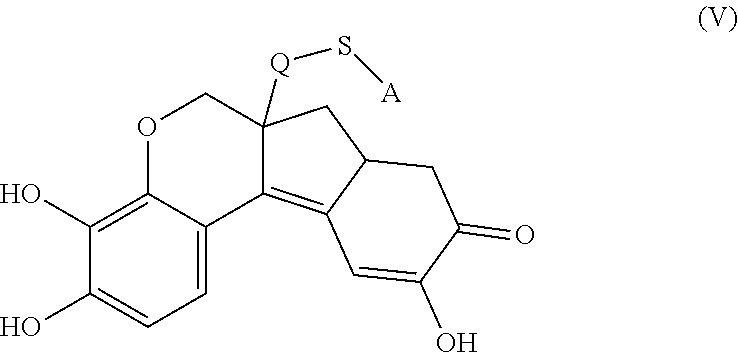
-
- wherein Q is O or NH, and S and A are the same as described for anchorable hematoxylin, herein.
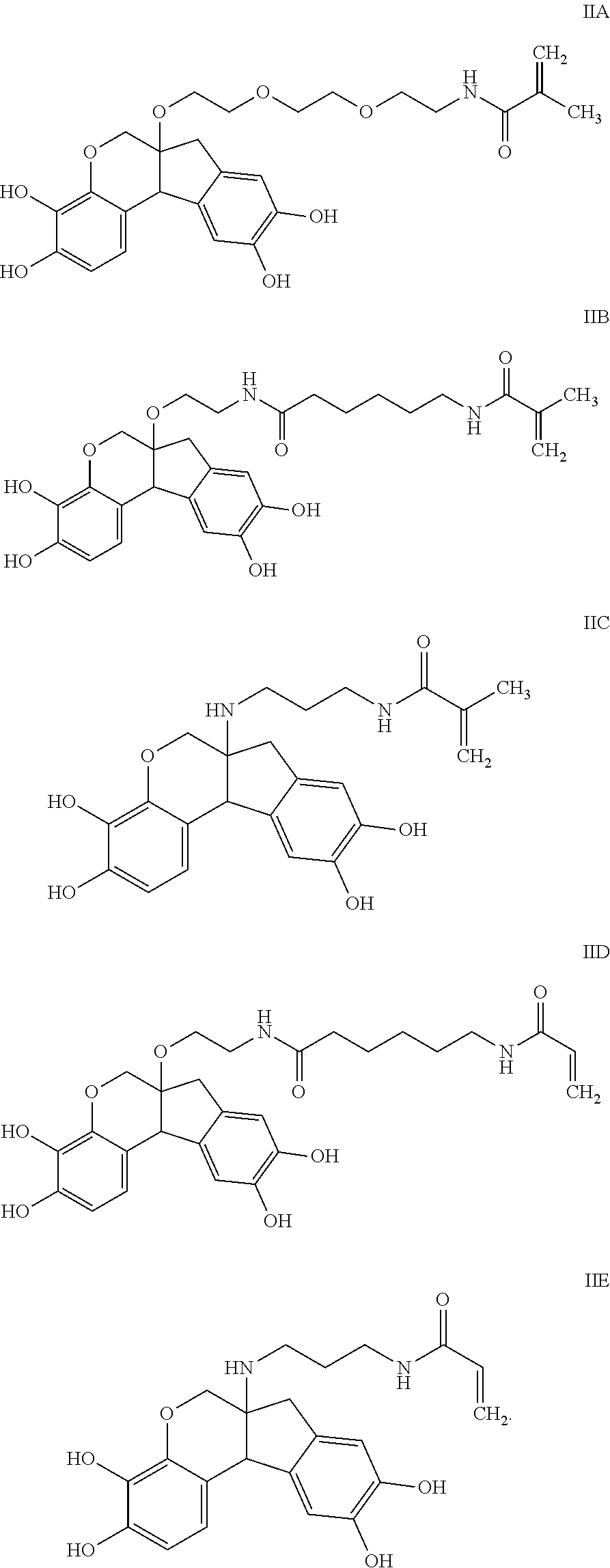
Eosin and Anchorable Eosin Derivatives
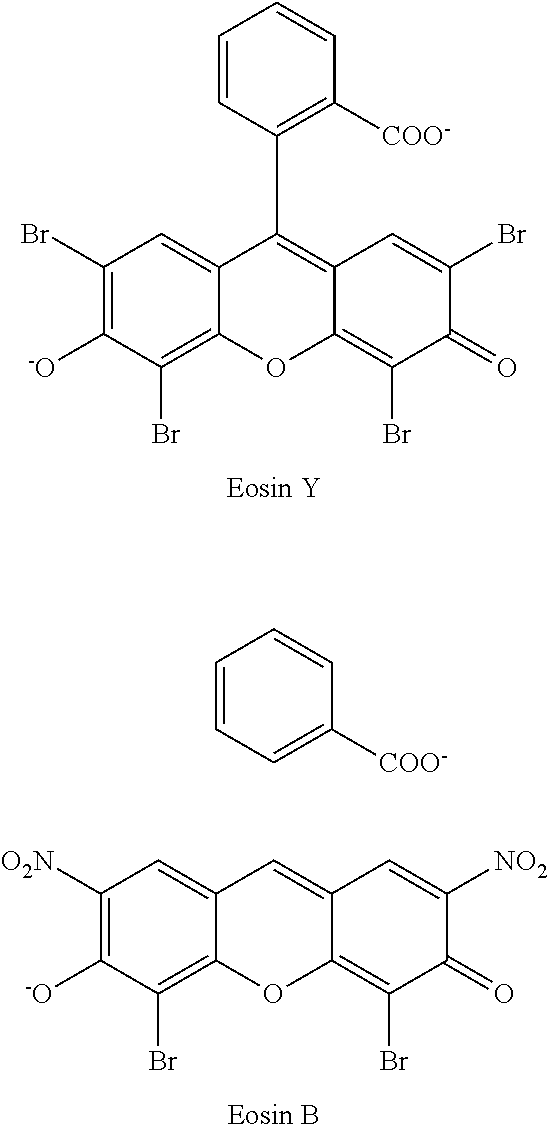
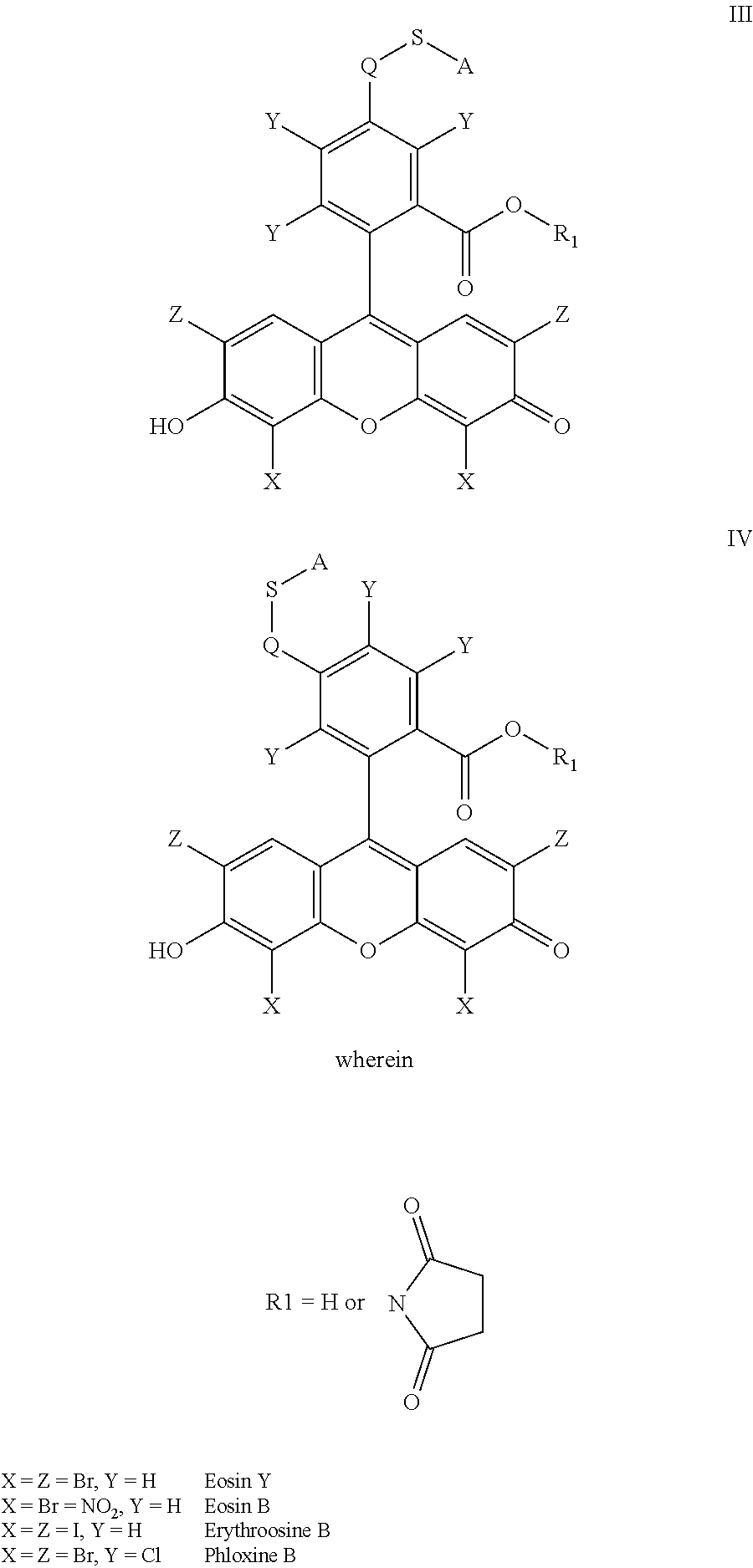
-
- and wherein Q is O or NH, S is a spacer or a bond, and A is an anchorable moiety capable of being polymerized into a hydrogel matrix.
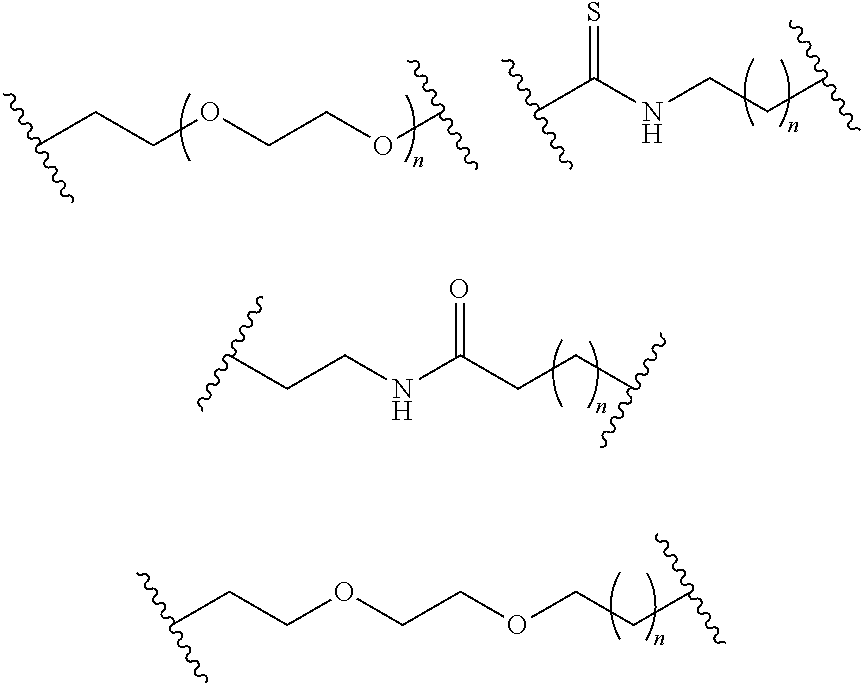
-
- wherein n is an integer from 1 to 10.

-
- wherein R is H, alkyl, acyl, or nitrile.
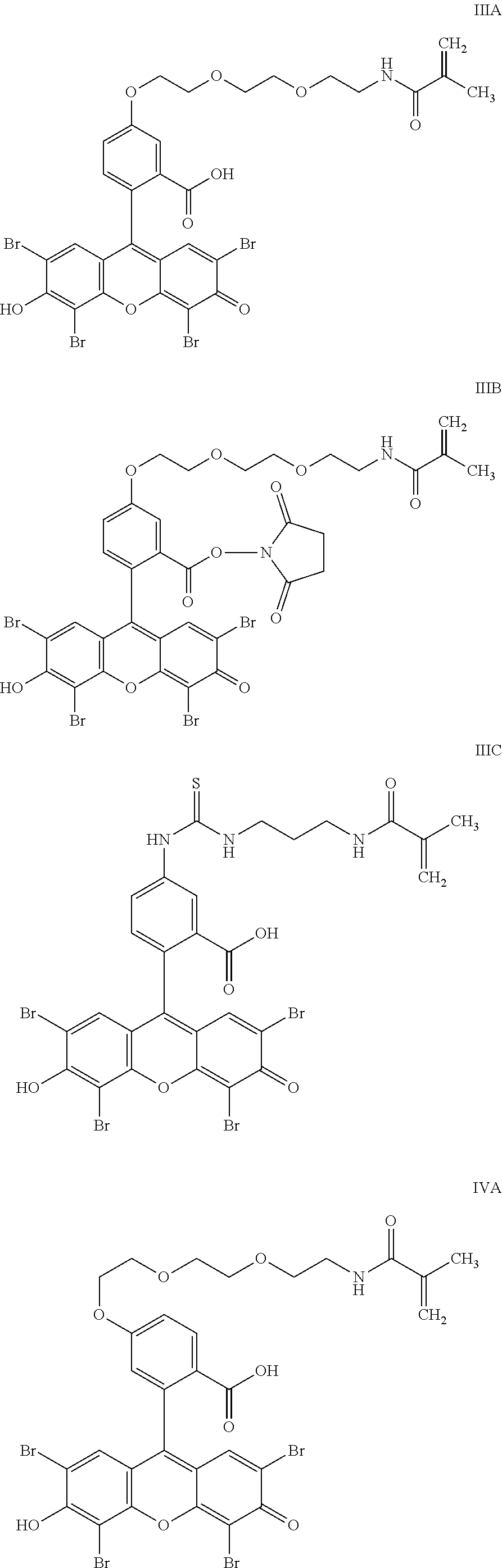
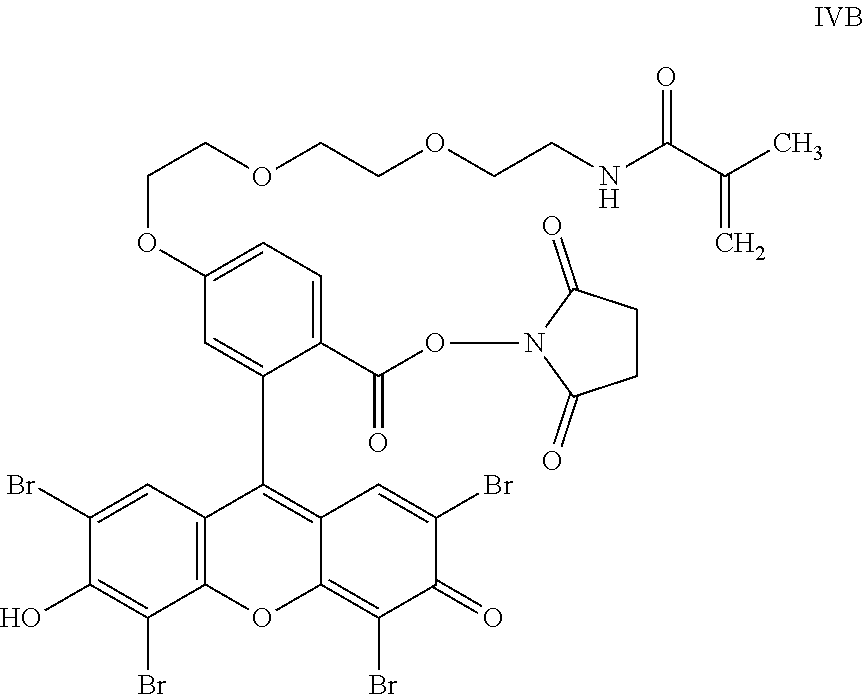

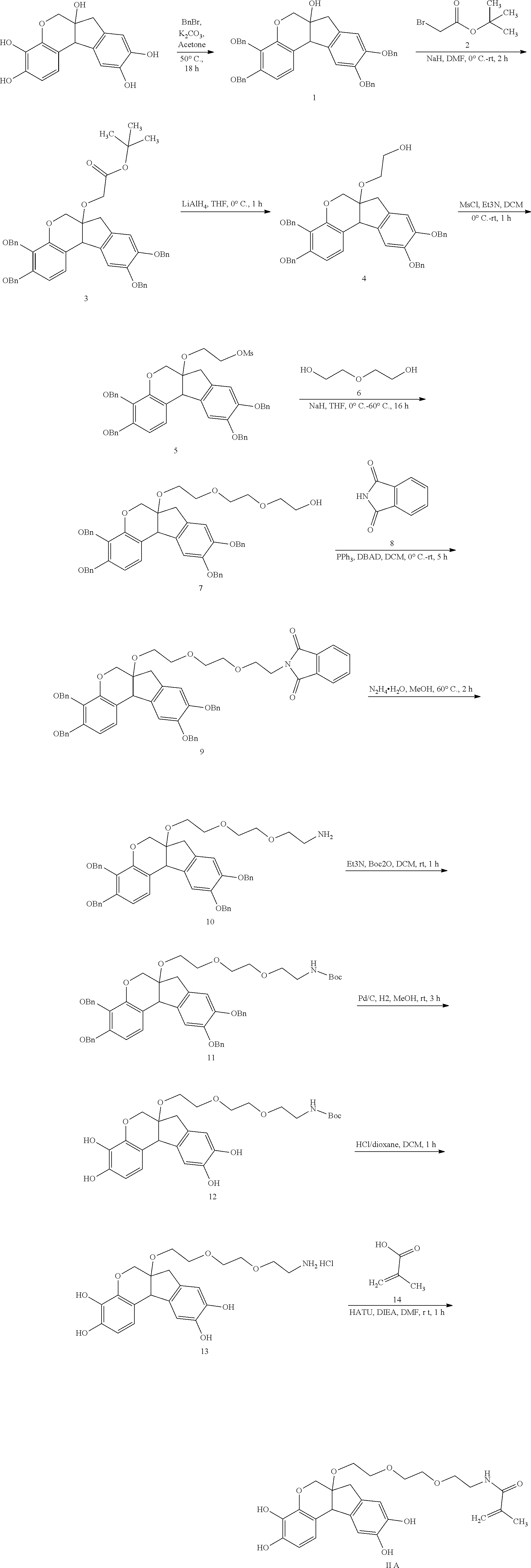
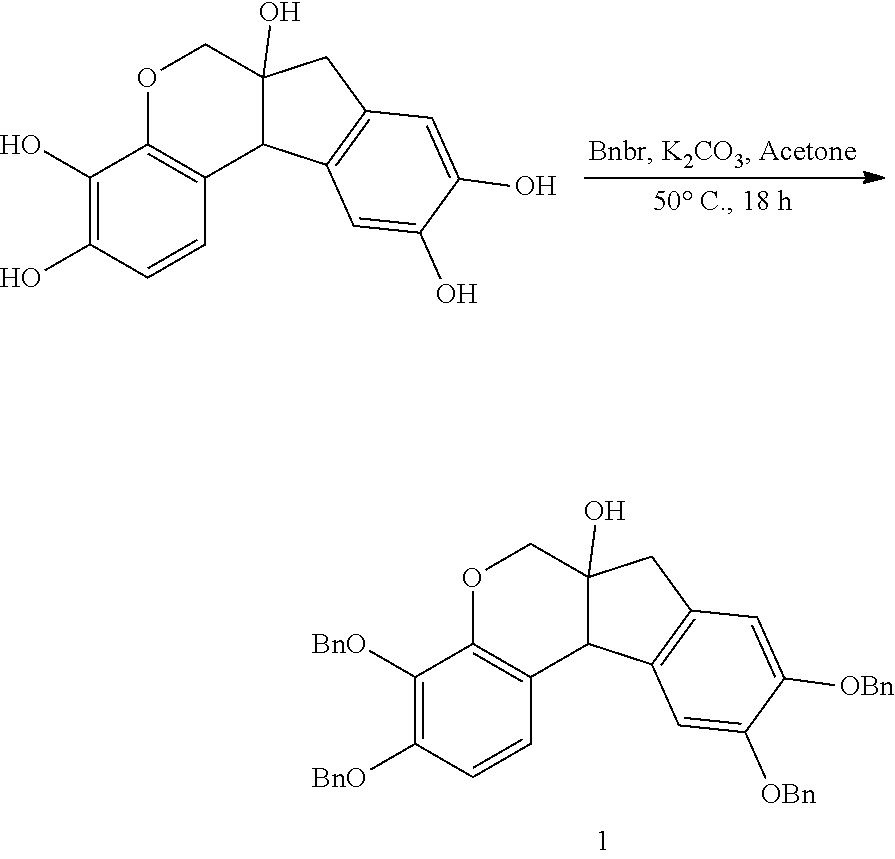

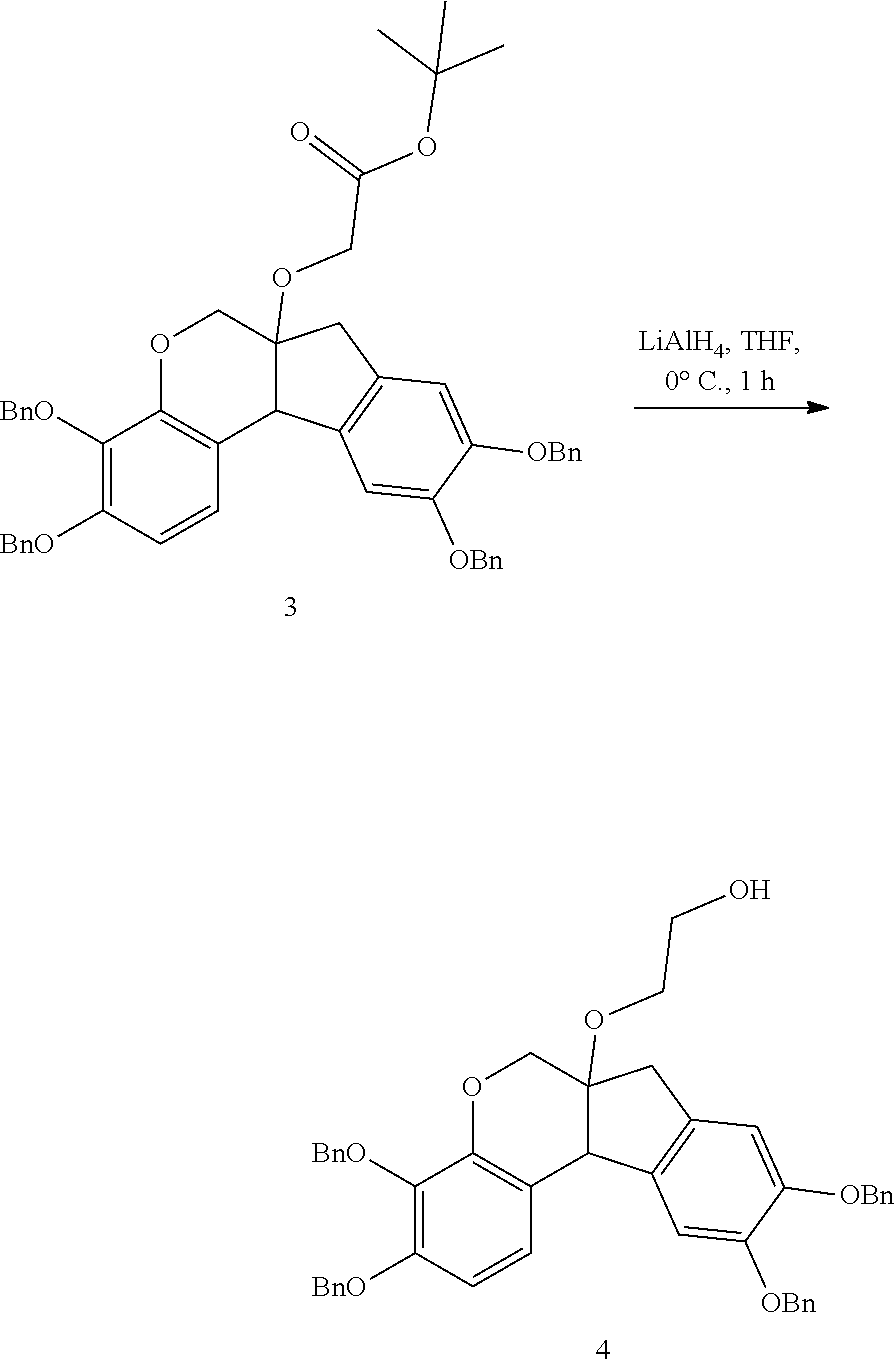
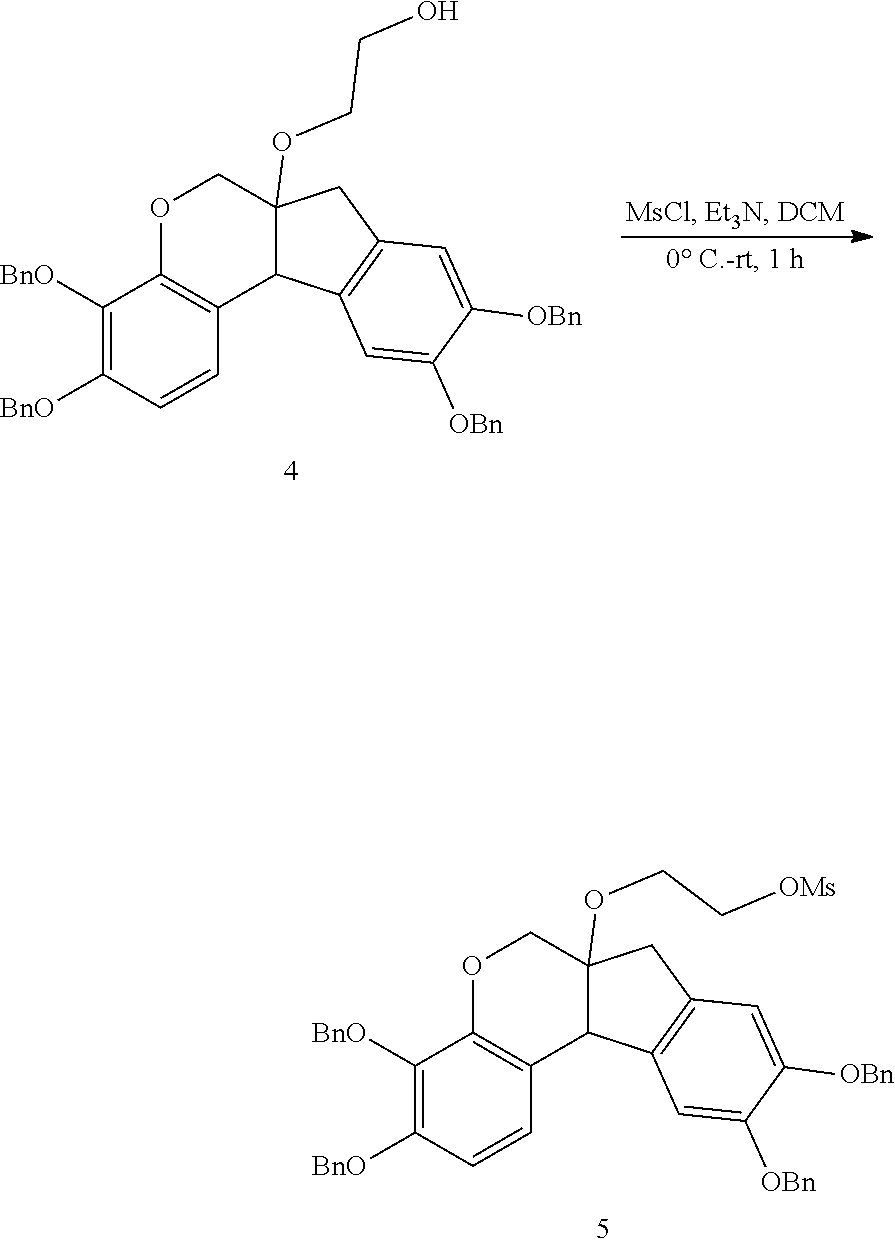
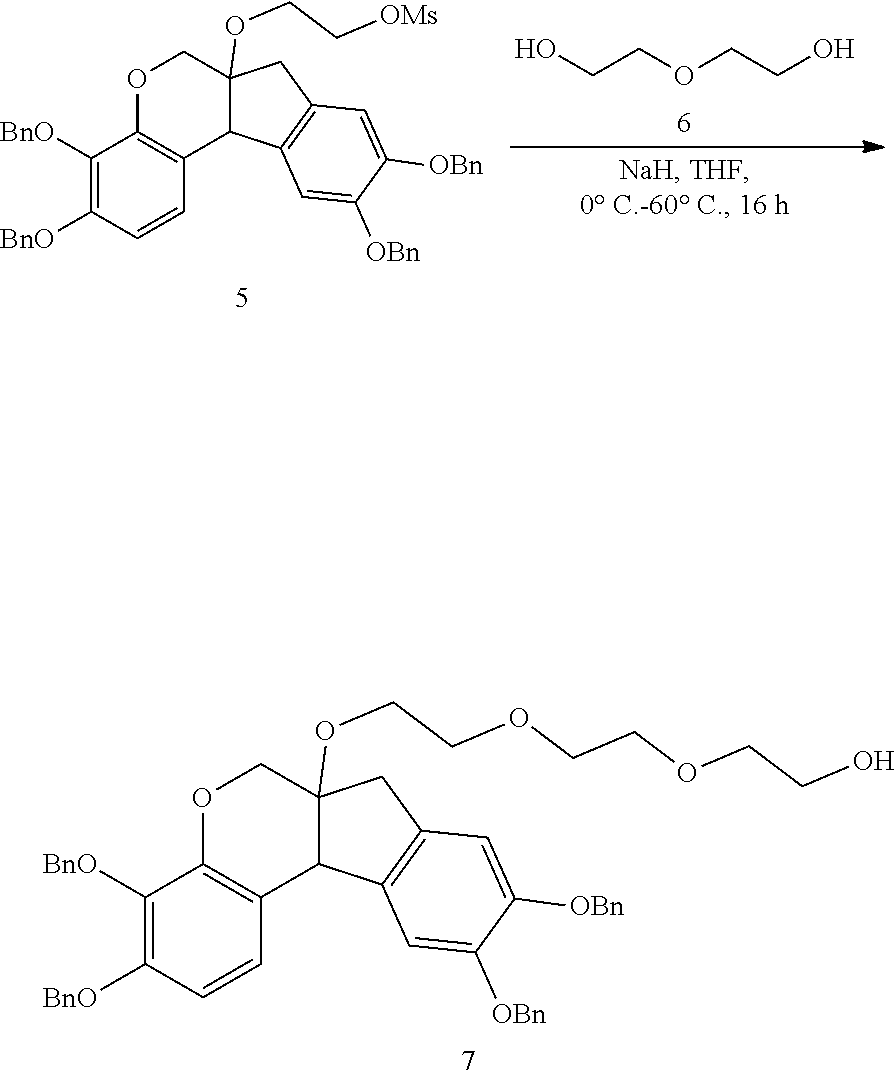

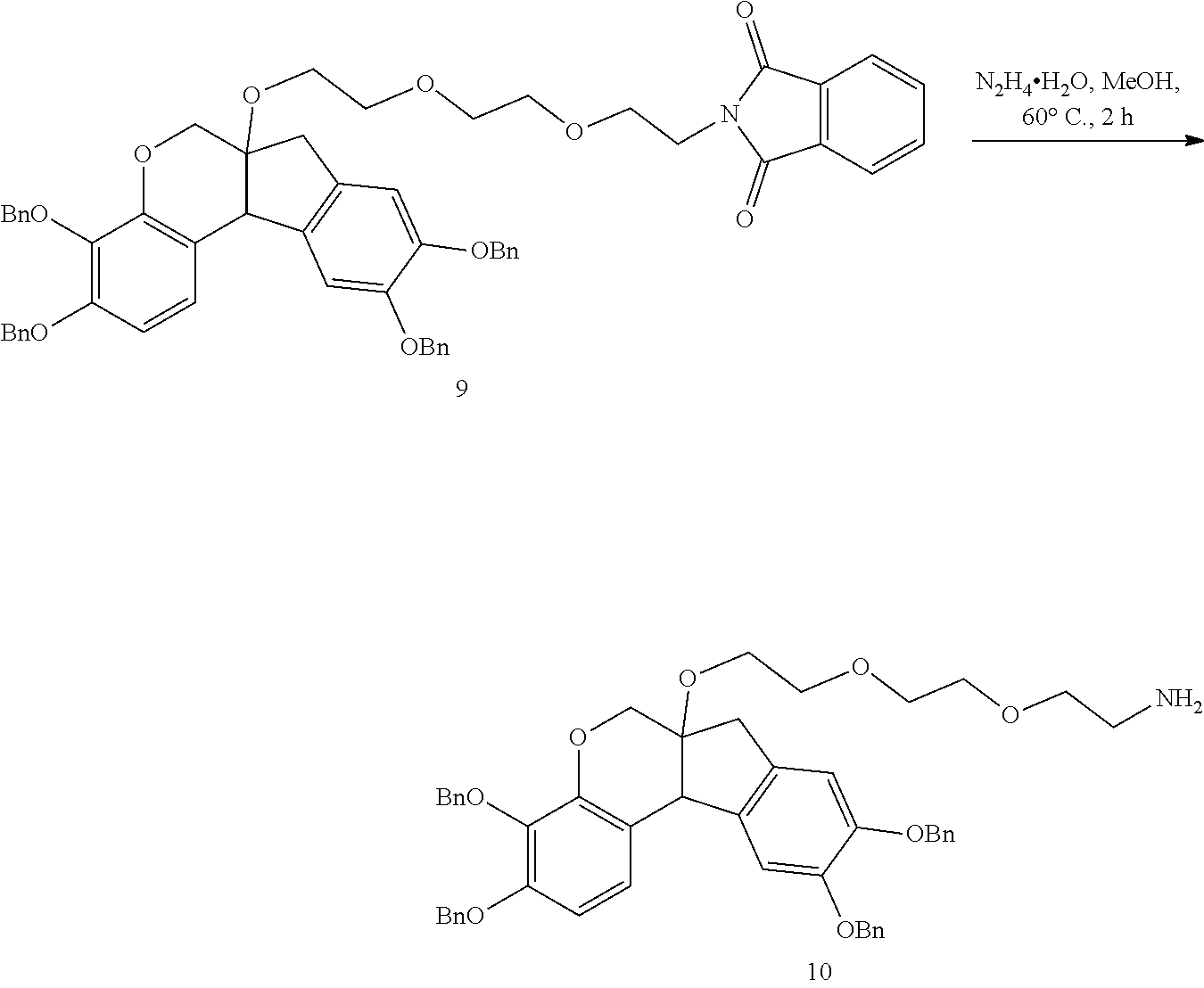
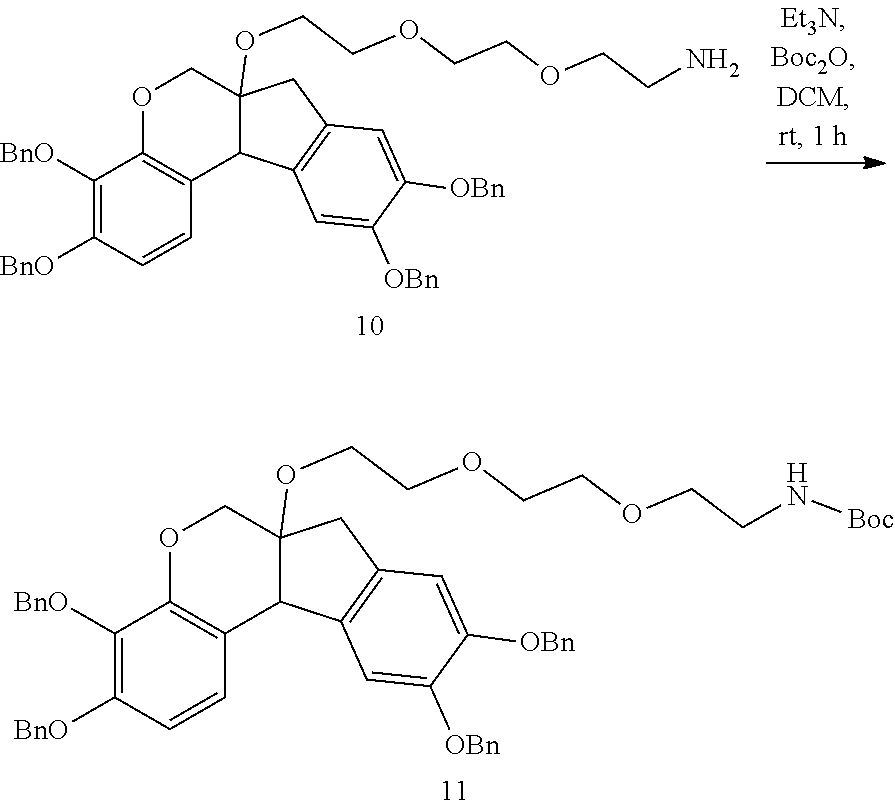
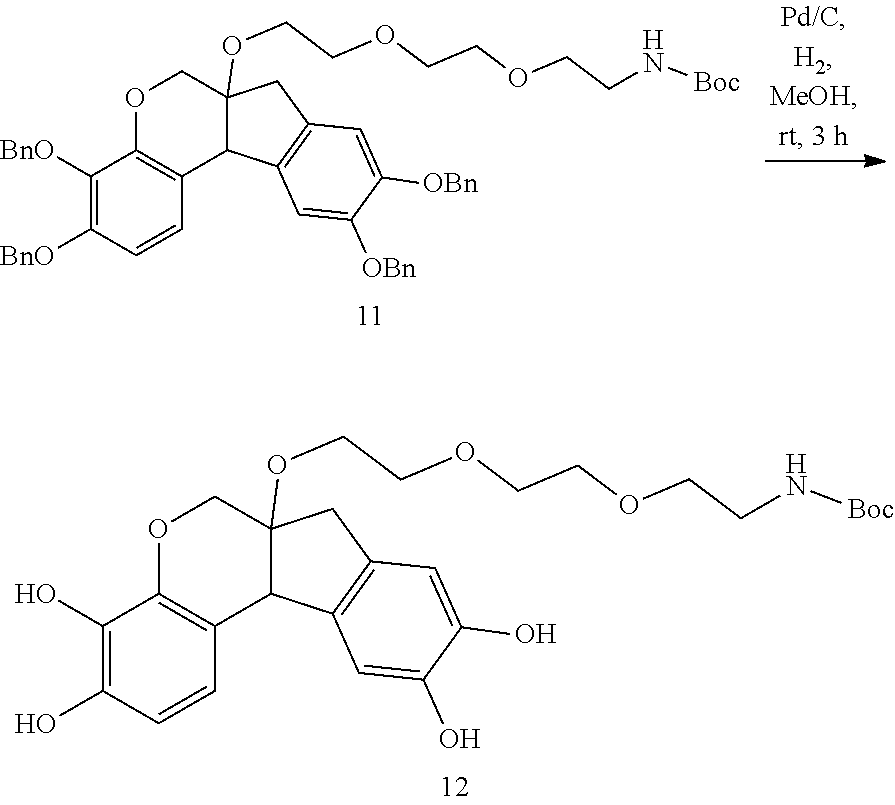
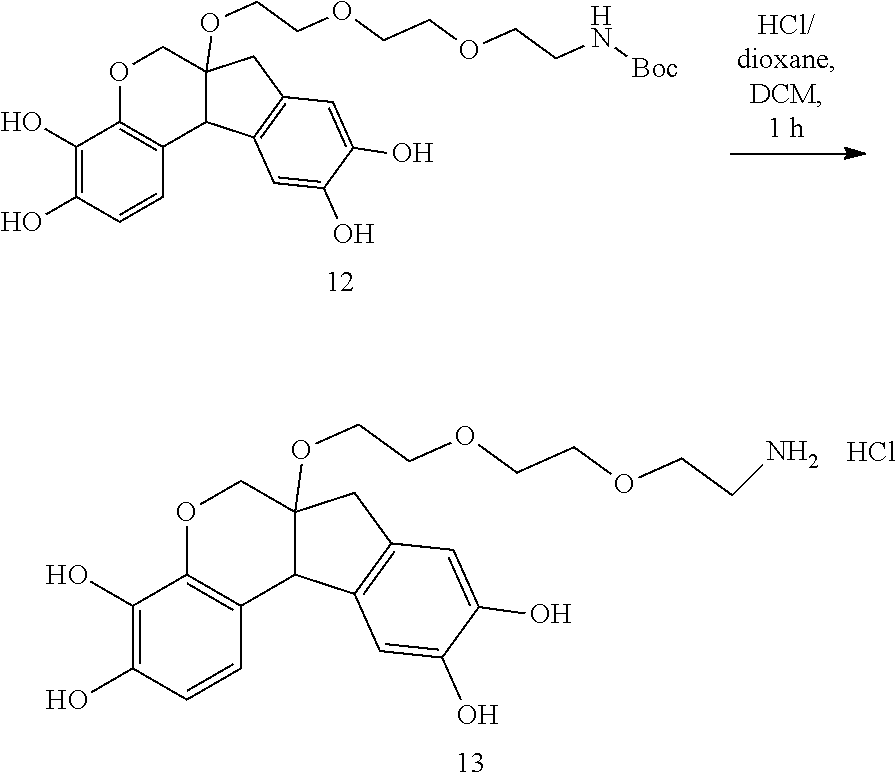
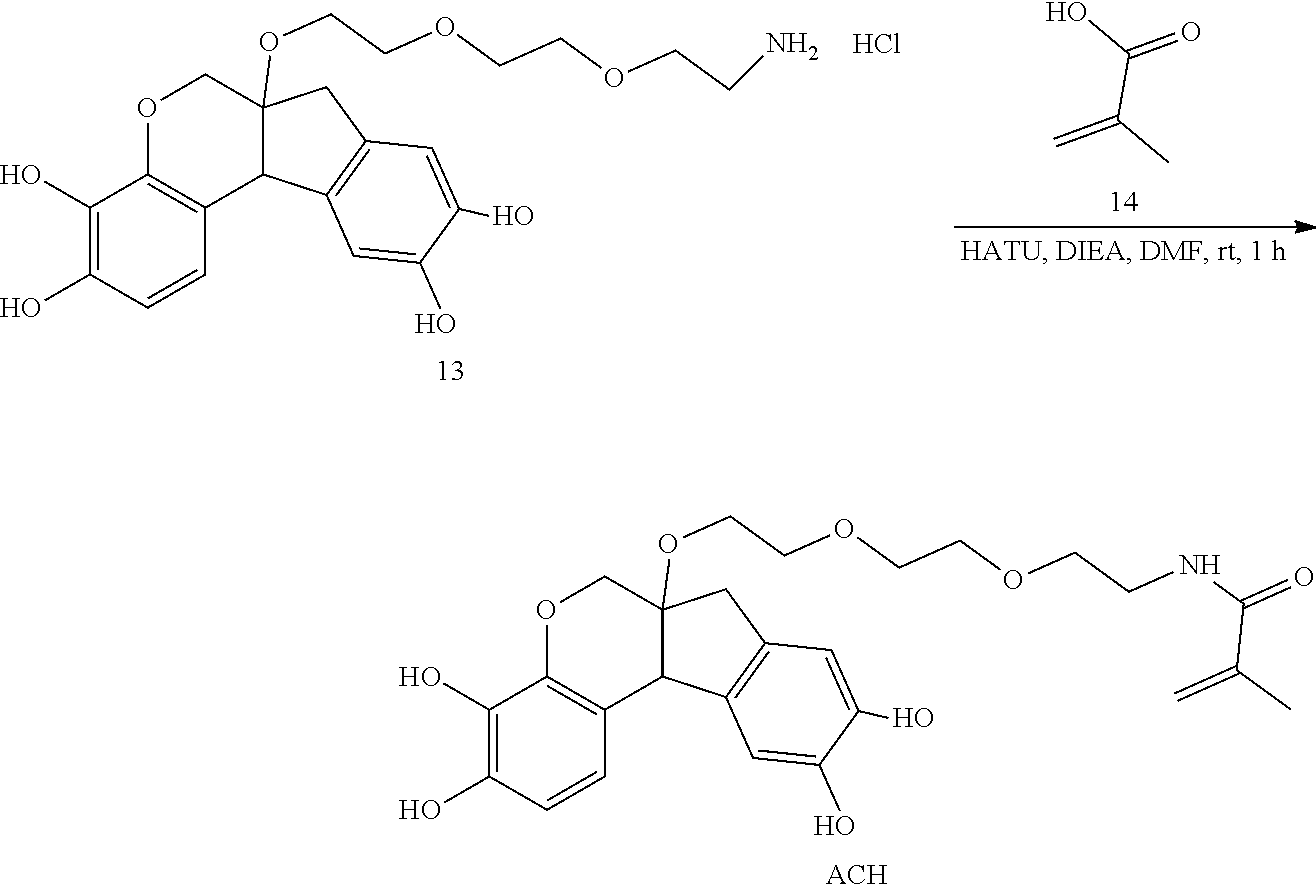


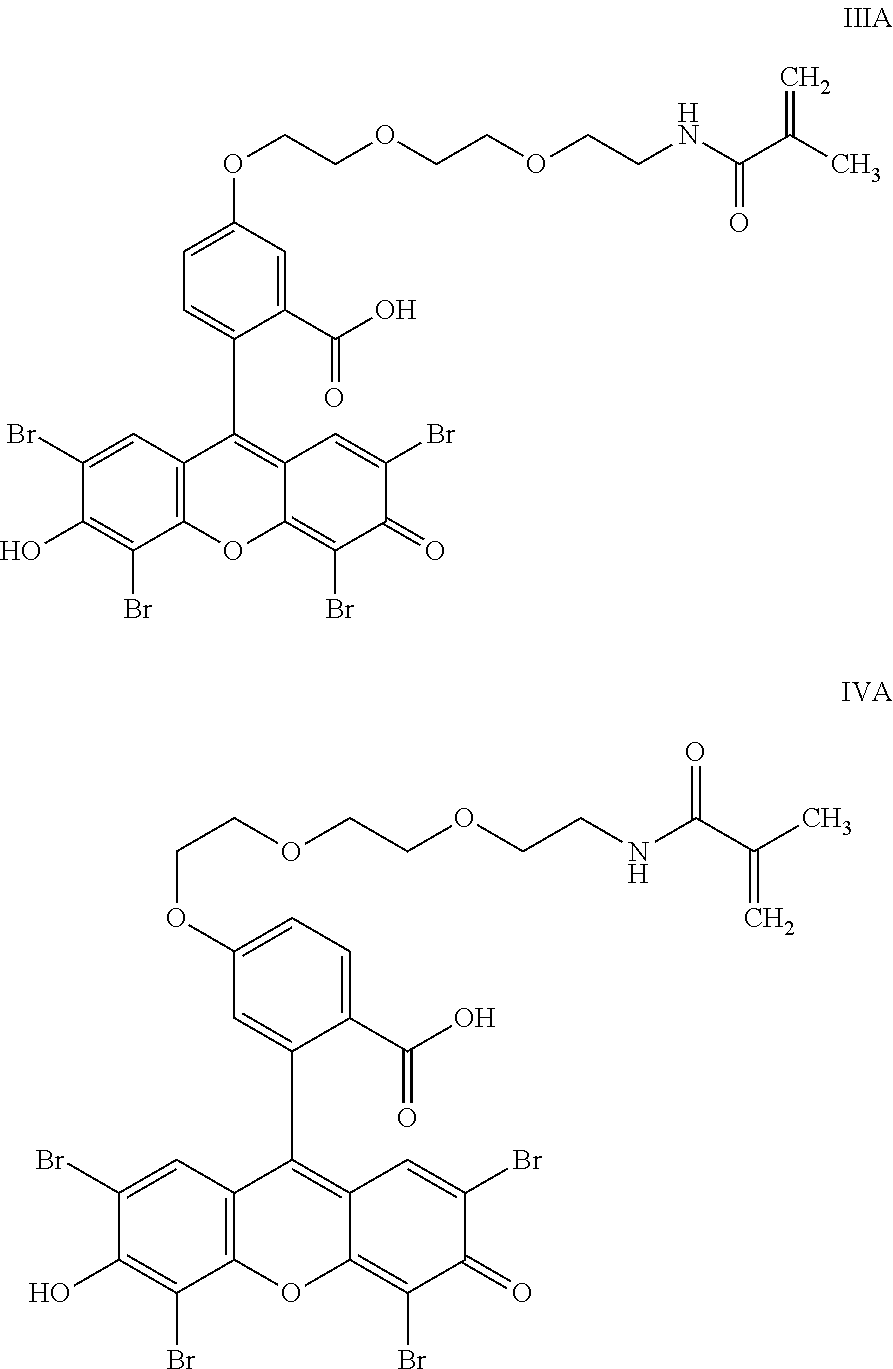
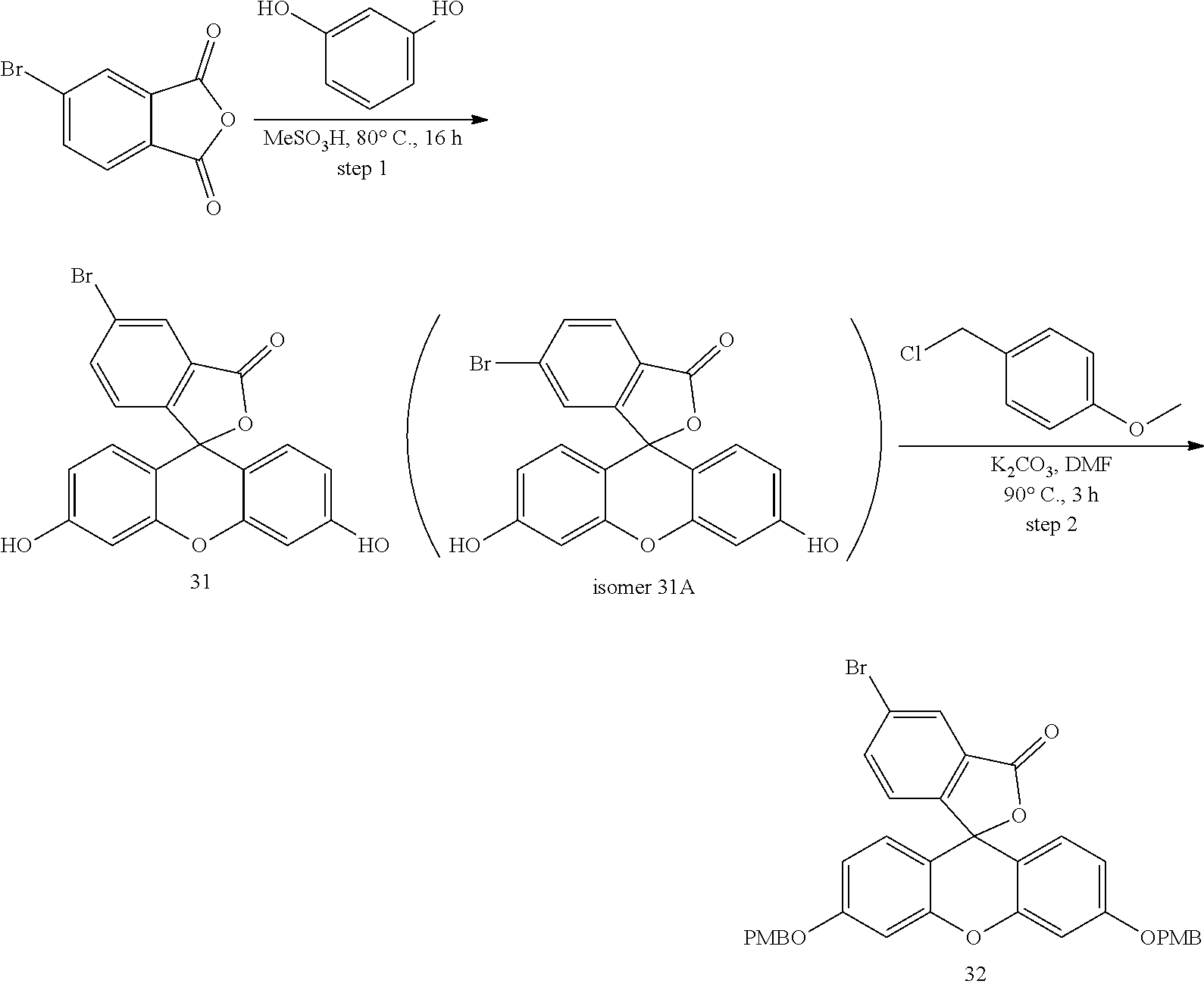
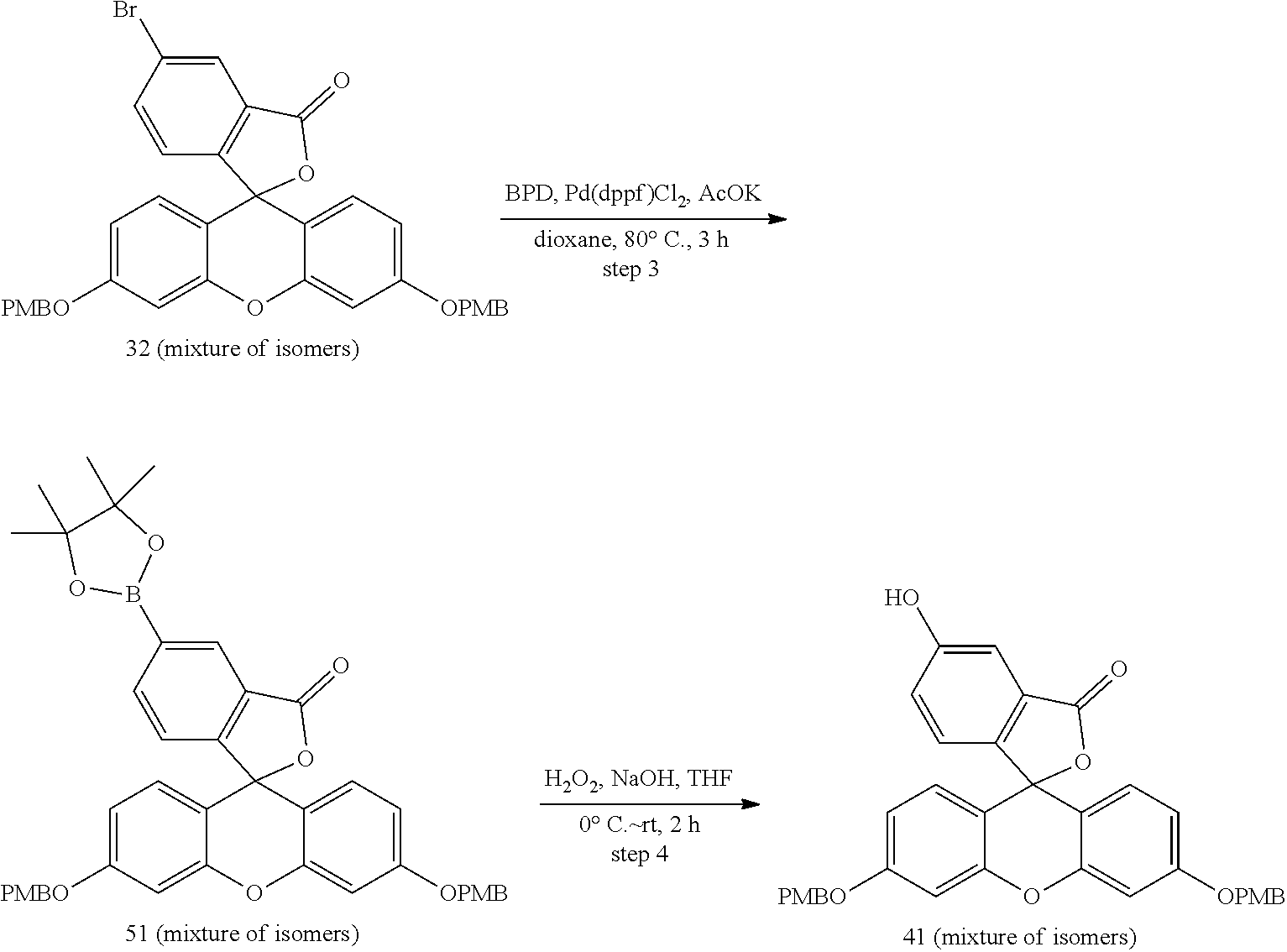
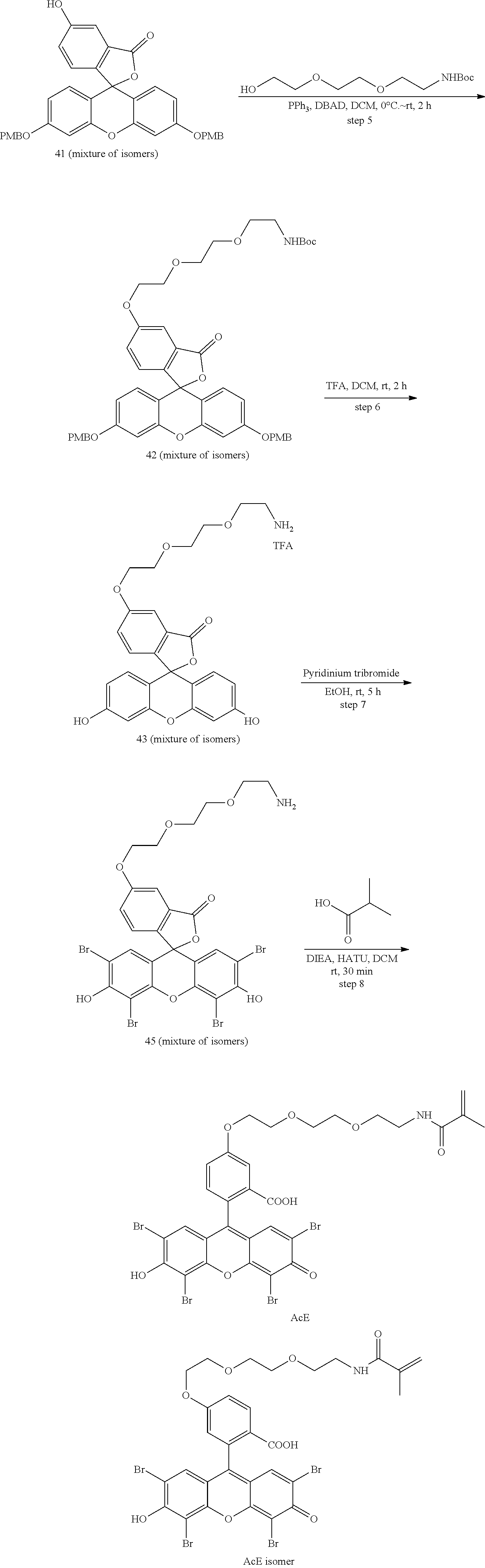

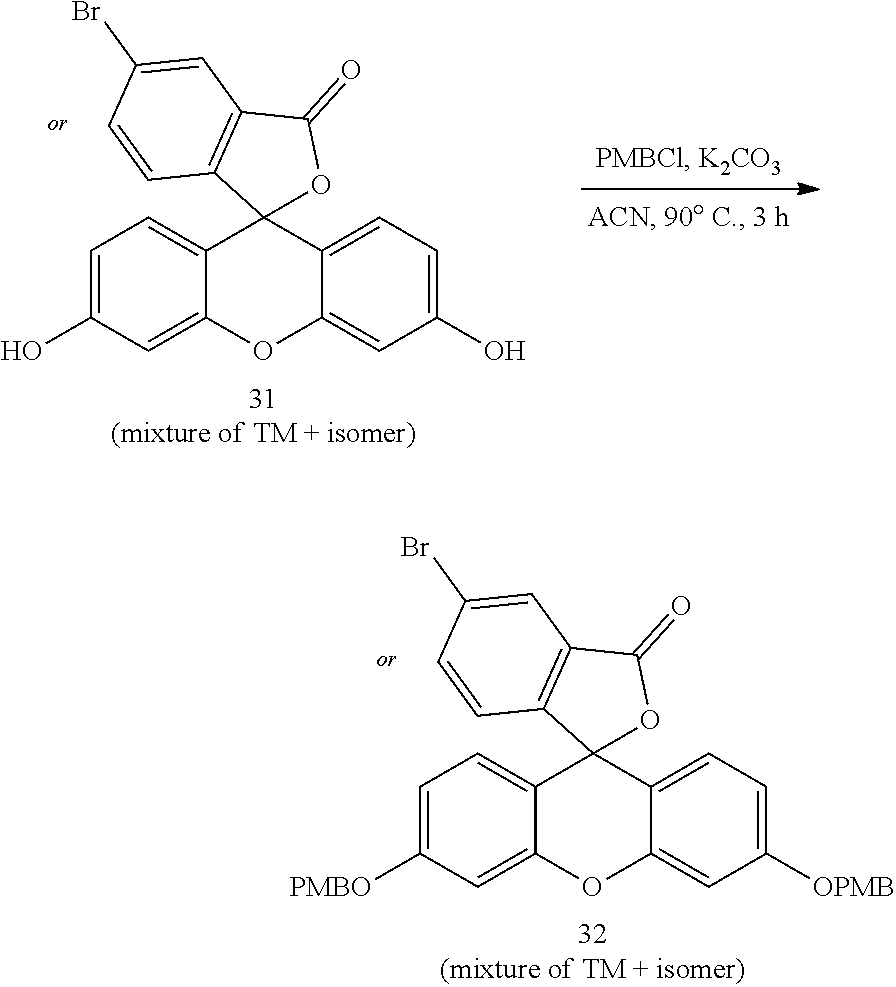
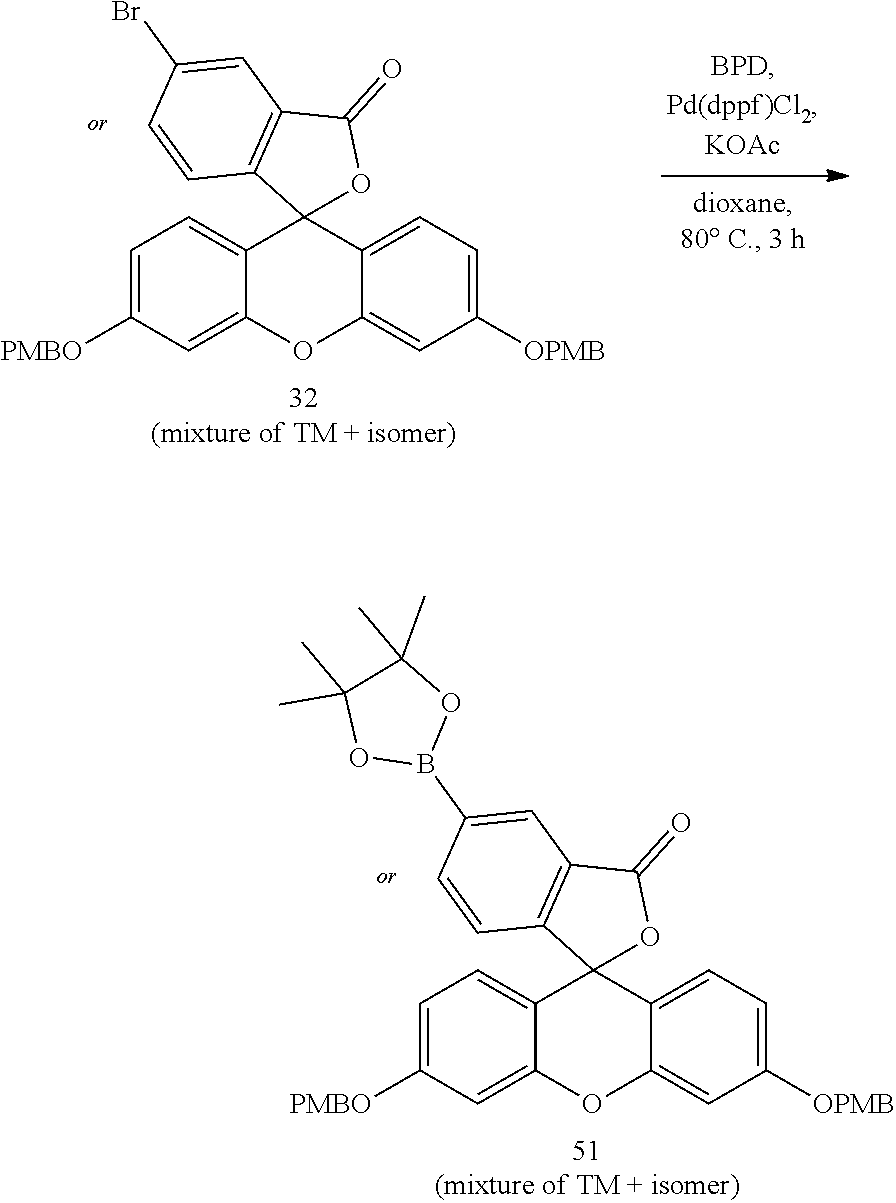
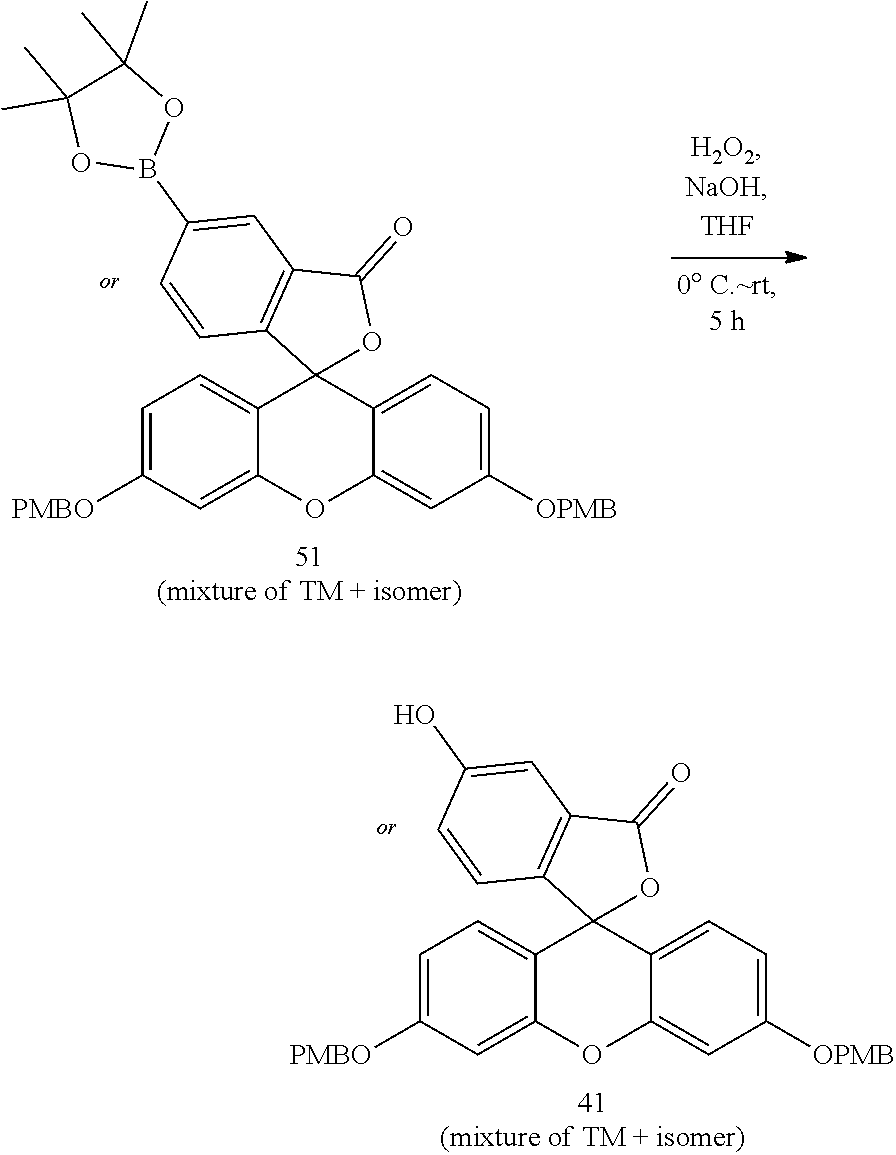
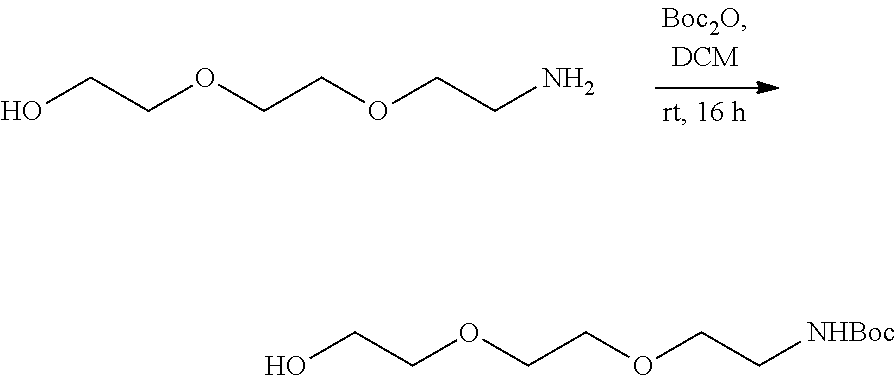

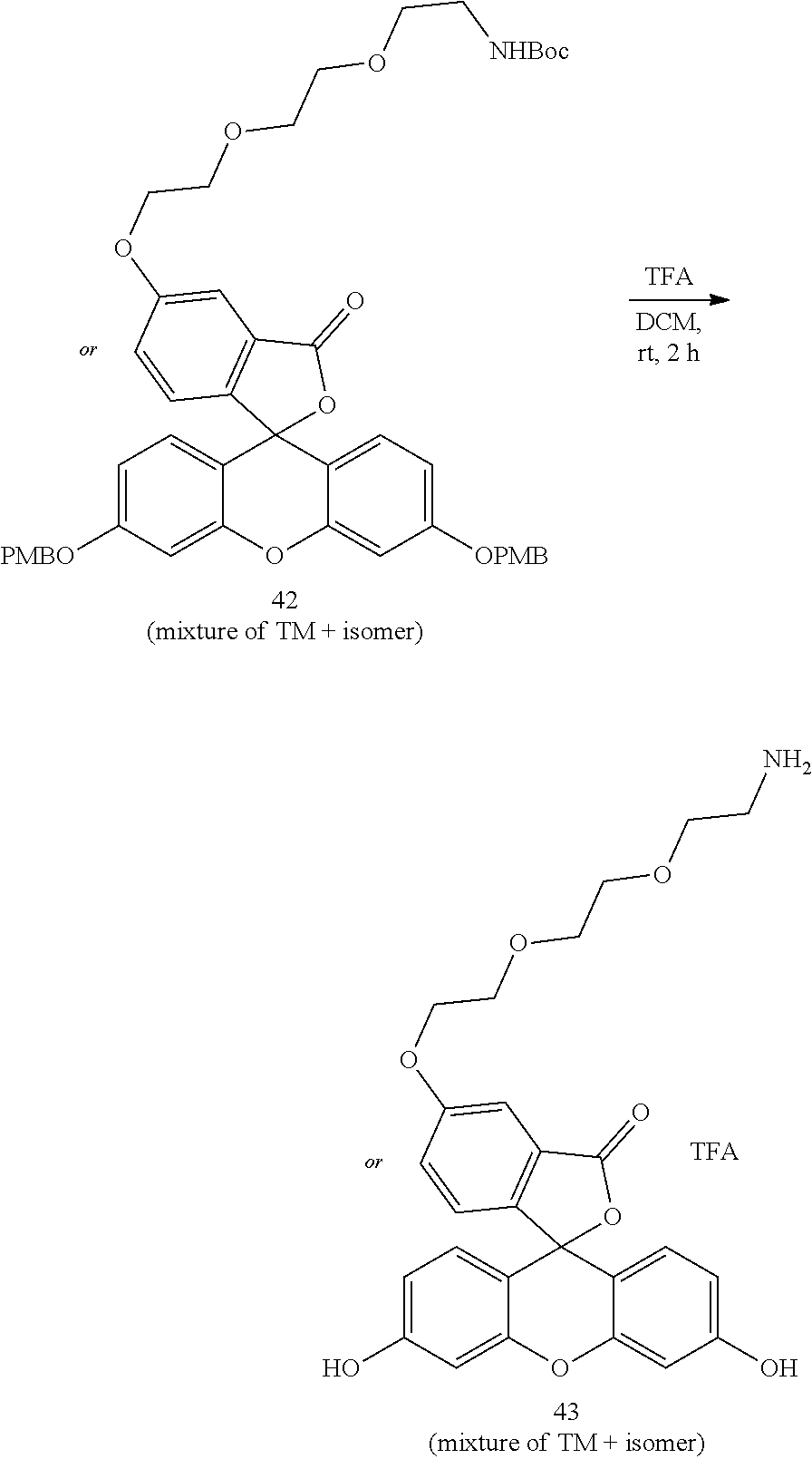
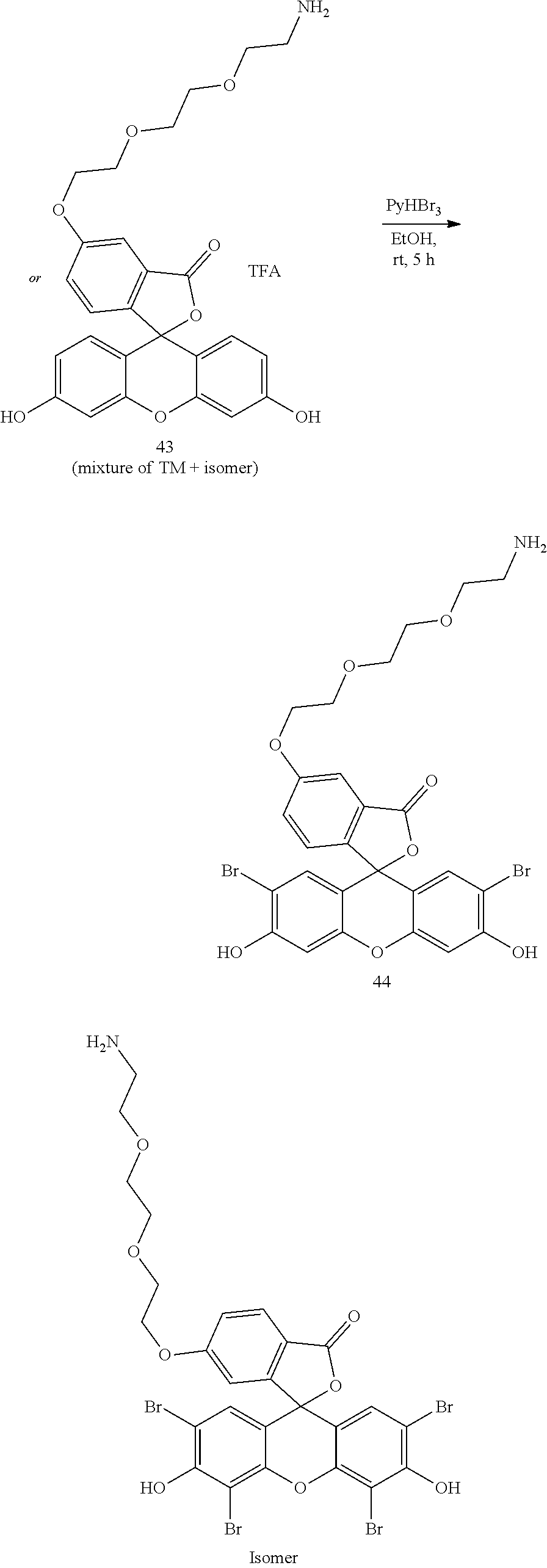


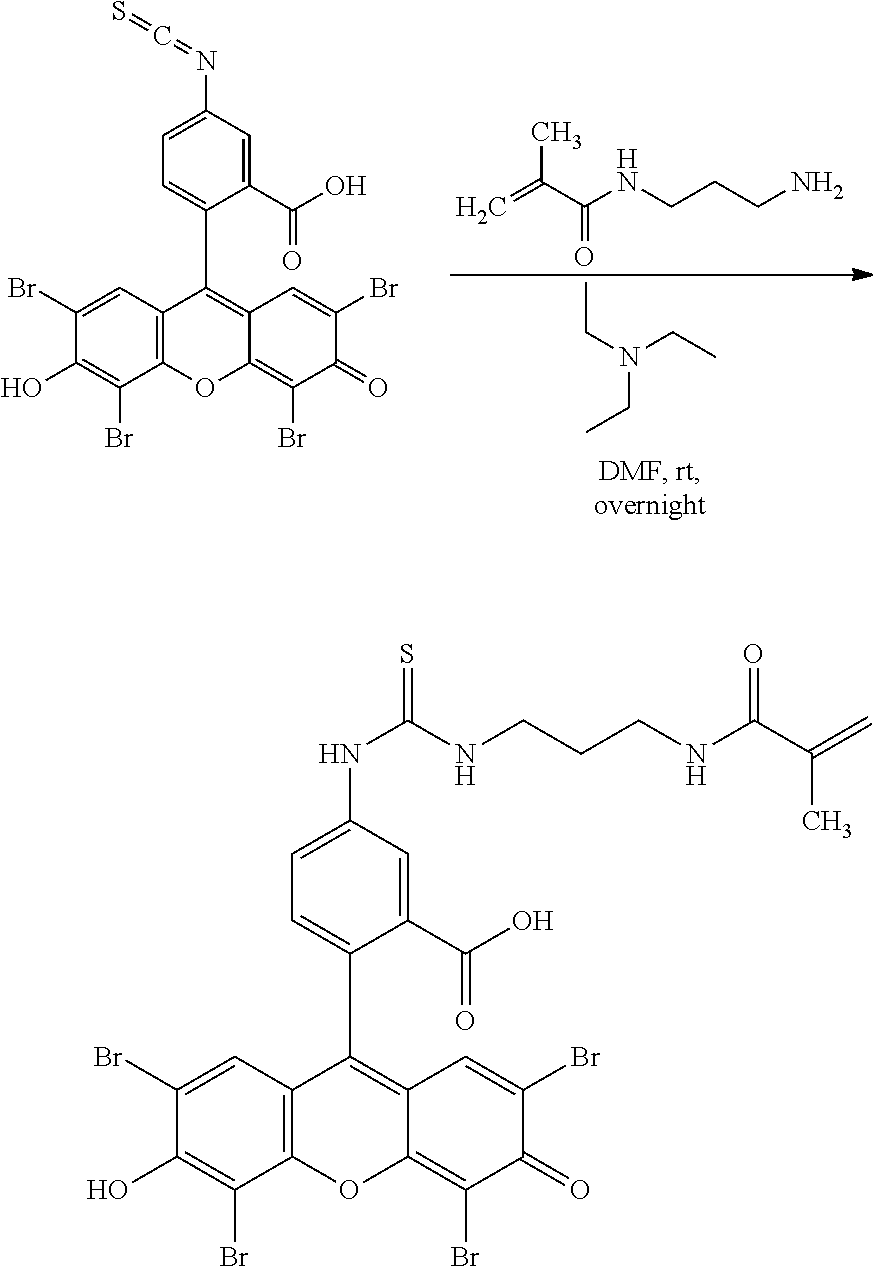
-
- Wash with 100% xylenes twice 3 min each at room temperature
- Wash with 1:1 100% xylenes: 100% ethanol 3 min at room temperature
- Wash with 100% ethanol twice 3 min each at room temperature
- Wash with 95% ethanol 3 min at room temperature
- Wash with 70% ethanol 3 min at room temperature
- Wash with 50% ethanol 3 min at room temperature
- Wash with cold-tap water 3 min at room temperature
Sequential Staining - Incubate in anchorable hematoxylin solution for 8 min at room temperature
- Wash with cold-tap water 1.5 min at room temperature
- Incubate in Clarifier solution 10 sec at room temperature
- Wash with running tap water 30 sec at room temperature
- Incubate in Bluing solution 20 sec at room temperature
- Wash with running tap water 1.5 min at room temperature
- Wash with 95% ethanol 15 sec min at room temperature
- Incubate in anchorable eosin Y solution 1-5 min at room temperature
- Wash with 95% ethanol 15 sec at room temperature
- Wash with 100% ethanol 1 min at room temperature
- Wash with 100% ethanol 1 min at room temperature
- Wash with 100% ethanol 1 min at room temperature
Sequential Anchoring - Incubate in 0.100 mg/mL Protein (AcX; 6-((acryloyl) amino) hexanoic acid succinimidyl ester) anchoring reagent in 1×PBS for 3 hours at room temperature. In some embodiments, this step may be optional.
- Incubate in 0.100 mg/mL Nucleic acid anchoring reagent (NucliX; 3-acrylamide-N-(3-((4-((2-chloroethyl)(methyl)amino)benzyl)amino)propyl)-N,N-dimethylpropan-1-ammonium 2,2,2-salt) in 1×PBS for 3 hours at room temperature. In some embodiments, this step may be optional.
- Proceed with expansion microscopy protocol described below (polymerization, digestion, detachment, expansion, etc.).
Claims (21)
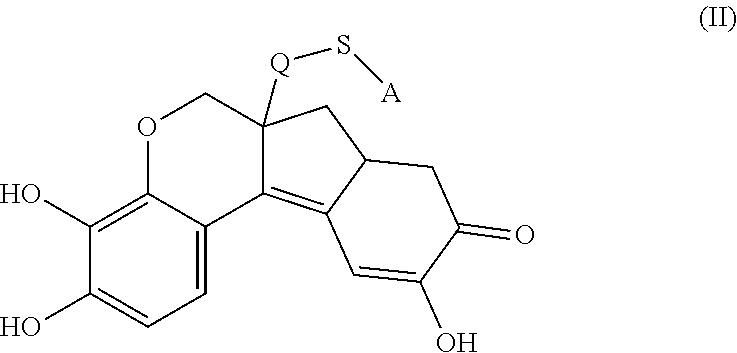
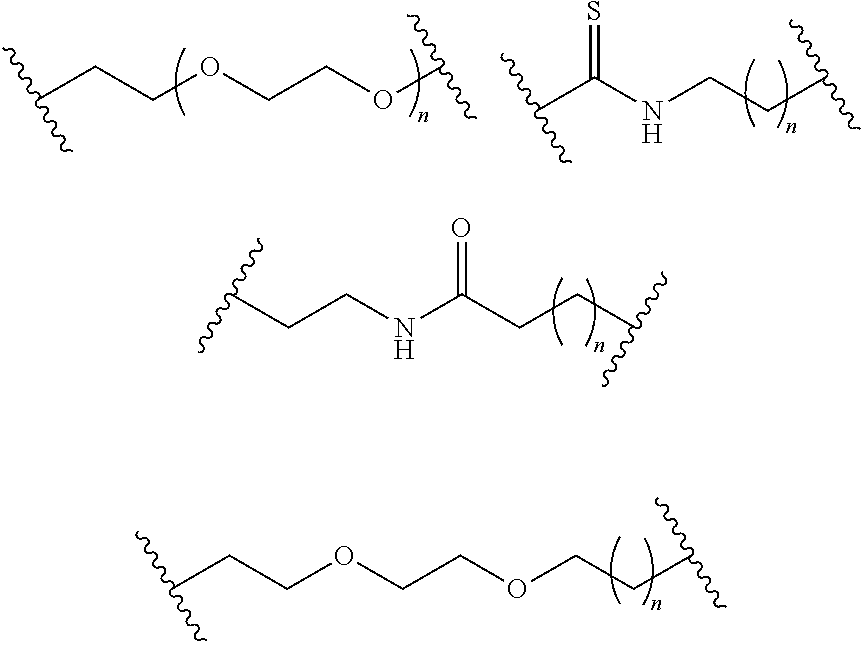


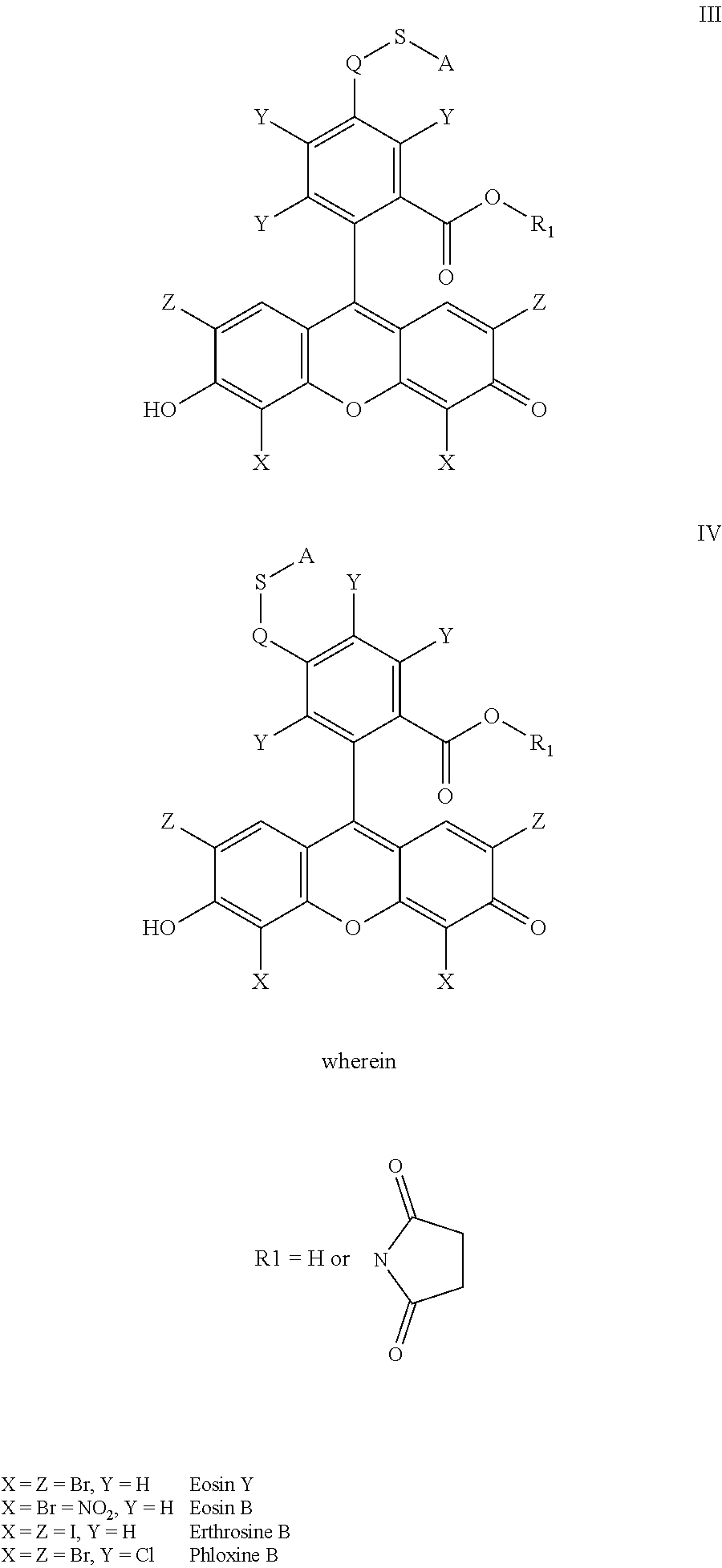
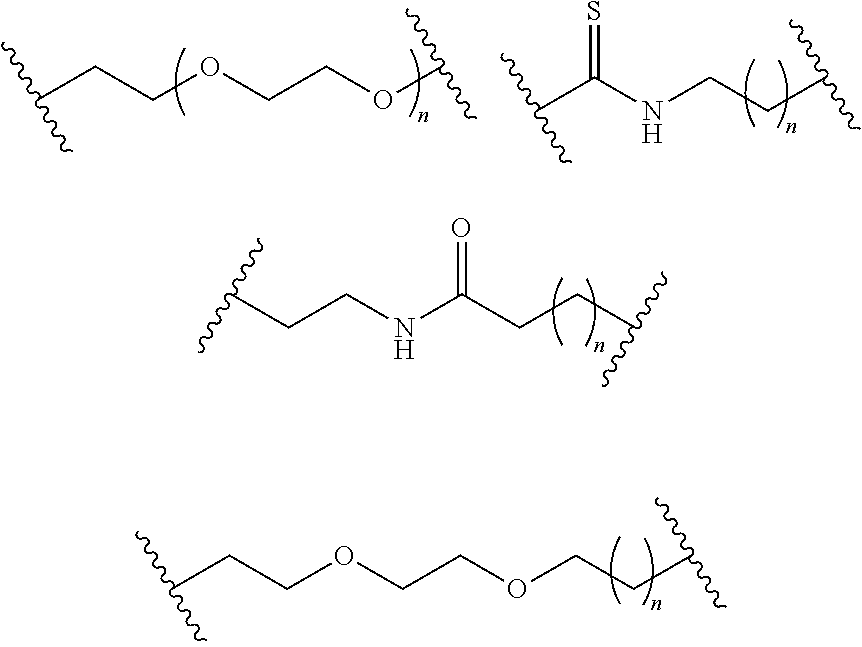
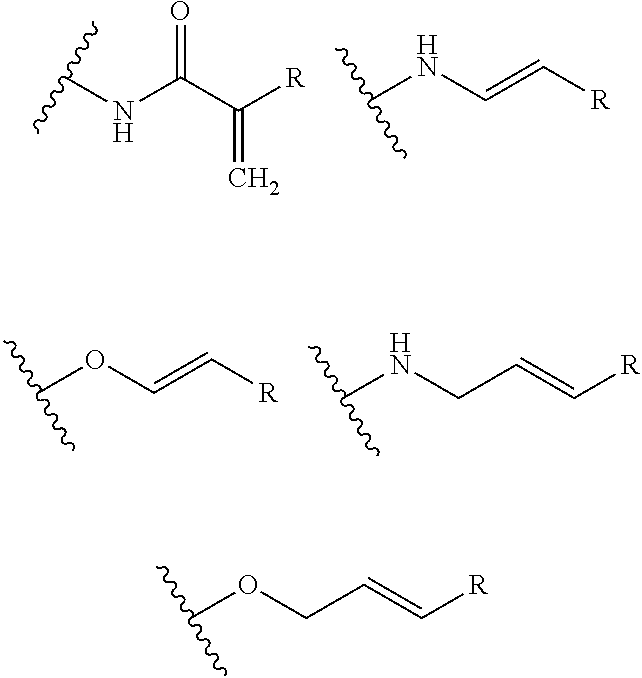

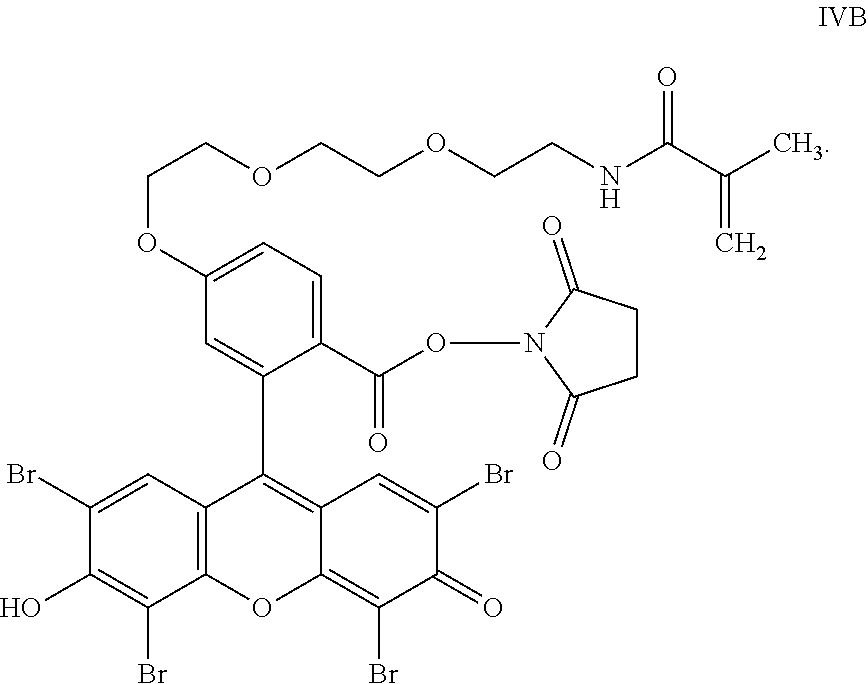
Priority Applications (1)
| Application Number | Priority Date | Filing Date | Title |
|---|---|---|---|
| US17/419,545 US12228481B2 (en) | 2018-12-31 | 2019-12-31 | Expansion microscopy compatible anchorable HandE staining for histopathology |
Applications Claiming Priority (3)
| Application Number | Priority Date | Filing Date | Title |
|---|---|---|---|
| US201862786994P | 2018-12-31 | 2018-12-31 | |
| US17/419,545 US12228481B2 (en) | 2018-12-31 | 2019-12-31 | Expansion microscopy compatible anchorable HandE staining for histopathology |
| PCT/US2019/069065 WO2020142490A1 (en) | 2018-12-31 | 2019-12-31 | Expansion microscopy compatible anchorable h&e staining for histopathology |
Publications (2)
| Publication Number | Publication Date |
|---|---|
| US20220074827A1 US20220074827A1 (en) | 2022-03-10 |
| US12228481B2 true US12228481B2 (en) | 2025-02-18 |
Family
ID=71407426
Family Applications (1)
| Application Number | Title | Priority Date | Filing Date |
|---|---|---|---|
| US17/419,545 Active 2041-07-24 US12228481B2 (en) | 2018-12-31 | 2019-12-31 | Expansion microscopy compatible anchorable HandE staining for histopathology |
Country Status (2)
| Country | Link |
|---|---|
| US (1) | US12228481B2 (en) |
| WO (1) | WO2020142490A1 (en) |
Families Citing this family (32)
| Publication number | Priority date | Publication date | Assignee | Title |
|---|---|---|---|---|
| WO2017222453A1 (en) | 2016-06-21 | 2017-12-28 | Hauling Thomas | Nucleic acid sequencing |
| CN111263819B (en) | 2017-10-06 | 2025-04-15 | 10X基因组学有限公司 | RNA-templated ligation |
| EP3976820A1 (en) | 2019-05-30 | 2022-04-06 | 10X Genomics, Inc. | Methods of detecting spatial heterogeneity of a biological sample |
| WO2020240025A1 (en) | 2019-05-31 | 2020-12-03 | Cartana Ab | Method of detecting target nucleic acid molecules |
| GB201919032D0 (en) | 2019-12-20 | 2020-02-05 | Cartana Ab | Method of detecting an analyte |
| US12110548B2 (en) | 2020-02-03 | 2024-10-08 | 10X Genomics, Inc. | Bi-directional in situ analysis |
| EP4107284A1 (en) | 2020-02-17 | 2022-12-28 | 10X Genomics, Inc. | In situ analysis of chromatin interaction |
| US12173360B2 (en) | 2020-02-21 | 2024-12-24 | 10X Genomics, Inc. | Methods and compositions for integrated in situ spatial assay |
| US12188085B2 (en) | 2020-03-05 | 2025-01-07 | 10X Genomics, Inc. | Three-dimensional spatial transcriptomics with sequencing readout |
| EP4025692A2 (en) | 2020-06-02 | 2022-07-13 | 10X Genomics, Inc. | Nucleic acid library methods |
| CN116249785A (en) | 2020-06-02 | 2023-06-09 | 10X基因组学有限公司 | Spatial Transcriptomics for Antigen-Receptors |
| ES2981265T3 (en) | 2020-06-08 | 2024-10-08 | 10X Genomics Inc | Methods for determining a surgical margin and methods of using it |
| US12209273B2 (en) | 2020-06-12 | 2025-01-28 | 10X Genomics, Inc. | Nucleic acid assays using click chemistry bioconjugation |
| US12297499B2 (en) | 2020-08-17 | 2025-05-13 | 10X Genomics, Inc. | Multicomponent nucleic acid probes for sample analysis |
| US12071667B2 (en) | 2020-11-04 | 2024-08-27 | 10X Genomics, Inc. | Sequence analysis using meta-stable nucleic acid molecules |
| EP4012046A1 (en) | 2020-12-11 | 2022-06-15 | 10X Genomics, Inc. | Methods and compositions for multimodal in situ analysis |
| US12060603B2 (en) | 2021-01-19 | 2024-08-13 | 10X Genomics, Inc. | Methods for internally controlled in situ assays using padlock probes |
| US12275984B2 (en) | 2021-03-02 | 2025-04-15 | 10X Genomics, Inc. | Sequential hybridization and quenching |
| US12139751B2 (en) | 2021-07-30 | 2024-11-12 | 10X Genomics, Inc. | Circularizable probes for in situ analysis |
| ES2988400T3 (en) | 2021-07-30 | 2024-11-20 | 10X Genomics Inc | Methods and compositions for synchronizing reactions in situ |
| US12391984B2 (en) | 2021-08-03 | 2025-08-19 | 10X Genomics, Inc. | Compositions and methods for rolling circle amplification |
| US12460251B2 (en) | 2021-08-03 | 2025-11-04 | 10X Genomics, Inc. | Stabilization and/or compaction of nucleic acid molecules |
| US12529096B2 (en) | 2021-08-03 | 2026-01-20 | 10X Genomics, Inc. | Stabilization and/or compaction of nucleic acid structures |
| EP4446426A3 (en) | 2021-08-16 | 2024-11-13 | 10x Genomics, Inc. | Probes comprising a split barcode region and methods of use |
| EP4466376A1 (en) | 2022-01-21 | 2024-11-27 | 10X Genomics, Inc. | Multiple readout signals for analyzing a sample |
| WO2023172915A1 (en) | 2022-03-08 | 2023-09-14 | 10X Genomics, Inc. | In situ code design methods for minimizing optical crowding |
| CN119032271A (en) | 2022-04-01 | 2024-11-26 | 10X基因组学有限公司 | Compositions and methods for targeted masking of autofluorescence |
| JP2025516589A (en) | 2022-05-11 | 2025-05-30 | 10エックス ジェノミクス インコーポレイテッド | Compositions and methods for in situ sequencing |
| WO2023245190A1 (en) | 2022-06-17 | 2023-12-21 | 10X Genomics, Inc. | Catalytic de-crosslinking of samples for in situ analysis |
| CN119677873A (en) | 2022-08-16 | 2025-03-21 | 10X基因组学有限公司 | AP50 polymerase and its use |
| KR102648134B1 (en) * | 2022-09-13 | 2024-03-14 | 경북대학교 산학협력단 | Novel fluorescein derivative and use thereof for detecting hydrogen peroxide |
| US12319956B2 (en) | 2023-07-31 | 2025-06-03 | 10X Genomics, Inc. | Methods and systems for targeted RNA cleavage and target RNA-primed rolling circle amplification |
Citations (19)
| Publication number | Priority date | Publication date | Assignee | Title |
|---|---|---|---|---|
| US4213904A (en) | 1979-02-28 | 1980-07-22 | Haugland Richard P | Fluorescent labeling reagents containing the fluorescein and eosin chromophores |
| US20010046668A1 (en) * | 1994-10-21 | 2001-11-29 | G.D. Searle & Co. | Fluorescence polarization method for determining protease activity |
| US20150004712A1 (en) | 2010-07-19 | 2015-01-01 | University Of Ottawa | Fluorescent markers and use thereof for labeling specific protein targets |
| WO2015127183A2 (en) | 2014-02-21 | 2015-08-27 | Massachusetts Institute Of Technology | Expansion microscopy |
| US20160305856A1 (en) | 2015-04-14 | 2016-10-20 | Massachusetts Institute Of Technology | Iterative expansion microscopy |
| WO2017027367A1 (en) | 2015-08-07 | 2017-02-16 | Massachusetts Institute Of Technology | Nanoscale imaging of proteins and nucleic acids via expansion microscopy |
| WO2017027368A1 (en) | 2015-08-07 | 2017-02-16 | Massachusetts Institute Of Technology | Protein retention expansion microscopy |
| WO2017147435A1 (en) | 2016-02-25 | 2017-08-31 | Massachusetts Institute Of Technology | Methods for expanding clinical tissue specimens |
| US20170253918A1 (en) | 2016-03-01 | 2017-09-07 | Expansion Technologies | Combining protein barcoding with expansion microscopy for in-situ, spatially-resolved proteomics |
| US20180052081A1 (en) | 2016-05-11 | 2018-02-22 | Expansion Technologies | Combining modified antibodies with expansion microscopy for in-situ, spatially-resolved proteomics |
| US20180119219A1 (en) | 2015-04-14 | 2018-05-03 | Massachusetts Institute Of Technology | Augmenting in situ nucleic acid sequencing of expanded biological samples with in vitro sequence information |
| WO2018136856A1 (en) | 2017-01-23 | 2018-07-26 | Massachusetts Institute Of Technology | Multiplexed signal amplified fish via splinted ligation amplification and sequencing |
| US10059999B2 (en) | 2013-06-10 | 2018-08-28 | Monsanto Technology Llc | Molecular markers associated with soybean tolerance to low iron growth conditions |
| WO2018157048A1 (en) | 2017-02-24 | 2018-08-30 | Massachusetts Institute Of Technology | Methods for examining podocyte foot processes in human renal samples using conventional optical microscopy |
| WO2018157074A1 (en) | 2017-02-24 | 2018-08-30 | Massachusetts Institute Of Technology | Methods for diagnosing neoplastic lesions |
| WO2019055242A1 (en) | 2017-09-18 | 2019-03-21 | Dow Global Technologies Llc | Method for improved stability of polyurethane foam made with a hydrohaloolefin blowing agent |
| WO2019075091A1 (en) | 2017-10-11 | 2019-04-18 | Expansion Technologies | Multiplexed in situ hybridization of tissue sections for spatially resolved transcriptomics with expansion microscopy |
| WO2019103996A1 (en) | 2017-11-21 | 2019-05-31 | Expansion Technologies | Expansion microscopy compatible and multiplexed in situ hybridization of formalin fixed paraffin embedded tissue sections for spatially resolved transcriptomics |
| US20200316226A1 (en) * | 2017-12-20 | 2020-10-08 | Cedars-Sinai Medical Center | Engineered extracellular vesicles for enhanced tissue delivery |
-
2019
- 2019-12-31 US US17/419,545 patent/US12228481B2/en active Active
- 2019-12-31 WO PCT/US2019/069065 patent/WO2020142490A1/en not_active Ceased
Patent Citations (21)
| Publication number | Priority date | Publication date | Assignee | Title |
|---|---|---|---|---|
| US4213904A (en) | 1979-02-28 | 1980-07-22 | Haugland Richard P | Fluorescent labeling reagents containing the fluorescein and eosin chromophores |
| US20010046668A1 (en) * | 1994-10-21 | 2001-11-29 | G.D. Searle & Co. | Fluorescence polarization method for determining protease activity |
| US20150004712A1 (en) | 2010-07-19 | 2015-01-01 | University Of Ottawa | Fluorescent markers and use thereof for labeling specific protein targets |
| US10059999B2 (en) | 2013-06-10 | 2018-08-28 | Monsanto Technology Llc | Molecular markers associated with soybean tolerance to low iron growth conditions |
| WO2015127183A2 (en) | 2014-02-21 | 2015-08-27 | Massachusetts Institute Of Technology | Expansion microscopy |
| US20160116384A1 (en) | 2014-02-21 | 2016-04-28 | Massachusetts Institute Of Technology | Expansion microscopy |
| US20180119219A1 (en) | 2015-04-14 | 2018-05-03 | Massachusetts Institute Of Technology | Augmenting in situ nucleic acid sequencing of expanded biological samples with in vitro sequence information |
| US20160305856A1 (en) | 2015-04-14 | 2016-10-20 | Massachusetts Institute Of Technology | Iterative expansion microscopy |
| WO2017027367A1 (en) | 2015-08-07 | 2017-02-16 | Massachusetts Institute Of Technology | Nanoscale imaging of proteins and nucleic acids via expansion microscopy |
| WO2017027368A1 (en) | 2015-08-07 | 2017-02-16 | Massachusetts Institute Of Technology | Protein retention expansion microscopy |
| US20170089811A1 (en) | 2015-08-07 | 2017-03-30 | Massachusetts Institute Of Technology | Protein Retention Expansion Microscopy |
| WO2017147435A1 (en) | 2016-02-25 | 2017-08-31 | Massachusetts Institute Of Technology | Methods for expanding clinical tissue specimens |
| US20170253918A1 (en) | 2016-03-01 | 2017-09-07 | Expansion Technologies | Combining protein barcoding with expansion microscopy for in-situ, spatially-resolved proteomics |
| US20180052081A1 (en) | 2016-05-11 | 2018-02-22 | Expansion Technologies | Combining modified antibodies with expansion microscopy for in-situ, spatially-resolved proteomics |
| WO2018136856A1 (en) | 2017-01-23 | 2018-07-26 | Massachusetts Institute Of Technology | Multiplexed signal amplified fish via splinted ligation amplification and sequencing |
| WO2018157048A1 (en) | 2017-02-24 | 2018-08-30 | Massachusetts Institute Of Technology | Methods for examining podocyte foot processes in human renal samples using conventional optical microscopy |
| WO2018157074A1 (en) | 2017-02-24 | 2018-08-30 | Massachusetts Institute Of Technology | Methods for diagnosing neoplastic lesions |
| WO2019055242A1 (en) | 2017-09-18 | 2019-03-21 | Dow Global Technologies Llc | Method for improved stability of polyurethane foam made with a hydrohaloolefin blowing agent |
| WO2019075091A1 (en) | 2017-10-11 | 2019-04-18 | Expansion Technologies | Multiplexed in situ hybridization of tissue sections for spatially resolved transcriptomics with expansion microscopy |
| WO2019103996A1 (en) | 2017-11-21 | 2019-05-31 | Expansion Technologies | Expansion microscopy compatible and multiplexed in situ hybridization of formalin fixed paraffin embedded tissue sections for spatially resolved transcriptomics |
| US20200316226A1 (en) * | 2017-12-20 | 2020-10-08 | Cedars-Sinai Medical Center | Engineered extracellular vesicles for enhanced tissue delivery |
Non-Patent Citations (6)
| Title |
|---|
| Chen et al., "Expansion microscopy", Science, Jan. 30, 2015, 347(6221):543-548. |
| Chen et al., "Nanoscale imaging of RNA with expansion microscopy", Nature Methods, Jul. 4, 2016, 13:679-684; https://doi.org/10.1038/nmeth.3899. |
| International Search Report and Written Opinion, mailed Mar. 19, 2020, from corresponding International Application No. PCT/US19/69065. |
| Pubchem, CID 11048, Eosin, Aug. 1, 2005, pp. 1-33; retrieved from Internet: https://pubchem.ncbi.nlm.nih.gov/compound/11048. |
| Pubchem, CID 442514, Hematoxyline, Jun. 24, 2005, pp. 1-30; retrieved from Internet: https://pubchem.ncbi.nlm.nih.gov/compound/442514. |
| Tillberg et al., "Protein-retention expansion microscopy of cells and tissues labeled using standard fluorescent proteins and antibodies", Nature Biotechnology, Jul. 4, 2016, 34(9):987-996; doi:10.1038/nbt.3625. |
Also Published As
| Publication number | Publication date |
|---|---|
| WO2020142490A1 (en) | 2020-07-09 |
| US20220074827A1 (en) | 2022-03-10 |
Similar Documents
| Publication | Publication Date | Title |
|---|---|---|
| US12228481B2 (en) | Expansion microscopy compatible anchorable HandE staining for histopathology | |
| US20240174818A1 (en) | Swellable and Structurally Homogenous Hydrogels and Methods of Use Thereof | |
| US12233184B2 (en) | Dimethylacrylamide (DMAA) hydrogel for expansion microscopy (ExM) | |
| US11802822B2 (en) | Multiplexed expansion (MultiExM) pathology | |
| CN107207874A (en) | POLYMER BODIPY DYES AND METHODS OF USING THE SAME | |
| US20170276578A1 (en) | Expansion microscopy methods and kits | |
| US20210130882A1 (en) | Membrane Probes for Expansion Microscopy | |
| WO2022262311A1 (en) | Methods for physical expansion of samples and uses thereof | |
| Zhuang et al. | Expansion microscopy: A chemical approach for super-resolution microscopy | |
| US12173031B2 (en) | Peptide nucleic acid conjugates | |
| US8658109B2 (en) | Use of a bis-maleic anhydride cross-linking agent for fixation of a cell or tissue sample | |
| US12139614B2 (en) | Photoactivatable fluorescent dyes with hydrophilic caging groups and their use | |
| JP2023113659A (en) | peptide nucleic acid conjugate | |
| Derevtsova et al. | Applying the expansion microscopy method in neurobiology | |
| Fedorowicz et al. | Development of Safirinium dyes for new applications: fluorescent staining of bacteria, human kidney cells, and the horny layer of the epidermis | |
| Wen et al. | Synthesis and evaluation of novel multifunctional labels for expansion microscopy | |
| WO2020201525A1 (en) | Multifunctional compounds for polymer matrix grafting | |
| EP4603819A1 (en) | Iterative expansion for high-fidelity tissue preservation | |
| US20260028372A1 (en) | Protein extraction, protein identification, and spatial proteomics using photocleavable anchor in swellable material | |
| KR20250162871A (en) | Antigen retrieval method from fixed samples for multiple applications | |
| CN121358503A (en) | Methods and systems for sensitive and multiplex analysis of biological samples using cleavable fluorophores and "click" chemistry. | |
| Rietdorf | Rainer Pepperkok, Andreas Girod, Jeremy Simpson |
Legal Events
| Date | Code | Title | Description |
|---|---|---|---|
| FEPP | Fee payment procedure |
Free format text: ENTITY STATUS SET TO UNDISCOUNTED (ORIGINAL EVENT CODE: BIG.); ENTITY STATUS OF PATENT OWNER: SMALL ENTITY |
|
| AS | Assignment |
Owner name: EXPANSION TECHNOLOGIES, MASSACHUSETTS Free format text: ASSIGNMENT OF ASSIGNORS INTEREST;ASSIGNOR:DEWAL, MAHENDER BABU;REEL/FRAME:056724/0452 Effective date: 20191231 |
|
| FEPP | Fee payment procedure |
Free format text: ENTITY STATUS SET TO SMALL (ORIGINAL EVENT CODE: SMAL); ENTITY STATUS OF PATENT OWNER: SMALL ENTITY |
|
| STPP | Information on status: patent application and granting procedure in general |
Free format text: DOCKETED NEW CASE - READY FOR EXAMINATION |
|
| STPP | Information on status: patent application and granting procedure in general |
Free format text: NON FINAL ACTION MAILED |
|
| STPP | Information on status: patent application and granting procedure in general |
Free format text: RESPONSE TO NON-FINAL OFFICE ACTION ENTERED AND FORWARDED TO EXAMINER |
|
| STPP | Information on status: patent application and granting procedure in general |
Free format text: NOTICE OF ALLOWANCE MAILED -- APPLICATION RECEIVED IN OFFICE OF PUBLICATIONS |
|
| STPP | Information on status: patent application and granting procedure in general |
Free format text: NOTICE OF ALLOWANCE MAILED -- APPLICATION RECEIVED IN OFFICE OF PUBLICATIONS |
|
| STPP | Information on status: patent application and granting procedure in general |
Free format text: PUBLICATIONS -- ISSUE FEE PAYMENT VERIFIED |
|
| STCF | Information on status: patent grant |
Free format text: PATENTED CASE |