US12221509B2 - Tetraarylborate compound, catalyst composition comprising same, and method for preparing ethylene homopolymers or copolymers of ethylene and a-olefin by using same - Google Patents
Tetraarylborate compound, catalyst composition comprising same, and method for preparing ethylene homopolymers or copolymers of ethylene and a-olefin by using same Download PDFInfo
- Publication number
- US12221509B2 US12221509B2 US17/433,268 US202017433268A US12221509B2 US 12221509 B2 US12221509 B2 US 12221509B2 US 202017433268 A US202017433268 A US 202017433268A US 12221509 B2 US12221509 B2 US 12221509B2
- Authority
- US
- United States
- Prior art keywords
- alkyl
- group
- aryl
- ethylene
- transition metal
- Prior art date
- Legal status (The legal status is an assumption and is not a legal conclusion. Google has not performed a legal analysis and makes no representation as to the accuracy of the status listed.)
- Active, expires
Links
Classifications
-
- C—CHEMISTRY; METALLURGY
- C07—ORGANIC CHEMISTRY
- C07C—ACYCLIC OR CARBOCYCLIC COMPOUNDS
- C07C211/00—Compounds containing amino groups bound to a carbon skeleton
- C07C211/62—Quaternary ammonium compounds
- C07C211/64—Quaternary ammonium compounds having quaternised nitrogen atoms bound to carbon atoms of six-membered aromatic rings
-
- C—CHEMISTRY; METALLURGY
- C07—ORGANIC CHEMISTRY
- C07C—ACYCLIC OR CARBOCYCLIC COMPOUNDS
- C07C251/00—Compounds containing nitrogen atoms doubly-bound to a carbon skeleton
- C07C251/02—Compounds containing nitrogen atoms doubly-bound to a carbon skeleton containing imino groups
- C07C251/04—Compounds containing nitrogen atoms doubly-bound to a carbon skeleton containing imino groups having carbon atoms of imino groups bound to hydrogen atoms or to acyclic carbon atoms
- C07C251/06—Compounds containing nitrogen atoms doubly-bound to a carbon skeleton containing imino groups having carbon atoms of imino groups bound to hydrogen atoms or to acyclic carbon atoms to carbon atoms of a saturated carbon skeleton
- C07C251/08—Compounds containing nitrogen atoms doubly-bound to a carbon skeleton containing imino groups having carbon atoms of imino groups bound to hydrogen atoms or to acyclic carbon atoms to carbon atoms of a saturated carbon skeleton being acyclic
-
- C—CHEMISTRY; METALLURGY
- C07—ORGANIC CHEMISTRY
- C07F—ACYCLIC, CARBOCYCLIC OR HETEROCYCLIC COMPOUNDS CONTAINING ELEMENTS OTHER THAN CARBON, HYDROGEN, HALOGEN, OXYGEN, NITROGEN, SULFUR, SELENIUM OR TELLURIUM
- C07F5/00—Compounds containing elements of Groups 3 or 13 of the Periodic Table
- C07F5/02—Boron compounds
-
- C—CHEMISTRY; METALLURGY
- C07—ORGANIC CHEMISTRY
- C07F—ACYCLIC, CARBOCYCLIC OR HETEROCYCLIC COMPOUNDS CONTAINING ELEMENTS OTHER THAN CARBON, HYDROGEN, HALOGEN, OXYGEN, NITROGEN, SULFUR, SELENIUM OR TELLURIUM
- C07F5/00—Compounds containing elements of Groups 3 or 13 of the Periodic Table
- C07F5/02—Boron compounds
- C07F5/027—Organoboranes and organoborohydrides
-
- C—CHEMISTRY; METALLURGY
- C08—ORGANIC MACROMOLECULAR COMPOUNDS; THEIR PREPARATION OR CHEMICAL WORKING-UP; COMPOSITIONS BASED THEREON
- C08F—MACROMOLECULAR COMPOUNDS OBTAINED BY REACTIONS ONLY INVOLVING CARBON-TO-CARBON UNSATURATED BONDS
- C08F110/00—Homopolymers of unsaturated aliphatic hydrocarbons having only one carbon-to-carbon double bond
- C08F110/02—Ethene
-
- C—CHEMISTRY; METALLURGY
- C08—ORGANIC MACROMOLECULAR COMPOUNDS; THEIR PREPARATION OR CHEMICAL WORKING-UP; COMPOSITIONS BASED THEREON
- C08F—MACROMOLECULAR COMPOUNDS OBTAINED BY REACTIONS ONLY INVOLVING CARBON-TO-CARBON UNSATURATED BONDS
- C08F2/00—Processes of polymerisation
- C08F2/38—Polymerisation using regulators, e.g. chain terminating agents, e.g. telomerisation
-
- C—CHEMISTRY; METALLURGY
- C08—ORGANIC MACROMOLECULAR COMPOUNDS; THEIR PREPARATION OR CHEMICAL WORKING-UP; COMPOSITIONS BASED THEREON
- C08F—MACROMOLECULAR COMPOUNDS OBTAINED BY REACTIONS ONLY INVOLVING CARBON-TO-CARBON UNSATURATED BONDS
- C08F210/00—Copolymers of unsaturated aliphatic hydrocarbons having only one carbon-to-carbon double bond
- C08F210/16—Copolymers of ethene with alpha-alkenes, e.g. EP rubbers
-
- C—CHEMISTRY; METALLURGY
- C08—ORGANIC MACROMOLECULAR COMPOUNDS; THEIR PREPARATION OR CHEMICAL WORKING-UP; COMPOSITIONS BASED THEREON
- C08F—MACROMOLECULAR COMPOUNDS OBTAINED BY REACTIONS ONLY INVOLVING CARBON-TO-CARBON UNSATURATED BONDS
- C08F4/00—Polymerisation catalysts
- C08F4/42—Metals; Metal hydrides; Metallo-organic compounds; Use thereof as catalyst precursors
- C08F4/44—Metals; Metal hydrides; Metallo-organic compounds; Use thereof as catalyst precursors selected from light metals, zinc, cadmium, mercury, copper, silver, gold, boron, gallium, indium, thallium, rare earths or actinides
- C08F4/52—Metals; Metal hydrides; Metallo-organic compounds; Use thereof as catalyst precursors selected from light metals, zinc, cadmium, mercury, copper, silver, gold, boron, gallium, indium, thallium, rare earths or actinides selected from boron, aluminium, gallium, indium, thallium or rare earths
-
- C—CHEMISTRY; METALLURGY
- C08—ORGANIC MACROMOLECULAR COMPOUNDS; THEIR PREPARATION OR CHEMICAL WORKING-UP; COMPOSITIONS BASED THEREON
- C08F—MACROMOLECULAR COMPOUNDS OBTAINED BY REACTIONS ONLY INVOLVING CARBON-TO-CARBON UNSATURATED BONDS
- C08F4/00—Polymerisation catalysts
- C08F4/42—Metals; Metal hydrides; Metallo-organic compounds; Use thereof as catalyst precursors
- C08F4/44—Metals; Metal hydrides; Metallo-organic compounds; Use thereof as catalyst precursors selected from light metals, zinc, cadmium, mercury, copper, silver, gold, boron, gallium, indium, thallium, rare earths or actinides
- C08F4/60—Metals; Metal hydrides; Metallo-organic compounds; Use thereof as catalyst precursors selected from light metals, zinc, cadmium, mercury, copper, silver, gold, boron, gallium, indium, thallium, rare earths or actinides together with refractory metals, iron group metals, platinum group metals, manganese, rhenium technetium or compounds thereof
- C08F4/62—Refractory metals or compounds thereof
- C08F4/64—Titanium, zirconium, hafnium or compounds thereof
- C08F4/646—Catalysts comprising at least two different metals, in metallic form or as compounds thereof, in addition to the component covered by group C08F4/64
- C08F4/6465—Catalysts comprising at least two different metals, in metallic form or as compounds thereof, in addition to the component covered by group C08F4/64 containing silicium
-
- C—CHEMISTRY; METALLURGY
- C08—ORGANIC MACROMOLECULAR COMPOUNDS; THEIR PREPARATION OR CHEMICAL WORKING-UP; COMPOSITIONS BASED THEREON
- C08F—MACROMOLECULAR COMPOUNDS OBTAINED BY REACTIONS ONLY INVOLVING CARBON-TO-CARBON UNSATURATED BONDS
- C08F4/00—Polymerisation catalysts
- C08F4/42—Metals; Metal hydrides; Metallo-organic compounds; Use thereof as catalyst precursors
- C08F4/44—Metals; Metal hydrides; Metallo-organic compounds; Use thereof as catalyst precursors selected from light metals, zinc, cadmium, mercury, copper, silver, gold, boron, gallium, indium, thallium, rare earths or actinides
- C08F4/60—Metals; Metal hydrides; Metallo-organic compounds; Use thereof as catalyst precursors selected from light metals, zinc, cadmium, mercury, copper, silver, gold, boron, gallium, indium, thallium, rare earths or actinides together with refractory metals, iron group metals, platinum group metals, manganese, rhenium technetium or compounds thereof
- C08F4/62—Refractory metals or compounds thereof
- C08F4/64—Titanium, zirconium, hafnium or compounds thereof
- C08F4/659—Component covered by group C08F4/64 containing a transition metal-carbon bond
- C08F4/65912—Component covered by group C08F4/64 containing a transition metal-carbon bond in combination with an organoaluminium compound
-
- C—CHEMISTRY; METALLURGY
- C08—ORGANIC MACROMOLECULAR COMPOUNDS; THEIR PREPARATION OR CHEMICAL WORKING-UP; COMPOSITIONS BASED THEREON
- C08F—MACROMOLECULAR COMPOUNDS OBTAINED BY REACTIONS ONLY INVOLVING CARBON-TO-CARBON UNSATURATED BONDS
- C08F4/00—Polymerisation catalysts
- C08F4/42—Metals; Metal hydrides; Metallo-organic compounds; Use thereof as catalyst precursors
- C08F4/44—Metals; Metal hydrides; Metallo-organic compounds; Use thereof as catalyst precursors selected from light metals, zinc, cadmium, mercury, copper, silver, gold, boron, gallium, indium, thallium, rare earths or actinides
- C08F4/60—Metals; Metal hydrides; Metallo-organic compounds; Use thereof as catalyst precursors selected from light metals, zinc, cadmium, mercury, copper, silver, gold, boron, gallium, indium, thallium, rare earths or actinides together with refractory metals, iron group metals, platinum group metals, manganese, rhenium technetium or compounds thereof
- C08F4/62—Refractory metals or compounds thereof
- C08F4/64—Titanium, zirconium, hafnium or compounds thereof
- C08F4/659—Component covered by group C08F4/64 containing a transition metal-carbon bond
- C08F4/6592—Component covered by group C08F4/64 containing a transition metal-carbon bond containing at least one cyclopentadienyl ring, condensed or not, e.g. an indenyl or a fluorenyl ring
-
- C—CHEMISTRY; METALLURGY
- C07—ORGANIC CHEMISTRY
- C07F—ACYCLIC, CARBOCYCLIC OR HETEROCYCLIC COMPOUNDS CONTAINING ELEMENTS OTHER THAN CARBON, HYDROGEN, HALOGEN, OXYGEN, NITROGEN, SULFUR, SELENIUM OR TELLURIUM
- C07F17/00—Metallocenes
-
- C—CHEMISTRY; METALLURGY
- C08—ORGANIC MACROMOLECULAR COMPOUNDS; THEIR PREPARATION OR CHEMICAL WORKING-UP; COMPOSITIONS BASED THEREON
- C08F—MACROMOLECULAR COMPOUNDS OBTAINED BY REACTIONS ONLY INVOLVING CARBON-TO-CARBON UNSATURATED BONDS
- C08F2420/00—Metallocene catalysts
- C08F2420/02—Cp or analog bridged to a non-Cp X anionic donor
-
- C—CHEMISTRY; METALLURGY
- C08—ORGANIC MACROMOLECULAR COMPOUNDS; THEIR PREPARATION OR CHEMICAL WORKING-UP; COMPOSITIONS BASED THEREON
- C08F—MACROMOLECULAR COMPOUNDS OBTAINED BY REACTIONS ONLY INVOLVING CARBON-TO-CARBON UNSATURATED BONDS
- C08F2420/00—Metallocene catalysts
- C08F2420/07—Heteroatom-substituted Cp, i.e. Cp or analog where at least one of the substituent of the Cp or analog ring is or contains a heteroatom
-
- Y—GENERAL TAGGING OF NEW TECHNOLOGICAL DEVELOPMENTS; GENERAL TAGGING OF CROSS-SECTIONAL TECHNOLOGIES SPANNING OVER SEVERAL SECTIONS OF THE IPC; TECHNICAL SUBJECTS COVERED BY FORMER USPC CROSS-REFERENCE ART COLLECTIONS [XRACs] AND DIGESTS
- Y02—TECHNOLOGIES OR APPLICATIONS FOR MITIGATION OR ADAPTATION AGAINST CLIMATE CHANGE
- Y02P—CLIMATE CHANGE MITIGATION TECHNOLOGIES IN THE PRODUCTION OR PROCESSING OF GOODS
- Y02P20/00—Technologies relating to chemical industry
- Y02P20/50—Improvements relating to the production of bulk chemicals
- Y02P20/52—Improvements relating to the production of bulk chemicals using catalysts, e.g. selective catalysts
Definitions
- the present invention relates to a tetraarylborate compound, a catalyst composition including the same, and a method for preparing an ethylene homopolymer or an ethylene- ⁇ -olefin copolymer using the same.
- a so-called Ziegler-Natta catalyst system including a main catalyst component of a titanium or vanadium compound, and a cocatalyst component of an alkyl aluminum compound has been used.
- the Ziegler-Natta catalyst system has high activity in ethylene polymerization, it has demerits in that, generally a produced polymer has a broad molecular weight distribution due to a heterogeneous catalyst active site, and in particular, an ethylene- ⁇ -olefin copolymer has a non-uniform composition distribution.
- metallocene catalyst system including a metallocene compound of Group 4 transition metals in the periodic table such as titanium, zirconium and hafnium, and methylaluminoxane as a cocatalyst has been developed. Since the metallocene catalyst system is a homogeneous catalyst having a single catalyst active site, it has properties that polyethylene having a narrow molecular weight distribution and a uniform composition distribution as compared to the conventional Ziegler-Natta catalyst system can be prepared.
- Patent Document 1 to Patent Document 10 disclose that a metallocene compound is activated with a cocatalyst, methylaluminoxane to polymerize ethylene with high activity, thereby preparing polyethylene having a molecular weight distribution (Mw/Mn) in a range of 1.5 to 2.0.
- Mw/Mn molecular weight distribution
- a polymerization activity is rapidly reduced, and a ⁇ -dehydrogenation reaction is predominant, and thus, the catalyst system is not suitable for preparing a high molecular weight polymer having a weight average molecular weight (Mw) of 100,000 or more.
- Mw weight average molecular weight
- a so-called constrained geometry non-metallocene-based catalyst (also known as a single active site catalyst) having a transition metal connected in the form of a ring has been published.
- Patent Document 11 and Patent Document 12 suggest an example in which an amide group is linked to one cyclopentadiene ligand in the form of a ring
- Patent Document 13 shows an example of a catalyst which links a phenol-based ligand to a cyclopentadiene ligand in the form of a ring, as an electron donating compound.
- this constrained geometric catalyst has significantly improved reactivity with higher ⁇ -olefins due to the lowered steric hindrance effect of the catalyst itself, it is commercially important to study a catalyst which provides excellent activity, excellent copolymerization properties, and the like at a high temperature, and a method for activating the catalyst.
- Patent Document 14 to Patent Document 17 disclose a catalyst system including a cocatalyst provided in a dispersed or slurry state.
- the cocatalysts disclosed in the Patent Documents above are supplied to the reactor as a catalyst solution containing a toluene solution, etc., and are supplied to the reactor continuously or discontinuously with the metallocene compound.
- a catalyst system provided in a solid state may cause a failure in a supply device such as a pump used in a production process on a large scale, which may interrupt a stable operation.
- a supply device such as a pump used in a production process on a large scale
- an aromatic hydrocarbon-based solvent such as toluene is required to be used in terms of the solubility of the catalyst system, it remains in an ethylene homopolymer or an ethylene- ⁇ -olefin copolymer, and the like, that is the final product, to cause odors, and thus an additional process for removing thereof is required.
- Patent Document 1 European Patent Application Publication No. 320,762 (Jun. 21, 1989)
- Patent Document 2 European Patent Application Publication No. 372,632 (Jun. 13, 1990)
- Patent Document 3 Japanese Patent Laid-Open Publication No. (Sho) 63-092621 (Apr. 23, 1988)
- Patent Document 4 Japanese Patent Laid-Open Publication No. (Hei) 02-84405 (Mar. 26, 1990)
- Patent Document 5 Japanese Patent Laid-Open Publication No. (Hei) 03-2347 (Jan. 8, 1991)
- Patent Document 6 European Patent Publication No. 0416815 (Mar. 13, 1991)
- Patent Document 7 European Patent Publication No. 0420436 (Apr. 3, 1991)
- Patent Document 8 European Patent Publication No. 0842939 (May 20, 1998)
- Patent Document 9 WO 98/06728 (Feb. 19, 1998)
- Patent Document 10 Patent Document 10
- WO 01/42315 Japanese Patent Document 14
- Patent Document 11 European Patent Publication No. 0416815 (Aug. 13, 1997)
- Patent Document 12 European Patent Publication No. 0420436 (Aug. 14, 1996)
- Patent Document 13 European Patent Publication No. 0842939 (May 20, 1998)
- Patent Document 14 European Patent Publication No. 0889062 (Jan. 7, 1999)
- Patent Document 15 European Patent Publication No. 0887355 (Dec. 30, 1998)
- Patent Document 16 U.S. Pat. No. 6,613,850 (Sep. 2, 2003)
- Patent Document 17 U.S. Pat. No. 6,660,816 (Jul. 19, 2001)
- a tetraarylborate compound including cations of alkylideneanilinium structures can be used as a cocatalyst to increase the solubility in an aliphatic hydrocarbon-based solvent and to effectively improve the activity of a single active site catalyst, thereby completing the present invention.
- An embodiment of the present invention is directed to providing a new tetraarylborate compound that is useful as a cocatalyst for preparing an ethylene homopolymer or an ethylene- ⁇ -olefin copolymer, and a catalyst composition including the tetraarylborate compound and a single active site catalyst.
- Another embodiment of the present invention is directed to providing a method for preparing an ethylene homopolymer or an ethylene- ⁇ -olefin copolymer economically from a commercial point of view, using the catalyst composition.
- B is a boron atom
- Ar 1 is (C6-C30)aryl, wherein the aryl of Ar1 may be further substituted by one or more substituents selected from the group consisting of (C1-C30)alkyl, halo(C1-C30)alkyl, and (C6-C30)aryl(C1-C30)alkyl;
- Ar 2 is fluorine-substituted (C6-C30)aryl
- R 1 is hydrogen or (C1-C30)alkyl
- R 2 is (C1-C30)alkyl, or R2 and R1 may be linked to each other to form a ring, wherein the ring may be further substituted by one or more substituents selected from the group consisting of (C1-C30)alkyl, (C1-C30)alkoxy, halo(C1-C30)alkyl, (C3-C30)cycloalkyl, (C1-C30)alkyl(C6-C30)aryl, (C6-C30)aryl, (C6-C30)aryloxy, (C1-C30)alkyl(C6-C30)aryloxy, (C6-C30)aryl(C1-C30)alkyl, and ((C1-C30)alkyl(C6-C30)aryl)(C1-C30)alkyl.
- substituents selected from the group consisting of (C1-C30)alkyl, (C1-C30)alkoxy
- a transition metal catalyst composition for preparing an ethylene homopolymer or an ethylene- ⁇ -olefin copolymer including: the tetraarylborate compound of Formula 1; a single active site catalyst including a Group 4 transition metal; and an aluminum compound.
- a method for preparing an ethylene homopolymer or an ethylene- ⁇ -olefin copolymer using the transition metal catalyst composition for preparing the ethylene homopolymer or the ethylene- ⁇ -olefin copolymer is provided.
- a method for preparing an ethylene homopolymer or an ethylene- ⁇ -olefin copolymer including: injecting a catalyst activator composition including the tetraarylborate compound of Formula 1 and an organic solvent used in the preparation step of the tetraarylborate compound, without a separating process; injecting a single active site catalyst solution including a Group 4 transition metal; injecting an aluminum compound solution; and injecting ethylene.
- the tetraarylborate compound according to the present invention has high solubility in a hydrocarbon-based solvent and has excellent thermal stability to activate a single active site catalyst even at a high temperature.
- the tetraaryborate compound may be completely dissolved in an aliphatic hydrocarbon-based solvent and may not be subject to limitation on the amount of use by solubility.
- a solution-type cocatalyst may not only facilitate the operation of a commercial process, but also solve the problems caused by using the cocatalyst that is provided in the dispersed or slurry state, which has been pointed out as a problem of the prior art.
- a solution-type cocatalyst may maintain high catalyst activity even at a high temperature, has excellent copolymerization reactivity with ethylene, ⁇ -olefins, other comonomers, and the like, and may prepare a high molecular weight polymer with a high yield.
- the solution-type cocatalyst has high in combination with a single active site catalyst such as various metallocenes or non-metallocenes.
- a solution polymerization is carried out at a high temperature
- the degree of isomerization of ⁇ -olefins having 4 or more carbon atoms can be limited to effectively reduce the consumption of comonomers such as ⁇ -olefins.
- a high molecular weight ethylene-based polymer having various physical properties that is, an ethylene-based polymer such as an ethylene homopolymer or an ethylene- ⁇ -olefin copolymer may be provided more economically.
- alkyl refers to a monovalent straight-chain or branched-chain saturated hydrocarbon radical consisting of only carbon and hydrogen atoms
- an example of the alkyl radical includes, but is not limited to, methyl, ethyl, propyl, butyl, pentyl, hexyl, heptyl, octyl, nonyl, decyl, dodecyl, tetradecyl, hexadecyl, octadecyl, and the like.
- aryl refers to an organic radical derived from aromatic hydrocarbon by the removal of one hydrogen, including a monocyclic or fused ring system containing suitably 4 to 7, preferably 5 or 6 ring atoms in each ring, and even a form in which a plurality of aryls are linked by a single bond.
- a fused ring system may include an aliphatic ring such as saturated or partially saturated rings, and necessarily includes one or more aromatic rings.
- the aliphatic ring may contain nitrogen, oxygen, sulfur, carbonyl, and the like in the ring.
- aryl radical includes, but not limited to, phenyl, naphthyl, biphenyl, indenyl, fluorenyl, phenanthrenyl, anthracenyl, triphenylenyl, pyrenyl, chrysenyl, naphthacenyl, 9,10-dihydroanthracenyl, and the like.
- cycloalkyl refers to a monovalent saturated carbocyclic radical composed of one or more rings.
- An example of the cycloalkyl radical includes, but is not limited to, cyclopropyl, cyclobutyl, cyclopentyl, cyclohexyl, cycloheptyl, and the like.
- halo or “halogen” as described herein refers to fluorine, chlorine, bromine, iodine, or the like.
- haloalkyl refers to alkyl substituted by one or more halogens, and an example thereof may include, but is not limited to, trifluoromethyl and the like.
- fluorine-substituted aryl refers to aryl substituted by one or more fluorine atoms, wherein “aryl” is as defined above.
- arylalkyl refers to alkyl substituted by one or more aryls, and an example thereof may include, but is not limited to, benzyl and the like.
- alkoxy and aryloxy refer to an *—O-alkyl radical and an *—O-aryl radical, respectively, wherein “alkyl” and “aryl” are as defined above.
- catalyst activator as described herein may be interpreted in the same meaning as the cocatalyst, and the catalyst activator specifically described herein may be a compound represented by the following Formula 1.
- Catalyst activators including ionic salts, for the activation of a single active site catalyst typically have the form of ionic salts. With such structural features, the catalyst activators are highly insoluble in an aliphatic hydrocarbon-based solvent, and are dissolved only to a small extent in an aromatic hydrocarbon-based solvent.
- a monomer for the preparation of an ethylene-based polymer such as an ethylene homopolymer or an ethylene- ⁇ -olefin copolymer
- an ethylene-based polymer such as an ethylene homopolymer or an ethylene- ⁇ -olefin copolymer
- an aromatic hydrocarbon-based solvent was inevitably used due to the problems described above.
- an aromatic hydrocarbon-based solvent such as toluene
- it remains in the resulting high molecular weight ethylene homopolymer or ethylene- ⁇ -olefin copolymer, causing inferior polymer properties or unpleasant odors.
- Such a tetraarylborate compound having cations of alkylideneanilinium structure also has high solubility in a cyclic aliphatic hydrocarbon-based solvent as well as a linear aliphatic hydrocarbon-based solvent. Accordingly, the tetraarylborate compound is suitable for use in a continuous solution process in which a control of a specific amount of a catalyst activator is required. In particular, when the tetraarylborate compound is included, an isomerization reaction of ⁇ -olefins is effectively limited.
- the tetraarylborate compound having cations of alkylideneanilinium structure is excellent in high temperature stability to exert an excellent effect on catalyst activity even at a high temperature polymerization temperature of 160° C. or more and enable its commercial operation, thereby having a high industrial utilization value.
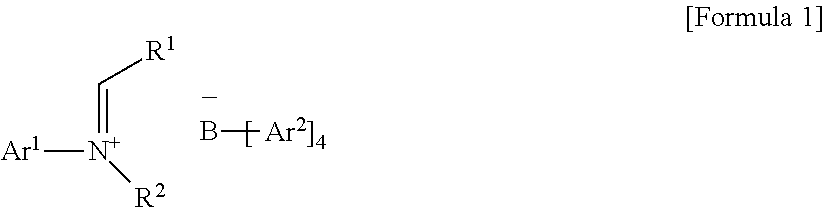
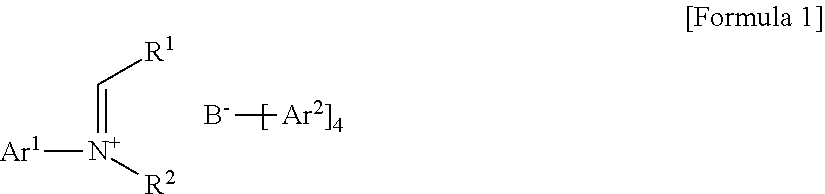
- the tetraarylborate compound according to an exemplary embodiment of the present invention may be represented by the following Formula 1:
- B is a boron atom
- Ar 1 is (C6-C30)aryl, wherein the aryl of Ar 1 may be further substituted by one or more substituents selected from the group consisting of (C1-C30)alkyl, halo(C1-C30)alkyl, and (C6-C30)aryl(C1-C30)alkyl;
- Ar 2 is fluorine-substituted (C6-C30)aryl
- R 1 is hydrogen or (C1-C30)alkyl
- R 2 is (C1-C30)alkyl, or R 2 and R 1 may be linked to each other to form a ring, wherein the ring may be further substituted by one or more substituents selected from the group consisting of (C1-C30)alkyl, (C1-C30)alkoxy, halo(C1-C30)alkyl, (C3-C30)cycloalkyl, (C1-C30)alkyl(C6-C30)aryl, (C6-C30)aryl, (C6-C30)aryloxy, (C1-C30)alkyl(C6-C30)aryloxy, (C6-C30)aryl(C1-C30)alkyl, and ((C1-C30)alkyl(C6-C30)aryl)(C1-C30)alkyl.
- the tetraarylborate compound has a use of a catalyst activator for the activation of a main catalyst for the preparation of an ethylene homopolymer or an ethylene- ⁇ -olefin copolymer.
- the tetraarylborate compound includes cations of alkylideneanilinium structure, thereby implementing improved solubility in an aliphatic hydrocarbon-based solvent. Accordingly, it exhibits enhanced catalyst activity under solution polymerization conditions, particularly continuous solution polymerization conditions, in an aliphatic hydrocarbon-based solvent for the preparation of an ethylene homopolymer or an ethylene- ⁇ -olefin copolymer.
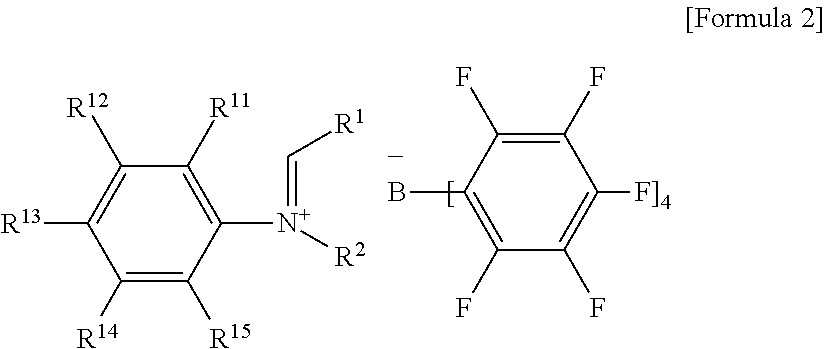
- tetraarylborate compound may be represented by the following Formula 2 or Formula 3:
- R 1 , and R 2 are as defined in Formula 1 of claim 1 ;
- R 11 to R 15 are each independently hydrogen, (C1-C30)alkyl, halo(C1-C30)alkyl, or (C6-C30)aryl(C1-C30)alkyl;
- R 11 to R 15 are each independently hydrogen, (C1-C30)alkyl, halo(C1-C30)alkyl, or (C6-C30)aryl(C1-C30)alkyl;
- n is an integer selected from 2 to 6;
- R 21 and R 22 are each independently hydrogen, (C1-C30)alkyl, (C1-C30)alkoxy, halo(C1-C30)alkyl, (C3-C30)cycloalkyl, (C1-C30)alkyl(C6-C30)aryl, (C6-C30)aryl, (C6-C30)aryloxy, (C1-C30)alkyl(C6-C30)aryloxy, (C6-C30)aryl(C1-C30)alkyl, or ((C1-C30)alkyl(C6-C30)aryl)(C1-C30)alkyl.
- At least one selected from R 1 and R 2 may be a long chain alkyl, that is, (C8-C30)alkyl.
- R 11 to R 15 may be each independently hydrogen or (C1-C30)alkyl; at least one selected from R 1 and R 2 may be a long chain alkyl, wherein R 1 may be hydrogen or (C8-C30)alkyl, and R 2 may be (C1-C30)alkyl.
- R 11 to R 15 may be each independently hydrogen or (C1-C7)alkyl; at least one selected from R 1 and R 2 may be a long chain alkyl, wherein R 1 may be hydrogen or (C8-C30)alkyl, and R 2 may be (C8-C30)alkyl.
- R 11 to R 15 may be each independently hydrogen, methyl, or ethyl; at least one selected from R 1 and R 2 may be a long chain alkyl, wherein R 1 may be hydrogen or (C8-C30)alkyl, and R 2 may be (C8-C30)alkyl.
- R 11 to R 15 may be each independently hydrogen or (C1-C30)alkyl; n may be an integer selected from 2 to 4; and R 21 and R 22 may be each independently hydrogen or (C8-C30)alkyl.
- R 11 to R 15 may be each independently hydrogen or (C1-C7)alkyl; n may be an integer of 3 or 4; and R 21 and R 22 may be each independently hydrogen or (C8-C30)alkyl.
- R 11 to R 15 may be each independently hydrogen or (C1-C7)alkyl; n may be an integer of 3 or 4; and R 21 and R 22 may be each independently hydrogen or (C1-C7)alkyl.
- R 11 to R 15 may be each independently hydrogen, methyl, or ethyl; n may be an integer of 3 or 4; and R 21 and R 22 may be each independently hydrogen or (C8-C30)alkyl.
- R 1 and R 2 may be each independently (C12-C30)alkyl.
- R 11 to R 15 may be each independently hydrogen, methyl, or ethyl; and R 1 and R 2 may be (C12-C30)alkyl.
- R 11 to R 15 may be each independently hydrogen, methyl, or ethyl; n may be an integer of 3 or 4; and R 21 and R 22 may be each independently hydrogen or (C12-C30)alkyl, wherein at least one of R 21 and R 22 may be (C12-C30)alkyl.
- R 1 may be (C15-C25) alkyl
- R 2 may be (C16-C26)alkyl
- R 1 may be (C15-C17) alkyl
- R 2 may be (C16-C18)alkyl
- an specific aspect of the tetraarylborate compound represented by Formula 1 may include, but is not limited to, N-methyl-N-methylideneanilinium tetrakis(pentafluorophenyl)borate, 4-methyl-N-octadecyl-N-octadecylideneanilinium tetrakis(pentafluorophenyl)borate, N-butyl-N-butylideneanilinium tetrakis(pentafluorophenyl)borate, N-tetradecyl-N-tetradecylideneanilinium tetrakis(pentafluorophenyl)borate, N-hexadecyl-N-hexadecylideneanilinium tetrakis(pentafluorophenyl)borate, and N-octadecyl-N-octadecyl
- an example of the tetraarylborate compound may include N-tetradecyl-N-tetradecylideneanilinium tetrakis(pentafluorophenyl)borate, N-hexadecyl-N-hexadecylideneanilinium tetrakis(pentafluorophenyl)borate, 4-methyl-N-octadecyl-N-octadecylideneanilinium tetrakis(pentafluorophenyl)borate, and N-octadecyl-N-octadecylideneanilinium tetrakis(pentafluorophenyl)borate and the like, and more preferably, an example of the tetraarylborate compound may include N-tetradecyl-N-tetradecylideneanilinium tetrakis(pentafluor
- the tetraarylborate compound according to an exemplary embodiment of the present invention may be used as a catalyst activator for preparing an ethylene homopolymer and an ethylene-based copolymer selected from an ethylene- ⁇ -olefin copolymer, and the like.
- the tetraarylborate compound has a significantly high solubility in an aliphatic hydrocarbon-based solvent as well as an aromatic hydrocarbon-based solvent.
- the tetraarylborate compound may be uniformly dissolved and used in an aliphatic hydrocarbon-based solvent, and thus, it is possible to realize stable operation of the production process as well as to implement improved catalyst activity.
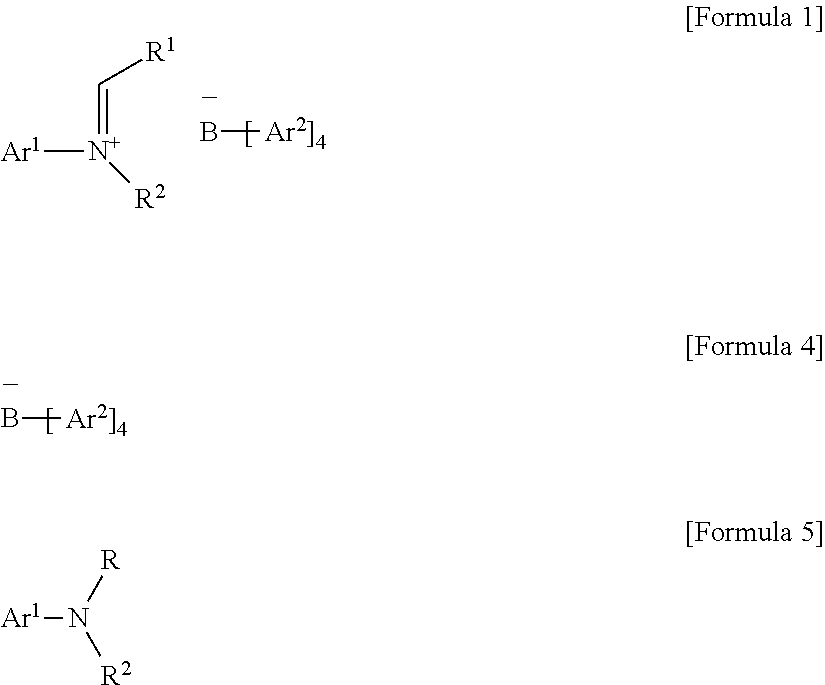
- the tetraarylborate compound according to an exemplary embodiment of the present invention may be prepared by reacting a compound represented by the following Formula 4 with a compound represented by the following Formula 5 in the hydrocarbon-based solvent.
- the tetraarylborate compound may be used as a catalyst activator without separation and purification.
- B is a boron atom
- Ar 1 is (C6-C30)aryl, wherein the aryl of Ar 1 may be further substituted by one or more substituents selected from the group consisting of (C1-C30)alkyl, halo(C1-C30)alkyl, and (C6-C30)aryl(C1-C30)alkyl;
- Ar 2 is fluorine-substituted (C6-C30)aryl
- R 1 is hydrogen or (C1-C30)alkyl
- R is (C1-C30)alkyl, wherein R has one greater carbon atom than R 1 , and when R 1 is hydrogen, R has 0 carbon atoms;
- R 2 is (C1-C30)alkyl, or R 2 and R 1 may be linked to each other to form a ring, wherein the ring may be further substituted by one or more substituents selected from the group consisting of (C1-C30)alkyl, (C1-C30)alkoxy, halo(C1-C30)alkyl, (C3-C30)cycloalkyl, (C1-C30)alkyl(C6-C30)aryl, (C6-C30)aryl, (C6-C30)aryloxy, (C1-C30)alkyl(C6-C30)aryloxy, (C6-C30)aryl(C1-C30)alkyl and ((C1-C30)alkyl(C6-C30)aryl)(C1-C30)alkyl.
- the hydrocarbon-based solvent may be one or a mixed solvent of two or more selected from a linear aliphatic hydrocarbon-based solvent selected from the group consisting of n-pentane, i-pentane, n-hexane, i-hexane, n-heptane, i-heptane, n-octane, i-octane, n-nonane, i-nonane, n-decane, and i-decane; a cyclic aliphatic hydrocarbon-based solvent selected from the group consisting of cyclopentane, cyclohexane, methylcyclohexane, dimethylcyclohexane, ethylcyclohexane, p-menthane, and decahydronaphthalene; and an aromatic hydrocarbon-based solvent selected from the group consisting of benzene, toluene, and xylene.
- the reaction may be carried out under conditions of a temperature of 0 to 50° C.
- the reaction may be carried out for 10 to 120 minutes, however, there is no limitation as long as the solution in the dispersion or slurry state is completely dissolved during the reaction.
- the tetraarylborate compound according to an exemplary embodiment of the present invention exerts an excellent effect on activating a single active site catalyst.
- the single active site catalyst may be a metallocene catalyst.
- the single active site catalyst may include a Group 4 transition metal in the periodic table, and these transition metals may also be present in formal oxidation state of +2, +3 or +4.
- ligands suitable for the single active site catalyst may include an anionic delocalized n-bonded group, and the anionic delocalized n-bonded group may include a cyclic compound selected from cyclopentadienyl derivatives, indenyl derivatives and fluorenyl derivatives.
- the transition metal catalyst composition for preparing an ethylene homopolymer or an ethylene- ⁇ -olefin copolymer according to an exemplary embodiment of the present invention may include the tetraarylborate compound described above; a single active site catalyst including a Group 4 transition metal; and an aluminum compound and the like.
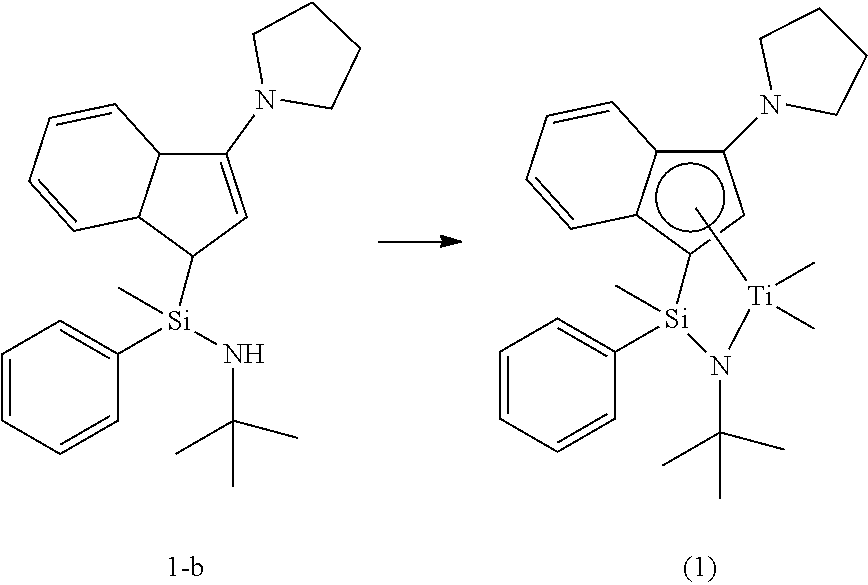
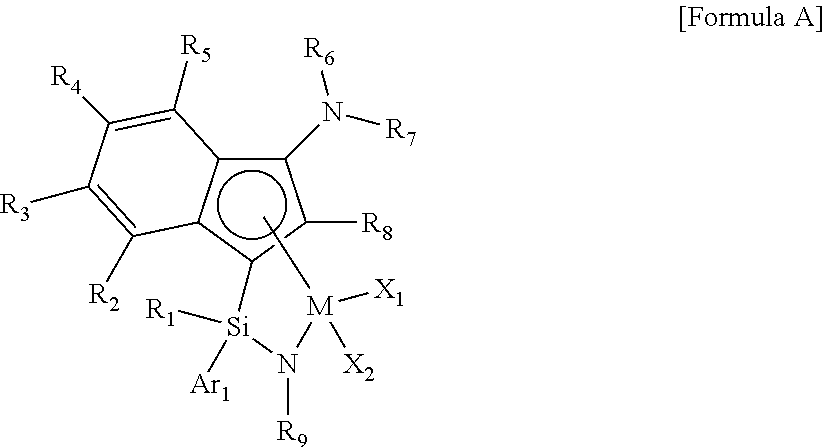
- the single active site catalyst may be represented by the following Formula A.
- the single active site catalyst is a transition metal compound based on an indenyl group having a nitrogen-containing substituent introduced thereto, and has a structure in which a Group 4 transition metal in the periodic table as a center metal is linked by an indene or the derivative group thereof having a rigid plane structure with abundant and widely delocalized electrons and a nitrogen-containing substituent introduced thereto; and an amido group having a substituted silyl group.
- the single active site catalyst has a structural characteristic including both an alkyl group or alkenyl group and an aryl group which induce improved solubility in a general hydrocarbon-based solvent, greatly increased activity at high temperature, and a narrow molecular weight distribution, not a broad molecular weight distribution which is a deficiency of diastereomers, in the silyl group linking the indene having a nitrogen-containing substituent introduced thereto or the derivative group thereof and the amido group, and thus, it is advantageous in obtaining elevated catalyst efficiency and a high molecular weight ethylene-based copolymer at a high temperature, in combination with the catalyst activator or the catalyst activator composition according to the invention.
- M is a Group 4 transition metal in the periodic table
- R 1 is (C1-C30)alkyl or (C2-C20)alkenyl, wherein the alkyl or alkenyl of R 1 may be further substituted by one or more substituents selected from the group consisting of halogen, (C6-C30)aryl, and (C1-C30)alkyl(C6-C30)aryl;
- Ar 1 is (C6-C30)aryl, wherein the aryl of Ar 1 may be further substituted by one or more substituents selected from the group consisting of (C1-C30)alkyl, halo(C1-C30)alkyl, and (C6-C30)aryl(C1-C30)alkyl;
- R 2 to R 5 are each independently hydrogen, (C1-C30)alkyl, (C1-C30)alkoxy, halo(C1-C30)alkyl, (C3-C20)cycloalkyl, (C1-C30)alkyl(C6-C30)aryl, (C6-C30)aryl, (C6-C30)aryloxy, (C1-C30)alkyl(C6-C30)aryloxy, (C6-C30)aryl(C1-C30)alkyl, or ((C1-C30)alkyl(C6-C30)aryl)(C1-C30)alkyl, or R 2 to R 5 are linked to an adjacent substituent to form a fused ring, wherein the fused ring may be further substituted by one or more substituents selected from the group consisting of (C1-C30)alkyl, (C1-C30)alkoxy, halo(C1-C30)
- R 9 is (C1-C30)alkyl, (C3-C20)cycloalkyl or (C6-C30)aryl(C1-C30)alkyl;
- R 6 and R 7 are each independently (C1-C30)alkyl, halo(C1-C30)alkyl, (C3-C20)cycloalkyl, (C6-C30)aryl, (C1-C30)alkyl(C6-C30)aryl, (C1-C30)alkoxy(C6-C30)aryl or (C6-C30)aryl(C1-C30)alkyl, or R 6 and R 7 may be linked to each other to form a ring, wherein the ring may be further substituted by one or more substituents selected from the group consisting of (C1-C30)alkyl, halo(C1-C30)alkyl, (C6-C30)aryl(C1-C30)alkyl, (C1-C30)alkoxy, (C3-C20)cycloalkyl, (C6-C20)aryl, (C1-C30)alkyl(C6-C30
- R 8 is hydrogen or (C1-C30)alkyl
- X 1 and X 2 are each independently halogen, (C1-C30)alkyl, (C2-C20)alkenyl, (C3-C20)cycloalkyl, (C6-C30)aryl, (C6-C30)aryl(C1-C30)alkyl, ((C1-C30)alkyl(C6-C30)aryl)(C1-C30)alkyl, (C1-C30)alkoxy, (C6-C30)aryloxy, (C1-C30)alkyl(C6-C30)aryloxy, (C1-C30)alkoxy(C6-C30)aryloxy, —OSiR a R b R c , —SR d , NR e R f , —PR g R h , or (C1-C30)alkylidene;
- R a to R d are each independently (C1-C30)alkyl, (C6-C20)aryl, (C6-C20)aryl(C1-C30)alkyl, (C1-C30)alkyl(C6-C20)aryl, or (C3-C20)cycloalkyl; and
- R e to R h are each independently (C1-C30)alkyl, (C6-C20)aryl, (C6-C20)aryl(C1-C30)alkyl, (C1-C30)alkyl(C6-C20)aryl, (C3-C20)cycloalkyl, tri(C1-C30)alkylsilyl, or tri(C6-C20)arylsilyl;
- An indene-based transition metal compound of the present invention is a single active site catalyst having a structural characteristic including both the alkyl group or alkenyl group and the aryl group in the silyl group linking the indenyl group having a nitrogen-containing substituent introduced thereto and the amido group, and thus, has a structural characteristic having both the merit of the alkyl group or alkenyl group which is advantageous in terms of activity and solubility, and the merit of the aryl group having a good injection property of a higher ⁇ -olefin.
- the catalysts developed in the present invention represent characteristics such as preparing a polymer having a narrow molecular weight distribution despite the presence of diastereomers at a ratio of 1:1 to 1:8, and representing high activity even at a high temperature, and is more synergistic in combination with the catalyst activator or catalyst activator composition of the present invention described above.
- the catalysts having diastereomers having an indenyl group and an amido group linked by a silyl group have a characteristic of a broad molecular weight distribution.
- the indene-based transition metal compound of the present invention and a catalyst activator or catalyst activator composition are used in combination, an ethylene-based copolymer having a narrow molecular weight distribution could be obtained at high temperature with a high yield.
- the catalyst may have a great commercial value, since a high molecular weight ethylene-based copolymer which suppresses the generation of isomers that make polymerization control difficult and has a characteristic of a narrow molecular weight distribution and a narrow composition distribution may be obtained; and an ethylene-based copolymer having a characteristic of a narrow molecular weight distribution and a broad chemical composition distribution may be obtained, by various combinations with the catalyst activator or the catalyst activator composition described above.
- the indene-based transition metal compound of Formula A may be represented by the following Formula B:
- R 2 to R 5 are each independently hydrogen, (C1-C30)alkyl, (C1-C30)alkoxy, halo(C1-C30)alkyl, (C3-C20)cycloalkyl, (C1-C30)alkyl(C6-C30)aryl, (C6-C30)aryl, (C6-C30)aryloxy, (C1-C30)alkyl(C6-C30)aryloxy, (C6-C30)aryl(C1-C30)alkyl, or ((C1-C30)alkyl(C6-C30)aryl)(C1-C30)alkyl, or R 2 to R 5 may be linked to an adjacent substituent by (C3-C7)alkylene, (C3-C7)alkenylene or (C4-C7)alkadienylene with or without an aromatic ring to form a fused ring, wherein the fused ring may be further substituted by one or more
- R 11 to R 15 are each independently hydrogen, (C1-C30)alkyl, halo(C1-C30)alkyl, or (C6-C30)aryl(C1-C30)alkyl.
- M is a Group 4 transition metal in the periodic table, and specifically, may be titanium (Ti), zirconium (Zr) or hafnium (Hf), and more specifically, titanium (Ti) or zirconium (Zr).
- the (C1-30)alkyl group is, for example, a methyl group, an ethyl group, an n-propyl group, an isopropyl group, an n-butyl group, an isobutyl group, a sec-butyl group, a tert-butyl group, an n-pentyl group, a neopentyl group, an amyl group, an n-hexyl group, an n-octyl group, an n-decyl group, an n-dodecyl group or an n-pentadecyl group;
- the (C2-C20)alkenyl group is, for example, a vinyl group or an allyl group;
- the (C3-C20)cycloalkyl group is, for example, a cyclopropyl group, a cyclobutyl group, a cyclopentyl group, a cyclohex
- R 6 and R 7 are each independently (C1-C30)alkyl, (C3-C20)cycloalkyl or (C6-C30)aryl, or R 6 and R 7 may be linked to (C3-C7)alkylene with or without an aromatic ring to form a ring, wherein the formed ring may be further substituted by one or more substituents selected from the group consisting of (C1-C30)alkyl, (C6-C30)aryl(C1-C30)alkyl, (C1-C30)alkoxy, (C3-C20)cycloalkyl, (C6-C20)aryl, (C1-C30)alkyl(C6-C30)aryl and (C6-C20)aryloxy.
- R 1 may be (C1-C30)alkyl, (C2-C20)alkenyl or (C6-C30)aryl(C1-C30)alkyl;
- Ar 1 may be (C6-C30)aryl or (C1-C30)alkyl(C6-C30)aryl;
- R 2 to R 5 may be each independently hydrogen, (C1-C30)alkyl, (C1-C30)alkoxy, (C1-C30)alkyl(C6-C30)aryl, (C6-C30)aryl, (C6-C30)aryloxy, (C1-C30)alkyl(C6-C30)aryloxy or (C6-C30)aryl(C1-C30)alkyl, or R 2 to
- R 1 may be more specifically a methyl group, an ethyl group, an n-propyl group, an isopropyl group, an n-butyl group, a vinyl group, an allyl group or a benzyl group;
- Ar 1 may be more specifically a phenyl group, a naphthyl group, a biphenyl group, a tolyl group, a trimethylphenyl group, a butylphenyl group, a pentylphenyl group, a hexylphenyl group, an octylphenyl group, a decylphenyl group, a dodecylphenyl group or a tetradecylphenyl group; R 2 to R 5
- R 21 to R 24 may be each independently hydrogen, a methyl group, an ethyl group, an n-propyl group, an isopropyl group, an n-butyl group, an isobutyl group, a 2-methylbutyl group, a sec-butyl group, a tert-butyl group, an n-pentyl group, a neopentyl group, an amyl group, an n-hexyl group, an n-octyl group, an n-decyl group, an n-dodecyl group, an n-pentadecyl group, a phenyl group, a 2-tolyl group, a 3-tolyl group, a 4-tolyl group, a 2,3-xylyl group, a 2,4-xylyl group, a 2,5-xylyl group, a 2,6-xylyl group
- R 31 to R 35 , R 41 and R 42 may be each independently hydrogen, a methyl group, an ethyl group, an n-propyl group, an isopropyl group, an n-butyl group, an isobutyl group, a 2-methylbutyl group, a sec-butyl group, a tert-butyl group, an n-pentyl group, a neopentyl group, an amyl group, an n-hexyl group, an n-octyl group, an n-decyl group, an n-dodecyl group, an n-pentadecyl group, a phenyl group, a 2-tolyl group, a 3-tolyl group, a 4-tolyl group, a 2,3-xylyl group, a 2,4-xylyl group, a 2,5-xylyl group, a 2,6-
- the halogen atom may be exemplified as fluorine, chlorine, bromine, or iodine
- the (C1-C30)alkyl group may be exemplified as a methyl group, an ethyl group, an n-propyl group, an isopropyl group, an n-butyl group, a sec-butyl group, a tert-butyl group, an n-pentyl group, a neopentyl group, an amyl group, an n-hexyl group, an n-octyl group, an n-decyl group, an n-dodecyl group, an n-pentadecyl group, or an n-eicosyl group;
- the (C3-C20)cycloalkyl group may be exemplified as a cyclopropane group, a cyclobutyl
- X 1 and X2 may be each independently halogen, (C1-C30)alkyl, (C3-C20)cycloalkyl, (C6-C30)aryl, (C6-C30)aryl(C1-C30)alkyl, (C1-C30)alkoxy, (C6-C30)aryloxy, (C1-C30)alkyl(C6-C30)aryloxy, —OSiR a R b R c , —SR d , —NR e R f , or —PR g R h ; and R a to R h may be each independently (C1-C30)alkyl or (C6-C20)aryl.
- X 1 and X2 may be each independently fluorine, chlorine, bromine, a methyl group, an ethyl group, an isopropyl group, an amyl group, a benzyl group, a methoxy group, an ethoxy group, an isopropoxy group, a tert-butoxy group, a phenoxy group, a 4-tert-butylphenoxy group, a trimethylsiloxy group, a tert-butyldimethylsiloxy group, a dimethylamino group, a diphenylamino group, a dimethylphosphine group, a diethylphosphine group, a diphenylphosphine group, an ethylthio group,
- M is tetravalent titanium, zirconium or hafnium;
- R 1 is (C1-C30)alkyl;
- R 11 to R 15 are each independently hydrogen or (C1-C30)alkyl;
- R 2 to R 5 are each independently hydrogen or (C1-C30)alkyl, or R 2 to R 5 may be linked to an adjacent substituent by
- R 21 to R 24 are each independently hydrogen or (C1-C30)alkyl
- R 6 and R 7 are each independently (C1-C30)alkyl, or R 6 and R 7 may be linked to
- R 31 to R 35 , R 41 and R 42 are each independently hydrogen or (C1-C30)alkyl; m and n are each independently an integer of 1 to 4; R 9 is (C1-C30)alkyl or (C3-C20)cycloalkyl; X 1 and X 2 follow the description of the paragraph above; and R a to R h may be each independently (C1-C30)alkyl or (C6-C20)aryl.
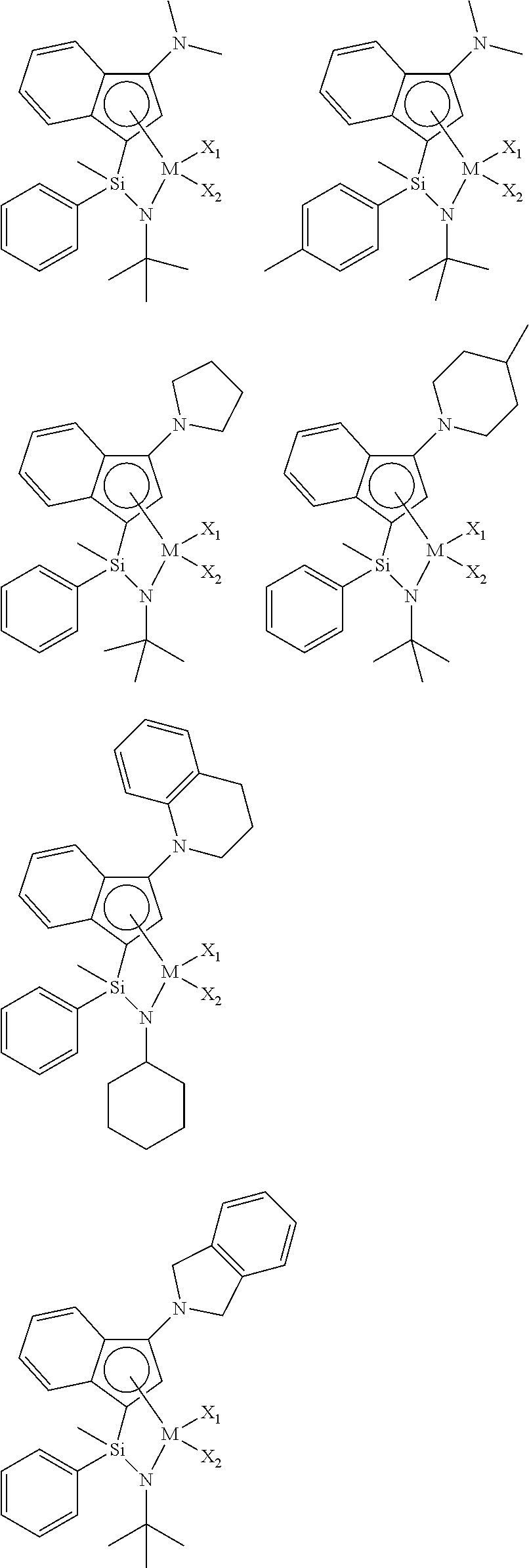
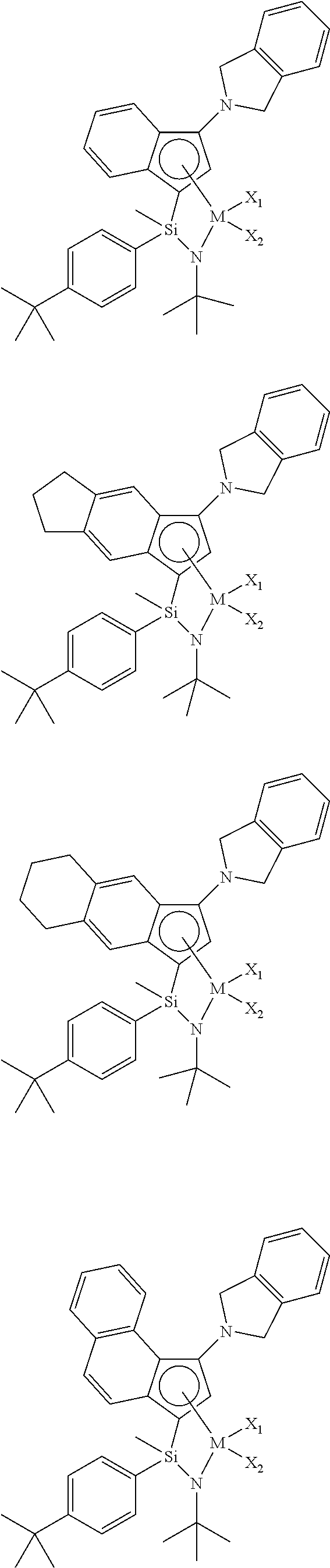
- the indene-based transition metal compound of Formula B may be selected from the compounds having the following structures, but is not limited thereto:
- M is tetravalent titanium, zirconium or hafnium
- X 1 and X 2 are each independently fluorine, chlorine, bromine, a methyl group, an ethyl group, an isopropyl group, an amyl group, a benzyl group, a methoxy group, an ethoxy group, an isopropoxy group, a tert-butoxy group, a phenoxy group, a 4-tert-butylphenoxy group, a trimethylsiloxy group, a tert-butyldimethylsiloxy group, a dimethylamino group, a diphenylamino group, a dimethylphosphine group, a diethylphosphine group, a diphenylphosphine group, an ethylthio group, or an isopropylthio group.
- the indene-based transition metal compound according to the present invention may preferably operate together with an aluminum compound, a boron compound, or a mixture thereof which may extract an X 1 or X 2 ligand in the transition metal complex to cationize a center metal, while acting as a counter ion, i.e., an anion having weak binding force, as a cocatalyst, in order to be an active catalyst component which is used for preparation of an ethylene-based polymer selected from the group consisting of an ethylene homopolymer and an ethylene- ⁇ -olefin copolymer, and various combinations of the indene-based transition metal compound described above and a catalyst activator or a catalyst activator composition, an aluminum compound, a boron compound or a mixture thereof are also within the scope of the present invention.
- an aluminum compound, a boron compound, or a mixture thereof which may extract an X 1 or X 2 ligand in the transition metal complex to cationize a center metal, while acting as
- the aluminum compound may be used as the cocatalyst, and specifically, examples thereof may be one or two or more selected from the group consisting of an aluminoxane compound of the following Formula C or Formula D; an organoaluminum compound of Formula E; and an organoaluminum oxide compound of Formula F or Formula G: (—Al(R 51 )—O—) p [Formula C] (R 51 ) 2 Al—O—Al(R 51 ) 2 [Formula D] (R 52 ) 3-r Al(E) r [Formula E] (R 53 ) 2 AlOR 54 [Formula F] R 53 Al(OR 54 ) 2 [Formula G]
- R 51 is (C1-C30)alkyl, preferably a methyl group or an isobutyl group, p is an integer selected from 5 to 20; R 52 and R 53 are each independently (C1-C30)alkyl; E is hydrogen or halogen; r is an integer selected from 0 to 3; and R 54 is (C1-C30)alkyl or (C6-C30)aryl.
- the aluminum compound may be one or a mixture of two or more selected from alkylaluminoxane and organoaluminum.
- a specific example which may be used as the aluminum compound may include methylaluminoxane, modified methylaluminoxane, and tetraisobutylaluminoxane as an aluminoxane compound; trialkylaluminum including trimethylaluminum, triethylaluminum, tripropylaluminum, triisobutylaluminum and trihexylaluminum; dialkylaluminumchloride including dimethylaluminumchloride, diethylaluminumchloride, dipropylaluminum chloride, diisobutylaluminumchloride and dihexylaluminumchloride; alkylaluminumdichloride including methylaluminumdichloride, ethylaluminumdichloride, propylaluminumdichloride, isobutylaluminumdichloride and hexylaluminumdichloride; dialkylaluminum hydr
- the aluminum compound may be one or a mixture of two or more selected from the group consisting of an alkylaluminoxane and organoaluminum, and most specifically, one or a mixture of two or more selected from the group consisting of methylaluminoxane, modified methylaluminoxane, tetraisobutylaluminoxane, trimethylaluminum, triethylaluminum, trioctylaluminum, and triisobutylaluminum.
- the aluminum compound may serve as a scavenger which removes impurities acting as a poison to the catalyst in the reactant.
- a preferred range of the ratio between the indene-based transition metal compound of the present invention and a tetraarylborate compound as a catalyst activator may be 1:0.1 to 100, based on a mole ratio of the transition metal (M):boron atom (B).
- a preferred range of the ratio between the indene-based transition metal compound of the present invention and an aluminum compound as a cocatalyst may be 1:1 to 2,000, based on a mole ratio of the transition metal (M):aluminum atom (Al).
- a preferred range of the ratio of the indene-based transition metal compound of the present invention, a tetraarylborate compound and an aluminum compound may be 1:0.1 to 100:1 to 2,000, preferably in a range of 1:0.5 to 30:10 to 1,000, more preferably in a range of 1:0.5 to 5:10 to 500, based on a mole ratio of the center metal (M):boron atom (B):aluminum atom (Al).
- the ratio of the indene-based transition metal compound of the present invention described above, a tetraarylborate compound and an aluminum compound is out of the above range, the amount of the cocatalyst is relatively small, such that activation of the transition metal compound is not completely achieved.
- the catalyst activity of the indene-based transition metal compound may not be sufficient, or the cocatalyst is used more than necessary to greatly increase production costs.
- excellent catalyst activity for preparing an ethylene homopolymer or an ethylene- ⁇ -olefin copolymer is represented, however, the range of the ratios may vary within the above range depending on the purity of the reaction.
- Another aspect of the present invention for achieving the above object relates to a method for preparing an ethylene-based polymer selected from the group consisting of an ethylene homopolymer and an ethylene- ⁇ -olefin copolymer, using the transition metal catalyst composition for preparing an ethylene homopolymer or an ethylene- ⁇ -olefin copolymer.
- the method for preparing the ethylene-based polymer using the transition metal catalyst composition for preparing an ethylene homopolymer or an ethylene- ⁇ -olefin copolymer may proceed by bringing the indene-based transition metal catalyst, the catalyst activator, the cocatalyst, and ethylene or an ⁇ -olefin comonomers into contact in the presence of a suitable organic solvent.
- the indene-based transition metal catalyst, the catalyst activator, the cocatalyst components, and the like may be added to a reactor separately, or each component may be mixed previously and added to a reactor, and mixing conditions such as an addition order, temperature or concentration are not particularly limited.
- the catalyst activator may include a tetraarylborate compound represented by Formula 1, and the cocatalyst may be one or a mixture of two or more selected from the group consisting of the aluminum compound and boron compound described above.
- the method for preparing an ethylene homopolymer or an ethylene- ⁇ -olefin copolymer may include: a) injecting a catalyst activator composition including the tetraarylborate compound represented by Formula 1 and an organic solvent used in the preparation step of the tetraarylborate compound, without a separation process; b) injecting a single active site catalyst solution including a Group 4 transition metal; c) injecting an aluminum compound solution; and d) injecting ethylene.
- the tetraarylborate compound in a dissolved state is injected into the organic solvent used in the preparation step, which is advantageous in the continuous solution process, and is capable of solving the disadvantages caused by a solid catalyst activator.
- an aromatic hydrocarbon-based solvent such as toluene may not be used.
- the method for preparing an ethylene homopolymer or an ethylene- ⁇ -olefin copolymer according to an exemplary embodiment of the present invention may further include e) injecting ⁇ -olefins.
- a preferred organic solvent which may be used in the preparation method of the present invention may be an aliphatic hydrocarbon-based solvent, (C3-C20) hydrocarbons, and a specific example thereof may be one or a mixed solvent of two or ore more selected from linear aliphatic hydrocarbon-based solvents such as butane, isobutane, pentane, hexane, heptane, octane, isooctane, nonane, decane and dodecane; and cyclic aliphatic hydrocarbon-based solvents such as cyclopentane, methylcyclopentane, cyclohexane, and methylcyclohexane.
- linear aliphatic hydrocarbon-based solvents such as butane, isobutane, pentane, hexane, heptane, octane, isooctane, nonane, decane and dodecane
- the organic solvent which may be used in the preparation method may be an aromatic hydrocarbon-based solvent.
- ethylene when the ethylene homopolymer is prepared, ethylene is used alone as a monomer, in which appropriate ethylene pressure may be 1 to 1,000 atm, more preferably 6 to 150 atm.
- ethylene pressure may be 1 to 1,000 atm, more preferably 6 to 150 atm.
- a polymerization reaction temperature of 25° C. to 220° C., preferably 70° C. to 220° C., and more preferably 100° C. to 220° C. is effective.
- C3-C18 ⁇ -olefins when an ethylene- ⁇ -olefin copolymer is prepared, C3-C18 ⁇ -olefins; C4-C20 diolefins; C5-C20 cycloolefins or cyclodiolefins; styrene and a derivative thereof may be used as a comonomer together with ethylene.
- C3-C18 ⁇ -olefins may be selected from the group consisting of propylene, 1-butene, 1-pentene, 4-methyl-1-pentene, 1-hexene, 1-octene, 1-decene, 1-dodecene, 1-hexadecene, and 1-octadecene
- a preferred example of C4-C20 diolefins may be selected from the group consisting of 1,3-butadiene, 1,4-pentadiene and 2-methyl-1,3-butadiene
- a preferred example of C5-C20 cycloolefins or cyclodiolefins may be selected from the group consisting of cyclopentene, cyclohexene, cyclopentadiene, cyclohexadiene, norbornene, 5-vinylidene-2-norbornene(VNB), 5-methylene-2-norbornene(MNB)
- the olefin described above may be homopolymerized or two or more olefins may be copolymerized.
- preferred ethylene pressure and polymerization reaction temperature may be identical to those in the preparation of the ethylene homopolymer, and the ethylene-based copolymer prepared according to the method of the present invention usually contains in the range of 30 wt % or more of ethylene, preferably 60 wt % or more of ethylene, and more preferably 60 to 99 wt % of ethylene.
- polymers in a scope from an elastomer to a high density polyethylene (HDPE), having a density of 0.850 g/cc to 0.960 g/cc and a melt flow rate of 0.001 to 2,000 dg/min may be easily and economically prepared, by appropriately using ethylene and C3-C10 ⁇ -olefins as a comonomer.
- HDPE high density polyethylene
- an ethylene/propylene (EP) elastomer and an ethylene/propylene/diene (EPDM) elastomer may be well prepared, using the transition metal catalyst composition of the present invention.
- EP ethylene/propylene
- EPDM ethylene/propylene/diene
- an EPDM product having a Mooney viscosity (ASTM D1646-94, ML1+4@125° C.) adjusted to 1 to 250, preferably 10 to 200 may be easily prepared in an economical manner.
- hydrogen may be used as a molecular weight regulator, and the polymer usually has a weight average molecular weight (Mw) in a range of 5,000 to 1,000,000 g/mol.
- the transition metal catalyst composition presented in the present invention is present in a homogeneous form in a polymerization reactor, it is preferred to apply the transition metal catalyst composition to a solution polymerization process which is carried out at a temperature equal to or more than a melting point of the polymer.
- the catalyst composition may also be used in a slurry polymerization or gas phase polymerization process as a heterogeneous catalyst system by supporting the indene-based transition metal compound, the catalyst activator and the cocatalyst on a porous metal oxide support.
- Cyclohexane as a polymerization solvent was used after sufficiently removing moisture, oxygen, and other catalyst poisoning materials therefrom by passing cyclohexane through a 5 ⁇ molecular sieve and a tube filled with active alumina, and bubbling cyclohexane with high purity nitrogen.
- the polymerized polymer was analyzed by the method described below:
- MI Melt Flow Index
- Copolymerization of ethylene and 1-octene was carried out using continuous polymerization equipment, as follows: The Complex 1 synthesized in Preparation Example 1 was used as a single active site catalyst, cyclohexane was used as a solvent, and the used amount of the catalyst was as described in the following Table 1.
- Ti input represents Complex 1 input synthesized in Preparation Example 1
- Al input represents triisobutylaluminum input
- the catalyst activator input represents N-octadecyl-N-octadecylideneanilinium tetrakis(pentafluorophenyl) borate input synthesized in Example 1, respectively.
- Copolymerization of ethylene and 1-octene was carried out using continuous polymerization equipment, as follows: The Complex 1 synthesized in Preparation Example 1 was used as a single active site catalyst, cyclohexane was used as a solvent, and the used amount of the catalyst was as described in the following Table 1.
- Ti input represents Complex 1 input synthesized in Preparation Example 1
- Al input represents triisobutylaluminum input
- the catalyst activator input represents trityl tetrakis(pentafluorophenyl) borate (TTB) input, respectively.
- Example 1 Polymerization Single active site catalyst Preparation Preparation conditions
- Example 1 (Complex 1) (Complex 1) Catalyst activator Example 1
- TTB Total solution flow rate 5 5 (Kg/h) Ethylene input (wt %) 10 10 Input mole ratio of 1-octene 1.5 1.5 and ethylene (1-C8/C2) Ti input ( ⁇ mol/kg) 6.4 10 Al input ( ⁇ mol/kg) 200 200 Catalyst activator input 19 30 ( ⁇ mol/kg) Reaction temperature (° C.) 180 180 Polymerization C2 conversion rate (%) 90 90 results MI 0.28 0.32 Density (g/cc) 0.885 0.887 Ti: refers to Ti in the single active site catalyst (Preparation Example 1)
- Al refers to Al in a cocatalyst, an aluminum compound, i.e., triisobutylaluminum.
- Example 1 N-octadecyl-N-octadecylideneanilinium tetrakis(pentafluorophenyl) borate) or TTB (trityl tetrakis(pentafluorophenyl) borate).
- Example 2 in which polymerization was carried out with the catalyst composition according to the present invention was able to easily prepare a high molecular weight ethylene-based copolymer having a high conversion rate of ethylene, low density and a low MI value meaning a high molecular weight even under the condition of high temperature (180° C. or more).
- Example 2 showed an equivalent level of ethylene conversion despite the use of a small amount of catalyst as compared to Comparative Example 1, so that the catalyst composition according to the present invention exerted an excellent effect on the activation of a single active site catalyst.
- a novel tetraarylborate compound according to the present invention may be dissolved in an aliphatic hydrocarbon-based solvent such as cyclohexane, but not an aromatic hydrocarbon-based solvent, depending on the selection of the cation of the alkylideneanilinium structure. Due to such solubility, the transition metal catalyst composition according to the present invention may not only facilitate the operation of a commercial process by providing a solution-type catalyst activator including an aliphatic hydrocarbon-based solution but also solve the disadvantages caused by the solid catalyst activator.
Landscapes
- Chemical & Material Sciences (AREA)
- Organic Chemistry (AREA)
- Health & Medical Sciences (AREA)
- Chemical Kinetics & Catalysis (AREA)
- Medicinal Chemistry (AREA)
- Polymers & Plastics (AREA)
- Engineering & Computer Science (AREA)
- Materials Engineering (AREA)
- Crystallography & Structural Chemistry (AREA)
- Transition And Organic Metals Composition Catalysts For Addition Polymerization (AREA)
- Organic Low-Molecular-Weight Compounds And Preparation Thereof (AREA)
- Addition Polymer Or Copolymer, Post-Treatments, Or Chemical Modifications (AREA)
Abstract
Description





to form a fused ring, R21 to R24 may be each independently hydrogen, a methyl group, an ethyl group, an n-propyl group, an isopropyl group, an n-butyl group, an isobutyl group, a 2-methylbutyl group, a sec-butyl group, a tert-butyl group, an n-pentyl group, a neopentyl group, an amyl group, an n-hexyl group, an n-octyl group, an n-decyl group, an n-dodecyl group, an n-pentadecyl group, a phenyl group, a 2-tolyl group, a 3-tolyl group, a 4-tolyl group, a 2,3-xylyl group, a 2,4-xylyl group, a 2,5-xylyl group, a 2,6-xylyl group, a 3,4-xylyl group, a 3,5-xylyl group, a 2,3,4-trimethylphenyl group, a 2,3,5-trimethylphenyl group, a 2,3,6-trimethylphenyl group, a 2,4,6-trimethylphenyl group, a 3,4,5-trimethylphenyl group, a 2,3,4,5-tetramethylphenyl group, a 2,3,4,6-tetramethylphenyl group, a 2,3,5,6-tetramethylphenyl group, a pentamethylphenyl group, an ethylphenyl group, an n-propylphenyl group, an isopropylphenyl group, an n-butylphenyl group, a sec-butylphenyl group, a tert-butylphenyl group, an n-pentylphenyl group, a neopentylphenyl group, an n-hexylphenyl group, an n-octylphenyl group, an n-decylphenyl group, an n-dodecylphenyl group, an n-tetradecylphenyl group, a biphenyl group, a fluorenyl group, a triphenyl group, a naphthyl group, an anthracenyl group, a benzyl group, a (2-methylphenyl)methyl group, a (3-methylphenyl)methyl group, a (4-methylphenyl)methyl group, a (2,3-dimethylphenyl)methyl group, a (2,4-dimethylphenyl)methyl group, a (2,5-dimethylphenyl)methyl group, a (2,6-dimethylphenyl)methyl group, a (3,4-dimethylphenyl)methyl group, a (4,6-dimethylphenyl)methyl group, a (2,3,4-trimethylphenyl)methyl group, a (2,3,5-trimethylphenyl)methyl group, a (2,3,6-trimethylphenyl)methyl group, a (3,4,5-trimethylphenyl)methyl group, a (2,4,6-trimethylphenyl)methyl group, a (2,3,4,5-tetramethylphenyl)methyl group, a (2,3,4,6-tetramethylphenyl)methyl group, a (2,3,5,6-tetramethylphenyl) methyl group, a (pentamethylphenyl)methyl group, an (ethylphenyl)methyl group, an (n-propylphenyl)methyl group, an (isopropylphenyl)methyl group, an (n-butylphenyl)methyl group, a (sec-butylphenyl)methyl group, a (tert-butylphenyl)methyl group, an (n-pentylphenyl)methyl group, an (neopentylphenyl)methyl group, an (n-hexylphenyl)methyl group, an (n-octylphenyl)methyl group, an (n-decylphenyl)methyl group, an (n-tetradecylphenyl)methyl group, a naphthylmethyl group or an anthracenylmethyl group; R9 may be an isopropyl group, an n-butyl group, an isobutyl group, a 2-methylbutyl group, a sec-butyl group, a tert-butyl group, an n-pentyl group, a cyclopropyl group, a cyclobutyl group, a cyclopentyl group, a benzyl group or a diphenylmethyl group; R6 and R7 may be each independently a methyl group, an ethyl group, an n-propyl group, an isopropyl group, an n-butyl group, an isobutyl group, a 2-methylbutyl group, a sec-butyl group, a tert-butyl group, an n-pentyl group, a neopentyl group, an amyl group, an n-hexyl group, an n-octyl group, an n-decyl group, an n-dodecyl group, an n-pentadecyl group, a phenyl group, a 2-tolyl group, a 3-tolyl group, a 4-tolyl group, a 2,3-xylyl group, a 2,4-xylyl group, a 2,5-xylyl group, a 2,6-xylyl group, a 3,4-xylyl group, a 3,5-xylyl group, a 2,3,4-trimethylphenyl group, a 2,3,5-trimethylphenyl group, a 2,3,6-trimethylphenyl group, a 2,4,6-trimethylphenyl group, a 3,4,5-trimethylphenyl group, a 2,3,4,5-tetramethylphenyl group, a 2,3,4,6-tetramethylphenyl group, a 2,3,5,6-tetramethylphenyl group, a pentamethylphenyl group, an ethylphenyl group, an n-propylphenyl group, an isopropylphenyl group, an n-butylphenyl group, a sec-butylphenyl group, a tert-butylphenyl group, an n-pentylphenyl group, a neopentylphenyl group, an n-hexylphenyl group, an n-octylphenyl group, an n-decylphenyl group, an n-dodecylphenyl group, an n-tetradecylphenyl group, a biphenyl group, a fluorenyl group, a triphenyl, group, a naphthyl group, an anthracenyl group, a benzyl group, a naphthylmethyl group, an anthracenylmethyl group, or a 4-methoxyphenyl group, or R6 and R7 may be linked to
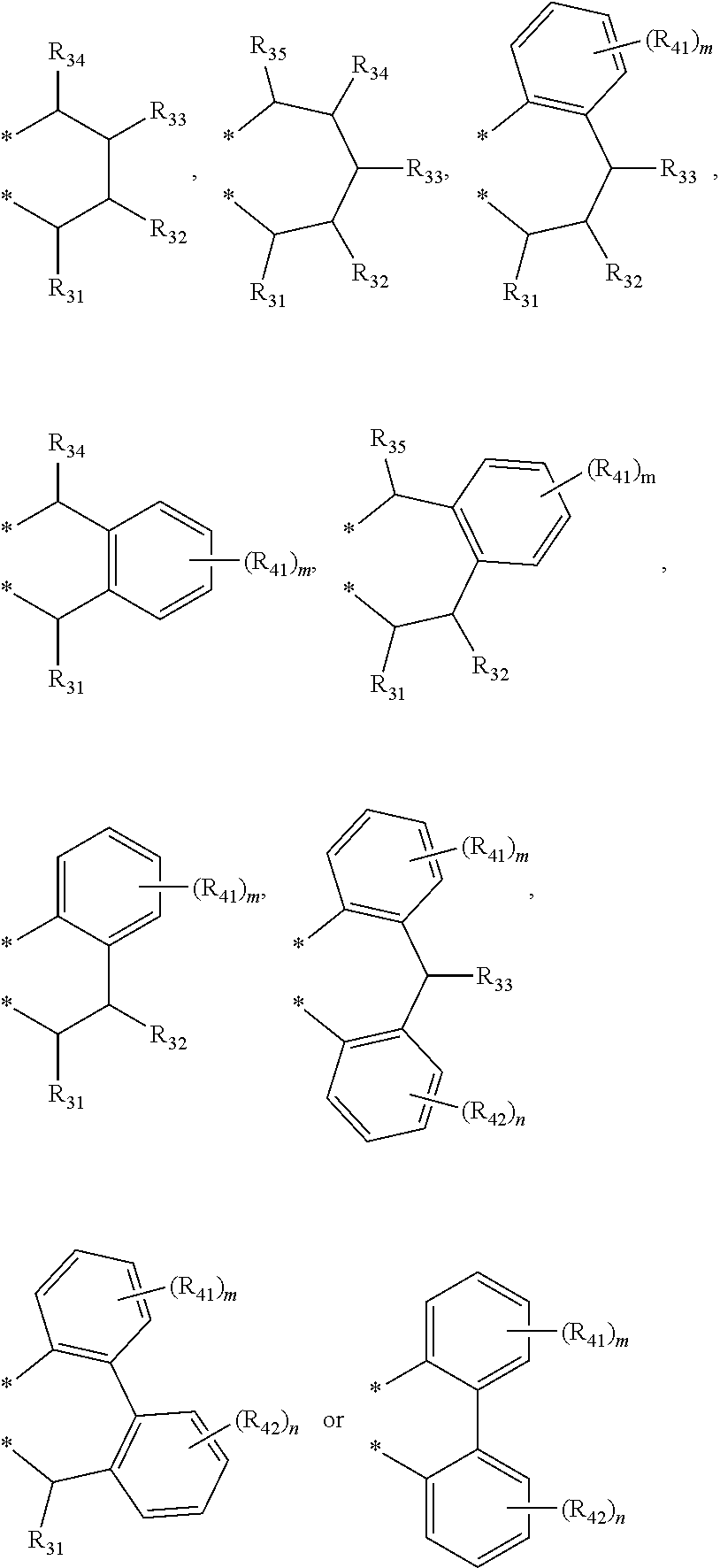
to form a ring; R31 to R35, R41 and R42 may be each independently hydrogen, a methyl group, an ethyl group, an n-propyl group, an isopropyl group, an n-butyl group, an isobutyl group, a 2-methylbutyl group, a sec-butyl group, a tert-butyl group, an n-pentyl group, a neopentyl group, an amyl group, an n-hexyl group, an n-octyl group, an n-decyl group, an n-dodecyl group, an n-pentadecyl group, a phenyl group, a 2-tolyl group, a 3-tolyl group, a 4-tolyl group, a 2,3-xylyl group, a 2,4-xylyl group, a 2,5-xylyl group, a 2,6-xylyl group, a 3,4-xylyl group, a 3,5-xylyl group, a 2,3,4-trimethylphenyl group, a 2,3,5-trimethylphenyl group, a 2,3,6-trimethylphenyl group, a 2,4,6-trimethylphenyl group, a 3,4,5-trimethylphenyl group, a 2,3,4,5-tetramethylphenyl group, a 2,3,4,6-tetramethylphenyl group, a 2,3,5,6-tetramethylphenyl group, a pentamethylphenyl group, an ethylphenyl group, an n-propylphenyl group, an isopropylphenyl group, an n-butylphenyl group, a sec-butylphenyl group, a tert-butylphenyl group, an n-pentylphenyl group, a neopentylphenyl group, an n-hexylphenyl group, an n-octylphenyl group, an n-decylphenyl group, an n-dodecylphenyl group, an n-tetradecylphenyl group, a biphenyl group, a fluorenyl group, a triphenyl group, a naphthyl group, an anthracenyl group, a benzyl group, a naphthylmethyl group or an anthracenylmethyl group; m and n may be each independently an integer of 1 to 4; and R8 may be hydrogen, a methyl group, an ethyl group, an n-propyl group, an isopropyl group, an n-butyl group, an isobutyl group, a 2-methylbutyl group or a sec-butyl group.

to form a fused ring; R21 to R24 are each independently hydrogen or (C1-C30)alkyl; R6 and R7 are each independently (C1-C30)alkyl, or R6 and R7 may be linked to
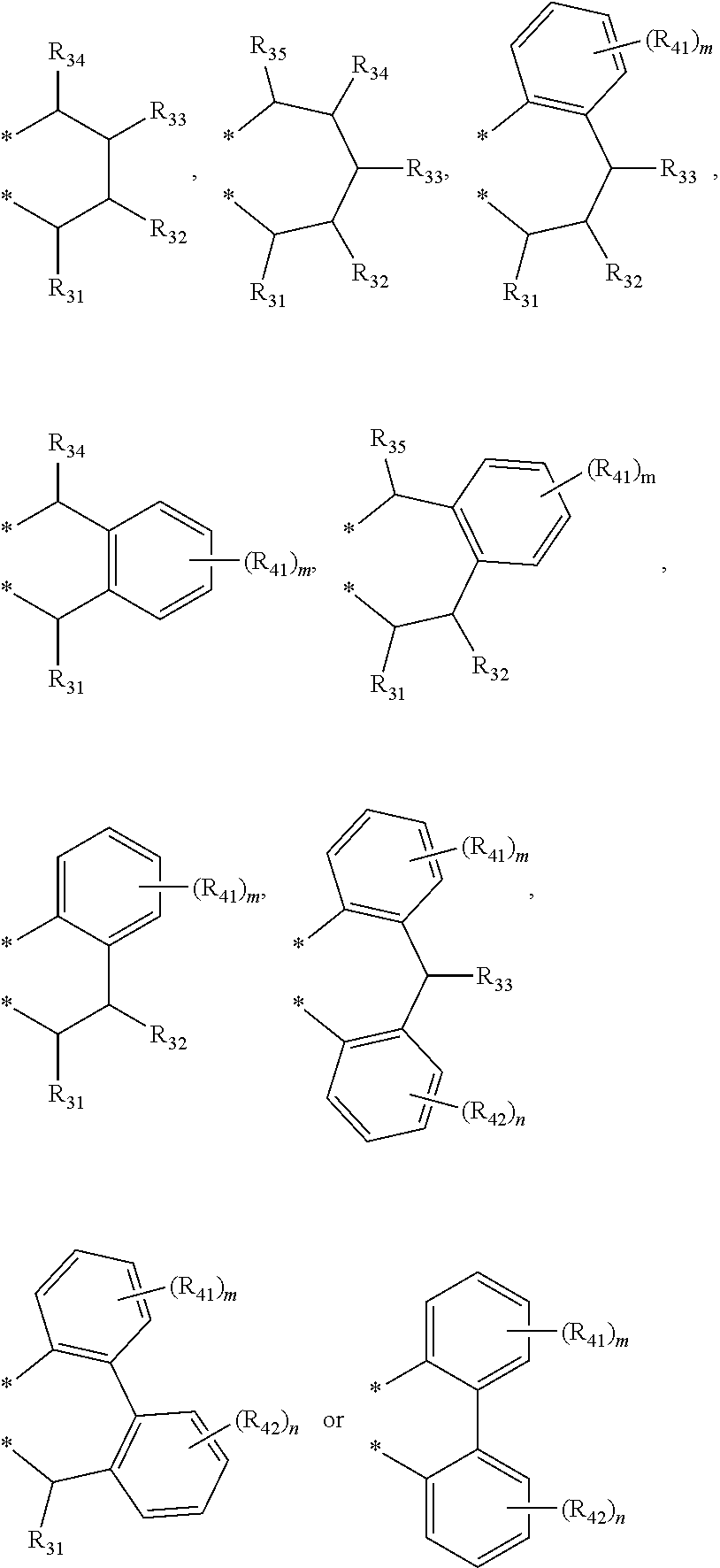
to form a ring; R31 to R35, R41 and R42 are each independently hydrogen or (C1-C30)alkyl; m and n are each independently an integer of 1 to 4; R9 is (C1-C30)alkyl or (C3-C20)cycloalkyl; X1 and X2 follow the description of the paragraph above; and Ra to Rh may be each independently (C1-C30)alkyl or (C6-C20)aryl.
(—Al(R51)—O—)p [Formula C]
(R51)2Al—O—Al(R51)2 [Formula D]
(R52)3-rAl(E)r [Formula E]
(R53)2AlOR54 [Formula F]
R53Al(OR54)2 [Formula G]
| TABLE 1 | |||
| Comp. | |||
| Example 2 | Example 1 | ||
| Polymerization | Single active site catalyst | Preparation | Preparation |
| conditions | Example 1 | Example 1 | |
| (Complex 1) | (Complex 1) | ||
| Catalyst activator | Example 1 | TTB | |
| Total solution flow rate | 5 | 5 | |
| (Kg/h) | |||
| Ethylene input (wt %) | 10 | 10 | |
| Input mole ratio of 1-octene | 1.5 | 1.5 | |
| and ethylene | |||
| (1-C8/C2) | |||
| Ti input (μmol/kg) | 6.4 | 10 | |
| Al input (μmol/kg) | 200 | 200 | |
| Catalyst activator input | 19 | 30 | |
| (μmol/kg) | |||
| Reaction temperature (° C.) | 180 | 180 | |
| Polymerization | C2 conversion rate (%) | 90 | 90 |
| results | MI | 0.28 | 0.32 |
| Density (g/cc) | 0.885 | 0.887 | |
| Ti: refers to Ti in the single active site catalyst (Preparation Example 1) | |||
| Al: refers to Al in a cocatalyst, an aluminum compound, i.e., triisobutylaluminum. | |||
| B: refers to B in an activator, Example 1 (N-octadecyl-N-octadecylideneanilinium tetrakis(pentafluorophenyl) borate) or TTB (trityl tetrakis(pentafluorophenyl) borate). | |||
Claims (15)
Applications Claiming Priority (5)
| Application Number | Priority Date | Filing Date | Title |
|---|---|---|---|
| KR20190024356 | 2019-02-28 | ||
| KR10-2019-0024356 | 2019-02-28 | ||
| KR10-2020-0020828 | 2020-02-20 | ||
| KR1020200020828A KR102714698B1 (en) | 2019-02-28 | 2020-02-20 | Novel tetraaryl borate compounds, catalysts composition containing the same, and methods for preparing ethylene homopolymers or copolymers of ethylene and α-olefins using the same |
| PCT/IB2020/051519 WO2020174346A1 (en) | 2019-02-28 | 2020-02-24 | NOVEL TETRAARYLBORATE COMPOUND, CATALYST COMPOSITION COMPRISING SAME, AND METHOD FOR PREPARING ETHYLENE HOMOPOLYMERS OR COPOLYMERS OF ETHYLENE AND α-OLEFIN BY USING SAME |
Publications (2)
| Publication Number | Publication Date |
|---|---|
| US20220089790A1 US20220089790A1 (en) | 2022-03-24 |
| US12221509B2 true US12221509B2 (en) | 2025-02-11 |
Family
ID=72472030
Family Applications (1)
| Application Number | Title | Priority Date | Filing Date |
|---|---|---|---|
| US17/433,268 Active 2042-04-22 US12221509B2 (en) | 2019-02-28 | 2020-02-24 | Tetraarylborate compound, catalyst composition comprising same, and method for preparing ethylene homopolymers or copolymers of ethylene and a-olefin by using same |
Country Status (9)
| Country | Link |
|---|---|
| US (1) | US12221509B2 (en) |
| EP (1) | EP3904360B1 (en) |
| JP (1) | JP7164929B2 (en) |
| KR (1) | KR102714698B1 (en) |
| CN (1) | CN113677686B (en) |
| CA (1) | CA3120265C (en) |
| ES (1) | ES2989772T3 (en) |
| SA (1) | SA521422210B1 (en) |
| TW (1) | TWI812846B (en) |
Families Citing this family (1)
| Publication number | Priority date | Publication date | Assignee | Title |
|---|---|---|---|---|
| KR102744394B1 (en) * | 2021-12-03 | 2024-12-19 | 한국화학연구원 | Method for producing gradient copolymer for optical flim |
Citations (20)
| Publication number | Priority date | Publication date | Assignee | Title |
|---|---|---|---|---|
| JPS6392621A (en) | 1986-10-08 | 1988-04-23 | Mitsubishi Petrochem Co Ltd | Manufacturing method of ethylene copolymer |
| US4752597A (en) | 1985-12-12 | 1988-06-21 | Exxon Chemical Patents Inc. | New polymerization catalyst |
| EP0320762A2 (en) | 1987-12-18 | 1989-06-21 | Hoechst Aktiengesellschaft | Process for the preparation of a chiral, stereorigid metallocen compound |
| JPH0284405A (en) | 1988-09-20 | 1990-03-26 | Mitsubishi Petrochem Co Ltd | Production method of ethylene polymer |
| EP0372632A1 (en) | 1988-12-02 | 1990-06-13 | Shell Internationale Researchmaatschappij B.V. | Process for the conversion of a hydrocarbonaceous feedstock |
| JPH032347A (en) | 1989-02-22 | 1991-01-08 | Sumitomo Electric Ind Ltd | Nitrogen-containing cermet alloy |
| EP0416815A2 (en) | 1989-08-31 | 1991-03-13 | The Dow Chemical Company | Constrained geometry addition polymerization catalysts, processes for their preparation, precursors therefor, methods of use, and novel polymers formed therewith |
| EP0420436A1 (en) | 1989-09-13 | 1991-04-03 | Exxon Chemical Patents Inc. | Olefin polymerization catalysts |
| WO1998006728A1 (en) | 1996-08-08 | 1998-02-19 | The Dow Chemical Company | 2-heteroatom substituted cyclopentadienyl-containing metal complexes and olefin polymerization process |
| EP0842939A1 (en) | 1995-07-14 | 1998-05-20 | Sumitomo Chemical Company, Limited | Transition metal complex, process for the preparation thereof, polymerization catalyst for olefins containing the complex, and process for producing olefin polymers |
| EP0887355A1 (en) | 1996-12-20 | 1998-12-30 | Sumitomo Chemical Company Limited | Process for preparing olefin polymers |
| KR20000029833A (en) | 1996-08-08 | 2000-05-25 | 그레이스 스티븐 에스. | 3-heteroatom substituted cyclopentadienyl-containing metal complexes and olefin polymerization process |
| WO2001042315A1 (en) | 1999-12-10 | 2001-06-14 | Dow Global Technologies Inc. | Substituted group 4 metal complexes, catalysts and olefin polymerization process |
| US20010008927A1 (en) | 1996-12-20 | 2001-07-19 | Sumitomo Chemical Company, Limited | Process for preparing olefin polymers |
| RU2186073C2 (en) | 1996-12-19 | 2002-07-27 | Дзе Дау Кемикал Компани | Metal chelates comprising ligands of 3-aryl-substituted indenyl, catalyst of olefin polymerization and method of polymerization |
| US6555634B1 (en) | 1999-05-13 | 2003-04-29 | The Dow Chemical Company | Di- and tri-heteroatom substituted indenyl metal complexes |
| RU2230067C2 (en) | 2002-06-26 | 2004-06-10 | Институт проблем химической физики РАН | Method for preparing triarylmethyl cation salts with organoboron anions |
| WO2015183017A1 (en) | 2014-05-29 | 2015-12-03 | 사빅 에스케이 넥슬렌 컴퍼니 피티이 엘티디 | Novel transition metal compound, transition metal catalyst composition for polymerizing olefin, containing same, and method for preparing ethylene homopolymer or copolymer of ethylene and α-olefin by using same |
| KR20160007583A (en) | 2013-05-15 | 2016-01-20 | 고에이 가가쿠 고교 가부시키가이샤 | Novel tetraaryl borate compound and method for producing same |
| US20170204129A1 (en) | 2014-05-29 | 2017-07-20 | Sabic Sk Nexlene Company Pte. Ltd. | Novel transition metal compound, transition metal catalyst composition for polymerizing olefin, containing same, and method for preparing ethylene homopolymer or copolymer of ethylene and alpha-olefin by using same |
Family Cites Families (3)
| Publication number | Priority date | Publication date | Assignee | Title |
|---|---|---|---|---|
| ATE201721T1 (en) | 1993-03-18 | 2001-06-15 | Advanced Tech Materials | METHOD AND DEVICE FOR FEEDING REAGENTS IN VAPOR FORM INTO A CVD REACTOR |
| US5637619A (en) | 1995-07-05 | 1997-06-10 | Yale University | Antitumor 2-aminocarbonyl-1, 2-bis(methylsulfonyl)-1-(substituted)hydrazines |
| JP6392621B2 (en) | 2014-10-03 | 2018-09-19 | 株式会社ニューギン | Game machine |
-
2020
- 2020-02-20 KR KR1020200020828A patent/KR102714698B1/en active Active
- 2020-02-24 EP EP20762870.2A patent/EP3904360B1/en active Active
- 2020-02-24 CA CA3120265A patent/CA3120265C/en active Active
- 2020-02-24 CN CN202080008790.1A patent/CN113677686B/en active Active
- 2020-02-24 ES ES20762870T patent/ES2989772T3/en active Active
- 2020-02-24 JP JP2021532373A patent/JP7164929B2/en active Active
- 2020-02-24 US US17/433,268 patent/US12221509B2/en active Active
- 2020-02-25 TW TW109106069A patent/TWI812846B/en active
-
2021
- 2021-06-08 SA SA521422210A patent/SA521422210B1/en unknown
Patent Citations (30)
| Publication number | Priority date | Publication date | Assignee | Title |
|---|---|---|---|---|
| US4752597A (en) | 1985-12-12 | 1988-06-21 | Exxon Chemical Patents Inc. | New polymerization catalyst |
| JPS6392621A (en) | 1986-10-08 | 1988-04-23 | Mitsubishi Petrochem Co Ltd | Manufacturing method of ethylene copolymer |
| US5103030A (en) | 1987-12-18 | 1992-04-07 | Hoechst Aktiengesellschaft | Process for the preparation of a chiral stereorigid metallocene |
| EP0320762A2 (en) | 1987-12-18 | 1989-06-21 | Hoechst Aktiengesellschaft | Process for the preparation of a chiral, stereorigid metallocen compound |
| JPH0284405A (en) | 1988-09-20 | 1990-03-26 | Mitsubishi Petrochem Co Ltd | Production method of ethylene polymer |
| EP0372632A1 (en) | 1988-12-02 | 1990-06-13 | Shell Internationale Researchmaatschappij B.V. | Process for the conversion of a hydrocarbonaceous feedstock |
| JPH032347A (en) | 1989-02-22 | 1991-01-08 | Sumitomo Electric Ind Ltd | Nitrogen-containing cermet alloy |
| EP0416815A2 (en) | 1989-08-31 | 1991-03-13 | The Dow Chemical Company | Constrained geometry addition polymerization catalysts, processes for their preparation, precursors therefor, methods of use, and novel polymers formed therewith |
| US6884857B1 (en) | 1989-08-31 | 2005-04-26 | The Dow Chemical Company | Olefin polymerization process using supported constrained geometry catalysts |
| EP0420436A1 (en) | 1989-09-13 | 1991-04-03 | Exxon Chemical Patents Inc. | Olefin polymerization catalysts |
| US7569646B1 (en) | 1989-09-13 | 2009-08-04 | Exxonmobil Chemical Patents Inc. | Group IVB transition metal compounds |
| EP0842939A1 (en) | 1995-07-14 | 1998-05-20 | Sumitomo Chemical Company, Limited | Transition metal complex, process for the preparation thereof, polymerization catalyst for olefins containing the complex, and process for producing olefin polymers |
| US6329478B1 (en) | 1995-07-14 | 2001-12-11 | Sumitmo Chemical Company, Limited | Transition metal complex, process for producing the same, olefin polymerization catalyst containing the transition metal complex and process for producing olefin polymers |
| WO1998006728A1 (en) | 1996-08-08 | 1998-02-19 | The Dow Chemical Company | 2-heteroatom substituted cyclopentadienyl-containing metal complexes and olefin polymerization process |
| KR20000029833A (en) | 1996-08-08 | 2000-05-25 | 그레이스 스티븐 에스. | 3-heteroatom substituted cyclopentadienyl-containing metal complexes and olefin polymerization process |
| US6268444B1 (en) | 1996-08-08 | 2001-07-31 | Dow Chemical Company | 3-heteroatom substituted cyclopentadienyl-containing metal complexes and olefin polymerization process |
| RU2186073C2 (en) | 1996-12-19 | 2002-07-27 | Дзе Дау Кемикал Компани | Metal chelates comprising ligands of 3-aryl-substituted indenyl, catalyst of olefin polymerization and method of polymerization |
| US6613850B1 (en) | 1996-12-20 | 2003-09-02 | Sumitomo Chemical Comoany, Limited | Method for feeding boron compounds, fine particles of boron compounds, catalyst components for the polymerization of olefins comprising them, and processes for the production of the particles |
| US20010008927A1 (en) | 1996-12-20 | 2001-07-19 | Sumitomo Chemical Company, Limited | Process for preparing olefin polymers |
| US6660816B2 (en) | 1996-12-20 | 2003-12-09 | Sumitomo Chemical Company, Limited | Process for preparing olefin polymers |
| EP0889062A1 (en) | 1996-12-20 | 1999-01-07 | Sumitomo Chemical Company Limited | Method for feeding boron compounds, fine particles of boron compounds, catalyst components for the polymerization of olefins comprising them, and processes for the production of the particles |
| EP0887355A1 (en) | 1996-12-20 | 1998-12-30 | Sumitomo Chemical Company Limited | Process for preparing olefin polymers |
| US6555634B1 (en) | 1999-05-13 | 2003-04-29 | The Dow Chemical Company | Di- and tri-heteroatom substituted indenyl metal complexes |
| US6515155B1 (en) | 1999-12-10 | 2003-02-04 | Dow Global Technologies Inc. | Substituted group 4 metal complexes, catalysts and olefin polymerization process |
| WO2001042315A1 (en) | 1999-12-10 | 2001-06-14 | Dow Global Technologies Inc. | Substituted group 4 metal complexes, catalysts and olefin polymerization process |
| RU2230067C2 (en) | 2002-06-26 | 2004-06-10 | Институт проблем химической физики РАН | Method for preparing triarylmethyl cation salts with organoboron anions |
| KR20160007583A (en) | 2013-05-15 | 2016-01-20 | 고에이 가가쿠 고교 가부시키가이샤 | Novel tetraaryl borate compound and method for producing same |
| US9611280B2 (en) | 2013-05-15 | 2017-04-04 | Koei Chemical Company, Limited | Tetraaryl borate compound and method for producing same |
| WO2015183017A1 (en) | 2014-05-29 | 2015-12-03 | 사빅 에스케이 넥슬렌 컴퍼니 피티이 엘티디 | Novel transition metal compound, transition metal catalyst composition for polymerizing olefin, containing same, and method for preparing ethylene homopolymer or copolymer of ethylene and α-olefin by using same |
| US20170204129A1 (en) | 2014-05-29 | 2017-07-20 | Sabic Sk Nexlene Company Pte. Ltd. | Novel transition metal compound, transition metal catalyst composition for polymerizing olefin, containing same, and method for preparing ethylene homopolymer or copolymer of ethylene and alpha-olefin by using same |
Non-Patent Citations (4)
| Title |
|---|
| Braunschweig et al., "Constrained geometry complexes—Synthesis and applications", Coordination Chemistry Reviews, 2006, pp. 2691-2720, vol. 250. |
| Mahdi et al., "Stoichiometric and Catalytic Inter- and Intramolecular Hydroamination of Terminal Alkynes by Frustrated Lewis Pairs", Chem. Eur. J., 2015, pp. 11134-11142, vol. 21. |
| Musikabhumma et al., "Tritylpyridinium tetrakis(pentafluorophenyl)borate as an efficient activator for "constrained-geometry" catalysts in ethylene polymerization", Journal of Molecular Catalysis A: Chemical, 2004, pp. 73-81, vol. 208. |
| Nakajima et al., "Diaryl-lambda(3)-chloranes: Versatile Synthesis and Unique Reactivity as Aryl Cation Equivalent", Journal of the American Chemical Society, 2019, pp. 6499-6503, vol. 141. |
Also Published As
| Publication number | Publication date |
|---|---|
| KR20200105409A (en) | 2020-09-07 |
| JP2022520149A (en) | 2022-03-29 |
| JP7164929B2 (en) | 2022-11-02 |
| US20220089790A1 (en) | 2022-03-24 |
| ES2989772T3 (en) | 2024-11-27 |
| BR112021016797A2 (en) | 2021-10-19 |
| TWI812846B (en) | 2023-08-21 |
| EP3904360A1 (en) | 2021-11-03 |
| CA3120265A1 (en) | 2020-09-03 |
| EP3904360A4 (en) | 2022-09-28 |
| CN113677686A (en) | 2021-11-19 |
| KR102714698B1 (en) | 2024-10-10 |
| TW202035428A (en) | 2020-10-01 |
| CN113677686B (en) | 2024-06-11 |
| CA3120265C (en) | 2023-05-23 |
| EP3904360B1 (en) | 2024-07-03 |
| SA521422210B1 (en) | 2023-03-14 |
Similar Documents
| Publication | Publication Date | Title |
|---|---|---|
| US10919992B2 (en) | Indene-based transition metal compound, transition metal catalyst composition comprising same, and method for preparing ethylene homopolymer or copolymer of ethylene and alpha-olefin by using same | |
| US8344081B2 (en) | Transition metal complexes, catalysts composition containing the same, and process for preparing ethylene homopolymers or copolymers of ethylene and alpha-olefins using the same | |
| US7645844B2 (en) | Transition metal complexes, catalyst compositions containing the same, and methods for preparing ethylene homopolymers or copolymers of ethylene and α-olefins using the same | |
| KR20080039794A (en) | Transition metal catalyst system and method for producing ethylene homopolymer or copolymer of ethylene and olefin using same | |
| US12221509B2 (en) | Tetraarylborate compound, catalyst composition comprising same, and method for preparing ethylene homopolymers or copolymers of ethylene and a-olefin by using same | |
| US10053481B2 (en) | Transition metal compound, transition metal catalyst composition for polymerizing olefin, containing same, and method for preparing ethylene homopolymer or copolymer of ethylene and alpha-olefin by using same | |
| WO2020174346A1 (en) | NOVEL TETRAARYLBORATE COMPOUND, CATALYST COMPOSITION COMPRISING SAME, AND METHOD FOR PREPARING ETHYLENE HOMOPOLYMERS OR COPOLYMERS OF ETHYLENE AND α-OLEFIN BY USING SAME | |
| US8372996B2 (en) | Transition metal catalytic systems and methods for preparing ethylene homopolymers or copolymers of ethylene and α-olefins using the same | |
| RU2801287C2 (en) | NEW TETRAARYLBORATE COMPOUND INCLUDING ITS CATALYTIC COMPOSITION AND METHOD FOR PRODUCING ETHYLENE HOMOPOLYMERS OR ETHYLENE AND α-OLEFIN COPOLYMERS USING IT | |
| RU2783400C2 (en) | NEW COMPOUND OF TRANSITION METAL BASED ON INDENE, CATALYTIC COMPOSITION BASED ON TRANSITION METAL, CONTAINING SPECIFIED COMPOUND, AND METHOD FOR PRODUCTION OF ETHYLENE HOMOPOLYMER OR COPOLYMER OF ETHYLENE AND α-OLEFIN, USING SPECIFIED COMPOSITION | |
| BR112021016797B1 (en) | TETRA-ARYLBORATE COMPOUND, CATALYST COMPOSITION COMPRISING SAID COMPOUND, AND METHOD FOR PREPARING ETHYLENE HOMOPOLYMERS OR ETHYLENE AND ALPHAOLEFIN COPOLYMERS USING SAID COMPOUND |
Legal Events
| Date | Code | Title | Description |
|---|---|---|---|
| AS | Assignment |
Owner name: SABIC SK NEXLENE COMPANY PTE. LTD., SINGAPORE Free format text: ASSIGNMENT OF ASSIGNORS INTEREST;ASSIGNORS:SHIN, DONGCHEOL;OH, YEONOCK;KIM, MIJI;REEL/FRAME:057266/0179 Effective date: 20210521 |
|
| FEPP | Fee payment procedure |
Free format text: ENTITY STATUS SET TO UNDISCOUNTED (ORIGINAL EVENT CODE: BIG.); ENTITY STATUS OF PATENT OWNER: LARGE ENTITY |
|
| FEPP | Fee payment procedure |
Free format text: ENTITY STATUS SET TO SMALL (ORIGINAL EVENT CODE: SMAL); ENTITY STATUS OF PATENT OWNER: LARGE ENTITY |
|
| STPP | Information on status: patent application and granting procedure in general |
Free format text: DOCKETED NEW CASE - READY FOR EXAMINATION |
|
| FEPP | Fee payment procedure |
Free format text: ENTITY STATUS SET TO UNDISCOUNTED (ORIGINAL EVENT CODE: BIG.); ENTITY STATUS OF PATENT OWNER: LARGE ENTITY |
|
| STPP | Information on status: patent application and granting procedure in general |
Free format text: NON FINAL ACTION MAILED |
|
| STPP | Information on status: patent application and granting procedure in general |
Free format text: RESPONSE TO NON-FINAL OFFICE ACTION ENTERED AND FORWARDED TO EXAMINER |
|
| STPP | Information on status: patent application and granting procedure in general |
Free format text: NOTICE OF ALLOWANCE MAILED -- APPLICATION RECEIVED IN OFFICE OF PUBLICATIONS |
|
| ZAAB | Notice of allowance mailed |
Free format text: ORIGINAL CODE: MN/=. |
|
| STPP | Information on status: patent application and granting procedure in general |
Free format text: PUBLICATIONS -- ISSUE FEE PAYMENT VERIFIED |
|
| STCF | Information on status: patent grant |
Free format text: PATENTED CASE |