US12204910B2 - Modular pipelines for accessing digital data - Google Patents
Modular pipelines for accessing digital data Download PDFInfo
- Publication number
- US12204910B2 US12204910B2 US18/126,603 US202318126603A US12204910B2 US 12204910 B2 US12204910 B2 US 12204910B2 US 202318126603 A US202318126603 A US 202318126603A US 12204910 B2 US12204910 B2 US 12204910B2
- Authority
- US
- United States
- Prior art keywords
- accessor
- pipeline
- functional unit
- data
- functional units
- Prior art date
- Legal status (The legal status is an assumption and is not a legal conclusion. Google has not performed a legal analysis and makes no representation as to the accuracy of the status listed.)
- Active
Links
Images




Classifications
-
- H—ELECTRICITY
- H04—ELECTRIC COMMUNICATION TECHNIQUE
- H04N—PICTORIAL COMMUNICATION, e.g. TELEVISION
- H04N21/00—Selective content distribution, e.g. interactive television or video on demand [VOD]
- H04N21/80—Generation or processing of content or additional data by content creator independently of the distribution process; Content per se
- H04N21/85—Assembly of content; Generation of multimedia applications
- H04N21/854—Content authoring
- H04N21/85406—Content authoring involving a specific file format, e.g. MP4 format
-
- G—PHYSICS
- G06—COMPUTING OR CALCULATING; COUNTING
- G06F—ELECTRIC DIGITAL DATA PROCESSING
- G06F9/00—Arrangements for program control, e.g. control units
- G06F9/06—Arrangements for program control, e.g. control units using stored programs, i.e. using an internal store of processing equipment to receive or retain programs
- G06F9/30—Arrangements for executing machine instructions, e.g. instruction decode
- G06F9/38—Concurrent instruction execution, e.g. pipeline or look ahead
- G06F9/3818—Decoding for concurrent execution
- G06F9/382—Pipelined decoding, e.g. using predecoding
-
- G—PHYSICS
- G06—COMPUTING OR CALCULATING; COUNTING
- G06F—ELECTRIC DIGITAL DATA PROCESSING
- G06F9/00—Arrangements for program control, e.g. control units
- G06F9/06—Arrangements for program control, e.g. control units using stored programs, i.e. using an internal store of processing equipment to receive or retain programs
- G06F9/30—Arrangements for executing machine instructions, e.g. instruction decode
- G06F9/30181—Instruction operation extension or modification
- G06F9/30196—Instruction operation extension or modification using decoder, e.g. decoder per instruction set, adaptable or programmable decoders
-
- H—ELECTRICITY
- H04—ELECTRIC COMMUNICATION TECHNIQUE
- H04N—PICTORIAL COMMUNICATION, e.g. TELEVISION
- H04N21/00—Selective content distribution, e.g. interactive television or video on demand [VOD]
- H04N21/40—Client devices specifically adapted for the reception of or interaction with content, e.g. set-top-box [STB]; Operations thereof
- H04N21/43—Processing of content or additional data, e.g. demultiplexing additional data from a digital video stream; Elementary client operations, e.g. monitoring of home network or synchronising decoder's clock; Client middleware
- H04N21/44—Processing of video elementary streams, e.g. splicing a video clip retrieved from local storage with an incoming video stream or rendering scenes according to encoded video stream scene graphs
-
- H—ELECTRICITY
- H04—ELECTRIC COMMUNICATION TECHNIQUE
- H04N—PICTORIAL COMMUNICATION, e.g. TELEVISION
- H04N21/00—Selective content distribution, e.g. interactive television or video on demand [VOD]
- H04N21/40—Client devices specifically adapted for the reception of or interaction with content, e.g. set-top-box [STB]; Operations thereof
- H04N21/43—Processing of content or additional data, e.g. demultiplexing additional data from a digital video stream; Elementary client operations, e.g. monitoring of home network or synchronising decoder's clock; Client middleware
- H04N21/443—OS processes, e.g. booting an STB, implementing a Java virtual machine in an STB or power management in an STB
- H04N21/4431—OS processes, e.g. booting an STB, implementing a Java virtual machine in an STB or power management in an STB characterized by the use of Application Program Interface [API] libraries
-
- H—ELECTRICITY
- H04—ELECTRIC COMMUNICATION TECHNIQUE
- H04N—PICTORIAL COMMUNICATION, e.g. TELEVISION
- H04N21/00—Selective content distribution, e.g. interactive television or video on demand [VOD]
- H04N21/60—Network structure or processes for video distribution between server and client or between remote clients; Control signalling between clients, server and network components; Transmission of management data between server and client, e.g. sending from server to client commands for recording incoming content stream; Communication details between server and client
- H04N21/63—Control signaling related to video distribution between client, server and network components; Network processes for video distribution between server and clients or between remote clients, e.g. transmitting basic layer and enhancement layers over different transmission paths, setting up a peer-to-peer communication via Internet between remote STB's; Communication protocols; Addressing
- H04N21/633—Control signals issued by server directed to the network components or client
- H04N21/6332—Control signals issued by server directed to the network components or client directed to client
- H04N21/6336—Control signals issued by server directed to the network components or client directed to client directed to decoder
-
- H—ELECTRICITY
- H04—ELECTRIC COMMUNICATION TECHNIQUE
- H04N—PICTORIAL COMMUNICATION, e.g. TELEVISION
- H04N21/00—Selective content distribution, e.g. interactive television or video on demand [VOD]
- H04N21/60—Network structure or processes for video distribution between server and client or between remote clients; Control signalling between clients, server and network components; Transmission of management data between server and client, e.g. sending from server to client commands for recording incoming content stream; Communication details between server and client
- H04N21/65—Transmission of management data between client and server
- H04N21/654—Transmission by server directed to the client
- H04N21/6547—Transmission by server directed to the client comprising parameters, e.g. for client setup
-
- H—ELECTRICITY
- H04—ELECTRIC COMMUNICATION TECHNIQUE
- H04N—PICTORIAL COMMUNICATION, e.g. TELEVISION
- H04N21/00—Selective content distribution, e.g. interactive television or video on demand [VOD]
- H04N21/80—Generation or processing of content or additional data by content creator independently of the distribution process; Content per se
- H04N21/81—Monomedia components thereof
- H04N21/8166—Monomedia components thereof involving executable data, e.g. software
- H04N21/8193—Monomedia components thereof involving executable data, e.g. software dedicated tools, e.g. video decoder software or IPMP tool
Definitions
- the present technology relates to systems and methods for accessing and/or decoding encoded digital data. More particularly, the technology relates to computer architecture and operating methods that can generate an accessor pipeline for accessing encoded digital data via selection and testing of one or more platform-independent functional units.
- Digital data capabilities can be incorporated into a wide range of devices, including digital televisions, digital direct broadcast systems, wireless communication devices such as radio telephone handsets, wireless broadcast systems, personal digital assistants (PDAs), laptop or desktop computers, digital cameras, digital recording devices, video gaming devices, video game consoles, data servers, and the like.
- Digital devices implement image and video encoding techniques or formats such as JPEG, GIF, RAW, TIFF, PBM, MPEG-2, MPEG-4, and H.264/MPEG-4, Part 10, Advanced Video Coding (AVC), to store, transmit and receive digital images and video efficiently.
- Digital devices implement audio encoding techniques or formats such as, AAC, MP3, and WAV to store, transmit, and receive digital audio efficiently.
- Digital devices implement additional data and graphics encoding techniques or formats such as IGES, 3DT, PS, MNG, ODF, HDFS, NetCDF, and SVG.
- Digital devices implement document, spreadsheet, and presentation formats such as PowerPoint, PDF, Microsoft Word, Microsoft Excel, and the like.
- Digital devices further implement proprietary data storage formats for storage of scientific or other data.
- Digital data are commonly encoded prior to transmission or storage by an encoder, e.g., a server.
- the encoding typically consists of operations such as compression or organization into a selected format.
- the digital data may be independently stored or provided to a user.
- the digital data may be embedded in other digital data.
- an image, video, data, or animation may be part of an electronic news article, electronic slideshow, or technical paper.
- the digital data must be accessed, that is, decoded or interpreted prior to display or play by accessors resident on devices such as mobile devices, DVD players, Blu-Ray players, TV sets, tablets, laptops, computers, or set top boxes.
- a particular accessor may not support decoding or interpreting of the format used by the encoder.
- the format used by the encoder may be a legacy format no longer supported or may be a new format that the accessor does not yet support. This presents challenges to the content generator, content provider, or archivist who wishes to ensure that the digital data are always accessible.
- the traditional solutions are to either: encode the digital data in many different formats to support many different decoders/interpreters; or to select a single format in which to encode a particular type of data.
- all images may be converted to a GIF format, or all text documents may be converted to rich text format or pdf format.
- decoding and re-encoding of digital data can lead to loss in quality and content.
- the former case requires additional storage for the copies of the data in the various formats, while the latter case relies on a single accessor, that is, player or interpreter, always being supported on all platforms.
- the MPEG Reconfigurable Video Coding (RVC) standard uses functional units as component blocks for abstraction in defining this technology standard, for example, as described at https://mpeg.chiariglione.org/standards/mpeg-b/codec-configuration-representation.
- Advantages of the RVC standard's use of functional units as component blocks include its ability support multiple platforms and flexibility in that a unit for one hardware and/or software platform can be replaced by a unit suited for another hardware and/or software platform. Units can be re-used among different decoders that use the same decoding algorithms. As new technology is created, new units may be developed and they can be added to the provided set of decoding tools to increase performance.
- RVC also has several disadvantages. Decoders must be constructed manually or must rely on a fixed set and arrangement of functional units as specified by a particular decoding standard.
- GPAC multimedia encoders and decoders or frameworks decoders
- gstreamer for example as described at http://www.gstreamer.freedesktop.org
- advantages of GPAC and gstreamer include support for multiple platforms and flexibility in that a unit for one hardware and/or software platform can be replaced by a unit suited for another hardware and/or software platform. Units can be re-used among different decoders. As new technology is created, new units can be developed and added to the provided set of decoding tools.
- GPAC and gstreamer also have several disadvantages in that pipeline options are limited to a fixed pipeline constructed automatically for a specific platform, or a decoder/framework constructed manually by a user or relies on a fixed set and arrangement of functional units as specified by the framework standard or user application.
- the functional units are fixed for specific platforms, e.g., Windows. See, e.g., https://gpac.wp.imt.fr/downloads/. Accordingly, the functional units are further fixed in functionality and cannot be modified by any user interaction.
- “Fully Configurable Video Coding” is another approach to video codec implementation that builds on the strengths of MPEG RVC and adaptive video coding techniques.
- common platform-independent decoding engine can be configured to decode a wide variety of video sequences or syntax.
- An encoder sends a set of configuration commands which define a video decoding process in terms of a set of primitive operations and interconnections.
- the decoding engine receives these configuration commands and creates corresponding decoding objects to implement the required decoding functions.
- Video is then decoded by stepping through these decoding objects.
- This approach is more fully described in Bystrom, et al, A Fully Re-Configurable Universal Video Decoder, presented at the Design and Architectures for Signal and Imaging Processing Conference in 2009, which is hereby incorporated by reference in its entirety. Additional work in this area was discussed in Richardson, et al, A Framework for Fully Configurable Video Coding, presented at the Picture Coding Symposium in 2009, which is also hereby incorporated by reference in its entirety.
- FIG. 1 is a block diagram of a system for decoding encoded digital data, in accordance with some example embodiments
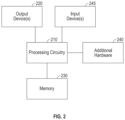
- FIG. 2 is a block diagram of exemplary components of encoding computer system and/or decoding computer system of FIG. 1 , in accordance with some example embodiments;
- FIG. 3 A is a block diagram illustrating a generic accessor pipeline functional unit, in accordance with some example embodiments.
- FIG. 3 B is a block diagram of an accessor pipeline formed from a series of connected accessor pipeline functional units, in accordance with some example embodiments;
- FIG. 3 C illustrates rendering a multimedia file in accordance with principles described herein
- FIG. 3 D illustrates rendering a text file in accordance with principles described herein
- FIG. 4 A is a block diagram illustrating an accessor pipeline generation process comprising connecting one or more functional units selected from a functional unit library and guided by a knowledge base, in accordance with some example embodiments;
- FIG. 4 B is a block diagram illustrating an accessor pipeline generator
- FIG. 5 is a flowchart illustrating a method for generating an accessor pipeline, in accordance with some example embodiments
- FIG. 6 is another flowchart illustrating another method for generating an accessor pipeline, in accordance with some example embodiments.
- FIG. 7 is a flowchart illustrating a method for accessing encoded digital data, in accordance with some example embodiments.
- Accessor Software that can make encoded digital data available for display, interaction, processing, output, or any other desired functional use on an electronic device receiving and/or storing the data.
- an accessor is configured to decode data that is encoded according to a particular defined compression algorithm/organizational format, or a family of compression algorithms/organizational formats.
- An accessor may also be referred to as a “decoder” herein.
- an accessor may also function to extract one or more encoded data files from a container for decoding.
- An accessor as set forth herein can also include, in addition to one or more extraction and/or decoding functions, data manipulation or processing functionality that can be applied to digital data decoded by the accessor, for example, an accessor may incorporate word processing, image manipulation, or other functionality allowing a user to modify file content accessed by the accessor such as is normally provided by programs such as Word, Paint, PowerPoint, and the like.
- a file Digital information that is or is intended to be associated with a single identifier such as a pathname in a computer operating system or a URL on the Internet.
- the identifier is typically used to support data processing and manipulation functionality such as get, save, open, copy, move, run, and the like to the set of digital data as a whole.
- a file can incorporate bits of any functionality or no functionality including computer programs, overhead, padding, and/or information or data in any form that is or is intended to be executed, interpreted, processed, stored, or manipulated by a computer system.
- Container Digital information organized in accordance with a metafile format defining how one or more files and optional metadata associated with the one or more files are organized together as the container.
- a container will typically (but not necessarily) itself be a file as defined above.
- Containers can be nested, wherein at least a first container is packaged as a file in a second container.
- Containers may include encoded data to be decoded and one or more accessors configured to decode encoded data, in some cases for subsequent rendering, processing, presentation, or other manipulation by one or more processing, output or display device(s).
- a browser is a computer program that provides functionality to a computer for interpreting and/or executing syntax contained in web pages.
- the computer may be connected to a computer network, and the network may be, and usually will be, the Internet.
- browsers and web pages together provide functionality to a computer connected to a network (e.g. the Internet) at least sufficient to request, retrieve, and render at least some network resources including web pages themselves, and to execute at least some links contained within or referred to in retrieved web pages to retrieve other web pages specified with the links.
- Web pages may include references such as uniform resource locators (URLs) and/or universal resource identifiers (URIs) to other network resources that contain images or other data that is retrieved by the browser from the network or from a cache memory when executing the web page, and may also include programs, libraries, style sheets, scripts, and the like which are executed in the browser environment when executing the web page. Executing some of these items may require prior separate loading of third-party software onto the computer for the browser to utilize, and some may be executable natively by the browser itself. As browsers become more sophisticated, they tend to incorporate more functionality natively that may have been introduced originally as third-party code.
- URLs uniform resource locators
- URIs universal resource identifiers
- Any of these items that are accessed, used, and/or retrieved during browser execution of web page syntax are considered to be included as a component of the “web page” as that term is used herein.
- Examples of browsers include, but are not limited to, Internet Explorer and Edge distributed by Microsoft, Firefox distributed by Mozilla, and Chrome distributed by Google.
- Example web page syntax that can be executed by browser engines include the various versions of HyperText Markup Language (HTML) promulgated by the World Wide Web Consortium (W3C).
- HTML HyperText Markup Language
- Browser engines and browser extensions generally run together as the “browser” on a given computing device. There is no strict functional demarcation defining what part of a browser is engine, and what part is extension.
- the term browser engine is used to refer to the software code of a browser that provides basic navigation and syntax execution for a browser as described in the definition of Browser and Web Page set forth above. Software code that provides functionality to a browser beyond that provided by such a browser engine may be referred to herein as a browser extension.
- Browser extensions may perform functions such as displaying and executing toolbar functions on top of retrieved web pages or blocking browser engine retrieval of advertisements that would otherwise be downloaded in conjunction with web page execution.
- a browser extension is typically executed within browser allocated memory space anytime the browser engine is running on a computing device. Accordingly, a browser extension may be periodically, intermittently, or continuously monitoring operations of the browser engine and, in some cases as will be described in more detail below, intercepting one or more communications from and/or to the browser engine.
- Browsers such as Internet Explorer and Chrome provide internal functionality allowing them to interact with browser extension software code distributed by third parties so long as the third-party code complies with the interface for browser extensions provided with the browser.
- the terms browser engine and browser extension are not distinguished by how they are developed or distributed.
- the browser engine is that part of browser code that provides basic navigation and syntax execution capabilities like http format communication, html page interpretation, script and code execution such as Java and WebAssembly
- the browser extension is that part of browser code that provides additional functionality beyond those basic functions.
- a browser plug-in is a computer program invoked by the browser and run from browser allocated memory specifically in response to the browser engine reading code that invokes the plug-in. Accordingly, a browser engine may operate for extended periods of time without invoking and/or loading a plug-in and a plug-in never intercepts communications not addressed to the plug-in. Moreover, plug-ins must be explicitly loaded and/or enabled by a user of a browser engine in response to the browser engine reading code requiring functionality of the plug-in. For example, the Adobe Flash plug-in provides functionality to a browser engine for decoding and rendering Flash video files in response to the browser engine finding a Flash video MIME type in a web page. Plug-Ins are becoming deprecated technology as their functionality is increasingly incorporated into the native code of browsers themselves.
- Server Software executing on processing hardware coupled to a computer network having network resources accessible thereto that is configured at least in part to respond to client access requests to use or retrieve the network resources accessible to the server.
- Two or more different servers may be executing in parallel on a single hardware component such as a microprocessor or computer.
- a particular piece of computer hardware that is executing server software may also be referred to as a server.
- Client Software executing on processing hardware coupled to a computer network configured at least in part to issue requests to servers to use or retrieve network resources accessible to servers. Two or more different clients may be executing in parallel on a single hardware component such as a microprocessor or computer. Both clients and servers may be executing in parallel on a single hardware component such as a microprocessor or computer. A client executing on a processor may issue a request to a server executing on the same processor, which may respond to that client request. A particular piece of computer hardware that is executing client software may also be referred to as a client. A particular piece of computer hardware may be a client and a server at the same time.
- Internet The globally interconnected system of computers and computer networks that evolved from ARPANET and NSFNET over the late 1980s and early 1990s that may utilize TCP/IP network communication protocols.
- Network Resource Identifier A definition of a network resource (e.g. by storage location and filename) that is used by client computers to specify a network resource in access requests issued to the network by the client computers.
- a network resource identifier may also be referred to as a location of a network resource such as an image or a web page.
- Network resource identifiers are known as URLs that are formatted in accordance with RFC 3986 of the Internet Engineering Task Force (IETF).
- IETF Internet Engineering Task Force
- any format for specifying a network resource in client access requests issued to a network is within the definition of the term Network Resource Identifier.
- a network resource identifier, including URLs as currently defined on the Internet may further include data in addition to data identifying the network resource that a server hosting the network resource associated with the network resource identifier may use for other purposes beyond identifying the requested network resource.
- Web Site A collection of network resources including at least some web pages that share a common network resource identifier portion, such as a set of web pages with URLs sharing a common domain name but different pathnames.
- Web Server A server that includes functionality for responding to requests issued by browsers to a network, including, for example, requests to receive network resources such as web pages.
- HTTP HyperText Transfer Protocol
- a web server may also be a content server.
- World Wide Web The collection of web pages stored by and accessible to computers running browsers connected to the Internet that include references to each other with links.
- Link Syntax that instructs a browser executing the syntax to access a resource such as a network resource that is defined directly or indirectly by the syntax.
- the link syntax and/or internal browser engine functionality may also define conditions under which the access request is made by the browser engine, for example through cursor position and/or other interaction with an I/O device such as a keyboard or mouse.
- Some link syntax may cause the browser engine to access the specified network resource automatically while processing the syntax without user prompt or interaction.
- Links include HTML hyperlinks.
- a link may be directly coded with, for example, HTML tags and an explicit URL, or may be in the form of a script or other called function defined in a browser, in a browser extension, and/or in a webpage.
- Network Resource A web page, file, document, program, service, or other form of data or instructions which is stored on a network node and which is accessible for retrieval and/or other use by other network nodes.
- Navigate Controlling a browser to use a series of links to access a series of network resources.
- Platform-independent Software is platform-independent if it is not written specifically for execution by a particular operating/file system and/or a particular physical processing architecture. Platform-independent software generally executes inside another piece of software such as a browser or virtual machine that is not itself platform independent. Examples of platform-independent languages include but are not limited to Java and WebAssembly and, accordingly, platform-independent algorithms as described herein may comprise algorithms written in such platform-independent languages.
- WebAssembly A platform-independent programming language developed by W3C which can be executed within some browsers. It is similar to Java in that browsers can interpret WebAssembly code for execution on the underlying OS and hardware but WebAssembly is considered more efficient in its utilization of those underlying resources. Modules of WebAssembly code can run inside JavaScript. WebAssembly modules can be written in a human readable text format and compiled into WebAssembly syntax that is executable by browser software. Tools are also available that can compile programs written in other programming languages such as C into WebAssembly syntax files executable in browsers.
- the systems and methods may allow digital data to be accessed in a more efficient manner.
- the systems and methods described herein may allow for selection and connection of platform-independent functional units from a library of platform-independent functional units, with the selected and connected functional units forming an accessor pipeline.
- Such approach(es) improve upon MPEG RVC and fixed-framework approaches, and may provide for an automated method of constructing an accessor for encoded digital data.
- FIG. 1 is a block diagram of data processing systems in accordance with some implementations of the principles set forth in this disclosure.
- the overview shows an encoding computer system 105 , an accessing computer system 110 , a data store 114 and a data store 116 .
- Encoding computer system 105 and decoding computer system 110 may be any type or combination of digital data processing device(s) with and may be the same or different types or combination of types.
- Data stores 114 and 116 may be any type of data storage, e.g. magnetic, optical, solid-state, etc.
- the data stores or portions thereof may be local or remote from each other, they may both be the same data store. In some implementations, portions of each data store will be locally available to the encoding computer system 105 and/or accessing computer system 110 and portions will be available remotely such as over a wide-area network such as the Internet. Different portions of and/or different ones of the one or more files 124 and 126 may be stored in different portions of the data stores 114 and 116 . For example, the files 124 may be stored in one physical data store and the files 126 may be stored in a different physical data store.
- Encoding computer system 105 is configured to generate or otherwise provide one or more files 124 comprising encoded digital data.
- the digital data of the one or more files 124 may be encoded in a particular data format (e.g. may be encoded/compressed into a particular proprietary or non-proprietary file format such as a Word document, PDF, JPEG, MPEG video, or the like). Different ones of the one or more files 124 may be encoded differently.
- the encoding computer system 105 may have received, retrieved, or otherwise obtained the one or more files 124 or the data in the file 124 in an encoded/formatted state or the encoding computer system 105 may apply an encoding/formatting algorithm to received, retrieved, or otherwise obtained data to generate the one or more files 124 of encoded data.
- the encoding computer system 105 is also configured to generate one or more files 126 comprising one or more accessor functional units or accessor functional unit descriptors.
- the files 126 comprise platform-independent syntax (e.g. WebAssembly code) providing data accessing functionality or alternatively descriptors of data accessing functionality allowing retrieval of cached or separately stored modules of platform-independent syntax providing the data accessing functionality defined, pointed to, or otherwise indicated by the descriptors.
- the provided data accessing functionality may be applicable to accessing the encoded data in the one or more files 124 .
- Encoding computer system 105 and/or accessing computer system 110 may each comprise one or more hardware components (e.g., registers, buffers, processors, memories and/or other circuitry) and/or non-transitory, computer-readable instructions or code that, when executed by such processor(s), memory and/or other circuitry of encoding computer system 105 and/or accessing computer system 110 , cause encoding computer system 105 and/or accessing computer system 110 to select, assemble, implement and/or test platform independent algorithm(s) for accessing encoded content in the one or more files 124 . It will be appreciated that hardware and software components of the encoding computer system 105 and the accessing computer system 110 may overlap in whole or in part.
- hardware components of the encoding computer system 105 and the accessing computer system 110 may overlap in whole or in part.
- an accessor pipeline 450 may comprise one or more functional units assembled into an accessor comprising at least a basic word processing program that can read and interpret the document file and, in some embodiments, prepare it for display or presentation to a user, and, in some embodiments, allow text editing and other manipulation of the document.
- encoding computer system 105 and decoding computer system 110 is individually configured to assemble and/or test functionality of accessor pipeline(s) 450 comprising such selected accessor functional units 126 (e.g., demultiplexers, decoders, etc.).
- FIG. 2 is a block diagram illustrating several example components of encoding computer system 105 and/or accessing computer system 110 of FIG. 1 , in accordance with some embodiments.
- Encoding and/or accessing computer systems 105 , 110 may comprise processing circuitry 210 , one or more memories 230 and additional hardware 240 configured to provide function and/or support for the carrying out of any procedure, process, action and/or step as described in this disclosure.
- encoding and/or accessing computer systems 105 , 110 comprises one or more output device(s) 220 configured to display and/or present at least some information or content to a user as described anywhere herein.
- output device(s) 220 may comprise one or more of a display screen, a touch screen, audio speakers, a vibrating or other haptic feedback device, or any other suitable output device.
- output device(s) 220 may be configured to present to a user information pertaining to a request for user input, the user input, a state of encoding and/or accessing computer systems 105 , 110 and/or of a process being, or having been, performed or otherwise carried out by encoding and/or accessing computer systems 105 , 110 and/or at least a portion of data accessed from the one or more encoded data files 124 .
- encoding and/or decoding computer systems 105 , 110 comprises, or is otherwise configured to operably communicate with, one or more user input devices 245 , for example, a keyboard, a computer mouse, a stylus, a microphone or any other suitable user input device.
- Encoding and/or decoding computer systems 105 , 110 may be configured to receive user input via user input device(s) 245 and, in some embodiments, perform or otherwise carry out one or more processes based on the user input as described anywhere in this disclosure.
- FIG. 3 A is a block diagram of an exemplary generic accessor functional unit 304 .
- accessor functional units 304 may provide a wide range of functionalities for application to encoded digital data. Such functionalities may include basic decoding and extraction processes such as decompression and demultiplexing files from containers as well as providing functionality for processing and user manipulation of the accessed data and providing additional user interface features for interacting with the accessed data.
- Each accessor functional unit may have a common general architecture with a set of specified inputs 306 and a set of specified outputs 308 .
- Inputs 306 can be connected to the initial input data buffer/storage location or to a previous functional unit of an accessor pipeline, possibly through a shared input/output buffer.
- Each functional unit also comprises data processing functionality 312 for performing a function or subfunction of a data accessor such as decompression, demultiplexing, or other form of data processing or manipulation.
- Data processing functionality can also include the generation of user interface features for viewing and/or manipulating accessed data.
- the functional units 304 may also include control and testing functionality 314 .
- This functionality may at least in part define or configure the number and function of the inputs and outputs of the functional unit. This functionality may also be used to detect whether the data being accessed is being decompressed, extracted, output, manipulated, etc. in a desired manner by the data processing functionality 312 .
- the control and testing functionality 314 may generate success or error output codes that can be used to guide an automated or semi-automated process of accessor pipeline generation as described in more detail below. These error codes may be passed to functional unit selection functionality, a subsequent functional unit in an accessor pipeline, or may be output to a user during the process of accessor pipeline generation.
- the control and testing functionality may receive user input regarding accessor pipeline or accessor functional unit performance or may receive error or success codes from preceding functional units in an accessor pipeline.
- FIG. 3 B is a block diagram of an example accessor pipeline comprising four accessor pipeline functional units.
- a file 124 is received by the accessor pipeline.
- the file 124 is an encoded multimedia file.
- This multimedia file 124 comprises a container of different files, in this example an encoded audio data file, an encoded video data file, and an encoded subtitle data file.
- a demultiplexer functional unit 320 is selected as an initial functional unit for the accessor pipeline 320 as an initial functional unit for the accessor pipeline .
- This accessor pipeline functional unit 320 has three outputs, one for encoded audio, one for encoded video, and one for encoded subtitles.
- output buffers 322 a , 322 b , and 322 c which are coupled respectively to an audio decoder functional unit 330 , a video decoder functional unit 350 , and a subtitle decoder functional unit 360 .
- Each functional unit 320 , 330 , 350 , and 360 is advantageously platform-independent, for example written in WebAssembly, which enables long-term storage/preservation, efficient transcoding, new ways to interact with video (e.g., video editing within a browser), personalized video and/or data without requiring underlying browser plugins and enables servers to deploy standards-independent data streams.
- accessor functional units 304 may accept user input for function control.
- a user input may be used to toggle the subtitle decoder functional unit 360 on and off such that no resources are used for subtitle decoding if the user does not wish to view the subtitles.
- user inputs for fast forward and rewind functions may be used to control operation of the audio decoder and video decoder functional units 330 and 350 .
- This aspect of these decoder functional units 335 and 350 allows efficient fast forward and rewind functionality to be deployed.
- FIG. 3 C illustrates a frontend user-interface of a multimedia player using an accessor pipeline assembled from accessor functional units 304 , such as some or all of the accessor function units illustrated in FIG. 3 B . Decoded audio and video and user playback control are provided by various functional units of the pipeline.
- FIG. 3 D illustrates a frontend user-interface of a word processor using an accessor pipeline assembled from accessor functional units 304 . Text and other document content as well as document manipulation capabilities are provided by various functional units of the pipeline.
- FIG. 4 A A conceptual illustration of accessor pipeline generation from accessor functional units in accordance with some implementations of the principles described herein is provided in FIG. 4 A .
- accessor pipeline 450 assembled and/or assembleable from one or more such functional units 304 is illustrated.
- the multimedia accessor pipeline of FIG. 3 B may be one example implementation or embodiment of accessor pipeline 450 .
- accessor pipeline 450 comprises one or more functional units #1, #2 . . . #N.
- each functional unit may have a specified, but potentially dynamic, set of inputs and a specified but potentially dynamic, set of outputs.
- demultiplexer functional unit 320 may have one input but a varying number of outputs, for example one or more encoded video, audio, or subtitle data streams ultimately fed to respective accessor functional units 330 , 350 , and 360 .
- one or more selection processes 430 are used to select one or more functional unit(s) from a functional unit library 410 .
- the selection processes 430 may be guided at least in part by a knowledge base 420 ( FIG. 4 B ) and user input ( FIG. 4 B ).
- selection processes 430 may be performed by accessor pipeline functional unit selector 464 of FIG. 4 B .
- the one or more such functional units may be assembled into accessor pipeline 450 and subjected to a testing process 440 configured to test adequate and/or proper functionality of the one or more selected and assembled functional units 304 .
- testing process 440 may be performed by accessor functional unit and pipeline tester block 474 of FIG. 4 B .
- each input of a given selected functional unit may be attached to an input or output of a previous selected functional unit in pipeline 450 or to an input digital data buffer.
- Each output of a given selected functional unit may be attached to a future selected functional unit in pipeline 450 or to an output sink, such as an output buffer or an output device.
- Functional Unit Library 410 may be in local memory or hosted on a local or remote server and/or any other local or remote memory and/or storage device configured to archive and/or otherwise store thereon or therein a plurality of platform-independent functional units, which alone or in appropriate combinations, may be assembled into accessor pipeline 450 .
- FIG. 4 B is a block diagram illustrating hardware and software functional components for an accessor pipeline generator 402 that may be configured with or as software modules that perform techniques as described in this disclosure.
- Accessor pipeline generator 402 may be implemented via electronic processing hardware, e.g., any one or more of processing circuitry 210 , memory 230 , and/or additional hardware 240 of encoding computer 105 , which may comprise one or more general purpose processors, field programmable gate arrays, digital signal processors, or the like.
- each of the blocks shown in FIG. 4 B may comprise or otherwise represent, at least in part, non-transitory, computer-readable instructions that, when executed, configure such one or more electronic hardware processors (e.g., processing circuitry 210 ) to perform the functions described below.
- FIG. 4 B The illustrated blocks of FIG. 4 B are presented for explanation of the functionality of the inventive systems described herein and do not indicate or imply that the specific functions associated with a block in this description is necessarily associated with a particular or individual module of software code or hardware component(s).
- the functions described with reference to FIG. 4 B can be arranged in a wide variety of ways, may overlap, and may be combined in ways different than the specific blocks illustrated in FIG. 4 B .
- the fundamental components of the accessor pipeline generator of FIG. 4 B are the functional unit library 410 , the accessor functional unit selector 464 , the accessor functional unit connector 468 , and the accessor functional unit and pipeline tester 474 .
- a repeating process of functional unit selecting, connecting, and testing can be performed where detected errors in accessing the data with the current set of functional units from the library cause the accessor functional unit selector 464 to remove a functional unit from the currently generated accessor pipeline and select a new functional unit from the functional unit library to add to the accessor pipeline. This process can be repeated until no errors are detected and the data can be successfully accessed by the assembled accessor pipeline.
- the accessor pipeline 450 that survived the selection and testing process can be used to receive the encoded data 124 and output the accessed data for viewing and/or manipulation by content renderer 490 , which may, in a browser context for example, comprise a browser executable script configured to generate an appropriate UI window in the browser through which the user can interact with the accessed content.
- content renderer 490 may, in a browser context for example, comprise a browser executable script configured to generate an appropriate UI window in the browser through which the user can interact with the accessed content.
- the accessor pipeline 450 that survived the selection and testing process can be stored for future use.
- the surviving accessor pipeline 450 can be stored with the encoded data file 124 in a common container 122 as described above.
- the accessor functional unit and pipeline tester 474 may evaluate the output(s) of each separate functional unit selected by the accessor functional unit selector 464 as well as the output(s) of the completed current version of the accessor pipeline being generated. This evaluation my involve generating success and error codes such as described above for feeding back to the accessor functional unit selector 464 .
- one or more reference accessors 482 may be available to test functional unit and/or pipeline output. Reference accessor 482 may also be configured to receive encoded digital data 124 . Reference accessor 482 accesses encoded data 124 and either outputs the accessed data or outputs a set of tests of selected features of the accessed encoded data 124 .
- reference accessor may output a set of audio samples and/or ASCII text of embedded lyrics.
- reference accessor 482 may output the data and an image of the rotated data.
- the accessor functional unit and pipeline tester 474 may comprise a comparator that receives the output of reference accessor 482 and performs comparisons of the reference output and the output of the currently generated accessor pipeline.
- the comparison may be performed on a sample-point-by-sample-point basis or may be a subjective quality comparison.
- accessor functional unit and pipeline tester 474 may further receive input from a user.
- the input may be in the form of one or more thresholds for acceptable performance or it may be in the form of direct indication of acceptable quality.
- this guidance may be provided by one or more of a format analyzer 462 , a knowledge base 420 , and/or direct user input.
- Format analyzer 462 may be configured to receive encoded digital data 124 .
- Format analyzer 462 may be configured to analyze encoded digital data file(s) 124 in order to acquire information regarding the format in which the digital data files 124 are encoded. For example, format analyzer 462 may compare the encoded data against structures stored in an information repository such as knowledge base 420 . The format analyzer 462 may search for structures in the encoded data file 124 which may include, for example, file names, stream headers, formatting codes, magic numbers, MIME types, file extensions, etc. Based on the comparison to stored structures associated with known file formats and encoding algorithms, if one or more matching structures are found, format analyzer 462 may be able to determine the format of encoded data file 124 or portions of encoded data file 124 .
- Format analyzer 462 may further be configured to determine presence and formats of embedded features or components present in an encoded data file 124 .
- an encoded video stream may contain closed captions while an encoded audio stream may contain embedded lyrics.
- a slide show may contain embedded video while scientific data may contain embedded annotations.
- format analyzer 462 may be configured to compare and/or analyze the data to determine a format in other manners as well.
- format analyzer 462 further provides information about the detected format(s) or a signal indicating an unknown format to accessor functional unit selector 464 .
- Accessor functional unit selector 464 may have access to a datastore, for example knowledge base 420 , which may include definitions of associations between one or more of the indicated formats and one or more accessor functional units 126 . If a particular detected format is known, then accessor functional unit selector 464 may identify one or more functional units 304 associated with the detected format using the knowledge base 420 . The selected functional units 304 may implement algorithms capable of accessing data in the detected format. For example, if one of the indicated formats is a .wav format, the accessor pipeline generator 402 may retrieve an association between .wav and one or more accessor pipeline functional units capable of decoding and/or playing a .wav file.
- accessor functional unit selector 464 may then select one or more particular functional units based on the identified functionalities that are capable of decoding the detected format. In some embodiments, accessor functional unit selector 464 has only one functional unit to select from the library that is appropriate for a particular format, and thus, no choice between multiple functional units in the functional unit library 410 may be required.
- accessor functional unit selector 464 is configured to receive input related to selection of a functional unit from knowledge database 420 and/or directly from a user during the accessor pipeline generation process.
- this input may comprise information about encoded digital data 124 , which may be used to influence selection of one or more functional units (e.g., Units #1, #2, #N in FIG. 4 B ) to be selected from the library 410 .
- a set of permitted functional units may be further ordered and/or sorted based at least in part on such input from the user and/or based at least in part on other constraints, such as popularity, reliability, and/or efficiency of one or more functional units or combinations thereof.
- accessor functional unit selector 464 may be configured to read configuration information from the knowledge base 420 that controls how accessors should be selected. For example, in some embodiments, a selection rule may be specified that indicates proprietary accessors should be selected over non-proprietary accessors when both types of accessors are available for a particular data type. The selection rule may then be executed by accessor functional unit selector 464 .
- knowledge base 420 may function as a configuration file. In some embodiments, knowledge base 420 is generated at least in part by a user. In some embodiments, knowledge base 420 is generated or externally populated at least in part by a third-party, for example a company, entity or person, and may include suggestions for groupings and/or sets of functional units, their ordering, and potential best or desired uses with respect to one or more types of encoded data. In some embodiments, such suggested groupings or sets, or indications thereof, may be stored within knowledge base 420 .
- a baseline JPEG image may form at least a portion of encoded data 124
- accessor functional unit selector 464 may have available two functional units in functional unit library 410 , each comprising a full image decoder implementation.
- the first functional unit may comprise a proprietary compact decoder that supports only baseline JPEG.
- the second functional unit may comprise a larger, slower, non-proprietary implementation that supports progressive decoding in addition to baseline decoding.
- Input from the knowledge base 420 may control the accessor functional unit selector 464 to select a particular one of the two based on rules in the knowledge base 420 .
- a PDF document may form at least a portion of encoded data 124 , and accessor functional unit selector 464 may have available functional units from functional unit library supporting features such as commenting and highlighting in addition to basic viewing.
- the accessor pipeline generator 402 may examine the digital data and consider functional units for decoding one or more image formats based on image type(s) detected in the PDF document, or based on the result of a test of each image-decoding functional unit on images embedded in the PDF document.
- FIG. 5 is a flowchart 500 related to a method for generating an accessor pipeline, in accordance with some example embodiments.
- one or more blocks of flowchart 500 may be performed by instructions included in or accessible by at least one entity of accessor pipeline generator in FIG. 4 B , operating on, or utilizing, processing circuitry 210 , memory 230 , and/or additional hardware 240 of respective computer systems 105 , 110 as shown in FIG. 2 .
- Flowchart 500 starts at start block 502 and advances to block 504 , which includes receiving encoded digital data.
- accessor functional unit selector 464 may be configured to receive files 124 comprising encoded digital data.
- accessor functional unit selector, 464 , accessor functional unit connector 468 , and accessor functional unit and pipeline tester 474 perform a potentially repeating or iterative process (e.g., process(es) 440 of FIG. 4 A ) of selecting a functional unit from a functional unit library 410 , assembling the selected functional unit into a candidate accessor pipeline, and testing the selected functional unit and/or the candidate pipeline for successful operation.
- part of the repeated or iterative process includes receiving user input at block 506 which may provide input regarding the selection of functional units or the indications of performance acceptability for a candidate accessor pipeline.
- Flowchart 500 advances from block 506 to block 508 .
- flowchart 500 may advance directly from block 504 to block 508 .
- Block 508 includes selecting a functional unit from the functional unit library 410 .
- Flowchart 500 advances from block 508 to block 510 , which includes adding the functional unit to the candidate pipeline, assembling the pipeline, and performing functionality testing of the selected functional unit and/or the assembled pipeline including the selected functional unit.
- accessor functional unit selector 464 and accessor functional unit connector 468 may be configured to attach at least one process and buffer (e.g., a portion of memory 230 of encoding and/or accessing computer systems 105 , 110 ) to a sequence of previously selected functional units (if any have been selected previously) and to attempt to access at least a portion of encoded data in files 124 utilizing the selected and linked functional unit(s).
- Flowchart 500 advances from block 510 to block 512 , where a determination is made as to whether the selected functional unit and/or assembled pipeline passes the functionality test. Such a determination may be made, at least in part, by accessor functional unit and pipeline tester 474 .
- flowchart 500 advances from block 512 to block 516 , which includes removing the functional unit that caused an error. Flowchart 500 then advances to block 520 . If the currently assembled pipeline passes the functionality test, flowchart 500 advances to block 514 , which includes outputting the structure of the assembled pipeline and the accessed digital data.
- Block 520 includes determining whether at least one more functional unit is available or pending for testing. If not, flowchart 500 proceeds to end block 522 . If at least one more functional unit is available or pending for testing, flowchart 500 proceeds back through another iteration of functional block selection and testing. In embodiments where input regarding selection of the next functional unit is received, flowchart 500 proceeds from block 520 back to block 506 . In embodiments where input regarding selection of the next functional unit is not received, flowchart proceeds from block 520 back to block 508 .
- FIG. 6 illustrates a flowchart 600 of a local optimization process for accessing encoded digital data, in accordance with some example embodiments.
- the acts of flowchart 600 may, for example, be performed in whole or in part within the acts 510 and 512 of FIG. 5 .
- Flowchart 600 starts at start block 602 and advances to block 604 , which includes attaching the selected functional unit to a process and a buffer in the pipeline.
- Flowchart 600 advances from block 604 to block 606 , which includes processing buffered chunks of encoded data. The method then advances through several performance testing stages.
- Blocks 608 , 612 , 616 , 620 and 626 are example testing decision points related to successful assembly of all or part of an accessor pipeline. All or a subset of blocks 608 , 612 , 620 , 626 may be performed in the illustrated order, or a different order, in parallel, and alone or in combination with one or more additional conditions.
- flowchart 600 advances from block 606 to block 608 , which includes determining whether the process produces at least one error. If the current functional unit used to process the encoded digital data produces one or more errors or warnings, flowchart 600 advances from block 608 to block 610 , which includes setting a failure event in the pipeline.
- accessor functional unit selector 464 may be configured to set a failure event as a part of testing process(es) 440 , e.g., accessor functional unit selector 464 is informed of the error(s) by the accessor functional unit and pipeline tester 474 (which may have received an error output from a functional unit 304 as described above with reference to FIG.
- accessor functional unit selector 464 determines whether to continue the functional unit testing process or abort.
- the response of the accessor functional unit selector 464 to various error codes or messages received from the accessor functional unit and pipeline tester 474 can be guided by information in the knowledge base 420 or by user input. If the current functional unit does not produce errors or warnings of sufficient severity to stop the pipeline generation process, flowchart 600 advances from block 608 to block 612 , which includes determining whether currently assembled pipeline or pipeline portion outputs decoded data. If the determination is made that the currently assembled pipeline does not output decoded data, flowchart 600 advances from block 612 to block 616 . If the determination is made that the currently assembled pipeline outputs decoded data, flowchart 600 advances from block 612 to block 614 , which includes setting a success event in the pipeline and then advances to block 616 .
- flowchart 600 advances from block 620 to block 622 , which includes setting an end event in the pipeline.
- an end event flag may be set such that accessor functional unit selector 464 or accessor functional unit and pipeline tester 474 , depending on its/their configuration or user intention, determines whether building accessor pipeline succeeded.
- Information that accessor functional unit selector 464 and/or accessor functional unit and pipeline tester 474 may be configured to consider or utilize in such a determination includes, but is not limited to, the indication(s) that no error or significant warning was raised by the process (e.g., block 610 was not executed) and that a decoded digital stream has been output to an output buffer during the decoding process (e.g., block 614 was executed). However, if a determination that the functional process has ended successfully is not made, flowchart 600 advances from block 620 to block 626 , which includes determining whether a new functional unit is required to complete testing and/or processing being carried out by the instant functional unit.
- Information accessor functional unit selector 464 and/or accessor functional unit and pipeline tester 474 may be configured to consider and/or utilize in determining whether to add a new functional unit to accessor pipeline includes, but is not limited to, information about the content of encoded digital data 124 or an indication that the selected functional unit requires a new functional unit (e.g., an accessor/decoder) to handle a type of content of encoded digital data 124 . If another functional unit needs to be added in pipeline due, for example, to incomplete processing or yet unprocessable encoded data still in the buffer, flowchart 600 advances from block 626 to block 628 , which includes attaching yet another buffer to the currently-tested functional unit.
- Flowchart 600 advances from block 628 to block 630 , which includes selecting a new functional unit. Flowchart 600 then proceeds from block 630 back to block 604 and the new functional unit is integrated into pipeline, initialized and tested substantially as previously described for the initial functional unit. Since, in some embodiments, the new functional unit was selected in block 630 based on an indication of its requirement to provide decoded/interpreted data to the initial functional unit, testing of the initial functional unit may continue in series or parallel with processing and/or testing of the additional functional unit upon receipt of the required decoded/interpreted data from the new functional unit process.
- an input or output buffer of one of the initial functional unit and the new functional unit may be assigned, mapped or otherwise correspond to a respective output or input buffer of the other of the initial functional unit and the new functional unit to facilitate the transfer of data from desired source to desired sink in the testing process.
- an accessor functional element selector 464 and accessor functional unit connector 468 may be configured to create or assign a new buffer, copy the previous partial pipeline to the new buffer, and continues in parallel with the previous partial pipeline in it's initial buffer.
- a final verification and selection step may be performed to determine which successful of multiple parallel tested accessor pipelines to use subject to criteria such as size, efficiency, and user preference, which criteria may be incorporated as selection rules in the knowledge database 420 .
- FIG. 7 illustrates a flowchart 700 of accessing encoded data, in accordance with some example embodiments.
- one or more blocks of flowchart 700 may be performed by instructions included in or accessible by processing circuitry 210 , memory 230 , and/or additional hardware 240 , of encoding/accessing computer systems 105 , 110 shown in FIG. 2 .
- Flowchart 700 begins at “start” block 702 and advances to block 704 , which includes receiving encoded digital data. Flowchart 700 advances from block 704 to block 706 , which includes receiving an accessor as a set of functional units or potentially functional unit descriptors.
- the set of functional units or functional unit descriptors 126 may be received, retrieved, or otherwise obtained with encoded data 124 in a container 122 as described above with reference to FIG. 1 .
- the set of functional units or functional unit descriptors 126 may be stored and/or received across more than one file or container.
- the set of functional units or functional unit descriptors 126 may be retrieved and/or received from a local cache, or from a remote location via, for example, the internet or any other suitable electronic network.
- Flowchart 700 advances from block 706 to block 708 , which includes building an accessor pipeline from the functional units.
- accessing computer system 110 may be configured to build an accessor pipeline utilizing the functional units or functional unit descriptors 126 .
- building the accessor pipeline may comprise associating one or more processes and one or more buffers to functional units 126 that ultimately form the accessor pipeline.
- Flowchart 700 advances from block 708 to block 710 , which includes processing the encoded data with the accessor pipeline constructed.
- a user may also replace one or more of functional units 126 , e.g., while interacting with the decoded, interpreted and/or otherwise presented digital data in, for example, a browser by simply selecting a replacement functional unit from a displayed list of alternative functional unit options. Accordingly, in such embodiments, such functional unit replacement procedures may be performed and pipeline 450 may be immediately functional without a requirement for recompilation or rebuilding of pipeline 450 .
- custom HTML tags, extensions, and/or attributes are used to designate functional unit libraries or other aspects of the accessor pipeline generation schemes described herein.
- HTML 5 specifications the ⁇ video> and ⁇ audio> tags extended browser support with a native solution for embedding video and audio content.
- support for video and audio is still limited to a handful of container and underlying encoding formats.
- Mobile browsers may support some formats optimized for their characteristics that are not supported by their desktop equivalents; conversely, mobile browsers may not support all the same formats the desktop version does.
- both desktop and mobile browsers may be designed to offload handling of media playback. It means that any terminal's media support is partly dependent on what software the user has installed. It also turns out that several popular formats are encumbered by patents, and browsers that wish to implement support for those codecs must pay license fees.
- the native HTML tags ⁇ img>, ⁇ audio>, ⁇ video>, and ⁇ canvas> are extended with new attributes is, using and with, that inform the browser on the manner to handle the content.
- DNG provides many specific features compared to common image format, including Exif metadata, XMP metadata, IPTC metadata, CIE XYZ coordinates and JPEG preview.
- a specific method of measuring the characteristic or property may be defined herein as well.
- the measurement method should be interpreted as the method of measurement that would most likely be adopted by one of ordinary skill in the art given the description and context of the characteristic or property.
- the value or range of values should be interpreted as being met regardless of which method of measurement is chosen.
- the methods disclosed herein comprise one or more steps or actions for achieving the described method.
- the method steps and/or actions may be interchanged with one another without departing from the scope of the claims.
- the order and/or use of specific steps and/or actions may be modified without departing from the scope of the claims.
- the technology is operational with numerous other general-purpose or special purpose computing system environments or configurations.
- Examples of well-known computing systems, environments, and/or configurations that may be suitable for use with the technology disclosed herein include, but are not limited to, personal computers, server computers, hand-held or laptop devices, multiprocessor systems, microprocessor-based systems, programmable consumer electronics, network PCs, minicomputers, mainframe computers, distributed computing environments that include any of the above systems or devices, and the like.
- instructions refer to computer-implemented steps for processing information in the system. Instructions can be implemented in software, firmware or hardware and include any type of programmed step undertaken by components of the system.
- a Local Area Network may be a home or corporate computing network, including access to the Internet, to which computers and computing devices comprising the system are connected.
- the LAN conforms to the Transmission Control Protocol/Internet Protocol (TCP/IP) industry standard.
- TCP/IP Transmission Control Protocol/Internet Protocol
- data and digital data refer to images, graphics, sounds, video, animations, electronic documents, scientific data, or any other digital data type data that is entered into the system.
- encoded digital data refers to data that are stored or held in a data format, which may be compressed or uncompressed.
- decode refers to decompression, interpretation, playback or conversion.
- a microprocessor may be any conventional general purpose single- or multi-chip microprocessor such as a Pentium® processor, a Pentium® Pro processor, a 8051 processor, a MIPS® processor, a Power PC® processor, or an Alpha® processor.
- the microprocessor may be any conventional special purpose microprocessor such as a digital signal processor or a graphics processor.
- the microprocessor typically has conventional address lines, conventional data lines, and one or more conventional control lines.
- each of the modules comprises various sub-routines, procedures, definitional statements and macros.
- Each of the modules are typically separately compiled and linked into a single executable program. Therefore, the description of each of the modules is used for convenience to describe the functionality of the preferred system.
- the processes that are undergone by each of the modules may be arbitrarily redistributed to one of the other modules, combined together in a single module, or made available in, for example, a shareable dynamic link library.
- the system may be used in connection with various operating systems such as Linux®, UNIX® or Microsoft Windows®.
- the system may be written in any conventional programming language such as C, C++, BASIC, Pascal, or Java, and ran under a conventional operating system.
- C, C++, BASIC, Pascal, Java, and FORTRAN are industry standard programming languages for which many commercial compilers can be used to create executable code.
- the system may also be written using interpreted languages such as Perl, Python or Ruby.
- a web browser comprising a web browser user interface may be used to display information (such as textual and graphical information) to a user.
- the web browser may comprise any type of visual display capable of displaying information received via a network. Examples of web browsers include Microsoft's Internet Explorer browser, Netscape's Navigator browser, Mozilla's Firefox browser, PalmSource's Web Browser, Apple's Safari, or any other browsing or other application software capable of communicating with a network.
- DSP digital signal processor
- ASIC application specific integrated circuit
- FPGA field programmable gate array
- a general-purpose processor may be a microprocessor, but in the alternative, the processor may be any conventional processor, controller, microcontroller, or state machine.
- a processor may also be implemented as a combination of computing devices, e.g., a combination of a DSP and a microprocessor, a plurality of microprocessors, one or more microprocessors in conjunction with a DSP core, or any other such configuration.
- the functions and methods described may be implemented in hardware, software, or firmware executed on a processor, or any combination thereof. If implemented in software, the functions may be stored on or transmitted over as one or more instructions or code on a computer-readable medium.
- Computer-readable media includes both computer storage media and communication media including any medium that facilitates transfer of a computer program from one place to another.
- a storage media may be any available media that can be accessed by a computer.
- such computer-readable media can comprise RAM, ROM, EEPROM, CD-ROM or other optical disk storage, magnetic disk storage or other magnetic storage devices, or any other medium that can be used to carry or store desired program code in the form of instructions or data structures and that can be accessed by a computer.
- any connection is properly termed a computer-readable medium.
- the software is transmitted from a website, server, or other remote source using a coaxial cable, fiber optic cable, twisted pair, digital subscriber line (DSL), or wireless technologies such as infrared, radio, and microwave
- the coaxial cable, fiber optic cable, twisted pair, DSL, or wireless technologies such as infrared, radio, and microwave are included in the definition of medium.
- Disk and disc includes compact disc (CD), laser disc, optical disc, digital versatile disc (DVD), floppy disk and Blu-ray disc where disks usually reproduce data magnetically, while discs reproduce data optically with lasers. Combinations of the above should also be included within the scope of computer-readable media.
Landscapes
- Engineering & Computer Science (AREA)
- Software Systems (AREA)
- Theoretical Computer Science (AREA)
- Signal Processing (AREA)
- Multimedia (AREA)
- General Engineering & Computer Science (AREA)
- General Physics & Mathematics (AREA)
- Physics & Mathematics (AREA)
- Library & Information Science (AREA)
- Computer Security & Cryptography (AREA)
- Two-Way Televisions, Distribution Of Moving Picture Or The Like (AREA)
- Information Transfer Between Computers (AREA)
- Document Processing Apparatus (AREA)
- Information Retrieval, Db Structures And Fs Structures Therefor (AREA)
Abstract
Description
-
- <img src=“camera_photo.dng” is=“universal-img” using=“multi-img.wasm” with=[“LibRaw.wasm” ]>The is attributes indicates that, instead of using a native <img> tag, the browser should make use an extended version of this tag, for which the attributes using and with will be used for handling such content.
- the using attribute
-
- the with attribute:
Claims (23)
Priority Applications (2)
| Application Number | Priority Date | Filing Date | Title |
|---|---|---|---|
| US18/126,603 US12204910B2 (en) | 2022-03-28 | 2023-03-27 | Modular pipelines for accessing digital data |
| US18/981,151 US20250315265A1 (en) | 2022-03-28 | 2024-12-13 | Modular pipelines for accessing digital data |
Applications Claiming Priority (3)
| Application Number | Priority Date | Filing Date | Title |
|---|---|---|---|
| US202263324589P | 2022-03-28 | 2022-03-28 | |
| US202263326252P | 2022-03-31 | 2022-03-31 | |
| US18/126,603 US12204910B2 (en) | 2022-03-28 | 2023-03-27 | Modular pipelines for accessing digital data |
Related Child Applications (1)
| Application Number | Title | Priority Date | Filing Date |
|---|---|---|---|
| US18/981,151 Continuation US20250315265A1 (en) | 2022-03-28 | 2024-12-13 | Modular pipelines for accessing digital data |
Publications (2)
| Publication Number | Publication Date |
|---|---|
| US20230305851A1 US20230305851A1 (en) | 2023-09-28 |
| US12204910B2 true US12204910B2 (en) | 2025-01-21 |
Family
ID=86007194
Family Applications (2)
| Application Number | Title | Priority Date | Filing Date |
|---|---|---|---|
| US18/126,603 Active US12204910B2 (en) | 2022-03-28 | 2023-03-27 | Modular pipelines for accessing digital data |
| US18/981,151 Pending US20250315265A1 (en) | 2022-03-28 | 2024-12-13 | Modular pipelines for accessing digital data |
Family Applications After (1)
| Application Number | Title | Priority Date | Filing Date |
|---|---|---|---|
| US18/981,151 Pending US20250315265A1 (en) | 2022-03-28 | 2024-12-13 | Modular pipelines for accessing digital data |
Country Status (4)
| Country | Link |
|---|---|
| US (2) | US12204910B2 (en) |
| EP (1) | EP4500871A1 (en) |
| CA (1) | CA3254446A1 (en) |
| WO (1) | WO2023192211A1 (en) |
Families Citing this family (1)
| Publication number | Priority date | Publication date | Assignee | Title |
|---|---|---|---|---|
| US20250328667A1 (en) * | 2024-04-23 | 2025-10-23 | Chime Financial, Inc. | Generating a data pipeline in an interactive pipeline session utilizing a dedicated computing cluster to access secure data |
Citations (114)
| Publication number | Priority date | Publication date | Assignee | Title |
|---|---|---|---|---|
| US5210832A (en) | 1986-10-14 | 1993-05-11 | Amdahl Corporation | Multiple domain emulation system with separate domain facilities which tests for emulated instruction exceptions before completion of operand fetch cycle |
| US5987181A (en) | 1995-10-12 | 1999-11-16 | Sharp Kabushiki Kaisha | Coding and decoding apparatus which transmits and receives tool information for constructing decoding scheme |
| US6026404A (en) | 1997-02-03 | 2000-02-15 | Oracle Corporation | Method and system for executing and operation in a distributed environment |
| US6181711B1 (en) | 1997-06-26 | 2001-01-30 | Cisco Systems, Inc. | System and method for transporting a compressed video and data bit stream over a communication channel |
| US6247056B1 (en) | 1997-02-03 | 2001-06-12 | Oracle Corporation | Method and apparatus for handling client request with a distributed web application server |
| US20020010859A1 (en) | 2000-06-12 | 2002-01-24 | Mitsuru Maeda | Image processing apparatus and method, and computer readable memory medium storing program for executing image processing |
| US20020018580A1 (en) | 2000-06-20 | 2002-02-14 | Mitsuru Maeda | Data processing apparatus and method, and computer-readable storage medium on which program for executing data processing is stored |
| US20020035544A1 (en) | 2000-09-06 | 2002-03-21 | Satoru Wakao | Method and apparatus for forming content, method and apparatus for reproducing content and computer readable storage medium |
| US20020087999A1 (en) | 2000-04-26 | 2002-07-04 | Sony Corporation | Scalable filtering table |
| US20030002854A1 (en) | 2001-06-29 | 2003-01-02 | International Business Machines Corporation | Systems, methods, and computer program products to facilitate efficient transmission and playback of digital information |
| US20030018694A1 (en) | 2000-09-01 | 2003-01-23 | Shuang Chen | System, method, uses, products, program products, and business methods for distributed internet and distributed network services over multi-tiered networks |
| US20030145338A1 (en) | 2002-01-31 | 2003-07-31 | Actv, Inc. | System and process for incorporating, retrieving and displaying an enhanced flash movie |
| US20030149793A1 (en) | 2002-02-01 | 2003-08-07 | Daniel Bannoura | System and method for partial data compression and data transfer |
| US20030158889A1 (en) | 1999-03-31 | 2003-08-21 | Leonardo Coutinho Massarani | Simulating web cookies for non-cookie capable browsers |
| US20030163430A1 (en) | 2000-05-26 | 2003-08-28 | Masahiko Takaku | Contents forming method and contents reproducing apparatus and method |
| US20030177400A1 (en) | 2000-08-28 | 2003-09-18 | Contentguard Holdings, Inc. | Method and apparatus for variable encryption of data |
| US6624761B2 (en) | 1998-12-11 | 2003-09-23 | Realtime Data, Llc | Content independent data compression method and system |
| US20030193940A1 (en) | 2001-02-27 | 2003-10-16 | Mamoru Kugumiya | Apparatus and method of packetizing data stream |
| US20030206717A1 (en) | 2001-04-20 | 2003-11-06 | Front Porch Digital Inc. | Methods and apparatus for indexing and archiving encoded audio/video data |
| US20040028141A1 (en) | 1999-11-09 | 2004-02-12 | Vivian Hsiun | Video decoding system having a programmable variable-length decoder |
| US20040059776A1 (en) | 2002-09-23 | 2004-03-25 | Pitzel Bradley John | Method and apparatus for dynamic data-type management |
| US20040067043A1 (en) | 1998-10-26 | 2004-04-08 | Sony Corporation | Trick playback of digital video data |
| US20040221143A1 (en) | 1992-06-30 | 2004-11-04 | Wise Adrian P. | Multistandard video decoder and decompression system for processing encoded bit streams including a standard-independent stage and methods relating thereto |
| US6845505B1 (en) | 1997-02-03 | 2005-01-18 | Oracle International Corporation | Web request broker controlling multiple processes |
| WO2005046058A1 (en) | 2003-11-07 | 2005-05-19 | Queensland University Of Technology | Method and apparatus for encoding and decoding digital data |
| US6904176B1 (en) | 2001-09-19 | 2005-06-07 | Lightsurf Technologies, Inc. | System and method for tiled multiresolution encoding/decoding and communication with lossless selective regions of interest via data reuse |
| US20050149500A1 (en) | 2003-12-31 | 2005-07-07 | David Marmaros | Systems and methods for unification of search results |
| EP1562193A1 (en) | 2004-02-06 | 2005-08-10 | Sony International (Europe) GmbH | System for storing and rendering multimedia data |
| US20050283717A1 (en) | 2004-06-07 | 2005-12-22 | Hernan Giraldo | Apparatus, system, and method for the desktop-based creation, management, and publication of enhanced audiovisual presentations |
| US20060056506A1 (en) | 2004-09-13 | 2006-03-16 | Ho Chia C | System and method for embedding multimedia compression information in a multimedia bitstream |
| US20060087457A1 (en) | 2004-10-05 | 2006-04-27 | Jon Rachwalski | System and method for identifying and processing data within a data stream |
| US20060116966A1 (en) | 2003-12-04 | 2006-06-01 | Pedersen Palle M | Methods and systems for verifying protectable content |
| US20060123455A1 (en) | 2004-12-02 | 2006-06-08 | Microsoft Corporation | Personal media channel |
| US20060227815A1 (en) | 2005-03-11 | 2006-10-12 | Khan Safi U | Parallel turbo decoders with multiplexed output |
| US20060248235A1 (en) | 2005-03-21 | 2006-11-02 | Sony Corporation | Method and apparatus for data collection in a media player |
| US20060257103A1 (en) | 2005-05-16 | 2006-11-16 | Samsung Electronics Co., Ltd. | Digital video recording apparatus and method thereof |
| US20060288404A1 (en) | 2005-06-21 | 2006-12-21 | Mayilraj Kirshnan | Controlling computer program extensions in a network device |
| US20070013562A1 (en) | 2005-07-15 | 2007-01-18 | Konica Minolta Business Technologies, Inc. | Image Forming Apparatus, Recording Medium Including A Recorded Data Processing Program |
| US20070070404A1 (en) | 2005-09-29 | 2007-03-29 | Jean-Philippe Caradec | Remote device access |
| EP1818907A1 (en) | 2004-12-01 | 2007-08-15 | Matsushita Electric Industrial Co., Ltd. | Reproduction device, image synthesis method, image synthesis program, and integrated circuit |
| US20070204300A1 (en) | 2006-02-27 | 2007-08-30 | Markley Jeffrey P | Methods and apparatus for selecting digital interface technology for programming and data delivery |
| US20070200658A1 (en) | 2006-01-06 | 2007-08-30 | Samsung Electronics Co., Ltd. | Apparatus and method for transmitting control commands in home network system |
| US20070204314A1 (en) | 2006-02-27 | 2007-08-30 | Hasek Charles A | Methods and apparatus for selecting digital access technology for programming and data delivery |
| US20070274340A1 (en) | 2005-04-08 | 2007-11-29 | Qualcomm Incorporated | Methods and systems for resizing multimedia content based on quality and rate information |
| US20070288750A1 (en) | 2006-06-13 | 2007-12-13 | Camenisch Jan L | Method and computer system for performing transactions between a client and a server |
| US20070296613A1 (en) | 2006-06-08 | 2007-12-27 | Via Technologies, Inc. | Decoding Control of Computational Core of Programmable Graphics Processing Unit |
| US20080027953A1 (en) | 2003-01-28 | 2008-01-31 | Toshihiro Morita | Information processing device, information processing method, and computer program |
| US20080049971A1 (en) | 2000-03-24 | 2008-02-28 | Ramos Daniel O | Systems and methods for processing content objects |
| US20080052540A1 (en) | 1999-11-05 | 2008-02-28 | Sony Corporation | Data decoding apparatus and method, charge information processing apparatus and method, data reproducing apparatus and method, electronic money, electronic use right, and terminal apparatus |
| US20080066181A1 (en) | 2006-09-07 | 2008-03-13 | Microsoft Corporation | DRM aspects of peer-to-peer digital content distribution |
| EP1912129A2 (en) | 2006-10-11 | 2008-04-16 | Posdata Co., Ltd. | Method of generating and playing playback file and apparatus using the same |
| US20080181400A1 (en) | 2007-01-29 | 2008-07-31 | Guleryuz Onur G | Optimized content-based and royalty-based encoding and distribution of media data |
| US20080209534A1 (en) | 2007-02-15 | 2008-08-28 | Bcode Pty Limited | Token based applicaions platform method, system and apparatus |
| US20080243995A1 (en) | 2007-03-29 | 2008-10-02 | Suiwu Dong | Multimedia client/server system with adjustable data link rate and range and methods for use therewith |
| US20080252490A1 (en) | 2007-04-10 | 2008-10-16 | Chiluk David R | Merging A Codec With A Digital Media File and Playing A Digital Media File On A Playback Device |
| WO2008127080A1 (en) | 2007-04-17 | 2008-10-23 | Humax Co., Ltd. | Bitstream decoding device and method |
| US20080294691A1 (en) | 2007-05-22 | 2008-11-27 | Sunplus Technology Co., Ltd. | Methods for generating and playing multimedia file and recording medium storing multimedia file |
| US20080313340A1 (en) | 2007-06-15 | 2008-12-18 | Sony Ericsson Mobile Communications Ab | Method and apparatus for sending and receiving content with associated application as an object |
| US20090016446A1 (en) | 2007-07-09 | 2009-01-15 | Zhijie Michael Yang | Method and apparatus for signaling and decoding avs1-p2 bitstreams of different versions |
| US20090024925A1 (en) | 2007-07-18 | 2009-01-22 | Andrew Stevens | System and method for creating and distributing derivative media work |
| US20090047000A1 (en) | 2007-08-17 | 2009-02-19 | Vibe Solutions Group, Inc. | Method and Apparatus for a Web Browser-Based Multi-Channel Content Player |
| US7512986B2 (en) | 2001-03-28 | 2009-03-31 | Nds Limited | Digital rights management system and method |
| US20090086104A1 (en) | 2007-09-28 | 2009-04-02 | Felder Matthew D | Multimedia soc with advanced jack sense applications |
| US20090110067A1 (en) | 2007-06-28 | 2009-04-30 | Mitsubishi Electric Corporation | Image encoding device, image decoding device, image encoding method and image decoding method |
| US20090142038A1 (en) | 2006-03-06 | 2009-06-04 | Masaru Nishikawa | Compressed coded data playback apparatus, and decoding/playback method of compressed coded data in the same apparatus |
| US20090154556A1 (en) | 2007-12-12 | 2009-06-18 | Electronics And Telecommunications Research Institute | Adaptive multimedia system for providing multimedia contents and codec to user terminal and method thereof |
| US20090304115A1 (en) | 2006-07-13 | 2009-12-10 | Pittaway Richard E | Decoding media content at a wireless receiver |
| US20090313300A1 (en) | 2008-06-17 | 2009-12-17 | International Business Machines Corporation | Method, computer program product and system for dynamically determining actions associated to operations on rich media objects |
| US20090310671A1 (en) | 2001-09-26 | 2009-12-17 | Interact Devices, Inc. | System and method for compressing portions of a media signal using different codecs |
| US7646432B2 (en) | 2005-01-07 | 2010-01-12 | Samsung Electronics Co., Ltd. | Multimedia signal matching system and method for performing picture-in-picture function |
| US20100027974A1 (en) | 2008-07-31 | 2010-02-04 | Level 3 Communications, Inc. | Self Configuring Media Player Control |
| US20100046627A1 (en) | 2008-08-25 | 2010-02-25 | Qualcomm Incorporated | Decoding system and method |
| US20100195820A1 (en) | 2009-02-04 | 2010-08-05 | Michael Frank | Processor Instructions for Improved AES Encryption and Decryption |
| US20100205228A1 (en) | 2009-02-06 | 2010-08-12 | Ramp Operating Company, L.P. | System and method for creating user customized instructional media |
| US20110016381A1 (en) | 2009-07-20 | 2011-01-20 | Matthew Cahill | Monitoring a background process in a web browser and providing status of same |
| US20110061086A1 (en) | 2009-09-10 | 2011-03-10 | Sextant Navigation, Inc. | Apparatus and Method for Multimedia Data Reception, Processing, Routing, Storage, and Access Using a Web / Cloud-Computing Synchronization of Personal Multimedia Data |
| US20110116554A1 (en) * | 2008-07-18 | 2011-05-19 | Kwon Soon-Young | Method and apparatus for encoding and decoding |
| US20110131520A1 (en) | 2009-12-02 | 2011-06-02 | Osama Al-Shaykh | System and method for transferring media content from a mobile device to a home network |
| US20110185273A1 (en) | 1998-12-18 | 2011-07-28 | Dacosta Gerson Francis | System and method for extracting content elements from multiple Internet sources |
| US20110231481A1 (en) | 2010-03-16 | 2011-09-22 | Saleforce.com, inc. | System, method and computer program product for communicating data between a database and a cache |
| US20110276716A1 (en) | 2010-05-06 | 2011-11-10 | Desvio, Inc. | Method and system for monitoring and redirecting http requests away from unintended web sites |
| US20110306304A1 (en) | 2010-06-10 | 2011-12-15 | Qualcomm Incorporated | Pre-fetching information based on gesture and/or location |
| US20120069910A1 (en) | 2010-09-20 | 2012-03-22 | Onecodec, Ltd. | Systems and methods for encoding and decoding |
| US20120250757A1 (en) | 2001-09-26 | 2012-10-04 | Interact Devices, Inc. | Polymorphic codec system and method |
| US20120317295A1 (en) | 2011-06-07 | 2012-12-13 | Cisco Technology, Inc. | Distributed Overlay Browser For Transparent Streaming Media Support In Virtualized Desktop Environment |
| US20120323758A1 (en) | 2008-05-28 | 2012-12-20 | Steven Henning | Method for aggregating intellectual property and services in an exchange |
| US20130103786A1 (en) | 2011-10-20 | 2013-04-25 | Allen Miglore | System and method for transporting files between networked or connected systems and devices |
| US20130188739A1 (en) | 2012-01-25 | 2013-07-25 | Onecodec, Ltd. | Systems and methods for encoding, sharing, and decoding of multimedia |
| US20130195171A1 (en) | 2012-01-30 | 2013-08-01 | Qualcomm Incorporated | Method of coding video and storing video content |
| US8527881B2 (en) | 2007-01-30 | 2013-09-03 | Oracle International Corporation | Enterprise web browser extension |
| US8654901B2 (en) * | 2008-10-11 | 2014-02-18 | Korea Electronics Technology Institute | Decoding apparatus, decoding method, and computer-readable storage medium |
| US20140149586A1 (en) | 2012-11-29 | 2014-05-29 | Vindico Llc | Internet panel for capturing active and intentional online activity |
| US20140317668A1 (en) | 2013-04-19 | 2014-10-23 | Futurewei Technologies, Inc. | Carriage Of Quality Information Of Content In Media Formats |
| US20140380113A1 (en) | 2006-06-09 | 2014-12-25 | Qualcomm Incorporated | Enhanced block-request streaming using cooperative parallel http and forward error correction |
| US20150006798A1 (en) | 2008-02-13 | 2015-01-01 | Imagine Media Partners, Llc | Automatically updating advertising content via a usb flash drive |
| US20150066642A1 (en) | 2013-08-29 | 2015-03-05 | Adobe Systems Incorporated | Method and apparatus for enabling targeted messages based on usage of a document accessed within an internet browser |
| US8996661B1 (en) | 2012-02-09 | 2015-03-31 | Instart Logic, Inc. | Smart packaging for mobile applications |
| US20150128155A1 (en) | 2012-09-06 | 2015-05-07 | Tencent Technology (Shenzhen) Company Limited | Method, system, module, and storage medium for automatic adaptation of hardware encoding and decoding |
| US20150331870A1 (en) | 2011-08-17 | 2015-11-19 | Bevara Technologies, Llc | Systems and methods for selecting digital data for archival |
| US20150334413A1 (en) | 2014-05-16 | 2015-11-19 | Bevara Technologies, Llc | Systems and methods for accessing digital data |
| WO2015176009A1 (en) | 2014-05-16 | 2015-11-19 | Bevara Technologies, Llc | Systems and methods for selecting digital data for archival |
| US20170034127A1 (en) | 2015-07-31 | 2017-02-02 | Citrix Systems, Inc. | Redirector for Secure Web Browsing |
| US9645700B2 (en) | 2006-11-21 | 2017-05-09 | Daniel E. Tsai | Ad-hoc web content player |
| US9660823B2 (en) | 2012-07-05 | 2017-05-23 | Beijing Kingsoft Office Software, Inc | Shared presenting method and system |
| US20170163605A1 (en) | 2015-12-08 | 2017-06-08 | Lavasoft Canada Inc. | Systems and Methods for Harmful File Rating and Screening in Online File Transfers |
| US20170169123A1 (en) | 2014-03-12 | 2017-06-15 | Instart Logic, Inc. | Delayed encoding of resource identifiers |
| US9692787B1 (en) | 2014-01-16 | 2017-06-27 | Google Inc. | System for controlling browser extensions |
| US9870116B1 (en) | 2013-12-09 | 2018-01-16 | Google Llc | Controlling actions for browser extensions |
| US20180027264A1 (en) | 2016-07-21 | 2018-01-25 | Hanwha Techwin Co., Ltd. | Selective media playing method and apparatus according to live streaming and recorded streaming |
| US20180343174A1 (en) | 2012-10-09 | 2018-11-29 | Google Inc. | Rule based page processing and network request processing in browsers |
| US10462216B1 (en) | 2018-05-04 | 2019-10-29 | Citrix Systems, Inc. | WebRTC API redirection with interception techniques |
| US20200137436A1 (en) | 2018-10-26 | 2020-04-30 | Citrix Systems, Inc. | Providing Files of Variable Sizes Based on Device and Network Conditions |
| US10965780B2 (en) | 2018-01-18 | 2021-03-30 | Bevara Technologies, Llc | Browser navigation for facilitating data access |
| US20210409818A1 (en) | 2020-06-24 | 2021-12-30 | Qualcomm Incorporated | Media access function for scene descriptions |
-
2023
- 2023-03-27 WO PCT/US2023/016469 patent/WO2023192211A1/en not_active Ceased
- 2023-03-27 CA CA3254446A patent/CA3254446A1/en active Pending
- 2023-03-27 US US18/126,603 patent/US12204910B2/en active Active
- 2023-03-27 EP EP23717344.8A patent/EP4500871A1/en active Pending
-
2024
- 2024-12-13 US US18/981,151 patent/US20250315265A1/en active Pending
Patent Citations (132)
| Publication number | Priority date | Publication date | Assignee | Title |
|---|---|---|---|---|
| US5210832A (en) | 1986-10-14 | 1993-05-11 | Amdahl Corporation | Multiple domain emulation system with separate domain facilities which tests for emulated instruction exceptions before completion of operand fetch cycle |
| US20040221143A1 (en) | 1992-06-30 | 2004-11-04 | Wise Adrian P. | Multistandard video decoder and decompression system for processing encoded bit streams including a standard-independent stage and methods relating thereto |
| US5987181A (en) | 1995-10-12 | 1999-11-16 | Sharp Kabushiki Kaisha | Coding and decoding apparatus which transmits and receives tool information for constructing decoding scheme |
| US6026404A (en) | 1997-02-03 | 2000-02-15 | Oracle Corporation | Method and system for executing and operation in a distributed environment |
| US6247056B1 (en) | 1997-02-03 | 2001-06-12 | Oracle Corporation | Method and apparatus for handling client request with a distributed web application server |
| US6845505B1 (en) | 1997-02-03 | 2005-01-18 | Oracle International Corporation | Web request broker controlling multiple processes |
| US6181711B1 (en) | 1997-06-26 | 2001-01-30 | Cisco Systems, Inc. | System and method for transporting a compressed video and data bit stream over a communication channel |
| US20040067043A1 (en) | 1998-10-26 | 2004-04-08 | Sony Corporation | Trick playback of digital video data |
| US6624761B2 (en) | 1998-12-11 | 2003-09-23 | Realtime Data, Llc | Content independent data compression method and system |
| US20110185273A1 (en) | 1998-12-18 | 2011-07-28 | Dacosta Gerson Francis | System and method for extracting content elements from multiple Internet sources |
| US20030158889A1 (en) | 1999-03-31 | 2003-08-21 | Leonardo Coutinho Massarani | Simulating web cookies for non-cookie capable browsers |
| US20080052540A1 (en) | 1999-11-05 | 2008-02-28 | Sony Corporation | Data decoding apparatus and method, charge information processing apparatus and method, data reproducing apparatus and method, electronic money, electronic use right, and terminal apparatus |
| US20040028141A1 (en) | 1999-11-09 | 2004-02-12 | Vivian Hsiun | Video decoding system having a programmable variable-length decoder |
| US20080049971A1 (en) | 2000-03-24 | 2008-02-28 | Ramos Daniel O | Systems and methods for processing content objects |
| US7647619B2 (en) | 2000-04-26 | 2010-01-12 | Sony Corporation | Scalable filtering table |
| US20020087999A1 (en) | 2000-04-26 | 2002-07-04 | Sony Corporation | Scalable filtering table |
| US20030163430A1 (en) | 2000-05-26 | 2003-08-28 | Masahiko Takaku | Contents forming method and contents reproducing apparatus and method |
| US20020010859A1 (en) | 2000-06-12 | 2002-01-24 | Mitsuru Maeda | Image processing apparatus and method, and computer readable memory medium storing program for executing image processing |
| US20020018580A1 (en) | 2000-06-20 | 2002-02-14 | Mitsuru Maeda | Data processing apparatus and method, and computer-readable storage medium on which program for executing data processing is stored |
| US20030177400A1 (en) | 2000-08-28 | 2003-09-18 | Contentguard Holdings, Inc. | Method and apparatus for variable encryption of data |
| US20030018694A1 (en) | 2000-09-01 | 2003-01-23 | Shuang Chen | System, method, uses, products, program products, and business methods for distributed internet and distributed network services over multi-tiered networks |
| US20020035544A1 (en) | 2000-09-06 | 2002-03-21 | Satoru Wakao | Method and apparatus for forming content, method and apparatus for reproducing content and computer readable storage medium |
| US20030193940A1 (en) | 2001-02-27 | 2003-10-16 | Mamoru Kugumiya | Apparatus and method of packetizing data stream |
| US7512986B2 (en) | 2001-03-28 | 2009-03-31 | Nds Limited | Digital rights management system and method |
| US20030206717A1 (en) | 2001-04-20 | 2003-11-06 | Front Porch Digital Inc. | Methods and apparatus for indexing and archiving encoded audio/video data |
| US20140126883A1 (en) | 2001-04-20 | 2014-05-08 | Murdock Fund 8 Limited Liability Company | Methods and apparatus for indexing and archiving encoded audio/video data |
| US20030002854A1 (en) | 2001-06-29 | 2003-01-02 | International Business Machines Corporation | Systems, methods, and computer program products to facilitate efficient transmission and playback of digital information |
| US6904176B1 (en) | 2001-09-19 | 2005-06-07 | Lightsurf Technologies, Inc. | System and method for tiled multiresolution encoding/decoding and communication with lossless selective regions of interest via data reuse |
| US20090310671A1 (en) | 2001-09-26 | 2009-12-17 | Interact Devices, Inc. | System and method for compressing portions of a media signal using different codecs |
| US20120250757A1 (en) | 2001-09-26 | 2012-10-04 | Interact Devices, Inc. | Polymorphic codec system and method |
| US20030145338A1 (en) | 2002-01-31 | 2003-07-31 | Actv, Inc. | System and process for incorporating, retrieving and displaying an enhanced flash movie |
| US20030149793A1 (en) | 2002-02-01 | 2003-08-07 | Daniel Bannoura | System and method for partial data compression and data transfer |
| US20040059776A1 (en) | 2002-09-23 | 2004-03-25 | Pitzel Bradley John | Method and apparatus for dynamic data-type management |
| US20080027953A1 (en) | 2003-01-28 | 2008-01-31 | Toshihiro Morita | Information processing device, information processing method, and computer program |
| WO2005046058A1 (en) | 2003-11-07 | 2005-05-19 | Queensland University Of Technology | Method and apparatus for encoding and decoding digital data |
| US20060116966A1 (en) | 2003-12-04 | 2006-06-01 | Pedersen Palle M | Methods and systems for verifying protectable content |
| US20050149500A1 (en) | 2003-12-31 | 2005-07-07 | David Marmaros | Systems and methods for unification of search results |
| US20050177626A1 (en) | 2004-02-06 | 2005-08-11 | Volker Freiburg | System for storing and rendering multimedia data |
| EP1562193A1 (en) | 2004-02-06 | 2005-08-10 | Sony International (Europe) GmbH | System for storing and rendering multimedia data |
| US20050283717A1 (en) | 2004-06-07 | 2005-12-22 | Hernan Giraldo | Apparatus, system, and method for the desktop-based creation, management, and publication of enhanced audiovisual presentations |
| US20060056506A1 (en) | 2004-09-13 | 2006-03-16 | Ho Chia C | System and method for embedding multimedia compression information in a multimedia bitstream |
| US20060087457A1 (en) | 2004-10-05 | 2006-04-27 | Jon Rachwalski | System and method for identifying and processing data within a data stream |
| EP1818907A1 (en) | 2004-12-01 | 2007-08-15 | Matsushita Electric Industrial Co., Ltd. | Reproduction device, image synthesis method, image synthesis program, and integrated circuit |
| US20060123455A1 (en) | 2004-12-02 | 2006-06-08 | Microsoft Corporation | Personal media channel |
| US7646432B2 (en) | 2005-01-07 | 2010-01-12 | Samsung Electronics Co., Ltd. | Multimedia signal matching system and method for performing picture-in-picture function |
| US20060227815A1 (en) | 2005-03-11 | 2006-10-12 | Khan Safi U | Parallel turbo decoders with multiplexed output |
| US20060248235A1 (en) | 2005-03-21 | 2006-11-02 | Sony Corporation | Method and apparatus for data collection in a media player |
| US20070274340A1 (en) | 2005-04-08 | 2007-11-29 | Qualcomm Incorporated | Methods and systems for resizing multimedia content based on quality and rate information |
| US20060257103A1 (en) | 2005-05-16 | 2006-11-16 | Samsung Electronics Co., Ltd. | Digital video recording apparatus and method thereof |
| US20060288404A1 (en) | 2005-06-21 | 2006-12-21 | Mayilraj Kirshnan | Controlling computer program extensions in a network device |
| US20070013562A1 (en) | 2005-07-15 | 2007-01-18 | Konica Minolta Business Technologies, Inc. | Image Forming Apparatus, Recording Medium Including A Recorded Data Processing Program |
| US20070070404A1 (en) | 2005-09-29 | 2007-03-29 | Jean-Philippe Caradec | Remote device access |
| US20070200658A1 (en) | 2006-01-06 | 2007-08-30 | Samsung Electronics Co., Ltd. | Apparatus and method for transmitting control commands in home network system |
| US20070204314A1 (en) | 2006-02-27 | 2007-08-30 | Hasek Charles A | Methods and apparatus for selecting digital access technology for programming and data delivery |
| US20070204300A1 (en) | 2006-02-27 | 2007-08-30 | Markley Jeffrey P | Methods and apparatus for selecting digital interface technology for programming and data delivery |
| US20090142038A1 (en) | 2006-03-06 | 2009-06-04 | Masaru Nishikawa | Compressed coded data playback apparatus, and decoding/playback method of compressed coded data in the same apparatus |
| US20070296613A1 (en) | 2006-06-08 | 2007-12-27 | Via Technologies, Inc. | Decoding Control of Computational Core of Programmable Graphics Processing Unit |
| US20140380113A1 (en) | 2006-06-09 | 2014-12-25 | Qualcomm Incorporated | Enhanced block-request streaming using cooperative parallel http and forward error correction |
| US20070288750A1 (en) | 2006-06-13 | 2007-12-13 | Camenisch Jan L | Method and computer system for performing transactions between a client and a server |
| US20090304115A1 (en) | 2006-07-13 | 2009-12-10 | Pittaway Richard E | Decoding media content at a wireless receiver |
| US20080066181A1 (en) | 2006-09-07 | 2008-03-13 | Microsoft Corporation | DRM aspects of peer-to-peer digital content distribution |
| EP1912129A3 (en) | 2006-10-11 | 2010-09-22 | WIN4NET Co., Ltd. | Method of generating and playing playback file and apparatus using the same |
| EP1912129A2 (en) | 2006-10-11 | 2008-04-16 | Posdata Co., Ltd. | Method of generating and playing playback file and apparatus using the same |
| US9645700B2 (en) | 2006-11-21 | 2017-05-09 | Daniel E. Tsai | Ad-hoc web content player |
| US20080181400A1 (en) | 2007-01-29 | 2008-07-31 | Guleryuz Onur G | Optimized content-based and royalty-based encoding and distribution of media data |
| US8527881B2 (en) | 2007-01-30 | 2013-09-03 | Oracle International Corporation | Enterprise web browser extension |
| US20080209534A1 (en) | 2007-02-15 | 2008-08-28 | Bcode Pty Limited | Token based applicaions platform method, system and apparatus |
| US20080243995A1 (en) | 2007-03-29 | 2008-10-02 | Suiwu Dong | Multimedia client/server system with adjustable data link rate and range and methods for use therewith |
| US20080252490A1 (en) | 2007-04-10 | 2008-10-16 | Chiluk David R | Merging A Codec With A Digital Media File and Playing A Digital Media File On A Playback Device |
| WO2008127080A1 (en) | 2007-04-17 | 2008-10-23 | Humax Co., Ltd. | Bitstream decoding device and method |
| US20080294691A1 (en) | 2007-05-22 | 2008-11-27 | Sunplus Technology Co., Ltd. | Methods for generating and playing multimedia file and recording medium storing multimedia file |
| US20080313340A1 (en) | 2007-06-15 | 2008-12-18 | Sony Ericsson Mobile Communications Ab | Method and apparatus for sending and receiving content with associated application as an object |
| US20090110067A1 (en) | 2007-06-28 | 2009-04-30 | Mitsubishi Electric Corporation | Image encoding device, image decoding device, image encoding method and image decoding method |
| US20090016446A1 (en) | 2007-07-09 | 2009-01-15 | Zhijie Michael Yang | Method and apparatus for signaling and decoding avs1-p2 bitstreams of different versions |
| US20090024925A1 (en) | 2007-07-18 | 2009-01-22 | Andrew Stevens | System and method for creating and distributing derivative media work |
| US20090047000A1 (en) | 2007-08-17 | 2009-02-19 | Vibe Solutions Group, Inc. | Method and Apparatus for a Web Browser-Based Multi-Channel Content Player |
| US20090086104A1 (en) | 2007-09-28 | 2009-04-02 | Felder Matthew D | Multimedia soc with advanced jack sense applications |
| US20090154556A1 (en) | 2007-12-12 | 2009-06-18 | Electronics And Telecommunications Research Institute | Adaptive multimedia system for providing multimedia contents and codec to user terminal and method thereof |
| US20150006798A1 (en) | 2008-02-13 | 2015-01-01 | Imagine Media Partners, Llc | Automatically updating advertising content via a usb flash drive |
| US20120323758A1 (en) | 2008-05-28 | 2012-12-20 | Steven Henning | Method for aggregating intellectual property and services in an exchange |
| US20090313300A1 (en) | 2008-06-17 | 2009-12-17 | International Business Machines Corporation | Method, computer program product and system for dynamically determining actions associated to operations on rich media objects |
| US20110116554A1 (en) * | 2008-07-18 | 2011-05-19 | Kwon Soon-Young | Method and apparatus for encoding and decoding |
| US20100027974A1 (en) | 2008-07-31 | 2010-02-04 | Level 3 Communications, Inc. | Self Configuring Media Player Control |
| US20100046627A1 (en) | 2008-08-25 | 2010-02-25 | Qualcomm Incorporated | Decoding system and method |
| US8654901B2 (en) * | 2008-10-11 | 2014-02-18 | Korea Electronics Technology Institute | Decoding apparatus, decoding method, and computer-readable storage medium |
| US20100195820A1 (en) | 2009-02-04 | 2010-08-05 | Michael Frank | Processor Instructions for Improved AES Encryption and Decryption |
| US20100205228A1 (en) | 2009-02-06 | 2010-08-12 | Ramp Operating Company, L.P. | System and method for creating user customized instructional media |
| US20110016381A1 (en) | 2009-07-20 | 2011-01-20 | Matthew Cahill | Monitoring a background process in a web browser and providing status of same |
| US20110061086A1 (en) | 2009-09-10 | 2011-03-10 | Sextant Navigation, Inc. | Apparatus and Method for Multimedia Data Reception, Processing, Routing, Storage, and Access Using a Web / Cloud-Computing Synchronization of Personal Multimedia Data |
| US20110131520A1 (en) | 2009-12-02 | 2011-06-02 | Osama Al-Shaykh | System and method for transferring media content from a mobile device to a home network |
| US20110231481A1 (en) | 2010-03-16 | 2011-09-22 | Saleforce.com, inc. | System, method and computer program product for communicating data between a database and a cache |
| US20110276716A1 (en) | 2010-05-06 | 2011-11-10 | Desvio, Inc. | Method and system for monitoring and redirecting http requests away from unintended web sites |
| US20110306304A1 (en) | 2010-06-10 | 2011-12-15 | Qualcomm Incorporated | Pre-fetching information based on gesture and/or location |
| US20160277472A1 (en) | 2010-09-20 | 2016-09-22 | Bevara Technologies, Llc | Systems and methods for encoding and decoding |
| US9578078B2 (en) | 2010-09-20 | 2017-02-21 | Bevara Technologies, Llc | Systems and methods for encoding and decoding |
| US9667685B2 (en) | 2010-09-20 | 2017-05-30 | Bevara Technologies, Llc | Systems and methods for encoding and decoding |
| US20120069910A1 (en) | 2010-09-20 | 2012-03-22 | Onecodec, Ltd. | Systems and methods for encoding and decoding |
| US20120069911A1 (en) | 2010-09-20 | 2012-03-22 | Onecodec, Ltd. | Systems and methods for encoding, transmitting and decoding |
| US9369717B2 (en) | 2010-09-20 | 2016-06-14 | Bevara Technologies Llc | Systems and methods for encoding, transmitting and decoding |
| US20150195325A1 (en) | 2010-09-20 | 2015-07-09 | Bevara Technologies, Llc | Systems and methods for encoding and decoding |
| US20120072225A1 (en) | 2010-09-20 | 2012-03-22 | Onecodec, Ltd. | Systems and methods for encoding and decoding |
| US8995534B2 (en) | 2010-09-20 | 2015-03-31 | Bevara Technologies, Llc | Systems and methods for encoding and decoding |
| US20120317295A1 (en) | 2011-06-07 | 2012-12-13 | Cisco Technology, Inc. | Distributed Overlay Browser For Transparent Streaming Media Support In Virtualized Desktop Environment |
| US20150331870A1 (en) | 2011-08-17 | 2015-11-19 | Bevara Technologies, Llc | Systems and methods for selecting digital data for archival |
| US10025787B2 (en) | 2011-08-17 | 2018-07-17 | Bevara Technologies, Llc | Systems and methods for selecting digital data for archival |
| US20130103786A1 (en) | 2011-10-20 | 2013-04-25 | Allen Miglore | System and method for transporting files between networked or connected systems and devices |
| US20130188739A1 (en) | 2012-01-25 | 2013-07-25 | Onecodec, Ltd. | Systems and methods for encoding, sharing, and decoding of multimedia |
| US20130195171A1 (en) | 2012-01-30 | 2013-08-01 | Qualcomm Incorporated | Method of coding video and storing video content |
| US8996661B1 (en) | 2012-02-09 | 2015-03-31 | Instart Logic, Inc. | Smart packaging for mobile applications |
| US9660823B2 (en) | 2012-07-05 | 2017-05-23 | Beijing Kingsoft Office Software, Inc | Shared presenting method and system |
| US20150128155A1 (en) | 2012-09-06 | 2015-05-07 | Tencent Technology (Shenzhen) Company Limited | Method, system, module, and storage medium for automatic adaptation of hardware encoding and decoding |
| US20180343174A1 (en) | 2012-10-09 | 2018-11-29 | Google Inc. | Rule based page processing and network request processing in browsers |
| US20140149586A1 (en) | 2012-11-29 | 2014-05-29 | Vindico Llc | Internet panel for capturing active and intentional online activity |
| US20140317668A1 (en) | 2013-04-19 | 2014-10-23 | Futurewei Technologies, Inc. | Carriage Of Quality Information Of Content In Media Formats |
| US20150066642A1 (en) | 2013-08-29 | 2015-03-05 | Adobe Systems Incorporated | Method and apparatus for enabling targeted messages based on usage of a document accessed within an internet browser |
| US9870116B1 (en) | 2013-12-09 | 2018-01-16 | Google Llc | Controlling actions for browser extensions |
| US9692787B1 (en) | 2014-01-16 | 2017-06-27 | Google Inc. | System for controlling browser extensions |
| US20170169123A1 (en) | 2014-03-12 | 2017-06-15 | Instart Logic, Inc. | Delayed encoding of resource identifiers |
| US10129556B2 (en) | 2014-05-16 | 2018-11-13 | Bevara Technologies, Llc | Systems and methods for accessing digital data |
| US11847155B2 (en) | 2014-05-16 | 2023-12-19 | Bevara Technologies, Llc | Systems and methods for selecting digital data for archival |
| US20150334413A1 (en) | 2014-05-16 | 2015-11-19 | Bevara Technologies, Llc | Systems and methods for accessing digital data |
| WO2015176009A1 (en) | 2014-05-16 | 2015-11-19 | Bevara Technologies, Llc | Systems and methods for selecting digital data for archival |
| US11113329B2 (en) | 2014-05-16 | 2021-09-07 | Bevara Technologies, Llc | Systems and methods for selecting digital data for archival |
| US20170034127A1 (en) | 2015-07-31 | 2017-02-02 | Citrix Systems, Inc. | Redirector for Secure Web Browsing |
| US20170163605A1 (en) | 2015-12-08 | 2017-06-08 | Lavasoft Canada Inc. | Systems and Methods for Harmful File Rating and Screening in Online File Transfers |
| US20180027264A1 (en) | 2016-07-21 | 2018-01-25 | Hanwha Techwin Co., Ltd. | Selective media playing method and apparatus according to live streaming and recorded streaming |
| US10965780B2 (en) | 2018-01-18 | 2021-03-30 | Bevara Technologies, Llc | Browser navigation for facilitating data access |
| US11997172B2 (en) | 2018-01-18 | 2024-05-28 | Bevara Technologies, Llc | Browser navigation for facilitating data access |
| US11496585B2 (en) * | 2018-01-18 | 2022-11-08 | Bevara Technologies, Llc | Browser navigation for facilitating data access |
| US10462216B1 (en) | 2018-05-04 | 2019-10-29 | Citrix Systems, Inc. | WebRTC API redirection with interception techniques |
| US20200137436A1 (en) | 2018-10-26 | 2020-04-30 | Citrix Systems, Inc. | Providing Files of Variable Sizes Based on Device and Network Conditions |
| US20210409818A1 (en) | 2020-06-24 | 2021-12-30 | Qualcomm Incorporated | Media access function for scene descriptions |
Non-Patent Citations (26)
| Title |
|---|
| Angus, Andrew, "Dropbox: Video Sharing and Photo Sharing Made Easy" [blog post] http://www.switchvideo.com/blog/2011/05/09/dropbox-video-sharing-and-photo-sharing-madeeasy/ May 9, 2011 Switch Video. Retrieved on Mar. 14, 2013. |
| Avaro et al., "The MPEG-4 Systems and Description Language: A Way Ahead in Audio Visual Information Representation", Signal Processing: Image Communication (1997) 9(4): 385-431. |
| Bystrom et al., "A Fully Re-Configurable Universal Video Decoder", Conference on Design and Architectures for Signal & Image Processing (DASIP) 2009, 7 pages. |
| Chen et al., "Active Techniques for Real-Time Video Transmission and Playback", 2000 International Conference on Communications, New Orleans, LA Jun. 18-21, 2000, IEEE New York, NY; pp. 239-243. |
| Conor Hayes et al: "Smart Radio—Building Music Radio On the Fly" In: "Applications and Innovations in Intelligent Systems VIII", Jan. 1, 2001 (Jan. 1, 2001), Springer London, London, XP055576135, ISBN: 978-1-4471-0275-5, pp. 129-138, DOI: 10.1007/978-1-4471-0275-5_10,. |
| Deng, Xi, et al. "Combinatorial Testing of Browsers' Support for Multimedia", IEEE Transactions on Reliability, IEEE Service Center, Piscataway, NJ, US, vol. 69, No. 4, Dec. 1, 2020, (Dec. 1, 2020), pp. 1323-1340. |
| Ding et al., "Reconfigurable video coding framework and decoder reconfiguration instantiation of AVS", Signal Processing, Image Communication (2009) 24(4): 287-299. |
| European Telecommunications Standards Institute, Technical Specifications: Hybrid Broadcast Broadband TV, ETSI TS 102 796 (2012); 88 pages. |
| Gorin et al., "Just-In-Time Adaptive Decoder Engine: A Universal Video Decoder based on MPEG RVC", Proc 19th ACM Int'l Conference on Multimedia, New York; NY—USA (2011), 4 pages. |
| Gorin et al., "Optimized dynamic compilation of dataflow representations for multimedia applications", Annal Telecommun, Springer Verlag (2013) 68(3-4):133-151. |
| International Preliminary Report on Patentability mailed on Oct. 10, 2024 in PCT/US2023/016469. |
| International Search Report and Written Opinion mailed Jul. 14, 2023 in PCT/US2023/016469. |
| ISO/IEC 14496-12 Information Technology—Coding of Audio-Visual Objects—Part 12 ISO base media file format; International Organization for Standardization—4th Edition (2012); 196 pages. |
| ISO/IEC 14496-14 Information technology-Coding of audio-visual objects—Part 14 MP4 file format; International Organization for Standardization—1st Edition (2003); 18 pages. |
| Jang et al., "Reshaping Digital Media Business Models by Reconfigurable Video Coding", 78. MPEG Meeting; Oct. 23-27, 2006; Hangzhou, CN; (Motion Picture Expert Group or ISA/IEC JTC1/SC29/WG11); No. M13907, 5 pages. |
| Kannangara et al., "A Syntax for Defining, Communicating, and Implementing Video Decoder Function and Structure" IEEE Transactions on Circuits & Systems for Video Tech. (2010) 20(9) :1176-1186. |
| Kawanaka et al: "Accessibility commons: A Metadata Infrastructure for Web Accessibility", Computers and Accessibility, Jan. 1, 2008, p. 153, XP055568322, 2 Penn Plaza, Suite 701 New York NY 10121-0701 USA. DOI 10.1145/1414471.1414500. ISBN: 978-1-59593-976-0. Chapter 4; p. 158. |
| OneCodec. "OneCodec: Future proof your media." (online) Sep. 23, 2011 1-10, 13-15 (23.09.2011) Available at http://vimeo.com/29476212. Retrieved on Mar. 14, 2013, 2 pages. |
| Philp et al., "Decoder Description Syntax for Fully Configurable Video Coding", ICIP, Nov. 2009, pp. 769-772. |
| Richardson et al., "A Framework for Fully Configurable Video Coding", Picture Coding Symposium 2009, 4 pages. |
| Richardson et al., "Dynamic transform replacement in an H.264 Codec", 15th IEEE International Conference on Image Processing (2008) pp. 2108-2111. |
| Richardson et al., "Fully Configurable Video Coding Part 2: A Proposed Platform for Reconfigurable Video Coding", ISO/IEC JTCI/SC20/EG11 document M16752, Jun. 2009, (London, UK) 5 pages. |
| Richardson et al., "Fully Configurable Video Coding—Part 1: Overview of FCVC", ISO/IEC JTCI/SC20/WG11 document M16751, Jun. 2009, 6 pages. |
| Richardson et al., "Implementing Fully Configurable Video Coding", 16th IEEE International Conference on Image Processing (ICIP) Nov. 2009, pp. 765-768. |
| Swaney, Daniel S. et al. "Dynamic Web File Format Transformations with Grace." ArXiv abs/cs/0512068 (2005): n. pag. |
| Zhao et al., "A Random Access Protocol for Configurable Video Coding", 90th MPEG Meeting; Oct. 26-30, 2009; Xian, CN; (Motion Picture Expert Group or ISO/IEC JTC1/SC29/WG11), No. M16927; 15 pages. |
Also Published As
| Publication number | Publication date |
|---|---|
| CA3254446A1 (en) | 2023-10-05 |
| US20250315265A1 (en) | 2025-10-09 |
| US20230305851A1 (en) | 2023-09-28 |
| EP4500871A1 (en) | 2025-02-05 |
| WO2023192211A1 (en) | 2023-10-05 |
Similar Documents
| Publication | Publication Date | Title |
|---|---|---|
| US11997172B2 (en) | Browser navigation for facilitating data access | |
| US10129556B2 (en) | Systems and methods for accessing digital data | |
| US20140089786A1 (en) | Automated Processor For Web Content To Mobile-Optimized Content Transformation | |
| WO2018177260A1 (en) | Application development method and tool, device, and storage medium thereof | |
| CN102414681A (en) | Methods and systems for processing document object models (DOM) to process video content | |
| JP2023541186A (en) | Visualization page rendering method, device, equipment and storage medium | |
| US10025787B2 (en) | Systems and methods for selecting digital data for archival | |
| US12468753B2 (en) | Systems and methods for selecting digital data for archival | |
| DK2972827T3 (en) | COLLABORATIVE EDITING | |
| US20250315265A1 (en) | Modular pipelines for accessing digital data | |
| Rischpater | JavaScript JSON Cookbook | |
| JP5039946B2 (en) | Technology for relaying communication between client devices and server devices | |
| US9727397B2 (en) | Container-less JSP template | |
| Kok | Hands-on Nuxt. js Web Development: Build universal and static-generated Vue. js applications using Nuxt. js | |
| Deng et al. | Combinatorial testing on implementations of html5 support | |
| CN116610823B (en) | Method and system for uniformly accessing multimedia resources | |
| CN115098394B (en) | A testing method, device, electronic device and computer readable medium | |
| CN110399295B (en) | An application testing method and device based on original file names | |
| US20220291936A1 (en) | Systems and methods of generating video material | |
| CN119003038A (en) | Resource file loading method, device, storage medium and program product | |
| Jackson | Android’s FrameLayout Class: Using Digital Video in Your UI Design | |
| JP2008117339A (en) | Method and apparatus for defining shortcuts for arbitrary functions of a web application | |
| HK1171529B (en) | Method and system of dynamic media content previews | |
| HK1171529A1 (en) | Method and system of dynamic media content previews |
Legal Events
| Date | Code | Title | Description |
|---|---|---|---|
| FEPP | Fee payment procedure |
Free format text: ENTITY STATUS SET TO UNDISCOUNTED (ORIGINAL EVENT CODE: BIG.); ENTITY STATUS OF PATENT OWNER: SMALL ENTITY |
|
| STPP | Information on status: patent application and granting procedure in general |
Free format text: APPLICATION UNDERGOING PREEXAM PROCESSING |
|
| FEPP | Fee payment procedure |
Free format text: ENTITY STATUS SET TO SMALL (ORIGINAL EVENT CODE: SMAL); ENTITY STATUS OF PATENT OWNER: SMALL ENTITY |
|
| AS | Assignment |
Owner name: BEVARA TECHNOLOGIES, LLC, MASSACHUSETTS Free format text: ASSIGNMENT OF ASSIGNORS INTEREST;ASSIGNORS:GORIN, JEROME;BYSTROM, MAJA;REEL/FRAME:063647/0233 Effective date: 20220411 |
|
| STPP | Information on status: patent application and granting procedure in general |
Free format text: DOCKETED NEW CASE - READY FOR EXAMINATION |
|
| STPP | Information on status: patent application and granting procedure in general |
Free format text: NOTICE OF ALLOWANCE MAILED -- APPLICATION RECEIVED IN OFFICE OF PUBLICATIONS |
|
| ZAAB | Notice of allowance mailed |
Free format text: ORIGINAL CODE: MN/=. |
|
| STPP | Information on status: patent application and granting procedure in general |
Free format text: AWAITING TC RESP., ISSUE FEE NOT PAID |
|
| STPP | Information on status: patent application and granting procedure in general |
Free format text: NOTICE OF ALLOWANCE MAILED -- APPLICATION RECEIVED IN OFFICE OF PUBLICATIONS |
|
| STPP | Information on status: patent application and granting procedure in general |
Free format text: DOCKETED NEW CASE - READY FOR EXAMINATION |
|
| STPP | Information on status: patent application and granting procedure in general |
Free format text: NOTICE OF ALLOWANCE MAILED -- APPLICATION RECEIVED IN OFFICE OF PUBLICATIONS |
|
| ZAAB | Notice of allowance mailed |
Free format text: ORIGINAL CODE: MN/=. |
|
| STPP | Information on status: patent application and granting procedure in general |
Free format text: PUBLICATIONS -- ISSUE FEE PAYMENT RECEIVED |
|
| STPP | Information on status: patent application and granting procedure in general |
Free format text: PUBLICATIONS -- ISSUE FEE PAYMENT VERIFIED |
|
| STCF | Information on status: patent grant |
Free format text: PATENTED CASE |