US12170826B2 - Method and apparatus for modifying output characteristics of proximate devices - Google Patents
Method and apparatus for modifying output characteristics of proximate devices Download PDFInfo
- Publication number
- US12170826B2 US12170826B2 US18/209,347 US202318209347A US12170826B2 US 12170826 B2 US12170826 B2 US 12170826B2 US 202318209347 A US202318209347 A US 202318209347A US 12170826 B2 US12170826 B2 US 12170826B2
- Authority
- US
- United States
- Prior art keywords
- content
- computing device
- genre
- played
- modified
- Prior art date
- Legal status (The legal status is an assumption and is not a legal conclusion. Google has not performed a legal analysis and makes no representation as to the accuracy of the status listed.)
- Active
Links
Images


Classifications
-
- G—PHYSICS
- G06—COMPUTING OR CALCULATING; COUNTING
- G06F—ELECTRIC DIGITAL DATA PROCESSING
- G06F3/00—Input arrangements for transferring data to be processed into a form capable of being handled by the computer; Output arrangements for transferring data from processing unit to output unit, e.g. interface arrangements
- G06F3/14—Digital output to display device ; Cooperation and interconnection of the display device with other functional units
- G06F3/1423—Digital output to display device ; Cooperation and interconnection of the display device with other functional units controlling a plurality of local displays, e.g. CRT and flat panel display
-
- H—ELECTRICITY
- H04—ELECTRIC COMMUNICATION TECHNIQUE
- H04N—PICTORIAL COMMUNICATION, e.g. TELEVISION
- H04N21/00—Selective content distribution, e.g. interactive television or video on demand [VOD]
- H04N21/40—Client devices specifically adapted for the reception of or interaction with content, e.g. set-top-box [STB]; Operations thereof
- H04N21/43—Processing of content or additional data, e.g. demultiplexing additional data from a digital video stream; Elementary client operations, e.g. monitoring of home network or synchronising decoder's clock; Client middleware
- H04N21/436—Interfacing a local distribution network, e.g. communicating with another STB or one or more peripheral devices inside the home
- H04N21/43615—Interfacing a Home Network, e.g. for connecting the client to a plurality of peripherals
-
- H—ELECTRICITY
- H04—ELECTRIC COMMUNICATION TECHNIQUE
- H04N—PICTORIAL COMMUNICATION, e.g. TELEVISION
- H04N21/00—Selective content distribution, e.g. interactive television or video on demand [VOD]
- H04N21/40—Client devices specifically adapted for the reception of or interaction with content, e.g. set-top-box [STB]; Operations thereof
- H04N21/43—Processing of content or additional data, e.g. demultiplexing additional data from a digital video stream; Elementary client operations, e.g. monitoring of home network or synchronising decoder's clock; Client middleware
- H04N21/442—Monitoring of processes or resources, e.g. detecting the failure of a recording device, monitoring the downstream bandwidth, the number of times a movie has been viewed, the storage space available from the internal hard disk
- H04N21/44227—Monitoring of local network, e.g. connection or bandwidth variations; Detecting new devices in the local network
-
- H—ELECTRICITY
- H04—ELECTRIC COMMUNICATION TECHNIQUE
- H04N—PICTORIAL COMMUNICATION, e.g. TELEVISION
- H04N21/00—Selective content distribution, e.g. interactive television or video on demand [VOD]
- H04N21/40—Client devices specifically adapted for the reception of or interaction with content, e.g. set-top-box [STB]; Operations thereof
- H04N21/47—End-user applications
- H04N21/472—End-user interface for requesting content, additional data or services; End-user interface for interacting with content, e.g. for content reservation or setting reminders, for requesting event notification, for manipulating displayed content
- H04N21/47205—End-user interface for requesting content, additional data or services; End-user interface for interacting with content, e.g. for content reservation or setting reminders, for requesting event notification, for manipulating displayed content for manipulating displayed content, e.g. interacting with MPEG-4 objects, editing locally
-
- H—ELECTRICITY
- H04—ELECTRIC COMMUNICATION TECHNIQUE
- H04N—PICTORIAL COMMUNICATION, e.g. TELEVISION
- H04N21/00—Selective content distribution, e.g. interactive television or video on demand [VOD]
- H04N21/40—Client devices specifically adapted for the reception of or interaction with content, e.g. set-top-box [STB]; Operations thereof
- H04N21/47—End-user applications
- H04N21/472—End-user interface for requesting content, additional data or services; End-user interface for interacting with content, e.g. for content reservation or setting reminders, for requesting event notification, for manipulating displayed content
- H04N21/4722—End-user interface for requesting content, additional data or services; End-user interface for interacting with content, e.g. for content reservation or setting reminders, for requesting event notification, for manipulating displayed content for requesting additional data associated with the content
-
- H—ELECTRICITY
- H04—ELECTRIC COMMUNICATION TECHNIQUE
- H04N—PICTORIAL COMMUNICATION, e.g. TELEVISION
- H04N21/00—Selective content distribution, e.g. interactive television or video on demand [VOD]
- H04N21/40—Client devices specifically adapted for the reception of or interaction with content, e.g. set-top-box [STB]; Operations thereof
- H04N21/47—End-user applications
- H04N21/485—End-user interface for client configuration
- H04N21/4852—End-user interface for client configuration for modifying audio parameters, e.g. switching between mono and stereo
-
- H—ELECTRICITY
- H04—ELECTRIC COMMUNICATION TECHNIQUE
- H04N—PICTORIAL COMMUNICATION, e.g. TELEVISION
- H04N21/00—Selective content distribution, e.g. interactive television or video on demand [VOD]
- H04N21/40—Client devices specifically adapted for the reception of or interaction with content, e.g. set-top-box [STB]; Operations thereof
- H04N21/47—End-user applications
- H04N21/485—End-user interface for client configuration
- H04N21/4854—End-user interface for client configuration for modifying image parameters, e.g. image brightness, contrast
-
- H—ELECTRICITY
- H04—ELECTRIC COMMUNICATION TECHNIQUE
- H04N—PICTORIAL COMMUNICATION, e.g. TELEVISION
- H04N21/00—Selective content distribution, e.g. interactive television or video on demand [VOD]
- H04N21/80—Generation or processing of content or additional data by content creator independently of the distribution process; Content per se
- H04N21/83—Generation or processing of protective or descriptive data associated with content; Content structuring
- H04N21/84—Generation or processing of descriptive data, e.g. content descriptors
-
- G—PHYSICS
- G09—EDUCATION; CRYPTOGRAPHY; DISPLAY; ADVERTISING; SEALS
- G09G—ARRANGEMENTS OR CIRCUITS FOR CONTROL OF INDICATING DEVICES USING STATIC MEANS TO PRESENT VARIABLE INFORMATION
- G09G2356/00—Detection of the display position w.r.t. other display screens
Definitions
- Embodiments of the disclosure relate generally to content consumption on electronic devices. More specifically, embodiments of the disclosure relate to reducing distractions during consumption of content on electronic devices.
- a system receives identifiers of portions of content designated as susceptible to interruption. Examples of such portions include quiet or dark content whose viewers would be easily distracted by nearby noises or flashing lights, and live content that cannot be rewound and played back after a distraction.
- Nearby devices are then selected for their proximity to the interruptible content being consumed, and the users of these devices are determined. If the users of these nearby devices are different from the user viewing the interruptible content, then output characteristics of these nearby devices are modified while interruptible content is being consumed. In this manner, the system continuously scans for portions of content that are susceptible to interruption, and when these portions are being consumed, modifies the output characteristics of other nearby devices, thus reducing distractions for the viewers of interruptible content.
- content metadata may contain identifiers or pointers defining those portions of content that have been marked or selected as susceptible to interruption. The identifiers of such content portions may thus be received from content metadata.
- the system may modify the output characteristics of only those devices that are used by others besides the viewer of interruptible content.
- a user may wish to watch both the interruptible content on one device, and other content on another device.
- a user may wish to watch a movie with scenes susceptible to interruption, while also following a sporting event on his or her phone.
- it is beneficial for the system to determine the user of each device. In this situation, the user may wish to continue following the sporting event even during sensitive scenes of the movie.
- the system may employ user identifiers for each device, where the user identifiers indicate which user is currently using a particular device. The modification in output characteristics may thus be applied to only those devices with a user different from the user streaming interruptible content.
- a predetermined set of devices can be determined, such as a set of devices which are currently receiving a content stream from a particular source, or which are currently latched onto a particular network. From this set of devices, only those which are near the device consuming interruptible content pose any risk. Thus, the system determines the locations of each device in the predetermined set of devices, and from the locations also determines the distance of each device from the device consuming interruptible content. Those within a certain threshold distance are the only ones whose output characteristics are modified. Devices outside the threshold distance are deemed too far away to disturb the viewer of interruptible content.
- the output volume can be partially modified, i.e., quieted, or modified to zero, i.e., the content of a device can be muted.
- the modification in output characteristics can be applied to any content consumed on the devices. It can further be applied to any other output of any electronic device.
- output characteristic modification may include volume modification or muting of device ringtones, notifications, alerts, and the like.
- FIG. 4 is a generalized embodiment of an illustrative content direction device constructed for use according to embodiments of the disclosure
- FIG. 5 is a flowchart illustrating process steps for selecting second content devices and modifying their output characteristics during consumption on a first content device of content susceptible to interruption;
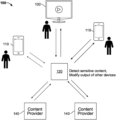
- FIG. 1 illustrates an exemplary system for modifying distractions during consumption of selected portions of content on a content device, in accordance with embodiments of the disclosure.
- System 100 includes a first content consumption device 130 as well as a number of second content consumption devices 110 , each being viewed by a user as shown.
- First and second content consumption devices 130 , 110 each communicate with content direction device 120 , which receives and forwards content streamed from content providers 140 .
- content direction device 120 receives content from content providers 140 and transmits it on to the content consumption devices 110 , 130 for viewing by users.
- a user may be watching a show on first content consumption device 110 , at which point the content provider 140 is providing a stream of the show through communications network 210 to content direction device 120 .
- the content direction device 120 receives this stream and directs it to device 110 over local area network 200 .
- the content direction device 120 receives the stream from one content provider 140 and directs the stream to the second content consumption device 130 .
- the content direction device 120 receives indicators of sensitive content, or content susceptible to interruption, from the various streams received from content providers 140 . From these indicators, the content direction device 120 determines which device 110 , 130 if any is currently receiving sensitive or interruptible content.
- the device 110 , 130 currently receiving such content is designated as a priority device, with the content direction device 120 directing the remaining devices 110 , 130 to modify their output characteristics.
- the tuning and encoding circuitry may be used by the user equipment device to receive and to display, to play, or to record content.
- the tuning and encoding circuitry may also be used to receive guidance data.
- the circuitry described herein, including for example, the tuning, video generating, encoding, decoding, encrypting, decrypting, scaler, and analog/digital circuitry may be implemented using software running on one or more general purpose or specialized processors. Multiple tuners may be provided to handle simultaneous tuning functions (e.g., watch and record functions, picture-in-picture (PIP) functions, multiple-tuner recording, etc.). If storage 308 is provided as a separate device from user equipment 300 , the tuning and encoding circuitry (including multiple tuners) may be associated with storage 308 .
- PIP picture-in-picture
- Display 312 may be one or more of a monitor, a television, a liquid crystal display (LCD) for a mobile device, amorphous silicon display, low temperature poly silicon display, electronic ink display, electrophoretic display, active matrix display, electro-wetting display, electrofluidic display, cathode ray tube display, light-emitting diode display, electroluminescent display, plasma display panel, high-performance addressing display, thin-film transistor display, organic light-emitting diode display, surface-conduction electron-emitter display (SED), laser television, carbon nanotubes, quantum dot display, interferometric modulator display, or any other suitable equipment for displaying visual images.
- display 312 may be HDTV-capable.
- FIG. 4 is a generalized embodiment of an illustrative content direction device 120 constructed for use according to embodiments of the disclosure.
- device 400 may serve as a content direction device.
- Device 400 may receive content and data via I/O paths 402 and 404 .
- I/O path 402 may provide content and data to the various content consumption devices 110 and 130
- I/O path 404 may provide data to, and receive content from, one or more content providers 140 .
- the device 400 has control circuitry 406 which includes processing circuitry 408 and storage 410 .
- the control circuitry 406 , processing circuitry 408 , and storage 410 may be constructed, and may operate, in similar manner to the respective components of user equipment device 300 .
- the device 400 may be any electronic device capable of receiving content streams and transferring them to one or more content consumption devices 110 , 130 .
- the device 400 may be a networked in-home smart device connected between a home modem and various content consumption devices 110 , 130 .
- the device 400 may alternatively be a laptop computer or desktop computer configured as above.
- the content consumption device 130 is the device currently consuming content designated as susceptible to interruption, and can be referred to as the first device.
- the content direction device 120 selects second content devices located proximate to a first content device (Step 520 ) and determines identifiers of the second content devices (Step 530 ), to determine whether users of the second content devices 110 are different from the viewer of the first content direction device 130 .
- the content direction device 120 modifies an output characteristic of that second content device 110 during consumption of any portions of identified content on the first content device (Step 540 ).
- the account identifiers AID are also associated with the UID of the user owning each account. Additionally, the logs may store pointers to user profiles P_UID which are unique user profiles for each user. The user profiles may also be stored in storage 410 or elsewhere as appropriate.
- the record of users can be built over time, as various users use the devices 110 , 130 .
- each device 110 , 130 can be assigned one user UID, and as users add accounts, the new account identifiers AID are stored for each device DID that account is used on.
- a user profile UID is generated or retrieved for each UID, along with a pointer P_UID to that profile.
- Users can be added as new users register, new devices are added, as new accounts are added, or as comparison of the user profiles indicates that someone is requesting content that does not fit any existing user profile. The determination of a new user by negative comparison to existing profiles is known, and any such method is contemplated by the instant disclosure.
- the correct user is determined by comparison of the requested content to the user profiles (retrieved with associated pointer P_UID) associated with each of the multiple UIDs.
- the profile expressing a preference for content that most closely matches the requested content may be deemed to identify the correct user.
- Such user identification processes are known.
- the present disclosure contemplates the selection of a correct user from among multiple candidates, with reference to user profiles, in any manner.
- the user identification steps herein may also be repeated when content is requested on a subsequent device, to determine the user of each device requesting content.
- each device 110 , 130 is determined as it requests content.
- Devices 110 whose user is determined to be the same as the user of device 130 do not have their output characteristics modified during periods of sensitive or interruptible content. That is, the output characteristic modification of embodiments of the disclosure may be applied only to devices used by users other than the viewer of sensitive or interruptible content. When the viewer of such content is also engaging with another device, it may be assumed that the viewer wishes to direct his or her attention to that other device, rather than the sensitive or interruptible content. Accordingly, the output characteristics of that device are not modified. It is noted, however, that embodiments of the disclosure also contemplate modifying output characteristics of all devices near that device which is consuming sensitive or interruptible content, regardless of whether they involve a common user. That is, the disclosure includes embodiments in which devices 110 have their output characteristics modified even when they are being viewed by the user of device 130 displaying sensitive or interruptible content.
- content may be flagged when subsequent frames have a brightness variance exceeding a predetermined threshold, i.e., frames change rapidly in brightness (for example creating a strobing or flashing effect).
- content may be flagged when frames with highly contrasting intensity between background and foreground are detected, thus requiring the viewer's eyes to need time to adjust. The adjustment may be hindered by proximate devices exceeding a brightness threshold.
- the comparison of images in successive frames is known, and any such method is contemplated.
- Live sporting events may be flagged when scores exceed a certain amount, if opponent scores are within a certain amount of each other (close game), if the sporting event is in an overtime period, or the like.
- Ad slots within live content may also be flagged as sensitive or interruptible.
- Live content may also be flagged in real time, so that certain events occurring live may trigger designation as sensitive or interruptible content. For example, detection of sudden bright flashes such as gunfire, or sudden high audio volume such as crowd noise indicating a goal or a score, may trigger the live content stream to be flagged as sensitive or interruptible.
- the determination of sensitive or interruptible content may be made according to an analysis of content audio. For instance, loud scenes such as action scenes may be considered susceptible to interruption, as viewers may find them engrossing and wish to view them undisturbed. Similarly, quiet scenes may also be considered susceptible to interruption, as any disturbance is easily heard by viewers. Accordingly, content may be flagged as sensitive or interruptible when the measured volume of a scene is greater than some predetermined upper bound, or lower than some predetermined lower bound. Volume may be measured in any manner, including average volume of a scene, peak or lowest volume of a scene, or any other measure of volume over time. The predetermined upper and lower bounds may each be of any value.
- the determination of sensitive or interruptible content may be made according to an analysis of content text. More specifically, closed caption or subtitle text may be scanned for certain words that correspond to scenes susceptible to interruption.
- a dictionary of such words may be stored, and closed caption or subtitle words that match words in the dictionary may indicate a scene susceptible to interruption.
- the dictionary may include words that convey emotion, so that one or more such words may indicate emotional content that viewers may wish to watch undisturbed.
- Subtitles that include musical notes or names of background music pieces may also indicate climactic or emotional scenes. Any such text, in any amounts, may be used to indicate sensitive or interruptible content.
- content direction device 120 may not perform any output modification of nearby devices 110 that are connected to headphones, or located nearby but in a closed room, or that do not otherwise pose a risk of interruption. Determination of device 110 status, such as being headphone connected or in a closed room, may be accomplished in any manner, such as by direct querying of the devices 110 by content direction device 120 , user input, and location information as further described herein.
- device 120 selects those devices 110 that are located near the device 130 consuming the sensitive content.
- the devices 110 can be selected according to their distance from device 130 , and can be located at any distance proximate to device 130 . Proximity can be determined in any manner. For example, devices 110 can be considered proximate to device 130 if they are within any predetermined distance from device 130 , if they are within the same room, on the same local area network 200 , or the like.
- FIG. 6 is a flowchart illustrating process steps for selecting second content devices 110 by predetermined distance. Locations of second content devices 110 are first retrieved (Step 600 ).
- GPS global positioning system
- Location may also be determined in any other manner, such as by preprogrammed locations stored in either devices 110 or content direction device 120 , preprogrammed flags indicating certain devices are in the same room (which may be entered by users), Bluetooth proximity to the device 120 , or the like. Any method of determining device location is contemplated.
- the content direction device 120 determines the distances between the retrieved locations and the location of device 130 (Step 610 ).
- the location of device 130 may be retrieved in the same manner as for devices 110 in Step 600 , or in any other manner. For instance, the location of device 130 may be approximated as the location of the content direction device 120 . Any method of determining distances between a first content device 130 and second content devices 110 is contemplated. Alternatively, in cases where it is known which room certain devices are in, a precise location need not be calculated.
- the second content devices 110 are selected according to the distances determined in Step 610 (Step 620 ). Selection may be by any criteria. For instance, devices 110 may be selected as second content devices if they are located within any threshold distance of device 130 . This threshold distance may be any value, e.g., 10 feet, 20 feet, the same room, or the like.
- the above described process of modifying output characteristics of nearby devices 110 is a repetitive one. That is, as the content direction device 120 streams sensitive or interruptible content to any device 110 , that device 110 becomes the device 130 , and the previous device 130 becomes a device 110 . In other words, as devices 110 , 130 consume sensitive or interruptible content, the remaining nearby devices 110 , 130 have their output characteristics modified.
- FIG. 7 is a flowchart illustrating this process in further detail.
- the content direction device 120 receives identifiers of predetermined sensitive or interruptible portions of each content stream (Step 700 ).
- One of the content devices currently consuming the predetermined portion of its content stream is then designated as a priority device (Step 710 ).
- the priority device When only one device is consuming a sensitive or interruptible portion of content, that device is designated as the priority device.
- the content direction device 120 selects one such device 110 , 130 as the priority device.
- the remaining devices 110 , 130 have their output characteristics modified even if they are one of the devices currently consuming sensitive or interruptible content.
- the content direction device 120 may select priority devices in any manner. As one example, the content direction device 120 may randomly select one of the devices currently consuming sensitive or interruptible content to be the priority device. Alternatively, device 120 may select the first device to consume sensitive or interruptible content.
- different types of content may be assigned different priority levels, so that in the event of a conflict between different content streams each designated as sensitive or interruptible, the content stream with the highest priority level is designated as the priority device.
- live, or live primetime content may be assigned the highest priority level, followed by video on demand and pay per view content. Any hierarchy of priority levels for any types of content is contemplated.
- Priority levels may be included in content metadata as, or as part of, the indicators of sensitive or interruptible content portions.
- the content direction device 120 may employ any one or more of the above described methods to determine the priority device at any given time.
- content direction device 120 modifies one or more output characteristics of each content device other than the priority device (Step 720 ).
- the output characteristics may be any output of any device, such as device volume output, screen luminance, and the like.
- the output characteristics may include device on/off states, indicator lights, and the like. That is, when sensitive content is being consumed on a device 110 , 130 , the content direction device 120 may turn off nearby appliances until the sensitive content is done being consumed, may turn off or lower appliance indicator lights, or modify/stop any other appliance output. In this manner, the content direction device 120 continually designates different devices 110 , 130 as the priority device as different devices 110 , 130 consume content portions determined to be sensitive or interruptible.
- conflicts between multiple devices each simultaneously consuming content susceptible to interruption may be resolved by selecting one of the devices at random, by selecting devices according to predetermined priority levels associated with their content, or in any other manner.
- the embodiments were chosen and described in order to best explain the principles of the invention and its practical applications, to thereby enable others skilled in the art to best utilize the methods and systems of the disclosure and various embodiments with various modifications as are suited to the particular use contemplated. Additionally, different features of the various embodiments, disclosed or otherwise, can be mixed and matched or otherwise combined so as to create further embodiments contemplated by the disclosure.
Landscapes
- Engineering & Computer Science (AREA)
- Multimedia (AREA)
- Signal Processing (AREA)
- Human Computer Interaction (AREA)
- Theoretical Computer Science (AREA)
- Databases & Information Systems (AREA)
- Physics & Mathematics (AREA)
- General Engineering & Computer Science (AREA)
- General Physics & Mathematics (AREA)
- Computer Networks & Wireless Communication (AREA)
- Two-Way Televisions, Distribution Of Moving Picture Or The Like (AREA)
- User Interface Of Digital Computer (AREA)
Abstract
Description
Claims (20)
Priority Applications (2)
| Application Number | Priority Date | Filing Date | Title |
|---|---|---|---|
| US18/209,347 US12170826B2 (en) | 2019-04-24 | 2023-06-13 | Method and apparatus for modifying output characteristics of proximate devices |
| US18/932,871 US20250150682A1 (en) | 2019-04-24 | 2024-10-31 | Method and apparatus for modifying output characteristics of proximate devices |
Applications Claiming Priority (3)
| Application Number | Priority Date | Filing Date | Title |
|---|---|---|---|
| US16/393,355 US11202128B2 (en) | 2019-04-24 | 2019-04-24 | Method and apparatus for modifying output characteristics of proximate devices |
| US17/519,832 US11722747B2 (en) | 2019-04-24 | 2021-11-05 | Method and apparatus for modifying output characteristics of proximate devices |
| US18/209,347 US12170826B2 (en) | 2019-04-24 | 2023-06-13 | Method and apparatus for modifying output characteristics of proximate devices |
Related Parent Applications (1)
| Application Number | Title | Priority Date | Filing Date |
|---|---|---|---|
| US17/519,832 Continuation US11722747B2 (en) | 2019-04-24 | 2021-11-05 | Method and apparatus for modifying output characteristics of proximate devices |
Related Child Applications (1)
| Application Number | Title | Priority Date | Filing Date |
|---|---|---|---|
| US18/932,871 Continuation US20250150682A1 (en) | 2019-04-24 | 2024-10-31 | Method and apparatus for modifying output characteristics of proximate devices |
Publications (2)
| Publication Number | Publication Date |
|---|---|
| US20230328333A1 US20230328333A1 (en) | 2023-10-12 |
| US12170826B2 true US12170826B2 (en) | 2024-12-17 |
Family
ID=72917519
Family Applications (4)
| Application Number | Title | Priority Date | Filing Date |
|---|---|---|---|
| US16/393,355 Active US11202128B2 (en) | 2019-04-24 | 2019-04-24 | Method and apparatus for modifying output characteristics of proximate devices |
| US17/519,832 Active US11722747B2 (en) | 2019-04-24 | 2021-11-05 | Method and apparatus for modifying output characteristics of proximate devices |
| US18/209,347 Active US12170826B2 (en) | 2019-04-24 | 2023-06-13 | Method and apparatus for modifying output characteristics of proximate devices |
| US18/932,871 Pending US20250150682A1 (en) | 2019-04-24 | 2024-10-31 | Method and apparatus for modifying output characteristics of proximate devices |
Family Applications Before (2)
| Application Number | Title | Priority Date | Filing Date |
|---|---|---|---|
| US16/393,355 Active US11202128B2 (en) | 2019-04-24 | 2019-04-24 | Method and apparatus for modifying output characteristics of proximate devices |
| US17/519,832 Active US11722747B2 (en) | 2019-04-24 | 2021-11-05 | Method and apparatus for modifying output characteristics of proximate devices |
Family Applications After (1)
| Application Number | Title | Priority Date | Filing Date |
|---|---|---|---|
| US18/932,871 Pending US20250150682A1 (en) | 2019-04-24 | 2024-10-31 | Method and apparatus for modifying output characteristics of proximate devices |
Country Status (1)
| Country | Link |
|---|---|
| US (4) | US11202128B2 (en) |
Families Citing this family (1)
| Publication number | Priority date | Publication date | Assignee | Title |
|---|---|---|---|---|
| US11202128B2 (en) | 2019-04-24 | 2021-12-14 | Rovi Guides, Inc. | Method and apparatus for modifying output characteristics of proximate devices |
Citations (26)
| Publication number | Priority date | Publication date | Assignee | Title |
|---|---|---|---|---|
| US20090172512A1 (en) * | 2007-12-27 | 2009-07-02 | Mitsubishi Electric Corporation | Screen generating apparatus and screen layout sharing system |
| US20090328087A1 (en) * | 2008-06-27 | 2009-12-31 | Yahoo! Inc. | System and method for location based media delivery |
| US20110046755A1 (en) * | 2009-08-24 | 2011-02-24 | Samsung Electronics Co., Ltd. | Contents reproducing device and method |
| US20110296463A1 (en) * | 2010-06-01 | 2011-12-01 | Comcast Cable Communications, Llc | Ranking search results |
| US20120159327A1 (en) * | 2010-12-16 | 2012-06-21 | Microsoft Corporation | Real-time interaction with entertainment content |
| US20130007809A1 (en) * | 2011-06-29 | 2013-01-03 | United Video Properties, Inc. | Methods and systems for customizing viewing environment preferences in a viewing environment control application |
| US20140143806A1 (en) * | 2012-11-19 | 2014-05-22 | Muir Arthur H | System and method for creating customized, multi-platform video programming |
| US20140267906A1 (en) * | 2013-03-13 | 2014-09-18 | Echostar Technologies L.L.C. | Enhanced experience from standard program content |
| US20140280879A1 (en) * | 2013-03-14 | 2014-09-18 | Zbignew Skolicki | Detecting User Interest in Presented Media Items by Observing Volume Change Events |
| US20150264439A1 (en) * | 2012-10-28 | 2015-09-17 | Hillcrest Laboratories, Inc. | Context awareness for smart televisions |
| US20160080792A1 (en) * | 2014-09-12 | 2016-03-17 | At&T Mobility Ii Llc | Determining viewership for personalized delivery of television content |
| US20160148055A1 (en) * | 2014-11-21 | 2016-05-26 | Microsoft Technology Licensing, Llc | Content interruption point identification accuracy and efficiency |
| US20160322018A1 (en) * | 2015-04-29 | 2016-11-03 | Rovi Guides, Inc. | Systems and methods for enhancing viewing experiences of users |
| US20160366468A1 (en) * | 2015-06-12 | 2016-12-15 | Samsung Electronics Co., Ltd. | Operating method of portable device, operating method of content reproducing device, portable device, and content reproducing device |
| US20170115953A1 (en) * | 2015-10-21 | 2017-04-27 | Bose Corporation | Controlling audio playback based on activity |
| US20180027374A1 (en) * | 2016-07-20 | 2018-01-25 | Rovi Guides, Inc. | Systems and methods for alerting a user to use an alternate device type to access a media asset |
| US20180027373A1 (en) * | 2016-07-20 | 2018-01-25 | Rovi Guides, Inc. | Systems and methods for intelligent audio output |
| US20180139071A1 (en) * | 2015-06-11 | 2018-05-17 | Sony Corporation | Information processing method, program, information processing apparatus, and information processing system |
| US20180139565A1 (en) * | 2016-11-17 | 2018-05-17 | Glen A. Norris | Localizing Binaural Sound to Objects |
| US20180181366A1 (en) * | 2016-12-28 | 2018-06-28 | Google Inc. | Modification of distracting sounds |
| US20190014378A1 (en) * | 2017-07-06 | 2019-01-10 | DISH Technologies L.L.C. | System and method for dynamically adjusting content playback based on viewer emotions |
| US20190149584A1 (en) * | 2017-11-14 | 2019-05-16 | Rovi Guides, Inc. | Systems and methods for establishing a voice link between users accessing media |
| US20190332347A1 (en) * | 2018-04-30 | 2019-10-31 | Spotify Ab | Personal media streaming appliance ecosystem |
| US20190372541A1 (en) * | 2018-05-31 | 2019-12-05 | Comcast Cable Communications, Llc | Content Audio Adjustment |
| US11006183B2 (en) | 2019-04-24 | 2021-05-11 | ROVl GUIDES, INC. | Method and apparatus for modifying output characteristics of proximate devices |
| US11202128B2 (en) | 2019-04-24 | 2021-12-14 | Rovi Guides, Inc. | Method and apparatus for modifying output characteristics of proximate devices |
Family Cites Families (12)
| Publication number | Priority date | Publication date | Assignee | Title |
|---|---|---|---|---|
| US7570870B2 (en) * | 2005-09-27 | 2009-08-04 | Guideworks, Llc | Systems and methods for recording programs of lesser interest when convenient |
| US20070156853A1 (en) * | 2006-01-03 | 2007-07-05 | The Navvo Group Llc | Distribution and interface for multimedia content and associated context |
| JP2007194974A (en) * | 2006-01-20 | 2007-08-02 | Hitachi Ltd | Video display device, video recording device, and video distribution control system |
| US8041025B2 (en) * | 2006-08-07 | 2011-10-18 | International Business Machines Corporation | Systems and arrangements for controlling modes of audio devices based on user selectable parameters |
| US7865927B2 (en) * | 2006-09-11 | 2011-01-04 | Apple Inc. | Enhancing media system metadata |
| US20090070408A1 (en) * | 2007-09-07 | 2009-03-12 | At&T Knowledge Ventures, L.P. | Apparatus and method for managing delivery of media content |
| US9832442B2 (en) * | 2008-01-15 | 2017-11-28 | Echostar Technologies Llc | System and method of managing multiple video players executing on multiple devices |
| US20110320963A1 (en) * | 2010-06-28 | 2011-12-29 | Rovi Technologies Corporation | Systems and methods for controlling multiple user access to media devices in a connected platform environment |
| US9582148B2 (en) * | 2014-05-01 | 2017-02-28 | 4SeTV, Inc. | Computing system with presentation mechanism and method of operation thereof |
| US10028023B2 (en) * | 2016-01-20 | 2018-07-17 | Google Llc | Methods and systems for automatic media output based on user proximity |
| US9996310B1 (en) * | 2016-09-15 | 2018-06-12 | Amazon Technologies, Inc. | Content prioritization for a display array |
| US10650790B2 (en) * | 2018-04-30 | 2020-05-12 | Ramzi Khalil Maalouf | System, apparatus, and method for optimizing viewing experience on an intelligent terminal |
-
2019
- 2019-04-24 US US16/393,355 patent/US11202128B2/en active Active
-
2021
- 2021-11-05 US US17/519,832 patent/US11722747B2/en active Active
-
2023
- 2023-06-13 US US18/209,347 patent/US12170826B2/en active Active
-
2024
- 2024-10-31 US US18/932,871 patent/US20250150682A1/en active Pending
Patent Citations (28)
| Publication number | Priority date | Publication date | Assignee | Title |
|---|---|---|---|---|
| US20090172512A1 (en) * | 2007-12-27 | 2009-07-02 | Mitsubishi Electric Corporation | Screen generating apparatus and screen layout sharing system |
| US20090328087A1 (en) * | 2008-06-27 | 2009-12-31 | Yahoo! Inc. | System and method for location based media delivery |
| US20110046755A1 (en) * | 2009-08-24 | 2011-02-24 | Samsung Electronics Co., Ltd. | Contents reproducing device and method |
| US20110296463A1 (en) * | 2010-06-01 | 2011-12-01 | Comcast Cable Communications, Llc | Ranking search results |
| US20120159327A1 (en) * | 2010-12-16 | 2012-06-21 | Microsoft Corporation | Real-time interaction with entertainment content |
| US8949901B2 (en) * | 2011-06-29 | 2015-02-03 | Rovi Guides, Inc. | Methods and systems for customizing viewing environment preferences in a viewing environment control application |
| US20130007809A1 (en) * | 2011-06-29 | 2013-01-03 | United Video Properties, Inc. | Methods and systems for customizing viewing environment preferences in a viewing environment control application |
| US20150264439A1 (en) * | 2012-10-28 | 2015-09-17 | Hillcrest Laboratories, Inc. | Context awareness for smart televisions |
| US20140143806A1 (en) * | 2012-11-19 | 2014-05-22 | Muir Arthur H | System and method for creating customized, multi-platform video programming |
| US20140267906A1 (en) * | 2013-03-13 | 2014-09-18 | Echostar Technologies L.L.C. | Enhanced experience from standard program content |
| US20140280879A1 (en) * | 2013-03-14 | 2014-09-18 | Zbignew Skolicki | Detecting User Interest in Presented Media Items by Observing Volume Change Events |
| US20160080792A1 (en) * | 2014-09-12 | 2016-03-17 | At&T Mobility Ii Llc | Determining viewership for personalized delivery of television content |
| US20160148055A1 (en) * | 2014-11-21 | 2016-05-26 | Microsoft Technology Licensing, Llc | Content interruption point identification accuracy and efficiency |
| US20160322018A1 (en) * | 2015-04-29 | 2016-11-03 | Rovi Guides, Inc. | Systems and methods for enhancing viewing experiences of users |
| US20180139071A1 (en) * | 2015-06-11 | 2018-05-17 | Sony Corporation | Information processing method, program, information processing apparatus, and information processing system |
| US20160366468A1 (en) * | 2015-06-12 | 2016-12-15 | Samsung Electronics Co., Ltd. | Operating method of portable device, operating method of content reproducing device, portable device, and content reproducing device |
| US20170115953A1 (en) * | 2015-10-21 | 2017-04-27 | Bose Corporation | Controlling audio playback based on activity |
| US20180027374A1 (en) * | 2016-07-20 | 2018-01-25 | Rovi Guides, Inc. | Systems and methods for alerting a user to use an alternate device type to access a media asset |
| US20180027373A1 (en) * | 2016-07-20 | 2018-01-25 | Rovi Guides, Inc. | Systems and methods for intelligent audio output |
| US20180139565A1 (en) * | 2016-11-17 | 2018-05-17 | Glen A. Norris | Localizing Binaural Sound to Objects |
| US20180181366A1 (en) * | 2016-12-28 | 2018-06-28 | Google Inc. | Modification of distracting sounds |
| US20190014378A1 (en) * | 2017-07-06 | 2019-01-10 | DISH Technologies L.L.C. | System and method for dynamically adjusting content playback based on viewer emotions |
| US20190149584A1 (en) * | 2017-11-14 | 2019-05-16 | Rovi Guides, Inc. | Systems and methods for establishing a voice link between users accessing media |
| US20190332347A1 (en) * | 2018-04-30 | 2019-10-31 | Spotify Ab | Personal media streaming appliance ecosystem |
| US20190372541A1 (en) * | 2018-05-31 | 2019-12-05 | Comcast Cable Communications, Llc | Content Audio Adjustment |
| US11006183B2 (en) | 2019-04-24 | 2021-05-11 | ROVl GUIDES, INC. | Method and apparatus for modifying output characteristics of proximate devices |
| US11202128B2 (en) | 2019-04-24 | 2021-12-14 | Rovi Guides, Inc. | Method and apparatus for modifying output characteristics of proximate devices |
| US20220060797A1 (en) | 2019-04-24 | 2022-02-24 | Rovi Guides, Inc. | Method and apparatus for modifying output characteristics of proximate devices |
Non-Patent Citations (1)
| Title |
|---|
| PCT International Search Report for International Application No. PCT/US2020/029638, dated Jul. 30, 2020 (12 pages). |
Also Published As
| Publication number | Publication date |
|---|---|
| US20200344530A1 (en) | 2020-10-29 |
| US20220060797A1 (en) | 2022-02-24 |
| US11202128B2 (en) | 2021-12-14 |
| US20250150682A1 (en) | 2025-05-08 |
| US11722747B2 (en) | 2023-08-08 |
| US20230328333A1 (en) | 2023-10-12 |
Similar Documents
| Publication | Publication Date | Title |
|---|---|---|
| US12069341B2 (en) | Method and apparatus for identifying a single user requesting conflicting content and resolving said conflict | |
| US20250390275A1 (en) | Systems and methods for customizing media player playback speed | |
| US12244890B2 (en) | Systems and methods for detecting and analyzing audio in a media presentation environment to determine whether to replay a portion of the media | |
| US20250150682A1 (en) | Method and apparatus for modifying output characteristics of proximate devices | |
| US20250324122A1 (en) | Method and apparatus for redirecting portions of content to alternate communication channels | |
| EP3794833B1 (en) | Method and apparatus for identifying a single user requesting conflicting content and resolving said conflict | |
| US20120219265A1 (en) | Method and apparatus for use with video sequences | |
| EP3794834A1 (en) | Method and apparatus for modifying output characteristics of proximate devices | |
| US20230171736A1 (en) | Automatically suspending or reducing portable device notifications when viewing audio/video programs | |
| US11006183B2 (en) | Method and apparatus for modifying output characteristics of proximate devices | |
| US20200413147A1 (en) | Method and apparatus for proximity-based play of preferred content | |
| US20180227633A1 (en) | Attention diverter responsive to determination of viewer and content | |
| US12256116B2 (en) | Systems and methods for dynamically adjusting quality levels for transmitting content based on context |
Legal Events
| Date | Code | Title | Description |
|---|---|---|---|
| FEPP | Fee payment procedure |
Free format text: ENTITY STATUS SET TO UNDISCOUNTED (ORIGINAL EVENT CODE: BIG.); ENTITY STATUS OF PATENT OWNER: LARGE ENTITY |
|
| AS | Assignment |
Owner name: ROVI GUIDES, INC., CALIFORNIA Free format text: ASSIGNMENT OF ASSIGNORS INTEREST;ASSIGNOR:ROVI CORPORATION;REEL/FRAME:063945/0011 Effective date: 20200512 Owner name: ROVI GUIDES, INC., CALIFORNIA Free format text: ASSIGNMENT OF ASSIGNORS INTEREST;ASSIGNOR:SRINIVASAN, MADHUSUDHAN;REEL/FRAME:063944/0994 Effective date: 20200511 Owner name: ROVI CORPORATION, CALIFORNIA Free format text: PROPRIETARY AGREEMENT;ASSIGNOR:PULICHARLA, DURGA PRASAD;REEL/FRAME:063990/0422 Effective date: 20150521 |
|
| STPP | Information on status: patent application and granting procedure in general |
Free format text: DOCKETED NEW CASE - READY FOR EXAMINATION |
|
| STPP | Information on status: patent application and granting procedure in general |
Free format text: NON FINAL ACTION MAILED |
|
| STPP | Information on status: patent application and granting procedure in general |
Free format text: RESPONSE TO NON-FINAL OFFICE ACTION ENTERED AND FORWARDED TO EXAMINER |
|
| STPP | Information on status: patent application and granting procedure in general |
Free format text: NOTICE OF ALLOWANCE MAILED -- APPLICATION RECEIVED IN OFFICE OF PUBLICATIONS |
|
| AS | Assignment |
Owner name: ADEIA GUIDES INC., CALIFORNIA Free format text: CHANGE OF NAME;ASSIGNOR:ROVI GUIDES, INC.;REEL/FRAME:069106/0178 Effective date: 20220815 |
|
| STPP | Information on status: patent application and granting procedure in general |
Free format text: PUBLICATIONS -- ISSUE FEE PAYMENT VERIFIED |
|
| STCF | Information on status: patent grant |
Free format text: PATENTED CASE |